“The Nurturing Flower" and "How to Build a Human” by Keoni Mcfee | AP Drawing
This work was selected for the 2025 AP Art and Design Digital Exhibit, which features exceptional artwork from AP students’ final portfolios.
🎨Learn more about Keoni’s work: apartanddesign.collegeboard.org/2025-student09?excmpid=SM…
Advanced Placement exams
-
AP for Students
@APforStudents
-
AP for Students reposted
-
AP for Students
@APforStudents
“Twisted Wonderland” by Kaylen Saucedo | AP Drawing
Kaylen Saucedo’s work was selected for the 2025 AP Art and Design Digital Exhibit, which features exceptional artwork from AP students’ final portfolios.
🎨 Learn more about Kaylen’s work: apartanddesign.collegeboard.org/2025-student08?excmpid=SM… -
AP for Students
@APforStudents
“Skaters” by Karina Secchi | AP 2-D Art and Design
Karina Secchi’s work was selected for the 2025 AP Art and Design Digital Exhibit, which features exceptional artwork from AP students’ final portfolios.
🎨 Learn more about Karina’s work: apartanddesign.collegeboard.org/2025-student28?excmpid=SM… -
AP for Students
@APforStudents
“Mubeza Chair” by Kady Bez | AP 3-D Art and Design
Kady Bez’s work was selected for the 2025 AP Art and Design Digital Exhibit, which features exceptional artwork from AP students’ final portfolios.
🎨Learn more about Kady’s work: apartanddesign.collegeboard.org/2025-student42?excmpid=SM… -
AP for Students
@APforStudents
“Unexpected Route to Luck” by Judith Carrillos | AP Drawing
Judith Carrillos's work was selected for the 2025 AP Art and Design Digital Exhibit, which features exceptional artwork from AP students’ final portfolios.
🎨 Learn more about Judith's work: apartanddesign.collegeboard.org/2025-student07?excmpid=SM… -
AP for Students reposted
College Board
@CollegeBoard
Now available for the 2026-27 school year: AP Cybersecurity. 💻🛡️
Explore our newest AP course, shaped by leading companies. Students who enroll will get hands-on experience in a growing tech field, plus a chance to earn college credit and an employer-endorsed credential.
Sign up for updates: go.collegeboard.org/ap-cybersecurity-interest-students?ex…
#ap #cybersecurity #apcareerkickstart -
AP for Students
@APforStudents
“Epileptic Entanglement” by Joshua Bleakley | AP 2-D Art and Design
Joshua Bleakley's work was selected for the 2025 AP Art and Design Digital Exhibit, which features exceptional artwork from AP students’ final portfolios.
🎨 Learn more about Joshua's work: -
AP for Students
@APforStudents
“Above Water Basket Weaving” by Johuan Antnuez | AP 3-D Art and Design
Johuan Antnuez's work was selected for the 2025 AP Art and Design Digital Exhibit, which features exceptional artwork from AP students’ final portfolios.
🎨 Learn more about Johuan's work: -
AP for Students
@APforStudents
“Woven and Discarded, Abstract Layered Map of a Landfill” by Jessie O’Koon | AP 2-D Art and Design
Jessie O’Koon's work was selected for the 2025 AP Art and Design Digital Exhibit, which features exceptional artwork from AP students’ final portfolios.
🎨 Learn more about Jessie's work: apartanddesign.collegeboard.org/2025-student26?excmpid=SM… -
AP for Students
@APforStudents
“Digital Naivety” by Jacqueline Ibarra | AP Drawing
Jacqueline Ibarra's work was selected for the 2025 AP Art and Design Digital Exhibit, which features exceptional artwork from AP students’ final portfolios.
🎨 Learn more about Jacqueline's work: apartanddesign.collegeboard.org/2025-student06?excmpid=SM… -
AP for Students
@APforStudents
“Oliver” by Isabelle Kelly | AP Drawing
Isabelle Kelly's work was selected for the 2025 AP Art and Design Digital Exhibit, which features exceptional artwork from AP students’ final portfolios.
🎨 Learn more about Isabelle's work: apartanddesign.collegeboard.org/2025-student05?excmpid=SM… -
AP for Students
@APforStudents
“Mind Jam” by Isabella Earl | AP Drawing
Isabella Earl’s work was selected for the 2025 AP Art and Design Digital Exhibit, which features exceptional artwork from AP students’ final portfolios.
🎨 Learn more about Isabella's work: apartanddesign.collegeboard.org/2025-student04?excmpid=SM… -
AP for Students
@APforStudents
“Continuación” by Isabella Alvarez | AP Drawing
Isabella Alvarez’s work was selected for the 2025 AP Art and Design Digital Exhibit, which features exceptional artwork from AP students’ final portfolios.
🎨 Learn more about Isabella's work: apartanddesign.collegeboard.org/2025-student03 -
AP for Students
@APforStudents
“btw i did it afraid and was rewarded” by Hlumelo Notshulwana | AP 3-D Art and Design
Hlumelo Notshulwana’s work was selected for the 2025 AP Art and Design Digital Exhibit, which features exceptional artwork from AP students’ final portfolios.
🎨 Learn more about Hlumelo’s work: apartanddesign.collegeboard.org/2025-student40?excmpid=SM… -
AP for Students
@APforStudents
“Spill The Beans” by Gabriella Silverstein | AP 2-D Art and Design
Gabriella Silverstein’s work was selected for the 2025 AP Art and Design Digital Exhibit, which features exceptional artwork from AP students’ final portfolios.
🎨 Learn more about Gabriella’s work: -
AP for Students
@APforStudents
“4 Wholeness” by Gabriella Hanna | AP 3-D Art and Design
Gabriella Hanna’s work was selected for the 2025 AP Art and Design Digital Exhibit, which features exceptional artwork from AP students’ final portfolios.
🎨Learn more about Gabriella’s work: apartanddesign.collegeboard.org/2025-student39?excmpid=SM… -
AP for Students
@APforStudents
“Eight Phases” by Farah Abdelhak | AP 3-D Art and Design
Farah Abdelhak’s work was selected for the 2025 AP Art and Design Digital Exhibit, which features exceptional artwork from AP students’ final portfolios.
🎨 Learn more about Farah’s work: apartanddesign.collegeboard.org/2025-student38?excmpid=SM… -
AP for Students
@APforStudents
“Reboot Rebooted” by Denver Whaley | AP 3-D Art and Design
Denver Whaley's work was selected for the 2025 AP Art and Design Digital Exhibit, which features exceptional artwork from AP students’ final portfolios.
🎨Learn more about Denver's work: apartanddesign.collegeboard.org/2025-student37?excmpid=SM… -
AP for Students reposted
College Board
@CollegeBoard
2026 AP Exam scores are available to students starting today.
Students can view scores here: apstudents.collegeboard.org/view-scores?excmpid=SM48-ED-C… -
AP for Students reposted
Trevor Packer
@AP_Trevor
Ok, that’s a wrap – all of the 2026 AP Exam results have been posted.
Special thanks to my colleagues Priscyla and Karlie, who helped with the drafting, proofreading, and posting, as we’ve expanded the amount of commentary from ~40 pages to ~110 this year. Big thanks as well to the dozens of AP course experts who, after the fatigue of weeks of AP Readings, also provided help reviewing and improving the descriptions of the exam questions, as I’m (obviously) not a content expert across all 40+ subjects.
AP teachers, AP students: wishing you a restful and joyful summer break, and an extra note of gratitude to the 30,000 AP teachers and professors who scored more than 20 million essays and free-response questions these past few weeks.
Looking ahead . . .
Here’s a reminder of when and how STUDENTS can view their scores on July 6: apstudents.collegeboard.org/view-scores
And here’s a reminder of when and how EDUCATORS can view scores on July 6: scores.collegeboard.org -
AP for Students reposted
Trevor Packer
@AP_Trevor
The 2026 AP Physics C: Electricity & Magnetism Exam scores:
5: 24%; 4: 24%; 3: 27%; 2: 17%; 1: 8%
The 2026 AP Physics C: Electricity & Magnetism Exam was taken by ~32,000 students — less than 1% of the U.S. high school population.
Multiple-Choice Questions
Students scored evenly and well across most topics of the course, but distinctly strongest on questions related to Electric Circuits (Unit 11). Students achieving AP 5s typically answered 100% of these questions correctly.
The questions about Electromagnetic Induction, overall, were slightly more challenging than the other units’ questions; 15% of students answered all of these questions right.
Free-Response Questions
apcentral.collegeboard.org/media/pdf/ap26-frq-physics-c-e…
FRQ #1, the Mathematical Routines question about Magnetic Fields and Forces due to Two Parallel Current-Carrying Wires, considers two long cylindrical wires carrying the same total current I₀ in opposite directions, where Wire S (radius 2a, centered at the origin) has a nonuniform current density that varies radially as J = Cr, and Wire T (radius a, centered at x = 10a) has uniform current density. In Part A, students applied Ampère’s law to derive the magnetic field in Wire S at x = a, requiring them to integrate over the nonuniform current density enclosed by the Amperian loop before applying the law. The students then sketched the magnitude of the total magnetic field as a function of position x along the x-axis from x = 2a to x = 9a, which is the region between the wires. In Part B, students derived the net magnetic force on a charged sphere moving with speed v in the +x-direction at x = 5a, requiring them to determine the superposition of fields from both wires at that location and apply F = qvB.
This was the distinctly the most difficult FRQ on this year’s exam, with three of the possible points proving especially useful in identifying the advanced proficiency characteristic of students achieving AP 5s.
FRQ #2, the Translation Between Representations question about Electric Fields, Electric Potential, and Superposition from Two Charged Rods, begins with two finite, uniformly charged rods: Rod S oriented along the x-axis from −3L to −L, and Rod T oriented along the y-axis from L to 3L, both with positive linear charge density +λ. In Part A, students drew the direction of the net electric field at Point P, located at (−2L, 2L), and at the origin, as well as the direction of the acceleration of a negatively charged sphere released at the origin. In Part B, students derived a symbolic expression for the magnitude of the net electric field at the origin by integrating over the rods and using superposition principles. In Part C, after Rod T is removed, students sketched the electric potential at the origin as Rod S moves away in the −x-direction. Finally, in Part D, students compared the sketch from Part C to the case where a negatively charged Rod W (charge density −λ) simultaneously recedes in the +y-direction at the same speed. This question showcases the full calculus machinery of the electrostatics units: vector field superposition, integration over finite charge distributions, and qualitative reasoning about potential as a scalar sum.
In contrast to FRQ 1, this FRQ provided multiple opportunities for students receiving AP 1s and AP 2s to demonstrate their knowledge and skills, such that this question best differentiated students receiving AP 2s, who were generally able to earn a significant number of points on this FRQ, from students receiving AP 1s, who could usually earn just a few.
FRQ #3, the Experimental Design and Analysis question about Inductance from LC Circuit Oscillation and RL Circuit Data Analysis, challenged students across two distinct experiments. In Experiment 1 (Parts A and B), multiple charged capacitors of known capacitance and a voltmeter that measures potential difference as a function of time are available. Each trial connects the inductor L₁ to a different capacitor in an LC circuit. In Part A, students identified which measured quantities would allow determination of L₁ via a linear graph − for example, by measuring the potential difference across the capacitor long enough to determine the period of oscillation. Students also described a method to reduce experimental uncertainty. In Part B, students identified the quantities to plot that would produce a linear relationship – for example, by recognizing that the oscillation period T is related to L₁ by T² = 4π²L₁C, so L₁ could be found from the slope of a plot of T² vs. C. In Experiment 2 (Parts C and D), a new inductor L₂ is connected to a 12 V battery and a 10 Ω resistor; five measured pairs of current I and rate of change of current dI/dt are provided. Students were expected to recognize that the Kirchhoff’s loop rule equation ε - IR - L(dI/dt) = 0 linearizes as LdI/dt = ε − IR. Therefore, one approach would be to plot ε – IR vs. dI/dt to yield a line whose slope equals L₂. The students then graphed the data, drew a best-fit line, and calculated L₂ from the slope.
Similar to FRQ #2, this FRQ, overall the least challenging on this year’s exam, provided multiple opportunities to differentiate between AP 1s, 2s, and 3s, with students achieving 3+ scores typically able to earn the majority of the points, and students earning AP 2s able to obtain significantly more points across these various tasks than students receiving AP 1s.
FRQ #4, the Qualitative/Quantitative Translation question about Electromagnetic Induction in a Square Conducting Loop, asked students to reason about the induced current in a square conducting loop held in a time-varying magnetic field Bz = B₀ cos(2πt/t₁) initially directed in the +z-direction. In Part A, students indicated the direction of the induced current during the interval 0 < t < t₁/4 using Lenz’s law and justified the answer using qualitative reasoning that addressed the magnetic field due to the induced current in the loop opposing the change in the external magnetic field. In Part B, the students derived a symbolic expression for the induced current I as a function of time by applying Faraday’s law and Ohm’s law. In Part C, the students compared the maximum induced current in a new loop with both side length and resistance doubled relative to the original loop and justified their answer by referencing the functional dependence of the expression for the induced current derived in Part B – specifically, that the maximum emf is proportional to s² and inversely proportional to resistance, so I₂ = 2I₁.
This final question focused squarely on the more advanced students in the course, providing many opportunities for students earning AP 3s to distinguish themselves from performance at the AP 2 level. Students achieving AP 5s typically earned perfect scores on this FRQ, so if you’re wondering whether you’re on track for a 5, take another look at this question, and if you can answer all parts of it thoroughly and accurately, odds are that you’re among this year’s AP 5s.
All subjects’ AP score distributions for 2026 will be posted here when available: apstudents.org/score-distributions -

AP for Students reposted
Trevor Packer
@AP_Trevor
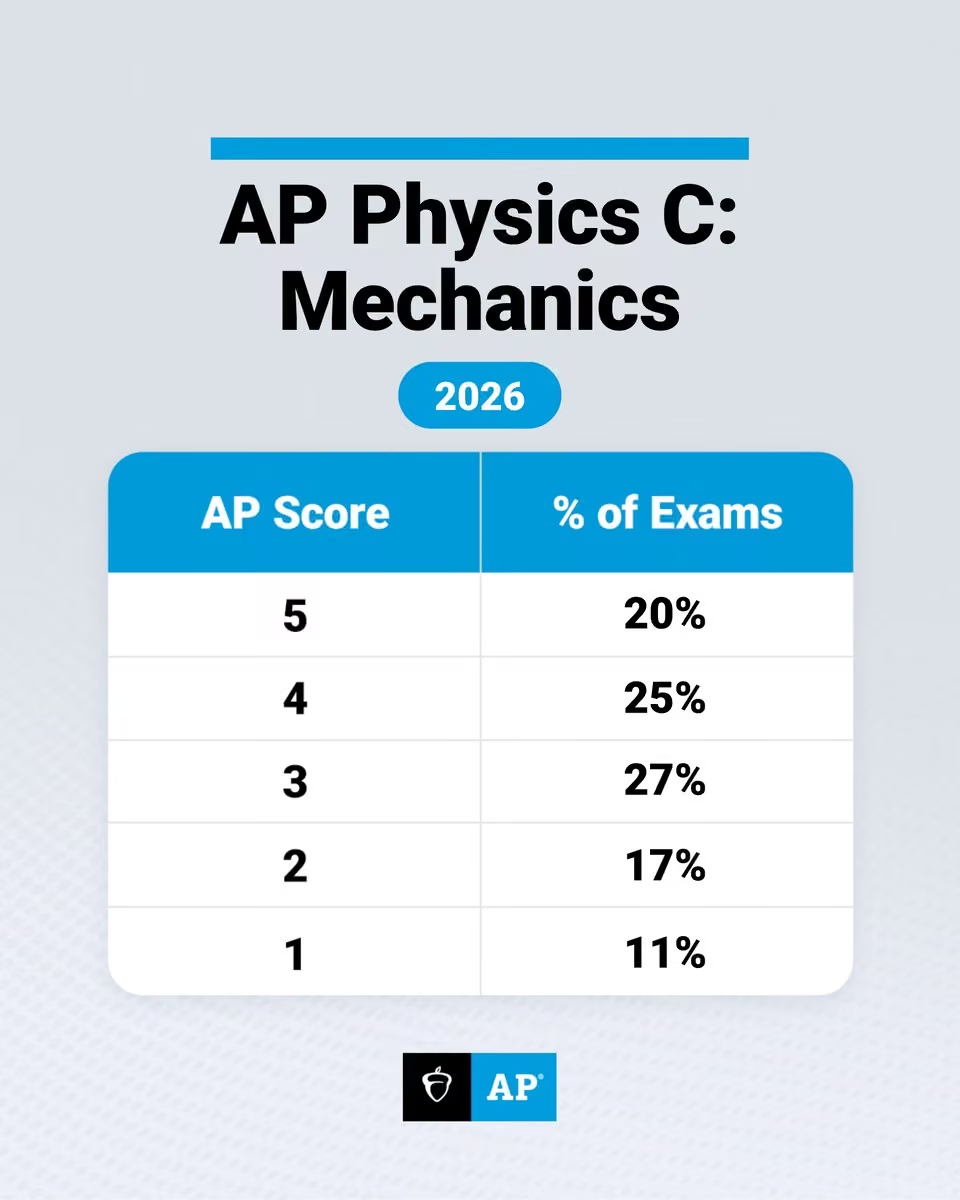
The 2026 AP Physics C: Mechanics Exam scores:
5: 20%; 4: 25%; 3: 27%; 2: 17%; 1: 11%
The 2026 AP Physics C: Mechanics exam was taken by ~70,000 students — less than 1% of the U.S. high school population.
Multiple-Choice Questions
Students soared through the questions related to Linear Momentum (Unit 4): an impressive 41% earned perfect scores across this topic area.
Students also generally scored well on questions related to Unit 5 (Torque and Rotational Dynamics) and Unit 6 (Energy and Momentum of Rotating Systems). Students achieving AP 5s typically missed no more than a single point across all of these questions.
Free-Response Questions
apcentral.collegeboard.org/media/pdf/ap26-frq-physics-c-m…
FRQ #1, a question about Velocity-Dependent Resistive Forces, Normal Force, Friction, and a Sliding Cube Inside a Decelerating Box, opened the exam with a rich, multi-layered application of Newton’s second law. A box of mass M decelerates horizontally under a resistive force F_r = −bv, while a cube of equal mass M remains against the box’s interior right wall. Because the resistive force is velocity-dependent, the deceleration is not constant — it decreases over time as the system slows — and so the normal force F_N exerted on the cube by the wall decreases with time as well. The nonzero normal force causes friction between the cube and the wall, preventing the cube from moving down the wall until the normal forces decreases to a critical value. In Part A, students determined the acceleration of the cube in terms of F_N, derived F_N as an explicit function of time (requiring them to solve the equation of motion for the decelerating box-cube system, yielding F_N = ) 1/2 b(v_0)e^(-bt/2M) for the combined system), and sketched the frictional force on the cube versus time — a curve that begins at a constant value and later decreases exponentially, proportional to F_N, after static friction can no longer support the cube’s weight. In Part B, students derived t_crit, the moment when the decreasing friction force can no longer support the cube’s weight against gravity, which requires setting the maximum static friction equal to Mg and solving for the time at which the exponentially decaying F_N causes the friction force to cross that threshold.
This was an exceptionally challenging FRQ, by far the toughest of this year’s exam, aimed at providing the most advanced students – students qualifying for AP 5s -- with opportunities to demonstrate their knowledge and thereby differentiate themselves from students receiving other scores, who could not typically earn most of the possible points across this beast of an FRQ.
FRQ #2, the longest question on the exam (suggested 30 minutes), about Projectile Motion, Midair Explosion, Momentum Conservation, and Center-of-Mass Kinematics, requires students to translate concepts across several different representations. A projectile of mass 4M is launched at angle θ with speed v_0; at the apex of its trajectory, it explodes into Piece Q (mass M) and Piece R (mass 3M), with the pieces separating horizontally. Piece Q lands back at x = 0; Piece R lands at x = x_2. Across four parts, students drew scaled momentum bar diagrams for each piece at the moment of explosion — requiring them to apply momentum conservation graphically and recognize that Piece Q’s horizontal momentum is one fourth the magnitude of and opposite to the center-of-mass momentum, and that both pieces have zero vertical momentum at the apex — then derived a symbolic expression for x_2 starting from conservation of momentum, extended a velocity-vs-time graph from pre-explosion through post-explosion for both pieces and the center of mass (Piece Q moving backward at speed (v_0)cosθ to land at x = 0, Piece R moving forward faster than (v_0)cosθ, and the center of mass continuing at (v_0)cosθ as required by Newton’s first law for the system), and finally reasoned whether Piece R lands farther when Piece Q instead drops straight down — correctly concluding x_new < x_2 because Piece Q retaining zero horizontal velocity results in less horizontal momentum for Piece R than when Q moves backward.
This was a challenging question, and provided students earning AP scores of 3+ with multiple opportunities to earn points and show their proficiency in calculus-based physics, differentiating themselves from students receiving AP 2s, who generally earned just 1 of the available points here.
FRQ #3, a question about Kinetic Friction Measurement with a Spring and Block, and Spring Constant Determination via Energy Conservation, challenged students across two experiments. In Experiment 1 (Parts A and B), a block of known mass m rests against a spring of known constant k; beyond position x = 0, there is friction. Students — with only a meterstick — identified which distances to measure, proposed an uncertainty-reduction method, and designed a linearizing graph: by measuring the initial compression x_0 and the distance d the block slides before stopping on the rough surface, energy conservation gives 1/2 k(x_0)^2 = (μ_k)mgd, so plotting x_0^2 vs. d yields a line whose slope is 2(μ_k)mg/k. In Experiment 2 (Parts C and D), a new spring k_new launches a 2.0 kg block up a ramp with negligible friction; students measure maximum height h for five compression distances s and are given five (s, h) data pairs. Energy conservation gives 1/2(k_new)s^2 = mgh, so plotting h vs. s^2 yields a line through the origin with slope k_new/(2mg). Students graphed the data, drew a best-fit line, and extracted k_new from the slope.
Students overall earned higher scores on this FRQ than any of the others on this year’s exam, and provided students across the range of AP 2-5 with opportunities to show how far they could go along the spectrum of skills measured by this FRQ, as the distribution of points across these different levels of proficiency was very even.
Part B served to differentiate AP 4s and AP 5s from other students, as this was the most difficult section of this FRQ. In turn, Part D served to differentiate AP 4s from AP 3s, as AP 3s generally found Part D to be beyond their skills.
FRQ #4, a question about Rotational Dynamics, Work-Energy Theorem, and the Effect of Crank Arm Length on a Unicycle Wheel, asked students to reason about three scenarios involving a unicycle wheel of rotational inertia I_W being spun by a crank arm with a constant perpendicular force F. In Scenario 1 (crank arm length ℓ_1), in Scenario 2 (crank arm length ℓ_2 > ℓ_1), and in Scenario 3 (the wheel on the ground, free to roll without slipping). In Part A, students indicated that ω_2 > ω_1 and justified conceptually that the longer crank arm exerts a greater torque and does more work over one full rotation (the force travels a larger arc length 2πℓ_2 vs. 2πℓ_1), so the wheel gains more rotational kinetic energy. In Part B, they derived ω_1 from the work-energy theorem: the work done is F·2πℓ_1 (force times arc length of one rotation), setting this equal to 1/2 (I_W)(ω_1)^2 and solving. In Part C, students argued that ω_3 < ω_1 because when the unicycle is on the ground, the same applied torque must now also accelerate the translational motion of the unicycle — the wheel’s rotational kinetic energy and the system’s translational kinetic energy are both supplied by the same work input F·2πℓ_1, leaving less energy available for rotation alone.
Students receiving AP 2s could typically begin the question and earn a point, but it was sufficiently challenging to serve primarily for providing a range of difficulties well suited to distinguishing between AP 3s, 4s, and 5s.
All subjects' AP score distributions for 2026 will be posted here when available: apstudents.org/score-distributions -
AP for Students reposted
Trevor Packer
@AP_Trevor
The 2026 AP Physics 2 Exam scores:
5: 20%; 4: 29%; 3: 23%; 2: 21%; 1: 7%
The 2026 AP Physics 2 exam was taken by approximately 25,000 students — less than 1% of the U.S. high school population.
Multiple-Choice Questions
Students scored highest on questions related to Thermodynamics (Unit 9); 15% of students earned perfect marks across all of these questions.
Overall, the most challenging sections were related to Electric Force, Field, and Potential (Unit 10) and Waves, Sound, and Physics Optics (Unit 14). 8% of students earned all of the points possible across the questions for these units.
Free-Response Questions
apcentral.collegeboard.org/media/pdf/ap26-frq-physics-2.pdf
FRQ #1, a Mathematical Routines question about Ideal Gas Behavior, Maxwell-Boltzmann Distributions, and Thermal Energy Transfer, initially presented students with a scenario that included a monatomic, ideal gas in a fixed-volume container that also contained a very small, thermally conducting sphere. The students sketched a Maxwell-Boltzmann distribution representing the number of atoms per unit speed as a function of atom speed for the gas after a heating process, based on a similar distribution for the gas at a lower temperature. The students then derived expressions for both the temperature change of the gas due to the heating process and the specific heat of the sphere. The students were then presented with a scenario in which a thermally conducting sphere was submerged in a liquid, with the initial temperature of the sphere greater than that of the liquid. The students had to qualitatively justify why the absolute value of the temperature change of the sphere had to exceed that of the liquid, given that the sphere had both smaller mass and smaller specific heat. This question illustrates the connection between microscopic models of ideal gas behavior, as represented by Maxwell-Boltzmann distributions, and macroscopic thermal energy transfer, as described by changes in temperature and specific heat.
This question contained a number of tasks generally attainable by students receiving AP 2s, providing opportunities for these students to earn a number of points. Student attaining an AP 3 or higher needed to earn the majority of this FRQ’s points, and students achieving AP 5s typically earned all points possible here.
FRQ #2, a Translation Between Representations question about Energy Levels of a Hypothetical Atom, Photon Emission from an Atom in an Excited State, and the Classical and Modern Theories of Electromagnetic Radiation, initially presented students with a scenario that included an energy-level diagram of a hypothetical atom. The students were asked to draw arrows on the diagram to represent all possible transitions that resulted in the emission of a photon. The students then derived an expression for the wavelength of the highest-energy photon that could be emitted from the hypothetical atom. The students were then presented with a scenario in which a device could emit electromagnetic radiation across a continuous range of wavelengths. The students sketched a graph of photon energy as a function of wavelength and then made and justified a claim about whether the hypothetical atom could emit a photon with the same energy as a photon of a particular energy that could be emitted by the device. This question illustrates the distinction between quantized energy levels, as described by the modern theory of electromagnetic radiation, and the continuous spectrum available from a device, as described by the classical theory of electromagnetic radiation.
Part A of this FRQ contributed to differentiating between scores of 1, 2, and 3, as some points here were attainable by less proficient students, while students receiving AP 3s were typically able to earn full points on Part A. What set AP 5s apart here is their general ability to earn all 12 points possible across the full scope of this FRQ.
FRQ #3, an Experimental Design and Analysis question about Electric and Magnetic Forces Exerted on a Charged Sphere and the Circular Motion of Charged Particles in a Uniform Magnetic Field, presented students with two different experiments. In Experiment 1, the students analyzed a velocity selector that used a variable-emf power supply and parallel, charged, conducting plates to balance the electric and magnetic forces exerted on charged spheres. The students identified which quantities to measure with the available equipment to determine the magnitude of the magnetic field, indicated a method to reduce uncertainty, and designed a linearized graph whose slope could be used to determine the magnitude of the magnetic field. In Experiment 2, identical, charged particles were launched into an external, uniform magnetic field of varying, known magnitude between trials, and the resulting circular orbital radii were provided. The students had to identify which quantities to plot to linearize the relationship between the magnitude of the magnetic field and the orbital radius of the charged particles, plot the provided data, draw a best-fit line, and calculate the mass of the particles based on the slope of the best-fit line. This question illustrates the connection between the physics of charged objects in external fields and the methodology of experimental design and graphical data analysis.
Part A differentiated between AP scores of 3 and 2, as students achieving AP 3s were consistently able to earn full marks on Part A, whereas students receiving AP 2s typically could not.
Part B differentiated AP 3s from AP 4s and 5s; the higher scoring students typically earned full points on Part B, whereas AP 3s earned partial.
Part C was relatively easy, serving to differentiate students receiving AP 2s, who did not usually attain all of the points possible on this part, from students earning 3+ scores, who did.
Part D was the playground for AP 4s and 5s, providing opportunities for them to show their knowledge and skills, as other students generally could not obtain these points.
FRQ #4, a Qualitative/Quantitative Translation question about Electric Potential, Kinetic Energy, and Conservation of Energy Associated with a Charged Sphere in an Electric Field, initially presented students with a scenario in which an electric field was represented by equipotential lines and a positively charged sphere moved from a lower electric potential to a higher electric potential between two indicated points. The students had to indicate and justify whether the final speed of the positively charged sphere was greater than, less than, or equal to the initial speed of the positively charged sphere. The students then derived an expression for the final kinetic energy of the positively charged sphere. Lastly, the students were then presented with a scenario in which a negatively charged sphere with the same mass and initial speed as the original positively charged sphere moved from a lower electric potential to a higher electric potential between the two original indicated points. The students were asked to compare the final kinetic energy of the negatively charged sphere to that of the positively charged sphere. This question illustrates the relationship between electric potential energy of a charged sphere-electric field system, kinetic energy, and the sign of the charge when applying conservation of energy to the motion of charged objects in an electric field represented by equipotential lines.
Too challenging for students receiving AP 1s, the difficulty of these points ranged from a point that students receiving AP 2s could typically earn, to a significant number of advanced points designed to separate students achieving AP 5s, who usually earned all points possible on this FRQ, from students earning AP 4s, who could earn mot but not all of the advanced points.
All subjects' AP score distributions for 2026 will be posted here when available: apstudents.org/score-distributions -
AP for Students reposted
Trevor Packer
@AP_Trevor
The 2026 AP Physics 1 Exam scores:
5: 19%; 4: 24%; 3: 25%; 2: 15%; 1: 17%
The 2026 AP Physics 1 exam was taken by approximately 184,000 students — 1% of the U.S. high school population.
Multiple-Choice Questions
Students scored highest on questions related to Unit 1, Kinematics, with 25% of students earning 100% of the points possible here.
Students also did very well on questions related to Unit 3, Work, Energy, and Power, with AP students who earned scores of 3+ generally earning most or all of these points.
Free-Response Questions (FRQs)
apcentral.collegeboard.org/media/pdf/ap26-frq-physics-1.pdf
FRQ #1, a Mathematical Routines question about Projectile Motion and Fluid Flow from a Fountain Nozzle, opened the exam with a rich kinematics scenario: a water droplet that exited a fountain nozzle at an angle above the horizontal, rose to maximum height, and then returned to nozzle height. In the first part, students sketched graphs of both components of velocity as functions of time and then derived symbolic expressions for the exit speed of the water and the volume flow rate through the circular nozzle. In the next part, students transitioned to a comparative reasoning task. The nozzle was replaced by a smaller nozzle, with all other quantities held constant. Students made and justified a claim about how changing the nozzle affects the maximum height of the water. This question requires students to integrate kinematics, continuity of flow, and qualitative reasoning simultaneously.
Across all of this year’s FRQs across the ~40 AP subjects, this is the most pristine I’ve yet seen in the way it so evenly spreads the difficulty of the points across the full 10-points possible, designing points of differing difficulty so that there are at least two points aimed at identifying students qualified for each of the AP score categories of AP 2 to AP 5. It’s a brilliantly designed question, all credit to the Physics professors, teachers, and staff who collaborated to create it. AP students achieving 5s typically earned at least 9 points, students achieving 4s, at least 6 points, students achieving 3s, at least 4 points, and students receiving AP 2s, at least 2 points. A specific example:
In Part B, students receiving AP 2s were typically able to indicate the maximum height of the droplet from the new nozzle, but only students earning AP 3+ scores were typically able to justify their response with qualitative reasoning.
FRQ #2, a Translation Between Representations question about Linear Momentum, Collisions, and Center of Mass Motion, was the most multi-layered question on the exam and showcased multiple representations across four parts. The scenario presented a collision between Disk R and Disk S. First, students drew scaled momentum vectors for the disks after the collision, which required them to illustrate momentum conservation graphically. Students then derived an expression for the kinetic energy of Disk S after the collision, starting from conservation of linear momentum. Next, students sketched a graph of the position as a function of time for both disks and the center of mass after the collision. Finally, students made and justified a claim about the magnitudes of the momentum changes of Disk R and Disk S during the collision. Each part of this question requires a different representational skill: vector diagram, algebraic derivation, graphical reasoning, and conceptual justification.
This FRQ had several components that made it, overall, slightly easier than the others, providing opportunities to differentiate students earning AP 2s from students receiving AP 1s, as students receiving AP 2s were able to attain at least 3 points, several of which were in Part A, across this FRQ.
FRQ #3, an Experimental Design and Analysis question about Blocks Moving Along Surfaces With and Without Friction, presented students with two different experiments that involved frictional forces. In Experiment 1, a block slid down a smooth, curved ramp and onto a rough horizontal surface. The students identified which quantities to measure using a meterstick, indicated a method to reduce uncertainty, and described a linearized graph that could be used to determine the coefficient of kinetic friction between the block and the horizontal surface. In Experiment 2, a block slid various distances down a different rough ramp and passed through a photogate that recorded the speed of the block. Students received data for the distances and the speed of the block, and an equation that relates the distance and the speed. Students identified which quantities to plot to linearize the equation, plotted the data with an appropriate scale, drew a best-fit line, and then calculated an experimental value for the coefficient of kinetic friction based on the slope of the best-fit line. This question illustrates the connection between the physics of frictional forces and the methodology of experimental design and graphical data analysis.
Part D is by far the most challenging part of this FRQ, and served to differentiate students achieving AP 5s from other students. In other words, take a look at Part D of this question and if you’re able to answer it fully, odds are that you’re among the group qualifying for an AP 5.
FRQ #4, a Qualitative-Quantitative Translation question about Rotational Dynamics and the Work-Energy Theorem Applied to Spinning Toys, required students to reason about two spinning toys, Toy X and Toy Y, one with a smaller rotational inertia than the other. A string of the same length was wrapped around the upper portion of each toy. The same constant force was exerted on each string, causing the toys to rotate. Students made and justified a claim as to whether Toy Y reaches a greater, lesser, or equal angular speed as Toy X when the string fully unwound. Students then had to justify their claim using qualitative reasoning. Next, students derived a symbolic expression for the angular speed of Toy X, starting with the work-energy theorem or Newton’s second law in rotational form. Finally, students verified whether their derived expression was consistent with their qualitative reasoning from their claim. The three-part structure of predict qualitatively, derive quantitatively, and verify consistency exemplifies the reasoning cycle AP Physics 1 students develop throughout the course.
This was the most difficult of this year’s FRQs, overall, so its spread of 8 points served to provide opportunities for students aiming at AP 3s, 4s, and 5s to show their stuff, as students receiving AP 2s typically earned just a single point here.
All subjects' AP score distributions for 2026 will be posted here when available: apstudents.org/score-distributions -
AP for Students reposted
Trevor Packer
@AP_Trevor
The 2026 AP Biology Exam scores:
5: 15%; 4: 25%; 3: 31%; 2: 21%; 1: 8%
The 2026 AP Biology Exam was taken by 318,000 students, about 2% of the overall U.S. high school population.
Multiple-Choice Questions
Students scored highest, overall, on questions about Ecology (Unit 8). Generally, students achieving AP 5s earned all 10 points possible here, students achieving AP 4s earned 9/10 points, and students achieving AP 3s earned 8/10 points.
Students scored nearly as well on questions about Natural Selection (Unit 7). Students earning AP 5s generally earned all 8/8 points possible here, students earning AP 4s attained 7/8 points, and students earning AP 3s attained 6/8 points.
Questions related to the Chemistry of Life (Unit 1) were overall, and by far, the most challenging for students; 7% of students earned perfect scores on this unit’s questions, suggesting a need for more review / focus on these topics.
Free-Response Questions
The six FRQs collectively span the AP Biology curriculum — from molecular signaling and gene regulation to cellular energetics, meiosis, natural selection, and ecological analysis — asking students to interpret experimental data, construct graphs, evaluate hypotheses, and reason across biological scales. It’s terrific how the Development Committee designed these questions to embed classic content knowledge inside authentic scientific investigations, so that students who have truly mastered the material reveal themselves through how they apply their knowledge, not merely through what they recall.
Since AP scores are reported on a 5-point scale, the free-response questions deliberately include some very difficult points, designed to differentiate AP 5s from AP 4s, points of varying difficulty to differentiate AP 4s, 3s, and 2s, and more foundational points to separate AP 2s from AP 1s.
FRQ #1 asked students to investigate how molecular signals regulate plant stomatal closure. Students first recalled the structural components of a nucleotide, then interpreted experimental figures comparing stomatal size responses to different chemical treatments, justified the use of controls, and predicted outcomes based on mutation data. In the most integrative steps, students had to reason from molecular receptor function to transcriptional regulation — tracing a signaling cascade from cell surface to nucleus.
The real mix of difficulty levels across the 9 points available in FRQ #1 helped to identify a wide range of abilities:
Parts B.i. and B.ii. helped differentiate students receiving AP 1s from students receiving AP 2s, as students receiving AP 1s could typically only earn point B.ii, whereas students receiving AP 2s could typically earn both of these points, the two easiest in FRQ #1.
Parts C.i., C.ii, and C.iii helped differentiate students earning AP 4s, who could typically justify, describe, and predict here, whereas students earning AP 3s were less effective at part C.i., justifying.
Part D differentiated well between students achieving AP 4s and those achieving AP 5s, as D.ii. was the most difficulty point in FRQ #1, usually only earned by students receiving an AP 5, whereas students achieving AP 4s could typically answer part D.i. accurately. So if you’re able to complete both sections of Part D accurately and well, you’re very much performing in the AP 5 range.
FRQ #2, a long free-response question about gene expression regulation, presented students with data on mRNA levels across cells with different AGO2 genotypes and asked them to construct a bar graph, interpret statistical overlap, calculate percent change, and connect molecular-level findings to a cellular phenotype (meiotic arrest). The multi-step quantitative and reasoning demands — including graphing with appropriate error bars, applying statistical reasoning to determine equivalence, and explaining how the absence of a protein leads to a downstream meiotic failure — make this question an excellent showcase of the scientific reasoning AP Biology teaches.
Part A effectively distinguished students achieving AP 3s, who can consistently describe where ribosomes are found in eukaryotic cells, from students receiving AP 2s, who could not.
In Part B, students receiving 2s could typically earn partial credit, whereas students earning AP 3s were much more able to work effectively across the various tasks here of appropriately plotting and labeling their graphs and interpreting the statistical overlap.
Part C differentiated AP 4s, as they were generally much more able to succeed on this part than AP 3s. Similarly, Part D differentiated AP 5s, as they were the only group consistently successful at supporting the scientific claim and explaining the effect on the dividing cells.
FRQ #3, a short free-response scientific investigation about cyanide and cellular respiration, tested students' ability to analyze an experimental design, identify control groups, predict outcomes, and connect inhibited cellular respiration to the switch to fermentation. Across 4 points, students had to demonstrate understanding of electron transport chain function and the metabolic consequences of its disruption.
This question aimed at identifying performance at the AP 3, 4, and 5 levels, as students receiving 1s and 2s were not usually able to earn any of the points on this somewhat challenging FRQ. Students achieving AP 5s were generally able to sail through all parts of this question thoroughly and well. And the clearest boundary point between students receiving AP 4s and AP 3s was Part D, the most challenging part of this question, and one that AP 3s were not likely to earn.
FRQ #4, the most difficult question in this year’s free-response section, asked students to describe chromosome movement in Meiosis I, explain why chromosomes are visible during cell division, predict mRNA production differences from nondisjunction, and justify why triploid organisms cannot produce normal gametes. The progression from descriptive recall to predictive reasoning to mechanistic justification models precisely how AP Biology builds scientific argument across four parts in a single short-response format.
Similar to FRQ #3, this question focused squarely on differentiating performance across the scores of AP 3, 4, and 5. Students earning AP 3s could typically only succeed on Part A, whereas students earning AP 4s could also generally succeed on Part B, and only AP students achieving 5s were able to earn the especially difficult points in Parts C and D.
FRQ #5 required students to connect abiotic selective pressures to phenotypic shifts, read a geographic map figure, identify a region by storm intensity, and explain how divergent selective pressures could drive speciation through reproductive isolation. The question integrates Units 7 and 8 and demonstrates that AP Biology students are expected to reason about evolution at both the mechanistic and population levels simultaneously.
This was the easiest question on this year’s free-response section, and thus provided opportunities to differentiate students receiving AP 2s from those receiving 1s, as students receiving 2s were able to earn points in Part B and/or Part C, but unable to describe the role that changes in abiotic factors have in natural selection in the ways students receiving AP 3s and especially 4s were able to do. Part D served to identify students achieving AP 5s, so if you were able to earn that point, it’s likely you’re on track for a 5.
FRQ #6 asked students to interpret a box-and-whisker plot comparing annual percent change in raptor populations across three African regions, identify medians and extremes, evaluate a scientific hypothesis using the data, and explain ecosystem-level consequences of losing top predators.
This question aimed to differentiate clearly among students receiving AP 3s, 4s, or 5s, as the high difficulty level was generally above the knowledge and skills of students receiving AP 1s and 2s. Specifically, students receiving AP 3s were expected to succeed on Part A, while students receiving credit for Part B and Part C were students earning AP 4s or 5s, and students succeeding on part D were achieving an AP 5.
All subjects’ AP score distributions for 2026 will be posted here when available: apstudents.org/score-distributions -
AP for Students reposted
Trevor Packer
@AP_Trevor
The 2026 AP Seminar Exam scores:
5: 10%; 4: 21%; 3: 57%; 2: 10%; 1: 2%
The 2026 AP Seminar exam was taken by approximately 167,000 students — about 1% of the U.S. high school population.
The 2026 AP Seminar assessment is a portfolio-based program comprising three components, each evaluated by trained AP Readers: Performance Task 1 (Team Project and Presentation), Performance Task 2 (Individual Research-Based Essay and Presentation), and an End-of-Course Exam.
Because AP Seminar has no multiple-choice questions, I’ll focus my commentary below on the various scored projects, presentations, and essays.
2026 AP Seminar Assessment Tasks
Performance Task 1 — The Individual Research Report (IRR) and the Team Project and Presentation (TMP): Student teams collaboratively researched a complex problem or issue, produced Individual Research Reports, and delivered a multimedia team presentation, followed by an oral defense. The team task required students to identify a shared research question, divide analytical labor across the team's Individual Research Reports, and then develop and present an argument for the best solution to their problem. In the IRR, Readers evaluated each student's ability to understand and analyze context (row 1), understand and analyze arguments (row 2), evaluate sources and evidence (row 3), understand and analyze perspectives (row 4), and apply conventions of citation and grammar (rows 5–6).
IRR Row 6 — Apply Conventions: 50% of AP Seminar students earned all 3 available points on this dimension, making it the highest scoring row in the IRR.
IRR Row 1 — Understand and Analyze Context: Students earning scores of 3 or higher earned at least 4 of 6 available points on understanding and contextualizing the team's research problem, and students achieving AP 4s and 5s typically earned all 6. Earning full marks required students not only to identify relevant context but to articulate its significance with precision — a differentiator for AP 4s and AP 5s.
Performance Task 2 — The Individual Research-Based Essay and Presentation (IWA + IMP + OD): Each student independently developed a research question arising from the 2026 stimulus materials on the theme Connections — analyzing sources spanning urban geography, public health, ecology, memoir, sports, and satellite technology. They gathered additional credible sources representing diverse perspectives and composed a 2,000-word written argument. They then developed and delivered a 6–8-minute multimedia presentation conveying their argument, followed by a two-question oral defense with their teacher. The IWA rubric assessed seven dimensions: understanding and analyzing context (rows 1–2), understanding and analyzing perspectives (row 3), establishing an argument (row 4), selecting and using evidence (row 5), and applying conventions of citation and grammar (rows 6–7).
The 2026 stimulus materials are remarkable in their disciplinary reach and intellectual substance. The committee juxtaposed a peer-reviewed geography study, a U.S. Surgeon General's advisory on the health consequences of social isolation, a Smithsonian excerpt on road infrastructure, Haruki Murakami's memoir essay on returning to earthquake-devastated Kobe, an Associated Press photojournalism piece on remnants of the Berlin Wall, Ann Killion's personal essay on Candlestick Park and shared memory, and a rigorous arXiv sustainability assessment of low-Earth-orbit satellite megaconstellations.
• IWA Rows 1–2 — Understand and Analyze Context: 67–69% of students earned all 5 available points on the contextual understanding rows — where students needed to accurately situate their argument within a broader intellectual and disciplinary context. These were the highest full-marks rates of any IWA row.
• IWA Rows 3-6 – students achieving AP 4s and AP 5s were typically able to earn full marks across these rubric row, while AP 3s consistently earned most but not full points here.
End-of-Course Exam: Part A asked students to read a single source — a Nature editorial titled "More-Powerful AI Is Coming" — and respond to three short-answer prompts: identifying the author's argument (A1), explaining the line of reasoning and connections between claims (A2), and evaluating the effectiveness of the evidence (A3). Part B presented four sources connected by a shared theme — Robert Frost's "The Road Not Taken," a Forbes article on nonlinear career paths, an OECD report on global teenage career preparation, and a Barbara Bush commencement address — and asked students to identify a connecting theme, develop an original perspective, and write a logically organized, well-reasoned argument incorporating at least two of those sources. Some highlights:
EOC Part A Row 1 — Understand and Analyze Argument: This row best differentiated students achieving AP 5s, who were able to earn all 3 points possible on this row, from students achieving AP 4s, who could not.
EOC Part B overall: Students achieving AP 3s typically earned the majority of these points, while students achieving AP 5s generally earned perfect scores of 24/24 points possible here.
All subjects' AP score distributions for 2026 will be posted here when available: apstudents.org/score-distributions -
AP for Students reposted
Trevor Packer
@AP_Trevor
The 2026 AP English Language and Composition Exam scores:
5: 15%; 4: 28%; 3: 32%; 2: 15%; 1: 10%
The 2026 AP English Language and Composition exam was taken by 631,000 students, ~4% of the U.S. high school population.
The exam questions and essay topics were developed by a committee of college faculty, including English professors from Duke University, Florida State University, the University of Maryland and the University of California systems — and master AP teachers from across the nation.
Multiple-Choice Questions (MCQ)
1.The highest-performing area were questions assessing students’ ability to accurately identify Claims and Evidence within texts across a wide range of styles and complexities. These students are reading arguments carefully and identifying how evidence functions. Students achieving AP 5s typically answered 100% of these questions correctly, while students achieving AP 4s generally only missed a single point, and students achieving AP 3s typically earned 75% or more of the possible points.
2.Students also scored very well on questions related to analyzing and understanding the Rhetorical Situation in reading (about 81%). Students earning AP 4s and 5s generally answered 100% of these questions right, and students earning AP 3s missed only a single point here.
3.The most challenging MCQ area was Style — questions in which students were asked to identify features and aspects of writers’ style in the passages they analyzed. Only 5 MCQs focus on this area, and they neatly differentiated across student abilities: generally, students achieving AP 5s earned all 5 points possible, students earning AP 4s earned 4 of the 5 points, and students earning AP 3s earned 3 of these 5 points. Attending to a writer's word choice, syntax, and tone at the sentence level remains the area with the most room for further growth and improvement.
Free-Response Questions (FRQ)
apcentral.collegeboard.org/media/pdf/ap26-frq-english-lan…
Over a single 2-hour-and-15-minute session, students wrote three complete essays — a source-based synthesis argument, a rhetorical analysis, and an original argument — each demanding sustained reasoning and control of written English.
These three free-response questions span the core of the discipline — synthesizing sources into an argument, analyzing another writer's rhetorical choices, and constructing one's own argument — and I love that the committee anchored them in sources and ideas that students are not likely to already have examined in class: the value of napping and how we rest, what it means to do creative work, and how much weight we should give to other people's opinions. This is part of what the committee must do: select source material that students will not already have studied in class, so that on exam day students are drawing upon their own skills, not an interpretation already given to them by a teacher or AI.
Moreover, unlike AP English Literature and Composition, which focuses on novels, stories, drama, and poetry, AP English Language and Composition focuses on reading and analyzing non-fiction (speeches, essays, articles) and on writing argumentative, evidence-based, rhetorically effective essays, a powerful skill that is an anchor for a wide variety of career pathways.
Because AP scores are reported on a 5-point scale, the free-response rubrics deliberately include foundational points that separate AP 1s from 2s, mid-range points that distinguish 2s, 3s, and 4s, and a small number of advanced points designed to differentiate AP 5s from AP 4s.
FRQ #1, the Synthesis question on the value of napping, required students to read six authentic sources — reporting from national and international news outlets, a research university's findings, a data graph from a nonprofit health foundation, and a documentary photograph — then weigh competing evidence and build a defensible position. In short: college-level information literacy: evaluating real sources and putting them into conversation.
Nearly every student — about 98% — earned the thesis point, stating a defensible position. This is the foundational move that is expected even among students receiving AP 1.
The evidence-and-commentary rubric row is what most meaningfully differentiates across scores of 2, 3, 4, and 5. AP students receiving a 2 were usually able to earn just one of these points, whereas AP students receiving a 5 typically earned perfect scores on this row, not missing a single point. Selecting apt evidence from the sources and using commentary to explain how the evidence supports a line of reasoning — rather than merely quoting the sources — is what moved an essay up this scale.
FRQ #2 asked students to analyze how writer Laura Amy Schlitz uses rhetorical choices—including an extended kite-flying metaphor—to convey what it means to be a writer.
Why include a speech by a children's-book author, whose syntax and vocabulary in this speech are quite simple, on a college-level exam? Because the professors and educators who build the AP exams select passages the way college English faculty do: by stylistic, rhetorical, and interpretive complexity—not by Lexile scores, which measure only syntax, sentence length, and vocabulary. By that narrow metric, Ernest Hemingway, John Steinbeck, Elie Wiesel, Richard Wright, Zora Neale Hurston, and Toni Morrison would all be disqualified: their Lexile scores are similar to Schlitz’s.
The statistics for this question are clear. FRQ #2 had a mean/max difficulty of .57—the hardest question on this year's exam, and consistent with the difficulty of FRQ #2 in prior years. Rhetorical and thematic complexity simply aren't the same as syntactical complexity, which is rarely the deciding factor when faculty choose what's worth analyzing.
As in FRQ #1, AP students receiving a 2 were usually able to earn just one of the evidence and commentary points, whereas AP students receiving a 5 typically earned perfect scores on this row, not missing a single point.
An impressive ~30,000 students earned the sophistication point for the skill with which they unpacked Schlitz’s rhetorical choices and strategies.
FRQ #3, the Argument question based on a claim by physician, engineer, and former astronaut Mae Jemison, asked students to argue the extent to which they found Jemison's claim valid.
Students generally found this essay slightly less challenging than FRQ #1, and significantly less challenging than FRQ #2, as demonstrated in their points earned.
Almost all students — about 98% — established a defensible thesis, the foundational point expected even of students receiving an AP 1.
Students receiving 2s were typically able to generate more effective evidence and commentary than in their other two essays, earning 2 of the 4 points possible here, so the real differentiation this essay provided was for students achieving AP 4s and AP 5s, who consistently earned all or all but one of the points possible.
So: real kudos to the students who succeeded on this exam. Three full essays, six sources to weigh, an artful piece of rhetoric to analyze, and an original argument to defend — all in a single sitting. The committee built a demanding, content-rich measure of college-level reading and writing, and it’s exciting to see such a significant number of students meeting these high standards.
All subjects' AP score distributions for 2026 will be posted here when available: apstudents.org/score-distributions -
AP for Students reposted
Trevor Packer
@AP_Trevor
The 2026 AP Latin Exam scores:
5: 20%; 4: 29%; 3: 24%; 2: 17%; 1: 10%
The 2026 AP Latin exam was taken by 4,500 students, representing roughly 0.03% of the U.S. high school population.
This is an especially high-ability AP population, as you’d expect of students who persist and thrive in the multiple years of Latin that preceded taking AP Latin. The average SAT student of AP Latin students who received an AP 5 last year was a whopping 1500. (Of all AP subjects, only students taking AP Physics C: Electricity & Magnetism have a higher average SAT score, 1512.) And to give you a sense of how high the AP Latin standards are, compared to colleges’ standards nationwide, look at these comparisons:
AP 5s compared to College As:
• Colleges awarded As to 43.6% of their Latin students in their AP-equivalent courses. Those college students’ average SAT score was 1322.
• AP awarded 5s to 20% of AP Latin students, maintaining a high, traditional academic standard in an era of college grade inflation. As noted above, the avg SAT score of AP Latin students who earned a 5 last year was 1500.
AP 3s vs College C/C+/B-:
• Colleges awarded Cs or higher to 92.6% of their Latin students in their AP-equivalent courses. Those college students’ average SAT score was 1214.
• AP awarded 3s or higher to 73.4% of AP Latin students, maintaining a high, traditional academic standard in an era of college grade inflation. The average SAT score of AP students earning a 3 last year was 1381.
AP Latin Multiple-Choice Questions (MCQ):
• AP Latin students scored slightly higher on questions about Vergil syllabus readings than those from Pliny: 31% of students answered virtually all Vergil questions correctly, while 24% answered virtually all Pliny questions right.
• The most challenging MCQ questions required Skill 1.B: Describe How Grammar Contributes to Meaning; 10% of students answered virtually all of these questions correctly.
AP Latin Free-Response Questions (FRQ):
Since AP scores are reported on a 5-point scale, the free-response questions deliberately include points of varying difficulty to differentiate across the full score range.
Q1, the Aeneid 4.347–355 Short Answer: this question presented students with nine lines from Book 4 of the Aeneid — Aeneas's famous speech defending his departure from Carthage — and asked eight discrete sub-questions spanning translation, grammatical analysis, scansion, vocabulary identification, passage comprehension, and historical knowledge. Students had to identify one of Aeneas's justifications for leaving Dido, describe the grammatical use of terra, scan an entire hexameter line, describe the setting in lines 5–6, define the word imago in context, identify the case of capitis, translate the clause fraudo fatalibus arvis, and name the Punic Wars — demanding simultaneous grammatical, literary, and historical knowledge within a single question. The combination of linguistic precision and cultural knowledge required here is part of what makes AP Latin so rigorous.
This question is a good example of the way a multi-part FRQ differentiates student abilities across the AP 1-5 scale:
•Students receiving AP 1s could typically answer Part D correctly, providing a description of the setting.
•Students receiving AP 2s could also generally respond effectively to Parts E (the meaning of imago) and H (the Punic Wars)
•Students receiving AP 3s could also typically identify one of Aeneas’s justifications (Part A)
•Students receiving AP 4s could also indicate the scansion of line 4 (Part C) and and identify the case of capitis (line 8)
•Students receiving AP 5s could also perform the two most challenging tasks, Part B and Part G.
Q2, the Epistulae 6.16 Translation: Students received five lines from Pliny the Younger's eyewitness account of his uncle's brave approach toward the eruption of Vesuvius — sailing directly into the danger while dictating scientific observations. Students were required to render the Latin as literally as possible, a demanding task that tests not only vocabulary recognition but precise syntactic parsing of complex subordinate clauses, participial phrases, and comparative constructions. There is little room for interpretation in a literal translation ; students must demonstrate exact grammatical understanding.
This was far and away the most difficult FRQ on this year’s exam, and it provided many opportunities for the top AP Latin students to differentiate themselves. Only students achieving AP 5s were able to earn the majority of the points available for this translation.
Q3, the Aeneid 12.931–938 Short Answer: This question drew from the final dramatic confrontation of the Aeneid — Turnus's dying plea to Aeneas — and asked students to describe Turnus's attitude with a supporting Latin citation and a translation of that Latin, then write a 3–4 sentence analytical response explaining how Turnus attempts to persuade Aeneas to show restraint. The requirement to cite specific Latin and explain its support of an interpretive claim is precisely the kind of evidence-based literary argument that college Latin courses demand.
In contrast to Q2, this was the least challenging of this year’s FRQs, and effectively differentiated students receiving AP 2s, who were typically able to earn a variety of points here, from students earning AP 3s, who were generally able to earn most of these points.
Q4, the Confessiones Project Passage Short Essay: This question used Course Project Passage 1: Augustine's Confessiones 1.14.23, in which Augustine reflects on why he hated learning Greek as a child while happily learning Latin, ultimately arguing that free curiosity is a more powerful teacher than strict compulsion. Students first summarized the passage in 4–5 sentences, providing a summary sentence and then addressing beginning, middle, and end. Then they wrote a 7–8 sentence analytical essay describing how the passage develops Augustine's attitude toward the Greek language, supporting it with at least two specific Latin citations and one piece of relevant contextual or stylistic information. This two-part structure — a comprehension task followed by sustained analytical writing — represents the high level of literary engagement this course demands.
Students receiving 1s and 2s struggled with the summarizing the passage; these points were typically only earned by students achieving 3s, 4s, and 5s.
Q5, the Ovid Fasti Project Passage Short Essay: This question used Course Project Passage 3: Ovid's Fasti 2.83–116, the story of the legendary musician Arion — threatened by greedy sailors, leaping overboard in full regalia, and rescued by a dolphin charmed by his song. Students first summarized the passage in 4–5 complete sentences, then wrote a 7–8 sentence essay describing how the power of music is portrayed across the narrative, supported by at least two specific Latin citations and one contextual or stylistic observation. I find it especially impressive that the Development Committee chose to anchor one of the two Project Passage Short Essays in Ovid's Fasti — a work rarely encountered at the high school level — requiring students to engage seriously with a poem of calendar mythology well outside the standard curriculum.
This essay provided opportunities for students achieving AP 4s and AP 5s to stand out. AP 5s generally received perfect scores of 11/11 points possible on this FRQ, while students receiving AP 4s typically earned 9/11 points.
The AP Latin Course Project's In-Class Checkpoints rounded out the free-response section. A strong 83% of AP Latin students earned all 5 available points here, a sign of solid engagement with the course's in-class component. Congratulations, AP Latin students! Congratulations, AP Latin students!
All subjects' AP score distributions for 2026 will be posted here when available: apstudents.org/score-distributions. -
AP for Students reposted
Trevor Packer
@AP_Trevor
The 2026 AP Computer Science A Exam scores:
5: 25%; 4: 26%; 3: 15%; 2: 11%; 1: 23%
The 2026 AP Computer Science A exam was taken by ~81,500 students, less than 1% of the U.S. high school population.
AP Computer Science A Multiple-Choice Questions (MCQ):
• AP Computer Science A students demonstrated their strongest MCQ performance on Unit 3: Class Creation; 50% of students earned all possible points on these questions.
• The most challenging MCQ content area was Unit 4: Data Collections; 28% of students earned virtually all available points on these questions.
AP Computer Science A Free-Response Questions (FRQ):
apcentral.collegeboard.org/media/pdf/ap26-frq-computer-sc…
I’m grateful for the ways the Development Committee of professors and teachers designed these four questions. Each FRQ is grounded in a recognizable real-world context — username management in an online platform, modeling a refillable bottle, analyzing student attendance records across courses, and computing scores across a game board — making the computational thinking feel authentic rather than artificially contrived.
Since AP scores are reported on a 5-point scale, the free-response questions deliberately include some very difficult points designed to differentiate AP 5s from AP 4s, points of varying difficulty to differentiate AP 4s, 3s, and 2s, and more foundational points to separate AP 2s from AP 1s.
FRQ #1, a Methods and Control Structures question about the Account class, required students to implement one constructor and one method of a website username-management class across seven points. In Part A, students wrote the Account constructor: given a requested username, they had to use the provided isAvailable method to check availability and, if the username was taken, iteratively append increasing integers (“Luis-Cruz1”, “Luis-Cruz2”, …) until an available username was found — a task that requires a correct loop structure with a termination condition, correctly calling a method, and proper string concatenation. In Part B, students wrote getShortenedName: given a username that may contain hyphens (but never at the start, end, or consecutively), return a version with each hyphen and the character immediately preceding it removed, so that “Amy-Marie-Lin” becomes “AmMariLin”. This requires students to traverse the string character by character, correctly identify hyphen positions, and build the return string while skipping two characters at each hyphen occurrence.
The overall difficulty of this question was such that it differentiated well across the 1-5 AP scale. Students receiving AP 1s were typically unable to earn any of these points, whereas students achieving AP 5s typically earned all points possible on Part A of this FRQ, and all or all but one of the points possible on the slightly more difficult Part B.
FRQ #2, a Class Design question, asked students to write the complete Bottle class from scratch across seven points. The class models a refillable liquid container with a fixed capacity: students needed to declare appropriate instance variables, write a constructor that initializes the state of the bottle, and implement an updateAmount method that subtracts a given amount of liquid and — crucially — automatically refills the bottle back to capacity if the remaining amount falls below 25% of capacity. The method returns the amount remaining after the update. A worked example table was provided, showing a case where the amount of liquid fell below 25% of capacity (triggering a refill) and an edge case where the amount of liquid was exactly equal to 25% of capacity (showing that a refill is not triggered). This question tests the full class-design skill: choosing the right instance variables, correctly maintaining the state of the bottle as liquids are removed, and handling boundary thresholds precisely.
This was the least challenging of this year’s FRQs, designed to collect significant data points to enable differentiation of students receiving AP 1s from students receiving AP 2s, who could typically earn a moderate number of points, and then to differentiate students receiving AP 2s from students acheiving AP 3s, who, like AP 4s and AP 5s, earned most or all of the available points.
FRQ #3, a Data Analysis with ArrayList question, asked students to write a single method across 5 points. The method, moreHistoryThanMathAbsences, in the Attendance class, maintains two ArrayList<CourseRecord> objects representing students enrolled in a history course and a math course, respectively. The method must return the count of students enrolled in both courses whose absence count in history exceeds their absence count in math. This requires students to iterate over one list, look up each student’s ID in the other list using getStudentID() to find a match. If a match is found, getAbsences() is used to compare the two absence totals — a cross-list lookup pattern that tests their ability to work with multiple ArrayLists simultaneously, apply string comparison correctly, and maintain a count of absences that meet the criteria.
This was a good question for determining which students should receive an AP 3 or higher, as these students consistently earned the majority of the 5 points, whereas students earning AP 4s generally earned 4 of these points, and students earning AP 5s typically earned all 5 points here.
FRQ #4, a 2D Array question, asked students to write a single method across 6 points. The method, getPointsForRow in the GameBoard class, maintains a 2D array of Space objects (each with a color and a point value). The method returns the sum of point values in a specified row — with a scoring bonus: if every space in the row is the same color, the sum is doubled. Students had to correctly traverse the given row in the 2D array, call the getColor() and getPoints() methods on the Space objects in the row, accumulate the point total, determine whether all spaces in the row share a color (requiring comparison of each space’s color to a reference), and apply the conditional doubling. A concrete worked example was provided: a mixed-color row returning 1300, and an all-red row returning 2000 (double the sum of 1000). The color-uniformity check, requiring students to iterate and compare colors across all elements in the row, is the most syntactically and logically demanding element of this question.
This question was laser focused on the skills expected of students achieving 3s, 4s, and 5s, and students receiving 1s and 2s were not usually able to engage with this especially challenging content. Students achieving AP 3s were expected to earn 1-3 of these points, students achieving AP 4s were expected to earn 4-5 of these points, and students achieving AP 5s were expected to achieve all 6 points possible here.
All subjects' AP score distributions for 2026 will be posted here when available: apstudents.org/score-distributions -
AP for Students reposted
Trevor Packer
@AP_Trevor
The 2026 AP Precalculus Exam scores:
5: 29%; 4: 29%; 3: 24%; 2: 11%; 1: 7%
The 2026 AP Precalculus exam was taken by ~300,000 students, roughly 2% of the U.S. high school population.
AP Precalculus Multiple-Choice Questions (MCQ):
• Students generally scored higher on questions about exponential and logarithmic functions than other functions (polynomial, rational, trigonometric and polar).
• Students performed especially well on questions that required them to deploy their skill of supporting conclusions with a logical rationale or appropriate data. Students achieving AP 5s typically earned 100% of these points, and students achieving AP 4s, all but one. And students achieving AP 3s were also able to answer most of such questions correctly. This is exciting to see, as one of the focus areas in AP Precalculus is helping students develop the ability to communicate with precise language and provide rationales.
AP Precalculus Free-Response Questions (FRQ):
Each AP exam has multiple versions, for different time zones. I’ll focus the commentary below on the version taken by most students:
apcentral.collegeboard.org/media/pdf/ap26-frq-precalculus…
The four FRQs reflected major strands of the course — functions, modeling with exponential and sinusoidal functions, and procedural and symbolic algebraic fluency — and required students to work with equations, graphs, tables, and real-world contexts alike.
Since AP scores are reported on a 5-point scale, the free-response questions deliberately include some very difficult points, designed to differentiate AP 5s from AP 4s, points of varying difficulty to differentiate AP 4s, 3s, and 2s, and more foundational points to separate AP 2s from AP 1s.
FRQ #1, Q1, the Function Concepts question, presented students with the graph of an increasing function and an analytic presentation of a logarithmic function. Students had to evaluate a function composition, find inputs satisfying each of the functions presented, express limiting behavior using formal limit notation, and identify function behavior from a graph. This was a somewhat challenging question, suited to differentiating performance across the AP scores of 2, 3, 4, and 5, as students receiving AP 1s typically earned no points on this FRQ.
Part C.i. (identifying a key feature of the function from the graph) and Part A.ii were both typically earned by all students earning AP 3s, differentiating them from students receiving AP 2s, who did not typically earn both of these points.
Part B.ii. (correctly expressing the behavior of a function using formal limit notation as x approaches a value) was the most challenging point to earn on this FRQ, generally only earned by students achieving AP 5s. But C.ii, (providing a rationale and reasoning for their answer) was the clearest borderline between AP 4s and AP 5s, as students achieving 5s consistently earned this point whereas students achieving 4s did not.
Part B.i. was the clearest differentiator between students earning AP 4s and students earning AP 3s, as students earning AP 4s were consistently able to answer this part correctly, whereas students earning AP 3s did not.
FRQ #2, Q2, the Modeling a Non-Periodic Context question, asked students to model the decreasing value of a a car. To do so, they needed to write a system of equations from real-world data and solve for unknown constants, compute an average rate of change, use it to estimate a value, and then determine a domain limitation for the function model. I’m impressed by the way this question mirrors the kinds of quantitative reasoning that students will be expected to use in college courses across math, business, science, and social science – it's a terrific, and quite challenging, question, servinging to identify students who should receive AP 3s, 4s, and 5s, and students receiving AP 1s and 2s were usually unable to engage with this level of rigor.
Parts A.i. and B.i. were the points that differentiated students earning AP 3s from students receiving AP 2s, who were usually unable to write these equations and find the average rate of change for the value of the car.
Parts A.ii and B.ii differentiated students earning AP 4s, who were much more likely to be able to find these values and estimate the favlue of the car using the average rate of change, than students earning AP 3s.
Parts B.iii (understanding the relationship between average rate of change, the secant line, and the function model) and C (explaining how to determine a domain limitation) were designed to identify the most advanced students, and were generally only earned by students achieving an AP 5, as both of these tasks required students to explain advanced mathematics accurately.
FRQ #3, Q3, the Modeling a Periodic Context question, asked students to determine the coordinates of five labeled points on the graph of the sinusoidal height function, then construct an explicit formula for the function by identifying the values of amplitude, period, phase shift, and vertical translation. Notably, this question was completed without a calculator, requiring students to work with the geometric and algebraic structure of sinusoidal functions from first principles.
Overall, students scored highest on this FRQ, which contained tasks at a variety of difficulty levels. Students receiving AP 2s could usually only perform one of the tasks within this FRQ correctly, students earning AP 3s could typically perform 2-3 of the tasks right, students earning AP 4s could typically perform 4-5 of the tasks accurately, and students earning AP 5s generally completed 100% of the tasks effectively.
FRQ #4, Q4, the Symbolic Manipulations question, was the most demanding of the four FRQs and did not allow a calculator. Students had to solve equations involving logarithmic and exponential functions, rewrite an exponential function in an equivalent form, rewrite a trigonometric expression using the double-angle identity for sine, and find all solutions to a trigonometric equation within a specified interval. The breadth of symbolic and procedural demands made this question, the hardest of the FRQs, an excellent measure of overall precalculus mastery among the top students, as these points were aimed at providing students receiving AP 5s multiple opportunities to distinguish themselves from AP 4s, as this question was generally beyond the abilities of students receiving AP 1s, 2s, and 3s.
Students achieving AP 4s consistently earned points A.ii. and B.i., differentiating themselves from students earning AP 3s, who could not typically perform these tasks, while all other points on this FRQ were earned much more consistently by students achieving AP 5s than by students who achieved AP 4s.
I'm grateful to the AP Precalculus Development Committee for crafting an exam with such substantial and wide-ranging mathematical demands. Within a single exam, they asked students to evaluate compositions of functions and express limiting behavior in formal notation, fit exponential models to real-world data, construct and interpret sinusoidal functions from geometric context, and execute multi-step symbolic manipulation across logarithmic, exponential, and trigonometric functions — all without a calculator on half the FRQ section.
Congratulations to the AP Precalculus students who rose to meet these challenges!
All subjects’ AP score distributions for 2026 will be posted here when available: apstudents.org/score-distributions -
AP for Students reposted
Trevor Packer
@AP_Trevor
The 2026 AP Music Theory Exam scores:
5: 18%; 4: 17%; 3: 24%; 2: 26%; 1: 15%
The 2026 AP Music Theory exam was taken by approximately 18,000 students, less than 1% of the U.S. high school population.
AP Music Theory Multiple-Choice Questions (MCQ)
• Students scored exceptionally well on questions related to Modes and Form (Unit 8). 55% of students answered all of these questions correctly, making this the highest-scoring non-aural MCQ content area on the exam.
• In the aural MCQ section, students performed especially well on questions related to Form and Musical Design, areas where pattern recognition and textural discrimination were rewarded.
• The most demanding aural MCQ questions were related to Pitch. Such questions span 45 points and require students to identify melodic and harmonic intervals, major and minor scales, and chords through listening — tasks that require practice in ear-training every day throughout the entire school year.
• The most challenging non-aural MCQ content was related to Harmony and Voice-Leading IV: Secondary Function (Unit 7); 10% of students earned all available points here.
AP Music Theory Free-Response Questions (FRQ)
Each AP exam has multiple versions, for different time zones. I'll focus the commentary below on the version taken by most students:
apcentral.collegeboard.org/media/pdf/ap26-frq-music-theor…
The nine FRQs collectively cover the full breadth of the AP Music Theory curriculum — aural melodic and harmonic dictation, four-voice part-writing, melody harmonization, and sight-singing performance — requiring students seeking a score of 3 or higher to demonstrate command of both written and performed musicianship.
Since AP scores are reported on a 5-point scale, the free-response questions deliberately include some very difficult points, designed to differentiate AP 5s from AP 4s, points of varying difficulty to differentiate AP 4s, 3s, and 2s, and more foundational points to separate AP 2s from AP 1s.
FRQ #1 and FRQ #2, the Melodic Dictation questions, required students to listen to and notate a short melody in both pitch and rhythm. The melody of Q1, in F major and compound meter, eased students into melodic dictation through a mostly stepwise, diatonic melody. Q2, written in C minor and a simple meter, challenged students with more rhythmic variety and chromaticism. Both were played multiple times, with students notating on staff paper using only the provided key signature and a single given starting pitch.
These questions were both difficult, as they each contained a number of points that only students receiving AP 5s were able to attain. Accordingly, the measurement value of these questions was differentiation between AP scores of 3, 4, and 5, as students receiving 1s and 2s generally did not have the knowledge and skills to earn multiple points on these questions.
FRQ #3 and FRQ #4, the Harmonic Dictation questions, required students to listen to a four-voice harmonic progression and notate the soprano and bass lines, then supply correct chord symbols — Roman numerals with Arabic numeral inversions — for each of nine chords. Q3 was in E major; Q4 was in B minor. The minor-key progression in Q4 — with its raised leading tone and secondary dominant— added some challenges for the students.
Despite the complexity of Q4, Q3 proved more difficult for all but the most advanced students, largely because of leaps in the bass line and the challenges of hearing the chordal 7th in V7 and differentiating between different types of predominant chords.
Q4 illustrates how a well-designed 24-point question can measure the full range of student ability. To generate AP scores of 1–5, multi-point questions should distribute difficulty evenly across score levels, with roughly 20% of points targeting each tier. Q4 achieves this balance effectively. Students earning a 5 can access points at every difficulty level, while students earning a 4 cannot reach the hardest 20% of points. A 3 cannot reach the hardest 40%, and so on down the scale.
FRQ #5, the Part-Writing from Figured Bass question, was the highest-scoring FRQ on this exam. Set in E minor, students were given a bass line with figured bass symbols — including a 6/5 chord and a cadential six-four chord resolving to a dominant seventh chord — and asked to realize the remaining three voices (soprano, alto, and tenor), while also supplying the Roman numerals.
Students earning AP 5s generally earned at least 23 of the 25 points across all three scoring dimensions — Roman numeral identification, chord spelling and doubling, and voice leading. Students earning AP 4s tended to earn the Roman numeral and chord realization points but dropped voice-leading points on the more chromatic resolutions. Students earning AP 3s generally earned the more accessible Roman numeral points but showed inconsistency in realizing all chords correctly.
FRQ #6, the Part-Writing from Roman Numerals question, was considerably more challenging for students than Q5: Students were given only the chord progression and had to part write the chords in four voices. Set in B-flat major, the provided progression — I, vii°6, I6, V7/vi, vi, ii6/5, V — required students to notate a secondary dominant (V7/vi) and correctly resolve it to vi.
Students earning AP 5s generally realized the full progression with an accurate bass line and clean voice leading. This question differentiated students who earn AP scores of 3 or higher, who are expected and able to earn a significant number of points on this question, from students earning AP 1s and 2s, who typically earned very few points on this question. Generating a correct bass line from Roman numerals alone requires a depth of harmonic understanding that often takes the full course to develop.
FRQ #7, the Melody Harmonization question, is the most open-ended and musically creative task on the exam. Set in D major, 4/4 meter, students were given a two-phrase soprano melody with a complete first phrase (including bass line and chord progression) and asked to compose the bass line and chord progression for part of the second phrase, and the full third and fourth phrases independently, ending with a perfect authentic cadence (PAC).
The phrase-by-phrase scoring model, which evaluates bass line quality and Roman numeral accuracy separately for each phrase, provides a candidate-oriented measurement of students' stylistic control and cadential awareness. This question effectively identified students qualified for AP scores of 3 or higher, as they were able to earn the majority of the points on this task, whereas students receiving 1s and 2s could not.
FRQ #8 and FRQ #9, the Sight Singing questions, are unique tasks within the suite of AP Exams: Upon seeing a melody for the first time and practicing for one minute and fifteen seconds, students are asked to sing the line with accurate pitch and rhythm. This task asks students to demonstrate genuine musical fluency (i.e., audiation) in real time. Each melody is worth 9 points, scored on pitch accuracy, rhythmic accuracy, and continuity.
• An impressive 19% of students – generally the students achieving AP 5s – earned all points possible on Sight Singing Q1 (FRQ#8), which was a four-measure melody in B-flat major, 6/8 meter, notated in bass clef at a Moderato tempo. The diatonic melody featured an outline of a tonic triad as well as one dotted-eighth note rhythm.
• Sight Singing Q2 (FRQ #9) Q9 was the single most challenging FRQ on the 2026 exam. This was a four-measure melody in E minor, 4/4 meter, notated in the treble clef at a Moderato tempo. Because of its descending opening, varied rhythms, and chromaticism, the melody was more challenging than most. Accordingly, this question provided the most advanced students with many different opportunities to demonstrate their exceptional proficiency, and thus best differentiated students achieving AP 5s from students achieving AP 4s, as other students struggled to earn more than several points on this especially difficult task.
All subjects' AP score distributions for 2026 will be posted here when available: apstudents.org/score-distributions. -
AP for Students reposted
Trevor Packer
@AP_Trevor
One of the aims of AP courses is to whet students’ appetite for further study in that discipline when they reach college. And studies over the past two decades have consistently found a strong relationship between taking an AP subject and selecting a major or simply enrolling, out of interest, in further classes in that field. These findings hold true across the range of AP subjects.
But some AP courses are especially noteworthy for fueling students’ appetite for subsequent college courses in that same discipline. We surveyed AP students worldwide last summer to gauge their interest in the subject upon completing their AP course.
The highlights:
AP Music Theory ranked #1 for how interested students were in the subject at the close of their AP course.
Other subjects with similarly high ratings for student interest levels: AP Biology, AP Calculus, AP Italian, AP Physics, and AP Psychology. -
AP for Students reposted
Trevor Packer
@AP_Trevor
The 2026 AP Computer Science Principles Exam scores:
5: 10%; 4: 23%; 3: 30%; 2: 21%; 1: 16%
The 2026 AP Computer Science Principles exam was taken by 163,000 students, ~1% of the U.S. high school population.
AP Computer Science Principles Multiple-Choice Questions (MCQ):
• Students showed superb mastery of questions that assessed their understanding of abstraction in program development: students achieving AP 4s and AP 5s generally answered 100% of these questions right, and students earning AP 3s typically earned at least 75% of these points.
• Students performed at similarly high levels on questions related to computing innovations. Students attaining AP 4s and 5s typically earned more than 90% of these points, and students attaining AP 3s typically earned more than 75% of these points.
• The most challenging MCQ content for students focused on code analysis. These questions differentiated AP 5s, who were typically able to earn 100% of these points, from AP 4s, who typically earned 90% of these points, from AP 3s, who typically earned 70% of these points, from students receiving AP 2s, who typically earned 50% of these points.
AP Computer Science Principles Free-Response Questions (FRQ):
The AP CSP free-response section consists of a Create Performance Task and two Written Response tasks.
The free-response questions are available here: apcentral.collegeboard.org/media/pdf/ap26-frq-computer-sc…
Create Performance Task, the Program Design and Development task:
This task — the cornerstone of AP CSP's project-based learning model — required students to create an original program that incorporated a student-developed procedure, list manipulation, selection, and iteration, and then document their work through a video, a Personalized Project Reference, and written responses. This project has 6 points possible, and contributes 30% of the overall AP score. Students achieving AP 5s generally earned all points possible, students achieving AP 4s earned all but 1 point, and students achieving AP 3s earned all but 2 points.
Written Response Prompt 1, about Program Documentation, asked students to describe one piece of documentation that would be appropriate to include with or in their program and explain how another programmer could use that documentation to better understand a specific code segment. This prompt assessed students’ understanding of appropriate uses of program documentation, including acknowledgment of code segments written by someone else or descriptions of what a code segment does or how it works. Earning this point was one of the most telling differentiators of AP scores of 3+ from AP scores of 1 and 2, as students achieving AP 3+ scores consistently earned this point, whereas other students did not.
Written Response Prompt 2, a three-part response based on each student’s own Personalized Project Reference, asked students to reason about how their program’s iteration works, how erroneous behavior can occur with some inputs, and how their use of data abstraction manages complexity:
Part A, about Iteration and Loop Termination, asked students to identify the variable(s) that control when the first iteration statement in their procedure stops, give specific values that cause the loop to terminate, and explain why those values produce termination. Students who understand the relationship between their loop structure and the variables that control it were best positioned to answer this precisely. 46% of students earned this point, which required them to identify the specific variables and values controlling an iteration statement and explain why the loop terminates.
Part B, about Procedure Test Cases, asked students to write a specific procedure call with accepted arguments that would cause their procedure to behave incorrectly, describe the incorrect behavior, and explain why it occurs. If no such call could exist, students were asked to explain why this was the case for their procedure. This prompt tested students’ ability to analyze their own code and identify edge cases, boundary conditions, or logical gaps that might surface in real-world testing. This point was the most challenging to earn, as it required students to identify specific argument values that would cause their own procedure to behave incorrectly and explain why — a genuinely rigorous testing and debugging exercise that mirrors the work of real software engineers. Accordingly, earning this point differentiated students achieving AP 4s and AP 5s, who were typically able to earn this point, from students earning AP 3s, did not typically earn this point.
Part C, about Data Abstraction, asked students to explain how their list uses abstraction to manage complexity in the program, then describe how the relevant code segment would need to change if the list were removed — or explain why the same behavior would be impossible without the list. This prompt asks students to reason about the fundamental benefit of data structures as an abstraction mechanism, connecting a specific design choice in their own code to a broader principle of computer science. 43% of students earned this point —which required students to explain how their use of a list manages the complexity of their program.
Students were best prepared for their exam-day written responses when their programs contained elements they understood well and could explain accurately, including how data are stored and used, how their procedure worked, and how their code used selection and iteration to produce its intended result. Well-designed programs gave students clear, authentic opportunities to engage with the concepts assessed by the exam-day prompts.
All subjects' AP score distributions for 2026 will be posted here when available: apstudents.org/score-distributions. -
AP for Students reposted
Trevor Packer
@AP_Trevor
The 2026 AP English Literature and Composition Exam scores:
5: 16%; 4: 26%; 3: 31%; 2: 16%; 1: 11%
The 2026 AP English Literature and Composition Exam was taken by ~440,000 students, about 3% of the U.S. high school population.
As an avid reader and former English major, I’m always eager to see which novels and plays students select from their AP English Literature and Composition courses as the focus of their AP Exam essays.
Throughout the course, teachers and students dedicate significant time to in-depth readings of novels and plays so that they have a repertoire of full-length works to draw upon when confronted with an essay topic that is not pre-announced.
Here are the top 6 works students most frequently selected as the focus of their essays this year, after the topics were revealed during the exam (topics vary by time zone):
In alphabetical order:
• Death of a Salesman
• Fences
• Frankenstein
• The Great Gatsby
• Romeo and Juliet
• Their Eyes Were Watching God
Other novels AP students frequently focused their essays on this year include: Animal Farm; Anna Karenina; Beloved; Bless Me, Ultima; Brave New World; Ceremony; Crime and Punishment; Divine Comedy; Great Expectations; The House of Mirth; Invisible Man; Jane Eyre; King Lear; Les Misérables; Macbeth; The Metamorphosis; Native Son; Nineteen Eight-Four; Othello; Pride and Prejudice; Song of Solomon; The Awakening; The Scarlet Letter; Things Fall Apart; and Wuthering Heights.
AP English Literature Multiple-Choice Questions (MCQ):
Students scored highest on questions about long works (novels and dramas); 16% of students – generally, the students achieving AP 5s, answered all of these questions without missing a single point, and students achieving AP 3s and AP 4s answered most of these questions correctly.
The most challenging genre was poetry, but many students nonetheless demonstrated strong abilities to analyze such complex and compact use of language: students achieving AP 3s and 4s and 5s answered most of these questions correctly.
The single strongest skill students demonstrated was analyzing the function of word choice, imagery, and symbols: students achieving AP 4s and AP 5s typically earned perfect scores across this body of questions, while students earning AP 3s generally missed no more than a single point on these. This skill of close reading is at the heart of literary interpretation, and indicates that successful AP English Literature students are reading for how a text creates meaning, not just what it says. Kudos to these teachers and students for the time and care spent working across such a variety of novels, plays, poems, and short stories to develop this skill.
AP English Literature Free-Response Questions (FRQ):
apcentral.collegeboard.org/media/pdf/ap26-frq-english-lit…
The three free-response questions span the range of literary analyses: a poetry analysis, a prose fiction analysis, and an open literary argument. In the two hours allotted to this section, students seeking a score of 3 or higher needed to read several pieces of literature and then produce three complete, evidence-based analytical essays — each one demanding a defensible interpretation, well-chosen textual evidence, and clear reasoning about how an author builds meaning.
So: very big congratulations to the students who succeeded on this exam. Students closely analyzed a 1984 poem and a 2010 novel passage they had likely never seen before, and then argued an interpretation of a major work of fiction entirely from memory. This is rigorous, traditional literary study: thesis, evidence, and interpretation, performed three times over in 120 minutes, thus generating significant evidence of the student’s skills.
I also love that the committee anchored these prompts in texts of real literary merit and genuinely human subject matter — a runner’s fleeting memory of a sister, a child who tastes her mother’s hidden sadness in a birthday cake, and the timeless tension between old ways and new — the kind of material that has always been at the center of serious study of literature.
Another important consideration for the committee that designs the exam is selecting rich texts that have not been widely read in classes worldwide, as one of the most important aspects of the AP Exam is determining whether students, without coaching from a teacher or AI, can read a literary text they’ve never seen before and interpret it with sound evidence and reasoning.
Since AP scores are reported on a 5-point scale, the rubrics for these essays deliberately include some advanced points, designed to differentiate AP 5s from AP 4s, points of varying difficulty to separate AP 4s, 3s, and 2s, and more foundational points to distinguish AP 2s from AP 1s.
FRQ #1, the “Marking Time” Poetry Analysis, asked students to read Christopher Gilbert’s 1984 poem — in which a speaker observes his surroundings during a morning jog — and analyze how Gilbert uses literary elements and techniques to convey the speaker’s complex reflections. Each essay is scored across three rows: a thesis point, up to four points for evidence and commentary, and a single sophistication point.
Nearly all students (94%) earned the thesis point by establishing a defensible interpretation — a foundational skill, and one of the points that helps separate AP 1s from AP 2s (only the lowest performers did not establish a workable claim).
The extent to which students utilized literary evidence effectively and crafted substantive commentary distinguishes students achieving AP 3s, 4s, and 5s, from students receiving AP 2s, who typically earned 2 points for the quality of their evidence and commentary, whereas students receiving AP 5s earned all points possible for the textual evidence they identified and cited, and the commentary they crafted to make their argument clear and powerful for readers.
FRQ #2, the “Lemon Cake” Prose Fiction Analysis, presented a passage from Aimee Bender’s 2010 novel The Particular Sadness of Lemon Cake, in which a narrator discovers she can taste the feelings of the person who prepared her food. Students analyzed how Bender conveys the narrator’s complex experience of eating a cake made by her mother — a passage rich in tone, imagery, and shifting emotion.
93% of students earned the thesis point, again showing that students reliably develop their essays around a defensible interpretation.
So it’s the use of evidence and commentary that most determines whether students will attain a score of 3 or higher. As with FRQ #1, students receiving AP 2s typically earned 2 points for the quality of their evidence and commentary, whereas students receiving AP 5s earned all points possible for the textual evidence they identified and cited, and the commentary they articulated throughout their essay.
FRQ #3, the Literary Argument on the Tension Between the Old and the New, asked students to choose a novel or play and analyze how the tension between old and new contributes to the work’s overall meaning. Crucially, students wrote this essay about a full-length work entirely from memory.
Many students performed very well on this essay, the highest scoring of the three on this year’s exam.
91% of students earned the thesis point, demonstrating that they could commit to an interpretive argument about a self-selected text — a hallmark of independent literary thinking.
Where the students gained points in comparison to FRQ 1 and FRQ 2 was in their use of evidence and the quality of their commentary, with the majority of students earning 3+ points here.
In addition, the point for sophistication was earned by about 8% of students on this essay — the most on any of the three essays, yet still rare enough to sharply distinguish AP 5s.
Across all three essays, students achieving an AP 5 typically earn at least one point for sophistication, remarkable since these are timed essays without the opportunity for additional reflection or revision (which is why this additional citationpoint is not required across all three essays to earn an AP 5).
All subjects’ AP score distributions for 2026 will be posted here when available: apstudents.org/score-distributions. -
AP for Students reposted
Trevor Packer
@AP_Trevor
2026 AP French Language and Culture Score Distribution
5: 15%; 4: 23%; 3: 33%; 2: 23%; 1: 6%
(Total group scores, including students with out-of-class exposure to French)
About 20,000 students took the 2026 AP French Language and Culture Exam. 25% of the AP French students had additional exposure to French beyond the classroom.
AP French Language and Culture Multiple-Choice Questions (MCQ):
The MCQ section of AP French assesses interpretive reading and interpretive listening, requiring students to demonstrate comprehension across a wide range of authentic French-language texts and audio sources.
Students scored exceptionally well on questions related to Unit 6: Environmental, Political, and Societal Challenges; students achieving AP 4s earned 88% or more of the points possible.
Students found MCQs related to Unit 4: How Science and Technology Affect our Lives the most challenging, and these questions very much differentiated between students achieving AP 5s, who were generally able to answer all of these questions accurately, and other students, who struggled to varying degrees with these questions.
AP French Language and Culture Free-Response Questions (FRQ):
Each AP exam has multiple versions, for different time zones. I’ll focus the commentary below on the version taken by most students: apcentral.collegeboard.org/media/pdf/ap26-frq-french-lang…
AP scores are reported on a 5-point scale, and AP world language and culture exams score free-response tasks holistically. Each task is rated on the 0–5 scale, with the response matched to the score-level description it best fits. Raters consider how task completion, language use, and communicative effectiveness work together to evaluate real-world communicative ability.
The AP French Development Committee of professors and AP teachers did a superb job designing these four questions, which each functioned especially well at differentiating student performance levels across the full range of student proficiency levels reported on the AP 1-5 scale, with FRQ 3 and FRQ 4 being especially pristine examples of questions for which each point on the score scale clearly signals a different level of French language proficiency.
Written Section:
FRQ 1, the Formal Email Reply about Welcoming Senegalese Exchange Students: Students had 15 minutes to write a formal email reply in French to a school principal, responding to a request for ideas on integrating a group of Senegalese exchange students into their school community. This task encouraged students to draw on the La quête de soi (Personal and Public Identities) course theme, proposing inclusive activities and communication strategies for the school’s French club in the appropriate style. This question tested not just vocabulary and grammar, but intercultural sensitivity and the pragmatic sophistication expected in university-level French writing.
This question served to differentiate between scores of AP 2, 3, 4, and 5, as students earning AP 3s were typically able to earn 3 of the 5 points, students earning AP 4s were typically able to earn 4 of the 5 points, and students earning AP 5s were typically able to earn all 5 points. Students receiving either AP 1s and AP 2s were usually able to earn 2 of the 5 points.
FRQ 2, the Argumentative Essay on Cash vs. Cashless Payment: Students synthesized three sources on the essay question "Faut-il éliminer l’argent liquide (en espèces) ?" ("Should cash be eliminated?") and had 40 minutes to write a well-organized argumentative essay in French. The sources were carefully chosen across the Francophone world: a Belgian web article on the advantages of digital payment, an infographic from the Institut d’émission des départements d’outre-mer on payment habits, and an audio clip a French radio station discussing a study on why the French remain attached to cash. Students needed to read, listen, synthesize, and take a position—integrating all three sources into a structured, paragraphed argument while appropriately citing them.
This received the highest scores of the four FRQs, and like FRQ 1, served to differentiate between scores of AP 2, 3, 4, and 5, as students earning AP 3s were typically able to earn 3 of the 5 points, students earning AP 4s were typically able to earn 4 of the 5 points, and students earning AP 5s were typically able to earn all 5 points. Students receiving either AP 1s and AP 2s were usually able to earn 2 of the 5 points.
Speaking Section:
FRQ 3, the Interpersonal Speaking Conversation about Post-Graduation Transitions: Students participated in a simulated spontaneous conversation with a classmate organizing a support group for the transition from high school to university, with 20 seconds per turn to respond. Across five exchanges, students had to greet and suggest memorable graduation activities, advise on maintaining friendships, articulate the biggest challenges of university life, and propose strategies for successful transitions and building new friendships. This task drew upon the La famille et la communauté course theme.
This was the most challenging task in this year’s free-response section, and also the best designed to differentiate across the full spectrum of 1-5 performance levels, with the points students were able to earn on this task typically predictive of the overall AP score of 1-5 they received.
FRQ 4, the Cultural Presentation on the Role of Travel: After four minutes of preparation, students delivered a two-minute oral presentation comparing the role of travel in a Francophone community of their choice to travel’s role in their own community. Drawing on the La vie contemporaine course theme, this task required students not only to demonstrate cultural knowledge about a Francophone community but to organize a coherent, developed oral argument under time pressure.
Students receiving AP 2s were generally able to earn 1-2 points, and students earning AP 3s, 4s, and 5s were typically earning 3, 4, and 5 points, respectively, on their presentation.
All subjects’ AP score distributions for 2026 will be posted here when available: apstudents.org/score-distributions -
AP for Students reposted
Trevor Packer
@AP_Trevor
The 2026 AP German Language & Culture Exam scores:
5: 24% 4: 17%; 3: 27%; 2: 22%; 1: 10%
(Total group scores, including students with out-of-class exposure to German)
~4,200 students took the AP German Language and Culture exam. 30% of the AP German students had additional exposure to German beyond the classroom.
AP German Language & Culture Multiple-Choice Questions (MCQ):
The MCQ section of AP German assesses interpretive reading (Part A) and interpretive listening (Part B), requiring students to demonstrate comprehension across a wide range of authentic German-language texts and audio sources.
Students showed their strongest MCQ performance on questions about Unit 5: Factors that Impact Quality of Life; 43% of students earned 80% or more of these points.
The most challenging MCQ content was related to Unit 6: Environmental, Political and Social Challenges; 36% of students earned 80% or more of these points.
AP German Language and Culture Free-Response Questions (FRQ):
Each AP exam has multiple versions, for different time zones. I'll focus the commentary below on the version taken by most students: apcentral.collegeboard.org/media/pdf/ap26-frq-german-lang…
The committee of professors and teachers designed these four free-response tasks to require students to demonstrate authentic communicative proficiency across all four modes — interpersonal writing, presentational writing, interpersonal speaking, and presentational speaking — mirroring the range of real-world language demands that college students face in German language courses.
AP scores are reported on a 5-point scale, and AP world language and culture exams score free-response tasks holistically. Each task is rated on the 0–5 scale, with the response matched to the score-level description it best fits. Raters consider how task completion, language use, and communicative effectiveness work together to evaluate real-world communicative ability.
Written Section:
FRQ 1: Interpersonal Writing — Email Reply. This task invited students to read a written prompt in German and compose a written reply, responding fully to posed questions and contributing new information to sustain the exchange. With 15 minutes to compose the full response and an expectation of accurate, idiomatic written German, this task rewarded students with strong command of formal register, grammatical range, and the ability to respond in the moment.
Students overall scored highest on this FRQ: generally, students achieving AP 5s earned perfect marks here, as did most students achieving AP 4s. Students achieving AP 3s typically missed only a single point here.
FRQ 2: Presentational Writing — Argumentative Essay on E-Scooter Use in German Cities. Students synthesized three sources — two written and one audio — to compose a persuasive argumentative essay in German. The audio source was a first-person German monologue titled “Warum ich E-Scooter liebe” (“Why I Love E-Scooters”), in which a speaker reflects on the convenience, spontaneity, and accessibility of electric scooters as urban transportation in Germany, including their value for people with mobility challenges. Students had 6 minutes to read the essay topic and written sources, heard the audio twice while taking notes, then had 40 minutes to plan and write their essay — a task requiring not only fluent written German but the ability to synthesize an authentic native-speaker audio source into a structured, source-cited argument.
The audio source added an important layer of real-world authenticity: students had to process an argument delivered in colloquial German, then integrate it into their written case. Students who succeeded in doing so demonstrated the kind of integrated interpretive and presentational skill that college German programs build toward over multiple years of study.
Students earning scores of 5 presented strong argumentative essays that effectively integrated content from all three sources in support of their arguments. At the score point of 4, students generally summarized information from all three sources but showed limited integration. Students earning scores of 3 typically provided an appropriate essay that summarized information from at least two of the three sources.
Speaking Section:
FRQ 3: Interpersonal Speaking — Conversation about Sports and Physical Activity. Students participated in a five-turn simulated spoken conversation in German. The conversation, with a virtual peer and set after school hours, moved through a sequence of personal and social topics: why the student was still at school after hours; their opinion on swimming; the importance of children learning to swim in school; favorite summer activities; and preferences for gym vs. outdoor exercise. Each response turn allowed 20 seconds. The scenario required students to move between personal opinion, general cultural commentary, and spontaneous social exchange — all in spoken German, without preparation time.
Students earning scores of 5 clearly maintained the exchange and provided the required information with frequent elaboration, while most students earning scores of 4 generally did so with some elaboration. Students earning scores of 3 typically maintained the exchange and provided most required information with little to no elaboration, while most students earning scores of 2 provided some required information in a minimally appropriate way.
FRQ 4: Presentational Speaking — Cultural Comparison. Students had 4 minutes to read the presentation topic and prepare, then 2 minutes to deliver an oral presentation in German comparing a cultural practice or phenomenon in the German-speaking world with their own community. This task required students to produce a fluent, organized, culturally informed monologue in formal spoken German, drawing on specific examples from German-speaking culture and structuring their presentation around a clear comparison with their own or another community.
Responses earning scores of 5 typically earned all 5 points by effectively treating the topic, clearly comparing the target culture with the student’s own or another community, and supporting the comparison with relevant details and examples. Responses earning scores of 4 and 3 generally earned 4 and 3 points, respectively, with less developed treatment of the topic, comparison, and support. Responses earning scores of 2 and 1 usually earned only 2 or 1 point, reflecting limited or minimal treatment of the topic and cultural comparison.
All subjects' AP score distributions for 2026 will be posted here when available: apstudents.org/score-distributions -
AP for Students reposted
Trevor Packer
@AP_Trevor
The 2026 AP Italian Language & Culture Exam scores:
5: 19%; 4: 22%; 3: 28%; 2: 20%; 1: 11%
(Total group scores, including students with out-of-class exposure to Italian)
~2,500 students took the AP Italian Language and Culture exam. 24% of the AP Italian students had additional exposure to Italian beyond the classroom.
AP Italian Language & Culture Multiple-Choice Questions (MCQ):
The interpretive reading and listening sections of the AP Italian exam assessed students' ability to understand authentic Italian texts — newspaper articles, literary excerpts, infographics, podcasts, interviews, and radio broadcasts.
AP Italian students performed most strongly on the questions related to Unit 2: The Influence of Language and Culture; 21% of students got all the points available on these questions.
The most challenging MCQ questions were from Unit 3: Influences of Beauty and Art; 13% of students answered all or all but one of these questions correctly.
AP Italian Language & Culture Free-Response Questions (FRQ):
Each AP exam has multiple versions, for different time zones. I'll focus the commentary below on the version taken by most students:
apcentral.collegeboard.org/media/pdf/ap26-frq-italian-lan…
The AP Italian exam's free-response section spans all five modes of communication — interpretive reading, interpretive listening, interpersonal writing, presentational writing, and presentational speaking — requiring students to demonstrate genuine, college-level proficiency across the full range of language use.
AP scores are reported on a 5-point scale, and AP world language and culture exams score free-response tasks holistically. Each task is rated on the 0–5 scale, with the response matched to the score-level description it best fits. Raters consider how task completion, language use, and communicative effectiveness work together to evaluate real-world communicative ability.
Written Section:
FRQ 1— Email Reply: A Summer in Sardinia — required students to read and respond formally, in Italian, to an email from Marina Pintus of the Cagliari Ufficio Informagiovani (a regional youth information office in Sardinia's capital), who was writing to help plan the student's summer stay before university. Students had to address two specific questions — their preferred accommodation setting and the activities they hoped to pursue — while also including a formal greeting, a formal closing, and at least one follow-up question of their own. This task demanded not only functional writing proficiency but also command of Italian formal register and polite conventions, skills that are central to real-world Italian communication in professional and institutional contexts.
Students overall scored highest on this FRQ: generally, students earning scores of 5 and 4 maintained the exchange and provided all required information with elaboration. Students achieving scores of 3 typically maintained the exchange and provided some of the required information with little to no elaboration.
FRQ 2 — Argumentative Essay: Is Street Art a Legitimate Art Form? — required students to write a fully developed argumentative essay in Italian, integrating evidence from three distinct sources: an article documenting how street art in Milan has transformed neighborhoods; an infographic reporting Italian youth attitudes toward graffiti; and an audio book review debating whether graffiti constitutes art or vandalism. Students had 6 minutes to read the print sources, listened to the audio twice, and then had 40 minutes to compose their essay. I find this task particularly impressive: to succeed, students had to synthesize perspectives across three authentic Italian-language sources, take a clear position, and construct a cohesive argumentative essay.
Most students performed very well on this challenging task. Students earning scores of 5 presented strong argumentative essays that effectively integrated content from all three sources in support of their arguments. At the score point of 4, students generally summarized information from all three sources but showed limited integration. Students earning scores of 3 typically provided an appropriate essay that summarized information from at least two of the three sources.
Speaking Section:
FRQ 3 — Simulated Conversation: Planning a Summer Visit with an Italian Friend — placed students in a five-exchange spoken conversation with Federica, a friend living in a small Italian village, in anticipation of the student's month-long summer visit. Moving through an escalating sequence of prompts, students had to describe their favorite free-time activities, express and justify a preference among outdoor options, weigh in on city versus countryside living with supporting examples, name Italian cities they'd most like to visit and explain why, and then confirm scheduling for a follow-up call. With just 20 seconds per turn, students had to respond spontaneously in Italian — demonstrating not only vocabulary and grammar under real-time pressure but the kind of interactive conversational fluency that signals authentic proficiency.
Performance was strong on this task. Students earning scores of 5 clearly maintained the exchange and provided the required information with frequent elaboration, while most students earning scores of 4 generally did so with some elaboration. Students earning scores of 3 typically maintained the exchange and provided most required information with little to no elaboration, while most students earning scores of 2 provided some required information in a minimally appropriate way.
Overall, performance here was just slightly lower than on the writing tasks, consistent with the added cognitive demand of real-time spoken production, a demanding skill that distinguishes students seeking AP 3s and above.
FRQ 4 — Cultural Comparison: The Role of Physical Activity in Italian Life — asked students to deliver a 2-minute oral presentation in Italian (after just 4 minutes of preparation) comparing the role of physical activity — including school and after-school sports, ways of staying active, and gym versus outdoor fitness culture — in an Italian-speaking community with their own community or another of their choosing. To succeed fully, students needed to articulate specific, accurate observations about physical activity and wellness in Italian life and to construct a genuine comparative argument on the fly.
This was the most challenging task in this free-response section, and best evaluated the full range of student abilities across the full 5-point AP scale. Responses earning scores of 5 typically earned all 5 points by effectively treating the topic, clearly comparing the target culture with the student’s own or another community, and supporting the comparison with relevant details and examples. Responses earning scores of 4 and 3 generally earned 4 and 3 points, respectively, with less developed treatment of the topic, comparison, and support. Responses earning scores of 2 and 1 usually earned only 2 or 1 points, respectively, reflecting limited or minimal treatment of the topic and cultural comparison.
All subjects' AP score distributions for 2026 will be posted here when available: apstudents.org/score-distributions. -
AP for Students reposted
Trevor Packer
@AP_Trevor
The 2026 AP Spanish Language and Culture Exam scores:
5: 21%; 4: 31%; 3: 31%; 2: 14%; 1: 3%
(Total group scores, including students with out-of-class exposure to Spanish)
The 2026 AP Spanish Language and Culture exam was taken by approximately 198,000 students, roughly 1% of the U.S. high school population. 72% of the AP Spanish Language and Culture students had additional exposure to Spanish beyond the classroom.
Multiple-Choice Questions (MCQ):
The MCQ section of AP Spanish Language and Culture assesses interpretive reading and interpretive listening, requiring students to demonstrate comprehension across a wide range of authentic Spanish-language texts and audio sources.
AP Spanish Language and Culture students performed very well across all areas of the multiple-choice section, but especially on questions related to Unit 2: The Influence of Language and Culture; 37% of students earned all points possible on such questions.
AP Spanish Language and Culture Free-Response Questions (FRQ):
Each AP exam has multiple versions, for different time zones. I'll focus the commentary below on the version taken by most students: apcentral.collegeboard.org/media/pdf/ap26-frq-spanish-lan…
AP scores are reported on a 5-point scale, and AP world language and culture exams score free-response tasks holistically. Each task is rated on the 0–5 scale, with the response matched to the score-level description it best fits. Raters consider how task completion, language use, and communicative effectiveness work together to evaluate real-world communicative ability.
Written Section:
FRQ #1: The Interpersonal Writing: Email Reply task placed students in the role of a community member responding to a formal email from the director of the local public library, who is planning a renovation and seeking resident input. Students had 15 minutes to write a reply in Spanish that addressed two substantive questions — what role the library should play in today’s world, and what technology or other resources should be made available and why. (The curricular theme is “La ciencia y la tecnología.”) Students who could produce appropriately formal, contextually responsive written Spanish did well on this task. It required not just vocabulary breadth, but the ability to construct substantive, organized ideas in real time under timed conditions.
This task provided especially clear identification of students qualifying for AP 4s and AP 5s: students achieving AP 5s were consistently able to earn perfect scores on this task, and students achieving AP 4s consistently earned all but one of the points possible.
FRQ #2: The Presentational Writing: Argumentative Essay task asked students to write a persuasive essay in Spanish on the theme ¿Se debe eliminar la tarea escolar? (“Should school homework be eliminated?”), synthesizing three sources: a print article from the Spanish newspaper ABC presenting multiple perspectives on homework from parents, teachers, and advocacy groups; a data visualization from Argentina showing how much time students spend on homework and how often they need adult support; and an audio recording of a Colombian radio report on a senator’s proposal to ban homework entirely, featuring voices of students, parents, and the senator himself. (The curricular theme is “Las familias y las comunidades.”) Students had 55 minutes to develop and defend a clear position, integrating evidence from all three sources. This task rewarded not just vocabulary breadth but analytical depth, organizational skill, and the ability to synthesize multiple viewpoints into a coherent written argument.
This task provided especially clear identification of students qualifying for AP 2s and AP 3s: students achieving AP 3s were consistently able to earn at least 3 points on this essay, and students achieving AP 2s consistently earned at least 2 points on it.
I was struck by how skillfully the Development Committee of professors and AP teachers who designed this exam anchored this essay in a real-world debate that spans the Spanish-speaking world — drawing on sources from three different countries and multiple stakeholder voices. Students who engaged deeply with all three sources produced essays that were substantially more persuasive.
Speaking Section:
FRQ #3: The Interpersonal Speaking: Conversation task immersed students in a simulated phone conversation with a supervisor who had reviewed their application to volunteer over the summer. Across five spoken exchanges, each with just 20 seconds to respond, students were asked questions such as why they believed the work was important and how they would participate in the work. Altogether, the conversation prompts aimed to measure whether students could sustain a spontaneous, contextually appropriate spoken exchange in Spanish. (The curricular theme is “Las familias y las comunidades.”)
This task best served to distinguish between scores of 1, 2, 3, and 4. Students receiving an AP 1 were typically able to earn 1 point, students receiving an AP 2 generally earned 2-3 points, students receiving an AP 3 typically earned 3-5 points, and students achieving an AP 4 or higher generally all 5 points possible.
FRQ #4: The Presentational Speaking: Cultural Comparison task asked students to deliver a 2-minute oral presentation — after just 4 minutes of preparation — on the role of health-promoting habits in a Spanish-speaking community, comparing that community’s approach to their own or another community. (The curricular theme is “La vida contemporánea.”) This is an intellectually demanding task: it requires cultural knowledge, the ability to draw specific and accurate cross-cultural comparisons, a clearly organized presentation, and sustained oral proficiency -- all in Spanish, on the spot.
The rigor of this task is such that it serves to differentiate among scores of 2, 3, 4, and 5, as students receiving an AP 1 were generally unable to demonstrate the proficiency required to earn points here. Students receiving an AP 2 typically earned 1-2 points, and students achieving scores of 3, 4, and 5 generally earned 3, 4, and 5 points on their presentation, respectively.
All subjects’ AP score distributions for 2026 will be posted here when available: apstudents.org/score-distributions -
AP for Students reposted
Trevor Packer
@AP_Trevor
The 2026 AP African American Studies exam scores:
5: 20%; 4: 30%; 3: 27%; 2: 17%; 1: 6%
Last summer, a survey of schools nationwide asked which of the 40+ AP subjects they most expected to grow within their schools this year. The #1 response: AP African American Studies. And those survey results proved prescient, as AP African American Studies had the highest growth rate of any AP subject this year, expanding the number of participating students by 40% over 2025.
As a result, ~30,000 students took the AP African American Studies Exam in 2026, roughly 1 in 580 of the nation's 17.4 million high school students.
Big kudos to these pioneering students. Over the course of the year, they conducted original research, developed their own scholarly argument, and presented it, including an oral defense. On exam day, they showed up and answered 60 multiple-choice questions spanning the full range of course content, wrote three short-answer responses drawing on text and visual sources as well as their own independent knowledge, and completed a seven-point document-based essay synthesizing primary and secondary sources on the New Negro Movement. That is a remarkable body of work!
AP African American Studies Multiple-Choice Questions (MCQ)
The multiple-choice section covers four major content units as well as cross-cutting skill dimensions. Students performed at high levels across all four units, demonstrating consistent knowledge and understanding of the breadth of topics in this course. Specifically:
Students earned especially high scores on questions related to Unit 4: Movements and Debates. Students achieving AP 5s typically earned all points possible, and students achieving AP 4s typically earned all but 1-2 of these points.
Students scored similarly well on questions related to Unit 2: Freedom, Enslavement, and Resistance.
The most challenging unit, though performance on it was still strong, was Unit 1: Origins of the African Diaspora. Students earning an AP 5 typically answered all or all but one of these questions correctly.
AP African American Studies Free-Response Questions
Each AP exam has multiple versions for different time zones. I'll focus the commentary below on the version taken by most students:
apcentral.collegeboard.org/media/pdf/ap26-frq-african-ame…
Q1: Text-Based Short Answer. This question focuses on a primary source, a 1964 SNCC position paper. Students were asked to describe the document's claims, provide historical context, explain, with a specific example, how Black women contributed to the cause of advancement between 1900 and 1950, and then explain how twentieth-century Black women activists drew upon the work of their nineteenth-century predecessors.
This series of tasks escalated in difficulty, and thereby served to differentiate among AP 3s, 4s, and 5s, with accurate responses to Part D differentiating especially clearly between exams receiving a 5 and those receiving a 4. Part B clearly differentiated between exams receiving an AP 3 and exams receiving an AP 4, as the ability to summon and describe context for any of a wide range of primary sources is a high standard for college students who earn a B grade or better (i.e., the equivalent of an AP 4), but is usually not achieved by college students receiving a grade of C (i.e., the equivalent of an AP 3). Altogether, the combination of prompts within Q1 made it the most difficult question in this free-response section.
Q2: Visual Short Answer. This question focuses on a visual source, a photograph of a West African griot from the Smithsonian’s National Museum of African Art. Students were asked to describe the griot's historical role, identify continuations of that tradition during enslavement, and trace its influence on twentieth-century cultural and artistic forms, including the Harlem Renaissance and the development of hip-hop. This cross-temporal, cross-disciplinary question reflects the kind of deep cultural and historical literacy the course is designed to build
Accurate responses to Part A, describing an important role played by early West African griots, differentiated students earning AP 3s, who were consistently able to produce such a description, from students receiving AP 2s, who were not. Part C was most challenging and served to qualify students earning AP 4s and 5s.
Q3. Short Answer. This question asked students to describe the impact of restrictive laws before 1900 (including slave codes and Black Codes), describe the effect of a specific law or court ruling after 1950, and explain how African Americans advocated for social equality after 1950 using a specific example. Most students knew this material well, and Q3 earned by far the highest scores within this free-response section: 42% of students earned all points possible within Q3.
The Document-Based Question (DBQ) is the most extensive and demanding task within the free-response section, and this year focused on the New Negro Movement. The DBQ required students to synthesize evidence from five distinct primary and secondary sources — including an excerpt from Alain Locke's Enter the New Negro, a census chart tracking Black urbanization, and a film still from Cabin in the Sky — while constructing an original, thesis-driven argument about the extent to which the movement's objectives were achieved. High-performing students demonstrated contextualization, source analysis, and sophisticated reasoning.
Given the rigor of this task, it served to differentiate among scores of 3, 4, and 5. Students achieving an AP 5 typically earned perfect scores, all points possible, on this DBQ. Students earning AP 3s and 4s earned some but not all of the points possible. The clearest differentiator between AP 4s and AP 5s was whether the student was able to explain how or why the primary source’s perspective, purpose, context, or audience was relevant to the argument, as students achieving AP 5s consistently earned this point, whereas students achieving AP 4s did not. Students earning 4s were also much more likely to earn the point for contextualization and outside evidence than students earning 3s, whose essays typically consisted of a thesis and associated evidence, without the demonstration of additional skills or sophistication.
Individual Student Project (12 points) and Exam Day Validation (2 points)
The Individual Student Project (ISP) is one of my favorite components of this AP course. Over the course of the year, students identify a research topic, gather and evaluate primary and secondary sources, develop an original argument, and present their findings, including an oral defense. In addition to receiving scores for their project, on exam day, students responded in writing to a timed, proctored prompt: "Identify the source you found to be most useful in your research. Explain how it deepened your understanding of your topic." There is no course pack of documents to draw from, only what the student has actually read, thought about, and internalized across a year of disciplinary exploration.
Here's what performance looked like across the ISP rubric:
Row A, Selected Sources points were earned by 73% of students.
Row B, Presentation Claim, was earned by 88% of students, the strongest-performing component across the entire free-response section. Nearly every student was able to articulate a defensible claim anchoring their yearlong research.
Row C, Presentation Evidence, was earned by 66%, with students consistently grounding their presentations in specific, well-chosen evidence from their research.
Row D, Presentation Comparison was earned by 67% of students.
64% of students earned all Oral Defense points.
Across the board, these scores reflect such a breadth of learned material, expressed and shared with a peer audience.
On exam day, 56% of students earned the full 2 Exam Day Validation points. The distinction between 1 and 2 points when responding to this prompt was the difference between describing what a source contributed versus explaining how it changed or deepened understanding, a valuable analytical step.
All subjects' AP score distributions for 2026 will be posted here when available: apstudents.org/score-distributions -
AP for Students reposted
Trevor Packer
@AP_Trevor
The 2026 AP United States History Exam scores:
5: 14%; 4: 37%; 3: 23%; 2: 18%; 1: 8%
The 2026 AP United States History Exam was taken by ~554,000 students — roughly 3% of the U.S. high school population.
AP United States History Multiple-Choice Questions (MCQ)
AP US History students performed solidly across the MCQ section, with an overall mean of 65% correct. A few patterns stood out:
• Students demonstrated the strongest performance on questions related to Period 1 (1491–1607), Period 2 (1607–1754), and Period 7 (1890–1945). More than 25% of students answered all these questions correctly.
• The most challenging MCQ content related to Period 4 (1754–1800) and Period 9 (1980–Present). About 5% of students answered each of these questions right.
AP United States History Free-Response Questions (FRQ)
Each AP exam has multiple versions for different time zones. I'll focus the commentary below on the version taken by most students:
apcentral.collegeboard.org/media/pdf/ap26-frq-us-history.pdf
Since AP scores are reported on a 5-point scale, the free-response questions are designed to include tasks of varying difficulty to differentiate students across the full score range. Here is how students fared on each component:
SAQ 1, the Reconstruction historiography question, invited students to analyze passages from two professional historians who reached divergent conclusions about Reconstruction's outcomes and summon evidence related to each argument. This is typically the most difficult of the short-answer questions, mirroring the ways historians must evaluate multiple, contending perspectives. Students receiving AP 1s and 2s were not usually able to meet the demands of this challenging of a question, so SAQ 1 served to differentiate among AP 3s, 4s, and 5s, with students earning AP 3s able to accurately distill the arguments within the secondary sources, and students earning AP 4s and 5s consistently able to summon additional evidence related to the historians’ arguments.
SAQ 2, a primary source analysis, centered on a 1761 speech by Minweweh, a leader of the Anishinaabe (Ojibwe) people, delivered to an English trader at Fort Detroit. Students were asked to identify Minweweh's purpose, explain the developments that produced the circumstances he describes, and trace consequences through 1840. This demanded careful attention to perspective, historical context, and cause and effect across more than eighty years of history. Students generally performed well on this question, with most students who received AP 2s able to demonstrate some relevant knowledge / skills and 27% of students earning all points possible.
SAQ 3, in which students described and explained the ideas, rise, and influence of the Patriot movement from 1765–1783, was the highest-scoring FRQ question on this year's exam. An impressive 45% of students earned all points possible here. This question also differentiated well across scores of 2, 3, and 4, as students receiving AP 2s were typically able to describe the movement’s ideas, unlike students receiving AP 1s. Students receiving AP 3s were generally able to earn most of the possible points, and students receiving AP 4s and 5s were typically earning all points possible.
SAQ 4 asked students to describe and explain the influences on and of the 1945–1970 civil rights movements. More challenging than SAQ 3, 27% of students earned all points possible on this question. The ability to describe a specific reform advocated by such movements differentiated between AP 2s and AP 3s, as students earning AP 3s were consistently able to do this, whereas students receiving AP 2s were not.
The Document-Based Question (DBQ) presented students with seven primary sources ranging from religious addresses and anonymous pamphlets to factory workers' recollections, legislative petitions, a magazine illustration, and speeches by Dorothea Dix and Elizabeth Cady Stanton. Students were charged with evaluating the extent to which women’s participation in public life in the US changed from 1783 to 1855
Earning full marks requires reading and analyzing the seven sources, constructing a defensible thesis, providing historical context, analyzing documents for point of view and purpose, deploying outside evidence, and demonstrating complex understanding — a genuinely demanding set of tasks to complete within a 1-hour, proctored, AI-blocked window.
The DBQ serves well to differentiate students who qualify for college credit from those who don’t, as students receiving an AP 3+ score earned most of these points, whereas students earning 1s and 2s did not.
Crafting a historical claim / thesis: 81% of students earned the thesis point, a differentiator between AP scores of 1 and 2, as students receiving a 2 tended to earn this point, whereas students receiving a 1 did not.
Contextualization: the ability to situate their argument within a broader historical context differentiated AP scores of 3, 4, and 5 from lower scores, as students who earned a 3 or higher were typically demonstrating this knowledge and skill.
Use of evidence from the primary source documents: this skill also differentiated between AP scores of 1 and 2, as students receiving a 2 were able to extract at least some historical evidence from the documents, whereas students receiving a 1 were not. Students receiving a 4 or higher typically earned full points for this skill.
Outside evidence: The ability to summon additional evidence beyond the seven primary sources was knowledge that differentiated AP scores of 3 from AP scores of 4 and 5, as students achieving AP 4s and 5s were consistently able to demonstrate this skill, while students earning AP 3s often did not.
Sourcing: Similarly, students achieving AP 4s much more consistently earned the sourcing point — requiring them to explain how the point of view, purpose, historical situation, or audience of two or more of the documents is relevant to their argument--than students earning AP 3s.
Complexity of analysis and reasoning: 17% of students earned the complex understanding point, the most demanding point on the DBQ, a differentiator between students achieving AP 5s, who are consistently earning this point, and students earning AP 4s, who are much less consistently earning this point within the intensity of timed, proctored essay writing.
Long Essay Questions: Students chose from three options:
LEQ 2, in which students evaluated how geography influenced European colonization in the Americas from 1500 to 1754, 14% of students — typically, those achieving AP 5s — earned all points possible. On the other end of the spectrum, students receiving AP 1s did not usually earn any points on this essay, while students receiving AP 2s were distinguished from those earning AP 1s by their ability to generate a thesis and/or some relevant evidence. Essays that qualified students for scores of 3 and 4 demonstrated multiple skills related to thesis, evidence, contextualization, and/or analysis and reasoning.
LEQ 3, in which students evaluated how westward expansion influenced US society from 1865 to 1898, was by far the most challenging of the three LEQ options. A key problem with these essays: responses often focused on aspects of westward expansion prior to the specified period. Accordingly, many students who selected this topic failed to generate a valid thesis statement (50% of the students who attempted this essay earned this point), let alone support it with accurate evidence, analysis, and reasoning. 6% of students earned all points possible for this essay.
In contrast, LEQ 4, in which students evaluated how politics influenced US society from 1945 to 2000, earned the highest overall scores of the three LEQs. 22% of students earned all points possible on it, and the majority of essays earned full points for use of evidence.
All said: very big congratulations to AP US History students and teachers this year. Working through a seven-document DBQ, analyzing competing scholarly interpretations of Reconstruction, reading a primary source from a Native American leader in 1761, and constructing sustained historical arguments spanning anywhere from fifty to five hundred years of American history — all within 2 hours and 10 minutes of free-response time that followed a similarly comprehensive multiple-choice section — is a genuine intellectual achievement. I'm impressed by the knowledge and historical thinking skills this exam invited students to develop and proud of what so many of them demonstrated.
All subjects' AP score distributions for 2026 will be posted here when available: apstudents.org/score-distributions. -
AP for Students reposted
Trevor Packer
@AP_Trevor
The 2026 AP Calculus BC exam scores:
5: 46%; 4: 22%; 3: 14%; 2: 14%; 1: 4%
The 2026 AP Calculus BC exam was taken by ~171,000 students — roughly 1% of the U.S. high school population.
AP Calculus BC Multiple-Choice Questions (MCQ)
• AP Calculus BC students scored especially well on questions related to Unit 1: Limits and Continuity (35% earned all points) and Units 4 and 5: Applications of Differentiation, such that students earning AP 3+ scores answered most of these questions correctly.
• The most challenging MCQ content area was Unit 10: Infinite Sequences and Series, a unit requiring students to master convergence tests, power series, and error bounds for series approximations, for example. Earning 100% of these points was rare, given how difficult and advanced this unit is; 3% of students achieved a perfect score on this unit.
AP Calculus BC Free-Response Questions (FRQ)
Each AP exam has multiple versions for different time zones. I'll focus the commentary below on the version taken by most students:
apcentral.collegeboard.org/media/pdf/ap26-frq-calculus-bc…
Collectively spanning the AP Calculus BC curriculum, the six FRQs included rate modeling with tabular data, polar curve analysis, differential equations, graphical reasoning, area-volume applications, and Maclaurin series. Throughout the FRQs, students must communicate reasoning. For example, they needed to construct arguments, interpret a definite integral in context, evaluate the validity of a slope field, and determine the convergence of a series.
Since AP scores are reported on a 5-point scale, the free-response questions deliberately include some very difficult points designed to differentiate AP 5s from AP 4s, points of varying difficulty to differentiate AP 4s, 3s, and 2s, and more foundational points to separate AP 2s from AP 1s.
The following commentary will focus on the questions unique to Calculus BC:
FRQ #2 — Polar Curve: Area and Tangent Lines
Q2, the Polar Curve question, tested students' ability to work with polar functions — finding the area of a polar region using a definite integral, working with the slope of a line tangent to a polar curve, and analyzing curve behavior.
The second point in Part C (answer using a derivative test) and both points for Part D were the most difficult points of this FRQ. These served to differentiate students achieving AP 5s, who could typically earn these points, from other students.
FRQ #5 — Area, Volume, and Perimeter
Q5, the Area-Volume question, asked students to evaluate a definite integral without the use of a calculator, write an integral expression for the volume of a solid of revolution, write an integral for the perimeter of a region (arc length), and evaluate an improper integral.
Students receiving AP 1s were not usually able to earn points on this question. Rather, it served especially well to differentiate among AP 3s, 4s, and 5s. For example:
• Students earning AP 3s consistently earned points across Parts A and B, as well as the antiderivative point in Part D, whereas students receiving AP 2s did not.
• Students earning AP 5s were consistently able to succeed on Part C, the most difficult part of this FRQ, whereas students receiving AP 3s and 4s were more likely to struggle and only earn partial points here.
FRQ #6 — Maclaurin Series
In this demanding question, which tended to differentiate between AP scores of 4 and 5, students were given a Maclaurin series for a function g and asked to find the sum of g(3) (an alternating geometric series), find a series for the derivative g', justify an error bound, and write a Maclaurin series for a related function.
• In Part B, students earning AP 3s could typically write two terms of the series for g', while students earning AP 4s were more likely to proceed and write the remaining two terms.
• In Part D (ii), students earning AP 4s were typically able to write two terms of the series for the related function, and students earning AP 5s were typically able to write all three terms.
• Part C was the most challenging segment of this FRQ, with these points generally earned only by students achieving AP 5s.
All subjects' AP score distributions for 2026 will be posted here when available: apstudents.org/score-distributions -
AP for Students reposted
Trevor Packer
@AP_Trevor
The 2026 AP Calculus AB Exam scores:
5: 20%; 4: 28%; 3: 17%; 2: 24%; 1: 11%
The 2026 AP Calculus AB Exam was taken by ~292,000 students, roughly 2% of the U.S. high school population.
AP Calculus AB Multiple-Choice Questions (MCQ):
Students earning scores of 3 or higher scored very well on questions related to Unit 1: Limits and Continuity. Students achieving an AP 5 typically answered 100% of these questions right, whereas to earn a 4, students typically missed no more than 1 point, and to earn a 3, students typically missed no more than 2 points.
The two most difficult MCQs measured aspects of Unit 6: Integration and Accumulation of Change, and were typically only earned by students achieving AP 5s. Students receiving AP 2s were generally unable to earn many points on questions related to this unit, so this unit is very much a differentiator between students earning scores of 3+, who were able to succeed on a variety of these questions, and students earning scores of 1 and 2, who could not.
AP Calculus AB Free-Response Questions (FRQ):
Each AP exam has multiple versions, for different time zones. I'll focus the commentary below on the version taken by most students:
apcentral.collegeboard.org/media/pdf/ap26-frq-calculus-ab…
Since AP scores are reported on a 5-point scale, the free-response questions deliberately include some very difficult points to differentiate AP 5s from AP 4s, points of varying difficulty to differentiate AP 4s, 3s, and 2s, and more foundational points to separate AP 2s from AP 1s.
FRQ #1, the Modeling Rates of Change question, required students to estimate a rate of change, construct a midpoint Riemann sum, interpret the meaning of a definite integral in context, set up and evaluate a definite integral for accumulation, and apply the Intermediate Value Theorem. The question spans nine points, creating a broad range of difficulty:
• The two points in Part C, which required students to provide a definite integral for accumulation and evaluate it using the calculator, were earned by 80% and 72% of students respectively, meaning that most students who understood the fundamentals of integration could set up and execute these computations. Accordingly, these points differentiated between students receiving AP scores of 2, who were generally able to earn these points, and students receiving AP scores of 1, who were not.
• Comprised of points that were aspirational for most students, Part D was exceptionally difficult, and so provided opportunities for the most advanced students to demonstrate exceptionally strong knowledge and skills.
FRQ #2, the Area and Volume question, presented two functions f and g bounding regions and asked students to calculate areas of regions using definite integrals, set up an integral for the volume of a solid with rectangular cross sections, and set up an integral for the volume of a solid generated by revolving a region about the y-axis.
Other than the first point within Part C (presenting an integrand of a certain form in a definite integral for the area of a region), which some students receiving an AP 2 were able to earn, this FRQ, like most AP Calculus FRQs, focuses on differentiating performance among AP 3s, 4s, and 5s, who were each typically able to earn a variety of points across this FRQ, with AP 5s typically earning all points possible.
FRQ #3, the Modeling with Differential Equations question, was the most difficult FRQ on this year's exam, laser focused on differentiating between scores of 4 and 5, with students achieving AP 5s able to earn significantly more points on this question than other students. The question asked students to explain why a given slope field could not represent the given differential equation, find the slope of a tangent line, determine whether a tangent line approximation is an overestimate or an underestimate, and solve the differential equation using separation of variables.
FRQ #4, the Graphical Analysis question, presented students with the graph of f′ (the derivative) for a twice-differentiable function f and asked them to use the graph to evaluate a related derivative, identify points of inflection of the graph of f, determine where the function f is increasing and concave down, and determine the locations of absolute extrema of the function f. While students receiving AP 1s were unable to engage with the difficulty of this FRQ, the question provided multiple opportunities for students receiving AP scores of 2, 3, 4, and 5 to distinguish themselves — a question that differentiates performance very well across this spectrum. For example:
• Students achieving an AP 3 were typically able to set up and answer Part A correctly, answer Part C, and earn other points throughout this FRQ, while students receiving an AP 2 were not.
• Students achieving an AP 4 or an AP 5 were generally able to earn some of the points available in the more difficult Part D, whereas students earning an AP 3 typically did not.
FRQ #5, the Particle Motion question, provided students with analytical and graphical representations of the velocity of a toy car moving along a straight path. Students overall scored higher on this FRQ than any other on this exam.
Part A (finding acceleration as the derivative of the given velocity function) included a basic entry point that differentiated between students receiving AP 2s, who could typically earn this point, and students receiving AP 1s, who could not.
Students achieving AP 3s, 4s, and 5s generally earned the majority of points possible across this FRQ. Part D served as the key differentiator between students earning AP 4s and 5s, who were usually able to earn points in this part, and students earning AP 3s, who were often less able to succeed on Part D.
FRQ #6, the Analysis of Functions question, presented students with a table of values for a twice-differentiable function f and its derivative. Without a graphing calculator, students had to evaluate a limit, apply the chain rule to find a related derivative, solve an initial value problem, find the derivative of a function defined by an integral, and apply the product rule to find a derivative.
From a psychometric perspective, this question may be the best on the exam, as the available points very neatly differentiate performance levels across the spectrum of students receiving AP 2s, 3s, 4s, and 5s. (Students receiving AP 1s typically earned no points on this question, which was beyond their ability level.)
• The points available in Part B and one of the points available in Part D were all points that students earning an AP 3 could consistently earn, whereas students receiving an AP 2 had more mixed performance here.
• Students receiving AP 5s generally earned all points in Part C, something students earning other scores could not usually achieve.
All subjects' AP score distributions for 2026 will be posted here when available: apstudents.org/score-distributions -
AP for Students reposted
Trevor Packer
@AP_Trevor
When asked to rate their AP course on how well it prepared them for college, students worldwide gave all of their AP subjects high marks, but highest rated of all was AP Calculus. AP Calculus students believe — without yet actually having attended college, to be clear — that the course provided them with unparalleled preparation for the type of coursework they expect to encounter on college campuses.
Other AP subjects with the very highest student ratings in response to the prompt “This course prepared me for college” were AP English Literature, AP Research, AP Seminar, AP Spanish Literature, and AP Physics C: Electricity & Magnetism. -
AP for Students reposted
Trevor Packer
@AP_Trevor
The 2026 AP World History: Modern Exam scores:
5: 14%; 4: 36%; 3: 16%; 2: 26%; 1: 8%
The 2026 AP World History: Modern exam was taken by ~443,000 students, roughly 3% of the U.S. high school population.
AP World History: Modern — Multiple-Choice Questions (MCQs)
AP World History: Modern students performed well across all units and thematic learning objectives. A few notable patterns stood out:
• Students showed their strongest MCQ performance on questions focused on Units 3 and 4 — Land-Based Empires and Transoceanic Interconnections (1450–1750 CE). Students earning AP 3s typically answered at least 70% of these questions correctly, students earning AP 4s: ~85% right, and students earning AP 5s generally answered 100% of these questions correctly. These results indicate that AP World History students with scores of 3+ have developed solid understanding of the early modern period and the forces that shaped it.
• The most challenging MCQ content was for Units 7 and 8 — Global Conflict and the Cold War and Decolonization (1900–present). Nonetheless, students earning scores of 3+ were able to answer most or all of these questions correctly, while students receiving scores of 1 and 2 were not.
AP World History: Modern — Exam Design and Rigor
The AP World History: Modern Exam Development Committee — composed of university historians and experienced AP teachers — built a 2026 free-response section that I find genuinely impressive in its breadth and intellectual ambition. It’s also important to note that students do all of this writing within a fixed time limit in a proctored room on an AI-blocked platform.
Here's a link to this year's free-response questions:
apcentral.collegeboard.org/media/pdf/ap26-frq-world-histo…
Since AP scores are reported on a 5-point scale, the free-response questions deliberately include some very difficult points to differentiate AP 5s from AP 4s, points of varying difficulty to differentiate AP 4s, 3s, and 2s, and more foundational points to separate AP 2s from AP 1s.
AP World History: Modern — Short Answer Questions (SAQs)
Each AP exam has multiple versions for different time zones. The commentary below focusses on the version taken by the majority of AP World History: Modern students:
SAQ 1, the Mansa Musa and Trans-Saharan Trade question, focused on a secondary source, asked students to identify historical causation (Mansa Musa’s motivations), deploy outside evidence to extend a scholarly claim, and explain the impacts of long-distance trade routes on particular societies – a robust and challenging task that primarily differentiated AP students achieving scores of 4 and 5, who could typically answer all parts of the question thoroughly, and students earning scores of 3, who did not typically earn all points possible on this question.
SAQ 2, which asked students to analyze a 1549 primary source (a letter by Spanish Jesuit missionary Francis Xavier written from India) and SAQ 3 (describing and explaining Indian Ocean trade networks) were each less challenging than SAQ 1, serving well to differentiate between students receiving AP scores of 2, who could usually answer one part of these questions correctly, and students receiving AP scores of 3+, who earned most or all points possible.
SAQ 4 (describing and explaining global trade from 1750-1914), was far and away the most challenging SAQ; in fact, it was the lowest-scoring of all the FRQs. Students receiving 1s and 2s were generally unable to earn any points on this question, which instead differentiated between performance at AP 3, 4, and 5 levels.
AP World History: Modern — Document-Based Question (DBQ)
This question asked students to evaluate the extent to which twentieth-century military conflicts changed the role of women in society, by analyzing seven primary documents from China, the British Empire, Tsarist Russia, France, Mexico, Kenya, and the Soviet Union. The DBQ is always one of the most impressive tasks across all AP subjects, and this year’s was no exception, given the intellectual sophistication this question demanded — students had to hold multiple imperial and national contexts in view simultaneously and synthesize across them to write a compelling historical argument.
The DBQ serves well to differentiate students who qualify for college credit from those who don’t, as students receiving an AP 3+ score earned most of these points, whereas students earning 1s and 2s did not.
Crafting a historical claim / thesis: 86% of students earned the thesis point, a differentiator between AP scores of 1 and 2, as students receiving a 2 consistently earned this point, whereas students receiving a 1 did not.
Use of evidence from the primary source documents: this skill also differentiated between AP scores of 1 and 2, as students receiving a 2 were able to extract at least some historical evidence from the documents, whereas students receiving a 1 were not. Students receiving a 3 or higher typically earned full points for this skill.
Outside evidence and contextualization. These two historical thinking skills differentiated AP scores of 3 from AP scores of 4 and 5, as students achieving AP 4s and 5s were generally able 1) to summon and integrate outside evidence into this source-based essay, and 2) to situate their argument within a broader historical context. Students earning AP 3s demonstrated these skills less consistently than students earning AP 4s and 5s.
Sourcing. Similarly, students achieving AP 4s more consistently earned the sourcing point — requiring them to explain how the point of view, purpose, historical situation, or audience of two or more of the documents is relevant to their argument — than students earning AP 3s.
Complexity of analysis and reasoning. 22% of students earned the complex understanding point, the most demanding point on the DBQ, a differentiator between students achieving AP 5s, who are consistently earning this point, and students earning AP 4s, who are much less consistently earning this point within the intensity of timed, proctored essay writing.
AP World History: Modern — Long Essay Question (LEQ)
Students choose one of three long essay prompts. Here’s a summary of their performance on each:
• LEQ 2, in which students evaluated the relationship between military conflicts and state building in Afro-Eurasia (1200–1600), proved more challenging for students than the other two LEQ topics. 25% of students achieved all or all but one of the total points possible, but the overall difficulty of this essay was such that students receiving 1s did not earn any points on it.
• LEQ 3, in which students evaluated migrations from 1600-1900 and their relationship to social and cultural changes, was somewhat less difficult for students than LEQ 2, as students receiving 1s were typically able to earn several points related to their thesis or evidence they cited. 25% of students achieved all or all but one of the total points possible.
• LEQ 4, in which students evaluated whether peacemaking efforts in the 20th century were successful, had the highest overall scores of any of the Long Essay topics. 34% of students achieved all or all but one of the total points possible.
All subjects’ AP score distributions for 2026 will be posted here when available: apstudents.org/score-distributions. -
AP for Students reposted
Trevor Packer
@AP_Trevor
The 2026 AP Spanish Literature and Culture Exam scores:
5: 20%; 4: 23%; 3: 28%; 2: 20%; 1: 9%
The 2026 AP Spanish Literature and Culture exam was taken by ~29,000 students, less than 1% of the U.S. high school population.
The AP Spanish Literature and Culture course asks high school students to read, analyze, and write about 38 literary works spanning six centuries of Spanish-language literature from Spain, Latin America, and the United States — all in Spanish. The reading list is nothing short of a who's-who of celebrated writers in the Western literary tradition: students encounter Cervantes' Don Quijote, poetry and a play by Lorca, García Márquez's fiction, sonnets by Garcilaso de la Vega and Góngora, Pablo Neruda's surrealist verse, and colonial-era chronicles, alongside voices from the 20th-century Latin American literary boom and contemporary U.S. Hispanic authors. The course traces the origins of Spanish-language literature from medieval New World chronicles through the publication of the first modern novel, and then onward to the Nobel Prize–winning poetry and magical realism of Pablo Neruda and Gabriel García Márquez. The breadth is remarkable: students move from 14th-century medieval prose to Golden Age drama to Romanticism to the Theater of the Absurd — all while comparing literary works to their cultural and historical contexts, connecting them to works of visual art, and writing sophisticated literary analyses using correct literary terms entirely in Spanish. This is a college-level reading list that would be challenging in any university introductory Spanish Literature course — and these 29,000 AP students with the help of their inspiring teachers are tackling it in high school.
AP Spanish Literature and Culture Multiple-Choice Questions (MCQ):
Students scored well across all units of the course, but especially on questions related to the literature that was the focus of Unit 4 (La literatura romántica, realista y naturalista) and Unit 5 (La generación del 98 y el Modernismo). Students achieving AP 5s earned all or all but one of these points.
AP Spanish Literature and Culture Free-Response Questions (FRQ):
apcentral.collegeboard.org/media/pdf/ap26-frq-spanish-lit…
Each AP exam has multiple versions, for different time zones. I'll focus the commentary below on the version taken by most students.
The four FRQs collectively ask students to explain a literary text, compare a text with a work of visual art, analyze a single text in a broader cultural context, and compare two texts across periods and genres — all written in Spanish and requiring nuanced command of literary vocabulary, textual analysis, and cultural knowledge – a demanding set of tasks in this timed, proctored, AI-blocked exam-taking environment.
Since AP scores are reported on a 5-point scale, the free-response questions deliberately include some very difficult points designed to differentiate AP 5s from AP 4s, with points of varying difficulty designed to differentiate AP 4s, 3s, and 2s, and more foundational points to separate AP 2s from AP 1s.
FRQ #1, Short Answer — Text Explanation: Students were asked to explain how the theme of la transformación is developed in “Chac Mool,”, identifying the literary period and author. This question tested close-reading skills and period knowledge across two scored dimensions, the content of their response and the proficiency of their written Spanish.
To achieve an AP 4 or an AP 5, students earned all points possible on this question. Students earning AP 3 were typically able to achieve 5 of the 6 points possible, whereas students receiving AP 2s earned 3-4 of the 6 possible points. Students receiving 1s earned 2 or fewer points.
FRQ #2, Short Answer — Text and Art Comparison: This question required students to compare the theme of carpe diem in two Golden Age works – a sonnet by Garcilaso de la Verga and a painting in the Prado Museum by Juan van der Hamen y León.
This was the most difficult of this year’s FRQs, differentiating between performance at the AP 5 level (such students were able to earn all 6/6 points), and performance at the AP 4 level (such students typically earned 5/6 points).
FRQ #3, Essay — Analysis of a Single Text: Students wrote an essay analyzing La casa de Bernarda Alba by Federico García Lorca. Students were asked to explain how the text represents the characteristics of la tragedia as a genre, and to situate their analysis in the cultural context of la España rural de principios del siglo XX. Students also had to incorporate a discussion of literary devices — i.e., symbolism, metaphor, dramatic structure — that support the analysis. With a maximum of 10 points possible (5 for Content, 5 for Language), this is the kind of rigorous, analytic – and AI-proof -- writing task central to college-level humanities education.
Students who scored a 4 or 5 demonstrated especially comprehensive abilities to analyze multiple dimensions of the text. They explained how Lorca's work expresses both genre conventions and Spanish rural culture at the same time, using evidence from the text. Accordingly, students achieving an AP 5 typically earned all 10 points possible, students achieving an AP 4 generally earned at least 8 points, and students achieving an AP 3 typically earned 7 points.
FRQ #4, an Essay — Text Comparison: The essay required students to compare the theme of el amor across two 19th century poems, one from the required reading list by Gustavo Adolfo Bécquer, and one that is not on the required reading list by Rosalía de Castro. This question represents an especially high-order task on the exam: synthesizing ideas across multiple works, constructing a comparative thesis, and executing it in sophisticated literary Spanish – which makes student performance on this essay – the highest scores of any of this year’s FRQs – all the more remarkable.
Students who achieved an AP 5 earned all 10 points possible on these essays, while students who achieved an AP 4 typically earned 9 points, and students who achieved an AP 3 generally earned at least 7 of these points. Students receiving an AP 2 had a wide range of performance on this question, generally earning 2-6 points of the 10 possible, a solid effort, even if not at the level required for college credit.
All subjects' AP score distributions for 2026 will be posted here when available: apstudents.org/score-distributions. -
AP for Students reposted
Trevor Packer
@AP_Trevor
When AP students worldwide were asked to rate how “inspiring” their teachers were, the results across subjects were overwhelmingly positive.
Highest rated of all were AP Spanish Literature teachers. When I ask them what they’re doing to generate such high praise from their students, the teachers talk about just how much effort they put into recruiting students into what is often “just” an elective class. One teacher inspires her students by maintaining a wall in her classroom that contains all the names of former students who earned 3+ scores, inspiring students who see the names of aunts, uncles, and parents who have preceded them in taking her class.
Other subjects with the very highest student ratings in response to the statement: “My teacher inspired me”: AP Art & Design, AP Calculus, AP Latin, and AP Research. -
AP for Students reposted
Trevor Packer
@AP_Trevor
The 2026 AP United States Government and Politics Exam scores:
5: 23%; 4: 28%; 3: 25%; 2: 16%; 1: 8%
The 2026 AP United States Government and Politics exam was taken by ~430,000 students, roughly 2.5% of the U.S. high school population.
AP US Government and Politics Multiple-Choice Questions (MCQs):
Students scored highest on questions related to Civil Rights and Liberties (Unit 3) and Political Participation (Unit 5); AP students scoring 3 or higher generally answered all or all but a few of these questions right.
The most challenging group of questions was related to Foundations of American Democracy (Unit 1); 28% of students answered all or all but one of these questions correctly.
AP United States Government and Politics Free-Response Questions (FRQ):
Each AP exam has multiple versions, for different time zones. I’ll focus the commentary below on the version taken by most students:
apcentral.collegeboard.org/media/pdf/ap26-frq-us-gov-pol.pdf
Since AP scores are reported on a 5-point scale, the free-response questions deliberately include some very difficult points, designed to differentiate AP 5s from AP 4s, points of varying difficulty to differentiate AP 4s, 3s, and 2s, and more foundational points to separate AP 2s from AP 1s.
FRQ #1, the Concept Application Question that required electoral systems analysis in a historical context:
Q1, the Concept Application question, centered on the 1992 presidential election and Ross Perot’s independent candidacy, asking students to describe the impact of a third-party candidate, explain the structural barriers that limited that impact, and apply a voting behavior model to explain citizen decision-making, the sort of evidence-based reasoning required in college political science courses. The question parts differentiate between
students receiving AP 2s, who were not usually able to answer multiple parts of the question, and those receiving AP 3s or higher, who were.
FRQ #2, the Quantitative Analysis Question on State Income Tax Rates and Federalism
This four-part question used a 2023 data map to assess data literacy and political reasoning. The question collected info used to place students on both ends of the score scale, with several relatively easy points, and one especially challenging one that distinguished scores of 5 from scores of 4.
1.parts A & B require accurate reading of the data map, foundational points earned by almost all students, including those receiving 1s.
2.Part C was the most challenging part of this question. For students receiving AP 5s, the only group to consistently earn this point, this part required constructing an inferential argument about participatory democracy from the data rather than simply describing it.
3.Part D explaining federalism through state income tax variation distinguished between AP students receiving scores of 3 or better, who were typically able to explain this relationship accurately, while students receiving scores of 1 and 2 could not.
FRQ #3, the SCOTUS Comparison Question: McCulloch v. Maryland and Bonito Boats, Inc. v. Thunder Craft Boats, Inc
This question required students to apply constitutional knowledge to an unfamiliar Supreme Court case, the most rigorous task on the exam. Students needed to identify the Supremacy Clause as the constitutional principle common to both the studied case McCulloch v. Maryland (1819) and the provided case Bonito Boats, Inc. v. Thunder Craft Boats, Inc. (1989). They then had to explain how facts in both cases led to similar holdings and analyze how Bonito Boats illustrates the doctrine of stare decisis. The development committee’s crafting of this question is always one of the highlights of this exam for me, a great model for assessing college-level legal reasoning.
The rigor of all parts of this question is such that it serves to differentiate between AP 3s, 4s, and 5s, as exams scoring 1 and 2 are not typically earning any points on this FRQ. Students receiving an AP 3 must know constitutional principles well enough to be able to summon and state the Supremacy Clause as the common one across both cases. Students receiving an AP 4 must be able to move further into the question and explain the relationship between the facts of the cases and the resultant holdings, and students receiving an AP 5 must receiving perfect scores across all parts of this question.
FRQ #4, the Argument Essay on the Expansion of Voting Access
The Argument Essay asked students to draw upon three of the foundational documents for the course, including Article I of the U.S. Constitution, the First Amendment, and the “Letter from a Birmingham Jail”, to develop and defend a position on whether social movements or congressional actions have done more to expand voting opportunities in the United States. The essay required a defensible thesis, multiple pieces of specific evidence, logical reasoning connecting evidence to the claim, and a rebuttal of an opposing perspective, all within a timed, proctored environment.
Here’s what performance looked like:
Exams receiving an AP 2 were able to provide some evidence within their essay, which distinguished the work from a score of 1, but otherwise earned very few points.
On the other end of the spectrum, students achieving an AP 5 generally earned perfect scores on their essays, hitting the marks across all rows of the rubric. Exams receiving an AP 3 or an AP 4 earned a mix of points across various rubric categories, but not perfect scores.
Congrats to the AP United States Government and Politics students who completed the course and took this exam. In a single sitting, students interpreted a geographic data map, engaged in legal analysis of a Supreme Court case they had never seen before, applied voting behavior models to a historical election, and constructed a sustained argumentative essay drawing on foundational documents — all within the 100 minutes devoted to the free-response section. And they did all this after having spent 80 minutes answering 55 multiple-choice questions across the range of course topics.
Looking ahead to next year, four more required foundational documents have been added to the course: The Emancipation Proclamation; Federalist No. 39; The Gettysburg Address; and core principles from Adam Smith’s The Wealth of Nations. See more info here: apcentral.collegeboard.org/media/pdf/ap-us-government-and…
All subjects’ AP score distributions for 2026 will be posted here when available: apstudents.org/score-distributions -
AP for Students reposted
Trevor Packer
@AP_Trevor
The 2026 AP Environmental Science Exam scores:
5: 13%; 4: 29%; 3: 27%; 2: 15%; 1: 16%
The 2026 AP Environmental Science exam was taken by ~245,000 students, roughly 1.6% of the U.S. high school population.
AP Environmental Science Multiple-Choice Questions (MCQs):
Students demonstrated strong understanding of Unit 7: Atmospheric Pollution and Unit 5: Land and Water Use. Typically, students achieving AP 4s and AP 5s answered 100% of these questions correctly, students achieving AP 3s only missed a single point within this unit, and students receiving AP 2s answered all but two such questions right.
Their performance was similarly strong on questions related to Unit 5, Land and Water Use. To achieve an AP 5, students generally answered 100% of these questions right, to achieve an AP 4, at least 91% of these questions right, and to achieve an AP 3, at least 80% of these questions right.
Questions about Unit 2: The Living World - Biodiversity helped to distinguish students earning AP scores of 3 or higher, who were typically able to answer most of these questions correctly, from students receiving AP scores of 1 and 2, who were not. Based on this, students may benefit from more instructional emphasis on concepts related to biodiversity.
The most challenging MCQs required Skill 6: Mathematical Routines. Math remains one of the most differentiating skills for students in this course, as students were generally able to answer a meaningful number of these questions correctly in order to receive an AP 3 or higher, and typically answered all or all-but-one correctly to receive an AP 5.
AP Environmental Science Free-Response Questions (FRQs):
The FRQ section is designed to assess students' capacity to integrate topics across the AP Environmental Science course framework and apply their understanding of these topics to real-world scenarios. For the 2026 exam, the FRQ section covered topics such as species distribution, climate adaptation, energy systems, aquatic pollution, and wildlife conservation. Each free response question includes 10 points and is designed to assess a range of skill levels within the same question, with a focus on higher-order skills expected of college-level learning in environmental science.
Here’s a link to this year’s questions:
apcentral.collegeboard.org/media/pdf/ap26-frq-environment…
Since AP scores are reported on a 5-point scale, the free-response questions deliberately include some very difficult points, designed to differentiate AP 5s from AP 4s, points of varying difficulty levels to differentiate AP 4s, 3s, and 2s, and more foundational points to separate AP 2s from AP 1s.
This section as a whole required students to demonstrate their understanding of experimental design (Q1), analyze real environmental data (Q2), and use mathematical operations to analyze an environmental problem (Q3). To be blunt: the faculty committee who wrote these questions was laser-focused on the higher-order skills that represent college-level performance.
FRQ #1: Design an Investigation
This question presented students with a diagram of five bird species' current and predicted future elevation distributions within a tropical mountain range. Among other tasks, students had to interpret species richness patterns, reason about climate conditions at different elevations, and explain predator-prey dynamics in response to shifting prey communities. The question required students to demonstrate the capacity to apply fundamental concepts to a breadth of scenarios grounded in terrestrial ecology, marine biology, and climate systems.
Part A was a basic entry point that requires a fundamental skill expected even among many students receiving AP 1s: the ability to accurately read a scientific diagram. 93% of students earned this point.
Part C differentiated between students receiving an AP 2 and those receiving an AP 1; it required students to verbalize an understanding of a core principle in predator / prey dynamics.
Parts D and F, which require students to understand and explain a scientific prediction, and to identify an independent variable within a scientific experiment, distinguish students achieving AP 3s, who were able to earn these points, from students receiving AP 2s, who are not.
Part G, which required students to articulate an experimental design question relevant to the stimulus, was the best differentiator between students achieving AP 4s and students achieving AP 3s; students receiving the lower score were usually unable to demonstrate this skill.
Part H, in which students were asked to explain how sediment volume changed experimental conclusions, was the most difficult point to earn, typically achieved only by students receiving AP 5s, and Part I (in which students needed to describe a positive feedback loop in the Arctic) was also quite challenging, the best differentiator between AP 4s, who often could not earn this point, and AP 5s, who typically could; 17% of students earned the point for Part I.
FRQ #2: Analyze an Environmental Problem and Propose a Solution
This question used a graph of energy consumption by source from 1950 to 2020 to assess students' ability to read longitudinal data, explain mechanisms behind energy transitions, and reason about electricity generation from both fossil fuel and nuclear sources. The question then shifted to aquatic ecology, asking students to explain how excess nutrients from runoff can drive eutrophication and hypoxia, and to propose and justify a realistic solution to this problem.
Part B – as in FRQ 1, the point requiring basic, accurate understanding of scientific data within a graph – was expected even among many students receiving an AP 1. 96% of students were able to earn this point, the easiest within this year’s entire FRQ section.
Part A was the key differentiating point between AP scores of 2 and 1, as students receiving an AP 1 were generally unable to recall and state with accuracy a renewable energy source that is used to generate electricity.
Part E, H, and I distinguished students achieving AP 4s and AP 5s from students achieving AP 3s, who were able to succeed on the other parts of this FRQ, but often found these three parts too challenging.
FRQ #3: Analyze an Environmental Problem and Propose a Solution Doing Calculations
This question required students to apply mathematical skills to the analysis of a real-world conservation scenario involving ocelots. Students estimated percent change in ocelot habitat, applied the Rule of 70 to estimate population doubling time, and reasoned through dietary needs based on available prey and assumptions about trophic energy transfer. They also proposed and justified a realistic solution to wildlife-vehicle collisions.
Part A, in which students identified an environmental consequence of a reduced ocelot population, was earned by 85% of students, serving as the key differentiator between AP 2s and AP 1s on this question.
Parts B, C – each of which require mathematical calculations – were the most significant differentiators between students achieving AP 4s and students receiving AP 3s, as students receiving AP 3s were not consistently able to earn all four of these points.
Part E, which required students to calculate the number of individual prey needed to fill a particular dietary component for ocelots, was the clearest distinction between students earning a 3, who were generally able to succeed on these tasks, and students receiving a 2, who were not.
Part D, which did not require a mathematical operation, was the most challenging part of this FRQ, usually only earned by students receiving AP 4s and 5s.
All subjects' AP score distributions for 2026 will be posted here when available: apstudents.org/score-distributions. -
AP for Students reposted
Trevor Packer
@AP_Trevor
The 2026 AP Art History exam scores:
5: 15%; 4: 25%; 3: 27%; 2: 24%; 1: 9%
The 2026 AP Art History exam was taken by ~25,500 students, less than 1% of the U.S. high school population.
AP Art History Multiple-Choice Questions (MCQ):
The MCQ section spans ten geographic and chronological content areas, five thematic categories, seven skills, and four media types.
Students demonstrated superb knowledge of artworks from Unit 1: Global Prehistory (30,000–500 BCE), the highest-scoring content area on the exam. This performance reflects students’ strong foundational understanding of some of the earliest surviving artistic traditions, from Paleolithic cave paintings to Neolithic funerary objects in China. Notably, 51% of students earned every point possible on questions related to these works.
By contrast, the most challenging content area for this year’s students was Unit 5: Indigenous Americas (1000 BCE - 1980 CE); 8% of students answered all these questions correctly.
AP Art History Free-Response Questions (FRQ):
Each AP exam has multiple versions for different time zones. I'll focus the commentary below on the primary form. The free-response questions are available here:
apcentral.collegeboard.org/media/pdf/ap26-frq-art-history…
Since AP scores are reported on a 5-point scale, the FRQs deliberately include some very difficult points, designed to differentiate AP 5s from AP 4s, points of varying difficulty levels to differentiate AP 4s, 3s, and 2s, and more foundational points to separate AP 2s from AP 1s.
Looking at this year’s questions, I’m impressed by the ways the committee members who design the AP Art History FRQs drew upon works from across the globe -- from ancient Mesopotamia and Mesoamerica, Baroque Europe, 20th-century American architecture, Hindu South Asia, and contemporary Korea – to provide students with opportunities to think as art historians.
FRQ #1, the Long Essay: Comparison presented students with an image of Sumerian Votive Figures (c. 2900–2600 BCE) and asked them to select and compare another work of art in which the human form is also altered.
Students were asked to describe the visual characteristics of the Votive Figures and a selected comparison object, and these entry-level points were earned by 92% and 84% of this year’s students, respectively. But to achieve a score of 3 or higher, students needed to move beyond description to explain meaningful similarities and differences between the two works or how the artists’ stylistic choices reflected the beliefs and values of their respective cultures.
FRQ #2, the Long Essay: Visual and Contextual Analysis, asked students to select a work of art from the Indigenous Americas (1000 BCE to 1980 CE) that expresses cultural values through references to the natural world.
This long essay, more difficult than FRQ1, serves to differentiate among AP 3s, 4s, and 5s, as students receiving AP 2s find this essay extremely challenging and earn few or no points on it. In contrast:
While students receiving AP3s are typically able to generate a thesis and provide supporting evidence, those earning AP 4s were also successful in explaining their reasoning in how relevant visual and contextual evidence supported their claim. Students earning AP 5 scores were more likely to demonstrate nuanced argumentation by qualifying their claims, drawing meaningful connections, and earning the complexity point.
FRQ #3, Visual Analysis, presented students with Peter Paul Rubens's The Coronation of Marie de Medici (c. 1622–25), a work outside of the required image set. This question focused on baseline, foundational art history knowledge and visual analysis skills; students receiving AP 2s earned most of the points on this FRQ, which served to differentiate among 1s, 2s, and 3s, with students who earned a 3 or higher able to earn all points possible here.
FRQ #4, Contextual Analysis, asked students to analyze Frank Lloyd Wright's Fallingwater (1936–39, Bear Run, Pennsylvania). In five structured points, students had to describe a visual characteristic of the building, describe its location, explain two distinct ways the site influenced Wright's design decisions, and explain how Fallingwater demonstrates broader changes in early 20th-century architectural design. The question rewarded close observation of how the built form responds to the natural landscape, and broad contextual knowledge of modernist architecture. It served to distinguish students receiving AP 5, who were typically able to earn all the points possible on this question, and other students, who were not.
For example, 14% of students were able to write about the connection between Fallingwater and the broader rise of modernism in early 20th-century architecture — such as cantilever construction, open floor plans, buildings designed around their natural surroundings, and the blurring of indoor/outdoor space. This was the hardest point on FRQ #4, generally earned by students who achieved AP 5s.
FRQ #5, Attribution of an Unknown Work, showed students a Chola bronze sculpture of Shiva Nataraja (South India/Tamil Nadu, c. 10th–12th century CE) and asked them to correctly attribute it to its culture of origin.
The attribution question is traditionally among the most demanding questions on the exam because it requires students to apply their knowledge to an unfamiliar work rather than analyze a required image. Accordingly, it aimed to differentiate between AP 3s, 4s, and 5s, as students receiving AP 1s and 2s generally found it too challenging. Students earning AP 3s were able to correctly attribute the piece and justify the attribution using visual evidence. Students earning 4s were able also to draw upon contextual evidence to explain religious beliefs and practices of the culture of origin. And students earning AP 5s typically earned 100% of the points possible across all parts of this FRQ.
FRQ #6, Continuity and Change, presented students with Summer Trees by Song Su-nam (1979 CE), a required work from the course curriculum created using ink on paper. Students were asked to describe the work’s subject matter and medium, explain how it demonstrates continuity with earlier East Asian artistic traditions, how it demonstrates change from those traditions, and connect it to Global Contemporary art.
This was a moderately challenging question, differentiating between AP 2s, 3s, and 4s, as the most difficult points were typically attainable by students earning AP 4s, and students earning AP 3s could move beyond description to explanations of continuity / change, whereas students earning AP 2s were usually only able to describe the work.
All subjects' AP score distributions for 2026 will be posted here when available: apstudents.org/score-distributions. -
AP for Students reposted
Trevor Packer
@AP_Trevor
The 2026 AP Chemistry Exam scores:
5: 15%; 4: 31%; 3: 30%; 2: 18%; 1: 6%
In 2026, ~185,000 AP students took the AP Chemistry Exam — roughly 1% of the U.S. high school population.
AP Chemistry Multiple-Choice Questions (MCQ)
• Students performed especially well on questions covering Unit 1: Atomic Structure and Properties (70% of students earned most of the points available on such questions), Unit 4: Chemical Reactions (74% of students earned most of these points), and Unit 9: Thermodynamics and Electrochemistry (72% earned most of these points).
• The most challenging MCQ content area was Unit 7: Equilibrium, a unit that requires students to write equilibrium expressions, calculate equilibrium quantities, predict shifts using Le Chatelier's Principle, and relate Ksp to ion concentrations in solubility problems. 34% of students answered most of these questions correctly. Almost as challenging were the questions related to Unit 6: Thermochemistry; 49% of students got most of these right.
AP Chemistry Free-Response Questions (FRQ)
Each AP exam has multiple versions, for different time zones. I'll focus the commentary below on the version taken by most students:
apcentral.collegeboard.org/media/pdf/ap26-frq-chemistry.pdf
Since AP scores are reported on a 5-point scale, the free-response questions deliberately include some very difficult points, designed to differentiate AP 5s from AP 4s, points of varying difficulty to differentiate AP 4s, 3s, and 2s, and more foundational points to separate AP 2s from AP 1s.
FRQ #1, the KCl Calorimetry and Solubility question (10 points), is a multi-part investigation anchored in dissolution thermochemistry, and it was the most difficult of the long questions on this year’s exam, serving to differentiate among exams scoring AP 3s, 4s, and 5s, as students receiving AP 1s and 2s were generally unable to earn many of these points. The breadth of knowledge and skills demanded here, from conceptual reasoning about atomic structure to multi-step calorimetric calculations to qualitative equilibrium analysis, is a great representation of rigorous, college-level lab chemistry.
• Part B (describing how to identify when dissolution ends) was a key differentiator between AP 3s and AP 2s, as AP 3s were consistently able to earn this point, whereas AP 2s were not.
• Part D (applying error analysis to justify a directional claim about the calculated enthalpy) was the most challenging part of this question, typically achieved only by students receiving AP 5s.
FRQ #2, the Chromium Species question (10 points), asked students to work through various concepts, from Lewis structures to electrochemical stoichiometry using Faraday's laws, and first-order reaction kinetics. The final part required students to draw a natural log of concentration versus time graph to demonstrate their understanding of how changing reactant concentration shifts a kinetics curve. Almost as challenging as FRQ 1, this question also served to differentiate among students scoring AP 3s, 4s, and 5s, as students receiving scores of AP 1s and 2s were generally unable to earn many of these points.
• Part E (using data specifically from the concentration versus time graph to support that the reaction is first order) was the most challenging point on Q2, and it differentiated between students receiving an AP 5 and those earning an AP 4, who were not usually able to earn this point.
• Part B(i) (writing a balanced net ionic equation for the reaction between chromate and a strong acid) was almost as challenging, also often making the difference between whether a student received a 4 or a 5.
FRQ #3, the Nitrous Acid question (10 points), was somewhat less challenging than the two other long questions, serving also to differentiate between scores of AP 2 and 3. Across this FRQ, students were asked to demonstrate a range of college-level chemistry knowledge and skills, from identifying conjugate acid-base pairs to calculating various weak acid equilibrium quantities to analyzing the results of a titration experiment.
• Part D (using the titration curve to determine the pH at the equivalence point) was an important distinguishing point for students earning AP 3s, requiring a fundamental understanding of the stoichiometric endpoint; students receiving AP 2s were not typically able to earn this point.
• Part G (calculating the K value for the neutralization reaction) was the most difficult point on this question, usually only earned by students achieving AP 4s and 5s.
FRQ #4, the P4 and P2 Equilibrium question, spans molecular structure reasoning all the way to thermodynamic argumentation — in just four points.
• The second point of Part B (calculating Kp from partial pressures) was earned by most students, but was not typically attained by students receiving 1s and 2s.
• Part C (justifying whether the reaction was endothermic based on thermodynamic principles) was the most challenging part of this question, typically performed accurately by students receiving 4s and 5s.
FRQ #5, the CBrClF2 Molecular Structure question (4 points) was challenging, distinguishing between scores of AP 4 and 5, as students receiving other scores were not usually able to earn many of these points. This question weaves together VSEPR theory, electronegativity, and intermolecular force reasoning — three important and interconnected concepts in first-semester college chemistry.
• Part B (explaining bond angle differences via electron cloud size and repulsion) was the most challenging point, generally only earned by the students receiving AP 5s.
FRQ #6, the Vanadium(II) Spectrophotometry question (4 points), was a moderately challenging question, and helped to distinguish among students within the score range of AP 3, 4, and 5, as students with lower scores generally could not engage with this level of difficulty. This question was anchored in an authentic laboratory context: students had to draw a particle diagram to represent the dilution of a V2+ solution; apply Beer's Law to calculate molar absorptivity from a standard curve; use molar absorptivity to find the concentration of an unknown solution; and assess the effect of a volumetric error on the calculated molarity — correctly determining the direction of the error and supporting the claim with a valid justification.
• Part A (drawing a particle model consistent with dilution by a factor of 2) is an effective differentiator between students achieving AP scores of 2, which could not earn this point, and scores of 3, which could.
FRQ #7, the Na2O Enthalpy question (4 points), was another challenging one. Students had to apply Hess's Law to calculate ΔH°; identify the limiting reactant from reactant masses; calculate the energy released from that amount of limiting reactant; and explain why Na2O has weaker lattice energy than Rb2O by connecting the separation between ions to Coulombic force.
• Part C (requiring students to invoke the relationship between ionic separation and lattice energy using Coulomb's law reasoning) was earned by 17% of students, typically only achieved by students receiving an AP 5.
All subjects' AP score distributions for 2026 will be posted here when available: apstudents.org/score-distributions -
AP for Students reposted
Trevor Packer
@AP_Trevor
The 2026 AP Human Geography Exam scores:
5: 19%; 4: 26%; 3: 21%; 2: 24%; 1: 10%
The 2026 AP Human Geography exam was taken by ~300,000 students, about 2% of the U.S. high school population.
AP Human Geography Multiple-Choice Questions (MCQ):
Students did exceptionally well on questions requiring Data Analysis skills. Students achieving AP 5s typically answered 100% correctly; students achieving AP 4s got more than 90% right; and students earning AP 3s earned more than 80% of these points. It’s exciting to see the success students are achieving when interpreting quantitative and visual geographic data.
Students also performed very well on questions related to Unit 7: Industrial and Economic Development Patterns and Processes, demonstrating command of geography concepts that underpin real-world decisions about where industries locate and how development spreads.
The most challenging MCQs focused on Unit 4: Political Patterns and Processes, 22% of students answered all or all but one of these questions correctly.
AP Human Geography Free-Response Questions (FRQ):
apcentral.collegeboard.org/media/pdf/ap26-frq-human-geogr…
Taken together, Q1, Q2, and Q3 span population geography, agricultural practices, and cultural landscape analysis, inviting students to demonstrate command of a variety of geography concepts and skills during 75 minutes of analyzing, describing, and explaining.
Since AP scores are reported on a 5-point scale, the free-response questions deliberately include some very difficult points, designed to differentiate AP 5s from AP 4s, points of varying difficulty levels to differentiate AP 4s, 3s, and 2s, and more foundational points to separate AP 2s from AP 1s.
FRQ #1: Demographic Changes
This question required students to analyze demographic and political processes, including migration, population policy, technological change, and centrifugal forces.
Parts A, C, and D were entry-level points. These points were earned by 80%, 80%, and 92% of this year’s students, respectively.
Parts B and G were moderately difficult. These points were earned by 66% and 45% of students, respectively.
Parts E and F were the most challenging parts of this FRQ. These points were earned by 28% and 34% of students, respectively.
FRQ #2: Agricultural Trade
Point D of this question, earned by 21% of students, was the single hardest point across all three FRQs, requiring students to express their understanding of commodity dependence.
FRQ #3: Cultural Landscape
Part C and Part G were earned by 71% and 66% of students, respectively. These points demonstrated that higher performing students were consistently able to explain the patterns within the source maps.
All subjects’ AP score distributions for 2026 will be posted here when available: apstudents.org/score-distributions. -
AP for Students reposted
Trevor Packer
@AP_Trevor
The 2026 AP Comparative Government & Politics Exam scores:
5: 15%; 4: 22%; 3: 33%; 2: 18%; 1: 12%
The 2026 AP Comparative Government & Politics exam was taken by approximately 30,000 students, less than 1% of the U.S. high school population.
AP Comparative Government & Politics Multiple-Choice Questions (MCQ)
1. Students performed best on questions related to Unit 1 (Political Systems, Regimes, and Governments and Unit 3 (Political Culture and Participation). Because these topics are fundamental, students earning scores of 3, 4, or 5 were expected to answer virtually all of these questions right. Even to earn a score of 2, students needed to answer the majority of these questions correctly.
2. The most challenging MCQ content area was Party and Electoral Systems and Citizen Organizations (Unit 4). The questions often require students to compare the mechanisms of citizen participation and electoral competition with cross-national nuance.
AP Comparative Government & Politics Free-Response Questions (FRQ)
apcentral.collegeboard.org/media/pdf/ap26-frq-comp-gov-po…
I’ve been genuinely impressed by the thematic range of this year’s four free-response questions. The Development Committee designed questions that move students fluidly between conceptual analysis, quantitative data interpretation, cross-national comparison, and sustained evidence-based argumentation. Taken together, the four FRQs span the course’s big ideas: political socialization and ideology, state stability and fragility, civil liberties and social movements, and the institutional foundations of accountability.
Since AP scores are reported on a 5-point scale, the free-response questions deliberately include some especially difficult points designed to differentiate AP 5s from AP 4s, points of varying difficulty to differentiate AP 4s, 3s, and 2s, and more foundational points to separate AP 2s from AP 1s.
FRQ #1, the Political Socialization question, required students to engage with one of the discipline’s most foundational concepts across four graduated tasks. Part A asked students to describe political socialization itself; Part B to describe its relationship to political ideology; Part C to explain how the state can influence the process; and Part D — the most demanding task — to explain why authoritarian regimes are typically more involved in shaping political socialization than democratic ones. Each part builds on the prior, moving from definition to relationship to causal explanation. Many students knew this content well; ~30% of this year’s group earned all points possible on this FRQ.
FRQ #2, the Fragile States Index question, presented students with a multi-country line graph tracking state fragility scores from 2014 to 2024. The question required students to read data accurately, describe trends, apply conceptual knowledge about political party systems, and then synthesize data and course knowledge to draw a conclusion about Nigeria’s political stability and to explain the relationship between party systems and fragility scores.
• Parts A and B, which asked students to interpret the data (identifying the second-most fragile country in 2016 and describing the diverging trends of Russia and Iran from 2020 to 2024), were designed to differentiate AP scores of 2 from AP scores of 1, and were points earned by most students.
• Part D was a moderately difficulty point to earn, distinguishing AP 3s from AP 2s by requiring interpretation and explanation of the data, a fundamental skill for college success.
• Parts C and E were the most demanding tasks in Q2, earned by 29% and 24% of students respectively. Part C required students to summon and articulate an important course concept; Part E asked them to explain what the data reveal about the relationship between a country’s party system and its fragility score, an inferential task requiring synthesis across the graph and conceptual frameworks. These two parts were decisive in identifying AP 5 performance.
• The steep gradient within Q2, from ~90% of students answering Parts A and B correctly to 24% answering Part E effectively, is a hallmark of a psychometrically strong question: it spread student responses effectively across the full score range, from AP 1 through AP 5, with each part of the question yielding meaningful information about student mastery of the course content and skills.
FRQ #3, the Civil Liberties and Social Movements question, is the exam’s Comparative Analysis question and effectively differentiates between AP scores of 4 and 3, with students expected to answer all parts of this question thoroughly and accurately to receive an AP 4. Students were asked to compare how government policies on civil liberties affect social movements in two different course countries — requiring them first to describe a characteristic of a social movement (Part A), then to describe one way each of two countries protects or restricts civil liberties (Part B), and finally to explain how those protections or restrictions actually affect social movements in each country (Part C). The question demands both accurate country-specific knowledge and the ability to draw a causal line from institutional design to political outcomes.
FRQ #4, the Argument Essay on Legislative Independence and Corruption, asked students to develop a defensible argument as to whether having an independent legislative branch promotes or discourages corruption in a country, drawing on the course concepts of separation of powers, transparency, and accountability. This is a rigorous prompt, the most challenging question on this year’s exam. It rewarded students who could construct a coherent line of reasoning, support it with specific evidence from course countries, and meaningfully engage with an opposing view. Scored on four dimensions — Claim/Thesis, Evidence, Line of Reasoning, and Response to Alternate Perspectives — this question assessed a variety of academic writing and argumentation skills expected in college-level political science.
The most challenging point to attain for this essay was the point for responding to an opposing or alternate perspective, using refutation, concession, or rebuttal. 26% of students this year earned this point.
To earn an AP 5, students were expected to achieve all points possible for this essay, and to earn an AP 4, students were earning all but one point. Students earning AP 3s were able to articulate a thesis statement and support it with evidence, but their evidence was typically less substantive and their line of reasoning less effective than among students earning AP 4s and 5s.
All subjects’ AP score distributions for 2026 will be posted here when available: apstudents.org/score-distributions -
AP for Students reposted
Trevor Packer
@AP_Trevor
The 2026 AP European History Exam scores:
5: 16%; 4: 33%; 3: 25%; 2: 18%; 1: 8%
The 2026 AP European History exam was taken by ~91,000 students, less than 1% of the U.S. high school population.
AP European History Free-Response Questions (FRQ)
Each AP exam has multiple versions, for different time zones. The commentary below focuses on the version taken by the majority of AP European History students:
apcentral.collegeboard.org/media/pdf/ap26-frq-european-hi…
AP European History Multiple-Choice Questions (MCQs)
AP European History performed well across all units of the course, but strongest on questions related to Units 3 and 4 — Absolutism and Constitutionalism, and the Scientific, Philosophical, and Political developments of 1648–1815. AP teachers’ skill in teaching the Enlightenment, the rise of constitutional monarchies, and early modern state-building was evident.
AP European History Short Answer Questions (SAQs)
SAQ 1, the secondary source analysis based on historian Jonathan Healey’s work on 17th-century England: Many students handled Parts A and B well, demonstrating a solid ability to read and understand complex historical texts. Part C, which asked students to extend or modify the argument with additional evidence, was the most challenging part, distinguishing students earning AP 4s and 5s from those earning other scores.
SAQ 2, the primary source analysis of the Munitions Girls painting: Students earning AP 3s were able to succeed on parts A and B, reflecting their preparedness to analyze visual primary sources and situate them historically, whereas students receiving AP 1s and 2s were not. As with SAQ 1, Part C proved the most difficult, again serving as a key differentiator between AP 4s/5s and lower scores.
AP European History Document-Based Question (DBQ): Peter the Great and Catherine the Great
The DBQ asked students to analyze documents related to Peter the Great and Catherine the Great, and then to craft an evidence-based essay that argued which of the two leaders did more to transform Russia. Here is how students fared on each rubric row:
• 87% of students earned the Thesis/Claim point — a strong result, showing that the large majority of AP European History students can construct a historically defensible argument after analyzing primary sources.
• 56% of students earned the Contextualization point, placing the rulers’ programs within the broader context of European intellectual, political, or cultural history.
• 95% of students earned at least one Evidence from Documents point, demonstrating the ability to use primary source content as historical evidence.
• 35% of students earned the Evidence Beyond the Documents point — a strong differentiator of AP 4s and 5s, requiring students to summon relevant, outside historical knowledge not contained in the document set.
• 35% of students earned the Analysis and Reasoning: Sourcing point, demonstrating they could evaluate a document’s historical context, purpose, audience, or point of view.
• 27% of students earned the Analysis and Reasoning: Complex Understanding point. This was the most advanced point to earn on the DBQ, requiring students to demonstrate a nuanced understanding of the historical topic through sophisticated connections, qualifications, or corroborations.
AP European History Long Essay Questions (LEQ)
Students chose one of three Long Essay prompts. Here is a summary of performance across the three options:
LEQ 4, the World War I question, was selected by about three times more students than those who selected LEQ 3 and LEQ 2, and it was also the highest-scoring Long Essay topic: an impressive 24% of students who wrote this essay achieved perfect scores of 6/6 points on it (I believe this is the strongest performance I’ve ever seen on an AP European History long essay!). The prompt clearly drew well-prepared students, and performance on all four scoring rows was notably strong: 73% earned the Thesis point, 73% earned the Contextualization point, 60% earned both Evidence points, and 29% earned both Analysis and Reasoning points — all well above LEQ 2 and LEQ 3 performance.
LEQ 3, the 19th-Century Industrialization and Reform question, showed a noteworthy pattern: 83% of students earned the Contextualization point — the highest contextualization success of any LEQ this year — but 57% of students earned the Thesis point, 35% earned both Evidence points, and 11% earned both Analysis and Reasoning points, all lower than student performance on LEQ 4. 10% of students who wrote this essay achieved perfect scores of 6/6 points on it.
LEQ 2, the Social Hierarchies (1450-1600) question, is the one I would have selected to write about if I’d taken this year’s exam, since I’ve spent the past year immersed in 15th-century European history for my personal reading project – all those Burgundians, all those Florentines – but it would likely have been my undoing, as it proved to be quite a difficult topic for those who selected it. 58% of students earned the Thesis point, 68% earned the Contextualization point, 36% earned both Evidence points, and 13% earned both Analysis and Reasoning points. 10% of students who chose this topic achieved perfect scores of 6/6 points on it, demonstrating impressive historical reasoning ability across a topic that spanned multiple centuries.
All subjects’ AP score distributions for 2026 will be posted here when available: apstudents.org/score-distributions -
AP for Students reposted
Trevor Packer
@AP_Trevor
The 2026 AP Art and Design: 3D Portfolio scores:
5: 7%; 4: 25%; 3: 43%; 2: 23%; 1: 2%
In 2026, ~10,500 students, less than 1% of the U.S. high school population, submitted AP Art and Design: 3D portfolios for evaluation by professors and teachers.
Unlike most AP Exams, AP Art and Design: 3D is assessed entirely through a portfolio of student work rather than a written exam. I’m always excited to hear of the acclaim the AP Art and Design Development Committee of professors and art teachers has received from institutions nationwide for their design of a rigorous, multi-dimensional portfolio structure that measures student mastery across both conceptual and technical dimensions of 3D art-making.
What makes the portfolio rubrics especially well aligned to college and career practices for art making is that students are assessed not just on the quality of finished works, but on their capacity for sustained intellectual and artistic inquiry — the same kind of iterative, reflective practice that professional artists and designers pursue. Students must document and justify the development of their ideas, demonstrating growth and decision-making across their body of work.
The AP Art and Design: 3D portfolio is composed of two required components:
• Sustained Investigation (60% of the score): A body of 15 images demonstrating inquiry-driven, iterative exploration of a central artistic question or idea, evaluated across four criteria: Inquiry; Practice, Experimentation, and Revision; Materials, Processes, and Ideas; and Skills.
• Selected Works (40% of the score): A selection of 5 works (with views from multiple angles, showcasing how the works interact with space) that best represent the student’s range of skills and mastery of 3D media and processes.
Sustained Investigation
Students generally received their highest scores on the “Materials, Processes, and Ideas” rubric row. Students earning an AP 3 typically earned at least 3 points on this row, an AP 4, at least 4 points, and an AP 5, at least 5 points.
Students found the “Practice, Experimentation, and Revision” dimension to be the most challenging this year. This component asked students to show both visual and written evidence of ways their portfolio developed through practice, experimentation, and revision. This is aspect of the portfolio rubric most differentiated AP 4s, who were able to articulate such development, progression, and revision, from AP 3s, who weren’t.
Selected Works
Students earning all or all-but-one of the points on this section of their portfolio – the standard for an AP 5 -- demonstrated exceptional technical command of required 3D skills, written evidence, and synthesis alongside a coherent and compelling artistic vision.
All subjects’ AP score distributions for 2026 will be posted here when available: apstudents.org/score-distributions -
AP for Students reposted
Trevor Packer
@AP_Trevor
The 2026 AP Art and Design: 2D Portfolio scores:
5: 12%; 4: 30%; 3: 43%; 2: 12%; 1: 3%
In 2026, ~50,000 students, less than 1% of the U.S. high school population, submitted AP Art and Design: 2D portfolios for evaluation by professors and teachers.
Unlike most AP subjects, AP Art and Design: 2D is assessed entirely through a portfolio of student work rather than an exam. The Development Committee of faculty who design the portfolio requirements and scoring rubrics embed a breadth of conceptual and technical challenges that reflect the high standards of university-level studio art programs. I was thrilled that their work to create a superb way of measuring students’ artistic skills was selected for a dedicated chapter in the most recent volume of the Gordon Commission’s Handbook on Assessment in the Service of Learning, published several months ago and available as a free download here.
Specifically, students’ portfolios are composed of two required components:
1.Sustained Investigation (60% of the score): A body of 15 images demonstrating inquiry, experimentation, revision, and synthesis of materials, processes, and ideas. This ensures that artistic excellence is assessed holistically, rewarding not just technical proficiency but also creative thinking, artmaking, and conceptual sophistication.
This component is scored on four rubric dimensions:
A. Inquiry. Students earning these points provided both written and visual evidence that aligned to demonstrate the student’s intentional approach to defining an inquiry and then pursuing it through their sustained investigation. To earn an AP 3, students typically earned at least 3 points on this dimension, to earn an AP 4, 4 points, and to achieve an AP 5, 5 points.
B. Practice, Experimentation, and Revision. This rubric dimension rewarded students for taking creative risks, exploring multiple directions, and showing how their ideas and artmaking changed and developed over time — a hallmark of sophisticated artistic process that is the clearest differentiator between portfolios earnings AP 5s, which typically earned full points on this dimension, and AP 4s, which did not.
C. Materials, Processes, and Ideas. Students received their highest ratings, overall, on this dimension, which assesses how students utilize and reflect on the materials, processes, and ideas that shape their work. This suggests that this year's 2D students brought particular strength in connecting the technical and conceptual aspects of their practice.
D. Skills. Students also generally performed very well on this dimension, which evaluates command of the required 2D artmaking skills, indicating that many AP 2D Art and Design students are demonstrating remarkable technical proficiency alongside conceptual depth.
2.Selected Works (40% of the score): A selection of 5 works that best represent the student's creativity, range of skills, and mastery of 2D media and processes. Each work submitted needed to stand on its own as a unique work of art while also showcasing range across technique and conceptual depth. To attain an AP 5, students were typically missing no more than one point on this section of the portfolio.
All subjects' AP score distributions for 2026 will be posted here when available: apstudents.org/score-distributions -
AP for Students reposted
Trevor Packer
@AP_Trevor
The 2026 AP Art and Design: Drawing Exam scores:
5: 16%; 4: 31%; 3: 36%; 2: 14%; 1: 3%
In 2026, ~23,000 students, less than 1% of the U.S. high school population, submitted an AP Art and Design: Drawing portfolio for evaluation by professors and teachers.
Unlike most AP exams, AP Art and Design: Drawing has no multiple-choice section. Students are assessed entirely through a portfolio submitted at the end of the year, evaluated by a national convening of college art professors and high school art educators.
The portfolio has two components:
• The Sustained Investigation, in which students develop a body of 15 images exploring an individual artistic inquiry.
• Selected Works, in which students submit 5 works demonstrating their technical mastery and artistic range.
This portfolio format demands sustained discipline over months— mirroring the expectations of a college foundation drawing course and requiring the kind of long-term artistic commitment that builds genuine creative and technical expertise.
Across the various dimensions of the rubric, a few patterns stood out to me:
• Students demonstrated their strongest performance on the Skills rubric row, which assesses drawing issues. The strong performance here reflects the good focus many AP Drawing students and teachers dedicated to practice, development, and skill refinement.
• Practice, Experimentation & Revision was the most challenging component, and rewarded visible evidence of artistic risk-taking and revision, a rubric row that very much differentiated portfolios earning AP 5s and AP 4s from those earning AP 3s, which were much less effective at demonstrating this.
Selected Works were evaluated against college-level standards for drawing, such as command of mark-making, line, surface, space, light and shade, and composition.
• Students earning high scores on this section were those demonstrating clear written evidence, synthesis, and drawing skills, with portfolios earning an AP 5 generally not missing more than one point across this entire section of the portfolio.
All subjects’ AP score distributions for 2026 will be posted here when available: apstudents.org/score-distributions. -
AP for Students reposted
Trevor Packer
@AP_Trevor
We surveyed AP students worldwide and asked for their perspectives on their AP teachers. Unsurprisingly, AP teachers received sky-high ratings from most students.
One of the survey questions asked students to rate the degree to which they felt supported by their teachers when encountering learning challenges or instructional needs.
Of all AP subjects, AP Art and Design teachers received the highest ratings on this question of supporting students when encountering learning challenges and needs.
Other subjects that received especially high ratings by students for the supportiveness of their teachers: African American Studies; AP Calculus; AP European History; AP Latin; AP Research; AP Spanish Literature. -
AP for Students reposted
Trevor Packer
@AP_Trevor
The 2026 AP Statistics Exam scores:
5: 17%; 4: 23%; 3: 22%; 2: 17%; 1: 21%
The 2026 AP Statistics exam was taken by 281,000 students, ~2% of the U.S. high school population.
AP Statistics Multiple-Choice Questions (MCQ):
1. Students performed strongest on questions related to Units 1 and 2 (Exploring One-Variable and Two-Variable Data). The high performance here indicated that many AP Statistics students have solid foundational skills in summarizing and interpreting distributions. To receive an AP 5, students were expected to answer all 10 of these questions right, while to receive an AP 4, students were expected to miss no more than one; students receiving AP 3s were expected to answer 7/10 correctly.
2. The most challenging MCQ content area was Units 4 and 5: Probability and Sampling Distributions, a conceptually demanding area that requires students to reason about randomness, probability rules, and the behavior of sample statistics — the theoretical backbone of all of statistical inference. Accordingly, the difficulty level of these questions is such that they serve well to identify students who qualify for an AP 5.
AP Statistics Free-Response Questions (FRQ):
apcentral.collegeboard.org/media/pdf/ap26-frq-statistics.pdf
Across this 90-minute section, students were asked to calculate five-number summaries and compare distributions, design a randomized experiment and interpret statistical significance, apply normal and binomial probability models, conduct a two-sample t-test from summary statistics, analyze a two-way table with conditional probabilities and a chi-square readiness check, and work through a multi-part linear regression analysis complete with confidence and prediction intervals. In other words, the faculty committee who designed these questions did a wonderful job of replicating the scope of a first college-level course in Statistics — no corners cut.
(As I think about what AP teachers do so admirably, this is one of those moments where I feel such awe and gratitude for the ways teachers use the scope of the exam to ensure the students in their class have the benefit of no topics falling by the wayside. There are so many pressures on teachers to let stuff slide – from snow days to spring fever to parents demanding that their children receive high grades – but AP teachers tell me all the time that they’re able to invoke the AP Exam’s demands as a reason for maintaining high standards and motivating students to spend the extra time on task that learning at the advanced level in high school demands. The TIMSS study found that AP students were studying two more hours per week than students taking a similar curriculum without a culminating AP Exam. No wonder the AP students in the study outperformed students from all other countries – that two additional hours of study each week makes a huge, cumulative difference in student learning. But this is also an important reminder that with such a significant amount of additional work, students should not be pressured to take more than 1-2 AP courses per year in high school – the load that the AP Program’s own research shows is sufficient to optimize college completion rates.)
Since AP scores are reported on a 5-point scale, the free-response questions deliberately include some very difficult points, designed to differentiate AP 5s from AP 4s, points of varying difficulty to differentiate AP 4s, 3s, and 2s, and more foundational points to separate AP 2s from AP 1s.
Q1, Exploring Distributions: asked students to determine a five-number summary from raw data, use it alongside a boxplot to compare center and variability in context, and then explain via a stem-and-leaf plot the shape characteristics a boxplot inherently conceals. This last task, asking students to articulate why a summary representation loses information about gaps or clusters in a distribution, is a sophisticated statistical reasoning skill, which distinguished scores of AP 4 and AP 5 from the other scores. Otherwise, this was the easiest FRQ, generating data essential to differentiating between AP 1s, which were only expected to earn at least 1 of these points, from AP 2s, which were expected to earn at least 2 of the 4 points possible here.
Q2, Experimental Design and Statistical Significance: was the most challenging short free-response question, providing opportunities to identify students who should receive a 5 versus those who should receive a 4. Students had to identify treatments, experimental units, and the response variable; describe a randomization procedure; and interpret the meaning of statistical significance in context.
Q3, Probability Models: required students to apply three distinct probability models in a single question — normal, binomial, and geometric — in the context of a sports team's game-opening musical performances. Students calculated a normal probability, used the binomial distribution to find P(X ≥ 3) across ten games, and then switched to the geometric distribution to calculate the mean and standard deviation of the number of games until a long performance occurs — and interpret that standard deviation in context. This question was almost as demanding as Q2, with each part building on independent probabilistic reasoning skills, such that it served to distinguish between AP 3s, 4s, and 5s, who are expected to earn some or all of these points, while students unable to engage with any parts of this question are receive 1s and 2s.
Q4, Two-Sample t-Test: presented students with a randomized experiment comparing two fertilizer brands across 116 trees. Given summary statistics for both groups, students had to conduct a full two-sample t-test: stating hypotheses, checking conditions, computing the test statistic, finding a p-value, and drawing a conclusion in context at the α = 0.05 level. The ability to execute all steps of a significance test accurately — and communicate conclusions appropriately — is a cornerstone of college-level Statistics and this question does an excellent job, across its four points, of differentiating the knowledge and skills of a wide range of performance levels: students are expected to score perfectly here to receive an AP 5, earn at least three of the points to earn an AP 4, and at least two of the points to earn an AP 3.
Q5, Two-Way Tables, Conditional Probability, and Chi-Square Readiness: gave students a two-way table of 4,193 professional basketball, football, and baseball players categorized by age group. Students were asked to calculate and interpret conditional probabilities, read a mosaic plot, reason about mutual exclusivity and independence (showing work numerically), and assess the conditions for a chi-square test of independence. This question contains several especially difficult points that evaluate students’ qualifications for an AP 5, which students receiving the other AP scores are unable to earn.
Q6, Linear Regression: Inference, Confidence Intervals, and Prediction Intervals: was the capstone 4-point investigative task, and it asked students to engage deeply with linear regression analysis using data from 30 professional baseball teams. Students described a scatterplot relationship, used a least-squares regression equation to make a prediction, compared a circled outlier team to others of its salary class, evaluated the relative strength of linear association across high- and low-salary subgroups, calculated both a 95% confidence interval for a mean response and a 95% prediction interval for a single team, and — in the most sophisticated part — explained why prediction intervals are wider than confidence intervals by connecting the conceptual logic of individual-vs.-mean variability to the mathematical structure of the standard error formulas. This question provides a variety of opportunities for students aiming for AP 4s and AP 5s to distinguish themselves, as several of these are quite advanced points.
All subjects' AP score distributions for 2026 will be posted here when available: apstudents.org/score-distributions -
AP for Students reposted
Trevor Packer
@AP_Trevor
The 2026 AP Macroeconomics Exam scores:
5:19%; 4: 22%; 3: 25%; 2: 20%; 1: 14%
AP 2026 Macroeconomics exam was taken by 189,000 students, ~1% of the U.S. high school population.
AP Macroeconomics Multiple-Choice Questions (MCQ):
• Once again, students demonstrated impressive performance on Unit 1, Basic Economic Concepts questions, with over 55% of students earning all or nearly all the available points in this section. Students also performed well on Unit 2, Economic Indicators and the Business Cycle questions, with 46% of students earning all or nearly all such available points.
• The Financial Sector (Unit 4) was the toughest climb within the MCQs: ~15% of students earned all or nearly all of these points.
• Across the course skills, students found manipulation tasks and numerical analysis most demanding, skills that reflect college-level expectations that students not only recognize economic relationships, but calculate and apply them with precision.
AP Macroeconomics Free-Response Questions (FRQ):
apcentral.collegeboard.org/media/pdf/ap26-frq-macroeconom…
The committee of professors and teachers designed this year’s FRQs to require students to demonstrate analytic fluency across the full scope of the AP Macroeconomics course: graphical construction and interpretation, quantitative calculation, verbal explanation, and multi-step causal reasoning.
Since AP scores are reported on a 5-point scale, the free-response questions deliberately include some especially difficult points, designed to differentiate AP 5s from AP 4s, points of varying difficulty levels to differentiate AP 4s, 3s, and 2s, and more foundational points to separate AP 2s from AP 1s.
• FRQ #1, a question about the AD-AS Model and Monetary Policy, was the exam’s 10-point long free-response question, inviting students to construct a correctly labeled AD-AS graph showing an inflationary gap, explain the economy’s long-run self-adjustment, and then analyze the effects of a specific open-market operation on the money market, interest rates, international capital flows, bond prices, investment spending, and unemployment. Performance on this task differentiated especially well between AP 5s and AP 4s. Long, multi-part FRQs like this one provide great measurement value, enabling educators to evaluate student abilities across the full range of the AP score scale, with several points focused on foundational skills expected of AP 2s, and other points requiring greater depth and mastery, as expected of AP 3s and AP 4s, and finally several very challenging points (international capital flows, unemployment changes, and the long-run self-adjustment process) designed to differentiate AP 5s from AP 4s.
• FRQ #2, a question about the Labor Market and the Phillips Curve Model, required students to work from a data table for an economy to calculate the unemployment rate, draw a correctly labeled short-run and long-run Phillips curve, plot numerical equilibrium values, and reason about how shifts in retirement affect the unemployment rate. This question’s combination of data-based calculations, graphing, and verbal explanations is representative of tasks that students earning an AP 4 or higher must consistently be able to do.
• FRQ #3, a question about Policy Effects and the Foreign Exchange Market, required students to work across multiple interconnected tasks: 1) identifying a central bank action in an ample-reserves system, 2) calculating the government spending needed to close a recessionary gap, 3) explaining the price-level effect of the change in government spending, and 4) graphing the resulting exchange-rate effect. This was the most challenging question on the exam, focused on differentiating AP 5s and AP 4s, from AP 3s, as students receiving AP 1s and AP 2s are generally unable to earn these points.
All subjects' AP score distributions for 2026 will be posted here when available: apstudents.org/score-distributions -
AP for Students
@APforStudents
Last call, AP students! Today is the deadline to send your free #apexam score report to any college, university, or scholarship organization. 🎓✉️
Send your scores by 11:59 p.m. ET 👉 apstudents.collegeboard.org/sending-scores/free-score-sen… -
AP for Students reposted
Trevor Packer
@AP_Trevor
The 2026 AP Research scores:
5: 17%; 4: 31%; 3: 42%; 2: 8%; 1: 2%
AP Research papers were developed and submitted by ~53,000 students this year, less than 1% of the high school population.
About the AP Research scores
We hear often from Higher Education and employers about the need for students to develop and demonstrate durable skills. And when we surveyed AP students across all 40+ subject areas last year to ask whether what they learned in the AP course was relevant to their futures, AP Research received higher ratings than any other AP subject, period. (The next highest-rated for future relevance were Calculus, English Literature, Seminar, Spanish Language, and Spanish Literature.)
And this makes sense to me, given the persistence, self-management, and transferable skills students develop and demonstrate in AP Research. Over the course of the year, each student independently designs, plans, and carries out an original scholarly investigation on an academic topic, problem, issue, or idea of their own choosing—selecting their own research question, methodology, and sources. This kind of sustained, self-directed inquiry mirrors the authentic work of university researchers.
The course culminates in a 4,000–5,000-word academic paper and a 15–20-minute presentation with oral defense. (Students must defend their research question, methodology, and findings before a panel of evaluators—answering probing questions that test the depth and rigor of their scholarship.) The paper accounts for 75% of the AP score, and the presentation and defense for 25%.
The scoring rubric is designed to reward papers that go beyond summarizing existing research to make genuine contributions to knowledge: articulating a clear and defensible research question, applying a sound and replicable methodology, presenting logical reasoning supported by sufficient evidence, and demonstrating mastery of academic conventions including accurate citation.
The topics AP Research students pursue reflect genuine intellectual curiosity across virtually every discipline—from the sciences and social sciences to the humanities and the arts. Each year, the range and inventiveness of the research questions students generate impresses and sometimes astonishes the faculty who read and score these papers.
In short, AP Research students build and use a set of transferable research and writing skills—including literature review, research design, data analysis or textual analysis, argumentation, and citation—that are directly applicable in college coursework regardless of major. Students who complete AP Research demonstrate that they can identify a meaningful question, engage seriously with the scholarly literature, collect and analyze evidence, and communicate findings to an academic audience.
AP Research scores of 5: Papers earning AP 5s demonstrated original inquiry—a well-defined research question, a detailed and replicable methodology, logical reasoning that ties evidence to conclusions, and skillful use of academic conventions.
AP Research scores of 3 or higher: Papers earning at least a 3 advanced meaningfully beyond summary—they articulated a focused research purpose, engaged credibly with sources, and presented findings in appropriate academic form.
All subjects’ AP score distributions for 2026 will be posted here when available: apstudents.org/score-distributions -
AP for Students reposted
Trevor Packer
@AP_Trevor
The 2026 AP Psychology Exam scores:
5: 15%; 4: 35%; 3: 24%; 2: 18%; 1: 8%
This AP Psychology Exam was taken by over 379,000 students, 2% of the U.S. high school population, making it one of the most widely taken AP Exams.
AP Psychology Multiple-Choice Questions (MCQ)
• Students performed exceptionally well on questions assessing Unit 1: Biological Bases of Behavior and Unit 2, Cognition, with 45-50% of students earning most or all available points for these sections.
• Students also performed well on MCQs assessing Skill 2: Evaluate Research Design, with 45% earning most or all available points — an indicator that many students are internalizing AP Psychology’s emphasis on scientific literacy and critical evaluation of studies.
• The most challenging MCQ content area was Unit 4, Social Psychology and Personality, suggesting students may benefit from more focus on these topics.
AP Psychology Free-Response Questions (FRQ)
apcentral.collegeboard.org/media/pdf/ap26-frq-psychology.pdf
I’ve been so impressed by the way the exam Development Committee of professors and teachers has designed these two FRQs to provide students with real-world, relevant opportunities to demonstrate scientific reasoning. Both questions place students in the role of a practicing psychological scientist: reading real peer-reviewed research, evaluating methodology, interpreting data, and constructing evidence-based arguments about human behavior.
FRQ#1, the Article Analysis Question on cell phone absence and anxiety, presented students with a study on whether not answering a ringing phone triggers anxiety. To earn all points, students needed to: identify the research method, operationally define anxiety as measured, interpret a statistically significant result, identify an ethical guideline, assess generalizability, and argue whether the evidence supports or refutes a FOMO explanation. Part C, in which students needed to describe the statistical significance, was the key differentiator for AP 5s, the most challenging part of this FRQ for students. Otherwise, to earn an AP 3, students needed to answer most parts of this question correctly, and generally scored very well on Part E, in which they explained the generalizability of the study, and Part A, in which they identified the research method.
FRQ#2, the Evidence-Based Question on retrieval and long-term memory retention, asked students to read and analyze three peer-reviewed studies examining how different learning schedules affect retrieval and retention of recently learned information. Students selected evidence from the sources and explained how each piece of evidence connected to a psychological concept, applying a different psychological concept to their second piece of evidence. Students did a terrific job forming a defensible claim (94% of AP Psychology students earned this point) and identifying supporting evidence. The challenge for some was connecting evidence to a psychological concept in Part C, which was a key differentiator between AP 4s and AP 5s. Students earning AP 5s are typically meeting all of the standards represented in this question, not missing any points.
All subjects’ AP score distributions for 2026 will be posted here when available: apstudents.org/score-distributions -
AP for Students reposted
Trevor Packer
@AP_Trevor
The 2026 AP Microeconomics Exam scores:
5: 19%; 4: 26%; 3: 23%; 2: 20%; 1: 12%
The 2026 AP Microeconomics exam was taken by 127,000 students, roughly 1% of the U.S. high school population.
AP Microeconomics Multiple-Choice Questions (MCQ):
• Students continued to show strong command of Unit 1's Basic Economic Concepts; 27% of students earned all available points on these questions, making this the highest-scoring content area on the MCQ section.
• Students also performed well on Big Idea: Costs, Benefits, and Marginal Analysis, a concept that recurs across nearly every unit of the course and also formed the backbone of free-response question #2.
• The most challenging MCQ content area was Production, Cost, and the Perfect Competition Model (Unit 3), a unit requiring students to hold several interrelated cost concepts simultaneously.
AP Microeconomics Free-Response Questions (FRQ):
Each AP exam has multiple versions, for different time zones. I’ll focus the commentary below on the version taken by most students:
apcentral.collegeboard.org/media/pdf/ap26-frq-microeconom…
The three FRQs collectively span the AP Microeconomics curriculum — game theory and oligopoly strategy, cost structures and competitive markets, and international trade and tariff policy — requiring students seeking a score of 3 or higher to demonstrate command of the material in the 60 minutes devoted to this section.
So: very big kudos to the students who succeeded on this exam. The quantitative load was high. Students worked through a cost table to calculate average variable cost and economic profit, applied marginal analysis, reconstructed a payoff matrix after a cost shock, and drew a correctly labeled monopoly graph — showing price, quantity, ATC, and deadweight loss — all within one exam, which the committee crafted to be a superb measure of applied economics at the college level.
I also love the way the committee anchored these questions in relevant, real-world contexts, which mirror the kinds of market and policy questions economists analyze: a steel manufacturing duopoly choosing transportation and production strategies, a helmet producer navigating short-run costs and long-run competitive adjustment, and a small open economy weighing the welfare effects of free trade and tariffs.
Since AP scores are reported on a 5-point scale, the free-response questions deliberately include some very advanced and difficult points, designed to differentiate AP 5s from AP 4s, points of varying difficulty levels to differentiate AP 4s, 3s, and 2s, and more foundational points to separate AP 2s from AP 1s.
FRQ #1, a question about Game Theory and Monopoly, required students to analyze strategic decision-making between two steel manufacturers using a payoff matrix and analyze a monopoly. In multi-part steps encompassing ten total points, students had to identify dominant strategies, determine Nash equilibria, recalculate payoffs after a cost shock, and draw a complete monopoly graph. They then had to analyze whether or not a lump-sum tax would affect the monopolist’s price. This is a good example of a free-response question that has points that spread across a range of proficiencies, so that the question contributes well to placing students within the 1-5 score scale.
For example:
• The question's tenth and final point — requiring students to correctly apply lump-sum tax reasoning — was the hardest individual point on the FRQs, a key differentiating point between AP 5s and AP 4s.
• On the other end of the spectrum, the question’s first point is much more basic, asking students to demonstrate their ability to interpret a payoff matrix accurately, a skill that must be demonstrated to earn an AP 2, but not an AP 1.
FRQ #2, a question about Short-Run Production Costs, presented students with a cost schedule for helmet production and required them to identify the market structure, calculate average variable cost and economic profit using provided data, determine the profit-maximizing quantity via marginal analysis, and reason through the long-run competitive adjustment process. This question tested whether students could execute multi-step quantitative reasoning — a hallmark of rigorous economics education — in addition to applying core conceptual frameworks about competitive markets. If a student is able to earn all 5 points on this question, they reach the standards for an AP 5. Similarly, students earning 4 of the 5 points on this question are on track for an AP 4.
FRQ #3: a question about Market Equilibrium, International Trade, and Tariff, placed students in an economic market for cucumbers requiring them to draw a correctly labeled supply-and-demand graph, analyze the effects of free trade at a world price below the domestic equilibrium price, and then evaluate the impact of a tariff on domestic producer surplus. The first point, for part A, differentiates between AP scores of 1 and 2, whereas students earning AP 5s typically answer all five parts of this question effectively.
All subjects' AP score distributions for 2026 will be posted here when available: apstudents.org/score-distributions. -
AP for Students reposted
Trevor Packer
@AP_Trevor
The 2026 AP Chinese Language and Culture Exam scores:
5: 48%; 4: 19%; 3: 18%; 2: 6%; 1: 9%
(Total group scores, including heritage speakers)
~21,000 students took the 2026 AP Chinese Language & Culture exam, less than 1% of the U.S. high school population. 70% of the AP Chinese students were heritage speakers of Chinese.
AP Chinese Language & Culture Multiple-Choice Questions (MCQ):
• Multiple-choice performance was consistently strong with students earning, on average, ~85% of the MCQ points across all 15 content and skill subsections.
• Students did exceptionally well on Unit 4 questions (How Science and Technology Affect Our Lives), with AP 4s and AP 5s typically answering 100% of these questions right.
• The most demanding MCQ subsection was Making Connections; AP 5s were the only group able to succeed on 100% of these questions.
AP Chinese Language & Culture Free-Response Questions (FRQ):
apcentral.collegeboard.org/media/pdf/ap26-frq-chinese-lan…
The committee of professors and teachers designed the FRQs to require students to demonstrate proficiency across four distinct modes: interpersonal writing, presentational writing, interpersonal speaking, and presentational speaking. These modalities mirror the range of real-world language demands that college students face in Chinese language courses. Since AP scores are reported on a 5-point scale, the FRQs deliberately include some very advanced and difficult points designed to differentiate AP 5s from AP 4s, points of varying difficulty levels to differentiate among AP 4s, 3s, and 2s, and foundational points to distinguish AP 1s from AP 2s.
Written Section:
FRQ 1: The Story Narration task presented students with four sequential images depicting a woman who misses a birthday party due to a traffic delay, requiring them to compose a complete narrative in written Chinese addressed to a friend. The task demands not only vocabulary range and grammatical accuracy but the compositional skill to infer cause, describe sequence, and convey emotional context across a non-Roman script. This question is the easiest of the FRQs, differentiating the AP 1s from the AP 2s, as students earning a 2 or higher needed to be able to earn most of these points.
FRQ 2: The Email Response task asked students to read an email from a friend requesting advice about the use of technology for learning Chinese and then compose a culturally appropriate written reply in Chinese. The task rewarded not just linguistic precision but also the ability to match the right tone, directly address the request for advice, and craft a well-developed response in an interpersonal written format.
Speaking Section:
FRQ 3: The Interpersonal Speaking task (Conversation) placed students in a simulated six-turn spoken exchange with a Chinese-speaking interlocutor planning a family visit, requiring spontaneous real-time responses (20 seconds per turn) on topics ranging from best travel times and local transportation to dining and gift recommendations. This is a cognitively demanding question that requires knowledge of cultural and practical vocabulary under the pressure of real-time verbal responses without preparation. Accordingly, FRQ 3 especially differentiates students who should receive an AP 3 from those who receive an AP 2: students receiving AP 3s are expected to earn the majority of these points.
FRQ 4: The Cultural Presentation task asked students to choose one traditional Chinese value and deliver a two-minute oral presentation (after four minutes of prep) explaining what the value is and why it matters. Doing this well required cultural knowledge, a clear line of argument, and the ability to sustain a coherent, developed response in spoken Chinese. This was the most challenging of the FRQs, which distinguished the AP 5s, who were expected to earn all or all but one of these points, from the AP 4s.
All subjects’ AP score distributions for 2026 will be posted here when available: apstudents.org/score-distributions -
AP for Students
@APforStudents
“Soap Evolution” by David Jiao | AP 2-D Art and Design
David Jiao’s work was selected for the 2025 AP Art and Design Digital Exhibit, which features exceptional artwork from AP students’ final portfolios.
🎨Learn more about David's work: apartanddesign.collegeboard.org/2025-student24?excmpid=%3… -
AP for Students reposted
Trevor Packer
@AP_Trevor
AP Japanese is the first subject this year for which the scoring work is largely complete, enabling us to begin sharing key results.
~3,400 students took the AP Japanese Language & Culture Exam, less than 1 percent of the U.S. high school population. 55% of the AP Japanese students were heritage speakers of Japanese.
The 2026 AP Japanese Language and Culture Exam scores:
5: 47%; 4: 10%; 3: 15%; 2: 7%; 1: 21%
(Total group scores, including heritage speakers)
AP Japanese Language & Culture Multiple-Choice Questions (MCQ):
• Students performed especially well on questions related to Unit 3, Influences of Beauty and Art and Unit 1, Families in Different Societies; 65% of students earned most or all points available on such questions.
• The most challenging MCQs were related to Unit 4, How Science and Technology Affect Our Lives; 37% of students earned most or all of these available points.
AP Japanese Language & Culture Free-Response Questions (FRQ):
apcentral.collegeboard.org/media/pdf/ap26-frq-japanese-la…
The committee of professors and teachers designed these free-response questions to require students to demonstrate authentic communicative proficiency across four distinct modes — interpersonal writing, presentational writing, interpersonal speaking, and presentational speaking — mirroring the range of real-world language demands that college students face in Japanese language courses. Since AP scores are reported on a 5-point scale, the free-response questions deliberately includes some very advanced / difficult points, designed to differentiate AP 5s from AP 4s, some moderately challenging points, designed to differentiate between AP 4s, AP 3s, and AP 2s, and novice-level points, designed to differentiate AP 1s from AP 2s.
Written Section:
FRQ1: The text-chat task about artificial intelligence required six written exchanges. Students had 90 seconds per turn to move through a deliberately escalating sequence, describing AI's presence in their country, explaining its benefits, advising on its risks, and predicting its future. Students read and responded to these messages in Japanese using hiragana, katakana, and kanji in real time, reflecting the kind of digital literacy that is increasingly central to authentic Japanese communication. Students unable to produce accurate, contextually appropriate written Japanese did not succeed on this task, the most difficult on the exam. Given its difficulty, this question differentiated especially well between AP 5s and AP 4s, with 5s reserved for students able to earn all or most of the 36 points possible.
FRQ 2: The compare-and-contrast article on weather required students to produce structured, extended written Japanese of 300–400 characters or more — a task that rewards not just vocabulary breadth but grammatical precision, organizational skill, and the ability to develop an argument across multiple paragraphs in a non-Roman script language that college students typically study for years before reaching this level.
Speaking Section:
FRQ 3: The interpersonal speaking task placed students in a simulated conversation about preparing for a Japanese speech contest, requiring them not only to respond spontaneously in Japanese but to demonstrate the kind of meta-linguistic and cultural self-awareness (explaining their topic choice and presentation approach) that signals genuine proficiency. This dialogue contained points spread across a broad mix of difficulty levels, including novice, intermediate, and advanced points, enabling differentiation of student performance across the 5-point AP scale, with students earning AP 2s needing to earn at least 10 points in the dialogue – equivalent to a college D, to distinguish themselves from AP 1s.
FRQ 4: The cultural presentation. An extremely demanding task, in which students delivered a 2-minute oral presentation (after just 4 minutes of prep) presenting their own view or perspective on the role of transportation in Japanese culture, covering at least five distinct aspects or examples, with a proper introduction, supporting details, personal perspective, and a concluding remark. This FRQ was overall the highest-scoring of all of the free-response questions this year, and effectively differentiated between AP 3s and AP 2s, with students required to earn most of these points in order to receive an AP 3, while AP 5s were reserved for students who earned near-perfect and perfect scores on these presentations.
All subjects’ AP score distributions for 2026 will be posted here when available: apstudents.org/score-distributions. -
AP for Students
@APforStudents
AP students, the clock is ticking! ⏰ June 20 is the last day to send one free #apexam score report to a college, university, or scholarship of your choice. 🎓
Don’t miss out. ➡️ apstudents.collegeboard.org/sending-scores/free-score-sen… -
AP for Students reposted
Trevor Packer
@AP_Trevor
I'm close to having score results to begin sharing for this year's AP Exams. Here's a quick overview of how this will unfold.
The scoring of AP essays and free-response questions by ~30,000 professors and teachers - this year's AP Readers - runs throughout the first three weeks of June, with some make-up exam scoring continuing thereafter.
Once scoring is complete, the psychometric work begins. These annual processes ensure that this year's students are neither disadvantaged by tougher questions or stricter grading, nor advantaged by easier questions or easier grading.
Statistical analysis identifies the precise difficulty and scoring stringency of each question in comparison to prior years. If a given exam version proves to be easier, a higher number of points is required to earn scores of 5, 4, 3, or 2 on that version; if harder, a lower number is required. This work is led for the AP Program by the current president of the National Council on Measurement in Education.
After Readers have finished scoring and psychometricians have set the specific "cut scores" (points required) for each exam version, I'll be able to start sharing key findings as we collectively wait for this work to be completed across all 40+ AP subjects so that scores can be sent to colleges, students, and educators in early July.
Here's what I'll be covering as results come in:
• The focus areas of the free-response questions. (This year's exam questions were crafted by educators from virtually every state and DC; each question is worked on by a minimum of 15 professors and teachers before appearing on the test. I'll use this opportunity to pay tribute to their superb work.)
• Any statistically significant increases or decreases in the difficulty of this year's questions or scoring rigor.
• Particular content areas within the multiple-choice section where students scored especially well, or particularly struggled.
• Specific components of the free-response questions where students scored especially well, or particularly struggled.
All of this is very much an attempt to share in real time the data I'm receiving, to tide us all over until scores are released in a few weeks.
A few reminders:
• I'll report each subject as it's completed, and that timing will depend on how long it takes to score this year’s questions, so I can’t publish a schedule for sharing these updates. But I will have this info for all subjects no later than June 30.
• Because these score distributions include all students worldwide, individual classrooms will often have score distributions that are either higher or lower than this aggregation.
• AP Exams aren't scored on a curve. Rather, as many students as earn the points necessary for college credit receive a score of 3 or higher.
• If you're an AP student, here's information about how to make sure you're able to view your AP scores starting July 6: apstudents.collegeboard.org/view-scores
• You have until June 20 to indicate which college should receive your free score send: apstudents.collegeboard.org/sending-scores
• If you're an AP educator, here's information about how to view your students' AP scores starting July 6: apcentral.collegeboard.org/exam-administration-ordering-s… -
AP for Students reposted
College Board
@CollegeBoard
Students are eagerly awaiting their AP scores.
Meanwhile, more than 36,000 educators are currently reading AP Exams with care, consistency, and attention to detail.
It’s one of the largest collaborations of educators anywhere, and it happens every single year. -
AP for Students
@APforStudents
“Braille Device” by Daniel Yi | AP 2-D Art and Design
Daniel Yi’s work was selected for the 2025 AP Art and Design Digital Exhibit, which features exceptional artwork from AP students’ final portfolios.
🎨Learn more about Daniel’s work: apartanddesign.collegeboard.org/2025-student23?excmpid=SM… -
AP for Students
@APforStudents
Did you take 2026 #apexams? You can send one free score report to a college, university, or scholarship organization of your choice. Send your scores by June 20.
🔗 Get started: apstudents.collegeboard.org/sending-scores/free-score-sen… -
AP for Students reposted
College Board
@CollegeBoard
Right now, many AP Exam subjects are being scored:
📚 An AP Seminar essay is being carefully analyzed.
🎨 An AP 3D Art and Design portfolio is being thoughtfully reviewed.
🏛️ An AP U.S. History free response is being evaluated.
And the people doing it?
More than 36,000 AP teachers and college faculty who care deeply about student learning.
That’s the AP Reading. -
AP for Students
@APforStudents
“Dolores” by Catherine Cook Vargas | AP Drawing
Catherine Cook Vargas's work was selected for the 2025 AP Art and Design Digital Exhibit, which features exceptional artwork from AP students’ final portfolios.
🎨 Learn more about Catherine's work: apartanddesign.collegeboard.org/2025-student02?excmpid=SM… -
AP for Students
@APforStudents
Right now, more than 36,000 expert educators are reading AP Exams.
Here's how it works: after you take your AP Exam, trained educators score free-response questions — by hand, carefully, consistently. Every response gets real human attention.
That means the score you get later this summer? It's been read, reviewed, and scored with care.
You put in the work. Now it's our turn. Scores drop in a few weeks. Stay tuned. -
AP for Students
@APforStudents
If you took 2026 #apexams, you can send one score report to any college, university, or scholarship organization for free. Use your free score send by June 20.
🔗 Learn more: apstudents.collegeboard.org/sending-scores/free-score-sen… -
AP for Students
@APforStudents
“El Nopal de Michoacan” by Carmen Casillas | AP 3-D Art and Design
Carmen Casillas' work was selected for the 2025 AP Art and Design Digital Exhibit, which features exceptional artwork from AP students’ final portfolios.
🎨Learn more about Carmen's work: apartanddesign.collegeboard.org/2025-student36?excmpid=SM… -
AP for Students
@APforStudents
“The Ultimate Remedy” by Bishesta Amatya | AP Drawing
Bishesta Amatya's work was selected for the 2025 AP Art and Design Digital Exhibit, which features exceptional artwork from AP students’ final portfolios.
🎨Learn more about Bishesta's work: apartanddesign.collegeboard.org/2025-student01?excmpid=SM… -
AP for Students
@APforStudents
#apexams season is done. Next up — scoring the exams. 📝 Take a closer look at how it’s done. ➡️ apstudents.collegeboard.org/help-center/how-are-ap-exams-…
-
AP for Students
@APforStudents
The 2026 AP Environmental Science free-response questions are now available: apcentral.collegeboard.org/media/pdf/ap26-frq-environment…
-
AP for Students
@APforStudents
The 2026 AP Computer Science A free-response questions are now available: apcentral.collegeboard.org/media/pdf/ap26-frq-computer-sc…
-
AP for Students
@APforStudents
The 2026 AP Spanish Language and Culture free-response questions, audio scripts and speaking audio prompts are now available.
FRQs: apcentral.collegeboard.org/media/pdf/ap26-frq-spanish-lan…
Scripts: apcentral.collegeboard.org/media/pdf/ap26-frq-spanish-lan…
Prompts: apcentral.collegeboard.org/courses/ap-spanish-language-an… -
AP for Students
@APforStudents
The 2026 AP Computer Science Principles free-response questions are now available: apcentral.collegeboard.org/media/pdf/ap26-frq-computer-sc…
-
AP for Students
@APforStudents
The 2026 AP Physics C: Electricity and Magnetism free-response questions are now available: apcentral.collegeboard.org/media/pdf/ap26-frq-physics-c-e…
-
AP for Students
@APforStudents
The 2026 AP Art History free-response questions are now available: apcentral.collegeboard.org/media/pdf/ap26-frq-art-history…
-
AP for Students
@APforStudents
The 2026 AP Spanish Literature and Culture free-response questions are now available: apcentral.collegeboard.org/media/pdf/ap26-frq-spanish-lit… #apexams
-
AP for Students
@APforStudents
The 2026 AP Physics C: Mechanics free-response questions are now available: apcentral.collegeboard.org/media/pdf/ap26-frq-physics-c-m… #apexams
-
AP for Students
@APforStudents
The 2026 AP German Language and Culture free-response questions, audio scripts and speaking audio prompts are now available.
Free-Response Questions: apcentral.collegeboard.org/media/pdf/ap26-frq-german-lang…
Audio Scripts: apcentral.collegeboard.org/media/pdf/ap26-frq-german-lang…
Audio Prompts: apcentral.collegeboard.org/courses/ap-german-language-and…
#apexams -
AP for Students
@APforStudents
The 2026 AP English Language and Composition free-response questions are now available: apcentral.collegeboard.org/media/pdf/ap26-frq-english-lan… #apexams
-
AP for Students
@APforStudents
The 2026 AP Psychology free-response questions are now available: apcentral.collegeboard.org/media/pdf/ap26-frq-psychology.… #apexams
-
AP for Students
@APforStudents
The 2026 AP Japanese Language and Culture free-response questions and speaking audio prompts are now available.
Free-Response Questions: apcentral.collegeboard.org/media/pdf/ap26-frq-japanese-la…
Audio Prompts: apcentral.collegeboard.org/courses/ap-japanese-language-a…
#apexams -
AP for Students
@APforStudents
The 2026 AP Precalculus free-response questions are now available: apcentral.collegeboard.org/media/pdf/ap26-frq-precalculus… #apexams
-
AP for Students
@APforStudents
The 2026 AP French Language and Culture free-response questions, audio scripts, and speaking audio prompts are now available.
Free-Response Questions: apcentral.collegeboard.org/media/pdf/ap26-frq-french-lang…
Audio Scripts: apcentral.collegeboard.org/media/pdf/ap26-frq-french-lang…
Audio Prompts: apcentral.collegeboard.org/courses/ap-french-language-and…
#apexams -
AP for Students
@APforStudents
The 2026 AP Seminar free-response questions are now available.
Free-Response Questions: apcentral.collegeboard.org/media/pdf/ap26-frq-seminar.pdf…
Task 2 Directions and Stimulus Materials: apcentral.collegeboard.org/media/pdf/ap26-seminar-task-2-…
#apexams -
AP for Students
@APforStudents
The 2026 AP Music Theory free-response questions, sight singing questions, and audio prompts are now available.
Free-Response Questions: apcentral.collegeboard.org/media/pdf/ap26-frq-music-theor…
Sight Singing Questions: apcentral.collegeboard.org/media/pdf/ap26-frq-music-theor…
Audio Prompts: apcentral.collegeboard.org/courses/ap-music-theory/exam/m…
#apexams -
AP for Students
@APforStudents
“Between Scenes” by Beatriz Queiroz Cueva | AP 2-D Art and Design
Beatriz's work was selected for the 2025 AP Art and Design Digital Exhibit, which features exceptional artwork from AP students’ final portfolios.
🎨Learn more about Beatriz's work: apartanddesign.collegeboard.org/2025-student22?excmpid=SM… -
AP for Students
@APforStudents
The 2026 AP Calculus BC free-response questions are now available: apcentral.collegeboard.org/media/pdf/ap26-frq-calculus-bc… #apexams
-
AP for Students
@APforStudents
The 2026 AP Calculus AB free-response questions are now available: apcentral.collegeboard.org/media/pdf/ap26-frq-calculus-ab… #apexams
-
AP for Students
@APforStudents
The 2026 AP Macroeconomics free-response questions are now available: apcentral.collegeboard.org/media/pdf/ap26-frq-macroeconom…
-
AP for Students
@APforStudents
The 2026 AP U.S. History free-response questions are now available: apcentral.collegeboard.org/media/pdf/ap26-frq-us-history.…
-
AP for Students
@APforStudents
The 2026 AP Italian Language and Culture free-response questions, audio scripts and language prompts are now available.
Questions: apcentral.collegeboard.org/media/pdf/ap26-frq-italian-lan…
Scripts: apcentral.collegeboard.org/media/pdf/ap26-frq-italian-lan…
Prompts: apcentral.collegeboard.org/courses/ap-italian-language-an… -
AP for Students
@APforStudents
The 2026 AP Chinese Language and Culture free-response questions and speaking prompts are now available.
Questions: apcentral.collegeboard.org/media/pdf/ap26-frq-chinese-lan…
Prompts: apcentral.collegeboard.org/courses/ap-chinese-language-an… -
AP for Students
@APforStudents
The 2026 AP Statistics free-response questions are now available: apcentral.collegeboard.org/media/pdf/ap26-frq-statistics.…
-
AP for Students
@APforStudents
The 2026 AP World History: Modern free-response questions are now available: apcentral.collegeboard.org/media/pdf/ap26-frq-world-histo…
-
AP for Students
@APforStudents
The 2026 AP Physics 2: Algebra-Based free-response questions are now available: apcentral.collegeboard.org/media/pdf/ap26-frq-physics-2.p…
-
AP for Students
@APforStudents
The 2026 AP African American Studies free-response questions are now available: apcentral.collegeboard.org/media/pdf/ap26-frq-african-ame…
-
AP for Students
@APforStudents
The 2026 AP Physics 1: Algebra-Based free-response questions are now available: apcentral.collegeboard.org/media/pdf/ap26-frq-physics-1.p… #apexams
-
AP for Students
@APforStudents
The 2026 AP Comparative Government and Politics free-response questions are now available: apcentral.collegeboard.org/media/pdf/ap26-frq-comp-gov-po… #apexams
-
AP for Students
@APforStudents
The 2026 AP English Literature and Composition free-response questions are now available: apcentral.collegeboard.org/media/pdf/ap26-frq-english-lit… #apexams
-
AP for Students
@APforStudents
The 2026 AP U.S. Government and Politics free-response questions are now available: apcentral.collegeboard.org/media/pdf/ap26-frq-us-gov-pol.… #apexams
-
AP for Students
@APforStudents
The 2026 AP Human Geography free-response questions are now available: apcentral.collegeboard.org/media/pdf/ap26-frq-human-geogr… #apexams
-
AP for Students
@APforStudents
The 2026 AP Chemistry free-response questions are now available: apcentral.collegeboard.org/media/pdf/ap26-frq-chemistry.p… #apexams
-
AP for Students
@APforStudents
The 2026 AP Microeconomics free-response questions are now available: apcentral.collegeboard.org/media/pdf/ap26-frq-microeconom… #apexams
-
AP for Students
@APforStudents
The 2026 AP European History free-response questions are now available: apcentral.collegeboard.org/media/pdf/ap26-frq-european-hi… #apexams
-
AP for Students
@APforStudents
“Denim Heads” by Asia Brown | AP 3-D Art and Design
Asia Brown's work was selected for the 2025 AP Art and Design Digital Exhibit, which features exceptional artwork from AP students’ final portfolios.
🎨 Learn more about Asia's work: apartanddesign.collegeboard.org/2025-student35?excmpid=SM… -
AP for Students
@APforStudents
The 2026 AP Latin free-response questions and course project passages are now available.
Free-Response Questions: apcentral.collegeboard.org/media/pdf/ap26-frq-latin.pdf?e…
Project Passages: apcentral.collegeboard.org/media/pdf/ap26-latin-course-pr…
#apexams -
AP for Students
@APforStudents
The 2026 AP Biology free-response questions are now available: apcentral.collegeboard.org/media/pdf/ap26-frq-biology.pdf… #apexams
-
AP for Students reposted
College Board
@CollegeBoard
This #teacherappreciationweek, we’re recognizing the incredible AP teachers who dedicate their time, passion, and effort to bringing out the best in their students. Thank you for all that you do. 👏 #apteacherappreciation
Have an AP teacher you’d like to thank? Give them a shoutout below! 👇 -
AP for Students reposted
College Board
@CollegeBoard
#apexams kick off today. 📚 AP students, you’re more than ready. You’ve got this! 🌟
-
AP for Students reposted
Trevor Packer
@AP_Trevor
As AP Exams begin, I want to take a moment to recognize the teachers and coordinators who have opened these doors for students.
Because of the ways you’ve planned, taught, coached, encouraged, inspired, and removed barriers, minds and hearts are just not the same as they were nine months ago.
And that’s of course far more important than what happens these next few weeks.
But I also remain in awe of the ways you’ve invoked the standards of the AP exam, throughout the year, to help students make good choices, to keep going, to try again when at first they don’t grasp a concept or demonstrate a skill, to devote the extra time and attention that learning requires. You are a force.
Wishing you all the best, during these two big weeks and in your summer to come. -
AP for Students reposted
College Board
@CollegeBoard
Join us in celebrating the 2026 High School Principal of the Year, Jason Johnson.
At Orange High School, Principal Johnson is taking a grassroots approach to expanding AP access—strengthening relationships, listening to students, and ensuring more learners see themselves as capable of success in rigorous coursework. His leadership reflects a deep belief in students’ potential and a commitment to equity and inclusion.
Principal Johnson exemplifies what’s possible when schools prioritize access, belonging, and academic challenge—helping more students discover their strengths and prepare for college and careers. www.edweek.org/leadership/were-going-grassroots-how-a-pri… -
AP for Students
@APforStudents
📢 Deadline reminder!
-
AP for Students reposted
College Board
@CollegeBoard
💻 2026 #apexams start May 4. If you're taking a digital AP Exam, please ensure you can locate it in Bluebook ahead of test day.
👉 What to Bring on AP Exam Day: apstudents.collegeboard.org/exam-policies-guidelines/what… -
AP for Students
@APforStudents
RT @CollegeBoard: Congratulations to AP African American Studies and AP U.S. History teacher, Leon Smith of PA for being named 2026 Nationa…
-
AP for Students reposted
College Board
@CollegeBoard
Congratulations to AP U.S. History and A.P. African American Studies teacher Leon Smith!
CBS News
@CBSNews
Leon Smith of Pennsylvania named 2026 National Teacher of the Year: "He is everything you want in a teacher." www.cbsnews.com/news/pennsylvania-leon-smith-2026-nationa…
-
AP for Students
@APforStudents
“Eternal Spring” by Alyssa Fletcher | AP 2-D Art and Design
Alyssa Fletcher's work was selected for the 2025 AP Art and Design Digital Exhibit, which features exceptional artwork from AP students’ final portfolios.
🎨 Learn more about Alyssa's work: apartanddesign.collegeboard.org/2025-student21?excmpid=SM… -
AP for Students
@APforStudents
#apexams season is closer than you think. 👀 Read our FAQs so you’re set before exams start.
-
AP for Students reposted
College Board
@CollegeBoard
Coming soon to classrooms Fall 2026 — AP Business with Personal Finance, our newest #apcourse.
Get a closer look at what students will study and the personal and professional skills they’ll develop along the way.
👉 Sign up for updates to learn more: go.collegeboard.org/ap-business-interest-students-social?… -
AP for Students
@APforStudents
“Under the Knife” by Alden Faherty | AP 2-D Art and Design
Alden Faherty's work was selected for the 2025 AP Art and Design Digital Exhibit, which features exceptional artwork from AP students’ final portfolios.
🎨Learn more about Alden's work: apartanddesign.collegeboard.org/2025-student20?excmpid=SM… -
AP for Students
@APforStudents
“NAME” by Abdirizak Abdulle | AP 2-D Art and Design
Abdirizak Abdulle's work was selected for the 2025 AP Art and Design Digital Exhibit, which features exceptional artwork from AP students’ final portfolios.
🎨 Learn more about Abdirizak's work: apartanddesign.collegeboard.org/2025-student19?excmpid=SM… -
AP for Students reposted
College Board
@CollegeBoard
🔔 Reminder 🔔
Students taking AP Seminar, AP Research, and/or AP Computer Science Principles must submit performance tasks as final by April 30 at 11:59 pm ET. -
AP for Students reposted
College Board
@CollegeBoard
🗓️ 2026 #apexams start next month. Check your exam dates and plan ahead.
🔗 Learn more: apcentral.collegeboard.org/exam-administration-ordering-s… -
AP for Students
@APforStudents
“What is your purpose?” by Aaryn Middlebrooks | AP 2-D Art and Design
Aaryn Middlebrooks' work was selected for the 2025 AP Art and Design Digital Exhibit, which features exceptional artwork from AP students’ final portfolios.
🎨 About Aaryn's work: apartanddesign.collegeboard.org/2025-student18?excmpid=SM… -
AP for Students
@APforStudents
📝 Write more sophisticated thesis statements with AP English Language and Composition teacher Dawn Knight! #apexams #aplang
This media couldn't be displayed. See it on the original post. -
AP for Students
@APforStudents
👏 The 2025 AP Art and Design Exhibit is out NOW! apartanddesign.collegeboard.org/2025-ap-art-and-design-ex…
Congratulations to the 51 AP students whose art was selected from more than 82,000 portfolios worldwide.
🎨 "Mind Jam" - Isabella Earl
🎨 "Spill The Beans" - Gabriella Silverstein
🎨 "Rebirth" - Madeleine Hamilton
🎨 "The Ultimate Remedy" - Bishesta Amatya -
AP for Students reposted
College Board
@CollegeBoard
@MSBSD, near Anchorage, Alaska, saw a pattern: too many graduates entering college without strong writing skills.
To better prepare their students, district leaders introduced #apseminar as an English 10 course — then made it a graduation requirement starting with the Class of 2024.
The results: English GPAs, AP Exam pass rates, and graduation rates all rose significantly.
See how AP Seminar is strengthening college and career readiness: k12.collegeboard.org/success-spotlight/raise-bar-learning…
#ap #apcourses -
AP for Students
@APforStudents
“The Immigration Queue” by Zoya Gupta | AP Drawing
Zoya Gupta work was selected for the AP Art and Design Digital Exhibit, which features exceptional artwork from AP students’ final portfolios.
🎨 Learn more about Zoya's work: apartanddesign.collegeboard.org/2024-student19?excmpid=SM… -
AP for Students
@APforStudents
GUESS THE AP COURSE 📖 ❓
Can you name the #apcourse from these scrambled letters? 🧐
Drop your answer below! ⬇️
#apgames
AP for Students
@APforStudents
The answer is…AP Statistics! 📊
-
AP for Students reposted
College Board
@CollegeBoard
How can #apcourses shape students’ plans after graduation?
Don’t miss tomorrow’s #bigfuture Live event, “AP Planning for Next Year: How AP Can Support Your Teen’s Path.” Our experts will break down how to build an AP strategy that moves your student toward their college and career goals.
Bring your questions and register today. 🔗 bigfuture.collegeboard.org/dates/ap-planning-next-year-ho… -
AP for Students
@APforStudents
“Face Value” by Ziyang (Nikki) Gao | AP 2-D Art and Design
Ziyang Gao’s work was selected for the AP Art and Design Digital Exhibit, which features exceptional artwork from AP students’ final portfolios.
🎨 Learn more about Ziyang's work: apartanddesign.collegeboard.org/2024-student37?excmpid=SM… -
AP for Students
@APforStudents
“Secrets and Woven Horizons” by Wyatt Tarnowski | AP 3-D Art and Design
Wyatt Tarnowski’s work was selected for the AP Art and Design Digital Exhibit, which features exceptional artwork from AP students’ final portfolios.
🎨 Learn more about Wyatt’s work: -
AP for Students
@APforStudents
Shoutout to the amazing AP students and educators who supported AP Day at the capitol! This week we were in Utah, Tennessee and New Mexico telling lawmakers about the benefits of our college-level courses.
-
AP for Students
@APforStudents
“Dawn” by Valeria Dumitrascu | AP Drawing
Valeria Dumitrascu’s work was selected for the AP Art and Design Digital Exhibit, which features exceptional artwork from AP students’ final portfolios.
🎨 Learn more about Valeria’s work: apartanddesign.collegeboard.org/2024-student18?excmpid=SM… -
AP for Students reposted
College Board
@CollegeBoard
Did you know leading companies are collaborating with College Board on new high school courses?
When employers and educators work together, students:
🛠️ Build technical and durable skills like teamwork that help prepare them for what comes next.
💡 Engage more deeply because they see how learning connects to life after high school.
🛤️ Get to explore a career pathway before the decision-making moment.
Companies like @CiscoNetAcad, @IBM, @SnapitSolution, @PenFed, @USChamber, and hundreds more are helping high schools nationwide equip students with the skills they need for high-demand, high-growth jobs.
More opportunities for students today. Stronger talent pipelines for employers tomorrow.
See what some employers are saying about AP Career Kickstart and learn more: apcentral.collegeboard.org/courses/ap-career-kickstart?ex… -
AP for Students
@APforStudents
Kansas marked its first-ever #apday at the Capitol! 🏛️
Nearly 40 AP teachers and students traveled from across the state to meet with their representatives and share firsthand stories of how AP provides a college-level experience and sparks a passion for learning. For some, it was their very first visit to the Capitol. A day of voices lifted, stories shared, and civics in action. -
AP for Students
@APforStudents
“Escondite” by Thomas Diaz | AP 2-D Art and Design
Thomas Diaz’s work was selected for the AP Art and Design Digital Exhibit, which features exceptional artwork from AP students’ final portfolios.
🎨 Learn more about Thomas’s work: apartanddesign.collegeboard.org/2024-student36?excmpid=SM… -
AP for Students
@APforStudents
🤔✨EMOJI CHALLENGE: AP Edition!
Can you solve this mystery? 🔍 Name the AP course from the emoji!
Comment your answers below. ⬇️
#apgames
AP for Students
@APforStudents
The answer is…AP World History! 🌍
-
AP for Students
@APforStudents
“Lotus” by Taolue Yu | AP 2-D Art and Design
Taolue Yu’s work was selected for the AP Art and Design Digital Exhibit, which features exceptional artwork from AP students’ final portfolios.
🎨 Learn more about Taolue’s work: apartanddesign.collegeboard.org/2024-student35?excmpid=SM… -
AP for Students
@APforStudents
RT @AP_Trevor: Congratulations to the 5,700+ schools recognized on the 2025 AP School Honor Roll — including 1,250+ earning the highest tie…
-
AP for Students
@APforStudents
“Carvings of Time” by Sophia Lian | AP 3-D Art and Design
Sophia Lian’s work was selected for the AP Art and Design Digital Exhibit, which features exceptional artwork from AP students’ final portfolios.
🎨 Learn more about Sophia’s work: apartanddesign.collegeboard.org/2024-student47?excmpid=SM… -
AP for Students reposted
College Board
@CollegeBoard
Got questions about #apexams or the #sat? We’ve got answers. 👍
-
AP for Students
@APforStudents
“Mi Bodegón” by Sophia Basaldúa | AP Drawing
Sophia Basaldúa’s work was selected for the AP Art and Design Digital Exhibit, which features exceptional artwork from AP students’ final portfolios.
🎨 Learn more about Sophia’s work: apartanddesign.collegeboard.org/2024-student17?excmpid=SM… -
AP for Students
@APforStudents
GUESS THE AP COURSE 🤔💭
Can you unscramble these letters to reveal the #apcourse?
Comment your answers below! 👇
#apgames #apcourses #ap
AP for Students
@APforStudents
The answer is AP Music Theory! 🎶🎼
#apgames -
AP for Students
@APforStudents
“Choose-Your-Own-Adventure Board Game” by Sara Egan | AP Drawing
Sara Egan’s work was selected for the AP Art and Design Digital Exhibit, which features exceptional artwork from AP students’ final portfolios.
🎨 Learn more about Sara's work: apartanddesign.collegeboard.org/2024-student16?excmpid=SM… -
AP for Students reposted
College Board
@CollegeBoard
Spring 2026 #sat registration is now open to U.S. and international students.
🔗 Register now: satsuite.collegeboard.org/sat/dates-deadlines?excmpid=SM4… -
AP for Students
@APforStudents
“Touching Grass” by Samadhi Jones | AP 2-D Art and Design
Samadhi Jones’ work was selected for the 2024 AP Art and Design Digital Exhibit, which features exceptional artwork from AP students’ final portfolios.
🎨 Learn more about Samadhi’s work: apartanddesign.collegeboard.org/2024-student34?excmpid=SM… -
AP for Students
@APforStudents
“Ghosts of the Past” by Olivia Wells | AP 2-D Art and Design
Olivia Wells' work was selected for the 2024 AP Art and Design Digital Exhibit, which features exceptional artwork from AP students’ final portfolios.
🎨 Learn more about Olivia's work: apartanddesign.collegeboard.org/2024-student33?excmpid=SM… -
AP for Students
@APforStudents
“Pond Accordion” by Natalie Keszthelyi | AP 2-D Art and Design
Natalie Keszthelyi’s work was selected for the 2024 AP Art and Design Digital Exhibit, which features exceptional artwork from AP students’ final portfolios.
🎨 Learn more about Natalie's work: -
AP for Students
@APforStudents
“Let us Pray” by Michelle Gallardo | AP 2-D Art and Design
Michelle Gallardo’s work was selected for the 2024 AP Art and Design Digital Exhibit, which features exceptional artwork from AP students’ final portfolios.
🎨 Learn more about Michelle's work: apartanddesign.collegeboard.org/2024-student31?excmpid=SM… -
AP for Students
@APforStudents
What happens if you divide by zero?➗0️⃣ #apprecalculus teacher Jamil Siddiqui has the answer.
-
AP for Students
@APforStudents
“Underneath Me” by Meagan Kendrick | AP 2-D Art and Design
Meagan Kendrick’s work was selected for the 2024 AP Art and Design Digital Exhibit, which features exceptional artwork from AP students’ final portfolios.
🎨 Learn more about Meagan's work: apartanddesign.collegeboard.org/2024-student30?excmpid=SM… -
AP for Students
@APforStudents
“The Unweaving of Time” by Martina LaCouture | AP 3-D Art and Design
Martina LaCouture’s work was selected for the 2024 AP Art and Design Digital Exhibit, which features exceptional artwork from AP students’ final portfolios.
🎨 Learn more about Martina's work: -
AP for Students
@APforStudents
What is line of reasoning? 📝 Don’t miss this important essay skill from AP English teacher Dawn Knight!
This media couldn't be displayed. See it on the original post. -
AP for Students
@APforStudents
“Fashion and Function” by Marcel Rodriguez | AP Drawing
Marcel Rodriguez’s work was selected for the 2024 AP Art and Design Digital Exhibit, which features exceptional artwork from AP students’ final portfolios.
🎨 Learn more about Marcel's work: apartanddesign.collegeboard.org/2024-student15?excmpid=SM… -
AP for Students
@APforStudents
“Give and Take” by Makenna Ford | AP Drawing
Makenna Ford’s work was selected for the 2024 AP Art and Design Digital Exhibit, which features exceptional artwork from AP students’ final portfolios.
🎨 Learn more about Makenna's work: apartanddesign.collegeboard.org/2024-student14?excmpid=SM… -
AP for Students
@APforStudents
“Game Night” by Madison Siu | AP 2-D Art and Design
Madison Siu’s work was selected for the 2024 AP Art and Design Digital Exhibit, which features exceptional artwork from AP students’ final portfolios.
🎨 Learn more about Madison's work: apartanddesign.collegeboard.org/2024-student29?excmpid=SM… -
AP for Students reposted
College Board
@CollegeBoard
Learning sticks when students can see it, build it, pitch it, and own it. AP Business with Personal Finance combines the best of education and business to prepare students for life, not just tests, and equips them with the necessary skills and credentials to unlock more opportunity.
College Board CEO, David Coleman, recently spoke to @FortuneMagazine about the new AP course: fortune.com/2025/10/18/gen-z-segregation-high-school-weal… -
AP for Students
@APforStudents
🧠✨EMOJI CHALLENGE: AP Edition!
Can you piece together this puzzle? 🧩 Decode the AP course from the emoji!
Drop your answers below. ⬇️
#apgames
AP for Students
@APforStudents
The answer is AP Macroeconomics! 💵📈 #apgames
-
AP for Students reposted
College Board
@CollegeBoard
In the heart of Silicon Valley, the San José Unified School District serves students from all backgrounds — 80% from underrepresented communities and 44% from socioeconomically disadvantaged households.
Committed to opening advanced learning to every student, the district transformed #ap culture.
Today, 70% of all students take an AP course, and 73% score 3 or higher on #apexams.
See how San José Unified strengthened its AP Program. k12.collegeboard.org/success-spotlight/raise-bar-learning… -
AP for Students
@APforStudents
“Trick? Or Treat?” by Lorenzo Gray-Liva | AP 3-D Art and Design
Lorenzo Gray-Liva’s work was selected for the 2024 AP Art and Design Digital Exhibit, which features exceptional artwork from AP students’ final portfolios.
🎨 Learn more about Lorenzo's work: -
AP for Students reposted
College Board
@CollegeBoard
When Red Clay Consolidated School District, located in New Castle County, Del., first introduced #apseminar as an English 10 option, AP success soared.
Today, it’s fully integrated as the district’s English 10 course, with AP participation increasing by 79% and scores of 3 or higher up by 52% in 2024.
Discover how their adoption of AP Seminar is empowering both students and educators. k12.collegeboard.org/success-spotlight/raise-bar-learning… -
AP for Students
@APforStudents
Working on your rhetorical analysis essay? 📝 AP English Language and Composition teacher Dawn Knight shares what to understand first. 🔍
This media couldn't be displayed. See it on the original post. -
AP for Students
@APforStudents
"Endeavors of a Vendor" by Long Do | AP Drawing
Long Do's work was selected for the 2024 AP Art and Design Digital Exhibit, which features exceptional artwork from AP students' final portfolios.
🎨 Learn more about Long's work: apartanddesign.collegeboard.org/2024-student13?excmpid=SM… -
AP for Students reposted
College Board
@CollegeBoard
⚠️ Important information regarding AWS outages:
Some College Board products, including some testing applications, classroom resources, and financial aid tools, are experiencing intermittent outages due to a global outage issue with Amazon Web Services (AWS). Amazon reports that the issue is resolving, and we hope to restore complete access soon.
Schools and students participating in in-school SAT testing may experience issues with the Bluebook testing application. If students are successfully testing, they should proceed. If students encounter errors while submitting their tests, follow the steps in Bluebook, then try again later. For schools that have not started testing yet, please reschedule for later in the week while AWS resolves the issue. -
AP for Students
@APforStudents
What happens when you divide by infinity? ➗♾️ Watch #apprecalculus teacher Jamil Siddiqui break it down!
This media couldn't be displayed. See it on the original post. -
AP for Students
@APforStudents
"The Cabin" by Landon Weber | AP 2-D Art and Design
Landon Weber's work was selected for the 2024 AP Art and Design Digital Exhibit, which features exceptional artwork from AP students' final portfolios.
🎨 Learn more about Landon's work: apartanddesign.collegeboard.org/2024-student28?excmpid=SM… -
AP for Students
@APforStudents
"Quite the Handful" and "Natural Beauty" by Kaylie Tennant | AP 2-D Art and Design
Kaylie Tennant's work was selected for the 2024 AP Art and Design Digital Exhibit, which features exceptional artwork from AP students' final portfolios.
🎨 Learn more about Kaylie's work: -
AP for Students
@APforStudents
GUESS THE AP COURSE 🧠✨
Can you unscramble these letters to uncover the #apcourse?
Drop your answer below. ⬇️
#apgames #apcourses #ap
AP for Students
@APforStudents
🧠 The answer is AP Psychology!
-
AP for Students reposted
College Board
@CollegeBoard
Last week, College Board and @USChamber announced a landmark collaboration to bring new career-focused courses into high school classrooms across the nation. We previewed Advanced Placement® (AP®) Career Kickstart™ courses alongside new research confirming the demand from the workforce for entry-level readiness. @APforStudents
Read more: newsroom.collegeboard.org/business-backed-high-school-cou…This media couldn't be displayed. See it on the original post. -
AP for Students
@APforStudents
"DNA Table" and "Making Habits" by Kaitlyn Hare | AP 3-D Art and Design
Kaitlyn Hare's work was selected for the 2024 AP Art and Design Digital Exhibit, which features exceptional artwork from AP students' final portfolios.
🎨 Learn more about Kaitlyn's work: -
AP for Students reposted
College Board
@CollegeBoard
Atlantic Coast High School in Duval County, Fla., a Title I school, made the decision to fully commit to AP Precalculus, and it resulted in the unexpected bonus of opening access to even more students who formerly would not have taken on the AP challenge. In 2024, 95% of their students scored a 3 or higher on the AP Precalculus Exam.
Read more about how they set their students up for success with AP Precalculus: k12.collegeboard.org/success-spotlight/increase-access-op… -
AP for Students reposted
College Board
@CollegeBoard
📣 Big news! College Board + @USChamber unveiled a bold partnership yesterday with education and business leaders to discuss how we equip young people with the skills to pursue the future they choose. New AP Career Kickstart courses launching in 2026 (Business with Personal Finance and Cybersecurity) offer college credit and employer credentials, recognized by nearly 400 employers and regional chambers of commerce across 40 states to date, to serve every pathway.
Read more: newsroom.collegeboard.org/business-backed-high-school-cou… -
AP for Students
@APforStudents
"La Virgen de Guadalupe" by Jose Alberto Rojas | AP Drawing
Jose Alberto Rojas's work was selected for the 2024 AP Art and Design Digital Exhibit, which features exceptional artwork from AP students' final portfolios.
🎨 Learn more about Jose's work: apartanddesign.collegeboard.org/2024-student12?excmpid=SM… -
AP for Students reposted
The Education Equation
@edu_equation
🎙️ Welcome to The Education Equation, a podcast by @CollegeBoard President Jeremy Singer that explores how to make real, scalable progress in education using data-driven strategies and ideas.
Follow wherever you listen to podcasts. theeducationequation.org -
AP for Students
@APforStudents
📚✨ EMOJI CHALLENGE: AP Edition!
Think you can crack the code? 🔐 Guess the AP course from the emoji!
👇 Reply with your answer.
#apgames
AP for Students
@APforStudents
🪴 The answer is AP Biology!
-
AP for Students
@APforStudents
"Descent" by Heidi Gully | AP 2-D Art and Design
Heidi Gully's work was selected for the 2024 AP Art and Design Digital Exhibit, which features exceptional artwork from AP students' final portfolios.
🎨 Learn more about Heidi's work: apartanddesign.collegeboard.org/2024-student26?excmpid=SM… -
AP for Students
@APforStudents
"Lifeless Currents" by Gaia Kaye | AP Drawing
Gaia Kaye's work was selected for the 2024 AP Art and Design Digital Exhibit, which features exceptional artwork from AP students' final portfolios.
🎨 Learn more about Gaia's work: apartanddesign.collegeboard.org/2024-student11?excmpid=SM… -
AP for Students
@APforStudents
"A little happiness in everyday life" by Gabbi Cho | AP Drawing
Gabbi Cho's work was selected for the 2024 AP Art and Design Digital Exhibit, which features exceptional artwork from AP students' final portfolios.
🎨 Learn more about Gabbi's work: apartanddesign.collegeboard.org/2024-student10?excmpid=SM… -
AP for Students
@APforStudents
"Time is a Sandwich" by Ethan David | AP Drawing
Ethan David's work was selected for the 2024 AP Art and Design Digital Exhibit, which features exceptional artwork from AP students' final portfolios.
🎨 Learn more about Ethan's work: apartanddesign.collegeboard.org/2024-student09?excmpid=SM… -
AP for Students
@APforStudents
"The Yawn" by Ela Dedelioglu | AP Drawing
Ela Dedelioglu's work was selected for the 2024 AP Art and Design Digital Exhibit, which features exceptional artwork from AP students' final portfolios.
🎨 Learn more about Ela's work: apartanddesign.collegeboard.org/2024-student08?excmpid=SM… -
AP for Students
@APforStudents
"Strength" by Eden Campbell | AP 2-D Art and Design
Eden Campbell's work was selected for the 2024 AP Art and Design Digital Exhibit, which features exceptional artwork from AP students' final portfolios.
🎨 Learn more about Eden's work: apartanddesign.collegeboard.org/2024-student25?excmpid=SM… -
AP for Students reposted
Trevor Packer
@AP_Trevor
Encouraging to see the early impact of AP Precalculus. Grateful to the many educators and colleagues who brought this course into being. www.edweek.org/teaching-learning/precalculus-is-the-faste…
-
AP for Students
@APforStudents
"Tales of a Teenage Anarchist" by Daryl Price | AP 2-D Art and Design
Daryl Price's work was selected for the 2024 AP Art and Design Digital Exhibit, which features exceptional artwork from AP students' final portfolios.
🎨 Learn more about Daryl's work: apartanddesign.collegeboard.org/2024-student24?excmpid=SM… -
AP for Students
@APforStudents
"Caesar Departs from Rome" by Daniel Stordahl | AP Drawing
Daniel Stordahl's work was selected for the 2024 AP Art and Design Digital Exhibit, which features exceptional artwork from AP students' final portfolios.
🎨 Learn more about Daniel's work: apartanddesign.collegeboard.org/2024-student07?excmpid=SM… -
AP for Students
@APforStudents
"The Net of Words I" by Chloe Yoo | AP 3-D Art and Design
Chloe Yoo's work was selected for the 2024 AP Art and Design Digital Exhibit, which features exceptional artwork from AP students' final portfolios.
🎨 Learn more about Chloe's work: apartanddesign.collegeboard.org/2024-student43?excmpid=SM… -
AP for Students reposted
College Board
@CollegeBoard
NEW: Students can practice for the SAT every day, keep track of their stats and earn badges with SAT Question of the Day! Try it here: qotd.collegeboard.org
-
AP for Students
@APforStudents
"Clarity" by Chase Atkinson | AP Drawing
Chase Atkinson's work was selected for the 2024 AP Art and Design Digital Exhibit, which features exceptional artwork from AP students' final portfolios.
🎨 Learn more about Chase's work: apartanddesign.collegeboard.org/2024-student06?excmpid=SM… -
AP for Students reposted
College Board
@CollegeBoard
2025 AP Exam scores are available starting today. Students can access their scores via their College Board account.
💻 View your AP Exam Scores: apstudents.collegeboard.org/view-scores?excmpid=SM48-ED-C… -
AP for Students reposted
Trevor Packer
@AP_Trevor
With equating and standard settings complete, this next week we’ll format and upload the exam data into the score reports for students and educators.
A new feature of score reports for Art History, Biology, Calculus AB and BC, Environmental Science, Human Geography, Macroeconomics, Microeconomics, all 4 Physics exams, and Psychology: the AP Readers entered point-by-point data into the scoring platform so that AP teachers will be able to receive a point-by-point breakdown of their classroom’s performance on each of the free-response questions.
For AP European History, US History, and World History, the point-by-point data was captured for the 4 Short-Answer Questions for the first time and will be included in the reports.
Here’s the reminder of when and how STUDENTS can view their scores: apstudents.collegeboard.org/view-scores
And here’s the reminder of when and how EDUCATORS can view scores: scores.collegeboard.org -
AP for Students
@APforStudents
"Hazard Zones" by Charlize Loya Torres | AP Drawing
Charlize Loya Torres' work was selected for the 2024 AP Art and Design Digital Exhibit, which features exceptional artwork from AP students' final portfolios.
🎨 Learn more about Charlize's work: apartanddesign.collegeboard.org/2024-student05?excmpid=SM… -
AP for Students reposted
Trevor Packer
@AP_Trevor
If you’re interested in the Evidence-Based Standard Setting process that determines the performance levels needed to earn AP scores of 2, 3, 4, and 5, we’ve just posted an overview that outlines the process and links to specific findings for each of this year’s subjects:
-
AP for Students reposted
Trevor Packer
@AP_Trevor
The 2025 AP Human Geography Exam scores:
5: 17%; 4: 25%; 3: 23%; 2: 25%; 1: 10%
Multiple-Choice Questions
Students scored exceptionally well on questions about “Agriculture and Rural Land Use Patterns and Processes” (Unit 5). Approximately 25% of students answered every question about these topics right.
“Industrial and Economic Development Patterns and Processes” (Unit 7) was the most challenging unit for students; 5% of students earned all possible points among these questions.
Free-Response Questions
This commentary will focus on the Set 1 FRQs, since that was the version taken by most students. apcentral.collegeboard.org/media/pdf/ap25-frq-human-geogr…
The highest mean score was on Q2, a population pyramid. 32% of students achieved 6 or 7 of the 7 points possible.
The most challenging question was Q3, which focused on agricultural patterns. 10% of students earned 6 or 7 of the 7 points possible.
AP Human Geography had an Evidence-Based Standard Setting this year, utilizing more data from more college professors than ever before to identify the performance levels most fair and appropriate for receiving college credit and placement.
An overview detailing this process, with specific information about the findings for this year’s students, will be available at around 4 pm ET today at allaccess.collegeboard.org
All subjects’ AP score distributions for 2025 will be posted here when available: apstudents.org/score-distributions -
AP for Students reposted
Trevor Packer
@AP_Trevor
The 2025 AP Environmental Science Exam scores:
5: 12%; 4: 28%; 3: 29%; 2: 15%; 1: 16%
Multiple-Choice Questions
Students earned the highest average scores across questions about Energy Resources and Consumption (Unit 6); 44% of students answered all or all but one of these questions right.
As in prior years, the first unit of the course, Ecosystems, was most challenging for students, suggesting that further focus and practice on this content would continue to improve scores in this subject.
Free-Response Questions
These comments will focus on the Set 1 FRQs, since this was the exam version taken by most students. apcentral.collegeboard.org/media/pdf/ap25-frq-environment…
The varying difficulty levels of the 10 different points on Q1 make it the best question overall for determining which of the five AP scores each exam will receive; students able to earn 5–6 of these points are generally receiving AP 3s; students able to earn 7–8 of these points are generally receiving AP 4s; and students able to earn 9–10 of these points are generally receiving AP 5s.
The most challenging question on this year’s exam was Q2 (the effects of sea surface conditions and the polar jet stream); 1% of students answered all 10 parts of this question right.
Students performed best on the math portion of FRQ 3, which comprises 6 of the question’s 10 total points. Point-by-point data indicates scores were strongest for both the setup of mathematical operations and for reporting the correct answer. Given some concerns about students’ ability to enter mathematical operations digitally, the strong performance on the math components of this question suggests that students adapted well to the Bluebook digital testing app.
AP Environmental Science had an Evidence-Based Standard Setting this year, utilizing more data from more college professors than ever before to identify the performance levels most fair and appropriate for receiving college credit and placement.
An overview detailing this process, with specific information about the findings for this year’s students, will be available at around 4 pm ET today at allaccess.collegeboard.org
All subjects’ AP score distributions for 2025 will be posted here when available: apstudents.org/score-distributions -
AP for Students reposted
Trevor Packer
@AP_Trevor
The 2025 AP English Language and Composition Exam scores:
5: 13%; 4: 28%; 3: 33%; 2: 16%: 1: 10%
Multiple-Choice Section
Students performed well across the range of skills this section measures, but especially on Skill Category 8: Style – Writing. An impressive 37% of students answered all of these questions right.
The most challenging MCQs were related to Skill Category 5, understanding the line of reasoning and organization within a text. 7% of students answered each of these questions correctly.
Free-Response Section
Set 1: apcentral.collegeboard.org/media/pdf/ap25-frq-english-lan…
Set 2: apcentral.collegeboard.org/media/pdf/ap25-frq-english-lan…
In the Set 1 essay questions, students scored highest on Q3, the evidence-based argument on the present moment, with 22% of students earning 5+ points. On the Set 2 essay questions, students scored highest on Q1, the synthesis of sources related to mapping software / GPS devices, on which 24% of students earned 5+ points.
The most difficult essay question on both Set 1 and Set 2 was Q2, the rhetorical analysis. ~17% of students earned 5+ points.
AP English Language and Composition had an Evidence-Based Standard Setting this year to determine more precisely than in the past which AP students are demonstrating the content knowledge and skills that meet expectations for college credit and placement.
The 2021 standard setting used a panel-based approach, with 15 professors estimating what the AP “pass rate” should be. The 2025 standard setting utilized technology to gather input from an exponentially larger set of experts: 773 professors from 524 colleges.
An overview detailing this process, with specific information about the findings for this year’s students, will be available at around 4 pm ET today at allaccess.collegeboard.org
All subjects’ AP score distributions for 2025 will be posted here when available: apstudents.org/score-distributions -
AP for Students reposted
Trevor Packer
@AP_Trevor
The 2025 AP English Literature & Composition Exam scores:
5: 16%; 4: 27%; 3: 31%; 2: 16%; 1: 10%
Multiple-Choice Questions
Students scored extremely well across all topics, but especially on questions about the Function of Word Choice, Imagery, and Symbols (Skill Category 5); 27% of students answered all of these questions right.
The most challenging skill for AP English Lit students seems to be Skill Category 6, explaining the function of comparisons (similes, metaphors, personification, allusions); 7% of students answered all such questions correctly.
As is typical, students scored significantly higher on questions about prose passages than on those about poetry.
Free-Response Questions
Set 1: apcentral.collegeboard.org/media/pdf/ap25-frq-english-lit…
Set 2: apcentral.collegeboard.org/media/pdf/ap25-frq-english-lit…
In both the Set 1 and Set 2 essay questions, students scored better on the poetry analysis essay (Q1) than on the prose analysis (Q2) essay, which was the most challenging of this year’s essays.
On Q3, the literary argument about a work of long fiction / drama:
~22% of students earned 5+ points
~31% earned 4 points
~28% earned 3 points
~9% earned 2 points
~4% earned 1 point
~6% earned 0 points
AP English Literature and Composition had an Evidence-Based Standard Setting this year that affirmed the standards in place since 2022, standards that were validated by research on the 2022 student cohort’s performance in college, available here: research.collegeboard.org/media/pdf/MAR-21701_APEngLit_Re…
An overview detailing the standard setting process, with specific information about the findings for this year’s students, will be available at around 4 pm ET today at allaccess.collegeboard.org
All subjects’ AP score distributions for 2025 will be posted here when available: apstudents.org/score-distributions -
AP for Students reposted
Trevor Packer
@AP_Trevor
The 2025 Physics C: Electricity & Magnetism Exam scores:
5: 23%; 4: 24%; 3: 25%; 2: 19%; 1: 9%
Multiple-Choice Questions
Students generally scored best on questions related to Electric Circuits (Unit 11) and Electric Charges, Fields, and Gauss’s Law (Unit 8). 30% and 26% of students, respectively, answered all or all but one of these questions accurately.
The most challenging questions were related to Magnetic Fields and Electromagnetism (Unit 12); 8% of students answered each of these questions right.
Free-Response Questions
apcentral.collegeboard.org/media/pdf/ap25-frq-physics-c-e…
Students scored exceptionally well on Q3, the Experimental Design and Analysis focused on resistivity of a cylindrical circuit element. Students achieving AP 5s typically earned all 10 of 10 points possible, while students earning AP 4s could typically earn 9, and students earning AP 3s could typically earn 7.
The most challenging component of this year’s exam was Q1, the Mathematical Routines focused on a cylindrical capacitor. This question differentiated among AP 3s, 4s ,and 5s, as this content is beyond the capability of students who receive AP 1s.
AP Physics C: Electricity & Magnetism had an Evidence-Based Standard Setting this year, utilizing more data from more college professors than ever before to identify the performance levels most fair and appropriate for receiving college credit and placement.
An overview detailing this process, with specific information about the findings for this year’s students, will be available at around 4 pm ET today at allaccess.collegeboard.org
All subjects’ AP score distributions for 2025 will be posted here when available: apstudents.org/score-distributions -
AP for Students reposted
Trevor Packer
@AP_Trevor
The 2025 AP Psychology Exam scores:
5: 15%; 4: 32%; 3: 25%; 2: 19%; 1: 9%
Multiple-Choice Questions
Students scored quite evenly and well across all topics, especially on “Cognition” (Unit 2); on those questions, 15% answered each of these items right.
Free-Response Questions
These comments will focus on the questions in Set 1, the exam version taken by most students. apcentral.collegeboard.org/media/pdf/ap25-frq-psychology-…
Both of these free-response questions were new question types, focused on something different from what the multiple-choice section measures. The multiple-choice section measures whether students have learned and retained a wide array of foundational concepts, terms, and definitions. The free-response section now measures whether, when provided with psychological research studies, students can derive such understandings for themselves, a highly relevant skill for those who will proceed to major in psychology, and for a wide range of careers.
Students scored very well on FRQ 1, the Research Analysis Question, in which they examined research on the effects of misinformation on memory. Here are the results:
23% of students earned each of the 7 points possible.
75% of students accurately identified the research method.
69% of students understood the research variable.
65% of students accurately interpreted the statistics.
86% of students identified one or more ethical guidelines the researchers applied.
78% of students explained the generalizability of the findings.
48% of students earned 2 points for argumentation by explaining how the results supported or refuted the misinformation effect, and 26% of students earned 1 point.
FRQ 2, The Evidence-Based Question, measures whether students can evaluate three different psychological research studies and draw upon evidence from those studies to develop and support an argument with psychological evidence.
The Set 1 psychological studies focused on whether the presence of others improves performance.
7% of students earned each of the 7 points possible.
94% of students proposed a specific and defensible claim based in psychological science.
86% of students were able to support that claim with evidence from one of the studies.
22% of students were able to explain very effectively the relationship between the evidence and their argument, earning 2 of the 2 reasoning points, while 34% were able to explain this somewhat effectively, earning 1 of the 2 points.
84% of students were able to support their claim with evidence from a second study.
14% of students were able to explain very effectively the relationship between the evidence and their argument, earning 2 of the 2 reasoning points, while 36% were able to explain this somewhat effectively, earning 1 of the 2 points.
AP Psychology teachers will receive on their Instructional Planning Reports a point-by-point breakdown of their students’ performance on these free-response questions, enabling them to identify ways to further support students in learning and demonstrating these skills.
AP Psychology had an Evidence-Based Standard Setting this year, utilizing more data from more college professors than ever before to identify the performance levels most fair and appropriate for receiving college credit and placement.
An overview detailing this process, with specific information about the findings for this year’s students, will be available at around 4 pm ET today at allaccess.collegeboard.org
All subjects’ AP score distributions for 2025 will be posted here when available: apstudents.org/score-distributions -
AP for Students reposted
Trevor Packer
@AP_Trevor
The 2025 Physics C: Mechanics Exam scores:
5: 20%; 4: 24%; 3: 28%; 2: 17%; 1: 11%
Multiple-Choice Questions
AP Physics C: Mechanics students scored exceptionally well on questions about Linear Momentum (Unit 4): 29% answered all such questions right.
The MCQs about Force and Translational Dynamics (Unit 2) proved the most difficult; a small percentage of students answered all of these correctly, so this is a good focus area for improving learning and scores in 2025-26.
Free-Response Questions
apcentral.collegeboard.org/media/pdf/ap25-frq-physics-c-m…
Students performed very well on Q3, the Experimental Design and Analysis focused on determining an experimental value of gravity; 29% earned all 10 of 10 points possible.
By far the most advanced question on this year’s exam was Q4, the Qualitative Quantitative Translation on frictional forces; this question primarily differentiated between AP 4s and AP 5s, with AP 3s typically only earning 1-2 of these very challenging points.
AP Physics C: Mechanics had an Evidence-Based Standard Setting this year, utilizing more data from more college professors than ever before to identify the performance levels most fair and appropriate for receiving college credit and placement.
An overview detailing this process, with specific information about the findings for this year’s students, will be available at around 4 pm ET today at allaccess.collegeboard.org
All subjects’ AP score distributions for 2025 will be posted here when available: apstudents.org/score-distributions -
AP for Students reposted
Trevor Packer
@AP_Trevor
The 2025 AP Physics 1 Exam scores:
5: 18%; 4: 25%; 3: 23%; 2: 14%; 1: 20%
Multiple-Choice Questions
Students scored especially well on questions regarding kinematics (Unit 1) – 25% answered each of these questions right – and regarding linear momentum (Unit 4), on which 15% answered every question correctly.
By far the most challenging unit for students was Force and Translational Dynamics (Unit 2); 2% answered each of these questions right, so this is a good unit for deeper focus in 2025-26.
Free-Response Questions
apcentral.collegeboard.org/media/pdf/ap25-frq-physics-1.pdf
Students scored best on Q4, the Qualitative Quantitative Translation on the swimmer in fresh and salt water. Students earning AP 4s and 5s are generally able to earn all or all but 1 of the 8 points possible.
The most challenging question was Q1, the Mathematical Routines focus on a block-cart system. Students earning AP 5s are typically earning at least 8 points on it, and students earning AP 4s are earning at least 6 points.
AP Physics 1 had an Evidence-Based Standard Setting this year, utilizing more data from more college professors than ever before to identify the performance levels most fair and appropriate for receiving college credit and placement.
An overview detailing this process, with specific information about the findings for this year’s students, will be available at around 4 pm ET today at allaccess.collegeboard.org
All subjects’ AP score distributions for 2025 will be posted here when available: apstudents.org/score-distributions -
AP for Students reposted
Trevor Packer
@AP_Trevor
The 2025 AP Physics 2 Exam scores:
5: 20%; 4: 29%; 3: 23%; 2: 21%; 1: 7%
Multiple-Choice Questions
Students scored highest on questions related to Modern Physics (Unit 15) – 23% answered all of these questions right – followed by questions related to Geometric Optics (Unit 13) and Thermodynamics (Unit 9).
The most challenging questions were about Waves, Sound, and Physical Optics (Unit 14) – 8% of students answered all of these correctly -- followed by Electric Circuits (Unit 11).
Free-Response Questions
apcentral.collegeboard.org/media/pdf/ap25-frq-physics-2.pdf
Students generally earned the most points on Q3, the Experimental Design and Analysis focused on determining the expected time constant of a circuit. Students scoring AP 3s are expected to earn at least 7 of these 10 points.
The most challenging question this year was Q1, the Mathematical Routines focus on magnetic fields and forces. Students earning AP 5s were typically able to earn at least 9 of the 10 points possible, while students earning AP 1s were typically unable to earn any of these points.
AP Physics 2 had an Evidence-Based Standard Setting this year, utilizing more data from more college professors than ever before to identify the performance levels most fair and appropriate for receiving college credit and placement.
An overview detailing this process, with specific information about the findings for this year’s students, will be available at around 4 pm ET today at allaccess.collegeboard.org
All subjects’ AP score distributions for 2025 will be posted here when available: apstudents.org/score-distributions -
AP for Students reposted
Trevor Packer
@AP_Trevor
OK, I’ve got the final 9 subjects’ results to share today. These subjects took longer than the others, since after the AP Readings, each of these subjects was also scheduled for a standard setting – the process that determines the number of points that convert to AP scores of 1, 2, 3, 4, and 5. (All other subjects used standard equating processes to maintain the standards set in prior years.)
I’ll prioritize releasing the score distributions for each of the remaining subjects between now and 4 pm ET, and in parallel, my colleagues and I will prepare an overview providing more details about the standard setting process and results for those who are interested, which we’ll then post around 4 pm ET today on allaccess.collegeboard.org -
AP for Students reposted
Trevor Packer
@AP_Trevor
The 2025 AP World History: Modern Exam scores:
5: 14%; 4: 33%; 3: 17%; 2: 27%; 1: 9%
Multiple-Choice Questions:
Students performed very well across all 9 units, but two units in particular stood out, those focused on 1750-1900 CE: Unit 5 (Revolutions) and Unit 6 (Consequences of Industrialization). 51% of students earned most or all of the points on these questions.
Students scored least well on questions focused on 1450-1750 CE: Unit 3 (Land-Based Empires) and 4 (Transoceanic Interconnections). 41% of students earned most or all of the points on these questions.
Free-Response Questions:
The following commentary on Free Response Questions (FRQ) focuses on FRQ Set 1, which was the version taken by most AP World History students. apcentral.collegeboard.org/media/pdf/ap25-frq-world-histo…
AP World History students demonstrated strong knowledge and skills on Short Answer #1, where they analyzed the effect of the discovery of the Americas on Africa. 52% of students earned all points possible on this question.
The most difficult question on this year’s AP World History Exam was Short Answer #4 , about factors that contributed to the outbreak of revolutions between 1750 CE to 1900 CE; 30% of students achieved all available points on this task.
Students showed stronger performance on this year's Document-Based Question than in recent years, and that’s true of the DBQ in Set 2 as well.
In this year's DBQ, students evaluated the impact of new transportation and/or communication technologies on African societies from 1850 CE to 1960 CE:
80% of students earned the thesis point
54% earned the contextualization point
71% earned both evidence from the documents points
19% earned the evidence beyond the documents point
29% earned the analysis and reasoning: sourcing point
17% earned the analysis and reasoning: complexity point
The highest scoring Long Essay was Question 2, which prompted students to write about the extent to which Buddhism, Hinduism, and/or Confucianism influenced Asian societies and political systems between 1200 CE and 1450 CE. 30% of students received 5+ of the 6 possible points on this task, a job well done.
FRQ Set 2 can be found here: apcentral.collegeboard.org/media/pdf/ap25-frq-world-histo…
All subjects’ AP score distributions for 2025 will be posted here when available: apstudents.collegeboard.org/about-ap-scores/score-distrib… -
AP for Students reposted
Trevor Packer
@AP_Trevor
The 2025 AP Spanish Language and Culture Exam scores:
5: 22%; 4: 32%; 3: 31%; 2: 12%; 1: 3%
¡Buen trabajo AP Spanish Language and Culture students and teachers! The percentage of students scoring 3 or higher increased by 2% compared to 2024, and 1,987 more students earned a top score of 5.
Multiple-Choice Questions:
Students performed exceptionally well on Unit 5: Factors That Impact Quality of Life; 64% earned most or all of the available points.
In contrast to 2024, Unit 3: Influences of Beauty and Art proved the most challenging, with 21% of students earning most or all points.
Free-Response Questions:
apcentral.collegeboard.org/media/pdf/ap25-frq-spanish-lan…
Students demonstrated a strong understanding of concepts and skills across all four free response questions.
The highest-scoring question was Q3, a conversation task about organizing a talent show to raise funds for a school; an impressive 47% earned all of the 5 points possible on this task.
Question 4, a presentation about the role of public spaces in communities across two settings, was the most challenging task, yet 23% of students earned all 5 possible points.
All subjects’ AP score distributions for 2025 will be posted here when available: apstudents.collegeboard.org/about-ap-scores/score-distrib… -
AP for Students reposted
Trevor Packer
@AP_Trevor
The 2025 AP Music Theory Exam scores:
5: 18%; 4: 18%; 3: 24%; 2: 25%; 1: 15%
AP Music Theory Multiple Choice Questions:
Consistent with last year’s results, students performed best on foundational topics from Unit 1—including pitch, major scales and key signatures, rhythm, meter, and expressive elements. 82% of students scored more than 50% of the available points on these questions.
The most difficult area was Unit 7—Secondary Function. 32% of students earned more than 50% of the available points in this section.
AP Music Theory Free Response Questions:
Similar to 2024, the highest-performing question was Question 5: Part Writing from Figured Bass, which required traditional 18th-century voice-leading techniques. 29% of students earned most or all of the 25 points. apcentral.collegeboard.org/media/pdf/ap25-frq-music-theor…
The most challenging was Question 2: Melodic Dictation, with 14% of students earning most or all of the 9 available points. apcentral.collegeboard.org/media/pdf/ap25-frq-music-theor…
All subjects’ AP score distributions for 2025 will be posted here when available: apstudents.collegeboard.org/about-ap-scores/score-distrib… -
AP for Students reposted
Trevor Packer
@AP_Trevor
The 2025 AP Biology Exam scores:
5: 19%; 4: 24%; 3: 28%; 2: 21%; 1: 8%
This year’s data finds a very impressive showing among AP Biology students: the psychometric analyses found strong increases in content and skill mastery over 2024, such that the percentage of 5s increases from 16% to 19% and the overall rate of 3+ scores increases from 68% to 71%. This is all the more impressive when looking at how well educators expanded access to this course this year, with 26,000 more students participating than in 2024.
Multiple-Choice Questions
AP Biology students scored especially well on questions about Natural Selection (Unit 7), as well as Cellular Energetics (Unit 3). The most challenging topics were related to Heredity (Unit 5) and Gene Expression and Regulation (Unit 6).
Free-Response Questions
apcentral.collegeboard.org/media/pdf/ap25-frq-biology.pdf…
Students generally scored highest on Q2 on insect pheromones and gene expression. Students earning 3s were generally able to earn at least 5 of these points, and students earning 5s typically proved able to earn all or all but one of the points possible.
The most challenging part of this year’s exam was Q6, the analysis of data related to fruit fly mutations. Students earning AP 1s and 2s could typically only answer Part A of this question, which focused on measuring the abilities of the more advanced students in the class.
All subjects’ AP score distributions for 2025 will be posted here when available: apstudents.collegeboard.org/about-ap-scores/score-distrib… -
AP for Students reposted
Trevor Packer
@AP_Trevor
The 2025 AP Seminar scores:
5: 10%; 4: 19%; 3: 57%; 2: 12%; 1: 2%
Of the four AP Seminar tasks scored at the AP Reading, students generally earned highest points on their Individual Research Reports, with especially high marks on accurate source citation and use of a writing style that is appropriate for an academic audience. Approximately 11% of students scored maximum points for the IRR.
The most challenging of the four AP Seminar tasks is the Individual Written Argument. Looking at the 7 rows of the scoring guidelines, students earned highest scores for use of effective sentences, precise word choice, and a writing style appropriate for an academic audience (row 7). The most challenging rubric rows were 3 and 4, which award highest points to students whose paper evaluates multiple perspectives (row 3), and who articulate clear reasoning that connects their various claims and evidence into a logical and effective argument (row 4).
apcentral.collegeboard.org/courses/ap-seminar/exam?excmpi…
AP Seminar students performed well across both of the writing tasks on the final exam. Set 1 students engaged with an analyses of an argument for paid parental leave (Part A), and then wrote their own source-based argument related to the theme of power (Part B). Set 2 students analyzed an argument on energy transmission lines (Part A), and then wrote their own source-based argument related to the theme of work (Part B). In their essays in both sets, ~20% of students earned all or all but one of the points possible.
apcentral.collegeboard.org/media/pdf/ap25-frq-seminar-set…
All subjects’ AP score distributions for 2025 will be posted here when available: apstudents.collegeboard.org/about-ap-scores/score-distrib… -
AP for Students reposted
Trevor Packer
@AP_Trevor
The 2025 AP French Language and Culture Exam scores:
5: 13%; 4: 25%; 3: 35%; 2: 21%; 1: 6%
73% of AP French Language and Culture students earned a 3 or higher—up 2 percentage points from 2024. Félicitations to students and teachers!
1 in 4 test takers are heritage speakers, consistent with prior years.
AP French Language and Culture Multiple Choice Questions:
Students scored highest on questions about environmental, political and societal challenges: 38% earned most or all points when reading or listening to French content about such topics.
Scores for overall listening skills remain consistent with last year’s substantial increase, real improvement over 2022 and 2023.
The most challenging questions were about factors that impact quality of life: 18% of students earned most or all points here.
AP French Language and Culture Free Response Questions:
Students achieved strong performance across all 4 FRQs this year. The highest-scoring question was Q1 (Interpersonal Email): students earning AP 5s typically earned all 5 points possible on this task.
apcentral.collegeboard.org/media/pdf/ap25-frq-french-lang…
Students found Q2 (Argumentative Essay) to be most difficult, likely because the task demands higher-level critical thinking, source analysis, and precise language control, making it more complex than the other Free Response Questions. Despite the difficulty, 11% earned all 5 points.
apcentral.collegeboard.org/media/pdf/ap25-frq-french-lang…
All subjects’ AP score distributions for 2025 will be posted here when available: apstudents.collegeboard.org/about-ap-scores/score-distrib… -
AP for Students reposted
Trevor Packer
@AP_Trevor
The 2025 AP Italian Language and Culture Exam scores:
5: 21%; 4: 24%; 3: 28%; 2: 19%; 1: 8%
73% of students scored 3 or higher—the highest since the pandemic years, and 2% higher than in 2024. Complimenti!
24% of test takers are heritage speakers this year.
AP Italian Language and Culture Multiple Choice Questions:
Students scored highest on questions about how science and technology affect our lives: 37% earned most or all points when reading or listening to Italian content about these topics.
The most challenging questions were on factors that impact quality of life: 18% of students earned most or all points here.
AP Italian Language and Culture Free Response Questions:
The highest-scoring question was Q1 (Interpersonal Email) — an impressive 35% of students earned all 5 points possible. apcentral.collegeboard.org/media/pdf/ap25-frq-italian-lan…
Many students found Q4 (the oral presentation), where they compared an Italian-speaking community to their own or another, the most challenging part of the exam. 13% of students earned all 5 points here. apcentral.collegeboard.org/media/pdf/ap25-frq-italian-lan…
All subjects’ AP score distributions for 2025 will be posted here when available: apstudents.collegeboard.org/about-ap-scores/score-distrib… -
AP for Students reposted
Trevor Packer
@AP_Trevor
The 2025 AP German Exam scores:
5: 19%; 4: 23%; 3: 27%; 2: 19%; 1: 12%
Wir gratulieren to AP German Language and Culture students and teachers - this year, 69% of students earned a score of 3 or higher, a 2% increase from 2024!
Consistent with last year, 29% of AP German Language and Culture exam takers are heritage speakers of the language.
AP German and Culture Language Multiple Choice Questions:
Students performed best on questions from Unit 3: Influences of Beauty and Art, with 22% earning all or most of the available points.
The most challenging were questions from Unit 2: The Influence of Language and Culture: 19% of students received all or most points on these questions.
AP German and Culture Free Response Questions:
Students showed strong performance across all four tasks. Question 3 (Interpersonal Speaking: Conversation) had the highest scores overall: 34% of students earned the full 5 points on this task. apcentral.collegeboard.org/media/pdf/ap25-frq-german-lang…
Question 2 (Presentational Writing: Argumentative Essay) was the most challenging on this year’s exam, likely due to its requirements for structured argumentation and advanced vocabulary. Nonetheless, 25% of students received all 5 points on this task. apcentral.collegeboard.org/media/pdf/ap25-frq-german-lang…
All subjects’ AP score distributions for 2025 will be posted here when available: apstudents.collegeboard.org/about-ap-scores/score-distrib… -
AP for Students reposted
Trevor Packer
@AP_Trevor
The 2025 AP Calculus BC Exam scores:
5: 44%; 4: 22%; 3: 13%; 2: 15%; 1: 6%
Multiple-Choice Questions
As is typical, Calculus BC students scored extremely well across the units that are shared with Calculus AB, especially Unit 1, where 55% of students answered every question right, and Units 2-3, where 41% did so.
The most challenging Calculus BC questions were from Units 9 and 10, which don’t overlap with Calculus AB. As usual, students found questions about infinite sequences and series most difficult: 4% answered all of these questions right.
Free-Response Questions
apcentral.collegeboard.org/media/pdf/ap25-frq-calculus-bc…
Setting aside the three FRQs shared with Calculus AB, which Calc BC students typically find easier than the BC-specific FRQs, students scored highest on Q5, the differential equation question that requires understanding of the second-degree Taylor polynomial, the Lagrange error bound, and Euler’s method.
By far the most difficult question on this year’s BC exam was Q2, polar area, which served to differentiate among BC students, who are qualifying for AP 4s and 5s. Polar area is a good instructional focus for next year.
All subjects’ AP score distributions for 2025 will be posted here when available: apstudents.collegeboard.org/about-ap-scores/score-distrib… -
AP for Students reposted
Trevor Packer
@AP_Trevor
The 2025 AP Calculus AB Exam scores:
5: 20%; 4: 29%; 3: 15%; 2: 23%; 1: 13%
Multiple-Choice Questions
AP Calculus AB students scored highest on questions related to Unit 2: Differentiation: Definition and Fundamental Properties. 50% of students answered all or all but one of these questions right.
The most challenging questions were from Unit 6: Integration and Accumulation of Change. 7% of students answered correctly all or all but one of these questions.
Free-Response Questions
apcentral.collegeboard.org/media/pdf/ap25-frq-calculus-ab…
Students generally scored highest on Q3, in which they modeled reading rates for a student and a teacher. And this was the best question, psychometrically, of the exam, since its points varied significantly in difficulty, enabling good measurement of student abilities across the 1-5 AP scale. The question was worth 9 points total, and students unable to answer at least 2 of those points correctly are generally receiving AP 1s and 2s, while students who could answer 8-9 of the points are typically receiving AP 5s.
The most challenging FRQ for AB students was Q1, the modeling of an invasive plant species’ spread within a fruit grove. (Who says farmers don’t need calculus?) Students earning 6-9 points on this question tended to receive AP 5s. Writing justifications for global maxima and minima is a good instructional focus for next year.
All subjects’ AP score distributions for 2025 will be posted here when available: apstudents.collegeboard.org/about-ap-scores/score-distrib… -
AP for Students reposted
Trevor Packer
@AP_Trevor
The 2025 AP African American Studies Exam scores:
5: 16%; 4: 33%;3: 30%; 2: 16%; 1: 5%
This is the second year of the AP African American Studies course and exam, and there’s much to celebrate:
Enrollment in the course doubled compared to its inaugural year in 2024, giving many more students access to advanced instruction in this subject.
Common-item equating found that a larger proportion of this year’s students met the standards for college credit than in the prior year, so the percentage of students earning a score of 3 or higher increased by 6 percentage points.
AP African American Studies Multiple Choice Questions:
Students performed best on Unit 1 (Origins of the African Diaspora) and Unit 4 (Movements and Debates). 54% of students earned all or most points on Unit 1 questions, and ~50% of students earned all or most points on Unit 4 questions.
The most challenging questions students tackled were on Unit 3 (The Practice of Freedom); 31% of students earned all or most points on these questions.
The score distributions include students who took Set 1 and Set 2 FRQs, but the following commentary focuses on Set 1, since it was the version taken more students.
apcentral.collegeboard.org/media/pdf/ap25-frq-african-ame…
Students performed best on Short Answer Question 1, the primary source by Harriet Tubman. 82% of students earned at least 3 of the 4 points available on this question.
Question 4, the Document-Based Question on the cultural contributions of African Americans during Jim Crow segregation, was the most challenging for students. Students who were unable to engage with this question are generally receiving a 1 or 2, as the skills demanded by this question are necessary for college credit and placement. Therefore, students unable to earn any points on this question are typically receiving AP 1s and 2s, and students able to earn 6-7 points are generally receiving AP 5s. Teachers’ AP score reports will include a point-by-point breakdown of their students’ performance across the 7 possible points on the rubric, so that they can know where best to focus when helping future students develop and demonstrate these document analysis and argumentation skills that are so important for so many college majors and careers.
All subjects’ AP score distributions for 2025 will be posted here when available: apstudents.collegeboard.org/about-ap-scores/score-distrib… -
AP for Students reposted
Trevor Packer
@AP_Trevor
The 2025 AP Precalculus Exam scores:
5: 28%; 4: 26%; 3: 27%; 2: 11%; 1: 8%
The common-item equating psychometricians use to gauge changes in student mastery year over year found that this year’s AP Precalculus students had higher content mastery than last year’s, resulting in an overall increase of ~3% in students scoring a 5, part of an overall 5% increase in scores of 3+. AP Precalculus grew more significantly than any AP subject this year, with ~70,000 more students participating than in 2024. An increased volume in participation and higher content mastery means more students are accessing higher level math and are positioning themselves for future success. In part, these impressive scores reflect the far larger number of instructional hours that precalculus courses typically provide high school students, in contrast to the hours provided such students in college, where this is generally a one-semester class. Many of these excellent students will enter colleges and majors that consider precalculus “advanced math” and will thus allow this AP credit to fulfill their college math requirement; for others who attend colleges or enroll in majors that require calculus, it’s great to see this strong preparation for further advanced mathematics.
AP Precalculus Multiple-Choice Questions:
Overall, students performed well across most function types. General Functions (non-analytical) stood out, with 53% of students earning all or most of the available points on these questions.
In contrast, Trigonometric and Polar Functions proved most challenging: 20% of students earned all or most of the available points on these questions. This is a good instructional focus next year.
AP Precalculus Free-Response Questions:
apcentral.collegeboard.org/media/pdf/ap25-frq-precalculus…
Students performed best on Question 1 (Function Concepts), whereas Question 3 (Modeling a Periodic Context) was the single best question on this year’s exam, psychometrically, since it had the best mix of difficulty levels across the 6 points available. Students who can earn just 1 point are typically receiving an AP 1 overall; students who can earn 2 points are typically receiving an AP 2, overall, and students earning 5-6 points are typically receiving an AP 5, overall.
Question 4 (Symbolic Manipulations) was the most difficult, and served to differentiate the 3s, 4s, and 5s, as starting this question requires an understanding of algebraic manipulation that is beyond the proficiency of students who receive 1s and 2s. Students able to begin this question successfully are generally receiving an AP 3, and those able to earn multiple points on it receive 4s and 5s.
All subjects’ AP score distributions for 2025 will be posted here when available: apstudents.collegeboard.org/about-ap-scores/score-distrib… -
AP for Students reposted
Trevor Packer
@AP_Trevor
The 2025 AP Computer Science Principles scores:
5: 11%; 4: 20%; 3: 32%; 2: 22%; 1: 15%
Multiple-Choice Questions
Students scored highest on questions about the impact of computing; 44% answered 14+ correct of the 16 total questions on this topic.
The most challenging questions were about algorithms without code; the average score on these items was 59% correct.
The “Create” Performance Task
98% of students earned the point for their project video, and 86% earned the point about their program’s design, function, and purpose (Written Response 1).
The most challenging point to earn was the point for algorithm development (Written Response 2a), which 45% of students earned.
All subjects’ AP score distributions for 2025 will be posted here when available: apstudents.collegeboard.org/about-ap-scores/score-distrib… -
AP for Students reposted
Trevor Packer
@AP_Trevor
The 2025 AP US History Exam scores:
5: 14%; 4: 36%; 3: 23%; 2: 19%; 1: 8%.
Congrats to this year’s cohort of AP US History teachers and students; common item equating shows that this year’s students developed stronger content knowledge and skills than last year’s, raising the percentage of 4s and 5s by 4%. In parallel, APUSH teachers provided 25,000 more students than in 2024 with this opportunity to learn at an advanced level, making AP US History the course with the largest increase in performance and participation of any subject so far this year.
Multiple-Choice Questions:
AP US History students, as is often the case, developed a strong understanding of Period 2, 1607-1754; 36% of students answered all questions about this historical period accurately.
The lowest mean score in the multiple-choice section was on Period 9 questions (1980 to present). 10% of students answered each such question correctly.
Short Answer Questions:
apcentral.collegeboard.org/media/pdf/ap25-frq-us-history-…
This commentary will focus on the Set 1 questions, since that was the version taken by most students.
The most challenging of all this year’s AP US History free-response questions was the first short answer question, the comparison of secondary sources about early American democracy. 15% of students earned all points possible on it.
Students scored highest on the third short answer question, about British North America and the Seven Years’ War. 33% of students earned all points possible here.
Document-Based Question:
The DBQ on the US economy from 1932 to 1980: 79% of students earned the thesis point; 62% earned the contextualization point; 39% earned 1 evidence point and 47% earned 2 evidence points; 47% earned the evidence-beyond-the-documents point; 39% earned the analysis and reasoning: sourcing point, and 15% earned the analysis and reasoning: complex understanding point.
Long Essay Questions:
Q2: Native American societies’ adaptations from 1500-1754. 10% of students earned all 6 points possible.
Q3: Reform movements’ responses to industrialization from 1820-1900. 12% of students earned all 6 points possible.
Q4: US foreign policy from 1890-1930. 22% of students earned all 6 points possible.
All subjects’ AP score distributions for 2025 will be posted here when available: apstudents.collegeboard.org/about-ap-scores/score-distrib… -
AP for Students reposted
Trevor Packer
@AP_Trevor
The 2025 AP Spanish Literature and Culture Exam scores:
5: 8%; 4: 23%; 3: 39%; 2: 21%; 1: 9%
¡Felicidades to AP Spanish Literature and Culture students and teachers! This year marks the highest percentage of scores of 3 or higher since the pandemic — a 4% increase from 2024. Interestingly, that same 4% increase matches the rise in students who had access to advanced-level instruction in this subject since 2024.
Spanish Literature and Culture multiple-choice questions:
AP Spanish Literature and Culture students performed strongest on unit 4, La Literatura Romántica, Realista y Naturalista — 27% of students scored all or most points on such questions.
As in previous years, students found questions focused on critical commentary to be the most challenging. 23% of students got all or most points on these questions.
Spanish Literature and Culture free-response questions:
Students performed exceptionally well on Question 4, which required a comparison of Rubén Darío’s “Lo fatal” and José María Heredia’s “En una tempestad.” An impressive 62% of students earned all 5 points available for the language usage portion of this question. apcentral.collegeboard.org/media/pdf/ap25-frq-spanish-lit…
Students found Question 3—the analysis of a single text, focused on San Manuel Bueno, mártir by Miguel de Unamuno—to be the most challenging. Only 15% of students earned 4 or 5 out of the 5 possible points on this question. apcentral.collegeboard.org/media/pdf/ap25-frq-spanish-lit…
¡Bravo! Tackling such a rich and complex curriculum takes dedication. Whether you mastered every text or grew through the challenge, your effort reflects a deep engagement with language, culture, and critical thinking. Keep pushing forward—your hard work is something to be proud of.
All subjects’ AP score distributions for 2025 will be posted here when available: apstudents.collegeboard.org/about-ap-scores/score-distrib… -
AP for Students reposted
Trevor Packer
@AP_Trevor
The 2025 AP Latin Exam scores:
5: 13%; 4: 17%; 3: 29%; 2: 25%; 1: 16%
Gratulationes to AP Latin students and teachers — this year marks the highest % of 3+ scores since the pandemic, up 2% from 2024! Pergite ita facere!
2025 AP Latin multiple-choice questions:
The Poetry Sight Reading was a standout area, with 31% of students scoring above 80%. The Vergil Syllabus Reading was also a strong point, with 30% of students earning over 80% on that section.
In contrast to 2024, when the Caesar Syllabus Reading was a strong area with 14% of students earning perfect scores, it proved more challenging in 2025—21% of students scored 80% or higher, making it the most difficult section this year.
AP Latin free-response questions:
Students did really nice work on Q5 (Short Answer – Caesar); 27% of students earned all of the 8 points possible on this question. apcentral.collegeboard.org/media/pdf/ap25-frq-latin.pdf?e…
Q1 (the Vergil translation) proved to be the most challenging question, yet 16% of students still earned 80% or more of the available points — a strong showing on a tough task. apcentral.collegeboard.org/media/pdf/ap25-frq-latin.pdf?e…
All subjects’ AP score distributions for 2025 will be posted here when available: apstudents.collegeboard.org/about-ap-scores/score-distrib… -
AP for Students reposted
Trevor Packer
@AP_Trevor
The 2025 AP US Government and Politics Exam scores:
5: 24%; 4: 25%; 3: 23%; 2: 18%; 1: 10%
Multiple-Choice Questions
Students are learning the SCOTUS cases exceptionally well; 42% earned every one of those possible points.
Students performed well across all units, but especially “Civil Rights and Civil Liberties” (Unit 3); an impressive 32% answered every such question correctly.
“Interactions among Branches of Government” (Unit 2) was most challenging; 5% of students answered each of these questions right.
Free-Response Questions
apcentral.collegeboard.org/media/pdf/ap25-frq-us-gov-pol-…
This commentary will focus on the Set 1 questions, the version taken by most students.
The mean scores were highest on Q4, the argumentative essay in which students utilized foundational documents like the First Amendment, Federalist No. 10, and/or “Letter from a Birmingham Jail” to develop and support their argument about participatory democracy.
Students who earned all 6/6 points possible on their essays are typically receiving AP 5s this year.
The SCOTUS question, Q3, on Wickard V. Filburn (1942) and United States v. Lopez (1995) was the single best question on this year’s exam, psychometrically speaking, because it contained an effective mix of difficulty across parts A, B, and C for measuring a range of knowledge and skill levels among the hundreds of thousands of students who took this version. Generally, if a student is able to answer all parts of this question well, they’re on track for a 5.
All subjects’ AP score distributions for 2025 will be posted here when available: apstudents.collegeboard.org/about-ap-scores/score-distrib… -
AP for Students reposted
Trevor Packer
@AP_Trevor
The 2025 AP Chemistry Exam scores:
5: 17%; 4: 29%; 3: 32%; 2: 16%; 1: 6%
As a reminder, these data only include the results of the AP Chemistry exam taken on the standard testing date, Tuesday, May 6.
Multiple-Choice Questions
This year, the mean number of correct MCQs was 36.99, compared to 35.00 last year, and 33.65 in 2023. On the make-up date this year, for which I have the multiple-choice data (but not yet the free-response data), the mean number of correct MCQs was 35.82. Equating data, which looks at each group’s performance on re-used MCQs, also confirms that this year’s group, on average, was stronger than prior years’ groups, demonstrating stronger chemistry content knowledge and skills, so scores increased.
Setting aside Atomic Structure and Properties (Unit 1), which a massive 34% of AP Chemistry students aced by answering every such question right, students demonstrated strongest mastery of Thermochemistry (Unit 6); 18% earned every point possible for that unit.
By far the most challenging unit for AP Chemistry students was Acids and Bases (Unit 8); 7% of students earned every point possible for this unit, and 6% of students, generally those who are receiving 1s, were unable to answer any question about this unit correctly. So this is a good unit for further focus as next year’s AP Chemistry students and teachers seek to extend AP Chem’s super impressive, multi-year trend of stronger content and skill mastery.
Another rave for the AP Chemistry community: they have pulled off this year’s significant increase in student performance while also expanding this very challenging course to 18,000 more students, overtaking AP Economics to be the subject that has provided the most additional students with access to the learning environments of their classrooms. I hear and share concerns of school administrators rushing AP Chemistry teachers by cutting labs or not providing adequate instructional time, so there are certainly exceptions to the positive trend in performance over time, but it’s good to see that in aggregate, performance is improving alongside increased opportunities.
Free-Response Questions
apcentral.collegeboard.org/media/pdf/ap25-frq-chemistry.p…
Question 7, the Glycolate question, is psychometrically pristine, the most statistically “perfect” question I’ve yet seen on this year’s exams, which means that each of the 4 points is significantly different in difficulty from every other point, so that the measurement value of the question is high, working well to differentiate between students who should receive 5s, 4s, and 3s. Students who can answer every part of this question are typically receiving an AP 5 for their overall work on the exam; students who can answer all but one part of the question are generally receiving an AP 4; and students who can answer 1-2 parts of the question are generally receiving AP 3s. Students unable to answer any part of this question correctly are typically receiving AP 1s and 2s.
The highest performance on this year’s free-response questions was on Q4, the Methanol and Formaldehyde question. 22% of students earned all 4 points on it.
The most challenging of all this year’s AP Chemistry free-response questions was Q6, the Zn and AI Galvanic Cell question, which identified the most advanced students in the course, generally helping to identify which would receive AP 4s and which would receive AP 5s. 5% of students earned all 4 points on it.
All subjects’ AP score distributions for 2025 will be posted here when available: apstudents.collegeboard.org/about-ap-scores/score-distrib… -
AP for Students reposted
Trevor Packer
@AP_Trevor
The 2025 AP Statistics Exam scores:
5: 17%; 4: 21%; 3: 22%; 2: 16%; 1: 24%
Multiple-Choice Questions:
Students scored highest on questions about “Collecting Data” (Unit 3), and on questions that required the skill of “Selecting Statistical Methods.” Approximately 55% of students answered all or most of these questions right.
The most challenging topics within the MCQs were “Probability, Random Variables, and Probability Distributions” (Unit 4) and “Sampling Distributions” (Unit 5). Approximately 25% of students answered all or most of these questions right.
Free-Response Questions:
apcentral.collegeboard.org/media/pdf/ap25-frq-statistics.…
Students generally scored highest on Question 2, which focused on collecting data (sampling methods to determine crop damage from aphids). 35% of students earned 3-4 points on it.
The most challenging FRQ for students was Q5 on probability, t-tests, and confidence intervals. 18% of students earned 3-4 points on it.
All subjects’ AP score distributions for 2025 will be posted here when available: apstudents.collegeboard.org/about-ap-scores/score-distrib… -
AP for Students reposted
Trevor Packer
@AP_Trevor
The 2025 AP Research scores:
5: 15%; 4: 28%; 3: 46%; 2: 10%; 1: 2%
Nearly 44,000 students submitted academic papers this year, up from 36,000 last year.
Here’s the percentage of this year’s academic papers that received the various scores on the 10-point scale the faculty use to score these sustained projects:
3%: 10 points
7%: 9 points
13%: 8 points
24%: 7 points
35%: 6 points
10%: 5 points
6%: 4 points
1%: 2 points
1%: 0-1 points
Animal training, an interactive moss wall, team collaboration based on birth order -- the topics students chose for their sustained research were wide ranging and frequently very interesting to the faculty who scored the academic papers.
All subjects’ AP score distributions for 2025 will be posted here when available: apstudents.org/score-distributions -
AP for Students reposted
College Board
@CollegeBoard
🚨 Final reminder: Send your #apexam scores by tomorrow to one college, university, or scholarship organization free of charge.
🔗 Get started: apstudents.collegeboard.org/sending-scores/free-score-sen… -
AP for Students reposted
Trevor Packer
@AP_Trevor
To view a selection of the impressive works AP Art and Design students are creating, here’s a link to the digital exhibit of remarkable 2024 works apartanddesign.collegeboard.org/2024-ap-art-and-design-ex…; we’ll publish a similar exhibit of highlights from this year’s portfolios.
2024 AP Art & Design Exhibit Spotlight: The Cabin
apartanddesign.collegeboard.org/2024-student28?excmpid=SM… -
AP for Students reposted
Trevor Packer
@AP_Trevor
The 2025 AP Drawing Portfolio scores:
5: 17%; 4: 32%; 3: 36%; 2: 12%; 1: 3%
This year’s Drawing portfolios were especially strong, such that scores of 5 increased by 2%.
Students performance was very strong across the Selected Works section of their Drawing portfolios; 18% of students earned all or most of the available points.
Students received highest ratings, overall, on the “Skills” component of their Sustained Investigations; 18% earned all points possible for this category of the scoring guidelines.
Students received lowest ratings, overall, on the “Practice, Experimentation, and Revision” component of their Sustained Investigations; 8% earned all points possible for that category of the scoring guidelines.
All subjects’ AP score distributions for 2025 will be posted here when available: apstudents.org/score-distributions -
AP for Students reposted
Trevor Packer
@AP_Trevor
The 2025 AP Art and Design: 3D Portfolio scores:
5: 7%; 4: 25%; 3: 40%; 2: 24%; 1: 4%
9% of AP 3-D Art and Design students earned all or most of the available points on their Selected Works.
Students received highest ratings, overall, on the “Materials, Processes and Ideas” section of their Sustained Investigations; 7% earned all points possible for this category of the scoring guidelines.
Students received lowest ratings, overall, on the “Practice, Experimentation, and Revision” component of their Sustained Investigations; 5% earned all points possible for that category of the scoring guidelines.
All subjects’ AP score distributions for 2025 will be posted here when available: apstudents.org/score-distributions -
AP for Students reposted
Trevor Packer
@AP_Trevor
The 2025 AP Art and Design: 2D Portfolio scores:
5: 12%; 4: 29%; 3: 42%; 2: 14%; 1: 3%
20% of AP 2-D Art and Design students earned all or most of the available points for their Selected Works.
Students received highest ratings, overall, on the “Skills” component of their Sustained Investigations; 10% earned all points possible for this category of the scoring guidelines.
Students received lowest ratings, overall, on the “Practice, Experimentation, and Revision” component of their Sustained Investigations; 6% earned all points possible for that category of the scoring guidelines.
All subjects’ AP score distributions for 2025 will be posted here when available: apstudents.org/score-distributions -
AP for Students reposted
Trevor Packer
@AP_Trevor
Of the subjects for which I already have the psychometric analyses of the exam scores, the two that have expanded access most significantly are AP Macroeconomics and AP Microeconomics, which each provided ~14,000 more students with opportunities to study college-level economics in high school.
This large growth makes the increase in student exam performance in each subject all the more impressive, so kudos to the AP Econ teachers – and the variety of organizations that support AP Econ teachers and their students – for helping students achieve a higher rate of 3+ scores than when participation was more constrained. The equating data for each of these two subjects showed significant gains in content and skill mastery in comparison to the prior two years’ groups. -
AP for Students reposted
Trevor Packer
@AP_Trevor
The 2025 AP Microeconomics Exam scores:
5: 19%; 4: 24%; 3: 24%; 2: 21%; 1: 12%
AP Microeconomics Multiple-Choice Questions: again this year, students showed they were well-prepared for core analytical applications in microeconomics.
~38% of students earned all or most available points on Unit 1, Basic Economic Concepts and Unit 2, Supply and Demand questions.
Students excelled on questions related to Big Idea: Scarcity and Markets, a foundational concept that underpins the course and recurs throughout its units. Approximately 50% of students earned all or most of the available points on these questions.
The most challenging Multiple-Choice Questions for AP Microeconomics students were on Unit 5, Factor Markets. As in past years: ~21% of students earned all or most available points on these questions, so a way to boost AP Microeconomics’ strong scores further will be to focus on deeper understanding of these topics.
AP Microeconomics Free-Response Questions: the following commentary focuses on Set 1 [apcentral.collegeboard.org/media/pdf/ap25-frq-microeconom…], administered to the majority of students.
AP Microeconomics Long Free Response Question: Students performed well on Question 1, which focused on a monopoly, profit maximizing, demand elasticity, and labor markets, with more than 30% of students earning 8 or more of the 10 possible points. apcentral.collegeboard.org/media/pdf/ap25-frq-microeconom…
AP Microeconomics Short Free-Response Questions: AP Microeconomics students performed best on Question 3 — focused on a payoff matrix, Nash equilibria, and game theory; 20% of students earned all 5 possible points on this question. apcentral.collegeboard.org/media/pdf/ap25-frq-microeconom…
All subjects’ AP score distributions for 2025 will be posted here when available: apstudents.collegeboard.org/about-ap-scores/score-distrib… -
AP for Students reposted
Trevor Packer
@AP_Trevor
The 2025 AP Macroeconomics Exam scores:
5: 18%; 4: 23%; 3: 25%; 2: 22%; 1: 12%
High praise for AP Macroeconomics students/teachers: this year’s students demonstrated significantly stronger mastery of the content than last year’s, so scores increased from 62% earning 3+ in 2024 to 66% this year.
AP Macroeconomics MCQs: as is typical, students showed strong mastery of Basic Economic Concepts (unit 1); ~45% of students earned all or most available points on this unit.
The most challenging MCQs for AP Macroeconomics students were on the Financial Sector (unit 4) - similar to last year: ~16% of students earned all or most points on this unit. And students found questions requiring the skill of manipulation most challenging: 8% of students earned all or most such points.
The following commentary on the free-response questions will focus on Set 1, since the majority of students received those questions. apcentral.collegeboard.org/media/pdf/ap25-frq-macroeconom…
The “Long FRQ” on the Phillips Curve contained a number of very challenging parts that primarily distinguish AP 5s from AP 4s from AP 3s. In short, AP 5s were typically able to earn 7 or more of these points, AP 4s were able to earn 5-6 points, and AP 3s could earn 2-4 of these points.
AP Macroeconomics students generally scored best on FRQ 3 -- covering Nominal vs. Real GDP. Notably, 29% of students earned 4-5 of the 5 possible points on this question.
All subjects’ AP score distributions for 2025 will be posted here when available: apstudents.collegeboard.org/about-ap-scores/score-distrib… -
AP for Students reposted
Trevor Packer
@AP_Trevor
The score information and exam analyses I’m posting only include exams from the main AP exam administration weeks of May 5-16; these posts do not include any scores or data from the make-up testing dates that followed.
-
AP for Students reposted
Trevor Packer
@AP_Trevor
The 2025 AP Art History Exam scores:
5: 16%; 4: 24%; 3: 26%; 2: 24%; 1: 10%
Big congrats to AP Art History students/teachers: this year’s students demonstrated stronger mastery of the 250 works than any group since I began posting in 2011, so scores increased from 63% earning 3+ in 2024 to 66% this year.
AP Art History MCQs: similar to last year, students scored exceptionally well on artworks from Global Prehistory, and also Europe / Americas, 1750-1980; the majority of students answered virtually all such questions right.
AP Art History MCQs: again, similar to last year, students scored lowest on questions about artworks from Indigenous Americas, so this is a good area for focus to improve scores even further.
AP Art History FRQs: tremendous work on Q3, the visual analysis of Velasco’s 1888 painting, The Valley of Mexico. 21% of students earned all 5/5 points possible, again showing the strength of student mastery of this unit.
upload.wikimedia.org/wikipedia/commons/8/8f/Valle_de_Méxi…
The most difficult AP Art History question this year was Q5, on attributing a Mayan sculpture. Only 9% of students earned full points on it, again highlighting the need for more focus on the Indigenous Americas unit. media.britishmuseum.org/media/Repository/Documents/2014_9…
All subjects’ AP score distributions for 2025 will be posted here when available: apstudents.collegeboard.org/about-ap-scores/score-distrib… -
AP for Students reposted
Trevor Packer
@AP_Trevor
The 2025 AP European History Exam scores:
5: 13%; 4: 35%; 3: 24%; 2: 19%; 1: 9%
AP European History MCQs: strong performance on Unit 1: Renaissance and Exploration, and Unit 2: Age of Reformation (c. 1450- c. 1648); 39% of students earned all or nearly all points in these areas.
The most challenging MCQs for AP European History students were questions on Unit 8: 20th Century Global Conflicts, and Unit 9: Cold War and Contemporary Europe (c. 1914 - Present); 32% of students earned all or nearly all points.
The score distribution above includes students who took Set 1 and Set 2 FRQs, but the following commentary focuses primarily on Set 1, since it was taken by the majority of AP European History students. apcentral.collegeboard.org/media/pdf/ap25-frq-european-hi…
AP European History SAQs: Students excelled on Q1 (women in 20th century Russia), where 21% of students earned all points possible. In contrast, students found Q2 (the Napoleonic Wars) most challenging.
AP European History DBQ on the French Revolution's ideals: 83% earned the thesis point, 67% earned the contextualization point; 92% earned 1+ evidence point; 42% earned the outside evidence point, 38% earned the analysis and reasoning point.
AP European History LEQs: in Set 1 and Set 2, students found Q3 far more challenging than Q2 and Q4, on which they excelled. apcentral.collegeboard.org/media/pdf/ap25-frq-european-hi…
All subjects’ AP score distributions for 2025 will be posted here when available: apstudents.collegeboard.org/about-ap-scores/score-distrib… -
AP for Students reposted
Trevor Packer
@AP_Trevor
The 2025 AP Comparative Government & Politics Exam scores:
5: 16%; 4: 23%; 3: 34%; 2: 16%; 1: 11%
This year’s AP Comparative Government & Politics students demonstrated very similar, solid levels of mastery as last year’s, so the rate of 3+ scores remains ~73%.
AP Comparative Govt students scored highest on MCQs focused on data analysis; 64% of students answered all or all but one right.
The most challenging MC topics for AP Comparative Govt students were from Unit 2, on the executive, legislative, and judicial systems of China, Iran, Mexico, Nigeria, Russia, and the UK.
AP Comparative Govt Set 1 FRQs: students scored highest on Q1 (sovereignty / economic policy) and lowest on Q4 (govt protection of civil liberties). apcentral.collegeboard.org/media/pdf/ap25-frq-comp-gov-po…
AP Comparative Govt Set 2 FRQs: students typically scored highest on Q2 (quant analysis of dominant party systems) and lowest on Q1 (economic globalization), but the differences weren’t large; scores were similar across all four FRQs. apcentral.collegeboard.org/media/pdf/ap25-frq-comp-gov-po…
All subjects’ AP score distributions for 2025 will be posted here when available: apstudents.collegeboard.org/about-ap-scores/score-distrib… -
AP for Students reposted
Trevor Packer
@AP_Trevor
You’ll also find the 2025 AP score distribution on my Bluesky account for those following along there. bsky.app/profile/ap-trevor.bsky.social
-
AP for Students reposted
Trevor Packer
@AP_Trevor
The 2025 AP Japanese Language and Culture Exam scores:
5: 40%; 4: 12%; 3: 21%; 2: 8%; 1: 19%
(Total group scores, including heritage speakers)
~52% of students who took this year’s AP Japanese Exam were heritage speakers of the language.
Overall, a smaller percentage of students demonstrated the higher levels of proficiency in Japanese this year, so the percentage of 5s declined (from 47% last year).
AP Japanese MCQs: students generally scored higher on questions requiring reading Japanese than listening, and found questions about science/tech less challenging than questions about beauty/art.
AP Japanese FRQs: The most challenging task on this year’s exam was the text chat about famous Japanese places. apcentral.collegeboard.org/media/pdf/ap25-frq-japanese-la…
AP Japanese students generally scored highest on their presentations about the role of sports / recreational activities in Japan; 44% of students earned 5-6 of 6 points possible.
All subjects’ AP score distributions for 2025 will be posted here when available: apstudents.collegeboard.org/about-ap-scores/score-distrib… -
AP for Students reposted
Trevor Packer
@AP_Trevor
The 2025 AP Chinese Language and Culture Exam scores:
5: 51%; 4: 19%; 3: 18%; 2: 5%; 1: 7%
(Total group scores, including heritage speakers)
~72% of students who took this year’s AP Chinese Exam were heritage speakers of the language.
AP Chinese MCQs: students generally scored higher on questions requiring reading Chinese than listening, and found questions about beauty/art less challenging than questions about science/technology.
AP Chinese FRQs: students generally scored highest on their email responses; 54% of students earned all 6/6 points possible. apcentral.collegeboard.org/media/pdf/ap25-frq-chinese-lan…
The most challenging AP Chinese FRQ for heritage speakers was the presentation about a cultural activity; the most challenging task for non-heritage speakers was the conversation about cell phone use.
All subjects’ AP score distributions for 2025 will be posted here when available: apstudents.collegeboard.org/about-ap-scores/score-distrib… -
AP for Students reposted
Trevor Packer
@AP_Trevor
The 2025 AP Computer Science A (Java) Exam scores:
5: 25%; 4: 22%; 3: 20%; 2: 10%; 1: 23%.
AP Computer Science A MCQs: strong performance on primitive types, Boolean expressions, and if statements (units 1 & 3); 44% of students earned 7-8 of these 8 points.
The most challenging MCQs for AP Computer Science A students were questions on Arrays, ArrayLists, and 2D Arrays (units 6-8); 17% of students earned 11-12 of these 12 points.
AP Computer Science A FRQs: Superb work on #2 (class); 31% of students earned 8-9 of the 9 possible points. apcentral.collegeboard.org/media/pdf/ap25-frq-computer-sc…
The most challenging AP Computer Science A FRQ was #4, the 2D array number puzzle; 19% of students earned 8-9 of the 9 points possible.
All subjects’ AP score distributions for 2025 will be posted here when available: apstudents.org/score-distributions?excmpid=SM49-ED-FOR-tw -
AP for Students reposted
Trevor Packer
@AP_Trevor
It’s that time of year when AP Readers begin finishing the scoring of AP essays, portfolios, and free-response questions, so as the data roll in, I’ll post that info here. A few reminders follow.
I won’t know in advance the day when each subject will reach a critical mass of psychometrically confirmed scores, so I can’t provide a schedule of when I’ll post each subject. Because these score distributions include all students worldwide, individual classrooms will often have score distributions that are either higher or lower than this aggregation.
AP Exams aren’t scored on a curve. Rather, as many students as earn the points necessary for college credit receive a score of 3 or higher. Each AP Exam version (e.g. west coast vs east coast; digital vs paper) is separately equated so that regardless of which version you take, you receive a comparable score. More details on exam versions and equating: apcentral.collegeboard.org/courses/how-ap-develops-course…
Student performance on equated questions from year to year enables psychometricians to determine whether this year’s students, overall, demonstrated stronger, weaker, or similar content/skill mastery in relation to prior years’ students.
These scores represent a critical mass of scored exams, but faculty will continue to score throughout June. So we don’t upload scores for educators and students to view until July when all subjects are complete. If you’re an AP student, here’s information about how to make sure you’re able to view your AP scores starting July 7. apstudents.collegeboard.org/view-scores?excmpid=SM49-ED-F…
Remember that you have until June 20 to indicate which college should receive your free score send. apstudents.collegeboard.org/sending-scores?excmpid=SM49-E…
If you’re an AP educator, here’s information about how to view your students’ AP scores starting July 7: apcentral.collegeboard.org/exam-administration-ordering-s…
After the remaining exams in each subject are scored between now and the end of June, the score distributions may slightly shift. We seek to serve a wide array of student interests by offering AP courses in 40 subjects. Students should resist pressure to take large numbers of AP classes.
Our research finds that taking just 1-2 APs per year optimizes a student’s readiness for college. Take more only if the subject matter truly interests. research.collegeboard.org/media/pdf/Summary of Research o…
While we celebrate students who earn scores that qualify them to place out of a college course, AP scores, high or low, are not a verdict on academic potential, intellectual curiosity, or motivation to continue to learn and grow. -
AP for Students
@APforStudents
"Treasured" by Casey Dunham | AP Drawing
Casey Dunham's work was selected for the 2024 AP Art and Design Digital Exhibit, which features exceptional artwork from AP students' final portfolios.
🎨 Learn more about Casey's work: apartanddesign.collegeboard.org/2024-student04?excmpid=SM… -
AP for Students reposted
College Board
@CollegeBoard
Did you take an #apexam this spring? Send your scores to a college, university, or scholarship program of your choice.
⏳ Deadline: June 20, 2025
🔗 Start here: apstudents.collegeboard.org/sending-scores/free-score-sen… -
AP for Students
@APforStudents
"Starry Boat" by Carys Lam | AP 2-D Art and Design
Carys Lam's work was selected for the 2024 AP Art and Design Digital Exhibit, which features exceptional artwork from AP students' final portfolios.
🎨 Learn more about Carys' work: apartanddesign.collegeboard.org/2024-student23?excmpid=SM… -
AP for Students
@APforStudents
"Loc’d Lines" by Bianca Dundas | AP Drawing
Bianca Dundas' work was selected for the 2024 AP Art and Design Digital Exhibit, which features exceptional artwork from AP students' final portfolios.
🎨 Learn more about Bianca's work: apartanddesign.collegeboard.org/2024-student03?excmpid=SM… -
AP for Students
@APforStudents
"The Genius" by Avery Watson | AP Drawing
Avery Watson's work was selected for the 2024 AP Art and Design Digital Exhibit, which features exceptional artwork from AP students' final portfolios.
Learn more about Avery's work: apartanddesign.collegeboard.org/2024-student02?excmpid=SM… -
AP for Students
@APforStudents
The 2025 AP Spanish Literature and Culture free-response questions are now available: apcentral.collegeboard.org/media/pdf/ap25-frq-spanish-lit…
#apexams -
AP for Students
@APforStudents
The 2025 AP Psychology free-response questions are now available.
Set 1: apcentral.collegeboard.org/media/pdf/ap25-frq-psychology-…
Set 2: apcentral.collegeboard.org/media/pdf/ap25-frq-psychology-…
#apexams -
AP for Students
@APforStudents
The 2025 AP Physics 1: Algebra-Based free-response questions are now available: apcentral.collegeboard.org/media/pdf/ap25-frq-physics-1.p…
#apexams -
AP for Students
@APforStudents
The 2025 AP Spanish Language and Culture free-response questions, scripts and prompts are now available.
Questions: apcentral.collegeboard.org/media/pdf/ap25-frq-spanish-lan…
Audio Scripts: apcentral.collegeboard.org/media/pdf/ap25-frq-spanish-lan…
Prompts: apcentral.collegeboard.org/courses/ap-spanish-language-an…
#apexams -
AP for Students
@APforStudents
The 2025 AP Physics C: Electricity and Magnetism free-response questions are now available: apcentral.collegeboard.org/media/pdf/ap25-frq-physics-c-e…
#apexams -
AP for Students
@APforStudents
The 2025 AP Computer Science Principles free-response questions are now available.
Set 1: apcentral.collegeboard.org/media/pdf/ap25-frq-computer-sc…
Set 2: apcentral.collegeboard.org/media/pdf/ap25-frq-computer-sc…
#apexams -
AP for Students
@APforStudents
The 2025 AP Art History free-response questions are now available: apcentral.collegeboard.org/media/pdf/ap25-frq-art-history… #apexams
-
AP for Students
@APforStudents
The 2025 AP Physics C: Mechanics free-response questions are now available: apcentral.collegeboard.org/media/pdf/ap25-frq-physics-c-m… #apexams
-
AP for Students
@APforStudents
The 2025 AP German Language and Culture free-response questions are now available.
Questions: apcentral.collegeboard.org/media/pdf/ap25-frq-german-lang…
Audio Scripts: apcentral.collegeboard.org/media/pdf/ap25-frq-german-lang…
Prompts: apcentral.collegeboard.org/courses/ap-german-language-and…
#apexams -
AP for Students
@APforStudents
The 2025 AP English Language and Composition free-response questions are now available.
Set 1: apcentral.collegeboard.org/media/pdf/ap25-frq-english-lan…
Set 2: apcentral.collegeboard.org/media/pdf/ap25-frq-english-lan…
#apexams -
AP for Students
@APforStudents
The 2025 AP Physics 2 free-response questions are now available: apcentral.collegeboard.org/media/pdf/ap25-frq-physics-2.p… #apexams
-
AP for Students
@APforStudents
The 2025 AP Environmental Science free-response questions are now available.
Set 1: apcentral.collegeboard.org/media/pdf/ap25-frq-environment…
Set 2: apcentral.collegeboard.org/media/pdf/ap25-frq-environment…
#apexams -
AP for Students
@APforStudents
The 2025 AP Precalculus free-response questions are now available: apcentral.collegeboard.org/media/pdf/ap25-frq-precalculus… #apexams
-
AP for Students
@APforStudents
The 2025 AP French Language and Culture free-response questions are now available.
Questions: apcentral.collegeboard.org/media/pdf/ap25-frq-french-lang…
Audio Scripts: apcentral.collegeboard.org/media/pdf/ap25-frq-french-lang…
Prompts: apcentral.collegeboard.org/courses/ap-french-language-and…
#apexams -
AP for Students
@APforStudents
The 2025 AP Seminar free-response questions are now available.
Set 1: apcentral.collegeboard.org/media/pdf/ap25-frq-seminar-set…
Set 2: apcentral.collegeboard.org/media/pdf/ap25-frq-seminar-set…
Task 2 Directions and Stimulus Materials: apcentral.collegeboard.org/media/pdf/ap25-seminar-task-2-…
#apexams -
AP for Students
@APforStudents
The 2025 AP Music Theory free-response questions are now available.
FRQs: apcentral.collegeboard.org/media/pdf/ap25-frq-music-theor…
Sight singing questions: apcentral.collegeboard.org/media/pdf/ap25-frq-music-theor…
Audio prompts: apcentral.collegeboard.org/courses/ap-music-theory/exam/m…
#apexams -
AP for Students
@APforStudents
The 2025 AP Calculus BC free-response questions are now available: apcentral.collegeboard.org/media/pdf/ap25-frq-calculus-bc… #apexams
-
AP for Students
@APforStudents
The 2025 AP Calculus AB free-response questions are now available: apcentral.collegeboard.org/media/pdf/ap25-frq-calculus-ab… #apexams
-
AP for Students
@APforStudents
"Kisa" by Arielle Gueorguiev | AP 3-D Art and Design
Arielle Gueorguiev's work was selected for the 2024 AP Art and Design Digital Exhibit, which features exceptional artwork from AP students' final portfolios.
🎨 Learn more about Arielle's work: apartanddesign.collegeboard.org/2024-student42?excmpid=SM… -
AP for Students reposted
College Board
@CollegeBoard
This is the final week of 2025 #apexams. Learn about how they are scored: apstudents.collegeboard.org/help-center/how-are-ap-exams-…
-
AP for Students
@APforStudents
The 2025 AP United States History free-response questions are now available.
Set 1: apcentral.collegeboard.org/media/pdf/ap25-frq-us-history-…
Set 2: apcentral.collegeboard.org/media/pdf/ap25-frq-us-history-…
#apexams -
AP for Students
@APforStudents
The 2025 AP Macroeconomics free-response questions are now available.
Set 1: apcentral.collegeboard.org/media/pdf/ap25-frq-macroeconom…
Set 2: apcentral.collegeboard.org/media/pdf/ap25-frq-macroeconom…
#apexams -
AP for Students
@APforStudents
The 2025 AP Chinese Language and Culture free-response questions and speaking prompts are now available.
Questions: apcentral.collegeboard.org/media/pdf/ap25-frq-chinese-lan…
Prompts: apcentral.collegeboard.org/courses/ap-chinese-language-an…
#apexams -
AP for Students
@APforStudents
The 2025 AP Italian Language and Culture free-response questions and speaking prompts are now available.
Questions: apcentral.collegeboard.org/media/pdf/ap25-frq-italian-lan…
Prompts: apcentral.collegeboard.org/courses/ap-italian-language-an…
#apexams -
AP for Students
@APforStudents
The 2025 AP World History: Modern free-response questions are now available.
Set 1: apcentral.collegeboard.org/media/pdf/ap25-frq-world-histo…
Set 2: apcentral.collegeboard.org/media/pdf/ap25-frq-world-histo…
#apexams -
AP for Students
@APforStudents
The 2025 AP Statistics free-response questions are now available: apcentral.collegeboard.org/media/pdf/ap25-frq-statistics.…
#apexams -
AP for Students
@APforStudents
The 2025 AP Japanese Language and Culture free-response questions and speaking prompts are now available.
Questions: apcentral.collegeboard.org/media/pdf/ap25-frq-japanese-la…
Prompts: apcentral.collegeboard.org/courses/ap-japanese-language-a…
#apexams -
AP for Students
@APforStudents
The 2025 AP African American Studies free-response questions are now available.
Set 1: apcentral.collegeboard.org/media/pdf/ap25-frq-african-ame…
Set 2: apcentral.collegeboard.org/media/pdf/ap25-frq-african-ame…
#apexams -
AP for Students
@APforStudents
The 2025 AP Computer Science A free-response questions are now available: apcentral.collegeboard.org/media/pdf/ap25-frq-computer-sc… #apexams
-
AP for Students
@APforStudents
The 2025 AP Comparative Government and Politics free-response questions are now available.
Set 1: apcentral.collegeboard.org/media/pdf/ap25-frq-comp-gov-po…
Set 2: apcentral.collegeboard.org/media/pdf/ap25-frq-comp-gov-po…
#apexams -
AP for Students
@APforStudents
The 2025 AP English Literature and Composition free-response questions are now available.
Set 1: apcentral.collegeboard.org/media/pdf/ap25-frq-english-lit…
Set 2: apcentral.collegeboard.org/media/pdf/ap25-frq-english-lit…
#apexams -
AP for Students reposted
College Board
@CollegeBoard
📖 Week one, almost done. 😮💨 #apexams
-
AP for Students
@APforStudents
The 2025 AP U.S. Government and Politics free-response questions are now available.
Set 1: apcentral.collegeboard.org/media/pdf/ap25-frq-us-gov-pol-…
Set 2: apcentral.collegeboard.org/media/pdf/ap25-frq-us-gov-pol-…
#apexams -
AP for Students
@APforStudents
The 2025 AP Human Geography free-response questions are now available.
Set 1: apcentral.collegeboard.org/media/pdf/ap25-frq-human-geogr…
Set 2: apcentral.collegeboard.org/media/pdf/ap25-frq-human-geogr…
#apexams -
AP for Students
@APforStudents
The 2025 AP Chemistry free-response questions are now available: apcentral.collegeboard.org/media/pdf/ap25-frq-chemistry.p… #apexams
-
AP for Students
@APforStudents
The 2025 AP Microeconomics free-response questions are now available.
Set 1: apcentral.collegeboard.org/media/pdf/ap25-frq-microeconom…
Set 2: apcentral.collegeboard.org/media/pdf/ap25-frq-microeconom…
#apexams -
AP for Students
@APforStudents
The 2025 AP European History free-response questions are now available.
Set 1: apcentral.collegeboard.org/media/pdf/ap25-frq-european-hi…
Set 2: apcentral.collegeboard.org/media/pdf/ap25-frq-european-hi…
#apexams -
AP for Students
@APforStudents
The 2025 AP Latin free-response questions are now available: apcentral-preview.collegeboard.org/media/pdf/ap25-frq-lat… #apexams
-
AP for Students
@APforStudents
The 2025 AP Biology free-response questions are now available: apcentral.collegeboard.org/media/pdf/ap25-frq-biology.pdf… #apexams
-
AP for Students reposted
College Board
@CollegeBoard
#apexams start today. AP students, you’ve put in the work — trust yourself. You’ve got this! 🌟
-
AP for Students reposted
Trevor Packer
@AP_Trevor
You can also follow me on Bluesky: bsky.app/profile/ap-trevor.bsky.social
-
AP for Students reposted
Trevor Packer
@AP_Trevor
Remember: AP Exams are worth preparing for, but not worth stressing over. The worst that can happen if you don’t do well is that you simply take the class again in college – no big deal. So prepare and then relax. You’ve got this.
-
AP for Students reposted
Trevor Packer
@AP_Trevor
Keep in mind: some AP Exam questions are designed to assess whether you can apply a key concept/skill to a new situation. So don’t panic if your first reaction is, “My teacher didn’t cover this.” Take a breath, re-read the question, and seek to apply what you know & can do.
-
AP for Students reposted
Trevor Packer
@AP_Trevor
Beginning with a few AP Latin students in the Marshall Islands and New Zealand, this year’s AP Exam Administration has been underway for the past 20 hours. My team and I are wishing AP students worldwide the very best these next few weeks.
-
AP for Students
@APforStudents
"Reduce, Reuse, Recycle" by Anna Miler | AP 3-D Art and Design
Anna Miler's work was selected for the 2024 AP Art and Design Digital Exhibit, which features exceptional artwork from AP students' final portfolios.
🎨 Learn more about Anna's work: apartanddesign.collegeboard.org/2024-student41 -
AP for Students reposted
College Board
@CollegeBoard
📚 2025 #apexams begin on May 5th. Make sure your Bluebook app is set up for a smooth testing experience. 👌 Learn more: bluebook.collegeboard.org/students/ap-exams?excmpid=SM48-…
-
AP for Students
@APforStudents
"Dance of Life" by Anna Kladova | AP Drawing
Anna Kladova's work was selected for the 2024 AP Art and Design Digital Exhibit, which features exceptional artwork from AP students' final portfolios.
✨ Learn more about Anna's work: apartanddesign.collegeboard.org/2024-student01?excmpid=SM… -
AP for Students
@APforStudents
📚 AP Students: You can feel confident going into your AP Exams next month by utilizing these 5 FREE resources: blog.collegeboard.org/free-resources-prepare-ap-exams?exc…
📆 AP Exams start May 5. -
AP for Students
@APforStudents
"Human" by Angela Winn | AP 2-D Art and Design
Angela Winn's work was selected for the 2024 AP Art and Design Digital Exhibit, which features exceptional artwork from AP students' final portfolios.
🎨 Learn more about Angela's work: apartanddesign.collegeboard.org/2024-student22?excmpid=SM… -
AP for Students reposted
College Board
@CollegeBoard
AP Classroom is your go-to study guide for #apexams. 👌
-
AP for Students
@APforStudents
"Acceptance" by Ajax Holmer | AP 2-D Art and Design
Ajax Holmer's work was selected for the 2024 #apartanddesign Digital Exhibit, which features exceptional artwork from AP students' final portfolios.
🎨 Learn more about Ajax's work: apartanddesign.collegeboard.org/2024-student21?excmpid=SM… -
AP for Students reposted
College Board
@CollegeBoard
🔔 Reminder 🔔
If you are taking AP Seminar, AP Research, and/or AP Computer Science Principles, don't forget to submit your performance tasks by April 30 at 11:59 p.m. ET. -
AP for Students reposted
College Board
@CollegeBoard
🗓️ Mark your calendar. 2025 #apexams are a month away. Learn more: apcentral.collegeboard.org/exam-administration-ordering-s…
-
AP for Students reposted
College Board
@CollegeBoard
🔢 Watch this new mini math lesson from #apprecalculus teacher, Jamil Siddiqui.
-
AP for Students
@APforStudents
"Mariposa" by Alex Santamaria Murillo | AP 3-D Art and Design
Alex Santamaria Murillo's work was selected for the 2024 AP Art and Design Digital Exhibit, which features exceptional artwork from AP students' final portfolios.
🎨 Learn about Alex's work: apartanddesign.collegeboard.org/2024-student40?excmpid=SM… -
AP for Students reposted
College Board
@CollegeBoard
✏️ Sharpen your precalculus skills with this mini math lesson from #ap teacher Jamil Siddiqui. #math #studying #apexams @APforStudents
-
AP for Students
@APforStudents
"The Red Market" by Alec Rogers | AP 2-D Art and Design
Alec Rogers's work was selected for the 2024 AP Art and Design Digital Exhibit, which features exceptional artwork from AP students' final portfolios.
🎨 Learn more about Alec's work: apartanddesign.collegeboard.org/2024-student20 -
AP for Students
@APforStudents
2025 #apexams are coming soon. Get a sneak peek at what’s new this year and how you can successfully prepare. 📚 apstudents.collegeboard.org/ap-exams-what-to-know/digital…
-
AP for Students
@APforStudents
"Vertebrae Ring" by Adriana Nicoghosian | AP 3-D Art and Design
Adriana Nicoghosian's work was selected for the 2024 AP Art and Design Digital Exhibit, which features exceptional artwork from AP students' portfolios.
🎨 Learn more about Adriana's work: apartanddesign.collegeboard.org/2024-student39 -
AP for Students
@APforStudents
In Atlanta, we celebrated another remarkable Georgia AP Day at the Capitol. This distinguished event provides educators and students with a valuable opportunity to engage directly with policymakers. www.youtube.com/watch?v=olQSxkVSn38
-
AP for Students
@APforStudents
"La Falda" by Abigail Garcia | AP 3-D Art and Design
Abigail Garcia's work was selected for the 2024 AP Art and Design Digital Exhibit, which features exceptional artwork from AP students' final portfolios.
🎨 Learn more about Abigail's work: apartanddesign.collegeboard.org/2024-student38 -
AP for Students
@APforStudents
Want to know what #ap Computer Science A is all about? 💻
Get a closer look at this #apcourse, hear former students’ experiences, and learn how it can benefit you. www.youtube.com/watch?v=3gdkMKpQL7M&excmpid=SM058-ST-1-tw
#apcompscia -
AP for Students
@APforStudents
✨The 2024 AP Art and Design Exhibit is out NOW: apartanddesign.collegeboard.org/2024-ap-art-and-design-ex…
Congratulations to the 48 AP students whose art was selected from more than 80,000 portfolios worldwide.
🎨 "Quite the Handful" - Kaylie Tennant
🎨 "Acceptance" - Ajax Holmer
🎨 "Dawn" - Valeria Dumitrascu -
AP for Students
@APforStudents
Santa Fe, New Mexico educators and students had the opportunity to engage directly with policymakers to share their AP success stories and highlight the significant impact the program has on their classrooms and lives. #apday youtu.be/hbhAG2T5LSA
-
AP for Students reposted
College Board
@CollegeBoard
Taking #apprecalculus? Learn about composite functions from AP Precalculus teacher Jamil Siddiqui.
-
AP for Students reposted
College Board
@CollegeBoard
You're an A+ in our book! 📖💕 Happy Valentine's Day!
-
AP for Students reposted
College Board
@CollegeBoard
On February 11, AP African American Studies scholars celebrated #blackhistorymonth at the California state capital, sharing their class experiences with lawmakers. They highlighted how the course covers history, music, art, tech, science, and math.
-
AP for Students
@APforStudents
ZiYuan Chen's work was selected for the 2023 AP Art and Design Digital Exhibit, which features exceptional artwork from AP students' final portfolios. Learn more about ZiYuan's work: apartanddesign.collegeboard.org/2023-student46
#apart #apartanddesign -
AP for Students
@APforStudents
Zachary Millner's work was selected for the 2023 #apartanddesign Digital Exhibit, which features exceptional artwork from AP students' final portfolios.
Learn more about Zachary's work: apartanddesign.collegeboard.org/2023-student45 -
AP for Students
@APforStudents
AP students, educators and advocates gathered at the Capitol in Richmond, VA to engage directly with policymakers. They shared AP success stories and highlighted the significant impact the program has on classrooms and lives. #apday youtu.be/8ztV6_7wtyU
-
AP for Students
@APforStudents
This year marks the first-ever Washington AP Day at the Capitol! This event gives educators and students a unique chance to engage directly with policymakers. It's all about sharing our AP success stories and the incredible impact of the program.
youtu.be/bOL0_4dnciM -
AP for Students
@APforStudents
Yuran Fu's work was selected for the 2023 AP Art and Design Digital Exhibit, which features exceptional artwork from AP students' final portfolios. Learn more about Yuran Fu's work: apartanddesign.collegeboard.org/2023-student44
#apart #apartanddesign -
AP for Students
@APforStudents
Want to know which #apcourses you’re likely to succeed in? Get personalized recommendations based on your past PSAT scores. Learn more: apstudents.collegeboard.org/choosing-courses/see-which-co…
-
AP for Students
@APforStudents
Yue Chen's work was selected for the 2023 AP Art and Design Digital Exhibit, which features exceptional artwork from AP students' final portfolios. Learn more about Yue's work: apartanddesign.collegeboard.org/2023-student43
#apart #apartanddesign -
AP for Students
@APforStudents
#apcourses offer you the chance to earn college credit in subjects you’re interested in. 📚 Discover more benefits of AP: apstudents.collegeboard.org/what-is-ap?excmpid=SM058-ST-1-tw
-
AP for Students
@APforStudents
Yingjian Gao's work was selected for the 2023 AP Art and Design Digital Exhibit, which features exceptional artwork from AP students' final portfolios. Learn more about Yingjian's work: apartanddesign.collegeboard.org/2023-student42
#apart #apartanddesign -
AP for Students
@APforStudents
Yebin "Adelyn" Sim's work was selected for the 2023 AP Art and Design Digital Exhibit, which features exceptional artwork from AP students' final portfolios. Learn more about Yebin's work: apartanddesign.collegeboard.org/2023-student41
#apart #apartanddesign -
AP for Students
@APforStudents
Xixi Xu's work was selected for the 2023 AP Art and Design Digital Exhibit, which features exceptional artwork from AP students' final portfolios. Learn more about Xixi's work: apartanddesign.collegeboard.org/2023-student40
#apart #apartanddesign -
AP for Students
@APforStudents
Unlock a world of knowledge with #apcourses! 🧠📖
Find out what you’ll learn in:
📉 AP Microeconomics
⚛️ AP Physics 1
📜 AP Latin
Check out our full AP course catalog: apstudents.collegeboard.org/courses?excmpid=SM058-ST-1-tw -
AP for Students
@APforStudents
Vincent Wu's work was selected for the 2023 AP Art and Design Digital Exhibit, which features exceptional artwork from AP students' final portfolios. Learn more about Vincent's work: apartanddesign.collegeboard.org/2023-student39
#apart #apartanddesign -
AP for Students reposted
College Board
@CollegeBoard
📖 Watch this #apcourse get a movie makeover! 🎞️🌟
#cinema #moviemagic #apcourses -
AP for Students
@APforStudents
Viela Hu's work was selected for the 2023 #apartanddesign Digital Exhibit, which features exceptional artwork from AP students' final portfolios.
Learn more about Viela's work: apartanddesign.collegeboard.org/2023-student38 -
AP for Students
@APforStudents
Veronika Popova's work was selected for the 2023 AP Art and Design Digital Exhibit, which features exceptional artwork from AP students' final portfolios.
Learn more about Veronika's work: apartanddesign.collegeboard.org/2023-student37 -
AP for Students
@APforStudents
Sophia Jensen's work was selected for the 2023 AP Art and Design Digital Exhibit, which features exceptional artwork from AP students' final portfolios. Learn more about Sophia's work: apartanddesign.collegeboard.org/2023-student36
#apart #apartanddesign -
AP for Students
@APforStudents
Unlock potential career paths with #apcourses!
Find out what you’ll learn in:
🧬 AP Biology
👩🏽💻 AP Computer Science A
🌍 AP European History
✍🏿 AP African American Studies
Explore our full AP course catalog: apstudents.collegeboard.org/courses?excmpid=SM48-ED-CB-tw -
AP for Students
@APforStudents
Sooah Lee's work was selected for the 2023 AP Art and Design Digital Exhibit, which features exceptional artwork from AP students' final portfolios. Learn more about Sooah's work: apartanddesign.collegeboard.org/2023-student35
#apart #apartanddesign -
AP for Students
@APforStudents
Don’t forget to register for your #apexams by the end of this week. 🗓️ Check with your AP teachers for your school’s specific deadline.
🔗 Learn more: apstudents.collegeboard.org/how-to-join-ap-class-section?… -
AP for Students
@APforStudents
Shannon Yang's work was selected for the 2023 AP Art and Design Digital Exhibit, which features exceptional artwork from AP students' final portfolios. Learn more about Shannon's work: apartanddesign.collegeboard.org/2023-student34
#apart #apartanddesign -
AP for Students
@APforStudents
Seth Fatuch's work was selected for the 2023 AP Art and Design Digital Exhibit, which features exceptional artwork from AP students' final portfolios. Learn more about Seth's work: apartanddesign.collegeboard.org/2023-student33
#apart #apartanddesign -
AP for Students
@APforStudents
Sasha Suey-Stoler's work was selected for the 2023 AP Art and Design Digital Exhibit, which features exceptional artwork from AP students' final portfolios. Learn more about Sasha's work: apartanddesign.collegeboard.org/2023-student32
#apart #apartanddesign -
AP for Students reposted
College Board
@CollegeBoard
Stay ahead of your #apcourses this semester with our Fall AP action plan. 📝blog.collegeboard.org/ap-action-plan-school-year?excmpid=… #apstudent #aplife
-
AP for Students reposted
College Board
@CollegeBoard
As an #apstudent, you can discover potential career paths while learning important skills. 📚💯
-
AP for Students
@APforStudents
Robin Kohama's work was selected for the 2023 AP Art and Design Digital Exhibit, which features exceptional artwork from AP students' final portfolios. Learn more about Robin's work: apartanddesign.collegeboard.org/2023-student31
#apart #apartanddesign -
AP for Students reposted
College Board
@CollegeBoard
Prettlophine Cotton's work was selected for the 2023 AP Art and Design Digital Exhibit, which features exceptional artwork from AP students' final portfolios. Learn more about Prettlophine's work: apartanddesign.collegeboard.org/2023-student30
#apart #apartanddesign -
AP for Students
@APforStudents
Paul Angert's work was selected for the 2023 AP Art and Design Digital Exhibit, which features exceptional artwork from AP students' final portfolios. Learn more about Paul's work: apartanddesign.collegeboard.org/2023-student29
#apart #apartanddesign -
AP for Students
@APforStudents
Noah Hevel's work was selected for the 2023 AP Art and Design Digital Exhibit, which features exceptional artwork from AP students' final portfolios. Learn more about Noah's work: apartanddesign.collegeboard.org/2023-student28
#apart #apartanddesign -
AP for Students
@APforStudents
Mira Price's work was selected for the 2023 AP Art and Design Digital Exhibit, which features exceptional artwork from AP students' final portfolios. Learn more about Mira's work: apartanddesign.collegeboard.org/2023-student27
#apart #apartanddesign -
AP for Students
@APforStudents
As an #apstudent, you’ll expand both your mind and possibilities for your future! 🧠✨ Discover what you’ll learn in these #apcourses and more.
Explore now: apstudents.collegeboard.org/courses?excmpid=SM058-ST-1-tw -
AP for Students
@APforStudents
Matthew Nielsen's work was selected for the 2023 AP Art and Design Digital Exhibit, which features exceptional artwork from AP students' final portfolios. Learn more about Matthew's work: apartanddesign.collegeboard.org/2023-student26
#apart #apartanddesign -
AP for Students reposted
College Board
@CollegeBoard
With #apcourses, you can learn essential skills and get a better idea of what career you want to pursue. 🌟 Get a full rundown of each course: apstudents.collegeboard.org/courses?excmpid=SM48-ED-CB-tw #apstudent 📖
-
AP for Students
@APforStudents
Marceline Castrillon's work was selected for the 2023 AP Art and Design Digital Exhibit, which features exceptional artwork from AP students' final portfolios. Learn more about Marceline's work: apartanddesign.collegeboard.org/2023-student25
#apart #apartanddesign -
AP for Students
@APforStudents
Maggie Grugan's work was selected for the 2023 AP Art and Design Digital Exhibit, which features exceptional artwork from AP students' final portfolios. Learn more about Maggies' work: apartanddesign.collegeboard.org/2023-student24
#apart #apartanddesign -
AP for Students reposted
College Board
@CollegeBoard
#apcourses offer countless benefits for your college and career journey.
📚 Explore what you’ll gain as an AP student: apstudents.collegeboard.org/courses?excmpid=SM48-ED-CB-tw -
AP for Students
@APforStudents
Lucas Captan's work was selected for the 2023 AP Art and Design Digital Exhibit, which features exceptional artwork from AP students' final portfolios. Learn more about Lucas' work: apartanddesign.collegeboard.org/2023-student23
#apart #apartanddesign -
AP for Students
@APforStudents
Congratulations to @DiscoverLAPS, our 2023 AP Small District of the Year, for their efforts toward boosting #apcourse enrollment and receiving exceptional #apexam scores. 🌟 Hear their story: www.youtube.com/watch?excmpid=SM058-ST-1-tw&v=jtRtWWyIRkA #apexcellence
-
AP for Students
@APforStudents
Lien Martinez’s work was selected for the 2023 AP Art and Design Digital Exhibit, which features exceptional artwork from AP students' final portfolios. Learn more about Lien's work: apartanddesign.collegeboard.org/2023-student22
#apart #apartanddesign -
AP for Students reposted
College Board
@CollegeBoard
Curious how #apcourses connect to college and careers? Discover what your #apcourses can unlock for you: apstudents.collegeboard.org/courses?excmpid=SM48-ED-CB-tw 📚💡
-
AP for Students
@APforStudents
We are proud to award @bmchsd with 2023 AP Medium District of the Year for their commitment to providing more #apcourses to students and achieving excellent #apexam results. Congrats! 🎉 Learn more: www.youtube.com/watch?v=KCGVxN5jF18&excmpid=SM058-ST-1-tw #apexcellence
-
AP for Students
@APforStudents
Congratulations to @LeanderISD for being named 2023 AP Large District of the Year! 👏 We applaud your dedication to broadening #ap access and enhancing #apexam results. Watch the celebration here: www.youtube.com/watch?v=nvk1dSQrZO4&excmpid=SM058-ST-1-tw #apexcellence
-
AP for Students reposted
College Board
@CollegeBoard
Which #apcourses are on your list? Discover which ones made Aishwarya’s top 5! 📚 #ap #apstudent #aplife
-
AP for Students
@APforStudents
Kiera Robb’s work was selected for the 2023 AP Art and Design Digital Exhibit, which features exceptional artwork from AP students' final portfolios. Learn more about Kiera's work: apartanddesign.collegeboard.org/2023-student21
#apart #apartanddesign -
AP for Students reposted
College Board
@CollegeBoard
We are changing the invitation to platform AP courses and new career and technical education opportunities, and we thank @nyschoolboards for the opportunity to share this information with its members. signup.collegeboard.org/ny-interest
Brian Fessler
@fessland
Enjoyed hearing about all the new programs and services the @CollegeBoard is offering, from my friend and former colleague Matt Zarro. Another great partner of our @nyschoolboards LEE event! #nyssbasummerleadingassignment
-
AP for Students reposted
College Board Forums
@CB_Forums
So much to do, so much to see, and so many convos to be had at #ap_conf. But have you made it to the different program lounges yet? 🤔
-
AP for Students reposted
College Board Forums
@CB_Forums
Take a break from the conference sessions, grab a ☕️, and get more in-depth information in the Discovery Hall at #ap_conf.
-
AP for Students reposted
College Board Forums
@CB_Forums
Missed the AP Precalculus session at #ap_conf? Head over to the lounge today or take a peek at what an AP Precalculus classroom looks like at @mcleanhigh, and hear what students are saying about it.
This media couldn't be displayed. See it on the original post. -
AP for Students reposted
College Board Forums
@CB_Forums
Ready. Set. Engage! That’s the name of the game. Hear from real-life AP teachers talk about what they do to energize their classrooms. 🎭🎼🚣♂️ #ap_conf
This media couldn't be displayed. See it on the original post. -
AP for Students reposted
College Board Forums
@CB_Forums
#ap_conf brings together thousands of education professionals from the AP and Pre-AP communities. Here are some tips on how to make the most of this year’s gathering. 🙌
-
AP for Students reposted
College Board
@CollegeBoard
Starting in 2025, most #apexams will move to the Bluebook digital testing app. Twenty-eight subjects will feature fully digital or hybrid digital exams. Learn more: allaccess.collegeboard.org/accelerating-our-transition-di…
-
AP for Students reposted
College Board
@CollegeBoard
With #apcourses, students can develop new skills and discover potential college majors and careers. 🧠📖 Explore all AP courses here: bigfuture.collegeboard.org
-
AP for Students
@APforStudents
Julian Aaronson’s work was selected for the 2023 AP Art and Design Digital Exhibit, which features exceptional artwork from AP students' final portfolios. Learn more about Julian's work: apartanddesign.collegeboard.org/2023-student20
#apart #apartanddesign -
AP for Students
@APforStudents
Jermani Maker’s work was selected for the 2023 AP Art and Design Digital Exhibit, which features exceptional artwork from AP students' final portfolios. Learn more about Jermani's work: apartanddesign.collegeboard.org/2023-student19
#apart #apartanddesign -
AP for Students
@APforStudents
Jason Breden’s work was selected for the 2023 AP Art and Design Digital Exhibit, which features exceptional artwork from AP students' final portfolios. Learn more about Jason's work: apartanddesign.collegeboard.org/2023-student18
#apart #apartanddesign -
AP for Students
@APforStudents
Jacob Nguyen’s work was selected for the 2023 AP Art and Design Digital Exhibit, which features exceptional artwork from AP students' final portfolios. Learn more about Jacob's work: apartanddesign.collegeboard.org/2023-student17
#apart #apartanddesign -
AP for Students reposted
College Board
@CollegeBoard
All 2024 AP score distributions have now been added to our website. View score distributions by AP course here: apstudents.collegeboard.org/about-ap-scores/score-distrib…
-
AP for Students
@APforStudents
⏰ Reminder! ⏰ Today is the last day to send your 2024 AP score report for free to your chosen college, university, or scholarship organization. Act now before it’s too late! apstudents.collegeboard.org/sending-scores/free-score-sen… #apexams
-
AP for Students reposted
College Board
@CollegeBoard
The 2024 #apexams score distributions are rolling out this week. Follow Trevor Packer, head of the AP Program, at @AP_Trevor for the latest insights. #apscores
-
AP for Students
@APforStudents
Hannah Liaw’s work was selected for the 2023 AP Art and Design Digital Exhibit, which features exceptional artwork from AP students' final portfolios. Learn more about Hannah's work: apartanddesign.collegeboard.org/2023-student16
#apart #apartanddesign -
AP for Students
@APforStudents
The 2024 #apexam scores will be available starting Monday, July 8. Log in to confirm that you’re able to access your scores when they become available. apstudents.collegeboard.org/view-scores?excmpid=SM058-ST-…
-
AP for Students reposted
College Board
@CollegeBoard
June 20 is the last day to send your 2024 AP score report to your chosen college, university, or scholarship organization for free! ⏰ Act now: apstudents.collegeboard.org/sending-scores/free-score-sen… #apexams
-
AP for Students
@APforStudents
Attention Class of 2024! Join the AP Alumni Network to connect with other former AP students who are passionate about AP. Learn how: blog.collegeboard.org/introducing-ap-alumni-network?excmp…
-
AP for Students
@APforStudents
Grecia Solorio's work was selected for the 2023 AP Art and Design Digital Exhibit, which features exceptional artwork from AP students' final portfolios. Learn more about Grecia's work: apartanddesign.collegeboard.org/2023-student15
#apart #apartanddesign -
AP for Students
@APforStudents
Elizabeth Tian's work was selected for the 2023 AP Art and Design Digital Exhibit, which features exceptional artwork from AP students' final portfolios. Learn more about Elizabeth's work: apartanddesign.collegeboard.org/2023-student14
#apart #apartanddesign -
AP for Students
@APforStudents
An important step in your AP journey is understanding AP credit policies, as well as how to send your #apexam scores to colleges. account.collegeboard.org/login/login?idp=ECL&appId=511&DU…
-
AP for Students
@APforStudents
Elizabeth Sarpong's work was selected for the 2023 AP Art and Design Digital Exhibit, which features exceptional artwork from AP students' final portfolios. Learn more about Elizabeth's work: apartanddesign.collegeboard.org/2023-student13
#apart #apartanddesign -
AP for Students
@APforStudents
The 2024 AP German Language and Culture free-response questions, audio scripts and audio prompts are now available.
FRQs: apcentral.collegeboard.org/media/pdf/ap24-frq-german-lang…
Scripts: apcentral.collegeboard.org/media/pdf/ap24-frq-german-lang…
Prompts: apcentral.collegeboard.org/courses/ap-german-language-and… -
AP for Students
@APforStudents
The 2024 AP Latin free-response questions are now available.
FRQs: apcentral.collegeboard.org/media/pdf/ap24-frq-latin.pdf?e… -
AP for Students
@APforStudents
The 2024 AP Physics 2: Algebra-Based free-response questions are now available.
FRQs: apcentral.collegeboard.org/media/pdf/ap24-frq-physics-2.p… -
AP for Students
@APforStudents
The 2024 AP Physics 1: Algebra-Based free-response questions are now available.
FRQs: apcentral.collegeboard.org/media/pdf/ap24-frq-physics-1.p… -
AP for Students
@APforStudents
The 2024 AP Japanese Language and Culture FRQs and speaking audio prompts are now available.
FRQs: apcentral.collegeboard.org/media/pdf/ap24-frq-japanese-la…
Prompts: apcentral.collegeboard.org/courses/ap-japanese-language-a… -
AP for Students
@APforStudents
The 2024 AP Spanish Language and Culture FRQs, audio scripts and audio prompts are now available.
FRQs: apcentral.collegeboard.org/media/pdf/ap24-frq-spanish-lan…
Scripts: apcentral.collegeboard.org/media/pdf/ap24-frq-spanish-lan…
Prompts: apcentral.collegeboard.org/courses/ap-spanish-language-an… -
AP for Students
@APforStudents
The 2024 AP Biology free-response questions are now available.
FRQs: apcentral.collegeboard.org/media/pdf/ap24-frq-biology.pdf… -
AP for Students
@APforStudents
The 2024 AP Music Theory free-response questions are now available.
FRQs: apcentral.collegeboard.org/media/pdf/ap24-frq-music-theor…
Sight singing questions: apcentral.collegeboard.org/media/pdf/ap24-frq-music-theor…
Audio prompts: apcentral.collegeboard.org/courses/ap-music-theory/exam/m…
#apexams -
AP for Students
@APforStudents
The 2024 AP Computer Science Principles free-response questions are now available.
Set 1: apcentral.collegeboard.org/media/pdf/ap24-frq-csp-set-1.p…
Set 2: apcentral.collegeboard.org/media/pdf/ap24-frq-csp-set-2.p…
#apexams -
AP for Students
@APforStudents
The 2024 AP World History: Modern free-response questions are now available.
Set 1: apcentral.collegeboard.org/media/pdf/ap24-frq-world-histo…
Set 2: apcentral.collegeboard.org/media/pdf/ap24-frq-world-histo…
#apexams -
AP for Students
@APforStudents
The 2024 AP French Language and Culture free-response questions are now available.
FRQs: apcentral.collegeboard.org/media/pdf/ap24-frq-french-lang…
Audio scripts: apcentral.collegeboard.org/media/pdf/ap24-frq-french-lang…
Speaking audio prompts: apcentral.collegeboard.org/courses/ap-french-language-and…
#apexams -
AP for Students
@APforStudents
The 2024 AP Physics C: Electricity and Magnetism free-response questions are now available.
Set 1: apcentral.collegeboard.org/media/pdf/ap24-frq-physics-c-e…
Set 2: apcentral.collegeboard.org/media/pdf/ap24-frq-physics-c-e…
#apexams -
AP for Students
@APforStudents
The 2024 AP Physics C: Mechanics free-response questions are now available.
Set 1: apcentral.collegeboard.org/media/pdf/ap23-frq-physics-c-m…
Set 2: apcentral.collegeboard.org/media/pdf/ap23-frq-physics-c-m…
#apexams -
AP for Students
@APforStudents
The 2024 AP African American Studies free-response questions are now available: apcentral.collegeboard.org/media/pdf/ap24-frq-african-ame… #apexams
-
AP for Students
@APforStudents
The 2024 AP English Language and Composition free-response questions are now available.
Set 1: apcentral.collegeboard.org/media/pdf/ap24-frq-english-lan…
Set 2: apcentral.collegeboard.org/media/pdf/ap24-frq-english-lan…
#apexams -
AP for Students
@APforStudents
The 2024 AP Precalculus free-response questions are now available: apcentral.collegeboard.org/media/pdf/ap24-frq-precalculus… #apexams
-
AP for Students
@APforStudents
The 2024 AP Italian Language and Culture free-response questions are now available.
FRQs: apcentral.collegeboard.org/media/pdf/ap24-frq-italian-lan…
Audio scripts: apcentral.collegeboard.org/media/pdf/ap24-frq-italian-lan…
Speaking audio prompts: apcentral.collegeboard.org/courses/ap-italian-language-an…
#apexams -
AP for Students
@APforStudents
The 2024 AP Calculus BC free-response questions are now available: apcentral.collegeboard.org/media/pdf/ap24-frq-calculus-bc… #apexams
-
AP for Students
@APforStudents
The 2024 AP Calculus AB free-response questions are now available: apcentral.collegeboard.org/media/pdf/ap24-frq-calculus-ab… #apexams
-
AP for Students
@APforStudents
Dahn Kim's work was selected for the 2023 AP Art and Design Digital Exhibit, which features exceptional artwork from AP students' final portfolios. Learn more about Dahn's work: apartanddesign.collegeboard.org/2023-student12
#apart #apartanddesign -
AP for Students
@APforStudents
The 2024 AP Spanish Literature and Culture free-response questions are now available: apcentral.collegeboard.org/media/pdf/ap24-frq-spanish-lit… #apexams
-
AP for Students
@APforStudents
The 2024 AP Macroeconomics free-response questions are now available.
Set 1: apcentral.collegeboard.org/media/pdf/ap24-frq-macroeconom…
Set 2: apcentral.collegeboard.org/media/pdf/ap24-frq-macroeconom…
#apexams -
AP for Students
@APforStudents
The 2024 AP United States History free-response questions are now available.
Set 1: apcentral.collegeboard.org/media/pdf/ap24-frq-us-history-…
Set 2: apcentral.collegeboard.org/media/pdf/ap24-frq-us-history-…
#apexams -
AP for Students
@APforStudents
The 2024 AP European History free-response questions are now available.
Set 1: apcentral.collegeboard.org/media/pdf/ap24-frq-european-hi…
Set 2: apcentral.collegeboard.org/media/pdf/ap24-frq-european-hi…
#apexams -
AP for Students
@APforStudents
The 2024 AP Chinese Language and Culture free-response questions and speaking audio prompts are now available.
FRQs: apcentral.collegeboard.org/media/pdf/ap24-frq-chinese-lan…
Audio prompts: apcentral.collegeboard.org/courses/ap-chinese-language-an…
#apexams -
AP for Students
@APforStudents
The 2024 AP Environmental Science free-response questions are now available.
Set 1: apcentral.collegeboard.org/media/pdf/ap24-frq-environment…
Set 2: apcentral.collegeboard.org/media/pdf/ap24-frq-environment…
#apexams -
AP for Students
@APforStudents
The 2024 AP Psychology free-response questions are now available.
Set 1: apcentral.collegeboard.org/media/pdf/ap24-frq-psychology-…
Set 2: apcentral.collegeboard.org/media/pdf/ap24-frq-psychology-…
#apexams -
AP for Students
@APforStudents
Art and Design Students and Teachers: Due to the site outage today, the submission deadline has been moved to 11:59 pm ET tonight. If students cannot submit work as final by this deadline, please work with your AP coordinator to request an extension through the Digital Portfolio.
-
AP for Students
@APforStudents
The 2024 AP Computer Science A free-response questions are now available: apcentral.collegeboard.org/media/pdf/ap24-frq-comp-sci-a.… #apexams
-
AP for Students
@APforStudents
The 2024 AP Comparative Government & Politics free-response questions are now available.
Set 1: apcentral.collegeboard.org/media/pdf/ap24-frq-comp-gov-po…
Set 2: apcentral.collegeboard.org/media/pdf/ap24-frq-comp-gov-po…
#apexams -
AP for Students
@APforStudents
The 2024 AP English Literature and Composition free-response questions are now available.
Set 1: apcentral.collegeboard.org/media/pdf/ap24-frq-english-lit…
Set 2: apcentral.collegeboard.org/media/pdf/ap24-frq-english-lit…
#apexams -
AP for Students
@APforStudents
🚨DEADLINE TONIGHT🚨
AP Art and Design students must submit their three portfolio components as final to their AP Digital Portfolio by tonight, May 10, at 8PM Eastern Time. apstudents.collegeboard.org/digital-portfolios?excmpid=SM…
AP for Students
@APforStudents
🚨 Deadline reminder for students taking AP Art and Design: Submit your final work to your AP Digital Portfolios before Friday, May 10 at 8PM Eastern Time.
🎨 AP Digital Portfolios: apstudents.collegeboard.org/digital-portfolios?excmpid=SM… -
AP for Students
@APforStudents
The 2024 AP Statistics free-response questions are now available: apcentral.collegeboard.org/media/pdf/ap24-frq-statistics.… #apexams
-
AP for Students
@APforStudents
The 2024 AP Seminar free-response questions are now available.
Set 1: apcentral.collegeboard.org/media/pdf/ap24-frq-seminar-set…
Set 2: apcentral.collegeboard.org/media/pdf/ap24-frq-seminar-set…
#apexams -
AP for Students
@APforStudents
The 2024 AP Microeconomics free-response questions are now available.
Set 1: apcentral.collegeboard.org/media/pdf/ap24-frq-microeconom…
Set 2: apcentral.collegeboard.org/media/pdf/ap24-frq-microeconom…
#apexams -
AP for Students
@APforStudents
The 2024 AP Human Geography free-response questions are now available.
Set 1: apcentral.collegeboard.org/media/pdf/ap24-frq-human-geogr…
Set 2: apcentral.collegeboard.org/media/pdf/ap24-frq-human-geogr…
#apexams -
AP for Students
@APforStudents
The 2024 AP U.S. Government and Politics free-response questions are now available.
Set 1: apcentral.collegeboard.org/media/pdf/ap24-frq-us-gov-pol-…
Set 2: apcentral.collegeboard.org/media/pdf/ap24-frq-us-gov-pol-…
#apexams -
AP for Students
@APforStudents
🚨 Deadline reminder for students taking AP Art and Design: Submit your final work to your AP Digital Portfolios before Friday, May 10 at 8PM Eastern Time.
🎨 AP Digital Portfolios: apstudents.collegeboard.org/digital-portfolios?excmpid=SM… -
AP for Students
@APforStudents
The 2024 AP Chemistry free-response questions are now available: apcentral.collegeboard.org/media/pdf/ap24-frq-chemistry.p… #apexams
-
AP for Students
@APforStudents
The 2024 AP Art History free-response questions are now available: apcentral.collegeboard.org/media/pdf/ap24-frq-art-history… #apexams
-
AP for Students
@APforStudents
Christian Varela's work was selected for the 2023 AP Art and Design Digital Exhibit, which features exceptional artwork from AP students' final portfolios. Learn more about Christian's work: apartanddesign.collegeboard.org/2023-ap-art-and-design-ex…
#apart #apartanddesign -
AP for Students reposted
College Board
@CollegeBoard
#apexams start today. You got this, students! 🌟
-
AP for Students
@APforStudents
#apexams start next week. ⏰ Students, check out our free AP resources to help you study! Get started: blog.collegeboard.org/free-resources-prepare-ap-exams?exc… 📚
AP for Students
@APforStudents
Take advantage of our free resources as you prepare for your #apexams. 📚 Get started: blog.collegeboard.org/free-resources-prepare-ap-exams?exc…
-
AP for Students
@APforStudents
Brianna David's work was selected for the 2023 AP Art and Design Digital Exhibit, which features exceptional artwork from AP students' final portfolios. Learn more about Brianna's work: apartanddesign.collegeboard.org/2023-student10
#apart #apartanddesign -
AP for Students
@APforStudents
🚨 REMINDER for students taking AP Seminar, AP Research, and AP Computer Science Principles.
The deadline to submit your work as final in your AP Digital Portfolio is TONIGHT at 11:59 pm Eastern Time. apstudents.collegeboard.org/digital-portfolios?excmpid=SM…
AP for Students
@APforStudents
Reminder for students taking:
📕 AP Seminar
📘 AP Research
💻 AP Computer Science Principles
🎨 and AP Art and Design
Submit your final work to your AP Digital Portfolios no later than these key dates. apstudents.collegeboard.org/digital-portfolios?excmpid=SM… -
AP for Students
@APforStudents
Reminder for students taking:
📕 AP Seminar
📘 AP Research
💻 AP Computer Science Principles
🎨 and AP Art and Design
Submit your final work to your AP Digital Portfolios no later than these key dates. apstudents.collegeboard.org/digital-portfolios?excmpid=SM… -
AP for Students
@APforStudents
Take advantage of our free resources as you prepare for your #apexams. 📚 Get started: blog.collegeboard.org/free-resources-prepare-ap-exams?exc…
-
AP for Students
@APforStudents
Bela Siptak's work was selected for the 2023 AP Art and Design Digital Exhibit, which features exceptional artwork from AP students' final portfolios. Learn more about Bela's work: apartanddesign.collegeboard.org/2023-student09
#apart #apartanddesign -
AP for Students
@APforStudents
Stay on top of studying for #apexams with new AP Daily: Practice Sessions, available now in AP Classroom. 📚📺
Start watching: apcentral.collegeboard.org/instructional-resources/ap-dai… -
AP for Students
@APforStudents
If you’re a first-time AP test taker, it can be easy to get overwhelmed with everything that needs to get done. Learn more about what to expect before, during, and after your exam. #apexams blog.collegeboard.org/what-expect-when-taking-your-first-…
-
AP for Students
@APforStudents
Ava Nordman's work was selected for the 2023 AP Art and Design Digital Exhibit, which features exceptional artwork from AP students' final portfolios. Learn more about Ava's work: apartanddesign.collegeboard.org/2023-student07
#apart #apartanddesign -
AP for Students
@APforStudents
Taking an AP Exam always has benefits, no matter what your score is. Learn all the reasons why you should finish the year strong and complete your AP Exam(s). account.collegeboard.org/login/login?idp=ECL&appId=511&DU…
-
AP for Students
@APforStudents
Mark your calendar! 🗓️ Prepare for your #apexams with the new AP Daily: Practice Sessions. Videos will be available starting April 22.
🎥 Learn more about AP Daily: apcentral.collegeboard.org/instructional-resources/ap-dai…
📖 PLUS, access more FREE resources to ace your exams ⬇ blog.collegeboard.org/free-resources-prepare-ap-exams?exc… -
AP for Students
@APforStudents
Taking an AP exam always has benefits, no matter what your score is. Discover the impact #apexams and #apcourses can have on your college goals. blog.collegeboard.org/whats-good-ap-score?excmpid=SM058-S…
-
AP for Students
@APforStudents
#apexams are just around the corner! Are you ready? Check out our full 2024 schedule and start planning your study sessions now! 📅👉 apstudents.collegeboard.org/exam-dates?excmpid=SM058-ST-1-tw
-
AP for Students reposted
Trevor Packer
@AP_Trevor
Taking precalculus increases a student’s likelihood of completing a bachelor’s degree more than other advanced math courses in high school. Learn more about our newest course: AP Precalculus. apcentral.collegeboard.org/courses/ap-precalculus?excmpid…
-
AP for Students
@APforStudents
Aundrea McCarthy's work was selected for the 2023 AP Art and Design Digital Exhibit, which features exceptional artwork from AP students' final portfolios. Learn more about Aundrea's work: apartanddesign.collegeboard.org/2023-student06
#apart #apartanddesign -
AP for Students
@APforStudents
Taking #apexams? Check out these tips! blog.collegeboard.org/free-resources-prepare-ap-exams?exc…
This media couldn't be displayed. See it on the original post. -
AP for Students
@APforStudents
Every minute of preparation will help you feel more confident when taking your #apexams. Get ready by using the free resources available in AP Classroom. Learn more. blog.collegeboard.org/free-resources-prepare-ap-exams?exc…
-
AP for Students
@APforStudents
Audrey Nordfelt's work was selected for the 2023 AP Art and Design Digital Exhibit, which features exceptional artwork from AP students' final portfolios. Learn more about Audrey's work: apartanddesign.collegeboard.org/2023-student05
#apart #apartanddesign -
AP for Students
@APforStudents
#apstudents: This year’s #apexams schedule is now available. Save the dates! 🗓️ apstudents.collegeboard.org/exam-dates?excmpid=SM058-ST-1-tw
-
AP for Students
@APforStudents
The celebration of #civiclearningweek carries on as we journey to Kentucky’s state capital! A round of applause for our exceptional AP students, teachers, and graduates who engaged with state legislators on #apday at the Capitol, sharing their experiences from the AP program.👏
-
AP for Students
@APforStudents
Taking an AP Exam always has benefits, no matter your score. It will help you stand out to colleges and scholarship organizations. Learn how else you’ll benefit. account.collegeboard.org/login/login?idp=ECL&appId=511&DU…
-
AP for Students reposted
Trevor Packer
@AP_Trevor
Popular #apcourses for 9th/10th grades are AP Seminar, AP Computer Science Principles, AP European History, AP World History, and AP Human Geography. Discover more popular courses by grade level. apcentral.collegeboard.org/about-ap/start-expand-ap-progr…
-
AP for Students
@APforStudents
Astrid Vanessa Burgos Salazar's work was selected for the 2023 AP Art and Design Digital Exhibit, which features exceptional artwork from AP students' final portfolios. Learn more about Astrid's work: apartanddesign.collegeboard.org/2023-student04
#apart #apartanddesign -
AP for Students
@APforStudents
Happy #civiclearningweek! We’re celebrating the 450 AP educators, students, and alumni who participated in #apday at the Capitol this year in their respective states. Check out our participants in Virginia who met with their elected officials to share what AP means to them! 👏
-
AP for Students
@APforStudents
Most high schools start planning course enrollment in early spring for the upcoming school year. Be sure to talk to your school counselor about which #apcourses you'd like to take. Explore all 39 AP courses. apstudents.collegeboard.org/course-index-page?=
-
AP for Students
@APforStudents
Asher Delman's work was selected for the 2023 AP Art and Design Digital Exhibit, which features exceptional artwork from AP students' final portfolios. Learn more about Asher's work: apartanddesign.collegeboard.org/2023-student03
#apart #apartanddesign -
AP for Students reposted
McKinney ISD Advanced Academics & Gifted/Talented
@MISDAdvancedGT
Congratulations to our awesome @MHSLions AP Scholars who were honored today during their lunches! Kudos to Mrs. Armbruster, Mrs. Neeley & Dr. Kent on a great event! #wearemckinney #misdap @CollegeBoard @APforStudents
-
AP for Students
@APforStudents
What is AP Computer Science A? 🧑💻 Watch this webinar to learn more about the course and hear directly from students who took it. #apcsa www.youtube.com/watch?v=3gdkMKpQL7M&excmpid=SM058-ST-1-tw
-
AP for Students
@APforStudents
Aaron Artimes' work was selected for the 2023 AP Art and Design Digital Exhibit, which features exceptional artwork from AP students' final portfolios. Learn more about Aaron's work: apartanddesign.collegeboard.org/2023-student02
#apart #apartanddesign -
AP for Students reposted
Trevor Packer
@AP_Trevor
Want to boost your AP enrollment and success? Learn how other schools and districts are growing and diversifying their AP Programs: apcentral.collegeboard.org/about-ap/start-expand-ap-progr…
-
AP for Students
@APforStudents
Aanje Greymountains's work was selected for the 2023 AP Art and Design Digital Exhibit, which features exceptional artwork from AP students' final portfolios. Learn more about Aanje's work: apartanddesign.collegeboard.org/2023-student01
#apart #apartanddesign -
AP for Students
@APforStudents
Dive into the world of computer science with AP! 👩🏽💻 Hear from students who took AP Computer Science Principles and learn how this course can benefit you. Watch now. #apscp www.youtube.com/watch?v=MPgZLxdoBG0&excmpid=SM058-ST-1-tw
-
AP for Students
@APforStudents
Interested in choosing your own topic of study? AP Seminar allows you to explore your passion and learn like college students do. Find out how. blog.collegeboard.org/why-take-ap-seminar?excmpid=SM058-S…
-
AP for Students reposted
Trevor Packer
@AP_Trevor
Educators, don’t miss your chance to apply for a 2024 AP Summer Institute scholarship and attend an APSI this summer! Applications close tomorrow. apcentral.collegeboard.org/professional-learning/ap-summe…
-
AP for Students reposted
College Board
@CollegeBoard
The 2023 AP Art and Design Exhibit launches today: apartanddesign.collegeboard.org/2023-ap-art-and-design-ex…
Congratulations to the 46 AP students whose art was selected from more than 74,000 portfolios for this showcase!
🎨 Elizabeth Sarpong
🎨 Christian Varela
🎨 Prettlophine Cotton
#apartanddesign #apart -
AP for Students
@APforStudents
Do you like hands-on learning? See which #apcourses use projects and performance tasks as part of your final AP Exam score. blog.collegeboard.org/what-are-ap-courses-projects?excmpi…
-
AP for Students reposted
Trevor Packer
@AP_Trevor
Take advantage of a great professional development opportunity through a College Board AP Summer Institute scholarship. Apply today! apcentral.collegeboard.org/professional-learning/ap-summe…
-
AP for Students
@APforStudents
Want to be an artist? Teacher? Architect? Engineer? Taking #apcourses can get you one step closer. Learn how. account.collegeboard.org/login/login?idp=ECL&appId=511&DU…
-
AP for Students
@APforStudents
Congrats to our 2023 AP Computer Science Female Diversity Award recipients! We're honoring 1100+ schools with 50% or higher female representation in either #apcsa or #apcsp or whose % of the female examinees meets or exceeds that of the school’s female population. Well done!👏
-
AP for Students
@APforStudents
Why take AP courses? You can earn college credit, skip introductory courses, and stand out to colleges. Learn more reasons. apstudents.collegeboard.org/what-is-ap?excmpid=SM058-ST-1-tw
-
AP for Students reposted
Claudia Beanes M.Ed.
@MsBeanes_TISD
Exciting news! Tornillo has received @CollegeBoard’s Female Diversity Award for AP Computer Science A. We’re so proud of the young women exploring STEM and computer science through this course. #apcsa
@TISD_Counselors
@StephanieV_KVIA
#tisdproud -
AP for Students reposted
Visitation Academy
@VizAcademy
Visitation has been awarded the @CollegeBoard Female Diversity Award for both AP Computer Science A and AP Computer Science Principles! The 68 schools receiving this award have expanded young women’s participation and improved gender representation in computer science! #apcsa
-
AP for Students reposted
Alief ISD
@AliefISD
Exciting news! @AliefKerr has received College Board's Female Diversity Award for AP Computer Science A. We're so proud of the young women exploring STEM and computer science through this course. #apcsa #wearealief
-
AP for Students reposted
Pullman School District 267
@PullmanSD
Pullman High School has been awarded College Board's Female Diversity Award for AP Computer Science A! 🏆 Schools receiving this award have expanded young women’s participation in the course and improved gender representation in computer science. 👩💻 #apcsa #phsproud #proud2bepsd
-
AP for Students reposted
Todd Pae
@Pae_AllentownHS
AHS is proud to be a recipient of @CollegeBoard’s Female Diversity Award for AP Computer Science Principles. Research supports female students who take #apcsp are more than five times likely to major in computer science in college.
Redbird Pride! -
AP for Students reposted
StrayhornHighSchool
@StrayhornHigh
Strayhorn High School is proud to accept CollegeBoard's Female Diversity Award for AP Computer Science Principles. Giving female students access to computer science courses is necessary to ensuring gender parity in the industry’s high-paying jobs. #apcsp
-
AP for Students
@APforStudents
Learn which AP courses you are likely to succeed in. Get your personalized list based on your PSAT scores. apstudents.collegeboard.org/choosing-courses/by-past-exam…
-
AP for Students reposted
Trevor Packer
@AP_Trevor
Thinking about adding additional sections to some of your AP courses? Or offering a new course? Identify more students who are ready for AP by using the AP Potential tool. Learn how. appotential.collegeboard.org?excmpid=SM51-PR-1-tw
-
AP for Students reposted
Trevor Packer
@AP_Trevor
Applications for 2024 College Board AP Summer Institute scholarships are now open! Learn more and apply online today. apcentral.collegeboard.org/professional-learning/ap-summe…
-
AP for Students
@APforStudents
With 39 #apcourses available, you have a chance to earn college credit in a subject you love. Learn how else AP can benefit you. apstudents.collegeboard.org/what-is-ap?=
-
AP for Students
@APforStudents
Congratulations to @dashyoungsaver, an #ap Statistics teacher in San Antonio, for being featured in @Forbes 30 Under 30 List for 2024! Learn how his innovative lessons are transforming classrooms across the country. www.ksat.com/news/local/2023/12/05/san-antonio-teacher-ge…
-
AP for Students
@APforStudents
Thinking about which #ap courses to take next year? 🤔 We connected AP courses with majors and careers you may be considering. Check them out! account.collegeboard.org/login/login?idp=ECL&appId=511&DU…
-
AP for Students reposted
Leander ISD
@LeanderISD
#1lisd has been named a @CollegeBoard Advanced Placement District of the Year for being the national leader among large-sized school districts whose AP programs are delivering results for students while broadening access.
Read more: news.leanderisd.org/leander-isd-named-college-board-advan…
#noplacelikelisd -
AP for Students
@APforStudents
Deciding which AP courses to take? Discover the most popular AP courses among students in your grade level, and talk to your school counselor to make sure they fit your academic goals. 📚 Learn more: blog.collegeboard.org/popular-ap-courses-grade?excmpid=SM…
-
AP for Students reposted
Trevor Packer
@AP_Trevor
Congratulations to @bmchsd for being named 2023 AP Medium District of the Year! We are incredibly proud of your outstanding achievements in expanding the AP program and delivering exemplary results. Great work, everyone! #apexcellence
-
AP for Students reposted
BellmoreMerrickCHSD
@bmchsd
Bellmore-Merrick Central High School District has been named the @CollegeBoard Advanced Placement Medium District of the Year, for being a national leader among school districts whose AP programs are delivering results for students while broadening access. #onevoiceonemessage
-
AP for Students reposted
Trevor Packer
@AP_Trevor
Congratulations to the 2023 AP Small District of the Year! @DiscoverLAPS, you have shown incredible commitment enhancing the AP program with the test scores to show for it. To all educators, staff, and students, job well done! #apexcellence
-
AP for Students reposted
College Board
@CollegeBoard
Take your learning journey to new heights with perfectly paired AP courses! Discover combinations that boost your academic success.📚💯 Learn more: blog.collegeboard.org.mcas.ms/ap-courses-go-together?excm…
-
AP for Students reposted
Trevor Packer
@AP_Trevor
I am pleased to announce @LeanderISD as the 2023 AP Large District of the Year. Your dedication to boosting AP program engagement and attaining stellar test scores is truly remarkable. Congrats to all students, educators, and staff on this outstanding achievement! #apexcellence
-
AP for Students reposted
Trevor Packer
@AP_Trevor
Congratulations to the more than 4500 schools who made the inaugural AP School Honor Roll. Please join us in celebrating the inspiring achievement of these schools. apcentral.collegeboard.org/exam-administration-ordering-s…
Learn more about AP School Honor Roll: apcentral.collegeboard.org/exam-administration-ordering-s… -
AP for Students
@APforStudents
Keep up the great work this fall by staying on top of your AP courses with these five tips. blog.collegeboard.org/5-tips-ap-course-success?excmpid=SM…
-
AP for Students
@APforStudents
Still on the fence about whether to take your AP Exam this spring? Build your confidence and be prepared to go all in. #apexams blog.collegeboard.org/6-tips-build-confidence-your-ap-exa…
-
AP for Students reposted
Trevor Packer
@AP_Trevor
In a recent survey of nearly 2,000 college freshmen, over 90% of respondents who earned an AP Exam score of a 2 said they’re doing well (or very well) in college courses that cover similar content. Learn more. #apexams apcentral.collegeboard.org/about-ap/launch-grow-ap-progra…
-
AP for Students
@APforStudents
As you progress through your AP courses, remember to use the resources in AP Classroom to help you stay on track and build confidence as you go. Log in today. myap.collegeboard.org/login?excmpid=SM058-ST-1-tw
-
AP for Students
@APforStudents
Over 90% of respondents in a recent survey, who earned an AP Exam score of a 2 said they’re doing well, or very well, in college courses that cover similar content. Learn more about the benefits of all AP Exam scores. #apexams apstudents.collegeboard.org/ap-exam-scores-benefits?excmp…
-
AP for Students
@APforStudents
Are you new to AP this year? Go over this blog with your family to understand the AP journey. blog.collegeboard.org/parent-resource-understanding-ap?ex…
-
AP for Students reposted
College Board
@CollegeBoard
Zaira Chowdhury's work was selected for the 2022 AP Art and Design Digital Exhibit, which features exceptional artwork from AP students' final portfolios. Learn more about Zaira's work: apartanddesign.collegeboard.org/2022-student48
#apart #apartanddesign -
AP for Students
@APforStudents
No matter your score, taking an AP Exam helps you stand out to colleges and scholarship organizations. Double check you’re registered so you don’t miss your opportunity. #apexams apstudents.collegeboard.org/register-for-ap-exams?excmpid…
-
AP for Students reposted
College Board
@CollegeBoard
Yiru Zhou's work was selected for the 2022 AP Art and Design Digital Exhibit, which features exceptional artwork from AP students' final portfolios. Learn more about Yiru's work: apartanddesign.collegeboard.org/2022-student47
#apart #apartanddesign -
AP for Students
@APforStudents
3 out of 4 AP students enrolled in a four-year college started with some AP credit. Become one of them by registering for your #apexams. apstudents.collegeboard.org/ap-exams-overview?excmpid=SM0…
-
AP for Students reposted
College Board
@CollegeBoard
Yichen Tong's work was selected for the 2022 AP Art and Design Digital Exhibit, which features exceptional artwork from AP students' final portfolios. Learn more about Yichen's work: apartanddesign.collegeboard.org/2022-student46
#apart #apartanddesign -
AP for Students reposted
College Board
@CollegeBoard
Xinyue Su's work was selected for the 2022 AP Art and Design Digital Exhibit, which features exceptional artwork from AP students' final portfolios. Learn more about Xinyue's work: apartanddesign.collegeboard.org/2022-student45
#apart #apartanddesign -
AP for Students
@APforStudents
Don’t miss your chance to earn college credit or advanced placement. Check with your teacher to confirm you’re registered for #apexams. apstudents.collegeboard.org/register-for-ap-exams?=
-
AP for Students reposted
College Board
@CollegeBoard
What does it mean to be an #ap Student? Explore how one teacher is reshaping perceptions in this op-ed. edsource.org/2023/lets-shatter-stereotypes-about-what-an-…
-
AP for Students
@APforStudents
Did you know students who earn a 2 on an AP Exam do significantly better in introductory college classes? Learn more about the benefits of taking an AP Exam, no matter your score. #apexams apstudents.collegeboard.org/ap-exam-scores-benefits?excmp…
-
AP for Students
@APforStudents
Taking an AP course and exam sets you up for success in more ways than one. Confirm you’re registered to take advantage of the opportunity. 🌟 #apexams apstudents.collegeboard.org/ap-exams-overview ?excmpid=S…
-
AP for Students reposted
College Board
@CollegeBoard
Vivian Orta's work was selected for the 2022 AP Art and Design Digital Exhibit, which features exceptional artwork from AP students' final portfolios. Learn more about Vivian's work: apartanddesign.collegeboard.org/2022-student44
#apart #apartanddesign -
AP for Students
@APforStudents
Set yourself up for success this school year by using AP Classroom. Log in today to explore all the free resources. apstudents.collegeboard.org/dates/use-ap-classroom-resour…
-
AP for Students
@APforStudents
No better way to stay on track than with a plan. Check out this yearly action plan to help on your AP journey. 📋 blog.collegeboard.org/ap-action-plan-school-year ?excmpid…
-
AP for Students
@APforStudents
Maximize your hard work by committing to take your #apexams. ✅ apstudents.collegeboard.org/dates/register-ap-exams?excmp…
-
AP for Students
@APforStudents
Thrive in your AP courses with these 5 tips. ✋📚 blog.collegeboard.org/5-tips-ap-course-success?excmpid=SM…
-
AP for Students reposted
College Board
@CollegeBoard
Sophie Kamdar's work was selected for the 2022 AP Art and Design Digital Exhibit, which features exceptional artwork from AP students' final portfolios. Learn more about Sophie's work: apartanddesign.collegeboard.org/2022-student42
#apart #apartanddesign -
AP for Students
@APforStudents
Use the class join code from your AP teacher to access free online study resources in AP Classroom. apstudents.collegeboard.org/access-your-ap-resources/join…
-
AP for Students
@APforStudents
Love being on your phone?📱 AP Daily videos are short, mobile-friendly videos that help you build the knowledge and skills you’ll need for AP course success. apstudents.collegeboard.org/access-your-ap-resources/ap-d…
-
AP for Students
@APforStudents
Are you taking an AP course this fall? Get ready by making sure your online College Board account is set up. myap.collegeboard.org/login?excmpid=SM058-ST-1-tw
-
AP for Students reposted
College Board
@CollegeBoard
Sarah Lam's work was selected for the 2022 AP Art and Design Digital Exhibit, which features exceptional artwork from AP students' final portfolios. Learn more about Sarah's work: apartanddesign.collegeboard.org/2022-student41
#apart #apartanddesign -
AP for Students reposted
College Board
@CollegeBoard
Santiago Abella's work was selected for the 2022 AP Art and Design Digital Exhibit, which features exceptional artwork from AP students' final portfolios. Learn more about Santiago's work: apartanddesign.collegeboard.org/2022-student40
#apart #apartanddesign -
AP for Students
@APforStudents
Please note: Our websites, including AP Classroom, MyAP, SAT, and BigFuture, will be down for regularly scheduled maintenance on 8/19 and 8/20. We apologize for the inconvenience.
-
AP for Students reposted
College Board
@CollegeBoard
Sage Jeffers' work was selected for the 2022 AP Art and Design Digital Exhibit, which features exceptional artwork from AP students' final portfolios. Learn more about Sage's work: apartanddesign.collegeboard.org/2022-student39.
#apart #apartanddesign -
AP for Students
@APforStudents
Whether you’re a veteran AP student or taking an AP course for the very first time, set yourself up for success with these five essential tips. 🌟 blog.collegeboard.org/5-tips-ap-course-success?excmpid=SM…
-
AP for Students reposted
College Board
@CollegeBoard
Patrizia Galati's work was selected for the 2022 AP Art and Design Digital Exhibit, which features exceptional artwork from AP students' final portfolios. Learn more about Patrizia's work: apartanddesign.collegeboard.org/2022-student36
#apart #apartanddesign -
AP for Students reposted
Trevor Packer
@AP_Trevor
As the end of summer gets closer, make sure you are ready for the new school year with the AP Action Plan for 2023-24. Learn more: blog.collegeboard.org/ap-action-plan-school-year?excmpid=…
-
AP for Students
@APforStudents
Challenge yourself to learn more with AP! Discover our AP courses designed to help you earn college credit. Talk to your counselor about which courses your school offers. 🎓📚 apstudents.collegeboard.org/course-index-page?excmpid=SM0…
-
AP for Students reposted
Trevor Packer
@AP_Trevor
Join us for our final #apteacherweek session and explore how AP Classroom’s reporting features empower targeted instruction for our new AP Precalculus course. www.youtube.com/watch?excmpid=FB-ST-CC-1&v=KrGDNtfLBto
-
AP for Students reposted
Trevor Packer
@AP_Trevor
Check out our #apteacherweek session on interpreting student performance data with AP Classroom’s reporting features. Learn how to target instruction, address misunderstandings, and optimize teaching. Watch now: www.youtube.com/watch?excmpid=FB-ED-CB-1&v=2u4Tp7R6QiM
-
AP for Students reposted
College Board
@CollegeBoard
Read our full statement on AP Psychology and Florida: newsroom.collegeboard.org/statement-ap-psychology-and-flo…
-
AP for Students reposted
Trevor Packer
@AP_Trevor
Enhance your teaching with the Question Bank in AP Classroom. Discover how to craft custom practice tests online or on paper in our latest #apteacherweek sessions. www.youtube.com/playlist?list=PL3z75xoPCcUIRLbgJ3XcDW_d8g…
-
AP for Students reposted
Trevor Packer
@AP_Trevor
Don’t miss our latest sessions on how AP Classroom resources can provide teaching and learning support throughout the 2023-24 school year. #apteacherweek www.youtube.com/playlist?list=PL3z75xoPCcUIAMeFwlgSpgdtEM…
-
AP for Students reposted
Trevor Packer
@AP_Trevor
#apteacherweek continues with new sessions on supporting AP instruction for the 2023-24 school year. Check out our webinar for our new AP Precalculus course. www.youtube.com/watch?excmpid=SM51-PR-1-tw&v=fJDwUo8Dfqg
-
AP for Students reposted
College Board
@CollegeBoard
Noah Dacanay's work was selected for the 2022 AP Art and Design Digital Exhibit, which features exceptional artwork from AP students' final portfolios. Learn more about Noah's work: apartanddesign.collegeboard.org/2022-student33
#apart #apartanddesign -
AP for Students reposted
Trevor Packer
@AP_Trevor
#apteacherweek starts today. Educators, our first two sessions on AP Classroom are now available to watch on-demand.
💻 Key Updates for 2023-24: www.youtube.com/watch?excmpid=SM51-PR-1-tw&v=I-gveOxorGY
💻 Tour of AP Classroom: www.youtube.com/watch?excmpid=SM51-PR-1-tw&v=s4txxt9kkFM -
AP for Students reposted
College Board
@CollegeBoard
Min Kim's work was selected for the 2022 AP Art and Design Digital Exhibit, which features exceptional artwork from AP students' final portfolios. Learn more about Min's work: apartanddesign.collegeboard.org/2022-student32
#apart #apartanddesign -
AP for Students
@APforStudents
Students will be able to join classes and access AP Classroom starting August 1.
Trevor Packer
@AP_Trevor
Get ready for the 2023-24 school year with new AP Classroom features, including improved site navigation and new Content & Skills Performance reports. Learn more: apclassroom.clickhelp.co/articles/?SFMC_cid=EM990644-&rid…
-
AP for Students reposted
Trevor Packer
@AP_Trevor
As you’re planning for the 2023-24 school year, be sure to check out the AP school year timeline for teachers. Mark your calendars today and make sure you don’t miss any important deadlines. apcentral.collegeboard.org/about-ap/school-year-timeline?…
-
AP for Students
@APforStudents
Lynne Lee's work was selected for the 2022 AP Art and Design Digital Exhibit, which features exceptional artwork from AP students' final portfolios. Learn more about Lynne's work: apartanddesign.collegeboard.org/2022-student31
#apart #apartanddesign -
AP for Students
@APforStudents
AP Exam scores are available now! Login to view your scores. #apexams myap.collegeboard.org/login?excmpid=SM058-ST-1-tw
-
AP for Students
@APforStudents
Lu Peng's work was selected for the 2022 AP Art and Design Digital Exhibit, which features exceptional artwork from AP students' final portfolios. Learn more about Lu's work: apartanddesign.collegeboard.org/2022-student30
#apart #apartanddesign -
AP for Students
@APforStudents
Score release day is almost here! Research shows that students who take AP courses and exams are more likely than their peers to attend college and graduate on time. Learn more about why #apexams offer more than just a score. apcentral.collegeboard.org/about-ap/start-expand-ap-progr…
-
AP for Students
@APforStudents
Lauren Li's "Wash Your Hands!" was selected for the 2022 AP Art and Design Digital Exhibit, which features exceptional artwork from AP students' final portfolios. Learn more about Lauren's work: apartanddesign.collegeboard.org/2022-student27
#apart #apartanddesign -
AP for Students
@APforStudents
Keira Santoso's "Ghosted" was selected for the 2022 AP Art and Design Digital Exhibit, which features exceptional artwork from AP students' final portfolios. Learn more about Keira's work: apartanddesign.collegeboard.org/2022-student26
#apart #apartanddesign -
AP for Students
@APforStudents
Students — today is the LAST day to send your #apexams scores for free to the college, university, or scholarship organization of your choice. Don’t miss out! apstudents.collegeboard.org/sending-scores/free-score-sen…
-
AP for Students
@APforStudents
AP Exam scores will be released next month. Log in to your College Board account today to confirm you’ll be able to access them. #apexams apstudents.collegeboard.org/view-scores?excmpid=SM058-ST-…
-
AP for Students
@APforStudents
The June 20 deadline to send your free score report is almost here! Log in today to send your AP Exam scores to your chosen college, university, or scholarship organization. #apexams apstudents.collegeboard.org/sending-scores/free-score-sen…
-
AP for Students
@APforStudents
Kay Spicer's work was selected for the 2022 AP Art and Design Digital Exhibit, which features exceptional artwork from AP students' final portfolios. Learn more about Kay's work: apartanddesign.collegeboard.org/2022-student25
#apart #apartanddesign -
AP for Students
@APforStudents
We’re offering an in-person Pre-AP Readiness Workshop in Texas this summer for any middle or high school educator seeking to learn effective classroom strategies you can implement immediately. eventreg.collegeboard.org/event/e4d69c8c-45e9-4a13-bc6c-1…
-
AP for Students
@APforStudents
The Amazon Web Services (AWS) outage is currently impacting our websites and some pages may be fully or partially inaccessible at this time. We apologize for the inconvenience and we are actively monitoring the situation.
-
AP for Students
@APforStudents
Want to broaden and diversify your school's AP offerings? Consider Pre-AP courses! Join us on June 13, 11 ET for a virtual Q&A. Bring your inquiries about Pre-AP's effectiveness, its impact on AP, and its potential benefits for your students. collegeboard.zoom.us/meeting/register/tJEvceqvqzkqHtTxbQN…
-
AP for Students reposted
Trevor Packer
@AP_Trevor
Are you a first-time Pre-AP teacher seeking collaborative support with building your course plan? Pre-AP Summer Institutes provide coaching from expert facilitators and the opportunity to network with other educators teaching the same course as you. pre-ap.collegeboard.org/professional-learning/pre-ap-summ…
-
AP for Students
@APforStudents
Karsyn Bratten's work was selected for the 2022 AP Art and Design Digital Exhibit, which features exceptional artwork from AP students' final portfolios. Learn more about Karsyn's work: apartanddesign.collegeboard.org/2022-student24
#apart #apartanddesign -
AP for Students
@APforStudents
Join us Tuesday, June 13, for a virtual Pre-AP Q&A session. If you’ve been wondering how some of the 12 Pre-AP courses could pave the way to your existing AP offerings, now’s the chance to ask all your questions! collegeboard.zoom.us/meeting/register/tJEvceqvqzkqHtTxbQN…
-
AP for Students
@APforStudents
There’s still time to send your free score report to the school of your choice. The deadline to make your selection is June 20. Check out how. #apexams blog.collegeboard.org/how-to-send-your-ap-scores?excmpid=…
-
AP for Students
@APforStudents
There’s still time to send your free score report to the school of your choice. The deadline to make your selection is June 20. Check out how: blog.collegeboard.org/how-to-send-your-ap-scores?excmpid=… #apexams
-
AP for Students reposted
Trevor Packer
@AP_Trevor
Wondering how to expand and diversify your school's AP courses? Pre-AP courses can help! Join us for an informal Q&A: June 13 | 11 ET. Bring all your questions about how Pre-AP works, how it can impact AP, and what it could mean for your students. collegeboard.zoom.us/meeting/register/tJEvceqvqzkqHtTxbQN…
-
AP for Students
@APforStudents
Jerrell Crawford's work was selected for the 2022 AP Art and Design Digital Exhibit, which features exceptional artwork from AP students' final portfolios. Learn more about Jerrell's work: apartanddesign.collegeboard.org/2022-student23
#apart #apartanddesign -
AP for Students
@APforStudents
AP scores will be released July 5th. Learn more about how AP credit and advanced placement work and how to send your AP Exam scores to colleges for free. #apexams
account.collegeboard.org/login/login?idp=ECL&appId=511&DU… -
AP for Students
@APforStudents
Take steps now to make sure you’ll be ready to access your scores on the AP Scores website in July. Learn more. #apexams apstudents.collegeboard.org/view-scores?excmpid=SM058-ST-…
-
AP for Students
@APforStudents
Jacob Martinez's work was selected for the 2022 AP Art and Design Digital Exhibit, which features exceptional artwork from AP students' final portfolios. Learn more about Jacob's work: apartanddesign.collegeboard.org/2022-student22
#apart #apartanddesign -
AP for Students
@APforStudents
Attention AP students! Got a school you want to send your #apexams scores to? 📝 Submit your scores to a college or university of your choice for free by June 20.
account.collegeboard.org/login/login?idp=ECL&appId=511&DU… -
AP for Students
@APforStudents
The 2023 AP Physics 2: Algebra-based free-response questions are now available: apcentral.collegeboard.org/media/pdf/ap23-frq-physics-2.p… #apexams
-
AP for Students
@APforStudents
The 2023 AP Music Theory free-response questions, sight singing questions, and audio prompts are now available.
Free-Response Questions: apcentral.collegeboard.org/media/pdf/ap23-frq-music-theor…
Sight Singing Questions: apcentral.collegeboard.org/media/pdf/ap23-frq-music-theor…
Audio Prompts: apcentral.collegeboard.org/courses/ap-music-theory/exam/m…
#apexams -
AP for Students
@APforStudents
The 2023 AP Latin free-response questions are now available: apcentral.collegeboard.org/media/pdf/ap23-frq-latin.pdf?e… #apexams
-
AP for Students
@APforStudents
The 2023 AP German Language and Culture free-response questions, audio scripts, and speaking audio prompts are now available.
Free-Response Questions: apcentral.collegeboard.org/media/pdf/ap23-frq-german-lang…
Audio Scripts: apcentral.collegeboard.org/media/pdf/ap23-frq-german-lang…
Speaking Audio Prompts: apcentral.collegeboard.org/courses/ap-german-language-and…
#apexams -
AP for Students reposted
Trevor Packer
@AP_Trevor
With the conclusion of the 2023 AP exam administration, make sure your students know how to get the credit they earned, as well as how to use their free score send. Learn more: account.collegeboard.org/login/login?idp=ECL&appId=511&DU… #apexams
-
AP for Students
@APforStudents
Islay Ross's work was selected for the 2022 AP Art and Design Digital Exhibit, which features exceptional artwork from AP students' final portfolios. Learn more about Islay's work: apartanddesign.collegeboard.org/2022-student21
#apart #apartanddesign -
AP for Students
@APforStudents
The 2023 AP World History: Modern free-response questions are now available.
Set 1: apcentral.collegeboard.org/media/pdf/ap23-frq-world-histo…
Set 2: apcentral.collegeboard.org/media/pdf/ap23-frq-world-histo…
#apexams -
AP for Students
@APforStudents
The 2023 AP Physics 1: Algebra-based free-response questions are now available: apcentral.collegeboard.org/media/pdf/ap23-frq-physics-1.p… #apexams
-
AP for Students
@APforStudents
The 2023 AP French Language and Culture free-response questions, audio scripts, and speaking audio prompts are now available.
Free-Response Questions: apcentral.collegeboard.org/media/pdf/ap23-frq-french-lang…
Audio Scripts: apcentral.collegeboard.org/media/pdf/ap23-frq-french-lang…
Speaking Audio Prompts: apcentral.collegeboard.org/courses/ap-french-language-and…
#apexams -
AP for Students
@APforStudents
The 2023 AP Spanish Language and Culture free-response questions, audio scripts, and speaking audio prompts are now available.
Free-Response Questions: apcentral.collegeboard.org/media/pdf/ap23-frq-spanish-lan…
Audio Scripts: apcentral.collegeboard.org/media/pdf/ap23-frq-spanish-lan…
Speaking Audio Prompts: apcentral.collegeboard.org/courses/ap-spanish-language-an…
#apexams -
AP for Students
@APforStudents
The 2023 AP Biology free-response questions are now available: apcentral.collegeboard.org/media/pdf/ap23-frq-biology.pdf… #apexams
-
AP for Students
@APforStudents
AP Exam late-testing is taking place this week. Visit apcentral.collegeboard.org/exam-administration-ordering-s… to view the full list of scheduled 2023 late-testing dates. #apexams
-
AP for Students
@APforStudents
#apexams are done! Congrats to all students for completing their exams. We know that preparing for them was not easy, but you did it!
-
AP for Students
@APforStudents
The 2023 AP Physics C: Mechanics free-response questions are now available.
Set 1: apcentral.collegeboard.org/media/pdf/ap23-frq-physics-c-m…
Set 2: apcentral.collegeboard.org/media/pdf/ap23-frq-physics-c-m…
#apexams -
AP for Students
@APforStudents
The 2023 AP Physics C: Electricity and Magnetism free-response questions are now available.
Set 1: apcentral.collegeboard.org/media/pdf/ap23-frq-physics-c-e…
Set 2: apcentral.collegeboard.org/media/pdf/ap23-frq-physics-c-e…
#apexams -
AP for Students
@APforStudents
The 2023 AP Japanese Language and Culture free-response questions and speaking audio prompts are now available.
Free-Response Questions: apcentral.collegeboard.org/media/pdf/ap23-frq-japanese-la…
Speaking Audio Prompts: apcentral.collegeboard.org/courses/ap-japanese-language-a…
#apexams -
AP for Students
@APforStudents
The 2023 AP English Language and Composition free-response questions are now available.
Set 1: apcentral.collegeboard.org/media/pdf/ap23-frq-english-lan…
Set 2: apcentral.collegeboard.org/media/pdf/ap23-frq-english-lan…
#apexams -
AP for Students
@APforStudents
The 2023 AP Calculus BC free-response questions are now available: apcentral.collegeboard.org/media/pdf/ap23-frq-calculus-bc… #apexams
-
AP for Students
@APforStudents
The 2023 AP Calculus AB free-response questions are now available: apcentral.collegeboard.org/media/pdf/ap23-frq-calculus-ab… #apexams
-
AP for Students
@APforStudents
The 2023 AP Italian Language and Culture free-response questions, audio scripts, and speaking audio prompts are now available.
Free-Response Questions: apcentral.collegeboard.org/media/pdf/ap23-frq-italian-lan…
Audio Scripts: apcentral.collegeboard.org/media/pdf/ap23-frq-italian-lan…
Speaking Audio Prompts: apcentral.collegeboard.org/courses/ap-italian-language-an…
#apexams -
AP for Students
@APforStudents
Isabel Cleary's work was selected for the 2022 AP Art and Design Digital Exhibit, which features exceptional artwork from AP students' final portfolios. Learn more about Isabel's work: apartanddesign.collegeboard.org/2022-student20
#apart #apartanddesign -
AP for Students
@APforStudents
The 2023 AP Microeconomics free-response questions are now available.
Set 1: apcentral.collegeboard.org/media/pdf/ap23-frq-microeconom…
Set 2: apcentral.collegeboard.org/media/pdf/ap23-frq-microeconom…
#apexams -
AP for Students
@APforStudents
The 2023 AP United States History free-response questions are now available.
Set 1: apcentral.collegeboard.org/media/pdf/ap23-frq-us-history-…
Set 2: apcentral.collegeboard.org/media/pdf/ap23-frq-us-history-…
#apexams -
AP for Students
@APforStudents
The 2023 AP European History free-response questions are now available.
Set 1: apcentral.collegeboard.org/media/pdf/ap23-frq-european-hi…
Set 2: apcentral.collegeboard.org/media/pdf/ap23-frq-european-hi…
#apexams -
AP for Students
@APforStudents
As #apexams continue this week, we want to shoutout the hardworking AP teachers who have helped students prepare for their future. Happy #apteacherappreciation Day!
-
AP for Students
@APforStudents
The 2023 AP Art History free-response questions are now available: apcentral.collegeboard.org/media/pdf/ap23-frq-art-history… #apexams
-
AP for Students
@APforStudents
Wishing all students taking AP exams this week, the best of luck! #apexams blog.collegeboard.org/6-tips-build-confidence-your-ap-exa…
-
AP for Students
@APforStudents
Every year you take AP Exams, you can send one score report to the college of your choice for free. The deadline to use your free score send for this year is June 20. Learn how: apstudents.collegeboard.org/sending-scores/free-score-sen…
-
AP for Students
@APforStudents
The 2023 AP Computer Science A free-response questions are now available: apcentral.collegeboard.org/media/pdf/ap23-frq-comp-sci-a.… #apexams
-
AP for Students
@APforStudents
The 2023 AP Comparative Government and Politics free-response questions are now available.
Set 1: apcentral.collegeboard.org/media/pdf/ap23-frq-comp-gov-po…
Set 2: apcentral.collegeboard.org/media/pdf/ap23-frq-comp-gov-po…
#apexams -
AP for Students
@APforStudents
The 2023 AP English Literature and Composition free-response questions are now available.
Set 1: apcentral.collegeboard.org/media/pdf/ap23-frq-english-lit…
Set 2: apcentral.collegeboard.org/media/pdf/ap23-frq-english-lit…
#apexams -
AP for Students
@APforStudents
The AP Psychology free-response questions are now available:
Set 1: apcentral.collegeboard.org/media/pdf/ap23-frq-psychology-…
Set 2: apcentral.collegeboard.org/media/pdf/ap23-frq-psychology-… -
AP for Students
@APforStudents
🚨 REMINDER: #apartanddesign students should submit their digital portfolios to the AP Program by no later than tonight, May 5 at 8 pm ET.
🔗 Submit your Work: apstudents.collegeboard.org/digital-portfolios/submit-ap-… -
AP for Students
@APforStudents
The AP Chinese Language and Culture free-response questions and audio prompts are now available:
Free-response questions: apcentral.collegeboard.org/media/pdf/ap23-frq-chinese-lan…
Audio prompts and sample responses: apcentral.collegeboard.org/courses/ap-chinese-language-an… -
AP for Students
@APforStudents
The AP Environmental Science questions are now available:
Set1: apcentral.collegeboard.org/media/pdf/ap23-frq-environment…
Set 2: apcentral.collegeboard.org/media/pdf/ap23-frq-environment… -
AP for Students
@APforStudents
The 2023 Spanish Literature and Culture free-response questions are now available: apcentral.collegeboard.org/media/pdf/ap23-frq-spanish-lit… #apexams
-
AP for Students
@APforStudents
The 2023 AP Chemistry free-response questions are now available: apcentral.collegeboard.org/media/pdf/ap23-frq-chemistry.p… #apexams
-
AP for Students
@APforStudents
The 2023 AP Government and Politics free-response questions are now available.
Set 1: apcentral.collegeboard.org/media/pdf/ap23-frq-us-gov-pol-…
Set 2: apcentral.collegeboard.org/media/pdf/ap23-frq-us-gov-pol-…
#apexams -
AP for Students reposted
College Board
@CollegeBoard
📚 Here’s to the AP students who have been working hard all year. From class reviews, AP Daily Practice Sessions, and going over your notes – you are ready!
#apexams -
AP for Students
@APforStudents
"There's so much you've learned throughout the year that you can't really study all of it in one night. You kind of have to relax, calm yourself down, and then when you take the test: apply what you've learned throughout the whole year.”—Sergio, AP student
#apexams #apexamtips -
AP for Students reposted
College Board
@CollegeBoard
Words of encouragement from AP students ahead of AP Exams.
👇 Tag an AP student to wish them luck for their exams starting next week! -
AP for Students
@APforStudents
Thinking about taking an AP Exam? It's not just about college credit! 🎓
Discover how AP Exams can boost your resume, sharpen your skills, and open doors to new opportunities! blog.collegeboard.org/3-reasons-take-ap-exams?excmpid=SM0… -
AP for Students
@APforStudents
Hilyd Mirabal's work was selected for the 2022 AP Art and Design Digital Exhibit, which features exceptional artwork from AP students' final portfolios. Learn more about Hilyd's work: apartanddesign.collegeboard.org/2022-student18
#apart #apartanddesign -
AP for Students
@APforStudents
“To prepare for AP Exams, other than studying, I suggest doing some basic things before the test like getting enough sleep, eating breakfast that day, and just trying to relieve your stress.”—Rachel, AP student
-
AP for Students
@APforStudents
Get ahead of the game and ace your AP Exam(s)! Take advantage of all these free resources as you keep preparing. blog.collegeboard.org/free-resources-prepare-ap-exams?exc…
-
AP for Students
@APforStudents
“The important thing to understand is that your AP Exam is just one day. You've been preparing for this moment unknowingly, sort of intuitively, for the whole school year.”—Anthony, AP student
#apexams #apexamtips -
AP for Students
@APforStudents
🚀 Are you feeling ready for your AP Exams? 🚀 Whether you are taking your first or last AP Exam, there are several proven tactics that can help you be successful and build confidence! Get tips here: blog.collegeboard.org/6-tips-build-confidence-your-ap-exa…
-
AP for Students
@APforStudents
Our websites including AP Classroom and MyAP will be down for planned maintenance tonight from 12:00 AM - 7:00 AM EST on April 20. Please make time to complete work on the AP sites before or after this window. We apologize for the inconvenience.
-
AP for Students
@APforStudents
Emily Stringfellow's work was selected for the 2022 AP Art and Design Digital Exhibit, which features exceptional artwork from AP students' final portfolios. Learn more about Emily's work apartanddesign.collegeboard.org/2022-student17.
#apart #apartanddesign -
AP for Students reposted
kate ⚾️
@sfgiantskate
here’s a painting i made about the rays world series game 4 walkoff win, for my ap art portfolio about emotion in sports !! its spray paint and acrylic paint on a 32 x 24 inch canvas😸
-
AP for Students
@APforStudents
AP Daily Practice Sessions are out! These 15-minute videos in AP Classroom and on YouTube help with free-response and multiple-choice questions. Check the schedule for release dates for your course. apcentral.collegeboard.org/instructional-resources/ap-dai…
-
AP for Students
@APforStudents
"My advice as students prepare for exams: Remember it's a marathon, not a race. Make sure you manage your time well and take advantage of the time available to you."—Naomi, AP Alum #apexams #apexamtips
-
AP for Students
@APforStudents
Emily Guardado Reyes' work was selected for the 2022 AP Art and Design Digital Exhibit, which features exceptional artwork from AP students' final portfolios. Learn more about Emily's work: apartanddesign.collegeboard.org/2022-student16
#apart #apartanddesign -
AP for Students
@APforStudents
If you’re a first time AP test taker, it can be easy to get overwhelmed with everything that needs to get done. Learn more about what to expect before, during, and after your exam.
blog.collegeboard.org/what-expect-when-taking-your-first-… -
AP for Students
@APforStudents
Mark your calendars! AP Exams will be held May 1-5 and May 8-12.
🔗 Take a look at the full schedule here: apcentral.collegeboard.org/exam-administration-ordering-s… -
AP for Students
@APforStudents
Taking an AP Exam always has benefits, no matter what your score is. Learn all the reasons why you should finish the year strong and complete your AP Exam(s).
blog.collegeboard.org/3-reasons-take-ap-exams?excmpid=SM0… -
AP for Students
@APforStudents
Elee Sharp's work was selected for the 2022 AP Art and Design Digital Exhibit, which features exceptional artwork from AP students' final portfolios. Learn more about Elee's work: apartanddesign.collegeboard.org/2022-student15
#apart #apartanddesign -
AP for Students
@APforStudents
Mark your calendar! Prepare for your AP Exams with the new AP Daily: Practice Sessions. Videos will be available starting April 17. Learn more: apcentral.collegeboard.org/instructional-resources/ap-dai…
-
AP for Students
@APforStudents
Destiny Pann's work was selected for the 2022 AP Art and Design Digital Exhibit, which features exceptional artwork from AP students' final portfolios. Learn more about Destiny's work: apartanddesign.collegeboard.org/2022-student14
#apart #apartanddesign -
AP for Students
@APforStudents
Every minute of preparation will help you feel more confident when taking your AP Exam. Get ready by using the free resources available in AP Classroom. Learn more: blog.collegeboard.org/free-resources-prepare-ap-exams?exc…
-
AP for Students
@APforStudents
Chloe Kelley's work was selected for the 2022 AP Art and Design Digital Exhibit, which features exceptional artwork from AP students' final portfolios. Learn more about Chloe's work: apartanddesign.collegeboard.org/2022-student13
#apart #apartanddesign -
AP for Students
@APforStudents
Taking an AP Exam always has benefits, no matter your score. It will help you stand out to colleges and scholarship organizations. Learn how else you’ll benefit. blog.collegeboard.org/3-reasons-take-ap-exams?excmpid=SM0…
-
AP for Students
@APforStudents
Celeste Rodriguez's work was selected for the 2022 AP Art and Design Digital Exhibit, which features exceptional artwork from AP students' final portfolios. Learn more about Celeste's work: apartanddesign.collegeboard.org/2022-student12
#apart #apartanddesign -
AP for Students
@APforStudents
Most high schools start planning course enrollment in early spring for the upcoming school year. Be sure to talk to your school counselor about which AP courses you'd like to take.
Explore all 39 AP courses: apstudents.collegeboard.org/course-index-page?excmpid=SM0… -
AP for Students
@APforStudents
Catcher Stodola's work was selected for the 2022 AP Art and Design Digital Exhibit, which features exceptional artwork from AP students' final portfolios. Learn more about Catcher's work: apartanddesign.collegeboard.org/2022-student11
#apart #apartanddesign -
AP for Students
@APforStudents
"In #apseminar, I learned how to compile information into an argumentative paper, then present and defend my findings in an articulate presentation. I learned valuable research skills and developed valuable time management skills."—Jayden, AP alum apstudents.collegeboard.org/courses/ap-seminar?excmpid=SM…
-
AP for Students
@APforStudents
Caroline Yaman's work was selected for the 2022 AP Art and Design Digital Exhibit, which features exceptional artwork from AP students' final portfolios. Learn more about Caroline's work: apartanddesign.collegeboard.org/2022-student10
#apart #apartanddesign -
AP for Students
@APforStudents
Please note: The @CollegeBoard website, including AP Classroom and My AP, will be down again for scheduled maintenance tonight between midnight and 7 am Eastern Time.
-
AP for Students
@APforStudents
Cameren Sitney's work was selected for the 2022 AP Art and Design Digital Exhibit, which features exceptional artwork from AP students' final portfolios. Learn more about Cameren's work: apartanddesign.collegeboard.org/2022-student09
#apart #apartanddesign -
AP for Students
@APforStudents
Your AP scores could earn you college credit or advanced placement, giving you the chance to skip certain college courses. Use this tool to find out if a college you’re interested in offers credit or placement for AP scores. apstudents.collegeboard.org/getting-credit-placement/sear…
-
AP for Students
@APforStudents
Please note: The @CollegeBoard website, including AP Classroom and My AP, will be down for scheduled maintenance tonight between midnight and 7 am Eastern Time.
-
AP for Students
@APforStudents
Let's take your AP journey to the next level! 🌟 Discover the AP courses that bring learning to life through hands-on projects and creative performance tasks. blog.collegeboard.org/what-are-project-based-ap-courses?=
-
AP for Students
@APforStudents
"For a majority of high school, I didn't know what major to choose if I went to college or what career I wanted to pursue. AP classes provided me with a more in-depth glance into career options and skills I would want in the future."—Patrick, AP alum blog.collegeboard.org/ap-courses-majors-and-careers?=
-
AP for Students
@APforStudents
If you're starting to think about which AP classes might be right for you, check out popular courses by grade, project based AP courses, connections to majors and careers, and more: signup.collegeboard.org/ap-journey-planner/?=
-
AP for Students
@APforStudents
Callee King's work was selected for the 2022 AP Art and Design Digital Exhibit, which features exceptional artwork from AP students' final portfolios. Learn more about Callee's work: apartanddesign.collegeboard.org/2022-student08
#apart #apartanddesign -
AP for Students
@APforStudents
Since last fall, we’ve been piloting #apafricanamericanstudies in 60 schools across the U.S. Thank you to the brilliant scholars & teachers who developed this rich & inspiring course. We're proud to celebrate the official course framework today. #celebrateapafricanamericanstudies
-
AP for Students
@APforStudents
Want to be an artist? Teacher? Architect? Engineer? Taking AP courses can get you one step closer. Learn how. blog.collegeboard.org/ap-courses-majors-and-careers?excmp…
-
AP for Students
@APforStudents
Bennett Marter's work was selected for the 2022 AP Art and Design Digital Exhibit, which features exceptional artwork from AP students' final portfolios. Learn more about Bennett's work: apartanddesign.collegeboard.org/2022-student07
#apart #apartanddesign -
AP for Students
@APforStudents
"By taking AP Seminar, I felt a lot more prepared, and over time, grew more confident in my abilities. It has allowed me to thrive where I am now."—Jayden, AP alum apstudents.collegeboard.org/courses/ap-seminar?excmpid=SM…
-
AP for Students
@APforStudents
"By taking AP Seminar, I felt a lot more prepared, and over time, grew more confident in my abilities. It has allowed me to thrive where I am now."—Jayden, AP alum apstudents.collegeboard.org/courses/ap-seminar?excmpid=SM…
-
AP for Students
@APforStudents
Learn which AP courses you are likely to succeed in. Get your personalized list based on your PSAT scores. apstudents.collegeboard.org/choosing-courses/by-past-exam…
-
AP for Students
@APforStudents
"AP really gave me the confidence to tell myself 'I can really do this on my own'. I really have it within myself to go to class every day, turn in my work, and succeed at the end.” —Melissa, AP alum apstudents.collegeboard.org/what-is-ap?=
-
AP for Students
@APforStudents
Autumn Potter's work was selected for the 2022 AP Art and Design Exhibit, which features exceptional artwork from AP students’ final portfolios. Learn more about Autumn’s work: apartanddesign.collegeboard.org/2022-student05
#apart #apartanddesign -
AP for Students
@APforStudents
With 39 AP courses available, you have a chance to earn college credit in a subject you love. Learn how else AP can benefit you. apstudents.collegeboard.org/what-is-ap?=
-
AP for Students
@APforStudents
"AP Computer Science Principles is a good introduction into the study of Computer Science. It not only covers the fundamentals, but also provides an opportunity to apply those concepts to real life coding situations." —Victor, AP alum apstudents.collegeboard.org/courses/ap-computer-science-p…
-
AP for Students
@APforStudents
Please note: The @collegeboard website, including AP Classroom and MyAP, will be down for scheduled maintenance tonight between 11 pm and 7 am Eastern Time.
-
AP for Students
@APforStudents
Please note: The @collegeboard website, including AP Classroom and MyAP will be down for scheduled maintenance tonight between 12 am and 7 am Eastern Time.
-
AP for Students
@APforStudents
Now’s the time to begin planning your adventure in AP for the coming school year. Use this ”roadmap.” signup.collegeboard.org/ap-journey-planner/?excmpid=SM058…
-
AP for Students
@APforStudents
Stay on track in your AP classes this winter. ❄️ blog.collegeboard.org/ap-action-plan-school-year?excmpid=…
-
AP for Students
@APforStudents
Angela King’s “Checkmate” was selected for the 2022 AP Art and Design Exhibit, which features exceptional artwork from AP students’ final portfolios. Learn more about Angela’s work: apartanddesign.collegeboard.org/2022-student03.
#apart #apartanddesign -
AP for Students
@APforStudents
"My experience with AP helped me get prepared for my college courses. The rigor of my AP courses is similar to those in college. Taking AP allowed me to excel in ways that I never imagined in my college experience."—Zaria, AP alum apstudents.collegeboard.org/what-is-ap?excmpid=SM058-ST-1-tw
-
AP for Students
@APforStudents
Andrew Li's work was selected for the 2022 AP Art and Design Digital Exhibit, which features exceptional artwork from AP students' final portfolios. Learn more about Andrew's work: apartanddesign.collegeboard.org/2022-student02.
#apart #apartanddesign -
AP for Students
@APforStudents
Learn how one student became a confident leader and role model: allaccess.collegeboard.org.
-
AP for Students
@APforStudents
Map out your journey with AP. Use these resources to help you choose your first or next AP course. signup.collegeboard.org/ap-journey-planner/?excmpid=SM058…
-
AP for Students
@APforStudents
Andrew Galbraith's work was selected for the 2022 AP Art and Design Digital Exhibit, which features exceptional artwork from AP students' final portfolios. Learn more about Andrew's work: apartanddesign.collegeboard.org/2022-student01.
#apart #apartanddesign -
AP for Students
@APforStudents
The 2022 AP Art and Design Exhibit is now open: apartanddesign.collegeboard.org/2022-ap-art-and-design-ex….
Congratulations to the 50 AP students whose art was selected from more than 62,000 portfolios to be showcased!
🎨 Xinyue Su
🎨 Jerrell Crawford
🎨 Keira Santoso
🎨 Karsyn Bratten
#apartanddesign #apart -
AP for Students
@APforStudents
"Taking AP courses in high school helped me in every step that I took in college. I always found myself looking back to what I learned in AP. " Jenely, AP Alumni
-
AP for Students
@APforStudents
Explore your AP potential. Review a list of AP courses personalized just for you. See your list: apstudents.collegeboard.org/choosing-courses/by-past-exam….
-
AP for Students
@APforStudents
"Taking AP courses helped me get ahead in college. I bypassed a lot of courses that I would have had to take as a freshman because I had AP credit. I'm now going to be a senior and I saved a lot of money on courses that I was able to take in high school."—Briana, AP Alumni
-
AP for Students
@APforStudents
Consider these popular AP courses as you prepare your school schedule for next year. blog.collegeboard.org/popular-ap-courses-grade?excmpid=SM…
-
AP for Students
@APforStudents
Keep celebrating Computer Science Education Week by attending our webinar tonight. Learn about AP Computer Science A and hear directly from students who have taken this course. Join us from 8-9 pm ET. Register now: globalmeet.webcasts.com/starthere.jsp?ei=1579355&tp_key=4…. #apcsa #csedweek
-
AP for Students
@APforStudents
Yulong Pan’s “The Net” was selected for the 2021 AP Art and Design Exhibit, which features exceptional artwork from AP students’ final portfolios. Learn more about Yulong’s work: apartanddesign.collegeboard.org/2021-student50.
#apart #apartanddesign -
AP for Students
@APforStudents
Celebrate #csedweek by joining us tonight at 8 pm ET when we’ll be discussing all things AP Computer Science Principles. Learn more about this exciting course and hear directly from students who have taken it. Register now: globalmeet.webcasts.com/starthere.jsp?ei=1579343&tp_key=3…. #apcsp
-
AP for Students reposted
College Board
@CollegeBoard
BigFuture Scholarships are now open to the #classof2024 and the #classof2025!
BigFuture awards $40,000 and $500 scholarships every month to students who take steps toward their career and education after high school. Qualify now: bigfuture.collegeboard.org/pay-for-college/bigfuture-scho…. -
AP for Students
@APforStudents
“After taking AP Computer Science A in high school, I interned at an eLearning company, and was able to put what I had learned into practice.”—Ashley, AP Alum.
Hear from more #apcsa students during our upcoming webinar on December 7. Register: globalmeet.webcasts.com/starthere.jsp?ei=1579355&tp_key=4…. -
AP for Students
@APforStudents
You’re invited to learn about AP Computer Science Principles! Join us on 12/6 at 8 pm ET and hear directly from students who took the course. Get registered. globalmeet.webcasts.com/starthere.jsp?ei=1579343&tp_key=3… #apcsp
-
AP for Students
@APforStudents
Sydney Turner's "A Small Erdis Family Gathering" was selected for the 2021 AP Art and Design Digital Exhibit, which features exceptional artwork from AP students' final portfolios. Learn more about Sydney's work: apartanddesign.collegeboard.org/2021-student49.
#apart #apartanddesign -
AP for Students
@APforStudents
"I stayed motivated in AP by reminding myself that I could potentially graduate early and be more prepared for college by staying committed. There may be tough moments, but I'd have a solid foundation in certain subject areas before going to college."—Nannette, AP Alum
-
AP for Students
@APforStudents
It’s never too early to start planning your next adventure in AP. Use this guide: signup.collegeboard.org/ap-journey-planner/?excmpid=SM058….
-
AP for Students
@APforStudents
Stephanie Huang's "Swamp Sanctuary" was selected for the 2021 AP Art and Design Digital Exhibit, which features exceptional artwork from AP students' final portfolios. Learn more about Stephanie's work: apartanddesign.collegeboard.org/2021-student48.
#apart #apartanddesign -
AP for Students
@APforStudents
"Taking AP classes helped me learn how to study, think critically, and be more confident in the classroom. Now, as a first-generation student navigating college, I use these skills to succeed in my coursework."—Melissa, AP Alum
-
AP for Students
@APforStudents
Have you visited the Advanced Placement YouTube channel lately? Subscribe to stay up to date with AP tips and resources: www.youtube.com/user/advancedplacement?excmpid=SM058-ST-1….
-
AP for Students
@APforStudents
Sophia Perun's "Wrinkle" was selected for the 2021 AP Art and Design Digital Exhibit, which features exceptional artwork from AP students' final portfolios. Learn more about Sophia's work: apartanddesign.collegeboard.org/2021-student47.
#apart #apartanddesign -
AP for Students
@APforStudents
"My AP experience helped me succeed in college. Taking AP prepared me with writing skills, social skills, talking to professors, and building the confidence to do what I needed to do in my college level courses."—Briana, AP Alum
-
AP for Students
@APforStudents
Did you know that AP Daily videos are a great free resource to review course content? Log into AP Classroom to get started. myap.collegeboard.org/login?excmpid=SM058-ST-1-tw
-
AP for Students
@APforStudents
Your AP Exam score could earn you college credits before you even set foot on campus. To learn more about the AP Exams visit international.collegeboard.org/students/ap/taking-ap-indi….
This media couldn't be displayed. See it on the original post. -
AP for Students reposted
College Board
@CollegeBoard
Real Talk: Paying for College Edition is tomorrow! Get advice on the FAFSA, minimizing debt, and getting the most money you can for college from Black reps from colleges and access organizations across the country. RSVP: bigfuture.collegeboard.org/community-hub/videos?excmpid=S…
-
AP for Students
@APforStudents
Please note: The @CollegeBoard website, including AP Classroom and My AP, will be down for scheduled maintenance tonight between midnight and 7 am Eastern Time.
-
AP for Students
@APforStudents
Sophia Jortner’s "Choices" was selected for the 2021 AP Art and Design Exhibit, which features exceptional artwork from AP students’ final portfolios. Learn more about Sophia’s work: apartanddesign.collegeboard.org/2021-student46
#apart #apartanddesign -
AP for Students
@APforStudents
Please note: The @CollegeBoard website, including AP Classroom and My AP, will be down for scheduled maintenance tonight between midnight and 7 am Eastern Time.
-
AP for Students
@APforStudents
Shelby Taguchi’s “A New Perspective” was selected for the AP Art and Design Digital Exhibit, which features exceptional artwork from AP students’ final portfolios. Learn more about Shelby’s work: apartanddesign.collegeboard.org/2021-student45
#apart #apartanddesign -
AP for Students
@APforStudents
"An AP class gets you used to thinking at a higher level. You're willing to push yourself more. You're more determined to get ahead." — Christian, AP Student
-
AP for Students
@APforStudents
Keep up the great work this fall by staying on top of your AP courses with these five tips. blog.collegeboard.org/5-tips-ap-course-success?excmpid=SM…
-
AP for Students
@APforStudents
Please note: The @CollegeBoard website, including AP Classroom and My AP, will be down for scheduled maintenance tonight between midnight and 7 am Eastern Time.
-
AP for Students
@APforStudents
Over 90% of respondents in a recent survey, who earned an AP Exam score of a 2 said they’re doing well [or very well] in college courses that cover similar content. Learn more about the benefits of all AP Exam scores. apstudents.collegeboard.org/ap-exam-scores-benefits?excmp…
-
AP for Students
@APforStudents
"What I gained from AP classes is not knowledge but understanding. No matter what your score is, you have accomplished so much simply for opening yourself up to the challenge of AP." – AP student, Cicero, IL
-
AP for Students
@APforStudents
2 out of 3 AP students earn some college credit in high school. Register for your AP Exams to have a chance at earning credit. apstudents.collegeboard.org/register-for-ap-exams?excmpid…
-
AP for Students
@APforStudents
Rinradee Audsabumrungrat's "Morpheus" was selected for the 2021 AP Art and Design Digital Exhibit, which features exceptional artwork from AP students' final portfolios. Learn more about Rinradee's work: apartanddesign.collegeboard.org/2021-student43. #apart #apartanddesign
-
AP for Students reposted
College Board
@CollegeBoard
TOMORROW: Connect virtually with Black professionals in the entertainment industry during Real Talk NY Careers Edition: Black in Entertainment. Speakers will share their career journeys and talk about how to build a career in entertainment. bigfuture.collegeboard.org/community-hub/videos?excmpid=S…
-
AP for Students
@APforStudents
Are you new to AP this year? Go over this blog with your family to understand the AP journey. blog.collegeboard.org/parent-resource-understanding-ap?ex…
-
AP for Students
@APforStudents
Wayne Gretzky once said, “You miss 100% of the shots you don't take.” Learn more about registering for your AP Exams. apstudents.collegeboard.org/ap-exams-overview?excmpid=SM0…
-
AP for Students
@APforStudents
Ray Wang's "Reforested" was selected for the 2021 AP Art and Design Digital Exhibit, which features exceptional artwork from AP students' final portfolios. Learn more about Ray's work: apartanddesign.collegeboard.org/2021-student42.
#apart #apartanddesign -
AP for Students reposted
College Board
@CollegeBoard
TODAY: Connect with Black professionals at big name #tech companies like Apple, Google, and Netflix during Real Talk NY Careers Edition: Black in Tech. Speakers will share their career journeys and the secret sauce of making it in tech.
👉 Sign up: bigfuture.collegeboard.org/community-hub/videos?excmpid=S…. -
AP for Students
@APforStudents
No matter your score, taking an AP Exam helps you stand out to colleges and scholarship organizations. Double check you’re registered so you don’t miss your opportunity. apstudents.collegeboard.org/register-for-ap-exams?excmpid…
-
AP for Students
@APforStudents
Do you know if you’re registered to take your AP Exams this spring? Check with your teacher to confirm. apstudents.collegeboard.org/register-for-ap-exams?excmpid…
-
AP for Students
@APforStudents
Oliver Benbow’s artwork was selected for the 2021 AP Art and Design Digital Exhibit, which features exceptional artwork from AP students’ final portfolios. Learn more about Oliver’s work:
apartanddesign.collegeboard.org/2021-student41.
#apart
#apartanddesign -
AP for Students
@APforStudents
Completing your AP Exam is part of the experience that gives you more than a grade at the end of the course. Are you registered? apstudents.collegeboard.org/register-for-ap-exams?excmpid…
-
AP for Students
@APforStudents
Noah Chin's "Arctic Defrost" and "Game of War" were selected for the 2021 AP Art and Design Digital Exhibit, which features exceptional artwork from AP students' final portfolios. Learn more about Noah's work: apartanddesign.collegeboard.org/2021-student40. #apart #apartanddesign
-
AP for Students
@APforStudents
Please note: The @CollegeBoard website, including AP Classroom and My AP, will be down for scheduled maintenance tonight between midnight and 7 am Eastern Time.
-
AP for Students
@APforStudents
The fall semester is underway and you’re settling into your classes. Now is the time to think about registering for your AP Exams. Here’s why you should. blog.collegeboard.org/should-i-commit-taking-ap-exams?exc…
-
AP for Students reposted
College Board
@CollegeBoard
✨ TOMORROW ✨
Join us virtually on September 28 and 29 for two nights of Real Talk: #hbcu Edition. Connect with HBCUs across the country and learn about scholarships, majors, housing, student life, and more.
Sign up: bigfuture.collegeboard.org/community-hub/videos?excmpid=S…. -
AP for Students
@APforStudents
Please note: The @CollegeBoard website, including AP Classroom and My AP, will be down for scheduled maintenance tonight between midnight and 7 am Eastern Time.
-
AP for Students
@APforStudents
Niké Harris' "Inside Us" was selected for the 2021 AP Art and Design Digital Exhibit, which features exceptional artwork from AP students' final portfolios. Learn more about Niké's work: apartanddesign.collegeboard.org/2021-student39.
#apart #apartanddesign -
AP for Students
@APforStudents
Mya Shekitka’s "Lost in Time" was selected for the 2021 AP Art and Design Digital Exhibit, which features exceptional artwork from AP students’ final portfolios. Learn more about Mya’s work: apartanddesign.collegeboard.org/2021-student38.
#apart
#apartanddesign -
AP for Students
@APforStudents
Thrive in your AP courses with these 5 tips. blog.collegeboard.org/5-tips-ap-course-success?excmpid=SM…
-
AP for Students
@APforStudents
Miles Hearne's photography was selected for the 2021 AP Art and Design Digital Exhibit, which features exceptional artwork from AP students' final portfolios. Learn more about Miles' work: apartanddesign.collegeboard.org/2021-student37. #apart #apartanddesign
-
AP for Students
@APforStudents
Are you taking an AP course this fall? Get ready by making sure your online College Board account is set up. myap.collegeboard.org/login?excmpid=SM058-ST-1-tw
-
AP for Students
@APforStudents
This AP action plan lays out how to tackle the school year by semester. Check it out. blog.collegeboard.org/ap-action-plan-school-year?excmpid=…
-
AP for Students
@APforStudents
Love being on your phone? AP Daily videos are short, mobile-friendly videos that help you build the knowledge and skills you’ll need for AP course success. apstudents.collegeboard.org/access-your-ap-resources/ap-d…
-
AP for Students
@APforStudents
Start the school year strong with these fall AP to-dos. Which AP classes are you taking this year? blog.collegeboard.org/ap-action-plan-school-year?excmpid=…
-
AP for Students
@APforStudents
Maria Braun’s “Big Teeth” was selected for the 2021 AP Art and Design Digital Exhibit, which features exceptional artwork from AP students’ final portfolios. Learn more about Maria’s work: apartanddesign.collegeboard.org/2021-student36. #apart #apartanddesign
-
AP for Students
@APforStudents
Are you taking an AP course this fall? Get ready by making sure your online College Board account is set up. myap.collegeboard.org/login?excmpid=SM058-ST-1-tw
-
AP for Students reposted
College Board
@CollegeBoard
High school students: Step up and lead the way as a BigFuture Ambassador in your school! Help students like you plan for life after high school. bigfuture.collegeboard.org/communities-events/bigfuture-a…
-
AP for Students
@APforStudents
It may not be too late to consider leveling up and taking AP this year. Check with your school counselor to see what courses are available. apstudents.collegeboard.org/how-to-sign-up-ap-course?excm…
-
AP for Students
@APforStudents
Maisha Nganga’s “Beauty Behind the Pain” was selected for the 2021 AP Art and Design Digital Exhibit, which features exceptional artwork from AP students’ final portfolios. Learn more about Maisha’s work: apartanddesign.collegeboard.org/2021-student35. #apart #apartanddesign
-
AP for Students
@APforStudents
Ma'Laysia Martin's "Serpent" and "Glare" were selected for the 2021 AP Art and Design Digital Exhibit, which features exceptional artwork from AP students' final portfolios. Learn more about Ma'Laysia's work: apartanddesign.collegeboard.org/2021-student34. @quaoro #apart #apartanddesign
-
AP for Students
@APforStudents
Alec Barker’s "Classy Future" was selected for the 2021 AP Art and Design Exhibit, which features exceptional artwork from AP students’ final portfolios. Learn more about Alec’s work: apartanddesign.collegeboard.org/2021-student02
#apart #apartanddesign -
AP for Students
@APforStudents
AP students: Keep these five tips in mind as you prepare for the new school year. blog.collegeboard.org/5-tips-ap-course-success?excmpid=SM…
-
AP for Students
@APforStudents
Reminder: The @CollegeBoard website, including AP Classroom and My AP, will be down for scheduled maintenance this weekend, from 7 am Eastern Time today to 11:59 pm Eastern Time tomorrow.
-
AP for Students
@APforStudents
Please note: The @CollegeBoard website, including AP Classroom and My AP, will be down for scheduled maintenance this weekend, from 7 am Eastern Time on Saturday, August 13 to 11:59 pm Eastern Time on Sunday, August 14.
-
AP for Students
@APforStudents
Ever wonder how AP started? This quick summer read explains the program’s origins. allaccess.collegeboard.org
-
AP for Students
@APforStudents
Please note: The @CollegeBoard website, including AP Classroom and My AP, will be down for scheduled maintenance tonight between midnight and 7 am Eastern Time.
-
AP for Students
@APforStudents
Lucy MacDougall's "Knight of Riverbend" was selected for the 2021 AP Art and Design Digital Exhibit, which features exceptional artwork from AP students' final portfolios. Learn more about Lucy's work: apartanddesign.collegeboard.org/2021-student32. #apart #apartanddesign
-
AP for Students reposted
Essex County Schools of Technology
@schools_essex
Congrats to Mr. Boyle's Payne Scholars on their impressive performance on their AP Gov and AP Comparative Gov. exams. Remarkably, 81% of our juniors and 88% of our seniors passed their respective AP exams. Of those who passed, half earned scores of 4s or 5s. @CollegeBoard
-
AP for Students reposted
College Board
@CollegeBoard
Last year, we helped fuel an initiative to connect three rising Native leaders with Native role models and mentors from all walks of life. Watch their journey of self-discovery in @roadtripnation's documentary film "Native Way Forward": rtn.is/native-way.
-
AP for Students
@APforStudents
Teanna Williams put her AP coursework into action. Read more about how she is making an impact on her community. allaccess.collegeboard.org
-
AP for Students
@APforStudents
Lisa Tran's "The Unusual House" was selected for the 2021 AP Art and Design Digital Exhibit, which features exceptional artwork from AP students' final portfolios. Learn more about Lisa's work: apartanddesign.collegeboard.org/2021-student31.
#apart #apartanddesign -
AP for Students reposted
College Board
@CollegeBoard
Get ready for #college! bigfuture.collegeboard.org/pay-for-college/get-help-payin…
-
AP for Students reposted
College Board
@CollegeBoard
🗣️ It's okay if you don't know what you want to major in yet!
Read more: account.collegeboard.org/login/login?idp=ECL&appId=511&DU…. -
AP for Students
@APforStudents
Calling all recent graduates! Class of 2022: Connect with other AP alumni through the AP Alumni Network. This blog explains how to join and details how you can help make a positive lasting change for future AP students. blog.collegeboard.org/introducing-ap-alumni-network?excmp…
-
AP for Students
@APforStudents
🎉🎉🎉
The Anniston Star
@AnnistonStar
The final scores are in, and Jacksonville High School’s first students to complete the Advanced Placement Capstone Program were recognized this week. www.annistonstar.com/news/local-kids-recognized-for-advan…
-
AP for Students
@APforStudents
Linkin Huber's "Crystal Collar" and "Rocky Road" were selected for the 2021 AP Art and Design Digital Exhibit, which features exceptional artwork from AP students' final portfolios. Learn more about Linkin's work: apartanddesign.collegeboard.org/2021-student30. #apart #apartanddesign
-
AP for Students
@APforStudents
Leah Henseler's "Nostalgia Funk" and "Seated In Motion" were selected for the 2021 AP Art and Design Digital Exhibit, which features exceptional artwork from AP students' final portfolios. Learn more about Leah's work: apartanddesign.collegeboard.org/2021-student29. #apart #apartanddesign
-
AP for Students reposted
College Board
@CollegeBoard
July College Planning To-Dos 😎
-
AP for Students
@APforStudents
Your AP Exam scores can earn you college credit or advanced placement (meaning you could skip certain courses in college).
Use this tool to find colleges that offer credit or placement for your scores: apstudents.collegeboard.org/getting-credit-placement/sear…. -
AP for Students
@APforStudents
If you need help resetting your account password, refer to this FAQ: support.collegeboard.org/help-center/how-do-i-change-my-p….
AP for Students
@APforStudents
Need assistance logging into your account to view your 2022 AP scores? Find information about the steps here if you need help updating your account. apclassroom.clickhelp.co/articles/?excmpid=SM058-ST-1-tw
-
AP for Students
@APforStudents
AP Exam score release begins today! You will receive an email when your scores are available. blog.collegeboard.org/how-get-your-ap-scores-july?excmpid…
-
AP for Students
@APforStudents
Need assistance logging into your account to view your 2022 AP scores? Find information about the steps here if you need help updating your account. apclassroom.clickhelp.co/articles/?excmpid=SM058-ST-1-tw
-
AP for Students
@APforStudents
AP Exam score release begins next Tuesday, July 5!
🚨 Before score release, be sure to confirm that you can log in to My AP.
blog.collegeboard.org/how-get-your-ap-scores-july?excmpid… -
AP for Students reposted
College Board
@CollegeBoard
This month's #bigfuturescholarships deadline is tomorrow!
🚨 To maximize your chances of earning $40,000 or $500, be sure to build your college list by June 30. bigfuture.collegeboard.org/pay-for-college/bigfuture-scho… -
AP for Students reposted
Trevor Packer
@AP_Trevor
20% of AP English Language & Composition students earned 5-6 of 6 points possible on this year’s essay analyzing the rhetoric of the Hon. Sonia Sotomayor’s 2001 speech, “A Latina Judge’s Voice”:
-
AP for Students
@APforStudents
AP Exam score release begins July 5!
🚨 Before score release, be sure to confirm that you can log in to My AP.
blog.collegeboard.org/how-get-your-ap-scores-july?excmpid… -
AP for Students reposted
Trevor Packer
@AP_Trevor
A truly inspiring increase in AP English Literature scores this year, the result of years of effort from AP teachers and an accumulation of powerful data from colleges on how well AP students are performing in further college English courses after placing out of the intro course:
-
AP for Students
@APforStudents
Kenneth Qian's artwork was selected for the 2021 AP Art and Design Digital Exhibit, which features exceptional artwork from AP students' final portfolios. Learn more about Kenneth's work: apartanddesign.collegeboard.org/2021-student28. #apart #apartanddesign
-
AP for Students reposted
Trevor Packer
@AP_Trevor
A significant growth in high scores among AP World History students this year – great job!
-
AP for Students reposted
Trevor Packer
@AP_Trevor
The 2022 AP US History Exam scores:
-
AP for Students
@APforStudents
Scores from this year’s AP Exams will be available beginning July 5.
Before score release, be sure to confirm that you can log in to My AP, and remember to use your free AP Exam score send by the June 20 deadline. blog.collegeboard.org/how-get-your-ap-scores-july?excmpid… -
AP for Students reposted
Trevor Packer
@AP_Trevor
This year’s AP Seminar scores are the highest ever for this subject, a massive 88% of students earning scores of 3+ across their projects, papers, presentations, and essays:
-
AP for Students reposted
Trevor Packer
@AP_Trevor
Kudos to AP European History teachers and students, whose level of achievement this year increased the proportion of 4s and 5s significantly. The 2022 AP European History scores:
-
AP for Students
@APforStudents
Class of 2022: Join the AP Alumni Network!
This is a community of former AP students passionate about AP and interested in sharing their AP experience with policymakers to increase educational opportunity for students nationwide.
blog.collegeboard.org/introducing-ap-alumni-network?excmp… -
AP for Students
@APforStudents
Please note: The @CollegeBoard website, including AP Classroom and My AP, will be down for regularly scheduled maintenance tonight between midnight and 7 am Eastern Time.
-
AP for Students reposted
Trevor Packer
@AP_Trevor
Bravo to AP Physics 2 teachers and students: this year’s scores are the highest they’ve ever been on this exam, ~69% of students achieving 3 or higher:
-
AP for Students reposted
Trevor Packer
@AP_Trevor
Over the next few weeks, as AP Exam scoring is completed for each subject, I’ll be tweeting the overall score distributions. Here's what to expect.
⬇️ Thread -
AP for Students
@APforStudents
Ken Xiaofu Wu's artwork was selected for the 2021 AP Art and Design Digital Exhibit, which features exceptional artwork from AP students' final portfolios. Learn more about Ken's work: apartanddesign.collegeboard.org/2021-student27. #apart #apartanddesign
-
AP for Students
@APforStudents
Even though you may not know which school you want to attend, take advantage of the opportunity to send a free AP Exam score report to the college, university, or scholarship organization of your choice. You can always pick a different school next year. apstudents.collegeboard.org/sending-scores/free-score-sen…
-
AP for Students
@APforStudents
Taking AP next year? Save this action plan to help you start the school year strong and stay on track. blog.collegeboard.org/ap-action-plan-school-year?excmpid=…
-
AP for Students reposted
College Board
@CollegeBoard
🚨 DEADLINE 🚨
If you took the PSAT/NMSQT, PSAT 10, or AP Exams, you may be eligible for the National African American, Hispanic, Indigenous, or Rural and Small Town Recognition Programs.
Apply by tomorrow, June 15: bigfuture.collegeboard.org/communities-events/national-re…. -
AP for Students
@APforStudents
Take some time this summer to explore which AP courses connect with your future majors or careers. blog.collegeboard.org/ap-courses-majors-and-careers?excmp…
-
AP for Students
@APforStudents
Katherine Sinchi's artwork was selected for the 2021 AP Art and Design Digital Exhibit, which features exceptional artwork from AP students' final portfolios. Learn more about Katherine's work: apartanddesign.collegeboard.org/2021-student26. #apart #apartanddesign
-
AP for Students
@APforStudents
“The AP credits I received allowed me to skip straight to higher-level, more demanding courses in my major.” - Tyler V., University of Washington.
Earn college credit by sending your AP Exam scores to colleges. Use your free score send by June 20. apstudents.collegeboard.org/sending-scores/free-score-sen… -
AP for Students
@APforStudents
Calling all graduating AP students!
You did the hard work. Now expand your network by connecting with other AP alumni. blog.collegeboard.org/introducing-ap-alumni-network?excmp… -
AP for Students reposted
College Board
@CollegeBoard
Want to work on college planning over the summer? Here are some steps you can take. ☀️
-
AP for Students
@APforStudents
3 out of 4 AP students who enroll in a 4-year college start school with some AP credit.
Ensure you get college credit for your AP classes by sending your AP Exam scores. The deadline to use your free score send for this year is June 20. blog.collegeboard.org/how-to-send-your-ap-scores?excmpid=… -
AP for Students
@APforStudents
Scores from this year’s AP Exams will be available beginning July 5.
Before score release, be sure to confirm that you can log in to My AP, and remember to use your free AP Exam score send by the June 20 deadline. blog.collegeboard.org/how-get-your-ap-scores-july?excmpid… -
AP for Students
@APforStudents
Julia Ambros' art was selected for the 2021 AP Art and Design Digital Exhibit, which features exceptional artwork from AP students' final portfolios. Learn more about Julia's work: apartanddesign.collegeboard.org/2021-student25. #apart #apartanddesign
-
AP for Students
@APforStudents
Did you know 95% of colleges and universities award credit for qualifying AP Exam scores for popular courses? Free score send available until June 20. blog.collegeboard.org/how-to-send-your-ap-scores?excmpid=…
-
AP for Students
@APforStudents
Did you know 2 out of 3 AP students earn some college credit in high school? Learn more about how to activate your free score send. apstudents.collegeboard.org/sending-scores/free-score-send
-
AP for Students
@APforStudents
John Benitez's art was selected for the 2021 AP Art and Design Digital Exhibit, which features exceptional artwork from AP students' final portfolios. Learn more about John's work: apartanddesign.collegeboard.org/2021-student24. #apart #apartanddesign
-
AP for Students
@APforStudents
Jessica Patton's "Rosecrans and Sepulveda" was selected for the 2021 AP Art and Design Digital Exhibit, which features exceptional artwork from AP students' final portfolios. Learn more about Jessica's work: apartanddesign.collegeboard.org/2021-student23. #apart #apartanddesign
-
AP for Students
@APforStudents
Please note: The @CollegeBoard website, including AP Classroom and My AP, will be down for regularly scheduled maintenance tonight between midnight and 7 am Eastern Time.
-
AP for Students
@APforStudents
Even if you’re unsure which college you want to attend, take advantage of using your free score send for a school you’re interested in or scholarship you’re going to apply to in the future. apstudents.collegeboard.org/sending-scores/free-score-sen…
-
AP for Students
@APforStudents
Your AP scores could earn you college credit or advanced placement (meaning you could skip certain courses in college). Use this tool to find colleges that offer credit or placement for AP scores: apstudents.collegeboard.org/getting-credit-placement/sear….
-
AP for Students
@APforStudents
Jessica McCann's "Consumption," "Freedom," "Power," and "Strength" were selected for the 2021 AP Art and Design Digital Exhibit, which features exceptional artwork from AP students' final portfolios. More: apartanddesign.collegeboard.org/2021-student22. @jjmccann10 #apart #apartanddesign
-
AP for Students
@APforStudents
Every year you take AP Exams, you can send one score report for free. This report includes scores for all the AP Exams you've ever taken, ensuring you get all the credit you’ve earned. The deadline to use your free score send for this year is June 20. blog.collegeboard.org/how-to-send-your-ap-scores?excmpid=…
-
AP for Students
@APforStudents
Did you know that nearly all colleges offer credit for the most popular AP courses? Send your AP Exam scores for free. The deadline to activate is June 20. blog.collegeboard.org/how-to-send-your-ap-scores?excmpid=…
-
AP for Students
@APforStudents
The 2022 AP Latin free-response questions are now available.
apcentral.collegeboard.org/courses/past-exam-questions -
AP for Students
@APforStudents
The 2022 AP Physics 2: Algebra-Based free-response questions are now available.
apcentral.collegeboard.org/courses/past-exam-questions -
AP for Students
@APforStudents
The 2022 AP Music Theory free-response questions are now available.
Set 1: apcentral.collegeboard.org/courses/past-exam-questions
Sight-Singing: apcentral.collegeboard.org/courses/past-exam-questions -
AP for Students
@APforStudents
The 2022 AP German Language and Culture free-response questions are now available.
apcentral.collegeboard.org/courses/past-exam-questions -
AP for Students
@APforStudents
The 2022 AP Physics 1: Algebra-Based free-response questions are now available.
apcentral.collegeboard.org/courses/past-exam-questions -
AP for Students
@APforStudents
The 2022 AP French Language and Culture free-response questions are now available.
apcentral.collegeboard.org/courses/past-exam-questions -
AP for Students
@APforStudents
The 2022 AP World History: Modern free-response questions are now available.
apcentral.collegeboard.org/courses/past-exam-questions -
AP for Students
@APforStudents
The 2022 AP Spanish Language and Culture free-response questions are now available.
apcentral.collegeboard.org/courses/past-exam-questions -
AP for Students
@APforStudents
The 2022 AP Chinese Language and Culture free-response questions are now available.
apcentral.collegeboard.org/courses/past-exam-questions -
AP for Students
@APforStudents
The 2022 AP Biology free-response questions are now available.
apcentral.collegeboard.org/courses/past-exam-questions -
AP for Students
@APforStudents
Every year you take AP Exams, you can send one score report for free. Score reports include both this year's and past AP Exam scores.
🚨 The deadline to use your free score send for this year is June 20.
apstudents.collegeboard.org/sending-scores/free-score-sen… -
AP for Students
@APforStudents
The 2022 AP Physics C: Mechanics free-response questions are now available.
Set 1: apcentral.collegeboard.org/courses/past-exam-questions
Set 2: apcentral.collegeboard.org/courses/past-exam-questions -
AP for Students
@APforStudents
The 2022 AP Physics C: Electricity and Magnetism free-response questions are now available.
Set 1: apcentral.collegeboard.org/courses/past-exam-questions
Set 2: apcentral.collegeboard.org/courses/past-exam-questions -
AP for Students
@APforStudents
The 2022 AP English Language free-response questions are now available.
apcentral.collegeboard.org/courses/past-exam-questions -
AP for Students
@APforStudents
Learn how to send your AP Exam scores and earn college credit. blog.collegeboard.org/what-know-about-ap-credit-and-place…
-
AP for Students
@APforStudents
The 2022 AP Italian Language and Culture free-response questions are now available.
apcentral.collegeboard.org/courses/past-exam-questions -
AP for Students
@APforStudents
The 2022 AP Calculus BC free-response questions are now available.
apcentral.collegeboard.org/courses/past-exam-questions -
AP for Students
@APforStudents
The 2022 AP Calculus AB free-response questions are now available.
apcentral.collegeboard.org/courses/past-exam-questions -
AP for Students
@APforStudents
These tips will help you walk into your AP Exam with confidence. blog.collegeboard.org/6-tips-build-confidence-your-ap-exa…
-
AP for Students
@APforStudents
“AP students are intellectually curious, disciplined, and incredibly resilient. They are the type of people who will follow through on things they’ve started.” – Minh-Ha Hoang, director of admissions and enrollment, University of San Diego
-
AP for Students
@APforStudents
Jennifer Turner's "Him Within the Golden Hour" was selected for the 2021 AP Art and Design Digital Exhibit, which features exceptional artwork from AP students' final portfolios. Learn more about Jennifer's work: apartanddesign.collegeboard.org/2021-student21. #apart #apartanddesign
-
AP for Students
@APforStudents
Tap into these resources to make the most of your last days of studying: blog.collegeboard.org/free-resources-prepare-ap-exams?exc….
-
AP for Students
@APforStudents
AP Exam advice for week 2:
✔️ Use free resources to prepare: blog.collegeboard.org/free-resources-prepare-ap-exams?exc….
✔️ Take care of yourself by going outside, exercising, and getting plenty of sleep.
✔️ Make sure you pack everything you need: apstudents.collegeboard.org/exam-policies-guidelines/what….
✔️ Believe in yourself! -
AP for Students
@APforStudents
Final tips for students taking the #apitalian, #apfrench, #apgerman, and #apspanish exams this week.
-
AP for Students
@APforStudents
Week 2! apstudents.collegeboard.org/exam-calendar?excmpid=SM058-S…
-
AP for Students
@APforStudents
The 2022 AP U.S. History free-response questions are now available.
apcentral.collegeboard.org/courses/past-exam-questions -
AP for Students
@APforStudents
The 2022 AP European History free-response questions are now available.
apcentral.collegeboard.org/courses/past-exam-questions -
AP for Students
@APforStudents
The 2022 AP Microeconomics free-response questions are now available.
Set 1: apcentral.collegeboard.org/courses/past-exam-questions
Set 2: apcentral.collegeboard.org/courses/past-exam-questions -
AP for Students
@APforStudents
The 2022 AP Art History free-response questions are now available.
apcentral.collegeboard.org/courses/past-exam-questions -
AP for Students
@APforStudents
The 2022 AP Statistics free-response questions are now available.
apcentral.collegeboard.org/courses/past-exam-questions -
AP for Students
@APforStudents
The 2022 AP Seminar free-response questions are now available.
apcentral.collegeboard.org/courses/past-exam-questions -
AP for Students
@APforStudents
The 2022 AP Macroeconomics free-response questions are now available.
Set 1: apcentral.collegeboard.org/courses/past-exam-questions
Set 2: apcentral.collegeboard.org/courses/past-exam-questions -
AP for Students
@APforStudents
The 2022 AP Human Geography free-response questions are now available.
Set 1: apcentral.collegeboard.org/courses/past-exam-questions
Set 2: apcentral.collegeboard.org/courses/past-exam-questions -
AP for Students
@APforStudents
The 2022 AP Computer Science A free-response questions are now available.
apcentral.collegeboard.org/courses/past-exam-questions -
AP for Students
@APforStudents
The 2022 AP Comparative Government and Politics free-response questions are now available.
Set 1: apcentral.collegeboard.org/courses/past-exam-questions
Set 2: apcentral.collegeboard.org/courses/past-exam-questions -
AP for Students
@APforStudents
The 2022 AP English Literature and Composition free-response questions are now available.
apcentral.collegeboard.org/courses/past-exam-questions -
AP for Students
@APforStudents
You can send your scores for free to one recipient every year that you take AP Exams. Make sure to take advantage of your 2022 free score send before the June 20 deadline. apstudents.collegeboard.org/sending-scores?excmpid=SM058-…
-
AP for Students
@APforStudents
Congratulations to all the #apartanddesign students submitting their digital portfolios! Reminder that today is the submission deadline. apstudents.collegeboard.org/digital-portfolios/submit-ap-…
-
AP for Students
@APforStudents
From @TheTeenMagazin_: 7 Apps for AP Exam Week www.theteenmagazine.com/best-apps-that-you-need-for-ap-ex…
-
AP for Students
@APforStudents
The 2022 AP Psychology free-response questions are now available.
Set 1: apcentral.collegeboard.org/courses/past-exam-questions
Set 2: apcentral.collegeboard.org/courses/past-exam-questions -
AP for Students
@APforStudents
The 2022 AP Environmental Science free-response questions are now available.
Set 1: apcentral.collegeboard.org/courses/past-exam-questions
Set 2: apcentral.collegeboard.org/courses/past-exam-questions -
AP for Students
@APforStudents
You’ve got this! Finish AP Exams strong and keep your confidence up with these tips. blog.collegeboard.org/6-tips-build-confidence-your-ap-exa…
-
AP for Students
@APforStudents
These resources can help you as you prep for next week's AP Exams. blog.collegeboard.org/free-resources-prepare-ap-exams?exc…
-
AP for Students
@APforStudents
The 2022 AP Spanish Literature and Culture free-response questions are now available.
apcentral.collegeboard.org/pdf/ap22-frq-spanish-literatur… -
AP for Students
@APforStudents
The 2022 AP Chemistry free-response questions are now available.
apcentral.collegeboard.org/courses/past-exam-questions -
AP for Students
@APforStudents
The 2022 AP Japanese Language and Culture free-response questions are now available.
apcentral.collegeboard.org/pdf/ap22-frq-japanese-language… -
AP for Students
@APforStudents
The 2022 AP U.S. Government and Politics free-response questions are now available.
Set 1: apcentral.collegeboard.org/courses/past-exam-questions
Set 2: apcentral.collegeboard.org/courses/past-exam-questions -
AP for Students
@APforStudents
More schools than ever before are accepting AP Exam scores for credit or placement. Find colleges that offer credit or placement for your scores: apstudents.collegeboard.org/getting-credit-placement/sear….
-
AP for Students
@APforStudents
Jasmine Harrick's "The Star Harvesters" was selected for the 2021 AP Art and Design Digital Exhibit, which features exceptional artwork from AP students' final portfolios. Learn more about Jasmine's work: apartanddesign.collegeboard.org/2021-student20. #apart #apartanddesign
-
AP for Students
@APforStudents
“Despite another difficult year caused by the pandemic, you took the step to challenge yourself by taking an AP class. The AP Exam is going to be a great way for you to demonstrate your preparation to colleges.” – Vern Granger, director of undergraduate admissions, UConn
-
AP for Students reposted
Houston High School
@houstonhighGMSD
Today is the College Board's #apteacherappreciation Day, and our students are celebrating our AP teachers. Here's a shout out to Dr. Simone our AP Latin teacher and @HoustonHighHA Director #teachgmsd #gmsdconnection
-
AP for Students
@APforStudents
Teachers are superheroes. Shout out an AP teacher you're grateful for in the comments. 👇
#apteacherappreciation #teacherappreciationday -
AP for Students reposted
Houston High School
@houstonhighGMSD
Today is the College Board's #apteacherappreciation Day, and our students are celebrating our AP teachers. Here's a shout out to Mrs. Bansal our AP Calculus BC and DE Calculus III teacher! #houstonishome #teachgmsd #gmsdconnection
-
AP for Students reposted
Houston High School
@houstonhighGMSD
Today is the College Board's #apteacherappreciation Day, and our students are celebrating our AP teachers. Here's a shout out to Dr. Ducey our AP Physics I and AP Physics II teacher! #houstonishome #teachgmsd #gmsdconnection
-
AP for Students reposted
Simonds High School
@Simonds_HS
Today is #apteacherappreciation day and who better to appreciate than @JillEckstone for leading our school through the growth of #ap at SHS and beyond! 🙌. @ASD_South @RothesayHigh @FundyFMHS @HamptonHighSch
-
AP for Students
@APforStudents
Preparation is key – use these free resources for your last few study sessions to help you be successful on your AP Exams. blog.collegeboard.org/free-resources-prepare-ap-exams?exc…
-
AP for Students
@APforStudents
Build up your confidence ahead of your AP Exams with these six tips. blog.collegeboard.org/6-tips-build-confidence-your-ap-exa…
-
AP for Students reposted
Houston High School
@houstonhighGMSD
Today is #apteacherappreciation Day, and our students are celebrating our AP teachers. Here's a shout out to Señora Ferryman our AP Spanish teacher! #houstonishome #teachgmsd #gmsdconnection
-
AP for Students reposted
Rothesay High School
@RothesayHigh
Getting ahead on the praise we appreciate Mme Cyr, Mr Ashe, Mr Kelbaugh and Mr Ross! Next year more names will appear on our list! #ap #apteacherappreciation
AP for Students
@APforStudents
Tomorrow is AP Teacher Appreciation Day! Get ready to share your photos, videos, stories, and shoutouts on social media using #apteacherappreciation. We'll be reposting to show your teachers some 💙.
-
AP for Students
@APforStudents
Today is AP Teacher Appreciation Day!
Shout out an AP teacher you're grateful for using #apteacherappreciation. We'll be reposting throughout the day to show your teachers some 💙. -
AP for Students
@APforStudents
Tomorrow is AP Teacher Appreciation Day! Get ready to share your photos, videos, stories, and shoutouts on social media using #apteacherappreciation. We'll be reposting to show your teachers some 💙.
-
AP for Students
@APforStudents
Reminder for students taking
⏰ AP Research
⏰ AP Seminar
and
⏰ AP Computer Science Principles:
The deadline to submit your digital portfolio is TONIGHT at 11:59 pm Eastern Time. apstudents.collegeboard.org/digital-portfolios?excmpid=SM… -
AP for Students
@APforStudents
Tag someone who's taking an AP Exam this week to give them a little pep talk. 📣
-
AP for Students
@APforStudents
AP Exams begin today! apstudents.collegeboard.org/exam-calendar?excmpid=SM058-S…
-
AP for Students
@APforStudents
✅ AP EXAM CHECKLIST ✅
Make sure you have everything you need to take your AP Exams: apstudents.collegeboard.org/exam-policies-guidelines/what…. -
AP for Students
@APforStudents
-
AP for Students
@APforStudents
You're almost to the finish line! The 2022 AP Exams begin tomorrow. apstudents.collegeboard.org/exam-calendar?excmpid=SM058-S…
-
AP for Students
@APforStudents
-
AP for Students
@APforStudents
Studying for #apexams this weekend?
Take advantage of the AP Daily: Live Review recordings. You can still access them here: www.youtube.com/user/advancedplacement?cbrd=1&ucbcb=1. -
AP for Students
@APforStudents
-
AP for Students
@APforStudents
AP Exams begin Monday! Here's what you'll need on test day: apstudents.collegeboard.org/exam-policies-guidelines/what….
-
AP for Students
@APforStudents
These 4️⃣ tips can help you make the most of your final days of preparation.
-
AP for Students
@APforStudents
Be sure to tune in to the last day of AP Daily: Live Review. 👇
AP for Students
@APforStudents
AP Daily: Live Review returns today! Lessons begin at 4 pm Eastern Time at youtube.com/AdvancedPlacement.
-
AP for Students
@APforStudents
-
AP for Students
@APforStudents
More AP Exam advice is coming you #live, beginning in 20 minutes!
Join today's AP Daily: Live Review session for your course on the Advanced Placement YouTube channel. www.youtube.com/user/advancedplacement?excmpid=SM058-ST-1… -
AP for Students
@APforStudents
AP Daily: Live Review returns today! Lessons begin at 4 pm Eastern Time at youtube.com/AdvancedPlacement.
-
AP for Students
@APforStudents
Starting soon: @Lin_Manuel turns #apush teacher!
Watch here. ➡️ youtu.be/1fSQkPJpBqM -
AP for Students
@APforStudents
The full course schedule for the free, live online AP classes is now available, along with information about what will be covered this week.
Links to upcoming classes are here: ap.collegeboard.org. More will be posted shortly.
Lessons begin tomorrow, March 25. -
AP for Students
@APforStudents
On this day in 1967, Thurgood Marshall was confirmed as the first African American Supreme Court justice. Justice Marshall went to @LincolnUofPA and then @howardlawschool before starting a private practice in Baltimore.