Views for @Bloomberg news on #china: “It is called defying gravity. Nobody can defy gravity. When you have exports growing at 36% overall, semiconductors growing around 100%, EVs growing at 60% and the world is growing at 2.5%, you know this is not going to last. It’s not so much that people do not know what they need to do. It is much more that they do not even dare to say there is something to be done. Everything will be very, very constrained.”
www.bloomberg.com/news/articles/2026-11-25/china-s-boomin…
Alicia García-Herrero
Alicia Garcia Herrero is a Spanish economist and academic based in Hong Kong. She has been the chief economist for Asia-Pacific at French investment bank Natixis and adjunct Professor at Hong Kong University of Science and Technology (HKUST) and Sunyatsen University and she joined insurance company AGEAS as an independent board member. More on Wikipedia
-
Alicia GarciaHerrero 艾西亞
@Aligarciaherrer
-
Alicia GarciaHerrero 艾西亞
@Aligarciaherrer
Mi artículo publicado por @elconfidencia : #jensen Huang acerca a #trump y #xi.
Se esperaba que el escándalo hiciera saltar la distensión entre EE. UU. y China en inteligencia artificial; en la cumbre de APEC en Shenzhen mostró, en cambio, cuánto se necesitan ambos líderes, y el regreso de Huang a NVIDIA lo confirma.
www.elconfidencial.com/economia/tribuna/2026-11-25/nvidia… -
Alicia GarciaHerrero 艾西亞
@Aligarciaherrer
Views for @SCMPNews: “Underlying demand and price competitiveness would continue supporting sales growth for #chinese #hybrids in the #european market even after the cap was in place.”
www.scmp.com/economy/global-economy/article/3375618/china… -
Alicia GarciaHerrero 艾西亞
@Aligarciaherrer
Condivido il mio articolo in italiano pubblicato dall'@ispionline: "Si chiude l’APEC: il caso #nvidia avvicina #trump e #xi".
Ci si aspettava che lo scandalo facesse saltare la distensione tra Stati Uniti e Cina sull’IA; il vertice APEC di Shenzhen ha mostrato invece quanto i due leader abbiano bisogno l’uno dell’altro, e il ritorno di Huang alla guida di NVIDIA lo conferma.
www.ispionline.it/it/pubblicazione/si-chiude-lapec-il-cas… -
Alicia GarciaHerrero 艾西亞 reposted
ISPI
@ispionline
Ci si aspettava che lo scandalo facesse saltare la distensione tra Stati Uniti e Cina sull’IA; il vertice APEC di Shenzhen ha mostrato invece quanto i due leader abbiano bisogno l’uno dell’altro, e il ritorno di Huang alla guida di NVIDIA lo conferma.
Di @Aligarciaherrer: -
Alicia GarciaHerrero 艾西亞
@Aligarciaherrer
#asean #datacenter boom hit by #us chip controls, with financiers and #chinese AI players losing out.
For Chinese technology firms, Southeast Asia's data centers have offered what is increasingly hard to find at home, computing power built on the latest US chips, which can be leased to users globally. Chinese firms dominate this rental market, as they need computing power to compete with the US in training AI models but are subject to export controls on advanced chips. Now, the new US export rules extend the wall beyond physical shipments to computing services built on them. The change will affect ASEAN's data center boom and China’s ability to lease overseas data centers.
aliciagarciaherrero.substack.com/p/asean-data-center-boom… -
Alicia GarciaHerrero 艾西亞
@Aligarciaherrer
Here is my radio interview with CNA938 Rewind @ChannelNewsAsia on #us restrictions on #chinese #cars.
US lawmakers are moving towards a permanent ban on Chinese vehicles, citing national-security concerns over connected-car technology. But proposed exemptions for Mercedes-Benz, which has significant Chinese shareholders, are raising questions about how the rules will work. Thanks Hairianto Diman and Andrea Heng for inviting me and we discussed whether Washington is protecting American drivers or shielding its car industry from increasingly competitive Chinese automakers.
www.channelnewsasia.com/listen/cna938-rewind/us-wants-ban… -
Alicia GarciaHerrero 艾西亞
@Aligarciaherrer
Sharing my Op-Ed for @rapporteur_news: "The #nvidia affair brings #trump and #xi closer".
The reinstatement of NVIDIA CEO Jensen Huang has reinforced, rather than weakened, the US–China détente, as Donald Trump and Xi Jinping have reasons to preserve access to advanced chips. Trump needs the H200 sales policy to succeed; Xi needs NVIDIA hardware while China develops its AI capabilities. Huang’s advocacy and return deepen the leaders’ investment, but political and institutional pressure is growing: Congress supports tighter restrictions, and US agencies are limiting access through data centres. NVIDIA has strengthened compliance oversight. As the trade truce approaches expiry, China’s rare-earth leverage and Europe’s reliance on US chips and materials leave Europe exposed.
www.rapporteur.com/opinion/the-nvidia-affair-brings-trump… -
Alicia GarciaHerrero 艾西亞
@Aligarciaherrer
Views for @thehill: "Investors viewed the company as just another heavily subsidized entrant that would now be racing to add capacity into a market already braced for a price war. "
thehill.com/opinion/international/6231063-xi-economic-pla… -
Alicia GarciaHerrero 艾西亞
@Aligarciaherrer
My interview for @BloombergTV on why #xi was so kind to #trump notwithstanding renewed export controls: to save the only hope left for China to be able to continue to keep the AI race. Ironally, the President of the US! Minute 12 www.youtube.com/watch?v=Yf01Lev0IPU
-
Alicia GarciaHerrero 艾西亞
@Aligarciaherrer
My TV interview with @Bloomberg News (starting from 13:44): "US stock futures rallied following Anthropic’s record-breaking IPO, while investors monitored the historic trilateral summit between US President Donald #trump, Chinese President #xi Jinping and Russian President Vladimir #putin in Shenzhen. However, there was few tangible economic outcomes from the summit, and potential trade tensions are arising from renewed US export controls, as well as possible rare-earth export controls affecting the US and further curbs on semiconductors and chip design. Maintaining the US-China trade truce without further escalation is the most favourable outcome. There will be no additional stimulus in China - Beijing prioritised technological supremacy and export-led industrial growth over household consumption, despite weak domestic demand. Part of the US dollar’s strength comes from capital flows from Asian AI hardware markets into US investments. On Russia, oil prices could fall sharply even if the Iran conflict remained unresolved, while increased Gulf production could further undermine Moscow’s economic position, reinforcing the need to negotiate an end to the war in Ukraine."
www.youtube.com/watch?v=Yf01Lev0IPU -
Alicia GarciaHerrero 艾西亞
@Aligarciaherrer
Some thoughts for @FortuneMagazine on #china: "The #gba, formalized in 2017, wants to double down on those ingredients. The original idea was to compete with the [U.S.] Bay Area. That’s exactly why the name is the Greater Bay Area."
fortune.com/2026/11/19/china-greater-bay-area-finally-rea… -
Alicia GarciaHerrero 艾西亞
@Aligarciaherrer
Views for @Bloomberg News: “#trump is #xi’s best option. Things could get worse. China needs to stop this spiral of additional export controls. It’s very important for China.”
www.bloomberg.com/news/articles/2026-11-19/xi-says-he-s-c… -
Alicia GarciaHerrero 艾西亞
@Aligarciaherrer
Mi entrevista televisiva con @dw_espanol: "Batalla global por los #chips".
Estados Unidos quiere frenar el avance tecnológico de China controlando el acceso a los chips más avanzados de NVIDIA. Pero, ¿puede realmente contener a Pekín sin perjudicar al comercio mundial y a sus propios aliados? La batalla por los semiconductores va mucho más allá de la tecnología: amenaza con transformar las cadenas de suministro, dividir los mercados y redefinir las relaciones económicas internacionales.
www.dw.com/es/batalla-global-por-los-chips/video-79963654 -
Alicia GarciaHerrero 艾西亞
@Aligarciaherrer
My thought for EUobserver @euobs on #shenzhen #summit: "Its public support for talks stays at the level of general principles."
euobserver.com/249769/xi-keen-to-look-neutral-on-ukraine-… -
Alicia GarciaHerrero 艾西亞
@Aligarciaherrer
Here is my TV interview with @AsharqBusiness: "The technological relationship between the United States and #china is entering a more complex phase, particularly within the artificial intelligence sector. #us restrictions on the export of advanced technologies and electronic chips may become even more stringent in the coming period, while Beijing continues to seek to maintain channels of communication and economic cooperation with Washington, despite widening strategic differences."
now.asharq.com/clips/1829320/قيود-الذكاء-الاصطناعي-تعقد-ا… -
Alicia GarciaHerrero 艾西亞
@Aligarciaherrer
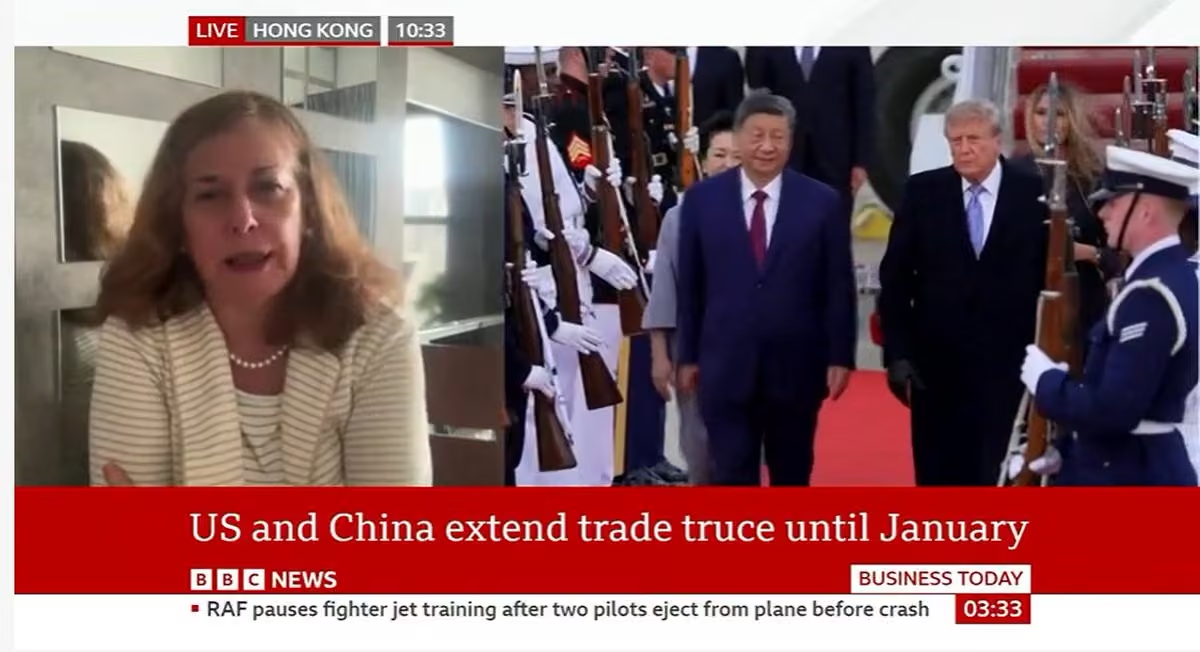
My views for the @BBC on the #trump-#xi summit: Trump is constrained to offer what Xi wants the most (advanced #chips from #nvidia). Xi knows its window of opportunity is closing, which is why Xi is treating Trump as an emperor (without clothes, though). Minute 2.37
-
Alicia GarciaHerrero 艾西亞
@Aligarciaherrer
Views for @CNBC on #us-#china relations: “Post-Midterms dynamics give #congress (especially #democrats) more leverage to press for harder #export controls or to criticize any perceived softness. Markets have largely treated the truce as durable stability; the risk of renewed escalation if compliance disputes, political pressure, or the Huang investigations intensify is real.”
www.cnbc.com/2026/11/17/jensen-nvidia-trump-xi-tech-curbs… -
Alicia GarciaHerrero 艾西亞
@Aligarciaherrer
Sharing my interview with @moneyfm893 Reset on "#jensen Huang is out. What happens to #chip trade, and to #singapore?". For 33 years, Nvidia had one CEO. Now Jensen Huang is gone, after reports of three affairs, including one with a woman suspected by US intelligence of spying for China. But Jensen was also Washington’s loudest voice for selling chips to China. Without him, does the US get tougher on selling chips to China? In this episode, the host Lynlee Foo and I discussed what happens next, and what this would mean for Singapore's #data-centre ambitions.
audio.sph.com.sg/podcast-ep/01m79r3e42cdj55p338sa3dvdr/ -
Alicia GarciaHerrero 艾西亞
@Aligarciaherrer
Some thoughts for @Bloomberg News on #taiwan #dollars: “It’s weird. It’s crazy. The central bank is trying very hard to get all of these export receipts into Taiwan dollars to increase the demand, but the exporters are unwilling.”
www.bloomberg.com/news/articles/2026-11-15/new-taiwan-dol… -
Alicia GarciaHerrero 艾西亞
@Aligarciaherrer
Sharing my commentary for @Bruegel_org: The #nvidia debacle leaves the #us-#china artificial-intelligence truce without a defender.
"Jensen Huang’s departure from NVIDIA threatens the US-China détente forged in 2025–26, which exchanged Chinese rare-earth concessions for looser US chip-export controls. Huang had argued restrictions would cede China’s market to Huawei, yet Beijing’s policies drove NVIDIA’s share of China’s AI hardware market from 95% to zero. Despite this, China remains close to the US, using NVIDIA hardware and overseas training. US political opposition is growing, with Congress considering new restrictions and investigating H200 licences, narrowing Trump’s negotiating options. Beijing could retaliate through rare-earth controls, Huawei chips, or reduced AI dialogue. Europe risks disruption to chips, rare-earth supplies, and compute access."
www.bruegel.org/first-glance/nvidia-debacle-leaves-us-chi… -
Alicia GarciaHerrero 艾西亞
@Aligarciaherrer
#china’s Oct data: Industrial production 4.8% (miss), retail sales 0.4% (miss), fixed asset investment -8.1% (worse), property -21.6% terrible. Same old pattern — high-tech/export strength papers over anemic domestic demand and a deepening property slump. “Stable” on paper, unbalanced in reality. No rebalancing, just more of the same.
-
Alicia GarciaHerrero 艾西亞
@Aligarciaherrer
I joined Francesca Ghiretti on Geoeconomic Competition to discuss the recent sell-off in Chinese AI stocks. My view is that this is less about an AI bubble bursting and more about China’s involution problem.
Unlike in the US, Chinese AI companies never reached such high valuations. Many went public relatively early as traditional funding sources, including local governments, state-owned enterprises and foreign investors, became increasingly constrained.
The deeper issue is profitability. Chinese open-weight models have gained traction, but usage has not translated into sufficient revenues. Fierce competition and falling prices for closed models are making monetisation even harder. Uncertainty over China’s proposed technology export controls has added to market concerns.
The problem is not China’s ability to innovate, but its ability to turn innovation into sustainable profits.
And this raises a broader question: can AI, robotics and biotech really become China’s new growth engines when the economy continues to face structural challenges?
Thanks to Francesca for the interesting discussion!
Listen to the full podcast:
podcasts.apple.com/hk/podcast/forget-chinas-ai-bubble-its…
#china #ai #involution -
Alicia GarciaHerrero 艾西亞 reposted
Network 20/20
@Network2020
Thank you @kyleichan @BrookingsInst & @Aligarciaherrer @Bruegel_org for discussing China’s #overcapacity—a challenge for industries and jobs worldwide that is prompting new #industrialpolicy responses.
-
Alicia GarciaHerrero 艾西亞
@Aligarciaherrer
#china just blocked ##softbank’s $5.4bn acquisition of #swiss #abb’s Chinese robotics business. For me this is a second “#manus case.” Same logic: data sovereignty and national security. Beijing does not want factory and robotics data leaving the country to train foreign AI models (especially OpenAI, in which SoftBank is a major investor), and it is unwilling to let a Japanese firm with deep Western ties take control of a strategic asset. This is the new pattern. Whenever a deal risks transferring technology, data, or manufacturing capability that China sees as critical to its tech advantage or economic security, expect a hard no — particularly while China-Japan tensions remain elevated after Takaichi’s Taiwan remarks. Robotics (including humanoids and embodied AI) sits at the core of China’s 15th Five-Year Plan. China already dominates scale, cost, and deployment; it is not about to let that advantage walk out the door, even if this company is Swiss!. In other words, China's extraterritorial power is already here. The question then is: should European companies develop technologies in China that they cannot then sell as they wish?
-
Alicia GarciaHerrero 艾西亞
@Aligarciaherrer
Views for Al Jazeera on #china's $1 trillion trade surplus: “An export-dependent model essentially means Chinese households are subsidising global consumers.”
Strong exports mask weak domestic consumption and high precautionary savings. Without structural reforms, this model is unsustainable.
www.aljazeera.com/economy/2026/11/11/why-chinas-1-trillio… -
Alicia GarciaHerrero 艾西亞
@Aligarciaherrer
China's data is becoming boring: deflationary pressures remain. 1. Higher producer prices are only upstream and cannot be passed on to increasingly weak consumer prices. 2. Exports are on fire, especially AI-related ones. Imports are only on fire for AI-related ones. China is self-reliant on everything except AI and commodities. 3. The trade surplus is above USD 1 trillion in only 10 months. So we should not be surprised about the increasingly low government yields (1.56!) and the massive interest rate differential with the US, pushing capital outflows. I doubt the RMB will continue to strengthen.
-
Alicia GarciaHerrero 艾西亞
@Aligarciaherrer
Views for the Financial Times on #china's growing acquisitions of European SMEs: “There is a lot of acquisition of smaller companies by China.”
European SMEs are increasingly cash-strapped due to China Shock 2.0, particularly in sectors where China is highly competitive. For Chinese firms, acquiring these companies also makes sense as the EU considers new tariffs and “Made in Europe” rules. Local production could become essential to maintaining access to the European market.
As I pointed out, “Chinese companies will need local production to get access.”
www.ft.com/content/efe5f679-ff24-48da-b47e-dcb57494750f -
Alicia GarciaHerrero 艾西亞
@Aligarciaherrer
Here is my latest Opinion piece for Rapporteur on what America's #bluewave means for the fragile #uschina truce.
While markets focus on the potential slowdown in the US AI investment boom, the bigger risk may lie in Washington. A Democratic-controlled Congress could constrain Trump's ability to negotiate with Beijing, putting the US-China truce at risk. With Taiwan, semiconductor exports and rare earths at the centre of the tensions, renewed escalation could have serious consequences for global supply chains, particularly for Europe.
aliciagarciaherrero.substack.com/p/americas-blue-wave-spe… -
Alicia GarciaHerrero 艾西亞
@Aligarciaherrer
Here is my Opinion piece for @Bruegel_org on the impact of the #us mid-term elections, with the Blue Tsunami, on the global economy. Good news from a more constrained Trump, but worries are coming from an emboldened Iran. Also, Trump-led "détente" with China is at risk in the new environment. www.bruegel.org/first-glance/constrained-trump-good-news-…
-
Alicia GarciaHerrero 艾西亞
@Aligarciaherrer
Sharing a report that I co-authored with Rajeswari Sengupta on "#india in the eye of the storm: How to read the rupee weakness".
Few large economies are as exposed to the Iran war as India. It imports nearly 90 percent of its oil and most of its cooking gas, much of it through the Strait of Hormuz, and the Gulf is a key trading partner and home to millions of Indian workers. The war has hit through several channels: a much higher energy bill, pressure on food and fertiliser prices, costlier shipping and a widening current account deficit. Growth has held up so far, but inflation is rising and the Reserve Bank has switched from easing to tightening.
The Indian rupee has been steadily depreciating since the war began but the war is not the only factor responsible for the rupee’s fall. It was a stress test that exposed a problem years in the making. The rupee was already sliding in 2025, while growth was the fastest of any major economy and inflation close to zero. Strong fundamentals should lift a currency. In India, the opposite happened.
The reason lies in the capital account. The external deficit is modest, but India no longer attracts enough durable foreign capital to pay for it. Foreign direct investment has largely bypassed India for East Asia, and much of what arrives soon leaves again. Portfolio flows fill the gap, and they leave precisely when most needed.
For investors, the key is to separate the cyclical from the structural. Part of the outflow reflects an expensive equity market that has deflated and a global rush into the AI trade, where India offers little exposure. That part can reverse. The rest reflects an economy that produces too little of what it needs and exports too little of what it produces.
The Reserve Bank’s response has bought time but not changed this picture. Heavy FX intervention, curbs on currency derivatives markets and an emergency deposit scheme have avoided a disorderly collapse, but raised hedging costs, reduced the reserve buffer and signalled anxiety to markets.
Our recommendation is therefore to let the adjustment run its course. Once Indian assets become sufficiently cheaper, a rebound may come, but a cyclical bounce would not fix the underlying weakness.
The time to invest is when the government moves on the reforms we set out: letting the rupee float freely, restoring credible protection for foreign investors, cutting input tariffs, implementing the trade agreements it signed and accelerating electrification to cut energy imports. That would strengthen the rupee for the right reasons and mark a genuine entry point.
research.natixis.com/Site/en/publication/-y7JOfj1Z9KrOBnk… -
Alicia GarciaHerrero 艾西亞
@Aligarciaherrer
Sharing a report that I co-authored with Rajeswari Sengupta on "The Missed Opportunity in US – India Relations and Who Will Benefit?".
Under Trump 1.0, #india rose to become one of Washington’s closest strategic partners: new defence agreements, a revived Quad and an Indo-Pacific strategy with India at its centre. Trade was the Achilles’ heel – India lost its #us trade preferences in 2019 and a limited deal never materialised – but the personal bond between Modi and Trump held the relationship together. The Biden years institutionalised it further, through cooperation on critical technologies, the co-production of US jet engines in India and regular Quad summits, while setting trade aside and tolerating India’s purchases of Russian oil for the sake of the China agenda. Biden’s pragmatism had limits: an alleged Indian plot to murder a Sikh separatist on US soil soured his final year.
Trump 2.0 has been different in kind, not degree. Between February 2025 and October 2026 India went from a celebrated “MEGA partnership” to the highest US tariff rate in Asia, 50 percent, and then back to a 10 percent duty, below most competitors – still without a signed trade agreement. The personal rapport that once anchored the relationship now amplifies its swings: Trump’s claim to have brokered the India–Pakistan ceasefire and the “dead economy” slur did as much damage as any tariff. The defining feature of US–India relations is no longer their direction but their volatility.
Three takeaways stand out. First, India keeps holding hands with the United States: defence co-production and technology cooperation, including a US-led alliance on chip supply chains, survived the tariff war, and Washington’s strongest lever is now access to AI, not tariffs. Second, India is increasingly flirting with China: flights, visas and border trade are back, curbs on Chinese investment have been eased and Xi Jinping came to New Delhi for the BRICS summit. Third, Europe’s gains look less secure than the January 2026 “mother of all deals” suggested: the free trade agreement is unsigned and the second phase – on procurement and investment protection – is stuck.
If Washington’s erratic treatment of India continues, the logical end point could be an India much closer to China, leading a Global South coalition rather than becoming the independent pole Europe hopes for. Yet this is not settled: the US mid-term elections on 3 November could restrain or embolden Trump’s transactionalism, and with it India’s choices.
research.natixis.com/Site/en/publication/hCOqUz4-DZKf-mJO… -
Alicia GarciaHerrero 艾西亞
@Aligarciaherrer
Views for
@SCMPNews
: “#oman is a winner, Oman’s approach to regional diplomacy was similar to China’s, with both maintaining commercial ties with Iran while balancing relations with other regional powers, creating opportunities for closer cooperation. It’s very important for China to be on good terms with Oman.”
www.scmp.com/economy/global-economy/article/3373125/beido… -
Alicia GarciaHerrero 艾西亞 reposted
Network 20/20
@Network2020
#china, #overcapacity is shaping the #industrialpolicy race: join @kyleichan(@BrookingsInst) @Aligarciaherrer (@Natixis) & @JenniferMHarris (@Hewlett_Found) to learn more on #subsidies, #trade and #technology. RSVP: us02web.zoom.us/webinar/register/3717931181719/WN_o5bRiuc…
#virtualbriefingseries #ai #europe #us -
Alicia GarciaHerrero 艾西亞
@Aligarciaherrer
Views for @SCMPNews : “Testing in #china has been cheap and fast. Moving it elsewhere will be neither. For #us #electronics firms, the bigger story is higher costs and more friction just to get products certified. Chinese labs would lose a dominant and highly lucrative business overnight, which is a real hit for them. Shifting that much testing out of mainland China in a couple of years is ambitious. While Hong Kong and Taiwan could absorb a substantial share of the business, the transition was unlikely to be smooth, potentially leading to bottlenecks, longer lead times and certification delays, particularly for mass-market consumer electronics. The global electronics supply chain will not break, but it will become slower and more expensive in this particular link. A temporary waiver if capacity falls short would be sensible; otherwise the risk of disruption is higher than the FCC seems to acknowledge. It makes economic sense from a resilience perspective, but it is not free, and the transition will be messier than the two-year timeline suggests.”
www.scmp.com/economy/china-economy/article/3372583/ahead-… -
Alicia GarciaHerrero 艾西亞
@Aligarciaherrer
Views for @SCMPNews: "While the #yuan has made gains in 2026, any appreciation has really vanished in real terms due to flat inflation and years of falling producer prices in China, which have run counter to rising prices elsewhere in the world."
www.scmp.com/news/china/diplomacy/article/3372373/eu-plan… -
Alicia GarciaHerrero 艾西亞
@Aligarciaherrer
I am sharing my recent podcast in the series of #zhonghua Mundus by @Bruegel_org.
For roughly two decades, #china's local governments used the revenue from selling land to property developers to build roads, metro lines and new urban districts, and to cover a large share of their spending. But when the property market slumped, developers began to default and land sales fell sharply, leaving localities with heavy debts and a shrinking source of revenue.
In this episode, Yuyun Zhan and I welcome Tianlei Huang to discuss the problem. We explored how China’s land finance model helped fund the country’s economic development and why it could not last. With no single source able to replace the vast revenue from land sales, deep structural reform will be needed to stabilise local government finances.
www.bruegel.org/podcast/after-boom-how-chinas-local-gover… -
Alicia GarciaHerrero 艾西亞
@Aligarciaherrer
Higher than expected inflation will push #rba to hike again in November
"The CPI release marked a big upside surprise not only to the #rba but also the market. Headline inflation accelerated in September to 0.83%mom and 4.34%yoy, both higher than the consensus forecast of 0.7%mom and 4.2%yoy. By component, energy inflation added 32bp to the monthly growth, while traveling became the biggest driver with a contribution of 43bp, which is the highest reading since December 2025. Given the sensitivity of travel prices to fuel cost, this month’s print suggests the energy shock has started to pass through to the broader CPI basket, which is a warning signal to the RBA.
Meanwhile, the underlying inflation trend, measured by trimmed mean CPI, is deviating from the trajectory that RBA had envisioned. The quarterly trimmed mean inflation printed 3.66%yoy, another uptick from 3.64% in Q2. This shows a further divergence between the actual inflation path and RBA’s assessment back in August, which sees the trimmed mean peaking in Q2 and heading back towards 3.3% by end-2026.
This echoes with Deputy Governor Andrew Hauser’s recent comment of “materially worse” inflation outlook, and Governor Bullock’s speech at today’s parliament hearing also confirms RBA’s intolerance of persistently elevated inflation. Given today’s hot CPI print, we believe the RBA will favor a back-to-back hike on next Tuesday’s (November 3) monetary policy meeting.
Moving forward, the RBA may keep its hawkish rhetoric given the untamed inflation, but as the labor market shows signs of easing and household spending starts to slow amid higher interest rates, we expect the next decision beyond November to be highly data dependent."
aliciagarciaherrero.substack.com/p/higher-than-expected-i… -
Alicia GarciaHerrero 艾西亞
@Aligarciaherrer
Views for @FortuneMagazine: “#hongkong and #mainland markets barely budged because they sit outside the main U.S. AI supply chain. Export controls keep the most advanced chips out of Chinese hands, while users can already turn to cheaper domestic models from the likes of DeepSeek.”
fortune.com/2026/10/27/anthropic-ipo-filing-lifts-asia-st… -
Alicia GarciaHerrero 艾西亞
@Aligarciaherrer
Sharing my Op-Ed for @NikkeiAsia: "#beijing must explicitly prioritize #corporate health".
Chinese corporate health appears stable but largely because falling interest costs offset weak revenues. Margins and returns on capital trail global peers. This interest-rate cushion is nearing its limits: banks face shrinking margins, deflation keeps real rates high, and cuts offer diminishing relief. Even backed sectors—electric vehicles, batteries, renewables, and semiconductors—suffer from excess capacity, price wars, and thin margins. State firms benefit from support, while private firms depend on exports. The text recommends measuring debt capacity, strengthening domestic demand, allowing insolvent firms to exit, and paying government arrears. It warns of Chinese credit risks and greater overseas trade pressure.
asia.nikkei.com/opinion/beijing-must-explicitly-prioritiz… -
Alicia GarciaHerrero 艾西亞
@Aligarciaherrer
My Op-Ed for @east_asia_forum: #asia braces for #europe’s turn on Chinese #overcapacity.
Despite Beijing and Berlin reaching a ‘shared understanding’ to curb Chinese hybrid vehicle exports, the EU is pursuing new trade defence measures in response to its €360 billion trade deficit with China. Asia stands to absorb the consequences, as a tougher EU stance would redirect Chinese exports towards Asian markets and intensify competition. Asian governments face a balancing act: protecting domestic producers while preserving access to Chinese components that support their own exports.
eastasiaforum.org/2026/10/25/asia-braces-for-europes-turn… -
Alicia GarciaHerrero 艾西亞
@Aligarciaherrer
Sharing my Op-Ed for @east_asia_forum: "What the #eu–#china trade deal means for #asia".
The European Union’s agreement with China to restrict #automotive imports reflects a growing turn towards protectionism that may shield struggling European manufacturers in the short term but risks raising consumer prices, delaying #decarbonisation and weakening incentives for industrial innovation. As Chinese exports are redirected towards Asia, regional economies face intensifying competition and pressure to adopt similar trade barriers, even though restrictions on Chinese intermediate goods would undermine the supply chains essential to their own industrial development. Maintaining open trade and investment regimes, encouraging Chinese manufacturing investment and defending institutions such as the WTO will be critical to preserving Asia’s competitiveness and preventing further fragmentation of the global trading system.
eastasiaforum.org/2026/10/26/what-the-eu-china-trade-deal… -
Alicia GarciaHerrero 艾西亞
@Aligarciaherrer
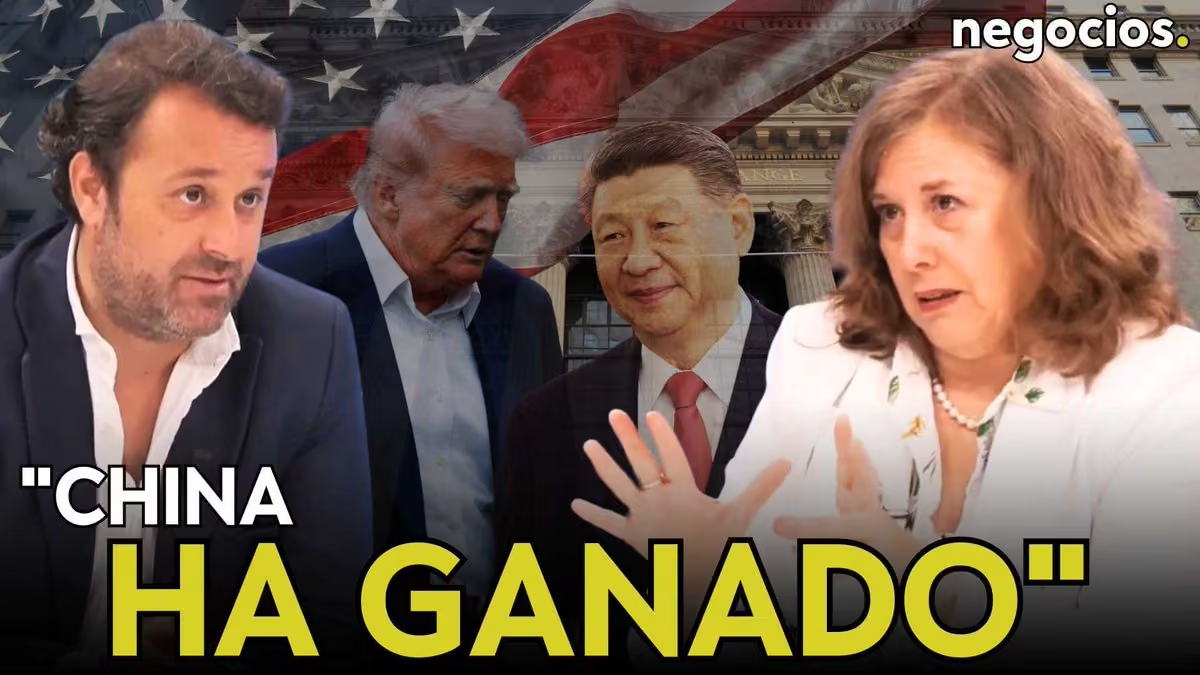
Mi entrevista televisiva con @negocios_tv: ¿Por qué la verdadera guerra entre #eeuu y #china no es comercial sino por #ia?
www.youtube.com/watch?v=c2Le5EO2938 -
Alicia GarciaHerrero 艾西亞
@Aligarciaherrer
My @Bloomberg interview this morning on global financial markets and #ai. Rapid AI adoption could be #inflationary if data-center construction falls short of what is needed to meet demand for compute.
www.bloomberg.com/news/videos/2026-10-26/slow-ai-buildout… -
Alicia GarciaHerrero 艾西亞 reposted
Negocios TV
@negocios_tv
🚨 "¿Una crisis del dólar? El riesgo real está en el euro y la presión sobre el BCE", advierte @Aligarciaherrer.
La economista jefe de Natixis analiza el futuro de los tipos, el problema de la deuda en 2027 y la pérdida de competitividad de Europa frente a China en Inteligencia Artificial.
📺 Entrevista completa 👇 -
Alicia GarciaHerrero 艾西亞
@Aligarciaherrer
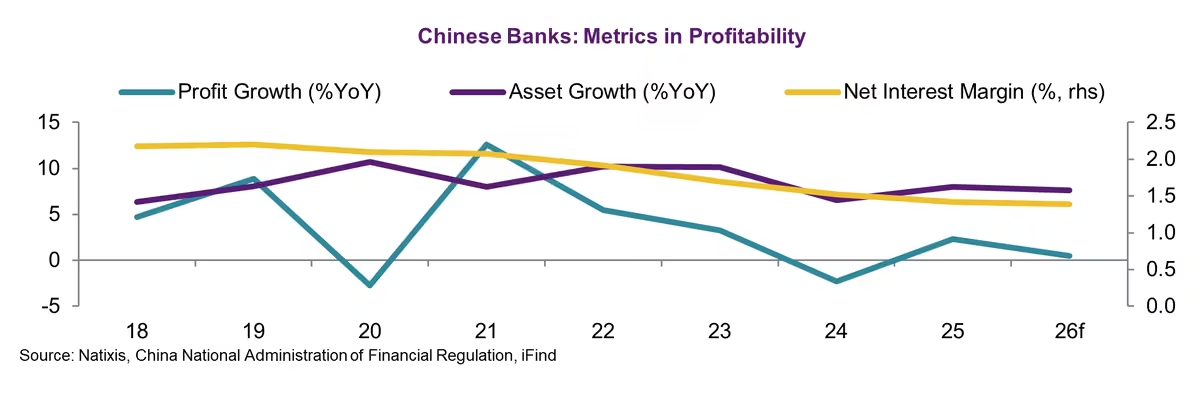
Less is more: Small #banks enter consolidation in #china for profitability and solvency
The headline that China is cutting a quarter of its banks may appear striking, but the trend is not unexpected. Since 2021, consolidation of the banking sector has been a clear policy direction, particularly among rural financial institutions (RFIs). Against this background, this report examines the reasons behind the consolidation and evaluates whether it will reduce risks in China’s banking sector.
aliciagarciaherrero.substack.com/p/less-is-more-small-ban… -
Alicia GarciaHerrero 艾西亞 reposted
Istituto Affari Internazionali - IAI
@IAIonline
Quale futuro per l’euro come valuta globale? Quali sono i suoi punti di forza e le sfide da affrontare in uno scenario monetario internazionale in continua evoluzione?
Giovedì 22 ottobre, ospiteremo presso il nostro Istituto l’evento “Il futuro dell’euro come valuta globale”, un’occasione di confronto tra economisti ed esperti sulle prospettive internazionali della moneta unica, sul ruolo del dollaro statunitense e sulle trasformazioni legate alla digitalizzazione della moneta e dei sistemi di pagamento.
La discussione vedrà la partecipazione di Nicola Bilotta (@EUI_EU), Nicola Bilotta (@EUI_EU), Luca Fantacci (@LaStatale), @Aligarciaherrer (@Bruegel_org), @ManuMoschella (@Unibo), Franco Passacantando (IAI) e @PaolaSubacchi (@PSIASciencesPo), con una relazione introduttiva del Direttore @marcosimoni_, la moderazione del ricercatore IAI Matteo Bursi e le riflessioni conclusive del Responsabile di programma Geoeconomia e governance globale @EttGreco.
Con il supporto di Fondazione CSF, @CSP_live e @ItalyMFA
Registrati qui per partecipare:
www.iai.it/it/eventi/il-futuro-delleuro-come-valuta-globale -
Alicia GarciaHerrero 艾西亞
@Aligarciaherrer
Sharing the article that I co-author with Théo Storella for @Bruegel_org : "#china’s outbound #ai strategy starts with models and governance and ends with #chips".
China is expanding its global AI influence by exporting low-cost, open-weight models and promoting its approach to AI governance. Its energy and models are competitive, but its chips and software still lag US alternatives and are currently focused on meeting domestic demand. Europe should engage in international AI forums, avoid dependence on any single model or supplier, and build its own partnerships and AI capabilities.
www.bruegel.org/analysis/chinas-outbound-ai-strategy-star… -
Alicia GarciaHerrero 艾西亞
@Aligarciaherrer
My Op-Ed for @ThePrintIndia: #china’s tightening grip on its most advanced #ai should be a warning signal for #india.
China’s proposed export controls would require approval to transfer 23 AI-related technologies, including models, agents, chip-design expertise and AI-chip integration technology. Beijing could limit overseas access to frontier models, their code and designs, while downloadable models remain exempt if not trained on sensitive data. Future releases may be accessible only through Chinese-operated servers, creating uncertainty for users and potentially steering them toward Chinese cloud services. India is especially exposed: developers may lose access to newer Chinese models, while US restrictions also constrain alternatives. The text urges countries including the EU, Japan and South Korea to pool computing, models and chip access.
theprint.in/opinion/china-ai-export-controls-india-ai-sov… -
Alicia GarciaHerrero 艾西亞
@Aligarciaherrer
Sharing the latest piece I wrote for @Bruegel_org First Glance series: What lessons should #europe take from #china’s tightening grip on its advanced #ai? A move by China to impose constraints on foreign use of its AI models could show Europe that it needs to do more to develop its own.
www.bruegel.org/first-glance/what-lessons-should-europe-t… -
Alicia GarciaHerrero 艾西亞
@Aligarciaherrer
My Op-Ed for @rapporteur_news: "#europes new trade instrument cant come quick enough."
The question is no longer whether Europe can afford a new instrument, but whether its industrial base can afford another year without one.
www.rapporteur.com/opinion/europes-new-trade-instrument-c… -
Alicia GarciaHerrero 艾西亞
@Aligarciaherrer
Sharing my Op-Ed published by @FT: "US rate rises are being amplified in global markets".
Rising #us interest rates tighten dollar liquidity as traditional offshore sources weaken. #gulf oil revenues usually recycle into dollar assets, but the Iran war has disrupted exports, while reconstruction, defense and domestic support needs keep more funds at home. #china has trade surpluses, yet increasingly lends and invests in #renminbi, while Chinese capital stays in Hong Kong rather than reaching dollar markets. These shifts coincide with US Treasury and technology companies’ funding demands. Reduced offshore dollar supply could raise swap and emerging-market borrowing costs and strain non-US banks. Past crises show Fed support may be crucial, though future action is uncertain.
www.ft.com/content/cea20e2a-379c-4ea2-af94-353b1896b748 -
Alicia GarciaHerrero 艾西亞
@Aligarciaherrer
It did not fully work! #china is probably worrying about a more assertive Europe or simply ready to retaliate
Alicia GarciaHerrero 艾西亞
@Aligarciaherrer
Thoughts for @Bloomberg News: " #beijing’s concessions on cars are aimed at preventing the European Council from mandating a sharper toolkit." www.bloomberg.com/news/articles/2026-10-14/china-and-eu-r…
-
Alicia GarciaHerrero 艾西亞 reposted
Cristina Manzano
@ManzanoCr
Qué interesante esto de @Aligarciaherrer y @soumitradutta
La IA merece la misma apuesta: no la supresión, sino las instituciones que permitan hacer buen uso de ella.
elpais.com/opinion/2026-10-16/europa-y-la-ia-mas-ilustrac… -
Alicia GarciaHerrero 艾西亞
@Aligarciaherrer
Thoughts for @Bloomberg News: " #beijing’s concessions on cars are aimed at preventing the European Council from mandating a sharper toolkit." www.bloomberg.com/news/articles/2026-10-14/china-and-eu-r…
-
Alicia GarciaHerrero 艾西亞
@Aligarciaherrer
Views for @Bloomberg News: “These holdings remain a significant liability for Beijing. Large-scale sales would crystallize mark-to-market losses on the remaining portfolio, push the yuan higher, and leave China with the problem of where to park the dollars.”
-
Alicia GarciaHerrero 艾西亞 reposted
Ignasi Guardans
@iguardans
Mis aplausos, puesto en pie, a @Aligarciaherrer por este brillante y valiente artículo sobre el uso de la IA por estudiantes y autores.
Basta de tonterías.
Mas ilustración y menos inquisición.
elpais.com/opinion/2026-10-16/europa-y-la-ia-mas-ilustrac… -
Alicia GarciaHerrero 艾西亞
@Aligarciaherrer
Views for South @SCMPNews: "We are already at the starting point of the #china shock 3.0. The third wave would centre on artificial intelligence, covering both hardware and software, along with biotechnology and robotics. China, while still a major importer of advanced chips, was developing its own #ai hardware and software and planned to export them once domestic demand was met. These exports could come alongside bundled data centre and cloud services, and humanoid and industrial robots could follow, creating a shock that would exceed the current one. If you think about embodied AI, humanoid robots or industrial robots, think about the humongous shock that this is going to be, beyond the existing shock. "
www.scmp.com/news/china/diplomacy/article/3370925/china-s… -
Alicia GarciaHerrero 艾西亞
@Aligarciaherrer
Views for @politico: "#beijing’s concessions had been calculated to assuage Berlin, given the importance of the automotive industry to the #german economy. I’m just hoping Merz doesn’t turn away from the letter he sent to the Commission. I worry Merz will take this quick win and run."
www.politico.eu/article/how-maros-sefcovic-talked-his-way… -
Alicia GarciaHerrero 艾西亞
@Aligarciaherrer
Views for @FT on #china: "The share of #companies whose revenue was insufficient to cover interest payments rose to 12.5 per cent in June 2026 from about 6 per cent in 2019. That figure was about double the global rate of 6.5 per cent, which itself was relatively unchanged since 2018 despite a small fluctuation during the pandemic. State policies favouring companies in advanced industries such as semiconductors had supported their rapid development but not their profitability. "
www.ft.com/content/ee4105fc-aa85-47ef-aa64-1fc3f344d740?s… -
Alicia GarciaHerrero 艾西亞
@Aligarciaherrer
The world needs #chinese electrical equipment makers to power #ai data centers
"The world is engaged in an unprecedented AI race which is pushing capital expenditure (capex) towards next-generation AI data centers. Given how energy intensive data centers are, electricity demand from AI data centers is on track to double globally within the next five years.
Surging power demand from data centers is set to test the AI leaders’ power infrastructure, such as US, Europe and Japan, since their power capacities have barely grown in the past few decades. Assuming no acceleration in the construction of power generation, new data centers may absorb 48% of US’s incremental power supply between now and 2030. Europe looks better, with 28% of the incremental power supply but this is explained by the very moderate increase in compute capacity, which is expected; Japan’s power constraint is relatively bigger with projected data centers eating up 66% of the expected additional power to be installed. This may crowd out other sectors’ energy needs, pushing up energy prices.
As such, these markets need to ramp up their investment in powering systems and grid infrastructure as data centers require stable and undisrupted power to ensure continuous operation. Consequently, this presents a huge opportunity for global power equipment manufacturers. Chinese producers are well positioned for this emerging industrial upturn as they ride on the tailwinds of higher export competitiveness especially after the pandemic. Between 2017 and 2025, China’s share of global power equipment exports rose from 22% to 33%, with accelerating momentum since 2021.
The strong export performance is clearly shown in the increasing relevance of overseas revenue since 2024, which is likely to edge higher on the surging exports and underwhelming domestic demand. Moreover, it’s noteworthy that higher overseas income has also helped lift corporates’ profitability which has long been hurt by China’s downbeat price dynamics.
We thus expect the global AI power demand to help turn the tide for at least part of China’s industrial companies, namely those focused on power and electrical equipment. The change is already underway as we see these corporates’ capex starting to grow again with the improvement in return on invested capital. All in all, Chinese power equipment makers are becoming an apparent winner in the global AI race."
aliciagarciaherrero.substack.com/p/the-world-needs-chines… -
Alicia GarciaHerrero 艾西亞
@Aligarciaherrer
Views for @euronews : “#merz is in a weak position to reject the agreement. He will drag his feet when it comes to new measures because #germany will prefer to cash in this goody as the deal will reduce competition.”
www.euronews.com/2026/10/12/eu-china-trade-deal-raises-fe… -
Alicia GarciaHerrero 艾西亞
@Aligarciaherrer
My OpEd for @Bruegel on the #eu- #china deal: www.bruegel.org/first-glance/first-step-no-real-rebalanci…
-
Alicia GarciaHerrero 艾西亞
@Aligarciaherrer
Sharing my podcast on #china's #ai governance playbook in the series of Zhonghua Mundus by @Bruegel_org . In this episode, we discussed China's approach to AI governance and what it means for US-China coordination, AI safety and Europe's role with the host Yuyun Zhan and the guest Kristy Loke.
Differences in AI regulation and innovation strategies are shaping the development and global adoption of artificial intelligence across major economies. China combines strict oversight of politically sensitive content with a more flexible approach towards AI innovation, model development and commercial deployment. While Europe's regulatory framework is primarily centred on risk management, China separates ideological controls from innovation-driven activities, allowing the AI sector to develop rapidly while maintaining regulatory oversight where authorities deem necessary. China adopts a differentiated approach when exporting AI models, applying fewer political restrictions outside its domestic market, which has supported the international adoption of Chinese open-weight models. Contrasting with Europe’s more cautious stance towards AI development and risk-taking, China’s approach is a pragmatic balance between regulation and innovation.
www.bruegel.org/podcast/chinas-ai-governance-playbook -
Alicia GarciaHerrero 艾西亞
@Aligarciaherrer
Some thoughts for @WSJ : "I’m tempted to believe #china will do its utmost not to be classified as a developed economy."
www.wsj.com/world/china/why-china-doesnt-want-to-join-the… -
Alicia GarciaHerrero 艾西亞
@Aligarciaherrer
Sharing my recent podcast in the series of the Sound of Economics by @Bruegel_org. In this episode, we discussed the economic sway of #brazil, #russia, #india and #china with the host Rebecca Christie, guest Jim O’Neill, who coined the BRIC acronym in 2001, and Bruegel researcher Suman Bery.
Do these countries still have much in common? How dominant is China? Is it possible for the now BRICS to represent 'the Global South' and which countries should participate? What about geopolitical factors like the Iran conflict and Russia’s ongoing war with Ukraine? Is the world ready to move away from the dollar, and what should be the global role of the renminbi? How is India managing its relationship with the United States and market access with trading partners? Global economic governance is stretched farther than ever, and the world’s significant economies have to figure out some way to relate.
www.bruegel.org/podcast/brics-25 -
Alicia GarciaHerrero 艾西亞
@Aligarciaherrer
Šefčovič is back from Beijing with “shared understandings” on hybrids, tariffs and rare earths, worth a few billion euros against a €360 billion deficit with China. Beijing gained too: help with licences for dual-use technology exports, advance notice before Europe tightens export controls, and a dialogue on the EU’s foreign-subsidies rules. It’s hard to say who won more, but Europe’s gain is minimal compared with the problem. China’s real prize is time. The deal lands a week before the European Council, just as Merz and Macron call for a rapid instrument against systemic distortions. Leaders should bank the package and mandate that instrument anyway
-
Alicia GarciaHerrero 艾西亞
@Aligarciaherrer
Hier ist mein Gastbeitrag, gemeinsam mit @adergay verfasst. Eine Einigung zwischen Brüssel und Peking ist ein erster Schritt, aber keine Lösung. Sie lindert die Symptome, ohne das Ungleichgewicht im Handel mit China anzugehen. Europa braucht Instrumente, die der Größe des Schocks entsprechen. www.berliner-zeitung.de/article/eu-handelsgespraeche-mit-… @berlinerzeitung
-
Alicia GarciaHerrero 艾西亞 reposted
Ignacio G.R. Gavilán
@igrgavilan
#cita "El atraso tecnológico se compensa con velocidad de adopción. La pasividad no se compensa con nada" @Aligarciaherrer en el prólogo de 'El futuro de la Inteligencia Artificial' (www.amazon.es/El-futuro-Inteligencia-Artificial-supervive…) de @andres_pedreno #innovacion #liderazgo #iniciativa #adopcion
-
Alicia GarciaHerrero 艾西亞
@Aligarciaherrer
Views for @SCMPNews on #china: "The duality is more complex than just exporting and not consuming. It’s really entrenched in #china’s #corporate governance. The divide was evident in the differing fortunes of central state-owned enterprises (SOEs) and private firms. The interest burden for central SOEs was falling faster than for private firms, reaching 2.2 per cent and 3.2 per cent, respectively, giving state firms a borrowing advantage. Yet private firms remained more profitable. It’s a tale of two cities: stagnant SOEs are benefiting from the system, while private companies are trying to survive in this system and exporting their way out."
www.scmp.com/business/china-business/article/3369282/chin… -
Alicia GarciaHerrero 艾西亞
@Aligarciaherrer
The #gulf war is a tale of two cities.
West: diesel more than doubled, US 10y at 5.3%, Bund highest since 2011. Europe nears stagflation.
China: 10y at 1.67%, demand too weak to pass the shock on, banks squeezed.
My piece for @rapporteur_news
www.rapporteur.com/opinion/the-gulf-conflicts-tale-of-two… -
Alicia GarciaHerrero 艾西亞
@Aligarciaherrer
I spoke to ANC News @ANCALERTS about increasingly difficult #global #financial conditions and what it means for the #philippines.
www.youtube.com/watch?v=rtH8Q2uAWgs -
Alicia GarciaHerrero 艾西亞
@Aligarciaherrer
My article on #trump-#xi summit as pick of the week for @NikkeiAsia. Thank you @sharp_writing!
asia.nikkei.com/opinion/china-now-holds-the-whip-hand-ove… -
Alicia GarciaHerrero 艾西亞
@Aligarciaherrer
I cannot think of a harder job than that of Nirmala Sitharaman, #india's #finance minister. Longest-serving finance minister in India and in Asia.
Listening to her at #kec in #delhi, you can understand why. Sharp and on point, not an extra word, not bombastic. And yet, the challenges are uphill for India and for her efforts to control India's budget deficit and reduce public debt. I wish her luck. -
Alicia GarciaHerrero 艾西亞
@Aligarciaherrer
Here is my monthly newsletter on China in the world and what it means for Europe for @Bruegel_org . US and China agreed on an AI “red phone.” Europe was not in the room.
• Crisis line, not expert safety talks • Neither side will slow frontier AI • The AI Act does not buy a seat
ZhōngHuá Mundus: mailchi.mp/bruegel/zhnghu-mundus-10634559 -
Alicia GarciaHerrero 艾西亞
@Aligarciaherrer
AT #kec in Delhi, listening to the governor @Malhotra. Coming from the management of financial services at Ministry, he is clearly focused on financial stability. The real question is how worried he is about India's financial stability. It seems all his worries are external (sovereign bond sell-off, AI rising leverage, private credit in advanced countries, cyber risks, etc). India exposed to West Asia conference but has very low inflation and the highest growth among emerging markets, so all looks fine!... If you want to hear more about potential risks, Rajeswari Sengupta and I will soon publish a paper on where the Indian economy and the INR stand given West Asia's protracted shock and other structural constraints. Here is a previous paper on India's economic challenges www.bruegel.org/working-paper/tackling-indias-jobs-plight…
-
Alicia GarciaHerrero 艾西亞
@Aligarciaherrer
In #delhi at #kec, listening to Michel Greenstone. on climate change. Temperatures are expected to increase 3 degrees by 2100, and even more thereafter. Most emmissions from the Global South but also most of the expected deaths. Michel argues that the global South has leverage. I do not quite get how.
-
Alicia GarciaHerrero 艾西亞
@Aligarciaherrer
Chatting with @kristy_loke on what #china wants when it comes to #ai #governance after the #trump-#xi summit for @Bruegel_org Zhonghua Mundus
Kristy Loke
@kristy_loke
Speaking of podcasts, here’s another one I recently did with @Bruegel_org @Aligarciaherrer. We discussed China’s AI development and governance playbook, and potential implications for middle powers such as Europe. It was a lot of fun agreeing and disagreeing with Alicia as always — thank you so much for the invite 😊 It’s also hosted by the brilliant Yuyun Zhan (h/t)
-
Alicia GarciaHerrero 艾西亞 reposted
World Data Analysis
@World_Data_A
Then I highly recommend reading @Aligarciaherrer's works (both at Bruegel and elsewhere). I think she hits the nail right on the head
-
Alicia GarciaHerrero 艾西亞
@Aligarciaherrer
Sharing my Op-Ed published on @BrusselsTimes : "The seemingly irrelevant #xi-#trump summit points to an increasingly relevant N-2 problem".
The Trump-Xi summit produced little beyond extending the trade truce and creating an #ai incident line, but it underscored that neither side will slow the AI race. US labs face growing domestic constraints: public opposition to data centres, tighter financing and shrinking market share as cheaper Chinese models gain ground. Some US leaders now support “pacing the frontier”, but mainly to preserve America’s lead through export controls and anti-distillation measures. China rejects any slowdown, seeing strategic and energy advantages ahead. Europe, despite strong regulatory tools, remains sidelined, risking irrelevance as the US and China shape AI governance and markets globally.
www.brusselstimes.com/opinions/2333639/the-seemingly-irre… -
Alicia GarciaHerrero 艾西亞
@Aligarciaherrer
Mein in der @berlinerzeitung veröffentlichter Kommentar: Der Westen an Chinas Leine: Warum #trumps #xi-Gipfel für Deutschland ein Desaster ist.
Trumps Xi-Gipfel zeigt: China diktiert, die USA schwächeln. Für Deutschland bedeutet das ein Rekorddefizit und keinen Platz am Tisch. Teil unserer Serie „China verstehen“.
www.berliner-zeitung.de/article/trump-xi-gipfel-china-usa… -
Alicia GarciaHerrero 艾西亞
@Aligarciaherrer
Electrification is proceeding at lightning speed according to @IEA. This, together, with #ai's fast adoption can make #china invincible when it comes to manufacturing. #china's shock 2.0 is a joke compared to what is coming. #europe must focus on how to gain competitiveness in the future, exactly through electrification, AI, and innovation in critical technologies, and stop crying over spilled milk, such as solar panels etc.
-
Alicia GarciaHerrero 艾西亞
@Aligarciaherrer
Acabo de leer Espejos de la nada, de Marifé Santiago Bolaños: la reconstrucción del encuentro que pudo darse y nunca se dio entre María Zambrano y Marina Tsvietáieva en el París de 1939. Zambrano hizo del exilio algo más que una condición: un lugar desde el que pensar, donde la patria perdida se convierte en conciencia. Tras veinte años viviendo en Asia, reconozco en ella ese otro exilio, el espiritual, que no depende solo de la distancia. Ambas pagaron con desarraigo, pobreza y soledad su negativa a plegarse a la violencia de su tiempo. La pregunta que deja el libro es incómoda: ¿defendemos hoy la democracia con esa misma honestidad y a ese mismo coste personal, o simplemente la damos por supuesta? Muy recomendable.
-
Alicia GarciaHerrero 艾西亞
@Aligarciaherrer
New in @NikkeiAsia: Trump rolled out the red carpet for Xi. The summit still left Washington with a two-month leash, not a deal.
A shrinking truce is not a bridge. Rare earths, frozen Taiwan arms sales, and a 5.1% 10-year leave the US needing Shenzhen more than China does. -
Alicia GarciaHerrero 艾西亞
@Aligarciaherrer
Views for @SCMPNews : This contradiction is #china’s “dual economy”: one side produces world-class technology and exports, while the other is characterised by stagnant household incomes and weak consumption. China is pouring extraordinary resources into AI, robotics, EVs, batteries and other strategic technologies. But it is being financed in part by financially repressed households: cheap captive savings, weak wage growth and a consumption share of GDP that remains far too low for an economy of this size. This reflects Beijing’s prioritisation of technological leadership and manufacturing strength.
www.scmp.com/opinion/china-opinion/article/3368285/chinas… -
Alicia GarciaHerrero 艾西亞
@Aligarciaherrer
-
Alicia GarciaHerrero 艾西亞
@Aligarciaherrer
My Op-Ed for @Euractiv: "#xi’s growing hold on #trump is bad news for #europe".
Trump hosted Xi Jinping from a position of weakness, as rising US bond yields, inflation fears and Middle East tensions exposed declining American leverage. Despite an unusually lavish welcome, the summit produced little: only a short extension of the trade truce, vague AI dialogue and continued caution on Taiwan arms sales. China now holds the upper hand through rare-earth dominance, tariff resilience and growing strategic influence. US allies such as Japan received little consideration. For Europe, the lesson is that it cannot rely on Washington and must build its own leverage in dealing with China.
www.euractiv.com/opinion/trumps-hollow-summit-hands-xi-le… -
Alicia GarciaHerrero 艾西亞
@Aligarciaherrer
Here is my interview with Bloomberg today on #trump-#xi summit.
My takeaways.
1. Do not expect much. This is just a transition summit (only a 2-month truce bought by both leaders). The action will be in November at the APEC meeting and on China's soil.
2. Trump is further weakened by the financial turmoil in the US (UST sell-off). China does not think Trump has any leverage on tariffs given higher inflation and what it means for US funding costs.
3. China is building up leverage to come with a big check in November: The check will include Taiwan, beyond the delay in arm sales, which Trump has gven away too easily. China will also request access to investing in different sectors in the US, and it will probably get it by then as Trump catapults US leverage.
4. On AI, China is not buying into the US hyperscalers' call for a delay. It looks like a trap now that the political environment has gotten harder for US AI companies. At most, Bessent can get his red phone back, as in the nuclear race in case big AI safety issues need to be communicated. US (old) allies may wonder why they do not get access to that important red phone....
Around minute 25. Watch if interested!
www.youtube.com/watch?v=V6eJ2mwH7o4 -
Alicia GarciaHerrero 艾西亞
@Aligarciaherrer
Views for @euronews: "#xi Jinping arrives in Washington with the upper hand, even on American soil. The summit will confirm the G20 nature of the world. This #ai dialogue that is going to become like a red button during the nuclear race is only shared by the #us and China. So it really leaves #europe as non-existent in terms of being a pole. As for the global exports of the strategic #materials, the issue was raised last week by EU Trade Commissioner Maroš Šefčovič during a video call with his Chinese counterpart, Wang Wentao. But Washington has far greater negotiating power than Brussels when it comes to securing access to the materials. The US will negotiate for Europe and Europe will have to pay a price for that. "
www.euronews.com/2026/09/23/the-trump-xi-summit-why-europ… -
Alicia GarciaHerrero 艾西亞
@Aligarciaherrer
My take on #eu-#china trade tensions for @BFMradio. Reality is hard than it looks. It is not all about subsidies when it comes to China’s exports and Europe is not uncompetitive as Chinese policy makers some time claim (it still has a trade surplus even with very high oil prices now).
www.bfm.my/content/podcast/is-europe-facing-a-second-chin… -
Alicia GarciaHerrero 艾西亞
@Aligarciaherrer
Views for @SCMPNews : “The potential absence of Chinese AI players is linked to differences in their respective domestic environments. Washington was facing growing domestic opposition and political pressure over the rapid development of the technology. China knows the US needs a break – but not China, so Xi does not want to bring its AI team. It is quite, quite clear to me.”
www.scmp.com/economy/global-economy/article/3368409/why-c… -
Alicia GarciaHerrero 艾西亞
@Aligarciaherrer
Views for @SCMPNews: “The move is a political signal more than a technical one. It dents the ‘anti-dollar coalition’ story without stopping mBridge among mainland China, Hong Kong, Thailand, UAE and Macau. Saudi can still watch the platform privately, so #mbridge’s future looks narrower and more regional, not dead.”
www.scmp.com/economy/policy/article/3368241/what-saudi-ar… -
Alicia GarciaHerrero 艾西亞
@Aligarciaherrer
Thoughts for @SCMPNews : "While the #us still holds the leading-edge chip advantage, it is now treating it as a bargainable asset rather than a hard wall."
www.scmp.com/economy/global-economy/article/3368262/us-ch… -
Alicia GarciaHerrero 艾西亞
@Aligarciaherrer
Sharing my commentary on the upcoming #trump #xi summit: "China enters the Trump-Xi summit with leverage despite weak domestic growth, because exports are booming and its trade surplus is surging, helped by AI-related demand and lower oil exposure. By contrast, the US faces inflation, higher interest rates, tighter liquidity, and pressure from the Iran war, making lower oil prices and yields urgent priorities. This weakens Trump’s bargaining position and increases the value of Chinese cooperation, especially on Iran and the Houthis. Likely outcomes include a rare-earth truce, modest tariff reductions, continued delays to Taiwan arms sales, and limited AI dialogue. Europe remains sidelined and vulnerable to the summit’s consequences."
aliciagarciaherrero.substack.com/p/at-the-white-house-xi-… -
Alicia GarciaHerrero 艾西亞
@Aligarciaherrer
#boj: Changing policy landscape with underlying CPI rising closer to 2% leading to 25-bps hike in December and, potentially, also in March
"The Bank of Japan (BoJ) raised the policy rate by 25-bps to 1.25% at monetary policy meeting on September 18th (Chart 1). The Bank assessed that the policy stance remained accommodative. While the decision was well expected, the market was caught by surprise that two board members, Asada and Sato, dissented from the hike, which slightly weakened the Yen.
During the press conference, Governor Ueda stated that the policy landscape has changed, which prompted them to shorten the rate cycle to three months from six. The Governor stated that the underlying CPI has risen closer to 2%, as companies have become more active in transferring higher input costs and wages to their customers. As the medium-term inflation expectations have also increased, the BoJ assessed that the risk of inflation is on the upside.
The BoJ assessed that economic cycle was rather positive. For sure, the policy board members Asada and Sato were against the rate hike because domestic demand in Q2-26 was not strong. However, the Bank’s overall view is that the economy will continue to gradually grow supported by stronger global demand on AI and government’s policy.
Given the BoJ’s view on the policy landscape, we changed our view on monetary policy. We now expect 25-bps hikes in December and March, lifting the policy rate to 1.75%. In fact, the Japanese economy has held up fairly well with stronger exports, when the output gap rose to +0.7% in Q2-26 (Chart 2). With this background, the underlying CPI, which excludes food and energy from the overall CPI, rose by two consecutive months to +1.6% YoY in August. Therefore, with the economy operating above potential, the underlying inflation is expected to gradually rising leading to the BoJ to hike in December and March."
aliciagarciaherrero.substack.com/p/boj-changing-policy-la… -
Alicia GarciaHerrero 艾西亞 reposted
News18
@CNNnews18
Corporate investment in India has been very strong, but now, with a very weak rupee, why would you invest overseas when investing abroad is expensive?: @Aligarciaherrer, Chief Economist for Asia Pacific and Middle East, NATIXIS
@nabilajamal_ | #india #gdp #economy #westasiacrisis #brasstacks -
Alicia GarciaHerrero 艾西亞
@Aligarciaherrer
Views for @SCMPNews: "I may not expect any #monetary easing from #beijing this year, citing the wide interest rate differential with the US. Instead, the authorities will focus on local-level fiscal support, such as expanding local government special bond issuance for infrastructure projects in sectors including data centres and grid upgrading to arrest the decline in fixed-asset investment. The #yuan may remain stable, noting that significant dollar reserves parked in Hong Kong would remove some of the pressure from Chinese banks continuing to move funds into short-term US money market paper for higher yields."
www.scmp.com/economy/china-economy/article/3367851/after-… -
Alicia GarciaHerrero 艾西亞
@Aligarciaherrer
Sharing my TV interview with @DeutscheWelle News: "#eu and #china on the brink of #trade war." Europeans should stop painkilling themselves when it comes to the China Shock 2.0 and react ASAP. Inaction is very dangerous for Europe.
www.youtube.com/watch?v=rOH3MlZAKyY -
Alicia GarciaHerrero 艾西亞
@Aligarciaherrer
Views for @FinancialTimes: “#china’s move is mostly showing the #us they can dump #treasuries. Global investors were becoming increasingly concerned about US debt levels, which passed $40tn last month. Rising Japanese government bond yields, meanwhile, were tempting Japanese investors back to the domestic market, which could push US Treasury yields up further.”
www.ft.com/content/69f02abc-e0dc-46e5-aa6c-61d209e095d9?s… -
Alicia GarciaHerrero 艾西亞
@Aligarciaherrer
#china dumping UST to show off before the Bessent-He Lifeng meeting - building leverage for the Trump-Xi AI battle on September 24: my comments for @FT and the great @Arjunneilalim www.ft.com/content/69f02abc-e0dc-46e5-aa6c-61d209e095d9?s…
-
Alicia GarciaHerrero 艾西亞
@Aligarciaherrer
Mi Tribuna para Expansión sobre la Cumbre de los #brics. Con la expansión de los BRICS, China ha conseguido crear una rueda en la que China se queda siempre en el centro y consigue cada vez más lo que quiere. Ni siquiera India puede pararlo; más bien, lo contrario, vista la reunión entre Modi y Xi, en la que Modi parece cada vez más abierto a la inversión directa china.
-
Alicia GarciaHerrero 艾西亞
@Aligarciaherrer
Views for @Telegraph: “#india is in a much weaker position than it was before the India-China rivalry and the US is only making things worse, so it’s much easier for India to turn, though not fully. Modi can see that he has no time left to create more jobs, so that’s very favourable for China. Plus, India is fed up with this war in Iran for obvious reasons.”
www.telegraph.co.uk/world-news/2026/09/11/xi-jinping-modi… -
Alicia GarciaHerrero 艾西亞
@Aligarciaherrer
#rba Monitor: Strong domestic inflation and hawkish rhetorics from Reserve Bank officials leading to 25-bps hike in September
"Recent economic developments suggest that the Reserve Bank of Australia (RBA) would need to further tighten after raising the cash rate by 75-bps from February. In fact, growth held up better than the Reserve Bank’s view with GDP improving to +0.4% QoQ in Q2-26 from +0.3% QoQ in Q1-26 (Chart 1). While business investment fell after demand from data center surged in Q1-26, private consumption and housing investments continued to increase. These results suggest that capacity shortage could be larger than the RBA had expected, implying inflation would be sticker than their views.
In fact, the CPI in July surprised on the upside, increasing the risk that inflation would remain well above the 2-3% target range for longer than the RBA’s view. The trimmed mean was flat at +3.6% YoY in July from June (Chart 2). Hence, with the economy holding up better than expected, more rate hikes could be needed to stabilize inflation.
Moreover, recent messages from RBA officials in September have been quite hawkish with Assistant Governor Hunter stating that the risks of inflation are “skewed to the upside.” While one month of CPI data can “be a little bit volatile”, “we’re definitely concerned” that “strengths were in a lot of the domestic factors.” Deputy Governor Hauser also said, “people want inflation down” and “are furious about inflation.” They want us to “do our job and bring inflation down. … I support that.”
All in all, the RBA officials have become more concerned with the emerging evidence that inflation hasn’t stabilized, after hiking +75-bps from February. Hence, we changed our view on the RBA to +25-bps hike to 4.60% on September 29th with a risk of additional rate hike in November if CPI inflation doesn’t decelerate in Q3-26."
aliciagarciaherrero.substack.com/p/rba-monitor-strong-dom… -
Alicia GarciaHerrero 艾西亞
@Aligarciaherrer
Thoughts for @AJEnglish: "Leaders will also discuss modes of cross-border payments amid Western sanctions on #brics members Russia and Iran. But they will not try to substitute the dollar."
www.aljazeera.com/amp/news/2026/9/12/brics-meets-in-india… -
Alicia GarciaHerrero 艾西亞
@Aligarciaherrer
#trump and #xi meet on 24 September with #ai on the agenda. Both agree AI is dangerous but they disagree on who draws the line between security and competition. The likely result: two chip stacks, two standards regimes, one shared attack surface. Europe might have to pay twice. My piece in @Euractiv www.euractiv.com/opinion/the-us-china-rivalry-revolves-ar…
-
Alicia GarciaHerrero 艾西亞
@Aligarciaherrer
Sharing my Op-Ed in @Bruegel_org First Glance series: "Tough choices ahead as the #us pushes a global artificial-intelligence divide".
Though proliferation of AI models is essentially uncontrollable, the US is trying to force a split with China, pushing allies into a no-win bind.
www.bruegel.org/first-glance/tough-choices-ahead-us-pushe…
Alicia GarciaHerrero 艾西亞
@Aligarciaherrer
The Spanish version was published by @elconfidencial: "La fractura asimétrica de la IA y lo que significa para Europa".
www.elconfidencial.com/mercados/tribuna-mercados/2026-09-… -
Alicia GarciaHerrero 艾西亞
@Aligarciaherrer
Sharing my TV with @euronews on #europe’s industrial accelerator act and what it means for #china.
www.youtube.com/watch?v=9TkSvoZDprI -
Alicia GarciaHerrero 艾西亞
@Aligarciaherrer
Si les interesa la nueva ruta comercial del Ártico, fruto de la cooperación entre China y Rusia, pueden escuchar mi entrevista en #france24. (Minute 3:40)
youtu.be/menKMAhP0Z0 -
Alicia GarciaHerrero 艾西亞
@Aligarciaherrer
China's AI goals look contradictory: a protected home market, open-weight models abroad. They're one strategy: heavy state money where chip dependence bites, open weights as a bid for global standards. For Europe, a new dependency looms. Here is our analysis for @Bruegel_org
-
Alicia GarciaHerrero 艾西亞
@Aligarciaherrer
Peak Oil and Pivots: The Structural Shift in #china-#gcc Economic Relations
"The US-Iran conflict has exposed a key fear of the Gulf countries, namely China’s diversification to other oil suppliers. Since March 2026, China has imported 41% less crude oil from GCC compared to last year. Meanwhile, imports from Russia and Latam jumped, compensating the loss from Middle East. In fact, even before this conflict, China has been cutting its crude oil import from GCC since 2023, with a 9.1% average annual decline, pointing to a de facto diversification whether by design or not.
Meanwhile, GCC’s demand for Chinese goods has accelerated post-Covid, which more than tripled versus the average through 2014 to 2020. Consequently, GCC’s trade balance with China has turned from a long-standing surplus to deficit in 2024. And it is likely to be a structural shift given China’s unflagging energy transition. The rapid adoption of renewable power and priority of self-sufficient energy sources such as coal could cap China’s crude oil demand by as early as 2027.
As such, Gulf states have doubled down in China’s downstream petrochemical sector not only to secure long-term demand for their crude oil but also for technology transfer that helps their economic diversification. As China’s industrial demand for oil continues to slow, this partnership could become even more asymmetric as the economic foundation is shaking. Gulf states thus risk not only a compressed return on their Chinese refining assets but also a setback in their own economic transition timelines."
aliciagarciaherrero.substack.com/p/peak-oil-and-pivots-th… -
Alicia GarciaHerrero 艾西亞 reposted
Istituto Affari Internazionali - IAI
@IAIonline
China continues pushing for the renminbi’s internationalisation but in an unconventional way, namely starting with trade settlements and also for funding needs
New #iaibrief by @Aligarciaherrer➡️ www.iai.it/en/node/22790 -
Alicia GarciaHerrero 艾西亞 reposted
Natalia Fabra
@NataliaFabra
Fascinating account of the challenges facing China’s energy transition: too much green manufacturing capacity, too little green infrastructure (grids) by @Aligarciaherrer @Bruegel_org www.bruegel.org/working-paper/what-extent-can-green-infra…
-
Alicia GarciaHerrero 艾西亞
@Aligarciaherrer
Sharing my article published by Istituto Affari Internazionali @IAIonline: "#china’s Building Blocks for an Alternative #monetary System".
- China continues pushing for the renminbi’s internationalisation but in an unconventional way, namely starting with trade settlements and also for funding needs.
- The investment use, the corner stone of a reserve currency, is harder to achieve, given the entrenched role of the US dollar but also the low yielding nature of the renminbi. And yet, China is increasingly proactive in hailing more foreign investment in renminbi assets using Hong Kong as a lever.
- This process is centred around the construction of the necessary building blocks for an alternative monetary system, from a cross-border payment system to an international securities settlement system, which bypasses the existing Western infrastructure.
www.iai.it/it/pubblicazioni/c41/chinas-building-blocks-al… -
Alicia GarciaHerrero 艾西亞
@Aligarciaherrer
Mi entrevista con @capitalradiob: "La desconexión entre bolsas y bonos soberanos. El motivo es que las bolsas están dominadas por el sector de la innovación y especialmente de la inteligencia artificial. Estas empresas tecnológicas, aunque han comenzado a endeudarse, no tienen ratios de deuda, desde luego comparables a los gobiernos que son los que dominan en esos mercados de renta fija o especialmente del todo el ámbito soberano, que es donde realmente se ha visto el shock en esa caída importante de precios o aumento de la rentabilidad.
Creemos aún en la IA en lo que va a aportar, pero no creemos que los gobiernos sean capaces de financiarse y eso es lo que se ve en el mercado.
Instituciones como el Banco de Japón o la Reserva Federal todavía no han hecho el quitarse de en medio todos esos bonos, o sea que tienen capacidad de compra, pero en fin, el balance va a explotar."
www.capitalradio.es/noticias/bolsa/desconexion-bolsa-bono… -
Alicia GarciaHerrero 艾西亞
@Aligarciaherrer
Sharing my commentary: "Manufacturing at #suez: #china's hedge against fragile chokepoints".
#xi Jinping's first visit to #egypt in a decade, timed to the 70th anniversary of diplomatic ties, produced five formal agreements and more than twenty cooperation documents. The headline gestures were diplomatic — a call for a new Middle East security architecture, shared language on Gaza and the Nile — but the substance sits in the #suez Canal Economic Zone.
aliciagarciaherrero.substack.com/p/manufacturing-at-suez-… -
Alicia GarciaHerrero 艾西亞 reposted
Capital Radio
@capitalradiob
🔴ENTREVISTA | Desconexión bolsa-bonos: "El mercado cree en la IA, pero no en los gobiernos"
🎙️@Aligarciaherrer analiza las tensiones en los bonos soberanos, el impacto de la guerra en Oriente Próximo y la cumbre entre Trump y Xi Jinping.
www.capitalradio.es/noticias/bolsa/desconexion-bolsa-bono… -
Alicia GarciaHerrero 艾西亞
@Aligarciaherrer
Views for @SCMPNews: “Rising yields would also be an issue for companies seeking to raise money – especially artificial intelligence hyperscalers who were issuing debt. Everybody needs cash. Cash is expensive now … when the US Treasury yield goes above 5 … you need to be an amazing company to pay below the Treasury.”
www.scmp.com/economy/global-economy/article/3366046/besse… -
Alicia GarciaHerrero 艾西亞
@Aligarciaherrer
A minha entrevista com Diário de Notícias @dntwit: A #china precisa de rotas que os Estados Unidos não consigam fechar. A China inaugurou uma rota comercial até à Europa pelo Ártico à qual chamou “rota da seda #polar”. Competição geopolítica também se disputa no Ártico. Rússia e China jogam as suas cartadas, Estados Unidos tentam recuperar do atraso e responder.
www.dn.pt/internacional/a-china-usa-o-rtico-porque-precis… -
Alicia GarciaHerrero 艾西亞
@Aligarciaherrer
My interview with @BBC Newshour [04:26]: "#china’s role extends beyond oil, with Iranian oil reaching Chinese shores and payments potentially being conducted through China’s cross-border interbank payment system, CIPS, in RMB rather than SWIFT. The US was also seeking to stop China from providing Iran with dual-use technology, including drone components and anti-missile equipment. China was the harder target for the US because Beijing had ways to avoid detection, while excessively harsh pressure could jeopardise planned Trump-Xi talks. Potential US arms sales to Taiwan as Washington’s strongest negotiating lever, but the leverage could work both ways."
www.bbc.com/audio/play/w1730bn5khd1nl1?partner=uk.co.bbc&… -
Alicia GarciaHerrero 艾西亞
@Aligarciaherrer
Sharing my commentary published by @caixin Global: "The Asymmetric Fracture of Global #ai". Here are some take-aways:
- Rival AI Blocs: Two competing global alliances are shaping the future of AI: the U.S.-led "Pax Silica" supply-chain coalition and China’s "WAICO" organization, forcing nations into a strict loyalty test.
- An Asymmetric Split: While the hardware layer (chips and lithography) is successfully fracturing into two rival ecosystems due to Western export controls, the software layer (AI models) remains highly porous and impossible to contain.
- Worst of Both Worlds: This uneven divide fragments the global market and duplicates infrastructure without providing true security, as AI capabilities continue to leak across borders.
- The Dilemma for Neutrals: Middle powers like Singapore and Europe are finding that strategic neutrality is vanishing, forcing them to navigate unenforceable tech bans while risking their economic and geopolitical leverage.
www.caixinglobal.com/2026-09-01/commentary-the-asymmetric… -
Alicia GarciaHerrero 艾西亞
@Aligarciaherrer
The Bruegel Annual Meeting is upcoming! @Bruegel_org.
Very glad to chair the session "#europe through the eyes of global business" at 2 September | 12:00-13:00 CEST.
This session will explore how Europe is perceived by leading multinational companies from outside the EU. It will bring together global stakeholders to share their perspectives on the EU’s regulatory environment, including recent and ongoing efforts in deregulation and regulatory reform.
Don't hesitate to join us!
www.bruegel.org/bruegel-annual-meetings-2-3-september-202… -
Alicia GarciaHerrero 艾西亞
@Aligarciaherrer
Sharing my TV with @ChannelNewsAsia: "#us-#china tensions are reshaping the #panama ports dispute, with CK Hutchison now focused on securing compensation through arbitration."
www.channelnewsasia.com/watch/panama-ports-dispute-no-lon… -
Alicia GarciaHerrero 艾西亞
@Aligarciaherrer
Je partage mon tribune pour @lemondefr : « La “route de la soie #polaire” doit être perçue comme une stratégie de couverture révélatrice des ambitions de la #chine ».
www.lemonde.fr/idees/article/2026/08/29/la-route-de-la-so… -
Alicia GarciaHerrero 艾西亞
@Aligarciaherrer
Congratulations that the book “The Making of a Global Digital Rulebook: #digital Sovereignty and International Action in the #eu” has been launched now, edited by Thibaut Kleiner and Andrea G. Rodríguez!
I’m very glad to be part of it writing about #semiconductor supply security about EU, co-authored with Gary Ng.
The book is in open access and feel free to read it if you do have interest in the topic.
Link: link.springer.com/book/10.1007/978-981-95-9226-5 -
Alicia GarciaHerrero 艾西亞
@Aligarciaherrer
Hoy me despido de mi madre, la persona que más me ha ayudado a ser quien soy.
Nacida en el año en que terminó la guerra civil, compartiendo techo con otros siete hermanos y sin padre, mi madre tuvo que trabajar mucho y no pudo estudiar. Recuerdo siempre sus palabras cuando yo era niña: «Estudia, hija, y serás libre». Le tomé la palabra de verdad y estudié como si no hubiera nada más que hacer en esta vida. Quería que estuviera orgullosa de mí, pero incluso en esto mi madre sabía mucho más que yo. Enseguida me dejó claro que lo que contaba no era la meta, sino el camino: querer mejorar cada día, poco a poco y sin pisar a nadie. Dejar espacio a los demás para que la satisfacción de lo bien hecho llegara a todos y siempre con una sonrisa. Su sonrisa, esa era su arma y nuestra suerte, la mía, la de mis hermanos, la de mi padre y la de todo el que la ha conocido. Una sonrisa que desarmaba, que inundaba a las personas de cariño con solo mirarlas.
Qué gran sabiduría la de mi madre. Un gran abrazo, mamá. Te llevaré siempre dentro.
Descansa en paz. -
Alicia GarciaHerrero 艾西亞
@Aligarciaherrer
Il mio commento per @MilanoFinanza sulla #cina: la via della Seta artica cinese è ormai realtà.
www.milanofinanza.it/mfnewswires/focus-la-via-della-seta-… -
Alicia GarciaHerrero 艾西亞
@Aligarciaherrer
Sharing my latest article for @Bruegel_org First Glance Series: "China’s Arctic Silk Road is now a reality". While China flexes its economic muscle in partnership with Russia, the United States struggles to realise its own Arctic shipping options.
www.bruegel.org/first-glance/chinas-arctic-silk-road-now-… -
Alicia GarciaHerrero 艾西亞
@Aligarciaherrer
Some thoughts for @SCMPNews: “The #us has no chance of growing out of its debt problem through growth only. Despite high nominal growth rates – boosted by inflation – in recent years, the US has continued accumulating debt, adding US$10 trillion since 2022, as public expenditure remained high.”
www.scmp.com/economy/global-economy/article/3365078/ameri… -
Alicia GarciaHerrero 艾西亞
@Aligarciaherrer
Views for @SCMPNews: “Using #chinese models just because of #us export controls could be a dangerous strategy for #european firms. The idea that they’re open weight doesn’t mean that they’re free. Eventually, companies will be commercially required to charge for these models if they are to survive. This is an additional dependence. We also shouldn’t go there because that would give China an additional leeway on us.”
www.scmp.com/news/china/diplomacy/article/3364745/mistral… -
Alicia GarciaHerrero 艾西亞
@Aligarciaherrer
The cost of the #a race for #chinese companies is huge (open weight)
-
Alicia GarciaHerrero 艾西亞 reposted
I. Rodríguez-Piñero/❤️
@RodriguezPinero
Muy recomendable artículo de @Aligarciaherrer
Atentos a la ruta del ártico, clave geoestratégica,, controlada por Rusia y aprovechada por China
Mientras China avanza, la UE no puede quedarse atrás
La ruta de la seda ártica de China ya es una realidad elpais.com/opinion/2026-08-22/la-ruta-de-la-seda-artica-d… -
Alicia GarciaHerrero 艾西亞 reposted
Alicia González
@agvicente
Si hoy puedes leer solo un artículo sobre eso que se escapa del radar, que sea este de @Aligarciaherrer sobre la ruta de la seda del ártico elpais.com/opinion/2026-08-22/la-ruta-de-la-seda-artica-d…
-
Alicia GarciaHerrero 艾西亞
@Aligarciaherrer
Sharing my thoughts on the new commercial route through the Artic dominated by #china and thanks to #russia. #china's support for #russia is clearly not for free and this is one of China's key rewards @rtvenoticias
RTVE Noticias
@rtvenoticias
China y Rusia abren la Ruta de la Seda del Ártico para llegar a Europa esquivando el Canal de Suez, el mar Rojo y el estrecho de Ormuz www.rtve.es/noticias/
-
Alicia GarciaHerrero 艾西亞
@Aligarciaherrer
Mis puntos en esta entrevista
Sobre la #inversión #china en #españa son claros traer inversión por si sola no basta. Hace falta transferencia tecnológica (gracias an ella se generará empleo de calidad). Además no podemos aceptar ceder infraestructura crítica
Alicia GarciaHerrero 艾西亞
@Aligarciaherrer
Mi entrevista televisiva con @rtve : Más allá de la fábrica de Ferrol: la inversión #china se multiplica en #españa.
www.rtve.es/play/videos/telediario-2/fabrica-ferrol-inver… -
Alicia GarciaHerrero 艾西亞
@Aligarciaherrer
#boj to move forward hike to September given accelerated inflation and government acquiescence after US joint intervention
"The Bank of Japan (BoJ) is set to raise the policy rate by 25-bps on September 18th, as inflation pressure strengthens. On today’s CPI report, the nationwide headline inflation expanded to +1.9% YoY in July from +1.6% YoY in June. What is more important is that all measures of underlying inflation rose faster. For example, the CPI adjusted for food and energy was up +1.4% YoY from +1.2% YoY (Chart 1).
Higher CPI inflation has been driven by surging import prices at +29.1% YoY in July from elevated oil prices and weak Yen. In fact, today’s CPI report revealed that prices of manufactured goods expanded to +3.2% YoY in July from +2.8% YoY in June. Moreover, general services rose to +1.4% YoY from +1.3% YoY. These results suggest that the lag in the transmission of import inflation on CPI could be shorter than six to twelve months, which is estimated by the Cabinet Office. These developments justify the BoJ’s concern on upside risk of inflation.
Meanwhile, the government seems to have become more supportive of the BoJ’s rate hike, which might could be, at least partially, explained as a quid-pro-quo to the US joint forex intervention to support the Yen. Japan’s government bond yields have remained elevated on the back of higher inflation expectations led by the ambitious expansionary policy and the weak Yen, which can also be read as the BoJ having fallen behind the curve (Chart 2). Furthermore, even after the coordinated intervention on July 31st, the Yen has lost much of the gains since, and sits again above USDJPY=159. Takaichi’s administration may, thus, come to the conclusions that a bolder BoJ is needed to prop up the Yen back to reasonable levels and, thus, limit the pass through to inflation.
All in all, the BoJ is anticipated to hike by 25-bps to 1.25% in September, earlier than our previous call of October. Subsequently, the Bank is expected to raise the policy rate in January and July in 2027 to 1.75%. Governor Ueda already warned markets at the July meeting press conference of the need to be more vigilant on the upside inflation risk. That risk has materialized with today’s CPI inflation so the hike should happen, all the more so given the renewed Yen weakness."
aliciagarciaherrero.substack.com/p/boj-to-move-forward-hi… -
Alicia GarciaHerrero 艾西亞
@Aligarciaherrer
From this, Anwar is heading to Beijing next month.... he will be well received, no doubt.
Clash Report
@clashreport
Malaysian Prime Minister Anwar Ibrahim:
I see Taiwan as part of China. Period. We may disagree, there are some excesses. Yes, express your view.
It is one China. It’s accepted by all. -
Alicia GarciaHerrero 艾西亞
@Aligarciaherrer
Entrevista para @dw_espanol sobre la sostenibilidad de la deuda americana y lo que significa para el resto del mundo.
www.youtube.com/watch?v=W1xOdSccW5c -
Alicia GarciaHerrero 艾西亞
@Aligarciaherrer
Mi entrevista televisiva con @rtve : Más allá de la fábrica de Ferrol: la inversión #china se multiplica en #españa.
www.rtve.es/play/videos/telediario-2/fabrica-ferrol-inver… -
Alicia GarciaHerrero 艾西亞
@Aligarciaherrer
Sharing my TV with @CNBCTV18Live. We discussed that global #ai regulation & moderation in AI frenzy will ultimately benefit #india. And India's near-term requirement is a rebound in #portfolio flows.
www.youtube.com/watch?v=Ua3wGwBSdJA -
Alicia GarciaHerrero 艾西亞
@Aligarciaherrer
#china putting breaks on its strategic #exports to #taiwan. Expect coercion to increase ahead of local elections in Taiwan asia.nikkei.com/spotlight/supply-chain/exclusive-china-sl…
-
Alicia GarciaHerrero 艾西亞
@Aligarciaherrer
Sharing my article: "#china's #arctic Silk Road Is Now a Reality - and the US Cannot Do Much About It."
China did not gain the Arctic because the ice melted, nor because it belongs there. It gained access because it made Russia dependent on it, and it can use that access because it can build. Both advantages are the product of deliberate strategy rather than circumstance, and neither is easily reversed. For the United States, and still more for Europe, the lesson is not really about the Arctic: it is that industrial capacity has become the central currency of this competition, and that it cannot be regained quickly once it has been lost.
aliciagarciaherrero.substack.com/p/chinas-arctic-silk-roa… -
Alicia GarciaHerrero 艾西亞
@Aligarciaherrer
#china's data is not only showing a dual economy (great exports and poor domestic demand) but, most importantly, a turn away from internal rebalancing from goods to services: Consumption of services, which had been the only thing supporting domestic consumption, is now doing really poorly (behind further deceleration of retail sales to barely 0.6%). This points to the real problem: disposable income is weaker, and sentiment is not improving. Households do not want to consume. As for companies, given that their profitability is getting even worse, their capex (even for manufacturing) is plummeting. More generally, fixed asset investment overall (even for infra) is growing negatively. All in all, it seems clear that exports alone cannot save an economy of the size of China.
-
Alicia GarciaHerrero 艾西亞 reposted
CSIS Freeman Chair in China Studies
@CSISFreeman
💡 What if China's weak consumer economy isn't a policy failure, but a strategic choice?
On the latest episode of Pekingology, Senior Fellow @Henrietta_Ivy and Alicia García-Herrero (@Aligarciaherrer) discuss the tradeoffs behind China's pursuit of technological leadership.
Listen here: www.csis.org/podcasts/pekingology/inside-chinas-dual-economy -
Alicia GarciaHerrero 艾西亞 reposted
Francisco Longo
@francisco_longo
La Unión Europea no parece comprender del todo lo que realmente estaba en juego en la invasión de Ceuta: no se trataba de una crisis migratoria, sino de un ataque a la integridad territorial de Europa.
Buen artículo de @Aligarciaherrer www.elconfidencial.com/economia/tribuna/2026-08-14/ceuta-… -
Alicia GarciaHerrero 艾西亞
@Aligarciaherrer
Views for @barronsonline: "The result is massive capital flight, very possibly coming to a data center near you. #china ran a record $1.2 trillion trade surplus last year without increasing its official foreign currency reserves."
www.barrons.com/articles/china-capital-flight-ai-5e20ded1 -
Alicia GarciaHerrero 艾西亞
@Aligarciaherrer
Mon article pour @lopinion_fr: #ia : « Il ne faut ni interdire, ni promouvoir les modèles chinois mais laisser le marché juger ».
Les décideurs politiques européens semblent envisager de se tourner vers les modèles ouverts chinois comme une assurance face à des Etats-Unis peu fiables. Mais une adoption officielle de ces systèmes pourrait étouffer les modèles européens.
www.lopinion.fr/international/ia-il-ne-faut-ni-interdire-… -
Alicia GarciaHerrero 艾西亞 reposted
CSIS Freeman Chair in China Studies
@CSISFreeman
"Even in China's booming green tech sector, roughly one-third of listed companies are 'zombie firms.' They cannot generate enough revenue to cover their interest payments and survive on formal or informal subsidies."
🔔 Hear Alicia García-Herrero (@Aligarciaherrer) explain why on the latest episode of Pekingology with Senior Fellow @Henrietta_Ivy.
www.csis.org/podcasts/pekingology/inside-chinas-dual-economy -
Alicia GarciaHerrero 艾西亞
@Aligarciaherrer
Mi artículo para @expansioncom La #india es una oportunidad para las empresas #europeas y #españolas, no sólo porque ofrece un mercado enorme con alta propensión al consumo sino porque necesita la inversión para crear empleo y ser menos dependiente de las importaciones. Además, la India es el único país que puede ofrecer derisking de #china (China+1). Obviamente, la India plantea retos reales como la limitada protección al inversor pero la dirección que está tomando el gobierno es la de reducir esas barreras. La debilidad actual de la rupia hace que las inversiones en la India sean especialmente baratas pero también aprieta al gobierno indio a realizar las reformas necesarias.
-
Alicia GarciaHerrero 艾西亞
@Aligarciaherrer
Il mio articolo per @ispionline: "La crisi di #ceuta: il confine regge, l’#europa vacilla".
L’arrivo di migliaia di persone a Ceuta non ha messo in crisi il controllo delle frontiere europee, ma ha rivelato la fragilità della fiducia e della solidarietà tra gli Stati membri. -
Alicia GarciaHerrero 艾西亞 reposted
Marcin Piatkowski
@mmpiatkowski
Great points by @Aligarciaherrer on why de-dollarization and the rise of RMB will not happen unless China 🇨🇳 decides to give up control of its currency👇. But this is exactly what it doesn’t want to do, as it would prevent it from being able to control the FX rate and keep exports competitive.
„Trade invoicing can be engineered and credit extended by fiat; genuine demand to hold renminbi assets cannot. It requires ceding control — over prices, over exit, over the capital account itself — and convincing others the control will not be reasserted the moment it becomes inconvenient. But, of course, control is what Beijing refuses to give up. The direction of travel is not in doubt, and a fracturing global economy is doing much of Beijing’s work for it. But whether the renminbi becomes a currency the world chooses to save in — rather than one it is merely paid in — is a question an administrative push cannot answer. It is the hardest mile, and it has only just begun.”
www.ft.com/content/5fbd8dad-7e3d-418b-91dc-b61af9436ca6 -
Alicia GarciaHerrero 艾西亞
@Aligarciaherrer
Views for @Newsweek on #china: “Investors were not buying the tech sovereignty story. They were selling the companies that are at the forefront of achieving this state-led goal. The reason is simple: investors still care about profits.”
www.newsweek.com/investors-are-fleeing-chinas-tech-stocks… -
Alicia GarciaHerrero 艾西亞
@Aligarciaherrer
Mein Artikel wurde im @handelsblatt veröffentlicht: "Europa darf die Krise in Ceuta nicht einfach abhaken".
Marokko hat die EU vorgeführt. Der Ansturm auf Spaniens Exklave war ein hybrider Angriff, die EU sollte reagieren. Die Instrumente dafür hat sie.
www.handelsblatt.com/meinung/gastbeitraege/gastkommentar-… -
Alicia GarciaHerrero 艾西亞
@Aligarciaherrer
My latest #oped for the @FT is out. Huge thanks to @TonyTassell for editing it so marvelously.
Most people still get renminbi internationalisation wrong. They treat it as one long climb to reserve-currency status. It isn’t.
There are three separate mountains: Trade settlement, Borrowing, and actual investment demand
China has climbed the first two. The third has barely started — and it’s the only one that matters for real power. You can induce people to invoice in your currency. You can lend them the money, but you cannot force them to want to hold it when times get rough.
That’s why foreign ownership of onshore bonds remains under 2%, and central bank reserves in renminbi remain stuck at roughly the same level. Liquidity is thin, hedging is limited, yields are among the lowest in the world, and exit is never fully free.
The measures unveiled in Shanghai in June at Luijiazu are the first serious attempt to build the missing plumbing, which this article explains. A lot might happen with global relevance, but it is by no means easy, given how low-yielding the RMB is and how locked in it remains. Hong Kong will remain key. www.ft.com/content/5fbd8dad-7e3d-418b-91dc-b61af9436ca6 -
Alicia GarciaHerrero 艾西亞 reposted
ISPI
@ispionline
L’arrivo di migliaia di persone a #ceuta non ha messo in crisi il controllo delle frontiere europee, ma ha rivelato la fragilità della fiducia e della solidarietà tra gli Stati membri.
Di @Aligarciaherrer: www.ispionline.it/it/pubblicazione/la-crisi-di-ceuta-il-c… -
Alicia GarciaHerrero 艾西亞 reposted
CSIS Freeman Chair in China Studies
@CSISFreeman
Why do unprofitable firms continue to survive, even in China's most successful industries?
ICYMI: Last week on Pekingology, Senior Fellow @Henrietta_Ivy sat down with Alicia García-Herrero (@Aligarciaherrer) to discuss the structural forces driving industrial involution and economic imbalances in China's dual economy.
🎧 Listen here: www.csis.org/podcasts/pekingology/inside-chinas-dual-economy -
Alicia GarciaHerrero 艾西亞
@Aligarciaherrer
#rba Monitor: Status quo in August with CPI below Reserve Bank’s forecast while still vigilant on inflation risk
“The Reserve Bank of Australia (RBA) could be relieved to see inflation softening below their expectations, after hiking by 25-bps for three consecutive meetings from February. The headline CPI eased from +4.0% YoY in May to +3.8% YoY in June (Chart 1), lower than the RBA’s forecasts of +4.8% YoY on the May Statement on Monetary Policy. The underlying inflation measured by trimmed mean was flat +3.6% YoY in June, also below their view. Still, trimmed mean has been gradually rising since the RBA hiked. Hence, the important question is whether inflation would peak in Q2-26 as the Reserve Bank expects, which would have important implications for the monetary policy.
Fortunately, capacity shortages have been shrinking gradually, alleviating inflationary pressure. In fact, capacity utilization has been on a downward trend falling to 82.0% in June (Chart 2), converging to the long term-average of 81.4%.
Furthermore, the labor market has been cooling faster than the RBA’s expectations. The unemployment rate marginally rose from 4.37% in May to 4.43% in June, above the RBA’s forecast of 4.2%. For sure, employment surprised on the upside increasing by +76.3K in June, lifting the participation rate to 67.0%. However, this was led by part-time employment rising by +47.0K. Possibly, Australians were willing to work more, as their purchasing power reduced by sticky inflation.
On the other hand, demand has been holding up well, which could worsen capacity shortage. For example, the slowdown in real household expenditure was limited from +0.8% QoQ in Q1-26 to +0.7% QoQ in Q2-26. This could enable companies to transfer higher costs to their customers, which would strengthen inflation.
All in all, the RBA is expected to remain on hold with the cash rate at 4.35% on August 11th. While the unemployment rate was above the RBA’s expectations, inflation was below their forecasts. Softening inflation expectations suggests that the headline inflation could peak in Q2-26, which is in line with the Reserve Bank’s view. However, the risk is that the trimmed mean could continue to rise, as demand held up well. Hence, the RBA is expected to remain on hold with data dependency while remaining vigilant on inflation risks.”
aliciagarciaherrero.substack.com/p/rba-monitor-status-quo… -
Alicia GarciaHerrero 艾西亞
@Aligarciaherrer
My new column for @Euractiv: #ceuta’s crisis — the border held, #europe’s trust did not.
The fence worked. Solidarity didn’t.
www.euractiv.com/opinion/ceutas-crisis-the-border-held-eu… -
Alicia GarciaHerrero 艾西亞
@Aligarciaherrer
Nice number of followers😂
-
Alicia GarciaHerrero 艾西亞
@Aligarciaherrer
Views for @SCMPNews : “Some Chinese units had reportedly been found to contain undocumented communication modules that could enable remote access. At scale, coordinated disruption of inverter-based resources could destabilise local or regional grids. The risk is real and grows as these devices proliferate.”
www.scmp.com/economy/global-economy/article/3362581/why-u… -
Alicia GarciaHerrero 艾西亞
@Aligarciaherrer
I joined Henrietta Levin on CSIS's #pekingology podcast to unpack China's "dual economy." Thanks to Henrietta and the CSIS team.
My thesis: China is running two economies at once, and the strong one is hollowing out the weak one. The strategic ambition is real (global dominance) — but the foundation (the economy) risks hollowing out.
www.csis.org/podcasts/pekingology/inside-chinas-dual-economy -
Alicia GarciaHerrero 艾西亞
@Aligarciaherrer
Some thoughts for @SCMPNews: "#beijing is extending the rare-earths playbook up the value chain, from raw inputs like gallium and germanium to finished-goods components in a sector it dominates."
www.scmp.com/economy/global-economy/article/3363037/china… -
Alicia GarciaHerrero 艾西亞
@Aligarciaherrer
#us-#china relations are turning sour again in the run-up to #xi's official visit on September 24. The key reason is no longer unbalanced trade but heated competition for #ai dominance. The #us has threatened sanctions on distillation and is also drafting bans on imports of optical transceivers from China and a much larger entity list (also Xinjiang-related). China is also moving, so the question is: will this be enough to cancel the meeting? No more strategic stability?
-
Alicia GarciaHerrero 艾西亞
@Aligarciaherrer
#boj to hike in October, with higher inflation risk and joint intervention with US reducing pressure from PM Takaichi
"The Bank of Japan (BoJ) is set to raise the policy rate in October, earlier than our previous view of December hike. Governor Ueda emphasized at the press conference on July 31st that they need to be more vigilant on the upside inflation risk. In fact, the BoJ assessed that companies have been transferring higher costs to their customers at a slightly higher pace. They also stated that inflation has become more sensitive to fluctuations in the Yen. These recent developments suggest that the lag in the transmission of import inflation on CPI could be shorter than six to twelve months, which is estimated by the Cabinet Office. For these reasons, the underlying inflation adjusted for institutional factors* could begin to pick up in fall, as import inflation surged by +29.7% YoY in June (Chart 1).
Furthermore, the coordinated intervention in the foreign exchange market by the US and Japanese governments to support the Yen on July 31st would enable the BoJ to speed up the pace of rate hike. While the Ministry of Finance bought about JPY 12 trillion against the USD, the Federal Reserve Bank of New York sold Euro to buy Yen. The motivation behind the US Treasury Department could be to limit the contagion risk of rising JGB yield on the US bond market. In fact, Japan’s bond yield has been rising rapidly on the back of higher inflation expectations led by the government’s ambitious expansionary fiscal policy and weak Yen. While the Yen sharply appreciated to USDJPY=155 subsequently after the intervention (Chart 2), the relief could end up temporary. Hence, if the Yen depreciates once again, Prime Minister Takaichi, who is known to be critical of BoJ’s policy normalization, is expected to endure a rate hike.
Meanwhile, Finance Minister Katayama revealed its plan to use the Fed’s FIMA (Foreign and International Monetary Authorities Repo Facility). This facility with a USD 60 billion cap provides access to USD liquidity, enabling Japan to intervene in the foreign exchange market without selling US Treasuries. While this tool could potentially contain short-term volatility of the Yen, it would not be effective if the Yen weakness is driven by fundamentals. For example, should the Fed begin to tighten, the BoJ would probably need to speed up its pace of policy normalization.
All in all, the BoJ is expected to hike by 25-bps to 1.25% in October, with a risk of an earlier hike in September. Unless the Yen depreciates rapidly, the Bank is anticipated to subsequently hike every six months until the terminal rate reaches 1.75% in October-27.
*Institutional factors include consumption tax and various subsidies."
aliciagarciaherrero.substack.com/p/boj-to-hike-in-october… -
Alicia GarciaHerrero 艾西亞
@Aligarciaherrer
Opiniones para el @chicagotribune: "Aunque los ministros parecieron volver a cerrar filas en torno a Sánchez tras reunirse el martes, Europa mostró una desunión profundamente dañina mientras enfrenta amenazas de seguridad desde Moscú, inestabilidad con Washington y tensión económica con Beijing. Europa ha vuelto a mostrar debilidad - Una debilidad enorme."
www.chicagotribune.com/2026/08/04/presidente-de-gobierno-… -
Alicia GarciaHerrero 艾西亞
@Aligarciaherrer
Finally some common sense but the question is why did 22 member states rushed to judge and send such warning to the Spanish government without even an emergency meeting. Right wing populism pushing European governments toward such statements full of mistrust. External forces are only part of the story. European right wing populism made the rest @AlexTaylorNews
Alex Taylor
@AlexTaylorNews
French interior Minister on Ceuta after meeting with EU counterparts
"The problem isn't Schengen. Schengen is the solution. Schengen didn't let a single person from Ceuta onto the Spanish mainland. The problem is "outside interference" whipping up divisions within Europe" -
Alicia GarciaHerrero 艾西亞
@Aligarciaherrer
I have a hypothetical question. After reading the Trump administration’s pre-crisis stance on Ceuta, couldn't one imagine the Trump administration thinking of Ceuta as it did for Greenland, i.e. a high-value strategic asset on a critical strait it wants to control (this time indirectly through Morocco). This would also explain why nothing happened to Melilla
-
Alicia GarciaHerrero 艾西亞
@Aligarciaherrer
Views for Bloomberg News @business : “#trump has dumped the Europeans on #china. The US president is not interested in the exchange rate anymore, but rather on the AI race. China’s leverage with regard to rare earth elements and magnets is also too big for Trump to pick that fight.”
www.bloomberg.com/news/newsletters/2026-08-01/bessent-mis… -
Alicia GarciaHerrero 艾西亞
@Aligarciaherrer
There's a bitter irony in what I'm watching this week.
Ukraine — the cause that was supposed to unite Europe — is now being used to divide it. The argument doing the rounds: that Spain's supposedly meagre support for Kyiv explains, even excuses, why other Europeans won't stand with Madrid over Ceuta.
Two things need saying.
First, the premise is false. Spain has committed close to €17bn in total support to Ukraine — €3.8–4bn of it military — making it the eighth-largest donor in NATO and the fifth in the EU. A fresh €1bn for 2026, co-production of drones and radars with Ukrainian firms, €570m for reconstruction. You can argue Spain should do more relative to its size. That's a fair debate. "Spain has done nothing" is not a debate; it's a falsehood.
Second, and more important: even if it were true, so what? Since when is solidarity a loyalty card, stamped for good behaviour and revoked when a member falls short? If defending a partner's borders now depends on auditing its Ukraine receipts first, then European solidarity was never a principle — it was a transaction. And a Europe that only helps those with a clean ledger is not a Union. It's an accountancy firm with a flag.
You do not answer an attack on one member's territorial integrity by itemising its invoices. You answer it by showing up.
That is the whole idea. Or it was. -
Alicia GarciaHerrero 艾西亞
@Aligarciaherrer
A mis queridos compatriotas:
Quiero pediros algo, de corazón, en estos días difíciles.
Lo que ha pasado en Ceuta no va de Sánchez. Va de España.
Entiendo el enfado. Entiendo que muchos de vosotros no votasteis a este Gobierno y que hay cosas que os indignan de él. Es legítimo. Pero cuando decenas de miles de personas cruzaron nuestra frontera y sesenta y siete perdieron la vida en nuestros espigones, lo que se puso en cuestión no fue un partido ni un presidente: fue la integridad territorial de nuestro país. Fue Ceuta. Fue España.
Y mientras eso ocurría, ¿qué hicieron algunos de nuestros socios europeos? Italia suspendió la libre circulación con nosotros. Finlandia y Dinamarca la respaldaron. Otros pidieron directamente expulsar a España de Schengen. Todo ello a pesar de que quien entra en Ceuta no puede pasar a la península ni al resto de Europa: los controles existen desde 1991 y siguen ahí. Es decir, nos señalaron por una amenaza que la propia ley ya impedía.
En un momento así, tirar tejas a nuestro propio tejado es lo peor que podemos hacer. Cuando fuera nos cuestionan la frontera, la casa y hasta la soberanía sobre nuestras ciudades, dividirnos dentro no debilita a Sánchez: nos debilita a todos. Le da la razón a quien nos quiere ver frágiles, distraídos y peleados entre nosotros.
Podemos discrepar de un Gobierno —faltaría más— y defender España al mismo tiempo. De hecho, es precisamente cuando más cuesta cuando más importa hacerlo. La crítica interna es sana en democracia; convertir un ataque a nuestra frontera en munición de trinchera no lo es.
Os pido, sencillamente, que en esto estemos a la altura. Que separemos lo que es política de partido de lo que es país. Ceuta y Melilla no son de un color: son de todos.
Con afecto y con esperanza, -
Alicia GarciaHerrero 艾西亞
@Aligarciaherrer
Based on all of the comments on my disenchantment about most #eu member states' response to Ceuta's crisis, and how many have related to Spain's position on #ukraine, here is a longer version of my comments, for what it is worth.
-
Alicia GarciaHerrero 艾西亞
@Aligarciaherrer
My Op-Ed for @Euractiv : "#europe should let the market judge #china’s open AI models". Europe shouldn't ban Chinese #ai models, but nor should Europe promote them.
www.euractiv.com/opinion/europe-should-let-the-market-jud… -
Alicia GarciaHerrero 艾西亞
@Aligarciaherrer
I am a Spaniard, and I am European by conviction, not by accident. So let me say plainly what these days have cost me.
When tens of thousands crossed into Ceuta and sixty-seven people died on our breakwaters, my Prime Minister called it an attack on Spain's territorial integrity. He was right. And what did much of Europe do? Italy suspended free movement with us. Finland and Denmark backed it. Others demanded Spain's suspension from Schengen — as if the victims of a border surge were its perpetrators.
I have watched Spain shelter those who came through Belarus, those who reached Lampedusa. Solidarity, when it was ours to give, we gave. To be answered now with suspicion rather than support is not policy. It is abandonment dressed as prudence.
I do not pretend to know Rabat's full calculus. But I see Washington's drumbeat — congressional language reclassifying our cities, think tanks urging recognition of them as "occupied." And I see Morocco, a neighbour whose people deserve growth and welfare, drawn into a contest over Ceuta and Melilla that serves palaces and strategists, not families.
Europe, this is the test. Integrity is not a favour. It is the promise we made each other. -
Alicia GarciaHerrero 艾西亞 reposted
Finbarr Bermingham
@fbermingham
“We are cooked,” said Alicia Garcia-Herrero, an economist specialising in China’s economy at Belgian think tank Bruegel.
“Officials are prioritising the dialogue track over immediate industrial defence for a sector that is already under severe import pressure. -
Alicia GarciaHerrero 艾西亞 reposted
Crosby Kościuszko
@econ_thEARy
Great piece by @Aligarciaherrer on Chinese tech stocks: www.thewirechina.com/2026/07/30/chinas-tech-stocks-are-fa…
-
Alicia GarciaHerrero 艾西亞
@Aligarciaherrer
Shared my thoughts this morning on Bloomberg’s Insight after today’s #boj decision. Key takeaways:
• BoJ remains behind the curve — June hike came too late; further delay prolongs imported inflation from the weak yen. • Upward growth revision signals dominant upside risks to activity & prices; Bank preparing for more tightening. • Yen stabilisation needs more than intervention — credible readiness to hike sooner (not wait till Dec) is key for USD/JPY.
Full discussion: www.youtube.com/watch?v=56Qm78bIlR4
#japan #monetarypolicy #yen #inflation #natixis -
Alicia GarciaHerrero 艾西亞
@Aligarciaherrer
My Op-Ed for @thewirechina: "#china’s #tech Stocks Are Falling Despite Their Own Breakthroughs".
China’s technology shares have spent the past fortnight going the wrong way. Onshore, Shanghai’s STAR 50 index — which contains many of China’s top tech stocks — has surrendered much of a rally that lifted it by some 70 percent between April and July, while the broader CSI 300 sits roughly 9 percent below its late-June peak. In Hong Kong, the Hang Seng Tech Index has been underperforming for months, all the more so since July began.
What makes the slide striking is not its size but its timing. For the selling has largely come in the same two weeks during which China recorded three milestones its industrial planners have chased for a decade.
ChangXin Memory Technologies (CXMT) staged a blockbuster debut on Shanghai’s STAR market, giving the country a listed national champion in DRAM chipmaking. A state-owned domestic manufacturer was reported to have moved a home-grown deep-ultraviolet (DUV) lithography tool into production, cracking a vital step in advanced chipmaking that the West (through Dutch lithography maker, ASML) assumed it still controlled. Finally, Moonshot AI released Kimi K3, an open-weight model which is the closest China has had to American frontier models since the AI race started in 2022.
Three triumphs for technological sovereignty: and yet investors in China’s stock markets sold every category that produced them.
While such a sell-off might look surprising, it can easily be explained by the gap between the growing technical capability of Chinese tech companies, and their profitability.
If anything, Chinese stock markets (especially those onshore) have not yet fully recorded the difference between the two. Beijing’s “national team” of large investment funds — China Reform Holdings, China Chengtong and their peers — have recently deployed roughly 60 billion yuan (nearly $9 billion) to prop up falling AI-related stocks, stemming the market bleeding somewhat. A stock-buyback re-lending facility which China’s central bank set up in September 2024 has clearly been handy in reducing the cost of such market intervention.
In Hong Kong, the verdict of investors is relatively unfiltered by such state-backed support. On the very day the DUV news broke, mainland investor money rotated out of Hong Kong-based technology stocks and into financials and consumer names, leaving the headline index flat while the tech sub-index sagged. Investors were not buying the tech sovereignty story. They were selling the companies that are at the forefront of achieving this state-led goal.
The reason is simple: investors still care about profits. The Chinese word for the problem is neijuan — involution. In memory chips, CXMT’s arrival on the stock market through its IPO on July 27 was perceived as a warning, rather than a triumph — the warning being that another heavily subsidised entrant would now be racing to add capacity into a market already braced for a price war.
The milestone reached in advanced lithography carries the same double edge. If China really has developed its own DUV machine it will erode the pricing power of what to date, in the form of ASML, has been a quasi-monoply, potentially commoditizing these currently very expensive pieces of equipment.
Nowhere is the divergence starker than in artificial intelligence. China’s open-weight strategy implies that its companies, from Deepseek to its more recent global champion, Moonshot, are the price-setters in this area and a genuine force in global adoption. But open weights, by design, strip the model layer of pricing power. Anyone can use the model, so no one can charge a premium for it. A frontier-class Chinese model now runs at a fraction of the Western list price; the token itself is becoming a commodity export. The result is the peculiar spectacle of world-class technical achievement generating almost no visible profit at the point where it is produced.
That is precisely the problem for equity investors: the sprawling roster of listed model companies that have produced breakthroughs such as Moonshot, are not great as investments. A sector can lead the world in capability and still be a poor place in which to seek market gains.
Beyond China’s intrinsic problem, namely that of ever lower prices due to extreme competition in sectors from manufacturing to AI goods and services, two external forces are behind China’s ongoing market sell-off in tech stocks.
The first is contagion. The same DUV report that thrilled China’s industrial strategists sent Korea’s Kospi down more than 10 percent in a single session and dragged the Nikkei and ASML down with it. Chinese chip names could not decouple from a regional rout the country’s apparent advance had actually triggered.
The second is mood. Global markets have turned skeptical of the AI trade, demanding evidence of monetization to justify the staggering amounts of capital that have already been sunk into it. This has been made even worse by the Federal Reserve turning more hawkish. China’s breakthroughs did not arrive into an enthusiastic market; they arrived as fresh ammunition for the bears.
All in all, while Chinese companies’ breakthroughs in AI are real and helpful in terms of China’s strategic autonomy, they will not easily equate to more profits for them. It is hard to see how this might change if the country’s leading AI models remain open weight and the involution problem remains intact.
www.thewirechina.com/2026/07/30/chinas-tech-stocks-are-fa… -
Alicia GarciaHerrero 艾西亞
@Aligarciaherrer
#china #capital Flows Tracker 2026 Q3 - Net FX receipts rebound with trade surplus and contained outbound investment
"After a small bump earlier this year, China's net FX receipts (three-month average) have increased from RMB 29 billion in March 2026 to RMB 54 billion in June 2026, bolstered by the resilient trade surplus and narrowed outflows in securities investment.
Despite geopolitical tensions trade barriers, and after a small bump in Q1, China's exports of goods have stayed competitive with lower prices, abundant industrial capacity, and greater innovation.
At the same time, the recently introduced additional limits on outbound investment in securities has kept more money onshore. Capital flows into Hong Kong through the Southbound Stock Connect have normalized after a very strong Q1 2026, and the exhaustion of QDII quota has fueled subscription restrictions. This trend of reduced net portfolio outflows is expected to continue in Q3 as the crackdown on some offshore-investment channels only began on May 22, and there are still policies coming, such as the new tax rules on offshore trust announced on July 24.
While the trade surplus remains strong, China’s FX settlement ratio (excluding forward purchases) fell in Q2, suggesting it is less urgent for exporters to convert their FX receipts in the yuan as the RMB cyclically. Lower FX sales ratio (excluding forward purchases) and higher hedging ratio also show importers making more payments in foreign currencies and taking advantage of cheaper forward hedging. Regulatory changes to cut the FX risk-reserve ratio from 20% to zero in March 2026 have reduced the cost to banks of selling FX forward to customers, giving importers more flexibility in securing forward rates and smoothed RMB appreciation pressure in the spot market.
Going forward, the global concern over the China Shock 2.0 will likely bring more trade barriers, but it may not change the structural manufacturing advantages and the weaker import growth driven by self-sufficiency anytime soon. It is possible that net outflows will remain in capital and financial accounts, but the scale is not comparable to the trade surplus, and the flows are now tightly controlled by cross-border capital scrutiny. As a result, China’s capital flows should remain positive driven by the trade surplus, which should continue to support the yuan at a pace comfortable for policymakers.
***Usual chartbook is at the appendix."
aliciagarciaherrero.substack.com/p/china-capital-flows-tr… -
Alicia GarciaHerrero 艾西亞
@Aligarciaherrer
Views for @SCMPNews: "The alliance aimed to not only reduce reliance on Chinese technology suppliers, but also to demonstrate a united position among allies ahead of key international negotiations, particularly at the World Radiocommunication Conferences (WRC) in Shanghai late next year. Success will therefore depend … more on whether members follow through with concrete spectrum decisions, industrial policy, R&D investment and private-sector collaboration."
www.scmp.com/economy/china-economy/article/3362252/why-us… -
Alicia GarciaHerrero 艾西亞
@Aligarciaherrer
My Op-Ed for Business Standard @bsindia : #india needs lasting reforms to attract foreign capital, not stopgaps.
"Without credible investment protection, the FTA alone is unlikely to attract the manufacturing FDI India needs to create jobs."
www.business-standard.com/opinion/columns/india-needs-las… -
Alicia GarciaHerrero 艾西亞
@Aligarciaherrer
#boj Preview: To justify status quo in July with higher probability of a hike in October due to inflation from weak #yen
"Inflationary pressure in Japan is on the rise, with raising concerns about the Bank of Japan (BoJ)’s monetary policy. On July 21st, the Takaichi government approved the fiscal policy guideline for FY2027, which featured stimulative measures when the economy grew above potential at +0.5% of GDP in Q1-26. The government will introduce a JPY 370 trillion (about 56% of GDP) investment program until FY2040, targeting seventeen strategic sectors such as AI, semiconductors, and alternative energy. Moreover, they expect to coordinate policies with the BoJ to develop a “strong economy.” While the government acknowledged the Bank’s independence to manage monetary policy on a footnote, the financial markets responded negatively with the Yen falling to USDJPY=163 and the 10-year bond yield rising to 2.79% (Chart 1).
To add to the pressure on the Yen (and thus on the BoJ), financial markets expect the Fed to hike in September, on the back of sticky services inflation and resilient labor market. Although our house view on the Fed is a status quo in 2026, the Yen could depreciate further, if the monetary policy differential between the US and Japan expands. These developments would lift import inflation which already surged by +29.7% YoY in June (Chart 2).
Despite accelerating import inflation, the CPI adjusted for institutional factors* have been rather stable (Chart 2). In fact, the rise in underlying inflation measured by the core core CPI, which excludes food and energy, was limited to +1.5% YoY in June from +1.4% YoY in May but the rather small pass through might be related to the long lag in the transmission. In fact, the Cabinet Office estimates that the transmission of import inflation on CPI lasts between six to twelve months.
All in all, it seems likely that the BoJ will remain on hold on July 31st, after hiking to 1.00% at the June meeting but the pressure for a hike is mounting. The pause now is probably related to the limited room for hikes as the BoJ is getting close to the lower bound of the neutral rate estimated between 1.1% and 2.5% by the BoJ. And yet, the BoJ own assessment of the risk of inflation is on the upside all the more so given the weak Yen to which it has become more sensitive (as well as the government given the large forex interventions of the past few months). While our base case of a rate hike is December, the risk of an earlier hike in October has increased. All in all, Governor Ueda is expected to face challenges to justify its cautious approach to normalize, while attempting to stabilize the Yen with a hawkish tone.
*Institutional factors include consumption tax and various subsidies."
aliciagarciaherrero.substack.com/p/boj-preview-to-justify… -
Alicia GarciaHerrero 艾西亞
@Aligarciaherrer
Views for @NikkeiAsia: "The position paper will have ‘limited immediate impact’ on the U.S. investigation under Section 301 of the Trade Act of 1974. The paper supplies Beijing's official rebuttal and data points, but USTR will treat it as advocacy rather than new evidence that changes the legal or political trajectory. We can expect the paper to be a reference in the next rounds of #china-#eu talks, but the underlying EU concerns remain, so the paper alone will not reset the talks."
asia.nikkei.com/economy/trade-war/china-rejects-overcapac… -
Alicia GarciaHerrero 艾西亞
@Aligarciaherrer
#china’s #green finance is heading towards offshore bond issuance due to tepid bank credit and a regulatory push
"China’s green finance heavily relies on the banking system, but as banks hold their punches in green loan amid lower margins and industry downturn, China may need more efficient means of green finance beyond the current bank credit-driven model.
In contrast with green loans, green bond issuance has surged since 2025. Aside from the strong headline growth, the structure also shows a divergence between tepid banks and aggressive corporates, whose new issuance has reached a historic high. Putting them together, it seems that the direct financing route is increasingly important to China’s green finance.
And the offshore market is also flourishing. As we wrote before, Chinese banks’ overseas expansion has favored the Dim Sum bond market, and offshore green bonds have contributed substantially to the supply of this market. Looking ahead, we expect this momentum to continue under the tailwinds from the regulator’s consistent push and investors’ growing appetite. Although the offshore green bond remains small compared to onshore, it is bound to be the focus of attention."
aliciagarciaherrero.substack.com/p/chinas-green-finance-i… -
Alicia GarciaHerrero 艾西亞
@Aligarciaherrer
Views for @SCMPNews : “Physical chips, components and devices were driving the city’s export growth rather than software and other digital products. Hong Kong acts as a logistics and trading middleman for them, especially between mainland China, Taiwan, Korea, Vietnam and the rest of the world.”
www.scmp.com/news/hong-kong/hong-kong-economy/article/336… -
Alicia GarciaHerrero 艾西亞
@Aligarciaherrer
Mi Tribuna para @el_pais: "#europa observa la #ia desde la barrera."
La UE es un proveedor imprescindible en la carrera tecnológica pero carece de un ecosistema para competir.
elpais.com/opinion/2026-07-24/europa-observa-la-ia-desde-… -
Alicia GarciaHerrero 艾西亞
@Aligarciaherrer
Standpunten geciteerd door @destandaard: “De afhankelijkheid daarvanheeft de macro-economische autonomie van staten al een halve eeuw bepaald. De afhankelijkheid van AI reikt zelfs nog dieper, bijvoorbeeld tot in de volksgezondheid, derechtspraak, de landbouwplanning en de nationale veiligheid.”
www.standaard.be/buitenland/ai-wordt-een-geopolitiek-wape… -
Alicia GarciaHerrero 艾西亞
@Aligarciaherrer
My Op-Ed for @Euractiv : "#europe's search for profitable investment should lead to #india". Profitability, not politics, is pushing European capital out of China. India is the logical destination.
www.euractiv.com/opinion/europes-search-for-profitable-in… -
Alicia GarciaHerrero 艾西亞 reposted
PubAffairs EU Debates, News & Opinions 🇪🇺
@PubAffairsEU
[Opinion] #trade: #europe's search for profitable investment should lead to #india, by @Aligarciaherrer | Euronews
www.euractiv.com/opinion/europes-search-for-profitable-in… -
Alicia GarciaHerrero 艾西亞
@Aligarciaherrer
After three weeks in the #us, heading back to #asia with mixed views. The intellectual capacity is still here, and the dynamism, but the echo chambers are everywhere. The lucidity to understand how much the world is turning its back on the US is missing. This is the US's most dangerous enemy, not China.
-
Alicia GarciaHerrero 艾西亞
@Aligarciaherrer
Views for @SCMPNews: “The shift to a more flexible Section 301 legal basis gives the administration greater scope for targeted, expandable actions compared to broad emergency tariffs. Consistent with President Trump’s reciprocal trade approach and past record, including the phase one negotiations, we should anticipate further measures – potentially higher rates or sector-specific duties – if trade imbalances, IP issues or national security concerns persist. This framework represents a long-term strategic tool rather than a one-off measure.”
www.scmp.com/economy/global-economy/article/3361480/china… -
Alicia GarciaHerrero 艾西亞
@Aligarciaherrer
My TV interview with The Ukrainian Week: “The Price of "Friendship": #russia Pays Dearly for Its Partnership with #china."
In the conversation, we talked about:
- why the alliance between Russia and China is deeply asymmetric;
- is the Kremlin really gradually losing sovereignty;
- why is Beijing blocking the “Power of Siberia-2” project;
- what concessions does China demand from Russia;
- do Russian elites resist increasing dependence on the PRC;
- why is China selling goods to Russia but not transferring critical technologies;
- how Europe should build relations with China, not forgetting about Russia's war against Ukraine;
- under what conditions the EU can lift sanctions against Russia.
www.youtube.com/watch?v=xOW-o_zzQ18 -
Alicia GarciaHerrero 艾西亞
@Aligarciaherrer
Ansichten für @DiePressecom „KI könnte die USA in Zukunft zu einem großen Nettoexporteur digitaler Dienstleistungen machen. Hier lässt sich viel Geld verdienen. China will diese Entwicklung nicht verpassen.“
www.diepresse.com/37690691/china-will-die-dominanz-der-us… -
Alicia GarciaHerrero 艾西亞
@Aligarciaherrer
Views for @WSJ on #china: “They aren’t taking steps to boost consumption because that’s not the model they want. Beijing wants to move up the ladder fast and dominate technologies. For that, the fact that people consume and go to the cinema doesn’t really help.”
-
Alicia GarciaHerrero 艾西亞
@Aligarciaherrer
Sharing our paper that I co-authored with Rajeswari Sengupta and Nina Vujanović for @Bruegel_org : "Beyond tariffs: why #europe and #india must prioritise investment into manufacturing".
www.bruegel.org/working-paper/beyond-tariffs-why-europe-a… -
Alicia GarciaHerrero 艾西亞
@Aligarciaherrer
Views for @CNN on #china's #gdp: “No domestic demand, all about exports – it’s really quite unsustainable, to be frank. It’s really the worst data possible for investment. With infrastructure saving the day, it’s really not enough.”
edition.cnn.com/2026/07/14/business/china-q2-gdp-export-e… -
Alicia GarciaHerrero 艾西亞
@Aligarciaherrer
#china's GDP data today pointed, once again, to the growing duality of the Chinese economy. This time, however, two things are particularly worrisome: fixed asset investment (China's key growth engine for decades) is out of service (-5% yoy growth!). Profit margins are even more squeezed as CPI was only 1% (below consensus), even with cost-push inflation from oil prices. Only exports are doing well, but not enough to create enough profits for corporates. In other words, the Chinese economy is too big for the rest of the world to be able to save it.
-
Alicia GarciaHerrero 艾西亞
@Aligarciaherrer
Views for @FT: "In practice, even with massive investment the #west could not decouple from #china in the short run because of Beijing’s stranglehold over many critical industrial materials. The challenge is not just how much it would cost, but about China’s ability to intervene to stop such decoupling because of its existing control over the supply of everything from rare earths processing to active pharmaceutical ingredients. "
www.ft.com/content/c6c1f5a5-3332-471b-87d5-253e03f8b90a?s… -
Alicia GarciaHerrero 艾西亞
@Aligarciaherrer
Views for @SCMPNews: “#beijing is moving early to lock in #helium supplies for its chip push before global competition for remaining volumes intensifies.This reads as a clear defensive move. With global helium supplies already strained by the Middle East disruptions, China is prioritising uninterrupted supply for its domestic chipmakers like ChangXin Memory Technologies amid surging memory demand driven by the artificial intelligence boom. It’s classic resource security for a strategic sector.”
www.scmp.com/economy/china-economy/article/3360114/china-… -
Alicia GarciaHerrero 艾西亞 reposted
Nicolas de Pedro 🇪🇸
@nicolasdepedro
«Francia nunca permitiría la implantación de una empresa china en las inmediaciones de Tolón, por ejemplo, o el Reino Unido en Scarborough» importante esta información de @jsantirso @abc_es www.abc.es/espana/entrada-china-puerto-ferrol-inquieta-ot…
-
Alicia GarciaHerrero 艾西亞
@Aligarciaherrer
#porsche sales in #china. #merz should stop listening to Germany’s car lobbies. They are trapped in China
-
Alicia GarciaHerrero 艾西亞
@Aligarciaherrer
#chinese #banks overseas expansion increasingly denominated in #renminbi
“As onshore rates keep downbeat while overseas rates heighten, Chinese banks have doubled down on offshore investment to arbitrage from the gap. #cnh was a major driver thanks to not only the higher returns but also government support. Both CNH loans and bonds surged after 2022, and the PBoC seems determined to keep the party going.
This has important implications for the #rmb’s internationalization since banks are expected to carry on the “Yuanization” of their overseas portfolio. While earning higher returns, they also play the role of trail blazer to expand the CNH asset pool and invite more foreign players. As such, we may see sustained momentum in the Dim Sum bond market.
As China pushes forward RMB’s internationalization and financial opening, the PBoC may need to prevent any expectation of unilateral depreciation, which happened through 2023-2025 when uncommon volatilities were observed in the CNH market. This justifies the latest move to allow onshore CNH trading via CFETS, which not only enhances Chinese banks’ capability in the global playfield but also entitles more robustness to the yuan’s exchange rate. In sum, Chinese banks are playing a bigger role in the RMB’s internationalization.”
aliciagarciaherrero.substack.com/p/chinese-banks-overseas… -
Alicia GarciaHerrero 艾西亞
@Aligarciaherrer
Opinioni citate da Bluerating: Le relazioni tra Unione #europea e #cina stanno entrando in una fase di crescente conflittualità, destinata ad avere profonde conseguenze sul commercio internazionale, sull’industria europea e sugli equilibri geopolitici. Le montagne russe delle relazioni tra UE e Cina stanno ora prendendo una direzione decisamente discendente. Sottolineando come il deterioramento dei rapporti sia ormai strutturale e non più legato a singole controversie diplomatiche.
www.bluerating.com/mercati/872457/europa-cina-il-confront… -
Alicia GarciaHerrero 艾西亞
@Aligarciaherrer
Here is my TV interview with @CNBC:"#eu’s ‘aggressive stance’ is due to its huge #trade deficit with #china. China and the EU is not exactly heading into a trade war. European commission is mostly working on protection from China in terms of overcapacity."
-
Alicia GarciaHerrero 艾西亞 reposted
Finbarr Bermingham
@fbermingham
. @Aligarciaherrer on steel:
"Pressure to replicate it for other sectors will be enormous...if overcapacity policy becomes a queue where loudest incumbents are served first, Europe will spend limited protective capital preserving 20 century industries while ceding those of 21st" -
Alicia GarciaHerrero 艾西亞
@Aligarciaherrer
My Op-Ed for @Euractiv : "#steel is the test case for dealing with #china’s #overcapacity."
Chinese overcapacity is not a steel story. If the steel instrument works, the pressure to replicate it for other sectors will be enormous.
www.euractiv.com/opinion/steel-is-the-test-case-for-deali… -
Alicia GarciaHerrero 艾西亞
@Aligarciaherrer
TV with @euronews : “The status quo is not an option. #eu Trade Commissioner Maroš Šefčovič met with his Chinese counterpart Wang Wentao to address the bloc’s trade deficit with China, but China 'will retaliate' if pushed too far by Europe."
www.youtube.com/watch?v=nUSnUBN9f24 -
Alicia GarciaHerrero 艾西亞
@Aligarciaherrer
My TV interview with Bloomberg News @business on #japanese #yen.
www.bloomberg.com/news/videos/2026-07-02/natixis-says-yen… -
Alicia GarciaHerrero 艾西亞
@Aligarciaherrer
Some thoughts for @CNBC : "#china has made no real commitment in setting an actual import quota or actual implementation mechanism. The progress is simply “smoke” from China to deter #europe from launching more protectionist measures."
www.cnbc.com/2026/07/02/european-union-china-meeting-summ… -
Alicia GarciaHerrero 艾西亞
@Aligarciaherrer
Views for @barronsonline: "#beijing is looking to protect domestic #ai prowess in its competition with #washington, but the new rules risk cutting off other parts of the world from Chinese investments. This is terrible for Europe, because if anybody were to believe that we would rely on China's open-weight (AI) models, this is wrong -- we can't. The continent also cannot depend on Chinese talent to develop its own models due to Beijing's stringent cross-border curbs."
www.barrons.com/news/china-imposes-national-security-rule… -
Alicia GarciaHerrero 艾西亞
@Aligarciaherrer
Views for Al Jazeera @AJEnglish : "While #eu leaders are concerned about #chinese retaliation, they are unlikely to settle for face-saving or non-substantive measures due to the stakes for European industry. The number of job losses and so on is so huge that it would be surprising to me."
www.aljazeera.com/economy/2026/6/30/eu-gets-tough-on-chin… -
Alicia GarciaHerrero 艾西亞
@Aligarciaherrer
Views for @SCMPNews: “Further summits will convene, further mandates will be issued and further communiques will be published. But the direction of travel is now unmistakable. #eu-#china relations have shifted from managed competition towards structural confrontation in several key economic and technological sectors.”
www.scmp.com/news/china/diplomacy/article/3358660/eu-conf… -
Alicia GarciaHerrero 艾西亞 reposted
Jonathan Cheng
@JChengWSJ
García-Herrero: “The central question is no longer whether the relationship will continue to deteriorate—it will—but whether Europe can muster the defensive instruments and an ambitious G7-backed offensive competitiveness agenda.”
mailchi.mp/bruegel/zhnghu-mundus-10633511 -
Alicia GarciaHerrero 艾西亞
@Aligarciaherrer
Sharing our Op-Ed that I co-authored with Soumitra Dutta for @NikkeiAsia : The #ai cold war needs a nonaligned movement.
"Washington's decision last week to give Anthropic 90 minutes to cut off two of its most capable AI models to every country on Earth except the U.S. has rightly been read as a warning -- The Economist called it a moment that has "granted America vast new power." But a warning only matters if it produces a plan, and the plans on offer amount to two unconvincing options: protest the new order, or try to outspend it.
Neither will work. Protest does not change the incentives of a government that treats AI access as an instrument of statecraft, any more than complaints about reserve-currency privilege changed American behavior during the Bretton Woods era. And no economy outside America and China can spend its way to parity: In 2025 the U.S. invested $285.9 billion in private AI, against $20.9 billion for Europe and an officially tracked $12.4 billion for China -- a gap that has widened, not narrowed, despite years of European calls for urgency. Pretending otherwise wastes the time that matters most: the next 18 months, during which the rules, supply contracts and data architectures of the AI era will be locked in.
There is a third option, and it borrows from two precedents."
asia.nikkei.com/opinion/the-ai-cold-war-needs-a-nonalignm… -
Alicia GarciaHerrero 艾西亞
@Aligarciaherrer
Sharing my article published by @LowyInstitute : #washington and #beijing cut a trade deal – #europe picks up the tab.
"The rollercoaster of EU–China relations continues its descent, and it is tempting to read that slide as a purely bilateral story – of Brussels cataloguing grievances over overcapacity and market access, and Beijing answering with lectures on multipolarity. But the steepest part of the current drop is being engineered elsewhere, in the managed-trade arrangement taking shape between Washington and Beijing. Europe is not a party to it, yet it absorbs many of its costs."
www.lowyinstitute.org/the-interpreter/washington-and-beij… -
Alicia GarciaHerrero 艾西亞
@Aligarciaherrer
Some thoughts for @TheEconomist : “#banks are being encouraged to lend abroad in #china’s own currency, not dollars. This ought to ease some of the risks associated with opening up. Loans and deposits in #yuan already account for almost 40% of Chinese banks’ foreign assets, up from less than 20% four years ago. The share is substantial and increasing. ”
www.economist.com/finance-and-economics/2026/06/28/china-… -
Alicia GarciaHerrero 艾西亞 reposted
ThePrintIndia
@ThePrintIndia
'India’s best defence against an AI cut-off is a coalition it should help lead'
@Aligarciaherrer, Chief Economist for Asia Pacific & the Middle East at Natixis, & Soumitra Dutta, Director, Portulans Institute, write
#theprintopinion
theprint.in/opinion/indias-best-defence-against-ai-cut-of… -
Alicia GarciaHerrero 艾西亞
@Aligarciaherrer
Un vero piacere partecipare a questo colloquio. Grazie all’ISPI dell’invito! @ispionline
ISPI
@ispionline
Ieri si sono svolti i Geoeconomic Dialogues – La sfida della sicurezza economica, la conferenza di ISPI realizzata in collaborazione con @KPMG_Italy e dedicata alle nuove sfide della geoeconomia globale.
La conferenza ha riunito rappresentanti delle istituzioni, leader aziendali ed esperti internazionali per discutere di commercio, investimenti, tecnologia e resilienza economica. Un confronto sulle principali sfide della sicurezza economica, con prospettive europee, statunitensi e cinesi, in un contesto in cui commercio, investimenti e tecnologia sono sempre più strumenti strategici oltre che motori della crescita economica.
Un ringraziamento speciale a @HennaVirkkunen, Vicepresidente esecutiva della Commissione europea per la sovranità tecnologica, la sicurezza e la democrazia, per il suo intervento, e a tutti i relatori che hanno contribuito al dibattito, tra cui @MarcelloCattani, Mario Corti, @Aligarciaherrer, Damien Levie, @ZongyuanZoeLiu, @paolo_magri, Emma Marcegaglia e Veronica Squinzi. -
Alicia GarciaHerrero 艾西亞
@Aligarciaherrer
Views for @euronews : "#china prevents its currency from appreciating faster by not bringing all of its export revenues back to the mainland. They stay in #hongkong and they are not converted into #rmb."
www.euronews.com/my-europe/2026/06/23/how-chinas-currency… -
Alicia GarciaHerrero 艾西亞
@Aligarciaherrer
Views for @NikkeiAsia : "Most regional players sit at 1.2% to 2.6% today, referring to defense spending as a proportion of GDP. All of this is quite unsustainable given public debt levels, South Korea's pension time bomb or Southeast Asia's thin tax bases. Defense dollars will either be borrowed, clawed back from infrastructure and R&D that fuel long-term growth, or extracted via higher taxes on a smaller number of workers. It comes from the young and the future."
asia.nikkei.com/spotlight/policy-asia/us-defense-spending… -
Alicia GarciaHerrero 艾西亞
@Aligarciaherrer
#hongkong was once caught in a perfect storm of elevated interest rates, a strong currency, price-sensitive consumption, and declining property prices. Now, the economic situation has improved with a rebound in private consumption and the property market. However, the better headline GDP growth number has not been fully transmitted across the entire economy and reduced credit risks. In the latest report on Hong Kong’s economy and #banking sector, we discussed the topic from below perspectives:
- Better growth has not yet reduced credit risks;
- Relief from stabilizing home markets;
- Persisting headwinds in non-residential properties;
- Jobless and K-shaped recovery affecting households;
- Economic transition and divergence hurting corporates;
- How about decelerating growth in Mainland China?;
A risk absorption cycle through various means.
aliciagarciaherrero.substack.com/p/sunshine-after-the-rai… -
Alicia GarciaHerrero 艾西亞
@Aligarciaherrer
Sharing the Op-Ed that I co-author with Soumitra Dutta for @ThePrintIndia: "#india’s best defence against an #ai cut-off is a coalition it should help lead."
"On 12 June, the United States Department of Commerce gave Anthropic, one of America’s leading artificial intelligence companies, 90 minutes to restrict its two most powerful models to US citizens. Rather than building nationality checks at that notice, the company withdrew the models — Claude Fable 5 and Mythos 5 — from the market altogether. Overnight, researchers, doctors, educators, and developers in more than a hundred countries, India among them, lost access to tools many had built their work around.
For everyone outside the United States, it was a live demonstration of what dependence on foreign AI infrastructure now means: access can be switched off by a government you do not elect, in roughly the time it takes to read this article.
India should study that demonstration closely, because it is more exposed than its recent progress suggests. The IndiaAI Mission has assembled a shared compute pool of more than 34,000 graphics processing units, and home-grown models such as Sarvams, trained on Indian hardware across 22 Indian languages, are genuine achievements. But the structural picture is unchanged. Only two countries — the US and China — are building full-stack AI sovereignty: the chips, models, clouds, energy, talent, and legal frameworks that together amount to real independence. Everyone else, India included, lives in managed dependence. Every Indian GPU is imported; the frontier systems Indian developers benchmark against, and the clouds that serve them, are controlled abroad. When access is withdrawn, as it was this month, there is no domestic frontier model to fall back on — only the hope that diplomacy restores what a directive removed."
For full article, please access:
theprint.in/opinion/indias-best-defence-against-ai-cut-of… -
Alicia GarciaHerrero 艾西亞 reposted
Finbarr Bermingham
@fbermingham
"EU-China relations have shifted from managed competition toward structural confrontation ... Europe’s internal divisions & notoriously slow decision-making are rendering the descent more volatile &dangerous than it needs to be"
Alicia Garcia Herrero on post-EUCO dynamic -
Alicia GarciaHerrero 艾西亞 reposted
EY Spain
@EY_Spain
🌍 Cooperar, competir o encontrar un equilibrio entre ambas opciones. Ese fue el eje de una nueva edición de #eygeopolitics junto a @Aligarciaherrer, en la que analizamos el papel de China y los desafíos que afronta Europa en un entorno cada vez más complejo.
#china #europa -
Alicia GarciaHerrero 艾西亞
@Aligarciaherrer
Our new @Bruegel_org paper: can building the grid fix China's clean-energy overcapacity?
China makes 92% of the world's solar modules — enough to supply the entire global transition. Margins have collapsed; solar ROE went from 25% to –5%.
Beijing is betting on the grid (State Grid +40% capex). Our scenarios: it buys near-term relief but mostly shifts the glut's timing. Even optimistically, utilisation stays below viable levels.
Infrastructure is necessary but insufficient. The overcapacity is structural, not cyclical.
🔗 www.bruegel.org/working-paper/what-extent-can-infrastruct… -
Alicia GarciaHerrero 艾西亞 reposted
PubAffairs EU Debates, News & Opinions 🇪🇺
@PubAffairsEU
[Opinion] #trade: The mandate on #china is clear, but can #europe compete rather than just protect? By @Aligarciaherrer | Euractiv
www.euractiv.com/opinion/the-mandate-on-china-is-clear-bu… -
Alicia GarciaHerrero 艾西亞
@Aligarciaherrer
The #us-#china AI race isn't just about #chips.
#nvidia's real moat is #cuda — the software layer locking in developers (and 70-80% margins). Huawei is attacking it: open-sourced CANN, PyTorch-on-Ascend, #deepseek as the on-ramp.
The contest is shifting to who controls the full stack. And Europe is absent.
My new @Bruegel_org analysis w/ Bertin Martens 👇
www.bruegel.org/analysis/stack-battles-us-china-artificia… -
Alicia GarciaHerrero 艾西亞 reposted
Dan O'Brien
@danobrien20
It has been a momentous week in Europe's relations with China. On Thursday I spoke with three Europeans who are among the best informed people on that relationship - @noahbarkin, @Aligarciaherrer and @DecKelleher.
Listen here.
Soundcloud: on.soundcloud.com/cn8tFHvZqGJ2UoOtQn
Spotify:
Finbarr Bermingham
@fbermingham
Germany hews EU’s tough China line with call for ‘Plaza Accord’ talks on yuan
A wrap from me on everything that happened at this week's European Council debate on China
Feels like we're not in Kansas anymore. Not sure in which state exactly we've landed
www.scmp.com/news/china/diplomacy/article/3357742/germany… -
Alicia GarciaHerrero 艾西亞
@Aligarciaherrer
How should #europe respond to intensifying global competition while protecting its industrial strengths?
I'm pleased to be speaking at the @FT and PPF webinar, European Champions and the New Industrial Battlefield, on 25 June. We'll explore the impact of foreign subsidies, the future of industrial strategy, and what Europe must do to remain competitive in key sectors.
Join the discussion online at 2pm BST.
Register for free here: europeanchampions.live.ft.com -
Alicia GarciaHerrero 艾西亞
@Aligarciaherrer
Here is our article which I co-author with Soumitra Dutta talking about #europe and the #ai dependency risk, published in First Glance series by @Bruegel_org.
www.bruegel.org/first-glance/europe-and-its-allies-must-p… -
Alicia GarciaHerrero 艾西亞
@Aligarciaherrer
Views for @CNBC : “The easing of restrictions marks a significant shift in policy thinking. #china did not allow the exit of #capital previously. China is ready now. China does want to internationalize the #currency.”
www.cnbc.com/2026/06/18/china-panda-bonds-yuan-funding-co… -
Alicia GarciaHerrero 艾西亞
@Aligarciaherrer
Getting ready for the #eucouncil but despelling the idea of a trade war. What #germany is coming up to is to accept that, in a world of great-power competition with massive industrial policy, Europe cannot play the free-trade card only, or it will lose its shirt (if any shirt left).
@FT
Financial Times
@FT
FT Exclusive: Germany and other countries have backed a French proposal for new EU powers to impose tariffs swiftly on China. ft.trib.al/wDYw2e0
-
Alicia GarciaHerrero 艾西亞
@Aligarciaherrer
My take-aways from #g7 as concerns #asia: #india managed to put Indo-pacific on the statement, #japan's plan on CRM (Critical Raw Materials) was watered down (US not keen to cooperate on this and trying to go alone), and the push from France (Europe) to coordinate measures to address #china-related global imbalances also did not go far—no agreement on the measures as per comuniqué. Basically, US-China managed relations were behind the curtains in #evian
-
Alicia GarciaHerrero 艾西亞
@Aligarciaherrer
Sharing our Middle East Weekly Tracker where we integrate charts on #gcc countries’ market movements, capital and investment flows and transportation situation.
research.natixis.com/Site/en/publication/NUkfqrkJ6ZCOCZsG… -
Alicia GarciaHerrero 艾西亞
@Aligarciaherrer
Views for Asian Banking & Finance @asianbanking: "#chinese #banks no longer generate organic capital due to lower profitability and asset quality issues. It suggests that banks are walking a tightrope in supporting various policy goals, but the challenges remain."
asianbankingandfinance.net/retail-banking/in-focus/chines… -
Alicia GarciaHerrero 艾西亞
@Aligarciaherrer
Some thoughts for @SCMPNews: “There are subsidies in #china, and they’re big, but it’s not only that – obviously, there’s a lot of innovation. #europe, in a way, does not have the money for the subsidies, nor does it have this innovative population.”
www.scmp.com/economy/china-economy/article/3357291/europe… -
Alicia GarciaHerrero 艾西亞
@Aligarciaherrer
#china's increasingly #dual economy has been confirmed by today's data: retail sales have fallen most since Covid, while exports in May grew nearly 20%. No global rebalance on sight, on the contrary. This is not only a problem for the rest of the world but also for China's economy, and yet #china is pursuing this policy for other reasons (strategic competition with the US) as I argue in my recent article for #chinaleadershipmonitor #clm
Alicia GarciaHerrero 艾西亞
@Aligarciaherrer
Please find my TV interview for the @Bloomberg News yesterday focusing on the impact of the #iran peace deal in Asia with special focus on Central Banks (especially #philippines and #indonesia) but, most importantly, divergent paths in #southkorea and #taiwan and also #china’s increasingly dual economy.
www.bloomberg.com/news/videos/2026-06-15/fed-hike-risk-lo… -
Alicia GarciaHerrero 艾西亞
@Aligarciaherrer
Give and take: #chinese #banks bear the cost of the economic transition, but with a helping hand on capital adequacy
"Lower profitability and rising bad-debt risks can pose the foremost challenge for Chinese banks, namely the erosion of capital buffers. The government is not sitting idly by given the role of banks in China’s policy transmission and financial stability. In this third report of Natixis China Banking Monitor 2026, we focus on the government’s support to boost capital adequacy, i.e. changes in risk weights, debt swaps, and capital injections.
First, the new capital regulations effective on 1st January 2024 have mostly allowed lower risk weights for exposures to corporates, households, and local government general bonds. As a result, the share of risk-weighted assets (RWA) to total assets has been reduced from 62% in 2023 to 60% in 2025.
Second, China has accelerated its 10 trillion-yuan debt swap, which has allowed banks to avoid potential losses from their exposure to hidden debt through local government financing vehicles (LGFVs). China has officially recognized the hidden debt scale of 14 trillion in 2023. Such debt has been turned into officially recognized government bonds with longer duration and lower return. We estimate that China has swapped RMB 4.1 trillion and RMB 3.9 trillion in debt in 2024 and 2025, which has lifted the capital adequacy ratio by 19 bps and 13 bps respectively. The scheme will continue in the next few years, but the pace is expected to slow down, and most of the actions have happened.
Lastly, China injected 520 billion yuan into state-owned commercial banks last year, followed by a plan to inject 300 billion yuan in 2026, lifting the system capital adequacy ratio by 23 bps and 12 bps respectively. Without government help, the capital adequacy ratio would have fallen in 2024.
In conclusion, these measures to help banks with their solvency ratios are one-offs but they do not solve the root cause of the problem. Chinese banks no longer generate organic capital due to lower profitability and asset quality issues. It suggests that banks are walking a tightrope in supporting various policy goals, but the challenges remain."
aliciagarciaherrero.substack.com/p/give-and-take-chinese-… -
Alicia GarciaHerrero 艾西亞
@Aligarciaherrer
Please find my TV interview for the @Bloomberg News yesterday focusing on the impact of the #iran peace deal in Asia with special focus on Central Banks (especially #philippines and #indonesia) but, most importantly, divergent paths in #southkorea and #taiwan and also #china’s increasingly dual economy.
www.bloomberg.com/news/videos/2026-06-15/fed-hike-risk-lo… -
Alicia GarciaHerrero 艾西亞
@Aligarciaherrer
He aqui mi tribuna para @expansioncom: La tercera vía europea en materia de IA es más fácil de decir que de hacer.
-
Alicia GarciaHerrero 艾西亞
@Aligarciaherrer
Thoughts for @NikkeiAsia: ”#chinese #banks have lost the ability to create the capital needed to support the country's economy."
asia.nikkei.com/business/finance/nearly-90-of-listed-chin… -
Alicia GarciaHerrero 艾西亞
@Aligarciaherrer
My TV interview with @CNBCTV18Live, we discussed:
- Competition intensifying beyond OpenAI and #anthropic
- New entrants like #deepseek are reshaping the AI landscape
- New opportunities emerging in space & satellite technologies
www.youtube.com/watch?v=xL0Qr6HSs-M -
Alicia GarciaHerrero 艾西亞
@Aligarciaherrer
#chinese #banks face higher #credit #risk than headline numbers suggest.
"China's GDP growth numbers may look resilient, but they often contrast with on-the-ground sentiment. What is more striking is that the macro-linked NPL ratio has continued to decline despite weaker income and corporate profit conditions. In the second note of Natixis China Banking Monitor 2026, we aim to unpack the real picture of China's credit risk with bank-level data.
Even if the non-performing loan (NPL) ratio remains stable, Chinese banks may be facing higher actual credit risk than before. China’s NPL ratio declined from 1.63% in 2022 to 1.5% in 2025, but our augmented measure of stressed loan ratio (assuming no write-offs or rescheduling) has surged from 4.55% to 4.75%. In other words, banks are absorbing the cost of lower economic growth and government policies.
We expect growing pressure from two fronts: households and corporates. The NPL ratio for household loans increased from 0.77% in 2021 to 1.43% in 2025. Lower income growth and the bigger challenge in the labor market are the underlying reasons.
The corporate NPL ratio has declined from 2.01% in 2019 to 1.18% in 2025, but this does not necessarily mean lower risks due to more write-offs, rescheduling, or asset securitization. Chinese banks have actively expanded financial inclusive lending to small and micro enterprises under policy guidance, but there is now a sharper divergence in the corporate world. China's zombie ratio (EBITDA/Interest expense lower than 1) has increased from 6.4% in 2019 to 12.1% in 2025. Industrial enterprises generally have worse health than the COVID-19 shock, especially for small firms.
We are less worried about local government financial vehicles (LGFVs) now, as the debt swap has helped reduce stress by extending maturities and lowering interest rates. LGFVs have not missed any further payments on commercial paper in 2025, which is a small but indicative market as a proxy of credit risks.
Therefore, China's credit risk looks higher than the headline numbers. If normal growth remains low, it is likely to see more stress through the household and corporate channels. Banks will likely sacrifice their profitability by absorbing part of the losses."
aliciagarciaherrero.substack.com/p/chinese-banks-face-hig… -
Alicia GarciaHerrero 艾西亞
@Aligarciaherrer
Sharing my chapter in the policy article published by @kielinstitute: "The #china‑#russia asymmetric partnership: Implications for #europe". Thanks my co-authors Elina Ribakova and Lucas Risinger.
Our central contention is that the China-Russia relationship, while stable in the near term, is structured in a way that generates increasing asymmetry between the two parties. What we observe is best described as a bounded partnership model: Cooperation is real, mutually beneficial in the short run, and politically durable, but it is bounded by China’s commercial cost-benefit analysis, its sovereign-technology and energy-independence ambitions, and its persistent refusal to commit capital that would lock it into Russia’s future.
www.kielinstitut.de/publications/endgame-the-state-of-the… -
Alicia GarciaHerrero 艾西亞
@Aligarciaherrer
Thoughts for @SCMPNews : "It’s a story of gradual, targeted de-dollarisation in China’s sphere rather than a broad takeover of the No 2 spot globally."
www.scmp.com/economy/global-economy/article/3356641/de-do… -
Alicia GarciaHerrero 艾西亞
@Aligarciaherrer
Here is my TV interview with Al Jazeera @AJEnglish on #asian #currencies.
www.youtube.com/watch?v=vmzdQxmHB9g -
Alicia GarciaHerrero 艾西亞
@Aligarciaherrer
#china #banking Monitor 2026 - Walking the tightrope between supporting government policies, protecting profitability and expanding overseas
As China's growth story becomes increasingly complex and divergent, its banking sector serves as a mirror reflecting told and untold stories about the economy. Understanding developments in Chinese banks carries important sector implications, but it also goes beyond that. In our Natixis China Banking Monitor 2026, we will analyze a range of topics in a report series, starting with an overview of what China's financial data can tell us about the economy, the performance of Chinese banks and their implications, and emerging trends in cross-border lending and green financing.
In the first report, we are discussing:
What does China’s banking data tell us about the economy?
Marginal stabilization in banks’ profitability
Credit risk looks higher than headline numbers
Growing solvency challenges buffered by accommodative regulations
Higher return fuels overseas expansion for RMB
Green investment diverging between loan and bond
aliciagarciaherrero.substack.com/p/china-banking-monitor-… -
Alicia GarciaHerrero 艾西亞
@Aligarciaherrer
Sharing our latest piece in Zhonghua Mundus newsletter from @Bruegel_org: "#china’s caution on the war in Iran is improving its strategic position in the #middleeast".
China’s economic heft in the Middle East remains sizeable, though its political and military clout remains stubbornly second-tier. The US’ inability to achieve its initial war aims has, however, exposed the limits of its power in the region and created a modest opening for China, whose restraint may prove its best advantage.
mailchi.mp/bruegel/zhnghu-mundus-10633093 -
Alicia GarciaHerrero 艾西亞
@Aligarciaherrer
Views for @SCMPNews: "The intensity of #us secondary #sanctions targeting entities linked to its military-industrial base … drives aggressive de-risking by Chinese banks. Processing times sometimes stretched to weeks while transactions were often routed through multiple intermediary banks. Larger banks use #cips more actively, but the overall infrastructure remains inefficient and costly compared with pre-2022 channels. "
www.scmp.com/economy/global-economy/article/3356137/do-ch… -
Alicia GarciaHerrero 艾西亞
@Aligarciaherrer
Here is my #oped for @Euractiv on the European Commission announcement of a #european #technological #sovereignty #package.
Europe’s third way on AI is easier said than done
The Commission’s sovereignty package is ambitious. But ownership is not the same as control: China’s and India’s different experiences show why.
www.euractiv.com/opinion/europes-third-way-on-ai-is-easie… -
Alicia GarciaHerrero 艾西亞 reposted
Emilio José García
@EmilioJosGarcia
La misma reunión que debilita a Putin acelera la llegada de China como potencia ártica. La soledad rusa no es solo un problema de Putin. Es un factor que está reconfigurando el tablero euroatlántico y polar en beneficio de Pekín @Aligarciaherrer @el_pais elpais.com/opinion/2026-06-06/la-insostenible-soledad-de-…
-
Alicia GarciaHerrero 艾西亞
@Aligarciaherrer
Glad to share my interview in German with Futuremover magazine operated by Globalance Bank Ltd. “The #eu model is becoming increasingly relevant.”
www.globalance.com/news-trends/fruehling-2026-ein-glaubwu… -
Alicia GarciaHerrero 艾西亞
@Aligarciaherrer
My TV interview with @BBCWorld: #us announces new #tariffs over forced labour concerns. It kindly of hits every trading partners equally including the UK, Canada, China etc, which means the strategy is not really about containing China. However, it’s not helping the US because it cannot really absorb these tariffs due to the #inflation from the higher oil prices from Iran.
-
Alicia GarciaHerrero 艾西亞
@Aligarciaherrer
Here is my interview with the @CNBC on the recent visit of #uk’s Minister of Foreign Affairs, Yvette Cooper, to #beijing. The UK is trying hard to get one part of the #rmb internationalization pie through a potential deal on services with China. China, though, will not make this a free lunch, whatsoever.
www.cnbc.com/video/2026/06/04/uk-china-ties-thaw-london-e… -
Alicia GarciaHerrero 艾西亞 reposted
José Luis Morales
@JoLuMorales
"... esa soberbia les impide escuchar, que es el principio del conocimiento"
@Aligarciaherrer economista, investigadora y profesora universitaria, entrevistada por @LluisAmiguet hoy en @LaVanguardia -
Alicia GarciaHerrero 艾西亞 reposted
Jonathan Cheng
@JChengWSJ
.@Aligarciaherrer: “China’s dual economy—one side producing world-class technology and exports, the other marked by stagnant household incomes and suppressed consumption—is not a transitional imbalance awaiting self-correction. It is a structural design.”
www.prcleader.org/post/chinasdualeconomy-whenstrategicamb… -
Alicia GarciaHerrero 艾西亞
@Aligarciaherrer
My Op-Ed for @Euractiv: "The looming #eu-#china #trade clash: Why the Commission must not go it alone".
The EU is moving toward a major trade clash with China over subsidised exports in green tech, steel and chemicals. Brussels is arming itself with new defensive tools, especially an “overcapacity instrument” to curb Chinese access when dumping threatens key sectors. China is already writing retaliation into law, targeting “discriminatory” measures and European firms’ data and supply chains. While the Commission sees the relationship as unsustainable, member states are divided, risking paralysis. Because Chinese overcapacity is a global problem, G7 action should be coordinated under France’s upcoming presidency to restore fair competition, de-risk dependencies and avoid a fragmented, vulnerable EU response.
www.euractiv.com/opinion/the-looming-eu-china-trade-clash… -
Alicia GarciaHerrero 艾西亞
@Aligarciaherrer
Sharing my article published by China Leadership Monitor : "#china's Dual Economy: When Strategic Ambition Hollows Out the Foundation“.
China’s dual economy—combining world‑class technology and exports with stagnant household incomes and weak consumption—is not a temporary imbalance but a deliberate design to win strategic competition with the United States and achieve global hegemony. It depends on financially repressed households funding state-led investment in advanced manufacturing, backed by a closed capital account that traps cheap savings. But the model is cracking: corporate involution is eroding profits, wage stagnation is crushing demand, AI threatens job losses, and post‑2008 debt limits fiscal tools. Rising global protectionism clouds export prospects. Without structural reform, the system’s internal contradictions will intensify.
www.prcleader.org/post/chinasdualeconomy-whenstrategicamb… -
Alicia GarciaHerrero 艾西亞
@Aligarciaherrer
Edgar Morin nous a quittés à 104 ans. Étudiante à la Bocconi, c'est dans la bibliothèque de l'université que j'ai découvert ses livres en français — dont De la Chine, qui a allumé en moi une curiosité pour l'Asie qui ne m'a plus jamais quittée. Sa pensée complexe, son ouverture à l'autre, ont profondément façonné qui je suis. Merci, Edgar. 🕊️
-
Alicia GarciaHerrero 艾西亞 reposted
Martin Sebena
@MartinSebena
Conference on the geopolitics of semiconductors in Hong Kong
Join us to explore current tensions, developments and opportunities in the semiconductors space! Featuring @Aligarciaherrer as a keynote speaker and a fireside chat with @captainklein -
Alicia GarciaHerrero 艾西亞
@Aligarciaherrer
#china's #ppi Rebound Is Cost-Pushed, Not Demand-Led: Iran Energy Shock, Weak Pass-Through and China-EU Trade
"China's producer prices have finally moved back above positive. At first glance, that looks like a turning point: after a long stretch of producer-price deflation from October 2022 to February 2026, headline PPI returned to positive growth in March 2026 and reached 2.8% in April. But the more important question is not whether PPI has turned positive. It is what kind of PPI rebound this is.
Is it a sign that domestic demand is recovering? The evidence suggests not yet. A genuine demand-led reflation would normally appear across the production chain: upstream producers, downstream manufacturers, and consumer-facing firms would all gain some pricing power. China's current pattern is different. The rebound is concentrated upstream, while downstream PPI remains weak. That means the headline improvement is driven more by cost pressure than by final demand.
In fact, the Iran-war shock has raised global energy prices, pushing up the cost of oil, gas, fuel, power, petrochemicals, transport, and energy-intensive raw materials. This is not a China-specific shock. Producer-price pressure has also reappeared in the United States and the European Union. The same global will have domestic consequences only if firms can pass costs forward. In China, that pass-through remains limited. However, the historical relationship between upstream and downstream PPI is weak in China. A simple regression suggests that a 1 percentage point rise in upstream PPI is associated with only about a 0.1-0.15 percentage point rise in downstream PPI. Even more strikingly, the 36-month rolling pass-through coefficient has recently turned negative. This does not mean that upstream prices mechanically reduce downstream prices. It means that, in the latest window, rising upstream costs have coincided with downstream price weakness.
Weak domestic demand is the missing link to play here. China’s retail sales grew only 0.2% year over year in April 2026, while fixed-asset investment fell 1.6% in January-April. When consumption and investment are soft, downstream firms compete for limited demand and have little room to raise prices. In this environment, higher upstream PPI can become a margin squeeze, not a recovery signal.
Furthermore, if domestic demand is weak, external demand becomes more important. This is especially the case for Europe, which has become Chinese exporters’ key market after China-US trade war. Data shows that, from 2022 to 2024, sectors in which China's relative PPI fell more tended to record stronger China-to-EU export growth. China is not the only reason, though. A large part of the China-EU relative PPI decline came from Europe becoming more expensive after Covid and the energy shock. Therefore, as long as Europe's producer-cost disadvantage and China’s low downstream PPI co-exist, China’s trade advantage vis-à-vis Europe will persist.
The policy message is therefore two-sided: China should not mistake cost-pushed PPI for demand recovery, and Europe should not treat import pressure from China as only a trade-policy problem. It is also an industrial cost problem."
aliciagarciaherrero.substack.com/p/chinas-ppi-rebound-is-… -
Alicia GarciaHerrero 艾西亞
@Aligarciaherrer
Je partage mon article pour @LesEchos: « Désormais, l'économie chinoise fonctionne à deux vitesses ». Il y a désormais deux #chines : l'une portée par l'IA et les industries numériques, l'autre engloutie dans le déclin de l'immobilier et de l'industrie manufacturière traditionnelle. Un grand écart structurel que Pékin assume délibérément.
www.lesechos.fr/idees-debats/cercle/desormais-leconomie-c… -
Alicia GarciaHerrero 艾西亞
@Aligarciaherrer
My TV interview with @CNBCTV18Live The Global Reset program. I joined with the host Prashant Nair and Senior Economist at Economist Intelligence Unit Tianchen Xu talking about how the #ai supercycle powering #southkorea and #taiwan. Here are the main points:
- The strong performance of Taiwan and South Korea’s technology sectors was supported by the dominance of companies such as TSMC, Samsung and SK Hynix in advanced chips and memory semiconductors.
- Demand remained strong and a market correction was unlikely in 2026.
- South Korea’s valuations remained comparatively low due to previously weak market performance, while Taiwan’s semiconductor ecosystem had become increasingly concentrated around TSMC.
- There are risks linked to resource allocation, stagnant wages outside the semiconductor sector, weak domestic consumption despite export surpluses, and the need for governments to address inequality and ensure broader distribution of AI-related gains.
www.youtube.com/watch?v=CfcqAM_VHmM -
Alicia GarciaHerrero 艾西亞
@Aligarciaherrer
Views for Bloomberg News @business : "#hongkong could play a role in the proposed Board of Investment — a mechanism intended to facilitate Chinese investment in non-sensitive sectors of the US economy. Chinese companies will use their ability to raise money from Hong Kong before investing in the US. I do think it’s very, very good for Hong Kong."
www.bloomberg.com/news/newsletters/2026-05-21/trump-xi-su… -
Alicia GarciaHerrero 艾西亞
@Aligarciaherrer
Thoughts for @nytimes : "We need to see the real end of the war in Iran to see these currencies starting to move up".
www.nytimes.com/2026/05/22/business/asia-currency-iran-do… -
Alicia GarciaHerrero 艾西亞
@Aligarciaherrer
Glad to have the TV interview with the host Divya Gopalan organized by @taiwanplusnews. We started from the blockade of the Strait of #hormuz, talking about how it signals a deeper shift in the global economy. Here are some takeaways:
- Hormuz is not only about oil but also about trade #globalization. The world is moving away from free navigation, which means countries need to think an alternative to “choke point”.
- Taiwan is trying to diversify the energy sources, as well as many countries also put efforts to diversify their important supply chains to increase resilience.
- What else in addition to maximize the strategic reserves? #refinery capacity now matters. The Philippines, Thailand, Vietnam may suffer.
- The trend was reinforced that countries are looking for “new route”. The global trade was already reshaped and no way to go back.
- We are at the same time in the #ai shock, which is positive to some economies and sectors but some may suffer.
- I doubt we will see a global recession but we do face longer-term, structural problems like less globalization, more inefficiencies, AI revolution, etc.
www.youtube.com/watch?v=vcs48_Vm8e0 -
Alicia GarciaHerrero 艾西亞
@Aligarciaherrer
Sharing an Op-Ed that I co-authored with Elina Ribakova for @thewirechina on #putin-#xi Summit. #russia, cut off from European energy markets and drained by the Ukraine war, is desperate to secure the #power of Siberia II #gas pipeline as a financial lifeline. #china, however, holds the leverage: it seeks cheap, not specifically Russian, energy and has diversified its supplies, including potential #us LNG under renewed Trump-era talks. To secure a deal, Putin may be forced to offer strategic #arctic access, strengthening China’s regional role and giving Beijing indirect influence over 3European security. The summit’s appearance of equality was misleading.
www.thewirechina.com/2026/05/21/the-supplicant-and-the-so… -
Alicia GarciaHerrero 艾西亞
@Aligarciaherrer
Glad to publish the paper that I co-authored with Théo Storella in the Journal of Geoeconomics: "#china’s #anti-Dumping Investigation on Pork Imports from #europe: A Calibrated Retaliation".
This case study explores China’s ongoing retaliation against the EU through an anti-dumping investigation of EU pork, after the EU conducted an anti-subsidy investigation into Chinese-produced electric vehicles (EVs). China’s pork probe aimed to sway key EU Council votes on EV tariffs, targeting Spain as the largest pork exporter—especially of offal, which is difficult to export elsewhere. Furthermore, China considered Spain particularly vulnerable to its influence because of its ambition to receive investment from China into green technology sectors, including EV and battery factories. We find this case instructive, as a continuation of China’s policy to pit the economic interests of EU Member States against one another, with negative consequences for the EU’s overall leverage. A policy recommendation to be drawn from this case study is for the EU to build internal protection against Member States playing against EU-level interests in trade and investment.
Full paper:
journalofgeoeconomics.org/index.php/geoecon/article/view/… -
Alicia GarciaHerrero 艾西亞
@Aligarciaherrer
Views for @FinancialTimes: "I think all of these companies in Taiwan, Japan and Korea are much more resilient than the #tech hyperscalers in the US. I would argue that even #nvidia is less resilient than these companies. They may suffer if there are fewer hyperscalers in the US, and/or they don’t make enough money, but they will suffer much less than the Americans, because no matter what happens, hardware companies will be needed."
www.ft.com/content/5b13edda-6455-498a-8320-a6127b42dab6?s… -
Alicia GarciaHerrero 艾西亞
@Aligarciaherrer
RT @cp_dunlop: Great piece.
It starts with an excellent diagnosis:
- 'Europe’s constraint is not primarily talent or ideas, but access t…
Alicia GarciaHerrero 艾西亞
@Aligarciaherrer
🚀 My new @Bruegel_org Analysis: “Europe needs a strategy to close the AI compute gap” (with Bertin Martens). We argue the AI race is a compute race and Europe risks heavy dependence on US & Chinese infrastructure. We propose a two-track strategy (import best chips + build domestic capacity) inspired by China but also our #airbus model. This implies more imports from NVIDIA first while creating a real European AI hardware consortium using IPCEIs & procurement.
Full paper: www.bruegel.org/analysis/europe-needs-strategy-close-arti…
#ai #europe #semiconductors -
Alicia GarciaHerrero 艾西亞 reposted
TVP World
@TVPWorld_com
“China does look much stronger than the U.S. in every way,” Alicia Garcia-Herrero [@Aligarciaherrer], Senior Fellow at Bruegel, said on the latest episode of Wider View with Marcin Zaborowski [@MaZaborowski].
-
Alicia GarciaHerrero 艾西亞
@Aligarciaherrer
M columna para @elEconomistaes sobre la economía china y sus dos velocidades: las esxportaciones a tope y la demanda interna por los suelos.
-
Alicia GarciaHerrero 艾西亞
@Aligarciaherrer
🚀 My new @Bruegel_org Analysis: “Europe needs a strategy to close the AI compute gap” (with Bertin Martens). We argue the AI race is a compute race and Europe risks heavy dependence on US & Chinese infrastructure. We propose a two-track strategy (import best chips + build domestic capacity) inspired by China but also our #airbus model. This implies more imports from NVIDIA first while creating a real European AI hardware consortium using IPCEIs & procurement.
Full paper: www.bruegel.org/analysis/europe-needs-strategy-close-arti…
#ai #europe #semiconductors -
Alicia GarciaHerrero 艾西亞 reposted
Escola Europea d'Humanitats
@EEdHumanitats
Dimarts 26 de maig a les 18.30h, conferència de Alicia García Herrero amb presentació de Josep Ramoneda.
Escola Europea d’Humanitats, Palau Macaya de la Fundació “la Caixa”.
Inscriu-t'hi aquí:
palaumacaya.fundacionlacaixa.org/ca/p/india-enfront-la-co… -
Alicia GarciaHerrero 艾西亞
@Aligarciaherrer
Joined @MarcinZaborowski on @TVP World’s Wider View to discuss the Trump-Xi summit:
China looked stronger “in every way” — tactical deals, but optics & leverage favored Beijing.
US-China G2 dynamic leaves Europe sidelined on critical minerals, EVs & supply chains.
Urgent need for real European strategic autonomy.
An uneasy truce exposing Europe’s vulnerability.
Thoughts on how the EU should respond?
tvpworld.com/93320587/trump-xi-us-china-summit-leaves-eur…
#geopolitics #uschina #europe #strategicautonom -
Alicia GarciaHerrero 艾西亞
@Aligarciaherrer
My Op-Ed for @Euractiv : "The #trump-#xi summit brings more problems than solutions for #europe".
There is a temptation in Brussels to greet the Trump-Xi summit with a sigh of relief. No dramatic escalation. No new rounds of retaliatory export controls on rare earths. No Chinese belligerence threatening to weaponise supply chains against both Washington and – as a collateral casualty – Europe.
That, in itself, was not guaranteed. An alternative scenario could have seen Trump double down in pressuring China, leading Beijing to retaliate by shutting off rare earth exports and hardening its posture across the board. This would have been genuinely catastrophic.
But relief is not a strategy. And when you look closely at what the two superpowers actually agreed, the picture for Europe is troubling.
www.euractiv.com/opinion/the-trump-xi-summit-brings-more-… -
Alicia GarciaHerrero 艾西亞
@Aligarciaherrer
China April data: economy is clearly splitting in two: Domestic demand dying: Retail sales +0.2% YoY (down sharply from 1.7%), goods sales worse -0.1%, fixed asset investment -1.6%.
Exports only bright spot (net exports hit $85B in April.
Unsustainable dual track. No real rebalancing is happening. -
Alicia GarciaHerrero 艾西亞
@Aligarciaherrer
🧵 China's April data is out. The domestic demand rebound story? It's not happening.
Retail sales: +0.2% YoY (down from 1.7%) Goods sales: actually negative (-0.1%) Fixed asset investment: -1.6% Industrial output: slowing to 4.1%
The numbers don't lie. 👇
The one thing keeping China's economy afloat right now?
Exports. Net exports hit ~$85B in April alone.
When domestic consumers won't spend and businesses won't invest, you sell to the world. But that's a strategy with a ceiling — especially in today's trade environment.
What's really happening is a tale of two Chinas:
🔴 Domestic demand — quietly contracting 🟢 High-tech exports — genuinely world-class
This isn't a blip. There's no fundamental shift in the growth model. The bifurcation is deepening, not closing. -
Alicia GarciaHerrero 艾西亞
@Aligarciaherrer
Glad to share my views on the seminar "The #european Market for #electricalvehicles: Does it Need Protection From #china?" organized by Institute for European Policymaking, Università @Bocconi. Do join us if you are interested!
Details of the event: iep.unibocconi.eu/events/european-market-electrical-vehic…
Registration: forms.unibocconi.it/index.php?rif_quest=4163 -
Alicia GarciaHerrero 艾西亞
@Aligarciaherrer
Mi entrevista de televisión con @negocios_tv: "Irán no está en las últimas como cree Trump; su economía se apoya en Rusia y China".
www.youtube.com/watch?v=JpQSvgZ9jGw -
Alicia GarciaHerrero 艾西亞
@Aligarciaherrer
#australia: Neutral fiscal impulse with stable structural deficit will keep RBA vigilant on inflation risks
"Australia’s 2026-27 Federal Budget was broadly neutral with the underlying cash balance* stable from -1.0% of GDP in 2025-26. The deficit was smaller than the -1.1% estimated on the mid-year outlook, as higher commodity prices are anticipated to increase government revenue. Looking into details, the structural deficit is expected to slightly shrink from -1.6% in 2025-26 to -1.5% in 2026-27. With these developments, the net debt is expected to gradually increase from 18.8% in 2025-26 to 21.9% in 2029-30.
On the back of the global energy crisis, the government will introduce cost-of-living reliefs to help households. In addition to the AUD 1,000 yearly tax deduction from July-26, all salaried workers will be eligible for a permanent annual tax offset of AUD 250 from July-27, which directly reduces the tax bill. On top of this, the personal income tax rate for lower income individuals will be reduced from 16% to 15% in July-26 and to 14% in July-27.
The government will reform the capital gains tax (CGT) by changing the adjustment of inflation from July-27. Under the current 50% CGT discount, capital gains generated from assets for at least twelve months can be reduced by 50%. This will be replaced by cost-based indexation with a 30% minimum tax. The new system will adjust the purchase price of an investment using CPI before calculating tax on capital gains. Exemptions will be applied to new residential properties, where investors can choose between the 50% CGT discount and the cost-based indexation. Overall, this reform will raise Australia’s CGT to one of the highest in the world, which could discourage investments necessary to raise productivity.
When it comes to the housing market, negative gearing, where rental losses can be deducted from taxable income, will be limited to new homes from July-27. Because the core problem in the industry is bottlenecks limiting construction companies to respond to demand, the improvement in housing affordability could be limited, as this policy could increase prices of new houses.
As the structural deficit in 2026-27 is expected to be stable from the previous year, discretionary spending will remain as large as the previous fiscal year. Because the economy has been suffering from capacity shortage with tight labor market, the RBA is expected to remain vigilant on inflation risk, after tightening for three consecutive meetings in May."
aliciagarciaherrero.substack.com/p/australia-neutral-fisc… -
Alicia GarciaHerrero 艾西亞
@Aligarciaherrer
Sharing my commentary on #trump-#xi summit: "The commercial framework announced in Beijing is real and should not be dismissed. But the actual substance of the Beijing summit was grimmer, and more consequential, than the business pages have conveyed. At its core, this was a negotiation about the weaponization of the AI stack — and a mutual communication of red lines that reveals just how precarious the great power relationship remains. The United States arrived in Beijing with one non-negotiable message: China must stop arming Iran. China's red line is Taiwan. What the summit achieved is a tactical pause in an ongoing strategic contest. Both sides needed air. However, the red lines exchanged in Beijing were not concessions. They were warnings. "
aliciagarciaherrero.substack.com/p/the-beijing-summit-was… -
Alicia GarciaHerrero 艾西亞
@Aligarciaherrer
Just wrapped up a great chat on @Bloomberg with rockstar anchor @SheryAhnNews. Here are some takeaways:
• US-China summit: nice optics, but shaky ground. Taiwan remains the big red line. Decoupling is not over.
• China's selective opening in biotech/pharma; big tech decoupling continues. China to push green tech into US as part of the Investment Board at September's visit by Xi
• Asia is bifurcating: clear winners in AI & semis, others left behind.
• China’s export engine is still strong, but domestic consumption is weak.
• Japan: BOJ behind the curve. Yen ~160 may be the new normal. Japan should focus on attracting FDI, not FX intervention.
Watch from 15:41 → www.youtube.com/watch?v=hSAXw4kzlEc
#asiaeconomy #uschina #geopolitics #decoupling@ -
Alicia GarciaHerrero 艾西亞 reposted
TheGlobalFaultlines
@GlobalFaults
TheGlobalFaultlines
@GlobalFaults
The real outcome of the US-China summit won't be measured in trade deals, tariff rollbacks, or supply chain agreements. It will be measured in two words.
Iran. Taiwan.
The CEOs in that room represent corporate interests. The diplomats represent state interests. Those are very different things. And right now, the state-level chessboard looks like this:
On Iran: The US is desperate for an exit. Sanctions aren't collapsing Iran's regime. They're accelerating de-dollarization. And another Middle East war is the last thing a debt-riddled Washington can afford. China holds the key. Iran doesn't move without Beijing's quiet approval. Xi knows this. Trump knows this.
On Taiwan: The US still wants to sell weapons. China wants that pipeline shut permanently. And after decades of "strategic ambiguity" Beijing senses the ambiguity is finally cracking.
China enters this summit with patience, leverage, and no election cycle. The US enters it needing wins - fast, visible, and sellable to a domestic audience. That asymmetry is everything.
The signal will be: Did Washington blink on Taiwan arms? Did Beijing deliver on Iran?
That's the balance of power being negotiated.
- Follow TheGlobalFaultlines | @GlobalFaults -
Alicia GarciaHerrero 艾西亞
@Aligarciaherrer
View for @SCMPNews : "Greater #yuan use in financing and settlement would give Chinese buyers more pricing power, lower their currency risks, and anchor more trade within Chinese financial systems. For the global #mining industry, it shifts some forex exposure to producers and could encourage yuan-based pricing benchmarks."
www.scmp.com/economy/china-economy/article/3353274/how-au… -
Alicia GarciaHerrero 艾西亞
@Aligarciaherrer
Views for @SCMPNews : "Subjects on the table would include #china’s purchase of #us agricultural products and Boeing aircraft as well as a deal between Ford and China’s Contemporary Amperex Technology Ltd (CATL), the world’s largest manufacturer of batteries for electric vehicles and energy storage. The technology industry in the United States is pressuring Washington for access to the innovations of Chinese cleantech companies to ease the energy bottleneck brought about by the rapid growth of power-hungry artificial intelligence data centres. This has to be something that flies with Trump as a winning point … Trump needs to sell the job aspect of green energy."
www.scmp.com/economy/china-economy/article/3353377/china-… -
Alicia GarciaHerrero 艾西亞
@Aligarciaherrer
Views for @SCMPNews : "#china now has more cards to play in external resilience – across economic leverage, defence and international influence. Beijing’s push for greater self-reliance in pivotal sectors, including initiatives such as ‘Made in China 2025’ (MIC2025), has strengthened its technological capabilities and tightened its grip on key supply chains, giving China a stronger hand in any renewed stand-off."
www.scmp.com/economy/global-economy/article/3353264/after… -
Alicia GarciaHerrero 艾西亞
@Aligarciaherrer
Mein Artikel für das @handelsblatt : "Der #irankrieg stärkt #china, legt aber auch Schwachstellen offen".
- China zeigt sich gegenüber dem Energieschock widerstandsfähig dank seiner reichen Rohölreserven, alternativer Importkanäle aus Russland und seiner diversifizierten Energiestruktur.
- China wird zum begehrten Ölprodukte-Lieferanten: Chinas Überkapazität hat sich quasi über Nacht von einer Verbindlichkeit in einen Hebel verwandelt – sowohl kommerziell als auch geopolitisch.
- Er hat auch mit unbehaglicher Präzision jene Bruchlinien beleuchtet, die Chinas Entscheidungsträger seit Langem zu verharmlosen suchen. Die alarmierendste Schwachstelle betrifft Helium - das unverzichtbar ist für die Halbleiterfertigung.
- Hinzu kommen die Folgen des Irankriegs für Chinas Exporte, in der der Energieschock die Kaufkraft seiner wichtigsten Exportmärkte beschneidet.
www.handelsblatt.com/meinung/gastbeitraege/gastkommentar-… -
Alicia GarciaHerrero 艾西亞
@Aligarciaherrer
My Op-Ed for @ThePrintIndia. #trump will arrive in #beijing tonight. The Chinese government has made it very clear that #taiwan will be the main topic of discussion this time. The Taiwan Strait isn’t an abstract problem: it’s the artery through which flows the most critical resource of the latest technological revolution, #ai. While Trump is in an extraordinarily weak negotiating position with politically damaged by the Iran war and lacking European support. The US economy is feeling the impact of Trump’s tariffs, which were then blocked by the Supreme Court. He needs a deal he can present as a domestic win ahead of the November midterm #elections.
theprint.in/opinion/donald-trump-china-visit-xi-jinping/2… -
Alicia GarciaHerrero 艾西亞
@Aligarciaherrer
Il mio nuovo articolo su @ispionline : #trump a #pechino senza alcuna carta da giocare.
#taiwan, chip e leadership tecnologica saranno i veri protagonisti del vertice del 14-15 maggio. Trump in difficoltà, Xi in vantaggio su casa propria.
Leggetelo qui 👇 www.ispionline.it/it/pubblicazione/trump-a-pechino-senza-…
#trumpxi #geopolitica -
Alicia GarciaHerrero 艾西亞
@Aligarciaherrer
My Op-Ed for @east_asia_forum : "What the world can and can’t learn from #china’s #industrial policy".
eastasiaforum.org/2026/05/10/what-the-world-can-and-cant-… -
Alicia GarciaHerrero 艾西亞
@Aligarciaherrer
Views for @SCMPNews: “Supply chains are diversifying, not decoupling. The #us remains reliant on #chinese intermediate inputs in electronics, auto parts and critical minerals. Some of these goods were transhipped to the US from third markets.”
www.scmp.com/economy/global-economy/article/3352992/not-d… -
Alicia GarciaHerrero 艾西亞
@Aligarciaherrer
I recently sat down with @cliffordcoonan from @DeutscheWelle to unpack a massive shift in global trade: China's sweeping new supply chain security laws. Beijing is essentially "armor-plating" its supply chains and attempting to outlaw Western decoupling.
Here are my takeaways. 1. The new regulations enable investigations, punishments for companies discriminating against Chinese firms, and retaliation against foreign sanctions or decoupling policies, effectively aiming to make supply chain decisions a matter of national security.
2. This development signals Beijing's strategy to strengthen resilience in global trade amid tensions with the West, with potential broad impacts on multinational compliance and international economic relations.
www.youtube.com/watch?v=C87usqBXthA -
Alicia GarciaHerrero 艾西亞
@Aligarciaherrer
Few trips to #china have been accompanied by as much expectation and uncertainty as Donald #trump’s upcoming visit to Beijing, on 14-15 May. Trump needs a deal with China he can sell as a victory at home, especially before the November 2026 US midterm elections, but will arrive in Beijing in an extraordinarily weak negotiating position for a president who has made strength his trademark. Here is my commentary published by @Bruegel_org.
www.bruegel.org/first-glance/beijing-push-trump-taiwan-po… -
Alicia GarciaHerrero 艾西亞
@Aligarciaherrer
My interview with the Futuremover magazine from @Globalance_Bank.
"The #eu model is becoming increasingly relevant."
www.globalance.com/en/news-trends/spring-2026-a-credible-… -
Alicia GarciaHerrero 艾西亞
@Aligarciaherrer
My Working Paper for @UNUWIDER is online now: "#china #green tech and its industrial policy".
This paper examines China’s emergence as the dominant global manufacturer of green technology, a development originally driven by its pressing domestic need to address environmental degradation and energy security. By implementing a comprehensive industrial strategy anchored in the strategic acquisition of foreign technology, extensive state subsidization, and the cultivation of a hyper-competitive domestic market, China has achieved unparalleled production capacity. Consequently, this capacity now significantly outstrips global demand, transforming China into the primary green technology supplier for the world. While this dynamic exports deflationary pressures that make global decarbonization more affordable, it simultaneously presents a formidable competitive challenge to foreign industries. The paper concludes by exploring strategic pathways for developing nations. It argues that the Global South must form robust regional alliances to aggregate market demand, leverage critical mineral resources, and build complementary manufacturing capabilities to successfully navigate this new, China-centric industrial landscape.
www.wider.unu.edu/publication/china-green-tech-and-its-in… -
Alicia GarciaHerrero 艾西亞
@Aligarciaherrer
My TV interview with @AsharqBusiness اقتصاد الشرق: #ai and American #gas: #asia's weapon against the #energy crisis.
now.asharq.com/clips/1807575/الذكاء-الاصطناعي-والغاز-الأم… -
Alicia GarciaHerrero 艾西亞
@Aligarciaherrer
Views for @SCMPNews : “The move was a practical step towards deeper financial ties that would reduce transaction costs and currency risks for both sides. For #beijing, the primary drivers appear to be advancing #dedollarisation efforts, promoting the international use of the #yuan and strengthening economic integration with key Asean partners amid broader geopolitical pushes for financial autonomy.”
www.scmp.com/economy/global-economy/article/3352360/china… -
Alicia GarciaHerrero 艾西亞
@Aligarciaherrer
My Op-Ed for @TableBriefings : "#china’s economy is operating at two speeds", which was also published in German "China wirtschaftet mit zwei Geschwindigkeiten".
China’s economic data at the start of the year painted a mixed picture: While brought-forward exports provided a boost, domestic consumption and traditional industries continued to weaken. At the same time, government-backed growth sectors are driving the economy forward – a strategy that ensures growth but also carries new risks.
table.media/en/china/opinion/alicia-garcia-herrero-chinas… -
Alicia GarciaHerrero 艾西亞
@Aligarciaherrer
#china #capital Flow Tracker 2026 Q2: RMB appreciation in 2026 hinges more on past support than the present
“Despite the reduced trade surplus, the yuan has strengthened in the past few months. In this quarterly update, we explain the discrepancy with capital flow data under two concepts: net FX receipts (capital flows into and out of China) and net FX settlement (capital converted into RMB or foreign currencies).
For net FX receipts, China's current account surplus has peaked due to higher imports of AI-related goods and oil prices globally. At the same time, portfolio investment has once again turned into net outflows with limited help from FDIs. As a result, China's net FX receipts have not been as supportive as before.
However, a key change is that the momentum for FX settlement stays strong, even if net capital inflows have declined. Measured in three-month averages, China's net FX receipts reduced from $71 billion in January 2026 to $29 billion in March 2026, but net FX settlement only fell from $65 billion to $60 billion. The FX settlement ratio (a measure of how much banks' clients convert foreign-currency receipts into yuan, excluding yuan receipts) also rose to 58% in Q1 2026, the highest since Q2 2020. It reflects that entities are more willing to convert FX receipts into yuan, including Chinese exporters' accumulated trade surpluses.
While demand from the non-bank sector (basically corporates) are important for FX activities, banks' behavior has also changed dramatically as they have accelerated their net conversion into foreign currencies, amounting to $14 billion in March 2026, a level not seen for many years. The consequence is that banks’ actions have smoothened the yuan appreciation pressure from the stronger conversion by corporates.
In the future, if China's current account surplus continues to weaken and there are no renewed capital inflows from other sources, the support for the yuan may not last forever as there is a limit to how much of the money parked in the offshore market from the previously accumulated trade surpluses. This has implications for Hong Kong given its large role in that parking of funds before being settled back into the mainland.
***Usual chartbook is at the appendix.”
research.natixis.com/Site/en/publication/jPclfXHWhUKrPlWV… -
Alicia GarciaHerrero 艾西亞
@Aligarciaherrer
The boom in #china’s cross-border payment system is here to stay independently of Iran or sanctions
"After 11 years of development, China’s Cross-border Interbank Payment System (#cips) has expanded substantially in terms of both institution network and transaction volume. By the end of 2025, CIPS has 1,766 participants who processed ¥180 trillion ($26 trillion) transactions. Although still very minimal compared to the US’s Clearing House Interbank Payment System (CHIPS) which processed $526 trillion transactions in 2025, it’s worth noting that CIPS only has cross-border transactions while CHIPS also includes US’s domestic payments, which makes a big difference.
Recently, CIPS transactions have further accelerated since the Iran war, with a 63% MoM growth recorded in March. Some attribute the strong growth to Iran-related activities to bypass sanctions, but the parallel growth in the RMB payments via SWIFT network, which is banned for sanctioned entities, doesn’t support this argument. In fact, we see the rapid growth more as a result of broader use of RMB in China’s cross-border flows as the currency’s share of total has risen to a new all-time high of 56%.
On top of the higher share of RMB settlement, the growing capacity of CIPS itself has also been a key driver. By design, CIPS participants are classified as direct and indirect, where direct participants (DP) can conduct CIPS payments on their own while indirect participants (IP) must rely on SWIFT to send messages to a DP to conduct payments within CIPS. In other words, the number of DP is the real determinant of the CIPS’s capacity. As such, China has been relentlessly onboarding new DPs in recent years, including the First Abu Dhabi Bank in the Middle East and UOB in Southeast Asia, to name a few. As of 2025, there are 193 DP in CIPS, more than tripled compared to 2020.
Furthermore, the momentum is expected to continue, especially as the updated CIPS rule now allows overseas institutions to rely on offshore fund custodians to clear payments, which largely reduces the entry barrier of being a DP now that they don’t need to route their funds to onshore banks for clearing. This will likely attract more foreign institutions to join CIPS, expanding the system’s capacity and foster more RMB payments given that 60% of all CIPS transactions now take place outside of Mainland China. As such, we may see continued robustness in the growth of RMB global payments for the rest of the year."
research.natixis.com/Site/en/publication/E-CzVHfJ7c68xEQ7… -
Alicia GarciaHerrero 艾西亞
@Aligarciaherrer
China's reflation story is seductive — but wrong.
Genuine reflation → stronger yuan → export collapse. bu exports are the only engine still running!
Bond markets have already figured this out. Equity markets haven't yet but will soon start to do so. My #oped for @NikkeiAsia
The involution trap isn't a cyclical problem. It's Beijing's policy choice.://asia.nikkei.com/opinion/china-s-reflation-story-is-seductive-but-wrong -
Alicia GarciaHerrero 艾西亞
@Aligarciaherrer
#rba Monitor: Pre-emptive hike to stabilize inflation driven by capacity shortage and inflation expectations.
"After the conflict in the Middle East erupted on February 28th, inflation has begun to accelerate in Australia. With surging energy prices, the headline CPI picked up to +4.6% YoY in March from +3.7% YoY in February, which is well above the RBA’s 2-3% inflation target range (Chart 1). While trimmed inflation was flat at +3.3% YoY in March, the underlying inflation is expected to rise further, as higher inflation expectations and capacity shortage are likely to amplify the new wave of inflation.
Capacity shortage has been strengthening inflation pressure. In fact, the capacity utilization rate among Australian companies remained elevated at 83.1% in March, which is well above the long-term historical average (Chart 2). Moreover, the labor market has remained tight. The unemployment rate was flat at 4.3% in March, below the neutral rate estimated between 4.5% and 5.0% by the Australian Treasury. With this background, surging inflation expectations could lift wage growth and inflation.
On the back of these developments, the RBA’s priority has been to bring inflation down to target at the expense of employment. For sure, monetary policies are ineffective to bring the energy crisis under control, especially when the conflict at the Strait of Hormuz is blocking oil imports from the Middle East. However, the Reserve Bank has been concerned that the oil crisis could exacerbate inflation dynamics, which was triggered by rising capacity shortage well before the Iran war broke out. Moreover, tighter monetary policy could strengthen the Aussie, helping to stabilize import inflation.
All in all, the RBA is expected to pre-emptively raise the cash rate by 25 bps on May 5th to stabilize inflation. Votes among the nine RBA board members are likely to be split, because a rapid rate hike could possibly trigger a recession when consumer confidence in April fell to the lowest level from November-23. Nevertheless, the RBA is expected to hike next Tuesday to ensure stabilize inflation driven by capacity shortage."
research.natixis.com/Site/en/publication/iDp6EoU9o4Q5uPhI… -
Alicia GarciaHerrero 艾西亞
@Aligarciaherrer
My two cents on Winners & Losers of #china blocking #manus sale to #meta. #winner: The #us as it shows exactly where top AI talent wants to go — and the differences in remuneration and business opportunities make it even harder for Beijing to stop in the future. Furthermore, the decision came too late anyway: Meta already got what it needed. #losers: #china & #singapore. For China, a chilling effect on AI talent + entrepreneurs and a flashback to Ant Financial, Nov 2020.
For Singapore, the arbitrage is over: No more Chinese talent routing through SG for GPUs and to dodge the “Chinese” label. Singapore now looks like Hong Kong in tech — too close to Beijing for US trust.
www.ft.com/content/1e4c269a-5258-406c-a308-e55c3d5d640f?s… -
Alicia GarciaHerrero 艾西亞
@Aligarciaherrer
Comparto mi tribuna para Expansion @expansioncom: "#china está blindando sus cadenas de suministro limitando la política industrial #europea."
-
Alicia GarciaHerrero 艾西亞
@Aligarciaherrer
Views for @SCMPNews: “The initiative is a positive development. I expect it to be moderately effective for clearing smaller, dormant private firms in the pilot areas and improving market-exit mechanisms. However, its broader impact on #china’s zombie-company problem is likely to be limited in the short term, as many larger or state-linked zombies continue to be supported by local governments and banks.”
www.scmp.com/economy/china-economy/article/3351794/china-… -
Alicia GarciaHerrero 艾西亞
@Aligarciaherrer
Views for The Japan Times @japantimes: "Subsidies, export curbs, and WFH mandates blunt the immediate pain but won’t prevent deeper trouble if disruptions linger. They’re political band-aids — popular short-term, fiscally costly, and market-distorting. The worst-case scenario if the war drags on would be blackouts, price spikes in food or fertilizer, and factory slowdowns. If the strait were to reopen, APAC recovery should be swift — weeks for rerouting and refinery flows to stabilize.”
www.japantimes.co.jp/business/2026/04/28/asia-pacific-fig… -
Alicia GarciaHerrero 艾西亞
@Aligarciaherrer
Mi artículo para El Mundo @elmundoes : Un acuerdo comercial no basta: #india necesita inversión #europea ahora.
www.elmundo.es/economia/2026/04/29/69f0af32e4d4d8695d8b45… -
Alicia GarciaHerrero 艾西亞
@Aligarciaherrer
Thoughts for New York Times @nytimes : "The economy is decelerating. #china may struggle to meet this year’s growth target of 4.5 percent or more."
www.nytimes.com/2026/04/27/business/china-economy-iran-wa… -
Alicia GarciaHerrero 艾西亞
@Aligarciaherrer
Views for @SCMPNews : "#china has griped for years that the old Platts index (and similar ones) is thin, miner-friendly and easy to game. The latest move tilts the balance towards what Chinese steel mills are actually paying at the docks instead of what a handful of seaborne cargoes fetch offshore. BHP’s decision might set a precedent for other large mining firms. Once one major player accepts it for their flagship product, the commercial (and political) pressure on Rio, Vale and Fortescue gets a lot harder to ignore. The story in the piece basically says multiple indices will coexist – and the yuan spot share will probably keep creeping up."
www.scmp.com/economy/china-economy/article/3351333/will-c… -
Alicia GarciaHerrero 艾西亞
@Aligarciaherrer
Here are my views for @Australian @ABC news regarding #indonesia's idea of charging a fee to go through the Strait of #malacca. Neither #singapore nor #malaysia wants to hear about it. I cannot think of a faster way for the Indonesian government to lose reputation. And yet, what is clear is that the freedom of navigation is at risk, beyond what may happen with the Strait of #ormuz. #fragmented #globalization is the new mantra!
www.youtube.com/watch?v=JtBemxeVQ44 -
Alicia GarciaHerrero 艾西亞
@Aligarciaherrer
Comparto mi entrevista en @TvNegocios sobre por qué el efecto de la #ia en bolsas es más fuerte que el bloqueo del estrecho de Ormuz y por qué tienes que invertir en defensa con o sin IA. www.youtube.com/watch?v=N2_IvQKzqUw
-
Alicia GarciaHerrero 艾西亞 reposted
PubAffairs EU Debates, News & Opinions 🇪🇺
@PubAffairsEU
#euindustry & #globaleurope : #china is quietly armour-plating its supply chains. #brussels must take note, by @Aligarciaherrer | Euractiv
www.euractiv.com/opinion/china-is-quietly-armour-plating-… -
Alicia GarciaHerrero 艾西亞
@Aligarciaherrer
#boj preview: Uncertainties from Iran war supporting status quo in April with hawkish tone to stabilize Yen
"After the conflict in the Middle East erupted on February 28th, Japan’s import prices already picked up to +7.9% YoY in March from +2.7% YoY in February (Chart 1). With the Yen weakening closer to USDJPY=160 (Chart 2), surging oil prices have triggered a new wave of import inflation.
As Japan is highly dependent on international energy and commodities, rising import inflation is expected to reduce real wages, through higher living expenditures. With this background, consumer confidence dropped to 33.3 in March from 39.7 in February, which is expected to contain private consumption. At a macroeconomic level, the economy watchers sentiment fell to 42.2 in March, the lowest level since February-22. Furthermore, the BoJ’s quarterly Sakura report revealed that some regions began to face lower operation due to supply constraint from the global energy crisis.
For sure, these developments justify further rate hikes by the Bank of Japan (BoJ). Higher interest rate could strengthen the Yen, which would in turn stabilize import inflation.
However, monetary policies are ineffective to bring the energy crisis under control, especially when the conflict at the Strait of Hormuz is blocking oil imports from the Middle East. On top of this, Prime Minister Takaichi was reportedly against the BoJ to further normalize at the meeting with Governor Ueda on February 16th. Hence, the BoJ is likely to be cautious in further normalization to avoid being held responsible for triggering a recession amid elevated uncertainties.
Fortunately, underlying inflation compiled by the BoJ doesn’t signal the need for an imminent rate hike. The core core CPI adjusted for food, energy and institutional factors* has been stable around +1.7% YoY (Chart 1). These results reveal that higher import costs haven’t been transferred to customers yet, allowing the BoJ to buy time.
All in all, the BoJ is expected to remain on hold at the monetary policy meeting on April 28th with a tightening bias to stabilize the Yen.
*Institutional factors include consumption tax and various subsidies." -
Alicia GarciaHerrero 艾西亞 reposted
Negocios TV
@negocios_tv
"Va a haber más guerras porque son guerras de drones que cuestan menos". 🛩️💸
@Aligarciaherrer analiza la dualidad de los mercados: el refugio en la IA y la defensa frente a la crisis de Irán.
¿Hacia dónde va el empleo en China?
Entrevista completa👇 -
Alicia GarciaHerrero 艾西亞 reposted
EU Institute for Security Studies
@EU_ISS
Starting soon!
➡️ Join us on Youtube: youtube.com/live/0_-YwGVEQ74 -
Alicia GarciaHerrero 艾西亞
@Aligarciaherrer
My Op-Ed for @FT : Not even Iran war’s oil shock will help #china #reflate.
www.ft.com/content/ca9fce70-0b59-4b8c-a16e-1177fbde131f -
Alicia GarciaHerrero 艾西亞
@Aligarciaherrer
My TV interview for @BloombergTV this morning on why we are getting closer to the end of the war in #iran but not the end of supply chain disruptions and why #southeastasia is more hardly hit (as well as #india). It is not only about oil and refinery dependence but also about the lack of #ai adoption.
In the second part, I make some preliminary comments on ongoing research on the economic impact of #china’s AI adoption on productivity and labor displacement. Labor displacement (reduction in labor demand) is bound to be larger than the reduction in labor supply from aging. (1:13:40 - 1:35:00)
www.youtube.com/watch?v=S4dWOMvOkPA -
Alicia GarciaHerrero 艾西亞
@Aligarciaherrer
Views for @SCMPNews: "#japan’s latest strategy was a calculated ‘counter move on #china’ intended to project ‘regional leadership’ and protect its own supply chains. Japan could make China look unreliable in its capacity to provide refined products, effectively positioning Japan as the more dependable security partner for Asean. China is curbing its refined oil exports to the detriment of its neighbours, contrasting this with Japan’s ‘opposite’ strategy of offering financial lifelines."
www.scmp.com/news/china/diplomacy/article/3350353/can-jap… -
Alicia GarciaHerrero 艾西亞
@Aligarciaherrer
My TV with @CGTNOfficial: "The global growth risks may be underestimated, as disruptions to energy and industrial supply chains could extend beyond oil. The #us outlook remains relatively resilient due to rapid AI adoption supporting productivity, offsetting part of the war’s impact. On #china, the first-quarter performance showed limited immediate effects from the conflict, with growth largely driven by exports and supported by diversified energy sources and strategic reserves. China’s resilience positions it as a stabilising force, while the global economy overall has strengthened its capacity to absorb shocks based on past crises." [01:55]
www.cgtn.com/tv/replay?id=CdcbdAA -
Alicia GarciaHerrero 艾西亞
@Aligarciaherrer
My TV interview with @BloombergTV: "#china views the #middleeast situation as an opportunity, benefiting from sufficient oil supply and strong refining capacity, while avoiding direct involvement by supporting intermediaries in negotiations. China’s economic growth remains driven by exports, with retail sales rising only 1.7%, and stated that China is unlikely to support #europe’s economic stability due to increasing industrial competition. The #us remains a more important export market for Europe than China. On currency trends, renminbi international use is still limited, mainly linked to trade settlements during sanctions periods rather than broader investment demand." [16:15]
www.youtube.com/watch?v=3601_cO6gUk&t=975s -
Alicia GarciaHerrero 艾西亞
@Aligarciaherrer
Despite Donroe Doctrine, #latinamerica and #china to remain BFFs but with a twist
"Will the relationship between Latin America and China change given the policy of the U.S. government to limit such a relationship? We doubt it, although the relation will evolve to adapt to the new circumstances, which are tougher both economically and, especially, politically.
The U.S. National Security Strategy emphasizes that the United States seeks to “shape the strategic environment” in the Americas by reinforcing its role as the partner of choice, thereby limiting China’s ability to secure durable footholds in critical sectors such as infrastructure, energy, telecommunications, and digital networks.
The combined imports and exports exchanged between China and the six main countries we monitor - Argentina, Brazil, Chile, Colombia, Mexico, and Peru - have risen by more than 3,200% from 2001 to 2025, compared with about 40% for trade between these countries and the United States.
The PBoC has set up Bilateral Swap Lines with Latin American countries. Beyond Argentina, Brazil and Chile also have swap lines with China, which they treat as a precautionary liquidity buffer rather than actively use.
In Latin America and the Caribbean, China’s presence is mostly through loans rather than FDI, and within FDI it is largely acquisitions rather than greenfield projects, creating relatively few jobs.
The extensive trade and geopolitical interdependence between China and Latin America render any U.S. claim of decoupling impractical. While a complete reversal may be unrealistic, the U.S. possesses and actively deploys targeted strategies to assert its regional influence and constrain the expansion of these ties."
aliciagarciaherrero.substack.com/p/despite-donroe-doctrin… -
Alicia GarciaHerrero 艾西亞
@Aligarciaherrer
Mi haiku a mi querida catedral que acompañó mis niñez y mi juventud Piedra gris al alba, mis pasos de niña, breves — la aguja, al cielo. @eutimius @UnamunoAgain
Juez Eutimius (Jesús Villegas)
@eutimius
La primera vez que la vi me quedé boquiabierto.
-
Alicia GarciaHerrero 艾西亞
@Aligarciaherrer
🚢 Mein neuer Gastbeitrag in der @BerlinerZeitung:
📌 Sargnagel des Freihandels: Ende der freien Schifffahrt bedroht deutsche Wirtschaft
Nicht Trumps Zölle, sondern unsichere Seewege treiben Deutschlands Exportmodell an den Rand des Abgrunds. Der Iran-Krieg zeigt, wie brüchig das Fundament geworden ist.
👉 www.berliner-zeitung.de/politik-gesellschaft/geopolitik/s…
#freihandel #schifffahrt #deutschland #geopolitik @berlinerzeitung -
Alicia GarciaHerrero 艾西亞
@Aligarciaherrer
Here is my interview with #bloomberg last Friday on #china's data, #sanchez's visit, and what #europe can expect from China, as well as the #petroyuan www.youtube.com/watch?v=3601_cO6gUk. I would like to thank the amazing @flacqua for her always sharp questions. Check minute 16.15
-
Alicia GarciaHerrero 艾西亞
@Aligarciaherrer
Views for @NikkeiAsia: "#germany ... has deep, reciprocal industrial supply-chain ties with #china, with genuine economic spillovers, #spain's export basket to China is concentrated in agri-food and a handful of industrial products. Chinese investments in Spain have been focused on ports and joint ventures for the EV supply chains devoid of the technology transfer that would make it economically transformative. This is not the profile of a deep, balanced economic partnership.”
asia.nikkei.com/politics/international-relations/spanish-… -
Alicia GarciaHerrero 艾西亞
@Aligarciaherrer
I'm excited to speak on the academic seminar "Radical Novelties in Critical #technologies: How do #china, the #us and the #eu fare?" hosted by HKUST Institute for Emerging Market Studies @hkustiems.
Join us on May 4 at 1030-1200 HKT if interested!
Details: iems.ust.hk/events/academic-seminar/2026/alicia-garcia-he…
Technological innovation has moved beyond simple economic competition; it is now the primary engine of strategic power. This battle is currently concentrated in three critical, interconnected fields: artificial intelligence (AI), semiconductors, and quantum computing. Advances in one often unlock new capabilities in the others, meaning leadership in this triad largely dictates global influence.
Traditional metrics like patent counts or R&D spending are often misleading. They can be inflated by incremental improvements or strategic filing behaviors that do not reflect true innovation. To get a more accurate picture, we used a Large Language Model (LLM) to analyze patents from the major US, European, and international offices (USPTO, EPO, and PCT) filed between 2019 and 2023. We specifically looked for radical novelties—innovations that appeared for the first time in our dataset (dating back to 1979) and were subsequently replicated in at least five other patents. This method filters out the noise and highlights the genuine breakthroughs that shape the future. -
Alicia GarciaHerrero 艾西亞
@Aligarciaherrer
Some thoughts for @SCMPNews: “#japan for decades has been getting ready for supply chain disruptions. Japan has the largest strategic reserves in the world. I’m more worried about #southeastasia. They have not prepared for this.”
www.scmp.com/economy/global-economy/article/3349928/asia-… -
Alicia GarciaHerrero 艾西亞
@Aligarciaherrer
#china's 1Q #gdp data is out and again the same: growing at the magical 5% but showing even more cracks. Retail sales are growing barely 1.7% (much lower than expected, namely 2.4%), so it is all about exports again. Furthermore, industrial production is still up more than GDP growth (5.7%), which means that not even the strong exports can avoid China accumulating excess capacity. One important takeaway is that, barring the temporary oil shock, which explains the exit from negative producer price inflation, the Chinese economy is still suffering from deflationary pressure.
-
Alicia GarciaHerrero 艾西亞 reposted
Francisco Pascual
@fpasc
¿Qué ofrece Pekín a España que justifique una relación tan estratégica?, por @Aligarciaherrer www.elmundo.es/espana/2026/04/14/69dd38fce4d4d8b33e8b4599…
-
Alicia GarciaHerrero 艾西亞
@Aligarciaherrer
#japan: Lower hedging costs to stimulate foreign #bond investment once Middle East conflict stabilizes
"Japan’s reduction in portfolio investment since 2022 stemmed from the large reduction in holdings of foreign bonds, and more specifically European bonds. The outflow from European bonds has fully reverted by the start of 2026 (Chart 1). In particular, Japanese investors increased their allocation to European securities by JPY +0.3 trillion (12 month moving average, 12MVA) in 2025 for the first time since 2021. The exposure to the US remains much bigger and even picked up during that period reaching JPY +1.1 trillion in 2025. Japanese investment into European equities also improved in 2025 with a net positive inflow by the start of 2026, which had not been recorded since 2020.
Focusing on #portfolio inflows into the Eurozone, the geographical trends look very different for sovereign bonds and equities. Starting with sovereign bonds, the recovery investment was driven by the biggest turnaround in France (Chart 2). As for equities, the net inflows are very different across countries with France as a net loser.
Given the very different behavior of Japanese investors when it comes to #france sovereign and equity holdings, it seems important to look into hedging strategies.
In fact, an important driver behind the inflow into the Eurozone bond market has been falling hedging costs measured by short-term interest rate differential between Europe and Japan. In fact, the BoJ began to gradually raise the policy rate from March-24, while the ECB initiated a rate cut cycle from June-24. These developments have raised the net return on European securities. In the case of French government bonds, they are now much closer to Japanese government bond yields.
The comeback of Japanese investors into French bonds is all the more interesting if one considers France political events in September 2025 with Prime Minister Bayrou losing the vote of confidence and the consequent widening of the OAT*-Bund spread. There is evidence of Japanese selling French sovereign while increasing Italian as Moody’s upgraded Italy’s sovereign rating for the first time in twenty-three years. And yet, with the political stabilization that followed in France, Japanese inflows into the French sovereign bond market returned.
While the Iran war raised global uncertainties, French government bonds could remain attractive for Japanese investors. In fact, hedging costs against the Euro have been falling since the Middle East conflict erupted. This trend is likely to continue, as the BoJ is expected to hike in June and December to stabilize the new wave of import inflation driven by the weak Yen and elevated energy prices. On the other hand, the ECB is anticipated to be more cautious with only one rate hike by June based on the new ECB “medium-term orientation” strategy.
* #oat: Obligation Assimilable du Trésor. French Treasury Bond."
aliciagarciaherrero.substack.com/p/japan-lower-hedging-co… -
Alicia GarciaHerrero 艾西亞 reposted
Capital Radio
@capitalradiob
🔴ENTREVISTA | @natixis: "El mercado dice que estamos mejor, pero estamos peor"
🎙️La economista jefe de Natixis, @Aligarciaherrer, analiza cómo las tensiones en Oriente Medio están impactando en los mercados asiáticos.
#xviiidíaDeLaInversión
www.capitalradio.es/programas/xviii-dia-de-la-inversion/n… -
Alicia GarciaHerrero 艾西亞 reposted
Miss Grape
@Miss_Grape_
«La erosión de la libertad de navegación y el colapso del paraguas institucional estadounidense son el problema que nos estaba esperando. (...) [N]inguno de los dos tiene fácil vuelta atrás».
Esta tribuna de @Aligarciaherrer. -
Alicia GarciaHerrero 艾西亞
@Aligarciaherrer
Mi artículo para @el_pais: "Sin libertad de navegación no hay globalización".
elpais.com/opinion/2026-04-13/sin-libertad-de-navegacion-… -
Alicia GarciaHerrero 艾西亞
@Aligarciaherrer
This is exactly the problem: #sanchez should be looking for #europe's strategic autonomy from his anti-Trump speech. Instead, he is visiting #china more than he is visiting his neighbours in #europe. No strategic autonomy to be found there, but rather the opposite: more strategic dependence. You just need to look at Spain's imports to figure out (China is the number one import partner for over 5 years, while Spanish exports to China are small and not growing). Spanish companies are hardly present in China and are struggling to make money. China is making announcements of investment in Spain, which remains small and, most importantly, with no tech transfer. Sanchez should focus on making Europe stronger, not China. @MegaPolitics
Mega Geopolitics
@MegaGeopolitics
BREAKING: Spanish Prime Minister Pedro Sanchez arrives in China today just after Trump announcement that he will cut off all trade with Spain for refusing to support Israel
-
Alicia GarciaHerrero 艾西亞
@Aligarciaherrer
#spain's #sanchez visiting #china for the 4th time in 4 years. As if perseverance could help unlock #china's tech transfer. "Pushing" for tech transfer and "succeeding' are two different things. www.bloomberg.com/news/articles/2026-04-10/sanchez-to-pus…
-
Alicia GarciaHerrero 艾西亞
@Aligarciaherrer
Here is my #oped for the @FT China's global champions aren't being killed by Trump's tariffs — they're being slowly drained by zombie companies at home, kept alive by local governments. The biggest threat to Chinese corporate success is bad cholesterol, not protectionism.
-
Alicia GarciaHerrero 艾西亞
@Aligarciaherrer
Some thoughts for @lemondefr on how #china could benefit from the war in the #middleeast: "China has developed such significant refining capacity over the past two decades that it now produces more refined fuels than it consumes."
www.lemonde.fr/idees/article/2026/04/09/l-economie-chinoi… -
Alicia GarciaHerrero 艾西亞
@Aligarciaherrer
Views for @FT on the Stock Market Rebound after US-Iran Ceasefire: "This is the end of basically freedom of navigation [in the Strait of Hormuz.] I’m not expecting this rally to last so long to be frank. The harm to the global economy is already there, and oil prices are still 50 per cent higher than where we were before the crisis started."
www.ft.com/content/0666acf3-2d74-4b44-b0aa-55afb628aa48?s… -
Alicia GarciaHerrero 艾西亞
@Aligarciaherrer
A Note on Re-reading Unamuno — Easter Sunday
It is Easter Sunday afternoon. I have been living in Asia for twenty years now, long enough that certain rhythms have become mine. And yet on days like today, something pulls. Not nostalgia exactly — something older and less sentimental. A sense of belonging to a particular way of asking questions. Of being, whether I like it or not, irreducibly European. Irreducibly Spanish.
It was in that mood that I picked up Unamuno again. Del sentimiento trágico de la vida. Books, like people, change depending on the moment in which you meet them. This afternoon, it hit differently.
Europe, as Unamuno understood it, was built not on certainty or triumph but on a fundamental, irreducible restlessness — on the courage to hold contradictions together without resolving them. What autocratic power always offers, whether it rises in Moscow or Beijing or within the West itself, is relief from that tension. A clear story. A designated enemy. The comfort of not having to choose. Unamuno's entire work is a refusal of that offer.
His great gift is the irreducibility of the person — el hombre de carne y hueso, the man of flesh and bone — who cannot be reduced to a function of the state without something essential being destroyed. Every autocracy begins exactly there, with that reduction. And every form of inner resistance begins with refusing it.
His last public act was to stand before Franco's generals and say: venceréis, pero no convenceréis. You will win, but you will not convince. He was placed under house arrest and died weeks later, alone. He was not saved by his courage. But he was not diminished by his defeat. That distinction — between being defeated and being diminished — feels like the most urgent lesson for this particular moment in history.
From where I sit, watching from Asia the slow erosion of European self-confidence, I reread Unamuno and remember what the alternative actually costs — not in political abstractions, but in the most intimate terms: the silencing of the part of a person that doubts, questions, refuses to be convinced by force. That silencing is the real victory autocracy seeks. Not territory. The surrender of the inner life.
Europe, at its best, has always known this. And that is what I remain, even twenty years away, even on this quiet Easter Sunday afternoon: a carrier of that memory. The conviction that the conversation must not end. That a human being is not fully conquered until the inner life surrenders.
Unamuno's Europe is not a place on a map. It is a refusal. And on afternoons like this one, that refusal still feels like the most important thing I know.
You can read it for free here www.gutenberg.org/ebooks/14636
Si hablas español pues aquí www.gutenberg.org/ebooks/59852
Un abrazo, queridos lectores. 😒 -
Alicia GarciaHerrero 艾西亞 reposted
Thomas des Garets Geddes
@thomasdggeddes
What kind of financial system does #china need as it navigates great-power competition, dollar dominance, and the push for greater economic self-reliance?
In this week's edition, senior Chinese economist Xia Bin lays out a strikingly clear argument: China’s best path is full domestic financial marketisation combined with limited cross-border financial globalisation. His view is that finance is inherently unstable, politically consequential, and should remain firmly tied to the needs of the real economy.
The article is made even more compelling by @Aligarciaherrer's sharp introduction, which advances a counterargument to Xia’s caution: that finance is not just supportive infrastructure, but a core instrument of national power, sovereignty, and strategic autonomy.
For anyone interested in China’s economic strategy, RMB internationalisation, financial sovereignty, and the future of the global monetary order, this is well worth reading.
A rare and candid debate on one of the biggest questions in global political economy today.
📍To read the article in full, see first comment below. -
Alicia GarciaHerrero 艾西亞
@Aligarciaherrer
#asia and the #gulf: Strengthened #financial links in cross-lender #lending and #investment could freeze if the war does not end soon
"No one has a crystal ball for where the war in Iran goes. While there is hope that the conflict can end in certain form, it is hard for investors not to prepare for and price in some of the worst-case scenarios in mind. For Asia, the connection may not be limited to the widely discussed shocks in energy and supply chains. As more countries in the Middle East, especially the Gulf Cooperation Council (GCC), have been pushing for economic diversification and the green transition, Asia is playing a bigger role as investor and lender. In this report, we analyze the financial links between Asia and the GCC, focusing on lending and investment."
aliciagarciaherrero.substack.com/p/asia-and-the-gulf-stre… -
Alicia GarciaHerrero 艾西亞 reposted
Le Grand Continent
@Grand_Continent
L’Inde peut-elle encore devenir la Chine ?
Une étude fouillées des économistes @Aligarciaherrer et Rajeswari Sengupta pour comprendre le mystère de la bifurcation sino-indienne.
À lire absolument.
legrandcontinent.eu/fr/2026/04/02/inde-chine-divergence/ -
Alicia GarciaHerrero 艾西亞
@Aligarciaherrer
#gulf countries’ huge #reserves explain their resilience to the huge shock
"Since the effective closure of Strait of Hormuz, oil tanker traffic through this gateway has fallen sharply, creating not only a global shortage but also export halt for gulf countries. Kuwait, Qatar and Bahrain are most impacted with over 90% exposure to the Strait. Saudi Arabia and UAE are more shielded thanks to pipelines rerouting to Yanbu by the Red Sea and Fujairah by the Oman Bay.
After exports are blocked, gulf countries have subsequently shut in their energy infrastructure as storage facilities are running out. Bahrain and Qatar have closed virtually all the production lines and Kuwait is also moving towards full suspension. UAE and Saudi are better positioned but not unscathed.
Beyond oil, services are also deeply impacted by the conflict due to slashed flows of people. Wary about strikes, the regional air traffic remains largely disrupted, taking a heavy toll on the aviation sector especially for Qatar and UAE. The impact is spreading to tourism industries, with retail trade and food services being victims in longer run. Moreover, financial industries may face persistent pressure should the geopolitical risk remain elevated in the case of an open end of the conflict, which may factorize into the region’s risk premium and raise the funding cost in the long term.
The on-and-off risk appetite has imposed bigger and more volatile shocks on gulf countries’ CDS spreads than previous conflicts, including the Israel-Hamas war in 2023. That said, the moves remain moderate compared to the major crises in history such as GFC and Covid.
As such, the prolonged conflict has weakened gulf countries’ sovereign credit to the extent worse than previous conflicts but still at a manageable level. From a relative perspective, Bahrain is the shakiest among others, which is not surprising given its small sovereign wealth fund and high debt levels. However, this doesn’t necessitate a soon default as Bahrain can resort to other GCC members for emergent and concessional credit lines as it did in 2018 and 2011. Moreover, S&P had just affirmed the sovereign ratings for all GCC countries (except Oman) over the past few weeks, pointing to these countries’ resilience thanks to large reserves. However, a key assumption used by S&P is the conflict will be short-lived, i.e., end within weeks. This is in line with President Donald Trump’s announcement that the war will end in 2-3 weeks, but it is obviously not guaranteed."
aliciagarciaherrero.substack.com/p/gulf-countries-huge-re… -
Alicia GarciaHerrero 艾西亞
@Aligarciaherrer
Some thoughts for @CNBC International: "Markets reacted negatively because, while #trump says it is nearly over, he is sending the third aircraft carrier and more troops to the region so it is hard to believe his words. I think a further escalation is still the more likely scenario."
www.cnbc.com/2026/04/02/trump-iran-escalation-asian-stock… -
Alicia GarciaHerrero 艾西亞
@Aligarciaherrer
Views for @fDiIntelligence : "Concentration of #exports shows a huge vulnerability to #ai and a potential #tech downturn. Diffusion of AI gains is very limited to a narrow set of #taiwanese companies, meaning the benefits of the island’s AI economy will not be evenly distributed."
www.fdiintelligence.com/content/65de3b41-d3b6-482e-90b1-c… -
Alicia GarciaHerrero 艾西亞
@Aligarciaherrer
Views for Bloomberg News: “An #oil shock, strange as it sounds, helps #china here. It nudges prices upward toward healthier territory without triggering a full inflation problem.”
www.bloomberg.com/news/articles/2026-03-27/china-edges-to… -
Alicia GarciaHerrero 艾西亞
@Aligarciaherrer
Thoughts for @Euractiv : "This could end up being the end of NATO – literally."
www.euractiv.com/news/iran-war-fallout-threatens-end-of-n… -
Alicia GarciaHerrero 艾西亞
@Aligarciaherrer
Some thoughts for @Reuters : "The key problem is #asian #currencies were too weak before. The central banks ... have no instrument. Economies are going to plummet and ... they cannot cut anymore, not only because of the inflationary pressure, but because they had already cut too many times."
www.reuters.com/world/asia-pacific/iran-war-forces-asian-… -
Alicia GarciaHerrero 艾西亞
@Aligarciaherrer
Views for @BBC News: "While 1970s #oil shocks sent prices sky high, they only cut global supply by 5-7%. In contrast, the current crisis affects 20% of the world's supplies, dwarfing the 1970s shock. Today's #iran war crisis can end up being a bigger shock if the situation does not improve soon. It was also a crisis of gas supply and other refined products."
www.bbc.com/news/articles/c78lj4976lvo -
Alicia GarciaHerrero 艾西亞
@Aligarciaherrer
Some ideas that were quoted in @politico Pro Morning Trade: "The #eu’s growing ties to the 12-nation #cptpp group of countries could as a template for other countries. #china is technically a candidate country of he CPTPP, and no one wants to be seen as cutting in line in front of Beijing, potentially drawing its ire. I just came back from #seoul and they were telling me that they had thought about it, and that they were now inclined to follow the European way, referring to a possible partnership agreement. Still, caution against drawing sweeping conclusion about the geopolitical implications of the trade bloc. The CPTPP is less constraining than people think. Rather than see it as a grand political alliance, it was more useful to see it as a platform for trade that may help us once WTO is fully non-operational."
-
Alicia GarciaHerrero 艾西亞
@Aligarciaherrer
Sharing an article which I'm co-authored with Elina Ribakova @elinaribakova published by Peterson Institute for International Economics @PIIE : "How #russia and #china are winning the war in #iran".
"The expanding war in Iran is disrupting, if not devastating, the global economy. Meanwhile, the sound of silence from normally voluble leaders of China and Russia is telling. From their point of view, silence is the best way for them to let Washington entangle itself in a protracted war in the Middle East, opening space to expand the influence of President Vladimir Putin of Russia in Europe and for President Xi Jinping of China in the Indo-Pacific.
Iran’s strategy of closing the Strait of Hormuz using naval mines, coastal missile batteries, and drone swarms is holding the global economy hostage as energy prices have surged. If the US plan with Iran was to mirror the Venezuela playbook by achieving a swift, overwhelming action to remove a perceived threat and declare victory, it has backfired horribly.
Meantime, China and Russia are sitting on the sidelines. Why? China is dependent on Iran, which supplies 13 percent of China’s oil imports at discounted prices. Since 2021, Iran has been locked into a 25-year cooperation agreement with Beijing, securing $400 billion of oil at below-market prices in exchange for Chinese investment and security cooperation. Russia, for its part, has relied on Iran as its most important Middle Eastern partner since Western sanctions on Russia began in 2014. Both countries had been propping up Tehran financially, militarily, and diplomatically for years. Yet their response to the strikes amounts to little more than condemnations of the US.
One would expect more from Moscow and Beijing. But their muted response is not a mistake. It is a strategic calculation: why interrupt a war waged by the US as it is getting stuck in an expensive quagmire in the Middle East? Both Russia and China are benefiting from this war in many ways."
www.piie.com/blogs/realtime-economics/2026/how-russia-and… -
Alicia GarciaHerrero 艾西亞 reposted
Peterson Institute
@PIIE
The war with Iran is blowing up the global economy, but Russia & China are beneficiaries; the conflict is enabling Vladimir Putin to expand his influence in Europe & Xi Jinping to do the same in the Indo-Pacific. By @elinaribakova & @Aligarciaherrer: www.piie.com/blogs/realtime-economics/2026/how-russia-and…
-
Alicia GarciaHerrero 艾西亞 reposted
Peterson Institute
@PIIE
NEW: The war with Iran is blowing up the global economy, but Russia & China are beneficiaries; the conflict is enabling Vladimir Putin to expand his influence in Europe & Xi Jinping to do the same in the Indo-Pacific.
By @elinaribakova & @Aligarciaherrer: www.piie.com/blogs/realtime-economics/2026/how-russia-and… -
Alicia GarciaHerrero 艾西亞
@Aligarciaherrer
Views for @FT: "A moderate rise in #energy prices is a reflationary push — it nudges prices upward toward healthier territory without triggering a full inflation problem. #beijing’s strategic reserves and access to Russian oil mean prices will rise less than in the rest of the world, keeping Chinese goods competitive on global markets. "
www.ft.com/content/0c716ac2-6f8f-497b-8724-596234f12ebb?s… -
Alicia GarciaHerrero 艾西亞
@Aligarciaherrer
Views for @BBC : "#hongkong offers #mainland firms a place where they can show that they can meet international standards while building trust with global investors and clients."
www.bbc.com/news/articles/c8d5v404m96o -
Alicia GarciaHerrero 艾西亞
@Aligarciaherrer
Sharing my article in the series of Thought Leadership Brief published by HKUST Institute for Emerging Market Studies @hkustiems: "2026 #middleeast Conflict and Its Ripple Effects on the #global Economy: Potential Supply Chain Chaos Beyond Oil".
iems.ust.hk/publications/thought-leadership-briefs/2026-m… -
Alicia GarciaHerrero 艾西亞
@Aligarciaherrer
Muy agradecida de entrar en la lista de mejores economistas de España por @Favikon_ en la posición número 7. Lo más gracioso es que yo no escribo sobre la economía española sino sobre Asia. Lo que esto demuestra es que somos un país abierto donde los lectores e interesan sobre lo que pasa en el resto del mundo. Una maravialla
www.favikon.com/es/blog/top-economists-spain -
Alicia GarciaHerrero 艾西亞
@Aligarciaherrer
Not even the war in #iran manages to kill #deflationary pressures in #china. #involution spreading from #manufactured products to #food through cut-throat #competition. triviumchina.us15.list-manage.com/track/click?u=21151a549…
-
Alicia GarciaHerrero 艾西亞
@Aligarciaherrer
Some thoughts for @SCMPNews: “#chinese companies complain, yes, but they like the #european market, this is quite clear. The lure of Europe was reinforced by the growing difficulties Chinese companies had in making money at home as the domestic market became a brutal race to the bottom, as well as restrictions on access to the US market."
www.scmp.com/economy/china-economy/article/3347861/amid-s… -
Alicia GarciaHerrero 艾西亞
@Aligarciaherrer
My Op-Ed for CommonWealth Magazine @CWM_en: "How #beijing Turned an #oil Shock into a Strategic Opportunity".
english.cw.com.tw/article/article.action?id=4673 -
Alicia GarciaHerrero 艾西亞
@Aligarciaherrer
Views for @Sefamor: "#china’s economy is resilient to #energy shocks in the short-term — because of its ample strategic and commercial energy reserves and #iran’s willingness to allow ships carrying discounted oil to China safe passage through the strait. But if the conflict drags on for months instead of weeks, China’s economy will be uniquely vulnerable because of its dependence on exports, particularly to Southeast Asia and Europe. The two regions absorb 15% and 13% of China’s exports respectively, have scant energy reserves, and would be devastated by a protracted spike in oil prices."
www.semafor.com/article/03/23/2026/how-chinas-economy-is-… -
Alicia GarciaHerrero 艾西亞 reposted
manager magazin
@manager_magazin
Der Krieg am Golf bedroht Energieversorgung und Lieferketten, besonders in Asien. Die Ökonomin Alicia García Herrero erklärt, wen es am schlimmsten trifft, wie die Asiaten reagieren und warum Trump den Gipfel in Peking wirklich abgesagt hat. www.manager-magazin.de/politik/weltwirtschaft/iran-krieg-…
-
Alicia GarciaHerrero 艾西亞
@Aligarciaherrer
Views for @SCMPNews : “#us federal borrowing was only likely to grow. As we move past the #iran war, the markets will be focusing on long-term prospects for US debt dynamics, which are indeed very poor. With global oil prices rising, Trump may be tempted to subsidise gasoline, diesel, you name it, and increase the fiscal deficit further. Also, US social security funds are depleting, forcing Washington to issue more, bigger debt. Bond yields would be pushed higher. All these will be impending on the next president. As we move past the Iran war and midterm elections, the markets will be focusing on long-term prospects for US debt dynamics, which are indeed very poor.”
www.scmp.com/economy/global-economy/article/3347192/us-fe… -
Alicia GarciaHerrero 艾西亞
@Aligarciaherrer
Some thoughts for Bloomberg News @business : “I don’t think the #eu is pivoting because the harm to the EU economy is huge from #china’s exports.”
www.bloomberg.com/news/articles/2026-03-20/chaos-unleashe… -
Alicia GarciaHerrero 艾西亞 reposted
Finbarr Bermingham
@fbermingham
Interesting @Aligarciaherrer post - main threat to China of Iran war: "it could retard consumption globally, with obvious consequences for China exports"
Potential shock to EU economy could also be a shock to China as it "absorbs 15% of China's exports"
www.bruegel.org/analysis/what-war-iran-means-china -
Alicia GarciaHerrero 艾西亞
@Aligarciaherrer
My TV interview with AL JAZEERA @AJEnglish Media Network: "Could the US-Israel war with #iran fuel global #inflation?"
www.aljazeera.com/video/counting-the-cost/2026/3/10/could… -
Alicia GarciaHerrero 艾西亞
@Aligarciaherrer
My Op-Ed for @ThinkChinaSG “What does the #iran crisis mean for the #global economy?”
www.thinkchina.sg/economy/what-does-iran-crisis-mean-glob… -
Alicia GarciaHerrero 艾西亞
@Aligarciaherrer
Mi tribuna para Expansión @expansioncom.
-
Alicia GarciaHerrero 艾西亞
@Aligarciaherrer
What the war in #iran means for #china? In this article for @Bruegel_org , I analyze the impacts from access to Iranian #oil cut off, the impact of the closure of the Strait of #hormuz, #export disruption, #inflation, external #demand, the zero-sum game between China and the #us.
-
Alicia GarciaHerrero 艾西亞
@Aligarciaherrer
#boj preview: Status quo in March during spring #wage negotiation with #hawkish tone to stabilize #yen
"The US-Israel war with Iran which erupted on February 28th is adding complication to the Bank of Japan (BoJ)’s monetary policy decision on March 19th. The war is elevating uncertainties when the Japanese economy was already facing headwinds from political tension with China and a soft recovery from the US Tariff hike.
The conflict in the Middle East is about to trigger a new wave of cost push inflation* in Japan from higher import costs (Chart 1). While Brent oil prices surged to USD 100.2 from USD 72.5 just before the conflict began, the Yen has weakened to USDJPY=159.2 from 155.9 during the same period (Chart 2). For this reason, the BoJ could possibly consider a rate hike to stabilize the Yen and import inflation.
However, the BoJ is expected to respond to the headwind cautiously. Elevated global economic uncertainties could discourage companies from raising wages during the spring wage negotiation. This is a critical period to set the baseline for wage growth during the new fiscal year, which is closely evaluated by the BoJ. Because higher oil prices could contain growth through weak private consumption and business investments, a pre-emptive rate hike could potentially derail the positive momentum on nominal wage growth which has developed since 2024.
Furthermore, Prime Minister Takaichi was reportedly against the BoJ to further normalize at the meeting with Governor Ueda on February 16th. Hence, the BoJ is likely to be cautious in further normalizing monetary policy, to avoid being held responsible for triggering a recession amid elevated uncertainties.
All in all, the BoJ is anticipated to remain on hold in March with a hawkish stance. The Bank is unlikely to disturb the ongoing spring wage negotiation by lifting the policy rate when the Japanese economy is facing headwinds from the Middle East crisis and political tension with China. Nevertheless, Governor Ueda is likely to keep a tightening bias to alleviate the new wave of import inflation."
aliciagarciaherrero.substack.com/p/boj-preview-status-quo… -
Alicia GarciaHerrero 艾西亞 reposted
Le Grand Continent
@Grand_Continent
La guerre en Iran va-t-elle casser le modèle chinois ?
Les scénarios noirs de Xi Jinping par @Aligarciaherrer
legrandcontinent.eu/fr/2026/03/17/la-guerre-en-iran-va-t-… -
Alicia GarciaHerrero 艾西亞
@Aligarciaherrer
Mi artículo para @Grand_Continent en español: "¿Romperá la guerra en #irán el modelo chino? Los peores escenarios para #xi Jinping".
legrandcontinent.eu/es/2026/03/17/rompera-la-guerra-en-ir… -
Alicia GarciaHerrero 艾西亞
@Aligarciaherrer
Mon article pour Le Grand Continent @Grand_Continent : « La guerre en #iran va-t-elle casser le modèle chinois ? Les scénarios noirs de #xi Jinping. » La Chine de Xi avait anticipé un choc pétrolier — mais est-elle prête à vivre dans un monde où la demande est détruite à cause du blocage d’Ormuz ? Pour comprendre les scénarios qu’on discute au Politburo aujourd’hui, il faut partir des données.
legrandcontinent.eu/fr/2026/03/17/la-guerre-en-iran-va-t-… -
Alicia GarciaHerrero 艾西亞
@Aligarciaherrer
my tribuna para @el_pais
Rafael Domenech | @BBVAResearch & @UV_EG
@rdomenechv
Lo que Irán significa para la economía global, por @Aligarciaherrer
La disrupción actual del comercio de crudo está elevando costes decisivos para la economía global que van más allá del riesgo inflacionista y que incluyen posibles disrupciones en las cadenas de valor y, eventualmente, un potencial colapso de la demanda por su impacto sobre el consumidor.
elpais.com/opinion/2026-03-16/lo-que-iran-significa-para-… vía @el_pais -
Alicia GarciaHerrero 艾西亞
@Aligarciaherrer
#rba Monitor: Hawkish pause to anchor long-term inflation expectations amid Middle East crisis
""The US-Israel war with Iran from February 28th is complicating the Reserve Bank of Australia (RBA)’s monetary policy decision on March 17th. The war raised inflation expectations through surging oil prices, when inflation has been above the RBA’s 2-3% inflation target range.
In fact, the trimmed mean, a measure of underlying inflation, slightly picked up to +3.4% YoY in January from +3.3% YoY in December, while the headline CPI was flat at +3.8% YoY in January (Chart 1). This was supported by the relatively tight labor market with the unemployment rate remaining low at 4.1% in January.
At the same time, growth momentum is on the surface picking up with GDP improving to +0.8% in Q4-25 from +0.5% QoQ in Q3-25. However, inventories made the largest positive contribution, adding +0.4% to GDP growth in Q4-25 (Chart 2). Moreover, private consumption and business investments decelerated from the previous quarter. Furthermore, higher oil prices are anticipated to soften growth through weaker consumer and business confidence.
With this background, the hawkish comment from the RBA Deputy Governor Hauser on March 10th could be an attempt to anchor long-term inflation expectations rather than to signal an imminent hike. He said inflation was “well above target” and “allowing inflation to get out of control is a clear problem.” While this increased market expectations of a rate hike in March, the latest statistics are results only until January. Hence, comments from the Deputy Governor justify the 25-bps rate hike in February and could help contain inflation expectations.
All in all, the RBA is expected to remain on hold with the cash rate at 3.85% with a hawkish stance in March. As the surge in oil prices could be temporary, the Reserve Bank would probably prefer to wait for the Q1-26 CPI report released April 29th to evaluate the effect of the rate hike in February and the impact of the Middle East conflict, while ensuring long-term inflation expectations are well anchored. Based on the inflation report, a hike in the next meeting on May 5th is likely."
aliciagarciaherrero.substack.com/p/rba-monitor-hawkish-pa… -
Alicia GarciaHerrero 艾西亞
@Aligarciaherrer
My interview with @CNN on what #iran may bring to the global economy. The market focused on #inflation but soon they might start focusing on vanishing #growth
Kim Brunhuber
@kimbrunhuber
Is a global recession more likely now than in 2022? @Aligarciaherrer says yes.
Unlike the Ukraine oil shock, we no longer have the "Covid-era subsidies" to cushion the blow. With supply chains strained and fiscal space shrinking, the margin for error is razor-thin. -
Alicia GarciaHerrero 艾西亞
@Aligarciaherrer
Mi Tribuna para @el_pais sobre lo que está en juego para #china en #irán. Mucho que ganar pero también que perder y a China pero a China no le gusta esa situación: demasiada incertidumbre. elpais.com/internacional/2026-03-15/la-incomoda-posicion-…
-
Alicia GarciaHerrero 艾西亞
@Aligarciaherrer
This is our conversation on #china's Five-Year Plan (#fyp). The goals are crystal clear: doubling down on what appears to have worked well, moving up the ladder, and securing self-reliance. European companies should take note of this and stop thinking China is going to #rebalance its economy any time soon, not in the next five years. Rebalancing is not the priority.
Thanks to @berthofmanecon for the great conversation and to Yuyun Zhan for being such a wonderful host of #zhonghuamundus Bruegel podcasts. www.bruegel.org/podcast/first-assessment-chinas-15th-five… -
Alicia GarciaHerrero 艾西亞 reposted
Bert Hofman(郝福满)
@berthofmanecon
Very timely podcast with yours truly, @Aligarciaherrer and Yuyun Zhang of Brueghel in Brussels.
First assessment of China's 15th Five-Year Plan audioboom.com/posts/8873569-first-assessment-of-china-s-1… via @Audioboom -
Alicia GarciaHerrero 艾西亞
@Aligarciaherrer
My interview on @CNN on how the situation in #iran compares to that of #russia’s invasion of Ukraine: now the oil shock is bigger and so are supply chain disruption. Furthermore, households were coming with full pockets out of Covid which avoided the recession. Not this time so brace for a worse outlook: #stagflation
Kim Brunhuber
@kimbrunhuber
Is a global recession more likely now than in 2022? @Aligarciaherrer says yes.
Unlike the Ukraine oil shock, we no longer have the "Covid-era subsidies" to cushion the blow. With supply chains strained and fiscal space shrinking, the margin for error is razor-thin. -
Alicia GarciaHerrero 艾西亞
@Aligarciaherrer
The conflict in #iran will have huge ramifications, some much more permanent than we think and some are already happening: #india -severely hit by the oil shock supply chain disruptions, leading to a plummeting #rupia - needs capital inflows immediately, and possibly jobs. Modi, who decided to put even more barriers for #china's #fdi into India after the border skirmish in 2020, has now lifted them. The more the conflict lasts, or even if the US suddenly withdraws, China will be the winner of the poorly planned US-Israel attack on Iran. www.ft.com/content/fb73ba9c-232d-4ca1-90fd-06f20a5d9703
-
Alicia GarciaHerrero 艾西亞
@Aligarciaherrer
How to assess the impact of #iran’s conflict on the #gulf? A first approximation
"Iran’s attacks have caused notable disruption to energy infrastructure around the Persian Gulf and led to an effective closure of the Strait of Hormuz. This imposes great downside risk on the Gulf Cooperation Council (GCC) countries who are heavily reliant on oil revenue. That said, countries with alternative routes that are less disrupted, such as Saudi Arabia and UAE may find some respite from the elevated oil prices.
Financial markets reacted negatively to the attacks but have recovered partially albeit still in an uneven way, with UAE lagging Saudi. As regards government and corporate bonds, spreads widened but relatively moderately and so did CDS. For example, 5-year CDS rose by only 20bps. This reflects GCC countries’ strong financial buffers with massive sovereign wealth funds and limited debt generally.
A few immediate negative effects on the economy are worth highlighting. Firstly, the spike in oil prices might not be enough to compensate for the production shut-in due to lack of storage facilities. This will of course depend on the duration of the closure of the Strait of Hormuz and demand for oil, which hinges on the resilience of global economy, central bank reactions to the pass-through inflation as well as demand destruction in countries with limited oil reserves.
Beyond oil, those economies which are more diversified, especially the UAE, are also taking a hit due to the shock to tourism and the aviation sector. Air traffic collapsed following the first round of attacks and hasn’t fully recovered as of late, with UAE airlines operating at 45% of pre-conflict levels, while Qatar remains low at 11%.
Finally, given the high reliance on food imports (85% in 2019), there have been worries about food shortages. However, data shows 43% of food imports are transported by sea where 30% of them transit via the Strait of Hormuz, meaning the GCC’s exposure is around 13% which is rather moderate. Moreover, the rerouting and substituting of food imports may benefit regional logistics hubs such as Saudi and UAE.
Looking ahead, the conflict may have important consequences for the region in terms of their attractiveness but also on their quest for diversification, which will only press on even beyond tourism and aviation. FDI inflows have been accelerating and supporting the non-oil economy since 2015, but this could change if the conflict is protracted. On the other hand, the link between Middle East and Asia could continue to strengthen, especially if the US were to abandon the region abruptly, with a possible new wave of strategic agreements. All in all, what is clear is that it is too early to tell, and more clarity is needed as to the duration of the shock as well as how we exit from this impasse."
aliciagarciaherrero.substack.com/p/how-to-assess-the-impa… -
Alicia GarciaHerrero 艾西亞
@Aligarciaherrer
A very interesting panel led by the amazing @MalmstromEU. Here are a few ideas I shared when it comes to what we can learn from #china (and especially for the #eu)
1. #china's success in #industrial policy refers to one side of it, which is the one supporting #innovation and, thereby #new companies in #new sectors. However, the bulk of the subsidies are in old companies (all the more so #soes in old #sectors). Let's not emulate this in the #eu!.
3. #china's success story is about creating national champions from local ones. Translating this to the #eu, it basically means allowing for pan-European champions to emerge. Quite far from what is happening.
4. #china's push for innovation with industrial policy leverages tax breaks for @R&D expenditure and makes it easier for innovative companies to be listed. Where is the #eu on that?. Where are our tech stock markets? Do you recall the #neuermarkt? It ceased to exist in 2003!
China's industrial policy is costly and inefficient but great in some sectors and for innovation. I hope the EU emulates the right things and not those that will drag us even further.
Alicia GarciaHerrero 艾西亞
@Aligarciaherrer
Happy to join and share my views on the event "The new age of Western #industrial #policy: Is there a new playbook?" organized by Peterson Institute for International Economics @PIIE .
Do join us if you are interested in the topic!
March 11, 2026, 9:00 AM to 10:00 AM EDT
Industrial policy is again high on the agenda in many countries, with many tools shaping it. The impetus driving the policy is often related to classic competitiveness and innovation but also to developing economic security, strategic autonomy, and national champions. “Buy American” or “European preference” procurement requirements signal a more protectionist approach. Such strategies in Western countries are also designed to confront Chinese competition in a new way. How should we interpret this shift, and what will the consequences be for global trade?
www.piie.com/events/2026/new-age-western-industrial-polic… -
Alicia GarciaHerrero 艾西亞
@Aligarciaherrer
I will be sharing my views on the online discussion on "#china’s New Five-Year Plan - Is the #eu’s Competitiveness Agenda up for the Challenge? " organized by @merics_eu.
Date: Thursday, 12 March, 2026 at 11:30-12:45 CET
Feel free to register!
merics.org/en/ECKN_Event_Chinas_New_Five_Year_Plan -
Alicia GarciaHerrero 艾西亞
@Aligarciaherrer
#iran crisis: who will pay the highest price?: While the focus is on #china due to its energy needs and massive imports of oil from #iran, the reality is that #india is in a much worse place for many reasons. First, 60% of of its oil imports go through Ormuz (40% more than China). Trump has not made this easier, having forced India to stop its oil imports from Russia in exchange for lower tariffs. And yet, Trump changed course again after the attack on Iran, allowing China to import again. Second, India's strategic oil reserves are only 25 days, compared to 100 for China. Third, the #rupee (#inr) was already very weak before this shock, so it can only get weaker. This is because India will resort to subsidies to protect the economy from the oil shock, as well as fertilizer prices, which are hugely important for India's still outsized rural economy. The resulting bigger fiscal deficit will hurt, making it harder to stabilize the rupiah. India should fasten its belt for what is coming and try to reduce the demand for oil rather than subsidize it.
-
Alicia GarciaHerrero 艾西亞
@Aligarciaherrer
#japan: New wave of cost driven inflation from protracted war in Iran raising risk of #stagflation
"The US-Israel war with Iran is about to trigger a new wave of cost push inflation in Japan (Chart 1). While Japan has been highly dependent on foreign energy, Brent oil prices surged to USD 87.8 per barrel from USD 72.5 just before the war erupted on February 28th. The Yen, which depreciated to USDJPY=158.2 from 155.9 during the same period (Chart 2), is expected to amplify into higher import inflation.
The protracted conflict in the middle east has raised the risk of stagflation in Japan. As higher import costs are anticipated to be transferred to consumers, real wages are expected to fall once again, containing private consumption. Furthermore, a weaker Yen will probably no longer support exporters. Lower prices are unlikely to stimulate export demand, as economic uncertainties have increased globally. Hence, the positive transmission mechanism from the Yen deprecation has weakened after the war erupted.
The BoJ could respond to these developments by speeding up policy normalization to stabilize the Yen and import prices. Prime Minister Takaichi is expected to endure a rate hike, as a lax monetary policy would weaken the currency and increase households’ living expenditures, which is against the government’s policy. On the other hand, the government could expand targeted reliefs such as subsidies on energies and aid to vulnerable households.
These developments could also increase pressure on Governor Ueda to purchase more government bonds. As bond yields rise on the back of higher policy rate, inflation and government expenditures, fiscal position could deteriorate with increasing debt servicing costs. However, additional bond purchases should be the last resort for the BoJ. This not only goes against the BoJ’s monetary policy normalization after the termination of the yield curve control in March-24 but also could be regarded as fiscal repression."
For more Op-Eds and research summaries, feel free to follow my newsletter channel on Substack!
aliciagarciaherrero.substack.com/p/japan-new-wave-of-cost… -
Alicia GarciaHerrero 艾西亞
@Aligarciaherrer
My interview with radio Money FM89.3: "Bigger Pic: #china’s Growth Target Meets Rising #geopolitical Risk".
omny.fm/shows/moneyfm-morning-show/bigger-pic-china-s-gro… -
Alicia GarciaHerrero 艾西亞
@Aligarciaherrer
Happy to join and share my views on the event "The new age of Western #industrial #policy: Is there a new playbook?" organized by Peterson Institute for International Economics @PIIE .
Do join us if you are interested in the topic!
March 11, 2026, 9:00 AM to 10:00 AM EDT
Industrial policy is again high on the agenda in many countries, with many tools shaping it. The impetus driving the policy is often related to classic competitiveness and innovation but also to developing economic security, strategic autonomy, and national champions. “Buy American” or “European preference” procurement requirements signal a more protectionist approach. Such strategies in Western countries are also designed to confront Chinese competition in a new way. How should we interpret this shift, and what will the consequences be for global trade?
www.piie.com/events/2026/new-age-western-industrial-polic… -
Alicia GarciaHerrero 艾西亞
@Aligarciaherrer
My interview with Alexander Dergay from @berlinerzeitung : "#europa unterschätzt #chinas Währungsstrategie".
www.berliner-zeitung.de/politik-gesellschaft/geopolitik/t… -
Alicia GarciaHerrero 艾西亞
@Aligarciaherrer
Views for @TheBanker on #china: “Due to these factors Chinese #bank performance has remained strained, with net interest margins compressed at 1.4 per cent. While non-performing loan ratios have ticked down to 1.5 per cent, questioning the figures’ credibility due to a rise in special mention loans: those demonstrating potential weakness but not yet considered adverse. While common equity Tier 1 ratios remain strong at 13-14 per cent, earnings face headwinds from sluggish demand as ‘asset quality pressures persist amid the property crisis’.”
www.thebanker.com/content/a9e5bf6c-86b2-4d83-a1df-b456991… -
Alicia GarciaHerrero 艾西亞
@Aligarciaherrer
#china just came out with another huge trade surplus with much higher growth of exports than expected. #rmb appreciation pressure will resume (stopped somewhat by Iran events)
-
Alicia GarciaHerrero 艾西亞
@Aligarciaherrer
#china’s Government Report is all about buying room on growth while prioritizing self-reliance
"In the first Government Work Report of the 15th Five Year Plan period, China lowered its growth target from "around 5%" to "4.5-5%", reflecting a cautious stance on stimulus and a shift in policy priorities away from GDP growth to self-reliance.
The lower growth target points to the government’s concern about the economy, even after the tailwind on exports from removing the IEEPA tariffs. Still, the uncertainty about energy due to the war in Iran the weakening investment and consumption data in China explain the caution. The other issue is the nominal GDP growth if deflation stays, which has been the case in the past three years. In 2025, nominal GDP growth stood at 4% in 2025 given the 1% negative growth of the GDP deflator. To reflate the economy, a large stimulus would be needed. But this is what is unveiled in government report with an unchanged fiscal deficit target of 4% of GDP.
Instead, the priority is self-reliance, both economically and militarily. Innovation is supported with more expenditure on research and development, of at least 7% of GDP and mostly in industrial upgrade (new quality productive forces). Despite the slower military expenditure growth rate at 7% in 2026 (7.2% in 2025), China’s defense expenditure in defense will continue to grow as a percentage of GDP. Both R&D and defense expenditure will leave less room for others.
We see firm commitment through central government budget and ultra-long special treasury bonds for investment and infrastructure. With an unchanged fiscal deficit ratio, the trends can crowd out the room for welfare and consumption related expenditure. It also explains why other sectors, such as real estate, renewables, and finance, are not high on the agenda.
All in all, China is buying some room from its growth target without attempting to change its growth model, which remains highly dependent on China’s industrial upgrade and exports."
aliciagarciaherrero.substack.com/p/chinas-government-repo… -
Alicia GarciaHerrero 艾西亞
@Aligarciaherrer
For #china's #work #report issued yesterday, the market has focused on a lower #gdp #growth target (actually a range from 4.5% to 5%). Reaching 5% is all about potentially large frontloading of exports, thanks to the US Supreme Court decision on eliminating emergency tariffs. The lower end is about #iran, but also about the inability/unwillingness to do more fiscal stimulus (China's fiscal deficit is still targeted at 4% of GDP in this work report). If you consider that public money will be spent mostly on self-reliance, with both R&D and military expenditure expected to grow at 7%, i.e., much more than GDP growth. This means that other types of public expenditure will be squeezed, including consumption-related public expenditure. The result is that we should forget about rebalancing!. China's trade deficit is bound to be bigger in 2026 unless oil prices really go to the roof, in which case the world will be in recession anyway.
-
Alicia GarciaHerrero 艾西亞
@Aligarciaherrer
Mes opinions citées par L'Express @LEXPRESS : « Le port pakistanais de Gwadar, proche de la frontière iranienne, devait permettre à la Chine de réduire sa dépendance au détroit de Malacca et, potentiellement, au détroit d’Ormuz pour le pétrole iranien. Ces options de diversification sont aujourd'hui remises en question par les attaques contre Téhéran et l'avenir du régime des Mollahs. Une pierre dans le jardin de Xi Jinping… Et sans doute un sujet de discussion entre les deux leaders lors du déplacement de Trump à Pékin prévu le 31 mars. »
www.lexpress.fr/economie/politique-economique/petrole-et-… -
Alicia GarciaHerrero 艾西亞
@Aligarciaherrer
Some thoughts for @FinancialTimes : "The situation is terrible for #taiwan, #southkorea and #thailand, given their high levels of dependence on the #hormuz route and lack of robust strategic reserves."
www.ft.com/content/b5ce07cd-d240-4b5d-bdb1-833d4c725081 -
Alicia GarciaHerrero 艾西亞
@Aligarciaherrer
Views for @Reuters on #china: "As parliament convenes expect rhetoric on social security improvements and consumption support, but don't anticipate radical new enforcement mechanisms that could burden businesses and risk destabilising employment."
www.reuters.com/world/china/china-parliament-approve-grow… -
Alicia GarciaHerrero 艾西亞
@Aligarciaherrer
Thoughts for @AJWasahi : "This highlights a core tension in #beijing’s structural reforms."
www.asahi.com/ajw/articles/16398570 -
Alicia GarciaHerrero 艾西亞
@Aligarciaherrer
Views for @nytimes on #china: "Those measures, however, have not been enough to make a significant difference and don’t solve the underlying issues. Wage growth has lagged across much of the economy, limiting how much households can spend. Without stronger income growth, policies to boost spending are unlikely to have much effect. How can you consume if you don’t earn any money?"
www.nytimes.com/2026/03/04/business/china-gdp-target-2025… -
Alicia GarciaHerrero 艾西亞
@Aligarciaherrer
Views for @FinancialTimes : "The US-Israeli military campaign against #iran was much more important for #chinese #energy than the US abduction of Venezuelan leader Nicolás Maduro in January. Venezuela only accounted for about 4 per cent of China’s seaborne crude imports. Putin might push Beijing to pay higher prices for #russian oil and gas. China is in a weaker position now."
www.ft.com/content/114997aa-7d7c-4d85-b696-bc5123ade6cb -
Alicia GarciaHerrero 艾西亞
@Aligarciaherrer
Faites un détour s’il vous plaît. ❤️ #burgos!
THIERRY D "ardéchois et français"
@ThierryTout
🇪🇸⛪️✝️
Quand vous irez en Espagne, faites un détour par la cathédrale Santa María de Burgos, en Castille-et-León.
Construite à partir de 1221, chef-d'œuvre du gothique classique et inscrite au patrimoine mondial de l'UNESCO en 1984, elle est magnifique.🤩From @EuropeMytical (original post)
-
Alicia GarciaHerrero 艾西亞 reposted
THIERRY D "ardéchois et français"
@ThierryTout
🇪🇸⛪️✝️
Quand vous irez en Espagne, faites un détour par la cathédrale Santa María de Burgos, en Castille-et-León.
Construite à partir de 1221, chef-d'œuvre du gothique classique et inscrite au patrimoine mondial de l'UNESCO en 1984, elle est magnifique.🤩From @EuropeMytical (original post)
-
Alicia GarciaHerrero 艾西亞
@Aligarciaherrer
Views for Bloomberg News @business : “#chinese #banks are injecting more liquidity and competition in Asia’s loan market and for established foreign banks, it’s disruptive. International institutions’ share of dollar loans could fall in sectors like infrastructure and commodities as a result.”
www.bloomberg.com/news/articles/2026-03-03/china-s-cheap-… -
Alicia GarciaHerrero 艾西亞
@Aligarciaherrer
Views for @guardian: “This is not coming at a good time for #china. China was facing surging #energy #demands because of the rapid rollout of datacentres needed to train artificial intelligence, a key pillar of China’s economic plans for the next five years. The trend is less and less oil at below market prices.”
www.theguardian.com/world/2026/mar/03/trump-us-iran-middl… -
Alicia GarciaHerrero 艾西亞
@Aligarciaherrer
Some thoughts for @WSJ: “It is very discouraging for anybody who believes that #china was offering an alternative because there is no alternative. China won’t be there if you need them.”
www.wsj.com/world/iran-china-war-strategy-4e0132fc -
Alicia GarciaHerrero 艾西亞 reposted
The Wire China
@thewirechina
Op-Ed: Some Chinese companies manage to survive — and even thrive — despite the brutal price competition...But this is only a small share of Chinese corporates.
@Aligarciaherrer writes on why so many Chinese companies aren't making money:
www.thewirechina.com/2026/03/01/chinas-involution-trap-pr… -
Alicia GarciaHerrero 艾西亞
@Aligarciaherrer
Oil and beyond oil: What might be the economic implications of Iran’s war on Asia?
"After Venezuela, the US and Israel have started a military attack on Iran. While the impact on Asia depends heavily on the war duration, we aim to analyze the potential economic implications using two scenarios: a quick war and a protracted war.
While acknowledging the upside risk of oil prices reaching $100 per barrel or more, our baseline scenario remains at $80/b in the short run as we believe that Iran’s capacity to consistently disrupt the regional oil flows is limited. China has a 13% exposure to Iranian oil, but its massive stockpiling should provide some buffer alongside Russian supply. Meanwhile, Japan and South Korea could face more pressure as over 60% of their oil imports are transported via the Strait of Hormuz.
Still, the economic impact on Asia goes beyond oil, with consequences for mobility, construction, finance, and defense.
A prolonged conflict can turn temporary re-routing, delays and freight rate surges into permanent conditions, leading to higher import costs and inflation. Rising energy prices can hurt airlines' profit margins. It will make Asia-Europe flights more expensive and reduce affluent Middle Eastern tourist spending in Asia.
Beyond the direct trade links, Asia sees exposure in construction. To diversify away from energy, the Middle East has been actively developing infrastructure. The region forms 36% of China’s overseas construction projects in 2025. South Korea also sees an exposure to the Middle East of 35% in 2021-25.
For finance, the immediate observation is capital flowing to safe havens, including gold. Beyond market reaction, Asia-based banks have been expanding their loan portfolios to the Middle East, meaning prolonged conflict can worsen asset quality.
Lastly, the most certain part is defense will see higher demand as countries will structurally increase their military spending due to the concerns about security and the push by the US.
Therefore, the duration of the war remains the biggest unknown in the equation. If the war drags longer, we expect greater impact on the aforementioned sectors."
aliciagarciaherrero.substack.com/p/oil-and-beyond-oil-wha… -
Alicia GarciaHerrero 艾西亞
@Aligarciaherrer
Views for Bloomberg News @business : "Despite headline deals suggesting otherwise, Chinese #investment in #iran has been modest. In 2021, Chinese Foreign Minister Wang Yi signed a 25-year strategic cooperation agreement during a visit to Tehran that reportedly envisioned up to $400 billion in Chinese investment. In practice, only $2 billion to $3 billion has been confirmed since then, a figure that pales next to China’s commitments in the United Arab Emirates or Saudi Arabia."
www.bloomberg.com/news/articles/2026-03-02/china-iran-rel… -
Alicia GarciaHerrero 艾西亞
@Aligarciaherrer
Here is my Op-Ed for Euractiv on what #iran means for #china: one more shock to #energy #security after #venezuela but with a potential silver lining: #taiwan.
www.euractiv.com/opinion/iran-is-a-huge-headache-for-chin… -
Alicia GarciaHerrero 艾西亞
@Aligarciaherrer
Thoughts for @NBCNews : "China is the ‘biggest winner’ from the Supreme Court ruling, with an effective U.S. tariff rate now much closer to that of other countries."
www.nbcnews.com/world/asia/china-emerges-big-winner-supre… -
Alicia GarciaHerrero 艾西亞
@Aligarciaherrer
Views for @FinancialTimes on the attacks against #iran: "The attacks were a more significant threat to #china’s strategic interests than the US military action in Venezuela at the start of the year. 13 per cent of China’s #oil imports were from Iran. Iranian oil is virtually all settled in renminbi through China’s International Payment System (CIPS) which makes Iran completely dependent on China also for imports, this arrangement has kept Iran’s economy afloat amid Western isolation, while providing Beijing with cheap fuel."
www.ft.com/content/91cae073-71db-46ea-a950-62b17faf1882 -
Alicia GarciaHerrero 艾西亞
@Aligarciaherrer
#iran, a bigger headache for #china than Venezuela, but with #taiwan as potential silver lining
aliciagarciaherrero.substack.com/p/iran-a-bigger-headache… -
Alicia GarciaHerrero 艾西亞
@Aligarciaherrer
#trump seems to be working in the direction of making space to #china when it comes to #taiwan by delaying Congress approval of arms sales, according to @nytimes www.nytimes.com/2026/02/27/us/politics/trump-taiwan-arms-…
Alicia GarciaHerrero 艾西亞
@Aligarciaherrer
The #us-#israel on #iran has much bigger implications for the world than #venezuela. This is particularly the case for China for several reasons. 1. China's imports of oil from Iran are 4 times those of Venezuela (more than 13% of total oil imports). 2. China has invested more diplomatic capital in Iran, brokering a reconciliation agreement between Saudi Arabia and Iran in March 2023, of which there is no trace. China has never looked weaker politically with the Global South, while its economic clout continues to increase, ironically. 3. #xi, however, may just be waiting for #trump to fail in Iran and/or be paid back for its silence in #beijing. The most obvious way in which #xi may want to be paid is by #trump giving a clear signal that it will not support s militarily: stopping the ongoing arms sales to Taiwan abruptly would be an important signal.
-
Alicia GarciaHerrero 艾西亞
@Aligarciaherrer
Why #iran is a MUCH MUCH bigger event than #venezuela. My views for @CNBC www.cnbc.com/2026/02/28/markets-brace-for-impact-followin…
-
Alicia GarciaHerrero 艾西亞 reposted
Austria at EU
@AustriaatEU
🔍🇺🇸 🇨🇳 Reshaping the world: Austria and the @EUISS hosted an enlightening panel discussion on the global dimension of US–China economic and political rivalry with @Cluverc , @DamsTies , @Aligarciaherrer , @v_abigael and moderator @ruehlig .
-
Alicia GarciaHerrero 艾西亞
@Aligarciaherrer
I shared my views for @SCMPNews on how US-Indonesia deal threatens China's position in #nickel market: "It is quite important, and China will not like it. China does have leverage through its big stake in Indonesian nickel mines and could try to retaliate by slowing tech transfers or pulling back investment."
sc.mp/cw0el -
Alicia GarciaHerrero 艾西亞 reposted
World Data Analysis
@World_Data_A
Are you ready for a straking questions?
Will China’s economy follow the same path as Japan’s?
Can China’s future be read through Japan’s past?
This chart is striking. It compares China’s GDP growth since 2000 with Japan’s trajectory after its 1980s boom. The resemblance in the pattern, rapid expansion followed by steady deceleration , is hard to ignore.
Japan transitioned from high growth to prolonged stagnation after its asset bubble burst. China, while structurally different, now faces slowing growth, demographic pressures, rising leverage, and property sector adjustments.
The issue is not whether the two economies are identical. They are not. The question is whether similar structural forces could lead to similar outcomes.
History rarely repeats itself exactly. But it often rhymes !
Source: @Bruegel_org by @Aligarciaherrer and Jianwei Xu -
Alicia GarciaHerrero 艾西亞
@Aligarciaherrer
Happy to share views on #india’s economic future. #gdp #growth is necessary but not sufficient @bsindia
Business Standard
@bsindia
#opinion | India-EU FTA signals a strategic shift toward export-led growth, but without deeper trade, tariff and investment reforms, its full economic potential may remain unrealised.
✍️ Rajeswari Sengupta & @Aligarciaherrer
#indiaeufta #indiaexports
mybs.in/2g3rKMI -
Alicia GarciaHerrero 艾西亞
@Aligarciaherrer
#china's #profitless economy is starting to show the cracks. Regulators have begun mapping out the opaque market for corporate #ious that allows big-name companies like automaker #byd to defer payments to suppliers on a massive scale via @caixin www.caixinglobal.com/2026-02-13/in-depth-china-lifts-the-…
-
Alicia GarciaHerrero 艾西亞
@Aligarciaherrer
I’m delighted to announce my attendance and speaking slot at the @ChathamHouse Global Trade Conference on 19 March. Join me alongside government officials, global business, and civil society leaders to explore strategies for navigating economic uncertainty in an increasingly complex geopolitical landscape.
Register here: www.chathamhouse.org/events/all/conference/global-trade-2026
#chathamhouse #chglobaltrade -
Alicia GarciaHerrero 艾西亞
@Aligarciaherrer
Views for @SCMPNews : "The #eu is experiencing a severe and accelerating #china shock and must move quickly to limit the damage. The development of a new tool that would replace anti-subsidy and anti-dumping measures with something pegged to exchange rates or inflation, in light of a large depreciation of the yuan against the euro and years of consecutive deflation in China. This is not a call for protectionism. It is a call for proportionality and realism in the face of a structural challenge that existing rules are not designed to handle."
www.scmp.com/news/china/diplomacy/article/3343263/free-tr… -
Alicia GarciaHerrero 艾西亞
@Aligarciaherrer
My TV interview with Bloomberg News @business on the implications of weaker #us consumer data for #asia. (25'50'')
www.bloomberg.com/news/videos/2026-02-11/the-asia-trade-2… -
Alicia GarciaHerrero 艾西亞
@Aligarciaherrer
Our latest newsletter in #zhonghua Mundus series by @Bruegel_org : "#europe needs a broader #trade-defence toolkit against a mounting #china shock".
mailchi.mp/bruegel/zhnghu-mundus-10631731 -
Alicia GarciaHerrero 艾西亞
@Aligarciaherrer
Research with Rajeswari Sengupta, Associate Professor of Economics at the Indira Gandhi Institute of Development Research, on #china’s and #india’s mirror development cases: Zooming into India’s way forward to address its job crisis.
"Despite strong GDP growth and a favourable demographic profile, India faces an impending jobs crisis. A large share of the workforce remains stuck in low-productivity agriculture, while many new entrants are absorbed into a persistently large informal sector. By contrast, China’s rapid ascent was driven by manufacturing-led, export-oriented industrialisation, underpinned by large inflows of foreign direct investment and sustained technology transfer. India’s manufacturing base, however, remains modest, and the bulk of well-paid formal employment continues to be generated by high-skill services.
This paper contrasts the development trajectories of the two economies and identifies several underutilised growth levers in India: manufacturing, goods exports, manufacturing-oriented FDI, and innovation. Each of these remains underdeveloped, yet together they offer a pathway to more labour-absorbing and durable growth. Leveraging them effectively would be central to achieving India’s “Viksit Bharat 2047” ambition of attaining high-income status.
The scale of India’s employment challenge implies that job creation must become an explicit policy priority. This calls for greater trade openness, particularly with Asia, to integrate India into Asia-centric global supply chains. Labour market reform is equally critical, making the effective implementation of the new labour codes essential. Strengthening innovation ecosystems and realigning education and skills policies to support industrialisation are also key. Absent these structural shifts, India’s current pattern of jobless growth risks transforming its demographic dividend into a long-term liability."
aliciagarciaherrero.substack.com/p/chinas-and-indias-mirr… -
Alicia GarciaHerrero 艾西亞
@Aligarciaherrer
#japan’s #takaichi landslide victory puts us back positive for stocks and negative for Japanese bonds
"At the Lower House election on February 8th, Takaichi’s Liberal Democratic Party (LDP) won a historical victory with 316 seats, which brings well above the absolute majority (Chart 1). With the Japan Innovation Party (JIP) gaining 36 seats, the LDP led ruling coalition obtained 75% of total seats at the Lower House. These results should bring higher political stability, as the LDP was in coalition before the elections and with a very tight majority. Going forward, a Special Diet Session will be convened around February 18th where Takaichi will be nominated once again as Japan’s Prime Minister (PM).
Takaichi arguably won the public confidence to reshape the country under her vision of “resilient Japan” which revolves around pro-growth policies with national security at front*. The government plans to promote investments in strategic sectors such as AI and semiconductors, while developing a ten-year project amounting to JPY 100 trillion to strengthen infrastructure. To alleviate households’ elevated living expenditure, the LDP will consider eliminating the consumption tax on food for two years, which is highly controversial because of the potential impact of the ensuing larger fiscal deficit on JGB yields. In fact, Takaichi was silent on that measure during the campaign but she did confirm she would explore it after her victory, which might be read as a signal to LDP senior members who had opposed this measure. The government also intends to expand defense expenditure to above 2% and to solidify the US-Japan alliance. Finally, the political tensions with China are likely to linger, as Takaichi does not seem to have been penalized domestically for remarks on Taiwan last November and/or China’s retaliation.
Markets have responding confirming the “Takaichi trade” after her first election, namely stronger equity market and higher JGB yields, given the news on the consumption tax cuts and potential news expenditure (Chart 2). The Yen appreciated somewhat but it is too early to tell as Takaichi’s position on fiscal and monetary policies still needs to be clarified."
aliciagarciaherrero.substack.com/p/japans-takaichi-landsl… -
Alicia GarciaHerrero 艾西亞
@Aligarciaherrer
Mis opinions para @negocios_tv sobre el impacto de la #ia en los mercados financieros globales.
www.youtube.com/watch?v=GjdogM780B4 -
Alicia GarciaHerrero 艾西亞
@Aligarciaherrer
#takaichi's victory leading to a trade war once again: expect a strong equity market, weaker yen, and even higher #jgb yields, as markets anticipate more fiscal stimulus. #takaichi confirmed the reduction in VAT and a further push to national security. #defense stocks will continue to rock!
-
Post not available here, view on X
Alicia GarciaHerrero 艾西亞
@Aligarciaherrer
-
Alicia GarciaHerrero 艾西亞
@Aligarciaherrer
Looking forward to this discussion at @CEPS_thinktank flagship conference #ideas. We need ideas and quick execution in Europe. I hope to contribute with a China angle to this question.
CEPS ThinkTank
@CEPS_thinktank
Proactive industrial strategy has recently returned as a central element of the EU's economic strategy.
At #cepslab2026, one of our plenary sessions will bring together a team of economists and policymakers to answer questions about how European leaders can tackle the challenges facing the EU today and adopt a strong industrial strategy.
With:
🔸 @ricardo_hausman, @HarvardGrwthLab
🔸 @DianeCoyle1859, @Cambridge_Uni
🔸 @MartinRaiser, @WorldBank
🔸Daniel Gros, @iep_bu
🔸 @Aligarciaherrer, @hkust
🔸 @AlcidiCinzia, CEPS
Learn more: ideaslab.ceps.eu/plenary-4-rewriting-the-future-of-indust… -
Alicia GarciaHerrero 艾西亞
@Aligarciaherrer
Comentarios para @rintereconomia sobre las elecciones de este domingo en #japón y las políticas económicas de #takaichi
www.youtube.com/watch?v=mTe0U3ZHWUc -
Alicia GarciaHerrero 艾西亞
@Aligarciaherrer
My TV interview with @AsharqBusiness: "The stumbling block in understanding between #washington and #seoul is not only related to trade, but also to strategic differences including defense spending and positioning against China, noting that South Korea has room to maneuver thanks to its pivotal role in the semiconductor industry and global supply chains."
now.asharq.com/clips/1796995/جمود-محادثات-أميركا-وكوريا-ا… -
Alicia GarciaHerrero 艾西亞
@Aligarciaherrer
If you were wondering what could be the next bottleneck that #china might be building to further increase its leverage, read this: #memory #chips.
A few years ago, the word was overcapacity and plummeting prices, but the #ai revolution has turned everything around, and the supply crunch is making #us companies turn to China for memory
asia.nikkei.com/spotlight/supply-chain/hp-dell-acer-and-a… -
Alicia GarciaHerrero 艾西亞
@Aligarciaherrer
Views for @FT : "The buybacks would only worsen the problem of low free floats, one of the central concerns for investors in the Indonesian market. Shares in companies with low free floats can fluctuate wildly because of thin trading."
www.ft.com/content/18b51f2f-e421-4a2c-b78f-b9ae4edb4ff3 -
Alicia GarciaHerrero 艾西亞
@Aligarciaherrer
Mi tribuna sobre el shock chino que amenaza a las exportaciones europeas y lo que podemos hacer. Sin duda mas medidas defensivas son necesarias pero solo si empujamos una mejora de nuestra competitividad a la vez. Las medidas de defensa solo funcionan temporalmente.
-
Alicia GarciaHerrero 艾西亞
@Aligarciaherrer
#japan: #takaichi’s LDP heading to absolute majority at snap #election, possibly with stronger budget control
"Prime Minister (PM) Takaichi called a general election on February 8th, by dissolving the Lower House on January 23rd. Her intention was to win an absolute majority as her Cabinet approval rate was elevated at 62% in January, jumping from 39% in September-25 just before former PM Ishiba resigned in October-25 (Chart 1). During the short election period, a potential reduction to the consumption tax became the focal point of the campaign. After opposition proposed to lower or to eliminate the tax, Takaichi’s Liberal Democratic Party (LDP) joined the bandwagon. As these proposals are likely to deteriorate Japan’s fiscal position, the bond market reacted negatively with the 10-year Japanese Government Bonds (JGBs) yield surging to 2.3%, the highest level in twenty-seven years, and the 30-year JGB yield all the way to 3.6% (Chart 2).
Interestingly, public opinion surveys by major Japanese media suggest that the LDP is heading to win an absolute majority, which could be regarded as the most bond market friendly result. The LDP will have less need to negotiate policies with other parties, which should, in principle, stem off the need to offer fiscal goodies to keep the support of opposition parties. In that vein, and importantly, the LDP may not end up lowering the consumption tax rate, given the recent developments in the bond market. In fact, PM Takaichi promise was narrower than a full reduction in the consumption tax but rather to consider eliminating the consumption tax on food for two years.
The risk to this scenario is Komeito’s vote for the Central Reform Alliance (CRA). If the LDP doesn’t succeed in winning an absolute majority, financial markets could respond negatively, pushing JGB’s yields even higher. This could also raise concerns about a potential intervention in the JGB market, especially after the verbal intervention on the Yen on January 23rd with the support of the Fed. Within this scenario of lack of absolute majority, the LDP will have less bargaining power to negotiate policies with its coalition partner, Japan Innovation Party (JIP). Furthermore, the Democratic Party for the People (DPP), which was once considered as a potential partner, has a much more aggressive position on the reduction of the consumption tax from the current 10% to 5%, which would further deteriorate Japan’s fiscal balance.
All in all, the LDP is reportedly keeping momentum to win an absolute majority at the snap election on Sunday. This could increase the LDP’s bargaining power to have more control over the budget, which could stabilize the bond market. Still, the risk of LDP gaining only a relative majority should not be underestimated."
aliciagarciaherrero.substack.com/p/japan-takaichis-ldp-he… -
Alicia GarciaHerrero 艾西亞
@Aligarciaherrer
Thoughts for @FT : “The #jgb market is rational. It is the #boj that is a bit irrational. They are the ones that don’t realise this is risky. The central bank should have moved quicker to increase borrowing costs as inflation rose.”
www.ft.com/content/b9fbaa33-73ef-4f12-b62c-3aa0da05a259 -
Alicia GarciaHerrero 艾西亞
@Aligarciaherrer
My TV interview with @BBCWorld : "The recent #uk-#china trade visit is underwhelming. The main announcements - tariffs on whiskey and free visas - offered limited impact, as the visas were already in place for most European countries. A feasibility study for a potential UK-China services deal was mentioned but it does not constitute formal negotiations. AstraZeneca’s USD 2.5 billion in R&D expenditure would likely shift to China, benefiting the country. On US-China relations, the US strategy involves pressuring other countries, like Mexico, on China while avoiding direct pressure on China itself. Visa arrangements had minimal effect on business operations."
-
Alicia GarciaHerrero 艾西亞
@Aligarciaherrer
Interview with Bloomberg News @business on #india's deal with #europe and #uk-#china relations. (17'53''-22'45'')
www.bloomberg.com/news/videos/2026-02-02/the-pulse-2-2-20… -
Alicia GarciaHerrero 艾西亞
@Aligarciaherrer
Here is my interview for @abcnews station on the #brics- bridge for digital currencies and what to expect under the #indian presidency of the BRICS.
www.youtube.com/watch?v=uCJ7EIL3gqo -
Alicia GarciaHerrero 艾西亞
@Aligarciaherrer
My TV interview with CNBC on #uk-#china relations and the impact on British companies in China, also some comments on #india's deal with #europe.
versantmediahub.com/item/503bf06a-a03f-4c0a-b1d4-65a7086c… -
Alicia GarciaHerrero 艾西亞
@Aligarciaherrer
Some thoughts for @NikkeiAsia: "This Supreme Court decision is really going to be quite painful obviously for #hutchison, for #china, but also for #blackrock. It is unclear how they will execute the deal with MSC because it's a bundle of many ports, and that this would appear to send the process back to square one.”
asia.nikkei.com/politics/international-relations/us-china… -
Alicia GarciaHerrero 艾西亞
@Aligarciaherrer
#india on the news for three important reasons: 1. EU- India deal; 2. budget (even if underwhelming) and now 3. - deal with the US on Russian oil for lower tariffs!
-
Alicia GarciaHerrero 艾西亞
@Aligarciaherrer
#rba Monitor: Expect a hike but the current risk aversion could push a pause if major
"#australia’s interest rate cycle might change at the February meeting of the Reserve Bank of Australia (RBA). After initiating a rate cut cycle from February last year, lowering the cash rate by 75-bps last year, the RBA could hike by 25-bps at the February meeting.
The main reason behind this shift has been sticky inflation. The headline CPI expanded from +3.2% YoY in Q3-25 to +3.7% YoY in Q4-25, which is above the RBA’s inflation target range of 2.0-3.0%. More importantly, the underlying inflation measured by trimmed mean picked up from +3.1% YoY to +3.3% YoY (Chart 1), which is above the Reserve Bank’s forecast of +3.2% YoY on the November Statement on Monetary Policy. Moreover, services inflation jumped from +3.5% YoY to +3.9% YoY, which is likely to cause concern for Governor Bullock.
At the same time, stronger economic growth has tightened the labor market further. Private investment and household consumption are strong and falling inventories are a signal of supply constraint. On the back of stronger demand, the unemployment rate also declined from 4.3% in November from 4.1% in December. This contrast with the Reserve Bank’s expectations of rising unemployment rate to 4.4% (Chart 2). These developments have arguably kept inflation pressure elevated.
All in all, the RBA is anticipated to raise the cash rate by 25-bps to 3.85% at the February meeting. Stronger economic growth and a tighter labor market have lifted inflation above the Reserve Bank’s target, and the forecast shows stickiness in inflation down the road. And yet, there is a scenario in which RBA could remain on hold, namely if the current spike in risk aversion were to be maintained or even heighten further in the next few hours. This could be a US attack on Iran for example but the time left is short."
aliciagarciaherrero.substack.com/p/rba-monitor-expect-a-h… -
Alicia GarciaHerrero 艾西亞
@Aligarciaherrer
My presentation on #emergingmarkets' growth model and the challenges ahead starts on minute 40', on the eCornell Keynote organized by Cañizares Center for Emerging Markets.
ecornell.cornell.edu/keynotes/view/K012926/ -
Alicia GarciaHerrero 艾西亞
@Aligarciaherrer
#gold sell-off due to the nomination of a hawk (#warsh) to the #fed while #oil much higher due to the higher stakes on and imminent attack on #iran.
Bad day for miners and good day for oil producers and it is all about one man: #trump. Investors need psychologists, not economists, to my dismay! -
Alicia GarciaHerrero 艾西亞
@Aligarciaherrer
A Personal Reflection on Spain's Decline as an Empire and America's Path: In these moments of profound uncertainty about the future of the global order—after eight decades in which the United States stood as the unchallenged hegemon since 1945—I find myself turning back to Baltasar Gracián's "El Criticón" with a renewed sense of recognition. My own country, Spain, dealt painfully with the decline of its Empire centuries ago, so our literature offers a wealth of beautiful, unflinching texts that describe it—Gracián's masterpiece among them. Written amid Spain's imperial twilight in the mid-17th century, the novel follows Critilo and Andrenio through a world of glittering illusions, moral decay, crumbling institutions, and the slow rot beneath outward grandeur. Gracián's allegory captures the desengaño of a once-mighty power undone by overreach, internal fractures, vanity, and the exhaustion of endless entanglements. Today, as we witness the deliberate dismantling of the postwar liberal order—tariffs fracturing alliances, withdrawals from international bodies, aggressive assertions in the Western Hemisphere, and a pivot toward transactional spheres of influence—the parallels feel stark and personal. The U.S., like the decaying empire Gracián satirized, risks trading enduring leadership for short-term spectacle, eroding the very trust and soft power that sustained its dominance. Yet, as in the novel, clarity and prudence offer a narrow path forward for those willing to see beyond the mirages. Ultimately, Americans hold the last word on their own fate—and on the future of the global order they have led for so many years. Meanwhile, we Europeans must forge our own destiny anew, without ever forgetting what the United States did for the world in the Second World War—but also accepting that nothing lasts forever.
-
Alicia GarciaHerrero 艾西亞 reposted
Patrick M. Cronin
@PMCroninHudson
Visit by Britain’s PM Starmer shows drawbacks of ‘China pivot’ in countering Trump www.straitstimes.com/asia/east-asia/visit-by-britains-sta… Xi scores another “propaganda coup” (@noahbarkin), but China is no tariff “safe harbor”; it’s a “risky proposition” for countries seeking industrial growth as Beijing’s export-led model could drive a $5T trade surplus by 2033. Starmer’s deals are “superficial gestures” (@aligarciaherrer), underscoring China can’t replace the US, while US decoupling risks becoming decoupling from the world (@thejohnquelch). #uk #china #trade
-
Alicia GarciaHerrero 艾西亞 reposted
The Newsmakers
@The_Newsmakers
The British PM Keir Starmer's China visit comes at a watershed moment for transatlantic ties as more countries like France and Canada are turning to Beijing.
Senior Fellow at Bruegel, Alicia Garcia-Herrero, explains what is behind this pivot.
Watch here:
youtube.com/watch?v=7YXiZXsfiJo -
Alicia GarciaHerrero 艾西亞
@Aligarciaherrer
My TV interview with @trtworld @The_Newsmakers on #china.
www.youtube.com/watch?v=7YXiZXsfiJo -
Alicia GarciaHerrero 艾西亞
@Aligarciaherrer
Thoughts for Bloomberg News @business : “Hong Kong’s housing market is probably getting to the end of the tunnel. We still see inflow of people and expect more rate cuts this year.”
www.bloomberg.com/news/articles/2026-01-28/hong-kong-home… -
Alicia GarciaHerrero 艾西亞
@Aligarciaherrer
Views for @SCMPNews: “#trump injects political risk into US #assets. The US president’s aggressive behaviour, including his threats to annex Greenland and his abduction of former Venezuelan president Nicolas Maduro earlier this month, is prompting Washington’s adversaries – as well as its allies – to reduce their vulnerability to US economic coercion. This is eroding trust in the currency’s stability and neutrality as a global reserve.”
www.scmp.com/economy/global-economy/article/3341391/age-t… -
Alicia GarciaHerrero 艾西亞
@Aligarciaherrer
Some thoughts for @Reuters on #yen: "It was very effective, and rightly so... the Fed move was unexpected."
www.reuters.com/world/asia-pacific/yen-strength-intervent… -
Alicia GarciaHerrero 艾西亞
@Aligarciaherrer
Our recent podcast in the series of Zhonghua Mundus by @Bruegel_org. In this episode, I talked with the host Yuyun Zhan and Jürgen Matthes of the German Economic Institute on a growing concern for #europe’s economy: the undervaluation of #yuan, the Chinese currency and its impact on European competitiveness.
www.bruegel.org/podcast/chinas-yuan-and-europes-industry-… -
Alicia GarciaHerrero 艾西亞
@Aligarciaherrer
Views for @Reuters : "At some point in time, there is not going to be enough global growth. #china can only continue to grow its exports at that rate at lower and lower prices, which kills profits, and kills the economy."
www.reuters.com/world/asia-pacific/china-likely-set-2026-… -
Alicia GarciaHerrero 艾西亞
@Aligarciaherrer
Views for @FT on #china: "Zombie companies now account for more than 12 per cent of total registered companies, more than double the level in 2018 and nearly double the global proportion. There is a divergence between the seemingly stable real economic growth and declining corporate profits in China."
www.ft.com/content/30a36338-b1ed-473f-b93b-a0d555609736 -
Alicia GarciaHerrero 艾西亞
@Aligarciaherrer
Some thoughts for @SCMPNews : "#china would want to highlight the differences between itself and the US at the forum, framing itself as predictable and its chief rival as a bully. Officials might not want to focus on geopolitics and instead opt to emphasise economic issues – a priority suggested by the choice of the vice-premier as representative. "
www.scmp.com/economy/global-economy/article/3340298/china… -
Alicia GarciaHerrero 艾西亞
@Aligarciaherrer
My TV interview with @dwnews on #china's growth.
www.youtube.com/watch?v=75leMrth9Ns -
Alicia GarciaHerrero 艾西亞
@Aligarciaherrer
#boj preview: Hawkish pause given new national election but also a jittery bond market
"The #yen has remained stubbornly weak above USDJPY=155, despite of converging monetary policies between Japan and the US (Chart 1). In fact, the BoJ raised the policy rate by 25-bps in December, while the Fed eased on the same month. The market probably looked through the tug of war over rate hike between the Japanese government and the BoJ. PM Takaichi’s strong preference on lax monetary policy has undermined BoJ’s endeavor to further normalize, especially when economic uncertainties remain elevated on the back of intensifying political tension between China and Japan.
Moreover, the jittery bond market has raised the bar for the BoJ to hike on January 23rd. On the same day, PM Takaichi will dissolve the Lower House and call a general election on February 8th. The market has been concerned about the policy proposals among LDP and oppositions to eliminate the consumption tax on food, which could further deteriorate Japan’s fiscal position. With these developments, the 10-year JGB yield rapidly rose to 2.2%, the highest level in the past twenty-seven years. Because a rate hike could further shake the bond market, the BoJ is expected to decide a status quo at a politically sensitive period.
Fortunately, stable import inflation would enable the BoJ to remain on hold this week. In fact, import prices were 0.0% YoY in December, as energy import prices dropped by -11.2% YoY supported by falling oil prices (Chart 2). However, this trend on overall import inflation is likely to reverse in the coming months. The current level of the Yen is much weaker than the middle of 2025 which was around USDJPY=145 (Chart 1). Higher import inflation could further erode consumers’ purchasing power.
All in all, the BoJ is expected to remain on hold on January 23rd with a hawkish stance. Governor Ueda could justify its decision so as to examine the effect of a rate hike in December. There are two other key reasons for the BoJ to pause, namely the upcoming snap election and the jitters in the JGB market. Still the bias is towards one more hike in 2026, especially if the Yen remains weak."
aliciagarciaherrero.substack.com/p/boj-preview-hawkish-pa… -
Alicia GarciaHerrero 艾西亞
@Aligarciaherrer
Views for IFR on #korea and #msci upgrade: "Korea has made significant strides but barriers under MSCI’s market accessibility criteria remain. The most critical is achieving a level of FX market liberalisation that effectively replicates the flexibility of offshore markets seen in developed economies – things like unrestricted convertibility and seamless onshore-offshore integration. MSCI has emphasised the need for these reforms to be fully operational and tested over time, with feedback from international investors confirming their effectiveness. If the 2026 reforms deliver as promised, we could see Korea placed on the watchlist for potential upgrade in the June 2026 review, but full reclassification might take another cycle to allow for evaluation. The upgrade would be a nice tailwind, but it is not a game-changer. Korea’s economic fundamentals, like its export recovery and AI-driven demand, are what’s really sustaining interest. It is more evolutionary than revolutionary."
www.ifre.com/people-and-markets/2370119/south-korea-edges… -
Alicia GarciaHerrero 艾西亞
@Aligarciaherrer
My TV interview with @AsharqBusiness commenting on #china’s record low birth rate and the impact on the economy.
now.asharq.com/clips/1795463/انخفاض-المواليد-يثير-قلق-الص… -
Alicia GarciaHerrero 艾西亞 reposted
Jonathan Cheng
@JChengWSJ
“The dim sum bond market is growing like crazy,” said @Aligarciaherrer, an economist at French bank Natixis and a professor at @hkust. “It’s very small still, but it’s offering” a market for yuan assets, she said.
www.wsj.com/finance/currencies/fed-turmoil-is-threatening… -
Alicia GarciaHerrero 艾西亞 reposted
Capital Radio
@capitalradiob
🔴ENTREVISTA | @Aligarciaherrer (@natixis) analiza los problemas estructurales de la economía china y las tensiones geopolíticas que amenazan los mercados.
www.capitalradio.es/noticias/economia/paradoja-del-crecim… -
Alicia GarciaHerrero 艾西亞
@Aligarciaherrer
My TV interview with @CNN Marketplace Asia program discussing Asia's growth trend.
www.facebook.com/reel/1386871645772405/?rdid=PHqDp5fMrsXP… -
Alicia GarciaHerrero 艾西亞
@Aligarciaherrer
#china's 5% GDP growth target for 2025 hits the government's target, but it reveals cracks. Q4 year-over-year growth slowed to 4.5. With the 5% target secured, the government chose to "save its bullets" for the coming year. This is why we saw retail sales and fixed asset investment slow to 0.9% YoY and -3.8% YoY, respectively. Therefore, I would not interpret these numbers as overly negative, as they largely reflect a deliberate government maneuver to manage the economy. What is most concerning is that China’s domestic growth momentum is becoming increasingly autonomous and unsustainable. Household income grew really little in 2024 (4.4% from 5.1% in 2024), causing household spending to decelerate from 5.4% YoY to 4.4% YoY. Furthermore, the deflationary environment, especially for corporates, is entrenched. More stimulus will be needed in 2026, especially if the government keeps the 5% target, as it is being rumoured.
-
Alicia GarciaHerrero 艾西亞
@Aligarciaherrer
Some thoughts for @WSJ : “The dim sum #bond market is growing like crazy. It’s very small still, but it’s offering a market for #yuan assets.”
www.wsj.com/finance/currencies/fed-turmoil-is-threatening… -
Alicia GarciaHerrero 艾西亞
@Aligarciaherrer
Chinas dual economy continues: December export data shows that China will continue to grow out of external demand, as much or even more than in 2025. Today’s loan data is the worst on record. The Chinese economy has no demand for credit (this is even worse if you focus on private credit). Imagine how weak
domestic demand must be. I just returned from Shanghai and this lack of demand is apparent everywhere. -
Alicia GarciaHerrero 艾西亞
@Aligarciaherrer
#japan’s 2026 economic #outlook hinges on geopolitics and on monetary policy normalization
"While the Japanese economy held up well in the first half of 2025, the economic cycle has faced headwinds as the year approached the end from US tariffs and intensifying political tension with China.
After the manufacturing sector suffered from bottlenecks in 2024, GDP increased for five consecutive quarters by +1.9% (CAGR), above the +0.6% potential growth rate, lifting the GDP output gap to +0.3% in Q2-25. Stronger export demand drove business investment, which was supported by surging corporate profits. In fact, the weak Yen allowed exporters to reduce their prices to stabilize demand.
However, the positive momentum turned around in the third quarter, as shown by a 0.4% QoQ decline in GDP. Part of the reason was the reversal of the US front-loading of exports. Also, the weak Yen has reduced real wages, containing the recovery in private consumption.
Moreover, geopolitical risks in Asia ignited, after Sanae Takaichi was nominated as the first female Prime Minister (PM) of Japan on October 21st. With her conservative ideologies, PM Takaichi’s provocative remarks on Taiwan on November 7th sparked political tension between China and Japan, which would have negative consequences on trade and tourism.
With rising uncertainties, Takaichi’s policies are pro-growth to realize her vision of “resilient Japan.” In late November, the government announced a fiscal stimulus package of JPY 17.7 tr (2.8% of GDP) devoted to alleviating elevated living expenditures and stimulating investments (Chart 1). For the medium term, they plan to stimulate business investments in strategic sectors such as AI and semiconductors by introducing tax cuts. They also decided to accelerate defense expenditure to 2% of GDP in FY2025, while solidifying the US-Japan alliance with President Trump.
With PM Takaichi’s strong preference for a lax monetary policy to realize her vision, the BoJ is likely to remain cautious in normalizing further. In fact, uncertainties are compounded by the political tension with China, raising the bar to hike. Nevertheless, the ongoing tug of war over policy normalization with the government is anticipated to keep the Yen stubbornly weak (Chart 2). These developments are expected to force the BoJ to hike by 25 bps possibly in July to stabilize the currency.
All in all, Japan’s GDP is expected to slow to +0.9% in 2026 from +1.3% in 2025, dragged by higher US tariffs and tensions with China. While the accommodative policy mix should support growth, lack of meaningful structural reform in labor market is likely to contain potential growth in the medium term. With the Yen remaining relatively weak, inflation is expected to slow down only to +2.3% YoY in 2026 from +3.1% YoY in 2025."
aliciagarciaherrero.substack.com/p/japans-2026-economic-o… -
Alicia GarciaHerrero 艾西亞
@Aligarciaherrer
Really enjoyed having this conversation on #india and #brics.
1. India would be better off with the original smaller BRICS. 2. #china is making it a hub and spoke. Not easy to change this any more so increasingly uncomfortable for India @EconomicTimes
Economic Times
@EconomicTimes
India leads BRICS—balancing China & Russia without burning bridges with the US.
Economic bloc or geopolitical noise?
Host @AnirbanET speaks to economist @Aligarciaherrer and former BRICS sherpa @AmbSanjay_
Listen in:
economictimes.indiatimes.com/news/morning-brief-podcast/m… -
Alicia GarciaHerrero 艾西亞
@Aligarciaherrer
My Op-Ed in German co-authored with Jürgen Matthes for @handelsblatt : Der #china-Schock bedroht #europas Industrie – wir können uns wehren.
www.handelsblatt.com/meinung/gastbeitraege/gastkommentar-… -
Alicia GarciaHerrero 艾西亞
@Aligarciaherrer
Mi entrevista televisiva con CNN en Español @CNNEE: ¿Quién gana la guerra comercial entre EE.UU. y China?
cnnespanol.cnn.com/2026/01/12/economia/video/china-estado… -
Alicia GarciaHerrero 艾西亞
@Aligarciaherrer
Thoughts for @SCMPNews: "The proposed move to swap tariffs for price floors marks a major development in the saga."
www.scmp.com/economy/global-economy/article/3339588/china… -
Alicia GarciaHerrero 艾西亞
@Aligarciaherrer
Views for @SCMPNews: "Meanwhile, #china’s economic presence in #peru is tangible but controlled. The strategy was not full-scale penetration but focused on ‘mining and infrastructure’. Trade between Peru and China remained relatively small – roughly US$43 billion in 2024 – and its strategic priority was far below that of countries such as Mexico, which recorded around US$140 billion in the same year."
www.scmp.com/news/china/diplomacy/article/3339392/can-per… -
Alicia GarciaHerrero 艾西亞
@Aligarciaherrer
Some thoughts for @LEXPRESS : "Les États-Unis ne défendent plus les valeurs démocratiques et le respect du droit international qu’ils proclamaient jadis. Ils ont adopté la logique des autocraties qu’ils prétendent combattre : la force prime le droit, les sphères d’influence l’emportent sur la souveraineté, la puissance justifie l’action".
www.lexpress.fr/economie/politique-economique/donald-trum… -
Alicia GarciaHerrero 艾西亞 reposted
ChinaObservers
@chinaobservers
🤔what challenges @Aligarciaherrer expects in China's 2026 #economy
🤔who will define China-EU relations in 2026 according to Konrad Szatters chinaobservers.eu/choice-newsl... -
Alicia GarciaHerrero 艾西亞
@Aligarciaherrer
La mia intervista a @MilanoFinanza sulle prospettive economiche globali per il 2026.
www.milanofinanza.it/mfnewswires/focus-in-2026-resilienza… -
Alicia GarciaHerrero 艾西亞
@Aligarciaherrer
Some thoughts for @politico : "We’re at a standstill. The #trade deficit is not going to improve anytime; #china is not going to consume our products. All of that is wishful thinking."
www.politico.eu/article/eu-china-trade-relations-are-in-t… -
Alicia GarciaHerrero 艾西亞
@Aligarciaherrer
Mi entrevista para @rintereconomia sobre el impacto de las acciones de Trump en #venezuela sobre #china.
www.youtube.com/watch?v=UxRP_r2hNQA -
Alicia GarciaHerrero 艾西亞 reposted
Radio Intereconomía
@rintereconomia
🎥 Trump pone en jaque a China 🇨🇳 con el petróleo de Venezuela 🇻🇪
Análisis con @Aligarciaherrer en #capitalintereconomía
▶️ Mira el video completo: www.youtube.com/watch?v=UxRP_r2hNQA -
Alicia GarciaHerrero 艾西亞
@Aligarciaherrer
Here are my views on the impact of #trump’s size of #venezuela on #europe and #china for @CNBCi (only available to watch in Europe and India due to CNBC policies).
www.youtube.com/watch?v=cKVSGuVVXNw&list=PLJ8IrgLlRTdi8c6… -
Alicia GarciaHerrero 艾西亞
@Aligarciaherrer
Glad to join the Global #energy #outlook Forum 2026 organized by Gulf Intelligence @gulf_intel. I will discuss how a sluggish global recovery shape may shape energy consumption across Asia in 2026.
The session will be aired during the Asia Session at 11:45am Hong Kong time (7:45 am UAE time) and streamed live across our social media channels on X, LinkedIn, and YouTube!
Gulf Intelligence
@gulf_intel
Global Energy Outlook "Virtual" Forum 2026 | Asia Session
🎙️ Join @Aligarciaherrer, Chief Economist for Asia Pacific, Natixis Investment Managers, for an exclusive interview at the GEOF 2026.
🗓️ January 8 | 7:45AM - 8:00AM (UAE) | Live on Zoom
🌐 Zoom ID: 878 7441 3937 | Password: 12345
👉 Register here for free: www.linkedin.com/uas/login?session_redirect=https%3A%2F%2…
#geof2026 #energyoutlook #asiaenergy #globalenergy #oilandgas #globalenergymarketsforum2026 #oilandgas #energymarkets @MashreqTweets @uniper_energy @DanaGasUAE @ADNOCGroup @Sharjahoil @omv -
Alicia GarciaHerrero 艾西亞
@Aligarciaherrer
Comparto mi entrevista con @larazon_es Razón sobre el impacto de lo que está ocurriendo en #venezuela sobre #china, con especial atención a la situación en el Estrecho de #taiwán.
www.larazon.es/internacional/china-venezuela-como-oportun… -
Alicia GarciaHerrero 艾西亞
@Aligarciaherrer
Views for @japantimes: "The reticence highlights a troubling shift. The West’s commitment to a rules-based order appears selective at best. While #china and #russia publicly object the U.S. move, they may welcome the erosion of international constraints, which could embolden their geopolitical pursuits as the U.S. is preoccupied. This upheaval signals not just the end of a regime but a broader erosion of global stability, where expediency overshadows established values, risking further disorder."
www.japantimes.co.jp/news/2026/01/06/world/politics/us-al… -
Alicia GarciaHerrero 艾西亞
@Aligarciaherrer
Venezuela: the nail in the coffin of the global order.
Europe cannot wait any longer to become a federation, or it will languish after being divided into pieces. www.euractiv.com/opinion/venezuela-the-nail-on-the-coffin… -
Alicia GarciaHerrero 艾西亞
@Aligarciaherrer
Thoughts for @NikkeiAsia : “#china has solidified its position as a strategic pillar in #venezuela's oil sector since the mid-2000s, acting as the country's foremost creditor and ally to navigate economic isolation, hyperinflation and U.S. sanctions. The #us action endangers these arrangements, risking seizures or renegotiations. However, disruptions may prove short-term; fully eradicating China's entrenched influence and voiding contracts seems arduous. The outcome will serve as a pivotal lesson for China's global ventures shaping future risk assessments in politically volatile regions."
asia.nikkei.com/business/energy/venezuelan-oil-and-china-… -
Alicia GarciaHerrero 艾西亞
@Aligarciaherrer
Views for @SCMPNews : "#venezuela boasted substantial reserves of precious metals and critical raw materials, primarily concentrated in the Orinoco Mining Arc – an area covering southern states including Bolivar and Amazonas that has become a hub for illegal mining. The country holds Latin America’s largest gold deposits, estimated at more than 8,000 tonnes, as well as up to 1 million carats of rough diamonds. It also has large reserves of iron ore and bauxite, as well as other critical raw materials including rare earths, coltan, nickel, copper, zinc, tin, tungsten and titanium.
In November, the #us government added 10 new minerals including silver and copper to its critical minerals list, reflecting their strategic importance to the country’s economy and national security. #china has pursued 'multibillion-dollar deals' for access to gold, coltan and other minerals in Venezuela’s Orinoco Mining Arc under its Belt and Road Initiative. Chinese firms had invested in projects for iron ore, bauxite, gold and rare earths operated by the Corporacion Venezolana de Guayana – a state-owned Venezuelan metals conglomerate – with 'investments surging post-2023'."
www.scmp.com/economy/china-economy/article/3338894/behind… -
Alicia GarciaHerrero 艾西亞
@Aligarciaherrer
Sharing ideas with @TvNegocios on #venezuela and what it means for @China www.youtube.com/watch?v=RlvtAd2IXF0
-
Alicia GarciaHerrero 艾西亞
@Aligarciaherrer
My take on #venezuela and the global order. Trump's move is not a free check for #china in the Pacific in exchange for Trump's control of the Western Hemisphere. It is a power grab-all with potentially negative consequences for Europe unless Sleeping Beauty wakes up.
-
Alicia GarciaHerrero 艾西亞 reposted
Gulf Intelligence
@gulf_intel
Global Energy Outlook "Virtual" Forum 2026 | Asia Session
🎙️ Join @Aligarciaherrer, Chief Economist for Asia Pacific, Natixis Investment Managers, for an exclusive interview at the GEOF 2026.
🗓️ January 8 | 7:45AM - 8:00AM (UAE) | Live on Zoom
🌐 Zoom ID: 878 7441 3937 | Password: 12345
👉 Register here for free: www.linkedin.com/uas/login?session_redirect=https%3A%2F%2…
#geof2026 #energyoutlook #asiaenergy #globalenergy #oilandgas #globalenergymarketsforum2026 #oilandgas #energymarkets @MashreqTweets @uniper_energy @DanaGasUAE @ADNOCGroup @Sharjahoil @omv -
Alicia GarciaHerrero 艾西亞
@Aligarciaherrer
#venezuela's Impact on #asian Investors has three Key Channels
"US forces targeted military operation in Venezuela and Maduro's removal is a major global event with relevant consequences for Asian investors even if they so far seem to have shrugged it off.
Three key channels of impact on Asia stand out.
First, China's deep economic stakes in Venezuela could be at risk, built on $60 billion in loans restructured into oil-for-loan swaps and investments in precious metals and critical raw materials. Since Maduro's 2023 Beijing visit elevating ties to an "all-weather strategic partnership," Chinese investments surged in oil joint ventures like Sinovensa and mining via the Belt and Road Initiative (BRI). Venezuela’s future, as the largest source of oil reserves, is clearly relevant for Asian oil importers. As for China, the future of its investments in Venezuela could offer sobering lessons for China's global investment, especially in high-risk countries.
Second, the US action will have a bearing on Beijing's calculus on Taiwan. On the one hand, it can justify China’s potential actions. On the other, it makes the whole operation riskier given Trump’s unpredictability.
Third, The US’ action in Venezuela points to a world based on the “law of the jungle” rather than the “rule of law”. This could embolden Asian rogue states, like North Korea, with recent missile tests. It should also bring the attention to Myanmar’s junta, potentially escalating.
All in all, Asian investors should closely monitor this event for three critical reasons. Markets’ indifference, tech-obsessed, is untenable; geopolitical encroachments on nodes like Taiwan may jolt a much stronger reaction, mandating diversification and hedges right now."
aliciagarciaherrero.substack.com/p/venezuelas-impact-on-a… -
Alicia GarciaHerrero 艾西亞
@Aligarciaherrer
Views for Bloomberg News @business: #china became a key #lender to #venezuela in 2007, when it first provided funds for infrastructure and oil projects under late President Hugo Chávez. Public data supports estimates that Beijing lent upwards of $60 billion in oil-backed loans through state-run banks until 2015. But the number is likely lower now as China has added more equity in the nation.
Alicia GarciaHerrero 艾西亞
@Aligarciaherrer
My views on Bloomberg Television regarding the potential impact of #venezuela's events on #china, particularly in terms of its interest in the country, as well as the #taiwan issue. Asian investors seem to be shrugging off the whole thing so far, at their peril. I am on minute 16.
www.bloomberg.com/news/audio/2026-01-05/bloomberg-daybrea… -
Alicia GarciaHerrero 艾西亞
@Aligarciaherrer
Mi artículo para @el_pais: "El fin de la resiliencia global".
elpais.com/economia/negocios/2026-01-04/el-fin-de-la-resi… -
Alicia GarciaHerrero 艾西亞
@Aligarciaherrer
Views for The Parliament Magazine @Parlimag on #taiwan and #eu:
"A gradual diplomatic isolation of Taiwan, led by China through international organisations and bilateral pressure on its remaining partners, would create a slow-burning crisis that receives far less headlines than fears of invasion. With Taiwan’s ruling pro-independence party likely weakened after local election setbacks in early 2026, Beijing could achieve significant gains without military escalation. Prolonged ambiguity over Taiwan’s future, combined with uncertain signals from Washington and Tokyo, would quietly discourage new investment in the island’s semiconductor industry and prompt companies worldwide to rethink supply chains.
Europe would feel the effects gradually but painfully: rising prices and occasional shortages of chips would hit automotive giants in Germany and central Europe, slow the rollout of renewable energy projects, and increase costs for consumer electronics and medical equipment. Jobs in manufacturing and tech-dependent sectors could be lost as production shifts elsewhere more slowly than expected."
www.theparliamentmagazine.eu/news/article/what-will-make-… -
Alicia GarciaHerrero 艾西亞
@Aligarciaherrer
My views on Bloomberg Television regarding the potential impact of #venezuela's events on #china, particularly in terms of its interest in the country, as well as the #taiwan issue. Asian investors seem to be shrugging off the whole thing so far, at their peril. I am on minute 16.
www.bloomberg.com/news/audio/2026-01-05/bloomberg-daybrea… -
Alicia GarciaHerrero 艾西亞
@Aligarciaherrer
UMWERTUNG ALLER WERTE: What is unfolding in Venezuela surpasses yet another U.S.-orchestrated regime change in Latin America—over 40 such interventions this century, from Honduras to Bolivia. This event embodies Nietzsche's "Umwertung aller Werte"—a profound revaluation of all values. Nicolás Maduro's regime, marked by brutal repression, electoral fraud, and economic devastation that drove millions into exile, undeniably warranted condemnation and change. Yet, the U.S. method—military strikes, capturing a sovereign leader, and asserting control—represents a reckless disregard for international norms, undermining the very principles it claims to uphold.
European leaders, traditionally advocates for global legal standards, now offer only mild appeals for restraint, conspicuously avoiding any critique of the intervention's legality. This reticence highlights a troubling shift: the West's commitment to a rules-based order appears selective at best.
Autocratic states like Russia and China voice public disapproval while likely welcoming the erosion of international constraints, which could embolden their own pursuits amid U.S. preoccupations. This upheaval signals not just the end of a regime but a broader erosion of global stability, where expediency overshadows established values, risking further disorder. -
Alicia GarciaHerrero 艾西亞
@Aligarciaherrer
I remember working in #venezuela during the banking crisis in 1993 and feeling where the country was heading. No matter how terrible Chavez and Maduro might have been for this beautiful and once prosperous country, the way the Trump administration has decided to end this regime will only create more problems in the future, in Venezuela and elsewhere (Taiwan, Greenland might be next in different ways). The response of European leaders is appallingly weak, so Greenland might come before Taiwan. Europe has shown how easy it can be.
-
Alicia GarciaHerrero 艾西亞
@Aligarciaherrer
Recuerdo como si fuera ayer la entrada de España (y Portugal) en la Unión Europea. Yo estaba a punto de cumplir 18 años y acababa de hacer mi segundo viaje al extranjero: Inglaterra. El primero fue Italia, unos meses antes. España me parecía un país atrasado, lo que se evidenciaba en cómo nos trataban en la frontera, especialmente al llegar a Inglaterra. Hoy, 40 años después, un pasaporte español está por encima del británico y del italiano en los rankings y España es un país moderno y abierto. Me siento muy orgullosa y agradecida a los que fueron parte de ese proyecto y lo empujaron hasta hoy. Nuestra responsabilidad es llegar a la meta final: un Estado federal, puesto que solo un Estado federal puede proteger a Europa del colapso de la Alianza Transatlántica que vivimos y del auge de autocracias como China y Rusia. meta. Hoy nuestra responsabilidad es llegar a la meta final: un Estado federal, puesto que solo un Estado federal puede proteger a Europa del colapso de la Alianza Transatlántica que vivimos y del auge de autocracias como China y Rusia. Feliz cuarenta aniversario y un estupendo 2026.
Ursula von der Leyen
@vonderleyen
Felicitaciones and felicitações, Spain and Portugal.
For 40 years, you’ve been part of our Union.
Four decades of sharing your exceptional culture and innovative spirit with us.
Four decades of your countries growing stronger inside the EU.
Congratulations! -
Alicia GarciaHerrero 艾西亞
@Aligarciaherrer
Opinions for @SCMPNews: "The licence requirement aims to ensure #china’s domestic needs for #solar and #evs are met. Silver exports to the US and Europe have been falling already for quite some time, so it’s only going to get worse. As evidence of the divergence, what is known as the “Shanghai premium” – currently US$5 to US$10 per ounce over the Commodity Exchange (Comex), which is the primary US futures and options exchange for trading precious and base metals."
www.scmp.com/economy/global-economy/article/3338301/china… -
Alicia GarciaHerrero 艾西亞
@Aligarciaherrer
Mi entrevista televisiva con @CNN en Español: "#ee.UU. ha cometido un “error garrafal” en su estrategia para bloquear a #china."
cnnespanol.cnn.com/2026/01/01/economia/video/economia-eeu… -
Alicia GarciaHerrero 艾西亞
@Aligarciaherrer
Dear Friends,
These are my second New Year’s wishes for 2026. The first, written in Spanish, drew from Albert Camus’ The Stranger, a book I reread not long ago and that still leaves its mark. For my English-speaking friends and readers, I have chosen to turn to a Spanish philosopher instead: José Ortega y Gasset, in the hope that some of you will feel curious enough to open his masterpiece, The Revolt of the Masses.
As we step into 2026, the usual flood of unbridled optimism feels hollow against the warning Ortega sounded almost a century ago. He described the rise of the “mass-man”—the average person, spoiled by the triumphs of modern civilization, who believes the world owes him everything while making no effort himself. This figure feels entitled to the benefits of science, technology, and liberal democracy without grasping the discipline, foresight, and sacrifice needed to sustain them. In his complacency and ingratitude, he is dangerously easy to manipulate: ready to follow slogans, impulses, and demagogues who offer simple answers to complex problems.
Ortega foresaw how this mentality endangers democracy itself. When masses demand rights without accepting duties, liberal institutions weaken. Hyperdemocracy can slide into barbarism or invite authoritarian “solutions” that crush individual freedom beneath collective mediocrity.
Yet Ortega did not despair; he issued a call to action. The remedy is not to suppress the masses but to cultivate excellence in ourselves. Each of us can choose the “noble life”: to demand more of ourselves, to live with discipline and aspiration, to become part of the select minority that sustains civilization through effort, critical thought, and generosity toward differing views. True liberalism, he said, is the highest form of generosity—granting rights even to those who disagree with us—but it survives only when individuals rise above the common level.
In this new year, then, I wish you the courage to resist the easy pull of the mass mind. May 2026 be the year you strive for personal excellence, question comfortable certainties, and defend the fragile achievements of liberal democracy with clarity and resolve. In doing so, we reclaim the heights of human possibility and help civilization endure.
With hope in individual nobility, a lucid embrace for 2026. -
Alicia GarciaHerrero 艾西亞
@Aligarciaherrer
Queridos amigos,
Es extraño enviar felicitaciones cuando, a decir verdad, hay tan poco de qué alegrarse al mirar hacia 2026. El mundo sigue girando con su indiferencia mecánica, como ese sol cegador de Argel que no se preocupa por nuestros dramas ni por nuestras esperanzas. Por mucho que queramos forzarnos a ser positivos, la realidad se parece más al universo que Camus describe: absurdo, sin sentido inherente, sin un gran diseño que nos garantice progreso o salvación.
Meursault, el extranjero, nos enseñó que la vida no ofrece consuelos fáciles. No hay redención prometida, no hay justicia cósmica, solo hechos crudos bajo una luz implacable. Y sin embargo, en las últimas páginas, cuando ya todo está perdido, él abre los ojos y, por primera vez, siente la “benigna indiferencia del universo”. En esa aceptación total del absurdo nace una extraña libertad: ya no hay que fingir, ya no hay que esperar milagros. Basta con vivir, respirar, sentir el instante.
Así que, para este 2026 que llega sin promesas, no les deseo “éxito”, “prosperidad” ni “felicidad” en el sentido barato de las postales. Les deseo algo más honesto y más difícil: que sepan mirar el absurdo de frente sin mentirse. Que, como Meursault ante su destino, encuentren en la conciencia clara de la nada una forma de lucidez intensa. Que cada día, aunque el mundo siga siendo hostil e indiferente, elijan seguir de pie, sentir el viento, el café caliente, el cuerpo vivo, el amor fugaz, la risa sin motivo.
Que 2026 sea el año en que dejemos de pedirle al universo que tenga sentido y, en cambio, le devolvamos nuestra propia pasión por existir. Porque en la revuelta contra lo absurdo —en seguir viviendo sabiendo que nada está garantizado— hay una dignidad que ninguna catástrofe puede quitarnos.
Un abrazo absurdo y lúcido para este nuevo año.
Alicia -
Alicia GarciaHerrero 艾西亞 reposted
Agenda Pública
@a_publica
🇨🇳 La economista española que más sabe sobre China: "Se lo estamos poniendo en bandeja"
🗣️ La entrevista a @Aligarciaherrer, una de las voces de más prestigio a la hora de analizar a China, es el segundo contenido más leído de 2025 en 'Agenda Pública'.
agendapublica.es/noticia/20226/economista-espanola-mas-sa… -
Alicia GarciaHerrero 艾西亞
@Aligarciaherrer
Some thoughts for @dwnews: "Trump's #tariffs will hit #asian nations harder in 2026, with continued geopolitical tensions, growing trade fragmentation and the lack of further regional integration to offset tariffs."
www.dw.com/en/world-economy-challenges-in-2026-ai-bubble-… -
Alicia GarciaHerrero 艾西亞
@Aligarciaherrer
Some views for @SCMPNews : “#china’s current account surplus – a broader measure that includes trade-in goods and services as well as cross-border income flows – is smaller than the trade surplus. It is unrecorded outflows in the form of outbound foreign direct investment and portfolio investment. Mainly, China’s outbound direct investment is going to Southeast Asia and Europe, funding projects related to batteries, electric vehicles, semiconductors and pharmaceuticals. Portfolio flows are largely being directed into US dollar assets, driven by interest rate differentials. All of my conversations with clients in China are that they all invest in US dollar assets, not so much US Treasuries, but in the private sector, financial institutions.”
www.scmp.com/economy/china-economy/article/3338034/china-… -
Alicia GarciaHerrero 艾西亞
@Aligarciaherrer
Algunas opiniones para @euronews : “Los aranceles de la UE a los vehículos eléctricos son realmente pequeños comparados con la apreciación del euro. Además, la UE no está consiguiendo realmente las inversiones que quería. La diplomacia también ha flaqueado. En julio, la cumbre UE-China, de la que tanto se habló, dio pocos frutos.”
es.euronews.com/my-europe/2025/12/29/europa-atrapada-entr… -
Alicia GarciaHerrero 艾西亞
@Aligarciaherrer
#china's response to #us dominance of #stablecoins is coming loud and clear: facilitating the use of the#digital #yuan or #e-CNY by offering interest on its holdings and also reducing the 100% reserve requirement on banks' E-CNY deposits to avoid disintermediation via @caixin
-
Alicia GarciaHerrero 艾西亞
@Aligarciaherrer
China’s industrial profits plunge as weak demand and deflation bite via @FT
Am important signal that #involution remains intact in China. Deflation and pressure to export still in full swing as we get 2026 giftarticle.ft.com/giftarticle/actions/redeem/b4f2cf41-9f… -
Alicia GarciaHerrero 艾西亞
@Aligarciaherrer
Views for @FinancialTimes: “No one wants to take too much risk at the end of the year. The recent hawkish comments from the US Federal Reserve were bad news for Hong Kong . . . as that implies a stronger dollar and less liquidity, which is essential for a good IPO market”.
-
Alicia GarciaHerrero 艾西亞
@Aligarciaherrer
Thoughts for @Reuters on #boj: "Their message is so underwhelming... you hike, but you need to hike with conviction. They didn't hike with conviction."
www.reuters.com/world/china/global-markets-global-markets… -
Alicia GarciaHerrero 艾西亞
@Aligarciaherrer
Views for Bloomberg News @markets : “The Nexperia case should thus shatter any remaining illusions about the nature of strategic Chinese investment in Europe — these are not purely commercial transactions subject to market logic. They are instruments of state policy, conditional on geopolitical circumstances. The European Union desperately needs to improve its toolkit to address both inbound investment from China and screening what’s going out, such as attempts to transfer technology. Among other steps, Brussels needs an equivalent of Washington’s Committee on Foreign Investment in the US, or Cfius.”
www.bloomberg.com/news/newsletters/2025-12-20/how-the-wes… -
Alicia GarciaHerrero 艾西亞 reposted
Juan Rubio Martín
@jrubiomart
Lo que Europa debe aprender del auge de China en tecnologías críticas @Aligarciaherrer
Primero escala, ya que los recursos necesarios son enormes (un mercado único fragmentado obstaculiza la innovación) y segundo difusión de la innovación
www.expansion.com/opinion/2025/12/18/69443615e5fdea69128b… @expansioncom -
Alicia GarciaHerrero 艾西亞
@Aligarciaherrer
#europa, #china y las #tecnologias #críticas: Mi #tribuna para @ExpansionPod_
-
Alicia GarciaHerrero 艾西亞
@Aligarciaherrer
Who and which sectors will suffer the most from #mexico’s new #tariffs targeting #asia?
"While the US has reached trade agreements with most Asian markets, Mexico has reignited the tariff war by imposing up to 50% import duties. These tariffs may be related to Trump’s intention to push away Chinese exports (directly or indirectly through other Asian countries) from Mexico to the US before renewing the US-Mexico-Canada Agreement (USMCA).
On the macro level, exports to Mexico from Asia remain mild. China and South Korea are affected more given the size of trade with 2.4% and 2.7% of exports. Automobiles and steel will be hit the most, but an important point is batteries are not on the list.
For China, the exposure is mainly in automobile, affecting 2.9% of auto parts and 5.5% of vehicle exports. Mexico has emerged as the second-largest export market for Chinese carmakers. Chinese firms will likely absorb tariffs with domestic deflation. Still, it can affect supply chains as China’s auto exports likely target Mexican consumers rather than third markets like the US.
On the surface, it looks like South Korea will be hit more, with the main effects on 4.6% of auto parts and 6.5% of steel exports. But it can mitigate the impact through existing tariff exemptions to export final products from Mexico, especially to the US. FDI from South Korea to Mexico amounted to $12.5 billion between 2018 and H1 2025, doubling the $6.1 billion from China. For the rest of Asia, India’s auto exports stand out with an exposure of 7.8% to Mexico, including production from Volkswagen, Hyundai, etc.
Mexico’s actions will likely provoke China’s retaliation. Given Mexico's small share of exports to China, reciprocal tariffs will not be significant. What is more likely and impactful is that the Chinese government may advise its firms to hold off on investment in Mexico and introduce export controls.
The latest round of Mexico's tariffs suggests that the US trade deals do not mark the end of trade tensions. Indeed, the global concerns about China's overcapacity and competitiveness will continue to fuel industrial policies and trade protectionism. The US reciprocal tariffs have opened Pandora's box, and more is to come from other countries in 2026. Firms will need to be prepared to be kindly invited, if not forced, to localize production in exchange for market access."
aliciagarciaherrero.substack.com/p/who-and-which-sectors-… -
Alicia GarciaHerrero 艾西亞
@Aligarciaherrer
My Op-Ed for @CWM_en: "After a Strong 2025, #taiwan’s Economy Faces Pressure in 2026."
english.cw.com.tw/article/article.action?id=4515 -
Alicia GarciaHerrero 艾西亞
@Aligarciaherrer
Sharing our report on #boj preview: Stubbornly weak Yen enabling BoJ and government to agree on 25-bps hike in December.
"The Japanese economy has been much more resilient than expected to the Trump tariffs and geopolitical risks but with the very weak Yen as the main problem.
While the Bank of Japan (BoJ) has been vigilant against the negative impact of US tariffs, the Tankan survey revealed that the Japanese economy has held up well. The headline manufacturing sentiment for large companies slightly improved to +15 in December from +14 in September (Chart 1). The non-manufacturing was also stable at +34, as the negative impact on tourism from the China-Japan political tension has been limited so far. In fact, accommodation and eating services only fell to +25 from +26. While companies have been relatively confident with the current business condition, they are less certain about the outlook in March-2026.
Furthermore, the virtuous circle between nominal wages and inflation continued to strengthen. Nominal regular wages picked up to +2.6% YoY in October from +2.0% YoY in September, while services inflation on consumer prices rose to +1.6% YoY from +1.4% YoY during the same period. On top of this, inflation expectations for the next one, three and five years were stable at +2.4%, above the BoJ’s 2% target.
However, real wages have continued to decline, containing private consumption. Food prices which surged by +7.2% YoY in October lifted the core* CPI inflation to +3.0% YoY, eroding households’ purchasing power. This negative development could be reinforced by the weak Yen through higher import inflation. In fact, the Yen has been persistently weak at around USDJPY =155 despite of the 25-bps rate cut by the Fed in December (Chart 2).
Given the increasing evidence that the weak Yen is a problem, with the pass-through to consumer prices biting on real disposable income, the Takaichi government seems to have become more open to a hike from the BoJ. On that basis, the BoJ is anticipated to hike by 25 bps to 0.75% on December 19th as inflation expectations remain above the BoJ’s 2% target. If further Yen depreciation were to occur after this hike, further feeding inflation and reducing Japanese households’ purchasing power, the Takaichi government might tolerate more action from the BoJ, in particular a further 25-bps hike early next year."
aliciagarciaherrero.substack.com/p/boj-preview-stubbornly… -
Alicia GarciaHerrero 艾西亞
@Aligarciaherrer
My TV interview with @AsharqBusiness on #chinese economy.
now.asharq.com/clips/1791502/تباطؤ-النمو-الصيني-يعيد-التر… -
Alicia GarciaHerrero 艾西亞
@Aligarciaherrer
#china's November data is out, and it is much worse than expected. After the strong #exports last week, which pushed the #trade surplus above USD 1 trillion, #retail sales are growing only 1.3% YoY, less than half the consensus forecast!. Fixed asset #investment was also very poor, falling 2.7% YTD and well below market expectations. In short, the Chinese economy is not rebalancing but rather digging deeper into its export dependence. If 2026 brings more #protectionism, China's #deflationary trends will be even more entrenched unless a big stimulus is launched, which is not yet in the cards.
-
Alicia GarciaHerrero 艾西亞
@Aligarciaherrer
Interview with @BloombergTV on Europe’s painful trade deficit with China: causes and solutions. (16'10''- 21'43'')
www.youtube.com/watch?v=XZICHl1dXqI -
Alicia GarciaHerrero 艾西亞
@Aligarciaherrer
#chinese authorities' ojectives in the #cewcfor are exactly the same for 2026 according to @weixin and #china still got USD 1 trillion in trade surplus!. Hard to believe that #china will push consumption in 2026 unless pushed @Lingling_Wei
mp.weixin.qq.com/s/4lDU9_urI4D1wmSZfX5kqg
Alicia GarciaHerrero 艾西亞
@Aligarciaherrer
Yes #cewc seems to push consumption but, actually, the text is very similar to 2024 and 2023. Instead, the message on stimulus is clearly stronger both on the fiscal and monetary side. China knows that 2026 will be harder on the external front: No frontloading, weaker global demand, so something has to give: higher fiscal deficit and lower rates (less profitable banks). No free lunch @Lingling_Wei
Lingling Wei 魏玲灵
@Lingling_Wei
The latest #china economic work conference introduced some interesting changes to the PBOC's role, signaling growth likely will be prioritized next year over the central bank's long-standing "currency stability" mandate politics.people.com.cn/n1/2025/1211/c1024-40622544.html
-
Alicia GarciaHerrero 艾西亞
@Aligarciaherrer
China's full November data will come out next week. So far, what we have is even more export growth than in October and the same amount of deflation. The rest of the world is still flooded with Chinese products, and nothing is changing except the promises from the Politburo and China's Economic Work Conference that consumption will be supported. We heard the same thing last year and the year before. Read our @NatixisResearch outlook for #china in #2026:"More of the same thing".
natixis.us6.list-manage.com/track/click?u=25b26dfbf3a98b6… -
Alicia GarciaHerrero 艾西亞
@Aligarciaherrer
Views for @SCMPNews : “It is no longer a ‘Franco-German axis’, certainly not on China, and it has not been for a while. The irony is that Germany has much more to lose from not realising what is happening. The China shock is much more about Germany than any other European economy. Is it blindness or vested interest of a few large German companies?”
www.scmp.com/news/china/article/3336127/brussels-ramps-ch… -
Alicia GarciaHerrero 艾西亞
@Aligarciaherrer
Yes #cewc seems to push consumption but, actually, the text is very similar to 2024 and 2023. Instead, the message on stimulus is clearly stronger both on the fiscal and monetary side. China knows that 2026 will be harder on the external front: No frontloading, weaker global demand, so something has to give: higher fiscal deficit and lower rates (less profitable banks). No free lunch @Lingling_Wei
Lingling Wei 魏玲灵
@Lingling_Wei
The latest #china economic work conference introduced some interesting changes to the PBOC's role, signaling growth likely will be prioritized next year over the central bank's long-standing "currency stability" mandate politics.people.com.cn/n1/2025/1211/c1024-40622544.html
-
Alicia GarciaHerrero 艾西亞
@Aligarciaherrer
Thoughts for @Reuters : "They know they cannot continue to pile up $1 trillion in trade surpluses each year without anybody complaining."
www.reuters.com/world/asia-pacific/china-signals-it-will-… -
Alicia GarciaHerrero 艾西亞
@Aligarciaherrer
Thoughts for @Reuters : "#china is not taking any action, and I think has no intention to do so. I don't see China caring about all of these (visiting) officials whatsoever. Its export-driven model is going to contribute around 40% of global growth in 2025. I don't think it has ever been higher, and China is supposedly growing, so there is no reason for such a big contribution to external demand.”
www.reuters.com/business/finance/chinas-li-says-tariff-co… -
Alicia GarciaHerrero 艾西亞
@Aligarciaherrer
Views for @SCMPNews on #europe: “So I would say I wouldn’t be too optimistic, to be frank. The bloc’s heavy dependence on foreign suppliers for critical materials and technology used in the defence industry, which limited the potential for military spending to help revive domestic manufacturing. Broader economic ambitions, rather than purely political considerations, were shaping defence spending in the West. It’s not only political – it’s economic, because the US and Europe have fallen behind in industrial production, and they very much worry about dependence on China, especially on the military-industrial front. So, this has both economic implications in terms of moving up the ladder and dominating R&D.”
www.scmp.com/economy/china-economy/article/3335612/us-eu-… -
Alicia GarciaHerrero 艾西亞
@Aligarciaherrer
Mi entrevista para @negocios_tv sobre la economía #americana: más resiliencia de lo esperada gracias al sector privado pero con una inflación que no acaba de bajar y perdida de poder negociación con China.
www.youtube.com/watch?v=DzaQFwAXGpg -
Alicia GarciaHerrero 艾西亞
@Aligarciaherrer
My Op-Ed for @Euractiv: "#macron's #beijing visit shows how Europe is cornered".
www.euractiv.com/opinion/macrons-beijing-visit-shows-how-… -
Alicia GarciaHerrero 艾西亞 reposted
PubAffairs EU Debates, News & Opinions 🇪🇺
@PubAffairsEU
[Opinion] #globaleurope: Macron's Beijing visit shows how #europe is cornered, by @Aligarciaherrer | Euractiv
www.euractiv.com/opinion/macrons-beijing-visit-shows-how-… -
Alicia GarciaHerrero 艾西亞
@Aligarciaherrer
My article published by @PortulansI: " #china's Critical #technology Surge: A Contested Ascent".
This report examines China's remarkable ascent in frontier innovation across artificial intelligence, semiconductors, and quantum computing, demonstrating how the world's second-largest economy is rapidly closing the technological gap with the United States. While the US maintains overall leadership, China has achieved significant progress and even parity in key subfields of these three critical technologies. However, this ascent is contested and fraught with challenges. China's state-driven industrial policy, while effective in mobilizing resources, has also led to inefficiencies, waste, and a reliance on foreign technology in critical upstream segments, particularly in semiconductors. US-led export controls have created significant bottlenecks, forcing Chinese firms to innovate around constraints. The US clearly needs to step up efforts while using its alliances more forcefully in terms of technological cooperation. As for Europe, to avoid further marginalization, Europe and other global actors must learn from both the successes and failures of China's model, focusing on strategic coordination, market integration, and multilateral collaboration to foster resilient and competitive innovation ecosystems.
portulansinstitute.org/wp-content/uploads/2025/12/Chinas-… -
Alicia GarciaHerrero 艾西亞
@Aligarciaherrer
Some thoughts for @DW news: "#japan's #bond market is teetering on the edge of a self-inflicted wound. Tokyo's reckless spending spree is like watching a gambler double down on a losing hand."
www.dw.com/en/why-japans-economic-woes-spark-global-marke… -
Alicia GarciaHerrero 艾西亞
@Aligarciaherrer
#rba Monitor: A hawkish pause to be expected
"After the Reserve Bank of Australia (RBA) lowered the cash rate by 75 bps since February-25, Australia’s domestic demand has been firmer than expected. While GDP softened to +0.4% QoQ in Q3-25 from +0.7% QoQ in Q2-25, private demand made +0.8% contribution in Q3-25, driven by private investment and household consumption (Chart 1). Moreover, companies reduced their inventories to meet demand, subtracting -0.5% from GDP growth. These developments could suggest that the economy is suffering from a supply constraint, possibly keeping inflation pressure elevated.
As the economy is strengthening, the labor market has also remained relatively tight. The unemployment rate once again declined to 4.3% in October after temporarily rising to 4.5% in September, with the participation rate remaining close to a historical high level of 67.0%. With this background, wage growth slightly picked up to +3.40% YoY in Q3-25 from +3.38% YoY in Q2-25.
On the back of these developments, the headline CPI surprised on the upside rising +3.8% YoY in October from +3.6% YoY in September (Chart 2). Moreover, the trimmed mean, a measure of underlying inflation, also rose to +3.3% YoY from +3.2% YoY during the same period, which is slightly above the RBA’s forecast of +3.2% included in the November Statement on Monetary Policy. Meanwhile, services inflation remained sticky picking up to +3.9% YoY from +3.5% YoY.
All in all, the RBA is expected to remain on hold at the December meeting with the cash rate at 3.60% but with a hawkish stance. Because inflation has remained sticky with strengthening domestic demand, the statement from the Reserve Bank is likely to become more hawkish."
aliciagarciaherrero.substack.com/p/rba-monitor-a-hawkish-… -
Alicia GarciaHerrero 艾西亞
@Aligarciaherrer
My Column for Latin Trade: "The #rareearth Rush: #latin America’s New El Dorado".
"The race for alternative rare earths supply chains could redefine Latin America’s trajectory, potentially turning geological bounty into prosperity. To that end, though, the region needs to avoid making the same mistakes it made in the past with oil and other resources. A pro-market view of this opportunity is, thus, of the essence, for this new El Dorado to really happen."
research.natixis.com/Site/en/publication/v6BqJ37q65ozBq9M… -
Alicia GarciaHerrero 艾西亞
@Aligarciaherrer
My TV interview with @FRANCE24 on #europe’s strategic position vis-à-vis #china
www.france24.com/en/video/20251204-macron-a-very-importan… -
Alicia GarciaHerrero 艾西亞
@Aligarciaherrer
Bellissima discussione sui chips da @Istituto Affari Internzionali. L’Europa deve svegliarsi
Istituto Affari Internazionali - IAI
@IAIonline
🧩 Questa mattina abbiamo discusso l’evoluzione strategica del settore dei semiconduttori, analizzando il ruolo di Stati Uniti, Cina ed Unione europea in un contesto internazionale sempre più competitivo. Con il ritorno di Donald Trump alla Casa Bianca e l’inasprirsi delle tensioni tra Washington e Pechino, il panorama tecnologico globale cambia rapidamente e richiede nuove chiavi di lettura.
💬 Nel panel di oggi, introdotto da @EttGreco e moderato da Matteo Bursi (IAI), sono intervenuti:
🔹 @Aligarciaherrer (@Bruegel_org)
🔹 Daniel Gros (@iep_bu)
🔹 @RuggeroneLuigi (@intesasanpaolo)
🔹 @juliatrehu (@gmfus)
Un confronto ricco di spunti su competitività, sicurezza tecnologica e geoeconomia -
Alicia GarciaHerrero 艾西亞 reposted
PubAffairs EU Debates, News & Opinions 🇪🇺
@PubAffairsEU
[Opinion] #globaleurope: Where is #europe in the fight for rare earths?, by @Aligarciaherrer | Euractiv
www.euractiv.com/opinion/where-is-europe-in-the-fight-for… -
Alicia GarciaHerrero 艾西亞
@Aligarciaherrer
Mis comentarios para “El Grand Continent” sobre como Trump y Xi parecen estar negociando la baza más importante: Taiwan.
legrandcontinent.eu/es/2025/11/25/ha-conseguido-xi-jinpin… -
Alicia GarciaHerrero 艾西亞
@Aligarciaherrer
Here is the full video (minute 54) of my Bloomberg interview @business today. I offered my take as to why #trump is pushing #takaichi under the bus and what it means for #taiwan. I also discussed the #2026 outlook for #asia, especially how little space Asian central banks have to cut further, due to weak currencies (generally too weak). Finally, I also covered #china's real estate problem, which is not going away. This is another good reason for China to remain obsessed with manufacturing. The real estate shock is still going through the economy.
www.youtube.com/watch?v=PFwnXNZHVic -
Alicia GarciaHerrero 艾西亞
@Aligarciaherrer
Views for Bloomberg @business: “It only needs silence, because silence for #china means acquiescence, acceptance. And nobody’s saying this is outrageous. So this is why for China this is already a big win.”
www.bloomberg.com/news/articles/2025-11-24/china-uses-jap… -
Alicia GarciaHerrero 艾西亞
@Aligarciaherrer
I have a question: How can #germany pile up so many uncharismatic chancellors without any leadership ? . #merz hope is #china and not #europe and maybe next year!!! Europe can go nowhere with Germany and look where this country is! @vtchakarova
-
Alicia GarciaHerrero 艾西亞
@Aligarciaherrer
Some thoughts for @SCMPNews: “#china has done this before. Beijing’s readout for the Busan summit was clear that they were only referring to additional #export controls on five more #rareearths imposed in October and the extra territoriality, but not the seven initial ones”.
-
Alicia GarciaHerrero 艾西亞
@Aligarciaherrer
#britain on Saturday rolled out a #critical #minerals #strategy designed to reduce dependence on #china by 2035, with targets to source 10% of domestic demand from UK production and 20% from recycling, and with 50 million pounds. This is tiny to deal with 17 #rees!!. Not even #uk and the #eu join forces on this. Both should knock at #japan's door together to start taking this dependence seriously.
-
Niall Ferguson
@nfergus
The best is the enemy of the good. Contrary to recent press speculation, the draft 28-point plan for peace in Ukraine is in fact a reasonable basis for negotiations. Journalists can gripe about it as they griped about the 20-point Gaza plan. But wars are not ended by op-eds. 1/5
Alicia GarciaHerrero 艾西亞
@Aligarciaherrer
Cannot disagree more
-
Alicia GarciaHerrero 艾西亞
@Aligarciaherrer
Reflexión: En un día como hoy, viendo lo que EE.UU. está haciendo con Ucrania, un país que ha defendido su soberanía a capa y espada, y los valores democráticos que EEU.UU. hasta hace poco abanderaba, no puedo más que confirmar que para mí, y en lo más profundo de mi alma, este país ha dejado de ser el líder del mundo libre y ha perdido todo mi respeto. No me queda más que tristeza y solo espero que la historia sea cruel con esta administración americana, tras haber aniquilado los valores que los americanos defendieron con sangre en la Segunda Guerra Mundial y en muchas otras ocasiones. Un día muy triste para Ucrania y para el mundo libre.
-
Alicia GarciaHerrero 艾西亞
@Aligarciaherrer
My TV interview with @AsharqBusiness.
now.asharq.com/clips/1788627/بقيمة-مليار-دولار-شراكة-جديد… -
Alicia GarciaHerrero 艾西亞
@Aligarciaherrer
為華爾街日報提供的觀點:美國總統 #川普 與 #中國 領導人習近平達成的協議是「一份暗藏風險的休戰協議」,而不是一份貿易協議。中國同意恢復進口美國大豆算不上什麼突破。而且,儘管中國取消了對稀土的新出口管制,但4月份宣布的限制措施仍然有效。川普未能在 #稀土 元素問題上讓時鐘倒轉,這讓中國在未來的爭端中掌握了一個強有力的戰略籌碼。有鑑於此,市場反應謹慎是合理的。美國獲得的收益微乎其微……而且是以暴露其對中國的經濟依賴為代價的。
cn.wsj.com/articles/美國股指期貨大跌-全球市場準備迎接動蕩一周-0ece2b14 -
Alicia GarciaHerrero 艾西亞
@Aligarciaherrer
#hk - and not #ny is the financial center chosen by #saudi for a USD 1 billion fund, right after #nbs official visit to US. So, basically, #saudi gets advanced chips from #trump (export licenses approved) and money from #asia through Hong Kong to diversify its economy. Not bad!
-
Alicia GarciaHerrero 艾西亞
@Aligarciaherrer
#trump is trying to mitigate #us affordability problem with targeted lower tariffs to friends: # Philippines as beneficiary, surely #japan after #takaichi's statement on #taiwan. Where is the #eu on this? asia.nikkei.com/economy/trade-war/trump-tariffs/us-remove…
-
Alicia GarciaHerrero 艾西亞
@Aligarciaherrer
Even if European companies make less money in China and their sentiment about that market is record low, their situation is Europe might be even worse, pushing them to invest more in China even with less profitability than in the past. This is clearly the case of the #chemical industry and the Swiss company #clariant
www.ft.com/content/d44afc8e-c00a-4d5d-b749-471a8c886f55 -
Alicia GarciaHerrero 艾西亞
@Aligarciaherrer
Para los que estáis interesados en como China domina el mercado de tierras raras (y muchos otros minerales críticos), os comparto este podcast con la Fundación Consejo España China @Spain_China.
open.spotify.com/episode/6cG7Qy18letN0Xz8MvmwCq?nd=1&dlsi… -
Alicia GarciaHerrero 艾西亞
@Aligarciaherrer
My opinions for @Reuters: "A diplomatic rift with #china could have a bigger effect on #japan than just a dent in its tourism sector. What is crucial is Japan's stubborn dependence on rare earth metals, which has decreased very marginally since Japan tried to diversify."
-
Alicia GarciaHerrero 艾西亞
@Aligarciaherrer
Tan orgullosa de mi querida catedral. Cuanto la echo de menos
Unamuno 📜
@UnamunoAgain
No es Italia. No es Bélgica. No es Inglaterra. No es Grecia
Es la catedral de Burgos (España) -
Alicia GarciaHerrero 艾西亞
@Aligarciaherrer
The odd currency in #asia this year is the #ntd. The May episode (with nearly 6.5% appreciation in a weekend) got repeated this Friday but for a different reason. An incendiary article by @TheEconomist arguing that the NTD is undervalued (I cannot agree more!) and #taiwan's central bank response (#cbc) denying it. NTD appreciated 2% but went back to square one (CBC must have been busy since...)
Alicia GarciaHerrero 艾西亞
@Aligarciaherrer
-
Alicia GarciaHerrero 艾西亞
@Aligarciaherrer
Views for Bloomberg News @business: “The deal is far from done. #china can use licenses as leverage and decide to grant or withdraw them and exert pressure any time.”
www.bloomberg.com/news/articles/2025-11-14/china-and-us-s… -
Alicia GarciaHerrero 艾西亞
@Aligarciaherrer
According to @Reuters, #germany's trade deficit with #china has reached USD 100 billion (similar to that of #india). German exports to China are experiencing negative double-digit growth. For a country with a structural trade surplus, this is something I would really focus on if I were a #german policy maker
-
Alicia GarciaHerrero 艾西亞
@Aligarciaherrer
The #us is basically swallowing all of the energy left in the world. Scary www.rigzone.com/news/totalenergies_wins_15year_google_con…
-
Alicia GarciaHerrero 艾西亞
@Aligarciaherrer
#china's data published today is really poor, especially fixed asset #investment (FAI), which contracted 1.7% YTD. This decline is even worse for private investment (-4.5% YTD), signaling a further erosion of business confidence. For real estate, we had the worst number so far -14.7% fall in investment!.
Alicia GarciaHerrero 艾西亞
@Aligarciaherrer
#retail sales also slowed down further to 2.9% YoY growth. Even production is slowing, with value-added industrial production slowing down to 4.9% YoY, the lowest recorded this year. This slowdown in production might be behind the slight recovery - from very negative levels- of producer prices. The only good data point in October.
-
Alicia GarciaHerrero 艾西亞
@Aligarciaherrer
My comments on the ongoing #negotiations between South Korea and the #us and why #korea is offering a USD 20 billion installment for CNBC.
www.cnbc.com/video/2025/11/14/south-korea-is-getting-more… -
Alicia GarciaHerrero 艾西亞 reposted
Zona Franca Vigo
@zonafrancavigo
Se abre la mesa redonda 🎙️ "El poder en la era de la interdependencia global fragmentada". Expertos de ámbito económico y académico debaten sobre sostenibilidad, gobernanza y cooperación global en el #vigoglobalsummit 2025.
#zonafrancavigo -
Alicia GarciaHerrero 艾西亞 reposted
El Grand Continent
@elGC___
Para pensar una estrategia europea frente al avance chino, hay que empezar por cartografiarlo.
@Aligarciaherrer y Michal Krystyanczuk firman el primer estudio comparativo de las innovaciones radicales en la Unión, China y Estados Unidos. legrandcontinent.eu/es/2025/11/12/las-innovaciones-radica… -
Alicia GarciaHerrero 艾西亞
@Aligarciaherrer
Gracias a @el grand Conti
El Grand Continent
@elGC___
Para pensar una estrategia europea frente al avance chino, hay que empezar por cartografiarlo.
@Aligarciaherrer y Michal Krystyanczuk firman el primer estudio comparativo de las innovaciones radicales en la Unión, China y Estados Unidos. legrandcontinent.eu/es/2025/11/12/las-innovaciones-radica… -
Alicia GarciaHerrero 艾西亞 reposted
Foro La Toja
@ForoLaToja
El vínculo atlántico atraviesa un momento de incertidumbre y redefinición marcado por nuevas dinámicas geopolíticas 🌎 En #forolatoja2025, María Martín Prat (Directora General Adjunta de Comercio de la Unión Europea) y @Aligarciaherrer (Economista y directora en Asia-Pacífico de @natixis) insistieron en dos ideas fundamentales: vivimos en el mundo de Trump y Europa solo podrá prosperar si piensa primero en sus propios intereses y fortalece su autonomía estratégica 💬🎥
#forolatoja #vínculoAtlántico #política #economía #trump -
Alicia GarciaHerrero 艾西亞
@Aligarciaherrer
Mi artículo sobre la diferencia que hay entre los modelos de descarbonización de #china y de la #ue. China se centra en su competividad generando oferta de renovables y transporte verde; la #ue en reducir la demanda tasando el carbón, a costa de perder competitividad.
-
Alicia GarciaHerrero 艾西亞
@Aligarciaherrer
#asian currencies have been hit this year for different idiosyncratic reasons (#indonesian #rupiah and now Philippine peso). In addition, the #rmb remains weak, especially against #euro. Asia increasingly using the exchange rate for its external resilience.
-
Alicia GarciaHerrero 艾西亞
@Aligarciaherrer
Is #china at the end of the deflationary tunnel? Good news from #october data. My comment for @SCMPNews www.scmp.com/economy/china-economy/article/3332087/chinas…
-
Alicia GarciaHerrero 艾西亞 reposted
Nacho Alarcón
@nacho_alarcon
Un cuadro apasionante este que han hecho @Aligarciaherrer y Michal Krystyanczuk. La UE tarda *mucho* más en replicar patentes innovadoras. Increíblemente, en algunos casos tarda más dentro de la propia UE que las de China. Pero está claro que hay un problema grave aquí.
-
Alicia GarciaHerrero 艾西亞
@Aligarciaherrer
Views for @Newsweek on China's #exports downturn in October: "It's going to be much tougher for #china in the fourth quarter, which means it's going to be tougher in the first half of 2026 as well"
www.newsweek.com/china-donald-trump-tariffs-exports-trade… -
Alicia GarciaHerrero 艾西亞
@Aligarciaherrer
Views for @Reuters on China's exports downturn in October:
"Exports through Vietnam to the U.S. will decelerate once the #frontloading is over, and we're there. So I think it's going to be much tougher for #china in the fourth quarter, which means it's going to be tougher in the first half of 2026 as well"
www.reuters.com/world/china/china-exports-unexpectedly-sl… -
Alicia GarciaHerrero 艾西亞
@Aligarciaherrer
Our latest piece in #zhonghua mundus newsletter published by Bruegel - Improving economic policy has come out: "Different routes to #decarbonisation: #eu carbon pricing versus China’s #green tech"
In the run up to the United Nations #cop30 climate summit, starting on 10 November in Brazil, the spotlight has fallen on the European Union and #china, now the de-facto stewards of global climate diplomacy following the United States’s retreat under President Donald Trump. At an EU-China summit in Beijing in July, the two parties promised to “drive a global just transition”, and to promote success in Brazil. Once the rhetoric is peeled away, however, a paradox emerges.
The EU’s and China’s decarbonisation strategies are very different. Europe has a high carbon price at about €78 per tonne, while China’s approach to the green transition puts supply first, emphasising production of green tech rather than emissions reduction. Chinese green tech helps reduce the costs of renewable energy and electric vehicles, but China has not reduced the use of coal for its industrial base.
mailchi.mp/bruegel/zhnghu-mundus-different-routes-to-deca… -
Alicia GarciaHerrero 艾西亞
@Aligarciaherrer
Views for @FT on China's leading position in the #green bond market:
"The #us is no longer there and #europe is struggling; there’s a kind of fatigue in the European #esg market.
They [#china] don’t have organic sources of funding, which means they need to go to the market more than ever"
www.ft.com/content/5cd98a31-eb4a-4fa3-b2f0-ae4f38671f7f -
Alicia GarciaHerrero 艾西亞
@Aligarciaherrer
Views for @FT on the #ai boom in #asia "
"If US #tech goes down, Asia [#china] goes down — basically it is a dependency"
www.ft.com/content/14060476-aa0a-473d-9849-ab55d6988503 -
Alicia GarciaHerrero 艾西亞
@Aligarciaherrer
Views for @SCMPNews on China FTA with Japan and South Korea: "It will be very difficult, because #takaichi has been very accommodating to Trump … so, I don’t think she’s going to get into this.
I would not give a big probability to this #fta happening. And if something is announced, it will be really watered down.
The Japanese and the South Koreans believe that if #china moves up the ladder, especially in #ai chips, it’s over for them."
www.scmp.com/economy/global-economy/article/3331365/beiji… -
Alicia GarciaHerrero 艾西亞
@Aligarciaherrer
#cpttp keeps on growing but the waiting line is growing and the next one is #mailand China (followed by #taiwan). Good luck to #philippines and #uae to jump the line!
asia.nikkei.com/economy/trade/philippines-and-uae-apply-t… -
Alicia GarciaHerrero 艾西亞
@Aligarciaherrer
Mi artículo para @elconfidencial sobre el acuerdo #trump #china. Al mercado no le gustó por no ser más que una tregua, pero el problema va aún más lejos: Trump está dispuesto a tomar más riesgos porque sabe que no tiene nada que hacer con China en el ámbito comercial: China tiene más cartas que jugar. Trump se está moviendo donde EE.UU. domina, su potencial nuclear (con el anuncio de un test nuclear y permitir a Corea del Sur construir un submarino nuclear en EE.UU.). Sin duda estamos en un terreno más peligroso, y no menos, después de esta tregua.
www.elconfidencial.com/amp/economia/tribuna/2025-11-01/tr…
Remove media
📷blogs.elconfidencial.comEl acuerdo entre Trump y Xi es solo una tregua con riesgos ocultos
Open Emoji Keyboard -
Alicia GarciaHerrero 艾西亞
@Aligarciaherrer
I am sharing my recent podcast in the series of #zhonghua Mundus in The Sound of Economics by @Bruegel_org . In this episode, I talked with Cecilia Trasi and Yuyun Zhan to explore the state of #eu–#china #climate relations. The discussion explores how both economies share a vision for a green transition but follow strikingly different paths—China prioritising industrial policy and green technology exports, the EU focusing on costly emission pricing and regulation.
They also identify pragmatic areas of collaboration like common taxonomies for green finance or joint circular-economy initiatives. They also reflect on whether either side can lead the global climate agenda in a fragmented geopolitical landscape.
www.bruegel.org/podcast/paradoxical-eu-china-climate-rela… -
Alicia GarciaHerrero 艾西亞
@Aligarciaherrer
My Op-Ed for CommonWealth Magazine @CWM_en: "#trump– #xi’s Temporary Truce: What It Means for #taiwan."
english.cw.com.tw/article/article.action?id=4429 -
Alicia GarciaHerrero 艾西亞
@Aligarciaherrer
#trump-#xi "deal" is just a truce, but with big consequences for #taiwan. My Op-Ed for Commonwealthmagazine english.cw.com.tw/article/article.action?id=4429
-
Alicia GarciaHerrero 艾西亞
@Aligarciaherrer
My article for @Bruegel_org First Glance Series: "The #trump – #xi summit: less a deal, more an uneasy truce".
"Overall, the #summit avoided the worst outcomes – no direct clash over Taiwan, no new deal on advanced chips – but it still revealed US vulnerability in using economic pressure against China. The US gains are minimal (soy exports and a partial reprieve on REE restrictions) and come at the cost of exposing economic dependence on China. Meanwhile, China retains its supply-chain advantage, though with heightened awareness that the stakes – and the mutual mistrust – are higher than ever. China may have a short-term tactical edge, but Trump’s pivot toward overt military signaling could mark a more dangerous phase."
www.bruegel.org/first-glance/trump-xi-summit-less-deal-mo…
www.bruegel.org/first-glance/trump-xi-summit-less-deal-mo… -
Alicia GarciaHerrero 艾西亞
@Aligarciaherrer
#rba Monitor: Sticky #inflation justifying status quo in November with data dependency
aliciagarciaherrero.substack.com/p/rba-monitor-sticky-inf… -
Alicia GarciaHerrero 艾西亞
@Aligarciaherrer
Realizing PM #takaichi’s “Resilient #japan: Policy and #sector Implications
"Prime Minister Takaichi is about to reshape the country under her vision of “resilient Japan.” Her strategy points to pro-growth policies with national security at the front.
The new government will establish a growth strategy council. It will focus on developing technologies in strategic sectors such as AI and semiconductors, to lift economic potential growth. On top of this, the commitment to expand defense expenditure was reinforced during President Trump’s visit to Japan, which will solidify the US-Japan alliance. Japan decided to expand defense expenditure to 2% of GDP within FY2025, while expanding purchase of defense equipment from the US.
In short term, the policy mix becomes expansionary. Takaichi’s preference towards a lax monetary policy will limit the room for BoJ to normalize which would keep the Yen weak. On the other hand, the new government plans to develop a fiscal stimulus package to fortify Japan against inflation, which is likely to include tax cuts on energy.
Prime Minister Takaichi's agenda is both stimulus-fueled and security-centric. This dual focus is creating powerful tailwinds for Japanese equities, where the Nikkei 225 has already rallied over 3% post-election on the back of foreign inflows and positive corporate profit forecasts. This positive sentiment, however, builds upon pre-existing fundamentals. The recent stock market boom is not solely a political phenomenon, as it was already well supported by years of accommodative policy, crucial market reforms, and the fundamentally lower leverage of Japanese corporations. Against this favorable macroeconomic backdrop, several sectors are poised to benefit. Given Takaichi's specific policy priorities, our top picks are defense, energy, information technology, and banking."
aliciagarciaherrero.substack.com/p/realizing-pm-takaichis… -
Alicia GarciaHerrero 艾西亞
@Aligarciaherrer
Aquí van algunos comentarios sobre la cumbre #trump-#xi con @Josevizner . La clave está en lo que Trump ha esquivado: #taiwan y levantar los controles a los nuevos chips #nvidia (Blackwell). Pero lo más importante es el giro que ha dado Trump: de la contención económica a la militar con tests nucleares incluidos. ¡Cómo para fiestas está el mercado! www.youtube.com/watch?v=v_yD500w3WY
-
Alicia GarciaHerrero 艾西亞
@Aligarciaherrer
Today's interview with the @BBC on what #xi-#trump meeting means for the rest of Asia felt short and incomplete due to time constraints, so here are the ideas that I wanted to share: 🧵
Alicia GarciaHerrero 艾西亞
@Aligarciaherrer
- While #asean got some goods both from #trump's visit and the upgrade of ASEAN 3.0, Trump's giving away half of the hashtag#fentanyl tariffs (10%) will reduce pressure for hashtag#China to continue to transship exports through other ASEAN countries. This is particularly bad news for hashtag#Vietnam, which is stuck with a 40% transhipping tariff, although, looking at how much its exports are booming, it seems as if this transhipping tariff is not really working well anyway
Alicia GarciaHerrero 艾西亞
@Aligarciaherrer
- The most negative impact for hashtag#Asia (and the world) comes from hashtag#Trump's switch away from a trade war (which he is losing anyway) towards security issues, especially nuclear. The nuclear tests announced by #trump are a somber signal of the direction. While they may have been prompted by #putin's own testing announcement, Trump has made it crystal clear that this is also about #china. The promise of a #nuclear submarine to #south Korea is one more signal of the direction: Economic war might be receding, but the risk of a cold (nuclear) war is increasing.
-
Alicia GarciaHerrero 艾西亞
@Aligarciaherrer
#trump-#xi summit is clearly a win for China (halving fentanyl tariffs and possibly even access to #nvidia new B30A chips), but with a wild card for #trump: #nuclear tests. The latter is not only directed to #russia but also to #china and related to it is #trump's support for #southkorea on that front. Nuclear submarines?. Basically, #trump might be losing the #trade war, but he might be upgrading to a cold nuclear war!
-
Alicia GarciaHerrero 艾西亞
@Aligarciaherrer
#china’s exports already contribute more than investment even in absolute terms given that net exports are half the size in GDP terms! @michaelxpettis @Brad_Setser
Contribution to GDP of Gross capital formation (investment) in first 3 quarters of 2025: 17.5%
That of Net exports of goods and services: 29.0%!!
Alicia GarciaHerrero 艾西亞
@Aligarciaherrer
I have a slightly different view: For #china's economic size, the #export sector is huge and contributes disproportionately to growth. #investment has always been the engine of growth, but it is less the case today than in the past. This means that, relative to the past 20 years, Chinese exports are a more important source of growth than investment @Brad_Setser @michaelxpettis
Michael Pettis
@michaelxpettis
I agree with Setser. China’s economy has never really been export driven, and when people say that, they really mean that it has become net export driven. A better description is that China’s economy is investment driven, and that rising net exports are simple the consequence of externalizing weak domestic demand.
-
Alicia GarciaHerrero 艾西亞
@Aligarciaherrer
Views for @NikkeiAsia : "#taiwan will find it harder and harder to trade with Southeast Asia. #china is putting more strings on Taiwan-related trade as the region grows more dependent on its largest trading partner. What has happened is that Taiwan has become much more linked to the U.S. and therefore to Japan. They have too much demand to support the orders, especially from the U.S., because of AI."
asia.nikkei.com/spotlight/asean-money/taiwan-s-southbound… -
Alicia GarciaHerrero 艾西亞
@Aligarciaherrer
#boj preview: Status quo in October to buy time to communicate with #takaichi’s new government
"The Japanese #yen has rapidly depreciated to above USDJPY=150 since Takaichi was nominated as the President of the Liberal Democratic Party (LDP) on October 4th and the Prime Minister (PM) of Japan on October 21st (Chart 1). These developments reflect the financial market’s expectations that the Bank of Japan (BoJ) will keep the monetary policy accommodative, as Takaichi has fully supported a lax monetary policy which reminds investors of Abenomics*.
Meanwhile, economic developments continue to support further policy normalization by the BoJ. On the Tankan survey, manufacturing business sentiment among large firms slightly improved to +14 in September from +13 in June (Chart 2). While the economy has held up well after the US tariffs were raised, the virtuous circle between nominal wages and inflation has been gradually strengthening. These developments would support a rate hike.
However, the BoJ has kept a cautious stance in further normalizing the monetary policy, as the communication with the government complicates. In fact, Governor Ueda already said at a press conference in Osaka on October 3rd that the Tankan results don’t fully reveal the negative impacts from the US tariffs. The intention to remain cautious could be to discuss the monetary policy with the new PM before the BoJ hikes. In fact, the government can request the policy board to delay its policy decision.
With this background, the important question is whether the BoJ can afford to buy time to communicate with the government. A weaker Yen would increase import prices and further reduce real wages which fell by -1.2% YoY in August. Fortunately, import prices have been recently stable falling -0.8% YoY in September.
All in all, the BoJ is expected to remain on hold at the October meeting, keeping the door for a further rate hike opened. Governor Ueda could highlight that a weak Yen would raise inflation through higher import prices. This is likely to be acceptable to PM Takaichi, as elevated living cost is one of the important policy issues she needs to address."
For more full summaries and more of my Op-Eds, please subscribe my newsletter channel on Substack for free:
aliciagarciaherrero.substack.com/p/boj-preview-status-quo… -
Alicia GarciaHerrero 艾西亞
@Aligarciaherrer
Mes opinions pour le média français L'événement : « Les industries traditionnelles comme la machinerie, la chimie et le textile affichent des résultats mitigés en 2025 : certaines profitent indirectement de la demande liée aux semi-conducteurs, mais leur production globale reste en retrait dans un contexte de ralentissement mondial et de tarifs douaniers américains »
-
Alicia GarciaHerrero 艾西亞
@Aligarciaherrer
Views for @NikkeiAsia: "The U.S. could halve fentanyl related tariffs on China to 10%, halt a push for a 50-50 split in chipmaking with Taiwan, and loosen export controls on Nvidia chips. Washington's friendly approach towards other countries like Malaysia in combating transshipments and positive comments from Trump point to a very sweetened deal in China's favor."
asia.nikkei.com/economy/trade-war/us-china-deal-prospects… -
Alicia GarciaHerrero 艾西亞
@Aligarciaherrer
My take on #china's 4th Plenum for @ChinaFile
www.thinkchina.sg/politics/slow-burn-chinas-15th-five-yea… -
Alicia GarciaHerrero 艾西亞
@Aligarciaherrer
Views for MERICS Forum @merics_eu: How can the #eu navigate #china’s rare earths export controls:
"China's latest export chokehold on rare earth elements – to be expanded to 12 critical minerals from November 1 – strikes at the heart of global supply chains. While directed at the US in retaliation for its recent measures to further strike China with export controls, European companies are bound to be hit as well. Export licenses will be needed for any import of rare earth magnets but also for the use of technology behind rare earth products or even the expertise of Chinese technicians dealing with these. A number of sectors will be particularly affected, such as electric vehicles, but also semiconductor fabs and, importantly, Europe’s nascent military industry. China's 90 percent share of global rare earth processing points to China’s weaponization of a monopoly position.
Geopolitically, this mirrors the curbs on US chips but flips the script, giving China the upper hand, especially against Europe, as no strategy is fully ready to counteract this threat. The 2024 Critical Raw Materials Act offers a path for the EU, by aiming to diversify the sourcing of rare earths from like-minded countries like Australia, but the timeline for such plans is simply too long. Meanwhile, the EU will need to brace for pressure from China in exchange for softening these export controls. The most obvious one is lifting Europe’s tariffs on Chinese electric vehicles and, potentially freezing the many EU investigations that are against China’s interests. The reality is that the quicker the EU gives in, the faster China will ask for more."
merics.org/en/comment/merics-forum-how-can-eu-navigate-ch… -
Alicia GarciaHerrero 艾西亞
@Aligarciaherrer
What does #china’s #banking data tell us about the economy and the sector consequences?
aliciagarciaherrero.substack.com/p/what-does-chinas-banki… -
Alicia GarciaHerrero 艾西亞
@Aligarciaherrer
Meine Meinungen für faz.net: „Wir haben keinen Hebel. Die EU erzähle zwar überall, den größten Binnenmarkt der Welt zu haben. Aber Europa sei nicht in der Lage, diesen Hebel auszuspielen. Eine Weltwirtschaft, die von Trump dominiert wird, ist furchtbar. Wird sie von den Chinesen dominiert, wird es für Europa noch furchtbarer. Als Europäerin fühle ich mich schrecklich.“
www.faz.net/aktuell/wirtschaft/mehr-wirtschaft/machtkampf… -
Alicia GarciaHerrero 艾西亞
@Aligarciaherrer
My TV interview with @BBCNewsAsia on #chinese economy.
-
Alicia GarciaHerrero 艾西亞
@Aligarciaherrer
Some thoughts for Bloomberg @business: "Once countries start reconsidering their rare earth supply strategy, they could turn to other sectors where China also dominates. The ultimate loss, if this happens, is very, very large for China. "
www.bloomberg.com/news/articles/2025-10-16/xi-s-rare-eart… -
Alicia GarciaHerrero 艾西亞
@Aligarciaherrer
Views for @AlJazeeraWorld : "#india’s longstanding protectionist measures – such as high #tariffs for agricultural goods and subsidies on pharmaceuticals – have been a point of friction in US-India trade talks."
www.aljazeera.com/economy/2025/10/16/can-trump-force-indi… -
Alicia GarciaHerrero 艾西亞
@Aligarciaherrer
More on this South Korean defence giant hit by Chinese sanctions offers anti-ship missile to Manila
Hanwha is willing to sell its CTM-ASBM, expected to be complete by 2028, to the Philippines, naval news website says
Cold war is on us
Alicia GarciaHerrero 艾西亞
@Aligarciaherrer
#china is pushing the extraterritorial use of its economic security kit in ways it has never done before. This time, # SouthKorea is paying the price. www.cnbc.com/2025/10/14/china-sanctions-five-us-subsidiar…
-
Alicia GarciaHerrero 艾西亞
@Aligarciaherrer
Here is my take for Bruegel - Improving economic policy on #china's export controls on #rare #earths and what it means for the #us and the #world
www.bruegel.org/first-glance/escalating-us-china-rare-ear… -
Alicia GarciaHerrero 艾西亞
@Aligarciaherrer
#china is pushing the extraterritorial use of its economic security kit in ways it has never done before. This time, # SouthKorea is paying the price. www.cnbc.com/2025/10/14/china-sanctions-five-us-subsidiar…
-
Alicia GarciaHerrero 艾西亞
@Aligarciaherrer
Views for @NikkeiAsia: “Still, even if another trade war ceasefire is reached in South Korea, the latest round of exchanges has deepened mistrust and is 'likely to accelerate the bifurcation of supply chains.' As the U.S. continues to suffer from the threat of rare-earth element shortages, it will likely ramp up investment in alternative rare earth sources and refining capabilities."
asia.nikkei.com/economy/trade-war/china-s-rare-earth-mine… -
Alicia GarciaHerrero 艾西亞
@Aligarciaherrer
#china's quest to control the periodic table might be possible for rare earths #rees but other critical raw materials will be harder. #congo's "force majeure" to control extraction is a signal of what China is up to. caixinglobal.us19.list-manage.com/track/click?u=77e28b1d5…
-
Alicia GarciaHerrero 艾西亞
@Aligarciaherrer
Some thoughts for @CNBC : "#china’s restrictions go much further than its previous export controls. Beijing is expanding export controls to five additional rare earth elements. It is also imposing controls on technology, equipment and labor used for refining the minerals."
-
Alicia GarciaHerrero 艾西亞
@Aligarciaherrer
Some thoughts for @SCMPNews on #china: "Local governments – especially those with fiscal problems – need foreign investment to boost employment, which has become a key concern for many grass roots officials amid China’s economic slowdown."
www.scmp.com/economy/china-economy/article/3328532/what-c… -
Alicia GarciaHerrero 艾西亞
@Aligarciaherrer
#japan: #takaichi’s political foundation to revive part of Abenomics shaken after Komeito opts out
"Japan’s political landscape is in flux. After Sanae Takaichi was elected as the President of the Liberal Democratic Party (LDP) on October 4th, her nomination as the country’s first female Prime Minister (PM) has been complicated by Komeito’s abrupt exit from the ruling coalition. While Takaichi’s future as the PM is subject to negotiation to form a coalition, her government might end up being short-lived.
Takaichi’s conservative ideologies shaped from Abe protégé background signals a revival of Abenomics, although with a more expansionary fiscal twist, and a hawkish tilt on foreign policy.
On the first arrow of Abenomics, the monetary policy, Takaichi fully supports lax monetary policy by the BoJ. In line with this expectation, the Yen sharply depreciated to above USDJPY=150 (Chart 1). However, as a weak Yen would lift import inflation and erode real wages, she is expected to tolerate one more rate hike to stabilize the currency. This is why we still expect on -and potentially last- rate hike by December.
Regarding the second arrow, the fiscal policy is expected to be expansionary. Takaichi proposes tax cuts and financial supports to health care and local governments. She is also keen to expand defense spending to above 2% of GDP. Hence, her initiatives rely on lax monetary policy. In fact, Japan’s fiscal position has been improving as nominal GDP grew more the 10-year bond yield. While the BoJ terminated the yield curve control (YCC) in March 2024, the bond yield has been low, as the BoJ continues to purchase long-term government bonds at fast pace.
On the third arrow, structural reform remains unclear. While Takaichi plans to promote business where Japan has a technological advantage and to develop human capital and R&D, they lack details on how to raise the stagnating labor productivity, which is essential to lift Japan’s potential growth rate. This is ironically similar to how Abenomics finally developed.
On foreign policy, Takaichi is expected to deepen alliance with the US. She vows "unwavering support" for the U.S.-Japan security pact, emphasizing interoperability, Quad mini laterals, and the Free and Open Indo-Pacific (FOIP) strategy to counter threats from China and North Korea.
Relations with China will likely remain tense but pragmatic. Her Nippon Kaigi ties and past Yasukuni Shrine visits have irked China, potentially reigniting historical frictions. However, she has softened rhetoric, hinting at dialogue on economic ties and waffling on future shrine visits to avoid escalation. Overall, her government may prioritize deterrence over confrontation, balancing security enhancements with selective cooperation.
Meanwhile, Takaichi’s political foundation to implement these policies has been shaken after Komeito’s decision to dissolve the coalition (Chart 2). At the Extraordinary Diet session on the week of October 20th, she is still expected to be nominated as the new PM. The oppositions are unlikely to succeed to consolidate a candidate for the PM, as they have been inflexible to negotiate so far. Nevertheless, with only a relative majority, the stability of her government is uncertain and so are here policies."
aliciagarciaherrero.substack.com/p/japan-takaichis-politi… -
Alicia GarciaHerrero 艾西亞
@Aligarciaherrer
My Op-Ed for @asiatimesonline: "#china’s rare earths squeeze leaves #us dangerously exposed."
asiatimes.com/2025/10/chinas-rare-earths-squeeze-leaves-u… -
Alicia GarciaHerrero 艾西亞
@Aligarciaherrer
Some views for @BBCNewsAsia Newshour on the escalation of #us-#china trade war. (22'35'' - 26'50'')
www.bbc.com/audio/play/w172zss9mnyx96d?partner=uk.co.bbc&… -
Alicia GarciaHerrero 艾西亞
@Aligarciaherrer
My TV interview with Bloomberg this morning on the spiraling trade spat between the world's two leading economies.
finance.yahoo.com/video/natixis-herrero-us-china-trade-00… -
Alicia GarciaHerrero 艾西亞
@Aligarciaherrer
Le mie opinioni citate da @laRepubblica2: "#washington sta cercando di portare la produzione dei processori più avanzati sul suo territorio, e Pechino non vuole. Se l’incontro tra #xi e Trump dovesse saltare potrebbe ripartire l’escalation, ma il presidente americano ha bisogno di un accordo."
www.repubblica.it/economia/2025/10/11/news/scontro_usa_ci… -
Alicia GarciaHerrero 艾西亞
@Aligarciaherrer
Mi entrevista sobre la crisis de confianza entre EE.UU y #china después de que China reforzara los controles a la exportación de tierras raras y #trump respondiera con dureza.
www.youtube.com/watch?v=gA5ryB1jWRQ -
Alicia GarciaHerrero 艾西亞
@Aligarciaherrer
Views for @NikkeiAsia: "The #export controls will hit the U.S. rare-earth magnet industry in particular 'very seriously', because its efforts to reduce dependency on China are still in their infancy. #china knows the dependence is going to be less, so they need to hit now. Noveon Magnetics, the only U.S. manufacturer of rare earth magnets, still relies on China for raw materials. Export controls on recycling technology could also hit Apple's $500 million partnership with MP Materials to recycle rare-earth magnets in California."
asia.nikkei.com/business/technology/china-s-rare-earths-s… -
Alicia GarciaHerrero 艾西亞
@Aligarciaherrer
#china's #fiscal Problem Will Persist Under the Current Growth Model
"China's fiscal landscape in 2025 is marked by a series of acute warning signs. The core issue is a widening "scissors gap", where stagnant revenue growth has been dramatically outpaced by resilient expenditure, pushing the public debt to an alarming new high.
A closer diagnosis reveals that persistent deflation is the key trigger for China’s fiscal problems, as it simultaneously crushes the two sources of fiscal revenue: corporate income tax and land sales and other property related taxes. On the former, the erosion of the tax base, and especially squeezed companies’ profit margins, directly suppress corporate income tax revenue. On the latter, collapsing property-related taxes has become a fatal blow, as land sale alone account for a very large share of local government fiscal revenue.
Facing the rising debt burden and persistent welfare- and aging-related expenditures, the Chinese government has become more cautious about non-essential fiscal spending, particularly infrastructure investment, which has traditionally served as a key counter-cyclical tool during economic downturns. The recent evidence suggests that overall fiscal policy remains broadly neutral, but such fiscal prudence may reduce the government’s room for maneuver in downturns, raising concerns that policy could tilt in a less counter-cyclical direction and thereby not revert deflationary pressures.
To tackle the looming risk of a systemic local debt crisis, the Chinese government is opting to execute a major strategic pivot: rebalancing the fiscal relationship between the central and local authorities. In other words, central government takes more tasks to help local governments de-risk.
One could question whether this strategy has started to work. The deflationary pressure is rooted in China’s growth model that fuels overcapacity. As long as policy continues to stress national security and supply-chain autonomy, resources will be directed toward strategic high-tech industries, suppressing labor demand and restraining household income growth, thereby weakening domestic consumption. Coupled with protectionist barriers that limit overseas markets, the imbalance between strong supply and insufficient demand reinforces price competition, prolongs deflationary pressure, and leaves fiscal challenges unresolved.
In conclusion, China's fiscal strain will not be a short-term storm but a "new normal" requiring long-term adaptation. Without a profound paradigm shift - away from an over-reliance on investment and supply expansion toward a balanced model that prioritizes domestic consumption and market-driven efficiency - the path to long-term fiscal sustainability will be fraught with challenges. The central government's balance sheet, in turn, faces an unprecedented and protracted test."
For more full summaries and more of my Op-Eds, please subscribe my newsletter channel on Substack for free:
aliciagarciaherrero.substack.com/p/chinas-fiscal-problem-… -
Alicia GarciaHerrero 艾西亞
@Aligarciaherrer
My views for @SCMPNews: “#takaichi’s commitment to fiscal expansion and her reluctance for further rate hikes could lead to “problematic” outcomes. You can already see that there’s going to be an additional increase in #japanese government bond yields, because people know there will be more supply and a weaker #yen. I think that’s what’s going to happen: a bigger fiscal deficit and the delay in the #boj hike to December. There is a risk that the BOJ does not hike again, but because her policies are so expansionary and inflationary, there might be a hike in December. Takaichi’s nationalist stance would also lead to increased military spending, mainly benefiting the US, though foreign policy towards China might be moderated by the coalition with the pacifist Komeito party. Basically, while the tone towards China may be worse, the actions might not be. And the problem they have is that the US is not willing to do more on China. So it’s going to be very hard for Takaichi to get the US on the Japanese side on that front.”
www.scmp.com/economy/global-economy/article/3328021/mixed… -
Alicia GarciaHerrero 艾西亞
@Aligarciaherrer
Some thoughts for @FinancialTimes: "The scheme will probably target a 'more reduced but very talented pool' ".
www.ft.com/content/01a0029c-9f7c-4b31-a120-d1652f198448 -
Alicia GarciaHerrero 艾西亞 reposted
Capital Radio
@capitalradiob
🔴ENTREVISTA | Desaceleración "sana" de China: "No iba a ningún lado su exceso de producción"
🎙️@Aligarciaherrer, economista jefe de Asia-Pacífico en @natixis, analiza la compleja dinámica regional y los efectos de los aranceles de Trump.
www.capitalradio.es/noticias/economia/desaceleracion-sana… -
Alicia GarciaHerrero 艾西亞 reposted
Foro La Toja
@ForoLaToja
🔵 @Aligarciaherrer, economista y directora en Asia-Pacifico de @natixis, en #forolatoja2025: "Europa debe pensar de manera egoísta. Sería ideal salvar el mundo de Trump pero primero debemos salvarnos a nosotros mismos. Debemos encontrar un modelo que se sostenga en Europa"
#forolatoja #vinculoatlantico -
Alicia GarciaHerrero 艾西亞
@Aligarciaherrer
My paper for journal Financial and Economic Review: "How Close is #china’s Medium-Term Outlook to That of #japan?"
hitelintezetiszemle.mnb.hu/sw/static/file/fer-24-3.pdf -
Alicia GarciaHerrero 艾西亞
@Aligarciaherrer
Mi entrevista con @capitalradio: #china entra en una desaceleración "sana": "No iba a ningún lado su exceso de producción".
www.youtube.com/watch?v=TGGezQUsNfs -
Alicia GarciaHerrero 艾西亞
@Aligarciaherrer
My views for @SCMPNews : "#china might also be increasing its holdings of the #euro – given a rise in exports to Europe in recent months – as well as other currencies such as the British pound and Swiss franc, which could be contributing to the rise in its foreign exchange reserves."
www.scmp.com/economy/global-economy/article/3326123/china… -
Alicia GarciaHerrero 艾西亞
@Aligarciaherrer
Do join us if interested!
#forolatoja2025
#forolatoja
#vinculoatlantico
Foro La Toja
@ForoLaToja
📌 ¿Cómo ha cambiado el contexto económico tras el retorno de Trump a la Casa Blanca?
A un mes de cumplirse el primer aniversario del regreso del presidente estadounidense a la Casa Blanca, la mesa "La economía mundial después de Trump" abordará los principales efectos de su vuelta en el escenario internacional. Para ello, contaremos con un panel de expertos de primer nivel:
◾ María Martín Prat, Directora General de Comercio de la Unión Europea (@Eucommission)
◾ @Aligarciaherrer, economista y directora en Asia-Pacifico de @natixis
◾ Michael Beckley, Foreign Policy Research Institute (@FPRI)
Este espacio de #forolatoja2025 tendrá lugar durante la segunda jornada y estará moderado por @EvaValleM, Directora General de Relaciones Institucionales, Europeas y Transparencia del @BancodeEspana 🔜
🔗 forolatoja.com 📅 2, 3 y 4 de octubre 📌 Illa da Toxa (Galicia)
#forolatoja #vinculoatlantico -
Alicia GarciaHerrero 艾西亞
@Aligarciaherrer
Views for @SCMPNews: “The big issue for the #eu was its reliance on #china’s highly developed industrial capacity – rather than the #technology itself. It is the technology embedded in the industrial products, in the industrial capacity … that makes China kind of impossible to avoid. Everything you buy has a Chinese component in it.”
www.scmp.com/news/china/diplomacy/article/3327081/50-year… -
Alicia GarciaHerrero 艾西亞 reposted
Helmut🔅Reisen
@HrReisen
From the wealth of her long exposure to EM crises, @Aligarciaherrer provides great insights into the politics and economics of the US support for #miliei, who could be defeated by Kirchner (=> enter #china) while the IMF is already much overexposed to 🇦🇷.
Alicia GarciaHerrero 艾西亞
@Aligarciaherrer
I shared my views for @dwnews on #argentina's crisis and #trump's support for #milei and #china's role in this.
www.youtube.com/watch?v=EOPYuh_NWZ0 -
Alicia GarciaHerrero 艾西亞
@Aligarciaherrer
I shared my views for @dwnews on #argentina's crisis and #trump's support for #milei and #china's role in this.
www.youtube.com/watch?v=EOPYuh_NWZ0 -
Alicia GarciaHerrero 艾西亞
@Aligarciaherrer
Commenting on #taiwan's reliance on #semiconductor on @CNBCTV18Live: "Taiwan’s government is focusing on the value of the semiconductor industry and the #ai boom – but a lack of diversification could be an issue for other segments in the economy. In response to the appreciation of the Taiwan dollar, she added that it will create problems for the traditional sector of the economy."
www.cnbc.com/video/2025/09/23/taiwans-reliance-on-semicon… -
Alicia GarciaHerrero 艾西亞
@Aligarciaherrer
Commenting on Xi-Trump's call, China's data and BoJ at @BloombergTV (starting from ): "Even with a US-China deal, the global economy remains in a “tariff world", with most duties unlikely to be lifted. Also noted that while Taiwan’s high-end chips still see demand, China’s ban on Nvidia GPUs could disrupt trade further. China is running a dual, government-driven economy, with strength in IT and semiconductors offset by a struggling real estate sector, which is too large to ignore for sustained growth."
www.youtube.com/watch?v=lHa5kNjwX9o&t=970s -
Alicia GarciaHerrero 艾西亞 reposted
Doménec Ortiz
@domenec_ortiz
@Aligarciaherrer y8-Con Rusia empujando desde atrás y China saltando al escenario, el mundo está presenciando la formación embrionaria de un orden global rival, que empieza a cristalizarse en la Iniciativa de Gobwrnanza Global liderada por China, con Putin y Kim como teloneros
-
Alicia GarciaHerrero 艾西亞
@Aligarciaherrer
Mi #tribuna para @elpais sobre la sombra de #putin detrás de la decisión que ha tomado #china para cambiar el orden global: la de confrontación/fuerza en vez de la del multilateralismo puesto que, total, está muerto. Solo en la #ue no nos lo acabamos de creer..
-
Alicia GarciaHerrero 艾西亞
@Aligarciaherrer
Here are my thoughts for Bloomberg #daybreak today on #trump-#xi's upcoming encounter at the #apec meeting. Frankly, if that #tiktok deal was all #trump could get from #china, in exchange for lowering tariffs when meeting Xi, it is underwhelming, to say the least.
Also, my take on the #boj's struggle to normalize monetary policy and the # PBoC's snail-paced rate cut, trying to protect Chinese banks' net interest margin.
If interested, watch from minute 16!.
www.youtube.com/watch?v=lHa5kNjwX9o -
Alicia GarciaHerrero 艾西亞
@Aligarciaherrer
#korean 20-day #exports are the earliest indicator we have for what is happening to global trade and the answer is scary. When adjusted for the number of working days, it fell over 10%. Singapore trade data for August offers the same signal: trade flows are plummeting but markets are not listening.
-
Alicia GarciaHerrero 艾西亞
@Aligarciaherrer
Here is the actual interview with @YahooFinance
uk.finance.yahoo.com/video/trump-xi-call-top-story-125758…
Alicia GarciaHerrero 艾西亞
@Aligarciaherrer
The ideas I shared with star anchor @RamzanK
#trump is literally desperate for good news, and that is what he wants to get from his call with #xi. The lowest-hanging fruit is to announce an in-person meeting (#apec or #beijing) and the only thing that Trump has to justify this is a framework agreement to deal with Tiktok... Sad
Ramzan Karmali
@RamzanK
2 minutes 'til go-time! ⏰ Our top story on Morning Brief: Market Sunrise is a look ahead to President Trump amd President Xi’s call later this morning with help from @Aligarciaherrer
-
Alicia GarciaHerrero 艾西亞
@Aligarciaherrer
The ideas I shared with star anchor @RamzanK
#trump is literally desperate for good news, and that is what he wants to get from his call with #xi. The lowest-hanging fruit is to announce an in-person meeting (#apec or #beijing) and the only thing that Trump has to justify this is a framework agreement to deal with Tiktok... Sad
Ramzan Karmali
@RamzanK
2 minutes 'til go-time! ⏰ Our top story on Morning Brief: Market Sunrise is a look ahead to President Trump amd President Xi’s call later this morning with help from @Aligarciaherrer
-
Alicia GarciaHerrero 艾西亞 reposted
Ramzan Karmali
@RamzanK
2 minutes 'til go-time! ⏰ Our top story on Morning Brief: Market Sunrise is a look ahead to President Trump amd President Xi’s call later this morning with help from @Aligarciaherrer
-
Alicia GarciaHerrero 艾西亞
@Aligarciaherrer
#china is skillfully emptying #trump's pockets while making him think he is so smart: Last one before the imminent call between #xi and Trump is the US discontinuing USD 400 million in military aid to #taiwan...
-
Alicia GarciaHerrero 艾西亞
@Aligarciaherrer
Views for @SCMPNews on the future of #european #bonds: "#china might also be increasing its holdings of the #euro – given a rise in exports to Europe in recent months – as well as other currencies such as the British pound and Swiss franc, which could be contributing to the rise in its foreign exchange reserves."
www.scmp.com/economy/global-economy/article/3326123/china… -
Alicia GarciaHerrero 艾西亞
@Aligarciaherrer
Views for Le Monde: "One-third of exports go to the US, compared to only 15% in 2021, making #taiwan particularly vulnerable to fluctuations in #us policy."
www.lemonde.fr/en/opinion/article/2025/09/18/want-to-know… -
Alicia GarciaHerrero 艾西亞
@Aligarciaherrer
#boj preview: Groping through high global uncertainty deserves cautious approach to hike
aliciagarciaherrero.substack.com/p/boj-preview-groping-th… -
Alicia GarciaHerrero 艾西亞 reposted
Brookings Foreign Policy
@BrookingsFP
In response to the major shift in U.S. trade policy, @solis_msolis, @Aligarciaherrer, & Kristy Hsu of @caprifdn argue that Asian countries should use this moment to increase regional cooperation.
Read the Chinese translation here: caprifoundation.org/zh-hant/asia-must-prioritize-regional…
brook.gs/4p9ZjUN -
Alicia GarciaHerrero 艾西亞
@Aligarciaherrer
Views for @Reuters : "The broader implications for economic diplomacy between the two powers. While the agreement allows #tiktok to remain operational in the #u.S. under U.S.-controlled ownership, it as part of a larger strategic negotiation encompassing tariffs, tech policy, and financial cooperation. Such deals reflect a pragmatic shift in U.S.–#china economic relations, where targeted compromises may pave the way for continued dialogue amid geopolitical tensions."
www.reuters.com/world/china/us-china-reach-framework-deal… -
Alicia GarciaHerrero 艾西亞
@Aligarciaherrer
China’s #corporate Squeeze: What Falling Markup Reveals About Economic #involution
aliciagarciaherrero.substack.com/p/chinas-corporate-squee… -
Alicia GarciaHerrero 艾西亞
@Aligarciaherrer
Views for @FinancialTimes: "The #iberian blackout was just the tip of the iceberg, given that the #spanish grid was not in the worst condition compared with other transmission systems in Europe. This is going to hit everybody. With western manufacturers unable to keep pace with demand, #china is now poised to make power equipment a hugely profitable export market."
www.ft.com/content/49358a6c-7080-44f1-8846-c206a94fd2eb -
Alicia GarciaHerrero 艾西亞
@Aligarciaherrer
Thoughts for @SCMPNews: “There is a part of the #us administration that would not mind having #chinese #fdi into the US for non-strategic sectors. This could be on the agenda.”
www.scmp.com/economy/global-economy/article/3325494/china… -
Alicia GarciaHerrero 艾西亞
@Aligarciaherrer
Thoughts for @SCMPNews: “We have created our own problem … Trump is exposing Europe’s double game, as simple as that."
www.scmp.com/news/us/article/3325250/eu-wins-trumps-focus… -
Alicia GarciaHerrero 艾西亞
@Aligarciaherrer
Views for @FinancialTimes : “The #iberian blackout was just the tip of the iceberg, given that the Spanish grid was not in the worst condition compared with other transmission systems in Europe. This is going to hit everybody. With western manufacturers unable to keep pace with demand, #china is now poised to make power equipment a hugely profitable export market.”
www.ft.com/content/49358a6c-7080-44f1-8846-c206a94fd2eb -
Alicia GarciaHerrero 艾西亞
@Aligarciaherrer
Some thoughts for @Reuters on #china's #overcapacity: “However, the lectures could ultimately make the problem harder to resolve if they make people afraid to acknowledge losses and they start hiding them instead. Losses happen. If you cannot make losses, you may try and hide them, but the losses remain in the system."
www.reuters.com/en/china-has-new-overcapacity-fix-stern-l… -
Alicia GarciaHerrero 艾西亞
@Aligarciaherrer
"#china is – and will remain as – the star of #green finance in Asia"
aliciagarciaherrero.substack.com/p/china-is-and-will-rema… -
Alicia GarciaHerrero 艾西亞
@Aligarciaherrer
Our ideas on what may happen to #japan, # Taiwan and #asian value chains as a consequence of #trump tariffs @BrookingsFP
Brookings Foreign Policy
@BrookingsFP
As U.S. tariffs disrupt global trade, Asia faces rising uncertainty. To regain agency and build resilience, regional cooperation between countries like Japan and Taiwan is key.
@solis_msolis, @Aligarciaherrer, & Kristy Hsu explain: brook.gs/4p9ZjUN -
Alicia GarciaHerrero 艾西亞
@Aligarciaherrer
Mes opinions pour Le Monde : « L’objectif final du gouvernement chinois est que les entreprises chinoises utilisent enfin leur position dominante pour augmenter les prix, ce qui leur permettra de devenir rentables. En d’autres termes, une position oligopolistique dans les industries de la technologie verte est préférée à la concurrence irrationnelle actuelle, du moins sur les marchés étrangers – puisque la Chine, dans son ensemble, domine tellement la production que des prix plus élevés entraîneraient difficilement une perte de part de marché. »
www.lemonde.fr/economie/article/2025/09/04/en-chine-surpr… -
Alicia GarciaHerrero 艾西亞
@Aligarciaherrer
Some thoughts for @NikkeiAsia: "#india is very high on the European agenda. #europe is running out of options in terms of accessing markets, given its tumultuous relationship with #china.”
asia.nikkei.com/politics/international-relations/cozy-mod… -
Alicia GarciaHerrero 艾西亞
@Aligarciaherrer
Some reflections from my recent traveling through #europe and just back from @Bruegel_org annual meetings (#bam). I am sorry for #draghi, #letta, and others having tried hard to wake up #european leaders. They have not managed. Complacency is everywhere as the economic and political situation deteriorates rapidly. We are mostly responsible for our mess, but the environment is not helping (Trump/ Xi/Putin), which can only accelerate the process. A sharp and quick fall might be a silver lining: hard to wake up otherwise!
-
Alicia GarciaHerrero 艾西亞
@Aligarciaherrer
My Op-Ed for @CWM_en: “#russia’s Long Shadow over #china’s Push for a New Global Order".
"China’s Victory Parade, which took place on September 3rd in Beijing, to commemorate the 80th Anniversary of Chinese People’s War of Resistance against Japan, was more than a display of military might. It was a declaration of intent for a new global order.
The event crystallizes how Xi Jinping, with a decisive push from Russia President Vladimir Putin, is positioning China and Russia at the heart of an alternative system of global governance, building on momentum from the recent SCO summit in Tianjin and the unveiling of the Global Governance Initiative. While the substance may not differ significantly from Washington’s current approach - dividing the world into spheres of influence - the key message is that the China-Russia-led bloc is on the rise, seeking to occupy the space that the U.S. is gradually relinquishing.
While the parade has sent strong messages, many observers in the West continue to believe that President Xi was mainly addressing his domestic audience, to reinforce his authority by projecting strength at the global level at a time when the Trump administration has imposed hefty tariffs on China. However, the symbolism of the parade and the rhetoric in Xi’s speech clearly point to a turning point in China’s Weltanschauung, in particular in its relations with the West.
For the past few years, and accentuated by the start of Russia’s aggression against Ukraine in February 2022, Xi has been cautiously moving between two positions, that of filling the void left by the US on multilateralism, all the more so since Trump came to power, and a more aggressive stance towards a radical change of the global order leaving behind Western norms and values. This parade offers a turning point in Xi’s ambivalence towards the latter, which indicates how much Putin is influencing China’s foreign policy. The clearest signal of this is Xi’s call to choose between war and peace, invoking the spirit of Alexander the Great’s maxim.
A potential interpretation of Xi’s choice of wording could go all the way to justify war to defend China (or Russia, for that matter). Weltanschauung, which could translate more pragmatically into core interests, such as Taiwan and Ukraine. A milder interpretation could be to read “Peace” in terms of acquiescence to U.S.-led norms and “war” as systemic confrontation through the building of parallel institutions.
Putin’s long shadow is clearly exemplified in North Korea’s Kim Jong Un’s presence at the parade, which Putin is likely to have encouraged as a gesture of reciprocity for Pyongyang’s covert military and logistical support in the Ukraine war. For Moscow, showcasing Kim in Beijing signals that Russia can bring additional anti-Western players to China’s push for a new global order.
The fact that the Beijing parade took place right after the annual summit of the Shanghai Cooperation Organization (SCO) in Tianjin, this time hosted by China, also points to the internal dimension of the parade, rather than merely for a domestic audience. This SCO summit was particularly relevant as it brought Prime Minister Modi back to China after his last visit, also for the SCO summit, under China’s rotating presidency back in 2018.
With the same spirit as the latest BRICS summit, non-dollar financial mechanisms, in a strong anti-Western rhetoric, were pushed at this summit, with Russia as an obvious beneficiary. In addition to the de-dollarization push, this SCO summit saw the launch of one more global initiative by China, namely the Global Governance Initiative, which has an ultimate intention the reshaping - or potentially remaking - of international institutions away from Western norms and values. Russia will obviously benefit enormously from such an initiative, as it provides a platform to avoid pariah status by embedding within a broader bloc led by China.
A final reflection goes towards why Xi may have chosen this particular moment to opt for the more aggressive anti-Western option towards China’s reshaping of the global order. A number of reasons come to mind. To start, while China should, in principle, be weary of not reaching a deal with the US, as well as worsening its relations with its largest export market, the European Union, the reality is that the Chinese economy has remained rather resilient to Trump’s tariffs, at least so far.
Secondly, Trump’s aggression - through tariffs and other means - against allies and beyond, with India being a clear case in point, has facilitated Xi’s choice for a harsher anti-Western stance, very much to Putin’s liking. In other words, Trump is offering a golden window of opportunity for Xi to change the world in the direction he wishes, which Putin wishes too.
All in all, with Russia pushing from behind and China seizing the stage, the world is witnessing the embryonic formation of a rival order, one whose contours were visible in Tianjin, crystallizing in Beijing’s Global Governance Initiative, and taking final stage in China’s parade where Putin, as well as Kim, show the world which alliances China cares the most."
english.cw.com.tw/article/article.action?id=4322 -
Alicia GarciaHerrero 艾西亞 reposted
The Wire China
@thewirechina
Plus, we have Dean Minello's Q&A with Perry Link on the anaconda in the chandelier, and @Aligarciaherrer on a bad solution for struggling green tech firms.
For links to all of these and more, check out our free newsletter: www.thewirechina.com/2025/08/31/cycling-into-chinas-future/ -
Alicia GarciaHerrero 艾西亞 reposted
The Wire China
@thewirechina
Involution, or “irrational production”, has spread to China’s once-promising green industries. @Aligarciaherrer warns that the government’s reflex reaction, forced consolidation, is not the answer to the problem. www.thewirechina.com/2025/08/31/beijing-is-failing-to-sol…
-
Alicia GarciaHerrero 艾西亞
@Aligarciaherrer
#sector winners and losers in #china’s new economic reality: Consumer and internet giants take center stage
"Unlike the rapid-growth era of the past, China’s growth story has become far more complex. Shifts in government policy priorities, persistent pressures from involution, and escalating geopolitical tensions are driving deeper divergences across sectors, meaning investors need to be more selective.
In the third note of our flagship Natixis China Corporate Monitor Series 2025, we analyze the performance of sectors in China and benchmark them with global peers. Beyond providing the usual sector ranking, we also offer a comprehensive, in-depth analysis of each non-financial industry within the investment universe, an enhancement from previous editions.
China’s retail sales remain below trend growth observed over the past decade, but the corporate performance of the consumer sector is relatively resilient versus domestic peers and global counterparts. Consumer staplesstand out as the best performer as the only sector exhibiting stronger net income growth, higher profit margins, better returns on capital, and lower leverage than global peers in 2024.
With the slowdown in nominal disposable income, diminished wealth effect and youth unemployment have weighed on confidence, consumption downgrading has emerged. However, consumers are shifting their preferences toward products and services that deliver higher value-for-money. Chinese firms have benefited from import substitution as they can offer cheaper alternatives to foreign brands.
In consumer discretionary (ex. automobile), despite the cautious sentiment, Chinese consumers continue to spend more on education, culture and entertainment. This leads to an evolution of new consumption pattern in alternative products and experiences, such as gold jewelry and collectible toys. That said, these sectors are not big enough to offset the decline in big-ticket expenditures.
While consumption has become a key area of policy support, pricing pressures and involution remain significant challenges, with growing divergence in performance across firms. Even within the strongest sector—consumer staples—our analysis reveals a clear gap between the average and median values. This indicates that overall sector resilience is being driven primarily by a handful of stronger performers only.
For the luxury segment, our proprietary Natixis China Luxury Consumption Index indicates a further loss of momentum in luxury spending, with continued weakness in personal goods from their previous peaks, as well as in automobile sales. Meanwhile, stricter restrictions on alcohol consumption among government officials and state-owned enterprises have kept the wine and spirits market stagnant. The only area with improvement is hospitality, yet even here activity remains below 2022–23 levels.
Communication services rank second in our analysis of China’s corporate health. This strong position is due to low leverage, net income growth, and profit margins that are comparable to global peers, along with a reasonably high return on capital. It is a rare sector that Chinese firms can achieve similar profitability to global peers. The sector sees ongoing investment growth, without concerns on overcapacity or deflation.
The robust performance can be attributed to two main factors. First, China had a significant regulatory overhaul targeting internet platforms from 2021 to 2022, leading to widespread concerns about policy risks and corporate revenues. This policy stance has since relaxed, especially following the DeepSeek moment and the government’s acknowledgment of the crucial role that private firms play in tech development.
Second, the sector benefits from sustained demand for cloud computing and artificial intelligence. The Hang Seng TECH Index, a proxy for the overall market conditions affecting this sector, experienced the steepest earnings decline in 2022 of nearly 80%, which was worse than the Hang Seng Index (HSI) and the Hang Seng China Enterprises Index (HSCEI). Yet, it is also the only one to have shown a clear rebound, with earnings reaching 169% of the 2020 level as of August 2025. In China, the business income of the cloud technology and big data services industry has grown significantly by 4.1 times between 2019 and 2024, with its share of GDP rising from 0.3% to 1%.
After two years of price wars, China’s renewable makers are widely posting losses and cutting capex. Since the start of 2025, the anti-involution campaign by the Chinese government has fueled some hype in the stock market. However, it’s a big question mark whether the price rise of raw materials can trickle down to final products which, if not, could further hurt firms’ profitability across the supply chain.
Despite outperforming global peers, Chinese renewable firms’ fundamentals have largely weakened given the irrational competition leading to price wars and, thereby, shrinking margins. With overseas demand trending downward and domestic installation bound to slow down further (given the very large frontloading so far), the sector faces increasingly adverse market conditions with no easy fix in short term. The outcome of government’s anti-involution campaign mostly hinges on the demand which is elastic. Without a structural framework to boost green energy demand, the renewable sector may face an even longer consolidation period ahead.
For other sectors, we should highlight that China’s semiconductor industry has clear tailwinds of import substitution. Since the onset of Trade War 1.0, China’s share of the global semiconductor market has grown from 4.2% in 2017 to 6.3% in 2024. Chinese chipmakers are less profitable than global peers, but they are rapidly expanding the production of mature nodes, which can be another round of trade-off with higher sales volume but lower profit margins, which can affect the world on supply and prices.
Another worrisome sector is automobile. While the green transition has given Chinese brands an edge, they find themselves in a dilemma. In trailing 12-month term, China’s passenger car sales are 18% higher than in 2018 as of June 2025. However, profits are at their lowest in the past decade as of June 2025 with only 77% of 2018. Despite the policy guidance on halting the price war, fierce competition and geopolitics may continue to keep prices low unless demand recovers, or industry consolidation happens.
Lastly, the real estate sector will not yet see the light at the end of the tunnel. Home sales remain in the cycle where there is a temporary rebound following policy announcements but typically fall back to half of the pre-regulatory change levels seen in 2017–19. We do not expect property investment to recover anytime soon. The most likely scenario is an L-shape stabilization.
Leverage is no longer a major concern for China's corporate health. What now distinguishes sectors in terms of outlook and repayment capacity is their ability to generate revenue and deliver returns on capital, which will only be more relevant as nominal growth continues to slow. Against this backdrop, sectors with lower demand elasticity, such as consumer staples, are likely to prove more resilient. That said, one caveat is the rising zombie share even within high-performing sectors, such as communication services. This suggests that strong sector-level performance may be concentrated among a handful of large firms, rather than broad-based momentum."
For more full summaries and more of my Op-Eds, please subscribe my newsletter channel on Substack for free:
aliciagarciaherrero.substack.com/p/sector-winners-and-los… -

Alicia GarciaHerrero 艾西亞
@Aligarciaherrer

Thoughts for @FinancialTimes on #china's #green sector: “The situation has worsened dramatically… I couldn’t believe it, how fast it has deteriorated. I really don’t know how these #companies are going to survive.”
www.ft.com/content/debdb94a-822d-4115-b45f-5623d9f9c7a2 -
Alicia GarciaHerrero 艾西亞
@Aligarciaherrer
Some thoughts for @FinancialTimes: "Sovereign assets are becoming more risky because there are fewer guardrails for politicians."
www.ft.com/content/0f7932a3-1516-45f7-aefd-35ecaa8263ba -
Alicia GarciaHerrero 艾西亞 reposted
Finbarr Bermingham
@fbermingham
@Aligarciaherrer reacts to Zichen:
"China's economic model is v simple. This 30% global industrial production... it could reach 45% in one single country - you do not solve that with a deal on EVs, you need a much bigger, wider macroeconomic solution for that massive imbalance" -
Alicia GarciaHerrero 艾西亞
@Aligarciaherrer
Mi entrevista televisiva con Negocios TV: "#china y #eeuu muestran debilidad en su batalla estratégica, el mundo lo sabe".
www.youtube.com/watch?v=J36m3YlUgLQ -
Alicia GarciaHerrero 艾西亞
@Aligarciaherrer
My Op-Ed for @asiatimesonline: "#taiwan soars on #ai boom but two-tier economy risks run deep".
asiatimes.com/2025/08/taiwan-soars-on-ai-boom-but-two-tie… -
Alicia GarciaHerrero 艾西亞
@Aligarciaherrer
My Op-Ed for @thewirechina: "#beijing Is Failing to Solve Its #involution Problem".
www.thewirechina.com/2025/08/31/beijing-is-failing-to-sol… -
Alicia GarciaHerrero 艾西亞
@Aligarciaherrer
Algunas ideas para @France24_es sobre como las tarifas de #trump pueden acercar a la India a #china.
www.france24.com/es/programas/el-debate/20250829-ee-uu-ar… -
Alicia GarciaHerrero 艾西亞
@Aligarciaherrer
I’m glad to participate the 2025 #heckscher-Ohlin Conference organized by the National Board of Trade Sweden and the Center for Asian Studies at the Stockholm School of Economics. I will discuss on “#economic #statecraft for a new age” with Vinod K. Aggarwal, Professor from Berkeley. Join us on Oct 16, 2025!
www.kommerskollegium.se/en/analyses-and-seminars/the-2025… -
Alicia GarciaHerrero 艾西亞
@Aligarciaherrer
The Chinese economy remains as unbalanced as ever with external demand being the main driver for growth and with the current stimulus pushing investment in infrastructure. Boosting domestic consumption is simply not the priority. Our analysis for @Bruegel_org
-
Alicia GarciaHerrero 艾西亞
@Aligarciaherrer
Thoughts for @FinancialTimes: “It’s going to be massive. The companies in Guangdong are at the core of the trade war. While factors such as a property sector slowdown and flagging domestic demand began to bite “well before” this year’s tariffs against Chinese goods, Washington’s latest trade onslaught will hammer the region’s growth prospects. It’s not a province that is doing as wonderfully as it used to. Something is really not working.”
www.ft.com/content/488ee3c4-7545-4c2f-a42b-ae32dcc421a0 -
Alicia GarciaHerrero 艾西亞
@Aligarciaherrer
Asia has never been more important for Europe, not only because of its growing market size but also because of a cracking Transatlantic Alliance with the US. In this panel, which is part of @Bruegel_org 's annual meeting, we will be looking at what major Asian economies, like China, India and Japan, expect from the European Union, but also what the EU expects from them. Please, join us!
-
Alicia GarciaHerrero 艾西亞
@Aligarciaherrer
Some thoughts for @BBCWorld : "With #housing prices dropping by at least 30%, many #chinese families have seen their savings fall in value. This means they are less likely to spend and invest."
www.bbc.com/news/articles/c14g7r44566o -
Alicia GarciaHerrero 艾西亞
@Aligarciaherrer
Few thought #trump would manage to attract massive amounts of investment from allies but it is happing: Nothing else than USD 150 billion from South Korea in shipbuilding!
-
Alicia GarciaHerrero 艾西亞 reposted
rserradillab
@rserradillab
I'm 100% agree with it
Alicia GarciaHerrero 艾西亞
@Aligarciaherrer
Investors interested in #china’s #green transition should focus on the #power #infrastructure rather than renewables
"In 2024, China’s renewable sector experienced wide-spread losses due to overcapacity. However, it doesn’t mean China’s green transition will grind to a halt. In this note, we analyze the emerging opportunities in China’s power infrastructure, i.e., power grid equipment and battery energy storage manufacturers.
China has reached the 1,200GW renewable capacity target 6 years in advance, but the share of renewable in energy consumption remains low as grid construction usually lags power sources. As a result, a large part of the massive installation of solar and wind projects during past few years are not generating power to feed the grid. To catch up with renewables, grid investment, while having gone up since 2024, is subject to greater demand in the long run.
This has entitled the power infra sector more resilience. Despite weak private demand so far, grid equipment manufacturers had recorded above average earnings thanks to the rebooted construction of ultra-high voltage transmission network. The investment pickup, albeit belated and moderate, did benefit a wide range of companies as the share of zombie firms (EBITDA lower than interest expense) unexpectedly fell in 2024 while other sectors saw a further increase.
In terms of profitability, renewable firms are facing massive drop in net profit margin from 7% to -4%, but the power infra sector has kept a stable profit level and again outperformed the average. It’s also worth noting that grid equipment manufacturers had been cutting capex in a proactive way in contrast with other sectors passively, meaning they are likely to exit the contraction cycle and stage an upswing sooner, especially with demand boosted by China’s continued electrification and renewable installation.
In addition to domestic demand, the overseas market is also growing. Given renewable power’s rising share, global power grid systems need to be upgraded as renewable power’s disturbance from weather requires better assurance of the grid’s functional continuity. The surge of AI implementation and local data centers also necessitate better power systems, which will drive the demand for grid equipment globally, especially in the EU and US.
With power demand to grow 50% by 2050 and pressing needs for West-to-East power transmission, China may need to double its investment in grid to fill the gap, which means huge upside for grid equipment manufacturers. Beyond the fact that investing in the grid is bound to be more profitable than in renewables in the future, we also need to realize that its geopolitical advantage in shifting the US and EU’s attention away from overcapacity in renewables and China’s dumping green tech into them.
All in all, investors may want to look away from the increasingly unprofitable and contended renewable sector and start considering other sectors necessary for China’s green transition, such as power infrastructure."
For more full summaries and more of my Op-Eds, please subscribe my newsletter channel on Substack for free:
aliciagarciaherrero.substack.com/p/investors-interested-i… -
Alicia GarciaHerrero 艾西亞
@Aligarciaherrer
#china can reach its #growth #target 2025 but with even more @stimulus and the second half will be tougher
“The Chinese economy has shown remarkable resilience in the first half of 2025, recording a GDP growth of 5.3% . Aside of the favorable base effect of a very weak first half last year, the robust performance was largely fueled by continued strength in exports, growing 6.1% YoY in the first seven months and defying the tariff’s gravity. Despite a marginal slowdown in Q2 driven by recouping imports, net exports still contributed around 30% of the overall growth in the first half of 2025, roughly the same as in 2024.
Domestic consumption has also proven resilient, although not as much as exports, with its contribution to GDP growing to 2.8 percentage points in the first half of 2025 from 2.3 percentage points in the second half of 2024. The components of domestic demand, investment and consumption, have been quite divergent, though, with investment doing much more poorly. In fact, its contribution to GDP growth fell to an average of 0.7 percentage points in the first half of 2025, down from 1.2 percentage points in the second half of 2024 while consumption remained resilient.
The economy’s outperformance in the first half makes the Chinese government’s 5% GDP growth target, which was set during the Two Sessions back in March, more realistic. More specifically, the third and fourth quarter will need an average GDP growth rate of 4.7%, which we believe is feasible under the current fiscal (and to a lesser extent monetary) stimuli.
And yet, the data for July clearly shows more headwinds going forward into the second half. Retail sales year-to-date further decelerated to 4.8% YoY from 5.0% in June, showing the fading effect of consumer goods trade-in subsidies. Investment fell massively to 1.6% from 2.8% YoY YTD, dragged by the continued deterioration in the real estate sector with a deeper contraction. Home prices and property sales are still under pressure and improvement is limited to tier-1 cities.
As such, without stronger and more lasting stimulus measures, particularly the ones targeting service consumption, sustaining the momentum from first half will be challenging. Investment too, remains a significant concern. With the persisting deflationary pressure where PPI wanders below -3% and CPI sticks around zero, companies are forced to curb investment in fear of bigger losses due to overcapacity but also the ongoing anti-involution campaign. This situation is particularly alarming considering the deep negative growth in real estate investment and stubbornly declining property prices.
Against such backdrop, the government is trying to stimulate the economy with infrastructure investment financed by additional bond issuance. Recent announcements about infrastructure projects, such as the hydropower projects at the downstream of Yarlung Tsangpo River, also highlight the government’s commitment to increasing public investment. That said, we don’t expect the government to double down on a single sector for the sake of avoiding the old growth model that heavily relied on real estate.
All in all, while the Chinese economy has a greater likelihood of meeting the government’s growth target, there are significant uncertainties down the road. Despite foreseeable headwinds from trade friction and persisting deflation, the government does have more bullets for further stimulus if needed. Therefore, we have revised our forecast of China’s GDP growth to 5% for 2025 and 4.5% for 2026.”
For more full summaries and more of my Op-Eds, please subscribe my newsletter channel on Substack for free:
aliciagarciaherrero.substack.com/p/china-can-reach-its-gr… -
Alicia GarciaHerrero 艾西亞
@Aligarciaherrer
My interview with @ChinaDaily: "#us #tariffs killed multilateral trading system."
www.youtube.com/shorts/427d1DtwV54 -
Alicia GarciaHerrero 艾西亞
@Aligarciaherrer
My views for @Reuters: "It is #china's manufacturing #workers who suffer while exports - and the economy - keep growing despite the U.S. tariffs. It's the people who are hammered by this model of huge competition, lower prices, thus you need to lower costs, thus you need to lower wages. It's a spiral. The model is crazy. I'm sorry, but if you need to export at a loss, do not export. Statistics will not reveal Chinese workers as the main losers in the trade war because they will not become unemployed, but they will get unpaid leave of absence or work fewer hours."
www.reuters.com/sustainability/society-equity/china-facto… -
Alicia GarciaHerrero 艾西亞
@Aligarciaherrer
My TV interview with @DW: "Donald #trump has once again delayed imposing hefty tariffs on #china, announcing another three-month delay just hours before the last agreement between the world’s two largest economies was due to expire. China is winning the trade war."
-
Alicia GarciaHerrero 艾西亞
@Aligarciaherrer
My TV interview with @BBCWorld : "The #us-#china truce is to be extended, but clouds remain as new tariffs, including 100% in #semiconductors, have been imposed since the Stockholm meetings, and China is seeking to negotiate lower sectoral tariffs in the next round. The export controls on both sides, as well as issues with chip and rare earth exports, continue to serve as leverage in negotiations. "
-
Alicia GarciaHerrero 艾西亞
@Aligarciaherrer
My Op-Ed for CommonWealth English: "#trump’s Tariff Flooding Puts #taiwan at the Center of a Supply Chain Crossroads."
english.cw.com.tw/article/article.action?id=4271 -
Alicia GarciaHerrero 艾西亞
@Aligarciaherrer
Some views for @SCMPNews: “#miran could be a shadow over #powell, referring to the #trump administration official’s previous criticism of Powell over the Fed’s decision to maintain interest rates. He’s not only aiming to be nominated. He’s aiming to change the charter of the Fed. So that’s why this is a big issue.”
www.scmp.com/economy/global-economy/article/3321241/why-t… -
Alicia GarciaHerrero 艾西亞
@Aligarciaherrer
As discussed in my Oped for @caixin, supply chains will undergo a tsunami and not only because of tariffs also because of legislation on supply resilience (#cisco and #deere) as well as as as-GIC measures against #ceos (#intel)
Alicia GarciaHerrero 艾西亞
@Aligarciaherrer
Sharing my #oped for @caixin on the tsunami that I am expecting for #global #supplychains after #trump's tariffs
www.caixinglobal.com/2025-08-09/commentary-trumps-flood-o… -
Alicia GarciaHerrero 艾西亞
@Aligarciaherrer
Sharing my #oped for @caixin on the tsunami that I am expecting for #global #supplychains after #trump's tariffs
www.caixinglobal.com/2025-08-09/commentary-trumps-flood-o… -
Alicia GarciaHerrero 艾西亞
@Aligarciaherrer
The top 50 companies in the world are basically #us. The little island where I spend a lot of time lately, #taiwan, has a company (#ts-amc) that is bigger than the 3-4 top 50 European ones and not too far from the 5 top 50 Chinese ones and has just been exempted from US tariffs!
-
Alicia GarciaHerrero 艾西亞
@Aligarciaherrer
Some thoughts for @Euractiv : “It seems to me that not all of the information about the #eu-#us #deal has been released – especially when it comes to the economic security part. We're missing a big part of that picture.”
www.euractiv.com/section/economy-jobs/news/what-the-eu-us… -
Alicia GarciaHerrero 艾西亞
@Aligarciaherrer
Views for @SCMPNews : "The situation is, on the one hand, easier for the #us because they hold a reserve currency, the US #dollar; on the other hand, it’s harder because they need to rely on foreign investors to #finance the deficit, while #china’s debt is basically domestically owned. That’s a big advantage for China. "
www.scmp.com/economy/china-economy/article/3321048/china-… -
Alicia GarciaHerrero 艾西亞
@Aligarciaherrer
#rba Monitor: Only a 25bp hawkish cut will be delivered in August
"The fight against inflation seems to have been finally, at least so far, opening the door for the Reserve Bank of Australia (RBA) to ease at the policy meeting on August 12th. In fact, the trimmed mean, a measure of underlying inflation, decelerated from +2.9% YoY in Q1-25 to +2.7% YoY in Q2-25 (Chart 1). This is still slightly higher than the RBA’s forecast of +2.6% YoY on the May Statement on Monetary Policy but there is more evidence to inflation finally stabilizing at the RBA’s desired level. Namely, underlying inflation softened from +0.7% QoQ to +0.6% QoQ during the same period, suggesting that inflation is stabilizing within the 2-3% target range.
Moreover, services CPI inflation decelerated from +3.7% YoY in Q1-25 to +3.3% YoY in Q2-25 (Chart 1). This suggests that the labor market is cooling gradually. Actually, the unemployment rate rose from 4.1% in May to 4.3% in June, which is in line with the RBA’s forecast.
While these developments are expected to support a rate cut at the next meeting, Governor Bullock is likely to keep a cautious stance, potentially emphasizing data dependency. In fact, the unemployment rate is still below the natural rate of unemployment estimated between 4.5% and 5.0% by the Australian Treasury and consumer inflation expectation picked up to +5.0% YoY in Q2-25 (Chart 2). Hence, a more dovish stance by the Governor could end up re-igniting inflation pressure.
At the same time, it is questionable how long the RBA could keep its cautious approach. If the Fed respond to weaker labor market by easing earlier than expected, a stronger Aussie could weaken the Australian economy and further soften inflation pressure, which could lead to additional cuts by the Reserve Bank.
Nevertheless, for the August meeting, the RBA is expected to lower the cash rate by 25 bps to 3.60% but the message from the Governor Bullock will not be dovish so as to continue to anchor inflation expectations."
For more full summaries and more of my Op-Eds, please subscribe my newsletter channel on Substack for free:
aliciagarciaherrero.substack.com/p/rba-monitor-only-a-25b… -
Alicia GarciaHerrero 艾西亞
@Aligarciaherrer
I was on Bloomberg today to share about the impact of Trump's latest tariffs on #asia. The great @David Ingles focused on whether #southeastasia would suffer from the tariffs. That is exactly my concern for Southeast Asia, as multinationals may no longer stop at their 'China+1' strategies introduced after Trump 1.0 tariffs. They might have to go further towards "Asia+1" strategies, especially if transshipment tariffs are generally applied. The question is, where else can they go to serve the #us market? #mexico might be a good starting point, but certainly not enough.
www.bloomberg.com/news/videos/2025-08-06/the-china-show-8… -
Alicia GarciaHerrero 艾西亞
@Aligarciaherrer
Views for @NPR on the #deals between #trump and other economies: “I call this the psychology of surrender. Everybody is surrendering. That may lead to a near-term reaction by foreign consumers against the U.S. — akin to how Canadians retaliated against Trump's tariffs by avoiding American products. But there may be far-longer-term consequences that are hard to foresee. Trump's tariff tactics, for example, could change how countries view — or are willing to interact with — the U.S., eroding any trust or goodwill that America may have built up.it will ultimately be "detrimental for the U.S. in the long run" and will lead to "payback." There's no carrots, only sticks. And this is very hard to swallow."
www.npr.org/2025/08/04/nx-s1-5487592/global-economy-tarif… -
Alicia GarciaHerrero 艾西亞
@Aligarciaherrer
Our latest piece in #zhonghua mundus newsletter published by @Bruegel_org has come out: "Why have #european #companies lost their mojo in #china?"
The recent EU-China summit, held on the 50th anniversary of diplomatic relations between the two regions, marked a significant moment in a long and complex partnership. Beyond the diplomatic fanfare lies a sobering reality for European and other foreign companies operating in China, one that demands a fundamental rethink of businesses’ strategies and expectations.
In a recent Working Paper, Théo Storella, Jianwei Xu and I use first-hand insights from the European Chamber Business Survey (conducted annually between 2017 and 2025) to shed light on the shifting landscape European businesses face in China. Their lowering business confidence, which reached a nadir in 2025, is well documented. Companies feel “stuck” grappling with a host of new challenges which, in some cases, call into question the viability of their long-term strategies. What is behind this deterioration in business sentiment?
mailchi.mp/bruegel/zhnghu-mundus-the-eu-should-have-woken… -
Alicia GarciaHerrero 艾西亞 reposted
Victor Shih
@vshih2
Very important dynamics to dive into. This is on my reading list now
Alicia GarciaHerrero 艾西亞
@Aligarciaherrer
Could “involution” be solved by companies’ investment decisions?
"Since the start of 2025, the anti-involution campaign by Chinese government has revived some investors’ confidence for a few sectors with deep overcapacity, such as autos, renewables and coal. However, it remains unconfirmed whether these efforts will pay off with the challenge of weak demand. In this note, we try to depict how this may play out with the example of renewable energy.
The renewable energy sector had emerged as a “darling” to investors since 2020 who bet on China’s huge clean energy demand but also the world’s commitments to reducing emissions. Europe’s quest for alternative energy sources after deciding to move away from Russia’s gas as a response to Ukraine’s invasion also contributed to the surge in demand for green tech. The optimism about future demand thus stoked up renewable firms’ capex in 2021 and 2022.
However, the slower-than-expected adoption in overseas markets since 2023 led to an unexpected demand cliff for Chinese manufacturers, forcing them to slash prices to keep orders coming in. The fact that many companies had been lured into this sector through subsidies only made things worse as it increased vicious competition further. From 2023, renewable companies have been suffering from negative operating income growth and even contraction of capex since 2024 (Chart 1). The deteriorating cash flows also weakened firms’ repayment ability, with a surging share of zombie firms, namely having insufficient revenue (EBITDA) to cover interest payments, reaching 30% in 2024 (Chart 2). These non-viable companies continue to operate even if prices of renewables continue to fall and, thereby, erase any prospect of a return to profitability (Chart 3).
Against such backdrop, the government’s plan to address such “irrational competition” is to push for the consolidation of the sector through mergers/take-overs, hoping that it will re-equilibrate the supply-demand equilibrium. However, even if such mergers were to happen, they do not guarantee the reduction of investment needed to reduce supply. The reduction in capex should help but it all depends on how the demand for renewables evolve. So far, the very rapid fall in China’s installation of solar and wind energy (Chart 4) clearly does not help, which means that the current reduction in capex may not be enough to solve the problem. All in all, it seems quite clear that the very large number of zombie renewable companies needs to shrink, possibly via defaults. If social stability is too important for such clean-up to happen, the mergers and acquisitions - the Chinese government seems to be willing to push - need to bring about a massive reduction in capacity for this sector to see the light at the end of the tunnel."
For more full summaries and more of my Op-Eds, please subscribe my newsletter channel on Substack for free:
aliciagarciaherrero.substack.com/p/could-involution-be-so… -
Alicia GarciaHerrero 艾西亞 reposted
rserradillab
@rserradillab
Very interesting analysis of @Aligarciaherrer. In my humble point of view, the basics can be applied to the home appliances and BEV industries too. Despite the efforts of the Government through national subsidies, the low demand will force to look for similar solutions
Alicia GarciaHerrero 艾西亞
@Aligarciaherrer
Could “involution” be solved by companies’ investment decisions?
"Since the start of 2025, the anti-involution campaign by Chinese government has revived some investors’ confidence for a few sectors with deep overcapacity, such as autos, renewables and coal. However, it remains unconfirmed whether these efforts will pay off with the challenge of weak demand. In this note, we try to depict how this may play out with the example of renewable energy.
The renewable energy sector had emerged as a “darling” to investors since 2020 who bet on China’s huge clean energy demand but also the world’s commitments to reducing emissions. Europe’s quest for alternative energy sources after deciding to move away from Russia’s gas as a response to Ukraine’s invasion also contributed to the surge in demand for green tech. The optimism about future demand thus stoked up renewable firms’ capex in 2021 and 2022.
However, the slower-than-expected adoption in overseas markets since 2023 led to an unexpected demand cliff for Chinese manufacturers, forcing them to slash prices to keep orders coming in. The fact that many companies had been lured into this sector through subsidies only made things worse as it increased vicious competition further. From 2023, renewable companies have been suffering from negative operating income growth and even contraction of capex since 2024 (Chart 1). The deteriorating cash flows also weakened firms’ repayment ability, with a surging share of zombie firms, namely having insufficient revenue (EBITDA) to cover interest payments, reaching 30% in 2024 (Chart 2). These non-viable companies continue to operate even if prices of renewables continue to fall and, thereby, erase any prospect of a return to profitability (Chart 3).
Against such backdrop, the government’s plan to address such “irrational competition” is to push for the consolidation of the sector through mergers/take-overs, hoping that it will re-equilibrate the supply-demand equilibrium. However, even if such mergers were to happen, they do not guarantee the reduction of investment needed to reduce supply. The reduction in capex should help but it all depends on how the demand for renewables evolve. So far, the very rapid fall in China’s installation of solar and wind energy (Chart 4) clearly does not help, which means that the current reduction in capex may not be enough to solve the problem. All in all, it seems quite clear that the very large number of zombie renewable companies needs to shrink, possibly via defaults. If social stability is too important for such clean-up to happen, the mergers and acquisitions - the Chinese government seems to be willing to push - need to bring about a massive reduction in capacity for this sector to see the light at the end of the tunnel."
For more full summaries and more of my Op-Eds, please subscribe my newsletter channel on Substack for free:
aliciagarciaherrero.substack.com/p/could-involution-be-so… -
Alicia GarciaHerrero 艾西亞
@Aligarciaherrer
August 1 is here, and so are US #tariffs globally. The world has changed: free trade - and relatively equal -trade is dead. Some countries will have to work much harder to export, and they are not all Asian (Switzerland stands out negatively). Asia is hit harder on average, although it will all depend on where China ends with US negotiations. Finally, not even investment flows are free anymore. The US can force countries to invest in its projects, from semis to shipping or LNG in Alaska. Not sure how to get off this world...
-
Alicia GarciaHerrero 艾西亞
@Aligarciaherrer
My interview with @DW News Desk on global #trade after #trump and I focus on impact on #asia.(37:15 - 1:04:05)
www.youtube.com/live/3J4O7JOMTF4 -
Alicia GarciaHerrero 艾西亞
@Aligarciaherrer
My TV interview with Bloomberg News @business on #trump's stance on #china, what do the two countries need from each other. (25'30'' - 32'50'')
www.bloomberg.com/news/videos/2025-07-30/the-pulse-7-30-2… -
Alicia GarciaHerrero 艾西亞
@Aligarciaherrer
#china: Private #firms lead in capital efficiency and innovation while state-owned giants rely on policy support
"In the first note of our Natixis China Corporate Monitor 2025 series, we draw the conclusion that Chinese firms now face a bigger problem of revenue than debt. This time, we analyze the diverging fortunes of Chinese firms based on their ownership structure, including central state-owned enterprises (SOEs), local SOEs, and privately owned enterprises (POEs). With policy and regulatory changes, uneven financing conditions and shifting demand, their corporate health has been evolving, leading to a significant impact on the macro economy and investment decisions.
Uneven benefits from fiscal and monetary policy
Although the stimulus scale is weaker than in 2008 or even 2016, China has stepped up its efforts to stabilize growth. On the fiscal side, the government has increased spending on national infrastructure projects, clearly benefiting central SOEs. Local governments have also increased their special bond issuance, but the positive impact on local SOEs has not been obvious. On the monetary side, the People’s Bank of China (PBoC) has lowered policy rates quite slowly, but these have not been passed on to POEs as quickly as expected. Due to the uneven impact from policies, there is now a growing divergence among large state-owned SOEs and private firms on metrics, such as fixed asset investment.
► Central SOEs: A balancing act
Among different groups, central SOEs appear relatively stable. They benefit from preferential access to lower interest rates and retain some capacity to increase leverage. Although they still face pressure from the general slowdown of corporate revenue, they have lighter debt burdens and improved repayment ability thanks to lower interest rates. This balanced position stems largely from their strategic importance and close ties to central government policy support. On credit risk, a key indicator of distress is the “zombie ratio”—the share of firms with an EBITDA-to-interest expense ratio below 1, meaning they fail to cover interest costs from income. This has led to a relatively stable ratio at 8.5% in 2024.
► Local SOEs: Under the most strain
In contrast, local SOEs confront the greatest headwinds. Their revenue has been declining, leading to a deterioration of return on capital. Without proactive deleveraging and the aid of lower borrowing costs, their repayment capabilities would have worsened substantially. This signals that local governments may need to think of another burden coming from the poor profitability of their enterprises. Alarmingly, local SOEs exhibit a higher zombie ratio of 14.7% in 2024 when real estate is excluded, surpassing the 13.9% ratio observed including real estate.
► POEs: Divergent recovery and innovation-driven growth
While POEs see a cyclical rebound in income growth, they have not experienced the same relief as SOEs when it comes to interest expense. And yet, POEs are the only group showing an overall increase in return on capital with still growing R&D expenditure. This suggests that innovation and adaptability remain POEs’ key competitive advantages. One risk is this improvement is uneven and concentrated in larger firms and some sectors, such as internet platforms.
When shifting focus to median firms rather than averages, the income growth and profit margins of POEs have declined significantly, reflecting intensifying deflationary pressures in the economy and pervasive difficulties in passing higher costs onto customers. With a weaker nominal growth rate, the competition has become way fiercer in competing for sales volume. This is also reflected in the overall zombie ratio of 12.5% in 2024, rising from 6.8% in 2018.
Divergent paths
Our analysis points to local SOEs facing the greatest revenue and financial stress, with a very rapid increase in zombie firm, beyond real estate. Central SOEs maintain stable leverage and repayment ability while private firms outperform in return on capital and innovation despite the overall deleveraging and cautious investment trends. Finally, corporate health appears to be increasingly polarized with smaller firms doing worse."
For more full summaries and more of my Op-Eds, please subscribe my newsletter channel on Substack for free:
aliciagarciaherrero.substack.com/p/china-private-firms-le… -
Alicia GarciaHerrero 艾西亞
@Aligarciaherrer
Some thoughts for @SCMPNews: "The #us-#eu trade deal basically only clarified that Europe would find it more costly to export to the US. So, Europe will swallow the 15 per cent tariffs, as everybody else is doing. It’s not a major game changer for China-EU relations."
-
Alicia GarciaHerrero 艾西亞
@Aligarciaherrer
#boj preview: Positive developments on tariff negotiations but still premature to hike in July
"The conditions for the Bank of Japan (BoJ) to further normalize its monetary policy have been gradually met. While the Bank has highlighted US trade policies as one of the important sources of uncertainties, the tariff negotiation between the US and Japanese governments finally reached an agreement on July 23rd*. Reaching a deal with the US was very important, as the US has been Japan’s largest trading partner.
Furthermore, the virtuous cycle between nominal wages and inflation has continued to strengthen. On the back of the strong FY25 spring wage negotiation, nominal regular wages rose by +2.0% YoY in May. This comes on top of the +2.1% YoY growth in the previous year which was the largest increase in three decades (Chart 1). At the same time, services CPI inflation picked up to +1.5% YoY in June from +1.4% YoY in May. As the short- and medium-term inflation expectations have also stabilized above 2%, domestic inflation pressure has been gradually strengthening.
At the same time, speculative long position on the Yen has been declining, which could have been behind the recent weakness in the Japanese currency (Chart 2). With this background, a rate hike could strengthen the Yen, alleviating the cost push inflation which has been behind declining real wages (Chart 1).
Nevertheless, the BoJ is likely to find it premature to hike at the monetary policy meeting on July 31st. While the final tariff rates are lower than feared at 15%, the effective tariff rate in the US would be much higher than 3.3% in 2024. Lower exports to the US could reduce Japan’s GDP as much as -0.5%.
In fact, BoJ Deputy Governor Uchida said at a press conference in Kochi on July 23rd that a trade deal between Japan and the US is a “big step forward.” However, he also stressed that uncertainties on global and Japanese economies “remain elevated.”
All in all, the BoJ is expected to decide a status quo with the policy rate at 0.50% at the July meeting to access the economic impact of the tariff."
For more full summaries and more of my Op-Eds, please subscribe my newsletter channel on Substack for free:
aliciagarciaherrero.substack.com/p/boj-preview-positive-d… -
Alicia GarciaHerrero 艾西亞
@Aligarciaherrer
My TV interview with @CNBC discussing #eu-#china trade relations. The EU views China as both a security and economic threat, even if it doesn't openly say so, and that trade relations between China and the bloc are in a vicious cycle that harms both sides. Europe is not getting enough out of the summits, as key issues like overcapacity and export controls remain unresolved.
www.youtube.com/watch?v=RkVeS7_nAF4 -
Alicia GarciaHerrero 艾西亞
@Aligarciaherrer
#japan’s trade #deal with the #us is good news but pressure might not be over
"Japanese policy makers must have been relieved to see the tariff negotiation with the US reaching an agreement on July 23rd, especially given the state of disarray after the poor results at the Upper House elections for the ruling party (LDP) last weekend.
Reaching a deal with the US was extremely important as the US is Japan’s largest trading partner and increasingly. The most affected sectors were autos, machinery and electronics, among others (Chart 1) and the risk was as much as 25% reciprocal tariffs.
The final outcome, 15% tariffs rather than 25%, has been received rather positively by the market, also because it covers autos (which were at risk of higher sector tariffs) without any quota imposed. On the negative side, tariffs on steel and aluminum were left unchanged at 50%, which fell short of the Japanese government’s expectations but constitutes a very small share of exports.
Although the final tariffs are clearly lower than feared, this is still a negative shock for Japan as the effective tariff rate for Japanese exports into the US will be much higher than what it was in 2024, 3.3%, which is estimated to reduce Japan’s GDP growth by as much as -0.5%. The fact that the Yen is currently more than 10% weaker than the equilibrium level* of USDJPY=130.1 also offers some respite.
Japan’s offer so as to see tariffs be reduced, has been a combination of market access for US companies and investment pledges into the US. On the former, Japan will buy more agricultural products from the US but at the expense of other countries as the Japanese government doesn’t intend to lower tariffs or to increase the minimum access for rice specified by the WTO. On the latter, under the Japan Investment America Initiative, the Japanese government will support companies to invest in the US. Financial support, up to USD 550 billion, will be offered by the Japan Bank for International Cooperation (JBIC) and the Nippon Export and Investment Insurance (NEXI). Japanese companies are expected to support the development of supply chains in semiconductors and pharmaceuticals, thereby, reducing the US dependence on China.
Whether the above measures will solve the structural problem of Japan’s large trade surplus with the US is yet to be seen (Chart 2). Japan could still be requested to increase imports on defense equipment and energy where the government has more control. In other words, while the trade deal between Japan and the US is good news, it might not be a final settlement, especially since it might not reduce Japan’s large bilateral surplus with the US.
* Breakeven level for profitability according to a company survey in FY24 by the Cabinet Office."
For more full summaries and more of my Op-Eds, please subscribe my newsletter channel on Substack for free:
aliciagarciaherrero.substack.com/p/japans-trade-deal-with… -
Alicia GarciaHerrero 艾西亞
@Aligarciaherrer
My TV interview with @BBCWorld this morning on #eu-#us tariff deal and #eu-#china Summit. "Whether the #tariffs can be lower for EU is much depending on what the EU can offer the US and whether it is Trump looking into. EU-China Summit is underwhelming with none of the economic issues can be solved, as it has been the case for years. "
-
Alicia GarciaHerrero 艾西亞
@Aligarciaherrer
Sharing my short comment on #eu-#china #summit published by @Carnegie_Europe: "The EU-China summit is bound to end empty of content and with a lot of frustration on both sides.
The EU is poised to escalate tensions through increased investigations into Chinese companies, targeting sectors like technology and green energy. These actions reflect growing European concerns about economic dependence on China and its market distortions, which are unlikely to disappear no matter China’s pledge to monitor—and manage—its overcapacity problems.
Furthermore, the EU is likely to impose additional sanctions on Chinese entities suspected of supporting Russia’s aggression in Ukraine, beyond the two banks included in the latest package of sanctions to Russia announced only days before the summit.
European actions have so far come with clear retaliatory actions from China, from pork to diary and cognac but also through the tightening of export controls on access to rare earth by European companies.
China’s assertiveness—both economically and politically—and its active use of leverage may prompt some member states to seek appeasement, but the European Commission will continue its course as Beijing continues to actively divide member states to conquer.
All in all, this summit will prove, once again, that EU-China relations are not going to improve any time soon, no matter China’s offensive, whether charm or harsh."
carnegieendowment.org/europe/strategic-europe/2025/07/tak… -
Alicia GarciaHerrero 艾西亞
@Aligarciaherrer
Mes opinions pour @lemondefr : « #trump cherche clairement à sortir les pays d’Asie du Sud-Est de leur dépendance vis-à-vis des chaînes d’approvisionnement chinoises. »
www.lemonde.fr/economie/article/2025/07/23/droits-de-doua… -
Alicia GarciaHerrero 艾西亞
@Aligarciaherrer
Mon interview télévisée avec @EssentielEco : #chine-#europe : une coopération invisible ?
lessentieldeleco.fr/2723-chine-europe-une-cooperation-inv… -
Alicia GarciaHerrero 艾西亞
@Aligarciaherrer
Some thoughts for @politico : “With the #eu itself neck-deep in sensitive negotiations with the #us on tariffs, making friends with #beijing probably wouldn’t go down well in Washington. I think the summit is going to be a disaster — as it should be.”
www.politico.eu/newsletter/brussels-playbook/eu-slams-ukr… -
Alicia GarciaHerrero 艾西亞
@Aligarciaherrer
The preparations for the #eu-#china #summit have been a rollercoaster: before Wang Yi's trip to Brussels, it was a no-go (High Economic Dialogue cancelled etc). Wang Yi brought the good news that the EU delegation would manage to meet President Xi but that cooperation should be shown with climate coming to mind (high dialogue happened on July 13-14) but warned against sanctioning Chinese banks, which eventually happened. Hence we are back to square one. To make things worse for this (non) summit, Trump may announce a deal with the EU right before...
-
Alicia GarciaHerrero 艾西亞
@Aligarciaherrer
My Op-Ed for @ThinkChinaSG: "Can #trump reroute #asia’s trade?"
US President Donald Trump is clearly focused on Southeast Asian nations reducing reliance on Chinese supply chains. Vietnam’s transshipment clause and Indonesia’s hefty purchase commitments signal a broader US aim to reshape regional trade dynamics and possibly isolate China economically, but that will be easier said than done
www.thinkchina.sg/economy/can-trump-reroute-asias-trade -
Alicia GarciaHerrero 艾西亞
@Aligarciaherrer
#japanese investors’ sell-off of #french fixed income seems to have stabilized waiting for better news
“France has been the favorite destination for Japanese to invest in European fixed income market. While their largest exposure in Europe still resides in France, Japanese statistics on the geographical distribution of Japanese portfolio investment (which is published annually) revealed that the allocation to French fixed income shrunk by -16.7% by the end of 2024 from the peak in 2020 (Chart 1). This negative trend can also be seen by Japan’s portfolio monthly flow data (Chart 2) but moving into 2025 a stabilization of the net sales becomes clear. It is important to note that the net sale is more than a portfolio rebalancing as it is more profound than for other Euro assets, so it is not only explained by Yen weakness.
Beyond political factors in France, which might be behind the overall reduction in European fixed income in 2024, was the increasing hedging costs of Euro assets. In fact, while the European Central Bank (ECB) began to raise the policy rate from July 2022, the Bank of Japan (BoJ) kept the policy rate unchanged until March 2024. This divergence raised the hedging costs which reduced the net return on French bonds (Chart 3). At the same time, Japan’s government bond (JGB) yield steadily rose, as the BoJ gradually lifted the upper limit of the Yield Curve Control (YCC) to 0.5% before fully terminating it in March-24. As JGB yields hovered upwards, the attractiveness of overseas fixed income, waned.
More recently though, net return on French bonds has been rising again, above JGBs (Chart 3) and hedging cost have fallen, as the ECB began to ease from June-24. While the BoJ has hiked once this year and one more hike is to be expected. All of this has led to a stabilization in the net sales in the past few months (Chart 4).
All in all, 2025 looks more positive in terms of Japanese investors’ interest in European fixed income thanks to lowering hedging costs. As for French, the market condition is positive so far, but higher political uncertainty might not help in the next few months.
*Hedging cost is measured by the three-month interest rate differential between overseas and Japan.”
For more full summaries and more of my Op-Eds, please subscribe my newsletter channel on Substack for free:
aliciagarciaherrero.substack.com/p/japanese-investors-sel… -
Alicia GarciaHerrero 艾西亞
@Aligarciaherrer
I'm so glad to moderate the conversation with Mireya Solis and Kristy Hsu - who both are experts on Asian policy studies - organized by CAPRI @caprifdn. We will discuss the impact of U.S. trade policy on Japan's economic security strategy and implications for Taiwan, Korea, and others in the Asia-Pacific region. Do join us if interested!
-
Alicia GarciaHerrero 艾西亞
@Aligarciaherrer
Here are my views for @washingtonpost on #china's #overcapacity. "Recent comments by top Chinese economic officials suggest they realize something needs to be done. How much is action versus words, I don’t know,” she said. “But I do think it’s a big problem for China.”
-
Alicia GarciaHerrero 艾西亞
@Aligarciaherrer
Markets in China had been expecting some support for the real estate sector after rumors about building more affordable housing, similar to 2016. The rumours have evaporated after the top leadership wrapped up the Central Urban Work conference.
-
Alicia GarciaHerrero 艾西亞
@Aligarciaherrer
Views for @TheEconomist on #chinese economy: "Export growth might slow to 2-3% year on year in the third quarter of this year, and perhaps just 1% in the last quarter. Shipments of low-value goods which can easily be manufactured elsewhere—such as furniture,clothes, shoes and toys—to be most affected. Bicycles originally intended for export to America are already on sale at low prices on Chinese e-commerce sites."
www.economist.com/china/2025/07/17/chinas-exporters-shrug… -
Alicia GarciaHerrero 艾西亞
@Aligarciaherrer
-
Alicia GarciaHerrero 艾西亞
@Aligarciaherrer
Views for Bloomberg @business: "For much of the world — and #asia in particular, which faces among the highest levies — the rate announcement could be read as a positive, providing some certainty for smaller countries with a lower rate than initially threatened. The rate also signals 'Trump is realizing that too high tariffs are disruptive'."
www.bloomberg.com/news/articles/2025-07-16/trump-says-he-… -
Alicia GarciaHerrero 艾西亞
@Aligarciaherrer
NATIXIS #china #corporate Monitor 2025 - Corporate health hurt by lower profit margin even if supported by cheaper funding
"China's corporate health has remained stable on an aggregate basis, with unchanged repayment ability in 2024. However, there is growing polarization between large and small firms, which explains why growth appears decent while confidence remains weak. This trend points to higher credit risk with the share of zombie firms rising from 6% in 2018 to 12% in 2024. Despite the overall stability and supportive interest rates, pressures on revenue and profit margins have increased.
The key issue has shifted from leverage to profit margins. Firms can generally increase sales volumes, but profit margins are deteriorating, especially for smaller firms with limited pricing power and resources. The good news is that Chinese firms have begun to self-correct overcapacity by reducing investments. This, however, is still allowing for growth in R&D expenses.
When it comes to company differentiation by ownership, local state-owned enterprises (SOEs) are facing the most headwinds. Their repayment ability would have worsened further without lower interest rates, and the pressure on revenue is tougher than for other corporates, adding to the stresses on local governments amid a range of other issues (e.g., land sales). In contrast, central SOEs are relatively stable, as lower interest rates have offset revenue pressures and improved repayment ability. Private firms see limited policy support despite their higher returns on capital.
Regarding sectors, consumer staples and communication services are the best performers in financial health, due to still-resilient consumption and demand for AI technologies. Despite slower economic growth, domestic substitution has helped Chinese firms gain market share.
Being the hardest hit by geopolitics, the ICT and semiconductor sectors are in the middle of the pack within China and perform relatively poorly compared to global peers. Despite strong policy support and decent income growth, Chinese firms in these sectors have more short-term debt and lower profit margins. They are also one of the sectors with higher overseas revenue exposure. Still, semiconductors enjoy the fastest growth in R&D expense, as one would expect given the strong support through industrial policy.
In contrast, the renewables sector has slipped from being the best performer to among the worst sectors in China, even though it remains competitive globally. There has been a hype in the Chinese renewable market jolted by the government's anti-involution campaign. While policy efforts are being made to reduce overcapacity, the problem appears to be structural. Moreover, the lack of power transmission capacity leaves more renewable projects idle, indicating that China needs to increase investment in its power grid.
Therefore, profit margins are the number one concern for Chinese firms now, and this issue will likely persist, especially if Trump’s tariffs are not further lifted or if other countries impose similar tariffs. The growing number of zombie firms indicates that credit risk is on the rise in China, particularly for smaller companies. Overall, unless there is a recovery in nominal growth, opportunities in China will remain selective, making ongoing assessments of China’s corporate health relevant for investors."
If you would like to read full summaries and more of my Op-Eds, please subscribe my newsletter channel on Substack for free:
aliciagarciaherrero.substack.com/p/natixis-china-corporat… -
Alicia GarciaHerrero 艾西亞
@Aligarciaherrer
#china pushing further (not less) with #export controls for those who had any doubt that the green transition is in Chinese hands. Interestingly, the tightening of export control coincides with #trump's decision to allow @nvidia and @AMD to export high-end #gpus / #semiconductors to #china (H20 and MI308, respectively). Where is the #us leverage?
fms.mofcom.gov.cn/zcfg/jsjckzcfg/art/2025/art_ba35a101c22… -
Alicia GarciaHerrero 艾西亞
@Aligarciaherrer
Interview with @AsharqBusiness on #china: "China's economic #growth for the second quarter came in at 5.2%, beating expectations. It may be attributed to #exports rising by more than 5%, despite tariff pressures. Weak domestic #demand, however, emerged as a concern, with retail sales declining, reflecting continued caution among consumers."
now.asharq.com/clips/1774856/صادرات-الصين-تتألق-والطلب-ال… -
Alicia GarciaHerrero 艾西亞
@Aligarciaherrer
Yesterday, I had the pleasure of participating in a hearing at the Committee on International Trade (#inta) at the European Parliament. The topic was #economic #security and, in particular, #de-risking and #cooperation. I focused my comments on our current status regarding de-risking from China, particularly for European companies operating in China.
Within my recommendations on economic security, I also discussed the importance of protecting our quantum technology, which is a field where the European Union is still competing at the same level as China (although still far from the US's progress), according to our recent research for @Bruegel_org multimedia.europarl.europa.eu/en/webstreaming/inta-commit….
I hope you find it interesting! -
Alicia GarciaHerrero 艾西亞
@Aligarciaherrer
Interview with @SABCNews on #hongkong's #hangseng index bullish.
www.youtube.com/watch?v=d_dxDcPhuzU -
Alicia GarciaHerrero 艾西亞
@Aligarciaherrer
My TV interview with Bloomberg @business: " #china Will Need to Stimulate Further in Second Half of 2025."
www.bloomberg.com/news/videos/2025-07-11/china-will-need-… -
Alicia GarciaHerrero 艾西亞
@Aligarciaherrer
My TV interview with @CNBC : "#eu in a difficult position with #china amid U.S. tariff negotiations."
www.cnbc.com/video/2025/07/14/eu-in-a-difficult-position-… -
Alicia GarciaHerrero 艾西亞 reposted
Finbarr Bermingham
@fbermingham
“I think China’s trade-off between sticks and carrots is that if you’re strong, I give you carrots. If you’re weak, like Europe, I give you sticks,” said @Aligarciaherrer speaking at the same Paris event.
-
Alicia GarciaHerrero 艾西亞
@Aligarciaherrer
#china's GDP growth in #q2 (5.2%) shows that #trump has not yet been able to dent China's growth. One of the main factors behind such a number is external demand: not only are exports growing fast (5.8%), but imports are stagnant (1.1%), as well as consumption (vouchers might have helped a bit). The second half will be more uphill but, still, China could end the year close to its 5% target...
-
Alicia GarciaHerrero 艾西亞
@Aligarciaherrer
Good news is that #xi changed his mind (as announced by Wang Yi during his European visit) as part of a new #charm offensive towards the #eu-China summit. China's goal now is to have a joint communiqué on climate cooperation. Will the #eu agree to sign it if nothing else is solved?
Alicia GarciaHerrero 艾西亞
@Aligarciaherrer
Some thoughts for @POLITICOEurope: “Not only doesn’t #xi show up in Brussels, he doesn’t even attend in Beijing … it’s so embarrassing, I would not take it over my dead body, I swear.”
www.politico.eu/article/eu-china-summit-lacks-deliverable… -
Alicia GarciaHerrero 艾西亞
@Aligarciaherrer
The most important issue about #china #trade data today is not even the big surplus thanks to booming #exports and stagnant #imports (already the case for a while and even with Trump's tariffs). The novelty comes from export prices no longer being negative. #china might be starting to use its leverage given the concentration of manufacturing production. This is bad news for Trump/Fed as tariffs can be more inflationary in the future.
-
Alicia GarciaHerrero 艾西亞
@Aligarciaherrer
Here is my interview on where the #chinese economy is heading ahead of 2Q GDP data next Tuesday: 2Q will be good but second half will be much tougher so more stimulus is needed. This, however, will not support consumption but infrastructure. www.bloomberg.com/news/videos/2025-07-11/china-will-need-…
-
Alicia GarciaHerrero 艾西亞
@Aligarciaherrer
Mes opinions pour @LePoint : « Pourquoi Donald #trump s'en prend-il aussi violemment au continent asiatique ? Il cible indirectement la #chine, sa grande rivale commerciale. En brandissant la menace de forts droits de douane envers les pays asiatiques, Trump cherche à limiter l'influence économique du géant chinois sur ses voisins, à les inciter à réduire leurs échanges avec elle. Cette politique met certains alliés traditionnels des États-Unis, comme le #japon ou la #corée du Sud, dans une position très inconfortable, les obligeant à choisir entre Washington et Pékin…
Si l'administration américaine est si agressive avec le Japon, c'est parce que Trump s'agace du refus des Japonais d'augmenter leur budget de défense à 5 % de son PIB. Il souhaiterait notamment que l'archipel du Japon achète des F-35, l'avion de chasse américain. Les Américains font pression également pour que les Japonais achètent des bons du trésor américains, et, dans un tout autre registre, lèvent les barrières commerciales en matière agricole, notamment sur le riz.
Si ces droits de douane étaient finalement appliqués par les États-Unis, cela affaiblirait considérablement ces deux pays et notamment aggraverait leurs problèmes de compétitivité avec la Chine.
Les Américains vont trop loin. Ils ne donnent que des coups de bâton et n'offrent aucune carotte aux pays asiatiques. Cela pourrait finalement avoir l'effet inverse de celui qui est recherché, c'est-à-dire de renforcer in fine la puissance de la Chine dans la région… »
www.lepoint.fr/economie/comment-trump-veut-etrangler-la-c… -
Alicia GarciaHerrero 艾西亞
@Aligarciaherrer
Heading to @Bloomberg Studio in #hk. The economy is like the weather here : hot and cloudy with scattered rain. Watch for Trump’s kind letters more than #china # GDP data. Not much to surprise there
-
Alicia GarciaHerrero 艾西亞
@Aligarciaherrer
Some thoughts for @POLITICOEurope: “Not only doesn’t #xi show up in Brussels, he doesn’t even attend in Beijing … it’s so embarrassing, I would not take it over my dead body, I swear.”
www.politico.eu/article/eu-china-summit-lacks-deliverable… -
Alicia GarciaHerrero 艾西亞
@Aligarciaherrer
I am pleased to share that my takes in First Glance Series @Bruegel_org on the upcoming #eu-#china Summit:
"The European Union’s top officials will meet with the Chinese leadership in China from 24-25 July 2025 against a backdrop of strained relations, limited preparatory engagement and unresolved trade tensions. These factors suggest that any major breakthroughs are unlikely, even though the summit marks the fiftieth anniversary of EU-China diplomatic ties.
The most likely outcome will be a continuation of the stuttering progress of the last few summits. The 2020 summit, held amid the COVID-19 pandemic, was marked by the EU’s recognition that China is not only a partner, but also an economic competitor and systemic rival. Furthermore, the pandemic exposed the EU’s over-reliance on China for strategic goods and highlighted China’s assertive ‘wolf warrior diplomacy’, including the practising of disinformation and coercion. Notwithstanding the EU’s hardened tone, China still managed to push the negotiations on the EU-China Comprehensive Investment Agreement (CAI) to the finish line by the end-2020 deadline that had been agreed.
After a one-year hiatus, the 2022 summit, only a couple of months after Russia’s invasion of Ukraine, was tougher than ever. The EU ratification of the CAI had been suspended after China imposed sanctions on several members of the European Parliament, academics and think tanks. China also refused to condemn the Russian aggression. Meanwhile, the EU was concerned about the growing bilateral trade deficit. This dominated the summit, which ended without a joint communiqué.
The difficulties continued at the 2023 Summit. China’s enabling role in Russia’s invasion of Ukraine became even clearer and the EU’s trade deficit with China reached €400 billion, a consequence of unfair Chinese industrial policies. Chinese localisation requirements and cross-border data issues also topped the EU’s concerns ahead of the summit. China, meanwhile, criticised the EU’s carbon border adjustment mechanism and the ongoing EU trade investigations into Chinese products. The result was another summit with no relevant agreement and no joint communiqué.
After another hiatus in 2024, the 2025 summit will take place under the shadow of the return of President Donald Trump to power and his continuing threats to the transatlantic alliance. This change in circumstances has led some European leaders to wonder if the EU should reset relations with China. But so far, there has been little sign of any reorientation.
To start with, the 2025 summit should have taken place in Brussels, but President Xi Jinping declined the invitation so it will have to take place in China. Furthermore, rather than attend himself, Xi appears to have decided to send Premier Li Qiang as China’s top representative. Preparations for the summit have also been constrained because both the EU and China have been preoccupied with their respective negotiations with the United States, meaning not enough time and energy has been devoted to addressing the grievances of both sides.
Other negative signals include China’s imposition of export controls on rare earth minerals, essential inputs to European electric vehicle (EV), defence and renewables industries. The European Commission remains frustrated with China’s lack of reciprocity and market access, ongoing discriminatory practices against European companies and persistent barriers to fair competition. Consequently, the EU declined to hold the usual High-Level Economic and Trade Dialogue with China ahead of the summit – a clear signal of frustration and scepticism.
From China’s perspective, the EU has refused to lift its tariffs on Chinese EVs, currently including anti-subsidy duties of up to 35.3% on top of a 10% base tariff, which China reads as protectionist. As part of a charm offensive to persuade Europe to soften its tone, China in April lifted sanctions on some members of the European Parliament, in the hope that the CAI could be revived. But China is also making more threats, opening new investigations into European cognac, dairy products and beef. China’s goal is to eliminate the EU’s tariffs on EVs or, at least, agree minimum price commitments and restart negotiations on the CAI or another form of trade/investment deal.
It thus seems clear that the 24-25 July EU-China summit will once again end without much agreement. That this is the fifth year without a constructive dialogue between the EU and China might need to be read as a structural reality, rather than a temporary problem – especially as difficult EU-US relations currently could have favoured a renewed EU-China dialogue. Unfortunately, the opportunity is set to be missed again."
www.bruegel.org/first-glance/towards-eu-china-non-summit -
Alicia GarciaHerrero 艾西亞
@Aligarciaherrer
Views for @FinancialTimes: “There was still time for south-east #asian countries such as Cambodia, Malaysia and Thailand to negotiate a better deal with Washington. #vietnam’s 20 per cent tariff deal did not necessarily have to become the benchmark for other south-east Asian countries that were less dependent on China for their manufacturing inputs, and less guilty of accepting rerouting goods to avoid #us #tariffs. But whatever the final tariffs levels agreed, they would force up prices for goods exported from south-east Asia, which remains a manufacturing hub for many consumer goods sold in the US. Manufacturing will get more expensive in Asia generally, but in principle the 20 per cent ‘tariff wall’ might be different across countries where inputs from China are smaller. I don’t think it has to be the same.”
www.ft.com/content/bc6b1f7a-36a4-4b7b-b9c4-ed111fd7ddd9 -
Alicia GarciaHerrero 艾西亞
@Aligarciaherrer
Views for @dwnews: "#trump has a reason to worry. The #brics is very clearly anti-Western. Part of its mantra is to change the global order."
www.dw.com/en/why-is-donald-trump-so-afraid-of-brics/a-73… -
Alicia GarciaHerrero 艾西亞
@Aligarciaherrer
#rba Monitor: Would softer May inflation with tight labor market justify pre-emptive rate cut?
“Since the Reserve Bank of Australia (RBA) lowered the cash rate at the May meeting, softer CPI inflation in May has opened the door for further monetary easing (Chart 1). The important question is whether the RBA could be comfortable to ease in July, which would result in cutting for two consecutive meetings.
The reality is that the labor market continued to remain tight. While the participation rate was elevated close to a historical level of 67.0% in May, the unemployment rate slightly fell from 4.07% in April to 4.06% in May, which is below the natural rate (Chart 2). In fact, wage pressure hasn’t really subsided with nominal wages rising from +3.2% YoY in Q4-24 to +3.4% YoY in Q1-25.
What is even more, the fiscal policy will turn expansionary under the tight labor market. Labor government’s initiatives to lower the cost-of-living such as electricity rebates and personal income tax cut could bring renewed inflationary pressure. This could complicate RBA’s future policy decisions.
Still, as retail sales have remained relatively subdued by merely increasing by +0.2% MoM in May, softer inflation could arguably support the RBA to initiate a front-loaded rate cut at the July meeting. However, this could further stimulate the housing market, where home values already picked up by +0.6% MoM for two consecutive months in June.
For these reasons, the Reserve Bank would probably prefer to see the results of the more comprehensive Q2-25 CPI report to be released on July 30th before easing in August, as the monthly CPI inflation has been volatile since the May meeting. In fact, inflation picked up in April before softening in May (Chart 2). Hence, without focusing on one month result, the RBA is likely to remain on hold in July at the margin, as the labor market holding up well.”
If you would like to read full summaries and more of my Op-Eds, please subscribe my newsletter channel on Substack for free:
aliciagarciaherrero.substack.com/p/rba-monitor-would-soft… -
Alicia GarciaHerrero 艾西亞
@Aligarciaherrer
Views for @SCMPNews: “The tensions are clear, phase three investigations are open, and there are also ones on pork and dairy. Every time the #eu commission says, ‘we’re done, no high economic dialogue’, which is what has happened, #china will come with one investigation, let alone export control. They have a lot of leverage. I think the EU commission needs to first wait for a deal with #us President Donald Trump. They’re not going to risk it. Secondly, beyond Trump, they’re done – they feel they are always retaliated against, there is no goodwill. The EU-China relations are not going well before the summit.”
www.scmp.com/economy/global-economy/article/3316945/china… -
Alicia GarciaHerrero 艾西亞 reposted
Foro La Toja
@ForoLaToja
📢 Es un placer anunciar algunos de los primeros ponentes para este #forolatoja2025:
🔹 @Aligarciaherrer, economista
🔹 Ben Hodges, excomendante de fuerzas USA en Europa
🔹 @DominiqueReynie, politólogo
➡️ forolatoja.com
📅 2-4 de octubre, Illa da Toxa
#vinculoatlantico -
Alicia GarciaHerrero 艾西亞
@Aligarciaherrer
Where do Asian economies stand between the US and China? A value-added analysis
Since the global tariff war, China's old quick fix of rerouting trade through other locations may no longer work. Asian economies with pervasive rerouting and a large reliance on intermediate goods from China can be particularly at risk. We use value-added measures to assess the output ultimately consumed in the US or in China, as well as the reliance on China's inputs by market and sector.Post not available here, view on X
Alicia GarciaHerrero 艾西亞
@Aligarciaherrer
Regarding reciprocal tariffs, Vietnam and Cambodia have seen a notable increase in value-added exports of manufactured goods to the US. This reflects US efforts to diversify away from China, with firms rerouting supply chains or producing more in Southeast Asia.
As the center of global production in ICT and semiconductors, Taiwan presents a more complex picture with a reducing dependence on China and faster growth of value added towards US demand, but its net dependence remains tilted toward China. One caveat is that the data are as of 2022, which misses the fast shift towards the US as Taiwan’s largest export market since then.
Alicia GarciaHerrero 艾西亞
@Aligarciaherrer
On restrictions on Chinese content, the US is increasingly targeting goods with Chinese-origin components, regardless of where final assembly takes place. Once again, Vietnam, Cambodia, and Taiwan stand out as economies with some of the highest manufacturing value-added exports to the US and with a very large foreign value-added in their production served by China.
Post not available here, view on X
Alicia GarciaHerrero 艾西亞
@Aligarciaherrer
Vietnam and Cambodia also show the widest cross-sector vulnerability, including a range of goods in textiles, leather goods, metals, machinery and electrical equipment. Cambodia has even more sectors heavily dependent on Chinese intermediates.
Alicia GarciaHerrero 艾西亞
@Aligarciaherrer
Asia’s dilemma when it comes to Trump’s trade war is all about dependence on US final demand while relying heavily on China’s value added in domestic production. Focusing on three tariff fronts (reciprocal tariffs, restrictions on China-origin content, and sector-specific barriers), Vietnam, Cambodia, and Taiwan stand out as the most exposed. Their dependence on US markets, use of Chinese inputs, and concentration in sectors like electronics leave them vulnerable in the ongoing negotiations with the Trump administration.
However, given that the US will always need manufactured goods, some Asian countries can benefit from this. Overall, the key potential winner will be India since its dependence on Chinese imports is more moderate and could eventually scale up its manufacturing sector. Developed Asia (South Korea, Japan, and, to a lesser extent, Taiwan) should continue to meet US demand in electronics, shipbuilding, and high-tech sectors and, therefore, end up with a better deal in the tariff negotiations. -
Alicia GarciaHerrero 艾西亞
@Aligarciaherrer
Views for @japantimes : "#asia’s dilemma when it comes to Trump’s #trade war is all about dependence on U.S. final demand while relying heavily on China’s value added in domestic production. Vietnam, Cambodia and Taiwan were among the most exposed.”
www.japantimes.co.jp/business/2025/07/03/beijing-us-trade… -
Alicia GarciaHerrero 艾西亞
@Aligarciaherrer
Mi opinión sobre @Bloomberg: “El dilema de Asia con respecto a la guerra comercial de Trump radica en su dependencia de la demanda final de EE.UU., al tiempo que depende en gran medida del valor añadido de China en la producción nacional. Vietnam, Camboya y Taiwán se encuentran entre los países más expuestos.”
www.bloomberg.com/news/articles/2025-07-02/china-alerta-a… -
Alicia GarciaHerrero 艾西亞
@Aligarciaherrer
Views for @FinancialTimes: "The 20 per cent flat tariff was “not too bad” for #vietnam so long as #us tariffs on China remained relatively higher. The question is whether there is any fine print — for example, Vietnam imposing tariffs on products and inputs imported from China which are vital to its manufacturing economy."
www.ft.com/content/69260592-2c59-4750-a6a9-229fe0f84145 -
Alicia GarciaHerrero 艾西亞
@Aligarciaherrer
My Op-Ed for @east_asia_forum : "Mar-a-Lago Accord spells uncertainty for the global financial system".
eastasiaforum.org/2025/07/01/mar-a-lago-accord-spells-unc… -
Alicia GarciaHerrero 艾西亞
@Aligarciaherrer
The newsletter piece is coming in our monthly series #zhonghua Mundus @Bruegel_org
What #europe must learn from #china’s ascent in critical #technologies?
First, scale is needed to advance in radical technologies because the resources required are massive. China has the scale; despite its size, the EU does not. A fragmented single market is not only a problem for companies that want to scale-up – it also hinders innovation. The existence of diverse market ecosystems in EU countries may look enriching in terms of variety but, in a world in which economies of scale dominate, this model is insufficient.
Second, China demonstrates that innovation without diffusion is unsustainable. For innovation in basic research to find the necessary financing, companies must find ways to commercialise it. This requires close industry-university partnerships, more R&D in critical technologies at the company level and likely also in different sectors.
For full piece: www.bruegel.org/newsletter/what-europe-must-learn-chinas-… -
Alicia GarciaHerrero 艾西亞
@Aligarciaherrer
My columna para @expansion: Las ambiciones de China en el Mediterráneo Oriental: un reto para la autonomía estratégica de Europa
-
Alicia GarciaHerrero 艾西亞
@Aligarciaherrer
My TV interview with @negocios_tv: "The apparent progress in trade between the #us and #china has not excited Chinese markets due to the lack of concrete details and poor economic data, such as the 9.1% drop in corporate profits. If the agreement is limited only to reducing controls on rare earth exports, without significant tariff reductions, currently up to 51%, it will not be enough to boost Chinese growth. Regarding #europe, the stock market optimism is due more to Trump's political needs than to the EU's true negotiating strength. Regarding inflation, there is room for further cuts from the ECB, given the Fed's potential to postpone decisions until October due to the resilience of underlying inflation."
www.youtube.com/watch?v=Xiyb5a_rr54 -
Alicia GarciaHerrero 艾西亞
@Aligarciaherrer
Cost of over-competition- bus also US tariffs, clearly hurting #chinese companies. Corporate profits fell 9.1% in May. Unsustainable without additional subsidies.
-
Alicia GarciaHerrero 艾西亞
@Aligarciaherrer
Views for @thetimes: “#trump wants a deal. Otherwise, he would have shot up #china on day one. He ran a campaign which was very aggressive towards China, and then on day one shied away from it.”
www.thetimes.com/world/us-world/article/trump-first-day-e… -
Alicia GarciaHerrero 艾西亞
@Aligarciaherrer
Views for Bloomberg News @business: “The risk is there for the London deal to fall apart. Because rare earths is a very granular issue and mistakes can be made.”
www.bloomberg.com/news/articles/2025-06-20/trump-pledge-o… -
Alicia GarciaHerrero 艾西亞
@Aligarciaherrer
Op-Ed for @CapitalClubDXB : "The Retreat From Globalisation".
-
Alicia GarciaHerrero 艾西亞
@Aligarciaherrer
Que estupendo poder participar en la asamblea de la @Fundacion_FIEL esta. I he, mañana de Buenos Aires. Hablaré de cómo las políticas de Trump están pegando a China y al revés, así como el impacto en Asia y lo que significa para el resto del mundo
LaQuintaPata
@laquintapatawy
@Fundacion_FIEL MAÑANA 18/6 – 10 a 12 hs.| FIEL Premium Meeting: Alicia García Herrero @Aligarciaherrer y Paul Swartz @pswartzrealtor -la5pata.com/2025/06/17/manana-18-6-10-a-12-hs-fiel-premiu…
-
Alicia GarciaHerrero 艾西亞
@Aligarciaherrer
#boj forced to slow down its tapering to support #jgb market may delay the rate hike further
"The Bank of Japan (BoJ) is certainly navigating through challenging times while endeavoring to normalize its monetary policy. The weak results on the 40-year JGB auction on May 28th sent shockwaves to the bond market with the yield sharply rising to 3.36% (Chart 1). This is a huge increase since April-24 when the BoJ lifted its yield curve control on the 10-year JGB yield. More recently, the JGB market has been facing headwinds from higher US bond yields, possible additional bond issuance from an incoming Yen 900 bn supplementary budget and lower demand for JGBs from life insurance companies.
These developments pose challenges to the BoJ at the June 16th-17th policy meeting when it updates the JGB purchase plan beyond April-26. In fact, the Ministry of Finance is considering changing the bond issuance plan after the weak auction by switching from super-long JGB to medium-long term ones, which is quite unusual.
According to a report by the Nikkei, the BoJ is pondering slowing the pace of JGB tapering beyond the announced date, namely April-26. More specifically, the BoJ is expected to half the pace of tapering to JGB 200 bn per quarter from the current pace of JPY 400 bn (Chart 2) to March-26, which is effectively a delay in the tapering compared to the announcement made in July-24 in particular that the purchased amount of JGB would go down from 5.7 tr Yen per month to 2.9 tr in January-26.
The announcement seems to indicate that the BoJ will remain an important buyer of JGBs for longer than expected, against the backdrop of a lower-than-expected demand for JGBs and rising yields. This clearly does not bode well with its objective of normalizing monetary policy. Furthermore, a larger than expected bond purchase by the BoJ could weaken the Yen with untended consequences for growth stemming from the negative impact of cost push inflation on consumption.
As the JGB market remains jittery, the BoJ is anticipated to keep the policy rate stable at 0.5% at the June meeting. On top of this, because the US-Japan tariff negotiations remain highly uncertain, and the BoJ seems to prioritize the stability of the JGB market, we are delaying our expected 25-bp hike by the BoJ from July to autumn. This is not good news for the Yen which may face additional depreciation pressure and also not good news for negotiations with the US since a weaker US dollar against the Yen seems to be part of the package.
All in all, a slower tapering could help stabilize the JGB market, but the BoJ would face challenges to communicate the consistency of its monetary policy and, in particular, its real intention to normalize monetary policy down the road."
For more summaries and my Op-Eds, please subscribe my newsletter channel on Substack for free:
aliciagarciaherrero.substack.com/p/boj-forced-to-slow-dow… -
Alicia GarciaHerrero 艾西亞
@Aligarciaherrer
#china’s #stimulus: heavy on #infrastructure, but light on #consumption
"China's economic growth is bound to face more challenges in H2 2025 when the front-loading of exports starts to subside. Worsening external demand and geopolitical uncertainty has pushed Chinese policy makers to implement a stimulus to sustain growth. Still, deflationary pressures persist, as clearly shown by highly negative growing producer prices (-3.3% in June 2025) and even slightly negative consumer prices for four months in a row. These pressures, coupled with the US import tariffs on Chinese goods, is justifying additional stimuli are needed.
Fiscal policy is now the primary driver of economic support, largely through a widening deficit in government funds. These funds are specifically earmarked for infrastructure and land-related projects, financed by the issuance of local government special bonds. So far, the bulk of the receipts from this issuance have been used for municipal construction, such as industrial parks, and transportation. However, the fact that local governments continue to experience limited land sales and lower prices in land auctions has raised concerns about local governments' ability to sustain even current spending.
Compared to the government fund, there has been limited increase in the general budget deficit, which finances essential services such as education, healthcare, and defense. There are some supports for consumption, but the amount is limited. For example, RMB 300 billion (approximately USD 42 billion) has been allocated to support the replacement of old consumer goods, financed by the special treasury issuance, but it is too small compared to the government’s focus on infrastructure spending.
Therefore, the ongoing fiscal stimulus is boosting growth and partially offset the negative impact of US tariffs, but it has only limited impact on incentivizing consumption.
On the monetary policy front, the PBoC has also taken more actions. On May 7, the PBoC cut the reserve requirement ratio (RRR) by 0.5 percentage points and reduced the interest rate on central bank lending by 0.25 percentage points. On June 6th and 13th, the PBOC announced two consecutive outright reverse repo operations, injecting a net CNY 200 billion (USD 27.8 billion) into the banking system. However, these easing measures are primarily lowering interbank rates and accommodating government bond financing but have been insufficient to ease financing conditions for households and corporates. The real interest rates for households (mortgage interest rate – CPI = 3.2%) and corporations (corporate lending rate – PPI = 5.7%) remain high, severely limiting their borrowing demand.
Looking ahead, China will likely continue its fiscal-led stimulus to stimulate growth, but this will not be sufficient to rebalance the economy towards consumption as the focus is infrastructure. Rebalancing the economy towards consumption requires the PBoC to take the lead and further lower interest rates. A key concern, however, is that further rate cuts could weaken the RMB, particularly given ongoing trade negotiations with the US."
If you would like to read full summaries and more of my Op-Eds, please subscribe my newsletter channel on Substack for free:
aliciagarciaherrero.substack.com/p/chinas-stimulus-heavy-… -
Alicia GarciaHerrero 艾西亞
@Aligarciaherrer
#g7 breaking down: #trump hints at lifting tariffs on #russia, gives a blank check to #israel to attack # Tehran. Then, he takes the door and leaves early. Trump will be remembered as the terminator of Western-led institutions (NATO/WTO/G7....).
-
Alicia GarciaHerrero 艾西亞
@Aligarciaherrer
#china's weaponization of #rareearths does not stop at export controls, but rather at extracting information on key manufacturing processes, including those of dual /military technologies for which rare earths are being used. The diversification of the supply chain is not a nice-to-have but a must-have!
www.ft.com/content/0fce7177-a713-4c06-ba22-0ae429efe73f -
Alicia GarciaHerrero 艾西亞 reposted
Capital Radio
@capitalradiob
🔴DIRECTO | Analizamos en clave económica la última hora del continente asiático con la ayuda de @Aligarciaherrer, investigadora sénior del @rielcano
y economista jefe de Asia-Pacífico en @natixis.
💻Escucha lo que viene, en capitalradio.es/directo y en youtube.com/live/poyUJKOhkJc -
Alicia GarciaHerrero 艾西亞
@Aligarciaherrer
Interview with @CAPITALRADIOB: "Verano de alta tensión en los mercados - No va a ser nada relajado".
www.capitalradio.es/noticias/economia/verano-alta-tension… -
Alicia GarciaHerrero 艾西亞
@Aligarciaherrer
Views for @Reuters: "People forget, but the current #tariff level is already quite painful. This is a weakness for #beijing, and it's not a big card for #washington, which has its own worries over high inflation and product scarcity. Beijing was also confident it can bear more pain than its rival.”
www.reuters.com/sustainability/sustainable-finance-report… -
Alicia GarciaHerrero 艾西亞
@Aligarciaherrer
Some thoughts for @SCMPNews: "It appeared that basically nothing had been achieved in London, other than the two sides agreeing that they would follow Geneva."
-
Alicia GarciaHerrero 艾西亞
@Aligarciaherrer
#us-#china trade war: Why meeting in #london and creating expectations to end up with something as minimal as setting up a framework to implement the decisions reached in #geneva? . Basically London marks the truce of an unachieved truce!
-
Alicia GarciaHerrero 艾西亞
@Aligarciaherrer
Opiniones para la @BBCWorld: "Son accesibles, móviles, rápidas y adictivas".
www.bbc.com/mundo/articles/c1ldy4yy2myo -
Alicia GarciaHerrero 艾西亞
@Aligarciaherrer
#china's #price #war not only has confirmed China's deflationary environment (-0.1% for CPI and -3.3% for PPI) but is also pushing down global commodity prices, especially in the #ev and # renewable supply chain. We saw it with #nickel in the past, and now with #rubber
-
Alicia GarciaHerrero 艾西亞
@Aligarciaherrer
#japan: Macro and geopolitics brew winners in industrials, IT and financials
Hoping that Japan will escape its prolonged economic underperformance that began in the early 1990s, global investors returned in late 2023. Shortly after, the Bank of Japan (#boj) terminated its negative interest rate policy in March 2024, and nominal wages rose to their highest level in three decades. In this note, we analyze the prospects of Japan’s macroeconomic environment and market changes, followed by our projection of winning sectors amid the current geopolitical landscape.
Although the world is more uncertain, Japan’s macro environment and global geopolitical shifts still bring sectoral opportunities. With product specialization in global supply chains, supportive government industrial policies, higher return on capital, and higher interest rates as tailwinds benefiting Japan’s industrials, IT, and financials the most. Still, Japan faces medium-term challenges including high government debt, low productivity in general, and a slow recovery in consumption. But this does not mean there are no selective and positive tactical opportunities.
If you would like to read full summaries and more of my Op-Eds, please subscribe my newsletter channel on Substack for free:
aliciagarciaherrero.substack.com/p/japan-macro-and-geopol… -
Alicia GarciaHerrero 艾西亞
@Aligarciaherrer
My TV interview with Bloomberg @business discussing the complex outlook for the latest #us-#china trade talks in London. While a temporary truce on export controls might be reached, a meaningful agreement remains unlikely. We need to pay attention to the persistent deflationary pressures in China and creeping inflation in the US, underscoring ongoing economic divergence (16:05-22:25).
www.youtube.com/watch?v=pHM3mk77DFM&t=967s -
Alicia GarciaHerrero 艾西亞
@Aligarciaherrer
My views for @Bloomberg hashtag#AsiaTrade on hashtag#China hashtag#US upcoming discussions in hashtag#London (all about export controls and not tariffs anymore) and the Japanese economy (with risks coming from higher cost of funding for a ballooning debt). Check minute 15 onwards. Comments welcome!
www.youtube.com/watch?v=pHM3mk77DFM -
Alicia GarciaHerrero 艾西亞
@Aligarciaherrer
#india set to start negotiations in #2025 for a trade deal with #russia and for the #eurasian #economic #union..... I thought India was putting all of its efforts into negotiating with the #us and #europe, separately, though. India is for real with nonalignment as it has always been.
substack.com/redirect/3d746bc5-3b78-46dd-9009-68d17606f9c… -
Alicia GarciaHerrero 艾西亞
@Aligarciaherrer
Next phase of trade war: from #tariffs to export controls (i.e. weaponization of strategic dependences): #trump's response to #china's weaponization of #real #earth metals is to block exports of airplane engines and components for #nuclear plants. This will accelerate #china's innovation and self-reliance and the #us quest for alliances, maybe even taking over territory (Greenland)
boereport.com/2025/06/06/us-suspends-licenses-to-ship-nuc… -
Alicia GarciaHerrero 艾西亞
@Aligarciaherrer
Views for @SCMPNews: "The price war among #chinese #carmakers was showing no sign of abating. Local governments are putting money into their local companies so that they do not fail, so it is not going to end any time soon. As carmakers’ profit margin in China has been “close to nothing”, a forced consolidation of the market via price wars could lead to a “crisis mode” with many smaller companies defaulting, and that is why China’s leadership wants to put an end to it. A price war is bad news for China, the industry, and the deflationary pressure on China."
www.scmp.com/economy/china-economy/article/3312852/full-g… -
Alicia GarciaHerrero 艾西亞
@Aligarciaherrer
Views for @SCMPNews: "This gives #europe a little bit of leverage in this round of negotiations. This is the first case under the new legislation, the EU’s new International Procurement Instrument, which allows the bloc to take action against countries that restrict European firms’ access to their procurement markets. There are many others that will come next."
www.scmp.com/economy/china-economy/article/3313046/china-… -
Alicia GarciaHerrero 艾西亞
@Aligarciaherrer
Views for @FinancialTimes: “Traditionally a weaker #dollar means less #exports for emerging markets, but cheaper #funding costs. But now you have weaker exports but not cheaper funding because the long end of the sovereign bond curve is very high.”
www.ft.com/content/0f7777e8-b919-4f9b-a64e-299bf9dec23d -
Alicia GarciaHerrero 艾西亞
@Aligarciaherrer
Views for @nytimes: "The situation is clearly much worse. As employment opportunities in other sectors disappear, the importance of preserving #china's 100 million #manufacturing jobs has grown. If #us #tariffs stayed at their current levels of at least 30 per cent, exports to the United States would fall by half, resulting in a loss of up to six million manufacturing jobs. If the trade war resumes in full, job losses could surge to nine million."
www.nytimes.com/2025/05/27/business/china-unemployment-jo… -
Alicia GarciaHerrero 艾西亞
@Aligarciaherrer
Views for Bloomberg @business on the potential impact of #trump's policies on the global capital: "For this to be structural, you should know where to go. This is so far a cyclical shift. Nobody gives the return that the dollar has been giving."
www.bloomberg.com/news/features/2025-05-27/asia-s-sell-am… -
Alicia GarciaHerrero 艾西亞
@Aligarciaherrer
Some thoughts for @ReutersWorld: "The move was good news for #hongkong, however arbitration centres in Chinese cities Xi’an and Shenzhen which had not worked well. Hong Kong has been offered as an alternative but I still think that borrowers, especially borrowers or anybody with a Belt and Road contract (#bri) related or with a Chinese leg will feel less protected nowadays."
www.reuters.com/en/china-sets-up-sets-up-international-me… -
Alicia GarciaHerrero 艾西亞
@Aligarciaherrer
Thrilled to be joining the faculty of Helsinki Geoeconomics Week 2025 @geoec_society, where I’ll deliver the opening keynote on “How to Survive and Thrive in Times of Geoeconomic Disruption.”
We’ll be exploring how access to markets, capital, and liquidity is increasingly weaponized—and what this means for private-sector strategy, economic resilience, and the future of financial sovereignty.
More at: www.geoeconomics.fi
#hgw25 #geoeconomics #economicstatecraft #financialsovereignty -
Alicia GarciaHerrero 艾西亞
@Aligarciaherrer
Views for @TheEconomist: "#china’s charm offensive—no matter how timely given #trump’s aggression against the #eu — should be ignored. Profit margins are razor thin, foreign companies are at a disadvantage and anyone hoping to transfer technology from China to Europe will do so in vain."
www.economist.com/business/2025/05/29/will-european-busin… -
Alicia GarciaHerrero 艾西亞
@Aligarciaherrer
Some thoughts for @SCMPNews: "The more you hit #china with export controls, the more they spend on #innovation."
www.scmp.com/economy/global-economy/article/3312505/us-ex… -
Alicia GarciaHerrero 艾西亞
@Aligarciaherrer
Encantada de participar en el podcast de @AspenSpain
Iñigo Alfonso
@inigoalfonso
La guerra comercial que lanza Trump aspira a cambiar el orden y las normas que gobiernan la globalización. Gracias a @Aligarciaherrer @PabloGBerdoy
@asazca
@AspenSpain por permitirnos mirar el paisaje tras los aranceles
open.spotify.com/episode/4nFc2U9cCr4SS3MwM7KBhe -
Alicia GarciaHerrero 艾西亞 reposted
Airweave (YC X25)
@airweave_ai
introducing Airweave, an open-source tool that makes any source app searchable for AI agents. It connects to any app, api, db, and turns their contents into accessible knowledge for an agent.
under rapid development, curious for feedback!
try it out: github.com/airweave-ai/airweave -
Alicia GarciaHerrero 艾西亞
@Aligarciaherrer
Another TV interview with @CNN Spain: "Exportaciones chinas han tenido "un primer trimestre muy positivo", dice experta".
cnnespanol.cnn.com/2025/05/22/economia/video/exportacione… -
Alicia GarciaHerrero 艾西亞
@Aligarciaherrer
Entrevista televisiva con @CNN en Español: "#china está preparada para los aranceles de Trump, pero no para funcionar con un modelo de consumo libre".
cnnespanol.cnn.com/2025/05/22/economia/video/china-enfren… -
Alicia GarciaHerrero 艾西亞
@Aligarciaherrer
Loved participating in this program on #taiwan’s #dutch #desease: the way our is clearly diversification
TaiwanPlus News
@taiwanplusnews
Taiwan depends on semiconductors both economically and geopolitically, but should Taiwan stake its economic future on its ‘silicon shield’?
Featuring: Alicia García-Herrero (@Aligarciaherrer) & Michael Reilly (@UoN_TRH)
Watch here: youtu.be/nwQO3830FyQ -
Alicia GarciaHerrero 艾西亞 reposted
Rafael Domenech | @BBVAResearch & @UV_EG
@rdomenechv
Radical novelties in critical technologies and spillovers: how do China, the US and the EU fare? by @Aligarciaherrer Michal Krystyanczuk and Robin Schindowski
www.bruegel.org/working-paper/radical-novelties-critical-… -
Alicia GarciaHerrero 艾西亞 reposted
Quim Olivares
@quimolivator
🎙Alguns països del sud global copien la Xina i aprenen del seu model autoritari que lidera un món alternatiu a l'hegemonia occidental. Nou capítol del podcast Mapamundi amb la participació de @LenIshmael @amaiasc4 @AudeDarnal @Aligarciaherrer
👇
www.3cat.cat/3cat/el-sud-global-deixa-de-mirar-occident/a… -
Alicia GarciaHerrero 艾西亞
@Aligarciaherrer
Views for @Newsweek : "It's a model based on the wrong assumption that #china is not big enough for the world. It's the other way around—China is too big for the world. China could produce for the moon if it were populated, but it isn't, so until we find another planet, China's model is wrong. It's not just the U.S.—everybody is going to say: 'Wait a minute. Balance your model. This cannot be that you produce everything for everybody, everywhere.' China would not like to be deindustrialized either. The U.S. has little to gain by copying the Chinese model, even in part. #america's strengths lie in innovation, university and industry linkages, and access to other free markets. It will need the help of allies near and far—#mexico and especially India can build robots, too—and their cooperation in friendly supply chains ought to be won with carrots rather than sticks, because ‘the U.S. cannot become self-reliant on its own’."
www.newsweek.com/2025/05/30/trump-tariffs-us-manufacturin… -
Alicia GarciaHerrero 艾西亞
@Aligarciaherrer
Interview with Spiegel Plus: "The Negotiations Are Theatre".
www.spiegel.de/ausland/handelskrieg-zwischen-usa-und-chin… -
Alicia GarciaHerrero 艾西亞
@Aligarciaherrer
Views for @straits_times: "Everyone in the queue is wondering, ‘Well, why have I been lining up?’. This deal let #china jump the queue and also doesn’t have clear benefits for the #us so it’s doubly painful for other countries watching."
www.straitstimes.com/world/united-states/china-us-trade-t… -
Alicia GarciaHerrero 艾西亞
@Aligarciaherrer
Some thoughts for @ReutersWorld : "This #china deal is very bad news for Korea, for Japan, for anybody waiting in the queue, because now they need to offer what China managed to avoid."
www.reuters.com/world/china/why-chinas-neighbours-may-wan… -
Alicia GarciaHerrero 艾西亞
@Aligarciaherrer
#rba Monitor: Delivering hawkish cut in May emphasizing data dependency for future decisions
"The Reserve Bank of #australia (RBA) is expected to deliver a hawkish rate cut at the May monetary policy meeting. The good news is that the underlying CPI inflation measured by the trimmed mean softened to +2.9% YoY in Q1-25 from +3.3% YoY in Q4-24, within the 2-3% target range.
Although these results are likely to justify the RBA to lower the cash rate by 25 bps at the next meeting, we expect the RBA to remain cautious in signaling further rate cuts because of several factors. Firstly, the services inflation has remained sticky after slowing to +3.7% YoY from +4.3% YoY during the same period. Secondly, fiscal policy will turn expansionary while the labor market is still tight. In fact, while the participation rate rose to a historical high level of 67.1% in April, the unemployment rate was flat at 4.1% below the natural rate. In that regard, the pickup in overall wages was largely driven by wage hike for childcare workers and aged care workers supported by the Albanese government (Chart 2). These Labor policies are stimulative as they ease the cost-of-living through electricity rebates and personal income tax cut.
Because the government’s initiatives could bring renewed inflationary pressure, RBA’s future policy decisions could get more complicated. And yet, for the RBA next meeting, a cut is warranted as private consumption has remained subdued with real retail sales slowing to 0.0% QoQ in Q1-25 from +0.8% QoQ in Q4-24, with consumer confidence stagnating well below the pre-pandemic level. Furthermore, the Aussie has stabilized to a slightly stronger level of 0.64, which alleviates cost inflation somewhat and can accommodate a rate cut.
All in all, the RBA is expected to lower the cash rate by 25 bps to 3.85% on May 20th, but still emphasizing its data dependency strategy for future decisions and keeping a hawkish tone given Albanese’s more expansionary fiscal policy."
If you would like to read full summaries and more of my Op-Eds, please subscribe my newsletter channel on Substack for free:
aliciagarciaherrero.substack.com/p/rba-monitor-delivering… -
Alicia GarciaHerrero 艾西亞
@Aligarciaherrer
Views for Bloomberg @business : “In an era of #protectionism, you cannot have open trade — it’s just impossible, because it just destroys your industry. We have to have barriers for products — it doesn’t have to be necessarily electric vehicles, but anything in which the #eu thinks it wants to compete and it has a nascent industry needs protection.”
www.bloomberg.com/news/articles/2025-05-15/trump-tariffs-… -
Alicia GarciaHerrero 艾西亞
@Aligarciaherrer
My TV interview with @negocios_tv : "#china ha ganado la guerra comercial a EEUU. #trump solo ha tirado por la borda su arma arancelaria".
www.youtube.com/watch?v=IG9FZC4b7kw -
Alicia GarciaHerrero 艾西亞
@Aligarciaherrer
While #china has clearly outsmarted the #trump administration, reaching a very beneficial deal, the #chinese economy is not doing well. Deflation is in full swing (-0.1% for April CPI and much lower for producer/export prices), and we just got very weak loan/total social financing data. The huge uncertainty is having a toll on the demand for credit and, very likely, on investment
-
Alicia GarciaHerrero 艾西亞
@Aligarciaherrer
Where does #china stand following the trade war truce?
"The trade #agreement signed between China and the #us on May 12, 2025 marks a notable de-escalation in the ongoing bilateral trade tensions. While the deal has generally been interpreted as a turning point, it may be more accurately characterized as a truce, which was needed to mitigate the huge economic costs embedded in the high #tariffs.
Under the terms of the agreement, tariffs imposed by the US on Chinese goods were reduced from the additional 145% to 30% for a 90-day period, while China’s tariffs on US goods were cut from 125% to 10%. China will also consider easing some non-tariff barriers, including the restrictions on critical raw materials. This rollback beats previous market expectations and reflects the mutual recognition of the economic toll imposed in the very high trade tariffs imposed until now.
To assess the potential implications of the truce on China, three scenarios were modeled based on different tariff outcomes during the 90-day period (Table 1), adopting the same methodology as in our earlier analysis. In the optimistic case, partial tariff removal would lead to a 20% decline in Chinese exports to the US, translating into a GDP contraction of 0.7% and employment losses between 1.5 and 2.5 million jobs. In a neutral scenario, where existing tariffs remain in place while negotiations continue, the projected export drop of 50% would reduce GDP by 1.6% and result in job losses of 4 to 6 million. A pessimistic outcome, where the trade war resumes in full, would lead to an 80% fall in exports, a 2.5% GDP contraction, and employment impacts ranging from 6 to 9 million jobs. The differences highlight the importance of the current tariff war truce.
From the US perspective, the decision to de-escalate reflects concerns over the inflationary effects of tariffs and supply chain disruptions. Maintaining elevated tariffs has proven increasingly difficult amid concerns about price pressures and supply constraints. Thus, Trump administration has reassessed its approach, opting for a less costly strategy that still supports long-term diversification of supply chains and strategic autonomy but implemented in a more paced way. It also allows for potentially further reshoring and partnerships with third countries.
For China, this deal reduces the pressure on manufacturing employment and on overcapacity. Some concessions, such as Fentanyl control, will be needed to exchange for lower tariffs, but they will fall short of the earlier expectation that the Trump Administration tried to fully contain China. In other words, China will have more space than originally expected to continue pursuing its long-term objectives such as promoting technology independence.
In conclusion, while the May 12 agreement offers short-term relief, it does not resolve the underlying structural frictions. Rather, it allows both sides to recalibrate their strategies in the ongoing strategic competition while mitigating the short-term costs (potential stagflation for the US and deflation and job losses for China). The US will continue to make efforts to contain China, whereas China will pursue greater technology self-sufficiency and global influence. In short, markets should remain braced for volatility."
If you would like to read full summaries and more of my Op-Eds, please subscribe my newsletter channel on Substack for free:
aliciagarciaherrero.substack.com/p/where-does-china-stand… -
Alicia GarciaHerrero 艾西亞 reposted
Negocios TV
@negocios_tv
"China ha ganado la guerra comercial a EEUU. Trump solo ha tirado por la borda su arma arancelaria"
youtu.be/IG9FZC4b7kw
@Aligarciaherrer
#china #eeuu #guerracomercial #aranceles #xijinpnig #trump #useconomy #economiachina #exportaciones #comerciointernacional #casablanca #dolar #negociostv #vizner -
Alicia GarciaHerrero 艾西亞
@Aligarciaherrer
Some thoughts for The Australian Financial Review: “The pause is a ‘positive bifurcation’. It is better to decouple slowly and steadily rather than fight over it.”
www.afr.com/world/asia/xi-strikes-a-blow-for-old-school-e… -
Alicia GarciaHerrero 艾西亞
@Aligarciaherrer
Views for @straits_times: "Although the reduction in #tariffs is a positive development, Mr Trump has still made it clear the world is no longer in a ‘wonderful globalisation mode’. It is better to bifurcate slowly and steadily and nicely. Rather than fighting over it as we were doing right before this conversation started in Geneva."
www.straitstimes.com/asia/east-asia/xi-defiance-pays-off-… -
Alicia GarciaHerrero 艾西亞
@Aligarciaherrer
Opinions for @FT: "The #us might have overplayed its hand by raising the tariffs too quickly and too high. The US blinked first. It thought it could raise tariffs almost infinitely without being hurt, but that hasn’t been proven right. The US and #china had each argued that the other was more vulnerable to the tariffs. But the speed with which they unwound the levies in Geneva suggested that the trade war was inflicting severe pain on both sides."
www.ft.com/content/a541bd15-86b2-4e20-868b-c9ecca57ec09 -
Alicia GarciaHerrero 艾西亞
@Aligarciaherrer
Views for @politico: "The power of the #cptpp is to show the world that #europe is looking east, that is, looking to the #indo-Pacific. And that is a signal you cannot make with single deals, highlighting that joining the bloc would save the EU more time to focus on larger deals such as with #india. It would be the quickest and easiest way for the EU to access Asia. However, Brussels is determined to go its own way, arguing that the bloc doesn’t ‘just replicate existing deals’ like the CPTPP."
www.politico.eu/article/donald-trump-trade-war-eu-pacific… -
Alicia GarciaHerrero 艾西亞 reposted
Center for Asia-Pacific Resilience and Innovation
@caprifdn
In the panel "Trump, Trade, & Tarrifs" at #capriannualforum CAPRI board member @Aligarciaherrer added two Ts, Taiwan and Team, and recommended liberal democracies such as Taiwan to stand up, collaborate, & engage in multilateralism while moving away from great power competition.
-
Alicia GarciaHerrero 艾西亞 reposted
Dr Zsuzsa Anna Ferenczy | 馮儒莎
@zsuzsettte
Strong panel with views from Japan, US and Europe on resilience in response to disruption at @caprifdn annual forum,
“Europe is based on multilateralism, it doesn’t believe in great power competition. And this is good for the world.”— @Aligarciaherrer spot on as always.
Center for Asia-Pacific Resilience and Innovation
@caprifdn
Third panel live at #capriannualforum, featuring @KathyMatsui, @Miller_Center’s Mara Rudman, & @Aligarciaherrer, moderated by @NongEnochWu, on "Trump, Trade, and Tariffs: Protecting Economic Resilience in an Era of Disruption".
Tune in: www.youtube.com/watch?v=-usP28Rebe8 -
Alicia GarciaHerrero 艾西亞
@Aligarciaherrer
Views for The @washingtonpost: “It’s a more civilized way to divorce. The bifurcation will continue. The deal is not a solution. It’s a smoothing of the impact of the bifurcation, just to happen more slowly and less costly. This meeting is a basically an attempt, hopefully successful, of avoiding a global recession.”
www.washingtonpost.com/world/2025/05/12/united-states-chi… -
Alicia GarciaHerrero 艾西亞
@Aligarciaherrer
My TV interview with Bloomberg @business: "#china's Economy Requires Massive Stimulus".
www.bloomberg.com/news/videos/2025-05-12/china-s-economy-… -
Alicia GarciaHerrero 艾西亞
@Aligarciaherrer
Research with Jianwei Xu on how #china is reacting to #trump’s #trade war:
"The escalating trade tensions between the US and China has led to a significant strain on the trade relationship between the two countries, both of which rely heavily on each other. Despite some exemptions to mitigate the costs, and the ongoing negotiations for a potential deal which are taking place in Geneva, the tariffs are signs of the deteriorating relationship.
This paper assesses the impact of US tariffs on China’s employment and GDP. We consider two scenarios: one where only China's exports to the US drop by 80%, leading to a potential decline in manufacturing employment by 6.4%, risking more than 6 million jobs; and another where exports to Southeast Asia to revert to their pre-trade-war value (in 2018) on top of the first scenario, employment exposure will rise to as many as 9 million jobs.
Moving to the overall impact on China's GDP, imports are bound to fall along with exports but to a lesser extent since China’s domestic content of exports is only growing. Against such backdrop, one could expect a reduction in the contribution of external demand to GDP growth of 1.9 percentage points. Furthermore, the decline in exports will cause wage growth to decelerate and, thereby, consumption, whose contribution to GDP growth will fall by 0.4%. If we further add the loss in investment confidence, in line with the recent trend of decline, we expect a 0.2% reduction in the FAI’s contribution to China’s GDP growth rate. All of these factors together would bring China to 2.5% GDP growth in 2025, which is half of the government target.
Absent a massive tariff rollback, China would need to deploy significant stimulus. However, China may opt for a gradual approach. It will phase in supports while monitoring negotiation progress, showing its resilience during the trade war to maintain a strong negotiation stance.
The negotiations starting in Geneva this weekend is unlikely to change the overall picture since the US is bound to maintain its ultimate objective of decoupling from China. This is why China’s stimulus is a must if China wants to avoid shaving off half of its growth. And yet, given that China needs to balance growth with other social objectives, one should not discard the possibility of a reduction of official growth target down the road. "
If you would like to read full summaries and more of my Op-Eds, please subscribe my newsletter channel on Substack for free:
aliciagarciaherrero.substack.com/p/how-is-china-reacting-… -
Alicia GarciaHerrero 艾西亞
@Aligarciaherrer
Some thoughts for Bloomberg @business : “You can fund yourself at a third of the cost that you would fund yourself in #dollars. Still, the #renminbi has limitations because there’s not a lot of liquidity offshore.”
www.bloomberg.com/news/articles/2025-05-09/global-shift-t… -
Alicia GarciaHerrero 艾西亞
@Aligarciaherrer
Views for @NikkeiAsia : “A stalemate would also be bad news for other Asian countries. Many of them, in particular #vietnam and #cambodia, are reliant on U.S. demand as well as inputs shipped from #china. That means they are caught between a rock and a hard place.”
-
Alicia GarciaHerrero 艾西亞
@Aligarciaherrer
Views for @BusinessTimes : "If the #trump administration tells (Asia-Pacific markets) to close the door on #china, they just can’t, because their intermediate goods come from China."
www.businesstimes.com.sg/international/global/chinas-new-… -
Alicia GarciaHerrero 艾西亞
@Aligarciaherrer
#australia: The Labor Party remains and, with it, stimulative economic policies keeping #rba vigilant
"At the federal election on May 3rd, Prime Minister Albanese was re-elected as Australia’s leader with the Labor Party wining a landslide victory. For sure, the President Trump has arguably helped Albanese, as Australian voters superimposed Trump’s strategies on the Coalition’s policies. Beyond Trump, Albanese’s campaign has focused on alleviating the cost of living and improving housing affordability, which has surely helped towards his re-election.
As announced at the March Budget (Chart 1), the Labor’s economic policies are stimulative, providing cost-of-living relief and supporting cleaner energies. While the electricity rebates will be extended to December, the government will introduce a personal income tax cut and expand medical subsidies. It also plans to make further progress on the energy transition, promoting renewables to supply 82% of electricity by 2030.
On housing policies, the Labor government will focus on improving affordability. To support first home buyers, the government will invest AUD 10 billion to increase the supply of housing by building up to 100,000 new homes. The government will also guarantee a portion of their loans, to enable them to buy a home with a 5% deposit without paying lenders mortgage insurance. On top of this, a two-year ban will be set for foreign investors and temporary resident buying existing properties.
While clearly popular, based on the election results, Albanese’s initiatives are expected to complicate the RBA’s as it can bring renewed inflationary pressure. This is particularly the case since the construction industry has suffered bottlenecks from surging bankruptcy. In other words, housing supply could face challenges to meet increasing demand (Chart 2), which could further raise housing prices and, ironically, worsen -rather than improve- affordability. Furthermore, the fiscal expansion embedded in Albanese’s economic program is coming with a still strong labor market, with the unemployment rate standing at 4.1% in March.
Against such backdrop, the RBA will be more cautious in its easing, ensuring that inflation stabilizes within the RBA 2-3% target band."
If you would like to read full summaries and more of my Op-Eds, please subscribe my newsletter channel on Substack for free:
aliciagarciaherrero.substack.com/p/australia-the-labor-pa… -
Alicia GarciaHerrero 艾西亞
@Aligarciaherrer
#xi-#putin summits is consequential, especially for #europe and now also #india.
#europe's wishful thinking on #china's charm offensive and #india's considerations when it comes to Pakistan should be confronted with #xi's letter in the #russian media. #china-#russia will keep working together to change the global order. Trump cannot stop this and both Putin and Xi know. EU/India: fasten your seatbelts
english.www.gov.cn/news/202505/07/content_WS681b1a10c6d08… -
Alicia GarciaHerrero 艾西亞 reposted
European Guanxi
@EuropeanGuanxi
We are excited to welcome @Aligarciaherrer and @CBoullenois to our event this Friday:
🗓 May 9
⏰ 10:00 AM CET
📍 Live on Zoom:
us02web.zoom.us/j/86894791925?pwd=ZPuDEbEmTbvbVSWH7O4LrUf… -
Alicia GarciaHerrero 艾西亞
@Aligarciaherrer
Views for @FT : “#china’s charm offensive — no matter how timely given Trump’s aggression against the #eu — should be ignored. China cannot help the EU to protect itself from Trump’s policies and the benefits from enhancing EU-China relations are not evident.”
-
Alicia GarciaHerrero 艾西亞
@Aligarciaherrer
Some thoughts for Bloomberg @business : "That this happened at this very moment — it’s very unfortunate, all of this massive global allure for #india will be, in a way, postponed."
www.bloomberg.com/news/articles/2025-05-05/kashmir-attack… -
Alicia GarciaHerrero 艾西亞
@Aligarciaherrer
My Op-Ed for @thewirechina : "Despite #trump, #europe Should Not Flee into #china’s Arms".
www.thewirechina.com/2025/05/04/despite-trump-europe-shou… -
Alicia GarciaHerrero 艾西亞 reposted
ORF Kolkata
@ORFKolkata
#raisina2025 | Can #tariffs Trump #china?
Watch @HonTonyAbbott, Takehiko Matsuo, Jane Holl Lute, @CarlaHSands, @Aligarciaherrer & @Palkisu at #raisinadialogue2025
@raisinadialogue
youtu.be/qCH1YrcTZYc -
Alicia GarciaHerrero 艾西亞
@Aligarciaherrer
Here is my #oped for @TheWire on why the #eu should not jump on #china's arms independently of what #trump does. It makes no economic sense: imports will not increase (China needs to continue to substitute imports, especially now that export markets are closing), and the Chinese market is not opening to foreign competition (European companies' sentiment about the Chinese market has never been worse). As if this were not enough, China behaves as if Europe were desperate (Xi Jinping not coming to Brussels for the annual dialogue once again!). It is China that is facing over 100% tariffs, not the EU!. www.thewirechina.com/2025/05/04/despite-trump-europe-shou…
-
Alicia GarciaHerrero 艾西亞 reposted
David Barboza
@DavidBarboza2
Our latest issue was just published online, led by our new features editor, @TMitchHK , the former FT bureau chief in China! Great piece by on books, writing by @Aligarciaherrer and @Ali_Wyne and a look at Chagee, the tea chain now listed on Nasdaq. www.thewirechina.com
-
Alicia GarciaHerrero 艾西亞
@Aligarciaherrer
Good morning, Asia! The week starts with #trump ready to negotiate, flirting with cutting tariffs, and forgetting about getting hold of TikTok for a change. #china says it is also prepared to negotiate. There will be a short-term fix because both need it, but not a deal. Both need to blame each other 😂
-
Alicia GarciaHerrero 艾西亞 reposted
European Guanxi
@EuropeanGuanxi
📣 Expert Panel:
“𝐓𝐡𝐞 𝐓𝐫𝐚𝐝𝐞 𝐓𝐫𝐢𝐚𝐧𝐠𝐥𝐞: 𝐒𝐡𝐢𝐟𝐭𝐢𝐧𝐠 𝐃𝐲𝐧𝐚𝐦𝐢𝐜𝐬 𝐛𝐞𝐭𝐰𝐞𝐞𝐧 𝐭𝐡𝐞 𝐄𝐔, 𝐔𝐒 𝐚𝐧𝐝 𝐂𝐡𝐢𝐧𝐚”
🗓 May 9
⏰ 10:00 PM CET
📍 Live on Zoom
Guests:
🔹 @Aligarciaherrer
🔹 @CBoullenois
➡ us02web.zoom.us/j/86894791925?pwd=ZPuDEbEmTbvbVSWH7O4LrUf…
#bruegel #rhodiumgroup -
Alicia GarciaHerrero 艾西亞
@Aligarciaherrer
Some thoughts for @SCMPNews: “It’s very complicated … the worst of all scenarios for #europe is that out of this triangle the #us and #china get a quick deal and we’re totally out. And I think that is very worrying for Europe at this current juncture.”
www.scmp.com/news/china/diplomacy/article/3308740/deal-or… -
Alicia GarciaHerrero 艾西亞
@Aligarciaherrer
Views for @FT: "#issuance was likely to fall in the coming months because of a more volatile #renminbi exchange rate. Most issuance this year had been offshore Chinese companies and multilateral organisations such as the New Development Bank, with only a few German and other non-Chinese companies entering the market."
www.ft.com/content/af4ed068-ef31-45a3-a462-3db25b55ce76 -
Alicia GarciaHerrero 艾西亞
@Aligarciaherrer
Here is our Zhonghua Mundus newsletter for @Bruegel_org on Europe’s autonomy amid the US-China trade clash.
mailchi.mp/bruegel/zhnghu-mundus-the-eu-should-have-woken… -
Alicia GarciaHerrero 艾西亞 reposted
Finbarr Bermingham
@fbermingham
Had a great chat on the Bruegel podcast here with Alicia and Yuyun.
Main takeaways: EU needs to continue to be flexible, and despite all the sane-washing, nobody really knows what's going to happen with Trump
Alicia GarciaHerrero 艾西亞
@Aligarciaherrer
For those interested in #eu #china relations, here is a conversation with @fbermingham EU correspondent for @SCMPNews, for our #zhonghuamundus series with @Bruegel_org. The key take-away is that #trump is not enough of a reason for the #eu to fall into #china's arms.takeaway
-
Alicia GarciaHerrero 艾西亞
@Aligarciaherrer
My TV interview with Bloomberg @business on US-China tariffs and trade war (18'05''- 24'35'').
www.bloomberg.com/news/videos/2025-04-30/trump-marks-100-… -
Alicia GarciaHerrero 艾西亞
@Aligarciaherrer
Some thoughts for @Asia_Financial : "The #yuan has been weak for many years, so there’s no clear upside to hold the Chinese currency for investors or central banks. China’s deepening ties with other emerging markets and ‘Global South’ countries as likely to drive yuan use and there are signs of demand."
www.asiafinancial.com/as-trump-tariffs-hurt-the-dollar-ch… -
Alicia GarciaHerrero 艾西亞
@Aligarciaherrer
#boj to pause as a stronger #yen takes away some cost-inflation pressure but also that of the #trump administration:
"President Trump’s “Liberation Day” has additional complications to the Bank of Japan (BoJ)’s endeavor to normalize its monetary policy further. In addition to the 10% general tariff, the US government had imposed 24% reciprocal tariff on Japanese goods, which were temporarily lifted on April 9th and now under a 90-day negotiation. As Japan’s trade surplus with the US remains substantial (Chart 1), the scope of the negotiation is broad, ranging from agricultural products, national security and non-tariff barriers including what the Trump administration considers a very weak Yen.
Given the pressure from the Trump administration, the Yen rapidly appreciated to around USDJPY=143 from 150 with sharply rising speculative long position (Chart 2). Furthermore, the falling FX carry trade index and rising VIX reveal declining attractiveness of carry trades (Chart 3), limiting downside risks on the Yen.
The reversal of a very weak Yen not only helps Japan in its negotiations with the Trump administration, but it also helps control cost-inflation which had been aggravated by the very weak Yen. This is also a relief for the BoJ, which will not need to hike too rapidly (Chart 2).
In the same vein, while the results on the spring wage negotiation and lower import inflation are expected to support private consumption, the economic outlook is deteriorating with increasing uncertainty coming from the global tariff war, threatening the manufacturing sector.
All in all, the BoJ is expected to remain on hold at the May 1st meeting with a hawkish tone. Interestingly, the Trump administration and the BoJ have a common interest in avoiding a Yen depreciation at the current juncture. The Yen appreciation is happening without a BoJ hike, and the activity data is bound to worsen which makes a waiting strategy all the more compelling. All in all, the BoJ is anticipated to keep the option to further normalize until the dust in the trade negotiations with the US settles."
If you would like to read full summaries and more of my Op-Eds, please subscribe my newsletter channel on Substack for free:
aliciagarciaherrero.substack.com/p/boj-to-pause-as-a-stro… -
Alicia GarciaHerrero 艾西亞
@Aligarciaherrer
Some thoughts for @ReutersWorld : "Their approach is to watch and wait for the U.S. to collapse slowly, but this approach is very costly.”
www.reuters.com/business/finance/china-holds-off-new-stim… -
Alicia GarciaHerrero 艾西亞
@Aligarciaherrer
Algunas ideas sobre un posible paso de la administración Trump mucho más peligroso que los aranceles: el acuerdo Mar-a-Lago que podría acabar en un reestructuración de la deuda pública americana aunque hay otras opciones más probables que mi Tribuna menciona
-
Alicia GarciaHerrero 艾西亞
@Aligarciaherrer
China’s strategy to Trump is, on the one hand, claim that only China - and not the use upholds the international order so countries should feel safe. At the same time, there is no better time for China to move forward with its regional dominance。 Philippines should watch out. Also Taiwan
Nga Pham
@ngahpham
Chinese coast guard soldiers unfurled flag and claimed sovereignty over Sandy Cay in the South China Sea. Manila has long suspected that China was carrying out land reclamation there. But it’s <5km from Pag-asa &lies inside the Philippine exclusive economic zone.
-
Alicia GarciaHerrero 艾西亞
@Aligarciaherrer
Views for @FT: "#chinese companies are more exposed to Hong Kong than to #us stock markets (over 1.400 companies vs over 300) but those in the US are clearly bigger on average (#pdd, #alibaba, NetEase, #jd, Baidu, Nio, #tencent). Chinese companies have raised 4 times more capital from HK than from US (USD$4.5tn vs 1.1tn).
This seems to offer HK as an obvious solution for Chinese companies if Trump pushes delisting again but the reality is that the HK stock market is changing in nature.
US asset managers (certainly also Canadian and European) are less keen to offer Chinese names to clients so that the investor universe is increasingly different (HK is increasingly Asia/Gulf based).
In other words, if Trump were to push Chinese companies out of the index, their financing needs would be covered mostly by Asian/Gulf investors and not so much Western investors as a consequence. The bifurcation of financial assets is potentially growing."
www.ft.com/content/bdb920fa-78b5-4a23-8b42-6ee62a97a298 -
Alicia GarciaHerrero 艾西亞
@Aligarciaherrer
Views for @BBC : "#albanese's plan was "more sophisticated" than previous proposals, because it included the ability to sell #australia's resources at moments of economic tension. If #china imposes export controls, Australia could begin selling more of its #mineral reserves to help lower prices on global markets, and loosen the control China has had on setting prices.
Still, Australia cannot completely replace China.
If Australia's goal is to serve the West, become more instrumental to the West – especially the US – there are weak spots China can enter – and the most important is refining."
www.bbc.com/news/articles/c86je4vyg36o -
Alicia GarciaHerrero 艾西亞
@Aligarciaherrer
#uk government having to rush to save a steel company bought by #china. Is this coincidental?. Is this retaliation?: China's assets in the West (whether critically important or securing jobs) can be a key retaliation tool. Those European leaders counting on greenfield from China in green tech and jobs should check this carefully www.reuters.com/world/uk/uk-seeks-emergency-powers-take-c…
-
Alicia GarciaHerrero 艾西亞
@Aligarciaherrer
Grazie @eugenio_cau dell'invito!
Eugenio Cau
@eugenio_cau
Per questo a Globo abbiamo parlato del nuovo conflitto tra Cina e Stati Uniti con @aligarciaherrer: è un’ospite speciale, che vive a opera a cavallo tra più mondi. Ve ne accorgerete @ilpost www.ilpost.it/podcasts/globo/stati-uniti-e-cina-fino-alla…
-
Alicia GarciaHerrero 艾西亞
@Aligarciaherrer
As we say in Spanish: the art of “rizar el rizo” equivalent in this case to “the art of confusing markets” 🤣
*Walter Bloomberg
@DeItaone
🚨 BESSENT: WE CONTINUE TO HAVE A STRONG DOLLAR POLICY, ADJUST ON MARKETS
-
Alicia GarciaHerrero 艾西亞
@Aligarciaherrer
Views for @straits_times: "The raft of obstacles, such as industrial #overcapacity in #china, falling #eu exports to the Chinese market and persistent concerns over restricted market access might prove insurmountable."
www.straitstimes.com/world/would-europe-pivot-to-china-in… -
Alicia GarciaHerrero 艾西亞
@Aligarciaherrer
Views for @AJEnglish: "The critical dependence #china has developed around the world, especially in Asia, means that lots [of trading partners] cannot do without China. From critical minerals to silicon chips, Chinese exports are almost irreplaceable."
www.aljazeera.com/news/2025/4/22/why-china-has-warned-cou… -
Alicia GarciaHerrero 艾西亞
@Aligarciaherrer
Views for @business : "The #fed is very, very juicy opportunity for #trump if what he wants is not only to lower the dollar, but to lower the cost of funding for the massive sovereign debt that the US has accumulated"
www.bloomberg.com/news/articles/2025-04-20/asian-stocks-s… -
Alicia GarciaHerrero 艾西亞
@Aligarciaherrer
Views for @DagangNews on #malaysia amid #us-#china tensions: "The global balance is clearly shifting toward China. But not because China is growing strongly - it's because the U.S., especially under the potential return, is becoming increasingly #protectionist. That weakens its economic leadership and opens room for China to assert itself."
"Malaysia is in a very dangerous position. It's increasingly part of China's ecosystem, but if the U.S. moves to impose tariffs on re-exports or applies pressure to isolate Chinese-linked supply chains, Malaysia loses access to Western markets and see Chinese investment dry up."
"China doesn't just invest in Malaysia - it also competes directly with it in sectors like electronics and chips. If China no longer needs Malaysia for re-export, it has little reason to keep investing."
"Still, there's a window of opportunity. If #asean can strengthen internal integration and offer a stable, neutral environment for global investors, it can become a viable alternative to both China and the U.S. for global production."
"Malaysia has done well to stay open. But in this new world, openness must be matched by strategic clarity. It's not about picking sides - it's about staying essential to all sides."
www.dagangnews.com/article/english-terkini/malaysia-cross… -
Alicia GarciaHerrero 艾西亞
@Aligarciaherrer
Opening the week in #asia for @BloombergTV with comments on #fed, #mar-a-Lago #accord, #china and #trade war. Trump blinking first, in my view!.
www.bloomberg.com/news/videos/2025-04-21/trump-to-blink-f… -
Alicia GarciaHerrero 艾西亞
@Aligarciaherrer
The US-led tech war is really a story of the "raton (China and US tech companies) and "el gato" (US government), as we say in Spanish. #nvidia designed its #h20 #chip to bypass #us export #controls but it was caught so #trump's administration introduced new controls on H20 . #beijing is pissed off so Jensen Huang had to rush to Beijing (maybe to think of a different route to sell advanced chips to China?). Profit über Alles!
www.ft.com/content/7a49186c-8e51-4540-affe-15239c0914e3 -
Alicia GarciaHerrero 艾西亞
@Aligarciaherrer
#decoupling REALITIES: This is the problem that companies facing with de-risking /de-coupling and that has made #nvidia plummet today after the US further tightening of export controls: their sales to #china are still huge. Look at #asml: China is still so important (although coming down and the US up)
-
Alicia GarciaHerrero 艾西亞
@Aligarciaherrer
Views for @SCMPNews : "Those who believed #europe could extract concessions from #china in light of #trump’s barrage of duties were misguided. I want to understand where is our leverage. Because if China is so desperate, it should come to us and say, ‘don’t worry, I won’t be exporting deflation’. Beijing in such a scenario would be saying ‘I will actually import from you and I will give you market access.’. I would believe we have leverage if I were hearing China saying, ‘I’m opening the telecoms sector.’ But where are the sectors China is opening? I don’t believe we have so much leverage. EU policymakers should stay focused on the challenges posed by China, regardless of what was happening in Washington. I hope we can talk about China without necessarily talking about the US. I know it’s hard, but I think as Europeans we need to start looking at China for what it is … we have to see what kind of China we had in front of us before because it is very tempting to forget that."
www.scmp.com/news/china/diplomacy/article/3306673/faced-d… -
Alicia GarciaHerrero 艾西亞
@Aligarciaherrer
Just a note on how #china has responded to tariffs during the #biden administration: cutting prices for exports to the #us while the opposite was true for #european goods
-
Alicia GarciaHerrero 艾西亞 reposted
ChinaObservers
@chinaobservers
3️⃣ Will the tariffs lead to a “rapprochement” between the EU and China? 🇪🇺 🇨🇳 Despite potential short-term benefits, an increased EU-China cooperation, therefore, risks undermining the EU’s strategic autonomy and exposing it to further vulnerabilities, writes @Aligarciaherrer
-
Alicia GarciaHerrero 艾西亞
@Aligarciaherrer
Views for @chinaobservers :
"US tariffs targeting Chinese goods – and potentially also European goods (though reciprocal tariffs on the European Union have been paused for 90 days) – are bound to have adverse effects on US allies. The question is whether this can lead to some sort of “rapprochement” between the EU and China, as both find themselves targeted by the US, albeit to different degrees.
While a shared interest in countering US trade aggression might offer a basis for short-term alignment, the fundamental asymmetries between the EU and China remain stark. The EU is committed to rules-based multilateralism, market transparency, and democratic values, whereas China’s state-led economic model and increasingly assertive geopolitical stance often run counter to these principles. Furthermore, China has a history of using economic dependencies for political leverage, as seen in its relations with Australia and Lithuania. Increased EU-China cooperation, therefore, risks undermining the EU’s strategic autonomy and exposing it to similar vulnerabilities.
While Trump’s return has led to a more confrontational transatlantic relationship, this alone does not warrant a pivot toward Beijing. The long-term security, technological, and ethical misalignments between the EU and China outweigh the benefits of tactical trade alignment. Instead, the EU should double down on diversifying supply chains, strengthening internal economic resilience, and deepening alliances with like-minded democratic partners in Asia and the Global South. Aligning more closely with China in response to US tariffs would risk weakening the EU’s normative power on the global stage. Strategic patience and self-reliance – not alignment with Beijing – should guide Europe’s response to US protectionism."
chinaobservers.eu/caught-in-the-crossfire-trumps-tariffs-… -
Alicia GarciaHerrero 艾西亞
@Aligarciaherrer
additional export controls from #us ona#Nvidia H20 and #amd making shockwaves in #taiwan stock market and beyond
-
Alicia GarciaHerrero 艾西亞
@Aligarciaherrer
The article we published for @Bruegel_org in the series First Glance on the potential Mar-a-Lago Accord.
"The disruptive and unpredictable nature of President Donald Trump’s various tariff announcements, and in particular the 2 April ‘Liberation Day’ reciprocal tariffs, had as one consequence a sell-off in the US Treasury market, which started on 5 April. The sell-off stemmed in part from tariff-related inflation fears and from over-leveraged hedge funds facing margin calls. But most significantly it marked a sudden recognition that Trump is serious about introducing massively disruptive economic policies.
Because of the boldness of the Liberation Day tariffs, investors now believe that anything could be possible under Trump. The so-called Mar-a-Lago Accord, suggested by Stephen Miran, who is now Chairman of Trump’s Council of Economic Advisers, stands out as potentially the most disruptive proposition – though this also makes it unlikely to be implemented, at least for now.
The Mar-a-Lago Accord would seek to address what Miran considers the biggest problem for the American economy – the overvaluation of the dollar hurting American manufacturing and thereby widening the US trade deficit. His solution would be nothing less than a restructuring of US sovereign debt by swapping short-term US Treasuries held by foreign investors into very long-term, if not perpetual, non-tradable zero-coupon obligations at a much lower implicit yield. The result would not only be to lower the cost of funding for the US government, but also to weaken the dollar.
The apparent simplicity of this proposal contrasts with its devastating consequences, which would be a potential technical default on US Treasury bonds. US Treasuries are today considered the world’s safe asset and happen to be denominated in the world’s reserve currency: the dollar.
The disruption that such a move could cause would be so great that Miran’s proposal has generally been derided or dismissed, but Trump’s astoundingly high reciprocal tariffs – currently on pause except for China – were not expected either. This has led some investors to fear the spectre of a US sovereign debt restructuring. It should also be noted that US Treasury swaps are not the only option contemplated within the Mar-a-Lago Accord framework to weaken the dollar while lowering the cost of funding for the US Treasury.
Miran also suggested the Federal Reserve could facilitate the reduction of debt servicing costs in coordination with Treasury. Miran did not fully develop how such coordination would result in lower US Treasury yields, but history offers some examples. In particular, the Federal Reserve introduced explicit yield control in 1942 and 1951 to help fund war efforts. But the international monetary system then had no resemblance to that of today, not only in terms of its interconnectedness, with foreign investors holding close to 30% of US sovereign debt, but also because there were foreign-exchange controls and capital-account restrictions then.
The severity of the sell-off in the wake of Liberation Day and Trump’s swift decision to pause most of the tariffs to stop the collapse of US markets, including the US Treasury sell-off, clearly point to an important wake-up call for the president and his economic team. In principle, this should make it even less likely that Miran’s Mar-a-Lago Accord will ever be implemented. But Trump’s unpredictability is such that no option can be discounted.
Consequently, US Treasuries can no longer be regarded as the safest assets in the world, benefitting from the US’ exorbitant privilege as issuer of the world’s reserve currency. The virtuous circle, by which the US manages with foreign capital to finance its trade imbalance and also its bloated fiscal deficit is now at risk. With it, the future of the dollar as the almighty reserve currency may be at risk too.
Flirting with the dollar’s role as the world’s reserve currency would be even riskier than imposing very high tariffs on trading partners – as the Treasuries sell-off demonstrated. The very negative market reaction may demonstrate, once again, that market forces are the best protection the US economy has against bad policies. Hopefully, such market forces will be allowed to operate in full in the foreseeable future, since they seem to be the best guarantee for the dollar’s future as reserve currency."
www.bruegel.org/first-glance/trumps-reciprocal-tariffs-st… -
Alicia GarciaHerrero 艾西亞
@Aligarciaherrer
#china's first quarter GDP data is out and it is very positive (5.4% versus 5.2% estimated by consensus) but nobody cares. #hk's stock market and #asia's, more generally falling. Tariffs and a decelerating global economy (led by the US) are just much more important
-
Alicia GarciaHerrero 艾西亞
@Aligarciaherrer
#china basically shutting down to #us semiconductors by imposing over 100% tariffs on stuff it needs for AI advancement, among other important reasons. Tariffs will not only hurt the US, also China mp.weixin.qq.com/s/scorHi0SviRgSsZHCkMSeQ
-
Alicia GarciaHerrero 艾西亞
@Aligarciaherrer
Views for @FT : "The pause provided some breathing space. Essentially that gives both sides 90 days of leeway in order to figure things out. But even if there was a hard cessation of Chinese exports, the impact would not be catastrophic on China’s sprawling economy. The country’s GDP grew 5 per cent last cent last year, 1.5 percentage points of which was derived from its near-$1tn global trade surplus. China is a humungous economy that is resilient."
www.ft.com/content/7c0d1b6d-41bd-4bc4-9450-4c0f08484956 -
Alicia GarciaHerrero 艾西亞
@Aligarciaherrer
Views for @SCMPNews : "The latest #tariffs came with such force that the effects could be felt beyond summer. We expect a deceleration. There is the risk of the ‘summer blue’ being prolonged – becoming autumn pains or shocks – given how precarious the external environment has become. The third quarter might be even worse than the second, unless there is a big stimulus from #beijing to change everything."
www.scmp.com/economy/china-economy/article/3306478/open-d… -
Alicia GarciaHerrero 艾西亞
@Aligarciaherrer
My interview with @dwnews : "#china's Xi begins Southeast Asia tour in Vietnam."
www.youtube.com/watch?v=Oph_VVPAn3Q -
Alicia GarciaHerrero 艾西亞
@Aligarciaherrer
Thoughts for @AP: "#spain’s position has changed to be more pro-China...than the the average European country."
apnews.com/article/spain-sanchez-china-tariffs-eu-trade-w… -
Alicia GarciaHerrero 艾西亞
@Aligarciaherrer
China's most powerful retaliation is to cut off the #us from #critical #raw #materials, not so much the import tariffs on US goods.
www.mofcom.gov.cn/zwgk/zcfb/art/2025/art_9c2108ccaf754f22… -
Alicia GarciaHerrero 艾西亞
@Aligarciaherrer
Views for Bloomberg News @business : "Beijing could also let the #yuan weaken further, putting pressure on the dollar, or stoke speculation about selling Treasuries. #china still has a lot of leverage, a lot. More so because the US economy won’t do well, especially in the second half of the year so the leverage might actually increase rather than decrease."
www.bloomberg.com/news/articles/2025-04-11/trump-xi-truce… -
Alicia GarciaHerrero 艾西亞
@Aligarciaherrer
#rmb #internationalization has become a rollercoaster:
"China’s capital account had been under pressure since mid-2023 until September 2024 when the government started announcing a switch towards a larger stimulus. In the same vein, the RMB’s internationalizing progress also experienced great volatility in 2024, mostly driven by the surge – and then fall – of RMB cross-border payments. Given the rather similar pattern between Mainland China’s capital flows, especially those with Hong Kong, and the RMB’s internationalization, it seems important to analyze this co-movement further.
Moving to RMB internationalization, our proprietary index shows a sharp fall in the last quarter of 2024, after having peaked in the second quarter. This masks very different behaviors across its components. RMB-denominated financing continues rising steadily under the widened China-US interest rate differential, which makes borrowing in RMB cheaper. In particular, net loan disbursement rose to $100 billion while offshore RMB bond issuance topped $82 billion, thanks to the persisting yield gap between China and the US.
In turn, the RMB’s use for official investment (measured by its share in global reserves) has shrunk further. Diversification is becoming increasingly important for reserve holdings which so far implies that all currencies in the SDR basket, including the RMB, are losing market share while other less relevant currencies gaining. Meanwhile, the usage of China’s bilateral swap lines, which used to be the last resort of many cash-strapped countries, also faltered as their demand for RMB dwindles.
Moving to the role of Hong Kong, since Q2 2023, we had seen substantial increase in RMB’s use in global payments thanks to the surging activities in Hong Kong. Yet, such gains were suddenly erased in only two months after peaking in August 2024, in a highly unusual manner. Data points to the Hong Kong inter-bank market which surprisingly comoved with RMB-related currency conversions and the city’s RMB remittance to Mainland China. Interestingly, such moves coincided with the RMB’s peak depreciation pressure, which (artificially or deliberately) made Hong Kong a “stabilizer” of RMB exchange rate.
All in all, Hong Kong has been the forefront of the RMB’s internationalization process since 2023. Beijing’s push for RMB cross-border trade settlement, the persistent yield gap between the yuan and dollar, as well as the unusual move in Hong Kong’s inter-bank market, have all propelled RMB’s internationalization through 2024. Interestingly, this has happened at a time when RMB internationalization has been retrenching from its peak in early 2024. "
To read full summaries and more of my Op-Eds, please subscribe my newsletter channel on Substack for free:
aliciagarciaherrero.substack.com/p/rmb-internationalizati… -
Alicia GarciaHerrero 艾西亞
@Aligarciaherrer
Thoughts for @nytimes : ''#taiwanese companies have thrived by remaining small and very frugal, with no debt. But often they have not scaled up, and this is very different from the Chinese mainland.''
www.nytimes.com/2025/04/12/world/asia/taiwan-exporters-ta… -
Alicia GarciaHerrero 艾西亞
@Aligarciaherrer
Thoughts for @NikkeiAsia : "If the yuan is devalued, it could trigger competitive devaluation globally."
asia.nikkei.com/Business/Markets/Currencies/China-s-yuan-… -
Alicia GarciaHerrero 艾西亞
@Aligarciaherrer
#apple will produce 12 million phones in India. #microsoft shutting #ai lab in #shanghai. #biforcation is coming (slowly but steadily), and #trump is only going to accelerate it.
www.scmp.com/tech/big-tech/article/3304621/microsoft-shut… -
Alicia GarciaHerrero 艾西亞
@Aligarciaherrer
Exempting #electronics from #tariffs is another sign of #trump’s confronting reality, especially the risk of much higher #inflation. And yet, eliminating export controls on #nvidia’s advanced GPUs (H20) has a different reader. #trump is still constrained by industry pressure to avoid decoupling from #china. Trump is not all mighty!
www.npr.org/2025/04/09/nx-s1-5356480/nvidia-china-ai-h20-… -
Alicia GarciaHerrero 艾西亞
@Aligarciaherrer
Is #eu turning to #china at the worst of all times?.
#us temporarily lifted tariffs, and China has not yet offered anything. Still, we seem to be thinking of lifting tariffs on EVs and even rediscussing #cai thanks to China's kind lifting of sanctions on EU The US temporarily lifted tariffs. China has not yet offered anything, but we seem to be thinking of lifting tariffs on EVs and even rediscussing #cai thanks to China's kind lifting of sanctions on EU Parliamentarians.. What a low bar! -
Alicia GarciaHerrero 艾西亞
@Aligarciaherrer
Thoughts for Bloomberg News @business: "High #tariffs could stoke #inflation — and possibly stagflation in the US — so real assets are the best bet alongside gold."
www.bloomberg.com/news/articles/2025-04-10/gold-60-40-deb… -
Alicia GarciaHerrero 艾西亞
@Aligarciaherrer
TV interview with @ndtv: "#india-#us Push For Early Bilateral Trade Agreement Amid Trump's Reciprocal Tariffs".
www.ndtv.com/video/india-us-push-for-early-bilateral-trad… -
Alicia GarciaHerrero 艾西亞
@Aligarciaherrer
My TV interview with @ABC: "European Union matches Trump with another 90-day tariff pause".
www.youtube.com/watch?v=yUwKC448axc -
Alicia GarciaHerrero 艾西亞
@Aligarciaherrer
My Op-Ed for @HIC_HeraldBiz : “After Trump’s tariff round, an even more dangerous ‘Mar-a-Lago Accord’ could be pushed” in both English and Korean.
biz.heraldcorp.com/article/10463047 -
Alicia GarciaHerrero 艾西亞
@Aligarciaherrer
Thoughts for @FT: "#china has been selling #us #treasuries slowly but steadily for some time, but it will take time to find out if the pace is picking up. "
www.ft.com/content/c521be94-81b4-4807-94ba-9f0fa422eb6d -
Alicia GarciaHerrero 艾西亞
@Aligarciaherrer
Views for @straits_times: "The additional 50 per cent tariffs on China do not really matter any more. The tariffs are already too high, and China will not be able to export to the US. The extra tariffs show Trump’s resolve. They reflect the fact that the Trump administration wants to decouple from China at any cost."
www.straitstimes.com/world/united-states/reciprocal-tarif… -
Alicia GarciaHerrero 艾西亞
@Aligarciaherrer
My interview on #cna on the trade war: #china singled out (even before the latest development of the 90 day temporary relief!).
apc01.safelinks.protection.outlook.com?url=https%3A%2F%2F… -
Alicia GarciaHerrero 艾西亞
@Aligarciaherrer
Interview with Business Insider: ""Europa se enfrenta a 100 años de soledad y puede que no sobrevivamos".
www.businessinsider.es/economia/alicia-garcia-herrero-nat… -
Alicia GarciaHerrero 艾西亞
@Aligarciaherrer
#japan: Global financial market turbulence from #us trade policies challenging #boj’s endeavor to normalize further
"The Trump administration announced on April 2nd to impose 24% tariff in Japan beyond the 10% general tariffs on all of US trading partners. Since yesterday, only the latter are in place for every country, including Japan, and except for China. While the 90 days pause that Trump has suddenly offered for negotiations have offered a temporary relief, including for global markets, it is quite clear that the level of uncertainty remains extremely high. Such uncertainty does not only stop on the real economy but also on financial variables, especially after the sell-off of US Treasuries which is extremely important for Japan as the largest holder of US Treasuries. All in all, the array of measures taken by Trump constitutes a negative shock for the Japanese economy which was recovering from last year’s manufacturing bottlenecks in the auto industry. As weaker exports are expected to reduce Japan’s GDP as much as 0.5% to +0.8% YoY in 2025, the Nikkei initially dropped by more than 10% and the Yen sharply appreciated to USDJPY=145 on the back of increasing global economic uncertainties (Chart 1).
While the global tariff war has intensified (notwithstanding the recent temporary pause), Japan is clearly on the camp of no retaliation, as clearly stated by Prime Minister Ishiba. In the negotiations which start, Japan has an important position related to its large holdings of US Treasuries at a time when the supply of Treasuries is bound to increase further (especially in Q4) and the demand is volatile as has been clearly demonstrated during the past few days. Still Japan will need to find ways to reduce its trade surplus with the US (Chart 2) all the more so given Japan’s dependence on the US for its security. Although politically challenging to achieve, lower import tariffs on rice, among other commodity exports from the US, could in fact benefit Japanese consumers as rice prices surged by +80.9% YoY in February. Furthermore, larger defense expenditures to purchase equipment from the US and financial support for American military bases in Japan are expected to be at the negotiation table.
Despite of the increasing global economic uncertainties, the BoJ is unlikely to give up its effort to normalize the monetary policy but the market volatility will complicate matters much more. Another reason for the BoJ to continue with its normalization of monetary policy is to gain more room to accommodate cuts in the future if needed without resourcing to the by now very controversial non-conventional monetary tools that the BoJ has resorted to in the past. The good news is that the recent domestic economic conditions support a rate hike as smaller firms began to lead higher wage hike during the spring wage negotiation but it is also true that the Trump shock is really negative."
If you would like to read full summaries and more of my Op-Eds, please subscribe my newsletter channel on Substack for free:
aliciagarciaherrero.substack.com -
Alicia GarciaHerrero 艾西亞
@Aligarciaherrer
Interview with @ChannelNewsAsia discussing the implications of US President Donald Trump’s strategy, China’s response and the role of ASEAN members in navigating the fallout.
www.channelnewsasia.com/watch/trumps-strategy-aims-decoup… -
Alicia GarciaHerrero 艾西亞
@Aligarciaherrer
Interview with @ndtv: "#trump's #reciprocal Tariffs Take Effect: Is Recession On The Cards?"
www.youtube.com/watch?v=--noq3Mxey8 -
Alicia GarciaHerrero 艾西亞
@Aligarciaherrer
Mi artículo para @el_pais: "A pesar de Trump, Europa no debe lanzarse a los brazos de China".
elpais.com/opinion/2025-04-09/a-pesar-de-trump-europa-no-… -
Alicia GarciaHerrero 艾西亞
@Aligarciaherrer
#us #tariff shockwaves: What is the #sectoral risk for Asian economies?
"As US President Trump pushes further to reshape the global trade order, his baseline and reciprocal – but also some sectoral – tariffs have sent shockwaves to global supply chains. Given the critical role of manufacturing and the export-oriented economic structure, Asia will be hit hard. The only variable is how big the impact will be, factoring in the possibility and actual terms of a trade deal if any. In this note, we look beyond exports and analyze the impact of US tariffs on Asia from the value-added perspective. Understanding the nuances will be critical to assessing the consequences of shifting US trade policies on Asia’s pivotal sectors.
While export data is important and released timely, it does not necessarily reflect the full picture, especially with goods being rerouted to dodge tariffs in a world with rising protectionism. The value-added approach can avoid double counting (components can cross borders multiple times in the production process) and focuses not only on final products but also intermediate goods. This approach can better reflect an economy’s sectoral exposure to certain end-market, which provides a closer glimpse of impact on domestic production and employment.
Asia’s reliance on US demand has grown compared to 2017, when the trade war first started, even for China. Considering the direct exposure of goods exported to the US, Vietnam and Taiwan are the most exposed, but the latter is better positioned as semiconductors, a bulk of Taiwan’s exports to US, are exempted for now. With imminent risk of US and global economic stagnation, if not recession, there might also be second-order effect and spillover to other industries, broadening the demand shock to services-oriented economies like Singapore and Hong Kong.
From a sectoral perspective, transport equipment is by far the most exposed in Asia with 25% of value-added exported to the US. Machinery, rubber and plastics, and electrical and optical equipment are also at risk with substantial market cap as well as sizeable exposures, albeit to a lesser extent. While the reciprocal tariff comes with exemptions for autos, semiconductors and pharmaceuticals (autos already facing 25%), there is no guarantee that no more tariffs will come after them in the future.
In developed Asia, Japan, South Korea, and Taiwan are particularly exposed to the US demand for electronics and industrial goods, such as automobile and parts, and to a lesser extent metals and materials. For the rest of Asia, the risk focuses on the exports of commodities. Vietnam and India are special cases with even broader exposure due to the influx of US investment over the past years thanks to US-China decoupling and production friend-shoring, but India may be more shielded by its massive domestic demand and reliance on service exports.
Therefore, Asia is vulnerable to US tariffs due to high direct exposure and the knock-on effects of weaker global growth. If the tariffs are fully implemented (no deals) or even further hiked, the region may face great shocks as substituting for US demand will be hard. Corporate earnings may also be reduced due to higher production costs even if firms manage to invest and produce in the US. All in all, the sectoral impact on Asia will be widespread, and we may expect significant underperformance of Asian companies in the foreseeable future."
aliciagarciaherrero.substack.com/p/us-tariff-shockwaves-w… -
Alicia GarciaHerrero 艾西亞
@Aligarciaherrer
Views for @SBRMagazine : "The #market reaction is understandable since the #trump administration, coupled with #china’s response of full retaliation can be compared to the 2008 global crisis unless action is taken to lower tariffs. Bear in mind that there could be a next step from the US administration towards a forced weaking of the USD through the Mar-a-Lago accord. This is not confirmed but it is looming in the market so it is clearly a huge shock. We need to watch for two things at the current juncture. Firstly, on the positive that the US backtracks given the impact on US stocks. Secondly, that more countries retaliate with China going into a 1929 style scenario."
sbr.com.sg/markets-investing/exclusive/heres-what-busines… -
Alicia GarciaHerrero 艾西亞
@Aligarciaherrer
Views for @AJEnglish: "The dip in #hongkong offered a more accurate gauge of the market’s expectations for how the #tariffs will affect #china’s economy than the stock markets on the Chinese mainland. The point is, you cannot trade freely in China. You cannot short Chinese stocks. You can do all of that in Hong Kong. So it’s obviously reflecting what is going on much better than Chinese stocks."
www.aljazeera.com/economy/2025/4/7/hong-kong-stock-market… -
Alicia GarciaHerrero 艾西亞
@Aligarciaherrer
I agree with Marc Sobel that a Mar-o-Lago accord ( a remake of the Plaza Accord) is unrealistic. #china has long been saying that it will not accept #japan's fate which, in the view of Chinese policy-makers, is very much due to the #us push to appreciate the #yen
-
Alicia GarciaHerrero 艾西亞
@Aligarciaherrer
Thoughts for @SCMPNews: "The increase in cranes is likely to suggest that #china is expanding #port capacity in these countries to export from #latin America to the #us. China will do mostly #transshipping, which means they could change the labelling and it will be difficult for the US to identify some of their sources."
www.scmp.com/economy/global-economy/article/3288381/china… -
Alicia GarciaHerrero 艾西亞
@Aligarciaherrer
#china's mysterious treatment of defense ministers: The second one in a row to be investigated... Who is going to dare become the defense minister next?
-
Alicia GarciaHerrero 艾西亞
@Aligarciaherrer
#cop29: USD300 billion for developing countries to fund their green transition has been agreed. It is obviously too little (USD 1.3 trillion is the estimated need) but the question is who has made the commitments. Neither #china nor other rich developing countries have committed officially. Only voluntary contributions. #china's income per capita is similar to the poorest EU member states (Bulgaria or Romania) and China is also a large external creditor. This is even more true for #saudi, #qatar and #uae. What about increasing the pool of contributors?
www.spglobal.com/commodityinsights/en/market-insights/lat… -
Alicia GarciaHerrero 艾西亞
@Aligarciaherrer
Mi tribuna para @expansioncom sobre el Triangulo de las Bermudas después de Trump: #eeuu, #china y la #ue. La idea principal es que la #ue puede ser la gran perdedora si #trump decide llegar a un acuerdo comercial con #china como hizo a finales de 2019 porque no es un acuerdo abierto sino uno donde China se vería abocada a comprar solo de EE.UU. y abrir el mercado solo a las empresas americanas. El #decoupling entre EE.UU. y China sin duda es malo para Europa pero un decoupling seguido de un acuerdo donde nos quedamos fuera sería aun peor. Por último, es importante entender que estos no son escenarios de riesgo sino los más probables por mucho que en Europa sigamos soñando con salvar el #multilateralismo. Por desgracia no tenemos ni la talla ni el poder para poder imponer el multilateralismo si EE.UU. no quiere.
-
Alicia GarciaHerrero 艾西亞
@Aligarciaherrer
You may think that #trade #decoupling between #china and the #us will be costly but probably not as much as #financial #decoupling. Here is how it may look: #trump orders state agencies to divest from China (Texas starting!), then the private sector. China retaliates and stops buying #us #treasuries
www.houstonpublicmedia.org/articles/news/business/2024/11… -
Alicia GarciaHerrero 艾西亞
@Aligarciaherrer
I would like to thank @Bruegel_org for organizing an amazing event yesterday to present our #policybrief on #china's role in the United Nations (#un) together with Théo Storella and Pauline Weil.
Below are the key ideas and comments are most welcome!
We investigate #china’s influence at the United Nations by focusing on the promotion of its narratives (words) and its voting behaviour (deeds). For the former, we assess the extent to which China’s global initiatives have become embedded in UN discourse compared to Western initiatives. For the latter, we assess the degree to which countries, regions and voting coalitions align their UN General Assembly votes with China compared to the US.
When it comes to #words, China’s global initiatives are sometimes louder than the West’s. More specifically, the Belt and Road Initiative has had a much greater impact on UN discourse than any Western initiative. Other Chinese global initiatives do not clearly stand out from those of the West, with the Global Compact for Migration mentioned more frequently at the #un than any Chinese initiative other than the BRI. We also find that Chinese initiatives are more self-referential. Thematically, both Chinese and Western initiatives are very focused on security as well as aid and human rights.
Moving to #voting patterns, countries’ income levels are a key determinant of alignment in voting. Poorer countries are much more aligned with China than with the US. North America and the European Union, in that order, are generally more aligned with the US than with China and these trends are much more stable than one could expect given China’s growing economic influence.
Bruegel
@Bruegel_org
💡 In their latest Working paper, @Aligarciaherrer, Théo Storella and @PaulineWeil investigate #china’s influence at the #un by focusing on the promotion of its narratives (words) and its voting behaviour (deeds).
🔎 Read it here: www.bruegel.org/working-paper/chinas-influence-united-nat… -
Alicia GarciaHerrero 艾西亞
@Aligarciaherrer
#temasek's results, although slightly better (1.8% growth of revenue) show how much #china can drag companies exposed to the second largest economy in the world. #investment in China has performed poorly across the board even for investors who should know better.
-
Alicia GarciaHerrero 艾西亞
@Aligarciaherrer
#income #inequality has always been a problem in #china but it was cushioned by people's belief that it was their fault. This is over now as people recognize the problem is the system, at least according to survey below. The "system" is just too close to the government/party. I imagine some measures to reduce income inequality will need to come out at the #thirdplenum next week beyond the shared prosperity mantra.
Christian Shepherd
@cdcshepherd
Striking shift in Chinese people's beliefs about what prevents them being well off
-
Alicia GarciaHerrero 艾西亞
@Aligarciaherrer
#china’s loan growth data for January is record low, lowest since 2003 after a terrible #cpi data (-0.8%) also in January. What is most worrisome is the authorities’ petrifying silence in the light of such deflationary pressures
-
Alicia GarciaHerrero 艾西亞
@Aligarciaherrer
#china's #cpi is out. #china has entered the #deflation territory for #consumer inflation but there have been improvements in producer prices (from -5.4% to -4.4%). This is a good piece of news because the gap between producer and consumer price inflation is now narrower (1/2)
Alicia GarciaHerrero 艾西亞
@Aligarciaherrer
That gap was pushing margins down for downstream industries, forcing manufacturers to produce less. Still deflation in consumer prices is an obvious sign of very poor domestic demand (2/2)
-
Alicia GarciaHerrero 艾西亞
@Aligarciaherrer
Turkey is a #nato member which might end up bien sanctioning for, allegedly, selling arms to #russia … what a mess. Turkey denies exporting electronic technology used by Russian military via @FT
on.ft.com/3xzeNrR -
Alicia GarciaHerrero 艾西亞
@Aligarciaherrer
Most worrisome news I read today: #wang #huning to design #taiwan strategy for #china. Fasten your seatbelts.
www.taiwannews.com.tw/en/news/4791717 -
Post not available here, view on XPost not available here, view on X
Alicia GarciaHerrero 艾西亞
@Aligarciaherrer
Sorry, wrong graph. Here is cobalt!. Congo first but no refinery capacity
-
Alicia GarciaHerrero 艾西亞
@Aligarciaherrer
When I wrote this piece on trade deglobalization trends for @bruegel_org, the pandemic had not yet hit the world. I received negative comments saying that supply chain reshuffling and deglobalization would not happen given the level of interdependence...
www.bruegel.org/2020/02/from-globalization-to-deglobaliza… -
Alicia GarciaHerrero 艾西亞
@Aligarciaherrer
#japan’s #olympics : A drop in the ocean of a Covid-19 dominated economic outlook @NatixisResearch
www.linkedin.com/pulse/japans-olympics-drop-ocean-covid-1…