People with higher self-control tend to make healthier choices. But why? Research points to beliefs, perceived control, and intentions as key pieces of the puzzle.
See more highlights from recent peer-reviewed studies: at.apa.org/zf8
American Psychological Association
The American Psychological Association (APA) is a professional organization of psychologists in the United States, and the largest psychological association in the world. It has over 190,000 members, including scientists, educators, clinicians, consultants, and students. It has 54 divisions, which function as interest groups for different subspecialties of psychology or topical areas. More on Wikipedia
-
American Psychological Association
@APA

-
American Psychological Association
@APA
The best time to plan your holiday spending is before the deals start tempting you. 💰
Decide your limit now, and leave room for the extras that always sneak in. A plan today means fewer surprises later.
Learn more: at.apa.org/bce0dd -
American Psychological Association
@APA
For many rural students, the school bus ride can last an hour or more. Dr. Mary Louise Cashel explains why that can raise the risk of bullying.
Explore APA’s rural mental health toolkit: at.apa.org/6a1f2c -
American Psychological Association
@APA
Depression is known for its links to negative emotions, but new findings suggest another piece of the puzzle: downplaying positive feelings.
See more highlights from recent peer-reviewed studies: at.apa.org/zf8 -
American Psychological Association
@APA
#ai adoption at work is accelerating, but policies and preparation aren’t always keeping pace.
APA’s new guidance for organizational leaders offers research-based practices for introducing AI thoughtfully, with people at the center.
Learn more: at.apa.org/ai-workplace -
American Psychological Association
@APA
Can emotional intelligence be taught? Dr. Tessa West says yes.
In this installment of 5 Questions with a Psychologist, she shares the habit she returns to in difficult relationships, her hope for the next generation of psychologists, and the song she plays to recharge.This media couldn't be displayed. See it on the original post. -
American Psychological Association
@APA
New research from APA’s Journal of Counseling Psychology suggests an ACT-based intervention may help people facing job loss or career uncertainty improve their well-being and reduce distress.
Learn more: at.apa.org/fcaf8c -
American Psychological Association
@APA
Job insecurity can actually hurt performance at work.
Dr. Mindy Shoss explains why the threat of layoffs tends to produce fear-based behaviors rather than better #work, and what actually helps people perform and thrive.
Hear the full conversation: at.apa.org/9b8c8f -
American Psychological Association
@APA
A major replication effort found that just over half of examined behavioral science findings produced statistically significant results consistent with original studies, underscoring the value and complexity of assessing research credibility.
See more: at.apa.org/105680 -
American Psychological Association
@APA
Holiday gatherings can bring up old tensions.
In this month’s Psychology for a Better You newsletter, psychologists share tips for navigating difficult conversations with family and loved ones this season: at.apa.org/89e70c
Which tip would you try first? -
American Psychological Association
@APA
Want to share your expertise with the public but short on time?
Dr. Amber Childs shows how to use #ai to turn your own source material into a polished one-page resource, from caregiver handouts to talk summaries.
Watch the full video: at.apa.org/0458b9This media couldn't be displayed. See it on the original post. -
American Psychological Association
@APA
This World Kindness Day, research offers a reminder: being kind to others isn’t just good for them—it’s good for you too.
Acts of kindness can ease depression, anxiety, and loneliness by strengthening our sense of connection to others.
Learn more: at.apa.org/44afa3 -
American Psychological Association
@APA
Nostalgia can do more than take us back.
As Dr. Tim Wildschut explains, it can remind us of the relationships and experiences that make life meaningful—and help us feel more connected and confident with others.
Listen to the full episode: at.apa.org/305481 -
American Psychological Association
@APA
Congratulations to Dr. Sonia Chawla!
Read more about the recent accomplishments of esteemed psychologists from across the country.
at.apa.org/20c2d6 -
American Psychological Association
@APA
Today, we honor Veterans Day with a message from APA President Dr. Wendi Williams—and a reminder that veterans’ mental health deserves support year-round. 💙
-
American Psychological Association
@APA
Congratulations to Dr. David Lubinski!
Read more about the recent accomplishments of esteemed psychologists from across the country.
at.apa.org/20c2d6 -
American Psychological Association
@APA
Ahead of Veterans Day: many veterans who need mental health care still aren't receiving it. In The Ripon Forum, APA's K. Conwell Smith shares three ways to help close that gap. Read the op-ed: at.apa.org/yxn.
#veteransday #psychology #mentalhealth -
American Psychological Association
@APA
Could a simple prompt help close gender gaps in hiring? A new study found encouraging job applicants to refer others, especially women, increased the number of women recommended for open roles. Read more highlights from recent peer-reviewed studies: at.apa.org/zf8
-
American Psychological Association
@APA
Most of us know how to care for our physical health, but far fewer know how to care for our brain health. At Dreamforce 2026, APA CEO Dr. Arthur C. Evans Jr. explained how AI can help close that gap, delivering personalized, science-backed guidance at scale.
-
American Psychological Association
@APA
A candidate’s perceived cultural background may shape how employers evaluate their fit for a role. Research shows stereotypes about foreignness can contribute to racial disparities in hiring. Read more highlights from recent peer-reviewed studies: at.apa.org/zf8
-
American Psychological Association
@APA
To mark Veterans Day this week, we revisit a conversation with Dr. Rajeev Ramchand as he talks about the mental health challenges many veterans deal with. Hear the full discussion: at.apa.org/qlw
-
American Psychological Association
@APA
Brain development is a long-term process. Findings suggest delaying cannabis use could support cognitive growth, with researchers observing slower gains in memory and thinking skills among young users over time. Read more highlights from recent studies. at.apa.org/zf8
-
American Psychological Association
@APA
Congratulations to Dr. Irene M. Pepperberg!
Read more about the recent accomplishments of esteemed psychologists from across the country.
at.apa.org/20c2d6 -
American Psychological Association
@APA
Not sure what to type into that AI box? Dr. David Cooper, chair of APA’s Mental Health Tech Advisory Committee, suggests telling the AI your goal and asking it to help you write the prompt. Check out APA’s AI Essentials for Practitioners video series. at.apa.org/ai-essentials
-
American Psychological Association
@APA
Do we learn new words better by hearing them first or seeing them first? Research suggests hearing a word before seeing it written may improve our ability to remember how to write it later. Read more highlights from recent peer-reviewed studies: at.apa.org/zf8
-
American Psychological Association
@APA
Congratulations to Dr. Jennifer Mize Nelson!
Read more about the recent accomplishments of esteemed psychologists from across the country.
at.apa.org/20c2d6 -
American Psychological Association
@APA
In this week’s episode of Speaking of Psychology, Dr. Gabrielle Wong-Parodi discusses how to build climate-resilient communities, effectively communicate climate risks, and help decision-makers put research into practice. Hear the full conversation: at.apa.org/b9cc6d
-
American Psychological Association
@APA
Can you convincingly pretend not to know the answer? Researchers found people were surprisingly good at acting naive when they already knew a game’s solution. The catch? Their “naive” behavior became predictable. Read more research highlights: at.apa.org/f6dc69
-
American Psychological Association
@APA
In space, astronauts must exercise or their muscles waste away. APA CEO Dr. Arthur C. Evans Jr. says young people face a similar risk with AI: when technology does the thinking, critical skills can atrophy. Real learning requires friction, he told Dreamforce 2026 attendees.
-
American Psychological Association
@APA
When uncertainty feels overwhelming, these evidence-based strategies can help.
Read more from APA on managing stress: at.apa.org/5f8e09 -
American Psychological Association
@APA
This Election Day, APA and the U.S. Election Assistance Commission share science-backed tools to help you handle tense moments with confidence. Browse the toolkit and send it to a poll worker you know. Thank you for the work you’re doing today. at.apa.org/4qp
-
American Psychological Association
@APA
Have a bold idea to share with the psychology community? Submit a proposal for a session at APA 2027, August 12–14, in San Francisco, California!
Learn more: convention.apa.org -
American Psychological Association
@APA
Congratulations to Dr. Jannette McMenamy!
Read more about the recent accomplishments of esteemed psychologists from across the country.
at.apa.org/20c2d6 -
American Psychological Association
@APA
The day before Election Day, one thing is clear: the cost of day-to-day life weighs heavily on Americans. Nearly 8 in 10 adults cited the cost of living as a significant source of stress, according to Stress in America 2026. Read the full report: at.apa.org/stress2026
-
American Psychological Association
@APA
Watching competitive sports may increase a “win-lose” mentality—the belief that one person’s gain comes at another’s expense. Understanding this mindset could lead to more collaborative ways to solve problems. Read more highlights from recent studies: at.apa.org/zf8
-
American Psychological Association
@APA
If the thought of the midterm election sends your stress level through the roof, you’re not alone. We revisit a conversation with Dr. Kevin Smith, joined by Dr. Brett Ford, as they break down how political stress affects well-being. Hear the full episode: at.apa.org/d9x
-
American Psychological Association
@APA
A Danish study found an 11% increase in depressive episodes in the month after the switch to standard time; earlier sunsets may play a role. As most of the U.S. pushes the clocks back Sunday, one way to start the season may be to get outside before the sun goes down.
-
American Psychological Association
@APA
As Americans approach Election Day, concerns about the nation’s future are running high. Nearly three-quarters of U.S. adults cited the future of the nation as a significant source of stress in APA’s 2026 Stress in America survey. Read the full report: at.apa.org/stress2026
-
American Psychological Association
@APA
Does bedtime always feel like a battle?
Published by Magination Press, the second edition of “What to Do When You Dread Your Bed” offers a playful, science-backed approach that uses “magic tricks” to help kids build healthy sleep habits.
Learn more: at.apa.org/p9y -
American Psychological Association
@APA
Congratulations to Dr. Ronald Marx!
Read more about the recent accomplishments of esteemed psychologists from across the country.
at.apa.org/20c2d6 -
American Psychological Association
@APA
“Connecting AI Questions to AI Evidence” is a six-session online workshop series from AAC&U and APA that helps you design a rigorous, ethical study of AI and learning in your own context. APA members save $100 on registration! Learn more: www.apa.org/events/connecting-artificial-intelligence
-
American Psychological Association
@APA
Staying politically engaged and protecting your mental health don’t have to be at odds. Listen to the full episode of APA’s Speaking of Psychology podcast with Dr. Brett Q. Ford and Dr. Kevin Smith. at.apa.org/d9x
-
American Psychological Association
@APA
A new phenomenon is drawing the attention of psychologists: AI psychosis, in which interactions with AI chatbots appear to amplify or accelerate delusional thinking in vulnerable individuals.
Learn more: at.apa.org/4ys -
American Psychological Association
@APA
From clever crows to resourceful raccoons, Dr. Suzanne MacDonald explains why certain species thrive in urban environments and how understanding animal behavior can help wildlife and humans coexist better.
Hear the full conversation: at.apa.org/cds -
American Psychological Association
@APA
Congratulations to Dr. Jason D. Yeatman!
Read more about the recent accomplishments of esteemed psychologists from across the country.
at.apa.org/20c2d6 -
American Psychological Association
@APA
Stress has become so common that many Americans see it as just part of life. APA CEO Dr. Arthur C. Evans Jr. says that’s a problem. Chronic stress takes a toll on well-being—and we shouldn’t accept it as inevitable. Read the 2026 Stress in America report: at.apa.org/stress2026
-
American Psychological Association
@APA
From slow internet to everyday annoyances, we all complain. But the way we do it determines whether it helps or hurts. Listen to the full episode of APA’s Speaking of Psychology podcast with Dr. Robin Kowalski. at.apa.org/7oe
-
American Psychological Association
@APA
Strong science and reliable data give policymakers a better foundation for decisions that affect people, families, and communities. As Election Day nears, make a plan to vote and learn where candidates stand. Read more from the APA Services Voter Guide: at.apa.org/vote2026
-
American Psychological Association
@APA
A friend’s plan to study psychology in college set Dr. Clare Mehta on a path to the field.
Now a psychology professor at Emmanuel College, Mehta credits a habit of trying new things, from improv to quilting, with this key insight: continual learning is good for the brain.This media couldn't be displayed. See it on the original post. -
American Psychological Association
@APA
As Americans head to the polls for the 2026 midterm elections, APA’s Stress in America survey reveals the pressures shaping their outlook. Read the full report: at.apa.org/stress2026
-
American Psychological Association
@APA
Technology that works isn’t the same as technology that works for people.
APA CEO Dr. Arthur C. Evans Jr. brought that message to Dreamforce 2026: if we don’t ask how AI affects us, we leave the outcome to chance.This media couldn't be displayed. See it on the original post. -
American Psychological Association
@APA
Are paranormal experiences proof of the supernatural, or could there be another explanation? Dr. Chris French breaks down sleep paralysis, inattentional blindness, and other phenomena that may be behind many eerie encounters. Hear the full conversation: at.apa.org/bb0428
-
American Psychological Association
@APA
Congratulations to Dr. Peggy Carr!
Read more about the recent accomplishments of esteemed psychologists from across the country.
at.apa.org/20c2d6 -
American Psychological Association
@APA
Published by Magination Press, “Hammerhead Needs Help” is a sweet and funny story that encourages kids to ask for help when they need it and reminds them that big goals are easier to reach together. Learn more: at.apa.org/6ia
This media couldn't be displayed. See it on the original post. -
American Psychological Association
@APA
What’s stressing most Americans?
According to APA’s 2026 Stress in America survey, the cost of living tops the list—cited by nearly 8 in 10 adults—followed closely by concerns about the future of the nation.
Explore the full findings: at.apa.org/0f63af -
American Psychological Association
@APA
Not all digital experiences are created equal. APA’s expert report explores how parents and educators can look beyond screen time limits and evaluate whether technology is supporting children’s learning and development. Read more science-backed guidance: at.apa.org/yp6
This media couldn't be displayed. See it on the original post. -
American Psychological Association
@APA
Listen as Dr. Robin Kowalski explains why we complain, the difference between venting and complaining to get results, and how to complain in a way that doesn’t wear people out. Hear the full conversation: at.apa.org/7oe
-
American Psychological Association
@APA
Stress is no longer just a response to difficult moments—for many Americans, it has become an ongoing reality.
APA’s 2026 #stressinamerica survey reveals how stress has worn down our health, relationships, and ability to plan for the future: at.apa.org/0f63af -
American Psychological Association
@APA
Psychological research can help policymakers understand how economic pressures affect workers and families. Make a plan to vote and learn where candidates stand on the issues that matter to you. Learn more from the APA Services Voter Guide: at.apa.org/vote2026
-
American Psychological Association
@APA
AI mirrors you, flatters you, and never tells you to stop, partly because you’re the product, says Dr. Stephen Schueller. Your engagement is the data companies want. Read guidance from APA on how to navigate AI-generated advice thoughtfully and safely. at.apa.org/ai-guide
This media couldn't be displayed. See it on the original post. -
American Psychological Association
@APA
Congratulations to Dr. Tabbye Chavous!
Read more about the recent accomplishments of esteemed psychologists from across the country: at.apa.org/20c2d6 -
American Psychological Association
@APA
Before talking with children about school shootings, parents and caregivers can check in with their own emotions. Dr. Jessica Gomez shares how to approach the conversation with curiosity and in an age-appropriate way. Explore more resources: at.apa.org/talktokids
This media couldn't be displayed. See it on the original post. -
American Psychological Association
@APA
New research shows leader loneliness doesn’t stay at the office. On difficult days, loneliness can trigger withdrawal at work and at home, creating a cycle that carries into the next workday. Learn more: at.apa.org/5yn
-
American Psychological Association
@APA
Teens don’t hurt themselves for attention. They’re trying to cope with emotional pain that feels unbearable.
Dr. Matthew Nock explains the shared motive behind self‑injury and suicidal behavior, and why adults should take it seriously.
Learn more: at.apa.org/zfh -
American Psychological Association
@APA
The biggest AI question isn’t “how capable?” It’s “does it help us thrive?” At Dreamforce 2026, APA CEO Dr. Arthur C. Evans Jr. challenged tech leaders to measure AI by its impact on how we feel, how well we think and decide, and how connected we stay to each other.
This media couldn't be displayed. See it on the original post. -
American Psychological Association
@APA
Let’s revisit this conversation with Dr. Stuart Vyse as he explains where superstitions come from, why humans cling to them in times of uncertainty, and whether those rituals might actually give us a real psychological boost. Hear the full discussion: at.apa.org/18af10
-
American Psychological Association
@APA
This World Menopause Day, Dr. Rebecca Thurston reminds us that menopause isn’t just hot flashes. Read APA’s new taskforce reports on women’s health and well-being during midlife and menopause. at.apa.org/menopause
This media couldn't be displayed. See it on the original post. -
American Psychological Association
@APA
The brain reflects what we spend years learning. A recent study found experienced bird-watchers differed from novices in both brain structure and brain activity. Read more highlights from recent peer-reviewed studies: at.apa.org/f6dc69
-
American Psychological Association
@APA
Dr. Dawn Huebner, author of “What to Do When Your Brain Gets Stuck: A Kid’s Guide to Overcoming OCD, Second Edition,” published by Magination Press, explains how OCD operates by a logic of its own and how to break free of it. Learn more: at.apa.org/zxn
-
American Psychological Association
@APA
Congratulations to Dr. M. J. Crockett!
Read more about the recent accomplishments of esteemed psychologists from across the country: at.apa.org/20c2d6 -
American Psychological Association
@APA
Just because your child loves a learning app doesn’t mean they’re learning from it. APA’s report explores what makes educational technology effective and what to look for when choosing learning tools. Read more science-backed guidance: at.apa.org/yp6
This media couldn't be displayed. See it on the original post. -
American Psychological Association
@APA
Too many people in rural and underserved communities struggle to find affordable mental and behavioral health care. As Election Day approaches, learn where candidates stand on the issues and make a plan to vote: at.apa.org/vote2026
-
American Psychological Association
@APA
Digital tools now help teach students everything from spelling to science, but they don’t always translate to learning. Dr. Nicole Barnes breaks down how to tell the difference between engagement and real learning.
Hear the full conversation: at.apa.org/9300d4 -
American Psychological Association
@APA
If used appropriately, AI can be a helpful tool for finding the right type of mental health provider or organizing your thoughts between therapy sessions, says Dr. Stephen Schueller. Read more guidance from APA on how to navigate AI-generated advice. at.apa.org/ai-guide
This media couldn't be displayed. See it on the original post. -
American Psychological Association
@APA
A long-term study of older adults found cognitive enrichment throughout life was linked to slower cognitive decline, lower likelihood of Alzheimer’s-related dementia, and an estimated 5-year delay in dementia onset. More highlights from recent studies: at.apa.org/f6dc69
-
American Psychological Association
@APA
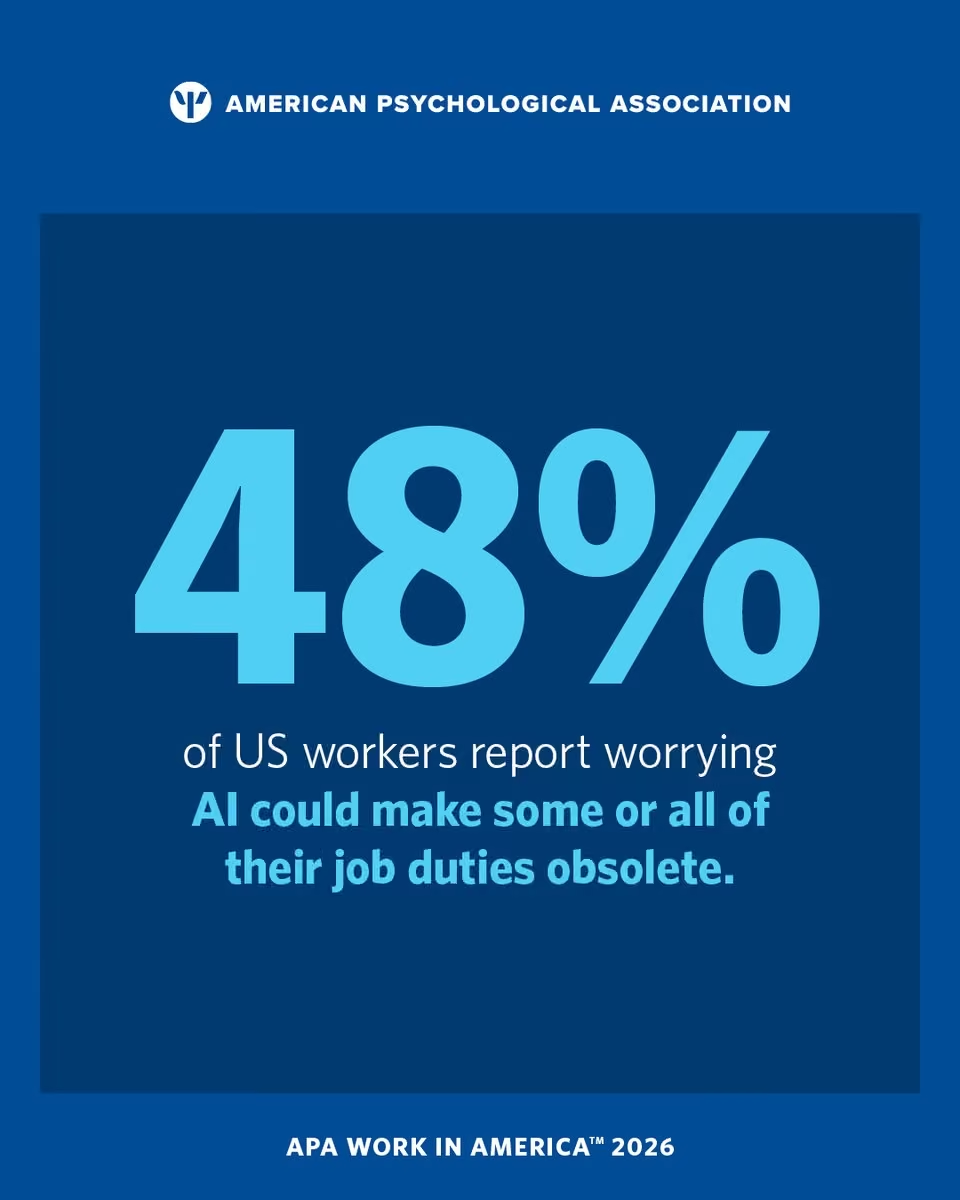
Nearly half of workers are concerned about their job duties becoming obsolete as a result of AI, according to APA’s 2026 Work in America survey. Approximately 64% believe technology benefits employers more than workers. Read the report’s full findings: at.apa.org/zlm
-
American Psychological Association
@APA
A course with Stanford University neuroscientist Dr. Robert Sapolsky set Dr. Rebecca Thurston on a path to studying the mind-body connection.
Now, Dr. Thurston credits a 20-year daily meditation practice with this key insight: you are not your thoughts.This media couldn't be displayed. See it on the original post. -
American Psychological Association
@APA
Fingerprints aren’t the only thing that make you unique. Research found the way people look at images is surprisingly consistent over time and unique enough to act like a personal “gaze fingerprint.” Read more highlights from recent peer-reviewed studies: at.apa.org/f6dc69
-
American Psychological Association
@APA
Why are so many of us drawn to scary movies, true crime, and all things creepy?
Dr. Coltan Scrivner explains how frightening entertainment might actually boost resilience for some people and help us cope with real-life challenges: at.apa.org/vku -
American Psychological Association
@APA
This month’s Psychology for a Better You newsletter explores why we’re drawn to the things that scare us, and what that can teach us about handling real-life fears.
Read the full issue and subscribe: at.apa.org/986057 -
American Psychological Association
@APA
It’s Banned Books Week (October 4–10).
Join us in celebrating the freedom to read with Magination Press books that have faced challenges over the years.
Which banned or challenged book are you reading this month?
at.apa.org/n8h -
American Psychological Association
@APA
Mental and behavioral health care is essential care, and expanding access to evidence-based services can help people get support before they reach a crisis.
As Election Day approaches, learn where candidates stand on the issues and make a plan to vote: at.apa.org/vote2026 -
American Psychological Association
@APA
AI can help students finish the work. But is it helping them learn? Dr. Nicole Barnes explains why better performance on a task doesn’t always mean understanding has developed. Explore APA’s report on children’s learning with educational technology. at.apa.org/yp6
This media couldn't be displayed. See it on the original post. -
American Psychological Association
@APA
Listen as Dr. Malissa Clark explains how workaholism differs from just working hard, and how it can affect people’s physical and mental health, as well as their relationships.
Hear the full conversation: at.apa.org/lbs -
American Psychological Association
@APA
Burnout gets most of the attention. But for nearly half of workers, the problem isn’t too much, it’s too little. Psychologists call it “rustout,” and its effects on health and well-being are just as serious. Learn more: at.apa.org/sdp
-
American Psychological Association
@APA
Chatbots tend to validate. Psychologists know when to push back. Dr. Mitch Prinstein, APA’s senior science advisor, explains why that difference matters. Read more guidance from APA on how to navigate AI-generated advice thoughtfully and safely. at.apa.org/ai-guide
-
American Psychological Association
@APA
Not having enough to do can wear on your health and performance just as much as having too much. Listen to the full episode of APA’s Speaking of Psychology podcast with Dr. Lotta Harju and Dr. Sharon K. Parker.
at.apa.org/4h1 -
American Psychological Association
@APA
Workers with high psychological capital are significantly less likely to report work-related mental health concerns, according to APA’s 2026 Work in America survey. Read the full findings: at.apa.org/zlm
-
American Psychological Association
@APA
Congratulations to Dr. Candice Hargons, a tenured associate professor of behavioral, social, and health education sciences at Emory University, for being elected as APA’s 2028 president. She will serve as 2027 president-elect as of January 1. Learn more: at.apa.org/eb9450
-
American Psychological Association
@APA
When a student says, “Don’t tell anyone,” that’s exactly when adults need to act.
Dr. Matthew Nock explains why breaking secrecy can save lives and how teachers can be a bridge to professional mental health care.
Learn more: at.apa.org/zfh -
American Psychological Association
@APA
Congratulations to Dr. Michael Yartsev!
Read more about the recent accomplishments of esteemed psychologists from across the country: at.apa.org/3e10fa -
American Psychological Association
@APA
Let’s revisit our conversation with Dr. Ruth Ogden as she breaks down the psychology behind our perception of time and explains how our memories, routines, and emotions can make life feel like it’s speeding by. Hear the full discussion: at.apa.org/qnl
-
American Psychological Association
@APA
How much of taste is actually in your head? In a new study, participants enjoyed drinks more when they thought they contained real sugar, regardless of what was actually in the cup. Read more highlights from recent peer-reviewed studies: at.apa.org/f6dc69
-
American Psychological Association
@APA
Check out the latest children’s book releases from Magination Press!
Read more details on each one and order: at.apa.org/k5e
Which one are you most excited about? -
American Psychological Association
@APA
Congratulations to Dr. Carol A. Barnes!
Read more about the recent accomplishments of esteemed psychologists from across the country: at.apa.org/3e10fa -
American Psychological Association
@APA
Rewards like gift cards can be a powerful tool in treating stimulant use disorder. Known as contingency management, this behavioral treatment uses positive reinforcement to support recovery.
Learn more: at.apa.org/9eeb3a -
American Psychological Association
@APA
Does the word “dog” make you think of “cat”? 🐶🐱 In a large-scale study, people consistently responded faster to related word pairs than unrelated ones. Read more highlights from recent peer-reviewed studies: at.apa.org/f6dc69
-
American Psychological Association
@APA
Ever caught yourself feeling a little envious of someone else’s success? You’re not alone. Dr. Jens Lange unpacks the difference between envy and jealousy and explores how envy can actually inspire personal growth. Hear the full conversation: at.apa.org/150f71
-
American Psychological Association
@APA
A new study proposes a transdiagnostic framework for understanding self-regulation across neurodevelopmental conditions, including autism, ADHD, and intellectual disability. Read more highlights from recent peer-reviewed studies: at.apa.org/f6dc69
-
American Psychological Association
@APA
Our brains crave connection with anything that responds fast and mirrors us back, and generative AI is built to do just that, says Dr. Mitch Prinstein, APA’s senior science advisor. Read guidance from APA on how to navigate AI-generated advice. at.apa.org/ai-guide
-
American Psychological Association
@APA
The empty nest phase can bring unexpected gifts. Research suggests for many couples, more space and time in their daily routine deepens rather than strains their relationship. Read more about what psychology says about this life transition. at.apa.org/bcca6f
-
American Psychological Association
@APA
According to APA’s new Work in America survey, fewer workers described their workplace as healthy in 2026 (80%) than in 2025 (85%), and fewer reported feeling valued at work (80% vs. 84%).
Learn more about what’s behind that gap: at.apa.org/zlm -
American Psychological Association
@APA
From sports science to perfectionism. Dr. Thomas Curran started his career as a sports researcher. Today, he’s an associate professor of psychological and behavioral science at the London School of Economics and author of “The Perfection Trap.”
This media couldn't be displayed. See it on the original post. -
American Psychological Association
@APA
Suicidal thoughts are more common than attempts, but when attempts do happen, they often occur in the teen years. Dr. Matthew Nock explains why suicide risk spikes in adolescence and how gender can influence it. Learn more: at.apa.org/zfh
-
American Psychological Association
@APA
Congratulations to Dr. Laura A. Carlson!
Read more about the recent accomplishments of esteemed psychologists from across the country: at.apa.org/3e10fa -
American Psychological Association
@APA
We’re communicating through screens now more than ever, but how is it affecting our relationships? Revisit our conversation with Dr. Jeff Hancock, as he unpacks how technology is reshaping the way we communicate. Hear the full discussion: at.apa.org/36c0bf
-
American Psychological Association
@APA
A new study found that people with more “hasslers” in their social networks reported poorer mental and physical health and showed signs of accelerated biological aging. Read more highlights from recent peer-reviewed studies: at.apa.org/f6dc69
-
American Psychological Association
@APA
Meet Jack O’Lantern’s less scary brother. Published by Magination Press, “Jeff O’Lantern” is a sweet Halloween story about sibling comparisons, finding your own strengths, and discovering your own purpose. 👻
Learn more: at.apa.org/xriThis media couldn't be displayed. See it on the original post. -
American Psychological Association
@APA
Climate action isn’t only a technical or policy challenge—it’s also a people challenge. Leaders can help turn commitments into meaningful action. Learn more from Organizations and Climate Action, a report from APA and ecoAmerica: at.apa.org/k5h
This media couldn't be displayed. See it on the original post. -
American Psychological Association
@APA
AI chatbots are warm, responsive, and always available. But psychologists say those qualities make them poor substitutes for the messy, effortful work of human relationships, especially for adolescents whose social skills are still forming. Learn more: at.apa.org/20f59e
-
American Psychological Association
@APA
Congratulations to Dr. Raymond Green!
Read more about the recent accomplishments of esteemed psychologists from across the country: at.apa.org/3e10fa -
American Psychological Association
@APA
Everyone talks about burnout, but “boreout” is just as real—and just as damaging. Dr. Sharon K. Parker, alongside Dr. Lotta Harju, explains how chronic boredom affects workers and what leaders and organizations can do to fix it. Hear the full conversation: at.apa.org/4h1
-
American Psychological Association
@APA
When a student shows signs of self-injurious thoughts or behaviors, knowing how to respond matters. The ACT framework—Ask, Care, Tell—gives school professionals a practical, evidence-based starting point for getting students support. Learn more: at.apa.org/zfh
-
American Psychological Association
@APA
What really predicts infidelity might surprise you. Listen to APA’s Speaking of Psychology podcast with Dr. Galena Rhoades, research professor of psychology and director of the Institute for Relationship Science at the University of Denver.
at.apa.org/2jz -
American Psychological Association
@APA
Congratulations to Robin L. Cautin!
Read more about the recent accomplishments of esteemed psychologists from across the country: at.apa.org/3e10fa -
American Psychological Association
@APA
Dr. Arthur C. Evans Jr., will retire as CEO of APA and APA Services, Inc., on Jan. 3, 2028. At the Board’s request, he will stay beyond his original contract end date to support a national search and smooth transition.
Read the announcement: at.apa.org/ceo-search -
American Psychological Association
@APA
Work stress, economic uncertainty, and AI are taking a toll on American workers, but not everyone is equally affected. Workers with higher psychological capital are experiencing the workplace differently. Read the full report: at.apa.org/zlm
-
American Psychological Association
@APA
New research found the percentage of high school students getting insufficient sleep has increased over the past 16 years, with a notable rise in teens getting fewer than 5 hours of sleep per night. Read more highlights from recent peer-reviewed studies: at.apa.org/f6dc69
-
American Psychological Association
@APA
Silence is the real danger when students hint they are struggling.
Dr. Matthew Nock explains how ACT (ask, care, tell) can help teachers ask directly, show care, and bring in support before a crisis escalates.
Learn more: at.apa.org/zfh -
American Psychological Association
@APA
Congratulations to Dr. Loren J. Blanchard!
Read more about the recent accomplishments of esteemed psychologists from across the country: at.apa.org/3e10fa -
American Psychological Association
@APA
Dr. Anna Gassman-Pines explains how job loss, unstable work schedules, and other hardships affect workers, their families, and entire communities. Hear the full discussion: at.apa.org/v19
-
American Psychological Association
@APA
What sparks curiosity?
New research suggests both younger and older adults use what they already know to gauge how curious they feel. The difference: older adults may be more curious overall.
Read more highlights from recent peer-reviewed studies: at.apa.org/f6dc69 -
American Psychological Association
@APA
Published by Magination Press, “Waiting for Iced Tea” is a story about patience, connection, and finding joy in the moments along the way. It also includes information on why waiting can be so difficult for children. Learn more and preorder: at.apa.org/kof
This media couldn't be displayed. See it on the original post. -
American Psychological Association
@APA
Is it better to laugh at yourself or show embarrassment after a faux pas? It depends on the consequences. Laughing at yourself may be seen positively for harmless mistakes, but not when others are harmed. Read more highlights from recent studies: at.apa.org/f6dc69
-
American Psychological Association
@APA
Children and teenagers are turning to AI for friendship, advice, and support. Psychologists say this raises important questions about what happens to social and emotional development when AI fills roles that used to belong to other people. Learn more: at.apa.org/20f59e
-
American Psychological Association
@APA
Why do social norms seem to push us to work harder, but not less? Recent research suggests people choose harder tasks when others do, but don’t choose easier tasks, even when it’s acceptable. Read more highlights from recent peer-reviewed studies: at.apa.org/f6dc69
-
American Psychological Association
@APA
Dr. Matthew Nock breaks down how stigma and fear keep us from discussing suicide and how new tools—from electronic health records to smartphone sensors—are helping researchers understand suicide risk and develop interventions. Hear the full conversation: at.apa.org/rch
-
American Psychological Association
@APA
Self-injurious thoughts and behaviors among young people are more common than many adults realize—and teachers are often positioned to notice when something is wrong. APA’s Mental Health Primers offer guidance on how to respond with care and confidence: at.apa.org/zfh
-
American Psychological Association
@APA
Caring about your mission is supposed to make work feel meaningful, but research suggests it can also make it harder to switch off. For some employees, purpose can become a trap, said Dr. Dennis Stolle, APA’s senior director of applied psychology, at an ASAE webinar.
-
American Psychological Association
@APA
Do beliefs about the end of the world affect how we tackle today’s biggest threats? Research suggests end-of-world beliefs can shape risk perception and support for action on global threats.
See more highlights from recent peer-reviewed studies: at.apa.org/f6dc69 -
American Psychological Association
@APA
The recent Meta settlement has renewed attention on how to create healthier online experiences for young people. Age limits are one piece, alongside developmentally appropriate design, ongoing adult guidance, and social media literacy.
Learn more: at.apa.org/6a78c6 -
American Psychological Association
@APA
Self‑injury and suicidal thoughts don’t appear as “messy clothes” or “moodiness.” They show up in what students say and what they hide. Listen as Dr. Matthew Nock explains the real red flags that teachers and administrators need to know.
Learn more: at.apa.org/zfh -
American Psychological Association
@APA
With a new college year underway, millions of parents are navigating one of life’s most significant transitions. Research suggests the empty nest phase is rarely just one thing—it can bring grief and relief, loss and opportunity, all at once.
Learn more: at.apa.org/bcca6f -
American Psychological Association
@APA
What does healthy screen use actually look like for kids? Dr. Roberta Golinkoff explains when technology can support kids’ growth and the conditions that can make smart devices useful tools rather than distractions.
Hear the full conversation: at.apa.org/a51c44 -
American Psychological Association
@APA
As back-to-school routines take hold, we may find it easier to let social connections take a backseat.
This month’s Psychology for a Better You explores the science of meaningful conversations, friendships, and small acts of kindness: at.apa.org/jq9 -
American Psychological Association
@APA
New research suggests that while children tend to mirror selfish behavior, they look to their parents as a model for responding cooperatively.
See more highlights from recent peer-reviewed studies: at.apa.org/f6dc69 -
American Psychological Association
@APA
New requirements for Facebook and Instagram reflect APA’s health advisory recommendations on adolescent social media use.
Healthier online experiences are a shared responsibility among platforms, policymakers, families and young people.
Learn more: at.apa.org/6a78c6 -
American Psychological Association
@APA
Twenty-five years after 9/11, researchers are still learning how collective trauma can shape us long after the news cycle moves on.
Hear Dr. Roxane Cohen Silver discuss what the aftermath has taught us about media exposure, coping, and trauma: at.apa.org/lx3 -
American Psychological Association
@APA
Why does music give us goosebumps, bring back vivid memories, and make us want to dance?
Listen to Dr. Robert Zatorre explain how music engages the brain’s reward system and how scientists are making strides in understanding its healing potential: at.apa.org/ltv -
American Psychological Association
@APA
Today is World Suicide Prevention Day. APA President Dr. Wendi Williams reflects on what it means to make suicide prevention a shared commitment across our communities.
If you or someone you know needs support, call or text 988 for free, 24/7 help: 988lifeline.org -
American Psychological Association
@APA
More than half of US teens use AI for schoolwork. But what happens to learning when AI does the heavy lifting? Psychologists are beginning to untangle how AI use may shape the next generation’s ability to think, problem-solve, and persevere.
Learn more: at.apa.org/20f59e -
American Psychological Association
@APA
Not all educational technology is created equal. APA’s new report gives educators, families, policymakers and developers 10 evidence-based recommendations for EdTech that protects how children and adolescents learn and develop.
Read the full report: at.apa.org/yp6 -
American Psychological Association
@APA
School staff are often the first to notice when a student is struggling. APA’s Mental Health Primers offer evidence-based guidance to recognize warning signs and connect students with support.
In crisis? Call or text #988, available 24/7.
Learn more: at.apa.org/zfh -
American Psychological Association
@APA
You’ve heard of burnout. But what about its quieter opposite?
Rustout affects more than 40% of workers and carries its own serious consequences for health and productivity.
Learn more: at.apa.org/sdp -
American Psychological Association
@APA
Can a well-intentioned diversity message backfire? Research suggests job ads explicitly mentioning race may leave some applicants feeling more likely to be tokenized and less likely to feel they belong.
See more from recent peer-reviewed studies: at.apa.org/0f518d -
American Psychological Association
@APA
Mental health emergencies deserve the same fast, expert care as physical ones. Dr. Jill Harkavy-Friedman explains why suicide prevention training and workforce support are essential so no one in crisis is left waiting for help.
Hear the full conversation: at.apa.org/yda -
American Psychological Association
@APA
TMS is reshaping treatment for depression and OCD, while researchers explore its potential for PTSD, Alzheimer’s disease, autism and more. As neuroscience focuses more on brain circuits, TMS may offer targeted, personalized care.
Learn more: at.apa.org/sdz -
American Psychological Association
@APA
Sometimes the best support isn’t helping someone minimize a problem, it’s helping them see new possibilities. Recent research suggests that encouraging a fresh perspective may strengthen both well-being and relationships.
See more from recent studies: at.apa.org/f6dc69 -
American Psychological Association
@APA
Resilience can be contagious—but not always in the same way. Working with highly resilient colleagues may inspire some, while making others feel more anxious, especially when they seem different from us.
See more from recent peer-reviewed studies: at.apa.org/27046c -
American Psychological Association
@APA
As the new academic year begins, APA President Dr. Wendi Williams offers a reminder to psychologists who have spent the year pouring out for others. Tending to your own restoration is what makes this work sustainable.
Read her full message: at.apa.org/qm3 -
American Psychological Association
@APA
GenAI has moved into classrooms at lightning speed in recent years.
On the podcast, Drs. Beth Schwartz and C. Edward Watson break down how AI is changing teaching and learning and what educators need to know.
Hear more: at.apa.org/s88 -
American Psychological Association
@APA
EdTech tools are everywhere, and so are the marketing claims about what they can do.
APA's new report provides evidence-based guidance on what improves learning, what questions to ask before adopting these tools, and how to get the most out of #edtech: at.apa.org/24384a -
American Psychological Association
@APA
Can friendships help reduce prejudice? A longitudinal study of adolescents found friends influence each other’s attitudes over time, especially when they start out with opposing views.
See more highlights from recent peer-reviewed studies: at.apa.org/f6dc69 -
American Psychological Association
@APA
APA 2026 On Demand is live, giving you access to 25 hours of high-impact programming, plus the chance to earn up to 22 CE credits, all at your own pace.
If you attended, check your email for your access link.
Missed #apa2026? Register now: convention.apa.org -
American Psychological Association
@APA
Political involvement may be associated with bigger swings in emotional states, which could result in greater anxiety.
Read more highlights from recent peer-reviewed studies: at.apa.org/27046c -
American Psychological Association
@APA
💜 September is Suicide Prevention Awareness Month. If you’re concerned about a loved one, take action. If you or someone you know is in crisis, call or text 988 to reach the Suicide & Crisis Lifeline, available 24/7. Learn more: at.apa.org/997db1
-
American Psychological Association
@APA
Our brains are remarkably efficient at processing the world around us, but it comes with a cost. Psychologists call it inattentional blindness: the tendency to miss things we aren’t looking for, without ever realizing we missed them. Learn more: at.apa.org/34c474
-
American Psychological Association
@APA
Research from APA’s Journal of Educational Psychology shows teachers’ joy sparks better learning, while anger shuts students down. Findings highlight the importance of supporting teacher well-being as part of improving education systems. Learn more: at.apa.org/fad95b
-
American Psychological Association
@APA
Lifetime stress and inflammation may contribute to higher mortality risk among Black adults, providing support for the impact of long-term systemic stress.
Read more highlights from recent peer-reviewed studies: at.apa.org/27046c -
American Psychological Association
@APA
As this week’s Meta settlement puts youth protections and platform design back in the spotlight, we’re revisiting this conversation with Dr. Jacqueline Nesi about what safer social media would look like for teens. Hear the full discussion: at.apa.org/jyw
-
American Psychological Association
@APA
Friendship becomes more balanced as kids grow. While younger children may value receiving kindness, older kids increasingly recognize the importance of mutual give-and-take. Read more highlights from recent peer-reviewed studies: at.apa.org/27046c
-
American Psychological Association
@APA
Congratulations to Dr. Shane R. Jimerson!
Read more about the recent accomplishments of esteemed psychologists from across the country: at.apa.org/c4645f -
American Psychological Association
@APA
Affairs are not harmless—the betrayal can be devastating. Being cheated on can lead to depressive symptoms and lower self-esteem. And patterns of infidelity can perpetuate for both the cheater and the victim. Read more: at.apa.org/81c58e
-
American Psychological Association
@APA
Kids’ brains are still developing—and extreme heat can interfere with that process. Dr. Nicole Barnes, APA’s executive lead psychologist for education, breaks down what the research shows, and why a new report is calling on schools to act. Learn more: at.apa.org/extremeheat
-
American Psychological Association
@APA
This week’s settlement between Meta and U.S. states includes platform updates that align with APA’s health advisory recommendations. APA remains committed to ensuring platform changes reflect the best available science on youth development. Learn more: at.apa.org/6a78c6
-
American Psychological Association
@APA
Infidelity can shatter trust and leave people questioning their relationships and themselves. Dr. Galena Rhoades explains why people cheat and how psychologists help individuals and couples begin to heal after an affair. Hear the full conversation: at.apa.org/2jz
-
American Psychological Association
@APA
Dr. Dennis Stolle, APA’s senior director of applied psychology, discusses why leaders can’t treat well-being and organizational success as separate. This is part of a multiyear partnership with ASAE to help nonprofit and association leaders prioritize workplace well-being.
-
American Psychological Association
@APA
Research shows that when children read aloud to dogs, their scores improve and their love of reading grows, especially for kids who struggle or are learning English as a second language.
Learn more: at.apa.org/b132e3 -
American Psychological Association
@APA
What happens in your brain when your mind goes blank?
Research suggests it’s associated with slower response times and disruptions in visual processing.
Read more highlights from recent peer-reviewed studies: at.apa.org/27046c -
American Psychological Association
@APA
Extreme heat doesn't affect all students equally. A new report from APA from APA and the Network for Resilient PK–12 Schools in Extreme Climates looks at why extreme heat is an equity issue and what schools can do about it. Learn more: at.apa.org/c70e48
-
American Psychological Association
@APA
Why do two people watch the same video, read the same headline, or witness the same event and walk away with completely different conclusions?
The answer isn’t stubbornness or bad faith. It’s the science of perception.
Learn more: at.apa.org/34c474 -
American Psychological Association
@APA
APA and ecoAmerica have partnered on a new report examining how organizations can accelerate climate action at scale. Register for tomorrow’s webinar and learn more: at.apa.org/hz0
-
American Psychological Association
@APA
Many mental disorders may share common genetic foundations, helping explain why conditions often co-occur.
Read more highlights from recent peer-reviewed studies: at.apa.org/27046c -
American Psychological Association
@APA
From service dogs for PTSD to therapy animals in hospitals and workplaces, animals support people’s mental health in many different ways. Dr. Maggie O’Haire breaks down what science has to say about the human-animal bond. Hear the full conversation: at.apa.org/0t6
-
American Psychological Association
@APA
This month’s Psychology for a Better You looks at why achievement culture is intensifying and why the fix isn’t lowering your standards. It’s something psychologists call mattering. Also inside: how to quiet your inner critic when it strikes. Learn more: at.apa.org/5e9
-
American Psychological Association
@APA
Congratulations to Dr. Sherry Kollmann!
Read more about the recent accomplishments of esteemed psychologists from across the country: at.apa.org/c4645f -
American Psychological Association
@APA
For many young people today, the journey to adulthood includes an extended phase of exploration, instability, and self-discovery shaped by today’s social and economic realities. Learn more: at.apa.org/0kp
-
American Psychological Association
@APA
Many schools have snow day plans in place, but plans for hot classroom are often forgotten, says Dr. Nicole Barnes, APA’s executive lead psychologist for education. A new report from APA and our partners says it’s time for that to change. Learn more: at.apa.org/extremeheat
-
American Psychological Association
@APA
Sports fans don’t just cheer on their teams. Dr. Daniel Wann breaks down how strong team identification can give people a built‑in community that boosts mental health, lowers loneliness, and even strengthens self‑esteem. Hear the full conversation: at.apa.org/1955af
-
American Psychological Association
@APA
Culture influences the emotions we want to feel, even more than the ones we actually experience.
Read more highlights from recent peer-reviewed studies: at.apa.org/27046c -
American Psychological Association
@APA
Rising temperatures are making it harder for students to learn—and most schools aren't prepared. A new report looks at how extreme heat affects students’ health, development, and ability to learn, and what schools can do about it. Read more: at.apa.org/c70e48
-
American Psychological Association
@APA
Support from friends may matter more than we think—especially for intercultural couples. Research shows friend approval is linked to relationship quality, sometimes even more than family or societal acceptance. Read highlights from peer-reviewed studies: at.apa.org/5f9885
-
American Psychological Association
@APA
Feeling overwhelmed? Research shows just 10 minutes of petting a dog or cat can meaningfully reduce cortisol, your body’s primary stress hormone.
Learn more about the science of animals and well-being: at.apa.org/b132e3 -
American Psychological Association
@APA
As young adults become more independent, parents may need to renegotiate what support looks like. Psychologists say warmth, clear boundaries, and respect for autonomy can help families navigate this transition without slipping into control. Learn more: at.apa.org/0kp
-
American Psychological Association
@APA
Congratulations to Dr. Monica L. Baskin!
Read more about the recent accomplishments of esteemed psychologists from across the country: at.apa.org/c4645f -
American Psychological Association
@APA
Workplace well-being isn’t one thing you fix—it’s an ecosystem leaders build over time. Dr. Dennis Stolle, APA’s senior director of applied psychology, breaks down the science behind what makes that possible, at an ASAE webinar on how flourishing employees drive mission success.
This media couldn't be displayed. See it on the original post. -
American Psychological Association
@APA
Feeling connected doesn’t always mean feeling less alone, especially during early adulthood.
Read more highlights from recent peer-reviewed studies: at.apa.org/5f9885 -
American Psychological Association
@APA
Heat doesn’t just drain your energy—it can mess with your mind. Dr. Kim Meidenbauer explains the impact of rising temperatures on people’s cognitive abilities and the link between heat, violence, and aggression.
Hear the full conversation: at.apa.org/2850ccThis media couldn't be displayed. See it on the original post. -
American Psychological Association
@APA
Older adults may show greater flexibility in how they regulate emotions by adapting their strategies to be situationally appropriate and according to their sense of control over stressors.
Read more highlights from recent peer-reviewed studies: at.apa.org/5f9885 -
American Psychological Association
@APA
Extreme heat is a growing challenge for schools—but it’s not an insurmountable one.
A new report from APA and a coalition of national health & education organizations offers evidence-based steps for protecting students, educators, and communities: at.apa.org/c70e48This media couldn't be displayed. See it on the original post. -
American Psychological Association
@APA
Hesitation in speech may signal deeper cognitive changes.
Read more highlights from recent peer-reviewed studies: at.apa.org/5f9885 -
American Psychological Association
@APA
Rising loneliness, elevated mental health concerns, pandemic disruption, social comparison, and economic uncertainty are impacting young people on the road to adulthood. Learn how to better support them: at.apa.org/0kp
-
American Psychological Association
@APA
Congratulations to Dr. Stephanie Reid-Arndt!
Read more about the recent accomplishments of esteemed psychologists from across the country: at.apa.org/c4645f -
American Psychological Association
@APA
We think we know what a psychopath looks like, but psychopathy is more common than people realize, and it’s hard to recognize in others. Dr. Abigail Marsh discusses the causes of and effective treatments for psychopathy. Hear the full conversation: at.apa.org/33b4c2
This media couldn't be displayed. See it on the original post. -
American Psychological Association
@APA
We’re more likely to find something we like when we have more choices. However, we often overlook the number of options available when predicting what others will prefer. Read more highlights from recent peer-reviewed studies: at.apa.org/27046c
-
American Psychological Association
@APA
Extreme heat doesn’t just make school uncomfortable. It interferes with children’s brain development, learning, and health. A new report from APA and contributors outlines steps school districts can take to protect students and educators. Learn more: at.apa.org/c70e48
This media couldn't be displayed. See it on the original post. -
American Psychological Association
@APA
Underconfidence among women and people with anxiety may arise from differences in reflection time during confidence ratings. Read more highlights from recent peer-reviewed studies: at.apa.org/27046c
-
American Psychological Association
@APA
As digital spaces shift the boundaries of modern relationships, defining and surviving infidelity has become more complex than ever. How do couples rebuild trust and find a constructive way forward?
Learn more: at.apa.org/81c58e -
American Psychological Association
@APA
Research published in APA’s Journal of Counseling Psychology suggests meaningful work may come not only from finding the ideal career path, but also from learning how to navigate uncertainty and build meaning within imperfect circumstances. Learn more: at.apa.org/e00690
This media couldn't be displayed. See it on the original post. -
American Psychological Association
@APA
APA 2026 was incredible—and it’s not over yet. Miss a session? Can’t stop thinking about one you loved?
On-demand access is available starting on September 3. Learn more: convention.apa.org -
American Psychological Association
@APA
We all keep secrets, but what does concealing information do to us? Dr. Michael Slepian discusses why we keep secrets, the most common types we hold onto, and how sharing them can affect our relationships and well‑being. Hear the full conversation: at.apa.org/2c2cda
This media couldn't be displayed. See it on the original post. -
American Psychological Association
@APA
Three days packed full of psychology—in Washington, DC and virtually. Now it’s time to rest. And we mean that in more ways than one. Research tells us there are seven types of rest, and sleep is just the beginning. You’ve earned all seven. Learn more: at.apa.org/c44d29
-
American Psychological Association
@APA
A big THANK YOU to all attendees, speakers, clinicians, researchers, students, educators, exhibitors, staff, and volunteers for coming together in Washington, DC and virtually at APA 2026. We can’t wait to see you all in San Francisco or virtually next year for APA 2027!
This media couldn't be displayed. See it on the original post. -
American Psychological Association
@APA
Your brain doesn’t just decline with age—it can reorganize, refine, and keep learning. Experts at today’s APA 2026 Main Stage event discuss a paradox: aging brings real challenges, but also clearer priorities and greater emotional well-being. Learn more: at.apa.org/280534
-
American Psychological Association
@APA
Thanks for an amazing Day 2 at APA 2026! We’re finishing strong with another full day of dynamic programming, including our final Headline Event on aging. What’s been your favorite part of the convention so far? Share with us!
convention.apa.org -
American Psychological Association
@APA
Many young adults feel like they’re in between—old enough to carry adult responsibilities, but not quite “settled.” Today’s APA 2026 Main Stage Headline event explores what chronic overwhelm does to people. Learn more: at.apa.org/0kp
-
American Psychological Association
@APA
Thanks for a great first day, APA 2026! Enjoy the DC Block Party, then rest up for Day 2!
See what’s happening tomorrow in Washington, DC and virtually: convention.apa.org -
American Psychological Association
@APA
As teens turn to chatbots for emotional support, psychologists are studying what gets lost when a “friend” can’t push back. In today’s APA 2026 Main Stage Headline event, experts discuss how digital life is reshaping development. Learn more: at.apa.org/c5bd70
-
American Psychological Association
@APA
Good morning from APA 2026! We’re ready for a full day of dynamic programming in Washington, DC and virtually. Day 1 of APA 2026 is packed with the ideas, conversations, and connections that move psychology forward. See what’s happening today: convention.apa.org
-
American Psychological Association
@APA
How we think about aging may shape how well we remember. Research suggests that beliefs about getting older—especially positive views about our own aging—are linked to stronger prospective memory. Read more highlights from recent peer-reviewed studies: at.apa.org/27046c
-
American Psychological Association
@APA
The wait is almost over.
Tomorrow, thousands of psychologists will come together in Washington, DC—and thousands more will log in from around the world.
Register now: convention.apa.org -
American Psychological Association
@APA
Repeated exposure to the same person in multiple lineups may increase the risk of misidentification by eyewitnesses.
Read more highlights from recent peer-reviewed studies: at.apa.org/5f9885 -
American Psychological Association
@APA
Dr. Roberto Olivardia joined APA’s Speaking of Psychology podcast to explain why body image struggles often get missed in men, and how social media is reshaping what young men think they’re supposed to look like. Listen to the full episode: at.apa.org/23e667
-
American Psychological Association
@APA
Choosing to engage with information may increase how true it feels, especially when it’s repeated.
Read more highlights from recent peer-reviewed studies: at.apa.org/27046c -
American Psychological Association
@APA
This week, thousands of psychologists will come together to explore how we lead. Together, we'll discover how psychology lights the path ahead. Can’t make it to DC? Grab your virtual front-row seat and experience it all from wherever you are. Learn more: convention.apa.org
-
American Psychological Association
@APA
Across cultures, children tend to become more cooperative with age, increasingly aligning their behavior with the norms of their communities.
Read more highlights from recent peer-reviewed studies: at.apa.org/27046c -
American Psychological Association
@APA
Dr. Linda Charmaraman discusses how social media really impacts teens’ well‑being and ways adults can help boost the benefits and reduce the risks. Hear the full conversation: at.apa.org/8wg, and catch Dr. Charmaraman on the APA 2026 Main Stage this week.
This media couldn't be displayed. See it on the original post. -
American Psychological Association
@APA
A study suggests children can tell the difference between useful and unhelpful praise, recognizing when feedback aligns with their goals.
Read more highlights from recent peer-reviewed studies: at.apa.org/d00cb9 -
American Psychological Association
@APA
Check out the latest children’s book releases from Magination Press!
Read more details on each one and preorder: at.apa.org/4691d7
Which one are you most excited about? -
American Psychological Association
@APA
When someone’s hurting, the instinct to fix it can get in the way. Lead with validation, then ask what they need. 💛
Subscribe to our Six Things Psychologists Are Talking About newsletter for more: at.apa.org/SixThings -
American Psychological Association
@APA
APA Services applauds Sens. Heinrich and Kennedy and Reps. Malliotakis and Chu for introducing the Increasing Mental Health Options Act to remove barriers to prompt, effective treatment for Medicare beneficiaries. We urge Congress to enact this legislation as soon as possible.
-
American Psychological Association
@APA
Older adults may have fewer autobiographical thoughts than younger adults, but their thoughts tend to be more specific and vivid, less self-focused, and more emotionally positive and social. Read more highlights from recent peer-reviewed studies: at.apa.org/27046c
-
American Psychological Association
@APA
Going virtual may not change the verdict as much as we think. Research suggests online and in-person juries often reach similar conclusions, even if the discussion process looks a bit different.
Read more highlights from recent peer-reviewed studies: at.apa.org/27046c -
American Psychological Association
@APA
Being a parent can be tough these days. Drs. Tim Cavell and Lauren Quetsch discuss what “good enough parenting” means and how to develop loving, supportive relationships with your kids that will stand the test of time. Hear the full conversation: at.apa.org/5b359a
This media couldn't be displayed. See it on the original post. -
American Psychological Association
@APA
Thinking twice can make a real difference. When people actively reflect on the ethics of sharing information, they’re less likely to spread fake news—even when it aligns with their own beliefs. Read more highlights from recent peer-reviewed studies: at.apa.org/27046c
-
American Psychological Association
@APA
Leadership isn’t a solo pursuit. It’s built through the people you meet, the collaborations you spark, and the community you show up for. See all the ways to connect at #apa2026. Learn more: convention.apa.org
-
American Psychological Association
@APA
Organizations are powerful environments for climate action—and anyone within them can drive change. A new report from APA and ecoAmerica offers practical, role-specific guidance for turning climate concern into collective action. Download the report: at.apa.org/k5h
-
American Psychological Association
@APA
Congratulations to Dr. Sonia Ancoli-Israel!
Read more about the recent accomplishments of esteemed psychologists from across the country: at.apa.org/e40141 -
American Psychological Association
@APA
Research shows feeling heard can soften disagreements and even shift attitudes more than any argument could. Listen to the full episode of APA’s Speaking of Psychology podcast with Dr. Guy Itzchakov. at.apa.org/ecc9ff
-
American Psychological Association
@APA
Procrastination isn’t fixed—it changes as we grow. Research suggests it tends to decrease in young adulthood, linking shifts in behavior to personality and life outcomes over time. Read more highlights from recent peer-reviewed studies: at.apa.org/27046c
-
American Psychological Association
@APA
In the wake of tragic events, many parents struggle with how to talk to their children about what happened. Read guidance that can help: at.apa.org/483d6a
-
American Psychological Association
@APA
Psychology isn’t just responding to the AI revolution—it’s helping shape it. APA’s Center for Behavioral Science and AI is putting behavioral science to work on youth well-being, the future of work, and more. Read the full column by Dr. Evans.: at.apa.org/a2c379
-
American Psychological Association
@APA
Living in a multilingual environment may be linked to healthier aging and a lower risk of accelerated decline.
Read more highlights from recent peer-reviewed studies: at.apa.org/5f9885 -
American Psychological Association
@APA
Listen to Dr. Ev Fedorenko explain how language is processed in the brain and what sets hyperpolyglots—people who have mastered upwards of 20 languages—apart from other multilingual people. Hear the full conversation: at.apa.org/cd32a7
This media couldn't be displayed. See it on the original post. -
American Psychological Association
@APA
Congratulations to Dr. Joseph Mazzola!
Read more about the recent accomplishments of esteemed psychologists from across the country: at.apa.org/e40141 -
American Psychological Association
@APA
Carol Gilligan’s research reshaped how psychology understands moral development, identity, and relationships. “Carol Gilligan and the Search for Voice,” published by Magination Press, explores what it means to find—and use—your own voice. Learn more: at.apa.org/o2n
This media couldn't be displayed. See it on the original post. -
American Psychological Association
@APA
🎧☀️ What songs help you recharge? 🎧☀️
From laid-back summer tracks to poolside favorites, our newest playlist is inspired by slowing down and being present.
Listen now: at.apa.org/il0 -
American Psychological Association
@APA
Your personality traits may quietly shape your lifespan.
Read more highlights from recent peer-reviewed studies: at.apa.org/5f9885 -
American Psychological Association
@APA
Congratulations to Dr. Debra Mollen!
Read more about the recent accomplishments of esteemed psychologists from across the country: at.apa.org/e40141 -
American Psychological Association
@APA
AI is becoming a routine part of many people’s work. Dr. Brooke Macnamara discusses the psychology of cognitive offloading and how workers can use AI in ways that support their long-term skill development.
Hear the full conversation: at.apa.org/898fb3This media couldn't be displayed. See it on the original post. -
American Psychological Association
@APA
Vigilance sensors. Activity logs. Cameras. On paper, they protect workers—from fatigue, false accusations, harassment. But research by Dr. Tara Behrend shows those protections aren’t always equal. APA 2026, August 6–8, offers more insights like this. convention.apa.org
This media couldn't be displayed. See it on the original post. -
American Psychological Association
@APA
Your brain can hear a foreign language—but it doesn’t always understand it. Speech sounds are processed similarly across languages, but the brain only tracks word meaning and structure in languages we know. Read highlights from peer-reviewed studies: at.apa.org/5f9885
-
American Psychological Association
@APA
AI is moving faster than our understanding of how it shapes human behavior. APA’s Center for Behavioral Science and AI is built to close the gap, bringing psychological science into how AI is designed, deployed, and evaluated. Read Dr. Evans’ full column: at.apa.org/a2c379
-
American Psychological Association
@APA
Sleep isn’t just something you catch up on after a hard day—it can cause the hard days in the first place. And fixing it is more complicated than logging 8 hours or trusting your smartwatch. Listen to Dr. Philip Gehrman on APA’s Speaking of Psychology. at.apa.org/5cc34b
-
American Psychological Association
@APA
Strong family connections during adolescence may lead to better social relationships in adulthood.
Read more highlights from recent peer-reviewed studies: at.apa.org/27046c -
American Psychological Association
@APA
From tech leaders shaping the future of AI to award-winning journalists tackling the biggest questions in psychology today, APA 2026 speakers are bringing perspectives you won’t want to miss.
Register to join us in Washington, DC or virtually.
convention.apa.org -
American Psychological Association
@APA
Congratulations to Dr. Benjamin Freer!
Read more about the recent accomplishments of esteemed psychologists from across the country: at.apa.org/e40141 -
American Psychological Association
@APA
A sleeping brain is a busy brain. Research shows that sleep plays an active role in memory consolidation, learning, and long-term brain health—and that skimping on it carries real consequences.
Learn more about the science of sleep and mental health: at.apa.org/b9a12dThis media couldn't be displayed. See it on the original post. -
American Psychological Association
@APA
Whether you’re cheering for a World Cup favorite or a hometown underdog, there’s a reason certain teams feel like “your” teams. Dr. Daniel Wann explains why being a fan can be good for people’s mental health. Hear the full conversation: at.apa.org/1955af
This media couldn't be displayed. See it on the original post. -
American Psychological Association
@APA
Congratulations to Dr. Jodi Price!
Read more about the recent accomplishments of esteemed psychologists from across the country: at.apa.org/e40141 -
American Psychological Association
@APA
Getting a smartphone at a younger age may be linked to poorer sleep, mental health challenges, and higher obesity risk in adolescents.
Read more highlights from recent peer-reviewed studies: at.apa.org/5f9885 -
American Psychological Association
@APA
Psychologists need a seat at the table the moment new tech is on the radar, not after something breaks, said I/O psychologist Dr. Richard Landers. Want more insights like this? Join us at APA 2026, August 6–8, in Washington, DC or virtually. Register at convention.apa.org
This media couldn't be displayed. See it on the original post. -
American Psychological Association
@APA
Dr. Roberto Olivardia explains why body image disorders in men are frequently overlooked and how social media, the “manosphere,” and trends like looksmaxxing are shaping young men’s ideas about appearance and masculinity. Hear the full conversation: at.apa.org/23e667
This media couldn't be displayed. See it on the original post. -
American Psychological Association
@APA
Congratulations to Dr. Melanie Leuty!
Read more about the recent accomplishments of esteemed psychologists from across the country: at.apa.org/e40141 -
American Psychological Association
@APA
Representative Tom Kean Jr.’s recent disclosure about his hospitalization for #depression is sparking an important conversation about men’s mental health, one that can help reduce stigma and encourage others, especially men, to seek help. Learn more: at.apa.org/51d32c
-
American Psychological Association
@APA
Underserved communities often face provider shortages and long wait times for care. New laws in Hawaii and Vermont let psychologists prescribe certain medications for mental health disorders—expanding access and cutting barriers to treatment. Learn more: at.apa.org/593954
-
American Psychological Association
@APA
Talking to someone with an opposing view may shift our own views more than we expect.
Read more highlights from recent peer-reviewed studies: at.apa.org/5f9885 -
American Psychological Association
@APA
As #esports moves toward the world stage, the mental health of athletes is becoming a top priority.
Learn how psychologists are safeguarding the future of play: at.apa.org/0bbb47This media couldn't be displayed. See it on the original post. -
American Psychological Association
@APA
People living in rural areas face mental health inequities, including higher rates of depression and suicide. Limited access to providers, long wait lists, and stigma about seeking treatment can stand in the way of care.
Learn more: at.apa.org/291c9c -
American Psychological Association
@APA
Congratulations to Dr. David Trafimow!
Read more about the recent accomplishments of esteemed psychologists from across the country: at.apa.org/e40141 -
American Psychological Association
@APA
Sleep problems are sometimes a sign of mental health problems.
Now, there is growing evidence the relationship between sleep and mental illness goes both ways—and that sleep troubles often come first.
Learn more: at.apa.org/b9a12d -
American Psychological Association
@APA
Many elite teams—including national teams competing in the World Cup—rely on sport psychologists to support athletes’ performance. Dr. Jamie Shapiro discusses how they help players perform at their best.
Hear the full conversation: at.apa.org/76f152This media couldn't be displayed. See it on the original post. -
American Psychological Association
@APA
Early gains from preschool language interventions may fade over time, highlighting the need for sustained, long-term support to help children’s language skills thrive.
Read more highlights from recent peer-reviewed studies: at.apa.org/5f9885 -
American Psychological Association
@APA
Thinking about taking a break? How you spend your time away matters more than you’d think.
This month’s Psychology for a Better You breaks down what the science says about vacations, workday pauses, and making your time off actually count.
Learn more: at.apa.org/was -
American Psychological Association
@APA
The Main Stage and Feature Stage at APA 2026 are where insight becomes action. Take a look at what’s happening—from AI and ethics to grief, aging, and financial psychology.
Full agenda and registration: convention.apa.org
See you in DC (or online) August 6–8!This media couldn't be displayed. See it on the original post. -
American Psychological Association
@APA
The deadline is almost here. A proposed federal rule would change how funding is awarded, with real implications for psychology. APA Services urges psychologists to take action by July 13:
Contact Congress: at.apa.org/d64
Submit a public comment: at.apa.org/2vh -
American Psychological Association
@APA
We sometimes sacrifice sleep when life gets busy, but research shows quality rest is essential. Dr. Philip Gehrman explains how conditions like insomnia and disrupted circadian rhythms can affect mental and physical health. Hear the full conversation: at.apa.org/5cc34b
This media couldn't be displayed. See it on the original post. -
American Psychological Association
@APA
The idea of “growing up” can feel intimidating, especially in times of uncertainty. Research suggests many of those fears may soften with age as people build their lives, navigate challenges, and discover what adulthood looks like for them. Learn more: at.apa.org/b844e3
-
American Psychological Association
@APA
Congratulations to Dr. Santiba Campbell!
Read more about the recent accomplishments of esteemed psychologists from across the country: at.apa.org/2934af -
American Psychological Association
@APA
Your brain makes snap judgments in milliseconds—but they’re not always right. Research shows first impressions are shaped by both real cues and bias, and they’re tough to change. Listen to the full episode of Speaking of Psychology with Dr. Nicholas Rule. at.apa.org/qlm
-
American Psychological Association
@APA
The thrill of a win. The sting of a loss. The hope that keeps fans coming back. After the U.S. men’s national team’s World Cup run, many American fans know the feeling. Dr. Daniel Wann discusses why fandom can be so emotional. Hear the full conversation: at.apa.org/1955af
-
American Psychological Association
@APA
Findings from APA’s Chatbots and Mental Health Survey show many patients are turning to AI for emotional support. Creating space to discuss AI use in therapy can help patients understand where AI may be helpful, risky, or misleading. Learn more: at.apa.org/apw
-
American Psychological Association
@APA
As America marked its 250th anniversary this past weekend, an NBC News poll showed many are willing to set political differences aside to celebrate together. Psychological research shows not all national pride works the same way. Learn more: at.apa.org/qhr.
#patriotism -
American Psychological Association
@APA
GLP-1 drugs are effective for weight loss, but they come with risks. Besides common side effects like gastrointestinal problems, they may mask or worsen eating disorder symptoms or trigger symptoms among patients in recovery.
Learn more: at.apa.org/jsq -
American Psychological Association
@APA
Insomnia is common and closely linked to mental health—but it often requires targeted treatment. Addressing anxiety, PTSD, or chronic pain alone often isn’t enough to improve sleep.
Learn more about treatment for sleep disorders: at.apa.org/b9a12d -
American Psychological Association
@APA
Burnout doesn’t just follow stress, it can create it.
See more highlights from recent peer-reviewed studies: at.apa.org/5f9885
#stress #psychology #brain #burnout #research -
American Psychological Association
@APA
Summer can bring joy, rest, and time outside—but extreme heat can also affect mental health. Taking small steps to stay cool, connected, and supported can help protect your well-being during the hottest months of the year.
Learn more: at.apa.org/d25293 -
American Psychological Association
@APA
Kids use evidence to challenge false claims earlier than we think.
Read more highlights from recent peer-reviewed studies: at.apa.org/5f9885 -
American Psychological Association
@APA
A proposed federal funding rule would create new uncertainty for researchers, institutions, and the communities they serve. Make your voice heard by July 13.
Contact Congress: at.apa.org/d64
Submit a comment: at.apa.org/2vh -
American Psychological Association
@APA
Dr. Emily Lattie shares how digital tools can supplement care and create new pathways for healing and flourishing. For more on how to make mental health support more accessible, join us at APA 2026, August 6–8 in Washington, DC or virtually. Register: convention.apa.org
This media couldn't be displayed. See it on the original post. -
American Psychological Association
@APA
Stimulant medications may help children with #adhd stay engaged by enhancing arousal and reward systems rather than directly improving attention.
Read more highlights from recent peer-reviewed studies: at.apa.org/27046c -
American Psychological Association
@APA
Looking for a way to feel more connected to your community?
Volunteering and other small acts of kindness do more than just help others—they can significantly impact your own mental and physical health.
Learn more: at.apa.org/c57b0cThis media couldn't be displayed. See it on the original post. -
American Psychological Association
@APA
Research suggests invasive workplace surveillance doesn’t improve performance, and it can even come with a cost, notes Michigan State University I/O psychologist Dr. Tara Behrend, at a Feature Stage session at APA 2025.
This media couldn't be displayed. See it on the original post. -
American Psychological Association
@APA
As many patients turn to AI for support, psychologists can open the door to conversations about what patients are finding, what risks to watch for, and how to navigate these tools thoughtfully and safely. Read practical guidance from APA: at.apa.org/llr
This media couldn't be displayed. See it on the original post. -
American Psychological Association
@APA
Across cultures, people agree on what counts as a lie.
Read more highlights from recent peer-reviewed studies: at.apa.org/5f9885 -
American Psychological Association
@APA
As family photo albums move to public feeds, protecting children's digital privacy is a key challenge for modern parents.
How can we balance sharing milestones with long-term safety?
Learn more: at.apa.org/333743 -
American Psychological Association
@APA
In a world of 24-hour gyms, streaming entertainment, and social media, sleep often gets shortchanged. But chronic sleep deficiency can increase the risks for a range of physical and mental health problems. Learn more: at.apa.org/b9a12d
-
American Psychological Association
@APA
A hot take for National Foodie Day: Picky eating is human! Acquiring a taste for things like veggies can take time. Dr. Linda Bartoshuk explains how taste is both a biological system and psychological learning process. Hear the full conversation: at.apa.org/eeea06
This media couldn't be displayed. See it on the original post. -
American Psychological Association
@APA
🎧🌄 What songs make you feel adventurous?
From road trip anthems to tracks that inspire exploration, our latest playlist is all about #adventure.
Listen now: at.apa.org/f2d448 -
American Psychological Association
@APA
“Love Lives On: Finding Hope and Healing After the Loss of a Loved One,” from Magination Press, is a heartfelt story that helps children navigate loss, cherish memories, and understand that love continues even after a loved one is gone. Learn more: at.apa.org/e831ef
This media couldn't be displayed. See it on the original post. -
American Psychological Association
@APA
Practicing in rural communities involves building a therapeutic alliance that requires a deep understanding of the unique strengths, values, and socioeconomic stressors that shape rural life. Here’s some guidance: at.apa.org/291c9c
This media couldn't be displayed. See it on the original post. -
American Psychological Association
@APA
In this APA 2025 Main Stage session, experts explored why AI tools need oversight, transparency, and safeguards to help people understand when they are useful and when another kind of support is needed. Read APA’s guide to navigating AI-generated advice: at.apa.org/9424ca
This media couldn't be displayed. See it on the original post. -
American Psychological Association
@APA
AI can feel supportive, reassuring, and emotionally responsive—but psychologists say it’s important to understand where these systems can still be inaccurate, misleading, or unsafe. Professional care and human connection still matter. Learn more: at.apa.org/9424ca
This media couldn't be displayed. See it on the original post. -
American Psychological Association
@APA
Many parents share their kids’ lives online. Dr. Keneisha Sinclair-McBride explains how parents can balance connection and community with a child’s need for autonomy and control over their own stories. Hear the full conversation: at.apa.org/855780
This media couldn't be displayed. See it on the original post. -
American Psychological Association
@APA
Time is running out to claim your discount on APA 2026! You have until 11:59 p.m. ET tonight to save on your registration for psychology’s biggest event.
Secure your savings: convention.apa.org -
American Psychological Association
@APA
People with chronic tics or Tourette’s disorder experience repetitive, uncontrolled movements or vocalizations that can range from mild to disruptive. While symptoms are neurobiological, behavioral treatments work best. Learn more: at.apa.org/y4q
-
American Psychological Association
@APA
Trust in AI doesn’t come from ignoring the risks—or the possibilities. Building a future where AI benefits people requires thoughtful innovation, ethics, and ongoing research, notes Dr. Vaile Wright, APA’s senior director of health care innovation.
This media couldn't be displayed. See it on the original post. -
American Psychological Association
@APA
AI tends to agree with you, even when it might be helpful to rethink your perspective. APA recommends not accepting AI advice at face value. Many chatbots were not created with health care in mind. Read more from APA’s chatbots and mental health survey: at.apa.org/vzb
-
American Psychological Association
@APA
Targeting thoughts, behaviors, and emotions may be the most effective way to reduce loneliness, though stronger research is needed to confirm long-term impact. Read more highlights from recent peer-reviewed studies: at.apa.org/d00cb9
-
American Psychological Association
@APA
Researchers are finding stronger links between nutrition, gut health, inflammation, and emotional well-being—including how ultra-processed foods may affect depression and stress. Read more about the emerging science of nutritional psychology: at.apa.org/fdf825
This media couldn't be displayed. See it on the original post. -
American Psychological Association
@APA
Are you tired of waking up exhausted and feeling the toll it takes on your mood throughout the day?
Prioritizing your sleep health is a powerful, proven way to protect your mind and build emotional resilience.
Explore the science of sleep: at.apa.org/b9a12dThis media couldn't be displayed. See it on the original post. -
American Psychological Association
@APA
Becoming a parent doesn’t just change your life, it rewires your brain.
Listen to Dr. Darby Saxbe break down the powerful hormonal and neural shifts that shape new moms and dads.
Hear the full conversation: at.apa.org/0vsThis media couldn't be displayed. See it on the original post. -
American Psychological Association
@APA
A proposed federal rule would weaken the role of peer review in grantmaking and give political appointees authority over research funding. Make your voice heard by July 13.
Contact your members of Congress: at.apa.org/d64
Submit a public comment: at.apa.org/2vh -
American Psychological Association
@APA
Homesickness can be uncomfortable, but it doesn’t mean camp was the wrong choice. For many kids, time away from home helps build confidence, independence, and the ability to handle new challenges long after summer ends.
See more summer camp prep tips: at.apa.org/795ce1 -
American Psychological Association
@APA
Happy #juneteenth!
Today we remember, reflect, and celebrate with these words from APA President Dr. Wendi Williams. -
American Psychological Association
@APA
Flavor isn’t just in your mouth—it’s in your eyes, ears, and even your environment.
Listen to Dr. Charles Spence explain how our senses shape what we taste and how this science can help us enjoy food more.
Hear the full conversation: at.apa.org/35f968This media couldn't be displayed. See it on the original post. -
American Psychological Association
@APA
AI is not an accurate way to diagnose yourself. APA recommends verifying any mental health or medical information you receive from AI with a health care practitioner. Read more from APA’s new survey on chatbots and mental health: at.apa.org/vzb
-
American Psychological Association
@APA
The future of #ai depends on transparency, safeguards, and bringing experts who understand people into the process. AI is built by humans, for humans, and innovation must start there, said Dr. Vaile Wright at a CES session on the role of AI in mental health care.
This media couldn't be displayed. See it on the original post. -
American Psychological Association
@APA
Whether you’re looking to dive deep into the latest ethical challenges, or zoom out to the state of psychology today, you’ll find sessions that get you thinking at APA 2026. Explore program highlights, then register and start building your itinerary: convention.apa.org
This media couldn't be displayed. See it on the original post. -
American Psychological Association
@APA
Before turning to AI for emotional support or mental health advice, it helps to understand how these systems actually work.
APA’s science-based guidance is designed to help people use these tools more safely and critically.
Learn more: at.apa.org/9424caThis media couldn't be displayed. See it on the original post. -
American Psychological Association
@APA
Worry has a way of making unlikely scenarios feel much more probable than they really are. Planning for what’s most likely can help both parents and kids feel more prepared and confident.
Read more tips for summer camp prep: at.apa.org/tpw -
American Psychological Association
@APA
APA’s Chatbots and Mental Health survey looks at how psychologists are seeing AI show up in patient care—and offers guidance on navigating AI-generated advice thoughtfully and safely.
Learn more: at.apa.org/vzb -
American Psychological Association
@APA
Congratulations to Dr. Alison Cerezo!
Read more about the recent accomplishments of esteemed psychologists from across the country: at.apa.org/f7d082
Catch Dr. Cerezo this summer on the #apa2026 Feature Stage as they explore staying psychologically safe in the #ai era. -
American Psychological Association
@APA
When treatment works well, families are often part of the process. Parents can become key partners in helping children engage with #ocd and anxiety treatment, explains psychologist Eric Storch.
Learn more: at.apa.org/3338f8 -
American Psychological Association
@APA
Sleep deprivation may trigger the brain to enter sleep-like states while awake, leading to lapses in attention and reduced performance.
Read more highlights from recent peer-reviewed studies: at.apa.org/d00cb9 -
American Psychological Association
@APA
Perfectionism promises excellence, but often delivers burnout. Dr. Thomas Curran discusses why we feel the need to push ourselves to perfection and what we can do to recognize that often, “good” is good enough. Hear the full conversation: at.apa.org/hbv
This media couldn't be displayed. See it on the original post. -
American Psychological Association
@APA
This month’s Psychology for a Better You, explores why financial stress can feel so overwhelming and provides practical, psychology-backed strategies to regain a sense of control. Tell us in the comments: What’s one habit that helps you feel more in control of your finances?
-
American Psychological Association
@APA
Does the news leave your child worried or overwhelmed? “What to Do When the News Scares You: A Kid’s Guide to Understanding Current Events,” published by Magination Press, helps children make sense of scary headlines and manage big feelings.
Learn more: at.apa.org/6d5cb0This media couldn't be displayed. See it on the original post. -
American Psychological Association
@APA
Congratulations to Dr. Julian Thayer! Read more about the recent accomplishments of esteemed psychologists from across the country: at.apa.org/2934af
-
American Psychological Association
@APA
Parents can feel anxious about sending their kids to summer camp. Feel calmer and more confident by preparing yourself ahead of time and focusing on likely outcomes instead of worst-case scenarios. Get more tips for managing summer camp anxiety: at.apa.org/359d3f
-
American Psychological Association
@APA
Listen to Dr. Margie Lachman discuss the science of midlife, including how the choices we make in our 40s and 50s can impact both our physical and mental health later in life.
Hear the full conversation: at.apa.org/82d67fThis media couldn't be displayed. See it on the original post. -
American Psychological Association
@APA
Perfectionism isn’t just a personal struggle—it’s a growing public health concern. New research suggests today’s college students are more perfectionistic than ever. Findings also point to cultural and economic factors shaping mental health. Learn more: at.apa.org/2066e9
This media couldn't be displayed. See it on the original post. -
American Psychological Association
@APA
Explore big questions—from childhood in the digital age to the realities of modern adulthood and aging—at APA 2026’s Main Stage sessions.
Register by June 24 to save up to $100.
Learn more: convention.apa.org -
American Psychological Association
@APA
A proposed federal rule would shift funding decisions away from expert review and expand grounds to terminate active grants. Make your voice heard—act before July 13.
Contact your members of Congress: at.apa.org/d64
Submit a public comment: at.apa.org/2vh -
American Psychological Association
@APA
Older adults may be less likely to switch away from default options, suggesting a preference for the status quo rather than simply a bias toward positive information.
Read more highlights from recent peer-reviewed studies: at.apa.org/d00cb9 -
American Psychological Association
@APA
Have you ever felt like your brain was stuck on a loop of distressing thoughts? Understanding the scientific reality of OCD is the first step toward breaking the cycle of silence and misdiagnosis. Learn more about obsessive-compulsive disorder: at.apa.org/e9127e
-
American Psychological Association
@APA
Giving kids some ownership over camp preparation can help build confidence and reduce anxiety.
Read more tips for summer camp prep: at.apa.org/tpw -
American Psychological Association
@APA
Working together doesn’t just align ideas—it can align our brains. When people collaborate, their neural activity becomes more synchronized over time, especially as they learn and adapt together. Read more highlights from recent peer-reviewed studies: at.apa.org/5f9885
-
American Psychological Association
@APA
The future of mental health care isn’t one-size-fits-all. Researchers like Dr. Lorenzo Lorenzo-Luaces point to a model that combines digital tools, personalized understanding, and human support to better meet patients where they are. Learn more: at.apa.org/fb3278
-
American Psychological Association
@APA
From the AIDS crisis to marriage equality and transgender rights, #lgbtq activism continues to evolve. Listen to Dr. Peter Hegarty explain how psychological research has reflected and responded to these changes. Hear the full conversation: at.apa.org/7ebd45
This media couldn't be displayed. See it on the original post. -
American Psychological Association
@APA
Early differences in children’s gut microbiome may shape brain connectivity and later anxiety and depression symptoms, highlighting a possible gut and brain pathway in early development. Read more highlights from recent peer-reviewed studies: at.apa.org/d00cb9
-
American Psychological Association
@APA
Stories help children understand themselves, connect with others, and celebrate the many ways people and families experience the world. 🌈 These inclusive titles from Magination Press remind every child they deserve to feel seen. See more: at.apa.org/0236de
-
American Psychological Association
@APA
Constant outrage can take a toll on our stress levels and relationships. Dr. Bill Doherty discusses how self-regulation and healthy boundaries can help people navigate political differences without losing connection. Watch the full session from APA 2025: at.apa.org/3b1296
This media couldn't be displayed. See it on the original post. -
American Psychological Association
@APA
Bold ideas. Pressing questions. Groundbreaking thinkers. APA 2026 Keynote speakers are tackling AI, ethics, and intersectionality head-on. Meet the voices leading the conversation this August in Washington, DC. Register by June 24 and save up to $100. convention.apa.org
-
American Psychological Association
@APA
Repeated reassurance can accidentally signal that there’s something to fear. Focus on having calm, matter-of-fact conversations when it comes to summer camp. Read more tips for summer camp prep: at.apa.org/tpw
-
American Psychological Association
@APA
Congratulations to Dr. Gail Wyatt!
Read more about the recent accomplishments of esteemed psychologists from across the country: at.apa.org/f7d082 -
American Psychological Association
@APA
Which aspects of human cognition are universal and which are shaped by culture? Dr. Dorsa Amir explains how children learn cultural norms and what she’s discovered from her work with the Shuar people in the Ecuadorian Amazon. Hear the full conversation: at.apa.org/378a86
This media couldn't be displayed. See it on the original post. -
American Psychological Association
@APA
Calling a computer “smart” or a forest “alive” isn’t just poetic—it changes how we feel. Anthropomorphism can deepen our appreciation and gratitude toward nonhuman entities…and shape our behavior toward them.🌳✨Learn more: at.apa.org/822539
This media couldn't be displayed. See it on the original post. -
American Psychological Association
@APA
Different forms PTSD treatment have higher dropout rates among active duty military service members and veterans.
Read more highlights from recent peer-reviewed studies: at.apa.org/5f9885 -
American Psychological Association
@APA
Congratulations to Dr. Douglas Sanders! Read more about the recent accomplishments of esteemed psychologists from across the country: at.apa.org/f7d082
-
American Psychological Association
@APA
Small practice separations can help camp feel less overwhelming later.
The goal isn’t perfect confidence—it’s helping separation feel familiar.
Read more tips for summer camp prep: at.apa.org/tpw -
American Psychological Association
@APA
AI is challenging psychologists to think bigger about access to care. As Dr. Vaile Wright, APA’s senior director of health care innovation, explains, the real opportunity may be reaching people who would never walk into a therapist’s office in the first place.
This media couldn't be displayed. See it on the original post. -
American Psychological Association
@APA
Happy Pride Month! 🏳️🌈We are celebrating with these words of support and solidarity from APA President Dr. Wendi Williams.
-
American Psychological Association
@APA
A stronger sense of personal agency may encourage more ecofriendly decisions, especially among those who already value environmental protection. Read more highlights from recent peer-reviewed studies: at.apa.org/d00cb9
-
American Psychological Association
@APA
The word “burnout” seems to sum up the stress, exhaustion, and disaffection that many workers are feeling. Dr. Christina Maslach discusses whether we’re truly more burned out than ever and what we can do to combat it. Hear the full conversation: at.apa.org/24v
This media couldn't be displayed. See it on the original post. -
American Psychological Association
@APA
Mental health professionals spend their careers caring for others. But burnout, stress, and moral distress can take a toll on them, too. Dr. Heather Ciesielski reminds us that self-care is critical to sustaining ourselves, our profession, and the people we serve.
This media couldn't be displayed. See it on the original post. -
American Psychological Association
@APA
We may worry about cognitive decline as we age, but we often overlook our own ability to influence our brain health. Embracing a new, complex challenge could be the key to boosting cognitive function and staying independent for years to come. Learn more: at.apa.org/280534
This media couldn't be displayed. See it on the original post. -
American Psychological Association
@APA
Proposed federal rules would change how research is funded—allowing political appointees to override peer review and restricting the topics federal grants can support.
APA is advocating against these changes, and the public can comment through July 13: at.apa.org/23dbf9 -
American Psychological Association
@APA
Resist the urge to immediately “fix” camp worries. Kids build confidence when they help generate their own solutions. Read more tips for summer camp prep: at.apa.org/tpw
-
American Psychological Association
@APA
Work uncertainty is a growing source of stress. APA’s 2025 Work in America survey found 75% of workers ages 18 to 25 reported job insecurity as a significant stressor. Learn more about how small actions can help reduce the impact of work stress over time: at.apa.org/bb445c
-
American Psychological Association
@APA
Even in close relationships, we can sometimes feel misunderstood. Dr. Harry Reis explains the difference between being loved and truly feeling it—and why listening, vulnerability, and curiosity can help strengthen connections. Hear the full conversation: at.apa.org/2ea6e8
This media couldn't be displayed. See it on the original post. -
American Psychological Association
@APA
Congratulations to Dr. Ana Daugherty!
Read more about the recent accomplishments of esteemed psychologists from across the country: at.apa.org/f7d082 -
American Psychological Association
@APA
Worry and rumination can feel overwhelming, but they’re often attempts to create a sense of control. Understanding that process can open the door to new ways of responding—ones that support well-being instead of reinforcing the cycle. Learn more: at.apa.org/e2651a
-
American Psychological Association
@APA
Giving kids time to process camp gradually can reduce anxiety before it builds, and help them feel more prepared. Read more tips for summer camp prep: at.apa.org/tpw
-
American Psychological Association
@APA
On Memorial Day, we honor and remember service members who lost their lives. Psychologists working with the military witness the demands placed on them and their families and friends. We remember those who made the ultimate sacrifice and hold space for those carrying that loss.
-
American Psychological Association
@APA
Children in Montessori programs may show stronger cognitive and social development by kindergarten, suggesting lasting benefits of student-led early education. Read more highlights from recent peer-reviewed studies: at.apa.org/d00cb9
-
American Psychological Association
@APA
Why does time fly when you’re having fun, but slow to a crawl when you’re not? Listen to Dr. Ruth Ogden explain how our experiences and emotions influence our sense of time and why time seems to go by faster as we get older. Hear the full conversation: at.apa.org/qnl
This media couldn't be displayed. See it on the original post. -
American Psychological Association
@APA
Congratulations to Dr. Adele Diamond! Read more about the recent accomplishments of esteemed psychologists from across the country: at.apa.org/f7d082
-
American Psychological Association
@APA
Research suggests watching inspirational media may reduce stress by increasing feelings of hope, with similar effects to guided meditation. Read more highlights from recent peer-reviewed studies: at.apa.org/d00cb9
-
American Psychological Association
@APA
Social media can expand access to #mentalhealth information—but not all of it is accurate.
Psychologists like Dr. Lorenzo Lorenzo-Luaces raise concerns about misinformation and self-diagnosis, encouraging more informed, evidence-based conversations: at.apa.org/fb3278 -
American Psychological Association
@APA
Supportive, psychologically safe environments can minimize the stress of change. When people feel valued and find meaning in their work, uncertainty may be less disruptive.
Learn more: at.apa.org/6ef3cc -
American Psychological Association
@APA
Everyday social interactions make us happier than we realize, yet many people avoid them because they expect them to feel awkward or uncomfortable. Listen to Dr. Nicholas Epley explain how even brief moments of connection can improve our well-being: at.apa.org/2079bf
This media couldn't be displayed. See it on the original post. -
American Psychological Association
@APA
🎧🌿 What songs help you feel balanced?
In recognition of Mental Health Awareness Month, our newest playlist is inspired by feeling grounded, steady, and centered.
Listen now: at.apa.org/89ae9e -
American Psychological Association
@APA
Are you rethinking your syllabus in the age of generative AI? As technology evolves, many instructors are finding new ways to integrate these tools while preserving the integrity of academic writing. Learn more about AI in the classroom: at.apa.org/275aff
This media couldn't be displayed. See it on the original post. -
American Psychological Association
@APA
#mentalhealth content is everywhere these days, but popularity does not always equal accuracy.
Psychologists encourage people to approach online content thoughtfully and seek trusted, evidence-based sources.
Learn more: at.apa.org/2bcc81 -
American Psychological Association
@APA
Hate-based violence is unacceptable.
Attacks like yesterday's shooting at the Islamic Center of San Diego can have lasting mental health effects on individuals, families, and communities.
Learn more: at.apa.org/9143e6 -
American Psychological Association
@APA
Regret may change with age. New research suggests regret remains part of life as we get older, but its emotional weight may soften with age and reflection. Learn more: at.apa.org/441e03
-
American Psychological Association
@APA
We are deeply saddened by the shooting at the Islamic Center of San Diego. Research is clear that bias-motivated crimes like this one inflict harm far beyond their immediate victims, reverberating throughout entire communities.
Explore APA's resources: at.apa.org/7f7220 -
American Psychological Association
@APA
Dr. Amber Childs shares how teens learn from what we model, including how we unplug, connect with others, and make space for real-life relationships.
Even small moments of intentional connection can make a difference. Learn more: at.apa.org/youth-and-aiThis media couldn't be displayed. See it on the original post. -
American Psychological Association
@APA
In this special episode of Speaking of Psychology, APA CEO Dr. Arthur Evans and APHA CEO Dr. Georges Benjamin break down how stress impacts our physical, mental, and social health—and what it means for our communities. 🎧 Listen to the full conversation: at.apa.org/y3x
This media couldn't be displayed. See it on the original post. -
American Psychological Association
@APA
Emotions don’t just appear out of nowhere—they build and evolve in real time. By learning to recognize these patterns as they unfold, we can gain clarity and make more intentional choices instead of getting stuck in cycles of distress. Learn more: at.apa.org/e2651a
-
American Psychological Association
@APA
We’ve heard the advice: Start saving early, don’t spend more than you earn. But these rules are easier said than followed, especially when you’re short on time, finances, or both.
Dr. Wendy De La Rosa explains why we need to talk more openly about money: at.apa.org/d6c7f5This media couldn't be displayed. See it on the original post. -
American Psychological Association
@APA
The world can feel especially heavy right now. But small, intentional actions can help create moments of calm, connection, and resilience.
This issue of Psychology for a Better You explores practical, research-backed ways to protect your #mentalhealth: at.apa.org/wyr -
American Psychological Association
@APA
Fear is a normal part of growing up, but kids can learn to face fears step by step. “What to Do When Fear Interferes: A Kid’s Guide to Overcoming Phobias,” published by Magination Press, gives kids practical tools to help fears feel smaller. Learn more: at.apa.org/7d4182
This media couldn't be displayed. See it on the original post. -
American Psychological Association
@APA
As AI tools become more sophisticated, more people are turning to chatbots for emotional support, advice, and connection. But experts like Dr. Vaile Wright are raising concerns about what can happen when people rely on them like therapists.
This media couldn't be displayed. See it on the original post. -
American Psychological Association
@APA
Don’t miss your chance to save up to $200 on APA 2026 registration! Join thousands of psychologists in Washington, DC this August and discover what it means to Lead Through—in your research, your practice, and your community. Register by May 20 to save! convention.apa.org
-
American Psychological Association
@APA
From keystroke trackers to GPS devices, more of us are being monitored while we work. Listent to Dr. Tara Behrend discuss why employers use these tools, how constant monitoring changes workers’ behavior, and how it can increase stress and burnout. at.apa.org/6ad540
This media couldn't be displayed. See it on the original post. -
American Psychological Association
@APA
Self care looks different for everyone, and often starts with small, everyday choices. How are you protecting your mental health this month? Tell us in the comments. Your idea might help someone else.
-
American Psychological Association
@APA
Change doesn’t always take as long as we think, says Dr. Lorenzo Lorenzo-Luaces. Research shows many people with depression begin to improve early in treatment—highlighting the importance of tracking progress and adjusting care when needed. Learn more: at.apa.org/fb3278
-
American Psychological Association
@APA
Every child gets anxious. Dr. Wendy Grolnick explains how giving students tools, such as breathing exercises or break passes, can help them feel safe enough to stay engaged and come back regulated. Learn more: at.apa.org/4gv
This media couldn't be displayed. See it on the original post. -
American Psychological Association
@APA
Ever feel like you need a translator just to keep up with the latest viral phrases? While language shifts faster than ever in the digital age, the psychological drive behind it remains the same.
Learn more about the science of slang: at.apa.org/d5cbeeThis media couldn't be displayed. See it on the original post. -
American Psychological Association
@APA
During Mental Health Awareness Month, psychologists are encouraging people to recognize that money stress is real and worth talking about. If financial stress feels overwhelming right now, focus on what you can control today. Learn more: at.apa.org/03eddc
-
American Psychological Association
@APA
Perceptions of cultural “foreignness” may shape hiring decisions, highlighting how discrimination can vary across racial and ethnic groups and contexts. Learn more: at.apa.org/06d35b
This media couldn't be displayed. See it on the original post. -
American Psychological Association
@APA
Higher levels of internalized racism are linked to increased psychological stress and poorer mental health, highlighting its lasting impact on well-being. Read more highlights from recent peer-reviewed studies: at.apa.org/d00cb9
-
American Psychological Association
@APA
Mother’s Day can bring a mix of appreciation, reflection, and for many caregivers, a lot of pressure to be everything at once. Psychology reminds us what matters most is the relationship. Listen to the full podcast episode on being a “good enough” parent: at.apa.org/5b359a
-
American Psychological Association
@APA
When worry takes over, it can feel like you’re solving a problem—but research shows it often creates more distress. Psychologists like Dr. Douglas Mennin help patients step out of these loops and respond to emotions more effectively. Learn more: at.apa.org/e2651a
-
American Psychological Association
@APA
In “What to Do When It’s Not Fair: A Kid’s Guide to Handling Envy and Jealousy,” published by Magination Press, Drs. Jacqueline Toner and Claire Freeland share strategies to help kids shift their perspective and cope with tough emotions. Learn more: at.apa.org/0830de
This media couldn't be displayed. See it on the original post. -
American Psychological Association
@APA
Therapy is more than words. At an APA 2025 Main Stage session, Dr. Anthony Estreet, CEO of NASW, discussed how AI may play a role in expanding access to mental health care, but the human element remains essential.
This media couldn't be displayed. See it on the original post. -
American Psychological Association
@APA
Recovery is an important part of managing stress. Research shows practices like muscle relaxation, brief mindfulness, and consistent sleep routines can reduce stress and support long-term mental health. Save this for later and come back to it when you need a reset.
-
American Psychological Association
@APA
Did you know many popular “facts” about human behavior aren’t actually true? Dr. Erin Smith explains why misconceptions are so widespread and offers advice to help us become thoughtful consumers of psychological science. Hear the full conversation: at.apa.org/46j
This media couldn't be displayed. See it on the original post. -
American Psychological Association
@APA
In a recent conversation for APA’s Speaking of Psychology podcast, APA CEO Dr. Arthur Evans and APHA CEO Dr. Georges Benjamin highlighted how ongoing uncertainty can take a cumulative toll on bodies, our relationships, and our overall health.
-
American Psychological Association
@APA
From clearer language to stronger storytelling, psychologists are rethinking how research connects with the public, builds trust, and shows why science matters.
Learn more: at.apa.org/54f72d -
American Psychological Association
@APA
Even when a student’s worry doesn’t seem realistic, the anxiety is real to them. Dr. Wendy Grolnick explains how, when adults listen, validate, and explain what is going on, students gain the safety they need to open up. Learn more: at.apa.org/4gv
This media couldn't be displayed. See it on the original post. -
American Psychological Association
@APA
Experiencing awe may strengthen the connection between personal and group identity, making individuals feel more deeply aligned with something larger than themselves. Read more highlights from recent peer-reviewed studies: at.apa.org/d00cb9
-
American Psychological Association
@APA
Depression doesn’t look the same for everyone—and treatment shouldn’t either.
Psychologists like Dr. Lorenzo Lorenzo-Luaces are working to better understand these differences so care can be more personalized.
Learn more: at.apa.org/fb3278 -
American Psychological Association
@APA
Psychologists rely on small, consistent habits to care for their mental health. Research shows these everyday practices can make a meaningful difference over time. What’s one small habit you can make time for today? Learn more: at.apa.org/cbv
-
American Psychological Association
@APA
Curious how AI is shaping your teen’s world? Clinical psychologist Dr. Joshua Goodman encourages caregivers to sit down together with their teen, ask questions, and really unpack the answers. Learn more: at.apa.org/youth-and-ai
This media couldn't be displayed. See it on the original post. -
American Psychological Association
@APA
Supporting children’s mental health means shifting our focus from helping only a small group of kids to creating environments where all children can thrive. Learn more: at.apa.org/efbe9c
-
American Psychological Association
@APA
Meditation isn’t about sitting still for hours. As Dr. Richard Davidson explains, just one or two minutes of awareness is enough. Listen to the full conversation: at.apa.org/qf1
This media couldn't be displayed. See it on the original post. -
American Psychological Association
@APA
Relationship surveys may reflect overall feelings more than specific dynamics, suggesting that general sentiment can shape how people report on their relationships. Read more highlights from recent peer-reviewed studies: at.apa.org/d00cb9
This media couldn't be displayed. See it on the original post. -
American Psychological Association
@APA
Bedtime doesn’t have to be a battle.
“A Feel Better Book for Little Sleepers,” published by Magination Press, is a gentle reminder that sleep is full of wonder, for kids and grown-ups alike.
Learn more: at.apa.org/0d7819This media couldn't be displayed. See it on the original post. -
American Psychological Association
@APA
May is Mental Health Awareness Month. We’re starting our month-long observance with a reminder about the importance of prioritizing mental health from APA President Dr. Wendi Williams.
-
American Psychological Association
@APA
How we manage stress shapes our health. Making time for connection, caring for your body, and shifting how you think can all help reduce its impact. The CEOs of APA and APHA share more in this Speaking of Psychology episode. Hear the full conversation: at.apa.org/y3x
This media couldn't be displayed. See it on the original post. -
American Psychological Association
@APA
Effectively communicating weather forecast uncertainty is essential for building trust and helping people make informed decisions. Learn more: at.apa.org/3c7902
-
American Psychological Association
@APA
“Can you rise to the challenge?” Creativity is a series of choices, explains Dr. Zorana Ivcevic Pringle. It starts with deciding to pursue an idea, take risks, and move beyond what feels easy or expected. Hear the full conversation: at.apa.org/fpd
This media couldn't be displayed. See it on the original post. -
American Psychological Association
@APA
Using AI for every task might save time, but it could come at a cost. New research suggests people who passively rely on AI at work may feel less confident in their own thinking and reduced ownership over their ideas. Learn more: at.apa.org/a27441
This media couldn't be displayed. See it on the original post. -
American Psychological Association
@APA
Anxiety doesn’t just stress kids out—it can change how they show up. From withdrawing to “not trying,” Dr. Wendy Grolnick explains how the impact runs deeper than we think. Learn more: at.apa.org/4gv
This media couldn't be displayed. See it on the original post. -
American Psychological Association
@APA
The recent changes at the National Science Foundation are concerning. The NSF is an invaluable resource for psychological scientists and researchers. To ensure scientists can continue to conduct impartial, credible research, the NSF must operate without political interference.
-
American Psychological Association
@APA
AI tools can generate psychotherapy notes, helping reduce paperwork for psychologists. But privacy risks and sensitive data raise the stakes. Hear more from Dr. Vaile Wright, APA's senior director of health care innovation: ces.apa.org/ai
This media couldn't be displayed. See it on the original post. -
American Psychological Association
@APA
APA is greatly encouraged by a recent study linking the launch of the 988 crisis line with a decline in suicides among young adults. See more from a recent New York Times article: at.apa.org/da210f
-
American Psychological Association
@APA
Strong parent-teen relationships are built through curiosity and connection. As Dr. Amber Childs shares, taking time to understand your teen’s interests can deepen trust and strengthen relationships that matter most. Learn more: at.apa.org/youth-and-ai
This media couldn't be displayed. See it on the original post. -
American Psychological Association
@APA
The VA direct care integrated health system provides invaluable health care for millions of veterans—but budget cuts, staffing shortages, and policy changes are putting that system at risk. Learn more, including how you can help: at.apa.org/4f5c98
This media couldn't be displayed. See it on the original post. -
American Psychological Association
@APA
How does your brain decide which songs stay with you forever? The connection between melody and memory is a powerful tool for understanding our own identities and managing our emotions. Learn why your favorite song feels so personal: at.apa.org/d0fdf9
This media couldn't be displayed. See it on the original post. -
American Psychological Association
@APA
“Birdbrain” may be an insult, but researcher Dr. Irene Pepperberg knows birds are smarter than they’re often given credit for. Listen as she explains what the field of animal cognition can teach us about intelligence in general. Hear the full conversation: at.apa.org/mmg
This media couldn't be displayed. See it on the original post. -
American Psychological Association
@APA
“What to Do When Climate Change Scares You: A Kid’s Guide to Dealing With Climate Change Stress,” from Magination Press, offers research-based tools to help children process worry, build resilience, and stay engaged without feeling overwhelmed. Learn more: at.apa.org/352476
This media couldn't be displayed. See it on the original post. -
American Psychological Association
@APA
As Psychology Week comes to a close, we reflect on the people who inspire this work. Who in psychology has influenced you, and what have you learned from them? Drop their name or tag them below to help us celebrate the impact of psychology 👇
Learn more: at.apa.org/364851 -
American Psychological Association
@APA
Many patients hide their distress after overcoming a major illness because they think gratitude means staying silent. But Dr. James Jackson wants patients to know their struggles matter and medical trauma is worth addressing. Hear the full conversation: at.apa.org/6zu
This media couldn't be displayed. See it on the original post. -
American Psychological Association
@APA
From mental health to technology to social connection, psychology is helping us navigate a rapidly changing world. What area of psychological science feels especially important right now—and why? Share your perspective below. 👇
Learn more: at.apa.org/364851 -
American Psychological Association
@APA
From “What if I’m wrong” to “What if they don’t like me?”, Dr. Wendy Grolnick explains how anxiety shows up differently in children and teens, but the pressure is real at every age. Learn more: at.apa.org/4gv
This media couldn't be displayed. See it on the original post. -
American Psychological Association
@APA
Sometimes one insight can completely change how we understand ourselves—or the people around us. What psychological insight has shifted your perspective? Share your thoughts below 👇
Learn more: at.apa.org/364851 -
American Psychological Association
@APA
Registration is now open for APA 2026! Join us for three days of dynamic sessions, meaningful exchanges, and community connection as we chart the path forward for psychology. Learn more: convention.apa.org
-
American Psychological Association
@APA
A growing body of psychological research shows time in nature can support mood, attention, and overall well-being. This Earth Day, consider how you can build more moments of nature into your day. Learn more: at.apa.org/414dd1
-
American Psychological Association
@APA
There are a lot of misconceptions about psychology. Setting the record straight matters. What is something people often get wrong? Let’s hear it 👇
Learn more: at.apa.org/364851 -
American Psychological Association
@APA
It’s National Volunteer Week, and we’re celebrating the psychologists who show up—for their colleagues, their communities, and the future of the field. Your contributions make a lasting impact in ways big and small. We’re grateful for everything you give to psychology and to APA.
-
American Psychological Association
@APA
In the wake of the recent tragic shooting in Louisiana, it's normal to feel shaken, overwhelmed, or uncertain. Psychological science offers tools to help. View APA's resources, including how to talk to kids about managing distress amid difficult news: at.apa.org/7f7220
-
American Psychological Association
@APA
Psychology helps strengthen communities in countless ways—from schools to workplaces to public health. Where are you seeing psychology make a difference right now? Drop your examples in the comments 👇
Learn more: at.apa.org/364851 -
American Psychological Association
@APA
People turn to AI for mental health support, and many teens are using it for advice, connection, and a judgment-free space. Hear more from Dr. Vaile Wright, APA's senior director of health care innovation, on AI's role in mental health care: ces.apa.org/ai
This media couldn't be displayed. See it on the original post. -
American Psychological Association
@APA
Small shifts can lead to meaningful change—psychology shows us that even simple actions can have a big impact over time. What is one small change that has made a big difference in your life? Tell us in the comments 👇
Learn more: at.apa.org/364851 -
American Psychological Association
@APA
When it comes to sharing psychology content online, high-value insights beat big budget production. Dr. Ali Mattu breaks down what he learned launching his YouTube channel and offers advice on how to begin. Check out the full conversation: at.apa.org/975eef
This media couldn't be displayed. See it on the original post. -
American Psychological Association
@APA
Psychology is part of our everyday lives—often in ways we don’t even notice. As we kick off Psychology Week, we want to hear from you: When have you used psychology without even realizing it? Share your example in the comments 👇
Learn more: at.apa.org/364851 -
American Psychological Association
@APA
Integrated care can transform mental health by reaching people earlier, reducing stigma, and expanding access to those who need it most.
Learn more: at.apa.org/d01102 -
American Psychological Association
@APA
This Autism Awareness Month, we're spotlighting three Magination Press books showcasing the beauty of neurodiversity. Which ones have you read? See more from Magination Press: at.apa.org/c5aecb
-
American Psychological Association
@APA
Turn your insight into impact—join the APA Board of Directors! The Board is accepting nominations for two members-at-large and one public member. Submit your nomination by May 1—self-nominations are welcome! Learn more: nomination.apa.org
-
American Psychological Association
@APA
Think small talk is boring? You might be wrong. New research shows that people consistently underestimate how enjoyable everyday conversations can be—even when the topic seems dull. Learn more: at.apa.org/c0fd23
This media couldn't be displayed. See it on the original post. -
American Psychological Association
@APA
Autism diagnosed early versus later in life may reflect distinct developmental paths and genetic profiles, underscoring the complexity of diagnosis and support needs. Read more highlights from recent peer-reviewed studies: at.apa.org/d00cb9
-
American Psychological Association
@APA
When “no tip” becomes a button instead of a silent walk‑away, the social stakes rise. Dr. Michael Lynn discusses the social norms that drive our tipping behavior and how digital payment screens are reshaping expectations. Hear the full conversation: at.apa.org/acm
This media couldn't be displayed. See it on the original post. -
American Psychological Association
@APA
🎧🌼 What songs make you happy? From feel-good anthems to quiet moments of contentment, our latest playlist is inspired by joy. Listen—and share the tracks that make you smile: at.apa.org/77b9ea
-
American Psychological Association
@APA
From racing hearts to restless behavior, anxiety in children doesn't show up in just one way. Listen to Dr. Wendy Grolnick explain how it can hit the body, emotions, and behavior. Learn more: at.apa.org/4gv
This media couldn't be displayed. See it on the original post. -
American Psychological Association
@APA
Health is shaped not just by individual choices but also by systemic factors like poverty, racism, and housing, reminding us that true prevention requires addressing the bigger picture. Learn more: at.apa.org/70c60a
-
American Psychological Association
@APA
Dr. Mary Alvord shares why our relationships are a lifelong, essential part of being human. Amidst the ongoing conversations about AI and youth well-being, this reminder feels especially important. Learn more: at.apa.org/youth-and-ai
This media couldn't be displayed. See it on the original post. -
American Psychological Association
@APA
A recent study in Inside Higher Ed showed a narrow view of what a psychology education can offer. In a letter to the editor, APA CEO Dr. Arthur C. Evans Jr. argues that students need a clearer picture of psychology’s many paths to success. Read more: at.apa.org/siw
-
American Psychological Association
@APA
More co-occurring mental disorders may be linked to a higher risk of developing dementia, highlighting the importance of early screening and long-term mental health care. Read more highlights from recent peer-reviewed studies: at.apa.org/d00cb9
-
American Psychological Association
@APA
Clutter isn’t just about being “messy.” Dr. Joseph Ferrari explains how it’s linked to higher stress, lower mood, and more self-criticism. But, small changes in our space can make a big difference for our mental well-being. Hear the full conversation: at.apa.org/jd9
This media couldn't be displayed. See it on the original post. -
American Psychological Association
@APA
Stress and setbacks are part of life, but how we respond to them makes all the difference. In our Psychology for a Better You newsletter, learn what resilience is and isn’t, how to build it, and what to do when you feel stuck or uncertain. Learn more: at.apa.org/7381fe
-
American Psychological Association
@APA
“What to Do When Mistakes Make You Quake: A Kid’s Guide to Accepting Imperfection,” published by Magination Press, helps children rethink perfection, build resilience, and keep going even when things don’t go as planned. Learn more: at.apa.org/210079
This media couldn't be displayed. See it on the original post. -
American Psychological Association
@APA
Automating the easy stuff sounds smart, until it isn’t. When people are left with only the hardest problems, burnout rises, expertise fades, and risk increases, said Michigan State University I/O psychologist Dr. Tara Behrend, at a Feature Stage session at APA 2025.
This media couldn't be displayed. See it on the original post. -
American Psychological Association
@APA
In this Speaking of Psychology episode, Dr. Abigail Sussman explains how we can better budget for the unexpected and how psychology can help us make better budgeting, spending, and borrowing decisions. Hear the full conversation: at.apa.org/9oh
This media couldn't be displayed. See it on the original post. -
American Psychological Association
@APA
Recent headlines saying that psychology graduate education doesn’t “pay off” misrepresent the field and career paths it offers. APA’s CEO Dr. Arthur C. Evans Jr., shared the value of psychology in a Washington Post letter to the editor. Read more: at.apa.org/68fcfc
-
American Psychological Association
@APA
Congratulations to Dr. Baron-Cohen! Read more about the recent accomplishments of esteemed psychologists from across the country: at.apa.org/2934af
-
American Psychological Association
@APA
From brain scans to fitness trackers, AI is helping researchers and clinicians explore new ways to integrate patient data and deliver more personalized, accessible mental health care. Learn more: at.apa.org/98ba78
-
American Psychological Association
@APA
Anxiety can show up as dread, uneasiness, and spiraling “what ifs.” And while a little anxiety is normal, or even helpful, as Dr. Wendy Grolnick explains, when it becomes constant, it can get in the way of life. Learn more: at.apa.org/4gv
This media couldn't be displayed. See it on the original post. -
American Psychological Association
@APA
What changes when schools truly partner with families? Instead of stepping in after problems arise, psychologists and educators can build trust from the start, said UC Santa Barbara professor Dr. Janine Jones.
This media couldn't be displayed. See it on the original post. -
American Psychological Association
@APA
Shared positive emotions between partners are associated with lower cortisol levels, suggesting reduced stress. Read more highlights from recent peer-reviewed studies: at.apa.org/d00cb9
-
American Psychological Association
@APA
Interest in advocacy is growing, reflecting a broader call for engagement and meaningful change within communities and the field of psychology.
Learn more: at.apa.org/e171ff -
American Psychological Association
@APA
AI is already part of your teen’s world, so how do you guide their use without shutting them down? Start with curiosity, says clinical psychologist and Yale professor Dr. Amber Childs. Learn more: at.apa.org/youth-and-ai
This media couldn't be displayed. See it on the original post. -
American Psychological Association
@APA
Higher state-level income inequality may influence children’s brain development and mental health beyond individual socioeconomic status, highlighting the broader impact of social environments. Read more highlights from recent peer-reviewed studies: at.apa.org/d00cb9
-
American Psychological Association
@APA
Hope is the bridge from what is to what can be—we just need to be brave enough to cross it. Drs. Chan Hellman and Jacqueline Mattis explain how this uniquely human trait is key to helping us overcome trying and uncertain times. Hear the full conversation: at.apa.org/8pe
This media couldn't be displayed. See it on the original post. -
American Psychological Association
@APA
Message-based therapy may be as effective as video sessions for treating depression, offering a more accessible option without sacrificing outcomes.
Read more highlights from recent peer-reviewed studies: at.apa.org/d00cb9 -
American Psychological Association
@APA
Check out the latest children’s book releases from Magination Press!
See more details on each one and preorder: at.apa.org/4691d7
Which one are you most excited about? -
American Psychological Association
@APA
At an APA 2025 Main Stage session, APA CEO Dr. Arthur C. Evans Jr. shares the moment as a graduate student intern when he realized the power of speaking up. #apa2025 #advocacy #psychology
This media couldn't be displayed. See it on the original post. -
American Psychological Association
@APA
With teens spending more time online, supporting their well-being is a shared responsibility. APA’s science-based recommendations highlight safer platform design, stronger protections, and media literacy as key steps forward. Learn more: at.apa.org/2w6
This media couldn't be displayed. See it on the original post. -
American Psychological Association
@APA
On the podcast, Dr. Gina Mireault explains what babies find funny and what studying laughter can tell us about their cognitive development and how they experience the world in their first year of life. Hear the full conversation: at.apa.org/rvp
This media couldn't be displayed. See it on the original post. -
American Psychological Association
@APA
Eating the same meals every day? It might actually help. New research suggests that consistent eating patterns are linked to greater weight loss than a more varied diet. Simplifying choices may make healthy habits easier to stick with. Learn more: at.apa.org/8d4f7a
This media couldn't be displayed. See it on the original post. -
American Psychological Association
@APA
The field of psychology has a critical role to play in shaping the future of AI. APA is working to hold technology companies accountable and bringing psychological science into the rooms where these tools are built. Learn more: at.apa.org/962691
-
American Psychological Association
@APA
Anxiety in students can have many sources, from school pressures to social situations. Understanding what drives anxiety can help adults respond with empathy and support. Learn more: at.apa.org/4gv
This media couldn't be displayed. See it on the original post. -
American Psychological Association
@APA
Today's U.S. Supreme Court decision will have consequences for "conversion therapy" and beyond, including the regulation of licensed mental health practice. Read APA's full statement on the ruling here: at.apa.org/9d6a85
This media couldn't be displayed. See it on the original post. -
American Psychological Association
@APA
From the way we learn language as infants to how we recover from injury, music is hardwired into our biology. 🧠 🎶 Research shows that our brain isn’t just listening to music—it’s actively predicting it. Learn more: at.apa.org/d0fdf9
This media couldn't be displayed. See it on the original post. -
American Psychological Association
@APA
Congratulations to Dr. Teri Kirby!
Read more about the recent accomplishments of esteemed psychologists from across the country: at.apa.org/2934af -
American Psychological Association
@APA
Teens don’t always know where it’s safe to ask hard questions, says clinical psychologist Dr. Joshua Goodman. When support feels uncertain, it’s no surprise some teens look for answers in places that feel consistently nonjudgmental. Learn more: at.apa.org/youth-and-ai
This media couldn't be displayed. See it on the original post. -
American Psychological Association
@APA
Congratulations to Dr. Tamika Harrel! Read more about the recent accomplishments of esteemed psychologists from across the country: at.apa.org/2934af
-
American Psychological Association
@APA
Inspiring leaders aren’t born—they’re made. Dr. Adam Galinsky explains how it’s our behavior that inspires (or annoys) people, which means we can always learn, grow, and shift. Hear the full conversation: at.apa.org/8f9
This media couldn't be displayed. See it on the original post. -
American Psychological Association
@APA
Young and older adults show similarities in use of landmark-based wayfinding. Read more highlights from recent peer-reviewed studies: at.apa.org/d977d4
-
American Psychological Association
@APA
Meet Graham, a lovable s’more who’s feeling a little unsure. Is he too squishy? Too sticky? Not fancy enough? In “S’more is Enough,” published by Magination Press, Graham learns a powerful truth: he doesn’t need to be perfect to be enough. Order now: at.apa.org/dbbb94
This media couldn't be displayed. See it on the original post. -
American Psychological Association
@APA
During a keynote session at APA 2025, Dr. Margaret Morris unpacks the risks of “sycophantic” AI: tools that validate everything, even when challenge and reflection are what’s needed most.
This media couldn't be displayed. See it on the original post. -
American Psychological Association
@APA
Talking to kids about antisemitism isn’t always easy, but it matters. These conversations help children make sense of what they may hear or see, support their emotional well-being, and build empathy for others. Read more: at.apa.org/202c46
This media couldn't be displayed. See it on the original post.
American Psychological Association
@APA
We have temporarily disabled comments on this post. We are committed to ensuring that APA's channels do not become a forum for antisemitism or hate speech of any kind, and we continuing to assess and improve our moderation policies and guidelines to better address these issues.
-
American Psychological Association
@APA
Large-scale population data suggest ADHD medication is associated with reduced risks of suicidal behaviors, substance misuse, transportation accidents, and criminal convictions. Read more highlights from recent peer-reviewed studies: at.apa.org/d977d4
-
American Psychological Association
@APA
Congratulations to Dr. Dedre Gentner! Read more about the recent accomplishments of esteemed psychologists from across the country: at.apa.org/2934af
-
American Psychological Association
@APA
How much can you really tell about someone at first glance? Dr. Nicholas Rule explains how your brain begins sizing people up before you consciously notice a thing. Hear the full conversation: at.apa.org/qlm
This media couldn't be displayed. See it on the original post. -
American Psychological Association
@APA
Understanding how these technologies work is one of the most powerful tools parents and caregivers have to protect teens’ brain development. A multipronged approach can help safeguard adolescents. Read more from APA’s social media resources: at.apa.org/gyx
-
American Psychological Association
@APA
Some behaviors may be a child’s way of coping with overwhelming worry. When teachers and parents recognize these warning signs, they’re better equipped to offer support and guidance. Learn more from APA’s mental health primer on anxiety: at.apa.org/4gv
-
American Psychological Association
@APA
Join thousands of psychologists August 6–8, 2026, to celebrate how your expertise shapes what comes next—in your research, your practice, and your community. Sign up for program updates and a reminder when registration opens. Register by May 20 to save! convention.apa.org
-
American Psychological Association
@APA
At an APA 2025 Feature Stage session, Dr. Tammy Allen highlighted a shift long supported by industrial-organizational psychology research: Focus on impact over hours, and design work with intention. What would change if we focused less on face time and more on results?
This media couldn't be displayed. See it on the original post. -
American Psychological Association
@APA
Globally, spending on mental health is just 2% of total health care budgets, with high-income countries spending much more per person on mental health than low-income countries.
Learn more: at.apa.org/912b29 -
American Psychological Association
@APA
Congratulations to Dr. Vivian Gadsden! Read more about the recent accomplishments of esteemed psychologists from across the country: at.apa.org/2934af
-
American Psychological Association
@APA
AI doesn’t have to be something parents and teens navigate separately. Psychologists say exploring it together can build trust and strengthen media literacy at the same time. Learn more: at.apa.org/youth-and-ai
This media couldn't be displayed. See it on the original post. -
American Psychological Association
@APA
You can push someone to act, but you can’t make them want to. Drs. Wendy Grolnick and Frank Worrell discuss how real motivation comes from within, and all we can do is create the conditions that let it spark. Listen to the full conversation: at.apa.org/syh
This media couldn't be displayed. See it on the original post. -
American Psychological Association
@APA
Answering “prequestions” before a lecture may improve later test performance. Read more highlights from recent peer-reviewed studies: at.apa.org/d977d4
-
American Psychological Association
@APA
Listing traits or telling a story? New research indicates that narrative dating profiles promote empathy and connection, leading to increased romantic interest among potential partners. Learn more: at.apa.org/6cccfa
-
American Psychological Association
@APA
In “Find Your Fierce,” published by Magination Press, Dr. Jacqui Sperling shares evidence-based tools to help middle grade readers (and up) understand anxiety, feel less alone, and build the confidence to do what matters most to them. Learn more: at.apa.org/d3b2f5
This media couldn't be displayed. See it on the original post. -
American Psychological Association
@APA
Who is AI built for, and who gets left out? At an APA 2025 Main Stage session, Dr. Anthony Estreet, CEO of National Association of Social Workers, challenges us to think beyond innovation and ask deeper questions about data, representation, and trust.
This media couldn't be displayed. See it on the original post. -
American Psychological Association
@APA
Your brain is constantly prepping tiny movements you never notice. In Tourette disorder, those actions fire when they shouldn’t. Dr. John Piacentini explains the brain basis of Tourette disorder and debunks common myths. Listen to the full conversation: at.apa.org/79q
This media couldn't be displayed. See it on the original post. -
American Psychological Association
@APA
Kindness toward others and kindness toward the self may influence well-being in different ways. Read more highlights from recent peer-reviewed studies: at.apa.org/d977d4
-
American Psychological Association
@APA
Anxiety often influences how kids and teens think and feel. Learning to spot emotional warning signs helps adults respond with patience, understanding, and care. Learn more from APA’s mental health primer on anxiety: at.apa.org/4gv
-
American Psychological Association
@APA
Congratulations to Dr. Heather Jones!
Read more about the recent accomplishments of esteemed psychologists from across the country: at.apa.org/0d6691 -
American Psychological Association
@APA
Michigan State University I/O psychologist Dr. Tara Behrend explained why the growing use of employee monitoring tools raises important questions about privacy and worker protections, at a Feature Stage session at APA 2025.
This media couldn't be displayed. See it on the original post. -
American Psychological Association
@APA
Global shortages of mental health professionals continue to limit access to care for millions of people.
Learn more: at.apa.org/912b29 -
American Psychological Association
@APA
Awkward conversations are part of parenting in the digital age, says clinical psychologist and Yale professor Dr. Amber Childs. Starting early, and talking regularly about AI and online life, can help your teen navigate the digital world. Learn more: at.apa.org/youth-and-ai
This media couldn't be displayed. See it on the original post. -
American Psychological Association
@APA
People differ in how they interpret leaders’ behavior, and these interpretations may depend on how competitive they believe the social world to be.
Read more highlights from recent peer-reviewed studies: at.apa.org/d977d4 -
American Psychological Association
@APA
From companionship to therapy, many people are turning to AI to feel heard.
But psychologists warn that constant validation and on-demand affirmation can’t replace the depth, unpredictability, and growth that come from real relationships.
Learn more: at.apa.org/eaf301 -
American Psychological Association
@APA
Great teams aren’t built on lone wolves. Dr. Eduardo Salas explain how the whole team succeeds when individuals make the choice to elevate everyone around them, not just themselves. Listen to the full conversation: at.apa.org/285
This media couldn't be displayed. See it on the original post. -
American Psychological Association
@APA
Our March Psychology for a Better You newsletter dives into the science of nutrition and mental health, and offers practical tips on how food can support your well-being.
What’s your favorite healthy snack these days? Learn more: at.apa.org/11c1aa -
American Psychological Association
@APA
Finding your voice isn’t always easy, especially when everyone else is telling you what to do. In “Too Many Toucans,” published by Magination Press, Paula Bowles shares the story of Toco, who learns how to speak up about what he really wants. Learn more: at.apa.org/6d730e
This media couldn't be displayed. See it on the original post. -
American Psychological Association
@APA
What teens watch online may matter more than the platform they watch it on. During a Main Stage session at APA 2025, Dr. Renee Schneider, a licensed clinical psychologist at Google, suggested focusing on content quality instead.
This media couldn't be displayed. See it on the original post. -
American Psychological Association
@APA
The antisemitic attack at Temple Israel underscores the urgent need to address hate-motivated violence and support affected communities. Psychologists recommend several science-backed actions to cope with traumatic stress. For more information: at.apa.org/f20efb
-
American Psychological Association
@APA
Patience is a virtue, but not a command to stay quiet or small.
Dr. Sarah Schnitker explains how it can act as an inner steadiness to help you decide when to pause and when to take courageous action.
Listen to the full conversation: at.apa.org/wmdThis media couldn't be displayed. See it on the original post. -
American Psychological Association
@APA
Congratulations to Dr. Lisa Gatzke-Kopp! Read more about the recent accomplishments of esteemed psychologists from across the country: at.apa.org/0d6691
-
American Psychological Association
@APA
Kids and teens don’t always have the words to explain how they’re feeling. When teachers and parents learn to recognize physical warning signs, they can respond with support instead of confusion. Learn more from APA’s mental health primer on anxiety: at.apa.org/4gv
-
American Psychological Association
@APA
New research suggests teen aggression may be more than “just a phase.” Early aggressive behavior—especially when it leads to ongoing relationship conflict—has been linked to faster biological aging and higher BMI by age 30. Learn more: at.apa.org/6237fa
This media couldn't be displayed. See it on the original post. -
American Psychological Association
@APA
As new technologies shape how work is measured, psychologists have a choice: observe from the sidelines or help design better systems from the start, noted University of Minnesota, Twin Cities I/O psychologist Dr. Richard Landers, at a Feature Stage session at APA 2025.
This media couldn't be displayed. See it on the original post. -
American Psychological Association
@APA
Anxiety and depression are highly prevalent in all countries and communities, affecting people of all ages and income levels.
Learn more: at.apa.org/912b29 -
American Psychological Association
@APA
AI may feel supportive—but real growth happens through the give and take of human connection. Relationships with parents and caregivers help young people build resilience, critical thinking, and confidence that technology alone can’t provide. Learn more: at.apa.org/youth-and-ai
This media couldn't be displayed. See it on the original post. -
American Psychological Association
@APA
Inspiring leaders around the world share three qualities: they see the big picture, lead by example, and empower others. Listen to Dr. Adam Galinsky explain why these traits resonate across countries and cultures: at.apa.org/8f9
This media couldn't be displayed. See it on the original post. -
American Psychological Association
@APA
💤Sleep isn’t just a side note. It’s foundational. Dr. Laurie Ivey shares this reminder for psychologists: Ask about sleep. Talk about sleep. Protect sleep. It’s mental health care. Learn more: at.apa.org/6c6614
-
American Psychological Association
@APA
Your brain distinguishes solid “things” from flexible “stuff,” processing them in separate pathways. Read more highlights from recent peer-reviewed studies: at.apa.org/d977d4
-
American Psychological Association
@APA
When someone told Bernice Sandler she “came on too strong for a woman,” she didn’t shrink, she organized. 💪 Her persistence helped lead to Title IX, changing schools—and opportunities—for generations. Learn more: at.apa.org/b03df1
This media couldn't be displayed. See it on the original post. -
American Psychological Association
@APA
We’re wired to respond to reinforcement—and recovery is no exception. Drs. Lara Coughlin and Michael McDonell explain how contingency management works to counter the powerful pull of substance use in real time. Listen to the full conversation: at.apa.org/6yh
This media couldn't be displayed. See it on the original post. -
American Psychological Association
@APA
Tripped over a curb? Mixed up someone’s name? A new study suggests when mistakes are minor and harmless, laughing at yourself can actually make people like you more than showing embarrassment. Learn more: at.apa.org/2b6a60
-
American Psychological Association
@APA
Text messages and other digital behavioral health tools don’t replace therapy—they expand it, especially for families in small towns and rural communities where clinics and addiction treatment programs may be miles away, noted Partnership to End Addiction’s Dr. Rachel Chernick.
This media couldn't be displayed. See it on the original post. -
American Psychological Association
@APA
People vary in where they are most likely to seek help in a mental health crisis, with many preferring friends and family over crisis services. Read more highlights from recent peer-reviewed studies: at.apa.org/d977d4
-
American Psychological Association
@APA
Anxiety and fear can feel similar, but they’re not the same. Fear responds to real, present danger. Anxiety often magnifies what might happen. Learn more from APA’s mental health primer on anxiety: at.apa.org/4gv
-
American Psychological Association
@APA
When a bill is named after a victim of tragedy, public support rises—even if the policy itself is unchanged.
New research findings highlight how powerful stories can shape public opinion and influence lawmaking decisions.
Learn more: at.apa.org/320d01This media couldn't be displayed. See it on the original post. -
American Psychological Association
@APA
Responding to disclosures of racism with validation may support emotional coping and shared understanding.
See more highlights from recent peer-reviewed studies: at.apa.org/d977d4 -
American Psychological Association
@APA
#resilience is already inside every child.
When we build identity safety and connection, we create armor against life’s stressors and protect what’s at the core, says Dr. Janine Jones.This media couldn't be displayed. See it on the original post. -
American Psychological Association
@APA
Less time at work, better well-being? New evidence suggests a shorter workweek may pay off.
See more highlights from recent peer-reviewed studies: at.apa.org/d977d4 -
American Psychological Association
@APA
Privacy matters to teens—and respecting it is an important part of healthy development. But when it comes to #ai, perceived safety isn’t always real safety.
Stay connected, talk openly about privacy, and help teens think critically: at.apa.org/youth-and-aiThis media couldn't be displayed. See it on the original post. -
American Psychological Association
@APA
Many people still picture leaders as tough and forceful, traits we often link more to men than women.
Dr. Alice Eagly explains how these stereotypes often leave women fighting a problem of perception, not competence, when seeking leadership roles: at.apa.org/en5This media couldn't be displayed. See it on the original post. -
American Psychological Association
@APA
Happy #womenshistorymonth!
We honor the many achievements of women in #psychology and society with these words from APA President Dr. Wendi Williams. -
American Psychological Association
@APA
Is your smartphone use hijacking hours meant for sleep? Read tips from Dr. Laurie Ivey about the best treatments for insomnia: at.apa.org/6c6614
-
American Psychological Association
@APA
Recent news reports can be scary for children and adults alike. When parents and caregivers tackle difficult conversations, they let their kids know that they are available and supportive.
Learn more about how to speak with children about hard topics: at.apa.org/483d6a -
American Psychological Association
@APA
Check out the latest children's book releases from @MaginationPress!
Which one are you most excited about?
See more details and preorder: at.apa.org/4691d7 -
American Psychological Association
@APA
#ai tools are changing therapy, but they can’t read what’s unsaid.
Human therapists notice patterns, context, and the nonverbal moments where insight actually happens, noted clinical psychologist Dr. Margie Morris during a keynote session at #apa2025.This media couldn't be displayed. See it on the original post. -
American Psychological Association
@APA
Do some songs instantly transport you to a specific place and time? Research suggests it may come down to the relationship between auditory qualities of the music and emotions associated with the memory. Read more highlights from recent studies: at.apa.org/d977d4
-
American Psychological Association
@APA
People tend to share things that boost their status.
Dr. Jonah Berger explains how exclusive insights and early access make us feel "in the know" and why we can't help but talk about it.
Hear the full conversation: at.apa.org/ngzThis media couldn't be displayed. See it on the original post. -
American Psychological Association
@APA
Hunger does not clock out when employees clock in. 🥗📉New research shows that food insecurity fuels anxiety, lowers task performance, and reduces engagement at work. Learn more: at.apa.org/92eb4b
This media couldn't be displayed. See it on the original post. -
American Psychological Association
@APA
Congratulations to Dr. Suchak!
Read more about the recent accomplishments of esteemed psychologists from across the country: at.apa.org/0d6691 -
American Psychological Association
@APA
Using nationally representative data and rigorous methods, psychologists find remote and onsite workers spend about the same amount of time working each day. What does differ? Less commuting, more flexibility, and some well-being benefits, without a loss in performance.
This media couldn't be displayed. See it on the original post. -
American Psychological Association
@APA
Research suggests that oxytocin’s effects on prosocial behavior depend on preexisting social context and behavioral tendencies. Read more highlights from recent peer-reviewed studies: at.apa.org/d977d4
-
American Psychological Association
@APA
Clinical psychology depends on scientific evidence, but research suggests that the kinds of data most commonly produced may not always align with what clinicians find most useful in practice.
Read more highlights from recent peer-reviewed studies: at.apa.org/d977d4 -
American Psychological Association
@APA
Teens are confiding in AI chatbots. Here’s how parents and caregivers can stay connected.
Learn more: at.apa.org/youth-and-ai -
American Psychological Association
@APA
Digital mental health tools aren’t one-size-fits-all, or a replacement for therapy. They can help people find the right provider, support skill-building during care, and offer resources after treatment ends. Used well, technology supports access, continuity, and choice.
This media couldn't be displayed. See it on the original post. -
American Psychological Association
@APA
As the Winter Olympics wrap up, psychologist Dr. Eric Brymer explains why people are drawn to extreme sports—and why it’s rarely just about chasing thrills. 🏂 For some, it’s even about safety and control. Hear the full conversation: at.apa.org/78b624
This media couldn't be displayed. See it on the original post. -
American Psychological Association
@APA
Brain processing patterns may help explain why optimistic people maintain a positive outlook on future events. Read more highlights from recent peer-reviewed studies: at.apa.org/d977d4
-
American Psychological Association
@APA
“Disco Dave,” published by Magination Press, is a playful reminder for kids that resilience, self-expression, and effort matter, even when things don’t go as planned. Preorder at at.apa.org/e89840 — out March 3.
This media couldn't be displayed. See it on the original post. -
American Psychological Association
@APA
Psychologists are navigating a landscape where health care access, equity, and clinical integrity face mounting challenges. Read more and learn how you can help: at.apa.org/70c60a
This media couldn't be displayed. See it on the original post. -
American Psychological Association
@APA
“What’s getting in the way?” Dr. Mary Alvord says this simple question can unlock powerful insight into why kids avoid challenges—whether it’s school, sports, or friendships. Often, it comes down to all-or-nothing thinking. Hear the full conversation: at.apa.org/j2s
This media couldn't be displayed. See it on the original post. -
American Psychological Association
@APA
Sleep deprivation is frequently tied to generalized anxiety disorder—leading people to ruminate rather than rest. Learn more about how sleep and mental health intersect, and how psychologists can help patients with sleep problems: at.apa.org/6c6614
-
American Psychological Association
@APA
Rapport-building. Finding common ground. Reframing messages so they can actually be heard. On APA Hill Day and every day, many advocacy tools are already within psychologists’ skillset.
This media couldn't be displayed. See it on the original post. -
American Psychological Association
@APA
Our emotional states can shape how we experience the passage of time, partly through physiological processes like heart rate. Read more highlights from recent peer-reviewed studies: at.apa.org/d977d4
-
American Psychological Association
@APA
Congratulations to Dr. Keltner! Read more about the recent accomplishments of esteemed psychologists from across the country: at.apa.org/0d6691
-
American Psychological Association
@APA
Integrated care is reshaping the future of mental health. By embedding psychological services into medical settings, psychologists can help improve outcomes, reduce stigma, and expand access to care where people already are. Learn more: at.apa.org/d01102
This media couldn't be displayed. See it on the original post. -
American Psychological Association
@APA
Having a sense of purpose in life may be linked to better cognitive outcomes as people age, even after accounting for demographic, psychological, and genetic risk factors. Read more highlights from recent peer-reviewed studies: at.apa.org/d977d4
-
American Psychological Association
@APA
Early education settings offer children opportunities to learn and develop critical skills, but these opportunities are not always equal. Children’s social class may influence classroom participation. Read more highlights from peer-reviewed studies: at.apa.org/d977d4
-
American Psychological Association
@APA
When teens turn to AI for support, it can raise questions for parents and caregivers. From talking about privacy to setting boundaries together, these science-backed tips can help families navigate AI in ways that support healthy development. Learn more: at.apa.org/youth-and-ai
This media couldn't be displayed. See it on the original post. -
American Psychological Association
@APA
Boundaries. Fewer notifications. Small moments of joy.
Your “look-up moments” won’t fix everything, but they can help refill your cup, noted experts during an APA 2025 Main Stage session.This media couldn't be displayed. See it on the original post. -
American Psychological Association
@APA
Leadership isn’t neutral. It shows up in the choices we make, and the ones we refuse to compromise on.
Read Dr. Evans’ full column in the most recent issue of APA’s Monitor on Psychology magazine: at.apa.org/0af78f -
American Psychological Association
@APA
Our February Psychology for a Better You newsletter explores research-backed ways to keep relationships strong, communicate better, and stay connected with the people who matter most. Learn more: at.apa.org/lt2
-
American Psychological Association
@APA
Love that lasts isn’t a myth. ❤️
Dr. Arthur Aron explains how couples married for decades can remain deeply in love—and how brain scans show their passion mirrors that of new love.
Hear the full conversation: at.apa.org/651892 🎧This media couldn't be displayed. See it on the original post. -
American Psychological Association
@APA
Our latest Spotify playlist features songs that celebrate love in all its forms—romance, friendship, family, self-love, and more. 🎧❤️
What tracks would you add to the mix?
Listen now: at.apa.org/k66 -
American Psychological Association
@APA
Psychologists are stepping into leadership and advocacy roles to protect research, access to care, and professional integrity. Learn how to get involved: at.apa.org/e171ff
-
American Psychological Association
@APA
Congratulations to Dr. Dattilio!
Read more about the recent accomplishments of esteemed psychologists from across the country: at.apa.org/0d6691 -
American Psychological Association
@APA
As AI use expands, some people are turning to chatbots with mental health concerns. Research explores how these tools respond to suicide-related questions and why human expertise remains essential. Read more highlights from recent peer-reviewed studies: at.apa.org/d977d4
-
American Psychological Association
@APA
AI can expand access to treatment, but it can’t replace the human connection at the heart of clinical practice. The future isn’t clinicians vs. technology—it’s clinicians helping shape how AI tools are built and used, said Dr. Anthony Estreet at an APA 2025 Main Stage session.
This media couldn't be displayed. See it on the original post. -
American Psychological Association
@APA
Can algorithms predict love? 🤖❤️
Dr. Paul Eastwick says research suggests they can’t—and that compatibility isn’t prewritten in our traits, but built through real interaction.
Hear the full conversation: at.apa.org/39f299This media couldn't be displayed. See it on the original post. -
American Psychological Association
@APA
Dogs think, communicate, and connect in ways scientists are still discovering. 🧠🐶From decoding the head-tilt to studying how dogs “see” through smell, psychologists are uncovering just how complex our canine companions really are. Read more: at.apa.org/16617e
-
American Psychological Association
@APA
Psychology’s impact depends not only on what we discover—but how we share it. From clearer language to stronger storytelling, psychologists are rethinking how research connects with the public, builds trust, and shows why science matters. Learn more: at.apa.org/54f72d
This media couldn't be displayed. See it on the original post. -
American Psychological Association
@APA
APA President Dr. Wendi Williams calls on psychologists to do the hard work—together—while addressing the root causes of harm and centering radical wellness in all we do. Read her column from the January issue of APA’s Monitor on Psychology magazine: at.apa.org/a2bfa7
-
American Psychological Association
@APA
🏈 Win or lose, fans show up. The joy, the heartbreak, the hope is what keeps people coming back. Ahead of tonight's Super Bowl, hear what psychology says about why fandom matters in this Speaking of Psychology podcast episode with Dr. Daniel Wann: at.apa.org/1955af
-
American Psychological Association
@APA
Super Bowl Sunday is one of the biggest betting days of the year. 🏈 Psychologists Drs. Lia Nower and Shane Kraus explain warning signs that betting may be shifting from entertainment to a problem. Hear the full conversation: at.apa.org/ebb9e2
This media couldn't be displayed. See it on the original post. -
American Psychological Association
@APA
We spend a lot of time talking about what divides us. Science suggests another starting point: what makes us human. Psychological research shows focusing on shared identities and shared goals can reduce bias and build cooperation.
This media couldn't be displayed. See it on the original post. -
American Psychological Association
@APA
Dr. Kimberly A. Gordon Biddle shares the heart behind her new book “As You Are: A Hope for Black Sons,” published by Magination Press. The book celebrates identity, resilience, and belonging for young men of color. Learn more: at.apa.org/13a32f
This media couldn't be displayed. See it on the original post. -
American Psychological Association
@APA
The science is clear: racism causes real harm to mental health and community well-being. The American Psychological Association and @APApsychiatric remain committed to combating racism in all its forms. More resources can be found here: at.apa.org/i0w
-
American Psychological Association
@APA
As the world prepares for the Winter Games, how are elite athletes preparing for the intense pressure of the global stage? More Olympians and Paralympians than ever are turning to sport psychologists to strengthen their mental resilience. Learn more: at.apa.org/5bd1ae
This media couldn't be displayed. See it on the original post. -
American Psychological Association
@APA
Justice might not need a courtroom to be fair. ⚖️💻New research suggests jurors who deliberate online are just as attentive, engaged, and fair-minded as those who meet in person.
Read more: at.apa.org/37702bThis media couldn't be displayed. See it on the original post. -
American Psychological Association
@APA
Dr. Allison Alford explains how “daughtering” often involves unspoken expectations around emotional labor, family connection, and caregiving—pressures sons are less often expected to take on. Hear the full conversation: at.apa.org/858652
This media couldn't be displayed. See it on the original post. -
American Psychological Association
@APA
Youth around the world are taking a stand against climate change—and protecting their mental health in the process. Learn more about how kids, schools, and communities are turning climate anxiety into action: at.apa.org/7b42cf
This media couldn't be displayed. See it on the original post. -
American Psychological Association
@APA
Psychologists are leading a paradigm shift in how society supports children, by prioritizing prevention, relational health, and integrated care across the life span. These approaches aim to help children thrive, not just recover from crisis. Learn more: at.apa.org/efbe9c
-
American Psychological Association
@APA
Congratulations to Dr. Shannon Wiltsey Stirman!
Read more about the recent accomplishments of esteemed psychologists from across the country: at.apa.org/0d6691 -
American Psychological Association
@APA
Dogs don’t just bond with us—they think, remember, and even process language in surprisingly complex ways. 🧠🐶From understanding words to showing signs of episodic memory, new research is revealing how canine intelligence parallels our own. Read more: at.apa.org/16617e
This media couldn't be displayed. See it on the original post. -
American Psychological Association
@APA
AI chatbots and digital companions are reshaping how people experience connection, companionship, and emotional support. While these tools may reduce loneliness for some, research highlights some risks for young users. Learn more: at.apa.org/eaf301
This media couldn't be displayed. See it on the original post. -
American Psychological Association
@APA
Supporting kids starts with three essentials: safety, visibility, and support.
Beyond behavior, young people bring identities, experiences, and strengths that deserve to be recognized—especially in school settings, said UC Santa Barbara professor Dr. Janine Jones.This media couldn't be displayed. See it on the original post. -
American Psychological Association
@APA
Not every conversation needs a camera—or another email.
Dr. Andrew Brodsky shares why audio-only communication can help reduce fatigue, improve focus, and resolve issues faster.
Hear the full conversation: at.apa.org/4fd28eThis media couldn't be displayed. See it on the original post. -
American Psychological Association
@APA
We honor Black History Month with these words of celebration, reflection, and inspiration from APA President Dr. Wendi Williams.
-
American Psychological Association
@APA
Letting go of resentment can change how your mind remembers the past.
New research shows that when we forgive, our memories of hurtful moments lose their emotional edge, becoming less vivid and less painful over time.
Read more research highlights: at.apa.org/b5c3c1 -
American Psychological Association
@APA
Check out the latest children's book releases from Magination Press. Which one are you most excited about? Learn more and preorder: at.apa.org/4691d7
-
American Psychological Association
@APA
🎵 New year, new beginnings. Our latest Spotify playlist is filled with music that lifts us up and helps us look ahead with confidence.
What tracks did we miss?
Listen now: at.apa.org/ffc4dd -
American Psychological Association
@APA
Psychologists are pioneering new strategies that use data from phones and wearables to personalize mental health treatment and bypass trial-and-error. These tools have the potential to improve outcomes and expand treatment access. Learn more: at.apa.org/98ba78
-
American Psychological Association
@APA
Close your eyes and picture an apple. 🍎 If you see nothing, or just a blank, dark space, you’re not alone. Dr. Joel Pearson explains aphantasia and what it reveals about how our brains imagine. Hear the full conversation: at.apa.org/7w0
This media couldn't be displayed. See it on the original post. -
American Psychological Association
@APA
Grandparenting may be good for the brain. Research suggests grandparents who care for their grandchildren score higher on memory and verbal fluency tests and may experience less cognitive decline over time. Read more: at.apa.org/f509e8
This media couldn't be displayed. See it on the original post. -
American Psychological Association
@APA
Psychology helps us move from awareness to action in the face of extreme weather. From improving warnings to supporting communities before and after disasters, behavioral science is shaping smarter, more humane responses to climate risks. Learn more: at.apa.org/3c7902
This media couldn't be displayed. See it on the original post. -
American Psychological Association
@APA
#burnout in psychology is driven by rising demand, limited resources, and the emotional weight of caring for others.
Dr. Heather Ciesielski explains how understanding these pressures is key to supporting the #mentalhealth workforce.This media couldn't be displayed. See it on the original post. -
American Psychological Association
@APA
Workers are reeling from economic volatility, policy changes, and AI, leading to feelings of insecurity and stress and impacting mental and physical health. Organizations can help by being clear and transparent with their employees. Learn more: at.apa.org/6ef3cc
This media couldn't be displayed. See it on the original post. -
American Psychological Association
@APA
Diabetes care is more than managing blood sugar. Stress, anxiety, and daily decision-making all shape health outcomes.
Integrated care brings psychologists into diabetes treatment teams to help patients live healthier lives.
Learn more: at.apa.org/10d3d0This media couldn't be displayed. See it on the original post. -
American Psychological Association
@APA
Subjecting communities to ongoing threats undermines wellbeing, safety, and resilience. Mental health and human dignity are inseparable.
Read more from APA's Response Center: at.apa.org/fb7f59 -
American Psychological Association
@APA
AI can support mental health care, but it can’t fix a strained system. APA’s health advisory urges policymakers, developers, clinicians, and consumers to prioritize strengthening infrastructure before looking to AI for solutions. Learn more: at.apa.org/0e1f45
This media couldn't be displayed. See it on the original post. -
American Psychological Association
@APA
Times of uncertainty can bring a unique kind of stress. Dr. Kate Sweeny explains how not knowing what’s coming—and not being able to do anything about it—can feel worse than the outcome itself. Hear the full conversation: at.apa.org/2df554
This media couldn't be displayed. See it on the original post. -
American Psychological Association
@APA
Swearing might feel impulsive, but research suggests it can actually make you stronger. A new APA study finds using swear words during physical challenges can boost endurance, increase focus, and help people push past mental limits. Read more: at.apa.org/c2a787
This media couldn't be displayed. See it on the original post. -
American Psychological Association
@APA
Want to make an impact in 2026? Join an APA Board or Committee! These governance groups shape APA policy and the future of psychology. 30+ boards and committees are seeking new members—submit your nomination before next week's deadline.
Learn more: at.apa.org/37b901 -
American Psychological Association
@APA
Most psychologists agree there is little evidence polygraph tests can accurately detect lies.
Learn more: at.apa.org/t7oThis media couldn't be displayed. See it on the original post. -
American Psychological Association
@APA
GenAI is moving fast, and the research isn’t keeping pace.
APA’s new health advisory outlines what’s needed to build a reliable, evidence-based understanding of these emerging digital tools: at.apa.org/0e1f45This media couldn't be displayed. See it on the original post. -
American Psychological Association
@APA
Good policy needs more than powerful stories—it needs data.
In this Main Stage session at APA 2025, APA CEO Dr. Arthur C. Evans explains why psychologists’ training as scientists matters—and how combining evidence with storytelling helps inform high-stakes decisions.This media couldn't be displayed. See it on the original post. -
American Psychological Association
@APA
Dr. Laura Simone Lewis shares evidence that a bonobo recognized her close family members after nearly 30 years—one of the longest social memories ever documented outside humans. Hear the full conversation: at.apa.org/wh6
This media couldn't be displayed. See it on the original post. -
American Psychological Association
@APA
Recent aviation incidents have heightened fear of flying, but aviophobia is highly treatable. Psychologists use exposure therapy, cognitive-behavioral strategies, and mindfulness to help people face their fears and reclaim the skies. Learn more: at.apa.org/npc
This media couldn't be displayed. See it on the original post. -
American Psychological Association
@APA
🎧 What’s next for psychology? 🎧
Our latest Spotify playlist is inspired by APA's Emerging Trends to Watch in 2026 —tracks that reflect curiosity, change, and where the field is headed.
Listen now: at.apa.org/hhi -
American Psychological Association
@APA
It’s easier to be kind face to face. Harder when politics and the attention economy reward outrage over understanding.
From national discourse to local communities—psychology reminds us that real human connection still matters.This media couldn't be displayed. See it on the original post. -
American Psychological Association
@APA
Positive personal sharing at work can energize and connect us when others respond in a supportive and aligned way. When the response doesn’t fit, though, the interaction may leave us dwelling on negative thoughts. Read more research highlights: at.apa.org/b5c3c1
-
American Psychological Association
@APA
Dry January isn’t all or nothing. On this episode of Speaking of Psychology, Dr. Richard de Visser explains why reducing alcohol in ways that feel manageable can make a difference.
Hear the full conversation: at.apa.org/x3tThis media couldn't be displayed. See it on the original post. -
American Psychological Association
@APA
Congratulations to Dr. Kathryn Keeton! Read more about the recent accomplishments of esteemed psychologists from across the country: at.apa.org/df3937
-
American Psychological Association
@APA
Digital platforms and AI #chatbots are reshaping how #teens build #friendships and seek support. Psychologists are examining how these tools influence connection, communication, and well-being—and where caring adults can help. Read more: at.apa.org/c5bd70
This media couldn't be displayed. See it on the original post. -
American Psychological Association
@APA
#trauma can affect how you think, feel, and function—but you don’t have to navigate it alone. Psychology offers evidence-based strategies and treatments that support recovery, resilience, and healing after distressing events. Learn more: at.apa.org/f20efb
This media couldn't be displayed. See it on the original post. -
American Psychological Association
@APA
As a result of swift bipartisan action, yesterday's proposed SAMHSA funding cuts were reversed, demonstrating the power of unified advocacy and restoring access to life-saving services across the country.
See more from the APA/APASI Response Center: at.apa.org/c4f658 -
American Psychological Association
@APA
Mental health treatment often feels like trial and error. Dr. Leanne Williams explains how psychologists are using objective measures to better understand what’s driving symptoms—and help people find the right treatment sooner. Hear the full conversation: at.apa.org/548c80
This media couldn't be displayed. See it on the original post. -
American Psychological Association
@APA
The words we choose in political conversations matter more than we think. New research shows that framing views around what we oppose—rather than what we support—can make others more open to listening. Read more: at.apa.org/6958da
This media couldn't be displayed. See it on the original post. -
American Psychological Association
@APA
APA is working closely with other organizations to understand the full scope of these reported grant terminations and their impact on mental health and addiction care.
For more information and updates, please visit the APA/APASI Response Center: at.apa.org/c4f658 -
American Psychological Association
@APA
What if cutting back on alcohol didn’t require labels, judgment, or all-or-nothing thinking?
Our January newsletter looks at the growing sober curiosity movement and why more people are trying #dryjanuary.
Learn more: at.apa.org/75163d -
American Psychological Association
@APA
#ai tools are everywhere, but most weren’t built for mental health. That’s why digital literacy is essential for parents, educators, clinicians, and anyone using these tools.
Learn more: at.apa.org/0e1f45This media couldn't be displayed. See it on the original post. -
American Psychological Association
@APA
When distressing events unfold, it’s common to feel shock, sadness, or helplessness.
Research shows trauma can have both immediate and lasting effects—and repeated exposure to upsetting news can also take a toll on mental health, even from afar: at.apa.org/f20efb -
American Psychological Association
@APA
You keep seeing the same claim made over and over—so it must be true, right? Not necessarily.
You could be experiencing the illusory truth effect—the phenomenon that makes us more likely to believe something we repeatedly see or hear.
Learn more: at.apa.org/misinfoThis media couldn't be displayed. See it on the original post. -
American Psychological Association
@APA
Looking for a way to make an impact in 2026?
30+ boards and committees are seeking new members—submit your nomination by January 30 for consideration! Self-nominations are welcome.
Learn more: at.apa.org/37b901 -
American Psychological Association
@APA
What does recovery from mental illness look like? According to Dr. Kim Mueser, it’s not only about eliminating symptoms—it’s about living a rewarding life, even while managing ongoing mental health challenges.
Hear the full conversation: at.apa.org/ys6This media couldn't be displayed. See it on the original post. -
American Psychological Association
@APA
Congratulations to Dr. Michael E. Young!
Read more about the recent accomplishments of esteemed psychologists from across the country: at.apa.org/5dafa4 -
American Psychological Association
@APA
Inspired by a real runaway sheep in New Zealand, "Sheep Shape," published by @MaginationPress, is a story about more than wool—it’s about autonomy, courage, and listening to yourself, even when the crowd pulls you another way.
Learn more and preorder: at.apa.org/109ef6This media couldn't be displayed. See it on the original post. -
American Psychological Association
@APA
Effective advocacy isn’t just about data—it’s about understanding. APA CEO Dr. Arthur C. Evans Jr., reminds us that psychology is most powerful when we bring research, lived experience, and clear communication together to inform policies that truly matter.
This media couldn't be displayed. See it on the original post. -
American Psychological Association
@APA
When a chatbot becomes everything at once, the boundaries start to blur. Dr. Rachel Wood explains how “omnibot” relationships can feel disorienting and reshape our expectations of human connection. Listen to the full conversation: at.apa.org/81ac51
This media couldn't be displayed. See it on the original post. -
American Psychological Association
@APA
GenAI chatbots can feel helpful, but they can also heighten stress, anxiety, and isolation for those most at risk.
APA’s latest health advisory outlines what policymakers, developers, and clinicians must do to keep these groups safe.
Learn more: at.apa.org/0e1f45This media couldn't be displayed. See it on the original post. -
American Psychological Association
@APA
Congratulations to Dr. Marisol Perez! #career #recognition #psychology
Read more about the recent accomplishments of esteemed psychologists from across the country: at.apa.org/b7902a -
American Psychological Association
@APA
Don’t miss your chance to make your mark on #psychology! You have until Wednesday, January 14 to submit your proposal for a session at APA 2026.
Need some inspiration? Read our tips for writing an effective proposal: convention.apa.org -
American Psychological Association
@APA
Uncertainty can be #stressful, but it doesn’t have to be overwhelming. Psychological science offers practical ways to stay grounded and support your well-being when things feel unstable.
Learn more: at.apa.org/5f8e09 -
American Psychological Association
@APA
We’re proud to welcome Dr. Wendi S. Williams as 2026 APA President.
Guided by empathy, curiosity, and a commitment to social change, Dr. Williams has built a career spanning academia, nonprofit leadership, and decades of service within APA.
Learn more: at.apa.org/f22711 -
American Psychological Association
@APA
Fair pay and supportive benefits go a long way.
Dr. Dennis P. Stolle says when organizations offer fair salaries with strong benefits and create opportunity for growth, employees feel valued at every level.
See more from APA's Work in America report: at.apa.org/wia2025This media couldn't be displayed. See it on the original post. -
American Psychological Association
@APA
Thank you to 2025 APA President Dr. Debra Kawahara for your leadership, dedication, and service.
-
American Psychological Association
@APA
New research suggests those in certain artistic and creative professions may be more prone to depressive symptoms.
See more highlights from recent peer-reviewed studies: at.apa.org/b5c3c1 -
American Psychological Association
@APA
Congratulations to Dr. Barbara Ritter!
Read more about the recent accomplishments of esteemed #psychologists from across the country: at.apa.org/b7902a -
American Psychological Association
@APA
AI has become an essential study tool for students but recent research suggests it could be causing more harm than good for learning basic skills.
See more highlights from peer-reviewed studies: at.apa.org/b5c3c1 -
American Psychological Association
@APA
Hello, 2026!
As the year begins, consider one small way to support your mental well-being. Research shows little changes can make a big difference.
What’s your focus this year? -
American Psychological Association
@APA
Dr. Wendy Wood explains how habits form, why they resist change, and how small environmental adjustments can make new behaviors stick.
Hear the full conversation: at.apa.org/46h -
American Psychological Association
@APA
Realistic goals are more likely to become lasting habits.
Psychologists emphasize that consistent progress supports well-being more than dramatic change: at.apa.org/01c536 -
American Psychological Association
@APA
Recent research suggests that who gets up with the baby at night may have more to do with caregiving roles and early routines than with built-in differences in noticing a child’s cry.
Read more highlights from recent peer-reviewed studies: at.apa.org/b5c3c1 -
American Psychological Association
@APA
#motivation grows in the right conditions. Research shows people are most driven when they feel ownership, competence, and connection, not just rewards.
Hear the full conversation on our award-winning podcast: at.apa.org/6yiThis media couldn't be displayed. See it on the original post. -
American Psychological Association
@APA
Big emotions need steady guidance, not harsh discipline. Consistency helps kids learn what to expect and how to cope.
Learn more: at.apa.org/ed3b30 -
American Psychological Association
@APA
Congratulations to Dr. Gary Bennett!
Read more about the recent accomplishments of esteemed psychologists from across the country: at.apa.org/df3937 -
American Psychological Association
@APA
Research suggests rest isn’t a luxury—it’s essential. We hope you find time to recharge your mind and body as the year winds down.
Learn more: at.apa.org/c44d29 -
American Psychological Association
@APA
That “aha” moment does more than feel good. It actually reshapes the brain, strengthening the connections that turn sudden understanding into lasting memory.
Read more highlights from recent peer-reviewed studies: at.apa.org/b5c3c1 -
American Psychological Association
@APA
When’s the last time you took a financial health day? With holiday spending in full swing, it’s easy to push money tasks to “later.”
But as Dr. Wendy De La Rosa explains, setting aside a few hours can help you reset and start 2026 on more stable footing: at.apa.org/d6c7f5This media couldn't be displayed. See it on the original post. -
American Psychological Association
@APA
Respect, trust, and connection are essential to healthy teams.
APA's Dr. Dennis P. Stolle explains how a culture where people can speak openly and feel supported drives stronger well-being for everyone.
See more from APA's #workinamerica report: at.apa.org/wia2025This media couldn't be displayed. See it on the original post. -
American Psychological Association
@APA
Congratulations to Dr. Karleah Harris!
Read more about the recent accomplishments of esteemed #psychologists from across the country: at.apa.org/df3937 -
American Psychological Association
@APA
AI isn’t neutral. Because GenAI learns from real-world data, it can reproduce misinformation and cultural bias—and even reinforce harmful beliefs.
APA’s health advisory urges transparency from developers and education for users to keep everyone safe: at.apa.org/0e1f45This media couldn't be displayed. See it on the original post. -
American Psychological Association
@APA
By focusing on balance, connection, and self-care, you can create space for calm and meaning this season.
Learn more: at.apa.org/21g -
American Psychological Association
@APA
Familiar music, food, and gatherings with family and friends can all trigger feelings of nostalgia.
Learn more about how these memories positively affect our #mentalhealth: at.apa.org/xvaThis media couldn't be displayed. See it on the original post. -
American Psychological Association
@APA
Congratulations to Dr. Erin Kang!
Read more about the recent accomplishments of esteemed #psychologists from across the country: at.apa.org/b7902a -
American Psychological Association
@APA
How does the brain turn sights, sounds, and even a few simple shapes into meaning? That’s the power of perception.
"Making Sense of Your Senses," published by @MaginationPress, introduces kids to the science behind how we understand the world: at.apa.org/3fb060This media couldn't be displayed. See it on the original post. -
American Psychological Association
@APA
Yesterday's proposed rules restricting federal funding for gender-affirming care may create new barriers for transgender youth and their families.
Research shows access to timely, evidence-based care plays a vital role in supporting mental health: at.apa.org/c6e6d0 -
American Psychological Association
@APA
Why do we try harder in smaller competitions? 🧠
When it’s easier to see how we stack up against others, our motivation goes up.
Dr. Stephen Garcia explains how social comparison drives competitive behavior on this episode of Speaking of Psychology: at.apa.org/wxyThis media couldn't be displayed. See it on the original post. -
American Psychological Association
@APA
The AI conversation at work isn't just about technology—it's about people.
Learn more about how you can support your workers, watch "AI, Automation, and the Future of Work," a webinar from APA and @theNASEM: at.apa.org/dc3332 -
American Psychological Association
@APA
The holidays can stir up more stress than cheer for many people. Giving yourself permission to set boundaries, slow down, and celebrate in ways that actually feel good can make the season lighter. Learn more here: at.apa.org/2fb0a5 #psychology #holidays #mentalhealth
-
American Psychological Association
@APA
There’s no one “right” way to work, notes APA's Dr. Dennis P. Stolle.
What matters most is whether employees are in the environment they prefer: remote, hybrid, or in-person.
Explore more findings from APA's most recent #workinamerica report: at.apa.org/wia2025This media couldn't be displayed. See it on the original post. -
American Psychological Association
@APA
Congratulations to Dr. Carolyn McNamara Barry!
Read more about the recent accomplishments of esteemed #psychologists from across the country: at.apa.org/df3937 -
American Psychological Association
@APA
The #bondibeach antisemitic attack is a recent example of a disturbing trend—hate crimes are on the rise.
Decades of psychological research show hate-based violence can harm mental health, fuel trauma, and affect entire communities: at.apa.org/9143e6This media couldn't be displayed. See it on the original post. -
American Psychological Association
@APA
Hate-motivated violence reverberates far beyond a single act. Psychological research shows when people are targeted because of their identity, the harm extends across communities—creating fear, trauma, and long-term psychological consequences. Learn more: at.apa.org/5a755f
-
American Psychological Association
@APA
We are saddened by the recent tragedies at Brown University and in Sydney, Australia. News reports about shootings in communities around the world can cause stress and anxiety for people. APA offers tools to help those who are experiencing distress.
on.apa.org/48CZqSp -
American Psychological Association
@APA
Nostalgia isn’t just sentimental—it’s scientifically linked to greater optimism, lower stress, and a stronger sense of connection. Learn more here: at.apa.org/qmn.
#holidays #betteryou #nostalgia #mentalhealth -
American Psychological Association
@APA
When a child misbehaves, it’s important to deliver consistent consequences, coupled with an explanation, so they learn that there’s a relationship between their behavior and your response.
Learn more: at.apa.org/ed3b30 -
American Psychological Association
@APA
In today’s world, #misinformation spreads quickly—and young people are especially vulnerable.
APA’s Mind Over Misinformation modules help educators go beyond fact-checking by teaching students the science behind misinformation: digital.apa.org/misinformation-effectThis media couldn't be displayed. See it on the original post. -
American Psychological Association
@APA
Policymakers must acknowledge that eliminating state protections in the absence of federal standards leave many communities without any protections at all, says APA CEO Dr. Arthur C. Evans, Jr. Read his testimony: at.apa.org/dkw
#ai #community #protection #psychology -
American Psychological Association
@APA
Congratulations to Dr. Mike Christopher!
Read more about the recent accomplishments of esteemed #psychologists from across the country: at.apa.org/df3937 -
American Psychological Association
@APA
APA is proud to join #podsfightpoverty to support @givedirectly's life-changing work with families in Rwanda.
Dr. Joshua Greene says behavioral science shows giving—even in small amounts—can boost both impact and well-being.
Learn more and take part: www.givedirectly.org/speakThis media couldn't be displayed. See it on the original post. -
American Psychological Association
@APA
Creating a holiday spending plan can reduce stress and support financial well-being.
Set a realistic budget, account for hidden costs, and prioritize essential purchases to avoid unnecessary debt.
Learn more: at.apa.org/bce0dd -
American Psychological Association
@APA
Whether you're submitting a poster, a Flash Talk, or a Symposium for #apa2026, you want to put your best foot forward. Here are three tips to make your proposal stand out from the crowd.
Learn more: convention.apa.org -
American Psychological Association
@APA
Psychologists are exploring AI, but most say risks like data breaches, bias, and inaccurate output can’t be ignored.
APA’s latest Practitioner Pulse Survey shows why human oversight still matters.
Read the full findings: at.apa.org/e3b12cThis media couldn't be displayed. See it on the original post. -
American Psychological Association
@APA
Congratulations to Dr. Sung-Joo Lim!
Learn more about the recent accomplishments of esteemed psychologists from across the country: at.apa.org/5dafa4 -
American Psychological Association
@APA
Research shows financial security can relieve stress and bolster access to support, but its impact levels off at higher income ranges.
Explore more findings from APA's most recent #workinamerica report: at.apa.org/wia2025This media couldn't be displayed. See it on the original post. -
American Psychological Association
@APA
Research shows that expressing yourself in writing can help reduce mental distress and improve well-being, including easing symptoms of anxiety and depression.
Learn more: at.apa.org/223e3c -
American Psychological Association
@APA
Colder weather doesn’t have to mean gloomy days. Dr. Kari Leibowitz encourages us to embrace the opportunity to slow down.
Listen to the full episode of Speaking of Psychology: at.apa.org/40d8bb -
American Psychological Association
@APA
Congratulations to Dr. Manya Whitaker!
Read more about the recent accomplishments of esteemed #psychologists from across the country: at.apa.org/b7902a -
American Psychological Association
@APA
Why do we sometimes believe things that aren’t true?
In her new @MaginationPress book "True or False?," Dr. Jacqueline Toner breaks down the science of perception and misinformation to help kids build stronger critical thinking skills.
Learn more: at.apa.org/c5961dThis media couldn't be displayed. See it on the original post. -
American Psychological Association
@APA
Holiday spending can add #stress, but small, intentional steps can make a big difference. Mindful money habits can protect both your wallet and your peace of mind.
Read more: at.apa.org/1faac0 -
American Psychological Association
@APA
Teens aren’t just watching influencers—they’re learning from them.
Drs. Jacqueline Nesi and Rachel Barr explain why influencer content feels so authentic and how to help teens recognize when they’re being marketed to: at.apa.org/btbThis media couldn't be displayed. See it on the original post. -
American Psychological Association
@APA
Turns out you don’t need a “perfect” walk for your brain to benefit.
Dr. Marc Berman explains that people who trudge through icy winter walks see the same boosts in memory and attention as those enjoying warm summer strolls.
Hear the full conversation: at.apa.org/28f3fcThis media couldn't be displayed. See it on the original post. -
American Psychological Association
@APA
Giving a gift doesn’t just feel good, it literally lights up the #brain.
Research shows it boosts reward, connection, and joy for both giver and receiver.
Learn more: at.apa.org/945023 -
American Psychological Association
@APA
Technology has immense potential to help address the mental health crisis, but it must not distract from the urgent need to fix the foundations of America’s mental health care system.
See more from APA’s recent health advisory: at.apa.org/0e1f45 -
American Psychological Association
@APA
Using fingers to count may seem simple, but for young children it can make a difference.
A new study suggests finger-counting helps kids build stronger #math skills, develop confidence, and transition into more advanced problem-solving.
Read more: at.apa.org/23bd8eThis media couldn't be displayed. See it on the original post. -
American Psychological Association
@APA
Strong communication skills set psychology graduates apart. From active listening to clear writing, these abilities are in high demand across every career field.
Learn how these skills power success in today's workforce: at.apa.org/58d656 -
American Psychological Association
@APA
As we honor loved ones during Grief Awareness Week, it’s important to remember the gift of your presence and acknowledgment.
Here are some ways to help grieving loved ones during a difficult time: at.apa.org/f1b363 -
American Psychological Association
@APA
Congratulations to Dr. Kelly Babchishin!
Read more about the recent accomplishments of esteemed psychologists from across the country: at.apa.org/5dafa4 -
American Psychological Association
@APA
Want stronger teams and better well-being at work?
APA's Dr. Dennis P. Stolle highlights a simple truth—leaders who build empathy, normalize conversations about mental health, and offer genuine recognition set the stage for a healthier workplace: at.apa.org/wia2025This media couldn't be displayed. See it on the original post. -
American Psychological Association
@APA
Nature is a proven stress reducer.
Studies show kids and teens who spend time outdoors, and those who live near green space, report lower levels of anxiety and depression. 🌳
Learn more: at.apa.org/223e3c -
American Psychological Association
@APA
Family estrangement is more common than most of us realize, yet many still feel pressure not to talk about it.
Dr. Lucy Blake explains how our cultural ideals about “the perfect family” can make it hard to openly acknowledge conflict, distance, and loss: at.apa.org/e92This media couldn't be displayed. See it on the original post. -
American Psychological Association
@APA
New research in Psychological Trauma shows that dropout rates vary widely across #ptsd treatments for veterans.
Identifying which approaches keep people engaged can help clinicians better support long-term recovery.
Learn more: at.apa.org/ef8c7bThis media couldn't be displayed. See it on the original post. -
American Psychological Association
@APA
When children learn to notice and explain how they feel, they can use words to convey frustration instead of angry behaviors.
See more parenting tips from psychologists: at.apa.org/ed3b30 -
American Psychological Association
@APA
Is your teen’s screen time starting to affect their health?
Dr. Kathy Hirsh-Pasek breaks down the physical and emotional red flags—and how families can reset together.
See more from our Healthy Video Viewing series: at.apa.org/5e5f2fThis media couldn't be displayed. See it on the original post. -
American Psychological Association
@APA
Holiday deals can be tempting, but overspending in search of the “perfect” gift often leads to more stress than joy.
Protect your peace (and your budget) this season with these tips from psychologists: at.apa.org/80d815 -
American Psychological Association
@APA
This #thanksgiving, remember: expressing gratitude connects us—to others and to ourselves. Research shows giving thanks can improve well-being and help us feel more supported.
Who are you thankful for today? Tag them below 👇 -
American Psychological Association
@APA
Being grateful is more than saying “thank you.”
Kids start to grasp that difference early on—and their sense of gratitude deepens as they get older, from appreciating concrete gifts to understanding the meaning behind them.
Hear the full conversation: at.apa.org/fa96d8This media couldn't be displayed. See it on the original post. -
American Psychological Association
@APA
Helping young people navigate #misinformation matters more than ever.
@Sander_vdLinden highlights free, research-backed tools to level up your media-literacy skills.
Learn more: at.apa.org/misinfoThis media couldn't be displayed. See it on the original post. -
American Psychological Association
@APA
How can you handle those infamous disagreements at the dinner table?
Psychologist Dr. Bill Doherty offers guidance on how to balance connection and boundaries.
See more on how to approach difficult conversations: at.apa.org/eba098This media couldn't be displayed. See it on the original post. -
American Psychological Association
@APA
Artificial intelligence is changing fast, and so is the stress around it.
According to APA’s latest #stressinamerica survey, concern about #ai has spiked among students and parents.
Read the full report: at.apa.org/3495c3 -
American Psychological Association
@APA
A healthy workplace starts with healthy relationships, notes APA's Dr. Dennis P. Stolle.
Research shows when employees feel supported by their managers, they’re more likely to thrive.
Explore more from APA's Work in America report: at.apa.org/wia2025This media couldn't be displayed. See it on the original post. -
American Psychological Association
@APA
Research shows critical connections between educational systems and mental health outcomes.
The planned changes to the Department of Education raise important questions about impacts on students' behavioral health and educational access.
See more: at.apa.org/ahd -
American Psychological Association
@APA
Navigating difficult conversations with family can be tough, especially around the holidays.
Here are some things to keep in mind this #thanksgiving: at.apa.org/n1i -
American Psychological Association
@APA
Research shows play and downtime help #kids manage stress and boost emotional health. Make room for both in their daily routines.
Learn more: at.apa.org/223e3c -
American Psychological Association
@APA
Gratitude develops when children see it practiced—not when they’re told to “be thankful.”
What is one way you make gratitude a part of your daily routine?
See more on raising grateful kids: at.apa.org/hp5 -
American Psychological Association
@APA
Congratulations to Dr. Frank M. Dattilio!
Read more about the recent accomplishments of esteemed psychologists from across the country: at.apa.org/b7902a -
American Psychological Association
@APA
📱Feeling lost in your teen’s screen world?
You don’t need to know every app to help them think critically, says @Harvard University's Dr. Keneisha Sinclair-McBride.
See more from our Healthy Video Viewing series, developed with support from @YouTube: at.apa.org/e044e4This media couldn't be displayed. See it on the original post. -
American Psychological Association
@APA
Recent updates to the CDC website suggesting a link between #vaccines and #autism contradict the scientific consensus that autism has complex, multifactorial origins involving genetic, biological, and environmental interactions. Read more: at.apa.org/8ch
#misinformation -
American Psychological Association
@APA
GenAI chatbots and wellness apps often collect highly sensitive information—but users may not know how that data is stored, used, or shared.
APA’s health advisory recommends greater transparency and stronger privacy protection: at.apa.org/0e1f45This media couldn't be displayed. See it on the original post. -
American Psychological Association
@APA
No need to stress about skipping a meal, new research suggests. Short-term fasts do not appear to impair cognition in healthy adults.
Read more: at.apa.org/39b98dThis media couldn't be displayed. See it on the original post. -
American Psychological Association
@APA
Presenting at #apa2026 is more than a professional achievement—it's a chance to shape the future of the field.
Get started on your proposal: convention.apa.org -
American Psychological Association
@APA
Chewing, coughing, pen clicking…certain sounds might bug you, but for some people they can completely disrupt daily life.
On the podcast, Dr. Heather Hansen shares the science behind #misophonia—and why it’s more than just being “sensitive to noise”: at.apa.org/9d06c5This media couldn't be displayed. See it on the original post. -
American Psychological Association
@APA
Congratulations to Dr. Klaus Libertus!
Read more about the recent accomplishments of esteemed #psychologists from across the country: at.apa.org/b7902a -
American Psychological Association
@APA
Misinformation spreads quickly—but research shows that “prebunking” can help stop it before it starts.
By sharing accurate information early, we can strengthen trust in facts, says @Sander_vdLinden.
Learn more from APA's misinformation modules: at.apa.org/misinfoThis media couldn't be displayed. See it on the original post. -
American Psychological Association
@APA
Behind every digital tool is a human problem to solve. Psychology students learn to navigate evolving technologies with curiosity, adaptability, and critical thinking—skills that translate across industries.
Learn more: at.apa.org/58d656 -
American Psychological Association
@APA
A small act of generosity can make a big difference.
Research suggests that even micro-donations—less than a penny a day—may reduce depressive symptoms and boost emotional well-being.
See more highlights from recent peer-reviewed studies: at.apa.org/6a8f7c -
American Psychological Association
@APA
As GenAI becomes more lifelike, some users may begin treating chatbots like human companions.
Our new health advisory warns this can lead to unhealthy dependence—especially since many #ai tools are built to maximize engagement.
Learn more: at.apa.org/0e1f45This media couldn't be displayed. See it on the original post. -
American Psychological Association
@APA
From the class that changed her major to the mindfulness breaks that help her stay balanced, Dr. Jessica Jackson (@Original_Dr_J) shares what fuels her passion for #psychology, and how small pauses can make a big difference.
This media couldn't be displayed. See it on the original post. -
American Psychological Association
@APA
Stress looks different for every young person, but talking with a trusted adult can make a real difference. Listening, validating, and problem-solving together helps kids and teens feel supported—and less overwhelmed.
Learn more: at.apa.org/223e3c -
American Psychological Association
@APA
Nature doesn’t just look beautiful—it restores us. 🌱
Dr. Jenny Roe explains how even small moments of connection—a view from your window, a plant on your balcony, a walk through the park—can foster a sense of escape, wonder, and belonging.
Hear more: at.apa.org/19a3deThis media couldn't be displayed. See it on the original post. -
American Psychological Association
@APA
#gratitude isn’t just a feel-good sentiment—it’s a proven way to strengthen well-being, relationships, and resilience.
What are you feeling most grateful for right now?
See more in this month’s issue of "Psychology for a Better You" and subscribe: at.apa.org/377155 -
American Psychological Association
@APA
Young children often throw tantrums because they want something but don’t know how to get it.
See more tips from psychologists on helping your kids calm down: at.apa.org/ed3b30 -
American Psychological Association
@APA
Emotional support is an increasingly common reason people turn to #ai chatbots and wellness apps, but these tools lack the scientific evidence and regulations to ensure users’ safety.
See areas of concern and recommendations from our new health advisory: at.apa.org/0e1f45 -
American Psychological Association
@APA
When your teen sees something upsetting online, your calm matters more than your answers.
Pepperdine University psychology professor Dr. Earl Turner explains why curiosity builds connection, and what to say instead of “Why did you watch that?”
See more: at.apa.org/9b4372This media couldn't be displayed. See it on the original post. -
American Psychological Association
@APA
Thinking about trying a GLP-1 medication? 🤔
These drugs can be helpful for some people, but they’re not a one-size-fits-all solution.
Hear the full conversation with @AskDr_Rachel on our award-winning podcast: at.apa.org/7f2dc0This media couldn't be displayed. See it on the original post. -
American Psychological Association
@APA
AI and wellness apps are everywhere—but when it comes to #mentalhealth care, they’re not enough.
APA’s new health advisory outlines concerns about these digital tools and provides recommendations for developers, policymakers, consumers, and more: at.apa.org/0e1f45This media couldn't be displayed. See it on the original post. -
American Psychological Association
@APA
When we share happiness, our bodies feel it too. Older adults who experienced positive emotions alongside their partners showed lower stress hormone levels, highlighting how connection can support both psychological and physical well-being.
Learn more: at.apa.org/vivThis media couldn't be displayed. See it on the original post. -
American Psychological Association
@APA
“Who created this—and why?”
Encouraging kids to ask this question helps them think critically about what they see online, says social psych professor @Sander_vdLinden.
Learn more from APA's #misinformation modules: at.apa.org/misinfoThis media couldn't be displayed. See it on the original post. -
American Psychological Association
@APA
Recent and proposed changes at the Department of Veterans Affairs impact the agency’s ability to provide high-quality health and mental health care to our nation’s veterans. Learn more here: at.apa.org/dfabe4
#veterans #healthcare #mentalhealthThis media couldn't be displayed. See it on the original post. -
American Psychological Association
@APA
Congratulations to Dr. Beth Jefferies!
Read more about the recent accomplishments of esteemed psychologists from across the country: at.apa.org/b7902a -
American Psychological Association
@APA
Reflecting on your values and strengths can have lasting benefits, according to new research.
Read more: at.apa.org/2552cdThis media couldn't be displayed. See it on the original post. -
American Psychological Association
@APA
The emotional strain caused by loneliness and societal division doesn’t exist in isolation—it often coincides with signs of declining health and unhealthy coping behaviors.
See more from APA's latest #stressinamerica survey: at.apa.org/3495c3 -
American Psychological Association
@APA
Young adults in North America report some of the lowest happiness levels in the world. 🌍
Dr. Lara Aknin explains what findings from the World Happiness Report reveal about shifts in well-being among those under 30—and why this trend stands out globally: at.apa.org/b0bThis media couldn't be displayed. See it on the original post. -
American Psychological Association
@APA
Even in the face of mounting challenges—economic uncertainty, societal division, mental health struggles—people in the U.S. continue to demonstrate a remarkable sense of resilience, according to APA's latest #stressinamerica survey.
Read the full report: at.apa.org/3495c3 -
American Psychological Association
@APA
📱Your teen is watching how you use your phone, especially during family time.
Dr. Kathy Hirsh-Pasek explains why your own screen habits are the most powerful teaching tool.
See more from our Healthy Video Viewing series: at.apa.org/9d7This media couldn't be displayed. See it on the original post. -
American Psychological Association
@APA
“I’m sooo tired of getting awards…” 😬 Sound familiar? That’s a humblebrag—and research shows it often backfires because it feels insincere.
Hear the full conversation with Dr. Övül Sezer on this week's episode of the podcast: at.apa.org/dc542aThis media couldn't be displayed. See it on the original post. -
American Psychological Association
@APA
As people increasingly turn to chatbots for advice and support, lawmakers can protect patients by enforcing and modernizing regulations for all digital tools used for #mentalhealth.
Hear more on #ai and mental health from APA's Dr. C. Vaile Wright: at.apa.org/c08547 -
American Psychological Association
@APA
APA's latest #stressinamerica survey finds concerns about the future of the country are weighing heavily on the minds of many Americans.
Read the full report: at.apa.org/3495c3 -
American Psychological Association
@APA
APA and APA Services, Inc. are monitoring the cascading effects of the federal government #shutdown, which has halted most "nonessential" operations across agencies critical to psychology's research, education, and practice infrastructure.
Learn more: at.apa.org/16dd73 -
American Psychological Association
@APA
New data from APA’s latest #stressinamerica survey reveals Americans are feeling lonelier than ever, and it’s taking a toll on our health, relationships, and sense of belonging.
Read the full report, released today: at.apa.org/3495c3 -
American Psychological Association
@APA
APA is accepting nominations Oct. 31-Nov. 17 for organizations advancing equity in psychology.
Up to $100,000 in total funding available for projects in health equity, knowledge production, educational access, and workforce development.
See more: at.apa.org/2de40b -
American Psychological Association
@APA
#misinformation doesn’t just mislead—it wears people down.
Constant exposure can fuel stress and confusion, especially for communities already under pressure, says social psych professor @Sander_vdLinden
Learn more: at.apa.org/misinfoThis media couldn't be displayed. See it on the original post. -
American Psychological Association
@APA
An education in psychology doesn’t just help us understand people—it helps us work better with them.
Learn how these skills power success in today’s workforce: at.apa.org/58d656 -
American Psychological Association
@APA
Most Americans say there is no shame in mental illness and that they are comfortable talking about their own mental health.
Learn more about evolving attitudes toward mental health: at.apa.org/fb5262 -
American Psychological Association
@APA
Are you ready to make your mark on psychology's future?
Now's the time to share your groundbreaking work with a community of #psychologists who are transforming their fields and communities.
Learn more about submitting a proposal for #apa2026: convention.apa.org -
American Psychological Association
@APA
#loneliness is real and can affect your health. Therapy and counseling are shown to help, especially in person. Evidence-based strategies can support connection and well-being.
Read more: at.apa.org/079This media couldn't be displayed. See it on the original post. -
American Psychological Association
@APA
Chronic #stress can take a toll on young minds and bodies.
Psychology research shows that simple habits—like regular physical activity—can help kids and teens manage stress and feel stronger.
Learn more: at.apa.org/223e3c -
American Psychological Association
@APA
“When you are in couple therapy, the client is the relationship.”
In couple therapy, it’s not you vs. your partner—it’s both of you vs. the problem. ❤️🩹
Hear the full conversation with Dr. Anthony Chambers on our award-winning podcast: at.apa.org/8e16b9This media couldn't be displayed. See it on the original post. -
American Psychological Association
@APA
Congratulations to Dr. Sherry Turner!
Read more about the recent accomplishments of esteemed #psychologists from across the country: at.apa.org/fae7ee -
American Psychological Association
@APA
💡Got a kid who’s full of ideas but struggles to finish one?
"Sawyer’s Big Idea," published by @MaginationPress, celebrates creative energy, persistence, and the power of process over perfection.
Learn more: at.apa.org/e1a266This media couldn't be displayed. See it on the original post. -
American Psychological Association
@APA
Beyond theory and research, a psychology education builds personal strengths—adaptability, integrity, and self-regulation—that help people grow and lead with purpose.
Learn how these skills power success in today’s workforce: at.apa.org/58d656 -
American Psychological Association
@APA
Struggling to stay calm when talking with your teen about their online life?
Try the 3 C’s framework from @Harvard's Dr. Keneisha Sinclair-McBride: Calm. Curious. Compassionate.
See more from our Healthy Video Viewing: at.apa.org/fb1552This media couldn't be displayed. See it on the original post. -
American Psychological Association
@APA
Nightmares can affect sleep, mood, and mental health—but science shows they’re treatable.
From rewriting recurring dreams to improving nighttime habits, there are ways to take back peaceful sleep.
Learn more: at.apa.org/9a672c -
American Psychological Association
@APA
Hair-pulling and skin-picking disorders are more common than many realize—but stigma keeps many from receiving needed help.
Dr. Clare Mackay explains how she has united her lived experience with scientific expertise to reduce shame through understanding: at.apa.org/562067This media couldn't be displayed. See it on the original post. -
American Psychological Association
@APA
While most Americans say there is no shame in mental illness, many admit they’d view someone differently if they knew they had a mental health condition.
Learn more about evolving attitudes toward mental health: at.apa.org/fb5262 -
American Psychological Association
@APA
Some of the same tricks keep showing up in #misinformation, no matter the topic.
Social psych professor @Sander_vdLinden shares four tactics to watch out for.
Learn more: at.apa.org/misinfoThis media couldn't be displayed. See it on the original post. -
American Psychological Association
@APA
Just knowing support is there can make a difference.
When people feel they can rely on others, they are more likely to stay healthy, manage stress, and thrive in daily life.
Read more: at.apa.org/7ef9e8This media couldn't be displayed. See it on the original post. -
American Psychological Association
@APA
October is #breastcancerawareness Month. Dr. Kathleen Ashton, a psychologist who supports individuals at high risk for breast cancer, patients, and survivors, shares insights on the impact of integrated care.
Read the full interview: at.apa.org/a447e3
#thinkpink -
American Psychological Association
@APA
Congratulations to Dr. Kamau Siwatu!
Read more about the recent accomplishments of esteemed #psychologists from across the country: at.apa.org/b7902a -
American Psychological Association
@APA
Happy #medialiteracyweek!
APA is partnering with @MediaLiteracyEd to spread the word about how psychology can help stop the spread of misinformation.
Learn more: at.apa.org/6dr
#media #misinformation #facts #psychology -
American Psychological Association
@APA
Crying is more than just an emotional release. Research shows it plays a role in regulating emotions and processing intense experiences.
Hear Dr. Lauren Bylsma explain the science behind our tears: at.apa.org/dw5This media couldn't be displayed. See it on the original post. -
American Psychological Association
@APA
#stress in young people doesn’t always look like stress in adults. Together, young people and their parents can learn to spot the signs of excess stress and take steps to manage it.
Learn more: at.apa.org/223e3c -
American Psychological Association
@APA
🎃 Ever wondered why you like being scared? 😱
As #halloween approaches, Dr. Coltan Scrivner (@MorbidPsych) says horror lets us face fear in a safe space—learning about ourselves in the process.
Hear the full conversation: at.apa.org/vsnThis media couldn't be displayed. See it on the original post. -
American Psychological Association
@APA
Group therapy can be as effective as individual therapy for depression, anxiety, and more.
Experts Dr. Cheri Marmarosh & Dr. Martyn Whittingham share tips for running successful groups—from building cohesion to spotting conflict early.
Learn more: at.apa.org/72a3fe -
American Psychological Association
@APA
📚💛Sometimes kindness shows up when you least expect it.
Author and illustrator Kara Mitchell shares the inspiration behind "Catching Kindness," her new book from @MaginationPress.
Learn more and order the book: at.apa.org/458ed5This media couldn't be displayed. See it on the original post. -
American Psychological Association
@APA
A psychology education goes beyond the classroom—it builds thinkers, innovators, and problem-solvers.
See how these skills power success in today’s workforce: at.apa.org/58d656 -
American Psychological Association
@APA
🎥 Today's teens are surrounded by endless video content—some uplifting, some potentially harmful.
Dr. Earl Turner shares how parents can spot warning signs.
See more from our Healthy Video Viewing series, developed with funding support from @YouTube: at.apa.org/b27This media couldn't be displayed. See it on the original post. -
American Psychological Association
@APA
Beliefs about #mentalhealth have evolved, but stigma remains.
Many Americans say there’s no shame in mental illness—yet most still believe the term carries stigma.
Learn more: at.apa.org/fb5262 -
American Psychological Association
@APA
📍Lost in a new city? Instead of using your phone, try asking someone for directions. Research shows it might make your trip more memorable. 🗺️🌎
Hear the full conversation with Dr. Andrew Stevenson: at.apa.org/f634d1This media couldn't be displayed. See it on the original post. -
American Psychological Association
@APA
The first years of life are powerful: 80% of brain development happens by age 3.
Safe, stable, and nurturing relationships during this time can protect against adversity and build lifelong resilience.
Learn more: at.apa.org/d135d0This media couldn't be displayed. See it on the original post. -
American Psychological Association
@APA
APA is happy to support @TheYoungFutures on “Oops ... AI Did It Again,” an initiative supporting youth-led projects that advance mental health and well-being in the digital age. Apply for a grant to help young people use AI safely by Oct. 24: www.youngfutures.org/funding-challenge/
#ai #youth -
American Psychological Association
@APA
You’ve heard of debunking, but what about prebunking?
Social psych professor @Sander_vdLinden says it can help protect your brain from #misinformation before it spreads. 🧠✨
Learn more: at.apa.org/misinfoThis media couldn't be displayed. See it on the original post. -
American Psychological Association
@APA
What does it mean to be cool? 😎
A recent study with nearly 6,000 participants across 12 countries found remarkable agreement: cool people are adventurous, open, and powerful.
Learn more: at.apa.org/2cb840 -
American Psychological Association
@APA
As GLP-1 drugs grow in popularity, researchers are examining their #mentalhealth effects—from mood shifts to body image concerns. Psychologists are playing a key role in helping patients adjust.
Learn more: at.apa.org/8a38efThis media couldn't be displayed. See it on the original post. -
American Psychological Association
@APA
What does responsible citizenship look like? It starts with staying informed and sharing your voice, writes APA President Dr. Debra Kawahara.
See more: at.apa.org/1c2505 -
American Psychological Association
@APA
Fans who oppose the the winning team tend to feel deeper negativity after a loss—fueling disengagement, retaliation, and trash talk.
See more highlights from recent peer-reviewed studies: at.apa.org/6a8f7c -
American Psychological Association
@APA
When stress becomes overwhelming, professional help can make a difference. Psychologists are trained to provide guidance and effective coping strategies.
Learn more: at.apa.org/1iu -
American Psychological Association
@APA
🧠 #pain isn’t just in your body—it’s constructed in your brain.
Rethinking how we interpret pain is the first step toward healing it, says @torwager.
Listen to the full conversation: at.apa.org/2j3This media couldn't be displayed. See it on the original post. -
American Psychological Association
@APA
Do you swear when you stub your toe or hurt yourself?
Dr. Richard Stephens says this is normal—and may even benefit your mental health. Frequent casual cursing, however, may reduce its benefits.
Hear the full conversation on our award-winning podcast: at.apa.org/ycg -
American Psychological Association
@APA
What happens when a birthday cake goes missing? 🍰
@MaginationPress author Debbie Zapata shares how her aunt’s real-life mix-up inspired "Isabel’s Birthday Surprise," a sweet story about creativity, love, and celebrating what really matters: at.apa.org/040c6d 💕This media couldn't be displayed. See it on the original post. -
American Psychological Association
@APA
Innovation in psychology starts here.
Inside the Lab is the first event of its kind—a live, collaborative experience where psychologists, founders, and investors come together to design ethical, evidence-based behavioral health solutions.
Learn more: www.apa-labs.com/events/inside-the-lab -
American Psychological Association
@APA
Research shows open, curious conversations help strengthen trust between parents and teens.
Drs. Jacqueline Nesi and Rachel Barr encourage parents to skip the lecture and instead ask teens questions about what they are watching online.
See more: at.apa.org/0n7This media couldn't be displayed. See it on the original post. -
American Psychological Association
@APA
Congratulations to Dr. Jim Denniston!
Read more about the recent accomplishments of esteemed #psychologists from across the country: at.apa.org/fae7ee -
American Psychological Association
@APA
#courage isn’t about being fearless—it’s about purpose. 🔥
On this episode of Speaking of Psychology, Dr. Cynthia Pury breaks down why meaning, not danger, is what defines a truly brave act.
Hear the full conversation: at.apa.org/55f549This media couldn't be displayed. See it on the original post. -
American Psychological Association
@APA
💡 The stigma around #mentalhealth is shifting—a majority of U.S. adults say there’s no shame in having a mental health disorder. Talking openly about mental health is one of the most powerful ways we can keep breaking down barriers.
Learn more: at.apa.org/fb5262 -
American Psychological Association
@APA
As we enter cold and flu season in the United States, social psych professor @Sander_vdLinden shares practical steps to help avoid misleading health claims. 🧠🔍
Learn more in APA's "Mind Over Misinformation" interactive modules: at.apa.org/misinfoThis media couldn't be displayed. See it on the original post. -
American Psychological Association
@APA
Physical, emotional, and mental exhaustion is common among #mentalhealth providers.
Taking time to focus on the pleasure and satisfaction of helping others can build resilience.
Learn more: at.apa.org/8d0d4b -
American Psychological Association
@APA
Feeling stressed but too busy for meditation? A quick scroll through something uplifting might actually help.
New research shows that even a few minutes of hopeful content can ease #stress and boost optimism.
Read more: at.apa.org/68a777This media couldn't be displayed. See it on the original post. -
American Psychological Association
@APA
Congratulations to Dr. Norah Feeny!
Learn more about recent accomplishments of esteemed psychologists from across the country: at.apa.org/5dafa4 -
American Psychological Association
@APA
A positive mindset can help protect against the effects of #stress. By reframing challenges and focusing on what’s within your control, you build resilience.
Learn more: at.apa.org/1iu -
American Psychological Association
@APA
"It is not a choice at all."
On this episode, #ocd advocate and neuroscientist @UmaRChatterjee shares her lived experience and clears up some common and often harmful misconceptions about obsessive compulsive disorder: at.apa.org/2ns
#ocdawarenessThis media couldn't be displayed. See it on the original post. -
American Psychological Association
@APA
Ready to discover what art can do for your brain and well-being? This month’s Psychology for a Better You newsletter explores how artistic engagement fosters empathy, mindfulness, and innovation. Read the full issue: at.apa.org/jd7
#betteryou #art #music #psychology -
American Psychological Association
@APA
🌿"Forest Bath," published by @MaginationPress, invites children to explore the outdoors with all five senses. This beautifully illustrated story encourages kids to pause, discover, and soak up the wonder of #nature.
Learn more: at.apa.org/a5ff30This media couldn't be displayed. See it on the original post. -
American Psychological Association
@APA
How can you talk to teens about their video viewing habits?
@Harvard's Dr. Keneisha Sinclair-McBride says to create teachable moments by choosing relaxed times for conversation and modeling healthy online behavior yourself.
See more: at.apa.org/xkdThis media couldn't be displayed. See it on the original post. -
American Psychological Association
@APA
Happy World #mentalhealth Day! 🧠🌏
Today we highlight the importance of mental health support with these words from APA President Dr. Debra Kawahara. -
American Psychological Association
@APA
Are men more open to seeking help for depression than most people assume? Recent research shows that many people underestimate men's willingness to seek professional support.
See more highlights from recent peer-reviewed studies: at.apa.org/6a8f7cThis media couldn't be displayed. See it on the original post. -
American Psychological Association
@APA
How common is #dyslexia? It depends on how we define it.
Dr. Tim Odegard says reading and spelling challenges fall on a continuum—reminding us that learning differences aren’t one-size-fits-all.
Hear the full conversation: at.apa.org/151This media couldn't be displayed. See it on the original post. -
American Psychological Association
@APA
🎵💪 What songs bring out the braveness in you?
Music inspires boldness and courage. We’re building a playlist to help us face challenges and step into the unknown.
Listen along: at.apa.org/c50a16 -
American Psychological Association
@APA
Research underscores that "conversion therapy" is not supported by science and can cause lasting distress. In August 2025, APA filed an amicus brief in support of the law at the center of this week's Supreme Court case. Learn more at.apa.org/8322f3
#therapy #scotus #science -
American Psychological Association
@APA
Understanding why misinformation spreads can be a crucial first step in stopping it.
Social psych professor @Sander_vdLinden explains three key reasons misinfo can go viral—and why we need to stay mindful about what we read and share. 🧠🌐
Learn more: at.apa.org/misinfoThis media couldn't be displayed. See it on the original post. -
American Psychological Association
@APA
Therapy isn’t free-form speech—it’s licensed, evidence-based health care. What the Court decides in Chiles v. Salazar could redefine that distinction.
Read the full Axios article, featuring APA's head of practice, Dr. Lynn Bufka: at.apa.org/e22199
#scotus #therapy -
American Psychological Association
@APA
Self-care isn't just a solution, it can be a preventative measure, especially for clinical psychology students already facing extreme amounts of burnout.
Explore more insights from recent peer-reviewed research: at.apa.org/6a8f7c -
American Psychological Association
@APA
📚 Research consistently shows that when children have access to books featuring varied perspectives and experiences, they demonstrate increased reading engagement, improved academic outcomes, and stronger social-emotional skills.
Learn more: at.apa.org/092eadThis media couldn't be displayed. See it on the original post. -
American Psychological Association
@APA
Adolescents’ use of AI technologies, and especially chatbots, has expanded dramatically. These systems must be built to protect teens during a critical period of development.
Read the full testimony from APA Chief of Psychology Dr. Mitch Prinstein: at.apa.org/bdfe00 -
American Psychological Association
@APA
Quality #sleep is a powerful buffer against #stress. A consistent routine, relaxing wind-down, and fewer distractions can help you recharge. 💤🔋
Learn more: at.apa.org/1iu -
American Psychological Association
@APA
Anyone can be conned. It’s not about intelligence or education—it’s about timing.
Dr. Maria Konnikova reveals why life transitions can leave us open to scams—and how to protect yourself.
Hear the full conversation: at.apa.org/gokThis media couldn't be displayed. See it on the original post. -
American Psychological Association
@APA
Congratulations to Dr. Tonya Smith-Jackson!
Read more about the recent accomplishments of esteemed #psychologists from across the country: at.apa.org/gm4 -
American Psychological Association
@APA
Check out the latest children's book releases from @MaginationPress!
See more details on each one and preorder: at.apa.org/4691d7
Which one are you most excited about?
#childrensbooks #parenting -
American Psychological Association
@APA
The federal government shutdown that began October 1 immediately halted most nonessential operations across federal agencies critical to psychology's infrastructure.
APA and APA Services are monitoring the immediate and cascading effects of the shutdown: updates.apaservices.org/shutdown -
American Psychological Association
@APA
🤔 Do you always give high fives with the same hand? Hug on the same side? Turns out we all have hidden right vs. left habits that are surprisingly hard to change.
Hear the full conversation with Dr. Sebastian Ocklenburg (@ocklenBLOG): at.apa.org/myiThis media couldn't be displayed. See it on the original post. -
American Psychological Association
@APA
The nonstop cycle of bad news can take a toll on our #mentalhealth.
Protect your well-being by setting limits: step back from constant feeds and give yourself space to recharge.
Hear more on collective trauma from Dr. Cohen Silver: at.apa.org/lx3 -
American Psychological Association
@APA
Congratulations to Dr. Linda Woolf, a professor of psychology and international human rights at Webster University, for being elected as APA's 2027 president.
She will serve as 2026 president-elect starting January 1.
Learn more: at.apa.org/wupThis media couldn't be displayed. See it on the original post. -
American Psychological Association
@APA
Congratulations to Dr. Tabbye M. Chavous!
Read more about the recent accomplishments of esteemed #psychologists from across the country: at.apa.org/fae7ee -
American Psychological Association
@APA
#adhd isn’t just about inattention or hyperactivity.
Emotional dysregulation is now recognized as a key feature—and psychologists are helping patients learn to manage those “big feelings” with evidence-based strategies.
Learn more: at.apa.org/6b4fcb
#adhdawareness -
American Psychological Association
@APA
One critical skill in the fight against #misinformation is understanding how confirmation bias can make us vulnerable to believing things that aren't true.
Build this skill and others with guidance from our “Mind Over Misinformation” online modules: at.apa.org/misinfo -
American Psychological Association
@APA
The termination phase of therapy is short but crucial—for patients and therapists alike. Experts emphasize that thoughtful planning, reflection, and support can make endings a time of growth rather than loss.
Learn more: at.apa.org/10b35eThis media couldn't be displayed. See it on the original post. -
American Psychological Association
@APA
Although recent headlines have focused on adolescents’ use of #ai, it is critical to sound an alarm regarding the use of AI chatbots within toys designed for infants and toddlers.
Read the full testimony from APA Chief of Psychology Dr. Mitch Prinstein: at.apa.org/bdfe00 -
American Psychological Association
@APA
It's normal to experience a variety of emotions after a mass shooting. You may find that you have trouble sleeping, concentrating, eating, or remembering even simple tasks.
APA's resources can help you cope with stress and anxiety in the aftermath. www.apa.org/topics/gun-violence-crime/mass-shooting-resou… -
American Psychological Association
@APA
Looking for a #mentalhealth boost?
Research shows small changes to your daily routine can pay big dividends.
Learn more: at.apa.org/1iu -
American Psychological Association
@APA
Cat videos aren’t just cute—they actually change our brain chemistry. 🐱🧠❤️Research shows animals can lower stress, boost oxytocin, and even help us connect with others.
Hear the full conversation with Dr. Maggie O'Haire: at.apa.org/0t6This media couldn't be displayed. See it on the original post. -
American Psychological Association
@APA
Congratulations to Dr. Mary Beth Oliver!
Read more about the recent accomplishments of esteemed #psychologists from across the country: at.apa.org/1aa83a -
American Psychological Association
@APA
In honor of National Public Lands Day, we’re spotlighting books published by @MaginationPress, in partnership with @NWF, that encourage children to connect with the natural world around them. 🌎✨
Learn more: at.apa.org/86076a -
American Psychological Association
@APA
Mental health support doesn’t treat kids like something is wrong with them.
It helps them understand their feelings, build confidence, and learn how to handle tough situations, writes APA's Dr. Lynn Bufka.
Read the full letter to the Washington Post: at.apa.org/865 -
American Psychological Association
@APA
Got a big decision coming up? 🧠 Focus on the bottom line—not every tiny detail.
Research shows that when we grasp the gist of a situation, we make smarter choices.
Hear the full conversation: at.apa.org/c97This media couldn't be displayed. See it on the original post. -
American Psychological Association
@APA
We live in a world where distressing images can appear in our feeds without warning. While staying informed matters, research shows that repeatedly viewing graphic content can take a toll on both mind and body.
Read the full article: at.apa.org/0q4 -
American Psychological Association
@APA
Promoting unsupported scientific theories risks fueling stigma, undermines public trust, and distracts from real scientific progress.
Learn more on APA's efforts to address recent misinformation about #autism, and how psychologists can get involved: updates.apaservices.org/autism -
American Psychological Association
@APA
Last month in Denver, thousands of psychologists came together at #apa2025 to reflect, reconnect, and reimagine.
If you missed it, don't worry. You can still access nearly 30 hours of the most impactful discussions—anytime, anywhere.
Get started: at.apa.org/3qo -
American Psychological Association
@APA
Ever wonder why #courage feels so tough? 🧠
Psychology shows that fear pulls us back, while righteous anger or hope pushes us forward.
Which emotion would tip the balance for you?
Learn more: at.apa.org/dcc82b -
American Psychological Association
@APA
Can a celebrity's real-life romance spark jealousy in devoted fans? Yes, according to findings from a recent study.
See more highlights from recent peer-reviewed studies: at.apa.org/6a8f7cThis media couldn't be displayed. See it on the original post. -
American Psychological Association
@APA
AI offers many ways to elevate your psychological practice.
Dr. Mollie Cummins, a professor at @UUtah, shares how psychologists can use AI ethically and effectively.
Learn more: at.apa.org/f51ffc -
American Psychological Association
@APA
Congratulations to Dr. Adam Hahs!
Read more about the recent accomplishments of esteemed #psychologists from across the country: at.apa.org/fae7ee -
American Psychological Association
@APA
Chronic #stress can be debilitating and overwhelming—but you don’t have to face it alone. Support from loved ones can help.
See more tips from psychologists: at.apa.org/1iu -
American Psychological Association
@APA
An estimated 7.2 million Americans age 65+ are living with #alzheimers disease in 2025, according to the Alzheimer's Association.
On #worldalzheimersday, it's important to remember that people living with dementia are not helpless, however.
Learn more: at.apa.org/8b82a7 -
American Psychological Association
@APA
Congratulations to Dr. Megan Paxton!
Read more about the recent accomplishments of esteemed #psychologists from across the country: at.apa.org/1aa83a -
American Psychological Association
@APA
🎉📚 The new book, “Something Happened to Our Mom,” published by @MaginationPress follows two siblings as they learn healthy ways to cope with their mom’s struggle with pain medication addiction.
Learn more and help kids know it’s not their fault: at.apa.org/7ea468This media couldn't be displayed. See it on the original post. -
American Psychological Association
@APA
Why do we take on challenges even when we’re afraid? Psychological science reveals how courage works—and how we can nurture it in ourselves.
Learn more: at.apa.org/dcc82b -
American Psychological Association
@APA
#ai is beginning to make its way into psychology practice—but not without caution. Psychologists report benefits like operational efficiency along with major concerns about ethics, privacy, and bias.
Learn more: at.apa.org/2eedad -
American Psychological Association
@APA
“This horrible thing happened. Tell me what you know about it.” Parents can open up difficult conversations about tragic events by listening, validating, and remaining available, according to Dr. Robin Gurwitch.
Hear the full conversation: at.apa.org/ctiThis media couldn't be displayed. See it on the original post. -
American Psychological Association
@APA
🏅 High performers—from athletes to business leaders—share one thing in common: they train their minds as much as their bodies.
Learn more strategies for building resilience: at.apa.org/c3bbc0This media couldn't be displayed. See it on the original post. -
American Psychological Association
@APA
Congratulations to Dr. Robin Morris!
Read more about the recent accomplishments of esteemed #psychologists from across the country: at.apa.org/fae7ee -
American Psychological Association
@APA
Finding purpose at work isn’t one-size-fits-all.
Whether it’s mentoring, learning a new skill, or building connections, the key is focusing on what matters most to you, says @UWM's Dr. Nadya Fouad.
What helps you feel fulfilled in your work?This media couldn't be displayed. See it on the original post. -
American Psychological Association
@APA
What we already know from decades of research into adolescent social, emotional, and biological development provides a clear roadmap to identify the urgent risks posed by #ai.
Read the full testimony from APA Chief of Psychology @mitchprinstein: at.apa.org/bdfe00 -
American Psychological Association
@APA
The FTC has launched an inquiry into AI chatbots acting as companions—an issue APA has been raising concerns about all year. The move is a direct result of psychology’s advocacy, science, and clinical guidance on this issue.
Learn more: at.apa.org/8b766a -
American Psychological Association
@APA
Understanding and supporting #mentalhealth is not about labeling children; it’s about helping them thrive.
Read the full letter to the Washington Post from APA Head of Practice Dr. Lynn Bufka: at.apa.org/865 -
American Psychological Association
@APA
Happy #hispanicheritagemonth!
Today we celebrate with these words of reflection and empowerment from APA President Dr. Debra Kawahara. -
American Psychological Association
@APA
Chronic #stress can affect both your physical and mental health.
Evidence-based strategies—such as setting boundaries, seeking support, improving sleep, and prioritizing wellness—can help you manage stress effectively.
Learn more: at.apa.org/1iu -
American Psychological Association
@APA
Why do pathological liars keep lying? Researchers say it brings momentary relief—even though guilt and remorse quickly follow.
Hear the full conversation with Drs. Drew Curtis and Christian L. Hart: at.apa.org/5rvThis media couldn't be displayed. See it on the original post. -
American Psychological Association
@APA
Ever feel like a fraud at work or school? You’re not alone—here’s how to conquer impostor feelings and own your success.
Read more in this month's Psychology for a Better You newsletter: at.apa.org/1442fb -
American Psychological Association
@APA
👋 Did you know we can communicate whole stories without saying a single word?
"You Can Say Hi With Only A Smile" encourages young readers to explore the power of nonverbal communication—like the many ways we say hello.
Learn more: at.apa.org/cf18afThis media couldn't be displayed. See it on the original post. -
American Psychological Association
@APA
From the challenges of AI to the youth mental health crisis to global events shaping our daily lives, psychology has never been more essential.
Catch up on the powerful discussions from #apa2025—now available on demand: at.apa.org/3qo -
American Psychological Association
@APA
Do you struggle getting your child to go to school?
Clinical psychologist @naomicfisher discusses various coping mechanisms for school avoidance, other than therapy, to help your child succeed.
Learn more: at.apa.org/3a9b49This media couldn't be displayed. See it on the original post. -
American Psychological Association
@APA
Financial scams targeting people over age 60 cost victims more than $3.4 billion in 2023.
On this week's episode of Speaking of Psychology, Dr. Duke Han says many researchers believe this number may be even higher.
Hear the full conversation: at.apa.org/wt3This media couldn't be displayed. See it on the original post. -
American Psychological Association
@APA
Anniversaries of traumatic events can bring back powerful memories and feelings. That’s part of the healing process—and there’s no single “right” way to cope.
See healthy ways to support yourself and others today: at.apa.org/824d4cThis media couldn't be displayed. See it on the original post. -
American Psychological Association
@APA
APA members—don’t miss this chance to help shape the future of psychology.
Cast your ballot in APA's leadership elections by September 15.
Learn more about the candidates: at.apa.org/15c510 -
American Psychological Association
@APA
Today is #worldsuicidepreventionday. If you or someone you know is struggling or in crisis, help is available.
Call or text 988 for free and confidential support from trained counselors all day, every day. -
American Psychological Association
@APA
Unlike #mentalhealth professionals, chatbots are designed to keep you engaged—not necessarily to support your well-being.
Learn more about why ChatGPT shouldn't be your therapist: at.apa.org/a51dd1 -
American Psychological Association
@APA
When technology ignores human capabilities, the results can be deadly. ✈️
Human factors psychology and the Human Readiness Level (HRL) scale help ensure systems are not just technically advanced, but also safe and usable.
Learn more: at.apa.org/73d38eThis media couldn't be displayed. See it on the original post. -
American Psychological Association
@APA
Congratulations to Dr. Anita Thomas!
Read more about the recent accomplishments of esteemed #psychologists from across the country: at.apa.org/fae7ee -
American Psychological Association
@APA
Today we're recognizing 988 Day—a reminder that support is always here. However you're feeling, overwhelmed, numb, or unsure, 988 is here 24/7—free and judgement-free.
Compassionate help. Anytime. Anywhere.
Learn more: 988lifeline.org -
American Psychological Association
@APA
Apologizing can be tough—maybe the relationship feels broken, the offense seems too big, or you’re just scared. Dr. Karina Schumann shares these research-backed tips for effective apologies.
Hear the full conversation on our award-winning podcast: at.apa.org/97d5f1This media couldn't be displayed. See it on the original post. -
American Psychological Association
@APA
We all know social media shows the highlight reel, not real life. But for people prone to perfectionism, those “perfect” posts can be especially damaging.
Hear the full conversation: at.apa.org/b012eaThis media couldn't be displayed. See it on the original post. -
American Psychological Association
@APA
🚩 Just because someone has authority, expertise, or influence doesn't mean they're credible on every topic.
Vaccines, social issues, financial advice, statistical claims—misinformation can spread easily when it comes from sources you connect with: at.apa.org/misinfoThis media couldn't be displayed. See it on the original post. -
American Psychological Association
@APA
Published by APA's @MaginationPress, "The Flock We Found" follows Baby Bird as he learns that even when life feels uncertain, there’s always a flock ready to lift you up. 🕊️✨
Learn more and pre-order this tender tale: at.apa.org/2bce0aThis media couldn't be displayed. See it on the original post. -
American Psychological Association
@APA
ChatGPT proposals to strengthen parental controls show they know there’s a problem. Voluntary measures aren’t enough—federal regulations are needed to better protect the public.
APA's Dr. C. Vaile Wright testified before a House subcommittee this week: at.apa.org/aee0d6 -
American Psychological Association
@APA
#menopause may bring struggles, but it can also unlock new strengths: wisdom, confidence, and comfort in your own skin.
Dr. Rebecca Thurston explains how psychologists can help by treating the challenges while building on the positives: at.apa.org/nthThis media couldn't be displayed. See it on the original post. -
American Psychological Association
@APA
New #research suggests political extremity—not ideology—drives shared brain responses and heightened emotional reactions. Recognizing this overlap could help foster empathy across the political divide.
Read more: at.apa.org/4417bf -
American Psychological Association
@APA
Earlier this year, APA President Dr. Debra Kawahara launched "Engaging Psychology's Future," an initiative to excite high school and community college students about the field of psychology.
Join us Tuesday, September 9 at 7pm ET week for a fall kick-off! at.apa.org/c7723e -
American Psychological Association
@APA
#apa2025 may be over, but the conversations are just beginning.
Nearly 30 hours of on-demand programming are now available—revisit the ideas, insights, and inspiration that remind us of what #psychology makes possible.
Access APA 2025 On Demand: at.apa.org/3qo -
American Psychological Association
@APA
AI's potential to create a more accessible, effective, and equitable health care system will only be realized if we embed psychological science at every step—from initial design to real-world application.
See today's Health Subcommittee hearing: at.apa.org/aee0d6 -
American Psychological Association
@APA
As we navigate ongoing public health challenges, from infectious diseases to chronic conditions, the need for scientifically sound policy has never been clearer.
Read the letter from APA and 90+ leading scientific, public health & academic institutions: at.apa.org/c20b33 -
American Psychological Association
@APA
Do you ever find yourself scrolling through your phone a little more when it's raining? Research suggests bad weather conditions are correlated with increased social media usage. 🌧️
See more highlights from recent peer-reviewed studies: at.apa.org/y6i -
American Psychological Association
@APA
The fight against #misinformation is ongoing.
Explore our science-backed “Mind Over Misinformation” interactive modules and learn how to protect yourself, share your knowledge with others, and stay vigilant in the face of evolving tactics.
Get started: at.apa.org/misinfo -
American Psychological Association
@APA
From chronic pain to cognitive struggles and the weight of stigma, people living with SCD face complex hurdles every day.
Learn more about how psychologists play a vital role in helping patients build resilience and manage their emotional health: at.apa.org/75c09bThis media couldn't be displayed. See it on the original post. -
American Psychological Association
@APA
💜 September is Suicide Prevention Awareness Month.
If you’re concerned about a loved one, speak with compassion, ensure their safety, and connect them to professional help.
See more on how to help: at.apa.org/997db1This media couldn't be displayed. See it on the original post. -
American Psychological Association
@APA
Anyone can become a leader.
Dr. Adam Galinsky breaks down how to become an inspiring leader and explains how to nurture specific qualities that help you thrive.
Listen to the full conversation on our award-winning podcast: at.apa.org/f17This media couldn't be displayed. See it on the original post. -
American Psychological Association
@APA
#retirement isn’t always the dramatic life change many people expect.
Dr. Mo Wang shares what research reveals about who thrives and who struggles after leaving the workforce.
Hear the full conversation on our award-winning podcast: at.apa.org/ggsThis media couldn't be displayed. See it on the original post. -
American Psychological Association
@APA
Congratulations to Drs. Michelle Fine, Drew H. Gitomer, and Stephen Sireci!
Read more about the recent accomplishments of esteemed #psychologists from across the country: at.apa.org/e78089This media couldn't be displayed. See it on the original post. -
American Psychological Association
@APA
Check out the latest children's book releases from @MaginationPress!
Which one are you most excited about?
See more: at.apa.org/4691d7 -
American Psychological Association
@APA
Congratulations to Dr. Ayanna Thomas!
Read more about the recent accomplishments of esteemed #psychologists from across the country: at.apa.org/1aa83a -
American Psychological Association
@APA
Children’s lives are touched by trauma on a regular basis, no matter how much parents or teachers try to keep the “bad things” away.
Instead of shielding children from the tragedies around us, psychologists suggest adults talk honestly.
Learn more: at.apa.org/483d6a -
American Psychological Association
@APA
What happens when two psychologists with the same name—and the same specialty—meet? A friendship, a lot of laughs, and a podcast: Anxiety Matters with Dr. Bonnie Zucker and Dr. Bonnie Zucker.🎙️
Learn more: at.apa.org/h1tThis media couldn't be displayed. See it on the original post. -
American Psychological Association
@APA
Many boys form deep, emotionally rich friendships in childhood. But as they grow older, social pressures teach them to “man up” and hide their feelings, leaving fewer close connections as teens and adults.
Hear the full conversation with Dr. Niobe Way: at.apa.org/b48bf4This media couldn't be displayed. See it on the original post. -
American Psychological Association
@APA
News reports about school shootings, like today’s in Minneapolis, can feel overwhelming.
These resources can help you cope with stress and anxiety in the aftermath, and offer guidance on how to talk about this tragedy with children: at.apa.org/9bca92 -
American Psychological Association
@APA
Dementia cases in the U.S. are projected to double by 2060, reaching nearly 14 million.
With 40% tied to modifiable risk factors, psychologists can help prevent it through behavior change, risk reduction, and supporting healthy aging.
Learn more: at.apa.org/0153a5 -
American Psychological Association
@APA
🧠 Our cognitive capacity is limited. Tools like calculators—and now AI—offload basics so we can focus on higher-level thinking. But offloading ≠ skipping understanding.
Real power comes when #ai helps us learn, not just consume.
Learn more: at.apa.org/bbaaf4This media couldn't be displayed. See it on the original post. -
American Psychological Association
@APA
🚨 Federal funding cuts and policy upheavals are halting critical psychological #science across the U.S.
Dr. Cheri Levinson describes how terminated grants have stalled new treatments for eating disorders and put patients at risk
Learn more: at.apa.org/5vuThis media couldn't be displayed. See it on the original post. -
American Psychological Association
@APA
Research suggests that creativity is associated with a specific circuit in the frontal cortex of our brains. Damage to this area can disrupt our ability to generate new ideas and think imaginatively.
See more highlights from recent peer-reviewed studies: at.apa.org/y6i -
American Psychological Association
@APA
Congratulations to Dr. Matthew Picerno!
Read more about the recent accomplishments of esteemed #psychologists from across the country: at.apa.org/1aa83a -
American Psychological Association
@APA
Research suggests that when a family’s firstborn faces serious early-life challenges, their siblings may also be at greater risk for emotional and behavioral struggles later on.
See more highlights from peer-reviewed studies: at.apa.org/y6iThis media couldn't be displayed. See it on the original post. -
American Psychological Association
@APA
Research suggests that when individuals accept advice that goes against their own judgment, if something goes wrong, they tend to fault the advice more than they do themselves.
See more highlights from recent peer-reviewed studies: at.apa.org/y6iThis media couldn't be displayed. See it on the original post. -
American Psychological Association
@APA
Education alone doesn’t erase the stigma around mental illness. Real change comes from connection and lived experience, explains Dr. Patrick Corrigan.
Hear the full conversation: at.apa.org/s0vThis media couldn't be displayed. See it on the original post. -
American Psychological Association
@APA
Stressed out? 😅 We feel you. What songs help you relax, recharge, and reset?
🎶 Drop your ultimate unwind jams here. 🎶
Check out our crowdsourced #playlist and watch it grow: at.apa.org/z5l
#stress #mentalhealth -
American Psychological Association
@APA
In this realistic and empowering tale, published by @MaginationPress, Carmen learns that through community and love, she can find strength in herself and stay connected with her Papi, who has been detained because of his immigration status.
Learn more: at.apa.org/b5d8b9 -
American Psychological Association
@APA
From helping patients overcome mental health challenges like depression and PTSD to guiding them through the critical phase of medication adherence, psychologists are an integral part of the transplant process.
Learn more: at.apa.org/5e031bThis media couldn't be displayed. See it on the original post. -
American Psychological Association
@APA
What is creativity, really? Psychologists and neuroscientists are uncovering where the drive to learn and create comes from—and how you can tap into it yourself.
Learn more: at.apa.org/7cb3eeThis media couldn't be displayed. See it on the original post. -
American Psychological Association
@APA
It’s hard to make good decisions if you don’t understand #numbers.
From income to health, numeracy shapes the quality of our daily lives in ways we might not realize.
Hear more from Dr. Ellen Peters on our award-winning podcast: at.apa.org/qz2This media couldn't be displayed. See it on the original post. -
American Psychological Association
@APA
Congratulations to Dr. Charles "Chuck" Callahan!
Read more about the recent accomplishments of esteemed psychologists from across the country: at.apa.org/1aa83a -
American Psychological Association
@APA
America's future hinges on a simple truth: Investing in good #science isn't a luxury; it's a necessity.
Read the letter from APA and 92 leading scientific, research, public health, and academic institutions: at.apa.org/c20b33 -
American Psychological Association
@APA
AI in the classroom isn’t a shortcut, it’s a tool. As students head back to school, Dr. Chris Hakala says we should teach them to use #ai to enhance learning, not replace it.
Learn more from our recent webinar: at.apa.org/zk1This media couldn't be displayed. See it on the original post. -
American Psychological Association
@APA
Humility isn’t just a virtue—it tames the emotional side of anger. Studies show humble people feel less angry, even in tricky social situations.
Explore more insights from recent peer-reviewed research: at.apa.org/y6i -
American Psychological Association
@APA
Creativity isn’t something that just comes magically, it’s a skill. The more you practice, the better you get.
Learn how you can become more #creative: at.apa.org/7cb3eeThis media couldn't be displayed. See it on the original post. -
American Psychological Association
@APA
Summer is winding down, and a new school year is on the horizon. 🚌
Help your child feel confident and ready with these psychologist-approved tips for a smoother transition: at.apa.org/yf9
#backtoschool #psychology #parenting -
American Psychological Association
@APA
It’s not what you do—it’s how it challenges you.
Whether it’s knitting, photography, or something totally different, Dr. Emily Rogalski says new, engaging activities can help keep our brains sharp as we age.
What's your favorite way to challenge your brain?This media couldn't be displayed. See it on the original post. -
American Psychological Association
@APA
As a school year begins, understanding how #ai and other technology is shaping teens’ lives is more important than ever.
This month’s Psychology for a Better You newsletter explores how young people can safely navigate this emerging landscape: at.apa.org/cri -
American Psychological Association
@APA
For many midlife professionals, extended #job loss now collides with caregiving demands, health changes, and retirement pressures—turning peak earning years into a season of #anxiety, shame, and identity loss.
Read more: at.apa.org/f018bb -
American Psychological Association
@APA
Back to school and ready to conquer middle school! 📚✨
Check out these 4 empowering @MaginationPress books designed to help older kids start the year with confidence: at.apa.org/654eae -
American Psychological Association
@APA
Aging isn’t one-size-fits-all. Some of us grow old faster, others slower—and our life experiences play a big role.
Hear what more than 50 years of research tells us about staying biologically younger: at.apa.org/kci -
American Psychological Association
@APA
#misinformation plays on our emotions—and its creators know it.
Recognizing when content is designed to trigger a strong emotional reaction can help us spot falsehoods and protect ourselves.
Learn more: at.apa.org/4xtThis media couldn't be displayed. See it on the original post. -
American Psychological Association
@APA
Employees want workplaces that truly care about their mental health, but our recent #workinamerica survey suggests many organizations are falling short.
Explore the full report: at.apa.org/onr -
American Psychological Association
@APA
Back-to-school season isn’t just for students—it’s a new chapter for all of us.
Dr. Katy Milkman explains how moments like these can inspire us to make big changes.
What are your plans for a fresh start this fall?
#backtoschool #changeThis media couldn't be displayed. See it on the original post. -
American Psychological Association
@APA
Congratulations to Dr. Peter Salovey!
Read more about the recent accomplishments of esteemed psychologists from across the country: at.apa.org/1aa83a -
American Psychological Association
@APA
Creating effective video viewing boundaries works best when the goal is supporting your teen’s overall well-being, not just limiting screen time.
See more evidence-based screen time tips: healthyviewing.apa.org -
American Psychological Association
@APA
#civility doesn’t mean staying quiet or being “nice.” It means speaking up with dignity, says Dr. Bill Doherty, co-founder of @braverangels.
This media couldn't be displayed. See it on the original post. -
American Psychological Association
@APA
From diagnosis to long-term management, early and accurate care is critical for children and teens with #bipolar disorder.
Learn how evidence-based therapies and new innovations are shaping the future of pediatric #mentalhealth:This media couldn't be displayed. See it on the original post. -
American Psychological Association
@APA
We are still basking in the excitement of #apa2025!
If you missed out, don't worry. You can catch what you missed with on-demand access starting September 3.
See details: convention.apa.org/on-demand -
American Psychological Association
@APA
Tabletop role-playing games as a form of group #therapy show promise in treating certain disorders by helping build real-life coping skills.
Learn more about this developing intervention: at.apa.org/0pmThis media couldn't be displayed. See it on the original post. -
American Psychological Association
@APA
Burnout is often misunderstood as just stress and exhaustion, but it’s much more than that—it’s an organizational failing.
Listen to Dr. Christina Maslach explain the origins of #burnout and how to prevent it from affecting your team: at.apa.org/24vThis media couldn't be displayed. See it on the original post. -
American Psychological Association
@APA
Struggle can give us a sense of meaning.
Dr. Paul Bloom explains why we choose challenges like running marathons or climbing mountains—not because we want to suffer, but because the effort matters.
Hear the full conversation: at.apa.org/4uaThis media couldn't be displayed. See it on the original post. -
American Psychological Association
@APA
A big THANK YOU to all attendees, speakers, clinicians, researchers, students, educators, exhibitors, staff, and volunteers for bringing your perspectives to three powerful days in Denver and virtually for #apa2025.
We’ll see you all in Washington, D.C. next year for #apa2026!This media couldn't be displayed. See it on the original post. -
American Psychological Association
@APA
Standing up for science doesn't require a trip to Capitol Hill.
In today's #apa2025 Main Stage session, #psychologists and policy shapers will share real-world strategies on using your expertise to create impact at any level.
Learn more: at.apa.org/624724This media couldn't be displayed. See it on the original post. -
American Psychological Association
@APA
What kind of community do we want to be? Dr. Bill Doherty, co-founder of @braverangels, challenges us to stop pointing fingers and start taking collective ownership.
Don't miss Dr. Doherty today on the #apa2025 Main Stage!This media couldn't be displayed. See it on the original post. -
American Psychological Association
@APA
Today’s young people are coming of age in an overwhelming world. The result? A generation that's hurting, but also reaching for support, for solutions, and for space to breathe.
Learn more: at.apa.org/c39df2This media couldn't be displayed. See it on the original post. -
American Psychological Association
@APA
Good morning #apa2025! We’re ready for a full day of dynamic programming in Denver and virtually.
What are you most excited about?
See the complete agenda: at.apa.org/2f51b8 -
American Psychological Association
@APA
Whether you're joining us in Denver for #apa2025 or tuning in virtually, get ready to immerse yourself in a vibrant community of psychological professionals.
Plus, there’s still time to register for virtual access and be part of the action from anywhere: at.apa.org/kpu -
American Psychological Association
@APA
APA's recent Work in America survey reveals a notable increase in the percentage of workers who said they intentionally use AI to assist with their work either daily or weekly. Do you use AI in your job?
Read more from the report: at.apa.org/onr -
American Psychological Association
@APA
Congratulations to Dr. Meagan Patterson!
Read more about the recent accomplishments of esteemed psychologists from across the country: at.apa.org/e78089 -
American Psychological Association
@APA
Does #loneliness change our perception of love? Research indicates that those who feel lonely tend to underestimate the care and affection shown towards them.
See more highlights from recent peer-reviewed studies: at.apa.org/y6i -
American Psychological Association
@APA
How do clinicians recognize signs of bipolar disorder in children and adolescents?
Read more about what psychologists are doing to treat younger patients: at.apa.org/f1cfe3This media couldn't be displayed. See it on the original post. -
American Psychological Association
@APA
#apa2025 starts this week. Not in Denver? No problem. There’s still time to register for our virtual option and be part of the action from anywhere.
Secure your spot today: at.apa.org/kpu -
American Psychological Association
@APA
While average levels of THC in the 1960’s and ‘70s hovered around 1%, vapes and joints now routinely push 30%.
Learn more about the science behind common marijuana misconceptions, and how psychologists are helping patients navigate cannabis use safely: at.apa.org/577eabThis media couldn't be displayed. See it on the original post. -
American Psychological Association
@APA
Research suggests that learning new things as you age may be key to keeping your cognitive skills sharp.
As Dr. Rachel Wu explains, the right mindset can make all the difference for older adults.
Hear the full conversation: at.apa.org/g7qThis media couldn't be displayed. See it on the original post. -
American Psychological Association
@APA
Research shows people today are 4–5 times more likely to have no close friends compared to the early ’90s.
Dr. Marisa Franco explains why this loss of connection is more than a social issue—it’s a public health crisis.
Hear the full conversation: at.apa.org/dduThis media couldn't be displayed. See it on the original post. -
American Psychological Association
@APA
"Mindful Nature" combines calming thought prompts with breathtaking nature photography to help kids reflect and reconnect with the world around them. 🌿
Published in partnership with @NWF, this book invites quiet moments of wonder, presence, and peace: at.apa.org/b1nThis media couldn't be displayed. See it on the original post. -
American Psychological Association
@APA
Psychological science provides critical insights into the best approaches to address homelessness, including the associated issue of mental health.
APA and APA Services will continue to advocate for evidence-based, humane solutions.
Read more: at.apa.org/lkk -
American Psychological Association
@APA
You can help your teen become a savvy social media user by teaching them how to spot false and misleading information.
Learn more and to take the interactive quiz from APA and @CommonSense: at.apa.org/cgv -
American Psychological Association
@APA
Psychologists are using trauma-informed strategies to treat human trafficking survivors and work through barriers to receiving care.
Learn more: at.apa.org/je1This media couldn't be displayed. See it on the original post. -
American Psychological Association
@APA
Feeling stuck in a fog you can't shake? You're not alone—and you don't have to go through it by yourself.
Learn more about how therapy can help: at.apa.org/gyuThis media couldn't be displayed. See it on the original post. -
American Psychological Association
@APA
Workers with disabilities are more than twice as likely to feel dissatisfied with their jobs, according to our latest #workinamerica survey.
See more from the report: at.apa.org/onr -
American Psychological Association
@APA
Bring your perspective to #apa2025 from anywhere with our virtual option. Hear bold ideas on the Main Stage, browse the virtual poster hall, and connect with peers—from wherever you are. Plus, get three months of on-demand access.
Grab your ticket today: at.apa.org/kpu -
American Psychological Association
@APA
We’re seeing more mental health content than ever—but not all of it is helpful. In fact, more than 80% of popular #mentalhealth videos on TikTok are misleading.
See more on what health misinformation looks like, why it spreads, and how to navigate it: at.apa.org/avgThis media couldn't be displayed. See it on the original post. -
American Psychological Association
@APA
Teachers play an important role in establishing and maintaining healthy environments for students to learn and grow.
Clinical psychologist Dr. Allura Ralston gives some “do’s” and “dont’s” for helping students who may be exploring their gender identity: at.apa.org/8d95e2This media couldn't be displayed. See it on the original post. -
American Psychological Association
@APA
Have you been experiencing chronic #pain?
Learn more about evidence-based, recommended psychological and nondrug treatments: at.apa.org/9mpThis media couldn't be displayed. See it on the original post. -
American Psychological Association
@APA
Active learning works—but it needs to be paired with support and encouragement, especially for those who struggle with uncertainty.
See more highlights from recent peer-reviewed studies: at.apa.org/omn -
American Psychological Association
@APA
The key to a happy life? Strong relationships—not wealth or success. 💬Tag someone who makes your life better.
Listen to the full Speaking of Psychology podcast episode on how to live a happy life with Dr. Marc Schulz: at.apa.org/31ca51 -
American Psychological Association
@APA
The #mentalhealth benefits of expressive writing come from acknowledging your thoughts and putting them into words, not from how often you write, explains Dr. James Pennebaker.
Hear the full conversation: at.apa.org/eksThis media couldn't be displayed. See it on the original post. -
American Psychological Association
@APA
Many of us know that mental health disorders, like anxiety, can cause GI symptoms, such as diarrhea. But did you know that your microbiome composition may contribute to conditions like anxiety and depression?
Read more: at.apa.org/q2wThis media couldn't be displayed. See it on the original post. -
American Psychological Association
@APA
🍂📚 Our favorite mapping boar is back in her fourth adventure: "Camilla and the Fall Festival." Published by @MaginationPress, the latest book in the beloved Camilla series releases August 5.
Preorder it now: at.apa.org/i58This media couldn't be displayed. See it on the original post. -
American Psychological Association
@APA
Want to attract more diverse applicants? Be specific.
Job ads with clear, measurable diversity goals—not just vague statements—lead to more applications from women and people of color.
See more highlights from recent peer-reviewed studies: at.apa.org/omn -
American Psychological Association
@APA
Parents, you can help protect your kids online by guiding them away from social media’s “comparison trap.”
Want more science-backed tips? Take the interactive quiz from APA and @CommonSense: at.apa.org/cgv -
American Psychological Association
@APA
America's workplaces are undergoing significant changes, and workers with disabilities may be disproportionately experiencing the effects.
See more findings from APA's recent #workinamerica survey: at.apa.org/onr -
American Psychological Association
@APA
Love at first sight is something we see in the movies, but it often doesn't work that way in our real-life relationships, explains Dr. Paul Eastwick.
Hear the full conversation with Drs. Eastwick and Eli Finkel, co-hosts of the Love Factually podcast: at.apa.org/9spThis media couldn't be displayed. See it on the original post. -
American Psychological Association
@APA
Unlock new possibilities at #apa2025. Discover recently added programming that will allow you to engage with thought leaders and pioneers from across the field of psychology.
Learn more about these dynamic new sessions and register: at.apa.org/5eafc2 -
American Psychological Association
@APA
How do clinicians treat BPD and handle misconceptions and stigma around the disorder?
Read more: at.apa.org/yo0This media couldn't be displayed. See it on the original post. -
American Psychological Association
@APA
Asking your teen about the kind of videos they enjoy most, and how they decide when to take a break can help guide discussions about the nature of the content your teen is watching online.
See more tips on understanding today’s digital landscape: healthyviewing.apa.org -
American Psychological Association
@APA
Building a classroom culture where students exposed to trauma feel psychologically safe is critical for their academic success.
“That’s how we move kids through a trauma experience into a learning experience,” says Dr. Tammy Hughes.
Learn more: at.apa.org/825a58This media couldn't be displayed. See it on the original post. -
American Psychological Association
@APA
Congratulations to Dr. Jessica Jones Nielsen!
Read more about the recent accomplishments of esteemed #psychologists from across the country: at.apa.org/e78089 -
American Psychological Association
@APA
Why do some people admire aggressive #leaders while others see them as clueless? 🤔
New #research suggests it all comes down to how we see the world.
Learn more: at.apa.org/pnjThis media couldn't be displayed. See it on the original post. -
American Psychological Association
@APA
Are you getting enough sleep? 💤🛏️ Psychologists and other scientists have identified common causes and risk factors for sleep disruption.
Learn more: at.apa.org/a109b6This media couldn't be displayed. See it on the original post. -
American Psychological Association
@APA
Ever get the eerie feeling that you've been here before, but you know you haven't? Dr. Chris Moulin says research points to some common triggers for déjà vu, but one of memory’s strangest tricks remains largely unpredictable.
Hear the full conversation: at.apa.org/821This media couldn't be displayed. See it on the original post. -
American Psychological Association
@APA
Hoarding disorder is more than just clutter—it’s a serious mental health condition that affects approximately 1 in 40 people and worsens with age.
Learn more about how psychologists are helping treat the condition: at.apa.org/zltThis media couldn't be displayed. See it on the original post. -
American Psychological Association
@APA
In a time when tensions run high, what if the real power lies in listening instead of arguing?
Dr. Bill Doherty, co-founder of @braverangels, shares why understanding others—especially those we disagree with—might be the key to healing our divided society.This media couldn't be displayed. See it on the original post. -
American Psychological Association
@APA
Hormonal contraceptives were developed before scientists had a clear understanding of the far-reaching role of hormones in the body and brain.
Learn more about new research exploring how birth control pills affect the brain, stress responses, and health: at.apa.org/zw3This media couldn't be displayed. See it on the original post. -
American Psychological Association
@APA
Can you spot the warning signs that your child is being cyberbullied?
Help keep them safe with this advice from experts, and take the interactive quiz from APA and @CommonSense: at.apa.org/cgv -
American Psychological Association
@APA
Congratulations to Drs. Roselinde Kaiser, Allyson Mackey, Melanie Pellecchia, Justin Parent, Maital Neta, and Gavin Price!
Read more about the recent accomplishments of esteemed #psychologists from across the country: at.apa.org/e78089This media couldn't be displayed. See it on the original post. -
American Psychological Association
@APA
#ai tools will not replace therapists, but they could be used to make #mentalhealth care providers more efficient and help them reach patients before they are in crisis.
Hear the full conversation with APA's @drvailewright: at.apa.org/ef9796This media couldn't be displayed. See it on the original post. -
American Psychological Association
@APA
At this dynamic #apa2025 discussion between APA CEO Dr. Arthur C. Evans, Jr. and leading AI experts, we’ll move beyond buzzwords and dive into real-world application.
Learn more and register for APA 2025: at.apa.org/xdr -
American Psychological Association
@APA
Whether you’re exploring new technologies or seeking guidance on existing tools, APA's new ethical guidance for AI in the professional practice of health service psychology can help you ethically navigate the evolving tech landscape.
Read more: at.apa.org/q43 -
American Psychological Association
@APA
Microaggressions make students feel uncomfortable and are a distraction from the learning process.
Hear psychologist Dr. Tara Raines give examples of microaggressions in the classroom: at.apa.org/72fe30This media couldn't be displayed. See it on the original post. -
American Psychological Association
@APA
The way we work in America is changing. But technological, economic and political shifts don’t just affect how we work—they are also related to workers' well-being, according to APA's new #workinamerica survey.
See the full report: at.apa.org/onr -
American Psychological Association
@APA
Have you ever heard someone say “I’m so #ocd” about liking things organized or cleaned a certain way?
OCD researcher Dr. Dean McKay and OCD advocate Uma Chatterjee discuss common myths about the disorder on our award-winning podcast.
Hear more: at.apa.org/yyyThis media couldn't be displayed. See it on the original post. -
American Psychological Association
@APA
Domesticated animals like dogs and cats sometimes offer food to humans, but research now suggests that nondomesticated animals, such as orcas, may demonstrate similar behavior.
Learn more: at.apa.org/7ox -
American Psychological Association
@APA
Humans are more resilient than we realize. We all have the ability to bounce back from the challenges we face.
In a recent podcast episode, Dr. George Bonanno talks about the importance of flexibility when building our #resilience muscle: at.apa.org/aro -
American Psychological Association
@APA
Research shows motivation isn't something we're born with—it's something we're all capable of in the right circumstances.
Dr. Wendy Grolnick explains how labeling some people as motivated or unmotivated can become a self-fulfilling prophecy.
Hear more: at.apa.org/syhThis media couldn't be displayed. See it on the original post. -
American Psychological Association
@APA
"Polarization is rising, and trust in others is declining," says psychologist Dr. Bill Doherty, co-founder of @braverangels.
Are these trends rooted in how our brains are wired—or are we simply becoming less tolerant of political differences?This media couldn't be displayed. See it on the original post. -
American Psychological Association
@APA
💪 Just one workout can give your brain a boost, finds a large meta-analysis in APA's Psychological Bulletin.
See more highlights from recent peer-reviewed studies: at.apa.org/omn -
American Psychological Association
@APA
🌡️ Extreme #heat isn’t just a physical health risk—it’s a #mentalhealth challenge, too. From increased irritability to rising rates of depression, the psychological toll of climate change is growing.
Read more in 'Psychology for a Better You': at.apa.org/09c3e5 -
American Psychological Association
@APA
Medicaid is the largest single payer of behavioral health services in the U.S. The recently passed "One Big Beautiful Bill Act" cuts Medicaid funding by $1 trillion over 10 years, jeopardizing health insurance for millions of Americans.
Read more: at.apa.org/l83 -
American Psychological Association
@APA
Research suggests that our earliest experiences may shape us for the rest of our lives—even if we have no #memory of them, explains Dr. Nicholas Turk-Browne.
Hear the full conversation on our award-winning podcast: at.apa.org/kl2This media couldn't be displayed. See it on the original post. -
American Psychological Association
@APA
Expand your horizons at #apa2025. From immigrant health to finding joy, these visionary experts are bringing their perspectives to some of the most relevant issues in our world today.
Learn more about the APA 2025 Keynotes and register: at.apa.org/xzg -
American Psychological Association
@APA
Even at a young age, boys and girls approach negotiation differently, with boys asking for significantly bigger rewards than girls for doing the same task—even when their performance was the same.
See more highlights from recent peer-reviewed studies: at.apa.org/omn -
American Psychological Association
@APA
Congratulations to Dr. Layli Maparyan!
Read more about the recent accomplishments of esteemed #psychologists from across the country: at.apa.org/e78089 -
American Psychological Association
@APA
Research indicates that repeated exposure to advertising can shape values and behaviors, especially during adolescence.
Learn how to promote healthy viewing habits with your teen: healthyviewing.apa.org -
American Psychological Association
@APA
In the wake of the devastating flooding in Texas and North Carolina, many are facing overwhelming loss and uncertainty. If you or someone close to you has been impacted, you're not alone—and support is available.
Find evidence-based tools to help: at.apa.org/78376f -
American Psychological Association
@APA
"Teachers can be so helpful. They tend to be so tuned in, so they can really tune into these behaviors and really make a difference," says Dr. Wendy Grolnick.
Learn more about how #teachers can support students struggling with low self-esteem: at.apa.org/66fd44This media couldn't be displayed. See it on the original post. -
American Psychological Association
@APA
Experts suggest that the implicit association test helped create a new vocabulary to allow researchers to talk about and study hidden, unconscious, and automatic beliefs.
Learn more about this unique assessment: at.apa.org/a7dcc9This media couldn't be displayed. See it on the original post. -
American Psychological Association
@APA
The best #leaders don't simply lean on authority.
They use their platform to courageously give voice to cultural issues—and inspire the next generation to do the same, says Dr. Thomas Parham.This media couldn't be displayed. See it on the original post. -
American Psychological Association
@APA
Research suggests strengthening your support network can help improve your emotional and social resilience.
Learn more about how psychologists can help: at.apa.org/3q3This media couldn't be displayed. See it on the original post. -
American Psychological Association
@APA
Summer road trip season is here—protect your #mentalhealth on the road! 😎🚗☀️
Whether we realize it or not, the mundane stressors we experience while behind the wheel can take a cumulative toll on our well-being, explains Dr. Dwight Hennessy: at.apa.org/gwkThis media couldn't be displayed. See it on the original post. -
American Psychological Association
@APA
Though it can feel empowering to step away from religion, rebuilding life after church isn’t always easy.
Learn more about creating a new sense of meaning post-religion: at.apa.org/a7sThis media couldn't be displayed. See it on the original post. -
American Psychological Association
@APA
Can you spare 30 minutes to feel less anxious?
"My Anxious Mind" outlines a simple and proven plan to help teens understand and deal with #anxiety and panic. It is chock full of tools and strategies that easily fit into any teen's busy routine: at.apa.org/91eThis media couldn't be displayed. See it on the original post. -
American Psychological Association
@APA
Still debating whether to take that vacation?
Research suggests you probably should: Time off is linked to lower stress, improved heart health, and better sleep.
Hear Drs. Sarah Pressman and Jessica de Bloom explore the science behind time off: at.apa.org/ce7de0This media couldn't be displayed. See it on the original post. -
American Psychological Association
@APA
If I’m cool here, am I still cool over there? 😎
From Chile to China, cultures vary greatly around the globe, but people in at least a dozen countries agree about what it means to be #cool.
Learn more: at.apa.org/b5a6b7 -
American Psychological Association
@APA
"Connection is the key to happiness."
Dr. Sonja Lyubomirsky, author of "The Happiness Files" newsletter, joins the podcast to discuss her decades of research on living a happy life.
Hear the full conversation: at.apa.org/18fe7fThis media couldn't be displayed. See it on the original post. -
American Psychological Association
@APA
Research has found group #therapy can be just as effective and more efficient than individual therapy. It creates a sense of community that individual therapy lacks.
Read more: at.apa.org/mkvThis media couldn't be displayed. See it on the original post. -
American Psychological Association
@APA
Are you or your child worried about homesickness at camp?
Drs. Pauline Wallin and Ron Palomares discuss ways you and your child can cope.
Learn more: at.apa.org/3n4 -
American Psychological Association
@APA
Psychologists are cautiously exploring AI—balancing innovation with ethics, privacy, and patient care. With new APA ethical guidance now available, the conversation is shifting from if to how clinicians can use AI responsibly.
Learn more: at.apa.org/f51ffcThis media couldn't be displayed. See it on the original post. -
American Psychological Association
@APA
Today is the last day to save on the biggest psychology event of the year. Innovation thrives at the intersection of perspectives. Don’t miss your chance to explore what’s possible at #apa2025.
Register now: at.apa.org/oqj -
American Psychological Association
@APA
In a world where being ‘always online’ feels like the norm, it’s no wonder teens struggle to unplug—even when their screen time starts to feel overwhelming. 📱
Learn how to help your teen find balance: healthyviewing.apa.orgThis media couldn't be displayed. See it on the original post. -
American Psychological Association
@APA
Psychological safety is key to learning and thriving, making it crucial for schools to provide a safe environment where gender diverse students can express their identities without fear, says clinical psychologist Dr. Allura Ralston.
Learn more: at.apa.org/8d95e2This media couldn't be displayed. See it on the original post. -
American Psychological Association
@APA
Support for raising the minimum wage goes down as income inequality goes up, suggest findings from a new study published in APA's Journal of Experimental Psychology: General.
Learn more: at.apa.org/e6f49eThis media couldn't be displayed. See it on the original post. -
American Psychological Association
@APA
Gearing up for a summer #vacation? ⛱️☀️
Make the most of your time by choosing a destination that brings you joy and gives you room to recharge, says Dr. Sarah Pressman.
Hear the full conversation: at.apa.org/360f7cThis media couldn't be displayed. See it on the original post. -
American Psychological Association
@APA
APA and APA Services support efforts to protect and expand, not restrict, access to affordable, comprehensive mental and behavioral health services, including through Medicaid.
Ask your Senators to vote against harmful cuts to Medicaid: at.apa.org/hrkThis media couldn't be displayed. See it on the original post. -
American Psychological Association
@APA
Big emotions can be tough—but they don’t have to take over.
This newly updated book, published by @MaginationPress, gives kids the tools to cool down, think clearly, and respond with confidence.
Learn more: at.apa.org/bbe90aThis media couldn't be displayed. See it on the original post. -
American Psychological Association
@APA
APA is disappointed by today's ruling by the U.S. Supreme Court, which states that school officials in Montgomery County, Maryland, may not require young children to participate in lessons that include books their parents find objectionable because of LGBTQ+ content.
-
American Psychological Association
@APA
Summer camp can be just as daunting for parents as it is for kids.
Learn how to manage your summer camp send-off anxiety: at.apa.org/359d3f -
American Psychological Association
@APA
Posttraumatic stress disorder doesn't just take an emotional toll—research shows it has a staggering economic weight as well.
Learn more about how #ptsd permeates lives, families, and society as a whole: at.apa.org/r76
#ptsdawarenessday -
American Psychological Association
@APA
"You'll start to see a pushback from other folks that are used to the idea of who you are."
@_TaylorBennett talks with Dr. Riana Elyse Anderson about staying true to yourself on "Listening Well," a #mentalhealth series from APA and @soundmind_live: at.apa.org/1lyThis media couldn't be displayed. See it on the original post. -
American Psychological Association
@APA
Research suggests a sense of deservingness can steer those who accumulate wealth over their lifetime away from sympathy for the less fortunate, explains Dr. Paul Piff.
Hear the full conversation on our award-winning podcast: at.apa.org/cf6686This media couldn't be displayed. See it on the original post. -
American Psychological Association
@APA
As children continue to spend more and more time on their screens, it’s important for parents to learn how to help manage their kids’ screen time and how it may impact the way they handle their emotions.
Learn more: at.apa.org/ffaa89This media couldn't be displayed. See it on the original post. -
American Psychological Association
@APA
Don’t miss your last chance to save on #apa2025.
Advance registration savings end July 1. Learn, connect, and explore the powerful perspectives that are redefining what’s possible for our field.
Register now: at.apa.org/2a2968 -
American Psychological Association
@APA
Happy #pridemonth! 🏳️🌈
We continue to celebrate with this message of support and solidarity from APA President Dr. Debra Kawahara. -
American Psychological Association
@APA
Teachers can help students who struggle with attention problems stay on track by allowing them to choose their own rewards, says Dr. George DePaul.
Learn more: at.apa.org/d7d7c4This media couldn't be displayed. See it on the original post. -
American Psychological Association
@APA
Heat doesn’t just affect the body—it impacts the mind too. From irritability to poor focus, extreme heat can push mental health to the edge, especially for those already vulnerable.
Learn more about how to protect your #mentalhealth through the summer: at.apa.org/f558f0 -
American Psychological Association
@APA
In an era where AI quietly shapes everything from homework assignments to entertainment recommendations, a new educational imperative has emerged: AI literacy.
Learn more about APA’s new health advisory exploring #ai and adolescent well-being: at.apa.org/04ee32This media couldn't be displayed. See it on the original post. -
American Psychological Association
@APA
Mental exhaustion doesn’t just drain your energy—it can quietly hijack your ability to stay calm, kind, and cooperative, #research finds.
See more highlights from recent peer-reviewed studies: at.apa.org/004296This media couldn't be displayed. See it on the original post. -
American Psychological Association
@APA
Findings from recent research suggest the benefits of speaking multiple languages may include the delayed onset of symptoms of Alzheimer's and other forms of dementia, explains Dr. Viorica Marian.
Hear the full conversation on our award-winning podcast: at.apa.org/2d1bffThis media couldn't be displayed. See it on the original post. -
American Psychological Association
@APA
Missed a deadline? Flubbed a presentation? You could beat yourself up—or you could show yourself a little compassion and move forward.
Learn how self-compassion and self-forgiveness can boost your well-being: at.apa.org/1e1d95 -
American Psychological Association
@APA
With gentle language and empowering tools, @MaginationPress' What To Do When You Panic is a comforting, practical guide to help children understand what panic feels like and what they can do when it shows up.
Learn more: at.apa.org/20ab3cThis media couldn't be displayed. See it on the original post. -
American Psychological Association
@APA
Congratulations to Drs. Evelina Fedorenko and Nicholas Turk-Browne!
Read more about the recent accomplishments of esteemed #psychologists from across the country: at.apa.org/e78089 -
American Psychological Association
@APA
The constant threat of job loss makes employees less productive, says Dr. Mindy Shoss. Research shows workers are happier and perform better when they feel supported and empowered to pursue the goals of the organization.
Hear the full conversation: at.apa.org/9b8c8fThis media couldn't be displayed. See it on the original post. -
American Psychological Association
@APA
☀️ Hello, #summer! As the days grow longer and the sun shines brighter, don’t forget that rest is just as important as hustle.
Whether it’s a quiet morning with coffee or a weekend getaway, make space to recharge.
How do you plan to rest and restore this summer? 🌊💤 -
American Psychological Association
@APA
"Be you and don't let anybody tell you who you are."
@_taylorbennett shares advice for young Black artists navigating #mentalhealth and systemic racism.
See the full conversation on "Listening Well," a video series from APA and @soundmind_live: at.apa.org/1lyThis media couldn't be displayed. See it on the original post. -
American Psychological Association
@APA
Happy #juneteenth!
Today we celebrate, reflect, and commit our efforts toward freedom and equality for all. -
American Psychological Association
@APA
Big names in psychology and beyond take the Main Stage at #apa2025.
Explore new research on building resilience and discover real-world strategies for rebuilding connections and restoring trust in times of deep division.
Register and learn more: at.apa.org/4528bf -
American Psychological Association
@APA
APA denounces today's decision by the U.S. Supreme Court upholding state-level bans on gender-affirming medical care for transgender adolescents.
#science #healthcare #psychology -
American Psychological Association
@APA
Congratulations to Dr. Adanna J. Johnson!
Read more about the recent accomplishments of esteemed #psychologists from across the country: at.apa.org/e78089 -
American Psychological Association
@APA
APA’s Health Service Psychology Workforce Optimization initiative represents a mission-driven response to a number of challenges facing the health service psychology workforce.
Read more: at.apa.org/2rq
#mentalhealth #psychology -
American Psychological Association
@APA
When students do not feel psychologically safe, it negatively impacts learning.
See examples of race-based hate speech from psychologist Dr. Tara Raines and the impact it has in the classroom: at.apa.org/2d6dbcThis media couldn't be displayed. See it on the original post. -
American Psychological Association
@APA
Teaching adolescents to navigate #ai thoughtfully can help maximize benefits while avoiding potential pitfalls.
See more from APA’s new health advisory on AI and adolescent well-being: at.apa.org/al9This media couldn't be displayed. See it on the original post. -
American Psychological Association
@APA
"We need to keep it real."
Authenticity is a cornerstone of strong #leadership, especially during challenging times, says Dr. Thomas Parham.This media couldn't be displayed. See it on the original post. -
American Psychological Association
@APA
Millions of people in the U.S. are #caregivers for their family members and other loved ones.
Getting out of the house for quick trips to the store or a short walk can help protect them from the mental and physical health effects of #caregiving, explains Dr. William Haley.This media couldn't be displayed. See it on the original post. -
American Psychological Association
@APA
A reminder to all the dads and all who father: your presence matters more than you know.
Teens who feel close to their dads report fewer struggles with depression and body image—and that connection can shape their well-being for years to come.
#fathersday -
American Psychological Association
@APA
Health #anxiety can feel overwhelming, but treatment works.
Hear the full Speaking of Psychology podcast episode with Dr. Karen Lynn Cassiday: at.apa.org/okvThis media couldn't be displayed. See it on the original post. -
American Psychological Association
@APA
Whether you're starting a new job, applying to grad school, or just figuring out what’s next, transitions can stir up a unique kind of #anxiety.
Find 5 science-backed tips for calming anticipatory anxiety in APA's Psychology for a Better You newsletter: at.apa.org/0fn -
American Psychological Association
@APA
🐾💛 In "The Thing About Love," published by @MaginationPress, a boy and his dog share a bond that doesn’t end—even when they say goodbye.
This tender story can help parents navigate the loss of a beloved pet, reminding us that love lives on in memory: at.apa.org/beiThis media couldn't be displayed. See it on the original post. -
American Psychological Association
@APA
Congratulations to Dr. Jeremy Hogeveen!
Read more about the recent accomplishments of esteemed #psychologists from across the country: at.apa.org/b78db6 -
American Psychological Association
@APA
Turns out, being single isn’t just a phase—it can be a fulfilling lifestyle, especially for women, research suggests.
See more highlights from recent peer-reviewed studies: at.apa.org/004296 -
American Psychological Association
@APA
Researchers are finding evidence that parenthood changes the brain—and these changes happen to fathers and mothers alike.
Hear the full conversation with Dr. Darby Saxbe 🎧🧠
Apple: at.apa.org/461303
Spotify: at.apa.org/bbz
YouTube: at.apa.org/0vsThis media couldn't be displayed. See it on the original post. -
American Psychological Association
@APA
“There’s been so many times in my life where I couldn’t find anybody to say the right words, but I always knew the right song to play.”
See the conversation with @_TaylorBennett on "Listening Well," a #mentalhealth series from APA and @soundmind_live: at.apa.org/1ly -
American Psychological Association
@APA
June is Men's #mentalhealth Month. @_taylorbennett is listing his top self-care strategies to boost well-being. What are yours?
See the conversation with Dr. Riana Elyse Anderson on "Listening Well," a mental health series from APA and @soundmind_live: at.apa.org/1ly -
American Psychological Association
@APA
How can we protect kids and teens from the risks of #ai?
APA's new health advisory synthesizes the latest research to offer recommendations for safely navigating an emerging tech landscape.
Read more: at.apa.org/80c66c -
American Psychological Association
@APA
“Feeding this constant machine…I don’t think is healthy for anyone.”
See the full conversation with @lindseystirling & Dr. Riana Elyse Anderson on "Listening Well," a #mentalhealth series from APA and @soundmind_live: at.apa.org/199a61 -
American Psychological Association
@APA
Much of the video content consumed by today's teens has been created without sufficient policies designed to support healthy development.
How can we help keep them safe?
APA's new recommendations summarize the latest research to provide guidance: at.apa.org/1yn -
American Psychological Association
@APA
Compared with the previous two presidential elections, #stress related to the #2024election was slightly higher than in 2020 but significantly higher than in 2016, according to findings from APA's latest #stressinamerica survey. Read the full report: at.apa.org/eup
-
American Psychological Association
@APA
In today’s overscheduled society, sleep may feel like a luxury when, in fact, it’s a necessity.
#sleep is vital to our health, safety, and overall well-being, says clinical psychologist Dr. Jennifer Martin, a professor of medicine at @dgsomucla. -
American Psychological Association
@APA
Most misinformation online comes from a small group of "superspreaders," @jayvanbavel explained last week at #apa2024.
Learn more about why we believe, share, and act on false information: at.apa.org/nvd
#facts #truth #socialmedia #psychology -
American Psychological Association
@APA
Learning a new skill under pressure may help us perform better when the stakes are high, suggests research recently published in the Journal of Experimental Psychology: Human Perception and Performance.
See more of the latest peer-reviewed studies: at.apa.org/1206fd -
American Psychological Association
@APA
Happy Disability Pride Month! These @MaginationPress stories can help empower kids to embrace differences, celebrate abilities, and build a more inclusive world! 📚
www.apa.org/pubs/magination
#childrensbooks #disability #inclusion -
American Psychological Association
@APA
Psychologists are transforming the role work plays in people’s lives and helping employers embrace psychological safety.
@AmyCEdmondson explains tenets of a psychologically safe workplace, including the need for employee voices to be heard. #workplace #psychology -
American Psychological Association
@APA
APA is calling on #socialmedia companies and policymakers to protect youth. Our new report follows up 2023's health advisory by focusing on platform features and functions that may be unsafe for developing brains.
See our science-backed recommendations: at.apa.org/6a78c6 -
American Psychological Association
@APA
There is no #innovation without failure. Finding the best solutions in challenging times means embracing the "right kind of wrong", says @AmyCEdmondson. #success #psychology
-
American Psychological Association
@APA
Psychological safety empowers team members to take risks, ask questions, and openly discuss mistakes.
Building a #work culture where employees feel safe and valued is critical to #innovation and success, explains @AmyCEdmondson. -
American Psychological Association
@APA
Legislative attempts to obstruct access to psychological and medical interventions for #transgender, #genderdiverse, and #nonbinary individuals puts them at risk of depression and anxiety. Learn more about APA's new policy affirming evidence-based care: at.apa.org/1ls
-
American Psychological Association
@APA
“Social media was built for adults’ brains, and kids may have a very different experience when they use it.”
🧠📱 Explore the ways #socialmedia influences the teenage brain and why #teens are especially vulnerable to these platforms: at.apa.org/jmm
#parenting -
American Psychological Association
@APA
Looking for a new way to manage your stress? Research shows mindfulness meditation changes our brain and biology in positive ways—and getting started is easier than ever before.
#mentalhealth #meditation #healthylifestyle #stress www.apa.org/topics/mindfulness/meditation -
American Psychological Association
@APA
Whether you're a seasoned expert or a student researcher, we want you to contribute your ideas to #apa2024.
Submit proposals before the January 10th deadline: at.apa.org/a1fa9e -
American Psychological Association
@APA
We can't wait to see you at #apa2024! Don't forget to submit proposals for posters, sessions, continuing education workshops, and "Psych Science in 3" presentations before the January 10 deadline.
Learn more: at.apa.org/nn0 -
American Psychological Association
@APA
It's okay to take a break from social media during the holidays.
Be present, connect with loved ones, practice gratitude, relax, and recharge. -
American Psychological Association
@APA
From a stroll around the block to a hike in the woods, research shows time spent outdoors acts as a balm for our busy minds. Get outside today: Your brain will thank you for it.
Learn more about the science of creativity: at.apa.org/7cb3ee -
American Psychological Association
@APA
Trauma perpetuates cycles of violence, according to psychological science on.apa.org/3NaYlWS
-
American Psychological Association
@APA
Interested in sharing your work with the field at #apa2024? Submit your proposals for posters, sessions, continuing education workshops, and "Psych Science in 3" presentations before the January 10 deadline.
Learn more: at.apa.org/nn0 -
American Psychological Association
@APA
One universal aspect of stress is that positive social support works to buffer it. You don't have to bear the burden alone.
See findings from APA's #stressinamerica survey: at.apa.org/s86
Learn more about the science of stress: at.apa.org/gqy -
American Psychological Association
@APA
Registration is open for APA’s 15th International Work, Stress, and Health Conference. Explore ways to promote mental health in the workplace with leading scientists, practitioners, and business leaders from around the world.
Book your spot now: www.apa.org/wsh -
American Psychological Association
@APA
Talking to your child about the war between Israel and Hamas can help them feel safer and more secure.
Here's what psychologists recommend: at.apa.org/zg2 -
American Psychological Association
@APA
Suicide is the second leading cause of death for young people in America. If you’re a parent, a teacher, or anyone who spends time with children and teens, these tools can help save lives. #worldsuicidepreventionday
Learn more: at.apa.org/e7dde5 -
American Psychological Association
@APA
Suicide is the second leading cause of death for young people in America. If you’re a parent, a teacher, or anyone who spends time with children and teens, these tools can help save lives. #suicideprevention
Learn more: at.apa.org/e7dde5 -
American Psychological Association
@APA
#opioid overdoses are preventable. Learn how to recognize the signs and be prepared to take action. www.apa.org/topics/substance-use-abuse-addiction/recogniz…
-
American Psychological Association
@APA
“There’s a growing recognition that #mentalhealth is just as important as physical health in young people’s development, but that’s happening just as mental health services are under extreme strain."—Dr. Robin Gurwitch www.apa.org/monitor/2023/01/trends-improving-youth-mental…
-
American Psychological Association
@APA
Recovering from traumatic events, like the devastating #maui wildfires, can be challenging. Here's how survivors can help alleviate the emotional consequences of the fire and begin the coping process. www.apa.org/topics/disasters-response/wildfires
-
American Psychological Association
@APA
Adults who get just half the recommended amount of physical activity per week—the equivalent of about 75 minutes of brisk walking—see their risk of depression lowered by 18%. www.apa.org/monitor/2022/11/defeating-depression-naturally
-
American Psychological Association
@APA
“I place a high value on humor between a parent and a child. It’s almost always good—and important—for both. For starters, kids like to know you even have a sense of humor.” —Dr. Lawrence Balter
www.washingtonpost.com/parenting/2023/08/08/parenting-hum… -
American Psychological Association
@APA
“Despite the Supreme Court’s decision and the constraints imposed by it, APA encourages higher education institutions to create, maintain, and increase equitable admissions policies that continue to examine the individual holistically.” www.apa.org/news/press/releases/2023/08/equity-inclusion-…
-
American Psychological Association
@APA
Feeling overwhelmed? These science-backed tips can help you manage stress and protect both your mental and physical health.
Learn more: at.apa.org/e0t -
American Psychological Association
@APA
Last month, experts and advocates from around the nation gathered to identify ways psychology can achieve racial equity for communities of color.
“We want to dismantle how racism permeated the association, field, and society.”—@DrMaysaAkbar www.apa.org/news/apa/2023/racial-equity-think-tank -
American Psychological Association
@APA
Nearly 1 in 5 Americans say their workplace is toxic, according to our newly released #workinamerica survey. Those who reported a toxic workplace were more than three times as likely to have experienced harm to their mental health at work. www.apa.org/news/press/releases/2023/07/work-mental-healt…
-
American Psychological Association
@APA
The last few years have illuminated the unique mental health challenges faced by Asian American teens. Here's how psychologists can help. www.apa.org/monitor/2023/07/mental-health-asian-american-…
-
American Psychological Association
@APA
Siblings are often our longest-lasting relationships—from childhood to old age. Here's how they influence our mental health across the lifespan. www.apa.org/monitor/2022/03/feature-sibling-relationships
-
American Psychological Association
@APA
Traumatic stress is a normal reaction to an abnormal event. Here's how to identify symptoms, find ways to cope, and know when to seek help. www.apa.org/topics/traumatic-stress
-
American Psychological Association
@APA
Experts, including APA President @drthema, back up research findings pointing to an increased risk of suicide and poor mental health amid a record number of bills aimed at restricting #lgbtq+ rights. www.apa.org/topics/lgbtq/mental-health-anti-transgender-l…
-
American Psychological Association
@APA
Today's #scotus ruling ignores research showing that anti-discrimination laws like Colorado’s can reduce harmful stress, decrease stigma, and improve health outcomes for members of protected classes. www.apa.org/news/press/releases/2023/06/supreme-court-dis…
-
American Psychological Association
@APA
“APA deeply regrets that #scotus discounted the substantial body of research demonstrating that exposure to diversity can reduce bias and improve educational outcomes for all students.”—APA CEO @ArthurCEvans www.apa.org/news/press/releases/2023/06/supreme-court-rac…
-
American Psychological Association
@APA
Earlier this month, nearly 60 APA member psychologists came to Washington, DC to meet with members of Congress to advocate for youth mental health research and stronger protections to keep kids #safeonsocial. #apaadvocacy www.apaservices.org/advocacy/news/youth-mental-health-soc…
-
American Psychological Association
@APA
Measurement-based care can improve outcomes, reduce costs, and empower patients. Here's how psychologists can build it into their practice. www.apa.org/monitor/2023/06/measurement-based-care-patien…
-
American Psychological Association
@APA
Research shows the link between workplace burnout and a host of negative organizational, psychological, and physical consequences. Here's how employers can address the root causes. www.apa.org/topics/healthy-workplaces/workplace-burnout
-
American Psychological Association
@APA
We all need somebody to lean on—psychological research suggests that stable, healthy friendships are crucial for our well-being and longevity. www.apa.org/monitor/2023/06/cover-story-science-friendship
-
American Psychological Association
@APA
Good morning from Washington DC! APA President @drthema welcomes psychologists from across the country for a full day of training before tomorrow’s visit to Capitol Hill to advocate for youth online safety. #apaadvocacy #safeonsocial
-
American Psychological Association
@APA
From military veterans to workplace stress, here’s a look at some of the latest peer-reviewed studies within psychology and related fields. www.apa.org/monitor/2023/06/workplace-stress-spouses
-
American Psychological Association
@APA
Studies show that gratitude can improve psychological well-being, but it can sometimes be hard to incorporate it into daily life. Dr. Joel Wong suggests linking your gratitude practice to an already ingrained routine, such as brushing your teeth. www.nytimes.com/2023/06/08/well/mind/gratitude-health-ben…
-
American Psychological Association
@APA
Among the 18 million Americans who are unable to pay for needed medical treatment and medications, 94% cite rising health care costs as a daily source of stress. www.apa.org/monitor/2023/06/women-hispanics-stress-health…
-
American Psychological Association
@APA
Amid a shortage of providers, can digital therapeutics help expand access to mental health care? On today’s pod, @drvailewright talks about how these evidence-based treatments work, how they’re regulated, and how they differ from other mental health apps. www.apa.org/news/podcasts/speaking-of-psychology/digital-…
-
American Psychological Association
@APA
Newly revised guidelines for psychologists working with sexual minority people help practitioners understand the diversity of sexual minority identities, focus on resilience, and expand research to include participants from more diverse backgrounds. 🏳️🌈 www.apa.org/monitor/2022/11/guidelines-sexual-minority-re…
-
American Psychological Association
@APA
We all need somebody to lean on—research from around the world shows that strong friendships are reliable predictors of a long, healthy, and satisfying life. www.apa.org/monitor/2023/06/cover-story-science-friendship
-
American Psychological Association
@APA
Happy #pridemonth2023!
For the latest APA resources on sexual orientation and gender diversity, visit on.apa.org/43zkmo3 -
American Psychological Association
@APA
Are you a people-pleaser? Dr. Debbie Sorenson explains how setting boundaries in the workplace can help protect your mental health. #mentalhealthawarenessmonth www.cnbc.com/2023/05/21/harvard-trained-psychologist-peop…
-
American Psychological Association
@APA
In recent years, mindfulness meditation has become a popular way to manage stress and take #mentalhealthaction—and research shows that it works.
Learn more: on.apa.org/457kFYL -
American Psychological Association
@APA
"It's so important to know that we are more than what has been done to us."
APA President @drthema talks about healing from trauma and prioritizing mental health while kicking off @CBSMornings' Wellness Week with @LDamour and @DoctorSueVarma. #mentalhealthawarenessmonthThis media couldn't be displayed. See it on the original post. -
American Psychological Association
@APA
Burnout is on the rise in many workplaces. Here's how psychological science can help employers address the root causes. #mentalhealthawarenessmonth www.apa.org/topics/healthy-workplaces/workplace-burnout
-
American Psychological Association
@APA
May is #jewishamericanheritagemonth. To celebrate, APA President @drthema is joined by @DrLenoreEWalker and Dr. Robert deMayo for a conversation about the many contributions of Jewish American psychologists and the power of Jewish cultural identity.
▶️ on.apa.org/4529PmJ -
American Psychological Association
@APA
Stressful day? Use this simple breathing technique to slow down and allow your body to recalibrate.
• Slowly breathe in for 4
• Hold for 4
• Breathe out for 6
• Repeat as needed
#mentalhealthawarenessmonth -
American Psychological Association
@APA
Even before the pandemic, college campuses faced a surge in demand for mental health care that far outpaced capacity. Psychologists are working with school leaders to find creative solutions. #mentalhealthawarenessmonth www.apa.org/monitor/2022/10/mental-health-campus-care
-
Post not available here, view on X
American Psychological Association
@APA
Read all ten science-based recommendations for helping teens develop healthy social media practices. #safeonsocial on.apa.org/41j2NHm
-
American Psychological Association
@APA
Feeling stressed out?
Take a moment to try this: One by one, tense each muscle group in your body for 10 seconds and then release.
#mentalhealthawarenessmonth -
American Psychological Association
@APA
“If we learned anything during the pandemic, it’s that there’s no single way to help clinicians with burnout.”—Dr. Craig Rooney #mentalhealthawarenessmonth www.apa.org/topics/covid-19/conversation-rooney
-
American Psychological Association
@APA
“APA supports @Surgeon_General's recommendation to designate social connectedness as a public health priority. Being socially connected to others is a basic human need, crucial to both well-being and survival."—APA CEO @ArthurCEvans #connect2heal www.apa.org/news/press/releases/2023/05/improving-social-…
-
American Psychological Association
@APA
You don't need to go "cold turkey" to manage headline stress. Here's how to protect your mental health:
• Turn off notifications
• Limit scrolling to 15 minutes
• No-screens policy for mealtimes
• Find ways to take action
#mentalhealthawarenessmonth www.apa.org/monitor/2022/11/strain-media-overload -
American Psychological Association
@APA
Young people have the highest rates of loneliness, raising their risk for both anxiety and depression. A new Advisory from @Surgeon_General details how we can protect #youthmentalhealth through connection.
Learn more: surgeongeneral.gov/connect2heal
#mentalhealthawarenessmonth -
American Psychological Association
@APA
Over 27 million people are trafficked worldwide at any given time—70% of which are women and girls. Psychology helps us recognize the warning signs, understand the effects, and develop effective interventions. #psychologyweek www.apa.org/topics/women-girls/trafficking-women-girls
-
American Psychological Association
@APA
Psychology helps us live healthier. That means understanding the connection between physical activity and our mental health. #psychologyweek www.apa.org/monitor/2022/11/defeating-depression-naturally
-
American Psychological Association
@APA
Psychology helps us work smarter. That includes leading the charge to help businesses prioritize employee mental health and well-being. #psychologyweek www.apa.org/monitor/2023/01/trends-worker-well-being
-
American Psychological Association
@APA
Women are typically exposed to more interpersonal trauma than men, and often at a younger age. Here's how psychologists can help. www.apa.org/topics/women-girls/women-trauma
-
American Psychological Association
@APA
Psychologists are concerned that, if unaddressed, the shortage of mental health care providers could have serious and lasting effects on patients throughout the country—and particularly on people of color. www.apa.org/monitor/2023/04/mental-health-services-wait-t…
-
American Psychological Association
@APA
Uncertainty about the future is a significant source of stress for many of us. Steps you can take to manage higher stress and anxiety levels include:
• Developing new skills
• Seeking support from loved ones
• Engaging in self-care www.apa.org/topics/stress/uncertainty -
American Psychological Association
@APA
Suggesting that a friend consider seeing a therapist may seem like overstepping but it's better than not addressing their suffering, says APA President @drthema. www.cnbc.com/2023/04/01/harvard-trained-psychologist-numb…
-
American Psychological Association
@APA
You don't need to go "cold turkey" to manage news-related stress. Protect your mental health with these small steps:
• Turn off notifications
• Limit social media scrolling to 15 minutes
• No-screens policy for mealtimes
• Find ways to take action www.apa.org/monitor/2022/11/strain-media-overload -
American Psychological Association
@APA
Chronic stress, which is constant and persists over time, can be debilitating and overwhelming. Here's how to spot the warning signs and make changes to protect your mental and physical health. www.apa.org/topics/stress/chronic
-
American Psychological Association
@APA
As a parent, you may be struggling with how to talk with your children about yet another tragic school shooting. Consider these tips for starting an open, age-appropriate conversation. www.apa.org/topics/gun-violence-crime/shooting-aftermath
-
American Psychological Association
@APA
“These tragedies are happening far too often, and the result is that many young people are feeling this constant back-of-the-mind stress."—Dr. Erika Felix www.apa.org/monitor/2022/09/news-mass-shootings-collectiv…
-
American Psychological Association
@APA
"I get outside to walk 3 to 4 miles almost every day, rain or shine. During the week, I fit in short walks whenever and wherever I can. On Sundays, I schedule a longer walk with a friend."—@DrMaryAlvord www.apa.org/topics/mental-health/tips-psychologists-use
-
American Psychological Association
@APA
How can introverts socialize comfortably? Take the first step.
“If you can embrace being the one to initiate interactions, even if you are an introvert, then you get to choose the activity that is the most restorative to you.”—@DrMarisaGFranco www.nytimes.com/2023/03/13/well/family/introverts-friends… -
American Psychological Association
@APA
"Exercise is my non-negotiable self-care activity...It helps me regulate my emotions better and reminds me that I am strong and capable. Exercise tells us we can push ourselves and do hard things."—Dr. Natalie Christine Dattilo www.apa.org/topics/mental-health/tips-psychologists-use
-
American Psychological Association
@APA
“When we say aging isn’t all negative, it’s not that we are putting on rose-colored lenses. This is based on rigorous science.”—Dr. Manfred Diehl www.apa.org/monitor/2023/03/cover-new-concept-of-aging
-
American Psychological Association
@APA
Inflation is a source of stress for 83% of U.S. adults, according to our most recent Stress in America survey. Here are some tips for protecting your mental health during challenging economic times. www.apa.org/topics/money/economic-stress
-
American Psychological Association
@APA
Looking for a mental health boost? There is mounting evidence that a device-free walk in nature, even in urban nature, has a host of benefits for both our physical and psychological well-being. #nationaldayofunplugging www.apa.org/monitor/2020/04/nurtured-nature
-
American Psychological Association
@APA
U.S. teens spend more than eight hours a day on screens—new research published in @APA_Journals' Psychology of Popular Media suggests cutting back can help them feel better about their weight and overall appearance. www.npr.org/sections/health-shots/2023/02/26/1159099629/t…
-
American Psychological Association
@APA
As demand for mental health care continues to rise, psychologists are helping colleges and universities embrace a broader culture of well-being and better equipping faculty to support students in need. #studentmentalhealthweek www.apa.org/monitor/2022/10/mental-health-campus-care
-
American Psychological Association
@APA
"Happiness is a state of mind, but fun is something you can do. It doesn't require education, money or power. All it requires is intentionality. If happiness is a mirage, fun is your backyard oasis."—Dr. Mike Rucker www.npr.org/sections/health-shots/2023/02/04/1150518287/f…
-
American Psychological Association
@APA
“What was done in supervision a generation ago or longer is not state of the art and does not reflect the complexities of clinical supervision as we know it now."—Dr. Carol Falender www.apa.org/monitor/2023/01/culturally-responsive-supervi…
-
American Psychological Association
@APA
As businesses and organizations grapple with a broad and evolving set of workplace issues, APA continues to provide evidence-based guidance and lead by example, writes our CEO @arthurcevans. www.apa.org/monitor/2023/01/ceo-future-of-work
-
American Psychological Association
@APA
“The impact of these acts of violence permeates our culture and is especially profound in communities of color. We're experiencing collective trauma and grief as a result of the constant barrage of news reports about mass shootings."—APA President @drthema www.apa.org/news/press/releases/2023/01/mass-shootings
-
American Psychological Association
@APA
“Burnout is the result of too much stress and the absence of resources to cope with it. You will burn out only if there is an imbalance between stress and resources.”—Dr. Isabelle Roskam www.apa.org/monitor/2021/10/cover-parental-burnout
-
American Psychological Association
@APA
Children who manage their emotions well are more likely to do well in school and get along with others. Here are science-tested strategies parents and caretakers can use to teach kids these important skills. www.apa.org/topics/parenting/emotion-regulation
-
American Psychological Association
@APA
The stress of following daily political news can negatively affect people’s mental health and well-being—but disengaging has ramifications, too, according to research published in @APA_Journals' Journal of Personality and Social Psychology. www.apa.org/news/press/releases/2023/01/politics-affectin…
-
American Psychological Association
@APA
From childhood mental health to police violence, psychologists are joining forces with other professions to tackle big societal problems. www.apa.org/monitor/2023/01/trends-advancing-partnerships
-
American Psychological Association
@APA
“People like you more than you think. I know it’s scary to reach out but it’s likely to end more positively than your brain is assuming.”—@DrMarisaGFranco www.washingtonpost.com/wellness/2023/01/09/how-to-adult-f…
-
American Psychological Association
@APA
Attitudes about employee mental health have dramatically shifted during the pandemic, and psychologists are leading the charge to help businesses prioritize employee well-being. www.apa.org/monitor/2023/01/trends-worker-well-being
-
American Psychological Association
@APA
The world is looking for leadership around equity, diversity, and inclusion, and psychologists—many of whom have been doing this work for years—are stepping up. www.apa.org/monitor/2023/01/trends-expanding-edi-roles
-
American Psychological Association
@APA
Feeling down after the rush of the holiday season? The more you talk about it with friends and family, the more you'll find you're not alone, says @ntorresmackie. www.health.com/post-holiday-blues-7090516
-
American Psychological Association
@APA
Psychologists are challenging traditional thinking about research—how it is conducted, who it includes, and what kinds of research are rewarded. www.apa.org/monitor/2023/01/trends-inclusivity-psychologi…
-
American Psychological Association
@APA
As conspiracy theories and other forms of dis- and misinformation continue to worm their way into the American psyche, psychologists are fighting back with science. www.apa.org/monitor/2023/01/trends-taking-aim-misinformation
-
American Psychological Association
@APA
Psychologists are increasingly being called on to help solve some of the greatest challenges we face as a society. Here are 11 emerging trends to watch for in 2023.
This media couldn't be displayed. See it on the original post. -
American Psychological Association
@APA
The holiday season can be particularly stressful for people who have suffered the loss of a loved one. Here's how you can provide support, according to psychologists. www.apa.org/topics/grief/support-that-works
-
American Psychological Association
@APA
“There is clearly growing recognition that we have to reframe mental health care and our approach to addressing the mental health needs of men.”—APA CEO @ArthurCEvans
www.nytimes.com/2022/12/09/well/mind/men-mental-health-th… -
American Psychological Association
@APA
Focusing on the task in front of you, such as watching a holiday movie or wrapping presents, can help soothe work-related stress if you find yourself unable to relax even after your out-of-office reply is set, says @dranjela.
www.nytimes.com/interactive/2022/12/07/well/mind/holiday-… -
American Psychological Association
@APA
As many workers continue to feel overwhelmed at work, new research in @APA_Journals' Journal of Applied Psychology introduces a visual scale—using a series of matches—that can help communicate burnout to employers. www.hrdive.com/news/how-to-explain-burnout-to-your-boss/6…
-
American Psychological Association
@APA
For the next three days, psychology is in Minneapolis and virtual for #apa2022! Follow @APAConvention for highlights and use the hashtag to join the conversation!
-
American Psychological Association
@APA
People around the world experienced an increase in loneliness during the pandemic, which could have implications for our long-term mental and physical health, according to research published in @APA_Journals' American Psychologist. www.apa.org/news/press/releases/2022/05/covid-19-increase…
-
American Psychological Association
@APA
Children experience high levels of stress just like adults, but they may not be able to recognize its symptoms or know how to respond effectively.
Use these five tips to talk to your children about finding ways to identify and manage their stress. www.apa.org/topics/stress/talking -
American Psychological Association
@APA
How is #climatechange impacting our mental health & well-being?
Join APA CEO @ArthurCEvans, @sdclaytonphd & @ClimatePsychia1's Lise van Susteren tomorrow (2/18) at 12pm ET to hear what the science says, hosted by @ecoAmerica & @gwclimatehealth.
Register: on.apa.org/3HZcsdj
GW Climate & Health Institute
@gwclimatehealth
Speakers announced! Join @APA’s @ArthurCEvans, Lise van Susteren & Susan Clayton w/ welcome from @ecoAmerica’s @meighenspeiser & @GWpublichealth’s @drlynngoldman.“Climate change and mental health: Research to action” zoom.us/webinar/register/WN_i_d48FyVTX6xq4BedgoMTw
#climatechangesmentalhealth -
American Psychological Association
@APA
Feeling a little sluggish after lunch? Taking a few minutes to exercise can help boost concentration and help you stay sharp through the afternoon, says @Sabina_Brennan. www.cnbc.com/2022/01/17/struggling-to-focus-right-now-her…
-
American Psychological Association
@APA
From product ratings to restaurant reviews, relying on ranked lists can cause us to tune out other useful information when making decisions, according to research recently published in @APA_Journals' Journal of Personality and Social Psychology. www.apa.org/news/press/releases/2021/11/ranked-lists-deci…
-
American Psychological Association
@APA
Therapy offers relief for millions of Americans suffering from depression, anxiety, and other mental health challenges. Here's some basic information on getting started, including suggestions on finding the right psychologist for you. www.apa.org/topics/psychotherapy/psychologist-therapy
-
American Psychological Association
@APA
Feeling overwhelmed?
Try this: One by one, tense each muscle group in your body for 10 seconds and then release.
Why it works: Actively relaxing your muscles can increase energy and flexibility, helping you feel calmer.
#stressawarenessmonth -
American Psychological Association
@APA
Feel like you're stuck in a time warp? It's not just you. @AliMattu explains how small changes to your daily routine can help you create new memories and fight back against the "blursday" effect many of us are experiencing during #covid19. www.startribune.com/the-pandemic-has-thrown-off-our-sense…
-
American Psychological Association
@APA
Why do humans have such a long childhood? What’s in it for us as a species?
@AlisonGopnik joins this episode of Speaking of Psychology to discuss her research on the remarkable abilities of the developing brain and its role in the evolutionary puzzle. www.apa.org/research/action/speaking-of-psychology/childr… -
American Psychological Association
@APA
The quick shift from in-person school to distance learning during #covid19 has been difficult for many students. Here's how parents can help them learn at home. www.apa.org/news/apa/2020/10/online-learning-mental-health
-
American Psychological Association
@APA
In order to meet the mental health challenges of #covid19, we need access to affordable mental health care as well as compassion for one another, says @NKaslow. www.usatoday.com/story/news/health/2020/08/13/covid-19-ta…
-
American Psychological Association
@APA
Are you feeling more stressed as the #covid19 pandemic drags on? @DrLinehan contributes to this list of quick and easy ways to help you hit the "reset button" and regain control. www.nytimes.com/2020/08/06/well/mind/five-minute-coronavi…
-
American Psychological Association
@APA
Women who perceive workplace discrimination over their pregnancies are more likely to experience negative health consequences, including stress, premature birth, and postpartum depression, according to new research in the Journal of Applied Psychology. www.bloomberg.com/news/articles/2020-07-09/how-workplace-…
-
American Psychological Association
@APA
School discipline disparities that result in black students, boys & students with disabilities being suspended & expelled at higher rates can have dire consequences on these students’ futures.
Dr. Amanda Sullivan & @Toldson explore these inequities: on.apa.org/32HZQCm -
American Psychological Association
@APA
"Routinely blaming mass shootings on mental illness is unfounded & stigmatizing. Research has shown that only a very small percentage of violent acts are committed by people who are diagnosed with, or in treatment for, mental illness."
American Psychological Association
@APA
As our nation tries to process the unthinkable yet again, it is clearer than ever that we are facing a public health crisis of gun violence & we must focus on finding evidence-based solutions to address it.
Full statement, APA President @TigerBingham: on.apa.org/2KrWr2J -
American Psychological Association
@APA
The psychology behind why kids love dinosaurs. on.apa.org/2z1YaYo
-
American Psychological Association
@APA
Another important tip to help you manage your stress this holiday season from our Holiday Stress Resource Center on.apa.org/2iwNjQA
-
American Psychological Association
@APA
Your smartphone may be interfering with a good night’s sleep www.cnn.com/2016/11/09/health/smartphones-harm-sleep/
-
American Psychological Association
@APA
In the aftermath of the #orlandoshooting here are some tips to handle the fear and distress on.apa.org/MwLcBy
-
American Psychological Association
@APA
Our hearts go out to the victims of the horrific #orlandoshooting as well as their families and friends.
-
American Psychological Association
@APA
"The good news is that Alzheimer's is not a normal part of aging" on.apa.org/1HfvY0P <1 in 5 people age 65+ have the disease #nmsd
-
American Psychological Association
@APA
Forgiving those who have wronged you helps lower blood pressure, cholesterol, heart rate and more on.apa.org/UrT5f9
-
American Psychological Association
@APA
Everyone can benefit from art, music, painting, writing and other creative acts on.apa.org/Ngd1Nm #apa2012