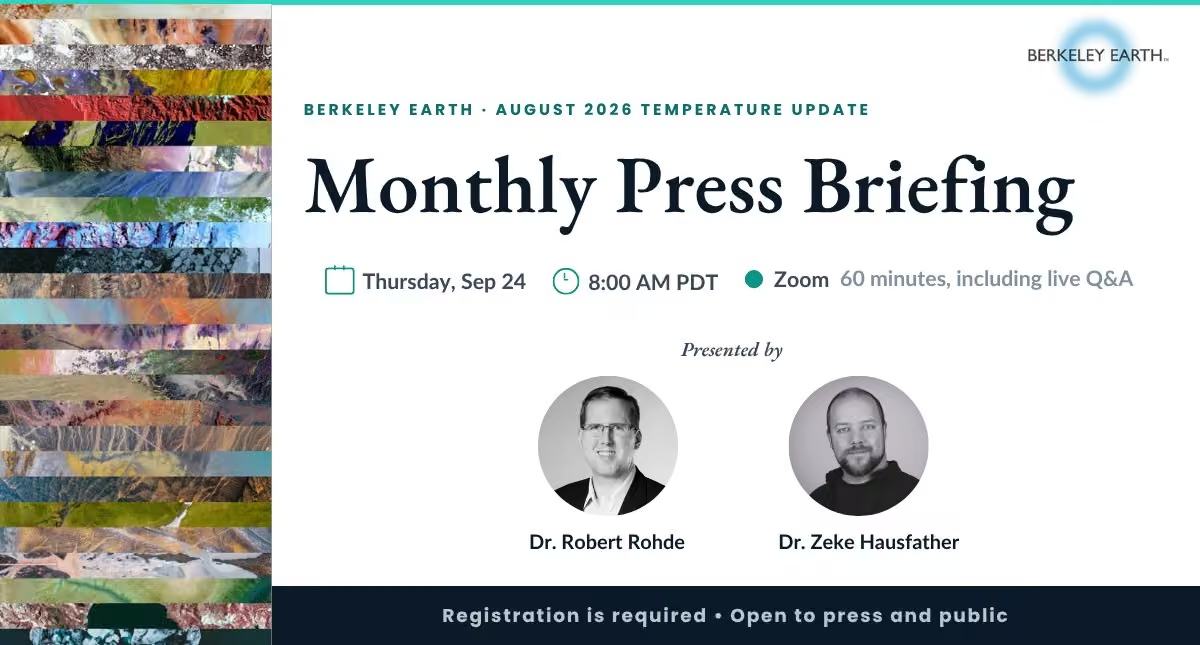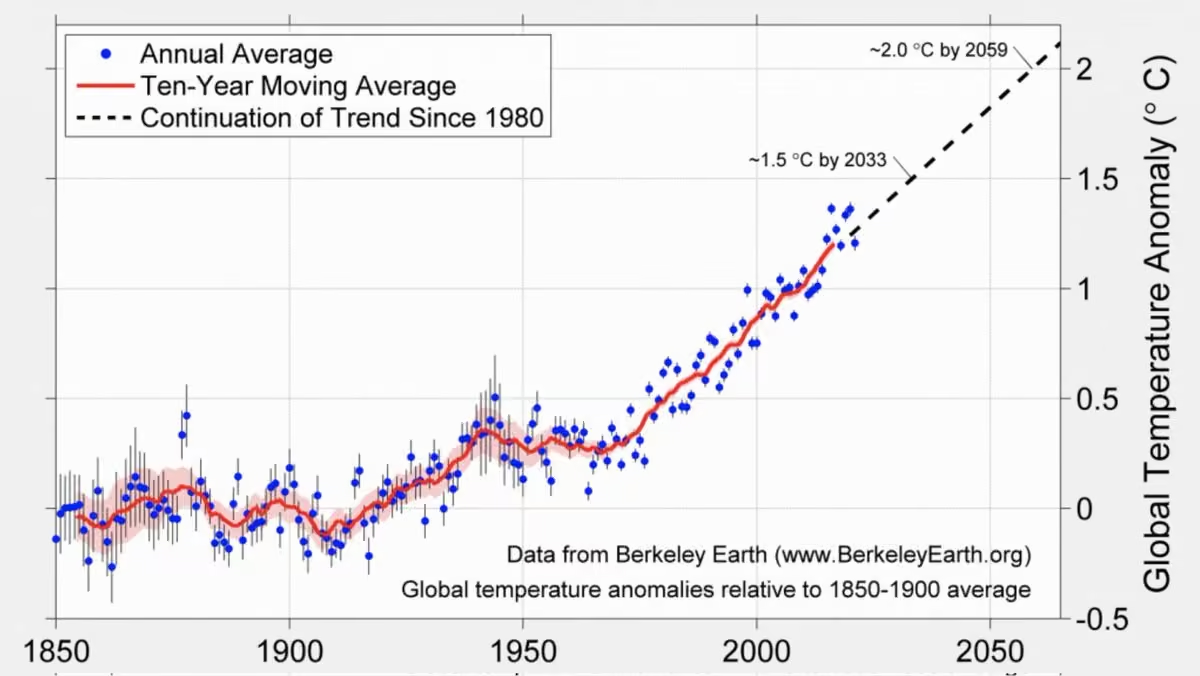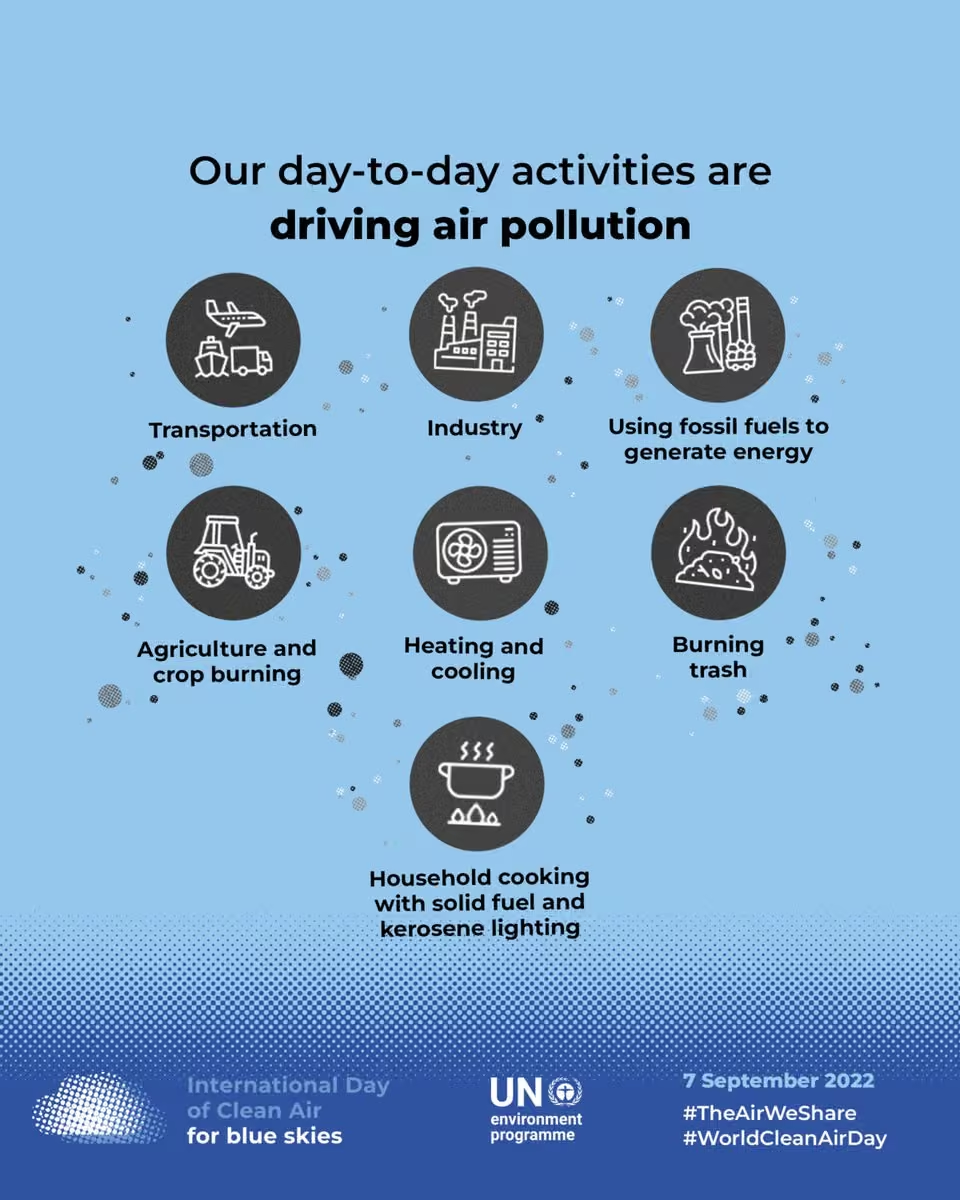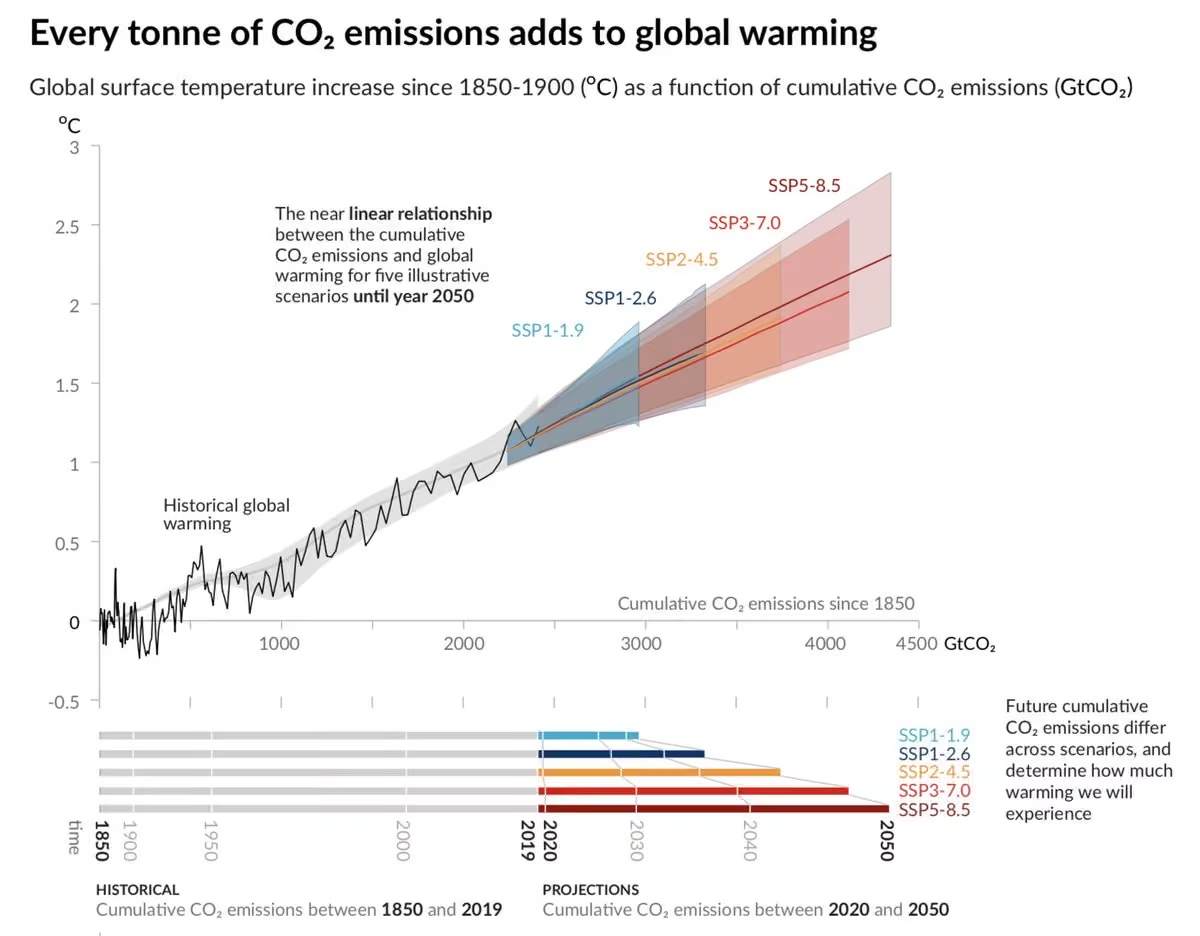
Join us tomorrow at @BerkeleyEarth for our monthly weather and climate update.
A record-breaking El Niño is rumbling and the rest of 2026 is poised to challenge records.
8 AM PT / 11 AM ET / 5 PM CET
docs.google.com/spreadsheets/d/1nIt93p-PwRib_J8ekOeYBuXCH…
Geared for journalists, but all are welcome.
Berkeley Earth
Berkeley Earth is a Berkeley, California-based independent 501(c)(3) non-profit focused on land temperature data analysis for climate science. Berkeley Earth was founded in early 2010 (originally called the Berkeley Earth Surface Temperature project) to address the major concerns from outside the scientific community regarding global warming and the instrumental temperature record. The project's stated aim was a "transparent approach, based on data analysis." In February 2013, Berkeley Earth became an independent non-profit. In August 2013, Berkeley Earth was granted 501(c)(3) tax-exempt status by the US government. The primary product is air temperatures over land, but they also produce a global dataset resulting from a merge of their land data with HadSST. More on Wikipedia
-
Berkeley Earth reposted
Dr. Robert Rohde
@RARohde

-
Berkeley Earth reposted
Gavin Newsom
@GavinNewsom
I just signed an executive order permanently declaring Artificial Intelligence “Artificial Intelligence” in California.
You’re welcome, America. -
Berkeley Earth reposted
Dr. Robert Rohde
@RARohde
Berkeley Earth will be holding our monthly climate briefing on Thursday.
Safe to say that there is a lot going on with weather and climate the moment.
8 AM PT / 11 AM ET / 5 PM CET
It is geared towards the media, but anyone is welcome.
us02web.zoom.us/webinar/register/WN_7GBkvWW7Qx2V3kls5bYRVA -
Berkeley Earth reposted
Zeke Hausfather
@hausfath
We will be having our Berkeley Earth monthly press briefing tomorrow at 8 AM Pacific, covering July global temperatures, the rapidly developing El Nino event, and what to expect for the remainder of 2026 and for 2027.
Register here to join: us02web.zoom.us/webinar/register/WN_510L1X0XSyelp_7hCc3eqA -
Berkeley Earth
@BerkeleyEarth
We are excited to announce our new climate data platform: Synthesis by Berkeley Earth
synthesis.berkeleyearth.org
It connects historical data (e.g. weather stations, city and regional averages) with bias-corrected climate model projections of the future.
Introduction 🧵Post not available here, view on X
Berkeley Earth
@BerkeleyEarth
The ambitious goal of the Synthesis platform is to easily connect past & future climate change, at a local scale, in a way that meets the needs of the general public and enables key stakeholders like policymakers, builders, and farmers prepare with adaptation and resilience.
16/
Berkeley Earth
@BerkeleyEarth
We're just getting started.
Synthesis historical data will be updated monthly alongside other Berkeley Earth datasets, and the set of features, cities, and options supported will gradually expand over time.
Thanks for your support.
synthesis.berkeleyearth.org -
Berkeley Earth reposted
Dr. Robert Rohde
@RARohde
Apologies for the late notice, but @BerkeleyEarth will be holding our monthly climate press briefing looking at May temperatures starting in about 30 minutes.
We'll also include some discussion of the current European heatwave.
Registration link: us02web.zoom.us/webinar/register/WN_bzigpKA2RWOFbJ7cOJV8Pg -
Berkeley Earth reposted
Dr. Robert Rohde
@RARohde
One frequently sees headlines that X is warming faster than the global average.
That's true of nearly everywhere that humans live, but only because humans nearly all live on land.
The process of global warming will generally warm land faster than the oceans. -
Berkeley Earth reposted
Dr. Robert Rohde
@RARohde
The transition last year from the old @BerkeleyEarth temperature analysis to the new high-resolution version doesn't make much difference for the global averages, but it is really useful when it comes to capturing local and regional details that would otherwise be missed.
-
Berkeley Earth reposted
Dr. Robert Rohde
@RARohde
We need to talk a bit about how utterly absurd the March heatwave was in the USA.
This heatwave would have been impossible without a boost from climate change, but even with climate change it remains a deeply unlikely event.
A thread looking at some of the numbers.
🧵 -
Berkeley Earth reposted
Dr. Robert Rohde
@RARohde
The current heatwave in the US Southwest is utterly destroying many records for this time of year.
Phoenix, Arizona has ~90 years of daily temperature data, and yet recent temperatures beat the previous March record by 5 °F (2.8 °C), and would actually tie the record for April. -
Berkeley Earth
@BerkeleyEarth
Upcoming Monthly Temperature Update
Today, Thursday March 19th at 8am PDT / 11am EDT / 4pm CET, the Berkeley Earth team will share updates from the February 2026 Temperature Report and discuss the latest global climate signals.
Register:
us02web.zoom.us/webinar/register/WN__w8UKx0KTnyNwDXYK40FSw -
Berkeley Earth reposted
Dr. Robert Rohde
@RARohde
For 50 years, global warming had a very consistent trend (+0.19 °C/decade) with a boring, predictable range of natural variations around it.
During the last three years, we've broken out above that range, suggesting the pace of change has quickened. -
Berkeley Earth reposted
Dr. Robert Rohde
@RARohde
While the world sometimes seems metaphorically on fire right now, global warming is still progressing as well.
In 2025, global warming delivered the 3rd warmest year since measurements began. A modest step down from 2024's records, but still well above 20th century norms. -
Berkeley Earth
@BerkeleyEarth
Berkeley Earth 2025 Annual Temperature Report
Jan 14 4am CET | Jan 13 10pm ET
Embargoed Materials: Jan 13 (TBD)
Media Sign up: mailchi.mp/berkeleyearth/media-signup-form
Press briefing + Q&A: Jan 14 at 8am PST | 5pm CET. Register: us02web.zoom.us/webinar/register/WN_ppriyzc5TP61-nxezamdqA
Inquiries: media@berkeleyearth.org -
Berkeley Earth
@BerkeleyEarth
Temperature Update for October 2025
Third warmest October in the instrumental record.
Similar conditions to September.
A weak La Niña returns in the Pacific.
2025 is very likely to be the 3rd warmest year.
🧵Post not available here, view on X
Berkeley Earth
@BerkeleyEarth
The current year is expected to conclude as the 3rd warmest in the instrumental record (94% chance), behind 2023 and 2024 and slightly above the long-term trend.
Further, it is unlikely that 2025 will exceed the 1.5 °C threshold.
11/
Berkeley Earth
@BerkeleyEarth
For more information on recent weather conditions in a climate context, please refer to our monthly report:
berkeleyearth.org/october-2025-temperature-update/
12/12 -
Berkeley Earth
@BerkeleyEarth
It's climate time again.
Tomorrow, Wednesday 11/19 at 8am PDT / 11am EDT / 5pm CET, the Berkeley Earth team will share updates from the October 2025 Temperature Report and discuss the latest global climate signals.
Register:
us02web.zoom.us/webinar/register/WN_eAg4V5HxSfiQvmX1yoxJWA -
Berkeley Earth reposted
Zeke Hausfather
@hausfath
September 2025 was the third warmest on record in the Berkeley Earth dataset. But this downplays how anomalous it was; without 2023 and 2024 this year would have been well above any prior records and well above the long-term trend:
-
Berkeley Earth
@BerkeleyEarth
It's climate time again.
On Thursday 10/23 at 8am PDT / 11am EDT / 5pm CET, the Berkeley Earth team will share updates from the September 2025 Temperature Report and discuss the latest global climate signals.
Register:
us02web.zoom.us/webinar/register/WN_p9iEVw9YQlepltKKNiCC8w -
Berkeley Earth reposted
Dr. Robert Rohde
@RARohde
The Northern Pacific Ocean is currently smashing temperature records.
And it is reaching these levels far earlier than the current generation of climate models had expected.
A short thread 🧵 -
Berkeley Earth
@BerkeleyEarth
Back with Our Monthly Press Briefing!
On Wed 9/17 at 8am PDT / 5pm CET, the Berkeley Earth team will share updates from the August 2025 Temperature Report and discuss the latest global climate signals.
Register: us02web.zoom.us/webinar/register/WN_-OtoTtSBSfSKuK64IJR1tQ -
Berkeley Earth
@BerkeleyEarth
Temperature Update for June 2025
Third warmest June in the instrumental record.
Similar conditions to May, but sharply cooler than earlier in 2025.
Neutral conditions in the Pacific.
2025 is very likely to be the 2nd or 3rd warmest year.
berkeleyearth.org/june-2025-temperature-update/
🧵Post not available here, view on X
Berkeley Earth
@BerkeleyEarth
The recent exceptional warming peak in 2023/2024 is dissipating, and near-term temperatures are expected to return closer to the long-term trend.
However, the rapid pace of man-made global warming is expected to continue, and more record years are inevitable.
12/
Berkeley Earth
@BerkeleyEarth
For more information on recent weather and climate in June 2025, please visit our monthly temperature report.
berkeleyearth.org/june-2025-temperature-update/
13/13 -
Berkeley Earth
@BerkeleyEarth
Berkeley Earth's next monthly climate briefing, looking back on June temperatures, will be held online on July 10th at 8 AM PT / 11 AM ET / 5 PM CET.
us02web.zoom.us/webinar/register/WN_43hHnS5bSsS5bUNOaZAchw
It's open for anyone, but geared toward the news media.
See you there. -
Berkeley Earth reposted
Zeke Hausfather
@hausfath
The argument that urban heat islands are biasing temperature records continually comes up. There is a long history of papers showing it's effect minimal globally (and the world is 70% oceans with no urbanization). My colleague @RARohde has a neat updated analysis for global land:
Dr. Robert Rohde
@RARohde
Classification of weather stations by the current average population density in the 5 km circle around the station.
67% of stations are in rural or very rural areas vs. 8% in urban areas.
Based on 52,000 stations in the Berkeley Earth archive.
1/ -
Berkeley Earth reposted
Dr. Robert Rohde
@RARohde
One of the most essential tests of science is reproducibility.
For this chart, I separated our weather station archive into 20 independent 5% samples and computed the global land average of each.
The samples vary a bit, but each one paints a similar picture of warming. -
Berkeley Earth
@BerkeleyEarth
Temperature Update for May 2025
Second warmest May since instrumental measurements began
Sharply cooler than April, especially on land
Neutral conditions continue in the Pacific
2025 is very likely to be the 2nd or 3rd warmest year, with only a small chance of a record.
🧵Post not available here, view on X
Berkeley Earth
@BerkeleyEarth
The recent exceptional warming peak in 2023/2024 is now likely dissipating, and near-term temperatures are expected to return closer to the long-term trend.
However, the rapid pace of man-made global warming is expected to continue, and more record years are inevitable.
11/
Berkeley Earth
@BerkeleyEarth
For more information on recent weather and climate in May 2025, please visit our monthly temperature report.
berkeleyearth.org/may-2025-temperature-update/
12/12 -
Berkeley Earth reposted
Zeke Hausfather
@hausfath
I just published an explainer on aerosols and their role in the climate that I've been working on for the past few months! It includes both how aerosols work, how emissions have changed, and how thats driven recent warming (link below).
-
Berkeley Earth reposted
Dr. Robert Rohde
@RARohde
Tomorrow will be the second press briefing in @BerkeleyEarth's new series discussing the monthly temperature report.
us02web.zoom.us/webinar/register/WN_k47CNFd5Q4aw6xJ13ptHFg
So if you want to learn a bit about how weather & climate have been evolving, join us.
Designed for journalists, but open to anyone. -
Berkeley Earth reposted
Dr. Robert Rohde
@RARohde
🚨 In one of the first direct blows to climate data, the National Snow and Ice Data Center is warning that they may discontinue updates to their sea ice data set.
Sea ice extent monitoring is a globally significant climate indicator and something I use directly in my work.
Ed Hawkins
@ed_hawkins
NSIDC announce a downgrading of service level for their sea ice index dataset which may mean no further updates.
These are globally important datasets for monitoring the ongoing changes to the climate. This is horribly damaging for global science.
nsidc.org/data/user-resources/data-announcements/user-not… -
Berkeley Earth
@BerkeleyEarth
March 2025 Temperature Update
Tied for warmest March since records began
The weak La Niña event has ended, but the future state is unclear.
Record low Arctic sea ice.
Roughly 1 in 3 chance that 2025 is record warm.
berkeleyearth.org/march-2025-temperature-update/
🧵Post not available here, view on X
Berkeley Earth
@BerkeleyEarth
Since the peak temperatures during the 2023/2024 El Niño event, ocean temperatures have been gradually cooling.
A short-lived and spatially small La Niña event formed a few months ago, but did not bring ocean averages below the long-term trend line before dissipating.
5/
Berkeley Earth
@BerkeleyEarth
The current neutral state in the oceans is expected to continue for at least a few months. It is unclear if it will be followed by a return to La Niña or a new El Niño.
Image from IRI/CPC: iri.columbia.edu/our-expertise/climate/forecasts/enso/cur…
6/Post not available here, view on X
Berkeley Earth
@BerkeleyEarth
For more information on weather and climate conditions in March 2025, please see our monthly temperature report.
berkeleyearth.org/march-2025-temperature-update/
8/
Berkeley Earth
@BerkeleyEarth
In addition, for the first time, Berkeley Earth offered a short press briefing discussing our monthly report.
You can watch the prepared presentation here:
www.youtube.com/watch?v=uRzVXA5ZNAY&ab_channel=BerkeleyEarth
This is motivated, in part, by NOAA cancelling their long-running monthly press briefings.
9/9 -
Berkeley Earth reposted
Dr. Robert Rohde
@RARohde
We will be trying something new at @BerkeleyEarth.
Alongside our written monthly climate report, we will be having a short press briefing (~10 mins with slides, followed by Q&A).
Tuesday April 15th, 11 AM ET / 8 AM PT / 5 PM CET
Register here:
us02web.zoom.us/webinar/register/WN_S7HDXdtcSZar0oZoYXObIw -
Berkeley Earth
@BerkeleyEarth
February 2025 Temperature Update
3rd warmest February since records began
Sharp tick down from January, especially on land
The weak La Niña may have finally brought some cooling, but is already showing signs of dissipating
berkeleyearth.org/february-2025-temperature-update/
🧵Post not available here, view on X
Berkeley Earth
@BerkeleyEarth
2025 has been expected to be a bit cooler than the record warmth in 2024; however, the relatively warm start of the year and possible early end of La Niña could allow record warmth to develop.
We currently estimate a 38% chance of 2025 being warmer than 2024.
7/
Berkeley Earth
@BerkeleyEarth
For more information on global temperature patterns in February 2025, please see our monthly temperature report:
berkeleyearth.org/february-2025-temperature-update/
8/8 -
Berkeley Earth
@BerkeleyEarth
🚨 Global Temperature Report for 2024 🚨
2024 was the hottest year since instrumental measurements began.
3.3 billion people had their locally warmest year.
The warming rate appears to have increased, likely due to reductions in man-made aerosol pollution and cloud cover.
🧵Post not available here, view on X
Berkeley Earth
@BerkeleyEarth
Why is the 2023/2024 spike larger than expected from the past trends?
The answer may be due to recent reductions in sulfur air pollution as well as reductions in low cloud cover.
Taken together the Earth is suddenly absorbing a bit more sunlight, and hence warming faster.
10/
Berkeley Earth
@BerkeleyEarth
In particular, recent efforts to reduce smog and protect human health by reducing sulfur air pollution (including especially the recent limits on sulfur in fuels used for maritime shipping), may have inadvertently led to additional global warming.
x.com/RARohde/status/1676529805502693377
11/
Dr. Robert Rohde
@RARohde
Three years ago, new international rules took effect limiting sulfur in the heavy fuels used by ships.
Practically overnight, maritime sulfur pollution dropped 85%. This is good for humans, as sulfur pollution is toxic, but probably had unintended climate consequences.
A 🧵Post not available here, view on X
Berkeley Earth
@BerkeleyEarth
But climate change does not end at 1.5 °C. Each additional increment of warming, 1.6 °C, 1.7 °C, etc., will bring further challenges.
To limit man-made climate change, urgent action will be needed to reduce greenhouse gas emissions.
15/
Berkeley Earth
@BerkeleyEarth
For additional discussion of global temperature patterns in 2024 and their relation to climate change please refer to our annual report:
berkeleyearth.org/global-temperature-report-for-2024/
16/16 -
Berkeley Earth
@BerkeleyEarth
It's almost time!
Berkeley Earth's Global Temperature Report for 2024 will come out tomorrow.
If you are a journalist who requested an embargoed copy, then you should have already received it.
For new requests, or if it didn't arrive, please contact media@berkeleyearth.org. -
Berkeley Earth
@BerkeleyEarth
Berkeley Earth will be releasing our annual Temperature Report on Friday.
It will summarize how global & regional temperatures behaved in 2024 and the current state of climate change.
For journalists who would like an embargoed early copy, please email media@berkeleyearth.org. -
Berkeley Earth
@BerkeleyEarth
Temperature Update for November 2024
2nd warmest November since instrumental records began
2024 is almost certain to set a new record for the warmest year
A weak La NIña is likely soon, but not certain
berkeleyearth.org/november-2024-temperature-update/
🧵
Berkeley Earth
@BerkeleyEarth
Nearly every month for the last 18 months has set or tied a monthly record, placing 2024 on a clear path to become the warmest year on record.
Each of the last 17 months has been at least 1.5 °C (2.7 °F) warmer than the corresponding 1850 to 1900 monthly average.
2/Post not available here, view on X
Berkeley Earth
@BerkeleyEarth
With the end of El Niño and recent relative cooling, we do not expect 2025 will be quite as warm as 2024, though 2025 is likely to remain as one of the warmest years.
An official forecast for 2025 will be issued alongside our annual report in January.
8/
Berkeley Earth
@BerkeleyEarth
For more information on weather conditions in November 2024 from a climate context, please refer to our monthly report:
berkeleyearth.org/november-2024-temperature-update/
9/9 -
Berkeley Earth
@BerkeleyEarth
Temperature Summary for October 2024
Nominally the 2nd warmest October since instrumental measurements began, but tied for 1st within uncertainties.
Record warm annual average in 2024 is almost certain.
Weak La Niña likely soon, but not certain.
berkeleyearth.org/october-2024-temperature-update/
🧵Post not available here, view on X
Berkeley Earth
@BerkeleyEarth
With 10 months completed, 2024 is almost certain to become a new record for the warmest year (>99% chance), beating the record set in 2023.
It will also almost certainly to exceed 1.5 °C (2.7 °C) above the preindustrial in our analysis.
9/
Berkeley Earth
@BerkeleyEarth
For more information about recent weather and climate conditions, please see our monthly temperature report.
berkeleyearth.org/october-2024-temperature-update/
10/10 -
Berkeley Earth reposted
Dr. Robert Rohde
@RARohde
A new paper led by Sebastian Sippel just appeared in Nature arguing that ocean temperature measurements in the early 20th century have a cold bias.
It's a fun story illustrating the process of scientific discovery, so let me talk about it a bit. 🧵
www.nature.com/articles/s41586-024-08230-1 -
Berkeley Earth
@BerkeleyEarth
August 2024 Temperature Update
The global average temperature in August 2024 was the warmest directly measured August.
The 15th consecutive monthly to break or tie monthly temperature records.
Almost certain that 2024 becomes the new warmest year.
berkeleyearth.org/august-2024-temperature-update/
🧵Post not available here, view on X
Berkeley Earth
@BerkeleyEarth
Relative to July, global average temperatures in August 2024 unexpectedly ticked up.
The last 15 months have each set or tied their corresponding monthly average temperature record, with the last 14 monthly at least 1.5 °C above the 1850-1900 average.
3/
Berkeley Earth
@BerkeleyEarth
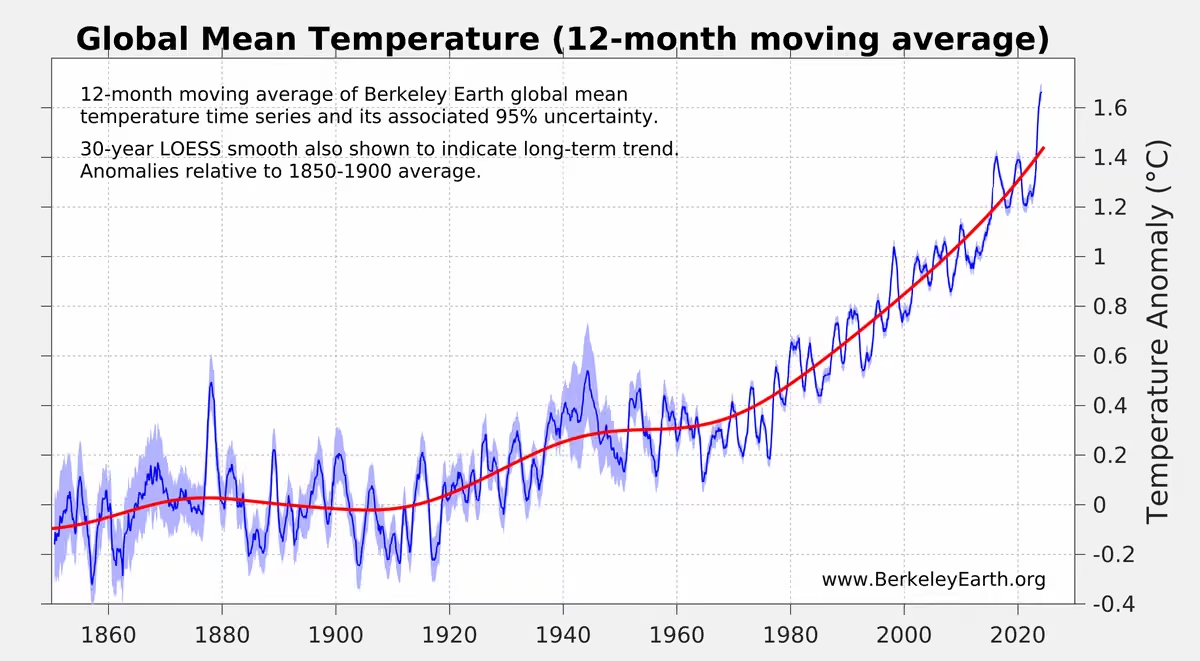
The 12-month moving average of global temperatures are the highest on record at 1.66 ± 0.07 °C (2.99 ± 0.13 °F) above the 1850-1900 average.
The recent short-term temperature spike, associated with El Niño and other causes, is also one of the largest on record.
4/
Berkeley Earth
@BerkeleyEarth
Warm conditions were widespread in August 2024, with particular large warm anomalies present in parts of Asia, North Africa, Southern Europe, Australia, Antarctica, and the North Atlantic and Indian Oceans.
5/
Berkeley Earth
@BerkeleyEarth
We estimate that 10.7% of the Earth’s surface experienced their locally warmest August average, including 12.0% of land areas.
By contrast, 0.03% of the Earth’s surface had their locally coldest August.
6/Post not available here, view on X
Berkeley Earth
@BerkeleyEarth
The forecast La Niña event developing late in 2024 will bring some relative cooling. But it is expected to be too little and too late to prevent 2024 from being a new record warm year.
However, if La Niña develops, it is likely that 2025 will be somewhat cooler than 2024.
10/
Berkeley Earth
@BerkeleyEarth
For more information on weather and climate conditions in August 2024, please refer to Berkeley Earth's monthly temperature report.
11/11
berkeleyearth.org/august-2024-temperature-update/ -
Berkeley Earth reposted
David Salesa 🌱
@DavidSalesaD
A pesar de estar en fase neutra de El Niño, julio de 2024 ha podido ser otro mes con récord de temperatura global.
Según @BerkeleyEarth, habrían sido 13 meses de récord y uno más igualándolo.
Según @NASAGISS, julio habría estado 0,02°C por encima del récord.
Berkeley Earth
@BerkeleyEarth
July 2024 Temperature Update
July 2024 ties July 2023 as the warmest July since instrumental measurements began
Warmest July on land, 2nd warmest in the oceans
La Niña expected in coming months
Very likely 2024 will be a new warmest year
berkeleyearth.org/july-2024-temperature-update/
🧵 -
Berkeley Earth
@BerkeleyEarth
July 2024 Temperature Update
July 2024 ties July 2023 as the warmest July since instrumental measurements began
Warmest July on land, 2nd warmest in the oceans
La Niña expected in coming months
Very likely 2024 will be a new warmest year
berkeleyearth.org/july-2024-temperature-update/
🧵
Berkeley Earth
@BerkeleyEarth
Every month since June 2023 — 14 consecutive months — have each either set a new monthly global average temperature record or tied the record.
Often new records occurred by large margins. The last 13 months are all at least 1.5 °C (2.7 °F) above the 1850-1900 average.
2/Post not available here, view on X
Berkeley Earth
@BerkeleyEarth
With seven months completed, we now consider it very likely (96% chance) that 2024 will surpass 2023 and become the warmest year in the instrumental history of global average temperatures.
7/
Berkeley Earth
@BerkeleyEarth
For more information on temperature and weather conditions in July 2024, please refer to our monthly temperature update:
berkeleyearth.org/july-2024-temperature-update/
8/8 -
Berkeley Earth reposted
Zeke Hausfather
@hausfath
The carbon cycle has been close to equilibrium through the Holocene; we know this because we measure atmospheric CO2 concentrations in ice cores. But in the past few centuries CO2 has increased by 50%, and is now at the highest level in millions of years due to human emissions.
-
Berkeley Earth reposted
Carbon Brief
@CarbonBrief
State of the climate: 2024 now very likely to be warmest year on record | @hausfath
Read here: www.carbonbrief.org/state-of-the-climate-2024-now-very-li… -
Berkeley Earth reposted
ARCHIVED - NASA Climate
@NASAClimate
July 22, 2024 was the hottest day on record. Average global temperatures for July 21 & 23 also exceeded the previous record.
The preliminary finding comes from @NASA atmospheric models that combine millions of land, sea, air & satellite observations. www.nasa.gov/earth/nasa-data-shows-july-22-was-earths-hot… -
Berkeley Earth reposted
Ed Hawkins
@ed_hawkins
Paris is warming
#showyourstripes
#olympics -
Berkeley Earth reposted
Zeke Hausfather
@hausfath
We just published our State of the Climate Q2 update over at @CarbonBrief: www.carbonbrief.org/state-of-the-climate-2024-now-very-li…
⬆️ Now a ~95% chance 2024 will be the warmest year on record.
⬆️ 13 month streak of records set between June 2023 and June 2024.
⬆️ July 22nd 2024 was the warmest day on record (in absolute terms).
⬇️ July 2024 will very likely come in below July 2023, breaking the record streak.
⬇️ The rest of 2024 is likely to be cooler than 2023 as El Nino fades and La Nina potentially develops.
⬇️ Second lowest Antarctic sea ice on record. -
Berkeley Earth
@BerkeleyEarth
Sunday's hottest-day-ever record lasted only one day, quickly one-upped by Mondays 17.15°C reading. Berkeley Earth's @hausfath spoke with Grist about what these records mean after a year of record heat, along with predictions for the remainder of 2024.
grist.org/climate/earth-sweltered-hottest-day-ever-record… -
Berkeley Earth reposted
Zeke Hausfather
@hausfath
There is a lot happening in the news these days, but it seems like we should be paying a bit more attention to the fact that the world just saw its hottest day on record (in absolute terms), coming on the back of 13 straight record setting months:
-
Berkeley Earth reposted
Dr. Robert Rohde
@RARohde
Over the last year, the Earth has seen one of the sharpest short-term temperature spikes on record, pushing @BerkeleyEarth's 12-month global average temperature to a stunning 1.68 °C (3.02 °F) above the 1850-1900 average.
Remember when 1998 seemed warm?
berkeleyearth.org/june-2024-temperature-update/ -
Berkeley Earth reposted
Dr. Robert Rohde
@RARohde
The Earth's mean temperature has a seasonal cycle that generally peaks in July, during Northern Hemisphere summer.
June 2024 was so warm that it not only exceeded every previously measured June, but also exceeded every previous July except for July 2023.
berkeleyearth.org/june-2024-temperature-update/ -
Berkeley Earth
@BerkeleyEarth
June 2024 Temperature Update 🧵
Warmest June since records began in 1850
13th consecutive record warm month, 12th at least 1.5 °C (2.7 °F) above preindustrial
El Niño ends, La Niña & modest cooling expected soon
2024 likely to become the warmest year
berkeleyearth.org/june-2024-temperature-update/
Berkeley Earth
@BerkeleyEarth
Boosted by El Niño, global warming, and other factors, each of the last 13 months have set new monthly global temperature records.
In addition, the last 12 months were each at least 1.5 °C (2.7 °F) warmer than Berkeley Earth's 1850-1900 baseline.
2/
Berkeley Earth
@BerkeleyEarth
This brings the 12-month moving average of Earth's global temperature to a record high of +1.68 °C (+3.02 °F) above the 1850-1900 baseline, far surpassing previous short-term warmign events.
In addition, the long-term trend line has recently passed 1.4 °C (2.5 °F).
3/
Berkeley Earth
@BerkeleyEarth
Anomalous warmth was widespread in June, including records for both the land and ocean average, and continent-average June records for Africa, Asia, and South America.
4/
Berkeley Earth
@BerkeleyEarth
The El Niño event that has helped fuel record warmth during the last 12 months has now ended, and ocean temperatures have gradually cooled since the start of the year.
5/
Berkeley Earth
@BerkeleyEarth
Official forecasts now expect a weak to moderate La Niña event will develop soon.
This will likely soon end the streak of record warmth and make the latter part of 2024 slightly cooler than the same months in 2023.
6/
Berkeley Earth
@BerkeleyEarth
The last 12 months, July 2023 to June 2024, have been the warmest July to June period on record for 29% of the Earth surface (including 44% of land).
Large parts of South America, Africa, Asia, Europe and the Atlantic had records for this 12-month period.
7/
Berkeley Earth
@BerkeleyEarth
With the end of El Niño, and La Niña expected, the current cycle of short-term warming has likely already peaked.
Even so, this year's initial warmth will likely still be enough to allow 2024 to surpass 2023 as the warmest directly measured year on record (92% likelihood).
8/
Berkeley Earth
@BerkeleyEarth
For more information on weather conditions in June 2024 and the associated climate context, please review our monthly temperature update.
berkeleyearth.org/june-2024-temperature-update/
9/9 -
Berkeley Earth reposted
Zeke Hausfather
@hausfath
Had a fun time chatting with the Berkeley Climate Change Network yesterday about why 2023 was so record hot: podcasters.spotify.com/pod/show/bruce-riordan/episodes/Wh…
-
Berkeley Earth reposted
Ed Hawkins
@ed_hawkins
A year of record breaking global temperatures
-
Berkeley Earth reposted
Zeke Hausfather
@hausfath
Global temperatures have finally started falling over the past few weeks, with the first week of July only 1.35C above preindustrial levels. Weather models expect a continued decline over the next seven days.
-
Berkeley Earth reposted
Zeke Hausfather
@hausfath
Recently we've seen a vibrant debate on when the world will firmly pass 1.5C.
Over at @CarbonBrief I weigh in with a new analysis, finding that it will most likely occur in the late 2020s or early 2030s in a world where emissions do not rapidly decrease. www.carbonbrief.org/analysis-what-record-global-heat-mean… -
Berkeley Earth
@BerkeleyEarth
Temperature Update for April 2024
Warmest April to be directly measured.
Our 12-month moving-average now stands at 1.65 °C (2.97 °F) above the 1850-1900 average.
El Niño weakens further, ending soon.
2024 likely be the warmest or 2nd warmest year.
berkeleyearth.org/april-2024-temperature-update/
1/
Berkeley Earth
@BerkeleyEarth
April 2024 was 1.67 ± 0.11 °C (3.01 ± 0.19 °F) above the 1850 to 1900 average.
This continues the 11-month streak of record monthly averages, and 10-month streak of averages at least 1.5 °C (2.7 °F) above the 1850-1900 average.
2/
Berkeley Earth
@BerkeleyEarth
Following 11 months of record warmth, our 12-month moving average of global temperatures has now reached 1.65 ± 0.07 °C (2.97 ± 0.13 °F) above the 1850 to 1900 average.
This deviation above the long-term global warming trend is similar to previous spikes, e.g. 1998 & 2016.
3/
Berkeley Earth
@BerkeleyEarth
The 12-month average has been locally record warm across very large portions of the Earth, including much of the tropics.
South America, Africa, and the Atlantic have been very strongly affected.
Only East Antarctica has seen relatively cool conditions over the same period.
4/
Berkeley Earth
@BerkeleyEarth
April 2024 continued the pattern of widespread warmth, including in Canada, Asia, Africa, South America, and the Atlantic.
Only Australia and East Antarctica provided notable exceptions to the current warmth.
5/Post not available here, view on X
Berkeley Earth
@BerkeleyEarth
With four months completed, 2024 is expected to be either the warmest or 2nd warmest year on record.
We currently estimate a 62% chance that 2024 is ultimately warmer than 2023, i.e. slightly better than a coin flip. These odds are little changed from previous estimates.
7/
Berkeley Earth
@BerkeleyEarth
For further information on recent temperature patterns in the context of long-term climate change, please visit our monthly report:
berkeleyearth.org/april-2024-temperature-update/
8/8 -
Berkeley Earth
@BerkeleyEarth
March 2024 Temperature Update
Nominally the warmest March since direct measurements began, though by a tiny margin (essentially ties March 2016).
El Niño declines, expected to end in coming months.
Very likely 2024 becomes the 1st or 2nd warmest year.
berkeleyearth.org/march-2024-temperature-update/Post not available here, view on X
Berkeley Earth
@BerkeleyEarth
The first three months of 2024 have been very warm, but the second-half of 2024 is expected to cool modestly.
We currently estimate a 59% chance that 2024 is ultimately warmer than 2023, with near certainty (99% chance) that it is either 1st or 2nd warmest measured year.
9/
Berkeley Earth
@BerkeleyEarth
For more information on global temperature conditions please see our monthly temperature report:
berkeleyearth.org/march-2024-temperature-update/
10/10 -
Berkeley Earth reposted
Zeke Hausfather
@hausfath
The rate of warming has increased notably over the past 15 years. This is not just natural variability – there is increasing evidence that the world is now warming faster than it has since 1970.
However, this should not come as a surprise; acceleration is exactly what our models expect: www.carbonbrief.org/factcheck-why-the-recent-acceleration… -
Berkeley Earth
@BerkeleyEarth
February 2024 Temperature Update
Warmest February since measurements began in 1850.
Warmest ocean average, 3rd warmest land average
9th consecutive record warm month
El Niño continues, but is now weakening. Likely to end mid-2024.
berkeleyearth.org/february-2024-temperature-update/
🧵
Berkeley Earth
@BerkeleyEarth
The global mean temperature in February 2024 was 1.76 ± 0.09 °C (3.17 ± 0.17 °F) above the 1850 to 1900 average.
This is the third largest monthly anomaly ever observed. However, it was somewhat cooler than in September of 2023.
2/
Berkeley Earth
@BerkeleyEarth
Warmth was widespread in February 2024, with particularly large anomalies in North America, Europe, and the Arctic.
3/Post not available here, view on X
Berkeley Earth
@BerkeleyEarth
The start of 2024 has been very warm.
The rest of 2024 is expected to cool somewhat, but 2024 is still forecast to be the warmest or second warmest year directly measured.
Chance of record annual warmth in 2024 is now estimated at 62%, essentially unchanged from January.
8/
Berkeley Earth
@BerkeleyEarth
For more information on temperature conditions in February of 2024, please refer to our monthly temperature update.
berkeleyearth.org/february-2024-temperature-update/
9/9 -
Berkeley Earth reposted
Zeke Hausfather
@hausfath
A few climate science jobs!
First up, our @BerkeleyEarth group is looking for a (fully remote) research scientist with experience working with and downscaling GCM data for a 6-12 month grant funded position: berkeleyearth.org/research-scientists-climate-science-gcm… -
Berkeley Earth
@BerkeleyEarth
Want to work with @BerkeleyEarth?
We are looking to hire a climate scientist with experience working with and downscaling GCM data for a 6-12 month grant funded position.
This position is fully remote.
Additional details provided here:
berkeleyearth.org/research-scientists-climate-science-gcm… -
Berkeley Earth
@BerkeleyEarth
Due to an averaging error, one of the figures in our Annual Report gave slightly inaccurate values for Earth's absorbed and outgoing radiation, and misstated Earth's Energy Imbalance. A corrected figure appears below.
berkeleyearth.org/global-temperature-report-for-2023/ -
Berkeley Earth
@BerkeleyEarth
January 2024 Temperature Update
2024 had the globally warmest January since 1850
Also warmest in the ocean, 3rd warmest on land
Strong El Niño continues, but weakening & likely ends mid-year.
Very likely 2024 becomes the warmest or 2nd warmest year.
berkeleyearth.org/january-2024-temperature-update/Post not available here, view on X
Berkeley Earth
@BerkeleyEarth
Boosted by El Niño, 2024 has started quite warm and this is expected to continue.
Our current forecast range expects that 2024 will become either the warmest (60% chance) or 2nd warmest (39% chance) year on record, with only a slight chance of any lower outcome.
6/
Berkeley Earth
@BerkeleyEarth
To read more about conditions in January 2024, please visit our monthly temperature report:
berkeleyearth.org/january-2024-temperature-update/
7/7 -
Berkeley Earth
@BerkeleyEarth
🚨Berkeley Earth's 2023 Global Temperature Report is now available.
2023 was by far the hottest year since direct observations began.
2023 was 1.54 ± 0.06 °C (2.77 ± 0.11 °F) above our 1850-1900 average, the first year above 1.5 °C (2.7 °F).
berkeleyearth.org/global-temperature-report-for-2023/
🧵Post not available here, view on X
Berkeley Earth
@BerkeleyEarth
Unfortunately, carbon dioxide emissions in 2023 set a new record high, growing +1.1% from 2022.
Little time remains, and meeting the stated climate goals will be impossible without rapid action.
Image from the Global Carbon Project: globalcarbonbudget.org/carbonbudget2023/
12/
Berkeley Earth
@BerkeleyEarth
Over the last 40 years, surface warming has progressed at a more or less uniform pace of ~0.2 °C / decade.
2023 is a strong anomaly, but still could be consistent with that trend.
However, 2023 adds to ongoing concerns that global warming may be posed for acceleration.
13/Post not available here, view on X
Berkeley Earth
@BerkeleyEarth
Because datasets of global warming moderately disagree, there will necessarily be some uncertainty about when global warming truly exceeds 1.5 °C.
However, every dataset shows 2023 as new record high, and the pace of warming will carry all the estimates above 1.5 °C soon.
19/
Berkeley Earth
@BerkeleyEarth
For more information about weather and climate conditions in 2023, please refer to our global temperature report:
berkeleyearth.org/global-temperature-report-for-2023
20/20 -
Berkeley Earth
@BerkeleyEarth
Berkeley Earth's Annual Temperature Report is expected to appear on January 12th.
Embargoed copies will be available to journalists a couple days beforehand.
If any journalists would like to be added to our distribution list, please email media@berkeleyearth.org. -
Berkeley Earth
@BerkeleyEarth
Berkeley Earth November Temperature Update
The warmest November since measurements began in 1850, with records for both land and ocean individually.
Essentially certain that 2023 becomes the warmest year, and very likely to exceed 1.5 °C in our dataset.
berkeleyearth.org/november-2023-temperature-update/Post not available here, view on X
Berkeley Earth
@BerkeleyEarth
In our estimation, 51 countries set November average temperature records, including Algeria, Armenia, Azerbaijan, Bolivia, Brazil, Ecuador, Egypt, Nigeria, Saudi Arabia, and Venezuela
A few, like Bolivia, had records that exceeded all previous Novembers by a large margin.
5/
Berkeley Earth
@BerkeleyEarth
Looked at seasonally, the last three months have not only been the warmest September to November on record, but they are also the largest deviation from trend in at least 100 years.
A truly abrupt spike in global temperatures.
6/
Berkeley Earth
@BerkeleyEarth
Average temperatures over the last three months set a new September-November record high for 19% of the Earth's surface, including 32% of the land surface.
The Atlantic, South America, North Africa, Middle East, and Asia were especially affected.
7/
Berkeley Earth
@BerkeleyEarth
Man-made global warming largely sets the long-term trend, but abrupt recent warming is partly due to natural variability, including the transition to a strong El Niño.
Combined with other natural and man-made factors, this has made 2023 into a record-breaking year.
8/
Berkeley Earth
@BerkeleyEarth
With 11 months completed, 2023 is virtually certain to set a new annual average temperature record.
In the Berkeley Earth analysis, it is also very likely to exceed 1.5 °C (2.7 °F) above the 1850-1900 baseline.
9/Post not available here, view on X
Berkeley Earth
@BerkeleyEarth
Climate negotiators often talk about limiting warming to no more than 1.5 °C above preindustrial.
They are referring to long-term averages (not single months or years), but we are already getting a taste of what a world above 1.5 °C looks like.
Little time remains to act.
11/
Berkeley Earth
@BerkeleyEarth
For more information on temperature patterns in November 2023, please refer to our monthly temperature report.
berkeleyearth.org/november-2023-temperature-update/
12/12 -
Berkeley Earth
@BerkeleyEarth
September 2023 Temperature Update 🔥
Warmest September & largest anomaly ever measured, shattering previous September record.
Warming since August concentrated in polar regions.
Near certain 2023 becomes the warmest year.
Likely 2023 exceeds 1.5 °C.
berkeleyearth.org/september-2023-temperature-update/Post not available here, view on X
Berkeley Earth
@BerkeleyEarth
Both land and ocean individually set records for September, with a well-developed El Niño, and almost no regions of relative cooling.
The warmth around Antarctica is especially sharp and contributes heavily to the increase in global mean since August.
5/Post not available here, view on X
Berkeley Earth
@BerkeleyEarth
The abrupt warming in September – due primarily to Antarctica – came on top of already extraordinary warmth in August.
The Antarctic changes might simply reflect natural polar variability but it added to a system already greatly warmed by man-made and natural causes.
10/Post not available here, view on X
Berkeley Earth
@BerkeleyEarth
In addition, we wish to note that different analysis groups have slightly different estimates of long-term trends.
It is possible, and in this case likely, that one or two may have final values for 2023 that slightly exceed 1.5 °C while others are slightly below 1.5 °C.
14/
Berkeley Earth
@BerkeleyEarth
For additional discussion and analysis related to the record-shattering temperatures in September, please refer to the Berkeley Earth temperature update.
berkeleyearth.org/september-2023-temperature-update/
15/15 -
Berkeley Earth reposted
Zeke Hausfather
@hausfath
Its hard to overstate just how exceptionally high global temperatures are at the moment. They have blown past anything we've previously experienced by a huge margin.
Over at The Climate Brink, we try and visualize this summer of extremes in seven charts. www.theclimatebrink.com/p/visualizing-a-summer-of-extremes -
Berkeley Earth
@BerkeleyEarth
August 2023 Temperature Update
By far the warmest August since direct measurements began.
Warmest for both land & ocean.
Strengthening El Niño.
Nearly certain 2023 becomes the warmest year directly measured.
May see a +1.5 °C annual excess in 2023.
berkeleyearth.org/august-2023-temperature-update/Post not available here, view on X
Berkeley Earth
@BerkeleyEarth
This current period of record warmth is driven by a combination of man-made & natural factors.
The most significant of these are man-made global warming, due to accumulating greenhouse gases, and the natural variability associated with the transition from La Niña to El Niño.
9/
Berkeley Earth
@BerkeleyEarth
For more information on temperature patterns during August 2023, please see our monthly temperature report:
berkeleyearth.org/august-2023-temperature-update/
10/10 -
Berkeley Earth
@BerkeleyEarth
Temperature Update for July 2023
Warmest July — and warmest month of any kind — in the Instrumental record.
Warmest July for both land and ocean.
El Niño continues to strengthen.
Almost certain that 2023 will become a record warm year.
berkeleyearth.org/july-2023-temperature-update/
Berkeley Earth
@BerkeleyEarth
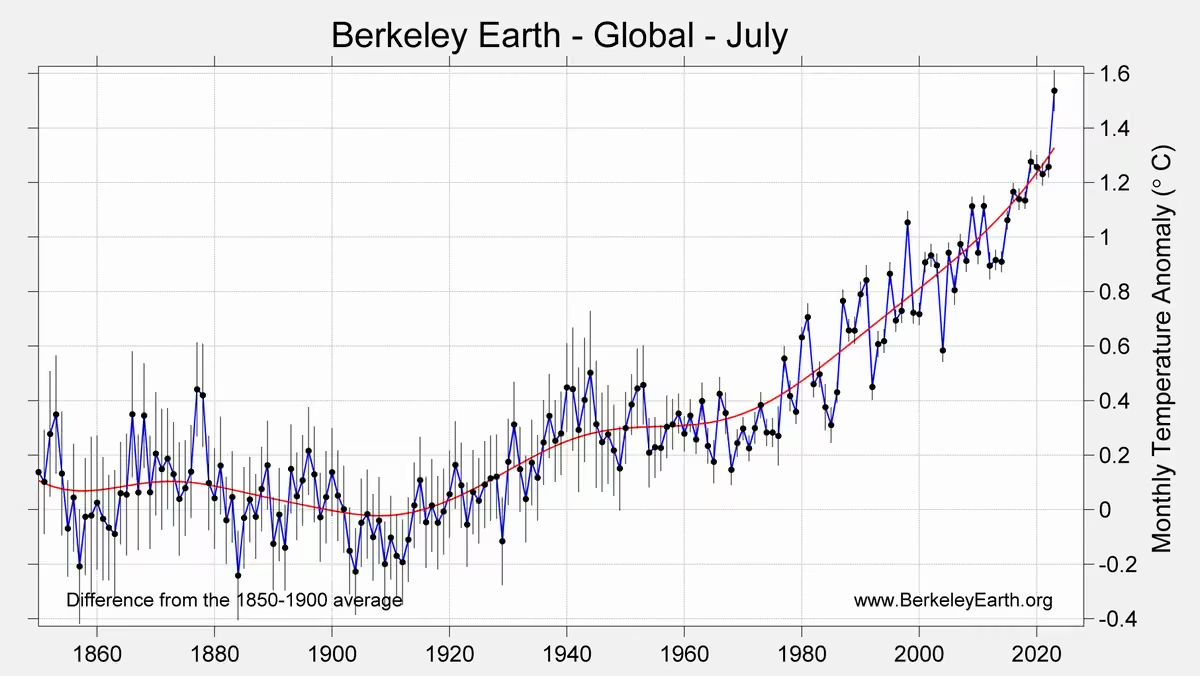
The global average temperature in July — 1.54 ± 0.09 °C (2.77 ± 0.16 °F) above the 1850 to 1900 average —greatly exceeded all previously measured Julys.
It is the 11th time, and first Northern summer month, with a monthly anomaly greater than 1.5 °C (2.7 °F).
2/
Berkeley Earth
@BerkeleyEarth
Both land and ocean individually set new records for July, but the oceans in particular blew away the previous mark.
The strengthening El Niño in the Pacific, as well as extraordinary warmth in the North Atlantic, created this new record.
3/Post not available here, view on X
Berkeley Earth
@BerkeleyEarth
A combination of man-made and natural factors has pushed 2023 towards record warmth.
We now estimate a 99% likelihood that 2023 will set a new record for the warmest annual average.
10/
Berkeley Earth
@BerkeleyEarth
For more information on conditions in July 2023, please refer to Berkeley Earth's monthly temperature report.
berkeleyearth.org/july-2023-temperature-update/
11/11 -
Berkeley Earth
@BerkeleyEarth
June 2023 Temperature Update
Warmest June on record globally, and in the oceans, since thermometer-based analysis began (1850).
Nominally 2nd warmest June on land, but tied for first within the uncertainty.
Likely that 2023 becomes a record warm year.
berkeleyearth.org/june-2023-temperature-update/Post not available here, view on X
Berkeley Earth
@BerkeleyEarth
On the back of an exceptionally warm June, and a rising El Niño, it is now likely that 2023 will have the warmest annual-average since instrumental measurements began.
Chance of a new annual-average record 81%.
10/
Berkeley Earth
@BerkeleyEarth
Additional details can be found in Berkeley Earth's June temperature report:
berkeleyearth.org/june-2023-temperature-update/
11/11 -
Berkeley Earth reposted
Dr. Robert Rohde
@RARohde
NCEP has placed Earth's average temperature yesterday as the hottest single day thus far measured by humans.
This is driven by the combination of El Niño on top of global warming, and we may well see a few even warmer days over the next 6 weeks. -
Berkeley Earth reposted
Dr. Robert Rohde
@RARohde
Time for a bit of climate hope.
Solar power is the fastest growing energy technology in history, and wind is not far behind.
This graph shows how rapidly different energy technologies expanded after reaching their first exajoule of energy production, on a logarithmic scale. -
Berkeley Earth reposted
Dr. Robert Rohde
@RARohde
Smoke pollution from wildfires in Canada returns to the USA with "unhealthy" and "very unhealthy" levels of particulates affecting the midwest and parts of the east coast.
-
Berkeley Earth reposted
Dr. Robert Rohde
@RARohde
June 21st is #showyourstripes Day.
It is an annual event where individuals, meteorologists, & organizations promote discussion about global warming by using @ed_hawkins iconic warming stripes.
Here is my animation showing local stripes around the world.
showyourstripes.info -
Berkeley Earth
@BerkeleyEarth
May 2023 Temperature Update
3rd warmest May since measurements began in 1850
Warmest May in the oceans, 10th warmest on land
Building towards El Niño (officially begins in June)
Slightly more likely than not that 2023 will become a record warm year
berkeleyearth.org/may-2023-temperature-update/Post not available here, view on X
Berkeley Earth
@BerkeleyEarth
The westward spread of warmth in the Equatorial Pacific has been part of the developing El Niño.
NOAA's Climate Prediction Center officially declared El Niño to have begun in their June 8th advisory.
iri.columbia.edu/our-expertise/climate/forecasts/enso/cur…
5/
Berkeley Earth
@BerkeleyEarth
El Niño is expected to continue through the rest of this year and well into next year, though models continue to disagree on how strong an event to expect.
This is expected to boost global temperatures in 2023 and 2024.
6/
Berkeley Earth
@BerkeleyEarth
After several warm months – and with the possibility of a strong El Niño – 2023 is expected to challenge the record for the warmest year ever directly measured.
We estimate the probability of 2023 setting a new record for the warmest year at 54%.
7/
Berkeley Earth
@BerkeleyEarth
For more information on temperature conditions in May 2023, please refer to our monthly temperature report:
berkeleyearth.org/may-2023-temperature-update/
8/8 -
Berkeley Earth reposted
Jeff Berardelli
@WeatherProf
Great animation by NOAA showing the gradual evolution away from La Nina and (probably) towards El Nino soon. Time will tell.
-
Berkeley Earth reposted
Zeke Hausfather
@hausfath
Most of the heat trapped by greenhouse gases ends up in the ocean.
Ocean heat content has increased at a much more rapid rate since 1990. Last year alone (2022) if added around 19 times more heat than the total energy produced by all human activities. www.carbonbrief.org/state-of-the-climate-how-the-world-wa… -
Berkeley Earth reposted
Dr. Robert Rohde
@RARohde
Animated map showing long-duration weather stations setting daily, monthly, and all-time record highs and lows in 2022.
Weather variations continue to routinely set both new highs and lows, but as global warming progresses new highs have become much more common than new lows. -
Berkeley Earth reposted
Prof. Eliot Jacobson
@EliotJacobson
This is crazy.
And just how far above the 1982-2023 sea surface temperature average for the North Atlantic is the year 2023?
Data: climatereanalyzer.org/clim/sst_daily/json/oisst2.1_natlan… -
Berkeley Earth reposted
Carbon Brief
@CarbonBrief
Analysis: China’s CO2 emissions hit Q1 record high after 4% rise in early 2023 | @laurimyllyvirta @bobolan1219
Read: www.carbonbrief.org/analysis-chinas-co2-emissions-hit-q1-… -
Berkeley Earth reposted
Zack Labe
@ZLabe
Well the extreme event in the #antarctic certainly continues...
+ More visualizations of Antarctic sea ice: zacklabe.com/antarctic-sea-ice-extentconcentration/ -
Berkeley Earth
@BerkeleyEarth
April 2023 Temperature Update
4th warmest April since records began 1850.
Warmest month on record for the oceans.
Transition to El Niño likely within a few months.
2023 is now slightly more likely than not to become a record warm year (56% chance).
berkeleyearth.org/april-2023-temperature-update/Post not available here, view on X
Berkeley Earth
@BerkeleyEarth
The warmth in March and April, combined with the development of a likely El Niño, has increased the forecast range for the rest of 2023.
We now estimate that it is slightly more likely than not that 2023 becomes the warmest year on record (56% chance).
5/
Berkeley Earth
@BerkeleyEarth
For additional information about temperature patterns in April 2023, please refer to our monthly report:
berkeleyearth.org/april-2023-temperature-update/
6/6 -
Berkeley Earth
@BerkeleyEarth
Wildfires in Canada — raging for days in a record-setting heatwave —are sending swaths of particulate-filled unhealthy air south into the United States. Check your local air quality in real-time: berkeleyearth.org/air-pollution-overview/ #airpollution #aqi #wildfires #heatwave
-
Berkeley Earth reposted
Ed Hawkins
@ed_hawkins
What can be said about when we might cross the 1.5°C global warming level?
New analysis from @metoffice & others says that there is a 66% chance that a year between 2023 and 2027 might be above this level
www.bbc.co.uk/news/science-environment-65602293 -
Berkeley Earth reposted
Zack Labe
@ZLabe
🚨 Yikes - new record high! Global ocean heat content now updated through March 2023...
[Data (anomalies) & methods from @NOAANCEI: www.ncei.noaa.gov/access/global-ocean-heat-content/] -
Berkeley Earth reposted
World Weather Attribution
@WWAttribution
Climate change is a total gamechanger for heatwaves.
This animation breaks down our recent study on the late April heatwave that impacted Spain, Portugal, Morocco, and Algeria, highlighting how much hotter and more likely climate change made the event. -
Berkeley Earth reposted
Dr. Robert Rohde
@RARohde
A few days ago, the warm air mass that has been setting records across Western Canada did something quite unusual.
It pushed northeast to the small settlement of Arviat on the still frozen Hudson Bay.
There it broke the previous record for this time of year by >10° C (20 °F). -
Berkeley Earth
@BerkeleyEarth
Intense heat wave grips Pacific Northwest: Over 11 million under heat advisories - Axios apple.news/AIhQqDMGlRMi8iJ5jRfCFzQ
-
Berkeley Earth reposted
Scott Duncan
@ScottDuncanWX
On the frozen edges of Hudson Bay, something remarkable just happened.
A weather station smashed its monthly heat record by nearly 7°C. Even in a warming world, this magnitude of record-break is enormous.
A short THREAD... -
Berkeley Earth reposted
Prof. Katharine Hayhoe
@KHayhoe
This iconic graph tracks how rapidly our planet is warming. Yet every time it's shared on Twitter, someone always asks, "Why does it begin in 1850?"
The answer is simple: it's when we first had enough thermometers to compute a truly representative global temperature average. -
Berkeley Earth
@BerkeleyEarth
Find real-time air pollution data at berkeleyearth.org. #airquality
Carbon Brief
@CarbonBrief
Analysis: China’s CO2 emissions hit Q1 record high after 4% rise in early 2023 | @laurimyllyvirta @bobolan1219
Read here: www.carbonbrief.org/analysis-chinas-co2-emissions-hit-q1-… -
Berkeley Earth reposted
Jeff Berardelli
@WeatherProf
Remarkable!! All areas in magenta indicate a record breaking mid-upper level (500mb) ridge by the weekend. This is an immense heat dome maxing out at 4.2 standard deviations (sigma) from the mean. A ridge magnitude on par with June 2021🧵
-
Berkeley Earth reposted
Zeke Hausfather
@hausfath
Those skeptical of climate change have a new favorite graph: the temperature record from the pristine U.S. climate reference network from 2005-2022.
Its just a shame that it shows the exact opposite of what they think it shows, as I discuss in a new post: theclimatebrink.substack.com/p/the-most-accurate-record-o… -
Berkeley Earth reposted
Carbon Brief
@CarbonBrief
Analysis: Half the global population saw all-time record temperatures over past decade | @hausfath @tomoprater
Read here: interactive.carbonbrief.org/half-global-population-saw-al… -
Berkeley Earth reposted
Chris Colose
@CColose
Since it's in the news, how does ENSO affect global temperature? Take a global-scale temperature product like GISTEMP, remove the trend, and sort by El Nino, La Nina, or “neutral” periods, accounting for different lag times at each point. You get something like this.
-
Berkeley Earth reposted
Carbon Brief
@CarbonBrief
State of the climate: Growing El Niño threatens more extreme heat in 2023 | @hausfath
Read here: www.carbonbrief.org/state-of-the-climate-growing-el-nino-… -
Berkeley Earth reposted
Carbon Brief
@CarbonBrief
Analysis: How well have climate models projected global warming? | @hausfath #cbarchive
Read here: www.carbonbrief.org/analysis-how-well-have-climate-models… -
Berkeley Earth reposted
Wilderness Committee
@wildernews
“The oceans are enormous, so they don’t warm very quickly ordinarily,” Robert Rohde, a physicist at @BerkeleyEarth, told @grist. “This is an unusually abrupt rise to a level that’s above what it’s been at any previous year.” #climatechange
grist.org/extreme-weather/a-record-warm-streak-in-the-oce… -
Berkeley Earth
@BerkeleyEarth
Wildfires in Canada send air quality plummeting. Fin real-time air pollution data at berkeleyearth.org. #aqi #airquality #pollution #fires
Nathan Howes TWN
@HowesNathan
(2/2) The current air quality in Grande Prairie is quite hazardous, as evident with the previous image. It has concentrations beyond 250 micrograms, equivalent to smoking half a pack of cigarettes each day, according to a @BerkeleyEarth study. #abstorm #abfire #abfires #abwx
-
Berkeley Earth
@BerkeleyEarth
The impacts of rising ocean temps are explained in this recent @WIRED piece: "What happens in the sea doesn’t stay in the sea." Find out how record high ocean temps could impact life on land: www.wired.com/story/an-ominous-heating-event-is-unfolding… #climatechange
-
Berkeley Earth reposted
Zeke Hausfather
@hausfath
I'm excited to announce the launch of a new substack with @AndrewDessler! We are calling it The Climate Brink, as we are on the brink of both severe climate change and an energy transition.
My first post explores the odds if 2024 will be above 1.5C! theclimatebrink.substack.com/p/will-global-temperatures-e… -
Berkeley Earth reposted
Dinah Voyles Pulver
@DinahVP
“We have above average temperatures nearly everywhere in the ocean," says @RARohde
"How much warmth are we going to get if we really get a proper El Nino?” he wondered. "We could be heading up from here, and here is already very warm conditions.”
www.usatoday.com/story/news/nation/2023/04/27/high-global… -
Berkeley Earth reposted
Zeke Hausfather
@hausfath
When I post our @BerkeleyEarth global temperature record, I always get complaints that 1930s were really the warmest decade and our data is wrong.
But while the summers in the 1930s were warm in the US, thats only 2% of the planet. Globally they were nothing compared to today: -
Berkeley Earth reposted
Zeke Hausfather
@hausfath
For more details and interactive graphs, read the full Q1 State of the Climate update over at @CarbonBrief: www.carbonbrief.org/state-of-the-climate-growing-el-nino-…
-
Berkeley Earth reposted
Zeke Hausfather
@hausfath
A growing El Niño threatens more extreme heat this year. Over at @CarbonBrief we take a look at the first three months, and estimate that 2023 is very likely to end up between the warmest year and the sixth warmest on record, with a best estimate of fourth www.carbonbrief.org/state-of-the-climate-growing-el-nino-…
-
Berkeley Earth reposted
Dr. Robert Rohde
@RARohde
New Spanish national temperature record for April.
A scorching and unseasonable blast of hot air from North Africa has pushed Córdoba airport to 38.8 °C (101.8 °F), almost 5 °C (9 °F) warmer than the previous April record at this location. -
Berkeley Earth reposted
Harry Stevens
@Harry_Stevens
🌴 Could palmettos grow in D.C. by the end of the century?
For my Climate Lab column, I made a tool that lets you pick from a list of over 900 tree species to see how their ranges are projected to move by the end of the century.
Check it out: www.washingtonpost.com/climate-environment/interactive/20… -
Berkeley Earth reposted
IPCC
@IPCC_CH
Current policies make it likely that #globalwarming will exceed 1.5°C during the 21st century & make it harder to limit warming below 2°C.
“This Synthesis Report underscores the urgency of taking more ambitious action.” – Hoesung Lee, #ipcc Chair
👉 www.ipcc.ch/report/ar6/syr/ -
Berkeley Earth reposted
IPCC
@IPCC_CH
Our lifestyles and patterns of consumption and production across regions, between and within countries, and among individuals have contributed to emissions of #greenhousegases that have unequivocally caused #globalwarming.
Read #ipcc's Synthesis Report 👉 www.ipcc.ch/report/ar6/syr/ -
Berkeley Earth reposted
Colin McCarthy
@US_Stormwatch
Ocean temperatures have been at all-time record warm levels for 42 straight days.
This is completed unprecedented in the modern history of Earth. -
Berkeley Earth reposted
Dr. Robert Rohde
@RARohde
If you can change the composition of a planet's atmosphere, then you can change that planet's climate.
After a long stability, the abundance of carbon dioxide – the second most important greenhouse gas after water vapor – has been driven up by 50% in little more than a century. -
Berkeley Earth
@BerkeleyEarth
Here's where extreme heat could be devastating in upcoming years, with developing countries particularly at-risk, @Nature study. apple.news/ACHJ96AeDR7SCvAmJ5F37tA
-
Berkeley Earth
@BerkeleyEarth
A record-smashing heatwave is expected in Spain this week. This graphic shows historical warming trends & predictions that depend on whether carbon emissions are significantly reduced. How much has your country warmed? berkeleyearth.org #spain #heatwave #climatechange
-
Berkeley Earth reposted
Dr. Robert Rohde
@RARohde
For example, the IPCC estimated that it will take ~10,000 years to stabilize sea level at the higher carbon dioxide levels that are expected.
Over thousands of years, even the best outcomes add ~7 m (22 ft) to the oceans, the worst are >35 m (115 ft). -
Berkeley Earth reposted
Dr. Robert Rohde
@RARohde
Sea level has stayed in a narrow range during the whole history of civilization.
But the end of the last ice age shows us that once ice sheets become unstable, they can keep melting and rising sea level for a long time.
+120 m (400 ft) over 8,000 years after the last ice age. -
Berkeley Earth reposted
Zeke Hausfather
@hausfath
In a new interactive analysis over at @CarbonBrief, @tomoprater and I show how all-time record heat (e.g. the hottest temperature on record) has swept the globe in the past decade, with about half the global population seeing new records: interactive.carbonbrief.org/half-global-population-saw-al…
-
Berkeley Earth
@BerkeleyEarth
We 💚 Earth Day, but at Berkeley Earth we spend 365 days a year thinking about ways our data can help policymakers make better decisions @ mitigating climate change. Please support our work w/ a donation in honor of the 🌎.donate.berkeleyearth.org #nonprofit #earthday
-
Berkeley Earth reposted
Ed Hawkins
@ed_hawkins
Do you use the Warming Stripes to communicate about climate change?
The www.showyourstripes.info website has now been fully updated with graphics that include 2022.
Many graphics also now extend further back in time, and 450+ global cities have been included.
#showyourstripes -
Berkeley Earth
@BerkeleyEarth
Nearly 1-in-5 Americans live in communities with harmful air quality. Here’s who is most affected. - Inside Climate News (Visit berkeleyearth.org for real-time air quality data) apple.news/A4S5_tUpeQkyxyhM6bWhdQw
-
Berkeley Earth reposted
Zeke Hausfather
@hausfath
Great piece by @leahstokes today on the need to ensure that the IRA's green hydrogen subsidies are actually creating additional clean energy, not just cannibalizing existing sources.
Energy intensive CDR (DAC, DOR, OAE) will face this exact same issue! www.nytimes.com/2023/04/14/opinion/hydrogen-fuel-tax-cred… -
Berkeley Earth
@BerkeleyEarth
#earthday is April 22, and @EarthDay #earthweek activities are underway. This video uses Berkeley Earth's new High-Resolution Data Set to illustrate how much the planet has warmed since the awareness-raising event was founded in 1970. #climatechange #data
-
Berkeley Earth reposted
EARTHDAY.ORG
@EarthDay
We are proud to announce our first-ever 'Earth Week'
From April 14th to April 22nd, we'll be hosting a series of #earthdaylive events that cover a wide range of topics under our 5 Pillars of Action
Join us in celebrating 🌿🌎💚
www.earthday.org/press-release/earthday-org-to-host-monum…
#investinourplanet -
Berkeley Earth
@BerkeleyEarth
March was the second hottest (for land temperatures) on record. Here's a snapshot of global March temperature anomalies in recent years. Visit our temperature updates page for complete monthly and yearly analyses: berkeleyearth.org/whats-new/?cat=temperature-updates. #climatechange
-
Berkeley Earth
@BerkeleyEarth
March 2023 Temperature Update
2nd warmest March since 1850.
Sharply warmer than February, boosting the odds of a record annual average in 2023.
El Niño likely later this year.
Slightly exceeded 1.5 °C (2.7 °F) above the preindustrial baseline.
1/Post not available here, view on X
Berkeley Earth
@BerkeleyEarth
The cool area of the Pacific associated with La Niña has now fully dissipated, and neutral conditions exist.
IRI/CPC predicts a likely return of El Niño later this year.
iri.columbia.edu/our-expertise/climate/forecasts/enso/cur…
Models disagree on how strong an El Niño to expect, from modest to very strong.
7/
Berkeley Earth
@BerkeleyEarth
So far, 2023 is on pace to be the 2nd, 3rd, or 4th warmest year (53% combined likelihood).
However, after an unexpectedly warm March and with heightened risk of El Niño developing, the possibility of a record annual average in 2023 has sharply increased to 38%.
8/
Berkeley Earth
@BerkeleyEarth
For more information about temperature patterns in March 2023 and how they relate to climate, please see our monthly report.
berkeleyearth.org/march-2023-temperature-update/
9/9 -
Berkeley Earth reposted
-
Berkeley Earth reposted
Carbon Brief
@CarbonBrief
Explainer: Will global warming ‘stop’ as soon as net-zero emissions are reached? | @hausfath #archive
Read: www.carbonbrief.org/explainer-will-global-warming-stop-as… -
Berkeley Earth reposted
Dr. Robert Rohde
@RARohde
The current record ocean temperature is being driven not by El Niño (though there is warmth gathered near South America), but rather by extra-tropical warm patches, especially that in the North Pacific.
-
Berkeley Earth reposted
Dr. Robert Rohde
@RARohde
Ocean average temperatures are currently the warmest ever observed.
It is hard not to look at this and be a bit concerned.
The previous record came during the big El Niño in 2016. While an El Niño is likely to develop later this year, we don't have one right now. -
Berkeley Earth
@BerkeleyEarth
Our new High-Resolution Data Set (bottom pic) captures in greater detail temperature changes that cause conditions such as the Indian Ocean Dipole, an oscillation in sea-surface temps between the oceans that worsen droughts & monsoons in Southeast Asia. berkeleyearth.org/berkeley-earths-high-resolution-data-se…
-
Berkeley Earth
@BerkeleyEarth
Berkeley Earth is improving its data products to give policymakers more tools to track climate change trends locally so they can ultimately better protect communities. Learn more: berkeleyearth.org/introducing-the-berkeley-earth-high-res… #climatechange
-
Berkeley Earth
@BerkeleyEarth
#icymi: AI helps us better represent our new High-Resolution Temperature Data Set via the same machine learning tech that identifies faces in photos to provide greater detail of small-scale temperature variations. Learn more:
berkeleyearth.org/introducing-the-berkeley-earth-high-res… #ai #climatechange -
Berkeley Earth reposted
Zack Labe
@ZLabe
#arctic sea ice extent is currently the 3rd lowest on record (JAXA data).
• about 300,000 km² below the 2010s mean
• about 660,000 km² below the 2000s mean
• about 1,240,000 km² below the 1990s mean
• about 1,640,000 km² below the 1980s mean
Plots: zacklabe.com/arctic-sea-ice-extentconcentration/ -
Berkeley Earth reposted
Sayaka Mori
@sayakasofiamori
Much of Japan had the warmest March in recorded history!
The unprecedented warmth has led to a record early bloom of cherry blossoms in many places🌸In Tokyo, the sakura season is almost over. -
Berkeley Earth reposted
Dr. Robert Rohde
@RARohde
After February, 2023 is tracking as the 5th warmest year.
However, now that La Niña has ended, it is likely that temperatures rise during the rest of 2023. If an El Niño develops, there is a moderate chance (18%) that 2023 becomes a record year.
berkeleyearth.org/february-2023-temperature-update/ -
Berkeley Earth
@BerkeleyEarth
Temperature Update for February 2023
5th warmest February since records began in 1850
1.28 °C (2.31 °F) above the 1850 to 1900 average
La Niña has ended, a return to El Niño is likely later this year.
berkeleyearth.org/february-2023-temperature-update/Post not available here, view on X
Berkeley Earth
@BerkeleyEarth
Even if a strong El Niño does appear, it is unlikely to push 2023 above the 1.5 °C (2.7 °F) threshold.
However, El Niño's impact on global temperatures tend to lag by several months. In the event that an El Niño appears in 2023, it will likely have a larger impact on 2024.
6/
Berkeley Earth
@BerkeleyEarth
For additional information on temperature patterns in February 2023, please see our full report.
berkeleyearth.org/february-2023-temperature-update/
7/
Berkeley Earth
@BerkeleyEarth
Lastly, in case you missed it, please check out our new high-resolution dataset, available now as an early-release beta version.
x.com/BerkeleyEarth/status/1640876861805740032
8/8
Berkeley Earth
@BerkeleyEarth
Berkeley Earth is releasing an early access edition of our new high-resolution temperature dataset.
This dataset promises unprecedented regional & local resolution for understanding past climate changes, with a 0.25° x 0.25° spatial resolution.
berkeleyearth.org/introducing-the-berkeley-earth-high-res…
🧵 -
Berkeley Earth
@BerkeleyEarth
World's highest court can set out countries' climate obligations after Vanuatu secures historic UN vote - CNN apple.news/ADtaVxj1ITE2YX7iieukAow
-
Berkeley Earth
@BerkeleyEarth
Our 2022 climate change data vid has been updated to reflect the beta release of our new High-Resolution Data Set, which incorporates machine learning to represent in greater detail small-scale temperature variations at the local level. More on YouTube: www.youtube.com/playlist?list=PLfXrxhxNaFbTkgA8Zrn5w3-8Xw…
This media couldn't be displayed. See it on the original post. -
Berkeley Earth
@BerkeleyEarth
Berkeley Earth is releasing an early access edition of our new high-resolution temperature dataset.
This dataset promises unprecedented regional & local resolution for understanding past climate changes, with a 0.25° x 0.25° spatial resolution.
berkeleyearth.org/introducing-the-berkeley-earth-high-res…
🧵Post not available here, view on X
Berkeley Earth
@BerkeleyEarth
However, in the new high-res edition, we have incorporated machine learning techniques to improve our reconstructions.
These techniques analyze modern high-resolution weather data and infer patterns that can then be leveraged to improve small-scale detail and interpolations.
4/
Berkeley Earth
@BerkeleyEarth
This technique is analogous to how AI can be applied to blurry facial photographs to create plausible high-resolution estimates by teaching the AI to understand facial structures.
Example image of AI upscaling from PULSE AI at Duke University.
5/Post not available here, view on X
Berkeley Earth
@BerkeleyEarth
The new high-resolution monthly dataset has been funded, in part, with generous support from the Patrick J. McGovern Foundation.
We are currently seeking funding to extend the analysis to create a new high-resolution dataset of daily temperatures as well.
15/
Berkeley Earth
@BerkeleyEarth
A few additional details can be found at our blog post announcing this new dataset:
berkeleyearth.org/introducing-the-berkeley-earth-high-res…
Or, as mentioned above, you can request access from the data page:
berkeleyearth.org/data/
16/16 -
Berkeley Earth reposted
Peter Dynes
@PGDynes
This summer may push India closer to the limits of human survival. Rising temperatures are forecast in the coming weeks after India experienced its hottest February on record. The region is at serious risk of wet-bulb if global temperatures continue to rise.
-
Berkeley Earth reposted
IPCC
@IPCC_CH
The pace & scale of #climateaction is insufficient to tackle #climatechange.
In 2018, #ipcc highlighted the scale of the challenge required to keep warming to 1.5°C. 5 years on, the Synthesis Report shows that the challenge has become even greater.
👉 www.ipcc.ch/report/ar6/syr/ -
Berkeley Earth reposted
Earth Hour Official
@earthhour
It's only 2⃣ days to #earthhour!
We're looking forward to celebrating our planet with you. Together we can create the #biggesthourforearth 🌎 ❤️
Let us know how you'll be participating using #myhourforearth -
Berkeley Earth reposted
UN-Water
@UN_Water
Happy #worldwaterday!💧
The UN 2023 Water Conference starts today - uniting the world to solve the water crisis.
You can play your part.
Your simple #wateractions will make a big impact.
Be like the hummingbird 🐦 and do what you can!
➡️ www.unwater.org/bethechange -
Berkeley Earth reposted
Peter D Carter
@PCarterClimate
EUROPE HISTORIC DROUGHT WORSENS
It’s only March and Europe faces a historic drought- another even worse than last summer
Maps by EU Commissioner Envt. Last year drought in EU worst in 500 years.
Happening at warming of 1.25°C (Feb). #drought #climatechange #globalwarming -
Berkeley Earth reposted
Mike Hudema
@MikeHudema
Madrid is building 74km forest belt of half a million trees 🌳 around the city to fight extreme heat, air pollution & climate change.IPCC
We have so many solutions. Implement them. #actonclimate
#climatecrisis #climate #energy #renewables #biodiversity #ipcc -
Berkeley Earth reposted
Zeke Hausfather
@hausfath
"While volcanic eruptions do cause an increase in atmospheric CO2, human activities emit a Mount St. Helens-sized eruption of CO2 every 2.5 hours and a Mount Pinatubo-sized eruption of CO2 twice daily."
-NASA
Humans emit 100x more annually than volcanoes: climate.nasa.gov/faq/42/what-do-volcanoes-have-to-do-with…
Omnicentrist 💉 MicroChip🆔️1984
@Omnicentrist
Did you say CO2. Well here is that last centuries worth in 10 minutes. Ban volcanoes. Can we make them go solar or wind 🤔
x.com/TheCynicalHun/status/1634842292392710144/video/1 -
Berkeley Earth
@BerkeleyEarth
And we're glad Berkeley Earth data is also used in @ed_hawkins stripes. These colorful depictions of global warming help people comprehend what could happen if emissions aren't reduced.
Zeke Hausfather
@hausfath
Its pretty amazing to see this graphic that @alxrdk posted on twitter four years ago (based on @ed_hawkins climate stripes) show up as the marquee figure in the new @IPCC_CH synthesis report:
-
Berkeley Earth reposted
Dr. Robert Rohde
@RARohde
Congratulations to all the scientists and others who have completed the AR6 Synthesis Report: www.ipcc.ch/report/ar6/syr/
This is the final report of the 6th @IPCC_CH assessment cycle.
A few highlights in following tweets. -
Berkeley Earth reposted
Zack Labe
@ZLabe
Updated yearly zonal mean temperature anomalies since 1900 (by latitude) - regional trends, greater year-to-year variability in the N. Hemisphere, & pronounced #arctic warming
Note: uncertainties in Southern Ocean data & latitude is not scaled by distance. Data: @BerkeleyEarth. -
Berkeley Earth reposted
Zack Labe
@ZLabe
Sure! I have a page on my website that details the different tools that I use to create my graphs: zacklabe.com/methods-and-open-software/
-
Berkeley Earth
@BerkeleyEarth
Winter is the fastest-warming season in the continental U.S., according to data collected by Climate Central, with average winter temperatures up by 3.2°F since 1970. According to Berkeley Earth data, the U.S. has warmed 1.7C since record-keeping began. www.axios.com/2023/03/09/climate-change-warm-winters-us
-
Berkeley Earth
@BerkeleyEarth
Winter is the fastest-warming season for the continental U.S. - @axios #climatechange apple.news/AC2wmkEp1QOu3d84B2Jw2Og
-
Berkeley Earth reposted
The Washington Post
@washingtonpost
Breaking news: More U.S. coal power plants could shut down under a new EPA rule aimed at reducing toxic water pollution www.washingtonpost.com/climate-environment/2023/03/08/epa…
-
Berkeley Earth
@BerkeleyEarth
A @washingtonpost says 99 percent of people are exposed to unhealthy levels of air pollutants, PM 2.5, according to a study released Monday in @TheLancetPlanet. Find real-time air quality data on Berkeley Earth's air pollution page (pictured). www.washingtonpost.com/climate-environment/2023/03/06/air… #airquality
-
Berkeley Earth reposted
Energy Policy Institute at UChicago
@UChiEnergy
While #airpollution from China makes South Korean residents sicker, a recent EPIC study finds strong Chinese air policies have led to fewer deaths over time—saving South Korea $2.62 billion per year.
Learn more: epic.uchicago.cn/news/chinas-pollution-policies-have-vast… -
Berkeley Earth reposted
Harry Stevens
@Harry_Stevens
For every person that dies from heat exposure, about nine die from cold exposure. As global warming continues, will warmer temperatures actually save lives? It depends on where you live.
In my first Climate Lab column, spin the globe and explore the data: www.washingtonpost.com/climate-environment/interactive/20… -
Berkeley Earth reposted
Zeke Hausfather
@hausfath
People often ask me how humans could change something as massive as the climate of the planet?
It turns out that emitting more CO2 from burning fossil fuels than the mass of the entire Earth's biosphere, and increasing atmospheric CO2 by 50% in the process has a big effect! -
Berkeley Earth reposted
Simon Evans
@DrSimEvans
NEW ANALYSIS
📉UK emissions fell 3.4% in 2022
🎻Coal was lowest since 1757, when George II was king
♨️Only part of 2022 fall due to climate action
🚚✈️Oil use grew
🏘️Gas fell on warm weather, weak demand
🎯UK remains off track for net-zero
THREAD
www.carbonbrief.org/analysis-uk-emissions-fall-3-4-in-202… -
Berkeley Earth reposted
Ed Hawkins
@ed_hawkins
Sources of uncertainty in the global temperature record.
This is one motivation for data recovery activities - digitising some of the missing logbooks which will reduce the spatial gaps. New ship data from WW2 & the 1860s are incoming.
Anyone can help: www.weatherrescue.org
Dr. Robert Rohde
@RARohde
Bit of a technical post, but here is a chart showing the sources of uncertainty in one of the modern estimates of global climate change since 1850.
For most of the last 170 years, ocean temperature uncertainties are actually more impactful that land uncertainties. -
Berkeley Earth reposted
Simon Evans
@DrSimEvans
Last time UK coal use was this low, Mozart was still in nappies
www.carbonbrief.org/analysis-uk-emissions-fall-3-4-in-202… -
Berkeley Earth reposted
Bloomberg
@business
Global CO2 emissions rose to a record last year even as Europe's declined 2.5% amid the energy crisis www.bloomberg.com/news/articles/2023-03-02/global-co2-emi…
-
Berkeley Earth reposted
Zeke Hausfather
@hausfath
We are working with Reviews of Geophysics to make the article open access, but in the meantime you can view an earlier submitted version of the manuscript here: www.authorea.com/doi/full/10.1002/essoar.10507834.1 (or DM me for a copy).
-
Berkeley Earth reposted
Zeke Hausfather
@hausfath
After three years of work, our massive review of climate tipping elements led by @wang_seaver is finally out in Reviews of Geophysics.
With 12 co-authors and clocking in at 81 pages, it provides a comprehensive review of 10 different tipping elements: agupubs.onlinelibrary.wiley.com/doi/10.1029/2021RG000757
Seaver Wang
@wang_seaver
"Mechanisms and impacts of Earth system tipping elements"
If you’ve ever been interested in climate tipping elements, check out this new review article from myself and co-authors in @theAGU Reviews of Geophysics.
Note: it’s a very long read!
Thread:🧵
agupubs.onlinelibrary.wiley.com/doi/10.1029/2021RG000757 -
Berkeley Earth
@BerkeleyEarth
. @MetroUK used Berkeley Earth data to translate air quality into an annual cigarette smoking equivalent. No, the worst offender isn't London; it's Northampton, 68 miles north, where living is like smoking 189 cigs/year. #airpollution #aqi
metro.co.uk/2023/02/27/london-air-pollution-as-bad-as-smo… -
Berkeley Earth reposted
Zeke Hausfather
@hausfath
Climate models are an important way (but hardly our only way!) to understand how the climate is changing. We've been making them since the late 1960s, and they have done remarkably well in projecting the warming that actually occurred in the years after they were published:
-
Berkeley Earth
@BerkeleyEarth
#dyk: We have a small but mighty podcast library featuring guest experts & our climate scientists, @RARohde & @hausfath, known worldwide for their independent nongovernmental analysis of climate change. Listen to an episode here: berkeleyearth.org/podcast/ #mondaymotivation
-
Berkeley Earth reposted
IPCC
@IPCC_CH
🌏 60% of the world’s population live in Asia
🌡️ 🌧️ Asia is experiencing an increase in heatwaves & heavy rainfall
"...these events will become more common with greater levels of warming”, explains #ipcc Lead Author Izuru Takayabu about how #climatechange affects Asia.This media couldn't be displayed. See it on the original post. -
Berkeley Earth reposted
IPCC
@IPCC_CH
The first IPCC report concluded that human-caused #climatechange would soon become evident, but could not yet confirm that it was already happening. Today, evidence is overwhelming that human activities are the principal cause of that change.
Read more ➡️ www.ipcc.ch/report/ar6/wg1/resources/frequently-asked-que… -
Berkeley Earth reposted
Mark Parrington
@m_parrington
Australia must prepare for worst as fires return after La Niña summers www.smh.com.au/environment/weather/australia-must-prepare…
-
Berkeley Earth reposted
UChicago EPIC India
@EPIC_India
#icymi
Christa Hasenkopf (@sciencerely), Director of @UChiAir at @UChiEnergy, spoke on @BerkeleyEarth's Data Points podcast about the potential and obstacles facing action on global #airpollution.
Listen: aqli.epic.uchicago.edu/news/data-points-podcast-a-convers… -
Berkeley Earth reposted
AccuWeather
@accuweather
Earliest spring in 40 years: Signs of early spring have surged from the Southeast and Gulf Coast states all the way to the mid-Atlantic, according to the USA National Phrenology, which creates a "spring leaf index anomaly" map. www.accuweather.com/en/weather-news/earliest-spring-in-40…
-
Berkeley Earth reposted
Dr. Robert Rohde
@RARohde
Because Antarctic sea ice shows considerable year-to-year variability, affected by weather, it is hard to know what this new record means for the future.
Is this part of a new trend, or just a brief anomaly?
We aren't sure, but it is definitely worth keeping an eye on. -
Berkeley Earth reposted
Zeke Hausfather
@hausfath
Great new visualization by the team at the @washingtonpost on parts of the world that might experience more or less temperature-related mortality risk by the end of the century in a current policy world: www.washingtonpost.com/climate-environment/interactive/20…
-
Berkeley Earth reposted
Zeke Hausfather
@hausfath
“While it’s possible to decouple growth from env. harm, that’s not automatic. To combine rising living standards with an improving environment, we need policies that encourage the use of technologies that cause less environmental damage.”
@paulkrugman: www.nytimes.com/2023/02/17/opinion/economic-growth-green-… -
Berkeley Earth reposted
EconomicsAotearoa
@economicsNZ
Climate change and Aotearoa's dilemma: "Flash-flooding events that he says are only becoming a more regular and more immediate issue, especially given that many of New Zealand's cities and towns have been built around flood plains."
Global Institute for Sustainable Prosperity - GISP
@GISP_Tweets
" #newzealand Prime Minister Chris Hipkins described Cyclone Gabrielle as the, quote, 'most significant weather event to hit New Zealand this century.' Last week's storm came hard on the heels of another major storm that caused widespread #flooding"
www.npr.org/2023/02/19/1158194979/deadly-storms-in-new-ze… -
Berkeley Earth reposted
Dr. Robert Rohde
@RARohde
Quick comparison between today's Antarctic sea ice conditions (right side) and those on the same date 40 years ago (left side).
-
Berkeley Earth reposted
Dr. Robert Rohde
@RARohde
Checking in again on the Antarctic Sea Ice.
This Antarctic Summer has already established a new record low for sea ice extent in the satellite era (i.e. since 1979), with maybe 3-10 more days of melting before the refreezing season begins. -
Berkeley Earth
@BerkeleyEarth
India is sweltering with record-setting February temps hitting 40C (104F). Explore your country's climate change trend and warming predictions at Berkeley Earth and learn how reducing carbon emissions could help. berkeleyearth.org/policy-insights/ #indiaheat #climatechange #climatescience
-
Berkeley Earth
@BerkeleyEarth
Happening this afternoon: Mitigating climate risk through localized data. www.brookings.edu/events/mitigating-climate-risk-through-… via @BrookingsInst
-
Berkeley Earth reposted
Julia Pyper
@JMPyper
All forms of energy require resource extraction. Reality is clean energy requires much, much less.
Human & environmental impacts must be minimized & we can do better. But if extraction is the concern, the choice is clear.
Thanks @drvolts for this piece: www.canarymedia.com/articles/clean-energy/minerals-and-th… -
Berkeley Earth reposted
Climate Reality
@ClimateReality
.@IEA published its latest report yesterday! According to the study, clean energy is expected to account for 35% of total energy generation by 2025, compared to 29% in 2022. But we need to do better than that, and fast. www.iea.org/reports/electricity-market-report-2023/execut…
-
Berkeley Earth reposted
Paulo Brando
@pmbrando
Very informative summary of our new paper lead by @rosariouribed in collaboration with @MichaelTCoe , @permanewt , @DenisRValle, and Andrea Castanho
Carbon Brief
@CarbonBrief
NEW – Tropical forests face ‘substantial carbon loss’ as humid areas contract | @YanineQuiroz w/ comment from @pmbrando @rosariouribed Andrea Vincent
Read here: www.carbonbrief.org/tropical-forests-face-substantial-car… -
Berkeley Earth reposted
Leon Simons 🌍
@LeonSimons8
🇦🇶BREAKING🇦🇶
January sea-ice area reached a shattering record low of less than 2 Mkm²!
That's 1,250,000 km² less than the 40 years average.
All but two all time low records are already broken, with about 3 more weeks of melting on the way.
What does this mean? 🧵 1/ -
Berkeley Earth reposted
Zeke Hausfather
@hausfath
For more details, see this excellent @Reuters fact check featuring @RARohde, @CColose, me, and many others: www.reuters.com/article/factcheck-noaa-global-cooling/fac…
-
Berkeley Earth reposted
Prof. Katharine Hayhoe
@KHayhoe
It’s time to face the facts: climate change is happening, and we’re the cause. The impacts are far reaching and out our civilization at risk. But there’s still hope, if we act now. We CAN make a difference!
-
Berkeley Earth reposted
Clean Air in London
@CleanAirLondon
Precautionary #codeorange advisory for nasty particle #airpollution in London on Monday. Possibly scary bad #codered HIGH. Please check updates and health advice HT @CopernicusECMWF << Meanwhile @DefraGovUK says nothing to worry about cc @MayorofLondon www.regional.atmosphere.copernicus.eu
-
Berkeley Earth reposted
Zack Labe
@ZLabe
And global sea-ice extent has now set a new *all-time* record low...
➡️ Arctic (2nd lowest on record for date) + Antarctic (lowest on record for date)
[Graphics: zacklabe.com/global-sea-ice-extent-conc/. Data from nsidc.org/data/seaice_index for the satellite-era. I am using a 5-day running mean.] -
Berkeley Earth reposted
Zeke Hausfather
@hausfath
Antarctica has been warming at about half the rate of the global land since 1950, due in part to its high altitude and albedo and in part because of cooling effects of the regional ozone hole.
However, it is inaccurate to say it has not warmed at all! berkeleyearth.lbl.gov/regions/antarctica
Toby Young
@toadmeister
Scientists are scrambling to explain why the continent of Antarctica has shown Net Zero warming for at least the last seven decades, writes Daily Sceptic Environment Editor, Chris Morrison. dailysceptic.org/2023/01/29/scientists-struggle-to-unders…
-
Berkeley Earth
@BerkeleyEarth
-
Berkeley Earth reposted
Zeke Hausfather
@hausfath
Our 2022 State of the Climate report is out over at @CarbonBrief!
⬆️ Record ocean heat content
⬆️ 5th or 6th warmest on surface
⬆️ 2nd warmest with El Nino/La Nina removed
⬆️ Warmest for 28 countries / 850 million people
⬆️ Record high GHGs, sea level
www.carbonbrief.org/state-of-the-climate-how-the-world-wa… -
Berkeley Earth reposted
Dr Doug McNeall
@dougmcneall
Heatwaves kill, in a very obvious way. Strong words here from @d_spiegel on the U.K. 2022 heatwave. www.theguardian.com/uk-news/2023/jan/20/hottest-day-of-20…
-
Berkeley Earth reposted
Zeke Hausfather
@hausfath
Four different groups predicted where 2022 temperatures would end up back at the start of the year (before any temperature data was in).
How well did we do? While the actual 2022 data came in within everyone's error bars, @RARohde ended up being closest to what actually happened -
Berkeley Earth reposted
Dr. Robert Rohde
@RARohde
If it is not literally the warmest year ever, someone will complain that global warming has stopped.
Year-to-year fluctuations are a normal part of the ongoing global warming trend. Don't be distracted by the noise. -
Berkeley Earth reposted
Zeke Hausfather
@hausfath
A few year back we were joking that climate skeptics would soon be saying “no warming since 2016”. Now they actually are.
In reality, short term variability can make you over interpret pauses or accelerations in what’s a pretty clear trend: www.carbonbrief.org/factcheck-no-global-warming-has-not-p… -
Berkeley Earth reposted
Dr. Robert Rohde
@RARohde
172 years of global warming shown 90 seconds.
Adding carbon dioxide and other greenhouse gases to the atmosphere by using fossil fuels is transforming the Earth.This media couldn't be displayed. See it on the original post. -
Berkeley Earth reposted
Zack Labe
@ZLabe
And read all of the 2022 #climatechange reports at:
+ @NOAA: www.noaa.gov/news/2022-was-worlds-6th-warmest-year-on-record
+ @NASA: www.nasa.gov/press-release/nasa-says-2022-fifth-warmest-y…
+ @BerkeleyEarth: berkeleyearth.org/global-temperature-report-for-2022/
+ @MetOffice_Sci: www.metoffice.gov.uk/about-us/press-office/news/weather-a…
+ @CopernicusEU: climate.copernicus.eu/2022-saw-record-temperatures-europe… -
Berkeley Earth reposted
Capital Weather
@capitalweather
BREAKING: 2022 ranked as either the 5th or 6th warmest year on record according to @noaa, @nasa @BerkeleyEarth and @CopernicusEU -- supercharging weather extremes around the world. In-depth story by @AmudalatAjasa w/ graphics by @NaemaAhmed: www.washingtonpost.com/climate-environment/2023/01/12/202…
-
Berkeley Earth
@BerkeleyEarth
Berkeley Earth's Temperature Report for 2022 is out!
It was in our estimation the 5th warmest year, at 1.24 °C (2.24 °F) warmer the 1850-1900 baseline.
It was a bit warmer than 2021, bit still cooled by the ongoing La Niña.
berkeleyearth.org/global-temperature-report-for-2022/Post not available here, view on X
Berkeley Earth
@BerkeleyEarth
Based on the recent rate of warming, the Earth would reach the 1.5 °C (2.7 °F) warming threshold around 2034, and 2.0 °C (3.6 °F) around 2060.
To avoid this outcome, and meet Paris Agreement goals, it would be necessary to rapidly reduce greenhouse gas emissions.
8/
Berkeley Earth
@BerkeleyEarth
For much more information of the state of global climate in 2022, please see our annual report:
berkeleyearth.org/global-temperature-report-for-2022/
9/9 -
Berkeley Earth
@BerkeleyEarth
We have been distributing embargoed copies of our annual temperature report to journalists.
If you are a journalist and would like an embargoed copy, feel free to provide an email address here or in DM. -
Berkeley Earth reposted
Dr. Robert Rohde
@RARohde
"20XX was one of the 10 warmest years on record"
A press release that one can likely reuse nearly every year during the rest of my career, maybe even the rest of the century. -
Berkeley Earth reposted
Scott Duncan
@ScottDuncanWX
We just observed the warmest January day on record for many countries in Europe.
Truly unprecedented in modern records. -
Berkeley Earth reposted
Dr. Robert Rohde
@RARohde
Extremely unseasonable warmth in Europe is likely a symptom of global warming.
Though if there is a silver lining, the reduced heating demand will help those dealing with high energy prices due to supply disruptions & the war in Ukraine.
Glass half full... until it shatters? -
Berkeley Earth
@BerkeleyEarth
November 2022 Temperature Update
11th Warmest November since 1850
Sharply cooler than October, mostly due to cooling on land (e.g. Antarctica, Australia, and western North America)
2022 is on track to be the 5th warmest year overall
berkeleyearth.org/november-2022-temperature-update/Post not available here, view on X
Berkeley Earth
@BerkeleyEarth
As with other recent months, most of the Earth's surface had above normal temperatures in November.
However, the global average was brought down by significant regional cooling, including in western North America, Australia, and Antarctica.
Berkeley Earth
@BerkeleyEarth
In November 2022, 5.4% of the Earth's surface was measured to have a local record warm November, including southern South America, eastern Asia, and parts of the Middle East.
In addition, an unusually large 0.6% of the Earth's surface set a record low monthly average.Post not available here, view on X
Berkeley Earth
@BerkeleyEarth
With 11 months completed, 2022 is on track to be the 5th warmest year overall.
This is significantly cooler than the record warmth in 2016, but still warmer than 2021.
Berkeley Earth
@BerkeleyEarth
For more information on temperatures during November 2022, please see Berkeley Earth's monthly temperature report.
Also, look forward to our annual review in mid-January.
berkeleyearth.org/november-2022-temperature-update/ -
Berkeley Earth
@BerkeleyEarth
Catch up on all the latest news from Berkeley Earth: mailchi.mp/863ddb485c1a/the-latest-news-from-berkeley-ear…
-
Berkeley Earth
@BerkeleyEarth
While average global warming targets can be useful, we have long been aware that no one actually lives at the global average. This is why our Lead Scientist @RARohde used AI to create a higher-res data set that better communicates the facts. berkeleyearth.org/berkeley-earths-high-resolution-data-se…
-
Berkeley Earth reposted
Mike Hudema
@MikeHudema
Reminder: A #bombcyclone occurs when excess heat from other areas of the planet pushes on the artic cap forcing that cold air to be displaced somewhere else.
Unmitigated global warming will make them more likely and intense.
#actonclimate #climate -
Berkeley Earth reposted
Zeke Hausfather
@hausfath
Since the mid-1800s we can effectively reconstruct global temperatures from weather stations and ocean measurements. Before then, we have to rely on climate "proxy" measurements. Over at @CarbonBrief we've put together an interactive climate proxy map: interactive.carbonbrief.org/how-proxy-data-reveals-climat…
-
Berkeley Earth reposted
Carbon Brief
@CarbonBrief
State of the climate: 2022 to date is fourth warmest year on record | @hausfath
Read: www.carbonbrief.org/state-of-the-climate-2022-to-date-is-… -
Berkeley Earth reposted
Edgar McGregor
@edgarrmcgregor
A weather station in Wyoming has recorded a 20°F temperature drop in 2 minutes from 10:32 to 10:34 AM this morning.
Link: weather.gov/wrh/timeseries?site=KBRX&hours=72
A powerful surge of Arctic air is now overtaking the central U.S. #wywx -
Berkeley Earth reposted
Carbon Brief
@CarbonBrief
NEW – Argentina’s record-breaking 2022 heatwave made ‘60 times more likely’ by climate change | @AyeshaTandon w/ comment from @RoopSingh @PaolaAArias2 @FrediOtto Dr Juan Rivera @wxrisk
Read here: www.carbonbrief.org/argentinas-record-breaking-2022-heatw… -
Berkeley Earth reposted
Dr. Robert Rohde
@RARohde
A major outbreak of Arctic air is forecast for the USA in time for Christmas.
The red/blue colors on the map show how far above or below normal temperatures are expected to be (in °F). Temperatures more than 30 °F below normal will be widespread, with some areas much colder. -
Berkeley Earth
@BerkeleyEarth
To use our new high-res data set for commercial purposes, please email admin@berkeleyearth.org for info about a potential partnership. (Remember: Our data products, graphics, & research are licensed under Creative Commons BY-NC 4.0 International for non-commercial use.)
-
Berkeley Earth reposted
Zeke Hausfather
@hausfath
The @BerkeleyEarth dataset is getting a big upgrade! We will be providing 4x higher resolution temperature data early next year.
We've done this using a machine learning approach trained on the recent period when satellite/reanalysis data is available. berkeleyearth.org/berkeley-earths-high-resolution-data-se… -
Berkeley Earth
@BerkeleyEarth
Our next generation of instrumental temperature analysis will be in high definition!
Early in 2023, we will be launching a beta version of the Berkeley Earth Surface Temperature data set that moves to a 0.25° x 0.25° latitude-longitude resolution.
A quick preview 🧵Post not available here, view on X
Berkeley Earth
@BerkeleyEarth
A beta version of the new data set is expected to be released in early 2023. Our blog announcement provides a few more details on this new data product.
berkeleyearth.org/berkeley-earths-high-resolution-data-se…
Berkeley Earth
@BerkeleyEarth
Lastly, we want to thank the Patrick J. McGovern Foundation for their generous support that has allowed us to create this new data product.
As a small non-profit, Berkeley Earth depends on grants and individual donations to support our work.
donate.berkeleyearth.org -
Berkeley Earth reposted
Zeke Hausfather
@hausfath
The team @washingtonpost has a new look at odd spots that are cooling or warming more slowly than the rest of the world: the Atlantic Ocean southeast of Greenland, East Antarctica, and the Indian subcontinent www.washingtonpost.com/climate-environment/interactive/20…
Turns out this is due human activity as well. -
Berkeley Earth
@BerkeleyEarth
Pls. welcome our two new Board members: Angel Lance, founder @_NPUC/founder-CEO of Motive Power & Dr. Christa Hasenkopf (@sciencerely), Dir. Air Quality Programs and the Air Quality Life Index, @UChiEnergy berkeleyearth.org/berkeley-earth-welcomes-new-board-members/ #airquality #climatescience
-
Berkeley Earth reposted
Zeke Hausfather
@hausfath
An increase in the intensity of extreme rainfall (precipitation) events is expected nearly everywhere as the world warms: www.carbonbrief.org/explainer-what-climate-models-tell-us…
David Ho
@_david_ho_
TBH, this seems worse than having the road blocked by climate activists for a few minutes.
-
Berkeley Earth reposted
Fatih Birol
@fbirol
🚨 BIG NEWS! 🚨
The world is set to add as much renewable power in the next 5 years as it did in *the whole of the past 20 years* as countries seek to take advantage of renewables' energy security benefits
Read more in @IEA's new market report: iea.li/3VX9ZX5 -
Berkeley Earth reposted
Dr. Robert Rohde
@RARohde
Even if the Colorado river basin happens to gets lucky in the near-term, with enough rain to avoid an immediate crisis, that will only delay the problem.
Climate change is going to force shortages sooner or later, and sooner could be coming a lot faster than most people expect. -
Berkeley Earth reposted
Zack Labe
@ZLabe
Temperature anomalies over the last month (left), 3 months (center), and 12 months (right) in the Northern Hemisphere... #greenland continues to really stand out! 🔥
[Data from @CopernicusECMWF ERA5 reanalysis] -
Berkeley Earth reposted
Know Nuclear ⚛
@know_nuclear
Good god....
-
Berkeley Earth
@BerkeleyEarth
Berkeley Earth exists to share climate change data that the world needs to BE possible. Your donation directly supports independent, non-governmental climate science: donate.berkeleyearth.org
GivingTuesday
@GivingTuesday
#givingtuesday exists to build the world we all imagine to be possible. What's your vision for a society that centers radical generosity?
-
Berkeley Earth reposted
Dr. Robert Rohde
@RARohde
When the IPCC talks about limiting global warming to no more than 1.5 °C, the scenarios they put forward involve ending fossil fuel emissions over the next ~30 years.
Doing that would be an immense challenge, which will need strong, steady progress to accomplish. -
Berkeley Earth reposted
Zack Labe
@ZLabe
The warming of November temperatures in the #arctic by decade...
[Data from @CopernicusECMWF ERA5 reanalysis]. -
Berkeley Earth reposted
Zeke Hausfather
@hausfath
What was a 1-in-100 year heatwave in 1950 is now a 1-in-5 year heatwave today. A scary example of how climate change can make exceptional extreme heat events much more likely: www.nature.com/articles/s41558-022-01532-0
-
Berkeley Earth
@BerkeleyEarth
#dyk: In 2022 our work was mentioned in 4,680 publications w/ a potential readership of 15.3 billion. As a nonprofit, we rely on donations f/ individuals & organizations, so please consider supporting us to reach even more people in 2023. www.berkeleyearth.org/donate #givingtuesday
-
Berkeley Earth
@BerkeleyEarth
We aim to provide the most comprehensive open-source temperature data products and climate analysis to track warming trends worldwide. Please consider making an end-of-year donation to support this vital work: berkeleyearth.org/donate Thank you! 🌎🙏 #givingtuesday
-
Berkeley Earth reposted
Ed Hawkins
@ed_hawkins
Biodiversity is in global decline.
The international policy community is meeting soon at #cop15 to discuss how to tackle this issue, which is just as serious as climate change.
www.bbc.co.uk/news/science-environment-63731053
Biodiversity Stripes by @findingnature. -
Berkeley Earth reposted
Dr. Robert Rohde
@RARohde
Another year, another increase in carbon dioxide emissions. ☹️
A few years ago, the IPCC issued a Special Report on keeping global warming below 1.5 °C. All the scenarios for reaching that ambitious goal require emissions to fall sharply and soon.
Instead we continue higher. -
Berkeley Earth reposted
Carbon Brief
@CarbonBrief
NEW - COP27: Key outcomes agreed at the UN climate talks in Sharm el-Sheikh | @aruna_sekhar @daisydunnesci @Josh_Gabbatiss @joejgoodman @DrSimEvans @zhangzizhu527 #cop27 #africacop27
www.carbonbrief.org/cop27-key-outcomes-agreed-at-the-un-c… -
Berkeley Earth reposted
Dr. Robert Rohde
@RARohde
Through the burning of fossil fuels, humans have released more carbon into the atmosphere than is contained in all of the plants currently living on Earth.
More than half of this has occurred since 1990.
We are transforming the Earth and the atmosphere on a truly massive scale. -
Berkeley Earth reposted
Zeke Hausfather
@hausfath
I have a new "big ideas" piece in the @guardian today arguing that we will need to reverse climate change, not just stop it. www.theguardian.com/books/2022/nov/14/the-big-idea-we-nee…
A thread: 1/14 -
Berkeley Earth
@BerkeleyEarth
October 2022 Temperature Update
3rd warmest October globally
New record warmest October on land
La Niña continues with associated cooling in the Pacific
2022 is very likely to be the 4th or 5th warmest year overall.
berkeleyearth.org/october-2022-temperature-update/Post not available here, view on X
Berkeley Earth
@BerkeleyEarth
A large, well-developed, moderate La Niña is present in the Eastern Equatorial Pacific.
According to analysis by IRI/CPC this is likely to continue through winter.
iri.columbia.edu/our-expertise/climate/forecasts/enso/cur…
This will likely keep global temperatures moderately cooler than they otherwise might be.
Berkeley Earth
@BerkeleyEarth
Year-to-date 2022 is the 5th warmest year.
It is very likely that 2022 will finish as either the 4th or 5th warmest year overall.
La Niña associated cooling is likely to have contributed to a somewhat lower ranking.
Berkeley Earth
@BerkeleyEarth
To learn a bit more about temperature patterns in October 2022, please visit our monthly report.
berkeleyearth.org/october-2022-temperature-update/
Berkeley Earth
@BerkeleyEarth
Lastly, if you have enjoyed Berkeley Earth's work, please consider making a small donation.
Thank you.
donate.berkeleyearth.org -
Berkeley Earth reposted
Zeke Hausfather
@hausfath
Global CO2 emissions from fossil fuels hit a record high in 2022.
This is up 1% from 2021, and beats the pre-pandemic highs of 2019, according to the new @gcarbonproject report.
@PFriedling and I break down details over at @CarbonBrief: www.carbonbrief.org/analysis-global-co2-emissions-from-fo…
A thread: 1/x -
Berkeley Earth reposted
Simon Evans
@DrSimEvans
NEW #cop27 ANALYSIS
Who is responsible for the $100bn cilmate finance target being missed?
The US is $32bn short of its "fair share", based on historical emissions, new @CarbonBrief analysis finds
UK, Australia & Canada also $bns short
1/
www.carbonbrief.org/analysis-us-falling-32bn-short-on-fai… -
Berkeley Earth reposted
Ed Hawkins
@ed_hawkins
Want a simple summary of the state of knowledge about our changing climate?
The @IPCC_CH has produced a ‘summary for all’ from one of their recent assessment reports.
www.ipcc.ch/report/ar6/wg1/downloads/outreach/IPCC_AR6_WG… -
Berkeley Earth reposted
Dr. Robert Rohde
@RARohde
Is the goal of keeping global warming to 1.5° C (2.7 °F) dead?
Technically, no.
But it's in a hospital, in a coma, & not expected to recover. Many people say how important the goal is, while those in charge plan to withdraw care.
Dead? No. But it would need a f-ing miracle. -
Berkeley Earth reposted
Siddhartha Manaktala
@sidmanaktala
Pls don't make me SMOKE! According to
@BerkeleyEarth research, PM2.5 level of 22 μg/m = smoking one cigarette per day. At these AQIs, each of us are smoking 20+ cigarettes a day!! berkeleyearth.org/air-pollution-and-cigarette-equivalence/ #blueskymyright #delhiairpollution @moefcc @JadDaley @ndtv @CNN @WIONews -
Berkeley Earth reposted
COP27
@COP27P
The opening plenary of #cop27 has commenced with the election of HE Sameh Shoukry as COP27 President by the Parties.
#togetherforimplementationThis media couldn't be displayed. See it on the original post. -
Berkeley Earth reposted
Peter Prengaman
@peterprengaman
“Humanity has a choice: cooperate or perish. It is either a Climate Solidarity Pact – or a Collective Suicide Pact.” -- United Nations Secretary-General Antonio Guterres.
A large @AP team covering #cop27 on first day of world leaders speaking. apnews.com/article/king-charles-iii-british-politics-euro… -
Berkeley Earth reposted
International Energy Agency
@IEA
Progress in policies & technologies since 2015 has shaved 1°C off projected global warming, but more is needed to reach Paris Agreement goals 🌡
Implementing announced climate pledges in full would lower warming to 1.7 °C, putting the 🌍 on a safer path: iea.li/3zHfPn3 -
Berkeley Earth reposted
UN Environment Programme
@UNEP
Progress on climate adaptation so far has been too little, too slow. UNEP’s 2022 #adaptationgap Report highlights the urgency to develop national adaptation plans to help the most vulnerable communities cope with the accelerating impacts of #climatechange. www.unep.org/resources/adaptation-gap-report-2022
-
Berkeley Earth reposted
Zeke Hausfather
@hausfath
Had a great conversation with the @nytimes on both the promise and limitations of carbon removal technologies at their A New Climate event a few weeks back.
A video of the conversation is now available if folks are interested: www.youtube.com/watch?v=qyE-Oyz247g -
Berkeley Earth reposted
Somini Sengupta🥭
@SominiSengupta
This is terrific. Congrats @AyeshaTandon & team.
Important to read and hear from researchers from the Global South.
Diego Arguedas Ortiz
@arguedasortiz
IT'S OUT!
Today, @risj_oxford and @CarbonBrief launched the Global South Climate Database, with hundreds of climate scientists and experts from Africa, Asia, Latin America and the Caribbean and the Pacific. It’s been months in the making. Here’s what it’s about.
🧵 -
Berkeley Earth reposted
Dr. Robert Rohde
@RARohde
The climate system contains a number of elements that we think can undergo abrupt, large-scale, irreversible changes if the Earth is warmed too far.
Setting and meeting climate targets is an exercise in what level of risk/change one is willing to accept.
www.carbonbrief.org/global-warming-above-1-5c-could-trigg… -
Berkeley Earth reposted
Simon Evans
@DrSimEvans
NEW
My customary deep dive on @IEA #weo22
⏩Energy transition "turbo charged" by Russia's war
⛰️Fossil fuels to peak by 2027
❤️🔥Peak gas: "Golden age of gas" is over
🌄Solar outlook +20% vs last yr; wind +15%
🌡️Warming 2.5C (1.7C if pledges met)
1/
www.carbonbrief.org/in-depth-russias-war-means-fossil-fue… -
Berkeley Earth reposted
Dr. Robert Rohde
@RARohde
US Drought Monitor currently has 84% of the contiguous US in a dry condition.
That's the most area affected simultaneously in the 23 year history of the US Drought Monitor.
Some drying from global warming (particularly in the West) is amplified by extended La Niña conditions. -
Berkeley Earth reposted
Zack Labe
@ZLabe
An actual nightmare #happyhalloween 👻
-
Berkeley Earth reposted
Scott Duncan
@ScottDuncanWX
We have never observed warmth like this in Europe so late in the year.
-
Berkeley Earth reposted
Dr. Robert Rohde
@RARohde
Scenarios to meet Paris Agreement goals require significant emissions cuts already by 2030.
The current NDCs pledged by countries under the Paris Agreement will still leave the Earth on a trajectory for well above 2 °C of warming by 2100. -
Berkeley Earth reposted
Dr. Robert Rohde
@RARohde
"The Climate Book" is out today in Europe and various other markets (but not the USA).
Dr. Robert Rohde
@RARohde
Later this month, "The Climate Book" edited by @GretaThunberg will arrive on bookshelves.
I don't usually talk about individual products, but this is one that I think a lot of you will enjoy.
How do I know? I was one of the experts asked to help check it for accuracy.
A 🧵 -
Berkeley Earth reposted
Zeke Hausfather
@hausfath
The @UNEP Emissions Gap 2022 report provides a stark warning that the window to meet Paris Agreement goals is "rapidly closing", and emissions reductions needed entail a "rapid transformation of societies".
My latest @CarbonBrief (w/ @daisydunnesci): www.carbonbrief.org/unep-meeting-global-climate-goals-now…
1/12 -
Berkeley Earth reposted
Zeke Hausfather
@hausfath
For more details, see our coverage of the new @UNEP emissions gap report: www.carbonbrief.org/unep-meeting-global-climate-goals-now…
-
Berkeley Earth reposted
Zeke Hausfather
@hausfath
“Policy and technology advances since 2015 have shaved 1 °C off the temperature rise in 2100 but stated policies still lead to a temperature rise well above the Paris Agreement goals.”
@IEA’s 2022 World Energy Outlook: www.iea.org/reports/world-energy-outlook-2022 -
Berkeley Earth
@BerkeleyEarth
Our research scientist contributed to The Climate Book by @GretaThunberg. Nice!
Zeke Hausfather
@hausfath
I'm honored to have contributed a small chapter on methane and other short-lived climate pollutants to The Climate Book by @GretaThunberg.
It will be a great resource, and features both a clear message on climate change and its impacts and a wide variety of views on solutions. -
Berkeley Earth reposted
Zeke Hausfather
@hausfath
Now is the time that we need to step up our efforts, not give into despair; if limiting warming to 1.5C is out of reach, lets try and keep it at 1.6C or 1.7C. Because ultimately every tenth of a degree matters in terms of the impacts on human and natural systems.
-
Berkeley Earth reposted
UN Climate Change
@UNFCCC
🆕 UN Climate Change report 🆕
A new report summarizing countries' national climate plans (#ndcs) shows that current commitments remain insufficient to limit global temperature rise to 1.5°C by the end of the century.
#cop27 | #climatecrisis -
Berkeley Earth reposted
United Nations
@UN
Current climate commitments are not enough to limit global temperature rise to 1.5°C, according to new @UNFCCC report summarizing countries' national climate plans.
We need more ambitious #climateaction now! -
Berkeley Earth reposted
Adam Vaughan
@adamvaughan_uk
NEW
Sobering report today from the UN ahead of #cop27
- finds global CO2 emissions will go up 10.6% by 2030, on 2010 levels
- that’s barely better than 16% increase expected on eve of #cop26
- worse of all, science says we need a 45% *cut* by 2030 to hit 1.5C climate target -
Berkeley Earth reposted
Dr. Robert Rohde
@RARohde
I've known for a while that the Middle East has been experiencing rapid local warming, but it doesn't make the +1.6 °C (+2.9 °F) over the last 40 years any less striking.
-
Berkeley Earth reposted
Ed Hawkins
@ed_hawkins
One of the @ReadingFC squad photos for this season features a climate stripes bus, climate stripes kit, and yours truly (looking very short sandwiched between the goalkeepers)!
-
Berkeley Earth
@BerkeleyEarth
What would @hausfath (center in pic), our research scientist, do w/ $100M? It's all about carbon removal, he said.
Jim de Wilde
@jimdewilde
SUSTAINABILITY INNOVATION sifted.eu/articles/climate-scientists-climate-tech-invest… CLIMATE EDUCATION @keelingcurve @ClimateXChange_ @climateincolour @JLilliestam @IASS_Potsdam @hausfath @CarbonBrief @BerkeleyEarth @hadiabulrub
-
Berkeley Earth reposted
Dr. Robert Rohde
@RARohde
The climate change we cause will outlive all of us, and is essentially permanent on the time scale of human lives.
We need to stop rushing towards an uncertain and dangerous future.
Ed Hawkins
@ed_hawkins
A reminder of the choices that global society has to make about the climate:
Delaying action on reducing emissions commits the world to live with severe consequences.
Rapid action now means a more habitable world for all.
There is no going back. Choose wisely. -
Berkeley Earth reposted
Dr. Robert Rohde
@RARohde
P.S. I didn't see this earlier, but there is now a website dedicated to the "The Climate Book" showing contributors, chapters, and section headings:
theclimatebook.org/the-book/ -
Berkeley Earth reposted
Dr. Robert Rohde
@RARohde
Later this month, "The Climate Book" edited by @GretaThunberg will arrive on bookshelves.
I don't usually talk about individual products, but this is one that I think a lot of you will enjoy.
How do I know? I was one of the experts asked to help check it for accuracy.
A 🧵 -
Berkeley Earth reposted
Ed Hawkins
@ed_hawkins
A reminder of the choices that global society has to make about the climate:
Delaying action on reducing emissions commits the world to live with severe consequences.
Rapid action now means a more habitable world for all.
There is no going back. Choose wisely. -
Berkeley Earth
@BerkeleyEarth
Read our latest newsletter for a #climate roundup from Berkeley Earth, including summer's scorching heat records, climate hope and, #icymi, a look at our 2021 Annual Science Report. mailchi.mp/ce1e5c1a2b05/the-latest-news-from-berkeley-ear…
-
Berkeley Earth reposted
Dr. Robert Rohde
@RARohde
Good chance that global per person fossil fuel emissions have already peaked.
Still, we will need to ensure future energy growth is met primarily by clean technologies.
Glen Peters
@Peters_Glen
Fossil CO₂ emissions per person have probably peaked!
How did I miss that?
They peaked in 2012, based on @gcarbonproject, & are 4% lower than the peak in 2021!
@NatBullard www.bloomberg.com/news/articles/2022-10-13/could-global-e… -
Berkeley Earth reposted
Dr. Robert Rohde
@RARohde
Still not even going in the right direction...
Zhu Liu
@LiuzhuLiu
Carbon Monitor global CO₂ emissions updates: Jan-Aug of 2022 is +2.2 % than that of 2021, +11.6% of 2020 and +2.9% than 2019(pre-pandemic level).
-
Berkeley Earth
@BerkeleyEarth
Berkeley Earth Research Scientist @hausfath presents on cautious climate hope. #climatechange
Zeke Hausfather
@hausfath
I had the privilege of giving the 29th Kuehnast Lecture at the University of Minnesota this week on the case for cautious climate hope.
If folks are interested in seeing some reasons to be cautiously hopeful, you can find a video of the presentation here: www.youtube.com/watch?v=XgosvsTWC-k -
Berkeley Earth
@BerkeleyEarth
September Temperature Update
4th warmest September since 1850
Moderate La Niña present, and expected to continue through winter
Most likely to be the 4th or 5th warmest year
berkeleyearth.org/september-2022-temperature-update/Post not available here, view on X
Berkeley Earth
@BerkeleyEarth
Year-to-date 2022 is the 5th warmest year.
It is likely that 2022 will finish as either the 4th or 5th warmest year overall. It is very unlikely to be any warmer than 4th or colder than 6th.
La Niña associated cooling is likely to have contributed to a somewhat lower ranking.
Berkeley Earth
@BerkeleyEarth
To learn a bit more about temperature patterns in September 2022, please visit our monthly report.
berkeleyearth.org/september-2022-temperature-update/ -
Berkeley Earth reposted
Dr. Robert Rohde
@RARohde
If you live in the red parts of the Northern Hemisphere, then you just completed one of the hottest summers ever measured (based on 3-month average temperature)
berkeleyearth.org/august-2022-temperature-update/
In the blue areas it was unusually cool (yes, there is blue on the map). -
Berkeley Earth reposted
Dr. Robert Rohde
@RARohde
What a summer.
China's summer temperature average blew out their previous summer-average record by more than 0.5 °C (1 °F).
berkeleyearth.org/august-2022-temperature-update/ -
Berkeley Earth
@BerkeleyEarth
Temperature Update for August 2022
3rd warmest August since 1850
Monthly records for Europe and China
Warmest June, July, August on record
Moderate La Niña continues
Likely to be the 4th or 5th warmest year overall
berkeleyearth.org/august-2022-temperature-update/Post not available here, view on X
Berkeley Earth
@BerkeleyEarth
For more details about August 2022, please see our temperature update:
berkeleyearth.org/august-2022-temperature-update/
Berkeley Earth
@BerkeleyEarth
P.S. This update is 3-4 weeks later than we would prefer due to a series of extenuating circumstance.
A temperature update for September should appear at a normal time next week. -
Berkeley Earth reposted
Dr. Robert Rohde
@RARohde
Here is a beautiful rendering of the average hourly temperature changes in the ocean.
The day-night temperature changes (i.e. diurnal cycle) is much smaller in the oceans than on the land.
Kris Karnauskas
@OceansClimateCU
From ~160 million drifter observations of 🌊 sea surface temperature (SST), a 🌎 GLOBAL view of the 🗓️ daily cycle of SST. Amazing 🕗 HOURLY dataset produced by @ShaneKahn & co.
-
Berkeley Earth reposted
Scott Duncan
@ScottDuncanWX
Extreme heat to start October with 3 national records.
🇹🇷 Turkey +41.2°C
🇨🇾 Cyprus +41.2°C
🇨🇳 China +40.9°C
The Chinese October heat record has been broken numerous times in the last few days and breaks a record set last year! -
Berkeley Earth reposted
Ed Hawkins
@ed_hawkins
Three-quarters of the way through the year, and 2022 is on track to be the warmest year for Central England in records dating back to 1772.
Not guaranteed, but a high chance of being warmer than the current record year, 2014. -
Berkeley Earth reposted
Dr. Robert Rohde
@RARohde
If you think the US has been hit by a lot of strong hurricanes in recent years, you'd be right.
It has been the most intense 5-year period on record. -
Berkeley Earth reposted
Zeke Hausfather
@hausfath
Excited to be giving the 29th Annual Kuehnast Lecture at the University of Minnesota on October 13th!
Come and join if you happen to be in the area. -
Berkeley Earth
@BerkeleyEarth
Five insights from Berkeley Earth for the UN's International Day of Clean Air, including progress in Beijing, our reduced life expectancy and how bad air is like smoking ciggs. More in our blog: berkeleyearth.org/air-quality-insights-un-international-d… #theairwebreathe
-
Berkeley Earth reposted
United Nations
@UN
Clean air is a human right.
Air pollution is a global public health emergency - and a preventable problem.
On Wednesday's #worldcleanairday, @UNEP explains how everyone can take transformative action to #beatairpollution: www.cleanairblueskies.org -
Berkeley Earth
@BerkeleyEarth
#dyk: Air pollution is shortening life for the world’s citizens by 2.2 years on average, according to EPIC’s Air Quality Life Index (AQLI). Learn more in our latest podcast episode: berkeleyearth.org/christa-hasenkopf-aqli-air-pollution-an…
-
Berkeley Earth
@BerkeleyEarth
Not a smoker? Hmm. Our PM2.5 pollution-cigarette smoking equation shows breathing air w/ a PM2.5 concentration of 22µg/m3 is like smoking 1 cigarette. Those in highly polluted cities are sometimes breathing = of multiple cigarettes. Look up your zip code: shootismoke.app
-
Berkeley Earth
@BerkeleyEarth
IMPORTANT NOTICE TO DATA USERS
We have identified a problem affecting recent runs of our experimental *daily* gridded temperature product.
This data will be replaced soon. If you downloaded the experimental daily data files, they should not be used.
Berkeley Earth
@BerkeleyEarth
Please note, this problem has no impact on any of our monthly or annual temperature data sets.
-
Berkeley Earth
@BerkeleyEarth
Sept. 7 is @UN International Day of Clean Air. Listen to our podcast ep. w/ EPIC's @sciencerely @ how the Air Quality Life Index is using air quality data to make the health impacts of air pollution more tangible. berkeleyearth.org/podcast/ #theairweshare #cleanair
-
Berkeley Earth reposted
Dr. Robert Rohde
@RARohde
Retreating Arctic sea ice has reopened the Northern Sea Route through the Arctic Ocean for the 2022 season.
This date is similar to 2021, but much later than the 2020 record.
As a reminder, prior to 2005, most years never had a full open water passage through the Arctic. -
Berkeley Earth
@BerkeleyEarth
As China faces its worst heatwave & drought in decades, here's the historical average annual temperature increase (up 1.9C as of 2020) and predictions for what will happen if nothing is done to curb emissions. Track your local global warming trends here: berkeleyearth.org/policy-insights/
-
Berkeley Earth reposted
Zeke Hausfather
@hausfath
There is a lot of concern today about accelerating atmospheric CH4 concentrations, and we need to do a lot more to both understand why they are rising and reduce CH4 emissions.
But let's not take our eye off the ball: CO2 is still the primary driver of warming in recent years! -
Berkeley Earth reposted
Dr. Robert Rohde
@RARohde
Year-to-date it has only been the 5th warmest year globally, but nonetheless 5.6% of the Earth's surface has averaged local record warmth.
Record and near-record 7-month averages have affected large parts of the Pacific, western Europe, and central Asia.
berkeleyearth.org/july-2022-temperature-update/ -
Berkeley Earth
@BerkeleyEarth
Temperature Update for July 2022
Globally, it was the 4th warmest July since records began.
Cooling effects of La Niña continue.
Likely the 4th or 5th warmest year overall.
berkeleyearth.org/july-2022-temperature-update/
Berkeley Earth
@BerkeleyEarth
July 2022 was slightly cooler than the three previous Julys, to become the 4th warmest July on record, but still warmer than all other years.
Berkeley Earth
@BerkeleyEarth
Significant warmth was present around the Mediterranean, parts of Asia, Antarctica, & South America. Record-breaking warmth also occurred in the North & South Pacific.
Cool conditions occurred in the Eastern Equatorial Pacific, Northern Australia, and around the Arabian Sea.Post not available here, view on X
Berkeley Earth
@BerkeleyEarth
After seven months, 2022 appears to be on track to become the 4th or 5th warmest year overall.
It is highly unlikely that 2022 will be any warmer the 4th warmest year or any colder than the 8th warmest.
Berkeley Earth
@BerkeleyEarth
Additional details are available in Berkeley Earth's monthly temperature report:
berkeleyearth.org/july-2022-temperature-update/ -
Berkeley Earth reposted
Dr. Robert Rohde
@RARohde
You know, I wasn't planning to write any threads today, but sometimes the mood strikes.
Dr. Robert Rohde
@RARohde
Every year a new layer of snow falls on Greenland & Antarctica. As the snow compacts into ice, tiny bubbles of air get trapped.
By carefully sampling the bubbles in old layers of ice, we can measure the past atmosphere.
That's how we know carbon dioxide has increased 50%. -
Berkeley Earth reposted
Dr. Robert Rohde
@RARohde
🎉🎉 The largest climate bill in US history clears the Senate.
This is a massive win to accelerate clean tech & reduce US carbon emissions.
Is it a perfect bill? No. Does it "solve" climate change? Not even close.
But let's celebrate tonight, and renew the fight tomorrow. -
Berkeley Earth reposted
Adil Najam
@AdilNajam
#climatechange is real.
It’s here. Right now, right here.
Annual temperature change for what is now #pakistan🇵🇰 since 1848.
Have been arguing for years that we live in the #ageofadaptation. Hurts me greatly to be proved right on this.
Data @BerkeleyEarth
Graphic @ScottDuncanWX -
Berkeley Earth reposted
Zeke Hausfather
@hausfath
Note that this does not mean that there will be more precipitation overall; indeed, we expect some areas to see less annual average precipitation (and some more) in a warming world. But nearly everywhere when there is heavy precipitation, it will be more extreme:
-
Berkeley Earth reposted
Zeke Hausfather
@hausfath
For every degree (Celsius) of climate change, the amount of water vapor in the atmosphere increases by around 7%.
This results in more intense extreme rainfall events almost everywhere as the world warms: www.carbonbrief.org/explainer-what-climate-models-tell-us… -
Berkeley Earth reposted
Zeke Hausfather
@hausfath
Our quarterly state of the climate is out at @CarbonBrief for Q2 2022:
⬆ Warmest June since records began over land
⬆ 2022 on track to be around the 5th warmest year
⬇ Record low Antarctic sea ice
www.carbonbrief.org/state-of-the-climate-2022-on-track-fo… -
Berkeley Earth reposted
Dr. Robert Rohde
@RARohde
Thirty years ago modelers created a "business-as-usual" scenario, known as IS92a, to help understand the potential future of carbon dioxide in the atmosphere.
Relative to that prediction, all of our collective efforts have only slightly slowed the accumulation of carbon dioxide. -
Berkeley Earth reposted
Carl Nasman
@CarlNasman
“It’s just summer.” 🙄 x.com/BestForBritain/status/1549009663378788355/video/1
-
Berkeley Earth reposted
Zeke Hausfather
@hausfath
A pretty scary view of the emerging Southwest US megadrought in today's @nytimes (in a fascinating piece on tree rings with some amazing data visualization): www.nytimes.com/interactive/2022/07/20/opinion/ancient-tr…
-
Berkeley Earth reposted
Ed Hawkins
@ed_hawkins
Anyone been on the climate stripes bus around Reading yet? #rdguk
-
Berkeley Earth
@BerkeleyEarth
We always find it very rewarding that the work of our scientists helps some of the world's top publications decipher the impacts of climate change at such a critical time. Pls. consider supporting our work, as we're a small, independent nonprofit: donate.berkeleyearth.org
nature
@Nature
In May, a study showed that a heatwave in Indian and Pakistan was make far more likely due to global warming. Climate scientist @hausfath said one analysis "shows an unambiguous role of climate change in making extreme heat events like this worse." (2/4)
www.nature.com/articles/d41586-022-01444-1 -
Berkeley Earth reposted
Met Office
@metoffice
Met Office Chief of Science and Technology, Professor Stephen Belcher, reflects on the UK breaching 40°C for the first time
This media couldn't be displayed. See it on the original post. -
Berkeley Earth reposted
Dr. Robert Rohde
@RARohde
At Coningsby, which set the new national record in the UK of 40.3 °C (104.5 °F), yesterday's observation blew out the previous local record by 5 °C (9 °F)
Dr. Robert Rohde
@RARohde
The record-shattering heatwave has given the UK a new national record high of 40.3 °C (104.5 °F).
50 years of weather observations at Coningsby Royal Air Force Base, and there has never been a day even close to today. -
Berkeley Earth reposted
Dr. Robert Rohde
@RARohde
Warming trends in summer high temperatures reported at London Heathrow.
Somewhat worryingly, the increase in the warmest summer days appears to be progressing at more than twice the rate of the average summer day. -
Berkeley Earth
@BerkeleyEarth
And now Coningsby at 40.3, which if confirmed would stand alone as the new UK record.
Dr. Robert Rohde
@RARohde
New National Temperature Record in the UK
The heatwave has brought weather stations at Heathrow Airport and Coningsby to 40.2 °C (104.4 °F) setting a new joint record for warmest temperature ever measured in the UK.
The previous record was 38.7 °C (101.7 °F). -
Berkeley Earth
@BerkeleyEarth
France, which is scorching heat records this week, has warmed 2.0C since record-keeping began and is headed for 4.4C increase by 2100 if nothing is done about carbon emissions. Visit berkeleyearth.org/policy-insights/ to see how warm your country has become for Co2 trends. #climatechange
-
Berkeley Earth reposted
Scott Duncan
@ScottDuncanWX
Scorching hot across western Europe with profound records being shattered.
A thread... -
Berkeley Earth
@BerkeleyEarth
Temperature Update for June 2022
2nd warmest June since records began in 1850
New record warmest June on Land
8th warmest June in the Ocean
Moderate La Niña persists
Likely the 4th or 5th warmest year overall.
berkeleyearth.org/june-2022-temperature-update/Post not available here, view on X
Berkeley Earth
@BerkeleyEarth
2022 is likely to finish as the 4th or 5th warmest year (72% combined chance).
It is very unlikely (< 1% chance) that 2022 sets new record for warmth, and also very unlikely that it finishes any lower than the 8th warmest.
5/
Berkeley Earth
@BerkeleyEarth
More details on June 2022 are temperatures available in the online report.
berkeleyearth.org/june-2022-temperature-update/
6/6 -
Berkeley Earth
@BerkeleyEarth
#factcheck: No, global warming has not hit the pause button: www.carbonbrief.org/factcheck-no-global-warming-has-not-p… #climatechange
-
Berkeley Earth reposted
IndiaToday
@IndiaToday
The first-ever extreme red weather warning was issued in England on Friday amid heat wave.
#england #heatwave
www.indiatoday.in/science/story/england-red-weather-warni… -
Berkeley Earth reposted
Lucio Cerrito
@CerritoLucio
No need to say more
Berkeley Earth
@BerkeleyEarth
With a #heatwave approaching Europe, you may want to see how warm your country has become over time. Our climate change tool offers location-specific data, including national carbon emissions trends, which are the culprit for global warming. berkeleyearth.org/policy-insights/
-
Berkeley Earth
@BerkeleyEarth
A very pertinent podcast to give a listen to, given the EU heatwave peaking today. Some countries now have experts working to prepare their cities for extreme weather events.
Berkeley Earth
@BerkeleyEarth
In our latest podcast ep. Eleni Myrivili, Chief Heat Officer for Athens (the first such role on the European continent) shares how she is raising awareness about adapting to extreme heat. #resilience #climatechange.
Listen at berkeleyearth.org/podcast/. -
Berkeley Earth
@BerkeleyEarth
With a #heatwave approaching Europe, you may want to see how warm your country has become over time. Our climate change tool offers location-specific data, including national carbon emissions trends, which are the culprit for global warming. berkeleyearth.org/policy-insights/
-
Berkeley Earth reposted
Scott Duncan
@ScottDuncanWX
The anatomy of our looming heatwave...
The cut-off low spinning to the west of Portugal is helping intensify the heat over Moroccos & Iberia as we speak. This feature will essentially act like Europe's heat pump. -
Berkeley Earth reposted
Copernicus ECMWF
@CopernicusECMWF
#heatwave conditions across Europe are accompanied by degraded #airquality.
Our #copernicusatmosphere regional forecasts show many areas with surface #ozone concentrations above the WHO guideline of 100 μg/m3 over the coming days.
More info & charts at: atmosphere.copernicus.eu/european-air-quality-forecast-plots -
Berkeley Earth
@BerkeleyEarth
New blog by @TheMoxyVoice, aka The Voice of Women in Infrastructure, highlights how @eamuller, our co-founder/Dir. of Strategy, turned her concerns about climate change into action by starting @DeepIsolation to remove a barrier to clean nuclear energy. www.themoxyvoice.com/moxy-voice/climate-change-swapping-h…
-
Berkeley Earth reposted
-
Berkeley Earth reposted
Dr. Robert Rohde
@RARohde
Text of the decision:
www.supremecourt.gov/opinions/21pdf/20-1530_n758.pdf -
Berkeley Earth reposted
Dr. Robert Rohde
@RARohde
However, the Supreme Court avoided making a broad ruling.
They didn't prohibit the EPA from other kinds of greenhouse gas regulations, nor did they attack the Clean Air Act, the EPA, or regulatory process at large.
This narrow outcome avoids most of what people had feared.
2/2 -
Berkeley Earth reposted
Dr. Robert Rohde
@RARohde
The West Virginia vs. EPA decision is out.
The EPA lost, but it is a narrow loss.
The Supreme Court holds that the Clean Air Act does not allow the EPA to impose a cap and trade structure on carbon emissions.
So some proposed carbon regulations are out.
1/ -
Berkeley Earth
@BerkeleyEarth
The #scotus @EPA -- West Virginia case is drawing attention to clean air & climate change issues. Visit our air quality data pages for local stats, i.e. U.S. is 75th most polluted in world, CA has Top 9 most polluted U.S. cities. #cleanair #emissions berkeleyearth.org/air-quality-country-list/
-
Berkeley Earth reposted
Zack Labe
@ZLabe
#antarctic sea ice extent remains the lowest on record for today's date...
Data from @NSIDC. Note that there is high variability (of several timescales) in the Antarctic, which is often related to anomalous winds via atmospheric teleconnections. -
Berkeley Earth reposted
Scott Duncan
@ScottDuncanWX
Exceptional and record breaking heat from North Africa to Norway. Unbearably hot around the central Mediterranean especially.
Note the split in temperature in Europe with relatively cool air in the west. Intense thunderstorms can be found along the strong thermal boundary. -
Berkeley Earth reposted
Extreme Temperatures Around The World
@extremetemps
A terrible heat wave is under way in #iran. All main cities had their hottest June day on records:
Tehran 42.0C
Esfahan 42.1C
Mashhad 41.6C
Shahrud 40.4C
Bojnourd 41.8C
Very close:
Kerman (1750m) 40.0C
Yazd (1237m) 43.8C *0.2 from record
Sabzevar (980m) 44.7C *0.1 from record -
Berkeley Earth reposted
Dr. Robert Rohde
@RARohde
West Virginia v. EPA is potentially the most consequential US Supreme Court case remaining to be decided.
The immediate issue is the limits of the EPA's ability to regulate greenhouse gases.
The broader issue is the ability of Federal agencies to regulate anything at all.
1/ -
Berkeley Earth
@BerkeleyEarth
Happy Friday all. Just a note to let you know our website is temporarily down. We apologize for any inconvenience and hope to have it up and running ASAP.
-
Berkeley Earth reposted
The OpenAir Collective
@openaircollect
ICYMI here is the recording of Dr. @hausfath's excellent and thought-provoking presentation and q+a on yesterday's #thisiscdr www.youtube.com/watch?v=DwIRh01Ak9w
-
Berkeley Earth
@BerkeleyEarth
Today is #showyourstripes day. To see your city's stripes, visit Berkeley Earth's city list. Save a copy by clicking "download image" below your stripes. This image shows Calcutta's data. @ed_hawkins berkeleyearth.lbl.gov/city-list/ #showyourstripes
-
Berkeley Earth reposted
Ed Hawkins
@ed_hawkins
The planet is warming.
Every country is warming.
We're already experiencing the consequences.
Burning fossil fuels has caused this.
The consequences get worse for every bit of warming.
Our choices determine how bad it gets.
#showyourstripes www.showyourstripes.info -
Berkeley Earth reposted
Colin McCarthy
@US_Stormwatch
2022 has already been historically bad for wildfires across the West, with a record ~3 million acres burned across the US this year.
In California, a potential dry lightning outbreak this week could kickstart another severe fire season for the state. myradar.com/news/a-ferocious-start-to-fire-season-2022-in… -
Berkeley Earth
@BerkeleyEarth
Learn more about the origin of the stripes and the work of @ed_hawkins in our podcast: berkeleyearth.org/data-points-podcast-climate-stripes-and…
Ed Hawkins
@ed_hawkins
How do the warming stripes start conversations about climate change? #showyourstripes
They are stark visuals which, with a single glance, instantly communicate the simple message that the climate is heating up.
Their strength is the innovative ways that people have adapted them. -
Berkeley Earth reposted
Ed Hawkins
@ed_hawkins
We are grateful to @RARohde & @BerkeleyEarth for providing most of the country temperature data for the #showyourstripes website. We also rely on local weather agencies for some data.
And, not forgetting thanks to the multitude of observers who took the original observations!
Dr. Robert Rohde
@RARohde
It is #showyourstripes Day.
The #warmingstripes, designed by @ed_hawkins, are a simple way of communicating about global warming and bringing attention to this crucial issue.
Start a conversation by downloading and sharing your local climate stripes from showyourstripes.info -
Berkeley Earth reposted
Extreme Temperatures Around The World
@extremetemps
A harsh heat wave is bringing temperatures near record levels between Iran and Pakistan. Today the airport of the capital Islamabad (507m asl) reached 45.0C (all time high 46.6C).Still very hot in Indian Rajastan >45C. The monsoon is coming and the temperature will start dropping
-
Berkeley Earth reposted
Ed Hawkins
@ed_hawkins
NEW PAPER: Millions of digitized historical sea-level pressure observations rediscovered
Hawkins, Alexander & Allan (2022), Geoscience Data Journal: rmets.onlinelibrary.wiley.com/doi/10.1002/gdj3.163
This paper has a STORY... 🧵1/n -
Berkeley Earth reposted
Scott Duncan
@ScottDuncanWX
Powerful heatwave kicking off in North Africa & Southwest Europe this weekend.
+45°C (113°F) will be possible in the Spanish hotspots. Even 40°C in Madrid... very stressful heat for the first half of June and threatening many records. -
Berkeley Earth reposted
Zeke Hausfather
@hausfath
Greenland has lost 6 trillion tons of ice since 1970. Thats more than 700 tons lost per person for every person on the planet.
To put that in perspective, 700 tons is the weight of 17 typical homes in the United States, or the weight of 370 cars. essd.copernicus.org/articles/13/5001/2021/ -
Berkeley Earth
@BerkeleyEarth
Our podcast w/ @edhawkins discusses his Weather Rescue At Sea project, which uses citizen science-based @the_zooniverse to recover historical sea temperature to fill in data gaps and improve current models used to forecast climate change. berkeleyearth.org/data-points-podcast-climate-stripes-and… #worldoceanday
-
Berkeley Earth reposted
World Ocean Day
@WorldOceansDay
Happy #worldoceanday, ocean friends. Today is a day of celebration, action and conservation. Please sign on to urge governments around the world to protect 30% of lands and ocean by 2030: worldoceanday.org/take-action/conservation-action-focus
Follow along today as we highlight events the world! -
Berkeley Earth
@BerkeleyEarth
Great work by our research scientist!!
Zeke Hausfather
@hausfath
Trees are a great way to suck up carbon from the atmosphere and support ecosystems.
But as I discuss in today's @nytimes, we quickly run into problems when we pretend that they can effectively undo our emissions: www.nytimes.com/2022/06/04/opinion/environment/climate-ch… 1/ -
Berkeley Earth
@BerkeleyEarth
Nearly 20 million U.S. residents were under a heat advisory on Sunday. For a historical perspective, visit Berkeley Earth for average annual temperature data & predictions for what might happen if global warming continues unchecked. berkeleyearth.org/policy-insights/ #climatechange
-
Berkeley Earth reposted
Zack Labe
@ZLabe
As a result of the current large-scale circulation pattern, well above average temperatures are still persisting over parts of Siberia (anomalies over 10°C) and through at least another week or so...
[Graphic available from www.karstenhaustein.com/climate] -
Berkeley Earth reposted
Extreme Temperatures Around The World
@extremetemps
US Heat Wave:The heat is spreading Northeast in USA, with only the NW and far NE left with low temperatures. Central Texas is still with an intense heat and temperatures up to 109F (43C).Death Valley is set to possibly reach 113F/45C today.A hot weekend is ahead on the East Coast
-
Berkeley Earth
@BerkeleyEarth
"We need data that will get our policymakers to take (extreme weather) more seriously, and start putting more significant measures in place, because still, it’s not considered a priority at all levels of government.” -- Eleni Myrivili, Chief Heat Officer, Athens #climate
-
Berkeley Earth
@BerkeleyEarth
In our latest podcast ep. Eleni Myrivili, Chief Heat Officer for Athens (the first such role on the European continent) shares how she is raising awareness about adapting to extreme heat. #resilience #climatechange.
Listen at berkeleyearth.org/podcast/. -
Berkeley Earth reposted
Guy Walton
@climateguyw
Yes, this is some amazing North American warmth for mid-May. Though it won't last, I don't think I've ever seen a 500 mb heat dome this strong this early in the warm season in my 40 years of looking at these charts as a meteorologist. @MichaelEMann @StuOstro @StephanieAbrams
-
Berkeley Earth
@BerkeleyEarth
Congrats to our co-founder and Dir. of Strategy @eamuller on this honor!
Deep Isolation
@DeepIsolation
Congrats to our CEO @eamuller on being named a finalist in the EY Entrepreneur Of The Year® Bay Area program. Honorees are described as “Unstoppables who imagine what’s possible and then pursue it.” @EY_EOY #eoybayarea #nuclearwaste
-
Berkeley Earth
@BerkeleyEarth
Congrats to our co-founder & Dir. of Strategy @eamuller, a finalist for @EY_EOY Bay Area, for her work to solve nuclear waste as @DeepIsolation CEO. Honorees are described as “Unstoppables who imagine what’s possible and then pursue it.” www.deepisolation.com/press/deep-isolation-ceo-a-finalist… #eoybayarea
-
Berkeley Earth reposted
Scott Duncan
@ScottDuncanWX
This is how the annual temperature has changed in Pakistan since the 19th Century using data from @BerkeleyEarth
As our planet warms, heatwaves will become more intense. Dangerous levels of heat can also occur at a greater portion of the year. -
Berkeley Earth reposted
Zeke Hausfather
@hausfath
The final version of the IPCC 6th Assessment Report WG1 is out! Now you can see a decent looking (and full page) version of my figure in Ch. 1 on performance of old climate models compared to observations in the years after they were published: www.ipcc.ch/report/ar6/wg1/downloads/report/IPCC_AR6_WGI_…
-
Berkeley Earth reposted
OBSERVATORIO SOSTENIBILIDAD 🌱 (desde 2005)
@iSostenibilidad
evolución temperaturas hasta 2020 y previsiones hasta 2100 para #españa segun @BerkeleyEarth en tres escenarios #ipccreport
-
Berkeley Earth
@BerkeleyEarth
Work from Berkeley Earth research scientist @hausfath featured in @Nature today.
Zeke Hausfather
@hausfath
We need to do much more to tackle climate change, but there is some good news for once.
In @Nature this week, @ClimateFran and I point out that falling costs of clean energy and strengthening climate policies move us away from the darkest climate futures: www.nature.com/articles/d41586-022-00874-1 -
Berkeley Earth
@BerkeleyEarth
Exciting news for a project that transformed our climate data in a visually stunning way to tell the global warming story. Congrats to all! 🌏💃
ONIRIA\TBWA
@OniriaTBWA
🇵🇾💪🏻🏴☠️
-
Berkeley Earth reposted
Zeke Hausfather
@hausfath
The first quarter of 2022 saw:
⬆ 5th warmest start to a year
⬆ Biggest temperature excess ever measured (40C above normal), in Antarctica
⬇ Record low Antarctic sea ice minimum
➡ Likely to be b/w 4th and 8th warmest year on record
For more see: www.carbonbrief.org/state-of-the-climate-start-of-2022-is… -
Berkeley Earth reposted
Prof. Eliot Jacobson
@EliotJacobson
No relief in sight. Day after day in range 45-50C, even 10 days out. That's 113-122F. These are temperatures that kill. Pakistan and NW India are being hit hardest, but it is brutal throughout most of India. Although there is little reporting, the death toll must be staggering.
-
Berkeley Earth reposted
Chris Jones
@chrisd_jones
We’re into that time of year again where the CO2 at Mauna Loa is higher than last year’s peak – so we’re now seeing the highest CO2 ever recorded and for at least 2 million years. Data and graphics from - keelingcurve.ucsd.edu
-
Berkeley Earth reposted
Scott Duncan
@ScottDuncanWX
This is how the annual temperature has changed in Pakistan & India since the 19th Century using data from @BerkeleyEarth
As our planet warms, heatwaves will become more intense. Dangerous levels of heat can also occur at a greater portion of the year. -
Berkeley Earth
@BerkeleyEarth
Pakistan temps hit a new 2022 record high in the hemisphere (47.5C) per @extremetemps w/ Central Asia to reach 40C (104F). Here's Pakistan's global warming trend since 1880 & 2100 predictions if nothing is done to reduce CO2. Find your country: berkeleyearth.org/policy-insights/ #heatwave
-
Berkeley Earth
@BerkeleyEarth
Listen to @ed_hawkins share his climate stripes orgin story with @RARohde on our latest podcast episode. berkeleyearth.org/data-points-podcast-climate-stripes-and…
Ed Hawkins
@ed_hawkins
The @LpzfuersKlima team have completed painting a giant representation of the Warming Stripes on the Sachsenbrücke in Leipzig, thanks to crowd funding.
Already starting conversations for those using the bridge. #showyourstripes -
Berkeley Earth reposted
Dr. Robert Rohde
@RARohde
I think people would be surprised if they knew how poorly funded & supported the work to maintain this key data actually is.
It is a basic problem in science that funding programs are often focused on the Hot New Thing & few resources are available for ongoing data maintenance. -
Berkeley Earth
@BerkeleyEarth
Our latest podcast features climate stripes creator @ed_hawkins & BE Lead Scientist D@RARohde. Topics include: 19th century ship log climate data and how historical info. like this is important to plan for the future; why climate stripes matter & more. berkeleyearth.org/data-points-podcast-climate-stripes-and…
-
Berkeley Earth
@BerkeleyEarth
Climate stripes creator @ed_hawkins joins our Data Points podcast w/ @RARohde to discuss the origin of the global warming stripes & how historical climate data is used to craft legislation & prep for climate change impacts. Listen: berkeleyearth.org/data-points-podcast-climate-stripes-and… #showyourstripes
-
Berkeley Earth reposted
Dr. Robert Rohde
@RARohde
Been making some figures related to the oceans.
This is not news to the experts, but ocean compilers make some rather large bias corrections.
This is often due to changes in how water temperatures were measured: e.g. wood buckets -> canvas buckets -> engine intakes -> buoys -
Berkeley Earth
@BerkeleyEarth
The story behind the stripes: Our latest Data Points podcast features @ed_hawkins & @RARohde discussing climate science accessibility, efforts to rescue historic climate data & adaptive strategies. berkeleyearth.org/data-points-podcast-climate-stripes-and… #showyourstripes #earthday #resiliency #climatestripes
-
Berkeley Earth
@BerkeleyEarth
Coming soon: Join us later this week for a convo w/ @ed_hawkins & @RARohde about making climate science accessible & the role that historic meteorological and temperature data will play in building climate change adaptation strategies. #earthday #climatestripes #edhawkins
-
Berkeley Earth
@BerkeleyEarth
Our co-founder's company, @DeepIsolation, is launching an effort to gain support for solving the nuclear waste problem to protect the environment, increase energy security & support clean nuclear energy. Sign the pledge to show support. arbivise-ai.cz/seznam/ #earthday 🌎
-
Berkeley Earth
@BerkeleyEarth
Berkeley Earth is using its leading temperature data to analyze the recent world record-setting heatwave in Antarctica, an analysis that is essential to understanding what to expect from extreme weather in the future. #investinourplanet #earthday
berkeleyearth.org/antarctic-heatwave-rapid-attribution-re… -
Berkeley Earth
@BerkeleyEarth
March 2022 Temperature Update
5th warmest March since 1850
1.38 °C (2.49 °F) above the 1850 to 1900 average
The ongoing La Niña is modest but well-developed. Currently on track for the 4th or 5th warmest year overall.
berkeleyearth.org/march-2022-temperature-update/Post not available here, view on X
Berkeley Earth
@BerkeleyEarth
With three months completed, 2022 is on track to most likely be either the 4th or 5th warmest year.
Overall, global temperatures have been kept slightly lower by the ongoing La Niña.
There is only a small chance (~6%) of seeing a new record annual average this year.
Berkeley Earth
@BerkeleyEarth
Additional information on March 2022 temperatures can be found in the Berkeley Earth monthly temperature update:
berkeleyearth.org/march-2022-temperature-update/ -
Berkeley Earth reposted
Zeke Hausfather
@hausfath
"We can do both. We can invest in maturing and driving down the cost of technologies we need in the future, while we deploy the heck out of technologies that we can today and that are mature today."
Grace Donnelly
@gddonnelly22
“This is the low-hanging fruit diagram,” @hausfath, climate research lead at @stripe, told @etechbrew about this figure from the IPCC report.
Here's a breakdown of what it shows about our options for reducing emissions over the next decade:
www.emergingtechbrew.com/stories/2022/04/07/the-one-ipcc-… -
Berkeley Earth reposted
Zeke Hausfather
@hausfath
Great piece by @JEBistline @inesliaz @SteveDavisUCI @bataille_chris in todays @nytimes on the need to move beyond debates on long-term energy trajectories (100% renewables, CDR magnitude, etc.) and focus on steps to cut emissions and fund innovation today: www.nytimes.com/2022/04/10/opinion/environment/ipcc-repor…
-
Berkeley Earth
@BerkeleyEarth
"Strengthening of these climate services and delivery remains key to continuing to reducing economic losses and mortality rates.” This month we are highlighting how climate data - like the Hazards Watch Platform - is part of solving climate change. berkeleyearth.org/icpac-climate-data-and-climate-change-a…
-
Berkeley Earth reposted
Dr. Robert Rohde
@RARohde
Oh goodie, not just a new record high for methane in the atmosphere, but one of the highest rates of growth ever as well.
All the lovely talk about countering global warming means nothing if greenhouse gas concentrations keep rising. -
Berkeley Earth reposted
Catherine Clifford
@CatClifford
Climate change has not been caused by one bad actor, & it won’t be solved by one silver bullet. Instead, climate change is being caused by a web of problems & is being addressed by another web of mitigation & adaptation strategies. That web in 9 charts: cnb.cx/37qEnFD
-
Berkeley Earth
@BerkeleyEarth
New podcast: Learn how the IGAD Climate Prediction and Applications Center's East Africa Hazards Watch platform leverages climate & environmental data to offer an early warning system to help increase adaptive capacity across eastern Africa. berkeleyearth.org/icpac-climate-data-and-climate-change-a… #climate
-
Berkeley Earth
@BerkeleyEarth
Congrats to our co-founders! Their nuclear waste disposal company @deepisolation was featured in @CNBC by the talented @CatClifford -- climate innovation & tech reporter.
CNBC
@CNBC
This daughter and father founded a company to bury nuclear waste by drilling deep boreholes cnb.cx/3DBFiyV
-
Berkeley Earth reposted
IPCC
@IPCC_CH
The evidence is clear: the time for action is now. We can halve emissions by 2030.
The #ipcc has just released its latest #climatereport on the mitigation of #climatechange.
Press Release ➡️ www.ipcc.ch/site/assets/uploads/2022/04/IPCC_AR6_WGIII_Pr…
Read the report ➡️ www.ipcc.ch/report/ar6/wg3/ -
Berkeley Earth
@BerkeleyEarth
This year's Earth Day theme, "Invest in our Planet," is close to our hearts. Without your investment in our independent climate science research, we wouldn't be able to tell the world's climate change/air quality stories. Thank you for supporting us: www.berkeleyearth.org.
-
Berkeley Earth
@BerkeleyEarth
It's Earth Month! Please visit berkeleyearth.org for a comprehensive global temperature record as well as air quality data and location-specific warming predictions and emissions trends. www.berkeleyearth.org. #earthmonth #investinourplanet
-
Berkeley Earth reposted
UChicago EPIC India
@EPIC_India
Why should we be concerned about #airpollution and its effects on our #health?
The @UChiAir (#aqli) from @UChiEnergy tells us how much longer we can live if we breathe #cleanair.
Explore the tool here: aqli.epic.uchicago.edu -
Berkeley Earth
@BerkeleyEarth
Our co-founder’s nuclear waste solution @DeepIsolation got some mentions here! Exciting to see the great conversation it’s sparking about solving the waste problem to advance global warming solutions such as nuclear energy.
Kyle Hill
@Sci_Phile
Nuclear waste is so much safer than you think. In fact, we solved it decades ago. [NEW VIDEO] youtu.be/4aUODXeAM-k
-
Berkeley Earth
@BerkeleyEarth
On Saturday people worldwide will turn their lights off at 8:30 p.m. for @earthhour to raise awareness @ climate change. With recent spikes in gas/energy prices, the timing couldn't be better to consider reducing our reliance on fossil fuels. www.earthhour.org/take-part #earthhour
-
Berkeley Earth
@BerkeleyEarth
Congrats to our research scientist @hausfath! We are confident his new work will continue to bring great value to @BerkeleyEarth and the world's climate science community.
Zeke Hausfather
@hausfath
I have some big career news: I'll be joining the team over at @stripe as their climate research lead, helping to scale permanent carbon removal to meet the challenges of dealing with hard-to-decarbonize sectors of the economy and drawing down atmospheric CO2 later in the century.
-
Berkeley Earth
@BerkeleyEarth
Temperature Update for February 2022
We estimate that February 2022 was the 8th warmest February since record keeping began.
It was somewhat cooled by an ongoing La Niña but remains consistent with the long-term trend of global warming.
berkeleyearth.org/february-2022-temperature-update/Post not available here, view on X
Berkeley Earth
@BerkeleyEarth
During February 2022, warmth was widespread, including much of Asia and Europe, though only a few regions set new monthly average records (~1.2% of Earth's surface).
Relative cooling affected much of North America, some of Africa and Asia, and the equatorial Pacific.
Berkeley Earth
@BerkeleyEarth
The ongoing La Niña event is expected to continue at least until summer and keep global average temperatures somewhat cool.
A 4th or 5th warmest year is the most likely outcome for 2022 (~60% chance), with only a 6% chance of a record warm year.
berkeleyearth.org/february-2022-temperature-update/ -
Berkeley Earth reposted
Dr. Robert Rohde
@RARohde
🔥Heat wave in Antarctica, +38 °C (+68 °F) above normal.
That's not an error, or a typo.
The remote research station at Dome C recorded a temperature nearly 40 °C above normal for this time of year, beating the previous March record by a startling 20 °C. -
Berkeley Earth reposted
Mat Collins
@mat_collins
New paper! Emergence of climate change in the tropical Pacific by @JunYing31943608 et al. www.nature.com/articles/s41558-022-01301-z
-
Berkeley Earth reposted
Ed Hawkins
@ed_hawkins
The climate spiral, showing changes in global temperature since 1880.
2022 edition, by @marksubbarao and NASA SVS.
svs.gsfc.nasa.gov/4975 -
Berkeley Earth reposted
Zeke Hausfather
@hausfath
Pretty scary relationship between area burned by wildfires in the Western US and the vapor pressure deficit – e.g. how dry vegetation gets due to high temperatures and low rainfall:
Caroline Juang
@caro_in_space
New paper! 🔥 Co-authors and I investigate why annual forest-fire area burned increases exponentially with aridity in the western United States, using a new western US wildfire database that we compiled. 1/8 agupubs.onlinelibrary.wiley.com/doi/10.1029/2021GL097131
-
Berkeley Earth reposted
Elizabeth Kolbert
@ElizKolbert
Fifty degrees above normal in the Arctic: www.washingtonpost.com/weather/2022/03/15/north-pole-melt…
-
Berkeley Earth
@BerkeleyEarth
Congrats to Berkeley Earth co-founder Liz Muller on @DeepIsolation receiving @ARPAE grants to research waste disposal options for advanced nuclear reactors. Learn more: www.deepisolation.com/news-events/
-
Berkeley Earth reposted
Zeke Hausfather
@hausfath
Clocking in at 3675 pages, the new IPCC WG2 report is a massive assessment of climate impacts and the challenges of adaptation.
Thankfully, the team @CarbonBrief is here to provide an easy and accessible summary of the entire report: www.carbonbrief.org/in-depth-qa-the-ipccs-sixth-assessmen… -
Berkeley Earth reposted
Carbon Brief
@CarbonBrief
Scientists react: What are the key new insights from the IPCC’s WG2 report? | @aditimukherji @LindsayStringer @climate_phyto @mkvaalst @schipper_lisa @rbeznerkerr @richardabetts @kristie_ebi
Read: www.carbonbrief.org/scientists-react-what-are-the-key-new… -
Berkeley Earth reposted
Carbon Brief
@CarbonBrief
THREAD - Carbon Brief has delved into all 3,675 pages of the new IPCC report 📑 on how climate change is impacting people and wildlife in every world region 🌎 – and what humans can do to adapt
Here are the key takeaways:
www.carbonbrief.org/in-depth-qa-the-ipccs-sixth-assessmen…
1/6 -
Berkeley Earth reposted
BC
@mildthing99
Locating the #warmingstripes all around the world with #gis, incl major regions, ocean basins, countries + subdivisions plus bar chart trends
Using the excellent #showyourstripes 2021 data by @ed_hawkins
Created in @ArcGISOnline #webappbuilder
Webmap: arcg.is/0LDq9u -
Berkeley Earth reposted
Ed Hawkins
@ed_hawkins
How much warmer is my country?
Interactive graphic in @thesundaytimes using the new warming stripes updated to include 2021 observations. #showyourstripes
Article (£) by @Ben_Spencer: www.thetimes.co.uk//article/chance-of-climate-recovery-va…
Data: @BerkeleyEarth
Graphic: datawrapper.dwcdn.net/L5pE3/9/ -
Berkeley Earth reposted
UN Environment Programme
@UNEP
The ocean serves as a giant carbon & heat sink, it is growing warmer & more acidic, causing its ecosystems to suffer.
“The ocean shoulders much of the burden” against the triple🌍crises of climate disruption, biodiversity loss & pollution~ @antonioguterres
news.un.org/en/story/2022/02/1111772 -
Berkeley Earth
@BerkeleyEarth
Thank you for bringing our “unseen” hard facts to life with these stunning interpretations of the Earth’s warming temps. 🙏🌏
MOD.
@MOD_museum
Reveal the unseen.
INVISIBILITY. Open Tues - Sat, 10am - 5pm.
mod.org.au/exhibitions/invisibility/ -
Berkeley Earth
@BerkeleyEarth
A visualization of 2021 record high and record low temperatures worldwide by our lead scientist Dr. Robert Rohde. What takeaways do you have from this data? #climatescience #datavis
-
Berkeley Earth reposted
Xan Gregg
@xangregg
Same scatterplot but with an equal-area projection (Hammer). Dots at the @BerkeleyEarth grid locations now cover the poles better--enough to see Antarctica.
Xan Gregg
@xangregg
Nice to see they have data for equally-spaced grid points across the global. Here’s a scatterplot colored by the mean temperature anomaly for the past 5 years. Baseline=1951..1980.
-
Berkeley Earth reposted
Prof. Stefan Rahmstorf 🌏 🦣
@rahmstorf
The drought in the western US is the worst in at least 12 centuries, thanks to #globalwarming making it more severe. #climatecrisis is now! www.nytimes.com/2022/02/14/climate/western-drought-megadr…
-
Berkeley Earth
@BerkeleyEarth
See how the world has warmed since 1900 in this data visualization illustrated by Ed Hawkins' climate stripes. Learn more about 2021 temperature trends at Berkeley Earth: www.berkeleyearth.org. #globalwarming
-
Berkeley Earth reposted
Dr. Robert Rohde
@RARohde
The ongoing 2022 melt season in Antarctica has reached a new record for the lowest sea ice extent ever observed.
Antarctic sea ice is more variable than its Arctic counterpart, and more subject to weather variations, so whether there is a long-term trend is still rather unclear. -
Berkeley Earth reposted
Zack Labe
@ZLabe
Updated yearly zonal mean temperature anomalies since 1900 (by latitude) - regional trends, greater year-to-year variability in the N. Hemisphere, & pronounced #arctic warming
Note: uncertainties in Southern Ocean data & latitude is not scaled by distance. Data: @BerkeleyEarth. -
Berkeley Earth
@BerkeleyEarth
Berkeley Earth January 2022 Temperature Update
It was the 6th warmest January since instrumental records began in 1850.
Like 2021, this year is starting with a La Niña that is likely to keep 2022 cooler than the recent record warm years.
berkeleyearth.org/january-2022-temperature-update/Post not available here, view on X
Berkeley Earth
@BerkeleyEarth
With the ongoing La Niña, it is likely that 2022 will be cooler than recent record warm years.
A 4th or 5th place finish is most likely (combined 50% chance), with only a 10% chance of a new record.
2022 is very unlikely to be cooler than the 8th warmest.
Berkeley Earth
@BerkeleyEarth
Due to ongoing delays with the availability of HadSST4, we have used ERA5 sea surface temperature data to create this summary.
This is discussed further in the methodology.
berkeleyearth.org/january-2022-temperature-update/
Our gridded data products will continue to use only HadSST4 and may be delayed. -
Berkeley Earth reposted
Xan Gregg
@xangregg
I usually see climate stripes tied to cultural entities like countries. Having downloaded the @BerkeleyEarth data, I thought I would experiment with stripes by latitude ranges.
-
Berkeley Earth reposted
Dr. Robert Rohde
@RARohde
Animation of daily, monthly, and all-time record highs and lows set at long-term weather stations during 2021.
Given weather variability it is normal to see both new highs and new lows, but due to global warming, new highs have become significantly more common than new lows. -
Berkeley Earth reposted
Dr. Robert Rohde
@RARohde
In the decade after passing the Clean Air Act (1970), the USA cut particulate air pollution by ~50%.
Much remains to be done, but China's recent efforts to fight air pollution seem to be moving towards a similar transition.
Dr. Robert Rohde
@RARohde
With the opening of the Winter Olympics in China, it is perhaps worth reflecting on how quickly air quality has been improving in China.
It is still not good, and remains well above US or European averages, but long-term progress has actually been quite rapid. -
Berkeley Earth reposted
Wharton Risk Center
@WhartonRiskCtr
Climate change could lead to a 26% increase in annual flood losses in the US by 2050, the cost of which will be borne disproportionately by disadvantaged communities, according to a study in Nature Climate Change by Oliver Wing, Carolyn Kousky, and others. go.nature.com/3AMNP0y
-
Berkeley Earth reposted
Ed Hawkins
@ed_hawkins
Today, thanks to data provided by @RARohde & @BerkeleyEarth, I've been updating the #warmingstripes to include temperature data for 2021.
-
Berkeley Earth
@BerkeleyEarth
#factsmatter at the highest levels of policymaking. @BorisJohnson: Berkeley Earth and other experts are here whenever you need us. In fact, we have global warming predictions tool for every country in the world: berkeleyearth.org/policy-insights/
Carbon Brief
@CarbonBrief
NEW - Revealed: The 11 slides that finally convinced Boris Johnson about global warming | @daisydunnesci @Josh_Gabbatiss @LeoHickman @rtmcswee @AyeshaTandon @tomoprater @joejgoodman
READ HERE: www.carbonbrief.org/revealed-the-11-slides-that-finally-c…Post not available here, view on X
Berkeley Earth
@BerkeleyEarth
Berkeley Earth
@BerkeleyEarth
-
Berkeley Earth reposted
Dr. Robert Rohde
@RARohde
However, such work is only possible because of the enormous numbers of scientists, technical experts, and volunteers that have collected and curated weather observations.
That data has been incredibly important.
Thank you to everyone whose measurements make our work possible. -
Berkeley Earth
@BerkeleyEarth
We always enjoy seeing our data brought to life. 🙏🌏
World Meteorological Organization
@WMO
How long ago were the hottest and coldest years on record around the world?
Check out this great #dataviz from @neilrkaye and see how our climate is changing
#globalwarming #climatechange #climateaction -
Berkeley Earth
@BerkeleyEarth
Thank you to our research scientist, @hausfath, who doesn't shy away from setting the record straight. @joerogan www.msn.com/en-us/news/politics/joe-rogan-scientists-stun… #factsmatter
-
Berkeley Earth reposted
Zack Labe
@ZLabe
Welp, I just had to extend the bottom of this graph... The ice is melting, and the oceans are rising 🌊
Data from GRACE(-FO) satellite observations. Graphic from: sites.uci.edu/zlabe/arctic-sea-ice-figures/. More info on data: climate.nasa.gov/vital-signs/ice-sheets/. -
Berkeley Earth reposted
Dan Lunt
@ClimateSamwell
Human influence on climate is occuring incredibly fast and will endure for tens of thousands of years, even affecting the natural rhythms of ice-age cycles.
This beautful animation (by @sebsteinig ) takes us on a journey from Earth's past into our distant future.
@GeogBristol -
Berkeley Earth reposted
Ben Caldecott
@bencaldecott
Scientists lambast EU green taxonomy that includes gas. “Despite vocal criticism…the draft is almost certain to be approved as it requires a super-majority of member states and MEPs to reject it.“
on.ft.com/3rCqPNx -
Berkeley Earth reposted
Dr. Robert Rohde
@RARohde
Compared to 2019, global carbon dioxide emissions in 2030 will actually be:
-
Berkeley Earth
@BerkeleyEarth
Great work from one of our scientists!
Zeke Hausfather
@hausfath
Our State of the Climate 2021 is out! www.carbonbrief.org/state-of-the-climate-how-the-world-wa…
⬆ 5th or 6th highest surface temps
⬆ Warmest summer on land
⬆ Warmest year for 25 countries + 1.8 billion people
⬆ Record ocean heat
⬆ Record high GHGs
⬆ Record high sea levels
⬇ Record low glacier mass
1/18 -
Berkeley Earth reposted
Pavankumar
@iamkadaladi
2021 was 6th warmest year on record. Long-term avg ∆T trends w.r.t 1850-1900 baseline set us on a path to cross 1.5°C by 2033 and 2°C by 2059 (a +0.19°C📈/dec).
India already warmed by 1°C, heading for 3.5°C ⬆️ by 2100.
PC: Global temperature report for 2021 by @BerkeleyEarth. -
Berkeley Earth
@BerkeleyEarth
Here is an animation of global temperature changes since 1850. As we reported last week, 2021 was nominally the sixth warmest year since instrumental measurements began, consistent with natural variability on top of a long-term warming trend.
Learn more: berkeleyearth.org/global-temperature-report-for-2021/This media couldn't be displayed. See it on the original post. -
Berkeley Earth reposted
Zack Labe
@ZLabe
Thinking back about climate trends and extremes in 2021, this event still shocks me...
"...found to be virtually impossible without human-caused climate change"
+ Graphic from @BerkeleyEarth: berkeleyearth.org/global-temperature-report-for-2021/
+ Attribution preprint in @EGU_ESD: esd.copernicus.org/preprints/esd-2021-90/ -
Berkeley Earth reposted
Dave Vetter
@davidrvetter
NEW: highlighting @BerkeleyEarth analysis showing Earth is on course to blast through Paris Agreement warming limits much sooner than expected. Illustrated with the words of Dr @hausfath, and tying to NASA and NOAA findings for 2021. Tl;dr: no es bueno. www.forbes.com/sites/davidrvetter/2022/01/14/new-findings…
-
Berkeley Earth reposted
Zeke Hausfather
@hausfath
Today we released our 2021 temperature data from @BerkeleyEarth. It was the 6th warmest year on record, (5th for land, 7th for oceans). 25 countries and 1.8 billion people saw the warmest year on record.
If the rate of warming continues we will pass 1.5C in 2033 and 2C in 2059. -
Berkeley Earth
@BerkeleyEarth
Record-setter: The Hunan Province broke its annual average record by nearly 0.7 degrees Celsius (1.3°F) ⬆️ the 2020 record, the largest margin by which an annual average record was exceeded anywhere on Earth in 2021. Learn why in our 2021 temp report: berkeleyearth.org/global-temperature-report-for-2021/
-
Berkeley Earth
@BerkeleyEarth
Our 2021 annual temperature report points out that locations home to about 1.8 billion people in 25 countries saw record high annual temperature averages. The largest contributor to this was record warmth over much of China. berkeleyearth.org/policy-insights/
-
Berkeley Earth
@BerkeleyEarth
Global Temperature Report for 2021
We find that 2021 was nominally the 6th warmest year since the start of direct observations, at 1.2 °C above pre-industrial.
Temperatures in 2021 were cooler than 2020, in part due to a persistent La Niña event.
berkeleyearth.org/global-temperature-report-for-2021/Post not available here, view on X
Berkeley Earth
@BerkeleyEarth
Despite somewhat cooler conditions in 2021, the long-term trend has been towards warming, driven primarily by human emissions of greenhouse gases.
At the recent rate of warming, the world will reach 1.5 °C above pre-industrial by ~2033 and 2.0 °C by ~2060.
9/
Berkeley Earth
@BerkeleyEarth
For additional content and discussion of the global temperatures in 2021, please read Berkeley Earth's report.
berkeleyearth.org/global-temperature-report-for-2021/
10/10 -
Berkeley Earth
@BerkeleyEarth
CLIMATE NEWS: Visit berkeleyearth.org at 11 a.m. ET Thursday for our annual global temperature report and press release. Media inquiries: media@berkeleyearth.org. #climatechange
-
Berkeley Earth reposted
The New York Times
@nytimes
Temperatures in the U.S. last year set more all-time heat and cold records than any other year since 1994.
See where the records were set — and why scientists expect more extremes and more records to be broken. www.nytimes.com/interactive/2022/01/11/climate/record-tem… -
Berkeley Earth
@BerkeleyEarth
As a nonprofit we rely on donations to conduct critical climate change research. Please know that we appreciate your support immensely. Cheers to you all! #hny🙏
-
Berkeley Earth reposted
Zeke Hausfather
@hausfath
A regular reminder not to read too much into short-term year-to-year temperature variability. We have not seen any meaningful "global cooling" since 2016 just like we did not see a thermageddon after 2011. Rather, we see consistent long-term warming driven by our CO2 emissions:
-
Berkeley Earth
@BerkeleyEarth
As we ease into 2022, here's a quick recap of 2021 highlights, including a new podcast, launching the world's first country-level warming projections tool and our daily efforts to make sense of climate change impacts. berkeleyearth.org. #heatwave #ipcc #podcast #emissions
-
Berkeley Earth
@BerkeleyEarth
We want to thank @PJMFnd for its generous $100,000 award to Berkeley Earth. This gift will allow us to advance open-source environmental data science. Learn more berkeleyearth.org/berkeley-earth-awarded-climate-action-g… #climatescience
-
Berkeley Earth
@BerkeleyEarth
Thank you for your support! 🙏🌎
Patrick J McGovern Foundation
@PJMFdn
Thrilled to support these nonprofits leading the way with data & AI to address #climatechange: @AmericanForests @atree_org @ClimateTRACE @climateinteract @WorldResources @worlddatalab @wattTime @EPIConservation @ConservationOrg @BerkeleyEarth @DigiDem
www.mcgovern.org/foundation-awards-4-5m-including-new-acc… -
Berkeley Earth
@BerkeleyEarth
Using a novel homogenized daily temperature record from Berkeley Earth, Berkeley Earth scientist Dr. Zeke Hausfather presents findings showing that more maximum daily temperature records have been set in the last decade than previously reported.
youtu.be/OvXpb5ksH60 -
Berkeley Earth reposted
Zeke Hausfather
@hausfath
Tornadoes are, unfortunately, one of the extreme events where we have the least ability to attribute specific occurrences (or even long-term trends) to climate change. The absence of evidence is not the evidence of absence, but some caution is warranted: www.carbonbrief.org/tornadoes-and-climate-change-what-doe…
-
Berkeley Earth reposted
Zeke Hausfather
@hausfath
I'll be presenting some new work at the @theAGU on Wednesday morning showing a more reliable record of US extremes from 1895-2020 using homogenized daily data with @RARohde, @MichaelEMann, @wuebbles, and @MarkBoslough #agu2021 www.youtube.com/watch?v=OvXpb5ksH60
-
Berkeley Earth
@BerkeleyEarth
#dyk there's something simple you can do about global warming? A $50 donation supports independent, open-source climate research that informs world policymakers. And, you'll get this nifty thank you gift: a special edition temperature card. donate.berkeleyearth.org
-
Berkeley Earth reposted
Dr. Robert Rohde
@RARohde
If we continue emitting greenhouse gases at roughly the present rate then climate models add about ~0.7 °C globally over the next 30 years, with >1 °C in most land areas and ~3 °C in the Arctic.
-
Berkeley Earth reposted
Zeke Hausfather
@hausfath
TCRE is the amount of warming as a function of cumulative CO2 emissions. It turns out that warming over time is – to a first order approximation – linearly proportional to cumulative CO2 emissions, as this figure (SPM.10) from the recent IPCC AR6 demonstrates: 2/
-
Berkeley Earth reposted
Christophe
@_Blef
Just for fun I visualized @BerkeleyEarth daily average temperature anomaly in Joy Division cover style and the result is just crazy.
If you want to play with the viz: lab.blef.fr/joy/ (arrow up and down). -
Berkeley Earth
@BerkeleyEarth
We rely on your support to produce independent, open-source climate analysis for worldwide policymakers. To say thanks, we'll send you our special edition temperature card (donations of $50 or more) through Jan. 1. donate.berkeleyearth.org #globalwarming
-
Berkeley Earth
@BerkeleyEarth
As we embark upon our end-of-year fundraising push, we compiled a few stats to show how your dollars help support Berkeley Earth's donate.berkeleyearth.org
-
Berkeley Earth
@BerkeleyEarth
Today is #givingtuesday, a global day of philanthropic giving. Your donation supports our work analyzing and predicting global warming trends and providing real-time air quality data. We hope you'll contribute today: donate.berkeleyearth.org 🙏 🌎
-
Berkeley Earth
@BerkeleyEarth
If this interests you, please see our podcast episode featuring radiologist Dr. Vineet Khanna discussing the growing body of data suggesting the correlation between air pollution and elevated lung cancer risk.
Zeke Hausfather
@hausfath
Is air pollution a bigger problem for the world today than climate change? @dwallacewells makes a pretty compelling case here that the millions dying prematurely today should be a much bigger concern.
Thankfully the solutions for both air pollution and climate largely overlap. -
Berkeley Earth reposted
Zeke Hausfather
@hausfath
The recent IPCC AR6 updated remaining carbon budgets for 1.5C and 2C scenarios.
These budgets let us make simple estimates of when emissions need to reach zero if we allow no net-negative emissions.
1.5C (66%): 2039
1.5C (50%): 2044
2C (66%): 2077
2C (50%): 2088
A thread: 1/8 -
Berkeley Earth
@BerkeleyEarth
#givingtuesday is Nov. 30. Please support Berkeley Earth's vital climate change research: www.donate.berkeleyearth.org. #factsmatter
-
Berkeley Earth
@BerkeleyEarth
The need for Berkeley Earth’s independent, impartial, and open-source climate research could not be more urgent nor its benefits be more impactful. We ask you to donate on Giving Tuesday next week (or any day!) www.donate.berkeleyearth.org. #givingtuesday
-
Berkeley Earth reposted
Simon Evans
@DrSimEvans
++JUST OUT++
Our epic summary of #cop26, from the Paris "rulebook" to the "Glasgow Climate Pact", via Covid, queues & whether it all "keeps 1.5C alive"
Now I need a drink! Cheers to all my @CarbonBrief colleagues for a fabulous team effort 🍻
www.carbonbrief.org/cop26-key-outcomes-agreed-at-the-un-c… -
Berkeley Earth reposted
-
Berkeley Earth
@BerkeleyEarth
Stunning.
Ville Seppälä
@SeppalaVilleEN
CO2 emissions per capita by country in 2020, based on new @gcarbonproject data.
#cop26
#climatechange -
Berkeley Earth reposted
ipbes
@IPBES
Global land-surface temperature anomalies since 1880, presented in 40 seconds 🌡️📈
'The warming trend is very clear & not many colder than average days observed in the recent years'
🎥@anttilip, based on @BerkeleyEarth data
#cop26 #togetherforourplanet
x.com/anttilip/status/1430107183124000778/video/1 -
Berkeley Earth reposted
Dr. Robert Rohde
@RARohde
Comparison of historical carbon dioxide emissions and scenarios for keeping global warming under 1.5 °C.
This is, I think, the 4th year that I have updated this graph. I'm hoping the deviations at the end aren't just pandemic-related, but that we are starting to make progress. -
Berkeley Earth reposted
Dr. Robert Rohde
@RARohde
As humans have been releasing carbon dioxide, ~1/4 has gone into the oceans and ~1/4 has gone in the biosphere.
However, there is no more carbon in the biosphere today than in 1850.
Why? Because the forests and other lands we've destroyed is equal to whole carbon sink on land. -
Berkeley Earth reposted
Zeke Hausfather
@hausfath
COP26 has been full of future warming numbers – 2.7C, 2.4C, 1.8C, etc – with new estimates released daily.
In a new @CarbonBrief analysis, @piersforster and I take a deep dive into climate outcomes – what they mean and how seriously we should take them www.carbonbrief.org/analysis-do-cop26-promises-keep-globa… 1/ -
Berkeley Earth
@BerkeleyEarth
Please consider following @SolveWaste — a new project supported by our Pres./co-founder @eamuller —if you're concerned that the nuclear waste problem is slowing the adoption of #nuclearenergy
-
Berkeley Earth
@BerkeleyEarth
Climate change by the numbers with data by Berkeley Earth and @NASA.
www.buzzfeednews.com/article/peteraldhous/climate-change-… -
Berkeley Earth
@BerkeleyEarth
A #showyourstripes based animation depicting how climate around the world has evolved during the last 120 years when presented in the style of @ed_hawkins climate stripes.
showyourstripes.info -
Berkeley Earth
@BerkeleyEarth
April 2016 Temperatures
berkeleyearth.org/temperature-reports/april-2016/