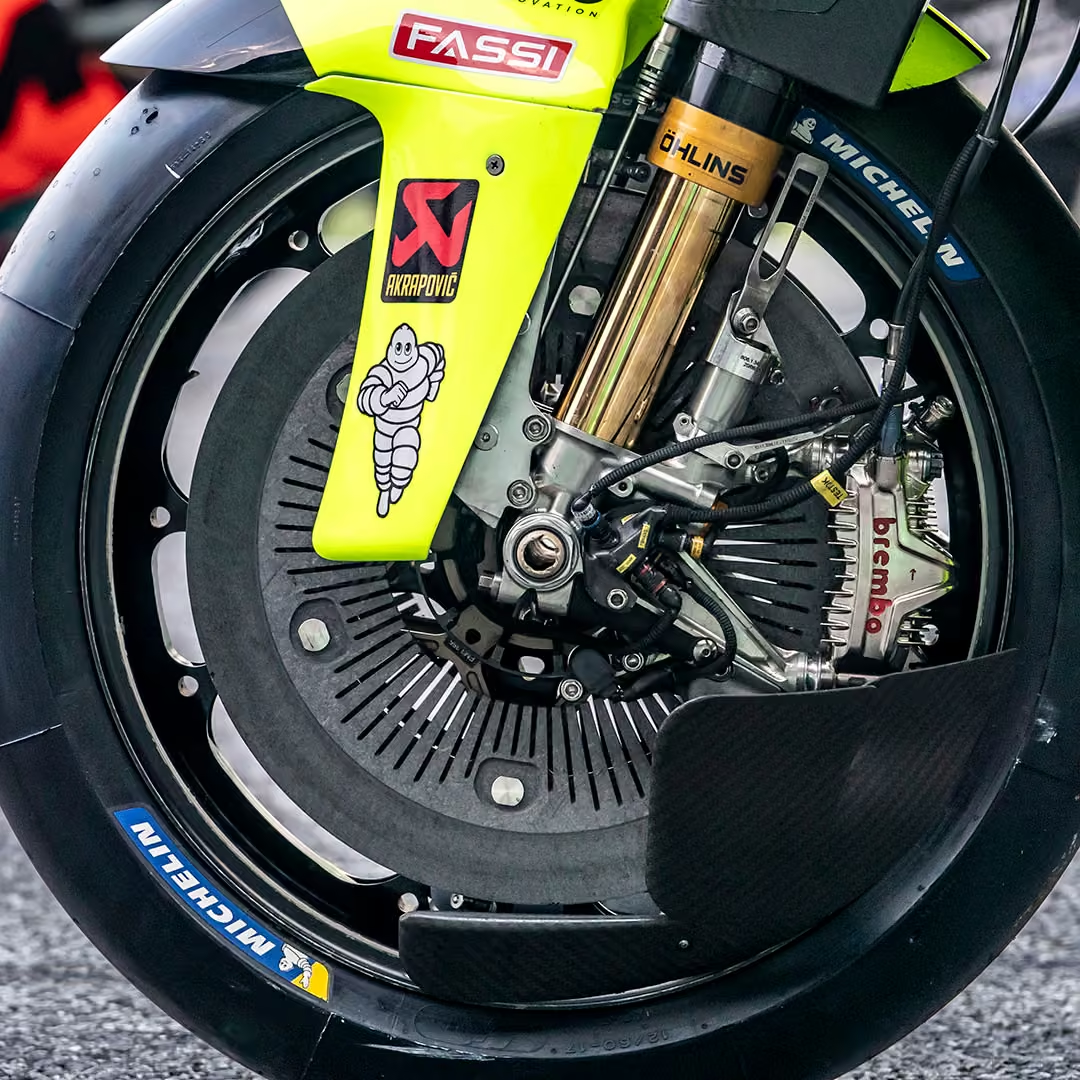
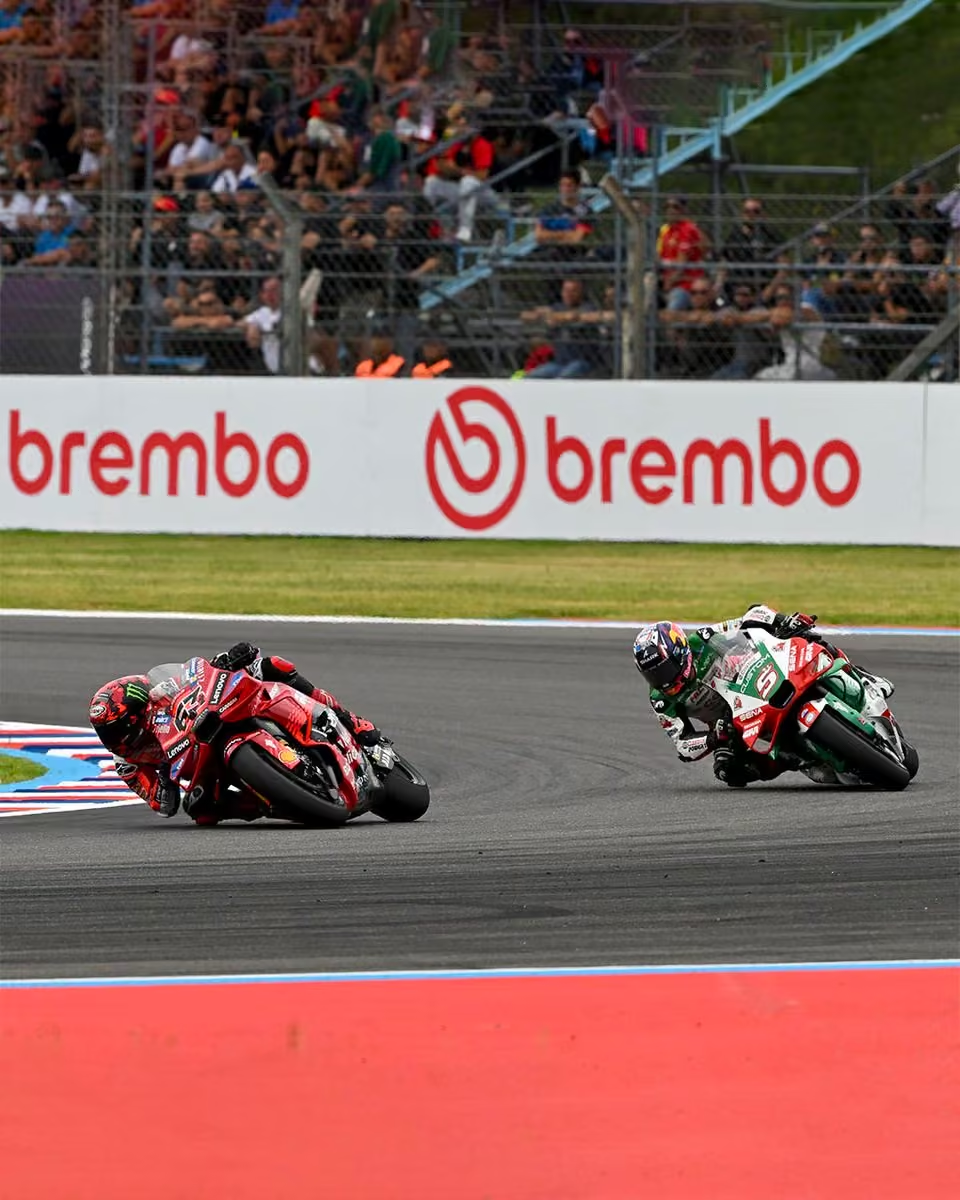
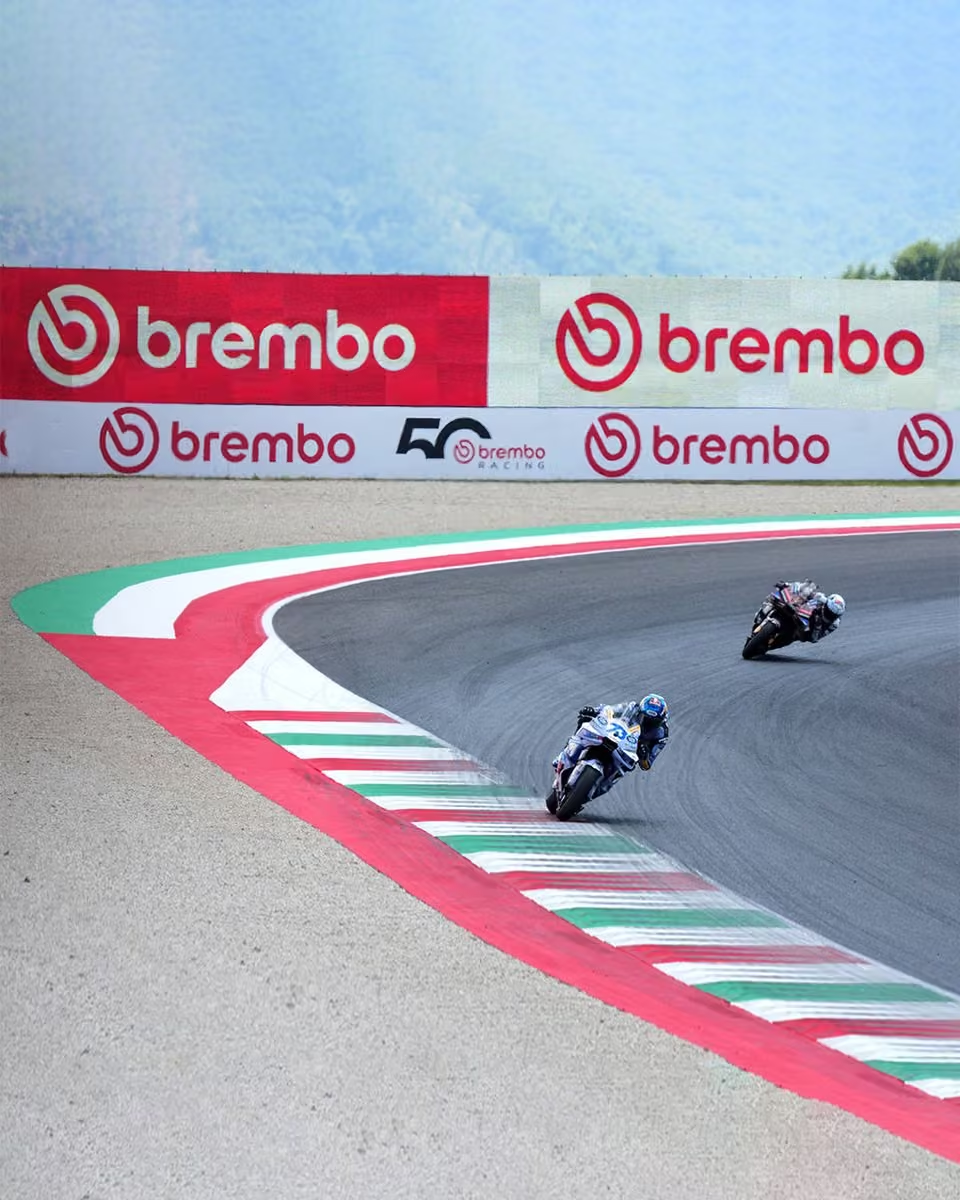
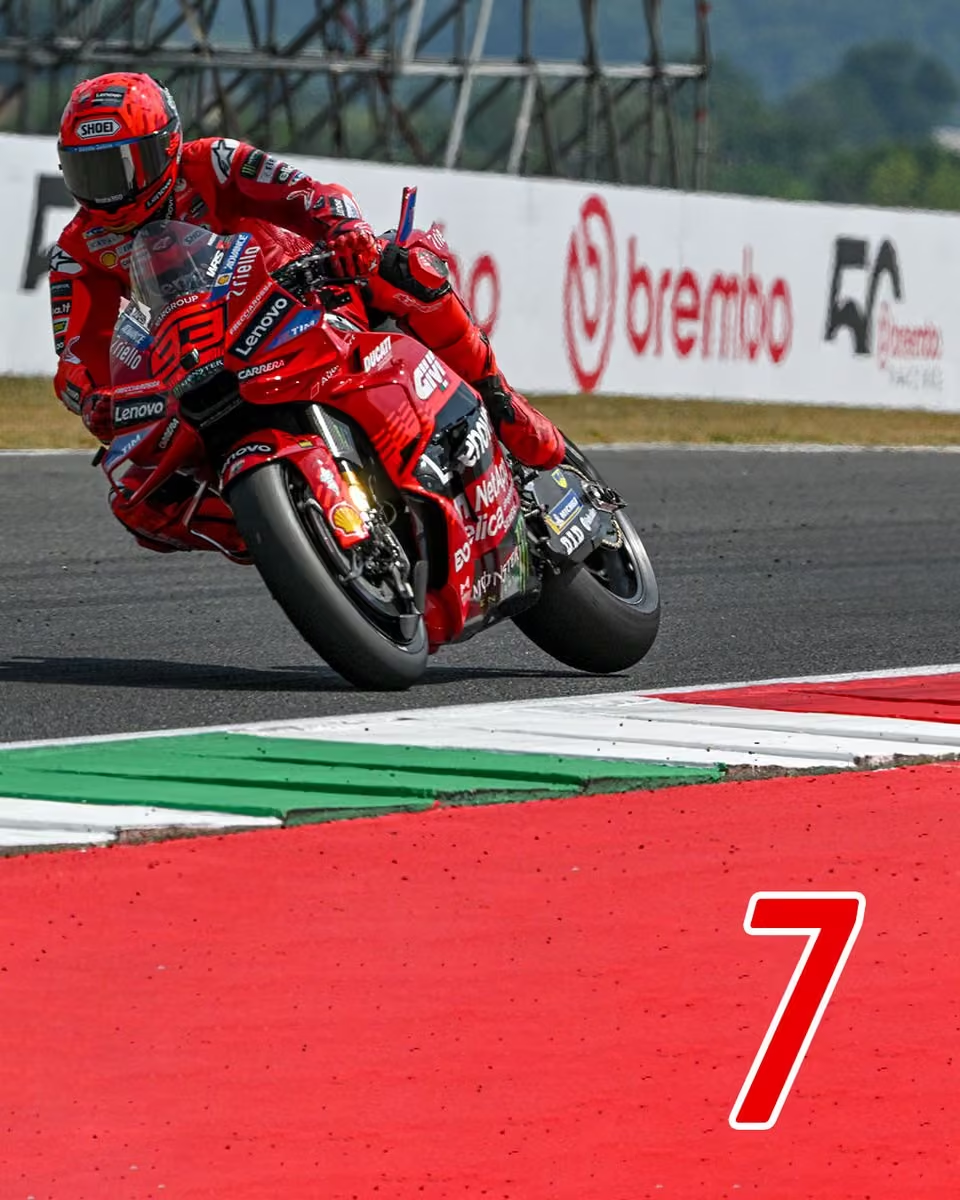
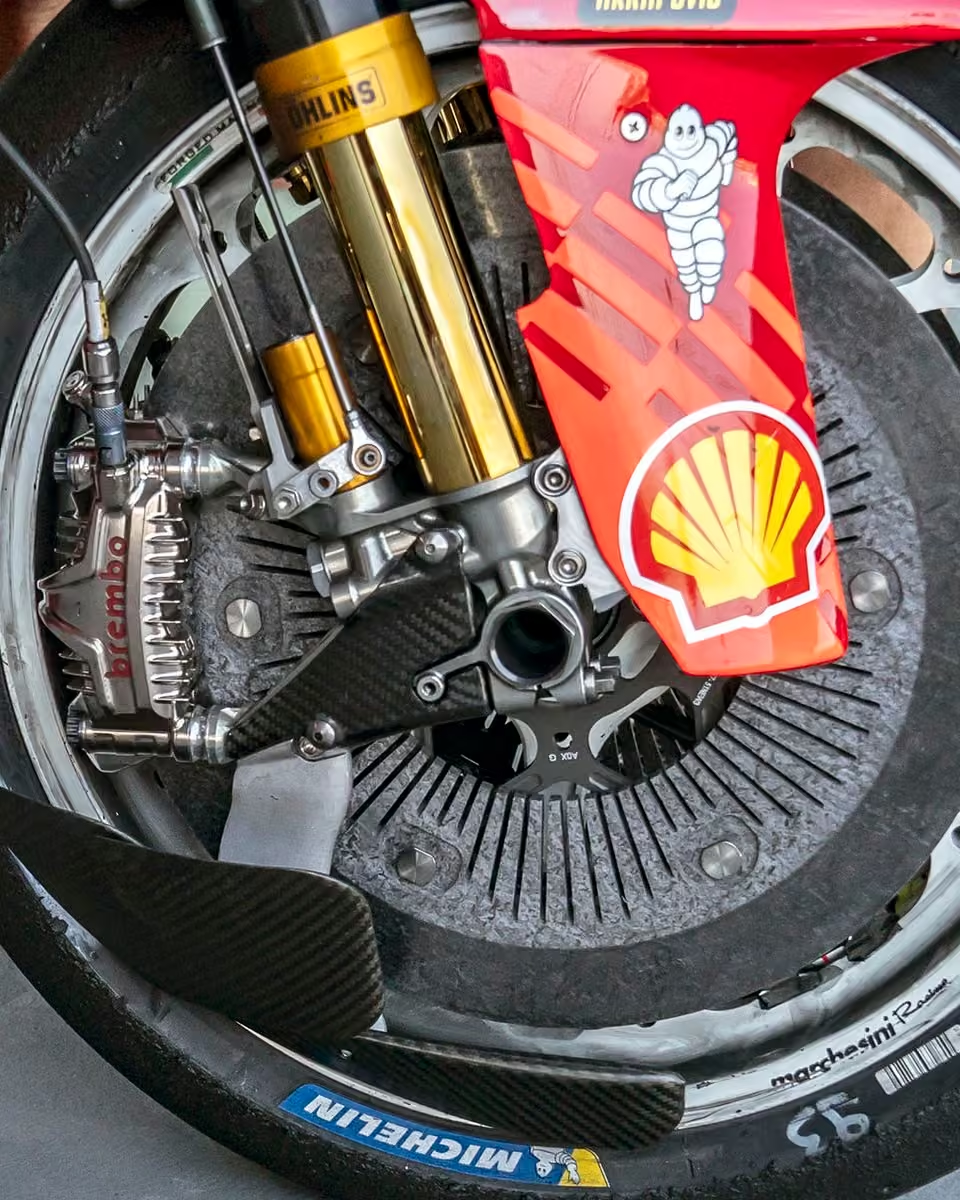
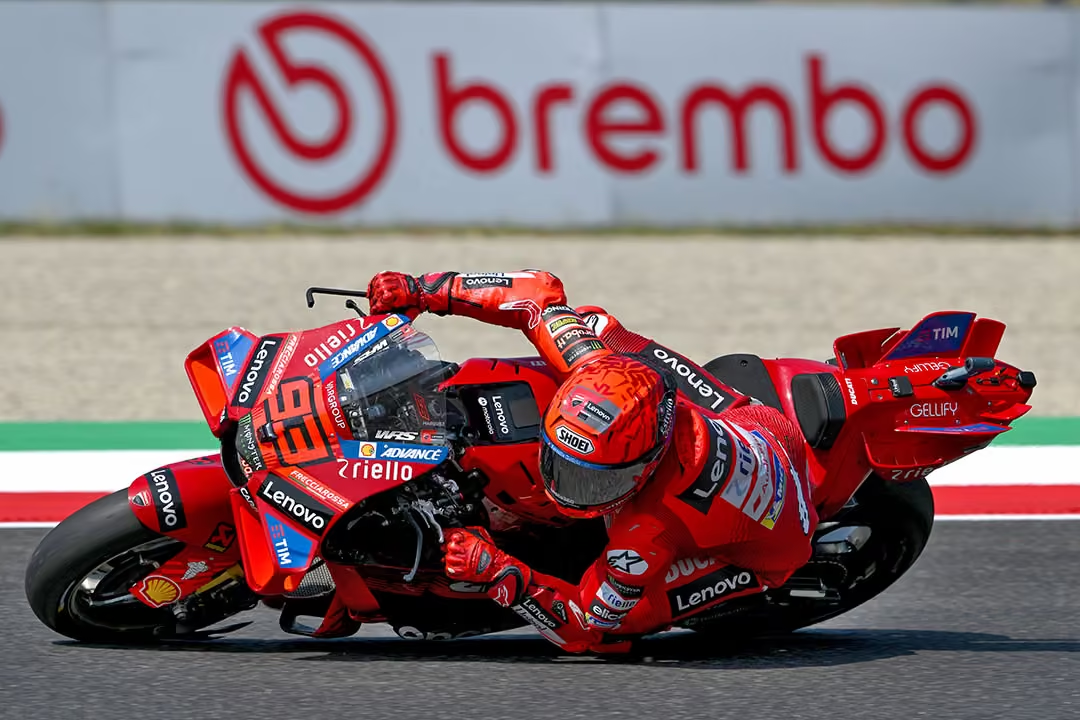
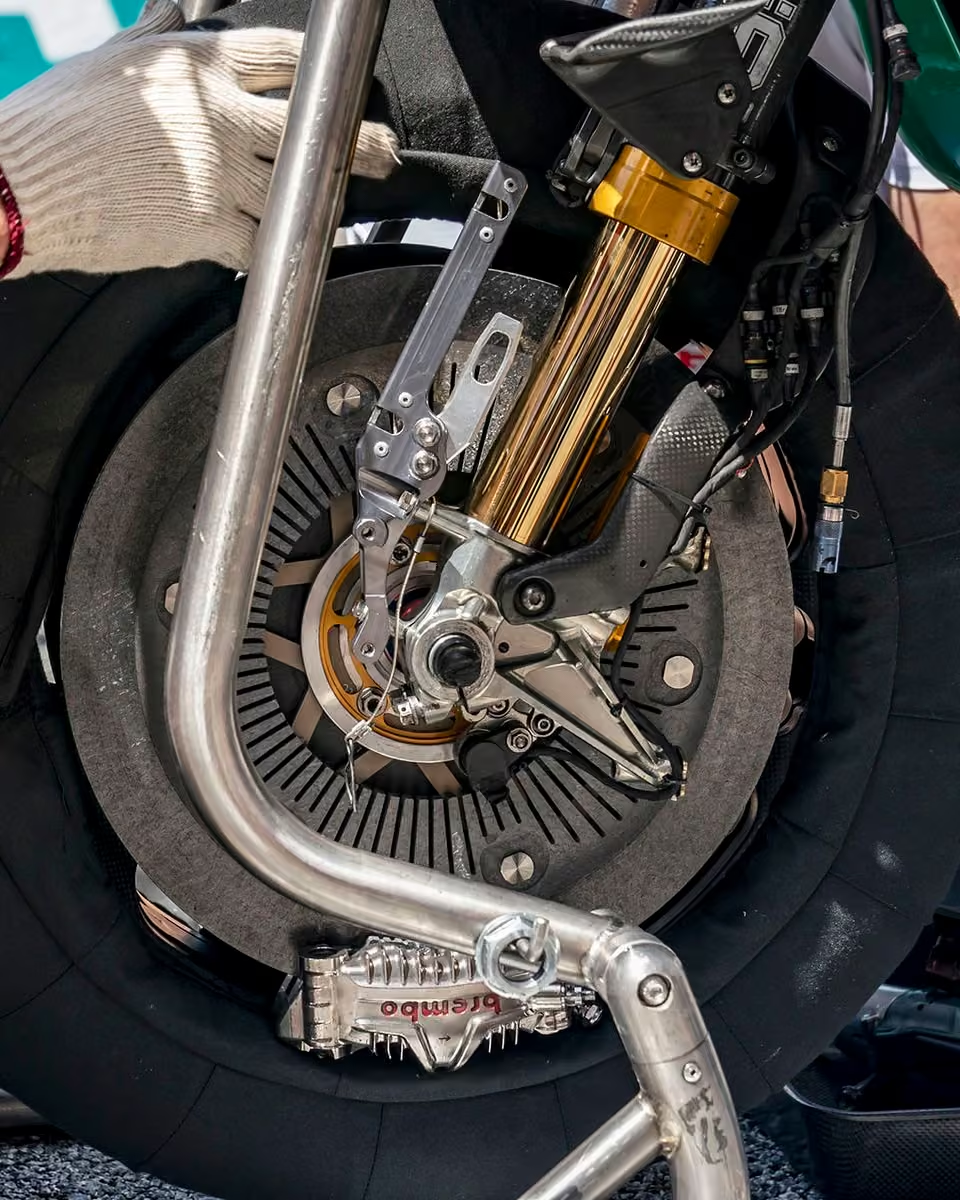
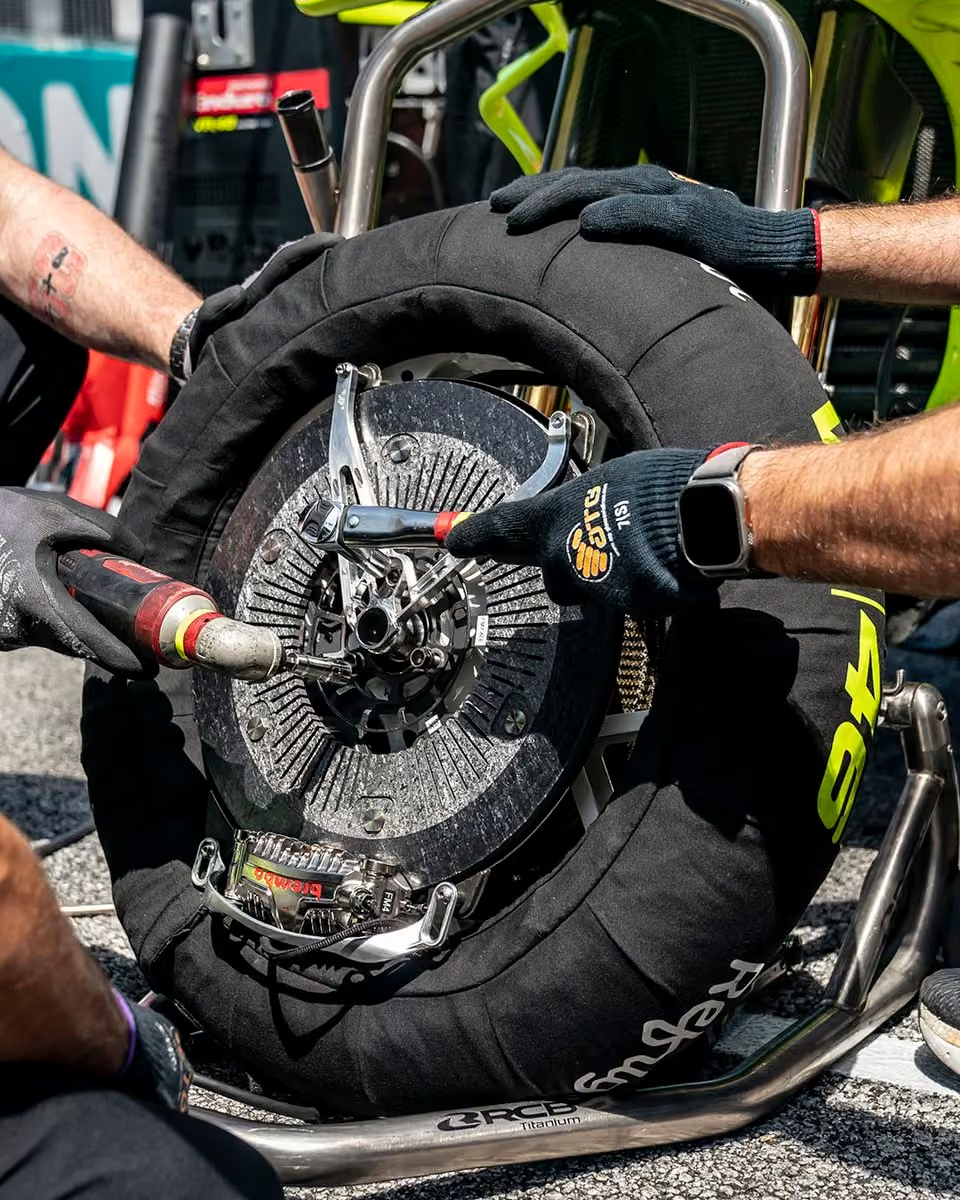
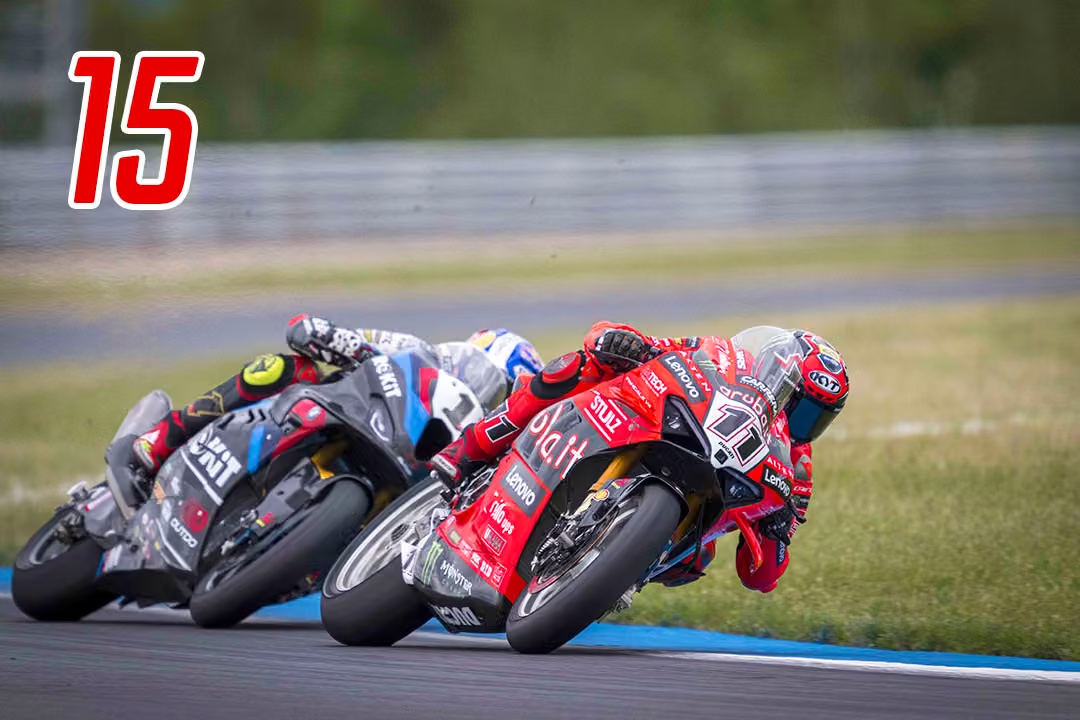
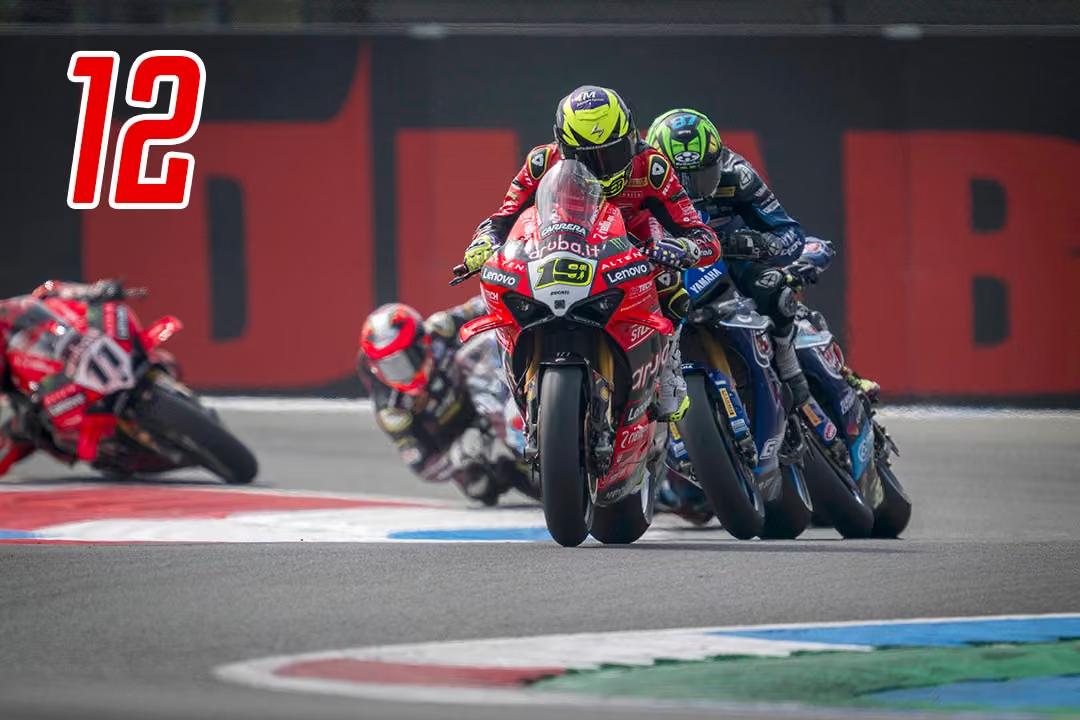
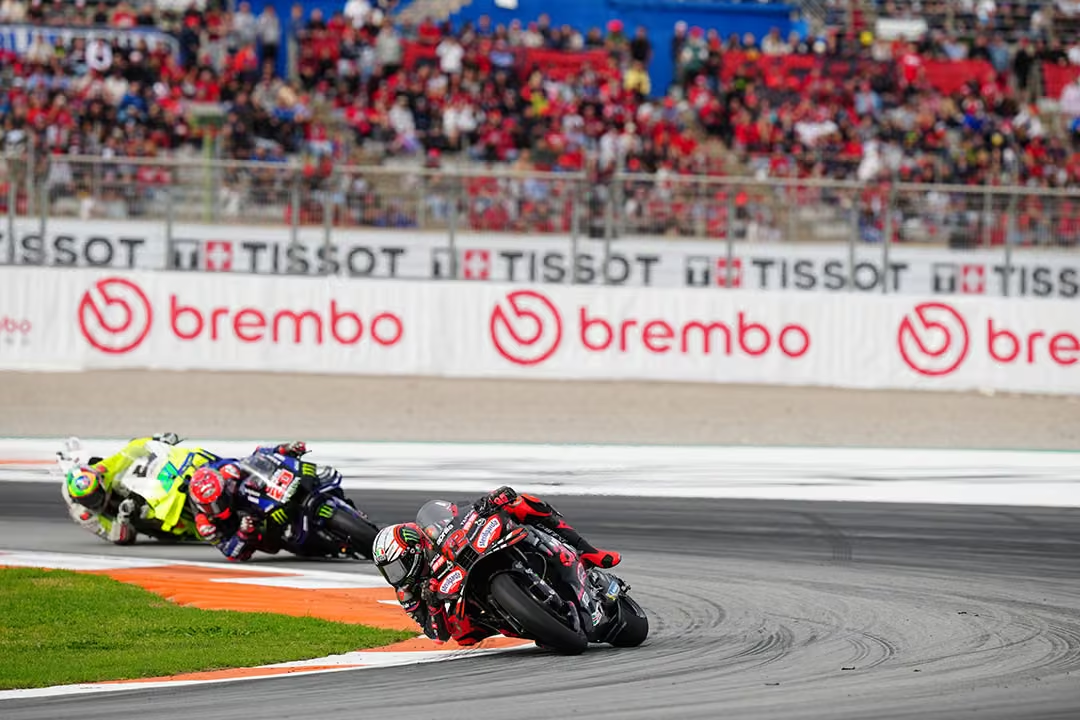
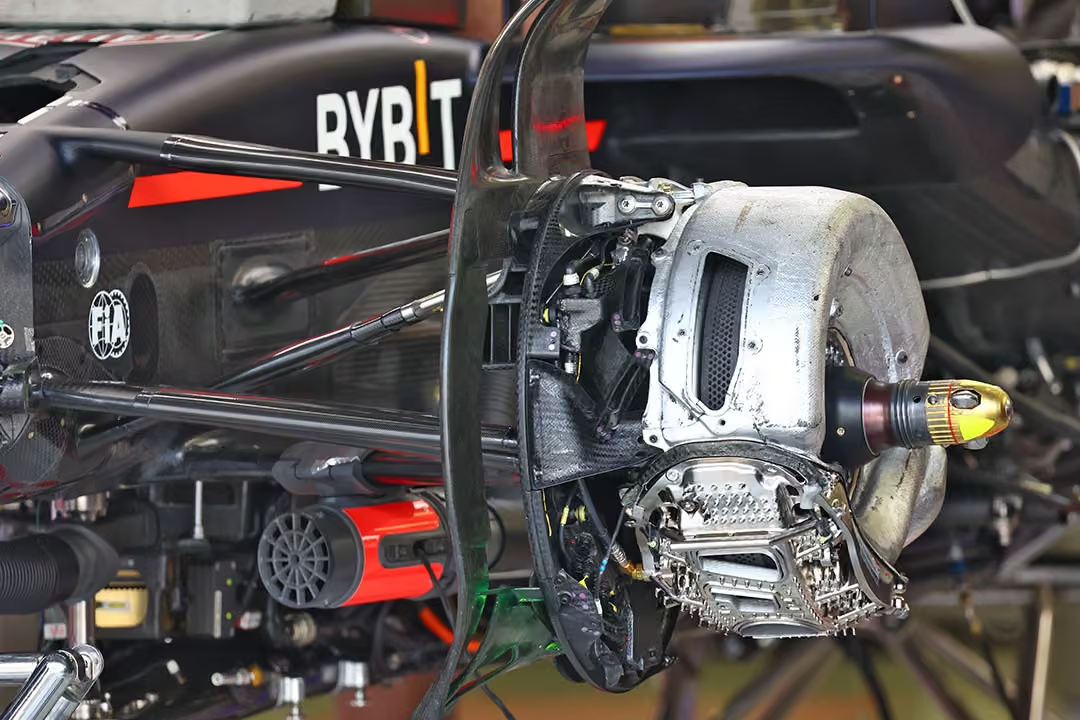
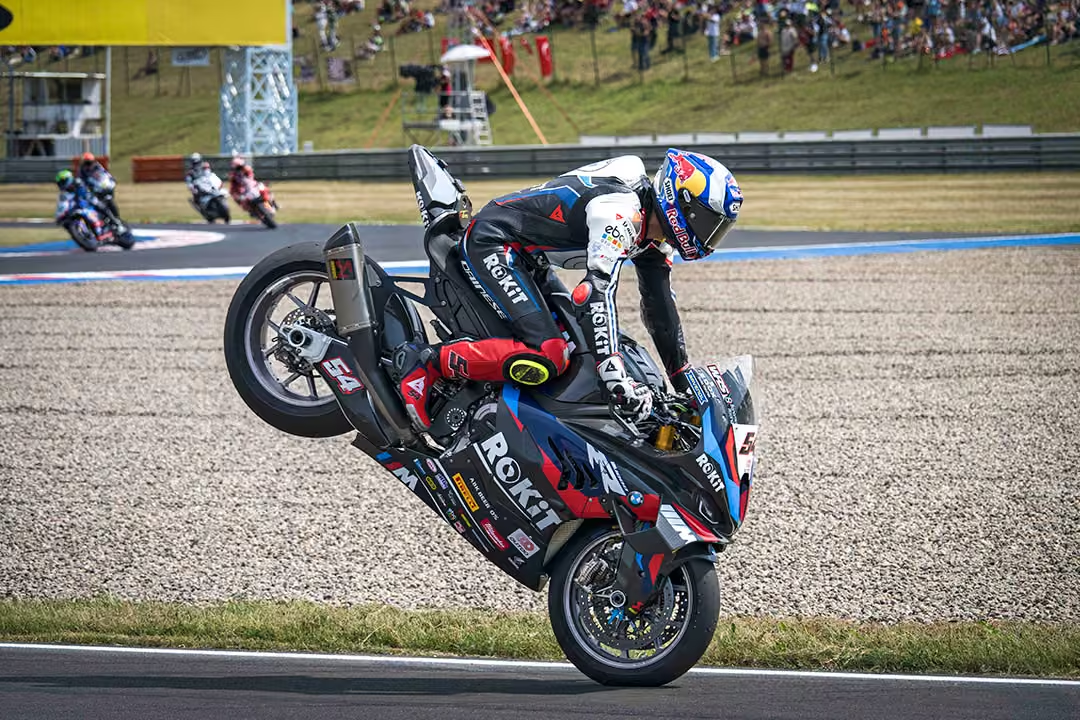
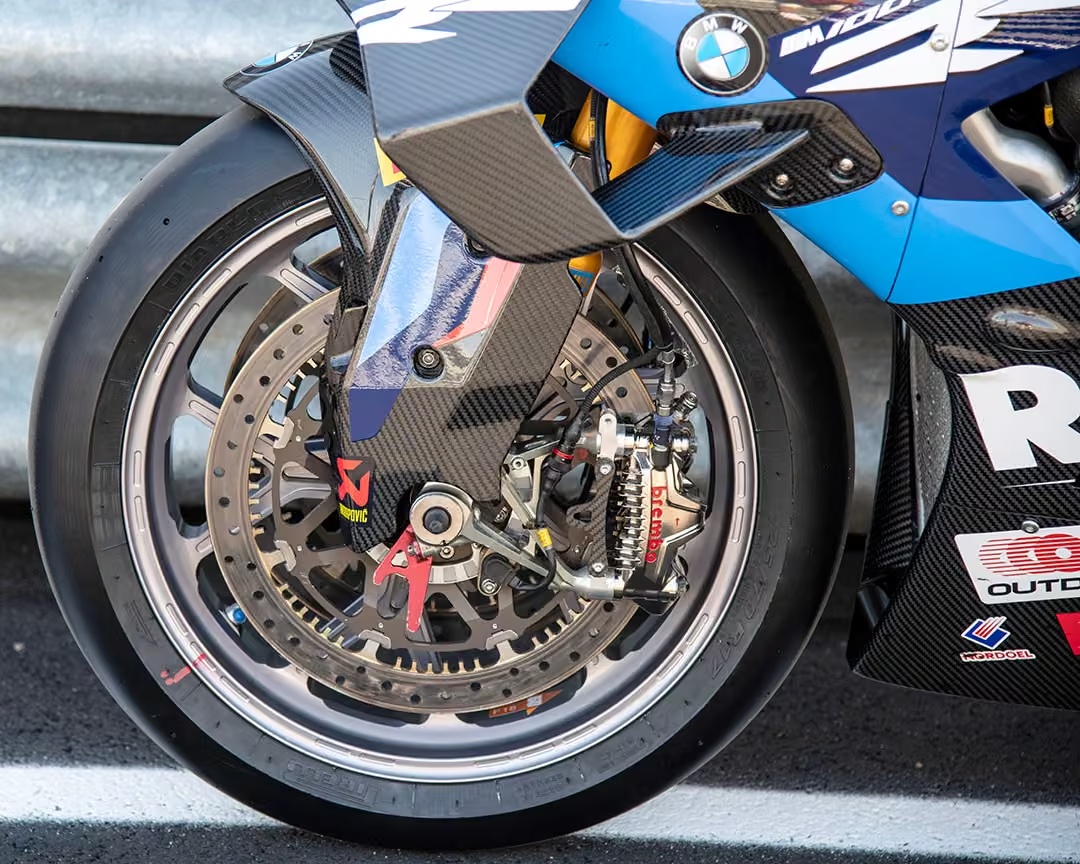
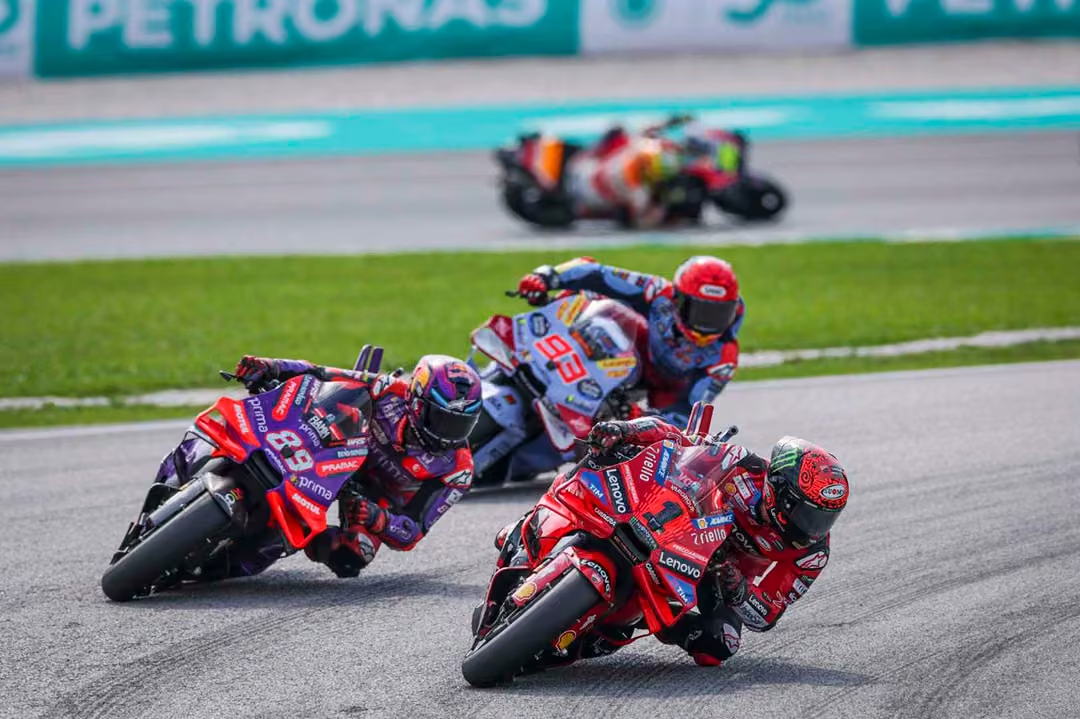
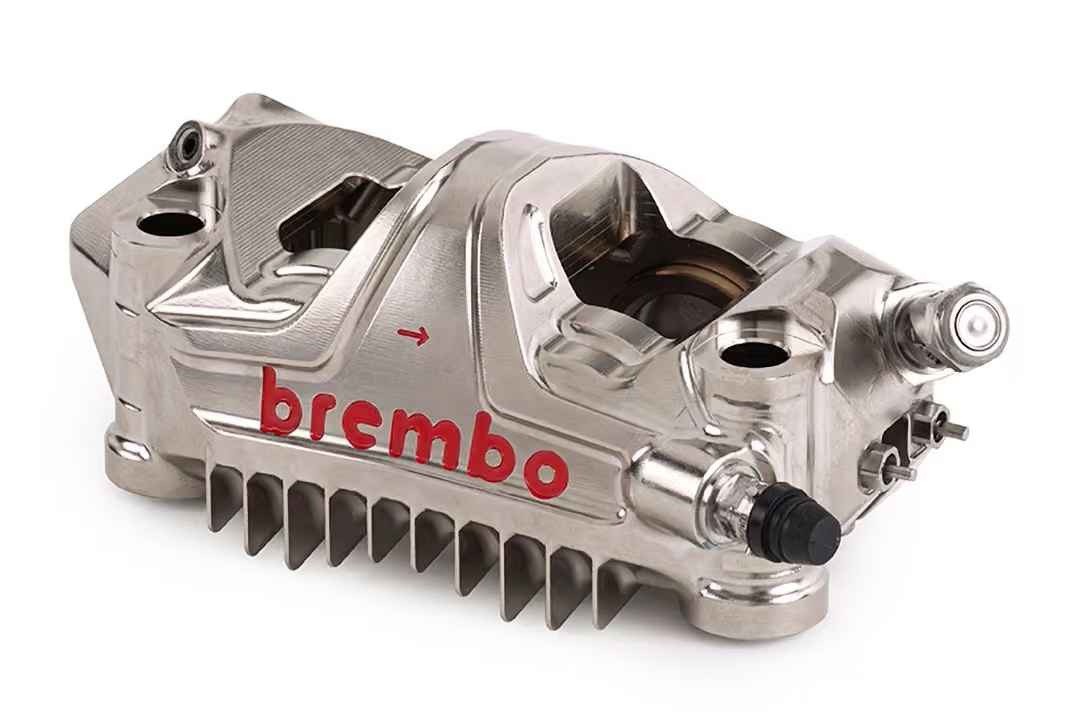
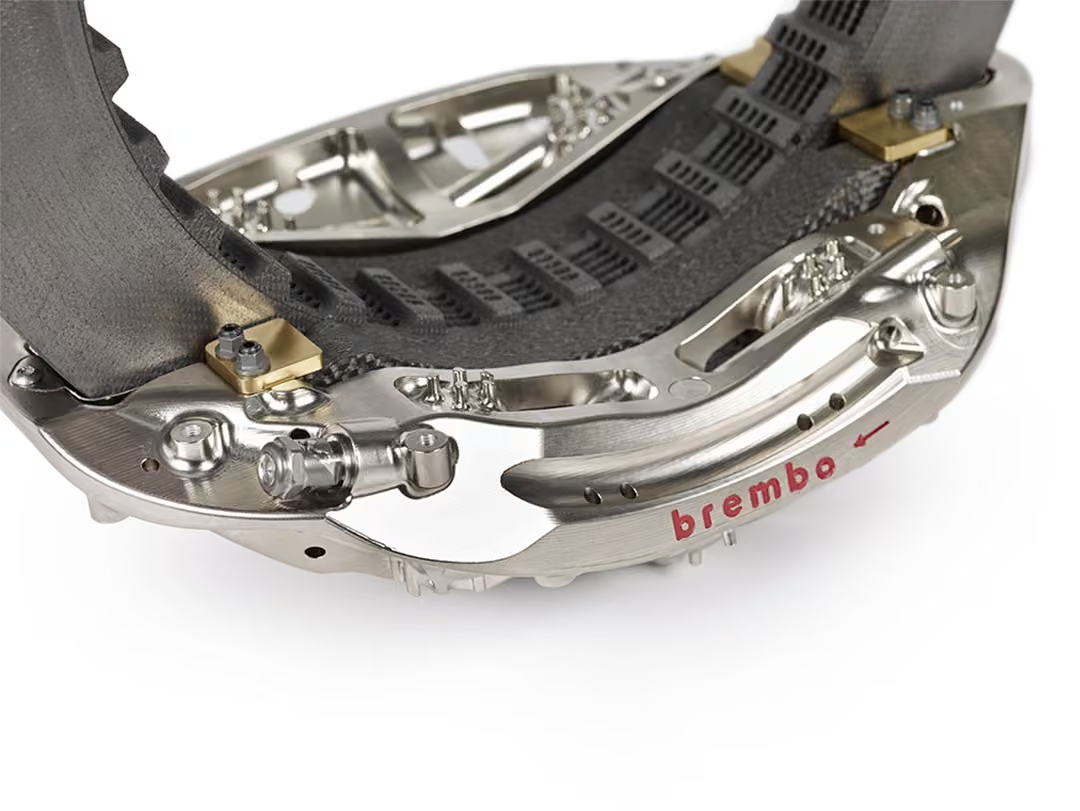
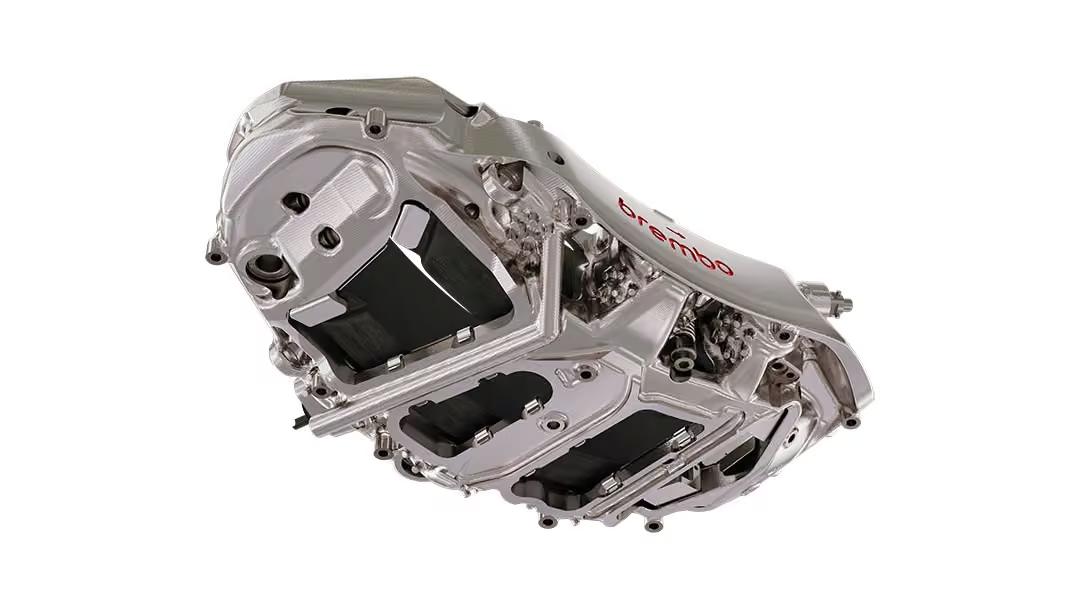
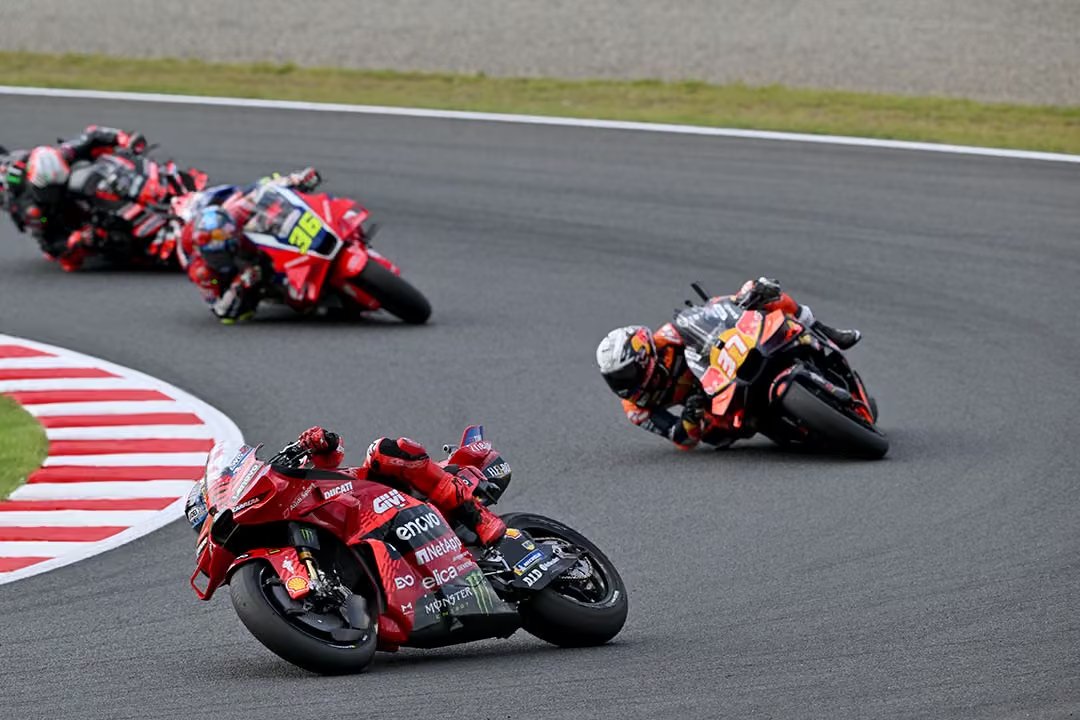
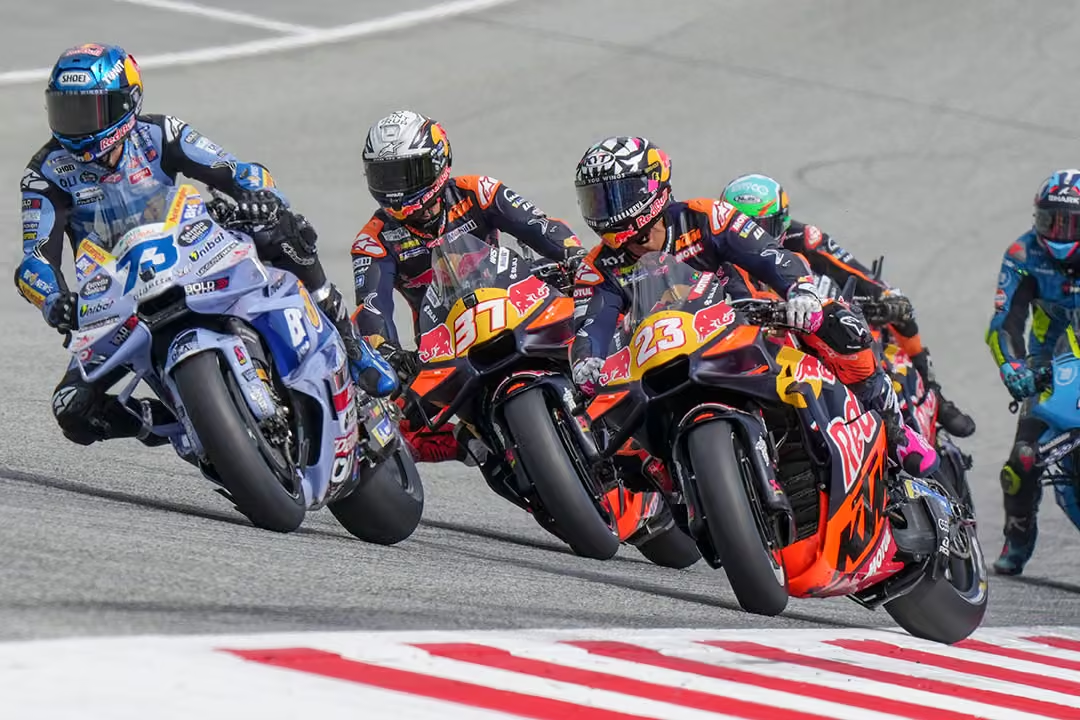
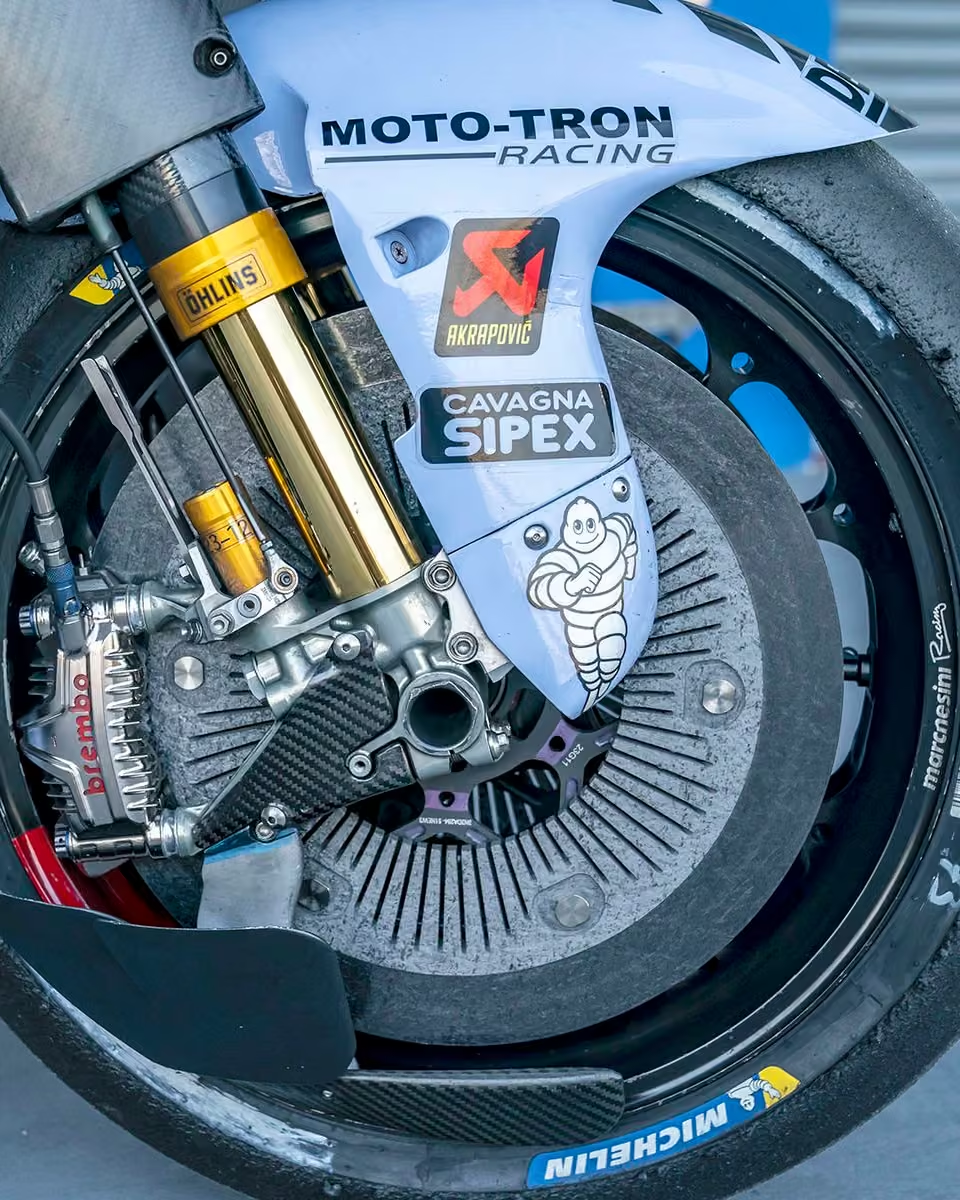
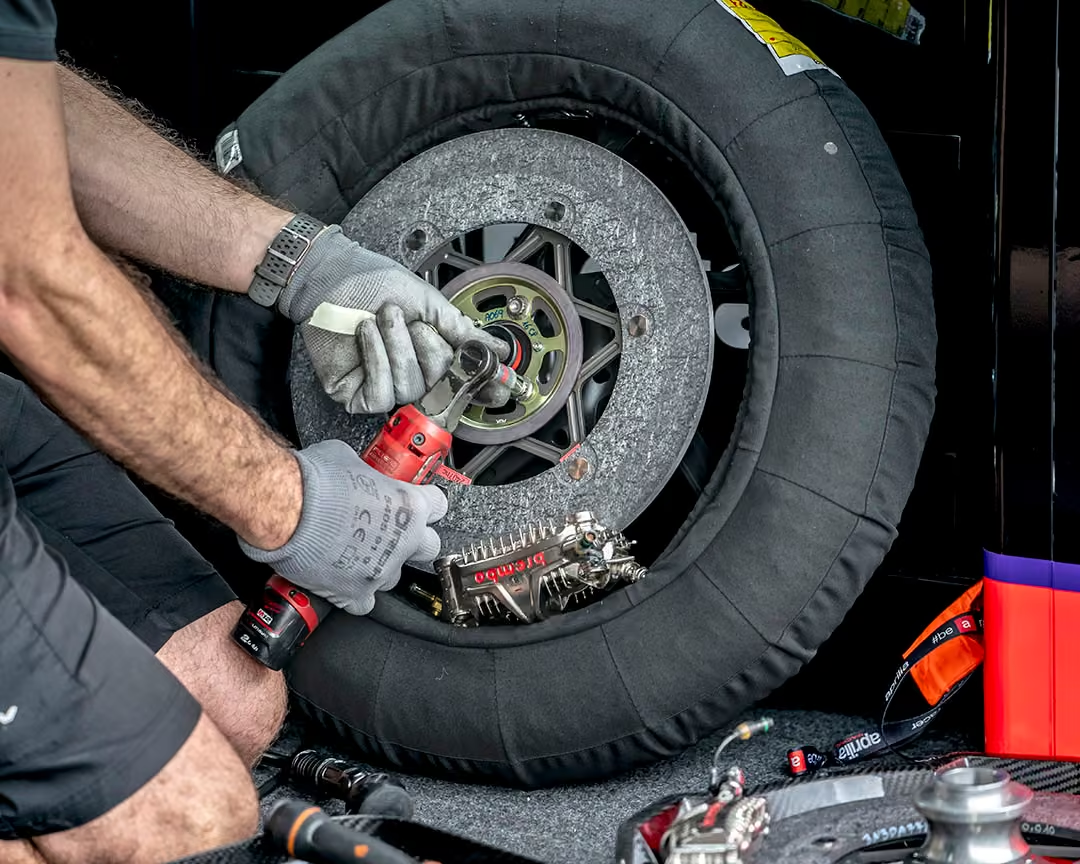
The penultimate #motogp round heads back to Europe after 5 races in Asia and Oceania. According to Brembo engineers, Algarve is a medium-difficulty circuit for brakes, with a difficulty index of 3/6. There are 10 braking zones per lap for under 30 seconds of total usage.
Brembo
Brembo N.V. is an Italian manufacturer of automotive parts that most notably produces braking systems for high-performance cars. Its operational head office is in Curno, Bergamo, Italy, while Amsterdam, Netherlands, is the company's legal seat. More on Wikipedia
-
Brembo
@BremboBrakes

-
Brembo
@BremboBrakes
T-shirts, hoodies, overshirts, caps, vests and backpacks: the Brembo Lifestyle Collection blends functionality, comfort and distinctive design. Technical urban style meets gorpcore-luxe for a generation where fashion, design and culture speak the same language.
-
Brembo
@BremboBrakes
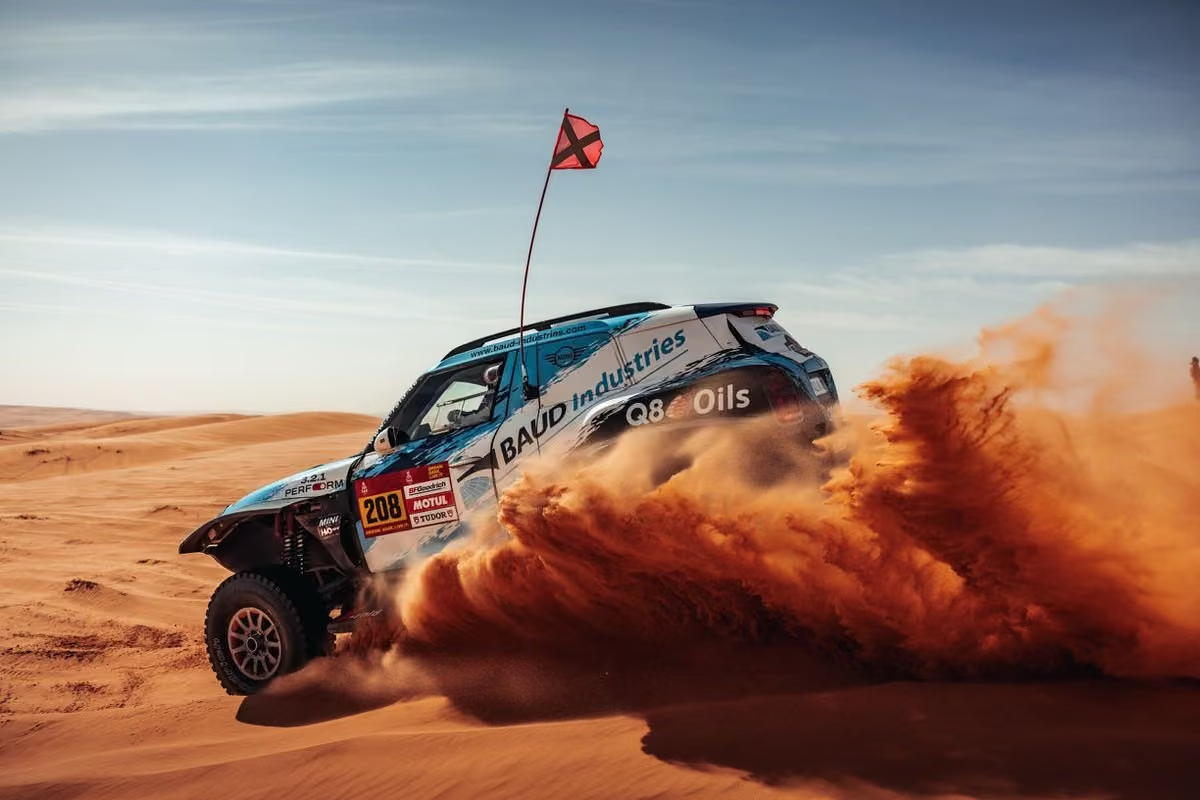
Brembo enters the Side-by-Side segment with Upgrade kits for the Polaris RZR Pro R and Can-Am Maverick R. Already used in races such as Baja Aragón and Baja 500, they bring SSV enthusiasts braking performance developed and proven in the toughest competitions.
-
Brembo
@BremboBrakes
Performance meets a new form of expression. The first Brembo Lifestyle Collection translates the brand’s distinctive identity into a contemporary language of design, refined materials and fashion, created for a community driven by curiosity and new forms of expression.
-
Brembo
@BremboBrakes
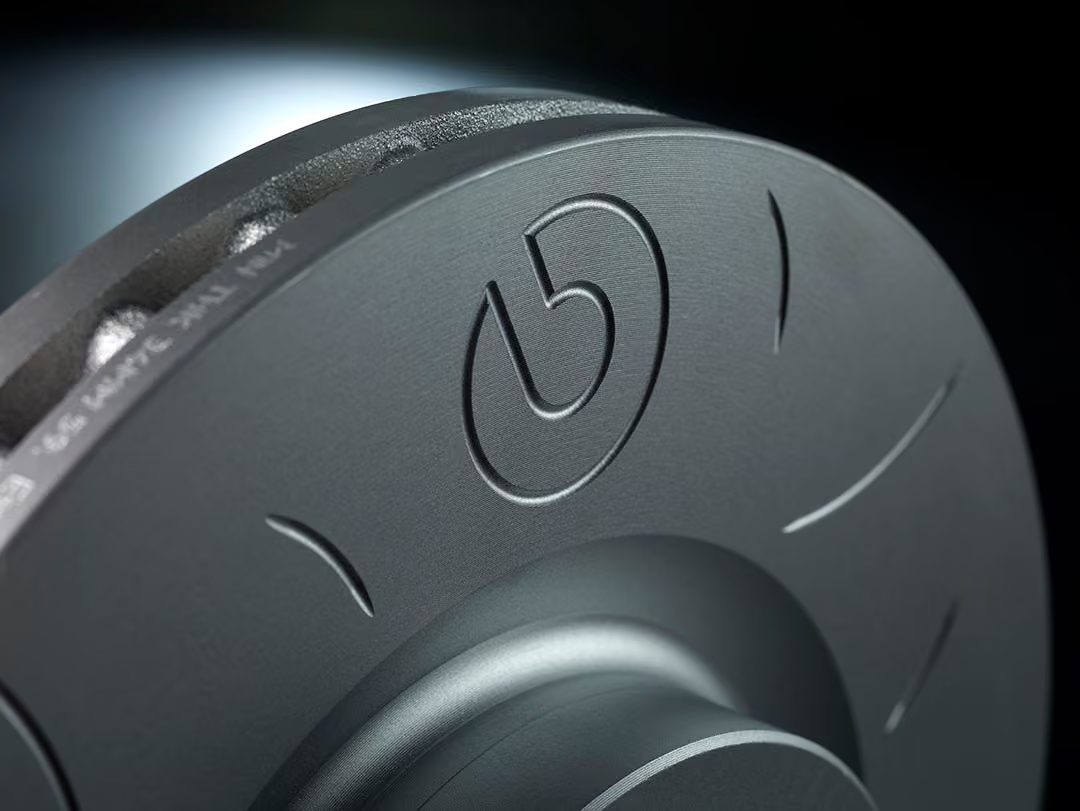
Meet Brembo XTRA Signature, the new brake disc for urban riders and daily commuters. Larger diameters than equivalent original discs enhance braking performance, while Brembo-branded drive buttons on the floating version add a distinctive touch to the bike.
-
Brembo
@BremboBrakes
Brembo expands its motorcycle aftermarket range with the new RCS24, RCS29 and RCS34 clutch levers for cable-operated clutches. The integrated selector lets riders adjust lever feel for a more direct response, greater control, sensitivity and modulation.
-
Brembo
@BremboBrakes
Qatar 2016 marked a Brembo milestone: for the first time in #motogp history, every rider on the grid used Brembo brakes. Riders could choose between light-duty and heavy-duty aluminium calipers, while aluminium-lithium calipers had been banned by the regulations.
-
Brembo
@BremboBrakes
Under the lights in Qatar, Brembo carbon discs glow red during the hardest braking. They aren’t running hotter than at other circuits: with no sunlight, their thermal radiation becomes much easier for the human eye to see. Braking performance, turned visible. #motogp
-
Brembo
@BremboBrakes
Turn 12 at Interlagos, 2025 vs 2026: deceleration drops from 4.7 g to 3 g and brake pedal load from 148 to 89 kg. Braking distance is expected to rise from 84 to 98 metres, with braking time increasing from 1.73 to 2.01 seconds. #f1
-
Brembo
@BremboBrakes
22 #motogp GPs have been held at Lusail. Yamaha has 10 wins, Ducati 9 and Honda 3. Ducati has won the last 4 with 4 different riders. One constant across all 22 races: every winner crossed the line on a bike equipped with Brembo brakes.
-
Brembo
@BremboBrakes
What does it take to brake for Turn 1 in Qatar? #motogp riders apply 5.6 kg of force to the Brembo brake lever, experiencing 1.5 g of deceleration. Braking pressure reaches 12.1 bar, while carbon disc temperatures exceed 550°C.
-
Brembo
@BremboBrakes
312 → 115 km/h in 2.93 seconds. Turn 1 is the toughest braking point at Interlagos. #f1 drivers cover 156 metres under braking, experience 3.7 g of deceleration and apply 104 kg to the brake pedal, while braking power peaks at 1,538 kW.
-
Brembo
@BremboBrakes
Turn 1 is the toughest braking point at Lusail. After the 1.068 km straight, #motogp riders brake from 337 km/h to 99 km/h in 4.9 seconds, covering 259 metres under braking. A 238 km/h drop in speed before hitting the first corner.
-
Brembo
@BremboBrakes
How demanding is Lusail on the brakes? The Qatar GP scores 3 out of 6 on Brembo’s difficulty index. Riders brake 11 times per lap, for a total of 34 seconds: 3 braking sections are classified as High, 4 as Medium and 4 as Low. #motogp
-
Brembo
@BremboBrakes
#f1 heads to Brazil. According to Brembo engineers, Interlagos scores just 2 out of 5 on the brake difficulty index. Yet brakes are used for over 14 seconds per lap. There are 6 braking sections: 2 Hard, 1 Medium and 3 Light.
-
Brembo
@BremboBrakes
The final Asian round of the #motogp season takes us to Qatar. According to Brembo engineers, who work closely with every MotoGP team, Lusail International Circuit ranks among the tracks with a medium level of difficulty for the brakes.
-
Brembo
@BremboBrakes
Imagine pushing 107 kg through the brake pedal. At Turn 1 in Mexico City, #f1 drivers do just that while experiencing 3.6 g of deceleration. And behind that effort is another impressive figure: 1,668 kW of braking power. Just another day at the office in Formula 1.
-
Brembo
@BremboBrakes
Only Italian, Spanish, Australian and American riders have won #motogp’s premier-class races at Sepang. Kenny Roberts Jr. started the story in 1999 on a Suzuki equipped with Brembo’s revolutionary radial caliper. Different bikes, one constant: Brembo brakes.
-
Brembo
@BremboBrakes
340 to 114 km/h in just 3.51 seconds. According to Brembo simulations, Turn 1 is the toughest braking point of the Mexico City GP. #f1 cars shed 226 km/h while covering just 193 metres. A few seconds that show just how extreme braking in Formula 1 can be.
-
Brembo
@BremboBrakes
Ducati leads #motogp wins at Sepang with 9, yet Marc Marquez has never won here with Ducati. Aprilia’s best GP finish is 7th, plus a 6th in the Sprint. Two streaks waiting to be broken. Which one will come to an end this weekend?
-
Brembo
@BremboBrakes
At Sepang, #motogp riders are likely to choose 340 or 355 mm Brembo carbon discs. Bigger discs mean greater braking force and better heat dissipation, but also more weight. The challenge is finding the right balance between braking performance and agility.
-
Brembo
@BremboBrakes
Just 7 braking zones, yet a 4 out of 5 difficulty rating. That’s Mexico City according to Brembo engineers. Drivers brake for less than 16 seconds per lap: 3 Hard braking zones, 1 Medium and 3 Light, with deceleration always below 3.7 g. Few braking points, big challenge. #f1
-
Brembo
@BremboBrakes
Last turn at Sepang puts #motogp brakes to the test: 1.5 g of deceleration, 11.7 bar of pressure in the Brembo braking system and carbon brake discs reaching up to 620°C. Extreme numbers for one of the Malaysian GP’s key braking zones.
-
Brembo
@BremboBrakes
From 320 km/h to just 64 km/h. At Sepang’s final corner, #motogp bikes shed 256 km/h, the 2nd biggest speed drop of the season. It happens in just 5.5 seconds and 259 metres, with riders applying 5.5 kg of force to the brake lever.
-
Brembo
@BremboBrakes
Mexico loves #f1. And the numbers prove it. For the fifth year in a row, the Mexico City GP follows the US GP, with attendance topping 400,000 in each of the last 3 editions. According to Brembo engineers, it’s one of the most demanding tracks for the brakes.
-
Brembo
@BremboBrakes
How tough is Sepang on #motogp brakes? It scores 5 out of 6 on Brembo’s difficulty index. Riders brake for 35 seconds per lap across 11 braking zones: 4 are classified as High, 1 as Medium and 6 as Low. A serious workout for the braking system.
-
Brembo
@BremboBrakes
#motogp heads to Sepang for its third consecutive race weekend and the first of four rounds in November. According to Brembo engineers working with every MotoGP team, the Malaysian track ranks among the most demanding circuits of the season for brakes.
-
Brembo
@BremboBrakes
Same circuit, very different braking. At COTA, MotoGP riders brake 9 times per lap for 31 seconds, over twice as long as F1 drivers. To shed 200 km/h, MotoGP bikes need around 50 metres and over 1.8 seconds more than an F1 car.
-
Brembo
@BremboBrakes
Turn 1 at Phillip Island bears Mick Doohan’s name. After a 1992 injury reduced mobility in his right foot, Brembo developed the thumb brake so he could operate the rear brake with his left hand. Today, variations of the system are used by many #motogp riders.
-
Brembo
@BremboBrakes
From 2000 to 2006, Italians won 7 straight 500cc/MotoGP races at Phillip Island: Biaggi, Rossi 5 times, then Melandri. Since then? Just 1 win in 17 editions. An Italian victory on Sunday would also give Brembo its 200th premier-class win with an Italian rider.
-
Brembo
@BremboBrakes
COTA Turn 12, 2025 vs 2026: deceleration falls from 4.2 g to 4 g and brake pedal load from 130 kg to 110 kg. But braking distance rises from 126 to 166 metres and braking time from 2.72 to 3.42 seconds, reflecting the characteristics of the new F1 cars.
-
Brembo
@BremboBrakes
The last 27 premier-class Australian GPs at Phillip Island have all been won with Brembo brakes. The king of the track? Valentino Rossi: 8 wins across 250cc, 500cc and #motogp, riding 4 different bikes but always relying on Brembo braking systems.
-
Brembo
@BremboBrakes
Turn 1 at COTA puts #f1 drivers to the test. According to Brembo simulations, they experience 4.3 g of deceleration while applying 123 kg of force to the brake pedal. The braking power generated in the process? An impressive 1,760 kW.
-
Brembo
@BremboBrakes
What happens under braking at Turn 1 in Phillip Island? #motogp riders experience 1.5 g of deceleration, Brembo brake fluid pressure reaches 9.5 bar and the carbon brake discs hit temperatures of up to 750°C.
-
Brembo
@BremboBrakes
The toughest braking point at COTA? Turn 1. According to Brembo simulations, #f1 cars arrive at 305 km/h and slow to just 93 km/h in 3.11 seconds. In that time, they cover only 144 metres while shedding 212 km/h of speed.
-
Brembo
@BremboBrakes
The toughest braking point at Phillip Island? Turn 1. #motogp bikes drop from 344 km/h to 179 km/h in 4.2 seconds, covering 293 metres under braking. Riders apply a 4.4 kg load on the brake lever to shed 165 km/h before hitting the corner.
-
Brembo
@BremboBrakes
COTA scores 4 out of 5 for braking difficulty, the highest rating among the 3 US #f1 circuits. And that’s despite drivers braking just 6 times per lap for less than 15 seconds in total: 4 braking zones are rated Hard, 1 Medium and 1 Light.
-
Brembo
@BremboBrakes
Phillip Island welcomes #motogp for the final time before the Australian GP moves to Adelaide in 2027. According to Brembo engineers working closely with every MotoGP team, it’s also the least demanding circuit for brakes on the 2026 calendar.
-
Brembo
@BremboBrakes
After a one-week break, #f1 returns to the Americas. According to Brembo Group engineers working closely with all Formula 1 drivers, the Circuit of the Americas is among the more demanding tracks on the calendar when it comes to braking.
-
Brembo
@BremboBrakes
Phillip Island welcomes #motogp for the final time before the Australian GP moves to Adelaide in 2027. According to Brembo engineers working closely with every MotoGP team, it’s also the least demanding circuit for brakes on the 2026 calendar.
-
Brembo
@BremboBrakes
Nicolò Bulega arrives at Jerez with a chance to make history.
Together with Álvaro Bautista, he is the most successful #worldsbk rider at the circuit, with five victories. One more win would give Bulega the all-time record before his move to #motogp next season. -
Brembo
@BremboBrakes
Jerez will mark the end of an era. It will be the final #worldsbk round contested with steel brake discs. From 2027, every bike on the grid will switch to Brembo Hyction carbon-ceramic discs, designed to deliver greater consistency, thermal stability and durability.
-
Brembo
@BremboBrakes
Ducati riders have claimed 17 #worldsbk wins and 32 podium finishes at Jerez. Álvaro Bautista and Nicolò Bulega share the record with five victories each, ahead of Toprak Razgatlıoğlu, Jonathan Rea and Chaz Davies on three. Every one of those wins came with Brembo brakes.
-
Brembo
@BremboBrakes
At Jerez's Turn 6, Brembo brakes generate a deceleration of 1.5 g. During this single braking event, brake fluid pressure reaches 11.7 bar. It's one of the most demanding corners of the #worldsbk season for both rider and machine.
-
Brembo
@BremboBrakes
Turn 6, named after Dani Pedrosa, is the toughest braking point at Jerez. Here, #worldsbk riders drop from 282 km/h to 68 km/h in just 4.7 seconds over 206 metres, while applying up to 5.5 kg of force to the brake lever. Precision under pressure.
-
Brembo
@BremboBrakes
Jerez scores 4 out of 5 on Brembo's braking severity scale. #worldsbk riders use the brakes 10 times per lap for a total of 27.7 seconds, meaning nearly 29% of each lap is spent braking. The circuit features 3 High, 4 Medium and 3 Low severity braking zones.
-
Brembo
@BremboBrakes
The #worldsbk season comes to an end at Jerez. The Spanish circuit hosts the 12th and final round of the year and, according to Brembo engineers working with 13 of the 14 teams, it's also one of the most demanding tracks on the calendar for braking systems.
-
Brembo
@BremboBrakes
#worldsbk Champion Nicolò Bulega steps up to #motogp next season.
The switch means adapting to carbon brakes and a completely different braking technique: “In MotoGP you must be smooth in the initial phase and only then pull the brake lever harder.” -
Brembo
@BremboBrakes
Indonesia is still waiting for its first Grand Prix winner, but Veda Pratama could change that. In his rookie Moto3 season, he has already claimed two podiums and more than 100 championship points. #motogp
-
Brembo
@BremboBrakes
Nicolò Bulega secured the 2026 #worldsbk title in Race 2 at Cremona, becoming only the second Italian rider after Max Biaggi to win the championship on home soil aboard an Italian motorcycle.
-
Brembo
@BremboBrakes
The first braking zone at Mandalika generates 1.5 g of deceleration. Brembo brake fluid pressure peaks at 12.3 bar while carbon disc temperatures reach an impressive 590°C. #motogp
-
Brembo
@BremboBrakes
Expect a huge braking challenge at Turn 1 in Estoril. Superbikes experience 1.5 g of deceleration while Brembo brake fluid pressure reaches 12 bar at the Portuguese #worldsbk round.
-
Brembo
@BremboBrakes
The toughest braking zone at the Singapore Grand Prix comes at Turn 1. #f1 cars slow from 298 km/h to 144 km/h in 1.9 seconds over 107 metres, with drivers applying 110 kg of force to the brake pedal.
-
Brembo
@BremboBrakes
Turn 1 is the toughest braking point at the Indonesian Grand Prix. #motogp bikes drop from 304 km/h to 103 km/h in 4.4 seconds, covering 226 metres while riders apply 5.7 kg of force to the brake lever.
-
Brembo
@BremboBrakes
The toughest braking point at Estoril comes at Turn 1. #worldsbk riders decelerate from 310 km/h to 84 km/h in just 4.9 seconds, covering 249 metres while applying 5.6 kg of force to the brake lever.
-
Brembo
@BremboBrakes
Singapore drivers spend 24% of the race on the brakes, the highest figure of the #formula1 season. Around Marina Bay, there are 11 braking events per lap, including six classified as Hard.
-
Brembo
@BremboBrakes
At Mandalika, #motogp riders use the brakes in 9 corners for a combined 26.7 seconds per lap. The circuit features 2 High, 3 Medium and 4 Low-severity braking zones.
-
Brembo
@BremboBrakes
At the Estoril #worldsbk round, riders use the brakes in 9 corners for a total of 26 seconds per lap. Four braking zones are classified as High severity, including the back-to-back challenges of Turns 6 and 7.
-
Brembo
@BremboBrakes
The Marina Bay Street Circuit presents one of the toughest braking challenges in Formula 1. According to Brembo engineers, Singapore earns the maximum brake difficulty rating of 5 out of 5.
-
Brembo
@BremboBrakes
One week after Japan, #motogp arrives at the Pertamina Mandalika Circuit in Indonesia. Brembo engineers classify the 4.301 km track as moderately demanding for braking systems, with a difficulty rating of 3 out of 6.
-
Brembo
@BremboBrakes
#worldsbk heads to Estoril for the penultimate round of the season. According to Brembo engineers, the Portuguese circuit ranks among the most demanding tracks for braking, earning a difficulty rating of 4 out of 5.
-
Brembo
@BremboBrakes
Thanks to carbon evolution and heating covers, wet-weather handling feels closer to dry conditions. Unlike heavier steel, Brembo carbon doesn't hinder suspension, keeping wheels glued to the track for better driveability.
-
Brembo
@BremboBrakes
In a dry race, riders choose 340 mm or 355 mm carbon discs—and stick with them even in the rain, a habit born at the wet 2017 Japanese GP where Dovizioso and the top 9 all proved carbon beats steel in cold rain. #motogp
-
Brembo
@BremboBrakes
Since Sprints were introduced, whoever wins Saturday in Japan wins Sunday too: Martin in '23, Bagnaia in '24 & '25. All on Ducatis, like Miller in '22. The last non-Ducati win? Marquez on a Brembo-equipped Honda in 2019. #motogp
-
Brembo
@BremboBrakes
Sensational forces at Motegi’s Turn 11: riders face a peak deceleration of 1.5 g, Brembo fluid pressure reaches 12.7 bar, and carbon disc temperatures skyrocket to 750°C. #motogp
-
Brembo
@BremboBrakes
Turn 11 at Motegi is the ultimate brake test. #motogp bikes drop from 307 to 85 km/h in just 4.8 seconds, covering 233 meters with riders exerting 5.9 kg of load on the brake lever.
-
Brembo
@BremboBrakes
At the Japanese GP, riders spend 31s per lap across 8 braking zones: 5 are rated Hard, 2 Medium, and only 1 Light. Every single braking point requires riders to stay on the lever for over 2.5 seconds. #motogp
-
Brembo
@BremboBrakes
According to Brembo engineers, the Japanese #motogp is one of the most demanding tracks for braking. On a scale from 1 to 6, Motegi gets a maximum difficulty rating of 6.
-
Brembo
@BremboBrakes
Turn 1 is the Baku City Circuit's hardest test for brakes. #f1 cars slow from 313 to 140 km/h in 2.13s over 123 meters. Drivers hit the brake pedal with 115 kg of force, enduring 3.9 g of deceleration as braking power hits a massive 1,652 kW.
-
Brembo
@BremboBrakes
Nicolò Bulega has used Brembo's index master cylinder since his 2024 #wsbk debut. Now his teammate & Tarran Mackenzie use it too, while Montella, Lowes, Baldassarri & Surra use the thumb cylinder. Alvaro Bautista remains the only Ducati rider using just a foot brake.
-
Brembo
@BremboBrakes
Nicolò Bulega could seal the #wsbk title at Cremona! Holding a 146-point lead over Iker Lecuona, he needs a 161-point margin after Saturday, 149 after Superpole, or at least 124 after Race 2 to become World Champion. One 2nd and two 3rd places will seal the deal.
-
Brembo
@BremboBrakes
The Azerbaijan GP scores a max 5/5 Brembo difficulty index. Brakes are used 10 times per lap for 18.5 seconds: 2 Hard, 6 Medium, and 2 Light braking zones. In half of these stops, drivers stay on the brake pedal for over 2 seconds straight. #f1
-
Brembo
@BremboBrakes
Hard braking at Turn 11 during the #wsbk EICMA Italian Round! Riders exert 4.7 kg of force on the Brembo brake lever, experiencing 1.5 g of deceleration while brake fluid pressure spikes to 10.1 bar in one of the most demanding stops on the calendar.
-
Brembo
@BremboBrakes
Turn 11 is Cremona Circuit's toughest corner for brakes. Following a 1 km straight where Superbikes reach 304 km/h, Brembo brakes slow bikes to 106 km/h in 4.2s over 228 meters—making it one of the longest braking distances in the World Championship. #wsbk
-
Brembo
@BremboBrakes
Formula 1 heads east for the Azerbaijan GP, the final September race. According to Brembo Group engineers working closely with all #f1 drivers, the 6,003-meter Baku City Circuit ranks in the highest category of demanding tracks for the braking systems.
-
Brembo
@BremboBrakes
On a scale of 1 to 5, the Cremona Circuit earns a Brembo difficulty index of 3 for WSBK. Riders hit the brakes 10 times per lap for a total of 25.9 seconds: 4 braking sections are in the High category (only 2 consecutive), 3 Medium, and 3 Light. #wsbk
-
Brembo
@BremboBrakes
The World Superbike Championship lands at Cremona for the EICMA Italian Round, the 2nd Italian stop & 3rd to last of the season. Working with 13 of 14 WSBK teams, Brembo engineers classify the Cremona Circuit as moderately demanding for the braking system. #wsbk
-
Brembo
@BremboBrakes
Ducati has won 10 #motogp races at the Red Bull Ring with Brembo brakes—winning every year from Iannone in 2016 to Marquez in 2025, alongside Dovizioso, Lorenzo, Martin, and Bagnaia's hat-trick. It's the only circuit on Earth where Ducati has 10+ premier-class wins.
-
Brembo
@BremboBrakes
Brembo testing ruled out 320 mm discs in Austria due to extreme thermal stress pushing components near critical limits. Larger 340/355 mm discs improve heat dissipation, boosted by Brembo's specialized cooling fins designed to maximize airflow.
-
Brembo
@BremboBrakes
Riders usually choose between 320, 340, and 355 mm carbon brake discs. But for safety, FIM regulations mandate that if the Race Director declares a dry race at the Red Bull Ring, teams are strictly required to run either the 340 mm or 355 mm options.
-
Brembo
@BremboBrakes
Tackling Turn 1 at the Red Bull Ring pushes #motogp machines to absolute limits. Bikes face a deceleration force of 1.5 g, while Brembo brake fluid pressure reaches 13.6 bar and carbon disc temperatures surge to a scorching 780 °C under extreme friction.
-
Brembo
@BremboBrakes
The most brutal braking zone at the Red Bull Ring is Turn 1: MotoGP machines drop from 311 km/h to 98 km/h in just 4.1 seconds across 215 meters. Riders must exert 6.4 kg of force on the brake lever—marking one of the highest physical loads of the entire season.
-
Brembo
@BremboBrakes
On a scale from 1 to 6, the Austrian GP earns a maxed-out difficulty rating of 6 for brakes, featuring 4 Hard, 1 Medium, and 3 Light braking zones. Riders spend 34% of the race on the brakes—meaning they are slowing down for well over a third of the entire distance.
-
Brembo
@BremboBrakes
It’s the final summer GP as MotoGP heads to Austria. According to Brembo engineers working closely with every team on the grid, the Red Bull Ring in Spielberg lands squarely in the top tier of the most brutally demanding circuits on the calendar for brakes.
-
Brembo
@BremboBrakes
WorldSBK laps Misano 1.3s slower than #motogp due to lower top speeds and steel discs instead of carbon. While Brembo’s 4-piston aluminum monobloc calipers look nearly identical on the outside, key internal differences optimize them specifically for steel vs. carbon setups!
-
Brembo
@BremboBrakes
#f1 drivers will spend 15% of the lap on brakes at Madrid—just behind Barcelona (16%). But pedal effort reveals the true challenge: across the race distance, drivers will exert a massive cumulative load of 40.3 tons on the pedal in Madrid vs. 25.7 tons in Barcelona!
-
Brembo
@BremboBrakes
Since 2007, all 22 #motogp races at Misano were won on Brembo brakes: Ducati and Yamaha lead with 8 wins each, Honda has 6. Aprilia is still chasing victory #1 with 2 podiums (Viñales 2022, Bezzecchi 2025), while KTM holds a single podium thanks to Pol Espargaró in 2020!
-
Brembo
@BremboBrakes
Brembo simulations show Madrid’s Turn 1 is a monster: #f1 cars drop from 294 to 137 km/h in 1.8s and 99m. Drivers stomp the pedal with 135 kg of force, pulling 4.3 g as braking power reaches 1,782 kW!
-
Brembo
@BremboBrakes
Misano Turn 8: #motogp bikes drop from 289 to 80 km/h in 4.7s/215m (5.7 kg lever load, 1.5 g, 710°C discs). Madrid Turn 1: F1 cars slow from 294 to 137 km/h in 1.8s / 99m (135 kg pedal force, 4.3 g, 1,782 kW peak power). Two legendary heavy-braking zones pushing absolute limits!
-
Brembo
@BremboBrakes
On a 1-to-5 scale, the new Madrid #f1 Spanish GP circuit earns a brake difficulty rating of 4. Drivers spend 14.2s per lap across 8 braking zones: 5 are Hard, 2 Medium, and 1 Light!
-
Brembo
@BremboBrakes
Brake difficulty stats! The San Marino GP scores 4 out of 6, featuring 11 braking points per lap (28s total, 7 over 1.3 g). The Madrid #f1 circuit scores 4 out of 5, with 8 braking zones per lap totaling 14.2s (5 Hard, 2 Medium, 1 Light). Brakes will be pushed hard!
-
Brembo
@BremboBrakes
Round 14 of the #f1 season marks 2026’s second stop in Spain. According to Brembo engineers working with every driver on the grid, the Madring circuit ranks as a highly demanding track for braking systems!
-
Brembo
@BremboBrakes
The #motogp heads to Misano for the San Marino GP! Brembo engineers (working with every team for 11 straight years) rate the 4.226 km track as highly demanding on brakes. Meanwhile, F1 visits Madrid for Round 14—another circuit that puts braking systems to the ultimate test!
-
Brembo
@BremboBrakes
Ducati secured its 22nd #worldsbk Manufacturers' title and fifth consecutive crown last July, all with Brembo brakes. Between 1998 and 2004, Ducati achieved an even greater feat with seven straight world titles. The iconic Ducati 999 raced with Brembo too.
-
Brembo
@BremboBrakes
Compared to the '25 Monza GP, the '26 cars place less demand on both drivers and brakes. At the Variante della Roggia, deceleration drops from 4.5g to 3.7g, while brake pedal force falls from 159 kg to 108 kg, highlighting the impact of the new regulations on braking performance.
-
Brembo
@BremboBrakes
Designed specifically for #worldsbk, Brembo's billet-machined aluminium monobloc calipers feature four 34 mm pistons. Integrated cooling fins improve heat dissipation, increasing the piston area exposed to airflow by up to 30%.
-
Brembo
@BremboBrakes
Monza’s toughest braking zone? Turn 1. F1 cars arrive at 318 km/h and drop to 87 km/h in just 3.22s over 153m. Drivers apply 111 kg of force to the brake pedal, experience 3.8g of deceleration, and generate a peak braking power of 1,637 kW.
-
Brembo
@BremboBrakes
At Donington Park, Iker Lecuona claimed his maiden WorldSBK win on his 141st attempt. Andrea Locatelli needed 154 rounds for his first victory, while Chris Walker achieved his breakthrough on attempt No. 131. All three rode with Brembo brakes.
-
Brembo
@BremboBrakes
Monza ranks as a medium brake-demand circuit according to Brembo engineers working alongside every #f1 team. The Italian GP scores 3/5 for brake severity: just 5 braking zones and under 8.5 seconds on the brakes per lap, yet 4 of the 5 braking events are classified as Hard.
-
Brembo
@BremboBrakes
Turn 5, Adelaide, is Magny-Cours' toughest braking point. Riders decelerate from 296 km/h to 47 km/h in 5.5 seconds over 233 metres. The 249 km/h speed drop and 5.5-second braking phase are both season-high records. #wsbk
-
Brembo
@BremboBrakes
Monza hosts the 110th #formula1 Grand Prix held in Italy. Since the championship began, 75 editions have been raced at the Temple of Speed, 32 at Imola, and one each at Mugello and Pescara. Few places embody F1 history like Monza.
-
Brembo
@BremboBrakes
#worldsbk returns to France at Magny-Cours. Rated 4/5 on Brembo's braking severity scale, the circuit demands 10 braking events per lap and 27 seconds on the brakes. Two zones are High severity, six Medium and two Light.
-
Brembo
@BremboBrakes
Brembo supplies the entire #motogp grid and around 30% of Moto2 and Moto3 teams. A Moto3 brake disc weighs just 0.5 kg, a Moto2 disc around 1.3 kg, and even a finned MotoGP disc stays below 1.4 kg. Lightweight engineering, maximum performance.
-
Brembo
@BremboBrakes
Ducati riders have won the last four Aragón #motogp races. Bagnaia, Bastianini and Márquez all stood on the top step with Brembo technology helping them stop later, brake harder and stay in control when it mattered most.
-
Brembo
@BremboBrakes
MotoGP carbon discs at Aragón can exceed 650°C. At the same corner, Brembo brake fluid pressure reaches 12.8 bar. Extreme temperatures and extreme pressures are simply part of the job at the highest level of motorcycle racing.
-
Brembo
@BremboBrakes
The toughest braking point at MotorLand Aragón is Turn 16. #motogp bikes decelerate from 341 km/h to 154 km/h in just 3.8 seconds, covering 245 metres while riders apply 6 kg of force to the brake lever.
-
Brembo
@BremboBrakes
With 11 braking zones per lap and more than 31 seconds spent on the brakes every lap, MotorLand Aragón puts Brembo braking systems to the test. Out of those 11 braking events, 2 are classified as Hard, 4 as Medium and 5 as Light.
-
Brembo
@BremboBrakes
MotorLand Aragón is one of MotoGP's toughest braking challenges. Riders face 11 braking zones per lap and spend more than 31 seconds on the brakes. Over a race distance, that's several minutes spent converting speed into heat.
-
Brembo
@BremboBrakes
The 2026 #formula1 cars brake differently. At Zandvoort Turn 11, deceleration is expected to fall from 4.5g to 3.2g compared with last season. Brake pedal force also drops dramatically, from 152 kg to 91 kg.
-
Brembo
@BremboBrakes
At Zandvoort's Turn 1, an #f1 car goes from 323 km/h to 126 km/h in 2.97 seconds. Drivers apply 114 kg of pressure to the brake pedal while experiencing 4g of deceleration. Precision at over 300 km/h leaves no room for hesitation.
-
Brembo
@BremboBrakes
#formula1 returns from the summer break at Zandvoort. Unlike many modern circuits, it's relatively gentle on the brakes. Drivers use them for just over 12 seconds per lap, and only two braking zones are classified as truly hard.
-
Brembo
@BremboBrakes
Since his #worldsbk debut, Nicolò Bulega has controlled the rear brake using Brembo's index master cylinder mounted on the left side of the handlebar. The goal? More modulation under braking and faster corner exits. Racing is all about details.
-
Brembo
@BremboBrakes
More braking power without asking the rider to squeeze harder. #worldsbk calipers feature a force amplification system that delivers greater braking effectiveness for the same lever input. Add cooling fins with 30% more airflow exposure and performance stays always consistent.
-
Brembo
@BremboBrakes
#worldsbk steel brake discs normally operate between 370°C and 600°C. But on demanding circuits such as Donington and Balaton Park, temperatures can exceed 700°C. That's hotter than molten aluminium and all while riders battle wheel-to-wheel.
-
Brembo
@BremboBrakes
F1's 2026 cars are changing the braking landscape. At Hungaroring Turn 2, deceleration is expected to fall from 4.2g to 3.7g compared to 2025, while brake pedal effort drops from 144 kg to 110 kg. Different regulations. Different braking demands.
-
Brembo
@BremboBrakes
Hungaroring Turn 1 is brutal. #f1 cars arrive at 332 km/h and slow to 99 km/h in just 172 metres. Drivers experience 4g of deceleration while generating 1,760 kW of braking power. That's the equivalent of more than 2,300 horsepower working in reverse.
-
Brembo
@BremboBrakes
40 years after its #f1 debut, the Hungaroring remains one of the toughest braking challenges on the calendar. Drivers spend 22% of the lap on the brakes. At Turn 1 they drop from 332 km/h to 99 km/h in 3.58 seconds, pulling 4g and applying 119 kg to the brake pedal.
-
Brembo
@BremboBrakes
How do you know if that setup change actually made you faster? With TrackTribe, you can compare bike setup data and telemetry in one place, turning every adjustment into measurable performance. Less guesswork, more confidence, faster laps.
-
Brembo
@BremboBrakes
Your feelings can lie. Data doesn't. With TrackTribe, Brembo brings pro-level telemetry to every rider. Monitor braking, speed, acceleration and lean angle through a dedicated sensor package and analyze every corner with precision, right from your smartphone.
-
Brembo
@BremboBrakes
Think more horsepower is the answer to faster lap times? Think again. TrackTribe transforms track-day riding with data-driven insights that help you understand where time is gained or lost. More data, more control, more speed. Join the tribe.
-
Brembo
@BremboBrakes
Braking at the 2026 Hungarian GP is expected to be less severe than in 2025. At Turn 2, speed reduction decreases from 160 km/h to 156 km/h. Driver deceleration drops from 4.2 g to 3.7 g, while brake pedal load falls from 144 kg to 110 kg.
-
Brembo
@BremboBrakes
Hungaroring’s toughest braking point is Turn 1. F1 cars decelerate from 332 km/h to 99 km/h in 3.58 seconds across 172 metres. Drivers experience 4 g of deceleration, apply 119 kg to the brake pedal and generate 1,760 kW of braking power.
-
Brembo
@BremboBrakes
The final Formula 1 round before the summer break takes place at the Hungaroring. Brembo engineers rate it 4/5 for brake difficulty: braking accounts for 22% of the race, with 8 braking zones per lap and 16.7 seconds spent on the brakes each lap.
-
Brembo
@BremboBrakes
Compared with 2025, braking at Spa is slightly less severe in 2026. At Turn 18, cars lose 212 km/h versus 219 km/h last year. The braking phase is longer and takes place over a greater distance, reflecting the characteristics of the 2026 generation of F1 cars.
-
Brembo
@BremboBrakes
At Spa-Francorchamps, the toughest braking zone is Turn 1. F1 cars slow from 285 km/h to 86 km/h in 3.32 seconds over 145 metres. Drivers apply 111 kg to the brake pedal, experience 3.6 g of deceleration, and generate 1,367 kW of braking power.
-
Brembo
@BremboBrakes
Round 10 of the Formula 1 season takes F1 to Spa-Francorchamps. According to Brembo engineers, the Belgian circuit ranks as a medium brake-demanding track with a difficulty index of 3/5, featuring 6 braking zones per lap: 3 Hard, 2 Medium and 1 Light.
-
Brembo
@BremboBrakes
Brembo-equipped bikes have collected 624 premier-class victories: 185 in the 500cc era and 439 in #motogp. The streak began in 1978 at the West German GP, won by Virginio Ferrari aboard a Suzuki equipped with Brembo brakes.
-
Brembo
@BremboBrakes
Marc Marquez owns Sachsenring like no other rider. With 12 wins and 13 podiums in 15 starts, all achieved with Brembo brakes, he remains the undisputed king of the German circuit.
-
Brembo
@BremboBrakes
At Turn 1, the heaviest braking zone of the #motogp German Grand Prix, riders experience 1.5g of deceleration, Brembo brake fluid pressure peaks at 11.2 bar, and carbon disc temperatures soar to 670°C.
-
Brembo
@BremboBrakes
Nicolò Bulega arrives at Donington with 334 laps led this season, just 13 shy of Álvaro Bautista's #worldsbk record of 347 set in 2023. The record could stay at Ducati and with the Panigale V4 R, albeit a different generation.
-
Brembo
@BremboBrakes
At Sachsenring's Turn 1, #motogp riders drop from 297 km/h to 70 km/h in 5.4 seconds, covering 240 meters under braking. Deceleration reaches 1.5g, Brembo brake pressure peaks at 11.2 bar and carbon disc temperatures hit 670°C.
-
Brembo
@BremboBrakes
Turn 1 at Donington Park is one of the harshest braking zones of the season. Superbikes slow from 261 km/h to 96 km/h in just 3.8 seconds. Riders experience 1.5g of deceleration while brake pressure peaks at 12.9 bar.
-
Brembo
@BremboBrakes
Sachsenring is rated 3 out of 6 for brake severity by Brembo engineers. With only six braking zones per lap it may look easy, but three of them are classified as High severity, making the German GP tougher than it seems.
-
Brembo
@BremboBrakes
Donington Park earns Brembo's maximum brake severity rating: 5 out of 5. Riders spend 24 seconds per lap on the brakes, tackling four High severity braking zones in one of the toughest tests of the WorldSBK season.
-
Brembo
@BremboBrakes
Ai Ogura became the first Japanese rider to win a premier-class GP on an Italian motorcycle, Aprilia. He also claimed the 2024 Moto2 title on a Brembo-equipped Boscoscuro. Italian engineering seems to bring out the best in him.
-
Brembo
@BremboBrakes
Final stop for #motogp before the long summer break.
According to Brembo engineers, the Sachsenring falls into the category of moderately demanding circuits for braking systems. On a scale from 1 to 6, it has been assigned a difficulty rating of 3. -
Brembo
@BremboBrakes
In Superbike, performance is built under braking. TrackTribe gives you pro-level insight, showing exactly where and how you brake. Compare laps, analyze differences, refine your technique. Data turns every lap into a step toward faster, more controlled riding.
-
Brembo
@BremboBrakes
Brembo simulations show Silverstone’s toughest braking point is Turn 16: from 268 km/h to 116 km/h in 2.45s over 125 m. Drivers apply 86 kg on the pedal and endure 3.1 g deceleration. Peak braking power reaches 1,081 kW.
-
Brembo
@BremboBrakes
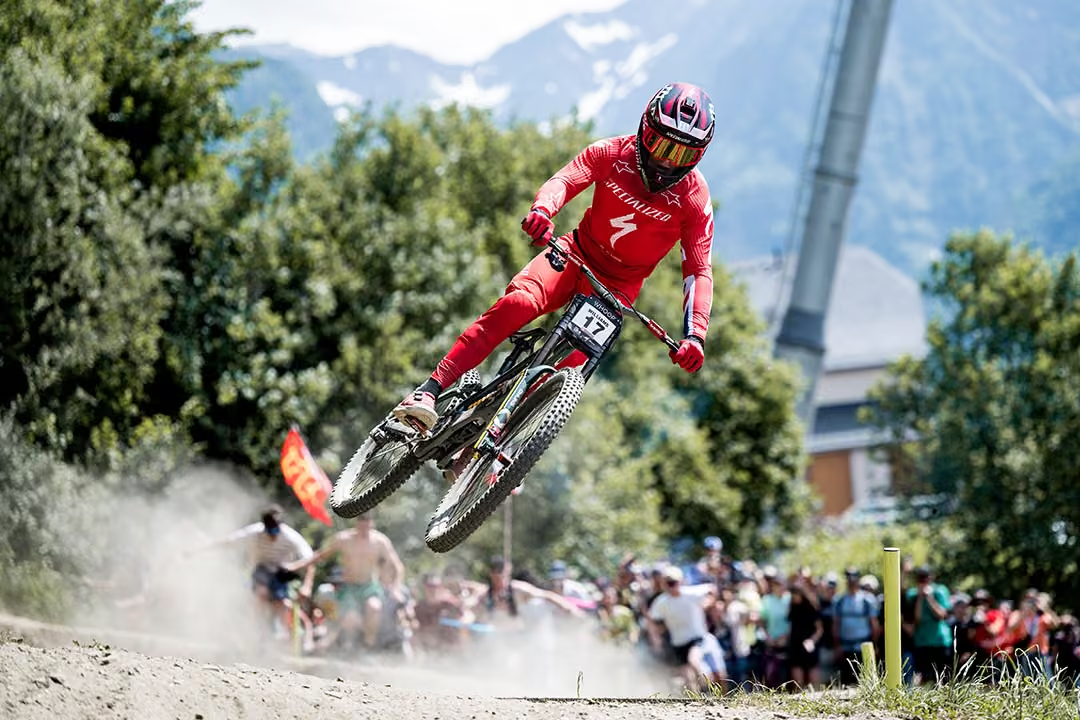
From track to mud. The braking excellence proven in Formula 1 and MotoGP is now ready to push to the limit on the toughest Downhill World Cup tracks. Same DNA, new terrain, extreme performance where control matters most.
-
Brembo
@BremboBrakes
From track to mud. The braking excellence proven in #formula1 and #motogp is now ready to push to the limit on the toughest Downhill World Cup tracks. Same DNA, new terrain, extreme performance where control matters most.
-
Brembo
@BremboBrakes
In Superbike, nothing is left to chance: every corner and braking point is analyzed through telemetry. TrackTribe brings that mindset to your ride, turning data from sensors and GPS into clear insights so you can truly understand, refine and improve every lap.
-
Brembo
@BremboBrakes
According to Brembo engineers working with #f1 drivers, Silverstone is low stress for brakes: difficulty index 1/5. Brakes are used just 3 times per lap for 6.5 seconds total. Only one braking zone is Hard, the other two Medium.
-
Brembo
@BremboBrakes
After Mick Doohan’s 1992 Assen injury, Brembo developed the thumb brake. Later adopted by many riders, it remains widely used today, while the index-finger system is no longer seen in MotoGP.
-
Brembo
@BremboBrakes
Assen history: Jack Miller took his first #motogp win here 10 years ago. Hayden, Doohan, and Gardner also won in previous decades—on Honda bikes, with Brembo brakes used in 31 consecutive Dutch GP wins.
-
Brembo
@BremboBrakes
At Turn 1, deceleration reaches 1.5 g, brake fluid pressure peaks at 11.6 bar, and carbon disc temperatures approach 720°C—making it the toughest braking zone of the Dutch GP. #motogp
-
Brembo
@BremboBrakes
The most demanding braking point at Assen is Turn 1: #motogp bikes decelerate from 294 km/h to 114 km/h in 3.9 seconds over 205 meters, with riders applying 5.4 kg of force on the lever.
-
Brembo
@BremboBrakes
With only 2 Hard braking zones, 3 Medium, and 5 Light, Assen is a flowing track with limited braking stress. Riders use the brakes for just 27 seconds per lap, with no braking lasting over 4 seconds. #motogp
-
Brembo
@BremboBrakes
One week after the Czech Republic, #motogp heads to the Netherlands for Round 10. According to Brembo engineers, TT Circuit Assen is not particularly demanding on brakes, with a difficulty rating of just 2 out of 6.
-
Brembo
@BremboBrakes
Two weeks ago Marc Marquez became the 3rd rider in history to win 100 GPs. Giacomo Agostini leads with 122 wins, followed by Valentino Rossi at 115. Both icons have won every single World Championship race using at least one Brembo braking component.
-
Brembo
@BremboBrakes
Deceleration at Brno's Turn 3 reaches 1.5 g. The Brembo brake fluid pressure hits 12.2 bar, while the temperature of the carbon discs peaks at a scorching 760°C.
-
Brembo
@BremboBrakes
Brno’s hardest braking point is Turn 3: #motogp bikes drop from 305 km/h to 104 km/h in 4.5 seconds, covering 235 meters. During this intense deceleration, riders exert a load of 5.7 kg on the Brembo brake lever.
-
Brembo
@BremboBrakes
Brakes are used 8 times per lap for a total of 29.5s at the Czech GP. It's a demanding track for Brembo MotoGP brakes: 6 braking zones are classified as High difficulty, 1 is Medium, and 1 is Light. Five of these braking sections last at least 3.9s.
-
Brembo
@BremboBrakes
The 9th #motogp round is here! After Hungary, the paddock stays in Eastern Europe for the Czech GP. According to Brembo engineers, the 5.403 km Automotodrom Brno is highly demanding for brakes, earning a difficulty rating of 4 on a scale from 1 to 6.
-
Brembo
@BremboBrakes
Since his 2024 WorldSBK debut, Nicolò Bulega has used the Brembo thumb master cylinder to manage his rear brake via a left handlebar lever. This setup enhances modulation when slowing down and opening the throttle, letting him square off corners and get the bike turned faster.
-
Brembo
@BremboBrakes
Nicolò Bulega’s WorldSBK Superpole win at Aragon was the 150th victory by an Italian rider in the championship. 150 wins split among 16 riders, but only one has claimed the world title so far. Can you guess who? 14 years later, Italy has found its heir, stopping with Brembo.
-
Brembo
@BremboBrakes
The ultimate test for WorldSBK braking systems at Misano is Turn 8 (Quercia). It is a massive deceleration zone where Superbike speeds plummet by over 200 km/h—going from 276 km/h to just 75 km/h in 4.4 seconds, all in a mere 197 meters. That is pure engineering under pressure.
-
Brembo
@BremboBrakes
What happens when a Hypercar anchors the brakes at 331 km/h heading into the Daytona Chicane? Drivers drop to 114 km/h in just 5 seconds flat, shredding speed over 301 meters. The physical toll? A massive 3 g of peak deceleration. That is how you tame Le Mans.
-
Brembo
@BremboBrakes
Winning Le Mans is brutal; doing it 32 times is legendary. Brembo has won 32 of 37 editions since its 1989 debut with Sauber-Mercedes. From powering Audi’s 8 historic wins in the 2000s to sharing Ferrari’s recent back-to-back victories, Brembo rules top-flight endurance.
-
Brembo
@BremboBrakes
Brembo engineers rate Misano as a medium-demand track for brakes, earning a 3 out of 5 difficulty index. Yet riders hit the binders 11 times per lap, spending 27.3 seconds on the brakes. The technical breakdown per lap features 3 High, 5 Medium, and 3 Light braking zones.
-
Brembo
@BremboBrakes
Brembo returns to Le Mans for the 38th year as the go-to braking partner for most of the grid. 45% of Hypercars run a complete Brembo system (discs, pads, calipers), 100% of LMP2 cars use Brembo calipers, and 75% of LMGT3 cars feature at least one Brembo component.
-
Brembo
@BremboBrakes
Brembo’s first #f1 win was at the 1975 Monaco GP with Lauda in the Ferrari 312T. Back then, the car relied on Brembo cast-iron discs rather than today's advanced carbon ones, and peak deceleration didn't even reach 2g, which is less than half of what modern drivers experience.
-
Brembo
@BremboBrakes
Monaco’s toughest test for brakes is Sainte Devote. Formula 1 cars drop from 276 to 132 km/h in 1.67 seconds over 91 meters. Drivers endure a massive 4 g of peak deceleration, slamming the pedal with 114 kg of force while the system unleashes a whopping 1,463 kW of braking power.
-
Brembo
@BremboBrakes
Brembo engineers rate the Circuit de Monaco a 2 out of 5 for brake difficulty. Modern #f1 cars only hit the brakes 9 times per lap for roughly 16.3 seconds, which accounts for 23% of the race. The technical breakdown is simple: 2 heavy, 3 medium, and 4 light braking zones.
-
Brembo
@BremboBrakes
Back in early May, the Balaton Park Circuit hosted the World Superbike Championship. While #worldsbk relies on 338.5 mm steel discs, #motogp runs carbon discs sized at 320 mm, 340 mm, or 355 mm, depending on the track layout and rider preference.
-
Brembo
@BremboBrakes
At Turn 5 of the Hungarian #motogp Grand Prix, riders pull a staggering 1.5 g of deceleration. The Brembo brake fluid pressure spikes at 13.7 bar, sending the carbon disc temperatures soaring up to 740 °C.
-
Brembo
@BremboBrakes
Turn 5 is the absolute toughest spot on the Balaton Park Circuit for the brakes. #motogp bikes drop from 290 km/h to just 72 km/h in 4.7 seconds, covering 205 meters. During this deceleration, riders pull the brake lever with a massive 6.4 kg of force.
-
Brembo
@BremboBrakes
Although the Hungarian #motogp Grand Prix features 10 braking zones per lap—with riders spending over 30 and a half seconds on the brakes—it remains only moderately demanding for the Brembo braking systems. The track is split evenly with 5 "High" and 5 "Light" braking zones.
-
Brembo
@BremboBrakes
Just one week after an incredible Brembo Italian GP, #motogp is heading to Hungary. According to Brembo engineers, the Balaton Park Circuit falls into the medium-difficulty category for braking systems, scoring a 3 on a scale from 1 to 6.
-
Brembo
@BremboBrakes
Deceleration at Turn 1 of the MotoGP Brembo Grand Prix of Italy hits 1.5 g, while the Brembo brake fluid pressure reaches 11.8 bar and the carbon discs soar to a temperature of 740°C.
-
Brembo
@BremboBrakes
The toughest corner for the braking system at MotorLand Aragón is the final one before the finish line. Superbikes drop from 317 km/h to 142 km/h in 3.8 seconds, covering 232 meters while riders exert a 5.6 kg load on the brake lever.
-
Brembo
@BremboBrakes
The most demanding corner for the braking system at the MotoGP Brembo Grand Prix of Italy is Turn 1. MotoGP bikes drop from 337 km/h to 94 km/h in 5.4 seconds, covering 291 meters while riders exert a 5.5 kg load on the brake lever.
-
Brembo
@BremboBrakes
On the MotorLand Aragón circuit, WSBK riders will hit the brakes 11 times per lap for over 29 seconds. There are 4 "High" braking sections 5 "Medium", and 2 "Low". The 12.1 bar reached by the Brembo brake fluid at Turn 11 is one of the highest figures in the entire championship.
-
Brembo
@BremboBrakes
Although brakes are used 10 times per lap for a total of 31 seconds during the MotoGP Brembo Grand Prix of Italy, only two braking sections are classified as "Hard". The overall brake lever load throughout the race remains manageable at just 814 kg per rider.
-
Brembo
@BremboBrakes
According to Brembo engineers, the Autodromo Internazionale del Mugello falls into the category of medium-demand circuits for the braking systems. On a difficulty scale from 1 to 6, it earns a rating of 3.
-
Brembo
@BremboBrakes
The third round in May marks the sixth event of the World Superbike season. According to Brembo engineers, MotorLand Aragón belongs to the category of highly demanding tracks for brakes, earning a difficulty index of 4 on a scale of 1 to 5.
-
Brembo
@BremboBrakes
Brembo and the Autodromo Internazionale del Mugello share a special 50th anniversary this year. Back in 1976, Mugello hosted its very first Grand Prix—the exact same year Brembo brakes made their debut in the 500cc World Championship.
-
Brembo
@BremboBrakes
The month of May wraps up with Round 7 of MotoGP: the Brembo Grand Prix of Italy. For the third consecutive year, Brembo is the Title Sponsor of the Italian GP, with its logo taking center stage on the Tuscan track's most iconic corners, from San Donato to Arrabbiata.
-
Brembo
@BremboBrakes
Braking times and distances have increased compared to the 2025 Canadian GP due to the new characteristics of the 2026 cars. At Turn 10 he braking distance has shot up from 107 meters to 158 meters, with braking time stretching from 2.82 seconds to 3.94 seconds.
-
Brembo
@BremboBrakes
At Turn 13 of the Canadian GP, drivers endure a maximum deceleration of 3.7 g while slamming the brake pedal with 101 kg of load. To handle this massive shedding of speed, the braking power peaks at a staggering 1,561 kW.
-
Brembo
@BremboBrakes
Brembo simulations show that Turn 13 is the most brutal point for brakes at the Circuit Gilles-Villeneuve. Cars drop from 306 km/h to 147 km/h in a mere 1.93 seconds, covering 114 meters during this intense deceleration phase.
-
Brembo
@BremboBrakes
The Canadian GP is notoriously tough on brakes: 6 heavy braking zones per lap for over 14 seconds of total use. Drivers face braking distances between 94 and 158 meters, throwing at least 87 kg of pressure onto the pedal. #f1
-
Brembo
@BremboBrakes
Round 5 of the F1 season stays in North America as we head to Montreal! According to Brembo engineers, the Circuit Gilles-Villeneuve is brutal on brakes, earning a heavy difficulty rating of 4 out of 5. #canadiangp #f1
-
Brembo
@BremboBrakes
Toprak Razgatlioglu is the big absentee at Most, a track where he has 10 wins and 4 second-place finishes in 15 races. The only other winner is Bulega, who has one victory and five podiums here. To dominate the Czech asphalt, a Brembo braking system remains the essential tool.
-
Brembo
@BremboBrakes
Bulega chases the absolute record for consecutive podiums at Most. Having reached 25, a podium in Race 1 would see him surpass legends Colin Edwards and Toprak Razgatlioglu. The common denominator between these three iconic champions is their total reliance on Brembo brakes.
-
Brembo
@BremboBrakes
Nicolò Bulega has dominated the season so far, rewriting the WSBK record books with Brembo. He is the first rider to ever win the opening 12 races of a season and to secure 16 consecutive victories. Fans are waiting to see if "The Cannibal" can keep the streak alive in Most.
-
Brembo
@BremboBrakes
Turn 1 at Most is the toughest on the brakes due to the preceding 800-meter straight. Superbikes drop 221 km/h—from 291 to 70 km/h—in 4.7 seconds with Brembo systems. In 217 meters, riders endure 1.5 g of deceleration while brake fluid pressure hits a peak of 11 bar.
-
Brembo
@BremboBrakes
At Most, Superbikes face 10 braking points per lap for a total of 22.5 seconds. During full-length races, each rider exerts a total load of 860 kg on the brake lever. This represents the highest physical demand on the braking hand recorded in the first six rounds of the season.
-
Brembo
@BremboBrakes
World Superbike heads to its second consecutive Eastern European round as the paddock moves from Hungary to the Czech Republic. According to Brembo engineers, Autodrom Most is highly demanding for brakes, earning a difficulty index of 4 on a scale of 1 to 5.
-
Brembo
@BremboBrakes
The Catalunya circuit hosts both MotoGP and F1, where Brembo has been a fixture for 50 years. While Brembo is the sole supplier for both, philosophies differ: all MotoGP teams use the same caliper, while in F1, every car features a custom caliper designed for its specific needs.
-
Brembo
@BremboBrakes
Valentino Rossi is the only rider to win the Catalunya GP in all three two-stroke classes: 125cc in 1997, 250cc in 1998 and 1999, and 500cc in 2001. In all four of these historic victories, "The Doctor" relied on Brembo braking systems to secure his place on the top step.
-
Brembo
@BremboBrakes
Deceleration at the first braking point of the Catalunya GP hits a staggering 1.5 g. During this phase, Brembo brake fluid pressure reaches 13.2 bar, while the carbon discs can reach peak temperatures of 780°C as they struggle to dissipate the heat.
-
Brembo
@BremboBrakes
Turn 1 is the most brutal point for brakes at the Catalunya circuit. MotoGP bikes drop from 341 km/h to 101 km/h in just 4.9 seconds thanks to Brembo. Covering 266 meters, riders must exert a massive 6.2 kg of pressure on the brake lever to make the corner.
-
Brembo
@BremboBrakes
With 9 braking points per lap totaling 29 seconds, the Catalunya GP is a massive test for Brembo brakes. Four zones are categorized as High, one Medium, and four Light. The 6.3 kg load on the brake lever at Turn 10 is among the highest values in the MotoGP championship.
-
Brembo
@BremboBrakes
One week after the French GP, MotoGP returns to Spain for the Catalunya GP. Brembo engineers classify this circuit as highly demanding for the entire grid's braking systems. On a scale of 1 to 6, the track earns a difficulty rating of 5.
-
Brembo
@BremboBrakes
Flashback to last year: Home-hero Johann Zarco took a historic victory for LCR Team Honda, masterfully managing wet tires and Brembo carbon brakes in tricky conditions. Zarco became the first Frenchman to win a premier class home GP since the legend Pierre Monneret back in 1954.
-
Brembo
@BremboBrakes
At the Turn 8 braking point, MotoGP bikes need 209 meters to scrub off speed while riders exert a massive 5.8 kg of load on the lever. The result is a staggering 1.5 g of deceleration, with Brembo brake fluid pressure skyrocketing to 12.4 bar. This is where precision meets power.
-
Brembo
@BremboBrakes
Turn 8: The toughest test for #motogp brakes in France. Known as Garage Vert after a local shop built in 1955, this corner is a beast. Thanks to Brembo’s stopping power, riders plummet from 263 km/h to 78 km/h in just 4.9 seconds. That is pure mechanical violence at its finest.
-
Brembo
@BremboBrakes
Braking by the numbers at Le Mans: With 10 braking zones per lap, MotoGP riders spend 31.5 seconds on the brakes—roughly 35% of the entire race. The layout features two High intensity braking points back-to-back, six Medium, and two Light. It is a relentless rhythm for the bikes.
-
Brembo
@BremboBrakes
The first of May’s three #motogp showdowns kicks off this weekend at Le Mans for the French GP. According to Brembo engineers, this circuit is categorized as highly demanding on braking systems. On a scale of 1 to 6, it earns a solid 4. Expect a grueling test of heat management.
-
Brembo
@BremboBrakes
The Miami GP marks a major milestone: our 900th Formula 1 Grand Prix with Brembo technology on the grid. From our 1975 debut with cast iron discs for Ferrari to today's cutting-edge performance, it has been an honor to be part of F1 history.
-
Brembo
@BremboBrakes
Turn 17 at Miami is the toughest braking test. Cars drop from 320 km/h to 78 km/h in 3.66 seconds, covering 165 meters. Drivers face 4g of deceleration and apply 114 kg of force on the pedal. High-performance engineering in action.
-
Brembo
@BremboBrakes
F1 heads to Florida for the Miami GP! Our engineers rate this as a "low demand" circuit (2/5). Drivers use brakes for under 10 seconds per lap—just 11% of the total time, one of the lowest of the season. But every meter counts in the fight for position.
-
Brembo
@BremboBrakes
In Hungary, 9 WSBK races have all been won by bikes with Brembo brakes. Fred Merkel took 4 wins, Toprak Razgatlioglu 3, and Raymond Roche 1 with Ducati in 1990. A perfect performance record on Hungarian soil.
-
Brembo
@BremboBrakes
Entering Turn 1 in Hungary, riders experience 1.5g deceleration, with brake fluid pressure peaking at 11.6 bar. The 216 km/h speed drop is one of the top 5 velocity deltas in the championship.
-
Brembo
@BremboBrakes
Turn 1 at Balaton Park is the toughest braking test. Superbikes drop from 272 km/h to 56 km/h in 4.8 seconds over 207 meters. Riders exert a massive 5.4 kg load on the brake lever. Extreme precision in action.
-
Brembo
@BremboBrakes
At the Hungarian WSBK round, bikes are on the brakes for 29 seconds per lap across 9 braking zones. The intensity breakdown: 4 High, 1 Medium, and 4 Light. Precision is key to mastering this track.
-
Brembo
@BremboBrakes
May is here, and World Superbike action is back! We're kicking off at Balaton Park Circuit. Our engineers have analyzed the track, rating it "highly demanding" for braking systems with a 4/5 difficulty score. Let the racing begin!
-
Brembo
@BremboBrakes
2006: The season started at Jerez with a Ducati masterclass. Loris Capirossi took pole and led from start to finish, winning by 4 seconds on 320mm Brembo carbon discs. The GP6 was a force, paving the way for the title run with Casey Stoner in 2007.
-
Brembo
@BremboBrakes
In February 1998, the world’s first radial-mount caliper debuted at Jerez on Marcellino Lucchi’s Aprilia. From a racing breakthrough to an industry standard, Brembo radial calipers now power every #motogp bike and most high-performance road motorcycles.
-
Brembo
@BremboBrakes
At Turn 6 of the Jerez GP, #motogp riders apply a 6 kg load to the Brembo brake lever, experiencing 1.5g of deceleration over 254 meters, while brake system pressure peaks at 12.9 bar.
-
Brembo
@BremboBrakes
Turn 6, dedicated to Dani Pedrosa, is the toughest braking challenge at Jerez. #motogp bikes drop from 295 km/h to 69 km/h in just 5.4 seconds. It is officially one of the 10 longest braking events in the entire World Championship.
-
Brembo
@BremboBrakes
Jerez is a serious challenge, rated 4/6 on our difficulty index.
With 11 braking zones per lap totaling 33.5 seconds, riders are on the brakes for 35% of the race. We see 3 High, 4 Medium, and 4 Light intensity zones with deceleration peaking at 1.5g. -
Brembo
@BremboBrakes
Round 4 is here! The Spanish GP marks #motogp return to European soil for the summer. Brembo engineers classify the Circuito de Jerez as one of the most demanding tracks for braking systems, and our team is ready to support every single rider on the grid.
-
Brembo
@BremboBrakes
Ducati and Bulega are clinical: 6 wins from 6 races in 2026! Bulega prefers vented discs for cooling, but the work never stops. After FP1, aruba.it Racing and Brembo techs are already evaluating the final setup and whether to add air ducts for Sunday. #worldsbk
-
Brembo
@BremboBrakes
The most punishing section of the TT Circuit Assen is Turn 1. Riders scrub speed from 269 km/h to 113 km/h in just 3.6 seconds, pulling 1.5 g. This 187-meter braking zone requires 4.6 kg of lever load, with brake fluid pressure peaking at 9.9 bar.
-
Brembo
@BremboBrakes
Numbers at the TT Circuit Assen: riders hit the brakes 10 times per lap for 26.7 seconds. Only 2 zones are "High" intensity. The biggest challenge is Turn 1, where riders drop 150 km/h, pulling 1.5 g and covering 187 meters in just 3.6 seconds.
-
Brembo
@BremboBrakes
How tough is the TT Circuit Assen on brakes?
According to Brembo engineers, not very! On a scale of 1 to 5, Assen earns a difficulty rating of just 1, making it one of the least demanding circuits on the calendar for braking systems. #worldsbk -
Brembo
@BremboBrakes
We’re back! #worldsbk heads to the iconic TT Circuit Assen for the 3rd round. As one of the few venues hosting both WorldSBK and MotoGP, it’s the ultimate test. Brembo is proud to support the entire MotoGP grid and nearly every rider in the WorldSBK paddock here.
-
Brembo
@BremboBrakes
Even with high-tech sensors, LMDh cars at Le Mans use geometric wear indicators (physical steps or marks) on the discs. These serve as a vital "sanity check" for telemetry data during endurance racing, providing a fail-safe visual assessment when electronic anomalies occur.
-
Brembo
@BremboBrakes
Discs and pads have different missions. Discs are engineered to rapidly absorb and dissipate heat, while pads have lower thermal conductivity to act as a shield. This protects the calipers and brake fluid from boiling, though peak performance only triggers once above 300°C.
-
Brembo
@BremboBrakes
Slowing a single-seater from 350 km/h pushes temperatures past 1000°C. To manage this, we’ve evolved from dozens of cooling holes in the 2000s to over 1,000 in modern discs. This leap was driven by increased disc diameters and precision airflow modeling via advanced CFD software.
-
Brembo
@BremboBrakes
Why "Carbon-Carbon"? In 1,000°C furnaces, carbon-rich gases permeate the fiber preforms through Chemical Vapor Infiltration (CVI). This deposits carbon directly into the weave, creating a composite where both the matrix and reinforcement are carbon for extreme thermal resistance.
-
Brembo
@BremboBrakes
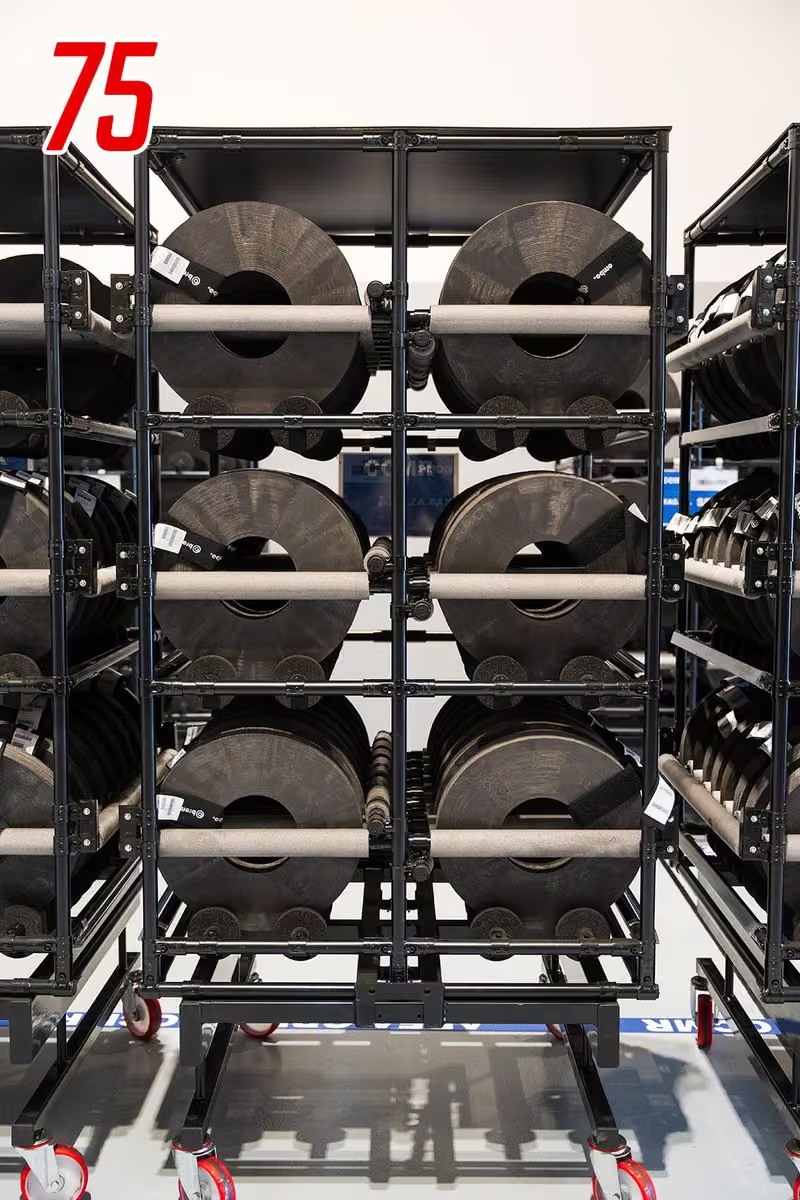
Did you know that Brembo’s Formula 1 brake discs begin their life as soft, "fluffy" fabric donuts?
To build them, dozens of carbon fiber layers are stitched together by a mechanical needling machine equipped with thousands of needles. -
Brembo
@BremboBrakes
Forget steel. With Hyction™ on the Ducati Superleggera V4, Brembo rewrites the rules. This carbon-ceramic tech offers superior friction stability and slashes unsprung mass via the GP4-HY caliper and Öhlins Carbon fork. The future doesn't stop—it just slows down faster.
-
Brembo
@BremboBrakes
Managing 1,000°C+ with millimetric precision: the 340mm Hyction™ disc features 132 ventilation holes to kill brake fade. Paired with the GP4-HY boosted caliper and an asymmetric aluminum bell, Brembo proves the future doesn't stop—it just slows down faster. No more compromises.
-
Brembo
@BremboBrakes
At 1.375 kg, Hyction™ sheds 450g per disc versus steel. Cutting nearly 1kg from the front wheel slashes inertia by 40%. For the rider, this translates to lightning-fast direction changes, surgical reactivity, and a level of steering precision that was previously unreachable.
-
Brembo
@BremboBrakes
Born from "Hyper" and "Action," Hyction™ features a carbon matrix reinforced with fibers and integrated with silicon carbide. Derived from hypercar CCM-R tech, this material offers thermal resistance and structural stability for consistent braking under extreme stress.
-
Brembo
@BremboBrakes
Brembo introduces Hyction™, the revolutionary carbon-ceramic disc debuting on the Ducati Superleggera V4 Centenario. This is the single biggest innovation in motorcycle braking since the legendary Brembo monobloc caliper changed the game back in 2006.
-
Brembo
@BremboBrakes
Steel power: 20 of 22 #worldsbk riders rely on Brembo steel discs. Options range from 336mm to 338.5mm, with thicknesses up to 7.4mm. Performance tailored to every circuit.
-
Brembo
@BremboBrakes
The heavy hitter at COTA is Turn 12. After the 1.2km straight, bikes drop from 339 to 68 km/h. That’s 5.8 seconds of pure braking power over 290 meters. #motogp
-
Brembo
@BremboBrakes
The hardest braking point at Suzuka is Turn 16. Drivers plummet from 283 to 104 km/h in 2.8s, hitting the pedal with a massive 99 kg of load. High speed, low braking demand, total focus. #suzuka
-
Brembo
@BremboBrakes
The toughest spot at Portimão? Turn 1. Riders drop from 305 to 124 km/h in 3.8s, pulling 1.5 g of deceleration with 4.8 kg of lever load. Precision is everything. #worldsbk
-
Brembo
@BremboBrakes
COTA is a "Medium" 3 out of 6 for #motogp brakes. Despite 9 braking points, riders spend 26% of the lap (31s) on the brakes, pulling nearly 37.5 kg of total lever load. #americasgp
-
Brembo
@BremboBrakes
History made! With 23 wins, Nicolò Bulega is now the most successful Italian in #worldsbk, surpassing legends like Biaggi and Melandri. All 66 of their combined wins have one thing in common: Brembo.
-
Brembo
@BremboBrakes
Suzuka is an "Easy" 1/5 for brakes. F1 drivers spend just 9s per lap on the brakes—only 10% of the race. One of the lowest values on the #f1 calendar. #japanesegp
-
Brembo
@BremboBrakes
According to Brembo technicians, Portimão’s Autodromo do Algarve is a "medium" demand track for brakes. It earns a 3 out of 5 difficulty index. A technical challenge for 13 out of 14 #worldsbk teams. #brembo #portimao
-
Brembo
@BremboBrakes
Brembo brakes debuted in the premier class in 1976, but our first victory on Brazilian soil came in 1988. Eddie Lawson took the win by 13 seconds on Giacomo Agostini’s Yamaha, equipped with Brembo 320mm discs and 4-piston calipers.
-
Brembo
@BremboBrakes
Heading into Turn 1, #motogp bikes cover 259 meters under braking. Riders must exert 5.6 kg of pressure on the lever, enduring a 1.5 g deceleration as the braking system pressure peaks at 12 bar. More facts on our website: www.brembo.com/en/motorsport/motogp/2026/facts-brasil-2026
-
Brembo
@BremboBrakes
The most grueling challenge at Goiania is Turn 1. Here, speeds plummet from 337 km/h to 117 km/h in a massive 4.4-second braking event. #motogp #brasil
-
Brembo
@BremboBrakes
Despite having only 7 braking points per lap, the brakes at the Brazilian GP are engaged for approximately 20 seconds. Of these 7 points, 3 are categorized as 'High' intensity, 3 as 'Medium,' and 1 as 'Low.' Read more on our website: www.brembo.com/en/motorsport/motogp/2026/facts-brasil-2026
-
Brembo
@BremboBrakes
After 22 years, #motogp is back in Brazil! According to Brembo engineers the Autodromo Internacional de Goiania is classified as a demanding track for braking systems, earning a difficulty rating of 4 out of 6. Discover more on our website: www.brembo.com/en/motorsport/motogp/2026/facts-brasil-2026
-
Brembo
@BremboBrakes
Rear brakes staying 'cold'? It’s coming.
In 2026, the 350 kW regenerative system will be so powerful that mechanical brakes will barely be touched in some zones.
The future of braking is the perfect overlap between friction and energy. #f1 #chinesegp -
Brembo
@BremboBrakes
At Turn 14 of the Chinese GP, speeds plunge to 77 km/h in just 3.51 seconds, covering a distance of 158 meters. To achieve this, drivers must apply 105 kg of pedal load, enduring a 3.9 g deceleration as the system generates a massive 1,665 kW of braking power.
-
Brembo
@BremboBrakes
From 314 km/h to 77 km/h. Turn 14 at Shanghai is a monster. After a 1.2 km straight, drivers have to trust their Brembo systems completely to scrub off massive speed in seconds.
Simulations vs. Reality: This is where the race is won. #f1 #chinesegp -
Brembo
@BremboBrakes
Data crunching for the #chinesegp:
Drivers spend 16.3s on the brakes per lap (18% of the time).
The breakdown:
◾️3 Hard braking zones
◾️1 Medium
◾️3 Low -
Brembo
@BremboBrakes
How tough is the Shanghai International Circuit on brakes? According to our engineers on the ground with the F1 Teams, it’s a 3 out of 5.
A 'moderately demanding' challenge where consistency is key. #f1 -
Brembo
@BremboBrakes
The MGU-K is the new heavy lifter. With increased regeneration, the rear hydraulic brakes don't have to work nearly as hard. We’re seeing smaller rear discs (down to 260mm) as the motor handles more of the deceleration. Efficiency is king.
-
Brembo
@BremboBrakes
Bigger discs for the 2026 opener! Fronts are up by 15mm, while rears get thicker (34mm). Cooling holes are also shrinking to 2.5mm. These changes ensure a safety margin as teams rapidly develop these new-gen cars.
-
Brembo
@BremboBrakes
Major shift in the 2026 rules: the 20-year-old 6-piston limit is gone! Teams can now run 8-piston calipers. We’re seeing a split in the paddock: some teams are already running 8 pistons with 4 pads, while others stick to 4 or 6-piston setups.
-
Brembo
@BremboBrakes
According to Brembo, Albert Park is now 'low-demand' for brakes. Its difficulty rating has dropped from 3 to 2 on a 5-point scale. With the 2026 regs, drivers are only on the brakes for about 10% of the lap. Efficient energy recovery is the new priority.
-
Brembo
@BremboBrakes
#f1 2026 begins in Australia! It’s 'Year Zero' for the sport: shorter, lighter cars, active aero instead of DRS, and nearly 3x the MGU-K power. This isn't just an evolution—it’s a total reset for car design and Brembo’s braking systems.
-
Brembo
@BremboBrakes
Last year, Marc Marquez achieved total dominance: Pole, Sprint, and GP win—leading his brother Alex both times. Will he repeat the masterclass or will we see a new winner in Buriram? Let us know!
-
Brembo
@BremboBrakes
Analyzing the hardest braking zone at Chang:
◾️277 km/h to 112 km/h
◾️Distance: 197m
◾️Lever load: 5.2 kg
◾️Pressure: 11.1 bar
◾️Deceleration: 1.4 g. Pure precision required. -
Brembo
@BremboBrakes
Extreme challenges require extreme solutions. In Thailand, almost all riders choose Brembo 355mm finned carbon discs to maximize heat dissipation. Brakes are engaged for 32% of the entire race!
-
Brembo
@BremboBrakes
According to Brembo engineers (sole suppliers for 11 years), Chang Circuit is a 'brake killer.' Difficulty: 6 out of 6. With 4 'High' braking points exceeding 195 meters, heat management is the #1 enemy.
-
Brembo
@BremboBrakes
The 2026 #motogp season kicks off in Thailand! Ducati is the bike to beat after 4 consecutive titles. All eyes on 'golden' rookies Toprak Razgatlioglu and Diogo Moreira. 22 rounds ahead, featuring the debut of the Brazil GP! 🇧🇷
-
Brembo
@BremboBrakes
The 2026 #worldsbk grid hits different. With Toprak & Rea gone, Alvaro Bautista is the only champ left.
His legacy on the Panigale V4 R is part of a 37-title Ducati history—all achieved with the stopping power of Brembo. -
Brembo
@BremboBrakes
The toughest test at Australian WSBK round? Turn 1 (Doohan Corner): Top Speed: 314 km/h; Speed Drop: to 198 km/h ; Time: 3 seconds; Distance: 211 meters; Deceleration: 1.5 g Lever load: 3.5 kg.
-
Brembo
@BremboBrakes
With only 7 braking points and no heavy stops, Phillip Island is easy on the gear. Wear is so low that discs could last for rounds!
The key spot? Turn 4 (Honda Corner). It’s not the most brutal, but as the main overtaking zone, it demands absolute precision. -
Brembo
@BremboBrakes
Despite the high speeds, Phillip Island is easy on the SBK brakes. Brembo engineers give it a Difficulty Index of 1 out of 5 (tied with Assen).
-
Brembo
@BremboBrakes
The #worldsbk era officially resets at Phillip Island! 🇦🇺 With Razgatlioglu in MotoGP and Rea retired, the 2026 season kicks off with a new look but a familiar leader: Brembo.
We are proud to power 20 out of 22 riders on the grid. That’s 91% of the field! -
Brembo
@BremboBrakes
Level 4 is the Danger Zone. At Jerez, riders spend 33% of the lap on the brakes. From the violent stops at Magny-Cours to the stop-and-go layout of the new Balaton Park, these six tracks are where heat becomes the enemy and only the toughest hardware survives.
-
Brembo
@BremboBrakes
Portimão, Misano, and Cremona sit at Level 3: the perfect middle ground. These tracks demand total consistency. Whether it's the elevation changes in Portugal or the high-intensity heat of Italy, a perfect lever feel is the secret to staying fast until the final lap.
-
Brembo
@BremboBrakes
Not every track is a nightmare for brakes. Phillip Island and Assen score just 1/5 on the Brembo scale. With fast, flowing curves and high speeds that naturally cool the discs, these legendary circuits let the braking system catch its breath while the riders stay pinned.
-
Brembo
@BremboBrakes
Donington Park is tougher on brakes than Phillip Island despite having fewer turns. Why? It's all about spacing. Short gaps between the Fogarty Esses and Melbourne Hairpin mean heat builds up faster than it can dissipate. Only the best systems can handle that dance.
-
Brembo
@BremboBrakes
What makes a 'High Intensity' stop in WSBK? It’s brutal: over 3.5 seconds on the brakes, 4kg of lever load, 1.4g deceleration, and 9 bar of pressure. At tracks like Cremona and Aragon, riders face four of these "monster" stops every single lap.
-
Brembo
@BremboBrakes
Which 2026 WSBK track is the ultimate brake-killer? Brembo engineers have the answer: Donington Park. Rated 5/5 for difficulty, its relentless sequence of stops gives the discs no time to breathe. At the other end? Phillip Island and Assen are a total breeze.
-
Brembo
@BremboBrakes
Brembo has dominated WSBK since 1988, securing 38 Manufacturers' and 34 Riders' titles. With 12 of 13 teams using our systems in 2026, we don't just build brakes—we push the limits of speed and safety for champions and everyday riders alike.
-
Brembo
@BremboBrakes
Designers, start your engines.
The 2026 rules are blowing the doors open on brake calipers. Up to 8 pistons. Up to 4 brake pads. 3 attachment points
More flexibility means more innovation. We can't wait to see how the grid adapts. -
Brembo
@BremboBrakes
F1 2026 Discs: It’s all in the details.
The new regs bring big dimensional changes: Front discs +15mm in diameter . Rear thickness up to 34mm . Cooling holes down to 2.5mm
In a sport won by fractions of a second, these millimeters matter. -
Brembo
@BremboBrakes
2026 is the biggest tech shift since the dawn of the hybrid era.
While 2014 was a technological leap, 2026 will be a strategic one. We’ve mastered Brake-by-Wire, but the new regs bring fresh unknowns. Every team is looking for that "magic bullet" out of the gate. -
Brembo
@BremboBrakes
Season 52 is officially GO!
Brembo has been a relentless force in #f1 for over 50 years. As we supply all 11 teams on the grid for 2026, the challenge shifts: balancing MGU-K recovery with narrower tires and active aero. -
Brembo
@BremboBrakes
The 2026 Evolution: The dawn of a new era is coming.
In just weeks, the 2026 #f1 cars hit the track in Barcelona. This isn't just an update—it’s a radical technical revolution. From aero to power units, we’re redefining what performance looks like. -
Brembo
@BremboBrakes
Master your metrics. #tracktribe monitors brake pressure, lean angle, speed, and acceleration. Log your tires and suspension settings to see exactly how your setup affects your lap times. Refine. Improve. Repeat. www.brembogroup.com/en/media/news/brembo-introduces-track…
-
Brembo
@BremboBrakes
The best part? #tracktribe is universal. You don’t need Brembo brakes to join the Tribe. It’s designed to fit any bike, giving every rider access to elite telemetry. Check with your local installer to get started. www.brembogroup.com/en/media/news/brembo-introduces-track…
-
Brembo
@BremboBrakes
Safety and precision come first. #tracktribe hardware is installed exclusively by authorized Brembo technicians. Why? Because professional setup is the only way to ensure data integrity and peak performance on every lap. www.brembogroup.com/en/media/news/brembo-introduces-track…
-
Brembo
@BremboBrakes
How does #tracktribe work? It’s the perfect synergy of hardware and software. Our dedicated app pairs with a pro-level kit featuring a high-precision GPS, IMU, and a dedicated brake pressure sensor for 100% accurate telemetry. www.brembogroup.com/en/media/news/brembo-introduces-track…
-
Brembo
@BremboBrakes
Meet #tracktribe: Brembo’s first digital ecosystem for riders. Beyond just data, it’s a community-driven platform designed to sharpen your technique, monitor performance, and connect with riders who share your drive. Elevate your track day. www.brembogroup.com/en/media/news/brembo-introduces-track…
-
Brembo
@BremboBrakes
Brembo’s 10 Essential Numbers for the 2025 F1 10/10
1,100: the max cooling holes in a modern Brembo F1 disc. Since 2022, the FIA mandated a 3mm min diameter. Before that, we used 2.5mm holes to fit a staggering 1,470 per disc! -
Brembo
@BremboBrakes
Brembo’s 10 Essential Numbers for the 2025 F1 9/10
The HTC64T brake fluid used in 2025 F1 cars has a dry boiling point of 335°C. Crucially, it maintains exceptionally low compressibility even above 180°C. Pure stability under heat. -
Brembo
@BremboBrakes
Brembo’s 10 Essential Numbers for the 2025 F1 8/10
Brembo supplies each F1 team with 280–480 carbon pads per season. These are engineered to survive a massive operating window of temperature and pressure across 23+ races. -
Brembo
@BremboBrakes
Brembo’s 10 Essential Numbers for the 2025 F1 7/10
To test F1 brakes, Brembo uses a full-system bench where actuators spike pressure from 0 to 120 bar in under 0.1 seconds. Extreme speed, extreme pressure. -
Brembo
@BremboBrakes
Brembo’s 10 Essential Numbers for the 2025 F1 6/10
F1 carbon discs start as 75g rings of rayon or PAN filaments. They undergo needle-punching, stabilization, and densification at 900°C+, followed by graphitization. It’s a long journey to reach the pinnacle of braking performance. -
Brembo
@BremboBrakes
Tire tracks fade, but a legacy of success is etched in stone. We leave Saudi Arabia having mastered the impossible once again. The finish line in Yanbu isn't the end—it’s the start of our next chapter. #dakar2026
-
Brembo
@BremboBrakes
Brembo F1 2025 5/10: The Legacy
A golden milestone! 2025 marks Brembo’s 50th consecutive year in Formula 1. A journey that began in 1975 with cast-iron discs for Scuderia Ferrari. Half a century of racing excellence. 🇮🇹🏆 -
Brembo
@BremboBrakes
The final dune has been conquered. We are incredibly proud to have supported the champions of the #dakar2026 all the way to the finish line in Yanbu. Thank you to all the teams who chose the safety and performance of Brembo. See you next year!
-
Brembo
@BremboBrakes
Beyond the final dune lies tomorrow’s safety. #dakar2026 is our open-air laboratory: we test under extreme stress today to set global standards for tomorrow. At Brembo, excellence is a finish line that keeps moving.
-
Brembo
@BremboBrakes
Brembo F1 2025 4/10: The Discs
Precision at high heat: Brembo carbon discs feature a 32mm max thickness. Diameters range from 325-330mm (front) to 275-280mm (rear) to handle extreme racing speeds. #f1 #bremboracing -
Brembo
@BremboBrakes
Innovation you don't see, but feel. In the chaos of the desert, #brembo provides the confidence of a perfect stop. The ultimate lifeline for the world's toughest rally. #dakar2026
-
Brembo
@BremboBrakes
Before every dune, in that split second of silence, Brembo technology answers. 🏜️
When the margin for error is zero, we are the anchor for victory dreams in the heart of the desert. Excellence is showing up when it matters most. -
Brembo
@BremboBrakes
Air, sand, and fire. Where nature unleashes its force, we respond with the precision of our braking technology. We transform the energy of heat into pure performance. For Brembo, this is the true meaning of innovation: dominating the elements to empower the world’s best drivers.
-
Brembo
@BremboBrakes
Brembo F1 2025 3/10: The Grid
A clean sweep: All 10 teams on the 2025 grid chose Brembo Group calipers. We also supplied the majority of the field with specialized hydraulic hardware and friction components. #brembo #f1 -
Brembo
@BremboBrakes
Dunes, rocks, and 45°C heat: the ultimate test. Brembo is the ally for every driver at #dakar2026. Our braking systems power the best in every category—Bikes, Cars, Challengers, SSVs, and Trucks. Performance with no limits.
-
Brembo
@BremboBrakes
#dakar2026 means 750°C peak temperatures and vehicles 3x heavier than standard rally cars. 🌡️🔥
Our floating system ensures consistent performance from asphalt to raw rock. For Brembo, the desert is the ultimate proof of excellence. -
Brembo
@BremboBrakes
Brembo F1 2025 2/10: The Calipers
The max number of pistons allowed in F1 calipers until 2026. Every 2025 Brembo caliper was machined from solid aluminum alloy, nickel-plated, and custom-tailored for each team's specific needs. #engineering #brembo #f1tech -
Brembo
@BremboBrakes
Brembo F1 2025 1/10: The Record
By leading 10 laps at the Japanese GP, Kimi Antonelli (Mercedes) became the youngest driver to lead an F1 lap at 18y 7m 12d. He beat Max Verstappen’s record by just 3 days! #f1 #brembo #kimiantonelli -
Brembo
@BremboBrakes
The 12 Essential Numbers of the 2025 #motogp 12/12
The optimal temperature range for Brembo carbon discs in MotoGP is between 250 °C and 850 °C, although in some cases they can reach 1,000 °C. -
Brembo
@BremboBrakes
The 12 Essential Numbers of the 2025 #motogp 11/12
Motorcycles equipped with Brembo brakes have won the last 529 GPs in the premier class (MotoGP + 500cc). -
Brembo
@BremboBrakes
The 12 Essential Numbers of the 2025 #motogp 10/12
35 is the average age of Brembo engineers who work closely with all MotoGP riders and teams.
A team of innovators driven by passion, combining experience and energy. A true point of reference for everyone in the paddock. -
Brembo
@BremboBrakes
The 12 Essential Numbers of the 2025 #motogp 9/12
In 2025, Marc Marquez completed 309 laps in the lead with Ducati, across GPs and Sprints. Compared to when he rode a Honda, he admitted to using the Brembo front brake much more. -
Brembo
@BremboBrakes
The 12 Essential Numbers of the 2025 #motogp 8/12
In 2025, 11 MotoGP riders took turns leading for at least one lap, including Sprints: five were on Ducatis, two on Aprilias and KTMs, and one each on Yamaha and Honda. -
Brembo
@BremboBrakes
The 12 Essential Numbers of the 2025 #motogp 7/12
For the tenth consecutive season, all MotoGP riders have chosen to use Brembo braking components. The streak began in 2016 and has yet to be broken. -
Brembo
@BremboBrakes
The 12 Essential Numbers of the 2025 #motogp 6/12
Both Marc Marquez and Valentino Rossi have won seven Riders’ titles in the premier class, always and exclusively with Brembo. Ahead of them is only Giacomo Agostini with eight. -
Brembo
@BremboBrakes
The 12 Essential Numbers of the 2025 #motogp 5/12
Ducati has claimed six consecutive Constructors’ titles, setting a new MotoGP record. Including the 500cc class, only Suzuki with seven and MV Agusta with one streak of eight titles have managed to do better. -
Brembo
@BremboBrakes
The 12 Essential Numbers of the 2025 #motogp 4/12
Despite being without Jorge Martin for much of the championship, Aprilia achieved its best MotoGP season ever, winning 4 GPs and 3 Sprints. -
Brembo
@BremboBrakes
The 12 Essential Numbers of the 2025 #motogp 3/12
Brembo discs for MotoGP are available in four main configurations: Ultra Light, Standard, High Mass, and Extreme Cooling. -
Brembo
@BremboBrakes
The 12 Essential Numbers of the 2025 #motogp 2/12
The total weight of the Brembo MotoGP braking system is just 2.3 kg: more than two-thirds of this figure is due to the carbon disc. -
Brembo
@BremboBrakes
The 12 Essential Numbers of the 2025 #motogp 1/12
For the first time in World Championship history, the top two positions in the final standings went to two brothers. Marc and Alex have always used Brembo brakes throughout their careers. -
Brembo
@BremboBrakes
The 20 Essential Numbers of the 2025 WSBK Championship 20/20
To win Race 2 at Cremona, Nicolò Bulega applied a total force of 975 kg on the Brembo brake lever of his Ducati from start to checkered flag. -
Brembo
@BremboBrakes
The 20 Essential Numbers of the 2025 WSBK Championship 19/20
For all 611 laps of the 36 races in the 2025 Superbike World Championship, there was always a rider in the lead with Brembo components. Seven riders took turns at the front. -
Brembo
@BremboBrakes
The 20 Essential Numbers of the 2025 WSBK Championship 18/20
Nicolò Bulega won Race 2 at Estoril using the brakes for a total of 600 seconds — in other words, 10 minutes out of 33 minutes and 40 seconds from start to checkered flag. -
Brembo
@BremboBrakes
The 20 Essential Numbers of the 2025 WSBK Championship 17/20
The steel discs used in Superbike perform at their best when the temperature is between 370°C and 560°C. Beyond this range, the pads wear out more quickly. -
Brembo
@BremboBrakes
The 20 Essential Numbers of the 2025 WSBK Championship 16/20
A set of Brembo Z04 pads used in the Superbike World Championship lasts for a maximum of 500 km, although it is sometimes replaced after 400 km. -
Brembo
@BremboBrakes
The 20 Essential Numbers of the 2025 WSBK Championship 15/20
Since carbon is banned by the regulations, Superbike World Championship riders have sometimes used steel discs with a diameter of 338.5 mm, and at other times those measuring 336 mm. -
Brembo
@BremboBrakes
The 20 Essential Numbers of the 2025 WSBK Championship 14/20
The dry boiling point of Brembo HTC64 brake fluid, used by 20 riders in the 2025 Superbike World Championship, is 335 degrees Celsius. -
Brembo
@BremboBrakes
The 20 Essential Numbers of the 2025 WSBK Championship 13/20
At the Estoril circuit, to slow down from 305 km/h to 78 km/h, Superbike World Championship riders needed a braking distance of 282 meters — the highest value of the season. -
Brembo
@BremboBrakes
The 20 Essential Numbers of the 2025 WSBK Championship 12/20
In his 154th race in the Superbike World Championship, Andrea Locatelli claimed his first victory — naturally with Brembo brakes — achieving it in Race 2 at Assen. -
Brembo
@BremboBrakes
The 20 Essential Numbers of the 2025 WSBK Championship 11/20
Nine riders shared the 108 podiums of the 2025 Superbike World Championship — all using Brembo brakes. In 2024, the clean sweep was narrowly missed: 107 out of 108. -
Brembo
@BremboBrakes
The 20 Essential Numbers of the 2025 WSBK Championship 10/20
Italian riders reached the podium 46 times in the 2025 WSBK Championship: 32 for Nicolò Bulega, 7 for Danilo Petrucci, 4 for Andrea Locatelli, and 3 for Andrea Iannone. -
Brembo
@BremboBrakes
The 20 Essential Numbers of the 2025 WSBK Championship 9/20
There were 36 victories for bikes equipped with Brembo calipers in the 36 races of the latest Superbike World Championship edition. -
Brembo
@BremboBrakes
The 20 Essential Numbers of the 2025 WSBK Championship 8/20
Thanks to the fins on the outer body, the surface of the pistons exposed to air in the Brembo calipers used in the 2025 Superbike World Championship is over 30% greater than that of standard calipers. -
Brembo
@BremboBrakes
The 20 Essential Numbers of the 2025 WSBK Championship 7/20
25 consecutive podiums for Razgatlioglu, equaling the record set in 2002 by Colin Edwards — the only Superbike World Championship record achieved without Brembo brakes. -
Brembo
@BremboBrakes
The 20 Essential Numbers of the 2025 WSBK Championship 6/20
During braking at the “Quercia” corner on the Misano Adriatico circuit, the brake fluid pressure on Toprak Razgatlioglu’s BMW reached 15 bar — a season record. -
Brembo
@BremboBrakes
The 20 Essential Numbers of the 2025 WSBK Championship 5/20
In 2025, Toprak Razgatlioglu achieved 13 consecutive victories, matching his own record set in 2024. The Turkish rider accomplished both streaks with BMW and Brembo brakes. -
Brembo
@BremboBrakes
The 20 Essential Numbers of the 2025 WSBK Championship 4/20
In the 2025 Superbike World Championship, 12 out of the 14 full-time teams used Brembo brakes. -
Brembo
@BremboBrakes
The 20 Essential Numbers of the 2025 WSBK Championship 3/20
The manufacturers that have won at least one Riders’ title in the Superbike World Championship are 7: Ducati, Kawasaki, Honda, Aprilia, BMW, Yamaha, and Suzuki — all equipped with Brembo brakes. -
Brembo
@BremboBrakes
The 20 Essential Numbers of the 2025 WSBK Championship 2/20
To slow down from 277 km/h to 59 km/h at Turn 1 of the Balaton Park Circuit — a track that made its debut in the Superbike World Championship — riders used the brakes for 5.6 seconds, a 2025 record. -
Brembo
@BremboBrakes
The 20 Essential Numbers of the 2025 WSBK Championship 1/20
Toprak Razgatlioglu leaves Superbike after winning 3 World Titles: the first with Yamaha, the following ones with BMW, always with Brembo calipers — which he will find again in 2026 in MotoGP. -
Brembo
@BremboBrakes
The physical toll of Turn 6: Drivers face 4.7 g of deceleration and push the brake pedal with a load reaching 148 kg! Braking power generated: 2,403 kW.
Maximum performance required. www.brembo.com/en/motorsport/formula1/facts-formula1-gp-l… -
Brembo
@BremboBrakes
The Toughest Corner: Turn 6 at Yas Marina. Here’s the challenge for the braking system: Approach: 321 km/h Decelerate to: 78 km/h Time: 2.67s Distance: 114m.
-
Brembo
@BremboBrakes
Fast Facts #abudhabigp: Despite 9 braking zones per lap (4 Hard, 2 Medium), the overall stress on the brakes is moderate. Brakes are applied for >2s in only 2 corners. Total braking time per lap? Less than 13 seconds! www.brembo.com/en/motorsport/formula1/facts-formula1-gp-l…
-
Brembo
@BremboBrakes
Tech Insight: How tough is the Yas Marina Circuit on brakes? According to Brembo engineers working with all #f1 teams, it’s a moderately demanding track. On a difficulty scale of 1 to 5, it earns an index of 3. www.brembo.com/en/motorsport/formula1/facts-formula1-gp-l…
-
Brembo
@BremboBrakes
The #f1 finale is here! The #abudhabigp decides the World Champion and concludes Brembo’s "50 Years of Racing" celebrations. A major milestone marking half a century of innovation and success on track. www.brembo.com/en/motorsport/formula1/facts-formula1-gp-l…
-
Brembo
@BremboBrakes
The perfect score in Qatar!
Between F1 and MotoGP, 24 Qatar GPs have been raced, and Brembo brakes have claimed 24 victories. 100% success rate, despite the wildly different components! www.brembo.com/en/motorsport/formula1/facts-formula1-gp-l… -
Brembo
@BremboBrakes
Similar to MotoGP, the hardest curve for the braking system at the Lusail International Circuit for Formula 1 is Turn 1: the cars arrive at 310 km/h and drop to 169 km/h in 1.59 seconds, covering a distance of 99 meters during the deceleration.
-
Brembo
@BremboBrakes
Feeling the Gs? At Turn 1, drivers face a deceleration force of 4.2 g!
The load they apply to the Brembo brake pedal is a massive 119 kg, generating a braking power of 2,102 kW. Pure power management. www.brembo.com/en/motorsport/formula1/facts-formula1-gp-l… -
Brembo
@BremboBrakes
Quick facts from Lusail: The track features 7 braking sections, totaling over 9 seconds per lap.
Crucially, no single braking zone requires the system for more than 1.8 seconds—making rapid recovery and consistency key. www.brembo.com/en/motorsport/formula1/facts-formula1-gp-l… -
Brembo
@BremboBrakes
How demanding is Lusail on the brakes?
According to Brembo engineers, the Qatar GP circuit is a moderately demanding track, scoring a difficulty index of 3/5. It's all about precision over sustained torture. www.brembo.com/en/motorsport/formula1/facts-formula1-gp-l… -
Brembo
@BremboBrakes
One week after the USA round, F1 heads to the Middle East for the final 2 GPs of 2025! The #qatargp at the Lusail International Circuit is next, where Brembo brakes will be the decisive factor. www.brembo.com/en/motorsport/formula1/facts-formula1-gp-l…
-
Brembo
@BremboBrakes
Brembo's US Legacy: Since 1975, cars using our components have won 33 US GPs across 8 different tracks.
From Niki Lauda's first win in '75 to today's race on the Strip, we're built to win. -
Brembo
@BremboBrakes
The force exerted at Turn 14 is 4.2 g.
Drivers apply a 127 kg load, generating a peak braking power of 2,535 kW. Brembo delivers the control needed for these extreme forces. -
Brembo
@BremboBrakes
F1 cars go from 350 km/h to 102 km/h in 2.74s, covering 143 meters.
This peak performance requires massive, flawless Brembo power. www.brembo.com/en/motorsport/formula1/facts-formula1-gp-l… -
Brembo
@BremboBrakes
The F1 Las Vegas GP has 7 braking sections per lap.
Total brake usage time is only 14.5 seconds per lap. This demands extreme quickness and flawless recovery from the Brembo carbon system. www.brembo.com/en/motorsport/formula1/facts-formula1-gp-l… -
Brembo
@BremboBrakes
The 6.201m Las Vegas Strip Circuit rates as Moderately Demanding for brakes.
Brembo engineers assign a difficulty index of 3 out of 5. Precision is key on this high-speed, low-grip track. www.brembo.com/en/motorsport/formula1/facts-formula1-gp-l… -
Brembo
@BremboBrakes
#f1 in Vegas is a parade! Brembo is the essential reliability. Push every limit, count on icy, flawless braking.
Welcome to Vegas, where control is the only thing more spectacular than speed. -
Brembo
@BremboBrakes
Fact: All 26 premier class GPs held at Circuit Ricardo Tormo have been won by bikes equipped with Brembo brakes! From the first win in 1999 (Laconi) to the latest (Bagnaia, 2023). Unmatched reliability. #motogp
-
Brembo
@BremboBrakes
Sad to miss Marc Marquez at Valencia due to injury. It would have been his first time riding a Ducati here.
With Honda, he earned 2 wins & 4 podiums at this track, always relying on Brembo brakes. Wishing him a swift recovery! #motogp #mm93 #valenciagp -
Brembo
@BremboBrakes
Extreme physics at Valencia Turn 1: #motogp riders hit 1.5 g deceleration!
Requires a 6.2 kg load on the brake lever, pushing fluid pressure to 13.3 bar. Precision under pressure. #valenciagp -
Brembo
@BremboBrakes
Turn 1 is Valencia's toughest brake test! Bikes drop from 328 km/h to 133 km/h in 3.9s, covering 234m. Riders pull 6.2 kg on the lever, hitting 1.5 g of deceleration. Precision is non-negotiable. #valenciagp
-
Brembo
@BremboBrakes
The #motogp Valencian GP features 10 braking sections and 30s of total braking time per lap. Still, it's only moderately demanding!
Breakdown: 4 High severity, 2 Medium, 4 Low. Precision over raw power is required. #valenciagp -
Brembo
@BremboBrakes
According to our #motogp technicians, the circuit has a difficulty index of 3 out of 6. Precision is key, but stress is moderate. #valenciagp www.brembo.com/en/motorsport/motogp/facts-valencia-moto-gp
-
Brembo
@BremboBrakes
The final checkered flag of 2025 waves at Valencia! 🏁 What a season finale for #motogp. The best way to close our 50 years in Motorsport is knowing every team chose Brembo systems. #valenciagp
-
Brembo
@BremboBrakes
The first Portuguese GP (1987) was won by Eddie Lawson, using the innovative Brembo Radial Master Cylinder—patented the year prior! This system ensures finger force and piston force act in the same direction, eliminating friction. A true legacy of innovation.
-
Brembo
@BremboBrakes
This is likely Miguel Oliveira's last Portuguese GP in #motogp! He's switching to WorldSBK, meaning he must readjust to steel brake discs—a component he hasn't used since 2018 (his final Moto2 season). Big change!
-
Brembo
@BremboBrakes
Riders handle 1.5 g of deceleration at Turn 1. The load on the brake lever is 6.7 kg, sending 14.4 bar of pressure through the Brembo fluid. That's control. #brembocontrol #ridertech
-
Brembo
@BremboBrakes
The time it takes to lose over 200 km/h at Turn 1 in Brazil? Only 2.39 seconds, covering 126 meters. That's where the competition is won or lost. #bremboprecision #f1stats
-
Brembo
@BremboBrakes
The toughest spot for the MotoGP braking system is Turn 1, following the 970m straight. Speed drops from 334 km/h to 124 km/h over 268 meters in 4.4 seconds. #motogpbrakes #racestats
-
Brembo
@BremboBrakes
The most brutal corner in Brazil is Turn 1. F1 cars smash the brakes from 325 km/h down to just 123 km/h. A massive 202 km/h drop! #f1braking #raceengineering
-
Brembo
@BremboBrakes
The Algarve track features 10 braking sections per lap, totaling 30.5 seconds of brake usage. But only 2 stops are "High" category—that's why the overall difficulty remains moderate. #motogpdata #trackanalysis
-
Brembo
@BremboBrakes
The #braziliangp gets a Brake Difficulty Index of 3/5. Why? Brakes are used for less than 12 seconds per lap. 7 braking sections in total: 3 High, 2 Medium, 2 Light. Only one stop exceeds 100 meters. #f1data #brembo
-
Brembo
@BremboBrakes
According to Brembo technicians, who work closely with all MotoGP riders, the Autódromo Internacional do Algarve falls into the category of moderately demanding circuits for the brakes. On a scale of 1 to 6, it has a difficulty index of 3.
-
Brembo
@BremboBrakes
After a week's break, #f1 is back in Brazil for the fourth-to-last round!Our technicians classify the Autódromo José Carlos Pace as moderately demanding for Brembo brakes. #braziliangp #brembo
www.brembo.com/en/motorsport/formula1/facts-formula1-gp-s… -
Brembo
@BremboBrakes
It's the penultimate round for #motogp in Portugal! 🇵🇹 The Autódromo Internacional do Algarve is a moderately demanding circuit for brakes, rated Difficulty Index 3/6. #portuguesegp #brembo
www.brembo.com/en/motorsport/motogp/facts-portugal-moto-gp -
Brembo
@BremboBrakes
#trackday enthusiasts use the Brembo Thumb Brake Master Cylinder mid-corner to stabilize the bike and counteract wheel spin. It lets you straighten the bike sooner and accelerate faster.
#motogp technology for your ride. Read how to upgrade your bike: www.brembo.com/en/motorsport/50motorsport/thumb-mc -
Brembo
@BremboBrakes
recyclingtoday.com gave a coverage to Brembo's first brake calipers made with recycled aluminum! We're reducing our carbon footprint without compromising the safety and performance that define us. Discover how we're redefining circular braking: www.recyclingtoday.com/news/brembo-italy-brake-calibers-r…
-
Brembo
@BremboBrakes
Why do nearly all #motogp and #sbk riders use the Brembo Thumb Brake Master Cylinder?
The answer is in our article: www.brembo.com/en/motorsport/50motorsport/thumb-mc -
Brembo
@BremboBrakes
We are proud to be featured by The Brake Report!
They highlight our Brembo Prime Aftermarket braking line, which brings our OE expertise (from pads to calipers) to ensure superior quality and reliability for cars, LCVs, and trucks.
Read more: thebrakereport.com/brembo-highlights-its-prime-braking-line/ -
Brembo
@BremboBrakes
The story of the Brembo Thumb Brake Master Cylinder starts with Doohan in '92: After his severe injury, Brembo engineers designed the rear brake operated by the thumb as an ad hoc solution. Our engineering turns limits into leadership. Learn the story: www.brembo.com/en/motorsport/50motorsport/thumb-mc
-
Brembo
@BremboBrakes
31 out of 31! Every single Malaysian GP in the premier class has been won by a bike fitted with Brembo components.
Honda leads the list, but Yamaha & Ducati are close. Will KTM or Aprilia claim victory this year?
#malaysiangp -
Brembo
@BremboBrakes
The #mexicangp is a true endurance test for Brembo brakes. With 11 stops (3 Hard) per lap, drivers endure decelerations of at least 4g in four different zones.
Thermal management is absolutely crucial!
#f1 -
Brembo
@BremboBrakes
Throwback to 1999: The #malaysiangp saw Suzuki snap its win drought! Kenny Roberts Jr. took the victory on an RGV500 equipped with the then-revolutionary Brembo radial caliper.
History made possible by performance.
#motogp -
Brembo
@BremboBrakes
Maximum effort is required at Turn 1 of the #mexicangp. Drivers apply a massive 128 kg of load to the Brembo brake pedal, generating a braking power of 2,184 kW.
That's #f1! -
Brembo
@BremboBrakes
According to Brembo technicians who work closely with all #motogp riders, the Sepang International Circuit falls into the category of highly demanding circuits for brakes. On a scale of 1 to 6, it has a difficulty index of 5.
-
Brembo
@BremboBrakes
Sepang pushes boundaries! At the first braking point, the pressure of the Brembo brake fluid hits 14.4 bar—the highest value in the entire championship.
Extreme stopping power at 1.5g. Check our more facts on our website: www.brembo.com/en/motorsport/motogp/facts-malesia-moto-gp
#malaysiangp -
Brembo
@BremboBrakes
Turn 1 is the most violent stop at the #mexicangp: F1 cars using Brembo brakes drop from 340 km/h down to 110 km/h in just 2.57 seconds. 138 meters of pure pressure. Check out more facts on our website: www.brembo.com/en/motorsport/formula1/facts-formula1-gp-m…
-
Brembo
@BremboBrakes
The hardest test for the Brembo system at Sepang is the final corner (T15): bikes decelerate from 319 km/h down to 63 km/h in just 5.6 seconds over 262 meters.
Riders pull a 6.7 kg load on the lever!
#motogp -
Brembo
@BremboBrakes
The Mexican GP 🇲🇽 is one of the most demanding circuits for brakes in #f1. Brembo engineers classify it with a difficulty index of 4/5. The altitude and extreme decelerations are unforgiving.
#mexicangp -
Brembo
@BremboBrakes
Sepang demands endurance! Brembo brakes on MotoGP bikes are used for nearly 36.5 seconds per lap across 11 braking zones (4 of them are in the High-demand category).
That's relentless performance.
#brembotech #malaysiangp -
Brembo
@BremboBrakes
MotoGP is back at Sepang! 🇲🇾 This highly demanding track (Difficulty 5/6) has hosted 32 Malaysian GPs. According to Brembo technicians, the challenge is immense.
#malaysiangp #motogp -
Brembo
@BremboBrakes
The effort required from the drivers at Turn 3 of the Austin GP is 4.2 g (lower than the 4.3 g of the first corner) and the load they exert on the brake pedal is 130 kg. The braking power, however, is 2,131 kW.
-
Brembo
@BremboBrakes
On Sunday, a bike equipped with Brembo brakes will claim the Australian GP for the 30th consecutive year. Our winning streak started in 1994 (Eastern Creek, Kocinski/Cagiva).
With every bike on the grid running our brakes, who will deliver victory #30? -
Brembo
@BremboBrakes
The hardest corner of the Circuit of the Americas for the braking system is Turn 12: the single-seaters arrive there at 312 km/h and drop to 92 km/h in 2.72 seconds during which they travel 126 metres.
-
Brembo
@BremboBrakes
The only truly significant braking point of the MotoGP Australian GP is the first one! The deceleration is 1.5 g and the pressure of the Brembo brake fluid reaches 8.1 bar.
-
Brembo
@BremboBrakes
The only truly significant braking point of the MotoGP Australian GP is the first one! The deceleration is 1.5 g and the pressure of the Brembo brake fluid reaches 8.1 bar.
-
Brembo
@BremboBrakes
COTA requires 9 braking zones per lap, totaling 16.5 seconds of brake usage.
With 3 Hard, 4 Medium, and 2 Light braking zones, the load is manageable. Only 5 spots demand drivers stay on the brakes for more than 2 seconds.
#usagp #formula1 -
Brembo
@BremboBrakes
The hardest moment for the Brembo system at Phillip Island is Turn 1!
MotoGP drop from 335 km/h to 182 km/h in just 3.6 seconds over 250 meters, requiring a 3.8 kg load on the lever. That's pure engineering precision.
#motogptech -
Brembo
@BremboBrakes
Is COTA tough on the brakes? Moderately so.
According to Brembo Group engineers working with all #f1 teams, the 5.513m Circuit of The Americas earns a difficulty index of 3/5. It demands respect, but it’s not a brake killer. www.brembo.com/en/motorsport/formula1/facts-formula1-gp-usa -
Brembo
@BremboBrakes
Only 6 braking zones per lap (1 High, 2 Medium) and just 22 seconds spent braking each lap!
The #australiangp officially claims the title of the least demanding race for brake systems on the 2025 #motogp calendar. www.brembo.com/en/motorsport/motogp/facts-australia-moto-gp -
Brembo
@BremboBrakes
The roar is back! Formula 1 returns to the USA for the second of three Grands Prix on American soil.
A special anniversary: 50 years ago, Niki Lauda's iconic victory at Watkins Glen cemented Brembo's debut F1 season, securing both titles with Scuderia Ferrari! -
Brembo
@BremboBrakes
Phillip Island: the least demanding circuit for brakes in 2025? According to Brembo engineers working with all MotoGP riders, yes!
On our difficulty scale (1-6), it scores a 1. Still, precision is non-negotiable.
#motogp #ausgp -
Brembo
@BremboBrakes
At Turn 1 of the Portuguese WSBK round, riders exert a load on the brake lever of 4.8 kg. The deceleration is 1.5 g, and the pressure of the Brembo brake fluid reaches 10.2 bar.
-
Brembo
@BremboBrakes
The toughest corner on the Estoril Circuit for the braking system is the first one: thanks to Brembo brakes, Superbikes slow down from 305 km/h to 78 km/h in just 5.6 seconds, covering 282 meters.
-
Brembo
@BremboBrakes
The Estoril circuit requires Superbike riders to use the brakes for 30 percent of the lap, the highest percentage in the entire championship. Over one lap, the brakes are applied 9 times for a total of 28 and a half seconds.
-
Brembo
@BremboBrakes
According to Brembo technicians, who work in close contact with 12 out of 14 teams in the Superbike World Championship, the Estoril Circuit falls into the category of highly demanding circuits for brakes. On a scale of 1 to 5, it has earned a difficulty index of 4.
-
Brembo
@BremboBrakes
The Estoril Circuit, characterized by fast corners and demanding braking zones, will be crucial for the two-way fight for the WSBK title between Toprak Razgatlıoğlu and Nicolò Bulega, both equipped with Brembo braking systems.
-
Brembo
@BremboBrakes
How light are the brakes?
A Moto3 braking system weighs only 4.5 kg, while a Moto2 system is around 6 kg.
Lightweight design + Brembo reliability = crucial for speed and safety! -
Brembo
@BremboBrakes
At Turn 7 of the Singapore GP, Formula 1 drivers undergo a deceleration of 4.9 g, and the load they exert on the brake pedal is 151 kg. The braking power, however, is 2,542 kW.
-
Brembo
@BremboBrakes
5 editions, 5 different winners in every class (Moto3/Moto2/MotoGP).
The only constant winner? Brembo! Supplying all teams in MotoGP, Moto2, and Moto3, we are on the podium in every single race. -
Brembo
@BremboBrakes
Marina Bay's toughest braking point? Turn 7 (Memorial)!
F1 cars drop from 308 km/h to 128 km/h in just 1.9 seconds and 96 meters. That brutal deceleration puts massive stress on the braking system. -
Brembo
@BremboBrakes
The deceleration at the first braking point of the Indonesian GP is 1.5 g, while the brake fluid pressure inside the Brembo braking systems on the MotoGP bikes reaches 12.3 bar.
-
Brembo
@BremboBrakes
Did you know? Every premier class race at the Indonesian GP (500cc/MotoGP) has been won by a bike with Brembo brakes!
The tradition started in 1996 with Mick Doohan & his Honda with Brembo axial calipers. -
Brembo
@BremboBrakes
Deceleration at Turn 1 hits 1.5 g!
The brake fluid pressure inside the Brembo systems on the MotoGP bikes peaks at 12.3 bar. That's pure stopping power on the edge. -
Brembo
@BremboBrakes
The hardest stop at Mandalika is Turn 1:
- 309 km/h down to 107 km/h;
- 4.5 seconds;
- 239 meters;
- 5.7 kg of load on the brake lever.
Maximum performance thanks to Brembo's systems! -
Brembo
@BremboBrakes
According to the Brembo engineers working closely with all Formula 1 teams, the Marina Bay Street Circuit is highly demanding on the brakes, earning a difficulty rating of 4 on a scale of 1 to 5. www.brembo.com/en/motorsport/formula1/facts-formula1-gp-s…
-
Brembo
@BremboBrakes
The Indonesian GP challenge: only 2 of the 9 braking zones are "High" difficulty.
MotoGP riders use the brakes for less than 28 seconds per lap, and in only 2 corners does speed drop by 100+ km/h. Every meter counts with Brembo. -
Brembo reposted
Yamaha MotoGP
@YamahaMotoGP
🎉 Happy 50th Anniversary to @BremboBrakes – a true partner in performance 🦾 Your braking power has helped us chase dreams, conquer corners, and celebrate many achievements 🙌
Thank you for being part of our story. Here's to many more chapters ahead! 📖✨
#50racingbrembo -
Brembo
@BremboBrakes
Mandalika is moderately demanding on the brakes.
According to Brembo engineers working with all riders, the circuit is rated 3/6 for difficulty. Precision over brute force is key! -
Brembo
@BremboBrakes
With the World Championship assigned to Marc Marquez, MotoGP heads to Indonesia for the fifth-to-last round of the season! From the classic Sentul to the modern Pertamina Mandalika Circuit (1,300 km southeast), the track is ready. Our Brembo technicians know every curve!
-
Brembo
@BremboBrakes
The toughest corner at Aragón? The first one! Superbikes go from 275 to 94 km/h in 4 seconds, with Brembo brake fluid pressure reaching 11.6 bar. Extreme performance for Brembo systems!
-
Brembo
@BremboBrakes
Ducati currently boasts an impressive streak of 82 consecutive podiums. If they secure another at Motegi, they will equal Honda’s record. The one constant across both records? At least one bike on every podium has been equipped with Brembo brakes.
-
Brembo
@BremboBrakes
At the Japanese GP (as in Austria and Thailand), if the race is declared dry, 320 mm brake discs are banned. MotoGP riders can only use Brembo carbon discs of 340 mm or 355 mm, as required by regulations for maximum performance.
-
Brembo
@BremboBrakes
To better handle brake-intensive GPs like Japan, characterized by high temperatures across the entire braking system, Brembo introduced finned carbon discs with a 355 mm diameter a few years ago. These feature fins to enhance heat exchange surfaces.
-
Brembo
@BremboBrakes
According to Brembo technicians, who work closely with 12 of the 14 WSBK teams, MotorLand Aragón is among the most demanding circuits for brakes: difficulty index 4/5, 10 braking points per lap for a total of 28 seconds. Brembo works with 12 out of 14 Superbike teams!
-
Brembo
@BremboBrakes
Motegi’s closely spaced braking zones put carbon discs to the test. Brembo disc temperatures exceed 1000°C—a true endurance challenge.
-
Brembo
@BremboBrakes
Unlike MotoGP, which has already raced three Grands Prix in Spain in 2025, the SBK is making its season debut in the country. The third-to-last round takes place at Aragón, already the stage for 15 editions. Here too, Brembo brakes are absolute stars!
-
Brembo
@BremboBrakes
The hardest braking point of the Japanese GP is Turn 11. Bikes decelerate from 310 to 85 km/h in just 239 meters. This effort generates brake fluid pressure in the Brembo system reaching 12 bar.
-
Brembo
@BremboBrakes
At Motegi, MotoGP riders face 8 braking zones per lap, 5 of which are classified as "Hard." In total, brakes are used for 31.5 seconds per lap, showcasing the relentless work of Brembo systems.
-
Brembo
@BremboBrakes
According to Brembo technicians, the Mobility Resort Motegi is an extremely demanding circuit for braking systems, with a difficulty index of 6 out of 6, on par with Thailand and Austria. www.brembo.com/en/motorsport/motogp/facts-japan-moto-gp
-
Brembo
@BremboBrakes
MotoGP bids farewell to Europe for four overseas rounds before returning to Spain. The first stop is the 25th Grand Prix at the Mobility Resort Motegi in Japan—a legendary track where, as always, every MotoGP bike on the grid will rely on the excellence of Brembo brakes.
-
Brembo
@BremboBrakes
Formula 1 is gearing up for one of the biggest regulation shifts of the last decade — and Brembo is ready to lead the change. www.gpblog.com/en/news/f1-2026-shock-teams-rear-brakes-ar…
-
Brembo
@BremboBrakes
Ducati, like Honda, has achieved 22 consecutive wins in MotoGP. Here are the longest winning streaks for each manufacturer. www.brembo.com/en/motorsport/motogp/ducati-consecutive-wins
-
Brembo
@BremboBrakes
The effort required from drivers at the first braking point of the Azerbaijan GP reaches 5 g, the same as at Turn 3, but the brake pedal load is higher, at 176 kg. The braking power peaks at 2,758 kW.
-
Brembo
@BremboBrakes
Brembo Genuine Sinter pads are made for those who seek reliability and performance both on daily commutes and long-distance rides.
They feature the same high-quality material used by motorcycle manufacturers, offering control, precision, and durability. www.brembo.com/en/solutions/for-your-bike/genuine-sinter-… -
Brembo
@BremboBrakes
The most demanding corner for braking at the Baku City Circuit is Turn 1: cars approach at 329 km/h and slow down to 119 km/h in just 2.12 seconds, covering 108 meters. www.brembo.com/en/motorsport/formula1/facts-formula1-gp-baku
-
Brembo
@BremboBrakes
At Azerbaijan GP, Brembo brakes are used 12 times per lap, totaling 20.5 seconds — equivalent to 1/5 of the race. There are 7 braking zones rated Hard, 2 Medium, and 3 Light. The 88.6 tonnes of total force each driver applies to the brake pedal is the highest of the season.
-
Brembo
@BremboBrakes
According to Brembo Group technicians who work closely with all Formula 1 drivers, the Baku City Circuit is classified as a highly demanding track for braking systems. On a scale from 1 to 5, it has earned a difficulty rating of 4.
-
Brembo
@BremboBrakes
10 years ago at #sanmarinogp, Bradley Smith took P2 in the wet—thanks to Brembo carbon discs, while others switched to steel. Today, improved materials & covers make carbon the MotoGP standard, even in rain. #brembo #motogp #brakinginnovation
-
Brembo
@BremboBrakes
At Turn 8 of the San Marino and Riviera di Rimini GP, deceleration reaches 1.5 g, Brembo brake fluid pressure peaks at 11.4 bar, and the temperature of the carbon discs climbs to 710 °C.
-
Brembo
@BremboBrakes
MotoGP returns to Italy for the Grand Prix of San Marino and the Riviera di Rimini!
Discover how, on this circuit 10 years ago, the taboo around using Brembo carbon brake discs in wet conditions was broken! www.brembo.com/en/motorsport/motogp/facts-san-marino-moto-gp -
Brembo
@BremboBrakes
The most demanding corner for braking at the Misano World Circuit Marco Simoncelli is Turn 8: MotoGP bikes decelerate from 296 km/h to 80 km/h in 4.5 seconds, covering 212 meters while riders apply a force of 5.3 kg on the brake lever.
-
Brembo
@BremboBrakes
30 years ago: the last victory by a bike without Brembo brakes. Since then, over 500 consecutive wins for Brembo in the 500cc and MotoGP classes. Discover how Brembo innovation has changed racing history — and continues to do so every race weekend. www.brembo.com/en/motorsport/motogp/500-record-motogp
-
Brembo
@BremboBrakes
At #sanmarinogp, riders face 11 braking zones per lap: 3 High, 6 Medium, 2 Light—totaling 28.5s of braking. Each rider applies over 1.1 tons of force on the brake lever during the race, the 2nd highest load of the season after Austria.
-
Brembo
@BremboBrakes
You’ve always wanted to equip your car with a Brembo brake disc — and now is the perfect time to make that wish come true.
Our Prime UV Coated disc is the ideal starting point to experience a new level of driving satisfaction. www.brembo.com/en/solutions/for-your-car/prime-uv-coated-… -
Brembo
@BremboBrakes
According to Brembo engineers who work closely with all MotoGP riders, the Misano World Circuit Marco Simoncelli falls into the category of highly demanding tracks for braking systems. On a scale from 1 to 6, it scores a difficulty index of 4, due to its 11 braking zones per lap.
-
Brembo
@BremboBrakes
September kicked off with the Catalan GP — a historic, technical circuit and one of the most demanding for MotoGP braking systems: 9 braking zones per lap, decelerations up to 1.5 g, and carbon discs reaching 700°C.
Discover all the technical data. www.brembo.com/en/motorsport/motogp/facts-catalunya-moto-gp -
Brembo
@BremboBrakes
Exactly 50 years ago, at the 1975 Italian GP, Niki Lauda and Scuderia Ferrari clinched the Drivers’ and Constructors’ titles one race ahead of schedule, ending a long drought.
Discover Brembo’s contribution to this historic triumph! www.brembo.com/en/motorsport/formula1/facts-formula1-gp-m… -
Brembo
@BremboBrakes
The most successful rider at the Circuit de Barcelona-Catalunya is Valentino Rossi, with 10 victories: the first in 1997 in the 125cc class, and the last in 2016 in MotoGP always and only with Brembo braking systems.
-
Brembo
@BremboBrakes
Out of the 1,140 GPs held in F1 history, the 2003 Italian GP holds the record for the highest average speed of a race winner: Michael Schumacher completed the 53 laps at an average speed of 247.586 km/h also thanks the strength and consistent performance of Brembo brakes.
-
Brembo
@BremboBrakes
The deceleration at the first braking point after the finish line—the hardest of the Catalan GP—is 1.5 g. Here, the pressure of the Brembo brake fluid reaches 14.4 bar, and the temperature of the carbon discs climbs to 700 °C.
-
Brembo
@BremboBrakes
The effort required from drivers during the hardest braking point of the Italian GP is remarkable! At the Variante del Rettifilo, Brembo brakes impose a deceleration of 4.7 g, while the force required on the brake pedal reaches 162 kg. The braking power is 2,715 kW.
-
Brembo
@BremboBrakes
The most demanding corner for the braking system at the Circuit de Barcelona-Catalunya is Turn 1: MotoGP bikes decelerate from 338 km/h to 100 km/h in 4.6 seconds, covering 257 meters while the riders apply 6.7 kg of force on the brake lever.
-
Brembo
@BremboBrakes
The most demanding corner for the braking system at the Autodromo Nazionale Monza is the first one, better known as the Variante del Rettifilo: the cars approach it at 337 km/h and slow down to 89 km/h in 2.75 seconds, covering a distance of 129 meters.
-
Brembo
@BremboBrakes
According to Brembo technicians who work closely with all MotoGP riders, the Circuit de Barcelona-Catalunya is also classified as a highly demanding track for brakes. On a scale from 1 to 6, it scores a difficulty index of 5—second only to Motegi, Spielberg, and Buriram.
-
Brembo
@BremboBrakes
The Italian GP is truly a tough test for the Brembo braking systems on the single-seaters, as 5 out of the 7 braking points at Monza are classified as “Hard.” These 5 braking zones involve decelerations of at least 3.8 g.
-
Brembo
@BremboBrakes
Thanks to the presence of 9 braking zones per lap—4 classified as High—the MotoGP Catalan GP is considered highly demanding for Brembo brakes. During the race, each rider will apply a total load of 970 kg on the brake lever, using the brakes for approximately 11 and 30 minutes.
-
Brembo
@BremboBrakes
According to Brembo technicians who work closely with all F1 drivers, Monza falls into the category of circuits that are highly demanding on brakes. On a scale from 1 to 5, it is the only circuit—along with Sakhir—to be rated with the maximum difficulty level for brakes: 5.
-
Brembo
@BremboBrakes
You have to go back 50 years to find a Ferrari on the front row at Zandvoort. The last time was on June 21, 1975, when Ferrari even monopolized the front row: Niki Lauda was leading over Clay Regazzoni, both driving the 312T equipped with Brembo cast iron discs.
-
Brembo
@BremboBrakes
At this first braking point after the finish line of the Dutch Formula 1 GP, the effort required from the drivers is significant, both in terms of deceleration—an impressive 4.7 g—and the force applied to the brake pedal, which reaches 157 kg. The braking power is 2,507 kW.
-
Brembo
@BremboBrakes
The most demanding corner for Brembo’s braking system at Circuit Zandvoort is the first one after the finish line. The cars approach it at 315 km/h and slow down to 124 km/h in 2.29 seconds, covering a distance of 119 meters.
-
Brembo
@BremboBrakes
Despite having 9 braking zones per lap, the Dutch GP is not especially tough on the Brembo brakes used in F1, which are engaged for less than 13 seconds per lap. Only 2 of the braking zones are classified as "Hard".
-
Brembo
@BremboBrakes
According to Brembo Group technicians who work closely with all Formula 1 drivers, the Zandvoort Circuit falls into the category of tracks that are not particularly demanding on the brakes. On a scale from 1 to 5, it earned a difficulty rating of 2.
-
Brembo
@BremboBrakes
From Cagiva’s debut in the World Championship in 1992 to the unique features of the braking systems of that era, uncover the braking challenges of the Hungarian GP — and dive into more fascinating insights ahead of the next MotoGP round. www.brembo.com/en/motorsport/motogp/facts-hungary-moto-gp
-
Brembo
@BremboBrakes
At Turn 5 of the Hungarian GP, MotoGP bikes experience 1.5 g of deceleration, Brembo brake fluid pressure reaches 12.8 bar, and carbon disc temperatures reach 590 °C.
-
Brembo
@BremboBrakes
The most demanding corner for the braking system at Balaton Park Circuit is Turn 5: MotoGP bikes go from 282 km/h to 72 km/h in 5.2 seconds, covering 226 meters while riders apply a 6 kg load on the brake lever.
-
Brembo
@BremboBrakes
With 8 braking points per lap and a total of 31 seconds of brake system use, the Hungarian GP is moderately demanding for MotoGP brakes: 3 braking points are classified as High, 2 as Medium, and 3 as Light.
-
Brembo
@BremboBrakes
According to Brembo technicians who work closely with all MotoGP riders, the Balaton Park Circuit is classified as a moderately demanding circuit for brakes. On a scale from 1 to 6, it has a difficulty index of 3.
-
Brembo
@BremboBrakes
From Mick Doohan’s victories to Andrea Dovizioso’s, discover on the Brembo website how the Austrian GP is one of the most demanding for brakes and other curiosities about the next MotoGP event. www.brembo.com/en/motorsport/motogp/facts-austria-moto-gp
-
Brembo
@BremboBrakes
At Turn 4 of the Austrian MotoGP GP, Brembo brakes provide 1.5 g of deceleration, brake fluid pressure reaches 11.3 bar, and carbon disc temperatures hit 630 °C.
-
Brembo
@BremboBrakes
The most demanding corner for the Brembo braking system at the Red Bull Ring is Turn 4: MotoGP bikes go from 301 km/h to 81 km/h in 5.2 seconds, covering 246 meters while riders apply a 5.3 kg load on the brake lever.
-
Brembo
@BremboBrakes
At the Austrian GP, MotoGP bikes use Brembo brakes for nearly 29 seconds, equivalent to one-third of the race. From start to checkered flag in a standard race, each rider applies a total load of 1.1 tons on the brake lever.
-
Brembo
@BremboBrakes
According to Brembo technicians who work closely with all MotoGP riders, the Red Bull Ring in Spielberg is classified as a highly demanding circuit for brakes. On a scale from 1 to 6, it has a difficulty index of 6 due to 5 Hard braking points and 3 Medium.
-
Brembo
@BremboBrakes
In WRC, drivers face extreme and variable conditions that shape brake system design. Brembo focuses on durability, robustness, and easy maintenance to meet rally demands. Discover the key factors behind our rally braking solutions. www.brembo.com/en/motorsport/wrc
-
Brembo
@BremboBrakes
WSBK features bikes close to road models, using more accessible tech than MotoGP. Brembo’s commitment to the championship drives the development of high-performance braking solutions that are closer to production models. www.brembo.com/en/motorsport/wsbk
-
Brembo
@BremboBrakes
With 3 classes racing at once, the FIA WEC is a key testbed for Brembo brakes. Our approach delivers tailored solutions for each team, balancing lightness, performance, and reliability. Discover more about our WEC innovations on the Brembo website. www.brembo.com/en/motorsport/wec
-
Brembo
@BremboBrakes
With speeds exceeding 360 km/h and lean angles over 60 degrees, MotoGP is the ultimate motorcycle racing competition. Discover how our engineers were inspired by its challenges to create innovative braking solutions once considered impossible. website. www.brembo.com/en/motorsport/motogp
-
Brembo
@BremboBrakes
In the competitive world of motorsport, Brembo remains a cornerstone, being a leader in supplying braking systems in Formula 1. Learn how, by offering each Formula 1 team a tailor-made solution, Brembo meets the needs and demands of every car and driver. www.brembo.com/en/motorsport/formula1
-
Brembo
@BremboBrakes
WSBK Hits 1,000 Races
Of the 1,000 races, Ducati bikes have taken 443 wins. The third most successful rider in WSBK history built his legacy with the Italian brand.
We’re talking about Álvaro Bautista, who has 63 wins across seven seasons—all with Brembo brakes. -
Brembo
@BremboBrakes
WSBK Hits 1,000 Races
From its debut on April 3, 1988, the second-winningest rider is Toprak Razgatlioglu, with 71 victories over eight WSBK seasons.
Toprak has claimed two world titles—one with Yamaha and one with BMW—and every single win came with Brembo brakes. -
Brembo
@BremboBrakes
WSBK Hits 1,000 Races
The World Superbike Championship has reached the incredible milestone of 1,000 races.
The most successful rider in this span is Northern Ireland’s Jonathan Rea, with 119 victories and six world titles: all using Brembo brakes. -
Brembo
@BremboBrakes
The first Hungarian F1 GP in 1986 was historic as the first beyond the Iron Curtain. Held annually since, it's now the second-longest running circuit after Monza. Learn more about the braking challenges and curiosities on the Brembo website. www.brembo.com/en/motorsport/formula1/facts-formula1-gp-h…
-
Brembo
@BremboBrakes
At the first corner after the finish line of the Hungarian F1 GP, drivers experience 4.4 g of deceleration and apply a load of 156 kg on the brake pedal. The braking power is 2,243 kW.
-
Brembo
@BremboBrakes
The most demanding corner for the braking system at the Hungaroring is the first one after the finish line, as that straight is the only point on the track where the cars exceed 300 km/h: they reach 307 km/h and drop to 95 km/h in 2.65 seconds, covering 122 meters.
-
Brembo
@BremboBrakes
Although Formula 1 cars use Brembo brakes for 20% of the lap time, the Hungarian GP is only moderately demanding on the braking system. There are 10 braking points, but only 2 are classified as Hard, with 4 Medium and 4 Light.
-
Brembo
@BremboBrakes
According to Brembo technicians who work closely with all Formula 1 drivers, the Hungaroring falls into the category of circuits that are moderately demanding on brakes. On a scale from 1 to 5, it has earned a difficulty index of 3.
-
Brembo
@BremboBrakes
The effort required from drivers at Turn 5 of the Belgian GP is considerable: they experience a maximum deceleration of 4.7 g and apply a force of 157 kg on the brake pedal. The braking power can reach up to 2,584 kW.
-
Brembo
@BremboBrakes
The deceleration at Turn 5 during the Hungarian round is 1.5 g, and the Brembo brake fluid pressure reaches 10.6 bar.
-
Brembo
@BremboBrakes
The most demanding corner for the braking system at Spa-Francorchamps is Turn 5, at the end of the Kemmel straight: F1 cars approach at 327 km/h and slow down to 176 km/h in less than 1.5 seconds (1.48 seconds to be precise), covering 93 meters.
-
Brembo
@BremboBrakes
As in MotoGP, the most demanding corner for the braking system at Balaton Park Circuit is Turn 5: Superbikes are expected to decelerate from 269 km/h to 69 km/h in 4.6 seconds, covering 201 meters while riders apply a force of 4.9 kg on the brake lever.
-
Brembo
@BremboBrakes
The Belgian F1 Grand Prix features 5 braking zones classified as "Hard", one as "Medium", and two as "Light". Each lap, drivers use the brakes for over 12.5 seconds and exert nearly one ton of force on the brake pedal.
-
Brembo
@BremboBrakes
According to Brembo technicians who work closely with all Formula 1 drivers, the Circuit de Spa-Francorchamps is considered a demanding circuit for brakes. On a scale from 1 to 5, it earned a difficulty index of 4.
-
Brembo
@BremboBrakes
During the Hungarian round of SBK, riders use the brakes in 8 of the 17 corners for a total of 28 seconds per lap. There are 5 braking zones classified as "High" intensity, but each is separated by at least two other corners, allowing the braking system to cool down.
-
Brembo
@BremboBrakes
According to Brembo technicians who work closely with 12 of the 14 teams in the World Superbike Championship, the Balaton Park Circuit falls into the category of moderately demanding circuits for brakes. On a scale from 1 to 5, it earned a difficulty index of 3.
-
Brembo
@BremboBrakes
From Max Biaggi's record to an English rider's return to victory in MotoGP after 35 years, discover the braking challenges of the Czech Republic GP and other interesting facts about the upcoming MotoGP event on the Brembo website. www.brembo.com/en/motorsport/motogp/facts-brno-moto-gp
-
Brembo
@BremboBrakes
At Turn 3 of the Czech Republic GP, the MotoGP bikes experience a deceleration of 1.5 g, the Brembo brake fluid pressure reaches 10.4 bar, and the carbon disc temperature hits 570 °C.
-
Brembo
@BremboBrakes
The use of brakes 10 times per lap for a total of 31 and a half seconds makes the Czech Republic MotoGP round a truly challenging event for the Brembo brakes on the bikes. Of the 10 braking sections, four are classified as High, three as Medium, and three as Light.
-
Brembo
@BremboBrakes
The most demanding corner at Automotodrom Brno for the braking system is Turn 3: MotoGP bikes decelerate from 297 km/h to 104 km/h in 4.4 seconds, covering 228 meters, while riders apply a load of 4.9 kg to the brake lever.
-
Brembo
@BremboBrakes
According to Brembo technicians, who work closely with all MotoGP riders, the Automotodrom Brno is considered a highly demanding circuit for brakes. On a scale of 1 to 6, it has earned a difficulty index of 4, similar to Misano, Jerez, Aragon, and Le Mans.
-
Brembo
@BremboBrakes
It was at Donington Park on April 3, 1988, that the very 1st race in WSBK history took place. Even then, Brembo was already equipping most of the bikes on the grid with its braking systems, including those of Davide Tardozzi and Marco Lucchinelli.
-
Brembo
@BremboBrakes
Among the many victories Brembo has achieved at the German GP across various classes, one to remember is the 1978 West German GP — Brembo’s first win in the 500cc class with Virginio Ferrari on the Gallina team’s Suzuki.
-
Brembo
@BremboBrakes
Sachsenring is one of only five tracks in the championship where riders race counterclockwise, a layout that Marc Márquez typically excels at. Not surprisingly, the eight-time world champion won 10 consecutive German GPs.
-
Brembo
@BremboBrakes
At Turn 9 of Donington Park, the most demanding braking point on the English track, Brembo brakes are essential to slow the bikes from 274 km/h to 109 km/h in 3.5 seconds, covering 181 meters.
-
Brembo
@BremboBrakes
At this first corner of German GP, deceleration reaches 1.4 g, brake fluid pressure hits 11.6 bar, and carbon disc temperatures climb to 640°C.
-
Brembo
@BremboBrakes
The most demanding corner for braking at Donington Park is Turn 9, even though the speed drop and braking distance are slightly less than at Turn 1. However, lever load (5.3 kg) and brake fluid pressure (11.3 bar) are higher at Turn 9.
-
Brembo
@BremboBrakes
The most demanding corner for braking at Sachsenring is the first one after the finish line: MotoGP bikes go from 298 km/h to 70 km/h in 5.2 seconds, covering 243 meters, while riders apply 5.4 kg of force on the brake lever.
-
Brembo
@BremboBrakes
At Donington, SBK riders use their brakes for 29% of each lap, or 24.5 seconds. Of the 7 braking zones, 2 are High, 4 are Medium, and 1 is Light. Three of these require braking for at least 4 seconds.
-
Brembo
@BremboBrakes
At the German GP, Brembo brakes on MotoGP bikes are used for 21.5 seconds per lap. Only 2 of the 8 braking zones are classified as High, another 2 as Medium, and 4 as Light.
-
Brembo
@BremboBrakes
According to Brembo technicians who work closely with 12 of the 14 World Superbike teams, Donington Park Circuit is the most demanding track in the entire championship for SBK brakes. On a scale from 1 to 5, it receives the maximum difficulty rating of 5.
-
Brembo
@BremboBrakes
According to Brembo technicians who work closely with all MotoGP riders, the Sachsenring is considered a moderately demanding circuit for brakes. On a scale from 1 to 6, it earns a difficulty index of 3.
-
Brembo
@BremboBrakes
Although the Silverstone Circuit is one of the least demanding tracks for Brembo brakes on Formula 1 cars, don’t miss Brembo’s 5 fun facts about the British Grand Prix: from the hardest braking point to other interesting statistics! www.brembo.com/en/motorsport/formula1/facts-formula1-gp-uk
-
Brembo
@BremboBrakes
The most demanding corner for the braking system at Silverstone is Turn 3, where the cars decelerate from 295 km/h to 130 km/h in 2.33 seconds, covering a distance of 115 meters.
-
Brembo
@BremboBrakes
At Turn 3 of the British Grand Prix, drivers experience a maximum deceleration of 4.5 g and apply a brake pedal force of 152 kg. The braking power reaches 2,260 kW.
-
Brembo
@BremboBrakes
Although the British Grand Prix features 8 braking points per lap totaling 11 seconds, it is not particularly demanding on the brakes. The 3 "Hard" braking zones are spread out across the track, which helps dissipate heat after each intense braking event.
-
Brembo
@BremboBrakes
According to Brembo Group technicians who work closely with all Formula 1 drivers, the Silverstone Circuit falls into the category of the least demanding tracks for brakes. On a scale from 1 to 5, it is the only one—along with Suzuka—that has earned a difficulty index of 1.
-
Brembo
@BremboBrakes
At the first braking point after the finish line of the Dutch GP, MotoGP bikes experience a deceleration of 1.5 g, the Brembo brake fluid pressure reaches 10.5 bar, and the temperature of the carbon discs approaches 680°C.
-
Brembo
@BremboBrakes
At Turn 3 of the Austrian F1 GP, the effort required from the drivers is significantly high: the maximum deceleration is 4.6 g, and they must apply a load of 142 kg on the brake pedal. The braking power is 2,355 kW.
-
Brembo
@BremboBrakes
The toughest corner for the braking system at the TT Circuit Assen is the first one after the finish line: MotoGP bikes go from 292 km/h to 116 km/h in 3.7 seconds, covering 201 meters while riders apply a load of 4.9 kg on the brake lever.
-
Brembo
@BremboBrakes
The toughest corner for the braking system at the Red Bull Ring is Turn 3, where the cars go from 306 km/h to 78 km/h in 2.58 seconds, covering 112 meters.
-
Brembo
@BremboBrakes
At the Austrian F1 GP, there are 6 braking points per lap, with a total load on the pedal of just under 650 kg. Only the first 3 are in the Hard category: 2 are Medium and 1 is Light. In one lap, drivers use the brakes for 8.6 seconds, which is 13 percent of the race.
-
Brembo
@BremboBrakes
The Dutch MotoGP GP is among the least demanding for brakes because only 2 of the 10 braking points are in the Hard category, compared to 3 Medium and 5 Light. In one lap, riders rely on the brakes for 26.5 seconds, with a total load on the brake lever of almost 33 kg.
-
Brembo
@BremboBrakes
According to Brembo technicians who work closely with all F1 drivers, the Red Bull Ring falls into the category of moderately demanding circuits for brakes. On a scale from 1 to 5, it has earned a difficulty index of 3, on par with Baku, Mexico City, Jeddah, Montreal, and Spa.
-
Brembo
@BremboBrakes
At the iconic San Donato corner of the Brembo Italian Grand Prix, the deceleration is 1.5 g, the Brembo brake fluid pressure reaches 11.7 bar, and the temperature of the carbon discs reaches 710°C.
-
Brembo
@BremboBrakes
The toughest corner for the braking system at the Brembo Italian Grand Prix is the first one: MotoGP bikes go from 342 km/h (even more with slipstream) to 92 km/h in 5 seconds, covering 279 meters thanks to a load of 5.5 kg on the brake lever.
-
Brembo
@BremboBrakes
Mugello features an exciting mix of fast corners, straights, and technical hairpins that challenge both riders and bikes. The brakes are used only 8 times for a total of 25 seconds per lap: 3 braking points are in the Hard category, 3 Medium, and 2 Light.
-
Brembo
@BremboBrakes
According to Brembo technicians who work closely with all MotoGP riders, the Mugello Circuit falls into the category of moderately demanding circuits for brakes. On a scale from 1 to 6, it has a difficulty index of 3.
-
Brembo
@BremboBrakes
Brembo celebrates 50 years in racing as Title Sponsor of the MotoGP at Mugello. From pioneering braking innovations to supporting all MotoGP teams, our legacy continues on one of the most iconic and demanding tracks in the world.
-
Brembo
@BremboBrakes
At the Quercia braking point, WSBK riders apply a load of 5.4 kg on the brake lever and experience a deceleration of 1.5 g while the brake fluid pressure reaches 11.6 bar.
-
Brembo
@BremboBrakes
The hardest corner of the Circuit Gilles-Villeneuve for the braking system is turn 10, where the single-seaters go from 292 km/h to 69 km/h in 2.82 seconds. The effort required from the drivers in that instance is remarkable: 5 g is the maximum deceleration they are subjected to.
-
Brembo
@BremboBrakes
The hardest corner of the Misano World Circuit Marco Simoncelli for the braking system is Quercia (number 8) because the Superbikes lose over 200 km/h, going from 278 km/h to 73 km/h in 4.7 seconds during which they cover 213 meters.
-
Brembo
@BremboBrakes
Each lap of the Canadian GP in F1 has 6 Hard and 2 Light braking points, making it highly demanding for Brembo brakes. For 5 braking points, drivers face decelerations of at least 5 g. Brakes are used for just under 12.5 seconds per lap.
-
Brembo
@BremboBrakes
Despite having 10 braking points per lap, half of which are in the High category, the Misano Adriatico circuit is only moderately demanding for the Brembo braking systems that equip most of the SBK at the start. In one lap, riders use the brakes for 26 and a half seconds.
-
Brembo
@BremboBrakes
According to Brembo technicians who work closely with all Formula 1 drivers, the Circuit Gilles-Villeneuve falls into the category of highly demanding circuits for brakes. On a scale of 1 to 5, it has earned a difficulty rating of 4.
-
Brembo
@BremboBrakes
According to Brembo technicians who work closely with 12 of the 14 teams in the Superbike World Championship, the Misano World Circuit falls into the category of moderately demanding circuits for brakes. On a scale of 1 to 5, it has earned a difficulty rating of 3.
-
Brembo
@BremboBrakes
Marc Marquez is the most successful rider at MotorLand with 7 wins: the first in 2011 with Suter in Moto2, the next 5 with Honda in MotoGP, and the last one last year with Ducati in the premier class.
-
Brembo
@BremboBrakes
At the first braking point of the Aragon GP, the deceleration for MotoGP bikes is 1.5 g, the Brembo brake fluid pressure reaches 10.6 bar, but the temperature of the carbon discs barely exceeds 500°C.
-
Brembo
@BremboBrakes
The hardest corner at MotorLand Aragon for the braking system is the first one: MotoGP bikes go from 293 km/h to 93 km/h in 4.7 seconds, covering 234 meters thanks to a load of 4.9 kg on the brake lever.
-
Brembo
@BremboBrakes
Due to the 10 braking points, including 3 Hard, 3 Medium, and 4 Light, the Aragon GP is highly demanding for the Brembo brakes. The brakes are used for 30.5 seconds per lap, which is 29 percent of the race. Only at one point does deceleration exceed 190 km/h.
-
Brembo
@BremboBrakes
According to Brembo technicians who work closely with all MotoGP riders, the 5.077 km long MotorLand Aragon falls into the category of highly demanding circuits for brakes. On a scale from 1 to 6, it has a difficulty rating of 4.
-
Brembo
@BremboBrakes
50 years ago, the Spanish GP saw the first pole position of a car equipped with Brembo brakes. It was the Ferrari 312T of Niki Lauda with Brembo brake discs, which recorded the best qualifying time on that occasion.
-
Brembo
@BremboBrakes
In addition to turn 10, the braking points before turns 1 and 5 are also demanding on the braking system of the cars. In both, the deceleration exceeds 4.5 g and the braking power exceeds 2000 kW.
-
Brembo
@BremboBrakes
Turn 10 at Circuit de Barcelona-Catalunya is the hardest on brakes, with cars decelerating from 310 km/h to 106 km/h in 2.46 seconds over 125 meters. Drivers experience 4 g deceleration, applying 133 kg on the brake pedal, with 2,019 kW braking power.
-
Brembo
@BremboBrakes
With only 12% of lap time spent braking, the Spanish GP is not very demanding on the braking systems of F1 cars. There are only 6 braking points per lap, totaling 11 and a half seconds: 3 are in the High category, 2 are Medium, and 1 is Light.
-
Brembo
@BremboBrakes
According to the Brembo technicians who work closely with all Formula 1 drivers, the Circuit de Barcelona-Catalunya falls into the category of circuits that are not very demanding on the brakes. On a scale from 1 to 5, it has earned a difficulty rating of 2.
-
Brembo
@BremboBrakes
At corner 15 of the British GP in MotoGP, the hardest for the brakes, the deceleration is 1.5 g, the Brembo brake fluid pressure reaches 12.9 bar, and the temperature of the carbon discs reaches 720 °C.
-
Brembo
@BremboBrakes
The effort required from the drivers at corner 10 of the Monaco GP is significant: the maximum deceleration they experience is 4.5 g, and they have to apply a load of 145 kg on the brake pedal. The braking power is 2,184 kW.
-
Brembo
@BremboBrakes
The hardest corner on the Silverstone Circuit for the braking system is number 15: MotoGP bikes go from 324 km/h to 118 km/h in 5 seconds flat, covering 282 meters while the riders apply a load of 6 kg on the brake lever.
-
Brembo
@BremboBrakes
The hardest corner on the Circuit de Monaco for the Formula 1 braking system is the one after the tunnel, number 10, where the cars go from 290 km/h to 96 km/h in 2.06 seconds, covering 91 meters.
-
Brembo
@BremboBrakes
According to Brembo technicians who work closely with all MotoGP riders, the 5.9 km long Silverstone Circuit falls into the category of moderately demanding circuits for brakes. On a scale from 1 to 6, it has a difficulty rating of 3.
-
Brembo
@BremboBrakes
The Monaco GP, despite having 15 braking points per lap, is only moderately demanding for the brakes because only 2 are in the High category, 6 are Medium, and 7 are Light. Each driver uses the brakes for 19 seconds per lap, which is 27 percent of the GP duration.
-
Brembo
@BremboBrakes
Silverstone, with 11 braking points (5 Hard, 2 Medium, 4 Light), is moderately demanding for brakes. Brakes are used for 37 seconds per lap (32% of the race). Riders experience over 1 g deceleration in 7 corners, peaking at 1.5 g in two corners.
-
Brembo
@BremboBrakes
According to Brembo technicians who work closely with all Formula 1 drivers, the Circuit de Monaco falls into the category of moderately demanding circuits for brakes. On a scale from 1 to 5, it has earned a difficulty rating of 3.
-
Brembo
@BremboBrakes
During the Czech round of the WSBK, riders apply a load of 6.1 kg on the brake lever at the first braking point after the finish line and experience a deceleration of 1.5 g, while the brake fluid pressure reaches 13.1 bar, the highest value in the entire championship.
-
Brembo
@BremboBrakes
During the Emilia Romagna GP, F1 drivers experience a maximum deceleration of 4.1 g when approaching Rivazza and apply a load of 145 kg on the brake pedal. The braking power is 2,026 kW.
-
Brembo
@BremboBrakes
The toughest corner for the braking system at the Autodrom Most is the first one, as the nearly 800-meter straight preceding it allows Superbikes to reach almost 300 km/h. At this point, the bikes decelerate from 292 km/h to 68 km/h in 5.1 seconds, covering a distance of 234 m.
-
Brembo
@BremboBrakes
The toughest corner for the braking system at the Autodromo Enzo e Dino Ferrari is Turn 17 (known as Rivazza), where the cars decelerate from 292 km/h to 122 km/h in 2.09 seconds, covering a distance of 105 meters.
-
Brembo
@BremboBrakes
According to Brembo technicians who work closely with 12 of the 14 Superbike World Championship teams, the Autodrom Most is classified as a highly demanding circuit for brakes. On a scale from 1 to 5, it has earned a difficulty rating of 4.
-
Brembo
@BremboBrakes
At the Emilia Romagna GP, despite 9 braking points per lap, only one is demanding for the brakes and requires at least 90 meters for deceleration. Each lap, F1 drivers use Brembo brakes for less than 10.5s: 3 braking points are categorized as High, 4 as Medium, and 2 as Light.
-
Brembo
@BremboBrakes
With 10 braking points per lap and a total of 23 seconds spent braking, the Czech Republic round is quite demanding for the SBK brakes. There are 2 High, 6 Medium, and 2 Light braking points, but 4 corners require braking distances of at least 100 meters.
-
Brembo
@BremboBrakes
According to the Brembo technicians who work closely with all Formula 1 drivers, the Autodromo Internazionale Enzo e Dino Ferrari is classified as a moderately demanding circuit for brakes. On a scale from 1 to 5, it has earned a difficulty rating of 3.
-
Brembo
@BremboBrakes
This year, almost two-thirds of MotoGP riders use the Brembo thumb pump, a Brembo solution that allows riders to operate the rear brake with their thumb, improving control in corners.
-
Brembo
@BremboBrakes
The last 5 editions of the MotoGP French GP have always seen Ducati riders triumph, although none have managed to repeat their victory: Danilo Petrucci in 2020, Jack Miller the following year, Enea Bastianini in 2022, then Marco Bezzecchi, and last year Jorge Martin.
-
Brembo
@BremboBrakes
At braking point 9 of the French GP, MotoGP bikes cover 216 meters while riders apply a load of 5.3 kg on the brake lever. The deceleration is 1.5 g, while the Brembo brake fluid pressure reaches as high as 11.3 bar.
-
Brembo
@BremboBrakes
The toughest corner for the braking system on the Bugatti Circuit is turn 9, called Chemin aux Boeufs: MotoGP bikes decelerate from 300 km/h to 111 km/h in 4.1 seconds.
-
Brembo
@BremboBrakes
During each lap of the French GP, MotoGP riders use the brakes 10 times for a total of 31 seconds, which is 35 percent of the race. There are only 2 High category braking points, but they are consecutive, while there are 5 Medium and the remaining 3 are Light.
-
Brembo
@BremboBrakes
According to Brembo technicians who work closely with all MotoGP riders, the 4.185 km long Le Mans track falls into the category of highly demanding circuits for brakes. On a scale from 1 to 6, it has earned a difficulty rating of 4.
-
Brembo
@BremboBrakes
At Turn 17 of the Miami GP, drivers experience a maximum deceleration of 4.6 g and apply a load of 169 kg on the brake pedal. The braking power is 2,462 kW.
-
Brembo
@BremboBrakes
At Turn 11 of the Cremona Circuit, where the Italian round of the Superbike will take place, riders apply a load of 5.6 kg on the brake lever and experience a deceleration of 1.5 g while the brake fluid pressure reaches 12 bar.
-
Brembo
@BremboBrakes
The Hardest Corner The hardest corner for the braking system at the Miami International Autodrome is Turn 17, where cars decelerate from 319 km/h to 76 km/h over 2.81 seconds, covering 121 meters.
-
Brembo
@BremboBrakes
The Hardest Corner The hardest corner for the braking system at the Cremona Circuit is Turn 11, preceded by a nearly one-kilometer straight where Superbikes reach 300 km/h. Using Brembo brakes, the bikes decelerate to 103 km/h over 4.3 seconds, covering 228 meters.
-
Brembo
@BremboBrakes
During a lap of the Miami GP, Formula 1 drivers face 8 braking points, only 3 of which are classified as High and are far apart. Drivers use the brakes for less than 14.5 seconds per lap, with only 4 braking points requiring more than 65 meters.
-
Brembo
@BremboBrakes
From the last pole position achieved by a Red Bull driver other than Max Verstappen to the weight of Brembo braking systems: 5 curiosities about the Miami GP of Formula 1. www.brembo.com/en/motorsport/formula1/facts-formula1-gp-m…
-
Brembo
@BremboBrakes
During the Italian round of the WSBK at Cremona, riders will use Brembo brakes 10 times per lap for a total of 25.4 seconds. There are 3 High, 3 Medium, and 4 Light braking points.
-
Brembo
@BremboBrakes
From Danilo Petrucci to steel discs: 5 curiosities about the Italian Round WSBK. www.brembo.com/en/motorsport/wsbk/facts-italian-round-sbk
-
Brembo
@BremboBrakes
According to Brembo technicians working closely with all Formula 1 drivers, the 5.412 km Miami International Autodrome is classified as moderately demanding for brakes. On a scale of 1 to 5, it has earned a difficulty rating of 3.
-
Brembo
@BremboBrakes
According to Brembo technicians working closely with 12 of the 14 World Superbike teams, the 3.768 km Cremona Circuit is classified as moderately demanding for brakes. On a scale of 1 to 5, it has earned a difficulty rating of 3.
-
Brembo
@BremboBrakes
From the first victory in the premier class by a Spanish rider in the home GP to Brembo monobloc calipers: 5 curiosities about the Spanish GP of MotoGP. www.brembo.com/en/motorsport/motogp/facts-spain-moto-gp
-
Brembo
@BremboBrakes
To tackle Turn 6 at the Spanish GP, the most demanding for brakes, MotoGP riders apply a load of 6 kg on the Brembo brake lever, experiencing a deceleration of 1.5 g while the braking system pressure reaches 12.9 bar.
-
Brembo
@BremboBrakes
The hardest corner for the braking system at the Circuito de Jerez Angel Nieto is Turn 6, named after Dani Pedrosa. MotoGP bikes decelerate from 295 km/h to 65 km/h over 4.8 seconds, covering 212 meters.
-
Brembo
@BremboBrakes
According to Brembo technicians working closely with all MotoGP riders, the 4.423 km Circuito de Jerez Angel Nieto is classified as highly demanding for brakes. On a scale of 1 to 6, it has earned a difficulty rating of 4.
-
Brembo
@BremboBrakes
5 curiosities about the Saudi Arabian GP of Formula 1: from the challenges for Brembo brakes on the Jeddah track to those of the Dakar. www.brembo.com/en/motorsport/formula1/facts-formula1-gp-s…
-
Brembo
@BremboBrakes
At the first braking point of the Saudi Arabian GP, drivers apply a load of 159 kg on the brake pedal. The braking power is 2,339 kW, and the deceleration reaches 4.4 g.
-
Brembo
@BremboBrakes
The hardest corner for the braking system at the Jeddah Corniche Circuit is the first one, where cars decelerate from 317 km/h to 110 km/h over just 122 meters, thanks to a 2.47-second braking period.
-
Brembo
@BremboBrakes
The Saudi Arabian GP, despite having only 8 braking points, 6 of which are classified as High, is very demanding on Brembo's F1 braking system. Drivers use the brakes for over 11 seconds per lap, applying a total load on the brake pedal exceeding one ton.
-
Brembo
@BremboBrakes
According to Brembo technicians working closely with all Formula 1 drivers, the 6.174 km Jeddah Corniche Circuit is classified as highly demanding for brakes. On a scale of 1 to 5, it has earned a difficulty rating of 4.
-
Brembo
@BremboBrakes
To brake at the first corner of the Qatar GP, MotoGP riders apply a load of 5.7 kg on the Brembo brake lever, experiencing a deceleration of 1.5 g while the braking system pressure reaches 12.2 bar.
-
Brembo
@BremboBrakes
At the first braking point of the Bahrain GP, drivers experience a deceleration of 4.2 g thanks to a brake pedal load of 133 kg. Meanwhile, the cars cover 124 meters while the braking power reaches 2,112 kW.
-
Brembo
@BremboBrakes
For Superbike riders, Brembo provides front steel discs with diameters of 336 mm or 338.5 mm. These discs have thicknesses ranging from 6 mm to 7 mm and are also available in a finned variant to improve heat exchange.
-
Brembo
@BremboBrakes
The hardest corner for the braking system at the Lusail International Circuit is the first one, due to the 1.068 km straight preceding it: MotoGP bikes decelerate from 340 km/h to 92 km/h thanks to a 5.1-second braking period during which the bikes cover 277 meters.
-
Brembo
@BremboBrakes
The hardest corner for the braking system at the Bahrain International Circuit is the first one because the 1.1 km straight preceding it allows speeds of up to 313 km/h: Formula 1 drivers decelerate to 66 km/h in 2.89 seconds.
-
Brembo
@BremboBrakes
Despite having 5 High braking points, the Qatar GP is moderately demanding for Brembo brakes on MotoGP bikes. Significant braking points are interspersed with at least 3 corners allowing the system to cool down.
-
Brembo
@BremboBrakes
The hardest corner at TT Circuit Assen for brakes is the first one, with a deceleration of at least 130 km/h. Riders brake for 3.7 seconds with a 4.5 kg lever load, slowing from 271 km/h to 108 km/h, experiencing 1.4 g.
-
Brembo
@BremboBrakes
The Bahrain GP is tough on Brembo brakes, with drivers using them for 15.8 seconds per lap (18% of the race). In 5 corners, they decelerate at least 4.1 g and brake for over 2 seconds each. There are 4 Hard, 3 Medium, and 1 Light braking points.
-
Brembo
@BremboBrakes
According to the Brembo technicians who work closely with all the MotoGP riders, the 5.38 km long Lusail International Circuit falls into the category of moderately demanding circuits for brakes. On a scale of 1 to 6, it has earned a difficulty rating of 3.
-
Brembo
@BremboBrakes
At Assen, WSBK riders use the brakes 10 times per lap, but the track is not very demanding on Brembo brakes. Only one braking point is classified as High, while 5 are Light. In total, riders use the brakes for 27.2 seconds per lap.
-
Brembo
@BremboBrakes
According to the Brembo technicians who work closely with all the Formula 1 drivers, the 5.412 km long Bahrain International Circuit falls into the category of highly demanding circuits for brakes, earning a difficulty rating of 4 on a scale of 1 to 5.
-
Brembo
@BremboBrakes
Brembo technicians, working with 12 of 14 WSBK teams, classify the TT Circuit Assen as not very demanding on brakes. Along with Philip Island, it is one of the least demanding circuits in the WSBK championship, both earning a difficulty index of 1 on a scale of 1 to 5.
-
Brembo
@BremboBrakes
Suzuka is perhaps the least demanding on brakes in the F1 championship, Brembo brakes are crucial at turn 16 where drivers decelerate from 303 km/h to 103 km/h. Watch the video to see how it's done in just 106 meters and 2.17 seconds.
www.youtube.com/watch?v=ToIsj9txDa4 -
Brembo
@BremboBrakes
The 1989 Japanese GP is remembered for Alessandro Nannini's first and only victory, driving a Benetton with innovative Brembo monobloc brake calipers. Current Brembo F1 calipers, used by 9 out of 10 teams, feature advanced ventilation solutions.
-
Brembo
@BremboBrakes
The hardest corner at Suzuka Circuit for the braking system is the 16th, where drivers decelerate from 303 km/h to 103 km/h in 2.17 seconds with a brake pedal load of 166 kg, experiencing 4.5 g. During this time, the cars cover 106 meters, and the braking power is 2,360 kW
-
Brembo
@BremboBrakes
During the Japanese GP, in one lap, Formula 1 drivers use the brakes for only 10 seconds, equivalent to 11 percent of the race, the lowest value in the championship. There are just 2 Hard braking points, 4 Medium, and 2 Light.
-
Brembo
@BremboBrakes
From the 1989 Senna-Prost duel to the current Brembo monobloc calipers, discover 4 Brembo curiosities about the Japanese GP in Formula 1
www.brembo.com/en/motorsport/formula1/facts-formula1-gp-j… -
Brembo
@BremboBrakes
According to Brembo technicians who work closely with all Formula 1 drivers, the 5.807 km long Suzuka Circuit falls into the category of circuits that are not very demanding on brakes. On a scale of 1 to 5, it has earned a difficulty index of 1.
-
Brembo
@BremboBrakes
12 years after his first MotoGP win with Honda, Marquez returns to Austin more competitive than ever. Brembo braking system on his Ducati has evolved, featuring a new finned caliper with an amplification system for extra force and an anti-drag system to reduce residual torque.
-
Brembo
@BremboBrakes
The Austin circuit was the scene of Marc Marquez's first MotoGP victory in 2013, in his second GP in the top class. At 20 years and 63 days old, Marquez became the youngest winner of a premier class GP, beating Freddie Spencer's record by 133 days, which had stood since 1982.
-
Brembo
@BremboBrakes
5 curiosità sulla MotoGP negli Stati Uniti che solo Brembo può rivelarti! Leggi l’articolo! www.brembo.com/it/motorsport/motogp/austin
-
Brembo
@BremboBrakes
Watch this video to understand how demanding the hardest braking point of the United States GP can be and how Brembo brakes are crucial for ensuring performance and safety for all MotoGP riders. youtu.be/DWCY90G6ihI
-
Brembo
@BremboBrakes
At the first braking point of the Austin circuit, MotoGP riders apply a load of 5.3 kg on the brake lever, experiencing a deceleration of 1.5 g, while the braking system pressure reaches 11.3 bar.
-
Brembo
@BremboBrakes
At the first corner of the Portuguese round of the WSBK, riders apply a load of 5.4 kg on the brake lever and experience a deceleration of 1.5 g, while the brake fluid pressure within the Brembo braking system reaches 11.6 bar.
-
Brembo
@BremboBrakes
The hardest corner of the Circuit of the Americas for the braking system is the 12th, thanks to the 1.2 km straight that precedes it: MotoGP speeds drop from 334 km/h to 69 km/h due to a 6.5-second braking period during which the bikes cover 325 meters.
-
Brembo
@BremboBrakes
The hardest corner of the Autodromo Internacional do Algarve for the braking system is the first one, with a speed loss of just under 200 km/h. By using Brembo brakes for 4.3 seconds, the Superbikes go from 311 km/h to 121 km/h, covering 250 meters in the process.
-
Brembo
@BremboBrakes
In each lap of the United States GP, MotoGP riders use Brembo brakes for a total of 37 seconds (equivalent to 30 percent of the race duration) to tackle the 3 High, 3 Medium, and 4 Light braking points of the Austin track.
-
Brembo
@BremboBrakes
Despite the presence of 11 braking points per lap, the Algarve circuit is only moderately demanding for Superbikes because only one of these braking points is in the High category. For all other braking points, the deceleration does not exceed 1.3 g.
-
Brembo
@BremboBrakes
According to Brembo technicians who work closely with all MotoGP riders, the 5.513 km long Circuit of the Americas falls into the category of moderately demanding circuits for brakes. On a scale of 1 to 6, it has earned a difficulty index of 3.
-
Brembo
@BremboBrakes
According to Brembo technicians who work closely with 12 of the 14 teams in the WSBK, the Autodromo Internacional do Algarve falls into the category of moderately demanding circuits for brakes. Its difficulty index for brakes is 3 on a scale of 1 to 5.
-
Brembo
@BremboBrakes
Learn more about one of the toughest braking zones of the 2025 F1 season: Turn 14 at Shanghai Circuit. It follows a 1.2 km straight, one of the longest in the championship, enabling cars to reach high speeds before braking.
www.youtube.com/watch?v=0Y6fFUFzRtY&list=PL7fpe69AuT_s7Td… -
Brembo
@BremboBrakes
The 2006 Chinese GP marked Michael Schumacher's final F1 victory—his 91st career win, all with Brembo brakes. His Ferrari had carbon discs with 100 ventilation holes, compared to today's Brembo discs, which can feature up to 1,100 holes per disc.
-
Brembo
@BremboBrakes
At Turn 14 of the Chinese GP, Formula 1 drivers must apply a force of 174 kg on the brake pedal and endure a deceleration of 4.7 g, while the braking power reaches 2,450 kW.
-
Brembo
@BremboBrakes
Turn 14 at the Shanghai Circuit is the toughest for brakes, as it follows a 1.2 km straight where cars hit 318 km/h. Brembo brakes slow F1 cars from 246 km/h to 72 km/h in 2.66 seconds over just 113 meters.
-
Brembo
@BremboBrakes
The F1 Chinese GP, despite three hard braking zones, is only moderately challenging for brakes as these zones are spaced apart and interspersed with Light braking areas, allowing recovery. Brakes are used for 16.6 seconds per lap, or 18% of the race.
-
Brembo
@BremboBrakes
According to Brembo technicians, who work closely with all Formula 1 drivers, the 5.451 km-long Shanghai International Circuit falls into the category of circuits moderately challenging for brakes. On a scale from 1 to 5, it has earned a difficulty rating of 3.
-
Brembo
@BremboBrakes
The toughest corner for braking at Albert Park is turn 11, where drivers slow by 184 km/h, from 317 km/h to 133 km/h. They apply 153 kg of brake force and experience a deceleration of 4.8 g. In 1.8 seconds, they cover 96 meters, with braking power peaking at 2,508 kW.
-
Brembo
@BremboBrakes
The toughest corner for the Brembo braking system in MotoGP at the Argentine GP is turn 5 because it is preceded by a 1.076-meter straight that allows MotoGP bikes to reach 327 km/h. To tackle the hairpin, riders must slow down to 72 km/h, using the brakes for 5.8 seconds.
-
Brembo
@BremboBrakes
At Sebring drivers will use the brakes nine times per lap (excluding pit stops). Depending on class, the brakes will be used 2800-3000 times per race. Notably, this is only 800-1000 less than total brake usage at the Rolex 24 at Daytona despite the 12 hour run time.
-
Brembo
@BremboBrakes
The 5.278 km Albert Park GP Circuit is moderately demanding for brakes, with a difficulty rating of 3 out of 5. Brakes are used for less than 8.5 seconds per lap, which is 11% of the race duration. Seven the braking points per lap: 4 High, 2 Medium, and 1 Light.
-
Brembo
@BremboBrakes
During the MotoGP Argentine GP, riders use the brakes for just under 29 seconds per lap, which is 29 percent of the race duration. Most riders will opt for Brembo brake discs with a diameter of 340 mm, with either standard or high mass braking bands depending on their preferences
-
Brembo
@BremboBrakes
At Sebring’s Turn 7, drivers rely on the braking system's power, feel, responsiveness, and predictability to gain position. GTP cars decelerate from 170 mph to 50 mph, generating 2.7G, while GTD cars generate 2.3G, causing brake temps to spike to 1600F.
-
Brembo
@BremboBrakes
The F1 Australian GP street circuit, usually used for daily traffic, becomes more rubberized during sessions, increasing braking performance and stress on Brembo brakes, that reach high temperatures. Drivers use brakes for just under 29 seconds per lap, 29% of the race duration.
-
Brembo
@BremboBrakes
Sebring International Raceway is a very difficult braking track with 9 braking zones and little time for cooling. Its bumpy surface and varying grip levels make each braking zone unique. Over a 12-hour race, it's the toughest circuit in the IMSA WeatherTech series for braking.
-
Brembo
@BremboBrakes
According to Brembo technicians, the 4.806 km Termas de Rio Hondo Circuit is moderately demanding for brakes, with a difficulty rating of 3 out of 6. It features 3 High, 3 Medium, and 2 Light braking points.
-
Brembo
@BremboBrakes
Will 300m be enough for MotoGP riders to brake from 327 km/h to 72 km/h at Turn 5, the toughest corner of the Argentina GP? Brembo engineers say it can be even shorter—around 281 meters. Watch the video to discover more. www.youtube.com/watch?v=c5dXNV-52I0
-
Brembo
@BremboBrakes
Only 96m to slow down from 317 km/h to 133 km/h! At Turn 11 of Albert Park, drivers experience a 4.8g deceleration, pushing their physical endurance and brakes to the limit. Discover the challenges of this track, which opens the 2025 F1 season. www.youtube.com/watch?v=gGSpZvjoaro
-
Brembo
@BremboBrakes
5 curiosities about the Argentina MotoGP, 2 of which concern Valentino Rossi.
www.brembo.com/en/motorsport/motogp/argentina -
Brembo
@BremboBrakes
5 curiosities about the Australian Grand Prix of Formula 1, according to Brembo.
www.brembo.com/en/motorsport/formula1/australia -
Brembo
@BremboBrakes
For the 10th year, all MotoGP riders trust Brembo for performance, reliability, and safety. Discover how Brembo and Group brands (Öhlins, AP Racing, and Marchesini) provide tailored technical solutions based on riding style, track, and race strategy.
-
Brembo
@BremboBrakes
Made from cast aluminum with a monobloc design, the M50 brake calipers offer rigidity, reduced weight, and improved agility. Compatible with all supersport forks with a 100 mm center distance. See how Brembo M50 calipers enhance your bike! www.brembo.com/en/solutions/for-your-bike/m-50-caliper?sc…
-
Brembo
@BremboBrakes
Whether you ride a custom or street bike, the sintered SA brake pads are ideal for your road journey. They offer safety and comfort, ensuring peace of mind on every trip. Check out all the features of the SA pads on the Brembo website!
www.brembo.com/en/solutions/for-your-bike/sa-pads -
Brembo
@BremboBrakes
Face every braking situation with confidence thanks to Brembo Xtra brake fluid: reliability, performance, and maximum control in every situation. Explore our website and discover how Xtra brake fluid can make a difference!
www.brembo.com/en/solutions/for-your-car/brake-fluid-car -
Brembo
@BremboBrakes
If you've always wanted to equip your car with a Brembo disc, our Prime UV Coated disc is the ideal starting point. Visit our website and find the perfect Brembo disc for your car!
www.brembo.com/en/solutions/for-your-car/prime-uv-coated-… -
Brembo
@BremboBrakes
Brembo celebrates 50 years of success and innovation in the world of Motorsport. Relive 50 years of innovation and leadership in Motorsport through technological and sporting achievements in the most prestigious competitions in the world. www.brembo.com/en/motorsport/50motorsport
-
Brembo
@BremboBrakes
355 millimeters is the maximum allowed diameter for carbon brake discs in MotoGP. The 355 mm finned Brembo brake disc, in addition to having a larger diameter, is also characterized by fins that increase the heat exchange surface.
-
Brembo
@BremboBrakes
507 is the number of consecutive victories for Brembo in the 500cc/MotoGP class to date. The last time a motorbike without a Brembo braking system won a race in the premier class was on May 21, 1995. Since that day, in 500cc and MotoGP, only bikes with Brembo brakes have won.
-
Brembo
@BremboBrakes
250°C is the minimum operating temperature of a MotoGP carbon brake disc. Brembo brake discs must maintain an operating temperature between 250°C and 850°C to deliver their best performance.
-
Brembo
@BremboBrakes
Since its debut in 1976, Brembo has participated in 754 Grand Prix races in the 500cc/MotoGP class, winning 592 of them with its braking systems, achieving a success rate of 78.5%.
-
Brembo
@BremboBrakes
71 is the total number of world championships won by Brembo in the 500cc/MotoGP class, divided as follows: 35 rider world championships and 37 constructor world championships.
-
Brembo
@BremboBrakes
The 2025 season marks Brembo's 50th season in the World Championship, having debuted in the 500cc class in 1976.
-
Brembo
@BremboBrakes
While everyone knows that all MotoGP riders use Brembo brakes, few know that in the 2025 season, 16 out of 22 riders will use a special thumb master cylinder to control the rear brake by pressing a specific lever on the left side of the handlebar.
-
Brembo
@BremboBrakes
In 2025, all MotoGP riders on the grid will use Brembo braking systems. This marks the 10th consecutive year that Brembo has been chosen by 100% of MotoGP riders.
-
Brembo
@BremboBrakes
2.3 kilograms is the total weight of the Brembo braking system for a MotoGP bike.
-
Brembo
@BremboBrakes
However, Brembo is also involved in WSBK with Marchesini wheels, used by most riders this year. Made of forged aluminum, they save weight and improve handling during acceleration and cornering. Riders can choose between the Y five-spoke wheel or the lightweight seven-spoke wheel.
-
Brembo
@BremboBrakes
For the 2025 season, many riders have chosen the Brembo thumb-operated brake pump on the left handlebar for the rear brake. This pump allows for precise rear braking management, crucial for corner exits and overtaking, even in right-hand corners, acting like traction control.
-
Brembo
@BremboBrakes
In 2025, Brembo continues its tailored approach in designing SBK braking systems, recognizing each rider’s unique needs. For example, Bautista uses additional covers to reach optimal brake temperatures, while Razgatlioglu benefits from air ducts to cool the system.
-
Brembo
@BremboBrakes
Unlike MotoGP, Superbike bikes use more accessible technologies, enabling Brembo to create solutions closer to production models. Carbon discs were banned in SBK in 1994 to reduce costs, so the discs are steel with a carbon content of up to 2.1%.
-
Brembo
@BremboBrakes
The Phillip Island GP features 7 braking points per lap, but none of these are in the High category, while 5 are Medium. The load on the brake lever is also contained: in no braking does it reach 4.5 kg.
-
Brembo
@BremboBrakes
According to Brembo technicians, the 4.445 km long Phillip Island GP Circuit falls into the category of circuits that are not very demanding on the brakes. On a scale of 1 to 5, it earned a difficulty index of 1.
-
Brembo
@BremboBrakes
Each WSBK rider can choose between Brembo discs of 338.5 mm or 336 mm in diameter. The larger diameter allows for greater pressure but weighs more. For each of these options, riders can choose between 4 different thicknesses ranging from a minimum of 6.5 mm to 7.1 mm.
-
Brembo
@BremboBrakes
The strength of the current Brembo braking system, equipping 12 of 14 WSBK teams, lies in the monobloc aluminum caliper with four 34 mm pistons, designed for Superbike bikes. It stands out for cooling fins on the outer body, increasing heat exchange surface by up to 30%.
-
Brembo
@BremboBrakes
Brembo has been present in the WSBK championship since its inception in 1988. Of the nearly thousand races run by the production-derived championship to date, Brembo has won about 94%, dominating the nearly 40 years of this discipline with its braking systems.
-
Brembo
@BremboBrakes
Brembo tempers the fiery spirits of the 2025 Superbike World Championship. This year too, Brembo will be the brake supplier for almost all the bikes in the race, with 12 out of the 14 Superbike World Championship teams using Brembo braking systems.
-
Brembo
@BremboBrakes
Brembo is among the only 6 Italian companies recognized for sustainability by CDP Climate Change. Read more www.brembogroup.com/en/media/news/cdp-2024
-
Brembo
@BremboBrakes
Brembo has been recognized by the global non-profit CDP for its commitment to environmental sustainability with an A- rating in both the climate change and water security categories for 2024.
-
Brembo
@BremboBrakes
Within the Brembo PRO Package system, the Hypure caliper offers exceptional performance, thanks to its reduced weight, rigidity, and improved handling. The heat dissipation of Hypure ensures no fading, providing consistent stopping power even in difficult conditions.
-
Brembo
@BremboBrakes
With superbike dimensions (338.5x6.2mm compared to the standard 330x5mm), the brake disc of the Brembo PRO Package system features a larger heat exchange surface thanks to the finning, which helps to dissipate heat more effectively and maintain lower operating temperatures.
-
Brembo
@BremboBrakes
The new Brembo PRO Package front braking system is a braking solution for supersport motorcycles and consists of the finned T-Drive disc and the nickel-plated Hypure caliper. This innovative braking system is designed to offer exceptional stopping power and control.
-
Brembo
@BremboBrakes
Brembo Unveils the Secrets of IMSA Braking. As another step in the heritage of Brembo Racing, Brembo becomes the Braking Technology Partner of IMSA, and is thrilled to share the braking details of the most-followed endurance championship in the USA! www.brembo.com/en/news-archive/imsa
-
Brembo
@BremboBrakes
The RCS CORSA CORTA is not considered very expensive when factoring in its quality, potential, MotoGP-derived technologies, and the performance it guarantees, though price perception is subjective.
-
Brembo
@BremboBrakes
The RCS CORSA CORTA does not require any particular maintenance, as it is derived from the 19RCS model, which also never required specific maintenance despite being the first brake master cylinder with these features.
-
Brembo
@BremboBrakes
Replacing the brake master cylinder with the 19RCS CORSA CORTA enhances the bike’s aesthetics, giving it a more dynamic and sporty look, and Brembo has even filed a patent for both its technological characteristics and design.
-
Brembo
@BremboBrakes
In the event of a fall or accident, replacement parts for the 19RCS CORSA CORTA are not more expensive than a traditional master cylinder, as its articulated lever bends without breaking, allowing for easy replacement of the damaged lever component by removing the rotation pin.
-
Brembo
@BremboBrakes
The 19RCS CORSA CORTA is not difficult to install, but it is a delicate operation best done by qualified personnel, as it involves connecting brake lines, fluid reservoir, brake light switch, system bleeding, and possibly making small adjustments to ensure safety.
-
Brembo
@BremboBrakes
The RCS CORSA CORTA is available for most sport and supersport bikes, medium-large engine sport naked bikes, and best-selling sport-tourers, and can be installed on bikes with non-Brembo brakes, provided the braking system is twin-disc with 4 piston calipers, but not floating.
-
Brembo
@BremboBrakes
The 19RCS CORSA CORTA is made from forged aluminium alloy, machined with 5-axis CAM technology, finished with hard oxidation for wear resistance and smooth component sliding, and uses MotoGP-grade float, gaskets, and bleed/feed system seats inclined over 30° for easy maintenance.
-
Brembo
@BremboBrakes
The RCS CORSA CORTA is not at greater risk of breaking because its materials and production processes are selected to prevent problems and validated through strenuous testing, allowing users to change the map frequently without affecting master cylinder wear.
-
Brembo
@BremboBrakes
The 19RCS CORSA CORTA is suitable for road use because a radial master cylinder is more effective than a traditional one, and its adjustments allow you to set up braking exactly the way you want it.
-
Brembo
@BremboBrakes
The 19RCS CORSA CORTA is derived from MotoGP because it addresses the need to personalize the braking bite point, offering 3 easy-to-switch options similar to how MotoGP and Superbike riders choose and adjust their configurations based on preferences and circuits.
-
Brembo
@BremboBrakes
The RCS CORSA CORTA does not have lower performance on the track compared to a traditional radial master cylinder; its performance matches the proven 19RCS, and some riders even request to use it for professional racing.
-
Brembo
@BremboBrakes
There are no specific guidelines for play adjustments on the RCS CORSA CORTA; settings depend on terrain, bike setup, and personal needs. Lever center-to-center distance affects stroke and responsiveness, while play adjustment sets the braking start point with R, N, and S maps.
-
Brembo
@BremboBrakes
The adjustments for lever center-to-center distance and stroke on the 19RCS CORSA CORTA are independent, excluding handlebar lever adjustments, and their integration allows for 6 combinations that enable fine-tuning of the braking maps.
-
Brembo
@BremboBrakes
The adjustment of the lever of the RCS Corsa corta from the handlebar allows the brake lever distance to be set based on hand size and preferences, and it supports a Remote Adjusting device for on-the-fly adjustments, enhancing ergonomics without impacting actual braking.
-
Brembo
@BremboBrakes
The play adjustment on the 19RCS CORSA CORTA affects only the initial part of the lever stroke (bite point), while the center-to-center distance adjustment modifies the entire lever stroke, from the start of braking to the desired pressure.
-
Brembo
@BremboBrakes
The Brembo RCS Corsa Corta can increase braking force depending on the originally installed master cylinder, as its larger piston and more favorable ergonomics enhance both the system’s effective power and its perceived braking force.
-
Brembo
@BremboBrakes
Riders can switch modes on the Brembo RCS Corsa Corta on the fly, but it is strongly discouraged as removing a hand from the handlebar (prohibited by the highway code) risks jeopardizing their safety and that of others around them.
-
Brembo
@BremboBrakes
Riders can switch between modes on the Brembo RCS Corsa Corta using a convenient selector located on the top of the master cylinder, making it easily accessible.
-
Brembo
@BremboBrakes
Using the Sport map on the Brembo RCS Corsa Corta is possible but strongly discouraged, as removing a hand from the handlebar (prohibited by the highway code) risks jeopardizing your safety and that of others around you.
-
Brembo
@BremboBrakes
Using the Race map on the Brembo RCS Corsa Corta is possible but strongly discouraged, as removing a hand from the handlebar (prohibited by the highway code) risks jeopardizing your safety and that of others around you.
-
Brembo
@BremboBrakes
In the Normal setting of the Brembo RCS Corsa Corta, the braking bite point is more gradual, suitable for city traffic or poor grip conditions, with a few mm of lever play before braking action begins, resulting in a softer bite point.
-
Brembo
@BremboBrakes
The brake master cylinder play adjustment on the Brembo RCS Corsa Corta allows riders to adapt the braking “bite point” to their riding style, asphalt, and weather conditions, tailoring the braking system response to their needs, habits, and sensitivity.
-
Brembo
@BremboBrakes
Adjusting the brake master cylinder play with the Brembo RCS Corsa Corta means being able to modify the inactive braking phase, which is the lever movement before the braking system starts generating pressure.
-
Brembo
@BremboBrakes
The Brembo RCS CORSA CORTA differs from the 19RCS by allowing riders to adjust the brake master cylinder play, a feature not available on the 19RCS.
-
Brembo
@BremboBrakes
Brembo brakes in the Dakar vary by stage. On some tracks, drivers use the central pedal often, keeping the system under pressure and brake fluid at 250°C. In other stages, brakes handle significant torque with high energy after long intervals. Thanks to @xraidteam for the pic!
-
Brembo
@BremboBrakes
To tackle the nearly 8000 km Dakar 2024 race, including over 5000 km of special trials, most vehicles use custom-designed braking systems. With thirty years of experience, Brembo supports top contenders with its products for cars and bikes.
Thanks to @xraidteam for the pic! -
Brembo
@BremboBrakes
Brembo brakes in the Dakar face impacts with stones or debris. To prevent issues, an internal channeling system with bleed plugs inside the caliper keeps vital parts safe from rocks. Thanks to @xraidteam for the amazing pic!
-
Brembo
@BremboBrakes
Brakes are crucial in the Dakar Rally, with terrain from sand dunes to rocky mountains requiring quick, safe deceleration. Dakar braking systems are sturdier and more durable. Brembo brakes have no protruding parts and perform well across a wide temperature range.
-
Brembo
@BremboBrakes
In the Dakar, cars weigh about three times more than rally cars, causing Brembo brake discs to reach 750°C. Thanks to Brembo’s perfected floating system, the discs function correctly even at these high temperatures. Thanks to @xraidteam for the amazing pic!
-
Brembo
@BremboBrakes
Challenging terrain and high speeds make Dakar 2025 the ultimate vehicle test. Quality, endurance, and reliability are essential to finish. That’s why we see Dakar as the perfect proving ground in our quest to develop superior brakes. Thanks to @xraidteam for the amazing pic!
-
Brembo
@BremboBrakes
Rough terrain and incredible speeds make the Dakar the toughest vehicle test. Quality, endurance, and reliability are vital to finish. That’s why we see the Dakar as an unrivaled testing ground in our pursuit of better brakes. Thanks to @xraidteam for the amazing pic!
-
Brembo
@BremboBrakes
Dakar cars are heavier than WRC ones, moving with higher inertia and speeds. Despite less frequent braking, they face higher energy peaks. Brembo calipers with 6 pistons, larger pads, plus cast iron discs with aluminum bells, ensure strength and lightness.
-
Brembo
@BremboBrakes
Brembo brakes are key players in the 2025 Dakar across all categories. Whether on a motorcycle, car, SSV, or truck, Brembo brakes will be a trusted ally for drivers through dunes, rocks, and rough terrains. Thanks to @xraidteam for the amazing pic!
-
Brembo
@BremboBrakes
Dust and sand in the Dakar Rally act like sandpaper on brake discs and pads, causing significant wear. To combat this, Brembo uses oversized braking systems compared to WRC cars. Thanks to @xraidteam for the amazing pic!
-
Brembo
@BremboBrakes
For the first time, the Ducati Streetfighter V4 gets full Panigale power, setting the benchmark in the hypernaked segment with a claimed power-to-weight ratio of 1.13hp/kg. Like the Panigale V4, the Streetfighter V4 gets top-shelf Brembo Hypure calipers. www.roadrider.com.au/bike/ducati-streetfighter-gets-full-…
-
Brembo
@BremboBrakes
Brembo brakes are crucial in the Dakar Rally due to long distances and rough terrain. Racers need brakes that can handle the race’s stresses and be ready for any unexpected circumstances. Thanks to @xraidteam for the amazing pic!
-
Brembo
@BremboBrakes
Stellantis is ready to honor the final batches of the 6.4-liter Hemi V8 engine with the 2024 Dodge Durango SRT 392 AlcHEMI. To make it instantly recognizable, the limited edition features unique design elements like yellow Brembo SRT brakes. www.autoevolution.com/news/2024-dodge-durango-srt-392-alc…
-
Brembo
@BremboBrakes
Brembo is back at the Dakar, the legendary 8000+ km desert race with over 5000 km timed, posing an extreme challenge for drivers, vehicles, and brakes. Thanks to @XraidTeam for the amazing pic!
-
Brembo
@BremboBrakes
Together with Xtra brake pads, the Brembo Sport brake discs match the durability of the best road discs. With superior performance, they create the ultimate performance combination, specifically designed for high-powered vehicles.
-
Brembo
@BremboBrakes
Compared with a standard disc, the new Brembo Sport brake disc guarantees a smoother brake pedal feel and improved performance, stability and resistance to fading. The latter trait is one that is much appreciated by those who love sportier driving.
-
Brembo
@BremboBrakes
The specific design of the slot of Brembo’s Sport brake disc enables constant cleaning of the brake pad’s surface, which improves the consistency of braking by dissipating the generated heat and the gases released when the pads come into contact with the discs.
-
Brembo
@BremboBrakes
Brembo’s Sport brake disc derives from the company’s proud heritage and extensive experience and its continuous focus on innovation in Racing/Motorsports and the Original Equipment (OE) markets.
-
Brembo
@BremboBrakes
Brembo’s Sport brake disc, the latest addition to the Brembo Xtra family world is a direct replacement for Original Equipment discs, and offers reliability on the road and under sporty driving conditions.
-
Brembo
@BremboBrakes
According to Autoblog, a well-known automotive news site open to market innovations, urban mobility, sustainability, and electric themes, the partnership between Brembo and Michelin is an excellent example of AI being harnessed to improve automotive safety www.autoblog.com/news/michelin-and-brembo-join-forces-to-…
-
Brembo
@BremboBrakes
Brembo’s Numbers in the WSBK Championship 2024: 6/6
7: The number of manufacturers that have won at least one Superbike World Championship Riders’ title: Ducati, Kawasaki, Honda, Aprilia, BMW, Yamaha, and Suzuki, all with Brembo brakes. -
Brembo
@BremboBrakes
Brembo’s Numbers in the WSBK Championship 2024: 5/6
107: Out of the 108 total podiums in the 2024 Superbike World Championship, an impressive 107 were claimed by riders using Brembo brakes. -
Brembo
@BremboBrakes
Brembo’s Numbers in the WSBK Championship 2024: 4/6
13: The number of consecutive victories achieved by Toprak Razgatlioglu in 2024, a record for the Superbike World Championship. The Turkish rider achieved these with BMW and Brembo systems. -
Brembo
@BremboBrakes
Brembo’s Numbers in the WSBK Championship 2024: 3/6
12: The number of riders who led for at least one lap in the 2024 Superbike World Championship, all benefiting from Brembo components. -
Brembo
@BremboBrakes
Brembo’s Numbers in the WSBK Championship 2024: 2/6
36: The number of victories by bikes equipped with Brembo calipers in the 36 races of the latest Superbike World Championship edition. -
Brembo
@BremboBrakes
Brembo’s Numbers in the WSBK Championship 2024: 1/6
19: Out of the 23 full-time riders in the 2024 Superbike World Championship, 19 used Brembo brakes. -
Brembo
@BremboBrakes
This article from CarAndDriver explains how Michelin and Brembo have come up with a clever new way to reduce your stopping distance: by making your brakes and tires communicate with each other and the car they’re connected to. www.caranddriver.com/news/a63182796/michelin-brembo-partn…
-
Brembo
@BremboBrakes
Brembo’s Numbers in the MotoGP Championship 2024: 6/6
30%: Thanks to the fins on the outer body, the surface area of the pistons exposed to air in the Brembo calipers of the 2024 MotoGP is 30% greater than standard calipers. -
Brembo
@BremboBrakes
Brembo’s Numbers in the MotoGP Championship 2024: 5/6
800°C: The maximum temperature reached by Brembo carbon discs in the toughest races of the 2024 MotoGP. -
Brembo
@BremboBrakes
Brembo’s Numbers in the MotoGP Championship 2024: 4/6
355 mm: The diameter of Brembo carbon discs used this year in Austria, Malaysia, Thailand, and Japan by some riders. -
Brembo
@BremboBrakes
Brembo’s Numbers in the MotoGP Championship 2024: 3/6
335°C: The dry boiling point of Brembo HTC64 brake fluid used by MotoGP riders in 2024. -
Brembo
@BremboBrakes
Brembo’s Numbers in the MotoGP Championship 2024: 2/6
10: The number of riders who led for at least one lap in the 2024 MotoGP edition, including Sprints, but only 4 of them were on a Ducati. None were on Honda or Yamaha. -
Brembo
@BremboBrakes
Brembo’s Numbers in the MotoGP Championship 2024: 1/6
507: The number of consecutive premier class GPs won by bikes equipped with Brembo components. The last victory by a bike without Brembo was in 1995. -
Brembo
@BremboBrakes
Michelin and Brembo Form Dream Team to Make Your Stopping Distances Shorter: The two leaders in their respective automotive segments have joined forces to help make cars stop faster and with greater response. Here’s what’s going on. www.torquenews.com/1083/michelin-and-brembo-form-dream-te…
-
Brembo
@BremboBrakes
Brembo’s Numbers in Formula 1 2024: 6/6
9 out of 10: The number of teams that used Brembo brakes during the past season. -
Brembo
@BremboBrakes
Brembo’s Numbers in Formula 1 2024: 5/6
Approximately 1000 (specifically between 1,000 and 1,100): The number of holes in each Brembo front disc. -
Brembo
@BremboBrakes
Brembo’s Numbers in Formula 1 2024: 4/6
328 mm: The diameter of Brembo’s front brake discs. -
Brembo
@BremboBrakes
Brembo’s Numbers in Formula 1 2024: 3/6
30: The number of world titles won by drivers equipped with Brembo brakes. -
Brembo
@BremboBrakes
Brembo’s Numbers in Formula 1 2024: 2/6
531: The total number of Brembo victories in Formula 1 out of 851 Grand Prix races. -
Brembo
@BremboBrakes
Brembo’s Numbers in Formula 1 2024: 1/6
18: The number of victories achieved by cars with Brembo brakes during the 2024 season. -
Brembo
@BremboBrakes
In addition to the already mentioned Brembo’s 2024 achievements also include successes in the WEC, GT, IMSA, EWC, Gen-7 Car, MXGP, Enduro, Trial, Formula 2, Formula 3, Super Formula, MotoAmerica, and Porsche Mobil1 Supercup championships.
-
Brembo
@BremboBrakes
2024 consolidates Brembo’s dominance in electric Motorsport as well. For the sixth consecutive season, all 22 full-electric Gen3 single-seaters of the FIA Formula E and the 18 electric Ducatis of the FIM MotoE World Cup relied on the excellence of Brembo braking systems.
-
Brembo
@BremboBrakes
Victory for Brembo also in the WRC where Thierry Neuville (Hyundai Motorsport) won his first world title, highlighting the reliability and performance of Brembo braking systems in rally competitions, alternating between asphalt and dirt.
-
Brembo
@BremboBrakes
Brembo also confirms itself as a winning partner for the younger generations: The successes of Ai Ogura (MT Helmets MSI) in Moto2 and David Alonso (CFMOTO Gaviota Aspar Team) in Moto3 bear the signature of Brembo braking systems.
-
Brembo
@BremboBrakes
In WorldSBK, Toprak Razgatlıoğlu returned to victory while Ducati won the constructors’ title. For Brembo, this is the thirty-third riders’ title and the thirty-seventh constructors’ title in the world’s most famous production-based motorcycle championship.
-
Brembo
@BremboBrakes
Jorge Martin (Prima Pramac Racing) in MotoGP with the entire Brembo braking system and Marchesini wheels. A success almost expected since for the ninth consecutive year, all MotoGP riders have chosen the performance and safety of Brembo braking systems.
-
Brembo
@BremboBrakes
In Formula 1, Max Verstappen (Oracle Red Bull Racing) won his fourth consecutive world championship, using Brembo calipers and discs. For Brembo, this is the thirtieth drivers’ title won in F1 in its long history.
-
Brembo
@BremboBrakes
Brembo concludes a 2024 full of Motorsport successes: with 69 world titles won during the year, Brembo surpasses the milestone of 700 world titles won in its glorious history.
-
Brembo
@BremboBrakes
In the WRC, to achieve great braking on asphalt, Neuville used Brembo brake discs with a cast iron braking band of 370 mm in diameter . For gravel races, characterized by less grip and lower braking power, the Belgian used Brembo cast iron discs with a diameter of 300 mm.
-
Brembo
@BremboBrakes
At 36 years and 161 days, Neuville became the 5th oldest driver to win the World Rally Championship. This victory came after finishing second five times and third three times in the last ten editions of the World Championship
-
Brembo
@BremboBrakes
The WRC-winning brake calipers are made of aluminum alloy and combine 32 mm and 38 mm pistons. However, most teams use two different types of calipers during the year: one for asphalt races and one for gravel races.
-
Brembo
@BremboBrakes
Neuville won the WRC Championship despite winning only two of the 13 races this season, the Monte Carlo Rally and the Greece Rally. These are two competitions at opposite ends of the spectrum in terms of the challenges Brembo brakes on his Hyundai had to face.
-
Brembo
@BremboBrakes
Brembo technicians co-design with WRC the team’s engineers to ensure proper heat dissipation in all conditions, thanks to the use of shields directed directly onto the caliper bridge, in the piston area.
-
Brembo
@BremboBrakes
Thierry Neuville and Hyundai have done it. After chasing it for years, the Belgian driver, thanks in part to Brembo brakes, managed to win the WRC Drivers’ World Championship at the end of one of the most fiercely contested seasons ever.
-
Brembo
@BremboBrakes
The deceleration experienced by the drivers at turn 6 is 4.6 g, and the load they exert on the brake pedal is 146 kg. The braking power is 2,339 kW.
-
Brembo
@BremboBrakes
The toughest corner for the braking system on the Yas Marina Circuit is turn 6: the cars approach it at 307 km/h and slow down to 64 km/h in 2.67 seconds, covering 114 meters in the process.
-
Brembo
@BremboBrakes
Even though there are only 7 braking points per lap, the Abu Dhabi GP has a brake difficulty rating of 3 out of 5. No braking zones are longer than 115 meters, but in the first half hour of the race, with sunlight, thermal dissipation and friction material wear may arise.
-
Brembo
@BremboBrakes
According to Brembo technicians, the 5.281-meter-long Yas Marina Circuit falls into the category of moderately demanding circuits for brakes. On a scale from 1 to 5, it has earned a difficulty rating of 3.
-
Brembo
@BremboBrakes
Toyota To Close Chapter On A90 Supra With Limited-Edition "A90 Final Edition that engraved lightweight wheels also hide 19-inch Brembo brakes. www.carguide.ph/2024/11/toyota-to-close-chapter-on-a90-su…
-
Brembo
@BremboBrakes
Brembo has been ranked 214th out of 500 global companies in TIME’s inaugural list of businesses excelling in both financial performance and environmental sustainability. time.com/collection/worlds-best-companies-sustainable-gro…
-
Brembo
@BremboBrakes
The eleven MotoGP teams will thus have the option to continue using the GP4 caliper, which has been in the top category since 2020, or switch to the new caliper starting from the 2025 season, depending on the specific needs and preferences of each rider.
-
Brembo
@BremboBrakes
The increased heat exchange surface of the new Brembo MotoGP 2025 caliper promotes faster heat dissipation, improving pad wear and ensuring consistent performance over time.
-
Brembo
@BremboBrakes
With an increase of just 37 grams over the previous version, the new Brembo MotoGP 2023 caliper features a larger push area, which, combined with optimized contact pressure, offers greater braking efficiency, allowing riders to control the bike with extreme precision.
-
Brembo
@BremboBrakes
The new Brembo MotoGP 2025 brake caliper can accommodate a brake pad larger than 16.5 square centimeters, compared to the previous version, and is capable of withstanding extremely high temperatures.
-
Brembo
@BremboBrakes
Born from Brembo's experience as a supplier to all 22 MotoGP riders, the new Brembo MotoGP 2025 brake caliper represents a significant leap in braking technology. Thanks to a carefully studied design the new caliper delivers unprecedented performance.
-
Brembo
@BremboBrakes
"It’s a big step forward, I really liked it. Anything that helps me brake harder is an advantage, so I’m happy with this improvement," said Pecco Bagnaia after testing the new Brembo MotoGP 2025 brake caliper.
-
Brembo
@BremboBrakes
The new Brembo MotoGP 2025 brake caliper was tested during the Barcelona tests by Marc Marquez and Pecco Bagnaia, and it will likely be tested by other riders during the upcoming tests in Sepang in 2025.
-
Brembo
@BremboBrakes
Presented just a few days ago at EICMA, the new Brembo brake caliper for MotoGP has already been tested during the Barcelona tests and will be available for MotoGP riders in 2025.
-
Brembo
@BremboBrakes
Want to know what’s in a GT7 driver's garage? Check out their real-life car choices in the video!
#brembo #livetheenergy #ブレンボ #granturismo -
Brembo
@BremboBrakes
At Turn 14 of the Las Vegas GP, the most demanding for brakes, the load exerted by the drivers is 4.4 g, and the force applied to the brake pedal is 140 kg. The braking power is 2,468 kW.
-
Brembo
@BremboBrakes
Turn 14 of the Las Vegas Strip Circuit is the most demanding for brakes. The cars decelerate from 329 km/h to 95 km/h in 2.59 seconds over 130 meters.
-
Brembo
@BremboBrakes
At the Las Vegas F1 GP, there are only 6 braking points per lap, and only half of them require significant effort from the braking system. In one lap, F1 drivers use the brakes for 13.5 seconds, exerting a load of almost 720 kg on the brake pedal.
-
Brembo
@BremboBrakes
Discover 5 ways @sato_ayami_ thinks Brembo stands out! Watch the video to learn more! #brembo #livetheenergy #ブレンボ
-
Brembo
@BremboBrakes
According to Brembo technicians, the Las Vegas Strip Circuit, which is 6,201 meters long, falls into the category of moderately demanding circuits for brakes. On a scale from 1 to 5, it has earned a difficulty rating of 3.
-
Brembo
@BremboBrakes
With the Barcelona race, the number of consecutive premier class GPs won by bikes equipped with Brembo brakes reaches 507. The last victory by a bike without Brembo brakes was in 1995.
-
Brembo
@BremboBrakes
With Ducati’s victory in the constructors’ championship, the number of MotoGP constructors’ championships, and previously the 500 class, won by bikes with Brembo brakes rises to 35.
-
Brembo
@BremboBrakes
Jorge Martin is the first rider to win with a customer team, Pramac. For Brembo, this is not new since their adventure in the 500 class began in 1978 as a supplier of braking systems to a non-official team.
-
Brembo
@BremboBrakes
Jorge Martin is the fourteenth world champion in the top class (500/MotoGP) equipped with Brembo brakes. Like him, other riders who have won a single world championship with Brembo brakes include Quartararo, Mir, Hayden, Kenny Roberts Jr, and Criville.
-
Brembo
@BremboBrakes
With Jorge Martin’s victory, there are now 37 world championships in the premier class (500/MotoGP) won by riders with Brembo brakes.
-
Brembo
@BremboBrakes
The final GP of 2024 will also be Aleix Espargaró’s last race on an Aprilia, which he has been riding since 2017. He is credited with a series of firsts for Aprilia: the first podium at the 2021 British GP, the first pole position, and the first victory at the 2022 Argentine GP.
-
Brembo
@BremboBrakes
At the first braking point after the finish line, the hardest corner of the Circuit de Barcelona-Catalunya, MotoGP bikes undergo a deceleration of 1.5 g, the Brembo brake fluid pressure reaches 14.8 bar, and the carbon disc temperature hits 620°C.
-
Brembo
@BremboBrakes
The hardest corner for the braking system at the Circuit de Barcelona-Catalunya is the first one after the finish line: MotoGP bikes go from 342 km/h to 103 km/h in 5.2 seconds, covering 292 meters while riders apply a brake lever load of 6.9 kg.
-
Brembo
@BremboBrakes
The Circuit de Barcelona-Catalunya, due to 10 braking points totaling 32 seconds per lap of brake use, is considered very demanding for the Brembo brakes of MotoGP bikes. Five of these corners involve braking for at least 3 seconds and braking distances exceeding 130 meters.
-
Brembo
@BremboBrakes
According to Brembo technicians who work closely with all MotoGP riders, the 4.66 km long Circuit de Barcelona-Catalunya falls into the category of highly demanding circuits for brakes. On a scale from 1 to 6, it has earned a difficulty rating of 5.
-
Brembo
@BremboBrakes
Brembo unveils new 2025 MotoGP brake: the decision on switching to the latest design will be ‘based on the specific needs and preferences of each rider. www.crash.net/motogp/news/1059898/1/brembo-unveils-new-20…
-
Brembo
@BremboBrakes
With the Barcelona GP closing the 2024 MotoGP season, regardless of who wins between Martin and Bagnaia, it will be Brembo’s thirty-sixth World Riders’ Championship title. To find a rider who won the championship without Brembo brakes, you have to go back 31 years to 1993.
-
Brembo
@BremboBrakes
Brembo Supplies New MotoGP Brake Caliper for 2025
MotoGP riders will now have the choice of two Brembo brake caliper variants. www.visordown.com/news/brembo-supplies-new-motogp-brake-c… -
Brembo
@BremboBrakes
For the third year in a row, the MotoGP title will be decided in the final round at the Barcelona track. Jorge Martin comes in with a 24-point lead over Francesco Bagnaia. However, there is no advantage in terms of brakes as both are equipped with a Brembo braking system.
-
Brembo
@BremboBrakes
One of our few gripes about the standard 990 Duke is its braking system. KTM engineers bolted on 320mm rotors that are clamped onto by a set of Brembo Stylema calipers, and it’s all hooked up to a snazzy ratio-and-span adjustable Brembo MCS master cylinder ultimatemotorcycling.com/2024/11/01/2025-ktm-990-duke-r-f…
-
Brembo
@BremboBrakes
How Brembo Brakes Became So Popular in Racing. www.capitalone.com/cars/learn/finding-the-right-car/how-b…
-
Brembo
@BremboBrakes
For Brembo, the acquisition of Brembo Ohlins is its largest acquisition ever. www.motorcyclenews.com/news/2024/october/brembo-buy-ohlins/
-
Brembo
@BremboBrakes
At the 1999 Malaysian GP, Kenny Roberts Jr. won the 500cc class on a Suzuki with Brembo’s innovative radial calipers, marking the first victory for a bike equipped with this technology.
-
Brembo
@BremboBrakes
The deceleration experienced by drivers at the first braking point of the Brazilian F1 GP is 4.6 g, while the load they exert on the brake pedal is 139 kg. The braking power is 2,486 kW.
-
Brembo
@BremboBrakes
MotoGP riders experience a deceleration of 1.5 g at the first braking point of the Malaysian GP, while the pressure of the Brembo brake fluid reaches 11.1 bar. Credit picture: @MotoGP
-
Brembo
@BremboBrakes
The hardest corner for the braking system at the Autódromo José Carlos Pace is the first one: the single-seaters arrive at 337 km/h and slow down to 124 km/h in 2.41 seconds, covering 130 meters.
-
Brembo
@BremboBrakes
The hardest corner for the braking system at the Petronas Sepang International Circuit is the first one: MotoGP bikes go from 320 km/h to 69 km/h in 5.7 seconds, covering 273 meters thanks to a load of 5.7 kg on the brake lever. Credit picture: @MotoGP
-
Brembo
@BremboBrakes
Of the 5 braking points in the Brazilian F1 GP, two require the use of brakes for less than 2 seconds, and two do not reach 3.8 g of deceleration
-
Brembo
@BremboBrakes
In the Malaysian GP, MotoGP riders use Brembo brakes 11 times per lap for a total of over 38 seconds, equivalent to one-third of the race. Credit picture: @MotoGP
-
Brembo
@BremboBrakes
The Brazilian GP track is moderately demanding for the Brembo brakes of the single-seaters because the straights are quite short and there are only 5 braking points per lap, lasting just over 10.5 seconds.
-
Brembo
@BremboBrakes
The Malaysian GP, due to critical temperatures from both the tropical climate and the high number of braking points and their duration, is considered highly demanding for the Brembo brakes of MotoGP bikes. Credit picture: @MotoGP
-
Brembo
@BremboBrakes
According to Brembo technicians, the 4.309-meter-long Autódromo José Carlos Pace falls into the category of moderately demanding circuits for brakes. On a scale of 1 to 5, it has earned a difficulty rating of 3.
-
Brembo
@BremboBrakes
According to Brembo technicians who work closely with all MotoGP riders, the 5.5 km long Petronas Sepang International Circuit falls into the category of highly demanding circuits for brakes. On a scale of 1 to 6, it has a difficulty rating of 5.
-
Brembo
@BremboBrakes
At Turn 1 of the Chang International Circuit, thanks to a 5.5 kg force on the brake lever, MotoGP riders achieve a deceleration of 1.5 g, while the pressure of the Brembo brake fluid reaches 11.7 bar. Credit picture @MotoGP
-
Brembo
@BremboBrakes
At the first corner of the Autódromo Hermanos Rodríguez, drivers experience a deceleration of 4.1 g, applying a force of 126 kg on the brake pedal. The braking power reaches 2,209 kW.
-
Brembo
@BremboBrakes
The most demanding corner for the braking system at the Chang International Circuit is Turn 3, where MotoGP bikes slow down by nearly 250 km/h, going from 321 km/h to 74 km/h in 5.8 seconds, covering 278 meters. Credit picture @MotoGP
-
Brembo
@BremboBrakes
At the Mexican Grand Prix of F1, the thin air, due to the track’s record altitude, contributes to reduced cooling efficiency for discs, pads, and calipers, increasing the difficulty of the track for the Brembo brakes of Formula 1 cars.
-
Brembo
@BremboBrakes
During the Thai GP, MotoGP riders use Brembo brakes 7 times per lap, for a total of 26 seconds, which is equivalent to 29 percent of each race. Credit picture @MotoGP
-
Brembo
@BremboBrakes
The hardest corner for the braking system at the Autódromo Hermanos Rodríguez is the first one: the cars approach it at 342 km/h and slow down to 112 km/h in 2.68 seconds, covering 141 meters in the process.
-
Brembo
@BremboBrakes
On a scale from 1 to 6, the Thai GP has a difficulty rating of 6 for MotoGP brakes, due to the presence of 4 extremely hard braking zones, each with at least 175 meters of braking distance. Credit picture @MotoGP
-
Brembo
@BremboBrakes
At the Mexican GP, drivers use the brakes in 9 of the 17 corners, although they use them in all the corners from 4 to 7 inclusive. Three of the braking points are classified as Hard and 2 as Medium.
-
Brembo
@BremboBrakes
According to Brembo technicians who work closely with all MotoGP riders, the Chang International Circuit is classified as a highly demanding track for brakes, requiring 340 mm and 355 mm discs.
-
Brembo
@BremboBrakes
According to Brembo technicians, the Autódromo Hermanos Rodríguez falls into the category of highly demanding circuits for brakes. On a scale from 1 to 5, it has earned a difficulty index of 4.
-
Brembo
@BremboBrakes
佐藤あやみさんが10歳の子どもにもブレンボが理解できるよう、分かりやすく解説!#brembo #livetheenergy #ブレンボ @sato_ayami_
-
Brembo
@BremboBrakes
At the Australian GP, Brembo will equip all MotoGP bikes and supply Marchesini forged magnesium wheels to 10 of 11 teams. These wheels, made with a multi-forging 3D process and heat treatment, provide maximum rigidity and minimal inertia.
-
Brembo
@BremboBrakes
Australian riders have achieved ten victories in GPs held at Phillip Island, all equipped with Brembo brakes: 6 for Casey Stoner, all in MotoGP, 2 for Wayne Gardner in the 500cc class, and one each for Mick Doohan in the 500cc class and Jack Miller in Moto3.
-
Brembo
@BremboBrakes
At Turn 12 of the Circuit of the Americas , the most challenging braking point, drivers experience 4.3 g of force and exert 133 kg of pressure on the brake pedal. The braking power reaches 2,212 kW.
-
Brembo
@BremboBrakes
At Turn 1, the only challenging braking point at Phillip Island, MotoGP riders exert 4.1 kg of pressure on the brake lever. Deceleration is 1.5 g, and Brembo brake fluid pressure reaches 8.8 bar.
-
Brembo
@BremboBrakes
The hardest corner for the braking system at the Circuit of the Americas is Turn 12. Cars approach it at 309 km/h and slow down to 86 km/h in 2.7 seconds, covering 123 meters in that time.
-
Brembo
@BremboBrakes
The toughest corner for the braking system at Phillip Island is Turn 1. MotoGP bikes slow from 336 km/h to 189 km/h in 3.1 seconds, covering 217 meters in that time. Credit picture @MotoGP
-
Brembo
@BremboBrakes
The Circuit of the Americas, with 4 "Hard" and 4 "Light" braking zones, is moderately challenging for Brembo brakes. Formula 1 drivers brake 10 times per lap, using the brakes for 16.7 seconds per lap, or 18% of the race.
-
Brembo
@BremboBrakes
Phillip Island, with its 4.45 km track and only 6 braking points, is the least demanding circuit for Brembo MotoGP brakes. Riders brake for just 20 seconds per lap, or 22% of the race, setting a record for the least brake usage in the entire championship.
-
Brembo
@BremboBrakes
Bremboってどんなブランド?クイズで腕試し!
#brembo #livetheenergy #ブレンボThis media couldn't be displayed. See it on the original post. -
Brembo
@BremboBrakes
According to Brembo technicians, the 5.513-meter-long Circuit of the Americas falls into the category of moderately demanding circuits for brakes. On a scale of 1 to 5, it has earned a difficulty rating of 3.
-
Brembo
@BremboBrakes
According to Brembo technicians working closely with all MotoGP riders, Phillip Island is categorized as a circuit that is not very demanding on brakes. On a scale of 1 to 6, it has a difficulty rating of 1.
-
Brembo
@BremboBrakes
The most demanding section by far is the first corner, aided by the 986-meter straight that precedes it: the Superbikes arrive at 315 km/h, and thanks to the brakes, they lose 239 km/h.
-
Brembo
@BremboBrakes
At the Estoril Circuit, among 10 braking points, only one is highly demanding for the Brembo brakes used in Superbikes. Three are medium difficulty, and six are light. Additionally, in three sections, riders experience 1.3 g of force, with braking lasting over 3.5 seconds.
-
Brembo
@BremboBrakes
In 10 of the 13 corners of the Portuguese track, Superbike riders use the brakes for a total of 31 percent of the race duration, applying a load of over 36 kg on the brake lever each lap.
-
Brembo
@BremboBrakes
On a scale of 1 to 5, the Estoril Circuit earned a difficulty rating of 4 because it is a combination of long straights, fast corners, and hairpin turns that must be tackled at low speed.
-
Brembo
@BremboBrakes
According to Brembo technicians who work closely with most of the World Superbike riders, the Estoril Circuit in Portugal, where Round 11 of the WSBK is held, is a challenging track for them.
-
Brembo
@BremboBrakes
In contrast to Bautista, on some occasions Toprak Razgatlioglu has found himself approaching 200 °C. To solve the problem, an air duct was mounted on the Turkish rider’s bike, allowing the temperature to drop by 20-30 °C by directing airflow onto the disc and pad.
-
Brembo
@BremboBrakes
現役トップドライバーに聞く、プロのGran Turismoドライバーになるためのヒント!
#gt7 #gtworldseries #livetheenergy #ブレンボ #granturismo -
Brembo
@BremboBrakes
Alvaro Bautista is the only rider in the championship who sometimes struggles to get the calipers to reach the minimum temperature: some occasions he had to mount covers which raised the temperature to 120-140 °C, necessary to ensure excellent performance.
-
Brembo
@BremboBrakes
The Brembo caliper for Superbike has a radial mount with 4 pistons of 34 mm diameter and features a system that amplifies the braking torque: with the same force applied to the lever, the braking torque is higher.
-
Brembo
@BremboBrakes
Eighteen of the riders competing in the entire Superbike World Championship use Brembo braking components, starting with the monobloc aluminum caliper, entirely machined from solid, with 4 pistons of 34 mm diameter and fins.
-
Brembo
@BremboBrakes
Next weekend, with no F1 and MotoGP races, the spotlight returns to Superbike, a competition where this year Brembo supplies 18 of the riders on the grid and has equipped the world champion’s bike 32 times in the last 36 editions.
-
Brembo
@BremboBrakes
At the Japanese GP, in addition to turn 1, turns 10 and 11 are also particularly demanding for Brembo brakes in MotoGP, where the Brembo HTC64 brake fluid undergoes pressures of 10 and 11.9 bar, respectively.
-
Brembo
@BremboBrakes
Deceleration at the first corner of Motegi is 1.5 g, and the pressure of the Brembo brake fluid reaches 11.6 bar. The brake fluid used by MotoGP is Brembo HTC64, characterized by greater resistance to high ambient temperatures and having a boiling point of around 335°C.
-
Brembo
@BremboBrakes
The hardest corner for the braking system at Mobility Resort Motegi is the first one: MotoGP bikes go from 285 km/h to 95 km/h in 4.7 seconds, covering 224 meters thanks to a load of 5.4 kg on the brake lever
-
Brembo
@BremboBrakes
The Grand Prix regulations allow MotoGP to use carbon discs with diameters of 320 mm, 340 mm, and 355 mm. However, for four circuits like Motegi, Buriram, Sepang, and the Red Bull Ring, in the event of a dry race, riders cannot use the 320 mm discs for safety reasons
-
Brembo
@BremboBrakes
Motegi is perhaps the most demanding circuit for Brembo brakes in MotoGP due to both the abundance of second-gear corners that heavily engage the brakes and the difficulty of cooling the discs between braking points.
-
Brembo
@BremboBrakes
The abundance of slow corners that hinder the cooling of the braking systems makes Motegi one of the most challenging circuits for MotoGP braking systems: Riders use the brakes 10 times per lap for a total of 33 seconds.
-
Brembo
@BremboBrakes
According to Brembo technicians who work closely with all MotoGP riders, Motegi falls into the category of highly demanding circuits for brakes. On a scale from 1 to 6, it has a difficulty rating of 6.
-
Brembo
@BremboBrakes
Gran Turismoの創設者、山内一典氏が語る、ゲーム開発の舞台裏とeスポーツにおける次なる挑戦!
#gt7 #livetheenergy #ブレンボ #granturismo -
Brembo
@BremboBrakes
川上選手はGran Turismoワールドセミファイナル東京の優勝者であるだけでなく、リアルな車両開発にも取り組んでいます。彼のユニークな経験をお見逃しなく! #gt7 #gtworldseries #granturismo
@sato_ayami_ @kawakana222 -
Brembo
@BremboBrakes
グランツーリスモワールドセミファイナル東京は、たくさんの情熱と興奮で幕を閉じました!沢山のレーシングファンを熱狂させたその瞬間をご覧ください!
#gt7 #gtworldseries #livetheenergy -
Brembo
@BremboBrakes
グランツーリスモ ワールドシリーズで活躍する宮園選手が、グランツーリスモへの情熱とレーシングテクニックを
語る!
#gt7 #gtworldseries #livetheenergy
@sato_ayami_ @Kerokkuma_ej20 -
Brembo
@BremboBrakes
One of the protagonists of the Indonesian round will be Mario Aji, the first Indonesian to race full-time in the World Championship: after two seasons in Moto3, this year he moved up to Moto2, still with the Honda Team Asia.
-
Brembo
@BremboBrakes
グランツーリスモ ワールドセミファイナル東京が開幕!
会場の熱気と興奮をお見逃しなく!
#gt7 #gtworldseries #livetheenergy
#ンツーリスモ
@sato_ayami_ -
Brembo
@BremboBrakes
世界的名作「グランシーリスモ」が生まれる場所、Polyphony Digital Tokyo Studioへようこそ!スタジオの中を覗き見!
#gt7 #livetheenergy -
Brembo
@BremboBrakes
In addition to turn 10, turns 1 and 13 are also demanding for brakes at the Indonesian GP, with decelerations of 1.2 and 1.4 g respectively. In both, the load on the brake lever exceeds 4.5 kg and the Brembo brake fluid pressure approaches 10 bar.
-
Brembo
@BremboBrakes
At turn 10 of the Indonesian GP, MotoGP bikes experience a deceleration of 1.5 g, riders apply a load of 5 kg on the brake lever, and the Brembo brake fluid pressure reaches 10.8 bar.
-
Brembo
@BremboBrakes
The hardest corner for the braking system at the Pertamina Mandalika Circuit is turn 10 because the MotoGP bikes gain speed without using the brakes at turns 8 and 9: they decelerate from 275 km/h to 85 km/h in 4.5 seconds over 208 meters.
-
Brembo
@BremboBrakes
The Indonesian GP of MotoGP is considered moderately demanding despite only 2 of the 9 braking points being classified as Hard. Each lap, the brakes are used for 28 seconds, equivalent to 31% of the entire GP.
-
Brembo
@BremboBrakes
According to Brembo technicians who work closely with all MotoGP riders, the Pertamina Mandalika Circuit is classified as a moderately demanding circuit for brakes: on a scale from 1 to 6, it has a difficulty rating of 3.
-
Brembo
@BremboBrakes
Unlike MotoGP, Superbike riders equipped with Brembo braking systems cannot use carbon discs because they are banned by regulations for cost reasons. Therefore, ventilated steel discs with a maximum diameter of 338.5 mm and a thickness of up to 7.4 mm are used.
-
Brembo
@BremboBrakes
Eighteen of the riders competing in the entire Superbike World Championship use Brembo braking components, starting with the monobloc aluminum caliper with 4 pistons of 34 mm diameter with fins, inspired by the model used in MotoGP.
-
Brembo
@BremboBrakes
The toughest corner for the braking system at the Misano World Circuit Marco Simoncelli is Turn 8, known as Quercia: MotoGP bikes go from 288 km/h to 73 km/h in 4.6 seconds. The deceleration is 1.5 g, and the Brembo brake fluid pressure reaches 13.5 bar.
-
Brembo
@BremboBrakes
In each lap of the Misano World Circuit Marco Simoncelli, the brakes are used for 31 seconds, with a total brake lever load of over 47.5 kg. There are 12 braking points per lap.
-
Brembo
@BremboBrakes
The Cremona Circuit measures 3.768 meters and has 13 corners. Superbike riders use Brembo brakes 10 times per lap for a total of 28 seconds.
-
Brembo
@BremboBrakes
Turn 14 at the Marina Bay Street Circuit is also demanding for the drivers, who experience a deceleration of 4.6 g and need to apply a brake pedal load of 150 kg. The braking power is 2,239 kW.
-
Brembo
@BremboBrakes
The toughest corner for the braking system at the Marina Bay Street Circuit is Turn 14: the single-seaters approach it at 288 km/h and slow down to 93 km/h in 2.19 seconds, covering 94 meters in the process.
-
Brembo
@BremboBrakes
While MotoGP is at Misano, the Superbike World Championship is making its debut at the Cremona Circuit for the 9th of the 12 rounds of the 2024 championship, which is considered moderately demanding for brakes by Brembo technicians.
-
Brembo
@BremboBrakes
According to Brembo technicians who work closely with all MotoGP riders, the 4.2 km long Misano World Circuit Marco Simoncelli falls into the category of demanding circuits for brakes. On a scale of 1 to 6, it has a difficulty rating of 4.
-
Brembo
@BremboBrakes
The Marina Bay Street Circuit is considered very challenging for the Brembo brakes of the single-seaters due to the tight rhythm and lack of adequate cooling spaces: the brakes are used in 12 of the 19 corners, and 5 of these braking points are classified as Hard.
-
Brembo
@BremboBrakes
According to Brembo technicians, the 4.940-meter-long Marina Bay Street Circuit falls into the category of highly demanding circuits for brakes. On a scale of 1 to 5, it has earned a difficulty rating of 4.
-
Brembo
@BremboBrakes
Brembo’s 500th consecutive victory in 500/MotoGP cements Brembo’s dominance in the top motorcycle competition. An undisputed dominance from 1995 to today.
-
Brembo
@BremboBrakes
Brembo achieved its five-hundredth consecutive victory in the premier class of the motorcycle world championship (500/MotoGP). The last time a bike without Brembo brakes won a GP in the 500/MotoGP class, the PlayStation (the first one, 32-bit) had just been released.
-
Brembo
@BremboBrakes
With the Misano race, Brembo achieved its five-hundredth consecutive victory in 500/MotoGP Class. A series of 500 consecutive victories that began on June 11, 1995, with Mick Doohan’s victory at Mugello riding a Honda in the 500 class.
-
Brembo
@BremboBrakes
At the Baku City Circuit, the braking effort required from the drivers is 4.7 g, identical to turn 3, and the load they exert on the brake pedal is 153 kg. The braking power is 2,530 kW.
-
Brembo
@BremboBrakes
The hardest corner of the Baku City Circuit for the Brembo braking system is turn 1: the single-seaters arrive at 328 km/h and drop to 127 km/h in 2.06 seconds, covering 110 meters.
-
Brembo
@BremboBrakes
We’re excited to unveil our new stand design at Automechanika Frankfurt 2024, reflecting Brembo's evolving brand identity. The stand offers a more digital, immersive experience, showcasing our commitment to aesthetics, performance, and functionality.
-
Brembo
@BremboBrakes
The Baku circuit is tough on Brembo brakes due to three initial 90-degree corners, each with over 1.9 seconds and 150 kg of pedal load. There are 11 braking points: 6 Hard and 3 Medium. The brakes are used for over 19 seconds per lap.
-
Brembo
@BremboBrakes
"Every customer deserves peace of mind, every vehicle deserves Brembo," said Roberto Caravati, COO of GBU Aftermarket Brembo, concluding the Frankfurt press conference by introducing a full range of braking solutions from Essential to Upgrade. www.brembogroup.com/en/media/news/brembo-automechanika-20…
-
Brembo
@BremboBrakes
According to Brembo technicians, the 6.003-meter-long Baku City Circuit falls into the category of highly demanding circuits for brakes. On a scale of 1 to 5, it has earned a difficulty rating of 4.
-
Brembo
@BremboBrakes
The most powerful Kawasaki bikes opt for Brembo brakaes. The incredibly powerful Ninja H2R and its sibling H2 use a M50 caliper that was tested on the track and a powerful 16/21 radial master cylinder with a brake lever designed specifically for this machine.
-
Brembo
@BremboBrakes
Also at turn 8 of the Misano World Circuit Marco Simoncelli, the deceleration experienced by the MotoGP bikes is 1.5 g, and the Brembo brake fluid pressure reaches 13.5 bar.
-
Brembo
@BremboBrakes
The toughest corner at the Misano World Circuit Marco Simoncelli for the braking system is turn 8, known as Quercia: MotoGP bikes go from 288 km/h to 73 km/h in 4.6 seconds, covering 213 meters thanks to a load of 6.3 kg on the brake lever.
-
Brembo
@BremboBrakes
Of the 12 braking points per lap at the Misano World Circuit Marco Simoncelli: 3 are considered Hard for the brakes and 4 are Medium. Each lap, the Brembo brakes of the MotoGP bikes are used for 31 seconds and involve a total load on the brake lever of over 47.5 kg.
-
Brembo
@BremboBrakes
According to Brembo technicians who work closely with all MotoGP riders, the 4.2 km long Misano World Circuit Marco Simoncelli falls into the category of demanding circuits for brakes. On a scale from 1 to 6, it has a difficulty rating of 4.
-
Brembo
@BremboBrakes
Brembo is boosting its software and cloud connectivity by investing in Spoke Safety, a U.S. startup specializing in vehicle-road communication. Spoke Safety joins Brembo Ventures, advancing innovation and new mobility solutions. More details: 👇 www.brembo.com/en/company/news/brembo-invests-in-spoke-sa…
-
Brembo
@BremboBrakes
Performance and aesthetic in the Ducati Monster Senna’s braking system. Equipped with specials yellow Brembo Stylema® front calipers, this bike promises unparalleled stopping power and control, worthy of the Senna name. @ducati
-
Brembo
@BremboBrakes
With a livery inspired by Senna’s iconic helmet and special yellow Stylema® calipers, this limited edition Monster is not just a bike, but a collector’s dream. It’s a fusion of Ducati’s bold design and Senna’s undying passion for motorbikes. @ducati
-
Brembo
@BremboBrakes
Ducati Monster Senna Special Edition. This Italian masterpiece equipped with Brembo brakes pays homage to the legendary Ayrton Senna, embodying his spirit of excellence. Limited to 341 units, each bike is a tribute to his 3 World Championships and 41 race victories. @ducati
-
Brembo
@BremboBrakes
Brembo's OCTYMA brake caliper has won the 2024 A’ Design Award and Competition's Platinum Award. This honor celebrates the caliper's distinctive design and Brembo's ability to blend aesthetics with performance.
-
Brembo
@BremboBrakes
Magma orange, an aerodynamic silhouette ,and a 60s inspiration: discover all the secrets of the Genesis Vision Car project with Tony Chen, Exterior Design Manager at Genesis.
-
Brembo
@BremboBrakes
Excited to support new players like Nilu27! Our shared passion led to a collaboration featuring an incredible hypercar paired with innovative CCM-R Plus discs and sleek white BM6 calipers, adorned with a unique black Brembo logo.
-
Brembo
@BremboBrakes
In 2025, Formula 1 will captivate also on the big screen: Brembo is thrilled to collaborate on the F1 movie, showcasing our ability to transform energy into peak performance. Stay tuned for an exhilarating experience! #f1movie
-
Brembo
@BremboBrakes
In the Formula 1 Italian Grand Prix, reducing unsprung mass is crucial for optimal performance. Brembo engineers optimize every detail of the calipers, which are just over 30 cm long but highly complex, with specific components designed to maximize efficiency.
-
Brembo
@BremboBrakes
In recent years, MotoGP bikes have made significant strides in aerodynamics, with aerodynamic appendages greatly enhancing performance. These appendages also include the fins on Brembo calipers in the premier class, designed to increase the surface area for heat exchange.
-
Brembo
@BremboBrakes
The first braking point of the Italian Grand Prix imposes a deceleration of 4.6 g on the drivers and requires a brake pedal force of 145 kg. The braking power generated in this short period is 2,588 kW.
-
Brembo
@BremboBrakes
At the first braking point of the Aragon GP, MotoGP bikes experience a deceleration of 1.5 g, Brembo brake fluid pressure reaches 13 bar, and the carbon disc temperature rises to 690°C.
-
Brembo
@BremboBrakes
The Variante del Rettifilo, the first corner of the Formula 1 Italian Grand Prix, is the most challenging for the braking system. Cars reaching speeds of 328 km/h must decelerate to 90 km/h in just 2.52 seconds, covering a distance of 119 meters.
-
Brembo
@BremboBrakes
The most challenging corner for the braking system at MotorLand Aragon is the first turn: MotoGP bikes slow down from 292 km/h to 91 km/h in 4.4 seconds, covering 216 meters, with a brake lever load of 6.1 kg.
-
Brembo
@BremboBrakes
The Monza circuit features three chicanes that require brake pedal pressures exceeding 140 kg and decelerations reaching at least 4.5 g. During a single lap, there are six braking points, with a total braking time of just under 8 seconds.
-
Brembo
@BremboBrakes
With 11 braking points per lap, including 3 categorized as Hard and 4 as Medium, the Brembo brakes on MotoGP bikes are in use for 31 seconds per lap at the Aragon GP. From the start to the checkered flag, each rider applies a total brake lever load exceeding 900 kg.
-
Brembo
@BremboBrakes
According to Brembo technicians who work closely with all MotoGP riders, the MotorLand Aragon circuit falls into the category of demanding tracks for brakes. On a scale from 1 to 6, it has a difficulty rating of 4.
-
Brembo
@BremboBrakes
Brembo technicians consider the Autodromo Nazionale di Monza, which hosts the Formula 1 Italian Grand Prix, one of the most demanding circuits for the braking system. It has received the maximum difficulty rating of 5 on a scale of 1 to 5.
-
Brembo
@BremboBrakes
The deceleration experienced by drivers at the first braking point of the Zandvoort Circuit is 4.5 g, while the load applied to the brake pedal is 136 kg. The braking power, in this case, is 2,303 kW.
-
Brembo
@BremboBrakes
The most challenging corner for the braking system at the Zandvoort Circuit is turn 1: cars approach it at 308 km/h and slow down to 122 km/h in 2.25 seconds, covering a distance of 116 meters.
-
Brembo
@BremboBrakes
Despite having 9 braking points per lap, the Zandvoort Circuit features only 2 categorized as Hard and one as Medium. For all the others, deceleration doesn't even reach 3 g, and the load on the brake pedal remains under 90 kg.
-
Brembo
@BremboBrakes
According to Brembo technicians, the Zandvoort Circuit falls into the category of circuits that are not very demanding on brakes. On a scale of 1 to 5, it has earned a difficulty rating of 2.
-
Brembo
@BremboBrakes
Two calipers, two different Formula 1 teams: check out the technical differences in the video!
This media couldn't be displayed. See it on the original post. -
Brembo
@BremboBrakes
At turn 4 of the Red Bull Ring, MotoGP bikes experience a deceleration of 1.5 g, the Brembo brake fluid pressure reaches 11.8 bar, and the carbon disc temperature exceeds 1000°C.
-
Brembo
@BremboBrakes
The hardest turn on the : MotoGP bikes decelerate from 299 km/h to 85 km/h in 5.1 seconds over 243 meters, with riders applying a brake lever load of 5.5 kg.
-
Brembo
@BremboBrakes
Grand Prix regulations allow MotoGP bikes to use carbon discs with diameters of 320 mm, 340 mm, and 355 mm. However, for two Asian tracks and the Red Bull Ring, riders cannot use the 320 mm discs. For these three cases, they must opt for either the 340 mm or 355 mm discs.
-
Brembo
@BremboBrakes
According to Brembo technicians, at Red Bull Ring MotoGp riders use the brakes for exactly one-third of the race, which is 30 seconds per lap.
-
Brembo
@BremboBrakes
Brembo technicians report that the Red Bull Ring in Spielberg features 4 Hard and 4 Medium braking points. Six of these braking points require brake usage of over 3.5 seconds and involve decelerations of at least 1.3 g.
-
Brembo
@BremboBrakes
According to Brembo technicians, who work closely with all MotoGP riders, the 4.35 km long Red Bull Ring in Spielberg falls into the category of highly demanding circuits for brakes. On a scale of 1 to 6, it has a difficulty rating of 6.
-
Brembo
@BremboBrakes
The second half of the MotoGP season kicks off with the Austrian GP, which also hosts the F1 Austrian GP. Unlike Formula 1, to reduce speed and thus risks, the motorcycles must navigate the chicane located just beyond the middle of the straight between turns 1 and 3.
-
Brembo
@BremboBrakes
At the first braking point of the Algarve circuit, Superbike riders use the Brembo brakes for 4.8 seconds, applying a load of 6.5 kg on the brake lever.
-
Brembo
@BremboBrakes
Similar to MotoGP, the most demanding point on the Algarve circuit is the first turn, one of the hardest in the entire championship: Superbikes approach it at 310 km/h and, thanks to the brakes, reduce their speed by 202 km/h, dropping to 108 km/h in just 274 meters.
-
Brembo
@BremboBrakes
Out of the 10 braking points at the Autódromo Internacional do Algarve, 3 are considered highly demanding on the brakes, specifically turns 1, 3, and 5. All these points feature decelerations greater than 1.2 g and a load on the Brembo brake lever exceeding 4 kg.
-
Brembo
@BremboBrakes
At the Algarve circuit each lap Superbike riders use the brakes 10 times, the same number as in MotoGP, with a similar total usage time: about 31 seconds per lap for production-derived bikes and 32 seconds for prototypes.
-
Brembo
@BremboBrakes
At the Algarve Circuit The continuous ups and downs make it difficult for riders to gauge their braking, with the risk of overshooting on downhill sections or braking too early on uphill sections.
-
Brembo
@BremboBrakes
The Algarve Circuit is characterized by some highly demanding braking points. Overall, all braking points feature decelerations ranging from 0.8 to 1.5 g. Additionally, the frequent elevation changes of the circuit can present further challenges.
-
Brembo
@BremboBrakes
Superbike returns to Portugal for the round at the Autódromo do Algarve. According to Brembo technicians, who work closely with almost all the WSBK riders, it is a moderately demanding track for the brakes. On a scale of 1 to 5, it has earned a difficulty rating of 3.
-
Brembo
@BremboBrakes
At turn 15 of the Silverstone Circuit, MotoGP bikes experience a deceleration of 1.5 g, the Brembo brake fluid pressure reaches 10.3 bar, and the carbon disc temperature reaches 680°C.
-
Brembo
@BremboBrakes
The hardest corner at the Silverstone Circuit for the braking system is turn 15: MotoGP bikes decelerate from 323 km/h to 123 km/h in 4.3 seconds over a distance of 249 meters, with riders applying a brake lever load of 4.8 kg.
-
Brembo
@BremboBrakes
Out of the 11 braking points at the Silverstone Circuit, 4 are considered highly demanding on the brakes. Summing up all the forces exerted by a rider on the Brembo brake lever from the start to the checkered flag, the total exceeds 780 kg.
-
Brembo
@BremboBrakes
At the Silverstone Circuit, MotoGP riders use the brakes 11 times per lap for a total of 33 seconds, while Formula 1 cars brake 8 times for a total of 14 seconds per lap.
-
Brembo
@BremboBrakes
At the MotoGP British GP, as part of the celebrations for the 75th anniversary of the World Championship, there will be an exhibition of braking components that have made motorcycle racing history, naturally branded Brembo, a key player in the 500cc class since 1978.
-
Brembo
@BremboBrakes
On a scale of 1 to 6, the Silverstone Circuit has earned a difficulty rating of 3 for MotoGP, quite different from the 1 assigned to Formula 1. This difference is because cars can face the wide turns of the British track without braking, aiding in cooling the system.
-
Brembo
@BremboBrakes
MotoGP resumes at the Silverstone Circuit, which hosted Formula 1 one month ago. According to Brembo technicians, who work closely with all F1 and MotoGP riders, this circuit falls into the category of moderately demanding tracks for MotoGP brakes.
-
Brembo
@BremboBrakes
The A’ Design Award and Competition for Brembo OCTYMA brake caliper underlines the distinctive design of Brembo’s products and confirms the company’s unwavering commitment to bringing innovation to the mobility of tomorrow.
-
Brembo
@BremboBrakes
At the braking point of Turn 5 at Circuit de Spa-Francorchamps, drivers experience a maximum deceleration of 4.5 g and must apply a force of 135 kg on the brake pedal. The braking power generated in this process is 2,401 kW.
-
Brembo
@BremboBrakes
Turn 5 at Circuit de Spa-Francorchamps represents the greatest challenge for the braking system of the single-seaters. Approaching this corner, the cars reach a speed of 320 km/h along the Kemmel straight and must reduce their speed to 167 km/h in just 1.62 seconds.
-
Brembo
@BremboBrakes
Brembo wins the 2024 A’ Design Award and Competition for the Octyma. OCTYMA is an 8-piston aluminum brake caliper with a strong personality and innovative design for high-tech vehicles.
-
Brembo
@BremboBrakes
The Circuit of Spa-Francorchamps features five braking zones categorized as 'Hard,' each characterized by decelerations exceeding 4 g. Three of these braking zones require brake application for over 2.8 seconds and stopping distances extending for at least 120 meters.
-
Brembo
@BremboBrakes
According to the technical analysis by the Brembo team, the 7.004-meter-long Circuit de Spa-Francorchamps falls into the category of high-stress tracks for braking systems, with a difficulty rating of 4 on a scale of 1 to 5
-
Brembo
@BremboBrakes
Brembo has been awarded the 2024 A’ Design Award and Competition for its OCTYMA brake caliper, receiving the Platinum Award in the category of vehicle parts, auto accessories, and care products design.
-
Brembo
@BremboBrakes
2025 Toyota GR86 Brings Hakone Edition Back with More Performance and Brembo brakes. www.caranddriver.com/news/a61597689/2025-toyota-gr86-hako…
-
Brembo
@BremboBrakes
The #brembo GT-R calipers are made from billet aluminum with radial 4 and 6 piston attachments. They reduce the non suspended weight, improving the dynamics and vehicle performance.
-
Brembo
@BremboBrakes
Brembo M50 caliper is the result of sophisticated “topological optimisation” calculation software which allows material to be removed from the areas of the caliper where it is not needed in order to come as close as possible to the optimum structure.
-
Brembo
@BremboBrakes
At each lap of the Hungaroring, Formula 1 drivers use the brakes 11 times, for a total of about 14.3 seconds, equivalent to 19 percent of the Grand Prix duration. At the Monaco GP, despite having 9 braking events per lap, it reaches 21 percent because the track is 1km shorter.
-
Brembo
@BremboBrakes
In two-thirds of the Czech track’s corners, 14 out of 21, Superbike riders use the brakes: 8 times in right-hand corners and 6 in left-hand ones. Interestingly, the three hardest braking points are all to the right.
-
Brembo
@BremboBrakes
At the first and hardest braking point of the Hungaroring, the maximum deceleration is 4.8 g while drivers need to apply a 151 kg load on the brake pedal. The braking power is 2,441 kW.
-
Brembo
@BremboBrakes
The most demanding point at the Most circuit is the first corner, due to the track’s longest straight: Superbikes reach 292 km/h and, thanks to the brakes, drop 202 km/h to 90 km/h after a 240-meter braking distance.
-
Brembo
@BremboBrakes
The hardest corner on the Hungaroring for the braking system is the first one, where cars decelerate from 317 km/h to 95 km/h in 2.7 seconds over a distance of 120 meters.
-
Brembo
@BremboBrakes
Of the 14 braking points at Autodrom Most, 3 are considered highly demanding for the brakes, 3 are of medium difficulty, and the remaining 8 are light.
-
Brembo
@BremboBrakes
Despite having 11 braking events for over 14.5 seconds of brake use per lap, the Hungaroring is only moderately challenging for Brembo F1 brakes because only one braking event requires at least 2 seconds of time and a braking distance of 100 or more meters.
-
Brembo
@BremboBrakes
According to Brembo technicians working closely with 17 Superbike World Championship riders, the Czech track at Most is a demanding circuit for brakes. On a scale from 1 to 5, it has earned a difficulty rating of 4.
-
Brembo
@BremboBrakes
According to Brembo technicians, the 4.381 km long Hungaroring is classified as a moderately demanding circuit for brakes. On a scale from 1 to 5, it has earned a difficulty rating of 3.
-
Brembo
@BremboBrakes
Although completed in 1983, the Czech track has only hosted the Superbike World Championship in the last two years. It spans 4.2 km and boasts 21 corners, but brakes are used on just over half of them, and only in one case do the bikes decelerate by more than 200 km/h.
-
Brembo
@BremboBrakes
The 10-spoke Marchesini M10RS Kompe forged aluminium rims offer utmost robustness and are very lightweight. Additionally there is the advantage of greater fibre continuity in the metal alloy, which improves the mechanical properties of resistance.
-
Brembo
@BremboBrakes
Traditionally made for the more popular Superbikes, the Marchesini M10RS Kompe wheels are also available for small to medium sport bikes like the Honda CBR250R ABS, Kawasaki Ninja 300 ABS, KTM Duke ABS (125 and 390) and Yamaha YZF-R3 ABS.
-
Brembo
@BremboBrakes
Did you know that each braking system is customized to meet the specific performance and regulatory requirements of every F1 team? Discover the details in the video!
-
Brembo
@BremboBrakes
Land Rover Defender Octa is a 4x4 that goes like a supercar. The most powerful Defender ever has a 4.4-litre hybrid V8 producing over 630 hp and Brembo brakes www.t3.com/news/new-land-rover-defender-octa-is-a-4x4-tha…
-
Brembo
@BremboBrakes
It's really important to pay attention to fake products: they’re not just a waste of money — they’re also dangerous. Genuine Brembo brakes ensure top performance and safety. Fake ones? They’re unreliable and can fail when you need them most.
-
Brembo
@BremboBrakes
The most difficult braking sections at Donington Park is at the start of the Fogarty Esses (turn 9) because the Superbikes arrive going 273 km/h (170 mph) and have a few short instants to drop down to 99 km/h (62 mph) by the end of the 209 meters (686 feet) braking section.
-
Brembo
@BremboBrakes
Donington Park is a circuit that alternates between two very different sections: the first segment is fast and smooth while the second is full of abrupt braking sections . This rapid succession of braking events hinders the cooling of the brakes.
-
Brembo
@BremboBrakes
According to Brembo technicians, who work closely with 15 World Superbike riders, Donington Park is a highly demanding circuit for the brakes. On a scale of 1 to 5, it earned a 5 on the difficulty index, exactly the same score given to the tracks at Imola and Buriram.
-
Brembo
@BremboBrakes
From July 12 to 14 the WSBK is back on the circuit where it all began, Donington Park. It was on April 3, 1988 at Donington Park that the first race of the first World Superbike Championship was held. Brembo brakes equipped Davide Tardozzi's Bimota YB4EI that won the race.
-
Brembo
@BremboBrakes
In Germany, the per capita beer consumption exceeds 104 liters per year. The Brembo brake fluid, used by all MotoGP teams, has the same straw-yellow color but is consumed in much smaller quantities. The Brembo braking system of a MotoGP bike uses about 300 centiliters.
-
Brembo
@BremboBrakes
At turn 3 of Silverstone, the effort required from the drivers is not to be underestimated: the maximum deceleration is 4.4 g, and the load they have to apply on the brake pedal is 136 kg. The braking power is 2,201 kW.
-
Brembo
@BremboBrakes
At the first braking point after the finish line at Sachsenring, Brembo brakes subject MotoGP bikes to a deceleration of 1.4 g, the Brembo brake fluid pressure reaches 12 bar, and the carbon disc temperature hits 660 °C.
-
Brembo
@BremboBrakes
The hardest corner for the braking system at Silverstone Circuit is turn 3, where the cars go from 279 km/h to 120 km/h in 2.03 seconds, covering 102 meters.
-
Brembo
@BremboBrakes
The hardest corner for the braking system at Sachsenring is the first one after the finish line: MotoGP bikes go from 294 km/h to 69 km/h in 5.4 seconds, covering 249 meters while the riders apply a load of 5.6 kg on the brake lever.
-
Brembo
@BremboBrakes
The 7 braking points of the Silverstone Circuit confirm the low demand on Brembo brakes in F1. The total braking time is just 12% of the lap, and only in 2 of these braking points do the braking distances exceed 100 meters.
-
Brembo
@BremboBrakes
According to Brembo technicians, the 5.891-meter-long Silverstone Circuit falls into the category of circuits that are not very demanding on brakes. On a scale from 1 to 5, it earned a difficulty rating of 1, although this does not mean that brakes are not important.
-
Brembo
@BremboBrakes
At Sachsenring, the Brembo brakes of MotoGP bikes face 8 braking points, working for 22 seconds per lap. There are 3 braking points in the Hard category, but only one with a deceleration exceeding 180 km/h.
-
Brembo
@BremboBrakes
At the first braking point after the finish line at Sachsenring, Brembo brakes subject MotoGP bikes to a deceleration of 1.4 g, the Brembo brake fluid pressure reaches 12 bar, and the carbon disc temperature hits 660 °C.
-
Brembo
@BremboBrakes
According to Brembo technicians who work closely with all MotoGP riders, the 3.67 km long Sachsenring falls into the category of circuits that are moderately demanding on brakes. On a scale from 1 to 6, it earned a difficulty rating of 3.
-
Brembo
@BremboBrakes
Apart from turn 1 where the pressure of the Brembo brake fluid reaches 11.5 bar, and the temperature of the carbon discs reaches 780 °C, and turn 9 at Assen, the remaining braking points are rather mild although the time spent braking approaches 30% of the total.
-
Brembo
@BremboBrakes
At Assen, the numerous fast corners ensure excellent cooling of the Brembo braking systems; on the other hand, the existence of so many corners represents the best test bench for the Marchesini rims that equip most of the MotoGP riders, 8 out of 11 teams.
-
Brembo
@BremboBrakes
The toughest corner at the TT Circuit Assen for the braking system is the first after the finish line: the MotoGP bikes go from 292 km/h to 106 km/h in 4 seconds, covering 208 meters while the riders exert a load on the brake lever of 5.4 kg.
-
Brembo
@BremboBrakes
At the TT Assen, where TT stands for Tourist Trophy because originally this was a road race, only one of the 10 braking points falls into the Hard class. Instead, there are 5 braking points of little significance, with speed losses of less than 85 km/h.
-
Brembo
@BremboBrakes
According to Brembo technicians who work closely with all MotoGP riders, the 4.54 km long TT Circuit Assen falls into the category of circuits that are not very demanding for brakes. On a scale from 1 to 6, it has earned a difficulty index of 2.
-
Brembo
@BremboBrakes
In 3 of the braking points at the Red Bull Ring, Formula 1 drivers exert a load on the pedal of over 140 kg. Of the nearly 10 seconds of brake use in a lap, in fact, over two-thirds come from these 3 turns.
-
Brembo
@BremboBrakes
Turn 3 of the Austrian GP F1 requires a considerable effort from the drivers during braking: 4.6 g is the maximum deceleration they are subjected to, and 142 kg is the load they must exert on the brake pedal. The braking power is instead 2,379 kW.
-
Brembo
@BremboBrakes
The toughest corner at the Red Bull Ring for the braking system is turn 3, where the single-seaters go from 313 km/h to 81 km/h in 2.52 seconds during which they cover 114 meters.
-
Brembo
@BremboBrakes
According to Brembo technicians, the Red Bull Ring falls into the category of circuits that are moderately demanding for brakes. On a scale from 1 to 5, it has earned a difficulty index of 3.
-
Brembo
@BremboBrakes
Brembo stars with pvt plus providing brake systems with improved cooling.
-
Brembo
@BremboBrakes
In order to avoid some of you from falling into a unwise purchase, the first clue for understanding if you are in front of a fake Brembo product is that the anti-counterfeiting system is missing. The anti-counterfeiting card ensures that this product line is original.
-
Brembo
@BremboBrakes
The fixed Brembo Serie Oro brake discs are made from a single piece of stainless steel in one piece with a design and construction line that respects the very strict tolerances set with machining cycles that guarantee maximum surface flatness and concentricity characteristics.
-
Brembo
@BremboBrakes
The use of brakes between F1 and MotoGP in Barcelona is different. Both have Brembo carbon discs, but the differences in braking are significant: at turn 1, for example, the bikes lose 239 km/h over 292 meters, while the F1 cars reduce their speed by 143 km/h over 81 meters.
-
Brembo
@BremboBrakes
Last month, the MotoGP competed at the Circuit de Barcelona-Catalunya, turning laps over 25 seconds slower than the F1 cars. The use of brakes is more continuous for motorcycles: 32 seconds per lap for the bikes, about 32% of the entire GP, compared to 12% for Formula 1
-
Brembo
@BremboBrakes
The toughest corner of the Circuit de Barcelona-Catalunya for the F1 braking system is turn 10, where the cars go from 303 km/h to 116 km/h in 2.08 seconds, covering 102 meters in the process. The maximum deceleration is 4.9 g, and the braking power is 2,499 kW.
-
Brembo
@BremboBrakes
The Circuit de Barcelona-Catalunya is not very demanding for the Brembo brakes of F1 cars: only 2 of the 6 braking points require the use of brakes for at least 1.4 seconds, and the deceleration never reaches 5 g, with drivers braking for 8 and a half seconds per lap.
-
Brembo
@BremboBrakes
According to Brembo technicians, the 4,657-meter-long Circuit de Barcelona-Catalunya falls into the category of circuits that are not very demanding on the brakes. On a scale from 1 to 5, it has earned a difficulty index of 2.
-
Brembo
@BremboBrakes
Behold the champion of endurance – the braking system that prevailed at Le Mans! 🚗💨 Over 4200 Km in 24 hours, 3500+ brakes, temperatures beyond 800°C, and flawless performance in the most unpredictable conditions. #lemans24
-
Brembo
@BremboBrakes
The 24 Hours of Le Mans at Circuit de la Sarthe is near, with Hypercars competing for victory. Nearly all Hypercars use Brembo or AP Racing brakes, offering F1-level performance and lasting over 24 hours. This infographic summarizes their main characteristics.
-
Brembo
@BremboBrakes
Brembo Upgrade GT | S calipers with TY3 Discs. These race inspired calipers are perfect for the club racer or weekend track day enthusiast that wants to take that next step in braking.
-
Brembo
@BremboBrakes
In terms of weight, the 2023 Brembo braking system is around 300/350g lighter compared to 2022. In order to achieve this result, Brembo worked hard to optimize the design of the different components, calipers and carbon parts in primis, while taking the geometries to extremes.
-
Brembo
@BremboBrakes
CAR & DRIVER: Brembo’s Sensify System Takes Precise Braking Control to the Next Level
👉 www.caranddriver.com/news/a40691502/brembo-sensify-brake-… -
Brembo
@BremboBrakes
Tell the truth @matteobobbi, you'd love to be a part of this world with its superior technology, comfort, performance and tons of adrenaline…
-
Brembo
@BremboBrakes
Life is too short to use brakes that are not Brembo ones.
-
Brembo
@BremboBrakes
Formula One returns to Florida after a 63 year absence. According to Brembo technicians, the Miami International Autodrome falls into the category of circuits with a medium level of difficulty for brakes. On a scale of 1 to 5, it is rated 3 on the difficulty index.
-
Brembo
@BremboBrakes
F1 Imola GP.
Brembo unveils Formula 1 use of its braking systems at the 2022 Imola Grand Prix. -
Brembo
@BremboBrakes
The hardest braking sections at the Made in Italy and Emilia-Romagna GP is the one at the Rivazza (turn 17): the single-seaters arrive at 298 km/h (185 mph) and drop in speed to 135 km/h (84 mph) in just 92 meters (302 feet).
-
Brembo
@BremboBrakes
Admiring the #brembo details from up close.
-
Brembo
@BremboBrakes
In Formula 1, all of the 22 Grand Prix races in the current season have been won by cars equipped with Brembo components.
Brembo can boast victories in 463 out of 807 Grand Prix that have taken place since 1975, the year of the debut in Formula 1, until today. -
Brembo
@BremboBrakes
Brabham BT62: la supercar anglo-australiana ha scelto Brembo per tenere a bada i suoi 700CV di potenza! #bremboit
www.lastampa.it/2018/05/04/motori/brabham-bt-il-figlio-di…