Oregon is facing serious problems but has an opportunity to change direction.
Journalist Kim Strassel
Cascade Policy Institute’s 35th Anniversary celebration
Cascade Policy Institute
Cascade Policy Institute is a non-profit and non-partisan American libertarian think tank based in Oregon that focuses on state and local issues. Founded in 1991, the institute advocates limited government in cost and size, and promotes privatization and other free market alternatives to government services. Cascade is a member of the State Policy Network, a network of conservative and libertarian think tanks in the United States and Canada. More on Wikipedia
-
Cascade Policy Institute
@CascadePolicy

This media couldn't be displayed. See it on the original post. -
Cascade Policy Institute
@CascadePolicy
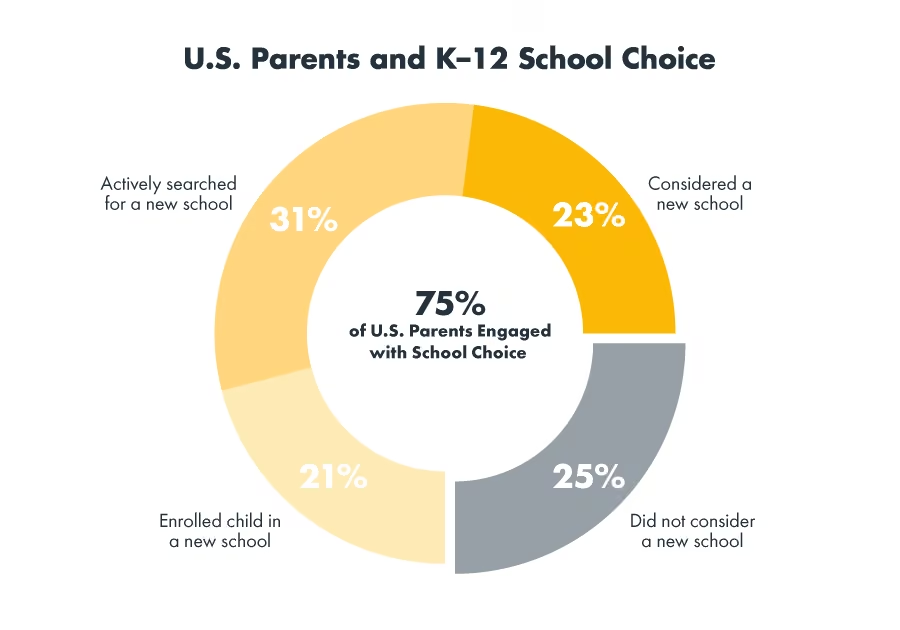
New article: A defeated school-choice measure sparked a lasting mission. Discover how Cascade’s founders turned a setback into 35 years of making the case for freedom and opportunity in Oregon.
cascadepolicy.org/economic-opportunity/cascade-at-35-the-… -
Cascade Policy Institute
@CascadePolicy
Portland's school funding crisis is a warning for all of Oregon.
With a $64 million budget shortfall, declining enrollment, and mounting PERS obligations, Portland Public Schools is considering closing 14 schools. Meanwhile, proposals for new taxes are gaining attention.
But will higher taxes solve the underlying problem—or simply postpone difficult decisions?
The financial pressures facing Portland aren't unique. School districts and public agencies across Oregon face similar challenges.
As the 2027 legislative session approaches, the debate over spending, pensions, and taxes is heating up.
Read more about what's at stake for Oregon taxpayers.
oregoncatalyst.com/100443-kotek-jumps-school-feud-taxes-e…
@oregoncatalyst -
Cascade Policy Institute
@CascadePolicy
Freedom is not guaranteed. It is defended.
This Veterans Day, Cascade Policy Institute honors the men and women whose courage, service, and sacrifice have safeguarded our nation's liberties.
Their dedication reminds us that freedom is worth defending, preserving, and passing on to future generations.
To our veterans: Thank you for your service and sacrifice. -
Cascade Policy Institute
@CascadePolicy
Could the way we elect our president be about to change?
The National Popular Vote Interstate Compact needs just 48 more electoral votes to reach the 270 required for activation. If triggered, participating states—including Oregon—would award their electoral votes to the winner of the national popular vote, even if their own voters chose someone else.
Our fellow State Policy Network organization, Mountain States Policy Center, examines the constitutional questions, implications for smaller states, and what could happen before the 2028 election.
www.mountainstatespolicy.org/post/all-of-a-sudden-the-ele…
@MtnStatesPolicy -
Cascade Policy Institute
@CascadePolicy
Is Oregon ready for a new direction? Kimberley Strassel sees reason for optimism.
At Cascade Policy Institute’s 35th Anniversary Dinner, the Wall Street Journal columnist and Oregon native delivered a message of hope: Meaningful reform begins when citizens reclaim their voices, engage in their communities, and demand accountability.
Could Oregon be on the brink of a policy renaissance? -
Cascade Policy Institute
@CascadePolicy
Washington may be gridlocked, but states aren't waiting for permission to lead.
From school choice and tax reform to occupational licensing and higher education, states are challenging the status quo and exploring new solutions.
At Cascade's 35th Anniversary Dinner, Wall Street Journal columnist Kimberley Strassel delivered a compelling message: The next wave of policy reform may not come from Washington, D.C. It may begin right here at home.
Could Oregon be next? -
Cascade Policy Institute
@CascadePolicy
$70 MILLION in taxpayer dollars. Two rail centers. Where are the results?
Nearly a decade later, one facility remains unfinished, the other sits largely idle, and both have run millions over budget.
Meanwhile, ODOT faces budget challenges, and Oregonians are being asked to dig deeper into their pockets.
Before taxpayers are asked to pay more, shouldn't they get answers about where their money went?
Where's the accountability?
businesstribune.online/2026/10/09/2-oregon-state-backed-r…
@PortlandBizTrib -
Cascade Policy Institute
@CascadePolicy
New article: Kimberley Strassel’s anniversary keynote offered Oregon both a warning and a hopeful path forward—policy renewal led by states, communities, civic groups, and engaged citizens.
Read Here: cascadepolicy.org/economic-opportunity/a-policy-renaissan… -
Cascade Policy Institute
@CascadePolicy
A child's ZIP code shouldn't determine their educational opportunities.
Reason Foundation's new "Public Schools Without Boundaries: 2026" report finds that 80% of public school students live in states with weak or ineffective open enrollment laws.
Whether families seek smaller classes, advanced courses, or a safer learning environment, students deserve access to public schools that meet their needs.
At Cascade Policy Institute, we believe educational opportunity should be driven by students' needs, not geographic boundaries.
reason.org/education-newsletter/how-your-states-open-enro…
@ReasonFdn -
Cascade Policy Institute
@CascadePolicy
A child's ZIP code should never determine the quality of their education.
Yet 80% of public school students live in states with weak or ineffective open enrollment laws, according to Reason Foundation.
Parents know their children best. They should have the freedom to choose public schools that meet their children's needs, whether that means stronger academics, smaller classes, or specialized programs.
Educational opportunity shouldn't stop at a school district boundary. Families deserve choices, not barriers.
Read the report: reason.org/open-enrollment/public-schools-without-boundar…
@ReasonFdn -
Cascade Policy Institute
@CascadePolicy
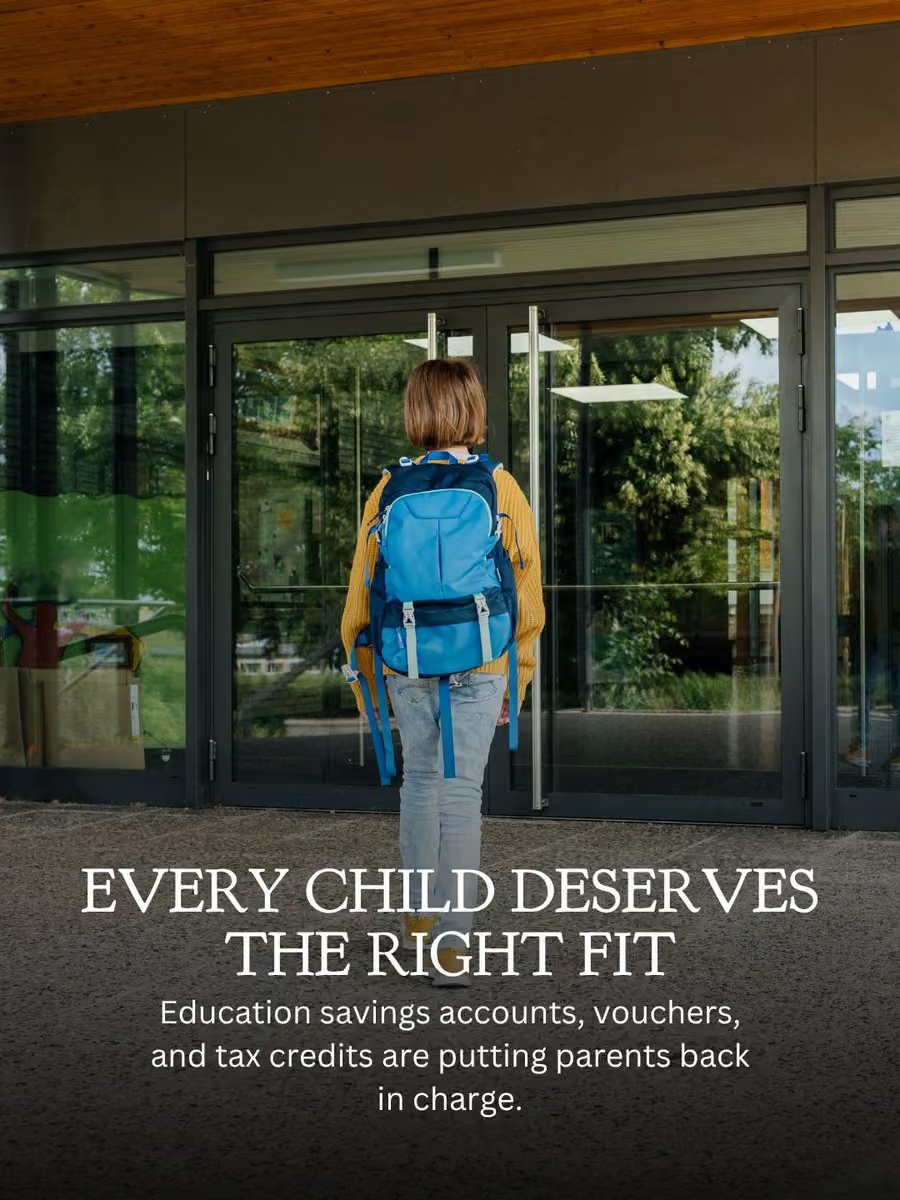
Oregon could expand educational opportunities for students without taking a dollar from existing state or local school budgets.
The new federal scholarship tax credit allows taxpayers to support K-12 scholarships through charitable contributions.
Yet Governor Tina Kotek has declined to participate in 2027.
Oregon families deserve more educational opportunities. Why turn down a program that could help provide them without diverting funding from public schools? -
Cascade Policy Institute
@CascadePolicy
Oregon taxpayers can claim a new federal scholarship tax credit beginning in 2027, but Oregon students won't benefit unless the state participates.
Governor Tina Kotek has declined to join for 2027, meaning Oregon taxpayers could support scholarships in other states while Oregon students miss out.
Why is Oregon sitting out an opportunity to expand educational choice for its own families? -
Cascade Policy Institute
@CascadePolicy
Oregon families could benefit from thousands of dollars in new educational scholarship opportunities beginning in 2027. But Oregon has chosen not to participate.
New federal guidance clarifies that married couples may qualify for up to $3,400 in scholarship tax credits, helping fund educational opportunities in participating states.
Oregon taxpayers can support scholarships elsewhere. Why shouldn't Oregon students benefit from those same opportunities?
It's time to revisit that decision. -
Cascade Policy Institute
@CascadePolicy
When emergencies strike, first responders answer the call.
Every day, Oregon's firefighters, law enforcement officers, paramedics, EMTs, and emergency personnel put service above self to protect our families, neighborhoods, and communities.
Their courage, sacrifice, and commitment to public safety deserve more than our gratitude. They deserve our respect, support, and recognition.
At Cascade Policy Institute, we recognize the essential role first responders play in keeping Oregon's communities safe, strong, and resilient.
To those who run toward danger when others run away: Thank you for your service.
🚒🚑🚓 Happy National First Responders Day! -
Cascade Policy Institute
@CascadePolicy
Beginning in 2027, Oregon taxpayers could claim a new federal tax credit for contributions to qualifying K-12 scholarship organizations. But with Oregon sitting out the program, those contributions would support students in other states.
Oregon families could benefit from those same scholarship opportunities if the state participates.
The question is straightforward: What is preventing Oregon from joining, and when will families get an answer? -
Cascade Policy Institute
@CascadePolicy
New article: Federal guidance clarifies that married couples filing jointly may qualify for a combined scholarship tax credit of up to $3,400. Cascade explains what that could mean for Oregon students.
Read here: cascadepolicy.org/education/new-fstc-guidance-doubles-sch… -
Cascade Policy Institute
@CascadePolicy
New York is joining 30 other states in the new Federal Scholarship Tax Credit program, opening the door to millions in additional K-12 scholarship funding without reducing public school budgets.
Even Governor Kathy Hochul sees the opportunity.
So why isn't Oregon participating?
Beginning in 2027, the program could provide new educational opportunities for Oregon students at no direct cost to the state budget.
Oregon families deserve an answer: What's holding our state back?
@Comm4Prosperity -
Cascade Policy Institute
@CascadePolicy
Another education reform. But where are the results?
Oregon continues to rank near the bottom nationally in reading and math, despite decades of new programs, policies, and promises.
A new OPB report reveals a troubling cycle of shifting priorities, confusing mandates, and little meaningful improvement in student achievement.
Oregon students don't need another round of bureaucracy. They need results.
It's time to put student success, accountability, and educational opportunity first.
www.opb.org/article/2026/10/12/oregon-education-public-sc…
@OPB -
Cascade Policy Institute
@CascadePolicy
A new name. Same tax burden?
Oregon's proposed government-run healthcare system is raising serious questions about affordability, transparency, and accountability.
Rep. Dwayne Yunker warns the plan could cost $94 billion annually by 2032, while a proposed healthcare income tax has been renamed a “Household Healthcare Contribution.”
Changing the name doesn't change the cost.
Oregonians deserve transparency, real healthcare choices, and answers before being asked to pay more.
oregoncatalyst.com/99751-rep-yunker-problems-koteks-healt…
@oregoncatalyst -
Cascade Policy Institute
@CascadePolicy
How much more can Oregon taxpayers afford?
As living costs continue to climb, Oregon faces growing scrutiny over taxes, government spending, and whether taxpayers are getting results for their money.
The debate isn't just about how much revenue the state collects. It's about where that money goes, how effectively it's spent, and why additional taxes remain part of the conversation.
Oregonians are demanding answers.
oregoncatalyst.com/99777-oregon-voters-feel-tax-fatigue-c…
@oregoncatalyst -
Cascade Policy Institute
@CascadePolicy
Who pays? Who decides? Who controls your healthcare?
Oregon's proposed single-payer system could mean massive new taxes, the loss of most private insurance, and unprecedented government control over healthcare.
Supporters promise lower costs. But who's paying the bill?
Oregonians deserve real numbers, real answers, and a clear understanding of what they'll be giving up.
oregoncapitalchronicle.com/2026/10/12/midterms-have-reviv… -
Cascade Policy Institute
@CascadePolicy
Oregon spends more per student than 31 other states. So why are our students still struggling to read?
A new OPB investigation exposes a troubling pattern: layers of bureaucracy, political pressures, and shifting priorities while student achievement continues to lag.
More spending and more mandates haven't delivered the results Oregon families deserve.
It's time to put students first—not politics, paperwork, or special interests.
www.opb.org/article/2026/10/13/oregon-education-public-sc…
@OPB -
Cascade Policy Institute
@CascadePolicy
Oregonians want better roads. But is another gas tax the answer?
As La Grande voters consider a new gas tax, questions about ODOT's budget shortfalls and transportation spending priorities remain.
Cascade has long called for responsible spending and greater accountability.
The difference in La Grande? Voters get a direct say.
Read more from @OPB
@lagrandelife
www.opb.org/article/2026/10/09/la-grande-gas-tax-tensions… -
Cascade Policy Institute
@CascadePolicy
From Cascade's founding to building a national powerhouse!
Tracie Sharp helped launch Cascade Policy Institute in 1991 as its founding executive director before transforming State Policy Network into a nationally influential network of state-based policy organizations.
A remarkable legacy of leadership and impact! We were honored to welcome Tracie back to Portland as a featured speaker at Cascade's 35th Anniversary Dinner, celebrating the ideas and vision that continue to shape the future of public policy.
@StatePolicy -
Cascade Policy Institute
@CascadePolicy
Millions spent. But how much is reaching the people who need help?
Oregon continues to pour public dollars into homelessness programs, yet serious questions remain about accountability, results, and whether resources are reaching those most in need.
At Cascade, we believe success should be measured by outcomes—not the size of the budget.
More spending isn't the same as more solutions.
Oregonians deserve to know: Where is the money going, and what results are we getting? -
Cascade Policy Institute
@CascadePolicy
Ideas matter. But results matter more.
Cascade helped turn education reform into action by advancing Oregon’s landmark 1999 charter-school law—opening the door to more choices, more opportunity, and new possibilities for Oregon families.
That’s what 35 years of ideas in action looks like.
Keep helping make change happen by donating today: cascadepolicy.org/make-a-donation/ -
Cascade Policy Institute
@CascadePolicy
Changing the name doesn’t change the cost.
@RepYunker -
Cascade Policy Institute
@CascadePolicy
The next 35 years start right here.
At Cascade's 35th anniversary celebration, The Wall Street Journal columnist Kimberley Strassel delivered a compelling reminder that meaningful change often begins at the local level, with people who care enough to get involved.
Joined by Cascade President and CEO John Charles and Board Chairman Bill Conerly, Kimberley helped us celebrate more than a milestone. It was an evening about the ideas, people, and determination that have shaped Cascade's first 35 years and will carry us into the next.
35 years of advancing liberty in Oregon. Here's to what comes next.
@KimStrassel
@WSJ -
Cascade Policy Institute
@CascadePolicy
Oregon roots. National perspective. And no shortage of opinions.
The Wall Street Journal's Kimberley Strassel returned to her home state to deliver the keynote at Cascade's 35th anniversary dinner, bringing sharp observations, personal stories, and plenty of humor along the way.
Her message was a timely reminder that the decisions shaping our communities are too important to leave to someone else.
Thanks for coming home, Kimberley. You gave us plenty to talk about!
@KimStrassel
@WSJ -
Cascade Policy Institute
@CascadePolicy
🚨 PUBLIC MEETING TODAY: OREGON’S UNIVERSAL HEALTH PLAN
Oregon’s Universal Health Plan Governance Board is holding a special virtual meeting today, Thursday, October 8, at 8:00 a.m.
Before Oregon commits to a massive new health-care system, taxpayers deserve to see the complete plan and understand exactly what it could cost.
@RepYunker
x.com/RepYunker/status/2107463862786183615 -
Cascade Policy Institute
@CascadePolicy
10.1%. 9.6%. These numbers deserve public scrutiny.
Oregon’s Universal Health Plan Governance Board has modeled a new health-care financing system that includes:
• 10.1% healthcare income tax
• 9.6% employer payroll tax
The question Oregonians should be asking is simple:
What would this mean for your paycheck, your employer, and the cost of doing business in Oregon?
The state is developing the plan now, with lawmakers expected to consider the proposal in 2027.
Oregonians deserve to see the numbers, the assumptions, and the full plan before decisions are made.
x.com/PDXReal1/status/2107323284425773232
@PDXReal1 -
Cascade Policy Institute
@CascadePolicy
Oregon’s housing crisis won’t fix itself.
Families want homes. But when Oregon limits where single-family homes can be built, supply can’t keep up with demand—and prices climb.
If we want homeownership to be within reach for more Oregonians, we need to make room for more homes where people want to live.
More homes. More choices. More opportunity to own. -
Cascade Policy Institute
@CascadePolicy
Oregon needs more housing. So why do we keep making it harder to build?
A new Mercatus Center analysis highlights how states are removing regulatory barriers to increase housing supply and affordability.
Cascade believes Oregon should do the same: cut unnecessary regulations, protect property rights, and let builders build.
More homes. More choices. More opportunity.
www.mercatus.org/research/policy-briefs/housing-reform-st…
@mercatus -
Cascade Policy Institute
@CascadePolicy
Oregon ranks #51 in the nation for education freedom.
That’s the bottom of the list.
The Heritage Foundation’s latest Education Freedom Report Card ranks states on education choice, teacher freedom, transparency, return on investment, and civic education. Oregon comes in 51st overall, including 47th for education choice and 50th for teacher freedom.
At Cascade, we believe Oregon families deserve more options—not fewer. Parents should have the freedom to choose the education that works best for their children.
Oregon can do better.
educationreportcard.heritage.org/pages/states/
@Heritage -
Cascade Policy Institute
@CascadePolicy
For 35 years, Cascade Policy Institute has helped shape the conversation about Oregon’s future, putting independent research and practical solutions in the hands of Oregonians, policymakers, and the media.
-
Cascade Policy Institute
@CascadePolicy
Oregon needs more electricity—and we need reliable sources that can deliver it.
Mazama Energy has secured more than $135 million to advance superhot geothermal development at Newberry Volcano, potentially bringing continuous, dependable power to the grid.
Instead of mandates picking energy winners and losers, Oregon should welcome private investment, competition, and technologies that can prove they deliver reliable, affordable power.
Let innovation compete. www.opb.org/article/2026/09/22/texas-geothermal-company-g… -
Cascade Policy Institute
@CascadePolicy
Thursday will be a milestone evening in Cascade Policy Institute’s history as we celebrate 35 years of independent research and practical ideas for Oregon. At Portland’s Sentinel Hotel, we’ll mark the occasion with an anniversary dinner featuring keynote speaker Kimberley Strassel, an Oregon native, bestselling author, and Wall Street Journal columnist.
-
Cascade Policy Institute
@CascadePolicy
New article: Cascade Policy Institute marks 35 years of independent research, public education, and policy leadership aimed at expanding freedom and economic opportunity in Oregon.
Read here: cascadepolicy.org/economic-opportunity/cascade-policy-ins… -
Cascade Policy Institute
@CascadePolicy
Are powerful teachers’ unions standing in the way of literacy reform?
New analysis found that states with stronger unions have adopted fewer evidence-based early literacy policies—and Oregon ranks among the states with the strongest teacher unions.
The takeaway: Education policy should put student achievement ahead of institutional interests.
Oregon kids deserve results.
Read more: committeetounleashprosperity.com/hotlines/more-teacher-un… -
Cascade Policy Institute
@CascadePolicy
For 35 years, Cascade Policy Institute has helped shape practical policy for Oregon through independent research, public education, and legislative analysis.
-
Cascade Policy Institute
@CascadePolicy
Are data centers a problem—or an opportunity Oregon can’t afford to miss?
A new City Journal article makes the case that data centers can bring significant investment and tax revenue with fewer local costs than many traditional industrial projects.
Is Oregon ready to capitalize on the opportunity?
www.city-journal.org/article/data-centers-construction-co…
@CityJournal -
Cascade Policy Institute
@CascadePolicy
For decades, TriMet kept expanding light rail—even as voters repeatedly rejected transit ballot measures.
Four decades later, the anniversary celebrations may tout the miles of track and trains added. But the real question is: What have taxpayers and riders actually received in return? -
Cascade Policy Institute
@CascadePolicy
Portland Public Schools is getting smaller—and big changes could be ahead.
With enrollment declining, PPS is considering closing or consolidating as many as 20 schools. District leaders say fewer students are now spread across a system built to serve significantly more.
What’s driving the decline, and what could it mean for Portland families, students, and taxpayers?
www.oregonlive.com/education/2026/09/portland-school-boar…
@Oregonian -
Cascade Policy Institute
@CascadePolicy
The consequences of pandemic school closures didn’t disappear when classrooms reopened.
New international PISA results show troubling declines in student achievement, with struggling students hit especially hard.
For Oregon families, the lesson is clear: Every child deserves access to an education that works for them—and parents deserve the freedom to choose it.
Read more about what the latest results reveal.
committeetounleashprosperity.com/hotlines/student-test-sc…
@Comm4Prosperity -
Cascade Policy Institute
@CascadePolicy
Portland kept expanding light rail. Portlanders kept choosing cars.
The share of commuters driving alone rose from 64.6% before the first MAX line opened to a record 77.4% in 2024. After four decades of light-rail expansion, that’s an outcome worth examining—not celebrating. -
Cascade Policy Institute
@CascadePolicy
Oregon drivers are getting hammered at the pump—and Salem still wants more.
After 83% of voters rejected higher transportation taxes, proposals remain that could automatically raise the gas tax with inflation.
Oregon doesn’t need higher taxes. It needs accountability for the money it already collects.
oregoncatalyst.com/99338-map-oregon-hits-5-gas-entire-wes… -
Cascade Policy Institute
@CascadePolicy
TriMet isn’t “reimagining transit.” It’s cutting 34 lines because the system is collapsing under its own costs and shrinking ridership. A $158 million budget hole forced one of the biggest service reductions in agency history.
When you build policy around restricting driving instead of improving mobility, you get exactly this — less service, more congestion, and a transit system that can’t sustain itself.
www.travelandtourworld.com/news/article/8umxutj9jhgr/
@ttw_digital -
Cascade Policy Institute
@CascadePolicy
Portland’s MAX light rail turns 40—but the numbers give taxpayers little reason to celebrate.
Before construction, transit carried 9.6% of Portland-area commuters. By the time the first MAX line opened, that share had fallen to 6.5%—and it has never recovered.
Forty years of expansion. Billions invested. Still below where we started. -
Cascade Policy Institute
@CascadePolicy
Oregonians rejected Governor Kotek’s gas tax by 83%. Now lawmakers are considering 36 new taxes and fees to raise the money another way.
From DMV fee hikes and tolling to congestion pricing and delivery fees, Salem seems determined to work around voters’ answer.
Oregon doesn’t need more taxes. It needs accountability, better priorities, and leaders who respect voters.
oregoncatalyst.com/98897-gas-tax-backfill-plan-tax-tires-…
@oregoncatalyst -
Cascade Policy Institute
@CascadePolicy
MAX just turned 40. That’s four decades of light-rail expansion—and Portland still hasn’t regained the transit commute share it had before MAX construction began. That’s a result worth examining, not celebrating.
-
Cascade Policy Institute
@CascadePolicy
Eastern Oregon is showing how rural communities can build the housing they need — if Salem loosens its grip. Stanfield’s Bumble B Estates is thriving, demand is high, and the only thing stopping more projects like it are Oregon’s restrictive land‑use laws that box small towns inside outdated boundaries.
Let rural leaders make local decisions, open up fallow land for housing, and stop forcing Portland’s land‑use model onto communities that are ready to grow.
www.opb.org/article/2026/08/28/lawmakers-eastern-oregon-h…
Source: @OPB -
Cascade Policy Institute
@CascadePolicy
“Picking up steam” is what Oregon state economists think is happening with our economy, but the fundamentals still lag. Unemployment is well above the national rate, manufacturing is shrinking, and high costs — fuel, inflation, regulation — continue to drag down families and businesses. Yes, tax revenue is up, but mostly because a small group of high earners are paying more, not because the broader economy is strong.
Oregon won’t fix its economic slump until lawmakers confront the policies holding the state back — heavy regulation, high taxes, and a business climate that drives jobs elsewhere.
www.opb.org/article/2026/08/26/oregon-economy-signs-of-im…
Source: @OPB -
Cascade Policy Institute
@CascadePolicy
Oregon’s public schools are making headlines—and not for the right reason.
WalletHub’s 2026 analysis ranks Oregon 48th among all 50 states and Washington, D.C. The study examined 32 measures of school quality and safety, including academic performance, class size, funding, teacher credentials, and more.
What’s behind Oregon’s ranking—and what can we do differently for Oregon students?
Read the full analysis.
📊 See how your state ranked:
wallethub.com/edu/e/states-with-the-best-schools/5335
@wallethub -
Cascade Policy Institute
@CascadePolicy
According to @USAFacts, about 11.7% or one in nine dollars of public school funding came from the federal government during the 2023–24 school year.
📊 See the data and explore how funding varies across the country
usafacts.org/answers/what-percentage-of-public-school-fun… -
Cascade Policy Institute
@CascadePolicy
Winter may be getting colder.
PNW planners warn we’re heading toward a 9‑gigawatt power shortfall by 2030 — enough to trigger blackouts during winter peaks.
By 2035, the gap could reach 18 gigawatts.
For the average Portlander, that means higher bills, less reliability, and a grid that struggles when you need it most.
With a crunch this severe, public dollars should be adding dependable power — not studying how to remove the hydropower that already keeps the lights on. -
Cascade Policy Institute
@CascadePolicy
Portland froze freeway construction in 1982 to force people out of their cars. Instead, driving more than doubled, commuter delay tripled, and fuel wasted in congestion skyrocketed sixfold. The policy didn’t just fail — it proved the opposite of what planners believed.
We need policies that adhere to habits over ideals. -
Cascade Policy Institute
@CascadePolicy
Portland spent billions on rail, but transit trips per resident fell 16% since 1982. In 2024, only 3.8% of Portland-area workers commuted by transit. Spending isn’t the same as serving riders.
-
Cascade Policy Institute
@CascadePolicy
Before MAX, transit carried 9.6% of Portland‑area workers in 1980. By 2024, that share had fallen to just 3.8% — a 60% decline after four decades of light‑rail expansion.
Taxpayers spent billions building and subsidizing rail, yet the system never regained the reach transit once had. Portland paid more and got less. -
Cascade Policy Institute
@CascadePolicy
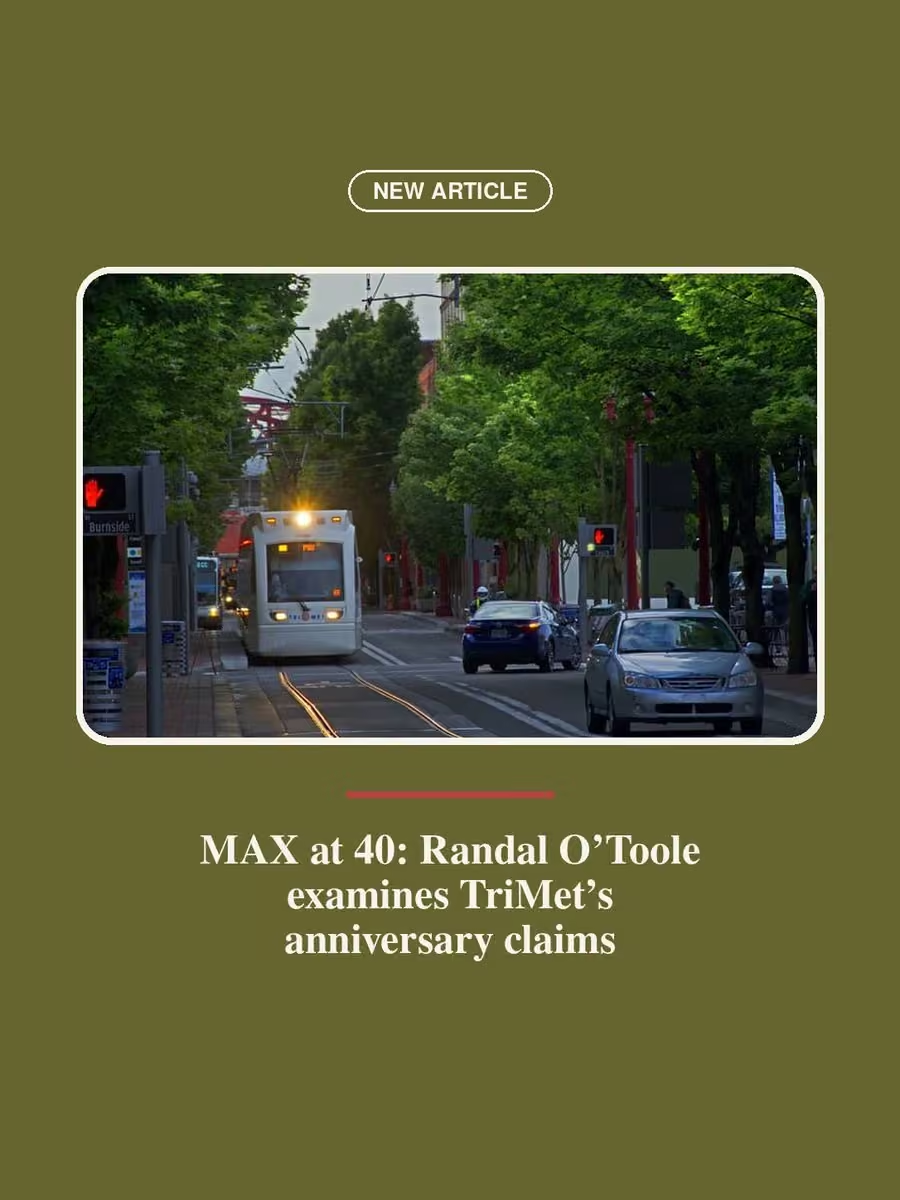
New article: Randal O’Toole examines what TriMet’s MAX anniversary claims leave out—including falling transit commute share and a record share of Portlanders driving alone to work.
-
Cascade Policy Institute
@CascadePolicy
Cascade supports creating high‑occupancy toll lanes to the region’s freeways — new, optional lanes that are managed to stay free‑flowing and actually move people. That’s very different from ODOT’s tolling scheme, which charges drivers for using the congested lanes they already have without adding any new capacity. HOT lanes expand mobility; ODOT’s tolls just make the existing bottlenecks more expensive.
-
Cascade Policy Institute
@CascadePolicy
Where is our money going?
At least eight publicly funded efforts have already examined a future without the four lower Snake River dams. More than $15.1 million has been authorized or spent — with no new answers to show for it.
For taxpayers, the question is simple: when does “study” become a sinkhole? At some point, due diligence turns into repetition, and repetition turns into waste. -
Cascade Policy Institute
@CascadePolicy
During the January 2024 cold snap — when temperatures in the region plunged into single digits and the demand for heat spiked — the four lower Snake River dams topped 1,000 megawatts of peak daily output.
Together, they can deliver around 2,300 megawatts of dependable peak power. During the Pacific Northwest’s coldest winters, these dams are not optional — they’re what keep people from freezing and the grid stable. -
Cascade Policy Institute
@CascadePolicy
New article: About 115 Oregon elementary students are beginning the school year with CSF-Oregon scholarships. Kathryn Hickok explains how private generosity turns school choice into a real option.
-
Cascade Policy Institute
@CascadePolicy
MAX turned 40 with ridership still stuck in a deep slump. In May 2026, our light rail carried barely 55% of its pre‑pandemic riders — a costly, inflexible system built for a Portland that no longer exists.
-
Cascade Policy Institute
@CascadePolicy
Auto emissions have plunged nearly 90%, fuel economy has doubled, and 2025 highway fatalities were 30% lower than in 1970 — all while Americans drive three times as many miles. The real progress came from better cars and cleaner technology, not from forcing people to drive less.
-
Cascade Policy Institute
@CascadePolicy
“A hero is a man who does what he can.”
On 9/11, ordinary Americans showed us exactly what that means.
Boat crews helped evacuate nearly 500,000 people from Manhattan in less than nine hours.
They saw people who needed help, and they acted.
We will never forget. -
Cascade Policy Institute
@CascadePolicy
Portland is bracing for a major transportation disruption.
Beginning September 11, southbound I-5 through the Rose Quarter will close for at least five weeks, with officials warning travel times could double or triple.
The impacts will extend beyond commuters to freight, businesses, and Oregon’s economy. Keeping people and goods moving matters.
Read more from OPB: Authorities try to avoid “carmageddon” during I-5 closure.
www.opb.org/article/2026/09/09/i-5-interstate-highway-clo…
Source: @OPB -
Cascade Policy Institute
@CascadePolicy
Taxpayers are still paying for a transit system designed for a downtown‑centric commute that barely exists anymore.
As jobs moved out of the core, ridership collapsed — but the bills didn’t. Portlanders are funding a system that serves fewer riders, fewer workplaces, and fewer real‑world travel patterns every year.
It's time to shift to the way Portland truly commutes. -
Cascade Policy Institute
@CascadePolicy
More than $15.1 million in public money has already gone into at least eight dam‑breaching study efforts — and lawmakers added another $800,000 this year to study how to replace power the region already has.
That’s real money spent on planning to lose dependable hydropower during a time when the Pacific Northwest is being warned of major power shortages.
At some point, “study” stops being responsible and starts becoming a drain. -
Cascade Policy Institute
@CascadePolicy
New article: MAX turns 40 amid a changed Portland. Randal O’Toole examines how light rail’s cost and inflexibility coincided with falling commuter share and ridership that remains below 2019 levels.
Read here: cascadepolicy.org/transportation/max-at-40-how-light-rail… -
Cascade Policy Institute
@CascadePolicy
New article: More than $15.1 million has been authorized or dedicated to at least eight efforts tied to a future without four functioning dams. Chelsea Martin asks when study becomes repetition.
Read here: cascadepolicy.org/economic-opportunity/chelsea-martin-the… -
Cascade Policy Institute
@CascadePolicy
Portland tried to reduce driving by refusing new roads and spending billions on alternatives. Driving still grew—and gridlock worsened. Read Cascade’s conclusion: a smarter strategy for mobility.
Full article: cascadepolicy.org/transportation/portlands-war-on-cars-4-… -
Cascade Policy Institute
@CascadePolicy
Oregon’s boom‑and‑bust cycle isn’t an accident — it’s the result of policy choices. For 20 years, the state has chased ideology instead of fundamentals: affordable energy, reliable infrastructure, and a climate where businesses can grow.
This article shows the pattern clearly: when times are good, Oregon adopts policies that make downturns worse. And families pay the price.
If Oregon wants real prosperity, it needs to stop repeating the same mistakes — and start building a foundation that actually supports growth.
oregoncatalyst.com/98633-oregon-20-years-boom-bust-explai…
@oregoncatalyst -
Cascade Policy Institute
@CascadePolicy
New from Cascade: Portland’s War on Cars 3: Ending the War on Automobiles
Link: cascadepolicy.org/transportation/portlands-war-on-cars-3-… -
Cascade Policy Institute
@CascadePolicy
I‑5 in the Rose Quarter carries 120,000 vehicles and $115 million in freight every day. Now a full southbound shutdown will triple travel times and push congestion into Vancouver — all because Oregon delayed essential maintenance for decades.
This is exactly why Oregon needs a serious, long‑term plan to maintain and expand its transportation infrastructure. Congestion is a policy choice — and Oregon can choose better.
www.opb.org/article/2026/08/14/interstate-five-highway-cl…
@OPB -
Cascade Policy Institute
@CascadePolicy
PPS needs to explain itself. Why is COR in the running for the Jefferson High School rebuild when there are still unanswered questions about their recycling and waste‑diversion performance on past PPS projects?
GreenWay CEO Terrell Garrett has been asking for years. Portland taxpayers should be asking, too. -
Cascade Policy Institute
@CascadePolicy
Portland's strategy of not building roads to discourage driving has backfired. Congested traffic means more pollution, more fuel waste, and more accidents — not fewer.
-
Cascade Policy Institute
@CascadePolicy
New from Cascade: Greenwashing Portland’s Public Projects: A Case for Reforming Public Contracts
Read Here: cascadepolicy.org/environment/greenwashing-portlands-publ… -
Cascade Policy Institute
@CascadePolicy
Oregonians are cutting back on essentials while gas sits at $4.60 a gallon.
This is exactly when state policy should be reducing costs — not increasing them.
Consumer‑owned utilities are ready to partner on real relief. The governor needs to join the conversation. -
Cascade Policy Institute
@CascadePolicy
COR held recycling contracts for major public projects — but the recycling wasn’t happening.
-
Cascade Policy Institute
@CascadePolicy
Cascade Policy Institute was founded on a simple belief: Oregon's future is worth investing in.
For 35 years, we've worked to advance ideas that protect opportunity, strengthen communities, and keep Oregon a place where families and businesses can thrive.
Join us as we celebrate 35 years of impact and look forward to the future.
givebutter.com/cascade35
📅 Thursday, October 1, 2026
📍 The Sentinel Hotel – Governor Ballroom
614 SW 11th Ave, Portland, OR
Q&A with Kimberley Strassel. -
Cascade Policy Institute
@CascadePolicy
A Portland recycling contractor has faced serious allegations of sending recyclable construction debris to landfills — and Metro renewed its franchise anyway. Taxpayers deserve answers.
-
Cascade Policy Institute
@CascadePolicy
COR Disposal didn’t just miss recycling targets — they falsely claimed 409 tons were recycled while dumping it in the landfill. That’s 87 truckloads of taxpayer‑funded debris buried instead of recycled. Metro knew the violations and renewed their contract anyway.
-
Cascade Policy Institute
@CascadePolicy
Gas is $4.60 a gallon. Three out of four Oregonians are already cutting back on food and housing.
And now Gov. Kotek is backing a ruling that will push electricity bills even higher — at the exact moment families can least absorb another hit.
Oregon doesn’t need policies that pile on. It needs relief. -
Cascade Policy Institute
@CascadePolicy
Portland can end its war on cars — and actually fix mobility — with four real solutions:
• Add high‑occupancy toll lanes so freeways never choke.
• Replace slogan‑based “safety” with a data‑driven program that targets real hazards.
• Offer low‑interest loans so low‑income residents can buy fuel‑efficient cars and reach better jobs.
• Redesign TriMet to serve the entire region — not just downtown.
That's a transportation policy built for reality. -
Cascade Policy Institute
@CascadePolicy
For 35 years, Cascade Policy Institute has brought research, thoughtful analysis, and principled policy ideas to Oregon's biggest challenges.
The conversation is just beginning.
Join us October 1 for our 35th Anniversary Gala.
givebutter.com/cascade35
📅 Thursday, October 1, 2026
📍 The Sentinel Hotel – Governor Ballroom
614 SW 11th Ave, Portland, OR
Q&A with Kimberley Strassel. -
Cascade Policy Institute
@CascadePolicy
Hydropower is the backbone of Oregon’s grid — the only source that can surge output in minutes when demand spikes. Wind and solar aren't able to do that.
Gov. Kotek is backing a court ruling that eliminates this reliability in favor of more spill for salmon.
Oregon families will feel it. Higher bills hit this fall — because the state is weakening the one resource that keeps costs stable. -
Cascade Policy Institute
@CascadePolicy
Portland tried to force people out of their cars by refusing to build roads. The result isn’t less driving — it’s gridlock. Congestion means dirtier air, wasted fuel, and more crashes. Portland didn’t cut harm. It multiplied it.
-
Cascade Policy Institute
@CascadePolicy
In 1970, auto pollution was so bad Mount Hood often disappeared behind smog.
Today, automotive air pollution is down nearly 90%, highway fatalities are down 30%, and fuel economy has nearly doubled.
None of that came from restricting driving — it came from better cars and better roads. Portland should take note. -
Cascade Policy Institute
@CascadePolicy
Unlike wind and solar, hydropower can increase output in minutes during peak demand. Curtailing it means buying expensive replacement power — and Oregon families foot the bill.
-
Cascade Policy Institute
@CascadePolicy
Oregon’s future won’t shape itself.
The choices we make today will dictate its future —and the ideas we’re willing to stand behind.
On October 1st, help us celebrate 35 years of Cascade’s work toward building a stronger, freer Oregon—and help launch our next chapter.
givebutter.com/cascade35
📅 Thursday, October 1, 2026
📍 The Sentinel Hotel – Governor Ballroom
614 SW 11th Ave, Portland, OR
Q&A with Kimberley Strassel. -
Cascade Policy Institute
@CascadePolicy
Portland hasn’t built a new freeway since 1983 — and the data shows the fallout.
Congestion is surging, transit ridership has collapsed, and traffic fatalities have climbed. Decades of refusing to add road capacity didn’t make travel safer or cleaner. It made it slower and more dangerous.
Portland needs transportation policy that matches reality, not ideology. -
Cascade Policy Institute
@CascadePolicy
Oregon is already under a wildfire State of Emergency — before peak season.
Record‑low snowpack, worsening drought, and 400+ fires have pushed the state into crisis. This isn’t a warning; it’s happening now.
A State of Emergency means more crews, more aircraft, faster response, and rapid evacuations when conditions shift.
If you live in Oregon, stay alert. Fire season is early — and accelerating.
www.theguardian.com/news/ng-interactive/2026/jul/18/the-i… -
Cascade Policy Institute
@CascadePolicy
Campaigns end. Elections pass. Headlines fade.
But the ideas behind good public policy continue shaping communities long after the votes are counted.
Cascade has spent 35 years investing in research, policy, and thoughtful solutions for Oregon's future.
Join us for an evening celebrating the ideas that matter most.
givebutter.com/cascade35
📅 Thursday, October 1, 2026
📍 The Sentinel Hotel – Governor Ballroom
614 SW 11th Ave, Portland, OR
Q&A with Kimberley Strassel. -
Cascade Policy Institute
@CascadePolicy
Portland adopted Vision Zero in 2015. Since then, traffic deaths haven’t fallen — they’ve surged.
Multiple years have hit decades‑high fatality numbers, and the trend is moving the wrong direction. More rules, more restrictions, more “safety plans” … yet the streets are deadlier than when Vision Zero began. -
Cascade Policy Institute
@CascadePolicy
IP28 didn’t make the ballot — but the campaign isn’t going away. After raising more than 140,000 signatures and missing the threshold only because of verification issues, organizers are already signaling they’ll try again to ban hunting, fishing, and even basic wildlife management in Oregon. Their latest statement makes it clear: the movement is growing, and they’re preparing for another run.
oregoncatalyst.com/98296-ip-28-fails-return.html
@oregoncatalyst -
Cascade Policy Institute
@CascadePolicy
🔥 Something big is happening inside Portland’s schools — and most parents have no idea.
On August 19, Cascade is joining legal and policy experts to expose race‑based policies quietly reshaping school funding, parent rights, and classroom equity. One Portland parent discovered the discrepancy when his own daughter’s school was shortchanged — and what he uncovered should concern Oregon families.
If you think you know how “equity” works in public education… you’ll want to hear this.
📅 August 19
🕛 12–1 PM Pacific
🔗 Click to see what’s really going on — and how you can help stop it.
cir-usa.org/stopping-race-based-school-policies-live-event/
Register today to receive a link to this live event. -
Cascade Policy Institute
@CascadePolicy
Every major policy begins as an idea.
For 35 years, Cascade Policy Institute has advanced ideas that expand opportunity, encourage innovation, and strengthen Oregon's future.
Join us as we celebrate that legacy and look ahead to what's next with keynote speaker Kimberley Strassel.
👉 givebutter.com/cascade35
📅 Thursday, October 1, 2026
📍 The Sentinel Hotel – Governor Ballroom
614 SW 11th Ave, Portland, OR -
Cascade Policy Institute
@CascadePolicy
Portland drivers deserve the truth:
Cars are 90% cleaner and 75% safer thanks to federal standards. Sadly, Portland’s planners have spent decades doing the opposite — shrinking road capacity, slowing traffic, and creating congestion with no measurable safety or environmental gain.
The data is clear:
Modern cars got cleaner and safer. Portland’s roads didn’t.
It’s time for a transportation strategy that actually works for the people who use it every day. -
Cascade Policy Institute
@CascadePolicy
West Coast gas prices are surging — and Oregon is deep in the red zone.
When fuel costs jump, everything else follows. That’s why the latest AAA map matters for every household.
If you want to see what’s driving the spike — and what it means for Oregon’s cost of living — this article breaks it down.
oregoncatalyst.com/98299-chart-entire-western-afire-high-…
@oregoncatalyst -
Cascade Policy Institute
@CascadePolicy
Idaho just showed what real wildfire leadership looks like. As the Big Grass Fire blew past 300,000 acres, Gov. Little declared an emergency, mobilized the National Guard, and moved straight to full suppression — aircraft up, crews deployed, communities protected.
Meanwhile, Oregon is still tangled in process while volunteer crews are stretched thin and officials openly admit response capacity is limited. Wildfire doesn’t wait for bureaucracy; Idaho acted, and Oregon should take notes.
Wildfire doesn’t wait for bureaucracy.
Idaho acted. Oregon should take notes.
portlandtribune.com/2026/07/30/idaho-gov-little-declares-…
@portlandtribune -
Cascade Policy Institute
@CascadePolicy
Oregon’s wildfire season isn’t just burning forests — it’s hitting ranchers hardest.
With firefighting resources stretched thin, families in Central and Eastern Oregon are out on the fire lines themselves, using heavy equipment, herding dogs, and local know‑how to save their cattle.
This is the side of wildfire season most Oregonians never see: rural communities forced to protect their livelihoods because help can’t reach them fast enough.
Source: @OPB
www.opb.org/article/2026/08/03/ranchers-protect-cattle-gr… -
Cascade Policy Institute
@CascadePolicy
New from Cascade: Portland hasn't built a new freeway since 1983. Since adopting Vision Zero in 2015, traffic fatalities have nearly tripled. Transit ridership has collapsed. Randal O'Toole's new report documents the measurable cost of four decades of anti-auto planning.
Read the full report: cascadepolicy.org/reports/report-the-portland-transportat… -
Cascade Policy Institute
@CascadePolicy
Wildfires are ripping through Central and Eastern Oregon — and the damage didn’t have to be this severe.
The Grasshopper Fire alone has burned thousands of acres in Mt. Hood National Forest, in an area long identified as high‑risk for wildfire. Fuel‑reduction work was planned years ago… then stalled by litigation.
Now rural families are evacuating, ranchers are losing pasture and feed stores, and hundreds of thousands of acres of rangeland are gone.
This new report lays out how delayed forest management, lawsuits, and slow federal processes left communities exposed — and why Oregon needs a wildfire strategy that actually reduces risk instead of letting it build.
oregoncatalyst.com/98355-lars-larson-truth-oregon-wildfir…
@oregoncatalyst
@LarsLarsonShow -
Cascade Policy Institute
@CascadePolicy
Oregon is already in a wildfire State of Emergency — and it’s only July.
Record‑low snowpack, persistent drought, and 414 fires have pushed the state past its breaking point. Gov. Kotek’s declaration isn’t routine — it’s a signal that Oregon’s wildfire system is being overwhelmed faster than agencies can respond.
If you live anywhere in Oregon, this is a right‑now problem.
Read what the emergency order means for the months ahead.
www.kdrv.com/news/firewatch/kotek-declares-state-of-emerg… -
Cascade Policy Institute
@CascadePolicy
Portland drivers have heard the same message for 40 years: “Get out of your car.”
But cars still carry 95% of all passenger travel — because that's what actually works.
Transit ridership collapsed. Congestion exploded. Fatalities nearly tripled under Vision Zero.
Portland didn’t change driver behavior.
It just made driving slower, harder, and more dangerous.
It’s time for a transportation policy that better serves the way Portlanders actually move. -
Cascade Policy Institute
@CascadePolicy
Washington voters forced the state’s new “millionaires tax” onto the November ballot — after more than 500,000 people signed petitions.
It’s a reminder: tax policy still requires consent of the governed.
Once a state income tax exists, history shows it rarely stays narrow.
www.opb.org/article/2026/07/15/washington-millionaire-tax…
@OPB -
Cascade Policy Institute
@CascadePolicy
The West is a fire plain — and this year proves it again. For as long as we’ve kept records, 0.5–1% of the West burns every year. That’s not a policy failure. That’s the geography.
The danger isn’t the fire itself.
It’s pretending we can stop what’s baked into the land.
Real protection comes from adapting — defensible space, smarter land treatment, and policies built for a region that will burn every single year. -
Cascade Policy Institute
@CascadePolicy
Oregon keeps burning — and it’s time to look hard at our wildfire policies. Before 1994, firefighters attacked fires head‑on. After the Colorado tragedy, strategy shifted to pullbacks, fire lines, and massive backburns.
Now far more acreage burns.
Cascade’s research is clear: decades of fuel buildup, federal limits, and hands‑off management turned our forests into tinder. Bigger budgets won’t fix that.
Real safety comes from active management, not reactive burning. -
Cascade Policy Institute
@CascadePolicy
Portland has 700 empty homes because the city’s rules boxed out buyers. Now they want to drop income limits just to move inventory.
This is what happens when government micromanages housing:
🔹 Conflicting mandates
🔹 Fewer buyers
🔹 Empty homes
🔹 Middle‑income families lose
Real affordability comes from removing barriers — not adding new ones.
www.opb.org/article/2026/07/07/portland-affordable-housin…
@OPB -
Cascade Policy Institute
@CascadePolicy
Portland keeps hearing the same message: high energy bills and extreme weather mean we need more regulation.
But Oregon already has some of the strictest climate mandates and land‑use rules in the country — and costs keep climbing.
Real affordability comes from expanding supply and reducing barriers — not doubling down on the policies that created the shortage.
www.opb.org/article/2026/06/03/oregon-housing-rent-apartm…
@OPB -
Cascade Policy Institute
@CascadePolicy
Limited government. Inherent rights. Power derived from consent.
Charles Carroll — the last living signer of the Declaration — called its principles “the best earthly inheritance their ancestors could bequeath to them.”
These aren’t museum pieces. They’re the operating instructions for a free society — and every generation is responsible for keeping them alive. -
Cascade Policy Institute
@CascadePolicy
Every fire season, Oregon gets the same talking points — more suppression money, more climate plans. And every year, the fires get worse.
Forest Service research cuts through the noise: the only thing that reliably protects homes is defensible space. Not speeches. Not budgets. The land and structures immediately around your home. -
Cascade Policy Institute
@CascadePolicy
Portland’s “affordable housing” costs nearly $800 per livable square foot — and some projects blow past $1,000.
That’s not affordability. That’s political theater dressed up as housing policy. -
Cascade Policy Institute
@CascadePolicy
The I‑5 bridge replacement just got federal approval — and the price has exploded to $15 billion.
A seismic upgrade shouldn’t require a megaproject stuffed with costly extras.
A 140% cost jump isn’t a milestone — it’s a warning.
Taxpayers deserve a bridge that solves congestion, not a bloated plan that keeps moving the goalposts.
www.opb.org/article/2026/07/01/interstate-5-bridge-federa…
@OPB -
Cascade Policy Institute
@CascadePolicy
Portland’s $1.7 billion Clean Energy Fund is officially up for grabs.
A new initiative would divert $50 million a year from climate programs to plug the city’s policing gaps — a sign of just how unstable Portland’s budgeting has become.
When a fund grows this big, this fast, it becomes a target. And now core climate programs could be gutted overnight.
This is what happens when Portland builds massive revenue streams with no guardrails. The stakes just got real.
www.opb.org/article/2026/07/06/measure-to-divert-portland…
@OPB -
Cascade Policy Institute
@CascadePolicy
For every 10 subsidized homes Portland builds, at least 8 market‑rate homes never get built.
That’s not affordability — that’s a supply squeeze.
When most new units depend on subsidies, the broader housing market gets choked off and prices climb.
If Portland wants real affordability, it needs room to build. It's time to expand the urban growth boundary. -
Cascade Policy Institute
@CascadePolicy
New from Cascade: Oregon has entered fire season earlier than usual — and the familiar calls for more suppression funding, more timber cutting, and climate action are already underway. Randal O'Toole explains why all three miss the point, and what actually protects homes from wildfire.
Read the full article: cascadepolicy.org/uncategorized/whos-responsible-for-oreg… -
Cascade Policy Institute
@CascadePolicy
In 1826, the last living signer of the Declaration sent one final message to America: guard the principles of liberty as your greatest earthly inheritance.
Two hundred fifty years later, that charge hasn’t dimmed — it’s staring straight at us.
The legacy isn’t ceremonial. It’s a responsibility. And every generation either defends it…or loses it. -
Cascade Policy Institute
@CascadePolicy
The Declaration of Independence made one thing clear: rights come from the Creator, not the government.
Government doesn’t grant liberty. It exists to secure it — by consent of the governed.
That idea was radical in 1776. In an era of expanding government, it’s still a line worth defending. -
Cascade Policy Institute
@CascadePolicy
Oregon’s urban growth boundaries cover just 1.33% of the state — and that tiny box is a large part of our artificial housing shortage.
We’re “protecting” land we have in overwhelming abundance.
That’s the real problem. -
Cascade Policy Institute
@CascadePolicy
Housing is more affordable in North Carolina than Oregon. More affordable in Texas than California.
Why? Those states let their cities grow. Portland doesn’t.
Congress just passed a housing bill — but Portlanders know the truth: if the urban growth boundary doesn’t move, nothing else matters.
You can’t fix a housing shortage inside a box. Expand the UGB. -
Cascade Policy Institute
@CascadePolicy
The Declaration didn’t invent new ideas — it declared timeless truths.
It spelled out, with precision, what government must do to secure natural rights — and what it must never be allowed to do.
That clarity is still the American inheritance. And defending it is still the American duty. -
Cascade Policy Institute
@CascadePolicy
New from Cascade: Congress just passed a housing affordability bill — but Randal O'Toole says it will do almost nothing to lower prices, and some provisions will make housing even less affordable. The real problem is Oregon's urban growth boundaries, and Congress can't fix those.
Read the full article: cascadepolicy.org/land-use/the-21st-century-road-to-no-af… -
Cascade Policy Institute
@CascadePolicy
School choice didn’t just grow — it exploded. EdChoice’s 30‑year report shows what happens when families finally get real options: ESAs expand, participation surges, and millions of students find schools where they can thrive.
From Arizona to West Virginia to Florida, educational freedom has gone mainstream. The “politically impossible” is now the everyday reality for 1.5 million students.
Oregon should take note. When parents choose, students win.
www.edchoice.org/2026-school-choice-exploded-during-the-p…
@edchoice -
Cascade Policy Institute
@CascadePolicy
Oregon’s Prosperity Council just confirmed what businesses already know: our economic development system is a maze of 850 disconnected groups and a regulatory process that drags on for months.
Clear leadership, measurable goals, and real deadlines aren’t radical — they’re basic competence. If Oregon wants growth, it needs a system that works together and works on time.
youroregonnews.com/2026/07/02/commentary-these-oregon-ref… -
Cascade Policy Institute
@CascadePolicy
The Department of Energy’s new loan support for America’s nuclear supply chain signals a clear shift: reliable, affordable, zero‑carbon energy will come from innovation that delivers, not regulatory layers that slow progress. Nuclear power remains one of the strongest paths to clean, dependable energy and a resilient grid. As federal policy accelerates advanced nuclear development, Oregon has an opportunity to rethink how evidence‑based energy solutions can expand opportunity, lower costs, and strengthen the state’s long‑term prosperity.
www.energy.gov/articles/department-energy-announces-ameri…
@ENERGY -
Cascade Policy Institute
@CascadePolicy
Teachers unions attacking Democratic governors for supporting school choice reveals a simple truth: families across the country want real options, not one‑size‑fits‑all systems. Education policy should center on students and outcomes, not institutional politics — and this national shift shows that leaders in both parties are beginning to recognize that empowering families strengthens opportunity, accountability, and long‑term educational freedom.
www.washingtontimes.com/news/2026/jun/24/teachers-unions-…
@WashTimes -
Cascade Policy Institute
@CascadePolicy
Portland Public Schools spent more than a decade directing millions of dollars through its Equity Funding Policy without ever measuring whether it improved student achievement.
Now the district is defending that same policy in federal court while still unable to point to evidence that it helped students learn.
If a policy can't be shown to work after more than 10 years, it's time to ask why taxpayers are still being asked to trust it. -
Cascade Policy Institute
@CascadePolicy
America’s grid is buckling under AI demand — and bad policy is the culprit.
Regulatory roadblocks and local veto power are stopping the energy projects we need, driving up costs and pushing investment elsewhere. Oregon is already living this reality.
oilprice.com/Energy/Energy-General/Why-the-AI-Boom-Is-Abo… -
Cascade Policy Institute
@CascadePolicy
Oregon Democrats just slammed the brakes on IP28 — and for good reason.
When a measure is so extreme it would criminalize hunting, fishing, livestock farming, and basic animal management, even the Governor calls it a threat to “the people who feed our communities.”
IP28 isn’t animal welfare. It’s an activist wish list that would upend Oregon’s economy, rural life, and food supply.
www.newser.com/story/391453/oregon-dems-reject-measure-to…
@Newser -
Cascade Policy Institute
@CascadePolicy
IP28 would make Oregon the first state to criminalize hunting, fishing, and ranching. That's 35,000+ farms, $4B in economic activity, and 11,000 jobs on the line.
-
Cascade Policy Institute
@CascadePolicy
The petitioners behind IP28 believe human life is not inherently more valuable than animal life — and they want Oregon law to reflect that.
Hunting is legal in all 50 states. Farming and ranching are the foundations of civilization.
Oregon should not be the testing ground for animal-rights abolitionism. -
Cascade Policy Institute
@CascadePolicy
Our rights are not gifts from government.
They do not depend on who holds office, which party has power, or what is politically convenient.
Government’s job is to protect the rights of a free people, not grant them.
That was the American idea in 1776.
It still is. -
Cascade Policy Institute
@CascadePolicy
Governor Kotek’s choice not to opt Oregon into the federal Education Freedom Tax Credit means families here won’t have access to the scholarships available in many other states. Her decision raises an important policy question: whether Oregon’s education system is flexible enough to welcome new models that expand opportunity and empower families to choose what works best for their children.
eftccredit.com/news/oregon-kotek-declines-25f-treasury-st…
@EFTCcredit -
Cascade Policy Institute
@CascadePolicy
Mass transit is often sold as “green,” but the data tells a different story: when buses and trains run nearly empty, they generate more pollution per passenger than cars.
Oregon’s transportation policy is driven by ideology, not evidence — and this analysis reinforces why accountability in public spending and results‑driven environmental policy matter.
If leaders truly care about cleaner air, they should invest in what actually reduces emissions, not what sounds virtuous.
www.opportunitynowsv.org/blog/mass-transitmore-pollution
@opportunitynowX -
Cascade Policy Institute
@CascadePolicy
No parent can guarantee identical outcomes for their own children. PPS can't either. Declaring achievement gaps "unacceptable" just guarantees staff are always failing.
-
Cascade Policy Institute
@CascadePolicy
Portland‑area officials spent millions of dollars on race‑based housing programs — and outcomes for homeless minorities got worse. This is exactly why Cascade keeps demanding accountability and results‑driven housing policy instead of pouring taxpayer dollars into programs that fail the very people they claim to help.
freebeacon.com/democrats/a-portland-area-county-spent-mil… -
Cascade Policy Institute
@CascadePolicy
Oregon's hunting and fishing brought in $55.4M in license revenue in 2024 and supports 11,000 jobs. Commercial fishing and livestock exports add $2.1B more. IP28 ends all of it.
-
Cascade Policy Institute
@CascadePolicy
America just celebrated 250 years of freedom.
The fireworks are over. The fight for freedom is not.
For 35 years, Cascade Policy Institute has fought for liberty, opportunity, personal responsibility, and limited government in Oregon.
Here’s to the next 250.
We’re just getting started. -
Cascade Policy Institute
@CascadePolicy
When Governor Kotek and House Democrats are rejecting IP28, it says everything you need to know. This measure isn’t “animal welfare” — it’s a sweeping ban that would criminalize hunting, fishing, ranching, and the everyday work that keeps Oregon fed.
IP28 is so extreme that the Governor herself warned it would harm “the people who feed our communities.”
oregoncatalyst.com/97499-kotek-house-dems-oppose-huntfish…
@oregoncatalyst
@TinaKotek -
Cascade Policy Institute
@CascadePolicy
This Fourth of July marks 250 years since a bold idea changed the world.
That our rights come from our Creator, not government. That free people can govern themselves. That liberty creates opportunity, innovation, and human flourishing.
Those ideas made America exceptional. They remain as important today as ever.
Happy Independence Day from Cascade Policy Institute. -
Cascade Policy Institute
@CascadePolicy
New from Cascade: On the 250th anniversary of American Independence, we reflect on the words of Charles Carroll — the last living signer of the Declaration — who called its principles "the best earthly inheritance their ancestors could bequeath to them." Happy 4th of July from Cascade Policy Institute.
Read the full article: cascadepolicy.org/economic-opportunity/the-last-living-si… -
Cascade Policy Institute
@CascadePolicy
Florida’s Cornerstone Classical Academy shows what happens when families — not bureaucracies — drive education. Mission‑focused charter schools deliver results, and Oregon should take note: students thrive when parents have real choices and schools are free to innovate.
Educational freedom isn’t theoretical — it works. Oregon deserves the same opportunity.
www.city-journal.org/article/cornerstone-classical-academ…
@ManhattanInst -
Cascade Policy Institute
@CascadePolicy
Portland Public Schools built a system where any difference in student outcomes is blamed on adults — not effort, not instruction, not family engagement.
That’s not equity. That’s erasing reality. -
Cascade Policy Institute
@CascadePolicy
IP28 would make Oregon the first state in the nation to criminalize hunting, fishing, and ranching — redefining them as "animal cruelty."
Oregon has 35,000+ farms and ranches. Hunting and fishing support 11,000 jobs and $1.9 billion in recreational spending.
Tell your friends the truth about IP28. -
Cascade Policy Institute
@CascadePolicy
When a Democratic state senator is going on national TV to warn that IP28 would ban hunting, fishing, ranching, and basic animal husbandry, it’s clear this measure has crossed every line of common sense. IP28 isn’t a partisan issue — it’s an existential threat to Oregon’s economy, food supply, and rural way of life, and the fact that it's now drawing national attention shows just how extreme it really is.
oregoncatalyst.com/97353-democrat-senator-fox-news-huntfi…
@oregoncatalyst -
Cascade Policy Institute
@CascadePolicy
New from Cascade: Metro's 2018 housing bond was supposed to make housing more affordable. Instead it funded apartments costing $700 per square foot — two to three times the cost of building a single-family home. Randal O'Toole breaks down how Metro wasted more than a billion dollars.
Read the full article: cascadepolicy.org/land-use/we-cant-afford-metros-affordab… -
Cascade Policy Institute
@CascadePolicy
Portland Public Schools says every student should succeed.
It also says achievement gaps must shrink.
But if every student improves at the same rate, the gap doesn't close.
That's the contradiction built into PPS policy.
The goal should be simple: help every student achieve more. -
Cascade Policy Institute
@CascadePolicy
Portland Public Schools has run its Equity Funding Policy for over a decade with zero evaluation — not one measure of whether it helped students.
Now the district is facing a federal civil‑rights lawsuit, and it still can’t show the policy is worth defending. -
Cascade Policy Institute
@CascadePolicy
When even sympathetic readers admit that IP28 would unleash “economic and social chaos,” it confirms what Cascade has warned all along: this measure isn’t animal welfare — it’s an extremist blueprint that would criminalize daily life in Oregon. From hunting and fishing to ranching, food production, and medical research, IP28 would dismantle entire industries overnight and rewrite Oregon’s way of life by force.
oregoncapitalchronicle.com/2026/06/11/oregon-anti-animal-… -
Cascade Policy Institute
@CascadePolicy
New from Cascade: Portland‑area leaders spent millions on race‑based housing programs — and outcomes for homeless minorities got worse. Cascade has warned for years that when ideology replaces accountability and evidence‑based policy, taxpayers pay more while the people who need help get left behind.
Read the full article: cascadepolicy.org/voter-systems/ip28s-radical-attempt-to-… -
Cascade Policy Institute
@CascadePolicy
New from Cascade: A ballot initiative now gathering signatures in Oregon would criminalize hunting, fishing, and ranching by redefining them as animal cruelty. Oregon would be the first state in the nation to do so — putting $4 billion in economic activity and 11,000 jobs at risk.
Read the full article: cascadepolicy.org/tax-and-budget/ip28s-radical-attempt-to… -
Cascade Policy Institute
@CascadePolicy
The mission of public schools is simple:
Help every student learn, grow, and succeed.
When schools become more focused on managing outcome gaps than improving academic performance, students pay the price. -
Cascade Policy Institute
@CascadePolicy
Wyden’s new housing bill pours in subsidies — but Oregon’s crisis is caused by regulation, not funding.
If we want affordability, we need supply.
Fix the barriers, not add more subsidies.
businesstribune.online/2026/06/12/oregons-sen-wyden-bring…
@RonWyden -
Cascade Policy Institute
@CascadePolicy
The debate shouldn't be whether we need more electricity.
We do.
The debate should be whether Oregon's policies make it easier or harder to build the infrastructure needed to keep power reliable and affordable.
As Emily Sanford Fisher explains, the biggest obstacles increasingly aren't technological. They're regulatory.
techbullion.com/emily-sanford-fisher-on-building-the-powe… -
Cascade Policy Institute
@CascadePolicy
A proposed Oregon ballot measure would ban many longstanding hunting, fishing, and livestock practices. Now it's making national headlines.
IP28 isn't common sense conservation. It's an extreme proposal that puts rural communities, outdoor traditions, and science based wildlife management at risk.
Oregon deserves better.
oregoncatalyst.com/97392-nugent-tears-oregon-huntfish-ban…
@oregoncatalyst
@TedNugent -
Cascade Policy Institute
@CascadePolicy
Oregon has some of the most beautiful roads, parks, and destinations in America.
So why did we rank near the bottom for road trips?
Because every year it gets more expensive to be an Oregonian.
Higher gas taxes.
Higher vehicle fees.
Higher camping costs.
Higher parking costs.
When families have to think twice about taking a weekend trip, something has gone wrong.
oregoncatalyst.com/97420-oregon-worst-road-trip-states-hi…
@oregoncatalyst -
Cascade Policy Institute
@CascadePolicy
PPS asked for documentation of systemic bias to justify its Equity Funding Policy.
What did they produce? Generic reports from national activist organizations.
No local evidence. No outcome data. No evaluation. Over a decade of implementation — and a federal civil rights lawsuit to show for it. -
Cascade Policy Institute
@CascadePolicy
Portland Public Schools was warned repeatedly.
The Community Budget Review Committee asked for accountability.
Parents asked for transparency.
Student achievement kept falling.
PPS stayed the course.
Now the policy is facing scrutiny in federal court. -
Cascade Policy Institute
@CascadePolicy
The warning signs were there for years.
The Community Budget Review Committee repeatedly asked Portland Public Schools to evaluate its Equity Funding Policy.
PPS refused.
Now the policy is at the center of a federal civil rights lawsuit. -
Cascade Policy Institute
@CascadePolicy
New from Cascade: Portland Public Schools has run its Equity Funding Policy for over a decade — without ever evaluating whether it works. Now facing a federal civil rights lawsuit, the district still can't produce evidence of systemic bias or show the policy improves student outcomes.
Read the full article: cascadepolicy.org/education/pps-failed-equity-policy-no-e… -
Cascade Policy Institute
@CascadePolicy
New from Cascade: John Charles testified before Portland Public Schools on their Racial Educational Equity Policy — challenging unachievable goals, unsupported claims of systemic discrimination, and a policy that's been in place for over a decade without ever being evaluated for effectiveness.
Read the full testimony: cascadepolicy.org/education/testimony-on-pps-racial-educa… -
Cascade Policy Institute
@CascadePolicy
America’s renewed investment in advanced nuclear, uranium production, and next‑generation energy technologies shows what’s possible when policymakers prioritize abundant, reliable, affordable energy over restrictive mandates. These developments demonstrate a simple truth: energy prosperity comes from innovation and practicality — not ideology.
thehill.com/opinion/energy-environment/5878319-resurgence…
@thehill -
Cascade Policy Institute
@CascadePolicy
PGE’s delayed rate filing is another sign of how complicated — and costly — Oregon’s energy system has become. The POWER Act was supposed to ensure large users, like data centers, pay their share, but the nearly 200‑page tariff review shows how quickly new mandates and rapid load growth can drive up system costs.
While PGE proposed a small 1.3% rate cut for households, even that relief is now on hold. For Oregonians already facing rising electricity bills, uncertainty and policy‑driven complexity only make affordability worse.
At Cascade, we continue to push for clear, transparent, affordability‑focused energy policy that protects ratepayers — not a system where families absorb the fallout of regulatory delays and rapid demand growth.
www.opb.org/article/2026/06/10/oregon-utility-regulators-…
@OPB -
Cascade Policy Institute
@CascadePolicy
The Northwest is racing toward a massive spike in electricity demand. Hydropower could be the difference between stability and strain. Tomorrow at noon, Clark Mather joins us in the Cascade studio to unpack what Oregon needs to know now. Don’t wait — this one matters.
This is a timely discussion you won’t want to miss.
⚡ Tomorrow — Wednesday, June 17
🕛 12 PM – 1 PM
📍 Portland, Oregon
RSVP today www.eventbrite.com/e/june-17-policy-picnic-with-cascade-t… -
Cascade Policy Institute
@CascadePolicy
Oregon is racing toward an energy reckoning.
Power demand is soaring. Reliable generation is disappearing. Ratepayers are already feeling the consequences.
Can hydropower help prevent blackouts, higher costs, and a less reliable grid?
Join energy expert Clark Mather for a timely discussion on the future of Oregon's electricity system and the policy decisions putting it at risk.
June 17 | Noon–1 p.m.
Portland, Oregon
Reserve your seat today.
www.eventbrite.com/e/june-17-policy-picnic-with-cascade-t… -
Cascade Policy Institute
@CascadePolicy
Are screens affecting educational outcomes? With the upsurge in using screens to teach, we're also seeing the decline in educational performance.
On June 25, the FCC is deciding whether to open a formal review of technology in the classroom and is seeking the public's opinion. What do you think?
nypost.com/2026/06/04/media/fcc-launches-sweeping-review-…
@nypost -
Cascade Policy Institute
@CascadePolicy
When New York officials calculated the true cost of their decarbonization mandates, they hit the brakes. Estimates showed household costs could exceed $4,100 per year by 2031.
Meanwhile, Oregon leaders continue pushing costly energy policies, Portland Public Schools continues pursuing all electric construction, and taxpayers are expected to absorb the bill.
Good policy starts with honest cost estimates, practical realities, and a willingness to change course when the numbers don't work. -
Cascade Policy Institute
@CascadePolicy
Portland Public Schools is spending $466 million on a new Jefferson High School promoted as "all electric."
Yet district officials have already acknowledged that science labs and emergency backup systems may still require natural gas and diesel equipment.
Public construction should be driven by performance, reliability, and cost effectiveness, not political branding. Taxpayers deserve transparency when ideology increases the price tag. -
Cascade Policy Institute
@CascadePolicy
Portland Public Schools broke ground on an "all-electric" Jefferson High School. Days later, officials acknowledged the school will still need natural gas and diesel backup generators.
Reality has a way of catching up with political talking points. Taxpayers deserve honest discussions about costs, reliability, and what it actually takes to keep schools running. -
Cascade Policy Institute
@CascadePolicy
New from Cascade: PPS celebrated the groundbreaking of a $466 million "all-electric" Jefferson High School. Days later, they quietly admitted natural gas is still required for science labs — and diesel for backup generators. John Charles breaks down the false promise.
Read the full article: cascadepolicy.org/education/the-false-promise-of-portland… -
Cascade Policy Institute
@CascadePolicy
Every $1B in FSTC scholarships could fund tuition for 77,000 students or tutoring for 300,000 more. If Oregon doesn't opt in, that money goes to kids in other states.
-
Cascade Policy Institute
@CascadePolicy
The Federal Scholarship Tax Credit doesn't cut public school funding. It doesn't touch the state budget.
It creates a private giving incentive — potentially generating $24 billion in new scholarship funding nationwide.
If Oregon doesn't opt in, the money goes to other states. By saying yes, Gov. Kotek gives Oregon students more opportunities. -
Cascade Policy Institute
@CascadePolicy
Oregonians can still claim the federal tax credit — by donating to SGOs in other states. If Kotek decides to opt-in, scholarship funding stays within the state for Oregon's students.
-
Cascade Policy Institute
@CascadePolicy
New York, led by a Democratic governor, just became the 30th state to opt into the Federal Scholarship Tax Credit program. Colorado with their Democratic governor was already in.
Oregon's Gov. Kotek is still saying "not determined." Meanwhile, charitable dollars earmarked for Oregon are headed to other states. -
Cascade Policy Institute
@CascadePolicy
New York's Gov. Hochul just opted into the Federal Scholarship Tax Credit program. That's 30 governors in.
Oregon's Gov. Kotek is undecided — and Oregon kids are losing a valuable opportunity. -
Cascade Policy Institute
@CascadePolicy
The Interstate Highway System is 1% of U.S. roadway miles — and carries 26% of all highway traffic and 18% of all freight.
It worked because user-fees covered the cost. In Oregon. transit failed because politicians funded it regardless of ridership numbers. Investing in highway systems builds more efficient infrastructure within the state and creates more commerce. Everyone wins.
Congress should restore the user-fee principle. -
Cascade Policy Institute
@CascadePolicy
The Federal Scholarship Tax Credit doesn't touch public school funding.
It creates a private giving incentive — allowing Oregonians to fund scholarships for kids attending the school that works best for them, at any type of school.
Gov. Kotek should opt Oregon in. -
Cascade Policy Institute
@CascadePolicy
U.S. public transit receives roughly 65% (or more) of operating costs from taxpayers, and costs riders $2.20 per passenger-mile. Draining tax-payer funds and still unable to compete with the cost of driving, is it worth it to pour more money into public transportation?
-
Cascade Policy Institute
@CascadePolicy
New from Cascade: New York's Democratic governor just announced she's opting into the Federal Scholarship Tax Credit — making her the 30th governor to say yes. Oregon's Gov. Kotek is still on the sidelines. Cascade explains what Oregon families stand to lose.
Read the full article:cascadepolicy.org/education/new-york-says-yes-to-scholars… -
Cascade Policy Institute
@CascadePolicy
Since the 1960s, governments have invested heavily in public transit, yet per‑person ridership has declined over time. Interstates make up about 1% of U.S. road miles but carry roughly a quarter of all vehicle travel.
As Congress works on transportation reauthorization, it’s worth asking how to fund systems in ways that actually match how people travel today. -
Cascade Policy Institute
@CascadePolicy
The FSTC gives individuals up to $1,700 in federal tax credits for donating to scholarship nonprofits. 27 governors have opted in. Oregon families are still waiting.
-
Cascade Policy Institute
@CascadePolicy
Since 1964, taxpayers have spent over $2 trillion subsidizing national transit. Highways continue to provide a better form of transportation and rely only on user fees for improvements, and it continues to be the backbone of mobility in Oregon.
-
Cascade Policy Institute
@CascadePolicy
Congress passed the first federal school choice tax credit. Individuals may claim up to $1,700 in donation credit to qualifying scholarship nonprofits.
To date, 27 governors have opted their states in. Our Gov. Kotek has not.
If she doesn't include Oregon, charitable giving will flow to students in other states. -
Cascade Policy Institute
@CascadePolicy
This Memorial Day, we honor the courage and sacrifice of the men and women who gave their lives in service to our country.
From all of us at Cascade Policy Institute, we wish you a meaningful Memorial Day. -
Cascade Policy Institute
@CascadePolicy
School choice programs let parents direct education funding to the school that works best for their child — public, private, or home. Oregon should make that possible too.
-
Cascade Policy Institute
@CascadePolicy
Portland has the second-highest marginal tax rate of any city in the country. Oregon has the most restrictive land-use regulations of any state. Our most reliable energy sources have been banned.
Gov. Kotek's Prosperity Council is one more way to procrastinate past the next election. -
Cascade Policy Institute
@CascadePolicy
With 75 programs in 34 states, more than half of America's K-12 students are now eligible for a school choice program.
ESAs, vouchers, tax credits, and scholarship programs all do the same thing: put education funding in the hands of parents — not bureaucracies.
It's time for Oregon. -
Cascade Policy Institute
@CascadePolicy
Oregon has the most restrictive land-use regulations in the nation, a punitive death tax, and banned its most reliable energy sources. A task force won't fix that.
-
Cascade Policy Institute
@CascadePolicy
Since her first day in office, Gov. Kotek has appointed Blue Ribbon Panels on housing, transportation, literacy, racial justice, homelessness, drug overdose, and prosperity.
The formula for prosperity has been known since Adam Smith in 1776: limited government, property rights, low taxes, free trade.
Oregon doesn't need another task force. -
Cascade Policy Institute
@CascadePolicy
75 school choice programs across 34 states. 1.5 million children benefiting. Texas alone had 274,000 applicants for 90,000 spots. Oregon families are still waiting.
-
Cascade Policy Institute
@CascadePolicy
Texas launched the largest school choice program in U.S. history. Since February 2026, more than 274,000 students applied for 90,000 available spots.
The demand is real. The results are real.
Oregon families deserve the same opportunity to choose what works for their kids. -
Cascade Policy Institute
@CascadePolicy
Since taking office, Gov. Kotek has launched task forces on housing, transportation, prosperity, literacy, homelessness, and more. Oregon needs action — not more committees.
-
Cascade Policy Institute
@CascadePolicy
Metro's policies are designed to make driving difficult.
For most Portland-area families, driving isn't a choice — it's how they work, earn, and run a household. -
Cascade Policy Institute
@CascadePolicy
For 35 years, Metro attempted to reduce the number of vehicle miles traveled within the Portland area. Performance measures show their 30-year goals were never met — so they extended the goal to 45 years.
Same strategy, longer timeframe. -
Cascade Policy Institute
@CascadePolicy
Since the early 1990s, Metro has attempted to reduce car-use around the Portland region.
Performance measures show their 30-year goals were never met. So... they extended the timeline to 45 years.
Now, they're advancing major, new transit projects on the same hopeful metrics. -
Cascade Policy Institute
@CascadePolicy
New from Cascade: Metro passed a new Transportation Demand Management Strategy and advanced major transit projects — but John Charles is asking a simple question: where's the evidence any of this works? After 35 years of missed targets, Oregon deserves better than aspirational planning.
Read the full article: cascadepolicy.org/transportation/cascade-questions-eviden… -
Cascade Policy Institute
@CascadePolicy
"Driving is not a luxury."
For most Portland-area families, a car is essential to employment and running a household.
Metro's answer is to make driving difficult — despite 35 years of evidence proving these strategies don't change behavior. -
Cascade Policy Institute
@CascadePolicy
For 35 years, Cascade has stood for one simple but powerful idea: people thrive when they are free to choose.
From education to transportation to economic freedom and local governance, we research, publish, and speak out on the issues shaping Oregon’s future with one goal in mind:
A society where human potential is not limited by unnecessary barriers. -
Cascade Policy Institute
@CascadePolicy
Millions of Americans rely on independent work to earn a living—setting their own schedules, choosing clients, and building businesses on their terms.
Unclear federal rules can put that flexibility at risk.
spn.org/state-leaders-urge-washington-to-protect-independ…
@StatePolicy -
Cascade Policy Institute
@CascadePolicy
PPS recently spent $16.2 million of 2020 bond funds on buildings they described as something that "will not be a school" and where "few students" will visit.
What?
In 2020, voters approved the Center for Black Student Excellence through a bond measure and since then very little of the center's scope has been developed. Shouldn't PPS deliver on what they promised? -
Cascade Policy Institute
@CascadePolicy
Changing the title and scope of a bond measure must be approved by voters.
Voters approved $60M for the Center for Black Student Excellence.... not the Grice-Adair Center for Educational Excellence, which has no reference in the original 2020 bond proposal.
Oregon law is clear: bond funds cannot be redirected without voter approval. -
Cascade Policy Institute
@CascadePolicy
The newly named Grice-Adair Center has no mission statement, no curriculum, no programming schedule, and no operating budget.
PPS recently spent $16.2M of the 2020 bond funds on buildings described as something that "will not be a school."
What is their intention with $60M in bond money? Voters deserve an answer. -
Cascade Policy Institute
@CascadePolicy
In 2020, Portland voters approved $60 million for the Center for Black Student Excellence.
Since then, PPS quietly renamed it the "Grice-Adair Center for Educational Excellence" — and still has no mission statement, no focus, and no voter approval on the amendments to the original plan.
Oregon bond law prohibits these type of actions ...for good reason. -
Cascade Policy Institute
@CascadePolicy
Portland voters approved $60M for the Center for Black Student Excellence in 2020. Today the project has vanished from bond reporting — and the funds are being redirected.
-
Cascade Policy Institute
@CascadePolicy
Portland voters approved $60M for the Center for Black Student Excellence in 2020.
Portland Public Schools renamed it without voter approval, which goes against Oregon's bond law. Voters should be aware of how their approved money is being handled. -
Cascade Policy Institute
@CascadePolicy
New from Cascade: Portland Public Schools promised voters a Center for Black Student Excellence. Six years later, the project has vanished from bond reporting, the website says "Under Construction," and $60 million is being redirected to a project voters never approved.
Read the full article: cascadepolicy.org/education/the-60-million-question-where… -
Cascade Policy Institute
@CascadePolicy
New from Cascade: Portland Public Schools quietly renamed the voter-approved Center for Black Student Excellence — and redirected its $60 million to a different project. John Charles urged the Bond Accountability Committee to reject it and hold PPS to what voters actually approved.
Read the full testimony: cascadepolicy.org/education/cascade-flags-pps-removal-of-… -
Cascade Policy Institute
@CascadePolicy
If Gov. Kotek doesn't choose to opt in, Oregonians can still get the federal tax credit — by donating to scholarship orgs in other states.
It would be a great idea if Gov. Kotek chose to keep giving in-state. -
Cascade Policy Institute
@CascadePolicy
Opting into the Federal Scholarship Tax Credit doesn't cut a single dollar from Oregon's public schools.
It creates a tax incentive for private citizens to voluntarily fund scholarships for Oregon kids — at any school that fits their needs.
Gov. Kotek should say yes. -
Cascade Policy Institute
@CascadePolicy
The Federal Scholarship Tax Credit expands private funding for school choice. 27 governors have chosen to opt in. Gov. Kotek has not — and Oregon kids are missing out.
-
Cascade Policy Institute
@CascadePolicy
Congress passed the first-ever federal school choice tax credit. Individuals who donate to qualifying scholarship nonprofits can receive up to $1,700 back.
27 governors have opted in for their state. Gov. Kotek has not.
Oregon families shouldn't be left out because of one decision. -
Cascade Policy Institute
@CascadePolicy
New from Cascade: 27 governors have opted into the new Federal Scholarship Tax Credit — giving families in their states access to more private scholarship funding. Oregon's Kathryn Hickok explains why Gov. Kotek should do the same before Oregon kids get left behind.
Read the full article: cascadepolicy.org/education/oregon-should-opt-in-to-feder… -
Cascade Policy Institute
@CascadePolicy
We may all be watching Washington D.C., but the 2026 gubernatorial elections will shape policy-decisions for the future.
Governors are the center of state-level decision-making, which means these races will determine whether recent reforms will continue, stall, or reverse across the country.
Article: What’s at Stake in the 2026 Governor Elections
👉 Read the full article to learn more. spn.org/whats-at-stake-in-the-2026-governor-elections/
@StatePolicy -
Cascade Policy Institute
@CascadePolicy
Oregon regulators want to create 48 new energy control measures — based on emissions goals that no legislature ever adopted. Abundant energy is the foundation of prosperity.
-
Cascade Policy Institute
@CascadePolicy
Cut beef consumption by 50%?!? In Oregon?
Regulators want to mandate energy restrictions for large employers, and the list of gap measures includes cuts in beef consumption.
Never passed by the legislature, TIGHGER gap measures were created to attain Oregon's lofty emissions goals.
Cascade is questioning the logic behind the mandate. -
Cascade Policy Institute
@CascadePolicy
Oregon's tax system has been a topic of debate for years.
💬 We want to hear from you:
What’s your take on Oregon’s tax policies?
Drop your thoughts in the comments below, and let’s have a meaningful conversation. -
Cascade Policy Institute
@CascadePolicy
Oregon's population grew 48% since 1990. Total emissions rose just 5%. Per capita, emissions dropped 29% — exceeding the 2020 goal. The "emergency" doesn't add up.
-
Cascade Policy Institute
@CascadePolicy
48% population growth in Oregon between 1990 and 2023 while greenhouse gas emissions increased only 5%.
Per capita, emissions dropped 29% — far exceeding the state's 2020 reduction goal.
Yet ODOE says Oregon is failing and wants to implement 48 new energy restrictions, but the data shows another story. -
Cascade Policy Institute
@CascadePolicy
Together, we can push for policies that prioritize the future of Oregon’s people and economy.
How can YOU get involved?
Stay informed: Follow our research and updates on policy issues.
Join the conversation: Share your thoughts and ideas about what Oregon needs to thrive.
Support our work: Help us advocate for policies that support a prosperous and free Oregon. -
Cascade Policy Institute
@CascadePolicy
New from Cascade: Oregon officials claim the state is failing its climate goals — but when you account for population growth, per-capita emissions have dropped 29%, far exceeding the 2020 target. John Charles breaks down why the state's 48 proposed energy restrictions aren't justified by the data.
Read the full testimony: cascadepolicy.org/economic-opportunity/john-charles-submi… -
Cascade Policy Institute
@CascadePolicy
In 2024, public transit carried 1.3% of passenger-miles in the Portland metro area — down from 1.9% in 2019.
TriMet's response is to increase public transportation with a $320M price tag and dedicate two through lanes to buses on 82nd Ave. Does this make sense? -
Cascade Policy Institute
@CascadePolicy
Arizona's Empowerment Scholarship Account program was audited by the state — and independently reviewed by EdChoice.
Both found questionable spending between 1 and 2 percent. Wouldn't it be great if every government program passed with that kind of integrity? -
Cascade Policy Institute
@CascadePolicy
Smear campaigns abound and Arizona's School Choice program is the latest to be misinterpreted.
A reporter analyzed a non-representative sample of Arizona's ESA transactions and declared 20% misspending. Critics amplified it and headlines ran with it.
The Arizona Department of Education's audit found less than 3% fraudulent and 2% contained unallowable spending items. That seems better than a lot of budgets we see. -
Cascade Policy Institute
@CascadePolicy
Estate tax in Oregon affects families worth $1 million or more — possibly forcing heirs to sell the assets their parents spent a lifetime building.
It's time we make it more appealing for people to retire in Oregon.
Sign Initiative Petition 51 before June 30, 2026, by stopping into Cascade's offices or visiting the link on our website with additional locations to sign. -
Cascade Policy Institute
@CascadePolicy
Arizona's Education Savings Account program was audited. Fraud accounted for 0.3% of spending. Not only did the program survive scrutiny — it set a standard.
-
Cascade Policy Institute
@CascadePolicy
In the Portland Metro area, public transit accounts for 1.3% of passenger-miles with cars carrying close to 95%.
TriMet's plan is to remove half the through lanes on 82nd Avenue and run up to six buses per hour at the cost of about $45 million per mile. For the cost and convenience to commuters, there are better solutions. -
Cascade Policy Institute
@CascadePolicy
Oregon's death tax kicks in at $1 million — one of the lowest thresholds in the nation — punishing families for hard work and savings.
Initiative Petition 51 would put it on the ballot for a public vote... but 117,173 signatures are needed by June 30, 2026.
To find a location near you visit: endthedeathtax.com. Or stop into our Portland office to sign (call ahead: 503-242-0900). -
Cascade Policy Institute
@CascadePolicy
TriMet wants to convert two lanes on 82nd Avenue to BAT lanes - running 6 buses per hour at peak times. That's a $320M cost to taxpayers for 7 miles of added congestion, equaling over $45M per mile.
-
Cascade Policy Institute
@CascadePolicy
TriMet plans to dedicate two lanes of 82nd Avenue to buses — running 6 per hour at peak times, and 2 per hour on weekends. Those lanes will then sit empty the rest of the time.
The price tag? $320 million.
With a $300 million budget gap, how does TriMet justify this type of expenditure? -
Cascade Policy Institute
@CascadePolicy
Critics claimed Arizona's school choice program had 20% in misspending. An audit by Arizona's Department of Education found the real number is 2%.
Facts matter — especially when options for families are at stake. -
Cascade Policy Institute
@CascadePolicy
New from Cascade: TriMet wants to dedicate two lanes of 82nd Avenue to buses running as few as six per hour at peak — leaving those lanes 95% empty — at a cost of $320 million. Randal O'Toole breaks down why this plan is painful for drivers and a poor deal for taxpayers.
Check out the full report: cascadepolicy.org/transportation/trimets-320m-painful-pla… -
Cascade Policy Institute
@CascadePolicy
At Cascade, every contribution helps advance individual liberty, personal responsibility, and economic opportunity across Oregon.
Your support makes it possible to:
✔️ Produce in-depth research on today’s most pressing issues
✔️ Inform citizens, elected officials, and media
✔️ Host events, discussions, and forums to drive meaningful change
Everything we do is powered by supporters like you.
cascadepolicy.org/make-a-donation/ -
Cascade Policy Institute
@CascadePolicy
New from Cascade: Reports claimed Arizona's school choice program had a 20% misspending rate. The state's own audit found 2%. Kathryn Hickok breaks down how a misleading statistic became a weapon against educational freedom — and why the facts tell a very different story.
Read the full report: cascadepolicy.org/uncategorized/the-fraud-that-wasnt-audi… -
Cascade Policy Institute
@CascadePolicy
New from Cascade: John Charles sent a letter to Oregon legislators urging them to reconsider regional passenger rail — because Metro's own study reveals high costs, low ridership, and a transit strategy built around a downtown that no longer dominates the regional economy.
Read the full report: cascadepolicy.org/transportation/passenger-rail-wrong-fit… -
Cascade Policy Institute
@CascadePolicy
Metro's own study found rail is costly, congested & low-ridership. The smarter fix? Better bus service that serves the region as it actually exists today.
-
Cascade Policy Institute
@CascadePolicy
We're not joking when we tell you April 1 is the day most electrical bills in Oregon increased by 4-5%. While we understand the need to raise rates, we're still in the dark as to how Oregon's leadership plans to solve our energy needs in the future. Something needs to be done now to help future generations.
www.opb.org/article/2026/03/31/portland-general-electric-…
@OPB -
Cascade Policy Institute
@CascadePolicy
Portland's economy is dispersed across the region — but Metro's rail plans still treat downtown as the hub. That's not transit planning. That's outdated thinking.
-
Cascade Policy Institute
@CascadePolicy
Our next Policy Picnic with Cascade is coming up — April 15th.
Auditing the Interstate Bridge Project
with Rep. John Ley (Vancouver, WA)
Wednesday, April 15, Noon to 1 p.m.
It's a free lunchtime discussion exploring free market solutions for Oregon. Space is limited to 30 guests - so sign up soon.
Light refreshments will be served. Reservations required.
Register Here: www.eventbrite.com/e/policy-picnic-with-cascade-tickets-1… -
Cascade Policy Institute
@CascadePolicy
"Nothing is certain except death and taxes." And in Oregon...death taxes are extremely certain.
Recently, lawmakers attempted to raise the state’s already severe estate tax to nearly 20%. Even worse, experts warned the bill’s structure could push effective tax rates on some estates as high as 38–63% on the first $500,000 above the threshold.
It doesn't really make Oregon an enticing place to retire. -
Cascade Policy Institute
@CascadePolicy
Closed for 30 years waiting to be cleaned up for the public, Willamette Cove could cost taxpayers $70 million before anyone sets foot in it. Cascade's John Charles gave strong testimony before Metro as they approved $15.6 million for Willamette Cove.
Read the full report: -
Cascade Policy Institute
@CascadePolicy
Cascade's John Charles sent his testimonial to Oregon legislators urging them to reconsider voting on adding regional passenger trains — Metro's own study reveals the high costs, low ridership, and poor transit strategy built around a downtown that no longer dominates the regional economy.
Read the full report: cascadepolicy.org/transportation/passenger-rail-wrong-fit… -
Cascade Policy Institute
@CascadePolicy
Metro's rail study found high costs, low ridership & congested lines — then recommended it anyway. Oregon deserves better than wishful transit planning.
-
Cascade Policy Institute
@CascadePolicy
Metro bought Willamette Cove in 1996, and in 2000 it incorporated with the Portland Harbor Superfund site. Now, 30 years later, the park is still unusable and is looking at a $70M cleaning fee. Will taxpayers be asked to fund the site...again?
-
Cascade Policy Institute
@CascadePolicy
Metro wants to build a MAX tunnel downtown, replace the Steel Bridge & rezone entire neighborhoods — all to prop up a passenger rail system their own data says won't work.
Who pays for this vision? Oregon taxpayers. Who benefits? Not clear. -
Cascade Policy Institute
@CascadePolicy
New from Cascade: John Charles testified before Metro as they approved $15.6 million more for Willamette Cove — a park that's been closed for 30 years and could cost taxpayers $70 million before anyone sets foot in it
Read the full story here: cascadepolicy.org/land-use/quickpoint-cascades-testimony-… -
Cascade Policy Institute
@CascadePolicy
Metro has spent $1 billion acquiring 19,000+ acres of "natural areas" in Oregon as "public lands."
Sadly, most of it is not open to the public nor is it easily accessible to the public. What does Metro plan to do with acres and acres of wilderness? -
Cascade Policy Institute
@CascadePolicy
Metro's own rail study found high operating costs, congested freight lines & low ridership potential. Their conclusion? Let's keep planning for it anyway.
This is exactly how Oregon ends up with billion-dollar transit projects with low ridership. -
Cascade Policy Institute
@CascadePolicy
Free market research and study will evolve state-wide policies for the better — but they need support in order to move forward.
Your donation to Cascade helps power independent research, educational events, and policy solutions that promote individual liberty, economic opportunity, and responsible government in Oregon.
cascadepolicy.org/make-a-donation/ -
Cascade Policy Institute
@CascadePolicy
New from Cascade: Randal O'Toole reviews Metro's Regional Passenger Rail Futures Study — and finds that even Metro's own data reveals high costs, low ridership potential, and congested freight lines. Yet they still won't rule it out.
Read the full report: cascadepolicy.org/reports/report-a-review-of-metros-regio… -
Cascade Policy Institute
@CascadePolicy
Arizona’s education officials are calling for a correction.
A major outlet reported “20% ESA fraud.”
The actual figure from a random audit: 0.3%.
The difference? Misreading a targeted, risk-based review as if it applied to the whole program.
Accuracy matters. -
Cascade Policy Institute
@CascadePolicy
Sitting unused since 1996, Willamette Cove just received Metro's approval to use $15.6M from a 2019 Parks and Nature bond to clean up the area and start building a public park.
A component of the "Portland Harbor Superfund" site, cleaning up the contaminated soil could easily hit $70M. Why did it take three decades to make the decision to clean it up and will more money be required to clean up the rest of the Superfund site? -
Cascade Policy Institute
@CascadePolicy
The Oregon legislature had a chance to reform the state’s "worst-in-the-nation" death tax.
Instead, they tried to make it worse.
Voters may get the final say through Initiative Petition 51, which would end Oregon’s estate tax entirely. -
Cascade Policy Institute
@CascadePolicy
The “ESA fraud crisis” narrative just collapsed.
Arizona’s random audit found:
• ~2% unallowable spending
• 0.3% fraud
The widely cited “20% misuse” claim came from a misread of non-random, risk-based data.
Facts > headlines.
azfreenews.com/2026/03/ladner-bedrick-the-arizona-esa-fra… -
Cascade Policy Institute
@CascadePolicy
Retirees bring time, leadership, and generosity to their communities. But when Oregon imposes one of the nation’s highest estate taxes, those retirees move — their wealth and their impact—to places who give them more for their money.
-
Cascade Policy Institute
@CascadePolicy
Do you know a college student who would like to learn more about free markets and the effect on the Pacific Northwest? Our 2026 summer internship program is open for applications. Participants will enjoy a summer in Portland, Oregon, learning the ins-and-outs of policy work, free market philosophies and the strategies behind challenging decision makers. All while building their resume.
More info here: cascadepolicy.org/internship/ -
Cascade Policy Institute
@CascadePolicy
38 states have NO estate tax. Of the 12 who have an estate tax, Oregon already has one of the lowest estate tax exemption levels in the country at $1 million and is now pushing for a 16% rate.
Who wants to stay in a state that keeps carving away at people's hard-earned money? -
Cascade Policy Institute
@CascadePolicy
School choice is growing fast in the U.S. — with 1.3 million+ students now using private school choice programs, a 25% increase in just one year.
But “school choice” isn’t one policy. States use different models — including Education Savings Accounts, tax-credit scholarships, vouchers, and tax credits — each offering families different levels of flexibility.
One idea connects them all: families, not systems, should decide how children are educated.
spn.org/how-states-fund-school-choice/
@StatePolicy -
Cascade Policy Institute
@CascadePolicy
Get the insider's scoop on Oregon’s 2026 legislative session.
Join Cascade Policy Institute’s Tom Holt and Rep. Ed Diehl, chief petitioner for the No Tax Oregon Gas Tax Referendum, for a look at the political battle unfolding in Salem.
Last fall, 250,000 Oregonians signed the referendum to challenge Governor Kotek’s transportation tax and fee hikes.
Get the full story at Cascade's Policy Picnic. Seats are limited.
RSVP here: www.eventbrite.com/e/policy-picnic-with-cascade-tickets-1… -
Cascade Policy Institute
@CascadePolicy
Oregon lawmakers had a chance to fix one of the worst estate taxes in the country. Instead, Senate Democrats tried to make it even harsher with a proposed 20% “death tax.”
The good news? The bill failed in the House.
Read the full analysis from Cascade Policy Institute. -
Cascade Policy Institute
@CascadePolicy
Did PPS violate Title VI of the Civil Rights Act of 1964? A federal investigation is underway to determine if the Center for Black Student Excellence crosses race discrimination lines. Better suited as a private venture, the center should encompass all students if it remains administered by PPS.
-
Cascade Policy Institute
@CascadePolicy
PPS received approximately $60 million in bond money earmarked to use on the Center for Black Student Excellence. The U.S. Department of Education is investigating a possible race-based volitation, which could jeopardize taxpayer funding. The stakes are significant.
-
Cascade Policy Institute
@CascadePolicy
Federal law is clear: race-based discrimination is illegal in publicly funded education. PPS is under investigation for creating a center specifically for black students. Compliance isn’t optional—$60M in federal funding is at stake.
-
Cascade Policy Institute
@CascadePolicy
The U.S. Department of Education is investigating PPS over a race-based program violating Title VI of the Civil Rights Act of 1964. Taxpayer funding and civil rights compliance are on the line.
-
Cascade Policy Institute
@CascadePolicy
The U.S. Department of Education has opened an investigation into Portland Public Schools over allegations that race-based programs and funding may violate Title VI of the Civil Rights Act.
At issue: the Center for Black Student Excellence and PPS’s equity funding model.
With $70 million in federal funding potentially at stake, the question is simple: Will PPS comply with federal civil rights law?
Read the full article by John A. Charles, Jr.
cascadepolicy.org/education/will-pps-refuse-to-comply-wit… -
Cascade Policy Institute
@CascadePolicy
Where do you think government works best — and where should it step back?
Share one example of each in the comments. 👇 -
Cascade Policy Institute
@CascadePolicy
Public utility companies are struggling to keep up with heightened electricity demands and energy regulation. A new trend in the energy field is Consumer-Regulated electricity. Helping to keep costs down and power reliable, CREs can supply businesses and residents without having to overhaul the grid's infrastructure.
spn.org/what-is-consumer-regulated-electricity/
@StatePolicy -
Cascade Policy Institute
@CascadePolicy
In 1990:
• 3,100 people per square mile
• Median home = 2.0× median income
In 2020:
• 4,200 people per square mile
• Median home = 4.7× median income
As density increased, affordability collapsed. Yet Metro’s strategy doubles down on higher-density housing and subsidies instead of expanding supply and allowing more single-family homes.
If the goal is affordability, the data should matter. -
Cascade Policy Institute
@CascadePolicy
School choice isn’t a fringe idea anymore.
• 75 programs
• 34 states + D.C. + Puerto Rico
• 1.5 million students served
Texas just launched the largest program in the country — funding 90,000 Education Savings Accounts at $10,000+ per student.
Families can use the funds for private tuition, tutoring, transportation, or special needs services.
Parents across the country are demanding flexibility. Shouldn’t Oregon families have the same opportunity? -
Cascade Policy Institute
@CascadePolicy
42,000 Texas students applied for school choice in a single day.
That’s not politics. That’s demand.
When parents break records to access better education options, policymakers should take note. Oregon families deserve the same freedom. -
Cascade Policy Institute
@CascadePolicy
Portland taxpayers are spending $942 per square foot on “affordable” apartments. The median market rate is about $300.
Subsidized density isn’t solving the housing crisis. It’s making it worse. -
Cascade Policy Institute
@CascadePolicy
More than 1.5 million students nationwide now use school choice programs. Texas just funded 90,000 more.
Meanwhile, Oregon families are told to wait. How many parents have to ask for options before we listen? -
Cascade Policy Institute
@CascadePolicy
Metro’s idea of “affordable housing” is costing taxpayers an average of $800 per square foot. For comparison, the median home price per square foot in Portland's private sector is about $300.
The M. Carter Commons project cost $34.5 million for 63 small apartments — averaging 591 square feet. At nearly three times the market rate per square foot, this isn’t affordability.
It’s a warning sign. Portland families need policies that reduce housing costs — not drive them higher. -
Cascade Policy Institute
@CascadePolicy
Metro says density will make housing affordable. But Portland’s density grew from 3,100 to 4,200 people per square mile — and home prices jumped from 2x income to 4.7x income.
At some point, the theory has to face the results. -
Cascade Policy Institute
@CascadePolicy
Texas parents aren’t messing around. The first day applications opened for Texas Education Freedom Accounts, more than 42,000 students applied — breaking Tennessee’s previous first-day record of 33,000.
Across the country, more than 1.5 million students will benefit from school choice programs. Families are voting with their feet.
The question isn’t whether parents want options. The question is whether states, like Oregon, will listen. -
Cascade Policy Institute
@CascadePolicy
Averaging $800 per square foot, Metro's affordable housing plan isn't so affordable.
Who is allowing subsidized housing to cost two to three times more than housing in the private sector? Metro and the city of Portland are supporting outrageously priced housing projects with tax dollars, resulting in higher housing costs and providing a disservice to low-income residents and taxpayers. Where are tax dollars really going?
Read here: cascadepolicy.org/land-use/portlands-affordable-housing-a… -
Cascade Policy Institute
@CascadePolicy
Metro’s Plan for Making Housing More Expensive
In simple terms, Metro’s housing solution is going to make life even more expensive. Cascade recently submitted comments on Metro’s housing strategy to the Department of Land Conservation and Development.
Read here: -
Cascade Policy Institute
@CascadePolicy
Texas Parents Break Records for School Choice Applications
✍️ By Kathryn Hickok
📚 School choice is growing—fast.
More than 1.5 million students nationwide now benefit from school choice programs, with options available in 34 states, D.C., and Puerto Rico.
Read here: -
Cascade Policy Institute
@CascadePolicy
State-sponsored entities are easy to create and nearly impossible to shut down. The Energy Trust of Oregon was meant to be temporary, yet its funding has grown from $11 million to hundreds of millions annually. SB 1526 risks repeating the same mistake.
-
Cascade Policy Institute
@CascadePolicy
Oregon already has dozens—if not hundreds—of organizations working on energy efficiency and emissions reduction. It's hard to understand the necessity of SB 1526 and the value of creating yet another entity duplicating work already being done by groups like the Energy Trust of Oregon.
-
Cascade Policy Institute
@CascadePolicy
Little known SB 1526 blurs the line that separates a non-profit from government by allowing a state-created energy organization to draw from public funds and pursue tax-financed debt. Cascade's John Charles argues nonprofits should rely on philanthropy—not taxpayers—to fund their missions and is encouraging pushing this bill off to the longer, 2027 session.
-
Cascade Policy Institute
@CascadePolicy
If Oregon's power grid went out tomorrow, the state would grind to a halt. Phones dead. Internet gone. Economy frozen.
Why are state leaders designing policies that push us to be more and more dependent on electricity? -
Cascade Policy Institute
@CascadePolicy
SB 1526 asks to create a new state-sponsored nonprofit for “clean energy and resilience” projects under the direction of the Oregon Department of Energy. The entity could access public funds, pursue bonding authority, and distribute grants—despite the existence of many similar, long-standing organizations already operating in this space.
-
Cascade Policy Institute
@CascadePolicy
Testimony: SB 1526 Creates State-Sponsored Nonprofit for Net Zero Projects
✍️ By John A. Charles, Jr.
A little-noticed bill introduced during Oregon’s short session would create a new state-sponsored nonprofit to finance “net zero” projects using taxpayer-backed funding. John Charles explains why SB 1526 raises serious concerns and deserves closer scrutiny.
Read here: cascadepolicy.org/testimony/testimony-sb-1526-creates-sta… -
Cascade Policy Institute
@CascadePolicy
Strong communities begin with freedom, opportunity, and accountability.
Which attribute matters most to you—and why? -
Cascade Policy Institute
@CascadePolicy
At Cascade Policy Institute, we work to advance free-market solutions leading to meaningful, lasting impacts across Oregon. From education and economic opportunity, we strive to effect public policy and make Oregon a better place to live. 📈✨
Learn more about who we are and how we make a difference:
cascadepolicy.org/about-cascade-policy-institute/ -
Cascade Policy Institute
@CascadePolicy
Cascade Policy Institute is searching for a Development Assistant to join the team. If you’re passionate about advancing policy and making an impact, we want to hear from you! Apply now 👇
cascadepolicy.org/news/cascade-policy-institute-is-hiring… -
Cascade Policy Institute
@CascadePolicy
🚀 School choice is on the rise! Universal programs now let every K‑12 student access scholarships, vouchers, and ESAs—giving families more options than ever. Education reform is accelerating.
spn.org/rapid-rise-universal-school-choice/
@StatePolicy -
Cascade Policy Institute
@CascadePolicy
School Choice Week 2026 ends today—but your journey to find the right school for your child doesn’t.
Thousands of Oregon families explored public, charter, magnet, private, online, and homeschool options this week knowing that every child deserves a learning environment to fit their unique needs.
✅ Take the next step: explore schools, attend an open house, or download your free Parent Pocket Guide today! schoolchoiceweek.com/states/oregon/ -
Cascade Policy Institute
@CascadePolicy
46 million parents across our country searched for new schooling options in 2025.
Why? Because every child deserves a school that suits their needs -not the other way around.
Oregon families: start exploring your options during School Choice Week, Jan 25–31. -
Cascade Policy Institute
@CascadePolicy
Did you know? 🤔
Over 860,000 kids in Oregon have multiple K–12 options—public, charter, magnet, private, online, and homeschool!
School Choice Week (Jan 25–31) is the perfect time to learn about all the ways your child can thrive. 🌱
schoolchoiceweek.com/states/oregon/ -
Cascade Policy Institute
@CascadePolicy
We’re hiring!
Cascade Policy Institute is looking for a part‑time Development Assistant to support our in‑office team in southwest Portland. If you’re organized, detail‑oriented, and enjoy development, administrative, and donor relations work, this could be you! 📋📞
🕒 12–16 hours/week with flexible scheduling
📍 Based in Portland
💡 Great opportunity to support meaningful public policy work
Learn more: cascadepolicy.org/news/cascade-policy-institute-is-hiring… -
Cascade Policy Institute
@CascadePolicy
🚍 Transportation matters when choosing a school.
When choosing a school, transportation is a big factor in a family's decision-making.
In Oregon, transportation is available if students...
*Attend their assigned public school
*Attend a public charter school within their zoned district
*Attend a private school along public school bus routes
*Have transportation services in their Individualized Education Plan (IEP).
Look into the transportation options available when deciding the best schooling option for your student. Check out this transportation guide for a full overview.
myschoolchoice.com/tips/school-transportation -
Cascade Policy Institute
@CascadePolicy
Oregon's Attorney General has made it clear -- the gas tax referendum is going on the ballot. Despite public belief that Gov. Kotek is going to try to finagle the upcoming legislative session into taking it off the November ballot, it looks like it's there to stay.
oregoncatalyst.com/93956-ag-note-kotek-block-gas-tax-vote…
@oregoncatalyst -
Cascade Policy Institute
@CascadePolicy
New Article: "Portland Ends School Choice Policy for Jefferson High School"
Starting in Fall 2027, students within the Jefferson High school district will no longer have the choice to attend other PPS high schools. They are calling all districted students back to increase attendance numbers and justify a multi-million dollar rebuild of the Jefferson High.
cascadepolicy.org/education/portland-ends-school-choice-p… -
Cascade Policy Institute
@CascadePolicy
📢 Cascade Policy Institute is hiring!
We’re looking for a part-time Development Assistant to support our in-office team with development, administrative, and donor relations work.
👉 Learn more and apply: cascadepolicy.org/news/cascade-policy-institute-is-hiring… -
Cascade Policy Institute
@CascadePolicy
After five years, PPS continues to lack a clear vision for the Center of Black Student Excellence, who they will serve, what programming it will offer, how much it will cost to operate, or how success will be measured. Renaming the building does not solve the real problem.
-
Cascade Policy Institute
@CascadePolicy
After 250,000 signatures forced her transportation package to the ballot, Governor Tina Kotek called on lawmakers to “redirect, repeal, and rebuild” the bill. As she admitted publicly, thousands of Oregonians made their point—and the state now has to move in a new direction.
-
Cascade Policy Institute
@CascadePolicy
Oregon’s leaders now find themselves where they started—unable to pass a transportation plan voters will accept. Decades of tax increases and misappropriated spending have produced fewer roads, fewer lanes, and higher costs. Voters finally said no.
-
Cascade Policy Institute
@CascadePolicy
Portland Public Schools now appears concerned that a race-focused program, the Center for Black Student Excellence, could face legal scrutiny under the U.S. Constitution, federal civil rights law, and the district’s own non-discrimination policy. Surfacing five years after the Center was originally defined, promoted, and funded as a race-specific initiative, we can only speculate that it's due to the public outcry as the Center becomes closer to a reality.
-
Cascade Policy Institute
@CascadePolicy
In less than 50 days, voters from every Oregon county signed the “Stop the Gas Tax” petition, thus triggering a veto referendum under the Oregon System. Established in 1902, this form of direct democracy allows voters to challenge laws passed by the legislature—and it worked exactly as it was designed.
-
Cascade Policy Institute
@CascadePolicy
Oregon's record-breaking signature drive was a clear warning to lawmakers: voters are ready to challenge future tax hikes... and anything else that seems unjustified. More than enough signatures were gathered to qualify for a constitutional referendum. The Oregon System is very much alive.
-
Cascade Policy Institute
@CascadePolicy
New Article: PPS to Remove References to “Black Students” from Naming of “Center for Black Student Excellence”
Portland Public Schools is preparing to rename the Center for Black Student Excellence in a way that removes any reference to race—after five years of official documents, board resolutions, and voter-approved bond language explicitly tied the Center to improving Black student achievement.
Link: cascadepolicy.org/global-news/pps-to-remove-references-to… -
Cascade Policy Institute
@CascadePolicy
New Article: “Oregon System” Sends Governor Back to Square One
In less than 50 days, a quarter-million Oregon voters used the Oregon System to force a $4.3 billion gas tax and transportation package back to the drawing board. This is what direct democracy looks like when voters make themselves impossible to ignore. -
Cascade Policy Institute
@CascadePolicy
What’s one policy you think is holding Oregon back, and what would you change? 🤔
-
Cascade Policy Institute
@CascadePolicy
The proposed BAT lanes on 82nd Avenue would primarily benefit TriMet’s #72 bus line—which runs every 10–12 minutes during peak hours and less often the rest of the day.
Which means two exclusive lanes would sit unused the majority of the day, while drivers and businesses absorb the congestion. -
Cascade Policy Institute
@CascadePolicy
Knowledge is power. 📚
Cascade Policy Institute’s research covers topics from tax reform and transportation to education and economic growth — giving Oregonians the tools to make informed choices.
Start the year informed. Start the year empowered. cascadepolicy.org -
Cascade Policy Institute
@CascadePolicy
Gas tax hike.
Payroll taxes doubled.
250,000 Oregonians pushed back.
November 2026. Your call.
www.opb.org/article/2025/12/29/oregonians-sign-petition-t…
@OPB -
Cascade Policy Institute
@CascadePolicy
If the goal is faster bus service, there’s a simpler solution: express buses.
TriMet once ran successful express routes using normal travel lanes, making fewer stops and delivering faster service—until they were cancelled to protect light rail ridership. Express buses would improve transit times without reducing road capacity or harming businesses on 82nd Avenue. -
Cascade Policy Institute
@CascadePolicy
TriMet’s plan for 82nd Avenue would remove two of four travel lanes and convert them into bus-only lanes. Traffic modeling shows this would increase peak-hour travel times by 50 percent and push cars onto surrounding roads—primarily neighborhood thoroughfares.
This isn’t theoretical. It’s in TriMet’s own modeling. -
Cascade Policy Institute
@CascadePolicy
TriMet is pushing to redesign 82nd Avenue in projection for the next 25–40 years. Portland's plan for transit demand decades into the future has yet to work. Nearly 40 ago, Portland integrsted the light rail system —and it has never performed as promised.
Long-term guesses shouldn’t lock the region into permanent congestion. -
Cascade Policy Institute
@CascadePolicy
State power shapes markets, prices, and local opportunity—whether people realize it or not.
This article lays out who controls those decisions and their real-world consequences. At Cascade Policy Institute, we believe an informed public is essential to sound policy and a healthy economy.
spn.org/what-powers-do-states-have-over-energy-policy/
@StatePolicy -
Cascade Policy Institute
@CascadePolicy
New Article: Shrinking 82nd Avenue: John Charles Responds to Tyler Frisbee
TriMet is moving closer to a decision that would cut 82nd Avenue’s roadway capacity in half to create exclusive bus lanes—despite evidence of increased congestion, legal risks for businesses, and minimal transit benefit.
John Charles responds point-by-point to claims made at TriMet’s December board meeting and explains why shrinking 82nd Avenue is the wrong approach.
Read the exchange here: cascadepolicy.org/transportation/shrinking-82nd-avenue-jo… -
Cascade Policy Institute
@CascadePolicy
Happy New Year, Oregonians! We hope that 2026 is a year of change and progress for our state and communities. We will be here with you along the way keeping you informed on everything happen that affects you and your families!
-
Cascade Policy Institute
@CascadePolicy
All roads have off-ramps—and Oregonians are taking them.
The on-ramp to prosperity isn’t more bureaucracy. It’s removing barriers, restoring freedom, and letting individuals build, create, and invest again. -
Cascade Policy Institute
@CascadePolicy
Oregon schools are receiving the full funding level recommended by the Quality Education Commission—yet student performance continues to decline. At what point do we stop moving the goal posts and start demanding accountability?
-
Cascade Policy Institute
@CascadePolicy
Oregon’s latest “prosperity roadmap” promises growth through new programs and administrative solutions—but decades of similar plans haven’t reversed our decline. The problem isn’t the map. It’s the direction.
-
Cascade Policy Institute
@CascadePolicy
Perhaps, money alone isn’t the answer.
Real improvement comes from accountability, innovation, and giving families educational options—not endlessly raising funding targets while results fail. -
Cascade Policy Institute
@CascadePolicy
Despite increased education funding, only 24% of Oregon eighth graders are proficient in math and 27% in reading. Legislators are asking a fair question: where is the return on our investment?
-
Cascade Policy Institute
@CascadePolicy
Oregon has spent 35 years recycling economic roadmaps—each promising growth through more government involvement. The result? Capital flight, talent loss, and stalled opportunity. Prosperity can’t be mandated.
-
Cascade Policy Institute
@CascadePolicy
Oregon’s public schools are receiving billions more than they did a decade ago—yet academic outcomes are declining. Calling schools “underfunded” ignores the uncomfortable question of whether current dollars are being used effectively.
-
Cascade Policy Institute
@CascadePolicy
Eighty-five years ago, Oregon’s Gov. Sprague reduced Oregon's debt and showed that prosperity flows from liberty, initiative, and personal responsibility—not centralized control. As we debate our economic future, it's important to remember Gov. Sprague's lessons on personal responsibility.
-
Cascade Policy Institute
@CascadePolicy
Merry Christmas from our family to yours!
-
Cascade Policy Institute
@CascadePolicy
New Article: Oregon’s “Prosperity Roadmap” Must Follow the Path of Liberty
Oregon leaders keep rolling out new “roadmaps” for economic growth—but history shows prosperity doesn’t come from bureaucracy. Naomi Inman looks back to a 1939 lesson Oregon has forgotten: real growth starts with individual freedom, not government control.
Read the full article: cascadepolicy.org/economic-opportunity/oregons-prosperity… -
Cascade Policy Institute
@CascadePolicy
New Article: “Fully Funded Schools” Are a Moving Goal Post
Oregon lawmakers say public schools are now “fully funded” at $13.5 billion—but some education advocates disagree. If funding keeps rising while outcomes decline, is money really the issue? Kathryn Hickok breaks down the numbers and the debate.
Read the full article: cascadepolicy.org/education/fully-funded-schools-are-a-mo… -
Cascade Policy Institute
@CascadePolicy
Real change happens when people get involved. 💪 From emails to ads to district‑specific outreach, Minnesota’s school‑choice advocates showed the power of grassroots engagement in shaping education policy.
spn.org/bwa-finalist-case-study-building-the-grassroots-f…
@StatePolicy -
Cascade Policy Institute
@CascadePolicy
New education "accountability" measures are advancing in Oregon — what does this mean for student outcomes and school performance? Worth a read.
www.opb.org/article/2025/12/12/oregon-moves-forward-educa…
@OPB -
Cascade Policy Institute
@CascadePolicy
Showing up in droves, Oregonians displayed their dismay at the governor's plan to raise gas taxes and double DMV fees. By collecting over 200,000 voters' signatures, Gov. Kotek's plan to increase taxes will be headed to a public vote.
www.opb.org/article/2025/12/12/oregon-gas-tax-republican-…
@OPB -
Cascade Policy Institute
@CascadePolicy
From improving K‑12 outcomes to promoting innovative learning solutions, our research shows that empowering families leads to better results for all students.
Learn more and join the conversation👉 cascadepolicy.org/education/ -
Cascade Policy Institute
@CascadePolicy
Showing up in droves, Oregonians displayed their dismay at the governor's plan to raise gas taxes and double DMV fees. By collecting over 200,000 voters' signatures, Gov. Kotek's plan to increase taxes is headed to a public vote. www.opb.org/article/2025/12/12/oregon-gas-tax-republican-…
-
Cascade Policy Institute
@CascadePolicy
Oregon works best when people are free to thrive.
From education reform to housing, transportation, and government accountability, Cascade provides research-driven solutions that put Oregonians first.
cascadepolicy.org -
Cascade Policy Institute
@CascadePolicy
New Article: Portland Public Schools’ Risky Real Estate Gamble
Portland Public Schools just voted to spend $16 million on a building that will require up to $25 million more in renovations—all while facing a $50 million budget shortfall. Cascade Policy Institute breaks down why this move could leave taxpayers and students paying the price.
Read the full analysis: cascadepolicy.org/education/portland-public-schools-risky… -
Cascade Policy Institute
@CascadePolicy
Ranked 49th for corporate taxes and competitiveness, this week is a great time for our state's leaders to gather and make educated decisions for Oregon's future. Better decisions need to begin...now.
www.opb.org/article/2025/12/08/oregon-economy-state-leade…
@OPB -
Cascade Policy Institute
@CascadePolicy
Imagine an Oregon where:
- individuals enjoy true freedom and personal responsibility,
- families have real educational choice,
- taxes are fair, government is limited, and economic opportunity is available to all,
- infrastructure works efficiently, streets are safe, and communities thrive — not under heavy regulation, but through market-driven solutions + individual initiative.
At Cascade, we work every day to make that vision real.💪
cascadepolicy.org -
Cascade Policy Institute
@CascadePolicy
States across the country are cutting taxes and strengthening their economies. Oregon should be paying attention. SPN highlights some of the most impactful fiscal reforms of 2025 — and the opportunities Oregon is missing.
spn.org/growing-americas-prosperity-one-state-economy-at-…
@StatePolicy -
Cascade Policy Institute
@CascadePolicy
Wind and solar can’t keep the lights on when the wind stops or the sun sets.
Grid operators know it. Politicians ignore it.
Decarbonization without dispatchable power isn’t progress — it’s regression.
Oregon’s energy strategy isn’t leading the nation forward. It’s turning off the lights. -
Cascade Policy Institute
@CascadePolicy
Oregon’s push to eliminate fossil fuels is colliding with reality.
When renewable dreams can’t meet modern demand; blackouts and higher costs are sure to follow. -
Cascade Policy Institute
@CascadePolicy
If the goal of Oregon’s energy policy is to eliminate fossil fuels, why do we panic every time a pipeline shuts down?
When ideology meets infrastructure, ideology loses.
Even regulators admit they “don’t want to disrupt the economy” — but that’s exactly what their rules are designed to do. -
Cascade Policy Institute
@CascadePolicy
Oregon’s leaders claim an “energy transition” is underway — but the data tells another story.
After decades of mandates, fossil fuels remain our dominant source of power.
When ideology replaces engineering, everyone pays the price. -
Cascade Policy Institute
@CascadePolicy
As Oregonians flood petition centers to put additional taxes to a public vote, state economist Carl Riccadonna says Oregon's declining economic activity is happening at a rate faster than the federal government. What will it take to return our state to a viable economic center?
-
Cascade Policy Institute
@CascadePolicy
Oregon's affordable housing issue needs to be at the forefront of all governing agencies. An enormous issue with very little follow through, people are fleeing our state or sleeping on sidewalks to survive. We owe it to the citizens of our state to make the changes necessary to help the public.
www.opb.org/article/2025/12/01/homelessness-housing-portl…. -
Cascade Policy Institute
@CascadePolicy
NEW ARTICLE: Oregon’s so-called “energy transition” isn’t a transition at all — it’s a slowdown.
Despite years of mandates and subsidies, fossil fuels still power nearly 40% of Oregon’s electricity. Meanwhile, intermittent wind and solar make the grid more fragile, not less.
John A. Charles, Jr. breaks down why Oregon’s energy strategy could leave us in the dark — literally.
Read it here: cascadepolicy.org/economic-opportunity/oregons-19th-centu… -
Cascade Policy Institute
@CascadePolicy
Oregon’s “energy transition” has been happening for decades — and fossil fuels still run the grid.
Instead of modernizing our power supply, policymakers are chasing 19th-century fantasies of energy scarcity.
We don’t need candlelight. We need common sense. -
Cascade Policy Institute
@CascadePolicy
The Multnomah County audit revealed that City of Roses Recycling “eyeballed” loads instead of weighing debris—violating recycling standards and inflating results.
Real recycling accountability starts with verifiable data—not guesswork. -
Cascade Policy Institute
@CascadePolicy
Oregon’s rural towns face a housing emergency—but state regulations still tie their hands.
“Inspire Oregon” participants are calling for simplified codes, local flexibility, and reduced red tape so communities can actually build. -
Cascade Policy Institute
@CascadePolicy
Fifty years of “one-size-fits-all” land-use policy has left rural Oregon behind.
Local leaders are ready to change that—by cutting red tape, protecting property rights, and letting small towns solve their own housing crises.
Real reform starts with trusting local communities. -
Cascade Policy Institute
@CascadePolicy
Oregonians, America's 250th birthday is next year and we'd love to know why you love America. oregoncatalyst.com/92617-heartfelt-oregon-request-share-t…
-
Cascade Policy Institute
@CascadePolicy
For over 50 years, state land-use laws have restricted rural development—keeping Oregon’s small towns from meeting housing needs.
At Inspire Oregon’s housing summit, leaders proposed reforms that would empower local communities to plan for their own growth. -
Cascade Policy Institute
@CascadePolicy
A recycling company “eyeballing” waste instead of weighing it doesn’t just bend the rules—it breaks public trust.
Two library projects will lose their LEED certification because of falsified data.
That’s not just bad math. It’s bad government. -
Cascade Policy Institute
@CascadePolicy
We hope today is full of rest and relaxing with friends and family. Have a great Thanksgiving!
-
Cascade Policy Institute
@CascadePolicy
Oregon’s rural towns don’t lack land—they lack permission. For decades, state land-use laws have made it nearly impossible for small communities to grow, build, or adapt to local housing needs.
At Inspire Oregon’s summit, leaders made one thing clear: it’s time to return control to the communities who live there. -
Cascade Policy Institute
@CascadePolicy
When recycling reports are faked, the environment pays the price—and so do taxpayers.
A Multnomah County audit found inaccurate and exaggerated recycling numbers on major library projects, leading to revoked LEED certifications. -
Cascade Policy Institute
@CascadePolicy
LEED certification is supposed to mean something. When recycling numbers are faked to win bids, it undermines the contractors who do things right.
The Multnomah County audit on library projects shows what happens when oversight fails—and why taxpayers should demand accuracy and integrity in every public contract. -
Cascade Policy Institute
@CascadePolicy
NEW ARTICLE: Oregon’s rural communities are being boxed in by outdated land-use laws.
At the Inspire Oregon Rural Housing Policy Incubator, local leaders, policymakers, and Cascade Policy Institute joined forces to propose real solutions—streamlining development, restoring property rights, and giving rural towns a voice in solving their own housing crisis.
Read Madilynne Clark’s full article: cascadepolicy.org/land-use/inspire-oregon-tackles-rural-h… -
Cascade Policy Institute
@CascadePolicy
🚨 NEW ARTICLE: A Multnomah County audit has uncovered fraudulent recycling reports tied to taxpayer-funded library construction projects.
When recycling claims are exaggerated, taxpayers lose trust, legitimate businesses lose bids, and LEED standards lose meaning.
Read Naomi Inman’s full piece on how the audit exposed inflated recycling numbers and why accountability matters.
cascadepolicy.org/economic-opportunity/multnomah-audit-fi… -
Cascade Policy Institute
@CascadePolicy
Too often in Oregon, billions are approved before anyone asks the simplest question: Does this actually work?
Taxpayers deserve transparency, measurable outcomes, and leaders willing to say “no” when government tries to grow for its own sake.
Accountability isn’t optional—it’s the foundation of a free society. -
Cascade Policy Institute
@CascadePolicy
When a transit agency loses $850 million in a year, “strategic planning” shouldn’t mean more light rail—it should mean survival.
Cascade calls on TriMet to cut bureaucracy, drop failing routes, and rebuild trust with riders. -
Cascade Policy Institute
@CascadePolicy
Oregon keeps chasing big-government “solutions” that create bigger problems.
Whether it’s housing, health care, or education, top-down mandates drive up costs, limit choices, and punish the very people they claim to help.
A free society depends on free people—making free decisions. -
Cascade Policy Institute
@CascadePolicy
Oregon keeps treating health care like a blank check. But no matter how much the state spends, bureaucratic systems always deliver less access, higher premiums, and fewer choices.
Real reform starts by trusting patients—not politicians—with control over their care. -
Cascade Policy Institute
@CascadePolicy
TriMet’s financial losses are spiraling, but the agency is still focused on expansion instead of reform. Cascade’s latest analysis says it’s time to face the crisis—not fund it.
-
Cascade Policy Institute
@CascadePolicy
NEW: Cascade’s John A. Charles, Jr. calls out TriMet for ignoring its financial crisis.
At this week’s board retreat, TriMet faces an $850 million operating loss, declining ridership, and ballooning bureaucracy—but the agenda still focuses on expansion.
Cascade argues it’s time for TriMet to face reality, cut costs, and fix the system before it collapses.
📄 Read the full article: cascadepolicy.org/transportation/trimet-retreat-should-fo… -
Cascade Policy Institute
@CascadePolicy
Oregon doesn’t have an affordability crisis—it has a policy crisis.
When housing agencies reward inflated project costs and developers profit from bigger, pricier builds, “affordable housing” stops being affordable.
Until cost discipline replaces political theater, low-income families will keep paying the price. -
Cascade Policy Institute
@CascadePolicy
From compliance issues to unfunded operational costs, Portland Public Schools is taking on more than it can justify. Cascade’s latest memorandum urges caution before committing taxpayer dollars.
-
Cascade Policy Institute
@CascadePolicy
TriMet has turned into a case study in denial.
Ridership down 28%, costs up 86%, and losses nearing a billion dollars—yet expansion is still on the agenda.
If this were a business, it would’ve been restructured years ago. -
Cascade Policy Institute
@CascadePolicy
Due diligence means more than checking a box.
Before buying One North, Portland Public Schools must prove how the project serves students—not just politics. -
Cascade Policy Institute
@CascadePolicy
Transit unions and contractors profit as riders vanish. Future subsidies should be tied to actual ridership and performance—not bureaucratic growth.
-
Cascade Policy Institute
@CascadePolicy
For $2 trillion, we expect better results.
After six decades of subsidies, transit ridership has dropped to half while bureaucracies have tripled.
Transit today isn’t about moving people—it’s about moving money. -
Cascade Policy Institute
@CascadePolicy
Cascade’s analysis shows Portland Public Schools is rushing to buy the One North property without defining how the space will even be used. Taxpayers deserve answers—and accountability.
-
Cascade Policy Institute
@CascadePolicy
Since 1965, Congress has poured more than $2.1 trillion (inflation-adjusted) into urban transit. The result? Fewer riders, more bureaucracy, and exploding costs. Cascade’s latest piece by Randal O’Toole exposes how transit became a trillion-dollar boondoggle.
-
Cascade Policy Institute
@CascadePolicy
When public schools spend millions on real estate without a clear plan, it’s not “equity”—it’s negligence.
Cascade’s analysis shows the One North purchase exposes PPS to unnecessary risk, unfunded costs, and legal uncertainty. -
Cascade Policy Institute
@CascadePolicy
Transit agencies have become job programs with steering wheels.
Operating costs up 500%. Ridership down.
And “general administration” spending is up 55%. That’s not transportation—it’s political patronage. -
Cascade Policy Institute
@CascadePolicy
NEW: Cascade has identified major risks in Portland Public Schools’ proposed purchase of the One North building for the Center for Black Student Excellence.
President John Charles and economist Dr. Eric Fruits submitted a detailed memorandum and analysis highlighting legal, financial, and procedural liabilities the district must address before moving forward.
Read the full release and documents: cascadepolicy.org/education/news-release-cascade-identifi… -
Cascade Policy Institute
@CascadePolicy
📢New post from Cascade: $2 Trillion and No One Aboard
Read the full article here: cascadepolicy.org/transportation/2-trillion-and-no-one-ab… -
Cascade Policy Institute
@CascadePolicy
Prosperity and clean air aren’t opposites. They’re partners—when freedom and property rights lead the way. Cascade stands for free-market environmentalism.
-
Cascade Policy Institute
@CascadePolicy
Oversized schools. Declining enrollment. Ignored warnings.
Portland Public School leaders are failing their fiduciary duty—but the Bond Accountability Committee still has the chance to speak directly to voters. -
Cascade Policy Institute
@CascadePolicy
The Bond Accountability Committee reports to voters, not the Portland Public School Board. If PPS leaders won’t listen, the BAC should take their warning public. Taxpayers deserve transparency before another $2 billion is spent.
-
Cascade Policy Institute
@CascadePolicy
Oregon’s leaders keep shrinking roads, hiking fees, and calling it “progress.” The result? Congestion, higher costs, and less freedom. Cascade believes transportation policy should move people—not trap them.
-
Cascade Policy Institute
@CascadePolicy
Oregonians deserve better than a broken system. The Oregon Health Plan has failed to deliver quality care—and Cascade has been calling it out for years. We believe in patient choice, competition, and consumer-driven health care that actually works.
-
Cascade Policy Institute
@CascadePolicy
The Bond Accountability Committee said PPS is overbuilding schools that don’t have the students to fill them. The Portland Public School Board ignored the warning. Taxpayers deserve answers before the next $2 billion is spent.
-
Cascade Policy Institute
@CascadePolicy
PPS keeps designing schools for 1,700 students—no matter how many actually attend. With enrollment dropping, thousands of empty desks are wasting taxpayer dollars. Oversight isn’t optional.
-
Cascade Policy Institute
@CascadePolicy
From failed net-zero plans to costly wind projects, top-down “green” policies hurt working families. Cascade advocates for balanced, free-market energy solutions that keep Oregon’s lights on and economy strong.
-
Cascade Policy Institute
@CascadePolicy
📢 New from Cascade: Portland’s Bond Accountability Committee warned that PPS is overbuilding schools while enrollment declines—and the Board refuses to listen. John Charles calls on the Committee to speak directly to taxpayers.
Read the full piece: cascadepolicy.org/testimony/testimony-before-the-pps-bond… -
Cascade Policy Institute
@CascadePolicy
Every minute Oregon’s roads are clogged, our economy slows. Transportation drives prosperity, and it’s time for a system built on efficiency—not bureaucracy. Cascade champions market-based solutions to get Oregon moving again.
-
Cascade Policy Institute
@CascadePolicy
A free society can’t survive without moral foundations. When virtue gives way to bureaucracy and politics, freedom erodes. Liberty requires character—because without moral order, economic freedom becomes chaos.
-
Cascade Policy Institute
@CascadePolicy
When implementing change, forcing commuters out of their cars doesn't seem like the road to the least resistance. Portland’s busiest bus line runs every 10–12 minutes with low ridership. TriMet wants two lanes of 82nd Avenue exclusively dedicated to public transportation. Even in New York, where public transit is a way of life, the busiest busway gets one lane for four hours a day. How do we encourage public transportation without creating havoc?
-
Cascade Policy Institute
@CascadePolicy
At the Acton Dinner, Fr. Sirico reminded leaders that freedom is more than policy—it’s moral responsibility. A free economy thrives only when grounded in virtue, creativity, and human dignity.
-
Cascade Policy Institute
@CascadePolicy
Freedom isn’t just an economic idea—it’s a moral one. Fr. Sirico’s message at the Acton Dinner was clear: “The production of goods is the result of a free society. Hope for the next generation begins with human dignity and economic liberty.”
-
Cascade Policy Institute
@CascadePolicy
TriMet wants to dedicate two lanes of 82nd Avenue to buses, shrinking a four-lane road down to two. Their own modeling shows it could increase peak-hour travel times by 50% and push cars into nearby neighborhoods.
-
Cascade Policy Institute
@CascadePolicy
TriMet’s “Road Diet” plan will slash 82nd Avenue’s car lanes in half, therefore, increasing congestion by 50% and diverting traffic into neighborhoods. Are there better ways to encourage public transit over punishing car-drivers with more traffic?
-
Cascade Policy Institute
@CascadePolicy
📢 New from Cascade: The Acton Institute’s Fr. Robert A. Sirico shared a powerful reflection on faith, freedom, and the moral roots of a free society at this year’s Acton Dinner. Read highlights from his inspiring message on moral vocation, creativity, and hope.
Read here: -
Cascade Policy Institute
@CascadePolicy
Fr. Robert Sirico challenged leaders to reclaim freedom as a moral calling. “We don’t believe in class struggle—we believe in class encounter, where the rich save the poor and the poor save the rich.”
-
Cascade Policy Institute
@CascadePolicy
📢 New from Cascade: TriMet’s plan for “BAT lanes” on 82nd Avenue could turn a major traffic artery into a gridlock nightmare. With travel times projected to jump 50%, it’s decision time for TriMet. Read John Charles’ full analysis in "Decision Time for TriMet’s 82nd Ave. Road Diet."
Read here: cascadepolicy.org/transportation/decision-time-for-trimet… -
Cascade Policy Institute
@CascadePolicy
Oregon’s health care sales tax raised costs for hospitals, insurers, and small businesses—all while failing to fix the system. Real reform means smarter spending, not taxing residents into affordability.
-
Cascade Policy Institute
@CascadePolicy
Portland Public Schools' is committing tens of millions of dollars to “all-electric” schools without a single cost-benefit study. Parents want earthquake safety and functioning classrooms, not unproven experiments.
-
Cascade Policy Institute
@CascadePolicy
Portland Public Schools' built Benson High to hold nearly double its current enrollment, and they’re moving forward with the same oversized plans for three more high schools. When will they learn?
-
Cascade Policy Institute
@CascadePolicy
With additional delays in federal funding, the Burnside Bridge restoration project could use the time to scale down the budget without sacrificing safety. Already, county members have found ways to save $160 million. www.opb.org/article/2025/10/20/burnside-bridge-portland-o…
-
Cascade Policy Institute
@CascadePolicy
TriMet keeps cutting car lanes to make room for empty buses. Seven miles of “bus-only” lanes on 82nd Ave will save riders 3 minutes—and create gridlock for vehicular traffic. That’s not progress.
-
Cascade Policy Institute
@CascadePolicy
Oregon’s “net zero” energy goals sound noble—but the cost is staggering. Billions in higher energy bills, grid instability, and negligible climate impact. Policies should serve people, not political posturing.
-
Cascade Policy Institute
@CascadePolicy
Even Portland Public Schools' own Bond Accountability Committee says enrollment doesn’t justify these massive new schools. Why spend hundreds of millions on space we don’t need?
-
Cascade Policy Institute
@CascadePolicy
Oregon’s strict land-use laws have turned housing into a luxury. By locking most land into “exclusive use” zones, the state created an artificial shortage that drives prices up and pushes families out.
-
Cascade Policy Institute
@CascadePolicy
After passing the largest bond in Oregon history, Portland Public Schools' plan to modernize three high schools and has greatly embellished enrollment numbers, which have steadily declined over the last 14 years. It's estimated that by 2035, they’ll have 3,000 empty desks—the equivalent of two unused schools.
Fiscal responsibility should start with real data, not wishful thinking. -
Cascade Policy Institute
@CascadePolicy
Oregon Department of Transportation’s problem isn’t revenue—it’s spending. Gas tax income is at record highs, yet billions are lost to debt and mismanagement. Before asking drivers for more, ODOT should fix how it spends what it already has.
-
Cascade Policy Institute
@CascadePolicy
New post from Cascade: Over-Sized, Over-Priced Schools Accelerate Portland Public Schools’ Fiscal Crisis.
Read the article here: cascadepolicy.org/reports/over-sized-over-priced-schools-… -
Cascade Policy Institute
@CascadePolicy
Oregon is one of the least business-friendly states in the nation. High taxes, complex regulations, and government interference stifle the entrepreneurial spirit that built this state. It’s time to let businesses thrive and bring back the larger corporations we lost.
-
Cascade Policy Institute
@CascadePolicy
Portland Public School’s mission should be classroom education, not running a community center. The proposed CBSE building isn’t a school—and it shouldn’t be funded like one.
-
Cascade Policy Institute
@CascadePolicy
Traditionally, Oregon’s entrepreneurs drive innovation and community—but the state’s heavy taxes and regulations have made it one of the least friendly states to conduct business. It’s time to encourage a better business environment in Oregon and rekindle our entrepreneurial spirit.
-
Cascade Policy Institute
@CascadePolicy
If the Center for Black Student Excellence is a good idea, let private organizations lead the project. PPS shouldn’t risk taxpayer dollars—or federal funding—on a race-based project that violates civil rights law and defies Gov. Kotek's promise to abide by these laws.
-
Cascade Policy Institute
@CascadePolicy
Affordable housing isn't so affordable to the end-users. With rising costs, the system seems to reward developers, not families. Bigger projects, higher fees, and misallocated subsidies mean fewer units and higher rents. The people who need help the most get the least.
-
Cascade Policy Institute
@CascadePolicy
Portland Public Schools is buying a $16-million-dollar building without a clear plan for its purpose, additional costs, or impact on student achievement. Tax dollars shouldn’t fund undefined projects.
-
Cascade Policy Institute
@CascadePolicy
The $60 million Center for Black Student Excellence has yet to have a defined purpose, an operations plan, or measurable goals. Before asking voters for bond money, it would benefit everyone to have clear definitions and plans for projects taxpayers are funding.
-
Cascade Policy Institute
@CascadePolicy
Analysis shows most rising costs aren’t from single-family housing construction—they’re from high-rise projects, property costs, and fees. Developers profit, while low-income renters are left behind.
-
Cascade Policy Institute
@CascadePolicy
Portland has built 60 miles of light rail and nearly 400 miles of bikeways—yet transit commuting keeps falling. Billions spent, more congestion, fewer riders. It’s time to stop building what people won’t use.
-
Cascade Policy Institute
@CascadePolicy
📢 New from Cascade: Portland Public Schools plans to spend $16 million on a building for the “Center for Black Student Excellence”—a project with no clear mission, no operational plan, and serious legal questions. Read John Charles’ full analysis: cascadepolicy.org/education/the-center-for-black-student-…
-
Cascade Policy Institute
@CascadePolicy
It’s no wonder the majority of voters support school choice. Parents deserve the freedom to direct education dollars to the schools helping their kids to succeed.
-
Cascade Policy Institute
@CascadePolicy
Only one-third of higher housing costs come from construction. The rest comes from bigger projects, expensive land, and developer fees. “Affordable housing” has become a system that benefits developers more than families.
-
Cascade Policy Institute
@CascadePolicy
Cities and states keep spending on “affordable housing,” but fewer homes are being built. Rising costs don’t help families—they enrich developers.
-
Cascade Policy Institute
@CascadePolicy
Oregon public schools can’t meet the needs of every child. The solution? Freedom and opportunity. Parents should be able to match students with the schools—public, private, charter, or home—that best fit their needs.
-
Cascade Policy Institute
@CascadePolicy
ODOT’s gas tax revenue has hit record highs—up 30% since 2018—yet the agency claims it’s broke. The real problem? Billions in debt and statutory restrictions that keeps money from road maintenance. It’s a spending problem, not a revenue problem.
-
Cascade Policy Institute
@CascadePolicy
Academic achievement in Oregon is declining, even as spending rises. Parents want better options—and students deserve them.
-
Cascade Policy Institute
@CascadePolicy
Merely 31% of Oregon 4th graders are proficient in math, 27% in reading. For 8th graders, proficiency is even lower. These results ARE NOT acceptable. Students need access to learning environments conducive to helping them learn.
-
Cascade Policy Institute
@CascadePolicy
📢 New from Cascade: Despite record spending, “affordable housing” is more expensive than ever—and fewer units are being built. Randal O’Toole explains why in his latest analysis. Read more here: cascadepolicy.org/land-use/why-affordable-housing-is-unaf…
-
Cascade Policy Institute
@CascadePolicy
Portland rents are up 22% since the pandemic started. Even as subsidies grow, fewer units are built, and affordable housing seems to only benefit its developers.
-
Cascade Policy Institute
@CascadePolicy
It's always an honor to hear things like this! Our team works hard to bring you the information happening within our state and to bring the changes to help Oregon!
-
Cascade Policy Institute
@CascadePolicy
Decades of rail, bikeways, and density planning have yet to reduce driving. As the state’s energy strategy doubles down on policies that haven't worked, we have to ask ourselves to what end will this play out.
-
Cascade Policy Institute
@CascadePolicy
Not all schools educate the same. The solution? Giving parents the freedom and opportunity to choose. Parents should be able to match their students with the schools—public, private, charter, or home—that best fit their learning style.
-
Cascade Policy Institute
@CascadePolicy
The state’s energy strategy ignores reality: multifamily housing uses more energy per square foot than single-family homes, both in operation and construction. More density isn’t a path to lower energy use.
-
Cascade Policy Institute
@CascadePolicy
ODOE predicts 90% of new cars sold in 2035 will be electric. Today, only 3.2% of Oregon’s vehicles are zero-emission. The numbers don’t add up.
-
Cascade Policy Institute
@CascadePolicy
Working from home—not the light rail or bike lanes—reduced the need to commute in Portland. Between 2019 and 2024, remote jobs rose 171% and transit commuting fell 46%. When are we going to listen to the public instead of trying to push ideals on them?
-
Cascade Policy Institute
@CascadePolicy
📢 New from Cascade: Oregon’s latest NAEP scores show declining achievement. Merely 24% of 8th graders are proficient in math. What’s the solution? More freedom for parents to choose the best education for their children. Read about it here: cascadepolicy.org/education/improve-education-outcomes-by…
-
Cascade Policy Institute
@CascadePolicy
🚨 New from Cascade: Oregon’s “Energy Strategy” prioritizes failed policies like forcing public transportation on residents and planning for density housing while ignoring real solutions. Read why the Govenor's plan is doomed.
cascadepolicy.org/transportation/oregon-energy-strategy-i… -
Cascade Policy Institute
@CascadePolicy
Metro wants to spend billions on “road diets” that shrink car lanes and increase congestion. The result? More wasted fuel, more emissions, and more frustration for drivers—while transit ridership continues to drop. It's time for Metro to pay attention to commuter's needs.
-
Cascade Policy Institute
@CascadePolicy
In 2020, voters were told the Center for Black Student Excellence would be race-specific. Now staff say it will be “open to all students.” Which is it? If it’s for all, call it the Center for Student Excellence. If it’s race-specific, it’s illegal.
-
Cascade Policy Institute
@CascadePolicy
A mere 31% of Oregon 4th graders are proficient in math, and 27% in reading. For 8th graders, proficiency is even lower. These results are not acceptable. Students deserve to choose learning environments that encourage learning and help them grow.
-
Cascade Policy Institute
@CascadePolicy
Don't miss an amazing opportunity! Only a few spots left…
Registration closes Friday, Sept. 26th for Cascade’s Dinner with Acton Institute and Rev. Robert Sirico.
Register at the link below.
acton.swoogo.com/portland2025 -
Cascade Policy Institute
@CascadePolicy
Oregon has reached just 34% of its electric vehicle target. Costs are high, charging is difficult, and most people aren’t buying in. EV mandates don’t change reality.
-
Cascade Policy Institute
@CascadePolicy
Oregon expanded Medicaid with a health care sales tax, despite decades of government mismanaging health dollars. The result? Higher costs for hospitals, insurers, small businesses, and even college students—while real reform is ignored.
-
Cascade Policy Institute
@CascadePolicy
Electric vehicles make up only 3.2% of Oregon’s fleet. High costs and limited charging make them impractical for many. Forcing adoption through mandates has failed.
-
Cascade Policy Institute
@CascadePolicy
PPS staff admit the CBSE is “not a traditional school site” and “student use is limited.” If that’s the case, why does the district need another 72,000 square feet of space at a cost of $16 million?
-
Cascade Policy Institute
@CascadePolicy
The Board already funds “equity” programs for historically underserved students. Test scores show little to no correlation with dollars spent. Why would a new $60M building change that?
-
Cascade Policy Institute
@CascadePolicy
🚨 New from Cascade: Oregon is nowhere close to meeting its electric vehicle adoption goals. Despite ambitious targets, fewer than 120,000 “zero-emission vehicles” are on the road—far short of the 250,000 goal for 2025. Read John Charles’ full breakdown.
cascadepolicy.org/transportation/oregons-electric-vehicle… -
Cascade Policy Institute
@CascadePolicy
Oregon set a target of 250,000 electric vehicles by 2025. The result? Just under 120,000—less than half the goal. Expensive mandates won’t force people to buy what they don’t want.
-
Cascade Policy Institute
@CascadePolicy
📢 New Testimony from Cascade President John Charles: PPS wants to spend millions on a “Center for Black Student Excellence” without clear goals, beneficiaries, or measurable outcomes. Read his full testimony opposing the purchase of the One North Building.
-
Cascade Policy Institute
@CascadePolicy
PPS has no answers for basic questions about the CBSE:
– What is the goal?
– Who will be served?
– How much will it cost to operate?
– How will results be measured?
Taxpayers deserve clarity before $16M is spent. -
Cascade Policy Institute
@CascadePolicy
PPS told voters in 2020 the CBSE would serve Black students specifically.
Now staff say it will be “open to all students.” Which is it? Either way, the plan doesn’t add up. -
Cascade Policy Institute
@CascadePolicy
PPS wants to spend up to $60M on a “Center for Black Student Excellence” with no clear goals, no defined beneficiaries, and “limited student use.” Taxpayers deserve better than vague promises and empty buildings.
-
Cascade Policy Institute
@CascadePolicy
The PPS Board is considering spending millions on a building with no clear goals, no measurable outcomes, and no defined beneficiaries.
Is this really how taxpayer dollars should be spent? -
Cascade Policy Institute
@CascadePolicy
In 1954, the Supreme Court struck down “separate but equal.” In 2020, PPS asked voters to fund a race-specific center. Now they claim it will be for “all students.” John Charles warns: either it’s a meaningless program or an illegal one.
-
Cascade Policy Institute
@CascadePolicy
Cascade proposes paying off ODOT’s bond debt with lottery revenues, which would increase available gas tax funds by 50%—without raising taxes!
-
Cascade Policy Institute
@CascadePolicy
PPS is set to spend $16M on a new building for the Center for Black Student Excellence—even though staff admit “student use will be limited.” Why add operating costs when enrollment is declining?
-
Cascade Policy Institute
@CascadePolicy
New Article: Student Excellence for Every Portland Public School
PPS wants to spend $16M on the “One North Building” for a new Center for Black Student Excellence—despite no clear plan for how it will operate or who it will serve. John Charles asks: why not focus on excellence for all students, in every school?
Read more: cascadepolicy.org/education/student-excellence-for-every-… -
Cascade Policy Institute
@CascadePolicy
PPS plans to spend up to $60M on a Center for Black Student Excellence—yet staff admit “student use is limited.” How will one building raise achievement for 40,000 students across 152 square miles?
-
Cascade Policy Institute
@CascadePolicy
Revenue isn't the issue. Debt is the issue.
-
Cascade Policy Institute
@CascadePolicy
PPS is set to spend $16M on a new building for the Center for Black Student Excellence—even though staff admit “student use will be limited.” Why add operating costs when enrollment is declining?
-
Cascade Policy Institute
@CascadePolicy
John Charles’ Testimony on PPS’ Proposed CBSE Building Purchase
The PPS Board is preparing to spend millions on a “Center for Black Student Excellence” without clear answers about its purpose, beneficiaries, or measurable impact. John Charles raises the questions PPS has yet to answer.
Link: cascadepolicy.org/education/john-charles-sept-9-testimony… -
Cascade Policy Institute
@CascadePolicy
Cascade’s fix for ODOT’s spending problem:
1️⃣ Amend LC 2 to free up gas tax funds for services Oregonians already paid for.
2️⃣ Pay down $4B in highway bonds with lottery dollars.
Result: 50% more gas tax revenue—no tax hike needed. -
Cascade Policy Institute
@CascadePolicy
The Supreme Court ended “separate but equal” in 1954. Sadly, PPS is reviving segregation under the name of “equity" with their guidelines being based on race and not financial need. Better defining the terms of equity and equality would benefit PPS.
-
Cascade Policy Institute
@CascadePolicy
Gas tax revenue reached record highs in 2024. Yet ODOT is cutting 900 jobs. Why?
Because $4B in highway bond debt and statutory spending restrictions are choking its budget. -
Cascade Policy Institute
@CascadePolicy
Today, we remember the lives lost, the heroes who answered the call, and the families who still carry the weight of that day. May we never forget.
-
Cascade Policy Institute
@CascadePolicy
PPS set aside $60 million for the “Center for Black Student Excellence.”
Five years later, no spending plan—and no answers. -
Cascade Policy Institute reposted
Real Ed Diehl
@Real_EdDiehl
Discrimination based on race has been a hallmark of progressives from the very beginning. A century ago, it was Woodrow Wilson segregating federal offices and progressives championing eugenics in the name of “science.” Mid-century, it was urban renewal that bulldozed minority neighborhoods while claiming to lift them up. And today, it’s the same story dressed up as “equity”—government programs that once again sort and divide people by skin color. The labels have changed, but the habit hasn’t: progressives keep returning to the idea that government should pick winners and losers based on race.
-
Cascade Policy Institute
@CascadePolicy
Gas tax revenue isn’t shrinking—it’s surging. ODOT’s real problem is debt service that eats more than half of it!
-
Cascade Policy Institute
@CascadePolicy
Gas tax revenue rose from $389M in 2011 to $652M in 2024. Total ODOT revenue grew 30% since 2018.
The crisis isn’t declining revenue. It’s paying off debt-service and mismanaged budgets. We don't need to be taxed more...we need someone to look into where the money is going. -
Cascade Policy Institute
@CascadePolicy
In 1954, the Supreme Court declared: “Separate but equal has no place in public education.”
Today, PPS is spending $60 million on a separate Center for Black Student Excellence—without explaining how it helps 40,000 students districtwide. -
Cascade Policy Institute
@CascadePolicy
Spin meets reality. Governor Kotek backed offshore wind—until the backlash hit.
She asked Biden to “pause” the project, but it wasn’t Salem that stopped it.
It was Trump’s BOEM that pulled the plug. -
Cascade Policy Institute
@CascadePolicy
New Article: Separate but Equitable at Portland Public Schools
PPS has set aside $60 million for a “Center for Black Student Excellence”—but five years later, not a single dollar has been spent. How does one building advance “equity” for 40,000 students?
Read more: -
Cascade Policy Institute
@CascadePolicy
Five years after voters approved $60 million dedicated to PPS’s Center for Black Student Excellence, not a dollar has been spent. Even "The Oregonian" is asking: how will this center improve student achievement?
-
Cascade Policy Institute
@CascadePolicy
New Article: Spending Solutions for ODOT’s Spending Problems
ODOT revenue is at record highs—up 30% since 2018. The problem isn’t funding, it’s spending restrictions and $4B in bond debt. Cascade offers real solutions: free up gas tax funds and pay down debt with lottery dollars.
Read here: cascadepolicy.org/tax-and-budget/spending-solutions-for-o… -
Cascade Policy Institute
@CascadePolicy
What is the tapeworm easting ODOT's revenue? Debt-service. Until Oregon's spending habits are fixed, raising taxes won’t solve anything.
-
Cascade Policy Institute
@CascadePolicy
Transit agencies claim they need more subsidies—while some stopped charging fares altogether. Cascade says no district should get state aid unless they cover at least 51% of operating costs from the farebox.
-
Cascade Policy Institute
@CascadePolicy
Where is ODOT's budget? Annual debt payments grew from $70M in 2007 to $358M in 2024—and are forecasted to hit $732M by 2027. Oregonians don’t need higher taxes; we need the out-of-control spending to stop.
-
Cascade Policy Institute
@CascadePolicy
📈 Revenue up.
💸 Debt up faster.
🚧 Maintenance left behind.
Oregonians don’t need higher gas taxes. They need ODOT to fix its spending problem. -
Cascade Policy Institute
@CascadePolicy
New Article: Testimony of John A. Charles, Jr. on LC 2
ODOT’s problem isn’t “declining revenue.” It’s record-high revenue shackled by spending restrictions and ballooning debt service. Cascade’s testimony shows how to fix it—without raising taxes.
Link: cascadepolicy.org/testimony/john-charles-testimony-re-25-… -
Cascade Policy Institute
@CascadePolicy
MYTH: Oregon’s gas tax revenue is “shrinking.”
FACT: Gas tax revenue rose from $389M in 2011 to $652M in 2024—an all-time high. The real crisis? Debt service consuming more than half of it. -
Cascade Policy Institute
@CascadePolicy
With the fourth highest taxes at the gas pump, ODOT's revenue is at record highs. The real problem? $358M in annual debt service.
-
Cascade Policy Institute
@CascadePolicy
ODOT revenue is up 30% since 2018. Yet the agency says it’s broke. How?
Because 55% of gas tax revenue is eaten by debt service.
It’s not a revenue problem. It’s a spending problem. -
Cascade Policy Institute
@CascadePolicy
Cascade's John Charles was quoted in the "Bend Bulletin" regarding ODOT's spending issues and the need to release restrictions imposed on ODOT to allow better spending decisions and allotting money to repair Oregon's roads. This weekend's special legislative session brings Gov. Kotek's plan to increase ODOT's revenue to the table. bendbulletin.com/2025/08/22/editorial-the-constrictor-con…
-
Cascade Policy Institute
@CascadePolicy
Oregon drivers are being asked to pay more—AGAIN. Instead of increasing fees, there’s a better way to fix ODOT’s budget gap.
Read more: cascadepolicy.org/transportation/special-session-should-u… -
Cascade Policy Institute
@CascadePolicy
ODOT wants higher gas taxes. But gas tax revenue is already at an all-time high.
The real drain? $358M in annual debt service.
Before raising taxes, lawmakers should repeal spending restrictions and pay down debt. -
Cascade Policy Institute
@CascadePolicy
Thousands showed up to apply pressure for Gov. Kotek's upcoming special legislative session on Aug. 29. Gov. Kotek's plan includes nearly doubling DMV fees and raising our gas tax by 6 cents per gallon! Already one of the highest states at the gas pump, Oregonians really can't afford to keep shelling out to cover government's debt-service that has been plaguing the state for years. It's time for it to stop. youroregonnews.com/2025/08/26/oregonians-share-urgency-an…
-
Cascade Policy Institute
@CascadePolicy
On Aug. 30 at noon, WLN will host a Zoom Session featuring State Rep. Ed Diehl. He’ll be discussing the transportation taxes proposed in Oregon’s special legislative session. Be sure to join! wlnexecdir.wixsite.com/wstlbtnet
-
Cascade Policy Institute
@CascadePolicy
Between 2018–2024, ODOT revenue grew 30%. The problem isn’t revenue—it’s debt. ODOT spends over half its gas tax money on debt service.
-
Cascade Policy Institute
@CascadePolicy
MYTH: ODOT is broke because gas tax revenue is shrinking.
FACT: Gas tax revenue is at record highs. The real problem? Debt service is eating 55% of it.
It’s not a revenue problem—it’s a spending problem. -
Cascade Policy Institute
@CascadePolicy
Oregon’s offshore wind plan is off the table—for now.
No thanks to our governor, who helped start it.
It took the feds to finally pull the plug. -
Cascade Policy Institute
@CascadePolicy
Between 2018 - 2024, ODOT's revenue has increased 30%! Why does Gov. Kotek feel it necessary to call a special legislative session on August 29 to raise gas taxes by 6 CENTS?
-
Cascade Policy Institute
@CascadePolicy
Governor Kotek says ODOT needs new taxes.
But the numbers tell a different story:
Revenue up 30% since 2018
Debt service up 41%
55% of gas tax money eaten by debt.
It’s not a revenue problem. It’s a spending problem. -
Cascade Policy Institute
@CascadePolicy
Gov. Tina Kotek was in favor of offshore wind farming—until it threatened her political capital.
When opposition hit, she asked Biden to pump the brakes.
But the real stop came from Trump’s BOEM, not Salem.
That’s not leadership. That’s spin. -
Cascade Policy Institute
@CascadePolicy
New Article: The Tapeworm Eating ODOT’s Record Gas Tax Revenue
ODOT claims it’s running out of money. The truth? Gas tax revenue is at record highs—ODOT’s debt is the real problem.
Read John Charles’ full piece: cascadepolicy.org/tax-and-budget/simple-solutions-for-the… -
Cascade Policy Institute
@CascadePolicy
Wind power hit the Oregon coast.
So did political blowback.
Kotek blinked.
BOEM shut it down.
Don’t hold your breath waiting for a thank you note. -
Cascade Policy Institute
@CascadePolicy
Oregon is already the 4th highest state in the nation at the gas pump and Gov. Kotek wants to raise gas taxes by 6 cents per gallon. Learning that ODOT paid $358 million in debt service last year (compared to $70 million in 2007), we think it's time to assess ODOT's spending habits.
-
Cascade Policy Institute
@CascadePolicy
Instead of raising gas, title, and registration fees, legislators could tap into emergency reserves to help salvage ODOT's spending issues.
House Republicans have a solution. Governor Kotek needs to use it.
Full article: cascadepolicy.org/transportation/special-session-should-u… -
Cascade Policy Institute
@CascadePolicy
The southern Oregon coast won’t see offshore wind farms anytime soon.
Not because Tina Kotek stood firm. But because Trump’s BOEM did.
Oregon gets a break. Kotek gets cover. -
Cascade Policy Institute
@CascadePolicy
New Article: Special Session Should Use Emergency Funds, Not Punish Oregonians
Governor Kotek wants to hike gas taxes and fees—again. But with emergency funds available, there’s no need to punish Oregonians at the pump.
Read more from Connor Roberts: cascadepolicy.org/transportation/special-session-should-u… -
Cascade Policy Institute
@CascadePolicy
ODOT has a $350M shortfall. Kotek’s solution? Raise gas taxes and vehicle fees—even with emergency funds available.
Oregonians don’t need higher costs.
They need leaders who spend smarter. -
Cascade Policy Institute
@CascadePolicy
🚫 MYTH: Oregon has “some of the lowest transportation-related fees in the nation” and needs “new ways” to raise revenue.
✅ FACT: The best way to fund roads is through the Gas Tax, User Fees, and Road Tax—all paid in proportion to the costs drivers impose.
Oregon’s Constitution mandates we use these revenue streams to fund road maintenance and building, but are those funds being used appropriately? -
Cascade Policy Institute
@CascadePolicy
Trying to achieve net-zero carbon emissions by 2040 will leave Oregonians with unreliable and more expensive electricity. "What Does It Cost?" a documentary by Ken Peterson, outlines the tremendous amount of land necessary to build solar panels and windmills to sustain our electric grid. What do you think about the future of electricity in the Pacific Northwest?
See the documentary and give us your thoughts: www.youtube.com/watch?v=M1FGql4hD4Y -
Cascade Policy Institute
@CascadePolicy
New Article - Tina Kotek’s Energy Policy: Whichever Way the Wind Blows
Gov. Kotek publicly backed offshore wind—until backlash from Oregon’s coast made her reverse course. But the project didn’t stop because of her. It was Trump’s BOEM that shut it down.
Read the full breakdown by Maxwell Powers: cascadepolicy.org/environment/tina-koteks-energy-policy-w… -
Cascade Policy Institute
@CascadePolicy
Oregon lawmakers couldn’t pass a transportation bill during the regular session. Now Gov. Kotek wants to punish drivers with a gas tax hike.
Here’s a better idea:
Use the emergency funds already set aside for… emergencies. -
Cascade Policy Institute
@CascadePolicy
Nearly $50 million is the interest on the Metro's borrowing plan for 5 road diet projects in Portland. The plan is to borrow $88 million and pay back $140 million. Where does it make sense to spend nearly $50 million that won't even touch Oregon's transportation needs?
-
Cascade Policy Institute
@CascadePolicy
Gov. Kotek’s energy stance?
Whatever’s blowing strongest—wind, polls, or public opinion. She didn’t stop offshore wind farming. Trump’s BOEM did.
That’s one thank-you note we bet won’t get sent. -
Cascade Policy Institute
@CascadePolicy
So many mandates with so little research on the impact to Oregonians!
Ken Peterson’s "What Does It Cost?" explains that net-zero mandates will create a massive spike in energy needs and we will nearly double our needs by 2050.
Watch "What Does It Cost?" on www.youtube.com/watch?v=M1FGql4hD4Y. -
Cascade Policy Institute
@CascadePolicy
Expect gridlock! The Burnside Bridge redesign will cut eastbound car lanes in half, creating one lane for 45,000 cars a day and leaving the rest as bus-only lanes with very low ridership. If the Burnside Bridge debacle doesn't sit well with you, let your Metro councilor know.
-
Cascade Policy Institute
@CascadePolicy
Metro wants to shrink 82nd Avenue down to two lanes for cars and dedicate the rest to only buses—over seven miles. Metro's statistics show this will create major traffic diversions into residential neighborhoods. It’s not a solution—it’s a mess.
-
Cascade Policy Institute
@CascadePolicy
What could be so urgent that Metro is willing to lose $50 million to debt service? A 0.65-mile streetcar route that buses already cover. If this doesn’t sound like a smart investment, make your voice heard with the Metro city council.
-
Cascade Policy Institute
@CascadePolicy
Metro plans to borrow $88.5 million for "road diet" projects—but it will cost $140 million to repay it by 2039. That’s $50 million lost to debt service. Is shrinking roads really worth the financial waste?
-
Cascade Policy Institute
@CascadePolicy
🚫 MYTH: Oregon’s transportation system has been “underfunded for decades.”
✅ FACT: ODOT’s traditional funding sources are at all-time highs.
📈 Vehicle fees are up 168% since 1995.
⛽ Fuel tax revenue is up 21% since 1995.
The money is there—mismanagement is the problem. -
Cascade Policy Institute
@CascadePolicy
New Article Alert!
Metro wants to spend $140 million—just to shrink major roads and add more congestion. Their road diet plans for 82nd Avenue, the Burnside Bridge, and a 0.65-mile streetcar extension come with a heavy price tag and little benefit.
Less road. More debt.
Nearly $50 million will be lost to interest payments.
Projects that make congestion worse across Portland.
Read the full breakdown of Metro’s Ballooning Bond for Road Diets and what’s at stake:
👉 cascadepolicy.org/tax-and-budget/metros-ballooning-bond-f… -
Cascade Policy Institute
@CascadePolicy
Cascade Policy Institute urges Metro to reject funding for the Burnside Bridge project until the lane design reflects the actual needs of the majority—drivers.
-
Cascade Policy Institute
@CascadePolicy
Oregon's net-zero agenda could devastate lower-income families—raising bills, destabilizing the grid, and delivering almost no climate benefit.
"What Does It Cost?" is a documentary depicting the reality of Oregon's carbon emissions policy and its impact on the state. -
Cascade Policy Institute
@CascadePolicy
Metro’s redesign of the Burnside Bridge removes an eastbound car lane—shrinking driver capacity on one of Portland’s busiest crossings.
According to Metro’s own data, 78 out of every 100 people crossing the bridge are drivers. Cascade Policy Institute says this design fails to serve the majority and urges Metro to rethink its priorities before approving funding. -
Cascade Policy Institute
@CascadePolicy
Oregon’s push for net zero emissions by 2040 could easily cripple lower-wage earners while delivering negligible environmental benefits. "What Does It Cost?" is a documentary breaking down the impact and cost to the Pacific Northwest by using studies and interviewing experts in their fields.
-
Cascade Policy Institute
@CascadePolicy
TriMet’s 82nd Ave plan will cut car lanes in HALF forcing 25% of drivers into neighborhood streets—in order to save bus riders 3–4 minutes. Seven miles of traffic chaos for a few minutes of transit “gain.” Is it worth it?
-
Cascade Policy Institute
@CascadePolicy
🆕 "What Does It Cost?" - a powerful documentary by Ken Peterson investigating the economic reality behind Oregon's net-zero energy agenda. From skyrocketing energy bills to grid instability, the filmmaker asks the hard question politicians avoid: What does it cost? Watch it at reasonable.energy or on YouTube.
-
Cascade Policy Institute
@CascadePolicy
We all want a state where everyone prospers. Cascade advocates for a stronger, freer economy by restoring the entrepreneurial spirit that brought pioneers to Oregon.
Through research, outreach, and advocacy, we believe limited government and free markets will expand opportunity and prosperity for all Oregonians. -
Cascade Policy Institute
@CascadePolicy
Currently, the Burnside Bridge serves 58,000 people a day. Metro’s redesign will remove an eastbound car lane and will, therefore, slow down nearly 80% of drivers for the sake of “multimodal” priorities.
-
Cascade Policy Institute
@CascadePolicy
"What Does It Cost?" Ken Peterson’s documentary challenges claims that net-zero policies are “manageable.” Using real-world data and interviewing experts, "What Does it Cost?" illustrates the massive cost the Pacific Northwest is facing by chasing idealistic goals.
-
Cascade Policy Institute
@CascadePolicy
With 58,000 people crossing the Burnside Bridge daily, Portland needs a bridge to support vehicular travel in and out of downtown. The new design would cut car-traffic from four lanes to three with no added capacity. While it would be great if people took mass transit or rode bikes, the reality is Portlanders prefer driving themselves.
-
Cascade Policy Institute
@CascadePolicy
Oregonians are paying more for health insurance and hospital care—thanks to a health care tax that expanded Medicaid while ignoring government mismanagement. Cascade is fighting for real reform that lowers costs without raising taxes.
-
Cascade Policy Institute
@CascadePolicy
🌎 Environmental protection without government overreach? Yes, it’s possible.
We believe market-based environmentalism isn’t just theory — it works.
✅ Private landowners are often the best stewards of natural resources
✅ Real sustainability begins with individual responsibility, not federal mandates
Freedom and nature aren't enemies — they’re allies.
Let’s build a cleaner, freer Oregon with innovation, not regulation.
🔗 Learn more: cascadepolicy.org -
Cascade Policy Institute
@CascadePolicy
Education in Oregon is an urgent matter. Oregon families deserve options to find the right learning environment for their student. Traditional public schools, charter schools, magnet schools, online learning, private and parochial schools, homeschooling, and tutoring are all fantastic paths to successful learning and these choices should be valued by giving parents the power to choose where their children will succeed.
-
Cascade Policy Institute
@CascadePolicy
We vote with our feet. When parents are able to allocate educational funding to environments where their kids are successful, better education outcomes and school accountability naturally occur.
Oregon parents and students deserve the right to choose. -
Cascade Policy Institute
@CascadePolicy
On July 31, Metro is set to vote on bond funding for 82nd Ave traffic changes as well as four other projects. Cascade firmly believes the bus-only “BAT lanes” should be removed from the 82nd Ave plan.
-
Cascade Policy Institute
@CascadePolicy
🆕 Metro is preparing to vote on funding the Earthquake Ready Burnside Bridge—but the current lane design would eliminate an eastbound car lane, forcing more drivers into traffic.
Cascade Policy Institute says the design punishes the majority of bridge users and needs to be revised before funding moves forward.
Read here: cascadepolicy.org/transportation/metro-should-reject-the-… -
Cascade Policy Institute
@CascadePolicy
CUTTING 82ND IN HALF! Metro’s Step 1A.1 bond measure will pay to cut auto lanes in half down 82nd avenue – in exchange for 7 miles of bus-only BAT lanes. These lanes will severely increase congestion and put more stress on I-205 and surrounding neighborhoods. Don’t let their pretty picture with no cars fool you. If you don’t want to slow 82nd Ave to a crawl, let the president of the Metro Council know about it. Call Lynn Peterson at 503-797-1889 or lynn.peterson@oregonmetro.gov.
-
Cascade Policy Institute
@CascadePolicy
Metro needs to vote NO on Step 1A.1 of the Regional Flexible Funds Allocation Bond, which will create a "road diet" for the Burnside Bridge. Currently serving 58,000 people/day, 80% of which drive cars, closing eastbound traffic to one lane doesn't make any sense. Metro is funding it in order to force commuter from using their cars. Encourage Metro President Lynn Peterson (lynn.peterson@oregonmetro.gov) and the council to vote NO.
-
Cascade Policy Institute
@CascadePolicy
BURYING THE LEAD TO CUT 82ND AVE IN HALF! Metro knows converting 82nd Ave to bus-only BAT lanes is unpopular and unwanted. That’s why they’re ambiguous about their official plan. They claim BAT lanes are one option of ongoing conversations, to avoid including them in the project proposal. Yet the Metro mockup for the future of 82nd Avenue proves otherwise–prominently prioritizing this “option.”
-
Cascade Policy Institute
@CascadePolicy
Metro Council would rather burn $50 million than plan for Oregon’s long-term benefit. Metro’s Step 1A.1 bond will forfeit $135 million in future federal grants so it can spend $89 million now, and use the rest to pay off the interest.
What’s on the spendlist: A host of projects Metro deems to be “emergencies,” such as a 0.6-mile streetcar extension to Montgomery Park that costs $178 million and runs along a route already serviced by buses.
If you agree this is a waste of money that will push the city into more debt, let your city councilors know. -
Cascade Policy Institute
@CascadePolicy
What is the plan for 82nd Avenue? Seven miles of bus-only lanes from Clackamas Town Center to Cully—turning four car lanes into two, leaving the other two as bus-only lanes.
TriMet says it will save transit riders 3–4 minutes. Cascade believes the cost to drivers and neighborhoods isn’t worth the change. -
Cascade Policy Institute
@CascadePolicy
On July 31, Metro will vote on a new bond, extending the city's debt until 2039. Sadly, they are not able to start paying off the bond until 2035 and can only cover interest payments for the first 7 years of the new bond!
Metro wants money now for their projects and aren't concerned about the future council members who will be handcuffed by tens of millions in debt service. -
Cascade Policy Institute
@CascadePolicy
TRAFFIC FOR ALL!! Metro is pushing “road diets” and trying to force you from using your car. Designs for the new “earthquake-ready Burnside Bridge” plans for only one eastbound lane to serve downtown Portland. Think this doesn’t make sense? Encourage Metro President Lynn Peterson lynn.peterson@oregonmetro.gov and the Metro council to vote “No” on the Step 1A.1 Regional Flexible Funds Allocation Bond.
-
Cascade Policy Institute
@CascadePolicy
TriMet and Metro want to add bus-only lanes to 82nd Avenue, cutting four lanes down to only two for car traffic. According to their data, the proposed change will only divert 25% of drivers and save transit riders just 3–4 minutes.
From our perspective, this is not a viable plan to fix congestion. -
Cascade Policy Institute
@CascadePolicy
Basing their design on ideals, the new "earthquake-ready" Burnside Bridge will leave 80% of users stuck in a bottleneck. Metro plans to reduce lane capacity and force you from using your car. Encourage Metro President Lynn Peterson (lynn.peterson@oregonmetro.gov) and the council to vote NO on applying a "road diet" to the Burnside Bridge.
-
Cascade Policy Institute
@CascadePolicy
Even though the majority of Oregonians work for small businesses, our state is routinely rated one of the most unfriendly states for small business in the country. What will it take to better welcome small businesses to our state?
-
Cascade Policy Institute
@CascadePolicy
TriMet estimates one in four drivers will be forced to divert their commute off 82nd Ave to avoid traffic.
Which means more cars in neighborhoods, more congestion, and more stress on residential streets—all to shave a few minutes off transit bus time. -
Cascade Policy Institute
@CascadePolicy
🆕 TriMet and Metro are proposing a new “road diet” for Portland’s 82nd Avenue—shrinking it from four lanes to two and adding bus-only lanes for seven miles. How will this improve congestion?
Cascade Policy Institute breaks down what this means for traffic, neighborhoods, and drivers.
Read here: cascadepolicy.org/transportation/trimets-plan-for-82nd-av… -
Cascade Policy Institute
@CascadePolicy
Mississippi just boosted ESA funding from $3M to $5M—thanks to relentless advocacy and the #waitlisted campaign.
Special needs students will finally get the education and support they’ve been denied for years.
Big win. Long overdue. -
Cascade Policy Institute
@CascadePolicy
🆕 Big win for property rights: With the passage of HB 2089, Oregon has officially ended the practice of home equity theft and brought state law into compliance with the U.S. Supreme Court’s 2023 Tyler v. Hennepin County ruling.
Cascade Policy Institute worked with Pacific Legal Foundation to help make it happen.
Read the article: cascadepolicy.org/tax-and-budget/hb-2089-brings-oregon-in… -
Cascade Policy Institute
@CascadePolicy
Cascade Policy Institute helped pass HB 2089, a law that stops counties from keeping surplus value after property foreclosures. The law follows the Supreme Court’s unanimous Tyler v. Hennepin County ruling.
-
Cascade Policy Institute
@CascadePolicy
At Cascade Policy Institute, we turn solid research into real-world change — all rooted in the principles of liberty, personal responsibility, and economic freedom.
🚀 Our focus areas include:
• Education policy (incl. Children’s Scholarship Fund–Oregon)
• Land use & transportation reform
• Tax & budget analysis
• Market-based environmental policy
We believe that free markets and private property rights build stronger, freer communities.
Ready to join the movement? Start here: cascadepolicy.org -
Cascade Policy Institute
@CascadePolicy
Parents should have options when it comes to where they send their children to school. The government needs to stop restricting these decisions and enable parents to decide on their own about children's education.
-
Cascade Policy Institute
@CascadePolicy
Victory for school choice in Mississippi! HB 42 just bumped ESA funding from $3M to $5M—thanks to the relentless work of @EmpowerMS and the #waitlisted campaign.
Now, every special needs student on the waitlist will get the support they deserve. 👏
📖 Read the story behind the win ⬇️
spn.org/mississippi-increases-funding-for-special-needs-esa/
@StatePolicy -
Cascade Policy Institute
@CascadePolicy
HB 2089 brings Oregon law into compliance with the Supreme Court’s Tyler v. Hennepin County decision, ending home equity theft and ensuring counties only keep what they’re owed in property taxes.
-
Cascade Policy Institute
@CascadePolicy
Education should be about opportunity — not a one-size-fits-all system.
Every child deserves access to a quality education, regardless of income or ZIP code.
That’s why we champion school choice — so parents can choose the best path for their kids:
• Private schools
• Charter schools
• Homeschooling
Through our Children’s Scholarship Fund–Oregon, hundreds of families have already unlocked better futures.
📚 Education is freedom. Government monopoly is not the answer.
🔗 Learn more here: cascadepolicy.org/education/ -
Cascade Policy Institute
@CascadePolicy
Cascade Policy Institute says Oregon should return to a user-pay transportation model: people pay in proportion to the cost they impose. Fairness builds support—unfair taxes don’t.
-
Cascade Policy Institute
@CascadePolicy
On June 10, New Hampshire Governor Kelly Ayotte signed into law the expansion of the state’s Education Freedom Account program.
The income cap is gone—school choice is now available to all students statewide.
Read more: cascadepolicy.org/education/new-hampshire-is-first-in-new… -
Cascade Policy Institute
@CascadePolicy
Oregon has the nation’s most restrictive, statewide, land-use regulatory system. Most private land is zoned for either “exclusive farm use” or “exclusive forestry use,” which severely limits the ability for property owners to develop land in accordance with basic market principles.
-
Cascade Policy Institute
@CascadePolicy
After a year of hearings, Democrats released their $12 billion transportation package less than 3 weeks before the legislative session ended—too late to build support and too loaded with taxes to pass.
-
Cascade Policy Institute
@CascadePolicy
According to a paper published by the Mountain States Policy Center, the average price of a quarter-acre lot in Oregon in 2022 was $159,775, compared with $61,948 in Idaho and $67,857 in Montana. This is unattainable for most Oregonians.
-
Cascade Policy Institute
@CascadePolicy
HB 2025-B promised to fix Oregon’s roads—but included a dozen new taxes and fees.
The bill collapsed without reaching the floor for a vote. -
Cascade Policy Institute
@CascadePolicy
Portland voters passed a $2B bond for 3 high schools—each costing $450M+ and sized 2–3x larger than the projected enrollment. PPS didn’t disclose interest costs and taxpayers are on the hook for decades to come.
-
Cascade Policy Institute
@CascadePolicy
New Hampshire’s EFA program is one of the most family-empowering school choice laws in the country.
Enrollment is capped at 10,000 students in the first year, with priority for current participants, siblings, special-needs students, and low-income families.
Read more: -
Cascade Policy Institute
@CascadePolicy
Oregon’s legislative session ended without passing HB 2025-B, the $12 billion TRIP transportation proposal. The bill included a dozen new taxes and failed to gain support—even among key Democrats.
-
Cascade Policy Institute
@CascadePolicy
Happy 4th of July! We hope you have an incredible day and holiday weekend celebrating our nation's freedom!
-
Cascade Policy Institute
@CascadePolicy
New Hampshire joins Tennessee, Idaho, Wyoming, and Texas in expanding school choice in 2024. Oregon students deserve the same opportunities.
-
Cascade Policy Institute
@CascadePolicy
Since the 1980s, TriMet and Metro have promised light rail would cut traffic, emissions, and travel times.
Instead: traffic is worse, headways are longer, and ridership has dropped every year since 2012.
The results speak for themselves. -
Cascade Policy Institute
@CascadePolicy
TriMet ridership has declined every year since 2012, yet Metro continues to propose expensive new rail projects. The $2.8 billion SW Corridor Light Rail was rejected by voters in 2020—for good reason.
-
Cascade Policy Institute
@CascadePolicy
🆕 Cascade Quarterly for Spring 2025 is now available! Click the link to check it out!
Link: cascadepolicy.org/newsletters/cascade-quarterly-spring-2025/ -
Cascade Policy Institute
@CascadePolicy
ECCA could help more than a million students get private scholarships for tuition, educational expenses, or therapies. When parents can choose the best schools for their kids, students are more likely to have their individual learning needs met.
-
Cascade Policy Institute
@CascadePolicy
Even though the majority of Oregonians work for small businesses, our state is routinely rated one of the most small-business unfriendly states in the country.
-
Cascade Policy Institute
@CascadePolicy
📢 Major school choice win: The House passed the Educational Choice for Children Act!
💸 Dollar-for-dollar tax credits for donations to private school scholarship nonprofits.
✅ Helps K-12 students, including those with disabilities.
🚫 No new federal program.
Let’s make sure the Senate strengthens it.
#ecca #schoolchoice #edreform
Read more here: cascadepolicy.org/education/educational-choice-for-childr… -
Cascade Policy Institute
@CascadePolicy
Although local education spending in Oregon has increased by $1.7 billion over the past ten years, public school districts claim they face a funding gap that has caused teachers to be cut and class sizes to increase.
-
Cascade Policy Institute
@CascadePolicy
PPS wants to require students in the Jefferson High School area to attend Jefferson — ending options to choose Grant, Roosevelt, or McDaniel.
Families have had this choice since 2011.
Read more here: cascadepolicy.org/education/jefferson-high-schools-dual-e… -
Cascade Policy Institute
@CascadePolicy
🏠 Big Wins for Hawaii Housing!
spn.org/housing-victories-continue-for-the-aloha-state/
@StatePolicy -
Cascade Policy Institute
@CascadePolicy
Oregon has the nation’s most restrictive statewide land-use regulatory system. Most private land is zoned for either “exclusive farm use” or “exclusive forestry use,” which severely limits the ability of property owners to develop land in accordance with basic market principles.
-
Cascade Policy Institute
@CascadePolicy
The Educational Choice for Children Act (ECCA) would give taxpayers a federal tax credit for donating to nonprofit scholarship organizations.
These scholarships help K–12 students pay for tuition, educational expenses, and therapies for students with disabilities.
Read More: -
Cascade Policy Institute
@CascadePolicy
The Educational Choice for Children Act does not create a new federal program or expand the U.S. Department of Education. Instead, it offers tax credits to taxpayers who voluntarily donate to nonprofit scholarship groups.
-
Cascade Policy Institute
@CascadePolicy
Big win for school choice! New Hampshire just became the 18th state to offer universal access to private education funds through its Education Freedom Accounts.
Now, all K–12 students can use public dollars for private school, tutoring, homeschooling & more.
This is a huge step toward giving every family the power to choose the best education for their child. news.ballotpedia.org/2025/06/16/new-hampshire-becomes-18t… -
Cascade Policy Institute
@CascadePolicy
🆕 Last week, Portland Public Schools Superintendent Kimberlee Armstrong announced her plan to end Jefferson High School’s dual-enrollment policy.
Since 2011, North Portland families could choose Jefferson or nearby high schools. Now that choice may disappear by fall 2026.
Read the story here: cascadepolicy.org/education/jefferson-high-schools-dual-e… -
Cascade Policy Institute
@CascadePolicy
Portland Public Schools Superintendent Armstrong’s May 29 memo proposes ending dual-enrollment at Jefferson and reassigning nearly 2,000 students back to the new campus and ending school choice in North Portland.
The School Board will decide by fall 2026. -
Cascade Policy Institute
@CascadePolicy
The Educational Choice for Children Act (ECCA) is in the reconciliation bill!
It gives tax credits for donations to scholarship nonprofits—helping K–12 students access private education.
But the Senate must improve and pass it:
✅ Extend to 10 years
✅ Remove mandates on private schools
✅ Protect school autonomy
Time to #passecca.
#schoolchoice #edreform #reconciliationbill #cascadepolicyinstitute
Read the article: cascadepolicy.org/education/educational-choice-for-childr… -
Cascade Policy Institute
@CascadePolicy
Oregon raised a health care tax in 2018—despite a history of mismanaging your dollars.
Now?
⬆️ Insurance costs
⬆️ Hospital strain
⬆️ Burden on students & small biz
Taxpayers funded failure—not reform.
#orpol #healthcare #medicaid #accountabilitynow -
Cascade Policy Institute
@CascadePolicy
Oregon has the land—but you can’t build on it.
Oregon's overregulation locks up most private land. Urban growth rules are slow + costly.
Result? Fewer single-family starter homes. Higher prices.
#orhousing #urbangrowth #zoningreform #housingcrisis -
Cascade Policy Institute
@CascadePolicy
Portland Public Schools plan to allocate $16,560 per student to Rosa Parks Elementary and just $8,504 to Richmond Elementary, which appears to be a race-based funding policy that is not compliant with Oregon civil rights law.
-
Cascade Policy Institute
@CascadePolicy
Oregon lawmakers are proposing record tax hikes—$2B every 2 years—via TRIP 2025, SMART, and HB 2025.
Gas tax revenue is at all-time highs, but ODOT overstated federal funds by $1.1B and costs keep ballooning.
More taxes ≠ more trust.
#orpol #oregontaxes #odot #trip2025
Read more here: cascadepolicy.org/tax-and-budget/from-gas-tank-to-paychec… -
Cascade Policy Institute
@CascadePolicy
ODOT has admitted to a $1.1 billion federal funding overestimation and has a history of project cost overruns — adding to Oregon’s transportation funding challenges.
-
Cascade Policy Institute
@CascadePolicy
Cascade Policy Institute believes protecting the environment doesn’t require government overreach.
Free markets and private property rights can deliver meaningful environmental outcomes without sacrificing individual freedom. -
Cascade Policy Institute
@CascadePolicy
Cascade Policy Institute is urging the TSCC to withhold approval of the PPS budget. Using race as a factor in its K–8 school funding formula, the district is in violation of ORS 659.850 and Title VI of the Civil Rights Act.
-
Cascade Policy Institute
@CascadePolicy
Oregon parents see the gaps in public schools, but are there other choices?
One-size-fits-all doesn't work for every kid, and it's certainly not working in Oregon.
It’s time to offer families more options.
#schoolchoice #parentpower #educationreform -
Cascade Policy Institute
@CascadePolicy
Oregon’s gas tax revenue is at an all-time high of $652 million, but state leaders worry that fuel-efficient cars and electric vehicles will reduce future collections. But raising taxes too quickly will create more taxes for automobile owners.
-
Cascade Policy Institute
@CascadePolicy
With the help of our @StatePolicy affiliate, @TheBuckeyeInst, Ohio passed the most significant energy policy the state has seen in over 20 years.
spn.org/articles/ohio-passes-major-energy-reform-securing…
@StatePolicy -
Cascade Policy Institute
@CascadePolicy
🚨 Oregon’s transportation plans = record tax hikes
TRIP 2025, SMART & HB 2025 would raise $2B every 2 years with 12 new/increased taxes.
Meanwhile:
⚠️ ODOT misjudged federal funds by $1.1B
⚠️ Projects keep overrunning costs
⚠️ Gas taxes are at all-time highs
Do we have a revenue problem—or a spending one?
#orpol #orleg #trip2025 #taxhike
Read about it here: cascadepolicy.org/tax-and-budget/from-gas-tank-to-paychec… -
Cascade Policy Institute
@CascadePolicy
Oregon families urgently need more options so they can find the right fit for their children to learn effectively and safely. Traditional public schools don’t work for everyone—and parents deserve the freedom to choose what does.
-
Cascade Policy Institute
@CascadePolicy
The PPS budget does not comply with state or federal civil rights laws. cascadepolicy.org/education/testimony-before-tax-supervis…
-
Cascade Policy Institute
@CascadePolicy
Over the last decade, Oregon increased K-12 education spending by $1.7 billion, yet schools still claim there’s a funding gap. Cascade points to rising PERS costs as the central issue behind cuts and larger class sizes.
-
Cascade Policy Institute
@CascadePolicy
SB1182 would allow ODOT to transfer the I-5 Rose Quarter freeway cap to a single black-owned nonprofit, the Albina Vision Trust or AVT. AVT’s leader states that “the Black community should be able to have both the land on the freeway caps and the jobs that come with building them.”
This would qualify as denying opportunities to those who aren’t Black, based solely upon their race. Cascade Policy Institute says this race-based transfer of public land raises serious legal concerns. -
Cascade Policy Institute
@CascadePolicy
The U.S. Supreme Court has ruled that race-based state action is unconstitutional. Cascade Policy Institute says SB1182 would invite litigation by limiting opportunity based solely on race.
-
Cascade Policy Institute
@CascadePolicy
Pay To Use!
HB 2808 offers a targeted fix to Oregon Water Resource Agency's debt by modestly increasing well fees, so those benefiting from the service help fund it.
Urging lawmakers to adopt HB 2808, Cascade believes it to be a better choice over relying on the broad-based taxation proposed in HB 2165. -
Cascade Policy Institute
@CascadePolicy
Oregon’s public education system is dominated by one-size-fits-all policies that doesn't always provide an environment for successful students. Cascade Policy Institute believes it’s time to put education decisions in the hands of parents through school choice.
-
Cascade Policy Institute
@CascadePolicy
Supreme Court Justice Oliver Wendell Holmes once said, “Taxation is the price we pay for civilization.”
But economist Mark Skousen offered a powerful rebuttal: “Taxation is the price we pay for failing to build a civilized society.”
Cascade Policy Institute believes rising tax burdens are a sign that government isn’t solving problems—it’s funding its own inefficiencies. When taxes go up and outcomes don’t improve, it’s time to rethink the system. -
Cascade Policy Institute
@CascadePolicy
Under the 2040 plan, Portland became one of the most heavily taxed cities in the U.S. (second to New York City), traffic congestion increased, and public transit ridership did not improve. Metro, what are your plans moving forward?
-
Cascade Policy Institute
@CascadePolicy
🆕 New from Cascade Policy Institute:
Senate Bill 1182 would gift a $500 million public asset—the I-5 Rose Quarter cover—to the Albina Vision Trust based on race.
Cascade warns this violates state and federal laws and urges the Governor to veto SB1182. -
Cascade Policy Institute
@CascadePolicy
Passed on May 29th, SB1182 would authorize ODOT to gift a $500 million public asset—including land and development rights— to the Abina Vision Trust based on race. Cascade Policy Institute urges the Governor to veto the bill.
-
Cascade Policy Institute
@CascadePolicy
Oregon lawmakers have two options to fix the water agency’s shortfall.
🔹 HB 2808: modest rate increases for well owners
🔹 HB 2165: new general fund subsidies through taxation
Cascade Policy Institute believes owner fees (HB 2808) are the fair and responsible solution. -
Cascade Policy Institute
@CascadePolicy
SB 702 is "internally inconsistent.
Of course, we want to prevent the sales of tobacco products to minors, but we believe regulation of the private sector will eliminate an OLCC monopoly on flavored product sales. -
Cascade Policy Institute
@CascadePolicy
🆕 Testimony on SB 702 Limits Sale of Flavored Tobacco/Nicotine Products to OLCC Outlets
From a policy standpoint SB 702 is internally inconsistent. The apparent goal is to reduce tobacco consumption, yet the bill would grant a monopoly on sales to OLCC outlets.
This makes no sense. Read more 👉 cascadepolicy.org/economic-opportunity/testimony-on-sb-70… -
Cascade Policy Institute
@CascadePolicy
Cascade Policy Institute has supported school choice for 30 years by helping to pass Oregon’s charter school law and launching scholarship programs for low-income families. Today, Cascade promotes Education Savings Accounts to give families better educational options.
-
Cascade Policy Institute
@CascadePolicy
Cascade Policy scholar @ericfruits in @WSJopinion reminds us that policymakers should treat markets as "democracy in action, where consumer sovereignty...determines winners + losers." www.wsj.com/opinion/tariffs-not-free-markets-are-jd-vance…
-
Cascade Policy Institute
@CascadePolicy
As Metro begins working on the 2040 Plan, it's imperative they address crisis-level issues, such as Portland's housing situation. Expanding Oregon's urban growth boundaries would open land space to build single-family dwellings.
www.kptv.com/2025/05/28/study-portland-has-worst-housing-… -
Cascade Policy Institute
@CascadePolicy
Metro’s 2040 plan led to rising housing costs due to land scarcity and the high price of building high-density housing resulting in unaffordable housing and increasing the homeless population.
-
Cascade Policy Institute
@CascadePolicy
🆕 New from Cascade Policy Institute:
Oregon’s water resources agency is facing a budget shortfall—but instead of asking taxpayers to foot the bill, House Bill 2808 proposes an owner-pay approach.
Cascade’s latest article explains why HB 2808 is a better path forward than HB 2165, which relies on broad-based taxes and subsidies.
Check out the article: cascadepolicy.org/economic-opportunity/well-permitting-fe… -
Cascade Policy Institute
@CascadePolicy
Cascade Policy Institute supports HB 2808, which would raise well permitting fees by a modest amount to fund Oregon’s Water Resources Department. It’s a practical, service-based solution that avoids relying on general taxes or subsidies disconnected from actual water use.
-
Cascade Policy Institute
@CascadePolicy
Ranked the worst state in the nation for education, Oregon families urgently need the ability to choose the best learning environment for their student.
Traditional schools, charter schools, private schools, online learning, and homeschooling can all be a path to success. Cascade supports giving parents the power to choose what’s best for their children. -
Cascade Policy Institute
@CascadePolicy
🆕 New from Cascade Policy Institute:
Metro is preparing to revise its 1995 Regional Framework Plan—also known as the 2040 plan.
The vision of “build up, not out” led to unaffordable housing, more traffic, and rising taxes. Our latest article outlines how the plan failed and what Metro should do differently.
Link: cascadepolicy.org/land-use/metro-should-scrap-visioning-a… -
Cascade Policy Institute
@CascadePolicy
Testifying in opposition to SB 702, we found the bill to be internally inconsistent from a policy standpoint and would grant OLCC a greater monopoly over favored nicotine sales. From a free-market perspective, it's better to keep sales in the private sector and regulated than give government more control over our decisions.
-
Cascade Policy Institute
@CascadePolicy
Texas Leads in School Choice!
Texas has enacted a universal Education Savings Account (ESA) program, allocating $1 billion to empower families with educational choices. Each ESA, valued at $10,000 or more, can be used for private school tuition, tutoring, transportation, and more.
This initiative positions Texas at the forefront of the school choice movement, offering families the flexibility to select the best educational paths for their children. -
Cascade Policy Institute
@CascadePolicy
When fees are required by law, project beneficiaries should pay the price, not taxpayers. Fee increases should be permitted only when agencies can show increasing employment costs, increasing demand for processors, and that no agency rulemaking has created obstacles to processing. In the case of OWRD, funding increases are needed, but this should come from landowners wanting a new well, not unsuspecting taxpayers who are already paying their own monthly water bills.
-
Cascade Policy Institute
@CascadePolicy
HB 3103 provides predictability and accountability to the industry and to communities dependent on forest products, while ensuring that responsibly grown Oregon timber enters the market space to offset the larger carbon footprints from imported timber products.
Read the full article: cascadepolicy.org/economic-opportunity/amended-bill-3103-… -
Cascade Policy Institute
@CascadePolicy
When fees are required by law, project beneficiaries should pay the price, not taxpayers. Fee increases should be permitted only when agencies can show increasing employment costs, increasing demand for processors, and that no agency rulemaking has created obstacles to processing. In the case of Oregon Water Resources Department, funding increases are needed, but this should come from landowners wanting a new well, not unsuspecting taxpayers who are already paying their own monthly water bills.
-
Cascade Policy Institute
@CascadePolicy
In the case of Oregon Water Resources Department, funding increases are needed, but this should come from landowners wanting a new well, not unsuspecting taxpayers who are already paying their own monthly water bills.
Read the article: cascadepolicy.org/land-use/house-bills-on-oregon-water-re… -
Cascade Policy Institute
@CascadePolicy
This Memorial Day, Cascade Policy Institute pays tribute to the brave men and women who gave their lives in service to our country. Their sacrifice will never be forgotten.
-
Cascade Policy Institute
@CascadePolicy
With the new ESA program, 90,000 Texas children will initially benefit, with plans to expand. Priority is given to low-to-middle-income students and those with disabilities, ensuring equitable access to quality education.
This move underscores the commitment to providing families with the tools to choose the best educational environments for their children. -
Cascade Policy Institute
@CascadePolicy
Portland’s transit system is running on 20th-century assumptions in a 21st-century world. With remote work, changing commute patterns, and safety concerns, it’s time to ask if TriMet’s current model still fits. Cascade Policy Institute says it’s time for bold reforms — not just bigger budgets.
-
Cascade Policy Institute
@CascadePolicy
Big Senate win 51-44 over auto-industry killing California EPA standards. Cascade signed onto @ceidotorg letter supporting CRA resolution to put a stop to the anti-gas auto agenda. rollcall.com/2025/05/22/in-cra-first-senate-blocks-an-epa…
-
Cascade Policy Institute
@CascadePolicy
Over half of America's K-12 students are now eligible for school choice programs. Texas's recent $1 billion ESA initiative marks a significant step in expanding educational opportunities, allowing families to tailor learning experiences to their children's needs.
-
Cascade Policy Institute
@CascadePolicy
Green mandates, blacked-out homes.
Oregon’s grid is collapsing under political pipe dreams — higher bills, rolling blackouts, and gas generators in 2025. This is what happens when gov’t plans markets.
www.opb.org/article/2025/05/13/rolling-blackouts-oregon-w…
@OPB -
Cascade Policy Institute
@CascadePolicy
Texas is making waves in school choice! With a $1 billion investment into a universal Education Savings Account (ESA) program, Texas is giving families more power to choose the best educational path for their kids.
Cascade Policy Institute breaks down what this means—and why Oregon should be paying attention.
Read article: cascadepolicy.org/education/school-choice-is-bigger-in-te… -
Cascade Policy Institute
@CascadePolicy
As states like Texas, Tennessee, Idaho, and Wyoming embrace educational choice, it's time for Oregon to consider similar reforms. Empowering parents with options can lead to better educational outcomes and a more personalized approach to learning.
-
Cascade Policy Institute
@CascadePolicy
As we predicted, the Rose Quarter project costs are soaring much higher than originally anticipated. How do we solve traffic issues in that area and keep costs down at the same time?
www.opb.org/article/2025/05/09/odot-criticized-for-credib… -
Cascade Policy Institute
@CascadePolicy
PPS's proposed $1.8 billion bond claims to address deferred maintenance and modernization. But the plan lacks detail on which schools will actually be rebuilt or repaired. Cascade Policy Institute warns: massive spending without clear priorities could leave taxpayers on the hook for unmet promises.
-
Cascade Policy Institute
@CascadePolicy
Portland Public Schools plans to spend over $1.1 billion from its proposed $1.83 billion bond on school modernization—yet fails to clearly identify which schools will be rebuilt.
There’s no firm commitment to modernize Jefferson, Cleveland, or Ida B. Wells, despite public expectations. Cascade Policy Institute is calling out this lack of specificity as a red flag for transparency and accountability in public budgeting. -
Cascade Policy Institute
@CascadePolicy
When the Chief Operating Officer of Portland Public Schools admits that “much of the scope of work is not defined” in a $1.83 billion bond proposal, taxpayers should be concerned.
We believe voters deserve to know exactly how such a massive investment will be spent—before they’re asked to approve it. Unclear promises today can lead to broken ones tomorrow. -
Cascade Policy Institute
@CascadePolicy
Imagine being asked to approve nearly $2 billion in taxpayer funding—with no clear explanation of what exactly it will pay for. That’s the concern behind Portland Public Schools’ newest bond proposal.
Even PPS leadership has admitted that much of the scope is “not defined.” Cascade Policy Institute is urging decision-makers to push pause. Before asking voters to foot the bill, PPS needs to provide real clarity, specific project plans, and honest timelines. -
Cascade Policy Institute
@CascadePolicy
Portland Public Schools is asking voters to approve $1.8 billion—the biggest bond in district history.
But is the plan clear enough? Cascade Policy Institute raises red flags over vague project lists and uncertain spending.
Taxpayers deserve transparency when it comes to billion-dollar decisions. -
Cascade Policy Institute
@CascadePolicy
Measure 26-259 asks voters to approve billions for PPS facilities, but much of the work is undefined.
Cascade Policy Institute urges Portlanders to demand detailed plans before signing a blank check.
Clear plans. Real accountability. That’s what taxpayers deserve. -
Cascade Policy Institute
@CascadePolicy
Measure 26-259 is more than a bond—it's a test of how transparent and accountable Portland Public Schools will be with public funds. Cascade Policy Institute is urging voters to look past the big dollar signs and demand specific project plans before approving billions in new debt.
-
Cascade Policy Institute
@CascadePolicy
🚨 New from Cascade Policy Institute:
Portland Public Schools is proposing Measure 26-259, a $1.8 billion bond—the largest in district history. Cascade breaks down why this bond deserves a closer look before voters head to the polls.
Read our latest analysis on the risks, the missing details, and what taxpayers should know. Link: cascadepolicy.org/education/pps-bond-m26-259/ -
Cascade Policy Institute
@CascadePolicy
“TriMet has become a system designed for the convenience of government employees, not passengers.”
When transit serves bureaucracy instead of people, everyone loses. Read more about what’s gone wrong with TriMet and what real reform could look like. cascadepolicy.org/testimony/testimony-to-metro-on-propose… -
Cascade Policy Institute
@CascadePolicy
Portland Public Schools is asking voters to approve a $1.83 billion bond, but there’s a serious lack of detail on how that money will be used. The district plans to spend $1.1 billion+ on school modernization, yet hasn’t clearly identified which schools will be rebuilt or when.
Without a transparent and specific plan, how can the community trust this process? Cascade Policy Institute is raising the alarm: if the spending isn’t clearly defined up front, accountability disappears later. -
Cascade Policy Institute
@CascadePolicy
Portland Public Schools is proposing to spend $217 million on facility repairs and upgrades, yet key details on project scope and cost estimates are still missing. When public dollars are at stake, taxpayers deserve clarity. Cascade Policy Institute is urging greater transparency and detailed planning before asking voters to approve such significant spending.
-
Cascade Policy Institute
@CascadePolicy
Discrimination isn’t just a future threat — it’s happening right now in Portland schools. Public funding should never be based on a student's race. Oregon law protects every student equally. It’s time to end race-based school funding once and for all.
-
Cascade Policy Institute
@CascadePolicy
TriMet's ridership has plummeted, while costs have skyrocketed. The agency's plan? Keep expanding service and asking for more tax dollars. Cascade Policy Institute challenges leaders to rethink transit priorities and focus on systems that meet the real needs of today's riders — not outdated visions from decades ago.
-
Cascade Policy Institute
@CascadePolicy
🚨 Portland’s $1.8B PPS bond: missing budget details, no debt disclosure, and zero public input.
Cascade Policy says: Do NOT certify. Here’s why the public deserves better 👇
Read the article: cascadepolicy.org/testimony/testimony-before-the-multnoma…
#pps #portlandschools #oregon #education #cascadepolicy -
Cascade Policy Institute
@CascadePolicy
With utilities already required to decarbonize by 2040, the Renewable Portfolio Standard (RPS)—which mandates that a certain percentage of energy comes from renewable sources—is now redundant and expensive. We believe repealing the RPS could double support for low-income ratepayers without raising taxes. It’s time to make our energy policies smarter and more effective.
-
Cascade Policy Institute
@CascadePolicy
🚨 TriMet’s death spiral:
▶️ Fare revenue cut in HALF since 2015
▶️ $850M annual losses
▶️ 51 bus lines on the chopping block by 2031
Is it time to rethink—or retire—TriMet? Read & weigh in 👇
#portland #trimet #transit #oregon cascadepolicy.org/uncategorized/do-we-still-need-trimet/ -
Cascade Policy Institute
@CascadePolicy
Discrimination isn’t just a future threat — it’s already happening in Portland schools.
For years, Portland Public Schools have distributed funding based in part on a student’s race. This violates Oregon law, which prohibits discrimination in public education.
Every student deserves equal treatment — not more or less funding because of their skin color. It’s time to end race-based school funding in Oregon. -
Cascade Policy Institute
@CascadePolicy
Cascade promotes incentives, decentralized decision-making, and market solutions to public policy dilemmas. Through its work, Cascade seeks to foster a society of free and responsible individuals and to reduce government intrusion in the lives of Oregonians.
You can learn more about our mission and values by checking out our website! -
Cascade Policy Institute
@CascadePolicy
Metro is once again pushing a costly transit bond—but we’re raising the alarm. In testimony to Metro Council, our President & CEO John Charles explained why the proposal could worsen congestion, miss the mark on commuter needs, and waste taxpayer dollars.
Full Article: cascadepolicy.org/testimony/testimony-to-metro-on-propose… -
Cascade Policy Institute
@CascadePolicy
40% of American children now have access to school choice. School choice gives families the freedom to find the school that best fits their child’s needs.
More than a dozen states have passed universal or near-universal choice laws this year alone. Oregon’s students shouldn’t be left behind.
It’s time to make school choice a reality for every Oregon family. -
Cascade Policy Institute
@CascadePolicy
TriMet lost $850M last year while fare revenue keeps falling—and now they want another taxpayer bailout.
Instead of expanding, maybe it’s time to face reality: riders are choosing other options.
cascadepolicy.org/uncategorized/do-we-still-need-trimet/ -
Cascade Policy Institute
@CascadePolicy
After 10 years of courtroom losses, climate activists are trying to rewrite Oregon’s Constitution. Voters deserve energy policies grounded in reality — not political theater.
-
Cascade Policy Institute
@CascadePolicy
Portland General Electric (PGE) has seen its compliance costs for the Renewable Portfolio Standard (RPS)—which requires utilities to use renewable energy—skyrocket from $4.6 million in 2013 to a projected $74.7 million in 2025. Repealing the RPS could ease the financial strain on ratepayers. We need to act now for a more sustainable and affordable energy future.
-
Cascade Policy Institute
@CascadePolicy
Every child deserves the chance to learn in the environment where they thrive.
Today, 40% of American children have access to school choice — and that number is growing.
States like Tennessee, Idaho, and Wyoming are empowering families with more options than ever. Oregon’s kids deserve the same opportunity.
It’s time for Oregon to join the school choice movement. -
Cascade Policy Institute
@CascadePolicy
In 2022, Portland Public Schools received $120 million to relocate Tubman Middle School. The goal? Move the school away from its current location near a heavily polluted freeway—something everyone agreed was necessary for student health.
But fast forward to today, and PPS says they haven’t found a suitable site to relocate the school. The money remains untouched, and the students remain in the same unhealthy location.
Taxpayers stepped up. The district hasn’t. Where’s the urgency? -
Cascade Policy Institute
@CascadePolicy
Charter schools offer diverse educational options and innovative learning environments. They deserve equitable funding to continue serving Oregon students effectively, rather than the current model where they receive less than half the per-pupil funding given to district schools.
-
Cascade Policy Institute
@CascadePolicy
Oregon’s death tax hits families, farmers, and small business owners hard—and it’s driving opportunity out of the state. HB 2624 would raise the exemption and bring much-needed reform. Lawmakers should pass this bill and stop penalizing Oregonians for building a legacy.
-
Cascade Policy Institute
@CascadePolicy
🧠 Big ideas deserve a place to grow.
If you're passionate about liberty, markets, and making a difference—Cascade Policy Institute’s internship is calling your name. Work on real projects. Learn from real pros. Shape real solutions for Oregon.
🔍 This isn’t just a line on your résumé—it’s a launchpad.
Apply today ➡️ cascadepolicy.org/internship/
#libertyinaction #cascadepolicy #internshipopportunity #oregonpolicy -
Cascade Policy Institute
@CascadePolicy
School choice is coming to Texas! "The Texas Legislature passed a bill establishing an education savings account (ESA) program, providing money for families to pay for private school tuition or homeschooling. The House also approved more funding for public schools and teacher salaries." dailycitizen.focusonthefamily.com/texas-legislature-votes…
-
Cascade Policy Institute
@CascadePolicy
Did you know Renewable Energy Certificates often benefit out-of-state customers while Oregon ratepayers foot the bill? We think it’s time to rethink the RPS. Let’s create an energy policy that works for Oregonians, not just outsiders.
-
Cascade Policy Institute
@CascadePolicy
Portland Public Schools is asking voters to approve another $1.8 billion bond—but past projects remain incomplete. Jefferson High School’s promised rebuild has already soared from $311 million to $491 million, and there’s still no new school.
-
Cascade Policy Institute
@CascadePolicy
Promoting opportunity in Oregon since 1991. Because freedom, responsibility, and real solutions aren’t just ideals—they’re the future we’re fighting for.
-
Cascade Policy Institute
@CascadePolicy
The Westside Express Service (WES) commuter rail has consistently underperformed, with daily ridership averaging just 477 in 2024. Given its high operational costs and low usage, it's time to reevaluate its viability.
-
Cascade Policy Institute
@CascadePolicy
North Dakota just passed its first private school choice program!
✅ Education Savings Accounts (ESAs)
✅ Up to $4,000+ for low-income families
✅ Charter schools now authorized
A win for parental choice + student opportunity. #schoolchoice #educationfreedom -
Cascade Policy Institute
@CascadePolicy
House Bill 3444 proposes increasing charter school funding to 95% of the per-student allocation and granting access to additional resources. Let's support policies that empower families and educators.
-
Cascade Policy Institute
@CascadePolicy
Portland Public Schools has a long history of asking for more while delivering less. Voters have shown up with support time and again—approving billions for improvements that still haven’t materialized. Now, with another $1.8 billion bond on the table, it’s fair to ask: what’s the plan, and what’s the track record?
Accountability isn’t negativity. It’s responsible citizenship.
What do you think—should PPS get another blank check? -
Cascade Policy Institute
@CascadePolicy
Oregon families deserve real choices.
If we want to boost student success, we need to give families access to schools that actually fit their kids’ needs.
Here’s how we can expand opportunity and put students first:
✅ Raise the cap on virtual charter school enrollment — let great schools grow.
✅ Expand public school transfers — reward results, not zip codes.
✅ Enact Education Savings Accounts (ESAs) — give families the power to choose what works.
🎓 17 states already offer ESAs. Oregon should be next.
#schoolchoice #educationfreedom #cascadepolicy #oregoneducation -
Cascade Policy Institute
@CascadePolicy
HB 3792-3 is a bill designed to assist low-income ratepayers by providing financial relief through utility rate adjustments. However, it risks shifting the burden to others through higher taxes. We believe repealing outdated energy mandates is a better path forward. It's time to prioritize practical solutions for all Oregonians.
-
Cascade Policy Institute
@CascadePolicy
Oregon collects $377 million annually in tobacco taxes, yet only about 10% of that revenue goes toward helping people quit. HB 2528 would give the Oregon Health Authority sweeping regulatory powers over tobacco products, opening the door to vague and arbitrary enforcement. Lawmakers should focus on transparent, effective use of existing funds—not unchecked authority.
-
Cascade Policy Institute
@CascadePolicy
Pouring more money into an underperforming system isn't the answer. We should prioritize transportation solutions that deliver real value and serve more Oregonians effectively.
-
Cascade Policy Institute
@CascadePolicy
Oregon law prohibits race-based discrimination in public schools.
So why does Portland fund schools based on students' race—even if they’re wealthy or high-achieving?
It's time to stop race-based school funding.
📚 #schoolequality
🔗 cascadepolicy.org/education/race-based-school-funding/ -
Cascade Policy Institute
@CascadePolicy
Wishing everyone a joyful and peaceful Easter filled with love, laughter, and sweet moments shared with family and friends. 💛
-
Cascade Policy Institute
@CascadePolicy
We’ve found that Oregon’s Renewable Portfolio Standard has cost PGE ratepayers over $565 million since 2013. Repealing the RPS could offer direct relief to low-income customers. It's time for smarter, more affordable energy policy in Oregon.
-
Cascade Policy Institute
@CascadePolicy
This funding gap limits charter schools' ability to provide the resources and opportunities students need. It's time to ensure education funding "follows the child," so every student has access to the education they deserve.
-
Cascade Policy Institute
@CascadePolicy
Your child deserves more than a school assigned by their ZIP code.
🎓 School choice = freedom to choose what works.
It’s time to put power in the hands of Oregon parents—not the bureaucracy.
#parentpower #schoolchoicenow #edfreedom #cascadepolicy -
Cascade Policy Institute
@CascadePolicy
🚦Stuck in traffic? 🏘️ Wondering why housing's so expensive?
We’ve been unpacking Oregon’s biggest policy puzzles for 30+ years.
Got a question? Idea? Just curious?
Let’s talk: cascadepolicy.org/contact-us/
#oregonpolicy #cascadepolicy #letstalkoregon #education #housingcrisis -
Cascade Policy Institute
@CascadePolicy
☕ Homelessness. Traffic. What’s really going on in Oregon?
Get a shot of insight with Cascade Policy Institute’s mini audio drops—quick, bold takes on the issues that matter.
🎧 Like espresso for your brain.
cascadepolicy.org/coffee-with-cascade-podcast/
#oregonpolicy #quicklisten #cascadepolicy #homelessness #traffictruth -
Cascade Policy Institute
@CascadePolicy
40% of U.S. kids are eligible for school choice. Why not Oregon’s?
Parents deserve the right to pick the school where their child learns best.
It’s time Oregon joins the #schoolchoice movement.
📚
#educationfreedom #parentalrights
cascadepolicy.org/education/school-choice-options-now-rea…
@im4schoolchoice -
Cascade Policy Institute
@CascadePolicy
Want to shape Oregon’s future? 🚀 Intern with Cascade Policy Institute and work on real solutions for education freedom, economic growth, and property rights. Think sharper. Write bolder. Make a difference. 💡
Apply now: cascadepolicy.org/internship -
Cascade Policy Institute
@CascadePolicy
They couldn’t win in court—so now climate activists want to rewrite Oregon’s Constitution.
SJR 28 claims to protect a “right to a clean, safe, and healthy environment,” but it's really a vague attempt to undermine the fuel that powers our economy.
🔥 Tell your legislator: Oregonians didn’t vote for an energy shutdown.
#noonsjr28 #orleg #energyfreedom
cascadepolicy.org/voter-systems/amending-the-constitution… -
Cascade Policy Institute
@CascadePolicy
Breaking: Mississippi becomes the first state in the nation, besides Alaska, to pass a law phasing out the income tax. Annual reductions start next year, with the goal of complete elimination by the mid-2030s. Learn more about this transformative policy:
spn.org/articles/mississippi-income-tax-win/
#mississippinews #taxpolicy
@StatePolicy -
Cascade Policy Institute
@CascadePolicy
🏛️ If the goal of HB 3792 is to help low-income Oregonians with utility bills, we should choose the better path.
Cascade Policy Institute recommends:
✅ Repealing the Renewable Portfolio Standard (RPS)
✅ Using the savings to double the Oregon Energy Assistance Program (OEAP) to $40 million
✅ Lowering costs for all ratepayers
No new taxes. Real results.
📖 Read the smart tradeoff:
cascadepolicy.org/testimony/testimony-hb3792-3-consumer-p…
#hb3792 #oregonenergy #cascadepolicy #utilityrelief -
Cascade Policy Institute
@CascadePolicy
Oregon’s healthcare system needs a checkup. 🩺
Cascade Policy Institute has spent 25+ years pushing for affordable, patient-centered reform.
🚫 Less government control
✅ More personal choice
Explore how we’re changing the conversation → cascadepolicy.org/health-care/ -
Cascade Policy Institute
@CascadePolicy
🚨 Big win for Wyoming families!
Starting 2025, every K-12 student can access $7,000 per year in school choice funding. Low-income preschoolers are included too. This is BIG. #schoolchoice #wyoming 📚💰 cascadepolicy.org/education/new-law-expands-school-choice… -
Cascade Policy Institute
@CascadePolicy
Want to make real change in Oregon? 🌲
We’re hiring at a small nonprofit doing big things in policy.
Deadline: April 30 📌
#nowhiring #oregonpolicy -
Cascade Policy Institute
@CascadePolicy
Arizona’s ESA is a lesson for all: 🎓
✅ More choice for families
❌ Too much red tape
New @StatePolicy report shows how to fix common ESA problems—and help states get it right. #educationreform #parentvoice
spn.org/articles/how-states-can-improve-esa-programs/ -
Cascade Policy Institute
@CascadePolicy
Charter schools are vital to Oregon’s public education.
They give families more choices, support innovation, and help students thrive. State policy should support all options that empower kids to succeed — including Oregon charter schools.
cascadepolicy.org/education/education-funding-should-foll… -
Cascade Policy Institute
@CascadePolicy
Oregon's restrictive land-use policies are driving up the cost of housing. Urban growth boundaries and strict zoning laws are limiting land availability, making it impossible to build affordable homes. We need reform to ensure the real estate market can function properly and meet growing demand.
-
Cascade Policy Institute
@CascadePolicy
Enrollment is falling off because Oregon Public schools are failing students!
Our state must ensure students have school choice so they can get the education they deserve.
www.oregonlive.com/education/2025/02/oregon-public-school… -
Cascade Policy Institute
@CascadePolicy
Oregon is facing a growing problem with traffic congestion, and the answer isn’t road diets that only make it worse. We need real solutions to improve mobility, reduce traffic jams, and maintain our infrastructure. Innovative ideas like electronic tolling, which can adjust fees based on traffic levels, and private bus services can create more efficient, flexible, and sustainable transportation options. It’s time to embrace a modern approach to managing our roads and keeping Oregon moving. Let’s put solutions ahead of politics and build the future of transportation.
-
Cascade Policy Institute
@CascadePolicy
When parents can allocate education funding to schools and resources where their kids are learning, better education outcomes and school accountability are natural results.
-
Cascade Policy Institute
@CascadePolicy
On March 11 the Joint Transportation Committee of the Oregon Legislature took testimony on HB 3453, which would create a new transit authority with a mission to take over TriMet’s Westside Express Service (WES) commuter line and expand it to Eugene.
While we share the enthusiasm of the bill’s sponsors for passenger rail, the history of WES shows that a market for commuter rail does not exist.
There is no business case for expanding commuter rail. In fact, taxpayers would be better off if we canceled WES, sold the train cars, and moved the few customers back to buses. -
Cascade Policy Institute
@CascadePolicy
Re: Opposition to SB 702
Dear Chair Reynolds,
I encourage the Committee to table SB 702.
Tobacco sales are already restricted to those over the age of 21. Adults should be allowed to purchase products that they enjoy, even if others disapprove. Other products such as automobiles are much more hazardous, yet we allow the purchase and use of them because they provide various social benefits.
It may be that tobacco consumers incur long-term medical costs that in some sense are being “externalized” to society, but that issue was addressed 27 years ago in the MSA with tobacco companies. Oregon was one of the states that benefited from the tobacco settlement funds. Not only have tobacco consumers paid for their own long-term medical costs through taxation, they’ve paid for quite a few other programs in Oregon that have nothing to do with smoking.
Sincerely,
John A. Charles, Jr.
President & CEO -
Cascade Policy Institute
@CascadePolicy
We'd love to have you intern with us for the summer! To apply, visit the link in our bio!
-
Cascade Policy Institute
@CascadePolicy
Testimony to the Oregon House Committee on Commerce and Consumer Protection on opposing HB 2528, due to excessive regulation, inconsistent tobacco policy, overreach by OHA, and risk of boosting underground sales.
Dear Chair Sosa,
I have been active in state legislative affairs since 1980. During that time, I have observed many policies adopted in which tobacco use was both restricted and taxed, and the resulting revenues allocated to activities that have little to do with tobacco cessation.
The most recent example of this was the passage of M 108 in 2020. The fiscal statement for that measure noted:
“The measure dedicates 90 percent of the revenue…to support the Oregon Health Plan and other medical assistance programs and 10 percent to tobacco use prevention and cessation programs.”
This history suggests that Oregon tobacco policy is non-sensical: it claims to have a goal of zero consumption, while expanding programs financed by tobacco tax revenues.
Passage of HB 2528 is likely to make things worse. It delegates almost unlimited authority to OHA to enact regulations related to tobacco sales and consumption. Such delegation encourages agency personnel to behave in ways that are arbitrary or capricious.
After more than half-century of tobacco regulation, I think we’ve done enough in Oregon. Tobacco use has dropped steadily, while state regulators receive $377 million/year in tobacco tax revenue. Additional regulations are likely to be counter-productive, by pushing sales into the underground economy where they would not be taxed.
Sincerely,
John A. Charles, Jr.
President & CEO -
Cascade Policy Institute
@CascadePolicy
Are you wondering why homelessness is up in Oregon? Or why traffic is just never-ending?
Grab an Oregon-roasted cup o’ joe, sit back, and listen to Cascade Policy Institute explain the latest research on Oregon issues. Listen wherever you get your podcasts! -
Cascade Policy Institute
@CascadePolicy
Portland Public Schools' $60 million Center for Black Student Excellence (CBSE) is still on hold after voters approved it in 2020. No one at PPS can explain what the center is or how it will improve academic performance, and there are concerns about whether it complies with the Civil Rights Act. The board will ask voters for another $1.8 billion in May, but before that, they should address the lack of progress on CBSE and consider reallocating the funds to real needs within the district. Learn more at the link in bio.
-
Cascade Policy Institute
@CascadePolicy
We’re pushing for reforms that allow for growth and affordability across the state.
-
Cascade Policy Institute
@CascadePolicy
Oregon’s one-size-fits-all education system isn’t working for all students. We believe families deserve more choices. Here's why school choice matters:
📚 Every child learns differently: Alternative options like charter schools and homeschooling can better meet diverse needs.
📚 Empowering parents: Parents should have the freedom to choose the best education for their children.
📚 Better outcomes through competition: More options lead to improved schools across the board.
We’re pushing for policies that put parents in charge of their children’s education. -
Cascade Policy Institute
@CascadePolicy
Every worker should have the right to make their own choices about union involvement without fear of losing their job. It’s time for Oregon to guarantee this fundamental right.
-
Cascade Policy Institute
@CascadePolicy
We recently testified before Oregon's House Committee on Climate, Energy, and Environment in support of HB 2038 and HB 2410. We highlighted the critical role of nuclear energy as a reliable power source to prevent Oregon from facing an energy deficit by 2033. With growing reliance on intermittent wind and solar, nuclear energy is essential for a stable, sustainable future. Learn more about why nuclear energy is key to Oregon’s energy future by clicking the link in our bio.
-
Cascade Policy Institute
@CascadePolicy
Idaho families are the winners after the state’s legislature passed a refundable $5,000 education tax credit last week. Governor Little signed the bill into law. Congrats, Idaho! This new tax credit will empower parents to choose educational environments that best help their children succeed. Link in bio to learn more.
-
Cascade Policy Institute
@CascadePolicy
Smart spending = better transit. Let’s stop wasting money and start making progress.
-
Cascade Policy Institute
@CascadePolicy
In mid-November, the Portland City Council approved a 1.3-mile extension of the Portland Streetcar in Northwest Portland to service anticipated housing development near the Montgomery Park building.
Council members assumed that the streetcar is a critical mobility option for Portland residents, but the facts suggest otherwise. According to TriMet, monthly ridership in 2024 has been 39% lower than ridership during 2018, despite a rise in population during that period.
With few riders and disappearing money, this is a nostalgia trip that is doomed to fail. The Council should do future taxpayers a favor and cancel the expansion plan. -
Cascade Policy Institute
@CascadePolicy
When parents have choices, students have better opportunities to learn, grow, and reach their potential. Oregon education policies should expand students’ options, so all children can have an effective, meaningful, and empowering school experience.
-
Cascade Policy Institute
@CascadePolicy
Oregon’s death tax has earned our state a reputation as “the worst place in the U.S. to die.” The 10-16% tax is levied on Oregon estates valued over $1 million at the time of death. The $1 million threshold hasn’t changed for 20 years, not even to adjust for inflation.
It’s time for this to change. House Bill 2301 would raise the tax exemption level to $7 million and decrease the tax rate to 7%.
A simple way to start would be to pass HB 2301, exchanging a small amount of tax revenue for a growing cohort of individuals investing their time, talent, and treasure for the benefit of Oregon communities. -
Cascade Policy Institute
@CascadePolicy
Oregon’s transportation system is stuck in gridlock—both on the roads and in government offices. Instead of doubling down on failed policies, we need fresh solutions that prioritize efficiency, competition, and smart investments.
-
Cascade Policy Institute
@CascadePolicy
Imagine an Oregon where individual liberty, voluntarism, and personal responsibility are valued. Where “tax fatigue” is a thing of the past, traffic is obsolete, and businesses are thriving. An Oregon where homelessness has a solution and cities are safe and clean. Where children have choices in education, government is limited, and people are free to pursue their dreams. That is the future Cascade Policy Institute fights for every day.
-
Cascade Policy Institute
@CascadePolicy
Join Cascade Policy Institute's Summer 2025 Internship Program! Enhance your research and analytical skills while promoting individual liberty and economic opportunity. Find all the internship details here: cascadepolicy.org/internship/
-
Cascade Policy Institute
@CascadePolicy
Oregon's Public Employees Retirement System (PERS) faces a $25 billion deficit, partly due to overly optimistic investment return assumptions. The PERS Board is considering lowering its assumed rate of return from 7.2% to 6.8%, but this may not be sufficient. Adopting a near-zero assumed rate could help eliminate the unfunded liability within a decade, ensuring long-term solvency. It's imperative for the PERS Board to take decisive action now.
-
Cascade Policy Institute
@CascadePolicy
Oregon keeps raising taxes for education, but why aren’t our classrooms seeing the benefits?
-
Cascade Policy Institute
@CascadePolicy
Oregon workers deserve the freedom to choose. Many states protect employees from being forced to pay union dues, but Oregon still isn’t one of them. It’s time to stand up for policies that put workers first and give them the right to decide. Let’s make worker freedom a priority!
-
Cascade Policy Institute
@CascadePolicy
Looking for a meaningful summer internship? Apply for Cascade's 2025 Summer Internship Program!
🌟 Why Cascade?
✔ Hands-on experience in policy research, writing, media & more
✔ Opportunities to publish op-eds, record radio spots & testify in public meetings
✔ Full-time, paid job (June 16 - Aug 15, 2025)
📍 Deadline: April 30, 2025 (Apply early!)
Learn more & apply: cascadepolicy.org/internship/ -
Cascade Policy Institute
@CascadePolicy
Instead of burdensome regulations, we should pursue innovative, market-driven solutions that protect both our economy and the environment.
-
Cascade Policy Institute
@CascadePolicy
Tennessee’s Education Freedom Act of 2025 has become the nation’s 13th universal school choice law. Tennessee lawmakers last week passed the statewide educational choice program, which will initially fund 20,000 scholarships—worth about $7,296 each—to children who want to attend private schools. Tennessee deserves congratulations for opening the doors to success for children in the Volunteer State! cascadepolicy.org/education/in-2025-universal-school-choi…
-
Cascade Policy Institute
@CascadePolicy
We can’t tax ourselves to a better future. Read our latest publication to learn why we support HB 2301. cascadepolicy.org/tax-and-budget/testimony-on-hb-2301/
-
Cascade Policy Institute
@CascadePolicy
We also work to hold government accountable for how your tax dollars are used in the health care system and explore market-based solutions to improve affordability and access.
At Cascade Policy Institute, we believe in empowering individuals, not bureaucracies, to make the best health care choices for themselves and their families. -
Cascade Policy Institute
@CascadePolicy
It’s time to take meaningful steps to make housing accessible for everyone.
-
Cascade Policy Institute
@CascadePolicy
Oregon’s education system is failing families by limiting school choices. Parents deserve the freedom to choose the best education for their kids—whether that’s virtual charter schools, transfers, or Education Savings Accounts. It’s time to break the barriers holding students back.
Read our latest publication to learn more. cascadepolicy.org/education/more-school-choices-mean-bett… -
Cascade Policy Institute
@CascadePolicy
Why should education funding be tied to schools instead of students? School choice ensures that public dollars follow the child to the best education option for them. It’s about prioritizing kids—not systems.
-
Cascade Policy Institute
@CascadePolicy
More than 60% of U.S. parents of school-aged children considered sending at least one of their children to a different school last year, according to the National School Choice Awareness Foundation’s January 2025 survey. Parents know their kids best, so why shouldn’t they have a say in their education? School choice gives families the power to make decisions that align with their values and their children’s unique needs. Oregon families deserve options!
-
Cascade Policy Institute
@CascadePolicy
A new State Voices poll from State Policy Network highlights the drawbacks Americans see in green energy. Pluralities of voters believe that green energy is more expensive than traditional energy and that we can’t produce enough green energy to meet our needs.
Source: @StatePolicy -
Cascade Policy Institute
@CascadePolicy
Time to ‘zone in’ on smarter land use for affordable homes!
-
Cascade Policy Institute
@CascadePolicy
Oregonians deserve a system that balances the needs of today with a fiscally responsible path for tomorrow. Let’s take action to secure our state’s future!
-
Cascade Policy Institute
@CascadePolicy
Let’s work together for smarter, fairer land-use policies that benefit all Oregonians!
-
Cascade Policy Institute
@CascadePolicy
Oregon families deserve options—and school choice is already making that happen. Charter schools and scholarships are breaking barriers for kids stuck in failing systems.
-
Cascade Policy Institute
@CascadePolicy
By prioritizing reform, we can restore fiscal responsibility and ensure that tax dollars are used to build a stronger future for all Oregonians.
-
Cascade Policy Institute
@CascadePolicy
Ever wonder why homelessness is on the rise in Oregon or why traffic never seems to ease up? ☕🎙️ Grab your favorite locally roasted coffee and tune in to Coffee with Cascade. Cascade Policy Institute breaks down the latest research on Oregon’s most pressing issues—straightforward, insightful, and perfect for your morning brew. Listen now and get informed! cascadepolicy.org/coffee-with-cascade-podcast/
-
Cascade Policy Institute
@CascadePolicy
The Portland School Board wants $1.8 billion from voters this May, but with unfinished projects and unspent funds from past bonds, it’s hard to trust their financial management. Shouldn’t they prove they can handle money before asking for more? Read more: cascadepolicy.org/education/trust-is-earned-not-given/
-
Cascade Policy Institute
@CascadePolicy
With tight restrictions on where homes can be built, we’re facing limited land and increased housing prices. By easing these constraints and promoting more flexible development, we can encourage smarter growth—creating more affordable housing options for families and individuals who need them. It’s time to rethink these outdated policies and make room for everyone to live and thrive in Oregon.
-
Cascade Policy Institute
@CascadePolicy
Parents know what’s best for their kids—not the government. Nearly 80% agree: funding should follow the student, not the system. It’s time to put families in control of education.
-
Cascade Policy Institute
@CascadePolicy
Light rail makes up less than 1% of all trips in the Portland Metro area, yet it continues to receive a large portion of transportation funding.
Meanwhile, roads—used by millions daily for commuting and freight—are underfunded, leaving drivers stuck in congestion. Shouldn't roadways be a bigger priority? -
Cascade Policy Institute
@CascadePolicy
Throwing more money at the problem isn't the solution. It's time to rethink education in Oregon. Let’s focus on empowering families with choices that truly meet their children's needs.
-
Cascade Policy Institute
@CascadePolicy
As we welcome a new year, we remain committed to advancing individual liberty, personal responsibility, and free-market solutions for a brighter Oregon.
Here’s to a prosperous 2025 filled with opportunity and freedom for all! -
Cascade Policy Institute
@CascadePolicy
What if all parents could choose schools based on where their children learn best, regardless of neighborhood zoning or income level? With school choice, they can.
cascadepolicy.org/education/school-choice-a-gift-that-fit… -
Cascade Policy Institute
@CascadePolicy
School choice empowers parents to select the best educational path for their children!
-
Cascade Policy Institute
@CascadePolicy
We’re stuck in the ‘boundary zone’—let’s grow Oregon smarter!
-
Cascade Policy Institute
@CascadePolicy
Government-run transportation isn’t solving Oregon’s traffic woes. We need market-based solutions to get results—like private bus services, ride-sharing partnerships, and electronic tolling. These approaches can reduce congestion and improve road maintenance. It's time to fix Oregon’s transportation mess.
-
Cascade Policy Institute
@CascadePolicy
Warm wishes from all of us at Cascade Policy Institute! ✨🎁
-
Cascade Policy Institute
@CascadePolicy
Oregon children deserve choices, not bureaucracy.
-
Cascade Policy Institute
@CascadePolicy
Policy-oriented organizations and state governments must show how every policy they are working on has a clear, fast, positive impact on the economy.
spn.org/articles/the-economy-must-dominate-2025-policy/ -
Cascade Policy Institute
@CascadePolicy
TriMet predicted 35,320 weekday riders on the Yellow Line by 2020. Actual ridership in 2024 is 10,611, 70% below the forecast.
cascadepolicy.org/uncategorized/testimony-for-the-joint-l… -
Cascade Policy Institute
@CascadePolicy
The transit agency for Vancouver already offers express bus service to Portland, which is a superior ride compared to light rail. Spending $3 billion to add rail will be a waste of money.
cascadepolicy.org/transportation/extending-the-yellow-max… -
Cascade Policy Institute
@CascadePolicy
Network leaders in Arizona, Tennessee, West Virginia, and Arkansas have defended education choice programs in the courts to ensure families retain the right to choose the best-fit education for their children.
spn.org/articles/why-implementation-of-education-choice-m…
@StatePolicy -
Cascade Policy Institute
@CascadePolicy
End the gridlock! Let’s fix Oregon's roads with practical, market-driven solutions.
#smarttransportation #fixthis -
Cascade Policy Institute
@CascadePolicy
Since the new Portland schools will be the most expensive schools ever built in state history, voters should be asking:
What do the school boards of Sherwood and Beaverton know that the Portland Board doesn’t?
cascadepolicy.org/education/why-are-portland-school-const… -
Cascade Policy Institute
@CascadePolicy
One-third of public K-12 teachers feel cell phones are a major distraction in classrooms, and some school districts are banning cell phones in schools. How do you feel about cell phones at school? pewrsr.ch/3ZIycp1
-
Cascade Policy Institute
@CascadePolicy
Your child’s future shouldn’t be determined by your zip code.
#schoolchoiceforall
@im4schoolchoice -
Cascade Policy Institute
@CascadePolicy
"The Cascade team worked with PLF to champion more than half a dozen amendments to end home equity theft. Cascade’s team worked to build support with legislators and bat down unreasonable demands from opposing legislators that would have scuttled reforms."
spn.org/articles/multi-state-coalition-fights-to-stop-hom…
@StatePolicy -
Cascade Policy Institute
@CascadePolicy
Let's break free from traffic jams. It’s time for smart growth and real solutions!
#fixthis #roadinnovation -
Cascade Policy Institute
@CascadePolicy
Setting limits on technology use will help give students the freedom to focus on what’s more valuable and important.
cascadepolicy.org/education/limits-on-school-day-phone-us… -
Cascade Policy Institute
@CascadePolicy
In mid-November, the Portland City Council approved a 1.3-mile extension of the Portland Streetcar in Northwest Portland to service anticipated housing development near the Montgomery Park building.
Council members assumed that the streetcar is a critical mobility option for Portland residents, but the facts suggest otherwise.
cascadepolicy.org/transportation/portland-to-expand-stree… -
Cascade Policy Institute
@CascadePolicy
So much for affordable housing in Oregon! realtor.com is predicting housing prices in the Portland area will double in the next ten years. Isn't it time to expand the urban growth boundary and help make housing affordable in our state? portlandtribune.com/business/analysis-portland-becoming-m…
#metrohousing
#portlandhousing
#urbangrowthboundary
#affordablehousing -
Cascade Policy Institute
@CascadePolicy
Housing costs continue to outpace wages in Oregon and in 2023 over 20,000 people were deemed homeless. What are we going to do to cure the affordable housing problem plaguing our state?
www.opb.org/article/2024/11/22/oregon-state-of-housing-re…
#affordablehousing
#oregonhousingmarket
#homelessinoregon
#urbangrowthboundary -
Cascade Policy Institute
@CascadePolicy
Stop trapping kids in failing schools. Let’s give Oregon parents the power to choose.
#moreoptions
@im4schoolchoice -
Cascade Policy Institute
@CascadePolicy
Louisianans have something extra to be thankful for going into Thanksgiving: state lawmakers passed a tax reform package designed to lower the cost of living in the Pelican State.
spn.org/articles/louisiana-cuts-taxes-during-special-legi…
@StatePolicy -
Cascade Policy Institute
@CascadePolicy
End the war on drivers! Oregon’s road policies need a complete overhaul.
#saveourroads #fixtrafficnow -
Cascade Policy Institute
@CascadePolicy
Here are three ways state leaders can help K-12 students get their education back on track when Oregon’s 2025 Legislative Session begins in January.
cascadepolicy.org/education/three-ways-oregon-can-help-st… -
Cascade Policy Institute
@CascadePolicy
States are increasing their transparency and revising their funding formulas to prioritize students over systems.
spn.org/articles/2024-education-highlights/
@StatePolicy -
Cascade Policy Institute
@CascadePolicy
Over-regulation is suffocating Oregon’s housing market. Time to loosen the grip!
#urbangrowth #landusereform -
Cascade Policy Institute
@CascadePolicy
“We The People” are in charge of the government – and the government closest to us influences us and matters the most.
spn.org/articles/rediscovering-the-states-after-the-elect…
@StatePolicy -
Cascade Policy Institute
@CascadePolicy
It’s time to rethink education. Give parents the tools to choose what’s best for their kids.
#moreoptions #schoolchoice #schoolchoicenow
@im4schoolchoice -
Cascade Policy Institute
@CascadePolicy
If state legislative leaders are smart, they will tell DEQ to drop the carbon tax. Elections matter, even in Oregon.
cascadepolicy.org/tax-and-budget/deqs-plan-to-raise-the-c… -
Cascade Policy Institute
@CascadePolicy
Think globally, prosper locally. Cascade’s free-market solutions work for Oregon! 🌍
#thinkgreen #oregon -
Cascade Policy Institute
@CascadePolicy
Oregon's road policies are broken. Let’s drive forward with smarter, market-based solutions.
#fixtraffic #smarttransportation -
Cascade Policy Institute
@CascadePolicy
At Cascade Policy Institute, we believe in a future where individual liberty, personal responsibility, and economic opportunity are the foundation of a thriving Oregon.
We are working every day to make that vision a reality.
#cascadepolicyinstitute #liberty #opportunity #oregon -
Cascade Policy Institute
@CascadePolicy
End the government-enforced land cartel! Unlock land for homes and affordability.
#landusefreedom #housingcrisis -
Cascade Policy Institute
@CascadePolicy
To show we’re serious about improving education outcomes, Oregon should reinstate graduation requirements, provide school choice including open enrollment across public school districts, and minimize time and expenditures focused on non-academic services and initiatives.
-
Cascade Policy Institute
@CascadePolicy
Better outcomes start with more choices—let’s give every Oregon child a path to success. @im4schoolchoice
#educationforall -
Cascade Policy Institute
@CascadePolicy
In 2010, PGE decided to shut down Oregon’s Boardman coal plant under pressure from environmental regulations, leaving a significant energy gap. Now, Oregon faces rising energy costs and a growing deficit as renewable options struggle to replace reliable baseload power.
-
Cascade Policy Institute
@CascadePolicy
We’re all about greener pastures—and greener pockets. 🌱 💰
#ecofriendlyeconomy #cascadesolutions -
Cascade Policy Institute
@CascadePolicy
Younger voters in Oregon feel our housing dilemma is the biggest issue facing the state. Perhaps, changing the Urban Growth Boundary could help alleviate their concerns? www.opb.org/article/2024/10/22/oregon-young-voter-survey-…
-
Cascade Policy Institute
@CascadePolicy
Parents who care about their children should continue to feed them breakfast at home, and pack them a lunch. “Free” is not always a good price when it comes to developing moral character in children.
cascadepolicy.org/tax-and-budget/the-siren-song-of-free-s… -
Cascade Policy Institute
@CascadePolicy
While we're very aware of the damage oceanic oil drill can cause to our oceans, has anyone considered the potential pollution that may occur from wind turbines? There aren't many sources of energy that don't come with negative impacts to the environment. www.newgeography.com/content/008300-looming-clean-energy-…
-
Cascade Policy Institute
@CascadePolicy
Less light rail, more real solutions! It's time to address Oregon's traffic problem.
#fixthis #betterroadsnow -
Cascade Policy Institute
@CascadePolicy
As Oregon's efforts to utilize offshore wind farming wane, we're still on a ticking clock to find alternative ways to power our electric grid with reliable, renewable resources. Have lawmakers considered reversing the state's stance on nuclear power?
www.opb.org/article/2024/10/23/oregon-wind-energy-offshor… -
Cascade Policy Institute
@CascadePolicy
Bypassing Oregon's restriction on nuclear power, Amazon plans to build small modular reactors in southern Washington and use them to power their data centers in Oregon. With the increased use of AI, companies like Amazon are turning to alternative means of energy to keep operations running and not pull from traditional power grids. It should be interesting to see how it plays out. www.opb.org/article/2024/10/23/amazon-power-eastern-orego…
-
Cascade Policy Institute
@CascadePolicy
Urban Growth Boundaries hurt housing affordability. Let's expand opportunities for all Oregonians.
#housingcrisis #oregongrowth -
Cascade Policy Institute
@CascadePolicy
Expanding options for generating electricity should be at the top of the policy agenda. We cannot run a modern electricity grid on randomly-failing wind farms.
cascadepolicy.org/environment/the-nuclear-comeback-skips-…
#electricitygeneration #google -
Cascade Policy Institute
@CascadePolicy
It’s time for Oregon to put education in the hands of families, not bureaucracy.
@im4schoolchoice
#schoolchoicenow -
Cascade Policy Institute
@CascadePolicy
Historically, the phrase “financially self-sufficient” meant that operations of the ESF would be paid for out of timber harvest revenues. Since 2013, that has been impossible due to litigation. How do you intend for the ESRF to be financially self-sufficient? cascadepolicy.org/testimony/esr-testimony-to-slb-october-…
#esrf -
Cascade Policy Institute
@CascadePolicy
Green and growing! 🌿 📈 Cascade proves that economy and environment can thrive together.
#economic -
Cascade Policy Institute
@CascadePolicy
Canby received a grant from ODOT which dovetails with expanding their urban growth boundary. Could we see more affordable housing popping up in smaller communities and alleviating the strain on our cities? businesstribune.online/2024/10/13/canby-gets-odot-grant-f…
-
Cascade Policy Institute
@CascadePolicy
Traffic lanes matter. Oregon roads deserve smarter, better planning.
#keeporegonmoving #smartgrowth -
Cascade Policy Institute
@CascadePolicy
Georgia law forced healthcare businesses to obtain a Certificate of Need. spn.org/articles/georgia-public-policy-foundation-con-laws/
@StatePolicy -
Cascade Policy Institute
@CascadePolicy
The “Oregon Rebate” would provide about $1,600 to every man, woman, and child in the state, funded by a tax that would disproportionately hit lower-income earners, even though the public largesse would reach the richest people in the state.
cascadepolicy.org/tax-and-budget/opinion-oregons-rebate-p…
#oregon -
Cascade Policy Institute
@CascadePolicy
Affordable housing starts with land-use reform. Let Oregon grow!
#urbangrowth #affordablehomes -
Cascade Policy Institute
@CascadePolicy
Oregon could improve its education freedom ranking by enacting an Education Savings Account program and making it easier for charter schools to operate. cascadepolicy.org/education/oregon-improvement-needed-on-…
#educationreform #schoolchoice #oregoneducation -
Cascade Policy Institute
@CascadePolicy
Unlock your child’s potential with education choices that work for them.
@im4schoolchoice -
Cascade Policy Institute
@CascadePolicy
The Climate Protection Plan rules should be rejected by the Environmental Quality Commission.
cascadepolicy.org/testimony/testimony-deq-climate-protect… -
Cascade Policy Institute
@CascadePolicy
Real environmental impact, no economic harm. Cascade fights for smarter solutions. 💡 🌿 #prosperwithpurpose
-
Cascade Policy Institute
@CascadePolicy
Are electric vehicles really the cost-effective, eco-friendly solution they’re made out to be? spn.org/articles/tppf-electric-vehicles/
@StatePolicy -
Cascade Policy Institute
@CascadePolicy
For over 30 years, Cascade Policy Institute has been Oregon’s premier public policy think tank, promoting freedom, individual liberty, and economic opportunity. Through research, education, and advocacy, we’re shaping a better future for Oregon—one policy at a time.
#oregonpolicy #libertyandopportunity #cascadepolicy -
Cascade Policy Institute
@CascadePolicy
DEQ's plan to cut carbon emissions by 90% could devastate Oregon's economy, raising energy costs and driving businesses and residents out of the state without impacting global climate.
cascadepolicy.org/economic-opportunity/deqs-plan-to-suffo… -
Cascade Policy Institute
@CascadePolicy
Bend's City Council voted to accept federal money to support building more affordable housing for its residents. Will they vote to expand the urban growth boundary as well? www.opb.org/article/2024/09/07/bend-federal-money-afforda…
-
Cascade Policy Institute
@CascadePolicy
As I-5 bridge talks continue, one option for the bridge is to build two crossings to the west of the current structure and remove the structure once the new bridges are operable. Wouldn't building an additional crossing and repairing the current bridge be a better benefit to WA and OR residents? The IBR Program plans to have six public forums in October to discuss options for the Columbia River crossing. businesstribune.online/2024/09/22/replacing-i-5-bridge-wi…
-
Cascade Policy Institute
@CascadePolicy
Portland General Electric just released a list of renewable energy projects they plan acquire to help with our increasing energy demand. While it's a great effort, these projects won't be enough to fulfill Oregon's state-mandate to reduce emissions by 2030. What will help reduce those emissions? www.oregonlive.com/environment/2024/09/portland-general-e…
-
Cascade Policy Institute
@CascadePolicy
The surging need to supply more power for AI operations has pushed Three Mile Island's operators to re-open one its shuttered reactors to satisfy Microsoft's energy needs. As our electricity needs increase, it's worth taking a closer look at nuclear energy to supply our power grid.
reason.com/2024/09/20/the-owner-of-three-mile-island-is-t… -
Cascade Policy Institute
@CascadePolicy
Driving new ideas, not traffic congestion. Oregon roads deserve better!
#innovativetransportation #fixoregonroads -
Cascade Policy Institute
@CascadePolicy
Environmental advocates who demand that we buy certain products rarely seem concerned about cost.
cascadepolicy.org/uncategorized/more-humility-needed/
#cascadepolicy #oregon -
Cascade Policy Institute
@CascadePolicy
Unlock Oregon's potential: Reform restrictive land-use laws for affordable housing!
#landusereform #oregonhousing -
Cascade Policy Institute
@CascadePolicy
As we investigate reliable sources of energy, we, too, wonder why we are overlooking the reliability of hydro-electric power and dismantling so many dams in the Pacific Northwest. reason.com/2024/09/04/this-activist-push-to-destroy-dams-…
-
Cascade Policy Institute
@CascadePolicy
Umatilla County wants to give a small modular nuclear reactor a try. Across the river from a historical nuclear site, their reactor would be part of a microgrid servicing their area. Your thoughts?
www.opb.org/article/2024/09/10/small-scale-nuclear-reacto… -
Cascade Policy Institute
@CascadePolicy
It's almost election season and many school districts across the state are asking for voters to include extra money for their districts, which leaves us wondering where the billions in educational funding went.
oregoncatalyst.com/80359-schools-extra-68b-gave.html -
Cascade Policy Institute
@CascadePolicy
One size doesn't fit all. Let Oregon families decide the best path for their kids.
@im4schoolchoice -
Cascade Policy Institute
@CascadePolicy
Finding ways to avoid building new infrastructures and repurposing existing energy plants will help keep energy costs lower while we transition into mandated renewable resources to power our electric grid.
www.cnn.com/2024/09/16/climate/coal-to-solar-minnesota/in… -
Cascade Policy Institute
@CascadePolicy
We don't force change. We find solutions. Join the free-market environmental movement! 🌍 #innovationnotregulation
cascadepolicy.org/environment/ -
Cascade Policy Institute
@CascadePolicy
For over 30 years, Cascade Policy Institute has been championing freedom, opportunity, and individual liberty in Oregon. We focus on creating real solutions to state and local issues, promoting policies that foster personal responsibility and economic opportunity.
-
Cascade Policy Institute
@CascadePolicy
Cascade analyzes Oregon state and local tax and budget policies with an eye toward enhancing individual liberty, personal responsibility, and economic opportunity.
#oregon -
Cascade Policy Institute
@CascadePolicy
“I would rather be exposed to the inconveniences attending too much liberty than to those attending too small a degree of it.”
― Thomas Jefferson -
Cascade Policy Institute
@CascadePolicy
Metro is now considering renovating the Portland Expo Center into a sport venue. Projections for the upgraded Expo show positive cashflow. However, large publicly financed projects have failed to meet financial forecasts. When Metro officials meet in December to discuss the Expo Center project, they should consider the past before committing to public funding.
cascadepolicy.org/economic-opportunity/metro-please-learn…
@oregonstatenews -
Cascade Policy Institute
@CascadePolicy
Given the lack of a cost-effective solution and the uncertainty of its necessity, the commitment to achieving 100% reduction is questionable.
cascadepolicy.org/environment/rising-costs-and-diminishin… -
Cascade Policy Institute
@CascadePolicy
Data centers aren't the only "emerging risk" to the power grid's reliability. The future use of weather-dependent resources to power the Northwest's grid are also unreliable. We need to find consistent resources to prevent us from experiencing power outages.
-
Cascade Policy Institute
@CascadePolicy
“Liberty means responsibility. That is why most men dread it.”
― George Bernard Shaw, Man and Superman -
Cascade Policy Institute
@CascadePolicy
What people are saying about Cascade Policy Institute 📢
#oregon #cascadepolicy -
Cascade Policy Institute
@CascadePolicy
School board members are required to manage public funds as a “prudent person” would, but overbuilding schools by 100% or more is the opposite of prudent behavior.
cascadepolicy.org/education/with-declining-enrollments-wh… -
Cascade Policy Institute
@CascadePolicy
Oregon rated a C- for its roads, according to the American Society of Civil Engineers. The low rating is due to a 36% increase in traffic deaths between 2017-2021, and it appears that roundabouts are the best method to lower risk of collision. www.opb.org/article/2024/08/07/oregon-infrastructure-gets…
-
Cascade Policy Institute
@CascadePolicy
Wind farming off the Oregon coast is up for a vote. Coos County is asking voters for guidance on offshore wind farming. With 209 square miles planned, there's speculation about its impact on the fishing industry. www.opb.org/article/2024/08/07/coos-county-offshore-wind-…
-
Cascade Policy Institute
@CascadePolicy
OR's C- report card from the American Society of Civil Engineers isn't only an assessment of our roads. Our schools received an incomplete & our dams & bridges are a grade lower than the national average. What steps do we need to take to better our state? www.kptv.com/2024/08/06/civil-engineers-give-oregons-infr…
-
Cascade Policy Institute
@CascadePolicy
Oregon is rebooting their Climate Protection Program and they're asking for YOUR input! You have until August 30th to let your opinion be heard. www.opb.org/article/2024/08/07/oregon-climate-protection-…
-
Cascade Policy Institute
@CascadePolicy
As we aim for net-zero carbon emissions, it's vital to know the resources that keep our grids running. Nuclear power, providing about 10% of global electricity, is considered one of the cleanest sources. earth.org/nuclear-energy-facts/
-
Cascade Policy Institute
@CascadePolicy
Whether or not Oregon kids have access to a quality education shouldn’t be determined by their street address. Cascade advocates for school choice for all Oregon parents so they can find the right fit for their child to succeed.
-
Cascade Policy Institute
@CascadePolicy
When an Electric Vehicle is marketed as “zero-emission,” consumers expect their car does not cause pollution, right? Well, in the case of zero-emission vehicles, the phrase only refers to “tailpipe exhaust emissions of certain pollutants or greenhouse gases”
Cascade Policy Institute
@CascadePolicy
Amazing that we are getting feedback saying 'zero emission' doesn't mean 'zero' emission... and everyone knows that... when every study, poll and the ACTUAL dictionary definitions of... support the obvious fact that this is how it is understood.
-
Cascade Policy Institute
@CascadePolicy
Gen Z is open to a wide range of policies. But only if those policies work to strengthen our country. In order to earn youth support, messaging to this generation must shift away from partisan language.
spn.org/articles/gen-z-embracing-pragmatism/
@StatePolicy -
Cascade Policy Institute
@CascadePolicy
Join Nathan’s Papers, LLC for an Issue Forum on Sept 6, 2024, 10 a.m.-12 p.m., at 12725 SW Millikan Way, Beaverton, OR. Discuss key issues before the election with panelist Kathryn Hickok. Free books & refreshments! Register at Issue Forums. nathanspapers.com
-
Cascade Policy Institute
@CascadePolicy
Citizens who desire to live in single family homes should demand that Metro approve an expansion of the growth boundary sufficient to accommodate both homes and apartments in future development.
cascadepolicy.org/land-use/why-the-american-dream-is-just… -
Cascade Policy Institute
@CascadePolicy
State Policy Network (SPN) released a new study on polarization and the American electorate that finds American voters share many common values that transcend party lines.
spn.org/articles/introducing-beyond-polarization/
@StatePolicy -
Cascade Policy Institute
@CascadePolicy
Your donation enables us to produce in-depth research on policy issues that matter today—and to share this information with Oregon’s citizens, elected officials, and media.
Donate here cascadepolicy.org/make-a-donation/ 💚 -
Cascade Policy Institute
@CascadePolicy
Affordable, reliable electricity may become a service of the past. Oregon’s energy policy risks turning environmental efforts into unsustainable economic burdens.
cascadepolicy.org/environment/is-affordable-reliable-elec… -
Cascade Policy Institute
@CascadePolicy
Electricity demand in the next decade could increase by 30%, which is the same amount of energy to power 7 cities the size of Seattle! Leaders in the Pacific NW met to begin implementing a Smart Grid tactics. Your thoughts? www.kgw.com/article/news/local/the-story/pacific-northwes…
-
Cascade Policy Institute
@CascadePolicy
Oregon's 2007 House Bill 2620 mandates 1.5% of major project budgets for Green Energy Technology. Reports show two-thirds of school solar projects won't break even for 50 years. The legislature should repeal this mandate or allow costly projects to opt-out.cascadepolicy.org/tax-and-budget/liability-not-reliabilit…
-
Cascade Policy Institute
@CascadePolicy
Consumers should be aware EVs are not zero-emission and do cause significant harm to the environment. I fear consumers are being misled by this term, so environmental regulators should stop requiring manufacturers to market EVs as “zero-emission” vehicles. cascadepolicy.org/environment/zero-emissions-not-really/
-
Cascade Policy Institute
@CascadePolicy
The Portland Expo Center is operated by Metro, which is looking for alternative uses for that site.
cascadepolicy.org/economic-opportunity/there-is-no-field-… -
Cascade Policy Institute
@CascadePolicy
Arkansas Governor recently signed legislation that lowers Arkansas’ income tax rate from 4.4 percent to 3.9 percent. The new law also reduces the state’s top corporate income tax rate from 4.8 percent to 4.3 percent.
spn.org/articles/arkansas-lowers-its-income-tax/
@StatePolicy -
Cascade Policy Institute
@CascadePolicy
With $2.1 billion in federal monies earmarked to rebuild the I5 bridge to Washington, we still think the money may be better served by building another Columbia River crossing and alleviating congestion on I5.
businesstribune.online/2024/07/15/feds-commit-another-1-5…
#bridgesofportland
#i5bridge -
Cascade Policy Institute
@CascadePolicy
Expanding Portland's urban growth boundary will create more affordable housing for Oregon. With Metro assessing their 20-year growth and Sherwood proposing an idea, the public can weigh with their thoughts through August 4th. portlandtribune.com/news/regional-government-seeks-input-…
-
Cascade Policy Institute
@CascadePolicy
Children are unique, with different talents, interests, and learning styles. A school that works well for one child doesn’t necessarily meet the needs of another. What if all students could attend schools that helped them learn best? @im4schoolchoice
cascadepolicy.org/education/what-if-every-child-could-fin… -
Cascade Policy Institute
@CascadePolicy
Six years ago, on July 27, 2018, the United States Supreme Court ruled that public employees do not have to pay or join a union as a condition of employment.
spn.org/articles/janus-six-years-later/
@StatePolicy -
Cascade Policy Institute
@CascadePolicy
Condoleezza Rice, former Secretary of State, strongly believes in school choice and how the current system negatively impacts low-income and minority students. It's time for change to come to our educational system. #schoolchoice fxn.ws/45U697B
-
Cascade Policy Institute
@CascadePolicy
Happy 4th of July from Cascade Policy Institute! 🇺🇸 Celebrating freedom, fireworks, and fun with family and friends. Wishing everyone a safe and joyous Independence Day!
-
Cascade Policy Institute
@CascadePolicy
While safety is important, overbuilding schools to an unnecessary standard is a misallocation of resources.
cascadepolicy.org/education/portland-public-schools-build… -
Cascade Policy Institute
@CascadePolicy
Louisiana’s legislature passed SB 313, establishing the LA GATOR Scholarship Program. Twelve states now have laws that will offer educational choice to all, or nearly all, K-12 students who choose to participate in these programs.
cascadepolicy.org/education/universal-school-choice-comes…
@im4schoolchoice -
Cascade Policy Institute
@CascadePolicy
Ranking 43rd in education, Oregon needs to revise its educational system and offer better options for students. How do we expect our students to go on to higher education if we can't provide them with the tools needed at the primary level?
www.opb.org/article/2024/06/17/child-well-being-oregon-rank/ -
Cascade Policy Institute
@CascadePolicy
Bill Gates' Terra Power company is on the forefront of using sodium instead of water to cool nuclear reactors. Breaking ground in Wyoming, Gates' vision could help eliminate using fossil fuels to power our electric grid. www.pbs.org/newshour/nation/bill-gates-is-breaking-ground…
-
Cascade Policy Institute
@CascadePolicy
Several states are wrapping up their legislative sessions for the year. In 2024, a handful of states continued to cut and reform taxes—a trend that ignited after the pandemic in 2020.
spn.org/articles/2024-legislative-sessions-what-states-cu…
@StatePolicy -
Cascade Policy Institute
@CascadePolicy
At Cascade Policy Institute, we champion the principles of limited government and individual liberty. As we continue our mission to advance personal responsibility, economic opportunity, and free-market solutions in Oregon, let's keep this truth at the forefront of our efforts.
-
Cascade Policy Institute
@CascadePolicy
Is a new, $895 million "Earthquake Ready Burnside Bridge" truly necessary for Portland?
cascadepolicy.org/tax-and-budget/is-a-new-earthquake-read… -
Cascade Policy Institute
@CascadePolicy
Another long-term Portland business is closing its doors due to Portland's policies, & changes in its economy. If we want to salvage our city, Portland officials need to take a look at their feel-good policies & make decisions to better the community. oregoncatalyst.com/78272-40-yr-chocolate-shop-closes-cake…
-
Cascade Policy Institute
@CascadePolicy
The American people cannot be forced to switch to EVs, and automakers should not be punished for something outside of their control. The government is fighting a losing economic battle with a doomed product.
cascadepolicy.org/economic-opportunity/evs-bad-business/ -
Cascade Policy Institute
@CascadePolicy
New York Governor, Kathy Hochul, pulls the plug on congestion pricing in Manhattan saying it's too expensive for middle-income commuters. We get it! econ.st/45jz2JV
-
Cascade Policy Institute
@CascadePolicy
Oregon State University is teaming up with Cal-Poly to study wind farming off the West Coast. The question remains... will it be a viable option to power our grid and not negatively impact our coastal communities. www.opb.org/article/2024/05/28/west-coast-universities-la…
-
Cascade Policy Institute
@CascadePolicy
Remote working has dramatically reduced use of public transit, resulting in massive increases in cost per rider to taxpayers. ti.org/antiplanner/?p=22100
-
Cascade Policy Institute
@CascadePolicy
Missouri increased educational opportunity for families by expanding its Education Savings Account program.
cascadepolicy.org/education/school-choice-expansion-conti…
@im4schoolchoice -
Cascade Policy Institute
@CascadePolicy
Electric Vehicles are bad business. To boost sales in a market lacking a competitive edge, the government has stepped in with subsidies, tax breaks, and rebates as well as a mandate requiring 35% of all new sales be zero-emission vehicles.
-
Cascade Policy Institute
@CascadePolicy
Oregon drivers are willing to pay for the new roads we need. Just don’t ask us to pay twice for the lanes we already have.
cascadepolicy.org/transportation/paying-twice-for-oregons… -
Cascade Policy Institute
@CascadePolicy
The Portland School Board is asking voters to approve a five-year property tax levy in the upcoming election. If approved, Measure 26-246 would cost taxpayers roughly $532.3 million.
cascadepolicy.org/tax-and-budget/pps-levy-perpetuates-ong…
#oregon -
Cascade Policy Institute
@CascadePolicy
East Coast communities have started implementing controversial and unproven shore wind turbines.
www.virginiabusiness.com/article/dominion-installs-first-… -
Cascade Policy Institute
@CascadePolicy
We are headed for dark times with our increasing need for electricity and the skyrocketing costs to power everything we use on a daily basis. If we don't encourage lawmakers to act quickly, an electrical crisis is inevitable.
www.opb.org/article/2024/05/20/oregon-electricity-ultilit… -
Cascade Policy Institute
@CascadePolicy
New York City is adding a billion-dollar regressive tax on working families for the privilege of driving through a new "congestion pricing" scheme.
wbur.fm/3KeWD4Y -
Cascade Policy Institute
@CascadePolicy
Evaporating gas taxes are pushing states into alternate means to cover the cost of road repair. California, losing billions of dollars to electric vehicles, is considering a per mile pilot program to cover the loss in tax money. www.carscoops.com/2024/05/california-might-institute-a-mi…
-
Cascade Policy Institute
@CascadePolicy
California's 2024 Road Charge Collection Pilot program is in the works. While the per-mile charge may even the taxes on all drivers, it doesn't necessarily mean gas taxes will be completely eliminated. www.ksbw.com/article/californias-gas-tax-pilot-program-20…
-
Cascade Policy Institute
@CascadePolicy
Kansas students are still be held captive in their assigned school much like our Oregon students. While states across the nation are taking steps to allow parents choices, there are still a few who are holding on to the old ways of thinking. kansaspolicy.org/school-choice-initiatives-flourish-acros…
-
Cascade Policy Institute
@CascadePolicy
At Cascade Policy Institute, we champion individual liberty, personal responsibility, and economic opportunity in Oregon. Join us in advocating for the principles that safeguard our freedoms and ensure a thriving community.
#oregon -
Cascade Policy Institute
@CascadePolicy
Lincoln City, we're headed your way next week and want to show you how to make waves in your community. Our free event will guide you through the steps to be an effective leader and make needed changes in your community. RSVP here! www.eventbrite.com/e/seminar-the-how-tos-of-making-a-diff…
-
Cascade Policy Institute
@CascadePolicy
A successful presidential candidate is likely the one that shows they are willing to let the states take the lead.
spn.org/articles/polling-spotlight-presidential-candidate…
@StatePolicy -
Cascade Policy Institute
@CascadePolicy
School choice is not just a conservative issue. Both sides of the aisle are pushing for change in education and, as early as the 1960s, it started with progressives pushing the opportunity of giving parents a right to choose. thehill.com/opinion/education/4655884-conservatives-arent…
-
Cascade Policy Institute
@CascadePolicy
Wind production is down 2.1% according to Energy Information Administration, which leaves us wondering what reliable, renewable energy resources do we have to power our ever-expanding energy grid. We need solutions. www.newgeography.com/content/008166-build-it-and-wind-won…
-
Cascade Policy Institute
@CascadePolicy
Northwest energy grid faces a 30% surge in demand in a decade. Time is short to secure sustainable solutions. Solar and wind, unreliable without fossil fuels, require further exploration. Urgency mounts to prevent blackouts. businesstribune.online/2024/05/08/heres-a-shocker-the-nor…
-
Cascade Policy Institute
@CascadePolicy
Got questions or ideas about shaping Oregon's future? Reach out to us! 🌟
Contact us at 503.242.0900 or info@cascadepolicy.org, or visit our website cascadepolicy.org/contact-us/ to learn more. Let's build a brighter tomorrow together!
#oregon -
Cascade Policy Institute
@CascadePolicy
Portland Public Schools' $1B investment in new facilities shifts away from natural gas, but questions remain about the true cost and effectiveness of going all-electric, raising concerns about the district's climate policy's impact.
cascadepolicy.org/environment/pps-climate-policy-is-all-c… -
Cascade Policy Institute
@CascadePolicy
Oregon parents should be able to choose the best education options for their students, so every child has a chance for an effective and motivating school experience. @im4schoolchoice
cascadepolicy.org/education/will-school-choice-be-on-oreg…
#schoolchoice -
Cascade Policy Institute
@CascadePolicy
Come join us for an exciting free seminar series with Cascade Policy Institute, where you’ll learn valuable tips on how to voice your opinion and influence local policy decisions.
Reservations are required. See dates, locations, and times here. cascadepolicy.org/economic-opportunity/cascade-policy-ins… -
Cascade Policy Institute
@CascadePolicy
"Equity funding" hasn't closed the racial achievement gap in Portland Schools.
cascadepolicy.org/education/equity-funding-has-not-closed… -
Cascade Policy Institute
@CascadePolicy
Cascade Policy is hosting a series of free events to empower you to be involved in creating change in your community. No matter what issues are important to you, we will share with you how to become an effective participant in local policy making. RSVP www.eventbrite.com/e/seminar-the-how-tos-of-making-a-diff…
-
Cascade Policy Institute reposted
-
Cascade Policy Institute
@CascadePolicy
As the first steps to begin wind farming off Oregon's southern coast, the doors also open for two more opportunities for the public to voice their opinion. BOEM has proposed an auction for developers seeking to harness wind to help power our energy grid. www.opb.org/article/2024/04/30/federal-agency-announces-n…
-
Cascade Policy Institute
@CascadePolicy
The Supreme Court heard oral arguments in the case Johnson v. City of Grants Pass. The central question is whether local ordinances that prohibit people from camping on public property constitute “cruel and unusual punishment” under the Eighth Amendment.
cascadepolicy.org/land-use/do-people-have-a-right-to-camp… -
Cascade Policy Institute
@CascadePolicy
Oregon can bring down housing costs at all price points by increasing the supply of land available for new homes. In a state that is 98% open space, building neighborhoods that people want to live in should not be a problem.
cascadepolicy.org/land-use/providing-homes-oregon-familie…
#oregon -
Cascade Policy Institute
@CascadePolicy
We need to address the need for reliable resources to power our electric grids. Oregon's mandate to phase out fossil fuel use, will leave us in the dark with unreliable solar and wind-powered options.
www.opb.org/article/2024/04/23/oregon-awarded-nearly-87-m…
@OPB -
Cascade Policy Institute
@CascadePolicy
As the Grants Pass lawsuit reaches the U.S. Supreme Court, Portland's Mayor Wheeler pulls back on his city's public camping ordinances. It is not cruel to define where homeless may camp and keeping city streets and parks open to all residents.
www.opb.org/article/2024/04/25/portland-city-council-appr…
@OPB -
Cascade Policy Institute
@CascadePolicy
With the oceanic lease auctions set for later this year, southern OR coastal communities are frustrated with the short amount of time to weigh in with their opinions & allow an exploratory committee to look into the impact to southern OR's fishing industry.www.kgw.com/article/tech/science/environment/governor-tin…
-
Cascade Policy Institute
@CascadePolicy
Oregon and other states should make housing markets more affordable by abolishing urban-growth boundaries and other rural restrictions on housing developments. cascadepolicy.org/land-use/the-affordable-housing-scam/
-
Cascade Policy Institute
@CascadePolicy
If you know a college student who is interested in free markets & building their resume with a summer internship at Cascade Policy Institute, we would love to meet them. Please have them fill out an application on our website by April 30th! cascadepolicy.org/internship/
-
Cascade Policy Institute
@CascadePolicy
Cost-saving measures for the Jefferson High School modernization project highlight the importance of common sense prudence in all publicly funded projects.
cascadepolicy.org/education/the-prudent-person-principle-… -
Cascade Policy Institute
@CascadePolicy
While we plan new bridges and talk about public transportation, it's worth looking into how public transportation systems are faring across the nation. We need to rethink our transportation systems by prioritizing safety. www.newgeography.com/content/008143-is-it-safe-ride-transit
-
Cascade Policy Institute
@CascadePolicy
We support reducing traffic and fuel use, but spending on low-demand transportation systems seems wasteful. Taxpayer money shouldn't fund services without clear demand. Let's rethink adding more ghost trains to the Metro area. oregoncatalyst.com/76573-politicians-push-empty-train-sal…
-
Cascade Policy Institute
@CascadePolicy
With hydroelectric power slowing down in the Pacific Northwest, it's crucial for us to look at alternative, reliable means of energy to continue to power our grids.
www.opb.org/article/2024/04/07/power-generated-by-northwe… -
Cascade Policy Institute
@CascadePolicy
How do you feel about Portland's bridges? With the tragedy of the Francis Scott Key Bridge in Baltimore, we're on a higher alert as to the stability of our own river crossings. The Portland Business Tribune wants to know your thoughts on our local bridges. businesstribune.online/2024/03/27/survey-how-safe-do-you-…
-
Cascade Policy Institute
@CascadePolicy
Open enrollment is a great first step allowing students the opportunity to attend schools better suited for them outside of the districted area and allowing students and their families the choice of where they attend school. reason.org/commentary/kansas-students-will-benefit-from-n…
-
Cascade Policy Institute
@CascadePolicy
Just stating the facts here but they are certainly eye-opening. It makes you wonder what EXACTLY is going into our I-5 bridge budget. Maybe we could get a new bridge across the Columbia River AND repair the I-5 bridge for the budget ODOT is proposing. oregoncatalyst.com/76489-lars-larson-baltimore-bridge-i5-…
-
Cascade Policy Institute
@CascadePolicy
Recommendations for managing Jefferson High School modernization costs and decisions. cascadepolicy.org/education/letter-to-pps-board-recommend…
-
Cascade Policy Institute
@CascadePolicy
Mr. Charles initially joined Cascade in 1997 as Environmental Policy Director. His research has focused on transportation, land use, and free-market environmentalism. cascadepolicy.org
-
Cascade Policy Institute
@CascadePolicy
Protecting the freedom of speech is essential to safeguarding the liberty of a nation. We stand firm in our commitment to defend individual rights and promote personal responsibility. Join us in upholding the principles of liberty, dignity, and free expression.
-
Cascade Policy Institute
@CascadePolicy
Yes, indeed! Alabama is diving headfirst into the school choice pool. Our Kathryn Hickok shares her thoughts on this unprecedented decision. oregoncatalyst.com/76495-2027-alabama-students-educationa…