They put a highway engineer in charge. Predictably, the engineer chose brute force.
Predictably, it turned into a disaster.
Happy Exploding Whale Day to all who celebrate.
Politicians, athletes, journalists, NGOs, companies... They all use corporation-owned social networks to communicate with us. Citizens shouldn't have to hand over their data to companies to read content published by public entities. Public Feeds changes that by making posts of popular accounts freely available. Read more.
Charles Marohn (born c. 1973) is an American author, land-use planner, municipal engineer, and the founder and president of Strong Towns, an organization which advocates for the development of dense towns and the restructuring of suburbia. More on Wikipedia
They put a highway engineer in charge. Predictably, the engineer chose brute force.
Predictably, it turned into a disaster.
Happy Exploding Whale Day to all who celebrate.
Charles Marohn reposted
For me, the crux of this is the correctly cited need for “trust in local government’s capacity.” Without strong and effective local governments, any pro-housing agenda will fall apart.
I speculate in *Agenda for Abundant Housing* that the differing scale economies of automobility vs transit explain part of the transition to postwar "2nd-wave" NIMBYism
Less speculatively, scaling transit with density seems important to preventing legit backlash to reform 👇
Housing advocates should reject this framing. “By whatever means” is an ugly, divisive way to approach people whose cooperation we need to get housing built.
Local governments must be stripped of their legal authority to ration homebuilding and return land use control to the landowner by whatever means.
State is best used as a tool to delete local land use laws, it can be used negatively, but it's all we have right now.
There are no banks that have, as their reserves, bundled securities of 30-year auto loans. Nobody buys a car thinking it will appreciate in value and be worth more in 30 years. It's an absurd talking point.
"Devaluing"? Do you think it is bad that used cars lose value?
The difference between mid century filtering and filtering today is we should build new housing in cities where people want to live.
Institutionalizing decline and devaluing large swaths of America so that housing becomes affordable is a strategy, it's just not my strategy.
Why do so many poor people in Philly today live in the rowhome mansions of the early 1900s Nouveau Riche?
Filtering is how suburban sprawl occurred and cities became poor. Very obviously it is an affordability strategy.
This might be the reality in a few core cities, but for nearly all Americans, there is a massive difference in price between the home they start in and the place they end.
We shouldn't make policy nationally based on Silicon Valley economics.
What you call "luxury condos" aren't expensive compared to starter homes. Why would stacking more people vertically be more expensive? It's not.
Charles Marohn reposted
One of the best podcasts I've done on the public transit challenge in the US. A great conversation with @clmarohn, the founder of @strongtowns. Please share. podcast.strongtowns.org/e/the-transit-tradeoff-no-city-ca…
One last thing on the disingenuousness of the housing discourse here.....
This dude uses quotes as if I've said this. I haven't. I've literally written 2.5 million words available online -- just quote me. You don't have to make shit up.
I've literally said that every neighborhood everywhere should be upzoned. I've been saying that since Strong Towns was formally founded in 2009.
Why is saying filtering + building more entry level housing so threatening?
Dude, keep sharing my stuff. You're demonstrating my point.
Going from starter home to luxury condo is a choice for a select few. It's not the common path for nearly all Americans, but perhaps most Americans you know.
dude @StrongTowns I literally know five couples who have done exactly this
I'm puzzled by this as a response @aarmlovi. I didn't argue that falling rents cause builders to stop building. I argued that as rents decline, production slows. Your chart seems to show exactly that. Metro permits have fallen from 50.9k to 24.4k and the line is still declining.
Austin permitting continues to print above pre-pandemic averages, even as real rents have fallen ~30% below 2019 levels
Builders are not "withdrawing supply". They're still building!
YIMBY reforms made pre-2019 permitting rates sustainable at substantially lower real rents
Also that “pre-pandemic average” is the 2000–2019 average. That includes the housing crash and years of depressed permitting that followed. If we're comparing to pre-pandemic rate of housing production, wouldn't something like 2012–2019 be the more meaningful comparison?
I think Austin is giving us a fascinating real-time experiment. Maybe the reforms really have lowered the price at which substantial housing production can be sustained. If so, that's important and I want to understand it. Let's keep watching the data.
This is really brilliant work.
Download the report here. It's chalk full for practical strategies to create beautiful walkable places without turning drivers against the idea.
mobyconacademy.com/files/how-to-design-for-cars-in-people…
Charles Marohn reposted
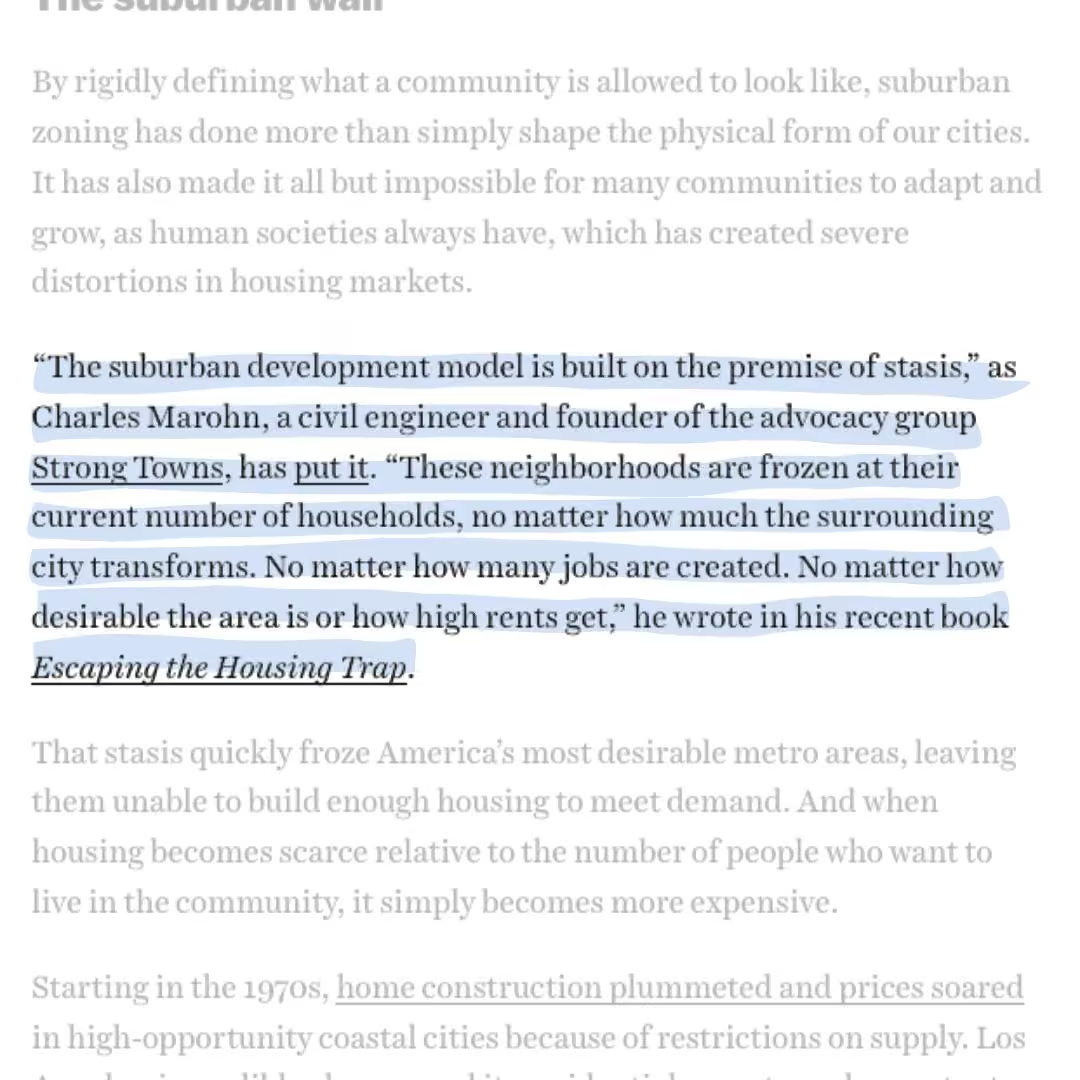
Why can't we just build high-speed, high-proximity streets? This is the original sin of North American street design: too fast for compact growth, too slow for long-distance travel. These "stroads" work work well for nothing, as argued by @clmarohn @StrongTowns
Charles Marohn reposted
Which has better travel times for cars: Amsterdam or Atlanta? Remarkably, it's Amsterdam.
There's a critical lesson here: it's possible to design great places for walking, biking, and transit that are also better for drivers. We just published a report on how.
"Building more housing can’t just mean building wherever is easiest...."🎯
Building more housing is only half an idea. You also have to address what kind and where.
www.smartgrowthamerica.org/knowledge-hub/news/building-mo…
Charles Marohn reposted
good lord
www.wsj.com/economy/consumers/what-does-a-bond-selloff-me…
A federal court ruled that Minnesota’s engineering licensing board violated the First Amendment when it tried to regulate my public advocacy.
It took six years to get here.
This ruling matters far beyond me.
Here are all the details, including a link to the ruling and a timeline.
www.strongtowns.org/journal/2026-8-31-can-an-engineer-spe…
And you can listen to @johntreuter and me discuss it on this week's Strong Towns Podcast.
podcast.strongtowns.org/e/chuck-s-engineering-lawsuit-fin…
The next book in the Strong Towns collection, titled "Grow Strong", went to the publisher this week.
It’s about job creation, economic development and the @StrongTowns approach to building a durable local economy.
I’m excited to share this one with you next spring.
Stay tuned: Monday we will have a big announcement and details on a positive resolution to my federal court case with Minnesota's engineering licensing board.
Charles Marohn reposted
Great news about potential progress in Massachusetts! Earlier this month, we explained why this is the right approach to state preemption. 1/2
A new poll shows 63% of Massachusetts voters support @YesOn7_MA, a ballot question that would make it legal to build new single-family homes on 5,000sf lots where public water & sewer are available, expanding options for more affordable starter homes.
Only 29% oppose it.
Charles Marohn reposted
Short answer: growth gives the city an initial financial boon but sprawling development doesn't pay for itself in the long term. It's very much like a Ponzi scheme. We have to change the way be build to break out of it.
Charles Marohn reposted
Great article from @StrongTowns and @clmarohn about how we're handling the growth Ponzi scheme! We're starting the conversation locally and following the Strong Towns approach of incremental change and long-term financial stability. Our children are counting on us!
Charles Marohn reposted
…in my decades of advocating for pro-housing policies I‘ve watched so many people change their minds to support ADUs, smaller lot sizes, eliminating parking requirements - and much much more! Telling advocates it’s impossible to persuade their neighbors is bad advice.
Just got this note from a new @StrongTowns member. I’m really proud that our movement is an alternative to all or nothing approach. We can build lots of housing, at price points people can afford, without giving up on everything else we all care about.
Co-author of "Escaping the Housing Trap," @dpherriges, wrote “The Trickle of the Fire Hose” back in 2019. It describes a phenomenon of modern neighborhood development so universal it became an entire chapter of the book.
archive.strongtowns.org/journal/2019/6/19/the-trickle-or-…
Directly related, from @BethOsborneSGA
Contrary to the belief of a vocal few, we can build lots of housing without building sprawl. And we should.
This idea that sprawl consumes community wealth instead of building it is key to every town and city across the world, not just Westcliffe.
Thanks to @StrongTowns and @clmarohn for writing and letting me repurpose for my community.
wetmountaintribune.com/2026/08/19/westcliffe-should-spraw…
Here's Beth's entire piece, which is🔥
bethosbornesga.substack.com/p/yes-in-my-backyard-means-in…
Contrary to the belief of a vocal few, we can build lots of housing without building sprawl. And we should.
This idea that sprawl consumes community wealth instead of building it is key to every town and city across the world, not just Westcliffe.
Thanks to @StrongTowns and @clmarohn for writing and letting me repurpose for my community.
wetmountaintribune.com/2026/08/19/westcliffe-should-spraw…
Charles Marohn reposted
Chuck's article actually praises a proposed state housing preemption measure that's on the ballot in Massachusetts this Nov. Strong Towns supports building A LOT more housing. The disagreement here isn't whether to build housing or whether state preemption is ever appropriate. 1/
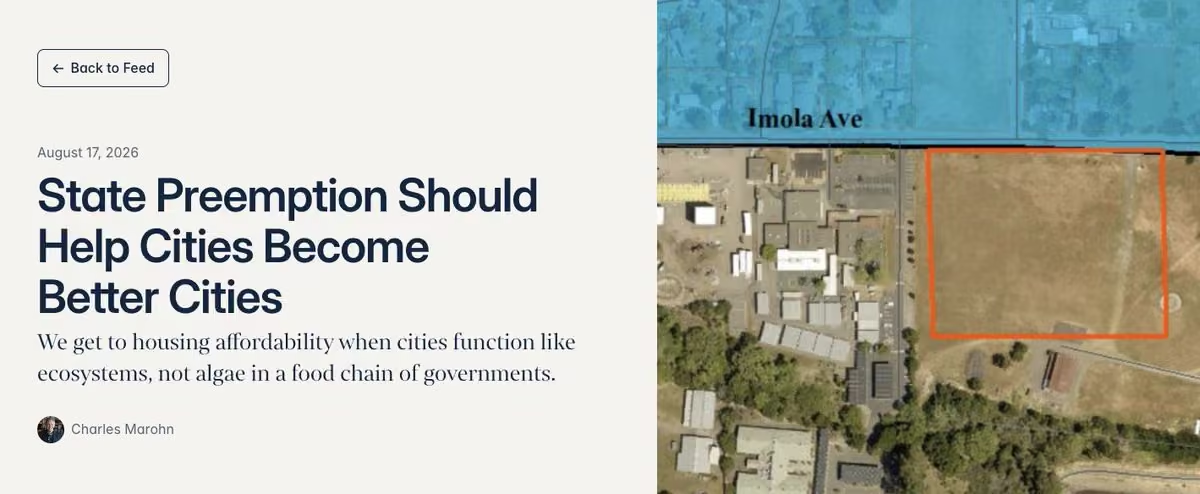
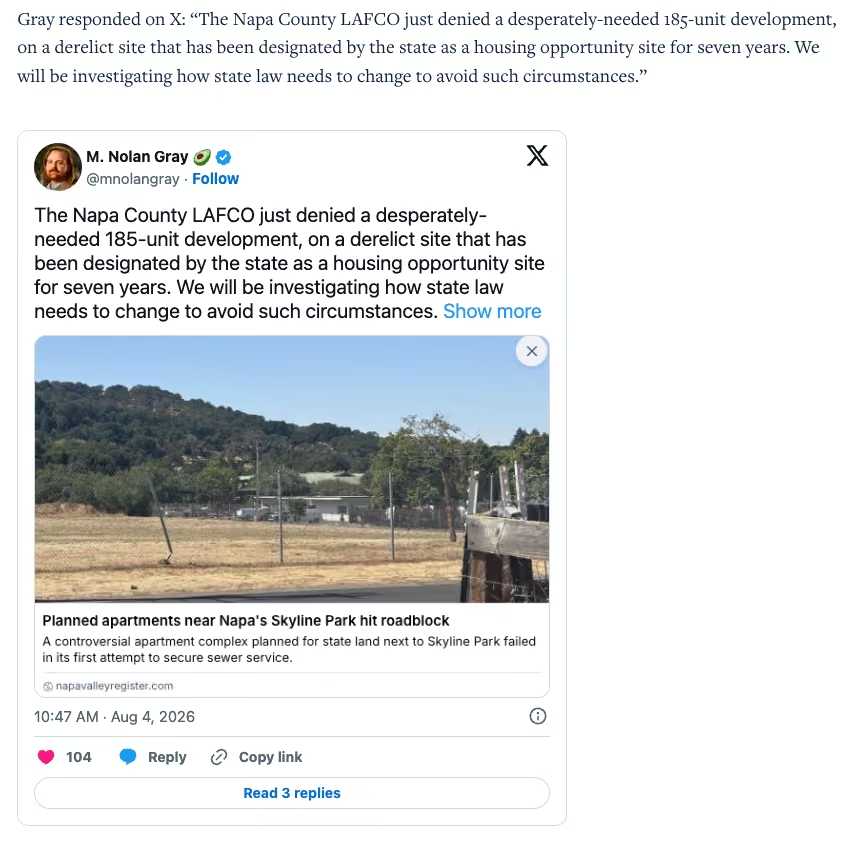
Once again, Chuck Marohn twisting himself providing cover for NIMBYs and opposing pro-housing state laws, free of any local context and to settle personal scores. This was local control—Napa County had designated it for this housing—before NIMBYs killed it!
Charles Marohn reposted
The Interstate mission ended in 1992. The Highway Trust Fund did not. We now face record spending, growing maintenance gaps, deadly roads, and projects that don’t match local realities. @clmarohn @StrongTowns and I explore how we got here. @T4America
www.youtube.com/watch?v=8w1ss8BXCw8
Austin is often cited as the canonical example of how increasing housing supply leads to declining prices.
Okay.
Then it must also be the canonical example of how declining housing prices lead to tightening housing supply.
A healthier housing market looks different.
It allows neighborhoods to mature incrementally.
It supports local, small-scale developers.
It helps cities get unstuck instead of taking away their agency.
www.strongtowns.org/housingready
Austin may indeed be the canonical example.
It just isn't canonical for the reason people keep claiming.
www.strongtowns.org/journal/2026-7-20-the-housing-debates…
Charles Marohn reposted
“As strong a love affair as one player can have with a fan base”
That line from Grady is how I will always remember Naz Reid’s time in Minnesota. From the towels to the tattoos, the connection between Naz and Timberwolves fans was special
Charles Marohn reposted
One never left his hometown. One's moved 12 times.
Watch @clmarohn and @aaron_hurst meet for the first time, only on JUST PRESS RECORD. Out now. @EpsilonTheory @Panoptica_ai
If you're wondering where I'm spending my time online these days, it's the Strong Towns Commons.
Smart people. Challenging conversations. No outrage machine. Just people trying to better understand how to build stronger places.
commons.strongtowns.org
This writing by a high school kid is 🔥🔥🔥. Wow! Very impressive.
Attention hoops (and music and food) related writing outlets: Juan Miguel Adams is a high school student I've had the pleasure of "mentoring" these past few weeks but this cogent and against-the-grain Julius Randle piece up at Minnpost today is all him.
www.minnpost.com/sports/timberwolves/2026/05/julius-randl…
Charles Marohn reposted
The worst kind of development is not low-density sprawl. It's high-density configured to be unwalkable and unservable by public transit. High-density = high traffic, and this guarantees all that traffic is in cars. Sadly the US exported this idea all over the world.
Florida is so walkable that it's a 46-minute walk to cross a single street to the train station in Aventura.
Charles Marohn reposted
Finch went with all three of Gobert, Randle and Reid for 8 minutes in the 1st half -- and they won those minutes 22 to 11 (+11).
Naz-at-the-3 is the plan without Edwards, DiVincenzo, Dosunmu and Anderson.
The Wolves had a net rating of +29.3 when all three of Gobert, Randle and Reid were on the floor together during the regular season -- though it was only for 123 possessions.
Looks like we might get a heavy dosage of that look tonight.
This is my favorite Wolves lineup that doesn't include Ant. Jaden at the 2 is epic.
This lineup is gigantic...
Gobert
Randle
Reid
McDaniels
Shannon
Finch hitting the athleticism button down guys
Charles Marohn reposted
I've written for the last decade about the educational divide in the US, but culturally there is now a large divide between generations — specifically those over sixty versus basically everyone else.
The sixty-plus cohort (Boomers which I'm at the very tail end of) have a lot more certainty that they've discovered the Truth — or the high point, and often end point, of many things. From music (rock will always be here), to fashion (why would anyone wear anything but blue jeans), to politics (liberal democracy with emancipation from all forms of obligation as a human Telos).
Younger people are much more uncertain and relativistic. They don't accept the claim that it's been solved, and the Boomers' rigidity and religious-like certainty seems to them either laughably naive or arrogantly condescending.
The Boomers see everyone else as having fallen away from the path to historical perfection they paved, and are uniformly angry about that. What most of the Boomers miss is that the younger generation is living in the world they built — of hyper-individuality, of smashing of prior norms, and of moral relativism.
This post-truth, post-gatekeeping, hyper-partisan world is an endpoint of their worldview, and yet they are angry about it.
Charles Marohn reposted
View from Glen Taylor’s seats:
Charles Marohn reposted
Mike Conley on if he was trying to start trouble at the end of the game passing it up to Jaden McDaniels
“(Laughs) nah that was a slip up, that’s all on me I take the blame… as soon as I threw it I looked and I was like “ah it’s Jaden” I almost put my hands on my head and I was like “maybe he won’t” and then as soon as I saw him when the ball kind of bounced a couple times “it’s over man” you can even see me like lower my head”
Charles Marohn reposted
WATCHING ON REPEAT TBH
Charles Marohn reposted
Scott Foster is officiating Game 3 of Wolves-Nuggets tonight
I hate talking about the refs, but that dude is nuts
Charles Marohn reposted
Jaden McDaniels, deadpan delivery, on what worked for the Timberwolves offensively.
Jaden: Go at Jokic, Jamal, all the bad defenders. Tim Hardaway, Cam Johnson, Aaron Gordon, their whole team.”
Q: They’re all bad defenders?
Jaden: “Yeah, they’re all bad defenders.”
Charles Marohn reposted
If I had the time to flesh this all out, I'd do a book on how American cities manage virtually everything at the wrong scale, and this accounts for about 80% of our routine issues. Policy wonks want to policy wonk everything; designers like me see everything as a design problem. But what I've become convinced of is we have a basic management problem.
I find this to be really difficult to communicate, so bear with me (which would be the point of writing something out, right?)
Smaller cities and towns have their limitations, but their local governments are intimately familiar with issues in town, know their constituents closely and are generally very accessible.
As cities grow larger, the population of districts also grows. Sometimes to very large numbers. My district in my city has over 80,000 people in it - represented essentially by 2 people. Bear in mind there are entire towns of half that size with a City Council of 5-12 people. So there's that aspect - the political side.
Then there's the day to day management side. As cities grow, they grow like corporations used to grow - vertically and siloed. It becomes harder and harder for lay people to know who to call, who does what, etc etc. I've seen a number of workarounds tried, with good managers and not so good ones. But fundamentally I see a systems problem - people just get farther and farther away from constituents and needs.
One result is many very localized issues just don't get dealt with well at all. Everyone in the process seems to default to solving problems at the scale of the whole city, when in fact most issues are hyper-local. That hyper-local scale gets problem-solvers in the form of BIDs, CIDs, Place-management organizations, like mine. And these groups often do a great job - because again they operate at a fine scale and are accessible.
But parts of the community without those groups, just generally don't get their issues solved.
This is but one part of a much longer thought train, but over and over again I've seen how we have countless issues because of lack of management at the right scale - a more localized one. And those issues then metastasize and become much bigger fights.
Much of this is rooted in the very 20th century idea that consolidation of governments and annexations would lead to management efficiencies. Because that was the mentality of much of society at the time. Might've sounded good in a textbook or a seminar, but it just hasn't worked.
My gut tells me so much of cities would work 1000% better if we had smaller-scale, localized governance and management. I feel like people instinctively know this or sense it, but we can't figure out how to communicate it well or solve for it.
Count the number of voters in the top and bottom images.
A reminder that Mayor Anne Hidalgo will go down as one of the most consequential mayors of the modern time: a mayor who literally built 600 miles of bike lanes and made hundreds of streets car free in her 12 years as Paris mayor. Bravo.
In the 1960s, US highway engineers planned to used atomic explosions to flatten parts of the Rocky Mountains for highway construction.
Instead of fighting over a 21-mile-wide bottleneck forever, we cut a new channel through friendly territory. A dozen thermonuclear detonations and you’ve got a waterway wider than the Panama Canal, deeper than the Suez, and safe from Iranian attacks. www.chinatalk.media/p/its-time
Charles Marohn reposted
Recommend this podcast. I've tuned into loads of Chuck Marohn podcasts over the years, so much was familiar — but the questions and conversation flow were really good. Worth a listen, especially if you have never heard @clmarohn speak before.
Chuck Marohn @clmarohn joined me on @yeomanpodcast to discuss the @StrongTowns movement, central planning, Jane Jacobs, public debt, GenZ, and bottom-up revolutions.
yeomanpodcast.com/2026/01/22/chuck-marohn-29/
We don’t have a transportation funding problem.
We have a venue problem.
It’s time to declare the Interstate construction era complete and redefine the federal role.
New white paper + live discussion Thursday
www.strongtowns.org/event/virtual-mission-accomplished-ad…
Charles Marohn reposted
Ultimately, we will continue to be frustrated by outcomes if we define the housing market in only one dimension (supply), instead of defining it in at least two (supply + finance).
For years, housing debates have leaned on a simple promise: build enough homes and prices will fall.
It’s an appealing idea.
Technical problem. Technical fix.
Anyone on this site has seen the rigid enforcement of a simplistic narrative on housing. Oh, the tweets I could dunk.
Taken together, it feels like the debate is shifting.
Not because the problem changed, but because housing was never as simple as many of us hoped it would be.
www.strongtowns.org/journal/2026-2-9-the-housing-debate-i…
And anyone wanting to explore the real complexity of housing, and the Strong Towns response to the current crisis, there is a bestselling book for you: "Escaping the Housing Trap."
www.strongtowns.org/book
Ultimately, we will continue to be frustrated by outcomes if we define the housing market in only one dimension (supply), instead of defining it in at least two (supply + finance).
In federal court today.
Not for practicing engineering improperly but for speaking critically of the profession while not practicing at all.
This case asks whether a licensing board can use state power to punish speech it disagrees with.
I believe the answer is no.
For those of you new to this 5+ year old saga, here's a column I wrote back in 2022: archive.strongtowns.org/journal/2022/8/30/licensing-board…
"Strong Towns: A Bottom-Up Revolution" was published back in 2019. That is continues to be at or near a top ranking says a lot about how many people are still arriving at the same set of questions.
That steady arrival is how change happens. ❤️
Two hours with Duluth Mayor Roger Reinert and city staff talking about the hard work of building strong cities.
Thoughtful leadership + engaged staff is where change actually begins.
Charles Marohn reposted
GOP candidate drops out of MN governor race:
“I can’t look my daughters in the eye and say I’m running as a Republican, when they’re pulling over Hispanics and Asians because of the color of the skin and what they look like. I did not sign up for that.”
www.wsj.com/politics/policy/the-lawyer-for-the-agent-who-…
The latest White house housing order isn’t about stopping Wall Street from buying homes.
It’s about making sure Wall Street can stop buying without losing money.
That’s an exit strategy, a bailout, not a crackdown.
For those interested in more on this --> www.strongtowns.org/journal/2026-1-26-trumps-housing-orde…
Charles Marohn reposted
"don't sweat the small stuff" had it backwards. Sweat stuff you can control (small, local), don't sweat stuff you can't
Charles Marohn reposted
Almost everyone I intellectually respect, and admire, ends up with this view -- either via Eastern mysticism, stoicism, Catholicism, etc.
They may not always pull it off, but they understand contentment in this life (and sometimes even fulfillment) requires a humility.
This is different from a nihilistic fatalism, because you can impact your immediate surroundings, and change your own circumstances, but there are forces far larger than you (both in the here and now, and beyond) that you cannot change.
Or, to be less egg-headed about it, you really don't need to have a take on every twitter fight, or engage in every outrage.
Charles Marohn reposted
We had a great conversation with @clmarohn from @StrongTowns today!
Check it out here:
omny.fm/shows/the-drew-mariani-show/chaplet-of-divine-mer…
You can always count on California to have the nicest parking lots right next to the downtown transit stop.
Yesterday I spoke at the Ride For Your Life rally at the Lincoln Memorial, the largest event in the nation honoring people killed in traffic violence.
The American death rate isn’t a personal failure problem. It’s a problem of professional and institutional indifference.
I'd love to talk housing with Joe Rogan, especially with Austin as the backdrop.
@clmarohn, the man who understands the housing crisis in America perhaps better than anyone else.
The Trump administration just endorsed the 50-year mortgage.
I predicted this in Escaping the Housing Trap.
It’s not innovation. It’s desperation. 🧵
Strong Towns members saw this coming.
We understand how federal finance, local zoning, and fragile development models all connect.
We’re building something stronger — one block, one neighborhood, one city at a time.
This is member week at @strongtowns. If you believe Americans deserve better than a 50-year mortgage, join us. 👉 strongtowns.org/membership
When I started Strong Towns in 2008, it was just a small blog with big questions.
This fall, we dropped my youngest daughter off at college.
In the same span of time, that blog has grown into a nationwide movement.
The systems are built.
The people are ready.
The approach works.
Now it’s about turning potential into proof, thousands of small, local projects that add up to lasting, bottom-up change.
This is Member Week at @StrongTowns.
If you believe your place can be stronger, safer, and more financially resilient, now’s the time to join us.
We grew a movement. Now we grow our impact.
www.strongtowns.org/membership
Minnesota annual right of passage - preparing the garage for winter. We're ready.
Charles Marohn reposted
Chuck has always been ahead of the curve, he called the stupidity of a possible 50 year mortgage years ago.
He knows we would rather try to solve a debt crisis with more debt rather than reducing debt.
We're closer to emergency federal action to prop up housing prices than we are to federal action to make housing more affordable.
Charles Marohn reposted
Do you really get to decide the kind of place you want to live in? Let’s look at five ways Americans tell everyone how they have to live. Hint: it’s less about arrogance and more about ignorance. 🧵
Charles Marohn reposted
New podcast: Reframing the Housing Discussion
Chuck Marohn and I talk housing finance, mismatches in the supply-demand conversation, and where we see the low-hanging fruit
@clmarohn of @StrongTowns joins me in the studio to dive deeply into the world of housing finance and housing policy, fresh on the heels of his book, "Escaping the Housing Trap: The Strong Towns Response to the Housing Crisis." For an architect and engineer to dive into this world might seem anathema to economists, but we go there anyway.
The topics range from the thirty year mortgage and its distortions on the housing market to yield curve control to how social trust impacts the whole conversation. And we ask “do we actually have enough housing?”
Coming soon I’ll have an episode about Leon Krier and his impact on so many discussions for architecture, planning and design today, but for now Chuck and I talk about one aspect of his ideas: height limits. Naturally, we focus on how that plays out in Washington, D.C.
podcasts.apple.com/us/podcast/reframing-the-housing-discu…
We're closer to emergency federal action to prop up housing prices than we are to federal action to make housing more affordable.
Charles Marohn reposted
"Deep discounts keep coming for sales of uptown Charlotte towers. What’s going on?"
440 South Church sold for $75.7M last week.
Purchased for $108.7M in 2014.
45% Occupancy
Charlotte Plaza at 201 South College sold in August for $70M.
Purchased for $160M in 2015.
32% Occupancy
525 N. Tryon sold for $24M in May.
Purchased for $60M in 2014.
46% Occupancy
-charlotteobserver
#commercialrealestate
This is hilarious - check out Orange County on this list. That is a reference to my friends at @UrbanThree. Those far left hacks use "fair and equitable" because it is a catchphrase from the (boring) assessor's profession, one we are working to reform.
Florida DOGE teams alongside @CFOIngoglia have been investigating cities and counties where taxpayers have raised concerns about wasteful spending.
These audits have uncovered many irresponsible uses of taxpayer funds. It’s unconscionable for local governments to raise taxes on Floridians in order to subsidize wasteful spending.
Under my leadership, Floridians can continue to expect fiscal responsibility at the state level—and we are working to bring relief to our citizens being squeezed by property taxes at the local level.
The call at the end for "fiscally responsible government" is filled with irony since, by bringing in Urban3, that is exactly what Orange County is doing. All counties should follow their lead.
I wrote this to the governor last year when he committed to another round of highway expansions.
archive.strongtowns.org/journal/2024/4/29/ron-desantis-do…
If housing affordability is a simple supply problem, then we can conclude that dramatic price declines are a result of having a surplus of homes.
Of course, everything in that sentence is wrong.
U.S. home prices have fallen steeply in the first half of the year. Thru July, the 6-month annualized change int he S&P Case-Shiller National Home Price Index was -1.82% ... quite weak relative to history
We talk a lot about the housing crisis. We talk about zoning reform, state mandates, big developers, federal subsidies.
But here’s the million dollar question: Who will actually build the homes we need?
Today @StrongTowns is releasing a new toolkit: Who Will Build the Housing-Ready City?
It’s about answering that question, showing how cities can act right now to unlock incremental housing.
www.strongtowns.org/housingready
This is how we escape the housing trap.
Not with one giant leap, but with thousands of small steps — multiplied across every block, every neighborhood, every city.
That’s how we build housing abundance that actually lasts.
www.housingtrap.org
Download the new toolkit here:
👉 strongtowns.org/housingready
and then start building the Housing-Ready City, today.
Charles Marohn reposted
A $58M traffic project being billed as economic development is essentially “...prop[ping] up $40.8 million of gas stations, strip malls, and big-box stores," says @clmarohn. "If we’re serious about commerce, let’s invest where the returns are real.” www.strongtowns.org/journal/2025-9-15-the-absurdity-of-hi…
For the past decade or more, the housing-as-shelter conversation has had little conflict with the housing-as-financial-product conversation. They both essentially wanted the same simple thing: build more housing.
That’s not inherently true anymore.
It reveals a bunch of narrative/policy incoherence that was otherwise pushed under the rug when there was surface level consensus (on the means, not the ends).
I think we are approaching the inflection point where the housing conversation (finally) becomes interesting.
Charles Marohn reposted
Homebuyer demand in America is absolutely anemic right now.
To start 2025, existing sales are averaging 4.05 million.
That's the 2nd lowest level on record. The only worse year was 2009.
What's even scarier is that this low demand is occurring after the Fed cut rates last year.
So one year into rate cuts, and there's been no meaningful increase in demand.
Let's see if Fed rate cuts 2.0 does anything meaningful.
Charles Marohn reposted
The hard work of the residents of Marion, Ohio earned them the title of Strongest Town 2025.
Join @clmarohn at a special early viewing of a documentary exploring Marion’s history and bottom-up revitalization.
I'm spending time with Wes the next couple of weeks and so I'm (finally) reading his book.
Charles Marohn reposted
@clmarohn is finally making his way to Steubenville on Thursday, August 18th at 6:30pm!
We hope to see you there!
I bought this book because I thought it looked interesting. Opened it up and only then realized that not only have I already read it, I wrote one of the chapters.
In my defense, I had two copies and long term lent them out to people. Who? I don't recall.
Charles Marohn reposted
End the social media corporations’ special immunity, prevent them from imposing terms & conditions on pre-teens, and make them pay their taxes.
Charles Marohn reposted
We and @aibm_org hosted an event yesterday about the evidence base and policy options of online sports betting and issued a call for new research. As states continue to legalize, it's important they understand the full ramifications. A thread of some of what I learned.
1/n🧵
“Just build more and prices will go down.”
It’s the theory dominating housing policy.
Simple supply and demand. Deregulate, upzone, speed up permits—and affordability will follow.
But here’s the question no one wants to ask:
What happens when prices actually fall?
his doesn’t require billion-dollar subsidies or state/federal permission.
Cities can act now:
-Legalize small-scale development
- Support incremental builders
- Create local financing tools for entry-level homes
That’s how you get real affordability—and real resilience.
“Just build more” is only half a theory. It breaks down the moment prices fall.
And right now, they’re falling.
If you’re done pretending this system works, it’s time for a new approach.
We wrote about it here: www.strongtowns.org/journal/2025/7/21/what-happens-when-h…
The free Housing Ready Toolkit on the six regulatory reforms cities can make right now to get more housing is available here: www.strongtowns.org/housingready
And, of course, the National Bestseller "Escaping the Housing Trap: The Strong Towns Response to the Housing Crisis," is available wherever books are sold or borrowed.
www.housingtrap.org
This is actually brilliant. Hits on many levels.
I know this is asserted with all sincerity, but seriously? Average household size is now an immutable law that can only be compensated for by building more homes? There are no other policy options here?
The average number of people living in a house has dropped by 34% since 1950
This means that even with no population growth, cities can experience a housing shortage
A city of 1M residents in 1950 only needed 263k homes
A city of 1M residents today needs 400k homes
House sizes have actually gone up, as well. So, essentially, our extreme affluence has made us unable to afford housing because now we need that much more of it. I don't recognize this version of economics.
One (fair) critique of planning commissioners is that they put everything through the lens of their own experience. "Nobody would want that..." means they don't or didn't want that. It's ignorant.
Ditto "nobody would want that...." because the typical X user doesn't want it.
Charles Marohn reposted
Two Denver office towers recently sold for $3.2 million, or ~$3 per square feet
Yes, that is not a typo
They were valued at ~$200M in 2019, per BisNow
Charles Marohn reposted
🚨 Japan’s bond market is spiraling into chaos.
Yields are exploding. Liquidity is vanishing. Trust is evaporating.
Let me break down what’s happening in Japan and how this affects the US.
(Save this thread)
Charles Marohn reposted
As Edward Erfurt, our Chief Technical Advisor, says, “The hard truth is this: growth alone doesn’t guarantee solvency..."
A lot of people read "government" here indiscriminately. We can debate economic illiteracy at the federal level, but local government budgets are very much like a household.
The danger of equating a govt budget to a household leads to very damaging policy and laughable headlines from economic illiterates such as this.
Britain's running out of cash!! 🤪
@andyverity @labourlewis @ProfSteveKeen @StephanieKelton #mmt
“Somebody once came up to me and said, ‘Oh, Strong Towns — you’re teaching cities how to be cities.’ We could do that, but what we’re really doing is teaching citizens to be citizens.” ❤️
-Edward Erfurt
www.journal-news.net/eedition/strong-towns-of-jefferson-c…
The idea that development in the SW is slowing down is getting a lot of spin. We've been talking about it for years - it's the natural outcome of our unnatural development pattern.
Post-war development is based on the idea of stasis: build to a finished state. After World War II, California grew robustly in this way, but places like Phoenix and Dallas didn't get started at that pace for a couple of decades.
Charles Marohn reposted
I've stayed out of the Abundance debate, because there are a lot better informed people to talk about it.
Strong Towns has been doing this sort of stuff for a very long time, at the local level and national level, so worth listening to them
www.strongtowns.org/journal/2025/6/9/the-trouble-with-abu…
This feels like it settles a bet between @TwinsGeek and @AaronGleeman
Charles Marohn reposted
Turning empty lots into housing that meets the community’s needs—that’s what Muskegon, Michigan is doing with Tax Increment Financing. More productive land use means the city has more money to take care of its public spaces that everyone gets to enjoy and use.
Charles Marohn reposted
If the Federal Reserve had never purchased mortgage-backed securities (MBS)—especially during and after the 2008 financial crisis and again in 2020—home prices would likely be significantly lower today. Here's a breakdown of why, how much, and the mechanics:
🔧 Mechanism: What MBS Purchases Actually Did
The Fed’s MBS purchases:
Lowered mortgage rates artificially (by increasing demand for MBS, driving down yields).
Boosted housing demand (cheaper borrowing = more buying power).
Increased asset prices (not just housing, but housing especially due to leverage and tax incentives).
Crowded out investors into real estate (search for yield during low-interest-rate environments).
Without this intervention, mortgage rates would’ve likely been 1–2% higher at minimum during key periods (2010s and post-COVID era), leading to:
📉 Estimated Price Impact
Conservative Estimate:
Economists from the NBER and Fed itself suggest that MBS purchases may have boosted home prices by 15–25% over baseline.
Aggressive/Alternative Estimate:
Some analysts argue that prices may be 30–40% lower in expensive metros if the Fed hadn’t suppressed mortgage rates for over a decade.
🧠 Thought Experiment: 2020–2022 Housing Boom Without MBS
The Fed bought $1.4 trillion in MBS from 2020–2022.
Mortgage rates might have hit 5–6% in 2020 instead of bottoming near 2.65%.
A family qualifying for a $500,000 home at 3% might only afford $400,000 at 5.5%—that’s a 20% drop in demand-driven price support.
Conclusion: The 2020–2022 price spike likely would’ve been muted or reversed without the Fed, and national prices could plausibly be 20–30% lower today without its multi-decade MBS interventions.
Abundance asks us to empower others to fix what we already have the power to change. At @strongtowns, we think you don’t need to wait for permission.
Here's my latest column, a short take on Abundance. www.strongtowns.org/journal/2025/6/9/the-trouble-with-abu…
We talk about Jane Jacobs, but plan like Robert Moses.
We want bottom-up outcomes but keep using top-down tools.
I wrote about why that doesn’t work, what it costs cities like Newport and Chester, and how places like Medicine Hat show a better way.
www.strongtowns.org/journal/2025/6/2/governing-like-caesa…
Charles Marohn reposted
This is a common knowledge moment - everyone now knows that everyone now knows that the US deficit cannot be controlled over the remainder of Trump's term - and it puts us on a path to a sovereign debt crisis.
"How I Learned to Stop Worrying and Love the Deficit"
New on ET!
Charles Marohn reposted
“The only way you get the people living in this neighborhood to agree...is if you have a vision of how that will actually make their lives better."
Listen to more on the Strong Towns podcast! @JeffSpeckFAICP @clmarohn archive.strongtowns.org/journal/2025/5/27/stpod-escaping-…
Charles Marohn reposted
Nobody touching him 😭
Charles Marohn reposted
I don’t care who wins this game. The touch foul calls SGA gets are really awful. They don’t resemble anything else that’s happening in the playoffs.
Wolves in 5. Bring on the conference finals.
Charles Marohn reposted
Fellow YIMBROs, no need to fight this thread, because look a) there are YIMBYs that do advocate for sprawl b) it's not a straw man when he is citing a literal column for one of them c) he did say it was an "extreme YIMBY" view, not a common one.
The New York Times just ran a piece arguing that the only way to solve America’s housing crisis is to embrace sprawl: build outward, fast, and without hesitation.
This is the logical conclusion of the extreme YIMBY take:
“Just build. Anywhere. Everywhere. As fast as possible.”
The New York Times just ran a piece arguing that the only way to solve America’s housing crisis is to embrace sprawl: build outward, fast, and without hesitation.
This is the logical conclusion of the extreme YIMBY take:
“Just build. Anywhere. Everywhere. As fast as possible.”
This isn’t about aesthetics.
Not about taste or class or nostalgia.
It’s about math.
If a neighborhood can’t pay for itself, building more of it won’t fix the problem. It will make the problem worse.
Real solutions require places that invite growth, reinvestment, and evolution.
Not just more units—better places.
We wrote a full response to the NYT piece. Read it here: www.strongtowns.org/journal/2025/5/5/america-should-spraw…
Wolves in five. Bring on Round 2.
Governing like Caesar with Jesus in Mind.
"Planning like Moses with Jacobs in Mind"
www.google.com/books/edition/Building_Like_Moses_with_Jac…
"Jane Jacobs ends through Robert Moses means" is the modus operandi of most planners and policy advocates, including large swaths of New Urbanists. It is a total misunderstanding of both the brilliance of Jacobs and the shortcomings of Moses.
This is really my beef with many (def not all) New Urbanists. The CNU has (to this day) a strong and internally influential faction of central planners who share more philosophy with Le Corbusier, Robert Moses, and the CIAM than with Krier, Jacobs, and @StrongTowns.
Jacobs described the "sidewalk ballet." If you hear that term and you think, "yes - more sidewalks," you are missing the point. The sidewalk is the adjective and ballet is the noun. It's all about the ballet -- the dance, the movement, the back and forth of humanity.
Charles Marohn reposted
Retweet to make this go viral.
Houston is broke—and not just because of a $160 million deficit.
We used the Strong Towns Finance Decoder to dig into the city’s long-term financial trajectory. These six charts tell the real story.🧵
The entire article and analysis on Houston is available here. Next week, we go small and look at my hometown of Brainerd, Minnesota.
www.strongtowns.org/journal/2025/3/31/the-growth-ponzi-sc…
If you want to do this kind of analysis for your city, we're going to make a DIY tool available for free very soon (it's almost ready). Here's where to sign up to be notified when it's ready:
www.strongtowns.org/accounting
Charles Marohn reposted
Great analysis as usual from @clmarohn @StrongTowns
The post-WWII car-dependent paradigm is an unmitigated disaster, burdening our cities with financial instabilities, and costlier infrastructure. Continuing on this path will not bode well for America's 4th largest city.
In 2016, we updated the original Growth Ponzi Scheme article to explain how cities across North America were financially imploding—not because of a lack of growth, but because of growth itself.
Now, we’re revisiting the Growth Ponzi Scheme with a case study of Houston, Texas.
Charles Marohn reposted
This was an excellent video, worth the 7.5-minutes of your time 😀 @clmarohn
www.youtube.com/watch?v=yDIjWHxciPo
Perfect
Internet win of the day
@clmarohn will be happy
Charles Marohn reposted
Get ready #houston
@clmarohn @StrongTowns
We hear that our city has a balanced budget, but what does that really tell us? Not much, actually. A city budget is merely the year-to-year task of making the ledger balance. There are good ways and also very damaging ways to balance a budget. What is more telling is the trend.
These trends are not the responsibility of one individual or city council; they are the byproduct of the way the city has operated for decades. Nonetheless, they are financially unsustainable. In Kansas City, things are falling apart.
Sadly, Kansas City is not an outlier. We examine another American city next week. The full article is available --> www.strongtowns.org/journal/2025/3/24/introducing-the-str…
🔥🔥🔥🔥🔥🔥
To vote --> www.strongesttown.com
I'm grateful this Sunday that my interview with @samquinones7 is being quoted in a discussion about addiction recovery.
Sam's quote here is powerful: "Each recovering addict is like a new natural resource, like coal, energy rising from decay."
recoveryreview.blog/2025/03/08/these-things-take-courage-…
Charles Marohn reposted
Just listened to my favorite @StrongTowns podcast episode by far. Loved the plain English conversation & real world examples. As a former city councilmember, I can related to the firefighter code/policy discussion. Thank you @seth_zeren & @clmarohn
podcasts.apple.com/us/podcast/these-6-code-reforms-will-b…
A couple things. First, Brainerd isn't a prairie town. We're well into the forest. Second, here's a picture of my house. I find it luxurious, but it's in Brainerd's oldest neighborhood (built in 1914) -not exactly "sprawling," even by small town standards.
If you are a conservative, even a MAGA conservative, and you think government should be more responsible with your money, think people should generally have more liberty to choose how they live, and are pro- families and small business, I think you'd generally like @strongtowns.
I should maybe also say that my wife and I met in junior high, dated all through high school and college, have been married for nearly 30 years, and we still live in our hometown. So, that's why I live there - 5th generation.
MAGA: Marohn is a hypocrite for pushing density while living in a single family home (in his hometown).
Ultra Progressives: Marohn is a hypocrite for romanticizing traditional neighborhoods while living in a single family home (in his hometown).
Unserious nonsense. All of it.
Oof @StrongTowns
Challenge to readers of the Federalist: Show me one column, podcast, or video where I have either:
1. Promoted high density development.
2. Trashed single family homes.
3. Suggest people shouldn't own cars.
I've written over a million words. Find one.
Still waiting...
@jbronitsky claims he took a "wrecking ball" to my ideas. Hyperbole or substance? If it's the latter, then let's talk it out. DM me to schedule.
x.com/jbronitsky/status/1889037531296997506
I would like to invite @jbronitsky and @paigebronitsky to come on the @StrongTowns podcast to talk about their article in @TheFederalist (that referenced me).
I'm not confrontational - ask around - so this is truly an invitation for discussion. DM and I'll make it happen.
I would like to invite @jbronitsky and @paigebronitsky to come on the @StrongTowns podcast to talk about their article in @TheFederalist (that referenced me).
I'm not confrontational - ask around - so this is truly an invitation for discussion. DM and I'll make it happen.
For those you that follow me and wonder what article, here's a link.
thefederalist.com/2025/02/10/new-urbanists-want-to-bulldo…
Charles Marohn reposted
David Berding went nuts on Thursday.
My favorite photo of the year:
gettys of game 5️⃣2️⃣
Charles Marohn reposted
Chuck Marohn @clmarohn from Strong Towns has a good podcast episode about the framing and conservative skepticism around 15 minute cities. I found it to be a good listen.
www.strongtowns.org/journal/2023/3/13/conservative-reacti…
It might be convenient to blame police, but this is the system. It's about assessing blame, not discerning what happened and why.
And certainly not about making sure it doesn't happen again.
As a private accident reconstructionist, it's incredible how often the extent of police work on crashes is to take a couple statements at the scene and then call it a day. Seen fatalities with essentially no investigation.
We should all be impressed with how quickly, thoroughly, and competently the NTSB responds to plane crashes. Their goal: learn all they can so this kind of tragedy never happens again.
What if we did the same thing for fatal car crashes? Here's the thing -- we can.
Here's how --> www.strongtowns.org/journal/2025/2/3/a-plane-crash-gets-a…
Charles Marohn reposted
I’ve read a few folks arguing that the new divide is not Left vs Right, but Accel vs Decel. I disagree. The real divide is between Global Capital and family capital*, by which I mean the assets that regular families have.
I thought KC ran on stroads, cul-de-sacs, and debt?
@abbykatkc
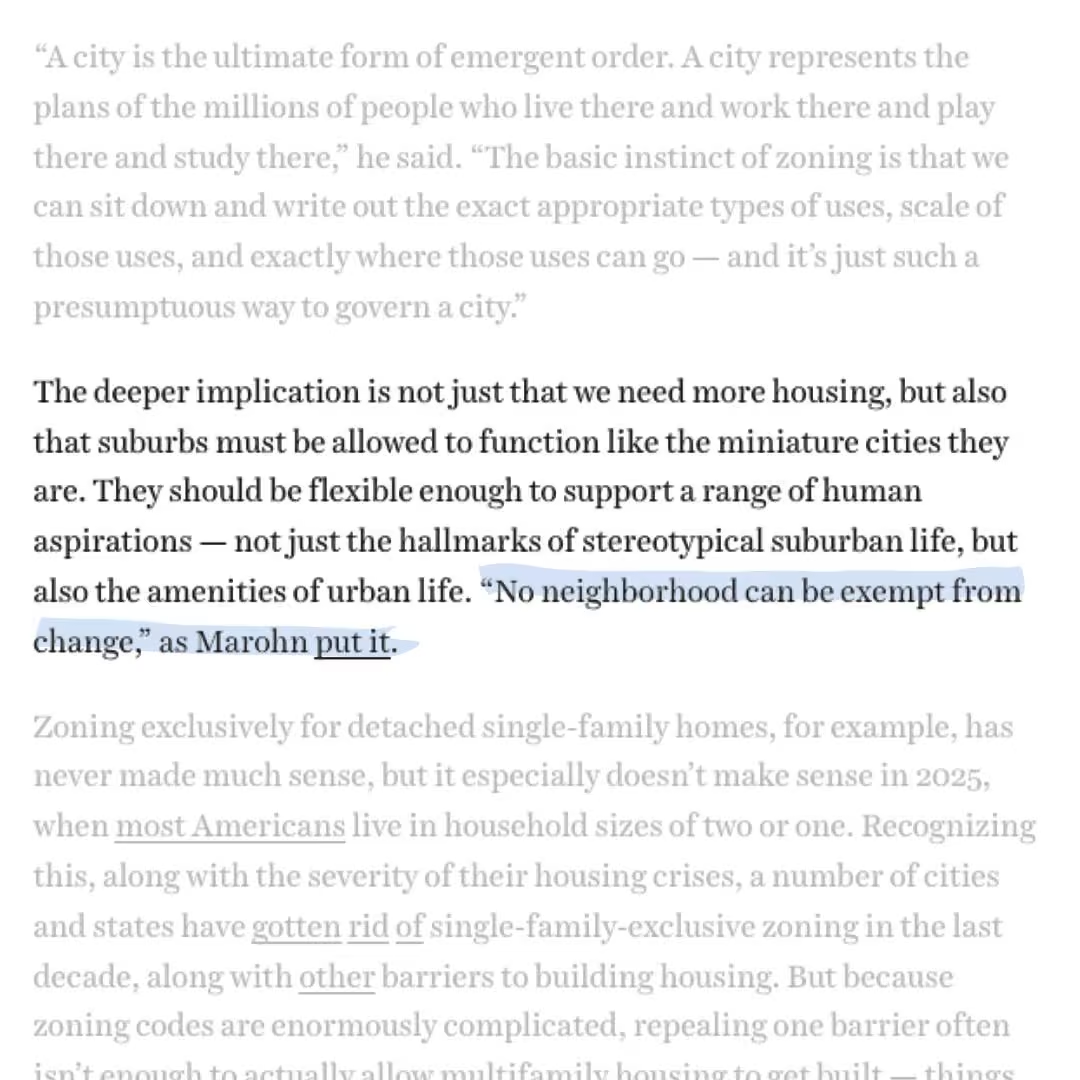
Our current grand bargain for housing is simple: No neighborhood needs to change; they can all stay in their current form, but in exchange, one or two neighborhoods will experience radical transformation.
For decades, we've been living under this unspoken grand bargain when it comes to housing. It’s an arrangement that most people don’t think about explicitly, but it shapes nearly every conversation we have about growth, change and affordability in our cities and towns.
It's a bad bargain that needs to be replaced. Today, we're offering a Strong Towns alternative.
www.strongtowns.org/journal/2025/1/27/americas-grand-hous…
I'll be forever grateful for the generosity of @Kaid_in_DC and how he was so pivotal in not only encouraging me, but boosting my then very weak signal. I try to pay it forward to others when I can. Everybody needs a chance once in a while.
I remember well when @clmarohn was first getting started. I spotted talent & promoted him, no idea that a whole community of ideas & advocates was being born. I especially love the pragmatic qualities of Strong Towns today:
Perfect
Part of the Hills and Rivers Housing Trust presentation given by Executive Director Nils Peterson to the #pullmancitycouncil, this evening:
(Cc: @clmarohn & @dpherriges)
Years ago I started putting together a list of the best books I read during the prior year. I read a LOT and people always ask me for reading lists, so here is mine. There are links at the end to every year going back to 2014.
#1: "The Demon of Unrest" by @exlarson
Larson allows the historical characters to speak in their time. Yet, it is hard to hear their rhetoric, and the many human blunders of assumption and intent they committed, and not reflect on our own times.
#5: "Tracers in the Dark: The Global Hunt for the Crime Lords of Cryptocurrency" by @a_greenberg
If you’ve wanted to learn more about cryptocurrency but struggle with the propaganda, this book will give you just enough insight to ask the right questions (and be skeptical).
You can get my entire list here, as well as my annual lists going back to 2014.
www.strongtowns.org/journal/2024/12/16/the-best-books-i-r…
Charles Marohn reposted
As if his fantastic webinar wasn't enough, @clmarohn has recorded a podcast to answer more questions from our audience! Check it out now: www.podbean.com/media/share/pb-tefki-176c681. A second podcast (!) will be posted later on the @StrongTowns website: www.strongtowns.org/podcasts. Thanks again, Chuck!
We are told that inflation is tamed, the economy is booming, and there are plenty of jobs..... at least, that is what the official statistics say is happening.
Reality looks very different. Here is my annual look at how much more it costs this year to do my Christmas baking. 🧵
Here's the link to the article at @StrongTowns: www.strongtowns.org/journal/2024/12/9/christmas-cookie-in…
And for those on Substack: open.substack.com/pub/clmarohn/p/christmas-cookie-inflati…
I had reports of a number of teachers sharing this with their classes last year. If that is you, let me know. Not only is it a great story, but it makes me happy.
Merry Christmas, everyone!
This was a good conversation. The best kind of debates highlight differences while not downplaying areas of agreement. From Day 1, @StrongTowns has been about making it ridiculously easy to add new units in every neighborhood. In that sense, we have an OG YIMBY mindset.
Debate time! New episode out with Chuck Marohn from @StrongTowns and Nolan Gray with @cayimby. I found them disagreeing here on X—which surprised me as I assumed they’d be on the same side—so I asked them on the podcast to hash out their ideas.
It’s a great (and friendly) episode. Though for better or worse, I started out by reading their disagreement on X out loud, which is probably a painful experience to hear your own words in a heated moment repeated back. Nolan said it felt like he just went through a deposition. Having just been through a real life deposition myself the week before, I felt kind of bad. Sorry guys :) but to be fair, it does set the stage for a good convo! And a friendly one at that.
Each of these guys have made significant contributions to the built environment via real policy changes and shifting culture and conversation.
Thanks for coming on @clmarohn and @mnolangray
Check out their latest books Arbitrary Lines and Escaping the Housing Trap.
Trailer below:
I'm not part of the Blue Wave leaving Twitter/X, but I am (mostly) departing, albeit for different reasons. Sadly, the site just isn't conducive to the kind of work we're doing at Strong Towns. The next post will have a link with a longer explanation.
Follow all Strong Towns stuff at strongtowns dot org and I'm also publishing my columns and extra commentary on sub st@ck at clmarohn.
FWIW, these are stats from our ST Twitter account. Can you spot the election?
Charles Marohn reposted
This is exactly right, from @clmarohn.
For a long time, Detroit homes were "too cheap to buy" (unless you had cash, or had no choice but to get into a predatory land contract). The focus here -- in policy and programs -- was largely on trying to create "comps" and / or raise home prices to the point where someone would give you a mortgage.
Detroit largely sought to eliminate our affordable housing rather than bother trying to figure out how to meet the market where it was.
♥️
After enjoying and participating in @StrongTowns content for many years, it struck me that I was--gasp--not a member! (Thanks Carlee.)
It was easy to rectify the situation.
How about you? Time to sign up!
This is a good insight from a friend, one I disagree with often but have also learned much from.
One way to practice this is to open your feed to opinions that you think are wrong, as long as they are expressed honestly and constructively. I block or mute people for being cruel or abusive but not for being wrong. It makes my feed less of an echo chamber. 7/
"Prosperity grows like a garden..." 💯
3. The populist promise to engineer the economy – whether for security or prosperity – is hollow.
Prosperity grows like a garden, it is not programmed like a piece of software.
We in Washington should till the soil.
For those asking, yes, that was my wife on NPR. (There aren't *that* many people named Marohn.) She is a reporter with Minnesota Public Radio and, occasionally, she does stuff for NPR. Yeah, she's a big deal.
Here's the story, for those that missed it. www.npr.org/2024/11/13/nx-s1-5156151/scuba-divers-in-minn…
♥️
I’ve been a staff writer for Strong Towns for almost two years now, though in the best way, it feels like I’ve been on the team much, much longer.
Before that, ST came into my orbit the way it probably did for you: through an article.
Charles Marohn reposted
Current status:
"Keep doing what you can to build @StrongTowns"
#localfirst
About to start a presentation in the small town of Orange, Mass, and discovered they are streaming it live. For anyone who wants to tune in. It starts at 7:30 pm Eastern.
zoom.us/j/94240554598?pwd=wbqU0ajdmlRxbIjaU6JLxY2dg8NMWP.1
Charles Marohn reposted
There is work you can do in the place you live. To repair and strengthen both the physical and social fabric of your community. To create spaces of shelter, sanctuary, connection, creation, even simply beauty and joy for yourself and your neighbors.
Find that work and do it.
Charles Marohn reposted
"5 Things For The Next President To Do" via @StrongTowns www.strongtowns.org/journal/2024/11/4/5-things-for-the-ne…
Charles Marohn reposted
Leave it to @StrongTowns
+ @clmarohn to make me feel a lot better about this week. Keeping the focus on what's needed that's not getting a lot of attention pca.st/episode/d66fafdc-deee-4bff-9bde-d2e08c54909a
I'm not into the partisan presidential stuff (I know, it comes with the job), but I do wish there was a way I could vote for Jake. A former city council member, thoughtful leader, and good person. I might need to move to Massachusetts.
Let's build 10M units of housing.💯
Build –
10 million units of housing.
1,000 nuclear power plants.
More ships than the Chinese Navy.
More new businesses than the rest of the world, combined.
An economy that works like Legos, not Monopoly.
This is the beautiful daughter of a friend of mine. This only makes me love our marching band even more.
“Having Down syndrome has rarely stopped Maeve from doing what she wants to do.” This season, she’s proving that on the field with every performance 🏳️🏴
Read more about Maeve’s journey: linktr.ee/umnmarch?lt_utm_source=lt_admin_share_link
#marchingband #umnproud #universityofminnesota #colorguard
Annual ritual of preparing for winter complete. Yard cleaned up, wood stacked, snow blower prepped. Bring on the snow!
Here's the story of a city coming to grips with the everyday financial problems most places sweep under the rug. This is why they were the 2024 Strongest Town winner, messiness and all. I love Maumee - I love their hearts - and I love the message in this video.
The comments are rolling in: To create strong and financially resilient cities, we have to confront suburbia's debt trap. Learn how Maumee, OH — winner of the 2024 Strongest Town Contest — is trying just that in our NEW video: www.youtube.com/watch?v=dIcPSH7ExMM
Halloween, when the entire area drives to the most walkable neighborhood in Central Minnesota (mine) to get their trick-or-treat on. We welcome you all, friends!
Charles Marohn reposted
.@clmarohn already done been told y'all. Moneyhall was one of Chuck's best episodes, imo. Why the mom-n-pops are who we need to be supporting; privately and publicly.
www.podbean.com/ew/pb-4fkwv-976ebf
Thank you - that is my hope. It's also helpful for people who want to understand them (and go around them to get things done).
This book from @StrongTowns should be a must read for all highways engineers, transport planners and urban designers
Charles Marohn reposted
Thinking about starting your own Crash Analysis Studio? City staff and officials often consider these concerns when presented with new ideas and approaches. 🧵
Given the width of this street (really good) and the parking on both sides (also good), I don't find this goofy at all. I'd love a speed study to test my impression - I'm betting that speeds here are much lower than is perceived. Maybe even a safe speed.
Arlington County has a spotty sidewalks. On the walk to my daughter’s preschool, this road has none. So the County came up with a remarkably goofy solution: paint giant “shared street” emblems down the road.
It works as well as you’d imagine.
Charles Marohn reposted
1️⃣ Make safety a core responsibility.
2️⃣ Establish a Crash Response Team.
3️⃣ Establish a Crash Analysis Studio.
4️⃣ Use temporary traffic control for quick responses.
5️⃣ Update local street standards to priority safety.
6️⃣ Conduct bike and walk audits for all projects.
Charles Marohn reposted
"You can go home from this press conference and implement that framework within your city this afternoon." —Melany Alliston from @tooledesign
Get the report "Beyond Blame: How Cities Can Learn From Crashes To Create Safer Streets Today," available now: www.strongtowns.org/crashstudio
The report “Beyond Blame: How Cities Can Learn From Crashes To Create Safer Streets Today” is releasing soon.
Join the press conference at 12PM Eastern/11AM Central. You can get more information and register for the conference here: www.strongtowns.org/crashstudio
Charles Marohn reposted
I just read this new @StrongTowns report & I think it could be a game-changer for a lot of communities who want to prevent traffic violence. Enough is enough. Join us today ⬇️
Here's where to sign up for the press conference and get a copy of the report: www.strongtowns.org/crashstudio
When we released Confessions of a Recovering Engineer, we setup a website for the book that has a "confessional" for other engineers to share their confession. This past weekend, we received a new confession that included this:
"In Confessions I recognized the design problems I struggled with as well as the "cookbook" approaches we were taught. I also recognized the "engineer" mindset that makes us so resistant to change."
Today is an important day for street safety. At a press conference scheduled for noon EDT, Strong Towns is releasing a report, "Beyond Blame: How Cities Can Learn From Crashes To Create Safer Streets Today."
This report will not only detail our findings from 18 months of analyzing crashes, it will provide recommendations for actions local leaders can take to make their streets safer.
Quick, affordable, and effective actions to dramatically reduce traffic deaths. It's time to move beyond blame, make our streets safer, and save thousands of lives.
I'll put a link in the follow-up post to where you can attend the press conference and get a copy of the report. Please pass it on, especially to your city's elected and appointed officials.
Here's where to sign up for the press conference and get a copy of the report: www.strongtowns.org/crashstudio
If you are tired of waiting for someone else to make the streets in your city safe, this event is for you.
Join us tomorrow, October 15 at 11AM Central Time for the release of our report “Beyond Blame: How Cities Can Learn From Crashes To Create Safer Streets Today.”
Get more information here: www.strongtowns.org/crashstudio
Charles Marohn reposted
Big thank you to @nntaleb and @clmarohn for shaping my thinking about local government. I decided to run for County Commissioner to put these ideas into action.
Commerce is the engine that drives community
Full link to the 8-page campaign publication
drive.google.com/file/d/1ZGGqyCSgNVewSJ8GzEqQ_-u67cDEA4QB…
I've gone to two NFL football games in my life. This was one of them. I watched this happen in front of me. Unbelievable.
#vikings legend @johnnyrandle93 was an absolute menace. He really referred to himself as the Minnesota mosquito because of how annoying he was 🤣
John Randle’s tactics led to Trent Dilfer being kicked out of the game back in 1995, which was voted as the oddest and most surprising ejection in NFL history:
🎥: @NFLFilms
Charles Marohn reposted
Last week, we had the pleasure of hosting Chuck Marohn (@clmarohn), founder and president of @StrongTowns , at Better Block! We’ll be partnering with Strong Towns for a special workshop on October 31 as part of the #localmotive2024 series. Learn more: shorturl.at/jgJOk
Charles Marohn reposted
Echoing @AustinTunnell recommendation to buy @clmarohn & @dpherriges fantastic new book investigating the true nature of America’s housing crisis and what can be done to address it to ensure that people can find the shelter they need, which I reviewed for @BooksinFive below!
1/5
Charles Marohn reposted
Strong Towns has a robust connection with Western North Carolina stretching back years. We are deeply saddened to see the damage Helene has done to these places.
But we are also inspired by how neighboring communities have stepped up to support these places.
Charles Marohn reposted
Enjoyed being a part of this and a few other events around DFW last week discussing housing challenges with @clmarohn. If you haven't read Chuck's book Escaping the Housing Trap yet, watch this presentation and then give it a read to fill in the details. Important stuff.
We had a great time hearing from @clmarohn at last night's @StrongTowns: Escaping the Housing Trap event with @DallasHabitat, @VERDUNITY, and @options_restate! Thank you to all attendees - it was a tremendous turnout of over 100 people at @thewaxspace! You can go back and watch the livestream on our Instagram and Facebook pages, and we will also upload the full video to LinkedIn and YouTube shortly. Chuck's 3 recommendations he left us with were: code reforms, creating a network of small scale incremental developers, and localizing housing finance. Stay tuned! #dallasisbigenoughforeveryone #dallashousingforall
I thought the second Joker movie was really good. Can't quite understand people hating on it.
Charles Marohn reposted
Join us on October 15th at 11AM Central Time for the Beyond Blame press conference to learn how citizens, city staff, and elected officials are fighting back against 40,000 annual traffic deaths — and winning.
Register here: us02web.zoom.us/webinar/register/WN_0dai3to0RC6Zs5DpdmIsQA
If you want to start a @StrongTowns Local Conversation, we ask you to sign an agreement stating that you won't be a jerk. And we mean it.
www.strongtowns.org/journal/2024/10/7/want-to-build-stron…
Do we need all this parking? No, we do not.
Parking is the antithesis of productive. The opposite of success. It's great to see more places in Minnesota figuring that out.
www.startribune.com/twin-cities-suburbs-have-acres-of-asp…
Charles Marohn reposted
The Director of City Planning in Minneapolis said, "No single legislative action did more to contribute to housing creation than the elimination of parking minimums.”nyc.streetsblog.org/2024/10/02/op-ed-eliminating-parking-…
Charles Marohn reposted
Has the Highway Trust Fund Outlived Its Usefulness? I have thoughts! @StrongTowns @clmarohn www.strongtowns.org/journal/2024/9/30/has-the-highway-tru…
Housing is the mechanism to create a financial product that turns your family's income into bond payments. High prices are a feature, not a flaw, of this system.
As predicted in Escaping the Housing Trap....
I wish the Department of Commerce would open the first-ever federal review into the building of Black Wall Street, then institutionalize the bottom-up ways these hard working, entrepreneurial people built wealth and prosperity, even amid poverty, hardship, and persecution.
Countless humble lessons to be learned for all.
Now: The Department of Justice has opened the first-ever federal review into the 1921 Tulsa Race Massacre theblackwallsttimes.com/2024/09/30/doj-opens-first-ever-f…
Charles Marohn reposted
The perceptions about safe streets — and the reality. 🧵
The latest "moonshot" plan to eliminate deaths on America's roads involves a new tech gizmo that will have the opposite effect.
Of course it will. 🧵
The primary use for V2X is mobility, like giving "priority to heavy vehicles or trucks so they spend less time idling in city centers." The tech communicates with the signals and can give semis the green light to keep them moving. 4/
Anyone who walks or bikes knows why this is problematic. Improving mobility for large trucks will mean more large trucks. It will also mean frustration for all other drivers. This is a toxic mix, especially for someone walking or biking. 5/
On October 15, @strongtowns is going to release a new report detailing lessons from our nearly two years of analyzing crashes through the Crash Analysis Studio process. You can get a copy and join us for the press conference by signing up here. 9/
us02web.zoom.us/webinar/register/WN_0dai3to0RC6Zs5DpdmIsQA
There’s no moonshot for traffic safety; there’s just you and the people around you. But that’s enough to change everything. 10/10
www.strongtowns.org/journal/2024/9/30/there-is-no-need-to…
Charles Marohn reposted
Bollards save lives. End of story.
#worldbollardassociation
Charles Marohn reposted
Wait just a gosh darn minute! I was hanging out with @clmarohn.
Getting surface parking lots converted to something productive, especially along a billion dollar transit investment, should be an all consuming obsession for public officials.
"I would not sleep at night if I ran your city"
-Chuck Marohn talking about SLC and how poorly we've developed some of our downtown spaces with square blocks of surface level parking
Charles Marohn reposted
I do a lot of podcasts. This was particularly 🔥🔥🔥. Great questions and really free-flowing talk about housing.
For all you supply-exclusive YIMBYs thinking I just don't get it, this is a good one for you.
Fresh on the feed, @clmarohn joins us on the latest episode of @ZacCastPod to chat housing traps and a whole lot more (link below)
We have the power to save tens of thousands of lives each year. This might be the most important thing I've ever worked on.
The who, what, and why of Crash Analysis Studio.
Learn more here: www.strongtowns.org/crash-studio
The enemy-of-the-good comments on this are sadly predictable. Give me a city willing to go out and use paint to make their streets safer -- I'll take that over a city where the staff spends their time filling out USDOT safety grants.
Paint is not a solution, but you can do a lot with paint in a credible pursuit of street safety.
You can’t call it an accident if you’re not doing anything to stop it.
Car crashes are caused by design factors we understand and can address.
Here’s what a bucket of paint can get you:
- Crosswalks.
- Narrower lanes.
- Curb extensions.
- Bike lanes.
It's true. A high credit rating merely means you still have cash to wring out of your residents.
Did you know that cities can win awards for their budgets and have great credit scores—even while being in dire financial straits?
archive.strongtowns.org/journal/2024/9/16/winning-a-budge…
Charles Marohn reposted
The @hba_doc is producing the 2024 Housing & Development Summit Series, featuring @clmarohn of @StrongTowns.
It's Oct 24, 8-11 am @ the Carolina Theatre in #durham, NC. Register via link:
members.hbadoc.com/events/details/housing-development-sum…
I admit to having taken some joy in watching the White Sox be horrible this season, but their social media accounts have earned my admiration.
Charles Marohn reposted
Its now on Apple Books Store books.apple.com/us/audiobook/escaping-the-housing-trap-th…
For those of you on the housing as shelter advocacy side of the conversation, this is the housing as financial product side (albeit hotels, but same convo going on in large MF). New supply impacts price, impacts pro-forma, which now no longer works at lower price. Lawsuits over who is at fault. Bottom line is a pullback in lending until price recovers.
If we insist on addressing housing problems top-down, housing stays coupled with centralized finance. With centralized finance, prices can never come down, at least not substantially. That is the bargain, the trap, of this approach.
Our solution to housing affordability must be bottom-up, including how we finance it.
CASE STUDY ON THE EFFECT OF NEW SUPPLY ON EXISTING REAL ESTATE OWNERS
The 152-key Aloft hotel in Houston's Galleria opened in 2009.
In 2014, it sold for $40.5mm / $266K per key.
In 2015, the hotel was doing $7.5mm in revenue.
In 2017, revenue decreased by 15% vs. 2015 to $6.4mm...
And the loan was added to the special servicer watchlist.
Why did the hotel lose 15% revenue/market share?
482 new keys came online 0.2 miles from the hotel:
1) 325-room Hyatt Regency Hotel Houston Galleria
2) 157-room Hyatt Place Houston Galleria
The Aloft was able to hold occupancy rates but had to undercut competitors on pricing—hence the 15% destruction in revenue.
Notably, Houston does not have formal zoning laws—so the barriers to entry in Houston are dismal.
New supply for this hotel was just one headwind—Covid was another. However, notice that the drop in revenue happened well before Covid, when new supply was added to the market.
Separately, a story for another day—the special servicer sued the loan originator for contributing the loan to a CMBS trust without properly notifying the franchisor...
...The special servicer sought to have the originator cure the issue by repurchasing the loan.
The judge favored the special servicer and is ordering the originator to buy back the loan for $50.6mm ($322K per key)...
...Original purchase price of $41.6mm plus $9mm in interest.
Source: Houston Business Journal
Charles Marohn reposted
Two Glaring Omissions
First, proper traffic management:
Roads are for getting from Point A to Point B. Streets should be for commerce. What we currently have "roads" - roadways that try to do both and so do neither well.
Street:
Road:
Stroad:
You need to make sure there's something in your building codes to build more city streets, not stroads.
This was one of the most important things I've learned from @clmarohn and @StrongTowns: |www.strongtowns.org/journal/2017/10/30/the-stroad
Charles Marohn reposted
#housingprices – Up or Down?
What do you think? 🤔
#housingmarketupdate #pioneerstartshere #housingcrisis @StrongTowns
Airport bathroom etiquette question (aka, am I decent or just old): A man standing at a urinal scrolling on his phone with his free hand is....
I've generally accepted - and often participated in - the disruption to life that is the cell phone, but it becomes the most bizarre to me in public bathrooms. I've spent a bit too much time in airports and, as a result, have seen some very strange things.
I think the most disruptive part is that phones seem to have increased the transaction time, so to speak, by many multiples. For guys, there was rarely a wait time. Now, pretty common.
Charles Marohn reposted
It is important that you see the driver that is running their vehicle over you. That way, you know who to haunt.
Remember, when walking, face traffic. You’ll have a better view of approaching vehicles and more time to move out of the way of a possible distracted driver. #lockeyessavelives
I'm in Amesbury, Massachusetts, today and I had to stop and get the story on this flag. The owner of this establishment is apparently a 49ers fan and lost a bet this past weekend. He was jolly and a good sport about it, but there was some understandable frustration in his voice.
Extended discussion on housing from last week's stop at Purdue University.
Continuing our discussion on housing, @clmarohn from @StrongTowns joins us to give his insight on the topic. Watch here!🏡
youtu.be/NAfOKebH5DQ
#housingmarket #pioneerstartshere #housingpodcast
Charles Marohn reposted
Many thanks to @StrongTowns for publishing my recent research on Detroiters leading the rehab / re-occupancy of thousands of Detroit homes that had been vacant just before the pandemic: www.strongtowns.org/journal/2024/9/18/is-sweat-equity-res…
In Massachusetts right now, but next week taking this road show to Dallas to talk some housing and how we escape the trap.
Development economics 101 from @clmarohn, @StrongTowns “Escaping The Housing Trap”
Charles Marohn reposted
holy shit lol
Remember, when walking, face traffic. You’ll have a better view of approaching vehicles and more time to move out of the way of a possible distracted driver. #lockeyessavelives
Last year @StrongTowns founded the Crash Analysis Studio to demonstrate a process cities and others can use to make streets safer.
The concept is to analyze crashes where there is a fatality or traumatic injury and identify all of the contributing factors. Instead of just assigning blame to someone, ask some hard questions about the many things we can do, big and small, to improve safety.
After doing 18 of these, we have learned a ton. The studio concept is also starting to gain momentum with others looking to copy our approach. We created a free online course to share what we know and help make starting your own studio as easy as possible.
Recent news coverage of the studio we did with Durango, Colorado, demonstrates what can be accomplished with a different approach.
More to come.
---
The outdated narrative about the crash would have had residents accepting Siegrist’s death “as a tragedy you have to process” without addressing the dangers of the road or attempting to fix them, Allport said. But he saw an opportunity in the crash analysis studio.
“One thing Strong Towns tries to do is recommend quick and fairly low cost things that people can see in action right away,” he said.
coloradosun.com/2024/09/16/dangerous-roads-strong-towns-c…
That free course is available at the Strong Towns Academy.
academy.strongtowns.org
Charles Marohn reposted
A common objection to traffic-calming measures is that they’ll slow the flow of traffic on a street. This shows a fundamental misunderstanding of what a street is for.
Streets are platforms for building community wealth, while roads are for moving vehicular traffic quickly.
Housing is so complex, and (especially in an election year) fraught with politics, so it means extra to me that @greatbookminds notes how @dpherriges and I struggle with the nuance. Complex systems are all about the nuance.
This quote.🔥
"This profoundly important dialogue, often missing from mainstream discussions, digs deep into the historical roots and modern-day implications of this dichotomy, offering readers a nuanced understanding of the forces shaping our neighborhoods today."
Forgot to tag @greatbookminds -- thank you for taking the time to read and review the book.
Excerpt from the latest review of "Escaping the Housing Trap," this one by Diamond-Michael Scott on the Great Books + Great Minds substack.
'One of the most compelling arguments in “Escaping the Housing Trap” is the need to reframe the national conversation around housing—from investment to shelter. Marohn passionately argues, “Reframing housing as shelter instead of investment emphasizes the need for adaptability. While investment only has one need—to increase in price—people’s need for shelter changes throughout their lives.”'
greatbooksgreatminds.substack.com/p/is-americas-housing-m…
This quote.🔥
"This profoundly important dialogue, often missing from mainstream discussions, digs deep into the historical roots and modern-day implications of this dichotomy, offering readers a nuanced understanding of the forces shaping our neighborhoods today."
Charles Marohn reposted
"Certainty is a proxy for expertise."
Absolutely brilliant, @ChrisWillx
Charles Marohn reposted
Detroit: Increasing rehab of vacant homes. Increasing homeownership. Increasing population. Neighborhood-driven.
www.freep.com/story/news/local/michigan/2024/09/12/census…
The rehab & re-occupancy of vacant homes in Detroit since the pandemic continues to amaze me.
Research I've been working on shows 17,000 homes that were vacant in 2019 are today re-occupied and, most encouragingly, the majority are owned by Detroit residents.
Charles Marohn reposted
The bicycle.
What's the most underrated invention?
In Philadelphia, one of America's most walkable cities (or one of the cities with the best underlying DNA for walking).
“Parents who provide proof of car ownership receive $300 a month, or $3,000 a year, to drive their children to school. Students who commute to school by foot, bike or public transportation aren’t eligible for any subsidies.” @legalizewalking @StrongTowns
www.strongtowns.org/journal/2024/9/12/philadelphia-contin…
Today I'm in Longmont, CO. My glasses broke, which is a big problem. I stopped at the Pearl Vision and, without hesitation, they fixed them up and sent me on my way. No charge.
People are kind. ❤️
Great thread on the amazing bottom-up working being done to get people into housing in Detroit. Very inspiring.
The rehab & re-occupancy of vacant homes in Detroit since the pandemic continues to amaze me.
Research I've been working on shows 17,000 homes that were vacant in 2019 are today re-occupied and, most encouragingly, the majority are owned by Detroit residents.
Getting a lot of airline miles this fall, likely on the way to a cool place near you. Hope to see you.
From Fort Wayne, Indiana, to Helena, Montana, meet us on The Housing Trap Tour!
For more information on tour stops and other events: www.strongtowns.org/attend-event
As the fall book tour kicks off this week (Indiana, Colorado)....
Development economics 101 from @clmarohn, @StrongTowns “Escaping The Housing Trap”
This one is really simple, ridiculously cheap, and very, very effective. You're literally putting a pole in the middle of the intersection and forcing drivers to do a tighter, slower turning movement. That's it. It's really that simple.
We know how to slow drivers down to protect pedestrians. We’ve known for a century.
Meet the silent policeman.
Argument 1. We have such a massive shortage in housing supply that anything we build is good. You're an idiot if you don't agree.
Argument 2. If we build a luxury housing unit that displaces people, that's okay because there is filtering up, which is good. You're an idiot if you don't agree.
The only consistency in these arguments is that anyone who sees the inconsistency is called an idiot.
Okay, all of you who want to avoid the inconsistency, is this man an idiot?
He seems to believe there's a big housing shortage. He also seems skeptical of the theory of filtering as applied to his city's housing shortage.
Dr. Jamil Bey, Pittsburgh City Planning Director, doesn't believe that housing abundance will drive prices down. Calls it "trickle-down."
It's absurd for the leader of a city planning department to deny empirical reality!
In my hometown of Brainerd, we spent millions running utilities out to the airport on the far edge of town. We were promised all kinds of private sector investment and growth would result. That hasn't happened. Now we're "in for a penny, in for a pound," with a new round of subsidies and incentives.
When do we admit we got it wrong and cut our losses? This is a hard conversation most every city council has to deal with at one time or another. There is no easy answer.
I wrote about this problem this week at @strongtowns.
www.strongtowns.org/journal/2024/9/3/a-decision-made-in-g…
Charles Marohn reposted
Cities will raise taxes and cut essential services to beyond-painful levels before they default on their debt.
If your city cannot financially sustain its essential infrastructure without outside support, your city is fragile and its future is tenuously dependent on others.
A well-run local government will never be surprised by the cost of maintaining their city’s essential infrastructure.
It is relatively easy for a city to grow quickly and generate a lot of revenue today if they are willing to take on unpayable future obligations.
Municipal debt is a claim on future municipal revenue, plain and simple. Cities can’t print their own money, so their finances function exactly like those of a family or a business.
Bond ratings are for investors, not residents. A good bond rating doesn’t mean the city is run well. It only means there is sufficient money to be squeezed out of taxpayers to cover current debt payments.
Build-it-and-they-will-come is gambling. It is reckless for local governments to gamble with resources they can’t afford to lose.
Cities will raise taxes and cut essential services to beyond-painful levels before they default on their debt.
Charles Marohn reposted
The S&P 500's price to peak earnings ratio has moved up to 25.7, its highest level since 2000 and 49% above the historical median. $SPX
Video: www.youtube.com/watch?v=7hc3n7X0km4&t=448s
Deja vu on steroids....
This is a disturbing deja vu of 2007-2008 on steroids
“Higher unrealized losses on residential mortgage-backed securities drove the increase.”
www.fdic.gov/news/speeches/2024/fdic-quarterly-banking-pr…
#economy #econtwitter #economymonetary #inflation
"Supply Denialism" is a fanatic slur for anyone who thinks there might be multiple causes of high housing prices, instead of just one.
If you are wondering why I got off the YIMBY train, it is this fanatic insistence on a single rote belief that I reject.
And yet, you call YIMBYs unserious and thoughtless, and push supply denialism housing bubble theories.
Charles Marohn reposted
There's no beef. I'm happy with 90% of what YIMBYs are trying to do and respect the fact that they are single issue focused.
Housing is vastly more complex than a single issue, but them making progress on that one issue is way more helpful than harmful.
There's no beef. I'm happy with 90% of what YIMBYs are trying to do and respect the fact that they are single issue focused.
Housing is vastly more complex than a single issue, but them making progress on that one issue is way more helpful than harmful.
Charles Marohn reposted
And, thus, my conclusion on the YIMBY conversation. It is primarily about winning a short-term political argument, but it's not a serious look at housing policy or a genuine desire for broad housing affordability.
That's okay, but I'm not going to take it seriously anymore.
It is painfully clear that the blind spot in the YIMBY conversation is finance.
Financialization is a black hole to most YIMBYs. Instead of observing the warping effect of its gravity, they (aggressively) insist it doesn't exist / has no impact. That strains credibility.
There can be a housing shortage AND widespread occupancy fraud.
There can be a housing shortage AND multifamily real estate fraud.
There can be a housing shortage AND hedge funds that are buying properties at scale.
There can be a housing shortage AND investors can have an incentive to leave property vacant.
There can be a housing shortage AND a bubble in AirBnB purchases.
There can be a housing shortage AND a run on second homes as a luxury good and investment property.
Why are these truths threatening to you, YIMBYs?
Why is your narrative so fragile that it can't withstand what most of America observe as reality?
I can answer the question: when YIMBYs have only one solution -- build -- they can only tolerate one problem.
It must be demand (period, all stop) because the only strategy they entertain is supply (period, all stop).
It's simple messaging, sure, but because it's undermined by reality, it will ultimately not get us to abundant and affordable housing. It won't.
Sure, but if you're building and financing them in the same way, you end up in the same place. The assumption of YIMBYs is that the market will provide all the capital needed to build enough housing to crash the market. It doesn't work that way.
And, thus, my conclusion on the YIMBY conversation. It is primarily about winning a short-term political argument, but it's not a serious look at housing policy or a genuine desire for broad housing affordability.
That's okay, but I'm not going to take it seriously anymore.
Charles Marohn reposted
Over the last 5 years in Detroit:
-Occupied homes that went vacant: 39% were owned by LLCs or corporations, while 47% were owned by individuals.
- Vacant homes that became occupied: 28% were owned by LLCs or corporations, while 63% were owned by individuals.
Charles Marohn reposted
Sure, but if you're building and financing them in the same way, you end up in the same place. The assumption of YIMBYs is that the market will provide all the capital needed to build enough housing to crash the market. It doesn't work that way.
Here's the link: podcast.strongtowns.org/e/from-crime-to-common-practice-h…
I listened to the Strong Towns podcast the other day about this topic. Honestly, couldn’t follow the argument about “widespread fraud” in the housing market.
Here's an article about the same topic: www.strongtowns.org/journal/2024/8/19/the-housing-market-…
And here's video format for those of you who need the short version. www.youtube.com/watch?v=qT1x6l9tvNw
We need to build a lot more houses (esp entry level housing) and in many markets there is a massive shortage of units, but....
...this is a bullshit chart lots of advocates pass around like it came from Moses. It looks compelling, but it's like three layers of guesses stacked on each other.
"Population demand" is a made up stat. This particular chart comes from a clickbait Axios story and even they put this disclaimer on the chart:
"Note: Population demand is a theoretical housing demand metric based on long-term household formation and homeownership rates by age cohort."
That is three WAG estimates layered on top of each other.
If we are to believe this chart, in 2021 we had 1.6M housing starts and population demand that year was over 4M. We added another 1.6M the next year and yet had an annual deficit "relative to population demand" of 3.2M. These are years when our overall population is growing by just over 1M. I get that population growth adds babies and subtracts the elderly (which is different than home purchasing aged people) but, even so, this is just not credible. At least not in aggregate, as is suggested in the chart.
I believe in the big picture YIMBY narrative that we need to build a lot more housing, that we need regulatory reform to make that happen, that every neighborhood should be adding more units to accommodate local demand, but....
....I'm not bought into a propaganda approach that denies all other inputs, and ultimately denies reality, because it is inconvenient to a simple narrative. This chart is but one exhibit in what has become a cumulatively large credibility problem.
It is a simpler theory, sure, but we can list a thousand cause and effect relationships that do damage to our discourse and our public policy because they are oversimplifications of reality. We deserve a better class of YIMBY discourse than this.
I have a simpler theory.
Charles Marohn reposted
Don't ask. @clmarohn
Charles Marohn reposted
Bond ratings are for investors, not residents. A good bond rating doesn’t mean the city is run well. It only means there is sufficient money to be squeezed out of taxpayers to cover current debt payments.
True.
At @TPPF’s panel on local spending, @StrongTowns @clmarohn warns that #texas is where #california was 20 years ago regarding long-term liabilities for infrastructure. Money is being spent on other things. “Balance sheet is vastly upside down.”
Charles Marohn reposted
Buen artículo de @clmarohn en @StrongTowns sobre la tendencia humana a asignar un culpable en cada choque (y despues seguir su vida como si nada)
www.strongtowns.org/journal/2024/8/26/we-cant-leave-stree…
Muy acertado el diagrama de flujo (y no aplica solo a los ingenieros)
My favorite blog is Dear Winnipeg written by Elmwood Guy (Mitch Durand-Wood). It's an old school blog that examines (with good cheer) the financial disaster that is the city of Winnipeg. Great writing. Even better insights.
www.dearwinnipeg.com
Mitch was my guest this week on the @strongtowns podcast. He's just as fun and interesting on tape as he is in writing.
www.strongtowns.org/journal/2024/8/26/from-boring-to-bril…
Charles Marohn reposted
Street or road: Do you know the difference?
Doing the Lord's work.
Transportation Engineer here. This is entirely accurate. The base unit is never "people," it is always "vehicles." Working to change that is a long and arduous process, but we are making progress.
Charles Marohn reposted
Design speed is an assertion of values. You want this person and their values deciding what the priority should be on your neighborhood street?
x.com/hamburgerstake/status/1828179875506913628
This feels like this account is a plant (it's not), but let's see if any engineers push back on this or some of the other crazy things being shared.
This is the mindset in the traffic engineering profession: streets are about moving cars and anything else is a compromise.
Design speed is an assertion of values. You want this person and their values deciding what the priority should be on your neighborhood street?
x.com/hamburgerstake/status/1828179875506913628
Oh.... I was so hopeful. 😢
We? ♥️
1. Have elected leaders make policy decisions, like design speed, not technical professionals.
2. Make street design a multi-disciplinary team effort, not merely something the engineer does and then receives comments.
3. Start a Crash Analysis Studio to identify all the factors that led to a crash. Use that knowledge to reduce crashes.
Lots more --> confessions.engineer
I put together this flow chart describing the thought process of local traffic engineers in responding to a fatal car crash. Three outcomes: Blame the driver, do a study, or express condolences.
It's not good enough.
There should never be a fatal crash that we don't learn something from, that we don't use as an opportunity to make streets safer.
www.strongtowns.org/journal/2024/8/26/we-cant-leave-stree…
This basically describes 95% of YIMBY / NIMBY Twitter.
4/ IS LIFE A MICROECONOMICS TEXTBOOK OR NOT? Some economists oscillate between pounding the table for their Econ 101 model when it supports their preferences, and then thoughtfully contemplating the many nuances of public policy when Econ 101 no longer suits their purposes.
Me: We need a TON of starter homes. Quickest way is to convert SFH to duplexes, build backyard cottages, etc... Here's our plan.
Twitter 1: Stop trying to cram Americans into European-style cities.
Twitter 2: Strong Towns is obviously NIMBY apologists.
This is affirming.
If you're wondering what the plan is....
1. Regulatory reform. Should be zero regulatory friction to building starter homes.
2. Support an ecosystem of incremental developers.
3. Use municipal financial tools to localize financing of starter units.
housingtrap.org
It's not about the terms, it's about the valuation.
If you can say, I can get X amount of rent and that yields a building value of Y, then you go and borrow Y, you are stuck at a rent of X.
When you cut X, you cut Y. These are not long-term fixed rate loans, they are short loans that need to be rolled over. Every time it is rolled over, there is a reassessment of value.
Yes, if the unit is sitting empty it is difficult to argue that you still have Y value, but it is impossible to argue that if you have already cut X.
If the bank is in the same boat with you because they don't want to show a loss or impaired asset on their books, they will work with you to pretend that you will someday get X.
The more the market is rising, and the lower interest rates are, the easier this pretend game is.
How does this not account for the opportunity cost of the missed out rent revenues? You say it's a situation where banks would look at the (now) lower rent and not give as good of terms to the investor. But then how does keeping a unit vacant with zero rent look to the bank?
Because our housing system is dominated by centralized finance. Localize finance, get rid of TBTF, Fannie, Freddie, FHA, etc... and the need to limit hot money flows into a neighborhood using the blunt tool of zoning can go away.
Today, it's a necessary evil.
Charles Marohn reposted
Chuck has a grasp of housing market dynamics most miss.
Btw, rates being normalized has finally allowed more rentals to show up, and more homes are starting to be listed as people realize the price appreciation has stalled out.
That seems paradoxical but this thread explains
I'll explain how a vacant home makes money.
Note, I'm not arguing that there is "a massive excess of housing inventory" being kept off the market, but there is some. It's not nonsense.
And it's being withheld for some very logical reasons. 🧵
Can we next debunk the nonsense about there being a massive excess of housing inventory that is being kept vacant and off the market because of profit motive? The people who don’t understand any of this cannot explain how a vacant home makes money.
Good grief, people.
If you borrow at 4% and your asset (rental property) is appreciating by 10% annually, you're making money whether you rent it out or not.
Now, you're not cash flowing, and it's a really risky bet, but you're not losing money as long as those conditions persist. If you have deep pockets and/or preferential access to capital (such as a Wall Street hedge fund), you can play this game for a while, especially if interest rates remain low and the rental market remains tight.
This is not difficult math. I don't know why this observation is so controversial. It's like some of you don't want this to be true. I'm sorry.
First, and most obvious, is that a portfolio makes money on appreciation.
If you have an asset (a home) that appreciates in value, you can leverage that value through capital markets, regardless of whether the house is occupied or vacant.
The downside of being radically focused on a single message is eventually losing touch with reality, to the point where reality starts to feel dangerous.
This post should make it clear to everyone that Strong Towns is NIMBY-lite and should not be taken seriously on housing policy.
I'll explain how a vacant home makes money.
Note, I'm not arguing that there is "a massive excess of housing inventory" being kept off the market, but there is some. It's not nonsense.
And it's being withheld for some very logical reasons. 🧵
Can we next debunk the nonsense about there being a massive excess of housing inventory that is being kept vacant and off the market because of profit motive? The people who don’t understand any of this cannot explain how a vacant home makes money.
First, and most obvious, is that a portfolio makes money on appreciation.
If you have an asset (a home) that appreciates in value, you can leverage that value through capital markets, regardless of whether the house is occupied or vacant.
Real interest rates (as opposed to artificially suppressed rates meant to stimulate the economy) undermine this strategy. It becomes more difficult to leave things vacant when your debt service costs rise. The tension inherent in calling this "nonsense" manifests with real rates.
The push for lower interest rates is a push in favor of investors holding capital in a bubble housing market, not a push for homebuyers looking to make their dollar go further.
I’ve said this a million times, but it bears repeating again.
In the eternal struggle between Capital and Labor, the Fed exclusively serves the interests of Capital. Period, full stop.
Exciting news! Strong Towns soft-launched a new program this month. Today we’re opening it up to non-members to fill the few remaining seats.
The Strong Towns Accelerator is our answer to the local leader -- inside or outside of city hall -- that wants personalized assistance from me and my colleagues. It’s a twelve week program going through my first book, Strong Towns: A Bottom-Up Revolution, with an emphasis on how these ideas are implemented.
We are limiting each session to 15 people because the plan is to make it very intimate, with lots of discussion and getting to know each other. For Strong Towns, this is an opportunity to help seed bottom-up action in places that are ready to experience change. For participants, it’s an opportunity to accelerate your leadership in building a Strong Town.
This is entirely virtual so you don’t need to travel to Minnesota (although that would be cool). Sessions start in September and we only have a handful of seats left, so there is a bit of urgency.🔥
If you’re interested, you can sign up (first come, first served) or email me to reserve a slot. My email address is my last name at strongtowns dot org. You can send questions to the same place.
Cheers!
pages.strongtowns.org/strong-towns-accelerator-program
Charles Marohn reposted
"...we have seemingly unlimited ingenuity when it comes to using financialization and bailouts to extend unreality a bit further." via @clmarohn and @StrongTowns
www.strongtowns.org/journal/2024/8/19/the-housing-market-…
The U.S. is in a massive housing bubble. Financial fraud is a key component of any bubble and this one is no exception.
People have long speculated on where the fraud is this time, but some of the sources are starting to become known. 1/
This was the case with the 1980s S&L bubble.
This was the case with the 2000s subprime bubble.
It's the case now, too. Just bigger. 15/
It’s time for a bottom-up approach to housing. It’s time to start building a Strong Town. 16/16
www.strongtowns.org/journal/2024/8/19/the-housing-market-…
I know this platform isn't built for sharing family vaca photos, but just got back today from a trip and want to show people why I wasn't responding to DMs. It was a beautiful trip.
Charles Marohn reposted
Tested out my new campaign slogan, “Build the Damn Train!” on at @StrongTowns podcast with @clmarohn. Would @GovWhitmer approve? I think so: podcast.strongtowns.org/e/build-the-damn-train-how-to-bri…
Charles Marohn reposted
The Housing Market Is a Bubble Full of Fraud, and It’s Going To Pop. @clmarohn
• Financial product first and a place of shelter second.
• Downstream effects of financialization.
• Localized supply and demand are a mess.
• Decades of housing subsidies.
www.strongtowns.org/journal/2024-8-19-the-housing-market-…
It's astounding how quiet a car-lite Paris is. Here's the morning view from our place outside city hall.
Such dominance at this level of competition is extraordinary. Insane!
3:15.27!!! Team USA women win the Olympic 4x400m final by FOUR SECONDS! American record!
That's just disrespectful 😭
Charles Marohn reposted
You're still trying to build apartment buildings in California. I told you we can't do it, we can't do it.
Now what we might be able to do is recreate them. Recreate them in the aggregate.
Someone is building a 148-unit ADU in San Diego 😆
It's perfectly acceptable to "go all @strongtowns on this," especially when "this" is using fraudulent, propaganda math to claim that spending billions will improve automobile commute time.
Please, everyone, go all @strongtowns on these kind of projects.
I'm not going to go all @StrongTowns on this, but the economics of city-building for long-term growth have to have some form of sustainability.
Charles Marohn reposted
Municipal debt is a claim on future municipal revenue, plain and simple. Cities can’t print their own money, so their finances function exactly like those of a family or a business.
Charles Marohn reposted
It is relatively easy for a city to grow quickly and generate a lot of revenue today if they are willing to take on unpayable future obligations.
Charles Marohn reposted
No really, we should.
Should We End Interstate Funding? youtu.be/PkxkT6F1uwM via @StrongTowns
🔥🔥🔥🔥
Many cities make bad infrastructure decisions because they confuse consumption spending and investment spending. Here's how they're different: 🧵
The city will probably put them through a six month permitting process and require them to add parking.
Is this technically adaptive reuse or no??
Few books have had such lasting impact on my life as Thinking, Fast and Slow.
TLDR: Humans are slightly evolved chimpanzees. That includes me and you.
I used to think I was rational.
Then I read Daniel Kahneman's Nobel Prize-winning work on human decision-making.
He routinely asks 8 questions to expose cognitive traps you fall into daily.
Test yourself with these questions (it's the ultimate BS detector for your brain):
Charles Marohn reposted
Places built for cars, rather than kids, are a massive cause of parental stress, and in the long run childhood anxiety and I believe low birthrates.
I find it kind of fascinating how committed some people are to the idea that cars have nothing to do with the decline of children's freedom to roam, gather and play in the street. Like they literally kill you if you walk into the road at the wrong moment but yeah probs unrelated.
Charles Marohn reposted
A well-run local government will never be surprised by the cost of maintaining their city’s essential infrastructure.
Pathetic and old fashioned?
Yes, let's mandate automated cars for every trip. That's both an admirable and cutting-edge idea. (/sarcasm)
Saving lives, right now, with the tools we have, is neither pathetic nor old fashioned. It's urgent and moral.
Got a video out today on this big news.
www.youtube.com/watch?v=JMHWSIMlcFo
Huge news today out of Minnesota....
The Dunkin Donuts in Brainerd is now open. It is within walking distance of my office and on the edge of a walkable neighborhood but, predictably, it is drive-through or walk up only. It's Minnesota -- who needs indoor seating anyway.
Huge news today out of Minnesota....
The Dunkin Donuts in Brainerd is now open. It is within walking distance of my office and on the edge of a walkable neighborhood but, predictably, it is drive-through or walk up only. It's Minnesota -- who needs indoor seating anyway.
For those of you familiar with @strongtowns, you might recognize the site as adjacent to the old Taco John's. The new Dunkin is on the same strip as that case study I did over a decade ago.
www.strongtowns.org/journal/2017/11/1/the-cost-of-auto-or…
And some of you might remember the article I wrote about Dunkin coming to Minnesota. It's a contrast between what it means to be an investor and what it means to be an entrepreneur. (Dunkin wants the former, we need more of the latter).
www.strongtowns.org/journal/2014/1/20/dunkin-our-future.html
Charles Marohn reposted
Oh wow, Costco is selling a prefabricated ACU (accessory commercial unit).
It gives me great joy that the @StrongTowns message is way bigger than me. We've come a long way, friends.
Charles Marohn reposted
Nearly 33 years of (near) Zero Interest Rates (ZIRP) and 23 years of Quantitative Easing come at a price you eventually must pay.
(Japan was always mentioned by the QE fools as a place where the strategy worked).
Those who think this (financialization is only a problem in constrained markets) are failing to recognize that the constrained market is the result of financialization.
Financialization is the opioid of the homeowners.
Yes, but markets with ample supply are terrible places to invest as there is limited capital appreciation. Financialization is really only a concern where artificial shortage is driving up prices.
Charles Marohn reposted
Breaking news out of Massachusetts: the legislature has passed a bill that allows the creation of accessory housing units statewide! This change will help cities respond locally to the housing crisis. What state will be next?
Charles Marohn reposted
The @StrongTowns approach understands nuance, and I haven’t seen another approach to the housing crisis that does a better job of this. Everything else seems to be brute force in one direction or another, without consideration of the repercussions.
I'm not sure about that. I think most of them believe that, if you increase the supply of homes, that doesn't automatically reduce price, that the supply of homes is not the largest driver of price appreciation.
That is what they observe. I don't think they are wrong.
Let me be clear: I think few will argue that it isn't theoretically possible to build so many homes that the price of homes crashes. That seems to be the core of the most ardent YIMBY arguments.
The tactical nuance that most people intuitively grasp is that this won't happen -- we won't dramatically oversupply the market using our current approach, for many reasons -- so what good is that theory?
To successfully market a strategy of broadly building more units, we need to appeal to more than just the good graces of existing home owners AND we also need to acknowledge their legitimate concerns.
Thus, the @strongtowns bottom-up approach:
1. The next increment of intensity everywhere, by right (quick and easy approval).
2. More than the next increment is not allowed or uses the current convoluted approval process (same thing).
3. Nurture an ecosystem of local developers, neighbors building their own neighborhoods.
4. Finance entry level units at scale locally through local gov't, philanthropy and local banks.
This scales. This can get local support (systematically overcome NIMBY reaction). This can flood the market with affordable units and impact price.
Yes and it looks like the majority of @clmarohn's poll responders think of those things as being outside of supply and demand.
Charles Marohn reposted
If we want more people to walk, walking needs to be a dignified experience. Here's a good litmus test: If you were driving and saw your buddy Henry walking, would you think:
- Poor Henry, his car must be broken *or*
- Look, there's Henry, out for a nice walk 1/
Multiple cyclist crashes in the same location. This stroad design creates the conditions where this will happen over and over again.
I'm fed up -- so are some of our friends in Winnipeg. These crashes are preventable, @cityofwinnipeg.
Winnipeg’s bike community protesting for safer streets at the location of last night’s collision.
Charles Marohn reposted
Céline Dion on her first day as a loan advisor
I'm not sure about that. I think most of them believe that, if you increase the supply of homes, that doesn't automatically reduce price, that the supply of homes is not the largest driver of price appreciation.
That is what they observe. I don't think they are wrong.
Let me be clear: I think few will argue that it isn't theoretically possible to build so many homes that the price of homes crashes. That seems to be the core of the most ardent YIMBY arguments.
The tactical nuance that most people intuitively grasp is that this won't happen -- we won't dramatically oversupply the market using our current approach, for many reasons -- so what good is that theory?
To successfully market a strategy of broadly building more units, we need to appeal to more than just the good graces of existing home owners AND we also need to acknowledge their legitimate concerns.
Thus, the @strongtowns bottom-up approach:
1. The next increment of intensity everywhere, by right (quick and easy approval).
2. More than the next increment is not allowed or uses the current convoluted approval process (same thing).
3. Nurture an ecosystem of local developers, neighbors building their own neighborhoods.
4. Finance entry level units at scale locally through local gov't, philanthropy and local banks.
This scales. This can get local support (systematically overcome NIMBY reaction). This can flood the market with affordable units and impact price.
Yes and it looks like the majority of @clmarohn's poll responders think of those things as being outside of supply and demand.
By this, 4 in 5 people (correctly) believe that housing prices are more complex than mere supply and demand dynamics.
IMO, it is very likely that Twitter overrepresents the percent of people who believe this statement to be true.
Consider the statement: The price of housing is set by supply and demand.
Is this true?
BTW, this is less about supply and demand than it is about messaging.
If your assumption is that everyone believes this is obviously true, your messaging will work okay with believers but fall flat with others.
If you take it to the next step and think that, since everyone knows it's supply and demand, the people who disagree with me must therefore be selfish and/or evil (and must be defeated), your messaging is doing more harm than good.
Please listen to this and tell me where I'm wrong.
This take on congestion pricing sort of highlights the weaknesses of @StrongTowns & @clmarohn .
Inability to see big picture issues like transit in a large city. Trying to shoehorn the issue into the Strong Towns philosophy, rather than examine it its own context.
What happens when you can't do the extreme building setbacks mandated by the fire code?
You get smaller vehicles.
Our collision investigation team will form a complete picture in order to assess blame to someone (just not us).
This mindset systematically undermines traffic safety efforts. It's not okay.
Our thoughts and prayers are with all those effected by this tragic incident. Our dedicated collision investigation team continues to gather evidence to form a complete picture of this incident so that the driver can be held accountable for their actions.
A lot of you asked me to respond to this. While I like a good back and forth, steel sharpening steel, this just wasn't that. The @arpitrage critique was nearly all strawmen, with the veneer of academia. It was tough to identify what to even respond to.
In my latest substack, I argue that the core Strong Towns argument — that suburbs are inevitably decaying Ponzi schemes — doesn't hold up.
Urban areas seem generally subject to diseconomies of scale with respect to total costs; a function of cost bloat
arpitrage.substack.com/p/contra-strong-towns
So, after a couple months, I decided to steelman the arguments and respond to that, instead. I think I captured the spirit of what this "Against Strong Towns" argument is, and here's my response:
www.strongtowns.org/journal/2024/7/22/what-strong-towns-r…
Also discussed this on our podcast, out today: podcast.strongtowns.org/e/the-truth-about-the-suburban-ex…
Charles Marohn reposted
February 1, 2007
Charles Marohn reposted
Housing is primarily an investment. For our over-leveraged economy to function, investment prices must go up.
Housing is also shelter. When shelter prices increase, real people get hurt.
Housing can't be both shelter and a great investment. 8/
This is theoretically how rents become cheaper. This is also how you crash the nation's banks and, by extension, the economy as we've built it. This is then how you centralize ownership of housing thru preferential access to capital (bailouts) that make rents go up.
BREAKING NEWS:
The owner of San Francisco's largest apartment community has defauled on ~$1.8B in loans tied to the complex
The 152 acre, 3,200 unit apartment community known as Parkmerced was just appraised at $1.4B, plummeting $700M from 2019 and $400M less than the total loan balance
This is incredibly concerning given cracks have begun to appear in sizable apartment/multi-family buildings across the largest cities in the US...
Source: The Real Deal
For the latest updates on the real estate meltdown just like this, make sure to follow @TripleNetInvest
The price of (__________) is too high to be broadly affordable.
Government: Let's give a few people more $$ to buy (__________).
What do we think will happen next, regardless of how you fill in the blank? 1/
Housing is primarily an investment. For our over-leveraged economy to function, investment prices must go up.
Housing is also shelter. When shelter prices increase, real people get hurt.
Housing can't be both shelter and a great investment. 8/
Cities have lots of tools to finance a bottom-up housing revolution, everything from TIF and direct assessments to co-signing gap loans.
We are documenting those efforts and will be releasing a toolkit soon. Sign up to be notified. 13/
www.strongtowns.org/email
Most local officials I talk to feel helpless when it comes to housing -- the problem feels so overwhelming -- but you are anything but helpless.
We can show you how to get your bottom-up revolution started. Next intro session is August 9. Sign up👇 14/14
us02web.zoom.us/webinar/register/WN_dCHvly8qRZ29qymCrIcrZw
Point taken, but where are we building this kind of thing today?
Where in the present time is the mass manufacturing of a systemized housing product in the US giving us the next Paris or even San Francisco?
It is important to note, as well, that these buildings were built locally, using local capital, as an extension of the local building pattern. That's far different than this.
And, that historic neighborhood in San Francisco was build rapidly in a way that responded to local housing demand. You don't need centralized capital and large builders to meet demand, just flexibility and a competitive local financing option.
So excited for this. Asia, armed and ready.
me on the corner of Broad, Fairmount, and Ridge for the foreseeable future
(I'm getting a speed radar gun)
Starting with humble observation, instead of what you already KNOW (aka: believe) is the problem, is incredibly powerful. This is a great story of how doing the next smallest thing transformed lives (and cost less to deliver).
Thinking about @clmarohn's articulation of the @StrongTowns approach to public investment, as I often do. Helped me immensely in approaching tax foreclosure in Detroit:
10 years ago, if you'd ASKED low-income Detroit homeowners facing tax foreclosure what they wanted, they'd have said "Lower property taxes." That would probably lead you to focus on the over-assessment issue (which was very real). That is what happened, and where most attention has been centered over the last 10 years. But that would do very little to materially help Detroit homeowners at risk of tax foreclosure.
Why? Because if instead you'd "observed where people in the community struggle" you would see that tens of thousands of homeowners couldn't afford their property tax bills at all (modestly lower taxes via assessment appeal wouldn't help) and that they were qualified for 100% property tax exemptions, per state law, which they didn't know existed.
They didn't need lower property taxes, they needed their tax bill & tax debt eliminated. Property tax exemptions + property tax exemption retroactivity to eliminate debt.
While attention largely still focuses on assessments, it has been the expansion and retroactivity of property tax exemptions that are driving down property tax debt and foreclosure rates in Detroit.
www.strongtowns.org/journal/2019/9/23/the-strong-towns-ap…
The @MNAELSLAGID - MN's board of licensure for engineers - is not the only board easily hijacked for political purposes.
These speech-based complaints need to stop. We go to court in 10 days for the next round of our case.
www.kansascity.com/news/politics-government/article289855…
Cool shout out of @strongtowns from the Daily Show. Yeah, Foxconn is an epic fail.
💀Still laughing after watching this segment about #foxconn.
No shade to our Strong Towns villagers. They know job creation and economic growth are the results of a healthy local economy, not substitutes for one.
Thank you @ronnychieng and @TheDailyShow for the shoutout.
Bonus points for explaining why the handful of banks critical to making this happen will finance them.
For context, the federal government currently spends $11.7 million dollars a minute.
So, it takes just 1 hour and 26 minutes to spend $1 billion dollars.
Thanks to @POTUS’s Inflation Reduction Act, the IRS has collected more than $1 billion from wealthy earners who haven’t paid overdue tax bills. This is one of many efforts to increase tax fairness and reduce the deficit underway at the IRS. home.treasury.gov/news/press-releases/jy2458
We just announced $150 million in downpayment assistance for first-generation homebuyers.
Young people have lots of options as they start their lives. By making homeownership more achievable, we’re helping them decide the best place to call home is right here in Minnesota.
This kind of zero sum thinking comes from a feeling of helplessness.
We are not helpless. We are not forced to choose between housing a family and respecting a person's dreams and memories of a lifetime. Cities have the power to lift their people out of the housing trap.
It's way more cruel to make a young family live in a small apartment - or have people living on the streets because housing is insanely expensive - than it is to make someone move out of a house with memories.
Material conditions people.
This is a nice, succinct way of stating the problem with most federal and state housing programs. We should be....
Increasing supply of housing. Rather increasing the supply of money to buy housing.
From Confessions of a Recovering Engineer.
.@StrongTowns sighting in Springfield, IL.
With this program, 1,500 of my fellow Minnesotans get to pay up to $35,000 more for a home than they otherwise would.
This is a strategy to sustain elevated home prices. It hurts more than it helps, unless you are selling to one of the lucky 1,500 first-come-first-serve.
We just announced $150 million in downpayment assistance for first-generation homebuyers.
Young people have lots of options as they start their lives. By making homeownership more achievable, we’re helping them decide the best place to call home is right here in Minnesota.
The most immediate, affordable, and effective way to improve safety for people walking in lethal speed environments (more than 20 mph).
Tourism is a curse when it is pursued as an end unto itself. At best, it is the means to an end, something to mature beyond. Places stuck as tourist destinations are extractive and exploitative of locals.
Always build your city for the people you have, not the people you want.
Tourism is a curse.
The place becomes unlivable. Real estate values rise but future generations priced out of the market. Convenience stores become luxury outlets. Natives move out, jet setters own empty apartments..
The planet is too small & everybody wants to go to Venice.
For example, Hawaii would be better off economically and in terms of the Hawaiian quality of life with a lot less tourism.
www.strongtowns.org/journal/2022/8/26/hawaiis-suburban-ex…
Charles Marohn reposted
My 2020 review of "Strong Towns" by @clmarohn: Community planners don't have all the answers and often fail to anticipate change reason.com/2020/01/19/jane-jacobs-goals-through-robert-mo… via @reason @BCP_policy
My feed here is filled with presidential politics, despite my best efforts to mute/block is out.
Friends, bottom-up is where it's at. If you're feeling anxious, go meet your neighbor.
Truth.
This is a financially unsustainable condition. Something will break and that will be unpleasant.
A typical household can save around $1,250 per month by renting instead of purchasing a home today, which translates to ~33% savings.
Big variation in savings by market though:
- Indianapolis: $120
- Tampa: $718
- Austin: $2,085 (!)
This video series was meant to be shareable like this. I'm particularly proud of it.
“Enforcement issues are all discretionary. Often the criteria is ‘where are we experiencing the most crime?’ This has created tension in our society.” Quote from @clmarohn @StrongTowns www.youtube.com/watch?v=kMP23J88Ke4
This appears to be a thoughtful summary.
We won't finance our way to housing affordability.
One housing crisis is over affordability. The other is over housing as an investment device. Guess which one is dominant?
(Hint: With centralized capital, builders slow/stop building when price appreciation slows.)
One housing crisis is over affordability. The other is over housing as an investment device. Guess which one is dominant?
(Hint: With centralized capital, builders slow/stop building when price appreciation slows.)
Charles Marohn reposted
“We need housing prices to fall; we also cannot afford them to fall. Thus, we are trapped”.
Just started The Housing Trap by @clmarohn and @dpherriges
Former city council members understand what it takes to make cities stronger.
"I'm a Strong Towns aficionado. I think they have it virtually correct," says Massachusetts Congressman Jake Auchincloss in an interview with Brookline News.
Improving housing affordability on a local scale should be a priority for all policy-makers.
Charles Marohn reposted
Today I was on Connecticut Public Radio with my friend Dr. Norm Garrick: Enjoy!
They were quite interested in stroads; thanks, @clmarohn
www.ctpublic.org/show/where-we-live/2024-06-24/the-road-t…
Two thoughts.
1. I would not call ghost plates routine traffic enforcement.
2. Routine traffic enforcement is generally not about traffic safety. It's about making contact with prospective criminals. Very dangerous for all involved.
Here's an article I wrote on this topic from a traffic engineering perspective. That's a whole chapter on this topic and my book, Confessions of a Recovering Engineer.
www.strongtowns.org/journal/2017/10/31/the-routine-traffi…
Consider the statement: The price of housing is set by supply and demand.
Is this true?
Every city that has a Vision Zero policy needs a Crash Analysis Studio. @StrongTowns has a free course to help you get it set up (and one of us will even travel to your place and help you, if you want).
The Crash Analysis Studios that @StrongTowns have been doing is an attempt to replicate the analysis done in hospitals of deaths. It should be the standard practice for public works departments, but there is no thought at all to do such things.
In medicine it's malpractice.
The federal government is getting into the home equity bundling business. Just another way to make it easier for more people to borrow more money to pay more for housing.
Sisyphus laughs at us.
Bike/Walk advocates all in on more federal infrastructure money.
This is not an anti DeSantis point because they all keep score this way (GDP growth over X period of time).
There are signs emerging that Florida is (again) the epicenter of a housing bust. It's easy to grow GDP today if you are willing to sacrifice your options for tomorrow.
Economic growth — Florida vs. the nation
I always listen to the Messy City podcast and this one was great.
New podcast: "Coach" Carson connects Financial Independence to Strong Towns
As I said right off the beginning of this interview, I really love it when worlds collide in my own life. It’s one of the more joyful aspects of doing a podcast, and talking with people in real life.
@CoachChadCarson is someone in the Financial Independence world that I’ve listened to and followed for some time. He’s a very genuine guy, and his particular niche focuses on using small-scale real estate investment to build financial freedom for yourself and your family. Check out his website, YouTube channel and podcast.
We ran into each other at the @StrongTowns National Gathering in May, and I knew immediately we’d have a lot to discuss. This episode is the result. Among other things, we talk about his non-profit in Clemson, SC to build a trail network, his family’s 17 month stay in Ecuador, and how we all can talk about small / incremental development. There’s just so much good content in this episode, I don’t want to give away any more.
podcasts.apple.com/us/podcast/coach-carson-connects-finan…
Recognize the political pragmatism, but no.
The financing of greenfield development is foundational to the affordability crisis.
But we also acknowledge that greenfield development is a part of California’s future and that it can be a part of the solution to the housing shortage and affordability crisis.
This is the EBITDA of street safety. LOL!
Self-driving cars are safer than those driven by humans, except when it is dusk, dawn, or the vehicle is turning, according to a new study.
Read more 🔗 news.sky.com/story/self-driving-cars-found-to-be-safer-ex…
Do you really get to decide the kind of place you want to live in? Let’s look at five ways Americans tell everyone how they have to live. Hint: it’s less about arrogance and more about ignorance. 🧵
#1: Housing Finance
Think a 30 year mortgage is a free market outcome? LOL
That you can easily finance some housing styles but not others isn’t American preference. It’s b/c the federal gov’t made it easy to finance one and not the other. 2/
Before the 1930s, housing was financed through local banks - 50% down payments, 5 year interest-only loans w/ balloon payments. That’s what a free market looks like; very conservative financing. 3/
These standards didn’t evolve out of our common culture; they were imposed by a set of carrots and sticks tied to funding. You drive to the megagrocer thinking you’ve made that choice, but that was a choice made for you.
Don’t believe it? Okay, so what is your other option? 13/
#5: Parking Minimums
Drive to that megagrocer. There is a big parking lot. Is that because the free market determined abundant parking was a competitive advantage?
Again, LOL.
This is another nudge that is a part of deliberate public policy. 14/
In a world where we all get to decide for ourselves, there would be businesses that compete by having big parking lots on cheap land at the edge of town and others that compete on proximity by being within walking or biking distance.
That’s not North America. 15/
Instead, we mandate a minimum amount of parking and force everyone to compete on that basis.
Who does that favor? (Hint: it's not the local small business.) 16/
At @strongtowns, we truly want people to decide for themselves the kind of place they want to live in. That’s not arrogance; it’s humility. 17/
What is arrogant (and ignorant) is believing that the North American development pattern is a byproduct of individual decisions made in a free and noncoercive market. You have the illusion of choice, but it is an illusion all the same. 18/
Let’s go back to the original tweet and really identify what is at stake.
On the left, you have a bottom-up system where neighborhoods are shaped by many hands, a co-creative process resulting in evolution over time. It can be messy, but also adaptive and strong.
On the right, you have a top-down system where neighborhoods are radically transformed based on the priorities of distant policymakers and corporations. It can feel orderly, but it resists change and is ultimately fragile.
If you don’t want to be told how to live, you need to choose the approach on the left.
If you want to decide for yourself the kind of place you live in, you need to choose the approach on the left.
The approach on the left is a @strongtowns approach.
Don’t be hard on yourself if you are just waking up to this reality. Most people don’t question the world around them -- it’s all we’ve ever known, after all -- even though the North American development pattern is the largest social experiment even undertaken. We reshaped an entire continent in a generation around new and untested theories. We live in that experiment. It’s not natural.
If you want to go deeper, follow us @strongtowns. You can also get our other content free at strongtowns.org (new articles, podcasts, and videos each weekday) or dive into our first book, Strong Towns: A Bottom-Up Revolution to Rebuild American Prosperity. (strongtowns.org/strong-towns-book)
End Thread 19/19
Charles Marohn reposted
Sagan's dictum: Extraordinary claims require extraordinary evidence.
Here's an extraordinary claim: Having most teens use a consumer product for 5 hours every day that reduces the time they spend with friends, sleeping, or exercising, while exposing them to porn, violent imagery, sexual solicitations from unknown men, and constant interruptions is not harming them in any way.
As the Surgeon General pointed out yesterday, we have no evidence that this claim is true.
www.nytimes.com/2024/06/17/opinion/social-media-health-wa…
Charles Marohn reposted
A challenge to my YIMBY friends: how many have read @StrongTowns Escaping the Housing Trap? A book about which all sides of the housing debate must think seriously.
Charles Marohn reposted
Happy Father’s Day to all the dads out there
Stages of the Suburban Experiment Ponzi Scheme
Stage 1: Lots of growth. Aren't we smart!
Stage 2: First maintenance bills come due. Ouch, but hey, still growing!
Stage 3: Growth slows, maintenance costs mount, local taxes go up, debt goes up. Pain, but it's only temporary (fingers crossed).
Stage 4: Taxes up significantly, debt up more, yeah, sorry, we can't maintain that park or your street anymore. Need to invest in more growth.
Stage 5: Denial, dysfunction, and blame while things fall apart with more taxes and debt, maybe some predatory fines (note: bondholders are still getting paid).
This article⬇️describes the impact to housing (higher taxes) in Stages 3 and 4. There is worse to come, unfortunately, unless your city breaks free of this trap.
www.cnn.com/2024/06/11/business/homeownership-costs-infla…
Charles Marohn reposted
A few weeks ago, I went to Cincinnati for the @StrongTowns and @NewUrbanism annual gatherings, which was an epic display of how the planning world is digesting the nation's housing crisis. More today in @CityLab: www.bloomberg.com/news/articles/2024-06-10/new-urbanism-f…
Amen! Perfect money quote to close an article that is essentially about the @StrongTowns approach to housing.
“Every neighborhood needs to be allowed to level up.
Every neighborhood needs to be allowed to add units.
Every neighborhood needs to be allowed to mature to its next level of intensity.”
- @clmarohn @StrongTowns
www.bloomberg.com/news/articles/2024-06-10/new-urbanism-f…
Charles Marohn reposted
"Prediction and freedom are opposites." Great conversation between me and @clmarohn of @strongtowns, focused on philosophical issues in transport planning. overcast.fm/+qpp1SNiGM
Charles Marohn reposted
It also follows that, if you have to pay for local government out of your tax base, you should approve development that grows that tax base more than it grows your liabilities.
Impact fees dull this feedback loop and can promote bad fiscal decisions. www.strongtowns.org/journal/2018/8/23/impact-fees-dont-me…
Good question. Part of the Housing Trap is a mental block. It keeps us from understanding the challenges and seeing possibilities.
Why is nobody even mentioning the low-hanging fruit of combating the housing crisis except @clmarohn? And I have one more: Redevelop just ¼ of the parking spaces that will never be used again as mixed-use centers and we’d have no housing crisis for another 80 years!
Charles Marohn reposted
You've set us free.
I'm in Geneva this week, heading to Paris in a bit. I'm stuck by how genuine this appreciation is and how it is so broadly expressed. D-Day is one moment in the WWII story Americans tell ourselves, but here it feels like THE moment. I'm humbled by it and proud of our ancestors.
For freedom.
Eternal gratitude to our Allies.
Prosper is in what we at @StrongTowns call the Illusion of Wealth phase of the Suburban Ponzi Scheme. Lots of growth provides lots of cash and the liabilities are decades in the future. This is what stupid money looks like.
The Prosper Police Department shows off their $689,000 multi-purpose vehicle at the annual Chrome and Coffee car show
From 2,500 people to 38,000 in 20 years. Everything is new. They feel wealthy (and smart). Their gov't accounting supports that impression.
It's all an illusion and the coming struggles are easily predictable.
Fascinating slide from @JoeUrbanThree shows two things. First, the financial productivity of multifamily homes is so much greater than SFH. But second, look at the median year - we stopped building the best stuff after WWII and the multi-family we build now is all financialized.
I'm at an international conference in Geneva this week. Struck by how inflation in the US is an annoyance for most (and a crisis for some) but it is a disaster for most of the rest of the world. It's always humbling to get outside the US bubble.
Dumb? Absolutely.
Unprecedented? No.
People without a valid license drive all the time in the US. In most of the country, to not drive means to not work, not have food, and not (in this case) go to the dentist.
Don't hate the player. Hate the game.
IM LITERALLY SCREAMING 💀
Charles Marohn reposted
As I say to local governments: Stop subsidizing bad markets. Start reforming them into good markets.
President Biden is calling on Congress to increase middle-class home prices by $10,000.
President Biden is calling on Congress to give middle-class first-time homebuyers a $10,000 tax credit to help lower their monthly mortgage costs.
President Biden is calling on Congress to increase middle-class home prices by $10,000.
President Biden is calling on Congress to give middle-class first-time homebuyers a $10,000 tax credit to help lower their monthly mortgage costs.
We are so focused on trying to build affordable housing that we aren't doing the simple things that would make housing affordable.
Here's a story from my hometown (Brainerd, MN) that will likely sound familiar. 🧵
We financialized the housing market for expedient, even righteous, reasons. The consequence of this approach is that today's housing acts more like a financial product than a shelter for a family.
In the current marketplace, these are great financial products. 10/
Local governments won’t change our country’s macroeconomic environment. No city can decouple bank reserves from mortgage-backed securities. No mayor will outlaw the thirty-year mortgage.
Local leaders have to deal with the system we’ve been given. 11/
Cities can make it easier to build these kinds of products through regulatory reform.
They can cultivate a cadre of incremental developers to do this kind of work.
And, perhaps most importantly, they can help finance these entry-level units, providing local competition to the federally subsidized, Wall Street-based housing market.
www.housingtrap.org 16/
At @strongtowns, we have received a groundswell of requests since the release of Escaping the Housing Trap asking for help to implement this approach. We hear you and share your urgency.
We're working on putting strategies from the book into a toolkit to make it easier for local leaders to implement. In the meantime, there are some links at the end of this article for how you can connect and stay in the loop.
Don't feel helpless! There is so much to be done, so much that you can do, to help make this better.
Thanks everyone. 17/17
www.strongtowns.org/journal/2024/5/28/how-affordable-hous…
I had a small quote in here. "Mayor Pete was amazing. There was no one better."
The rest of the quote was cut. "Secretary Buttigieg, a very different story"
Not throwing stones (I'm generally a fan) but I do like the Mayor Peter version better.
nymag.com/intelligencer/article/is-pete-buttigieg-doing-a…
I can't edit this anymore, but I realize I wrote "Mayor Peter" and that was an inadvertent spelling mistake. Mayor Pete - and I've never heard or seen him called Peter (which is also a good name). Apologies.
There is nothing more incoherent than parking mandates for bars and nightclubs.
when I first wrote about parking mandates for @StrongTowns I learned just about how much space is needed for a single parking spot (which includes a means to access it). I honestly thought it was an exaggeration so I checked elsewhere, asked some colleagues, and..
Charles Marohn reposted
Luka Doncic anytime anyone plays defense. #wokvesback
I witnessed this myself. It's crazy, a byproduct of technology that culture has not yet processed (think the Gutenberg revolution on meth). Never forget that, when you are online, you are the product.
Your mind, your thoughts, your hopes and aspirations, your fears and your hatreds, are the product being sold to someone else. Yuck.
This is wild
Charles Marohn reposted
I spend a year working on a book about how the housing market is in a trap where prices must fall but also cannot be allowed to fall, and now here comes Trudeau all like, "Yes, that, exactly." #escapingthehousingtrap
@clmarohn
“Housing needs to retain its value. It’s a huge part of people’s potential for retirement and future nest egg.”
Justin Trudeau
Saying the quiet part out loud
www.theglobeandmail.com/business/article-trudeau-house-pr…
Charles Marohn reposted
Powerful words from @clmarohn and @dpherriges, in The Housing Trap.
Part of the reason we don't build these is because there's no easy way to finance them. Local governments can change that, if they choose.
It was @stevemouzon and his beautiful designs and the math of @JoeUrbanThree that helped me recognize how powerful this was.
Here’s a guest cottage at @CarltonLanding; @clmarohn advocates for them as a tool for fighting the housing crisis. Wanda and I designed this one; it’s the smallest Katrina Cottage ever designed, to my knowledge. 170 square feet but lives larger.
Charles Marohn reposted
Starter homes are often some of the most charming in town. Why have they been stigmatized so long? Their charm derives in large part from their proportions due to being smaller; I call it the Teddy Bear Principle: originalgreen.org/blog/the-teddy-bear-principle
Charles Marohn reposted
Investing quote of the day:
There is a growing push in the Minnesota legislature to reign in the abuses of @MNAELSLAGID.
"I'm really disappointed with this particular board for its behavior and abuse...." @jimabeler
Me too. It's unbecoming of our state.
youtu.be/5_n4cQWq6GE?t=76
Yes, this is absolutely terrifying! (not)
Traffic engineers think you are idiots. When you treat people like idiots, they act like idiots. This design treats people like humans and, guess what? They act like humans.
(Note: humans try and avoid crashes.)
Narrow streets and on-street parking create mayhem! This two-way yield street on 26 feet of asphalt is just madness, drivers need to *gasp* slow down and wait for other drivers to pass...
Truthfully, it could still use additional calming elements, but not bad for suburban US!
The City Engineers Association of Minnesota did not need to weigh in on a parking reform bill being debated at the legislature. Yet, they did.
Their arguments show why engineers should not be consulted on public policy or be allowed to make value judgements. 🧵
"A case study in tone-deaf, echo-chamber thinking."
In a letter opposing parking reform, an engineers association exposed the faulty logic and misrepresentations they rely on—and showed why many engineers are breaking from the party line to support reform.
www.strongtowns.org/journal/2024-5-20-city-engineers-are-…
Then, what does it mean to be overcrowded, and why is this a problem?
Assume that every on-street parking spot is filled. So what? That's why we build them.
This reveals the engineer bias towards massively overbuilding.
Fully Utilized = Overcrowded in city engineer world. 4/
They state that "effective" streets widths are needed, and that "overcrowding" with parking impairs this.
Q. Effective at what?
A. Moving traffic at speed.
Recognize that this is an assertion of values, not a technical analysis. 5/
Do not ask them non-technical things. What is the most important thing for this street design? What should the design speed be for this area? Should we make it safer for people to cross on foot?
If you ask them, you will get their values dressed up as technical speak. 21/
Final thing. You might not know this, but I have just violated Minnesota state law.
Here’s what Minnesota Rules 1805.0200 require for the personal conduct of licensed engineers:
Subpart 1. Public statements.
A licensee shall avoid any act which may diminish public confidence in the profession and shall, at all times, conduct himself or herself, in all relations with clients and the public, so as to maintain its reputation for professional integrity.
I have been reported to the licensing board multiple times for speaking up like this. I have had to put my license into retirement status to shield myself from attacks from fellow professional engineers.
Who does this law protect? Certainly not the public.
If you think I've broken the law and want to turn me in to the licensing board, here's the link.
mn.gov/aelslagid/complaints.html
That same law also says:
Subp. 4. General prohibitions. A licensee or certificate holder shall not:
C. engage in conduct involving dishonesty, fraud, deceit, or misrepresentation;
If you think there are engineers making dishonest statements, saying things that are technical misrepresentations of truth, you can use that same link to report them.
Charles Marohn reposted
My wife is a casual at best Wolves fan. But here was her analysis: “Denver thought they had to stop the alpha wolf. They didn’t know they had to battle the whole pack.”
Her best sports take ever.
#howl #hootiehooo
Charles Marohn reposted
“I have not been to Minnesota in probably 20 years” - Charles Barkley
“Bring ya ass” - Anthony Edwards
KAT is not a big game player? Oh yes he is!
THE EXCLAMATION POINT.
Charles Marohn reposted
WOLVES WIN!!!
WOLVES WIN!!!
WOLVES WIN!!!
#wolvesback
It's our year!
Rudy Gobert, wow
Charles Marohn reposted
MY GOODNESS, BIG RU.
Show me one place where I have advocated for more density. Show me where I use those words.
There's no one with a more nuanced take on this than me.
Generally, I'm very supportive of additional density. Especially in areas that have a strong housing demand (everywhere). But economically, it's not as simple as you're making it out to be. And if all those new residents mean that the city starts providing brand new services...
The brilliance of @JoeUrbanThree on display at CNU.
I welcome this discussion. Economists have huge blind spots when it comes to local governments, which are very different than even states.
www.strongtowns.org/journal/2017/1/4/five-ways-macro-econ…
The Strong Town folks make strong claims about suburban sprawl — that they are literally Ponzi schemes and unsustainable.
Would be helpful for more economists and urbanists to engage with these claims directly. I'm not persuaded myself, but open to evidence.
Charles Marohn reposted
As @clmarohn always says: Many vision zero / complete streets safety projects are just massive new/updated car infrastructure projects with a tiny amount of pedestrian safety improvements thrown in to justify the "safety" aspect.
OG @StrongTowns
While that new big box store, strip mall, or drive-thru restaurant may last only a couple of decades, the maintenance obligations from all that asphalt and those new sewer lines are eternal. @clmarohn @StrongTowns
www.marketwatch.com/story/this-ponzi-scheme-surrounding-d…
Charles Marohn reposted
Great work by @clmarohn and @StrongTowns
www.wsj.com/business/logistics/stroads-street-road-proble…
My best pal @JoeUrbanThree at the @StrongTowns National Gathering in Cincinnati. Never gets old watching him blow people's minds.
Yes!
A nice interview with @clmarohn in the WSJ. Just say no to stroads, people! www.wsj.com/business/logistics/stroads-street-road-proble…
After WW2, we built systems and institutions to turn cities into horizontal growth machines. This was how economists thought we avoid sliding back into depression.
Those systems / institutions are not serving us (if they ever did). They need to go away.
A 22-member board representing the suburbs and city of Austin voted to expand I-35, a project that will take a decade and further split downtown Austin. Every single member representing Austin voted against the expansion, yet they have no choice. Absolutely insane.
MPOs are at the top of the list. They exist to plan for receiving and spending federal highway money. We no longer need this function. Shut them all down.
Charles Marohn reposted
When you’re at @StrongTowns/@NewUrbanism in Cincinnati, the celebrities you want to get photos with are bollards.
Pictured: Rachel, Carlee, Karen, and Norm from Strong Towns; Tony from @Parking_Reform; and five beefy bollards that helped turn a block of West 15th Street into a haven for pedestrians and outdoor dining.
#natgat2024
Charles Marohn reposted
We need LOTS of responses to escape the housing trap. Reducing regulations on creating simple starter homes is a powerful first step.
In 2008, 1 in 54 homes were in foreclosure. In housing's unfortunate role as the bedrock product of the US financial system, 1 in 37 homes seriously underwater is what pending catastrophe looks like.
We see the iceberg, but it's too late to change course.
Roughly 1 in 37 homes are now considered seriously underwater in the US and that share is much higher across a swath of southern states, according to new data www.bloomberg.com/news/articles/2024-05-09/-seriously-und…
One of the main reasons I went into engineering is that I struggled with the rote memorization required to learn a foreign language in an academic setting. This tech truly blows my mind.
OpenAI demos real-time language translation with its latest GPT-4o model.
Elected Officials: When your staff brings you a transportation design, ask them if it is a road or a street. Then, ask them to show you how their design reflects that choice.
You have the authority to establish values and priorities. Use it.
"When lethal speeds come into contact with complex human habitats, it is only a matter of time before a random occurrence results in tragedy." The best way to stop it? Decide whether each new project is a street or a road, and design accordingly.
I've called Vision Zero a joke. Some of you pushed back on that, arguing that it is a critical tool. I'm skeptical.
US Zero Vision is a joke, a political mechanism to pour more money into marketing (education), policing (enforcement), and pet projects (engineering).
Real Vision Zero requires a mindset shift. The first serious step is to stop building new unsafe infrastructure. Why aren't we?
Philadelphia's city gov. made one small tweak to their 'Vision Zero' website shortly after the new mayor's term began.
Can you spot what it is?
If Vision Zero is going to not be a joke, if it is going to be more than an aspiration with no meaningful action, then here is what it should look like.
www.strongtowns.org/journal/2024/5/13/here-is-what-vision…
Today I'm home to watch my favorite high school saxophone player, but tomorrow I'm heading to Cincinnati to hang out with 500+ of my closest friends. I can't wait!
Join us this week as Regrid heads to the @StrongTowns National Gathering in Cincinnati, OH. We're thrilled to be sponsoring this event and can't wait to connect with everyone. If you'll be there too, drop us a comment below - let's make some meaningful connections!
Charles Marohn reposted
"When lethal speeds come into contact with complex human habitats, it is only a matter of time before a random occurrence results in tragedy." The best way to stop it? Decide whether each new project is a street or a road, and design accordingly.
Charles Marohn reposted
This is the crux of the great new book, Escaping the Housing Trap, by @clmarohn @dpherriges: upzoning won’t bring affordability if we rely on the big builders alone, because the moment rents fall, they stop building.
www.housingtrap.org
Thus giving people the means to pay even more for the same house.
As viewed from the center, home prices can't go down. It's not breathing room; it's a trap.
My housing plan would provide a tax credit that would give Americans $400 a month to put toward their mortgage when they buy their first home or trade up for a little more space.
That’s breathing room.
WTF? It's bad enough that they reduce humans to "pedestrians" -- just another transportation mode -- but now we are calling kids VRUs? 🤢
The US approach to transportation is dehumanizing at its core. I refuse to use their language.
Today is National Walk, Bike & Roll to School Day. Today—and every day—please watch out for blind zones. Most pedestrian and cyclist accidents occur in front of vehicles. highways.dot.gov/safety/pedestrian-bicyclist #bikeandrolltoschoolday #nationalbikemonth
Charles Marohn reposted
Sorry, but this is *horrible* advice.
Nick wants to make a point about the compounding effect of time on wealth, but in fact relationships and health are even *more* reliant on the compounding effect of time.
At every age, prioritize health and relationships over wealth!!
If you're in your 20s, you should prioritize your wealth then your health then your relationships.
While all of them are important, if you get the money one right, the other two will come much easier.
I just had an engineer claim that "the majority of cities and townships have bans on overnight parking on public streets."
Does your city ban overnight parking on public streets?
If you answer "yes" or "widespread" -- can you please provide some context. What city? All streets? I'm trying to understand the basis for this assertion (it was made in written testimony by a professional engineering organization to the state legislature).
Another one bites the dust. Congratulations to Birmingham!
LOL
Rudy’s baby cried less today than Jamal Murray
Charles Marohn reposted
Naz Reid.
This was my favorite possession of the game. Wolves are hungry!
This Minnesota Timberwolves defensive possession is INCREDIBLE
Charles Marohn reposted
I can’t tell y’all how wild this is
#wolvesback
Charles Marohn reposted
Refs letting them play, but this defensive possession was wild
The broad feeling I get from people when it comes to housing, is helplessness,” Marohn said in an interview with Route Fifty.
“The takeaway that we hope people take from the book is that we are anything but helpless.”
How local governments can respond to the housing crisis www.route-fifty.com/management/2024/05/how-local-governme… My story for @routefifty on @clmarohn’s new book
I'm about to do an NPR interview on Cincinnati's Connected Communities initiative. Just reading what they've done -- super impressed. A great model for implementing a @strongtowns approach citywide. 💪💪
storymaps.arcgis.com/collections/8a14a12b43674b1c9a8271ff…
Charles Marohn reposted
Australia stuck in the same housing trap (@StrongTowns) as the US, with the same stupid solutions.
www.abc.net.au/news/2024-05-04/mortgage-hardship-should-b…
"Let's solve housing affordability by making it easier to borrow money."
Without fixing the silly game of musical chairs, we'll end up with higher prices and more debt and not more physical homes built.
Cities often use special assessments as a tool to fund infrastructure projects, but at what cost to community trust and financial health? All too often, the practice turns city hall into a vicious predator, with residents as prey. 1/
Special assessments are a powerful tool that can be used for good or evil.
What is needed is a better approach for local gov't, one that allows them to become financially strong and resilient. That’s what we are working on at @StrongTowns. 13/
I wrote about the Brainerd special assessment appeal and a lot more about assessments in my column today.
An insolvent and desperate gov't is a bad gov't. Let’s build strong cities, towns, and neighborhoods, places that serve people. 14/14
www.strongtowns.org/journal/2024/5/6/special-assessments-…
What a wretched intersection. The fact that they claim it takes $20M to fix this proves they have no clue. And no sense of urgency.
Learned helplessness is everywhere when it comes to traffic safety.
Drivers crash into same store 3 times in 8 months. City says it can’t do anything unless Federal gov gives 20 million dollars to fix.
Pathetic governance, sad.
♥️ for imagination (and humility)
This makes me so happy. Thank you, everyone.
I'm down at the University of Minnesota moving my oldest out of her first year at the dorm. It's a joyous occasion. You all make it even better.
I bought these other two to keep the first one company. 😁
🔥🔥🔥🔥
@dpherriges, formerly of @StrongTowns and now @Parking_Reform (and former Humphrey School classmate of mine!) spoke about the big picture.
Parking minimums are "a kiss of death" to the types of traditional, walkable development so many Americans treasure in their downtowns.
So cool to see these together like this. ❤️💪
Also great set from @StrongTowns
Strong Towns - a Bottom Up Revolution to Rebuild American Prosperity
Confessions of a Recovering Engineer - Transportation for a strong town
Escaping the Housing Trap - the Strong Towns response to the housing crisis
I've enjoyed the 1st 2 so far
And, officially, we now have a new cover!
Escaping the Housing Trap is officially a bestseller! I'm blown away -- WOW!
Thank you to everyone who made this happen, especially all the @StrongTowns members who bought a copy at their local bookstore. This is a BIG deal for getting the message out.
Charles Marohn reposted
All I see when I close my eyes ever since starting to read "Escaping the Housing Trap" 😬
@clmarohn @dpherriges @StrongTowns
Escaping the Housing Trap is officially a bestseller! I'm blown away -- WOW!
Thank you to everyone who made this happen, especially all the @StrongTowns members who bought a copy at their local bookstore. This is a BIG deal for getting the message out.
The early days on this book tour have been amazing, too. So many great people out there working on housing from the bottom-up.
Fun time with a good friend. I always listen to the Messy City Podcast.
New podcast: A conversation with @clmarohn
Chuck Marohn, the President and Founder of @StrongTowns, joins me to talk about his newest book, “Escaping The Housing Trap: The Strong Towns Response to the Housing Crisis.” Along the way, we also discuss the upcoming Strong Towns National Gathering in Cincinnati, a different way cities can think about building and financing new sports facilities, and our different takes on the place-making of Disney World.
If you have an interest in attending the National Gathering in May, I highly recommend it. Register at this link, and use this code for Discounts: KEVINK2024
For some background on Walt Disney’s history in Kansas City, check out Thank You Walt Disney.
podcasts.apple.com/us/podcast/a-conversation-with-charles…
She thinks we're not on to this. LOL
We have these monthly meetings at @StrongTowns that (not always, but often) begin with each of us sharing something exciting happening in our work and personal lives. I know this sounds a lil stale, but trust me, it’s actually quite fun and wholesome. Thing is..
Fantastic turnout at both events today. Virginia!
What to spend your time on is a choice. Spending the time and energy on something that doesn't scale, while also mobilizing an entire federal bureaucracy around projects that make this problem worse, is a choice. You can say "do both" but that's not how it works.
Charles Marohn reposted
Finished the new @StrongTowns book: escaping the housing trap
It's a quick read, and it did a good job summarizing how we got here and how to transform the future.
Unleash the swarm (of incremental developers)
Look at this over-engineered intersection and tell me that the easiest path to increasing safety is more tech on vehicles.
And all this effort is projected to save just 360 lives per year. What?
Had enough of this? A @strongtowns approach costs less, creates better places, and will save tens of thousands of lives.
We have a crisis of roadway deaths in this country—and today we’re taking a major step toward addressing this with our new rule on automatic emergency braking.
Charles Marohn reposted
As a former Floridian, this article hits hard. Really really love that you are reminding us to pull biking and walking vs. driving out of the culture wars @clmarohn. It's far to easy to fall into it online, and take that into real life.
www.strongtowns.org/journal/2024/4/29/ron-desantis-doesnt…
This is astounding. I'm deeply grateful for these kind of conversations.
My 2nd time participating in the Urbanism Book Club, organized by @DerrickSimpson_ . Today's book was "Confessions of a Recovering Engineer" by @clmarohn. These are important conversations if we're to have a future of safe, sustainable transportation in a growing #ottcity.
Charles Marohn reposted
If you haven’t already, I think you’d enjoy @clmarohn’s book on related issues in civil engineering. www.confessions.engineer
Texas 2020 housing approach is California 1980 housing approach.
Same policies. Same outcome.
I've said it before and I'll say it again: the Sunbelt doesn't have housing policy magically figured out. These places are mostly just California 30-40 years ago. www.strongtowns.org/journal/2024/4/3/to-fix-housing-in-am…
Charles Marohn reposted
"Texas's housing policies" mostly look like this photo. I don't know where, or whether, people think California should be building more of this.
CA should upzone a ton, reduce delays, fees, and avenues for NIMBY obstructionism. But that doesn't really amount to emulating Texas.
I have said this over and over and over and over again: if California adopted Texas' housing policies, it would become a completely unstoppable economic powerhouse. It would be eating Texas' lunch.
California actively chooses to make itself poorer, to satisfy rich NIMBYs.
US Zero Vision is a joke, a political mechanism to pour more money into marketing (education), policing (enforcement), and pet projects (engineering).
Real Vision Zero requires a mindset shift. The first serious step is to stop building new unsafe infrastructure. Why aren't we?
Philadelphia's city gov. made one small tweak to their 'Vision Zero' website shortly after the new mayor's term began.
Can you spot what it is?
Trapped.
This was my CRE "oh sh*t" moment.
Charles Marohn reposted
The Suns have 3 of the most talented scorers in the NBA.
The Wolves have a TEAM.
3-0.
Love this from Rachel Leonardo. If you're not following her, you're missing out.
End parking mandates and we’ll not only gain more walkable places but our cities will be more financially productive too. Check out Rachel Leonardo's journey to find a place with 0 parking.
Charles Marohn reposted
"We need #housing prices to fall; we also cannot afford for them to fall. Trapped."
Diving into ebook. @clmarohn Chuck Marohn & @dpherriges Daniel Herriges pulled together something important. Webinar last week was seriously worthwhile. @StrongTowns @IncDevAlliance @NewUrbanism
Charles Marohn reposted
Big thanks to Charles Marohn and Strong Towns for "Escaping the Housing Trap," a compelling read co-authored by Chuck and Daniel. This book digs deep into America's housing paradox, offering clarity and urgency. Thank you for challenging us to move beyond simplistic
I think this was meant to be pithy, but it's really quite insightful. The state and federal governments are funding their priorities, not yours. They are generally insensitive to bankrupting your city, an insane housing market, etc... because those aren't their priorities.
In other words, federal and state funds are directed towards federal and state priorities. Local projects and priorities require local funds.
We can make them more sensitive when things get really bad - like housing is now - but they will respond in ways that don't compromise their own priorities (of course).
This is why we get tax breaks for home buyers and housing credits instead of housing that is affordable. The priority is keeping housing prices high so the response is to make it easier for people to pay more for housing.
Housing won't be broadly affordable until the price is more responsive to local ability to pay than to macro economic policy.
Charles Marohn reposted
This video overview of “Escaping the Housing Trap” by @StrongTowns is a must see for people interested in housing and livable cities (especially policymakers). I can’t wait to dig into the book for more! @MayorofSeattle @CMJoyHollings I encourage you to do the same.
The genius team at @StrongTowns put together this video on the new book. It features me and my colleague, @dpherriges, and provides a good overview of the issues involved in the housing trap.
youtu.be/OtJD45cTV9c
The genius team at @StrongTowns put together this video on the new book. It features me and my colleague, @dpherriges, and provides a good overview of the issues involved in the housing trap.
youtu.be/OtJD45cTV9c
🔥🔥🔥🔥🔥
Charles Marohn reposted
Excited to dig into this book that surprised me at my door step today.
@clmarohn @StrongTowns
Charles Marohn reposted
Launch Day!!
Thank you for this📘,
Looking forward to diviing into it over the coming days.
Escape the Housing Trap
Look at this! The book has finally escaped into the wild and is now available everywhere. The next chapter for @strongtowns is a bottom-up revolution in housing. 🔥🔥🔥
Today is the day! 🔥🔥🔥🔥
"We need #housing prices to fall; we also cannot afford for them to fall. Trapped."
Diving into ebook. @clmarohn Chuck Marohn & @dpherriges Daniel Herriges pulled together something important. Webinar last week was seriously worthwhile. @StrongTowns @IncDevAlliance @NewUrbanism
In Escaping the Housing Trap, we write about survivor bias. All the old houses still around today are solid and well built because those are the ones that survived. We used to built a lot of cheap, throw away housing (which is a good thing).
It might be too pithy a summary of @clmarohn 's original Strong Towns book but here goes: "you never see any unfinished buildings in the United States because of the US credit sector, and this is Bad Actually"
Charles Marohn reposted
The South as an outlier within the US suggests to me that the sheer number of miles driven on giant stroads is a primary cause, vehicle size / hood height likely a secondary exacerbating factor.
The roads really are different in Florida, I know that much.
It's a Southern Thing.
Road death fatalities in the Northeast of the US are similar to Canada, France, Australia... But in the US South its a different story, pulling up the overall US numbers.
👇🔥🔥🔥🔥
When a hypothesis aligns too cleanly with culture war politics, it's almost certain to be oversimplified.
Hate on monster trucks, but there just aren't many of them in the core of our major cities. When it comes to street safety, the vehicle size outrage is a distraction.
Pretty persuasive @jburnmurdoch evidence that growing vehicle size is not the cause of America’s uniquely bad pedestrian safety situation.
www.ft.com/content/9c936d97-5088-4edd-a8bd-628f7c7bba31?a…
In 45 minutes, I'm going to be doing a web broadcast on the new book, Escaping the Housing Trap.
It's totally free. Consider it the first stop on the book tour. I'll put the link in the next tweet.
Here's the signup link: us02web.zoom.us/webinar/register/WN_6KXEjoIIRCe4J_SFEplkpQ
FYI - tomorrow I'll be on Reddit doing an AMA on housing and, well, anything else people asking about.
There is no way to make this a pleasant walk, but we can easily make it 100x safer by placing the guardrail between the sidewalk and the roadway.
Charles Marohn reposted
Great review of the new @StrongTowns @clmarohn book on housing / Canadian context...
"There is a Statistics Canada study warning that our housing market is resembling a return to Victorian-era “patrimonial capitalism” (or “inheritance culture”). Yikes."
www.dearwinnipeg.com/2024/04/10/housing-isnt-meant-to-be-…
Charles Marohn reposted
Many thanks to @clmarohn and @StrongTowns for featuring our latest Regrid report, "Owned Away From Home," on their podcast.
We found ownership for 1 in 4 U.S. homes sits in another state or zip code. Nationwide report w/ census tract level data is here:
storymaps.arcgis.com/stories/90e246532816482398a3d15eceaf…
We've been low key working on this but the word is getting out.
I just discovered that @clmarohn has a Youtube channel separate from the official @StrongTowns channel. I can't believe I never noticed it before. It is low-key in production but incredibly high value content! Can't recommend this enough!
www.youtube.com/@chuckstrongtowns
Charles Marohn reposted
Here’s a YouTube 📺
That gives a longer interview with
@clmarohn
Places for people, over car sprawl
+
Solves city budget revenue problems
youtu.be/zLVuq6I297c
Housing shortage is a ✔️nation-wide problem, due to city zoning mismatch. Watch 📺
youtu.be/P9ISWHlWy1s
To solve affordable rents,
⬇️Reduce sprawl,
Be like a small town Main Street.
@StrongTowns worth a follow
Read more
missingmiddlehousing.com
Charles Marohn reposted
here’s how each team gets the 1 seed:
OKC:
1) Win vs. DAL + DEN wins
2) Win vs. DAL + MIN loses
3) Win vs. DAL + DEN & MIN win
3) Lose vs. DAL + MIN & DEN lose
MIN:
1) Win vs. PHX + DEN or OKC loses
DEN:
1) Win @ MEM + OKC & MIN both lose
no team controls its own destiny.
Charles Marohn reposted
Oh, no.
The 100 N Charles skyscraper in Baltimore has been listed for auction at $1.5 million, per Baltimore Sun.
In 1996, it was bought for $6 million.
Last summer, a similar tower at One South Street sold for $24 million.
In 2016, that building was sold for $66 million.
LOL! And your city even has a AAA rating doing it (like it's hard?).
This graphic (and more) come from this brilliant article on Dear Winnipeg. Must read!
www.dearwinnipeg.com/2024/01/12/4-ways-a-city-can-hide-it…
Highest and best use, please lots of redevelopment potential.
Found a site for the KC Royals Stadium!
Charles Marohn reposted
I just pre-ordered mine! Can’t wait to dig in. @clmarohn books have fundamentally changed how I think about how we build, sustain, and evolve our towns and cities. Thank you Chuck & @StrongTowns!
Housing is an investment. And investment prices must go up.
Housing is shelter. When the price of shelter goes up, people experience distress.
Housing can’t be both a good investment and broadly affordable—yet we insist on both. This is the housing trap.
Escape on 4-23-24.
Thank you! Most people don't know but pre orders are extra helpful. They signal to distributors the momentum and they promote the book. It accelerates things. One presale is worth many times a first week purchase.
So, extra thanks for helping us spread the word.
Here it comes @clmarohn !!
The @strongtowns message deep in the heart of Texas. I really like Houston - there is a LOT to like - but they to walk their talk when it comes to their budget (don't we all).
www.texasstandard.org/stories/houston-tx-budget-shortfall…
This is actually a healthy conversation. I'm grateful to be invited to share in it.
The first batch of books showed up today, always an exciting moment. April 23rd it all gets real.
housingtrap.org
Okay, but the goal of providing a stormwater system is to allow for more intense development (more shedding of water) so the land becomes more valuable.
Building expensive stormwater systems on cheap land is a financial oxymoron.
Yes, stormwater management does code green, but it doesn't need to code stupid. We can have stormwater management that is beautiful and builds lots of value. That we don't reveals a deeper design problem, not a problem with managing runoff.
Cities use cash accounting. When a new house is built on a new road, the city gets cash today from taxes but the cost to fix the road is decades away. If you just focus on the budget, it might tell you that all is well because it isn't showing you future pending liabilities.
Being broke involves spending "too much" money and/or not bringing in "enough" revenue. It revolves around a budget. If the taxpayers don't want to/"can't" pay the taxes needed, that's a political problem, not a design problem!
This is a great question. We should think in terms of a ratio of private investment to public investment. How much private investment is required to financially sustain a dollar of public investment? In my estimation, that ratio is between 20:1 and 40:1.
So everywhere you see a gap in your streetscape, something with $0 in private investment, you need to make that up somewhere else. Every parking lot needs to be offset. Every drainage pond is a cost without a benefit.
Start noticing it. It's everywhere and it's overwhelming.
So you can have low density, but you can't have it with high public investment. That $1M suburban home with $200k of direct infrastructure and another $200k of lift stations, water towers, arterials, and interchanges per house is just not workable (even if you can finance it).
Charles Marohn reposted
Friends, every month I make the same post. Inflation stopped going down 9 months ago. Wage and price inflation is embedded well above target.
I don't know why this is so hard to understand.
Friends, every month I make the same post. Inflation stopped going down 8 months ago. Wage and price inflation is embedded well above target.
I don't know why this is so hard to understand.
Charles Marohn reposted
The 1st Minnesota suffered an 82% casualty rate at Gettysburg in FIVE MINUTES capturing that flag, the highest of any single regiment in the entire war, while saving the entire Union line, and quite possibly the Union itself, and that is not hyperbole.
That is still the highest casualty rate for the U.S. Army for a single unit. The fuck if Virginia will ever get their goddamn flag back.
If you ever go to Gettysburg, stand where they stood, knowing what they were ordered to do, and realize ‘not a man wavered’, according to the regimental commander, Col Colvill…you shake your head, get a lump in your throat, and thank God men like did that for us.
www.battlefields.org/learn/articles/charge-1st-minnesota
On this Confederate Loser Day, I remind you that Minnesota still holds the 28th VA Infantry flag.
Captured on 7/3/63 during the Battle Of Gettysburg; Virginia has asked for it back several times and MN has refused each time by several MN State Governors.
Charles Marohn reposted
Strong Towns
developed a simple, 4-step process
id 🌇opportunity
& make it happen:
1Humbly observe👀 where people in the community struggle.
2❓Ask: What is the next smallest thing we can do right now to address that struggle?
3✳️Do that thing. Do it right now
4Repeat
If you are working with a local government, start with the Strong Towns Approach to Public Investment, a humble, four-step process to make the lowest-risk, highest-returning investments your community can make. 12/
www.strongtowns.org/journal/2019/9/23/the-strong-towns-ap…
Houston is broke, but so are some of the richest cities in Silicon Valley.
What do they have in common? Not politics. Not governance.
It's the development pattern. The way they build their places has made them insolvent. 1/
If you are working with a local government, start with the Strong Towns Approach to Public Investment, a humble, four-step process to make the lowest-risk, highest-returning investments your community can make. 12/
www.strongtowns.org/journal/2019/9/23/the-strong-towns-ap…
And if you are not part of a formal structure, but still want to see things get better in your community, start or join a Local Conversation to reshape the way your community is working at growth, development, and public investment. 13/
strongtowns.org/local
@StrongTowns is an international movement working to make our cities financially strong and resilient, creating places that are broadly successful and more prosperous for all. We are a 501c3 -- you can support our mission and our work at www.strongtowns.org/membership. ♥️ 14/14
Charles Marohn reposted
Have you pre-ordered the new book yet?
💌 You're invited to a live Q&A with @clmarohn!
Charles Marohn reposted
“There’s not some magical incantation that gets people who don’t think like you to agree with you. You have to sincerely understand them… to listen to them… And then you can communicate with them.”
-My man Chuck Marohn @clmarohn podcasts.apple.com/ca/podcast/the-strong-towns-podcast/id…
Charles Marohn reposted
I don’t think people appreciate how ideologically driven DOTs are. They’ve set the car as the base unit of transportation and the lives of people outside of cars at zero. To get a signalized crossing, 5 pedestrians have to be hit, badly hurt or die at that location within a year.
The most dangerous decision I make nearly everyday is to cross @DenverDOTI-managed W38th Ave at Irving St in D-1 (@sandovalcd1). It's been over 2 years since I called in a silly request thinking a small change like giving people an automatic walk signal would be a no-brainer.🧵
Let's Go!
I'm so proud to have @StrongTowns be associated with these cities. All 16 of them are working hard to be better places. We can learn something from each one.
Each of them has a great story. I'm so grateful to be able to tell it.
It's the championship round of the March Madness of Urbanism.
You're invited to meet the final contestants. RSVP 👇
The goal of this contest is to highlight the great things that some cities are doing. We want to learn from them and inspire others to emulate their successes. None of them is perfect, but they are all working, with a lot of intention, to become stronger. They are heroes.
I'm proud that @StrongTowns takes the time for this. It would generate more clicks and score more cheap points for us to highlight the negative, like other prominent sites tend to do. Don't get distracted by the negative - there are lots of great things to celebrate.
Reconnecting Communities is marketing. Period. If you don't see that, you are the target audience.
Why are you being marketed to? It's not to accept hundreds of billions in highway expansions (they don't need you for that).
They need you to continue to empower them. They need you to believe that things are bad and you can't fix them, only they can.
It's just not true.
The entire @strongtowns project is about bottom-up action you can take in your place to make things meaningfully better.
You don't need a federal grant. You don't need a state program. You have power and agency.
Your community has power and agency to change things.
Tane is a Minnesota treasure.
Transit workers have a tough job, but are often some of the kindest people I meet. A short video that includes a few angels. 👼🏼
I briefly wrote in Strong Towns: A Bottom-Up Revolution about the economic experiment at the heart of the Suburban Experiment. It was the only part of the book I got serious negative feedback on. Still not at all convinced by the "money is an abstraction" pushback. This is why.
Gold has been called lots of things, like an inflation hedge. It is an imperfect inflation hedge, at best.
It has been called a store of value, a disaster hedge--it has been called all sorts of things.
What it really is, is protection against debt monetization.
One of my favorite podcast episodes, from near the end of the first year of the pandemic. It's held up well, I believe. www.strongtowns.org/journal/2020/11/30/just-print-the-money
I did an internship with the legislative commission that oversees how we spend lottery money in Minnesota. They had a sign on the wall. Lotto: A tax on those who are not good at math.
It's actually a predatory tax on the poor. I find it a disgusting way to fund government.
“In the poorest 1% of zip codes that have lottery retailers, the average American adult spends around $600 a year, or nearly 5% of their income, on tickets. That compares with just $150, or 0.15%, for those in the richest 1% of zip codes.”
www.economist.com/graphic-detail/2024/04/02/the-economics…
I acknowledge the good intentions here by some decent people, but this is a bit like a drug cartel starting a rehab clinic.
A tiny rehab clinic.
www.transportation.gov/briefing-room/us-department-transp…
Once again, Muskegon innovates and we can all learn. They are using TIF to turn vacant lots into starter homes at affordable prices. It is a genius application of a commonly misused financial tool.
Tax increment financing is a common tool often (mis)used for commercial development.
In the hands of Muskegon, MI, it's being used to build hundreds of starter homes on vacant lots and sell them below the cost of construction— without taking a loss.
This program scales.
Charles Marohn reposted
I don’t want to make driving more miserable. Indeed, I want to make it less miserable by creating an environment where more trips can be done by walking, cycling, golf cart, public transit, etc., so driving is actually more pleasant.
DESANTIS DEPOLITICIZES TRANSPORTATION
"Some activists want to make driving so miserable that people have to abandon their cars."
Leftist cities and counties will cut lanes for half-empty buses and exorbitant bike lanes.
"That's not going to happen in FL." -@GovRonDeSantis
I was asked tonight by a friend why noahpinion blocked me. I knew I upset him but couldn't remember when, so I went back and found it. Here's the exchange - I can't see his side (because blocked).
No surprise, seems to be about the politics of federal infrastructure spending.
Sigh....
Write three times a week for a dozen years, likely more than a million words of deep nuance on the topic, and my "whole shtick" is reduced by a blue check to "the federal government shouldn't spend money on infrastructure."
Ridiculous, yet revealing, take.
Reading that thread, I'm proud of how my analysis of the president's infrastructure plan has held up. The noahpinions of the world did a disservice to us by repeating statistics they didn't understand put forth by people they shouldn't trust.
www.strongtowns.org/journal/2021/4/12/the-half-truth-on-i…
This is the first article in the five part series on the president's infrastructure plan. This series is the most thorough, most accurate, most prescient analysis you will read on the plan (not bragging, just no serious competition).
www.strongtowns.org/journal/2021/4/12/the-american-jobs-p…
This cycle is broken. If it ever worked in a top-down sense it was primarily as a white collar jobs program, particularly for engineers and others in the growth and development industries.
This is the most photographed slide I routinely share. People are hungry for bottom-up, iterative action. Go out and try humble stuff, then build on what works.
A @StrongTowns approach to public investment shifts power down. It is more servant than overseer, more social work than engineering.
It respects the complexity of cities rather than treating them like machines to optimize.
www.strongtowns.org/journal/2019/9/23/the-strong-towns-ap…
Charles Marohn reposted
The “science” of traffic engineering is ideologically driven and a lot of it is voodoo. These are tables of acceptable pedestrian kills, per intersection per year. They’re from the 1930s. No one knows where they came from. @USDOT & @aashtospeaks left them in the MUTCD. In 2023.
I think a lot of traffic engineering "science" was fabricated by U.S. engineers in the 20th century to create an excuse to not inconvenience drivers or slow them down.
We're slowly undoing the damage that traffic engineering has done.
Charles Marohn reposted
Detroit City Council's resolution last week calling for assessments to be cut by 30% for homeowners with low-value homes would result in very little property tax savings for homeowners. Only 4% of homeowners would see any tax reduction, and the average savings would be only $115.
Charles Marohn reposted
Didn’t realise the trap until reading @clmarohn
Now everything surrounding us make sense.
Housing is an investment. And investment prices must go up.
Housing is shelter. When the price of shelter goes up, people experience distress.
Housing can’t be both a good investment and broadly affordable—yet we insist on both. This is the housing trap.
Escape on 4-23-24.
"And if the suburbs packed full of homes are so uneconomic, then how is every rural county in the country not bankrupt?"
This is more silly hyperbole. I've said over and over, insolvent does not mean filing bankruptcy. It means walking away from promises. Local governments will screw their citizens before they will screw their bondholders. Look around -- it's happening everywhere (so stop writing it off as merely wasteful bureaucracy; it's far worse than that).
And read the article. I say all this in there.
This is exactly the kind of hand-waving that makes me lose respect for @StrongTowns: somehow 49 yards of asphalt plus a bit of water and sewer pipe is a "half million dollar liability" for each homeowner instead of easily paid for by 30-50 years of normal property taxes for lifetime replacement?? Somehow it costs more than replacing their entire ~$300k house?? 🤔🙄
And if the suburbs packed full of homes are so uneconomic, then how is every rural county in the country not bankrupt?? They have *way* more infrastructure per person at much lower property values per acre!
"That’s 37 feet of street per person, on average. I don’t know the going rate for a foot of street in Houston, but when utilities are included, it must be well into the thousands. That means that part of the wealth of each Houston resident, as collected through taxes and fees by the municipal corporation, is expected to maintain six figures worth of infrastructure. Every single person. A family of four has a generational liability of at least a half million dollars just to maintain essential infrastructure."
@charlesblain @evan7257 @DugBegley
Last week, Houston officials said they were broke. That doesn't mean what you think it means (it's actually worse) and it's not caused by what they want you to think it's caused by.
This is what a Ponzi scheme looks like. 1/
Excellent article by @clmarohn from @StrongTowns on Houston's finances. Spoiler alert: the fire fighters are NOT the problem.
www.strongtowns.org/journal/2024/4/1/heres-the-real-reaso…
Charles Marohn reposted
Big cities like Houston and small cities/towns around the country are losing money on growth & will go broke eventually.
This thread (and linked article) explain the bad math. It blew my mind when I first dug into this.
Last week, Houston officials said they were broke. That doesn't mean what you think it means (it's actually worse) and it's not caused by what they want you to think it's caused by.
This is what a Ponzi scheme looks like. 1/
Excellent article by @clmarohn from @StrongTowns on Houston's finances. Spoiler alert: the fire fighters are NOT the problem.
www.strongtowns.org/journal/2024/4/1/heres-the-real-reaso…
Charles Marohn reposted
Founded by @clmarohn, @StrongTowns is maybe the most well run independent urban think tank in the world. Here he writes well on the ponzi scheme that is modern city finance and maintenance. www.strongtowns.org/journal/2024/4/1/heres-the-real-reaso…
Last week, Houston officials said they were broke. That doesn't mean what you think it means (it's actually worse) and it's not caused by what they want you to think it's caused by.
This is what a Ponzi scheme looks like. 1/
Excellent article by @clmarohn from @StrongTowns on Houston's finances. Spoiler alert: the fire fighters are NOT the problem.
www.strongtowns.org/journal/2024/4/1/heres-the-real-reaso…
Houston has more than 16,000 miles of streets. That’s 37 feet of street per person. Run that math and a Houston family of four is on the hook to maintain a half million dollars of essential local infrastructure. That's not viable. 5/
If Detroit went bankrupt b/c population loss, consider:
Detroit: 630,000 people, 143 square miles, 4,400 people per square mile
Houston: 2.3 million people, 671 square miles, 3,400 people per square mile.
If the Detroit math doesn't work (it doesn't), Houston is far worse 6/
The third book in the series comes out later this month (4/23) and it's about house. You can get Escaping the Housing Trap anywhere books are sold. 15/
www.housingtrap.org
If you're ready to turn your place into a Strong Town, you're not along. You can find others here and start your own local revolution. --> www.strongtowns.org/local
Thanks everyone! 16/16
🔥🔥🔥🔥🔥
Now, lets talk a little more about what makes STC different from our friends at @StrongTowns!
We believe in the Strong Towns approach, but this is a local conversation, inherently adapted to the needs of Calgary, and the communities within it.
🧵More information below!
April is Distracted Driver Awareness Month, a month where traffic safety officials try to distract you from the fact that they won't do their job.
Why distract? Because traffic safety professionals are guilty of gross negligence, the conscious indifference to the safety of others.
We design systems that routinely kill people. We know what makes them dangerous. Yet, we don't change. We blame victims
www.strongtowns.org/journal/2017/11/1/gross-negligence
I wrote a best selling book about this, an insider's look confessing why traffic safety work is not about traffic safety but about funding public works projects.
People die needlessly each day. The current safety approach won't ever fix that.
www.confessions.engineer
More effective than most Zero Vision efforts.
Every city needs the “pedestrian brick” as part of their vision zero strategy. 🧱
🎥 @VisionZeroYVR
Charles Marohn reposted
A review in Nature, by @candice_odgers, asserts that I have mistaken correlation for causation and that “there is no evidence that using these platforms is rewiring children’s brains or driving an epidemic of mental illness.” Both of these assertions are untrue.
www.nature.com/articles/d41586-024-00902-2
@zachmrausch and I have been collecting the published studies on both sides since 2019, organizing them, and making them available for public viewing and commenting, in multiple Google docs available here:
www.anxiousgeneration.com/resources/collaborative-review-…
In the “social media and mental health” doc, we currently list 22 experimental studies (16 of which found significant evidence of harm) and 9 quasi-experiments (8 of which found evidence of harm. Odgers cited only the 9th one.) We also examine the many meta-analyses and review papers. I lay out the evidence for causality (not just correlation) and walk the reader through the Google doc in this post at After Babel:
www.afterbabel.com/p/social-media-mental-illness-epidemic
People really need to stop saying that the evidence is “just correlational.” Sure, there are a lot of correlational studies (79 in our Google doc, of which 64 found significant correlations with variables related to poor mental health.) But there are also many experiments supporting my claims of causation.
I’ll write a post at afterbabel.com in April responding more fully to the arguments of the skeptics (including Odgers). For now, I point interested readers to a post in which I laid out 6 problems with the way that the skeptics have conceptualized the debate:
www.afterbabel.com/p/why-some-researchers-think-im-wrong
I just want to note two more problems with Odgers’ review.
First: She says that I am offering a simplistic one-factor explanation: it’s social media! But I am not. My story is about two major factors (end of the play-based childhood, rise of the phone-based childhood), each of which has many components that bring a variety of harms to different children in different ways. My book is full of lists of causal pathways. There is no one causal pathway that, on its own, explains “the kind of large effects suggested by Haidt.” Yet when you add up all the different ways that the phone-based childhood is harming different kids, some of which we learned about in that Senate hearing on January 31, you end up with a lot of kids being harmed in many ways, and these many harms combined can easily explain the “large effects” even though most pathways affect only a subset of kids.
Yet Odgers and the other skeptics focus intently on studies that operationalize social media in one crude way (total # of hours per day), and then correlate that number with some measure of anxiety, depression, or other mental ailment. When the correlations turn out to be around r = .15 for girls (which is actually a number we agree on, as I explain in the previous link), the skeptics conclude that this is not large enough--by itself--to explain the epidemic, so social media must be only a trivial contributor to the epidemic. This is an error caused by an overly narrow operationalization of a complex phenomenon: the radical transformation of daily life that happened for teens between 2010 and 2015. Only a sliver of the story is captured by the crude measure of “hours per day” on social media.
The skeptics’ skepticism would be more compelling if they had an alternative explanation for the multi-national decline in mental health that happened in the early 2010s, but they do not. Odgers claims that the “real causes” of the crisis, from which my book “might distract us from effectively responding,” are the lingering effects of the 2008 Global Financial Crisis, which had lasting effects on “families in the bottom 20% of the income distribution,” who were “also growing up at the time of an opioid crisis, school shootings, and increasing unrest because of racial and sexual discrimination and violence.”
I agree that those things are all bad for human development, but Odgers’ theory cannot explain why rates of anxiety and depression were generally flat in the 2000s and then suddenly shot upward roughly four years after the start of the Global Financial Crisis. Did life in America suddenly get that much worse during President Obama’s 2nd term, as the economy was steadily improving?
Her theory also cannot explain why adolescent mental health collapsed in similar ways around the same time in Canada, the UK, Australia, and New Zealand, as Zach and I have shown:
www.afterbabel.com/p/international-mental-illness-part-one
Nor can she explain why it also happened in the Nordic countries, which lack most of the social pathologies on Odgers’ list:
www.afterbabel.com/p/international-mental-illness-part-two
Nor why it also happened in much of Western Europe:
www.afterbabel.com/p/international-crisis-europe
Nor why suicide rates for Gen Z girls (but not alway boys) are at record levels across the Anglosphere:
www.afterbabel.com/p/anglo-teen-suicide
I just can’t see a causal path by which America’s school shootings, lockdown drills, inequality, or racism caused girls in Australia to suddenly start self-harming or dying by suicide at the same time as American girls.
In short: There is a great deal of evidence for my claims that something terrible is happening to teens in many countries, and that a major contributing factor is the sudden international arrival of the phone-based childhood. I lay out this evidence––with hundreds of footnotes––in chapters 1, 5, 6, and 7 of The Anxious Generation. I have also laid it out in many posts at afterbabel.com. All along, Zach and I have “shown our work” in public Google Docs and Substack posts, and we have invited others to critique it. Zach has made supplemental files for every chapter in The Anxious Generation, which give links to the datasets and data points that he used to create the graphs in the book. We invite you to check our work:
www.anxiousgeneration.com/resources/supplements-for-each-…
Our work has benefited from cordial, normal, academic debates with the skeptics. We will continue to welcome their critiques. But please, everyone, stop saying that the evidence is “just correlational.”

Charles Marohn reposted
The key point is that real-world corporations (profit and non-profit) *always* raise prices a little bit more than they raise wages. Always!
This is why inflation is now well-embedded in the US economy at a 4-5% rate. The *only* thing that fixes this is a nasty recession. Sorry.
Wage and price decisions are made together. Every annually-budgeted organization (corporations, school boards, hospitals, etc) raises wages at minimum rate to keep staff, and then they raise prices 1-2% more than that. That’s the universal real-world dynamic.
This is the way.
Dutch junction design is often a result of deliberate ambiguity.
Rather than rely on signals and signage to determine right-of-way, their absence forces users to slow down, assess their surroundings, and act accordingly.
In fact, engineers consider a stop sign a design failure.
Charles Marohn reposted
The 40,000 human lives lost every year aren’t fact of life.
They’re fact of the way we design our streets. US cities that take note can reduce those tragedies to zero.
Charles Marohn reposted
Is this an example of the empathy @clmarohn spent the last week banging his head against the keyboard over? Sarah made the valid point that the most frequent victims of traffic violence are actually people in cars themselves, and maybe that is something for all to remember..?
But that’s not what you said. You often separate out pedestrians and cyclists in your posts, and at times I agree it’s appropriate to do that. But so often the implication is that those in vehicles are not dying in huge numbers too or that there is more concern when they do
KG's Taylor story has a lot more cred today (not that it didn't always have cred).
Glen Taylor says Marc Lore and Alex Rodriguez's option to buy the final 40 percent of the Wolves/Lynx to make them majority owners "has expired."
"The Timberwolves are no longer for sale."
Charles Marohn reposted
Have you watched this new @StrongTowns video - “Why Does the US Destroy Its Cities for Highways?”
This is a must-watch that debunks many of the reasons politicians and DOTs use for wanting to build/expand highways in cities.
youtu.be/b_nLd1TdUC8
🔥🔥🔥🔥
In roughly a month Richmond’s new chapter of @StrongTowns will be hosting a walking tour and keynote speech from @clmarohn on how to escape the housing trap of insisting that shelter both be broadly affordable and a way to build investment wealth. 🏘️💰
www.eventbrite.com/e/charles-marohn-jrs-housing-trap-book…
Charles Marohn reposted
The housing crisis conversation cannot end with *build, build, build* when our cities grow poorer the more that they grow.
Yes, we need to build, build, build. But that's only the beginning of the conversation. www.housingtrap.org
The budget I released has a plan for 2 million more affordable homes, including an innovation fund to help communities build housing, renovate housing, and convert office space into homes.
We have to build, build, build.
That's how we bring down costs for good.
FWIW, you can't successfully market something if you are condescending, sarcastic, or insincere. Thus the work of developing empathy. It is work.
EMPATHY IS NOT TURNING THE OTHER CHEEK!!!!!
If you must think of it in rivalrous terms, think of it as opposition research where you hope to trick your opponent into supporting what you want by marketing it in ways that appeal to their priorities and values.
If this worked, our major cities would have amazing bike/walk infrastructure.
Drop the anger. Drop the righteousness. They aren't your enemy; they are your neighbors and you need to convince them.
You start that process by building understanding (aka: empathy).
EMPATHY IS NOT TURNING THE OTHER CHEEK!!!!!
If you must think of it in rivalrous terms, think of it as opposition research where you hope to trick your opponent into supporting what you want by marketing it in ways that appeal to their priorities and values.
No, I just see more victims than you are.
TxDOT has nothing to do with traffic enforcement, only design and construction.
So, read this tone deaf scolding for what it is: a pathological deflection of blame onto the victim.
In their bubble, "keep everyone safe" just isn't part of @TxDOT's job.
Hey you, the one with the bike! 😍 Yes, cyclists have to observe traffic laws too. Use hand signals, stop at red lights and stop signs, and ride with traffic to keep everyone safe — including you. 🚴 #besafebikesmart #endthestreaktx
If you are seeking a measurement of the broad preferences of real life humans, the only place less representative than "community forums" is this platform.
Drivers regularly exceed the speed limit and oppose hike infrastructure and regularly talk about how much they hate cyclists in comments on community forums. They don't want to hit people but they don't want to avoid it so much they will sacrifice their own preferences.
Find them here --> strongtowns.org/local
Find some neighbors who share your concerns and work together with them. Even if it’s just meeting once a month and going to city hall a few times a year. You’d be amazed what’s possible. And you’re very much not alone in your concerns.
Drivers don't want to kill people. They don't want to hit people. It's horrific and they are humans.
Recognizing that is empathy. Instead of yelling, explain how this design is going to kill people. Explain how even a kind driver can still easily hit someone in this bike lane.
This kind of “bike lane” is the result of a bureaucratic design process that’s completely disconnected from human experiences in physical reality.
No one who owns a bike would ever approve this design.
Empathy is not enabling. It is understanding.
As an engineer, I'm not going to enable speeding or aggressive driving. I'm going to understand why people speed and drive aggressively and then design with that understanding in mind. (Hint: it's not because they are monsters.)
And that distinction clearly needs to be made upfront and emphasized. Whatever "empathy" you're seeking for drivers NEEDS to be different than the "empathy" that traffic engineers have for drivers, at the very least.
Yes, they both framed what they wanted in terms of what was good for everyone, including drivers.
And they didn't do it from a rivalrous, us-versus-them, framing but by drawing a big circle and fitting most people in it (aka: empathy).
Did Paris use empathy over recent years to transform into a cycling city?
Did the "Stop Kindermoord" movement use empathy toward drivers to revolutionize The Netherlands' approach to street design?
Has Hoboken achieved 7 years of 0 traffic deaths through empathy toward drivers?
Well deserved. Follow Sam for some of the most urgent, compelling, and resonant reporting you will ever encounter.
Very proud to be selected as one of these 10 winners of this year's Zenger Prize, honoring street-level independent reporting, for a story published in @theatlantic (link in thread). #realindependentjournalism #dreamland #theleastofus
There is nothing that will harm Houston's budget more than another highway widening. Top-down versus bottom-up priorities. The state and federal governments are happy to bankrupt cities if it boosts GDP next quarter.
So, Houston is broke. Didn't see that coming (not).
I did a series of lectures in Houston a few years back. They knew they were broke then, but had enough growth to sustain the ponzi a while longer, so they said nothing publicly.
Reality is way worse, however. Cities use cash budgeting and so "broke" means they've run low on cash. They've been insolvent -- more promises than they can make good on -- for many decades now.
Houston is stuck, as are nearly all North American cities, in the Growth Ponzi Scheme I described over a decade ago. Our cities grow poorer the more they grow.
www.strongtowns.org/journal/2020/5/14/americas-growth-pon…
Charles Marohn reposted
I don’t think most of urbanist / transportation twitter realizes how self-defeating their adversarial and maximalist approaches are.
I have cars and an e-bike. I walk more than anything. I want improved safety. But most don’t sound like serious people with serious solutions.
Empathy: the ability to understand and share the feelings of another.
What is not empathy: excusing bad behavior, enabling bad behavior, making both sides equal.
Why is this difficult? How do you expect to change someone's approach without understanding them?
We should show empathy to drivers if we want to build safer streets. Thank you to @biketalkpfk for taking that suggestion seriously and discussing it with me. This was a good conversation.
X-pollination with @clmarohn and @drivingmzstacey podcasts.apple.com/us/podcast/the-strong-towns-podcast/id…
It should be easy to have empathy for drivers.
Driving is mostly not fun. It's also mandatory. It's expensive. It's a huge time suck and wildly inconvenient.
It's dangerous and deadly. Most drivers have lost someone, experienced a traumatic injury, and/or fear for the same.
Charles Marohn reposted
All advocates for safe streets, bike lanes, sidewalks, etc. ... please listen to even just the first 5 minutes of this @StrongTowns podcast. If we want to make progress, we have to take this seriously ... podcasts.apple.com/us/podcast/the-strong-towns-podcast/id…
We should show empathy to drivers if we want to build safer streets. Thank you to @biketalkpfk for taking that suggestion seriously and discussing it with me. This was a good conversation.
X-pollination with @clmarohn and @drivingmzstacey podcasts.apple.com/us/podcast/the-strong-towns-podcast/id…
This is really smart. We don't care about deaths per cigarettes smoked. We care about deaths.
Death per VMT is another in a long line of self-absolving practices among transportation professionals.
Everyone talking about lead poisoning is ignoring the high mileage of lead pipes in America!! When you do per mile of lead pipe it's not as bad
And come on, lung cancer per 100K? We should be dividing by cigarette and vape profits in USD
Charles Marohn reposted
I’ve said this a million times, but it bears repeating again.
In the eternal struggle between Capital and Labor, the Fed exclusively serves the interests of Capital. Period, full stop.
There are two ways to reduce Deaths per Vehicle Miles Traveled.
1. Make things safer (reduce numerator)
2. Have people drive a lot more (increase denominator)
Guess which one engineers do?
Charles Marohn reposted
Our Financial System Favors Large-Scale Development…But At What Cost?
A must listen "Upzoned" w/ @clmarohn, @Cobylefko & @abbykatkc discussing how our financial markets are skewed to favor large-scale development at the expense of incremental developers.
www.podbean.com/ew/pb-pdbm8-15b4fc0
Charles Marohn reposted
One of my favorite interviews on one of my favorite topics. Thanks @Cobylefko and @clmarohn for the great conversation!
www.strongtowns.org/journal/2024/3/20/our-financial-syste…
As we enter another election year, here is the promise I make to you: @StrongTowns will always remain focused on our core issues. Housing, street safety, eliminating highway expansions, reducing parking, accessible local accounting. Period. 1/
If you are looking for @StrongTowns to choose a candidate, join a coalition, or profess certain beliefs not core to our mission, you are going to be disappointed.
But if you're looking to work with others toward making your local streets safer, your town more financially resilient, and your housing market stronger, I think you’ll be very happy within the @StrongTowns movement. And we’ll be happy to have you, as you are. /end
Charles Marohn reposted
THIS ANTHONY EDWARDS DUNK IS DEFINITELY ILLEGAL IN UTAH
Absolutely insane. With no regard for human life.
This highway should be gone. Amy is a hero, but it shouldn't take heroic actions for the right thing to be done here. It's way past time for this to be fixed.
Routine traffic stops have nothing to do with traffic safety. They are about initiating contact with people the police believe are suspicious. Along with domestic disputes, they are the most dangerous thing local police do. There are many legit reasons to prohibit them.
NEWS ALERT 🚨 Moments ago the Senate passed my bill prohibiting a local governmental from banning routine traffic stops. I am grateful to my colleagues for understanding how important routine traffic stops are to restore law and order to our community.
Prohibiting local governments from directing their own police resources isn't about law and order. Neither are routine traffic stops.
www.strongtowns.org/journal/2017/10/31/the-routine-traffi…
Charles Marohn reposted
Great vacation reading. Thanks @clmarohn. Already looking forward to your next book. Hoping to bring a lot of your ideas to Ottawa!
Charles Marohn reposted
People disagree on many issues, but 92.6% is a pretty strong consensus on this one. 💪
People can work together for safer streets, more housing, reduced parking, and making cities better places, even if they don't agree on most other issues.
It's that easy. We need One Billion Bollards!
The greatest video you’ll watch today.
#worldbollardassociation
Okay @the_gmnp.... How many people ready and willing to build new housing, yet prohibited by local zoning, do I need to find in outstate Minnesota for you to retract this statement?
Give me a number. You're wrong and I'm ready to show you.
Greater MN is facing a housing crisis b/c the cost to construct a unit of housing is more than what it'll appraise for once constructed—not b/c our cities are unwilling to allow "middle housing."
Charles Marohn reposted
As usual, I greatly appreciate the sanity @clmarohn is infusing into the conversation:
"Make Safe Streets a Culture War and We All Lose"
www.strongtowns.org/journal/2024/3/11/make-safe-streets-a…
I've seen a lot of people with a lot of theories about why this has happened. One overlooked factor: when you put hundreds of billions of dollars into expanding highways, which we recently did, you get exurban development.
Urban counties lost population in 2023, though less than in 2021 and 2022. Lower-density suburbs grew fastest.
The fastest growing metros were all mid-size and small metros in the South; NY, LA, & Chicago metros shrank.
Long thread w/ charts! New Census data this AM.
1/n
People can work together for safer streets, more housing, reduced parking, and making cities better places, even if they don't agree on most other issues.
Housing is an investment. And investment prices must go up.
Housing is shelter. When the price of shelter goes up, people experience distress.
Housing can’t be both a good investment and broadly affordable—yet we insist on both. This is the housing trap.
Escape on 4-23-24.
Engineer opposed to bollards along the sidewalks because automobiles might get damaged.
The only surprise is that this honestly and widely held belief among professional engineers was spoken publicly. It's usually just subtext.
Sigh....
Write three times a week for a dozen years, likely more than a million words of deep nuance on the topic, and my "whole shtick" is reduced by a blue check to "the federal government shouldn't spend money on infrastructure."
Ridiculous, yet revealing, take.
Yes