Politicians, athletes, journalists, NGOs, companies... They all use
corporation-owned social networks to communicate with us. Citizens
shouldn't have to hand over their data to companies to read content
published by public entities. Public Feeds changes that by making posts
of popular accounts freely available.
Read more.
ClickHouse
ClickHouse is an open-source column-oriented DBMS (columnar database management system) for online analytical processing (OLAP) that allows users to generate analytical reports using structured query language (SQL) queries in real-time. ClickHouse Inc. is headquartered in the San Francisco Bay Area with the subsidiary, ClickHouse B.V., based in Amsterdam, Netherlands. More on Wikipedia
Analytics requests used to wait days. @FetchRewards built FAST on ClickHouse Cloud so teams can ask questions in plain English, with a 1.9s median agent response.
Every coding-agent session shouldn’t have to start from zero.
Loom is an open-source agent memory system built on ClickHouse. It keeps what agents learn connected to a live code index, so the next session starts with context that still matches the code.
Over 90% of Benchmark's capital returns have historically come from companies founded in the Bay Area.
ClickHouse is headquartered in San Francisco, but over half of the team works outside the U.S., with a big engineering hub in Amsterdam.
Benchmark's @peterfenton tells ClickHouse CEO Aaron Katz (@ceo_clickhouse) why he calls that combination a "unique superpower": a global engineering base with the ambitions and DNA of a Silicon Valley company.
“The bigger risk I face isn’t that you’re going to fail and we’re going to get rid of you. It’s that you get tired and you fall out of love.” - @peterfenton
Introducing Real Time, a new podcast from ClickHouse. In our first episode, Aaron Katz (@ceo_clickhouse) sits down with Benchmark's Peter Fenton on backing founders, building open-source businesses, and the AI supercycle.
A few highlights:
- You can't fake open-source adoption. But how do you turn it into a business? Peter on why ClickHouse's cloud aligned value creation with value capture.
- On the scale of the AI opportunity: “In 10 years, we’ll look back and dream about being here.” His advice to founders: stay curious, take risks, and make failure cheap.
- Benchmark's new playbook: four to six big, decade-long bets on generational founders.
- Peter flew Aaron to Big Sur himself and landed the helicopter on the roof of a house. Aaron took an Uber home.
𝐓𝐈𝐌𝐄𝐒𝐓𝐀𝐌𝐏𝐒: 0:00 Introduction 1:32 Nearly 30 years of backing founders 6:18 What did Peter see in ClickHouse 10:10 Turning open-source adoption into a business 14:27 Benchmark and Uber 21:51 Helicopters and an eight-hour ski trip 25:21 Silicon Valley ambition and a global engineering team 32:32 Why Benchmark is evolving its investment approach 40:58 AI’s long-term potential and the financial cycle 45:55 Curiosity, risk-taking, and making failure cheap
Part of why I joined @ClickHouseDB is because they do what I would do if I were running a database company. ✅Kept flagship OLAP DBMS open source. No enshitification. ✅Add verticals (agents, observability) on top of OLAP DBMS. ✅Launch Postgres service 1yr after buying PeerDB.
Today we’re announcing the largest expansion of ClickHouse since we launched ClickHouse Cloud, and we’re welcoming the @xata team to ClickHouse.
ClickHouse now serves more than 5,000 customers, including DoorDash, Ramp, Meta, Tesla, Cisco, and Visa. What began as an open source analytical database is now a platform for the full set of data-intensive workloads behind modern applications.
Launching today 🚀
ClickHouse Managed Postgres is generally available. ClickHouse Observability is in public beta. ClickHouse Security is in private preview. Langfuse AI Gateway is in public beta.
And with the acquisition of Xata, the agent-native Postgres company, we’re accelerating instant branching, cloning, and scale-to-zero environments for developers and AI agents. Welcome, Xata!
One open, composable foundation to build, observe, and secure applications.
ClickHouse Managed Postgres is GA: up to 10× faster on local NVMe, sub-second CDC into ClickHouse via WalShadow, and hundreds of production customers, including @clay.
We’re also acquiring @xata, which brings agentic capabilities to the platform: instant branches and clones, automatic idling, and scale-to-zero.
ClickHouse Observability is now in public beta, and getting started takes only three steps:
1. Create a service and get your OTLP endpoint and credentials. 2. Point your existing OpenTelemetry collectors at it. 3. Start searching logs, metrics, and traces and connect your agents via MCP.
You keep your current instrumentation and pipelines. Just send the data, we’ll do the rest.
ClickHouse Observability is now in public beta: fully managed observability on ClickHouse Cloud, built on open-source ClickStack. Send OpenTelemetry data to a managed endpoint, and we run the rest.
Investigate in the ClickStack UI, or connect your own agents through the included MCP server. The tools cover common tasks, and SQL handles the questions they don't.
Observability pricing made simple: $0.20/GB for logs and traces, $0.10 per million metric data points. No complex SKUs, data tiers, per-host charges, or cardinality penalties. Both are 50% off during the beta.
It is my great pleasure to welcome @monicasarbu, @tudor_g, and the @xata team to @ClickHouseDB! 👏 👏 👏 Excited to supercharge ClickHouse Postgres with instant branching and scale-to-zero capabilities developers require in the agentic era 🚀 So much more to build, and I could not be more psyched to have our band back together 🤘
Today we’re announcing the largest expansion of ClickHouse since we launched ClickHouse Cloud, and we’re welcoming the @xata team to ClickHouse.
ClickHouse now serves more than 5,000 customers, including DoorDash, Ramp, Meta, Tesla, Cisco, and Visa. What began as an open source analytical database is now a platform for the full set of data-intensive workloads behind modern applications.
Launching today 🚀
ClickHouse Managed Postgres is generally available. ClickHouse Observability is in public beta. ClickHouse Security is in private preview. Langfuse AI Gateway is in public beta.
And with the acquisition of Xata, the agent-native Postgres company, we’re accelerating instant branching, cloning, and scale-to-zero environments for developers and AI agents. Welcome, Xata!
One open, composable foundation to build, observe, and secure applications.
Hidehiko ASAHI spent a month testing WalShadow on ClickHouse Managed Postgres in Private Preview. Read his latency measurements, recovery tests and practical caveats:
If you're looking for something to do on this wet Sunday morning (at least here in the UK) and have been wondering what this @ClickHouseDB thing is all about, maybe check out this demo of the full stack being used to power agentic analytics over real time data. We go all the way from ClickHouse managed Postgres through WAL Shadow and into OG ClickHouse, then surface data from our own semantic layer and agentic frontend. It's all monitored by Langfuse and powered by an open source model hosted at fireworks.ai. A great way to understand the end to end platform and show what it can do!
1.6 million learners, 324 million assignments, billions of events.
See how Infinitas Learning runs transactions on ClickHouse Managed Postgres and customer-facing analytics on ClickHouse Cloud, and how distributed cache cut P99 from ~13s to ~410ms 👇
“The bigger risk I face isn’t that you’re going to fail and we’re going to get rid of you. It’s that you get tired and you fall out of love.” - @peterfenton
Introducing Real Time, a new podcast from ClickHouse. In our first episode, Aaron Katz (@ceo_clickhouse) sits down with Benchmark's Peter Fenton on backing founders, building open-source businesses, and the AI supercycle.
A few highlights:
- You can't fake open-source adoption. But how do you turn it into a business? Peter on why ClickHouse's cloud aligned value creation with value capture.
- On the scale of the AI opportunity: “In 10 years, we’ll look back and dream about being here.” His advice to founders: stay curious, take risks, and make failure cheap.
- Benchmark's new playbook: four to six big, decade-long bets on generational founders.
- Peter flew Aaron to Big Sur himself and landed the helicopter on the roof of a house. Aaron took an Uber home.
𝐓𝐈𝐌𝐄𝐒𝐓𝐀𝐌𝐏𝐒: 0:00 Introduction 1:32 Nearly 30 years of backing founders 6:18 What did Peter see in ClickHouse 10:10 Turning open-source adoption into a business 14:27 Benchmark and Uber 21:51 Helicopters and an eight-hour ski trip 25:21 Silicon Valley ambition and a global engineering team 32:32 Why Benchmark is evolving its investment approach 40:58 AI’s long-term potential and the financial cycle 45:55 Curiosity, risk-taking, and making failure cheap
Had a fantastic time speaking at the @CMUDB seminar earlier this week on all the Postgres work we are doing @ClickHouseDB.
We dove deep into WalShadow’s internals. What I found especially interesting was how it handles parallel decoding and uses fencing to manage schema changes. This is one of the primary reasons you can expect very low latency even at high throughput when syncing data from Postgres to ClickHouse. Don’t miss that part.
Hoping some of these ideas could make their way into Postgres core. May be Logical decoding v5. 👀
🎙️ Grab your headphones, our latest episode of Beyond the Noise is live! Hear Michael Shi, Head of Product, Observability at @ClickHouseDB and co-founder of @hyperdxio talk AI agents as users, the changing role of OSS and why data matters more than ever: bitdrift.io/podcast/beyond-the-noise/episode-27
Fast local reads come with synchronization, reconciliation, and more moving parts. What if Postgres on local NVMe could give you the speed without the complexity?
AI agents don’t stop at one query. One prompt can trigger 50 SQL queries, each needing an answer in milliseconds.
That’s the workload ClickHouse is built for: fast analytical queries at high concurrency.
In conversation with @khoslaventures' Sven Strohband (@SStrohband), ClickHouse CEO Aaron Katz (@ceo_clickhouse) explains why agents are raising the demands on databases.
See how ClickHouse performs on your data. Start a free ClickHouse Cloud trial at the link in the comments. ⬇️
I've been taking @ClickHouseDB managed Postgres and the new WAL Shadow integration for a test drive. This stack gives us the ability to create fully managed databases and then replicate data from Postgres to ClickHouse with sub second performance (~200 ms).
This is more than just another boring ETL mechanism.
With this level of latency, we can build applications where half of a screen or half of a user journey is served from a transactional database, and half is served by an analytical database. One blended application or workflow pulling consistent data from the most appropriate data store.
It also opens up new use cases where we can look at low level event data, and combine it with real time analytics across a whole population. For instance, we can take every trade, and compare it against the 100k previous trades in real time. This could be really interesting for fraud, personalisation or the capital markets.
In the example below, we have an trading scenario. Orders are placed, updated and cancelled for a book of exchange traded derivatives. The current state order book is shown and served out of Postgres. The data is immediately replicated into ClickHouse where analytics are then surfaced on the screen. We are pushing around 2.5k orders per second into a pair of small instances which would cost less than $500 per month.
Under the hood, ClickHouse rewrites the pipeline into an ordinary lambda during query analysis. EXPLAIN SYNTAX with run_query_tree_passes = 1 shows the result.
What changes when an AI agent selects and provisions your database?
In this conversation with @SStrohband of @khoslaventures, Aaron Katz (@ceo_clickhouse) explains why onboarding needs to account for identity, budgets, and data ingestion.
Interested in seeing how ClickHouse works on your data? Get started with the link in the comments. ⬇️
@FulhamFC and @CPFC go head-to-head in the Carabao Cup, and we're teaming up with our friends at @temporalio to give away TWO jerseys, one Fulham and one Crystal Palace!
Want to get your hands on one?
👍 Like this post 💬 Comment which team you're backing: Fulham ⚪ or Palace 🔴 🔵
Winners will be selected via a random draw from all eligible entries. Winners will be notified via comment or DM.
A bit late to the Jev party, but we brought a benchmark 🎉
We used TypeSafe's Jev to label every failure on our agentic analytics benchmark and rank the tables each question needs: 0.951 nDCG@10 in 0.4 seconds.
ClickHouse’s core database remains open source, Apache 2.0 licensed.
As AI agents change how software gets built, open ecosystems matter more, not less. In conversation with Aaron Katz (@ceo_clickhouse), @vercel CEO Guillermo Rauch (@rauchg) explains why: developers can build businesses on shared technology, and even competitors can contribute to its growth.
Interested in seeing how ClickHouse works on your data? Get started with the link in the comments. ⬇️
In August we launched storage alerts for ClickHouse Managed Postgres. A storage alert on Managed Postgres turned out to be an unused replication slot holding about 650 GB of WAL. Now we're expanding customer notifications with more specific alerts so you hear about problems before they turn into incidents.
For example, our new inactive-slot notification catches this automatically:
Couldn't make the 26.10 release call? Don't worry, you can still watch Alexey Milovidov train an XGBoost model on a million rows in about five seconds, then use it to make predictions in SQL.
ClickHouse co-founder Yury Izrailevsky explains how separating compute and storage changes the cost equation, and why managed cloud can cost less than self-managed open source.
150,000 queries per minute, 68ms average latency, and 13B+ metrics.
That's @LinkedInEng's metric discovery and analytics on ClickHouse, which replaced three legacy services. Jacob Zelek at Open House San Francisco 2026 👇
Start free with $300 in ClickHouse Cloud credits →
Shipsidekick finally had enough of Neon’s constant outages and slow support. Since moving to @ClickHouseDB Managed Postgres in a single weekend, CPU usage has dropped from 100% to 5-10%, cache hit rate is up from 30-35% to 99%, and queries run ~10x faster.
So exciting to see the power of WalShadow in action! Literally fusing Postgres and ClickHouse together.
The past month has been intense, rigorous POCs, lots of testing, and a few early production customers! The results have been incredibly promising. 🚀
We’re seeing WalShadow replicate hundreds of MB/s from Postgres to ClickHouse with sub-second latency. Something that was previously impossible to achieve!
Here’s one from Anirudh at @physical_int, 350ms vs. 35 seconds! 🤯
A little bittersweet seeing the comparison with PeerDB, but always wanted to do, take Postgres to ClickHouse replication to the next level.
Huge thank you to Anirudh, @mairbek and the Physical Intelligence team for their support since the beginnning. It means a lot to us! ❤️
Stay tuned for more stories. We’re just getting started! 🔥
So exciting to see the power of WalShadow in action! Literally fusing Postgres and ClickHouse together.
The past month has been intense, rigorous POCs, lots of testing, and a few early production customers! The results have been incredibly promising. 🚀
We’re seeing WalShadow replicate hundreds of MB/s from Postgres to ClickHouse with sub-second latency. Something that was previously impossible to achieve!
Here’s one from Anirudh at @physical_int, 350ms vs. 35 seconds! 🤯
A little bittersweet seeing the comparison with PeerDB, but always wanted to do, take Postgres to ClickHouse replication to the next level.
Huge thank you to Anirudh, @mairbek and the Physical Intelligence team for their support since the beginnning. It means a lot to us! ❤️
Stay tuned for more stories. We’re just getting started! 🔥
Inspect model calls, tool executions, and token usage. Find expensive turns and test instruction changes. ClickHouse powers the analytics behind Langfuse.
Guillermo Rauch (@rauchg) explains how Vercel thinks about ClickHouse as part of its data infrastructure, and why agent-era applications need fast, direct access to data.
Full fireside with Aaron Katz (@ceo_clickhouse), Guillermo Rauch, Tristan Handy (@jthandy), and Lukas Biewald (@l2k) in the comments. ⬇️
Infinitas Learning tracks grades and progress for 1.6 million learners on Postgres. When Postgres couldn't keep up with the analytics, they added ClickHouse Cloud. Ana Lacruz on what happened next 👇
Add fast analytics next to your Postgres, free with $300 in ClickHouse Cloud credits → clickhou.se/4s6Jct2
ClickHouse is building on NVIDIA Agent Knowledge Foundation.
We’re working with NVIDIA on using GPUs to accelerate data ingestion and analytical queries with cuDF. ClickHouse's SQL engine helps AI agents query enterprise data faster.
AI agents need to know your business to be useful.
At GTC Berlin, we’re adding NVIDIA Agent Knowledge Foundation to NVIDIA Agent Toolkit. It helps agents find relevant information, make predictions and help people decide what to do next.
OpenShell gives teams control over what agents can access and do.
Jump Trading's logs are its record of every order and trade, and it has run them on ClickHouse for 7+ years. Arnaud Adant on why they chose it, at Open House San Francisco 2026 👇
Try ClickHouse on your own data, free with $300 in ClickHouse Cloud credits → clickhou.se/4s2Nhyc
Postgres's default huge_pages = 'try' falls back to 4KB pages silently. clickhou.se/4yiCO3b ClickHouse Managed Postgres uses 'on', and page tables stay at 0.5MB per connection instead of 31MB.
@zoox searches its observability logs with ClickHouse. Vineet Ahirkar on the 27x speed-up they got from ClickHouse's new text indexes, at Open House San Francisco 2026 👇
Try the new text indexes on your own logs, free with $300 in ClickHouse Cloud credits → clickhou.se/4zscWCQ
🔔 Managed ClickStack now supports tens of thousands of alerts, with built-in anomaly detection, a 24-hour preview to tune sensitivity, and better tools to find alerts and investigate why they fired.
BTC fell to $42,050 in 15 seconds on 16 January 2024. clickhou.se/4yfqKQf Here's how ClickHouse replays it trade by trade with an ASOF JOIN, with slippage peaking at 260x baseline.
Aaron Katz (@ceo_clickhouse) sat down with Harry Stebbings (@HarryStebbings) of 20VC to answer a simple question: why ClickHouse?
Harry points to a shift already underway: agentic applications are driving more queries, more real-time workloads, and higher expectations for speed and scale.
That is why real-time data infrastructure matters.
Visa turned multi-day reporting into answers in seconds with ClickHouse Cloud and LibreChat, so teams can ask questions in plain English while Cloud handles scaling.
To change ~100 bytes of a row, Postgres modifies several 8 KB heap and index pages and writes tens of KB to disk. That's the price of ACID, and you keep paying it for data that stopped changing months ago.
Keep writes and fresh reads in Postgres. Serve settled data from ClickHouse, with 10–30x compression and aggregations at about 100x lower cost: clickhou.se/4yQe2bz
This month, we run Databricks and BigQuery through CostBench while streaming 113 billion stock-market quotes. Plus ClickHouse 26.9, executable UDFs going GA, and Open House talks.
"We were able to support every single existing query." 🔍
@LinkedInEng tested ClickHouse for metric discovery on a single production host, up against their custom in-memory databases. Jacob Zelek on why they made the switch, at Open House San Francisco 2026 👇
Two years ago, Ridgeline realized its analytics couldn’t scale with its growth. As they moved upmarket, critical reports would likely take hours to run (or never complete at all).
With ClickHouse Cloud, those same reports finish in minutes, and Ridgeline can serve customers 10x larger than before.
ClickHouse started as an open-source engine for real-time analytics. Today it powers a variety of use cases for more than 4,000 customers. Tomorrow at Vercel Ship SF, our co-founder and President, Product & Technology, Yury Izrailevskiy will share how open source got us here and why it will shape the next decade of data infrastructure.
Special treat for the @andy_pavlo fans out there: an in-depth discussion about what happens to databases when billions of AI agents hit them, his move to build a research lab at @ClickHouseDB, and plently of hot takes on the database market (Postgres, vector, graph, GPU etc)
00:00 Cold open & Intro 01:21 From vector databases and RAG to the age of agents 04:09 Neon's stat: agents create 80% of databases? 07:25 Why agents keep deleting production databases 08:19 Guardrails: the toddler-and-stairs rule 10:51 The four eras of database volume: 10–100x more queries 15:10 Agent memory: files vs. databases ("everything is a database") 18:24 Which database do AI models recommend? 19:25 "It cites me back to myself" 23:14 MCP for databases, and text-to-SQL from 60% to 99.5% 27:09 Trust an agent the way you'd trust a junior developer 27:47 Can AI build an entire database? Opus 4 and the CMU projects 29:57 60% of open-source databases now have AI commits 30:43 Ten years of self-driving databases, Peloton to today 33:52 What LLMs changed: 85% of the tuning in 15 minutes 35:42 Should anyone still study databases? 38:27 Free CMU courses, the DJ, and the Wu-Tang final exam 42:09 Why start a research lab inside ClickHouse? 45:53 Why ClickHouse looked like vaporware in 2016 47:46 What makes ClickHouse fast: columns, vectors, Snowflake's lineage 52:22 Why Databricks, Snowflake and ClickHouse all added Postgres 58:15 Vector, graph and GPU databases: thumbs up or down? 1:08:34 Is the database market stagnant? "A cheetah on cocaine in a Ferrari" 1:10:14 The relational model is arithmetic; SQL as the new assembly 1:11:59 Larry Ellison, Linux, and why databases still matter
One ClickHouse driver covers Ruby, R, C and anything else that speaks ADBC. clickhou.se/4rYB9ye Written in Rust, Arrow in and Arrow out, installed with `dbc install clickhouse`.
One move on the underlying… some 10,000 contracts move in response.
See how iSAM Funds, a UK-based alternative asset manager specializing in systematic investing, used @ClickHouseDB Cloud to build the data platform behind its options desk 👇
@buildkite ingests a trillion test executions a year. Paul Annesley on why they chose ClickHouse, and specifically ClickHouse Cloud, at Open House Australia 2026 👇
Aaron Katz (@ceo_clickhouse) sat down with Bret Taylor (@btaylor) to talk about durable AI products, product experience, and how agents will reshape the software stack.
For infrastructure companies, it is how developers evaluate the product, build trust, and decide whether it belongs in production.
@ceo_clickhouse joined @HarryStebbings on @20vcFund to talk through one of the hardest questions in open source: what stays community-led, and what becomes part of a managed cloud service customers pay for?
Postgres in da ClickHouse! 🐘 Last week, we joined Postgres Summit US 2026 in New York City to demo our Postgres and ClickHouse integrations, meet the community, and exchange ideas.
Find us at booth 9, plus: 🛠️ Mon 2:20 PM ET: Hands-on Langfuse workshop: The AI engineering loop end to end 🎤 Wed 2:55 PM ET: Building Deployment Gates for AI Agents in Financial Services
ClickHouse Cloud delivered 752× better end-to-end performance per dollar than Databricks Serverless SQL.
We wanted to test Lakehouse//RT too. Databricks removed our beta access. Three weeks of unanswered follow-ups later, we're publishing what we could test.
Executable UDFs are GA on ClickHouse Cloud (AWS, GCP, Azure).
New since beta: compiled Rust/Go/C++/JS binaries, network access, memory limits, a deterministic flag for the query cache, Cloud API + Terraform, and per-query UDF metrics in 26.6+.
ClickHouse 26.6 is now available in ClickHouse Cloud.
In this quick overview, @markhneedham walks through five features you can try, from cascading refreshable materialized views to query optimizations and simpler URL queries.
A Postgres base backup reads the whole data directory off the same NVMe drives that are serving your queries. With buffered reads, Linux copies every byte into the page cache and evicts data Postgres was about to use.
The latest pg_clickhouse and chdb extension releases, out today, greatly expand Postgres/ClickHouse data type mapping, including intervals and composite types, and provide tools to handle character encoding issues.
I spend a lot of time talking about ClickHouse Managed Postgres. But our customers running their businesses on it tell the story much better than I can. 🙏 ❤️
Here are 10 production customers, what they’re building, and why they chose our Managed Postgres. 🧵
The list includes fast-growing AI companies to large enterprises, migrating hundreds of GB to multi-TB databases from Aurora, RDS, Neon and more.
ClickHouse Cloud now supports SCIM 2.0. Assign someone to ClickHouse in your identity provider, and their account is created automatically. Remove them or change their group, and ClickHouse updates their access to match.
Postgres has no per-query memory limit, and some queries ignore work_mem entirely. We benchmarked what happens on four managed Postgres providers when one of those queries runs away.
APPEND INCREMENTAL makes refreshable materialized views process only rows committed since the previous refresh. The graphic follows two refreshes from MergeTree to Iceberg.
An agent needs SELECT, not your full account permissions. CREATE TOKEN in ClickHouse 26.9 lets you issue a time-limited, narrower credential without sharing your password.
Join us Sep 24 at 9 a.m. PT for a live demo of ClickHouse On-Demand Compute. See eligible queries use temporary workers through your existing service and endpoint. Private preview.
“The half-life of a frontline applicant is minutes, not hours.”
See how @Fountain_Inc rebuilt their data plane on ClickHouse Cloud to power Cue Frontline Superintelligence, their agentic AI platform, delivering sub-second queries at 66% lower cost 👇
ClickHouse is teaming up with Vercel for AI SYD on Thursday, October 8 at the AWS Sydney office, and the lightning talk lineup is a good one:
🔐 Patrick Collins (CEO, Dam Secure) planted real CVEs across 16 repos to find out which AI model actually catches vulnerabilities. Public benchmarks are saturated, so his team built their own eval suite from open-source commit history. The winning model? A surprise.
📊 Muhammad Ali (Senior Solution Architect, ClickHouse) presents "From Traces to Trust: Shipping Reliable LLM Apps with Langfuse." Building an LLM demo is easy; running one in production is not. Expect tracing for agent pipelines, evals that catch regressions before users do, and real traces from a live app.
Plus pizza and networking with Sydney's AI engineering community, from early-stage startups to global enterprises.
📅 Thursday, Oct 8 | 6:00–9:00 PM 📍 AWS Sydney, Level 37, 2/26 Park St 🎟️ Approval-based registration, request your spot: luma.com/vercel-0jd3
WalShadow is probably one of the most ambitious projects we’ve taken on.
When we decided to build this six months ago, we genuinely weren’t sure how it would pan out. We were going directly after Postgres’s physical write-ahead log, an area backed by decades of deep engineering expertise.
Now, seeing the early results with customers, especially Postgres → ClickHouse replication latency in the hundreds of milliseconds, it feels totally worth it. It opened up a new world tousers, that wasn’t possible before.
This wouldn’t have been possible without the team’s deep expertise in Postgres replication, the operational lessons we’ve learned onboarding thousands of customers to Postgres CDC, and our experience deep in the Postgres replication and backups, creating and contributing to WAL-G and WAL-RUS
I’m really excited for more customers to try it out.
And perhaps the most exciting part: this brings ClickHouse much closer to becoming a physical analytics standby for Postgres. 🚀 github.com/ClickHouse/walshadow
Is ClickHouse becoming a universal, multimodal DBMS? 🤔
Alexey Milovidov tackles that question in the 26.9 release call, which also covers incremental materialized views, PromQL, AI functions, and On-Demand Compute.
The Serilog.Sinks.ClickHouse sink sends logs straight to ClickHouse with typed columns, a JSON properties column, and full-text indexes, batching 10,000 events at a time.
ClickHouse’s Gülçin Yıldırım Jelínek took the stage at PGDay Lowlands and Percona Live to talk about analytics without leaving Postgres and what’s new in PostgreSQL 19 monitoring.
ClickHouse runs on dbt v2, and ClickHouse, with support for both open-source ClickHouse and ClickHouse Cloud, is now available on the dbt platform for the first time. Both in beta today with @dbt_labs at dbt Summit.
Same models, same tests, only the binary changes. Parse times up to 30x faster.
We’ve covered pipelined SQL and streaming HTTP APIs. Now for the rest: background queries, new tokenizers, data lake integrations, and performance improvements.
Want to check whether a new ClickHouse release actually speeds up your queries? clickhou.se/45GPEML clickhousectl runs multiple versions side by side and copies data between them with remote(). One DISTINCT query went from ~76ms on 25.12 to 14ms on 26.3, a 5x speedup.
Singapore, our next meetup is headlined by Max Deichmann, Co-founder & CTO of Langfuse 🎤
Building AI Products 🗓️ Friday, Sept 25 · 6:00 PM · AWS Office | Singapore
Langfuse is the open-source LLM engineering platform used by thousands of teams to trace, evaluate, and debug AI applications — and it runs on ClickHouse under the hood.
Max's talk, "Trace It, Store It, Ship It," goes past the demo stage into what production actually demands.
Introducing WalShadow: sub-second Postgres replication to ClickHouse from physical WAL.
No logical replication. WalShadow decodes the same physical WAL stream Postgres replicas use and writes ClickHouse-native blocks directly into ClickHouse. In our benchmarks: ~200 ms commit-to-visible latency and 289K rows/sec sustained, keeping pace with the source Postgres.
With one setting, supported queries can run on dedicated ClickHouse workers through your existing ClickHouse Cloud service and endpoint. This lets you offload intensive workloads without resizing your service or provisioning another one.
On-Demand Compute also comes with:
- A new cost-based optimizer (CBO) - A new distributed query execution framework
It can support a range of use cases, with data lake queries an especially strong fit.
Pune, our next meetup filled up fast — 116 in and a waitlist growing. Here's why.
Data meets AI · Saturday, Sept 26 · Nutanix, Panchshil Business Park, Balewadi
Co-hosted with the engineering team at @nutanix, we're spending a morning on the systems quietly powering the AI revolution:
🏎️ The Model Gets the Headlines. The Database Wins the Race — a live demo tracing natural-language queries over F1 race data through LibreChat, ClickHouse via MCP, and Langfuse
💬 Chat with Your Data: Beyond SQL — how Nutanix built a conversational interface for complex data exploration, and the engineering lessons along the way
📊 Optimizing Inference with ClickHouse-Backed Observability — a case study on agentic workloads: metrics + traces in one ClickHouse backend via Jaeger
🔍 Vector Search: Do you really need another Database? — trade-offs between dedicated vector DBs and what PostgreSQL or ClickHouse already give you
Plus Q&A with all speakers and lunch + networking.
ClickHouse Managed Postgres is now in Private Preview on Google Cloud.
NVMe-backed Postgres launched on GCP with one-click CDC into ClickHouse Cloud. Leverage pg_clickhouse to query both Postgres and ClickHouse from a single interface.
This is the first blog post I have written for coding agents in mind - simply ask your coding agent to read and action the blog post, and soon you will be converting text to vectors with the MCP toolbox ClickHouse integration 🚀
Package a function as a zip, upload it, and call it from SQL, even in materialized views. One example scores ~6B trade ticks for anomalies inline, no model server.
Ordering by your filter columns cut scanned data 347x, over-partitioning made a query 46x slower, and right-sizing types doubled speed and shrank a table 30.16GB to 26.8GB.
ClickHouse Managed Postgres now runs platform upgrades in your chosen maintenance window. User changes stay immediate, storage still scales above 90% usage, and replicas follow their primary. 🛠️
What happens when you move production Postgres from Neon to ClickHouse Managed Postgres?
We asked three teams who did. Shipsidekick, socialpruf. and Infinitas Learning share their experiences with reliability, performance & cost and the improvements they’ve seen since making the switch.
`pg_stat_lock` for contention, `pg_stat_recovery` for standby state, `pg_stat_autovacuum_scores` for priorities, and `pg_dsm_registry_allocations` for shared memory.
We benchmarked 28 LLMs on agentic analytics: 201 real questions from our internal analytics agent, replayed against a full synthetic reconstruction of our data warehouse.
@claudeai Fable 5.1 holds the top spot at 76.6% correctness. Thanks to @AnthropicAI for letting us benchmark the model ahead of the public release.
The main findings: - There is no universal best model. Frontier models hold the entire top 12, but inside that group cost per question spans 8x. - Running the full benchmark costs $1 with DeepSeek V4 Flash vs $52 with Fable 5.1, giving up 11 points of correctness for x50 cost spread.
Messages like below can make your day! This is from @withdavidai one of our early customers who just completed their end-to-end migration to ClickHouse Managed Postgres.
Thank you so much for all the support and feedback so far, really means a lot to us, Vyom, Ben and team!
They talk about how AI is impacting product roadmaps, what changes when agents become customers, open vs. frontier models, hiring great teams, and some of the lessons Aaron has carried with him from Salesforce and Elastic into building ClickHouse.
If you’ve ever wondered how Aaron thinks about the shifts happening in AI and how they’re shaping the way we build ClickHouse, this is worth a listen!
It brings transactional writes, schema evolution, time travel, and change data feed, with pruning that scanned 100M rows / 14.82 GB in under 4 seconds.
See how the team behind @QuintoAndar, Latin America’s largest housing platform, rebuilt their customer data platform on ClickHouse Cloud, and how they’re using Postgres managed by ClickHouse as a universal interface for virtually any third-party tool 👇
1,000 hosts x 100 apps x 5 status codes x 50 endpoints is 25M series, each ~200 bytes in memory before a single sample. Add one label and it multiplies.
We're humbled, but declaring victory would be premature. ClickHouse has become a common foundation for observability products, particularly for storing and querying telemetry at scale. We're proud of that.
But a database is one layer of an observability system. Collection, workflows, visualization, alerting, and investigation matter too, and there's plenty we still need to build.
For observability as a whole, the work isn't done.
PostgreSQL tried for a decade to make sessions wait for a WAL position safely. The winning design turned `WAIT FOR` into a snapshot-free utility command, closer to `VACUUM` than a regular query. ⚙️
An AI bug report is cheap. A maintainer’s time, not so much.
ClickGap earned trust through executed reproducers, adversarial review, filing throttles, independent verification, and lessons grounded in human feedback. 🤖
Between the primary index, lightweight projections, and minmax skip indexes, a district filter on 243M UK property rows dropped from 428ms to 23ms, reading 1.69M rows instead of 243M.
It takes real care to run managed Postgres, and most of it goes to everything beside the database. Poolers, backup agent, exporters, log collector: every process gets an explicit budget for memory, CPU, disk, and metrics. Postgres keeps serving.
Every agent, copilot, and LLM feature sits on top of a data platform, and that layer decides whether your AI works in production. On Sep 1, we're spending an evening on exactly that.
🎤 "The AI-Ready Data Lakehouse: Scaling Intelligence While Optimizing Costs" — Max Simmoteit, NEOZO
🎤 "ClickHouse for Feature Engineering in FinTech" — Alua Magavyanova (Yusr Fintech, prev. kaspi.kz), on building thousands of production ML features for fraud detection and risk analytics on ClickHouse
Plus food, drinks, and networking with Bangkok's data and AI community.
If you’re in the Vancouver area on August 25th, don’t miss our meetup! Very excited for Sawyer Bateman to share the story of how ShipSidekick, one of the fastest-growing logistics companies in the US, migrated its multi-TB Postgres database on Neon to ClickHouse Managed Postgres.
It’s a very interesting story, they completed the entire migration in just a few days, and I’m excited for them to share their experience and learnings since then.
Thank you, Sawyer, for all the feedback throughout the migration. Very happy and grateful that @ClickHouseDB is part of ShipSidekick’s journey!
“Commerce never sleeps, and neither does Shopify” 🌎
See how @Shopify built a planetary-scale observability platform, unifying metrics, logs, traces, and exceptions on @ClickHouseDB while cutting cost and complexity 👇
The ClickHouse Melbourne Meetup returns on Wednesday, Aug 26 at Natural Velocity in Docklands.
First talk confirmed: Muhammad Ali (Senior Solution Architect @ ClickHouse) on "From Traces to Trust: Shipping Reliable LLM Apps with Langfuse." Building an LLM demo is easy. Running one in production is not. This session covers tracing agent pipelines, prompt management, eval workflows, and cost monitoring, with real traces from a live application.
Plus dinner, networking, and more talks to be announced.
.It was a great talk by @danwintermeyer and Julian on their comprehensive evaluation of various Postgres services and how they landed on ClickHouse Managed Postgres. Very happy to be a part of @getclera journey and glad we are able to contribute. 🙏 ❤️
We have a @ClickHouseDB meetup tomorrow in San Francisco! We’ll have some amazing talks, including one from @getclera, one of the fastest-growing AI-native recruiting companies, which migrated its 500GB+ Postgres database to ClickHouse Managed Postgres.
It’s going to be a really interesting talk covering their pain points, a deep dive into their evaluation and migration process, and the results they’re seeing now.
This is one of the strongest technical teams I’ve worked with. The thoroughness of their evaluation was amazing, and I’m really looking forward to hearing them share their story! Thank you again, @danwintermeyer and Julian Bouchard for speaking at the event and all feedback during the onboarding!
I'm sharing the invite for you to join the waitlist, I see that there close to 600 signups already 🤯. We'll try our level best to accommodate you, based on space availability! 🙌
We caught up with @SonyLIV, one of India’s leading OTT streaming platforms, to learn how they rebuilt their analytics stack, consolidating a fragmented mix of batch pipelines, Elasticsearch, and BigQuery into a single, real-time platform on @ClickHouseDB 👇
Its largest logging cluster ingests ~300M events/minute with no sampling, and the Wild Moose AI SRE agent delivers incident findings to Slack in under a minute.
Your ClickStack dashboards are infrastructure, so manage them like it.
ClickStack resources are now in the ClickHouse Terraform provider. Import what you’ve already built, manage it as code, and catch invalid JSON at plan time.
CostBench scores warehouses on performance per dollar using each vendor's real billing across 43 queries. ClickHouse Cloud stayed fast and low-cost, the nearest competitor 23x worse.
Huge thanks to everyone who joined us at the IDfy office in Andheri for a Saturday morning packed with real production stories - from data lakes to lightning-fast query layers.
A big shoutout to our speakers: Vishal Dubey (CTO, RUDRA Cybersecurity), Hrishikesh Bihani (Sr. Technical Architect, IDfy) and Ravi Kumar Gupta (Sr. Solutions Architect, Orbiwise).
Thank you to IDfy for hosting us, and to the Mumbai data community for the great questions, conversations, and energy over lunch. 🙌
This is just the beginning for the ClickHouse Mumbai User Group. If you missed this one, don't miss the next!
Generic OpenTelemetry SDKs weren’t built for constrained devices, unreliable networks, or long mobile sessions.
We’ve teamed up with @bitdriftio to pair their purpose-built mobile capture with ClickHouse-powered storage, linking mobile sessions to backend traces.
See how @musinsaofficial, Korea’s largest fashion platform, scaled their audience engine by migrating from self-hosted ClickHouse to ClickHouse Cloud, cutting storage costs 86.5% and compute costs up to 71.4% 👇
June + July brought redesigned trace waterfalls, smarter dashboards and alerts, faster filters, support for exponential histogram OTel metrics, and much more.
Some people collect stamps, some collect fine wines. Alexey collects databases.
All 110 of them now live in one interactive playground, each preloaded with 100M rows. Competition mode runs your query on all of them at once and shows who finishes first.
Instead of every replica loading the full index, ClickHouse Cloud shards it by consistent hashing so each holds 1/N. Fleet memory is bounded to the index size, and PK queries ran 4.3x faster on 50B rows.
The fastest-growing Python packages in July were mostly AI agents finding their way into other people's dependency graphs. 🤖
PyPI hit 185.0B downloads in July 2026, and the emerging list (400%+ growth from a real baseline) is almost entirely agent tooling:
🤝 uipath-langchain: 945K → 8.85M (+836%), @UiPath, enterprise RPA and LLM orchestration now shipping together in production 👐 openhands: 188K → 1.11M (+489%), an autonomous coding agent crossing a million monthly downloads 🎮 nvidia-cuda-nvdisasm: 120K → 1.42M (+1,088%), @NVIDIAAI, teams installing the entire CUDA toolchain through pip 📈 gluonts: 772K → 8.52M (+1,004%), Amazon's time series forecasting library, up nearly 10x in a month 🔧 dbt-core-experimental-parser: 369K → 2.71M (+635%), @dbt_labs, experimental in name only at this point
• Proactive disk usage notifications • Richer logs, metrics, and query insights • A Prometheus-compatible metrics endpoint • Faster backups, even at 10+ TB scale • Expanded extensions, including pg_re2 for up to 9x faster regex
Plus, a smoother path from Postgres to real-time analytics in ClickHouse.
Congrats to @HuntressLabs for reaching $250 million in ARR.
They protect 270,000+ organizations in 100 countries. Its SIEM runs on ClickHouse, handling up to 200K records/sec while cutting database costs by 90%+.
We benchmarked the ClickStack MCP server against direct SQL across five reproducible incidents. The result: 18% more accurate root-cause and remediation outcomes, 26% fewer tool calls, and 2.4× more consistent results run over run.
We rebuilt ClickHouse Cloud's autoscaling orchestration with controller-runtime and a ClickHouse-powered signals table, to support reactive, near real-time scaling recommendations.
👊I've joined the crew at @ClickHouseDB to establish the *ClickHouse Labs* research group. We'll be working side-by-side with ClickHouse devs to cook up new ways to make the system even faster. I'll also be exploring new topics related to PostgreSQL. clickhouse.com/blog/andy-pavlo-joins-clickhouse
We're launching ClickHouse Labs, a new research group advancing foundational database technology, led by Andy as VP of Database Research.
Andy is an award-winning database researcher, professor at Carnegie Mellon University’s Computer Science Department and longtime leader of the CMU Database Research Group. At ClickHouse Labs, he'll build a team to take on the hardest problems in database systems, testing their work on real workloads and publishing it in the open, across both ClickHouse and PostgreSQL.
Six months later it's at $500M ARR, and its ClickHouse observability lets 20-25 engineers query hundreds of billions of log rows in natural language via MCP.
What’s new: • Improved local server management • Horizontal autoscaling for ClickHouse Cloud services • Schema discovery and finer ingestion controls for ClickPipes • Anonymous usage telemetry, with an easy opt-out using: clickhousectl telemetry disable • System-wide, read-only OAuth, while API keys remain project-local with read or write access • Improved ClickHouse version resolution for better offline behavior • Bug fixes and general experience improvements
ClickHouse is joining the Open Secure AI Alliance to help build open tools that keep AI agents secure.
Traces are the evidence that power AI security; with @langfuse and @ClickHouseDB we are contributing the open source foundation for building your agent audit trail.
ClickHouse is joining the Open Secure AI Alliance alongside @nvidia and other industry leaders to help build open tools that keep AI agents secure.
@langfuse is our open-source, MIT-licensed platform for agent tracing, evals, and guardrail monitoring. It works with any model and harness, runs air-gapped on your own infrastructure, and stores every trace in ClickHouse, which is also open-source under Apache 2.0.
Agent security runs on evidence, and traces are that evidence, which is why the audit layer for AI agents should be as open as the models they run on.
ClickHouse is joining the Open Secure AI Alliance alongside @nvidia and other industry leaders to help build open tools that keep AI agents secure.
@langfuse is our open-source, MIT-licensed platform for agent tracing, evals, and guardrail monitoring. It works with any model and harness, runs air-gapped on your own infrastructure, and stores every trace in ClickHouse, which is also open-source under Apache 2.0.
Agent security runs on evidence, and traces are that evidence, which is why the audit layer for AI agents should be as open as the models they run on.
ClickStack: investigation-first. Built for ClickHouse, with search as the primary workflow and logs, traces, metrics, and sessions correlated natively.
Grafana: monitoring-first. One dashboarding and alerting layer across your whole estate, with ClickHouse as one data source among many.
It doesn't have to be either/or. Both work over the same data, so many teams run both.
ClickHouse Managed Postgres vs. PlanetScale Metal, tested on identical NVMe-backed AWS hardware.
In our tests, ClickHouse delivered: ⚡ 51% more TPS (100 GB) ⚡ 54% more TPS (500 GB) ⚡ Up to 35% lower avg latency See the reproducible benchmark ↓ clickhou.se/4c5oIK3
Models and agents need fresh context in real time, making database latency a direct constraint on the quality of the products they power. @ClickHouseDB was built for this moment, returning answers across billions of rows in fractions of a second while often significantly reducing infrastructure costs.
@ceo_clickhouse, Alexey Milovidov, @izrailevsky, and the entire ClickHouse team are building the cloud-native data infrastructure behind some of the world’s most demanding AI applications, and we're proud to be part of their Circle! 👏
He instrumented a Gaggia espresso machine with OpenTelemetry, shipped every shot into ClickHouse Cloud, and put ClickStack on top. Each pull is a trace, and an LLM agent reads it back to explain a bad shot.
Every visa application is a race against a deadline. ✈️
A flight booked, a trip planned, and a mountain of documents standing in between. Atlys built its entire product around collapsing that anxiety into a few taps, and behind it sits a serious data problem: processing applications across dozens of countries, each with its own rules, timelines, and edge cases, while predicting outcomes travellers can actually trust.
That is exactly the kind of problem we wanted at Click-a-thon, ClickHouse's first in-person hackathon. Real company. Real data. Real scale.
On August 1, participants will get to crack a problem statement co-created with the Atlys team. Built from production systems, not slide decks. That is all we are revealing for now. 😉
Registrations are closed and teams are locked in. But if you want in on what happens next: 👉 Join the ClickHouse community Slack: clickhou.se/4wOBgNX 👉 Or find your city in our APJ meetup calendar: clickhou.se/4vBqBFe
ClickHouse achieves the @awscloud Small and Medium Business Competency.
From sewer pipes to newsletters sending billions of emails, lean teams use ClickHouse Cloud to run real-time analytics without a data engineering team.
Here's a question we asked every partner before signing them on: is your problem statement something your own engineers lose sleep over? SonyLIV's answer was an easy yes.
Live sports streamed to millions of concurrent viewers. Entertainment on every screen size, across every network condition in the country. The kind of scale where a buffering event is measured in real time and every second of watch time tells a story.
On August 1, participants will get to crack a problem statement co-created with the SonyLIV team. Built from production systems, not slide decks. That is all we are revealing for now. 😉
Registrations are closed and teams are locked in. But if you want in on what happens next: 👉 Join the ClickHouse community Slack: clickhou.se/4wOBgNX 👉 Or find your city in our APJ meetup calendar: clickhou.se/4vBqBFe
What does a coding agent need to build real infrastructure?
Oussama handed clickhousectl to an agent and asked for a multi-region observability platform. Three ClickHouse Cloud services across the US, Europe, and Japan, each ingesting OpenTelemetry data locally, with one global view in Europe.
The agent created the services, wired up ingestion in each region, and federated the global view with a few lines of SQL. Then it left behind a script that stands the whole thing up again.
hdx-evals seeds tens of millions of synthetic spans from a fixed PRNG, plants a small anomaly among distractors, and grades agents blindly. Open source, in the HyperDX repo.
Lakes to Queries: Building High-Performance Data Platforms
🔹 IDfy: 16 trillion+ rows a year of multi-tenant analytics on a 2-node cluster, with a flat bill 🔹 RUDRA: a maritime data lake ingesting 1B+ records daily from Starlink, KVH & OneWeb 🔹 Orbiwise: IoT analytics across millions of devices and hundreds of schemas
📍 IDfy Mumbai, Andheri East 🗓️ Sat, Aug 1 · 10 AM · Lunch included
The improved Datadog receiver for the OpenTelemetry Collector lets you route telemetry from your existing Datadog agents into ClickStack (or any other OTel backend) without re-instrumenting anything.
We're proud to be the Club's new principal partner and front-of-shirt sponsor. You'll see us on the home, away, and third kits this season, and at Craven Cottage all year.
We look forward to welcoming our customers, partners, and community to the Cottage this season!
When we set out to build Click-a-thon, ClickHouse's first in-person hackathon; we had one rule. No toy problems. Every problem statement had to come from a real company, running real data, at real scale.
InMobi fits that bar and then some. Billions of ad requests a day. Content recommendations for millions of lock screens through Glance. The kind of scale where every millisecond and every query matters.
On August 1, participants will get to crack a problem statement co-created with the InMobi and Glance team. Built from production systems, not slide decks. That is all we are revealing for now. 😉
Registrations are closed and teams are locked in. But if you want in on what happens next: 👉 Join the ClickHouse community Slack: clickhou.se/4wOBgNX 👉 Or find your city in our APJ meetup calendar: clickhou.se/4vBqBFe
Thank you, InMobi and Glance, for joining hands with us. 🤝
I'll be hosting a webinar on July 28 covering everything we're building around Postgres at @ClickHouseDB . We'll dive into how we're offering a local NVMe-backed Postgres for high-performance OLTP that's natively integrated with ClickHouse for blazing-fast OLAP, bringing transactional and analytical workloads together on one platform. clickhouse.com/company/events/202607-AMER-Webinar-Postgre…
The highlight, though, is hearing directly from our customers.
@CodeNith, CTO of @ChatFeaturedAI , will share how they migrated from PlanetScale Postgres to ClickHouse Managed Postgres to power their fast-growing AI brand discovery platform. By consolidating transactional and analytical workloads onto a single platform, they reduced query times from 2.5 minutes to under 1 second.
Bruno Brito, Engineering Leader at @quintoandar, one of LATAM's largest enterprise real estate platforms, will discuss how they moved off Databricks without disrupting their marketing team's @HightouchAI workflows. They switched to ClickHouse Managed Postgres, which provides full Hightouch compatibility while simplifying their architecture.
A huge thank you to Nithiiyan and Bruno for joining the webinar and for all the invaluable feedback you've shared since the early days. It really means a lot to us! Looking forward to long-term partnership. 🙏
If you're interested in how Postgres + ClickHouse is transforming real-world AI applications, the work we're doing to bring the two together, and how it can help transform your data stack, don't miss the webinar!
Join our free ClickHouse Fundamentals virtual workshop on July 28 and discover why engineering teams are choosing ClickHouse for real-time analytics and AI applications.
Perfect for engineers evaluating ClickHouse or building their first workload, you'll get hands-on experience with ClickHouse architecture, data ingestion and querying, and best practices for your first POC
📅 July 28 | 9:00 PM IST; 11:30 AM SGT; 1:30 PM AEST 🎟️ Register → clickhou.se/4ffgXSJ
Ask ClickHouse for "the best footballer ever" and it returns Lionel Messi. ⚽
Semantic search where ClickHouse calls the embedding model for you: aiEmbed turns text into a vector on insert. Demoed with Ollama and OpenAI, and any OpenAI-compatible provider works.
Bangkok 🇹🇭 we're coming to One Bangkok Tower next Thursday!
Bangkok OSS & Data Evening: Queries, Code & Community, hosted with LINE MAN Wongnai
🔹 ClickHouse in the AI era, with a live AI support agent demo (ARISE by Infinitas) 🔹 Scalable, secure data pipelines around ClickHouse (Ascend Bit) 🔹 From prompt to PASS/FAIL: production LLM certification on Langfuse + ClickHouse
📍 LINE MAN Wongnai, One Bangkok Tower 4 🗓️ Thu, Jul 23 · 6 PM · Dinner included
.Love testimonials like this! Brings a ton of validation to the hard work team has been putting to build the world's fastest and most reliable Postgres service.
Thank you @asaiUwU for the kind words and all the feedback during the migration. 🙏
We caught up with @roanakb and @asaiUwU from @TrainyAI, a @ycombinator company, to learn how switching from Amazon RDS to @ClickHouseDB Managed Postgres helped them make their OSS experiment tracker, Pluto, faster and cheaper to run, while bringing it under one unified roof 👇
Is ClickHouse winning the observability wars? Charity Majors makes the case in our July newsletter, alongside hypothetical skip indexes in 26.6, a CostBench showdown with Snowflake, and our first virtual hackathon.
We caught up with @roanakb and @asaiUwU from @TrainyAI, a @ycombinator company, to learn how switching from Amazon RDS to @ClickHouseDB Managed Postgres helped them make their OSS experiment tracker, Pluto, faster and cheaper to run, while bringing it under one unified roof 👇
ClickHouse in the Wild: Architecture Stories from Production
🔹 Zykrr on migrating 150M+ rows from PostgreSQL to ClickHouse with zero downtime 🔹 T9L on sub-second IoT logging for a distributed solar energy grid 🔹 ClickHouse on performance engineering for Agentic AI workloads
📍 Awfis @ Ambience Mall, Gurugram 🗓️ Sat, Jul 18 · 10 AM · Lunch included
Whether you're evaluating ClickHouse, building a proof of concept, or already running workloads, join ClickHouse expert Johnny Mirza to ask your questions on architecture, performance, migrations, best practices, or your own use case—and get expert guidance to help you move forward with confidence.
📅 August 6 | 🕥 10:30 AM IST | 1:00 PM SGT | 3:00 PM AEST 🎟️ Save your seat → clickhou.se/4fuAL5R
clickhouse/rowbinary is a Node.js reader and writer for ClickHouse's RowBinary format that doubles as an Agent Skill.
Instead of calling the library as a black box, a coding agent can read it as a reference implementation and forks it into a parser specialized for your exact query schema.
See how switching to @ClickHouseDB cut query latency 10,000x, improved data freshness from 1-2 hours to <5 seconds, and eliminated an entire serving layer 👇
Postgres page tables scale with connections: on a 32GB shared_buffers, we measured 6.12GB of kernel page tables at 200 connections with 4KB pages, and 111MB with 2MB huge pages, plus 12% more TPS. 🐘
How ClickHouse Managed Postgres configures huge pages, measured on real hardware: clickhou.se/4vXKRSA
Join our free ClickHouse Fundamentals virtual hands-on workshop and learn the core concepts behind one of the fastest databases for real-time analytics and AI.
You'll get hands-on experience with: - ClickHouse architecture - Data ingestion and querying - Best practices for your first POC
Perfect for engineers evaluating ClickHouse or building their first workload.
📅 July 28 | 9:00 AM IST; 11:30 AM SGT; 1:30 PM AEST 🎟️ Register → clickhou.se/4ffgXSJ
@AnthropicAI's Claude Sonnet 5 reasons in tighter steps and gets ClickHouse Agents users to answers noticeably faster. That speed is a difference customers feel.
Hear how, live with @zeddotdev: Mon Jul 13, 8am PT 👇
A standard container trips the vulnerability scanner with 8 medium and 11 low findings, mostly in packages ClickHouse never loads. The hardened image scores 0 medium, because those utilities are gone.
The ClickHouse Indonesia User Group returns on Wednesday, August 5 for an evening of real-world data engineering stories, dinner, and great conversations with the community.
On the agenda: 📺 Stream, Ingest, Monitor: Scaling OTT Analytics with ClickHouse by Rafif Abdus Salam, Senior Data Engineer at Vidio. How an OTT platform handles millions of events per minute from edge devices, from streaming and high-volume ingestion to near real-time performance monitoring. ⚙️ Why Real-Time Makes Batch Data Modeling Harder Than Expected by Yunata Gunawan, Data Engineer. Lessons from building a real-time lakehouse: late-arriving events, upserts, versioned records, and why adopting real-time analytics means rethinking your data models, not just your tools.
Plus dinner, Q&A, and networking with Jakarta's data community.
🗓️ Wednesday, August 5 | 6:30 PM WIB 📍 GoWork Treasury Tower, 31st Floor, District 8, SCBD, South Jakarta 🎟️ Free, RSVP: clickhou.se/4ylWggO
Thank you Dmitrii Tiunov for all the feedback while migrating your primary workload to ClickHouse Managed Postgres. More on the holistic story very soon! Very powerful one - w.r.t. source, scale, metrics etc. 🙏
Many ongoing migrations and customer stories, stay tuned! 🚀 @ClickHouseDB
We caught up with @maverickdotdev to learn how @triggerdotdev is scaling real-time observability for long-running AI workflows, what pushed the team to rethink their database architecture, and why they chose @ClickHouseDB for large-scale observability.
Bangkok, we're bringing the data and open source community together! 🇹🇭
Join ClickHouse and LINE MAN Wongnai on Wednesday, July 23 for an evening of talks, demos, and honest conversations about building systems that scale.
What to expect: 🍽️ How LINE MAN Wongnai, Thailand's leading food delivery and restaurant platform, tackles data challenges at scale 🔓 Open conversations on the tools, stacks, and ideas shaping the OSS data ecosystem Plus dinner, networking, and plenty of room to meet Bangkok's data community.
🗓️ Wednesday, July 23 | 6:00 PM 📍 LINE MAN Wongnai, One Bangkok Tower 4, Witthayu Rd, Bangkok 🎟️ Free, register on Luma: clickhou.se/4fkTJf5
pg_re2 adds the RE2 engine (1.8x-8.6x speedup over native functions) and real index support, including a new opclass for trigram indexing across punctuation.
.I've been spending a lot of time thinking about how AI is affecting the data layer. One thing has become increasingly clear to me: AI is fundamentally changing what applications expect from their databases. The traditional boundary between OLTP and OLAP is starting to blur, and the data layer needs to evolve with it.
We don't think the answer is forcing unification into a single engine. We think it's bringing together the best transactional database (Postgres) and the best analytical database (ClickHouse), making them work seamlessly for developers.
The post dives into why we think this shift is happening, why open source matters more than ever, and the vision we're building toward at ClickHouse.
Would love for you to give it a read and get your feedback!
As AI-native applications generate exponentially more operational data, the traditional boundary between OLTP and OLAP is disappearing. Applications need transactional data to become analytical data in seconds, not hours.
We don't think the answer is a single database trying to do everything. We think it's a best-of-breed, open data stack where Postgres and ClickHouse each do what they do best—and work together seamlessly.
That's the vision behind our latest piece. Excited to share where we think the future of AI infrastructure is headed
Join us on Saturday, July 18 for "ClickHouse in the Wild: Architecture Stories from Production," a morning of real-world engineering stories from teams running ClickHouse at serious scale.
On the agenda: ⚡ High Speed, Low Latency IoT Logging in ClickHouse by Ashok Vishwakarma, CTO at T9L. How a distributed solar energy grid handles massive telemetry streams from thousands of IoT sensors with sub-second ingestion. 🔄 Beyond CDC: Designing a Point-Read ETL Architecture for ClickHouse by Abhishek Dasgupta, AI Engineer at Zykrr. Why ClickPipes and Debezium-based CDC fell short, and how a Point-Read ETL design migrated 150M+ rows from PostgreSQL to ClickHouse with zero downtime.
Plus networking over lunch with the Delhi data community.
🗓️ Saturday, July 18 | 10:00 AM IST 📍 Awfis Space Solutions @ Ambience Mall 🎟️ Free, RSVP required: clickhou.se/3SCeF8L
As AI-native applications generate exponentially more operational data, the traditional boundary between OLTP and OLAP is disappearing. Applications need transactional data to become analytical data in seconds, not hours.
We don't think the answer is a single database trying to do everything. We think it's a best-of-breed, open data stack where Postgres and ClickHouse each do what they do best—and work together seamlessly.
That's the vision behind our latest piece. Excited to share where we think the future of AI infrastructure is headed
It kills the retry spiral that's probably been doing your tokenmaxxing for you already, since the database never leaves the agent's process to retry in the first place.
ClickHouse 26.6 adds a new system.documentation table that lets you query the docs about any function, data type, engine and more. Query it like a normal table, or use `help`, `man` or `/help` to quickly look up a docs page, like `help uniq` to read all about the uniq function.
Join our free APJ-friendly, hands-on 📊 Observability with ClickStack Workshop Series (Levels 1–3) starting July 8 to learn how to build a modern observability platform that delivers real-time visibility at scale, retaining full-fidelity OpenTelemetry data without sampling while keeping costs under control.
Over three virtual sessions, you'll gain practical experience deploying, optimizing, and scaling ClickStack on ClickHouse, with techniques you can apply immediately in production.
📅 Level 1 (July 8) | Level 2 (July 9) | Level 3 (July 10) 🕒 9:00 AM IST | 11:30 AM SGT | 1:30 PM AEST
Join us for Pipes, Streams, and Queries: Engineering Fast Data at Scale - a joint meetup with GlassFlow and Bangalore Streams at Awfis Residency Square, Richmond Rd.
On the agenda: • Making Postgres Migration Boring With ClickPipes - Amogh Bharadwaj, Senior Software Engineer @ ClickHouse • From Raw Telemetry to Actionable Insights: Processing OpenTelemetry Streams for ClickHouse - Sasi Teja, Open Source Community Catalyst • ClickHouse in Production: Understanding and Managing Resource Behaviour - Shri Veena M P, Data Platform Engineer @ Platformatory
Doors open at 9:30 AM. Lunch and networking after the talks.
Cognitiv processes millions of ad bidding opportunities per second on ~2 petabytes of data, but their data science team was bottlenecked by queries that took hours or days to complete.
A while back, they explained how they moved ~2PB to ClickHouse Cloud to power their ML feature store, and what changed for the team building the models.
What are huge pages, and why do they matter for Postgres? The OS hands out memory in 4KB pages, and the CPU caches address translations in a small on-chip table, the TLB. A huge page is the same memory in 2MB or 1GB units, so one entry covers up to 262,144x more ground. Here's how ClickHouse Managed Postgres uses them. 🧵
🤳 Great user experiences depend on real-time visibility, but retaining complete telemetry shouldn't mean blowing your observability budget.
ClickStack makes that possible. Built on ClickHouse, it enables you to retain full-fidelity OpenTelemetry logs, metrics, traces, and session data without sampling, run lightning-fast queries, and reduce observability costs by up to 100x. The result? Better visibility, faster root cause analysis, and lower MTTR, without breaking your budget.
📚️ Join our free APJ-friendly virtual, hands-on Observability with ClickStack Workshop Series (Levels 1–3) on July 8–10 to learn how to deploy, optimize, and scale ClickStack for production.
ClickStack inherited its schema from the OpenTelemetry Collector. At petabyte scale that became a problem. The team rebuilt it, resulting in 5× faster queries, validated at 1.5 PB/month.
Our strategy for unifying OLTP and OLAP isn’t to unify storage just because it sounds “cool”.
Each use case is fundamentally different and has its own characteristics. That’s exactly why row and columnar storage formats exist. Unifying storage sounds “flashy” on paper, but whether it works well in the real world is a big question. Enterprise-grade AI applications can be brutal, demanding low latency under high concurrency, everytime, where every trade-off matters.
CDC, when done right and with the care like what we did with PeerDB/ClickPipes, can make the integration between OLTP and OLAP feel magical while still leveraging best-of-breed databases, as they should be. Today, there are thousands of customers running multi-terabyte Postgres and ClickHouse workloads using CDC.
TL;DR Our approach for unifying OLTP and OLAP is to build the best-of-breed data stack: embrace Postgres and ClickHouse as the leading open source OLTP and OLAP databases, and consistently innovating to make the integration between them as native and seamless as possible for our users.
Enterprise-grade CDC is just the beginning. Stay tuned for more (native) innovations that deepen the integration of Postgres and ClickHouse while continuing to let each do what it does best.
In ClickHouse Managed Postgres we run a fleet of them on a single port: so_reuseport spreads connections across the processes, and peering makes cancellation work when it lands on the wrong one. Following Kaushik Iska's write-up earlier this week, here's the design measured on real hardware.
Today, @AnthropicAI released @claudeai Sonnet 5, and we’re excited to support it from day one in ClickHouse Agents 🚀
At ClickHouse, we build for real-time agentic analytics: agents that explore live data and produce insights on the fly. As in everything we do, we obsess over performance, so we put the new Sonnet through our internal benchmarks before launch.
Against our evals, the new Sonnet delivered the same performance we rely on from Sonnet 4.6 while using fewer tokens overall, with up to 30% fewer tool-call tokens. The reasoning steps are also tighter, which gets users to insights faster.
Claude Sonnet has been a sweet spot for this workload for a long time, and we run it extensively in production. For a performance-focused workload like ours, faster and leaner is always better.
Congratulations to the @Anthropic team on the launch! We’re excited to put Claude Sonnet 5 in front of our users.
Can you render ray tracing inside your database? If you use ClickHouse, you can! This video was rendered entirely inside ClickHouse: clickhou.se/4bjNiqe
A ray tracer computes lighting math for every pixel, millions of times over, and none of those calculations depend on each other. The query generates one row per pixel, ClickHouse spreads the work across every CPU core at once, then a GROUP BY collapses it into the final image. It is the same pattern as scanning a billion rows and aggregating them, which is what an analytical database does all day. The only difference is that the output is a picture instead of a number.
So why do it? Partly because it's fun. But also because it's hard.
ClickHouse users push the database hard every day, and projects like this give us novel ways to push it even harder. Building this, Alexey Milovidov found real improvements to make, like better recursive CTEs, optimization-pass fixes for complex queries, and loads of ideas for improving JIT compilation to speed up heavy math. Stuff that improves the core engine for real, everyday queries.
It also forced us to finish a long-standing wish: rasterising images straight from ClickHouse with FORMAT PNG. ClickHouse is often used to wrangle the data behind visualisations, and most of the time you reach for a tool like Grafana, Hex or just matplotlib to do the plotting. But sometimes you just want to drop a quick heatmap in Slack, and now you can do that with ClickHouse pushing the pixels itself.
Is ClickHouse pivoting to replace Blender? No. But building the fastest database in the world doesn't have to be boring!
We're building Click-a-thon with some incredible companies.
@InMobi. @atlys. @SonyLIV. These partners are bringing real-world engineering problems to the table, and 150+ developers will spend 24 hours building open-source solutions around them.
That's what co-innovation looks like.
📍 Bengaluru | 01–02 August 2026 🏆 ₹10,00,000 prize pool
This is why building your AI story on open and scalable foundations is key, and the reason @ClickHouseDB joined forces (acquired) @LibreChatAI and @langfuse. Open platforms on top of a fast data substrate take it to the next level. www.clickhouse.com/ai
How to keep AI spend flat while token usage grows exponentially: Not with friction and spend alerts. With better defaults, routing, and caching.
Better Defaults (not Usage Caps) – Engineers can choose any model they want, but defaults matter. We’re experimenting with defaulting to open weight models like GLM 5.2 and Kimi 2.7 through our LLM gateway, while still encouraging engineers to choose the right model for the task. 91% of our employees were never hitting their usage caps, so instead of lowering caps and driving up alerts, we're moving to cheaper defaults. Note that code reviews use a diversity of models, so they can check each other's work.
Better Routing – In our custom harnesses, we preprocess prompts and route to the best model for the job, considering cache hits and model pricing. For instance, you may want a frontier model for planning, but not for execution where they can be overkill. Ultimately, humans shouldn't be choosing models - AI can automate this task.
Better Caching – Cache misses are the easiest way to drive your cost up. All of our requests are cache aware, so we’re reusing a warm cache wherever possible. For example, our cache hit rate went from 5% → 60% in LibreChat once properly implemented.
Keep Context Lean – Start fresh sessions when switching tasks. Scope file context narrowly. Disconnect unused tools. Don't just compact. The goal isn't fewer tokens used, it's fewer tokens wasted.
Better Visibility – Our engineers can use as many tokens as they want, from whatever model they want, but we’ve made usage visible – and the more you spend on AI, the more impact we expect.
The goal isn't to suppress usage. It's to build the infrastructure that makes exponential growth sustainable.
Putting this into practice has cut our AI spend nearly in half, while our token usage continues to grow.
A while back, @nansen_ai wrote up how they moved 100TB+ of on-chain data from BigQuery to ClickHouse Cloud: hourly batches to real-time, and costs down by orders of magnitude.
From infrastructure monitoring to security analytics to LLM observability, teams use ClickHouse to query full-fidelity logs, metrics, and traces in real time.
The architectural bet: stackful fibers let any function yield without co_await climbing the call chain. For I/O workloads, the per-fiber stack cost is worth it.
ClickHouse is now a native connection in @NotionHQ Custom Agents.
Connect ClickHouse Cloud with OAuth and ask about your data in plain language. The agent reads your schema, runs a read-only query, and answers in the doc.
At @ClickHouseDB , we've been working hard in delivering the most reliable Postgres and fastest experience, not just claiming it. WAL-RUS is another step in that direction.
WAL-RUS delivers Postgres backup performance on par with existing tools while using 10× less memory. That means more memory is available for Postgres itself. It's part of our broader effort to build Postgres infrastructure that's both high-performance and resource-efficient.
And it's fully open source. Contributing back to the community is a high priority for us, it's part of our DNA and where we come from.
Reliable backups are foundational to running Postgres in production.
That's why we've open-sourced WAL-RUS, a Rust implementation of WAL-G designed to deliver more predictable memory usage while remaining compatible with existing Postgres backup and WAL archival workflows.
Looking ahead, we plan to use WAL-RUS as part of our managed Postgres offering, helping us continuously optimize the reliability and performance of backups for our customers.
Read more about why we built it and the engineering behind it:
Reliable backups are foundational to running Postgres in production.
That's why we've open-sourced WAL-RUS, a Rust implementation of WAL-G designed to deliver more predictable memory usage while remaining compatible with existing Postgres backup and WAL archival workflows.
Looking ahead, we plan to use WAL-RUS as part of our managed Postgres offering, helping us continuously optimize the reliability and performance of backups for our customers.
Read more about why we built it and the engineering behind it:
See how @Visa built conversational business intelligence agents at scale with ClickHouse Cloud and @LibreChatAI: ✔️ Sub-second queries over millions of rows ✔️ 8-10 hours saved per user per week ✔️ Millions of dollars in revenue risk surfaced early enough to act on
The ClickHouse 26.6 release call is tomorrow - June 25 · 8 AM PDT / 5 PM CEST.
Alexey walks through what's new: streaming queries, multi-stage distributed execution, FORMAT PNG, GeoJSON + Mapbox Vector Tiles, and Q&A as we go along.
Snowflake responded to our first real-time analytics end-to-end benchmark with some suggestions: use a simpler clustering key, Gen2 hardware, and Interactive Tables.
Dashboard actions, Browser RUM, PromQL support, trace view improvements, scoped filters, AI Notebooks in beta, MCP server now broadly available, and more!
The ClickHouse Open House Roadshow is coming to Sydney and Melbourne in Australia. The real-time platform for AI conference.
Join us for a day of user stories, thought leadership, technical deep-dives, and a hands-on workshop, plus plenty of time to connect with other ClickHouse users and the team.
ClickHouse와 Kafka를 활용해 대규모 데이터를 실시간으로 처리하고 고성능 분석 플랫폼을 구축하는 방법을 알아보세요. 이번 밋업에서는 Flink 기반 실시간 AI, DelightRoom의 광고 데이터 분석 사례, 그리고 ClickHouse-Kafka 연동 노하우를 공유합니다.
A few weeks into beta, and Postgres managed by ClickHouse has already shipped RBAC, Terraform support, ClickPipes migrations, billing, and a revamped console.
After outgrowing their self-hosted Hadoop-based stack, METRO Markets chose ClickHouse Cloud over BigQuery and Snowflake. See how a lean data team built a do-it-all data platform that the whole company now runs on 👇
Don't miss my talk happening now! I'll be diving into the internals of NVMe-backed PostgreSQL, the performance benefits it can deliver, and how we can make it enterprise-ready. I'll also cover all the work we're doing around it at @ClickHouseDB !
Join us live at #posetteconf Livestream 3 (Wed 17 Jun) for Sai Srirampur (@saisrirampur) of ClickHouse: "Postgres isn’t slow, your storage is" and how storage choices shape performance.
Join live to chat with Sai in the virtual hallway track on Discord. posetteconf.com
What 10 years of building in the open has produced:
- 200+ integrations across ingestion, BI, orchestration, and AI - chDB, our in-process engine, now past 24M PyPI downloads - Open standards baked in: OpenTelemetry, MCP, Iceberg, Delta Lake - dbt, Airflow, Grafana, Fivetran, PeerDB, and hundreds more, natively connected - Projects like ClickStack, Langfuse, and LibreChat building on top of ClickHouse
🇲🇾 Malaysia! The ClickHouse crew is back for our long-awaited 2nd meetup in KL on June 26!
Register to learn more about all things real-time analytics, for the talks from database experts, for the networking. Whatever the case may be, we look forward to seeing you there! CTO of FeedMe, King Wei Lo, and our resident agentic AI expert, Maruthi Lokanathan prepared great content for everyone.
ClickHouse achieves the @awscloud Retail Competency.
From marketplace observability to fulfillment operations and digital shelf intelligence, retail teams use ClickHouse to turn live operational data into decisions.
The ClickHouse partner community launched with 60+ partners including dbt Labs, Fivetran, Confluent, and Grafana Labs, plus 35+ certified services partners. !
We at @ClickHouseDB are hosting a hackathon with @_hex_tech. I'm genuinely impressed by what participants are building. It's great to see how naturally teams are combining Postgres + ClickHouse, along with Hex to create real-world AI-native applications, not just "toy" projects.
Huge kudos to the 100+ teams that showed up and started hacking on ideas that could potentially change the world in the future. 🚀
Have been enjoying every conversation that I'm having! And yes, the elephant plushie did go into our slide decks.🐘
Zoe Steinkamp ,Thomas Panetti, Dustin Healy, James Cunningham, Ashwath Pratap Singh, David Ryder !
So we built ClickCannon to answer it, and open-sourced it: it replays real workloads at a controlled throughput, simulates concurrent users, and measures everything in ClickHouse.
New in public beta: ClickPipes runs your schema dump and initial load colocated with the source, keeps a reliable CDC stream open, and gets you going with a step-by-step wizard.
Fast queries are table stakes. The real question: how much does it cost to keep data continuously flowing, ingesting, and query-ready? Find out June 24th and register now → clickhou.se/4eDiToQ
Queries repartition intermediate data between stages and TPC-H at scale 100 dropped from 117.6s to 54.7s on 8 nodes, with a 7.4x speedup on scan queries.
Developers and AI agents can now provision a ClickHouse or Postgres service on ClickHouse Cloud with a single command, without any UI, setup flows, or copy-pasting of credentials.
Credentials land in your .env, and clickhousectl takes over so your agent can keep building.
ClickHouse is partnering with @datadoghq. Yeah, you read that right. But why?
"We love Datadog, but we don't want to choose which logs to keep."
You've probably heard this before. Maybe you've said it yourself.
That's why we're excited to announce a new partnership with Datadog. You get the Datadog experience you already know, combined with the scale and full-fidelity telemetry retention of ClickHouse.
We debuted Postgres managed by ClickHouse at Open House last month: transactional and analytical workloads on one platform, NVMe-backed, with native CDC.
We measured performance-per-dollar across ClickHouse Cloud, Snowflake, Databricks, BigQuery, and Redshift using 43 production-derived queries and each vendor's actual billing model.
You'll have to read the blog to see how everyone did!
Send OpenTelemetry data to a managed OTLP endpoint, and ClickHouse handles ingestion, buffering, and storage. Ingestion and query compute are separated, so spikes don't hit query latency.
Ryan and his team coined one of our favorite phrases: "Just OLAP it", which is their answer to every slow route or lagging dashboard.
It started when Ryan ran ClickHouse against 60 million card transactions. His reaction: "Twelve seconds later, it was done. I've never seen anything like that in my career." 4 weeks later, they were in production with query times reduced from 40+ seconds to milliseconds for 50,000+ customers.
How do you monitor an SLA on a user-facing dashboard query?
Tag dashboard queries with log_comment='frontend-dashboard'. Track p99 in system.query_log. When it breaches: concurrency problem → add replicas. Data growth → bigger replicas.
Pick the wrong one, and it shows up in customer dashboards running on stale data, AI agents making decisions on outdated signals, or fraud systems reacting seconds too late.
We wrote about the six architectural requirements that make it genuinely real-time.
India's developers are building some of the most data-intensive systems on the planet. We want you in the room, building something real. What will you build?
Click-a-thon 2026 is ClickHouse's first in-person hackathon in India. Bengaluru, August 1–2. Teams of 2 to 4. 24 hours. ₹10,00,000 prize pool.
Four tracks: Real-Time Analytics, Observability, Data Warehousing, and Agentic AI & Analytics.
The tricky part of distributed tracing in .NET isn't the traces - it's getting logs to correlate across service boundaries without threading correlation IDs everywhere. OTel handles it, and this post shows the setup with ClickStack.
Microsoft's Aspire shows you what's happening right now, and ClickHouse shows you what happened and why.
New post: building a .NET API gateway that uses both, with live OTLP telemetry in Aspire and durable request history in ClickHouse. Three lines of AppHost C# to wire it all up.
ClickHouse is 26× faster on TPC-H SF100 after two years of focused join work: • correlated subqueries • runtime filters • lazy column replication • statistics-based join reordering
We're not entirely sure Alexey sleeps. He traveled through Asia, flew to San Francisco for Open House, and still ended up as the biggest contributor to ClickHouse 26.5.
Last month, our CTO and the creator of ClickHouse, Alexey Milovidov, hit the road across APJ - Mumbai, Bengaluru, Singapore, Jakarta, Seoul, and Tokyo - meeting customers, keynoting Confluent's Data Streaming World Tour, hosting community meetups, and officially launching ClickHouse in Japan 🇯🇵
Why in person? Because the questions you get from a data engineer face-to-face aren't the ones you get on a Zoom call. And APJ is one of the fastest-growing regions for ClickHouse - that feedback loop only works when the creator of the database is in the room.
Huge thanks to every customer, partner, and community member who showed up.
@rauchg and @vercel 's bet: cloud infrastructure should be model-provider agnostic. Rational developers want to swap models freely: OpenAI → Anthropic → Gemini, and Vercel wants to be the aggregation layer, the "index fund" that captures all model demand. Every pixel and every token flows through the platform, regardless of which model wins.
The observability panel with @mipsytipsy, Alexey, Vijay, and @tbragin converged on one idea: AI doesn't replace engineers; it raises the bar for instrumentation discipline.
Standard schemas, OpenTelemetry, every column queryable, no pre-aggregation traps.
Three words for the state of o11y today: messy, diverse, and fragmented.
The fix is convergence on open standards, so the next wave of agents has clean ground to stand on.
That's a wrap! Thank you to everyone who joined us at Open House.
Day 2 of Open House showcased what the community, partners, and customers are building on top of it.
🔹 Fivetran GA with 500+ sources 🔹 First community dbt Labs Fusion adapter 🔹 Sigma connector in public beta + first target for Sigma's ETL Cache Layer 🔹 Google Cloud Dataflow Pub/Sub template GA 🔹 Notion integrating the ClickHouse MCP server 🔹 Vercel AI SDK v7 + Langfuse for agent observability 🔹 Python client v1.0 with native async 🔹 Native Apache Airflow provider 🔹 Full .NET stack on NuGet 🔹 ...... and more!
We also launched House Mates with 60+ partners, and shipped AI Notebooks and the ClickStack MCP server for observability.
Could not be more excited to moderate a fireside chat with my personal hero @mipsytipsy at 3pm today @ SF Convene 🔥🔥🔥 Will do my best to make it spicy, but something tells me it will be so regardless 😂
Introducing CostBench, an open, reproducible benchmark that measures data platform cost and performance together, using real production workloads and each vendor's actual billing model.
Now for the results: on equivalent workloads, ClickHouse delivered 23x to 101x better cost efficiency than legacy platforms.
Speed, scale, and efficiency were built into ClickHouse from the start. And that matters more than ever as AI agents drive more queries, more concurrency, and more dynamic workloads.
"The reason why we chose ClickHouse BYOC was operational excellence. It's very easy to scale. You just log into the web console, make a few clicks, and within minutes you can scale the cluster pretty easily.
It's also automatically upgraded, so we get new features without having to manage the process ourselves.
Another big advantage is compute separation. We have ingest workloads and query workloads, and we want to isolate them so they don't interfere with each other.
We also use scheduled scaling for our large simulation jobs on weekends, scaling the system up ahead of time and back down afterward.
After migrating from open source ClickHouse to BYOC, we found we could actually reduce costs as well."
"Now that we are live, we have a solid foundation for the future where we don't have to worry about operational burden and can keep costs manageable as we scale." - Bin Shi, @zoox
And last but not least, ClickHouse Cloud is taking another big step toward elastic, distributed query execution.
As the chart shows, large distributed queries can now use the cluster more efficiently, with runtime improving up to 5.6x in this example.
One query can now be split into distributed stages, with intermediate data shuffled across nodes while it runs, so large joins and high-cardinality GROUP BYs can scale with the cluster.
.@MikeShi42 is demoing one of our big focus areas for 2026: native PromQL support in ClickHouse and the ClickStack UI.
Very early days and things are still experimental, but the recent progress on PromQL coverage and compatibility has been pretty exciting, and we're increasingly excited about where this is heading for ClickHouse-powered observability.
“Alan Kay had this quote: ‘The best way to predict the future is to invent it.’ That's something that's always resonated with me. Entrepreneurs are trying to build companies whose value endures beyond themselves. The default state of a technology company is disruption and death, so success is building something durable that outlives you. I've failed twice, and I think that's part of the journey. What matters is waking up every day and working on the thing that most moves the mission forward.”
Thank you for a great conversation on Sierra’s success, applied AI, the future of SaaS, entrepreneurship, jobs, agents, and what remains human.
These are the companies building the infrastructure that powers everything happening in AI right now, from world models and agent runtimes to the sandboxes, databases, and security tools agents depend on.
Next month marks 10 years of @ClickHouseDB as an open source project and we are thrilled to welcome our community at our annual user conference today in San Francisco.
To everyone who contributed code, filed an issue, or ran ClickHouse in production from the beginning: thank you.
Today, we’re proud to share that ClickHouse has over 4,000 customers, passed $250M in ARR, and is trusted by teams like @AnthropicAI, @OpenAI, @cursor_ai, @Lovable, @vercel and many more building the future of AI.
In dry runs for ClickHouse Open House user conf (May 27-28). My favorite so far: Day 2 keynote with Alexey Milovidov "How to build a great database" ❤️ Join us! Reg here: clickhouse.com/openhouse/san-francisco
We wrote last November about the ClickHouse-powered dashboards their customers use to watch AI jobs run in real time - 500B logs, 1–2M events/min, P90 at ~420ms.
We added delta-kernel-rs to ClickHouse and wrote up what that actually involves: vendored crates, nightly toolchain for sanitizers, static OpenSSL wiring, a Cargo bug, and CI failures traced to sccache weeks later.
Jacob Zelek is joining us at Open House to talk about how his team at @LinkedIn built their metric discovery and analytics solution on ClickHouse, across a metrics catalog that never stops changing.
Join us at SAO at @CAISconf next Tuesday, May 26, where @ceo_clickhouse will deliver a keynote on the shift from human-driven queries to agent-driven workloads, and what that means for the future of data infrastructure.
As agents explore, reason, and act on data, the database underneath becomes more important than ever.
This month leans heavily on observability, with case studies from Qonto and LINE MAN Wongnai, a ClickHouse vs Elasticsearch benchmark, the 26.4 release, and a deep dive on index pruning.
300 million telemetry units per minute, 30,000 microservices and 18 countries: @Mercadolibre 's observability platform runs at a scale most teams will never touch! 🤯
At Open House, Daniel da Rosa and Francislei Reis are sharing how they migrated to ClickHouse Cloud, achieved 100% trace sampling, and cut query times by 50x. 🔥
The AI running across TurboTax, QuickBooks, Mailchimp, and Credit Karma is built on a shared observability foundation powered by @langfuse.
Shawn Park and Manas Mukherjee from @Intuit 's platform team are joining us at Open House to talk about how they set the standards their AI products build on, and the contributions they've made to Langfuse along the way.
The April edition of What's New in ClickStack is out, covering the otel_logs schema redesign, SQL alerting, faster autocomplete, and heatmaps in dashboards.
High cardinality doesn't disappear in ClickHouse - the trade-offs just move somewhere else.
Prometheus pays at ingestion. ClickHouse usually pays at query time. Wide events, columnar storage, and sparse indexes make that cost manageable - 5.34 billion rows aggregated in 0.12 seconds.
Senay Goitom from @Cisco is joining Open House to share how their team migrated a massive hash disposition lookup service from a self-managed ClickHouse to ClickHouse Cloud to improve service reliability and free up hundreds of engineering hours annually.
Lyft is acquiring Gett UK - doubling its London ride volume. More rides = more data.
Last year, Lyft's team wrote about how they replaced Druid with ClickHouse Cloud to handle 450+ TB/day at peak thousands of QPS across batch and real-time.
The infrastructure for that expansion is already in place.
Few people have shaped how data teams work more than Tristan Handy (@jthandy). The founder and CEO of @dbt_labs is joining us at Open House for a fireside chat with Aaron Katz (@ceo_clickhouse) on the future of data and AI.
What if aircraft telemetry could replace weather sensors?
Alexey Milovidov derived wind speed, direction, and air pressure from ADS-B flight data using ClickHouse, and the visualizations match real weather patterns.
Lukas Biewald (@l2k) built Weights & Biases into the system of record for AI model training at OpenAI, Meta, NVIDIA, and 30+ other foundation model builders. He also built it on ClickHouse.
Now SVP of AI at CoreWeave, Lukas is joining us at Open House for a conversation on ecosystem and technology trends.
Running analytics workloads on Google Cloud? Come see how ClickHouse fits in. We're covering the newly released Google Cloud Lakehouse integration and what ClickHouse on Axion processors means for query performance and cost.
ClickStack does, with genuine ClickHouse SQL rather than seventeen dropdowns and a "switch to advanced mode" button. Your alert logic lives in the SQL query. 🤯
Charity Majors (@mipsytipsy) helped define what Observability 2.0 means. Now she's joining a fireside chat with ClickHouse creator Alexey Milovidov to talk about how we got here and where the space is headed next.
Come catch the conversation at Open House in San Francisco:
Big thank you to @btaylor (Sierra), @jthandy (DBT), @rauchg (Vercel), @mipsytipsy (Honeycomb) for joining us, and customer speakers from Shopify, Cisco, Zoox, Visa, Fetch, Mercado Libre and so many more for taking the stage to share their powerful stories!
Visa operates at massive scale, with petabytes of data spanning customer behavior, transaction volume, merchant activity, and product adoption. At Open House, Sr. Director of Engineering Rafeeq Abdul shares how they replaced legacy on-prem infrastructure with ClickHouse Cloud + LibreChat so anyone can query that data in plain English, in real time.
Dictionaries refresh on a schedule. The Join table engine updates the moment you INSERT.
For Type 1 slowly changing dimensions in ClickHouse Cloud: use Join(ANY, LEFT, id). You can do upserts by key, backed by the ReplacingMergeTree, and no manual cleanup afterwards!
🔸 EXTRACT now supports Postgres-style units — EPOCH, DOW, DOY, ISODOW, and more 🔸 SQL-standard compound intervals: INTERVAL '1:30' HOUR TO MINUTE 🔸 SET TIME ZONE using the standard alias syntax 🔸 OVERLAY ... PLACING ... FROM ... FOR keyword form 🔸 VALUES as a table expression with column aliases 🔸 NATURAL JOIN — joins on all shared column names, deduplicates them in the result
Adding to the Open House lineup: Sushant Hiray, Sr. Director of Machine Learning at @RingCentral, will be joining us for our breakout session on AI-driven observability.
The topic? How AI is reshaping observability, from the rise of agentic SREs to whether fully autonomous observability is actually within reach.
If this is your world, you'll want to be in the room.
70% of internal analytics through natural language. 30% still in traditional BI. clickhou.se/3OnQLvM
We built DWAINE — Claude + MCP + ClickHouse Cloud — and documented what made it work (and what stayed in dashboards). The 70/30 split is as interesting as the tech.
We're excited to announce Anil Kuncham, Software Engineer in Observability & Infrastructure at @DoorDash, will be joining us at Open House for a breakout session.
The topic? How AI is reshaping observability, from the rise of agentic SREs to whether fully autonomous observability is actually within reach.
If this is your world, you'll want to be in the room.
What if your observability data didn't belong to your vendor? That's the actual implication of OTel done properly. clickhou.se/48tcbhJ
SODA — Send Observability Data Anywhere — means deliberately routing signals where they're useful. But there's a catch about correlated data worth reading.
Somehow this slipped through the cracks. 26.3 SQL improvements, coming to you live from the past.
🔸 naturalSortKey() for human-friendly string sorting (finally, version numbers in the right order) 🔸 JSONExtractString and has() now play nice with the native JSON type 🔸 Prettier EXPLAIN output — compact and readable query plans 🔸 NOW and CURRENT_DATE without parentheses, as SQL intended 🔸 New Unicode helpers: caseFoldUTF8, removeDiacriticsUTF8, normalizeUTF8NFKCCasefold
How fast do you need your dashboard to update when the market moves? StockHouse is a full reference architecture for real-time market analytics. clickhou.se/4mrbIm7
WebSocket ingestion → Go binary writer → ClickHouse with materialized views → WebAssembly frontend. Millisecond responsiveness at millions of events per second.
What do OpenAI, Anthropic, Tesla, Cloudflare, Meta, Canva, Shopify, Harvey, & Ramp all have in common? They're all built on @ClickHouseDB.
Here's the simplest way I can explain what ClickHouse does: imagine asking a question about every transaction your company has ever processed and getting the answer before you finish reading this sentence. That's ClickHouse.
I sat down with CEO @ceo_clickhouse and VP of Product @tbragin to tell the ClickHouse story... because once you understand what they've built, the opportunity becomes impossible to ignore. I believe this is a generational company that will (continue to) power the leading AI businesses.
My biggest takeaway from my conversation w/ Aaron & Tanya:
Every company in the world is rearchitecting around AI. But ClickHouse is what AI is architecting around.
As Aaron put it: "Most infrastructure companies were designed before the emergence of agentic systems. These legacy platforms simply weren't designed to meet the volume, concurrency, and dynamic load these AI workloads demand. ClickHouse was designed for this moment."
I've been an investor since the Series C, and I wanted to write a piece that explains the massive opportunity ahead — and what they've actually built — in plain English.
In this piece, I'll cover how: → ClickHouse built the world's fastest analytical database — milliseconds where it used to take hours, at 50-70% lower cost than the tools it replaces. → ClickHouse is consolidating the entire data stack — replacing five or more separate vendors: Snowflake, Datadog, Elasticsearch, Pinecone, and Postgres. → ClickHouse has built the "Agentic Data Stack" — connecting AI agents directly to real-time data so teams can query, reason, and act instantly. → ClickHouse has a credible path to $100Billion+ — with a trillion-dollar addressable market and a consumption model that scales with every agent deployed. There's a reason ARR has grown 250% YoY with no SDRs, and enterprise customers have grown from 3,000 to 4,000 in just three months 🤯
Thanks for letting me tell this story, Aaron & Tanya.
Last night in Tokyo, we officially launched ClickHouse Japan 🇯🇵
It was an incredible evening bringing together our founders, leadership team, and product leaders from all over the world, celebrating this milestone with the growing Japan team in one of the world’s most important technology markets. The energy in the room made it clear: this is just the beginning.
From deep technical conversations to shared excitement about what’s ahead, we’re proud to be building alongside the Japan community and investing in this vital region.
🎥 Check out the highlights from the launch below.
Ready to see what ClickHouse can do for you? 👉 Visit us at clickhou.se/3P6G6WD
The latest pg_clickhouse releases push JSONB operators, date/time functions, and array functions down to ClickHouse — and HTTP streaming keeps memory flat even for large result sets.
Price lists don't tell you real costs. Compute models do. clickhou.se/4cxjQOs
This post breaks down how Snowflake, Databricks, BigQuery, Redshift Serverless, and ClickHouse Cloud actually bill you - and introduces a framework for comparing real costs across all five.
🇯🇵 We're launching @langfuse Cloud Japan data region today. Happy about committing further to this market. It's been rewarding to spend time here & partner with our amazing Japanese community (@langfusejp) and customers. Very excited to keep pushing. What else can we do for you? + still in Tokyo until Friday, DMs open!
Trip dot com: $8.9B revenue, +17% YoY, international bookings up 60%. The logging infra behind that scale? 50PB on ClickHouse, 4–30x faster than Elasticsearch, P90 under 300ms. clickhou.se/4bYMrfF
SpaceX has an option to acquire Cursor for $60 billion. Congrats to the whole Cursor team! They use ClickHouse for event telemetry — a good example of what we wrote about here:
The 'rewrite it in Rust' debate never really goes away. ClickHouse's take: incremental integration beats wholesale rewrites. clickhou.se/4tqSfEg
This traces how they went from a single BLAKE3 function in 2022 to integrating delta-kernel-rs - including honest lessons about panics, dependency explosion, and cross-compilation.
We struggled trying to use the OTel collector docs, constantly jumping between folders in the contrib repo, digging through readmes, or relying on GitHub search just to piece together configs.
Our PM Mike Shi built something for himself and the team - a simple docs site which updates daily and presents the docs in a structured way with a search-first experience. We found it pretty useful, so we decided just to make it public.
otel fyi lets you explore receivers, processors, exporters, and extensions, with everything in a consistent format and easy to scan
We update it daily as things change, and if you end up using it or have ideas to improve it, let us know
It's been pretty useful for us; hopefully, it is for you too.
119 functions were added to ClickHouse in 2025. Did you catch them all? clickhou.se/4eaGWM5
A few highlights: mapContainsValueLike, argAndMin/argAndMax, financialInternalRateOfReturn, and sparseGrams. Some of these solve things you've probably been doing the hard way.
Want to go from ClickHouse curious → ClickHouse expert? 🚀
At OpenHouse 2026, we're running live training sessions led by ClickHouse engineers and experts, hands-on, practical, and built to get you moving fast.
Here's what's on the agenda: ⚡ Real-Time Analytics: Master Primary Keys, query performance, JOINs, inserts, deletes & updates 🔭 ClickStack: Full observability at petabyte scale, powered by ClickHouse 🛠️ ClickHouse Admin Workshop: Deploy, configure & administer a ClickHouse cluster with a real-world proof of concept
These aren't passive talks, you'll leave with real skills.
Learn the basics from zero to a working ClickHouse project:
– Install any ClickHouse version locally and pin one per project – Run multiple named servers side-by-side on different versions, great for testing an upgrade before you commit to it – A standard project layout for schemas, materialised views, queries, and seed data – The same workflow carries straight across to ClickHouse Cloud when you're ready to deploy
It also ships agent skills for Claude Code, so you can hand a prompt like "set up a ClickHouse project for web analytics events" to an agent and have it pick up the conventions and best practices without being told.
Fast queries don't just read fast. They read less.
ClickHouse has three pruning mechanisms that make that work - primary index, lightweight projections, skip indexes. New post with a 243M-row dataset and real numbers at each step.
In an era of AI-generated content everywhere, there's something refreshing about a curated list of people who actually write well about hard technical things. clickhou.se/41ghs8F
Alexey's reading list: 40+ technical blogs, including some hidden gems. One melancholy note: many of the best have gone quiet.
🇰🇷 ClickHouse 사용자 Watnee를 서울 밋업에서 소개하게 되어 매우 기쁩니다! Watnee의 CTO Jaehak Song이 HyperDX, Langfuse, ClickPipes를 ClickHouse Cloud 위에 통합하여 데이터 스택을 어떻게 하나로 구축했는지, 그리고 그 결과 AI 에이전트가 스스로 데이터를 발견하고 활용하게 된 과정을 공유합니다. 고객 지원 버그를 디버깅하는 것부터 마케팅 인턴들이 에이전트를 활용해 대시보드를 만드는 것까지 다양한 사례를 다룰 예정입니다. 또한 ClickHouse 공동 창립자이자 CTO인 Alexey Milovidov와 Senior Developer Advocate인 Zoe Steinkamp도 함께합니다! 놓치지 마세요!
. @wandb was acquired by @CoreWeave for $1.7B. CoreWeave recently reported $5.1B in revenue. Not bad for a platform that helps AI teams go from experiment to production.
W&B wrote about how they use ClickHouse to scale from a handful of records to billions, ever re-architecting.
Wanted to share the raw feedback from one of our early customers @TrainyAI using Postgres managed by @ClickHouseDB. For context this is a production Postgres cluster running on a 3 node setup (cross AZ HA)
Thank you for all the feedback and support so far, @asaiUwU. Means a lot to us, as we build out a world-class Postgres service at ClickHouse. 🙏 ❤️
We're thrilled to announce Guillermo Rauch, Founder & CEO of Vercel, will be joining us at Open House for a fireside chat.
Guillermo taught himself to code at age ten in Argentina. He co-authored Next.js, the world's most popular React framework. He created socket.io and Mongoose.js. And he now leads Vercel, on a mission to help teams ship the best products on the web.
You do not want to miss this conversation. 🙌
Spots are limited. Register today to make sure you're there. clickhou.se/41gsHxC
The CLI isn't just for humans. Agents have adopted CLIs as a natural way to manage local and remote infrastructure. clickhousectl is designed to make it easy for agents to work with ClickHouse, and is the beginning of a truly agent-native experience.
Each week on the ClickStack team, we run internal Demo Days to share what we’ve been building and gather feedback.
Recently we realized, why not just share these more broadly?
So we’re opening them up.
Demo Days give you an early look at features as they’re being developed. Some will ship, some are still evolving, and some are experiments, but all of it is shared so you can see what’s coming and help shape the product.
We’ll be publishing these weekly in our docs.
This week includes highlights like new dashboard and saved search listing pages, RBAC for predefined dashboards, the ClickStack CLI, and more.
Today's agents still hallucinate, lack system context, and burn tokens exploring dead ends. You can spend a lot without getting a reliable answer.
SREs bring intuition and deep system knowledge. Knowing what not to explore matters.
What works today is collaboration. AI Notebooks for ClickStack capture the full investigation. Queries, charts, branches. AI accelerates, you stay in control.
Two things worth knowing about ClickHouse 26.3 LTS: CTEs now materialize (`SET enable_materialized_cte = 1`) — the more you reference them, the more you save. And async inserts are on by default.
0.625 seconds querying Parquet directly. 0.022 seconds after loading into ClickHouse. clickhou.se/4d4mYlU
That gap tells you everything about when to ingest and when to query in place. The post covers reading from disk and S3, writing with partitioning, and converting formats on the fly.
Here’s a special treat for the Jakarta database community! 🇮🇩 Co-founder and CTO of ClickHouse, Alexey Milovidov is making a stop in Indonesia on his APJ AI tour this April. Join us for our meetup with details below:
📅 Date: April 20, Monday ⏰️ Time: 6:30 PM 📍 Venue: The Glasshouse @ Pacific Place
👉 Limited seats available, so be sure to register early! clickhou.se/4dprQSG
We're thrilled to announce Bret Taylor, Co-Founder & CEO of Sierra, will be joining us at Open House for a fireside chat.
Bret co-created Google Maps. He was CTO of Facebook. He co-led Salesforce as Co-CEO. He sits on the board of OpenAI. And now he's building Sierra, redefining how businesses connect with customers through AI.
This one's not to be missed. 🔥
Spots are limited. Register today to make sure you're there. clickhou.se/4c4tLtu
See how @RillData uses @ClickHouseDB to power real-time operational business intelligence, giving organizations a developer-first, BI-as-code way to understand business performance 👇
Today, we're introducing Role-Based Access Control (RBAC), giving teams precise control over application resources such as dashboards, saved searches and notebooks. Users can now define roles, manage permissions, and apply fine-grained access down to individual resources.
This is just the first step. Next, we're focused on simplifying row-level access control and expanding the range of resources RBAC can govern. We're looking forward to your feedback.
We’re honored to share that ClickHouse has been named in the 2026 Enterprise Tech 30! Thank you to @Wing_VC and Eric Newcomer for the recognition, and congratulations to all the other winners!
8 seconds → 0.04 seconds. Same query, same data, second run. clickhou.se/484aSpk
That's ClickHouse's query cache. The post covers AST matching, TTL-based invalidation, and why inconsistent caching is actually the right call for analytics workloads.
"I don't know if anyone else besides ClickHouse could get us those numbers." - @Harvey's security team, on processing 40M rows/day for proactive threat detection.
Thinking about product analytics with ClickHouse? We documented everything we learned building our own. clickhou.se/46SNyKU
Working schemas, real queries for activation/retention/churn, and how to unify product data with billing and web analytics. Less "here's what we built", more "here's how you could too."
Today is 26/3 — which means only one thing: v26.3 drops NOW. 🚀
The ClickHouse v26.3 Community Call kicks off in 1 hour. Catch ClickHouse co-founder & CTO Alexey Milovidov live with release highlights, demos, and a community Q&A.
After two years of engineering, your data lake now gets the full power of ClickHouse:
→ Query Iceberg and Delta Lake tables in place → Accelerate analytics with MergeTree for sub-second performance → Write results back to open formats for full interoperability
Materialized CTEs land in 26.3 — add the MATERIALIZED modifier to a WITH clause and ClickHouse computes it once, however many times it's referenced. 9 AM PDT / 5 PM CEST.
The NYC morning surge starts at 6:30, peaks at 8:45, and drops average speeds from 19 mph to 12 mph. ClickHouse datetime functions make this kind of analysis surprisingly easy to write.
Every search and chart in ClickStack generates a query. You just never see how much work goes into it.
A look under the hood at the optimizations — chunked aggregations, materialized view routing, index-aware rewrites, adaptive sampling — that make observability fast without any tuning.
Hot take: your data strategy is more likely to derail your AI initiative than your model choice is.
Everyone's debating which LLM to use. Almost nobody is asking whether their data platform can actually serve it.
In my latest post (clickhouse.com/blog/ai-redrawing-database-market), I cover three converging shifts: real-time analytics, data warehousing, and observability — and why the architectural demands of AI (high concurrency, low latency, full-fidelity data) don't match what incumbent platforms were designed for.
We're excited to be kicking off the week at NVIDIA GTC 🙌 Come hang out at AI Builders Night today at 7:30pm with RunReveal and Docker. Free food, free drinks, and talks from engineers actually shipping AI infrastructure.
If you're at GTC, stop by booth 3114 to meet the ClickHouse team!
We hear this a lot. And while JSON *works*, our FastFormats benchmark shows it's 51% slower than Native format for ingestion. That's not a typo.
This deep dive explores: • Performance differences across 70+ input formats • Why columnar formats (Native, Arrow, Parquet) outperform row-based ones • The real impact of compression (hint: LZ4 is almost always worth it) • How ClickHouse clients automatically optimize your inserts
If you're building a high-throughput data pipeline, the format you choose matters more than you think.
New post: five ways ClickHouse handles date parsing, from the explicit and precise to the "just deal with whatever I give you" end of the spectrum.
🔹 Exact conversion functions for known timestamp types 🔹 Best-effort parsing for when the format is a mystery 🔹 Graceful handling when the "date" isn't actually a date 🔹 A casting approach that keeps your queries clean
One of these will save you from that cursed date column 😅
Every new surface, whether it's a dashboard, API, chat, or MCP server, is another place for the definition to drift. One omits a filter, one groups differently, another uses the wrong table, and now everyone's got a different figure and no one's quite sure which is correct.
@514hq built a metrics layer for ClickHouse using MooseStack that lets you define a metric once in code, and project it everywhere.
The model lets you explore freely with ad-hoc SQL, then codify metrics that matter into the query model. Changes go through PR review like any other code. Drifting definitions never ship to production.
We wrote up the most common mistakes we see when AI generates ClickHouse schemas, drawn from real patterns across dozens of customer engagements:
• Partitioning for query speed. Partitioning is a data management feature, not a query optimization feature. Optimize your ORDER BY first. • OPTIMIZE TABLE FINAL for deduplication. It forces merges past normal size limits, creating irreversible terabyte-sized parts that can break future mutations. Use FINAL in SELECT queries instead. • Materialized View sprawl. Incremental MVs are one of the most powerful and beloved features of ClickHouse. LLMs love them, too. So much so that they're quite happy to add an MV before every user-facing query. There can be too much of a good thing. • JSON column misconfiguration. The native JSON type is powerful, but needs to be configured differently for totally unpredictable JSON vs well-known semi-structured data. • Projections that don't scale. Projections can make all the difference to some queries, but they are nuanced, and evaluating projections can have knock-on effects to other queries.
The right approach is almost always: start with a basic MergeTree, a sensible ORDER BY, default compression. No partitions, no projections, no MVs. Run your workload. Measure. Then add complexity where the data tells you it's needed.
Data retention policies shouldn't require a PhD in database administration.
ClickHouse TTL lets you declare "delete this after 30 days" or "roll this up into hourly aggregates" right in your table definition, and it just happens automatically.
@markhneedham walks through four patterns with web server logs:
New this month: ClickStack built into ClickHouse 26.2, raw SQL in table views, skip indices on OR conditions, OTel Metric Attribute Explorer, and pie charts.
Bangkok 🇹🇭 — we’re back on March 19. 2 must-see talks at the ClickHouse Meetup: 🚀 Agentic AI Systems: Performance Engineering for Conversational Workloads — Siddhant Agarwal, ClickHouse Sr. Developer Relations Advocate, APAC 📊 Integrating ClickHouse with Microsoft Power BI: Challenges & Opportunities — Fabrice Focarat, NEOZO Cloud's Sr. Cloud Engineer, DataOps team
chDB 4 introduces Data Store: a Pandas-compatible API that executes on the ClickHouse engine. One import swap and your existing pipelines run at ClickHouse speed. In Hex, it works out of the box with your existing connection. Zero setup.
AI agents are changing the scale at which analytics runs. This is the stack built for it.
At our most recent SF meetup, @replohq engineer Ryan Voris shared an honest walkthrough of how the company's analytics pipeline evolved on @ClickHouseDB including what broke, what didn't scale, and what finally worked at 100+ billion events 👇
Still on the fence about @sreday_com London on 12th March? Let us help. 🎟️
We've partnered with SREDay to offer 80% off any ticket - and that evening, we're hosting a ClickHouse Observability Meetup right after.
➜ SREDay London: 12th March ➜ 80% off with our discount code (see link) ➜ ClickHouse Observability Meetup in the evening ➜ Great excuse to make a day of it
Tesla load tested their observability platform: 1 billion rows/second for 11 days = 1 quadrillion rows processed. clickhou.se/4kJrFDp
"Comet" runs on ClickHouse and handles metrics from Gigafactories, energy systems, and connected vehicles. Tens of billions of time series. Tens of trillions of samples.
Key innovation: PromQL-to-SQL transpiler with byte-for-byte API compatibility. Existing Grafana dashboards and alerts just work.
Install ClickHouse, open localhost:8123, and the UI is already - logs, traces, metrics, and a preset system dashboard. A fast way to see what it can do with your own data.
Doors are open for the ultimate AI and database conference on May 26-28th in the heart of San Francisco. Join us for 3 days of product news, technical deep dives & hands-on workshops at our flagship user conference!
- LibreChat for the chat interface. Provider-agnostic, supports MCP servers, artifacts, RAG, code execution, and multi-model switching mid-conversation. - ClickHouse + MCP for the data layer. Our open-source MCP server exposes ClickHouse as tools any LLM can invoke. User asks a question, the model writes SQL, ClickHouse executes it across billions of rows at sub-second speed, results come back as a formatted answer with optional charts. - Langfuse for observability. Every prompt, tool call, and response is traced. Cost monitoring, quality evaluation, prompt management.
With the Agentic Data Stack, your data stays with you. Your conversations, your data, your models.
Already in use to deploy thousands of custom agents at the likes of Shopify, Daimler Truck, Khan Academy, Canva, and internally at ClickHouse.
Our own @ZoeStein3 will be speaking on the unbundling of the cloud data warehouse - exploring why monolithic architectures like Snowflake and BigQuery are giving way to open, composable stacks built on databases like ClickHouse and open table formats like Iceberg.
We're also proud to be sponsoring the attendee party on Thursday night — stop by, say hi, and enter our raffle for a chance to win an LED backpack! 🎒✨
If you're attending, we'd love to see you there! 👇
At that scale, cardinality becomes a killer — every new tenant × node combination multiplies your metrics exponentially.
Here's how they built Chronicle on ClickHouse to fix it: → 150K rows/second peak ingestion → Heatmap queries in under 50ms → 36x compression — 3x what ClickHouse advertises
We don't know whether @Netflix will actually buy Warner Bros. Discovery.
But what we do know: they're already ingesting 5 petabytes of logs every single day, handling 10.6M events per second, and keeping everything searchable in under 20 seconds.
We covered how they built it a while back. If you work in data engineering or observability at scale, it's worth your time.
🚀 Data Warehousing with ClickHouse Workshop (APJ-friendly) | Levels 1–3 | Next Week
3 days. Hands-on. Learn to build, optimize & analyze data at scale with ClickHouse. There's a level for everyone, from beginner to advanced, from architecture to ingestion to dashboards.
Why ClickHouse? Lightning-fast queries + cost-efficient scale for massive datasets.
📅 L1: Mar 3 | 7:00 AM IST / 9:30 AM SGT / 12:30 PM AEDT (2h) 🔗 clickhou.se/4cgr5uL
📅 L2: Mar 4 | 7:00 AM IST / 9:30 AM SGT / 12:30 PM AEDT (3h) 🔗 clickhou.se/4aViwmy
📅 L3: Mar 5 | 7:00 AM IST / 9:30 AM SGT / 12:30 PM AEDT (3h) 🔗 clickhou.se/4cd8jEs
With @bindplane , one config change rolls out to your entire fleet. The overall arc is straightforward: start with parallel ingestion, shift services one at a time as your team validates each one in ClickStack, and eventually decommission the legacy destination.
What that means practically: - 500+ SaaS sources (Salesforce, HubSpot, Stripe, Zendesk...) → ClickHouse Cloud - No custom pipelines or integration code - History Mode: full SCD Type 2 support so you never lose how records changed over time - Compute-compute separation so ingestion doesn't compete with your analytical queries
If you're already using Fivetran and want faster analytics, this is the shortest path to ClickHouse.
The plugin packages the ClickHouse Agent Skills with 28 best-practice rules, and the ClickHouse MCP server for querying your database directly from the editor.
Skills means Cursor's agent can automatically check your ClickHouse SQL, schemas, and configurations against best practices as you write them. You can also ask it explicitly: "Check this query against ClickHouse best practices."
MCP allows the agent to connect to your ClickHouse service, run queries, inspect schemas, and interact with your data without leaving Cursor.
Install it from the Cursor Marketplace, authenticate with OAuth, and you're set.
Amy Chen walks through how to set up ClickHouse Cloud for this: warehouse and service configuration, logical schema design, access control, resource limits, ingestion, and building transformation layers that are actually ready for AI agents.
Unified observability in practice: OpenTelemetry + ClickHouse + HyperDX. clickhou.se/4aDgK9y
ClickStack shows how to collect logs, metrics, traces, and session replays in one system. Trace user clicks through API calls to database queries - all connected.
No separate analytics and observability tools. No per-seat pricing. Just instrumentation that helps you debug.
NVMe-backed Postgres for OLTP + seamless/native integration with ClickHouse for analytics. This should provide enough scalability for at least a couple more years. This is exactly why we are building a Postgres service at @ClickHouseDBclickhouse.com/cloud/postgres
The numbers behind their infrastructure: 500 Libraries of Congress worth of logs. Every day. Growing 20% monthly.
Their 90-shard ClickHouse cluster handles: 🔹 Billions of model experiments across millions of GPUs 🔹 ChatGPT's explosive traffic spikes 🔹 Enterprise API observability
When GPT-4o image gen launched, logs surged 50% overnight. One-line optimization (division→bit shift) cut CPU usage by 40%. They upstreamed the fix to help everyone.
Our top priority building Postgres managed by ClickHouse is delivering an always-available, reliable, and operationally observable managed Postgres offering.
- Cross-AZ HA with up to two synchronous standbys and quorum-based replication - Failover-safe replication slots for CDC to ClickHouse - Backups with point-in-time recovery and forks - Every cluster runs in its own dedicated, isolated VPC - Built-in monitoring with 10+ metrics covering CPU, memory, disk I/O, connections, transaction throughput, cache hit ratios, and deadlocks
And much more coming soon!
🐘 We're at the end of Postgres Week at ClickHouse 🐘 This past week, we've shared 5 blogs covering the work we're doing around Postgres: open-sourcing pg_stat_ch, lessons from migrating Postgres workloads, benchmarking pg_clickhouse, building the fastest PG to PG migration engine, and supporting enterprise capabilities.
As Claude scales to $14B in annual revenue, its observability infrastructure must handle massive volumes of telemetry data. When Claude 3.5 launched, their previous system couldn't keep up.
They built a custom air-gapped ClickHouse deployment that processes AI-scale monitoring data with zero downtime. One engineer's review: "haven't noticed the database running for a while" - the ultimate infrastructure compliment.
A team at Memorial Sloan Kettering built a conversational AI interface for cancer genomics data using ClickHouse, Claude, and LibreChat. Fully open source.
pg_clickhouse is the fastest PostgreSQL extension on ClickBench.
David Wheeler walks through the architecture and benchmarks: clickhou.se/4tPS6eT
We built pg_clickhouse to let you query ClickHouse directly from Postgres. Rather than shoehorn analytics into Postgres, pg_clickhouse pushes down full query execution to ClickHouse.
Most analytic Postgres extensions embed columnar storage and execution engines inside Postgres itself. That works until your data hits terabytes and analytics starts fighting transactional workloads for the same resources. pg_clickhouse takes a different approach. It rewrites your query, sends it to ClickHouse, and only returns the results. Postgres acts as a routing layer, not a compute layer.
Across all 42 ClickBench queries, pg_clickhouse tracks close to native ClickHouse performance. The only overhead is query rewriting, the network round trip, and converting results back to Postgres.
🐘 It's Postgres Week at ClickHouse 🐘
From Friday 13th through February 20th, we'll be sharing Postgres news every day.
We've just launched Managed ClickStack for ClickHouse Cloud in beta, and we're hosting a live demo and office hours tomorrow at 9am PT to walk you through it. 🎙️
Whether you’re already exploring ClickStack or just getting started, connect directly with our product team and get your questions answered.
ClickHouse is excited to be sponsoring SCALE 23x in Pasadena on March 5-8. And we have a discount code! Code: CLICK. For 50% off! Register here: clickhou.se/4rpAchk
We will also be hosting a nearby evening ClickHouse meetup! Please feel free to RSVP to join us here! clickhou.se/4aCx7mO
Postgres + ClickHouse is becoming the default architecture for applications that need both transactional and analytical workloads. With Postgres managed by ClickHouse, the two run side by side from day one.
At our recent Tokyo meetup, engineering manager Ryu Kiyose shared how @smartnews migrated from Redshift to @ClickHouseDB, rebuilding their data pipeline and cutting query times from hours to seconds.
CoalescingMergeTree is built for a specific (but common) problem: you're ingesting millions of sparse updates, and you need the latest complete state per entity without drowning in row count.
Think IoT device snapshots, user profile enrichment, or any scenario where data trickles in from different sources, and you want eventual consolidation on disk—not just at query time.
The post includes a detailed example of electric vehicle telemetry and explains the trade-offs between this, ReplacingMergeTree, and just using UPDATE.
We launched Postgres managed by ClickHouse in January and needed deep observability into the clusters we run. Existing extensions like pg_stat_statements give you aggregates. Useful, but you can't answer "what changed between 2pm and 3pm yesterday?" or get p99 latency trends over weeks. We wanted raw per-query events with unlimited retention and the full power of ClickHouse SQL for analysis.
Every statement Postgres executes (SELECTs, INSERTs, DDL, even queries that fail) gets captured as a fixed-size event with 45 fields: timing, buffer I/O, WAL stats, CPU, JIT, errors, and client context. Events stream to ClickHouse where you can query them like an APM.
🐘 It's Postgres Week at ClickHouse 🐘 From today through February 20th, we'll be sharing Postgres news every day.
And yes, we tracked mentions of the pretzel emoji. Don't judge.
But here's the actually interesting part: ClickHouse 25.3 introduced a query condition cache that remembers which data chunks matched your filters. Run the same WHERE conditions again? Skip straight to the good stuff.
One query went from scanning 100M rows to just 2M rows on the second run. Same predicate, different query shape? Still works.
It's surprisingly elegant for something that sounds so niche. The post has all the details (and pretzel posting statistics by hour, if you're into that).
In today’s AI-driven economy, real-time data is the foundation for intelligent innovation. Join Rahul Tenglikar at the ETCIO Cloud Summit 2026 next Wednesday in Mumbai as he explores how enterprises are building high-performance, cloud-native data platforms to power AI workloads, accelerate insight generation, and enable smarter, faster decision-making.
.@Google Cloud Next by day. ClickHouse + Chainsmokers by night. Where database engineers become dance floor legends. (If you know, you know) 🪩 Apr 22 @HakkasanLV Sign-up to save the date: clickhouse.com/houseparty/google-next
Metrics solved real problems when storage was expensive and queries were slow. But they compress, constrain, and force us to guess upfront what will matter later.
With high-cardinality, wide events and fast columnar rollups, we don’t need to pre-define metrics at source based on what we think we might want to know later. This information is already in our events, our queries are fast enough to explore it when needed, and we can rollup aggregations when we know what we want to know.
@MikeShi42 on why metrics are becoming just another optimization layer 👇
🔸 Unix timestamps at different precisions 🔸 Numeric formats (YYYYMMDD) from mainframes and legacy DBs 🔸 Formatted string parsing (MySQL and JODA syntax) 🔸 Best effort parsing when you don't know what you're getting 🔸 Cast settings to simplify your queries
Good reference if you're ingesting dates from APIs, flat files, or anything that doesn't play nice.
We launched Managed ClickStack, bringing fully managed observability on ClickHouse Cloud with long term retention, no sampling or rollups, and what we believe is market leading cost efficiency.
We also rolled out major improvements to text search, including simpler Bloom filter tuning and support for new text indices, alongside a range of usability upgrades that make day to day workflows smoother and faster.
🔄 End-to-end deduplication for async inserts — even with materialized views 🔍 Deep MergeTree index introspection 👀 Keeper visibility via SQL, Web UI & HTTP ⚡ Faster DISTINCT on LowCardinality 🧬 Variant support in all functions ☸️ Official Kubernetes operator is now open source
We took a deep dive into lazy materialization—a technique where ClickHouse delays reading column data until it's actually needed.
The results? One query went from 219 seconds → 139 milliseconds. That's a 1,576× speedup.
The post walks through: - How lazy materialization fits into ClickHouse's I/O optimization stack - Real benchmarks with the Amazon reviews dataset (150M rows) - Why being "lazy" is actually the smartest thing a database can do
It turns out that not doing work until you absolutely have to is a pretty solid strategy.
That's basically ClickHouse and the Lakehouse. We've been querying Parquet files directly (no ingestion!) for years, optimizing parallelism and I/O reduction, just because that's how the engine was designed to work.
Then Iceberg and Delta Lake came along, and everyone started talking about Lakehouse architectures. Turns out we'd been doing it all along.
This post breaks down the mechanics: how the Parquet reader works, why it's fast, and where it's headed. Plus benchmarks showing it outperforms many systems even when they're querying their own native formats.
LLMs are pretty good at writing functional SQL, but they don't always produce the most optimal SQL. That's good enough to get you started, but hurts in production.
These skills encode the best practices our engineers and community have learned the hard way. Schema design, query optimization, data ingestion patterns.
Add it to your environment in one line:
npx skills add clickhouse/agent-skills
They're built on Anthropic's Agent Skills spec, and work with most agentic interfaces around.
Open source and Apache licensed, so if you've got hard-won ClickHouse lessons, PRs welcome!
It’s a big step toward our long-term vision of treating observability like any other data problem, with logs, metrics, and traces living alongside your real-time analytics and data warehouse where they can be correlated. And we’re doing all of this with market-leading efficiency at less than $0.03 per GB per month.
Need to retain your data longer? No problem, long-term retention at $0.002 per GB per month. Unlimited queries, no sampling, no rollups, and no retention tradeoffs.
What if your analytics dashboard could respond to requests like that—no pre-built charts, no filter menus, just a natural conversation that generates exactly what you need?
We built exactly that using ClickHouse MCP Server and CopilotKit. The post breaks down the architecture: how the LLM interprets prompts, queries ClickHouse for data, and dynamically creates visualizations.
Additionally, we cover the practical aspects, such as setting up permissions, so your AI agent doesn't inadvertently access your production database.
This post chronicles our investigation into why logical replication slot creation would sometimes hang for hours on Postgres standbys—and why the process became completely unkillable. The root cause? A function designed to wait efficiently on a primary database behaves very differently when it runs on a standby that only observes transactions indirectly through WAL records.
The write-up includes the detective work (shoutout to `strace`), the fix, and some broader lessons about database complexity.
@markhneedham demonstrates with a million Wikipedia entries, showing how to go from slow linear scans to sub-second queries:
🔸 Setting up vector similarity indexes (currently HNSW only) 🔸 L2 distance for normalized data, cosine distance for everything else 🔸 How pre-filtering vs post-filtering affects performance 🔸 The tradeoff between exact and approximate results
chDB v4.0.0 released with 38 fixes and improvements🎉🎉 This time we introduced a Pandas like API `DataStore` with transparent Lazy Eval. You can use the same API as Pandas, but much faster
Any team running these workflows at scale needs to be able to observe them, so we are excited to partner with @temporalio to bring open source observability to Temporal with ClickStack🚀
Connect ClickStack in just a few clicks and we’ve included an out-of-the-box dashboard to get you started.
You know that awkward dance of exporting BigQuery tables to GCS, writing type conversion logic, managing service accounts across platforms, and debugging why columns aren't loading right?
Yeah, we got tired of watching teams do that for weeks before they could even test queries.
Point the new connector at your dataset, configure your tables, and it handles the rest. No export scripts. No manual schema mapping.
In our latest blog post, we learn how to build this architecture with open-source components. It covers the integration patterns, how to offload analytics without app rewrites, how to run it locally, and more!
What did @buildkite get by migrating key workloads to ClickHouse Cloud?
✅ Real-time analytics across 12B+ monthly test events ✅ Sustained ingestion peaks of 25K+ events per second ✅ Five-figure monthly savings, even as volume quadrupled
Some have native support, some need workarounds, and one requires you to write Python code.
We explored LibreChat, AnythingLLM, Open WebUI, and Chainlit to see how they stack up for MCP integration. Each has trade-offs between ease of use and flexibility.
The guide includes step-by-step setup instructions and examples connecting to ClickHouse - useful if you're trying to figure out which platform fits your project.
At the time, we selected LibreChat - an open-source chat interface that communicates with multiple LLM providers and integrates with MCP servers. Plot twist: LibreChat is now part of ClickHouse. This throwback is especially relevant if you're exploring our LLM tooling today.
We instrumented it with OpenTelemetry, connected it to ClickHouse's MCP server, and pointed everything at ClickStack. The post walks through the full setup: extending Docker images, configuring OTel collectors, tracking token usage, and validating against OpenAI's dashboard.
Best part? Once it's all in ClickHouse, you can run actual SQL queries to analyze LLM interactions. Full working example on GitHub.
Today, we’re launching a fast, scalable, enterprise-grade Postgres service natively integrated with ClickHouse, designed for real-time and AI-driven workloads. We are partnering with @UbicloudHQ and their world-class Postgres team to bring this offering to life.
Read the blog for details and how to join the private preview.
Big fan of @ClickHouseDB because: 1. Focus on real-time 2. Fast 3. Cost-efficient 4. Materialized Views reduce need for dbt 5. Query Endpoints spin up quick APIs 6. ClickPipes = out-of-the-box integrations 7. Ease to scale
As their platform took off, the data in Postgres grew, and it naturally became used for everything - transactions, data warehousing, and user-facing analytics. Analytics began to strain Postgres, and limited what questions they could ask.
In a couple months, Polymarket's lean data team added ClickHouse alongside Postgres, powering their data warehouse, in-app analytics and public APIs.
As their platform took off, the data in Postgres grew, and it naturally became used for everything - transactions, data warehousing, and user-facing analytics. Analytics began to strain Postgres, and limited what questions they could ask.
In a couple months, Polymarket's lean data team added ClickHouse alongside Postgres, powering their data warehouse, in-app analytics and public APIs.
Reaching this scale pushed us to redesign the ingestion pipeline, replacing a custom cron-based setup with ClickPipes while keeping the system online. Along the way, we uncovered and fixed historical data gaps without rebuilding the dataset.
A practical look at evolving a production ingestion pipeline at multi-trillion-row scale with ClickHouse.
🇸🇬 We’re back with another ClickHouse Singapore Meetup — Jan 27!
Highlight of the night: Tristan Frizza (Co-Founder & CTO, Sierra Research) on building sub-millisecond analytics for Bullet’s perpetuals trading platform using ClickHouse Cloud.
💡 Observability is becoming mission-critical as data volumes and real-time demands grow, with analysts projecting double-digit growth in observability tooling through 2026.
Learn by building in a hands-on ClickStack workshop and see why teams are moving to ClickHouse for observability: ultra-fast queries, efficient scale, and production-ready performance for logs, metrics, and traces. Check out the modules and register today 👇
We ran four anomaly scenarios against five different LLMs—from payment failures to cache leaks—and tracked whether they could diagnose the root cause without human guidance.
Results? Mixed at best. Some models hallucinated causes. Others got stuck in loops. Even the "smartest" ones needed nudges to get there.
The takeaway isn't that LLMs are useless - it's that they work best as assistants, not replacements. Fast database + human engineer + LLM for the busywork = actually useful.
Today we announced a $400M Series D financing, along with two major expansions of the @ClickHouseDB platform: entering LLM observability with the acquisition of @langfuse, and introducing a native Postgres service to unify transactional and analytical workloads.
First, let me welcome the incredible Langfuse team to our company. It has been a total joy getting to know @marcklingen, @rawert, @maxdeichmann and and we are thrilled they decided to join us.
Second, we are excited to partner with our new lead investor Dragoneer Investment Group, and grateful for the vote of confidence from Bessemer Venture Partners, GIC, Index Ventures, Khosla Ventures, Lightspeed, T. Rowe Price, and WCM Investment Management who participated in the round.
We remain incredibly grateful to the ClickHouse community for making this possible. We recently passed 3,000 customers on ClickHouse Cloud, adding companies like @CapitalOne , @Lovable , @DecagonAI, @Polymarket , and @airwallex . They join an existing customer base that includes industry leaders such as @Meta, @cursor_ai , @Sony, and @Tesla.
On behalf of my co-founders Alexey Milovidov and Yury Izrailevsky and the entire company, thank you for being part of our journey!
At our Open House Roadshow in Amsterdam, @MaxSumrall shared how Picnic uses @ClickHouseDB to power real-time insights across 20+ fulfillment centers and millions of unique shopping journeys.
We explored this a while back: data engineering and software engineering are converging, but the tooling hasn't quite caught up. The post digs into why your Postgres setup struggles with analytics, why Snowflake doesn't feel like "real" development, and what a modern DX for ClickHouse could actually look like.
Spoiler: it involves git, local dev servers, and zero YAML files.
🇸🇬 Special treat for the Singapore data engineering community! We have the creator of chDB, and technical director at ClickHouse, @auxten, giving a talk at our first Singapore meetup for 2026 on January 27.
👉 Join us! Check out the full agenda and register at
🚀 Lazy reading: 75 times faster 🚀 Top-N queries: 5-10 times faster 🚀 Join optimization: 4.7% faster 🚀 I/O reduction: up to 99.8% less data read
And by the features:
✨ Data skipping indexes now accelerate Top-N queries ✨ Text index moves to beta ✨ Non-constant IN clauses ✨ dictGetKeys for reverse dictionary lookups ✨ HMAC for webhook validation ✨ DPsize join reordering algorithm
The headline: They can now behave like true secondary indexes with granule-level pruning. The proof: 90% faster queries, 99.95% fewer rows scanned. The details: Multiple lightweight projections working together, no data duplication, full EXPLAIN analysis.
Worth your time if you're working with large-scale queries.
Old approach: Scan all secondary indices upfront before query execution New approach: Evaluate indices on demand, checking only what's needed Result: 4x faster queries, lower latency, better resource usage
⚡ Lead activity queries dropped from 6+ seconds to <200ms 📉 Workflow logs shrank from 60TB to 6TB ⏱️ Revenue dashboards improved from full-day delay to real-time
Sounds impossible? We wrote up how ClickHouse Cloud now scales complex aggregations across thousands of cores automatically—a capability called parallel replicas.
The post digs into the execution model: how partial aggregation states work, why they enable both vertical and horizontal scaling, and what happens when you fan out a single query across an entire fleet.
Plus real benchmarks showing how the same query performs from 30 million rows on one node to a trillion rows across 100 nodes.
If you've ever hit the limits of single-node analytics, this one's worth a read.
The observability industry has been forcing a false choice: pay unsustainable costs for unified platforms, or accept fragmented tools that make correlation nearly impossible.
This post digs into how we got stuck with this choice—from Splunk's ingest pricing to Elasticsearch's scaling limits to the "three pillars" model that codified data silos.
Then it lays out what a better path looks like: columnar storage that handles high-cardinality data efficiently, OpenTelemetry for portability, and an open UI that doesn't require SQL mastery for every query.
Companies like Tesla, Anthropic, and OpenAI are already running petabyte-scale observability on ClickHouse. ClickStack makes this approach accessible without requiring you to build your own platform.
✔️ Projections cut storage by 36% and made queries 20x faster ✔️ Batched WHERE + IN filters reduced memory usage by 99% ✔️ A massive playlist cache now ingests 15M+ rows every 5 minutes
In 2025, teams stopped asking "are we collecting enough data?" and started asking "can we actually use this data?"
@MikeShi42 's year-in-review covers the shift from volume to cardinality, the rise of trace-first architectures, early wins in AI-driven SRE (shoutout to @traversal_ai, @resolve_ai, Wild Moose), and the maturation of the OpenTelemetry ecosystem with tools from @odigosio and @bindplane
During that time, we've shipped native JSON support, Service Maps, alerting, dashboard import/export, Materialized View support, ClickHouse Cloud integration, and a long list of performance wins across the stack.
We have written a short half-year review to reflect on our progress so far and where we are headed next in 2026.
If this is what six to seven months look like, hopefully you're as excited as we are about what comes next and what we can achieve in a full year.
Our 2026 draft roadmap is out. Streaming queries, unique constraints, text index GA, a cascades cost-based optimizer for JOINs, data lake maturity, and more!
What are we missing? What would make your life easier?
What if analytics could happen where your team already works—in Slack threads?
This post walks through building an agentic BI layer inside Slack using ClickHouse and MCP. It handles the full loop: - Natural language question → SQL generation → query execution → visualization - All in a Slack thread, no context switching
The technical approach is straightforward: the LLM generates Vega-Lite specs, Python renders them with vega-altair, and images get uploaded to Slack. The interesting part is how MCP pushes query execution and guardrails closer to the data.
Worth reading if you're considering the intersection of conversational AI and analytics.
Turns out, the answer depends entirely on one thing: **how quickly you can find the rows you want to change**.
We benchmarked ClickHouse vs PostgreSQL on 600 million rows of order data. The results: - Bulk updates: ClickHouse up to 4,000× faster - Single-row updates: Basically tied - Cached point updates: PostgreSQL is slightly ahead
The post walks through why this happens—hint: it's all about parallel scans vs B-tree indexes, and what you're optimizing for.
Additionally, we included both cold runs (worst-case scenarios) and hot runs (typical workloads) to provide a comprehensive view.
As we head into 2026, we expect agentic AI SREs to move more from hype to production.
Until now, the primary constraint hasn't been model intelligence. It will be observability.
Manveer explains why ClickHouse solves this problem and fits this workload:
- Long retention, full-fidelity telemetry - High-cardinality data without pain - Fast SQL for agentic investigation loops - Built for correlation, not dashboards
AI SREs need better observability, not bigger models.
Then the queries slow down. The dashboard lags. You're spending more time optimizing than shipping features.
A few months back, we published a practical guide on building ClickHouse-powered APIs that feel as familiar as working with Postgres—complete with type-safe queries, local dev environments, and real-time sync from your transactional database.
The post walks through: TypeScript-native interfaces for ClickHouse tables, end-to-end type safety from database to React hooks, and deploying with preview environments using MooseStack.
Worth a read if you're hitting the limits of OLTP for analytics 👇
At ClickHouse, "impossible" is just another data problem waiting to be solved.
To prove it, we decided to complete all 12 days of the 2025 Advent of Code challenge unconventionally. No Python, no JavaScript, no "real" programming languages. Just pure ClickHouse SQL 🚀
But here we are. We wrote about how observability costs spiraled out of control—and more importantly, how columnar storage + OpenTelemetry might actually fix it.
Spoiler: ClickHouse wasn't built specifically for observability, but turns out it's kind of perfect for it. Fast aggregations, high compression, handles high-cardinality data like a champ, and doesn't force you to scatter your logs, metrics, and traces across three different systems.
Demos are how we let users experience ClickHouse speed.
You can see charts update in real time 📈, queries return in milliseconds ⚡, and explore datasets that would be hard to work with otherwise.
In 2025, we built a few worth sharing:
• StockHouse: real-time market data • ClickGems: public RubyGems analytics • AgentHouse: natural language over real data • Plus several data-driven demos by Alexey Milovidov
Materialized Views, one of ClickHouse's most loved features, are now fully exploited by ClickStack to automatically accelerate queries, charts, and dashboards across the entire app.
It’s powerful enough to be the focus of the December release, giving teams a new way to selectively accelerate their most important workflows and unlock even more performance at scale.
🚀 ClickHouse Meetup: Gurgaon Kick off 2026 with the ClickHouse India dev community! Talks on observability at scale (ClickStack) by Rakesh Puttaswamy @ClickHouse, personalised notifications with ClickHouse by Sumit Kumar @Infoedge, and simplifying CDC with ClickPipes by Abhash Solanki @SpyneAI. Q&A + lunch included. 📍 Location: AWFIS Space Solutions @ Ambience Mall 🗓 When: Saturday, January 10 ⏰ Time: 10:30 AM 👉 RSVP! clickhou.se/3MSGGGd
🎉 Exciting news! ClickHouse has achieved AWS Advertising and Marketing Competency, joining a select group of AWS Partners recognized for deep expertise in serving advertising and marketing organizations.
This milestone reflects our commitment to helping businesses unlock powerful insights from their data at scale. Learn more about what this means for our customers:
In just a few clicks, you can now continuously replicate MongoDB collections (from Atlas or self-hosted) to ClickHouse Cloud and unlock blazing-fast analytics on your document data using the native JSON data type.
This powerful integration forms “the Document Data Stack” — combining @MongoDB's high-throughput operational capabilities with ClickHouse’s real-time analytics, on JSON-based document data. It’s perfect for teams building modern web and AI applications that need low-latency transactions and high-speed analytics.
What makes this special?
• High-performance initial loads + real-time Change Streams • Native JSON data type support: Preserve nested docs, arrays, embedded objects • Enterprise-grade monitoring and alerting • Powered by open-source PeerDB — no vendor lock-in
We’re excited to release the 2025 Data Streaming Report in partnership with @confluentinc 🚀 Get insights from 4,175 IT leaders on how real-time data has become the foundation for AI success.
The report explores: ◆ Emerging trends in data streaming ◆ How teams are architecting for speed and scale ◆ Real-world use cases at the intersection of streaming & analytics ◆ Common challenges and how to overcome them
Real-time streaming and real-time analytics go hand in hand. Confluent and ClickHouse work seamlessly together to power real-time data-driven applications.
Join us for a ClickHouse & @confluentinc joint meetup in Sydney to dive into the power of real-time analytics with ClickHouse + #kafka. Discover how organizations stream and process massive volumes of data with ultra-low latency and high efficiency. 🗓️ Thursday, June 19 ⏰ 5:30 PM 📍 Work Club Chifley Square 🖊️ RSVP now and grab your spot! www.meetup.com/clickhouse-australia-user-group/events/308…
It’s been one year since ClickHouse Cloud launched on Azure—and what a year it’s been! 🚀
Over the past 12 months, we’ve:
• Made building agent-facing analytics seamless with Azure OpenAI • Enhanced support for data lakes • Expanded ClickPipes to Azure Blob Storage • Shipped improved tooling, integrations, & more
🚀We’ve just dropped the ET30 2025 — our 7th annual list of the top private companies in enterprise tech.
This year, it’s all about AI-native products, agentic systems, and a resurgence in early-stage dealmaking. Proudly created in partnership with @EricNewcomer.
🎉 Great to see ClickHouse recognized as a leader and fast mover in @gigaom's real-time analytics market analysis.
We particularly like how they describe and visualize the heavy overlap between different types of data management categories - and that analytics is at the center of any modern data strategy. We see users applying ClickHouse to all of these:
✅ Data observability ✅ Time-series ✅ Data warehouses ✅ Data lakehouses ✅ Streaming data platforms ✅ Vector databases
ClickHouse has been named in @Redpoint’s 2024 InfraRed 100, celebrating the most transformative infrastructure companies! To read the whole list and read the InfraRed report go to: clickhou.se/3KMLdp9
The first feature of ⚡️ Launch Week ⚡️ is our AWS Kinesis connector for ClickPipes! Added to the release of the S3 connector a few weeks ago, if you have batch or real-time data in AWS, you can now quickly & seamlessly ingest it into ClickHouse Cloud. clickhou.se/3WKgNeF
For observability data, ClickHouse is all you need! 🙌
Our friends at @langchain have written a guest blog post explaining how they use ClickHouse to power their GenAI observability platform, LangSmith. Learn more below! 👇
Join us on December 11 to hear from @datawheel , @fastly, ClickHouse, and @Klaviyo. Shout-out to Klaviyo for opening their space up to the community again!
"Scaling the Data Integration Mountain" "Scaling Graphite with ClickHouse" "Learning Databases and Learning Languages" "Funnel Analytics and Distributed Queries in ClickHouse"


 ClickHouse
@ClickHouseDB



 Claude
 Andy Pavlo (@andypavlo.bsky.social)
 Tanya Bragin
 Benjamin Wootton
 Sai Srirampur
 bitdrift
 CMU Database Group


 Bela Wiertz


 Mairbek Khadikov


 NVIDIA AI

 Mrinal


 Theo - t3.gg


 Matt Turck

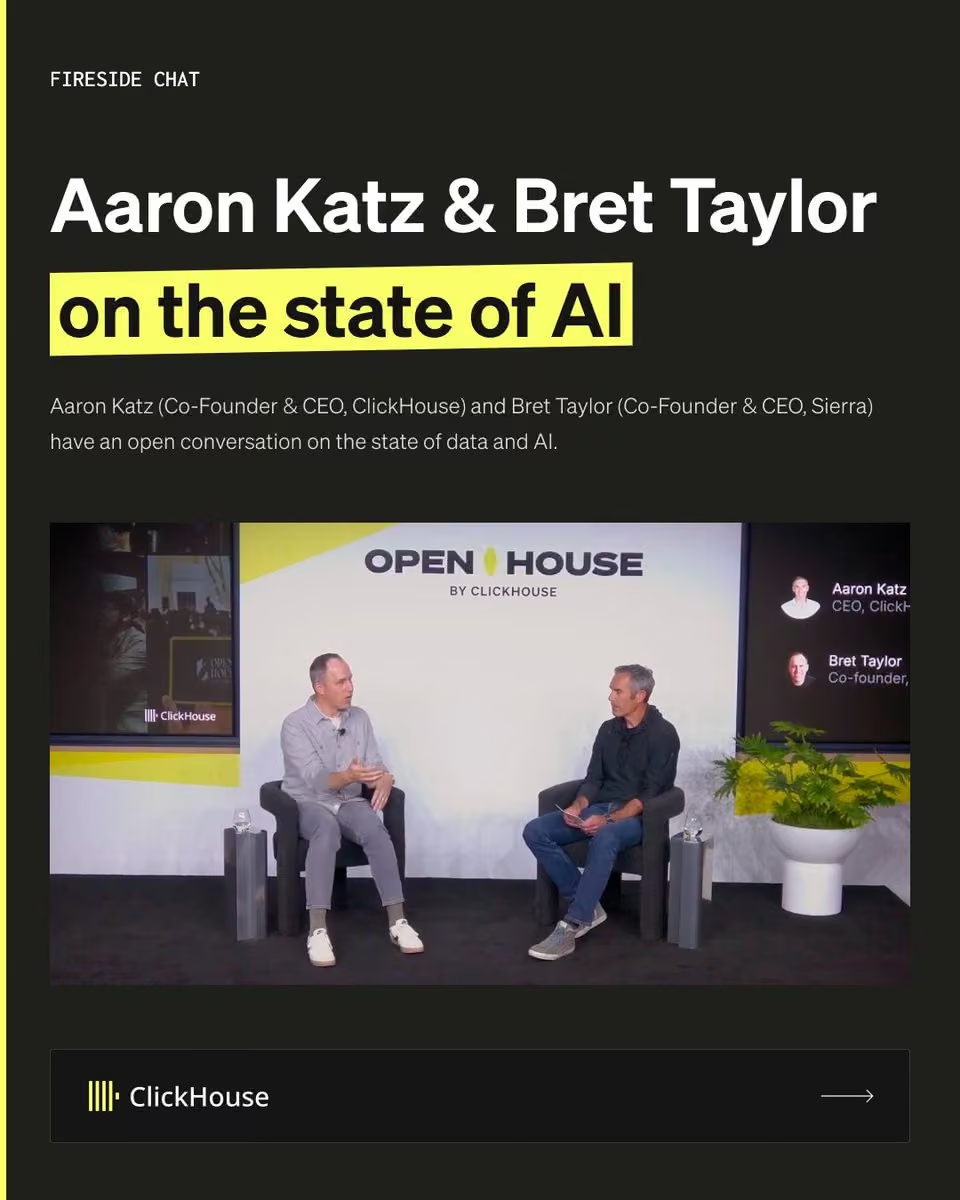
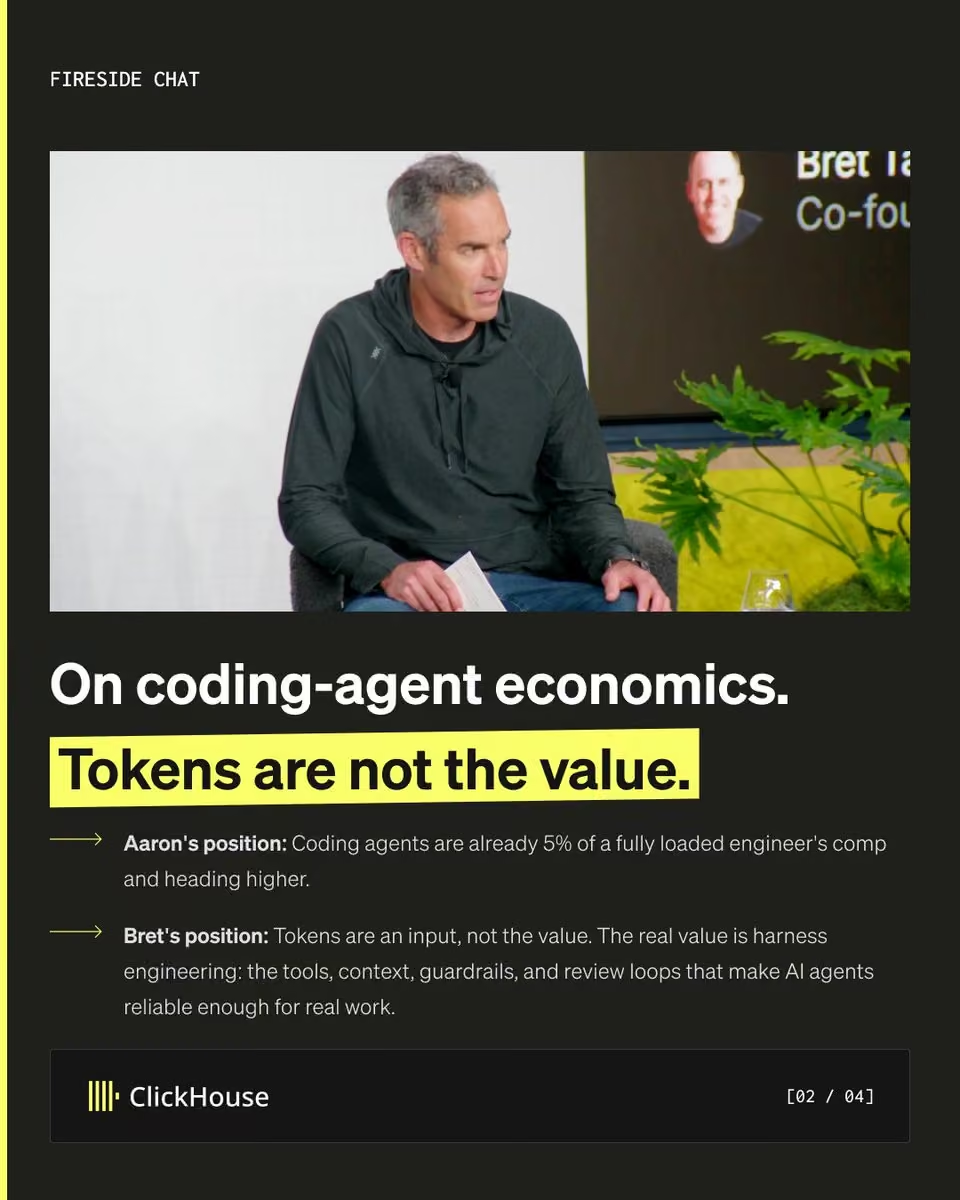
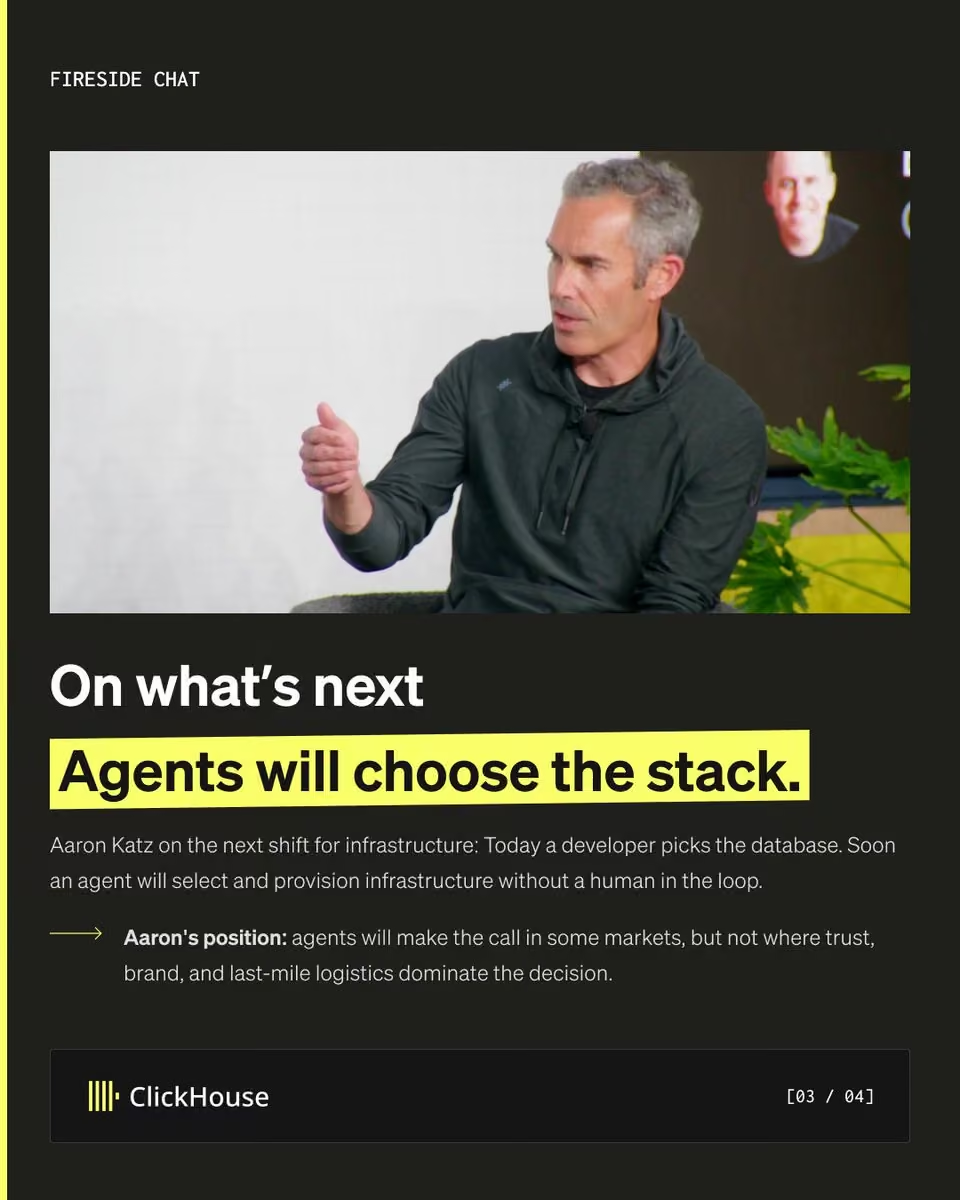


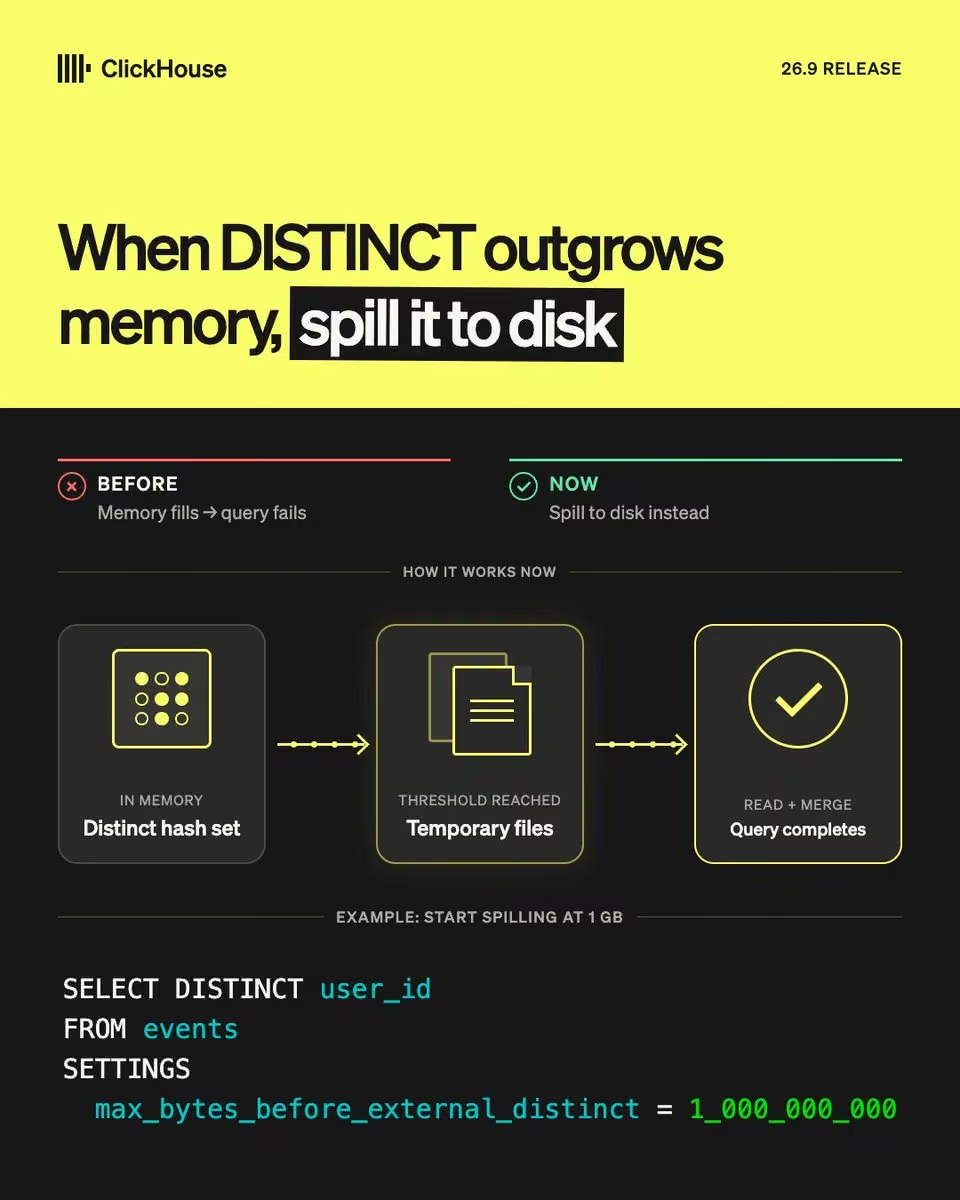

 langfuse.com


 Postgres FM


 ThoughtSpot


 Pete Hampton
 Aaron Katz


 Harry Stebbings


 Founders Circle Capital


 Kaushik Iska


 Brian Armstrong


 Austin Hughes


 POSETTE: An Event for Postgres 🌟 🎥

 Simon


 Redpoint

 🤓 Andy Keil


 Jacopo Tagliabue
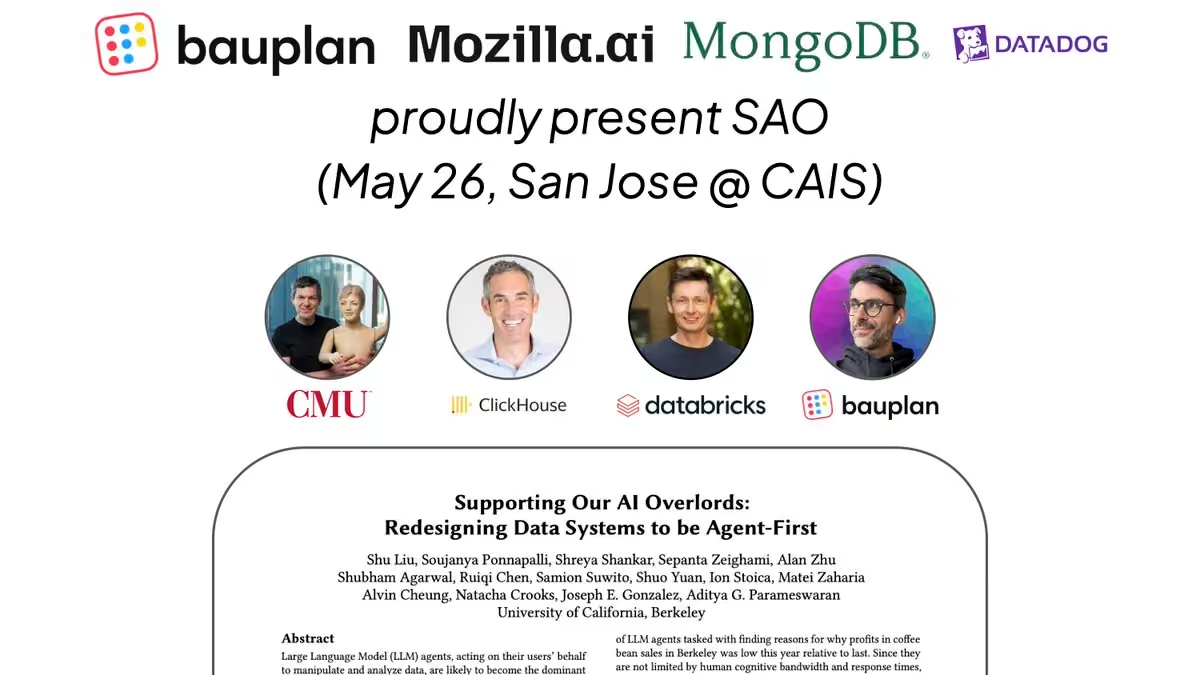


 Marc Klingen


 Jonathan Shriftman
 Clemens Rawert


 Matt – Trigger.dev


 WorkOS


 chDB

 Primo Data


 Bindplane


 Wing VC