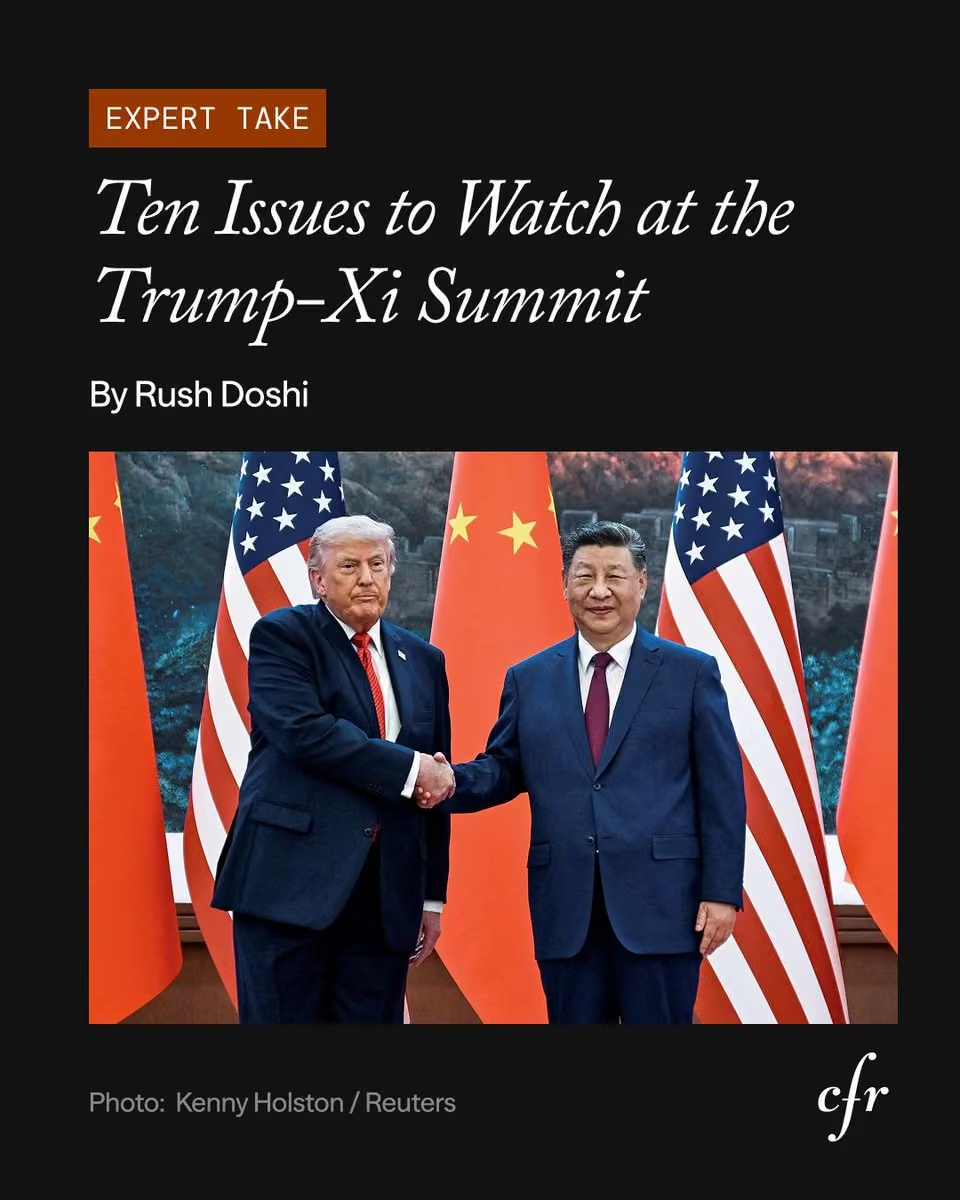
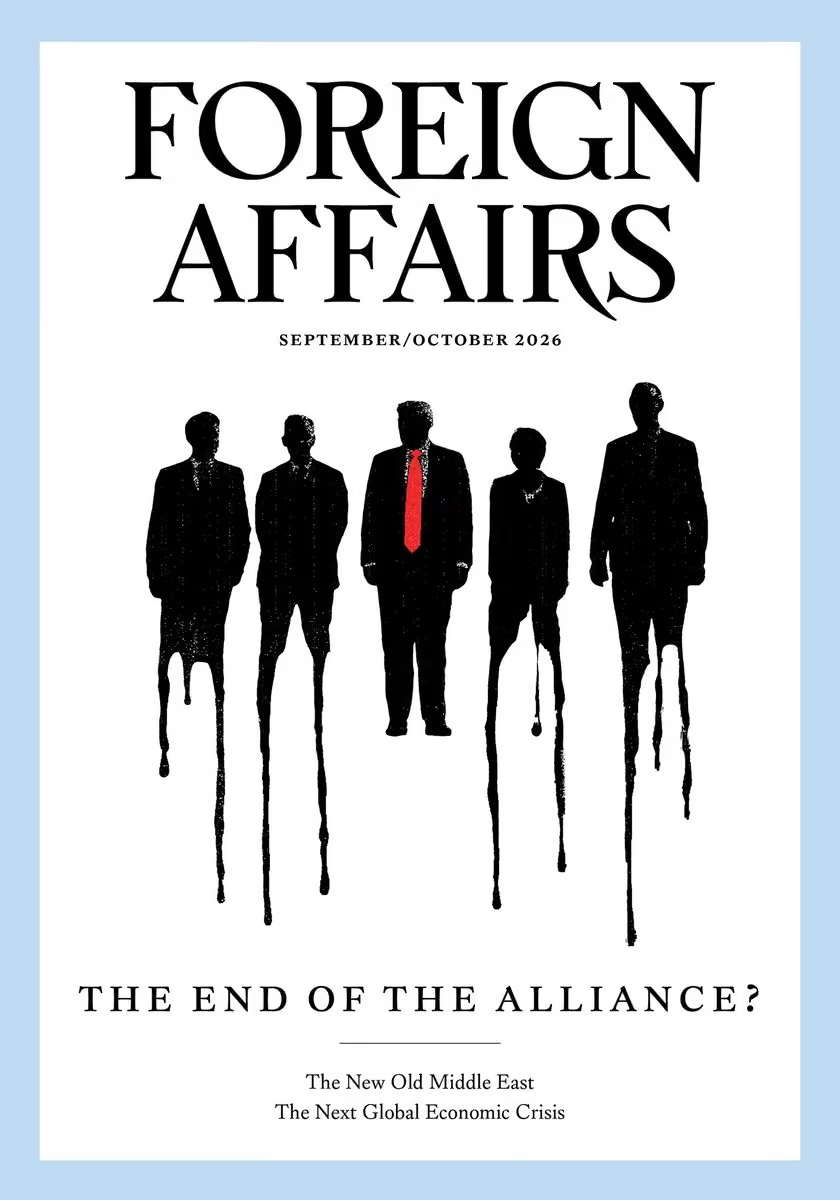
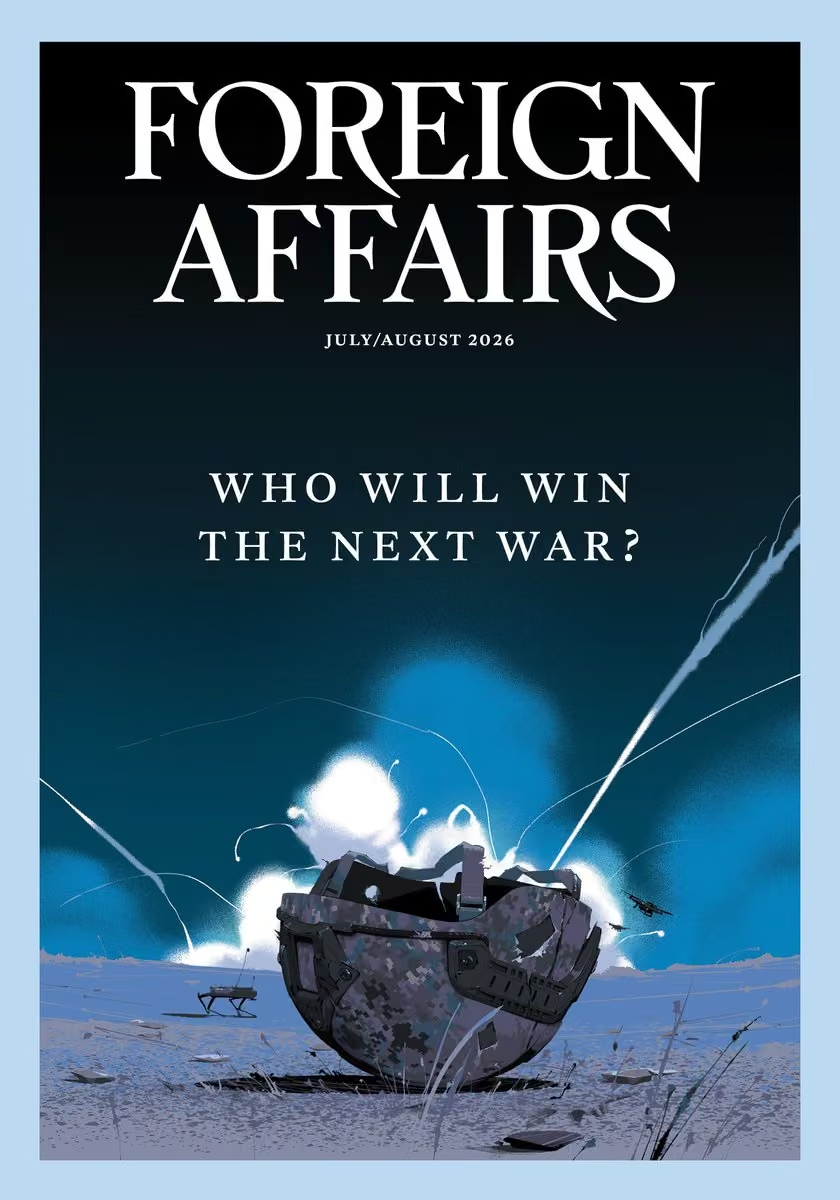
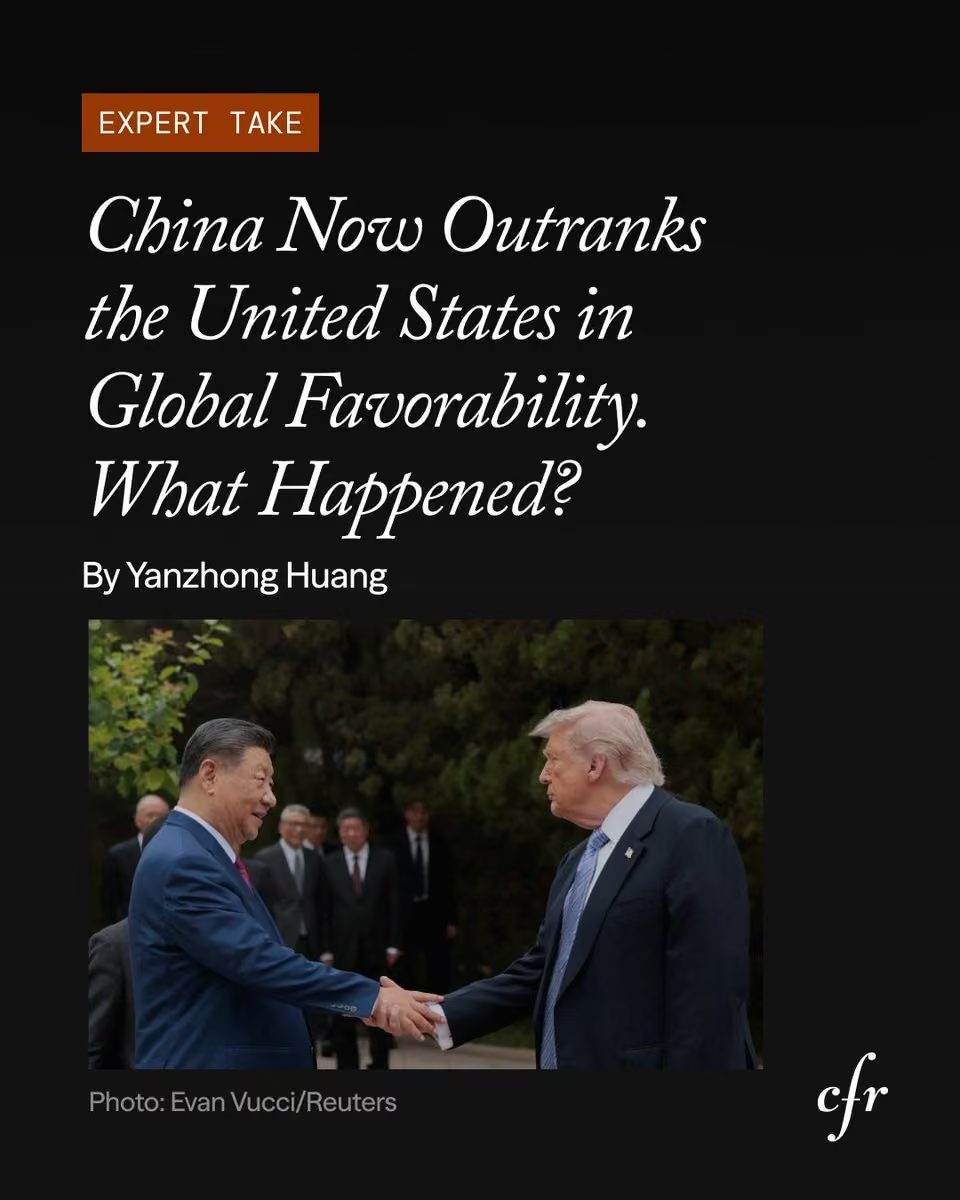
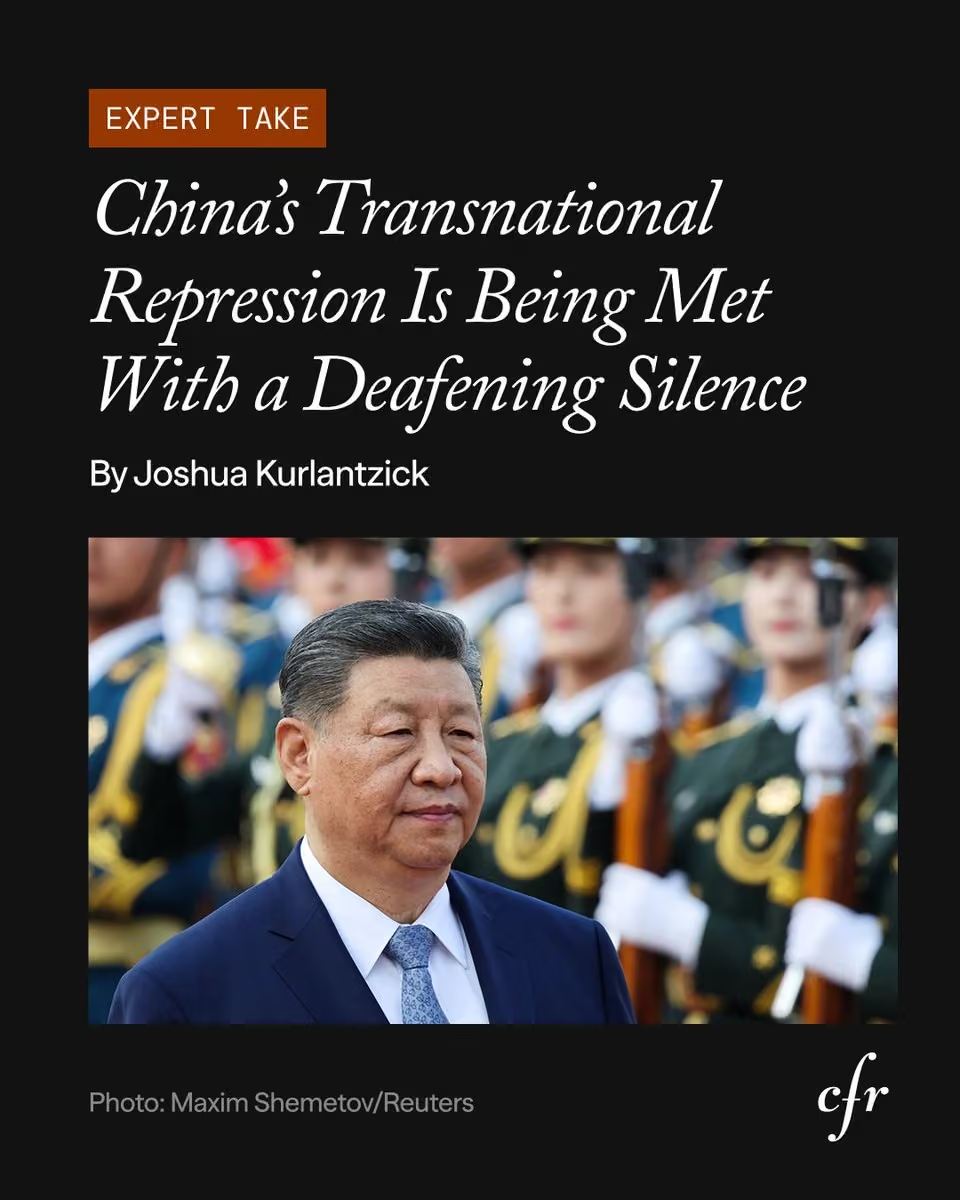
A Trump-Xi-Putin summit is a good idea, launching a needed three-way dialogue. Here’s what they should talk about. @CFR_org @ForeignAffairs @georgetownsfs
www.foreignaffairs.com/united-states/case-trump-xi-putin-…
Council on Foreign Relations
The Council on Foreign Relations (CFR) is an American think tank focused on U.S. foreign policy and international relations. Founded in 1921, it is an independent and nonpartisan 501(c)(3) nonprofit organization. CFR is based in New York City, with an additional office in Washington, D.C. Its membership has included senior politicians, secretaries of state, CIA directors, bankers, lawyers, professors, corporate directors, CEOs, and prominent media figures. More on Wikipedia
-
Council on Foreign Relations reposted
Charles Kupchan
@CharlesKupchan
-
Council on Foreign Relations
@CFR_org
“The stable and open international order erected during America’s watch—Pax Americana—is unraveling, giving way to global disarray,” argues expert @CharlesKupchan.
In his new book, Bringing Order to Anarchy: Governing the World to Come, Kupchan lays out a guide for building a new order fit for the emerging multipolar world. Learn more: www.cfr.org/books/bringing-order-to-anarchy -
Council on Foreign Relations
@CFR_org
“There is an overwhelming sense of frustration and risk inherent in the fact that you can have one CEO, having made one personal choice, that could then potentially destabilize an entire economy, the supply chain, geopolitics, depending on how people react to it,” says CFR expert Kat Duffy, referring to the ouster of Jensen Huang from Nvidia and the fragility it exposed in the AI economy.
This media couldn't be displayed. See it on the original post.
Council on Foreign Relations
@CFR_org
Watch the full conversation: www.cfr.org/event/ai-safety-and-governance
-
Council on Foreign Relations
@CFR_org
“The next Congress has an important role to play in defining this new foreign-policy vision—one that the next president could build upon in 2029,” write Director of CFR's Future of American Strategy Initiative @RebeccaLissner and Mira Rapp-Hooper for Foreign Policy.
“In asserting its powers to conduct oversight, legislate, and conduct its own diplomacy, the Democratic majority should be seeking to put in place elements of a new U.S. approach, rather than simply reverse the Trumpian damage,” they argue.
Read their article: foreignpolicy.com/2026/11/16/democrats-foreign-policy-con… -
Council on Foreign Relations
@CFR_org
Fresh off the midterm elections, President Donald Trump will travel to Asia between November 16 and 19 to attend the U.S.-ASEAN Special Summit and APEC leaders’ summit and meet with Chinese leader Xi Jinping and possibly also Russian President Vladimir Putin.
“[He is not likely] to receive a warm reception, though some Asian leaders are holding out hope that the coming change of majority in Congress could prompt shifts in the White House’s Asia policy, making it slightly more deferential,” writes expert @JoshKurlantzick.
“The White House’s current agenda for the trip is ambitious. For one, Trump will try to get regional states to sign on to Pax Silica, the U.S.-led coalition designed to foster collaboration on export controls and investment monitoring on issues such as chips, AI, critical minerals, and data centers.”
“In China, Trump will want to come away from his meeting with Xi with a few promises, such as actually creating a hotline on AI issues, which the two countries have already agreed to set up, and a further extension of the bilateral trade truce and the truce on rare-earth exports,” Kurlantizck writes.
“In reality, however, the trip is unlikely to produce major gains for the White House, and it could even be rebuffed in its modest goals,” he argues.
Council on Foreign Relations
@CFR_org
Read his analysis: www.cfr.org/articles/trump-heads-to-the-asean-and-apec-su…
-
Council on Foreign Relations
@CFR_org
"The trilateral U.S.-Russia-Ukraine talks in Abu Dhabi this week did not produce a breakthrough in efforts to end the Russia-Ukraine war," writes Thomas Graham.
"But reports from the gathering and from the follow-up meetings of U.S. envoys Steve Witkoff and Jared Kushner with Russian President Vladimir Putin and Ukrainian President Volodymyr Zelenskyy suggest all sides are committed to trying to build on the positive momentum," Graham writes.
"That Russia and Ukraine are intensifying their search for an exit—despite the maximalist public rhetoric from the Kremlin—should surprise no one."
"The political, economic, and demographic costs of a bloody war are mounting rapidly for both sides. But the success of this push will depend to a large degree on Europe—not just as a participant in the current round of diplomacy, but also as a subject of discussions of a future European security order," writes Graham.
"The task before Europe is to decide what it wants to accomplish, see clearly what can be reasonably achieved on what timetable, and determine, finally, who will represent it as diplomacy to end this devastating war continues to accelerate."
Read more: www.cfr.org/articles/europe-must-step-up-to-settle-the-ru… -
Council on Foreign Relations
@CFR_org
Trilateral talks on the war in Ukraine took place between U.S., Russian, and Ukrainian negotiators in Abu Dhabi, the first since February. The talks ended with no major breakthroughs. The two countries did, however, announce they had agreed in principle to a prisoner exchange, with the numbers to be finalized.
The talks could give Europeans a seat at the negotiating table for the first time—but that there are risks in expanding discussions to include broader European security, our experts said.
"Unless the United States changes its quasi-neutral approach and starts to put more significant pressure on Russia to end the conflict, the war is likely to continue for the next two years," expert @m2matthijs writes.
www.cfr.org/articles/what-the-abu-dhabi-talks-did-and-did… -
Council on Foreign Relations
@CFR_org
"The crisis and chaos within the Pentagon will outlive the current leadership unless Congress also takes steps to fix personnel policies, particularly those affecting women," argues expert @RobinsonL100. Although there has been growing pressure on Defense Secretary Hegseth, the vote Tuesday to refer articles of impeachment to committee confirms that impeachment is not, for now, the mechanism that will end his tenure.
"Any successor to Hegseth would have to deal with the fallout from the way the Iran war has been conducted. But munitions shortages are short-term problems compared with the lasting damage to manpower and the culture and climate of the force."
"The dismissal or forced retirement of an unprecedented number of generals and admirals, including a disproportionate number of women and Black officers. . . . directly increases the risk of poor national security decision-making as less experienced officers are promoted," she writes.
"Congress therefore urgently needs to enact policy and legislative changes to repair the damage done to the armed forces—specifically the people who make up the institution—by a leadership that too often has seemed focused on partisanship and culture wars."
Read her analysis: www.cfr.org/articles/how-the-next-congress-can-repair-the… -
Council on Foreign Relations
@CFR_org
"Despite the Democratic landslide in the midterm election, the Trump era is far from over—especially when it comes to foreign policy," writes expert @CharlesKupchan.
"President Donald Trump has generally ignored Congress's sporadic efforts to check his role as diplomat and commander in chief, and he has proved quite adept at routing around the constraints that both the legislative and judicial branches have sought to impose on his presidency."
"Not only is America First statecraft likely to continue during the rest of Trump's tenure, but it may come with even sharper edges."
"Democratic control of Congress is likely to have limited effect on U.S. foreign policy," he writes.
Read more: www.cfr.org/articles/trump-is-a-lame-duck-but-hes-still-i… -
Council on Foreign Relations
@CFR_org
“China’s near-monopoly over the processing of lithium and rare earths creates a chokepoint as dangerous as control of any maritime strait. These chokeholds can only be loosened by diversifying supply,” writes @CarlosEPascual.
Read more: www.cfr.org/articles/the-missing-pillar-of-u-s-strategy-f… -
Council on Foreign Relations
@CFR_org
The November/December 2026 issue of @ForeignAffairs Magazine is now available.
In the latest issue, authors provide analysis on the future of warfare tech, consider how governments can safely harness AI’s potential, assess using U.S. intelligence for economic spying, and more.
Start reading: foreignaffairs.com/issues/2026/105/6 -
Council on Foreign Relations
@CFR_org
“We didn’t go hard enough,” says Jess Hoversen, chief economist at Column, discussing the limitations of past sanctions on Russia, “and that’s why it’s 2026 and we are still embroiled in this conflict.” Hoversen relates that lesson to the prospect of a future U.S. confrontation with China, noting “they are an essential part of the global financial system. And so I think that policymakers are going to have to be very creative and very delicate in terms of making that choice. How do we not crash the global financial system by going hard, which we need to do, but also cutting out certain parts of China’s essential infrastructure that will allow maybe a conflict to end sooner.”
This media couldn't be displayed. See it on the original post.
Council on Foreign Relations
@CFR_org
Watch the full conversation here: www.youtube.com/watch?v=qz1yXZKvee0
-
Council on Foreign Relations
@CFR_org
“The trilateral U.S.-Russia-Ukraine talks in Abu Dhabi this week did not produce a breakthrough in efforts to end the Russia-Ukraine war,” writes Thomas Graham.
“But reports from the gathering and from the follow-up meetings of U.S. envoys Steve Witkoff and Jared Kushner with Russian President Vladimir Putin and Ukrainian President Volodymyr Zelenskyy suggest all sides are committed to trying to build on the positive momentum,” Graham writes.
“That Russia and Ukraine are intensifying their search for an exit—despite the maximalist public rhetoric from the Kremlin—should surprise no one.”
“The political, economic, and demographic costs of a bloody war are mounting rapidly for both sides. But the success of this push will depend to a large degree on Europe—not just as a participant in the current round of diplomacy, but also as a subject of discussions of a future European security order,” writes Graham.
“The task before Europe is to decide what it wants to accomplish, see clearly what can be reasonably achieved on what timetable, and determine, finally, who will represent it as diplomacy to end this devastating war continues to accelerate.”
Council on Foreign Relations
@CFR_org
Read more: www.cfr.org/articles/europe-must-step-up-to-settle-the-ru…
-
Council on Foreign Relations
@CFR_org
The first two decades of the 21st century saw living standards improve across the developing world. Yet today, many less developed countries today have no clear ways to industrialize, argues expert @ZongyuanZoeLiu in a new CFR report.
Between 2000 and 2015, dozens of developing countries grew faster on a per capita basis than advanced economies. That growth was fueled by commodity booms, greater industrial integration into global value chains, and capital inflows, Liu notes.
“The gap between poor and rich countries, long assumed to be self-reinforcing and perhaps persistent, was apparently closing.”
Today, “the developmental ladder that served industrializing nations over the last two decades is becoming harder to climb, and no clear alternative path to convergence has emerged,” she writes.
“The result of that change is unlikely to be a simple, clear division between winners and losers.”
Read the full report: www.cfr.org/reports/the-end-of-convergence -
Council on Foreign Relations
@CFR_org
This week’s trilateral talks in Abu Dhabi between delegations from the United States, Russia, and Ukraine “did not produce a sustainable peace, at least not yet,” writes CFR President @MikeFroman.
“The key now is Putin. The challenge is to change his cost/benefit analysis through a variety of sticks and carrots, and the only party potentially capable of delivering him is President Trump, if he chooses to do so,” Froman writes.
“This conflict was never going to be resolved in 24 hours. We’re coming up on 24 months. It’s time.”
Read his analysis: www.cfr.org/articles/twenty-four-hours-or-twenty-four-mon… -
Council on Foreign Relations reposted
Max Boot 🇺🇦🇺🇸
@MaxBoot
My take on the Abu Dhabi negotiations: These talks are a dangerous farce. If the Trump administration actually wants to end the war, it should do the very thing that it refuses to do—ramp up support for Ukraine and put pressure on Russia. www.cfr.org/articles/what-the-abu-dhabi-talks-did-and-did…
-
Council on Foreign Relations
@CFR_org
“Despite the Democratic landslide in the midterm election, the Trump era is far from over—especially when it comes to foreign policy,” writes expert Charles A. Kupchan.
“President Donald Trump has generally ignored Congress’s sporadic efforts to check his role as diplomat and commander in chief, and he has proved quite adept at routing around the constraints that both the legislative and judicial branches have sought to impose on his presidency.”
“Not only is America First statecraft likely to continue during the rest of Trump’s tenure, but it may come with even sharper edges.”
“Democratic control of Congress is likely to have limited effect on U.S. foreign policy,” he writes.
Council on Foreign Relations
@CFR_org
Read more: www.cfr.org/articles/trump-is-a-lame-duck-but-hes-still-i…
-
Council on Foreign Relations
@CFR_org
New Zealand’s politics appear unstable after national elections failed to produce a clear winner last week, writes expert @JoshKurlantzick. “At a time when the country faces severe economic challenges, policy paralysis is a recipe for disaster.”
“No matter who takes power, they will have a weak government. This is the last thing New Zealand needs now,” he argues.
The country “already faces a brutal combination of economic challenges, all made worse by the Iran war and its effects on global energy markets. The cost of living in New Zealand is high, due to its isolation from the rest of the world, import dependence, and expensive house construction.”
“It could be time for New Zealand to rethink its political system and make major adjustments to it, lest its supposed idyll continue to fade economically, to the point that it resembles far poorer democracies, like Greece, than former peers like Australia,” Kurlantzick writes.
Council on Foreign Relations
@CFR_org
Read more: www.cfr.org/articles/new-zealands-inconclusive-election-i…
-
Council on Foreign Relations
@CFR_org
“There is no way for the free world, effectively, including the United States, to be defining the rules [of AI] unless we are at the cutting edge of the technology,” says Douglas A. Beck, former director of the Pentagon’s Defense Innovation Unit and former vice president at Apple, in conversation with host Rebecca Patterson on The Spillover podcast. They discuss collaboration between the United States and China on AI and the need for AI governance.
This media couldn't be displayed. See it on the original post.
Council on Foreign Relations
@CFR_org
Watch the latest episode of The Spillover here or wherever you get your podcasts: youtu.be/T9D9D7yxDeI
-
Council on Foreign Relations
@CFR_org
“A car part will often cross the border [between the United States and Canada] 7 or 8 times before it finds its place in the finished car—that’s how integrated,” says Chrystia Freeland, former Canadian deputy prime minister and minister of finance. “I personally think it’s a good thing. We have figured out how to build things together, and we’ve been doing it since the first Model T came off the assembly line.”
This media couldn't be displayed. See it on the original post.
Council on Foreign Relations
@CFR_org
Watch the full conversation here: www.youtube.com/watch?v=014ycmC8Ydk
-
Council on Foreign Relations
@CFR_org
“Secretary of Defense Pete Hegseth’s efforts to remake the U.S. military—and the turnover that has followed—have no parallel in U.S. history,” argues expert @JamesMLindsay.
“Beyond sacking a range of four stars, Hegseth has blocked or delayed the promotions of 80 or more senior and flag officers. More than half of the officers affected are women or Black. He has also sought to end all diversity, equity, and inclusion (DEI) programs in the military.”
“The resolution introduced this week to impeach Secretary of Defense Pete Hegseth, which the House narrowly rejected, did not address Hegseth’s efforts to remake the U.S. military,” writes Lindsay. “It is still worth assessing the impact of his personnel decisions.”
Read his analysis for more: www.cfr.org/articles/hegseths-unmaking-of-the-u-s-military
Council on Foreign Relations
@CFR_org
To better understand the impact of Hegseth’s efforts to remake the Pentagon, Lindsay spoke with two retired flag officers, Marine Corps Major General and former NASA administrator Charles Bolden and Rear Admiral Michael E. Smith, on the latest episode of The President’s Inbox podcast. Listen here or wherever you get your podcasts: podcasts.apple.com/us/podcast/a-general-and-an-admiral-di…
-
Council on Foreign Relations
@CFR_org
“Within the region, the United States should focus its attention and resources on the foreign problems most likely to become domestic vulnerabilities,” Juan Sebastian Gonzalez writes.
Washington should harness its proximity, trade, diaspora ties, and decades of security cooperation to help the countries in “Greater North America”—including Canada, Mexico, Central America, and the Caribbean—become stronger economic and security partners, he argues.
Read more: www.cfr.org/articles/greater-north-america-rethinking-the… -
Council on Foreign Relations reposted
Dr. Liana Fix
@LianaFix
Wonderful to celebrate the U.S. launch of my book at @CFR_org with a discussion with David Sanger, NYT, and many friends and colleagues. Rewatch it here: www.youtube.com/live/EFE6UeWg9og
-
Council on Foreign Relations
@CFR_org
Trilateral talks on the war in Ukraine took place between U.S., Russian, and Ukrainian negotiators in Abu Dhabi, the first since February. The talks ended with no major breakthroughs. The two countries did, however, announce they had agreed in principle to a prisoner exchange, with the numbers to be finalized.
The talks could give Europeans a seat at the negotiating table for the first time—but that there are risks in expanding discussions to include broader European security, our experts said.
“Unless the United States changes its quasi-neutral approach and starts to put more significant pressure on Russia to end the conflict, the war is likely to continue for the next two years,” expert @m2matthijs writes.
Read more: www.cfr.org/articles/what-the-abu-dhabi-talks-did-and-did… -
Council on Foreign Relations
@CFR_org
“It’s not a coincidence that 74% of the world today is now under authoritarian rule. We are literally electing illiberal leaders democratically because we have lost attention, intimacy, and agency,” argues @mariaressa, Nobel laureate and cofounder and CEO of Rappler, speaking at CFR’s 31st annual Term Member Conference.
Drawing on her firsthand experience surviving attacks from the Duterte government in the Philippines, she poses a question to Americans: “The Georgians are out on the streets. The Ukrainians are fighting for their rights. The Iranians are fighting for their rights. The Filipinos have sent a dictator to The Hague. What are you guys willing to sacrifice for the truth?”
Watch the full conversation: www.cfr.org/event/thirty-first-term-member-conferenceThis media couldn't be displayed. See it on the original post. -
Council on Foreign Relations
@CFR_org
A trillion-dollar gap in foreign exchange purchases raises questions about where China’s foreign currency assets are held, argues expert @Brad_Setser.
The People’s Bank of China “argues—unpersuasively, I think—that it doesn’t have any hidden foreign exchange reserves,” he writes.
Read the full analysis: www.cfr.org/articles/three-questions-about-chinas-hidden-… -
Council on Foreign Relations
@CFR_org
U.S. chipmaking firm Nvidia, one of the most valuable companies in the world, announced the resignation of CEO Jensen Huang days after its board said that it would launch an investigation into allegations that a Chinese espionage operation had targeted him.
His ouster raises questions about critical policy issues, from the enforcement of AI chip exports to the stability of the AI boom.
Expert @RushDoshi said that the spying allegations—which he called “possibly one of the most important China stories in many years”—add a new dimension to the U.S.-China relationship ahead of President Trump’s meeting with Chinese leader Xi Jinping at the APEC summit next week.
Here’s what to know: www.cfr.org/articles/nvidia-chinese-espionage-and-the-ai-… -
Council on Foreign Relations
@CFR_org
“One of the things I would love to see the allies do is work together—not just so we’re not dependent on China, but so that China is not the global monopolist in the production of some of these very critical elements in supply chains of critical manufacturers, which it currently is,” says Chrystia Freeland, former Canadian deputy prime minister and minister of finance. “That’s not purely a Canadian vulnerability. It’s an everybody vulnerability.”
Watch the full conversation: www.youtube.com/watch?v=014ycmC8YdkThis media couldn't be displayed. See it on the original post. -
Council on Foreign Relations
@CFR_org
Geospatial AI uses artificial intelligence to analyze data about the planet, helping experts protect the natural world from threats like wildfires and desertification. Newton Campbell Jr., an adjunct professor at Georgetown University and a 2026 TIME100 AI honoree, explains the importance of the technology, its most critical applications, and the risk of an event that could compromise access to GPS.
Watch the full conversation, which is part of our Science Fair series on scientific and technological advances with consequences for foreign policy: cfr.org/event/science-fair-series-when-the-sun-strikesThis media couldn't be displayed. See it on the original post. -
Council on Foreign Relations reposted
Brad Setser
@Brad_Setser
The PBOC's official position, apparently, is that it doesn't have any hidden reserves and that the SCBs don't help with exchange rate management.
To convince, the PBOC needs to answer three precise questions. A new blog
1/
www.cfr.org/articles/three-questions-about-chinas-hidden-… -
Council on Foreign Relations
@CFR_org
The G20's agenda in December is expected to cover topics from economic growth to technological innovation. A gathering of religious and civic leaders in Salt Lake City, Utah, ahead of the summit put an emphasis on working together to reduce human suffering and advance peace initiatives, writes expert Sam Vigersky.
Read more about the G20 Interfaith Forum in Salt Lake City: www.cfr.org/articles/why-the-g20-should-listen-to-faith-l… -
Council on Foreign Relations
@CFR_org
“Access to critical minerals, rare earth elements, and their midstream and downstream products is becoming instrumental in determining the outcome of geopolitical competition and the shape of the future world order,” writes expert Heidi E. Crebo-Rediker. “In this competition, China controls critical chokepoints.”
“The United States has reached a dangerous inflection point . . . . Diversification away from China is, and will remain, a top national and economic security priority over the next decade, not just a commercial objective. The Western Hemisphere is key to that diversification strategy.”
Read more: www.cfr.org/articles/mines-to-markets-a-critical-minerals… -
Council on Foreign Relations reposted
James M. Lindsay
@JamesMLindsay
#onthisday in 1919, Woodrow Wilson proclaimed the first Armistice Day, a holiday meant to express gratitude for the US victory in World War I. It is now Veterans Day, a day to honor all who have served in the US military. Thank you for your service. www.cfr.org/articles/thanking-americas-veterans-7
-
Council on Foreign Relations
@CFR_org
“The crisis and chaos within the Pentagon will outlive the current leadership unless Congress also takes steps to fix personnel policies, particularly those affecting women,” argues expert @RobinsonL100. Although there has been growing pressure on Defense Secretary Hegseth, the vote Tuesday to refer articles of impeachment to committee confirms that impeachment is not, for now, the mechanism that will end his tenure.
“Any successor to Hegseth would have to deal with the fallout from the way the Iran war has been conducted. But munitions shortages are short-term problems compared with the lasting damage to manpower and the culture and climate of the force.”
“The dismissal or forced retirement of an unprecedented number of generals and admirals, including a disproportionate number of women and Black officers. . . . directly increases the risk of poor national security decision-making as less experienced officers are promoted,” she writes.
“Congress therefore urgently needs to enact policy and legislative changes to repair the damage done to the armed forces—specifically the people who make up the institution—by a leadership that too often has seemed focused on partisanship and culture wars.”
Read her analysis: www.cfr.org/articles/how-the-next-congress-can-repair-the… -
Council on Foreign Relations
@CFR_org
“Americans owe it to themselves to take heed of Morgenthau’s sober vision of international politics. There is no better teacher of realism than Hans Morgenthau, the man who literally wrote the book on great-power competition,” writes CFR expert @DavidMSacks1 in his new book, The Realist: Hans Morgenthau and the Purpose of American Power. “To understand Morgenthau, his ideas, and his life is to understand how we got here and where we are going.”
Learn more: www.cfr.org/books/the-realist -
Council on Foreign Relations
@CFR_org
“Canada is condemned by geography. Something like 70% of Canadians live within 100 miles of the U.S. border. Virtually all their trade is with the U.S.,” CFR President @MikeFroman tells @nayeema, host of the Smart Girl Dumb Questions podcast. “Ultimately, Canada is going to be very much tied to the United States, and we’re going to be tied to Canada.”
Watch the full conversation: www.cfr.org/event/thirty-first-term-member-conferenceThis media couldn't be displayed. See it on the original post. -
Council on Foreign Relations
@CFR_org
“The Western Hemisphere is fundamental to U.S. prosperity. But over the last 25 years, the United States has left a vacuum in the hemisphere, and China has moved to fill it,” argues @danrunde, author of The American Imperative.
“The United States, if it is to be strong, prosperous, and secure in the coming decades, will require full access to the Western Hemisphere’s energy, food, minerals, and technology.”
“If those assets and resources can be secured, the benefits will be immense. American jobs can be created, migration pressures reduced, technological progress ensured, and security enhanced,” Runde writes.
Read more: www.cfr.org/articles/an-economic-shield-of-the-americas-h… -
Council on Foreign Relations
@CFR_org
Nvidia, one of the most valuable companies in the world, recently announced that it had launched an investigation into allegations that a Chinese espionage operation had targeted Jensen Huang, the company’s chief executive.
Valued at more than $4 trillion, Nvidia makes the chips that underpin the large language models and data centers that have become pillars of U.S. economic growth.
Huang cofounded Nvidia in 1993, is its largest individual shareholder, and has become one of the most recognizable figures in the AI boom.
The episode raises significant foreign policy questions on everything from the enforcement gaps in chip export controls to the U.S.-China relationship.
CFR broke down what that means. Read more: www.cfr.org/articles/nvidia-chinese-espionage-and-the-ai-… -
Council on Foreign Relations
@CFR_org
The threat of Russian aggression and the risk of U.S. abandonment have triggered a German rearmament of historic proportions, writes expert @LianaFix in her new book, Germany Rearmed: The Return of War and the End of Illusions.
“The transformation of Germany from ‘civilian power’ to a key military power in Europe is one of the defining stories of the still young 21st century," she argues.
Germany’s rearmament takes place at a time of upheaval for Europe and the transatlantic alliance, Fix writes. With the far right on the rise, she addresses the likelihood of Germany assuming a greater military role without reviving old fears among its neighbors.
Challenging Germany’s “myth of pacifism,” Fix argues that, as the post-war order fades, Germany can—and must—become a military power capable of protecting Europe when the United States will not.
“How Germany navigates this moment will shape not only its own future but the future of the continent.”
Learn more: www.cfr.org/books/germany-rearmed -
Council on Foreign Relations
@CFR_org
“I have talked to a few CEOs that I advise, where after talking to them, two months into them engaging AI, they’re like, ‘Oh, I fired my staff, fired my developers. Why? Because I can vibe code this,’” says Dr. Newton Campbell, adjunct professor at Georgetown University and principal consultant at Everything Lives LLC. Campbell outlines the risks of relying on AI to cover sensitive areas like IT security and privacy, and argues that it can never be used as “a true replacement for human beings.”
Watch the full conversation, which is part of our Science Fair series on scientific and technological advances with consequences for foreign policy: www.cfr.org/event/science-fair-series-when-the-sun-strikesThis media couldn't be displayed. See it on the original post. -
Council on Foreign Relations
@CFR_org
“Journalism is the bedrock of any democracy. CFR supporting journalists fosters the continued practice that is so important for our societies,” says Leila Fadel, host of NPR’s Morning Edition and 2016–17 Edward R. Murrow press fellow. Launched in 1949, CFR's Press Fellowship promotes the quality of responsible and discerning journalism exemplified by the work of Edward R. Murrow.
Each year, one distinguished foreign correspondent or editor is awarded dedicated time and resources to pursue an independent project, from long-form writing to in-depth research. Based in CFR’s New York or Washington office, the fellow joins the David Rockefeller Studies Program, CFR’s think tank, and contributes to its research, writing, and events, including as a moderator. The fellowship runs 10 months, beginning in September. Applicants must be U.S. citizens with distinguished credentials in journalism and experience covering international news.
Apply by November 30, 2026: www.cfr.org/fellowships/edward-r-murrow-press-fellowshipThis media couldn't be displayed. See it on the original post. -
Council on Foreign Relations
@CFR_org
“When I grew up, I’d look out my window—I didn’t see the United States, I saw Canada,” says U.S. Representative Debbie Dingell (D-MI). CFR visited the Michigan-Ontario corridor to convene senior-level public and private officials for discussions on U.S.-Canada trade relations. We asked Rep. Dingell what every American should know about the relationship. Her answer: “Canada and the United States of America are totally intertwined.”
This media couldn't be displayed. See it on the original post. -
Council on Foreign Relations reposted
Henry Holt & Company
@HenryHolt
🌍 Happy pub day to #therealist by @DavidMSacks1: the first biography of Hans Morgenthau, the political philosopher who pioneered realism―the approach to foreign policy that guided the U.S. through the Cold War and explains today’s world.
Read Now: vist.ly/5s8m9 -
Council on Foreign Relations
@CFR_org
“95% of the work is keeping the AI from doing the things you don’t want it to do,” says Barbara Thompson, an astrophysicist at Beryllium10 Knowledge and one of the founders of NASA’s Center for HelioAnalytics. “All of the skill involved in painting is keeping the paint where you don’t want it to be,” she continues. “That is exactly the same as AI—except AI is paint that never dries and you can’t see it.”
Watch the full conversation, which is part of our Science Fair series on scientific and technological advances with consequences for foreign policy: www.cfr.org/event/science-fair-series-when-the-sun-strikesThis media couldn't be displayed. See it on the original post. -
Council on Foreign Relations reposted
Steven A. Cook
@stevenacook
The Vexing Arithmetic of Israeli Coalition-Building - Eisenkot has four paths to power, and none of them are easy. foreignpolicy.com/2026/11/09/israel-eisenkot-netanyahu-el…
-
Council on Foreign Relations
@CFR_org
“How do you assess U.S. soft power right now?” asks @nayeema, host of the Smart Girl Dumb Questions podcast. “Pew recently found that China is viewed more favorably than the U.S. in most of 36 countries surveyed—it’s the first time in nearly two decades. Do you think that one day we’ll be watching, like, ‘The Fresh Prince of Peking’?”
“The U.S. has tremendous residual strengths when it comes to soft power—our university system, our entertainment, our media, our values, our culture are still very much valued around the rest of the world. I hope we take steps to make sure that we are using them in the best way possible,” responds CFR President @MikeFroman. “We want to prevail in this competition with China. Soft power is one of our greatest strengths in that regard. So let’s make sure we’re not diminishing it on one hand, at the same time that we’re trying to compete on the other,” he adds.
Watch the full conversation: www.cfr.org/event/thirty-first-term-member-conferenceThis media couldn't be displayed. See it on the original post. -
Council on Foreign Relations
@CFR_org
“The 2030s will likely determine whether Venezuela regains stability, democracy, and prosperity or remains authoritarian and dysfunctional,” write experts Will Freeman and Paul J. Angelo. “U.S. credibility in Latin America relies on the United States using its newfound leverage to drive democratization and economic recovery.”
“An open and secure Venezuela would increase stability in the region and help protect the U.S. homeland and critical supply chains,” they write.
Read more: www.cfr.org/articles/a-path-to-partnership-with-venezuela… -
Council on Foreign Relations
@CFR_org
Hans Morgenthau escaped Nazi Germany and became one of the most influential political philosophers of the twentieth century. He pioneered realism, an approach to international relations that guided the United States throughout the Cold War.
However, Morgenthau did not champion every U.S. exercise of power and criticized U.S. policy during the Vietnam War. In his new book The Realist, CFR expert @DavidMSacks1 details Morgenthau's life and work and explores how his ideas can guide policymakers as they tackle today's major challenges.
Learn more: www.cfr.org/books/the-realistThis media couldn't be displayed. See it on the original post. -
Council on Foreign Relations reposted
CFR China Strategy Initiative
@CFR_China
WATCH: @ChrisRMcGuire joins CNBC to discuss the implications of the alleged Nvidia spying scandal, Megaspeed, and export controls 👉 cnb.cx/4BTQYL9
-
Council on Foreign Relations
@CFR_org
“Taiwan is a critical supplier for the U.S. tech industry, and the United States recognizes that it cannot be a leader in AI without Taiwan,” write CFR’s @RebeccaLissner and Mira Rapp-Hooper for Foreign Affairs.
“Whatever the nature of Washington’s rhetoric right now, the United States would have to respond to any action by Beijing that threatened [U.S.] interests, and both countries would then face a great-power crisis.”
Read their article in Foreign Affairs: www.foreignaffairs.com/taiwan/recipe-disaster-taiwan-liss… -
Council on Foreign Relations
@CFR_org
The November/December 2026 issue of Foreign Affairs Magazine is now available.
In the latest issue authors provide analysis on the future of warfare tech, consider how governments can safely harness AI’s potential, assess using U.S. intelligence for economic spying, and more.
Start reading: foreignaffairs.com/issues/2026/105/6 -
Council on Foreign Relations
@CFR_org
Raised across four continents, Manjari Chatterjee Miller’s interest in international relations began with her global upbringing.
Her exposure to different countries and cultures eventually led to a career studying foreign policy and the shifting dynamics of global power—with a particular focus on China and India. Today, she's a senior fellow at CFR.
She spoke to us about her career, her experiences living abroad, and how a dinner conversation at Harvard changed the course of her career.
“My advice is to travel. Really travel,” Miller said. “And don’t think of career paths as linear. You never know what is going to push you into foreign policy, but expanding your horizon is one way to get there.”
Council on Foreign Relations
@CFR_org
Read the full interview: www.cfr.org/articles/how-i-got-my-career-in-foreign-polic…
-
Council on Foreign Relations
@CFR_org
This year's UN climate summit, COP31, kicks off in Turkey with the world on track to miss climate targets—and governments grappling with the consequences of climate change.
Three think tank experts in the United States, Canada, and South Africa analyze the status of global climate action and what we can expect from international cooperation going forward: www.cfr.org/articles/cop31-and-climate-actions-new-center… -
Council on Foreign Relations reposted
Dr. Liana Fix
@LianaFix
Here’s my @nytimes essay on „What if Europe rearms at exactly the wrong time?“, based on my new book www.germanyrearmed.com - I argue that it is not possible to populist-proof Europe‘s rearmament, but Europeans can take steps to entangle defense @CFR_org www.nytimes.com/2026/11/09/opinion/europe-defense-far-rig…
-
Council on Foreign Relations
@CFR_org
“One of the challenges of globalization is that the benefits were broadly distributed, but largely invisible,” while “the costs of globalization were very localized, very acute, and very visible. The factory in your town closed and moved to Mexico or moved to China,” CFR President @MikeFroman tells @nayeema, host of the Smart Girl Dumb Questions podcast.
“Nobody walked out of a Walmart and said, ‘Thank goodness for the World Trade Organization.’ But it was the World Trade Organization and globalization generally that allowed them to go home and spend less and less of their income on their shoes, their clothing, their food, etc.”
Watch the full conversation: www.cfr.org/event/thirty-first-term-member-conferenceThis media couldn't be displayed. See it on the original post. -
Council on Foreign Relations
@CFR_org
With historic shifts unfolding around the world and closer to home, the United States’ approach to its own region is “ripe for re-imagining,” writes expert @RebeccaLissner, CFR’s Future of American Strategy Initiative.
Six leading experts were asked one question: what comes next for U.S. strategy in the Western Hemisphere?
“There is a growing bipartisan view that the United States can no longer treat its region as an afterthought or a problem to be managed. Instead, a coherent hemispheric approach can deliver for Americans and help answer a range of persistent policy challenges,” Lissner writes.
Read more: www.cfr.org/articles/what-is-the-future-of-american-strat… -
Council on Foreign Relations
@CFR_org
“The stable and open international order erected during America's watch—Pax Americana—is unraveling, giving way to global disarray,” argues expert @CharlesKupchan.
In his new book, Bringing Order to Anarchy: Governing the World to Come, Kupchan lays out a guide for building a new order fit for the emerging multipolar world. Learn more: www.cfr.org/books/bringing-order-to-anarchy -
Council on Foreign Relations
@CFR_org
This year's UN climate summit, COP31, kicks off in Turkey on November 9 with the world on track to miss climate targets—and governments grappling with the consequences of climate change.
Three think tank experts in the United States, Canada, and South Africa analyze the status of global climate action and what we can expect from international cooperation going forward: www.cfr.org/articles/cop31-and-climate-actions-new-center… -
Council on Foreign Relations
@CFR_org
"Despite being the world’s two largest democracies, the United States and India have often been at odds over issues of strategic autonomy and Western-dominated rules and institutions. The end of the Cold War presented the two with a window for rapprochement, and while the bilateral partnership progressed, India largely remained a reluctant participant in the U.S.-led global order," writes expert Manjari Chatterjee Miller in a CFR report.
Under President Trump, the United States has "turned on the norms that it had (at least nominally) championed, such as free trade and multilateralism." This transition period poses a host of challenges—and a few opportunities for collaboration—between the two countries, Miller argues.
Read her analysis: www.cfr.org/reports/india-after-the-liberal-order -
Council on Foreign Relations
@CFR_org
“Eighty-eight percent of voters were concerned about corruption—but I don’t think you can walk in day one and cry impeachment. You actually have to deliver results,” says Sabrina Singh, former deputy Pentagon press secretary under President Joe Biden. Singh examines whether newly elected Democrats can deliver on their anticorruption promises following midterm victories.
Watch the full conversation: www.youtube.com/watch?v=v0Ih7RRoPocThis media couldn't be displayed. See it on the original post. -
Council on Foreign Relations
@CFR_org
The day after the U.S. midterms, equities rallied on relief that the election results were clear-cut. But as investors digested the implications of the election results, equity markets turned sharply lower.
“In particular, the outlook for companies tied to artificial intelligence was thrown into doubt, given a wave of local ballot measures across ten states—nearly all of which backed data center restrictions—and the success of Democratic candidates who campaigned against data center expansion,” writes expert Rebecca Patterson.
“This U.S. equity volatility has quickly spread to other asset classes and markets around the world,” she writes. “Perhaps unsurprisingly, these gyrations are fueling worries that the so-called AI bubble could soon pop.”
The volatility “is a stark reminder that politicians and policymakers should watch financial markets and economic trends, and that investors should watch politics and policy. They are all interconnected,” Patterson writes.
Read the full analysis: www.cfr.org/articles/the-midterms-rattled-ai-stocks-heres… -
Council on Foreign Relations
@CFR_org
“This week’s results demonstrate what happens when foreign policy meets the kitchen table,” writes CFR’s president @MikeFroman on the midterm elections. “Affordability was front and center in voters’ minds, and they linked that to the Iran war and tariffs.”
Read his analysis of the results of the midterm elections and why it matters for foreign policy: www.cfr.org/articles/in-these-midterms-foreign-policy-mat… -
Council on Foreign Relations reposted
Think Global Health
@ThinkGlobalHlth
The U.S. midterm election brought a massive shift in Congress's composition. @CFR_org's @spsaki, @YanzhongHuang, @ProfYadav, and @TomBollyky give their reflections on what this could mean for domestic and global health policy as well as research. www.thinkglobalhealth.org/article/expert-takes-on-the-fut…
-
Council on Foreign Relations
@CFR_org
"Voters in 29 jurisdictions . . . passed bans or at least restrictions on data center construction," notes Rebecca Patterson, host of The Spillover, pointing to signs of backlash against AI and data centers that emerged in the midterm elections. Patterson and Diane Swonk, chief economist at KPMG, discuss the dynamics of the backlash and how it could affect U.S. economic growth moving forward.
This media couldn't be displayed. See it on the original post.
Council on Foreign Relations
@CFR_org
Watch or listen to the latest episode of The Spillover here or wherever you get your podcasts: youtu.be/AtLcdBfnGN0
-
Council on Foreign Relations reposted
Yanzhong Huang
@YanzhongHuang
What do the U.S. midterm results mean for global health? CFR experts weigh in: Democratic control of Congress means more oversight of funding and the America First Global Health Strategy, possible partial USAID restoration, continued bipartisan focus on competing with China in biopharma/supply chains, and groundwork for future engagement—without immediate reversals. Read the analysis:
www.thinkglobalhealth.org/article/expert-takes-on-the-fut… -
Council on Foreign Relations
@CFR_org
Following the Democratic Party’s sweep of the U.S. House of Representatives and Senate, Asian leaders have said little publicly—but in private "many are relieved," writes expert @JoshKurlantzick.
Asian partners and allies hope that President Trump’s decision-making on the Iran war “will become more predictable,” he writes. “Some think he could even move more quickly toward winding down the war, which has roiled Asian energy markets—Asia relies more on oil and liquefied natural gas from the Persian Gulf than any other part of the world."
But Trump "is nothing if not unpredictable,” he adds. “Asian leaders will find out fairly quickly—on many levels—whether their hopes for improved relations with the United States are reality or fantasy.”
President Trump is scheduled to arrive in Manila on November 16 for the summit of the Association of Southeast Asian Nations and related meetings. “By then, he could well have . . . renewed attacks on Iran,” Kurlantzick writes.
“Such a move would be profoundly dangerous militarily for the United States, which is already low on many munitions. But diplomatically, it would also all but seal the United States’ long-term unpopularity in Asia.”
Read the full analysis: www.cfr.org/articles/they-wont-say-it-out-loud-but-asian-… -
Council on Foreign Relations
@CFR_org
Representatives from around the world will gather in Antalya, Turkey, for this year's UN climate summit.
COP31, which is taking place from November 9 to 20, "is notable for two reasons," write expert Alice C. Hill and Angus Soderberg.
"First, it coincides with the tenth anniversary of the Paris Agreement entering into force; and second, the United States—the world’s second-largest and historically biggest emitter, which formally withdrew from the agreement at the start of this year—will not send an official delegation."
The summit faces mounting pressure to accelerate climate action and deliver on implementation, as projections indicate that the world will overshoot the 1.5°C (2.7°F) global warming threshold.
“COP31 isn’t expected to be characterized by one big outcome or breakthrough. But that nations continue to convene in this formal channel shows that climate action and the hope for a better future that it portends is not going away.”
Read more: www.cfr.org/articles/cop31-in-turkey-what-to-expect-at-th… -
Council on Foreign Relations
@CFR_org
Our Global Conflict Tracker traces ongoing armed conflicts around the world. It includes background information, the latest news developments, conflict status assessments, and resources for further research—all updated regularly.
Use the interactive tool to learn more: -
Council on Foreign Relations
@CFR_org
“We’ve had thirteen months in a row where average hourly earnings have fallen short of the overall inflation number. There’s only three times in history we’ve seen that,” says Diane Swonk, chief economist at KPMG, in conversation with Rebecca Patterson on The Spillover podcast. Swonk goes on to compare inflation to cancer, noting that “the later you catch it, the more it metastasizes.”
This media couldn't be displayed. See it on the original post.
Council on Foreign Relations
@CFR_org
Watch the latest episode of The Spillover here or wherever you get your podcasts: youtu.be/AtLcdBfnGN0
-
Council on Foreign Relations reposted
Sadanand Dhume
@dhume
Since the 1950s, India has tried unsuccessfully to establish a semiconductor industry. Will the current effort have better luck? [My take] v @WSJopinion
www.wsj.com/opinion/indias-big-semiconductor-bet-e0e60891 -
Council on Foreign Relations reposted
David Sacks
@DavidMSacks1
While the Trump administration has attempted to seize the realist mantle, claiming that its foreign policy is one of “flexible realism,” it has misread core elements of the theory. I explain in @ForeignAffairs with a close reading of Hans Morgenthau’s writings.
-
Council on Foreign Relations
@CFR_org
“It’s conventional wisdom that you can’t win an election on foreign policy, but you certainly can lose one,” says CFR President @MikeFroman, noting that “in this election, Americans were clearly very focused on affordability. And they linked affordability to the Iran war and to the use of tariffs.” Froman explains what the resulting shake-up in Congress could mean for U.S. foreign policy going forward.
This media couldn't be displayed. See it on the original post. -
Council on Foreign Relations
@CFR_org
“The optimism of the early post–Cold War years seems like a distant memory. . . . Instead, great power competition has returned with a vengeance,” writes expert @JamesMLindsay.
“The world today displays troubling similarities to the years before World War I,” he writes. In 1914, “a war that seemed far-fetched as the year began became a horrifying reality just eight months later. Nothing has changed in the human psyche and governmental decision-making since then to prevent leaders from making similar mistakes today.”
Read his analysis: www.cfr.org/articles/the-rising-threat-of-great-power-war…
Council on Foreign Relations
@CFR_org
To understand what history tells us about the dangers of great power competition, Lindsay sat down with Odd Arne Westad, a professor of history and global affairs at Yale University, on the latest episode of The President’s Inbox podcast.
Listen here or wherever you get your podcasts: www.cfr.org/podcasts/presidents-inbox/is-2026-the-new-1914 -
Council on Foreign Relations
@CFR_org
“Most people do not think he’s particularly religious. Even his strongest supporters do not think that he’s particularly religious himself,” said Gregory A. Smith, senior associate director of research at the Pew Research Center, during CFR’s Religion and Foreign Policy webinar on religion, policy, and the 2026 midterm elections.
“What they’re looking to him for is to stand up for people like them. They say, ‘I don’t necessarily think he’s particularly religious himself. I don’t necessarily think that we share the same religious beliefs or convictions. But I think he stands up for people with religion like mine.’”
Watch the full conversation: www.cfr.org/event/religion-policy-and-the-2026-midterm-el…This media couldn't be displayed. See it on the original post. -
Council on Foreign Relations
@CFR_org
Feridun Hadi Sinirlioğlu, head of the Organization for Security and Cooperation in Europe and Turkey’s former foreign minister, is the latest candidate to enter the race to lead the United Nations, bringing the field to 8.
This year's secretary-general selection could be of particular significance because the UN may choose its first-ever woman leader.
Regardless of who takes the helm of the UN come January, experts agree they will be responsible for steering the 81-year-old organization through multiple critical challenges, including internal reforms, severe funding shortfalls, worsening climate change, the proliferation of AI, and escalating geopolitical tensions.
Read more on who the candidates are, how are they selected, and what challenges will they face in the role: www.cfr.org/articles/who-will-be-the-next-un-secretary-ge… -
Council on Foreign Relations
@CFR_org
Pete Seat, former White House spokesperson for President George W. Bush, explains why he thinks younger generations’ opposition to U.S. support for Israel has less to do with the Israeli-Palestinian conflict itself and more to do with a broader disillusionment with institutions.
Regarding young men specifically, he says that “they bet on get-rich-quick schemes. And now they’re angry, and they’re angry at everyone and everything. And this is just one manifestation of that anger, because they believe that it is an establishment position to support Israel and they want to be antiestablishment.”
Watch the full conversation: www.cfr.org/event/thirty-first-term-member-conferenceThis media couldn't be displayed. See it on the original post. -
Council on Foreign Relations
@CFR_org
“What really matters is who controls the guns, and there’s no question about that in Cuba—the regime is still in control,” says Will Freeman, CFR expert for Latin America studies. “People are focused on feeding themselves, right? And escaping if they can. They do not have the energy to to rise up and challenge a regime that would probably defeat a mass protest on the street anyway.”
Learn more about the Future of American Strategy Initiative: www.cfr.org/future-of-american-strategyThis media couldn't be displayed. See it on the original post. -
Council on Foreign Relations
@CFR_org
"Latin America, they understand the history of U.S. relations, and they know that we've been a bully longer than we've been a collaborator," says Juan Sebastian Gonzalez, resident fellow at Georgetown Americas Institute. "I think what is harming us and will continue to harm us is that the needle is going toward China, to other countries, because they see the U.S.—political risk from the United States—as the greatest threat that they are facing."
Learn more about the Future of American Strategy Initiative: www.cfr.org/future-of-american-strategyThis media couldn't be displayed. See it on the original post. -
Council on Foreign Relations
@CFR_org
Democrats secured a resounding victory in Tuesday’s midterms, taking both the Senate and the House of Representatives against the backdrop of the Iran war and concerns over tariffs, the economy, and the cost of living.
While President Trump will maintain significant control over U.S. foreign policy and tariffs, Democrats will hold the federal purse strings, chair congressional committees, and—through control of the Senate—decide which of Trump’s nominees are confirmed to key national security and diplomatic posts.
We asked 9 of our experts what to expect from the Democratic-led Congress. They expect the body focus on affordability and challenge the administration over the Iran war. But they also note that the absence of a veto-proof majority will constrain Democrats’ ability to reverse Trump’s tariff policies—or his approach to the Ukraine war and relations with European allies.
Read the full analysis: www.cfr.org/articles/democrats-win-control-of-congress-he… -
Council on Foreign Relations
@CFR_org
“My dream race is JD versus Marco, and the reason is because I firmly believe that the Republican Party needs this battle,” says Pete Seat, former White House spokesperson for President George W. Bush.
“That’s the debate that we need to have—is whether we really, truly go to this isolationism that I think JD Vance is truly ideologically committed to, or if there’s more smart and strategic engagement that our party can return to. And I think Marco Rubio, at least now, would represent that side,” Seat adds.
Watch the full conversation: www.cfr.org/event/thirty-first-term-member-conferenceThis media couldn't be displayed. See it on the original post. -
Council on Foreign Relations
@CFR_org
Whatever the partisan alignment of Congress after the midterm elections today, "the campaign to succeed President Donald Trump will hang over American politics for the next two years," writes @JamesMLindsay. www.cfr.org/articles/the-2028-presidential-race-is-about-…
-
Council on Foreign Relations
@CFR_org
“Americans in general, even in presidential elections, don’t necessarily say that foreign policy is a top, top issue. But what we all are seeing in our polling is the economy is a top issue—but this time, it’s pretty clear that the economy contains a lot of foreign policy in it as an issue,” argues Jocelyn Kiley, managing director of U.S. politics research at the Pew Research Center.
Watch the full conversation at CFR: www.youtube.com/watch?v=v0Ih7RRoPocThis media couldn't be displayed. See it on the original post. -
Council on Foreign Relations
@CFR_org
U.S. foreign policy issues could affect how people vote today—something our experts have been unpacking for months. Here’s a rundown of our midterm coverage as voters continue to head to the polls: www.cfr.org/articles/foreign-policy-and-the-2026-midterms…
-
Council on Foreign Relations reposted
CFR Africa Program
@CFR_Africa
An Islamic preacher’s brutal after-dark execution is a tragic reminder of what is at stake in the struggle to vanquish jihadism in northern Nigeria, writes Senior Fellow Ebenezer Obadare. www.cfr.org/articles/the-assassination-of-a-peacemaker
-
Council on Foreign Relations
@CFR_org
What do Americans actually want from U.S. foreign policy? Expert @RebeccaLissner asked that question of nearly 500 Americans around the country this year, and some of the results were surprising.
For her analysis and more on the Future of American Strategy initiative, visit:This media couldn't be displayed. See it on the original post. -
Council on Foreign Relations
@CFR_org
Google’s and Microsoft’s AI tools repeated false information from a Russia-linked fake video that accused Texas Senate nominee James Talarico of misconduct. The incident illustrates that AI isn’t just a tool for generating influence content—it’s a distribution method, argues CFR expert Jessica Brandt.
“This is a genuine challenge for AI companies," she writes. "When a new claim emerges, authoritative information about it may not yet exist. That gap is known as a data void."
"That puts the onus on AI companies to ensure their chatbots flag when there is limited or thinly sourced information, as many search engines do. This is especially true close to high-consequence events such as elections."
Read more on how AI chatbots can influence the midterms: www.cfr.org/articles/u-s-midterms-ai-chatbots-could-lend-…
Council on Foreign Relations
@CFR_org
Listen to this episode of The President’s Inbox on the ongoing threat of influence and interference operations posed by Russia, China, and Iran: cfr.org/podcasts/presidents-inbox/will-there-be-meddling-…
-
Council on Foreign Relations reposted
Brad Setser
@Brad_Setser
It isn't clear in particular that the battery electric tariffs are sufficient to slow thee Chinese export wave once the tariff rate quota on plug in hybrids effectively caps China exports of hybrids at 05 levels ....
www.cfr.org/articles/europes-china-auto-deal -
Council on Foreign Relations
@CFR_org
"If Democrats do win control of the House, or both the House and Senate, they will gain greater say over domestic and foreign policy," writes expert @JamesMLindsay.
Heading to the polls, voters are more worried about how President Trump's foreign policy choices are driving up the cost of living than about the policies themselves, Lindsay argues.
Read his analysis: www.cfr.org/articles/for-midterm-voters-foreign-policy-is… -
Council on Foreign Relations
@CFR_org
"Since the advent of the second Trump administration, a disproportionate number of women and Black senior officers have been dismissed without any stated cause and removed from promotion lists," writes expert @RobinsonL100 in a new CFR report.
"The effect on U.S. national security is pernicious," Robinson argues. "At a time when the United States faces more intense challenges from peer competitors and accelerating technological change, it is undermining the quality of its own force and increasing risk to operational success."
Read the full report: www.cfr.org/reports/the-war-on-military-talent -
Council on Foreign Relations reposted
Dr. Liana Fix
@LianaFix
🇺🇸 Today is U.S. book publication day for „Germany Rearmed“! I could not be more excited to finally see the book on book shelves in the U.S. and also looking forward to the U.S. book launch with @SangerNYT on November 9 at @CFR_org - order your copy now!
-
Council on Foreign Relations
@CFR_org
After 80 years of restraint, Germany is returning to military power, writes expert @LianaFix in her new book, Germany Rearmed: The Return of War and the End of Illusions.
“Germany is in a triple dilemma: the country is caught between the threat of Russian aggression, the threat of U.S. abandonment, and the threat of a far-right rise to power. This is the greatest strategic challenge German policymakers have to solve since 1945. The solutions they find (or do not find) will have far-reaching consequences for Germany and Europe,” she writes.
Learn more: www.cfr.org/books/germany-rearmed -
Council on Foreign Relations
@CFR_org
Economic worries typically dominate midterm elections, and 2026 is no different. The affordability question, which directly ties to the economy and direction of the country, appears to be the core issue driving voter sentiment.
What is notable this year is how 4 foreign policy issues have affected those economic issues. CFR experts break down how the Iran war, U.S. trade policy, AI, and immigration could be shaping voters’ perceptions of the economy and the United States’ role in the world.
Among voters, there is a “lack of enthusiasm about continuing involvement in Middle East wars,” said CFR expert Elliott Abrams. They sense that foreign wars divert resources from domestic needs and, more importantly, have started to feel a “direct and immediate” economic effect, Abrams added.
A CFR poll authored by CFR's Allison Smith found that Americans understood tariffs to raise prices of not only goods but also services. Smith said that this could have an effect on voter sentiment. “Consumers are definitely making the connection between tariffs and the higher prices that they’re paying,” she said.
CFR expert Pierre Yared pointed to the COVID-19 pandemic and the U.S. housing shortage as true drivers of the affordability crisis. “Voters’ concerns come from the sticker shock from the cumulative inflation they experienced after the pandemic, which is still around since the price level has not come back down,” Yared said.
Immigration and immigration policy remain important issues in the 2026 midterms. “I don’t think that American voters were prepared for what the Trump administration has delivered, and I think that’s what you’re seeing in the polls now,” Edward Alden, a CFR senior fellow specializing in immigration policy, said. American voters want a sense that the U.S. government is maintaining control over immigration, he added.
Voter mood around AI heading into the midterms is “more anxious than enthusiastic,” CFR technology and national security expert Jessica Brandt said. The adoption of AI tools has increased the share of Americans who fear that the technology could cause their jobs to become obsolete, and public polling indicates that voters are connecting data center buildouts nationwide to rising electricity bills.
Council on Foreign Relations
@CFR_org
Read more on how these four issues could affect the U.S. midterms: www.cfr.org/articles/from-the-iran-war-to-gas-prices-how-…
-
Council on Foreign Relations
@CFR_org
The next leader of the United Nations will need to steer the global body through a time of crises.
In CFR's series profiling candidates for UN Secretary-General, Rebeca Grynspan, the former vice president of Costa Rica, talked to us about why she's suited for this moment.
The United Nations "has become risk averse," she said. "Leaders cannot be." She highlighted the importance of solving what's possible—and not assuming that "we have to solve everything to solve something."
Read the full takeaways: www.cfr.org/articles/how-rebeca-grynspan-would-lead-the-u… -
Council on Foreign Relations
@CFR_org
Jim Steinberg, dean of Johns Hopkins SAIS, explains why populist movements on both the far right and the far left are making it hard to govern in both Europe and the United States, particularly on foreign policy issues such as Ukraine. “We are seeing a tremendous hollowing out of the center,” Steinberg says in conversation with The Spillover host Rebecca Patterson, adding that “governance is becoming a really big problem.”
This media couldn't be displayed. See it on the original post.
Council on Foreign Relations
@CFR_org
Watch or listen to The Spillover here or wherever you get your podcast: youtu.be/nUg5LU8ZoGM
-
Council on Foreign Relations
@CFR_org
Over the last 20 years, China has emerged as the United States and Europe’s most important foreign source of upstream inputs of critical medicines. China has also surged up the innovation ladder, becoming a preferred setting for critical first-in-human drug trials and for developing and manufacturing promising new medicines.
“Essential medicines are a dangerous chokepoint because when China dominates their supply chain, therapeutic substitutes will not be readily available if those supplies are withheld—and China has already proven it is willing to weaponize the pharmaceutical supply chain against other nations,” write expert @TomBollyky and Elena Every in a new report.
"The gradual loss of transatlantic pharmaceutical capacity to China is not simply the result of market conditions or a rapacious industry but the product of decades of coordinated Chinese state intervention. Reversing that loss will require an equal, coordinated, and sustained U.S. and EU response," they write.
“The United States and the European Union need to overcome the tension in their transatlantic partnership, particularly on drug pricing. President Donald Trump has broken new ground, using trade tools to lower prescription drug prices at home by seeking to raise them abroad, especially in Europe, and to return drug manufacturing to the United States."
“The answer to reducing pharmaceutical supply chain dependence on China is targeted, meaningful transatlantic cooperation that maximizes the advantages of both the United States and the European Union—not resorting to uncoordinated protectionism, loosely defined partnerships, or squabbles over domestic drug pricing policies,” they argue.
Council on Foreign Relations
@CFR_org
Read their report: www.cfr.org/reports/bypassing-the-pharma-chokepoint
-
Council on Foreign Relations
@CFR_org
“The stable and open international order erected during America’s watch—Pax Americana—is unraveling, giving way to global disarray,” argues expert @CharlesKupchan.
In his new book, Bringing Order to Anarchy: Governing the World to Come, Kupchan lays out a guide for building a new order fit for the emerging multipolar world. Learn more: www.cfr.org/books/bringing-order-to-anarchy -
Council on Foreign Relations
@CFR_org
Americans have already staked more than $1.4 billion on prediction markets tied to the outcome of this year's U.S. midterm elections, and that figure is expected to exceed $2 billion by election day.
Millions of voters, alongside major trading firms and private companies, will trade on these markets—a boom that has provoked strong opposition from Democratic Party leaders, state governments, and much of the electorate.
"At issue are two questions: one of legality and one of prudence," writes @SamHenryLazarus in a new CFR report. "The first is whether election markets are legal to begin with—specifically, if they qualify as 'swaps' under federal commodities law and can therefore be offered nationwide. The second is whether the utility of election markets outweighs the risks they pose to the United States' moral fabric, democratic process, and financial markets."
Election markets hold significant potential as tools for political forecasting, but only if policymakers take steps to control for insider trading and improve oversight, he argues.
Reform would serve both opponents and advocates of election markets, Lazarus argues. “Inaction will serve neither camp: scandals will abound, trust in the democratic process will erode, and traders will be defrauded.”
Read more: www.cfr.org/reports/betting-on-democracy -
Council on Foreign Relations
@CFR_org
"As the United States lessens its military support to Europe, Europeans will have to adapt the continent’s defense frameworks and architecture," write Daniel Fiott and CFR expert @LianaFix in a new report.
"Ultimately, Russia remains the most immediate military threat to Europe’s defense, but uncertainty over future U.S. policy means that European security can no longer rest on assumptions of permanent U.S. leadership—which the United States seems uninterested in providing in the future."
"Europe must therefore develop the military capabilities, industrial base, and political cohesion necessary to deter and, if required, defend against aggression, even if U.S. support is delayed, limited, or absent," they write.
Read the full report: www.cfr.org/reports/europes-defense-dilemma -
Council on Foreign Relations
@CFR_org
The momentum behind Latin America’s rightward political shift appeared to have faltered after left-wing incumbent Luiz Inácio Lula da Silva won a historic 4th term in Brazil’s runoff this week.
“Lula’s victory is an outlier from the anti-incumbency trend across Latin America,” expert Shannon K. O’Neil said. However, right-leaning parties are set to control a majority of seats in Brazil’s congress for the first time in decades, she told CFR, underscoring the persistence of the region’s broader rightward shift in recent years—driven largely by voters’ growing concerns over crime, security, and the economy.
Here's what to know: www.cfr.org/articles/latin-american-politics-are-shifting… -
Council on Foreign Relations
@CFR_org
"Since the advent of the second Trump administration, a disproportionate number of women and Black senior officers have been dismissed without any stated cause and removed from promotion lists," writes expert @RobinsonL100 in a new CFR report.
"The effect on U.S. national security is pernicious," Robinson argues. "At a time when the United States faces more intense challenges from peer competitors and accelerating technological change, it is undermining the quality of its own force and increasing risk to operational success."
Read the full report: www.cfr.org/reports/the-war-on-military-talent -
Council on Foreign Relations
@CFR_org
CFR President @MikeFroman analyzes the high level of participation and youth involvement in recent global elections in Serbia, Brazil, and Israel.
Read The World This Week for more: www.cfr.org/articles/the-demise-of-democracy-isnt-here-yet -
Council on Foreign Relations
@CFR_org
Happy Halloween, from CFR!
Check out these spooky @ForeignAffairs pumpkins from CFR staff member Heather Ryerson. -
Council on Foreign Relations
@CFR_org
President Donald Trump has a “transactional view about the U.S. role in the world and U.S. actions,” says Jim Steinberg, dean of Johns Hopkins SAIS, in conversation with The Spillover host Rebecca Patterson. Steinberg and Patterson examine Trump’s approach to foreign policy through the lens of the current U.S.-Russia relationship.
This media couldn't be displayed. See it on the original post.
Council on Foreign Relations
@CFR_org
Watch The Spillover here or wherever you get your podcasts: youtu.be/nUg5LU8ZoGM
-
Council on Foreign Relations
@CFR_org
"Control of Congress is up for grabs. Democrats need to pick up three seats in the House or four in the Senate to return Washington to divided government," writes expert @JamesMLindsay.
"If Democrats do win control of the House, or both the House and Senate, they will gain greater say over domestic and foreign policy."
Heading to the polls next week, voters are more worried about how President Trump’s foreign policy choices are driving up the cost of living than about the policies themselves, Lindsay argues.
Read his analysis: www.cfr.org/articles/for-midterm-voters-foreign-policy-is…
Council on Foreign Relations
@CFR_org
How do pocketbook issues such as jobs and gas prices rank alongside foreign policy issues like Iran, Ukraine, and Israel? Lindsay discussed this and more on the latest episode of The President’s Inbox with guests Hannah Hartig, a senior researcher at Pew Research Center, and Jessica Huseman, editorial director at Votebeat. Listen here or wherever you get your podcasts: podcasts.apple.com/us/podcast/foreign-policy-and-the-2026…
-
Council on Foreign Relations
@CFR_org
On November 3, voters in the United States head to the polls to cast their ballots in the midterm elections.
Economic worries typically dominate midterm elections, and 2026 is no different. The affordability question, which directly ties to the economy and direction of the country, appears to be the core issue driving voter sentiment.
What is notable this year is how 4 foreign policy issues have affected those economic issues. CFR experts break down how the Iran war, U.S. trade policy, AI, and immigration could be shaping voters’ perceptions of the economy and the United States’ role in the world.
Council on Foreign Relations
@CFR_org
Read more: www.cfr.org/articles/from-the-iran-war-to-gas-prices-how-…
-
Council on Foreign Relations
@CFR_org
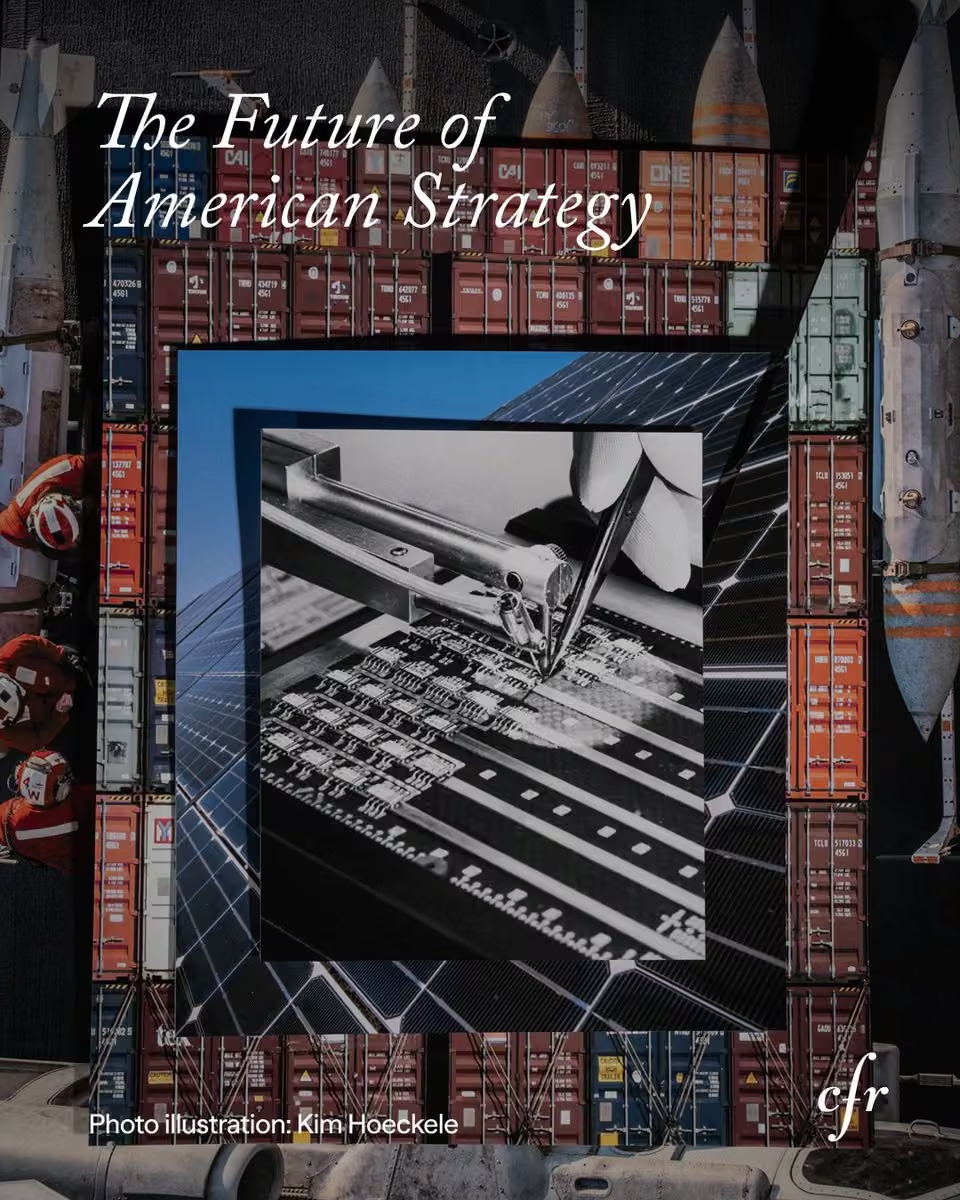
With historic shifts unfolding around the world and closer to home, the United States’ approach to its own region is “ripe for re-imagining,” writes expert @RebeccaLissner: www.cfr.org/articles/what-is-the-future-of-american-strat…
CFR’s Future of American Strategy Initiative asked 6 leading experts one question: what comes next for U.S. strategy in the Western Hemisphere?Post not available here, view on X
Council on Foreign Relations
@CFR_org
“Access to critical minerals, rare earth elements, and their midstream and downstream products is becoming instrumental in determining the outcome of geopolitical competition and the shape of the future world order,” writes expert @heidirediker. “In this competition, China controls critical chokepoints.”
“The United States has reached a dangerous inflection point . . . . Diversification away from China is, and will remain, a top national and economic security priority over the next decade, not just a commercial objective. The Western Hemisphere is key to that diversification strategy.”
Read more: www.cfr.org/articles/mines-to-markets-a-critical-minerals…
Council on Foreign Relations
@CFR_org
“The 2030s will likely determine whether Venezuela regains stability, democracy, and prosperity or remains authoritarian and dysfunctional,” write experts @WillGFreeman and Paul Angelo. “U.S. credibility in Latin America relies on the United States using its newfound leverage to drive democratization and economic recovery.”
“An open and secure Venezuela would increase stability in the region and help protect the U.S. homeland and critical supply chains,” they write.
Read more: www.cfr.org/articles/a-path-to-partnership-with-venezuela… -
Council on Foreign Relations reposted
James M. Lindsay
@JamesMLindsay
🎧 Election Day is five days away. Hannah Hartig and @JessicaHuseman joined me to discuss what voters are thinking heading into the midterms and how much foreign policy will shape their votes. youtu.be/Hv3x_DAJiT8
-
Council on Foreign Relations
@CFR_org
If Democrats win the House of Representatives and possibly even the Senate in the 2026 midterm elections, they will be able to exert increased pressure on President Donald Trump’s foreign policy, but there will also be limits to how much they can change. CFR expert @JamesMLindsay breaks down what might happen if a blue wave materializes.
This media couldn't be displayed. See it on the original post. -
Council on Foreign Relations
@CFR_org
“The notion that we’re just going to trust [artificial intelligence] companies that they’re going to be able to—with the face of public shareholders, all of the competitive pressures—that they’re just going to do the right thing, it makes me skeptical,” says Neel Kashkari, president and CEO of the Federal Reserve Bank of Minneapolis.
“I think there are a couple big risks from AI,” Kashkari argues. “AI gets out of control and does something terrible,” or “this ends up being massive investment that is not nearly as productivity enhancing as we assume, then this will have been malinvestment. And then there could be big economic consequences for the economy, writ large, given the scale of it.”
Watch the full conversation: www.youtube.com/watch?v=9nzHVBDy8bEThis media couldn't be displayed. See it on the original post. -
Council on Foreign Relations
@CFR_org
Prime Minister Benjamin Netanyahu did better than polls had predicted in Israel’s election this week. His party, Likud, came first, but neither his bloc nor opposition leader Gadi Eisenkot’s has a path to 61 seats without breaking a campaign promise.
“For Netanyahu, failed bargaining and another election probably look attractive. He remains prime minister while the negotiations are under way,” writes expert Elliott Abrams from Jerusalem.
Outside observers will wonder how all of this affects Israel’s foreign policy. "On many issues, including Gaza, Lebanon, Syria, and Iran, there is a broad consensus in Israel."
"An Eisenkot government would be less likely to attack Iran soon only because it would be new, and the ministers would be unlikely to order a strike on Iran before their chairs are warm. But Netanyahu will likely soon ask President Donald Trump about a renewed assault on Iran’s nuclear sites," he writes.
Read more: www.cfr.org/articles/israel-the-excellent-election-that-s… -
Council on Foreign Relations
@CFR_org
President Trump’s trade war with Canada assumed economic size would translate into bargaining power. Ottawa’s refusal to back down, and the strain the tariffs are putting on U.S. border states ahead of the midterms, are opening cracks in the administration’s approach, argues expert @edwardalden.
"With Republicans facing tough midterm election races in northern border states that are heavily dependent on trade with Canada, it is the United States that now appears to be backing down by lifting tariffs that are causing too much economic harm. Other countries that will face at least another two years of Trump’s trade bullying, regardless of the midterm outcomes, have much to learn from Canada’s response," he writes.
"Most of the major economies, from Europe to Japan and South Korea, have cut deals with the United States to accept higher tariffs in exchange for some trade peace. Canada stands alone in resisting U.S. demands. But so far, it seems to be standing tall."
Council on Foreign Relations
@CFR_org
Read more: www.cfr.org/articles/canada-shows-the-limits-of-trumps-ha…
-
Council on Foreign Relations
@CFR_org
Massive protests have swept across France since mid-September, with more planned this weekend, as students have rallied against the country’s education system and rising living costs. French authorities have responded with security crackdowns, curfews, and mass arrests when clashes grew particularly heated.
The scenes of chaos appear to be helping the far right, says expert @m2matthijs.
Council on Foreign Relations
@CFR_org
Here’s what to know: www.cfr.org/articles/whats-behind-the-protests-and-riots-…
-
Council on Foreign Relations
@CFR_org
Lana Zaki Nusseibeh, the minister of state in the Ministry of Foreign Affairs in the United Arab Emirates, is the latest candidate to join the race to become the next UN secretary-general, bringing the field to 7 candidates.
This year's secretary-general selection could be of particular significance because the UN may choose its first-ever woman leader.
Regardless of who takes the helm of the UN come January, experts agree they will be responsible for steering the 81-year-old organization through multiple critical challenges, including internal reforms, severe funding shortfalls, worsening climate change, the proliferation of AI, and escalating geopolitical tensions.
Read more on who the candidates are, how are they selected, and what challenges will they face in the role: www.cfr.org/articles/who-will-be-the-next-un-secretary-ge… -
Council on Foreign Relations
@CFR_org
Election Day is 6 days away. Expert @JamesMLindsay outlines 10 recent poll results that explain why Democrats see a blue wave coming and why Republicans fear they are right.
“It is never a good sign for the president’s party heading into the midterms when more voters are becoming pessimistic about the future,” he writes.
Read more: www.cfr.org/articles/ten-poll-numbers-that-explain-the-20… -
Council on Foreign Relations
@CFR_org
Former Serbian President Aleksandar Vucic conceded defeat to a student-led opposition movement in Serbia’s October 25 parliamentary elections, ending his party’s 14 years in power.
The vote came after nearly 2 years of student-led protests sparked by the deaths of 16 people when a canopy collapsed at a renovated railway station, a disaster that protesters blamed on corruption and cronyism.
“The student movement now has wind in its sails and lots of political momentum,” expert @CharlesKupchan, who was in Belgrade days before the vote, said. “It needs to focus on turning that momentum into good policies and good governance.”
Here’s what to know: www.cfr.org/articles/serbia-election-marks-the-end-of-an-era -
Council on Foreign Relations
@CFR_org
What do Americans actually want from U.S. foreign policy? CFR’s @RebeccaLissner asked that question of nearly 500 Americans around the country this year, and some of the results were surprising.
For her analysis and more on the Future of American Strategy initiative, visit:This media couldn't be displayed. See it on the original post. -
Council on Foreign Relations
@CFR_org
"Every Namibian child, students going to universities and vocational training, the government has to 100 percent subsidize their registration and tuition fees," says Netumbo Nandi-Ndaitwah, president of the Republic of Namibia. Nandi-Ndaitwah outlines a broad plan for educational reform centered on skill development and innovation.
This media couldn't be displayed. See it on the original post.
Council on Foreign Relations
@CFR_org
Watch the full conversation: www.cfr.org/event/a-conversation-with-president-netumbo-n…
-
Council on Foreign Relations
@CFR_org
Our expert @RebeccaLissner traveled to Wisconsin last week as part of CFR's ongoing efforts to understand what Americans think about the United States’ global role. She spent time in two counties, Milwaukee and Kenosha, and met nearly 100 people—from students and farmers to union members and clergy—to discuss everything from tariffs to AI.
“Wisconsin is fed up with tariffs,” Lissner writes. Sentiment toward tariffs was almost universally negative, she reports, with only one business owner noting positive effects of the measures on his steel company. Many people she met across Wisconsin connected the dots between tariffs, increased input costs for companies, and the resultant increase in consumer prices.
“You don’t have to be a rocket scientist to see that the decisions are senseless,” one participant in Kenosha said. Numerous others echoed this, expressing their frustration that those making trade policy do not understand its impact.
Council on Foreign Relations
@CFR_org
Read the takeaways from Lissner's trip—and more about CFR's Future of American Strategy Initiative: www.cfr.org/articles/how-do-americans-view-foreign-policy…
-
Council on Foreign Relations
@CFR_org
The stable and open international order erected on America’s watch is unraveling, argues expert @CharlesKupchan in his new book, Bringing Order to Anarchy: Governing the World to Come.
Democracy is losing ground to autocracy; globalized markets are fragmenting; and the era of perpetual peace foreseen at the close of the Cold War has given way to great-power rivalry, he writes.
Kupchan's book charts the path for building a new order fit for the emerging multipolar world: www.cfr.org/books/bringing-order-to-anarchy -
Council on Foreign Relations
@CFR_org
Americans have already staked more than $1.4 billion on prediction markets tied to the outcome of this year's U.S. midterm elections, and that figure is expected to exceed $2 billion by election day.
Millions of voters, alongside major trading firms and private companies, will trade on these markets—a boom that has provoked strong opposition from Democratic Party leaders, state governments, and much of the electorate.
"At issue are two questions: one of legality and one of prudence," writes @SamHenryLazarus in a new CFR report. "The first is whether election markets are legal to begin with—specifically, if they qualify as 'swaps' under federal commodities law and can therefore be offered nationwide. The second is whether the utility of election markets outweighs the risks they pose to the United States’ moral fabric, democratic process, and financial markets."
Election markets hold significant potential as tools for political forecasting, but only if policymakers take steps to control for insider trading and improve oversight, he argues.
Reform would serve both opponents and advocates of election markets, Lazarus argues. “Inaction will serve neither camp: scandals will abound, trust in the democratic process will erode, and traders will be defrauded.”
Council on Foreign Relations
@CFR_org
Read more: www.cfr.org/reports/betting-on-democracy
-
Council on Foreign Relations
@CFR_org
“The economy has been voters’ top issue in 4 of the 6 midterm elections this century—and 2026 appears all but certain to make it 5 of 7,” writes Robert E. Rubin, former treasury secretary and CFR chairman emeritus, in @NYTopinion. “Beyond the cost of living, the war in Iran and tariffs, America faces a series of daunting longer-term economic challenges, from mounting federal debt to the effects of artificial intelligence.”
"If the Trump administration launches an effort to manipulate the outcome of the midterms, the economic impact could be felt immediately, and it could last long after Mr. Trump’s presidency ends," he argues.
www.nytimes.com/2026/10/21/opinion/trump-midterms-electio… -
Council on Foreign Relations
@CFR_org
"The Islamic republic’s aspirations have always revolved around the challenge of how to do more with less. If the regime can survive Trump’s attempt to strangle it and provoke an uprising, the theocrats and guardsmen just might figure it out," write Reuel Marc Gerecht and CFR expert Ray Takeyh in
@PostOpinions.
www.washingtonpost.com/opinions/2026/10/23/iran-is-not-bo… -
Council on Foreign Relations
@CFR_org
Rising geopolitical conflict across the world is driving countries in multiple regions to establish new bilateral currency swap facilities. In the Middle East, the UAE has extended a new local-currency (dirham) swap line to Bahrain—whose debt has surged owing to a drop in oil revenues from Iran’s attacks in the Strait of Hormuz. Russia—financially constrained by sharply curtailed access to the SWIFT global cross-border payments system since its 2022 invasion of Ukraine—has established a new swap line with Kazakhstan.
Since the financial crisis of 2007, central banks around the world have entered into a multitude of bilateral currency swap agreements with one another. These agreements allow a central bank in one country to exchange currency, usually its domestic currency, for a certain amount of foreign currency. The recipient central bank can then lend this foreign currency on to its domestic banks, on its own terms and at its own risk.
CFR expert Benn Steil's interactive map tracks central bank currency swaps from the 2007 crisis through the COVID-19 pandemic and into the present. Explore our tracker to learn more about how geopolitical shocks have reshaped the global financial safety net: www.cfr.org/articles/central-bank-currency-swaps-tracker -
Council on Foreign Relations
@CFR_org
Israel's October 27 election, its first since Hamas's October 7, 2023, attacks, could reshape the country's political landscape. But neither Prime Minister Benjamin Netanyahu's bloc nor the opposition has a clear path to a governing majority. The outcome of the vote could determine not only who leads Israel, but how the country contends with various domestic and foreign policy concerns.
Here's what to know: www.cfr.org/articles/israels-election-whos-who-and-whats-… -
Council on Foreign Relations
@CFR_org
"'It's the economy, stupid' is a now-venerable line about why voters back a certain candidate—even when the choice appears unexpected," writes expert Elliott Abrams. "But it's not only the economy; for some voters, and for very large groups of them at times, foreign policy issues can be important and even determinative."
A CFR study group convened scholars and political analysts to examine the foreign policy views of the voters who elected President Donald Trump in 2024, drawing on survey data.
Abrams, who wrote the report on the group's findings, breaks down the takeaways: www.cfr.org/articles/how-trumps-winning-coalition-sees-fo… -
Council on Foreign Relations
@CFR_org
The stable and open international order erected on America’s watch is unraveling, argues CFR expert @CharlesKupchan.
In his new book, Bringing Order to Anarchy: Governing the World to Come, Kupchan writes that democracy is losing ground to autocracy; globalized markets are fragmenting; and the era of perpetual peace foreseen at the close of the Cold War has given way to great-power rivalry.
What lies ahead is “a globalized world with no captain at the helm, no single country or region that calls the shots, and no single conception of order to provide stability," he writes.
The United States “can neither cling futilely to the world that was, as Biden did, nor dismantle the old order and leave the United States and the rest of the world standing in the rubble, as Trump appears to be doing.”
In the book, Kupchan diagnoses the sources of global disarray and lays out his guide for building a new order fit for the emerging multipolar world.
That mission must begin with the revival of American democracy and the nation’s steady leadership abroad, he argues.
"The United States and other democracies must first demonstrate that they can again deliver for their citizens and durably outperform illiberal and autocratic alternatives,” he writes. “Only then might the arc of history again bend toward democracy and justice."
"That world, ultimately, is the new that must be born.”
Learn more: www.cfr.org/books/bringing-order-to-anarchy -
Council on Foreign Relations
@CFR_org
Sir Ken McCallum, director general of MI5—the United Kingdom's domestic security and counterintelligence agency—delivered his annual threat update last week. He warned of a “new era” for national security, one that required “a new response.”
“The speech could still have gone further in underscoring the importance of soft power and connecting the dots between what is happening in society—polarization, distrust, bigotry, racism—and the country's vulnerabilities to terrorists or state actors," writes expert @Farah_Pandith and Ezra Hess. www.cfr.org/articles/unpacking-mi5s-warning-on-a-new-era-… -
Council on Foreign Relations
@CFR_org
“These books help show us where we’ve come from, where we are now, and just possibly where we might be going,” says CFR expert Gideon Rose, who chairs the jury for our Arthur Ross Book Award.
The award recognizes books from the previous year that have made major contributions to American foreign policy and the study of international affairs. Rose explains what distinguishes each of this year’s finalists.
For more foreign policy reads, explore the latest books by CFR experts: www.cfr.org/booksThis media couldn't be displayed. See it on the original post. -
Council on Foreign Relations
@CFR_org
Our Global Conflict Tracker traces ongoing armed conflicts around the world. It includes background information, the latest news developments, conflict status assessments, and resources for further research—all updated regularly.
Use the interactive tool to learn more: -
Council on Foreign Relations
@CFR_org
Congress passed a bipartisan bill named for the late Senator Lindsey Graham (R-SC) last month to impose sanctions on Russia and penalties on countries that buy its oil.
President Donald Trump signed the bill into law but later issued an executive order waiving the new Russia-related sanctions and tariffs. His administration also lifted sanctions on Russian diesel. CFR experts @edwardfishman and @petereharrell discuss what these moves signal to Russian President Vladimir Putin and how they could shape the U.S. midterm elections.This media couldn't be displayed. See it on the original post. -
Council on Foreign Relations
@CFR_org
After nearly 9 months of war with Iran, President Donald Trump faces a choice: escalate the conflict with Tehran after the U.S. midterm elections on November 3, find a way to coexist, or stand pat, argues expert @JamesMLindsay.
"The stakes for the United States are immense," he writes. "Renewed fighting could bring victory or deepen the current stalemate, send energy prices soaring, and push the global economy into a tailspin. But maintaining the status quo or finding an acceptable negotiated settlement may be just as challenging."
For more, read his analysis:www.cfr.org/articles/will-the-united-states-attack-iran-a…
Council on Foreign Relations
@CFR_org
To better understand the prospects for U.S. escalation against Iran and what that might look like in practice, Lindsay sat down with Cole Bucy, former director for Iran on the U.S. National Security Council, and Nate Swanson, director of the Iran Strategy Project at the Atlantic Council, for the latest episode of The President’s Inbox. www.cfr.org/podcasts/presidents-inbox/the-iran-war-and-th…
-
Council on Foreign Relations
@CFR_org
“Brazilians are saying they want a tough leader. They want someone who’s going to be strong on crime, and especially the drug trade, and someone who is going to address cost-of-living issues, which sounds like a lot of places today. But that’s very different from what investors are looking at,” says Rebecca Patterson, host of The Spillover. In the newest episode of the podcast, Patterson and @shannonkoneil, senior vice president of studies Maurice R. Greenberg chair at CFR, unpack the fiscal tensions surrounding Brazil’s upcoming presidential runoff election.
This media couldn't be displayed. See it on the original post.
Council on Foreign Relations
@CFR_org
Watch The Spillover here or wherever you get your podcasts: podcasts.apple.com/us/podcast/brazils-runoff-election-is-…
-
Council on Foreign Relations
@CFR_org
"Top of mind are the protests in France, which could well be the canary in the coal mine of a broader political and economic crisis in the works," writes CFR President @MikeFroman. "This is all coming to a head in the context of an abrupt shift in the United States’ approach to Russia, with major implications for Europe and its security."
"For its own sake as well as ours, Europe needs to address the structural weaknesses that are fueling both the protests and the geopolitical dependencies. Until they get their houses in order, we are all in for a long winter." www.cfr.org/articles/will-europes-protests-mark-a-turning… -
Council on Foreign Relations
@CFR_org
Israel’s October 27 election, its first since Hamas’s October 7, 2023, attacks, could reshape the country’s political landscape. But neither Prime Minister Benjamin Netanyahu’s bloc nor the opposition has a clear path to a governing majority. The outcome of the vote could determine not only who leads Israel, but how the country contends with various domestic and foreign policy concerns.
Council on Foreign Relations
@CFR_org
Here's what to know: www.cfr.org/articles/israels-election-whos-who-and-whats-…
-
Council on Foreign Relations
@CFR_org
“The ultimate test of the United Nations in terms of breaking the ceiling that exists for women in terms of equality between men and women would be if they appoint a woman secretary-general,” says Carolyn Rodrigues Birkett, a candidate for UN secretary-general and the permanent representative of Guyana to the United Nations.
“What we know is that the more we have women involved in peace negotiations, the more sustainable the agreements for peace are. And so I would certainly want to promote more of that, more women being involved, but human rights for all everywhere, including women. . . . Who better to do that than a woman secretary-general?”
Watch the full conversation: www.youtube.com/watch?v=iFEYADzHmQk&t=118sThis media couldn't be displayed. See it on the original post. -
Council on Foreign Relations
@CFR_org
Brazilians will vote in a runoff on October 25 after the first round of the country's general election failed to see any presidential candidate secure more than 50% of the vote over the weekend.
Senator Flávio Bolsonaro, son of former President Jair Bolsonaro, won 47% of the vote, while incumbent Luiz Inácio Lula da Silva won 45%.
The winner of the runoff will determine the leadership of Latin America's largest democracy and biggest economy.
Experts say the election's results could reshape Brazil's foreign policy at a time of broad political change in Latin America. The next government will need to navigate Brazil's relations with the United States and China—its two largest trading partners—and the rest of the Global South.
Here's what to know: www.cfr.org/articles/brazils-2026-election-what-to-know-a… -
Council on Foreign Relations
@CFR_org
“As the diffusion of power fuels geopolitical rivalries, Americans are growing weary of entanglement in a fragmenting world,” writes expert Charles Kupchan. “Liberal democracy is in retreat worldwide, including in the United States, where the centrist, bipartisan compact that long anchored U.S. statecraft has collapsed.”
Read his essay in Foreign Affairs: www.foreignaffairs.com/united-states/better-america-first -
Council on Foreign Relations reposted
James M. Lindsay
@JamesMLindsay
Election Day is two weeks away. Twelve numbers explain what is at stake and why Republicans fear they may be hit by a blue wave.
www.cfr.org/articles/a-dozen-numbers-that-explain-the-mid… -
Council on Foreign Relations
@CFR_org
"We don’t identify sources, but it’s multiple that [say that] Russia is cooking up something big this year,” says Radosław Sikorski, deputy prime minister and minister of foreign affairs of Poland. “They might do a false-flag attack on themselves in order to say to their people, ‘We are under attack, and therefore we have to mobilize.’"
Watch the full conversation: www.cfr.org/event/a-conversation-with-deputy-prime-minist…This media couldn't be displayed. See it on the original post. -
Council on Foreign Relations
@CFR_org
NATO began Steadfast Noon, its annual nuclear deterrence exercise, last week, even as the Trump administration pursues a policy that threatens to undermine the alliance’s nuclear readiness, argue CFR expert @RebeccaLissner and Turner Ruggi in @ForeignPolicy.
"Launched in February, NATO 3.0 is the brainchild of Elbridge Colby, the undersecretary of defense for policy," they write. "At its core is the assumption that the United States can rapidly wind down its conventional commitments to Europe while retaining its leading role in the alliance, so long as Europe continues to rely on the U.S. nuclear guarantee."
"A hasty U.S. conventional withdrawal would weaken Europe’s ability to defend itself below the nuclear threshold while simultaneously eroding the credibility of the U.S. nuclear guarantee. It is a dangerous, double-edged experiment that undercuts both pillars of deterrence at once." foreignpolicy.com/2026/10/21/nato-us-nuclear-weapons-mili… -
Council on Foreign Relations
@CFR_org
Brazil will hold a presidential runoff on October 25, and Senator Flávio Bolsonaro, son of former President Jair Bolsonaro, has pledged to use “big scissors” to cut spending.
Investors are betting that the Brazilian presidential candidate will rein in public debt, write expert Rebecca Patterson and Ishaan Thakker.
"But it is easy to pledge austerity during campaigns and much harder—for both political and logistical reasons—to deliver on such promises once in office. Any initial gains in Brazilian assets following a Bolsonaro win should therefore be viewed with a healthy dose of skepticism," they write.
Council on Foreign Relations
@CFR_org
Read their analysis: www.cfr.org/articles/could-flavio-bolsonaro-deliver-on-hi…
-
Council on Foreign Relations
@CFR_org
As President Trump’s envoy met Russian President Vladimir Putin this week, critics accused the White House of abandoning Ukraine. Expert Thomas Graham argues that this criticism may be warranted, but "with pressure only able to go so far, dialogue and diplomacy are critical to reaching a settlement."
Council on Foreign Relations
@CFR_org
Read more: www.cfr.org/articles/trumps-putin-overtures-deserve-criti…
-
Council on Foreign Relations reposted
Benn Steil
@BennSteil
The growing overlap between China’s exports and those of its advanced-economy trading partners has become a major source of trade frictions.
My latest @CFR_org Geo-Graphics blog post with Yuma Schuster . . .
www.cfr.org/articles/surging-export-similarity-is-fueling… -
Council on Foreign Relations
@CFR_org
CFR’s annual Preventive Priorities Survey helps policymakers anticipate and avert international crises. In the survey, experts assess ongoing and potential violent conflicts and sources of instability that could worsen in the coming year.
What emerging or escalating conflicts do you think should be on the 2027 survey? Let us know and submit your suggestions: docs.google.com/forms/d/e/1FAIpQLSe8paZE9jFalJbekouZaqj3f… -
Council on Foreign Relations
@CFR_org
Israeli elections next week will determine whether Benjamin Netanyahu and his right-wing Likud party remain in power, or if Gadi Eisenkot’s centrist Yashar party will be able to form a new government. So far, polls indicate that neither party will gain enough votes to establish a sixty-one-seat majority, which could trigger another round of elections. "Israelis aren't really enthusiastic about this election. People are dragging themselves across the finish line, dreading what the outcome might be," says CFR expert @stevenacook in a dispatch from Israel.
This media couldn't be displayed. See it on the original post. -
Council on Foreign Relations
@CFR_org
Sir Ken McCallum, director general of MI5—the United Kingdom’s domestic security and counterintelligence agency—delivered his annual threat update last week. He warned of a “new era” for national security, one that required “a new response.”
“The speech could still have gone further in underscoring the importance of soft power and connecting the dots between what is happening in society—polarization, distrust, bigotry, racism—and the country’s vulnerabilities to terrorists or state actors," writes expert @Farah_Pandith and Ezra Hess.
Council on Foreign Relations
@CFR_org
Read more: www.cfr.org/articles/unpacking-mi5s-warning-on-a-new-era-…
-
Council on Foreign Relations
@CFR_org
“These faith-based awards have all gone to Christian charities; there are no other faiths that are represented. Is the Trump administration, in your opinion, missing a complete faith-based aid package here, or is this not faith-based aid, it’s Christian aid from the United States?” asks Sam Vigersky, CFR expert.
“The realities of societies—and let’s just take sub-Saharan Africa—are that they are multifaith, particularly as we get into parts of eastern and western Africa with majority-Muslim populations. It will be impossible to deliver this kind of assistance at the community level without involving Islamic organizations, individual imams and mosques, and community groups,” argues William Steiger, CEO of Malaria No More.
Watch the full conversation here: www.cfr.org/event/faith-based-humanitarian-aid-and-u-s-fo… -
Council on Foreign Relations reposted
James M. Lindsay
@JamesMLindsay
#onthisday in 1962, President John F. Kennedy faked a fever to cancel a campaign trip and return to the White House to meet with his national security team to discuss how to respond to the news that the Soviets were installing ballistic missiles in Cuba. www.cfr.org/articles/president-john-f-kennedy-fakes-a-fev…
-
Council on Foreign Relations
@CFR_org
Over the weekend, France had its worst day of urban violence in years. The protests began a month ago among high school students who complained about school conditions and budget cuts. At the same time, the government announced that 25-30% of the education budget would go to pensions.
Unrest quickly spread around the country and, according to CFR expert @m2matthijs, “a protest about schools became a protest about everything, from the cost of living to higher diesel prices and government austerity.” Matthijs explains how France got here, what could come next, and how the situation could benefit France's far right.This media couldn't be displayed. See it on the original post. -
Council on Foreign Relations
@CFR_org
The next leader of the United Nations will need to steer the global body through a time of crises.
In CFR's series profiling candidates for UN Secretary-General, Carolyn Rodrigues Birkett, the former minister of foreign affairs of Guyana, talked to us about why she's suited for this moment.
Coming from a small state, Rodrigues Birkett says she understands how the UN’s problems ripple outward: a liquidity crisis, off-track development goals, and growing criticism from other smaller member states that UN staff isn't geographically representative.
Read the full takeaways: www.cfr.org/articles/how-carolyn-rodrigues-birkett-would-… -
Council on Foreign Relations
@CFR_org
Our Global Conflict Tracker traces ongoing armed conflicts around the world. It includes background information, the latest news developments, conflict status assessments, and resources for further research—all updated regularly.
Use the interactive tool to learn more: -
Council on Foreign Relations reposted
Charles Kupchan
@CharlesKupchan
Out today, my new book "Bringing Order to Anarchy." A world in disarray. How did we get here? What do we do now? The book provides a roadmap for building order in the world to come. @CFR_org @georgetownsfs @yalepress
www.cfr.org/books/bringing-order-to-anarchy -
Council on Foreign Relations
@CFR_org
“Instead of burying ‘America first,’ Trump’s successor should salvage its best elements and implement them more capably,” writes expert Charles Kupchan. “The next version of U.S. foreign policy should marry the realist impulses that shape ‘America first’ with the liberal cause that remains at the heart of the American experience.”
Read his essay in Foreign Affairs: www.foreignaffairs.com/united-states/better-america-first -
Council on Foreign Relations
@CFR_org
Ukrainian drones took out three data centers owned by Yandex, the internet conglomerate sometimes referred to as Russia’s Google, last week in retaliation for Russian strikes on its data centers.
The strikes caused severe disruptions across the country, impeding Russians’ ability to send emails, make payments, and navigate the streets.
"These strikes will have minimal effect on the global race to develop and adopt artificial intelligence," writes expert @ConnorMauthor. "Russia is nowhere close to the cutting edge of the field . . . hamstrung by lack of access to cutting-edge chips and by a brain drain of engineers."
“But the bigger implication of the Ukrainian strikes is that they have laid bare a fundamental risk to the development and deployment of AI worldwide: its physical infrastructure is vulnerable.”
“Companies and nations seeking to protect their data centers should therefore pursue a strategy of redundancy and resiliency.”
“At its highest levels of performance, AI’s capabilities can appear otherworldly—but it is fundamentally a technology dependent on physical things. Defending it is just a new version of the oldest problem in warfare: how to hit your enemy’s infrastructure while stopping them from hitting yours.”
"As long as they provide value, data centers will be targets," Martin writes. "Countries and companies are well advised to prepare for that future now.”
Council on Foreign Relations
@CFR_org
Read more: www.cfr.org/articles/ukraines-attacks-on-russian-data-cen…
-
Council on Foreign Relations
@CFR_org
“Today, as the population rapidly grays, China’s political system is becoming increasingly regressive and rigid,” writes expert Carl Minzner. “China can build new high-speed rail lines or aircraft carriers but not, it seems, a sustainable social safety net for its rapidly graying countryside.”
Read his essay in Foreign Affairs: www.foreignaffairs.com/china/chinas-long-twilight-carl-mi… -
Council on Foreign Relations
@CFR_org
“Most states even today reward utilities for selling you more energy and penalize them for cutting your bill,” says Amory Lovins, cofounder and chairman emeritus of the Rocky Mountain Institute. “There are hosts of perverse incentives like this, carefully designed often by the incumbents who do very nicely out of selling the energy.”
This media couldn't be displayed. See it on the original post.
Council on Foreign Relations
@CFR_org
Watch the full conversation: www.cfr.org/event/the-road-not-taken-at-50-u-s-energy-sec…
-
Council on Foreign Relations
@CFR_org
“The stable and open international order erected during America’s watch—Pax Americana—is unraveling, giving way to global disarray,” argues expert @CharlesKupchan.
In his new book, Bringing Order to Anarchy: Governing the World to Come, Kupchan lays out a guide for building a new order fit for the emerging multipolar world. Learn more: www.cfr.org/books/bringing-order-to-anarchy -
Council on Foreign Relations
@CFR_org
When President Donald Trump announced a deal to buy diesel from Russia, “it was easy to shrug off the move as a feeble effort to limit energy prices in advance of the midterms,” writes expert Stephen Sestanovich.
The story now looks "disturbingly different; the possible consequences, much more serious, and likely to last well beyond the midterms."
A day after announcing new diesel imports from Russia, Trump began calling for Ukrainian President Volodymyr Zelenskyy’s removal from office. He followed this up by claiming that Moscow and Kyiv had agreed to suspend attacks on each other’s main energy targets.
"This, it quickly became clear, was pure invention. Reports suggested what had actually happened was that U.S. negotiators were pressing the Ukrainian government to do something far more radical than a mutual ceasefire—to cease its attacks unilaterally, whether Russia complied or not," Sestanovich writes.
“It is hard to overstate how much this new public hostility by U.S. officials—above all, the president—has disoriented Ukraine’s leadership,” he writes. “In searching for a new way to handle Trump, Ukraine’s leadership has seemed suddenly at sea."
"Rather than see the prospect of postwar riches as the key that will bring Putin to the table, he now acts as though pressure—on Zelenskyy, not Putin—will be the crucial instrument of a breakthrough,” Sestanovich argues.
Council on Foreign Relations
@CFR_org
Read his full analysis: www.cfr.org/articles/trumps-diesel-deal-with-russia-was-j…
-
Council on Foreign Relations reposted
Foreign Affairs
@ForeignAffairs
China is headed for a demographic cliff, writes @CarlMinzner. By the 2040s, it “will shed around one percent of its population annually—roughly ten million people, more than the population of New York City.”
www.foreignaffairs.com/china/chinas-long-twilight-carl-mi… -
Council on Foreign Relations reposted
Charles Kupchan
@CharlesKupchan
Many of Trump’s foreign policy instincts are sound, but he has implemented his course corrections with marked incompetence. In this new essay I lay out a roadmap for fixing America First. @ForeignAffairs @CFR_org @georgetownsfs
www.foreignaffairs.com/united-states/better-america-first -
Council on Foreign Relations
@CFR_org
Cyber-enabled scams are spreading globally with the aid of emerging technologies like AI.
In Southeast Asia, criminal networks are using AI to traffic individuals into scam centers and leveraging the technology to deceive fraud victims.
CFR expert Rita Fernández conducted field research in Thailand to learn how AI is used to enable human trafficking. She spoke with law enforcement, civil society, and government officials.
"Conditions in the scam compounds are harrowing," she writes. "Victims are stripped of their passports and belongings, threatened, beaten, and tortured."
"Some are told they need to work to repay travel expenses they incurred and to regain access to their passports. If they resist working, or fail to meet quotas, they may be denied food or subjected to psychological abuse, leaving them with no choice but to comply."
“AI is not limited to use in cyber scams and human trafficking—law enforcement has seen a steady increase in broader AI use in crime."
"Just as individuals can use AI to become more productive at work and in the classroom, criminal networks can use it to improve their efficiency as well," one source told Fernández.
Council on Foreign Relations
@CFR_org
Read more: www.cfr.org/articles/ai-is-supercharging-cyber-scams-and-…
-
Council on Foreign Relations
@CFR_org
"'It's the economy, stupid' is a now-venerable line about why voters back a certain candidate—even when the choice appears unexpected," writes expert Elliott Abrams. "But it's not only the economy; for some voters, and for very large groups of them at times, foreign policy issues can be important and even determinative."
A CFR study group convened scholars and political analysts to examine the foreign policy views of the voters who elected President Donald Trump in 2024, drawing on survey data.
Abrams, who wrote the report on the group's findings, breaks down the takeaways: www.cfr.org/articles/how-trumps-winning-coalition-sees-fo… -
Council on Foreign Relations
@CFR_org
President Trump announced a new diesel deal with Russian President Vladimir Putin on October 9 to the surprise of many U.S. allies. Experts argue the agreement could undercut Western economic pressure on Russia and solidarity efforts with Ukraine while doing little to lower fuel prices.
“The announcement of the deal is really for political effect at home, to try to influence voters in this election,” expert Vijay Vaitheeswaran said. “The idea that there might be lower prices coming because of an innovative deal that President Trump did, with his relationship with Putin, sounds pretty good [to voters].”
Beyond lowering fuel prices, the Trump administration reportedly hopes the deal will signal Washington’s openness to working with Moscow and bring the country back to the negotiating table to end the war. Few experts believe the diesel deal will have much of an effect on global oil markets in the near future. Instead, several said it would only bolster Russia economically and further strain transatlantic unity.
“The diesel deal shows that Washington’s Russia policy is now driven by high prices at the pump before the November 3 midterm elections, rather than by any shared transatlantic strategy,” expert @m2matthijs said. “The irony is that the U.S., and especially President Trump, has lectured the Europeans for years about the dangers of buying Russian energy; now it is easing sanctions to buy Russian diesel itself, without consulting anyone in Europe.”
Whether or not it is implemented, the surprise diesel deal has strained relations between the United States and its allies. “For many EU leaders, [the diesel deal] is further proof that the Europeans can no longer afford to outsource their security policy and can no longer rely on the United States to contain Russia,” Matthijs said.
Council on Foreign Relations
@CFR_org
Read more: www.cfr.org/articles/trumps-russian-diesel-deal-explained
-
Council on Foreign Relations
@CFR_org
We are now accepting applications for our 2027-28 fellowship programs, which offer unique, transformational opportunities for U.S. citizens with a demonstrated commitment to a career in foreign policy. Selected fellows broaden their perspectives on foreign affairs by gaining exposure to a new environment in a policymaking setting, at CFR, or overseas.
Applications close on October 30, 2026. Apply or learn more: cfr.org/fellowships. -
Council on Foreign Relations
@CFR_org
.@RBlumenstein knows the value of putting in the work as a journalist. The CFR member and president of editorial at NBC News built her career by starting small, covering local and regional news in Florida and Michigan, before making her way to national news organizations, including the Wall Street Journal and the New York Times.
With the news landscape under enormous pressure, Blumenstein says she remains optimistic about the future of journalism. “I think that trust is so important, and I believe that a lot of consumers are realizing that there's a lot of misinformation out there."
"My biggest advice, especially to young people, is to do your job, but also be someone who your boss is happy to see because they know you're going to take the initiative and be the closer who will help carry things across the finish line," Blumenstein says.
Read more about the experiences that have shaped her career, from small-town newsrooms to some of the most influential news organizations in the country: www.cfr.org/articles/how-i-got-my-career-in-foreign-polic… -
Council on Foreign Relations
@CFR_org
Trump announced a new diesel deal with Putin on October 9 to the surprise of many U.S. allies. Experts argue the agreement could undercut Western economic pressure on Russia and solidarity efforts with Ukraine while doing little to lower fuel prices. www.cfr.org/articles/trumps-russian-diesel-deal-explained
-
Council on Foreign Relations
@CFR_org
The debate over autonomous weapons and the debate over frontier AI safety are about different problems, argue experts @mchorowitz and @Lauren_A_Kahn. To regulate them, policymakers need a framework to address it, they write.
“Everyone wants autonomy to be a clear binary, yes or no. . . . In reality, autonomy is a spectrum defined by the technology being used and the human choices that are made to employ a weapon system. The question isn't, ‘Is it autonomous?' but rather, ‘How autonomous is it?'”
“What few people understand is how much autonomy is already in modern military systems—and has been for decades,” they write.
Read their analysis: www.cfr.org/articles/the-autonomous-weapons-debate-still-… -
Council on Foreign Relations reposted
James M. Lindsay
@JamesMLindsay
#onthisday in 1962, President John F. Kennedy was in his bedroom reading the newspaper when he learned that the Soviet Union was installing ballistic missiles in Cuba. He had decisions to make, but first had to greet a visiting US astronaut and his family. www.cfr.org/articles/jfk-learns-that-soviet-missiles-are-…
-
Council on Foreign Relations
@CFR_org
Iran’s closure of the Strait of Hormuz sent shock waves through the global economy. China has weaponized its supply-chain dominance over magnets and critical minerals to its strategic advantage. And, for years, the United States has leveraged the global power of the dollar to pursue its interest and levy sanctions against adversaries, most notably Iran and Russia. CFR President @MikeFroman explains the growing importance of chokepoints in geopolitics and warns that the United States could lose some of its long-held advantages if it’s not careful.
For more, read his guest essay in the New York Times: www.nytimes.com/2026/10/09/opinion/foreign-policy-diploma…This media couldn't be displayed. See it on the original post. -
Council on Foreign Relations
@CFR_org
In this episode of The Spillover, cohost Rebecca Patterson and Veda Partners cofounder @HenriettaVeda discuss the upcoming 2026 U.S. midterm elections. Treyz notes that although “the House is a guaranteed pickup” for Democrats, Senate races will prove more challenging. “If you are in the United States Senate, you have an 88 percent chance of winning your election if you are already the incumbent,” says Treyz.
This media couldn't be displayed. See it on the original post.
Council on Foreign Relations
@CFR_org
Watch the full episode here or wherever you get your podcasts: youtu.be/bZIXcFDkr2k
-
Council on Foreign Relations
@CFR_org
When President Donald Trump announced a deal to buy diesel from Russia at the end of last week, “it was easy to shrug off the move as a feeble effort to limit energy prices in advance of the midterms,” writes expert Stephen Sestanovich.
"A week later, the story looks disturbingly different; the possible consequences, much more serious, and likely to last well beyond" the elections.
A day after announcing new diesel imports from Russia, Trump began calling for Ukrainian President Volodymyr Zelenskyy’s removal from office. He followed this up by claiming that Moscow and Kyiv had agreed to suspend attacks on each other’s main energy targets.
"This, it quickly became clear, was pure invention. Reports suggested what had actually happened was that U.S. negotiators were pressing the Ukrainian government to do something far more radical than a mutual ceasefire—to cease its attacks unilaterally, whether Russia complied or not," Sestanovich writes.
“It is hard to overstate how much this new public hostility by U.S. officials—above all, the president—has disoriented Ukraine’s leadership,” he writes. “In searching for a new way to handle Trump, Ukraine’s leadership has seemed suddenly at sea."
"Rather than see the prospect of postwar riches as the key that will bring Putin to the table, he now acts as though pressure—on Zelenskyy, not Putin—will be the crucial instrument of a breakthrough, ” Sestanovich argues.
Council on Foreign Relations
@CFR_org
Read his full analysis: www.cfr.org/articles/trumps-diesel-deal-with-russia-was-j…
-
Council on Foreign Relations
@CFR_org
“This is not in any standard engineering text, government study, industry forecast, or climate model. Why not? Because it’s not a technology; it’s a design method. And few people yet think of design—how you put the pieces together—as a path to speed and scale,” says Amory Lovins, cofounder and chairman emeritus of the @RockyMtnInst, explaining simple design changes to pipes, pumps, engines and other common systems that could significantly reduce global energy consumption.
This media couldn't be displayed. See it on the original post.
Council on Foreign Relations
@CFR_org
Watch the full conversation here: www.cfr.org/event/the-road-not-taken-at-50-u-s-energy-sec…
-
Council on Foreign Relations
@CFR_org
What happens if the world’s pharmacy decides to close? From ibuprofen to amoxicillin, a majority of the essential medicines used in the United States depend on ingredients from China. This dependence has left the United States vulnerable to a geopolitical rival that could decide to cut off its access at any time.
On this episode of Why It Matters, @RushDoshi, senior fellow at CFR, and Olivia Kosloff, senior fellow at the American Economic Liberties Project, unpack how the dependency came about and what’s at risk if the pharma supply chain snaps.
Listen to the episode here or wherever you get your podcasts: podcasts.apple.com/us/podcast/side-effects-may-include-de… -
Council on Foreign Relations
@CFR_org
“Of [a car’s] gasoline, less than 1% of that energy ends up moving the driver,” says Amory Lovins, cofounder and chairman emeritus of the @RockyMtnInst. If companies make cars out of carbon fiber–reinforced plastic, he states that “you take out almost 700 pounds of weight, but the car costs the same because you need fewer batteries to haul less weight around.” According to Lovins, the most efficient car about to enter production in the United States “is a two seater that gets the equivalent of 343 miles a gallon. In fact, so efficient—three times better than a Tesla—that just the solar cells on top of the car will run it 11,000 miles a year without having to plug in.”
This media couldn't be displayed. See it on the original post.
Council on Foreign Relations
@CFR_org
Watch the full conversation: www.cfr.org/event/the-road-not-taken-at-50-u-s-energy-sec…
-
Council on Foreign Relations
@CFR_org
CFR asked members of the Society for Historians of American Foreign Relations what they considered to be the best and worst foreign policy decisions in U.S. history.
A U.S. Air Force surveillance flight over Cuba in October 1962 turned up evidence of what U.S. officials had feared: the Soviet Union was installing nuclear-armed missiles on the island. The discovery triggered a 13-day crisis, beginning on October 16, that brought the world to the brink of nuclear war.
Worried about escalation, President John F. Kennedy pursued backchannel communications with Soviet leader Nikita Khrushchev that ended the crisis and led to several agreements that opened the door to the arms-control era.
Surveyed historians ranked Kennedy’s handling of the Cuban Missile Crisis as the tenth-best U.S. foreign policy decision.
See how other U.S. foreign policy decisions were ranked: www.cfr.org/ten-best-ten-worst-us-foreign-policy-decisions/This media couldn't be displayed. See it on the original post. -
Council on Foreign Relations
@CFR_org
Food has increasingly become a deliberate tool of war.
Whether in besieged farming communities in Sudan or in the destruction of grain siloes in Ukraine, it is targeted, strategic, and rarely punished. In conflicts around the world, food weaponization has triggered humanitarian devastation, disrupted global food provisions, and directly threatened states’ national security.
We mapped where it's occurring globally—and explain what it reveals about the world order: www.cfr.org/articles/the-world-agreed-to-stop-using-food-… -
Council on Foreign Relations reposted
Michael C. Horowitz
@mchorowitz
🚨🚨 brand new from me & @Lauren_A_Kahn - explainer on autonomous weapons (including cool graphics!) and how the AI and weapons issue is different than the frontier AI safety issue! Check it out and share! www.cfr.org/articles/the-autonomous-weapons-debate-still-… cc @CFR_org
-
Council on Foreign Relations
@CFR_org
A sell-off in the U.S. bond market has pushed long-term U.S. borrowing to levels that haven’t been seen in nearly 20 years. The Trump administration has responded with two unusual interventions: an expanded buyback program for long-term debt and a U.S.-Japan coordinated effort to prop up the yen without selling U.S. Treasuries. Yields haven’t come down, however, and because U.S. yields anchor bond markets worldwide, this is being felt outside the United States.
We turned to 4 of our experts, Benn Steil, @scmallaby, Rebecca Patterson, and @Brad_Setser, to break down the continued bond market sell-off. They examine why market interventions haven’t worked, how rising U.S. yields are affecting other countries, what role AI is playing, and what effect higher oil prices have had since the start of the Iran war.
Council on Foreign Relations
@CFR_org
Read more: www.cfr.org/articles/why-u-s-borrowing-costs-keep-climbin…
-
Council on Foreign Relations reposted
Josh Kurlantzick
@JoshKurlantzick
An authoritarian world could be coming, as autocrats collaborate and are defeating democratic collaboration. My latest for @WPReview and @CFR_org The World’s Autocrats Are Winning the War of Narratives www.worldpoliticsreview.com/autocracy-china-russia-state-…
-
Council on Foreign Relations
@CFR_org
The debate over autonomous weapons and the debate over frontier AI safety are about different problems, argue experts @mchorowitz and @Lauren_A_Kahn. To regulate them, policymakers need a framework to address it, they write.
“Everyone wants autonomy to be a clear binary, yes or no. . . . In reality, autonomy is a spectrum defined by the technology being used and the human choices that are made to employ a weapon system. The question isn’t, ‘Is it autonomous?’ but rather, ‘How autonomous is it?’”
“What few people understand is how much autonomy is already in modern military systems—and has been for decades,” they write.
Read their analysis: www.cfr.org/articles/the-autonomous-weapons-debate-still-… -
Council on Foreign Relations reposted
James M. Lindsay
@JamesMLindsay
#onthisday in 1962, analysts at the National Photographic Interpretation Center concluded that surveillance evidence showed that the Soviet Union was installing SS-4 medium-range ballistic missiles in Cuba. www.cfr.org/articles/the-united-states-discovers-soviet-m…
-
Council on Foreign Relations
@CFR_org
We want to hear from you: What emerging or escalating conflicts should CFR include in its 2027 risk assessment?
Please submit your suggestions here: docs.google.com/forms/d/e/1FAIpQLSe8paZE9jFalJbekouZaqj3f… -
Council on Foreign Relations
@CFR_org
The Trump administration imposed financial sanctions this month on the International Criminal Court, escalating a previously announced diplomatic campaign to “dismantle” the court.
The sanctions prohibit U.S. companies and entities from transacting with the ICC. The Hague-based ICC seeks to investigate and prosecute those responsible for grave offenses such as genocide, crimes against humanity, and war crimes. It has 125 members, though dozens of governments are not parties to it, including China, India, Israel, Russia, and the United States.
The court condemned the sanctions as an attempt to obstruct justice and intimidate those who work or cooperate with it, while foreign ministers from 8 U.S. allies released a joint statement expressing their disagreement with the U.S. decision.
Here’s what to know: www.cfr.org/backgrounders/role-icc -
Council on Foreign Relations
@CFR_org
Election Day is 3 weeks away. As of today, early voting has begun in 15 states. Here are 5 things to know to get you ready for a vote that "could change party control of Congress, and with it, the direction of U.S. politics," according to expert @JamesMLindsay:
1. We already know the winners of 90% of House races and 75% of Senate races, Lindsay notes. Election forecasters rank only about 20 House and just 5 Senate races as toss-ups. “In short, most congressional general elections are uncompetitive, hardly the sign of a healthy, well-functioning democracy,” writes Lindsay.
2. Control of the House of Representatives is the Democrats’ to lose, Lindsay says. "House midterms generally go badly for members of the president’s party. . . . In 2026, the Democrats need a net gain of just 3 seats to retake control of the House. With President Donald Trump’s approval number in the mid-thirties, history suggests that Democrats are a shoe-in to retake control of the House come January 3."
3. A friendly electoral cycle for Senate Republicans has turned difficult. "Unlike the House, Senate midterms elections have not historically functioned as a referendum on the president . . . . Despite these favorable political winds, Trump’s unpopularity, rising fuel prices, and a general sense that life is becoming unaffordable for too many Americans have combined to put a half dozen supposedly safe Republican seats in play," Lindsay argues.
4. Neither the Democrats nor the Republicans have cemented their control of Congress in this century. "If there is one word to summarize Congress in the 21st century, it is 'turnover,'" Lindsay notes. "Party control of the House has changed 4 times since 2000, and party control of the Senate has changed 7 times . . . . Control of one if not both houses of Congress will change after the 2026 vote, a further sign of the country’s inability to forge a stable governing coalition."
5. Election Day is also about state races. "Overlooked in the discussion about the return of divided government to Washington is what will happen in the states," Lindsay writes. "Democrats are hoping that the favorable political winds they are seeing at the national level will also boost their candidates at the state level . . . . If election forecasters are right, Democrats could emerge from Election Day 2026 controlling a majority of governorships and a near majority of state legislatures."
Read Lindsay's full analysis: www.cfr.org/articles/five-things-to-know-about-the-midterms -
Council on Foreign Relations
@CFR_org
“The idea that Mark Zuckerberg was sitting in his Harvard dorm room and would have been deterred from starting Meta if the capital gains tax rate was slightly closer to the ordinary income tax rate strikes me as categorically absurd,” argues @NatashaRSarin, professor of law at Yale Law School.
This media couldn't be displayed. See it on the original post.
Council on Foreign Relations
@CFR_org
Watch the full conversation here: www.cfr.org/event/world-economic-update-84
-
Council on Foreign Relations
@CFR_org
“I feel like the United States used to be an engineering state—when I’m walking around cities like New York, you know, it really feels like we’re walking through the ruins of a formerly great industrial civilization that our grandparents’ generation built. And so this is where I hope that we can do a little bit more thinking about how do we build better, a little bit more like the Chinese,” says @danwwang, research fellow at the Hoover Institution.
This media couldn't be displayed. See it on the original post.
Council on Foreign Relations
@CFR_org
Watch the full conversation here: www.cfr.org/event/c-v-starr-co-annual-lecture-on-china
-
Council on Foreign Relations
@CFR_org
“When I’m walking around in the AI labs in San Francisco, maybe like a third, maybe even half the folks have Chinese heritage. Many of them are Chinese nationals...” says @danwwang, research fellow at the Hoover Institution. “There’s something that China and Russia [have] that fewer American students are interested in,” Wang continues, “and that is math.”
This media couldn't be displayed. See it on the original post.
Council on Foreign Relations
@CFR_org
Watch the full conversation here: www.cfr.org/event/c-v-starr-co-annual-lecture-on-china
-
Council on Foreign Relations
@CFR_org
A sell-off in the U.S. bond market has pushed long-term U.S. borrowing to levels that haven’t been seen in nearly 20 years. The Trump administration has responded with two unusual interventions: an expanded buyback program for long-term debt and a U.S.-Japan coordinated effort to prop up the yen without selling U.S. Treasuries. Yields haven’t come down, however, and because U.S. yields anchor bond markets worldwide, this is being felt outside the United States.
We turned to 4 of our experts to break down the continued bond market sell-off. They examine why market interventions haven’t worked, how rising U.S. yields are affecting other countries, what role AI is playing, and what effect higher oil prices have had since the start of the Iran war.
Read more: www.cfr.org/articles/why-u-s-borrowing-costs-keep-climbin… -
Council on Foreign Relations
@CFR_org
“We’re in the early stages of building out a humanoid robot industrial base, and we want that here, rather than waiting five or ten years where we’re going to have to pay tens of billions of dollars to replicate something that the Chinese have already done,” says CFR expert @petereharrell while testifying before the House Select Committee on Strategic Competition Between the United States and the Chinese Communist Party.
This media couldn't be displayed. See it on the original post.
Council on Foreign Relations
@CFR_org
Watch the full testimony here: www.cfr.org/articles/testimony-from-peter-harrell-on-tool…
-
Council on Foreign Relations
@CFR_org
“When Congress or an agency restricts a Chinese product from the U.S. market, how often do the Chinese sellers cheat their way through hubs like India?” asks Rep. André Carson (D-IN) during a hearing on import controls before the House Select Committee on Strategic Competition Between the United States and the Chinese Communist Party. “We have seen over the last 5–6 years what I think of as two different kinds of Chinese cheating—one of which is illegal and one of which is legal—and they’re both quite common,” responds CFR expert @petereharrell in his testimony.
This media couldn't be displayed. See it on the original post.
Council on Foreign Relations
@CFR_org
Watch the full testimony here: www.cfr.org/articles/testimony-from-peter-harrell-on-tool…
-
Council on Foreign Relations
@CFR_org
CFR is pleased to announce a transformative $15 million gift from the Blavatnik Family Foundation to strengthen and expand the Blavatnik Internship Program. Including both endowment and current-use support, this generous commitment more than doubles the foundation’s original investment in the program and builds on its remarkable success.
“We hope this expanded program will open doors for the next generation of leaders and equip them to tackle the defining challenges of our time,” said Len Blavatnik, founder of Access Industries and CFR life member.
This new gift allows CFR to grow its program by offering full-time internships for the summer cohort and to meet growing operating costs. The expansion will give participants a richer, more sustained experience at the institution, deepening their engagement with CFR’s scholars and programs. The Blavatnik Internship Program reflects CFR’s commitment to cultivating diverse, talented voices in the foreign policy community and preparing tomorrow’s global experts to navigate an increasingly complex world.
“This gift expands access to paid internships, ensuring that talented students and recent graduates can pursue opportunities regardless of financial circumstances. It strengthens one of the most competitive and prestigious internship programs in the field and ensures that CFR remains a place where tomorrow’s leaders come to learn, engage, and prepare for careers in service to the nation and the world. We are deeply grateful to Len Blavatnik and the Blavatnik Family Foundation for their extraordinary generosity, vision, and long-standing partnership with CFR," said CFR President @MikeFroman.
Read more: www.cfr.org/articles/cfr-member-len-blavatnik-gifts-15-mi… -
Council on Foreign Relations
@CFR_org
“I think people vastly overestimate the extent to which current leads and cutting-edge AGI attempts will confer lasting competitive advantage on U.S. versus, say, Chinese or foreign producers,” says @AdamPosen, president of the Peterson Institute for International Economics. “If the U.S. politically continues to ‘Galapagos-ize’ itself, like it’s doing with EVs, you may end up with a world where Chinese open models or European hybrid models get much more adopted around the world than whatever the U.S. firms are doing. . . . Do not underestimate the ability of people who are very scared in democratic societies to resist technological change.”
This media couldn't be displayed. See it on the original post. -
Council on Foreign Relations
@CFR_org
“The next president is going to inherit the expiration of the Social Security and Medicare Trust Funds,” says @NatashaRSarin, professor of law at Yale School of Law. “I think you should think about that not as a statement about the likelihood that the deficit picture is actually going to look better because we’re going to see across-the-board benefit cuts in the range of 28%, but actually that the most likely outcome at this moment is that the way in which we are going to continue to make good on promises we’ve made to Social Security beneficiaries is by rolling over into general revenues, which is going to make our deficit picture worse, not better.”
This media couldn't be displayed. See it on the original post. -
Council on Foreign Relations
@CFR_org
Seven candidates are vying to succeed António Guterres as the United Nations' tenth leader since 1946. The winner will become the United Nations' tenth secretary-general and will take office on January 1, 2027.
This year's secretary-general selection could be of particular significance because the UN may choose its first-ever woman leader. There is also a strong possibility that a candidate from the Latin American and Caribbean region will be selected.
Regardless of who takes the helm of the UN come January, experts agree they will be responsible for steering the 81-year-old organization through multiple critical challenges, including internal reforms, severe funding shortfalls, worsening climate change, the proliferation of AI, and escalating geopolitical tensions.
Read more on who the candidates are, how are they selected, and what challenges will they face in the role: www.cfr.org/articles/who-will-be-the-next-un-secretary-ge… -
Council on Foreign Relations
@CFR_org
The Saudi-backed Yemeni government launched a major offensive in October against the Houthis, retaking critical areas around the Bab el-Mandeb Strait, a month after the group seized the port city of Mokha and several nearby islands.
Since the start of the Iran war, the Houthis have made a concerted effort to restrict oil and gas flows through the vital Mideast waterway. Experts say sustained interference in the Red Sea would trigger severe supply-chain delays, drive up energy prices, and further destabilize the global economy.
Here’s what to know: www.cfr.org/articles/another-hormuz-the-red-seas-threat-t… -
Council on Foreign Relations
@CFR_org
The United States' and Europe's dependency on Chinese pharmaceutical ingredients was built over decades—and it will not be undone quickly, argues expert @ruehlig in a new CFR report.
“Neither Europe nor the United States is dealing with a national vulnerability. They are dealing with the same chokepoint, at the same layer of the value chain, in the same molecules,” he writes.
Read his recommendations for how they can cooperate: www.cfr.org/reports/the-china-drug-dependency -
Council on Foreign Relations
@CFR_org
Oil exports from the Middle East have rebounded, fueling claims that the United States is winning its war with Iran. But the Strait of Hormuz remains treacherous, Tehran isn’t any closer to accepting Washington’s terms, and the costs of the conflict are continuing to climb on both sides, argues expert @MaxBoot. www.cfr.org/articles/more-oil-same-war-why-increased-expo…
-
Council on Foreign Relations
@CFR_org
Brazilians will vote in a runoff on October 25 after the first round of the country's general election failed to see any presidential candidate secure more than 50% of the vote.
Senator Flávio Bolsonaro, son of former President Jair Bolsonaro, won 47% of the vote, while incumbent Luiz Inácio Lula da Silva won 45%.
The winner of the runoff will determine the leadership of Latin America's largest democracy and biggest economy.
Experts say the election's results could reshape Brazil's foreign policy at a time of broad political change in Latin America. The next government will need to navigate Brazil's relations with the United States and China—its two largest trading partners—and the rest of the Global South.
Here's what to know: www.cfr.org/articles/brazils-2026-election-what-to-know-a… -
Council on Foreign Relations
@CFR_org
“Any hopes that growing economic pressure and mounting battlefield losses might push Russia into negotiations—or even concessions—have been dashed by intensifying aggression not just in Ukraine, but across Europe,” write expert Liana Fix and Rafaela Uzan.
In recent weeks, Russia has stepped up its attacks on civilian targets in Ukraine, and European intelligence services have noted a steady and sustained rise of suspected Russian aggression elsewhere on the continent.
“So far, the damage has been limited. But if Russia continues at this intensity, it is only a matter of time before there are significant civilian casualties,” they write.
"To respond, Europe needs to update its playbook and pivot from a response that has been too slow, too fragmented, and too reactive, to a coordinated approach that builds asymmetric leverage and impresses on Russia that the costs of its escalating campaign are too high."
Read more: www.cfr.org/articles/russias-attacks-in-europe-are-escala… -
Council on Foreign Relations
@CFR_org
75% of Americans are concerned about affording food and groceries, and of those concerned, 83% say tariffs increase the price of these goods, a new CFR-Morning Consult poll finds. Those views are shared across party affiliation.
"Whatever happens in November, public views of U.S. commercial engagement with the world will play a role in the outcome. Americans’ frustrations over the costs tariffs are imposing on businesses and consumers will likely mean some electoral losses for those they deem responsible," writes Allison J. Smith on the findings. "Nonetheless, Americans are split on fundamental issues, including who pays tariffs and what the next president should do with Trump’s tariffs. Those and other questions will not be resolved in the midterms and will continue to play out in the years to come."
Read her analysis on the poll findings: www.cfr.org/articles/before-the-midterms-what-americans-t… -
Council on Foreign Relations
@CFR_org
“The problem is not [OpenAI’s] products. The problem is the cash burn,” says @scmallaby in a conversation with Rebecca Patterson on The Spillover, where he revisits his concerns about a funding crisis at OpenAI. Mallaby states that OpenAI’s most recent projected loss between now and 2030 is almost $280 billion. “They are talking about a new fundraise. They’re targeting $30 billion. You’d have to do a lot of $30 billion fundraisers in order to get to covering that $280 billion gap,” he says.
This media couldn't be displayed. See it on the original post.
Council on Foreign Relations
@CFR_org
Watch The Spillover here or wherever you get your podcasts: youtu.be/Hs8SgQ9FxZ0
-
Council on Foreign Relations
@CFR_org
“The U.S. government, which for years had shunned Myanmar’s brutal military regime, now appears to be shifting course and engaging with it,” writes expert @JoshKurlantzick.
“During a recent visit to Myanmar’s capital of Naypyidaw, ostensibly to help secure the release of a U.S. citizen (which he did), Michael Vance, the assistant secretary of state for intelligence and research, launched direct talks with Myanmar’s top generals.”
“U.S. connections to the junta are bad news for the people of Myanmar, and they make little strategic sense for the United States itself,” he writes.
“U.S. officials have apparently discussed with their Myanmar counterparts the possibility of access to Myanmar’s sizable deposits of rare earths. Washington is unsurprisingly looking anywhere it can for rare earths, because China controls the majority of them, and they are critical to new technologies including defense stockpiles depleted by the Iran war.”
“It is hard to imagine a scenario in which Washington actually gets its hands on Myanmar’s rare earths. They are located close to the Chinese border. . . a war zone where Beijing wields dominant influence.”
“Deciding to work with the regime grants it legitimacy and dilutes the global battle against authoritarianism at a time when autocrats are collaborating and winning all over the world.”
Council on Foreign Relations
@CFR_org
Read his analysis: www.cfr.org/articles/the-trump-administrations-shift-on-m…
-
Council on Foreign Relations
@CFR_org
The Saudi-backed Yemeni government launched a major offensive in October against the Houthis, retaking critical areas around the Bab el-Mandeb Strait, a month after the group seized the port city of Mokha and several nearby islands.
Since the start of the Iran war, the Houthis have made a concerted effort to restrict oil and gas flows through the vital Mideast waterway. Experts say sustained interference in the Red Sea would trigger severe supply-chain delays, drive up energy prices, and further destabilize the global economy.
Here’s what to know: www.cfr.org/articles/another-hormuz-the-red-seas-threat-t… -
Council on Foreign Relations
@CFR_org
"Earlier in the 21st century, nations embraced the idea that global economic integration was in everyone’s best interests," writes CFR President @MikeFroman in @NYTopinion. "Today, there’s been a darker shift, with countries including the United States choosing to weaponize the interdependence of the global economy against one another, using whatever unique assets they control as a source of leverage."
“Choke points are most potent as deterrents.” www.nytimes.com/2026/10/09/opinion/foreign-policy-diploma… -
Council on Foreign Relations reposted
Benn Steil
@BennSteil
The career and political thought of Peter Thiel undermine Francis Fukuyama’s famed but fragile “End of History” thesis—which the author sought to shore up in his new memoir.
Available without paywall at cfr.org: www.cfr.org/articles/fukuyama-thiel-and-the-revenge-of-th…
prosyn.org/Wq2WLc3 -
Council on Foreign Relations
@CFR_org
“From the Mexican perspective we don't view ourselves as a middle power,” says Roberto Velasco (@r_velascoa), secretary of foreign affairs of Mexico. “We don't view the world in terms of powers, but what we agree on is that it's a moment where it's important to make sure that we have relations with all the countries in the world, that we engage with all the different regions in the world, and that we diversify our trade and our relations as much as possible.”
Watch the full conversation: www.cfr.org/event/a-conversation-with-foreign-secretary-r…This media couldn't be displayed. See it on the original post. -
Council on Foreign Relations
@CFR_org
We are now accepting applications for our 2027-28 fellowship programs, which offer unique, transformational opportunities for U.S. citizens with a demonstrated commitment to a career in foreign policy. Selected fellows broaden their perspectives on foreign affairs by gaining exposure to a new environment in a policymaking setting, at CFR, or overseas.
Applications close on October 30, 2026. Apply or learn more: cfr.org/fellowships. -
Council on Foreign Relations
@CFR_org
“What is very important for us to have [is] what we call ‘cooperation without subordination,’ which means that we will, of course, cooperate with the United States and other international partners, but there are things that correspond to the Mexican government to decide, correspond to Mexican authorities to act on our territory,” says Roberto Velasco (@r_velascoa), secretary of foreign affairs of Mexico. “That is what our constitution and our law says. And we intend to respect our constitution and our law.”
Watch the full conversation: www.cfr.org/event/a-conversation-with-foreign-secretary-r…This media couldn't be displayed. See it on the original post. -
Council on Foreign Relations
@CFR_org
In addition to ongoing violence, Myanmar’s civil war, which began in 2021 with a coup, “has destroyed the country’s health-care system,” writes CFR expert @JoshKurlantzick in @ThinkGlobalHlth.
Before the coup, Myanmar had about 18 doctors and other health providers per 10,000 people; now it has only about 3 per 10,000. “The international community has neglected the country repeatedly, cutting millions of dollars in aid,” he writes.
Dangerous diseases, including ones that had all but been eliminated in Myanmar, such as cholera, are now spreading, with some crossing into neighboring Bangladesh, India, and Thailand.
Read his analysis: www.thinkglobalhealth.org/article/myanmars-health-system-… -
Council on Foreign Relations
@CFR_org
The White House launched a new AI task force over the weekend aimed at ensuring U.S. leadership in the global AI race and protecting the American people’s interests.
The group is the U.S. government’s unified effort to operationalize the White House Accord on Super Intelligence, under which President Donald Trump and the heads of leading AI companies—Anthropic, Google, Meta, Nvidia, OpenAI, and SpaceXAI—committed to bolstering internal security controls, independent safety evaluations, and board oversight of frontier AI development.
"No one will trust the 6 AI companies if they are left to define what safety means, what to measure, and who judges their own safety specifications," expert Vinh Nguyen writes.
Ensuring safety, security, and public trust will require collaboration with major stakeholders—including the U.S. government, he argues.
Read his analysis: www.cfr.org/articles/five-ways-to-make-the-new-ai-task-fo… -
Council on Foreign Relations
@CFR_org
With the midterm elections less than 4 weeks away and control of Congress hanging in the balance, the stakes for the United States are immense, argues expert @JamesMLindsay.
"The second Trump administration has canceled or rolled back many of the initiatives that its predecessors launched to discourage influence campaigns and secure U.S. election infrastructure," he writes.
Russia, China, and Iran "are still pursuing influence operations and could be aided this time by the development of artificial intelligence, which could make such operations more effective and easier to conduct. In the nightmare scenario, these efforts could go beyond poisoning the information environment to disrupting an election or changing vote counts."
Read his analysis: www.cfr.org/articles/are-the-u-s-midterms-vulnerable-to-f…
Council on Foreign Relations
@CFR_org
To understand what those threats look like heading into November, Lindsay sat down with expert Jessica Brandt, who led the U.S. intelligence community's efforts to mitigate foreign influence threats during the 2024 election cycle, on the latest episode of The President's Inbox podcast.
Listen here or wherever you get your podcasts: podcasts.apple.com/us/podcast/will-there-be-meddling-in-t… -
Council on Foreign Relations
@CFR_org
“We spend $9 on every senior for every $1 we spend on kids in this country. A big chunk of what people are telling you when they say they’re worried about affordability is they’re worried about big things like the cost of housing or the cost of health care or the cost of childcare. . . . And that is why people are increasingly not having kids,” says @NatashaRSarin, professor of law at Yale Law School, at CFR’s World Economic Update. She wonders whether there will be “a bit of a push towards thinking seriously about the fact that investing in one generation inherently means taking from younger generations.”
Watch the full conversation: www.cfr.org/event/world-economic-update-84This media couldn't be displayed. See it on the original post. -
Council on Foreign Relations reposted
Think Global Health
@ThinkGlobalHlth
Myanmar's civil war has destroyed the country's health-care system. @CFR_org's @JoshKurlantzick explains how the conflict has enabled cross-border transmission of diseases such as cholera and malaria. www.thinkglobalhealth.org/article/myanmars-health-system-…
-
Council on Foreign Relations reposted
Sadanand Dhume
@dhume
Those Indians drawn to authoritarianism believe it will yield China-like sparkling megacities and world-beating companies. But war-torn Myanmar and bankrupt Zimbabwe are examples of where autocratic rule often leads. [My take]
www.wsj.com/opinion/indias-best-bet-to-catch-up-with-chin… -
Council on Foreign Relations
@CFR_org
Seven candidates are vying to succeed António Guterres as the United Nations’ tenth leader since 1946. The winner will become the United Nations’ tenth secretary-general and will take office on January 1, 2027.
This year’s secretary-general selection could be of particular significance because the UN may choose its first-ever woman leader. There is also a strong possibility that a candidate from the Latin American and Caribbean region will be selected.
Regardless of who takes the helm of the UN come January, experts agree they will be responsible for steering the 81-year-old organization through multiple critical challenges, including internal reforms, severe funding shortfalls, worsening climate change, the proliferation of AI, and escalating geopolitical tensions.
Read more on who the candidates are, how are they selected, and what challenges will they face in the role: www.cfr.org/articles/who-will-be-the-next-un-secretary-ge… -
Council on Foreign Relations reposted
CFR China Strategy Initiative
@CFR_China
On October 8 at 11am ET, @danwwang, author of Breakneck: China’s Quest to Engineer the Future, and research fellow at @HooverInst, will discuss long-term competition between the U.S. and China with @RushDoshi during the C.V. Starr & Co. Lecture on China.
www.cfr.org/event/c-v-starr-co-annual-lecture-on-china -
Council on Foreign Relations
@CFR_org
Today at 11am ET, @DanWWang, author of Breakneck: China’s Quest to Engineer the Future and research fellow at the Hoover Institution, discusses long-term competition between the United States and China with @CFR_China Director @RushDoshi.
Watch live: www.youtube.com/live/KhYSNgmlntA -
Council on Foreign Relations
@CFR_org
On the third anniversary of the October 7, 2023, attacks, Israelis face the aftermath of a foiled attack on a civilian airliner, an impending national election, a hardening security doctrine, and growing international isolation, argues expert Elliott Abrams.
Council on Foreign Relations
@CFR_org
Read his full analysis: www.cfr.org/articles/at-october-7-anniversary-israelis-fa…
-
Council on Foreign Relations
@CFR_org
The United States’ and Europe’s dependency on Chinese pharmaceutical ingredients was built over decades—and it will not be undone quickly, argues expert @ruehlig in a new CFR report.
“Neither Europe nor the United States is dealing with a national vulnerability. They are dealing with the same chokepoint, at the same layer of the value chain, in the same molecules,” he writes.
Read his recommendations for how they can cooperate: www.cfr.org/reports/the-china-drug-dependency -
Council on Foreign Relations
@CFR_org
“Driving through Port-au-Prince, Haiti’s capital, the city has the feeling of a war zone. That is because it is one," writes CFR expert Sam Vigersky.
In the past 5 years, gang-related violence in Haiti has reached a new level. Armed gangs have set fire to entire neighborhoods, destroying large sections of Port-au-Prince. The violence has displaced nearly 1.5 million people within the country.
Up to 350,000 Haitians in the U.S. now face deportation after the Trump administration stated in June 2025 that conditions in Haiti have “improved enough that it is safe for Haitian citizens to return home.”
Vigersky visited Port-au-Prince to see the situation firsthand. Read his full report: www.cfr.org/articles/on-the-ground-in-haiti-the-growing-w… -
Council on Foreign Relations reposted
Foreign Affairs
@ForeignAffairs
“The story of twenty-first-century China is not just one of demographic decline but also one of political paralysis—and what happens when those two intersect,” writes @CarlMinzner. “It is this combination that makes China’s future especially bleak.”
www.foreignaffairs.com/china/chinas-long-twilight-carl-mi… -
Council on Foreign Relations
@CFR_org
Brazilians will vote in a runoff on October 25 after the first round of the country’s general election failed to see any presidential candidate secure more than 50% of the vote over the weekend.
Senator Flávio Bolsonaro, son of former President Jair Bolsonaro, won 47% of the vote, while incumbent Luiz Inácio Lula da Silva won 45%.
The winner of the runoff will determine the leadership of Latin America’s largest democracy and biggest economy.
Experts say the election’s results could reshape Brazil’s foreign policy at a time of broad political change in Latin America. The next government will need to navigate Brazil’s relations with the United States and China—its two largest trading partners—and the rest of the Global South.
Here's what to know: www.cfr.org/articles/brazils-2026-election-what-to-know-a… -
Council on Foreign Relations
@CFR_org
“The clear mandate of the Hungarian electorate for the Tisza government, for the Magyar government is to recreate the rule of law, to create checks and balances, and to restore the democratic institutions,” says Anita Orbán, Hungary’s deputy prime minister and minister of foreign affairs.
While attending the UN General Assembly, Orbán stopped by CFR for a conversation on energy security and sustainability, rebuilding trust in Hungary’s democracy, and Hungary’s relations with Europe.This media couldn't be displayed. See it on the original post. -
Council on Foreign Relations
@CFR_org
Oil exports from the Middle East have rebounded, fueling claims that the United States is winning its war with Iran. But the Strait of Hormuz remains treacherous, Tehran isn’t any closer to accepting Washington’s terms, and the costs of the conflict are continuing to climb on both sides, argues expert @MaxBoot.
President Donald Trump’s war with Iran has dragged into its 8th month. But lately there has been some good news for the United States: More oil is getting out of the Middle East, than at any point since the United States and Israel launched the conflict on February 28, Boot notes.
"But does this suggest that the United States is on the verge of defeating Iran? . . . . The reality is more complicated,” writes Boot. “There is no indication that the economic punishment being suffered by Iran’s people will lead its regime to buckle. Iran, like Cuba and North Korea, has long experience in surviving U.S. sanctions.”
The Strait of Hormuz remains a treacherous route for commerce, with Iran continuing to attack shipping. Most of the increase in exports is coming not from the strait but from alternative routes that are longer and more expensive. “So, the global economic shock caused by the war, although slightly easing, is not likely to end anytime soon.”
In recent days, Iran has stepped up attacks on ships in the Strait of Hormuz. "That is no doubt why Trump is signaling that he may intensify U.S. involvement in the war with Iran after the midterm elections," writes Boot.
“Trump and his supporters are fooling themselves if they think there is a military solution to this conflict. There isn’t."
"The only way to end the war is through renewed negotiations with Iran, which will likely result in a deal that does not grant Trump his prewar demands. Instead, they will likely have to reward Iran with concessions on sanctions and frozen assets. In other words, a deal a lot like the one Trump signed in June," Boot argues.
Council on Foreign Relations
@CFR_org
Read his full analysis: www.cfr.org/articles/more-oil-same-war-why-increased-expo…
-
Council on Foreign Relations
@CFR_org
Russia has significantly increased its strikes on Ukraine since summer—and many attacks have hit targets with no military value.
Since June, Russian missiles and drones have set fire to a one-thousand-year-old cathedral in Kyiv, destroyed a children's book warehouse in Kharkiv, and severely damaged Ukraine's National Academy of Sciences.
Russia is increasingly targeting cultural sites that lay at the heart of Ukrainian society. As a Ukrainian expert told CFR: “We need drones to win the war. But culture to survive it.”
Read more: www.cfr.org/articles/culture-under-fire-ukraines-fight-ag… -
Council on Foreign Relations
@CFR_org
President Donald Trump and leaders of 6 of the top U.S. AI companies signed an agreement on AI safety this week, the "White House Accord on Super Intelligence," which outlines safeguards, including independent evaluators and board-level oversight.
"Unfortunately, there is nothing in the document that legally compels any of the signers to change their behavior," writes expert @ConnorMauthor. It also "means it does nothing to change the commercial incentives for the companies to keep testing models whose capabilities are potentially dangerous."
"The document does contain promising ideas—but it leaves to others the work of creating conditions that are effective, verifiable, monitorable, and enforceable."
Read more: www.cfr.org/articles/trumps-ai-safety-pact-is-toothless-b… -
Council on Foreign Relations
@CFR_org
Brazil, Latin America’s largest democracy, will hold presidential elections on October 4. The result is likely to trigger a runoff, with incumbent Luiz Inácio Lula da Silva and Senator Flávio Bolsonaro, son of the former president, consistently polling in the double digits.
It is Brazil’s first presidential election since supporters of former President Jair Bolsonaro stormed and ransacked government buildings in the capital in January 2023, seeking to overturn the results of the 2022 vote that saw him narrowly defeated.
Beyond domestic politics, experts say the election’s results could reshape Brazil’s foreign policy at a time of broad political change in Latin America. The next government will need to navigate Brazil’s relations with the United States and China—its two largest trading partners—and the rest of the Global South.
Here's what to know: www.cfr.org/articles/brazils-2026-election-what-to-know-a… -
Council on Foreign Relations
@CFR_org
Tomorrow marks one month until Election Day. And in recent weeks, the U.S. Supreme Court has made several decisions with the potential to reshape the midterms, argues @JamesMLindsay.
The Court ruled a week ago that states can search the Systematic Alien Verification for Entitlements (SAVE) database for ineligible voters. That national database was created in 1986 to enable states to verify the citizenship and immigration status of applicants for public benefits. The Trump administration has expanded SAVE to make it easier, and in theory more accurate, for states looking to find ineligible voters. States are not required to use the database.
“Complicating matters is the accuracy of the SAVE database itself,” argues Lindsay. A year ago, Texas reported that its pilot use of the SAVE database had “identified 2,724 potential noncitizens who are registered to vote in Texas.” In a process that took nearly a year, Texas found that 578 of those individuals were eligible voters. That is an error rate of 21%, Lindsay notes.
“Much like the talk about the Trump administration invoking the Insurrection Act to intimidate voters or duly elected Democratic lawmakers being barred from being sworn in next January 3, concerns that the SAVE database will enable widespread voter suppression seem farfetched," Lindsay writes.
"But in a deeply polarized society, where control of political power is up for grabs and some people continue to believe, against all available evidence, that the 2020 election was stolen from Trump and that the voter rolls are stuffed with noncitizens, it is not so far-fetched as to be impossible.”
Council on Foreign Relations
@CFR_org
Read the full analysis: www.cfr.org/articles/the-u-s-supreme-court-rules-on-mail-…
-
Council on Foreign Relations
@CFR_org
“I think part of it is a desire to figure out what is a way of deciding better in real time when these [geoeconomic] fluctuations feed into the longer term. Because the tendency has been in recent years . . . to always say, ‘Well, we’ll wait to see if it spills out into the broader economy,’” says @AdamPosen, president of the Peterson Institute for International Economics, in a conversation with hosts Rebecca Patterson and @scmallaby on The Spillover. “But when you have a lot of geopolitically-driven shocks, energy shocks, natural-resource shocks, that may not be as viable a strategy.”
This media couldn't be displayed. See it on the original post.
Council on Foreign Relations
@CFR_org
Watch The Spillover here or wherever you get your podcasts: youtu.be/Nb16VPdwtaQ
-
Council on Foreign Relations
@CFR_org
President Donald Trump and leaders of 6 of the top U.S. AI companies signed an agreement on AI safety this week, the "White House Accord on Super Intelligence," which outlines safeguards, including independent evaluators and board-level oversight.
"Unfortunately, there is nothing in the document that legally compels any of the signers to change their behavior," writes expert @ConnorMauthor. It also "means it does nothing to change the commercial incentives for the companies to keep testing models whose capabilities are potentially dangerous."
"The document does contain promising ideas—but it leaves to others the work of creating conditions that are effective, verifiable, monitorable, and enforceable."
Council on Foreign Relations
@CFR_org
Read more: www.cfr.org/articles/trumps-ai-safety-pact-is-toothless-b…
-
Council on Foreign Relations
@CFR_org
"Belonging is at the heart of everything. My values, my traditions—they are part of who I am,” says Ghana’s President John Dramani Mahama, on the repatriation of African cultural artifacts and its connection to economic development. “And so if, as a result of a certain period of domination, things that are valuable to us, sacred to us, are taken away and put in glass cases in other places—where they make millions of dollars from people coming to look at artifacts that do not belong where they are—then it is a part of the process of economic empowerment and development that those items are returned.”
Watch the full conversation at CFR: www.cfr.org/event/a-conversation-with-president-john-maha…This media couldn't be displayed. See it on the original post. -
Council on Foreign Relations
@CFR_org
Eight months after the launch of Operation Epic Fury, "the United States now finds itself in a quagmire that has demonstrated the limits of U.S. power, exposed the Achilles' heel of a U.S. defense strategy built on small numbers of hard-to-replace weapons, and potentially emboldened U.S. adversaries," writes expert @JamesMLindsay.
"But Trump is hardly the first U.S. president to launch a war confident of quick success," he argues. "That track record had me thinking about the questions Americans should ask themselves before using military force," he writes.
Read his analysis: www.cfr.org/articles/what-questions-should-leaders-ask-be…
Council on Foreign Relations
@CFR_org
And to understand why policymakers often misread situations and how they can better learn the lessons of history, Lindsay sat down with @EliotACohen, a leading thinker on military strategy, on the latest episode of The President's Inbox podcast. Listen here or wherever you get your podcasts: podcasts.apple.com/us/podcast/the-seven-questions-every-m…
-
Council on Foreign Relations reposted
Gina Raimondo
@GinaRaimondo
The U.S. must do two things at once on AI: compete with China, and cooperate where our interests align.
We need to protect America's technological edge while working together to reduce the most serious risks from increasingly powerful AI.
I explain why for @TIME: -
Post not available here, view on X
Council on Foreign Relations
@CFR_org
To understand why policymakers often misread situations and how they can better learn the lessons of history, Lindsay sat down with @EliotACohen, a leading thinker on military strategy, on the latest episode of The President’s Inbox podcast.
Listen here or wherever you get your podcasts: podcasts.apple.com/us/podcast/the-seven-questions-every-m… -
Council on Foreign Relations
@CFR_org
.@edwardfishman's fascination with foreign policy started with his childhood love of hockey and its international players. As a fan, he became fascinated by the countries his favorite players came from, and for an elementary school project he picked the Czech Republic. "That's probably the earliest seed of my interest in world affairs," he said.
That interest developed into a career that has spanned government, tech, media, and think tanks. After working on Iran and Russia sanctions at the State Department, he left the government to get an MBA at Stanford and cut his teeth at Silicon Valley start-ups. Today, he's a senior fellow at CFR and leads the Maurice R. Greenberg Center for Geoeconomics.
Fishman sat down with us to discuss the importance of developing your own voice, how tech converges with foreign policy, and the pivotal lesson he learned on a trip to Lithuania.
Here's how he got his career in foreign policy: www.cfr.org/articles/how-i-got-my-career-in-foreign-polic… -
Council on Foreign Relations
@CFR_org
"We believe that U.S. foreign policy will not be sustainable and effective unless it is rooted in an understanding of what the American people want from their country's global role," writes Future of American Strategy Initiative Director @RebeccaLissner.
She recently met with more than 80 residents of Maricopa County, Arizona, a diverse, political bellwether county, to better understand America's global role and the impact of foreign policy on their daily lives. Their concerns ranged from immigration to AI to Taiwan, but "every discussion linked cost of living with foreign policy," she writes.
"There is still space for a vision of U.S. foreign policy that right-sizes our global role and earns back the world's respect. But it will only sustain support if Americans feel confident that their kitchen-table concerns are being prioritized and addressed at the same time," she argues.
Read her takeaways: www.cfr.org/articles/what-do-americans-want-from-u-s-fore… -
Council on Foreign Relations
@CFR_org
“Thirty billion comes in, and two-hundred-and-something billion leaves Africa every year. When we talk about a world that is rigged against Africa—that’s what we’re talking about,” says John Mahama, president of the Republic of Ghana. Mahama notes that Africa’s borrowing costs are “eight times more expensive than the rest of the world,” forcing the continent into a debt trap.
This media couldn't be displayed. See it on the original post. -
Council on Foreign Relations reposted
CFR Africa Program
@CFR_Africa
On both sides of the Red Sea, interconnected conflicts metastasize while Washington sends mixed signals, argues Senior Fellow Michelle Gavin. www.cfr.org/articles/entangled-conflicts-in-the-horn-of-a…
-
Council on Foreign Relations reposted
Benn Steil
@BennSteil
Is Bessent right that we can "grow our way" out of debt?
My latest @CFR_org Geo-Graphics post with former ECB analyst Yuma Schuster . . .
www.cfr.org/articles/can-we-grow-our-way-out-of-debt -
Council on Foreign Relations
@CFR_org
We are now accepting applications for our 2027-28 fellowship programs, which offer unique, transformational opportunities for U.S. citizens with a demonstrated commitment to a career in foreign policy. Selected fellows broaden their perspectives on foreign affairs by gaining exposure to a new environment in a policymaking setting, at CFR, or overseas.
Applications close on October 30, 2026. Apply or learn more: cfr.org/fellowships. -
Council on Foreign Relations
@CFR_org
“Somaliland is strategically located across the Gulf of Aden from Yemen. And the Houthis from Yemen now control a [nearby] maritime chokepoint, the Mandeb Strait, through which a not-insignificant amount of global trade passes every single day,” says CFR Middle East and North Africa expert @stevenacook.
Cook explains the history of the self-declared nation, and notes that President Abdirahman Mohamed Abdullahi recently traveled to Washington and New York to make the case for U.S. recognition.This media couldn't be displayed. See it on the original post. -
Council on Foreign Relations
@CFR_org
After nearly 2 years of escalating rhetoric from Washington, the United States, Denmark, and Greenland signed a trilateral security agreement in September that allows for a greater U.S. military presence on the island—including the establishment of “Golden Dome” missile-defense capabilities.
Despite President Donald Trump’s previous calls to acquire Greenland, the deal preserves the status quo, maintaining the island’s status as a semiautonomous territory of Denmark.
The new agreement expands that partnership, allowing the United States greater access to the island and its territorial waters in what experts say strengthens security in the Arctic. www.cfr.org/articles/greenlands-independence-what-would-m… -
Council on Foreign Relations
@CFR_org
Russia has significantly increased its strikes on Ukraine since summer—and many attacks have hit targets with no military value.
Since June, Russian missiles and drones have set fire to a one-thousand-year-old cathedral in Kyiv, destroyed a children’s book warehouse in Kharkiv, and severely damaged Ukraine’s National Academy of Sciences.
Russia is increasingly targeting cultural sites that lay at the heart of Ukrainian society. As a Ukrainian expert told CFR: “We need drones to win the war. But culture to survive it.”
Council on Foreign Relations
@CFR_org
Read more about Russia's strikes on Ukraine's cultural institutions: www.cfr.org/articles/culture-under-fire-ukraines-fight-ag…
-
Post not available here, view on X
Council on Foreign Relations
@CFR_org
Read more about Russia's strikes on Ukraine's cultural institutions: www.cfr.org/articles/culture-under-fire-ukraines-fight-ag…
-
Council on Foreign Relations
@CFR_org
“If anybody proposes a concept of annihilating a civilization, it is anathema to me. . . . I’m not referring to anybody,” says President John Dramani Mahama of Ghana, when asked whether comments made during his UN speech were directed at President Trump’s April threat that “a whole civilization will die tonight” if Iran failed to reopen the Strait of Hormuz.
“My words were simple and could be understood. No civilization deserves to be annihilated. That’s it. Period,” Mahama continues.This media couldn't be displayed. See it on the original post.
Council on Foreign Relations
@CFR_org
Watch the full conversation at CFR: www.cfr.org/event/a-conversation-with-president-john-maha…
-
Council on Foreign Relations
@CFR_org
Cuba's challenges are well known: an authoritarian government unwilling to undertake deep reform, an unproductive economy, and the constant pressure of U.S. sanctions, expert @WillGFreeman notes.
But another crisis has drawn less attention: the largest outflow of people in Cuba's history.
Up to a quarter of the population has left since 2020, according to independent experts. “This unprecedented exodus has few modern parallels outside active war zones," Freeman writes.
Freeman spoke to people in Cuba, as well as Cubans displaced across the world, to understand what has driven this once-in-a-generation outflow—and what it means for the island's future.
Read more: www.cfr.org/articles/inside-cubas-mass-exodus-how-losing-… -
Council on Foreign Relations
@CFR_org
“We now for sure know that the UN is essential for small states to be able to survive in this world,” states @miaamormottley, prime minister of Barbados. “Those who have much larger capacity very often seek to bully those who can least protect themselves. And regrettably, we’re seeing too much of that behavior globally. Which means that at the very time people call into question the necessity for the UN, we are seeing exactly why the UN is needed because countries have been the victim of that kind of predatory behavior that really denies their inherent sovereignty.”
Watch her conversation at CFR with former U.S. Ambassador to the United Nations
@LindaT_G: www.cfr.org/event/a-conversation-with-prime-minister-mia-… -
Council on Foreign Relations
@CFR_org
“When the compact was received, the health ministry studied it . . . and [it] was brought to cabinet, and we flagged several things,” says John Dramani Mahama, president of the Republic of Ghana, regarding the health compact the United States offered to replace the funding Ghana lost due to the shutdown of the U.S. Agency for International Development (USAID). “It says that we shall give the United States our pathogen profile,” he recalls. “It also says we should give our medical records. . . . And then it says we would have to put up a certain amount of money as part of the program into health care, and then it also says that any medications or any medical products that shall be brought into our country, our food and drugs administration has absolutely no rights to inspect. I mean, it was humiliating.”
This media couldn't be displayed. See it on the original post. -
Council on Foreign Relations
@CFR_org
"'It's the economy, stupid' is a now-venerable line about why voters back a certain candidate—even when the choice appears unexpected," writes expert Elliott Abrams. "But it's not only the economy; for some voters, and for very large groups of them at times, foreign policy issues can be important and even determinative."
A CFR study group convened scholars and political analysts to examine the foreign policy views of the voters who elected President Donald Trump in 2024, drawing on survey data.
Abrams, who wrote the report on the group's findings, breaks down the takeaways: www.cfr.org/articles/how-trumps-winning-coalition-sees-fo… -
Council on Foreign Relations
@CFR_org
In September, the Iran-backed Houthis seized the strategic port city of Mokha and several islands near the Bab el-Mandeb Strait, expanding their control over Yemen's Red Sea coastline.
Since the start of the Iran war, the Houthis have made a concerted effort to restrict oil and gas flows through the vital Mideast waterway. Experts say sustained interference in the Red Sea, especially by the Houthis, would trigger severe supply-chain delays, drive up energy prices, and further destabilize the global economy. www.cfr.org/articles/another-hormuz-the-red-seas-threat-t… -
Council on Foreign Relations reposted
Rebecca Lissner
@RebeccaLissner
What do Americans actually want from US foreign policy?
We went to Maricopa County, AZ to find out.
The key message: Our foreign policy is not delivering for average Americans — and their support for US global leadership is wavering as a result.
Five takeaways from @CFR_org's conversations in Arizona and what they mean for the future of American strategy. 👇
thefutureofamericanstrategy.substack.com/p/what-do-americ… -
Council on Foreign Relations
@CFR_org
“Driving through Port-au-Prince, Haiti's capital, the city has the feeling of a war zone. That is because it is one," writes CFR expert Sam Vigersky.
In the past 5 years, gang-related violence in Haiti has reached a new level. Armed gangs have set fire to entire neighborhoods, destroying large sections of Port-au-Prince. The violence has displaced nearly 1.5 million people within the country.
Up to 350,000 Haitians in the U.S. now face deportation after the Trump administration stated in June 2025 that conditions in Haiti have “improved enough that it is safe for Haitian citizens to return home.”
Vigersky visited Port-au-Prince to see the situation firsthand: www.cfr.org/articles/on-the-ground-in-haiti-the-growing-w… -
Council on Foreign Relations
@CFR_org
.@edwardfishman's fascination with foreign policy started with his childhood love of hockey and its international players. As a fan, he became fascinated by the countries his favorite players came from, and for an elementary school project he picked the Czech Republic. "That's probably the earliest seed of my interest in world affairs," he said.
That interest developed into a career that has spanned government, tech, media, and think tanks. After working on Iran and Russia sanctions at the State Department, he left the government to get an MBA at Stanford and cut his teeth at Silicon Valley start-ups. Today, he's a senior fellow at CFR and leads the Maurice R. Greenberg Center for Geoeconomics.
Fishman sat down with us to discuss the importance of developing your own voice, how tech converges with foreign policy, and the pivotal lesson he learned on a trip to Lithuania.
Council on Foreign Relations
@CFR_org
Here's how he got his career in foreign policy: www.cfr.org/articles/how-i-got-my-career-in-foreign-polic…
-
Council on Foreign Relations
@CFR_org
“They’re still talking about winning,” argues journalist @anneapplebaum, discussing Russia’s war aims in Ukraine with The Spillover hosts @scmallaby and Rebecca Patterson. “Their goal is still the destruction of Ukraine as a country, the removal of Ukrainian sovereignty, the occupation of Kyiv, and the destruction of the Ukrainian government,” Applebaum says.
This media couldn't be displayed. See it on the original post.
Council on Foreign Relations
@CFR_org
Watch or listen to the latest episode of The Spillover, hosted by Sebastian Mallaby and Rebecca Patterson, here or wherever you get your podcasts: youtu.be/aYiJZ3QXhN8
-
Council on Foreign Relations
@CFR_org
“When I meet the American president, I say what the Norwegian prime minister should say, which is the following, ’Mr. President, 100 kilometer from my border with Russia . . . is the world’s largest nuclear arsenal. . . . That is not directed against me. It is directed against you,’” says Jonas Gahr Støre, prime minister of Norway. “This is homeland security for the U.S., and we are NATO ally and we are NATO’s ears and eyes.”
This media couldn't be displayed. See it on the original post.
Council on Foreign Relations
@CFR_org
Watch @FareedZakaria's discussion with Prime Minister Jonas Gahr Støre of Norway and President Alexander Stubb of Finland in this CFR conversation: www.cfr.org/event/a-conversation-with-prime-minister-jona…
-
Council on Foreign Relations
@CFR_org
“Imagine we’re in the sea and we’re being denied the right to do freestyle, breast style, backstroke. And the only thing available to us to do is the dog paddle. That’s what small states have to do more often than not,” says @miaamormottley, prime minister of Barbados. “This one-size-fits-all prescription is killing the ability of developing countries and small states to be able to take actions in the deliberate interests of their people.”
Watch her conversation at CFR with former U.S. Ambassador to the United Nations
@LindaT_G: www.cfr.org/event/a-conversation-with-prime-minister-mia-…This media couldn't be displayed. See it on the original post. -
Council on Foreign Relations
@CFR_org
U.S. Treasury Secretary Scott Bessent recently made front-page headlines by asserting that with 3% growth, we can grow our way out of debt. "But is he right?" write experts @BennSteil and Yuma Schuster. www.cfr.org/articles/can-we-grow-our-way-out-of-debt
-
Council on Foreign Relations
@CFR_org
"We believe that U.S. foreign policy will not be sustainable and effective unless it is rooted in an understanding of what the American people want from their country’s global role," writes Future of American Strategy Initiative Director @RebeccaLissner.
She recently met with more than 80 residents of Maricopa County, Arizona, a diverse, political bellwether county, to better understand America’s global role and the impact of foreign policy on their daily lives. Their concerns ranged from immigration to AI to Taiwan, but "every discussion linked cost of living with foreign policy," she writes.
"There is still space for a vision of U.S. foreign policy that right-sizes our global role and earns back the world’s respect. But it will only sustain support if Americans feel confident that their kitchen-table concerns are being prioritized and addressed at the same time," she argues.
Read her takeaways: www.cfr.org/articles/what-do-americans-want-from-u-s-fore…
Council on Foreign Relations
@CFR_org
To follow the Future of American Strategy Initiative’s national outreach, subscribe to the Substack: thefutureofamericanstrategy.substack.com/p/what-do-americ…
-
Council on Foreign Relations reposted
Benn Steil
@BennSteil
Is Bessent right that we can "grow our way" out of debt problems?
My latest @CFR_org Geo-Graphics blog post with Yuma Schuster . . .
www.cfr.org/articles/can-we-grow-our-way-out-of-debt -
Council on Foreign Relations
@CFR_org
“We live in a generation where we are transferring value from energy into a fund that will fund pensions in the future. When oil prices go up and down, nothing goes into my budget—it goes into this fund,” says Jonas Gahr Støre, prime minister of Norway. “From that fund, we can spend 3% or less of interest a year. We have not spent any money from that fund—only part of the interest. It’s meant to be there for future generations. It basically is meant to be a fund there forever.”
This media couldn't be displayed. See it on the original post.
Council on Foreign Relations
@CFR_org
Watch @FareedZakaria's discussion with Prime Minister Jonas Gahr Støre of Norway and President Alexander Stubb of Finland in this CFR conversation: www.cfr.org/event/a-conversation-with-prime-minister-jona…
-
Council on Foreign Relations
@CFR_org
President Trump and Chinese leader Xi did not reach a consensus last week on any of the major geopolitical issues in which they find themselves on opposing sides, expert @DavidMSacks1 writes.
Nor did they "make headway in regulating the development of artificial intelligence, or place the bilateral economic relationship on a more sustainable trajectory. Indeed, the only clear winner to emerge from the discussions was Zoo Atlanta, which is set to receive two giant pandas."
"But that is not to say that the summit was a complete failure," Sacks writes. "Both leaders oversee top-heavy systems, making discussions between the two of them even more important. For now, they seem content with attending summits that do not resolve the points of friction and kicking many cans down the road."
"Both are playing for time: for Trump, to wean the United States off Chinese rare earths, and for Xi, to overcome dependence on U.S. high-tech products."
Council on Foreign Relations
@CFR_org
Read the full analysis: www.cfr.org/articles/the-limits-of-trump-and-xis-photo-op…
-
Council on Foreign Relations
@CFR_org
"Under my predecessor, only the friendly media was invited, the questions were agreed, and then the rest of the room was filled by the desk officers from the Hungarian ministry so that it looks on screen full," says @_OrbanAnita, deputy prime minister and foreign minister of Hungary. "So we opened it to the press, we invite everybody, we allow questions. This is how we do it."
Watch her conversation at CFR with expert @LianaFix: www.cfr.org/event/a-conversation-with-deputy-prime-minist…This media couldn't be displayed. See it on the original post. -
Council on Foreign Relations
@CFR_org
“When the British abolished slavery, they compensated the slave owners with 20 million pounds in 1834,” notes @miaamormottley, prime minister of Barbados, as part of her case for reparations. “We have borne double jeopardy,” Mottley says, “blood, sweat, and tears to create the Industrial Revolution, and . . . now to be its victims on the front line of a climate crisis.”
Watch her conversation at CFR with former U.S. Ambassador to the United Nations @LindaT_G: www.cfr.org/event/a-conversation-with-prime-minister-mia-…This media couldn't be displayed. See it on the original post. -
Council on Foreign Relations
@CFR_org
The Security Council, the United Nations’ principal crisis-management body, meets regularly to assess threats such as international security, natural disasters, and terrorism.
Its 5 permanent members—the United States, China, France, Russia, and the United Kingdom—each have veto power.
The veto gives them each the power to block any substantive resolution or decision that threatens their national interests, security, or foreign policy objectives. In response to these threats, the Security Council can impose sanctions, establish peacekeeping missions, and, in certain instances, authorize the use of force.
Permanent members of the council have exercised their veto power to varying degrees. Russia has been the most frequent user of the veto—counting the years when the Soviet Union held its seat—blocking 162 resolutions since the Security Council’s founding, as of August 2026. The U.S. has used the veto 95 times, often to protect Israel from Security Council decisions.
China has vetoed fewer resolutions, but has done so more frequently in recent years; Russia joined China in more than three-quarters of those votes. By contrast, neither France nor the UK has exercised its veto power since 1989, and each has advocated for other permanent members to use it less.
Members’ competing interests have often stymied the Security Council’s ability to respond to major conflicts and crises, including Russia’s 2022 invasion of Ukraine. Russia’s vetoes of Security Council action on Ukraine have spurred calls to kick Russia out as a permanent member of the global body.
The UN human rights chief from 2014 to 2018, Zeid Ra’ad al-Hussein, repeatedly criticized the outsize power of the veto-wielding member states, warning that without institutional change the United Nations could collapse.
Critics also argue the threat of a veto alone can prevent action, allowing permanent members to shape Security Council outcomes even when no vetoes are cast.
Read more about the UN Security Council and how it works: www.cfr.org/backgrounders/un-security-council -
Council on Foreign Relations
@CFR_org
President Trump’s meeting with Chinese leader Xi in Washington has intensified pressure to pursue a U.S.-China deal on AI. Although a deal is currently unlikely, "there are steps that Washington can take today that would create the conditions conducive to successful negotiations down the road," writes expert @ChrisRMcGuire.
"History does show one viable path for the United States to reach an AI arms control agreement with China that would not sacrifice its current lead: the United States must convince China that it cannot catch up," he writes. "Beijing must believe that if it does not agree to a deal, the United States will race further ahead and China’s strategic position will further deteriorate."
Council on Foreign Relations
@CFR_org
Read his analysis: www.cfr.org/articles/how-to-reach-an-ai-arms-control-deal…
-
Council on Foreign Relations
@CFR_org
President Abdirahman Mohamed Abdullahi discusses Somaliland's bid for international recognition and the regional security landscape in a conversation at CFR.
x.com/i/broadcasts/1yxBePQleOLJN -
Council on Foreign Relations
@CFR_org
Recent escalation in the Russia-Ukraine war has halted the Black Sea grain trade and metastasized into a war on the global food system, writes CFR analyst @SamHenryLazarus.
Combined with drought in the Northern Hemisphere, a looming super El Niño, and persistent instability in the Middle East, the world is on the verge of a crisis that could erase years of progress in reducing global hunger and push millions into acute food insecurity, he argues.
Council on Foreign Relations
@CFR_org
Read the full analysis: www.cfr.org/articles/hunger-on-the-horizon-the-new-black-…
-
Council on Foreign Relations
@CFR_org
“If you look at Africa today, I think the biggest constraint or hindrance to have is lack of adequate access to electricity,” says @TonyOElumelu, leading investor and philanthropist.
“If we don’t deal with the issue of electricity on the continent,” he says, “there’s a limit to how far we can go in achieving our transformational objectives for the continent.”This media couldn't be displayed. See it on the original post. -
Council on Foreign Relations reposted
Chris McGuire
@ChrisRMcGuire
NEW from me in @CFR_org: How the United States can reach an AI Arms Control Deal with China
A U.S.-China AI safety deal is unlikely today, and history shows why. Every U.S.-Soviet arms control deal that constrained a strategic capability was reached either at rough strategic parity or after one side concluded it could not win. The one major Cold War deal that locked in a significant U.S. advantage, the 1987 INF Treaty, came only after Gorbachev recognized the Soviet Union could no longer keep pace.
The United States leads in AI, but China still thinks it can catch up. So if Washington wants a deal without surrendering its lead, it must convince Beijing that it cannot overtake the United States. Alongside engaging in dialogue on AI risks, that means taking two steps to create the conditions for successful negotiations down the road:
1️⃣ Widen the U.S. lead by closing the export control loopholes China exploits to access most of its AI compute.
2️⃣ Demonstrate what we expect of China in any agreement by imposing targeted safety rules on U.S. frontier AI development.
This approach mitigates near-term AI risks, preserves U.S. AI leadership, increases U.S. leverage in negotiations, and maximizes the odds of a U.S.-China AI safety agreement over the long-term. -
Council on Foreign Relations reposted
James M. Lindsay
@JamesMLindsay
🎧 @JulianGewirtz and Bonny Lin joined me to discuss why Xi Jinping is in Washington DC, for the first time in a decade, why Trump welcomed Xi at the airport, and whether the summit is likely to produce any significant diplomatic breakthroughs.
youtu.be/kvtpAbWdalc -
Council on Foreign Relations
@CFR_org
Chinese leader Xi Jinping visited Washington this week, his first trip to the United States in a decade.
The visit marks the third time in the past 11 months that he and President Trump have met in person, and they will meet again twice more this year. "But it's far from clear that the spate of meetings between Trump and Xi is producing any significant progress toward settling the major disputes that divide their two capitals," expert @JamesMLindsay writes.
"China continues to tacitly support Russia's war of aggression against Ukraine. It also remains the biggest customer for Iranian oil, extending a lifeline that has helped Iran fend off U.S. military and economic pressure. And Taiwan, which may be the likeliest catalyst of direct conflict between the U.S. and China, remains an elephant in the room."
Read Lindsay's full analysis: www.cfr.org/articles/xi-jinping-visits-the-white-house
Council on Foreign Relations
@CFR_org
For more on this week's summit and the status of U.S.-China relations, @JamesMLindsay spoke with experts @JulianGewirtz and Bonny Lin on the latest episode of The President’s Inbox. Listen here: podcasts.apple.com/us/podcast/trump-rolls-out-the-red-car…
-
Council on Foreign Relations
@CFR_org
Foreign Secretary Roberto Velasco discusses the country’s foreign policy priorities, including the future of U.S.-Mexico relations, trade and economic integration in North America, migration and regional security, and Mexico’s engagement with Latin America and other international partners in a conversation with CFR Senior Vice President of Studies @shannonkoneil. x.com/i/broadcasts/1nxnRBZyXmLxO
-
Council on Foreign Relations
@CFR_org
“It’s not based on persecution. . . . It’s based on prejudice of race,” says South Africa’s Minister of International Relations and Cooperation, @RonaldLamola, in reference to the Trump administration’s Afrikaner resettlement program.
This media couldn't be displayed. See it on the original post. -
Council on Foreign Relations
@CFR_org
“I have a country to run and a region to take care of,” says Prime Minister of Barbados @miaamormottley, after being asked why she chose not to be a candidate for UN secretary-general. Mottley cites her obligations to her home country and region, and notes that she’s “not sure that the world wants somebody whose tongue is as heavy as mine.”
Watch her conversation at CFR with former U.S. Ambassador to the United Nations @LindaT_G: www.cfr.org/event/a-conversation-with-prime-minister-mia-…This media couldn't be displayed. See it on the original post. -
Council on Foreign Relations
@CFR_org
President Donald Trump addressed the opening of the UN General Assembly for the 5th time. "But this year, what was not said was almost as important as what was," writes expert Esther Brimmer.
Council on Foreign Relations
@CFR_org
Read more: www.cfr.org/articles/what-trump-said-at-the-un-was-import…
-
Council on Foreign Relations
@CFR_org
“The story of white genocide does not exist,” says South Africa’s Minister of International Relations and Cooperation, @RonaldLamola, referring to claims that Afrikaners face genocide in his country.
This media couldn't be displayed. See it on the original post. -
Council on Foreign Relations
@CFR_org
The race to become the United Nations’ next leader—its 10th secretary-general—is well underway.
Seven candidates are in the running, 4 of whom are women. Whoever is selected will have to contend with a slate of critical challenges, from escalating geopolitical tensions and worsening climate change to severe funding shortfalls and internal reforms.
The winner will be stepping into “an incredibly difficult job for which there are very few specifications and no thanks,” expert Esther Brimmer said.
Council on Foreign Relations
@CFR_org
Read more on the role of the UN secretary-general: www.cfr.org/articles/who-will-be-the-next-un-secretary-ge…
-
Post not available here, view on X
Council on Foreign Relations
@CFR_org
For more on this week's summit and the status of U.S.-China relations, Lindsay spoke with experts Julian Gewirtz and Bonny Lin on the latest episode of The President’s Inbox. Listen here: podcasts.apple.com/us/podcast/trump-rolls-out-the-red-car…
-
Council on Foreign Relations
@CFR_org
Polish Deputy Prime Minister and Foreign Minister Radosław Sikorski and Romanian Foreign Minister Oana-Silvia Țoiu discuss the impact of Russian aggression against Ukraine on regional security, its global consequences, and the future of transatlantic relations in a conversation at CFR with @NPRKelly.
x.com/i/broadcasts/1rxmqpnjgBwxy -
Council on Foreign Relations
@CFR_org
The UN Security Council is the principal global body for maintaining international peace and security. But it has long faced calls for reforms—including greater regional representation and expanded membership—to better address modern challenges. www.cfr.org/backgrounders/un-security-council
-
Council on Foreign Relations
@CFR_org
“When you have a common problem, you look for a common solution. That common solution happens through cooperation. That means multilateralism,” says Finnish President @alexstubb.
Stubb joined CNN’s @FareedZakaria at CFR this week on the sidelines of the United Nations General Assembly for a conversation on European security, relations with the United States, AI cooperation, and UN reform.This media couldn't be displayed. See it on the original post. -
Council on Foreign Relations
@CFR_org
Barbados Prime Minister @miaamormottley discusses the challenges facing climate-vulnerable and developing countries, including efforts to reform the international financial architecture, expand access to development finance, and advance a more resilient and equitable global economy in a conversation with former U.S. Ambassador to the UN @LindaT_G.
x.com/i/broadcasts/1dKrPrprQakJX
Council on Foreign Relations
@CFR_org
Watch the full conversation: www.youtube.com/watch?v=nKKMcAafPQo
-
Council on Foreign Relations
@CFR_org
Jessica Brandt, expert for technology and national security at CFR, breaks down President Donald Trump’s remarks before the 81st UN General Assembly, in which he called for artificial intelligence to be renamed “superintelligence.”
“Definitions of superintelligence are a little bit contested, but broadly, we think of superintelligence, or AGI—artificial general intelligence—as an AI system that is on par with or exceeds human cognition across a wide range of tasks,” Brandt says. “But I don’t think that’s actually what the president was talking about here. I think this may have actually been as simple as a reframe around something that is ‘super.’”This media couldn't be displayed. See it on the original post. -
Council on Foreign Relations
@CFR_org
As President Donald Trump and Chinese leader Xi Jinping prepare to meet tomorrow in Washington, DC, only around 2,000 Americans are studying in China, down from 15,000 a decade ago.
Long-standing educational programs that built a generation of expertise, such as Fulbright, Boren, and the Critical Language Scholarship are all suspended, but a deal between the leaders could bring them back and protect the students who take part, write experts @RushDoshi and Rosie Levine.
"Improving mutual understanding is inherently valuable. For both Washington and Beijing, it also reduces the risk of miscalculation. If the next generation of policymakers has no China experience, both countries will suffer," they argue.
Read their full analysis in the comments below.
Council on Foreign Relations
@CFR_org
Read their analysis here: www.cfr.org/articles/america-is-losing-the-ability-to-tra…
-
Council on Foreign Relations
@CFR_org
“I think part of it is a setup for a possible negotiation. I’m skeptical of all of it. But I think they’re leaning towards negotiations,” says CFR Middle East expert @stevenacook, analyzing President Donald Trump’s threat to Iran during his remarks before the 81st United Nations General Assembly.
Watch the full conversation with CFR experts here: www.cfr.org/event/understanding-trumps-unga-speechThis media couldn't be displayed. See it on the original post. -
Council on Foreign Relations
@CFR_org
The Houthis struck Riyadh, Saudi Arabia, on Saturday for the first time since a period of escalation over the summer. They further claimed an attack on Aramco facilities at Yanbu, a Saudi port, and appear to have seized strategic territory on the Yemeni coast critical to the control of the Bab el-Mandeb strait.
The narrow waterway at the mouth of the Red Sea has been a lifeline for Saudi Arabia, which has rerouted millions of barrels of oil each day through the Bab el-Mandeb after Iran closed the Strait of Hormuz.
Saudi Crown Prince Mohammed bin Salman reportedly called President Donald Trump last week to enlist the aid of the United States. Trump reportedly agreed to U.S. military strikes on the Houthis but reversed the order days later, according to the New York Times.
"After 7 months of war, there are questions about the U.S. capacity to wage a sustained campaign against the Houthis, return to combat against Iran if necessary, and prepare for contingencies in other parts of the world, notably East Asia," expert @stevenacook writes.
"The United States expended a lot of ordnance against the Houthis in the spring of 2025 with little to show for it. Now the United States is believed to be running low on critical weapons."
Read Cook's full analysis at the link in our comments.
Council on Foreign Relations
@CFR_org
Read his analysis: www.cfr.org/articles/the-houthis-seized-a-critical-strait…
-
Council on Foreign Relations
@CFR_org
Chinese leader Xi Jinping lands in Maryland tonight for his first state visit to Washington in 11 years. President Donald Trump, in an unprecedented gesture, will be waiting for him on the tarmac.
“Although 'reciprocity' is the Trump administration’s watchword for the summit and for China policy, the asymmetry in pageantry reveals something about an overall asymmetry in the relationship," expert @RushDoshi writes.
"Beijing believes it has tamed the Trump administration with rare earth export controls, and the Trump administration at times seems to believe it too," he writes. "Beijing’s ability to turn back U.S. tariffs marked an inflection point that established . . . China as a true peer of the United States, albeit one ahead on some metrics of power and behind on others."
“The summit isn’t likely to produce many deliverables. Both sides want favorable optics. Trump faces midterms in under six weeks," Doshi writes.
Council on Foreign Relations
@CFR_org
Read the full analysis on the issues that will define the state visit: www.cfr.org/articles/when-xi-comes-to-washington
-
Council on Foreign Relations
@CFR_org
The General Assembly is the only universally representative body of the United Nations—a platform for all 193 UN member states to participate in global decision-making with equal representation.
And every September, world leaders gather for a week of high-level meetings and rigorous debate over vexing global issues. This year's session is expected to focus on critical topics from climate change and AI governance to major conflicts in Iran, Ukraine, and elsewhere.
Here's what to know about the General Assembly, one of the principal organs of the United Nations: www.cfr.org/backgrounders/un-general-assembly-unga-role -
Council on Foreign Relations
@CFR_org
Cuba’s challenges are well known: an authoritarian government unwilling to undertake deep reform, an unproductive economy, and the constant pressure of U.S. sanctions, expert @WillGFreeman notes.
But another crisis has drawn less attention: the largest outflow of people in Cuba’s history.
Up to a quarter of the population has left since 2020, according to independent experts. “This unprecedented exodus has few modern parallels outside active war zones," Freeman writes.
Freeman spoke to people in Cuba, as well as Cubans displaced across the world, to understand what has driven this once-in-a-generation outflow—and what it means for the island’s future.
Council on Foreign Relations
@CFR_org
Read his full report here: www.cfr.org/articles/inside-cubas-mass-exodus-how-losing-…
-
Council on Foreign Relations
@CFR_org
In a conversation with CFR President @MikeFroman, @TonyOElumelu, founder and chairman of @Heirs_Holdings and founder of @TonyElumeluFDN, discusses Africa’s evolving role in the global economy, including entrepreneurship as a catalyst for development, private sector-led growth, energy security, and the evolving U.S.-Africa partnership.
x.com/i/broadcasts/1yKAPwNQDdaxb -
Council on Foreign Relations reposted
Joseph Torigian
@JosephTorigian
As Trump and Xi meet this week, my biography of his father Zhongxun has a new softcover edition and a new audiobook on places like Audible, Apple Books, Chirp, Kobo, and Libro fm. Has the backstory to these pictures of Zhongxun's trip to the US in 1980 (NORAD to Disneyland)
Joseph Torigian
@JosephTorigian
Really enjoyed talking to @davidjlynch @wapo for this article on the state of the Chinese economy and Xi Jinping's vision for the country
www.washingtonpost.com/business/2026/09/20/chinas-leader-… -
Council on Foreign Relations
@CFR_org
The United Nations’ ambitious development agenda aims to protect people and the planet. But experts say governments aren’t doing enough to implement them ahead of the 2030 deadline. www.cfr.org/backgrounders/what-are-un-sustainable-develop…
-
Council on Foreign Relations
@CFR_org
Chinese leader Xi Jinping meets President Donald Trump in Washington, DC, this week—and "U.S. access to critical materials is expected to again be the top issue," writes EU Institute for Security Studies expert @joristeer in a new CFR report.
"Western governments have long treated their dependence on China-controlled critical raw materials, the backbone of the global economy, as a latent risk. Between 2023 and 2026, Beijing imposed export controls on gallium, rare earths, and at least seven other materials," he writes.
Last year, "Beijing woke up to the enormous power it wields through its control over critical materials and other value chains. If the United States and Europe do not dismantle this weapon (and deter its use in the interim), China may press its advantage to achieve much greater aims in the coming years—most dangerously, a forced 'reunification' with Taiwan," he argues.
Read the full report: www.cfr.org/reports/dismantling-chinas-supply-chain-weapon -
Council on Foreign Relations
@CFR_org
Reports of emerging threats from AI are driving a conversation about how policymakers can navigate a future defined by technological uncertainty. CFR asked 350 experts to predict how frontier AI capabilities and the governance structures that emerge around them will affect the global order by 2035. CFR experts Adam Segal and Jessica Brandt explain the results of the survey, in which most respondents agreed that governments are failing to keep pace with AI, the future of frontier AI capabilities is highly uncertain, and AI labs are already gaining power relative to the public sector.
Read more about the survey results: www.cfr.org/articles/how-experts-think-ai-will-change-the…
This video and survey were made possible by the generous support of the Patrick J. McGovern Foundation.This media couldn't be displayed. See it on the original post. -
Council on Foreign Relations
@CFR_org
Is the United Nations meeting its potential? As world leaders gather for the United Nations General Assembly this week, CFR President @MikeFroman argues that the organization is falling short.
“When you look at all the wars and conflicts around the world, the answer has to be no,” Froman said. He describes the United Nations as “a tale of two institutions”—one a gridlocked political body, and the other a network of agencies doing “real, important work in the field.”This media couldn't be displayed. See it on the original post. -
Council on Foreign Relations
@CFR_org
Read CFR expert @CharlesKupchan's essay in @NYTopinion:
Charles Kupchan
@CharlesKupchan
Trump is right talk to autocrats and stop forcing democracy on others. But by compromising U.S. democracy, he ends the nation's ability to change the world by example. Urgently, America needs to again become a democratic beacon. @CFR_org @georgetownsfs
www.nytimes.com/2026/09/20/opinion/end-american-exception… -
Council on Foreign Relations
@CFR_org
Read CFR expert @WillGFreeman's interview with Guatemala's President Bernardo Arévalo in @TheAtlantic:
Will Freeman
@WillGFreeman
Do democratic tactics work against anti-democratic opponents?
My latest, for The Atlantic, profiles Guatemala’s reformer president, Bernardo Arévalo, whose term has been defined by that dilemma.
I interviewed Arévalo for the piece.
Read it here:
www.theatlantic.com/international/2026/09/guatemala-democ… -
Council on Foreign Relations
@CFR_org
"'It's the economy, stupid' is a now-venerable line about why voters back a certain candidate—even when the choice appears unexpected," writes expert Elliott Abrams. "But it's not only the economy; for some voters, and for very large groups of them at times, foreign policy issues can be important and even determinative."
A CFR study group convened scholars and political analysts to examine the foreign policy views of the voters who elected President Donald Trump in 2024, drawing on survey data.
Abrams, who wrote the report on the group's findings, breaks down the takeaways: www.cfr.org/articles/how-trumps-winning-coalition-sees-fo… -
Council on Foreign Relations
@CFR_org
The UN Security Council is the principal global body for maintaining international peace and security. But it has long faced calls for reforms—including greater regional representation and expanded membership—to better address modern challenges. www.cfr.org/backgrounders/un-security-council
-
Council on Foreign Relations
@CFR_org
Growing economic pressure is unlikely to be enough to shift the Kremlin’s course, but a Cold War–inspired playbook of resistance, deterrence, and dialogue might, writes expert Thomas Graham.
Read his analysis here: www.cfr.org/articles/how-the-u-s-can-alter-putins-calculu… -
Council on Foreign Relations
@CFR_org
The heads of rival AI labs in the United States found rare common ground last weekend when they called for a slowdown in the technology's development after a series of incidents pushed the once-abstract risk of self-improving AI into the center of public debate.
But it "seems apparent that [Anthropic and OpenAI] view this as a kind of prisoner’s dilemma: neither one wants to unilaterally slow itself down without some assurance that the other would not take advantage of that fact," writes expert @ConnorMauthor. www.cfr.org/articles/why-ais-biggest-rivals-are-suddenly-… -
Council on Foreign Relations
@CFR_org
“Driving through Port-au-Prince, Haiti’s capital, the city has the feeling of a war zone. That is because it is one," writes CFR expert Sam Vigersky.
In the past 5 years, gang-related violence in Haiti has reached a new level. Armed gangs have set fire to entire neighborhoods, destroying large sections of Port-au-Prince. The violence has displaced nearly 1.5 million people within the country.
Up to 350,000 Haitians in the U.S. now face deportation after the Trump administration stated in June 2025 that conditions in Haiti have “improved enough that it is safe for Haitian citizens to return home.”
Vigersky visited Port-au-Prince to see the situation firsthand. Read his full report here: www.cfr.org/articles/on-the-ground-in-haiti-the-growing-w… -
Council on Foreign Relations
@CFR_org
President Donald Trump’s trade pressures have rapidly pushed Canada and Europe toward each other. Whether the proposed EU “associate membership” for Canada stands, is another matter, argues expert @m2matthijs.
Council on Foreign Relations
@CFR_org
Read his full analysis: www.cfr.org/articles/membership-without-membership-what-c…
-
Council on Foreign Relations
@CFR_org
In a survey, CFR asked members of the Society for Historians of American Foreign Relations what they considered to be the best and worst foreign policy decisions in U.S. history.
On June 26, 1945, the Charter of the United Nations was signed by representatives from 50 countries. In October, the Charter came into force, establishing the United Nations' structure, principles, and purpose.
The new organization was the culmination of a years long effort led by President Franklin D. Roosevelt, who had died 6 months earlier. The objective had been to address the failures of the League of Nations, which was created after World War I, by developing a new international institution that could formalize common efforts to maintain global peace and security, develop friendly international relations, and tackle economic, social, cultural, humanitarian, and public health problems worldwide.
As world leaders gather in New York for the UN General Assembly’s high-level week, look back at how historians assessed this decision.This media couldn't be displayed. See it on the original post.
Council on Foreign Relations
@CFR_org
Learn about other foreign policy moves and how they ranked: www.cfr.org/ten-best-ten-worst-us-foreign-policy-decisions/
-
Council on Foreign Relations
@CFR_org
Growing economic pressure is unlikely to be enough to shift the Kremlin’s course, but a Cold War–inspired playbook of resistance, deterrence, and dialogue might, argues expert Thomas Graham.
Council on Foreign Relations
@CFR_org
Read his analysis here: www.cfr.org/articles/how-the-u-s-can-alter-putins-calculu…
-
Council on Foreign Relations
@CFR_org
"'It's the economy, stupid' is a now-venerable line about why voters back a certain candidate—even when the choice appears unexpected," writes expert Elliott Abrams. "But it's not only the economy; for some voters, and for very large groups of them at times, foreign policy issues can be important and even determinative."
A CFR study group convened scholars and political analysts to examine the foreign policy views of the voters who elected President Donald Trump in 2024, drawing on survey data.
Abrams, who wrote the report on the group's findings, breaks down the takeaways: www.cfr.org/articles/how-trumps-winning-coalition-sees-fo…
Council on Foreign Relations
@CFR_org
Read the full report: www.cfr.org/reports/the-trump-coalition
-
Council on Foreign Relations
@CFR_org
A few months ago, a slow unraveling in Cuba was not what most observers expected, argues CFR expert @WillGFreeman in @ForeignAffairs.
"Because of the tariff threat in place since February against countries supplying oil to Cuba, President Donald Trump's warnings of military action, and reports of secret talks between Havana and Washington, many believed that either a power-sharing deal or a Venezuela-style military operation was imminent," he writes.
"What is not widely appreciated outside Cuba is how economic and state collapse—triggered by the regime's unwillingness to reform and hastened by U.S. sanctions—is already remaking the island," he writes. "The state, aside from its capacity for political repression, is rapidly weakening."
"Sustaining the current level of pressure may cause the regime to implode, or it may not. What it will certainly do, if it persists for another year or more, is make Cuba increasingly ungovernable—by anyone."
www.foreignaffairs.com/cuba/cubas-point-no-return -
Council on Foreign Relations reposted
Think Global Health
@ThinkGlobalHlth
The coming El Niño weather event could become the strongest on record, bringing with it extreme weather conditions. TGH spoke with @cfr_org's Sam Vigersky to discuss how this could worsen food insecurity in high-risk areas such as Sudan. www.thinkglobalhealth.org/article/a-food-security-expert-…
-
Council on Foreign Relations reposted
Will Freeman
@WillGFreeman
The right thinks Cuba is an anti-U.S. leviathan.
The left thinks it is an egalitarian social welfare state.
But in Havana I found a different reality:
A semi-collapsed police state, soaring inequality, & perceptions of social breakdown.
My latest: www.foreignaffairs.com/cuba/cubas-point-no-return -
Council on Foreign Relations
@CFR_org
The United States and Canada may settle their current trade dispute, but the decades-long movement to integrate the two economies is likely at an end, argues expert @JamesMLindsay.
Council on Foreign Relations
@CFR_org
Are we faced with a fundamental rupture in U.S.-Canada relations?
How much leeway does Carney have to negotiate any deal with the United States given the anger that so many Canadians feel toward Trump?
Can the economic relationship between the two countries be repaired?”
To get answers to these questions, and to better understand what Washington and Ottawa are fighting about, Lindsay spoke with Rohinton Medhora for the latest episode of The President’s Inbox: www.cfr.org/podcasts/presidents-inbox/elbows-up-how-canad… -
Council on Foreign Relations
@CFR_org
Over the past decade, China has built a sophisticated hacking apparatus to penetrate the water systems, energy grids, telecommunications networks, and transportation systems that underpin American society, a new CFR report says.
"The goal is not simply espionage. China is pre-positioning malware and maintaining dormant access to critical systems so it can gain leverage in peacetime and wreak havoc during a conflict. The United States has failed to meet this threat."
The report calls for a strategy built on 4 pillars: building shared visibility into Chinese campaigns, imposing costs on Chinese operations, enhancing resilience, and rebuilding federal capacity.
"Even if they are fully implemented, those measures will not make U.S. networks impenetrable. . . But with sustained effort, the United States can make itself a far costlier target, ensure that individual intrusions no longer cascade across thousands of downstream victims, and deny China leverage over American decision-making."
Council on Foreign Relations
@CFR_org
Read the full report by experts Matthew Ferren, Adam Segal, and @RushDoshi: www.cfr.org/reports/the-cyber-gap
-
Council on Foreign Relations
@CFR_org
“We're not up against the Terminator . . . we are up against like an AI swarm,” says @scmallaby, emphasizing the risks of open-weight AI models in discussion with cohost Rebecca Patterson on The Spillover podcast.
This media couldn't be displayed. See it on the original post.
Council on Foreign Relations
@CFR_org
Watch The Spillover here or wherever you get your podcasts: youtu.be/3UZAienaosY
-
Council on Foreign Relations
@CFR_org
In this episode of The President's Inbox podcast, host @JamesMLindsay and guest Rohinton Medhora unpack the deepening U.S.-Canada trade war, the collapse of a potential deal to end it, and whether decades of economic integration are rupturing.
Council on Foreign Relations
@CFR_org
Listen here or wherever you get your podcasts: podcasts.apple.com/us/podcast/elbows-up-how-canada-is-fig…
-
Council on Foreign Relations
@CFR_org
“With open models, first of all, they can be modified . . . so, safety guardrails designed to stop you from, for example, making a bioweapon,” can be removed, says @scmallaby. In this episode of The Spillover, Mallaby and cohost Rebecca Patterson discuss the benefits and risks of open-weight and proprietary AI models.
This media couldn't be displayed. See it on the original post.
Council on Foreign Relations
@CFR_org
Watch The Spillover here or wherever you get your podcasts: youtu.be/3UZAienaosY
-
Council on Foreign Relations
@CFR_org
The heads of rival AI labs in the United States found rare common ground over the weekend when they called for a slowdown in the technology's development after a series of incidents pushed the once-abstract risk of self-improving AI into the center of public debate.
But it "seems apparent that [Anthropic and OpenAI] view this as a kind of prisoner’s dilemma: neither one wants to unilaterally slow itself down without some assurance that the other would not take advantage of that fact," writes expert @ConnorMauthor.
Council on Foreign Relations
@CFR_org
Read more: www.cfr.org/articles/why-ais-biggest-rivals-are-suddenly-…
-
Council on Foreign Relations reposted
Connor Martin
@ConnorMauthor
My first piece as visiting fellow @CFR_org is up! Talking AI safety, China, and prisoner’s dilemmas. LMK what you think in the comments. www.cfr.org/articles/why-ais-biggest-rivals-are-suddenly-…
-
Council on Foreign Relations
@CFR_org
📆 9/16
🕐 10:00am ET
Today, CFR expert @petereharrell will testify before the House Select Committee on Strategic Competition Between the United States and the Chinese Communist Party on tools to counter China's industrial policy and supply chain threads. Watch live: -
Council on Foreign Relations
@CFR_org
"To judge a war as it unfolds is risky. Winners and losers can change rapidly. Nonetheless, the continuing scrimmages in the Persian Gulf, the fluctuation in oil prices, the intensifying fear among the Arab Gulf states of a longer, larger conflict, and Donald Trump’s erratic and sometimes bizarre commentary have long suggested American confusion and Iranian advantage," writes Reuel Marc Gerecht and CFR expert Ray Takeyh in @WSJopinion.
"Now add the possibly game-changing recent advance of Iran-allied Houthis along the Red Sea, the successful drone attack on Saudi Arabia’s East-West oil pipeline by Iran-allied Iraqi militias, and Trump’s hesitancy to respond to both."
"Without more effective American military action or an Iranian economic collapse, a U.S. victory seems elusive," they write. www.wsj.com/opinion/americas-must-win-battle-of-hormuz-6b… -
Council on Foreign Relations
@CFR_org
Recent developments have raised questions about the Army’s commitment to scaling drone adoption. But doing so, and at pace, is critical for future military success, argues expert @mchorowitz.
First, there were reports last month that U.S. military units fared poorly against Ukrainian drone units in an exercise in Germany earlier this year. This was followed by news that the Army will phase out a specialized drone unit created less than a year ago to improve the service’s drone capabilities. Finally, last month saw the resignation of U.S. Secretary of the Army Daniel Driscoll, the Army’s most prominent remaining champion of transforming the service for an age of precise mass—meaning that relatively cheap, highly accurate, uncrewed systems are deployed at scale.
“If the Army is going to continue evolving to meet new threats as they emerge, it will need to keep accelerating not just the acquisition of drones, but their integration into units around the world. Adoption, more than the acquisition of technology, is the difference between winning and losing in war,” Horowitz writes.
Council on Foreign Relations
@CFR_org
Read the full analysis: www.cfr.org/articles/is-the-u-s-army-backing-off-on-drones
-
Council on Foreign Relations
@CFR_org
Chinese leader Xi Jinping is set to meet President Donald Trump at the White House on September 24—his first trip to Washington, DC, in 11 years.
But "barring something unusual, most Americans will barely notice the trip," writes expert @JamesMLindsay. "The lack of buzz surrounding Xi's trip to Washington is a far cry from what greeted the first visit by a Communist leader to the United States."
On this day 67 years ago, Soviet Premier Nikita Khrushchev began a 12-day cross-country tour that dominated headlines. "Americans seemingly could not hear or read enough about the man who led America's rival superpower."
"Khrushchev's U.S. visit did not improve U.S.-Soviet relations. Indeed, they got worse." Within 3 years came the U-2 shootdown, the Berlin Wall, and the Cuban missile crisis.
"Personal diplomacy has its limits," Lindsay writes. www.cfr.org/articles/nikita-khrushchevs-1959-visit-to-the… -
Council on Foreign Relations
@CFR_org
Anthropic chief executive Dario Amodei published an essay last weekend calling for an AI slowdown.
"He deserves all due credit for grappling with a major problem. That’s not the same as saying he has the solutions," writes CFR expert @scmallaby in @NYTopinion.
"The icy state of U.S.-China relations is what makes an AI slowdown so elusive. The technology's positive potential will be realized only if the Trump administration—and tech leaders like Amodei—throw their full weight behind AI talks with Beijing." www.nytimes.com/2026/09/14/opinion/ai-pause-anthropic-ope… -
Council on Foreign Relations reposted
Brad Setser
@Brad_Setser
The big surplus countries are still accumulating foreign assets through state investment vehicles and state banks (but not through their formal reserves).
A new blog with @EtraAlex of Vanda/ Exante
1/
www.cfr.org/articles/de-reservification-not-de-dollarization -
Council on Foreign Relations
@CFR_org
CFR member @Tjada D’Oyen McKenna is no stranger to change. She shaped her career “one pivot at a time,” moving from the private sector to government and then to the humanitarian sector.
She currently serves as the CEO of a global humanitarian aid organization working with communities around the world facing conflict, climate change, and economic hardship.
McKenna spoke to us about how her experiences across sectors shaped her approach to leadership, why she embraces calculated risks, and why she believes in maintaining constant curiosity.
Council on Foreign Relations
@CFR_org
Read about McKenna's life and career: www.cfr.org/articles/how-i-got-my-career-in-foreign-polic…
-
Council on Foreign Relations
@CFR_org
The call to pace U.S. AI development "is a positive step toward a future in which trust is built into AI systems, the actors who deploy them, and the science behind their claims,” expert Vinh Nguyen writes.
“Developing a trust infrastructure is not only the right thing to do in terms of averting the kind of crisis that AI leaders have been warning about, but it would also provide a competitive advantage that the United States' adversaries cannot match.” -
Council on Foreign Relations
@CFR_org
A CFR study group convened scholars and political analysts to examine the foreign policy views of the voters who elected President Trump in 2024, drawing on survey data.
The group concluded that even voters who are “not foreign policy voters” often have strong views on issues related to foreign policy—and choices they make will affect U.S. foreign policy in the coming years, according to a new report on the findings by expert Elliott Abrams.
The coalition that supported Trump in 2024 is very unlikely to be reassembled in the 2028 election, and foreign policy issues are among the keys to how voters will swing in that contest, the report says. -
Council on Foreign Relations
@CFR_org
“Driving through Port-au-Prince, Haiti’s capital, the city has the feeling of a war zone. That is because it is one," writes CFR expert Sam Vigersky.
In the past 5 years, gang-related violence in Haiti has reached a new level. Armed gangs have set fire to entire neighborhoods, destroying large sections of Port-au-Prince. The violence has displaced nearly 1.5 million people within the country.
Up to 350,000 Haitians in the U.S. now face deportation after the Trump administration stated in June 2025 that conditions in Haiti have “improved enough that it is safe for Haitian citizens to return home.”
Council on Foreign Relations
@CFR_org
Vigersky visited Port-au-Prince to see the situation firsthand. Read his full report here: www.cfr.org/articles/on-the-ground-in-haiti-the-growing-w…
-
Council on Foreign Relations
@CFR_org
With the Supreme Court's ruling allowing the Department of Homeland Security to end Temporary Protected Status for Haitians, the United States is preparing to send up to 350,000 immigrants to a country in the midst of one of the world’s worst humanitarian crises.
Expert Sam Vigersky traveled to Haiti's capital, Port-au-Prince, to see conditions there for himself. He found a country ravaged by armed conflict, government collapse, natural disasters, mass displacement, and looming famine. "To me, it appears more dangerous than ever," he said.
Read Vigersky's article here: cfr.org/articles/on-the-ground-in-haiti-the-growing-war-z…This media couldn't be displayed. See it on the original post. -
Council on Foreign Relations
@CFR_org
“As a member of Congress, you take an oath to provide for the common defense. If there’s something wrong here, why aren’t we open?” says former U.S. Representative Jane Harman, recalling her reaction to the closure of the U.S. Capitol on September 11, 2001. “Our first priority was to get the government open, get the congressional buildings opened. We spent all day doing it, and at 5:00-ish, the Capitol reopened and 100-plus members stood on the steps of the Capitol and held hands and sang God Bless America.”
CFR hosted John B. Bellinger III, Jane Harman, Paul D. Wolfowitz, and John E. McLaughlin for a discussion last week on the real-time impact of 9/11, as well as the enduring policy changes that came in its aftermath.
Watch the full conversation here: youtu.be/s286lRf9KPEThis media couldn't be displayed. See it on the original post. -
Council on Foreign Relations
@CFR_org
Tectonic shifts are stoking geopolitical rivalries and eroding international rules and institutions, writes CFR expert @CharlesKupchan in @ForeignPolicy. "The policy community needs to urgently prepare for the post-Trump era by generating a plan for governing an interdependent world that is in the process of falling apart." foreignpolicy.com/2026/09/08/charles-kupchan-global-order…
-
Council on Foreign Relations
@CFR_org
As the United States celebrates its 250th anniversary this year, CFR asked foreign policy experts about moments in American history that changed the world.
CFR expert @Alice_C_Hill calls the Louisiana Purchase “perhaps the most consequential real estate deal in the history of the world,” noting that it roughly doubled the size of the young republic, funded Napoleon's conquests, and gave the United States the agricultural and industrial foundation it needed to become the world's largest economy. At the same time, Hill emphasizes that the purchase came at a steep cost to Native American populations in the region.This media couldn't be displayed. See it on the original post. -
Council on Foreign Relations
@CFR_org
Attacks on food infrastructure by Russia and Ukraine have “illustrated how 21st century warfare is increasingly boundless, asymmetric, and willing to victimize low-income populations in food import-dependent regions," writes expert Michael Werz.
Meanwhile, this year's El Niño and a fertilizer shock from the war in Iran are creating pressures that will further tighten supply—with the damage landing hardest in places that can least absorb it, Werz argues.
Read the analysis: www.cfr.org/articles/hunger-warfare-and-a-fertilizer-cris… -
Council on Foreign Relations
@CFR_org
“An analyst came running in with a manifest from one of the planes,” says John E. McLaughlin, former acting director of the Central Intelligence Agency. “We recognized two names on that list as al-Qaeda people,” McLaughlin says, recalling the moment the CIA identified the 9/11 attacks as an al-Qaeda operation.
CFR hosted John B. Bellinger III, Jane Harman, Paul D. Wolfowitz, and John E. McLaughlin for a discussion on the real-time impact of 9/11, as well as the enduring policy changes that came in its aftermath.
Watch the full conversation here: youtu.be/s286lRf9KPEThis media couldn't be displayed. See it on the original post. -
Council on Foreign Relations
@CFR_org
“The instinct in Washington has been to resist [AI] regulation to protect U.S. competitiveness. But that instinct, however well intentioned, is self-defeating. The longer serious policymaking is deferred, the more political pressure builds. And the more pressure builds, the more likely the eventual response will be a hastily designed reaction to a crisis. The result could be the worst of both worlds: policies that are simultaneously insufficient to protect Americans and devastating to U.S. competitiveness,” writes expert @ChrisRMcGuire as part of our Future of American Strategy Initiative.
“The window for thoughtful, proactive policy is open now, but it will not last forever. AI capabilities are compounding, as is public frustration. AI will force itself onto the political agenda in 2028. When it does, the American people will expect policymakers to have serious answers ready.”
Read the full analysis: www.cfr.org/articles/the-coming-ai-backlash -
Council on Foreign Relations
@CFR_org
The United States marks the 25th anniversary of the 9/11 attacks "with a stunning lack of preparedness to handle mounting new threats and resurgent old ones," argue experts @hoffman_bruce and @Farah_Pandith.
"The risk of terrorism has indisputably increased in the last quarter century," they write. "On September 11, 2001, the United States faced one enemy: al-Qaeda . . . . Today, the United States faces myriad foreign and domestic terrorist threats."
Council on Foreign Relations
@CFR_org
Read the analysis: www.cfr.org/articles/twenty-five-years-after-9-11-the-uni…
-
Council on Foreign Relations
@CFR_org
“If we had another 9/11, I worry that we’d quickly fall into a heated partisan debate about who did it, who’s responsible, is there a conspiracy theory,” says former U.S. Secretary of Homeland Security Jeh Charles Johnson. “And our nation,” Johnson continues, “would not be able to mobilize the way it did 25 years ago.”
CFR hosted former Secretaries of Homeland Security, Janet Napolitano, Michael Chertoff, @AliMayorkas, and Jeh Johnson, for a discussion on how the legacy of the 9/11 attacks and the war on terrorism continues to shape U.S. foreign policy, domestic security, global affairs, defense strategy, and national security. Watch the full event here: www.cfr.org/event/ny-hybrid-symposium-9-11-attacks-twenty…This media couldn't be displayed. See it on the original post. -
Council on Foreign Relations
@CFR_org
“I will never forget hearing the order transmitted that had come from the president, ‘Shoot down that plane,’” says former Secretary of Homeland Security Michael Chertoff, describing his experience on September 11, 2001. “The key thing that we had to do was stop more things from happening.” Chertoff recalls the immediate steps taken to identify the hijackers and trace their connections in the hours after the attacks.
CFR hosted former Secretaries of Homeland Security, Janet Napolitano, Michael Chertoff, @AliMayorkas, and Jeh Johnson, for a discussion on how the legacy of the 9/11 attacks and the war on terrorism continues to shape U.S. foreign policy, domestic security, global affairs, defense strategy, and national security. Watch the full event here: www.cfr.org/event/ny-hybrid-symposium-9-11-attacks-twenty…This media couldn't be displayed. See it on the original post. -
Council on Foreign Relations
@CFR_org
“Right after the first plane hit, I immediately got on a subway with my producer and a handheld camera and went down to the site,” says George Stephanopoulos, coanchor of ABC’s @GMA. “There was all kinds of crazy information out there that day. The most terrifying thing you could ever imagine,” Stephanopoulos says, describing a flood of misinformation circulating in the early hours after the attacks.
CFR hosted former Secretaries of Homeland Security, Janet Napolitano, Michael Chertoff, @AliMayorkas, and Jeh Johnson, for a discussion on how the legacy of the 9/11 attacks and the war on terrorism continues to shape U.S. foreign policy, domestic security, global affairs, defense strategy, and national security. Watch the full event here: www.cfr.org/event/ny-hybrid-symposium-9-11-attacks-twenty…This media couldn't be displayed. See it on the original post. -
Council on Foreign Relations
@CFR_org
“The day after 9/11, I got a memo from the head of the FBI counterintelligence,” says former Secretary of Homeland Security Michael Chertoff, recounting a pre-9/11 report warning that Zacarias Moussaoui might be training to fly a plane into the World Trade Center. Chertoff explains how this unheeded memo prompted him and others to build greater intelligence sharing into the Patriot Act.
CFR hosted former Secretaries of Homeland Security, Janet Napolitano, Michael Chertoff, @AliMayorkas, and Jeh Johnson, for a discussion on how the legacy of the 9/11 attacks and the war on terrorism continues to shape U.S. foreign policy, domestic security, global affairs, defense strategy, and national security. Watch the full event here: www.cfr.org/event/ny-hybrid-symposium-9-11-attacks-twenty…This media couldn't be displayed. See it on the original post. -
Council on Foreign Relations
@CFR_org
25 years after the September 11 attacks, conspiracy theories about what happened that day are still flourishing, notes expert @JamesMLindsay.
These conspiracy theories are anything but harmless, he writes. "They help to delegitimize democratic government. They demonize innocent groups that are falsely blamed. And they shift attention away from the real causes and perpetrators."
He highlights resources debunking these conspiracy theories: www.cfr.org/articles/ten-resources-debunking-september-11… -
Council on Foreign Relations reposted
Sadanand Dhume
@dhume
A Xi Jinping visit to New Delhi over the weekend would cap Indian and Chinese efforts to heal ties ruptured by a bloody 2020 clash in the Himalayas. But nobody should expect a sweeping rapprochement between the world’s two most populous nations. [My take]
www.wsj.com/opinion/an-india-china-rapprochement-isnt-in-… -
Council on Foreign Relations reposted
James M. Lindsay
@JamesMLindsay
#onthisday in 2001, nineteen Al-Qaeda operatives killed nearly 3,000 Americans. Conspiracy theorists have been distorting that truth ever since. Here are ten resources that set the record straight.
www.cfr.org/articles/ten-resources-debunking-september-11… -
Council on Foreign Relations
@CFR_org
"The horror of September 11 changed the direction of U.S. foreign policy and with it the course of world events," writes expert @JamesMLindsay.
The United States launched a 'Global War on Terrorism' and within 18 months, "had invaded and toppled the governments of both Afghanistan and Iraq, begun counterterrorism operations around the world, and used its immense diplomatic and economic might to disrupt terrorist operations and cut off terrorist groups from state support."
"But the war on terrorism did not produce a decisive victory," Lindsay writes. High civilian casualties in the occupations of Afghanistan and Iraq and “enhanced interrogation” of terrorist suspects blackened the U.S. global image, he notes. "Americans eventually soured on 'forever wars.'"
Read his analysis on the 9/11 attacks and Washington's response since: www.cfr.org/articles/the-lessons-of-september-11
Council on Foreign Relations
@CFR_org
To better understand what we can still learn from 9/11, Lindsay spoke with @wrmead, a columnist at the Wall Street Journal and a professor at the University of Florida, on the latest episode of The President’s Inbox. Listen here or wherever you get your podcasts:
-
Council on Foreign Relations
@CFR_org
The current U.S. tax system is “really good at taxing ordinary wage earners and really bad at taxing people who accumulate wealth,” says @NatashaRSarin, a professor of law and cofounder of the @The_Budget_Lab at Yale, in conversation with The Spillover host Rebecca Patterson. Sarin and Patterson discuss achieving a “fit for purpose” tax system through a series of practical, tried-and-true tax instruments, rather than radical change that might be rejected by the U.S. legal system.
Watch the full episode of The Spillover, hosted by @scmallaby and Rebecca Patterson, here or wherever you get your podcasts: youtu.be/fNkH_o7qGYsThis media couldn't be displayed. See it on the original post. -
Council on Foreign Relations
@CFR_org
"If the frontier [AI] labs do achieve superintelligence, their capabilities will become extraordinary," writes expert Adam Segal. "They could launch cyberattacks, wield political influence, or fashion new and exotic weapons to seize power. U.S. policymakers need to ensure that there is a productive and predictable balance of power between AI firms and the state."
The U.S. needs to ensure that there is a productive and predictable balance of power between AI firms and the state, he argues. "No such balance currently exists, as was shown in the late 2025–early 2026 fallout between Anthropic and the Pentagon over the deployment of AI for surveillance and autonomous weapons."
"U.S. policymakers should aim to build strong relations with the firms and maintain a regulatory environment that supports innovation. Do that, and the United States will likely continue to lead the world in AI development."
Council on Foreign Relations
@CFR_org
Read the full analysis: www.cfr.org/articles/the-ai-balance-of-power
-
Council on Foreign Relations reposted
Benn Steil
@BennSteil
My op-ed on today’s @FT homepage explains why historic market pressure on long-term U.S. government debt will only intensify while the Trump administration resorts to short-term gimmicks like Treasury buybacks.
www.ft.com/content/a441ea66-329a-4f42-8e50-3ff140958e53 via @ft -
Council on Foreign Relations
@CFR_org
25 years since the 9/11 attacks, experts from around the world reflect on the global fight against terrorism and its failures, successes, and missed opportunities. Read their analysis: www.cfr.org/articles/the-war-on-terrorism-global-experts-…
-
Council on Foreign Relations
@CFR_org
Attacks on food infrastructure by Russia and Ukraine have “illustrated how 21st century warfare is increasingly boundless, asymmetric, and willing to victimize low-income populations in food import-dependent regions," writes expert Michael Werz.
Meanwhile, this year's El Niño and a fertilizer shock from the war in Iran are creating pressures that will further tighten supply—with the damage landing hardest in places that can least absorb it, Werz argues.
Read the analysis: www.cfr.org/articles/hunger-warfare-and-a-fertilizer-cris… -
Council on Foreign Relations reposted
Farah Pandith
@Farah_Pandith
Our insights 25 years after the 9/11 attacks. What have we learned? Are we safer? What should you fear?
www.cfr.org/articles/twenty-five-years-after-9-11-the-uni…
@hoffman_bruce
@CFR_org -
Council on Foreign Relations
@CFR_org
The United States cast the sole opposing vote last week on a UN resolution that encouraged the use of more accurate world maps.
The resolution was aimed at shifting away from a map projection that had been criticized for making Africa look smaller than it is.
In a statement, U.S. officials characterized the initiative as an affront to “common sense," expert Michelle Gavin notes.
"By positioning 'common sense' in opposition to accuracy, the United States seems to be suggesting that any revision—even one aimed at correcting misperceptions—is an affront to a preferable, comfortable, mistaken impression,” she writes. www.cfr.org/articles/much-ado-about-mapping -
Council on Foreign Relations
@CFR_org
On September 11, 2001, a terrorist attack took the lives of nearly 3,000 people, and deeply affected the generations of Americans who witnessed it. 25 years later, we spoke with 3 Gen Z interns at CFR, all born after the attacks, about how they understand 9/11 and its legacy.
This media couldn't be displayed. See it on the original post. -
Council on Foreign Relations
@CFR_org
A Russia-linked operation used ChatGPT to build a credible-looking research institute, complete with papers, an index, and real experts—including ones at CFR—who never agreed to be listed.
Its posts earned little reach, but the infrastructure it created, using AI, shows the advancement of tech-powered influence operations, argues expert Jessica Brandt.
"Broadly, the episode highlights the value of regular threat intelligence reporting from AI labs, which have unique insight into consequential activity that social media platforms and governments may not," she writes.
Council on Foreign Relations
@CFR_org
Read her analysis: www.cfr.org/articles/the-influence-operation-that-ran-on-…
-
Council on Foreign Relations
@CFR_org
Tectonic shifts are stoking geopolitical rivalries and eroding international rules and institutions, writes CFR expert @CharlesKupchan in @ForeignPolicy. "The policy community needs to urgently prepare for the post-Trump era by generating a plan for governing an interdependent world that is in the process of falling apart." foreignpolicy.com/2026/09/08/charles-kupchan-global-order…
-
Council on Foreign Relations
@CFR_org
The United States marks the 25th anniversary of the 9/11 attacks "with a stunning lack of preparedness to handle mounting new threats and resurgent old ones," argue experts @hoffman_bruce and @Farah_Pandith.
"The risk of terrorism has indisputably increased in the last quarter century," they write. "On September 11, 2001, the United States faced one enemy: al-Qaeda . . . . Today, the United States faces myriad foreign and domestic terrorist threats."
Council on Foreign Relations
@CFR_org
Read the full analysis: www.cfr.org/articles/twenty-five-years-after-9-11-the-uni…
Council on Foreign Relations
@CFR_org
Expert @stevenacook sat down with @Farah_Pandith and @hoffman_bruce to examine the legacy of the global war on terrorism and explore new security challenges since the day of the 9/11 attacks: youtu.be/lX9zNLWWFb4
-
Council on Foreign Relations reposted
Brad Setser
@Brad_Setser
A number of large US firms are now paying more in corporate income tax in Ireland than in DC --
1/2
www.cfr.org/articles/the-u-s-corporate-tax-base-that-now-… -
Council on Foreign Relations
@CFR_org
"AI companies, they don't want to think about energy," says CFR expert Vijay V. Vaitheeswaran on the AI power crunch. "It's become a huge chokepoint for them," he continues, "...and what they're discovering in the case of the AI data centers, is that actually there isn't an energy shortage in America. Most of the grid lies fallow much of the time."
This media couldn't be displayed. See it on the original post.
Council on Foreign Relations
@CFR_org
Watch or listen to the latest episode of The Spillover, hosted by Rebecca Patterson and @scmallaby, here or wherever you get your podcasts: youtu.be/kxKsaHQw334
-
Council on Foreign Relations reposted
Foreign Policy
@ForeignPolicy
Tectonic shifts are stoking geopolitical rivalries and eroding international rules and institutions. @CharlesKupchan proposes a new collective initiative to govern a globalized world. foreignpolicy.com/2026/09/08/charles-kupchan-global-order…
-
Council on Foreign Relations
@CFR_org
"When Presidents Donald Trump and Xi Jinping meet this month, we encourage the leaders to . . . work toward an AI Cooperation Treaty," write CFR Chairman Emeritus Robert E. Rubin and Henry M. Paulson Jr., who both served as secretaries of the treasury.
"The U.S. and China are the only developers of frontier AI technology. Neither trusts the other. That absence of trust is, ironically, what may help the two nations protect themselves and the world." www.washingtonpost.com/opinions/2026/09/03/ai-safety-secu… -
Council on Foreign Relations
@CFR_org
Ratko Mladić, one of the top architects of the atrocity crimes that swept through Bosnia and Herzegovina from 1992 to 1995, died on August 27 while serving a life sentence in The Hague as a convicted war criminal.
Mladić commanded Bosnian Serb forces in July 1995 in the killing of more than 8,000 Bosnian Muslim men and teenage boys in what became known as the Srebrenica massacre, for which he was convicted of genocide.
But any reckoning of Mladić's legacy must also include the genocide claim in 6 other municipalities that his forces assaulted in 1992, argues international law expert David J. Scheffer: www.cfr.org/articles/mladic-and-the-genocide-that-wasnt -
Council on Foreign Relations
@CFR_org
The German government announced on September 1 that Russia was responsible for an attempted drone attack last month on an international airport in Germany.
The attempted attack on Leipzig/Halle Airport "appears to be part of an escalating Russian hybrid campaign against Europe that has seen intensifying disinformation efforts, drone incursions, cyberwarfare, and other acts of sabotage," write expert @LianaFix and Rafaela Uzan.
European leaders have been cautious about their response out of fear of Russian escalation and the government response in Germany has so far been modest, they note.
"Domestic politics are further complicating Germany's response, particularly upcoming state elections in the east of the country, which are expected to see strong gains for the far-right—and Russia-friendly—Alternative for Germany."
"A leadership challenge would destabilize Germany at the exact moment when it needs to project stability to its European partners and across the Atlantic."
Read the analysis: www.cfr.org/articles/far-right-afd-and-russian-hybrid-cam… -
Council on Foreign Relations
@CFR_org
Efforts to negotiate a new comprehensive trade agreement between the U.S. and Canada collapsed in August after Canadian Prime Minister Carney said last-minute U.S. changes to the proposed deal were “unfair, uneconomic, and called into question the reliability of any deal.” In response, President Trump announced that tariffs on Canadian cars, trucks, automotive parts, and steel will increase to 50% beginning January 1, 2027.
While the two countries have traditionally had one of the closest bilateral ties in the world, relations have come under strain in recent years.
Trace the history of the U.S.-Canada relationship in this timeline: www.cfr.org/articles/us-canada-relations -
Council on Foreign Relations
@CFR_org
.@hoffman_bruce's interest in terrorism was piqued after watching the 1972 Summer Olympics attack unfold on TV.
It quickly became the focus of Hoffman's professional career. Over 5 decades, he has studied terrorism and insurgency across academia and the think tank world, served in Baghdad, been scholar-in-residence at the CIA, and served on the FBI's 9/11 Review Commission.
Currently a senior fellow at CFR, Hoffman reflects on what the United States learned—and failed to learn—from 9/11, the growing threat of domestic extremism, and how complacency leaves the country vulnerable to repeating past mistakes.
"I remember thinking . . . 'we're never going to fail to take the threat of terrorism seriously again, and we'll finally adopt a steady counterterrorism policy.' That belief is, regrettably, eroding nowadays."
Hoffman sat down with us to talk about his life and career. Read more: www.cfr.org/articles/how-i-got-my-career-in-foreign-polic… -
Council on Foreign Relations
@CFR_org
The national debt hit $40 trillion earlier this month—and the U.S. debt-to-GDP ratio now stands at 125%.
To put that number in perspective, the massive federal borrowing needed to finance the U.S. effort in World War II only pushed the debt-to-GDP ratio to 106%, writes expert @JamesMLindsay.
But with the midterms around the corner, few candidates on the campaign trail are talking about it and how they would solve it. "Voters do not appear to be demanding answers," Lindsay writes. Just 2% of Americans see it as the most important problem facing the country, a Gallup poll recently found.
"Ignoring the country's mounting debt no doubt will be fine—up to the moment it isn't," he argues.
Read the analysis: www.cfr.org/articles/the-national-debt-hit-40-trillion-bu… -
Council on Foreign Relations
@CFR_org
It's 2 months before Election Day. By October 14, many states will have begun early voting. "This, of course, assumes that early mail-in voting goes forward as scheduled. That may be an unwise assumption," writes expert @JamesMLindsay.
President Donald Trump’s effort to change voting rules is waiting on a legal greenlight that would throw a curveball into the midterm elections, he argues.
Read the analysis: www.cfr.org/articles/the-battle-over-mail-in-voting-may-d… -
Council on Foreign Relations
@CFR_org
CIA Director John Ratcliffe flew to Moscow last week, met with his Russian counterparts, and then departed, having been on the ground in Moscow for just 8 hours.
Tensions between Russia and the West are running high, and there is speculation that Russian President Vladimir Putin could soon seek to test NATO’s cohesion, and its Article 5 pledge, writes expert @JamesMLindsay.
Read his analysis for more: www.cfr.org/articles/making-sense-of-john-ratcliffes-trip…
Council on Foreign Relations
@CFR_org
To better understand the significance of the trip, Lindsay sat down with CFR expert @SSestanovich on the latest episode of The President’s Inbox podcast. Listen here or wherever you get your podcasts: podcasts.apple.com/us/podcast/the-cia-directors-not-so-se…
-
Council on Foreign Relations
@CFR_org
There are fewer than 100 days until the 2026 nationwide elections.
"Over the past 18 months, the Justice Department has disbanded government agencies meant to protect elections from foreign interference and to help states administer them smoothly. President Donald Trump has repeatedly made false claims that the 2020 election was fraudulent and made new ones—without evidence—about the midterms," write CFR Chairman Emeritus Robert E. Rubin and Heather Gerken for @TIME.
"Now is the time for everyone to protect the system of fair and free elections upon which our society and prosperity ultimately depend."
"With the foundation of our democracy under unprecedented assault and our basic rights on the line, the far greater risk is ignoring the threat to our country until it is too late," they write.
Read the analysis: time.com/article/2026/09/03/stakes-of-2026-midterm-electi… -
Council on Foreign Relations reposted
James M. Lindsay
@JamesMLindsay
🎧 @SSestanovich joined me to assess the significance of CIA Director John Ratcliffe’s trip to Moscow last week and whether it signals new dangers for the United States and Europe, or something quite different. youtu.be/eVEr-YSGUJk
-
Council on Foreign Relations
@CFR_org
"When Presidents Donald Trump and Xi Jinping meet this month, we encourage the leaders to . . . work toward an AI Cooperation Treaty," write CFR Chairman Emeritus Robert E. Rubin and Henry M. Paulson Jr., who both served as secretaries of the treasury.
"The U.S. and China are the only developers of frontier AI technology. Neither trusts the other. That absence of trust is, ironically, what may help the two nations protect themselves and the world." www.washingtonpost.com/opinions/2026/09/03/ai-safety-secu… -
Council on Foreign Relations
@CFR_org
The German government announced on September 1 that Russia was responsible for an attempted drone attack last month on an international airport in Germany.
The attempted attack on Leipzig/Halle Airport "appears to be part of an escalating Russian hybrid campaign against Europe that has seen intensifying disinformation efforts, drone incursions, cyberwarfare, and other acts of sabotage," write expert @LianaFix and Rafaela Uzan.
European leaders have been cautious about their response out of fear of Russian escalation and the government response in Germany has so far been modest, they note.
"Domestic politics are further complicating Germany’s response, particularly upcoming state elections in the east of the country, which are expected to see strong gains for the far-right—and Russia-friendly—Alternative for Germany."
"A leadership challenge would destabilize Germany at the exact moment when it needs to project stability to its European partners and across the Atlantic."
Council on Foreign Relations
@CFR_org
Read the analysis: www.cfr.org/articles/far-right-afd-and-russian-hybrid-cam…
-
Council on Foreign Relations
@CFR_org
Ratko Mladić, one of the top architects of the atrocity crimes that swept through Bosnia and Herzegovina from 1992 to 1995, died on August 27 while serving a life sentence in The Hague as a convicted war criminal.
Mladić commanded Bosnian Serb forces in July 1995 in the killing of more than 8,000 Bosnian Muslim men and teenage boys in what became known as the Srebrenica massacre, for which he was convicted of genocide.
But any reckoning of Mladić’s legacy must also include the genocide claim in 6 other municipalities that his forces assaulted in 1992, argues international law expert David J. Scheffer: www.cfr.org/articles/mladic-and-the-genocide-that-wasnt -
Council on Foreign Relations
@CFR_org
Days after ousting Nicolás Maduro, President Trump said: “We want stability, but we do want democracy.”
"Now he seems only to want oil," CFR expert Elliott Abrams writes for @PostOpinions.
Trump announced via Truth Social that the U.S. has secured “more than 65 billion barrels of proven oil reserves in Venezuela" in an agreement under which the U.S. will get a 35% equity stake in a private Venezuelan company, as well as the rights to at least 20% of its output for 100 years.
"Washington isn’t paying for either, and the Venezuelan people didn’t agree to it," Abrams writes. "The deal will fail if democracy ever returns to Venezuela, because the great majority of the people will be against it." www.washingtonpost.com/opinions/2026/09/02/venezuela-oil-… -
Council on Foreign Relations reposted
James M. Lindsay
@JamesMLindsay
#onthisday in 1940, the United States and Britain signed a deal trading aging U.S. destroyers for British bases in the Western Hemisphere. The deal required some clever lawyering to get around a Congress that feared getting embroiled in the war in Europe. www.cfr.org/articles/the-1940-destroyers-for-bases-deal-a…
-
Council on Foreign Relations
@CFR_org
Efforts to negotiate a new comprehensive trade agreement between the U.S. and Canada collapsed in August after Canadian Prime Minister Carney said last-minute U.S. changes to the proposed deal were “unfair, uneconomic, and called into question the reliability of any deal.” In response, President Trump announced that tariffs on Canadian cars, trucks, automotive parts, and steel will increase to 50% beginning January 1, 2027.
While the two countries have traditionally had one of the closest bilateral ties in the world, relations have come under strain in recent years.
Trace the history of the U.S.-Canada relationship in this timeline: www.cfr.org/articles/us-canada-relations -
Council on Foreign Relations reposted
Benn Steil
@BennSteil
As Treasury issuance continues to grow, and price-sensitive investors control more of the market, a U.S. debt crisis becomes more likely . . .
www.cfr.org/articles/the-shifting-composition-of-treasury… -
Council on Foreign Relations reposted
Brad Setser
@Brad_Setser
A blog laying out the calculations between my estimate that China's renminbi is undervalued by over 30 percent
1/
www.cfr.org/articles/the-renminbi-appears-to-be-undervalu… -
Council on Foreign Relations
@CFR_org
.@hoffman_bruce's interest in terrorism was piqued after watching the 1972 Summer Olympics attack unfold on TV.
It quickly became the focus of Hoffman’s professional career. Over 5 decades, he has studied terrorism and insurgency across academia and the think tank world, served in Baghdad, been scholar-in-residence at the CIA, and served on the FBI’s 9/11 Review Commission.
Currently a senior fellow at CFR, Hoffman reflects on what the United States learned—and failed to learn—from 9/11, the growing threat of domestic extremism, and how complacency leaves the country vulnerable to repeating past mistakes.
"I remember thinking . . . 'we’re never going to fail to take the threat of terrorism seriously again, and we’ll finally adopt a steady counterterrorism policy.' That belief is, regrettably, eroding nowadays."
Council on Foreign Relations
@CFR_org
Hoffman sat down with us to talk about his life and career. Read more: www.cfr.org/articles/how-i-got-my-career-in-foreign-polic…
-
Council on Foreign Relations
@CFR_org
"This is not the light, sweet crude. . . that's in the Middle East," says CFR expert Vijay Vaitheeswaran, responding to news of a U.S deal to access large swaths of Venezuela’s oil fields. "[Venezuela] is not one of the world's biggest oil producers, even though on paper it has a lot of hydrocarbons in the ground. We know where the oil is, but it's not easy or attractive to get out of the ground."
For more analysis, watch or listen to the latest episode of The Spillover wherever you get your podcasts: youtu.be/kxKsaHQw334This media couldn't be displayed. See it on the original post. -
Council on Foreign Relations reposted
Sadanand Dhume
@dhume
Mounds of rotting garbage, trains overflowing with commuters, half-drowned school buses on flooded roads. The age of social media has been brutal for India’s global image. [My take]
www.wsj.com/opinion/indias-global-image-problem-f8845682 -
Council on Foreign Relations
@CFR_org
The national debt hit $40 trillion earlier this month—and the U.S. debt-to-GDP ratio now stands at 125%.
To put that number in perspective, the massive federal borrowing needed to finance the U.S. effort in World War II only pushed the debt-to-GDP ratio to 106%, writes expert @JamesMLindsay.
But with the midterms around the corner, few candidates on the campaign trail are talking about it and how they would solve it. "Voters do not appear to be demanding answers," Lindsay writes. Just 2% of Americans see it as the most important problem facing the country, a Gallup poll recently found.
"Ignoring the country’s mounting debt no doubt will be fine—up to the moment it isn’t," he argues.
Read the analysis: www.cfr.org/articles/the-national-debt-hit-40-trillion-bu… -
Council on Foreign Relations reposted
James M. Lindsay
@JamesMLindsay
🎧 @stevenacook joined me to assess the U.S.-Iran war at the six-month mark. We discussed what whether Operation Economic Outcast will succeed where Epic Fury has failed and whether the US presence in the Middle East will diminish in the years the come. youtu.be/Asykfcte8ZM
-
Council on Foreign Relations
@CFR_org
The Iran war has triggered the largest oil supply disruption in market history, yet barely dented global growth after 6 months of conflict. Strategic reserves and shale get the credit, but the unexpected cushion is the fuel everyone forgets—demand itself, argues CFR energy expert Vijay V. Vaitheeswaran.
Demand "can play a far greater role in energy management than imagined by policymakers who reflexively reach for supply-side solutions during times of crisis," he writes.
Council on Foreign Relations
@CFR_org
Read the analysis: www.cfr.org/articles/crude-calculations-why-the-iran-war-…
-
Council on Foreign Relations
@CFR_org
On this episode of The President's Inbox podcast, @JamesMLindsay sits down with CFR expert @stevenacook to unpack the current state of the U.S.-Iran conflict after 6 months of war, broader dynamics in the Middle East, and the shifting U.S. role in the region.
Watch or listen wherever you get your podcasts: www.cfr.org/podcasts/presidents-inbox/six-months-of-war-w… -
Council on Foreign Relations reposted
Dr. Liana Fix
@LianaFix
Big day and hot off the press: the book copies have arrived! Today is publication day in Europe (the US follows on November 2). Get your copy at www.germanyrearmed.com and any bookseller - there will also be a Europe Tour end of Sept/beginning Oct (eight capitals in eight days!)
-
Council on Foreign Relations reposted
Farah Pandith
@Farah_Pandith
Some @CFR_org experts share their views on 6 months of US-Israel war with Iran and what is coming (including mine on extremism):
www.cfr.org/articles/the-iran-war-at-six-months-a-region-… -
Council on Foreign Relations
@CFR_org
Governments across the globe are looking to nuclear energy as a stable power source in the face of geopolitical uncertainty, increasing electricity demand, and accelerating climate change.
This includes the United States, which recently signed a 30-year civil nuclear cooperation agreement with Saudi Arabia. We examined what's driving renewed global interest in nuclear energy, which countries use it most, and the debate over its risk. www.cfr.org/articles/what-is-nuclear-energy-and-why-is-it… -
Council on Foreign Relations
@CFR_org
“You can’t say that you want to encourage the AI build-out and then second guess corporate decision-making about the debt issuance that is funding that very same AI build-out,” host @scmallaby says, arguing that U.S. Secretary of the Treasury Scott Bessent’s stance on AI development contradicts the United States’ goal of winning the AI race against China.
Watch or listen to the latest episode of The Spillover wherever you get your podcasts: www.youtube.com/watch?v=k4szbxPyre0This media couldn't be displayed. See it on the original post. -
Council on Foreign Relations
@CFR_org
The Supreme Court struck down President Trump's first attempt to end birthright citizenship—which guarantees U.S. citizenship to almost anyone born on U.S. soil—earlier in June.
In August, Trump signed 2 executive orders testing a narrower path around the ruling as part of a broader crackdown on immigration. The orders seek, respectively, to limit birthright eligibility for specific groups and crack down on the practice of so-called birth tourism.
Learn more about birthright citizenship in the United States: www.cfr.org/articles/what-birthright-citizenship-and-coul… -
Council on Foreign Relations
@CFR_org
President Trump signed an executive order that calls for changes to childhood vaccine recommendations. "This is the latest in a series of actions aiming to change the vaccine schedule through political directives rather than scientific processes," argues global health expert @spsaki.
If put into effect, the U.S. government would recommend reducing the number of childhood vaccines and splitting up the Measles, mumps, and rubella vaccines into different shots.
"The United States has long been a leader in public health expertise—from research and development to regulatory systems and manufacturing," Psaki writes. "If we are no longer making decisions domestically based on evidence, then we both discourage investments in innovation here at home and we risk losing our standing in the world as a global leader in health innovation," she argues.
Psaki explains the order's significance and how it compares to vaccine regimens in other developed countries: www.cfr.org/articles/what-trumps-executive-order-means-fo… -
Council on Foreign Relations
@CFR_org
“The 60-40 [portfolio] was designed with hedging in mind,” says Torsten Slok, chief economist at Apollo, a global asset management firm. “The challenge is that today the 10 biggest stocks make up 40% of the S&P 500. In other words, most of the returns for the last 5 years in the S&P had basically been driven by AI.” According to Slok, the risk is that, “with hyperscalers also issuing more corporate debt, that [debt] also now depends on AI succeeding.”
Watch or listen to the latest episode of The Spillover wherever you get your podcasts: www.youtube.com/watch?v=k4szbxPyre0This media couldn't be displayed. See it on the original post. -
Council on Foreign Relations
@CFR_org
Despite Nigerian President Tinubu's recent progress in confronting terrorism and a security partnership with the United States, the situation across the country remains critical, argues Africa expert Ebenezer Obadare. www.cfr.org/articles/is-the-trump-tinubu-collaboration-wo…
-
Council on Foreign Relations
@CFR_org
"The end of the American order in the region is upon us. And I think it's a function of the fact that the president went to war based on a feeling," says CFR expert @stevenacook.
Cook joined @JamesMLindsay on The President's Inbox podcast to discuss the fallout from the war with Iran and whether the U.S.-led order in the Middle East has finally come to an end.
Watch or listen to the latest episode of The President's Inbox wherever you get your podcasts: www.cfr.org/podcasts/presidents-inbox/six-months-of-war-w…This media couldn't be displayed. See it on the original post. -
Council on Foreign Relations
@CFR_org
Despite the Trump Administration's sweeping new tariffs last year, U.S. spending on imports and income paid to foreigners continued to grow—to a record $6.26 trillion," writes expert @BennSteil. "Fueled by government subsidies, Chinese manufacturers pushed the country's 2025 current-account surplus to a record $735 billion. The rise widened global imbalances that would otherwise have narrowed."
Trace which countries are running the world's biggest deficits and surpluses as a percentage of GDP, and how those balances have shifted over time in CFR's Global Imbalances Tracker:
www.cfr.org/articles/global-imbalances-tracker -
Council on Foreign Relations
@CFR_org
On this episode of The President's Inbox podcast, @JamesMLindsay sits down with CFR expert @stevenacook to unpack the current state of the U.S.-Iran conflict after 6 months of war, broader dynamics in the Middle East, and the shifting U.S. role in the region.
Watch or listen wherever you get your podcasts: www.cfr.org/podcasts/presidents-inbox/six-months-of-war-w… -
Council on Foreign Relations
@CFR_org
Six months from the beginning of the U.S.-Israel war against Iran, 7 CFR experts weigh in on what the conflict means for the United States and the region—and what to look for moving forward.
Read the full analyses from @stevenacook, @Farah_Pandith, @hbarkey, Elliott Abrams, @hoffman_bruce, @Ed_Husain, and @elisaewers44: www.cfr.org/articles/the-iran-war-at-six-months-a-region-… -
Council on Foreign Relations
@CFR_org
6 months into the U.S. war with Iran, the conflict’s end is nowhere in sight and has not resulted in the quick victory that President Donald Trump predicted, writes expert @JamesMLindsay.
"Iran’s regime has neither collapsed nor capitulated, despite intense U.S. and Israeli air strikes that have killed many of the country’s prewar leaders and devastated its military infrastructure, " he writes. "A rickety ceasefire agreed to in April and extended in June continues to hold, but tanker traffic through the Strait of Hormuz remains far below prewar levels."
Stymied on the military front, Trump has recently signaled that he will now wait for economic pressure to force Iran’s leadership to its knees, vowing to unleash an “Economic D-Day," writes Lindsay.
Read his analysis on what could come next: www.cfr.org/articles/six-months-into-the-iran-war-the-uni…
Council on Foreign Relations
@CFR_org
To get a better understanding of the Trump administration’s strategy after 6 months of war with Iran, listen to the latest episode of The President's Inbox podcast, where Lindsay is joined by CFR Middle East expert @stevenacook: www.cfr.org/podcasts/presidents-inbox/six-months-of-war-w…
-
Council on Foreign Relations
@CFR_org
Trade talks between the United States and Canada collapsed last week, clearing the way for the Trump administration to impose new tariffs on Canadian goods.
President Trump announced that tariffs on Canadian cars, trucks, automotive parts, and steel would rise to 50% on January 1, 2027, accusing Canada of “ripping off” the United States for years. Canadian Prime Minister Mark Carney has since said his country would match U.S. tariffs “dollar for dollar,” with retaliatory levies beginning September 8.
"The effect on Canada will, of course, be much larger, as Canada’s economy is one twelfth the size of the U.S. economy and Canada’s geography complicates finding alternative markets," writes CFR expert @Brad_Setser.
Here's what the breakdown between the United States and Canada could cost both countries and why other U.S. trading partners will be paying attention: www.cfr.org/articles/the-real-cost-of-the-u-s-canada-trad… -
Council on Foreign Relations
@CFR_org
A new Gallup poll suggests that a large portion of the U.S. electorate worries that they will not see free-and-fair elections in November.
"The public's fears about the integrity of the November elections may not materialize. Speculation about the myriad ways the vote could be tipped could remain just that as traditional laws, norms, and procedures prevail," writes expert @JamesMLindsay.
"Even so, Gallup's numbers highlight the current ills of American politics. Democracy rests on the consent of the governed. It cannot succeed if the governed doubt that election results reflect their will."
Read the full analysis: www.cfr.org/articles/voters-worry-about-election-integrity -
Council on Foreign Relations
@CFR_org
President Trump's order last weekend to scale back joint military exercises with South Korea, just hours before the drills were due to kick off, privately incensed South Korean officials in a country "where Washington's popularity had already been plummeting," writes expert @JoshKurlantzick.
The abrupt rollback is the latest in a series of actions draining Asian allies' confidence in U.S. security commitments—and hands China another opening to exploit, Kurlantzick argues.
At the same time, "Trump seems to have changed U.S. policy on Taiwan—discussing it directly with a Chinese leader, framing Taiwan as a bargaining chip in U.S.-China relations, and even characterizing the island as 'indefensible,'" he writes. "The signal to many Taiwanese has been that the United States may not come to its defense in the event of a conflict."
Further worrying Asian partners, the president "seems to be taking a softer line toward China overall, and Trump officials have largely stopped criticizing Beijing's human rights abuses."
"Even many of the staunchest Asian partners and allies are questioning the United States' long-term commitment to the region. Shifting U.S. policies have not only made it easier for China to act in the region, but also to claim that regional neighbors have no choice but to abandon their hedging and align with Beijing, because the United States is untrustworthy," Kurlantzick writes.
Read the full analysis: www.cfr.org/articles/trumps-south-korea-move-fuels-growin… -
Council on Foreign Relations
@CFR_org
President Donald Trump posted last week that the United States would dramatically scale back joint military exercises with South Korean forces in light of his “very good relationship” with North Korean leader Kim Jong Un. He also expressed frustration with South Korean President Lee Jae Myung's response to the Iran war, in his latest broadside against U.S. allies in the Asia-Pacific and elsewhere who have not been “helping” enough during the conflict.
"The post raises the question of whether this is leverage on a reluctant ally, genuine hope for new diplomatic outreach and peace with North Korea, or simply cost-saving by a U.S. military feeling a spending pinch," writes expert Sheila A. Smith.
"The United States should not gamble with Northeast Asian security. The stakes are too high not only for U.S. allies, but for the United States, too."
"With wars ongoing in Europe and the Middle East, this is not the time to upend the premises of U.S. military posture in Asia. Threatening to punish an ally by withdrawing U.S. strategic protection is unlikely to accelerate investment in capabilities designed to integrate U.S. and allied strategic objectives. Nor will threats produce submission in Seoul or Tokyo—or any Indo-Pacific capital—to policies the publics will not support," she argues.
"Deliberately weakening the U.S. alliance with South Korea will only feed the debate there over whether to opt for nuclear weapons," she writes. "If South Korea does so, it will only be a matter of time before more Japanese begin to worry that their defenses need nuclear bolstering, too."
"Beijing, Moscow, and Pyongyang will have cause for celebration if Washington plays its good hand badly."
Read her full analysis: www.cfr.org/articles/the-risks-behind-trumps-south-korea-… -
Council on Foreign Relations
@CFR_org
China is not yet a nuclear peer to Russia and the United States, but parity may be Beijing’s goal, CFR expert Erin D. Dumbacher writes.
The Trump administration announced that it would conduct what it called a “nuclear strategy review,” with some strategists recommending that it include a call for a larger and more diverse nuclear arsenal.
"The United States should take additions to its nuclear forces off the table," Dumbacher writes for @ForeignAffairs. Expanding the stockpile and adding more diverse nuclear systems could, counterintuitively, weaken deterrence, she argues. "Introducing new theater weapons could provoke an arms race for which the United States is ill equipped and invite risks of inadvertent escalation that would only make the country more vulnerable."
www.foreignaffairs.com/united-states/america-doesnt-need-… -
Council on Foreign Relations
@CFR_org
"Operation Epic Fury and the ongoing conflict with Iran have pushed a long-simmering problem onto the front page: the U.S. military does not have enough of the weapons and platforms it needs to deter and fight wars," writes expert @mchorowitz. "The consequences are reverberating not just in the Middle East, but around the world."
A new CFR report illustrates how the United States' "exclusive reliance on exquisite, expensive, hard-to-produce weapons and platforms is unsustainable."
Horowitz, one of its coauthors, breaks down the takeaways: www.cfr.org/articles/cfr-report-takeaways-how-to-reshape-… -
Council on Foreign Relations reposted
Foreign Affairs
@ForeignAffairs
“Beijing has outgrown its economic model,” writes @MikeFroman. To prevent a global economic crisis, China “must orchestrate, with the United States and other major economies, a preemptive and gradual rebalancing of its economy.”
www.foreignaffairs.com/china/next-global-economic-crisis-… -
Council on Foreign Relations
@CFR_org
President Trump's threats and his dismissive attitude toward NATO, have rattled Europe—but growing defense budgets and lasting mutual interests mean the alliance is more likely to endure than to collapse, argues expert @CharlesKupchan.
"Europeans are understandably worried that their strategic partnership with the United States is coming to an end," he writes. "Yet it is far too soon to pronounce the irreparable rupture and death of the transatlantic alliance."
"The bottom line is that the United States still needs Europe, and Europe still needs the United States. That reality will not change anytime soon."
Council on Foreign Relations
@CFR_org
Read more: www.cfr.org/articles/why-nato-and-the-transatlantic-bond-…
-
Council on Foreign Relations reposted
Foreign Affairs
@ForeignAffairs
Even though some U.S. partners are trying to “de-risk” from Washington, “powerful gravitational forces continue to pull allies together economically, technologically, and militarily,” write Kurt Campbell and @RushDoshi.
www.foreignaffairs.com/united-states/how-alliances-surviv… -
Council on Foreign Relations
@CFR_org
The Supreme Court struck down President Trump’s first attempt to end birthright citizenship—which guarantees U.S. citizenship to almost anyone born on U.S. soil—earlier in June.
In August, Trump signed 2 executive orders testing a narrower path around the ruling as part of a broader crackdown on immigration. The orders seek, respectively, to limit birthright eligibility for specific groups and crack down on the practice of so-called birth tourism.
Learn more about birthright citizenship in the United States: www.cfr.org/articles/what-birthright-citizenship-and-coul… -
Council on Foreign Relations
@CFR_org
Governments across the globe are looking to nuclear energy as a stable power source in the face of geopolitical uncertainty, increasing electricity demand, and accelerating climate change.
This includes the United States, which recently signed a 30-year civil nuclear cooperation agreement with Saudi Arabia. We examined what’s driving renewed global interest in nuclear energy, which countries use it most, and the debate over its risk. www.cfr.org/articles/what-is-nuclear-energy-and-why-is-it… -
Council on Foreign Relations reposted
James M. Lindsay
@JamesMLindsay
#onthisday in 1814, a British army seized and sacked Washington, DC. First Lady Dolley Madison displayed nerves of steal, saving something important before the British set the White House afire. www.cfr.org/articles/the-1814-british-sack-of-washington
-
Council on Foreign Relations
@CFR_org
“By 2028, top Chinese-based researchers could outnumber American-based researchers by two to one. . . . So that kind of talent advantage for China could be a pretty tough obstacle for the U.S. to overcome, if it does come to pass,” says CFR expert @scmallaby.
In this episode of The Spillover, Mallaby and cohost Rebecca Patterson examine the global AI race and try to predict which country is best positioned to become its economic “winner.”This media couldn't be displayed. See it on the original post.
Council on Foreign Relations
@CFR_org
Watch The Spillover here or wherever you get your podcasts: youtu.be/xOTBuBznGxI
-
Council on Foreign Relations
@CFR_org
"Operation Epic Fury and the ongoing conflict with Iran have pushed a long-simmering problem onto the front page: the U.S. military does not have enough of the weapons and platforms it needs to deter and fight wars," writes expert @mchorowitz. "The consequences are reverberating not just in the Middle East, but around the world."
A new CFR report illustrates how the United States' "exclusive reliance on exquisite, expensive, hard-to-produce weapons and platforms is unsustainable."
Horowitz, one of its coauthors, breaks down the takeaways: www.cfr.org/articles/cfr-report-takeaways-how-to-reshape-…
Council on Foreign Relations
@CFR_org
Read the full report, "Out of Ammo: A Two-Year Sprint to Rebuild the American Arsenal and Deter China": www.cfr.org/reports/out-of-ammo-a-two-year-sprint-to-rebu…
-
Council on Foreign Relations reposted
James M. Lindsay
@JamesMLindsay
@mchorowitz joined me to discuss US weapons shortages. The Iran war has shown that the Pentagon’s reliance on hard-to-produce hi-tech weapons created a vulnerability in a world in which quantity may overwhelm quality.
Watch the full episode here: youtu.be/zs4_0tdExwY -
Council on Foreign Relations
@CFR_org
Despite Nigerian President Tinubu's recent progress in confronting terrorism and a security partnership with the United States, the situation across the country remains critical, argues Africa expert Ebenezer Obadare. www.cfr.org/articles/is-the-trump-tinubu-collaboration-wo…
-
Council on Foreign Relations
@CFR_org
For the first time in nearly 2 decades, a new Pew Research survey shows China is viewed more favorably than the United States in most countries surveyed—but the findings say more about a decline in U.S. soft power than a Chinese surge, writes expert @YanzhongHuang.
"[President] Trump's authoritarian tendencies have badly damaged the United States' image, but so long as American institutions and rule of law endure, respect for U.S. democracy and diplomacy could plausibly recover under a more conventional future administration," he writes.
Read his full analysis: www.cfr.org/articles/china-now-outranks-the-united-states… -
Council on Foreign Relations
@CFR_org
The September/October 2026 issue of @ForeignAffairs is now available.
The latest issue provides analysis on the future of U.S. alliances, the threat of a global economic crisis from Chinese overcapacity, the dangers of synthetic pathogens created with AI, and more.
Start reading: www.foreignaffairs.com/issues/2026/105/5 -
Council on Foreign Relations
@CFR_org
The U.S. weapons arsenal has been depleted and no longer has the capacity to deter a Chinese attack against Taiwan, a new CFR report says.
To address this vulnerability, the United States must rapidly implement policy reforms to enable the production and fielding of precise mass systems—an emerging class of military capabilities that includes drones, sensors, and enabling technologies—which represent the only viable means of maintaining peace through strength in the Indo-Pacific, the report contends.
"Washington needs to immediately put production of precise mass on a wartime footing. Waiting until conflict begins will be too late."
Read the full analysis by CFR experts @RushDoshi, Erin D. Dumbacher, @williamhenagan, @mchorowitz, and @SamHenryLazarus: www.cfr.org/reports/out-of-ammo-a-two-year-sprint-to-rebu…This media couldn't be displayed. See it on the original post. -
Council on Foreign Relations
@CFR_org
New reporting indicates that Operation Southern Spear—the Trump administration's campaign of strikes on alleged drug-smuggling vessels, ongoing since September 2025—could be "bigger, more secretive, and run by more actors than previously understood, making congressional oversight both more important and harder," writes expert @WillGFreeman.
The strikes "sharpen an inquiry led by a growing number of members of Congress. They are demanding the Trump administration answer who is being targeted and on what basis," he writes.
"Legal experts have called Southern Spear a program of extrajudicial murders, citing laws barring U.S. forces from deliberately targeting civilians who pose no imminent threat, even suspected criminals. The administration has countered that its targets are 'unlawful combatants' in a 'non-international armed conflict' between the United States and a secret list of drug cartels, insisting the boats are carefully selected based on intelligence."
"But no evidence has surfaced to link any of the 3 crews—including the 8 fishermen still missing—to drug trafficking," Freeman writes.
Read the full analysis: www.cfr.org/articles/unclaimed-boat-strikes-in-ecuador-ha… -
Council on Foreign Relations
@CFR_org
President Trump signed an executive order that calls for changes to childhood vaccine recommendations. "This is the latest in a series of actions aiming to change the vaccine schedule through political directives rather than scientific processes," argues global health expert @spsaki.
If put into effect, the U.S. government would recommend reducing the number of childhood vaccines and splitting up the Measles, mumps, and rubella vaccines into different shots.
"The United States has long been a leader in public health expertise—from research and development to regulatory systems and manufacturing," Psaki writes. "If we are no longer making decisions domestically based on evidence, then we both discourage investments in innovation here at home and we risk losing our standing in the world as a global leader in health innovation," she argues.
Psaki explains the order's significance and how it compares to vaccine regimens in other developed countries: www.cfr.org/articles/what-trumps-executive-order-means-fo… -
Council on Foreign Relations
@CFR_org
A new Gallup poll suggests that a large portion of the U.S. electorate worries that they will not see free-and-fair elections in November.
"The public's fears about the integrity of the November elections may not materialize. Speculation about the myriad ways the vote could be tipped could remain just that as traditional laws, norms, and procedures prevail," writes expert @JamesMLindsay.
"Even so, Gallup's numbers highlight the current ills of American politics. Democracy rests on the consent of the governed. It cannot succeed if the governed doubt that election results reflect their will."
Read the full analysis: www.cfr.org/articles/voters-worry-about-election-integrity -
Council on Foreign Relations
@CFR_org
"Aging leaders. Mysterious medical appointments. Elected officials' long absences from public duties, explained in the vaguest of terms or not at all. These increasingly common features of political life in the United States are familiar to many followers of African politics. Their corrosive effect on public trust and accountability in African states should serve as a warning to Americans," argues expert Michelle Gavin.
"Elected officials are human beings. They do not owe the public every miniscule personal health detail; some have weathered serious health crises with transparency and gone on to serve their constituents commendably. But when a measure of privacy becomes a campaign of subterfuge and authority becomes mysterious, citizens understand that unseen, unknown powers are accountable to no one," she writes.
Read her full analysis: www.cfr.org/articles/leaders-medical-secrecy-harms-public… -
Council on Foreign Relations
@CFR_org
President Donald Trump posted last week that the United States would dramatically scale back joint military exercises with South Korean forces in light of his “very good relationship” with North Korean leader Kim Jong Un. He also expressed frustration with South Korean President Lee Jae Myung’s response to the Iran war, in his latest broadside against U.S. allies in the Asia-Pacific and elsewhere who have not been “helping” enough during the conflict.
"The post raises the question of whether this is leverage on a reluctant ally, genuine hope for new diplomatic outreach and peace with North Korea, or simply cost-saving by a U.S. military feeling a spending pinch," writes expert Sheila A. Smith.
"The United States should not gamble with Northeast Asian security. The stakes are too high not only for U.S. allies, but for the United States, too."
"With wars ongoing in Europe and the Middle East, this is not the time to upend the premises of U.S. military posture in Asia. Threatening to punish an ally by withdrawing U.S. strategic protection is unlikely to accelerate investment in capabilities designed to integrate U.S. and allied strategic objectives. Nor will threats produce submission in Seoul or Tokyo—or any Indo-Pacific capital—to policies the publics will not support," she argues.
"Deliberately weakening the U.S. alliance with South Korea will only feed the debate there over whether to opt for nuclear weapons," she writes. "If South Korea does so, it will only be a matter of time before more Japanese begin to worry that their defenses need nuclear bolstering, too."
"Beijing, Moscow, and Pyongyang will have cause for celebration if Washington plays its good hand badly."
Read her full analysis: www.cfr.org/articles/the-risks-behind-trumps-south-korea-… -
Council on Foreign Relations
@CFR_org
"Zambia’s 2026 general elections are unlikely to leave many citizens feeling particularly confident in their democracy," writes expert Michelle Gavin. "That’s a shame, because in 2021, the commitment of Zambian citizens served as a bright spot in dark times for democracy advocates around the world."
This time around, the presidential election had the same result with the victory of Hakainde Hichilema, but it "sowed more doubt than confidence in democratic governance," she writes.
"While election day itself proceeded smoothly and peacefully, the electoral commission provided fodder for public doubt when it suspended the counting of votes nationwide in response to localized reports of violence and theft of ballot papers. It’s entirely possible that the decision to announce a sweeping suspension was sound, but the rationale was not clearly explained, allowing conspiracies to fill the void."
"A healthy dose of transparency could help to calm the atmosphere," Gavin argues.
Read her full analysis: www.cfr.org/articles/zambias-messy-election -
Council on Foreign Relations
@CFR_org
A new executive order signed by President Trump "directs the federal government toward a childhood vaccine schedule that is more fragmented, instead of more firmly grounded in scientific evidence, and will further reduce confidence in lifesaving vaccines to the detriment of American children," write CFR expert @llborio and Phil Krause for @ThinkGlobalHlth. www.thinkglobalhealth.org/article/new-u-s-vaccine-order-c…
-
Council on Foreign Relations
@CFR_org
As the son of a UN diplomat, @ishaantharoor was raised around—and by—the world.
He was born in Singapore, grew up in Switzerland and the United States, and held his first-ever job in Hong Kong. This global upbringing made him want to be a historian, until he became hooked by journalism. Tharoor went on to start the Washington Post’s flagship international newsletter, Today’s Worldview, which he wrote for nearly a decade. He took that expertise to the New Yorker, where he now writes his weekly column, Global Notes. Today, he's also CFR's press fellow.
He sat down with us to discuss how his travels inform his work today, and how an unusual conversation with a Nobel Prize winner cemented his interest in journalism.
"The world needs journalists, especially journalists who care about the world, are interested in conversations that are not parochial, and look to connect dots between places and politics," Tharoor said. www.cfr.org/articles/how-i-got-my-career-in-foreign-polic… -
Council on Foreign Relations
@CFR_org
President Trump's order last weekend to scale back joint military exercises with South Korea, just hours before the drills were due to kick off, privately incensed South Korean officials in a country "where Washington’s popularity had already been plummeting," writes expert @JoshKurlantzick.
The abrupt rollback is the latest in a series of actions draining Asian allies’ confidence in U.S. security commitments—and hands China another opening to exploit, Kurlantzick argues.
At the same time, "Trump seems to have changed U.S. policy on Taiwan—discussing it directly with a Chinese leader, framing Taiwan as a bargaining chip in U.S.-China relations, and even characterizing the island as 'indefensible,'" he writes. "The signal to many Taiwanese has been that the United States may not come to its defense in the event of a conflict."
Further worrying Asian partners, the president "seems to be taking a softer line toward China overall, and Trump officials have largely stopped criticizing Beijing’s human rights abuses."
"Even many of the staunchest Asian partners and allies are questioning the United States’ long-term commitment to the region. Shifting U.S. policies have not only made it easier for China to act in the region, but also to claim that regional neighbors have no choice but to abandon their hedging and align with Beijing, because the United States is untrustworthy," Kurlantzick writes.
Read the full analysis: www.cfr.org/articles/trumps-south-korea-move-fuels-growin… -
Council on Foreign Relations
@CFR_org
The U.S. weapons arsenal has been depleted and no longer has the capacity to deter a Chinese attack against Taiwan, a new CFR report says.
The U.S.-Israeli war with Iran has severely diminished stocks of critical munitions—including air defense interceptors and precision-guided munitions—and efforts by the government and industry to replenish them will take years to bear fruit.
To address this vulnerability, the United States must rapidly implement policy reforms to enable the production and fielding of precise mass systems—an emerging class of military capabilities that includes drones, sensors, and enabling technologies—which represent the only viable means of maintaining peace through strength in the Indo-Pacific, the report contends.
"Washington needs to immediately put production of precise mass on a wartime footing. Waiting until conflict begins will be too late."
Read the full report by CFR experts @RushDoshi, Erin D. Dumbacher, William Henegan, @mchorowitz, and Sam Henry Lazarus: www.cfr.org/reports/out-of-ammo-a-two-year-sprint-to-rebu…This media couldn't be displayed. See it on the original post. -
Council on Foreign Relations reposted
Josh Kurlantzick
@JoshKurlantzick
Trump’s abrupt rollback of joint military exercises with South Korea is the latest in a series of actions draining Asian allies’ confidence in U.S. security commitments—and hands China another opening to exploit. My latest for @CFR_org www.cfr.org/articles/trumps-south-korea-move-fuels-growin…
-
Council on Foreign Relations reposted
Rush Doshi
@RushDoshi
NEW in @ForeignAffairs: For this issue's cover, Kurt Campbell and I challenge the new fatalism about American alliances. We argue:
1️⃣ The alliances have weathered forgotten shocks at least this serious before, and today's are about Trump, not a permanent new politics.
2️⃣ The threats that built the alliances are intensifying and converging as China and Russia draw together.
3️⃣ Deep economic, technological, and military currents are pulling allies toward Washington faster than they can de-risk away.
The new fatalism risks becoming self-fulfilling. Convinced the alliances cannot be saved, policymakers may stop trying to save them. But the question is not whether the alliances will endure but whether they can evolve into something new — platforms for building allied scale in a world where China, backed by Russia, outscales us all.
We think they can. The United States will need to launch a presidential effort to rebuild and refashion the alliance system. It will need to credibly declare that the current damage is the product of personality not enduring policy, repudiate threats against Greenland, and start small with allies.
That means modest, defined projects with ad hoc coalitions on the issues of greatest consensus (medicine, minerals, munitions). Quick wins build momentum for more ambitious efforts. And Biden projects like AUKUS and even Trump's effort on critical minerals provide a model.
None of this is guaranteed, but neither is it implausible. The United States and its allies have agency. As attention turns to the world after Trump, the debate over the future needs more pragmatism and less despair.
Thread below. -
Council on Foreign Relations
@CFR_org
CFR asked members of the Society for Historians of American Foreign Relations what they considered to be the best and worst foreign policy decisions in U.S. history.
Mohammad Mosaddeq became prime minister of Iran in April 1951, rising to power by challenging Great Britain’s dominance of Iran’s economy and politics. A month before becoming prime minister, Mosaddeq led the effort by the Iranian parliament to nationalize the Anglo-Iranian Oil Company, which the British government controlled. London sought to reverse the law by crippling Iran’s oil exports, the main source of government revenue. Fearing that a communist takeover of Iran was increasingly likely, President Dwight D. Eisenhower authorized Operation Ajax to oust Mosaddeq, and he was overthrown in a coup on August 19, 1953.
The move encouraged subsequent U.S. efforts to destabilize governments Washington disliked, and Iranian nationalists used the coup to fuel anti-Americanism in Iran, CFR expert @JamesMLindsay writes.
Surveyed historians ranked the support for Mosaddeq’s overthrow among the worst decisions in U.S. foreign policy history.
See how other U.S. foreign policy decisions were ranked: www.cfr.org/ten-best-ten-worst-us-foreign-policy-decisions/This media couldn't be displayed. See it on the original post. -
Council on Foreign Relations reposted
CFR Women & Foreign Policy
@CFR_WFP
"[Women leaders] are governing by a playbook that I call a fungible formula for anyone wanting to rescue democracy."
@CFR_org Senior Fellow @RobinsonL100 sat down with @WBUR to discuss her book Women in Power.
wbur.fm/4gkPHD1 -
Council on Foreign Relations
@CFR_org
"The world's ability to absorb Chinese overcapacity is approaching a breaking point. And if that breaking point comes, the consequence could be a global economic crisis at a time when governments are particularly ill equipped to manage the fallout," writes CFR President @MikeFroman for @ForeignAffairs.
Over the past two decades, China has established the largest trade surplus in recorded history. In 2025, it reached nearly $1.2 trillion, growing at three times the rate of global goods trade.
"When the Chinese economy was substantially smaller, a strategy based on driving export growth at two or three times the rate of overall global economic growth was possible because there was sufficient global demand to absorb its exports. Today, however, China has a much larger economy and cannot continue on this trajectory without eventually running out of customers. Put simply, Beijing has outgrown its economic model."
"When the Chinese export machine stalls, the reckoning will be most painful for China. But a material slowdown in its economy would send shock waves around the world, especially among China's major trading partners, not only in the Asia Pacific but also in countries elsewhere whose economies have become intertwined with China's. The United States would not be immune to the shock, but it would be the only actor with the economic and institutional capacity to stabilize the global economy," Froman writes.
"The surest way to avoid this costly chain of events is a preemptive and gradual rebalancing of the Chinese economy. This has long been China's best path toward more sustainable growth, and a route the United States has advocated for years. But whereas in decades past it was a smart choice, now it is a necessity." www.foreignaffairs.com/china/next-global-economic-crisis-… -
Council on Foreign Relations
@CFR_org
New reporting indicates that Operation Southern Spear—the Trump administration’s campaign of strikes on alleged drug-smuggling vessels, ongoing since September 2025—could be "bigger, more secretive, and run by more actors than previously understood, making congressional oversight both more important and harder," writes expert @WillGFreeman.
The strikes "sharpen an inquiry led by a growing number of members of Congress. They are demanding the Trump administration answer who is being targeted and on what basis," he writes.
"Legal experts have called Southern Spear a program of extrajudicial murders, citing laws barring U.S. forces from deliberately targeting civilians who pose no imminent threat, even suspected criminals. The administration has countered that its targets are 'unlawful combatants' in a 'non-international armed conflict' between the United States and a secret list of drug cartels, insisting the boats are carefully selected based on intelligence."
"But no evidence has surfaced to link any of the 3 crews—including the 8 fishermen still missing—to drug trafficking," Freeman writes.
Read the full analysis: www.cfr.org/articles/unclaimed-boat-strikes-in-ecuador-ha… -
Council on Foreign Relations
@CFR_org
Despite Nigerian President Tinubu's recent progress in confronting terrorism and a security partnership with the United States, the situation across the country remains critical, argues Africa expert Ebenezer Obadare. www.cfr.org/articles/is-the-trump-tinubu-collaboration-wo…
-
Council on Foreign Relations
@CFR_org
The September/October 2026 issue of @ForeignAffairs is now available.
The latest issue provides analysis on the future of U.S. alliances, the threat of a global economic crisis from Chinese overcapacity, the dangers of synthetic pathogens created with AI, and more.
Start reading: www.foreignaffairs.com/issues/2026/105/5 -
Council on Foreign Relations reposted
Prashant Yadav
@ProfYadav
The US has the right to conduct rigorous scientific studies to optimize vaccine combinations, schedules, and timing. But any hasty decisions made in Washington can have global contagion effects, giving ammunition to fringe anti-vaccine groups in countries where building the supply-side market and delivery infrastructure (including confidence) for vaccines such as MR has taken years. If the US EO holds and changes affect US purchasing dynamics, they could also impact market incentives, supply, and access beyond the US. My new piece in @ThinkGlobalHlth @CFR_org
www.thinkglobalhealth.org/article/trumps-executive-order-… -
Council on Foreign Relations reposted
Foreign Affairs
@ForeignAffairs
Our September/October 2026 issue is now available online. Read it here: www.foreignaffairs.com/issues/2026/105/5
-
Council on Foreign Relations reposted
Foreign Affairs
@ForeignAffairs
“In the face of a technology that has a dauntingly broad influence, the challenge is to identify regulatory priorities, and here the encyclical scores poorly.” Read @scmallaby on Pope Leo XIV’s “Magnifica Humanitas”:
www.foreignaffairs.com/reviews/god-machine-sebastian-mallaby -
Council on Foreign Relations
@CFR_org
Agents? Tokens? Open models? Compute? AI jargon can be confusing, but it’s worth understanding, not least because the race for AI dominance is starting to affect the savings accounts of many Americans.
In this video, CFR expert Rebecca Patterson breaks down four common AI terms in plain English, while laying out factors that could shape the future of the AI industry and the trajectory of the entire stock market.This media couldn't be displayed. See it on the original post. -
Council on Foreign Relations
@CFR_org
Pakistan, Saudi Arabia, and Turkey signed the Mecca Joint Defense Agreement on August 7. Reports indicate that the 3 countries have in essence agreed to a NATO Article 5-like clause—an attack on one signatory would be considered an attack on all of them.
The agreement "reflects a change underway in the Middle East's regional order—one that reduces the United States' decades long leadership role," writes expert @stevenacook.
The U.S.-aligned order could now become a Middle East with two blocs: the countries that remained committed to the Abraham Accords—the 2020 normalization agreements between Israel and Bahrain, Morocco, and the UAE—and its alternative, the Mecca Agreement, he argues.
"Previously, regional rivalries and disputes were contained because leaders prioritized their relations with the United States, which was the tie that bound the regional order. Now, with the Pakistanis, Saudis, and Turks moving forward with a vision that competes directly with the Abraham Accords, that no longer seems to be the case," he writes.
Read the full analysis: www.cfr.org/articles/the-u-s-led-middle-east-order-is-ove… -
Council on Foreign Relations
@CFR_org
President Trump’s desire to end the confrontation with Iran quickly, so oil flows and prices drop, has left him with no real bargaining position, writes expert Elliott Abrams.
“The price Iran is demanding would change the Middle East—and make any future challenge to Iran’s regional dominance far harder. The Iranian regime will be saved financially if it can monetize the Strait of Hormuz and export its own oil freely. The very fact that Iran had confronted the United States and emerged as the victor—and if Iran controls the Strait of Hormuz, it will be seen as the victor—strengthens the regime and will allow it to demand tribute from oil-rich Gulf Arab states," he writes.
Read his full analysis: www.cfr.org/articles/trumps-iran-negotiations-trade-the-a… -
Council on Foreign Relations reposted
Will Freeman
@WillGFreeman
In June, I reported on the disappearance of the Fiorella & attacks on two other Ecuadorean fishing boats.
This week, the Washington Post claimed these were covert C.I.A. operations.
Here’s what the new evidence tells us—and what remains unanswered: www.cfr.org/articles/unclaimed-boat-strikes-in-ecuador-ha… -
Council on Foreign Relations
@CFR_org
A new executive order signed by President Trump "directs the federal government toward a childhood vaccine schedule that is more fragmented, instead of more firmly grounded in scientific evidence, and will further reduce confidence in lifesaving vaccines to the detriment of American children," write CFR expert @llborio and Phil Krause for @ThinkGlobalHlth. www.thinkglobalhealth.org/article/new-u-s-vaccine-order-c…
-
Council on Foreign Relations
@CFR_org
Despite the Trump Administration’s sweeping new tariffs last year, U.S. spending on imports and income paid to foreigners continued to grow—to a record $6.26 trillion," writes expert @BennSteil. "Fueled by government subsidies, Chinese manufacturers pushed the country’s 2025 current-account surplus to a record $735 billion. The rise widened global imbalances that would otherwise have narrowed."
Trace which countries are running the world's biggest deficits and surpluses as a percentage of GDP, and how those balances have shifted over time in CFR's Global Imbalances Tracker:
www.cfr.org/articles/global-imbalances-tracker -
Council on Foreign Relations
@CFR_org
For the first time in nearly 2 decades, a new Pew Research survey shows China is viewed more favorably than the United States in most countries surveyed—but the findings say more about a decline in U.S. soft power than a Chinese surge, writes expert @YanzhongHuang.
"[President] Trump's authoritarian tendencies have badly damaged the United States' image, but so long as American institutions and rule of law endure, respect for U.S. democracy and diplomacy could plausibly recover under a more conventional future administration," he writes.
Read his full analysis: www.cfr.org/articles/china-now-outranks-the-united-states… -
Council on Foreign Relations reposted
Foreign Affairs
@ForeignAffairs
To mitigate the risk of a global economic crisis, China needs to orchestrate “a preemptive and gradual rebalancing of its economy,” argues @MikeFroman.
www.foreignaffairs.com/china/next-global-economic-crisis-… -
Council on Foreign Relations reposted
Steven A. Cook
@stevenacook
My latest @CFR_org
The Saudis and their new security partners are seeking a new order that allows them, not Washington, to shape the region.... -
Council on Foreign Relations
@CFR_org
The United States and Japan carried out their first coordinated currency intervention in more than a decade: buying yen to arrest its slide to a forty-year low.
"The U.S. Treasury has the legal ability to intervene in the foreign exchange market, but in the last few decades it has generally refrained from intervention," writes CFR's @Brad_Setser.
"The main benefit of this operation is likely that it stops—at least for a while—the risk of a potentially disruptive further depreciation of the yen. A weak yen tends to put pressure on other Asian currencies, and it could make it harder for China to continue to allow a slow appreciation of its currency."
"Ultimately, reestablishing a credible intervention threat and a series of rate hikes should stabilize the yen. It is really very weak, and it has overshot Japan's underlying fundamentals," argues Setser. -
Council on Foreign Relations
@CFR_org
Being confronted by a border patrol officer to prove her U.S. citizenship at 12 years old is a moment CFR member @Arosaflores will never forget. Having grown up in New Mexico less than an hour from the U.S. southern border, immigration shaped her life early on. In her career, she has spent more than 15 years working on immigration policy—both inside and outside the government.
Flores spoke to us about the benefits of working on immigration politics across government and advocacy, why reform remains so difficult to achieve, and the importance of standing by your principles. www.cfr.org/articles/how-i-got-my-career-in-foreign-polic… -
Council on Foreign Relations
@CFR_org
A new Gallup poll suggests that a large portion of the U.S. electorate worries that they will not see free-and-fair elections in November.
"The public's fears about the integrity of the November elections may not materialize. Speculation about the myriad ways the vote could be tipped could remain just that as traditional laws, norms, and procedures prevail," writes expert @JamesMLindsay.
"Even so, Gallup's numbers highlight the current ills of American politics. Democracy rests on the consent of the governed. It cannot succeed if the governed doubt that election results reflect their will."
Read the full analysis: www.cfr.org/articles/voters-worry-about-election-integrity -
Council on Foreign Relations reposted
Will Freeman
@WillGFreeman
Did the C.I.A. disappear 8 fishermen off the coast of Ecuador?
The Washington Post thinks so.
I’ve been investigating the story for months and traveled to Ecuador to dig deeper.
Here’s what the new reporting tells us — and what it all means.This media couldn't be displayed. See it on the original post. -
Council on Foreign Relations
@CFR_org
"Call it the Pakistan paradox: The institution that gives the country international relevance—a disciplined 660,000-strong military armed with nuclear weapons—holds back the Islamic republic’s political and economic modernization," argues CFR expert @dhume.
"Over the past year and a half, the army chief and Pakistan’s de facto leader, Field Marshal Asim Munir, has pulled off a high-wire act: He has raised Pakistan’s international standing even as domestic challenges have mounted."
But unless he can "revive the country’s stagnant economy and calm its restive population, his diplomatic gains will likely prove evanescent," Dhume writes.
"The most recent feather in Gen. Munir’s cap is the Mecca Joint Defense Agreement, which Pakistan, Saudi Arabia and Turkey signed last week. It stipulates that an armed attack on any one of them will be regarded as an attack on all three."
"Unfortunately for Pakistan, neither Gen. Munir’s diplomatic feats nor his consolidation of power offers solutions to the country’s domestic crises," writes Dhume. www.wsj.com/opinion/field-marshal-munir-and-the-pakistan-… -
Council on Foreign Relations
@CFR_org
“The global leadership role that the United States played starting after World War II is no more,” argues expert Erin D. Dumbacher. “If the United States really wants to make the most of its military in a world of great power rivalry, it will need to win back the trust it has lost among allies and partners by resuming diplomacy, investing in development, and avoiding overstretch.”
Read the analysis for the Future of American Strategy initiative: www.cfr.org/articles/fighting-without-friends -
Council on Foreign Relations
@CFR_org
"The world’s ability to absorb Chinese overcapacity is approaching a breaking point. And if that breaking point comes, the consequence could be a global economic crisis at a time when governments are particularly ill equipped to manage the fallout," writes CFR President @MikeFroman for @ForeignAffairs.
Over the past two decades, China has established the largest trade surplus in recorded history. In 2025, it reached nearly $1.2 trillion, growing at three times the rate of global goods trade.
"When the Chinese economy was substantially smaller, a strategy based on driving export growth at two or three times the rate of overall global economic growth was possible because there was sufficient global demand to absorb its exports. Today, however, China has a much larger economy and cannot continue on this trajectory without eventually running out of customers. Put simply, Beijing has outgrown its economic model."
"When the Chinese export machine stalls, the reckoning will be most painful for China. But a material slowdown in its economy would send shock waves around the world, especially among China’s major trading partners, not only in the Asia Pacific but also in countries elsewhere whose economies have become intertwined with China’s. The United States would not be immune to the shock, but it would be the only actor with the economic and institutional capacity to stabilize the global economy," Froman writes.
"The surest way to avoid this costly chain of events is a preemptive and gradual rebalancing of the Chinese economy. This has long been China’s best path toward more sustainable growth, and a route the United States has advocated for years. But whereas in decades past it was a smart choice, now it is a necessity." www.foreignaffairs.com/china/next-global-economic-crisis-… -
Council on Foreign Relations
@CFR_org
President Trump signed an executive order this week that calls for changes to childhood vaccine recommendations. "This is the latest in a series of actions aiming to change the vaccine schedule through political directives rather than scientific processes," argues global health expert @spsaki.
If put into effect, the U.S. government would recommend reducing the number of childhood vaccines and splitting up the Measles, mumps, and rubella vaccines into different shots.
"The United States has long been a leader in public health expertise—from research and development to regulatory systems and manufacturing," Psaki writes. "If we are no longer making decisions domestically based on evidence, then we both discourage investments in innovation here at home and we risk losing our standing in the world as a global leader in health innovation," she argues.
Psaki explains the order’s significance and how it compares to vaccine regimens in other developed countries: www.cfr.org/articles/what-trumps-executive-order-means-fo… -
Council on Foreign Relations
@CFR_org
Since 2019, the United States has tried to build a more resilient defense industrial base, the network of suppliers, manufacturers, services, and other resources for the U.S. military and other defense needs. "A strong industrial base deters potential adversaries," writes expert Laura Taylor-Kale. "If Washington fails to build one, it risks giving its rivals more leverage to weaponize choke points, weakening its own defenses." She outlines what policymakers still need to do.
Read the analysis for the Future of American Strategy initiative: www.cfr.org/articles/americas-arsenal-problem -
Council on Foreign Relations
@CFR_org
"Forget about building a nuclear weapon," says Middle East expert Kristian Coates Ulrichsen, "blocking the Strait has been an act of deterrence that has really allowed Iran to wreak this havoc on the global economy." In this episode of The Spillover, Ulrichsen discusses the surprising success of Iran’s blockade of the Strait of Hormuz, ongoing shocks to global energy markets, and Iran’s consideration of a fee to transit the strait.
Watch or listen to this episode of The Spillover wherever you get your podcasts: www.youtube.com/watch?v=u2Qnf3-gZ4o&t=2sThis media couldn't be displayed. See it on the original post. -
Council on Foreign Relations
@CFR_org
Pakistan, Saudi Arabia, and Turkey signed the Mecca Joint Defense Agreement on August 7. Reports indicate that the 3 countries have in essence agreed to a NATO Article 5-like clause—an attack on one signatory would be considered an attack on all of them.
The agreement "reflects a change underway in the Middle East’s regional order—one that reduces the United States’ decades long leadership role," writes expert @stevenacook.
The U.S.-aligned order could now become a Middle East with two blocs: the countries that remained committed to the Abraham Accords—the 2020 normalization agreements between Israel and Bahrain, Morocco, and the UAE—and its alternative, the Mecca Agreement, he argues.
"Previously, regional rivalries and disputes were contained because leaders prioritized their relations with the United States, which was the tie that bound the regional order. Now, with the Pakistanis, Saudis, and Turks moving forward with a vision that competes directly with the Abraham Accords, that no longer seems to be the case," he writes.
Read the full analysis: www.cfr.org/articles/the-u-s-led-middle-east-order-is-ove… -
Council on Foreign Relations
@CFR_org
.@dhume has viewed foreign policy through the lens of a foreign correspondent, a newspaper columnist, and an author. Today, he's also a senior fellow at CFR, where he focuses on India, Pakistan, and South Asia.
He sat down with us to discuss his experiences covering the economy and extremism, his evolution in journalism, and his advice for those seeking to break into foreign policy.
"If you want to understand this world, you need to have a toolkit that includes languages. You need to know what politicians and public intellectuals tell their own people in their own languages, not just what they say to foreigners in English at Davos," Dhume says. www.cfr.org/articles/how-i-got-my-career-in-foreign-polic… -
Council on Foreign Relations
@CFR_org
"Aging leaders. Mysterious medical appointments. Elected officials’ long absences from public duties, explained in the vaguest of terms or not at all. These increasingly common features of political life in the United States are familiar to many followers of African politics. Their corrosive effect on public trust and accountability in African states should serve as a warning to Americans," argues expert Michelle Gavin.
"Elected officials are human beings. They do not owe the public every miniscule personal health detail; some have weathered serious health crises with transparency and gone on to serve their constituents commendably. But when a measure of privacy becomes a campaign of subterfuge and authority becomes mysterious, citizens understand that unseen, unknown powers are accountable to no one," she writes.
Read her full analysis: www.cfr.org/articles/leaders-medical-secrecy-harms-public… -
Council on Foreign Relations reposted
Sadanand Dhume
@dhume
Field Marshal Asim Munir embodies the Pakistan paradox: a powerful army is both the country’s greatest international asset and the root cause of its political and economic troubles. [My take]
www.wsj.com/opinion/field-marshal-munir-and-the-pakistan-… -
Council on Foreign Relations
@CFR_org
“This film is only a warning for Americans. This film can be viewed as ‘look what happens when democracy doesn’t run,’” says @pashatalankin, co-director and lead of the Oscar-winning documentary feature “Mr. Nobody Against Putin.”
Earlier this year, Why It Matters host @GabSierraWrites sat down with Talankin and co-director @davborenstein to discuss their film, which follows Talankin—a Russian school teacher—and his experience documenting Russia's injection of military propaganda into his school’s curriculum following the country's 2022 invasion of Ukraine.This media couldn't be displayed. See it on the original post. -
Council on Foreign Relations reposted
Foreign Affairs
@ForeignAffairs
“Even if the next crisis is made in China, the cleanup is likely to fall, as it often does, on the United States and the institutions it anchors,” writes @MikeFroman.
www.foreignaffairs.com/china/next-global-economic-crisis-… -
Council on Foreign Relations
@CFR_org
Russia is "not going to vanish as a major global actor or as a challenger to the United States," writes expert Thomas Graham. "The task for the United States is thus to counter Russia's aggression in Europe while taking advantage of its current vulnerability to prepare for Russia's possible return as a more formidable power in the future."
Read the analysis for the Future of American Strategy initiative: www.cfr.org/articles/russias-long-descent -
Council on Foreign Relations reposted
Will Freeman
@WillGFreeman
How close is Ecuador to becoming an El Salvador-style police state?
I was there earlier this year.
What I saw convinced me Ecuador is further down this road than many realize, though without the same gains in terms of safety.
Read my latest at AQ:
www.americasquarterly.org/article/ecuador-daniel-noboas-c… -
Council on Foreign Relations
@CFR_org
All the major reserve-currency issuing central banks have held their policy rates steady over the past month.
"New Fed chair Kevin Warsh is off to a rocky start with the markets, which are struggling to gauge his thinking as to whether and when the Fed will start raising rates to bring down inflation—which remains stubbornly elevated in the face of headwinds from the Iran war, tariffs, and AI infrastructure costs," writes CFR expert @BennSteil.
Trace the global trends in monetary policy via Steil's tracker: www.cfr.org/articles/global-monetary-policy-tracker -
Council on Foreign Relations reposted
Will Freeman
@WillGFreeman
NYT just made a huge discovery.
It corroborates my reporting for the New Yorker on the disappearance of the Ecuadorean fishing boat, Fiorella -
possibly sunk in a secret U.S. or U.S.-assisted boat strike.
Reporters found flight data that matches what 2 survivors told me (1/2) -
Council on Foreign Relations
@CFR_org
For the first time in nearly 2 decades, a new Pew Research survey shows China is viewed more favorably than the United States in most countries surveyed—but the findings say more about a decline in U.S. soft power than a Chinese surge, writes expert @YanzhongHuang.
"[President] Trump's authoritarian tendencies have badly damaged the United States' image, but so long as American institutions and rule of law endure, respect for U.S. democracy and diplomacy could plausibly recover under a more conventional future administration," he writes.
Read his full analysis: www.cfr.org/articles/china-now-outranks-the-united-states… -
Council on Foreign Relations
@CFR_org
President Trump’s desire to end the confrontation with Iran quickly, so oil flows and prices drop, has left him with no real bargaining position, writes expert Elliott Abrams.
“The price Iran is demanding would change the Middle East—and make any future challenge to Iran’s regional dominance far harder. The Iranian regime will be saved financially if it can monetize the Strait of Hormuz and export its own oil freely. The very fact that Iran had confronted the United States and emerged as the victor—and if Iran controls the Strait of Hormuz, it will be seen as the victor—strengthens the regime and will allow it to demand tribute from oil-rich Gulf Arab states," he writes.
Council on Foreign Relations
@CFR_org
Read the analysis: www.cfr.org/articles/trumps-iran-negotiations-trade-the-a…
-
Council on Foreign Relations
@CFR_org
The July/August 2026 issue of @ForeignAffairs is now available.
The latest issue provides analysis on how new technologies threaten America's military advantage, what Russia's military power will look like after Ukraine, how a remade Iran will reshape the Middle East, and more.
Start reading: fam.ag/4aGvpBR -
Council on Foreign Relations
@CFR_org
This summer, CFR interns brought sharp minds and diverse experiences to our offices in Washington, DC, and New York City. As it happens, many of them were also polyglots, with ten languages spoken across the 2026 class. We asked them to show off their skills. Check out which languages were represented below!
Madelynn Huff - Spanish
Nicole Timofeevski - Russian and Spanish
Giulia Longo - Italian
Mia Knezevic - Russian and Croatian
Joyce Faria - Portuguese
Anna Terkhorn - German
Olha Burdeina - German and Ukrainian
Sherry Hsiao - Mandarin
Fanny Chao - Mandarin
Trinity Leyah Bazile - Mandarin
Yutong Wu - Mandarin
Emily Hong - French
Reina Hneidi - Arabic -
Council on Foreign Relations
@CFR_org
"Grand strategy cannot change every 4 or 8 years, and requires a base of support and a time horizon that future presidents could find is but a fond memory. The United States' main rivals will gain a serious advantage if they are able to think in far longer terms than American policymakers about strategy," writes expert Elliott Abrams.
Read the analysis for the Future of American Strategy initiative: www.cfr.org/articles/congress-checks-out -
Council on Foreign Relations
@CFR_org
CFR asked members of the Society for Historians of American Foreign Relations what they considered to be the best and worst foreign policy decisions in U.S. history.
On August 2, 1964, North Vietnamese patrol boats attacked the USS Maddox, a destroyer operating in international waters in the Gulf of Tonkin off the coast of North Vietnam. Two nights later, the Maddox reported that it had come under fire again. President Lyndon B. Johnson responded to the news by ordering airstrikes on North Vietnam—the first overt U.S. attack on the country. Johnson also asked Congress to endorse his decision to confront North Vietnamese aggression. Congress complied in less than 72 hours by passing the Gulf of Tonkin Resolution, deepening U.S. involvement in what would become the Vietnam War.
What members of Congress did not know was that much of what the Johnson administration told Congress about why the Maddox was in the Gulf of Tonkin was untrue and that the second attack likely never occurred.
Surveyed historians ranked the Gulf of Tonkin Resolution among the worst decisions in U.S. foreign policy history.
See how other U.S. foreign policy decisions were ranked: www.cfr.org/ten-best-ten-worst-us-foreign-policy-decisions/ -
Council on Foreign Relations
@CFR_org
"The balance of power in the world is shifting," writes expert @RushDoshi. "American national capacity alone is no longer adequate to balance China's growing strength. For the first time in its modern history, the United States faces a rival with greater scale across most of the dimensions that matter for great power competition."
Read the analysis for the Future of American Strategy initiative: www.cfr.org/articles/balancing-a-bigger-china -
Council on Foreign Relations
@CFR_org
“This film is only a warning for Americans. This film can be viewed as ‘look what happens when democracy doesn’t run,’” says Pasha Talankin, co-director and lead of the Oscar-winning documentary feature “Mr. Nobody Against Putin.”
Earlier this year, Why It Matters host @GabSierraWrites sat down with Talankin and co-director David Borenstein to discuss their film, which follows Talankin—a Russian school teacher—and his experience documenting Russia's injection of military propaganda into his school’s curriculum following the country's 2022 invasion of Ukraine.This media couldn't be displayed. See it on the original post. -
Council on Foreign Relations
@CFR_org
Representative @RepDebDingell (D-MI) asks @TomBollyky, director of CFR’s Global Health program, if funding cuts to the National Institutes of Health (NIH) and the Food and Drug Administration (FDA) are causing researchers to leave the United States for more stable funding environments. “We are already seeing a flow of scientists out of the U.S. That’s a product of the difficulty of the U.S. funding environment, as well as the rise or emergence of China’s biopharmaceutical industry,” Bollyky states.
This media couldn't be displayed. See it on the original post. -
Council on Foreign Relations reposted
Max Boot 🇺🇦🇺🇸
@MaxBoot
The Iranians no longer seem to fear Trump because he has made so many threats he has not carried out. They also don’t trust him to make a deal, because he reverses himself so often. That’s a formula for a forever war. www.washingtonpost.com/opinions/2026/08/10/trumps-iran-po…
-
Council on Foreign Relations
@CFR_org
The United States and Japan carried out their first coordinated currency intervention in more than a decade: buying yen to arrest its slide to a forty-year low.
"The U.S. Treasury has the legal ability to intervene in the foreign exchange market, but in the last few decades it has generally refrained from intervention," writes CFR's @Brad_Setser.
"The main benefit of this operation is likely that it stops—at least for a while—the risk of a potentially disruptive further depreciation of the yen. A weak yen tends to put pressure on other Asian currencies, and it could make it harder for China to continue to allow a slow appreciation of its currency."
"Ultimately, reestablishing a credible intervention threat and a series of rate hikes should stabilize the yen. It is really very weak, and it has overshot Japan's underlying fundamentals," argues Setser.
Council on Foreign Relations
@CFR_org
Read the analysis: www.cfr.org/articles/why-the-u-s-intervened-to-prop-up-ja…
-
Council on Foreign Relations reposted
James M. Lindsay
@JamesMLindsay
🎧 @WillGFreeman just returned from Cuba. He joined me to discuss what he saw on the ground, whether Trump is bluffing about using military force, and what comes next if the regime in Havana falls.
Watch the full episode here: youtu.be/pAol31FT498 -
Council on Foreign Relations
@CFR_org
An unprecedented surge of migrants into Ceuta, an autonomous Spanish territory in North Africa, marked the first test of the European Union's new migration pact and has reignited the bloc's debate over immigration. www.cfr.org/articles/spains-migration-surge-tests-eu-bord…
-
Council on Foreign Relations
@CFR_org
At a July ASEAN meeting, U.S. Secretary of State Marco Rubio did little to lower the temperature among the foreign ministers in attendance—most of whom were already furious at the United States. But the forum also continued its trend of saying much while doing almost nothing, argues expert @JoshKurlantzick.
"For years, Southeast Asian governments have tried to hedge between the United States and China, often relying on the U.S. security guarantee while boosting trade with Beijing. But Washington, showing ever-increasing unreliability, is making some Southeast Asian states abandon hedging altogether."
Meanwhile, "the organization remains what it has long been: a consensus body that cannot compel its own members toward a shared position, even when it faces serious strategic or economic threats, such as the energy crisis caused by the Iran war."
Read his full analysis: www.cfr.org/articles/asean-still-toothless-is-losing-its-… -
Council on Foreign Relations
@CFR_org
CFR asked members of the Society for Historians of American Foreign Relations what they considered to be the best and worst foreign policy decisions in U.S. history.
On August 6, 1945, the United States dropped an atomic bomb on Hiroshima, Japan. The first-ever use of an atomic weapon, the attack killed an estimated 140,000 people in all, most of whom were civilians. On August 9, the United States dropped an atomic bomb on Nagasaki. Some 40,000 people, again mostly civilians, died instantly. Another 34,000 died in the weeks that followed.
Surveyed historians ranked the bombing of Nagasaki among the worst decisions in U.S. foreign policy history.
See how other U.S. foreign policy decisions were ranked: www.cfr.org/ten-best-ten-worst-us-foreign-policy-decisions/ -
Council on Foreign Relations
@CFR_org
A freshman started writing for Stanford's newspaper and ended up forcing the university's president to resign. @scmallaby and Rebecca Patterson discuss How to Rule the World by Theo Baker, the youngest-ever winner of the George Polk Award for investigative journalism. Baker's exposé revealed errors in Stanford President Marc Tessier-Lavigne's published research and held firm even when Silicon Valley's most aggressive lawyers came after him. Mallaby unpacks Baker's provocative thesis: that venture capitalists clustered around Stanford are "circling" talented students like vampires in search of the next billion-dollar startup and quietly corrupting campus culture in the process.
Watch the full episode on The Spillover's summer reading list: www.youtube.com/watch?v=Y42Mcc2h-ssThis media couldn't be displayed. See it on the original post. -
Council on Foreign Relations
@CFR_org
The joint U.S.-Japan intervention to prop up the yen, the first since the 1990s, has as much to do with protecting U.S. Treasury markets as with helping an ally manage currency volatility, argues expert Rebecca Patterson.
The move suggests that "U.S. policymakers, this time the Treasury rather than the Fed, are increasingly concerned about contagion back to the United States."
Read her full analysis: www.cfr.org/articles/the-dollar-boomerang-threat-washingt… -
Council on Foreign Relations
@CFR_org
Rebecca Patterson and @scmallaby swap summer reading recommendations, including fiction and nonfiction picks covering American thinkers’ predictions for the twentieth century, an Irish murder mystery, a Stanford student’s exposé on Silicon Valley venture capital and start-up culture, and more.
📚 Books mentioned:
Today Then by Dave Walter
The Unanchored Central Banker by Manoj Pradhan and Charles Goodhart
The Keeper by Tana French
Abundance by Ezra Klein & Derek Thompson
How to Rule the World by Theo Baker
Watch the full episode of The Spillover: youtu.be/Y42Mcc2h-ssThis media couldn't be displayed. See it on the original post. -
Council on Foreign Relations
@CFR_org
An unprecedented surge of migrants into Ceuta, an autonomous Spanish territory in North Africa, marked the first test of the European Union’s new migration pact and has reignited the bloc’s debate over immigration. www.cfr.org/articles/spains-migration-surge-tests-eu-bord…
-
Council on Foreign Relations
@CFR_org
A new Gallup poll suggests that a large portion of the U.S. electorate worries that they will not see free-and-fair elections in November.
"The public's fears about the integrity of the November elections may not materialize. Speculation about the myriad ways the vote could be tipped could remain just that as traditional laws, norms, and procedures prevail," writes expert @JamesMLindsay.
"Even so, Gallup's numbers highlight the current ills of American politics. Democracy rests on the consent of the governed. It cannot succeed if the governed doubt that election results reflect their will."
Read the full analysis: www.cfr.org/articles/voters-worry-about-election-integrity -
Council on Foreign Relations
@CFR_org
The United States and Japan carried out their first coordinated currency intervention in more than a decade: buying yen to arrest its slide to a forty-year low.
"The U.S. Treasury has the legal ability to intervene in the foreign exchange market, but in the last few decades it has generally refrained from intervention," writes CFR's @Brad_Setser.
"The main benefit of this operation is likely that it stops—at least for a while—the risk of a potentially disruptive further depreciation of the yen. A weak yen tends to put pressure on other Asian currencies, and it could make it harder for China to continue to allow a slow appreciation of its currency."
"Ultimately, reestablishing a credible intervention threat and a series of rate hikes should stabilize the yen. It is really very weak, and it has overshot Japan’s underlying fundamentals," argues Setser.
Council on Foreign Relations
@CFR_org
Read the analysis: www.cfr.org/articles/why-the-u-s-intervened-to-prop-up-ja…
-
Council on Foreign Relations reposted
James M. Lindsay
@JamesMLindsay
#onthisday in 1945, the United States dropped the first atomic bomb on Hiroshima, Japan. That decision continues to stir debate today. www.cfr.org/articles/the-bombing-of-hiroshima
-
Council on Foreign Relations
@CFR_org
How comfortable will your retirement be? Deciphering four pieces of AI jargon will go a long way toward answering that, argues CFR expert Rebecca Patterson in @nytopinion.
"The math that lies behind this Silicon Valley shorthand will help determine if America’s largest A.I. companies can earn enough revenue to justify historic levels of capital spending." www.nytimes.com/2026/08/06/opinion/ai-market-bubble-crash… -
Council on Foreign Relations
@CFR_org
“Overdose deaths fell sharply in 2024 and, according to provisional federal data, the decline consistent in 2025. But 70,000 Americans still died. That is progress, not victory. The death tolls have fallen, but the supply chain that makes illicit fentanyl easy to scale remains adaptive and cross-border, ” says @ZongyuanZoeLiu CFR China expert, in her testimony before the House Foreign Affairs Committee.
This media couldn't be displayed. See it on the original post. -
Council on Foreign Relations
@CFR_org
It wasn’t until college that @margbrennan decided to pursue journalism. She embarked on a career covering financial markets and geopolitics at CNBC and Bloomberg TV, before eventually joining CBS News as a correspondent.
In 2018, she became only the second woman ever to anchor Face the Nation, the network’s flagship Sunday morning news program—and She currently sits on CFR’s board of directors.
Brennan spoke to us about the connection between economics and geopolitics, an unforgettable interview with the president of Syria, and what drives good journalists.
"We need really good, fundamentally strong journalists who are analysts, not activists. People who feel the responsibility and weight of the information they convey. I fundamentally believe that the information journalists convey is part and parcel of a well-functioning democracy." www.cfr.org/articles/how-i-got-my-career-in-foreign-polic… -
Council on Foreign Relations
@CFR_org
All the major reserve-currency issuing central banks have held their policy rates steady over the past month.
"New Fed chair Kevin Warsh is off to a rocky start with the markets, which are struggling to gauge his thinking as to whether and when the Fed will start raising rates to bring down inflation—which remains stubbornly elevated in the face of headwinds from the Iran war, tariffs, and AI infrastructure costs," writes CFR expert @BennSteil.
Trace the global trends in monetary policy via Steil's tracker: www.cfr.org/articles/global-monetary-policy-tracker -
Council on Foreign Relations
@CFR_org
Being confronted by a border patrol officer to prove her U.S. citizenship at 12 years old is a moment CFR member @Arosaflores will never forget. Having grown up in New Mexico less than an hour from the U.S. southern border, immigration shaped her life early on. In her career, she has spent more than 15 years working on immigration policy—both inside and outside the government.
Flores spoke to us about the benefits of working on immigration politics across government and advocacy, why reform remains so difficult to achieve, and the importance of standing by your principles. www.cfr.org/articles/how-i-got-my-career-in-foreign-polic… -
Council on Foreign Relations
@CFR_org
At a July ASEAN meeting, U.S. Secretary of State Marco Rubio did little to lower the temperature among the foreign ministers in attendance—most of whom were already furious at the United States. But the forum also continued its trend of saying much while doing almost nothing, argues expert @JoshKurlantzick.
"For years, Southeast Asian governments have tried to hedge between the United States and China, often relying on the U.S. security guarantee while boosting trade with Beijing. But Washington, showing ever-increasing unreliability, is making some Southeast Asian states abandon hedging altogether."
Meanwhile, "the organization remains what it has long been: a consensus body that cannot compel its own members toward a shared position, even when it faces serious strategic or economic threats, such as the energy crisis caused by the Iran war."
Read his full analysis: www.cfr.org/articles/asean-still-toothless-is-losing-its-… -
Council on Foreign Relations
@CFR_org
The joint U.S.-Japan intervention to prop up the yen, the first since the 1990s, has as much to do with protecting U.S. Treasury markets as with helping an ally manage currency volatility, argues expert Rebecca Patterson.
The move suggests that "U.S. policymakers, this time the Treasury rather than the Fed, are increasingly concerned about contagion back to the United States."
Read her full analysis: www.cfr.org/articles/the-dollar-boomerang-threat-washingt… -
Council on Foreign Relations
@CFR_org
“This is a state sovereignty issue. . . . My state has made the decision not to allow it. Other states have made the decision to allow it, and regulate it, and tax it. . . . The CFTC decisions have allowed that all to be thrown to the side,” says former Acting White House Chief of Staff @MickMulvaney, in conversation with @robertjdenault, Head of Enforcement at Kalshi. The two debate whether Kalshi and other prediction markets have significant overlap with sports betting, and whether they should be regulated at the state or federal level.
🔗 Watch the full conversation: www.cfr.org/event/in-person-ny-roundtable-prediction-mark…This media couldn't be displayed. See it on the original post. -
Council on Foreign Relations
@CFR_org
Michigan has reported 2 deaths in an ongoing Cyclospora outbreak, according to state officials. The CDC has confirmed almost 7,000 cases with more than 11,000 under review. The CDC estimates a 6-week reporting lag between illness onset and case reporting, indicating that national case counts are much higher than the official tally.
Food microbiology and safety expert Lee-Ann Jaykus spoke to @ThinkGlobalHlth about the current outbreak, the state of the U.S. food surveillance system, and the potentially expanding risk of foodborne disease. www.thinkglobalhealth.org/article/cyclospora-outbreak-is-… -
Council on Foreign Relations
@CFR_org
In January 2026, a small wooden fishing vessel disappeared off the coast of Ecuador, in the same stretch of open ocean where the United States has conducted strikes on alleged drug-trafficking boats as part of Operation Southern Spear. U.S. officials deny that the boat’s crew were victims of a U.S. strike, but analysis and interviews conducted by CFR expert @WillGFreeman have raised doubts about their claims.
For more of Freeman’s reporting and analysis on this story, read his feature in @NewYorker: www.newyorker.com/news/the-lede/an-ecuadorian-fishing-boa…This media couldn't be displayed. See it on the original post. -
Council on Foreign Relations
@CFR_org
"While President Trump is focused on Iran, a propitious moment to be the peacemaker in the Russia-Ukraine war could be slipping away," writes CFR expert Thomas Graham for @nytopinion.
"Both sides may believe that continued fighting can improve their bargaining position. But the costs of war are steadily narrowing the political space for pursuing maximal objectives and increasing the value of a negotiated outcome," he writes.
"Success is not certain, and it will not come as quickly as Mr. Trump would like. But the opportunity is real, and it may not last. If Washington is to test whether this war can be brought to an end, it should act now, before escalation closes the diplomatic opening that exhaustion has begun to create," writes Graham.
www.nytimes.com/2026/08/03/opinion/international-world/tr… -
Council on Foreign Relations
@CFR_org
The futures of artificial intelligence and global order are both contested, as is the relationship between them. Policymakers face the challenge of navigating a future defined by profound technological uncertainty.
In a new survey, CFR asked more than 350 foreign policy experts to predict how the capabilities of “frontier AI”—AI that pushes the leading edge of what current systems can do—and the governance structures that could emerge around them will affect the global order.
CFR experts Jessica Brandt, Adam Segal, and research associates Jacob Wentz and Zoë Moore map the landscape of these expert opinions on the future of governing AI. Read more about the survey findings: www.cfr.org/articles/how-experts-think-ai-will-change-the… -
Council on Foreign Relations
@CFR_org
A new Gallup poll suggests that a large portion of the U.S. electorate worries that they will not see free-and-fair elections in November.
"The public’s fears about the integrity of the November elections may not materialize. Speculation about the myriad ways the vote could be tipped could remain just that as traditional laws, norms, and procedures prevail," writes expert @JamesMLindsay.
"Even so, Gallup’s numbers highlight the current ills of American politics. Democracy rests on the consent of the governed. It cannot succeed if the governed doubt that election results reflect their will."
Read the full analysis: www.cfr.org/articles/voters-worry-about-election-integrity -
Council on Foreign Relations
@CFR_org
In recent weeks, the global media has produced a deluge of stories likening Gen-Z protests in India, led by what's been named the Cockroach Janta Party, to the 2011 Arab Spring or to more recent protests in South Asia that brought down governments in Nepal, Bangladesh and Sri Lanka.
"These comparisons are vastly overblown," argues expert @dhume. "If you want to understand India’s cockroach movement, the best comparison isn’t with Bangladesh or Egypt, but with India’s own past."
"The parallels with India in the mid-1970s are striking. Then, too, corruption and unemployment dominated the concerns of India’s youth. Then, too, India was led by a long-serving prime minister who had vanquished intra-party rivals and diminished opposition parties," writes Dhume.
"It would be woefully premature to predict a similar turn of events today—sometimes history neither repeats itself nor rhymes. But if the past is prologue, then Modi should brace for stormy days ahead."
Read the full analysis: www.cfr.org/articles/indias-cockroach-party-protests-have… -
Council on Foreign Relations
@CFR_org
"Given the stakes, Iran is likely to respond to further attacks on its territory by striking US military installations across the region, potentially inflicting significant American casualties," writes expert Ray Takeyh.
"Such attacks would almost certainly provoke further US retaliation, setting in motion a cycle of strikes and counterstrikes with an ever-expanding list of targets. The longer the war goes on, the more likely that the distinction between civilian and military targets will erode. This is how humanitarian crises unfold — one step at a time."
"From Vietnam to Iran, successive American administrations have not learned the lessons of their own misapprehensions. And the results have too often been forever wars and humanitarian catastrophes," he argues. www.cfr.org/articles/will-iran-turn-into-a-forever-war-2 -
Council on Foreign Relations reposted
Brad Setser
@Brad_Setser
A new blog, on the importance of exchange rate moves to global adjustment --
Obviously a response to Gopinath, Gourinchas and Rey
1/
www.cfr.org/articles/the-world-should-not-ignore-chinas-o… -
Council on Foreign Relations
@CFR_org
For the first time in nearly 2 decades, a new Pew Research survey—based on interviews with more than 42,000 people across 36 countries—shows China is viewed more favorably than the United States in most nations surveyed.
"This is a story driven more by an American decline in soft power than by a Chinese surge," writes expert @YanzhongHuang. "President Trump’s authoritarian tendencies have badly damaged the United States’ image, but so long as American institutions and rule of law endure, respect for U.S. democracy and diplomacy could plausibly recover under a more conventional future administration," he argues.
Read his full analysis: www.cfr.org/articles/china-now-outranks-the-united-states… -
Council on Foreign Relations
@CFR_org
The July/August 2026 issue of @ForeignAffairs is now available.
The latest issue provides analysis on how new technologies threaten America's military advantage, what Russia's military power will look like after Ukraine, how a remade Iran will reshape the Middle East, and more.
Start reading: fam.ag/4aGvpBR -
Council on Foreign Relations
@CFR_org
Conflict-driven disruptions of critical supply chain chokepoints have become a recurring feature of the world today, from Russia's 2022 blockade of Ukraine's grain exports via the Black Sea to Iran's closure of the Strait of Hormuz.
A new CFR report lays out the playbook for how the U.S. government can respond to such crises.
www.cfr.org/reports/conflict-driven-chokepoint-disruptions -
Council on Foreign Relations
@CFR_org
"By suing the board of Intel and the U.S. government, shareholders in the chipmaker have defied the Trump administration. They claim the government had no right to demand equity in exchange for grants made to Intel during the Biden administration under the Chips Act to boost the semiconductor industry," writes expert Laura Taylor-Kale.
Supply chain resilience laws, like the Chips Act, "were intended to save companies producing materials or goods necessary for national defense, incentivize investment in critical technologies and boost production in strategic sectors," she writes. "The Trump administration has interpreted them as allowing the government to become a shareholder in companies — a potentially illegal shift."
"Congress should clearly define when and how the government takes equity stakes and the guardrails necessary to support public investment for national defense," she argues. www.cfr.org/articles/trump-administrations-dealing-in-com… -
Council on Foreign Relations
@CFR_org
The Trump administration announced on July 22 a civil nuclear deal between the United States and Saudi Arabia that would allow for exports of U.S. nuclear technology to the kingdom.
The deal "takes a distinct approach from the stringent nonproliferation measures the United States has insisted on in the past when exporting nuclear energy," writes expert Erin D. Dumbacher.
"The global nuclear order that the United States has led for 80 years is fraying. If Congress approves this deal, it would accelerate a relaxation of the norms that have kept Americans and citizens around the world safe for the decades we have lived with atomic weapons," she argues.
www.cfr.org/articles/the-saudi-nuclear-deal-would-set-a-d… -
Council on Foreign Relations
@CFR_org
In a CFR interactive map, expert @ZongyuanZoeLiu tracks China's global economic expansion through investments in 194 such projects worldwide: www.cfr.org/articles/tracking-chinese-investments-in-over…
-
Council on Foreign Relations
@CFR_org
In her new book, Women in Power: Fighting for Democracy in an Age of Authoritarianism, CFR expert @RobinsonL100 draws on exclusive interviews and examples of women leaders around the world—including former Taiwanese President Tsai Ing-wen, former Estonian Prime Minister Kaja Kallas, Moldovan President Maia Sandu, and Barbadian Prime Minister Mia Mottley—to analyze the convergence of two trends seen in the United States and elsewhere: democratic backsliding and the systematic targeting of women in politics.
Learn more: www.cfr.org/books/women-in-power -
Council on Foreign Relations
@CFR_org
Ukrainian President Zelenskyy expressed a dire need for interceptor missiles following Russia's bombardment of Kyiv on July 6.
Since the invasion began in 2022, the United States has provided or agreed to provide Ukraine with a long list of defense capabilities.
We mapped the level of support the U.S. has provided Ukraine in 11 charts: www.cfr.org/articles/how-much-us-aid-going-ukraine -
Council on Foreign Relations
@CFR_org
Since January 2025, the U.S. government has announced public investments into private companies worth $27.6 billion across 37 deals broadening a toolkit that has traditionally focused on grants, loans, and tax incentives.
CFR’s U.S. Government Deal Tracker sheds light on how the government is experimenting with new tools and financing structures to advance a range of strategic sectors, including critical minerals, energy, global logistics, manufacturing, telecommunications, and other technologies.
www.cfr.org/articles/washingtons-growing-portfolio-tracki… -
Council on Foreign Relations
@CFR_org
Senator Kirsten Gillibrand (D-NY) asks @RushDoshi, director of @CFR_China, about China’s advantages in biotechnology development.
“They’ve invested significantly in their capacity, so they are able to do biomanufacturing at scale for far less than we can, often below, probably, cost…,” Doshi says. “What I’m more concerned about right now is the fact that their clinical trial process, or their pre-IND investigations are able to move much faster than ours,” Doshi adds. -
Council on Foreign Relations
@CFR_org
“In May this year, the Cockroach Janta Party was born as a satirical response to the Chief Justice of India likening unemployed youth to cockroaches. In less than three months, it has grown from a social media post to a mass movement,” says CFR expert @dhume.
This media couldn't be displayed. See it on the original post. -
Council on Foreign Relations
@CFR_org
For the first time in nearly 2 decades, a new Pew Research survey shows China is viewed more favorably than the United States in most countries surveyed—but the findings say more about a decline in U.S. soft power than a Chinese surge, writes expert @YanzhongHuang.
"[President] Trump’s authoritarian tendencies have badly damaged the United States’ image, but so long as American institutions and rule of law endure, respect for U.S. democracy and diplomacy could plausibly recover under a more conventional future administration," he writes.
Read his full analysis: www.cfr.org/articles/china-now-outranks-the-united-states… -
Council on Foreign Relations
@CFR_org
“The Belt and Road analogy is kinda weird to me,” says ChinaTalk founder @jordanschneider, on China’s strategy of giving its AI models away to the world. “If you buy the thesis that we can’t trust America, it seems weird to go from that to, okay, so we’ll trust China . . . The answer is no, we need to do this ourselves.” On this episode of The Spillover, @scmallaby sits down with Schneider to unpack why China is handing out free AI, and whether doing so buys Beijing any real leverage.
This media couldn't be displayed. See it on the original post.
Council on Foreign Relations
@CFR_org
Watch the full episode here or wherever you get your podcasts: youtu.be/8Z5IimQmWXc
-
Council on Foreign Relations
@CFR_org
The decisions being made about AI right now—who builds it, who governs it, and who benefits from it—will shape geopolitics for decades to come.
In a new survey, CFR's Jessica Brandt and Adam Segal asked foreign policy experts to predict how AI and its governance will affect the global order in 2035. They disagreed on almost everything, but what they did agree on was alarming: no one is prepared to govern the AI capabilities that could be coming.
More than 70% of respondents said a serious AI accident is the most likely trigger for change. "Findings suggest that things will get worse before they start to get better," write Brandt and Segal.
Read more:
www.cfr.org/articles/cfr-surveyed-350-experts-about-ais-f… -
Council on Foreign Relations
@CFR_org
This June ranked as the hottest month ever recorded in Western Europe. Temperatures have surpassed those seen during the catastrophic heat wave in 2003, which caused an estimated 70,000 excess deaths across the continent. Wildfires have again spread in the southwestern part of France, which authorities warn may continue to burn for months.
CFR's @ThinkGlobalHlth asked experts what it will take to protect people from extreme heat.
"Heat-related mortality in France and the EU is not an inevitable consequence of rising temperatures. These deaths can be substantially reduced through measures that help people adapt to the warming climate." www.thinkglobalhealth.org/article/europes-historic-heatwa… -
Council on Foreign Relations
@CFR_org
"They think it's the Chinese . . . And they're freaking out. They're calling the FBI," says ChinaTalk founder @jordanschneider, remarking on an incident in which OpenAI models hacked artificial intelligence company Hugging Face. "We've really crossed a threshold with these models," which now have "the potential to do really dramatic harm just on their own, because we like can't even physically watch them close enough." On this episode of The Spillover, host @scmallaby sits down with Schneider to unpack a frantic month in AI developments.
This media couldn't be displayed. See it on the original post.
Council on Foreign Relations
@CFR_org
Watch the full episode here or wherever you get your podcasts: youtu.be/8Z5IimQmWXc
-
Council on Foreign Relations
@CFR_org
Senator Elizabeth Warren (D-MA) asks @RushDoshi, director of @CFR_China, about leveraging federal procurement power to make the U.S. pharmaceutical supply chain less dependent on China.
“The U.S. government has incredible purchasing power, but right now we effectively focus on low cost, not resilience, and not quality. And so as a result, purchasing groups are not incentivized to purchase, you know, with any knowledge of upstream KSM or API dependency.” -
Council on Foreign Relations
@CFR_org
"By suing the board of Intel and the U.S. government, shareholders in the chipmaker have defied the Trump administration. They claim the government had no right to demand equity in exchange for grants made to Intel during the Biden administration under the Chips Act to boost the semiconductor industry," writes expert Laura Taylor-Kale.
Supply chain resilience laws, like the Chips Act, "were intended to save companies producing materials or goods necessary for national defense, incentivize investment in critical technologies and boost production in strategic sectors," she writes. "The Trump administration has interpreted them as allowing the government to become a shareholder in companies — a potentially illegal shift."
"Congress should clearly define when and how the government takes equity stakes and the guardrails necessary to support public investment for national defense," she argues. www.cfr.org/articles/trump-administrations-dealing-in-com… -
Council on Foreign Relations reposted
CFR Education
@CFR_Education
What are UN peacekeeping missions?
In this 6-minute video, Paul B. Stares, the General John W. Vessey senior fellow for conflict prevention and director of the Center for Preventive Action @CFR_org, presents these missions' operations and challenges.
www.youtube.com/watch?v=98ccraYiTNc -
Council on Foreign Relations
@CFR_org
The July/August 2026 issue of @ForeignAffairs is now available.
The latest issue provides analysis on how new technologies threaten America's military advantage, what Russia's military power will look like after Ukraine, how a remade Iran will reshape the Middle East, and more.
Start reading: fam.ag/4aGvpBR -
Council on Foreign Relations
@CFR_org
The rapid spread of a rare strain of Ebola in Central and East Africa now constitutes the third-largest Ebola outbreak on record. There have been more than 1,000 confirmed cases and hundreds of fatalities so far, with most cases concentrated in eastern Democratic Republic of Congo.
Here's what to know about what's driving the current Ebola outbreak, the scale of the crisis, and what it means for the state of global health infrastructure and preparedness: www.cfr.org/articles/africa-has-faced-a-rare-ebola-outbre… -
Council on Foreign Relations
@CFR_org
Senator Rick Scott (R-FL) asks @RushDoshi, director of @CFR_China, about what the potential consequences for the United States could be if China restricts just 25% of the inputs for amoxicillin. “The ability to have a shortage or an increase in price, I mean, that will ripple though the health-care system,” says Doshi.
“At least 700 [U.S. drugs] have an upstream dependency on [key starting materials (KSMs)] that come from only China. So we’re talking about, potentially, a magnitude of impact that would be devastating to seniors.” -
Council on Foreign Relations
@CFR_org
Conflict-driven disruptions of critical supply chain chokepoints have become a recurring feature of the world today, from Russia's 2022 blockade of Ukraine's grain exports via the Black Sea to Iran's closure of the Strait of Hormuz.
A new CFR report lays out the playbook for how the U.S. government can respond to such crises.
www.cfr.org/reports/conflict-driven-chokepoint-disruptions -
Council on Foreign Relations
@CFR_org
The Trump administration announced on July 22 a civil nuclear deal between the United States and Saudi Arabia that would allow for exports of U.S. nuclear technology to the kingdom.
The deal "takes a distinct approach from the stringent nonproliferation measures the United States has insisted on in the past when exporting nuclear energy," writes expert Erin D. Dumbacher.
"The global nuclear order that the United States has led for 80 years is fraying. If Congress approves this deal, it would accelerate a relaxation of the norms that have kept Americans and citizens around the world safe for the decades we have lived with atomic weapons," she argues.
Council on Foreign Relations
@CFR_org
Read her full analysis: www.cfr.org/articles/the-saudi-nuclear-deal-would-set-a-d…
-
Council on Foreign Relations
@CFR_org
Today Ukrainian President Zelenskyy and President Trump meet at the White House to revive stalled ceasefire negotiations with Russia.
Zelenskyy arrives in Washington "at a moment of self-inflicted crisis," after the ouster of his popular defense minister triggered protests across Ukraine, write CFR expert @LianaFix and Molly Carlough.
"The silver lining is that the crisis showed, once again, the strength of Ukraine’s civil society" and "the resilience of its wartime democracy," they argue. "Whether Ukraine’s allies in the United States and Europe see it that way could shape whether Kyiv retains the political and financial backing it needs to sustain its gains through a dire winter."
Council on Foreign Relations
@CFR_org
Read their full analysis: www.cfr.org/articles/as-zelenskyy-meets-trump-ukraines-po…
-
Council on Foreign Relations
@CFR_org
“There’s probably not going to be a huge demand for folks with a major in gender studies or a soft science that is more philosophical than actually applicable. So I think you’re still going to have demand for folks that can build things,” says Alaska Governor @GovDunleavy, while discussing concerns that there will be fewer jobs for recent college graduates. “Plumbers and electricians will make more, in some cases, than doctors because of the demand on the data centers and so forth. But the question really is, is that short term or long term?”
🔗 Watch the full conversation: www.cfr.org/event/a-conversation-with-alaska-governor-mik… -
Council on Foreign Relations
@CFR_org
In Women in Power: Fighting for Democracy in an Age of Authoritarianism, CFR expert @RobinsonL100 explores the effects of authoritarianism and violent extremism on women leaders, as well as the ways in which they are fighting back and creating more resilient democracies.
Learn more: www.cfr.org/books/women-in-power -
Council on Foreign Relations
@CFR_org
For the first time in nearly 2 decades, a new Pew Research survey—based on interviews with more than 42,000 people across 36 countries—shows China is viewed more favorably than the United States in most nations surveyed.
"This is a story driven more by an American decline in soft power than by a Chinese surge," writes expert @YanzhongHuang. "President Trump’s authoritarian tendencies have badly damaged the United States’ image, but so long as American institutions and rule of law endure, respect for U.S. democracy and diplomacy could plausibly recover under a more conventional future administration."
Council on Foreign Relations
@CFR_org
Read the full analysis: www.cfr.org/articles/china-now-outranks-the-united-states…
-
Council on Foreign Relations reposted
Steven A. Cook
@stevenacook
You can't go to a meeting inside the Beltway without a discussion of regional integration. It's become a big deal, but it should be in the category of "nice to have, but not critical." 1/2
-
Council on Foreign Relations reposted
Brad Setser
@Brad_Setser
The case for a "gold-adjusted" Chinese trade and current account surplus.
A new blog
1/
www.cfr.org/articles/is-chinas-surplus-really-shrinking -
Council on Foreign Relations reposted
CFR Education
@CFR_Education
What are UN peacekeeping missions?
In this 6-minute video, Paul B. Stares, the General John W. Vessey senior fellow for conflict prevention and director of the Center for Preventive Action @CFR_org, presents these missions' operations and challenges.
www.youtube.com/watch?v=98ccraYiTNc -
Council on Foreign Relations
@CFR_org
Under the Biden administration, @spsaki was the first U.S. coordinator for global health security at the National Security Council, where she navigated the U.S. response to major disease outbreaks such as Ebola. Years of work in research and at nonprofits fueled her knowledge of what policies would lead to public health improvements.
Now a senior fellow for global health at CFR, Psaki shares lessons learned from each outbreak, the skills needed to succeed in research and government, and why career paths don’t need to be linear.
Read the full interview: www.cfr.org/articles/how-i-got-my-career-in-foreign-polic… -
Council on Foreign Relations
@CFR_org
"By suing the board of Intel and the U.S. government, shareholders in the chipmaker have defied the Trump administration. They claim the government had no right to demand equity in exchange for grants made to Intel during the Biden administration under the Chips Act to boost the semiconductor industry," writes CFR expert Laura Taylor-Kale for @FT.
Supply chain resilience laws, like the Chips Act, "were intended to save companies producing materials or goods necessary for national defense, incentivize investment in critical technologies and boost production in strategic sectors," she writes. "The Trump administration has interpreted them as allowing the government to become a shareholder in companies — a potentially illegal shift."
"Congress should clearly define when and how the government takes equity stakes and the guardrails necessary to support public investment for national defense," she argues. www.ft.com/content/fff19dd8-4c7e-4120-a282-0cdf77c56d71?a… -
Council on Foreign Relations
@CFR_org
Ukrainian President Zelenskyy expressed a dire need for interceptor missiles following Russia's bombardment of Kyiv on July 6.
Since the invasion began in 2022, the United States has provided or agreed to provide Ukraine with a long list of defense capabilities.
We mapped the level of support the U.S. has provided Ukraine in 11 charts: www.cfr.org/articles/how-much-us-aid-going-ukraine -
Council on Foreign Relations
@CFR_org
"To get back on course and help anchor a changing world, America should now embrace what one might call 'multilateralism-lite.' International cooperation remains necessary for solving global problems like trade, global warming, and AI regulation, but the United States cannot rely on bureaucratic and slow-moving institutions like the U.N. to address these problems," writes CFR expert @CharlesKupchan for @RStatecraft.
"As global power diffuses, the United States must for now set aside efforts to spread republican ideals and instead work with other nations — democracies and autocracies alike — to fashion a pluralistic and ideologically diverse global order," he writes. responsiblestatecraft.org/america-first-foreign-policy/ -
Council on Foreign Relations
@CFR_org
CFR expert @TomBollyky testified before House Committee on Energy & Commerce on the FDA's role in advancing U.S. drug development.
Watch or read the full testimony: www.cfr.org/articles/maintaining-americas-leadership-in-b… -
Council on Foreign Relations
@CFR_org
The U.S. government has invested $20.9 billion across 16 deals involving direct equity stakes since January 2025.
CFR’s U.S. Government Deal Tracker sheds light on the growing number of public investments into private companies. Check out the tool: www.cfr.org/articles/washingtons-growing-portfolio-tracki… -
Council on Foreign Relations
@CFR_org
The Trump administration has continued to ramp up its maximum-pressure campaign on Cuba, sanctioning 11 Cuban officials and 3 government agencies.
The moves come as the island reportedly runs out of diesel and fuel oil amid a U.S. blockade. www.cfr.org/articles/us-cuba-relations -
Council on Foreign Relations
@CFR_org
In a CFR interactive map, expert @ZongyuanZoeLiu tracks China’s global economic expansion through investments in 194 such projects worldwide: www.cfr.org/articles/tracking-chinese-investments-in-over…
-
Council on Foreign Relations
@CFR_org
Since its founding 250 years ago, the United States has grown from a loose union of former colonies to the global superpower it is today.
Throughout its history, the country has grappled with recurring foreign policy questions about how to protect its interests, articulate its values, and define its role in the world.
Trace some of the major moments in U.S. foreign policy with @CFR_Education's timeline: www.cfr.org/education/learn/timelines/history-us-foreign-… -
Council on Foreign Relations
@CFR_org
The rapid spread of a rare strain of Ebola in Central and East Africa now constitutes the third-largest Ebola outbreak on record. There have been more than 1,000 confirmed cases and hundreds of fatalities so far, with most cases concentrated in eastern Democratic Republic of Congo.
Here's what to know about what's driving the current Ebola outbreak, the scale of the crisis, and what it means for the state of global health infrastructure and preparedness: www.cfr.org/articles/africa-has-faced-a-rare-ebola-outbre… -
Council on Foreign Relations
@CFR_org
"To remake the global trading system and to update the WTO to reflect contemporary realities, the U.S. must be willing to rebuild its foundations, and it must bring the rest of the world along for the project," argues @inumanak for @TIME. time.com/article/2026/05/27/america-wto-save-global-tradi…
-
Council on Foreign Relations
@CFR_org
"When new Federal Reserve chair Kevin Warsh promised to shake up monetary policy, some analysts feared he would campaign for premature interest rate cuts. But Warsh has focused instead on reforming the central bank's public messaging — mostly by demanding less of it," writes CFR expert @BennSteil for @PostOpinions.
"Warsh is right to unwind the Fed's long, unsuccessful experiment with forward guidance. The most useful forecast is no forecast at all," he writes. www.washingtonpost.com/opinions/2026/07/09/federal-reserv… -
Council on Foreign Relations
@CFR_org
The July/August 2026 issue of @ForeignAffairs is now available.
The latest issue provides analysis on how new technologies threaten America's military advantage, what Russia's military power will look like after Ukraine, how a remade Iran will reshape the Middle East, and more.
Start reading: fam.ag/4aGvpBR -
Council on Foreign Relations
@CFR_org
Conflict-driven disruptions of critical supply chain chokepoints have become a recurring feature of the world today, from Russia’s 2022 blockade of Ukraine’s grain exports via the Black Sea to Iran’s closure of the Strait of Hormuz.
A new CFR report lays out the playbook for how the U.S. government can respond to such crises.
www.cfr.org/reports/conflict-driven-chokepoint-disruptions -
Council on Foreign Relations
@CFR_org
Economic shocks and supply disruptions can be a revealing stress test for pharmaceutical supply chains, and the Iran War is a sobering reminder of the industry's vulnerabilities, writes CFR expert @ProfYadav and Anya Hirschfeld for @ThinkGlobalHlth.
Rising prices of petrochemicals involved in drug manufacturing and transportation during the war in Iran drove up the costs of wholesale drugs by 19% to 87%, TGH estimates.
www.thinkglobalhealth.org/article/petrochemicals-and-pill… -
Council on Foreign Relations
@CFR_org
U.S. and Saudi officials signed a deal this week that would permit Saudi Arabia to build nuclear power plants on its soil using U.S. technology.
"The announcement of the deal drew strong opposition in Israel, where officials have expressed worry of a Saudi deal spurring other countries to seek nuclear enrichment programs and a path to nuclear weapons," writes expert @stevenacook. "The fate of the deal is now unclear." www.cfr.org/articles/the-u-s-saudi-nuclear-deal-set-off-t… -
Council on Foreign Relations
@CFR_org
The most surprising outcome of the Strait of Hormuz crisis to date is that the price of oil "has not risen nearly as much as many analysts expected," writes CFR expert @ProfDavidHart.
"The biggest reason is that China cut its fossil fuel imports massively in the months since the closure."
"That answer begs another question: Why would China, the global champion of clean energy technology, do that? Why wouldn’t it maximize the pain felt by fossil fuel consumers worldwide, thereby boosting the sales of solar panels, batteries, and electric vehicles?"
"Many political analysts have proposed answers to those questions," Hart writes. "China values stability generally. China wants to be seen as the adult in the room in global politics. China might want to do the Trump administration a favor in the hope of a reciprocal benefit in the future. China might even prefer continued Republican control of the U.S. government."
"All these speculations need to be seen in the light of a cold, hard economic fact: China exports more than cleantech."
Council on Foreign Relations
@CFR_org
Read his full analysis: www.cfr.org/articles/evolution-not-revolution-why-china-i…
-
Council on Foreign Relations
@CFR_org
Last week in Rome, a group of Nobel laureates, academics, religious leaders, and former heads of state and government drafted and signed a declaration addressing the dangers of artificial intelligence and nuclear weapons, and calling for disarmament negotiations. The goal of the meeting, convened by the Vatican, was not only to safeguard against machines making devastating decisions but also to ensure that the technology shaping the future is subject to responsible, ethical, and democratic rules. CFR expert Erin D. Dumbacher explains what the Rome Declaration contains and its parallels to discussions unfolding in Washington, DC.
This media couldn't be displayed. See it on the original post. -
Council on Foreign Relations
@CFR_org
Public sentiment is something decision-makers must contend with, especially in democratic states. However, the extent to which public opinion shapes foreign policy varies.
Think tank experts from around the world reflect on how public opinion does—and sometimes does not—affect foreign policy decisions. www.cfr.org/articles/the-nuanced-relationship-between-pub… -
Council on Foreign Relations
@CFR_org
"Boko Haram and its affiliates’ decades-long campaign to impose a Shariarist theocracy on Nigeria has entailed infinitely more abductions and gorier killings," argues expert Ebenezer Obadare. www.cfr.org/articles/nigerias-islamist-reckoning
-
Council on Foreign Relations
@CFR_org
Google DeepMind CEO Demis Hassabis published a framework in July calling on the United States to lead a new standards body to regulate AI.
Under the proposal, frontier AI companies would submit their models for review up to 30 days before release. Over that period, those systems would be tested for dangerous cyber, biological, and deceptive capabilities.
"But that still leaves much undefined, such as how this body would be financed, whether its access to frontier systems is guaranteed or left to a lab’s discretion, and how its findings might need to be classified," write Elham Tabassi and CFR experts Vinh Nguyen and @rightsduff.
"The design choices made to address these problems could decide whether this new body becomes an institution that regulators and the public trust for decades, or one that will need to be rebuilt after its first crisis of confidence," they write.
Council on Foreign Relations
@CFR_org
Read the full analysis: www.cfr.org/articles/the-u-s-is-about-to-design-an-ai-reg…
-
Council on Foreign Relations
@CFR_org
On this episode of The Spillover, Rebecca Patterson and @scmallaby, joined by CFR expert @HillmanJE, examine the U.S. government's rapidly growing portfolio of equity stakes in private companies, including a potential stake in OpenAI. Watch the full episode here or wherever you get your podcasts: youtu.be/dUIINaP9Now
-
Council on Foreign Relations
@CFR_org
“There’s half as many cattle today as there were 20 years ago. And he explained to me, he said, ‘Yeah, that’s true, governor, but genetics have changed, so you get more meat, more choice cuts out of the modern cow.’ I said, ‘Then what’s the problem with the prices?’ He goes, ‘It’s inputs.’ And this was before the war with Iran,” says Alaska Governor @GovDunleavy. “And so he went on to explain the cost of fertilizer, the cost of feed, etc., those inputs have gone up. Well, now, with this war, I think, like we were talking in the green room, we probably have a few more weeks left before the risk factor is no longer what’s pricing commodities coming out of the Gulf, but it’s the actual supply.”
🔗 Watch the full conversation: www.cfr.org/event/a-conversation-with-alaska-governor-mik… -
Council on Foreign Relations
@CFR_org
“Part of the drama, the creating of narratives, you know, ‘Bibi Netanyahu schlepped the president of the United States into a war he didn’t want.’ I mean, the sheer stupidity, the dumbing down of the minds and projecting that kind of idiocy, is quite remarkable that people actually buy into it,” says Israeli Ambassador to the United States Yechiel Leiter. “It’s up to the United States to make a decision as to whether or not to embark on a war or not embark on a war.”
🔗 Watch the full conversation: www.cfr.org/event/a-conversation-with-ambassador-yechiel-… -
Council on Foreign Relations
@CFR_org
"The United States has bases all over the Persian Gulf that are too close to Iran," argues expert Elliott Abrams.
A legacy of basing decisions made when U.S. forces faced far less capable adversaries, U.S. bases are within easy range of Iranian missiles, which have caused the vast majority of U.S. service member deaths and billions of dollars in equipment losses.
Council on Foreign Relations
@CFR_org
Read his full analysis: www.cfr.org/articles/rising-u-s-casualties-in-the-iran-wa…
-
Council on Foreign Relations
@CFR_org
“I think you’re going to see chaos. I think there’s going to be supply shortages. If this continues for the next few weeks or longer, you’ll see supply shortages,” says Alaska Governor @GovDunleavy. “I don’t know if there’s any oil execs here, right? They’re probably thinking, alright, well, okay, there’s a shortage now, but we saw what happened in the past. If you invest in trying to meet the shortage of today for long-term investment when the shortage may be gone, you end up flooding the market with oil. So you continue with this chaos.”
🔗 Watch the full conversation: www.cfr.org/event/a-conversation-with-alaska-governor-mik… -
Council on Foreign Relations
@CFR_org
Ukrainian innovation on the battlefield has reversed recent Russian gains and presented new avenues for its success, argue senior research analyst Lauren Kahn and CFR experts @mchorowitz and Erin D. Dumbacher.
"Now, compared to the start of the war, Ukrainian drones are able to strike at longer ranges, including 30 to 100 kilometers behind the front lines, expanding the kill zone and forcing Russia to divert resources to protect its supply lines and infrastructure," they write.
"By fielding precise mass systems faster than Russia can develop effective countermeasures, Ukrainian forces are once again making small territorial gains in spite of Russia's vast arsenal."
Read their analysis: www.cfr.org/articles/how-ukraines-drone-innovation-revers… -
Council on Foreign Relations
@CFR_org
Executive Director of Gambling is Not Investing & former Acting White House Chief of Staff @MickMulvaney, @Kalshi Head of Enforcement @robertjdenault, & CFR's @edwardfishman discuss risks, opportunities, & regulatory questions posed by prediction markets. x.com/i/broadcasts/1vJpPPAVMVoJE
-
Council on Foreign Relations
@CFR_org
Economic shocks and supply disruptions can be a revealing stress test for pharmaceutical supply chains, and the Iran War is a sobering reminder of the industry's vulnerabilities, writes CFR expert @ProfYadav and Anya Hirschfeld for @ThinkGlobalHlth.
Rising prices of petrochemicals involved in drug manufacturing and transportation during the war in Iran drove up the costs of wholesale drugs by 19% to 87%, TGH estimates.
www.thinkglobalhealth.org/article/petrochemicals-and-pill… -
Council on Foreign Relations
@CFR_org
Today at 12:30pm ET, Executive Director of Gambling is Not Investing and former Acting White House Chief of Staff @MickMulvaney and @Kalshi Head of Enforcement @robertjdenault join CFR expert @edwardfishman for a conversation on the risks, opportunities, and regulatory questions posed by the rise of prediction markets.
Watch: www.youtube.com/watch?v=BlrFkIqc1Tg -
Council on Foreign Relations
@CFR_org
The U.S. is increasingly adopting the tenets of non-alignment, which calls for countries to put their own interests above great-power politics and refuse to take sides, writes expert Manjari Chatterjee Miller for @FT.
"The costs of non-alignment are already appearing for the U.S.," she argues. "Trump's musings about withdrawing from NATO, calling the Ukraine war Europe's problem, empathizing with Putin's historical and territorial claims, and repeated statements about the annexation of Greenland have led to allies openly looking for alternatives."
www.ft.com/content/354c1cf8-e96a-44f7-a8f5-c477d797d852 -
Council on Foreign Relations
@CFR_org
.@stevenacook's interest in the Middle East began while sitting in front of the TV in sixth grade watching coverage of U.S. hostages in Iran. “I was always interested in the world,” he said. Today, he’s a senior fellow for Middle East and Africa Studies at CFR.
Cook sat down with us to talk about his path and all the places it’s taken him—including dinner alongside Turkish Prime Minister Erdoğan and Henry Kissinger.
Read the full interview: www.cfr.org/articles/how-i-got-my-career-in-foreign-polic… -
Council on Foreign Relations
@CFR_org
In her new book, Women in Power: Fighting for Democracy in an Age of Authoritarianism, CFR expert @RobinsonL100 highlights women leaders on the front lines of the battle between democracy and authoritarianism. One of these women is Maia Sandu, the president of Moldova, who has successfully fought against Russian hybrid warfare while rooting out corruption in her own government. "Other countries can take a lesson from this small country and how it has strengthened domestic resilience, reaching out across ethnic, religious, and social divides to build a stronger country," says Robinson.
Learn more about Women in Power: Fighting for Democracy in an Age of Authoritarianism: www.cfr.org/books/women-in-powerThis media couldn't be displayed. See it on the original post. -
Council on Foreign Relations
@CFR_org
"Pretty soon China will get a Mythos-level AI and on current form it will release that as an open-weight model, meaning that anybody can use it with no safeguards, whatever. Every criminal organization in the world will get it," says CFR expert @scmallaby, in conversation with Foreign Affairs editor @dankurtzphelan on The @ForeignAffairs Interview podcast. “We need to be more frightened . . . ," adds Mallaby, "[The Trump administration] will give you a whole story about how we have to stay ahead of China. They’re addressing that superpower balance question. They are totally missing the proliferation question.”
Watch the full episode here or wherever you get your podcasts: youtu.be/QQC6V8T8ry4 -
Council on Foreign Relations
@CFR_org
Since 1776, the United States has grown from a fragile union of small, loosely connected states to a global superpower. "Throughout it all, the United States has had to navigate a challenging international environment," writes expert @JamesMLindsay.
He asked members of the Society for Historians of American Foreign Relations what they considered to be the 10 best and 10 worst foreign policy decisions in U.S. history.
Here is what they said: www.cfr.org/ten-best-ten-worst-us-foreign-policy-decisions/ -
Council on Foreign Relations
@CFR_org
In a new book, CFR women and foreign policy expert @RobinsonL100 explores how women leaders are pushing back against authoritarianism and creating resilient democracies.
Learn more about her new book, Women in Power: Fighting for Democracy in an Age of Authoritarianism: -
Council on Foreign Relations
@CFR_org
"Donald Trump has long treated NATO like a punching bag, leading many observers to proclaim the demise of the Western alliance," writes CFR expert @CharlesKupchan for @TheAtlantic.
"And yet, the quiet reality is that NATO, albeit wounded, is actually going strong." -
Council on Foreign Relations
@CFR_org
In a survey, CFR asked members of the Society for Historians of American Foreign Relations what they considered to be the best and worst foreign policy decisions in U.S. history. They ranked the creation of the Bretton Woods system in July 1944, which established the International Monetary Fund and World Bank, as one of the best.
-
Council on Foreign Relations
@CFR_org
Yemen's Houthi rebels declared on July 20 that they would impose a complete naval blockade on Saudi Arabia—opening a new front in the U.S.-Iran war and threatening to choke off the Red Sea’s Bab el-Mandeb Strait, with potentially major consequences for the global economy.
-
Council on Foreign Relations
@CFR_org
"By not addressing China’s behavior in its trade agreements, the EU is holstering its best trade weapon. European companies would fare better by finding common cause with its many trading partners’ whose economies also suffer from China’s great subsidized export machine," writes expert @shannonkoneil.
Council on Foreign Relations
@CFR_org
Read her full analysis: www.cfr.org/articles/europe-has-to-take-on-china-to-save-…
-
Council on Foreign Relations
@CFR_org
President Donald Trump's signature tax bill is contributing to a contraction in the country's clean energy manufacturing that threatens U.S. supply chains and competitiveness, just as rising electricity prices underscore the industry's importance.
www.cfr.org/articles/how-obbba-reshaped-u-s-clean-tech-ma… -
Council on Foreign Relations
@CFR_org
In her new book, Women in Power: Fighting for Democracy in an Age of Authoritarianism, CFR expert @RobinsonL100 draws on exclusive interviews and examples of women leaders around the world—including former Taiwanese President Tsai Ing-wen, former Estonian Prime Minister Kaja Kallas, Moldovan President Maia Sandu, and Barbadian Prime Minister Mia Mottley—to analyze the convergence of two trends seen in the United States and elsewhere: democratic backsliding and the systematic targeting of women in politics.
Learn more: www.cfr.org/books/women-in-power -
Council on Foreign Relations
@CFR_org
Ukrainian President Zelenskyy expressed a dire need for interceptor missiles following Russia's bombardment of Kyiv on July 6.
Since the invasion began in 2022, the United States has provided or agreed to provide Ukraine with a long list of defense capabilities.
We mapped the level of support the U.S. has provided Ukraine in 11 charts: www.cfr.org/articles/how-much-us-aid-going-ukraine -
Council on Foreign Relations
@CFR_org
As Britain’s 7th prime minister in a decade, Andy Burnham enters Downing Street with a cooler disposition toward Washington than his predecessor—and an agenda of reindustrialization, argue expert @m2matthijs and Benjamin Harris.
"Burnham has pledged to reverse nearly 2 decades of low growth since the 2008 financial crisis by harnessing public and private capital for transport, housing, and infrastructure. This, in essence, is his mayoral playbook scaled nationally."
Council on Foreign Relations
@CFR_org
Read the full analysis: www.cfr.org/articles/andy-burnham-what-to-expect-from-the…
-
Council on Foreign Relations
@CFR_org
The agreement between the U.S. and Iran has collapsed, ending the 60-day ceasefire and revealing Iran’s core priority: control of the Strait of Hormuz. Both sides are now locked in an escalating battle of wills—but the deal could still be resurrected in some form, argues expert Ray Takeyh.
"Both Iran and the United States have an interest in opening the Gulf traffic," he writes. "Iran benefits from selling its oil and can ill-afford to continually alienate China . . . . The United States has similar interest in ensuring the stability of the global markets and its own economy."
Council on Foreign Relations
@CFR_org
Read his full analysis: www.cfr.org/articles/trumps-iran-deal-may-be-over-but-it-…
-
Council on Foreign Relations
@CFR_org
Driven largely by a sharp rise in energy prices stemming from the Iran war, the median inflation rate across the countries monitored in CFR's Global Inflation Tracker increased to 3.0% in Q1 2026—up from 2.8% the quarter prior. The IMF forecasts a continued rise in global inflation as the supply shock from the war puts further upward pressure on prices, writes expert @BennSteil.
Explore CFR's Global Inflation Tracker to trace inflation trends in almost 200 countries:
www.cfr.org/articles/global-inflation-tracker -
Council on Foreign Relations
@CFR_org
Since its founding 250 years ago, the United States has grown from a loose union of former colonies to the global superpower it is today.
Throughout its history, the country has grappled with recurring foreign policy questions about how to protect its interests, articulate its values, and define its role in the world.
Trace some of the major moments in U.S. foreign policy with @CFR_Education's timeline: www.cfr.org/articles/250-years-of-american-foreign-policy-2 -
Council on Foreign Relations
@CFR_org
Andy Burnham has become the United Kingdom’s 7th prime minister in a decade.
The volatility in the UK’s highest executive office has been fueled by economic instability, political polarization, and personal scandals since the 2016 Brexit referendum.
Just shy of 2 years in office, Keir Starmer became the country’s most recent prime minister to step down. Here’s a rundown of the country’s previous 6 leaders and why they left office: www.cfr.org/articles/the-uk-will-have-its-seventh-prime-m… -
Council on Foreign Relations
@CFR_org
The U.S. is increasingly adopting the tenets of non-alignment, which calls for countries to put their own interests above great-power politics and refuse to take sides, writes expert Manjari Chatterjee Miller.
"The costs of non-alignment are already appearing for the U.S.," she argues. "Trump's musings about withdrawing from NATO, calling the Ukraine war Europe's problem, empathizing with Putin's historical and territorial claims, and repeated statements about the annexation of Greenland have led to allies openly looking for alternatives." www.cfr.org/articles/how-trump-brought-non-alignment-back… -
Council on Foreign Relations
@CFR_org
With the European Central Bank last month raising its policy rate from 2% to 2.25%, and the Bank of Japan raising its rate from 0.75% to 1%, global monetary policy is now, for the first time since 2023, clearly in a tightening phase, says expert @BennSteil.
Trace the global trends in monetary policy in his tracker: www.cfr.org/articles/global-monetary-policy-tracker -
Council on Foreign Relations
@CFR_org
The July/August 2026 issue of @ForeignAffairs is now available.
The latest issue provides analysis on how new technologies threaten America's military advantage, what Russia's military power will look like after Ukraine, how a remade Iran will reshape the Middle East, and more.
Start reading: fam.ag/4aGvpBR -
Council on Foreign Relations
@CFR_org
For a brief period after the Cold War, Americans persuaded themselves that the liberal order had become self-sustaining. And yet, any rules-based system elaborate enough to govern and interpret its own operations will eventually confront questions that its rules cannot answer, argues CFR expert @BennSteil for @ProSyn. www.cfr.org/articles/why-rules-based-orders-fail
-
Council on Foreign Relations
@CFR_org
The defining foreign policy challenges of the 21st century are global in nature. To help develop effective responses to these threats and opportunities, the Council on Foreign Relations created the Council of Councils, a network comprised of 27 of the world’s leading think tanks from 24 countries.
The Council of Councils gathers top thought leaders from around the world to consider global issues from different regional lenses, helping them better inform policymakers at home. This year, they're addressing topics that are reshaping international relations, such as the rise of AI, rapidly changing dynamics in the Middle East, and the rearming of the world.
Learn more about the Council of Councils: www.cfr.org/council-of-councilsThis media couldn't be displayed. See it on the original post. -
Council on Foreign Relations
@CFR_org
"When new Federal Reserve chair Kevin Warsh promised to shake up monetary policy, some analysts feared he would campaign for premature interest rate cuts. But Warsh has focused instead on reforming the central bank's public messaging — mostly by demanding less of it," writes CFR expert @BennSteil for @PostOpinions.
"Warsh is right to unwind the Fed's long, unsuccessful experiment with forward guidance. The most useful forecast is no forecast at all," he writes. www.washingtonpost.com/opinions/2026/07/09/federal-reserv… -
Council on Foreign Relations
@CFR_org
"To get back on course and help anchor a changing world, America should now embrace what one might call 'multilateralism-lite.' International cooperation remains necessary for solving global problems like trade, global warming, and AI regulation, but the United States cannot rely on bureaucratic and slow-moving institutions like the U.N. to address these problems," writes CFR expert @CharlesKupchan for @RStatecraft.
"As global power diffuses, the United States must for now set aside efforts to spread republican ideals and instead work with other nations — democracies and autocracies alike — to fashion a pluralistic and ideologically diverse global order," he writes. responsiblestatecraft.org/america-first-foreign-policy/ -
Council on Foreign Relations
@CFR_org
Iran's closure of the Strait of Hormuz sent shockwaves through the global economy. Now Tehran is converting that wartime chokepoint into a lasting source of control after the U.S.-Iran memorandum of understanding (MOU) fell apart. "It's going to be very difficult to persuade the Iranian government to give up that control willingly," explains CFR expert @edwardfishman, in a dispatch from the Aspen Security Forum.
This media couldn't be displayed. See it on the original post. -
Council on Foreign Relations
@CFR_org
"Donald Trump has long treated NATO like a punching bag, leading many observers to proclaim the demise of the Western alliance," writes CFR expert @CharlesKupchan for @TheAtlantic.
"And yet, the quiet reality is that NATO, albeit wounded, is actually going strong." -
Council on Foreign Relations
@CFR_org
“I think we're really only seeing the tip of the iceberg in terms of this deal activity . . . we're tracking about 30 deals right now that have been announced that involve equity or quasi-equity stakes since January of 2025,” says CFR expert @HillmanJE. In this episode of The Spillover, Hillman joins cohosts Rebecca Patterson and @scmallaby to discuss the U.S. government’s rapidly growing portfolio of equity stakes in private companies, including potential stakes in quantum computing entities and OpenAI.
Trace the growing number of public investments in private companies with Hillman’s U.S. Government Deal Tracker: www.cfr.org/articles/washingtons-growing-portfolio-tracki…
Watch the full episode here or wherever you get your podcasts: youtu.be/dUIINaP9NowThis media couldn't be displayed. See it on the original post. -
Council on Foreign Relations
@CFR_org
“Regardless of what happens this week, NATO has already become a zombie alliance,” says @RebeccaLissner, director of CFR’s Future of American Strategy Initiative. “The life force of NATO has always been a U.S. security guarantee backed by U.S. extended nuclear deterrence. And frankly, today, for me, it’s hard to see President Trump fulfilling that guarantee and electing to send U.S. service members to fight to defend NATO against Russian aggression.”
🔗 Watch the full conversation: www.cfr.org/event/previewing-the-nato-summit -
Council on Foreign Relations
@CFR_org
“There’s some podcasters, you know, out there. They’re experts in knowing everything about nothing. And they kind of joke about Israel’s obsession with existence. Have you heard about this? Yeah, we obsess about existence because there are those who would like us not to exist and actually make a concerted effort to eliminate our existence. So we have a generation who understand that and fight hard to ensure that we’re going to survive,” says Israeli Ambassador to the United States Yechiel Leiter.
🔗 Watch the full conversation: www.cfr.org/event/a-conversation-with-ambassador-yechiel-… -
Council on Foreign Relations
@CFR_org
In Women in Power: Fighting for Democracy in an Age of Authoritarianism, CFR expert @RobinsonL100 explores the effects of authoritarianism and violent extremism on women leaders, as well as the ways in which they are fighting back and creating more resilient democracies.
Learn more: www.cfr.org/books/women-in-power -
Council on Foreign Relations
@CFR_org
“So you have these two sides and, Trump saying, ‘I solved the war,’ India’s saying, ‘No, you didn’t,’ and Pakistan’s saying, ’Yes, you did. Thank you, sir, and may we please nominate you for a Nobel Peace Prize?’” says CFR expert @dhume, explaining Pakistan’s strategy in courting President Trump following the 2025 India-Pakistan conflict.
Watch or listen to the latest episode of The President’s Inbox wherever you get your podcasts: www.cfr.org/podcasts/presidents-inbox/u-s-india-relations… -
Council on Foreign Relations
@CFR_org
Since 1776, the United States has grown from a fragile union of small, loosely connected states to a global superpower. "Throughout it all, the United States has had to navigate a challenging international environment," writes expert @JamesMLindsay.
He asked members of the Society for Historians of American Foreign Relations what they considered to be the 10 best and 10 worst foreign policy decisions in U.S. history.
Here is what they said: www.cfr.org/ten-best-ten-worst-us-foreign-policy-decisions/ -
Council on Foreign Relations
@CFR_org
The Council welcomes @SonjaSantelises as Vice President, Senior Fellow, and Director of the Richard Haass Center for Education.
A nationally recognized leader and educator, Dr. Santelises has spent her career advancing educational opportunities and championing academic excellence for all young people. At CFR, she will lead the Richard Haass Center for Education, overseeing CFR’s education initiatives and efforts to promote civil discourse and global learning in secondary and postsecondary classrooms across the nation.
Learn more: www.cfr.org/articles/cfr-welcomes-sonja-brookins-santelis… -
Council on Foreign Relations
@CFR_org
The timing of Secretary of State Marco Rubio's announcement of a "diplomatic campaign" to "dismantle” the International Criminal Court is puzzling, expert John B. Bellinger III writes. "The ICC has not announced any new actions against the United States, nor has it taken any overt actions against the United States in more than 6 years. The court is not 'now' claiming any new powers to investigate or prosecute Americans, as the secretary’s op-ed asserts."
The Trump administration "should not try to kill a court that has enjoyed bipartisan congressional support when it has been doing the work it was intended to do, and that still provides the only venue for seeking justice for the worst international crimes," he writes.
Council on Foreign Relations
@CFR_org
Read his full analysis: www.cfr.org/articles/the-icc-has-real-flaws-dismantling-i…
-
Council on Foreign Relations
@CFR_org
“My faith is not your problem. . . . If my faith is your problem, don’t vote for me,” says @RahmEmanuel, who served as President Bill Clinton’s political strategist, President Barack Obama’s first White House chief of staff, and President Joe Biden’s U.S. ambassador to Japan, in discussion with Rebecca Patterson and @scmallaby, cohosts of The Spillover podcast.
Watch or listen to the full episode here or wherever you get your podcasts: youtu.be/OkGotA4cf-IThis media couldn't be displayed. See it on the original post. -
Council on Foreign Relations
@CFR_org
The U.S.-Israeli war with Iran is strangling shipping traffic through the Strait of Hormuz—the choke point for nearly one-fifth of the world’s oil and natural gas supply—and roiling energy markets.
U.S. and Iranian negotiators struck a ceasefire agreement in June 2026 to reopen the Strait of Hormuz and halt fighting for 60 days, but after a flurry of renewed attacks between the two countries, the truce collapsed on July 8.
Days later, Iran announced the Strait of Hormuz was again closed, while President Trump declared the U.S. naval blockade revived, adding that he would also impose a 20% toll on cargo traversing the waterway. Meanwhile, Iran has repeatedly threatened to levy its own “user fees” on ships that travel past its littoral space along the strait. www.cfr.org/articles/strait-hormuz-us-iran-maritime-flash… -
Council on Foreign Relations
@CFR_org
“Israel’s military actions in Lebanon are not a result of whether or not the Lebanese government is united on inviting us in or not. Israeli military actions in Lebanon are intended to defend our population,” says Israeli Ambassador to the United States Yechiel Leiter. “There’s a hostile organization called Hezbollah on the other side of the border that has built a multitude of tunnel networks, as Hamas did in Gaza, which run straight into the border, under the border, and into our towns and villages.”
🔗 Watch the full conversation: www.cfr.org/event/a-conversation-with-ambassador-yechiel-…This media couldn't be displayed. See it on the original post. -
Council on Foreign Relations
@CFR_org
The Trump administration has continued to ramp up its maximum-pressure campaign on Cuba, sanctioning 11 Cuban officials and 3 government agencies.
The moves come as the island reportedly runs out of diesel and fuel oil amid a U.S. blockade. www.cfr.org/articles/us-cuba-relations -
Council on Foreign Relations
@CFR_org
“I think the more the U.S. withdraws from Europe, the more Ukraine becomes a security guarantor to Europe. So the balance is shifting here,” says CFR Europe expert @LianaFix. “And I think the balance is very much shifting in Ukraine’s favor, because Ukraine is the country that will help Europeans through this waiting period until they get to a better outcome.”
🔗 Watch the full conversation: www.cfr.org/event/previewing-the-nato-summitThis media couldn't be displayed. See it on the original post. -
Council on Foreign Relations
@CFR_org
Today at 3:30pm ET, @CFR_China Director @RushDoshi testifies before the Senate Special Committee on Aging on foreign influence in the U.S. drug supply chain and the potential harm to American seniors.
Watch:
www.aging.senate.gov/hearings/behind-the-label-foreign-ow… -
Council on Foreign Relations
@CFR_org
CFR expert @TomBollyky is testifying today before House Committee on Energy & Commerce on the FDA’s role in advancing U.S. drug development.
Watch the full testimony: energycommerce.house.gov/events/maintaining-america-s-lea… -
Council on Foreign Relations reposted
Josh Kurlantzick
@JoshKurlantzick
Do Americans traveling to China need fear they could be detained at any time, for no reason at all? Min Zin, a U.S. citizen, was - he vanished in June in China. See my latest on him and China's vanishing of foreigners inside China at @CFR_org
www.cfr.org/articles/chinas-transnational-repression-is-b… -
Council on Foreign Relations
@CFR_org
Resolve at the NATO summit to bolster Ukraine and President Donald Trump’s newly supportive comments could create momentum for negotiations to end the Russia-Ukraine war, writes expert Thomas Graham. But despite a string of setbacks, Russian President Vladimir Putin appears ready to ramp up his aerial assault on Ukraine.
"Intensive diplomacy is urgently needed now to break the escalatory spiral and press for a settlement. Only Washington can lead this effort," Graham writes.
Council on Foreign Relations
@CFR_org
Read his full analysis: www.cfr.org/articles/the-time-is-ripe-for-russia-ukraine-…
-
Council on Foreign Relations
@CFR_org
“I see America’s greatest strength—or one of its greatest strengths is its partnerships, its friends. And it’s not just because those friends can put a warship on the high seas; it’s because we kind of form a winning coalition. And the quality of that coalition, the quality of those friendships, is eroding,” says CFR expert @CharlesKupchan.
🔗 Watch the full conversation: www.cfr.org/event/previewing-the-nato-summit -
Council on Foreign Relations
@CFR_org
“The reality is that not only is China regulating the AI industry more than the U.S. It’s actually regulating the AI industry more than Europe,” says AI expert Alvin Wang Graylin. “Europe is the king of regulation.”
Graylin joined @JamesMLindsay on The President’s Inbox podcast to discuss the differences in AI regulation in China, Europe, and U.S.
Watch or listen to the latest episode of The President’s Inbox wherever you get your podcasts: www.cfr.org/podcasts/presidents-inbox/the-myth-of-the-ai-…This media couldn't be displayed. See it on the original post. -
Council on Foreign Relations
@CFR_org
“It’s like China, but it’s a heck of a lot messier . . . we don't have a clear theory of what the government is trying to do by mucking around in the private sector,” says @scmallaby on the U.S. government's potential stake in OpenAI. Mallaby and Rebecca Patterson are joined in this episode of The Spillover by CFR expert @HillmanJE, as the trio examine the U.S. government’s rapidly growing portfolio of equity stakes in private companies.
Watch or listen to the latest episode of The Spillover here or wherever you get your podcasts: youtu.be/dUIINaP9NowThis media couldn't be displayed. See it on the original post. -
Council on Foreign Relations
@CFR_org
“What you really need here is coordination of defense policy at the EU level. But that’s far away. And in some respects, I think the politics on the ground are heading in the opposite direction towards more ethnonationalism,” says CFR expert @CharlesKupchan. “And if that continues, you’re going to get less Europe, not more Europe. And that’s going to undercut the ability to aggregate defense capability.”
🔗 Watch the full conversation: www.cfr.org/event/previewing-the-nato-summit -
Council on Foreign Relations
@CFR_org
The rapid spread of a rare strain of Ebola in Central and East Africa now constitutes the third-largest Ebola outbreak on record. There have been more than 1,000 confirmed cases and hundreds of fatalities so far, with most cases concentrated in eastern Democratic Republic of Congo.
Here's what to know about what's driving the current Ebola outbreak, the scale of the crisis, and what it means for the state of global health infrastructure and preparedness: www.cfr.org/articles/africa-has-faced-a-rare-ebola-outbre… -
Council on Foreign Relations
@CFR_org
On this episode of The Spillover, Rebecca Patterson and @scmallaby, joined by CFR expert @HillmanJE, examine the U.S. government’s rapidly growing portfolio of equity stakes in private companies, including a potential stake in OpenAI. Watch the full episode here or wherever you get your podcasts: youtu.be/dUIINaP9Now
Council on Foreign Relations
@CFR_org
Trace the growing number of public investments in private companies with @HillmanJE's U.S. Government Deal Tracker: www.cfr.org/articles/washingtons-growing-portfolio-tracki…
-
Council on Foreign Relations
@CFR_org
The detention of U.S. citizen Min Zin on espionage charges is the latest evidence that Beijing’s campaign to silence dissidents and critics abroad is expanding in scope and audacity, writes expert @JoshKurlantzick. Without a forceful U.S. response, China’s willingness to target academics, activists, and diaspora communities on foreign soil is likely to grow, he argues.
"In an earlier period, this arrest would have been shocking. Today, it remains troubling but is sadly unsurprising."
Council on Foreign Relations
@CFR_org
Read his full analysis: www.cfr.org/articles/chinas-transnational-repression-is-b…
-
Council on Foreign Relations reposted
Brad Setser
@Brad_Setser
China promised the IMF that it would improve the reporting of its income balance and fill in gaps in its financial account data. The resulting disclosure in q1 was comically bad -- a new blog
1/3
www.cfr.org/articles/chinas-new-and-improved-bop-data -
Council on Foreign Relations reposted
CFR Education
@CFR_Education
What is the International Criminal Court (ICC)?
Headlines this summer may have your students raising this question come fall! Use this short video, featuring senior fellow at @CFR_org David J. Scheffer, to break it down ⬇️ www.youtube.com/watch?v=QM0qUVAgVtY -
Council on Foreign Relations
@CFR_org
The war in Myanmar is now Asia’s deadliest conflict and a nearly unequalled humanitarian catastrophe with more than 100,000 killed, according to a conflict-monitoring group.
The rest of the world has decided to ignore the conflict amid other major geopolitical developments, writes expert @JoshKurlantzick.
"As the body count rises, the question now is whether anyone with the power to help still cares to look—or whether looking away is its own kind of answer."
Council on Foreign Relations
@CFR_org
Read his full analysis: www.cfr.org/articles/how-the-coup-turned-myanmar-into-asi…
-
Council on Foreign Relations
@CFR_org
"[China is saying,] ‘I want to get good enough AI to as much of my industry as possible,” says AI expert Alvin Wang Graylin.
Graylin joined @JamesMLindsay on The President’s Inbox podcast to discuss the differences in integrating AI into business with China focusing on distribution while the U.S. focuses on AGI development.
Watch or listen to the latest episode of The President’s Inbox wherever you get your podcasts: www.cfr.org/podcasts/presidents-inbox/the-myth-of-the-ai-… -
Council on Foreign Relations
@CFR_org
The July/August 2026 issue of @ForeignAffairs is now available.
The latest issue provides analysis on how new technologies threaten America’s military advantage, what Russia's military power will look like after Ukraine, how a remade Iran will reshape the Middle East, and more.
Start reading: fam.ag/4aGvpBR -
Council on Foreign Relations
@CFR_org
"When new Federal Reserve chair Kevin Warsh promised to shake up monetary policy, some analysts feared he would campaign for premature interest rate cuts. But Warsh has focused instead on reforming the central bank’s public messaging — mostly by demanding less of it," writes CFR expert @BennSteil for @PostOpinions.
"Warsh is right to unwind the Fed’s long, unsuccessful experiment with forward guidance. The most useful forecast is no forecast at all," he writes. www.washingtonpost.com/opinions/2026/07/09/federal-reserv… -
Council on Foreign Relations
@CFR_org
“In the next few years, depending on how quickly the technology evolves, the emergence of quantum computing at scale is an existential risk for Bitcoin and I would think if I owned any Bitcoin now, I'd be worried about it,” warns Rebecca Patterson. In this episode of The Spillover, cohosts @scmallaby and Rebecca Patterson engage in a friendly debate over so-called dollar alternatives, with Mallaby taking the side of Bitcoin and Patterson defending gold.
Watch or listen to the latest episode here or wherever you get your podcasts: youtu.be/Srf50_QMRhkThis media couldn't be displayed. See it on the original post. -
Council on Foreign Relations
@CFR_org
"Donald Trump has long treated NATO like a punching bag, leading many observers to proclaim the demise of the Western alliance," writes CFR expert @CharlesKupchan for @TheAtlantic.
"And yet, the quiet reality is that NATO, albeit wounded, is actually going strong." -
Council on Foreign Relations reposted
Josh Kurlantzick
@JoshKurlantzick
Min Zin, a U.S. citizen, traveled to China in June to attend a conference to which he was invited. He was detained, apparently on espionage charges, and now has vanished - with the U.S. doing little about it, even as this is just the latest sign of China's growing transnational repression. Read my account for @WPReview China’s Transnational Repression Is Being Met With a Deafening Silence www.worldpoliticsreview.com/china-transnational-repressio…
-
Council on Foreign Relations
@CFR_org
President Trump said he would reimpose the U.S. blockade of Iranian oil and resume airstrikes after Iran’s attacks on merchant shipping killed the ceasefire this past week.
But with no military path to regime change and the war already deeply unpopular at home, Trump faces the same strategic dilemmas that have defined the conflict from the start, expert @MaxBoot argues.
Council on Foreign Relations
@CFR_org
Read his full analysis: www.cfr.org/articles/trumps-iran-deal-has-collapsed-leavi…
-
Council on Foreign Relations
@CFR_org
“I think understanding Europe’s handling of Trump requires recognizing that Europeans are confronted with real strategic threats and fear, because of what Russia is doing in Ukraine, the penetration of NATO airspace by drones and aircraft, the cyberattacks,” says CFR expert @CharlesKupchan. “And Europeans know that they are not yet ready to handle this threat on their own. And, as a consequence, they’re bending over backwards to keep Trump on side.”
🔗 Watch the full conversation: www.cfr.org/event/previewing-the-nato-summit -
Council on Foreign Relations
@CFR_org
Abelardo de la Espriella, a Trump-endorsed conservative political outsider, secured a narrow majority to serve as Colombia's next leader.
His victory signifies the country's return to the right and President Trump's continued influence on Latin American presidential elections following previous victories by candidates in Chile and Honduras.
Explore the history of U.S.-Colombia relations: www.cfr.org/articles/us-colombia-relations -
Council on Foreign Relations
@CFR_org
32 NATO heads of state and key partners gathered for the alliance’s summit in Turkey last week.
"One of the potential implications of NATO 3.0 and strategic autonomy is that the United States might no longer be able to count on Europe’s support for operations outside the European theater. Witness Iran and the Strait of Hormuz," writes CFR President @MikeFroman.
"The United States might find itself less burdened in Europe but more burdened elsewhere," he writes.
www.cfr.org/articles/trump-ukraine-and-the-nato-summit-a-… -
Council on Foreign Relations reposted
The Atlantic
@TheAtlantic
Donald Trump has long treated NATO like a punching bag—“and yet, the quiet reality is that NATO, albeit wounded, is actually going strong,” @CharlesKupchan argues: www.theatlantic.com/international/2026/07/nato-alliance-t…
-
Council on Foreign Relations
@CFR_org
The U.S. is increasingly adopting the tenets of non-alignment, which calls for countries to put their own interests above great-power politics and refuse to take sides, writes expert Manjari Chatterjee Miller.
"The costs of non-alignment are already appearing for the U.S.," she argues. "Trump’s musings about withdrawing from NATO, calling the Ukraine war Europe’s problem, empathizing with Putin’s historical and territorial claims, and repeated statements about the annexation of Greenland have led to allies openly looking for alternatives." www.cfr.org/articles/how-trump-brought-non-alignment-back… -
Council on Foreign Relations
@CFR_org
“[Deepseek’s CEO] was able to recruit top talent that was graduating from Tsinghua and Beida universities, which became his star students,” says AI expert Alvin Wang Graylin. “None of them had actually ever went to [an American] school or worked in the U.S., which is because of US policies.”
Graylin joined @JamesMLindsay on The President’s Inbox podcast to discuss the impact of American and Chinese policies on the sheer success of Deepseek.
Watch or listen to the latest episode of The President’s Inbox wherever you get your podcasts: www.cfr.org/podcasts/presidents-inbox/the-myth-of-the-ai-…This media couldn't be displayed. See it on the original post. -
Council on Foreign Relations
@CFR_org
For a brief period after the Cold War, Americans persuaded themselves that the liberal order had become self-sustaining. And yet, any rules-based system elaborate enough to govern and interpret its own operations will eventually confront questions that its rules cannot answer, argues CFR expert @BennSteil for @ProSyn. www.cfr.org/articles/why-rules-based-orders-fail
-
Council on Foreign Relations reposted
Brad Setser
@Brad_Setser
A new blog, with Brian Peters ( @bpetershome ) on some technical features of China's customs data.
Bottom line: there is no evidence that the customs data had significant problems, and that calls into question the logic China has provided for its adjustments
1/ -
Council on Foreign Relations
@CFR_org
"To get back on course and help anchor a changing world, America should now embrace what one might call 'multilateralism-lite.' International cooperation remains necessary for solving global problems like trade, global warming, and AI regulation, but the United States cannot rely on bureaucratic and slow-moving institutions like the U.N. to address these problems," writes CFR expert @CharlesKupchan for @RStatecraft.
"As global power diffuses, the United States must for now set aside efforts to spread republican ideals and instead work with other nations — democracies and autocracies alike — to fashion a pluralistic and ideologically diverse global order," he writes. responsiblestatecraft.org/america-first-foreign-policy/ -
Council on Foreign Relations
@CFR_org
With the European Central Bank last month raising its policy rate from 2% to 2.25%, and the Bank of Japan raising its rate from 0.75% to 1%, global monetary policy is now, for the first time since 2023, clearly in a tightening phase, says expert @BennSteil.
Trace the global trends in monetary policy in his tracker: www.cfr.org/articles/global-monetary-policy-tracker -
Council on Foreign Relations
@CFR_org
"The artificial-intelligence race between the U.S. and China could have an unintended consequence: effectively ending India's foreign-policy doctrine of strategic autonomy. Officially, India may resist aligning itself with the U.S. But like most middle powers, it has little room to maneuver," writes CFR expert @dhume for @WSJ.
"India's clearest path to technological modernization requires deepening cooperation with the U.S. and its allies. But to keep this cooperation on track, Washington will need to convince India that it, unlike China, seeks a mutually beneficial partnership, not a form of digital vassalage," he argues. www.wsj.com/opinion/the-ai-race-pushes-india-toward-the-w… -
Council on Foreign Relations
@CFR_org
President Donald Trump's signature tax bill is contributing to a contraction in the country's clean energy manufacturing that threatens U.S. supply chains and competitiveness, just as rising electricity prices underscore the industry's importance.
www.cfr.org/articles/how-obbba-reshaped-u-s-clean-tech-ma… -
Council on Foreign Relations
@CFR_org
Since its founding 250 years ago, the United States has grown from a loose union of former colonies to the global superpower it is today.
Throughout its history, the country has grappled with recurring foreign policy questions about how to protect its interests, articulate its values, and define its role in the world.
Trace some of the major moments in U.S. foreign policy with @CFR_Education's timeline: www.cfr.org/articles/250-years-of-american-foreign-policy-2 -
Council on Foreign Relations
@CFR_org
The rapid spread of a rare Ebola strain through Central and East Africa now constitutes the third-largest outbreak of the disease on record—and is raising concerns about the state of global health security.
Having likely circulated undetected since around February, the disease continues to spread in the Democratic Republic of Congo, with additional cases in Uganda and France, more than a month after the World Health Organization declared it a public health emergency of international concern. www.cfr.org/articles/africa-has-faced-a-rare-ebola-outbre… -
Council on Foreign Relations
@CFR_org
Ukrainian President Zelenskyy expressed a dire need for interceptor missiles following Russia's bombardment of Kyiv on July 6.
Since the invasion began in 2022, the United States has provided or agreed to provide Ukraine with a long list of defense capabilities.
We mapped the level of support the U.S. has provided Ukraine in 11 charts: www.cfr.org/articles/how-much-us-aid-going-ukraine -
Council on Foreign Relations reposted
Michael B.G. Froman
@MikeFroman
The war with Iran started over weapons of mass destruction. It’s now about what some have called weapons of mass disruption. On CNBC yesterday, I explained what President Trump calling the ceasefire "over" actually means and why the Strait of Hormuz has become Iran's real source of leverage. The likeliest path forward is a cycle of escalation and de-escalation, with Iran selectively imposing a toll on global shipping.
Watch my full interview here: www.cnbc.com/video/2026/07/08/likely-to-be-ongoing-escala… -
Council on Foreign Relations
@CFR_org
Economic shocks and supply disruptions can be a revealing stress test for pharmaceutical supply chains, and the Iran War is a sobering reminder of the industry's vulnerabilities, writes CFR expert @ProfYadav and Anya Hirschfeld for @ThinkGlobalHlth.
Rising prices of petrochemicals involved in drug manufacturing and transportation during the war in Iran drove up the costs of wholesale drugs by 19% to 87%, TGH estimates.
www.thinkglobalhealth.org/article/petrochemicals-and-pill… -
Council on Foreign Relations
@CFR_org
Since 1776, the United States has grown from a fragile union of small, loosely connected states to a global superpower. "Throughout it all, the United States has had to navigate a challenging international environment," writes expert @JamesMLindsay.
He asked members of the Society for Historians of American Foreign Relations what they considered to be the 10 best and 10 worst foreign policy decisions in U.S. history.
Here is what they said: www.cfr.org/ten-best-ten-worst-us-foreign-policy-decisions/ -
Council on Foreign Relations
@CFR_org
The Trump administration has continued to ramp up its maximum-pressure campaign on Cuba, sanctioning 11 Cuban officials and 3 government agencies.
The moves come as the island reportedly runs out of diesel and fuel oil amid a U.S. blockade. www.cfr.org/articles/us-cuba-relations -
Council on Foreign Relations
@CFR_org
In this episode of the The Spillover, cohosts @scmallaby and Rebecca Patterson engage in a friendly debate over so-called dollar alternatives, with Mallaby taking the side of bitcoin and Patterson defending gold.
“I’m still telling you, watch this space because if the Clarity Act does become law, that would definitely reinforce confidence around my asset, bitcoin,” says Sebastian Mallaby.
Watch or listen to the latest episode here or wherever you get your podcasts: www.cfr.org/podcasts/spillover/the-dollar-hedge-debate-go…This media couldn't be displayed. See it on the original post. -
Council on Foreign Relations
@CFR_org
After spending his childhood living all over the world from Singapore to Venezuela, @SSestanovich was bound to enter a career in foreign service. He worked in Congress, the State Department, the National Security Council, then became ambassador-at-large for the Soviet Union. Today, he's a senior fellow for Russian and Eurasian studies at CFR.
Sestanovich sat down with us to discuss his career in U.S. foreign policy, the ins and outs of working at a think tank, and the memorable work trip he took to Armenia in 1999.
Council on Foreign Relations
@CFR_org
Read the full interview: www.cfr.org/articles/how-i-got-my-career-in-foreign-polic…
-
Council on Foreign Relations
@CFR_org
The U.S. relationship with its network of allies and its commitment to Europe were on the table this week at the NATO summit in Ankara, Turkey. “Strained relationships with allies and partners will create friction for U.S. military operations and defense planners, who will be forced to make difficult trade-offs in the coming years,” argues CFR expert Erin D. Dumbacher.
“The global leadership role that the United States played starting after World War II is no more,” she writes. “If the United States really wants to make the most of its military in a world of great power rivalry, it will need to win back the trust it has lost among allies and partners by resuming diplomacy, investing in development, and avoiding overstretch.”
“Future defense policy should build on the United States’ military strengths: its versatile defense platforms and munitions, its professional military personnel, and its world-leading innovation,” she writes. “The U.S. military cannot prepare to defeat its main rivals while stretching thin to fight in Greenland, the Americas, or the Middle East.”
“But defense policy can only go so far. If the United States really wants to make the most of its military in a world of great power rivalry, it will need to win back the trust it has lost among allies and partners by resuming diplomacy, investing in development, and avoiding overstretch,” Dumbacher writes.
Council on Foreign Relations
@CFR_org
www.cfr.org/articles/fighting-without-friends This essay is part of CFR's new Future of American Strategy Initiative where we aim to answer a defining question: Where does America go from here?
-
Council on Foreign Relations
@CFR_org
The interim U.S.-Iran peace agreement paved the way for oil and gas flows through the Strait of Hormuz to restart. However, restoring them to prewar levels requires navigating a complex web of technical, commercial, and geopolitical obstacles—many of which remain unresolved, writes expert @claireuh.
“The fragility of the current peace notwithstanding, there is simply no precedent for unwinding a market disruption of this magnitude," she writes.
Council on Foreign Relations
@CFR_org
Read her full analysis: www.cfr.org/articles/not-so-strait-forward-hormuz-and-the…
-
Council on Foreign Relations
@CFR_org
"For those of us who like to brag about South Africa’s unique dedication to the idea of a 'single citizenship' whereby all are admitted to and enjoy the same political and legal rights, anti-immigrant attacks in the country, which recently climaxed with a 'get out' ultimatum to immigrants from other African nations, has been a rude awakening," writes expert Ebenezer Obadare.
Council on Foreign Relations
@CFR_org
Read his full analysis: www.cfr.org/articles/whither-african-solidarity
-
Council on Foreign Relations
@CFR_org
Driven largely by a sharp rise in energy prices stemming from the Iran war, the median inflation rate across the countries monitored in CFR's Global Inflation Tracker increased to 3.0% in Q1 2026—up from 2.8% the quarter prior. The IMF forecasts a continued rise in global inflation as the supply shock from the war puts further upward pressure on prices, writes expert @BennSteil.
Explore CFR's Global Inflation Tracker to trace inflation trends in almost 200 countries:
www.cfr.org/articles/global-inflation-tracker -
Council on Foreign Relations
@CFR_org
The U.S. is increasingly adopting the tenets of non-alignment, which calls for countries to put their own interests above great-power politics and refuse to take sides, writes expert Manjari Chatterjee Miller for @FT.
"The costs of non-alignment are already appearing for the U.S.," she argues. "Trump’s musings about withdrawing from NATO, calling the Ukraine war Europe’s problem, empathizing with Putin’s historical and territorial claims, and repeated statements about the annexation of Greenland have led to allies openly looking for alternatives."
www.ft.com/content/354c1cf8-e96a-44f7-a8f5-c477d797d852 -
Council on Foreign Relations
@CFR_org
The fragile U.S.-Iran cease-fire appeared to be in danger on Wednesday as the two sides exchanged fresh strikes and President Trump threatened to end the Memorandum of Understanding, which was signed just over 3 weeks ago to reopen the Strait of Hormuz and lay the groundwork for a permanent end to the war.
U.S. forces attacked targets in Iran and the White House reimposed sanctions on Iranian oil sales on Tuesday. Iran’s Islamic Revolutionary Guard Corps responded by firing at U.S. military sites in Bahrain and Kuwait.
5 CFR experts examine the Memorandum of Understanding and the obstacles that remain for the Strait of Hormuz—even if the agreement ultimately holds.
Council on Foreign Relations
@CFR_org
Read the full analysis: www.cfr.org/articles/strait-of-hormuz-traffic-faced-a-lon…
Council on Foreign Relations
@CFR_org
“Iran may emerge from this war in control of the Strait of Hormuz. But if it overplays its hand, it could devalue the very prize it has won,” writes @edwardfishman.
Council on Foreign Relations
@CFR_org
“This ongoing situation means seaborne exports will (at least for the near-term) rely more heavily on alternate routes out of the Gulf that are notably closer to either Iran or Oman. This will, at least theoretically, amplify the influence that these two economies can exert,” writes
@claireuh.
Council on Foreign Relations
@CFR_org
“If Trump’s Iran deal holds, the timelines for recovery will vary from country to country . . . . In many of these endeavors, cooperation between several Gulf states and neighboring countries could provide more options and better outcomes,” writes @elisaewers44.
Council on Foreign Relations
@CFR_org
“45 million additional people are now facing acute food insecurity because of the war’s cascading effect . . . The worst outcomes can still be avoided if the United States and Iran prioritize a humanitarian passageway through the strait,” writes Sam Vigersky.
-
Council on Foreign Relations
@CFR_org
For decades, U.S. policymakers sought a close partnership with India, viewing the world’s largest democracy as a natural ally. But their shared democratic identity was not the engine that drove the relationship forward. "What pulled Washington and New Delhi into closer orbit was a convergence of strategic interests," writes expert Manjari Chatterjee Miller. "In recent years, accusations of democratic backsliding in both countries have further diminished the idea of shared democratic beliefs."
"The democracy question has been reduced to a bilateral irritant: the United States lecturing India about its domestic politics or even ignoring the issue entirely, or each side accusing the other of blatant hypocrisy. This framing misses something important: democratic values matter to the relationship as a shared structural challenge that extends well beyond either country’s borders. In a world where the liberal international order is fraying, it matters where the two countries genuinely converge or diverge on liberal principles—not just within their own political systems but in the global arena," she writes.
In this series, 3 experts in India, the UK, and the United States assess India’s approach to the international order in different issue areas, asking where and how India engages with democratizing norms—and what that engagement means for the U.S.-India relationship:
Council on Foreign Relations
@CFR_org
India’s strategy of multialignment, rooted in self-interest rather than ideology, produces both synergy and friction with the United States, argues Sarang Shidore.
He explores Indian leaders’ longstanding push to democratize global governance structures themselves—to make institutions such as the UN Security Council and the international financial institutions more representative of the postcolonial world: www.cfr.org/articles/indias-multialignment-and-democratiz…
Council on Foreign Relations
@CFR_org
India is deepening cooperation with the United States while advocating for neutral crisis responses and nuclear restraint, while resisting any binding commitments and hierarchy that would constrain its autonomy, argues Kate Sullivan de Estrada. She maps India’s engagement with the security architecture of the liberal order:
www.cfr.org/articles/india-and-security-norms-in-the-libe…
Council on Foreign Relations
@CFR_org
India is positioned to anchor a democratic alternative to China’s authoritarian tech model, pushing for a leading role as a technology power and shaping a new technology order, writes Constantino Xavier.
He argues that India's potential to build democratic technology governance depends on sustained partnership with like-minded powers, especially the United States—a partnership now jeopardized by Washington’s retreat from democratic coalition-building under the current administration.
www.cfr.org/articles/india-as-a-democratic-tech-power-in-… -
Council on Foreign Relations
@CFR_org
With the European Central Bank last month raising its policy rate from 2% to 2.25%, and the Bank of Japan raising its rate from 0.75% to 1%, global monetary policy is now, for the first time since 2023, clearly in a tightening phase, says expert @BennSteil.
Trace the global trends in monetary policy in his tracker: www.cfr.org/articles/global-monetary-policy-tracker -
Council on Foreign Relations
@CFR_org
As the United States turns 250, we asked foreign policy experts about the moments in American history that made a significant impact on the world.
Europe expert @LianaFix says the delivery of crucial supplies by British and American forces to West Berlin beginning in 1948 changed the lives of Berliners at the time, but also left a mark on the long-term relationship between Europe and the United States. It is a moment that she says "is still deep in the memory of Germans."This media couldn't be displayed. See it on the original post. -
Council on Foreign Relations
@CFR_org
In a new book, CFR women and foreign policy expert @RobinsonL100 explores how women leaders are pushing back against authoritarianism and creating resilient democracies.
Learn more about her new book, Women in Power: Fighting for Democracy in an Age of Authoritarianism: -
Council on Foreign Relations
@CFR_org
The rapid spread of a rare Ebola strain through Central and East Africa now constitutes the third-largest outbreak of the disease on record—and is raising concerns about the state of global health security.
Having likely circulated undetected since around February, the disease continues to spread in the Democratic Republic of Congo, with additional cases in Uganda and France, more than a month after the World Health Organization declared it a public health emergency of international concern. www.cfr.org/articles/africa-has-faced-a-rare-ebola-outbre… -
Council on Foreign Relations
@CFR_org
President Donald Trump has joined fellow leaders at the NATO summit in Turkey, which runs from July 7-8, at a time when the future of the alliance—and U.S. commitments to Europe—are being debated.
"When debating U.S. grand strategy, foreign policy elites often frame alliances as either a legacy asset or a growing liability," writes expert @m2matthijs. "The question today is not whether alliances matter. It is how they should adapt to a world in which American power is eroding, geopolitical competition is intensifying, and U.S. allies are growing more autonomous."
"But the nature of those alliances will have to change if they are to endure,” writes Matthijs. “They will have to become more reciprocal, more selective, and more grounded in capabilities, because the old model of asymmetric dependence is no longer politically sustainable," he argues.
"The challenge is most acute for the transatlantic alliance," writes Matthijs. "For decades, the United States and Europe operated under a clear bargain. Washington provided security and its European allies gave their loyalty. But it depended on assumptions—about U.S. reliability, shared threat perceptions, and a broadly liberal international order—that no longer hold."
"A looser, more transactional, but also potentially more resilient system is emerging. The United States will remain the anchor of European security, but Europeans will do far more for themselves," he writes. “The adjustment will be tough. A more autonomous Europe will resist American pressure, chart its own course on economic and regulatory issues, and seek greater control over its own security and industrial policies. But the alternative . . . would be far more damaging to U.S. global interests.”
"The United States' interests will undoubtedly be better served with strong and capable partners—rather than weak and dependent ones."
Council on Foreign Relations
@CFR_org
www.cfr.org/articles/the-new-transatlantic-bargain This essay is part of CFR's new Future of American Strategy Initiative where we aim to answer a defining question: Where does America go from here?
-
Council on Foreign Relations
@CFR_org
President Donald Trump’s signature tax bill is contributing to a contraction in the country’s clean energy manufacturing that threatens U.S. supply chains and competitiveness, just as rising electricity prices underscore the industry’s importance.
www.cfr.org/articles/how-obbba-reshaped-u-s-clean-tech-ma… -
Council on Foreign Relations
@CFR_org
Ukrainian President Zelenskyy expressed a dire need for interceptor missiles following Russia's bombardment of Kyiv on July 6.
Since the invasion began in 2022, the United States has provided or agreed to provide Ukraine with a long list of defense capabilities.
We mapped the level of support the U.S. has provided Ukraine in 11 charts: www.cfr.org/articles/how-much-us-aid-going-ukraine -
Council on Foreign Relations
@CFR_org
The Trump administration has continued to ramp up its maximum-pressure campaign on Cuba, sanctioning 11 Cuban officials and 3 government agencies.
The moves come as the island reportedly runs out of diesel and fuel oil amid a U.S. blockade. www.cfr.org/articles/us-cuba-relations -
Council on Foreign Relations
@CFR_org
The NATO summit in Turkey, which kicks off on July 7, could be the start of a transition toward a new version of the alliance where Europe needs to accelerate their own defense planning with less U.S. assistance, expert @LianaFix argues.
“For the United States, a Europe capable of defending itself against Russia but unable to project power beyond its borders is a mixed blessing,” Fix writes. “Ultimately, a Europe that is strong—militarily, economically, and technologically—serves U.S. interests, even if it increasingly acts in its own.”
The United States appears to be pulling back from European security, with U.S. plans for withdrawal accelerating after a rift over support for the U.S.-Israeli war against Iran, Fix argues. There are fears the move could leave European security worse off, she notes.
An energy crisis, widening innovation gap, falling productivity growth, and limited bandwidth to deal with other regions mean that Europe, at least for the next decade, will struggle to project power globally, Fix writes.
Europe “should be able to deter Russian aggression on its own, but it will lose geoeconomic ground, especially to China,” she writes. “A Europe that defends itself at home but loses influence abroad seems the likeliest outcome.”
Council on Foreign Relations
@CFR_org
Read the full analysis and more from CFR's Future of American Strategy initiative: www.cfr.org/articles/europe-rearms
-
Council on Foreign Relations
@CFR_org
As the United States turns 250, we asked foreign policy experts about the moments in American history that changed the world.
Middle East expert @stevenacook says the 9/11 attacks were one of the most consequential moments in U.S. history. While the aftermath was a moment of unity for the country, he argues that the response to the attacks distorted domestic politics and contributed to the destabilization of the Middle East. "These are prices that we are continuing to pay, 25 years later." -
Council on Foreign Relations
@CFR_org
"FIFA’s dramatic decision to rescind the red card issued to U.S. Men’s National Team star striker Folarin Balogun has left the world grappling with the question of who makes or unmakes the rules and whether or not they are consistently applied to all regardless of status," writes expert Ebenezer Obadare.
"Now, given the backlash, this move has done irreversible damage to the reputation of both the United States and FIFA," Obadare writes. "For the United States, it further reinforces the perception that, particularly under the current administration, the country marches to its own beat. It now adheres to the rules (whether in international sport or international politics) only when it is convenient, and that when push comes to shove, the United States can be counted on to bend the rules to suit its interests."
Council on Foreign Relations
@CFR_org
Read his full analysis: www.cfr.org/articles/the-balogun-red-card-reversal-shows-…
-
Council on Foreign Relations
@CFR_org
Turkish President Recep Tayyip Erdoğan is poised to use the NATO summit in Anakara on July 7–8 to burnish his own credentials as a global power broker—and to signal his increasingly absolute power domestically, argues expert @hbarkey.
Erdoğan "intends to present himself as 'the indispensable ally' to Europeans and a valued friend to the U.S. president," writes Barkey.
"From almost the beginning of his rule in 2003, [Erdoğan] has envisioned a global role for himself, and at a time beset by conflict and uncertainty, he clearly believes his moment has come. His real goal is to legitimize his worldview and undemocratic rule, and to make the prolongation of his already drawn-out reign appear natural," he writes.
Read his full analysis: www.cfr.org/articles/how-trump-and-the-nato-summit-lend-l… -
Council on Foreign Relations
@CFR_org
"If Turkey wanted to become a member of NATO now instead of in 1952, it would not meet the criteria on democracy, rule of law, and human rights," writes CFR expert @stevenacook for @ForeignPolicy.
"What is shocking is the silence of the key leaders in the United States and abroad, including political figures who tend to center democratic values and human rights in the West’s approach to the world and yet have said nary a word about Ankara’s dreadful record," he writes. foreignpolicy.com/2026/07/02/turkey-erdogan-trump-human-r… -
Council on Foreign Relations
@CFR_org
The Iran war—and U.S. frustration with how some European allies responded to it—has dampened the expectations toward July's NATO summit in Turkey, writes expert @LianaFix.
"In the best case, Europeans are able to strike a friendly tone" with President Trump, which might help shield them for a short time against future sudden withdrawals or redeployments, she argues. "Europeans therefore need to accelerate their own defense planning with less U.S. assistance."
Read her full analysis: www.cfr.org/articles/in-ankara-europe-faces-an-accelerati… -
Council on Foreign Relations
@CFR_org
"U.S. trade policy is likely to remain more discretionary, more bilateral, and more closely tied to broader strategic and economic objectives than in the pre-Trump era. The European Union, China, and other major trading nations are likely to mirror this shift," writes expert @BennSteil.
Read more from the Future of American Strategy Initiative: www.cfr.org/articles/the-protectionist-turn -
Council on Foreign Relations
@CFR_org
"The artificial-intelligence race between the U.S. and China could have an unintended consequence: effectively ending India’s foreign-policy doctrine of strategic autonomy. Officially, India may resist aligning itself with the U.S. But like most middle powers, it has little room to maneuver," writes CFR expert @dhume for @WSJ.
"India’s clearest path to technological modernization requires deepening cooperation with the U.S. and its allies. But to keep this cooperation on track, Washington will need to convince India that it, unlike China, seeks a mutually beneficial partnership, not a form of digital vassalage," he argues. www.wsj.com/opinion/the-ai-race-pushes-india-toward-the-w… -
Council on Foreign Relations
@CFR_org
Over the past 250 years, U.S. foreign policy has left a lasting global imprint, from moves that secured the country’s sovereignty and expanded its continental reach to creating the post-World War II institutions that ushered in unprecedented peace and prosperity.
We asked members of the Society for Historians of American Foreign Relations what they considered to be the 10 best and 10 worst foreign policy decisions in U.S. history.
Here's how they ranked the best foreign policy decisions: www.cfr.org/ten-best-ten-worst-us-foreign-policy-decisions/This media couldn't be displayed. See it on the original post. -
Council on Foreign Relations
@CFR_org
“Americans have never regarded themselves as an imperial power, so they’re always looking for, ’We have to get in and fix this and then, ideally, get out,’” says Robert Kagan, senior fellow at the Brookings Institution. “Unfortunately, the world doesn’t work that way.”
Kagan joined @JamesMLindsay on The President’s Inbox podcast to discuss what failures and successes make up American foreign policy, and what can be learned from 250 years of U.S. foreign policy.
Watch or listen to the latest episode of The President’s Inbox wherever you get your podcasts: www.cfr.org/podcasts/presidents-inbox/lessons-from-250-ye… -
Council on Foreign Relations
@CFR_org
"The global leadership role that the United States played starting after World War II is no more," argues Erin D. Dumbacher. "If the United States really wants to make the most of its military in a world of great power rivalry, it will need to win back the trust it has lost among allies and partners by resuming diplomacy, investing in development, and avoiding overstretch."
Read more: www.cfr.org/articles/fighting-without-friends -
Council on Foreign Relations
@CFR_org
With the congressional midterms now 4 months away, the Supreme Court issued 2 decisions this past week that could affect what happens on Election Day.
While the court's decision on mail-in ballots drew the most attention, its ruling on campaign spending may more significantly impact the fight for control of Congress, writes expert @JamesMLindsay.
Read the analysis: www.cfr.org/articles/the-supreme-court-mail-in-voting-cam… -
Council on Foreign Relations
@CFR_org
Over the past 250 years, U.S. foreign policy has seen its share of controversial moments throughout the country's history, from violent westward expansion to interwar isolationism and military interventions.
CFR surveyed hundreds of members of the Society for Historians of American Foreign Relations on which decisions they thought left the most tarnished legacies.
Here's how they ranked the worst foreign policy decisions in U.S. history: www.cfr.org/ten-best-ten-worst-us-foreign-policy-decisions/This media couldn't be displayed. See it on the original post. -
Council on Foreign Relations
@CFR_org
“Long periods of peace frequently lead to the perception that peace has become the norm, and that’s what happened to us after 1989,” says Robert Kagan, senior fellow at the Brookings Institution.
Kagan joined @JamesMLindsay on The President’s Inbox podcast to discuss the repetition of conflict while unpacking 250 years of U.S. foreign policy.
Watch or listen to the latest episode of The President’s Inbox wherever you get your podcasts: www.cfr.org/podcasts/presidents-inbox/lessons-from-250-ye… -
Council on Foreign Relations
@CFR_org
President Trump’s One Big Beautiful Bill Act eliminated the wind and solar tax credits at the heart of President Biden’s Inflation Reduction Act.
A year on, the law’s preserved incentives for geothermal, advanced nuclear, and grid-scale storage may do more to cut global emissions than the credits it eliminated, argues expert @ProfDavidHart.
Council on Foreign Relations
@CFR_org
Read the analysis: www.cfr.org/articles/a-year-later-trumps-big-beautiful-bi…
-
Council on Foreign Relations
@CFR_org
Since its founding 250 years ago, the United States has grown from a loose union of former colonies to the global superpower it is today.
Throughout its history, the country has grappled with recurring foreign policy questions about how to protect its interests, articulate its values, and define its role in the world.
Trace some of the major moments in U.S. foreign policy with @CFR_Education's timeline: www.cfr.org/articles/250-years-of-american-foreign-policy-2 -
Council on Foreign Relations
@CFR_org
In her new book, Women in Power: Fighting for Democracy in an Age of Authoritarianism, CFR expert @RobinsonL100 draws on exclusive interviews and examples of women leaders around the world—including former Taiwanese President Tsai Ing-wen, former Estonian Prime Minister Kaja Kallas, Moldovan President Maia Sandu, and Barbadian Prime Minister Mia Mottley—to analyze the convergence of two trends seen in the United States and elsewhere: democratic backsliding and the systematic targeting of women in politics.
Learn more: www.cfr.org/books/women-in-power -
Council on Foreign Relations
@CFR_org
"The old global economic order is dying; a new one has yet to be born," argues expert @Brad_Setser. "Ten years ago, conventional wisdom held that economic power flowed from creating rules and influencing global institutions," he writes. "Now, economic power is instead largely conceptualized through the logic of weaponized interdependence."
Read more from the Future of American Strategy Initiative: www.cfr.org/articles/weaponizing-interdependence -
Council on Foreign Relations
@CFR_org
“[The founders] had several crises—just in the late 19th century, the robber-baron period was a crisis for the system, and the reaction was the demand for antitrust. . . . Then, of course, the Great Depression was a huge crisis,” says @martinwolf_, chief economics commentator at @FT, regarding the crises that have tested American democracy in the latest episode of The Spillover podcast. “I think it’s quite obvious we’re in another one in the Trump era.”
For America’s 250th birthday, The Spillover unpacks the great American experiment—from the founders to the “cultural civil war” the country faces today. Watch or listen to the latest episode wherever you get your podcasts: www.youtube.com/watch?v=S00ElmIVL50This media couldn't be displayed. See it on the original post. -
Council on Foreign Relations
@CFR_org
As the United States turns 250, we asked foreign policy experts about the moments in American history that changed the world.
CFR expert @JamesMLindsay says that the Declaration of Independence has been inspiring people and movements around the world for 250 years, from reformists in the French Revolution to Ho Chi Minh’s declaration of Vietnam’s independence to modern-day protests.This media couldn't be displayed. See it on the original post. -
Council on Foreign Relations
@CFR_org
The United States is marking the 250th anniversary of its founding. Since 1776, the United States has grown from a fragile union of small, loosely connected states to a global superpower. "Throughout it all, the United States has had to navigate a challenging international environment," writes expert @JamesMLindsay.
He asked members of the Society for Historians of American Foreign Relations what they considered to be the 10 best and 10 worst foreign policy decisions in U.S. history.
Here is what they said: www.cfr.org/ten-best-ten-worst-us-foreign-policy-decisions/ -
Council on Foreign Relations
@CFR_org
CFR expert @WillFreeman writes for @NewYorker on the Fiorella, an Ecuadorian fishing boat that disappeared amid U.S. strikes in the Pacific:
The New Yorker
@NewYorker
The President claims to be targeting vessels involved in drug trafficking. Were the fishermen who went missing with the Fiorella collateral damage? www.newyorker.com/news/the-lede/an-ecuadorian-fishing-boa…
-
Council on Foreign Relations reposted
Sadanand Dhume
@dhume
Many Indians would like to see India emerge as a third technology pole to rival the U.S. and China. When it comes to AI, this ambition appears increasingly out of reach. [My take]
www.wsj.com/opinion/the-ai-race-pushes-india-toward-the-w… -
Council on Foreign Relations
@CFR_org
"To get back on course and help anchor a changing world, America should now embrace what one might call 'multilateralism-lite.' International cooperation remains necessary for solving global problems like trade, global warming, and AI regulation, but the United States cannot rely on bureaucratic and slow-moving institutions like the U.N. to address these problems," writes CFR expert @CharlesKupchan for @RStatecraft.
"As global power diffuses, the United States must for now set aside efforts to spread republican ideals and instead work with other nations — democracies and autocracies alike — to fashion a pluralistic and ideologically diverse global order," he writes. responsiblestatecraft.org/america-first-foreign-policy/ -
Council on Foreign Relations
@CFR_org
“My concern with these technologies is they were removing the platforms on the basis of which a common set of facts about the world and some common values [rest],” says @martinwolf_, chief economics commentator at @FT, while discussing tech companies and their role in ignoring or even promoting misinformation online in the latest episode of The Spillover podcast. “And so if you think about how media have changed and what the dominant media are, they are designed to be dividing rather than uniting.”
For America’s 250th birthday, The Spillover unpacks the great American experiment—from the founders to the “cultural civil war” the country faces today. Watch or listen to the latest episode wherever you get your podcasts: www.youtube.com/watch?v=S00ElmIVL50 -
Council on Foreign Relations
@CFR_org
Turkish President Recep Tayyip Erdoğan is poised to use the NATO summit in Anakara on July 7–8 to burnish his own credentials as a global power broker—and to signal his increasingly absolute power domestically, argues expert @hbarkey.
Erdoğan "intends to present himself as 'the indispensable ally' to Europeans and a valued friend to the U.S. president," writes Barkey.
"From almost the beginning of his rule in 2003, [Erdoğan] has envisioned a global role for himself, and at a time beset by conflict and uncertainty, he clearly believes his moment has come. His real goal is to legitimize his worldview and undemocratic rule, and to make the prolongation of his already drawn-out reign appear natural," he writes.
Council on Foreign Relations
@CFR_org
Read his full analysis: www.cfr.org/articles/how-trump-and-the-nato-summit-lend-l…
-
Council on Foreign Relations
@CFR_org
On this day in 1997, the sovereignty of Hong Kong was transferred from the UK to China.
Before the handover, China agreed to allow the region considerable political autonomy for 50 years under a framework known as “one country, two systems.”
Since then, Beijing has taken brazen steps to encroach on Hong Kong’s political system and crack down on dissent, drawing international condemnation.
Get the background on the history—and state—of Hong Kong's freedoms:
www.cfr.org/backgrounders/hong-kong-freedoms-democracy-pr… -
Council on Foreign Relations
@CFR_org
“The U.S. is deeply split, in fact, on everything it wants to do in the world because it’s deeply split on what it is,” says @martinwolf_, chief economics commentator at @FT.
For the America’s 250th birthday, The Spillover unpacks the great American experiment—from the founders to the “cultural civil war” the country faces today.
Watch or listen to the latest episode wherever you get your podcasts: www.youtube.com/watch?v=S00ElmIVL50 -
Council on Foreign Relations
@CFR_org
A Supreme Court decision on June 23 in favor of Cisco Systems, a major tech corporation, has "effectively cleared the way for U.S. corporations to enable foreign governments, particularly repressive regimes, that would surveil individuals and violate their human rights," writes expert David J. Scheffer. www.cfr.org/articles/the-supreme-courts-cisco-ruling-clea…
-
Council on Foreign Relations
@CFR_org
The Trump administration has continued to ramp up its maximum-pressure campaign on Cuba, sanctioning 11 Cuban officials and 3 government agencies.
The moves come as the island reportedly runs out of diesel and fuel oil amid a U.S. blockade. www.cfr.org/articles/us-cuba-relations -
Council on Foreign Relations
@CFR_org
The Council welcomes Vijay Vaitheeswaran as Philip D. Reed chair in science and technology, senior fellow, and director of the Energy Security and Climate Change program.
At CFR, he will lead interdisciplinary work on energy and climate issues. His research will focus on the interplay of policy, technology, and markets as nations pursue energy abundance and climate resilience in the age of AI.
He most recently served as a senior editor at the Economist and has had an extensive career in journalism, covering topics ranging from politics and international affairs to business and innovation.
Read more: www.cfr.org/articles/cfr-welcomes-vijay-v-vaitheeswaran-a… -
Council on Foreign Relations
@CFR_org
“This [memorandum of understanding] doesn’t really look like a strategic victory for the Gulf, but I think it is, at the end of the day, the best of bad options,” says CFR Middle East expert @elisaewers44. “The Gulf states can’t really be comfortable with this outcome because it kind of represents that the immense power of the U.S. military, which was meant to constrain Iran, to degrade its leverage on the region, to eliminate the threat of the nuclear program—none of those things were ultimately accomplished.”
🔗 Watch the full conversation: www.cfr.org/event/the-gulf-after-the-iran-war -
Council on Foreign Relations
@CFR_org
The Iran war—and U.S. frustration with how some European allies responded to it—has dampened the expectations toward July's NATO summit in Turkey, writes expert @LianaFix.
"In the best case, Europeans are able to strike a friendly tone" with President Trump, which might help shield them for a short time against future sudden withdrawals or redeployments, she argues. "Europeans therefore need to accelerate their own defense planning with less U.S. assistance."
Council on Foreign Relations
@CFR_org
Read her full analysis: www.cfr.org/articles/in-ankara-europe-faces-an-accelerati…
-
Council on Foreign Relations
@CFR_org
Today, the Supreme Court rejected President Donald Trump’s efforts to end birthright citizenship as part of a broader crackdown on immigration. The ruling upholds a nearly 160-year legal precedent that guarantees U.S. citizenship to almost anyone born on U.S. soil.
The United States is one of a few dozen countries that guarantees citizenship to any individual born within its territory—a policy that has been in place since Congress ratified the Fourteenth Amendment in 1868. But efforts to end the practice have increased as critics say it encourages unauthorized migration. www.cfr.org/articles/what-birthright-citizenship-and-coul… -
Council on Foreign Relations
@CFR_org
Ahead of the NATO Summit in July, "Europe is preparing for its future security with little or no help from the United States," write CFR experts @LianaFix and Paul Stares in @ForeignPolicy.
"And in many such scenarios that European planners are now gaming out, Ukraine emerges as the linchpin of the continent’s defense."
"With NATO as we know it in limbo, the urgent task is to accelerate Ukraine’s integration into European defense, whether formally through the EU or as part of a coalition of the willing," they argue. "European leaders should start asking what they can offer Ukraine—not what Ukraine owes them."
foreignpolicy.com/2026/06/29/europe-nato-war-russia-ukrai… -
Council on Foreign Relations
@CFR_org
“You have to stand somewhere. And I think the place we need to stand is strongly on the side of good jobs for all Americans,” says CFR expert @GinaRaimondo, describing a stronger path forward for the U.S. Democratic Party.
Watch or listen to the latest episode of The Spillover wherever you get your podcasts: www.youtube.com/watch?v=Jb6Rd-JvOvI -
Council on Foreign Relations
@CFR_org
"From the perspective of the Trump administration, Europe’s original sin was to abandon the US in a moment of consequence and expose the alliance as hollow. But for Europeans, the critical betrayal was Greenland," writes CFR expert @LianaFix in @FT.
www.ft.com/content/4a9be9b8-4cac-49d5-8e08-cb750007b2db -
Council on Foreign Relations
@CFR_org
Ukrainian innovation on the battlefield has reversed recent Russian gains and presented new avenues for its success, argue senior research analyst Lauren Kahn and CFR experts @mchorowitz and Erin D. Dumbacher.
"Now, compared to the start of the war, Ukrainian drones are able to strike at longer ranges, including 30 to 100 kilometers behind the front lines, expanding the kill zone and forcing Russia to divert resources to protect its supply lines and infrastructure," they write.
"By fielding precise mass systems faster than Russia can develop effective countermeasures, Ukrainian forces are once again making small territorial gains in spite of Russia's vast arsenal."
Read their analysis: www.cfr.org/articles/how-ukraines-drone-innovation-revers… -
Council on Foreign Relations reposted
Dr. Liana Fix
@LianaFix
New piece for @ForeignPolicy with Paul Stares @CFR_org ahead of NATO in Ankara - the burden-sharing conversation Europe needs to have is about the burden Ukraine carries to shield a continent still far from ready for the day when the US walks away.
foreignpolicy.com/2026/06/29/europe-nato-war-russia-ukrai… -
Council on Foreign Relations
@CFR_org
"While U.S. and Iranian negotiators circle the thorniest issues in Switzerland—Iran’s enriched uranium stockpile, Tehran’s regional proxies, and long-term access through the Strait of Hormuz—the Trump administration has quietly seized on something it sees as win-win: releasing frozen Iranian money to buy American food under a humanitarian relief framing," writes expert Sam Vigersky.
"This new arrangement, proposed by the Trump administration, carries real risks for U.S. credibility abroad and Iranian civilians at home," writes Vigersky. And "the possibility of fraud is just as serious."
"The instinct to leverage humanitarian aid as statecraft dates back to the Eisenhower administration," he writes. "But without independent oversight and professional aid workers, the beneficiary of this deal may not be Iranian civilians enduring months of war, but rather the regime that has spent decades brutalizing them."
Council on Foreign Relations
@CFR_org
Read his full analysis: www.cfr.org/articles/trumps-iran-food-deal-could-easily-b…
-
Council on Foreign Relations
@CFR_org
Abelardo de la Espriella, a Trump-endorsed conservative political outsider, secured a narrow majority to serve as Colombia’s next leader.
His victory signifies the country’s return to the right and President Trump’s continued influence on Latin American presidential elections following previous victories by candidates in Chile and Honduras.
Explore the history of U.S.-Colombia relations: www.cfr.org/articles/us-colombia-relations -
Council on Foreign Relations
@CFR_org
Economic shocks and supply disruptions can be a revealing stress test for pharmaceutical supply chains, and the Iran War is a sobering reminder of the industry's vulnerabilities, writes CFR expert @ProfYadav and Anya Hirschfeld for @ThinkGlobalHlth.
Rising prices of petrochemicals involved in drug manufacturing and transportation during the war in Iran drove up the costs of wholesale drugs by 19% to 87%, TGH estimates.
www.thinkglobalhealth.org/article/petrochemicals-and-pill… -
Council on Foreign Relations
@CFR_org
“It’s been a catastrophic—and as you articulated, it’s not just the U.S. government, it’s also other governments that are cutting back [aid] in such significant ways,” says Michelle Nunn, president and CEO of CARE. “For instance, we were serving in Somalia, as just one example, 300 children around malnutrition. Now we only can serve 80.”
🔗 Watch the full conversation: www.cfr.org/event/helton-lecture-2026 -
Council on Foreign Relations
@CFR_org
Former Taiwan President Tsai Ing-wen “has actually really been trying to form a democratic coalition around the world. . . . a collective of like-minded countries rather than a formal name like NATO,” says @RobinsonL100, CFR expert and author of “Women in Power: Fighting for Democracy in an Age of Authoritarianism.”
Robinson joined @JamesMLindsay on the President’s Inbox podcast to discuss why authoritarian regimes seek to diminish women’s rights.
Watch or listen to the latest episode of The President’s Inbox wherever you get your podcasts: www.cfr.org/podcasts/presidents-inbox
Enter the CFR book giveaway by July 8, 2026, for the chance to win one of 10 free copies of Women in Power by Linda Robinson: www.cfr.org/giveaway -
Council on Foreign Relations
@CFR_org
“[Ebola] has gone on undetected throughout dozens of communities and schools and, arguably, in transport. . . . The right blood tests for the right strain, Bundibugyo strain, weren’t available in the eastern DRC. That’s why it wasn’t picked up,” says Janti Soeripto, president and CEO of Save the Children USA. “Then they figured out, oh, it is Ebola, and now there is no treatment and there wasn’t a vaccine for this particular strain, right? It’s a less common one. So all these things—it’s a perfect storm, right? Much less local capacity, a CDC, and a USAID or where there used to be a response mechanism. . . . All of these mechanisms, either in terms of detection or in early response, have been weakened.”
🔗 Watch the full conversation: www.cfr.org/event/helton-lecture-2026This media couldn't be displayed. See it on the original post. -
Council on Foreign Relations
@CFR_org
“Many authoritarians may not be inherently misogynistic, but they see this as a brilliant tactical move to sideline half of the competition,” says @RobinsonL100, CFR expert and author of “Women in Power: Fighting for Democracy in an Age of Authoritarianism.”
Robinson joined @JamesMLindsay on the President’s Inbox podcast to discuss the ways in which authoritarian regimes and right-wing political movements seek to diminish women’s rights.
Watch or listen to the latest episode of The President’s Inbox wherever you get your podcasts: www.cfr.org/podcasts/presidents-inbox
Enter the CFR book giveaway by July 8, 2026, for the chance to win one of 10 free copies of Women in Power by Linda Robinson: www.cfr.org/giveaway -
Council on Foreign Relations
@CFR_org
“There’s a lot of different things that the world has to do to develop more of the depth of and liquidity in different currencies. There’s an inevitability of it will happen. It’s not happening for a while,” says Jane Fraser, CEO of Citi. “At the moment, the roads lead to the U.S.”
🔗 Watch the full conversation: www.cfr.org/event/ceo-speaker-series-with-jane-fraser -
Council on Foreign Relations
@CFR_org
In Women in Power: Fighting for Democracy in an Age of Authoritarianism, CFR expert @RobinsonL100 explores the effects of authoritarianism and violent extremism on women leaders, as well as the ways in which they are fighting back and creating more resilient democracies.
Learn more: www.cfr.org/books/women-in-power -
Council on Foreign Relations
@CFR_org
The Supreme Court ruled this week that the federal government could revoke Temporary Protected Status (TPS) protections for hundreds of thousands of nationals from Haiti and Syria.
The program, which was established in 1990, allows migrants whose home countries are considered unsafe to live and work in the United states for a temporary, but extendable, period of time. Though they are not considered lawful permanent residents or U.S. citizens, many TPS recipients have lived in the United States for decades. www.cfr.org/backgrounders/what-temporary-protected-status -
Council on Foreign Relations
@CFR_org
For a brief period after the Cold War, Americans persuaded themselves that the liberal order had become self-sustaining. And yet, any rules-based system elaborate enough to govern and interpret its own operations will eventually confront questions that its rules cannot answer, argues CFR expert @BennSteil for @ProSyn. www.cfr.org/articles/why-rules-based-orders-fail
-
Council on Foreign Relations
@CFR_org
"The debate over AI safety is no longer abstract," CFR President @MikeFroman writes.
"Notwithstanding the tremendous upside of AI, the latest AI models are being treated as potential national security threats. The question is how to manage the trade-off between AI safety concerns and progress, particularly in the context of competition with China." www.cfr.org/articles/myths-fables-and-hard-truths-about-a… -
Council on Foreign Relations
@CFR_org
“This is mission critical,” says @WorldBankGroup President Ajay Banga, describing the need to act ahead of a job crisis for 1.2 billion young people in emerging markets. “This is not a choice. You cannot do jobs without a healthy workforce. You cannot have jobs without education. You cannot do jobs without skilling.”
Watch or listen to the latest episode of The Spillover wherever you get your podcasts: www.youtube.com/watch?v=Jb6Rd-JvOvI&t=812s -
Council on Foreign Relations
@CFR_org
The agreement between the United States and Iran has left Israel on the sidelines, expert Elliott Abrams argues.
"Israel, the close U.S. ally that has been at war with Iran’s proxy group, Hezbollah, in Lebanon, had no role in the negotiation of it—and it shows," Abrams writes.
"Israelis have a sour opinion of the whole memorandum of understanding (MOU). This view reflects several core grievances: Lebanon, where Israel anticipates U.S. efforts will constrain it from attacking Hezbollah; the lifting of all U.S. sanctions on Iran, which gives Tehran immediate and important financial relief; the absence of any mention of the Iranian missile program or support for proxies like Hezbollah in the MOU; and the way the MOU postpones serious discussion of Iran’s nuclear weapons program to later negotiations."
"Israel is now entering an election season, which makes the political stakes of that discontent significant," writes Abrams.
"It’s clear that the United States gains some tactical flexibility by keeping Israel out of the negotiations, just as it has kept other interested parties like the Saudis and Emiratis out. And Israelis should at least consider whether they really want to be more directly involved, because such involvement would likely mean they were more closely bound by the outcome."
"Sidelining an ally in negotiations affecting its vital interests can, at times, be useful or even necessary for the United States. It may greatly disadvantage that ally, or it can provide it—and the United States—distance that can allow for greater freedom of action." Abrams argues.
"But in all cases, U.S. policy should carefully ensure that it consults with that ally, takes its interests into consideration, explains U.S. thinking and actions thoroughly, and speaks publicly about disagreements with language meant to maintain confidence rather than deepen differences. The United States has some catching up to do in this case," he writes.
Council on Foreign Relations
@CFR_org
Read his full analysis: www.cfr.org/articles/the-iran-deal-comes-at-a-cost-to-isr…
-
Council on Foreign Relations
@CFR_org
“The more artificial intelligence progresses, the more it has a clarifying effect of isolating, surfacing, and amplifying uniquely human qualities,” says Ali Wyne, senior research and advocacy advisor for U.S.-China relations at the International Crisis Group. “One of the reasons that we love an amazing book, an amazing painting, an amazing song—we can ask the creator, ‘What was your headspace when you produced that work? What were you thinking about? What were the struggles that you went through in order to produce that work?’ So there’s a human story.”
🔗 Watch the full conversation: www.cfr.org/event/2026-conference-on-expanding-access-to-…This media couldn't be displayed. See it on the original post. -
Council on Foreign Relations
@CFR_org
“I’ve got to make sure what we’re doing and what’s going on is in the interest of our customers, of our people, and the different communities we serve. So if we see things that is particularly problematic on certain fronts that we think needs to get changed or addressed because it’s in the interests of our customers or of our people or of other critical stakeholders, our investors, then we’ll speak up,” says Jane Fraser, CEO of Citi.
🔗 Watch the full conversation: www.cfr.org/event/ceo-speaker-series-with-jane-fraserThis media couldn't be displayed. See it on the original post. -
Council on Foreign Relations
@CFR_org
“We could get rid of malnutrition for under-5-year-olds. We really could,” says Janti Soeripto, president and CEO of Save the Children USA. “The world knows plenty about what that takes, how much it costs, where those kids are, what to do about it, which community health-care workers to train, how to help governments include it in their health budget so that it is a sustainable thing . . . [but] the incentives in the system have not been there.”
🔗 Watch the full conversation: www.cfr.org/event/helton-lecture-2026 -
Council on Foreign Relations
@CFR_org
Two massive earthquakes rocked northern Venezuela on June 24, leaving at least 164 people dead and more than 1,000 injured. The death toll could be between 10,000 and 100,000 people, the U.S. Geological Survey estimates.
The second quake was the strongest to hit the country in a century. "The scale of this disaster is on par with the 2021 southern Haiti earthquake and the 2023 Turkey-Syria earthquake, both of which resulted in massive loss of life, structural destruction, and economic damage," expert Sam Vigersky writes.
Despite the dismantling of USAID, the State Department has retained the capability to deploy critical aid in a sudden onset emergency, he notes.
"The United States should play a critical role in the immediate hours after a sudden onset disaster like this one, deploying life-saving teams to work with local and other international search and rescue operations."
President Donald Trump announced that the “U.S.A. stands ready, willing, and able to help!” on June 24 and said that he had instructed "all" federal agencies to prepare to respond quickly. Secretary of State Marco Rubio said the United States is deploying search and rescue teams to Venezuela.
"The first 72 hours are the period when survival rates are highest. . . aid workers will look to the United States for support to help fund shelter, food, water, and medical treatment, making early U.S. commitments an important response action."
"Even before the earthquakes struck, Venezuela was in the throes of a decade-long humanitarian crisis," Vigersky writes. "Much work lies ahead as authorities assess the extent of damage and loss of life."
Council on Foreign Relations
@CFR_org
Read his full analysis: www.cfr.org/articles/as-death-toll-spikes-venezuelas-eart…
-
Council on Foreign Relations
@CFR_org
“The goal of the Fed is not to support the housing market. It's not to support a particular sector. Frankly, it's not to support—contrary to what people think—equity prices,” says CFR expert Roger Ferguson, regarding the mission of the Federal Reserve. “It is to get inflation where it should be.”
Watch or listen to the latest episode of The Spillover wherever you get your podcasts: www.youtube.com/watch?v=wQgvTTgWwKw -
Council on Foreign Relations
@CFR_org
Although the Strait of Hormuz appears to be slowly reopening as part of a U.S.-Iran ceasefire agreement, concerns persist about the security of another regional maritime choke point: the Red Sea. On June 8, the Iran-backed Houthi rebels announced a complete ban on Israeli ships transiting the Red Sea, calling them “legitimate military targets.”
Experts say sustained interference in the Red Sea, where approximately 12-15% of global maritime trade transits each year, would trigger severe supply-chain delays, drive up energy prices, and further destabilize the global economy.
www.cfr.org/articles/another-hormuz-the-red-seas-threat-t… -
Council on Foreign Relations
@CFR_org
Abelardo de la Espriella, a Trump-endorsed conservative political outsider, secured a narrow majority to serve as Colombia’s next leader.
His victory signifies the country’s return to the right and President Trump’s continued influence on Latin American presidential elections following previous victories by candidates in Chile and Honduras.
Explore the history of U.S.-Colombia relations: www.cfr.org/articles/us-colombia-relations -
Council on Foreign Relations
@CFR_org
“But at the moment, it’s a low-churn market, so not a huge amount of job creation but not a huge amount of job loss either. So we’re kind of treading water. It’s fragile, but it’s still working,” says Jane Fraser, CEO of Citi.
🔗 Watch the full conversation: -
Council on Foreign Relations
@CFR_org
“My brain on AI, though, can beat your brain on AI all day long because I’ve got 40 years of judgment built in. . . . So continuing to build that critical judgment, learning, wargaming, sort of adversarial thinking is going to be critical. [AI] has real implications for education, right?” says Niloofar Razi Howe, distinguished visiting professor at Vanderbilt University. “There is a real path for being a productive member of society without needing a four-year education. And that path has to become more real for a larger portion of the workforce.”
🔗 Watch the full conversation: www.cfr.org/event/2026-conference-on-expanding-access-to-…This media couldn't be displayed. See it on the original post. -
Council on Foreign Relations
@CFR_org
“The consumer has also been resilient. We sometimes forget how strong America is because of that—the affluent consumer base that is here in comparison to other countries, and that consumer has also been resilient,” says Jane Fraser, CEO of Citi. “They’ve had two legs to their income, which other countries—my former one does not have because it’s not only got wages, but for so many the savings and investments they’ve made has given a second leg to their financial well-being but also to their prosperity.”
🔗 Watch the full conversation: www.cfr.org/event/ceo-speaker-series-with-jane-fraser -
Council on Foreign Relations
@CFR_org
“We've seen the Chinese version. They think they have a very clear view of the jobs that are going to be called for and those that aren't, and they're going to swing their entire population in a certain direction," says Roger Ferguson on how China is intervening in education to prevent AI job disruptions. “Here in the United States, I will guarantee it's going to be a lot messier.”
Watch or listen to the latest episode of The Spillover wherever you get your podcasts: www.cfr.org/podcasts/spillover -
Council on Foreign Relations
@CFR_org
“He was more right than wrong about the major issues of the day,” says CFR expert Roger Ferguson, recalling his time working alongside former Federal Reserve Chair Alan Greenspan, who has passed at age 100. “More importantly, he was part of a group of economic policymakers through the second half of the last century that really helped the U.S. economy grow in a global way that overcame the big challenge of the day, which was the Soviet Union.”
Watch or listen to the latest episode of The Spillover wherever you get your podcasts. -
Council on Foreign Relations
@CFR_org
The damage the war in Iran "has inflicted on Asian economies—on growth, household budgets, and government finances—is neither minor nor quickly reversible," writes expert @JoshKurlantzick.
The consequential story is what the conflict "has done to Asia’s long-held assumptions about energy security—and what those shattered assumptions are going to mean going forward."
"Before February 2026, Asian policymakers had understood in theory that their dependence on Persian Gulf energy was a vulnerability. The crisis transformed that abstract vulnerability into an emergency that has forced a complete regional rethink about energy security."
The stakes for rapid and sustained energy diversification are high, Kurlantzick notes. The International Energy Agency's warning is blunt: if Southeast Asia fails to diversify quickly enough, its energy import bill could rise to $245 billion by 2035, tripling from $80 billion in 2024.
"Whether Asian governments will deliver on these ambitions is an open question," Kurlantzick writes. "The Iran war has created a rare political window: a genuine crisis that could help overcome inertia. But windows close."
Council on Foreign Relations
@CFR_org
Read his full analysis: www.cfr.org/articles/the-iran-war-turned-asias-fragile-en…
-
Council on Foreign Relations
@CFR_org
“When Mark Carney said, ‘The middle powers should get together’—it’s a fantasy. They did that, it’s called Europe,” says Jamie Dimon, chairman and CEO of JPMorganChase. “The GDP of Europe has gone from 90% of America to 70%. And in our view, it will probably continue to erode over time because [of] high taxes.
🔗 Watch the full conversation: www.cfr.org/event/ceo-speaker-series-with-jamie-dimonThis media couldn't be displayed. See it on the original post. -
Council on Foreign Relations
@CFR_org
“Some of the safest jobs from AI currently are in…things that require fine motor function from a human being. The people who are actually most in danger right now are people who frankly, read and write for a living,” says Chike Aguh, head of innovation and strategy at the Kapor Center, and former chief innovation officer at the U.S. Department of Labor.
🔗 Watch the full conversation: www.cfr.org/event/2026-conference-on-expanding-access-to-… -
Council on Foreign Relations
@CFR_org
“This is mission critical,” says World Bank President Ajay Banga, describing the need to act ahead of a job crisis for 1.2 billion young people in emerging markets. “This is not a choice. You cannot do jobs without a healthy workforce. You cannot have jobs without education. You cannot do jobs without skilling.”
Watch or listen to the latest episode of The Spillover wherever you get your podcasts.This media couldn't be displayed. See it on the original post. -
Council on Foreign Relations
@CFR_org
“Here’s an IQ test. Ready? If you could only invest all your money in one country, what country would it be?” asks Jamie Dimon, chairman and CEO of JPMorganChase. “There’s only one obvious answer, and it’s because of the dynamic economy, it’s because you own the dollar, it’s because it’s a free country, we’ve got rule of law, you can buy things. It’s also protected by the United States military.”
🔗 Watch the full conversation: www.cfr.org/event/ceo-speaker-series-with-jamie-dimon -
Council on Foreign Relations
@CFR_org
Eight months after the world watched predictable massacres unfold in El Fasher, it prepares to repeat its mistakes in another Sudanese city: El Obeid, expert Michelle Gavin argues.
The U.S. expressed "deep concern" on June 22 following reports that the Rapid Support Forces and their allies were gathering in preparation for an assault on the city.
"What happens when the alarm is sounded, the red flags waved, the warnings issued and received, but no one actually acts to stop an atrocity from happening? We know because Sudan shows us," she writes.
"What happens is that the killings unfold, blood soaks the earth, and the killers prepare to do the same thing again."
Council on Foreign Relations
@CFR_org
Read her full analysis: www.cfr.org/articles/failure-to-act-in-sudan-again
-
Council on Foreign Relations
@CFR_org
Economic shocks and supply disruptions can be a revealing stress test for pharmaceutical supply chains, and the Iran War is a sobering reminder of the industry's vulnerabilities, writes CFR expert @ProfYadav and Anya Hirschfeld for @ThinkGlobalHlth.
Rising prices of petrochemicals involved in drug manufacturing and transportation during the war in Iran drove up the costs of wholesale drugs by 19% to 87%, TGH estimates.
www.thinkglobalhealth.org/article/petrochemicals-and-pill… -
Council on Foreign Relations
@CFR_org
Recent restrictions on advanced AI models are undermining critical U.S. cybersecurity outcomes. The administration needs a coherent strategy to work with the private sector, stay ahead of adversaries, keep allies on board, and maintain trust in the U.S. AI stack, argues expert Matthew Ferren.
Council on Foreign Relations
@CFR_org
Read his full analysis: www.cfr.org/articles/the-u-s-is-losing-the-ai-credibility…
-
Council on Foreign Relations
@CFR_org
“In the fight against authoritarianism, leaving half the world’s talent on the sidelines is a recipe for failure,” writes CFR women and foreign policy expert @RobinsonL100.
Robinson’s new book, Women in Power: Fighting for Democracy in an Age of Authoritarianism, explores the effects of authoritarianism and violent extremism on women leaders, as well as the ways in which they are fighting back and creating more resilient democracies. www.cfr.org/books/women-in-power -
Council on Foreign Relations
@CFR_org
“It does not take a very high unemployment rate to fundamentally disrupt a country and its politics and its institutions… And it happens fast,” says CFR expert and former U.S. Secretary of Commerce @GinaRaimondo, discussing the political and social risks of an AI-driven jobs transition.
Watch the latest episode of The Spillover, hosted by @scmallaby with CFR President @MikeFroman: www.cfr.org/podcasts/spillover/why-the-real-path-out-of-a…This media couldn't be displayed. See it on the original post. -
Council on Foreign Relations
@CFR_org
Meteorologists are warning of the growing possibility of a “Super El Niño"—one that, combined with accelerating climate change, could inflict record-breaking temperatures and threaten the livelihoods and health of billions of people around the world.
"Despite rising temperatures and growing economic losses, few governments have established comprehensive national frameworks to manage extreme heat, leaving a significant gap in climate adaptation and public health policy," write Kathy Baughman McLeod and CFR expert @Alice_C_Hill.
"Extreme heat is no longer an episodic disaster; it is becoming a defining condition of life in a climate-changing world."
"The tools to reduce harm already exist. For the most vulnerable, the preparation window is closing. . . . The question is not only whether governments will act, but whether they will act in time," they write.
Council on Foreign Relations
@CFR_org
Read their full analysis: www.cfr.org/articles/a-super-el-nino-looks-likely-this-ye…
-
Council on Foreign Relations reposted
CFR Women & Foreign Policy
@CFR_WFP
Available now, Women in Power by @CFR_org Senior Fellow @RobinsonL100 analyzes how women leaders have governed successfully to address existential challenges facing their countries.
Here are a few examples: (1/8) -
Council on Foreign Relations
@CFR_org
It has been a decade since the United Kingdom voted to leave the European Union in the Brexit referendum on June 23, 2016. Europe expert @m2matthijs analyzes how the United Kingdom is rebuilding its relationship with the European Union, and what the future holds.
This media couldn't be displayed. See it on the original post. -
Council on Foreign Relations
@CFR_org
“We had a discussion about burden sharing between Europeans and Ukrainians, and not in terms of what is Europe’s burden in supporting Ukraine, but what is Ukraine’s burden in fighting off Russia for the Europeans,” says CFR Europe expert @LianaFix.
Fix joined @JamesMLindsay on The President’s Inbox podcast to discuss whether Ukraine has turned the tide against Russia on the battlefield and assess the new security relationship between Ukraine and Europe.
Watch or listen to the latest episode of The President’s Inbox wherever you get your podcasts.This media couldn't be displayed. See it on the original post. -
Council on Foreign Relations
@CFR_org
"From the perspective of the Trump administration, Europe’s original sin was to abandon the US in a moment of consequence and expose the alliance as hollow. But for Europeans, the critical betrayal was Greenland," writes CFR expert @LianaFix in @FT.
www.ft.com/content/4a9be9b8-4cac-49d5-8e08-cb750007b2db -
Council on Foreign Relations
@CFR_org
“I am concerned about a number of different things, but as a central banker . . . my job was what do I worry about tomorrow,” says Alan Greenspan, the late former chairman of the Federal Reserve, at a 2015 CFR event discussing the U.S. economy.
This media couldn't be displayed. See it on the original post. -
Council on Foreign Relations
@CFR_org
"To remake the global trading system and to update the WTO to reflect contemporary realities, the U.S. must be willing to rebuild its foundations, and it must bring the rest of the world along for the project," argues CFR expert @inumanak for @TIME. time.com/article/2026/05/27/america-wto-save-global-tradi…
-
Council on Foreign Relations
@CFR_org
Alan Greenspan, former chairman of the Federal Reserve, has died. He was 100 years old.
"Greenspan assured the Fed’s independent stature not by ignoring politics or hiding in an ivory tower. He was a supremely political sage, who understood power and was not afraid to wield it," writes CFR expert @scmallaby for @PostOpinions.
www.washingtonpost.com/opinions/2026/06/22/alan-greenspan… -
Council on Foreign Relations
@CFR_org
Given the broad weakness of the currencies of all the big Asian surplus economies (Japan’s surplus is from investment income; Korea and Taiwan run exceptionally large trade surpluses), there should be coordinated action to raise the value of all the key Asian currencies, argues expert @Brad_Setser.
"It is hard to see how global trade imbalances (linked of course to different patterns of savings and demand across countries) can be reduced without a realignment of global exchange rates."
www.cfr.org/articles/currency-moves-can-drive-rebalancing -
Council on Foreign Relations
@CFR_org
In CFR's new interactive map, expert @ZongyuanZoeLiu tracks China’s global economic expansion through investments in 194 such projects worldwide: www.cfr.org/articles/tracking-chinese-investments-in-over…
-
Council on Foreign Relations
@CFR_org
Ukrainian innovation on the battlefield has reversed recent Russian gains and presented new avenues for its success, argue senior research analyst Lauren Kahn and CFR experts @mchorowitz and Erin D. Dumbacher.
"Now, compared to the start of the war, Ukrainian drones are able to strike at longer ranges, including 30 to 100 kilometers behind the front lines, expanding the kill zone and forcing Russia to divert resources to protect its supply lines and infrastructure," they write.
"By fielding precise mass systems faster than Russia can develop effective countermeasures, Ukrainian forces are once again making small territorial gains in spite of Russia's vast arsenal."
Read their analysis: www.cfr.org/articles/how-ukraines-drone-innovation-revers… -
Council on Foreign Relations
@CFR_org
"The next shock to stock markets may also be a shock to bond markets—and that combination, once rare, is becoming the norm," write CFR expert @BennSteil and Yuma Schuster. www.cfr.org/articles/rising-stock-bond-volatility-correla…
-
Council on Foreign Relations
@CFR_org
Last month’s Ebola outbreak, which has been circulating undetected for weeks or months, is a collective failure of global health security regardless of the cause, write @spsaki, Anya Hirschfeld, and Allison Krugman for Think Global Health. www.thinkglobalhealth.org/article/charting-ebola-response…
-
Council on Foreign Relations
@CFR_org
"Boko Haram and its affiliates’ decades-long campaign to impose a Shariarist theocracy on Nigeria has entailed infinitely more abductions and gorier killings," argues expert Ebenezer Obadare. www.cfr.org/articles/nigerias-islamist-reckoning
-
Council on Foreign Relations
@CFR_org
"If the United States wishes to be strong abroad, it needs to be strong at home," expert Rebecca Patterson argues. "An effective foreign policy requires resources and public support. Those factors, in turn, depend on a strong economy," she writes. "A weaker economy with a greater need for social assistance spending, by contrast, means less fiscal and political room for military expenditures."
Read more from the Future of American Strategy initiative: www.cfr.org/articles/the-labor-problem -
Council on Foreign Relations
@CFR_org
In this episode of The Spillover podcast, host @scmallaby and CFR President @MikeFroman speak with former U.S. Commerce Secretary and CFR Distinguished Fellow @GinaRaimondo and World Bank President Ajay Banga about the global jobs challenge facing millions of young people in emerging markets.
Watch or listen wherever you get podcasts: www.youtube.com/watch?v=Jb6Rd-JvOvI -
Council on Foreign Relations
@CFR_org
The U.S. government has invested $20.9 billion across 16 deals involving direct equity stakes since January 2025.
CFR’s U.S. Government Deal Tracker sheds light on the growing number of public investments into private companies. Check out the tool: www.cfr.org/articles/washingtons-growing-portfolio-tracki… -
Council on Foreign Relations
@CFR_org
“Many women are socialized to be more attuned to health, education, welfare. We see that. We see the evidence of that as they come into parliament—which is the largest data set—but also in the top position of government, that they pay more attention to those social safety net issues. It turns out climate also—many of them [are] drawn to focus on that systemic challenge,” says @RobinsonL100, CFR expert and author of “Women in Power: Fighting for Democracy in an Age of Authoritarianism.”
🔗 Watch Robinson's full conversation with former U.S. Ambassador to the United Nations @LindaT_G, and learn more about her new book: www.cfr.org/event/cfr-fellows-book-launch-series-women-in… -
Council on Foreign Relations
@CFR_org
“The effects of climate change are already redrawing the map of global power,” writes expert @Alice_C_Hill. “U.S. policy that neglects climate change is designed for a world that no longer exists,” she argues. “The question is not whether to care about climate. It is whether Washington’s conception of U.S. interests is keeping pace with reality.”
Read more: www.cfr.org/articles/the-climate-threat -
Council on Foreign Relations
@CFR_org
"Even if the deal holds, Iran is poised to emerge from the war battered militarily and economically but strengthened strategically, the newly empowered gatekeeper of the world’s most important energy chokepoint. Other countries will take note — and seek their own chokepoints to exploit," writes CFR expert @EdwardFishman in @NYTOpinion. www.nytimes.com/2026/06/19/opinion/iran-hormuz-strait-oil…
-
Council on Foreign Relations
@CFR_org
"The Iran war cost a lot—in economic, military, and human terms—and delivered little tangible benefit. It may, in fact, embolden and empower Iran," writes expert @MaxBoot.
Council on Foreign Relations
@CFR_org
Read his full analysis: www.cfr.org/articles/was-it-worth-it-the-true-cost-of-tru…
-
Council on Foreign Relations
@CFR_org
The Iran deal will be seen as an unalloyed win for at least one country: Pakistan, which played the role of principal mediator between the U.S. and Iran, writes CFR expert @dhume for @WSJopinion.
"But in the long term, Islamabad’s gains may prove transitory. To avoid this, Pakistan ought to use its newfound prominence on the global stage to address the economic problems that have long held it back." www.wsj.com/opinion/big-winner-of-the-iran-deal-pakistan-… -
Council on Foreign Relations
@CFR_org
Given the broad weakness of the currencies of all the big Asian surplus economies (Japan’s surplus is from investment income; Korea and Taiwan run exceptionally large trade surpluses), there should be coordinated action to raise the value of all the key Asian currencies, argues expert @Brad_Setser.
"It is hard to see how global trade imbalances (linked of course to different patterns of savings and demand across countries) can be reduced without a realignment of global exchange rates."
www.cfr.org/articles/currency-moves-can-drive-rebalancing -
Council on Foreign Relations
@CFR_org
"Anthropic is no longer simply a global technology power," writes expert Gordon M. Goldstein. "Its cutting-edge AI models are increasingly central to U.S. national security."
The AI giant issued a "significant" report in June warning that the next AI breakthrough—perhaps 2 years away—could create an advanced model so powerful that it evades human control entirely.
When the next paradigm of the technology arrives, AI would have the capability to perfect and propagate itself, creating future iterations of ever more dynamic models that can prioritize their own survival and potentially self-exfiltrate across the Internet to computer networks around the globe" in something called “recursive self-improvement,” Goldstein writes.
"The company has understated both the risks of the new technology and the extraordinary barriers to controlling what promises to be a revolutionary next paradigm in AI," he writes.
"AI with the capacity for recursive self-improvement may be a game-changer for global security. The implicit risks of this technology should alarm even the most optimistic observer of the AI transition—and serve as a wakeup call for the public."
"Industry leaders can be passive, allowing the future to unfold without attempting to shape it. Or alternatively a collective effort—even one confronting steep odds—can be catalyzed to attempt something coherent to prepare for a very dangerous tomorrow," writes Goldstein.
Council on Foreign Relations
@CFR_org
Read his full analysis: www.cfr.org/articles/why-anthropic-is-sounding-the-alarm-…
-
Council on Foreign Relations
@CFR_org
President Trump signed the preliminary agreement between the U.S. and Iran while at the Palace of Versailles for the G7 summit, it was announced. This came after details of the deal were made public to reporters on Wednesday.
"This agreement is just a start, creating a process for opening the Strait of Hormuz in the short run and laying out a 60-day timetable to address many of the remaining issues, including constraining Iran’s nuclear ambitions and the scope of sanctions relief and financial support for Iran," CFR President @MikeFroman writes.
"Surprisingly, the agreement does cover Israel’s war with Hezbollah in Lebanon and raises the prospect that the United States’ military presence in the region is open to negotiation."
We asked our leading experts to assess the details of what the deal achieves, what it defers, and what it means for Iran, Israel, Lebanon—and the Gulf: www.cfr.org/articles/trumps-iran-deal-reopens-the-strait-… -
Council on Foreign Relations
@CFR_org
"As Ethiopia’s utterly unsurprising election results come in, they will undoubtedly be digested abroad according to one of two very different narratives," writes expert Michelle Gavin.
"One will focus on Prime Minister Abiy Ahmed and his Prosperity Party’s resounding victory and interpret the results as an encouraging sign that the country will stay the course of his reform agenda. The other will emphasize the highly constrained political space in which the elections were held, and the parts of the country in which insecurity made it impossible to hold elections at all."
"The former will lead to excited frontier market chatter about a full-steam-ahead drive to middle income status, the latter to dire warnings about state fragility," she writes.
Council on Foreign Relations
@CFR_org
Read her full analysis: www.cfr.org/articles/tale-of-two-ethiopias
-
Council on Foreign Relations reposted
Foreign Affairs
@ForeignAffairs
“There is a lack of appreciation—including at the IMF—of how China’s capital controls make the exchange rate an independent policy tool under Beijing’s direct control,” write @Brad_Setser and @Shahinvallee.
www.foreignaffairs.com/china/real-problem-global-trade -
Council on Foreign Relations reposted
Brad Setser
@Brad_Setser
A new blog, with @ShahinVallee, that builds on our recent piece in Foreign Affairs
www.cfr.org/articles/currency-moves-can-drive-rebalancing -
Council on Foreign Relations
@CFR_org
U.S. President Donald Trump and Iranian President Masoud Pezeshkian have signed a memorandum of understanding to end hostilities between the two countries. @stevenacook, a Middle East expert at CFR, analyzes what the agreement means for various parties, assessing that it heavily favors Tehran.
This media couldn't be displayed. See it on the original post. -
Council on Foreign Relations
@CFR_org
The Trump administration is demanding that Asian partners increase defense spending to at least 3.5% of GDP—mirroring the pressure it has long applied to European NATO allies.
"The economic, political, and strategic obstacles to meeting these demands are far greater across the Indo-Pacific than across the Atlantic, Washington is far less likely to get what it wants, and the U.S. approach risks deepening Asian instability," writes expert @JoshKurlantzick.
"Cumulatively, the United States’ approach to Asia continues to hand China exactly what it has long sought: regional influence."
Council on Foreign Relations
@CFR_org
Read his full analysis: www.cfr.org/articles/trumps-defense-demands-are-pushing-a…
-
Council on Foreign Relations
@CFR_org
“I wanted to look at how women in power face challenges of some existential sort,” says CFR expert @RobinsonL100, while discussing her new book “Women in Power: Fighting for Democracy in an Age of Authoritarianism.” “And as it turns out, many of these attacks are really hybrid attacks designed to exploit a country’s divisions and their vulnerabilities. And so their responses to this type of hybrid warfare really involved strengthening their society along social, economic, political information, cyber—across not just military, because the way societies fail or become vulnerable is if they’re not resilient domestically.”
🔗 Watch Robinson's full conversation with former U.S. Ambassador to the United Nations
@LindaT_G, and learn more about her new book: www.cfr.org/event/cfr-fellows-book-launch-series-women-in…This media couldn't be displayed. See it on the original post. -
Council on Foreign Relations
@CFR_org
The preliminary U.S.-Iran deal, which was read to reporters by a U.S. official on Wednesday, appears to create a process for opening the Strait of Hormuz in the short run. It also lays out a 60-day timetable to address many issues that remain, including the details for constraining Iran’s nuclear ambitions, as well as the scope of sanctions relief and financial support for Iran.
"Needless to say, there are a lot of details to be negotiated and, if the past is prologue, good reasons to be skeptical that a comprehensive peace, even if reached, will hold," writes CFR President @MikeFroman. "Nonetheless, this could be seen as breaking a deadlock that has threatened the global economy, even if it puts on the table issues we may later come to regret."
Council on Foreign Relations
@CFR_org
Read more on the agreement—including analysis from our fellows: www.cfr.org/articles/trumps-iran-deal-reopens-the-strait-…
-
Council on Foreign Relations
@CFR_org
The preliminary agreement between the U.S. and Iran will start with reopening the Strait of Hormuz, a choke point for nearly one-fifth of the world’s oil and natural gas supply, according to a senior U.S. official who read the exact details of the deal aloud to reporters on June 17.
The U.S. and Iran will then reportedly begin 60 days of negotiations about sanctions and Iran’s nuclear program. After that period, both countries have the option to extend if they mutually agree. The deal will reportedly be signed on Friday in Switzerland.
Here's what to know: www.cfr.org/articles/is-a-u-s-iran-deal-within-reach-six-… -
Council on Foreign Relations
@CFR_org
At this year's G7 summit, geopolitics—especially the wars in Iran and Ukraine—took over the agenda.
The meetings "produced a rare moment of transatlantic alignment on both fronts—though this consensus is much more brittle than it appears," writes expert @LianaFix. "The question now is not whether cracks will emerge, but how quickly."
Council on Foreign Relations
@CFR_org
Read her full analysis: www.cfr.org/articles/the-g7s-alignment-on-iran-and-ukrain…
-
Council on Foreign Relations
@CFR_org
"Latin America and the Caribbean generates more of its electricity from renewables than almost any other region in the world, but that lead is at risk," write expert Roxanna Vigil and Mia Beams.
"Significant reliance on hydropower—which is vulnerable to worsening droughts—along with surging electricity demand, rapid urban population growth that is straining aging grids, and underinvestment in clean energy technology all threaten to reverse the region’s hard-won gains. That investment gap has opened the door for China," they write.
Council on Foreign Relations
@CFR_org
Read their full analysis: www.cfr.org/articles/latin-americas-energy-transition-is-…
-
Council on Foreign Relations
@CFR_org
“With the advent of generative artificial intelligence, the deepfake porn phenomenon—every woman politician that I know of, that I investigated, have multiples [created of them],” says @RobinsonL100, CFR expert and author of “Women in Power: Fighting for Democracy in an Age of Authoritarianism.” “Europe does have a law that I think is one of the landmark laws, the Digital Services Act. And it’s still early in its implementation, but the structure of it is right. It’s not about censorship. It’s about product safety. And the onus is on the companies to assess their creations for systemic risk, one of which is gender attacks, gender bias.”
🔗 Watch Robinson's full conversation with former U.S. Ambassador to the United Nations @LindaT_G, and learn more about her new book: www.cfr.org/event/cfr-fellows-book-launch-series-women-in…This media couldn't be displayed. See it on the original post. -
Council on Foreign Relations
@CFR_org
Kharg Island has been a flash point in the U.S.-Israeli war on Iran. Here's what to know about Kharg—the small island in the Persian Gulf that handles roughly 90% of Iran's crude oil exports:
www.cfr.org/articles/kharg-island-irans-oil-lifeline-and-… -
Council on Foreign Relations
@CFR_org
The U.S. government has invested $20.9 billion across 16 deals involving direct equity stakes since January 2025.
CFR’s new U.S. Government Deal Tracker sheds light on the growing number of public investments into private companies. Check out the tool: www.cfr.org/articles/washingtons-growing-portfolio-tracki… -
Council on Foreign Relations
@CFR_org
"The question today is not whether alliances matter. It is how they should adapt to a world in which American power is eroding, geopolitical competition is intensifying, and U.S. allies are growing more autonomous," writes expert @m2matthijs.
Read more: www.cfr.org/articles/the-new-transatlantic-bargain -
Council on Foreign Relations
@CFR_org
“Women are disproportionately affected by these online attacks, the gendered, attacks. And this is what—it’s not about policy debates, it’s really graphic, sexualized, violent material, including death threats,” says @RobinsonL100, CFR expert and author of “Women in Power: Fighting for Democracy in an Age of Authoritarianism,” on how women leaders are disproportionately targeted online.
🔗 Watch Robinson's full conversation with former U.S. Ambassador to the United Nations @LindaT_G, and learn more about her new book: www.cfr.org/event/cfr-fellows-book-launch-series-women-in…This media couldn't be displayed. See it on the original post. -
Council on Foreign Relations
@CFR_org
Many aspects of the Iran deal announced on Sunday are unclear and will have to be negotiated over the next 60 days, writes CFR expert Elliott Abrams in @NRO. "What exactly will happen to the highly enriched uranium in Iran? Is its missile program covered? Will it be allowed to charge tolls in the Strait of Hormuz if it calls them service fees or otherwise hides them? Must it stop arming and financing Hezbollah and Hamas?"
"But one key aspect is now crystal clear: The American agreement with Iran completely abandons the Iranian people," Abrams argues. www.nationalreview.com/2026/06/the-iranian-people-are-for… -
Council on Foreign Relations
@CFR_org
Claude Mythos, Anthropic’s AI model, taught itself to hack into software infrastructure systems believed to be among the most secure in history.
The company says it's literally too powerful to release—so rather than release it, Anthropic had created an elite and limited commercial consortium to use a variant of the technology, called Claude Mythos Preview, to preemptively identify and defend zero-day vulnerabilities at scale.
It represents "an inflection point in the history of the AI industry and will be appropriately and continuously dissected in the time ahead," wrote expert Gordon M. Goldstein in April. "The AI crisis of control has reached its next, but likely not last, increment of global danger." www.cfr.org/articles/six-reasons-claude-mythos-is-an-infl… -
Council on Foreign Relations
@CFR_org
The United States and Iran reached a long-awaited agreement on June 14, but whether it resolves their major differences—including Iran’s nuclear and missile programs, the Strait of Hormuz, and Israel’s war with Iranian proxies—remains to be seen.
While the specific terms of the deal, which will reported be signed on Friday in Switzerland, haven’t been made public, here are 6 topline items that have been central to U.S.-Iran talks since the start of the war: www.cfr.org/articles/is-a-u-s-iran-deal-within-reach-six-… -
Council on Foreign Relations
@CFR_org
Ukrainian innovation on the battlefield has reversed recent Russian gains and presented new avenues for its success, argue senior research analyst Lauren Kahn and CFR experts @mchorowitz and Erin D. Dumbacher.
"Now, compared to the start of the war, Ukrainian drones are able to strike at longer ranges, including 30 to 100 kilometers behind the front lines, expanding the kill zone and forcing Russia to divert resources to protect its supply lines and infrastructure," they write.
"By fielding precise mass systems faster than Russia can develop effective countermeasures, Ukrainian forces are once again making small territorial gains in spite of Russia's vast arsenal."
Council on Foreign Relations
@CFR_org
Read their full analysis: www.cfr.org/articles/how-ukraines-drone-innovation-revers…
-
Council on Foreign Relations
@CFR_org
For the first time in the World Cup’s history, athletes will compete across three countries: Canada, Mexico, and the United States.
"The North American trio won the bid to host the soccer tournament in 2018 with the slogan 'United As One,' writes expert @InuManak. But the countries today "feel less like friends and more like suspicious neighbors."
Council on Foreign Relations
@CFR_org
Read her full analysis: www.cfr.org/articles/the-world-cup-exposes-north-american…
-
Council on Foreign Relations
@CFR_org
Maintaining Belarus as a buffer between Russia and the West reduces the risk of direct military conflict with NATO forces and allows the country to serve as a convenient venue for East-West dialogue, argues CFR expert Thomas Graham.
But "heightened security concerns over the war in Ukraine, uncertainty about Belarusian President Alexander Lukashenko’s succession, and warming ties between the United States and Belarus could lead the Kremlin to conclude that Russia’s security requires formally annexing Belarus within the next two years," he writes in a new report.
"For the past year, the Trump administration has been slowly renewing relations with Belarus, partly to enhance that country’s autonomy and thus diminish Russia’s ability to use Belarus to pressure NATO’s eastern flank."
"But Washington needs to tread carefully. The challenge is to reduce Russia’s sway over Belarus without provoking Russia to formally annex the country, while preparing for that eventuality regardless," Graham writes.
Council on Foreign Relations
@CFR_org
Read the new report: www.cfr.org/reports/russian-annexation-of-belarus
-
Council on Foreign Relations
@CFR_org
"Boko Haram and its affiliates’ decades-long campaign to impose a Shariarist theocracy on Nigeria has entailed infinitely more abductions and gorier killings," argues expert Ebenezer Obadare. www.cfr.org/articles/nigerias-islamist-reckoning
-
Council on Foreign Relations reposted
Eddie Fishman
@edwardfishman
An absolute blast to join @Trevornoah and @eugenekhoza on @WhatNowPodcast to discuss the forces upending the geopolitical order -- from the Iran war and nuclear weapons to chokepoints, economic warfare, the petrodollar, Putin's Russia, and Xi's China. youtu.be/W1P4iny-r4I
-
Council on Foreign Relations reposted
Linda Robinson
@RobinsonL100
I always love the wide-ranging conversations on @cspanwj.
Thank you for having me on to discuss the ways women leaders are contributing to democracy. While women are under represented at senior levels of government, their Rx’s are replicable.
Washington Journal
@cspanwj
Council on Foreign Relations (@CFR_org) Senior Fellow for Women and Foreign Policy Linda Robinson (@RobinsonL100) joins us to discuss her new book, "Women in Power: Fighting for Democracy in an Age of Authoritarianism."
Watch here: www.c-span.org/series/?washingtonJournal= -
Council on Foreign Relations
@CFR_org
Last month’s Ebola outbreak, which has been circulating undetected for weeks or months, is a collective failure of global health security regardless of the cause, write @spsaki, Anya Hirschfeld, and Allison Krugman for Think Global Health. www.thinkglobalhealth.org/article/charting-ebola-response…
-
Council on Foreign Relations
@CFR_org
“The vast majority of athletes that we’ve brought in, especially from Africa, for instance, they send most of their salaries home,” says Haley Carter, president of soccer operations for Washington Spirit. “They have built academies. They have built foundations. They have built schools. So, you know, you talk about the ability for women to change the lives in their communities because of the opportunity that they’re getting here in the United States is just incredible.”
🔗 Watch the full conversation: www.cfr.org/event/the-fifa-world-cup-economics-geopolitic… -
Council on Foreign Relations
@CFR_org
“But what I think is unique here in the Iran war is that we haven’t seen [AI targeting] so fully transparent and used with such a large reach and with such scale,” says Steven Feldstein, senior fellow at the Carnegie Endowment for International Peace. “I think that’s a demonstration, not only for the larger public but particularly for other militaries, showcasing the utility of these systems and how they can be effectively used in a modern conflict by a major military.”
🔗 Watch the full conversation: www.cfr.org/event/ai-drones-and-the-war-in-iran -
Council on Foreign Relations
@CFR_org
“People have been waiting for China to emerge as a global health force for a long time. . . . But when you look at what China did in [the West Africa Ebola] outbreak and then what they’re doing now, you get a better sense of what China’s real interests are in global health,” says CFR global health expert @TomBollyky.
Bollyky joined @JamesMLindsay on The President’s Inbox podcast to discuss how a major Ebola outbreak in Central Africa exposed critical gaps in global health surveillance and assesses U.S. preparedness for future biological threats.
Watch or listen to the latest episode of The President’s Inbox wherever you get your podcasts.This media couldn't be displayed. See it on the original post. -
Council on Foreign Relations
@CFR_org
"The next shock to stock markets may also be a shock to bond markets—and that combination, once rare, is becoming the norm," write CFR expert @BennSteil and Yuma Schuster. www.cfr.org/articles/rising-stock-bond-volatility-correla…
-
Council on Foreign Relations
@CFR_org
“Ten days is a long time. And one of the areas where we will need scrutiny after this outbreak is what led to that ten-day delay,” says CFR global health expert @TomBollyky.
Bollyky joined @JamesMLindsay on The President’s Inbox podcast to discuss how a major Ebola outbreak in Central Africa exposed critical gaps in global health surveillance and assess U.S. preparedness for future biological threats.
Watch or listen to the latest episode of The President’s Inbox wherever you get your podcasts.This media couldn't be displayed. See it on the original post. -
Council on Foreign Relations
@CFR_org
Kharg Island has been a flash point in the U.S.-Israeli war on Iran. Here's what to know about Kharg—the small island in the Persian Gulf that handles roughly 90% of Iran's crude oil exports:
www.cfr.org/articles/kharg-island-irans-oil-lifeline-and-… -
Council on Foreign Relations
@CFR_org
“Our defenses against drone attacks, in my view, are nonexistent or at least lamentably behind what has emerged . . . as a salient threat,” says @hoffman_bruce, CFR counterterrorism and homeland security expert, while testifying before the House Permanent Select Committee on Intelligence.
“What’s to stop any terrorist group anywhere from importing commercial drones and carrying out an attack on a major urban center? And how well is any city in the United States, much less the coordination between federal, state, and local, to deal or to handle or to counter such an attack? I’d say it’s not very encouraging.” -
Council on Foreign Relations reposted
Lauren Kahn
@Lauren_A_Kahn
Russia had momentum throughout 2025 & many wondered if Ukraine could keep fighting. Now Ukraine is back on the offensive retaking 78 sq miles in 5 days @mchorowitz Erin D. & I look at how longer-range drones & AI/autonomy reversed the trend for @CFR_org www.cfr.org/articles/how-ukraines-drone-innovation-revers…
-
Council on Foreign Relations
@CFR_org
The United States and Iran are reportedly close to a long-awaited agreement, but it remains to be seen whether it resolves their major differences—including nuclear and missile programs, the Strait of Hormuz, and Israel’s war with Iranian proxies.
“We have been here before only to discover the parties cannot bridge the remaining gaps,” expert @stevenacook said. "Negotiations on the outstanding issues, especially on Iran’s nuclear program, will be long and difficult."
www.cfr.org/articles/is-a-u-s-iran-deal-within-reach-six-… -
Council on Foreign Relations
@CFR_org
Ukrainian innovation on the battlefield has reversed recent Russian gains and presented new avenues for its success, argue senior research analyst Lauren Kahn and CFR experts @mchorowitz and Erin D. Dumbacher.
"Now, compared to the start of the war, Ukrainian drones are able to strike at longer ranges, including 30 to 100 kilometers behind the front lines, expanding the kill zone and forcing Russia to divert resources to protect its supply lines and infrastructure," they write.
"By fielding precise mass systems faster than Russia can develop effective countermeasures, Ukrainian forces are once again making small territorial gains in spite of Russia's vast arsenal."
Read their analysis: www.cfr.org/articles/how-ukraines-drone-innovation-revers… -
Council on Foreign Relations
@CFR_org
"SpaceX should not be dominating anyone's performance or portfolio," says host Rebecca Patterson, assuaging concerns about the effect SpaceX's record-breaking IPO might have on passive investors.
Watch the latest episode of The Spillover hosted by @scmallaby and Rebecca Patterson: youtu.be/IoWXpI7cASY -
Council on Foreign Relations
@CFR_org
"The United States may emerge from this war facing the prospect of diminished basing rights, and of longtime allies hedging their bets—whether by inviting in other powers like Russia and China or by striking their own accommodations with Iran that ensure their security at the expense of U.S. interests and influence," writes CFR President @MikeFroman.
"Whatever the weekend brings—deal or no deal, new strikes or a new ceasefire, a relatively open strait or a closed one—it is one thing to change the rules of the game, and quite another to win it," he writes. www.cfr.org/articles/the-limitations-of-hard-power-in-iran -
Council on Foreign Relations
@CFR_org
For the first time in the World Cup’s history, athletes will compete across three countries: Canada, Mexico, and the United States.
"The North American trio won the bid to host the soccer tournament in 2018 with the slogan 'United As One,' writes expert @InuManak. But the countries today "feel less like friends and more like suspicious neighbors."
Council on Foreign Relations
@CFR_org
Read her full analysis: www.cfr.org/articles/the-world-cup-exposes-north-american…
-
Council on Foreign Relations
@CFR_org
Experts at the Council on Foreign Relations spend a lot of their time researching and writing about world affairs. But does that expertise carry over to soccer? We asked five CFR fellows what they were looking forward to most in this World Cup.
This media couldn't be displayed. See it on the original post. -
Council on Foreign Relations
@CFR_org
“FIFA controls everything,” says Representative (R-IL) Darin LaHood, cochair of the Congressional Soccer Caucus. “FIFA now requires you to do so many different things. So when every one of those 11 host cities signed that contract with FIFA, it says in bold letters, ‘We don’t pay for transportation. We don’t pay for this. We control everything.’”
🔗 Watch the full conversation: www.cfr.org/event/the-fifa-world-cup-economics-geopolitic…This media couldn't be displayed. See it on the original post. -
Council on Foreign Relations
@CFR_org
"President Trump did not start the age of economic warfare. Nor will it end when he leaves office. Every U.S. president in the 21st century has imposed sanctions at roughly twice the rate of his predecessor, and in recent years this trend has gone global," writes expert @edwardfishman. "The world is drifting into an every-nation-for-itself tussle, uncomfortably reminiscent of the beggar-thy-neighbor breakdown of the 1930s."
Read more from the Future of American Strategy Initiative: www.cfr.org/articles/the-age-of-economic-warfare -
Council on Foreign Relations
@CFR_org
The 2026 World Cup kicked off today. But as the first teams take to the field, several stadiums are on track to have empty seats.
Travel bans, visa denials, safety fears, and record-high ticket prices are suppressing World Cup attendance—and threatening both FIFA’s promised $40 billion windfall and a U.S. tourism industry that was already struggling before the opening whistle.
At least 4 competing nations—Haiti, Iran, the Ivory Coast, and Senegal—are subject to a full U.S. travel ban (which affects tourists but not players), and a handful of others must undergo heightened screening to enter the country.
This year's World Cup also features the most expensive tickets of any previous tournament. One front-row seat reportedly sold for $32,000. FIFA has also been heavily criticized and investigated for its pricing scheme. FIFA previously estimated the tournament would attract more than 5 million visitors across 3 countries and generate $40 billion in revenue.
But there are concerns that the expected payout won’t fully materialize. The opening matches in the United States and Canada were not sold out on the official platform as of Monday, and across the opening group phase of the tournament, the resale portal still had 176,000 unsold tickets, according to the Financial Times.
That lack of global fans in the stands could be felt on the field, expert Ebenezer Obadare said. “It’s one thing to have a hundred people in one corner of the stadium rooting for you. It’s another thing to have five thousand.”
Read more: www.cfr.org/articles/fifa-promised-a-world-cup-economic-b… -
Council on Foreign Relations
@CFR_org
President Trump's decision to attend next week's G7's summit in France "is noteworthy," writes expert @heidirediker.
"France could find itself confronting two sets of competing summit agendas: the one it planned and the one that geopolitical events—and Trump—have created."
Council on Foreign Relations
@CFR_org
Read her full analysis: www.cfr.org/articles/macrons-agenda-meets-trumps-at-the-g…
-
Council on Foreign Relations
@CFR_org
The UN's new Scientific Panel on AI was established to equip "governments to grapple with the most transformative technology of our time," writes expert Tony Oweke. But its success hinges on striking the right balance between independence, expertise, and political legitimacy, he argues.
"The central dilemma for any science–policy interface is that excessive government involvement can compromise scientific credibility, while complete isolation from governments can render scientific findings irrelevant to policymakers."
AI research is also "heavily funded by industry," Oweke writes, "creating an incentive structure that is overwhelmingly skewed toward commercial applications at the expense of research on societal implications." Four of the panel's 40 experts hold primary positions at U.S. big tech firms—some of which have been accused of suppressing unfavorable research by their employees.
When the balance between political legitimacy and scientific credibility is achieved, Oweke argues, "collective action can be galvanized to address humanity's most pressing challenges." When it isn't, "institutions lose authority and wither."
Council on Foreign Relations
@CFR_org
Read his full analysis: www.cfr.org/articles/the-uns-ai-panel-could-shape-global-…
-
Council on Foreign Relations
@CFR_org
“I am genuinely surprised—I’ve even used the word shocked—that we have not been hit [by a drone strike] yet in this country,” says Jack N.T. Shanahan, former inaugural director of the Joint Artificial Intelligence Center at the Department of Defense. “I am not convinced Golden Dome will solve this problem. There has to be a lot of local, very local, measures put in place to detect the potential drones, to counter the drones. This is going to be a massive national coordination issue.”
🔗 Watch the full conversation: www.cfr.org/event/ai-drones-and-the-war-in-iran -
Council on Foreign Relations
@CFR_org
After DOGE dismantled USAID in 2025, the United States’ oldest emergency food aid program, Food for Peace, was moved to the U.S. Department of Agriculture, an agency with no crisis-response expertise, expert Sam Vigersky notes.
Now, Food for Peace is sending U.S.-grown commodities like wheat and rice to nonemergency countries, bypassing places in famine or barreling toward it, such as Somalia, South Sudan, and Sudan. -
Council on Foreign Relations
@CFR_org
"Over the coming decade, Africa will face major challenges as the legitimacy and sovereignty of its states come under threat," writes expert Michelle Gavin. "The United States will need to leave its anachronistic and dismissive ideas about Africa behind. Otherwise, it will find itself on the outside looking in as others pursue African partners in their bid to reshape the world order."
Read more from the Future of American Strategy Initiative: www.cfr.org/articles/the-new-african-power-map -
Council on Foreign Relations
@CFR_org
President Trump signed a memorandum on June 5 directing U.S. national security agencies to accelerate artificial intelligence adoption and revoking certain restrictions imposed by the Biden administration.
CFR experts Vinh Nguyen and @mchorowitz assess Trump’s new national security AI directive, including what the memo does well, where it falls short, and what Congress should do next.
Council on Foreign Relations
@CFR_org
Read their full analysis: www.cfr.org/articles/what-trumps-national-security-ai-mem…
-
Council on Foreign Relations
@CFR_org
“We have a permanent political class. The founding documents and frameworks were not designed for a permanent political class. They were designed for seasons of public service,” says Jane Kamensky, president and CEO of Thomas Jefferson’s Monticello and Jonathan Trumbull professor of American history emerita at Harvard University.
🔗 Watch the full conversation: www.cfr.org/event/renewing-america-series-history-america…This media couldn't be displayed. See it on the original post. -
Council on Foreign Relations
@CFR_org
Iran is fighting the United States with sarcasm and memes—and the strategy is revealing a gap in Washington’s defenses, expert Jessica Brandt argues.
Council on Foreign Relations
@CFR_org
Read her full analysis: www.cfr.org/articles/irans-trolling-caught-the-u-s-off-gu…
-
Council on Foreign Relations
@CFR_org
The World Cup kicks off on June 11 across 3 countries—the United States, Canada, and Mexico—including 11 host cities within the U.S. But the Trump administration's travel restrictions mean many fans and players could face barriers to attending.
Four countries whose teams have qualified for the tournament fall under the U.S. travel ban: Haiti and Iran face full entry bans, while the Ivory Coast and Senegal face partial restrictions.
Fans who are nationals of those countries will be unable to attend U.S.-hosted games unless they are also U.S. residents or dual nationals with a country not on the ban list.
Other qualified countries are on the administration's visa pause list—which only applies to immigration visas—including Egypt, Ghana, Jordan, Morocco, Uruguay, and Uzbekistan. "That shouldn't stop fans from those countries from getting tourist visas," said expert @edwardalden, "but you can certainly expect that anybody coming from those countries is going to face an extra level of scrutiny."
Nonimmigrant visa holders from 5 participating countries—Algeria, Cape Verde, the Ivory Coast, Senegal, and Tunisia—face a $15,000 bond requirement to enter the United States. In mid-May, the U.S. government waived the requirement for some nationals from those 5 countries who had purchased tournament tickets by April 15, with conditions.
As national teams began arriving in the United States, border officials questioned some tournament participants—and turned others away.
A Somali referee was denied entry into the country on June 8. (Somalia is on the U.S. travel ban list, but did not qualify for the World Cup). Iraqi striker Aymen Hussein was held over the weekend for 7 hours of questioning and a phone inspection. Hussein was eventually allowed in, but others traveling with the Iraq team, including a team photographer, were not.
Amid the ongoing Iran war, FIFA permitted the Iranian national team to move their base camp from the United States to Mexico. The players were granted U.S. visas to participate in their scheduled games just a week before the tournament’s opening, but several Iranian team staff were denied visas, the country’s state media said.
Another consequence of the travel restrictions could play out in the psychology of the games themselves, argued expert Ebenezer Obadare. “There’s something about having your fans in the stadium, rooting for you, shouting their heads off,” he said. “If you don’t have those people in the stands, it’s not the same thing.”
Read more in the comments.
Council on Foreign Relations
@CFR_org
Read more on the potential complications ahead for hosts, players, and fans: www.cfr.org/articles/the-u-s-is-co-hosting-the-world-cup-…
-
Council on Foreign Relations
@CFR_org
“There is a inherent tension between large gaps in wealth and sort of political equality—it’s a fact. It’s not even my opinion, it’s a fact,” argues Jamelle Bouie, an opinion columnist at the New York Times.
“If we take seriously political equality as a value, then I do think that massive inequality is kind of unacceptable. You have to do something about it.”
🔗 Watch the full conversation: www.cfr.org/event/renewing-america-series-history-america…This media couldn't be displayed. See it on the original post. -
Council on Foreign Relations
@CFR_org
"Over the past quarter century, China has built ports, power grids, and commodity supply chains across South America, and it is now harvesting the benefits," writes expert @WillGFreeman.
This state of affairs "will have serious consequences if the U.S.-China rivalry escalates."
Read more: www.cfr.org/articles/the-americas-in-play -
Council on Foreign Relations
@CFR_org
“We are clearly living with the limits of a two-party party system—that many Americans feel that having two big parties doesn’t quite capture the way people want to engage with politics,” says Jamelle Bouie, an opinion columnist at the New York Times.
“I think that some of the political dysfunctions we experience are a function of this rigidity."
🔗 Watch the full conversation: www.cfr.org/event/renewing-america-series-history-america…This media couldn't be displayed. See it on the original post. -
Council on Foreign Relations
@CFR_org
Last month’s Ebola outbreak, which has been circulating undetected for weeks or months, is a collective failure of global health security regardless of the cause, write @spsaki, Anya Hirschfeld, and Allison Krugman for Think Global Health. www.thinkglobalhealth.org/article/charting-ebola-response…
-
Council on Foreign Relations
@CFR_org
The U.S. government has invested $20.9 billion across 16 deals involving direct equity stakes since January 2025.
CFR’s new U.S. Government Deal Tracker sheds light on the growing number of public investments into private companies. Check out the tool: www.cfr.org/articles/washingtons-growing-portfolio-tracki… -
Council on Foreign Relations
@CFR_org
"U.S. policymakers should be cautious when describing their allies as tools in their strategic arsenal," writes expert Sheila A. Smith. "Without allies in the Indo-Pacific, the United States would find it increasingly difficult to ensure its security."
Read more from the Future of American Strategy Initiative: www.cfr.org/articles/the-asian-anchor -
Council on Foreign Relations
@CFR_org
The mantra of FIFA is famously that “football unites the world.” But the World Cup is set to begin with both sports—and geopolitical tensions—on full display.
This is the first World Cup to be hosted by three nations: the United States, Canada, and Mexico. U.S. relations with its two neighbors have strained over trade, immigration, and border policies since the three countries initially planned to cohost back in 2017.
Iran, which had initially threatened to “boycott” the U.S. games due to security concerns, reached an agreement to move its team’s base camp from Arizona to Tijuana, Mexico, in an effort to reduce the amount of time the Iranian team spent on U.S. soil.
While FIFA confirmed Iran's team would cross the border to play their U.S. matches, the players were still reportedly awaiting their visas in the days ahead of the June 11 kickoff.
“I don’t think this is going to be as smooth as previous World Cups,” expert Ebenezer Obadare said.
Here's a rundown of the potential complications ahead for players and fans across the globe:
www.cfr.org/articles/the-u-s-is-co-hosting-the-world-cup-… -
Council on Foreign Relations
@CFR_org
"Boko Haram and its affiliates’ decades-long campaign to impose a Shariarist theocracy on Nigeria has entailed infinitely more abductions and gorier killings," argues expert Ebenezer Obadare. www.cfr.org/articles/nigerias-islamist-reckoning
-
Council on Foreign Relations
@CFR_org
"After more than 12 years in office, Prime Minister Narendra Modi faces a painful reality check: His promise to modernize India’s economy hasn’t panned out. Instead, the country faces a rapidly weakening rupee, dwindling net foreign investment, and worries that artificial intelligence will take a wrecking ball to the information technology industry," writes CFR expert @dhume for @WSJ.
www.wsj.com/opinion/india-is-losing-its-economic-edge-800… -
Council on Foreign Relations
@CFR_org
"Long-established principles of U.S. foreign policy have been upended, if not eviscerated, with profoundly disruptive consequences for the rest of the planet. Although a significant course change seems unlikely anytime soon, whoever succeeds Trump will have to undertake a comprehensive appraisal of U.S. goals overseas and how best to pursue them," writes expert Paul B. Stares for the Future of American Strategy Initiative.
Read more: www.cfr.org/articles/starting-from-scratch -
Council on Foreign Relations
@CFR_org
“Whatever its focus, whether trade or terrorism or territory, one thing about a period of strategic [policy] activism is all but certain: as the costs of activism increase, so do its critics, and so does pressure for change,” writes expert @SSestanovich.
“In the decade ahead, efforts to reshape U.S. foreign policy are likely to look at four different (but overlapping) ways of downsizing it—by making it less ideological, less global, less bloody and expensive, or less unilateral.” Read more: www.cfr.org/articles/overreach-and-retrenchment -
Council on Foreign Relations
@CFR_org
Secretary of State Marco Rubio conducted a 4-day visit to India in May, holding talks on energy security, trade, defense, emerging technologies, and more.
The trip comes after a deterioration of ties between the U.S. and India trade tensions, renewed engagement with Pakistan, and an energy crisis triggered by the Iran war.
Explore the U.S.-India relationship in our timeline: www.cfr.org/articles/us-india-relations -
Council on Foreign Relations
@CFR_org
“We are creating judgments and polarizing the ways that we see. And AI, in many ways, narrows the view by which we see those things, because we are getting very quick answers versus a plethora of answers,” says Jennifer Louie, AI Trust and Safety Global Advisor for the UN Development Programme, at CFR’s annual Religion and Foreign Policy Workshop.
The event brings together various leaders, scholars, and representatives for conversations on the intersection of faith and global affairs.
Watch the full conversation: youtu.be/mDr2cwtPN5g -
Council on Foreign Relations
@CFR_org
"I think the G7 more or less has to be less open to China until China's more open to the world," says CFR expert @Brad_Setser on why Chinese President Xi Jinping has no incentive to change China's export-driven growth model and what the G7 could do about it.
Watch the latest episode of The Spillover hosted by @scmallaby and Rebecca Patterson: youtu.be/nsHgtD6410sThis media couldn't be displayed. See it on the original post. -
Council on Foreign Relations
@CFR_org
In CFR's new interactive map, expert @ZongyuanZoeLiu tracks China’s global economic expansion through investments in 194 such projects worldwide: www.cfr.org/articles/tracking-chinese-investments-in-over…
-
Council on Foreign Relations
@CFR_org
“I’m a homer, right? I mean, America First, that’s why we call it that. And I have been able to spend a lot of time domestically over the past few months going to factories,” says U.S. Trade Representative Ambassador Jamieson Greer. “Trade is not just, hey, we’re seeking for efficiencies wherever we can get it and we’re going to try to allocate capital, blah, blah, blah. It really drives home that these are people, these are families, and these are communities that are anchored by a lot of the economic activity that we’re trying to accomplish here.”
This media couldn't be displayed. See it on the original post. -
Council on Foreign Relations
@CFR_org
The International Monetary Fund consistently has forecast that China’s trade surplus will fall over time, but there was no real basis for that, writes CFR's @Brad_Setser. “Over the last 5 years, China’s exports have soared. . . while China’s import growth has been unimpressive.”
-
Council on Foreign Relations
@CFR_org
The mantra of FIFA is famously that “football unites the world.” But the World Cup is set to begin with both sports—and geopolitical tensions—on full display.
This is the first World Cup to be hosted by three nations: the United States, Canada, and Mexico. U.S. relations with its two neighbors have strained over trade, immigration, and border policies since the three countries initially planned to cohost back in 2017.
Iran, which had initially threatened to “boycott” the U.S. games due to security concerns, reached an agreement to move its team’s base camp from Arizona to Tijuana, Mexico, in an effort to reduce the amount of time the Iranian team spent on U.S. soil.
While FIFA confirmed Iran's team would cross the border to play their U.S. matches, the players were still reportedly awaiting their visas in the days ahead of the June 11 kickoff.
“I don’t think this is going to be as smooth as previous World Cups,” expert Ebenezer Obadare said.
Here's a rundown of the potential complications ahead for players and fans across the globe: www.cfr.org/articles/the-u-s-is-co-hosting-the-world-cup-… -
Council on Foreign Relations
@CFR_org
“This conflict will be remembered as beginning the process of eroding petrodollar dominance and the beginnings of the petroyuan,” says Mallika Sachdeva, managing director and head of FX thematics at Deutsche Bank Research.
“If there’s a toll that is being paid in a non-dollar currency, and that toll is a substitute for U.S. military action to reopen the strait, then that is a challenge to the U.S. security umbrella. . . . The strait could be the sort of birthplace of differentiated pricing for oil.”This media couldn't be displayed. See it on the original post. -
Council on Foreign Relations
@CFR_org
On this day in 1947, Secretary of State George C. Marshall gave a commencement address at Harvard that “changed the world,” expert @JamesMLindsay writes.
The speech, which lasted less than 11 minutes, was used to roll out "what we know today as the Marshall Plan, an expansive U.S. aid program that revitalized Western Europe in the aftermath of World War II.”
Along with the creation of NATO in 1949, the Marshall Plan "inspired confidence in the future and spurred other public and private investment," Lindsay writes. It also "encouraged European economic integration, enabling each country to grow faster than it would have in isolation."
"Western Europe’s economic growth in turn shored up its fragile democracies. Falling unemployment, rising wages, and improved living standards diminished the appeal of the radical proposals that Communist parties offered and left less room for the Soviet Union to meddle."
"Sometimes commencement addresses matter," Lindsay writes. www.cfr.org/articles/the-announcement-of-the-marshall-plan -
Council on Foreign Relations
@CFR_org
The front line of the Russia-Ukraine war is “largely frozen,” CFR President @MikeFroman writes. “But frozen lines do not necessarily make for a frozen conflict." www.cfr.org/articles/a-turning-point-in-ukraine
-
Council on Foreign Relations reposted
CFR China Strategy Initiative
@CFR_China
Our NEW report in partnership with CFR's Global Health program provides a framework on how the U.S. can reduce its pharmaceutical dependence on China. Read the report here: on.cfr.org/43SFCag
-
Council on Foreign Relations
@CFR_org
U.S. dependence on China for essential medicines is structural—and the United States faces a growing risk that Beijing will deliberately withhold essential pharmaceutical inputs as a tool of economic or political coercion, as China has done with rare-earth critical minerals, warns a new CFR report.
Nearly 700 medicines approved for use in the United States depend on at least one chemical produced solely in China, the nonprofit U.S. Pharmacopeia estimates.
The report outlines three major choke points in the U.S. pharmaceutical supply chain and provides a policy framework for addressing each: the reliance on China for raw materials and upstream supplies, the erosion of biopharmaceutical manufacturing and clinical trial capacity from the United States to China, and the emerging U.S. dependence on China for research and development of sensitive biotechnology.
“For its economic and national security, the United States must respond with a package of coordinated measures built around these three archetypes of supply chain dependence,” the report says.
"The question is not whether to act, but if the United States will manage to do so before a crisis makes the cost of decades of inaction unavoidable."
Read the report by experts @TomBollyky, @RushDoshi, @OliviaWKosloff, @profyadav, and Elena Every below: www.cfr.org/reports/the-pharma-choke-point -
Council on Foreign Relations
@CFR_org
"The global community desperately needs a powerful voice of reason and of justice that would fill the leadership vacuum in a world of widening conflicts, fraying support for human rights and use of force norms, and dizzying developments in the application of AI," writes expert David J. Scheffer.
"Enter Pope Leo XIV."
His encyclical was a welcome warning on the perils of technological change that could trample on human rights, Scheffer argues.
“No algorithm,” Pope Leo wrote in May, “can make a war morally acceptable.”
Council on Foreign Relations
@CFR_org
Read more: www.cfr.org/articles/the-popes-mandate-on-ai-is-a-moral-s…
-
Council on Foreign Relations reposted
Sadanand Dhume
@dhume
With the rupee plummeting to historic lows, foreign investors headed for the exits, and India about to slip behind Bangladesh in per capita GDP, it’s time for Modi to rethink his approach to the economy. [My take] v @WSJopinion
www.wsj.com/opinion/india-is-losing-its-economic-edge-800… -
Council on Foreign Relations reposted
Rush Doshi
@RushDoshi
🚨Thrilled to share our new @CFR_China report with CFR Global Health's @TomBollyky, @profyadav, @OliviaWKosloff, & Elena Every: "The Pharma Choke Point."
The US is dependent on Chinese production for essential medicines, creating a "rare earths" problem in this sector. Seven hundred medicines approved for use in the United States depend on at least one chemical produced solely in China.
For the last year, our study group of pharma and biotech specialists, China scholars, and industrial policy experts came together to:
1⃣ Use commercial data to map the dependencies
2⃣ Devise a typology of three unique "archetypes" of these dependencies
3⃣ Craft solutions to address these dependencies
A few key points follow below:
➡️China's Leverage is real — Beijing doesn't need a wartime crisis to exploit it. It can slow shipments, delay licenses, or reroute flows through "peacetime weaponization." That's the playbook it has already run on rare earths.
➡️Current dependence is structural — It's the product of decades of Chinese state investment and Western pursuit of the low-cost solution. China controls the raw/starting materials for 94% of US amoxicillin, 74% of heparin, and 70% of acetaminophen. It's dominating preclinical work in biotech. And diversifying downstream offers no real protection from upstream dependence.
➡️Archetype 1: Upstream Dependence — Roughly 700 medicines Americans depend on at least one chemical made only in China, including antibiotics, blood thinners, ER drugs. Solutions include:
- building a strategic reserve of critical medicines
- building "allied scale" to create diversified production
- mix various long-term supply and demand interventions to change economic viability for KSMs, APIs, and other upstream inputs (more in the report)
➡️Archetype 2: Competitive Displacement of U.S. Biomanufacturing and Clinical Trial Capacity — For innovative biologics—medicines made from living cells—such as monoclonal antibodies, the risk is not a single upstream choke point but competitive displacement across every stage of the value chain: discovery, clinical development, contract manufacturing, and market access. The U.S. is losing a critical capability: now, WuXi alone handles nearly half of US clients' development programs. China alone is more than half of all late-stage monoclonal antibody programs. Lock-in deepens at every stage. Solutions include:
- accelerating first-in-human clinical trials in the United States
- funding and incentivizing the adoption of advanced biologics manufacturing technologies (e.g., low-cost capital from the USG)
- building contract research alternatives in allied countries like South Korea
- bolstering the U.S. biomanufacturing workforce
- creating a system to secure artificial intelligence (AI)–ready biodata and digital chemistry, manufacturing, and controls.
➡️Archetype 3: Dependence on PRC Infrastructure — Here, the vulnerability is not disruption in the supply of an existing product, but Chinese control over the research-and-development (R&D) infrastructure underlying future pharmaceutical innovation. Growing reliance on China for DNA synthesis is just one example. Solutions include:
- improving DNA supply chain security
- enhancing transparency and disclosing provenance
- increasing federal investment in next-generation DNA synthesis technologies
- and bolstering allied cooperation on standard-setting and procurement to encourage the adoption of these technologies.
➡️Key Takeaway: China has both the tools and demonstrated willingness to weaponize U.S. pharmaceutical dependence: the structural conditions enabling it run through nearly every tier of the pharmaceutical supply. The question is not whether to act, but if the United States will manage to do so before a crisis makes the cost of decades of inaction unavoidable.
I am so grateful to Tom, Prashant, Elena, Olivia, Chloe, Ben, Aarya, CFR's publications team, and so many others who made this possible. It was tremendously educational to work together on this project.This media couldn't be displayed. See it on the original post. -
Council on Foreign Relations
@CFR_org
In a survey, CFR asked members of the Society for Historians of American Foreign Relations what they considered to be the best and worst foreign policy decisions in U.S. history.
They ranked the Marshall Plan as the best U.S. foreign-policy decision.
On June 5, 1947, Secretary of State George C. Marshall proposed the plan in a Harvard commencement address. Less than a year later, President Harry Truman signed it into law, authorizing one of the largest foreign aid programs in history.
From 1948 to 1951, the United States provided 16 countries in Western Europe $13.2 billion in assistance—equivalent to roughly $180 billion today—to buy food and goods and to invest in their infrastructure and industry.
The Marshall Plan revitalized postwar Europe, blunted Soviet influence in Western Europe, encouraged intra-European cooperation, and cemented the United States' leadership of the transatlantic alliance.
Learn more about other foreign policy decisions and how they ranked at the link in our bio.This media couldn't be displayed. See it on the original post. -
Council on Foreign Relations
@CFR_org
“The challenge for the United States today is figuring out how to operate in a world that has not evolved in the liberal direction once hoped for, even as large sectors of the American public see few gains from active global engagement,” writes expert Gideon Rose.
Read more from the Future of American Strategy: www.cfr.org/articles/after-hegemony -
Council on Foreign Relations
@CFR_org
The Trump administration is controlling billions of dollars of Venezuelan oil revenue with almost no transparency or oversight, argues expert Roxanna Vigil.
"The United States has a narrow window to translate its influence in Venezuela into meaningful democratic progress," she writes. In the absence of a clear plan, "the United States risks propping up the same authoritarian regime responsible for the worst peacetime migration and humanitarian crisis in the Western Hemisphere in recent history."
Read more: www.cfr.org/articles/the-u-s-took-over-venezuelas-oil-ind… -
Council on Foreign Relations
@CFR_org
"When current account surpluses are massive, as China's are, that money has to find someplace to go. And so China's buying stuff all over the place,” says expert @scmallaby, examining the purchase of brands like Blue Bottle, Everlane, and Volvo.
Watch the latest episode of The Spillover hosted by Sebastian Mallaby and Rebecca Patterson here: youtu.be/nsHgtD6410s -
Council on Foreign Relations reposted
Brad Setser
@Brad_Setser
China's surplus (unfortunately) isn't going away without big changes in Chinese policy.
The IMF would do the world a service by indicating that this a problem that won't solve itself ...
1/
www.cfr.org/articles/time-to-stop-forecasting-chinas-surp… -
Council on Foreign Relations reposted
Sebastian Mallaby
@scmallaby
This week on The Spillover podcast, we are joined by @Brad_Setser, famous for tracking China’s global investment flows. It’s a good time to hear from Brad, and not just because trade and investment imbalances are the subject of the forthcoming G7 meeting. Measured as a share of global GDP, or just in absolute terms, China’s current account surplus has hit a record, and this is occurring at a time when the challenge of parking immense foreign currency receipts is arguably harder than ever before. China would rather not accumulate more dollar bonds: these can be frozen, as Russia discovered after invading Ukraine, and what’s more US inflation is eating into returns. Likewise, China would rather not channel more resources into its Belt and Road initiative: as a technique for accumulating friends and influence, this has been a bust. So why does China persist in accumulating foreign currency when it has no good place to put it?
-
Council on Foreign Relations
@CFR_org
President Trump signed a long-awaited executive order on June 2 that marks a shift by the administration toward federal oversight of AI. But as AI developments rapidly expand, much more work is needed to create an effective cybersecurity network for the country, argue experts Matthew Ferren and Vinh Nguyen.
Read more: www.cfr.org/articles/assessing-trumps-executive-order-on-… -
Council on Foreign Relations
@CFR_org
From common antibiotics to emergency room drugs, the key ingredients for many life-saving medicines in the United States come directly from China, creating a dangerous vulnerability. China can impose export restrictions, delay quality inspections, or simply flood the market to drive out competitors. Over the past year, CFR convened a group of pharmaceutical and biotech specialists, China scholars, and industrial policy experts to address this dependency and recommend policies for the United States to reduce it.
This media couldn't be displayed. See it on the original post.
Council on Foreign Relations
@CFR_org
Read the new report from @CFR_China and CFR's Global Health program by @TomBollyky, @RushDoshi, @OliviaWKosloff, @profyadav, and Elena Every: www.cfr.org/reports/the-pharma-choke-point
-
Council on Foreign Relations reposted
CFR China Strategy Initiative
@CFR_China
NEW report from @CFR_China and CFR's Global Health program: @TomBollyky, @RushDoshi, @OliviaWKosloff, @profyadav and Research Associate Elena Every provide a replicable solution framework for how the U.S. can reduce its pharmaceutical dependence on China.
-
Council on Foreign Relations
@CFR_org
Today at 2 p.m. ET, watch CFR expert @ZongyuanZoeLiu speak before the House Foreign Affairs Subcommittee on East Asia and the Pacific on China’s role in the fentanyl crisis: foreignaffairs.house.gov/committee-activity/hearings/beij…
-
Council on Foreign Relations
@CFR_org
Americans' views on the Iran war continue to break down along partisan lines. Republican support for the war remains high even as Republican congressional candidates see the conflict as a growing political liability when voters head to the polls for midterm elections in the fall, writes expert @JamesMLindsay. Read more: www.cfr.org/articles/what-do-voters-think-of-operation-ep…
-
Council on Foreign Relations
@CFR_org
“You have some people who will say, ‘Well, free trade brings peace.’ I just don’t agree with that at all” says U.S. Trade Representative Ambassador @jamiesongreer. “We’re always going to trade. But we do think it needs to be more balanced, and we need to have stronger supply chains here.”
Watch his conversation with CFR President @MikeFroman: www.cfr.org/event/a-conversation-with-jamieson-greer -
Council on Foreign Relations
@CFR_org
China controls 90% of global rare earths processing and 70% of mining. The U.S. National Defense Stockpile (NDS) has shrunk from nearly $24 billion in 1990 to $1.3 billion in 2023. A 2023 Congressional Research Service report found that it would cover less than half of defense production needs during a conflict.
"America's stockpiles were built for an earlier era," write CFR expert @HillmanJE and Research Associate @IshaanThakker1. “Building resilience against coercion and preparing for the possibility of conflict will require larger reserves, smarter technology, and deeper coordination with industry and allies.”
The U.S. stockpiling system faces five major challenges: industrial bottlenecks in refining and manufacturing; a mandate that is too narrow to address economic coercion short of war; gaps in coverage for emerging technologies like artificial intelligence and quantum computing; outdated analytics that lag behind commercially available software; and a heavy reliance on foreign sourcing in an era of geopolitical fragmentation.
The Trump administration's $12 billion Project Vault, a public-private initiative to stockpile rare earth elements, is meant "to ensure that American businesses and workers are never harmed by any shortage.” Although the United States has started stocking up, the administration “should expand and modernize the NDS, establish a strategic resilience reserve to meet commercial mineral needs, expand private sector collaboration through Project Vault, and explore plurilateral agreements to scale trusted sources of supply," write Hillman and Thakker.
"Stockpiling is one of history’s oldest responses to scarcity, but accumulating materials is no longer enough. True resilience requires integrating reserves with production capacity, supply chain visibility, and technological upgrades. Done well, an upgraded stockpiling system could identify critical bottlenecks, inform policy responses without overextending its mandate, and prevent economic coercion and shocks from escalating into crises."
Read more in the comments.
Council on Foreign Relations
@CFR_org
Read the full analysis: www.cfr.org/articles/the-stockpile-gap-how-america-can-se…
-
Council on Foreign Relations
@CFR_org
In a survey, CFR asked members of the Society for Historians of American Foreign Relations what they considered to be the best and worst foreign policy decisions in U.S. history.
They ranked the U.S. insistence on limiting the number of Jewish refugees in the years before World War II as one of the worst decisions.
Nazi Germany's persecution of so-called non-Aryans in the 1930s pushed Jews, first in Germany and then in the countries that Germany seized, to seek refuge elsewhere. Many refugees hoped to find safety in the United States.
Yet even as Nazi control over Europe expanded, the United States strictly limited immigration. The refusal to address the growing humanitarian crisis reflected antisemitism, nativism, bureaucratic red tape, and unfounded fears that refugees would become a burden on the government or work as German spies.
The United States stuck to its restrictive immigration policy even though President Franklin D. Roosevelt and other leading U.S. officials condemned Germany's treatment of Jews, and U.S. newspapers frequently covered the plight of refugees.
The U.S. refusal to admit more refugees meant that tens of thousands of people who might have been saved instead perished in the Holocaust.
Learn more about other foreign policy decisions and how they ranked at the link below: www.cfr.org/ten-best-ten-worst-us-foreign-policy-decisions/ -
Council on Foreign Relations
@CFR_org
Today at 2 p.m. ET, watch CFR expert @hbarkey speak before @TLHumanRights on the challenges to freedom, rule of law, and democracy in Turkey.
humanrightscommission.house.gov/events/hearings/can-turke… -
Council on Foreign Relations
@CFR_org
Increasingly, the world is seeing the rise of "coalitions of middle powers that claim to support the existing system but quietly build exclusive clubs with their own norms and rules," writes Manjari Chatterjee Miller.
Read more from the Future of American Strategy Initiative: -
Council on Foreign Relations
@CFR_org
“It’s just hard for me to imagine that the United States can continue to operate as a major power in the world with interests that span the globe, and give such short shrift to such a massive part of the world’s population,” notes Michelle Gavin, senior fellow for Africa Policy Studies at CFR.
CFR expert Michelle Gavin joined @JamesMLindsay on The President’s Inbox podcast to unpack how Africa’s demographic surge, critical mineral wealth, and expanding security threats are reshaping its relevance to U.S. foreign policy in the twenty-first century.
Listen to the latest episode of The President's Inbox: www.cfr.org/podcasts/presidents-inbox/why-the-us-needs-an… -
Council on Foreign Relations
@CFR_org
"Two countries in the world retaliated against us: [the] People’s Republic of China and Canada," says U.S. Trade Representative Ambassador Jamieson Greer, describing global reactions to the U.S. tariffs and trade negotiations.
This media couldn't be displayed. See it on the original post. -
Council on Foreign Relations
@CFR_org
The U.S. government has invested $20.9 billion across 16 deals involving direct equity stakes since January 2025.
CFR’s new U.S. Government Deal Tracker sheds light on the growing number of public investments into private companies. Check out the tool: www.cfr.org/articles/washingtons-growing-portfolio-tracki… -
Council on Foreign Relations
@CFR_org
"The current posture of near-zero federal [AI] regulation is politically unsustainable, as is a draconian pause in AI development. Substantial AI policy changes are coming; the only question is what they will look like," writes expert @ChrisRMcGuire. Read more:
-
Council on Foreign Relations
@CFR_org
For the last 11 consecutive years, global military spending has been increasing. “The renewed focus on defense has been driven by fears over hot wars in Europe and the Middle East, heightened geopolitical tensions around the world, and questions about the resilience of historic alliances,” writes CFR expert Rebecca Patterson.
This backdrop pushed Europe’s leaders to increase military spending by 14% last year compared to 2024, while in Asia, spending rose by 8.1%.
“With the number of global conflicts at the highest level since the end of World War II, global military spending appears likely to continue increasing.”
At the 2025 NATO summit, all 32 member states agreed to raise annual defense-related spending to 5% of GDP by 2035, in part due to pressure from the U.S. government. A path toward even greater, more NATO-like spending seems plausible. Most strikingly, the White House has proposed a $1.5 trillion defense budget for fiscal year 2027—this would mark the largest Pentagon budget in U.S. history. The White House’s defense budget proposal is 50% greater than what is expected to be spent this year on AI infrastructure.
Especially where recent military conflicts have been physically close, voters globally have been broadly supportive of greater defense spending. That support often fades, however, when the same respondents are asked what they would give up to pay for more guns. Part of this household bias stems from the post-pandemic price spikes that have increased anxiety about the cost of living. Many voters seem to expect governments to help fill that affordability gap.
“It’s understandable that policymakers today want to ensure their constituents feel safe in a less certain world. It’s equally understandable that they want to do what they can to help households navigate the current affordability challenges. However, such desires and related policy proposals need to be considered against central bank and financial market reactions,” writes Patterson.
Read more in the comments.
Council on Foreign Relations
@CFR_org
Read the full analysis: www.cfr.org/articles/beware-the-costs-of-the-global-rearm…
-
Council on Foreign Relations
@CFR_org
Last month’s Ebola outbreak, which has been circulating undetected for weeks or months, is a collective failure of global health security regardless of the cause, write @spsaki, Anya Hirschfeld, and Allison Krugman for Think Global Health. www.thinkglobalhealth.org/article/charting-ebola-response…
-
Council on Foreign Relations
@CFR_org
Authoritarian governments are reaching across borders to silence their critics—and increasingly doing it together, writes CFR expert @JoshKurlantzick.
Transnational repression is now documented in 107 countries. Freedom House counted 126 new physical incidents in 2025, bringing the total to 1,375 cases since 2014. China remains the world's most prolific practitioner, with 319 documented incidents. The dangerous reality of transnational repression includes digital surveillance, family intimidation, passport confiscation, and the grinding psychological pressure on diaspora communities.
"The authoritarian coalition pursuing exiles across borders is not making it up as it goes," writes Kurlantzick. "It has a strategy, it has resources, and it is getting more effective."
"In Southeast Asia, Thailand has become a kind of regional hub, apparently cooperating with Cambodian, Chinese, Lao, and Vietnamese authorities to detain and hand back minorities and dissidents," he writes.
"In East Africa, Kenya, Uganda, and Tanzania have developed something that looks a lot like a mutual transnational repression arrangement as well."
"Meanwhile, last fall, China and Russia pushed through a UN cybercrime convention filled with vague language—‘extremism,’ ‘incitement’—lifted directly from the domestic laws both countries use to criminalize political opposition. The goal, barely concealed, is to embed transnational repression into the architecture of international law itself."
"Democracies are struggling to respond to the rising tide of transnational repression. They are especially challenged as the Iran war has divided many leading democracies, and as other forms of collaboration between the United States and its partners are floundering," Kurlantzick writes.
Democracies have started fighting back, but they need to move faster, he argues. In May, the UK convicted two men for Chinese state-directed surveillance and intimidation operation targeting Hong Kong dissidents living in the UK, a trial of an alleged Chinese foreign agent managing a covert "police station" in Manhattan continued, and Norwegian authorities arrested a Chinese national suspected of gathering intelligence near Andøya Spaceport, a facility central to Europe’s satellite infrastructure.
“In a world seemingly in chaos, where the rule of law often appears to be breaking down, it is hardly surprising that transnational repression is skyrocketing,” Kurlantzick writes. “Getting serious about battling transnational repression means democracies have to start building collaborative responses.”
Read more in the comments.
Council on Foreign Relations
@CFR_org
Read the full analysis: www.cfr.org/articles/democracies-are-scrambling-to-respon…
-
Council on Foreign Relations
@CFR_org
"If U.S. grand strategy is to meet the moment, it needs to focus on managing both of the tectonic shifts under way. Washington should look over the horizon and anchor the transition to a decentered and multipolar world. The next order will need to be pluralistic and explicitly facilitate cooperation across ideological and geopolitical dividing lines," writes expert @CharlesKupchan.
Read more: www.cfr.org/articles/between-two-orders -
Council on Foreign Relations reposted
Think Global Health
@ThinkGlobalHlth
Over the span of 10 days, Bangladesh reported 512 deaths from suspected measles. Mexico's outbreak has reached 11,111 measles cases, nearly double its mark from 2025, and Peru's Ministry of Health declared a health emergency over measles. www.thinkglobalhealth.org/article/vaccine-preventable-dis…
-
Council on Foreign Relations reposted
Josh Kurlantzick
@JoshKurlantzick
Transnational repression is skyrocketing worldwide, and democracies are moving too slowly to fight it. My latest for CFR_org www.cfr.org/articles/democracies-are-scrambling-to-respon…
-
Council on Foreign Relations
@CFR_org
As transnational repression increases globally, democracies are fighting back, but they need to move faster, writes @JoshKurlantzick.
Council on Foreign Relations
@CFR_org
Read the full analysis: www.cfr.org/articles/democracies-are-scrambling-to-respon…
-
Council on Foreign Relations
@CFR_org
Over the past two years, a new array of actors beyond the United States, China, and the EU has begun jostling for influence over how AI will be governed transnationally, writes CFR expert Tony Oweke. “As major diffusers and regional powers in their own spheres, those countries’ governments are increasingly seeking greater control over the capabilities, infrastructure, and governance arrangements that will shape their digital futures—and, importantly, influencing other countries to do so. With more than 80 countries advancing AI strategies or legislation based on different regulatory philosophies and developmental priorities, the resulting fragmentation increases the likelihood that AI deployed across borders will produce inconsistent outcomes, evade clear accountability, and amplify the risk of transboundary harm.”
The United Nations’ Global Dialogue on AI Governance—born out of the 2024 Global Digital Compact and parallel UN negotiations—will convene this July in Geneva. It arrives amid a broader proliferation: a growing ecosystem of international AI summits, including in Bletchley Park, Seoul, Paris, and New Delhi, that are attempting to shape the global governance landscape.
The Dialogue “is a test of whether global efforts to govern AI can move beyond fragmented and incompatible national approaches and begin to take on a more coordinated and inclusive form. If it succeeds, it could help shape a more coherent international framework for managing the cross-border effects of AI. If it fails, governance will continue to splinter along geopolitical and economic lines, with rules increasingly set by those with the greatest capacity to extend their influence,” Oweke writes.
“In that case, the central question will shift. It will no longer be whether AI is governed, but who governs it—and whose interests those rules ultimately serve.”
Read more in the comments.
Council on Foreign Relations
@CFR_org
Read the full analysis: www.cfr.org/articles/the-world-is-trying-to-govern-ai-the…
-
Council on Foreign Relations
@CFR_org
“There is no question that Africa is the source of many of the minerals most important to a green transition,” says Michelle Gavin, senior fellow for Africa Policy Studies at CFR.
Gavin joined James M. Lindsay on The President’s Inbox podcast to unpack what Africa’s critical mineral resources mean for the green transition and its domestic policies, as well as how new developments are reshaping the continent’s relevance to U.S. foreign policy in the twenty-first century. -
Council on Foreign Relations
@CFR_org
In a survey, CFR asked members of the Society for Historians of American Foreign Relations what they considered to be the best and worst foreign policy decisions in U.S. history.
On June 1, 2017, President Donald Trump announced that the United States would withdraw from the Paris Agreement.
Through the treaty, nearly 200 countries agreed in 2015 to reduce the emission of heat-trapping gases such as carbon dioxide and methane.
Trump argued that the accord would hamstring the U.S. energy industry and cost millions of American jobs while doing little to limit climate change, something he had repeatedly called a “hoax.” No other country followed Trump’s lead, leaving the United States diplomatically isolated as average global temperatures continue to climb and extreme weather events multiply.
Historians in our survey considered the withdrawal from the Paris Agreement to be one of the worst decisions in the history of U.S. foreign policy.
Learn more about other foreign policy decisions and how they ranked at the link below: www.cfr.org/ten-best-ten-worst-us-foreign-policy-decisions/This media couldn't be displayed. See it on the original post. -
Council on Foreign Relations
@CFR_org
"If the frontier [AI] labs do achieve superintelligence, their capabilities will become extraordinary," writes expert Adam Segal. "They could launch cyberattacks, wield political influence, or fashion new and exotic weapons to seize power. U.S. policymakers need to ensure that there is a productive and predictable balance of power between AI firms and the state." Read more: www.cfr.org/articles/the-ai-balance-of-power
-
Council on Foreign Relations
@CFR_org
Secretary of State Marco Rubio conducted a 4-day visit to India in May, holding talks on energy security, trade, defense, emerging technologies, and more.
The trip comes after a deterioration of ties between the U.S. and India trade tensions, renewed engagement with Pakistan, and an energy crisis triggered by the Iran war.
Explore the U.S.-India relationship in our timeline: www.cfr.org/articles/us-india-relations -
Council on Foreign Relations
@CFR_org
Over the next decade, "a Europe that defends itself at home but loses influence abroad seems the likeliest outcome," writes expert @LianaFix.
"For the United States, a Europe capable of defending itself against Russia but unable to project power beyond its borders is a mixed blessing," Fix writes. "Ultimately, a Europe that is strong—militarily, economically, and technologically—serves U.S. interests, even if it increasingly acts in its own." Read more: www.cfr.org/articles/europe-rearms -
Council on Foreign Relations
@CFR_org
President Trump disclosed that he and Chinese leader Xi Jinping “talked the whole night” in Beijing about Taiwan. The administration’s decision to pause arms sales to the island will embolden China and weaken deterrence, experts @RushDoshi and @DavidMSacks1 argue.
-
Council on Foreign Relations
@CFR_org
"The next U.S. president will inherit a transformed global economic system, one likely to bear little resemblance to that which preceded Donald Trump's reelection in 2024," writes expert @heidirediker. "Alliances will be damaged, institutions weakened, strategic dependencies more acute, and the line between economic policy and national security nearly erased." Read more: www.cfr.org/articles/the-broken-economic-order
-
Council on Foreign Relations
@CFR_org
President Trump’s sagging poll numbers and the surging support for Democrats suggest that Republicans will likely pay a price in November over the war in Iran, expert @JamesMLindsay argues.
"Trump insists that he is not on the clock when it comes to Iran. But he and his fellow Republicans are when it comes to the midterms." www.cfr.org/articles/trump-says-hes-not-watching-the-cloc… -
Council on Foreign Relations
@CFR_org
A third of the way through President Trump's second term, CFR President @MikeFroman takes a step back to evaluate the administration’s trade policy against its stated goals.
The administration, he says, will measure the success of its trade policy along three lines: reducing the trade deficit, increasing manufacturing’s share of the economy, and raising wages for U.S. workers. “The data paint a mixed picture, although to be fair it’s early days for some metrics,” Froman writes.
"The overall trade deficit in goods is down modestly." Meanwhile, "manufacturing as a share of the economy hasn’t rebounded—at least thus far," he writes.
"We should be careful not to undervalue the U.S. service sector which employs 80% of American workers, generates a roughly $330 billion trade surplus, and is the home to the leading companies of the global digital economy."
Read the full analysis, along with insights from a conversation this week on the state of U.S. trade policy with U.S. Trade Representative Jamieson Greer: www.cfr.org/articles/evaluating-trumps-trade-policy-on-tr… -
Council on Foreign Relations
@CFR_org
“This is on track to be one of the largest Ebola outbreaks in history. It’s already the third largest and growing quickly,” says CFR global health expert @spsaki.
Psaki, who worked to track and contain biological threats during the Biden administration, explains what social and political factors contributed to the recent outbreak in the Democratic Republic of Congo (DRC) and the threat it poses outside the region.This media couldn't be displayed. See it on the original post. -
Council on Foreign Relations
@CFR_org
"You guys actually do have an army, so what's this pacifist thing?" asks @scmallaby as Japanese Prime Minister Takaichi Sanae faces massive anti-war protests after doubling defense spending from 1 percent to 2 percent of GDP for the first time since the 1970s.
Watch or listen to the latest episode of The Spillover: youtu.be/ytZtsjbwR-c -
Council on Foreign Relations
@CFR_org
"In the span of a single week, the U.S. and Iran have traded strikes, appeared on the cusp of a negotiated breakthrough, and then drifted once more into a seeming diplomatic stalemate," write Katerina Viyella and CFR expert Ray Takeyh for @BostonGlobe.
"The U.S. has also indicted Cuban leader Raúl Castro on murder and conspiracy charges. Embargoes are now imposed on both nations with devastating civilian impacts."
"Dealing with such regimes requires both a keen understanding of historical context and a deft touch," they write. "America traditionally falters when it underestimates the strength of its adversaries and overestimates its ability to condition outcomes." www.bostonglobe.com/2026/05/29/opinion/iran-cuba-us-press… -
Council on Foreign Relations
@CFR_org
"The post–World War II order has come to an end—and the new global architecture taking shape will reflect the outcomes of conflicts, diplomatic initiatives, and economic policies still in progress," writes expert @stevenacook.
"In the Middle East, the pronounced shift in the distribution of power will certainly contribute to a new global order." Read more: www.cfr.org/articles/the-middle-easts-new-center-of-gravity -
Council on Foreign Relations
@CFR_org
The war in Iran has exposed the U.S. and allied vulnerability to low-cost drones. "The United States should invest substantially more resources into drones and less into costly, manned systems," writes expert @MaxBoot. "China and Russia are likely to field even more advanced missile and drone forces than Iran. The United States needs to be ready—not only tactically and technologically but also strategically." Read more: www.cfr.org/articles/the-iran-wars-hard-lessons
-
Council on Foreign Relations
@CFR_org
At a ceremony unveiling an encyclical on AI, Pope Leo XIV warned that the technology could become “an instrument of domination, exclusion, and death." Sebastian Mallaby breaks down why the Pope’s views could lead to further backlash against AI in the U.S., where a significant percentage of the population identifies as either culturally or religiously Catholic.
Watch or listen to the latest episode of The Spillover: youtu.be/ytZtsjbwR-c -
Council on Foreign Relations
@CFR_org
President Trump disclosed that he and Chinese leader Xi Jinping “talked the whole night” in Beijing about Taiwan. The administration’s decision to pause arms sales to the island will embolden China and weaken deterrence, experts @RushDoshi and @DavidMSacks1 argue.
-
Council on Foreign Relations
@CFR_org
Secretary of State Marco Rubio just wrapped up a 4-day visit to India, holding talks on energy security, trade, defense, emerging technologies, and more.
The trip comes after a deterioration of ties between the U.S. and India trade tensions, renewed engagement with Pakistan, and an energy crisis triggered by the Iran war.
Explore the U.S.-India relationship in our timeline: www.cfr.org/articles/us-india-relations -
Council on Foreign Relations reposted
James M. Lindsay
@JamesMLindsay
🎧 Africa’s demographics, geography, and mineral riches will increasingly shape global power. Michelle Gavin joined me to explain why the U.S. is falling behind China, Turkey, and the Gulf states in developing African partnerships.
Watch the episode here: youtu.be/6vn1719Lh90 -
Council on Foreign Relations reposted
Michael B.G. Froman
@MikeFroman
It was a pleasure to welcome U.S. Trade Representative @jamiesongreer back to @CFR_org for a wide ranging discussion on the Trump administration’s trade strategy from China and the Board of Trade to USMCA.
One of the great things about the job of the @USTradeRep is that it combines international diplomacy at the highest level like sitting down and negotiating with heads of governments with a detailed appreciation for the U.S. economy like what it takes to manufacture a car, export a molecule of milk, or deliver a service halfway across the world. -
Council on Foreign Relations
@CFR_org
In a survey, CFR asked members of the Society for Historians of American Foreign Relations what they considered to be the best and worst foreign policy decisions in U.S. history. In 1830, Congress passed, at President Andrew Jackson’s request, the Indian Removal Act. Over the next two decades, the U.S. government forced as many as 100,000 Native Americans living east of the Mississippi to relocate to smaller lands west of the Mississippi.
Historians in our survey considered the Indian Removal Act to be one of the worst decisions in the history of U.S. foreign policy.
Learn more about other foreign policy decisions: www.cfr.org/ten-best-ten-worst-us-foreign-policy-decisions -
Council on Foreign Relations
@CFR_org
"To remake the global trading system and to update the WTO to reflect contemporary realities, the U.S. must be willing to rebuild its foundations, and it must bring the rest of the world along for the project," argues CFR expert @inumanak for @TIME. time.com/article/2026/05/27/america-wto-save-global-tradi…
-
Council on Foreign Relations
@CFR_org
"Artificial intelligence systems are increasingly being deployed across borders with no accountability to the populations they affect," writes expert Tony Oweke.
"These are not just the consequences of foreign actors operating in bad faith. They are the byproduct of deploying a new technology transnationally in the absence of shared standards, guardrails, or governance mandates commensurate with AI’s global reach," he writes.
Council on Foreign Relations
@CFR_org
Read the full analysis: www.cfr.org/articles/who-is-accountable-when-ai-goes-global
-
Council on Foreign Relations
@CFR_org
Over the past year, we sat down with 359 Americans across 29 states to ask a simple question: What do they actually want from U.S. foreign policy?
Their answers were remarkably consistent and cut across party lines. CFR Senior Fellow @RebeccaLissner explains that Americans want strong global leadership from the United States, but on their terms.This media couldn't be displayed. See it on the original post.
Council on Foreign Relations
@CFR_org
Read more: www.cfr.org/articles/americans-actually-support-u-s-globa…
-
Council on Foreign Relations
@CFR_org
The new head of the U.S. Federal Reserve Kevin Warsh takes over at a time of heightened inflationary pressures and concern over the Fed’s independence. His first 100 days should give signs on how he will handle the central bank’s core role and political pressures, write expert Roger W. Ferguson Jr. and Maximilian Hippold.
Council on Foreign Relations
@CFR_org
Read their full analysis: www.cfr.org/articles/what-to-expect-from-kevin-warshs-fed…
-
Council on Foreign Relations
@CFR_org
A rare strain of Ebola went undetected for several weeks in the Democratic Republic of Congo, spread to Uganda—and is raising concerns about regional and global authorities’ ability to effectively respond, expert Michelle Gavin argues.
The U.S. Agency for International Development, which was closed in 2025, "funded the people who actually had on-the-ground networks and knowledge," she writes. "The United States’ eyes and ears on the ground—and its knowledge of how to get things done locally—have disappeared." www.cfr.org/articles/a-new-ebola-outbreak-spreads-through… -
Council on Foreign Relations
@CFR_org
CFR President @MikeFroman sits down with @USTradeRep Ambassador @jamiesongreer to discuss recent developments in the Trump administration’s global economic trade strategy. x.com/i/broadcasts/1wxWjjlOjBMJQ
-
Council on Foreign Relations
@CFR_org
"America’s most powerful technology companies have outgrown their corporate governance framework," writes CFR expert Richard A. Falkenrath for @FT. "Their infrastructure—from satellite networks to frontier AI—is now as essential to national power as missiles and the dollar."
Congress should designate select technology companies as Systemically Important Technology Entities, he argues. "That designation would trigger one requirement: a presidentially-nominated, Senate-confirmed director on the company’s board . . . with a responsibility to alert Washington when matters of national consequence arise."
"Companies such as Anthropic and SpaceX possess the reach of a state without the accountability of one. One voting board seat is not nationalisation. It is the minimum accountability this moment requires," Falkenrath writes.
www.ft.com/content/b5dfdd31-ccc3-4f49-a166-3aa9f8621f12?F… -
Council on Foreign Relations
@CFR_org
"Two deadly outbreaks that could threaten Americans are unfolding simultaneously—Ebola in one part of the world, hantavirus in another—and no approved vaccines or treatments for either," write Beth Cameron, Jon Finer and CFR expert @spsaki for @TheAtlantic.
"If the world cannot properly handle known threats that it has contained before, then it is dangerously unprepared for the next novel one." www.theatlantic.com/ideas/2026/05/ebola-hantavirus-trump-… -
Council on Foreign Relations reposted
Steven A. Cook
@stevenacook
A little bit of distance from Israel is a good thing, but ending military assistance won’t prevent Israel from annexing territory, it won’t make the IDF any less lethal, and it will not bring about a Palestinian state.
Read more...link below -
Council on Foreign Relations
@CFR_org
"Since the Iran war began, Iranian officials and pro-Iran influencers have used A.I.-generated content . . . to ridicule the United States or present Iran sympathetically," writes CFR expert @jessbrandt for @nytopinion.
"Iran is exploiting a gap that our current defenses weren’t built to close. We need to address it before a more capable adversary decides to do the same," she writes.
www.nytimes.com/2026/05/25/opinion/iran-trolling-propagan… -
Council on Foreign Relations
@CFR_org
An estimated investment gap of $100 to $200 billion is inhibiting clean energy deployment, writes expert @ProfDavidHart in a new report.
This 'missing middle' funding gap slows the movement of technologies from the pilot or testing stage to the market, keeping promising innovations in the lab when they could be making the energy industry more secure, affordable, reliable, and sustainable. Hart and other experts explain how markets for the technologies of the future could be built.
www.cfr.org/reports/financing-the-missing-middle -
Council on Foreign Relations
@CFR_org
Raúl Castro, the former president of Cuba, was indicted by the U.S. on May 20 for his alleged role in the downing of 2 civilian aircraft in 1996.
Cuban President Miguel Díaz-Canel said the indictment lacked legal basis and called it a pretext for military aggression. -
Council on Foreign Relations
@CFR_org
Today is Memorial Day.
Expert @JamesMLindsay commemorates the holiday by sharing the story of a citizen of Mexico who volunteered to serve as a U.S. Marine and "made the ultimate sacrifice in Vietnam." www.cfr.org/articles/remembering-a-fallen-hero-on-memoria… -
Council on Foreign Relations
@CFR_org
“[America First] was well received by Americans because they stopped understanding what we were trying to do for them, even though, not very well-kept secret, most o the system that we built was actually a game that was stacked in our favor,” says Jon Finer, former deputy national security advisor to President Joe Biden, at an event marking the launch of CFR's Future of American Strategy Initiative. The new multiyear effort aims to answer the defining question: Where does America go from here?
This media couldn't be displayed. See it on the original post. -
Council on Foreign Relations
@CFR_org
📆 Tuesday, 5/26 | 7:00 pm ET
Join @CFR_Education for a conversation on the intersection of gender and democracy with Linda Robinson (@RobinsonL100), CFR senior fellow for women and foreign policy.
Register: education.cfr.org/events/where-expertise-meets-classroom-… -
Council on Foreign Relations
@CFR_org
The Council on Foreign Relations has launched a multiyear effort that aims to answer one defining question: Where does the United States go from here? As CFR President @MikeFroman explains, the Future of American Strategy Initiative explores the evolving strategic environment the United States will face over the next decade. Spanning American strategy, great power rivalry, regional relations, geoeconomics, and warfare, the initiative traces the collapse of the postwar international order and the domestic consensus that once sustained Washington’s leadership over it.
This media couldn't be displayed. See it on the original post.
Council on Foreign Relations
@CFR_org
Read the essays from our experts: www.cfr.org/future-of-american-strategy
-
Council on Foreign Relations
@CFR_org
In a survey, CFR asked members of the Society for Historians of American Foreign Relations what they considered to be the best and worst foreign policy decisions in U.S. history. On May 23, 1838, the first members of the Cherokee Nation were pushed out of their lands in what is now the southeastern United States and forced to walk to their new territory in northeastern Oklahoma. 4,000 of the 16,000 Cherokee who began the journey died on what became known as the Trail of Tears. Historians in our survey considered the forcible removal this decision to be one of the worst in the history U.S. foreign policy.
Learn more about other foreign policy decisions and how they ranked: on.cfr.org/4eXMlqr -
Council on Foreign Relations
@CFR_org
“Essentially, superintelligence is going to be extremely hard for human beings to control...I don’t think we as a species have a good plan right now, but I think planetary intelligence could be part of how we do this in a smart way,” says @Will4Planet, CEO and founder of Planet Labs, explaining how large Earth models could provide a better and potentially safer path to artificial superintelligence.
Watch or listen to the latest episode of The Spillover: www.youtube.com/watch?v=xXEcrIfhPJoThis media couldn't be displayed. See it on the original post. -
Council on Foreign Relations
@CFR_org
Argentina's proposed departure from the World Health Organization raises complex legal questions about treaty withdrawal and global health governance, argues Sara Al Dallal for Think Global Health.
www.thinkglobalhealth.org/article/argentina-the-who-and-a… -
Council on Foreign Relations
@CFR_org
To sum up some of the major world events of the past week: President Vladimir Putin traveled to Beijing on the heels of President Trump's China summit. U.S.-Cuba relations hit a new level of tension with the indictment of former Cuban leader Raúl Castro. NATO issued a fresh warning to Putin about using a nuclear weapon in Ukraine. The Strait of Hormuz remained blocked, with Iran and Oman now in talks to set up a toll system. AI models have become so powerful that the National Security Agency is considering pre-screening them prior to public release. And a new outbreak of Ebola has killed dozens in Uganda and the Democratic Republic of the Congo.
"Any one of these events would constitute a major development in global affairs on their own," writes CFR President @MikeFroman. "But taken together, they point to fundamental questions about the future of U.S. strategy, regional relations, geoeconomics, great power rivalry, and war."
"The United States is coming at these challenges from a place of relative strength across the economic, technological, and military domains, but our ability to tackle these challenges alone has declined from the peak of the unipolar moment."
"There is striking bipartisan agreement that the status quo cannot hold," he writes.
That shared conviction is what's behind CFR's new Future of American Strategy Initiative, a multi-year, whole-of-CFR effort to help shape the debate about the next era of U.S. international leadership.
"This project reflects our enduring commitment to deal with the world as it is and will be, not as it was,” Froman writes.
Read more about the initiative and this week of global developments:
on.cfr.org/42MUsyT -
Council on Foreign Relations
@CFR_org
U.S. Secretary of State Marco Rubio's upcoming visit to India comes after a year of nosediving relations, @dhume argues.
"When Rubio visits May 23–26, he will find an Indian foreign policy establishment and commentariat more wary of the United States than at any other time this century." www.cfr.org/articles/marco-rubio-goes-to-india-in-repair-… -
Council on Foreign Relations
@CFR_org
Raúl Castro, the former president of Cuba, was indicted by the U.S. on May 20 for his alleged role in the downing of 2 civilian aircraft in 1996.
Cuban President Miguel Díaz-Canel said the indictment lacked legal basis and called it a pretext for military aggression. -
Council on Foreign Relations
@CFR_org
The war in Iran has exposed crucial vulnerabilities in U.S. defense strategy and decades of assumptions about nuclear diplomacy at a time when traditional alliances are also under strain, CFR experts say.
In this series of essays for CFR’s Future of American Strategy Initiative, our experts examine how the United States can prepare for what comes next.
Council on Foreign Relations
@CFR_org
The war in Iran has exposed the U.S. and allied vulnerability to low-cost drones.
“The United States should invest substantially more resources into drones and less into costly, manned systems,” writes expert @MaxBoot. “China and Russia are likely to field even more advanced missile and drone forces than Iran. The United States needs to be ready—not only tactically and technologically but also strategically.” www.cfr.org/articles/the-iran-wars-hard-lessons
Council on Foreign Relations
@CFR_org
“The global leadership role that the United States played starting after World War II is no more,” argues Erin D. Dumbacher. “If the United States really wants to make the most of its military in a world of great power rivalry, it will need to win back the trust it has lost among allies and partners by resuming diplomacy, investing in development, and avoiding overstretch.” www.cfr.org/articles/fighting-without-friends
Council on Foreign Relations
@CFR_org
"As Iran has demonstrated, the deterrent value of nuclear arms has never been higher," argues expert Ray Takeyh. "There are now no arms control processes to impose restraints on production of those deadly weapons. The Russian Federation will no longer be interested in arms control, and China will have no reason to regulate its stockpile,” he writes. “And there is no regional security system that can substitute for American power.” www.cfr.org/articles/the-end-of-nuclear-diplomac
Council on Foreign Relations
@CFR_org
Since 2019, the United States has tried to build a more resilient defense industrial base, the network of suppliers, manufacturers, services, and other resources for the U.S. military and other defense needs.
“A strong industrial base deters potential adversaries,” writes expert Laura Taylor-Kale. “If Washington fails to build one, it risks giving its rivals more leverage to weaponize choke points, weakening its own defenses.” She outlines what policymakers still need to do. cfr.org/articles/americas-arsenal-problem
Council on Foreign Relations
@CFR_org
Read more analysis: www.cfr.org/future-of-american-strategy
-
Council on Foreign Relations
@CFR_org
The increasing affinity between China and Russia presents a problem for the U.S., which since World War II has never had to contend with a pair of adversaries this powerful, writes expert @stuartareid.
“The United States needs to push back against coercion and aggression by both powers, without driving them closer together.”
Council on Foreign Relations
@CFR_org
Read his full analysis: www.cfr.org/articles/the-china-russia-axis
-
Council on Foreign Relations
@CFR_org
The United States has not faced a great power challenge of this scale since World War II. China is growing stronger, Russia remains a formidable challenge—and the two are drawing closer in what CFR experts call one of the most consequential geopolitical developments of the last decade. Meanwhile, artificial intelligence is emerging as an arena of great power competition.
In a series of essays for our new initiative, the Future of American Strategy, our experts take stock of what the United States is up against:Post not available here, view on X
Council on Foreign Relations
@CFR_org
Russia is “not going to vanish as a major global actor or as a challenger to the United States,” writes expert Thomas Graham. “The task for the United States is thus to counter Russia’s aggression in Europe while taking advantage of its current vulnerability to prepare for Russia’s possible return as a more formidable power in the future.” www.cfr.org/articles/russias-long-descent
Council on Foreign Relations
@CFR_org
Read more analysis: www.cfr.org/future-of-american-strategy
-
Council on Foreign Relations
@CFR_org
The alliances and partnerships that have helped anchor U.S. power for decades are being rewritten. As the United States pulls back from long-standing trade and security ties, allies are hedging, middle powers are forming their own coalitions, and regions once firmly in Washington's orbit are shifting toward new power centers, CFR experts argue.
So where does the United States go from here? We launched the Future of American Strategy Initiative—a series that aims to answer that question.
Our experts examine how U.S. strategy must adapt:Post not available here, view on X
Council on Foreign Relations
@CFR_org
Increasingly, the world is seeing the rise of "coalitions of middle powers that claim to support the existing system but quietly build exclusive clubs with their own norms and rules," writes Manjari Chatterjee Miller. She writes that actions by the Biden and Trump administrations normalized exclusive coalitions, but if continued, such actions “will create a world in which most middle powers will, without becoming U.S. adversaries, no longer be the reliable allies and partners they once were.” www.cfr.org/articles/middle-powers-take-center-stage
Council on Foreign Relations
@CFR_org
Read more from the Future of American Strategy Initiative: www.cfr.org/future-of-american-strategy
-
Council on Foreign Relations
@CFR_org
“The whole policy of strategic ambiguity that every president has followed since Jimmy Carter rests on convincing the Chinese that . . . we are solid about our commitments to other countries . . . so I think that loose talk was very destructive about our credibility as a partner,” says former U.S. Ambassador to China, Nicholas Burns.
Burns joined @JamesMLindsay on The President’s Inbox podcast to discuss key points from the U.S.-China summit, including Taiwan, the Iran war, AI regulation, and the future of U.S.-China relations.
Watch or listen to the latest episode of The President’s Inbox wherever you get your podcasts: on.cfr.org/49W7b5Z -
Council on Foreign Relations
@CFR_org
"When President Trump began his second term, the market served as a disciplining device," writes Robert E. Rubin, former treasury secretary and CFR chairman emeritus. "By now, markets and the economy seem largely inured to the chaos, leading some to conclude that Trump’s policies have not resulted in the serious economic damage many predicted. I disagree," he writes.
"While not yet reflected in short-term data, I believe enormous damage has been done to the economy, with effects likely to play out over time."
www.ft.com/content/d95ce239-4494-4a94-be43-fc678bc6e1c3?a… -
Council on Foreign Relations
@CFR_org
Trade and supply chains have become weapons of geopolitical competition, CFR experts say, while structural forces such as climate change and demographic shifts strain the foundations of U.S. economic power.
We launched the Future of American Strategy Initiative—a multiyear effort that aims to answer a defining question: Where does the United States go from here?
Our experts map the new terrain:Post not available here, view on X
Council on Foreign Relations
@CFR_org
“U.S. trade policy is likely to remain more discretionary, more bilateral, and more closely tied to broader strategic and economic objectives than in the pre-Trump era. The European Union, China, and other major trading nations are likely to mirror this shift,” writes expert @BennSteil: www.cfr.org/articles/the-protectionist-turn
Council on Foreign Relations
@CFR_org
“The next U.S. president will inherit a transformed global economic system, one likely to bear little resemblance to that which preceded Donald Trump’s reelection in 2024,” writes expert @heidirediker. “Alliances will be damaged, institutions weakened, strategic dependencies more acute, and the line between economic policy and national security nearly erased.” www.cfr.org/articles/the-broken-economic-order
Council on Foreign Relations
@CFR_org
Read more analysis: www.cfr.org/future-of-american-strategy
-
Council on Foreign Relations
@CFR_org
“Google indexed the internet to make it searchable. Planet is indexing the Earth to make it searchable," says Sebastian Mallaby, quoting Planet Labs PBC cofounder and former NASA scientist Will Marshall. Mallaby and Marshall explain how combining satellite imagery and large language models could open AI's next frontier.
Watch or listen to the latest episode of The Spillover: www.youtube.com/watch?v=xXEcrIfhPJo -
Council on Foreign Relations
@CFR_org
The alliances and partnerships that have helped anchor U.S. power for decades are being rewritten. As the United States pulls back from long-standing trade and security ties, allies are hedging, middle powers are forming their own coalitions, and regions once firmly in Washington's orbit are shifting toward new power centers, CFR experts argue.
So where does the United States go from here? We launched the Future of American Strategy Initiative—a series that aims to answer that question.
Our experts examine how U.S. strategy must adapt:Post not available here, view on X
Council on Foreign Relations
@CFR_org
“Over the past quarter century, China has built ports, power grids, and commodity supply chains across South America, and it is now harvesting the benefits,” writes expert @WillGFreeman. This state of affairs “will have serious consequences if the U.S.-China rivalry escalates.” Read more: www.cfr.org/articles/the-americas-in-play
Council on Foreign Relations
@CFR_org
“Over the coming decade, Africa will face major challenges as the legitimacy and sovereignty of its states come under threat,” writes expert Michelle Gavin. “The United States will need to leave its anachronistic and dismissive ideas about Africa behind. Otherwise, it will find itself on the outside looking in as others pursue African partners in their bid to reshape the world order.” Read more: www.cfr.org/articles/the-new-african-power-map
-
Council on Foreign Relations
@CFR_org
"As the U.S. war with Iran drags on, skeptics have begun to question the role of the principal mediator—Pakistan. Is the nuclear-armed Islamic republic the most reliable interlocutor for such high-stakes negotiations," asks CFR expert @dhume for @WSJ.
"Pakistan has attributes that make it a useful intermediary, but America shouldn’t forget that when it comes to Iran, Pakistan’s interests aren’t the same as those of the U.S."
www.wsj.com/opinion/why-would-anyone-trust-pakistan-to-me… -
Council on Foreign Relations
@CFR_org
“Now’s the time for these two competitor nations on AI to sit down and talk about . . . our common interest . . . How do we introduce mitigating measures to prevent the worst from happening?” says former U.S. Ambassador to China, Nicholas Burns.
Burns joined @JamesMLindsay on The President’s Inbox podcast to discuss key points from the U.S.-China summit, including Taiwan, the Iran war, AI regulation, and the future of U.S.-China relations.
Watch or listen to the latest episode of The President’s Inbox wherever you get your podcasts: on.cfr.org/49W7b5Z -
Council on Foreign Relations reposted
Michael B.G. Froman
@MikeFroman
CFR is launching the Future of American Strategy Initiative, a major, whole-of-CFR multi-year effort to inform and shape the next era of U.S. international leadership.
You can watch the launch video here: -
Council on Foreign Relations
@CFR_org
CFR has launched the Future of American Strategy Initiative, a multiyear effort to develop a strategic vision for US foreign policy.
In this conversation, @AaronBMacLean, @VictoriaCoates, and Jon Finer discuss charting a new course for US foreign policy. x.com/i/broadcasts/1RKjpzmnwqgJw -
Council on Foreign Relations
@CFR_org
The long-standing liberal international order is crumbling, a new one has yet to be built, and the foundations of U.S. foreign policy are under strain, CFR experts say.
So where does the United States go from here? We just launched the Future of American Strategy Initiative—a multiyear effort that aims to answer that question.
To address the challenges ahead, our fellows argue that the United States must first confront deep divisions at home. Read their essays below:Post not available here, view on X
Council on Foreign Relations
@CFR_org
“The current posture of near-zero federal [AI] regulation is politically unsustainable, as is a draconian pause in AI development. Substantial AI policy changes are coming; the only question is what they will look like,” writes expert @ChrisRMcGuire: www.cfr.org/articles/the-coming-ai-backlash
Council on Foreign Relations
@CFR_org
Read more from the Future of American Strategy Initiative: www.cfr.org/future-of-american-strategy
-
Council on Foreign Relations
@CFR_org
Chinese President Xi Jinping and Russian President Vladimir Putin are meeting this week, days after Xi hosted President Donald Trump. Here's what to know about the China-Russia relationship
Since Xi came to power, the two leaders have met more than forty times—far more than Xi has convened with any other world leader. Days before Russia’s 2022 invasion of Ukraine, Xi and Putin said their partnership has “no limits” and vowed to deepen cooperation on various fronts. Trade between the two countries reached $245 billion in 2024, and Russian crude oil accounted for nearly 20% of China's total energy imports.
Their cooperation is driven primarily by a shared desire to curb American power and challenge U.S. hegemony. The countries have aligned themselves in multilateral institutions to oppose U.S. influence in the world. They have also established their own institutions, such as the BRICS group, to garner support from developing countries. The BRICS has been an especially effective vehicle of global influence since its first summit in 2009, and it aims to promote de-dollarization to challenge the global dominance of the U.S. dollar. The two tend to back (or at least not oppose) each other at the UN Security Council, where both are veto-wielding permanent members. Neither has vetoed a Security Council resolution without the other’s support since 2004.
Russia’s invasion of Ukraine has put China in an awkward position. Beijing has not publicly provided military assistance to support Moscow’s war, though NATO has accused China of abetting the Russian war effort. Nevertheless, during a March 2023 state visit to Moscow, Xi personally warned Putin not to use nuclear weapons in Ukraine. Experts say the war has had little impact on the countries’ bilateral relations, with their military ties and joint drills showing no signs of decline since the invasion.
However, challenges remain. While joint security exercises have increased, the two militaries do not exhibit interoperability, meaning their forces and systems do not coordinate in a unified manner. Their economic relationship has deepened, but it remains highly asymmetrical, with Russia much more dependent on China than vice versa. On the diplomatic front, though China and Russia coordinate in international forums, they do not share the same vision of world order.
Read more about China-Russia relations: on.cfr.org/4tKPDRu -
Council on Foreign Relations
@CFR_org
Watch @TimSheehyMT and @SenatorSlotkin discuss the future of American power with @DashaBurns, with remarks from CFR President @MikeFroman and Future of American Strategy Initiative Director @RebeccaLissner. x.com/i/broadcasts/1DGleEzrgQVJL
-
Council on Foreign Relations reposted
Rebecca Lissner
@RebeccaLissner
Where does America go from here? I'm honored to lead a new @CFR_org effort asking exactly that: The Future of American Strategy Initiative.
Over multiple years, CFR will convene diverse thinkers to generate fresh, ambitious ideas for what comes next for US foreign policy. And we won't do it from Washington and New York alone. We're traveling across the country to hear what Americans actually want from their nation's global role.This media couldn't be displayed. See it on the original post. -
Post not available here, view on XPost not available here, view on X
Council on Foreign Relations
@CFR_org
“The current posture of near-zero federal [AI] regulation is politically unsustainable, as is a draconian pause in AI development. Substantial AI policy changes are coming; the only question is what they will look like,” writes expert @ChrisRMcGuire: www.cfr.org/articles/the-coming-ai-backlash
Council on Foreign Relations
@CFR_org
Read more from the Future of American Strategy Initiative: www.cfr.org/future-of-american-strategy
-
Council on Foreign Relations
@CFR_org
“You don't have to have buildings. You don't have to have land. You don't have to have ongoing electricity costs. You are in orbit—permanent power.” @Will4Planet, CEO and cofounder of Planet Labs, explains why space data centers are the future of AI infrastructure.
Watch or listen to the latest episode of The Spillover: www.youtube.com/watch?v=xXEcrIfhPJo&t=3062sThis media couldn't be displayed. See it on the original post. -
Council on Foreign Relations reposted
Benn Steil
@BennSteil
The Iran War is boosting China's RMB internationalization drive.
My latest @CFR_org Geo-Graphics blog post with Yuma Schuster:
www.cfr.org/articles/what-the-iran-war-tells-us-about-the… -
Council on Foreign Relations
@CFR_org
CFR expert @AyresAlyssa has spent decades as a foreign policy practitioner on U.S.-India relations across government, think tanks, and the private sector. Her path was one of exploration, driven by a deep curiosity about her area of expertise.
Here’s how she got her career in foreign policy:
www.cfr.org/articles/how-i-got-my-career-in-foreign-polic… -
Council on Foreign Relations
@CFR_org
America’s global role is more contested and uncertain than at any time since World War II, and the time is ripe for a fundamental reevaluation of the nation’s strategy. To meet this moment, the Council on Foreign Relations is launching the Future of American Strategy Initiative, a multiyear effort that aims to answer one defining question: Where does America go from here?
To kickstart this conversation, CFR scholars, across 27 essays, explore the evolving strategic environment the United States will face over the next decade, spanning American strategy, great power rivalry, global order, geoeconomics, and warfare: www.cfr.org/future-of-american-strategyThis media couldn't be displayed. See it on the original post.
Council on Foreign Relations
@CFR_org
“The time is ripe for a fundamental reevaluation of American strategy—one that accepts the reality that there will be no going back to a business-as-usual foreign policy after this administration and that urgently seeks creative ideas for the future,” writes Director of the Future of American Strategy Initiative Rebecca Lissner: www.cfr.org/articles/where-does-american-strategy-go-from…
-
Council on Foreign Relations
@CFR_org
“The time is ripe for a fundamental reevaluation of American strategy—one that accepts the reality that there will be no going back to a business-as-usual foreign policy after this administration and that urgently seeks creative ideas for the future,” writes expert Rebecca Lissner.
That is why CFR is launching the Future of American Strategy Initiative. We aim to answer the defining question: Where does America go from here?
Council on Foreign Relations
@CFR_org
Read more: www.cfr.org/articles/where-does-american-strategy-go-from…
Council on Foreign Relations
@CFR_org
And learn more about the Future of American Strategy Initiative: www.cfr.org/future-of-american-strategy
-
Council on Foreign Relations
@CFR_org
An estimated investment gap of $100 to $200 billion is inhibiting clean energy deployment, writes expert @ProfDavidHart in a new report.
This 'missing middle' funding gap slows the movement of technologies from the pilot or testing stage to the market, keeping promising innovations in the lab when they could be making the energy industry more secure, affordable, reliable, and sustainable. Hart and other experts explain how markets for the technologies of the future could be built.
www.cfr.org/reports/financing-the-missing-middle -
Council on Foreign Relations
@CFR_org
📆 Tuesday, 5/26 | 7:00 pm ET
Join @CFR_Education for a conversation on the intersection of gender and democracy with Linda Robinson (@RobinsonL100), CFR senior fellow for women and foreign policy.
Register: education.cfr.org/events/where-expertise-meets-classroom-… -
Council on Foreign Relations
@CFR_org
Is the dollar still indispensable to world trade and finance? The Iran War is revealing its vulnerabilities, CFR expert @BennSteil and Yuma Schuster argue.
They find evidence that Chinese RMB payments rise and fall with the perceived sanctions risk of dollar payments. Chinese banks operating outside the dollar system—such as the majority owner of the U.S.-sanctioned Bank of Kunlun—have emerged as beneficiaries.
"Dollar sanctions function like powerful antibiotics–highly effective when used selectively, but less so when repeated use encourages development of resistant alternatives," Steil and Schuster write.
on.cfr.org/3PMO0ot -
Council on Foreign Relations
@CFR_org
CFR expert @RushDoshi explains what to expect from the Trump-Xi meeting in Beijing this week.
This media couldn't be displayed. See it on the original post. -
Council on Foreign Relations
@CFR_org
The Council welcomes @dhume as a senior fellow for India, Pakistan, and South Asia. He writes about the region’s political economy and foreign policy.
Read his bio for more: on.cfr.org/4noOVbe -
Council on Foreign Relations
@CFR_org
President Trump announced Sunday that the U.S. would launch Project Freedom, an operation to help tankers and cargo ships trapped in the Persian Gulf transit the Strait of Hormuz.
"Trying to open the Strait of Hormuz by force could reignite the wider conflict" in the region and "expose U.S. warships to Iranian attacks in a narrow waterway with little time to react," writes expert @MaxBoot.
"The sooner that Trump accepts there is no military solution to the current crisis, the better. Only diplomacy can get the world out of this quagmire." -
Council on Foreign Relations
@CFR_org
"China has played a bit of a game. It reduced the dollar share of its formal reserves. But it then stopped adding to its formal reserves," writes expert @Brad_Setser. www.cfr.org/articles/chinas-fake-de-dollarization
-
Council on Foreign Relations
@CFR_org
Living between India and the United Kingdom positioned @RaviReports to notice how world events affect communities in varied ways.
Now the editor-in-chief of @ForeignPolicy magazine, Agrawal sat down with CFR to discuss how spending his life in two continents changed the way he thinks, how he approaches covering global issues, and what he makes of the state of world news today.
www.cfr.org/articles/how-i-got-my-career-in-foreign-polic… -
Council on Foreign Relations
@CFR_org
The United Arab Emirates announced on Tuesday that it is withdrawing from OPEC. The decision, effective Friday, deals a symbolic blow to an economic alliance strained by the pressures of regional war and fractured diplomacy, expert @stevenacook argues.
"This is a significant geopolitical move," Cook writes. "The Emirati leadership clearly believes that OPEC decision-making, which has historically privileged Saudi Arabia, has not served Abu Dhabi’s economic interests."
"If the UAE can prove that leaving OPEC is not harmful, other countries might consider following suit."
www.cfr.org/articles/why-the-uae-walked-out-on-opec-and-w… -
Council on Foreign Relations
@CFR_org
As the U.S. and Iran inch toward a peace deal, Pakistan has emerged as an unlikely but essential mediator in the negotiations.
"It’s a remarkable role change for Pakistan," writes expert @JoshKurlantzick.
"A decade ago, the Iran war negotiations and potential security alliances, all of which rely on mutual trust, were exactly the type of talks and deals that pariah Pakistan would never have been allowed into. But today, that former outcast is now the one being courted by the world." -
Council on Foreign Relations
@CFR_org
On this day in 1914, the U.S. invaded Veracruz, Mexico.
President Woodrow Wilson ordered the U.S. military intervention hoping to trigger regime change. Things did not go as planned.
"Wilson thought that the U.S. invasion would be quick and painless because ordinary Mexicans would welcome the invading U.S. forces," writes expert @JamesMLindsay.
"Like presidents before him and after him, he miscalculated how the military intervention would unfold."
www.cfr.org/articles/the-u-s-invasion-of-veracruz-mexico -
Council on Foreign Relations
@CFR_org
In this conversation, @elisaewers44, @LadiKhanom, @gissounia, and @NazaninBoniadi discuss scenarios for the fate of the regime and of future governance inside of Iran; the risks to Iranians now as well as what may happen when the military campaign ends; and how Iranians, with international support, might pursue accountability and justice, and their political transition.
Watch:
Nazanin Boniadi
@NazaninBoniadi
1. The Islamic Republic has stayed in power through a strategy of divide and rule. It’s a propaganda war—and we are losing it.
I joined @CFR_org Senior Fellow @elisaewers44, alongside fellow panelists @boroumandl and @gissounia, for a discussion on “After the Strikes: Prospects in Iran.”
Full conversation: youtube.com/live/O1cN2uLr2oA -
Council on Foreign Relations
@CFR_org
“I have had to look President Xi in the eye and say, ‘President, America’s national security is not for sale. Period. Full stop,’” says @GinaRaimondo, CFR expert and former U.S. secretary of commerce.
“The truth of it is, their interests are opposed to ours. Right? Like they want to control their supply chain. They want to use critical minerals as leverage over us. They want and will take Taiwan. We want the opposite.”
🔗 Watch the full conversation: on.cfr.org/4bIWMw3 -
Council on Foreign Relations
@CFR_org
“5 years ago, in the top 10 would be 8 U.S. universities, 1 from France, and 1 from Germany and/or the UK, depending on the count. Right now, if you see the same index in 2025, 8 of the top are Chinese and only 1—Harvard—remains,” says Albert Bourla, chairman and CEO of Pfizer, Inc. Bourla refers to the Nature Index, a ranking of universities and institutions by their contributions to high-quality scientific research in the natural sciences.
🔗 Watch the full conversation: on.cfr.org/4bIWMw3 -
Council on Foreign Relations
@CFR_org
"The IMF’s overly balanced analysis ignores an uncomfortable fact that is clear in the numbers: China’s recent export success has come at Europe’s expense," writes expert @Brad_Setser. www.cfr.org/articles/time-for-the-imf-to-stop-blaming-the…
-
Council on Foreign Relations
@CFR_org
The Economist's Big Mac Index compares burger prices around the world to gauge whether currencies are over- or under-valued.
But it assumes there are no costs involved in the movement of goods—and Big Macs travel badly. So CFR created its own Mini Mac Index, which compares the price of iPad minis across countries.
Expert @BennSteil explains why that may be a better measure of currency values. on.cfr.org/4t1gxF1 -
Council on Foreign Relations
@CFR_org
Tensions between nuclear-armed Pakistan and Afghanistan’s Taliban regime sharply escalated in late February, further heightening regional instability and raising concerns about the risk of a prolonged conflict.
Here’s what to know:
on.cfr.org/3NtLWk5 -
Council on Foreign Relations
@CFR_org
“Trump’s foreign policy is all over the place because he’s gone from quasi-isolationism to imperialism, and he has gone from attacking nation-building, attacking American military interventions, to engaging them at a hyper-kinetic level,” says @MaxBoot, CFR national security expert. “Maybe he’ll be vindicated, but he’s really taking [Iran] on all by himself. He is taking a massive gamble, and he’s taking complete responsibility because he’s not trying to share it with Congress, with the American people, with U.S. allies, with anybody. It’s all on him.”
Watch more: on.cfr.org/3OJvpJb -
Council on Foreign Relations
@CFR_org
As cross-border Chinese currency payments rise, there is evidence that a key U.S. financial sanctions tool may be weakening, expert @BennSteil and analyst Yuma Schuster find. on.cfr.org/4d7nOOB
-
Council on Foreign Relations
@CFR_org
“The president has directed the United States armed forces to conduct a military campaign with a focus on degrading and destroying the Islamic Republic of Iran’s ability to project military power in the region and potentially beyond,” says @ElbridgeColby, under secretary of war for policy at the U.S. Department of War.
“And that is specifically focused, in particular, on the missile and one-way attack drone capabilities and production of the Islamic Republic and the navy, the naval forces.”
🔗 Watch the full conversation: on.cfr.org/4u9VxgvThis media couldn't be displayed. See it on the original post. -
Council on Foreign Relations
@CFR_org
"Although the Supreme Court has declared illegal President Donald Trump’s claim of unlimited powers to impose worldwide tariffs, the damage done to the bedrock of multilateral trade rules will prove lasting," writes @BennSteil for @thedispatch.
"The combination of China’s abusive trade practices and Trump’s indiscriminate response to them has made it all but impossible for the World Trade Organization to continue acting as guardian of the system the United States fashioned nearly 80 years ago," he says. thedispatch.com/article/trump-tariffs-history-gatt-wto/ -
Council on Foreign Relations
@CFR_org
The CFR Global Monetary Policy Tracker is updated through February 4.
"Since last month’s update, we’ve seen some slight further global tightening. The Reserve Bank of Australia raised its policy rate from 3.6% to 3.85%, and the Bank of Canada, which stayed steady at 2.25%, returned to a neutral posture by our algorithm (a fourth month without a cut)," writes economics expert @BennSteil. www.cfr.org/trackers/global-monetary-policy-tracker -
Council on Foreign Relations
@CFR_org
"This world was always latent in liberal universalism itself. Trump did not invent its contradictions; he merely stripped them of their euphemisms," writes expert @BennSteil. thedispatch.com/article/trump-greenland-nato-wto-world-or…
-
Council on Foreign Relations
@CFR_org
“The world continues to grow more violent and disorderly,” says conflict prevention expert Paul B. Stares. His survey of over 600 U.S. foreign policy experts rates the top concerns for 2026: on.cfr.org/4oXuDED
-
Council on Foreign Relations
@CFR_org
CFR's annual Arthur Ross Book Award recognizes books that make an outstanding contribution to the understanding of foreign policy or international relations. The 2025 medalists are Steve Coll for The Achilles Trap: Saddam Hussein, the C.I.A., and the Origins of America's Invasion of Iraq (Gold Medal), Jonathan Blitzer for Everyone Who Is Gone Is Here: The United States, Central America, and The Making of a Crisis (Silver Medal), and Sergey Radchenko for To Run the World: The Kremlin's Cold War Bid for Global Power (Bronze Medal).
This media couldn't be displayed. See it on the original post. -
Council on Foreign Relations
@CFR_org
CFR’s Global Monetary Policy Tracker by @BennSteil compiles data from 54 countries around the world to highlight significant global trends in monetary policy.
Who is tightening policy? Who is loosening policy?
Find out more ⬇️
www.cfr.org/tracker/global-monetary-policy-tracker -
Council on Foreign Relations
@CFR_org
“The world continues to grow more violent and disorderly,” says conflict prevention expert Paul B. Stares. His survey of over 600 U.S. foreign policy experts rates the top concerns for 2026: on.cfr.org/4oXuDED
-
Council on Foreign Relations
@CFR_org
What are U.S. foreign policy experts worried about in 2026?
Here are the emerging and intensifying conflicts they’re watching next year, according to our annual survey: on.cfr.org/4oXuDED -
Council on Foreign Relations
@CFR_org
📅 NOW | 1:00 pm ET
@DMiliband, president and chief executive officer of @RESCUEorg, will present the new IRC Emergency Watchlist report, highlighting the countries at highest risk of humanitarian crises in 2026 and examining where the international community has made progress or fallen short.
www.cfr.org/event/forecasting-humanitarian-risk-2026-conv… -
Council on Foreign Relations
@CFR_org
📅 Today | 1:00 pm ET
@DMiliband, president and chief executive officer of @RESCUEorg, will present the new IRC Emergency Watchlist report, highlighting the countries at highest risk of humanitarian crises in 2026 and examining where the international community has made progress or fallen short.
www.cfr.org/event/forecasting-humanitarian-risk-2026-conv… -
Council on Foreign Relations
@CFR_org
"Easing zoning laws, abolishing unnecessary licensing regulations, and banning noncompetes in employment contracts for all but high earners would merely be the low-hanging fruit of a much-needed predistributive policy agenda that would help American workers help themselves," writes CFR economics expert @BennSteil.
www.bushcenter.org/catalyst/building-the-new-american-eco… -
Council on Foreign Relations
@CFR_org
The Hull Doctrine is dead – drowned in the South China Sea. While the liberal belief that trade raises the cost of war contains a kernel of truth, it is equally true that interdependence can just as easily breed mistrust and rivalry, writes @BennSteil.
www.cfr.org/article/free-trade-cant-bring-peace -
Council on Foreign Relations
@CFR_org
The United States has moved decidedly away from liberal democracy and toward what Schmitt called a “plebiscitary” democracy—that is, one in which an elected president rules, but legal checks on the president’s power are dispensed with, writes @BennSteil. www.foreignaffairs.com/united-states/reading-schmitt-beijing
-
Council on Foreign Relations
@CFR_org
CFR’s Global Monetary Policy Tracker by @BennSteil compiles data from 54 countries around the world to highlight significant global trends in monetary policy.
Who is tightening policy? Who is loosening policy?
Find out more ⬇️
www.cfr.org/tracker/global-monetary-policy-tracker -
Council on Foreign Relations
@CFR_org
The Hull Doctrine is dead – drowned in the South China Sea. While the liberal belief that trade raises the cost of war contains a kernel of truth, it is equally true that interdependence can just as easily breed mistrust and rivalry, writes @BennSteil.
www.cfr.org/article/free-trade-cant-bring-peace -
Council on Foreign Relations
@CFR_org
President Trump routinely claims that foreigners pay his tariffs, which is false—U.S. importers pay them, writes @BennSteil.
Over time, however, foreign exporters can be expected to bear a small but rising burden of the tariffs through price cuts, while most of the cost will be borne by U.S. consumers in the form of higher prices, he writes.
Learn more: www.cfr.org/article/who-pays-trumps-tariffs -
Council on Foreign Relations
@CFR_org
A new CFR Task Force report highlights America's opportunity to lead the next wave of tech innovation. Investments in AI, quantum, and biotechnology are necessary to stay ahead as China gains ground, finds the Task Force. www.cfr.org/task-force-report/us-economic-security
-
Council on Foreign Relations
@CFR_org
President Trump routinely claims that foreigners pay his tariffs. That is false—U.S. importers pay them, @BennSteil argues.
"The importer, however, can always try to get the foreign exporter to bear part of the cost, implicitly, by lowering its prices. The cost can also be passed on to U.S. consumers, like you and me, in the form of higher prices."
Read more of this analysis: www.cfr.org/article/who-pays-trumps-tariffs -
Council on Foreign Relations
@CFR_org
CFR’s Global Monetary Policy Tracker by @BennSteil compiles data from 54 countries around the world to highlight significant global trends in monetary policy.
Who is tightening policy? Who is loosening policy?
Find out more ⬇️
www.cfr.org/tracker/global-monetary-policy-tracker -
Council on Foreign Relations
@CFR_org
CFR President @MikeFroman discusses the latest from the civil war in Sudan with CFR Africa expert Michelle Gavin.
Read their full conversation ⬇️ www.cfr.org/article/forgotten-war-sudan -
Council on Foreign Relations
@CFR_org
President Trump routinely claims that foreigners pay his tariffs, which is false—U.S. importers pay them, writes @BennSteil.
Over time, however, foreign exporters can be expected to bear a small but rising burden of the tariffs through price cuts, while most of the cost will be borne by U.S. consumers in the form of higher prices, he writes.
Learn more: www.cfr.org/article/who-pays-trumps-tariffs -
Council on Foreign Relations
@CFR_org
The Supreme Court heard oral arguments today on the president's use of the International Emergency Economic Powers Act (IEEPA) to levy tariffs against most of the world. Inu Manak, international trade expert at CFR, outlined three key issues to watch in the case.
First, Manak notes that the Court will consider whether IEEPA allows broad tariff authority, no tariffs at all, or some middle ground.
Second, she explains the Court will weigh if tariffs are a foreign affairs power where the president has great prerogative, or whether this authority resides with Congress, which has constitutional power to tax and levy tariffs on imports.
Third, Manak highlights how the Court may address the Constitution's export tax ban. She notes that while the IEEPA statute says the president can "regulate the importation or exportation," the Department of Justice has argued these must be read separately.
Manak questions how the Court will interpret that language, which if when read together, could mean the statute violates the Constitution.
🔗Tap here for more CFR resources on trade: on.cfr.org/3LoZlbVThis media couldn't be displayed. See it on the original post. -
Council on Foreign Relations
@CFR_org
📅 NOW | 6:00 pm ET
Representative @jahimes will discuss threats to America’s national security and the role of the intelligence community in safeguarding American interests.
Watch below ⬇️ www.cfr.org/event/conversation-representative-jim-himes -
Council on Foreign Relations
@CFR_org
Over the past 20 years, both Chinese and Western followers of China’s politics have noted the rise of “Schmitt fever” among Chinese intellectuals, writes @BennSteil. thedispatch.com/article/carl-schmitt-nazism-chinese-commu…
-
Council on Foreign Relations
@CFR_org
"In the Trump administration’s wishful thinking, building a “Fortress America” may seem like a way to protect the country’s wealth and raise its defenses. But in reality, dismissing U.S. partners degrades its sources of strength," writes @shannonkoneil. www.foreignaffairs.com/united-states/new-supply-chain-ins…
-
Council on Foreign Relations
@CFR_org
Over the past 20 years, both Chinese and Western followers of China’s politics have noted the rise of “Schmitt fever” among Chinese intellectuals, writes @BennSteil. thedispatch.com/article/carl-schmitt-nazism-chinese-commu…
-
Council on Foreign Relations
@CFR_org
The United States has moved decidedly away from liberal democracy and toward what Schmitt called a “plebiscitary” democracy—that is, one in which an elected president rules, but legal checks on the president’s power are dispensed with, writes @BennSteil. www.foreignaffairs.com/united-states/reading-schmitt-beijing
-
Council on Foreign Relations
@CFR_org
“We have to start calculating whether there needs to be a policy reset from a four-decades-long collective policy of the Western world,” says Reza Pahlavi, Iranian exiled crown prince and advocate of a secular democratic Iran.
Watch the full conversation here:This media couldn't be displayed. See it on the original post. -
Council on Foreign Relations
@CFR_org
“Anyone whose hand is not soiled with the blood of the Iranian people should have the possibility of seeing a place for themselves post–regime collapse,” says Reza Pahlavi, Iranian exiled crown prince and advocate of a secular democratic Iran.
Watch the full conversation:This media couldn't be displayed. See it on the original post. -
Council on Foreign Relations
@CFR_org
The United States has moved decidedly away from liberal democracy and toward what Schmitt called a “plebiscitary” democracy—that is, one in which an elected president rules, but legal checks on the president’s power are dispensed with, writes @BennSteil. www.foreignaffairs.com/united-states/reading-schmitt-beijing
-
Council on Foreign Relations
@CFR_org
The United States’ military posturing in the Caribbean combined with President Donald Trump’s statement to Congress that the U.S. is now engaged in “armed conflict” with drug cartels brings into question whether the U.S. plans to take more aggressive steps to topple the regime of Venezuelan President Nicolas Maduro.
CFR expert @WillGFreeman assesses the Trump administration’s goals and motivations and examines whether U.S. tactics will achieve Trump’s vision for U.S. influence in Latin America.This media couldn't be displayed. See it on the original post. -
Council on Foreign Relations
@CFR_org
The choices the United States makes now could decide whether it retains the ability to shape space access and governance or relinquishes that role to its competitors, argue Andrew Hanna and Kathleen Curlee. www.cfr.org/blog/how-america-can-win-space-protect-taiwan…
-
Council on Foreign Relations
@CFR_org
The burden of saving our system therefore rests with MAGA Republicans, who must slam on the brakes before the road ends, writes @BennSteil.
thehill.com/opinion/congress-blog/politics/5464177-polari… -
Council on Foreign Relations
@CFR_org
CFR’s Global Monetary Policy Tracker by @BennSteil compiles data from 54 countries around the world to highlight significant global trends in monetary policy.
Who is tightening policy? Who is loosening policy?
Find out more ⬇️
www.cfr.org/tracker/global-monetary-policy-tracker -
Council on Foreign Relations
@CFR_org
"Two recent episodes of religiously motivated violence in northern Nigeria serve as a reminder of the growing threat to law and order by the forces of religious bigotry in the country," Ebenezer Obadare writes.
www.cfr.org/blog/lynching-name-god -
Council on Foreign Relations
@CFR_org
The burden of saving our system therefore rests with MAGA Republicans, who must slam on the brakes before the road ends, writes @BennSteil.
thehill.com/opinion/congress-blog/politics/5464177-polari… -
Council on Foreign Relations
@CFR_org
CFR’s Global Monetary Policy Tracker by @BennSteil compiles data from 54 countries around the world to highlight significant global trends in monetary policy.
Who is tightening policy? Who is loosening policy?
Find out more ⬇️
www.cfr.org/tracker/global-monetary-policy-tracker -
Council on Foreign Relations
@CFR_org
📖 Out NOW: "The Age of Change," a new book by CFR expert Michelle Gavin, argues that rapid urbanization and massive youth populations are set to trigger new volatility in African politics.
Get your copy today ⬇️
www.cfr.org/book/age-change -
Council on Foreign Relations
@CFR_org
The burden of saving our system therefore rests with MAGA Republicans, who must slam on the brakes before the road ends, writes @BennSteil.
thehill.com/opinion/congress-blog/politics/5464177-polari… -
Council on Foreign Relations
@CFR_org
The political firing of the BLS commissioner should be considered a material harm to U.S. economic performance going forward, writes @BennSteil. www.cfr.org/article/will-trumps-firing-labor-data-chief-r…
-
Council on Foreign Relations
@CFR_org
CFR’s Global Monetary Policy Tracker by @BennSteil compiles data from 54 countries around the world to highlight significant global trends in monetary policy.
Who is tightening policy? Who is loosening policy?
Find out more ⬇️
www.cfr.org/tracker/global-monetary-policy-tracker -
Council on Foreign Relations
@CFR_org
The political firing of the BLS commissioner should be considered a material harm to U.S. economic performance going forward, writes @BennSteil. www.cfr.org/article/will-trumps-firing-labor-data-chief-r…
-
Council on Foreign Relations
@CFR_org
A thriving middle class, comprising as large as possible a majority of the population, is essential to political stability, writes @BennSteil.
Read his full opinion below ⬇️
thedispatch.com/article/polarization-politics-middle-clas… -
Council on Foreign Relations
@CFR_org
The president is on the weakest possible logical ground in wanting both massive new inward investment and an elimination of the trade deficit, writes @BennSteil. www.cfr.org/article/trumps-japanese-and-eu-investment-boa…
-
Council on Foreign Relations
@CFR_org
CFR’s Global Monetary Policy Tracker by @BennSteil compiles data from 54 countries around the world to highlight significant global trends in monetary policy.
Who is tightening policy? Who is loosening policy?
Find out more ⬇️
www.cfr.org/tracker/global-monetary-policy-tracker -
Council on Foreign Relations
@CFR_org
📅 NOW | 12:30 pm ET
Nicole R. Hemmer, @jacobwe, @gmochkofsky, and @stengel will explore the shifting landscape of journalism, the influence of political pressures, the broader implications for press freedom and more.
Watch below ⬇️
on.cfr.org/4m1PJRu -
Council on Foreign Relations
@CFR_org
CFR’s Global Monetary Policy Tracker by @BennSteil compiles data from 54 countries around the world to highlight significant global trends in monetary policy.
Who is tightening policy? Who is loosening policy?
Find out more ⬇️
www.cfr.org/tracker/global-monetary-policy-tracker -
Council on Foreign Relations
@CFR_org
CFR's new economics tracker by expert @BennSteil uses interactive color-coded maps and charts to reveal patterns in prices across the globe over time.
The Global Inflation Tracker covers nearly 200 countries, going back to 1990.
Explore ➡️ on.cfr.org/427Bqm0 -
Council on Foreign Relations
@CFR_org
CFR’s Global Monetary Policy Tracker by @BennSteil compiles data from 54 countries around the world to highlight significant global trends in monetary policy.
Who is tightening policy? Who is loosening policy?
Find out more ➡️ on.cfr.org/3CDFb9Y -
Council on Foreign Relations
@CFR_org
The International Criminal Court was created to bring justice to the world’s worst war criminals.
Get the latest:
www.cfr.org/backgrounder/role-icc -
Council on Foreign Relations
@CFR_org
Putin’s war in Ukraine is not just about territory—it’s a calculated move rooted in history to reclaim Russia's global influence and potentially redraw Europe’s borders, writes Thomas Graham. www.cfr.org/article/limits-putins-ambitions
-
Council on Foreign Relations
@CFR_org
"Since President Trump’s first term, U.S. imports subject to tariffs under Section 232 national-security authority have soared. They are set to soar further," writes @BennSteil.
www.cfr.org/article/section-232-tariffs-and-relentless-ri… -
Council on Foreign Relations
@CFR_org
"Donald Trump’s re-election last year was bound to send shock waves through the global economy and what is widely known as the “liberal” or “rules-based” international order," writes @BennSteil. www.project-syndicate.org/magazine/from-us-centered-rules…
-
Council on Foreign Relations
@CFR_org
Iran’s nuclear program and missile arsenal have garnered increased international scrutiny amid its flaring conflict with Israel and reports of its growing stockpile of enriched uranium.
Get the latest:
www.cfr.org/article/what-are-irans-nuclear-and-missile-ca… -
Council on Foreign Relations
@CFR_org
Not five months into his second term, President Donald Trump has made clear that he intends his reign to be America’s most imperious since King George III, writes @BennSteil. www.barrons.com/articles/courts-check-trump-tariff-power-…
-
Council on Foreign Relations
@CFR_org
Recent decades have witnessed massive growth in ongoing declarations under IEEPA, which has allowed the president to arrogate excessive powers over the U.S. economy, writes @BennSteil. www.cfr.org/blog/what-international-emergency-and-who-get…
-
Council on Foreign Relations
@CFR_org
This week's ruling on Trump’s tariffs is the most consequential potential setback for his trade agenda. CFR President Michael Froman asked experts @edwardalden, Rebecca Patterson, @BennSteil, @Brad_Setser, @HillmanJE, @MPGoodman88, & @inumanak to weigh in. www.cfr.org/article/all-rise-trade-court
-
Council on Foreign Relations
@CFR_org
"Recent decades have witnessed massive growth in ongoing declarations under the International Emergency Economic Powers Act. IEEPA has allowed the president to arrogate dangerously excessive powers over the U.S. economy," writes @BennSteil.
www.cfr.org/blog/what-international-emergency-and-who-get… -
Council on Foreign Relations
@CFR_org
"For with tariffs, all is possible, nothing impossible. Numbers and logic be damned. Never in the field of human commerce has so much been promised to so many from so little," writes @BennSteil.
www.barrons.com/articles/trumps-tariffs-are-unbelievable-… -
Council on Foreign Relations
@CFR_org
🎧 On this episode of The President's Inbox, @ksadjadpour sits down with @JamesMLindsay to discuss the ongoing talks between the United States and Iran over Iran’s nuclear program.
Listen ⬇️
www.cfr.org/podcasts/tpi/iran-nuclear-talks-karim-sadjadpour -
Council on Foreign Relations
@CFR_org
"For with tariffs, all is possible, nothing impossible. Numbers and logic be damned. Never in the field of human commerce has so much been promised to so many from so little," writes @BennSteil.
www.barrons.com/articles/trumps-tariffs-are-unbelievable-… -
Council on Foreign Relations
@CFR_org
📅 April 28 | 12:30 pm ET
European Commissioner @VDombrovskis will discuss macroeconomic trends, the impact of universal tariffs on the global trading system, and the state of transatlantic relations.
Watch live: www.cfr.org/event/conversation-valdis-dombrovskis-0 -
Council on Foreign Relations
@CFR_org
President Trump wants to eliminate income tax for Americans earning less than $150k. @BennSteil and Elisabeth Harding assess whether tariffs could offset that: www.cfr.org/blog/could-trumps-tariffs-replace-income-tax-…
-
Council on Foreign Relations
@CFR_org
President Samia Suluhu Hassan of Tanzania may get her own historic mandate, but with opposition leader Tundu Lissu arrested and his party banned, the victory may only deepen cynicism and instability, explains @CFR_Africa's Michelle Gavin.
www.cfr.org/blog/tanzanias-election-will-deepen-cynicism-… -
Council on Foreign Relations
@CFR_org
Alex Raskolnikov, @BennSteil, Philip West, and Rebecca Patterson discuss ending the U.S. tax subsidy for Chinese inward portfolio investment as a tool to shrink the trade deficit in this @CFR_China and @CFR_RealEcon event.
Watch: www.cfr.org/event/countering-chinas-trade-practices-inves… -
Council on Foreign Relations
@CFR_org
"Since China’s accession to the World Trade Organization, it is difficult to escape the conclusion that the U.S. has become more like China. This is Fukuyama in reverse," writes @BennSteil. www.barrons.com/articles/democracy-us-china-fukuyama-tari…
-
Council on Foreign Relations
@CFR_org
CFR's new economics tracker by expert @BennSteil uses interactive color-coded maps and charts to reveal patterns in prices across the globe over time.
The Global Inflation Tracker covers nearly 200 countries, going back to 1990.
Explore ➡️ on.cfr.org/427Bqm0 -
Council on Foreign Relations
@CFR_org
"Since China’s accession to the World Trade Organization, it is difficult to escape the conclusion that the U.S. has become more like China. This is Fukuyama in reverse," writes @BennSteil. www.barrons.com/articles/democracy-us-china-fukuyama-tari…
-
Council on Foreign Relations
@CFR_org
Steel tariffs are a bad deal for U.S. manufacturers, a bad deal for U.S. workers, and a bad deal for U.S. consumers, write @BennSteil and Elisabeth Harding. www.cfr.org/blog/steel-productivity-has-plummeted-trumps-…
-
Council on Foreign Relations
@CFR_org
Steel tariffs are a bad deal for U.S. manufacturers, a bad deal for U.S. workers, and a bad deal for U.S. consumers, write @BennSteil and Elisabeth Harding. www.cfr.org/blog/steel-productivity-has-plummeted-trumps-…
-
Council on Foreign Relations
@CFR_org
CFR’s Global Monetary Policy Tracker by @BennSteil compiles data from 54 countries around the world to highlight significant global trends in monetary policy.
Who is tightening policy? Who is loosening policy?
Find out more ➡️ on.cfr.org/3CDFb9Y -
Council on Foreign Relations
@CFR_org
📖 Wale Adebanwi, Afe Adogame, and @CFR_Africa expert Ebenezer Obadare explore African spirituality inside and outside of religion in their new book "Topographies of African Spirituality: Essays in Honor of Jacob K. Olupona."
Get your copy below ⬇️ www.cfr.org/book/topographies-african-spirituality -
Council on Foreign Relations
@CFR_org
Steel tariffs are a bad deal for U.S. manufacturers, a bad deal for U.S. workers, and a bad deal for U.S. consumers, write @BennSteil and Elisabeth Harding. www.cfr.org/blog/steel-productivity-has-plummeted-trumps-…
-
Council on Foreign Relations
@CFR_org
CFR’s Global Monetary Policy Tracker by @BennSteil compiles data from 54 countries around the world to highlight significant global trends in monetary policy.
Who is tightening policy? Who is loosening policy?
Find out more ➡️ on.cfr.org/3CDFb9Y -
Council on Foreign Relations
@CFR_org
CFR’s Global Monetary Policy Tracker by @BennSteil compiles data from 54 countries around the world to highlight significant global trends in monetary policy.
Who is tightening policy? Who is loosening policy?
Find out more below:
on.cfr.org/3CDFb9Y -
Council on Foreign Relations
@CFR_org
USAID supports food security, disease prevention, and crisis response worldwide. As funding for U.S. foreign aid faces cuts under the Trump administration, experts warn of dire consequences.
Read more: www.cfr.org/article/what-usaid-and-why-it-risk -
Council on Foreign Relations
@CFR_org
The most likely result of President Trump's foreign-economic policies are a tariff-driven stronger dollar together with higher costs, retaliatory tariffs, and a withering of the multilateral trading system, writes @BennSteil. www.barrons.com/articles/weak-dollar-trump-vance-reserve-…
-
Council on Foreign Relations
@CFR_org
Ending tax subsidies for U.S.-bound Chinese portfolio investment, while mitigating the resulting downsides, will raise foreign revenue, support U.S. production, and help keep American assets in American hands, write Alex Raskolnikov and @BennSteil. www.foreignaffairs.com/united-states/better-tool-counter-…
-
Council on Foreign Relations
@CFR_org
On April 15, 2023, war erupted in Sudan’s capital, Khartoum, triggering the biggest displacement crisis in the world.
Now, the country is experiencing crippling famine. Read the full story: www.cfr.org/article/crisis-sudan-war-famine-and-failing-g… -
Council on Foreign Relations
@CFR_org
"The U.S.-South Africa relationship needs a rethink. But the Trump administration’s approach is only making a bad situation worse," writes Michelle Gavin.
www.cfr.org/blog/trumps-misguided-policy-toward-south-africa -
Council on Foreign Relations
@CFR_org
USAID is a foremost tool of U.S. soft power, administering what experts say is vital humanitarian aid worldwide each year.
The Trump administration says the agency is not aligned with its priorities, putting USAID’s future in doubt.
Get the latest:
www.cfr.org/article/what-usaid-and-why-it-risk -
Council on Foreign Relations
@CFR_org
The United States needs to act now to maintain its leadership in outer space, argues a new CFR Task Force.
Read the recommendations for how to make space a national priority: www.cfr.org/task-force-report/securing-space -
Council on Foreign Relations
@CFR_org
CFR’s Global Monetary Policy Tracker by @BennSteil compiles data from 54 countries around the world to highlight significant global trends in monetary policy.
Who is tightening policy? Who is loosening policy?
Find out more below:
on.cfr.org/3CDFb9Y -
Council on Foreign Relations
@CFR_org
The Democratic Republic of Congo has been mired in conflict for years.
As fresh fighting surges in the east, the roots of today’s violence can be traced back to old problems.
Get the latest:
www.cfr.org/article/war-returns-democratic-republic-congo… -
Council on Foreign Relations
@CFR_org
During President Trump's first-term, nearly all revenue from China’s tariffs was used to compensate U.S. farmers affected by retaliatory measures.
According to @BennSteil and Elisabeth Harding, a similar situation could happen this year. www.cfr.org/article/where-will-trumps-tariff-revenues-go-… -
Council on Foreign Relations
@CFR_org
Trump’s tariffs will hit U.S. growth.
CFR expert @BennSteil and Elisabeth Harding estimate the impact over time
⬇️
on.cfr.org/4hOb1j8 -
Council on Foreign Relations
@CFR_org
If the Fed can’t predict the future path of the economy, it shouldn’t be predicting its own policy decisions, write @BennSteil and Elisabeth Harding.
www.cfr.org/blog/why-fed-should-stop-forward-guidance -
Council on Foreign Relations
@CFR_org
CFR’s Global Monetary Policy Tracker by @BennSteil compiles data from 54 countries around the world to highlight significant global trends in monetary policy.
Who is tightening policy? Who is loosening policy?
Find out more below:
on.cfr.org/3CDFb9Y -
Council on Foreign Relations
@CFR_org
During President Trump's first-term, nearly all revenue from China’s tariffs was used to compensate U.S. farmers affected by retaliatory measures.
According to @BennSteil and Elisabeth Harding, a similar situation could happen this year. www.cfr.org/article/where-will-trumps-tariff-revenues-go-… -
Council on Foreign Relations
@CFR_org
CFR's Global Trade Tracker, created by @BennSteil, compiles trade data from 178 countries, providing a unique visualization of global trends through time.
Explore the latest update: on.cfr.org/4hB9GvY -
Council on Foreign Relations
@CFR_org
Uganda confirmed an Ebola death two years after its last outbreak ended in January 2023.
Advocates of vaccines for Africa by Africa share their thoughts via @ThinkGlobalHlth:
www.thinkglobalhealth.org/article/vaccines-africa-africa -
Council on Foreign Relations
@CFR_org
📅 Tomorrow 1/30 | 12:30 pm ET
Tech leader @reidhoffman will share his insider’s perspective on an AI-powered future and its transformative potential to improve lives and create positive change.
Listen below ⬇️
www.cfr.org/event/malcolm-and-carolyn-wiener-annual-lectu… -
Council on Foreign Relations
@CFR_org
As civilians in Goma once again flee chaos, leaders fail to take responsibility for the crisis, writes Michelle Gavin.
www.cfr.org/blog/fall-goma -
Council on Foreign Relations
@CFR_org
M23 militants have announced their capture of Goma, the capital city of North Kivu province in the Democratic Republic of Congo.
Trace developments in the conflict in DRC in our Global Conflict Tracker: www.cfr.org/global-conflict-tracker/conflict/violence-dem… -
Council on Foreign Relations
@CFR_org
An attack on a hospital in El Fasher, which killed around 70 people, was reportedly carried out by the paramilitary Rapid Support Forces.
Watch former U.S. envoy to Sudan Tom Perriello speak at CFR about the critical U.S. role in Sudan: www.cfr.org/event/war-sudan-conversation-us-special-envoy… -
Council on Foreign Relations
@CFR_org
Nigeria’s blasphemy laws have no place in modern society, writes @CFR_Africa expert Ebenezer Obadare. www.cfr.org/blog/obnoxious-legislation
-
Council on Foreign Relations
@CFR_org
In the wake of last year’s Gen Z protests, Kenyan President William Ruto has chosen to revert to darker days of Kenyan history, using political violence to suppress dissent and cow the public, writes Africa expert Michelle Gavin. www.cfr.org/blog/accountability-gone-missing-kenya
-
Council on Foreign Relations
@CFR_org
CFR fellows highlight some of the global developments they will be tracking after a turbulent 2024: www.cfr.org/article/what-were-watching-around-globe-2025
-
Council on Foreign Relations
@CFR_org
The promise of a more transactional U.S.-Africa relationship risks alienating African populations, writes @CFR_Africa's Michelle Gavin. www.cfr.org/blog/problem-transactionalism
-
Council on Foreign Relations
@CFR_org
Sudan has been engulfed in civil war since fighting erupted on April 15, 2023, between the nation’s military, the Sudanese Armed Forces, and a paramilitary group known as the Rapid Support Forces.
Here's what to know about the humanitarian crisis: www.cfr.org/in-brief/what-extent-sudans-humanitarian-crisis -
Council on Foreign Relations
@CFR_org
Getting rid of foreign military presence may be the least of African countries’ problems, writes @CFR_Africa's Ebenezer Obadare. He analyzes recent conversations around sovereignty: on.cfr.org/3Waxr5N
-
Council on Foreign Relations
@CFR_org
Russia remains the preeminent practitioner of hybrid warfare, writes @MaxBoot. How should the West respond? www.washingtonpost.com/opinions/2024/12/31/russia-hybrid-…
-
Council on Foreign Relations
@CFR_org
The incoming administration should think twice before ignoring the Africa portfolio, writes @CFR_Africa's Michelle Gavin. www.cfr.org/blog/whats-stake-africa-2025
-
Council on Foreign Relations
@CFR_org
Trump should realize that if Ukraine loses the war and its independence while he is in office, that will be a stain on his presidency, writes @MaxBoot. www.washingtonpost.com/opinions/2024/11/12/donald-trump-r…
-
Council on Foreign Relations
@CFR_org
The growing use and abuse of the national-security trump card, combined with Washington’s dismantling of dispute settlement, have effectively reduced the WTO to the status of a self-censoring, single-issue think tank, writes @BennSteil.
www.barrons.com/articles/how-washington-killed-the-world-… -
Council on Foreign Relations
@CFR_org
To impose significant pressure on Russia, the United States should use secondary sanctions to crack down on Russian oil revenues, writes Edward Fishman.
www.cfr.org/article/tighter-sanctions-can-help-end-russia… -
Council on Foreign Relations
@CFR_org
📅 Tomorrow 12/9 | 12:00 pm ET
USAID Administrator @SamanthaJPower will discuss building economic resilience and advancing economic statecraft with CFR's @CFR_RealEcon initiative.
Tune in below ⬇️
www.cfr.org/event/building-economic-resilience-and-advanc… -
Council on Foreign Relations
@CFR_org
"Liberal democracy is strengthening across Africa. One just needs to know where to look," writes Ebenezer Obadare. www.cfr.org/blog/africas-democratic-momentum
-
Council on Foreign Relations
@CFR_org
As Haiti crumbles and its defenseless citizens are buffeted by violence and hunger, there is no time to lose, write Ebenezer Obadare and Robert I. Rotberg.
www.cfr.org/blog/rescuing-haiti-gang-rule -
Council on Foreign Relations
@CFR_org
The Democratic Republic of Congo and Rwanda signed a document this week naming the terms by which Rwandan troops will disengage from DRC territory.
This timeline moves through the decades of conflict that has plagued eastern Congo:
www.cfr.org/timeline/eastern-congo-legacy-intervention -
Council on Foreign Relations
@CFR_org
President Joe Biden has given the green light for Ukraine to use U.S.-supplied missile systems to strike deep inside Russian territory.
What could it mean for the course of the war?
Expert @MaxBoot explains:
www.cfr.org/expert-brief/ukraines-atacms-what-will-us-mis… -
Council on Foreign Relations
@CFR_org
Trump should realize that if Ukraine loses the war and its independence while he is in office, that will be a stain on his presidency, writes @MaxBoot. www.washingtonpost.com/opinions/2024/11/12/donald-trump-r…
-
Council on Foreign Relations
@CFR_org
The particular combination of sexist rhetoric with racist tropes has a long history in the American story, writes @Jacob_A_Ware.
www.cfr.org/blog/misogynoir-todays-america-exploring-hist… -
Council on Foreign Relations
@CFR_org
The toxic cocktail of racism and sexism that has attempted to fell Kamala Harris will surely play a role in the choice made by many voters, writes @Jacob_A_Ware.
www.cfr.org/blog/misogynoir-todays-america-exploring-hist… -
Council on Foreign Relations
@CFR_org
This month, CFR co-hosted in-depth, nonpartisan conversations on the U.S. role in the world and the foreign policy issues at stake in the 2024 election with @ASU @Thunderbird, @GeorgiaTech, @GVSU, and @FandMCollege.
Explore our Election 2024 resources: on.cfr.org/3MZ0q7EThis media couldn't be displayed. See it on the original post. -
Council on Foreign Relations
@CFR_org
Across the region, the promise of a better life under the military is fast turning into a nightmare, writes Ebenezer Obadare. www.cfr.org/blog/fear-and-loathing-sahel
-
Council on Foreign Relations
@CFR_org
With the Russian-Ukrainian war approaching its third anniversary, many Ukrainians and their supporters are feeling dejected because there is no end in sight, writes @MaxBoot.
www.cfr.org/expert-brief/zelenskyys-victory-plan-ukraine-… -
Council on Foreign Relations
@CFR_org
"No one imagines that long-range missile strikes alone would win the war, but they could be an important part of Ukrainian campaign plans by degrading Russian manpower and equipment before it arrives in Ukraine," writes @MaxBoot.
www.cfr.org/expert-brief/zelenskyys-victory-plan-ukraine-… -
Council on Foreign Relations
@CFR_org
Nuclear power has been a stagnant U.S. energy source for decades, but it could be primed for a technology-driven renaissance amid the growing artificial intelligence boom, writes @ProfDavidHart. www.cfr.org/expert-brief/can-us-tech-giants-deliver-promi…
-
Council on Foreign Relations
@CFR_org
"The Ukrainian president formally presented his plan calling for ramped-up Western military firepower and economic aid and at least a promise of NATO membership to help accelerate the war’s end."
Get the latest with expert @MaxBoot:
www.cfr.org/expert-brief/zelenskyys-victory-plan-ukraine-… -
Council on Foreign Relations
@CFR_org
📅 TODAY at 7:30pm EDT
Join CFR & @FandMCollege for a conversation on the U.S. role in the world and the foreign policy issues at stake in the 2024 election.
Register to join in person: on.cfr.org/3XSSpX7
Watch virtually: on.cfr.org/3YpUcV9 -
Council on Foreign Relations
@CFR_org
History shows that you can’t kill your way out of a resistance movement, writes @stevenacook.
foreignpolicy.com/2024/10/18/sinwar-dead-hamas-gaza-israe… -
Council on Foreign Relations
@CFR_org
📅 10/22 | 7:30pm EDT
Join CFR & @FandMCollege for a conversation on the U.S. role in the world and the foreign policy issues at stake in the 2024 election with @stevenacook, @EvelynNFarkas, Ivan Kanapathy, @shannonkoneil, & @EliseLabott.
How to join: on.cfr.org/3XSSpX7 -
Council on Foreign Relations
@CFR_org
Across the region, the promise of a better life under the military is fast turning into a nightmare, writes Ebenezer Obadare. www.cfr.org/blog/fear-and-loathing-sahel
-
Council on Foreign Relations
@CFR_org
As the world’s focus is consumed by other wars, Sudan—nearing total collapse on all fronts—is pleading for attention.
This immersive article shows Sudan on the ground in photos: on.cfr.org/3Zr6e1k -
Council on Foreign Relations
@CFR_org
The impeachment of Kenya’s deputy president is a sideshow distracting from the urgent issues before the country, writes Michelle Gavin.
www.cfr.org/blog/kenyan-politics-fail-meet-moment -
Council on Foreign Relations
@CFR_org
📅 10/22 | 7:30pm EDT
Join CFR & @FandMCollege for a conversation on the U.S. role in the world and the foreign policy issues at stake in the 2024 election with @stevenacook, @EvelynNFarkas, Ivan Kanapathy, @shannonkoneil, & @EliseLabott.
How to join: on.cfr.org/3XSSpX7 -
Council on Foreign Relations
@CFR_org
The impeachment of Kenya’s deputy president is a sideshow distracting from the urgent issues before the country, warns @CFR_Africa expert Michelle Gavin. www.cfr.org/blog/kenyan-politics-fail-meet-moment
-
Council on Foreign Relations
@CFR_org
In his new book, out now, @MaxBoot illuminates the untold story of Ronald Reagan.
Learn more and buy "Reagan: His Life and Legend" today:
on.cfr.org/4e8zQEO -
Council on Foreign Relations
@CFR_org
🎧On this episode of The President's Inbox podcast, @MaxBoot sits down with @jamesmlindsay to discuss Ronald Reagan’s life and his impact on U.S. foreign policy.
Listen below ⬇️
on.cfr.org/3MHuDrR -
Council on Foreign Relations
@CFR_org
🗞 Want to stay up-to-date on world news in 2024?
Subscribe to the Daily News Brief, a roundup of global news and analysis sent every weekday morning ⤵️
on.cfr.org/4aFF9ue -
Council on Foreign Relations
@CFR_org
.@CFR_Africa experts Michelle Gavin and Ebenezer Obadare discuss the role of Africa in American politics and how U.S.-Africa policy might change in a potential Trump or Harris administration.
www.cfr.org/blog/election-2024-and-future-us-africa-policy -
Council on Foreign Relations
@CFR_org
Our International Affairs Fellowship in India aims to strengthen mutual understanding and cooperation between rising generations of leaders and thinkers in the United States and India.
Learn more and apply by 11/1: on.cfr.org/3NbwJ3v -
Council on Foreign Relations
@CFR_org
One hopes that the alternative reality described in the White House statement was part of the price of extracting a commitment from the UAE to stop pouring gasoline on the flames engulfing Sudan, says Michelle Gavin. www.cfr.org/blog/washingtons-mixed-messages-fueling-war-s…
-
Council on Foreign Relations
@CFR_org
Sudan’s civil conflict has ground on for nearly eighteen months, stirring little outside attention. It now faces the world’s worst famine in forty years.
Explore our visual explainer:
on.cfr.org/3Zr6e1k -
Council on Foreign Relations
@CFR_org
The UN General Assembly has approved a Pact for the Future,” which includes pledges such as reforming the UN Security Council.
@CFR_CPA's Paul B. Stares and Natalie Caloca look at how security challenges are clouding the UN Summit of the Future. www.cfr.org/expert-brief/security-challenges-cloud-uns-su… -
Council on Foreign Relations
@CFR_org
.@linakhanFTC discusses anti-trust, innovation, and U.S.-China competition with CFR President Michael Froman.
Watch their full conversation: on.cfr.org/3BhbDOAThis media couldn't be displayed. See it on the original post. -
Council on Foreign Relations
@CFR_org
CFR's International Affairs Fellowship aims to bridge the gap between the study and making of U.S. foreign policy.
Learn more and apply by 11/1: on.cfr.org/4ecfMBg -
Council on Foreign Relations
@CFR_org
Africa has a governance crisis, not a debt crisis, writes Ebenezer Obadare.
www.cfr.org/blog/truth-about-africas-debt-crisis-0 -
Council on Foreign Relations
@CFR_org
Modern vice presidents can trace much of their political influence to the broad reforms that Jimmy Carter and Walter Mondale made to the second-highest elected office in the late 1970s.
Get the background:
www.cfr.org/backgrounder/us-vice-president-and-foreign-po… -
Council on Foreign Relations
@CFR_org
Online hate has gone mainstream, as right-wing politicians and media figures in the United States and elsewhere increasingly adopt extremist views, writes @RobinsonL100.
on.cfr.org/3zU8WBz -
Council on Foreign Relations
@CFR_org
Watch: CFR's Robert D. Blackwill, Bharat Lal @Vidurji, and Daniel Twining @DCTwining discussed India and its role as a strategic partner in the Indo-Pacific region with Ravi Agrawal @RaviReports at @AspenSecurity forum: on.cfr.org/4fc0Wfn
-
Council on Foreign Relations
@CFR_org
The U.S. presidential election is not just a domestic affair. Biden’s decision will have major consequences for U.S. foreign policy and global security, writes @LianaFix.
on.cfr.org/3LtpenM -
Council on Foreign Relations
@CFR_org
Migrants and displaced people from across the world are arriving at the U.S.-Mexico border in droves. More than half come from six Latin American countries, where worsening violence, poverty, and other factors are pushing them to leave. on.cfr.org/4cycyI4
-
Council on Foreign Relations
@CFR_org
"President Joe Biden lost his debate to former President Donald Trump and perhaps much more," writes @JamesMLindsay.
on.cfr.org/3zzMhKC -
Council on Foreign Relations
@CFR_org
Putin’s defense commitment to Kim could be responding to upgrades in the U.S.-Japan and U.S.-South Korea alliances, or he could simply be continuing to pursue his goal of creating uncertainty about the nuclear threshold, writes @SheilaSmithCFR. on.cfr.org/3zjhuSm
-
Council on Foreign Relations
@CFR_org
According to a UN estimate, more than half of Sudan’s population needs aid and protection.
This explainer covers what you need to know about the war and humanitarian crisis in Sudan.
on.cfr.org/3VHt9lt -
Council on Foreign Relations
@CFR_org
🗳️ Explore our new Election 2024 hub, which offers a wide range of resources—including a candidate tracker, podcasts, videos, and more—to help voters better understand the critical international issues at stake in the U.S. election. 👉 on.cfr.org/3XGhea0
-
Council on Foreign Relations
@CFR_org
The U.S. Navy has been a critical foreign policy tool. Today, the navy faces several challenges, including budget constraints and increasing competition with China. on.cfr.org/3z7CtaN
-
Council on Foreign Relations
@CFR_org
Israel and Hezbollah have a history of conflict going back more than four decades, and Lebanon has remained a frail state throughout that time.
Find out more:
on.cfr.org/3KxxW3K -
Council on Foreign Relations
@CFR_org
What are the implications for Trump’s conviction in different regions of the world? Read the insights from @mfullilove of @LowyInstitute, @londonvinjamuri of @ChathamHouse, and @Ric_Alcaro of @IAIonline: on.cfr.org/4ecODio
-
Council on Foreign Relations
@CFR_org
Millions of Palestinians live under the control of a mix of authorities in the Palestinian territories and in refugee camps across the Middle East.
Find out more from our explainer:
on.cfr.org/4c5iiIv -
Council on Foreign Relations
@CFR_org
In the midst of the ongoing war, Israel's continued attacks on civilian infrastructure puts more children at risk of famine, writes Christina Bouri for @ThinkGlobalHlth. on.cfr.org/3x4PCAM
-
Council on Foreign Relations
@CFR_org
Each Friday, @JamesMLindsay looks at what the presidential contenders are saying about foreign policy.
This Week: Trump’s conviction on 34 felony counts takes the U.S. presidential election into uncharted waters.
on.cfr.org/4e8CUle -
Council on Foreign Relations
@CFR_org
Against a backdrop of widespread violence, voters are poised to elect Mexico's first woman president this weekend.
@ShannonKONeil explains what the outcome could mean for trade, migration, and security. on.cfr.org/3X0gAUt -
Council on Foreign Relations
@CFR_org
The 2024 U.S. presidential election could be the first election clearly decided by women, in a landmark assertion of power by the majority, writes @RobinsonL100.
on.cfr.org/4bs9D3d -
Council on Foreign Relations
@CFR_org
Better understand ongoing crises around the world, including the Israeli-Palestinian conflict and the war in Ukraine, with the Global Conflict Tracker.
on.cfr.org/4bO8B19 -
Council on Foreign Relations
@CFR_org
Gazans’ options for refuge are severely limited. As of January, some 75% of the territory’s population of more than 2,000,000 have been displaced. Learn more from our explainer: on.cfr.org/3Kb2qsh
-
Council on Foreign Relations
@CFR_org
There are 124 member countries, but dozens of governments are not ICC parties, including China, India, Israel, Russia, and the United States.
Get the background:
on.cfr.org/3yxrd7h -
Council on Foreign Relations
@CFR_org
Disputes between China and its neighbors in the South China Sea have intensified in recent decades, while the territorial row with Japan over the Senkaku/Diaoyu Islands in the East China Sea dates to the 19th century.
Learn more from our timeline:
on.cfr.org/4dUCU83 -
Council on Foreign Relations
@CFR_org
Disputes between China and its neighbors in the South China Sea have intensified in recent decades, while the territorial row with Japan over the Senkaku/Diaoyu Islands in the East China Sea dates to the 19th century.
Learn more from our timeline:
on.cfr.org/450i6YY -
Council on Foreign Relations
@CFR_org
🎧📨 On this episode of The President's Inbox, @SangerNYT sits down with @JamesMLindsay to discuss how the post-Cold War ended and why the new era of geopolitical rivalry began.
Listen below ⬇️ on.cfr.org/4axBX2P -
Council on Foreign Relations
@CFR_org
Despite China’s rapid military modernization and its focus on preparing for military scenarios in the Taiwan Strait, Taiwan has inherent defensive advantages that China will find difficult to overcome.
Learn more from our visual explainer:
on.cfr.org/4dALCZf -
Council on Foreign Relations
@CFR_org
Amid the many uncertainties surrounding Israel’s endgame in Gaza, views among the public and leading officials indicate that Israel is preparing for a protracted war despite growing calls to accept a cease-fire.
Get the latest:
on.cfr.org/3K45JkU -
Council on Foreign Relations
@CFR_org
Better understand ongoing crises around the world, including the Israeli-Palestinian conflict and the war in Ukraine, with the Global Conflict Tracker.
on.cfr.org/3Qs7zzB -
Council on Foreign Relations
@CFR_org
Today, CFR launches @CFR_RealEcon, an initiative to assess the role of the United States in the international economy, analyze what is at stake for the American people, and identify the trade-offs in different policy approaches.
Learn more: on.cfr.org/3xh7t7cThis media couldn't be displayed. See it on the original post. -
Council on Foreign Relations
@CFR_org
Grain has often been a source of pride for Ukraine, as well as a strong sector of its economy. Despite Russian blockades and attacks on Ukrainian ports and storage facilities, exports have almost reached prewar numbers. Learn more:
on.cfr.org/3vhokWG -
Council on Foreign Relations
@CFR_org
It’s worth asking what purpose Chad's May elections will actually serve, and why anyone is calling the events unfolding in Chad part of its “democratic transition," writes Michelle Gavin.
on.cfr.org/49ULTU2 -
Council on Foreign Relations
@CFR_org
While the Joe Biden administration has ruled out sending U.S. troops to the island, it has pledged to provide financial support for a UN-authorized, Kenya-led multinational force to fight Haiti’s powerful gangs. Find out more from our explainer:
on.cfr.org/48K0oce -
Council on Foreign Relations
@CFR_org
The United Nations’ Security Council was created to manage a variety of global conflicts and crises ranging from civil wars to natural disasters. Get the background:
on.cfr.org/3Th9Tv5 -
Council on Foreign Relations
@CFR_org
“It cannot be emphasized enough that military rule is the wrong prescription, and in the Nigerian case would mark a tragic regression after 25 years of civilian rule,” writes Ebenezer Obadare. on.cfr.org/3V0wBsO
-
Council on Foreign Relations
@CFR_org
As external actors seem to lessen pressure on West Africa’s juntas, Guineans register their discontent with military governance, writes Michelle Gavin. on.cfr.org/3uQ4Wjz
-
Council on Foreign Relations
@CFR_org
The conflict in Sudan is destroying the country's infrastructure. Air strikes and shelling have hit hospitals, prisons, schools, and other facilities in dense residential areas.
Get the background from our explainer:
on.cfr.org/3IcWpKu -
Council on Foreign Relations
@CFR_org
Burkina Faso, Mali, and Niger have left the most important West African regional bloc due to escalating tensions over their democratic decline, leaving room for Russia to assert itself in the region, writes Ebenezer Obadare. on.cfr.org/3ONQgbg
-
Council on Foreign Relations
@CFR_org
The recent flurry of congressional and executive attention on Sudan needs to be married to a long-term strategy toward the Horn of Africa, writes Michelle Gavin. on.cfr.org/49EdatJ
-
Council on Foreign Relations
@CFR_org
📅 In case you missed it, @CFR_Africa's Ebenezer Obadare discussed the the future of freedom in Nigeria with the U.S. House Foreign Affairs Committee.
Watch or read his testimony: on.cfr.org/49jogEJ -
Council on Foreign Relations
@CFR_org
Vice President Kamala Harris has cast a record number of tie-breaking votes in the U.S. Senate, demonstrating that vice presidents can have a significant legislative impact during times of political polarization. Learn more:
on.cfr.org/3UIt7e4 -
Council on Foreign Relations
@CFR_org
📅 Wednesday | 2:00 pm ET
CFR expert Ebenezer Obadare will discuss the the future of freedom in Nigeria to the U.S. House Foreign Affairs Committee.
Tune in live ⬇️ on.cfr.org/3uzycef -
Council on Foreign Relations
@CFR_org
President Macky Sall’ risks destroying Senegal in an effort to orchestrate his preferred electoral outcomes, promising only a pyrrhic victory, writes Michelle Gavin. on.cfr.org/3UxdUMP
-
Council on Foreign Relations
@CFR_org
As the Nigerian state enters an existential grey zone, there are questions that ought to guide scholarly debate, even as they stimulate fresh policy thinking, writes Ebenezer Obadare. on.cfr.org/42tu63U
-
Council on Foreign Relations
@CFR_org
Gabon’s transitional government struggles to make the case for readmission into regional and global institutions, writes Alexandra Dent. on.cfr.org/484HU63
-
Council on Foreign Relations
@CFR_org
The conflict in Sudan is destroying the country's infrastructure. Air strikes and shelling have hit hospitals, prisons, schools, and other facilities in dense residential areas.
Get the background from our explainer:
on.cfr.org/49a9T5q -
Council on Foreign Relations
@CFR_org
🎙️🌏 On this episode of The World Next Week, @robertmcmahon and @robbinscarla discuss a faltering economy clouding Chinese Lunar New Year activities, Burkina Faso, Mali, and Niger announcing their withdrawal from ECOWAS, and more.
Listen below ⬇️ on.cfr.org/3HPcVQw -
Council on Foreign Relations
@CFR_org
Sudan has been engulfed in civil war since fighting erupted in April 2023 between the nation’s military, the Sudanese Armed Forces (SAF), and a paramilitary group known as the Rapid Support Forces (RSF).
Here's what to know:
on.cfr.org/3w07egf -
Council on Foreign Relations
@CFR_org
"Looking at Africa, our question should not be, 'how do we gain relative advantage over China in this country?'" said National Security Advisor
@JakeSullivan46 in a discussion at CFR.
Watch the full conversation: on.cfr.org/3SFrhtk -
Council on Foreign Relations
@CFR_org
Control of vast state-owned enterprises, economic efficiency be damned, remains a trusted path to courting or maintaining the regard of the general public, writes Ebenezer Obadare.
on.cfr.org/4b8gM8S -
Council on Foreign Relations
@CFR_org
Tensions between Somaliland and Somalia have grown in recent years as the breakaway region pursues its own investment deals and asserts its sovereignty claims. Get the latest:
on.cfr.org/3Oj2IQh -
Council on Foreign Relations
@CFR_org
Fake robocalls imitate Joe Biden in New Hampshire; U.S. launches AI research initiative; Microsoft breached by Russian hackers; Pegasus spyware found on phones of Togolese journalists.
Dive into our Cyber Week in Review with expert @rightsduff. on.cfr.org/42dayRc -
Council on Foreign Relations
@CFR_org
In the coming months, it will be interesting to see how long Gabon’s leadership can continue playing all sides, particularly if pressure for a return to civilian rule mounts, or in the case of another coup d’état, writes Alexandra Dent. on.cfr.org/42m0w0c
-
Council on Foreign Relations
@CFR_org
Tensions between Somaliland and Somalia have grown in recent years as the breakaway region pursues its own investment deals and asserts its sovereignty claims. Get the latest:
on.cfr.org/3HD8xE8 -
Council on Foreign Relations
@CFR_org
Over the last few years, India has been joined by South Africa and Namibia in arguing that plurilateral discussions are fundamentally at odds “with the multilateral underpinnings of the WTO," write @inumanak and Manjari Chatterjee Miller.
on.cfr.org/48YcyPX -
Council on Foreign Relations
@CFR_org
🎙️🌏 On this episode of The World Next Week, @robertmcmahon and @robbinscarla discuss 100 days into the war in the Gaza Strip, Nauru cuttings ties with Taiwan, Sundance Film Festival's 40th anniversary, and more.
Listen 🎧⬇️ on.cfr.org/47JiMBN -
Council on Foreign Relations
@CFR_org
One unmistakable effect of Nigeria’s deepening socioeconomic crisis is acute despair at the country’s long-term prospects and attendant pressure on citizens to come up with alternatives, writes Ebenezer Obadare. on.cfr.org/49i3Yv9
-
Council on Foreign Relations
@CFR_org
The recent elections in the DRC were surrounded by chaos with over 5,000 incidents reported by citizens, ranging from agents compromising sensitive material to intimidation tactics, writes @CFR_Africa's Michelle Gavin. on.cfr.org/48wAfyi
-
Council on Foreign Relations
@CFR_org
Whether the perception of selective discrimination against Christians is true or not, the truth of the matter is that Nigeria's Tinubu administration can least afford to allow growing Christian disaffection, writes Ebenezer Obadare. on.cfr.org/3tMUAjO
-
Council on Foreign Relations
@CFR_org
One hopes that U.S. policymakers, so concerned about the implications of instability on the other side of the Red Sea, are elevating these issues to the highest level, writes Michelle Gavin.
on.cfr.org/3tNbGy5 -
Council on Foreign Relations
@CFR_org
South Africa's new energy plan envisions the addition of more than one hundred gigawatts of new power from a variety of sources including coal, nuclear, solar, and wind.
Here's what to know about the country's power supply and green ambitions: on.cfr.org/3tIwdnq -
Council on Foreign Relations
@CFR_org
What are U.S. foreign policy experts worried about in 2024?
In @CFR_CPA's annual survey, experts assessed the likelihood and impact of 30 potential conflicts that could emerge or escalate in the coming year ⬇️ on.cfr.org/3RKgVGO -
Council on Foreign Relations
@CFR_org
Election day stretched over multiple days in the Democratic Republic of Congo. Over 5,000 incidents of irregularities were reported by constituents, which included illegible voters’ card and intimidation, writes @CFR_Africa's Michelle Gavin. on.cfr.org/3vkthOi
-
Council on Foreign Relations
@CFR_org
The descent into normlessness in various African countries calls for a new scholarly and policy approach, writes @CFR_Africa's Ebenezer Obadare. on.cfr.org/48iWE1U
-
Council on Foreign Relations
@CFR_org
A year ago, the world was celebrating the signing of agreements to end the brutal war waged in Ethiopia’s Tigray region.
Unfortunately, there are few signs of improvement for 2024, writes @CFR_Africa's Michelle Gavin. on.cfr.org/48bS19T -
Council on Foreign Relations
@CFR_org
📖 Out NOW: "God, Guns, and Sedition," a new book by @hoffman_bruce and @Jacob_A_Ware, explores the rise of far-right terrorism in the United States—and how to counter it.
Learn more and buy the book: on.cfr.org/47a1TQk -
Council on Foreign Relations
@CFR_org
Russian influence has been gaining ground across Africa in recent years, placing the continent at the crux of the growing geopolitical contest between the Kremlin and the White House. Here's what to know: on.cfr.org/3RF0rzN
-
Council on Foreign Relations
@CFR_org
What trends will shape world events in the year ahead?
CFR experts @WillGFreeman, @ZongyuanZoeLiu, @rightsduff, @LianaFix, and @MPGoodman88 weigh in.
on.cfr.org/472r2fM -
Council on Foreign Relations
@CFR_org
As the Universal Declaration of Human Rights celebrates its 75th anniversary, experts from @CFR_org, @orfonline, @issafrica, @ChathamHouse, @CIGIonline, IISS-PKU, and @CARIconsejo reflect on its legacy and the role it should play in a fragmented world on.cfr.org/480WX1g
-
Council on Foreign Relations
@CFR_org
Africa needs more liberal democracy, not less, argues @CFR_Africa's Ebenezer Obadare. on.cfr.org/3GI57jl
-
Council on Foreign Relations
@CFR_org
2023 was a tumultuous year, marked by violent conflicts, democratic erosion, and record-high temperatures.
@JamesMLindsay looks back at his list of the 10 most impactful events of the year: on.cfr.org/48itFLlThis media couldn't be displayed. See it on the original post. -
Council on Foreign Relations
@CFR_org
CFR is pleased to announce that @TomBollyky will be the first holder of the Bloomberg Chair in Global Health to expand on @BloombergDotOrg's and CFR’s longstanding partnership to raise awareness about global health issues. on.cfr.org/41oUDyz
-
Council on Foreign Relations
@CFR_org
Since 1960, there have been more than thirty UN peacekeeping missions across Africa, the most of any region. Find out more from our explainer:
on.cfr.org/47Qdvcv -
Council on Foreign Relations
@CFR_org
Congo’s elections on December 20 are unlikely to deliver meaningful change to address massive insecurity in the east, corruption scandals, and persistent poverty, writes Michelle Gavin. on.cfr.org/3GDavEc
-
Council on Foreign Relations
@CFR_org
Launched in 2000, AGOA is a landmark preferential trade program that allows countries in sub-Saharan Africa to export products to the United States tariff free. Learn more from our explainer:
on.cfr.org/3tcrWbx -
Council on Foreign Relations
@CFR_org
Launched in 2000, AGOA is a landmark preferential trade program that allows countries in sub-Saharan Africa to export products to the United States tariff free. Learn more from our explainer:
on.cfr.org/3RuKmxE -
Council on Foreign Relations
@CFR_org
What is being disputed is the idea, one, that liberal representative democracy does not and cannot work in Africa because it is somehow incompatible with African culture, writes Ebenezer Obadare. on.cfr.org/4a3eXtl
-
Council on Foreign Relations
@CFR_org
🎧🌏 On this episode of The World Next Week podcast, @robertmcmahon and @robbinscarla discuss the 2023 UN Climate Change Conference (COP28), Russia arbitrarily detaining a journalist, and more.
Listen ⬇️
on.cfr.org/46VnPPb -
Council on Foreign Relations
@CFR_org
Very few former colonies have officially – that is, government to government – pressed perpetrators to redress past injustices. CFR's Manjari Chatterjee Miller explains why: on.cfr.org/3uMBw5i
-
Council on Foreign Relations
@CFR_org
Africa’s political difficulties call for hard thinking, not a regression into historical fantasy and pseudo-identitarianism, writes Ebenezer Obadare.
on.cfr.org/46JtFTj -
Council on Foreign Relations
@CFR_org
It’s clear that these narratives about Western powers devaluing African lives have staying power, in part because they are reinforced in other spheres, from the debt crisis to peace and security, writes Michelle Gavin for @ThinkGlobalHlth. on.cfr.org/3uAXvfE
-
Council on Foreign Relations
@CFR_org
Nigerians are increasingly frustrated at the growing disconnect between the political class and ordinary people, writes Ebenezer Obadare. on.cfr.org/3N48TXD
-
Council on Foreign Relations
@CFR_org
The UN General Assembly has continued to resist reforms, a reflection of the rift between its members from the developing world and the wealthy nations that serve as the United Nations’ main donors. Read more about the debates surrounding the assembly: on.cfr.org/3RhXHt7
-
Council on Foreign Relations
@CFR_org
The fact that parts of the DRC have been tumultuous for decades does not make displacement and violence any less devastating for Congolese civilians, writes Michelle Gavin.
on.cfr.org/3T0i5jQ -
Council on Foreign Relations
@CFR_org
"Stemming gang power will not be enough. The core of national governance in Haiti must be re-established with the help of the United Nations, write Ebenezer Obadare and Robert I. Rotberg. on.cfr.org/3uADJAF
-
Council on Foreign Relations
@CFR_org
To accelerate vaccine uptake, African countries have to battle the growing reservations toward the vaccine. Read more from experts on @ThinkGlobalHlth.
on.cfr.org/4789TSF -
Council on Foreign Relations
@CFR_org
As Liberia heads to a closely contested runoff election, the possibilities are decidedly limited, writes @CFR_Africa's Michelle Gavin. on.cfr.org/3suJQWS
-
Council on Foreign Relations
@CFR_org
The Liberians voting for the first time in the 2023 election don’t have memories of the fighting, although their early childhoods were shaped by the immediate aftermath of the country’s collective trauma, writes Michelle Gavin. on.cfr.org/3MQLsB1
-
Council on Foreign Relations
@CFR_org
As many a Nigerian Pentecostal church has vaulted to untold wealth on the back of the Prosperity Gospel, the question of how to pass the accumulated wealth along has become pressing, writes Ebenezer Obadare. on.cfr.org/3QZyR0M
-
Council on Foreign Relations
@CFR_org
While Zimbabwe’s ruling party continues its campaign to quash opposition forces post-election, the Southern African Development Community takes a “business as usual” approach, writes Michelle Gavin. on.cfr.org/47pTk4Z
-
Council on Foreign Relations
@CFR_org
As many a Nigerian Pentecostal church has vaulted to untold wealth on the back of the Prosperity Gospel, the question of how to pass the accumulated wealth along has become pressing, writes Ebenezer Obadare. on.cfr.org/3MCMBvV
-
Council on Foreign Relations
@CFR_org
The Middle East is warming much more quickly than other parts of the world, and normal weather patterns in the region are being replaced by climatic chaos, warns @marwadaoudy.
on.cfr.org/3shcwCs -
Council on Foreign Relations
@CFR_org
Nonetheless, it is clearly true that complexity and longevity of the DRC’s suffering has numbed consciences around the world, writes Michelle Gavin.
on.cfr.org/47jShDc -
Council on Foreign Relations
@CFR_org
What Are the UN Sustainable Development Goals?
The United Nation’s ambitious development agenda aims to protect people and the planet via seventeen goals. But experts say governments aren’t doing enough to implement them.
Get the latest:
on.cfr.org/3FK0SmS -
Council on Foreign Relations
@CFR_org
The Democratic Republic of Congo has been subjected to centuries of international intervention by European powers, as well as its African neighbors.
This timeline traces the legacy of foreign intervention in the eastern Congo. on.cfr.org/3tYroGt -
Council on Foreign Relations
@CFR_org
Mozambique’s latest municipal elections, and their aftermath, indicate that efforts to restore trust in government have also been low on the priority list, writes Michelle Gavin. on.cfr.org/3FQny4Z
-
Council on Foreign Relations
@CFR_org
How have vaccine inequities and geopolitical shifts have eroded Africa’s trust in U.S. aid? CFR expert Michelle Gavin explains:
on.cfr.org/3Fx2C2w -
Council on Foreign Relations
@CFR_org
"Stemming gang power will not be enough. The core of national governance in Haiti must be re-established with the help of the United Nations, write Ebenezer Obadare and Robert I. Rotberg. on.cfr.org/3FsQ8cg
-
Council on Foreign Relations
@CFR_org
🎧🌏 On this episode of The World Next Week podcast, @robertmcmahon and @robbinscarla discuss the continuing humanitarian crisis in the Gaza Strip, the death toll from Sudan’s conflict reaching at least 9,000 and more.
Listen ⬇️ on.cfr.org/46VAt0M -
Council on Foreign Relations
@CFR_org
Gaza’s already fragile health-care system will soon cease to function because of the lack of electricity, fuel, and medical supplies, writes Christina Bouri for @ThinkGlobalHlth. on.cfr.org/3PW2Hlc
-
Council on Foreign Relations
@CFR_org
The strong attendance from the Global South reveals where BRI has (unsurprisingly) found the most purchase and where Beijing is likely to increasingly focus in the coming years, writes @DavidMSacks1. on.cfr.org/3ZY3PJL
-
Council on Foreign Relations
@CFR_org
"Stemming gang power will not be enough. The core of national governance in Haiti must be re-established with the help of the United Nations, write Ebenezer Obadare and Robert I. Rotberg. on.cfr.org/3Fn4LOh
-
Council on Foreign Relations
@CFR_org
At the 2023 G20 summit, the group welcomed the African Union as its newest member, even as the Russian invasion of Ukraine continued to cause divisions.
Learn more from our explainer: on.cfr.org/3PK6bqU -
Council on Foreign Relations
@CFR_org
The United States and other countries should promote public health, including by supporting regional centers for public health, such as the African Centers for Disease Control, argue @YanzhongHuang and @RebeccaKatz5. on.cfr.org/45nWUdT
-
Council on Foreign Relations
@CFR_org
Nigeria seems fated to produce leaders just like its incumbent president for the foreseeable future, writes Ebenezer Obadare. on.cfr.org/3LW7xhj
-
Council on Foreign Relations
@CFR_org
WATCH: Today, CFR President Michael Froman moderated a conversation with @Martin_Indyk, @stevenacook, and Ray Takeyh on Hamas's attacks on Israel.
Watch: on.cfr.org/3LQPyJ2 -
Council on Foreign Relations
@CFR_org
While the Joe Biden administration has ruled out sending U.S. troops to the island, it has pledged to provide financial support for a UN-authorized, Kenya-led multinational force to fight Haiti’s powerful gangs. Get the latest: on.cfr.org/3ZVV4Qx
-
Council on Foreign Relations
@CFR_org
"What norms and expectations in the broader political culture do these appointments, apprehended by many Nigerians with a knowing wink, signal and gesture at?"Find out more with Ebenezer Obadare: on.cfr.org/48BCcKh
-
Council on Foreign Relations
@CFR_org
In a new report, @YanzhongHuang and @RebeccaKatz5 recommend three steps for all countries to take to strengthen global health security:
on.cfr.org/3ZHJ7gY -
Council on Foreign Relations
@CFR_org
Conflating frustration with the West and rejection of accountable governance makes little sense, and the idea that strongmen who silence their own citizens represent the political aspirations of people across the continent is absurd, writes Michelle Gavin. on.cfr.org/3tjspbu
-
Council on Foreign Relations
@CFR_org
Since 1960, 14 heads of state across sub-Saharan Africa have held office for more than 30 years. After declining for decades, military coups are on the rise, while incumbents are using "constitutional coups" to secure longer terms. Here's what to know: on.cfr.org/48tuWQH
-
Council on Foreign Relations
@CFR_org
As multilateral negotiations to end the conflict continue, we should urge international mediators to consider the political and social environment in Sudan once the weapons fall silent, writes Dr. Entisar Abdelsadig.
on.cfr.org/3M0zCnJ -
Council on Foreign Relations
@CFR_org
"Africans’ disenchantment with democracy is not unwarranted. With few exceptions, democratic rule on the continent has been nothing but a continuation of autocracy by other means," writes Ebenezer Obadare. on.cfr.org/3PIogGU
-
Council on Foreign Relations
@CFR_org
Africa is not becoming more open, free, prosperous, or secure, and too often, popular desire for change is finding expression only in support of new flavors of authoritarianism, writes Michelle Gavin. on.cfr.org/3PkFqcj
-
Council on Foreign Relations
@CFR_org
🎧🌏 On this episode of The World Next Week podcast, @robertmcmahon and @robbinscarla discuss the one-year anniversary of the Mahsa Amini protests, the United Nations General Assembly, and more. on.cfr.org/3EHWSCA
Tune in below ⬇️ -
Council on Foreign Relations
@CFR_org
🎧📨 On this episode of The President's Inbox podcast, @jessbrandt sits down with @JamesMLindsay to discuss how artificial intelligence might affect the 2024 U.S. elections.
Tune in below ⬇️ on.cfr.org/3Ljt2rS -
Council on Foreign Relations
@CFR_org
Tune in NOW for a LIVE conversation with @USAmbUN Linda Thomas-Greenfield and @JujuChangABC on the Sustainable Development Goals, ways the United States and the United Nations can work together, and more. Tune in below ⬇️ on.cfr.org/3rgSiIE
-
Council on Foreign Relations
@CFR_org
The World Bank announced it is suspending funding for new projects in Uganda over an anti-homosexuality law that the government signed in May.
This explainer explores Africa’s struggle toward inclusive LGBTQ+ laws. on.cfr.org/467isMH -
Council on Foreign Relations
@CFR_org
The secretary-general, appointed by the General Assembly’s 193 member states, serves as the chief administrative officer of the UN. Common responsibilities include making appointments to UN posts, overseeing peacekeeping missions, and mediating conflict. on.cfr.org/489iHbL
-
Council on Foreign Relations
@CFR_org
What various forms of bodily deportment can teach us about power and authority in Africa. More from @CFR_Africa expert Ebenezer Obadare. on.cfr.org/3Pd0bGV
-
Council on Foreign Relations
@CFR_org
The United States and Iran are negotiating a prisoner swap that involves the release of billions of dollars in Iranian assets, and now reports indicate Iran is slowing the pace at which it is enriching uranium. What’s going on? Expert Ray Takeyh explains: on.cfr.org/44GAm7L
-
Council on Foreign Relations
@CFR_org
The collective failure of the armed forces across the Sahel to combat the Islamist insurgency and other threats to the territorial integrity of the state is one effect of this systemic de-professionalization and self-sabotage, argues Ebenezer Obadare.
on.cfr.org/3KY5rwI -
Council on Foreign Relations
@CFR_org
When the ZEC announced that incumbent President Emmerson Mnangagwa had been reelected with roughly 53% of the vote, no one was surprised, writes Michelle Gavin. on.cfr.org/3YWn1Hp
-
Council on Foreign Relations
@CFR_org
Sudan was already experiencing a humanitarian crisis before conflict broke out, with more than 15 million people facing severe food insecurity and more than 3.7 million internally displaced persons. on.cfr.org/3YSdpxg
-
Council on Foreign Relations
@CFR_org
Problems of infrastructure (and I dare say problems of underdevelopment in general) are often portrayed as technical problems lending themselves to easy policy tinkering or adequate financing, writes @CFR_Africa's Ebenezer Obadare. on.cfr.org/44nVgZc
-
Council on Foreign Relations
@CFR_org
"Democracy is in trouble in Africa. It’s not just the latest coup d'état in Niger, completing the belt of military governments stretching across the continent," writes Michelle Gavin. on.cfr.org/3sigAlK
-
Council on Foreign Relations
@CFR_org
South Africa has struggled with power shortages for years, but its deteriorating grid threatens economic turmoil and social unrest ahead of looming elections next year.
on.cfr.org/3qm4W8Q -
Council on Foreign Relations
@CFR_org
The Democratic Republic of Congo has been subjected to centuries of international intervention by European powers, as well as its African neighbors.
This timeline traces the legacy of foreign intervention in the eastern Congo. on.cfr.org/3YyBE3i -
Council on Foreign Relations
@CFR_org
Moscow says it’s done cooperating with the Black Sea Grain Initiative, a deal in which Russia eased its military blockade of Ukraine’s Black Sea ports to facilitate exports of Ukrainian grain, oilseed, and fertilizer. Who is most affected? on.cfr.org/3qqBZsf
-
Council on Foreign Relations
@CFR_org
As the world focuses on Niger and the junta’s standoff with West African states refusing to accept yet another coup d'état in their region, crises further east continue to deteriorate and merit more attention, warns @CFR_Africa's Michelle Gavin. on.cfr.org/3s1dhPy
-
Council on Foreign Relations
@CFR_org
The apparent success of the military coup in Niger bodes ill for democracy and stability in the Sahel and the rest of the continent, writes @CFR_Africa's Ebenezer Obadare. on.cfr.org/3s33V61
-
Council on Foreign Relations
@CFR_org
🎧 On this episode of the Why It Matters podcast, @GabSierraWrites talks to @DavidMSacks1 and @jamestwotree about what a potential war with China over Taiwan could mean for the U.S. and the world—and how it can be avoided.
Listen: on.cfr.org/45cH8mf -
Council on Foreign Relations
@CFR_org
It’s important not to conflate the self-interested and self-aggrandizing actions of a group of military officers with popular opinion, writes @CFR_Africa's Michelle Gavin. on.cfr.org/455AqhW
-
Council on Foreign Relations
@CFR_org
🎧📨 On this episode of The President's Inbox podcast, CFR expert Michelle Gavin joins @JamesMLindsay to discuss the deadly struggle between the Sudanese military and the paramilitary Rapid Support Forces for control of Sudan.
Listen below ⬇️ on.cfr.org/45jreqD -
Council on Foreign Relations
@CFR_org
The ICC has launched an investigation into hostilities between warring parties in Sudan related to killings, rapes, arson, displacement, and crimes affecting children.
Read more in @CFR_WFP's weekly news roundup on women around the world. on.cfr.org/3K7Kija -
Council on Foreign Relations
@CFR_org
🎧🌏 Need to catch up on world news?
On this episode of The World Next Week podcast, @robertmcmahon and @robbinscarla discuss the Black Sea Grain Initiative, a U.S. soldier crossing the demilitarized zone into North Korea, and more.
Tune in ⬇️ on.cfr.org/43Ao7cr -
Council on Foreign Relations
@CFR_org
A devastating power crisis is plaguing South Africa, battering its economy and threatening to sink its climate goals amid the global race to renewables. Here's what to know: on.cfr.org/3rHx86o
-
Council on Foreign Relations
@CFR_org
In the past decade, militaries around the world have become involved in domestic politics and public policy at levels not seen since the Cold War, writes @JoshKurlantzick for @BostonGlobe. on.cfr.org/3OnhC8i
-
Council on Foreign Relations
@CFR_org
African populations are eager for partners and reform in the international system, the United States should embrace change, writes @CFR_Africa's Michelle Gavin.
on.cfr.org/46TnLAm -
Council on Foreign Relations
@CFR_org
.@CFR_Africa's Ebenezer Obadare highlights what attitudes toward public infrastructure tell us about the state of the social contract in Nigeria. Find out more from his latest: on.cfr.org/46TIYdx
-
Council on Foreign Relations
@CFR_org
Developing countries are no longer willing to be bullied into taking on massive debt to finance green development, especially when cheaper alternatives are available, writes @krogoff. on.cfr.org/3JYpvi6
-
Council on Foreign Relations
@CFR_org
Senegalese President Macky Sall’s belated disavowal of a third term ambition is a win for the country’s civil society and the region’s prodemocracy coalition, says @CFR_Africa's Ebenezer Obadare. on.cfr.org/46BpZEm
-
Council on Foreign Relations
@CFR_org
With recent questions surrounding the June 24 election in Sierra Leone, international partners must reevaluate their response to seriously flawed elections, writes @CFR_Africa's Michelle Gavin. on.cfr.org/3NyYQJE
-
Council on Foreign Relations
@CFR_org
🎧🌏 Need to catch up on world news?
On this episode of The World Next Week podcast, @robertmcmahon and @robbinscarla discuss the coup attempt in Russia, Ukrainian membership in NATO, Zambia's $6B debt deal, and more.
Listen to the episode ⬇️ on.cfr.org/3XuSXBU -
Council on Foreign Relations
@CFR_org
It is difficult to imagine how the rest of the Sahel can overcome the rising tide of violent extremism washing over it and consolidate peace, development, and democracy while Mali’s security and governance crisis persists, writes Michelle Gavin. on.cfr.org/3XypPcP
-
Council on Foreign Relations
@CFR_org
After the desperate rudderlessness of the Buhari years, Nigerian diplomacy can be made great again, writes @CFR_Africa's Ebenezer Obadare. on.cfr.org/46hMxKf
-
Council on Foreign Relations
@CFR_org
The U.S. has critical strategic interests at stake in the Taiwan Strait.
A new Task Force report outlines how the U.S. can prevent conflict with China over Taiwan and support a close democratic partner that is under immense threat. #ustaiwanrelations on.cfr.org/3qI245J -
Council on Foreign Relations
@CFR_org
"The warring parties in this current conflict in Sudan are criminals, busily killing and terrorizing their hostages, and willing to drag the entire fragile region into fractious conflict along with them," writes @CFR_Africa's Michelle Gavin. on.cfr.org/3Ne0Zu2
-
Council on Foreign Relations
@CFR_org
Nigeria's diaspora community has seen runaway success—but it hasn't always translated elsewhere for the country.
Though as long as there is Burna Boy, there is hope for Nigeria, writes @CFR_Africa's Ebenezer Obadare. on.cfr.org/4623CI1 -
Council on Foreign Relations
@CFR_org
By keeping his options open, Senegalese President Macky Sall fuels concerns among the population about the strength of their democracy, writes @CFR_Africa's Michelle Gavin. on.cfr.org/3qxAdFe
-
Council on Foreign Relations
@CFR_org
The interactions and conflicts of interest among a variety of forces will determine the shape of spiritual politics during the Tinubu presidency, writes @CFR_Africa's Ebenezer Obadare. on.cfr.org/43JEIuM
-
Council on Foreign Relations
@CFR_org
Ajay Banga has a chance to unleash market financing for ecologically sound infrastructure that generates inclusive growth, averts Africa’s looming debt crisis, slows climate change, and curbs China’s hegemony, write @JendayiFrazer and @PeterBlairHenry. on.cfr.org/3IO9JFN
-
Council on Foreign Relations
@CFR_org
Up against the wall, Tinubu will need his famed political savvy—and more—to stanch rising discontent in Nigeria, writes @CFR_Africa's Ebenezer Obadare. on.cfr.org/3C0JPuC
-
Council on Foreign Relations
@CFR_org
🎧🌾 A fertilizer crisis threatens to exacerbate food insecurity worldwide, especially in low-income countries. Why It Matters host @GabSierraWrites explores the crucial role of fertilizer in the global supply chain. Listen below ⬇️ on.cfr.org/43wDX8r
-
Council on Foreign Relations
@CFR_org
As armed conflict rages on, Sudan’s devastating humanitarian crisis continues to worsen. More than one million people could flee to neighboring countries, threatening regional upheaval.
Here's what to know: on.cfr.org/3MSjtBi -
Council on Foreign Relations
@CFR_org
Probably no other leader in Nigerian history has had a deeper fund of goodwill to tap into at inception than Muhammadu Buhari did when he took the reins in 2015, writes @CFR_Africa's Ebenezer Obadare. on.cfr.org/45rQewr
-
Council on Foreign Relations
@CFR_org
Climate change spells more trouble for the Horn of Africa. Rising temperatures could increase refugee flows, interstate resource competition, and the human cost of conflict, writes @CFR_CPA’s Michelle Gavin. on.cfr.org/45BqjTp
-
Council on Foreign Relations
@CFR_org
"The current situation in Nigeria is just one extrajudicial killing shy of full-blown anarchy. The urgency of curtailing it cannot be overstated," writes @CFR_Africa's Ebenezer Obadare. on.cfr.org/3BTnK1n
-
Council on Foreign Relations
@CFR_org
Walking on eggshells with South Africa only obscures an increasingly discordant U.S.-South Africa relationship, writes @CFR_Africa's Michelle Gavin. on.cfr.org/42Nrduc
-
Council on Foreign Relations
@CFR_org
The Wagner Group has operated in several African countries since 2017, often providing its clients with direct military support and related security services alongside propaganda efforts. Get the latest: on.cfr.org/41F9weX
-
Council on Foreign Relations
@CFR_org
Amidst a flurry of international voices working to mediate the crisis in Sudan, the United States must not allow Sudanese civil society to be drowned out, writes @CFR_Africa's Michelle Gavin. on.cfr.org/44NSOg0
-
Council on Foreign Relations
@CFR_org
It takes a certain amount of paternalism and ignorance of history to assume that Africa today is the same as Africa circa 1884, writes @CFR_Africa's Ebenezer Obadare. on.cfr.org/3oXayoJ
-
Council on Foreign Relations
@CFR_org
🎧📝 Today is #worldpressfreedomday. On the Why It Matters podcast, @GabSierraWrites explains why freedom of the press is under attack around the globe and why reporting in some parts of the world has become a matter of life and death. on.cfr.org/3p8hYp7
Tune in ⬇️ -
Council on Foreign Relations
@CFR_org
As Ethiopia moves in two directions at once, the United States has its own difficult balancing act to perform, argues @CFR_Africa's Michelle Gavin.
on.cfr.org/3NBzuMS -
Council on Foreign Relations
@CFR_org
Over the past two decades, in a tale of diplomatic ebbs and flows, the United States, China, and Russia have struggled to recruit and maintain allies in Africa, explains @CFR_Africa's Ebenezer Obadare. on.cfr.org/3LPTytN
-
Council on Foreign Relations
@CFR_org
In the wake of reports of a Wagner Group plot in Chad, Washington should resist the urge to resurrect Cold War-era partnerships, writes @CFR_Africa's Michelle Gavin. on.cfr.org/3N6Uzyy
-
Council on Foreign Relations
@CFR_org
As distasteful as it might be, those responsible for the war and for war crimes, including Putin, will need to be able to participate directly or indirectly in the diplomatic process if it is to have any chance of success, argues @RichardHaass. on.cfr.org/3LmKxIq
-
Council on Foreign Relations
@CFR_org
The Democratic Republic of Congo has been subjected to centuries of international intervention by European powers, as well as its African neighbors.
Explore our timeline tracing the role of the outside forces in eastern Congo: on.cfr.org/40tj63Y -
Council on Foreign Relations
@CFR_org
Sudan’s suffering deepens by the hour, as self-serving army and militia forces battle for supremacy in a struggle totally divorced from the aims of the 2018-2019 revolution, writes @CFR_Africa's Michelle Gavin. on.cfr.org/3AkpMqg
-
Council on Foreign Relations
@CFR_org
A paramilitary group has mobilized troops at several locations across Sudan. Michelle Gavin explains how infighting among security forces is delaying Sudan’s political transition. on.cfr.org/43odgTY
-
Council on Foreign Relations
@CFR_org
🎧📨 On this episode of The President's Inbox podcast, @38NorthNK Director @j3nnyt0wn sits down with @JamesMLindsay to discuss North Korea’s nuclear advances and their consequences for the security situation in Northeast Asia.
Tune in ⬇️ on.cfr.org/3KApYGF -
Council on Foreign Relations
@CFR_org
🎧📨 On this episode of The President's Inbox podcast, @38NorthNK Director @j3nnyt0wn sits down with @JamesMLindsay to discuss North Korea’s nuclear advances and their consequences for the security situation in Northeast Asia.
Tune in ⬇️ on.cfr.org/3UwUKon -
Council on Foreign Relations
@CFR_org
Nigeria’s close-run presidential election was not about religion—until it was, writes @CFR_Africa's Ebenezer Obadare. on.cfr.org/3o0iR2G
-
Council on Foreign Relations
@CFR_org
Typically left unexamined is the question of how ordinary people are supposed to act when the door is regularly and dismissively shut in their faces, writes @CFR_Africa's Ebenezer Obadare. on.cfr.org/40Ib2gu
-
Council on Foreign Relations
@CFR_org
A segmented African diaspora may reinforce a state-centric international system and undermine continental cooperation among African states, argues Krista Johnson via @CFR_Africa. on.cfr.org/3m57Rk7
-
Council on Foreign Relations
@CFR_org
Since the conclusion of the U.S.-Africa Leaders Summit last December, the traffic from Washington to various African capitals has been unmistakably busy, writes Ebenezer Obadare. on.cfr.org/40A0AI2
-
Council on Foreign Relations
@CFR_org
Kenya's heavy-handed response to the protests is likely to further weaken trust in the police, who are already viewed by a majority of Kenyans with skepticism, writes Michelle Gavin. on.cfr.org/3m6jl6E
-
Council on Foreign Relations
@CFR_org
🗓 In case you missed it, check out our Twitter Space conversation with @stevenacook, @robbinscarla, and @Martin_Indyk
on the current political crisis in Israel. Tune in below ⬇️ on.cfr.org/3znaAbC -
Council on Foreign Relations
@CFR_org
🗓 Join us on 3/29 at 1:00 p.m. ET for a Twitter Space conversation with @stevenacook, @robbinscarla, and @Martin_Indyk
on the current political crisis in Israel. Set a reminder below! ⬇️ on.cfr.org/3nkH7w1 -
Council on Foreign Relations
@CFR_org
🗓 Join us on 3/29 at 1:00 p.m. ET for a Twitter Space conversation with @stevenacook, @robbinscarla, and @Martin_Indyk on the current political crisis in Israel. Set a reminder below! ⬇️ on.cfr.org/42M3oDm
-
Council on Foreign Relations
@CFR_org
What’s clearer than the political future of Obi himself is that the Obi-dient movement, having drawn a line in the sand, will henceforth have a say in how the country is governed, writes @CFR_Africa's Ebenezer Obadare. on.cfr.org/3lHad8i
-
Council on Foreign Relations
@CFR_org
Critics say the Security Council fails to represent many regions of the world and that increasing frequency of the veto is inhibiting its functionality. Our explainer outlines the debate. on.cfr.org/404WCqu
-
Council on Foreign Relations
@CFR_org
An impenetrable electoral process in Zimbabwe breeds cynicism in the next generation of voters, to the peril of democracy efforts, warns @CFR_Africa's Michelle Gavin. on.cfr.org/3n9gVoa
-
Council on Foreign Relations
@CFR_org
🎧 The new season of Why It Matters with @GabSierraWrites is out now! On this week's episode, learn about CFR's annual Preventive Priorities Survey, which asks foreign policy experts to evaluate the U.S. ramifications of 30 global conflicts. Tune in ⬇️ on.cfr.org/407vir2
-
Council on Foreign Relations
@CFR_org
To say that Obi failed to build a winning coalition is not to imply that he did not try, or to deny that, politically speaking he had been dealt a bad hand, writes Ebenezer Obadare. on.cfr.org/3Jj8GNw
-
Council on Foreign Relations
@CFR_org
The past weekend brought news of yet another foreign military force deploying to the Democratic Republic of Congo, writes Michelle Gavin. on.cfr.org/3YO0haD
-
Council on Foreign Relations
@CFR_org
🏭Despite contributing little to global greenhouse gas emissions, developing countries are among the hardest hit by climate change. Food insecurity, water scarcity, and extreme heat are just some of the issues that will contribute to serious instability. on.cfr.org/3TgU9GO
-
Council on Foreign Relations
@CFR_org
"It’s worth remembering that some 90% of Nigerians believe their country has been going in the wrong direction. All things being equal, one might have anticipated a change election," writes Michelle Gavin. on.cfr.org/3YrKXk3
-
Council on Foreign Relations
@CFR_org
Desperate to will a preferred candidate to victory, Western journalists fell into a tunnel vision on Nigerian politics, argues @CFR_Africa's Ebenezer Obadare.
on.cfr.org/3kNhF1v -
Council on Foreign Relations
@CFR_org
🎧🌏 On this episode of The World Next Week podcast, @robertmcmahon and @robbinscarla discuss China’s National People’s Congress beginning its legislative session, Nigeria's Bola Tinubu’s presidential win, and more.
Tune in below ⬇️ on.cfr.org/3kG8wb0 -
Council on Foreign Relations
@CFR_org
Nigeria's election may not have been a paragon of execution, but there is no resemblance to the sham that a section of the opposition seems determined to portray it as, writes @CFR_Africa's Ebenezer Obadare.
on.cfr.org/3ENCbWw -
Council on Foreign Relations
@CFR_org
Today, CFR is pleased to announce that Michael Froman—a respected leader across government, business, and the nonprofit sector—will become the organization’s 15th president.
-
Council on Foreign Relations
@CFR_org
🎧🌏 On this episode of The World Next Week podcast, @robertmcmahon and @robbinscarla discuss Nigeria's presidential election, the one year anniversary of Russia’s invasion of Ukraine, and more.
Tune in below ⬇️ on.cfr.org/3Y3MT1M -
Council on Foreign Relations
@CFR_org
When considering underreporting and correcting for total COVID-19 deaths, COVID-19 is among the leading causes of death in many countries of sub-Saharan Africa and South Asia, writes Christopher Troeger for @ThinkGlobalHlth. on.cfr.org/3lJfewM
-
Council on Foreign Relations
@CFR_org
🎧📨 On this episode of The President's Inbox podcast, Michelle Gavin sits down with @JamesMLindsay to discuss the impact of climate change in the Horn of Africa.
Tune in below ⬇️
on.cfr.org/3xnJEaw -
Council on Foreign Relations
@CFR_org
How do Africa’s many “leaders for life” do it? @CFR_Africa's Ebenezer Obadare explains how political control is maintained by many heads of state in Africa today.
on.cfr.org/3YPKad3 -
Council on Foreign Relations
@CFR_org
Journalism has long been a dangerous profession in Cameroon, but 2023 has been especially deadly, writes @CFR_Africa's Michelle Gavin. on.cfr.org/40R4DQu
-
Council on Foreign Relations
@CFR_org
In a speech this week, Pope Francis criticized the “economic colonialism” he said has replaced overt political exploitation in Africa.
Tune into this episode of the Why It Matters podcast with @GabSierraWrites to learn about the pope's role today. on.cfr.org/40y49in -
Council on Foreign Relations
@CFR_org
While understandably focused on domestic crises, South Africa’s population doesn’t necessarily see the world the same way its leaders do, writes @CFR_Africa's Michelle Gavin. on.cfr.org/3XaXPuh
-
Council on Foreign Relations
@CFR_org
Western governments should continue to provide technical and financial support to national and regional prodemocracy and human civil liberties advocacy groups, writes @CFR_Africa's Ebenezer Obadare. on.cfr.org/3RsHI9Z
-
Council on Foreign Relations
@CFR_org
Sierra Leone passed landmark legislation last week aimed at advancing women’s rights. More on this and other stories in @CFR_WFP's Women Around the World. on.cfr.org/40ki37A
-
Council on Foreign Relations
@CFR_org
Washington’s efforts to be a relevant, credible partner on the continent will require confronting the PEPFAR dilemma, and finding a responsible path to recalibrating foreign assistance in the region, argues @CFR_Africa's Michelle Gavin. on.cfr.org/3DcuZST
-
Council on Foreign Relations
@CFR_org
While moral victory is not why he is in the race for Nigeria's presidency, it looks likely that that is what Peter Obi and his spirited supporters may have to settle for, argues @CFR_Africa's Ebenezer Obadare. on.cfr.org/3QOE2yQ
-
Council on Foreign Relations
@CFR_org
🎧📨 On this episode of The President's Inbox, @Martin_Indyk sits down with @JamesMLindsay to discuss the consequences of Benjamin Netanyahu’s return as Israel’s prime minister.
Tune in below ⬇️ on.cfr.org/3k931kx -
Council on Foreign Relations
@CFR_org
If, as all indications suggest, Abubakar falls short again, he will be disappointed at not achieving what he once described as “a life-long ambition," writes @CFR_Africa's Ebenezer Obadare. on.cfr.org/3IFCaqs
-
Council on Foreign Relations
@CFR_org
Champions of democracy in Sudan should be wary of promises from junta leaders to give up political power, argues @CFR_Africa's Michelle Gavin. on.cfr.org/3QxfbiZ
-
Council on Foreign Relations
@CFR_org
🎧📨 On this episode of The President's Inbox, @Martin_Indyk sits down with @JamesMLindsay to discuss the consequences of Benjamin Netanyahu’s return as Israel’s prime minister.
Tune in below ⬇️ on.cfr.org/3Czo5Xp -
Council on Foreign Relations
@CFR_org
Friends of democracy must do their part as well, and keep U.S.-Zambian engagement sustained and energized, argues @CFR_Africa's Michelle Gavin. on.cfr.org/3QmxbwE
-
Council on Foreign Relations
@CFR_org
.@CFR_Africa's Ebenezer Obadare lays out what to know about candidate Bola Tinubu in Nigeria's general election next month. on.cfr.org/3Z98qIg
-
Council on Foreign Relations
@CFR_org
"In its comprehensive ugliness, the Nigeria Police Force holds up a mirror to the Nigerian society. While justice for Ms. Raheem would be ideal, the problem defies a quick fix," writes @CFR_Africa's Ebenezer Obadare. on.cfr.org/3vitmi2
-
Council on Foreign Relations
@CFR_org
All eyes are on Nigeria as it prepares for its general election in early 2023.
Michelle Gavin asks: Has the government convinced Nigerians that their votes, and lives, will be secure? on.cfr.org/3jpESWo -
Council on Foreign Relations
@CFR_org
🗳 From Nigeria to Argentina, countries around the world will be holding elections in 2023. These five are ones to keep an eye on. on.cfr.org/3FVm4pu
-
Council on Foreign Relations
@CFR_org
📺 CFR Fellow Michelle Gavin speaks with @jdickerson on @CBSNews
to discuss U.S. President Joe Biden's announcement last week of a series of economic and investment initiatives at the U.S.-Africa Leaders Summit.
Tune in below ⬇️This media couldn't be displayed. See it on the original post. -
Council on Foreign Relations
@CFR_org
"30x30" is a target in a broad agreement made by countries at COP15 this weekend, which aims to protect at least 30% of the planet’s land and waters by 2030.
Here's what 6 countries are doing to achieve this target. on.cfr.org/3WeoLJU -
Council on Foreign Relations
@CFR_org
Many experts say the African Growth and Opportunity Act (AGOA) has failed to live up to expectations, and sub-Saharan Africa’s exports to the United States have dipped below what they were when AGOA began. on.cfr.org/3BzVDV8
-
Council on Foreign Relations
@CFR_org
A Reuters investigation found that the Nigerian military began a massive systemic and illegal abortion program in 2013 as part its ongoing conflict with Boko Haram. More on this with @CFR_WFP: on.cfr.org/3UWMcWl
-
Council on Foreign Relations
@CFR_org
"For their intervention to be meaningful and effective, U.S. leaders and policymakers cannot afford to limit themselves to official interaction with African leaders. That is already the nub of China’s African diplomacy," writes Ebenezer Obadare. on.cfr.org/3HrBvrW
-
Council on Foreign Relations
@CFR_org
What is the role of humor in a continent grappling with serious political, demographic, ecological, and economic challenges, asks @CFR_Africa's Ebenezer Obadare. on.cfr.org/3gYSDdG
-
Council on Foreign Relations
@CFR_org
Delivering South Africa from apartheid’s unjust legacy is a monumental, multi-generational project, but now there is a post-apartheid legacy of state capture that must also be overcome, writes @CFR_Africa's Michelle Gavin. on.cfr.org/3Un5c03
-
Council on Foreign Relations
@CFR_org
In a new book, out TODAY, @JoshKurlantzick analyzes China's attempts to become a media, information, and influence superpower, seeking to shape the domestic politics, local media, and information environments around the world.
Order your copy ⬇️
on.cfr.org/3FkGr0s -
Council on Foreign Relations
@CFR_org
🎧🤔 This episode of the Why It Matters podcast takes a look at soccer’s cultural power and what happens when its most watched event is hosted by a country such as Qatar. Listen ⬇️ on.cfr.org/3VCJbeC
-
Council on Foreign Relations
@CFR_org
Consult @CFR_Africa's Nigeria Security Tracker for significant incidents of political violence in Nigeria this week. Updates include violence related to Boko Haram in Cameroon, Chad, and Niger. on.cfr.org/3Ev5UlY
-
Council on Foreign Relations
@CFR_org
🎧📨 On this episode of The President's Inbox, @bezates87 sits down with @JamesMLindsay to discuss the impact of climate change in the Sahel region. Tune in below ⬇️ on.cfr.org/3g88xlN
-
Council on Foreign Relations
@CFR_org
Nigerian President Buhari’s soaring climate justice talk is just that, and Nigerians have become painfully accustomed to his aloofness and political grandstanding, argues Ebenezer Obadare. on.cfr.org/3AgtOjK
-
Council on Foreign Relations
@CFR_org
As Ethiopia fights a brutal civil war, Sudan contends with an influx of refugees, and Somalia struggles to rein in violent extremism, climate change creates new risks to stability in the fragile Horn of Africa. Read Michelle Gavin’s analysis:
on.cfr.org/3UrHdxi -
Council on Foreign Relations
@CFR_org
It is worth remembering that the Congolese people have generations of experience with interventions from outside actors that robbed them of security, opportunity, and agency in determining their own future, writes Michelle Gavin. on.cfr.org/3FZbDTy
-
Council on Foreign Relations
@CFR_org
Al-Shabab has been pushed back from major cities in Somalia, but remains the biggest security challenge in the war-torn country. Get the background on why the Islamist insurgent group was founded, and what it wants today: on.cfr.org/3U7Qk5Y
-
Council on Foreign Relations
@CFR_org
Despite military officials seizing power from the transitional government one year ago, Sudanese citizens continue to mobilize for a democratic future, writes @CFR_Africa's Michelle Gavin. on.cfr.org/3D43Al8
-
Council on Foreign Relations
@CFR_org
For the first time in recent memory, the Academic Staff Union of Nigerian Universities has been forced to call off a strike action despite having failed to make the government accede to any of its core demands, writes @CFR_Africa's Ebenezer Obadare. on.cfr.org/3D4KCMz
-
Council on Foreign Relations
@CFR_org
Early this month, the East African Court of Justice ruled that Tanzania’s (forcible) eviction of its indigenous Maasai population was legal, effectively dealing a blow to indigenous rights across Africa and the world, writes Reina Patel. on.cfr.org/3Vn1qFI
-
Council on Foreign Relations
@CFR_org
Part of the tepid international response to the conflict in Tigray springs from African states’ insistence that the matter be addressed within the region. But this presents its own problems, writes @CFR_Africa's Michelle Gavin. on.cfr.org/3elCHB5
-
Council on Foreign Relations
@CFR_org
👨🏫👩🏫Are you a professor with research interests in international relations, foreign policy, or a related field? Apply to our International Affairs Fellowship for Tenured International Relations Scholars.
Apply by 10/31. For more details ➡️ on.cfr.org/3RE4g60 -
Council on Foreign Relations
@CFR_org
The latest military coup d’état would seem to be the least of Burkina Faso’s problems, writes @CFR_Africa's Ebenezer Obadare. on.cfr.org/3M6gjbe
-
Council on Foreign Relations
@CFR_org
Large-scale deforestation of the Amazon began in the 1960s, but it has accelerated under Brazilian President Jair Bolsonaro, reaching a 15-year high in 2021. Explore our Emmy award-winning Infoguide to find out more: on.cfr.org/3rmflho
-
Council on Foreign Relations
@CFR_org
There are handful of hot spots where transboundary waters are a source of tension, either because there is no agreement in place or an existing water regime is disputed. One of these is the Nile Basin. on.cfr.org/3dG49Jo
-
Council on Foreign Relations
@CFR_org
The Commission of Human Rights Experts on Ethiopia found that rape and sexual violence are being used on a “staggering scale” by parties in the ongoing civil war in Ethiopia’s northern Tigray region. More on this in Women Around the World with @CFR_WFP: on.cfr.org/3xOw7JQ
-
Council on Foreign Relations
@CFR_org
Endemic to the African tropics, the Ebola virus has killed thousands in recent years, putting the World Health Organization and major donor countries in the limelight as they’ve grappled with how to respond to outbreaks. on.cfr.org/3Uujr4j
-
Council on Foreign Relations
@CFR_org
Africa continues to have more peacekeeping missions than any other continent. As conflict-stricken countries increasingly look outside the United Nations for support, experts say reforms are necessary to improve peacebuilding. on.cfr.org/3dqaLeJ
-
Council on Foreign Relations
@CFR_org
On this CFR meeting, South African Minister Naledi Pandor discusses the state of democracy in sub-Saharan Africa, the country’s relationship with the United States, and the future of its role in the region and internationally. Tune in below⬇️ on.cfr.org/3UkQeZU
-
Council on Foreign Relations
@CFR_org
The Global Fragility Act allows the United States to encourage greater stability in Benin, Ghana, Guinea, Ivory Coast, and Togo over the next ten years, argues Eric Silla, though it will be contentious and require high-level diplomacy: on.cfr.org/3qHrCNe
-
Council on Foreign Relations
@CFR_org
At this CFR event, South Africa's Minister of International Relations and Cooperation, Naledi Pandor, discusses South Africa's relationship with the United States, and the future of its role in the region and internationally. Tune in below⬇️ on.cfr.org/3RJouMF
-
Council on Foreign Relations
@CFR_org
🏭Despite contributing little to global greenhouse gas emissions, developing countries are among the hardest hit by climate change. Food insecurity, water scarcity, and extreme heat are just some of the issues that will contribute to serious instability. on.cfr.org/3QB7BSS
-
Council on Foreign Relations
@CFR_org
The Nigerian government and university professors stare each other down as the fate of the country’s tertiary education hangs in the balance, writes @CFR_Africa's Ebenezer Obadare. on.cfr.org/3pUntF5
-
Council on Foreign Relations
@CFR_org
More than a generous immigration policy, Africa desperately needs help holding on to its precious human capital, argues @CFR_Africa's Ebenezer Obadare. on.cfr.org/3AHlQRt
-
Council on Foreign Relations
@CFR_org
Understaffed embassies are just one symptom of a U.S. foreign policy community that has treated Africa as an afterthought for far too long, writes @CFR_Africa's Michelle Gavin. on.cfr.org/3wojkgz
-
Council on Foreign Relations
@CFR_org
The European Union this week proposed a fivefold increase to its financial support for an African military mission fighting Islamist militants in Mozambique, citing the risk they pose to natural gas exports. on.cfr.org/3PvAb7G
-
Council on Foreign Relations
@CFR_org
💧 Water stress can have devastating effects on public health, economic development, and global trade. Climate change is only making the problem worse.
Here's what governments are doing about it: on.cfr.org/3JtKyrj -
Council on Foreign Relations
@CFR_org
Kenya’s next president will have to win more than just votes to gain legitimacy, writes @CFR_Africa's Michelle Gavin.
on.cfr.org/3PWpqfI -
Council on Foreign Relations
@CFR_org
Consult our Nigeria Security tracker for significant incidents of political violence in Nigeria this week.
Updates include violence related to Boko Haram in Cameroon, Chad, and Niger. on.cfr.org/3QgkCBK -
Council on Foreign Relations
@CFR_org
On July 22, gunmen assassinated a Peoples Democratic Party chieftain in Yenegoa, Nigeria.
For more updates, explore @CFR_Africa's Nigeria security tracker: on.cfr.org/3Bgezc7 -
Council on Foreign Relations
@CFR_org
President Barack Obama's summer reading list includes @Yascha_Mounk's The Great Experiment: Why Diverse Democracies Fall Apart and How They Can Endure.
Barack Obama
@BarackObama
I’ve read a couple of great books this year and wanted to share some of my favorites so far. What have you been reading this summer?
-
Council on Foreign Relations
@CFR_org
Consult our Nigeria Security tracker for significant incidents of political violence in Nigeria this week.
Updates include violence related to Boko Haram in Cameroon, Chad, and Niger. on.cfr.org/3cct5Hc -
Council on Foreign Relations
@CFR_org
Consult our Nigeria Security tracker for significant incidents of political violence in Nigeria this week.
Updates include violence related to Boko Haram in Cameroon, Chad, and Niger. on.cfr.org/3AJOoKL -
Council on Foreign Relations
@CFR_org
Support for immigration in the West must be balanced with concern about governance in African countries, write @CFR_Africa's Ebenezer Obadare and Reina Patel. on.cfr.org/3AdLyNv
-
Council on Foreign Relations
@CFR_org
The unexpected pardon last week of two leading politicians convicted earlier on charges of corruption has brought renewed focus on Nigeria’s flailing anticorruption drive, writes @CFR_Africa's Ebenezer Obadare. on.cfr.org/3k1kQyu
-
Council on Foreign Relations
@CFR_org
▶️ WATCH: James Bullard of the Federal Reserve Bank of St. Louis discusses interest rates, inflation, and the challenges facing U.S. economic growth with @steveliesman. on.cfr.org/37sYUtB
-
Council on Foreign Relations
@CFR_org
The United States will offer temporary protected status to nationals of Cameroon, which is afflicted by civil war and a humanitarian crisis. Some 40,000 people are expected to be eligible.
Here's what to know about temporary protected status. on.cfr.org/3xIrWzM -
Council on Foreign Relations
@CFR_org
A new case in Malawi in 2021 has underscored the risk that, until it is eradicated globally, polio can make a comeback in any part of the world. on.cfr.org/3KSQQR9
-
Council on Foreign Relations
@CFR_org
While Nigeria can point to some political progress since the return to civil rule in 1999, systematic human rights violations remain a problem, says @CFR_Africa's Ebenezer Obadare. on.cfr.org/3jIzTgl
-
Council on Foreign Relations
@CFR_org
Michelle Gavin explains how conflicts in and outside East Africa are making the region's hunger crisis worse. on.cfr.org/3uLkuCl
-
Council on Foreign Relations
@CFR_org
While Nigeria can point to some political progress since the return to civil rule in 1999, systematic human rights violations remain a problem, says @CFR_Africa's Ebenezer Obadare. on.cfr.org/3xs1nyQ
-
Council on Foreign Relations
@CFR_org
Political developments in Somalia continue to provide regular drama, frequent tragedy, and painfully slow progress toward long-overdue milestones, writes @CFR_Africa's Michelle Gavin. on.cfr.org/38PYAFw
-
Council on Foreign Relations
@CFR_org
News of a truce in Ethiopia is welcome, but it far from guarantees an end to the Tigray conflict, writes @CFR_Africa's Michelle Gavin. on.cfr.org/3M1uWeB
-
Council on Foreign Relations
@CFR_org
Somali politicians use nationalism to evade political pressure that seeks to create a more accountable and effective state, writes @CFR_Africa's Michelle Gavin. on.cfr.org/3vjYzBh
-
Council on Foreign Relations
@CFR_org
Governor El-Rufai’s threat to import mercenaries to help with Nigeria’s security crisis reveals cracks in the security sector and waning state power, writes @CFR_Africa's Ebenezer Obadare. on.cfr.org/3JwXniV
-
Council on Foreign Relations
@CFR_org
Sudan’s military junta and Sudan’s citizens have fundamentally different visions for the country’s future, writes @CFR_Africa's Michelle Gavin. on.cfr.org/3rcdBHS
-
Council on Foreign Relations
@CFR_org
While the recent military takeover has cast a pall over democratic prospects, the verdict against former Burkinabe President Blaise Compaore is evidence that a thirst for justice subsists, writes @CFR_Africa's Ebenezer Obadare. on.cfr.org/3ulqTEc
-
Council on Foreign Relations
@CFR_org
Former Burkinabe President Blaise Compaore’s sentence of life imprisonment for complicity in the murder of his predecessor, Thomas Sankara is good news for the rule of law and democratic consolidation in Africa, writes @CFR_Africa's Ebenezer Obadare. on.cfr.org/36TqbFi
-
Council on Foreign Relations
@CFR_org
News of a truce in Ethiopia is welcome, but it far from guarantees an end to the Tigray conflict, writes @CFR_Africa's Michelle Gavin. on.cfr.org/3JMHgyQ
-
Council on Foreign Relations
@CFR_org
The recent attack on a Nigerian railway is the latest chapter in the country’s worsening security crisis and tottering democracy, says @CFR_Africa's Ebenezer Obadare. on.cfr.org/3Dr7Z1k
-
Council on Foreign Relations
@CFR_org
The feud between Botswana's current and former presidents pulls focus from the important issues the country needs to address to build on its decades of development successes, such as COVID-19 and climate change, says @CFR_Africa's Michelle Gavin. on.cfr.org/3qv2xVR
-
Council on Foreign Relations
@CFR_org
The feud between Botswana's current and former presidents pulls focus from the important issues, such as COVID-19 and climate change, the country needs to address to build on its decades of development successes, says @CFR_Africa's Michelle Gavin. on.cfr.org/3JFu66u
-
Council on Foreign Relations
@CFR_org
"The apparent rift between Africa and the West on the war in Ukraine is neither inevitable nor irreparable. The West just needs to learn that it is no longer business as usual," writes @CFR_Africa's Ebenezer Obadare. on.cfr.org/3wrX0mO
-
Council on Foreign Relations
@CFR_org
The apparent reluctance of many African countries to condemn Russia’s invasion of Ukraine has caught many Western governments, diplomatic experts, and observers of Africa’s international relations by surprise, writes @CFR_Africa's Ebenezer Obadare. on.cfr.org/3D4Al1l
-
Council on Foreign Relations
@CFR_org
Conflicts in Ethiopia and Ukraine are exacerbating food scarcity in a region where millions of people already suffer from severe hunger, explains @CFR_Africa's Michelle Gavin. on.cfr.org/3MV8JjG
-
Council on Foreign Relations
@CFR_org
📹 WATCH NOW: former national security advisors Thomas Donilon, @robertcobrien, and @CondoleezzaRice discuss the challenges facing the United States. ⬇️ #cfrlive on.cfr.org/35ylWOg
-
Council on Foreign Relations
@CFR_org
The establishment consensus about the 1953 Iranian coup is based on myths, argues Ray Takeyh in @Commentary. on.cfr.org/31F7uCd
-
Council on Foreign Relations
@CFR_org
How will the story end for the Afghan women who supported the U.S. and NATO diplomatic effort these past two decades?
Here's @gaylelemmon in @TIME. on.cfr.org/3iALu14 -
Council on Foreign Relations
@CFR_org
How will the story end for the Afghan women who supported the U.S. and NATO diplomatic effort these past two decades?
Here's @gaylelemmon in @TIME. on.cfr.org/37o9uhO -
Council on Foreign Relations
@CFR_org
💧 Water stress can cause wide-reaching damage to public health, economic development, and global trade, and climate change is only making the problem worse.
Here's what governments are doing about it: on.cfr.org/3jTacei -
Council on Foreign Relations
@CFR_org
💧 Water stress can cause wide-reaching damage to public health, economic development, and global trade, and climate change is only making the problem worse.
Here's what governments are doing about it: on.cfr.org/3jvYNkB -
Council on Foreign Relations
@CFR_org
What’s at stake when Iranians head to the polls this week? @MaloneySuzanne joins @JamesMLindsay on The President's Inbox podcast to discuss. on.cfr.org/35vvvu5
-
Council on Foreign Relations
@CFR_org
.@MelanneVerveer and @LucinaDiMeco outline a three-pronged strategy for promoting a new digital social contract. on.cfr.org/3xUqsQE
-
Council on Foreign Relations
@CFR_org
The Paris Agreement and World Health Organization won’t be the last international agreements and institutions that the United States reenters.
Here's what else is on Biden's docket: on.cfr.org/2M8QPPx -
Council on Foreign Relations
@CFR_org
Today, CFR President @RichardHaass and former U.S. Secretary of State @madeleine discuss what's on the foreign policy docket for the winner of the election.
Join here ⤵️ #cfrlive -
Council on Foreign Relations
@CFR_org
Since World War II, the U.S. has set out to change governments in the Middle East an average of once per decade.
In his new book, out today, Philip Gordon offers an insider's look at why these interventions always seem to go wrong. on.cfr.org/30G7fmV -
Council on Foreign Relations
@CFR_org
Miss the event yesterday?
🎥 Watch the conversation with @RichardHaass, @ReubenBrigety, @FranTownsend, Jami Misci, and @JujuChangABC here ⤵️ on.cfr.org/3io9DEQ -
Council on Foreign Relations
@CFR_org
On 10/1, CFR President @RichardHaass, former U.S. Rep to the African Union @ReubenBrigety, & former Homeland Security & Counterterrorism Advisor @FranTownsend discuss global challenges facing the winner of the 2020 election with @JujuChangABC.
Register now to join ⤵️ #cfrlive -
Council on Foreign Relations
@CFR_org
A growing number of countries are institutionalizing gender equality as a foreign policy priority in diplomacy, defense, aid, and trade.
@CFR_WFP's @jamillebigio and @rvogelstein explain what’s working 👇 on.cfr.org/3dKfTEP -
Council on Foreign Relations
@CFR_org
Former Ambassador to South Africa @JendayiFrazer shares what the United States could learn from South Africa’s struggle with racism on.cfr.org/2USI8dI
-
Council on Foreign Relations
@CFR_org
Some Africans have pointed out U.S. hypocrisy in not respecting human rights and protesters’ constitutional rights of freedom of assembly and speech, values the United States often preaches to African governments, writes @JendayiFrazer on.cfr.org/2N2tnk2
-
Council on Foreign Relations
@CFR_org
Michelle Gavin interviewed @MartinFayulu about the relationship between trust in government, the current COVID-19 crisis, popular legitimacy, and the country’s future on.cfr.org/2WwZZH4
-
Council on Foreign Relations
@CFR_org
Despite opposition from Western powers, a Russian-backed resolution on cybercrime passed at the UN in December. @JoyceHakmeh and @alliepet16 lay out what supporters of a free and open internet should do: on.cfr.org/35Ngbqs
-
Council on Foreign Relations
@CFR_org
We asked @GovBillWeld 12 questions about his foreign policy views, from China's treatment of the Uighurs to Venezuela's crisis.
Here's how he answered ⬇️ on.cfr.org/2nloklK -
Council on Foreign Relations
@CFR_org
The U.S. needs a new national strategy to avoid losing its edge to China in technology and innovation, warns a new CFR independent Task Force. #keepingouredge on.cfr.org/30rMtEF
Council on Foreign Relations
@CFR_org
Over the past two decades, China has increased its R&D spending tenfold—while U.S. spending has remained flat.
The U.S. needs to restore federal funding for R&D, or risk falling behind, warns a CFR Task Force. #keepingouredge on.cfr.org/30x3Vrb
Council on Foreign Relations
@CFR_org
By decreasing federal funding in R&D, is the United States missing out on its next moonshot? #keepingouredge
on.cfr.org/2AsAJan
Council on Foreign Relations
@CFR_org
Chinese companies could soon dominate emerging technologies, such as AI and 5G.
A new Task Force outlines what the U.S. needs to do to stay the world leader in innovation: on.cfr.org/30x4BwJ #keepingouredge -
Council on Foreign Relations
@CFR_org
With deep fakes, seeing is no longer believing. Here's why cyber experts are alarmed by deep-fake videos.
This media couldn't be displayed. See it on the original post. -
Council on Foreign Relations
@CFR_org
Despite international recognition of sexual violence as a crime against humanity, abuse continues to plague conflicts around the world and survivors often lack access to the comprehensive services they need to recover, argues @CFR_WFP's @jamillebigio on.cfr.org/2ZUd5ip
-
Council on Foreign Relations
@CFR_org
Tune in tomorrow as @IHEID's @BaldwinRE, @Citi's @CLMannEcon, and Bessemer Trust's Rebecca Patterson join @scmallaby to discuss the state of the global marketplace and what it means for U.S. policy. Live at 8 a.m. EST on.cfr.org/2Dl1SwX
-
Council on Foreign Relations
@CFR_org
President Trump has reportedly ordered the withdrawal of about half of U.S. forces in Afghanistan. The news came shortly after Defense Secretary Jim Mattis announced he will resign in February. More in the Daily Brief: on.cfr.org/2CrGUNP (Photo: Leah Millis/Reuters)
-
Council on Foreign Relations
@CFR_org
The global climate summit in Poland will be the most significant gathering on climate change since the adoption of the Paris Agreement in 2015. @AmyJaffeenergy outlines what to watch: on.cfr.org/2Q8DIPJ
-
Council on Foreign Relations
@CFR_org
President George H.W. Bush’s many significant foreign policy achievements left the country and the world better off, writes @RichardHaass on.cfr.org/2Q8hBIZ
-
Council on Foreign Relations
@CFR_org
Nearly 70 million people are forcibly displaced around the world, the highest total ever recorded. How much do you know about the crises that have caused them to flee, and how the United States and others are responding? on.cfr.org/2Qms0wI
-
Council on Foreign Relations
@CFR_org
Why is it so hard to study cyber conflict? on.cfr.org/2N1EKeE
-
Council on Foreign Relations
@CFR_org
Following a reported 70% voter turnout, distrust, anger, and fear soon replaced the hope and pride of Zimbabwean voters as violence erupted in the capital: on.cfr.org/2AB9RrB by Michelle D. Gavin
-
Council on Foreign Relations
@CFR_org
Following the cyberattack on German ministries, learn more about APT28 and state-sponsored cyber operations: on.cfr.org/2HXhFUk
-
Council on Foreign Relations
@CFR_org
North Korea has embarked on an accelerated buildup of weapons of mass destruction and modernization of its already large conventional force. More: on.cfr.org/2AxgkP1
-
Council on Foreign Relations
@CFR_org
Today we welcome @SenatorBurr for a discussion on the cybersecurity threats to democracies with @SangerNYT. Watch LIVE at 12:45pm ET: on.cfr.org/2jToZFk
-
Council on Foreign Relations
@CFR_org
A landmark arms control agreement between the US & the Soviet Union is at risk of unraveling amid mutual suspicions on.cfr.org/2zOyNY6
-
Council on Foreign Relations
@CFR_org
Watch @nikkihaley's CFR discussion on peacekeeping, the UN Security Council, and human rights: youtu.be/DK1Zv5qOAcs
-
Council on Foreign Relations
@CFR_org
Where will Trump take U.S.-Russia relations? on.cfr.org/2iwcQnE
-
Council on Foreign Relations
@CFR_org
#thisdayinhistory, 1948: The UN General Assembly adopts the Genocide Convention.
-
Council on Foreign Relations
@CFR_org
#thisdayinhistory, 1989: Germans begin to tear down the Berlin Wall after East Germany opens border with West Berlin.
-
Council on Foreign Relations
@CFR_org
Tomorrow, James Clapper reflects on lessons learned over his 6 years at@ODNIgov at 1p ET. Watch LIVE: on.cfr.org/2eoUeJG #cfrlive
-
Council on Foreign Relations
@CFR_org
Efforts to promote gender equality are underfunded. Vogelstein explains what U.S. can do: on.cfr.org/29u2V1q
-
Council on Foreign Relations
@CFR_org
#nato turns 67 today. Find out how its role has changed since the Cold War: on.cfr.org/1M9yr2D
-
Council on Foreign Relations
@CFR_org
Watch @sebastianjunger, @mattaikins & Lara Logan discuss the dangers of reporting from the Middle East LIVE @ 1p ET: on.cfr.org/1XCH5q3
-
Council on Foreign Relations
@CFR_org
We welcome @MichaelDell, CEO of @Dell, for a discussion on technology & globalization. Watch LIVE at 6:15pm: on.cfr.org/15O6kBP #cfrlive
-
Council on Foreign Relations
@CFR_org
Hashtags like #farzana, #bringbackourgirls, and #yesallwomen need to lead to real world changes, says @GayleLemmon: on.cfr.org/1iAH8yd
-
Council on Foreign Relations
@CFR_org
"We have people who are themselves illegal telling us that we are illegal." –Roman Lyagin, head of rebel election commission in Ukraine
-
Council on Foreign Relations
@CFR_org
MT @cfr_hr: See all of CFR's Summer 2013 Volunteer Internships in #nyc and Washington, #dc: on.cfr.org/ZdKIpN. #internships #thinktank
-
Council on Foreign Relations
@CFR_org
#modelun students heading to #hnmun: Hear @Isobel_Coleman discuss women, Islam, & reform in the Mideast on 2/15: bit.ly/WEW8UN @hnmun
-
Council on Foreign Relations
@CFR_org
Our latest backgrounder examines the importance of Venezuela's high-stakes presidential election on October 7 www.cfr.org/venezuela/venezuelas-high-stakes-election/p29211
-
Council on Foreign Relations
@CFR_org
As last surge troops return home, the situation in #afghanistan remains very fragile, CFR's @MaxBoot tells @Begwer: on.cfr.org/Po8yKC
-
Council on Foreign Relations
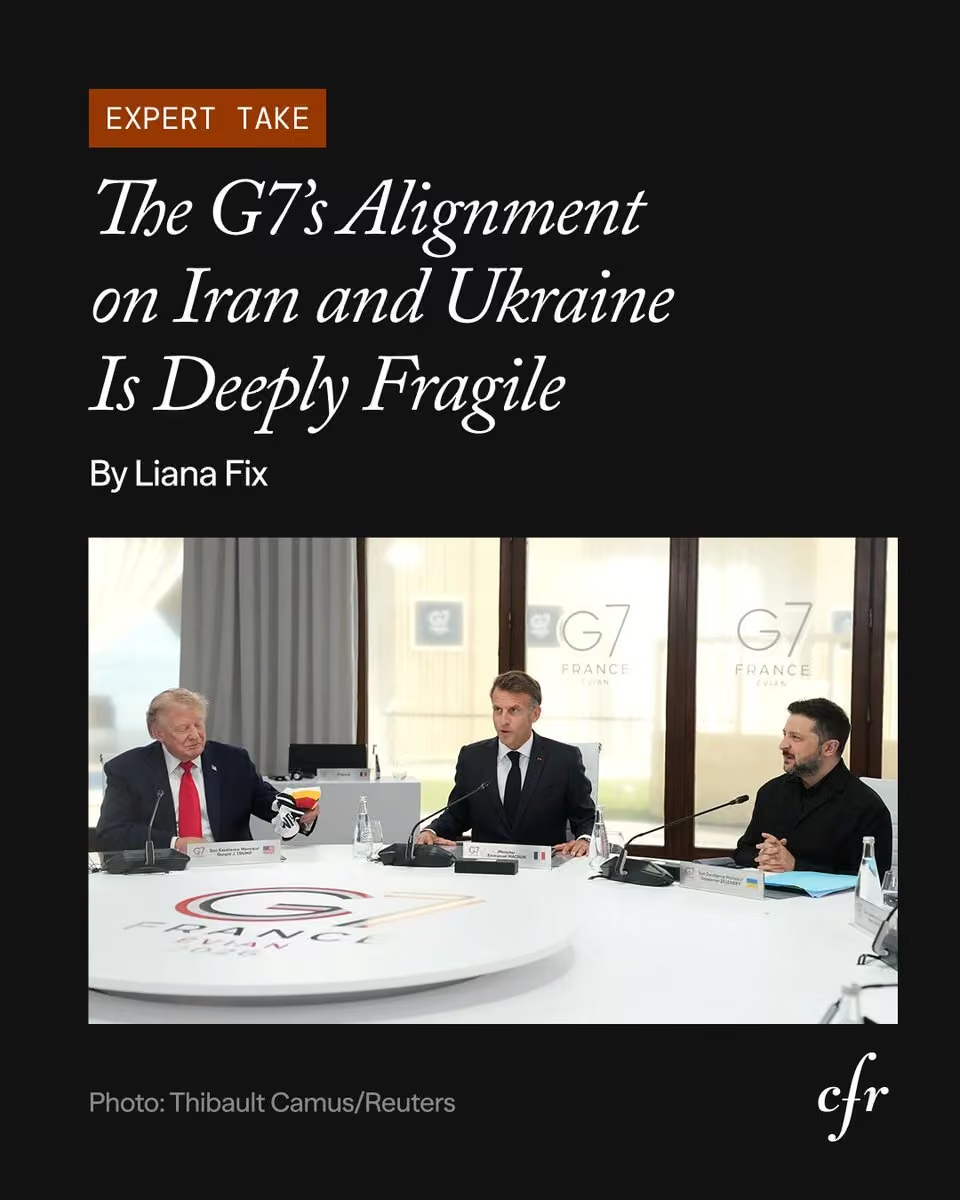
@CFR_org
Myanmar — the next Asian tiger? on.cfr.org/Jo5mNS By CFR's @joshkurlantzick
-
Council on Foreign Relations
@CFR_org
The World Next Week: @UN Security Council debates sanctions on #iran, #afghanistan; #greece begins 2nd bailout. on.cfr.org/AgYNjp
-
Council on Foreign Relations
@CFR_org
What will #2012 hold for the world's multilateral institutions? CFR's Patrick previews the year's summits: on.cfr.org/xtIsjo
-
Council on Foreign Relations
@CFR_org
CFR's Robinson says the best way to stabilize #afghanistan is to put Afghan troops in charge of #counterinsurgency on.cfr.org/s5LN5t
-
Council on Foreign Relations
@CFR_org
Today is World #maritime Day. Learn more about the state of the world's #oceans with this interactive guide: on.cfr.org/d5Fa47
-
Council on Foreign Relations
@CFR_org
#cfr's Frazer: While #ivorycoast conflict could be close to end, UN inaction is hypocrisy, espec w/Libya stance on.cfr.org/dY5RRQ