 Elastic
@elastic

Use your K8s PromQL unchanged in Elasticsearch
Same query, no rewrite go.es.io/48oNSRN

Politicians, athletes, journalists, NGOs, companies... They all use corporation-owned social networks to communicate with us. Citizens shouldn't have to hand over their data to companies to read content published by public entities. Public Feeds changes that by making posts of popular accounts freely available. Read more.

Elastic is a Dutch-American software company that provides a platform for enterprise search, observability, and cybersecurity. Its product enables users to search and analyze large-scale data, monitor system performance, and detect anomalies. Originally known as Elasticsearch, the company was founded in 2012 in Amsterdam, Netherlands, and has maintained its operational headquarters in both the Netherlands and San Francisco, California, US. Elastic is publicly traded on the New York Stock Exchange under the symbol ESTC. More on Wikipedia
Where developers learn, build, and share. Your source for hands-on demos, cheat sheets, explainers and more.
Elastic
@elastic
Use your K8s PromQL unchanged in Elasticsearch
Same query, no rewrite go.es.io/48oNSRN
Elastic
@elastic
Which of the three pillars of Observability offers you the right answer when an incident happens or a latency graph spikes?
Three questions for an SRE or operations team:
• Metrics: “what’s happening”. Numbers you can set alerting thresholds on
• Traces: “where is it happening”. They help discover bottlenecks
• Logs: “why is it happening”. Timestamped records of events
Elastic Observability combines logs, metrics, application traces and user experience data in a single, integrated platform.
The pillars post also proposed profiling as a fourth. OpenTelemetry Profiles reached Alpha in March 2026.
 Elastic
@elastic
The three pillars of Observabilty: go.es.io/4jg4AsM
Elastic
@elastic
Elastic Workflows reduces the complexity of investigating and analyzing alerts.
It ships an RCA example that does the boring half:
• Attach it to an observability alerting rule
• An Agent Builder agent investigates the alert and proposes root causes
• A case opens with an AI-written title and description, the alert attached, the analysis as a comment
• A final comment lists every reasoning step and tool call, so you can audit how it got there
Deterministic steps do the plumbing. The agent only reasons where reasoning helps. In the Labs walkthrough the workflow ran in 3 minutes 22 seconds, all five steps successful. One run, manual trigger.
The agent proposes root causes. The Labs walkthrough’s advice: start read-only. Self-managed, Elastic Workflows needs an Enterprise subscription. GA since 9.4.
Docs linked below.
 Elastic
@elastic
Docs: go.es.io/4sXUqQL
Elastic
@elastic
Deleting a document in Elasticsearch doesn't delete it. Not right away.
Data lives in immutable Lucene segments. A delete or update only marks the old doc as gone. The disk space comes back when segments merge and get rewritten.
Force merge does that rewrite on demand:
> fewer segments, faster searches
> deleted docs finally purged
One catch: it's heavy disk and CPU work. Only run it on indices you've stopped writing to.
In ILM, force_merge_index: true merges before the frozen snapshot, and that load lands on the tier before frozen.
Tier struggling? Add capacity or a warm forcemerge phase. Don't just turn the merge off.
 Elastic
@elastic
Reference docs: go.es.io/4frv4Fk
Elastic
@elastic
A cheap recall fix moved from step 31 to step 2.
DiskBBQ auto-calibration walks a list of candidate configs in cost order and keeps the first one predicted to hit 90% recall@10. So the order of that list decides what you ship.
The old order spent document bits too early. Rerank depth could swing the cost by more than a whole bit, so a 2-bit encoding with shallow reranking got tried before a 1-bit encoding with deeper reranking. Preconditioning only got a turn if every other config missed the target, which rarely happened.
That matters because document bits are permanent: you pay for them on every vector for as long as the segment lives. Deeper reranking or preconditioning can buy the same recall without growing the index.
We changed 2 things:
• Cost model: 3.0 × document_bits + 1.3 × rerank_depth (the weight was 1), so every 1-bit config sorts before any 2-bit one
• Preconditioning: tried on and off at every step, instead of as a fallback
Across our 11 benchmark datasets, 4-bit symmetric encodings are gone and preconditioning now gets picked on 3 of them.
The trade-off: where the config changed, recall@10 moved by at most 3 points in either direction with every cluster visited. Calibration still takes 1 to 2 seconds per merge.
If auto-calibration is already on for your bbq_disk field, there's nothing to change. Newly merged segments pick up the new order, and existing ones keep their config until they merge.
Full cost model, sweep order and per-dataset results:
go.es.io/3WyRhuK
 Elastic
@elastic
Elastic Streams is now a managed data pipeline for telemetry on Elastic Cloud Serverless.
Your shippers keep sending as they do now. Streams filters, parses, enriches and routes the data to Elasticsearch, your own S3 bucket, or both.
What that changes:
- Full record in your S3 bucket, only the queried subset indexed
- Every source, pipeline and destination in Streams Map
- The whole config exports as YAML for pull requests
- Elastic runs the OTel Collectors: nothing to size or patch
Private preview opens today for a selected group of design partners: go.es.io/3Vhu0wY
 Elastic
@elastic
You rotated your CA. Every config file has the new cert.
Some clients still fail with: x509: certificate signed by unknown authority
The culprit: long-running processes.
Most clients load their trust store once, at startup. Changing the file on disk changes nothing until they restart. We've seen Metricbeat sidecars up for months still trusting the old CA.
Safer rotation:
> Trust both old + new CA first
> Restart every client, sidecars included
> Then switch the server cert
> Remove the old CA last
 Elastic
@elastic
Your AI agent needs answers from millions of events that won't fit in its context.
“Which regions had >5% checkout failures yesterday, with ≥1,000 attempts?”
Give it Elasticsearch aggregations to group, count, calculate, and filter.
The agent gets a compact result.
 Elastic
@elastic
Your API's average latency is 80ms. Looks fine.
Now look closer: 98 requests took 20ms. 2 took 3 seconds.
Averages hide the tail. And the tail is real users, often your heaviest ones, because more requests means more chances to hit it.
Watch p95 and p99, not just the mean.
In Elastic APM, switch the latency chart from Average to 95th or 99th percentile and see who's actually waiting.
 Elastic
@elastic
Reference docs: go.es.io/3UkQVHp
Elastic
@elastic
Ask semantic search for "error E1042" and you may get docs about errors in general.
Not the one with E1042.
Vectors capture meaning. Exact tokens like error codes, SKUs and names get blurred.
Keyword search (BM25) nails exact matches but misses meaning.
So run both, and merge the two ranked lists with Reciprocal Rank Fusion (RRF). Docs that rank high in either list rise to the top, with no need to normalize two very different score scales.
That's hybrid search.
 Elastic
@elastic
Reference docs: go.es.io/4iLGHJf
Elastic
@elastic
How does search find one word in a billion documents in milliseconds?
It doesn't read the documents.
At index time, Elasticsearch builds an inverted index: every word mapped to the list of documents that contain it. Like the index at the back of a book.
Search "timeout" > jump to that entry > get the doc IDs > fed into BM25 for scoring.
The work moves from search time to write time. That trade is why search is fast.
 Elastic
@elastic
Reference docs: go.es.io/48kWkBt
Elastic
@elastic
Meta's Muse runs a 37.8M-param reranker on 2 CPU cores.
@rohanadwankar tore down the Muse agent VM. In its memory stack: jina-reranker-v1-turbo-en, 153 MB on disk.
Muse searches its users' memories in Postgres with vectors plus keywords. The Jina reranker orders those hits before the agent reads them.
Per the teardown, retrieval runs inside the VM, so memory chunks stay on the encrypted volume.
It's our English-only reranker from 2024. It still earns its place on a box with no GPU.
You can also run our latest @JinaAI_ models with Jina On-Prem. For self-contained and air-gapped deploys, with no outbound calls. .
Rohan's full teardown: go.es.io/4sxLHV7
 Elastic
@elastic
Did you know you can do K8s analysis with ES|QL on Elastic Observability?
Bookmark this: go.es.io/4iw4ITy
 Elastic
@elastic
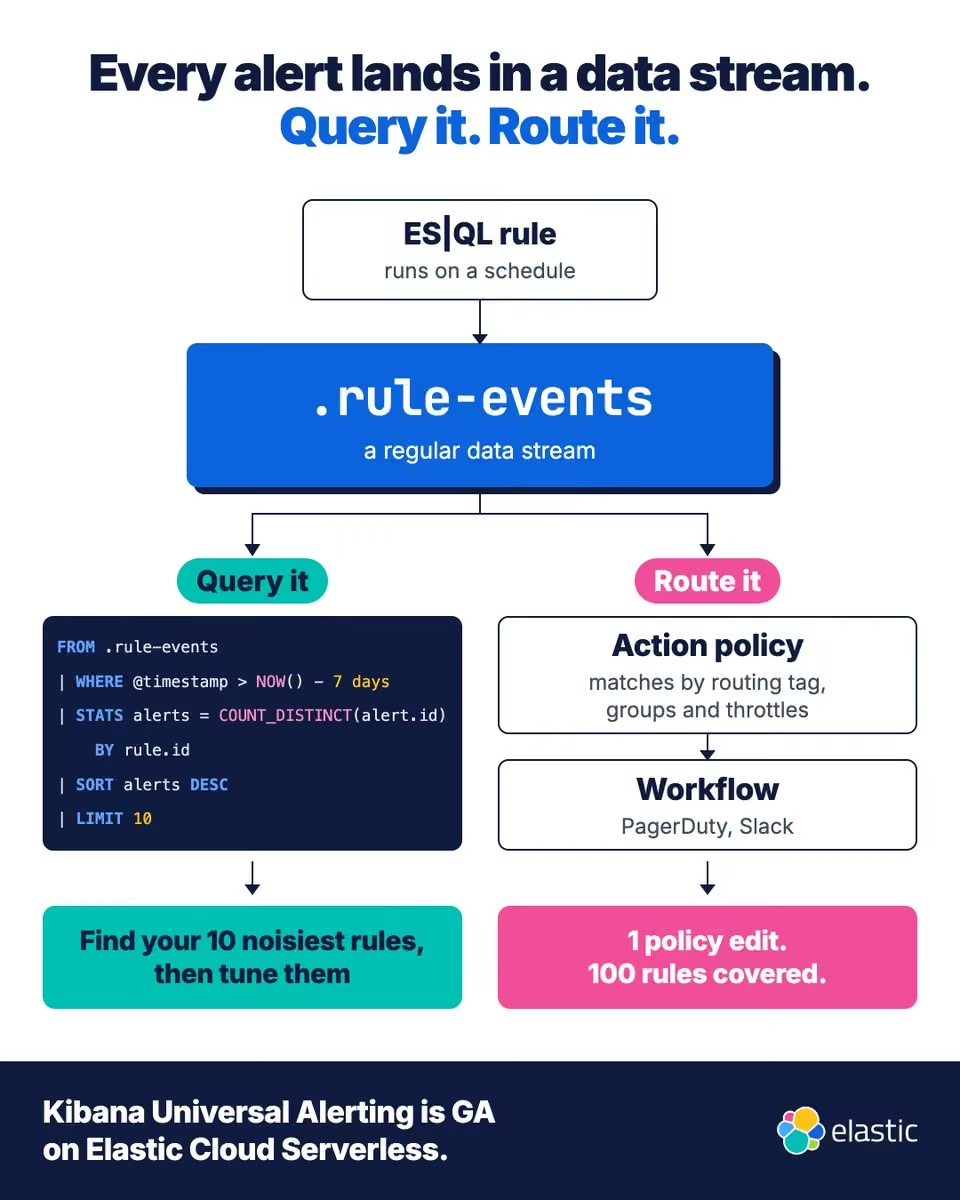
Your alerts are data now. So query them like data.
Kibana Universal Alerting is GA on Elastic Cloud Serverless.
One ES|QL query shows which 10 rules created the most alerts this week. Then you tune them.
- Alert and recovery delays keep a short spike pending instead of alerting
- Action policies route and throttle across rules: one edit changes who gets paged for 100 rules
It runs alongside Classic Alerting. Nothing migrates automatically, so move one rule at a time.
Full walkthrough with the rule YAML and queries: go.es.io/4iMLjin
 Elastic
@elastic
When a detection rule disappears, the first question is who deleted it.
The second is when, and in which space.
Elastic Cloud Serverless can now ship its audit trail to a Security project in the same organization. Log delivery is generally available, and 8 alerting rules and 7 dashboards arrive with the data.
The dashboards include:
• Kibana Object Forensics: who created, changed or deleted a saved object, and in which space
• Elasticsearch Data Access: who read which index, and who was denied
• Identity & Access: failed sign-ins by credential type, with API keys tracked separately from people
For security and compliance teams, the evidence lands where you already investigate, encrypted in transit and at rest.
5 ignore filters drop noisy events before delivery, so you don't pay to store UI clicks nobody will read.
Filter guide and a closer look at 3 of the dashboards in the blog: go.es.io/4jGSoSC
Elastic
@elastic
Ask a 56-page scanned PDF a question in plain language.
Get an answer stamped with the page it came from.
jina-ocr-v1 turns every page into structured Markdown, tables included. Elasticsearch embeds it at ingest, so there's no chunking or embedding code to write.
Walkthrough linked below 👇
Elastic
@elastic
Full walkthrough, code and setup steps: go.es.io/4eXdcls
Elastic
@elastic
Searching Claude's plugin directory for Elastic used to return nothing.
Now you'll find a plugin with nearly 30 skills across Elasticsearch, Kibana, Security and Observability.
In the video: install the Elastic CLI, add the plugin, then ask Claude to find an error spike in web logs and build a Kibana dashboard around it.
Install it from Settings > Plugins > Discover and search "elastic".
What it took to get into Claude's directory, including the 3 review warnings and why we stopped pointing at main: go.es.io/4yD1HXn
Elastic
@elastic
Opting into DiskBBQ auto calibration raised average QPS 16.7%.
That's indices with auto_calibrate: true vs DiskBBQ's fixed defaults, across 18 public benchmarks.
Quantization bits, oversampling, preconditioning: the right mix depends on your dataset and embedding model, and it shifts every time segments merge.
With auto calibration on, Elasticsearch samples vectors at merge time and predicts recall @ 10 for each candidate encoding and rerank depth.
It stores the most efficient configuration predicted to hit 90% recall @ 10 in that segment's metadata, then re-evaluates on the next merge.
Opted-in indices vs the fixed defaults:
- QPS up 16.7% on average, and up on 15 of 18 datasets
- Over 50% higher QPS on FiQA GTE, Fashion-MNIST and GloVe-200
- Recall up on 15 of 18, including +296% on Fashion-MNIST
- Where either metric dipped, QPS stayed within 1.5% and recall within 2%
The trade-off is at index time. Overhead was under 2% on more than half the datasets and at most 11% on large ones like DBPedia-Entity and HotpotQA. Small datasets saw more, up to 35%, because the calibration sample is a fixed size.
Jina v3 embeddings quantize well enough that calibration chose 1-bit documents on all 3 corpora we tested.
Opt in with one line in index_options:
"type": "bbq_disk", "auto_calibrate": true
 Elastic
@elastic
Tommaso Teofili and Thomas Veasey break down the cost model and error estimation: go.es.io/4iavgt6
Elastic
@elastic
You have a specific visual in your head, but have no idea which file it’s in.
This walkthrough uses Jina embeddings + Elasticsearch to search video by describing what you’re looking for, in natural language: go.es.io/4siXJBX
You receive back the matching scene with timestamps.
 Elastic
@elastic
Proud to make it official with the @audif1_ !
Our relationship started with the team's engineers using Elastic to search and investigate issues across their connected engineering applications. Now, we're building on that foundation through a multi-year partnership, with plans to bring those capabilities to even more applications.
Here's to the seasons ahead and everything we'll build together.
 Audi Revolut F1 Team
@audif1_
New name on the R26 for Austin. 🇺🇸
Welcome, Elastic. Official Race Partner this weekend, Official Search and Observability Supplier from 2027.
 Elastic
@elastic
Elastic is now an Official Supplier of the @audif1_
Behind every engineering breakthrough is a complex, distributed software environment. To keep technical teams moving fast and focused, organizations require immediate visibility into the software and systems that power their engineering work.
Elastic is helping the Audi Revolut F1® Team understand what is happening across its engineering software stack to find signals that matter and act faster. The goal is one operational view from factory to track.
The team already uses Elastic technology as the foundation for its central software logging platform. Starting with the 2027 season, Elastic will become its Official Search and Observability Supplier.
More on the partnership: go.es.io/4yD5GTV
 Elastic
@elastic
When people say “hybrid search,” they usually mean keyword + semantic.
But what about semantic + geospatial?
If I search for “a quiet café to work from,” understanding what I mean is only half the job. I also need it to be nearby.

Elastic reposted
 Elastic Security Labs
@elasticseclabs
Two critical PHP RCEs are patched: CVE-2026-109618 and CVE-2026-109619, both CVSS 9.2.
• Fixed in 8.5.12, 8.4.27, 8.3.36, and 8.2.35.
You can still focus on detection coverage today.
Security Labs writeup (coverage + guidance): elastic.co/security-labs/threat-command/php2shell-php-rce…
Most PHP RCEs converge on the same outcome, whatever the bug: a web server process (php-fpm, php-cgi, apache2, httpd) doing something a request-serving daemon almost never does legitimately.
• a shell to confirm access: id, whoami, uname -a
• a second stage pulled in: curl http://... | bash
• a reverse shell: bash -i >& /dev/tcp//
• a webshell written into the web root
The bug class is public now: out-of-memory corruption, and stale state reused by the same worker. The behavior is what you detect.
We recently ran a different PHP RCE end-to-end (wp2shell): apache2 spawning dash to run id; whoami; hostname fired the exact rules that we suspect to catch php2shell. Payload Execution by Web Server kills the shell on the endpoint.
The Suspicious/Unusual Command, Child, and File Creation via Web Server rules stack on top.
(PHP did confirm partial php.ini mitigations. session.upload_progress.enabled=0 blocks the confirmed session paths only. Patch is still the fix.)
Patch to 8.5.12, 8.4.27, 8.3.36, or 8.2.35. Verify that the stack is enabled now.
Guidance + every rule link below.
 Elastic
@elastic
Building search into a Java music library with plain Lucene, one step at a time.
The tracks are indexed. Now we query them.
Should "Bob" in a title count for more than "Bob" in an album?
Step 1: start with no criteria. Open an IndexSearcher and fetch the first 10 hits. Each hit carries a Lucene doc number, so read the stored id and join back to your beans.
 Elastic
@elastic
We're building search into a Java music library with plain Lucene, one step at a time.
Next up is analysis: what happens to your text before it reaches the index. An analyzer cuts it into tokens, lowercases them and folds the accents away.
Step 1: add lucene-analysis-common for ASCIIFoldingFilter. Pin the same version as lucene-core
 Elastic
@elastic
Your beans are mapped. Now, who owns the index?
Step 1: wrap Directory + IndexWriter in a small class dedicated to your bean.
ByteBuffersDirectory for in-memory, FSDirectory to persist
 Elastic
@elastic
Get any Java bean ready for Lucene in 3 steps
You have a Track bean. You need search.
Step 1: embed Apache Lucene in-process. One dependency, no native code, no server to run.
Elasticsearch does this for you on top of Lucene. Here's what it looks like by hand 👇
 Elastic
@elastic
Step 3: filter and exclude.
Wrap the text query as MUST. Add a FILTER on genre = Club: 62 → 26 hits. Add a MUST_NOT on keys 4A or 4B: 26 → 23.
FILTER and MUST_NOT narrow the results without touching the score.
Gotcha: a query with only MUST_NOT matches nothing. When users exclude without typing, add a MatchAllDocsQuery as MUST.
 Elastic
@elastic
Step 4: ask Lucene why a track ranked where it did.
searcher.explain(query, doc) breaks the BM25 score down per term: boost × idf × tf.
On a track with "bob" in both title and album, the title clause adds 10.77 and the album clause 4.08. So yes, the title counts for more.
Next: facets, counting what users can click.
Code for the series, built by @dadoonet github.com/dadoonet/lucene-search-tracks
 Elastic
@elastic
Most “share chat” links are a secret URL to a frozen copy.
Anyone with the link can read it, and nobody can continue it.
Shared Agent Builder conversations are live and use the Kibana privileges you already have.
No bearer link.
 Elastic
@elastic
Why share an Agent Builder conversation instead of a summary? www.elastic.co/search-labs/blog/agent-builder-conversatio…
Elastic
@elastic
Stop moving Grafana dashboards by hand
Elastic’s tools make dashboard migration a whole lot easier: www.elastic.co/observability-labs/blog/migrate-datadog-gr…
Elastic
@elastic
We're building search into a Java music library with plain Lucene, one step at a time.
Next up is analysis: what happens to your text before it reaches the index. An analyzer cuts it into tokens, lowercases them and folds the accents away.
Step 1: add lucene-analysis-common for ASCIIFoldingFilter. Pin the same version as lucene-core
Elastic
@elastic
Your beans are mapped. Now, who owns the index?
Step 1: wrap Directory + IndexWriter in a small class dedicated to your bean.
ByteBuffersDirectory for in-memory, FSDirectory to persist
Elastic
@elastic
Get any Java bean ready for Lucene in 3 steps
You have a Track bean. You need search.
Step 1: embed Apache Lucene in-process. One dependency, no native code, no server to run.
Elasticsearch does this for you on top of Lucene. Here's what it looks like by hand 👇
Elastic
@elastic
Step 2: build the analyzer chain.
StandardTokenizer splits the text. LowerCaseFilter lowercases it. ASCIIFoldingFilter turns "François" into "francois".
No stemming, so artist names stay intact. No stop words, so "Around The World" stays searchable.
Use the same analyzer at index time and query time, or your query terms won't match.
 Elastic
@elastic
Step 3: the index holds terms, not text.
After commit, each term points to the documents that contain it. Look up artist:bob and you get docs 1, 2 and 3.
It works like the index at the back of a book: jump to the term, skip the scan.
Next: type "Bob" and build the query a real search engine runs.
Code for the series, built by @dadoonet github.com/dadoonet/lucene-search-tracks

Elastic reposted
 Carly Richmond
@CarlyLRichmond
📣 Attention #devrel friends!
@elastic are hiring Senior Developer Advocates in NYC, US and Sao Paulo, Brazil. Job specs 👇 .
jobs.elastic.co/jobs/marketing/new-york-united-states/sen…
jobs.elastic.co/jobs/marketing/brazil/senior-developer-ad…
If you are based in these locations and have a background in #devrel or software engineering, apply!
Elastic
@elastic
Same 1.25 GiB load, twice. 1 run alerted, 1 didn't.
 Elastic
@elastic
Full walkthrough with the ES|QL queries, alert rules, and a companion notebook that rebuilds the whole lab: go.es.io/4yVMeTm
Elastic
@elastic
Your beans are mapped. Now, who owns the index?
Step 1: wrap Directory + IndexWriter in a small class dedicated to your bean.
ByteBuffersDirectory for in-memory, FSDirectory to persist
Elastic
@elastic
Get any Java bean ready for Lucene in 3 steps
You have a Track bean. You need search.
Step 1: embed Apache Lucene in-process. One dependency, no native code, no server to run.
Elasticsearch does this for you on top of Lucene. Here's what it looks like by hand 👇
Elastic
@elastic
Step 3: edit one row, not the whole index
updateDocument deletes by term, then adds, in one call.
Key it on the id StringField from part 1. It's never analyzed, so the term matches exactly.
 Elastic
@elastic
Step 4: close the writer first, then the directory
Order matters
If request threads share the index, put every mutation behind the same lock.
Rule of thumb: upsert or delete for single-row edits, full rebuild for bulk changes.
Next: what happens to a token before it reaches the index.
Code for the series, built by @dadoonet github.com/dadoonet/lucene-search-tracks
 Elastic
@elastic
In an agentic trace with 20 LLM calls, you can see which span is using the most tokens and read the prompt that caused it.
Both live in Elastic APM, so there's no second tool to run. x.com/i/article/2109960058469494784
Elastic
@elastic
Get any Java bean ready for Lucene in 3 steps
You have a Track bean. You need search.
Step 1: embed Apache Lucene in-process. One dependency, no native code, no server to run.
Elasticsearch does this for you on top of Lucene. Here's what it looks like by hand 👇
Elastic
@elastic
Step 3: map your bean to a Lucene Document.
Copy only what you need to find it, and always store the id.
 Elastic
@elastic
Indexing and search build on this. That's next.
Code for the series, built by @dadoonet 👇
go.es.io/47NixYB
Elastic
@elastic
An early look at Elastic nightshift AI SRE (private preview)
Elastic
@elastic
Same agent, same model, same question. 71% fewer tokens.
Connecting an agent to enterprise data works in the demo. In production it spends most of its budget on discovery: what the schemas are, what the fields mean, how entities relate across sources. The usual fix is adjusting prompts and skills by hand until it behaves.
We tested this on a simulated environment.
The question: "Give me a summary of the issues hitting our largest customers."
Left alone, the agent lists indices, reads mappings, pulls contracts one by one to work out what "largest" means. 33 tool calls, 213 seconds. And it still missed that LongHaul is a subsidiary of Orion Holdings, so one of the top accounts came up short.
Honestly, that miss bothered us more than the token bill.
So we moved the discovery earlier. Automations read each source and save what they learn as Knowledge Indicators: what an index is for, how to query it, which entities are related, which fields tend to be empty. They refresh as the data changes. When a question comes in, the agent pulls the few that matter.
Same question again: 9 tool calls, 64 seconds, and this time it caught the parent company.
The precompute isn't free. But it runs once, on deterministic workflows and small cheap models, and the heavy reasoning model gets to use it on every question after.
We're calling this layer Context Engine. It's in beta, and we're looking for developers running agents in production to help shape it. Tell us where it breaks.
Full write-up, including the model and harness we used: go.es.io/4dvSxVb

Elastic reposted
Elastic Security Labs
@elasticseclabs
AlertZero, the agentic layer of Elastic Security, is heading to technical preview.
Full walkthrough from @jamesspi, including the ES|QL query Detection Watch uses to rank rules by false-positive closures: go.es.io/4drpzpg
AlertZero has 4 Watches, each a group of named agents with one SOC responsibility.
• Triage Watch: alert analysis plus Attack Discovery, one Investigation per attack
• Hunt Watch: threat research tested against your telemetry, exact lookups first, behavior second
• Detection Watch: investigates rule gaps and FPs, proposing the edit with a backtest
• Forensics Watch: reconstructs the endpoint, then proposes response actions through Elastic Defend
Every consequential change arrives as a Proposed Action. Approved and executed are logged as separate states.
Elastic
@elastic
Introducing the Elastic nightshift AI SRE – your always-on SRE coworker.
•Investigates like an SRE, ruling out dead ends and showing you how it got there
• Uses complete context from all your telemetry, not just what you could afford to keep
• Finds unknown issues your alert rules don't cover
• Recommends a fix and the evidence behind it
• Works from the Kibana UI, a terminal, or an agent of your choice
Now in Private Preview. Free on Serverless during the promotional period.
Elastic
@elastic
What’s under the hood
Context: what makes the other three work. It maps the services and hosts in your environment and how they relate, from your telemetry, and reads your wikis, runbooks, and code. Every investigation, postmortem, and piece of feedback adds to its long-term memory, so it knows your systems before the incident event starts.
Investigation: starts from any alert, fired in Elastic or in a tool you already use. It forms hypotheses and tests them in parallel against logs, metrics, traces, and profiles. Dead ends get dropped. Every investigation ends with a conclusion, impact, proposed actions, and blind spots: what it couldn't verify. Drill from any step to the raw data.
Detection: continuously evaluates your telemetry, with no rules to write. When related signals show up across services, it groups them into one Significant Event and can start an investigation before anyone looks.
Remediation: picks an existing Elastic Workflow or connector action and fills in the parameters from this incident, or hands you commands for a terminal or coding agent. You can review each action before it runs, or let it apply fixes on its own.
Elastic's own SRE team already runs this in production.
See the announcement: go.es.io/3WfjrdO
Elastic
@elastic
Using Dev Tools is one of the best ways to prototype every query before it goes into your code.
Within Dev Tools, autocomplete will help you know your index names, your field names, and the full API needed, and it’s been the go-to testing place for developers using Elastic.
Elastic
@elastic
This is how our new Columnar Mode works.
It changes how Elasticsearch stores data from document-oriented, to be more suitable for analytics, security & operational data.
The key changes are:
- Non-text fields stored as doc values and not in inverted indexes by default
- Doc value skippers speed up filtering these doc values
- Text fields are still indexed to support full-text search
- `_source` data can optionally be reconstructed from columnar representations for efficiency
The user-facing APIs, dashboards and integrations remain the same. This is an under-the-hood option that increases efficiency for suitable workloads.
Try it out by selecting it at index creation time. go.es.io/47CIUAt
 Elastic
@elastic
An ES|QL query that took ~500 seconds now runs in ~5.
The query: a WHERE with two LIKE wildcards on message, sorted @ timestamp DESC, LIMIT 500, over 346 million Nginx log docs .
Before Elasticsearch 9.6, every candidate row got loaded, decoded, and run through the wildcard filter before TopN saw it. Most of that work never reached the result.
9.6 changes the order. Once the TopN heap is full, its worst value becomes a threshold. ES|QL pushes that threshold into Lucene mid-query. Rows that can't beat it are never loaded.
Parallel drivers share the threshold too. One driver finding good rows early prunes work for all the rest.
p50 of 51 runs, 100 shards:
- Local node (Apple M4): ~500s to ~5s
- Elastic Cloud Serverless: ~520s to ~14s
It only applies to @ timestamp sorts for now. And the gain shrinks when matches are rare or good candidates show up late.
go.es.io/3TBk3K8
Elastic
@elastic
Point Grafana's Prometheus data source at Elasticsearch
Full walkthrough: go.es.io/4AJAt3D
 Elastic
@elastic
A bloom filter is a super fast, and efficient first-pass filtering algorithm.
It hashes each candidate into several required bit positions in a bit array. If any of those required bits are unset, the candidate is definitely absent; otherwise, the candidate may be present and needs verification.
With Elasticsearch's metrics store, it is used for the first stage of a two-stage deduplication process which doesn't even require an inverted index of object IDs. In fact, Elasticsearch doesn't even store a dedicated ID field!
- The `_id` field is now synthetically produced by combining the `_tsid`, and the `@ timestamp`
- The bloom filter works as a first-stage deduplication pass, and then Elasticsearch verifies the candidate point against the synthetic `_id`.
This preserves deduplication behavior without paying for a dedicated inverted index.
TSDB benchmarks show this reducing storage by ~5 bytes per sample.
Elasticsearch for metrics storage: go.es.io/4dSdPfF
 Elastic
@elastic
We had Jev score Elasticsearch hybrid search results and let a short Python policy do the reranking.
• nDCG@10 went from 0.9351 to 0.9565 (250 Amazon Queries)
• Latency: 70–500ms end-to-end
• Cost: $0.042/M input tokens (outputs free)
No text parsing, just structured probabilities feeding business logic.
go.es.io/4hAKxDc
Elastic
@elastic
Before you run a single kNN query, you need to decide how Elasticsearch stores your vectors.
The dense_vector mapping has five key parameters that determine accuracy, memory usage, and query speed.
Most people copy a snippet from the docs - but knowing what each option does means you can tune for your use case instead of guessing.
Here is the full reference for ES 9.x.
Documentation: go.es.io/4xTiS6M
 Elastic
@elastic
Sequence numbers (`_seq_no`) are a key mechanism for making Elasticsearch's distributed system work.
The primary shard assigns sequence numbers of write operations, and replicas use them to make sure that they have "caught up" to the primary.
They also help to power concurrency control for the system.
But, metrics are different. The primary need for a metrics store is append-only, meaning that once the initial replication is complete, there's no real need for further operations that need consistency.
So Elasticsearch can now treat `_seq_no` as vestigial, trimming them once the global replication checkpoint has passed the segment’s maximum sequence number. The trade-off is that optimistic concurrency control, single-document updates and `_seq_no` queries are unavailable.
But these are rarely used with metrics (if ever), and TSDB benchmarks show this reducing storage by over 2.5 bytes per sample! A big part of our reduction from 25 -> 3 bytes per sample.
 Elastic
@elastic
Elasticsearch for metrics storage: go.es.io/4hxNzZ0
Elastic
@elastic
Yes, Elastic ingests Native Prometheus!
Setup and walkthrough: go.es.io/4xSLCfZ
 Elastic
@elastic
Elasticsearch 9.5 ships with an improved doc-values codec - ES95.
Since we have no way of knowing what the name comes from, let's talk about the codec itself.
It is an adaptive codec that chooses its own adventure (i.e. compression path).
Monotonic timestamp and long-counter sequences are handled "SplitDelta", and "ALP" encodes suitable double-valued gauge fields efficiently.
The result is a smarter algorithm resulting in smaller footprints. A recent benchmark of 2+ billion high-cardinality data showed a reduction of 30+%, and huge reductions (90+%) for timestamp data!
Try it out: go.es.io/4xMi43D
 Elastic
@elastic
Inverted indexes are one of the core pillars of information retrieval.
It is literally THE thing that powers keyword (lexical) searches, by mapping terms against matching document IDs.
But, does every job and every data type require an inverted index? As it turns out, maybe not. Time-series data is a great example. Time series queries often actually ask "What are the values between two points in time?", rather than "What entries contain words XYZ?"
Elasticsearch leverages these properties, by only using inverted indexes where they add value.
TSDS uses doc values and skippers for relevant time-series fields instead of separate backing indexes. Text fields retain inverted indexes where full-text search is required.
Right tools for the right job.
 Elastic
@elastic
Read more: go.es.io/4h8qsW4
Docs: go.es.io/46IGxf6
Elastic
@elastic
We indexed 138M vectors in under 10 minutes.
Benchmarked on MS MARCO: 138M vectors at 1,024 dims, from ~4 TB of documents, on 8 NVIDIA RTX PRO 6000 GPUs at 95% target recall:
Built with NVIDIA cuVS @NVIDIAAI
- Indexing throughput: 38K docs/s on CPU, 281K on GPU
- 6x lower p90 search latency under concurrent indexing load
- Force merge: roughly 4 hours down to 5 minutes
- Same recall profile as CPU-built indexes
Benchmarks, setup instructions, and the Rally track parameters: go.es.io/3VPp1n2
 Elastic
@elastic
Supabase monitoring in Elastic, with no agent to install.
Built in collaboration with @supabase
Available for Supabase Pro, Team & Enterprise on Elastic Cloud.
Integration: go.es.io/4rCe8B6
 Elastic
@elastic
What is a doc-value skipper?
It's a small, but powerful way to efficiently filter values in Elasticsearch. It asks "does this block of doc values contain values in the required range?" by cataloging the minima and maxima for blocks of documents.
If the answer is no, the query can skip the block. If yes, dig into the block to check for matches.
This is a great solution for time-series data, because it is sorted by `_tsid` and `@timestamp`. The resulting blocks are composed of related values; and in turn, they are great for time and dimension filters.
You might ask - why do this? The main benefit is efficiency. Going from relevant inverted-index and BKD-tree indexes to doc value skippers reduced storage by 10 bytes/point in one benchmark.
It's one of the key components that power Elasticsearch's optimisations for metrics, and for Columnar Mode.
Try it out go.es.io/47iOrvK
 Elastic
@elastic
Elasticsearch has made huge strides on its metrics store.
Metrics are unique. They are by nature ordered, being a function of time. So, Elasticsearch's TSDB uses these:
- Doc value skippers - fast scans & filtering through time range and dimensions without separate indexes
- Synthetic `_id` from `_tsid` and `@ timestamp`, and bloom filters support fast, efficient deduplication checks
- `_seq_no` trimming after safe merges, leveraging the fundamentally different usage pattern for metrics data
- ES95 codec further improves compression efficiency in Elasticsearch 9.5 and onwards
Benchmarks show each metrics point being reduced in size from ~25 to ~3 bytes per point, a huge reduction.
It might be a great time to consolidate your logs and metrics store to one place.
25 to 3 bytes per data point: go.es.io/4dPQawe
What's new in 9.5, including the ES95 codec: go.es.io/4iIY127
 Elastic
@elastic
Your agent gave a wrong answer and you can't reproduce it.
Same prompt, different path. It picked a different tool this run, got an empty result back, and answered anyway.
Re-reading the prompt won't show you that. The trace will.
The OpenTelemetry GenAI semantic conventions provide vendor agnostic telemetry specification, where spans represent model calls and tool calls with arguments for messages attached.
Elastic reads the gen_ai.* attributes and puts token usage on the waterfall beside the spans. A slow run becomes a visibly expensive one.
Worth knowing: the conventions are still moving. Pin your semconv version and expect attribute renames.
Once tool calls are spans, an agent failure is a trace you read top to bottom.
LLM tracing in Elastic APM: go.es.io/4rk8Qd7
 Elastic
@elastic
Your user's stack trace died with the browser tab.
They report that the app froze. You have no telemetry, because console.log() wrote to a console you will never see.
Server side you would never accept this. On the client side most teams still do.
The OpenTelemetry JS SDK treats browser logs as a first class signal: @opentelemetry/sdk-logs plus the OTLP HTTP log exporter, pointed at your collector. Elastic ingests the OTLP payload as it arrives, so there's no vendor format to maintain.
Before you ship messages:
- Redact sensitive data and PII such as emails and form values
- Sample telemetry, every user is now a log producer
Wire trace context through and the user's console output arrives attached to the request that broke, and correlates with server side signals. That's what actually shortens the investigation.
 Elastic
@elastic
Read more: go.es.io/4rlKbVI
Elastic
@elastic
Images fill your context window before the question does.
A single 384px page becomes hundreds of visual tokens. Send
all of them to the LLM and there's no room left to reason.
jina-vlm sits an attention-pooling connector between a
SigLIP2-So400M/14-384 encoder and Qwen3-1.7B-Base. The
connector weighs which visual tokens carry signal, then hands
the text model a smaller set.
Two-stage training, multilingual by design.
Pooling costs you fine detail. Small type inside a dense table
is still hard.
Most people blame the LLM for bad answers on mixed documents.
The trade usually happens at the connector.
Read the paper: go.es.io/3TysG89
 Elastic
@elastic
The HNSW vs DiskBBQ call comes down to recall and budget.
HNSW scales logarithmically and it is genuinely fast, but only while the vectors stay resident. Let them spill and latency climbs exponentially. Indexing pays the same tax, because building the graph means searching the graph.
DiskBBQ clusters vectors with hierarchical k-means and keeps them BBQ-quantized on disk, scoring only the clusters a query touches.
Need 99%+ and have the memory budget? Stay on HNSW. Cost-sensitive and fine at 95%?Go with DiskBBQ.
go.es.io/3UQa1Fh
 Elastic
@elastic
An AI agent is optimizing Elasticsearch. Engineers validate on improved performance
Coding agents are trained on tasks judged by LLMs and humans. Being convincing gets rewarded. That's a problem when the question is "did this get faster?"
One agent, two phases with different permissions. Exploration goes broad on a real workload and ranks opportunities; a human approves the benchmark and promotes one into a scoped exploitation task. A statistical acceptance rule the agent can't bypass decides whether it lands, and a human reviews before the PR.
All validated with Elasticsearch engineers in the loop
 Elastic
@elastic
Full design write-up:
go.es.io/4xC3taX
Elastic
@elastic
jina-ocr-v1 is now available.
One model covers what otherwise takes a pipeline in OCR: layout, tables, math, handwriting, 100+ languages.
- Scores 83.4 on olmOCR-bench: highest of any OCR model under 600M active parameters
- Scores 91.14 on OmniDocBench, ahead of GPT-5.2 (86.59) and Qwen3-VL-235B (89.78)
- 3.4B total parameters, 570M active: the memory of a 3.4B model, the speed of a 570M one
- Input as PNG
- Output is Markdown, with HTML for tables and LaTeX for math
Also on the Jina API (10M free tokens) with downloadable weights on Hugging Face, CC BY-NC 4.0 licensed for research and noncommercial use.
Blog, technical report, and model card: go.es.io/4AkhUmv
Try it on your own scans via the Jina API, 10M tokens free: go.es.io/4yN0jSO
 Elastic
@elastic
AlertZero: From Alert Noise to Attack Narratives: Relevance Please - Episode 9 x.com/i/broadcasts/1nxeLMmvzPvJX
Elastic
@elastic
Cross-project search is GA on Elastic Cloud Serverless.
Search across serverless projects in different regions and cloud providers without moving data.
You can now link up to 100 projects by default (higher limits on request) from project settings in the Elastic Cloud console. Queries hit every linked project automatically. Route your search with project routing by region, cloud, alias, or custom tags. Data access control is consistent and complete wherever you’re querying from using Elastic Cloud API keys.
Works with Security, Observability, Search, and Vector Database project types, including serverless projects you are already running. Complete tier is required for Security and Observability projects.
Link the projects, open Discover, and run a cross-project query today.
 Elastic
@elastic
Full GA details, setup walkthrough, and the per-feature nuances (alerting, SLOs, Synthetics, Streams): go.es.io/4yzE826
Elastic
@elastic
6,000,000,000 downloads.
If you've ever built on it, deployed it, broken it, fixed it, or shipped something with it: this one's yours.
Thank you.
 Elastic
@elastic
HNSW buys fast search by keeping every vector in RAM.
It needs them there to index too, because indexing means querying the graph you're still building.
DiskBBQ takes the other route:
- Hierarchical k-means groups similar vectors into small clusters
- BBQ compresses each vector 32x
- A query scores nearest centroids, then bulk scores only those clusters
On 1M vectors in memory: 94s to index against 1,054s. Recall 91% against 92%.
That's a point of recall for an order of magnitude on indexing. Above 99% recall the trade stops paying, and HNSW is still the answer.
 Elastic
@elastic
DiskBBQ introduction: go.es.io/4AkyYZM
Elastic
@elastic
You and your AI agent shouldn't be using curl.
A skill that shells out to curl has a hostname, an API key and a runtime baked in. Change one and it breaks. Worse, the key is in the skill file, so it's in the transcript too.
The Elastic CLI gives every Elasticsearch, Kibana and Cloud API the same shape. Learn elastic es search and you already know how elastic kb data-views list behaves. Agent Skills now run on it.
- API keys stay in your OS keychain, not in flags
- Any command prints its JSON Schema with --help --json
- --dry-run validates input and sends nothing
- commands.allowed in your config decides what an agent can run
- --output-fields cuts a response down to what fits the context window
Tech preview, on npm now: npm install -g (at)elastic/cli
Full write-up, including allowlist config and how universal skills bind HTTP calls to CLI commands: go.es.io/4At7j90
Elastic
@elastic
SUM(request_count) in a FROM query is not your request rate.
request_count is a cumulative counter: each sample is the running total since the process started. FROM treats every document as an independent row, so SUM adds each host's running total once per sample. The result isn't a rate, isn't the number of requests in the bucket, and keeps growing even after traffic stops.
FROM metrics-* | STATS SUM(request_count) BY BUCKET(@ timestamp, 5m)
TS is the source command built for this:
TS metrics-* | STATS SUM(RATE(request_count)) BY TBUCKET(5m)
TS groups samples by time series before anything else runs. RATE computes the per-second change inside each series and handles counter resets. SUM then adds those rates across hosts.
That's the shape of every TS query: an inner function per time series (RATE, AVG_OVER_TIME, MAX_OVER_TIME), then a normal aggregate across them (SUM, AVG, MAX). Skip the inner one and TS defaults to LAST_OVER_TIME, which is why TS | STATS AVG(cpu_usage) and FROM | STATS AVG(cpu_usage) return different numbers.
When to use which:
- TS for metric aggregations on a time series data stream. Dashboards, alerts, charts.
- FROM for events: logs, traces, audit records. Each row is independent.
- FROM on a TSDS still works and is useful for inspecting raw metric documents, but it has no per-series semantics.
Pick the inner function deliberately. The outer one is the easy part.
 Elastic
@elastic
Read more: go.es.io/4r8YDQV
Elastic
@elastic
Elasticsearch 9.5's columnar index mode stops indexing most fields by default.
So what keeps a range query fast without an inverted index or BKD tree?
2 changes underneath made it possible. Tech preview, read before you switch. x.com/i/article/2098416376255782919
Elastic
@elastic
OTel Lookup Processor: Relevance Please - Episode 8 x.com/i/broadcasts/1qKDzWAREAOJV
Elastic
@elastic
The hard parts of hybrid retrieval, already done.
Elasticsearch Vector Database is a new serverless offering where expert-level tuning is the default:
- bfloat16 storage: half the disk footprint before quantization even starts
- BBQ: up to 32x vector compression, 95% less memory
- Auto-calibration re-tunes quantization on every merge as your data drifts
- Filtered vector search at up to 8x higher throughput than OpenSearch
- Jina AI embeddings and reranking on managed GPU inference, or bring your own models
You bring documents and queries. We handle the embeddings, tuning, and infrastructure.
Full breakdown, including the semantic_text quickstart and what ships in vectorDB index mode: go.es.io/4gKmbrN
Elastic
@elastic
BM25 has been the default similarity on every Elasticsearch text field since version 5.0. Every lexical query
you have ever run was scored with it (unless you defined otherwise).
That default still does work, vectors can't. Exact tokens are the clearest case: SKUs, error codes, version
numbers, people's names. A dense retriever puts you in the right neighborhood. BM25 lands on the token.
So run both. RRF fuses the two result sets by rank, blending the scores between the two approaches.
 Elastic
@elastic
Wildcard queries like *pizza* are 2.3x faster on columnar keyword fields in Elasticsearch 9.5.
The old path builds an automaton for every *term* query and runs state transitions per document. Expensive when you're scanning millions of rows with no inverted index.
The rewrite rule spots the *term* pattern at runtime and swaps in a SIMD substring search instead. Simpler code, wider registers, same result.
A second rule handles empty string filters. SearchPhrase != '' used to decompress Zstd chunks just to check for zero-length values. Now it reads string lengths straight from the offset array: 1.6x faster, skips the Zstd step entirely.
Both rules came from the same habit: run a real query, find the special case, swap in something cheaper.
 Elastic
@elastic
Blog: go.es.io/3SBfS0p
Both optimisations ship in Elasticsearch 9.5+ and Elastic Cloud Serverless. Columnar mode is available as a technical preview.
Elastic
@elastic
Do you know why BM25 is still useful when we have vector search?
BM25 stops rewarding the 20th "cat" in a document.
Plain TF-IDF lets term frequency grow without limit.
A keyword-stuffed page outranks a good one.
Two parameters fix that.
k1 caps repetition. The term frequency factor climbs
toward an asymptote of k1 + 1, so the 20th hit adds
almost nothing over the 5th.
b handles length. |D| / avgdl compares a document
against the collection average and penalises the long ones.
 Elastic
@elastic
Before: look up the field name, check the metric type, pick the right aggregation, build the chart. Per metric.
Now: type TS metrics-* in Kibana Discover.
Discover appends METRICS_INFO to your query behind the scenes. One row per metric: name, type, unit, dimensions, and the data stream it lives in..
Gauges get AVG. Counters get SUM(RATE()). Histograms get PERCENTILE(p).
You never choose.
Break the charts down by any dimension your data exposes.. Switch data streams and dimensions that don't exist there get cleared automatically.
The inventory is your metrics, charted correctly, from one line of ES|QL.
 Elastic
@elastic
How METRICS_INFO works under the hood, and how to try it in Kibana Discover:
go.es.io/46A8pSu
Elastic
@elastic
Write load hotspots can hide inside a single weighted score.
Elasticsearch sums 4 shard metrics into 1 score per node.
High write load and low shard count cancel out.
The node looks balanced, but the hotspot stays put.
Elasticsearch Serverless stopped using a single score.
Heap, write load, index shard spread: each gets its own decider.
A shard only moves for a specific, named reason.
One workload cut shard relocations by 50% at the same write throughput.
Fleet-wide, data node OOMs dropped to near zero after the heap decider rolled out..
Full technical deep dive, including the production graphs: go.es.io/4ird54v
 Elastic
@elastic
1 question to an AI agent: 24 spans, 10 model calls, 160K input tokens.
Elastic 9.5 records all of it out of the box. There's no collector to set up.
Every Agent Builder run lands as OTel traces in your own cluster, down to each ES|QL query the agent wrote and which index it ran against.
Half the model calls went to a cheaper model. You'd never know from the answer text. It's only in the trace.
One thing traces don't hold by default: content. Prompts and responses stay off unless you flip the privacy toggles.
And they never tell you who approved the action. That record you write yourself.
 Elastic
@elastic
Full walkthrough, including how to query tool calls with ES|QL and write an append-only approval record:
go.es.io/4qQDg6E
Elastic
@elastic
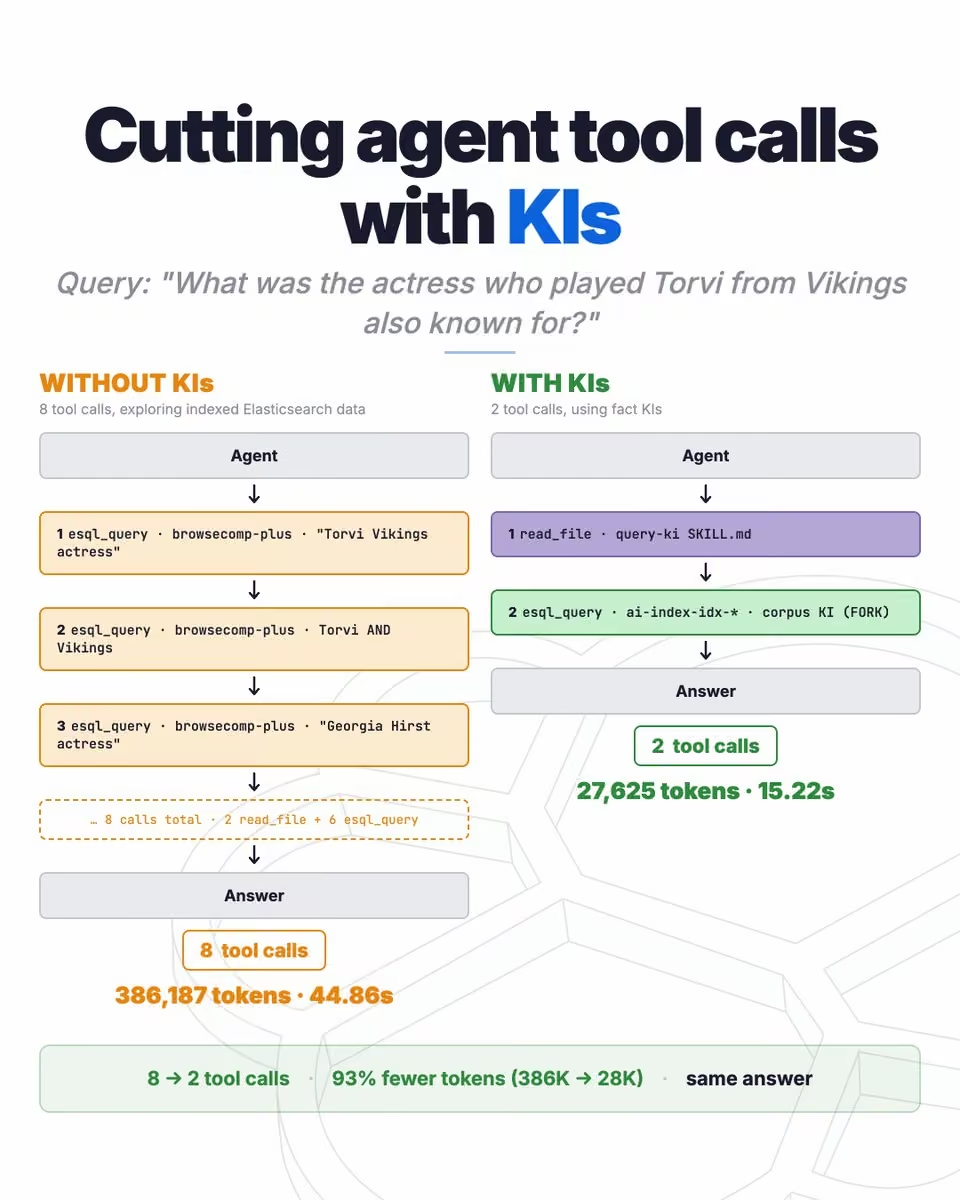
Answering from precomputed facts cut agent token use by 93%.
Standard agentic RAG retrieves whole documents and dumps them into context on every question. The cost repeats with every miss.
We precomputed the facts instead. A Kibana Workflow distills each document into a Knowledge Indicator, stored in an Elasticsearch AI Index. Agents retrieve it with 1 ES|QL query.
Same question, same grounded answer:
- Tokens: 386,187 to 27,625
- Tool calls: 8 to 2
- Latency: 44.86s to 15.22s
Exact counts vary between runs and agents. The shape of the result doesn't.
The extraction cost doesn't disappear. It moves out of the hot path and runs once, instead of on every query.
This works in any agent harness: the skill is just instructions plus a query. We tested it with LangChain Deep Agents.
Part 2 of our series on building context with AI indices. Part 1 covered routing agents to the right index.
Full walkthrough with the Kibana Workflow YAML, the query-ki skill, and a notebook to build it end to end: go.es.io/4gOD5Eu
 Elastic
@elastic
Part 1, routing agents to the right index: go.es.io/3SoDjdf
Elastic
@elastic
Save these copy-paste ES|QL queries for your next Kubernetes incident diagnosis.
Blog with all 9 in the reply.
 Elastic
@elastic
All 9 queries, copy-paste ready, plus the EDOT receiver setup they depend on: go.es.io/4gjwwdW
 Elastic
@elastic
Query 9 doubles as an alert. Wire it into an Elasticsearch query rule and you hear about 5 restarts in 15 minutes before a user does.
The same pattern works for memory utilization, node saturation, and error counts.
 Elastic
@elastic
Your ES|QL query dies with Unknown column [field] because an alias got repointed and the new backing index dropped a field.
Or you spot a field in your documents that never made it into the mapping. Until now, using it meant a reindex. Hours of it.
In Elasticsearch 9.5, SET unmapped_fields="LOAD" reads the missing field straight from _source instead. "NULLIFY" fills the field with nulls.
Queries keep working through mapping changes, without touching the data.
 Elastic
@elastic
Full design, the PUNK story, and the testing strategy: go.es.io/4wWJgMB
Elastic
@elastic
470 of the 500 slowest requests share 1 log pattern.
You'd never find it reading traces one at a time.
At 10 traces the check is tedious. At 500 it doesn't happen.
ES|QL subqueries are now on Serverless and in tech preview in 9.5
WHERE trace_id IN (subquery)
The trace query runs inside Elasticsearch. The outer query pulls every log line those requests wrote, across every service, and groups them into log patterns.
In this investigation it surfaced a lock wait timeout 2 hops downstream from the alert, in a service nobody was watching.
1 slow trace gives you a theory. 470 of 500 tells you which team to page.
 Elastic
@elastic
Full walkthrough, with all 4 correlation patterns and the queries: go.es.io/4iu4wFP
Elastic
@elastic
Elasticsearch 9.5 cuts timestamp storage by 92%.
1.03 GB down to 79 MB on a high-cardinality benchmark of 2.26 billion data points.
The old time series codec applied one fixed encoding to every numeric field. Fine for timestamps and counters. Useless for floats: a 0.01 change in a CPU gauge is a jump of trillions in integer space.
ES95 selects the encoding per field instead, based on what the mapping already declares:
- SplitDelta: splits blocks at series boundaries, so one jump stops taxing the whole block
- ALP: recovers the decimal structure in floats, compresses them as integers
Per-field results: gauges down 19% to 74%, counters 20% to 30%, total doc values down 33.6%. Dimension fields like host.ip aren't covered yet; that work is ongoing.
Applies to newly written data on upgrade. Existing segments keep their encoding, no migration required.
 Elastic
@elastic
Full breakdown of SplitDelta, ALP, and the adaptive codec architecture: go.es.io/3UdVini
Elastic
@elastic
"It feels slow" is the worst ticket a self-hosted LLM generates.
vLLM starts, serves, and reports success whether it's configured brilliantly or wastefully. Nothing tells you which.
But the answer is already sitting on /metrics: latency split by phase, cache hit rates, batch occupancy, completion outcomes. Almost nobody scrapes it.
On a single A10G, 6 metric checks turned "it feels slow" into a verdict:
TTFT: 51 ms against a 300 ms p95 target
Queue time: 0.01 ms
Decode: 97% of total latency
Prefix cache: 32% of prefill work skipped entirely
The server was over-provisioned, not under. The slowness lived somewhere in front of it: the app, the gateway, or the prompt.
Tuning an LLM server is reading telemetry and reasoning about saturation. SREs have been doing that for 20 years.
Full walkthrough with the ES|QL queries, the DCGM setup, and all 6 metric checks on an A10G:
go.es.io/3U9DTfm
 Elastic
@elastic
Data stream lifecycle finally reaches the frozen tier.
frozen_after sits next to data_retention, indices get snapshotted to object storage and stay queryable. x.com/i/article/2089327136091840512
Elastic
@elastic
AI Where It Counts: Relevance Please - Episode 6 x.com/i/broadcasts/1nJOLQbAqnkxR
Elastic
@elastic
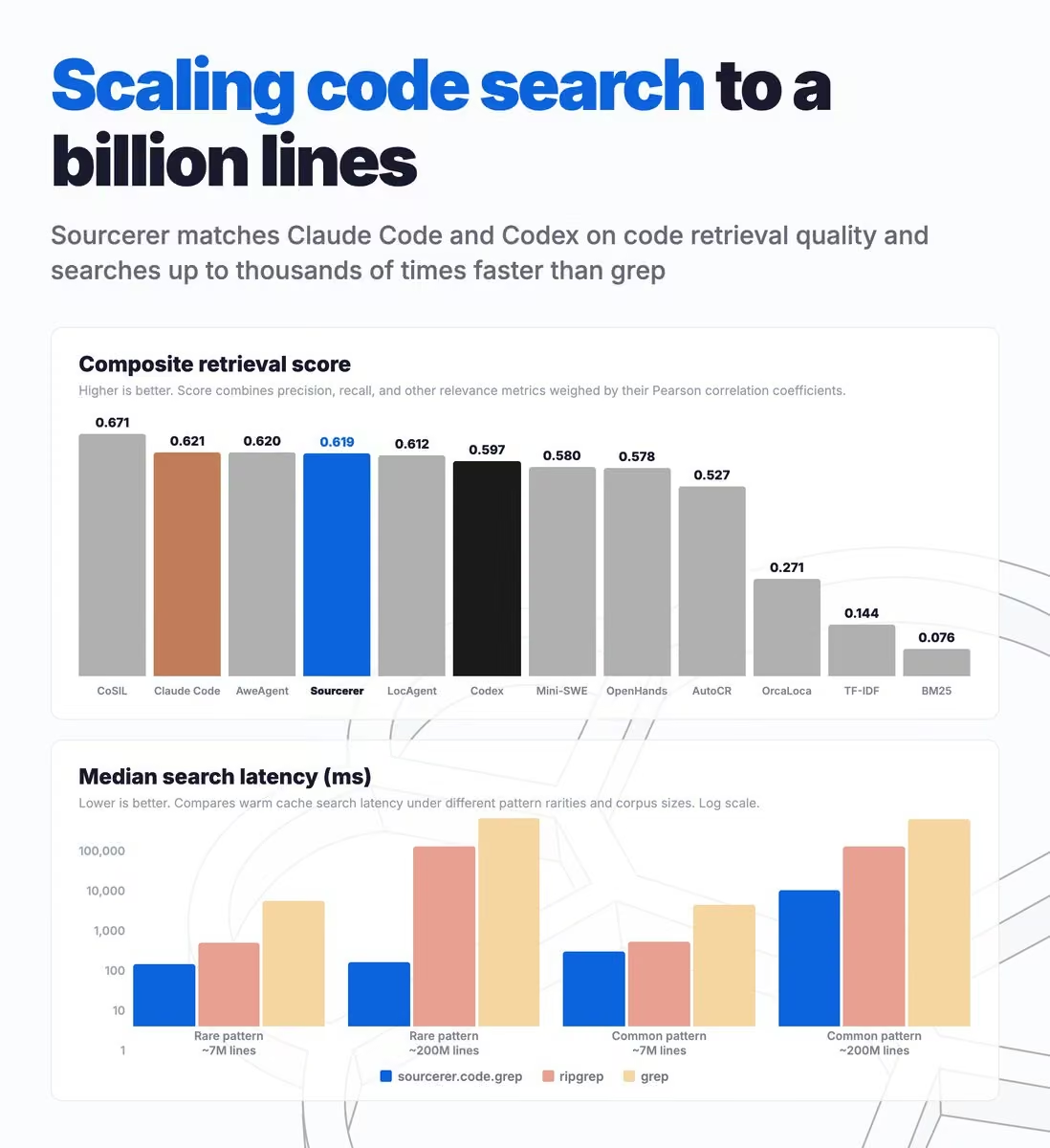
Code is the only documentation that's never outdated.
Our field teams get asked things like: does App A v1.2.3 work with App B v9.8.7 on Kubernetes? Docs rarely cover that. The code always does.
So one of our field engineers built Sourcerer. It searches a billion lines of our code across every repo and version we support. Every answer cites the exact file and line.
Built on Elasticsearch and Agent Builder. Open source, Apache 2.0.
Full benchmarks and solution design: go.es.io/4xMJpmq
 Elastic
@elastic
Running search, analytics, metrics, logs, and vector retrieval in five systems costs more than five licenses.
Here's what one platform looks like in practice. x.com/i/article/2089326203014443009
Elastic
@elastic
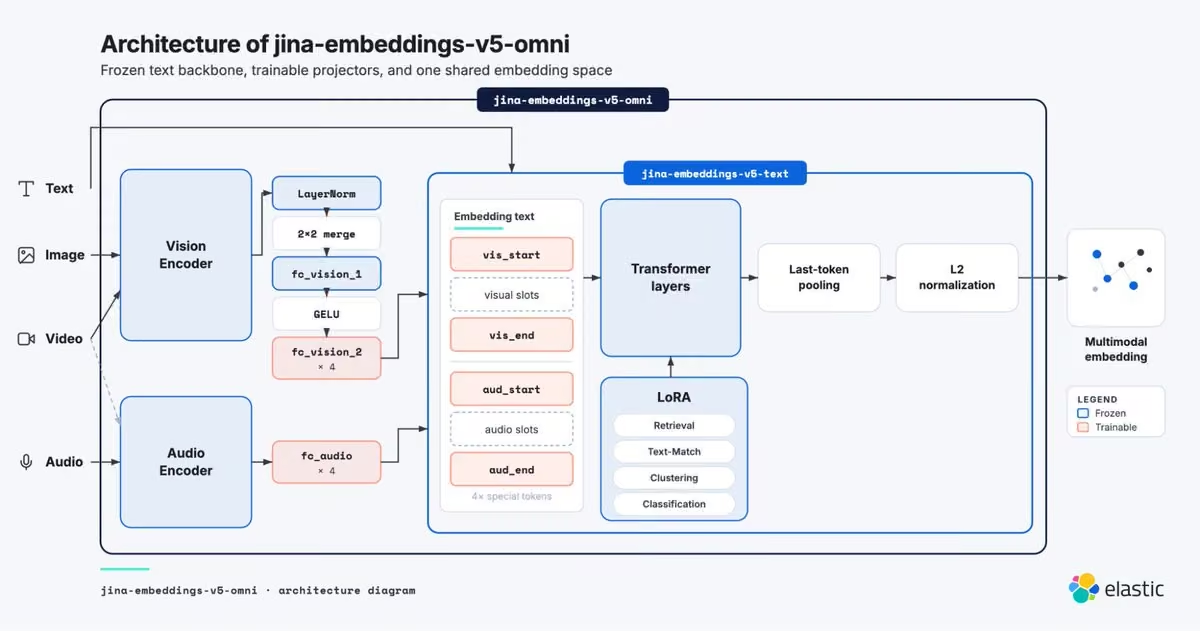
🧵 jina-embeddings-v5-omni represents the next evolution of embedding models. Literally.
The vision pipeline uses the Qwen3.5 vision encoder, which itself is based on SigLIP2.
Audio comes through the Qwen2.5-Omni audio encoder, built atop Whisper-large-3.
Text runs through jina-embeddings-v5-text.
So how do we get all of these different modalities, all running through different encoders, into one embedding space?
The architecture that makes it work is called GELATO.
 Elastic
@elastic
Images, video, audio, and text sit in the same vector space.
Cross-modal search works because the vectors are actually neighbors, not separated into clusters.
The same cannot be said for models that output embeddings that exhibit the canonical modality-gap pattern.
 Elastic
@elastic
This all culminates into the GELATO architecture (Geometry-preserving Embeddings via Locked Aligned TOwers).
Geometry-preserving Embeddings: jina-embeddings-v5-omni sits atop the foundation laid by jina-embeddings-v5-text. That original text embedding space is completely unchanged, with its geometry left wholly intact.
Locked: the encoder weights are frozen during training
Aligned: all modalities in one vector space
Elastic
@elastic
Your agent burns tokens just figuring out where to look.
It inspects mappings, samples docs, probes indices. That's 12 tool calls and 167K tokens to get an answer.
Knowledge Indicators fix this.
A Kibana Workflow profiles each index once: purpose, key fields, routing heuristics. Those profiles live in an AI Index, and agents query them with ES|QL.
Same question: 8 calls, 92K tokens, correct answer. The context was already there.
 Elastic
@elastic
Full walkthrough with ES|QL queries and a companion notebook: go.es.io/4gfWxJW
Part 1 of a series on managing agent context through AI Indices.
 Elastic
@elastic
When you create a recipe, you try a few tweaks and combinations before landing on the final version.
Creating an embedding model is no different.
This process of experimentation is known as ablation.
For both audio and vision pipelines in jina-embeddings-v5-omni, multiple ablation studies were performed before we landed on the final architecture: freeze all the encoders, train only the smaller projectors.
 Elastic
@elastic
If you want to learn more about the architecture, its described in this article. go.es.io/4wmBVWf
Elastic
@elastic
Relevance Please: Ep 5 - Build Agents That Ask Before They Act x.com/i/broadcasts/1rGmqpppEoZGy
Elastic
@elastic
We batched shard queries per data node.
Each data node handles partial reductions locally.
Lower latency, better work distribution across the cluster. x.com/i/article/2087533088679047168
Elastic
@elastic
How can a text embedding model map audio and image vectors?
After being transformed via a projector (translator), a foreign modality vector must announce itself before entering an embedding model for an unrelated modality.
Think of HTML.
<p> These tags let the document know this element is a paragraph. </p>
Vectors work the same way.
 Elastic
@elastic
Before EIS: CPU nodes, self-managed, one per model.
After EIS: 1 GPU-accelerated fleet, managed by Elastic.
Vector search and semantic reranking each ran on CPU nodes you provisioned yourself.
More models meant more infrastructure to operate.
The Elastic Inference Service (EIS) moves that compute to a GPU-accelerated, Elastic-managed fleet.
You still call the same Inference API but the fleet scales and you don't have to babysit it.
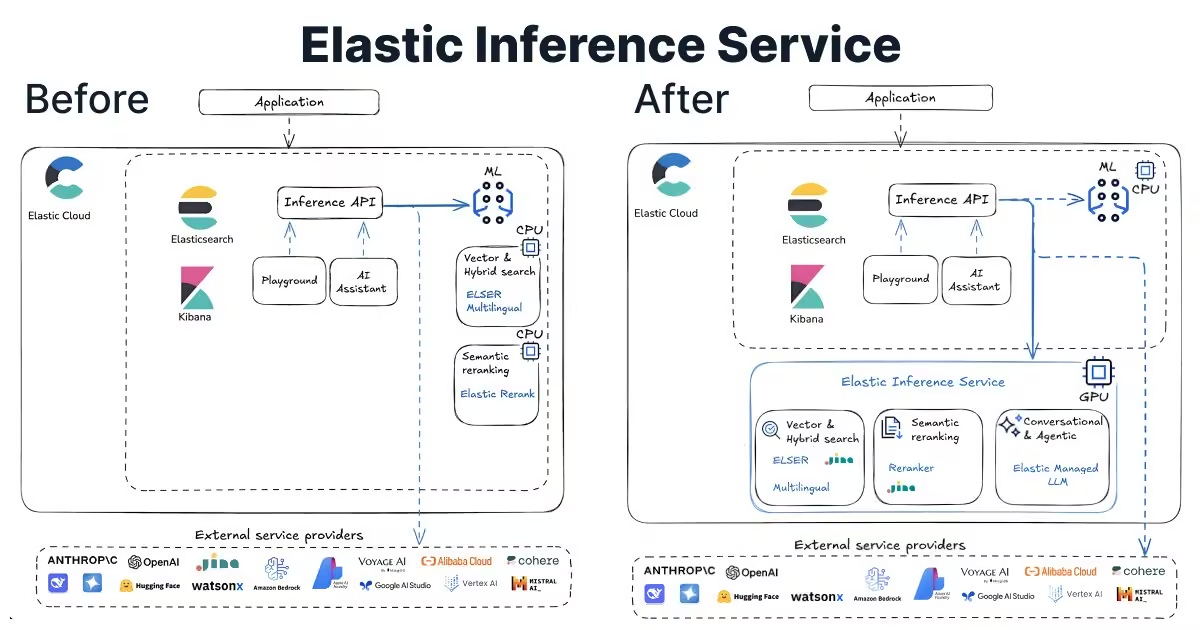 Elastic
@elastic
The Elastic Inference Service (EIS) :go.es.io/4qaIwSi
Elastic
@elastic
Retraining a model is an expensive process.
LoRA adapters allow you to fine-tune an existing model without retraining.
For jina-embeddings-v5-omni, we use a LoRA adapter to tweak the final output to be optimized for 4 distinct tasks.
 Elastic
@elastic
A RED metric alert fires on checkout. Is a dependency responsible?
Until now, answering that meant leaving the alert and opening the service map elsewhere in Kibana.
In Elastic APM 9.5, the map is on the alert detail page when you land. Open the service fly-out: RED metrics, anomaly status, transaction breakdown per service. One click to Traces in Discover from any connection.
We traced a checkout failure to a bad shipping deployment. 4 steps, never left the alert.
Blog has the full walkthrough and feature list: go.es.io/4fQwkml
Elastic
@elastic
Watch on YouTube: go.es.io/3Sj40Qi
Elastic
@elastic
Relevance Please: Ep4 - Build AI Agents with Live Context x.com/i/broadcasts/1yxBeeXvMpbJN
Elastic
@elastic
🧵 Elasticsearch can predict recall without building an index.
That prediction is what makes per-segment quantization tuning possible. 17% average QPS gain over DiskBBQ defaults, across 18 benchmarks.
The animation is the problem being solved: quantization moves distances, reranking pulls the true neighbours back.
Elastic
@elastic
6/ Across 18 public benchmarks, QPS improved in 15 and recall in 15.
Fashion MNIST recall improved 295.7%. FiQA GTE, Fashion MNIST and Glove-200 each gained over 50% QPS. Where either metric dipped, QPS stayed within 1.5% and recall within 2%.
What it picks is mostly modest. The centre of mass is 2-bit documents at 1.5x to 1.75x oversampling, with 4-bit appearing for two harder datasets only.
 Elastic
@elastic
7/ Indexing pays for the calibration.
Over half the datasets came in under 2% overhead. Three ran 16 to 27%, two ran 31 to 35%. The hit lands hardest on small datasets that index in seconds, since the calibration sample size is fixed.
Around 5M vectors it stays within 11% at worst.
Merges producing under 10,000 vectors skip calibration, and keep the current DiskBBQ defaults.
TL;DR:
- Recall predicted, not benchmarked
- R² 0.982 against measured recall
- Small samples survive index growth
- Each segment picks its own encoding
- Rerank depth priced above document bits
- 17% average QPS gain over DiskBBQ defaults, across 18 benchmarks.
One line turns it on: "auto_calibrate": true in your bbq_disk index options.
The recall model and the merge-path engineering are in two posts. Links in the reply.
The recall model:
go.es.io/4yTqWGh
The merge path and benchmarks:
go.es.io/3TFwSCL
Elastic
@elastic
You mapped product_name as a keyword a year ago. Now someone wants to search inside it.
That used to mean reindexing a year of data.
In 9.5 you wrap it in TO_TEXT and ES|QL MATCH analyzes it at query time instead. x.com/i/article/2084583813338877952
Elastic
@elastic
Here's everything you need to know about Elastic 9.5.
A brand new columnar database, smarter vector search, and native Prometheus and PromQL support now GA.
Plus new capabilities across Search, Observability and Security.
🧵 Full breakdown below.
Elastic
@elastic
3/ Security in 9.5 is chasing Alert Zero.
Enhancements to Attack Discovery, endpoint protection, and SOC automation all advancing the agentic SOC. An analyst stays at every decision point.
 Elastic
@elastic
Full release notes and docs in the blog:
go.es.io/3S89YDA
Elastic
@elastic
One runaway conversation can quietly wreck your monthly token budget.
Agent Builder logs every LLM call as an OTel trace by default. Model, latency, token counts, tool executions: all there already. It lands in an Elasticsearch data stream. Query it with ES|QL.
Most teams never look at this data until something breaks.
Build token cost dashboards in Kibana today. Set an alert for when a conversation passes 256K tokens. The query is about 6 lines of ES|QL.
Your agents have been keeping receipts. Worth reading them.
Blog walks through the full setup: enabling trace privacy controls, querying the data stream, building Lens panels, and the exact ES|QL alert rule.
go.es.io/4fv3BTV
 Elastic
@elastic
Ask an LLM for prose and it wanders. Give it a typed schema and there's a right shape for the answer.
Elastic Workflows is built on that.
The authoring language is YAML: declarative, diffable, version-controllable. In 9.5, you describe what you want automated in plain English and the AI agent writes the workflow.
What comes back is real building blocks: foreach loops, switch branching, data transforms, on-failure handling. Inspectable and editable before anything runs.
Natural language authoring and versioning are both GA in 9.5.
Experimental previews: visual graph mode, human-in-the-loop steps in Slack, and parallel execution.
This blog walks through everything new in Workflows 9.5, including the natural language authoring, versioning, and all three experimental previews:
go.es.io/4bnGFU5
Elastic
@elastic
EP 3: Stop Them in the Act x.com/i/broadcasts/1wxWjjYOrpqJQ
Elastic
@elastic
Elastic and @OpenAI are collaborating to bring frontier intelligence to unstructured enterprise data.
This matters because most enterprise data is unstructured: documents, tickets, logs, traces, and security alerts that change continuously and sit behind different permission models.
Without access to that data, AI agents underperform.
Elasticsearch provides the retrieval layer and OpenAI brings advanced reasoning capabilities, so agents can find the right information, with the right permissions, at lower token cost.
Together, the collaboration focuses on three outcomes:
→ Context-aware AI agents that retrieve accurate, permission-aware enterprise knowledge at scale
→ Agentic observability that correlates telemetry and accelerates root cause investigation for SRE teams
→ Agentic security operations that turn high-volume alerts into evidence-backed investigations for analyst review
Elastic has supported OpenAI models through AI Assistants and connectors since 2023. This expands that relationship across deeper product integration and joint customer value.
Full details: go.es.io/3TrLk1e
Elastic
@elastic
Live forensics on an active supply chain compromise.
Jason Pappalexis builds a full containment workflow in Elastic Security, starting from a cross-platform Axios attack.
Mapping the blast radius with osquery and runscript parsing. Containing it with host isolation and memory capture.
From one alert to enterprise-wide containment. Bring your questions.
Relevance Please Episode 3, tomorrow at 11AM ET / 8AM PT / 4PM BST.
▶️ Live right here on X.
Elastic
@elastic
VLM is a superset of CLIP, not a competitor. People pick between them like it's either/or. It isn't.
Think of a standalone GPS unit (fast, cheap, narrow similarity scoring) versus a smartphone app (richer reasoning, at the cost of speed and compute).
Look inside jina-v5-omni: the CLIP-style design (the "GPS chips") didn’t get thrown out for the VLM architecture (the “smartphone app”). It got frozen and embedded as components inside it.
Through Elastic's EIS, you can call jina-clip-v2 directly for fast, low-cost similarity search, or call jina-v5-omni when you need the full VLM stack for richer cross-modal retrieval.

Elastic reposted
 Jensen Huang
@JensenHuang
Attackers have frontier AI. Defenders need a frontier AI ecosystem—the best open and closed models, force-multiplied by a global community.
During the Hugging Face incident, closed AI blocked essential forensics. An open-weight frontier model helped contain the intrusion.
That’s why we created the Open Secure AI Alliance.
 NVIDIA
@nvidia
AI security advances when the industry builds in the open, together.
We're introducing the Open Secure AI Alliance with industry leaders to develop new techniques and tools to safeguard software and agents.
By sharing models, tooling and research in the open, we can broaden the community of defenders.
Learn more about the founding members’ contributions: nvda.ws/4pD8Fc5
 Elastic
@elastic
🧵 jina-reranker-v3.5 beat every model we tested on STaRK.
Including ones 7x its size.
 Elastic
@elastic
4/ Trade-off worth knowing: all candidates must fit in one 131K-token context window.
Long documents mean fewer candidates per pass.
For non-text data, jina-reranker-m0 handles images.
Elastic
@elastic
5/ Same API, one config field change.
Weights on @huggingface, Jina On-Prem Docker, or managed via Elastic Inference Service.
Blog and tech report: go.es.io/3TW2xjg
Elastic
@elastic
AI security is stronger when the industry works together in the open.
NVIDIA
@nvidia
AI security advances when the industry builds in the open, together.
We're introducing the Open Secure AI Alliance with industry leaders to develop new techniques and tools to safeguard software and agents.
By sharing models, tooling and research in the open, we can broaden the community of defenders.
Learn more about the founding members’ contributions: nvda.ws/4pD8Fc5
Elastic
@elastic
Your embedding model typically has up to 1024 dimensions.
What's in each one?
A dimension is one number scoring a single learned feature of your data.
This space uses 2 dimensions: human vs machine, realistic vs cartoon.
Every character lands somewhere in it. Luke sits high and left: human, realistic. Darth Vader sits orthogonally to Luke in the machine, cartoon quadrant as he is more machine now than man.
Real embedding models don't stop at 2. They normally run 384 to 1024 features, but you never name them. The model learns them on its own as part of training.
You can plot 2 dimensions on a chart. The model reasons across a thousand.
 Elastic
@elastic
EP 2: Tear Down the Ingest Bottleneck x.com/i/broadcasts/1MJgNNewYNMGL
Elastic
@elastic
28 AI models that install and run fully offline.
Jina AI by Elastic now ships self-contained on-prem bundles. Pre-composed Docker containers or full local dependency install, for air-gapped, firewalled, and isolated systems.
Embedding and reranking models you can't lose access to, on hardware you control.
 Elastic
@elastic
Full hardware sizing, use-case breakdown, and API compatibility details:
go.es.io/4yyZIEG
Elastic
@elastic
Your ingest node's JVM heap keeps climbing for no reason?
Check your field count.
Dynamic mapping creates a new mapped field for every unmapped value your logs send. Feed it inconsistent JSON for a few weeks. Field count runs into the thousands.
Query latency climbs across every shard on that index. Heap pressure follows. Node restarts start taking longer too.
Elasticsearch caps you at 1000 fields by default, via go.es.io/3RutHgl_fields.limit. Cross it and every write starts failing with:
Limit of total fields [1000] has been exceeded while adding new fields [12]
Four possible fixes
- Turn off dynamic mapping and define fields explicitly
- Reindex into a corrected mapping
- Delete old indices you don't query anymore
- Export, prune, and reimport into a fresh index
 Elastic
@elastic
Documentation: go.es.io/4pGBVik
Elastic
@elastic
Elastic has entered into an agreement to acquire Deductive AI, an AI-powered investigation platform.
As applications become more distributed and complex, engineering teams are dealing with more telemetry than ever before. Understanding what happened, why it happened, and what to do next often means pulling together information from multiple systems, with too much of the investigation still done manually.
Deductive AI has built an AI SRE agent that connects code, telemetry, and organizational knowledge to investigate alerts and production issues. It gathers evidence, tests hypotheses, and continuously learns from every investigation to help teams identify root causes faster.
Bringing these capabilities together advances our vision for AI-driven investigations in Elastic Observability. By combining Elastic's ability to infer meaningful entities, relationships, and operational events from telemetry with Deductive AI's investigation engine and knowledge graph, we'll help users investigate issues with richer context, identify root causes faster, and spend less time on manual investigation.
We’re looking forward to sharing more as we bring these capabilities into Elastic Observability.
Read more: go.es.io/4fKa39v
 Elastic
@elastic
We treat infrastructure as code. Dashboards still get hand-edited.
Why not treat dashboards the same way?
Manual dashboard changes drift the moment they hit a second environment. An SRE tweaks a panel in staging. Production quietly falls behind.
The Kibana Terraform provider fixes that by treating dashboards like any other infrastructure resource.
Dashboard changes now go through the same review process as your Terraform infra changes. Merge to main, apply everywhere, no manual reconciliation between environments.
You give up quick ad-hoc edits in the UI. You gain a diff you can actually review.
If dashboards are the last thing not in your git repo, start there.
Read more: go.es.io/3R2F8Mk
 Elastic
@elastic
Shopping agents don't fail because the model is wrong.
They fail because the agent knows nothing about your catalog.
Vocabulary, category hierarchy, business rules: all discovered through tool calls at runtime.
Each call costs roughly 600ms to a second.
Stack 3-4 and the customer leaves before the agent says anything useful.
The fix: precompute a structured context layer before the LLM call.
A vocabulary index resolves "navy jumper" to colour: NAVY, masterCategoryNames: "Knitwear & Jumpers."
Policy hints surface trading rules.
Facet state confirms what's in stock right now.
Run those lookups in parallel.
The agent's first move becomes a targeted search, not a discovery loop.
Start with the vocabulary layer.
If you build nothing else, build that.
 Elastic
@elastic
New from Matthew Adams on the Elastic blog: go.es.io/4vI3o4v
Elastic
@elastic
Binary quantization sounds like it should tank recall.
BBQ in Elasticsearch doesn't due to its asymmetric nature.
Vectors compress to single-bit values. Queries stay at int4 precision, so distance calculations keep the detail that matters. You trade a bit of oversampling and reranking for an approximately 95% storage reduction.
Trade-off: queries cost slightly more to compute per comparison. Storage costs don't move at all.
 Elastic
@elastic
How it works under the hood: go.es.io/4f7c6En

Elastic reposted
Elastic Security Labs
@elasticseclabs
7 trojanized repos targeting developers. Zero detections across every AV vendor.
Elastic Security Labs is tracking a new Contagious Interview campaign (REF9403) where DPRK-aligned actors distribute fake coding challenges through Slack job postings.
The repos masquerade as real Next.js e-commerce projects. The code was copied from a legitimate template called GoCart. The difference is steganography.
Base64 payload fragments are hidden inside HTML comments in SVG flag images. A script reassembles them alphabetically, decodes with a custom function, and runs on server start.
What deploys:
- Credential stealer targeting 25 crypto wallet extensions plus browser login data
- File stealer scanning for .env, .pem, .ssh, .aws, documents, images, shell history, and source code
- Socket. IO RAT providing real-time interactive shell access
- Clipboard stealer polling every 500ms, plus a Windows dropper downloading 3 disguised executables from the C2
Full analysis from Elastic Security Labs by @danielstepanic : go.es.io/4fqEhgp

Elastic reposted
 JP Hwang
@_jphwang
I just wrote and recorded a video about how to perform vector search --- on 🎞️ video clips, by how they *look*!
It means you can find scenes by what's *on the screen*, without expensive tagging. (Because, actually, a lot of video search is actually metadata-driven text search!)
 Elastic
@elastic
Storing full 1024-dim vectors for every modality wastes storage.
Matryoshka representation learning ranks signal into the first dimensions, so truncating a vector doesn't mean losing everything.
jina-embeddings-v5-omni inherits this from v5-text. Truncate to 32, 64, 128, up to 1024 dims, same embedding, no retraining or re-embedding required.
Text, image and audio hold up well even at the smallest sizes. Video is the one modality that wants the higher end of the range.
 Elastic
@elastic
Associated Paper: go.es.io/4pnh57x
Elastic
@elastic
EP 1: Video search made easy x.com/i/broadcasts/1mxPaaYkPaDKN
Elastic
@elastic
New modular malware family, tracked from first appearance.
Our Security Labs team breaks down the full infection chain, evasion techniques, and C2 infrastructure.
Elastic Security Labs
@elasticseclabs
TELEPUZ is a new modular malware spreading via CLICKFIX-VIDAR chains. Elastic Security Labs is tracking it.
Active since late April 2026. The delivery path: ClickFix social engineering tricks users into running a PowerShell command that downloads a VIDAR Go variant, which then fetches a lightweight stager and the main TELEPUZ payload.
The core DLL communicates over WebSockets and pulls additional modules from C2 on demand:
Keylogger
Stealer
Web injector: intercepts browser sessions via CDP and WebDriver BiDi, with default configs targeting financial form fields like IBANs
36 commands. Indirect syscalls. AMSI and ETW patching. NTDLL unhooking. Multiple UAC bypasses.
Still in active development: the shellcode injection command returns a TODO placeholder.
C2 infrastructure is small (2 domains), but fallback methods include Telegram channels, Steam profiles, DNS records, and a Polygon smart contract that doubles as a kill switch.
New builds hit VirusTotal daily. The C2 footprint is small, but this thing is moving fast for something that started 2 months ago.
Full technical analysis: go.es.io/4wg6i1p
 Elastic
@elastic
15-minute live demos, Q+A. Every week.
Starting tomorrow.
Relevance Please is a new weekly livestream: demos across Search, Observability, and Security with rotating hosts and rotating topics.
First up: @_jphwang on Making Video Search Easy.
Join us tomorrow, 11AM ET / 8AM PT / 4PM BST. Links in the reply below.
Elastic
@elastic
Where to watch:
X: Right here on our X channel!
YouTube: go.es.io/44wyYqJ
Elastic
@elastic
🧵 Your search query gets rewritten before it ever matches a document.
Tokenization, stop words, stemming, synonyms: 4 steps sit between what you type and what gets looked up.
Here's what each one does
 Elastic
@elastic
5. An inverted index is the main data structure for search, working like a hash map.
It creates a 1-to-many mapping between a term, and the documents where that term appears.
This is why text analysis is performed on your documents at index time AND on your search query at query time to ensure a match on analyzed terms.
When the analyzed query terms [wood, fire, pizza] are sent to the inverted index, the index returns a list of document IDs (the postings list) for each individual term. These lists are then combined to retrieve the documents that match the query.
Elastic
@elastic
Let's put it all together. What happens when I search for "the best wood fired neapolitin pie"?
- “the best wood fired neapolitan pie” (original query)
- “(t̶h̶e̶) best wood fired neapolitan pie” (stop word removal)
- “(t̶h̶e̶) best wood fire(d̶) neapolitan pie” (stemming)
- “(t̶h̶e̶) best wood fire(d̶) neapolitan (p̶i̶e̶)pizza” (synonym expansion)
Elastic
@elastic
We went back to the full Elasticsearch vs Qdrant benchmark exchange. Traced every number to a cause.
Same hardware. 21M vectors. The disk sat at 0 IOPS the entire run.
io_uring and prefetch got the headline. Neither moved the number. You can't be bottlenecked on a device you never read from.
Matched on setup, both engines land around 56 QPS at 0.96 recall. The setup choices explained the multipliers, not the engines.
Here's what we found: go.es.io/3SY0dbb
 Elastic
@elastic
Search feels simple until you start getting back irrelevant results.
Know which of these 3 retrieval strategies to reach for a furniture store site:
- BM25 matches exact terms. Finds an ottoman from "Product ID 43926".
- Vector matches meaning. Figures out what "padded stool for my feet" actually refers to.
- Hybrid runs both. Exact SKUs and vague descriptions in the same query.
BM25 for known items. Vector for descriptions. Hybrid when you can't predict which. There is no one-size-fits-all solution.
 Elastic
@elastic
We're introducing Elasticsearch Columnar Mode:
A new index mode that stores data once, in columnar form, with no redundant copies and no indexes the workload doesn't need.
Not replacing the document model. Adding a second way to organise data alongside it, for the workloads where columnar is the right shape: logs, telemetry, metrics, security events, AI retrieval.
One platform for search and analytics at the same level, on the same data.
Tech Preview in 9.5, GA in 9.6.
 Elastic
@elastic
The full deep dive on why Elasticsearch is going columnar, what Columnar Mode changes, and what it doesn't: go.es.io/4bf5S2O
Elastic
@elastic
A red cluster is a decision tree, not one magic command.
Bookmark these common commands to help you diagnose cluster, node and shard health issues
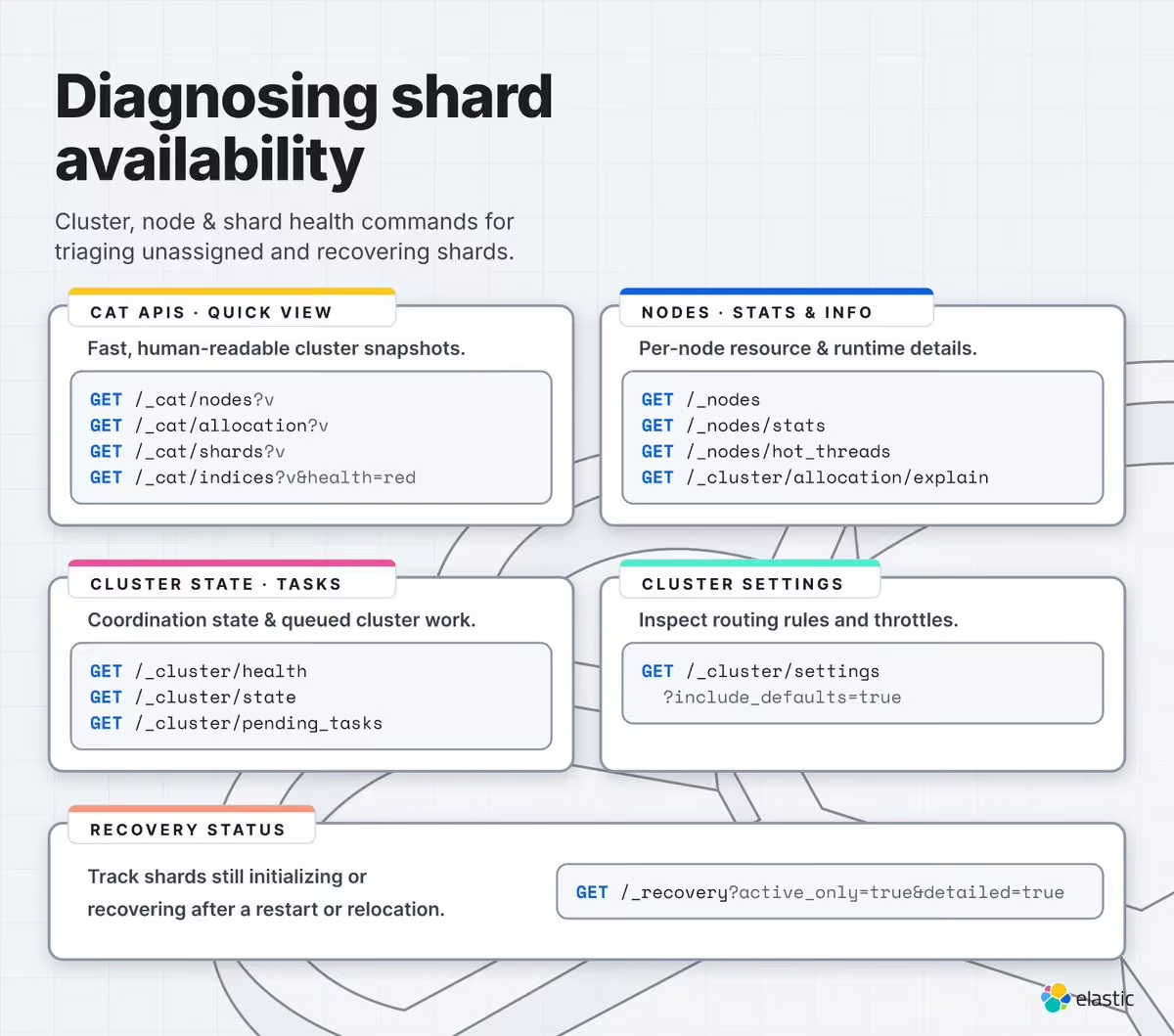 Elastic
@elastic
Your research agent returns confident answers from a single source. That's not research. That's a summary with extra steps.
Cross-checking needs structure: multiple angles, independent findings, a way to compare them.
@LangChain Deep Agents with Elasticsearch give you that pipeline:
1. Plan: orchestrator writes 3-4 research angles
2. Research: one sub-agent per angle, findings indexed with structured metadata
3. Evaluate: aggregator scores evidence quality by angle
4. Review: cross-reviewer flags contradictions and consensus
5. Explore: Elastic Agent Builder agent for plain-language queries over indexed findings
Each finding carries evidence_type, relevance_score, and source_credibility as metadata fields used alongside the semantic_text field combining query, title, and content fields. One query filters, aggregates, and searches semantically.
Without the storage layer, steps 3-5 don't exist. That's the difference between a research agent and a summariser.
Full walkthrough with the notebook: go.es.io/4p2sqJW

Elastic reposted
Elastic Security Labs
@elasticseclabs
We tracked a new activity cluster targeting Mexican banking customers.
Elastic Security Labs discovered REF6045, an operator-assisted banking fraud campaign targeting customers of Mexican banks, fintechs, and cryptocurrency platforms through ClickFix fake-CAPTCHA lures.
The operation exhibits a reliance on AI-generated code and suffers from significant operational security (OPSEC) failures that exposed their infrastructure and their toolkit.
The toolkit gives operators a full fraud workflow from:
•Vishing overlay: lock the screen behind a fake bank warning
•Browser redirect: paste a phishing URL via automated keystrokes
•Clipboard swap: replace CLABE or card numbers mid-transfer
•Remote access: install Remote Utilities for hands-on takeover
Research by @k33b0i and @soolidsnakee.
Full analysis from Elastic Security Labs: go.es.io/4eP6VZF
 Elastic
@elastic
Your Claude API bill shouldn't be a monthly surprise.
The Elastic Anthropic Metrics integration polls Anthropic's Admin API and routes org-wide usage, cost, and rate limit data into Elasticsearch.
One Admin API key. Zero application code changes. 6 alert templates out of the box.
Monitor Anthropic API usage, cost, and rate limits in Elastic: go.es.io/4eS2jk3
Elastic
@elastic
CPUs don't have vector search instructions. You borrow from neural nets and video codecs instead.
Elasticsearch's simdvec engine reformulates vector math to fit whatever the CPU already runs fast. Four recent examples:
- int7 quantization: fit unsigned-only multiply-accumulate by trading 1 bit of precision. ~6x faster.
- int8 bias rewrite: algebraic shift + precomputed correction. ~20% bulk gain.
- bf16 Euclidean distance as 3 dot products instead of a float32 conversion. Up to 2.4x.
- Binary dot product via popcount: AND the bits, count the 1s. ~4x over scalar.
A compiler can't make these calls. Each one requires reformulating the problem to fit an instruction the hardware was never designed to use this way.
 Elastic
@elastic
Four ways Elasticsearch's vector search engine reuses neural-network, video-codec and cryptography CPU instructions for up to 6x speedups; with the math, the failed attempts and the benchmarks. go.es.io/4fisDoQ
Elastic
@elastic
You've got 10k slides, scans, and screenshots to search.
Your first instinct is to throw a VLM at it. But a VLM reads one image at a time. Running it across your whole corpus on every query doesn’t scale.
Split the pipeline instead. jina-clip embeds every image into a vector once. At query time, the same model embeds your question and does a similarity lookup.
Jina-VLM only touches the matched slides: a handful of images, not thousands.
Build the index once, then retrieval is instant. The VLM only reasons where it matters.
 Elastic
@elastic
7x higher vector search throughput at comparable recall.
Elasticsearch 9.4.1 DiskBBQ vs Qdrant 1.18.1, tested on network-attached persistent storage.
The storage topology most K8s and managed-cloud deployments actually run on. Not local NVMe.
The gap is disk access. DiskBBQ searches a compact quantized index and limits full-precision reads. Qdrant rescores against original vectors on disk. On network-attached storage, those random reads get expensive.
Elasticsearch latency: 120 to 150ms across recall levels.
Qdrant: 315ms to 900ms as recall increases.
Benchmark tool, dataset, and configs are all published below.
 Elastic
@elastic
Full results, methodology, and dataset: go.es.io/4aqI4sA
Benchmark tool (Jingra): go.es.io/442FHZn
Elastic
@elastic
🧵 Elasticsearch now queries time series metrics up to 160x faster than previous versions.
TSDS and ES|QL were rebuilt over the past year.
Three areas changed: storage, queries, and Prometheus compatibility.
The result:
- A fully columnar metrics engine.
- OTel indexing throughput is up to 50% higher.
- Storage for OTel metrics dropped to 3.75 bytes per data point.
 Elastic
@elastic
3/ Storage - OTel metrics: 25 bytes down to 3.75 per data point.
Four TSDS changes cut storage by 6.6x:
- Doc value skippers: replace inverted indices and BKD trees
- Synthetic _id: derived from _tsid and @ timestamp, bloom filter dedup
- Sequence numbers: trimmed at merge time once the global checkpoint passes
- Larger codec blocks: compress repeated dimension values
21 bytes cut. Each change independent.
Elastic
@elastic
TL;DR:
- Queries: up to 160x faster
- PromQL runs inside ES|QL, same engine
- Storage: 6.6x more efficient for OTel metrics
- One platform: metrics, logs, traces, documents
Full architecture deep dive with benchmarks in the blog: go.es.io/4xZeJ2p
Elastic
@elastic
Up to 30× faster than Prometheus on gauge averages and counter rates.
Up to 2.5× more storage efficient than Prometheus.
That's ES|QL running on a new columnar storage engine purpose-built for time series data.
Cost approximately 50% less than Datadog. No custom metric penalties.
What landed:
- Prometheus Remote Write and native PromQL in Kibana: existing queries, dashboards, and alert rules work as-is
- OOTB K8s and AWS content at ingest: dashboards, alert templates, ML anomaly jobs, Workflows, and SLO Templates
- ES|QL time series queries across metrics, logs, and traces in one backend
- Agentic investigation via Observability MCP App and Agent Skills: run structured investigations from Claude, Cursor, or VS Code
Every metric at full resolution. No forced rollups.
No surprise invoice at the end of the month.
 Elastic
@elastic
Full walkthrough of the architecture, benchmarks, and migration paths: go.es.io/443CnNv
Elastic
@elastic
Hybrid search = BM25 + vector search, merged and reranked in 1 request.
Most search implementations pick one. Lexical search misses semantic intent. Vector search misses exact keyword matches. Hybrid covers both.
Here's how it fits together in a single Elasticsearch query:
- Lexical: standard multi-match across fields (BM25 scoring)
- Vector: semantic retriever via ELSER, k=50 candidates
- Fusion: RRF merges both result sets by rank, not score
- Reranking: text_similarity_reranker re-orders the final set
RRF is the key mechanism. It combines rank positions.
That's what makes mixing BM25 and vector results reliable without score normalisation.
 Elastic
@elastic
Resource: go.es.io/3Qp16ZD
Elastic
@elastic
Your Claude Code agent forgets everything between sessions.
So you bolt on a memory service. Another API, another thing to run.
If you already run Elasticsearch, you already have the parts.
semantic_text handles embeddings at index time.
ES|QL gives you hybrid recall in one query: BM25 for the exact task ID, vector search for the related concept, a DECAY function so today's context outranks last month's.
agent-memory wires it in with three hooks: SessionStart syncs, PostToolUse indexes every .md you write, Stop logs the session.
The agent never has to remember to remember.
Honest caveat: cross-device recall needs ES reachable from both machines. Not a local-only trick.
 Elastic
@elastic
Full walkthrough, schema, and the bridge CLI: go.es.io/4oNHQBx
Elastic reposted
Elastic
@elastic
Most data analysis still feels like translation work.
Someone asks which products drive revenue. Then you write queries, join tables, check dashboards, validate assumptions. An hour later, maybe you have an answer.
This tutorial wires Elastic Agent Builder MCP to @awscloud Bedrock AgentCore with the Strands SDK.
Plain English in, auditable queries out.
The agent reasons, picks tools, queries your cluster, and loops until the task is done. Every step indexes back into Elasticsearch for search and audit.
Same cluster and security model you already run.
Elastic
@elastic
Tutorial and full code: go.es.io/4uVdj6j
GitHub repo: go.es.io/4wdcEyl
Elastic
@elastic
Most search benchmarks only tell half the story.
You test relevance. You ship it. Then p99 latency tanks under real concurrency and users start filing tickets.
Or you optimize for speed, and your top-k results are fast garbage.
The fix: measure both sides every time. 10 metrics that matter, mapped out.
 Elastic
@elastic
3 patterns for multimodal RAG.
Here's how they differ and when each one breaks down.
Most RAG systems add multimodal support by converting everything to text first. Is your system natively multimodal, or just a conversion pipeline?
The architecture choice shapes what you can query and what you lose.
Shared vector space
- Cross-modal search without format conversion
- Requires large multimodal training datasets
- Semantic drift is a real risk if training data is narrow
Single grounded modality
- Works with any existing text search setup
- Spatial relationships in images don't survive conversion
- Retrieval quality depends on captioning/transcription accuracy
Separate retrieval pipelines
- Best per-modality retrieval accuracy
- Most complex to rank across modalities
- Highest compute cost, independent search per modality
Pick your pattern, clone the repo, and build it.
 Elastic
@elastic
Learn more: go.es.io/3QCTMcO
Elastic
@elastic
Run the same vector search benchmark across 3 engines.
Jingra is a new open-source framework that uses YAML config to run identical workloads on Elasticsearch, OpenSearch, and Qdrant.
The part that matters: with await_index_ready enabled, it holds evaluation until the index reaches the state you intend to measure. Elasticsearch merges segments after ingest. Qdrant runs its own post-ingest optimizations. Both affect query latency, and most benchmarks measure before either finishes.
Parameter sweeps generate recall vs latency curves in a single run. Results go to console, CSV, or an Elasticsearch index for dashboarding.
Apache 2.0, Docker Compose demos, one make command.
 Elastic
@elastic
Blog: go.es.io/4vXMUpl
Repo: go.es.io/4oNsPjd
Elastic
@elastic
0.89 recall at k=10 and zero cross-tenant leaks on a persistent agent memory layer.
Built on Elasticsearch with 3 indices mapped to cognitive science: episodic events, semantic facts, procedural playbooks.
Each has its own write rate, aging rules, and update logic. Episodic decays. Semantic gets superseded when a user contradicts it (the old fact stays for audit, a filter hides it from recall). Procedural tracks success and failure counts across conversations.
Recall is one hybrid query: BM25 + Jina v5 dense fused with RRF, then a cross-encoder reranker on the merged candidates. Time decay and use-count scoring keep fresh, frequently-recalled facts on top.
DLS scopes every query to the user's API key. The cluster won't return another user's documents regardless of what the agent asks for.
Open source, with an MCP endpoint for any agent runtime.
 Elastic
@elastic
Blog and full implementation: go.es.io/4oFWhYy
GitHub repo: go.es.io/4uKA8tl
Elastic reposted
Elastic Security Labs
@elasticseclabs
Live now! x.com/i/broadcasts/1XGyggVjpmVxM
Elastic
@elastic
🧵 We've reworked stored-vector kNN search to cut latency by up to 3x with a single API change.
Here's why 2 round trips was always unnecessary, how the speedup works, and what the benchmark numbers show.
 Elastic
@elastic
3/ In 9.4, this collapses into a single request:
Elasticsearch fetches the stored vector internally and uses it directly. One request. No client-side plumbing.
 Elastic
@elastic
4/ We ran this on 2M documents across 2 nodes in the same GCP zone.
Same data center. Same availability zone. Still:
p50: 10.4ms → 3.1ms (3.3x faster)
p90: 25.4ms → 5.9ms (4.3x faster)
p99: 27.7ms → 8.1ms (3.4x faster)
Even when nodes are physically close, serialization and network costs compound. Removing a round trip removes them entirely.
Learn more: go.es.io/4fWcjLz
Elastic
@elastic
300+ Claude audit events now land in Elastic Security.
Elastic's Anthropic integration pulls from Claude's Compliance API.
Everything maps to ECS. Sign-ins, SSO changes, role updates, API key lifecycle, MCP server connections, data exports.
Searchable the moment they land. Correlatable with identity, endpoint, and cloud data already in your SIEM.
Detection rules work the same as any other source. Describe what you want in plain English. Get a validated ES|QL rule back.
Prebuilt dashboards ship populated: top users, top MCP servers, event breakdown, error rates.
AI agents deserve the same scrutiny as any other system.
Elastic
@elastic
Blog and integration docs:
go.es.io/4uCQC6Q
Elastic reposted
Elastic Security Labs
@elasticseclabs
Your SOC tools don't talk to your dev tools. Your detection engineers write rules in one place and investigate in another.
Live on June 17, we're demoing autonomous investigation workflows and security operations running inside Claude, Cursor, and Copilot.
One week to go. Register now: go.es.io/4e4W2Bo
Elastic reposted
Elastic Security Labs
@elasticseclabs
Attackers are using AI to cut attack timelines to minutes.
@andythevariable , @jamesspi and @danielmiessler get into what that means for your SOC, live on June 17.
 Andrew Pease
@andythevariable
On June 17, I'm going live with @jamesspi and @danielmiessler to cover the Obsidian and Axios supply chain attacks, and how AI agents can speed response.
Humans don't leave the loop; they're moved to the top of it.
10am PT / 1pm ET @elasticseclabs
www.elastic.co/lp/agentic-ai-threat-defense-livestream
Elastic
@elastic
3 types of mappings in Elasticsearch
Dynamic: Elasticsearch detects field types as documents arrive.
Explicit: you define every field upfront. Recommended for production.
Runtime: schema-on-read, no reindexing needed.
Each trades setup speed for indexing control.
 Elastic
@elastic
Learn more: go.es.io/4fHN3IR
Elastic
@elastic
Sample data: go.es.io/4upzQb6
Elastic
@elastic
🧵 Your PromQL doesn't have to be rewritten to move to Elastic Observability.
9.4 added native Prometheus support.
Ship metrics straight to ES, run your existing PromQL in Kibana.
Same queries. Same dashboards.
rate(http_requests_total{job="api"}[5m])
That runs in Kibana now. No rewrite. Native PromQL is in technical preview.
 Elastic
@elastic
When you want one language across logs, metrics, and traces, ES|QL's TS command is the direct equivalent.
TS metrics-*
| STATS SUM(RATE(http_requests_total, 5m)) BY job, TBUCKET(5m)
RATE(metric, 5m) maps to PromQL's rate(metric[5m]).
TS groups by time series first and handles counter resets
before you aggregate across hosts.
Keep your PromQL instance. Adopt ES|QL at your own pace.
Blog: go.es.io/4e9RJpq
ES|QL TS docs: go.es.io/4fMChRn
Elastic
@elastic
Learn how to cut Elasticsearch log storage by up to 76% with LogsDB:
1. Create a LogsDB index with "index.mode": "logsdb"
2. Reindex your logs into both a standard and LogsDB index
3. Force merge both indices with _forcemerge?max_num_segments=1
4. Measure the difference with the _stats API
In our test: 15.37 MB (standard) vs 8.6 MB (LogsDB). 44% reduction on test data. 76% in production benchmarks.
 Elastic
@elastic
Already on Elasticsearch 9.2+?
Any logs-* data stream uses LogsDB by default.
Run GET /.ds-logs-*/_settings?filter_path=*.settings.index.mode to verify.
Elastic
@elastic
Follow along in the full tutorial: go.es.io/4e3NYBY
Elastic
@elastic
🧵 p95 latency tile in Kibana. 5 million events. Takes 296ms exact.
Add one line to the ES|QL pipeline:
SET approximation=true;
Same query. 110ms. Every result comes with a confidence interval.
Drop the interval (SET approximation={"confidence_level": null}) and it runs in 75ms. 0.16% error.
 Elastic
@elastic
ES|QL 9.4 approximate mode samples and extrapolates
instead of scanning everything.
Accuracy depends on data shape, not row count.
Full benchmark on 5M events in Serverless:
 Elastic
@elastic
Good fit for the speculative query patterns LLM agents generate:
fast, approximate, cheap.
Won't approximate DISTINCT_COUNT, MIN, or MAX yet.
No support for TS, JOIN, or FORK pipelines. Falls back to exact.
Gist: go.es.io/4fbZdcH
Blog: go.es.io/4nUElst
Elastic
@elastic
🧵 Autocomplete has to be faster than regular search. That's the whole point.
If your latency is high, users stop seeing suggestions before they finish typing.
The approach you pick determines whether you hit that bar in production.
Here are 4 ways to build autocomplete in Elasticsearch. 🧵
(And how to avoid picking the wrong one.)
 Elastic
@elastic
2/ Query time autocomplete swaps match queries for prefix queries.
Prefix queries match all tokens starting with the search term.
That means more results but it's expensive.
Elasticsearch scans a B+ tree for character matches rather than exact token lookups.
The better option: match_bool_prefix.
It prefix-searches only the last term and match-queries the rest.
For "foo bar baz", that's dramatically fewer candidates to score.
But here's the mistake that takes down clusters:
Elastic
@elastic
An empty or single-character prefix query matches every document in your index.
Under heavy autocomplete load, that's a cluster-killer.
Always enforce a minimum character threshold before firing autocomplete queries.
Tip: match_bool_prefix handles this cleanly.
 Elastic
@elastic
TL;DR:
- 4 approaches: search-as-you-type, query time, completion suggester, index time
- match_bool_prefix is the underused middle ground for query time
- Empty prefix queries can bring down a cluster — always set a minimum character threshold
- Completion suggester is for query suggestions, not results
- Index time is fastest at query but costs more to store and operate
Elastic
@elastic
Full breakdown with code samples in the blog:
go.es.io/4x6wUmu
Elastic
@elastic
🧵 Kibana dashboards used to be click-built and shared as saved-object exports.
Fragile. Hard to migrate. Impossible to diff.
9.4 ships a Dashboards API. A dashboard is now a file in your repo.
Elastic
@elastic
The resulting dashboard on a live Kibana instance:
Four panels, laid out exactly as defined in the JSON.
 Elastic
@elastic
GET the same endpoint and you get plain, diffable JSON back:
panels, layout, and the ES|QL queries behind each chart.
Commit it next to your code.
Now dashboards move through PRs, code review, and CI/CD like everything else you ship.
API docs: go.es.io/49RQE36
 Elastic
@elastic
Here are 5 distance metrics in vector search.
But how do you choose the right one?
• L1 (Manhattan): sum of absolute differences, exact kNN only with no HNSW support
• L2 (Euclidean): straight-line distance, the safe default for most models
• Cosine similarity: angle between vectors, magnitude ignored
• Dot product: same ranking as cosine on normalized vectors, less compute
• Max inner product: dot product without the normalization constraint
Most teams default to cosine and move on. That works until your model outputs non-normalized vectors, and suddenly dot product or max inner product is the better fit.
Scoring formulas and config details in the blog.
 Elastic
@elastic
Blog: go.es.io/4wSXDTj
Elastic
@elastic
🧵Your reindex dies halfway through a rolling upgrade. Where did it leave off?
Reindex just got more reliable and more manageable: task relocation, PIT over scroll, dedicated APIs, and reindex-from-remote GA in Serverless.
 Elastic
@elastic
New reindex-specific management APIs, relocation-aware:
GET /_reindex (list)
GET /_reindex/{id} (status)
POST /_reindex/{id}/_cancel
POST /_reindex/{id}/_rethrottle
Two new privileges too: monitor_reindex and manage_reindex. Least-privilege without handing out manage or superuser.
Elastic
@elastic
- Reindex survives graceful node shutdowns
- PIT replaces scroll for source iteration
- Reindex-specific APIs for list, status, cancel, rethrottle
- Reindex-from-remote GA in Serverless
Available now in Serverless. Hosted and self-managed coming soon.
Full writeup in the blog:
Elastic
@elastic
What happens to the cluster if this node goes down?
That question used to mean a half-hour with a kubectl session, a topology diagram, and someone counting replicas in their head.
Now it's one of six tools in the Observability MCP App. Ask in Claude or VS Code, get the full impact map back inline: full-outage deployments, degraded ones, pods at risk, downstream user-facing services, whether anything can reschedule.
Investigation moved into the chat interface. The diagram came with it.
 Elastic
@elastic
The same MCP App ships an Investigation Workflow that runs root cause analysis automatically when a Kubernetes alert fires. Open the alert, find the diagnosis already done.
Full walkthrough: go.es.io/4dC8XM9
Elastic
@elastic
Agent handoffs, tool calls, real-world enrichment. Running live against an actual incident.
Elastic Security Labs
@elasticseclabs
Attackers are compressing timelines from hours to minutes. Most SOCs are still stitching context together across three tabs and a ticket.
On June 17, we're showing the full lifecycle, from first alert to staged response, with AI agents handling triage, enrichment, and investigation live. Prizes too.
Save your seat: go.es.io/4ahK4D9
Elastic
@elastic
🧵 K8s alert fires while you're dreaming of electric sheep.
Pods, then nodes, then logs, then metrics.
By the time you've reconstructed context, the clock's already run.
Elastic 9.4 shipped two things that change this workflow:
A Kubernetes observability MCP app, and agentic investigation in Kibana.
Elastic
@elastic
The MCP app puts Elastic's K8s observability skills inside your AI tool.
Claude, VS Code, or any MCP client.
Drop the server config in, point it at your cluster, and pull pod metrics, correlate logs with traces, and check SLOs in the same conversation where you're already debugging.
 Elastic
@elastic
Inside Kibana, an alert can trigger an agentic investigation automatically.
It returns a root-cause hypothesis, the blast radius (which services, pods, and namespaces are affected), the evidence it used, and suggested next steps.
Before you open a single dashboard.
Elastic
@elastic
The out-of-the-box dashboards, SLOs, and ML jobs are still there for when you want to dig in by hand.
This doesn't replace your workflow. It gets you to the right starting point faster.
MCP app repo: go.es.io/4dxiCn7
Elastic
@elastic
🧵 Every Elasticsearch app starts with the same guesswork: BM25, semantic, or hybrid search.
You pick a mapping strategy before you understand your own data. Three weeks later, you're reworking it.
9.4 ships an onboarding assistant that inspects your data first, then recommends the approach.
It runs in Cursor, Claude Code, and Kibana.
Elastic
@elastic
Then it builds the retrieval query.
One query string across both fields. Elasticsearch reads the mappings, groups lexical vs semantic automatically, and blends with RRF.
No manual sub-retrievers. No score-normalization tuning.
 Elastic
@elastic
Documentation:
• 9.4 - go.es.io/4uzArI9
• AI Onboarding - go.es.io/4dzN0NN
• Hybrid Search - go.es.io/4tVN4fp
• RRF retriever - go.es.io/3RA6TeT
Elastic
@elastic
Building a dashboard mid-investigation means losing the thread you were pulling.
Open the editor, pick indices, configure panels, wire up ES|QL queries.
That's ten minutes of context switching before you've answered a single question.
Kibana skips that now.
• Describe what you need in plain language.
• The agent explores your indices, generates ES|QL, picks chart types, and lays out the panels.
Everything stays in your conversation until you save it.
Then it becomes a first-class Kibana object your team can open and edit.
Already viewing one? The agent attaches automatically.
Ask why a metric spiked, add a comparison panel, break it down by region: all inline.
Available as a technical preview in Elastic 9.4
Elastic
@elastic
Full walkthrough: go.es.io/3RsgnsI
Elastic
@elastic
Save for later.
 Elastic
@elastic
ES|QL docs: go.es.io/4v802b4
Elastic
@elastic
HNSW is fast. But it is also memory-hungry.
DiskBBQ is the alternative.
Here's how it works:
1. Hierarchical K-means partitions all vectors into clusters, each with a representative centroid
2. The centroids are arranged into a tree and loaded into memory. The vectors themselves stay on disk
3. At query time, the centroid tree is searched first to find the most promising clusters. Only those get fetched and fully explored.
4. BBQ (Better Binary Quantization) compresses each vector to 1 bit per dimension, so bulk cluster scoring stays fast with minimal memory and disk overhead
5. SOAR (Spilling with Orthogonality-Amplified Residuals) assigns border vectors to multiple clusters, which reduces the recall penalty of hard cluster boundaries
Use HNSW when you need maximum recall and have plenty of memory.
Use DiskBBQ when you're cost-sensitive and can live with slightly lower recall.
Elastic
@elastic
Full breakdown of how DiskBBQ works under the hood, including benchmarks and configuration details: go.es.io/4dz66SQ
Elastic
@elastic
🧵 The Elasticsearch Agent Builder Hackathon asked developers to build agents that solve real operational problems.
Each builder started with a concrete, costly problem and built a system that reasons through it, not one that just queries it.
• PHAROS: a four-agent pharmacovigilance system that detects drug safety signals, generates regulatory paperwork, and fires alerts in under 60 seconds.
• Gauntlet: an adversarial testing framework where a mocking agent intercepts your primary agent's tool calls and stress-tests it to find failure points, getting smarter every run.
• Duplicate Detection Agent: built for Kenya's HIV testing infrastructure, it scanned 1,010 records across 59 facilities and surfaced 131 duplicates that previously took weeks to catch manually.
Congrats to Prajwal Sutar, Kavish Sathia, and Fredrick Kioko.
Read how each one was built: go.es.io/4tKY3IB
All projects are open source. Reply with each winner below.
Elastic
@elastic
Kavish Sathia built Gauntlet: a mocking agent that intercepts your primary agent's tool calls and tries to break it.
Two decorators (@gauntlet.query and @gauntlet.mutation) are the entire integration surface. The real trick is two memory circuits in Elasticsearch, short-term for session coherence so the mock stays plausible, long-term for storing confirmed bugs with embeddings so attacks get more creative over time.
He rebuilt the entire thing from scratch 48 hours before the deadline after pivoting from a different concept.
Read their blog: go.es.io/4f2p32M
Elastic
@elastic
Fredrick Kioko built a three-agent detection system using Elastic Agent Builder. It scanned 1,010 anonymized records across 59 facilities in under 10 seconds and surfaced 131 duplicates, including same-day testing at geographically distant clinics.
The lesson he didn't expect: the explanation is as much the product as the recommendation. Health workers wouldn't act on a risk score until they could see why a record was flagged.
Read their blog: go.es.io/4eX1Fnd
Elastic
@elastic
Up to 3.3x faster stored-vector queries in Elasticsearch, and the fix is removing a round trip.
query_vector_builder.lookup in 9.4 lets you reference a vector already in the index. No GET, no serialization back to the client, no second request. The vector stays server-side.
Benchmarked on 2M docs across two GCP nodes: p50 dropped 10.4ms to 3.1ms. At p90, it was 4.3x faster, from 25.4ms to 5.9ms. Even within the same availability zone, network and serialization costs added up.
 Elastic
@elastic
Full benchmark numbers and code examples from @benwtrent go.es.io/4dMEGZY
Elastic
@elastic
Building HNSW graphs on 300M vectors is slow. CPU-bound, single-threaded slow.
NVIDIA cuVS in Elasticsearch moves graph construction to the GPU: up to 12x faster on segment flush, ~7x on force merge. The GPU handles two write-path operations. That's it. Query serving stays on CPU.
The smart deployment splits the cluster:
• GPU ingest tier: 3 nodes, 64 GB RAM each, 1x L40S. Owns the active write shard only.
• CPU hot-serving tier: 7 nodes, 192 GB RAM each, no GPU. Holds the full corpus in page cache.
ILM rollover migrates finished shards from GPU to CPU automatically. The GPU node's page cache resets every cycle.
One thing to know before you start: cuVS requires int8_hnsw or hnsw. The default bbq_hnsw (384+ dimensions, since 9.1) falls back to CPU with no warning.
 Elastic
@elastic
Deployment walkthrough with index template, ILM policy, and sizing: go.es.io/49YqYBM
Elastic
@elastic
Exact kNN on 1M vectors: ~10 QPS
HNSW on the same dataset: ~1000 QPS
This is because HNSW builds a layered graph:
shortcuts at the top, all vectors at the bottom.
A query enters at the top layer, finds the closest node, uses it as the entry point for the layer below, and repeats until it reaches a tight local search at layer 0.
It also let you tune your indexing speed vs query speed vs recall, so you can get the index that suits your needs.
Elastic
@elastic
Filtered vector search with restrictive filters just got 3-5x faster. Close to 10x on hyper-restrictive ones.
The old flow scored centroids without knowing if they contained matching vectors, loaded postings lists for nothing, decoded doc IDs that didn't pass the filter, and repeated until it had enough results.
The fix in Elasticsearch 9.4: a doc_id-to-centroid mapping that lets DiskBBQ skip straight to clusters with relevant vectors. Latency used to spike as filters got tighter. Now it stays flat or drops.
Elastic
@elastic
Blog and benchmarks: go.es.io/4wBoiUy
Elastic
@elastic
Elastic 9.4 shipped Agent Skills for Observability.
Simple idea with a real payoff:
package observability workflows your agent keeps getting wrong.
Five skills shipping now:
• Instrument apps with OpenTelemetry (Java, .NET, Python)
• Search logs via natural language to ES|QL
• Manage and track SLOs
• Assess service health across APM, alerts, and ML
• Monitor LLM token usage, cost, latency, and errors
One less thing to repeat across every service and environment.
 Elastic
@elastic
Elastic Agent Skills: go.es.io/4wxnQXh
Elastic
@elastic
Still writing Lucene queries in your Grafana dashboards? The Elasticsearch plugin now supports ES|QL.
One feature flag in Grafana 13.0 (elasticsearchESQLQuery = true) and you get a Monaco editor with syntax highlighting, autocompletion, and inline errors.
Pipe-based queries against your logs, metrics, and traces without leaving the Grafana UI.
The TS command is worth trying first: time series aggregation functions like RATE(), AVG_OVER_TIME(), and DELTA() run through ES|QL's vectorized compute engine.
Internal benchmarks suggest significant order-of-magnitude gains over equivalent Query DSL in TSDS data
Built by Elastic with Grafana Labs and contributed upstream to the open source project.
Full walkthrough with example queries for logs, metrics, and time series: go.es.io/3Psg3t7
 Elastic
@elastic
Stop asking AI to write its own skills
Skills encode expertise the model doesn't have. So asking an LLM to generate its own skill is like getting a new grad to write their own onboarding.
Better approach: start from real failures, write evaluation tasks first, then build the skill to improve the score.
Elastic
@elastic
Full breakdown: go.es.io/49D2IoL
Elastic
@elastic
If you've ever hit the context window limit after feeding large documents into an LLM, here's what you can do:
Override the chunking settings in your semantic_text field, picking recursive chunking.
Fixed-size splitting via words and sentences is fast and predicable, but it can split related elements.
Recursive chunking hits a better balance, especially for unstructured and semi-structured text:
• Tries large separators first (paragraphs → sentences → words)
• Falls back gracefully when chunks exceed your size limit (via the
• Keeps related content together
It won't magically fix a messy corpus, but it's a pragmatic starting point before reaching for semantic or agentic chunking.
 Elastic
@elastic
Learn more: go.es.io/4dH9cFs
Elastic
@elastic
🧵 Our BBQ at 1-bit/doc beats TurboQuant at 4-bit/doc on shifted data on ranking accuracy.
At 1/5 the storage.
We center on the segment centroid before quantization, so the bits go where they are actually needed for ranking. TurboQuant's Hadamard rotation can't exploit that structure.
 Elastic
@elastic
TurboQuant does win on reconstruction MSE. But most of that advantage is the Hadamard rotation, not the Lloyd-Max centroids.
We applied the same rotation to OSQ and the gap nearly vanishes — 0.306 vs 0.307 at 1-bit.
More importantly: MSE measures reconstruction quality. Search engines rank by dot products. Those are different objectives, and the gap between them is where our data-dependent design pays off.
Elastic
@elastic
Full benchmark methodology, reproduction code, and the math behind centroid centering vs. Hadamard rotation:
go.es.io/4dH960y
Elastic
@elastic
Clear breakdown of jina-embeddings-v5-omni
The diagram alone is worth the click. 👇
 leonie
@helloiamleonie
The jina-embeddings-v5-omni family is here!
Multimodal embeddings for text, image, audio, video, and PDF:
• Matryoshka dimensions from 32 to 768 (for nano), and 1024 (for small)
• Supported tasks: retrieval, text matching, clustering, and classification
• nano: 1B parameters, 8K input tokens
• small: 1.7B parameters, 32K input tokens
Available on @elastic inference service (EIS), Jina API, and @huggingface.
Learn more: www.elastic.co/search-labs/blog/jina-embeddings-v5-omni-a…
 Elastic
@elastic
Ever had an unmapped field buried in _source that you couldn't query without reindexing the whole index?
That's the mapping cliff edge. Field wasn't anticipated at ingest time, so it's invisible to queries. Traditional fix: update the mapping, reindex terabytes of data, wait hours.
ES|QL now has a one-line fix: SET unmapped_fields="load"
That's it. Every unmapped field in _source becomes queryable at query time. No reindex. No pipeline change. Works retroactively against data you ingested months ago.
The trade-off: unmapped fields skip the inverted index, so filters on them are slower than the mapped fast path. But "slower and accessible right now" beats "fast and doesn't exist" when you're debugging at 2am.
Pair it with JSON_EXTRACT for surgical extraction from raw JSON strings or flattened fields where dot notation can't reach.
Mapped fields stay fast. Unmapped fields stop being invisible. You pick per field, per query.
Read more: go.es.io/3PnJfkZ
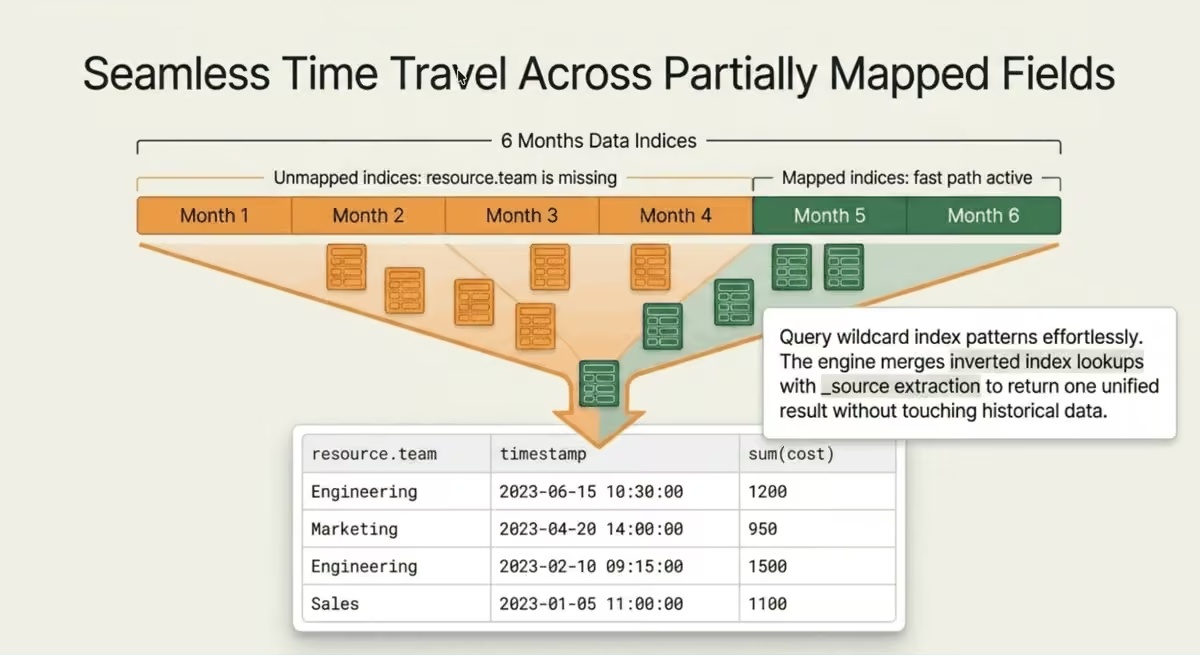 Elastic
@elastic
Building a time series in Kibana Dashboards used to take 14 clicks. Now it takes three.
• Brand new API
• Natural language dashboard creation
• Plus much much more
Elastic
@elastic
🧵 A competent RAG pipeline with a billion parameters? It’s no longer just a pipe dream.
The recent release of Gemma and Qwen models give developers access to models as small as under 1B parameters that can run on not just your computer, but edge devices.
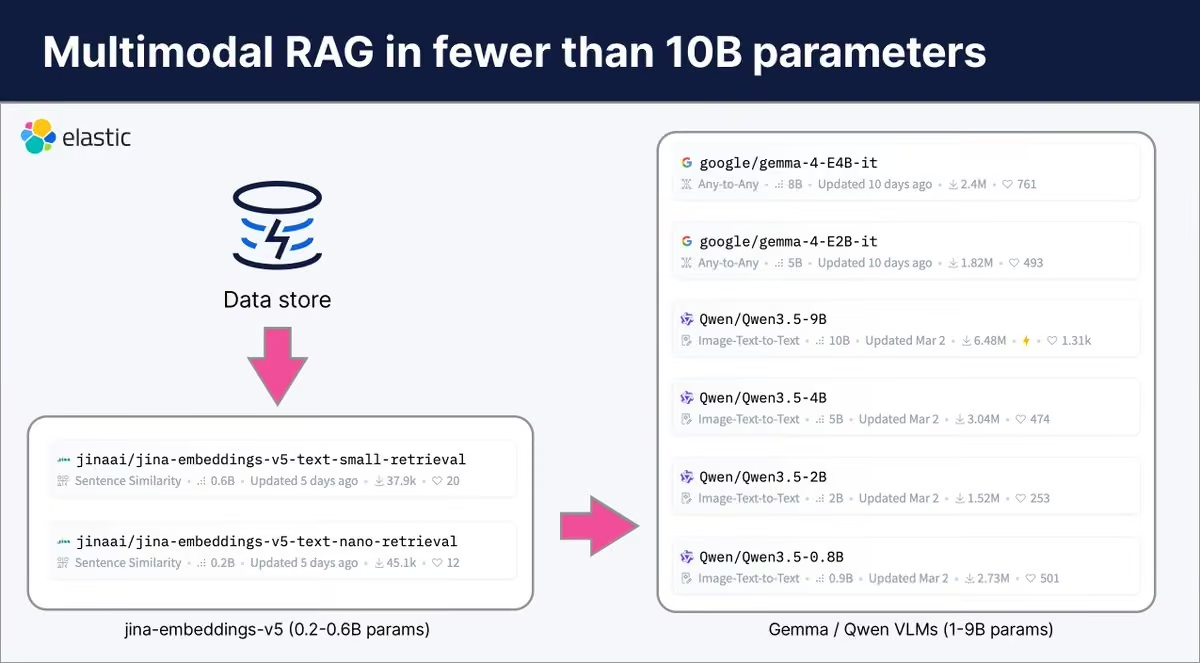 Elastic
@elastic
Combine them with Jina AI’s v5 text embedding models, and you can have a competent RAG pipeline for around 1B parameters, or an even better one for only 5-10B parameters.
What’s even better is that these Gemma and Qwen models are multimodal, so they can understand images as well as text.
You can combine these with Elasticsearch (running on your machine or in the cloud) and you’ll have an efficient RAG pipeline at a fraction of the compute you used to need.
Try them out: go.es.io/4dlDbld
Elastic
@elastic
jina-embeddings-v5-omni is now on Elastic Inference Service.
Text, images, audio, video. One index, one query.
• Best-in-class visual understanding under 1B parameters
• Beats models 20x its size on multilingual visual tasks
• Beats ByteDance Seed 1.6 on video (55.57 vs 29.30 on Charades-STA)
• BBQ quantization: 93% storage reduction, under 3% accuracy loss
• nano runs on commodity hardware without GPU
Introduction below with @florianhoenicke
Elastic
@elastic
Read the blog: go.es.io/42ZRZRt
Elastic
@elastic
Yeah your agent can reason over data.
But can it do anything about it?
Workflows is the action layer your agents are missing:
• Connect to external systems natively
• Run multistep sequences automatically
• Coordinate across tools without leaving Elastic
Agent Builder = what the agent knows.
Workflows = what the agent does.
New: more connectors, more steps, and natural language authoring in tech preview.
One less reason to bolt on a separate orchestration tool.
Elastic
@elastic
Read more about Elastic 9.4 and Workflows (now GA): go.es.io/4ddTBvW
Elastic
@elastic
Great work from the @elasticseclabs team!
Elastic Security Labs
@elasticseclabs
We uncovered a new Brazilian banking trojan campaign: TCLBANKER.
What makes TCLBANKER notable isn’t just the malware itself, but how it spreads.
The campaign uses compromised WhatsApp and Outlook accounts to propagate through trusted user relationships, deploys targeted banking overlays, and incorporates anti-analysis techniques designed to evade detection.
For defenders, it’s another example of malware increasingly blending into legitimate user behavior and everyday communication channels, making detection harder and trust easier to exploit.
Our latest research breaks down the infection chain, propagation methods, evasion tactics, and detection opportunities observed across the campaign.
Read the full analysis: go.es.io/4ewvCKF
 Elastic
@elastic
30x faster than Prometheus on gauge averages sounds like a typo. It's not.
Elasticsearch 9.4 rebuilt TSDS and ES|QL into a fully columnar metrics engine. Vectorized time series aggregations, zero-copy decoding, doc value skippers replacing inverted indices.
The result at 1.4M time series: queries that took Prometheus 30+ seconds finish in under 2.
 Elastic
@elastic
Counter rates tell the same story, even with full counter-reset detection and interpolation across bucket boundaries (something ClickHouse skips entirely).
Storage is 3.75 bytes per data point. Down from 25 a year ago. 2.5x better than Prometheus.
Blog: go.es.io/4whPtDz
 Elastic
@elastic
Multi-index ES|QL queries break in two ways:
1. OR conditions across indices block predicate pushdown — every index scans everything.
2. CASE chains grow with every source you add — and copy across every dashboard that uses them.
Subqueries in FROM fix both.
Each branch runs independently, pushes its own filters, and handles its own schema.
Results merge automatically.
Your fourth index gets a fourth branch. Not a rewrite.
 Elastic
@elastic
Learn more: go.es.io/4tonIXA
Elastic
@elastic
ES|QL logical views are in Tech Preview.
Here's the problem they solve:
• You have the same filter query copied across twelve dashboard panels.
• Someone updates the index pattern. Now you have twelve stale copies.
Define it once instead:
FROM error_triage | STATS error_count BY service
One change. Twelve dashboards fixed.
 Elastic
@elastic
Read the full blog: go.es.io/4esLvlf
Elastic
@elastic
Agent Builder in Elastic 9.4 cuts token costs by up to 40%.
Not by truncating context, but by enabling agents to manage it independently.
Four mechanisms do the work:
• Dynamic skill loading: instructions load only when needed, not all at once
• Conversation context store: large result sets stay out of the prompt until required
• Selective compaction: long conversations compress without losing what matters
• OAuth connectors: query Google Drive, Salesforce, Slack without copying data
In internal testing, dynamic skills alone cut input token usage by 21 to 39%.
Top snippets retrieval added another 27 to 34% reduction.
Context window stays stable past 30 turns.
Without this, it balloons to max size by turn twelve.
 Elastic
@elastic
Read more: go.es.io/4nb1UwS
 Elastic
@elastic
Should you use MCP or Agent Skills?
Here's when to use what.
MCP (Model Context Protocol) is a standardized protocol for connecting AI agents to external resources and tools.
Your agent makes an API call with fixed schemas from the MCP client to the MCP server.
Suitable for:
• Precise and predictable operations
• Custom MCP servers for your own agentic systems
• Standardized tool and resource access across multiple agents
Agent Skills are a set of specialized instructions in natural language with references to other resources.
Your agent interprets the natural language instructions in a local Markdown file.
Suitable for:
• Repeatable behavioral guidance
• Controlled and reliable execution logic
• Extending the agent's capabilities with token efficiency
If you're interested in Skills, you can get started with Elastic Agent Skills with just one line:
npx skills add elastic/agent-skills
Repository: go.es.io/4cSRYom
 Elastic
@elastic
Elastic 9.4 is now available, bringing new advancements across the Elasticsearch Platform.
Key new features:
• Elastic Workflows GA, scripted automation and agentic reasoning enable AI agents to act on their findings
• Elastic Agent Builder enhancements optimize context, transforming agents from open-ended prompts into controlled, action-driven systems
• Native Prometheus and PromQL support, with significant TSDB efficiency improvements, position Elastic Observability as a compelling alternative to competing metrics solutions and enable a single platform across logs, metrics, and traces
Transform data into answers, actions, and outcomes.
Learn more: go.es.io/4tZVi7q
Elastic reposted
 Elastic Dev
@elastic_devs
What if semantic search in Elasticsearch was as simple as writing a regular text query?
It is now.
- Thread below: Here's the full evolution of search: from BM25 to hybrid AI-powered retrieval 🧵
- Video explainer: go.es.io/48weUHt

Elastic reposted
Elastic Dev
@elastic_devs
🧵 Are you flying your AI coding CLI blind?
@_jphwang mapped what the major AI coding tools actually expose natively against what you could be capturing. The gaps are bigger than you'd expect.
Some highlights:
- System prompt? Not exposed in most cases. That's ~10-20K tokens assembled silently per request, invisible without API-layer interception.
- Cache TTL? Silent. Hit/miss stats hidden, changes undetectable from CLI logs alone.
- Thinking tokens? Billed but hidden.
- Tool call audit trail? All 4 tools handle this well. Session logs too. That's roughly where the good news ends.
The easiest way to see the full picture is a proxy between the CLI and the API. Raw API payloads, effort params, real cache TTL headers, true token costs: you can be sure you’re getting everything.
Forward those logs into Elasticsearch and you get cross-session, cross-tool observability in one place: latency patterns, token trends, cost attribution, tool call failure rates.
Flying blind is fine for prototyping. Not for prod.
 Elastic
@elastic
A defining week at #googlecloudnext.
Elastic named 2026 Google Cloud Partner of the Year for Data Management & AI.
This means:
• Deep integration with Google Distributed Cloud (GDC) air-gapped, acting as a critical security layer for sovereign and air-gapped environments
• Axion-powered performance gains on Elastic Cloud
• AI grounded in your data, supporting Gemini models, with Jina Embeddings v3 in Model Garden and self-managed deployments in your VPC
From product to platform, Elastic is playing an increasingly critical role across the Google Cloud ecosystem.
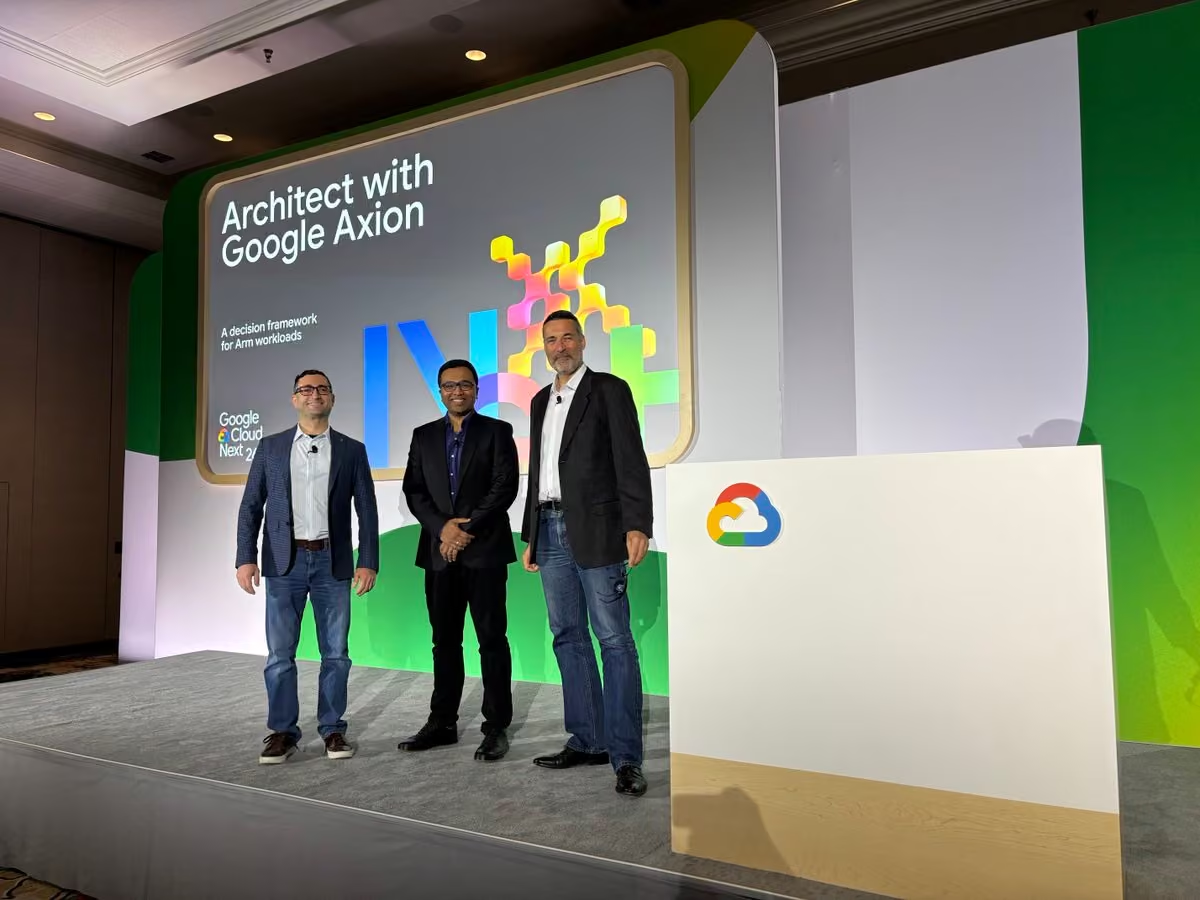
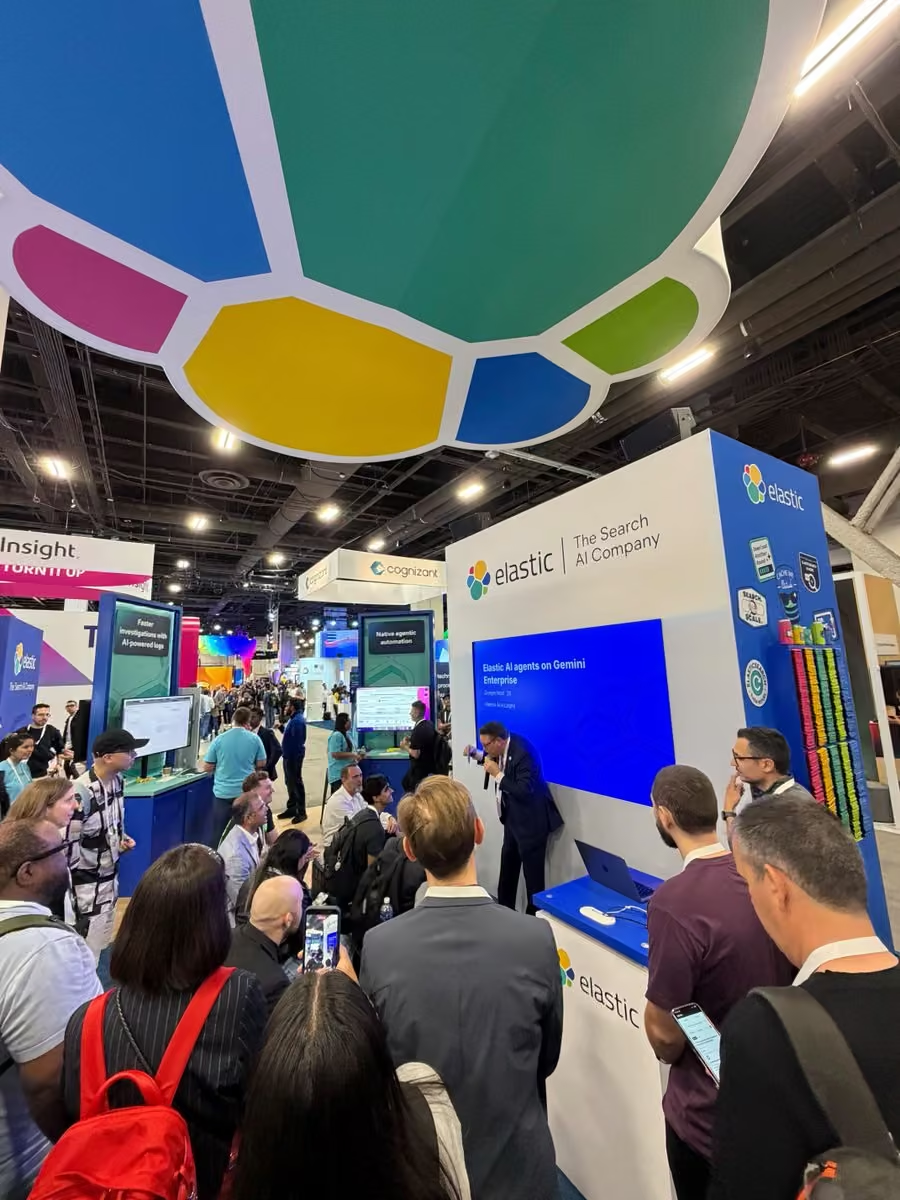


Elastic reposted
Elastic Dev
@elastic_devs
Local AI models are having a moment.
Gemma 4, GLM 5.1, and Qwen 3.6 all dropped in the same week. Don’t sleep on these models.
They can handle real tasks just as well as larger API-based models, especially when paired with the right help.
These days, the bottleneck for local models may be the context, more than intelligence.
 Elastic
@elastic
Just in: Elastic is now a critical security partner for Google Distributed Cloud air-gapped environments.
Through our deep integration with @GoogleCloud, Elastic’s agentic security operations platform delivers modern, AI-driven security into fully disconnected environments.
• Detect and respond to advanced threats
• Unified SIEM + XDR in a single platform
• Full control without added complexity
For the most sensitive workloads, this changes what’s possible.
go.es.io/4sNbreN
Elastic
@elastic
Scaling Prometheus shouldn't feel like a second job. But for most SREs it does — multiple backends, cardinality headaches, context-switching between tools just to find root cause.
We've fixed that. Native PromQL in Kibana, direct Remote Write ingest, and metrics unified with logs and traces in a single platform.
25x faster queries than Prometheus. 2.5x storage savings. One day to migrate.
Keep everything you've built. Ditch the complexity. go.es.io/4cQn1jA
Elastic
@elastic
Performance or cost? At #googlecloudnext, we’re showing you don’t have to choose.
Google Axion ARM instances are now live on Elastic Cloud Hosted.
• 25% better price-performance
• Faster indexing & query speeds
• Zero changes to your workflow
Same Elastic, more efficient infrastructure. The details: go.es.io/4eDwsFi
Elastic
@elastic
Jina Embeddings v3 is now available as a self-deployable partner model on Gemini Enterprise Agent Platform Model Garden.
Deploy directly within your @GoogleCloud VPC to eliminate external API calls and gain full control over your data and costs.
The Impact:
• Total Data Control: Data stays inside your perimeter, ideal for regulated industries.
• Predictable Pricing: A flat hourly rate for compute that rewards scale (no more per-token metering).
• Native Integration: Works out-of-the-box with BigQuery, Cloud Storage, and IAM.
Stop choosing between performance and control.
go.es.io/4trIQN9
Elastic
@elastic
Stop switching tabs. Your AI tools are now the workbench.
Elastic is the first to ship interactive security and observability workflows in AI tools, with search alongside.
• Triage alerts through AI verdict panels
• Run ES|QL queries and build dashboards from natural language
• Investigate threats and traces through interactive graphs
No more text-only summaries. Three open source MCP Apps, one conversation.
The details: go.es.io/4mOxKzA
 Elastic
@elastic
The true test of GenAI is securely connecting models to enterprise data.
Earning our 5th @GoogleCloud Partner of the Year award—this year for Data Management & AI—reflects our continued collaboration with Google Cloud, enabling customers to use Elastic as a data foundation for AI applications built on Vertex AI and Gemini.
Dive into the details and catch us at #googlecloudnext to see the architecture in action. go.es.io/42kNhgO
Elastic
@elastic
Introducing cross-project search for Elastic Cloud Serverless.
Search across all your workloads from a single pane of glass, without moving your data. Query distributed Elastic Serverless projects as one while maintaining native project isolation.
Cross-project search allows you to keep data separated by region, team, tenant, or environment while maintaining global visibility. Security and Observability teams can query across linked projects to gain full context, without copying or consolidating data.
Learn more: go.es.io/4vKRI2g
Elastic
@elastic
What does it take to make AI actually work with your data?
At #googlecloudnext, Elastic is sharing how teams are building GenAI + Agentic AI that performs in the real world, not just in demos.
→ Design for performance from day one
→ Build AI that understands your data
→ Move to AI-driven operations
Catch these sessions live.
Elastic
@elastic
At #googlecloudnext, see how Elastic turns data into real outcomes, faster, smarter, and at scale.
Visit the booth to:
• Automate investigations: Turn messy logs into clear, actionable insights with Gemini
• Accelerate your SOC: Replace legacy SOAR with native AI automation to stop threats faster
• Build smarter agents: Use Agent Builder to deploy Gemini-powered AI with real context
See what production-ready AI actually looks like.
go.es.io/4szxqWu
Elastic
@elastic
Deploying AI at scale requires a technological architecture built for speed. In our NVIDIA partnership, we integrate NVIDIA cuVS with Elasticsearch to deliver 12x faster vector search results.
Learn more: go.es.io/4twvYoE
 Elastic
@elastic
ECK 3.3.1 is here!
✅ AutoOps via Cloud Connected for automated clsuter analysis
✅ Self-hosted Package Registry for air-gapped environments
✅ Composable config policies for scalable management
Run Elasticsearch on Kubernetes with less manual work → go.es.io/4mqPwZz
Elastic
@elastic
The Axios attack again proved the status quo is broken. We caught it by using AI to diff package repo updates. Built Friday, caught the compromise Monday.
We open sourced the project so the community can iterate on it. We all need a higher floor for defense.
Elastic Security Labs
@elasticseclabs
One of our researchers built an AI powered supply chain monitoring tool on a Friday afternoon.
The following Monday night it caught the Axios npm compromise before most people knew it existed.
Elastic Security Labs is open sourcing the tool.
Full story by @dez_ here:
Elastic
@elastic
We’re heading to Google Cloud Next.
See how Elastic + @googlecloud use Elasticsearch to bring context to your data, so signals connect and teams can act faster, with precision.
Stay tuned for all we have in store.
go.es.io/4cjfYk5
#googlecloudnext
Elastic
@elastic
Elastic Cloud Hosted on AWS GovCloud (US) achieves FedRAMP® High authorization, continuing our team’s longstanding commitment to the highest levels of security and efficiency for sensitive government data.
go.es.io/4s4cVAS
Elastic
@elastic
At RSAC 2026, Elastic Security showed how AI is transforming modern security operations from detection to response.
We announced Elastic Workflows for native automation in Elastic Security and eliminated per-endpoint pricing in Elastic Security XDR. In an era of AI-accelerated threats, we’re ending the “security tax” and saying goodbye to the model that keeps extracting more from defenders each year.
Huge thank you to everyone who stopped by, joined our session, and spent time with us this week in San Francisco.
RSAC 2026, that’s a wrap. 👋


 Elastic
@elastic
At KubeCon Amsterdam 2026, it was clear teams don’t need more data. They need it to make sense, faster.
We showed how Elastic is simplifying OpenTelemetry + bringing agentic AI into investigations.
Really good conversations this week.
 Elastic
@elastic
Operate at machine speed. AI is turning SOC analysts into threat engineers, while handling the rest.
Here’s how Elastic powers the agentic SOC: go.es.io/47l34PP
Elastic
@elastic
Meet Code War author Allie Mellen for a live book signing and conversation on how nations hack, spy, and shape the digital battlefield.
📅 Mar 25 | 10–11 AM
📍 Elastic Booth N-5678
Elastic
@elastic
At #gtc2026, we showed how enterprise AI is accelerating, powered by performance, scale, and real partnerships.
What we brought this week:
• GPU-accelerated vector search with NVIDIA cuVS (up to 12x faster indexing)
• A vector database embedded in the Dell AI Data Platform
• GPU-accelerated vector search now on Red Hat AI
Faster indexing. Flexible deployment. Production-ready AI.
Elastic
@elastic
OpenTelemetry adoption is growing quickly. Operating it at scale is the next challenge.
Collector sprawl, configuration drift, and limited visibility make it hard
With Elastic Agent and Fleet you get a single place to manage OTel collectors.
Learn more ↓
Elastic
@elastic
Elastic Security XDR brings endpoint + cloud + identity + network into a single agentic security operations platform, with SIEM, XDR, and automation included. Prevent attacks at their source without the “endpoint tax.” go.es.io/4bFkQi2
If you’re at RSAC this week, stop by booth N-5678 to see in action live.
Elastic
@elastic
Now in tech preview: Elastic Workflows brings native automation to Elastic Security. Run defined playbooks + call AI agents to reason through complex investigations, right on your alerts, cases, and data. No separate SOAR required. go.es.io/3NwyhZH
Join us in-person at #rsac (Booth N-5678) to learn more about Workflows from our experts.
Elastic
@elastic
At #rsac 2026, join Elastic for a technical session on hybrid automation for detection & response.
See how AI agents reason through alerts and hand off to Workflows for consistent execution, no separate SOAR required.
📍 Moscone South Esplanade
🗓 Mar 25 | 8:30 a.m.
🎤 Michael Paquette & Tinsae Erkailo
go.es.io/3NdPjf6
Elastic
@elastic
Elastic is heading to KubeCon Amsterdam 2026 🇳🇱
Visit booth #980 to see how we’re building OpenTelemetry to simplify ingestion, reduce pipeline complexity, and deliver consistent observability across metrics, logs, and traces with a focus on agentic observability.
Come see the demos and meet the team: go.es.io/4uGtF3N
Elastic
@elastic
The Elastic Managed OTLP Endpoint is now GA on Elastic Cloud Hosted.
Send traces, metrics, and logs from any OpenTelemetry source without managing ingestion infrastructure.
Just point to the endpoint and start sending telemetry. Elastic handles the rest ↓
Elastic
@elastic
Faster indexing. Scalable RAG. Built for Kubernetes.
Elastic GPU-accelerated vector search with NVIDIA cuVS is now available on Red Hat AI. Run search, RAG, and AI agents on-prem, in the cloud, or across hybrid K8s.
See how it works: go.es.io/4bTyOxW
At #gtc2026? Visit Booth 3200 or join one of our sessions.
Elastic
@elastic
Head-based sampling in OpenTelemetry is cheap and practical, but it used to break throughput charts.
The fix: carry sampling probability in tracestate so backends can estimate original trace volume.
Learn how we implemented it in Java, JS, and Python ↓
go.es.io/4cSy51c
Elastic
@elastic
Elastic GPU-accelerated vector indexing with NVIDIA cuVS sets a new standard for high-performance vector search, eliminating a critical barrier to enterprise-scale AI.
Vectorize massive volumes of data. Accelerate time to production.
See how Elastic and NVIDIA transform your AI Workflows: go.es.io/4uAkoKB
Elastic
@elastic
From GPU-accelerated indexing performance to unlocking unstructured data for AI agents, we’re breaking down what it takes to run AI in production.
Join Elastic for two sessions on scaling enterprise AI.
Add these to your #nvidiagtc 2026 agenda.
Elastic
@elastic
Elastic donated its OpenTelemetry PHP distro to the OpenTelemetry community!
The project makes high-performance, zero-config observability more accessible for PHP devs everywhere.
Install the package → restart PHP → start collecting telemetry.
Learn more:
Elastic
@elastic
Heading to #nvidiagtc ? So are we.
Elastic + NVIDIA are eliminating the data bottleneck with GPU-accelerated vector search built for enterprise-scale AI.
• Up to 12x faster indexing
• 7x faster force merging
• Lower CPU strain at scale
Let’s talk about scaling AI without scaling infrastructure costs. go.es.io/3PgVTli
📍 Booth 3200 l March 16-19
Elastic
@elastic
Attention Elasticsearch Community! Elastic AutoOps is now free for every self-managed cluster with no license upgrade needed.
AutoOps analyzes your clusters, identifies what is wrong, and tells you how to fix it:
✅ Automatic issue detection + fix recommendations
✅ Real-time slow query and bottleneck detection
✅ Resource optimization insights
✅ Central view of all clusters, no extra monitoring setup
Learn more → go.es.io/40yKlME
Elastic
@elastic
Boost performance and cut costs on Elastic Cloud Hosted!
Now supporting @AWS Graviton4 ARM hardware:
• CPU Optimized ARM → up to 15% better price-performance
• Storage Optimized ARM → up to 40% better price-performance
All without changing how you build or operate on Elastic Cloud.
Learn more: go.es.io/4tWTXP8
Elastic
@elastic
New state-of-the-art Jina embeddings models are now live on Elastic Inference Service!
These models offer:
•Top performance for models of their size
•Multilingual and long-text support
•Efficient, cost-effective performance for search and AI retrieval
Learn more:
 Elastic
@elastic
Collecting logs, metrics, and traces but still firefighting incidents? That’s often a sign of low observability maturity.
Our Observability Maturity Guide helps teams identify gaps, reduce reactive work, and move toward more proactive, informed operations.
Check out the guide:
Elastic reposted
Elastic Dev
@elastic_devs
Want to see how far you can push autonomous agents?
We’re hosting a hackathon focused on building with the Elastic Agent Builder, and we want to see your most innovative implementations.
The Challenge
• Use the Agent Builder to create a custom AI assistant or tool that solves a real-world problem. Think beyond simple chat; we're looking for:
• Actionable AI: Automation for IT requests or infrastructure management.
• Custom Tooling: Integrating unique APIs or data sources via MCP.
• Agentic RAG: Advanced retrieval strategies that provide precise, data-driven answers.
Why join?
• $20,000 in prizes.
• Showcase your work: Get your project in front of the Elastic engineering community.
• Build with the best: Access our latest features, including the Elasticsearch Open Inference API.
• Get Featured: Top projects may be highlighted on Elasticsearch Labs
All the details below. Deadline 27th February, 2026.
 Elastic
@elastic
The Elastic Public Roadmap is here — now live on GitHub.
See planned launches, explore what’s coming in the next 6–9 months, filter by solution, and search by version/release.
Learn more 👉 go.es.io/3MHMfHD
Elastic
@elastic
GPU-accelerated vector indexing is now in technical preview. Elastic integrates NVIDIA cuVS into Elasticsearch so self-managed customers can speed up data indexing using NVIDIA GPUs.
Customers can expect:
•12x faster indexing
•7x faster merging
•Frees up CPU for other tasks
Learn more: go.es.io/3MhBgnY
Elastic
@elastic
Elastic Workflows changes automation.
👉Developers build reliable workflows—no more patchwork code.
👉Security teams automate investigations, with AI agents stepping in when judgment’s needed.
👉Ops teams keep systems running smoothly, with AI agents ready for the unexpected.
All natively in Elasticsearch.
go.es.io/3NV3Qfy
Elastic
@elastic
Agents shouldn't just chat, they should act.
Introducing Elastic Workflows — native automation built directly into Elasticsearch. Use Workflows to run defined tasks reliably and bring in AI agents when situations need judgment.
Everything runs where your data is, no integrations required.
Learn more: go.es.io/4kpGT07
Elastic
@elastic
Elastic 9.3 is now available—bringing new ways to work with your data.
Key new features:
• Elastic Agent Builder GA – Build AI agents that understand real context
• Elastic Workflows – Automate responses, investigations, and operational tasks
• Three Jina AI models via Elastic Inference Service – Fast, GPU-accelerated embeddings & multilingual reranking
Turn insight into action, directly where your data lives.
Learn more: go.es.io/4c8ALXX
Elastic
@elastic
Live today.
See how data, context, and execution come together in Elastic Agent Builder to power real AI workflows on Elasticsearch.
Drop in and watch.
go.es.io/4jMPg5v
Elastic
@elastic
Agent Builder is now Generally Available 🎉
Build context-driven AI agents that understand your data and take action — in minutes.
Chat, analyze, and automate actions with precision.
Learn more: go.es.io/4sOVaaF
Elastic reposted
Elastic Dev
@elastic_devs
From CSV files to a chatbot in minutes with @Elastic Agent Builder:
Elastic
@elastic
We’re building an AI agent live.
Watch how Elastic Agent Builder grounds agents in your data, adds context with Elasticsearch, and executes real workflows—end to end.
Don’t miss it.
go.es.io/4sOfatN
Elastic
@elastic
Elastic Agent Builder brings together what AI agents need to work in practice: context from your data, native search and vectors, and the ability to execute real workflows.
See how agents can search, reason, and take action—end to end—inside Elasticsearch on January 22, 2PM ET.
Elastic
@elastic
Agentic AI is reshaping observability, faster insights, less manual analysis. Watch the conversation:
 Six Five Media
@TheSixFiveMedia
Agentic AI is redefining observability, moving beyond spotting memory constraints to flagging code changes that impact checkout performance and revenue. By taking on dependency and impact analysis, it delivers faster resolution and insight that scales with system complexity.
At AWS re:Invent, @elastic's Baha Azarmi explains how SREs can operate at an expert level without knowing every layer of the stack. They can simply ask an agent: Where’s the problem? What changed? What’s the impact?
Watch the full interview on how agentic AI is simplifying observability: www.youtube.com/watch?v=7c36k1BTsEI
Elastic
@elastic
Join us live to see how Elastic Agent Builder lets you build AI agents that understand your data, reason with context, and take action—all inside Elasticsearch.
Live demo. Real workflows. Prizes included.
go.es.io/49TIojp
Elastic
@elastic
Scale your search, security, and observability apps with confidence on any cloud.
Elastic Cloud Serverless now holds major compliance certifications like SOC 2, HIPAA, & PCI-DSS across AWS, Azure, and GCP.
Read the announcement: go.es.io/3LvXL8v
Elastic
@elastic
Agentic AI is moving security from alert handling to decision support, but only if it’s grounded in the right data and workflows.
Worth a watch if you're thinking seriously about AI in security.
Six Five Media
@TheSixFiveMedia
How are agents helping IT leaders respond proactively to AI-driven cyberattacks and streamline security workflows?
From AWS re:Invent 2025 @mitchellashley hosts Mike Nichols, General Manager, Security at @elastic, to discuss how agentic ai is helping security ops defend against sophisticated cyber threats.
Elastic
@elastic
As AI takes on more responsibility, visibility and trust become non-negotiable.
In this conversation with @WSJ, @Kyndryl and Elastic discuss how observability, data agility, and strategic partnerships help enterprises scale agentic AI responsibly—without relying on rigid architectures: go.es.io/3Lzsbqk
Elastic reposted
Elastic Dev
@elastic_devs
What did you build with Elasticsearch in 2025? Share your creation below!
Elastic
@elastic
Contextual AI is raising the bar for enterprise RAG—with Elastic as the retrieval foundation.
✔️ 90%+ RAG accuracy using vector + hybrid search
✔️ Scales across millions of documents
✔️ A unified context layer teams can trust in production
See how Elastic helps move AI from experimentation to real-world workflows ↓
go.es.io/49lX4qd
Elastic
@elastic
Watch now: agentic AI beyond RAG.
Six Five Media
@TheSixFiveMedia
Agentic AI is only as strong as the search foundation beneath it.
At AWS re:Invent 2025, @NickPatience and @elastic’s GM of Search Solutions, Steve Kearns (@skearns64), break down how enterprises are moving from classic RAG to autonomous, production-grade agentic systems—and how Elasticsearch is enabling more autonomous, reliable enterprise workflows.
Elastic
@elastic
Attackers taught us a lot. We listened.
Elastic’s AI is continuously retrained on real attacks to keep defenders ahead, without the noise.
2025 Global Threat Report → go.es.io/4pf3sFy
Elastic reposted
Elastic Dev
@elastic_devs
Elastic currently provides inference endpoints for several well-known third-party providers, like OpenAI, Azure, Cohere, and Alibaba. But did you know you can also define your own custom endpoints using the inference API?
Check out this example to generate embeddings using DeepSeek. For more details, refer to our blog: go.es.io/44HEA1R
 Elastic
@elastic
2025 was a big year for Elastic + Google Cloud, with AI driving momentum across search, observability, and security.
🤖 Native grounding for Gemini in Vertex AI
🧠 AI agents for conversational and domain-specific workflows
📊 Observability for LLM performance and cost
🔐 Stronger cloud security integrations
What’s next for AI-powered systems → go.es.io/4pgZAE3
Elastic
@elastic
Identity is where most cloud attacks begin.
As Mandy Andress puts it, “the attack path starts with identity. Defenders need to treat access as critical infrastructure. This is where breaches begin, and where they can be stopped.”
Read the Global Threat Report →
Elastic
@elastic
From Search AI to observability, Elastic + @AWS continue to help customers build intelligent cloud applications.
See what we shared at #awsreinvent 2025 → go.es.io/48WpLJW
Elastic
@elastic
Elastic Cloud Serverless continues to expand on @googlecloud — now available in Singapore, London, Frankfurt, and the Netherlands.
Built to help teams run workloads easier, meet compliance needs, and scale globally. go.es.io/4pd1VzZ
Elastic
@elastic
That’s a wrap on our 2025 holiday calendar! 🎁 Thank you to everyone who joined us and explored a month of insights from Elastic and @Microsoft.
We’re excited to kick off another year of helping our customers search smarter and turn their data into actionable insights with the help of agentic AI. go.es.io/4qhgHGB
Elastic
@elastic
Elastic’s intelligent, autonomous agents are transforming the way you work, turning hours into seconds.
From troubleshooting to threat detection to customer support, they accelerate results across your entire organization.
Explore how Elastic can elevate your 2026 goals in our holiday calendar. 🎄
go.es.io/4s5i2SU
Elastic
@elastic
The only 100% score in all @AV_Comparatives Real-World & Malware Tests 2025.
Elastic Security caught 100% of threats in these tests without flagging or blocking the essential business applications your teams rely on.
See how leading endpoint security vendors fared: go.es.io/4pOg6MT
 Elastic
@elastic
Elasticians showed up for #givingtuesday, supporting organizations making an impact in communities around the world.
Grateful for the generosity and the causes driving this work forward.
Highlights below ⬇️
#elasticcares
Elastic
@elastic
Huge shoutout to the team behind “Augmented Infrastructure,” the winning project from our recent Elastic hackathon, built with Elastic Agent Builder.
Even better: the team donated their prize, and Elastic matched it for a total of $30K to local charities.
Innovation with impact. 💙
Watch their demo below.
Elastic
@elastic
Got a minute? Here’s Workflows + Agent Builder in action.
At #awsreinvent, we showed how Elastic’s native automation engine pairs with context-driven AI agents inside Elasticsearch — no external orchestration layers, no stitching together multiple systems.
It gives teams a faster, more repeatable path to production-ready automation.
Elastic
@elastic
The Elastic + @Microsoft holiday content calendar is live! 25 days of fresh insights for growth in 2026 start now. 🎉
From full-stack observability to intelligent search, there’s something new every week. Check out our first week and see how Elastic on Azure helps you see, secure, and search everything.
Start exploring today and get ahead for 2026!
go.es.io/3Klpzfl
Elastic reposted
Elastic Dev
@elastic_devs
Tired of hearing the same old boring Christmas Songs? All we want for Christmas is fresh, extendable, and horizontally scaled Christmas Cheer! Check out Justin Castilla's article on how we're hacking our beloved Christmas Jingles. 🎁🎄🎅🏼
🔗 discuss.elastic.co/t/383854
 Elastic
@elastic
What a week at #awsreinvent.
We announced:
• Bedrock AgentCore integration
• AWS Agentic AI Specialization
• Elastic × Accenture collaboration
• Elastic × NVIDIA cuVS for GPU-accelerated vector search
Plus huge momentum around Workflows, Agent Builder, Streams & Search AI.
Thanks to everyone who came through, more to come.
Elastic
@elastic
Vector indexing just became significantly faster.
Elasticsearch + @nvidia cuVS delivers:
→ ~12× higher indexing throughput
→ ~7× faster force-merge operations
→ Lower CPU usage
→ 5–6× faster even on a cost-adjusted comparison
All on the same Elasticsearch node.
Stay tuned for more: go.es.io/4rA2DK5
Elastic
@elastic
ICYMI: Elastic now has the @awscloud AI Specialization in Agentic AI.
Why it matters: grounded agents, reliable automation, and context-driven workflows aren’t future goals, they’re being built and deployed with Elastic today.
This specialization validates practical, transparent, production-ready agentic AI, and it’s fuel for what comes next.
#awsreinvent
Elastic
@elastic
There's buzz for Agent Builder, Elastic Observability and Security at #awsreinvent.
We're showcasing how Search and AI, workflow automation, and AI-driven security run on one unified platform, helping teams cut investigation time, reduce manual work, and turn raw data into high-performing agentic solutions.
Come and see it live at Booth 1112.
Elastic
@elastic
AI isn’t blocked by the model, it’s blocked by messy, siloed data.
Elastic + Accenture + AWS just launched the Data Readiness Engine for GenAI, a turnkey way to prep enterprise data for AI at scale.
Highlights:
• 70+ connectors unify structured + unstructured data
• Elasticsearch powers semantic + vector search for grounding
• Automated cleansing + enrichment
• Deployable via AWS Marketplace
This is how organizations move from GenAI pilots → production.
More here: go.es.io/4pdzker
Elastic
@elastic
For more #awsreinvent content live from the show, follow @elastic_devs this week — conference presentations, lightning talks, and new features from Agent Builder to Streams and Workflows
Elastic Dev
@elastic_devs
#reinvent is in full swing. We'll live tweet our best conference presentations, ignite talks at the booth, and what new tech we're rolling out — from Agent Builder to Workflows, better GPU integrations with Nvidia,...
 Elastic
@elastic
Data has a wild side. Meet the heroes who protect it.
Introducing Elky Quest, a collectible sticker hunt launching at #awsreinvent.
Find the heroes, uncover the lore, collect the full set.
Your quest starts at Booth 1112. 🦌✨
go.es.io/48JIrOi
Elastic
@elastic
🎁 The Elastic Advent Calendar is back
Now posting over on Elastic Devs — follow along for technical, hands-on content.
Elastic Dev
@elastic_devs
The Elastic Advent Calendar is back again this year! Let's start the first day with @anaethelion, who is offering his `--help` to Santa: discuss.elastic.co/t/383561
#cli #elasticsearch
 Elastic
@elastic
Elastic deepens partnership with @Sirensearch to supercharge AI-driven investigations for national security, law enforcement & financial crime.
Real-time search + deep intelligence = faster, smarter case resolution.
Open, explainable, audit-ready.
More about our partnership: go.es.io/49SRNsc
Elastic
@elastic
Elastic has earned the AWS Agentic AI Specialization! This recognition validates our expertise in delivering agentic AI solutions that drive efficiency, creativity, and productivity for organizations on @AWS.
go.es.io/3XoBhsr
#elastic #aws #agenticai
Elastic
@elastic
Now live: Elastic Observability + Amazon Bedrock AgentCore.
Stop treating your AI agents like a "black box." ⬛️
Get a unified view of platform health and application logic. Correlate OTel traces with Bedrock metrics to spot hallucinations, latency spikes, and failed tool calls instantly.
go.es.io/4iFa2Ub
#aws #bedrock #observability #devops
Elastic
@elastic
GPU-accelerated vector search is here.
See NVIDIA’s Corey J. Nolet + Elastic’s Chad Tindel at #awsreinvent for a deep dive on cuVS + Elasticsearch performance.
📍 Nvidia Booth 1022
📅 Dec 4 l 11-11:30 AM PST
Elastic
@elastic
We’re solving real security cases live, yours included.
Join the workshop. Ask questions. Learn new workflows.
📅 Dec 9 | 12–2PM ET
Sign up: go.es.io/3K9Kp12
 Elastic
@elastic
The real challenge in agentic AI? Context.
At #awsreinvent, Elastic, @AWS & @tavilyai will show how Elasticsearch + AgentCore + Tavily retrieval keep agents grounded with vector search + semantic/hybrid retrieval.
Mark your calendars for Dec 3. go.es.io/4p9pcDO
Elastic
@elastic
Rearchitecting Elasticsearch for serverless scale wasn’t simple, but the payoff is big.
In the new AWS for Software Companies episode, @uri1803 + AWS’s Johan Broman dive into the engineering behind Elastic Cloud Serverless and how it removes operational overhead while scaling globally.
Listen: go.es.io/4odrT5F
Elastic
@elastic
This December, Elastic + Microsoft are launching 25 days of practical insights, from observability to AI-powered search and the trends shaping 2026.
Holiday calendar drops soon.
go.es.io/4aggb74
 Elastic
@elastic
T-5 days until #awsreinvent.
✔️Keep agents in context
✔️Turn logs into signal
✔️Detect threats with AI
Elastic Cloud on AWS. See it all at booth 1112.
go.es.io/3LOOpEK
Elastic
@elastic
Think you can outsmart today’s attackers? 🕵️♂️
Join the Elastic Security Capture the Flag and take on three live attack simulations, from malicious docs to ransomware.
Prove your skills. Claim the leaderboard. 🔥
Dec 4 | 12–2 PM EST | Virtual
👉 go.es.io/48wY5wh

Elastic reposted
Elastic Dev
@elastic_devs
Did you know you can host or connect to GPU-powered LLMs with the Elastic Inference Service?
You can customize how your ML models are powered, your ingest strategy (including customizable chunking!) and your inference pipelines - without leaving Elastic.
Learn more:
Elastic
@elastic
The AI leaders of tomorrow aren’t chasing trends, they’re mastering focus.
🔹Specialize in what matters.
🔹Build with intent.
🔹Deliver real outcomes.
That’s how agentic AI reshapes the ecosystem.
#agenticai #elasticpartner go.es.io/4p2Q3Bl
Elastic
@elastic
Logs → signal.
At #awsreinvent, Elastic’s David Hope will show how AI-powered Streams enriches any log format, removes parser pain, and surfaces significant events automatically.
Live logs & prosper
📅 Dec 2 • 4 PM PST
📍 Mandalay Bay | Oceanside B
go.es.io/3XiB0an
Elastic
@elastic
Where in the world is Elky heading next? 🕵️🦌
Last seen at Elastic{ON} NYC talking about how to keep agents in context and Search AI with builders. Now he’s off to a place packed with neon lights, cloud engineers, and non-stop Elastic + AWS energy.
Answer: #awsreinvent, Booth 1112.
go.es.io/3JQVp3j
Elastic
@elastic
Brief outages = millions in losses for energy companies. Learn how AI-powered observability solutions prevent costly downtime and scale operations efficiently. Join industry experts to discuss what you should know. go.es.io/4pmDlNA
 Elastic
@elastic
Agentic AI stole the show at Ignite.
Teams packed our booth to see how Elasticsearch + Azure AI Foundry power grounded, query-driven agents and automate real security workflows.
Huge thanks to everyone who stopped by, and to Sunile Manjee + Dhrumil Patel for standout sessions.
Until next year, #msignite. 👋


 Elastic
@elastic
Agentic AI needs real context, not guesses.
Elasticsearch + Azure AI Foundry now deliver:
👉 Grounded retrieval (MCP)
👉 Multi-agent workflows (A2A)
👉 Faster builds with open standards
Build agents that actually know your data.
🔗 go.es.io/4i2SssQ
Elastic
@elastic
Agentic AI isn’t a solo act. It’s powered by teamwork, data, search, and partners working in sync.
See how collaboration turns AI into real enterprise impact: go.es.io/49rKS90
Elastic
@elastic
Agentic AI is quickly becoming practical, not theoretical. Here’s a real use case in action from @elastic_devs.👇
Elastic Dev
@elastic_devs
See how @elastic's Agent Builder and Claude can work together with MCP to troubleshoot your K8s workloads. Full walkthrough 🎥
Elastic
@elastic
Elastic is heading to #awsreinvent with a lineup built for builders.
See how we’re helping teams keep their agents in context, turn logs into signal, and surface threats hiding in data, all powered by Search AI.
Plus integrations with Amazon Bedrock, SageMaker, and AgentCore that speed GenAI + agentic AI from idea → production.
Full lineup ↓
go.es.io/3WYF27L
Elastic
@elastic
Essential breakdown from the Elastic Dev team on why context engineering is becoming core to LLM performance. Worth the read. 👇
Elastic Dev
@elastic_devs
New on Elasticsearch Labs: the impact of relevance on context engineering.
Discover how hybrid retrieval, semantic chunking, and agentic search improve LLM performance by managing context relevance efficiently ⬇️
Elastic
@elastic
Before you can search, you have to get data in.
This week, @MikeH_Elastic explains how data ingestion works. Logs, metrics, JSON—once they flow into an index, they’re searchable. Good ingestion is simple and consistent when it works. Watch now: go.es.io/4qUBKzR
Elastic
@elastic
Why do some AI projects deliver results while others fall short? 🤔
Join @IDC, @Microsoft, and Elastic to learn how to build AI apps that scale in the cloud, earn trust, and tie directly to business value.
Register now: go.es.io/3LxI68t
 Elastic
@elastic
They don’t need zero-days when scale does the work.
Snake Keylogger, AgentTesla, and Stealc are stealing 19 K+ browser credentials through memory injection.
Behavioral analytics turns that noise into insight → go.es.io/4pa9XtC
Elastic
@elastic
KubeCon brought the energy. ⚡
We had great conversations around AI Assistant, Streams, Automatic Import, and our OTel-native approach to observability.
What a week!


 Elastic
@elastic
What happens in Vegas? AI innovation if we have anything to do with it.
We’re headed to #awsreinvent to show how search powers secure, scalable GenAI and agentic AI.
And yes, Elky is coming too. 🦌
📍 Booth 1112 | Dec 1–5 | Las Vegas
go.es.io/4oH5r6g
Elastic
@elastic
Better data means better insights.
Elastic shows how the Instrumentation Score helps teams measure and improve OpenTelemetry data quality: go.es.io/3LzwnGm
#kubecon #opentelemetry
Elastic
@elastic
We’re taking the stage at #msignite.
From agentic AI to automated investigations, Elastic experts are showing how Search AI + Azure AI Foundry are shaping what’s next.
Catch the sessions: go.es.io/4paSDVy
Elastic
@elastic
Elastic is named a Leader in the @IDC 2025 MarketScape for Knowledge Discovery 🎉
This recognition highlights how Elastic unifies search, analytics and AI on one platform, helping organizations turn any data into action faster. The details: go.es.io/3JUlxKp
 Elastic
@elastic
Elastic has been named the 2025 Microsoft LATAM SDC Partner of the Year! 🏆
Together with @Microsoft, learn how we are redefining what’s possible with Azure AI and Elasticsearch, powering the next generation of intelligent, scalable apps: go.es.io/4r3Xtpp
 Elastic
@elastic
Come to our booth at #kubecon this week.
Or follow the technical highlights on the @elastic_devs handle where we'll share cheat sheets, demos, and the fastest way to get started with OpenTelemetry.
Elastic Dev
@elastic_devs
We're at #kubecon this week. Find us at the booth for demos, swag, and a chat about our latest work on OpenTelemetry.
And we'll live tweet the best technical content from our booth and the conference in general. Like the fastest way to get started with OTel locally in a single command.

 Elastic
@elastic
Ready to take your instrumentation to the next level? Discover how to centrally configure the Elastic Distribution of OpenTelemetry (EDOT) SDKs via the EDOT Collector using Open Agent Management Protocol (OpAMP), designed for large-scale observability in Elastic Observability.
#opentelemetry #kubecon go.es.io/49f8NIG
Elastic reposted
Elastic Dev
@elastic_devs
Learn how to build a knowledge #agent with semantic recall.
We’ll use #mastra to build a knowledge agent that remembers what users say and can recall relevant information later, using #elasticsearch as the memory and retrieval backend. You can easily extend this same concept to your own real-world use cases.
Follow along step-by-step: www.elastic.co/search-labs/blog/knowledge-agent-semantic-…
 Elastic
@elastic
Context + Agentic AI = Better Hunting.
Want the highlights on how Elastic’s AI Assistant and Attack Discovery (for first-pass triage) simplify SecOps? Check out the best insights from @_JohnHammond and James Spiteri: go.es.io/4oZsj0w
Elastic
@elastic
Elastic's EDOT PHP SDK features are now being contributed to OTel, bringing zero-effort, high-performance observability to one of the web’s most popular languages. Learn more: go.es.io/3JUYTl8
#opentelemetry #kubecon
Elastic
@elastic
Logs look like chaos, but mappings turn them into usable data.
In this episode, @MikeH_Elastic shows how Elasticsearch uses mappings to bring order and context to it all.
go.es.io/4hL9LPd
Elastic
@elastic
Nobody dreams of spending weeks migrating a SIEM.
Luckily, AI doesn’t mind doing the grunt work.
See how Elastic’s Haran Kumar uses AI to make rule conversion faster (and a whole lot easier).
🎥 Watch → go.es.io/49Col9y
Elastic
@elastic
From multilingual search to text expansion, vector embeddings power real-world AI. Learn how they work — and how models like E5 + ELSER support them. Watch now: go.es.io/47t98pN
Elastic
@elastic
See Elastic at #kubecon 2025!
Christos Markou (Elastic) + Jacob Aronoff (OTel) unpack how OpenTelemetry + Kubernetes = better observability.
💡 OTel + K8s = ❤️
📅 Nov 12 | 11:45 AM EST
go.es.io/43fivqI
Elastic
@elastic
Streams got a serious upgrade.
Rebuilt with a reconciliation-based architecture, it’s now more robust, flexible, and easier to debug.
See how we did it ↓
go.es.io/47IMXen
Elastic
@elastic
Speed is the new stealth.
Execution and evasion drive 55% of attacks, powered by scripts, creds, and code.
Memory visibility keeps you one move ahead.
More in the 2025 Global Threat Report → go.es.io/47Cjhzh
Elastic
@elastic
Vector search goes beyond matching keywords. In under 2 minutes, Elastic’s Kathleen DeRusso explains how embeddings and vector databases capture context and meaning in data. Watch now: go.es.io/3L6Bc9M
Elastic reposted
Elastic Dev
@elastic_devs
Query Box is a small app built with the Elastic Agent Builder that lets you add semantic search and chat to any website 🙌
This short walkthrough by Jedr shows how it works, from connecting a domain and crawling data to customizing and embedding the widget.
Elastic
@elastic
If you can describe it, you can index it in Elasticsearch.
@MikeH_Elastic uses a deck of cards to show how documents, fields, and indexes work—turning raw data into something searchable. Watch now: go.es.io/47gnwSh
Elastic
@elastic
Build smarter. Scale faster.
Join us at #elasticontour in Munich to explore what’s next in AI-powered search, observability, and security.
🗓 Nov 6 | 📍 MotorWorld Munich | 💡 Free to attend
Register now: go.es.io/4oP7VPy
Elastic
@elastic
Simplifying data retention for your telemetry data! With Elastic Streams you get a unified view to monitor, visualize and control lifecycles in Elastics Observability, no more juggling templates or index-settings. Learn how: go.es.io/4ohjTBL
#opentelemetry
 Elastic
@elastic
Some threats creep in quietly. 👀
But with full-stack visibility, nothing lurks unseen for long.
Happy Halloween! 🕸️
Elastic
@elastic
Want a glimpse of the future of observability? Elastic is bringing OpenTelemetry, AI-powered log insights, and smarter metrics to KubeCon North America 2025.
Swing by Booth #931 to see Streams and Significant Events in action, test our managed OTLP endpoint, and connect with the team driving cloud-native innovation.
Let’s push the boundaries together! go.es.io/43FFco7
#kubecon #elastic #observability
Elastic
@elastic
You can train people to spot phishing links.
But can your systems spot hidden threats?
Real cybersecurity awareness starts in your data.
#cybersecurityawarenessmonth #elasticsecurity
Elastic
@elastic
Elastic lights up the Burj Khalifa! ✨
A powerful moment celebrating how Search with AI is transforming what’s possible in the era of innovation. Companies worldwide work with Elastic to turn unstructured data into answers and impact.
See how possibility becomes reality on the world’s tallest stage.
Elastic
@elastic
Elastic PM @jamesspi joins security expert @_JohnHammond to unpack how Elastic’s powerful SIEM, XDR, and EDR solutions—enhanced with cutting-edge AI—help teams detect and respond to threats faster. Watch now: go.es.io/4hkLrDB
Elastic
@elastic
Developers, SREs, and security pros, Amsterdam’s calling. 🇳🇱
Join us at #elasticontour to explore AI agents, ES|QL, and LLM observability.
🗓 Oct 30 | 📍 Beurs van Berlage | 💡 Free to attend
Register now: go.es.io/47rq6DQ
Elastic
@elastic
Spreadsheets → JSON → search at scale.
In this week’s episode, @MikeH_Elastic breaks down how documents, shards, and mappings make Elasticsearch fast, distributed, and smart. Watch now: go.es.io/4qjDnH9
Elastic
@elastic
No SRE wants another dashboard at 3am, they want answers.🔍 Meet Streams: Elastic’s new agentic AI solution that turns raw logs into instant answers and faster fixes.
Get to the “why” behind incidents, not just the “what.” All the details here: go.es.io/48UPK6t
Elastic
@elastic
Live logs and prosper. 🔍 Why settle for chasing symptoms at 3am? Elastic Streams puts AI to work, turning your logs into instant answers and real root causes, no detective work required.
Ready to see how SRE workflows get reinvented? See what’s possible with Streams:
 Elastic
@elastic
Hey! Quick question…
What is semantic intent?
It’s the layer of intelligence that lets AI search interpret what you mean, not just what you type.
Watch the latest Quick Question episode to get the full rundown: go.es.io/4opsWjr
Elastic
@elastic
Now live! In addition to new features that help developers with context engineering and agent building — Elastic 9.2 introduces a broad set of new capabilities. Highlights include: Elastic Agent Builder, DiskBBQ, ELSER on EIS, Streams, and more.
Check out the latest:
Elastic
@elastic
If you're looking for more technical deep-dives, demos, or how-tos on Elastic Agent Builder, head over to @elastic_devs for more!
Elastic Dev
@elastic_devs
Follow along to create a custom agent with Elastic Agent Builder.
Next demo: How to create custom tools
Elastic reposted
Elastic Dev
@elastic_devs
Want to chat with your data? Pick an index and walk through this step-by-step notebook to create a tool and build an agent in 10 minutes with Elastic Agent Builder: github.com/elastic/elasticsearch-labs/blob/main/supportin…
 Elastic
@elastic
Stop wrestling with ES|QL syntax.
The new Python query builder in the Elasticsearch client does the heavy lifting for you.
👉 Try it out on #elasticsearchlabs: go.es.io/3WP6KU8
Elastic
@elastic
Ship precise AI agents, fast.
Introducing: Agent Builder, where you can connect all your data, customize tools, and deploy reliable agents in minutes, not weeks: go.es.io/4niIB3h
Want to learn more? Head over to @elastic_devs.
 Elastic
@elastic
Heading to Elastic{ON} San Francisco where AI strategy meets hands-on innovation.
Join Elastic experts to tackle agentic AI, context engineering, and search relevance. Get early access to new features and insights that drive smarter, scalable solutions.
Oct 21 | Free to attend
Elastic
@elastic
New handle alert! Follow @elastic_devs for technical deep dives, practical demos, how-tos and much more
Elastic Dev
@elastic_devs
👋 Welcome to Elastic Dev — your new go-to for hands-on demos, cheat sheets, concept explainers and more. Get the latest on search, data, and GenAI straight from the source.
Expect:
- Practical demos and how-tos
- Posts and technical deep dives from our Labs
- Open source updates
& more
For anyone who loves building, learning and experimenting: let's get started. Hello, world.
Elastic
@elastic
Agents. Context. Vectors.
Go deep on agentic AI and search relevance with Elastic engineers at #elasticon San Francisco.
🗓 Oct 21 | Free for builders: go.es.io/4ql64DG
Elastic
@elastic
Learn how to build an intelligent search system that uses Elastic’s intelligent query layer with MCP to improve LLM generative capabilities in our latest blog: go.es.io/4nbkF1Q
#elasticsearchlabs
 Elastic
@elastic
What does it 𝘳𝘦𝘢𝘭𝘭𝘺 take to build an AI startup that lasts?
Founders from @rungalileo, @JinaAI_, & @llama_index join @benchmark’s @chetanp live for an honest convo on scaling, funding & building AI products that actually deliver. Save your seat: go.es.io/42JX9l9
 Elastic
@elastic
Next stop: San Francisco! Elastic{ON} is bringing the future of AI to the Bay Area. Don’t miss Ken Exner’s keynote on agentic AI, where relevance & context engineering are redefining search, security, & observability. Join us Oct 21, register now: go.es.io/42F9dUM
Elastic
@elastic
Augmentation, autonomous action, and analyst assistance… AI can do what now?! Agentic AI helps your security team multiply its impact.
Learn more in this video: go.es.io/4h7zsJk
Elastic
@elastic
The 2025 @Gartner_inc Magic Quadrant™ for Security Information and Event Management is out: Elastic has been recognized as a Visionary!
Get access to the full report to learn more about Elastic Security and see why we’ve been recognized as a Visionary: go.es.io/43azies
 Elastic
@elastic
In our latest blog, we break down security Influencer @_JohnHammond's insights on how Elastic Security’s unified SIEM and XDR platform transforms SOC workflows with AI-powered analytics and consolidated operations. Learn more: go.es.io/47rclpO
 Elastic
@elastic
Prepared SRE teams are getting ahead of the @opentelemetry curve. This practical guide for managers covers how OTel works, what to watch for, and how to prepare your observability strategy for what’s next. Dive in now: go.es.io/46Tp2IF
 Elastic
@elastic
Discover how to integrate Vertex AI with Elasticsearch to create a RAG application! Follow this tutorial to configure a Gemini model and use it in Kibana's Playground: go.es.io/4mTmkc0
#elasticsearchlabs
 Elastic
@elastic
“Speed doesn’t matter if you don’t have accuracy.” Ash Kulkarni, Elastic CEO
Elastic’s vector
Elastic
@elastic
NYC, we made it.🗽
Search AI is live at Elastic{ON}, from real-time threat detection to deep dives into observability and automation.
Builders, this is your playground. (And yes, Elky’s in the room.)
If you’re here, drop your biggest takeaway.👇
#elasticon
Elastic
@elastic
The new Elastic Inference Service (EIS) brings GPU-accelerated inference to Elasticsearch — now on Elastic Cloud!
Run embeddings, semantic reranking, and LLMs to power faster semantic search, RAG, and AI—with simplicity and scale. Learn more: go.es.io/4o45GHM
 Elastic
@elastic
We’re excited to announce that we have joined forces with @JinaAI_, a leader in frontier models for multimodal and multilingual search. This acquisition deepens Elastic’s capabilities in retrieval, embeddings, and context engineering to power agentic AI: go.es.io/48QeYCM
 Elastic
@elastic
Through a new strategic alliance, Elastic Security and @kyndryl are reimagining managed SOC services. By integrating our AI-powered detection and their global SOC network, customers can now achieve reduced MTTR, safer automation, and clearer visibility: go.es.io/4q0n2qN
 Elastic
@elastic
Stealth is out. Speed is in.
Attackers are automating at scale, stealing credentials, moving laterally, and using AI to outpace defenders.
 Elastic
@elastic
From info stealers to identify attacks, the patterns are clear and they’re accelerating.
 Elastic
@elastic
The Elastic Global Threat Report 2025 is out now. See how defenders are keeping pace: go.es.io/3IYQrAW
 Elastic
@elastic
Discover how to use the ES|QL COMPLETION command to turn your Elasticsearch data into creative output using an LLM in just a few lines of code: go.es.io/3IBL0b5
#elasticsearchlabs
Elastic
@elastic
Elastic isn’t just powering search—it’s the engine that turns fast, complex data into real-time answers. In this 12-part series, @MikeH_Elastic explains how Elastic delivers speed and scale. Watch now: go.es.io/46Vwinj
Elastic
@elastic
📍 Next stop on the Elastic{ON} Tour: New York City
Whether you're solving challenges in search, security or observability, looking to sharpen your skills, or staying ahead of what's next — Elastic{ON} has got it all!
Check out the agenda here: go.es.io/3Kx1Vfv
Elastic
@elastic
IDC just named Elastic a Leader in XDR. Why?
Search-powered investigations, 400+ integrations, AI assistant, and a unified, transparent platform. Security teams get faster threat response without the tool sprawl. See the @IDC excerpt: go.es.io/48fsQ9y
 Elastic
@elastic
Elasticsearch has been named a Leader in The @forrester Wave™ for Cognitive Search Platforms, Q4 2025. Learn more about the features, foundation, and flexibility we believe drive Elasticsearch to be a Leader in this category: go.es.io/48Myq3g
 Elastic
@elastic
Our research uncovered a curious pattern: 1 in 8 malware samples are built to steal browser data.
The bigger mystery? How attackers pull it off.
 Elastic
@elastic
 Elastic
@elastic
We reveal the full investigation in The Global Threat Report 2025, out on October 8.
 Elastic
@elastic
Engineers. Architects. Developers. This is your sign to register for the #elasticon Tour.
Packed with technical sessions, innovative use cases, and hands-on learnings. The Elastic{ON} Tour is built for you. Register here: go.es.io/4nRt774
Elastic
@elastic
Automated data onboarding…AI can do what now?!
Hand off this time-intensive process to AI, so you can focus more on defending your environment. In this new video series, we explore the intersection of AI and cybersecurity. Watch the first episode now: go.es.io/4nX5Ss8
Elastic
@elastic
Have you heard your cluster talk? Now you can.
AutoOps for self-managed Elasticsearch is GA! Get access to:
✅ Real-time issue detection
✅ Performance + resource insights
✅ Resolution paths to cut costs & admin overhead
Give your clusters a voice: go.es.io/4nWiNui
Elastic
@elastic
Learn how easy it is to build a custom Elastic connector using LLMs and how we'll be creating a Crawl4AI connector for Elastic's Connector Framework: go.es.io/46zdgV3
#elasticsearchlabs
Elastic
@elastic
Evaluate your Elasticsearch LLM applications like a pro! Check out how we're assessing the quality of a RAG solution using Ragas metrics and Elasticsearch: go.es.io/4mC2cLr
#elasticsearchlab
Elastic
@elastic
Build faster. Solve smarter. Learn anytime, with free Elastic training!
Gain new skills and unlock the full potential of Elastic through self-paced interactive labs and flexible on-demand training, all at no cost to you. Get started now: go.es.io/46XRpXa
Elastic
@elastic
Leverage your Python skills to build a real-time application using FastAPI WebSockets and Elasticsearch: go.es.io/4mybLLw
#elasticsearchlabs
 Elastic
@elastic
Honored to receive the Best Use of AI for Assisted Support from @SupportLogicInc in the 2025 Support Experience AI Awards for our ability to incorporate AI into customer and agent workflows.
Learn more about our latest advancements in AI for support: go.es.io/4nTpEFb
 Elastic
@elastic
We've compared Elasticsearch semantic text and OpenSearch semantic field in terms of simplicity, configurability, and efficiency. Check out the results: go.es.io/4mrFCow
#elasticsearchlabs
Elastic
@elastic
Check out how Elastic brings traces into Discover and see how you can apply the capabilities of ad-hoc data exploration and ES|QL to your tracing data: go.es.io/41SW9uq
#elasticobservabilitylabs
 Elastic
@elastic
Elastic Security has scored a 99.3% in the recent AV-Comparatives EPR test! By successfully blocking all 50 attack scenarios with zero workflow interruption and low cost of ownership, this reaffirms Elastic’s role as a leading XDR solution. Learn more: go.es.io/3W0cIkD
Elastic
@elastic
We're just days away from the start of the 2025-2026 Elastic{ON} Tour!📍 First stop: Bengaluru
Check out the agenda and register for our remaining events here: go.es.io/3IsWHk9
#elasticon #searchai
Elastic
@elastic
Discover all the ways to display fields in your Elasticsearch index—from mapping and search APIs to runtime fields and synthetic _source. Get insights into performance, structure, and control in our latest blog: go.es.io/3K4Nxeb
#elasticsearchlabs
Elastic
@elastic
Digging through the archives (really, all the way back to 2016!) for some serious Elastic{ON} nostalgia.
While the branding has evolved, the ethos remains the same. Elastic{ON} is a place to connect and learn with the Elastic community.
Join us: go.es.io/46aWbAn


 Elastic
@elastic
From search queries and events to insights – here's how to analyze user behavior with the Elasticsearch UBI plugin: go.es.io/4ppr9MA
#elasticsearchlabs
 Elastic
@elastic
Explore how organizations can leverage Elasticsearch to detect and handle duplicates in loan or insurance applications: go.es.io/4nkTLou
#elasticsearchlabs
Elastic
@elastic
Cross-Cluster search with ES|QL is now GA! Query data across multiple clusters with a single, elegant query. Learn more: go.es.io/3Kcts5w
#elasticsearchlabs
Elastic
@elastic
Explore the latest enhancements in Elastic Stack alerting, including improved related alert grouping, linking dashboards to alert rules, and embedding investigation guides into alerts in our latest blog: go.es.io/469MWPB
#elasticobservabilitylabs
Elastic
@elastic
Learn how to transition from Llamaindex RankGPT reranker to Elastic built-in semantic reranker in our latest blog: go.es.io/4g7rQ9i
#elasticsearchlabs
Elastic
@elastic
Blend full-text and semantic search with custom weights using a linear retriever in Elasticsearch for more accurate, context-aware results. Watch the Coding Session highlight and learn how to build your own linear model: go.es.io/4mIbPcd
Elastic
@elastic
🔥 HOT TAKE: More data just equals more noise.
🧊 COLD FACT: @_devonkerr_, director of threat research, says data density is what’s most important. Utilizing tools like generative AI can be very effective in cutting through the noise.
Elastic
@elastic
Build a secure Elasticsearch API with FastAPI! Discover how to hide your cluster, expose only typed search fields using Pydantic, and validate requests in our latest blog: go.es.io/47YzuAB
#elasticsearchlabs
Elastic
@elastic
Can you guess the leading use cases of AI for cybersecurity? Find out in this article: SOC Leader’s Guide to AI: go.es.io/45GHAwr
 Elastic
@elastic
Failure Store: a new way to capture, debug, and analyze failed events directly in the Elastic Stack! Read this blog to see how it provides visibility into data ingestion issues, helps debug, and enables teams to monitor data and pinpoint failure patterns: go.es.io/46iZkx5
Elastic
@elastic
AI for Security — faster detection, investigation & response.
AI in security is most effective when it’s easy to access and built into existing workflows. With Elastic’s Managed LLM, you can detect threats faster, automate investigations, and streamline response without setup.
Elastic
@elastic
Elasticsearch depends on a Java virtual machine (JVM) for memory management and overall performance. In our latest blog, we explore JVM essentials—covering memory pools, garbage collection, and monitoring with Elasticsearch APIs: go.es.io/45EwkR9
Elastic
@elastic
Elastic Cloud made simple! Learn how to set up and deploy Elastic Cloud using Google Cloud Marketplace in minutes: go.es.io/47gNd5M
#elasticsearchlabs
 Elastic
@elastic
With Elastic Cloud Serverless, you don’t have to compromise on speed or scale.
Our fully managed, cloud-native solution is built on the Search AI Lake, which uses object storage to manage and search loads of data without compromise.
 Elastic
@elastic
🔥 HOT TAKE: AI will replace security analysts
🧊 COLD FACT: Sandiya Ramamoorthy, product marketing engineer at Elastic, shares how Elastic Security is different. Applying transparent AI to help analysts, not replace them. ⬇️
Elastic
@elastic
Learn how to set up an Elasticsearch deployment on a Google Compute Engine VM instance with Kibana for search capabilities: go.es.io/4lMeWyD
#elasticsearchlabs
 Elastic
@elastic
Accelerate detection, reduce manual effort, and gain deeper insight into your security data! Dive into this blog to learn more from @jamesspi about the recent updates to Attack Discovery and Elastic AI Assistant: go.es.io/3UDgeku
Elastic
@elastic
Quick question — what exactly is a vector database? Kathleen DeRusso, principal software engineer at Elastic breaks it down for you in our latest video. Watch now: go.es.io/4fO6EoG
Elastic
@elastic
Build custom detection rules in Elastic Security with ES|QL and the Elastic AI Assistant. Refine detection logic, add crucial context, and preview, test, and enhance rules to strengthen your security operations in our latest blog: go.es.io/4lCOUO8
 Elastic
@elastic
From Bengaluru to New York City, San Francisco to Singapore—Elastic{ON} is coming to a city near you.
Connect with the Elasticsearch community, hear from expert speakers, and get an inside look at new features and product innovations.
Register here: go.es.io/4oLaD9t
Elastic
@elastic
Didn’t make it to Black Hat this year? No problem.
Check out the highlights from @hmikenichols and @jamesspi speaking session on a practical approach to applying AI in the SOC.
Interested in learning more? Join us for a webinar on Aug 26: go.es.io/4oQdRJ1
Elastic
@elastic
We’re excited to announce the managed OTLP endpoint for Elastic Observability Serverless! Developers can now send logs, metrics, and traces directly from @OpenTelemetry SDKs or Collectors into Elastic Cloud—stored natively with full fidelity. Learn more: go.es.io/3Jnr1Nl
Elastic
@elastic
Learn how @opentelemetry and Elastic Common Schema (ECS) help users simplify and normalize #genai monitoring across different Gen AI vendors and data sources in our latest blog: go.es.io/45CwyXG
Elastic
@elastic
Context engineering is here, and it's reshaping how enterprises scale apps. Join Elastic's @JordiMonPMM and @ContextualAI's @NinaLopatina on Aug 26 to learn how they're building context-aware systems that support millions of docs using Elasticsearch: go.es.io/45GqFca
Elastic
@elastic
Start faster — without the need to configure, manage, or scale infrastructure.
Elastic Cloud Serverless is our fully managed, cloud-native solution that auto-scales to meet your data, usage, and performance needs. Manage less and build more with Elastic Cloud Serverless.
Elastic
@elastic
Learn why the RAG strategy is still relevant and gives the most efficient and better results: go.es.io/4mQHHet
#elasticsearchlabs
Elastic
@elastic
We just wrapped our first Elastic Coding Session! See how ELSER powers semantic and hybrid search in Elasticsearch—making search smarter by understanding meaning, not just keywords. Watch the full video now and keep building with Elasticsearch and AI: go.es.io/4fB6wbP
Elastic
@elastic
Build an agentic RAG assistant that provides tailored recs for your fantasy team using JavaScript, Mastra and Elasticsearch: go.es.io/4obSOQL
#elasticsearchlabs
Elastic
@elastic
Check out how we combine cost-efficient storage, @opentelemetry standardization, and full-signal correlation with AI/ML to cut through noise, accelerate root cause analysis, and keep MTTR low: go.es.io/46RamLH
Elastic reposted
 Philipp Krenn
@xeraa
I recently joined Time4AI for a 20min chat, discussing how @elastic's #elasticsearch and #kibana are transforming information retrieval for search, logs, observability, and security. from traditional keyword search to newer vector search (and hybrid search) to improve your relevance and keep it up to the standards in the age of AI and agentic search
full episode: www.time4ai.show/e/unveiling-the-future-of-information-re…
 Elastic
@elastic
Check out this step-by-step guide on how to build an MCP server using FastMCP and Elasticsearch to manage and search data: go.es.io/3TXkuef
#elasticsearchlabs
Elastic
@elastic
Elastic has won the 2025 @googlecloud DORA Award for Architecting for the Future with AI. This award recognizes Elastic’s significant advancements to improve software delivery and operational performance by applying DORA principles with Google Cloud: go.es.io/413udUn
Elastic
@elastic
The Elastic{ON} Tour is back! We’re hitting the road to bring the Elasticsearch community together. Expert speakers, technical deep dives, customer and community features, and so much more.
Find your nearest city and register here: go.es.io/3UUoRqJ
#elasticon #searchai
Elastic
@elastic
We’re excited to collaborate with @Dell & @nvidia to power the Dell AI Data Platform. See how Elasticsearch vector database works as the unstructured data engine to deliver fast, flexible semantic search for media teams working across terabytes of content: go.es.io/45JKSie
 Elastic
@elastic
Learn how AI is redefining the SIEM landscape by exploring key capabilities, architecture, and real-world benefits for SOC teams facing evolving cybersecurity challenges in our latest blog: go.es.io/3IHh3Gc
Elastic
@elastic
Behind the scenes with @hmikenichols on @SiliconANGLE @theCUBE, live at #bhusa! Catch the full interview here: go.es.io/40XAKQo
Elastic
@elastic
Quick question: How is AI changing search?
Quick answer: By improving what you can find, how you find it, and how you measure success. Check out the full video here: go.es.io/450wylq
Elastic
@elastic
Elastic Observability Logs Essentials are now available on Elastic Cloud Serverless, our fully managed, cloud-native solution.
Now SREs and developers can quickly identify the root cause of issues with enhanced analytics capabilities. Learn more: go.es.io/45hMEqZ
 Elastic
@elastic
What's @_devonkerr_ seeing at #bhusa?
Data ➡️ intelligent agents ➡️ human team ➡️ automations
Head over to @elasticseclabs for more takeaways from Devon.
Elastic reposted
Elastic Security Labs
@elasticseclabs
@jamesspi and Mike Nichols walking through real world application of AI for SOCs here at #bhusa— and if you’ve never seen a Spiteri presentation, it’s worth your time!
-DK (@_devonkerr_)
 Elastic
@elastic
Nothing like teeing up a #bhusa lightning talk with a little magic 🎩 🔥
See our full schedule of lightning talks and join us at booth 3546: go.es.io/3Uh7Qac
Elastic
@elastic
Live from #bhusa! Be sure to follow @elasticseclabs for real-time updates from @_devonkerr_.
If you're here in person, join us at booth 3546!
Elastic Security Labs
@elasticseclabs
Greetings from the floor! Devon Kerr here from #elasticsecuritylabs. We’re in Las Vegas this week at #bhusa giving you a behind the scenes look at the big show. Stay tuned and come say hi!
— DK (@_devonkerr_)
 Elastic
@elastic
Expose hidden threats with EASE.
Introducing the Elastic AI SOC Engine (EASE), an easy-to-deploy package of AI capabilities that cuts investigation time and helps SOC analysts to detect, correlate and respond to threats faster. Learn more here: go.es.io/4fnA7FP
Elastic
@elastic
Tired of noisy alerts and slow response times? Learn how to build an automated, AI-driven workflow using Elastic APIs, Slack, and Python—customized for your SOC: go.es.io/4okfqP1
 Elastic
@elastic
Learn how to remove a node from your Elasticsearch cluster without data loss or performance hits. Find out more in this blog: go.es.io/44W6mHa
#elasticsearchlabs
Elastic
@elastic
Check out this quick guide on how to deploy Elasticsearch on Google Cloud Kubernetes (GKE) using Autopilot: go.es.io/450sf86
Elastic
@elastic
Dive into this step-by-step guide where we'll be using Azure LLM Functions with Elasticsearch for smarter query experiences: go.es.io/3Ug4N25
#elasticsearchlabs
Elastic
@elastic
Discover how to improve Copilot capabilities using Elasticsearch by building a custom agent that will retrieve and utilize data in our latest blog: go.es.io/4f0YdpH
#elasticsearchlabs
Elastic
@elastic
Elastic Observability now integrates with Azure AI Foundry. You can gain comprehensive visibility into your #genai workloads, monitor token usage, & latency, while leveraging built-in content filters to ensure safe and compliant application behavior: go.es.io/4lQFtMc
Elastic
@elastic
In the 9.1 release, Elasticsearch now includes BBQ by default and ACORN for filtered vector search, delivering better results faster and at a lower cost. Learn more in our latest blog: go.es.io/471XRNq
Elastic
@elastic
In 9.1, there are major enhancements to ES|QL, including LOOKUP JOIN and CCS for ES|QL are now GA, enhanced observability & monitoring, and improvements in performance and scalability, allowing users to return results faster across all of your data: go.es.io/3U0bc19
Elastic
@elastic
Now live! Elastic 9.1 & 8.19 releases include fast and efficient vector search with BBQ by default and ACORN, ES|QL Lookup Join GA, ES|QL Cross-Cluster Search GA, Azure AI Foundry Integration, scheduled Attack Discovery and response, and more. Learn more: go.es.io/40IO0bs
 Elastic
@elastic
Please join us in congratulating the 2025 Elastic Excellence Awards winners and honorees! These individuals and organizations have pushed the limits of search, observability, and security with groundbreaking implementations of the Elastic Search AI Platform.
Elastic
@elastic
Winners:
Cause Award: @VodafoneFdn
Innovation Award: @dialpad
Public Sector Award: @CA_EDD
Search Business Transformation Award: @Docusign
Observability Transformation Award: @gitlab
Security Business Transformation: @proficioinc
Certified Professional of the Year: BK Bhate
Elastic
@elastic
Honorees:
Cause Honoree: Ubilabs - @UWaterloo
Innovation Honorees: @Generis_Cara, @tencentcloud
Public Sector Honorees: @truezerotech, Arizona Department of Public Safety
Elastic
@elastic
.@ArmisSecurity brings real-time IoT security into Elastic—no agents needed. Instantly ingest device, alert and vulnerability data, correlate with ECS, and investigate faster with ES|QL and AI Assistant in our latest blog: go.es.io/40oFgHk
 Elastic
@elastic
Break down data silos and deliver faster insights, deeper context, and radically simplified troubleshooting with unified @opentelemetry-native data. Read how Elastic is rethinking observability: go.es.io/4o51wQF
 Elastic
@elastic
Quick questions?...don’t always have quick answers.
Say hello to Quick Question — a new video series where we take two minutes or less to answer your questions about search in the age of AI. The first episode is out now. Check it out: go.es.io/3H1jaUG
Elastic reposted
 Unstructured
@UnstructuredIO
📣 Now Available: MLK Assassination Files — Structured and Searchable
Following the declassification of over 6k documents and 240k pages related to the assassination of Dr. Martin Luther King Jr., Unstructured has released a machine-readable corpus built from these files.
Many of the documents (handwritten notes, scanned memos, and legacy PDFs) were previously difficult to analyze at scale. We’ve extracted the text, structured the content, and packaged it for use in search, research, and RAG workflows.
📂 Explore the repo:
github.com/Unstructured-IO/unstructured-mlk-archive-public
📑 Query the Database with RAG:
colab.research.google.com/github/Unstructured-IO/unstruct…
This release reflects our broader work in making complex, document-heavy data accessible and usable in modern AI pipelines.
#mlkfiles #opendata #genai #documentprocessing #rag #llm #elasticsearch #responsibleai #ai #genai #etl #etl+ #rag #unstructureddata #llm #mcp #enterpriseai #llmready #dataengineering #unstructured #thegenaidatacompany
@USNatArchives @ABC @nytimes @washingtonpost @CNN @nbc @NBCNews @abcnews @Reuters @AP @NPR @TIME @BBC
Elastic
@elastic
Analyze large data sets more efficiently in Elasticsearch by using the new ES|QL client helpers Arrow Reader and Arrow Table. Dive into this blog for a step-by-step guide: go.es.io/4eBzmZg
#elasticsearchlabs
Elastic
@elastic
Enhance your data pipeline security and learn how to configure Logstash to collect data from Azure Event Hub using Microsoft Entra ID and OAuth 2.0 for robust, centralized authentication: go.es.io/3IyT0cl
Elastic
@elastic
#bhusa is right around the corner! Come see us to learn more about our unified solution for SIEM, XDR and cloud security. Stop by Booth 3546 to meet with experts, experience live demos, and score some swag!
Learn more about all of our activities here: go.es.io/4lyBh3m
 Elastic
@elastic
Check out this quick guide to geospatial distance search with ES|QL—plus how it compares to the SQL and Query DSL equivalents: go.es.io/44XHYFg
#elasticsearchlabs
Elastic
@elastic
Elastic and @nvidia are collaborating to bring GPU acceleration to Elasticsearch. Learn more about how Elastic now integrates with the NVIDIA Enterprise AI Factory validated design, providing a framework for building and deploying AI factories on-premises: go.es.io/44PrDCm
 Elastic
@elastic
Discover the top AI use cases in cybersecurity and the common pitfalls to avoid when adopting AI in your SOC: go.es.io/3GHBEtg
 Elastic
@elastic
Elasticsearch MCP server is now available on @awscloud marketplace, allowing for seamless integration with Elasticsearch data! Users can connect directly from any MCP-compatible client to query and interact with Elasticsearch indices. Learn more: go.es.io/4mkK0GD
Elastic
@elastic
Elastic is integrating with the @Azure AI Foundry Model Catalog to enhance security via a diverse array of powerful LLMs. Get the details this blog: go.es.io/3IqhioZ
Elastic
@elastic
Join us for our What’s New quarterly webinar Summer 2025 edition, where we will highlight key features across Elastic Cloud Serverless and the upcoming version 9.1 & 8.19 releases with live product demos and Q&A.
You won't want to miss it: go.es.io/4o1AlX9
 Elastic
@elastic
Hasta la vista, outdated search methods!
Join Ugo, Elastic product marketing engineer, on July 22 for a live coding session on hybrid search, where you’ll get a demo using a movie search app featuring some classic sci-fi & horror films. Don’t miss out: go.es.io/44sSrJP
 Elastic
@elastic
Discover essential APM best practices to optimize performance, minimize downtime, and enhance application reliability with clear dos and don’ts: go.es.io/4lFEgGX
Elastic
@elastic
Get your Elasticsearch ingestion game to the next level by following these three tips: go.es.io/4084Pwb
#elasticsearchlabs
Elastic
@elastic
🔥 Hot off the presses: the 2025 @Gartner_inc Critical Capabilities for Observability Platforms! Learn how 20 observability vendors performed in their critical capabilities for key #observability Use Cases. Access the report today: go.es.io/46BrK6U
 Elastic
@elastic
🥁 Drumroll, please.
We are thrilled to share the news: Elastic has again been named a Leader in the 2025 @Gartner_inc Magic Quadrant™ for #observability Platforms! Get the report to learn more about our platform and why we are recognized as a Leader: go.es.io/4lqiU0w
 Elastic
@elastic
Ready, set, build! Discover how to create a scalable data pipeline for unstructured documents using @nvidia's NeMo Retriever, Unstructured Platform, and Elasticsearch in this blog: go.es.io/442M3Zq
#elasticsearchlabs
Elastic
@elastic
Elastic Agent collects logs, metrics, and security data from your Amazon EKS clusters—giving you full visibility. Learn how to set up Elastic Agent and get the most out of your monitoring stack: go.es.io/46r3y7b
Elastic
@elastic
Meet the Linear Retriever—boost hybrid search with weighted scoring and MinMax normalization for more consistent rankings, and learn how to configure it for optimized pipelines: go.es.io/4lv73Of
#elasticsearchlabs
Elastic
@elastic
In his latest blog, @JDArmada breaks down:
✅ What #mcp is and why it's gaining traction in the #ai community
✅ Real-world case studies
✅ Security challenges and new attack surfaces
✅ How to get started with Elastic's MCP servers
Learn more: go.es.io/446HVb1
Elastic reposted
Philipp Krenn
@xeraa
how to make a stateful, performance-critical system like #elasticsearch fully managed?
the new architecture is now GA on AWS, GCP, and azure. here's what we had to change to get rid of nodes, shards, and versions. a managed ELK for all those not enjoying running clusters 1/12
 Elastic
@elastic
We've reimagined everything with Elastic Cloud Serverless – our fully managed, cloud-native solution. Find out why we built it, how the architecture was approached, and the lessons learned: go.es.io/402b6JJ
 Elastic
@elastic
Elastic Security is more than a SIEM. After achieving a 100% protection rate in the latest @AV_Comparatives test, it reaffirms that Elastic Security is proving to be a powerhouse in XDR. Discover how it detects and stops advanced threats: go.es.io/44rURaf
 Elastic
@elastic
#icymi, read more about the @AV_Comparatives test, why it matters, highlights from Elastic Security, and other vendors' performance: go.es.io/3ZUIh1Y
 Elastic
@elastic
Meet Logan Pashby, Principal Engineer at @cyprisai, who built a hybrid search solution with Elasticsearch. Handling 500M+ docs, he cut query times significantly using semantic search and GPU acceleration. Learn more about his journey: go.es.io/3G6J35b
 Elastic
@elastic
Semantic text, dense vector, and sparse vector — how do you know when to use each field type? 🤔
Dive into this blog to learn when to use each one, and how they relate to embedding generation and usage strategies: go.es.io/4elBhkC
#elasticsearchlabs
Elastic
@elastic
Master composable templates in Elasticsearch! Discover how to create them in the latest #elasticsearchlabs blog: go.es.io/3Gchpne
Elastic reposted
Philipp Krenn
@xeraa
I have mixed feelings about quadrants and waves (especially if you are either "forced" to participate or included without your participation) but this one is a nice follow-up to our recent anti-virus comparison
🌊ing well on this one!
 Philipp Krenn
@xeraa
one of our best kept secrets: elastic as an anti-virus software
100% protection rate both for the real-world protection test (10 false positives) and the recent malware samples — doing great against all the well known products. also not the first time we do so well here

 Elastic
@elastic
Elastic Cloud Serverless on @Azure is now GA! Powered by the same Elasticsearch you love, reimagined for the cloud - it's the fastest way to start and scale security, observability, and search hassle-free. Learn more in our latest blog: go.es.io/4lpLKOc
Elastic reposted
Philipp Krenn
@xeraa
small segment from a recent interview with @rungalileo around smaller and more specialized models for cheaper and lower latency results. and congratulations to their launch of the Luna 2 models!
great to bring elasticsearch to more of these conversations :)
 Galileo, now part of Cisco
Small language models have quickly become essential infrastructure for enterprise AI.
@elastic's @xeraa highlights why teams are increasingly leveraging purpose-built, low-latency small language models, especially for evaluation and real-time guardrailing.
Small language models enable real-time, high-accuracy evaluations to run continuously across production systems, without introducing latency or breaking the budget.
That’s exactly where Luna 2 fits in:
– Evaluation models optimized for detecting issues like hallucinations, prompt injection, or PII leakage
– Sub-200ms latency, even when running 10–20 agentic metrics
– 97% lower cost than GPT-based evaluation. Built for scale, not just demos
This is how we help teams ship trustworthy, production-ready AI, without the performance or cost tradeoffs.
Appreciate the great discussion with the Elastic team. Learn more about Luna 2 models below 👇
Elastic
@elastic
Searching across multiple fields in Elasticsearch is a common requirement in many apps. In this blog, explore various techniques for searching by two fields in order to create more accurate and relevant search results: go.es.io/45BAlpW
#elasticsearchlabs
Elastic
@elastic
Elastic Security has been named a Leader in The Forrester Wave™ for Security Analytics Platforms, Q2 2025. Learn more about the features, foundation, and flexibility that we believe all drive Elastic Security to be a Leader in this category: go.es.io/45ERSxy
 Elastic
@elastic
AI, out-of-the-box with Elastic!
Users can now get immediate access to #genai capabilities with a built-in Elastic Managed LLM, prioritizing privacy and eliminating the need for additional setup or subscriptions. Discover more in this blog: go.es.io/44i2909
Elastic reposted
Galileo, now part of Cisco
Small language models have quickly become essential infrastructure for enterprise AI.
@elastic's @xeraa highlights why teams are increasingly leveraging purpose-built, low-latency small language models, especially for evaluation and real-time guardrailing.
Small language models enable real-time, high-accuracy evaluations to run continuously across production systems, without introducing latency or breaking the budget.
That’s exactly where Luna 2 fits in:
– Evaluation models optimized for detecting issues like hallucinations, prompt injection, or PII leakage
– Sub-200ms latency, even when running 10–20 agentic metrics
– 97% lower cost than GPT-based evaluation. Built for scale, not just demos
This is how we help teams ship trustworthy, production-ready AI, without the performance or cost tradeoffs.
Appreciate the great discussion with the Elastic team. Learn more about Luna 2 models below 👇
Elastic
@elastic
RAG without the “AG”?
Take the LLM out of the equation by leveraging semantic search and ELSER to build your applications. Get started here: go.es.io/4kG66Tv
#elasticsearchlabs
 Elastic
@elastic
Check out Elastic Developer Advocate @CarlyLRichmond’s latest #elasticsearchlabs blog on using AI SDK, TypeScript, and Elasticsearch! She’ll walk you through what AI agents are and how you can build your first one in TypeScript. Learn more: go.es.io/3ZB64nr
Elastic
@elastic
Build a powerful RAG workflow using @langchain's LangGraph and Elasticsearch.
Learn how to efficiently retrieve data and AI-driven responses by configuring and customizing the LangGraph Retrieval Agent Template with Elasticsearch: go.es.io/445yQ0E
#elasticsearchlabs
Elastic
@elastic
Check out Elastic Developer Advocate @jessicagarson's implementation guide for Better Binary Quantization! Learn how BBQ compresses vectors, making semantic search for text or similarity search faster and more efficient: go.es.io/44ecMSN
#elasticsearchlabs
Elastic
@elastic
We couldn't have said it better ourselves! 🙌
#icymi, Elastic Security scored a 100% on the recent @AV_Comparatives Business Security Test! Get the details here: go.es.io/45r9htv
 David Pilato 🇺🇦🇪🇺🇫🇷
@dadoonet
This is amazing! Who would have thought that @Elastic could be so powerful in the security space?
✅ Real-World Protection Test: 100% coverage / 10 false alarms
✅ Malware Protection Test : 100% protection / 0 false alarms
Read the test from www.av-comparatives.org/tests/business-security-test-marc….


 Elastic
@elastic
Discover how to use LlamaIndex Workflows with Elasticsearch to quickly build a self-filtering search application using LLM in this blog: go.es.io/3S4XtVS
#elasticsearchlabs
Elastic reposted
 Reducto
@reductoai
With Reducto and @elastic vector databases, teams can extract structure from unstructured documents and index them for high-quality search.
This joint approach pairs Reducto’s layout-aware parser—including multi-pass OCR and intelligent chunking—with Elastic’s ELSER-powered semantic search, enabling more accurate retrieval and robust RAG pipelines across industries like finance, legal, and healthcare.
Read more on how the integration works:
www.elastic.co/search-labs/blog/unstructured-documents-re…
 Elastic
@elastic
Kibana alerting breaks past scalability limits! Spoiler alert: it now scales 50x better, handling up to 160,000 rules per minute. Learn more: go.es.io/4j6SFKF
#elasticsearchlabs
Elastic
@elastic
Dashboards and visualizations breaking in Kibana? The culprit might be your data view IDs. Check out how a small step—setting custom IDs—makes a huge difference for scale and recovery: go.es.io/4kYKiCh
Elastic
@elastic
Need to increase your primary shard count in Elasticsearch? This step-by-step guide breaks down the key methods to get it done. Check it out: go.es.io/4mndMvc
#elasticsearchlabs
Elastic
@elastic
Ramp up on Elastic Security in 15 minutes. Learn how to create detection rules, conduct ad-hoc analysis with ES|QL, and leverage Attack Discovery and AI Assistant to stop threats at scale.
Learn more → go.es.io/4mmb2y0
Elastic
@elastic
Say hello to ES|QL's new functionalities, including scoring and semantic search. Learn more: go.es.io/4dhZjwd
#elasticsearchlabs
Elastic
@elastic
Learn how to use Attack Discovery and AI Assistant for Security to tackle complex threats in this 15-minute hands-on lab.
Dive in → go.es.io/4kgPm4q
Elastic
@elastic
Add sparse vectors to your search toolbox! Learn how to use them to enhance relevance and personalize results in this blog: go.es.io/3YLaibC
#elasticsearchlabs
Elastic
@elastic
We’ve signed a new five-year strategic collaboration agreement (SCA) with @awscloud to accelerate AI innovation. This enhanced collaboration will help users capitalize even more on the power of AI with Elastic on AWS. Read about it here: go.es.io/4jylIHm
Elastic
@elastic
Who’s your musical BFF? In Part 5 of our Spotify Wrapped series, we'll handcraft vectors to find your musical best friend in a biased dataset: go.es.io/4kaX0O1
#elasticsearchlabs
Elastic
@elastic
Comparing the performance of Elasticsearch BBQ and OpenSearch FAISS in our latest blog: go.es.io/3S80rJb
#elasticsearchlabs
Elastic
@elastic
I'm trying to wedge myself into the booth to get one of our expert Elasticians to share a demo but it's packed! After the keynote at #msbuild revealed our involvement with NLWeb and Azure's suite of AI solutions, it's been busy! #goodproblems - JC (@CastillaCodes )


 Elastic
@elastic
In this 15-minute hands-on lab, discover how to create detection rules, including how to maximize alert fidelity and align to the MITRE ATT&CK framework.
Check it out → go.es.io/43komKq
Elastic
@elastic
Chatbot tutorial alert! Learn how to configure the Elastic Chatbot RAG app using Vertex AI and run it on Google Kubernetes Engine (GKE): go.es.io/3F8P6pp
#elasticsearchlabs
Elastic
@elastic
In collaboration with the @Microsoft Semantic Kernel team, we are thrilled to announce the availability of hybrid search capabilities in the .NET Elasticsearch Semantic Kernel connector – the first vector database to implement this capability: go.es.io/43jcN7P
#msbuild
Elastic
@elastic
Amazing talk: Azure LLM functions with Elasticsearch with James Williams and Mike Richter. With Azure OpenAI and Elastic, they extracted queries for BM25 search paralleled with semantic search for a hybrid approach: aka.ms/msbuild-elastic #msbuild - JC (@CastillaCodes) 1/5
Elastic
@elastic
With all of this enriched data, a hybrid search was performed in Elastic with the results normalized to each other, and a reranking was executed to provide the best of both worlds back to the user. Nerding out big time on this! - JC 4/5
Elastic
@elastic
Bonus content: A teaser at the end of the talk promising Elastic integration into the Azure AI Foundry, allowing Elastic as the source of knowledge and grounding data for agents being built. Can't wait to try it out! - JC 5/5
Elastic
@elastic
We’ve expanded the @Azure OpenAI Elastic integration to include Azure OpenAI content filtering and cost analysis. Learn more about these new features: go.es.io/4moJHv3
#msbuild #openai
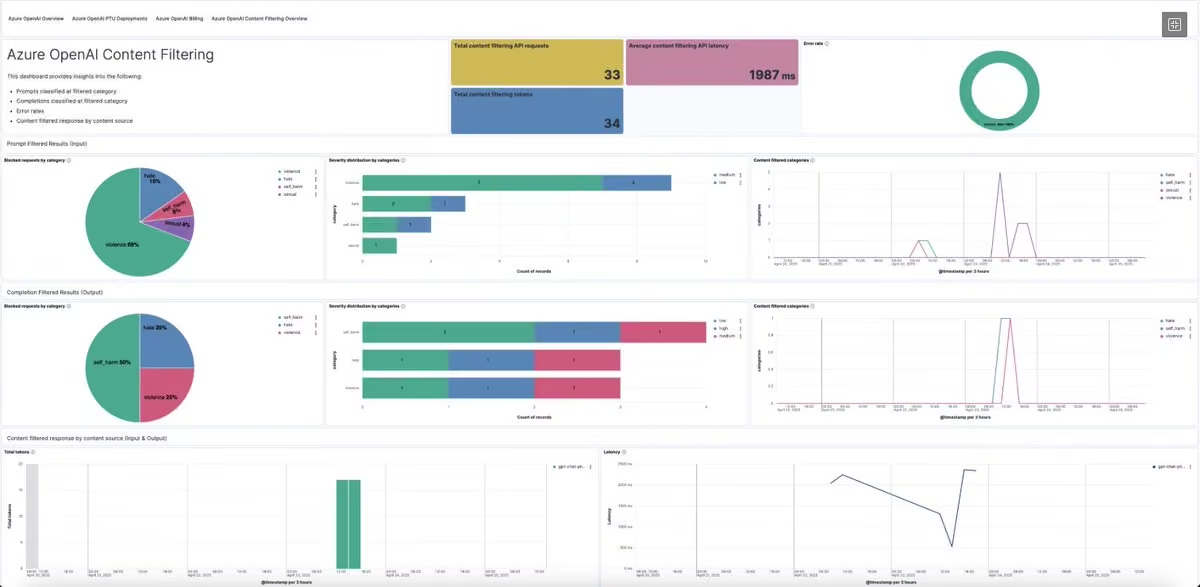 Elastic
@elastic
Build a complete AI application using @SpringAICentral’s 1.0 GA and Elasticsearch. Get started in this blog: go.es.io/4dmZnuy
Elastic
@elastic
Check out Elastician @xeraa Philipp Krenn’s talk at #msbuild: From Prompt to Production: Observing Azure OpenAI with Elasticsearch! Observability is and should be everywhere! - JC (@CastillaCodes) [1/5]


 Elastic
@elastic
With observability in Elastic, all of these data points can be gathered, measured, and evaluated to show latencies between similar models over time, which deployments performed the best, and what models errored out the most. - JC (@CastillaCodes) [4/5]
Elastic
@elastic
Also, dig those custom Elastic cookies! We love talking to developers and are always excited to mingle and chat data! - JC (@CastillaCodes) [5/5]
Elastic
@elastic
Tuesday's Keynote at #msbuild: we’re entering the era of AI agents. Software systems are no longer tools—they reason, connect, manage, and collaborate to solve our dev tasks. The new norm is a shift toward intelligent, assistive development. - JC (@CastillaCodes)
Elastic
@elastic
This entailed creating the datastores, network connections, sub agent teams, and policy approaches based on the policies and procedures documents they provided to the originating agent. Wow! - JC (@CastillaCodes)
Elastic
@elastic
Today's keynote definitely got me pumped to explore all of the capabilities I've seen today with copilot! Creating RAGs with Elastic is too easy at this point - creating an Elastic agent with copilot will be my next content demo! Stay tuned! - JC (@CastillaCodes)
Elastic
@elastic
Did you know you can use @Azure AI Document Intelligence to parse PDFs that contain text and table data: go.es.io/4dq2ke6
Stop by #msbuild Booth 200 to learn more!
Elastic
@elastic
Elasticsearch integrates with @nvidia Enterprise AI Factory validated design to fuel AI agents & #genai applications with real-time intelligence. This brings enterprise data to NVIDIA AI factories through the power of the Elasticsearch vector database → go.es.io/432UROy
 Elastic
@elastic
I got to be a fly on the wall for a recording by #dotnetrocks featuring Elastic CPO Ken Exner! I can't share all of the hot goss and topic details but I assure you it's going to be quite the insightful episode! Look forward to the full recording in June! -JC (@CastillaCodes)

 Elastic
@elastic
By the way, this was recorded in one of the podcast booths provided by #msbuild for recording audio and video. Great move to help get the content out by the people! - JC (@CastillaCodes)
Elastic
@elastic
Excited to be featured as a collaborator for the new agentic workflow and capabilities during the #msbuild keynote section with @kevin_scott. So many great opportunities when agents are able and empowered to make our code ideas a reality! - JC (@CastillaCodes)


 Elastic
@elastic
Elastic has been selected as a collaborator in particular for the development of NLWeb - a new way to interact with web pages through more interactive options through MCP access. -JC (@CastillaCodes)
Elastic
@elastic
To look under the hood of NLWeb, here's the repo: github.com/microsoft/NLWeb. Definitely excited to get into the weeds with this one and release an Elastic demo w/ NLWeb asap! #msbuild -JC (@CastillaCodes)
Elastic
@elastic
Hey everyone! It’s Justin Castilla, Developer Advocate at Elastic, here in Seattle for #msbuild. I’m taking over the Elastic handle for the next few days so follow along for some great demos with Azure AI, agentic solutions, and of course Elastic!. – JC (@castillacodes)
Elastic
@elastic
Our 9.0/8.18 release was packed with new features and major enhancements. It's been a month since the release, so we want to know...
Which 9.0/8.18 feature are you most excited about?
Elastic
@elastic
Learn how to benchmark Elasticsearch performance to see how well your cluster can handle your workload using ingest pipelines and a custom log track: go.es.io/4jPTdpf
Elastic
@elastic
Model Context Protocol enhances how you interact with Elasticsearch data. Discover how in this blog post: go.es.io/42ObxIn
#elasticsearchlabs
Elastic
@elastic
Explore how to detect threats at scale, analyze data on the fly with ES|QL, and expedite investigation with AI, all within this 15-minute hands-on lab.
Dive in now: go.es.io/4mixaJu
Elastic
@elastic
Adapting cybersecurity practices requires a modern platform that offers full visibility, uses advanced analytics, automates with AI, and supports flexible deployment in hybrid and multi-cloud environments. Discover why you need an AI-driven SIEM here → go.es.io/4jScWVk
 Elastic
@elastic
Integrate Elasticsearch with search templates and LLM functions to build an intelligent query layer. Follow our end-to-end blog to get started: go.es.io/3YmCVeU
#elasticsearchlabs
Elastic
@elastic
Learn how to optimize the Elasticsearch retriever in a RAG pipeline using DeepEval. Get started in this blog: go.es.io/3Yi0V31
#elasticsearchlabs
Elastic
@elastic
Unlock the power of #gemini! Learn how Elastic's vector database and @googlecloud's Vertex AI are teaming up for native LLMs grounding, bringing you private domain data with customizable and relevant search experiences. Learn more: go.es.io/4d7MlB3
 Elastic
@elastic
Native joins in Elasticsearch 8.18 are here! Explore LOOKUP, a new ES|QL command designed to perform left joins for data enrichment, and learn how to execute it: go.es.io/4j8v78l
#elasticsearchlabs
Elastic
@elastic
Should you be generating filters & facets using ML or sticking to the classical approach? We broke down the pros, cons and implementation details of each approach in this blog: go.es.io/4i95hQI
#elasticsearchlabs
Elastic
@elastic
We are excited to announce that we’ve entered into an agreement to acquire @keepalerting, an open source AIOps company, to help users manage alerts and automate workflows. Read more: go.es.io/4393LZG
Elastic
@elastic
In just 15 minutes, get hands-on experience centralizing log data, correlating events, and leveraging advanced analytics for real-time threat detection.
Learn more →go.es.io/4k7fxdT
Elastic
@elastic
Wondering how to detect relationships in data? We'll use graphs to uncover relationships between artists and your music taste. Dive into part 4 of our Spotify Wrapped series: go.es.io/42nmfVQ
#elasticsearchlabs
Elastic
@elastic
RAG vs. fine-tuning: We've tested both with a hands-on example of an e-commerce chatbot. Dive into this blog for the performance comparison: go.es.io/4lkGZpP
#elasticsearchlabs
Elastic
@elastic
Who's ready for the final day of #rsac? 🙋
Yesterday, Elastic's @hmikenichols & @jamesspi had a great speaking session on what makes AI actually helpful: RAG.
If you haven't already be sure to stop by booth 5778!
Elastic Security Labs
@elasticseclabs
We're rounding out day 2 of #rsac with a speaking session from @hmikenichols and @jamesspi! They discussed what makes AI actually helpful: RAG.
Retrieval Augmented Generation pulls context into the LLM to help build out answers that make sense. 🧵 -- AVN

 Elastic
@elastic
Parse PDF documents like a pro! Learn how to use Azure AI Document Intelligence to parse PDFs that contain text and table data: go.es.io/421PYom
#elasticsearchlabs
Elastic
@elastic
Looking for a way to join data with the speed and power of Elastic? Look no further — join data with a new function in ES|QL. This enables robust searches that include advanced behavior detections, alert triage, and threat hunting. Learn more: go.es.io/42NMsNu
#rsac
Elastic
@elastic
It's been an incredible first day at #rsac! ICYMI, Elastic's CISO, Mandy Andress, participated in a great panel discussion on cyber innovation and security early adopters. Check out @elasticseclabs for more updates.
And if you're in person don't forget to stop by booth 5778!
Elastic Security Labs
@elasticseclabs
#rsac is off to a strong start with @elastic's CISO, Mandy Andress, participating in a panel discussion on cyber innovation and security early adopters. 🧵 -- AVN
 Elastic
@elastic
Live from #rsac! Be sure to check out @elasticseclabs this week for real-time updates and an inside look at the show. ⬇️
Elastic Security Labs
@elasticseclabs
Hey there! Alyssa VanNice from the Elastic Security Labs team here. We’re in San Francisco this week at #rsac. I’m taking over the handle to give you an inside look into what’s happening at the show…and maybe…reveal all the secrets I can find. 😉 Stay tuned! –AVN

 Elastic
@elastic
Fast-track the switch from your current SIEM with Automatic Migration, powered by Search AI. Automatic Migration maps and translates existing SIEM artifacts with AI, reducing cost, complexity and risk for SOC teams. Learn more: go.es.io/3YQUGTQ
#rsac
Elastic
@elastic
Unlock the power of automated synonyms! Discover how LLMs can be used to generate synonyms automatically, allowing terms to be loaded into Elasticsearch's synonym API. Check it out: go.es.io/44O9YfV
#elasticsearchlabs
Elastic
@elastic
The Privileged Access Detection package is now available in tech preview in Kibana! This package includes ingest pipelines, transforms, ML jobs, and dashboards—giving your team the tools to efficiently detect and investigate suspicious activity. Read more: go.es.io/4cR7b7N
Elastic
@elastic
Elastic Cloud Serverless on Google Cloud is now generally available! Powered by the same Elasticsearch you love, reimagined for the cloud - it's the fastest way to start and scale security, observability, and search hassle-free. Learn more: go.es.io/3YeNCQR
Elastic
@elastic
Exciting news! 🎉 @elasticseclabs released a new report: The 2025 State of Detection Engineering at Elastic! As the first of its kind, this report pulls back the curtain and explores how we create, maintain, & assess our SIEM & EDR rule sets. Check it out: go.es.io/4jModWS
 Elastic
@elastic
Why adopt an Agentic LLM approach? It's all about improving search relevancy and addressing difficult use-cases. We'll demonstrate the benefits in this blog: go.es.io/4jJv17z
#elasticsearchlabs
 Elastic
@elastic
Congratulations, team @Docker, we’re excited to be part of this launch!
 Docker
@Docker
🧠 AI agents are cool. But deploying tools for them? Still feels like 2013. That’s why we’re bringing Docker magic to MCP.
Enter: Docker MCP Catalog + Toolkit
Launching this May. Built into Docker Hub.
www.docker.com/blog/introducing-docker-mcp-catalog-and-to…
 Elastic
@elastic
Explore various techniques to optimize late interaction models like ColPali for large-scale vector search in Elasticsearch in our latest blog: go.es.io/4jnPC18
#elasticsearchlabs
Elastic
@elastic
Tool consolidation can seem like an impossible goal for SRE teams, but there are a multitude of benefits. Find out how minimizing tool sprawl can lead to more effective and efficient SRE teams in our latest blog: go.es.io/42qXHLx
Elastic
@elastic
We're excited for this new partnership with @sublime_sec! This integration is key for allowing users a more holistic view of their existing security data. We can't wait for what's ahead!
 Sublime Security
@sublime_sec
We’re excited to announce our partnership with @elastic, and a new Elastic Agent integration that lets teams ingest Sublime email security data into the Elastic Stack to paint a more holistic security picture, enhance security operations, and monitor their deployment. Learn more about Elastic + Sublime: sublime.security/blog/elastic-sublime-adding-email-to-you…
 Elastic
@elastic
Ready to explore anomaly detection? In our latest blog, we dive into it and showcase how the different jobs can help you find unusual patterns in your Spotify Wrapped data: go.es.io/4cup4cw
#elasticsearchlabs
Elastic
@elastic
Meet the AI Agent that manages your Elasticsearch Serverless projects—a simple command-line tool for project creation, deletion, and status checks: go.es.io/42hrK9U
#elasticsearchlabs
Elastic
@elastic
Now live! Elastic 9.0/8.18 includes faster quantization, Elastic Distributions of OTel and LLM observability, the GA of Attack Discovery and Automatic Import, major enhancements in ES|QL like JOIN, and more.
Learn more → go.es.io/42tjpyA
 Elastic
@elastic
Searching through complex documents with images, tables, and rich layouts? No problem! Take a look at how you can use ColPali to search through documents in Elasticsearch with ease: go.es.io/4jIVCBZ
#elasticsearchlabs
Elastic
@elastic
It's a wrap at #googlecloudnext
Thanks everyone for stopping by and following the announcements! We're looking forward to next year 🙃
Hope you enjoyed the change of pace. Signing off from the account take-over – PK (@xeraa)
 Elastic
@elastic
Wrap-up post: www.elastic.co/blog/google-cloud-next-2025 #googlecloudnext
Elastic
@elastic
LLM observability with Google Vertex AI #googlecloudnext
First, metrics with
1. Predictions
* Count by endpoint: Total number of predictions across endpoints
* Latency: Time generate predictions to identify bottlenecks
* Errors: Count of failed predictions across endpoints
 Elastic
@elastic
4. Overview Metrics
* Total invocations: Count of prediction invocations across all models and endpoints
* Total tokens: Tokens processed across all model interactions to track resource utilization and efficiency
* Total errors: The total count of errors
Elastic
@elastic
Second, traces to dive into the finer details of individual calls
More details in www.elastic.co/observability-labs/blog/elevate-llm-observ…
 Elastic
@elastic
Elasticsearch is the only 3rd party grounding source on Vertex AI today #googlecloudnext
* Answer with private data — see the difference for "how to patch a drywall"
* Keyword, semantic & hybrid search
* Search templates to personalize
* Via Vertex API / SDK or UI
– PK (@xeraa)
Elastic
@elastic
Powered by Google Axion C4A processors, Elastic Cloud Serverless delivers Elastic users up to 40% higher indexing throughput. Learn more: go.es.io/3R0bDHa
#googlecloudnext #googlecloudpartners #elasticsearch
Elastic
@elastic
"Beyond RAG: Build production-ready AI agents with your enterprise data" with 3 takeaways from #googlecloudnext 🧵 – PK (@xeraa)
 Elastic
@elastic
1. RAG has been evolving over the years — from retrieval + LLM to include actions / tools, a reasoning loop, and multi-agent systems
 Elastic
@elastic
3. Model Context Protocol (MCP) or Agent2Agent (A2A) is the topic of the week. But it's more AND than OR. Simple example — an agentic restaurant:
* MCP lets the chef agent fetch its recipe and other context needed to cook
* A2A runs the interaction with other agents like a waiter
Elastic
@elastic
Thanks everyone for joining Google, MongoDB, and Elastic for a joint panel
 Elastic
@elastic
Default search on WordPress is extremely limited, wouldn't find custom data, or couldn't to semantic search. Enter @wpengine's Smart Search built on Elasticsearch which they shared with us at #googlecloudnext 🧵 – PK (@xeraa)
 Elastic
@elastic
It provides a GraphQL API for indexing, searching, and configuration:
* Bring your custom data
* Do keyword search with boosting, fuzziness, stemming,...
* Add semantic search with ELSER building on contextual meaning
* Combine different approaches with hybrid search

 Elastic
@elastic
Keep the configuration simple [image 1 + 2] while hiding the implementation details [image 3] behind the scene. But bring recommendations with semantic search, insights, and behavioral analytics to the front of your search capabilities.
Full details on wpengine.com/gb/smart-search/


 Elastic
@elastic
Automatic Import and Attack Discovery are now GA! Learn how these two major Elastic Security AI capabilities can save practitioners hours of work: go.es.io/4j6YLLQ
Stop by #googlecloudnext booth 2176 to chat with our security experts and see a demo onsite.
Elastic
@elastic
AI Agents + GCP + Elastic to combat loneliness by connecting individuals. Watching great stuff coming together at #googlecloudnext – PK (@xeraa)
 Flockx by Fetch.ai
@flockxofficial
Flockx by @Fetch_ai is live in the Google Cloud GenAI partner spotlight! We're teaming up with @googlecloud and @elastic to make AI agents easy to build, launch, and collaborate—no code needed.
Learn more: cloud.google.com/blog/topics/partners/real-world-examples…
 Elastic
@elastic
#googlecloudnext panel on "The future of compute: The right VMs for every workload" with Shopify and Elastic's Chief Product Officer, Ken Exner: How the latest CPU advancements help power Elasticsearch Serverless on GCP and why it matters 🧵– PK (@xeraa)
 Elastic
@elastic
And this is where the new C4A, Google's new Axion processor, comes in: It provides 40% higher indexing throughput helping shift the price — resources — performance triangle. CPUs often being the bottleneck in the new architecture make this an exciting change

 Elastic
@elastic
While Elastic Cloud Serverless is available as a tech preview today, it will GA later this month — running on the new Axion processors
 Elastic
@elastic
Announcing GA of Elastic Observability LLM integration with @GoogleCloud Vertex AI! This integration provides users with deep insights into the usage, cost and operational performance of Vertex AI models. Read more: go.es.io/4lhcAZt
#googlecloudnext #vertexai
Elastic
@elastic
"Supercharge SecOps workflows with
AI-driven Security Analytics" at #googlecloudnext
Get the data and start the analysis. Thanks to LLMs, you don't have to go through 1,500 alerts all by yourself but focus on the relevant ones – PK (@xeraa)
 Elastic
@elastic
Elasticsearch vector database is now integrated into @googlecloud’s Vertex AI platform, enabling joint users to build fully customizable GenAI experiences grounded in enterprise data: go.es.io/3R7VGil
Learn more at #googlecloudnext booth 2176!
Elastic
@elastic
Elastic + GCP ❤️ startups
Announced at #googlecloudnext : We're one of the featured partners of Google Cloud's Startup Perks — 5K in Elastic Cloud credits and expert help from the DevRel team: cloud.google.com/startup/perks
One of my personal projects 🙃 – PK (@xeraa)
 Elastic
@elastic
Lightning talk "Developing your RAG application in AI Playground" live from the Elastic booth #googlecloudnext
We'll cover both how to get started in Kibana's Playground but also how to make the right choices as you evaluate your options 🧵 – PK (@xeraa)
 Elastic
@elastic
3. Find relevant results with hybrid search, rerankers,...
4. Generate results with an LLM — our partners like Google can help here; and it's all built-in with the _inference API
5. Deploy to production. Elasticsearch is now Serverless on GCP (in preview): www.elastic.co/guide/en/serverless/current/intro.html
Elastic
@elastic
To make all of this easier, there's Playground:
* Test different retrieval options and chunking strategies
* See how different LLMs behave with the retrieved data and tuned prompts
* Once you're happy with the result, you can export code for your app
All without leaving Kibana

 Elastic
@elastic
Hey y’all! Philipp Krenn, head of DevRel at Elastic, here in Las Vegas at #googlecloudnext. I’m taking over the Elastic handle this week so follow along for talks and announcements. It's already busy on the expo floor – PK (@xeraa)
 Elastic
@elastic
Elastic has been recognized with two 2025 Google Cloud Partner of the Year Awards!
It's a true testament to the strength of our partnership and the powerful solutions we've built with @googlecloud. Read more: go.es.io/4hXYZTW
#googlecloudpartner #googlecloudnext #genai
 Elastic
@elastic
Want to learn how to ingest data into Elasticsearch using Airbyte? Follow along with our step-by-step guide: go.es.io/44iWHvB
#elasticsearchlabs
Elastic
@elastic
We’re excited to announce that EDOT is now GA! This provides SREs and developers with a stable, production-ready OTel ecosystem for faster, more reliable infrastructure and application monitoring. Learn more here: go.es.io/41TgOPw
Elastic
@elastic
Elastic’s EDOT Collector now supports annotation-based discovery, simplifying dynamic workloads while improving automated metric, and log collection in Kubernetes environments. Learn more here: go.es.io/44axSSv
Elastic
@elastic
Join us for a What’s New quarterly webinar on April 9 at 8am PT, where we will highlight key features from our upcoming version 9.0 & 8.18 releases across GenAI, Security, and Observability with live product demos and Q&A.
Register Now → go.es.io/3E2WRMT
 Elastic
@elastic
Smarter & automated autocomplete! Boost your search application with an automated autocomplete feature that uses LLM-generated terms. Learn more here: go.es.io/3DWzpAP
#elasticsearchlabs
Elastic reposted
Elastic Security Labs
@elasticseclabs
We’re exposing a newly discovered #malware family that has made its home on #github. SHELBY targeted a middle east telecom company, uses GH commits for C2, and shares hard-coded tokens for authentication. Read the malware and campaign breakdown: go.es.io/3DXE8Cv
Elastic
@elastic
Learn how to detect adversaries leveraging T1564 - Hide Artifacts and uncover concealed files, processes, and more with actionable insights and ES|QL. Read more: go.es.io/4hSZ8ID
Elastic
@elastic
Kibana Dashboards just got faster! Spoiler alert: the wait time for data to appear on a dashboard has improved by up to 40%. Check out the details: go.es.io/4kWF0rv
#elasticsearchlabs
Elastic
@elastic
Observability metrics provide real-time visibility into system health and performance. Learn how metrics, logs, traces, and profiles enable proactive monitoring and data-driven decisions: go.es.io/3XzzZv3
Elastic
@elastic
Follow this step-by-step blog to learn how to ingest data to Elasticsearch through LlamaIndex: go.es.io/4kU22zg
#elasticsearchlabs
Elastic
@elastic
Discover how to detect OS Credential Dumping (T1003) with actionable ES|QL queries. Learn more to stay ahead of adversaries and safeguard your credentials: go.es.io/4iG2srP
Elastic
@elastic
Master Elastic Observability and boost your technical skills in 15 minutes!
Get the most out of your logs, ingest your data, monitor your infrastructure with #otel, and leverage AI for root cause analysis in these hands-on workshops. Learn more → go.es.io/4kLMiye
Elastic
@elastic
Curious about sparse vector embeddings? Learn what they are, how they work, and how to implement semantic search with them in this blog: go.es.io/3FL0W8S
#elasticsearchlabs
Elastic
@elastic
Today, we’re expanding our partnership with @tines_hq to simplify security and observability workflow automation! This integrated offering product offering helps increase operational efficiency, minimize security risk, and reduce downtime. Learn more → go.es.io/4hiUeUP
 Elastic
@elastic
Dive deeper into your Spotify data! Uncover hidden connections, quickly set up visualizations, and bring your listening habits to life: go.es.io/3XR6OUf
#elasticsearchlabs
 Elastic
@elastic
Level up your technical skill-set with Elastic Observability.
Resolve issues faster using AI for root cause analysis. Combine traces and logs at scale with the Elastic AI Assistant and analyze a customer-reported issue within 15 minutes.
Dive in → go.es.io/3XOr3lz

Elastic reposted
Galileo, now part of Cisco
🎮 Can you unravel AI's chain of thought - for prizes?
Join us at "Guess That Prompt!" during @nvidia GTC - where your AI intuition could win you stellar prizes 👀🤑
We're turning prompt engineering into a game show in which YOU become the reverse engineer, trying to decode what prompts created specific image outputs.
What to expect:
• The world's first prompt-engineering game show
• Lightning talks from AI innovators
• Prizes including mechanical keyboards and stream decks ⌨️
• Delicious food and creative cocktails
Join us, @elastic , and @UnstructuredIO at Paper Plane in San Jose next Tuesday!
📅 Tuesday, March 18
⏰ 5:30-8:00 PM
Whether you're competing or spectating, this is THE must-attend GTC after-hours event!
Limited spots available - registration link below ⬇
Elastic
@elastic
Hidden data leaks? Learn how to uncover T1048 - Exfiltration Over Alternative Protocol in your network. Detect covert exfiltration attempts and secure your sensitive data with actionable insights and ES|QL queries. Learn more: go.es.io/43JcjrS
Elastic
@elastic
Dominate hybrid search with confidence! Learn more about hybrid search and how to craft powerful hybrid search queries in Elasticsearch in our latest blog: go.es.io/3D4xCtc
#elasticsearchlabs
Elastic
@elastic
What if you could chat with your data? Learn how to use Elastic connectors to create a unified knowledge base with Playground, allowing you to interact with your data seamlessly: go.es.io/4b5YBkK
#elasticsearchlabs
 Elastic
@elastic
Elastic Cloud Serverless on Google Cloud is in tech preview! Powered by the same Elasticsearch you love, reimagined for the cloud — it's the fastest way to start and scale security, observability, and search hassle-free. Learn more: go.es.io/3QUfXaK
Elastic
@elastic
Dive into a resource constraint issue in this Elastic Observability 101 hands-on learning lab. Resolve it using the Elastic AI Assistant and leverage runbooks to prevent recurrence.
Check it out → go.es.io/3Fo3c5K
Elastic
@elastic
Read our latest blog for a step-by-step guide on setting up vector search and executing k-NN searches in Elasticsearch: go.es.io/4k5eBHG
#elasticsearchlabs
Elastic
@elastic
Elastic’s Amazon Bedrock integration for Observability now includes Guardrails monitoring! Learn how to easily track guardrail performance and usage, allowing for real-time visibility into AI safety mechanisms: go.es.io/4kgNOIJ
#elasticobservabilitylabs
Elastic
@elastic
Master Elasticsearch integration testing — Here's how to make your integration tests run faster, smarter and more efficiently. Check it out: go.es.io/41k3YJQ
#elasticsearchlabs
Elastic
@elastic
What’s next for observability? 500+ IT decision-makers share insights on cost management, GenAI innovations, and the future of OpenTelemetry. Learn more in our latest #elasticobservabilitylabs blog: go.es.io/43lFHEz
Elastic
@elastic
OpenTelemetry? Yes please! Learn how to use Elastic Observability to ingest logs, metrics, and traces using the open telemetry collector in 15 minutes.
Dive in now → go.es.io/3CK0TJG
Elastic
@elastic
The improved ES|QL editor experience in Kibana brings live validation, improved autocomplete, quick fixes and more. Check out what's new in this blog and discover the guiding principles behind this improvement: go.es.io/40ZuTKy
#elasticsearchlabs
Elastic
@elastic
Unlock total visibility into your Logstash deployments with our new Elastic Agent-powered integration. Monitor node health, pipeline performance, and troubleshoot in real time—all in one dashboard. Learn more: go.es.io/3Xitvkh
Elastic
@elastic
Dive into this step-by-step guide to learn how to configure OneLake, consume data using Python, and index documents in Elasticsearch: go.es.io/4hqtsuK
#elasticsearchlabs
 Elastic
@elastic
Achievement unlocked! Elastic has earned another AWS Competency — this time in Government. Read about how our deep technical knowledge and proven success with government agencies reduce costs, drive efficiencies, and increase innovation here: go.es.io/3XAxhFR
Elastic
@elastic
Enhance your RAG results with Knowledge Graphs! Explore a strategy for dynamically generating knowledge subgraphs tailored to a user’s query: go.es.io/40GYPd7
#elasticsearchlabs
Elastic
@elastic
Learn the basics of logs and how to get the most value. Try out this self-paced hands-on learning, Observability 101 course in observability logs.
Learn more → go.es.io/432rJHl
 Elastic
@elastic
The Kibana Dev Tools Console got a major upgrade in 8.16! Experience a smarter and more intuitive console with Monaco-powered editing, improved UI, and new features like multilanguage request copying. Read all about it here: go.es.io/4jXAoBb
Elastic
@elastic
Elasticsearch Open Inference API now supports @JinaAI_! Developers can now build search and RAG applications using the latest Jina AI embedding and reranking models without additional integration or costs. Learn more: go.es.io/4i8sNOs
Elastic
@elastic
Better data prep = better RAG!
Here's how to achieve high-quality RAG with effective data preparation using Aryn, DocParse, DocPrep, and Elasticsearch: go.es.io/3Qorzmk
#elasticsearchlabs
Elastic
@elastic
Elasticsearch just turned 15! Take a look back at the last 15 years of indexing it all and finding what matters: go.es.io/3Qk5aGO
#elasticsearchlabs
Elastic
@elastic
Lexical, semantic or hybrid search? Explore hybrid search through examples and discover when it’s better than using lexical or semantic search on their own: go.es.io/3WKvTzT
#elasticsearchlabs
Elastic
@elastic
Looking to enhance observability in your C++ applications? Explore how to instrument C++ with @opentelemetry and send traces to Elastic Observability—helping you gain deep insights into system performance. Check it out: go.es.io/4jYToiz
#elasticobservabilitylabs
Elastic
@elastic
Are you experiencing long-running search queries? AutoOps has your back! Learn how to leverage AutoOps to detect this issue and improve performance: go.es.io/4aM8Pqc
#elasticsearchlabs
Elastic
@elastic
Learn how @opentelemetry, @langtrace_ai and Elastic can support tracing OpenAI-based applications running on Kubernetes in this latest blog: go.es.io/41eNth1
#elasticobservabilitylabs
Elastic
@elastic
Here's everything you need to better understand optimized scalar quantization in Elasticsearch and how we used it to improve Better Binary Quantization (BBQ): go.es.io/3WLn3BI
#elasticsearchlabs
Elastic
@elastic
Traditional rule-based fraud detection often misses anomalies or triggers false positives. With machine learning, and advanced log analytics, you can detect potential fraud in real time. Learn more: go.es.io/4aWygWj
#elasticobservabilitylabs
Elastic
@elastic
Take your e-commerce search to the next level! See how query profiles in Elastic help tackle semantic search challenges and enhance e-commerce search: go.es.io/3CBFRN0
#elasticsearchlabs
 Elastic
@elastic
Ice, Ice, Maybe: Discover how Elastic’s searchable snapshots enable the frozen tier to perform on par with the hot tier, demonstrating latency consistency and reducing costs. Learn more: go.es.io/40Xh1AF
#elasticsearchlabs
Elastic
@elastic
Elastic Cloud Serverless on Azure is in tech preview! Powered by the same Elasticsearch you love, reimagined for the cloud — it's the fastest way to start and scale security, observability, and search hassle-free. Learn more: go.es.io/3WQUwuO
Elastic reposted
 LangChain
@LangChain
How Elastic evaluates AI agents with LangSmith
To improve their AI-powered Attack Discovery for threat detection, @Elastic implemented:
📊 Automated LLM evaluations: Shifting from manual checks to a robust, automated framework with LangSmith.
🔍 End-to-end observability: Tracing AI workflows using LangGraph + LangSmith for deep debugging.
🎯 Data-driven prompt tuning: Quantitative scoring to identify high-performing prompts and LLMs for specific tasks.
Read more: www.elastic.co/blog/elastic-security-generative-ai-features

 Elastic
@elastic
Follow along to learn how to build a semantic image search engine with Roboflow Inference and Elasticsearch: go.es.io/3WJjZpQ
#elasticsearchlabs
Elastic
@elastic
Check out this blog to learn how to integrate Elastic Agent with Confluent Cloud's Kafka offering to reduce the operational burden of ingesting business-critical data. Dive in: go.es.io/4gsFjaj
Elastic
@elastic
Discover how Agentic RAG can be implemented using Elasticsearch as our knowledge base and Langchain as our agentic framework. Dive in: go.es.io/3CdFWXg
#elasticsearchlabs
Elastic
@elastic
Are you curious to try DeepSeek R1 with RAG and all the vector database smarts of Elasticsearch? Here's a quick tutorial to get you started using local inference: go.es.io/4jAzZV4
#elasticsearchlabs
Elastic
@elastic
Unlocking better search results — Leverage annotated data to calibrate semantic model scoring for improved search results. Learn more: go.es.io/3E9o3cG
#elasticsearchlabs
 Elastic
@elastic
Instrumenting AI applications to capture meaningful telemetry doesn’t have to be complex. Seamlessly trace, log, and monitor your OpenAI-powered apps with EDOT. Discover how in this blog → go.es.io/3EbhupQ
#elasticobservabilitylabs
 Elastic
@elastic
Did you know that query rules work seamlessly with semantic search? Check out this blog to learn how to leverage a query rule retriever combined with semantic search and rerankers: go.es.io/3C0vzWJ
#elasticsearchlabs
Elastic
@elastic
Learn how to deploy and test the new Apple Models and build a RAG system using Elastic: go.es.io/40ra3Dz
#elasticsearchlabs
 Elastic
@elastic
Is it just us, or are you craving more insights from your Spotify Wrapped this year? You can craft a custom ‘Wrapped’ in Kibana packed with your top songs, artists, and trends from 2024! Check out this guide to get started: go.es.io/3E8EN3G
#elasticsearchlabs
Elastic
@elastic
Ready to build a RAG app with Go? Follow along to learn how to create the RAG application using Ollama to leverage local models: go.es.io/4gLai2f
#elasticsearchlabs
Elastic
@elastic
Wondering how to select an optimal re-ranking depth for your model and dataset? We’ve got you covered! Check out this blog to learn more: go.es.io/4285dg4
#elasticsearchlabs
Elastic
@elastic
Dive into this blog to learn how to integrate OpenTelemetry with the NGINX Ingress Controller for seamless insights. Check it out: go.es.io/4amau5E
#elasticobservabilitylabs
Elastic
@elastic
Easily crawl websites and make them semantically searchable. This blog explains how to use the Open Crawler with semantic text. Check it out: go.es.io/40cqjXZ
#elasticsearchlabs
Elastic
@elastic
Enhance LLM observability with Elastic's @googlecloud Vertex AI Integration and gain actionable insights into model performance, resource efficiency, and operational reliability. Learn more here: go.es.io/3WjsHuZ
#elasticobservabilitylabs
Elastic
@elastic
Check out this blog to discover how we optimized vector comparisons in BBQ with hardware-accelerated Single Instruction Multiple Data (SIMD) instructions: go.es.io/426VzKD
#elasticsearchlabs
 Elastic
@elastic
Dive into this blog for everything you need to understand optimized scalar quantization: go.es.io/409K6ap
#elasticsearchlabs
Elastic
@elastic
Level up your Vega visualizations in Kibana. Learn how to create Kibana filters with Vega using the kibanaAddFilter function. Dive in now: go.es.io/4j36CKP
#elasticsearchlabs
Elastic
@elastic
Learn how we significantly improved the security posture of our container images by leveraging minimal base images and enhancing vulnerability management workflows, resulting in a substantial reduction of Common Vulnerabilities and Exposures (CVEs): go.es.io/4gD1viK
 Elastic
@elastic
Our Lucene 2024 wrap-up is here! Take a look at the key highlights from last year: go.es.io/40gICwn
#elasticsearchlabs #apachelucene
Elastic
@elastic
Ramp up in Search AI today. Try out these four self-paced hands-on learning lessons that will help you get started in lexical search, semantic search, vector search, and how to build your own RAG app.
Learn more → go.es.io/3BDU0ZD
 Elastic
@elastic
Guest post alert! GraphQL is an efficient and flexible way to query data. @praveenweb from @HasuraHQ explains how Hasura DDN works with Elasticsearch to enable high-performance, metadata-driven access to data. Learn more: go.es.io/40b9b6g
#elasticsearchlabs
Elastic
@elastic
Try this delicious recipe search implementation based on semantic search with Elasticsearch. Check it out: go.es.io/406kgVT
#elasticsearchlabs
Elastic
@elastic
If you ever wondered how @huggingface models could be used to perform semantic-reranking in Elasticsearch, wonder no more. Check out this blog to learn more: go.es.io/40YlSSu
#elasticsearchlabs
Elastic
@elastic
Ready to build a RAG app? Get started by learning how to create a RAG application using Elastic’s generative AI capabilities with this hands-on guide.
Check it out → go.es.io/3Pnu8Vn
 Elastic
@elastic
Episode 5 of 'You Know, For Search' is live! Featured guest @benwtrent discusses the importance of quantization: go.es.io/3DebFaS
Let host @smayzak know — what's been your favorite episode to date? What topics do you want to hear next?
 Elastic
@elastic
A fun and furry search app for cats! 🐱
With different types of search: lexical, vector, and hybrid — on multiple embeddings. Dive into this blog to learn how to write a simple and playful search application on cats: go.es.io/40Xd1Rg
#elasticsearchlabs
Elastic
@elastic
Great things happen when you ingest geospatial data into Elasticsearch to use with ES|QL! Find out more in this blog: go.es.io/4g6WVZK
#elasticsearchlabs
 Elastic
@elastic
Learn how to integrate your custom model to create vector embeddings, configuring Elasticsearch for vector search, and running queries to retrieve contextually relevant results. Dive into this Search AI 101 guide for vector search to learn more → go.es.io/49EJGgz
 Elastic
@elastic
Now live! Elastic 8.17 includes Elasticsearch’s specialized logsdb index mode, now GA, which reduces storage footprint of log data in Elasticsearch up to 65%, Elastic Rerank model, full text search for ES|QL, hybrid search improvements & more.
Dive in → go.es.io/49AoIiU
 Elastic
@elastic
Live log and prosper by boosting storage efficiency with logsdb index mode!
Cut your log storage footprint by up to 65%, enabling you to expand visibility while keeping all data accessible and searchable with Elasticsearch’s latest innovation → go.es.io/3VDS4af
 Elastic
@elastic
Learn 3 ways to ingest data from AWS S3 into Elastic Cloud in this blog. Get started: go.es.io/3VuNmf6
#elasticsearchlabs
Elastic
@elastic
cRank it up — Introducing Elastic Rerank Model to power up semantic search!
Amplify your search experiences through semantic boosting with no required reindexing. Learn more: go.es.io/3Zsbal2
Elastic
@elastic
Discover how to troubleshoot Index Lifecycle Management (ILM) issues with the ILM History index. From filtering data for insights to setting up alerts, learn how to ensure smooth index transitions in our latest blog: go.es.io/4irzqMO
Elastic
@elastic
Learn how to create semantic search queries that deliver more accurate, context-aware results! Get started now with this Search AI 101 course.
Dive in → go.es.io/4i42WYA
Elastic
@elastic
Automating traditional search with LLMs! Use LLMs to write Elastic Query DSL and query structured data with filters. Read more in this blog: go.es.io/3Of8a63
#elasticsearchlabs
Elastic
@elastic
This is it — the show is over! Signing off for @elastic from #awsreinvent and thanks for following along — PK (@xeraa)

 Elastic
@elastic
Security AI assistant from Elastic with Bedrock and @AnthropicAI — one of the models working really well for us in security. Full details and examples of the AI security assistant on www.elastic.co/guide/en/security/current/security-assista…
#awsreinvent — PK (@xeraa)

 Elastic
@elastic
ES|QL, Elastic's new piped query language, in action at #awsreinvent
What's the buzz about? 1/3 — PK (@xeraa)
 Elastic
@elastic
If you have typed enough curly braces for the rest of your life and want a new, optimized query engine, then ES|QL is for you. Fully integrated into Kibana, so you can stick to a single query language (👋 query DSL, KQL, EQL,...)
Try it out on esql.demo.elastic.co 2/3
 Elastic
@elastic
Either let the autocomplete guide you, look at the saved queries, or dive into the docs (www.elastic.co/guide/en/elasticsearch/reference/current/e…) — also available in product.
We're still adding search features but especially for observability and security you should get a lot of value from ES|QL today 3/3

 Elastic
@elastic
Talking more about LLM Observability at #awsreinvent — from problems to opportunities to getting things right 1/4 — PK (@xeraa)
 Elastic
@elastic
PS: And not to forget the observability side of your LLM. Full blog post with Bedrock: www.elastic.co/observability-labs/blog/llm-observability-… n/n
 Elastic
@elastic
And to solve it, we still need data. With some different forms and shapes but logs, metrics, traces are still useful. In addition to more LLM specific fields 3/4


 Elastic
@elastic
Like tracing @langchain or getting insights into your LLM like Bedrock. You can use it today in your Elastic deployment for observability 4/4

 Elastic
@elastic
"Retrieval Augmented Generation — Using Amazon Bedrock and Elastic" at #awsreinvent
RAG (Retrieval Augmented Generation), generating answers, and private data. Next deep dive thread 1/n — PK (@xeraa)
 Elastic
@elastic
#rag to the rescue:
* Retrieval (vector search only the starting point): Elasticsearch
* Generation (embedding and text): Bedrock
Two intentional choices between many possible options 3/n
 Elastic
@elastic
Why Elasticsearch?
Completeness in features. And cutting edge performance. Especially the brand new Better Binary Quantization (BBQ) — ~95% memory reduction while keeping the retrieval accuracy high. Full details in www.elastic.co/search-labs/blog/rabitq-explainer-101 4/n


 Elastic
@elastic
PS: And not to forget the observability side of your LLM. Full blog post with Bedrock: www.elastic.co/observability-labs/blog/llm-observability-… n/n
Elastic
@elastic
Final note: Elastic won the AWS "GenAI Infrastructure and Data Partner of the Year" award. I hope this thread shows why — PK (@xeraa)
aws.amazon.com/blogs/apn/announcing-the-2024-geo-and-glob…

 Elastic
@elastic
"Analysis Transaction Data Using Elastic" by @jpmorgan at #awsreinvent
Fighting off financial threats like fraudulent transactions or money laundering with #elasticsearch and #kibana — PK (@xeraa)


 Elastic
@elastic
Live covering "Exploring Elastic Cloud Serverless: Elasticsearch’s New Stateless Architecture for Speed, Scale, and Cost-Efficiency" at #awsreinvent. Following right after going GA 1/n — PK (@xeraa)
 Elastic
@elastic
Putting it together: Get all the features* of the Elastic Stack without having to manage a cluster
* with caveats: APIs like _cluster or _nodes are no longer available; same for some settings and some features are still on the roadmap. Full details in www.elastic.co/guide/en/serverless/current/elasticsearch-… 6/n

 Elastic
@elastic
Final notes:
* Roadmap of delivered and upcoming features for Serverless: www.elastic.co/cloud/serverless/roadmap
* Technical deep dives into the implementation details on Search Labs: www.elastic.co/search-labs/blog/category/elastic-cloud-se…
* Updated pricing (these have changed during the preview): www.elastic.co/pricing/serverless-search
n/n
 Elastic
@elastic
"Find me a single family home within 5 miles of Frisco, TX with a backyard swimming pool."
Learn how to build a powerful RAG system that incorporates geospatial data using #elasticsearch, #amazonbedrock, and #langchain. Read more: go.es.io/3ZAT1ml
@awscloud @langchain
 Elastic
@elastic
Customer lightning talk from @nikkeideveloper, Japan’s largest business newspaper, at #awsreinvent: "Empowering Customer Decisions with #elasticsearch: From Search to Generation" — PK (@xeraa) 1/3

 Elastic
@elastic
Architecture with coordinating-only nodes, 42 data nodes, and 3 dedicated master-eligible nodes. Serving the different needs of the application 2/3

 Elastic
@elastic
For RAG with #elasticsearch: Using Gemini to generate 5 sub-queries, searching the chunked documents, and generating the answer from the top 1000 documents 3/3

 Elastic
@elastic
Lightning talks at the Elastic booth at #awsreinvent: the ELK Stack. Widely known, used, and loved. How is the ELK growing (up) and what's new? — PK (@xeraa) 1/4
 Elastic
@elastic
Monitoring changed to observability to be supported by AI. And OpenTelemetry is becoming the standard for collecting observability signals. Which is all part of the current ELK Stack:
* AI Assistant: www.elastic.co/guide/en/observability/current/obs-ai-assi…
* OpenTelemetry: www.elastic.co/guide/en/observability/current/apm-open-te…
3/4

 Elastic
@elastic
Quick overview of all the things added over the last few years for AI / ML, platform (scale and operations), and observability improvements. Building on all the good things of the ELK but keeping it cutting edge 4/4
 Elastic
@elastic
Elastic's Head of Platform, Ajay Nair @ajaynairthinks, on AWS Partners LIVE! at #awsreinvent: www.youtube.com/watch?v=8mOp9GMw5hs
Tune in and ask your questions! — PK (@xeraa)
 Elastic
@elastic
Lightning talks at the Elastic booth at #awsreinvent. Kicking off with *LogsDB* and we'll do a short thread on the different topics (Serverless, ES|QL,... are all coming) — PK (@xeraa)
So what is LogsDB and why do you want it for your logs? Read on for the 2.5x disk reduction 1/5
 Elastic
@elastic
The "tricks" that LogsDB uses are to:
* avoid storing the full _source (but we can reconstruct it if needed),
* sort related data for better compression, and
* better compression for specific fields.
Full details in www.elastic.co/guide/en/elasticsearch/reference/current/l… 4/5
 Elastic
@elastic
This will reduce your disk footprint by 2.5x (depending on your data). And now that there is a more specialized index type, we can add even optimizations. So your cost can stay much flatter and you won't have to tune retention as much. Happy logging! 5/5
Elastic
@elastic
Elastic Security combines #cdr with #siem, eliminating the need for a separate tool delivering crucial context, prioritized threat detection, and rapid response for a more efficient security posture. Learn more here: go.es.io/4eZGDkd
Elastic
@elastic
Learn how integrating Amazon CloudWatch Metric Streams with Elastic unlocks the potential for real-time analytics, better operational insights, and seamless monitoring of your @awscloud resources in this step-by-step blog: go.es.io/4f0Cpsx
 Elastic
@elastic
The architecture behind Elasticsearch Serverless at #awsreinvent — right after going GA on AWS. No more upgrades, manual scaling, or operational toil but more of the actual work — PK (@xeraa)

 Elastic
@elastic
Hey! Philipp Krenn, head of DevRel at Elastic, here in Las Vegas at #awsreinvent — it's already busy. I’m taking over the Elastic handle this week so follow along what's happening or ask your most burning questions around re:invent and Elastic. — PK (@xeraa)
 Elastic
@elastic
Do less with Serverless — Now GA 🎉
The fastest way to start and scale security, observability, and search hassle-free all powered by the same Elasticsearch you love, reimagined for the cloud. Get started now → go.es.io/3CVo82X
 Elastic
@elastic
Introducing the Filebeat ETW input, now with integrations for Microsoft DNS Server and custom ETW providers. Capture, analyze, and visualize Windows telemetry with the Elastic Search AI Platform. Learn how: go.es.io/4fEdz2G
 Elastic
@elastic
What is semantic reranking and how do you use it? Learn about the trade-offs using semantic reranking in search and RAG pipelines in this blog: go.es.io/3YXRvZH
#elastisearchlabs
Elastic
@elastic
Learn how to capture a snapshot backup of your Elasticsearch cluster running in Elastic Cloud via a custom AWS S3 snapshot repository in under 10 minutes: go.es.io/4eOVAW9
Elastic
@elastic
LangChain4j has Elasticsearch as an embedding store. Learn how to use it to build your RAG application in plain Java with this elastic blog: go.es.io/40VDpdX
#elasticsearchlabs
Elastic
@elastic
With support for STIX 2.1 indicators, connections to TAXII servers, and flexible CEL configurations — you can now turn threat intelligence indicators into ECS format so that it works seamlessly across the Elastic Search AI Platform. Learn more: go.es.io/3Z8JHo6
 Elastic
@elastic
Elasticsearch has been added to @springcentral as a vector store! Dive into this blog to learn how to build a complete Java RAG application with Spring AI and Elasticsearch: go.es.io/3CI9SdZ
Elastic
@elastic
Introducing LLM Observability support for Amazon Bedrock in Elastic Observability!
This new integration will enable SREs and developers to monitor, troubleshoot, and optimize LLM applications at scale. Learn more: go.es.io/4hXMh9j
 Elastic
@elastic
Learn how to use Hybrid search to build an e-commerce product catalog, using faceting, promotions, personalization, and behavioral analytics. Check it out: go.es.io/4fzHWqW
#elasticsearchlabs
Elastic
@elastic
Learn about Agentic RAG on Dell AI Factory with @Nvidia using Elasticsearch vector database. We’ve collaborated with @Dell on a white paper for developers outlining strategies and solutions for implementing Agentic RAG apps: go.es.io/4g0npfi
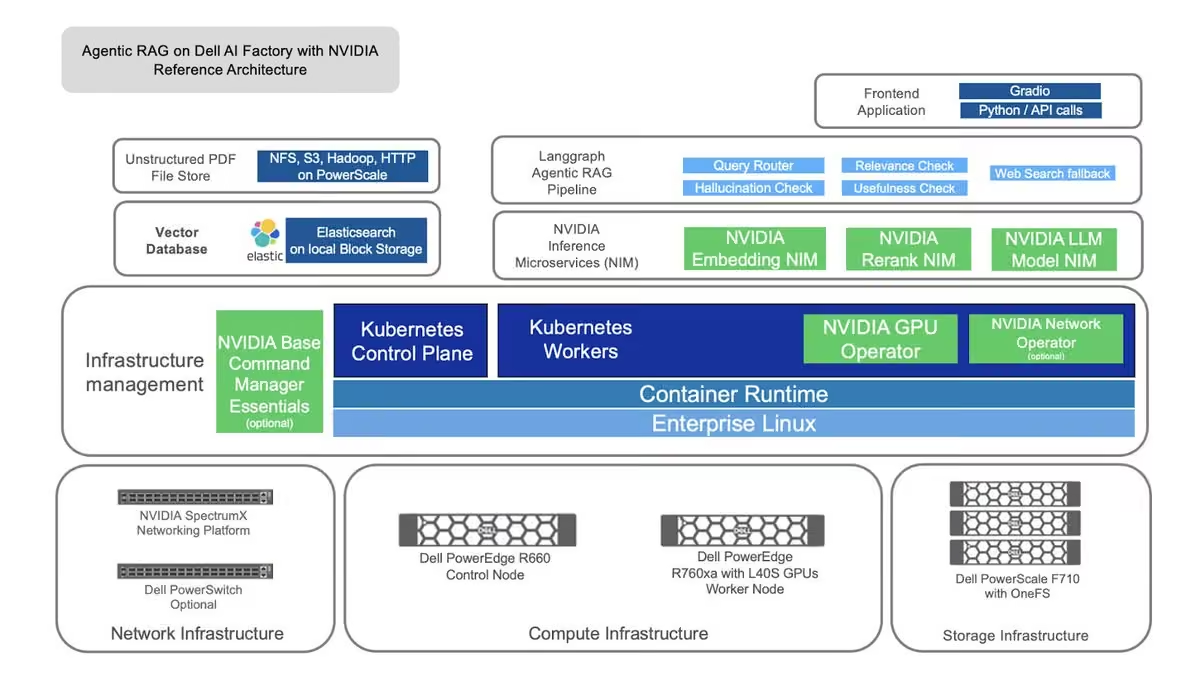 Elastic
@elastic
Learn the basics of building a keyword search application with Elasticsearch. Try out this self-paced hands-on learning Search AI 101 course in lexical search.
Learn more → go.es.io/3YYVGVm
Elastic
@elastic
The Elasticsearch connector for @Microsoft Semantic Kernel enables developers building AI agents to use an enterprise-grade vector store. Check it out: go.es.io/3OhaXMj
See it in action at #msignite booth 342.
Elastic
@elastic
Learn how to use Elasticsearch with popular Ruby tools. Read more in this blog: go.es.io/3V2pIX8
#elasticsearchlabs
Elastic
@elastic
The Elastic AI Assistant for Search is coming 🤩
Elastic documentation at your fingertips. Smarter responses in Kibana. Powered by @Azure OpenAI Services.
Stop by booth 342 at #msignite to see a demo of this new tool.
Learn more: go.es.io/4fyJpOi
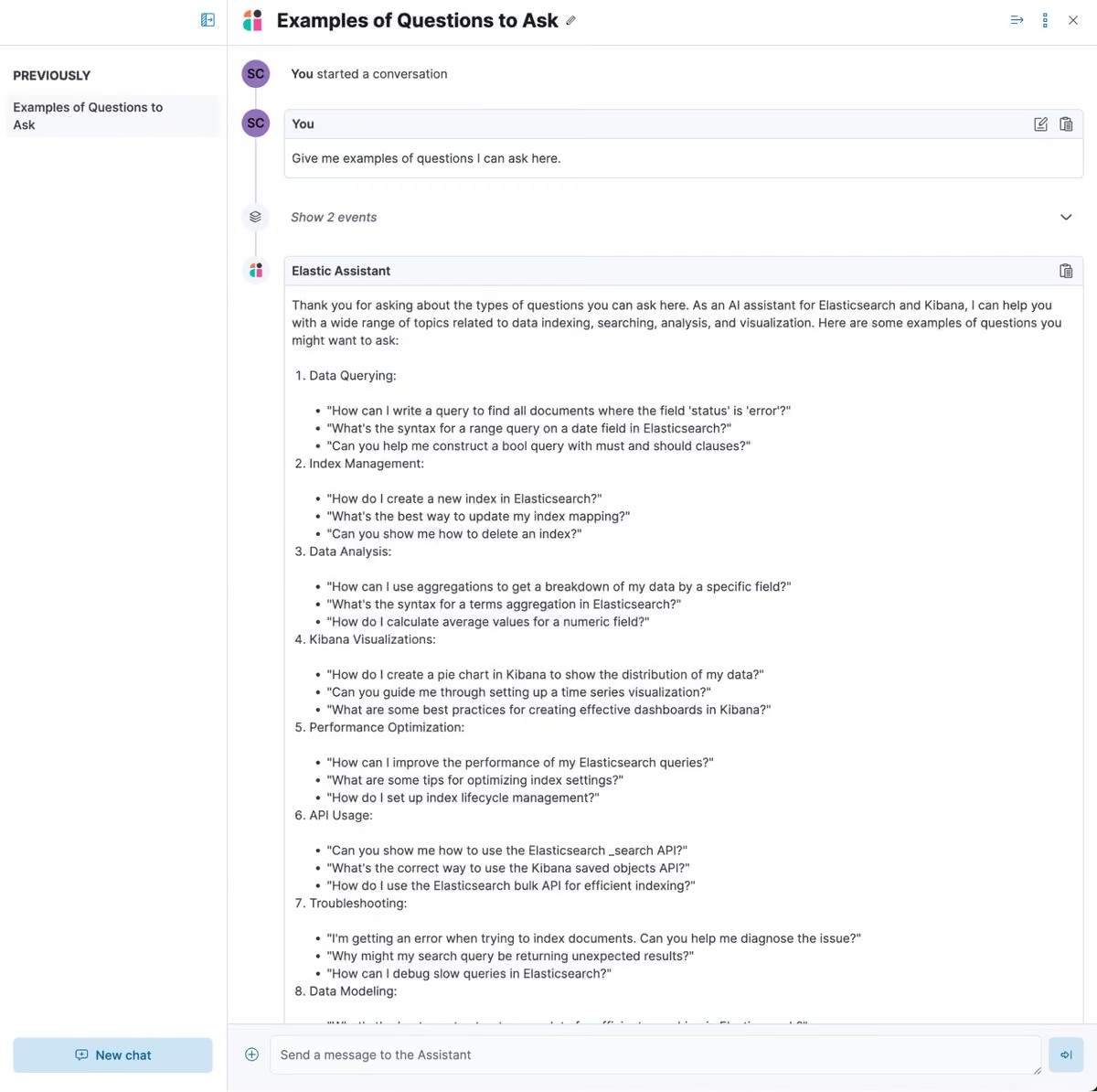 Elastic
@elastic
Elastic Cloud Serverless will soon be available on @Azure, bringing effortless deployment, automatic scaling, and seamless integration to your cloud workflows: go.es.io/3AYBydP
Stop by booth 342 at #msignite to learn more!
Elastic
@elastic
✅ Elasticsearch is now a Certified Software Solution on @Azure.
This means Elastic meets @Microsoft's stringent criteria, ensuring a fully optimized search experience for organizations on Azure: go.es.io/48RJPgp
Stop by booth 342 at #msignite to learn more!
Elastic
@elastic
Wrapping up my time at #kubecon with one final speaking session from Elastic engineer Christos Kalkanis. Incredible information in this one, here are my top 5 takeaways ⬇️ - JC (@CastillaCodes)
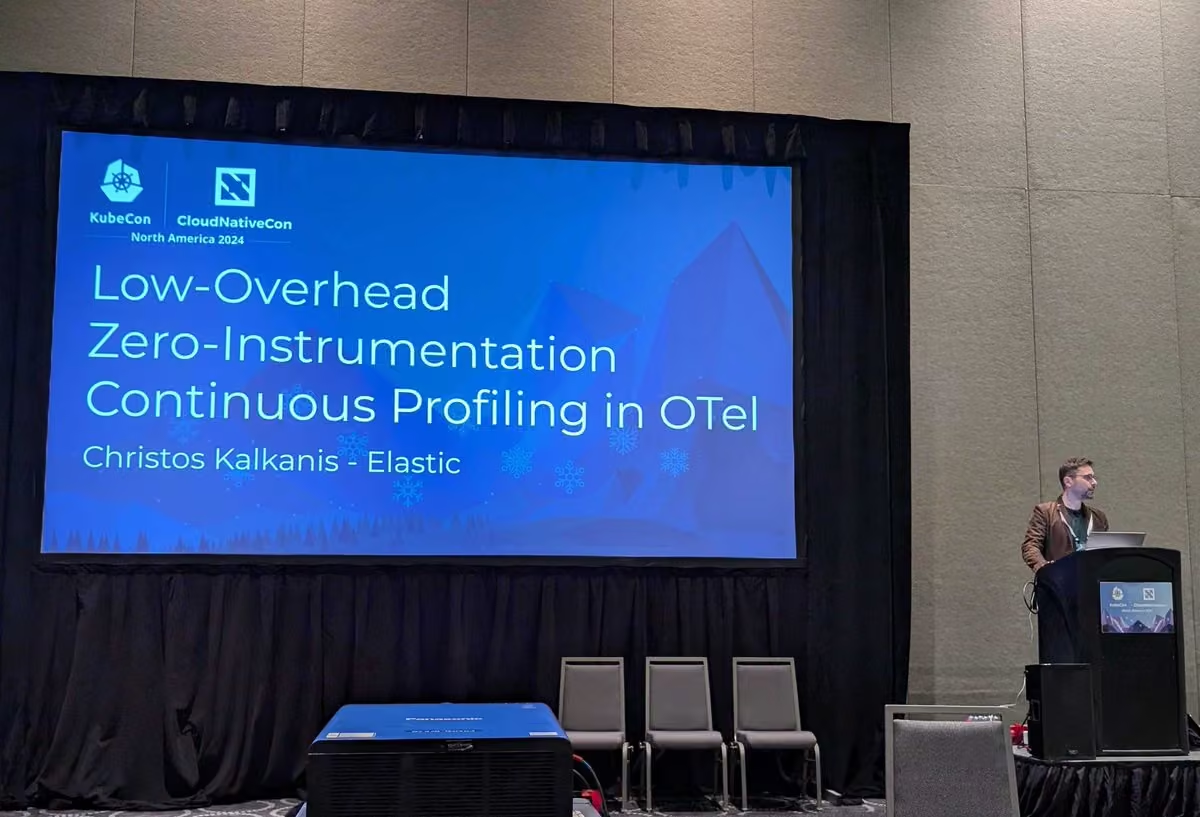 Elastic
@elastic
[4/5] Elastic devfiler: a standalone self-contained backend as a desktop application. Making java stack traces beautiful and helpful. - JC (@CastillaCodes) #kubecon
Elastic
@elastic
[5/5] Elastic’s Universal Profiler: for when you absolutely must know everything that is going on from Kernel to KNN call. - JC (@CastillaCodes) #kubecon
Elastic
@elastic
Elastic Principal Product Manager Miguel Luna presenting at the @googlecloud booth at the solutions showcase at #kubecon! Here are my 3 main learnings ⬇️ - JC (@CastillaCodes)
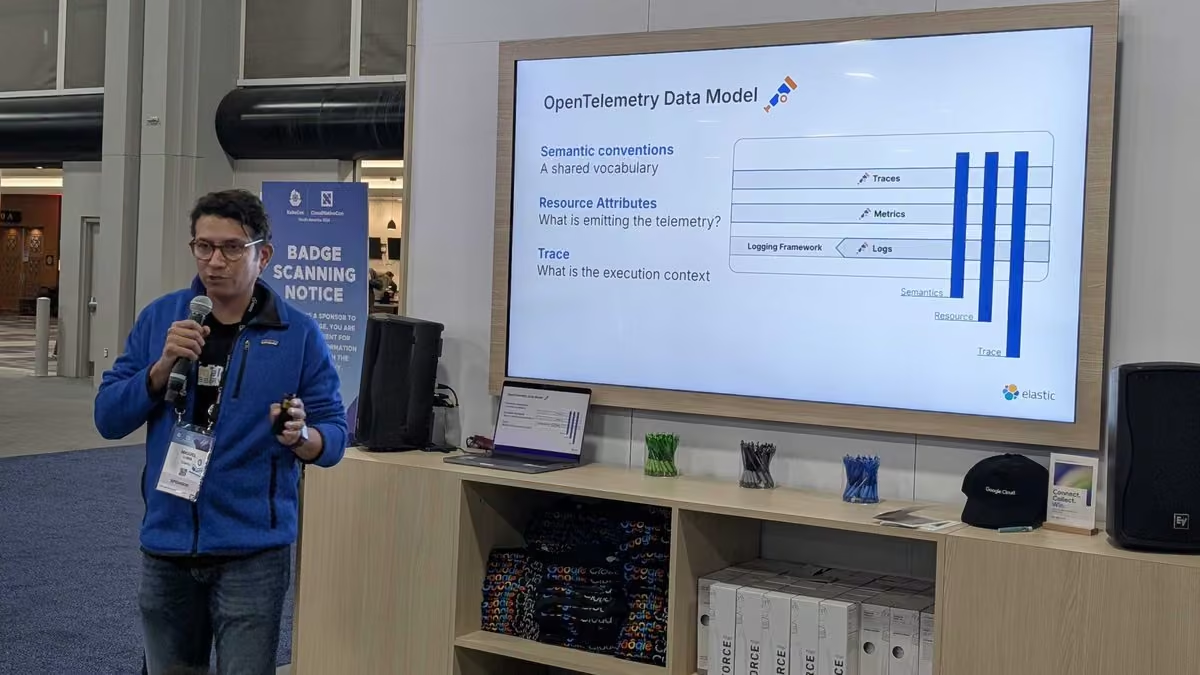 Elastic
@elastic
[2/3] With Elastic Observability, semantic conventions are preserved to keep with #otel specifications, as it was originally intended. - JC (@CastillaCodes) #kubecon
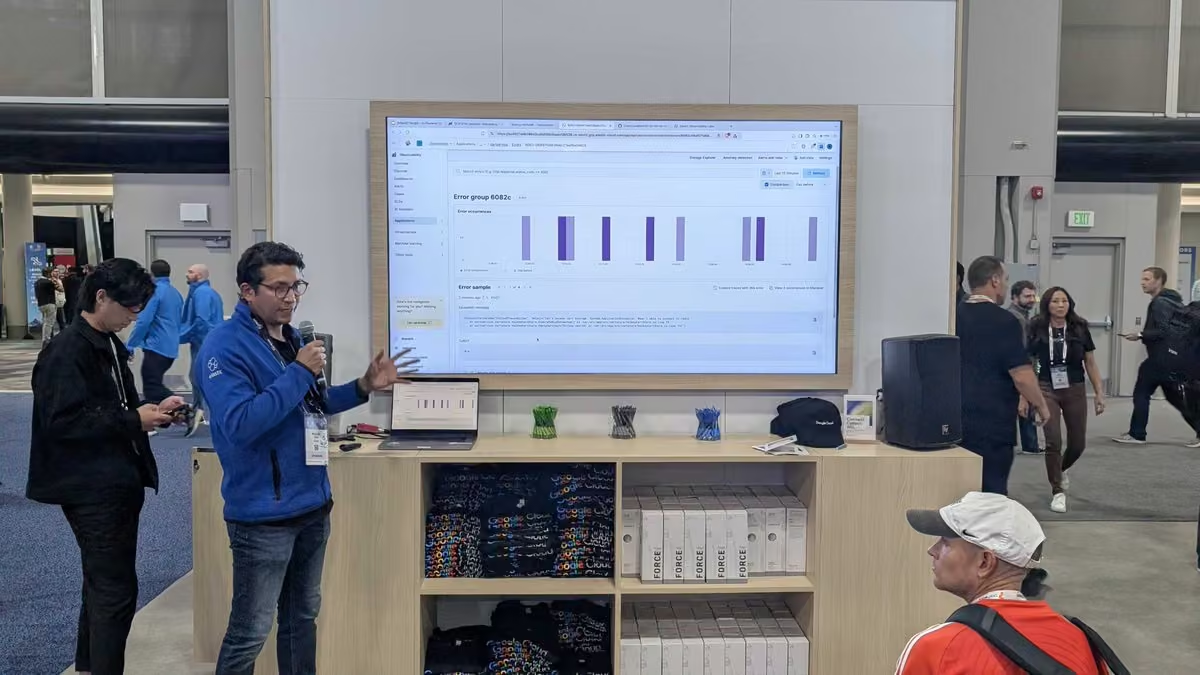 Elastic
@elastic
[3/3] Lastly, with Elastic Assistant AI, conversations with your observability data is a breeze. Context aware and ready to help drill down bottlenecks and hotspots! - JC (@CastillaCodes) #kubecon
 Elastic
@elastic
Elastic ❤️s @opentelemetry! Amazing to see Elastic and several of our Elasticians featured on the #opentelemetry Top Contributors 2024 board here at #kubecon + #cloudnativecon! - JC (@CastillaCodes)


 Elastic
@elastic
Introducing the Elastic AI Ecosystem — bringing together Elasticsearch vector database integrations with leading AI companies, so you can focus on building faster and deploying with confidence. Learn more: go.es.io/3O6osy2
Elastic
@elastic
We're here for day 2 of #kubecon! Come on by the Elastic booth to catch a demo of #otel with Elastic's Observability features in action! - JC (@CastillaCodes)


 Elastic
@elastic
Great read in @sdtimes by @Shetti on how SREs can accelerate root cause analysis with #opentelemetry and #ai Assistants: go.es.io/4frnclf
Elastic
@elastic
Get #kubernetes and app observability in 3 steps with EDOT. Frictionless OpenTelemetry-native monitoring made simple with out-of-the-box dashboards and auto-instrumentation. Try EDOT for unified observability: go.es.io/4fgskIV
Elastic
@elastic
Why Does Continuous Profiling Matter to Developers? Jonas Kunz (@Elastic) & Mauricio Salatino (@Diagrid) simplify integrating #otel observability with continuous profiling to identify bottlenecks and understand how our apps perform. 🧵 Follow along - JC (@CastillaCodes) #kubecon


 Elastic
@elastic
So much goodness to come: increased stabilization of the profiling signal (OTLP), profiling support in the OTEL-collector, standardization of trace:profiling correlations. Just wow! #kubecon
Elastic
@elastic
opentelemetry-ebpf-profiler (for when your bleeding edge observability absolutely must be fresh): go.es.io/40NlAxJ
- JC (@CastillaCodes) signing off for the day! See you all tomorrow for day 2 @KubeCon_
Elastic
@elastic
Checking out a @KubeCon_ talk w/ Laurent Broudoux (@microcksio) and Daniel Oh (@RedHat) on how to simplify cloud native development environments and integrate with TestContainers. Pairs well with our API services. Lest we forget, always test! - JC (@CastillaCodes) #kubecon


 Elastic
@elastic
Upgrade now! Elastic 8.16 includes Better Binary Quantization, LLM observability extended to Amazon Bedrock, cloud security provider protections, an updated Kibana experience, and more.
Learn more → go.es.io/48Kaxas
 Elastic
@elastic
Elastic Sr. Developer Advocate Justin Castilla is taking over our handle at #kubecon + #cloudnativecon this week! Look out for his posts signed JC (@CastillaCodes) for his insights and takeaways from the show.
Elastic
@elastic
Elastic Observability now gives SREs OTel-native, out-of-the-box Kubernetes monitoring to streamline performance and boost reliability—no manual configuration needed. Learn more about our 100% OTel-native approach: go.es.io/3ClTOy5
#devops #opentelemetry
Elastic
@elastic
We kicked off #kubecon week in Salt Lake City with a great meet-up in partnership with @Microsoft!
Eric Lowry (Elastic Principal SA) and Eric Leonard (Microsoft Sr. Cloud SA) presented on how to streamline #genai with Elastic and @Azure OpenAI to boost developer productivity.

 Elastic
@elastic
Introducing the first vector database with BBQ — it’s smoking fast with tasty recall 🚀
Now in tech preview in Elasticsearch, this new quantization technique delivers faster vector search with 95% memory reduction and ~0% loss of recall. Learn more: go.es.io/3YBfaiA
Elastic
@elastic
The final chapter of our ‘Inside Elastic’ blog series is here.
In part 6, Andy James explores important observability considerations when designing a chatbot such as the Elastic Support Assistant. Learn more → go.es.io/3AzEjlK
 Elastic
@elastic
Simplify LLM integration into Java applications with LangChain4j. Learn how in this blog: go.es.io/3zN3XDm
#elasticsearchlabs
Elastic
@elastic
Managing #elasticsearch just got a LOT easier 🚀
Introducing AutoOps for Elastic Cloud Hosted – easy cluster management with performance insights, issue detection and recommendations, cost insights, & more. Now free for Elastic #cloud users! Learn more: go.es.io/40yYD14
Elastic
@elastic
Are you using Elastic as your vector database? Take a look at the components and underlying technologies that provide a good balance of performance and speed. Read more in this blog: go.es.io/47XOahz
#elasticsearchlabs
Elastic
@elastic
What are the pros and cons of training your own encoder model for semantic search, versus using a pre-retrained model, like ELSER?
Hear from Director, Product Marketing, Jessica Taylor, in this Elastic Snackable Series episode: go.es.io/3NLNAdj
Elastic
@elastic
Open Crawler is now in beta! Read this blog to learn more about the new crawl rules, extraction rules, and more: go.es.io/3BDQ4b4
#elasticsearchlabs
Elastic reposted
 Elastic Cloud Status
@ElasticStatus
Resolved: This incident has been resolved. All impacted repositories have been made public, and their forks have been restored. stspg.io/0wgk9wflkmwr?u=wbrdf5ydw33n
Elastic
@elastic
Some of our Github repositories are unavailable due to an error in a routine maintenance deployment. Our team is working to make them public again. Follow @ElasticStatus for updates or learn more here: go.es.io/3Up2lqg
Elastic
@elastic
Learn how to convert your Logstash pipelines to @opentelemetry collector pipelines! Dive into this step-by-step guide to help you make the transition with our latest insights: go.es.io/3BYoYeK
#elasticobservabilitylabs
Elastic
@elastic
Learn how Elastic Observability uses NER, regex, and machine learning to assess and redact sensitive data in your logs, ensuring privacy and compliance. Read more here: go.es.io/3Yde9gs
#elasticobservabilitylabs #machinelearning
Elastic
@elastic
Build a local agent using LangGraph, LLaMA3 and Elasticsearch vector store from scratch. Get the step-by-step guide in this blog: go.es.io/3zKFHSd
#elasticsearchlabs
Elastic
@elastic
Users expect search results tailored to their individual interests. In this blog, we're taking a look at ways to personalize search, and then will dive into the specifics of how to do this with Elastic's LTR capabilities. Read more: go.es.io/3ZY7wB5
#elasticsearchlabs
 Elastic
@elastic
Curious how HAR logs can help diagnose issues between Kibana's UI and Elasticsearch’s API? Dive into our detailed guide to learn how to capture, sanitize, and use HAR logs to troubleshoot faster and more effectively: go.es.io/3NxXijm
 Elastic
@elastic
Next up in our Elastic Snackable Series 🎬 @xeraa is discussing Playground. Find out its importance and how you can use it to explore the future of search in the full video here: go.es.io/3Nprf54
#generativeai
Elastic
@elastic
Our October #devrel newsletter is out now! Read more for updates on…
✅ What’s new in Elasticsearch, Kibana, & Elastic AI Assistant
✅ The latest content from the community
✅ Upcoming events & meetups
Dive in now: go.es.io/3U7C6of
Elastic
@elastic
Is your SRE team strapped for time & resources? AI and ML can help.
Join us for a webinar on Oct 24 and discover how you can reduce SRE toil and future-proof your observability strategy with Elastic and @awscloud. Register here: go.es.io/4002nIL
#generativeai
Elastic
@elastic
Unlock accurate & efficient RAG workflows with Elastic and @Vectorizeio allowing you to build robust RAG applications with speed. Learn more here: go.es.io/3BKbseK
 Elastic
@elastic
Have you tried geospatial queries with Elastic's new query language, ES|QL? Read this blog and dive in: go.es.io/3Nh9Xar
#elasticsearchlabs
 Elastic
@elastic
Explore the power of @opentelemetry with Elastic! Check out this new demo on how to use Elastic's distributions of #opentelemetry in our latest #elasticobservabilitylabs blog: go.es.io/4gVJAo5
Elastic
@elastic
When it comes to security, every second counts. With Kibana’s intuitive interface, security teams can detect and respond to threats faster than ever, while significantly reducing the MTTD and minimizing potential damage. Learn more: go.es.io/4gXsmGM
Elastic
@elastic
Building #genai apps? You’ll need more than just a #vectordatabase.
Join us on Oct 17 with @llama_index to discover the complete toolkit for production-ready AI apps — so you can accelerate your time to launch. Register here: go.es.io/4gYOmRG
Elastic
@elastic
Learn how to use Logstash to safely route a subset of production data to pre-production clusters by using efficient sampling techniques and by leveraging the UDP protocol’s fire-and-forget functionality in our latest blog: go.es.io/3YheOik
Elastic
@elastic
Manage your Go applications with @opentelemetry and Elastic to gain insight into application performance, dependencies, and errors without major code changes. Learn more here: go.es.io/3XX4Q3X
#elasticobservabilitylabs
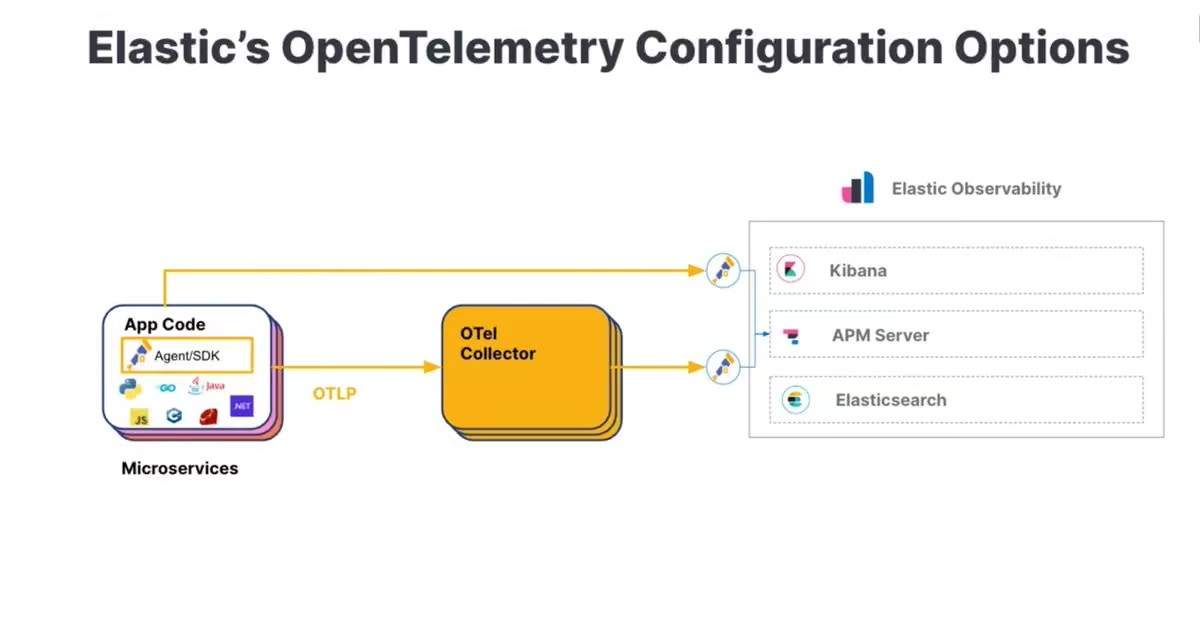 Elastic
@elastic
Learn how to add AI summaries to your site or app to enrich your search experience. Dive into this blog for more: go.es.io/3TVbJ4F
#elasticsearchlabs
Elastic
@elastic
We’re back with the Elastic Snackable Series 🎬! Dive into the world of #generativeai search concepts over the next few weeks with our Elastic experts. First up: Scalar Quantization. Find out how it works and more with Stacy Drumm. Watch here: go.es.io/47UA5Bn
Elastic
@elastic
Query rules enable users to curate search results for specific queries or business use cases. Get the step-by-step guide in this blog: go.es.io/47SXUcN
#elasticsearchlabs
 Elastic
@elastic
LLM Observability just got easier! Elastic’s new Amazon Bedrock integration for Observability provides comprehensive insights into performance, cost, and usage metrics. Learn more here: go.es.io/3ZJliYg
#elasticobservabilitylabs #generativeai #llms
Elastic
@elastic
Thank you to all who joined us at #elasticon Tour San Francisco with a keynote from @kimchy, customer and partner speakers from @Adobe @SFBART @DocuSign @ElastiFlow @Fiber_AI @Informatica @llama_index @Synopsys, and so much more! See our remaining events: go.es.io/4dsI7m9


 Elastic
@elastic
🚨The 2024 Elastic Global Threat Report is now live! 🚨
Learn more about @elasticseclabs top threats and landscape forecasts below ⬇️
Elastic Security Labs
@elasticseclabs
Happy #cybersecurityawareness Month! To celebrate, we’re excited to release the 2024 @elastic Global Threat Report. Explore the top threats being deployed and review our threat landscape forecasts.
Download the 2024 Elastic Global Threat Report → go.es.io/4dnUjEM
 Elastic
@elastic
ECS boosts efficiency and data fidelity by normalizing data. Learn how ECS optimizes search, reduces storage needs, and simplifies the ingestion of large datasets. More in this blog: go.es.io/3N3eehu
#elasticobservabilitylabs #devops
Elastic
@elastic
Elasticsearch open inference API and Playground add support for @googlecloud’s Vertex AI Platform! Developers now benefit from Vertex AI’s fully managed AI development platform when building production-ready RAG applications with Elastic. Learn more: go.es.io/3ZHzBwh
Elastic
@elastic
Elasticsearch open inference API adds support for Google AI Studio! Developers can now use Elasticsearch to interact with data, quickly run experiments, and build applications using models available from Google AI Studio. Learn more: go.es.io/3BuQC2I
Elastic
@elastic
Threat modeling doesn’t have to be complicated to be effective. In fact, an easy-to-digest model is more likely to make a positive impact. That’s why we developed OATMEAL, a comprehensive yet straightforward approach to threat modeling. Learn more: go.es.io/47CQ07j
 Elastic
@elastic
With 20 sessions, 28 speakers, and 4 sponsors, #elasticon Tour Bengaluru was truly a day to remember. A huge thank you to our speakers, sponsors, and attendees for joining us at the flagship ElasticON event in India. See our remaining events here: go.es.io/4eDMf3F


 Elastic
@elastic
Use NLP and pattern matching to detect, assess, and redact PII from logs that are ingested into Elasticsearch. Learn how in this blog: www.elastic.co/observability-labs/blog/pii-ner-regex-asse…
#elasticobservabilitylabs #nlp
 Elastic
@elastic
Introducing Elastic distribution of OpenTelemetry PHP! Now you can easily instrument your PHP apps with @opentelemetry for robust #observability and monitoring. Learn more about it here: www.elastic.co/observability-labs/blog/elastic-openteleme…
#elasticobservabilitylabs #apm
Elastic
@elastic
Our September #devrel newsletter is out now! Read more for updates on…
💻 Elasticsearch and Kibana are open source, again!
✍️ The latest content from the community
📅 Upcoming events & meetups
Dive in now: www.elastic.co/blog/devrel-newsletter-september-2024?ultr…
Elastic
@elastic
The new LangGraph retrieval agent template from @langchain and Elastic allows developers to build agentic apps with search quickly! Read more about it here: www.elastic.co/search-labs/blog/langchain-langgraph-retri…
#elasticsearchlabs #generativeai
Elastic
@elastic
🚀 Beyond RAG Basics: Unpacking Advanced Strategies for AI Applications
In our recent virtual event with @cohere, experts shared insights on building sophisticated #rag systems. Here’s a thread with key takeaways! 🧵👇
 Elastic
@elastic
🔍 Why combine RAG with LLMs?
#llms are powerful but can make absurd mistakes when generating content. #rag complements LLMs by grounding them with contextual information, enhancing response accuracy, reducing costs, and ensuring more reliable outputs.
 Elastic
@elastic
🛠️ Understanding RAG architecture layers
✅ Data layer: Manages storage & type of data (structured/unstructured)
✅ Model layer: Fine-tunes #llms and embedding models
✅ Application layer: Handles retrieval, prompts, & logic
✅ Deployment layers: Ensure efficient implementation
 Elastic
@elastic
📊 Creating a production RAG LLMOps stack
Start with strategic data layer management:
✅ Balance large vs. small chunks
✅ Use token overlapping to maintain context
✅ Collapse related chunks for precision
✅ Ensure rigorous security and compliance
Elastic
@elastic
🔍 Evaluating the model layer
Use human-labeled data and appropriate metrics:
🔄 Recall: Ensures all relevant documents are retrieved
🎯 Precision: Ensures high relevance in retrieved documents. Fine-tuning #llms to optimize these metrics is crucial
Elastic
@elastic
🚫 Addressing generative model challenges
Prevent hallucinations by:
✅ Using models with citations
✅ Enhancing context window utilization
✅ Training models specifically for #rag tasks to improve reliability
 Elastic
@elastic
🛠️ Practical implementation tools
With Elastic, you can easily integrate and utilize frameworks like:
✔️ @cohere
✔️ @langchain
✔️ @llama_index
✔️ @pyautogen
☝️ These tools offer prebuilt solutions for faster deployment and reliable #rag systems.
Elastic
@elastic
🌟 Rev up your RAG
Advanced #rag strategies transform AI applications by providing context, improving reliability, and enhancing performance. Harness these insights to take your RAG systems beyond the basics! 🚀
#generativeai #nlp
Elastic
@elastic
Who is the #elasticon Tour for? Developers, Architects, IT pros, DevOps engineers, SOC analysts…the list goes on! Join us to connect with Elastic experts and discover the power of #searchai. See our full list of cities and register free: www.elastic.co/events/elasticon?ultron=elasticon%2Btour&b…
Elastic
@elastic
Elastic has been named a ‘Leader’ in the @IDC MarketScape: Worldwide SIEM for Enterprise 2024 Vendor Assessment! Learn more about Elastic and why we were recognized as a Leader in this excerpt → go.es.io/3XtDnH8
 Elastic
@elastic
Elasticsearch open inference API adds support for AlibabaCloud AI Search! You can now connect directly to AlibabaCloud AI to build RAG apps, store and use dense/sparse embeddings, and leverage Alibaba models for semantic search. Learn more: www.elastic.co/search-labs/blog/elasticsearch-alibaba-clo…
#generativeai
Elastic
@elastic
Discover best practices for logging to enhance system reliability, streamline data collection, and accelerate problem resolution. Read on for more insights: go.es.io/3XvnQGu
#elasticobservabilitylabs #logging #devops
Elastic
@elastic
Learn how to quickly set up Elastic AI Assistant with @LMStudioAI running Meta’s Llama 3.1 model locally within our latest blog: go.es.io/3MKiEcY
Elastic
@elastic
Elastic announces GA for Elastic distribution of @opentelemetry Java Agent (EDOT Java)! Learn more about how to start using EDOT Java to automatically capture tracing data, performance metrics, and logs in this blog: go.es.io/3MHxRvB
#elasticobservabilitylabs #java #otel
Elastic
@elastic
Elasticsearch open inference API adds native chunking support for @huggingface models, enabling developers to focus on building #genai applications without the burden of writing custom chunking logic. Dive into this blog to learn more: www.elastic.co/search-labs/blog/hugging-face-elasticsearc…
Elastic
@elastic
As LLM applications grow more complex, ensuring reliability and performance is crucial. Dive into this blog to learn how to Understand LLM application performance with @opentelemetry, @openlit_io, and Elastic Observability APM: go.es.io/47C3wIx
#elasticobservabilitylabs
Elastic
@elastic
As AI-driven applications become increasingly complex, it’s critical to have robust tools to monitor and optimize performance. Learn how to use #otel instrumentation with @langtrace_ai and ingest into Elastic Observability APM: go.es.io/3MBG4Bm
#elasticobservabilitylabs
Elastic
@elastic
Announcing support for @cohere's Embed v3 model series! Use Elastic as your vector database — with the new inference API and Cohere's Embed endpoint — to store and search embeddings. Read more: go.es.io/3PHuPcB
#elasticsearch #vectordatabase
Elastic
@elastic
Search for meaning, not just words.
Introducing the Elastic Learned Sparse Encoder, an AI model for high-relevance semantic search across domains. This model expands beyond the query terms, delivering superior search relevance. Learn more here: go.es.io/3q2RohQ
Elastic
@elastic
Find the flow in workflow with ServiceNow. In Elastic 7.16, streamline workflows with integrations for @servicenow ITSM, SIR, and ITOM to boost your team’s productivity.
Learn more → go.es.io/3ovpsQj
Elastic
@elastic
Executive VP of Cloud + AI Group @microsoft. Red shirt aficionado. Tech visionary and keynote solver. @Scottgu will be sharing his wisdom on Oct 5 at #elasticon Global. Don’t miss it! Register now → go.es.io/2XCsN5e
 Elastic
@elastic
Attackers using “living off the land” techniques can be difficult to identify. Detecting post-compromise anomalous patterns based on parent-child process relationships helps detect adversaries that have bypassed modern security software. Learn more. go.es.io/2vbT7VZ
Elastic
@elastic
Persistence can be one of an attacker’s first objectives...but it can also be their weakness. Join our webinar to learn how #elasticsecurity helps you detect and hunt for malicious forms of persistence to stop attacks before damage and loss occur → go.es.io/2Ov1m6a
Elastic
@elastic
When using index lifecycle management (ILM), you can tell #elasticsearch how old your data is, which is handy if you’re indexing data that’s older than today days old. See how the origination_date settings can help you manage phase transitions → go.es.io/37OeNoM
 Elastic
@elastic
With the #elasticstack, @Solve has been able to think about the difficult challenges of precision medicine as search problems, and this thinking has brought scientists much closer to their data. Learn more → go.es.io/37CYqv1
 Elastic
@elastic
Learn how to use Elastic #siem and Elastic Endpoint Security to outpace cyber adversaries and protect your network at #elasticon Tour stops in Atlanta, Stockholm, Denver, and more. Find your tour stop and register → go.es.io/2Fjlsvh
 Elastic
@elastic
Live at #elasticon Dallas, @DevonEnergy shares their journey in moving from on-prem open source #elasticsearch to being the first ever user to run #elasticcloud Enterprise in @Azure.
Interested in attending an Elastic{ON} tour near you? Learn more: go.es.io/2J11LaU


