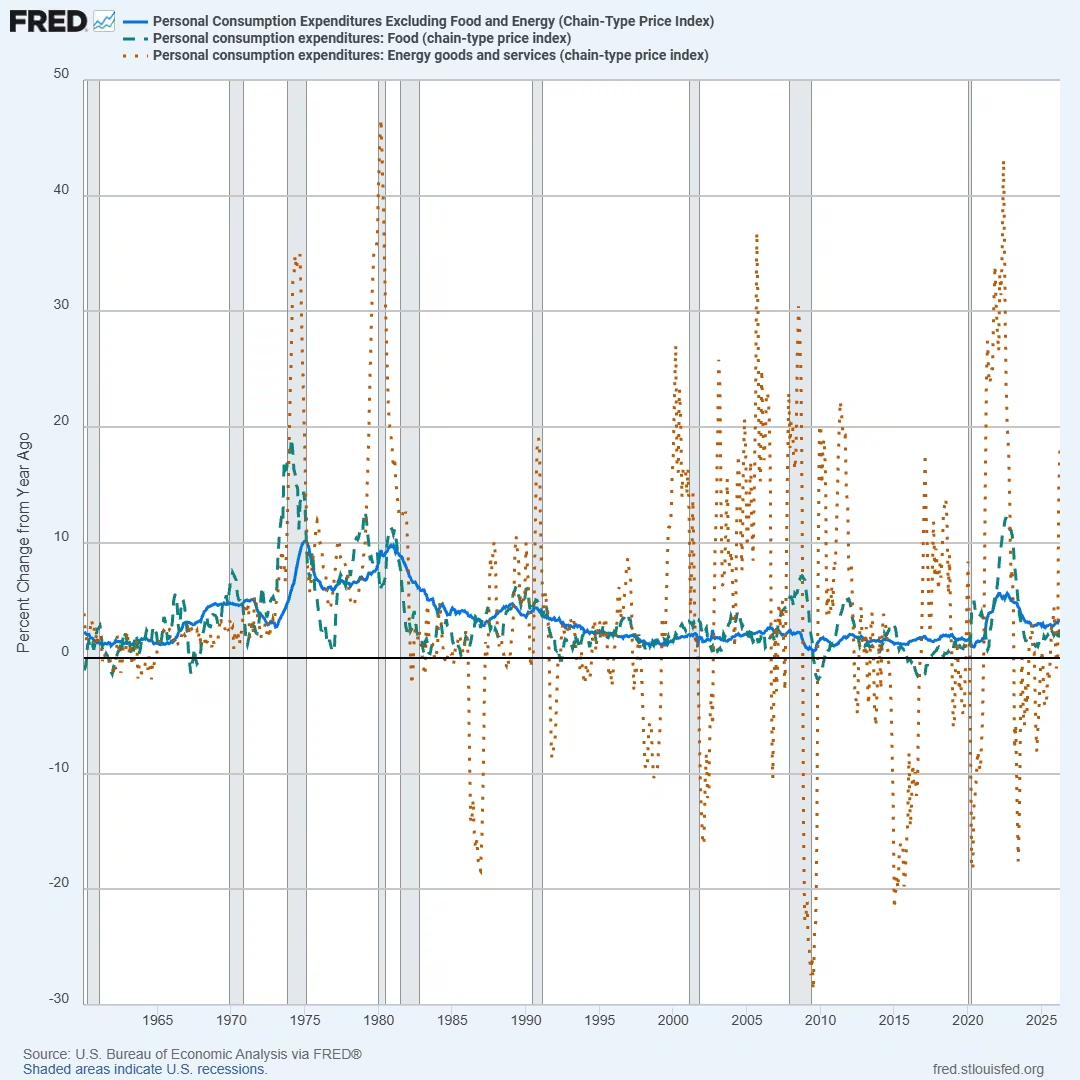
Per @BLS_gov release: U.S. import prices advanced 1.1% in October, driven by higher prices for nonfuel (+0.8%) and fuel (+3.6%) imports fred.stlouisfed.org/graph/?g=212Y4
Federal Reserve Bank of St. Louis
The Federal Reserve Bank of St. Louis is one of the twelve Federal Reserve Banks of the United States. It is responsible for the Eighth District of the Federal Reserve System, which encompasses Arkansas and portions of Illinois, Indiana, Kentucky, Mississippi, the eastern half of Missouri and West Tennessee. The district is headquartered in St. Louis and has branch offices in Little Rock, Louisville and Memphis. The bank's chief executive officer and president is Alberto Musalem. More on Wikipedia
-
St. Louis Fed
@stlouisfed
-
St. Louis Fed
@stlouisfed
Introducing our Monetary Policy Indicators. Get cutting-edge, in-depth analysis for making sense of key labor market and inflation data that help inform monetary policy www.stlouisfed.org/research
-
St. Louis Fed
@stlouisfed
When companies invest in R&D, where have they focused their spending in recent decades? On software? Biotech? AI?
New research helps answer two important questions for understanding where U.S. corporate R&D dollars are going:
▶️What technologies are firms investing in?
▶️Has R&D spending changed over time?
To start, the analysis shows the share of business fixed investment allotted to R&D has grown since 2011, with a notable acceleration from 2018 to 2020, and that it is increasingly being funded by companies themselves. Then, using survey data through 2023, it finds:
▶️Software and biotech have dominated businesses’ R&D spending, both overall and within many R&D-intensive industries.
▶️AI-related R&D has expanded rapidly, though as of 2023, it accounted for only a modest share of companies’ total R&D spending.
▶️Firms in the information industry invest mostly in software R&D. They also spend more of their budgets on AI-related R&D than others.
Find out more: www.stlouisfed.org/on-the-economy/2026/nov/changing-face-… -
St. Louis Fed
@stlouisfed
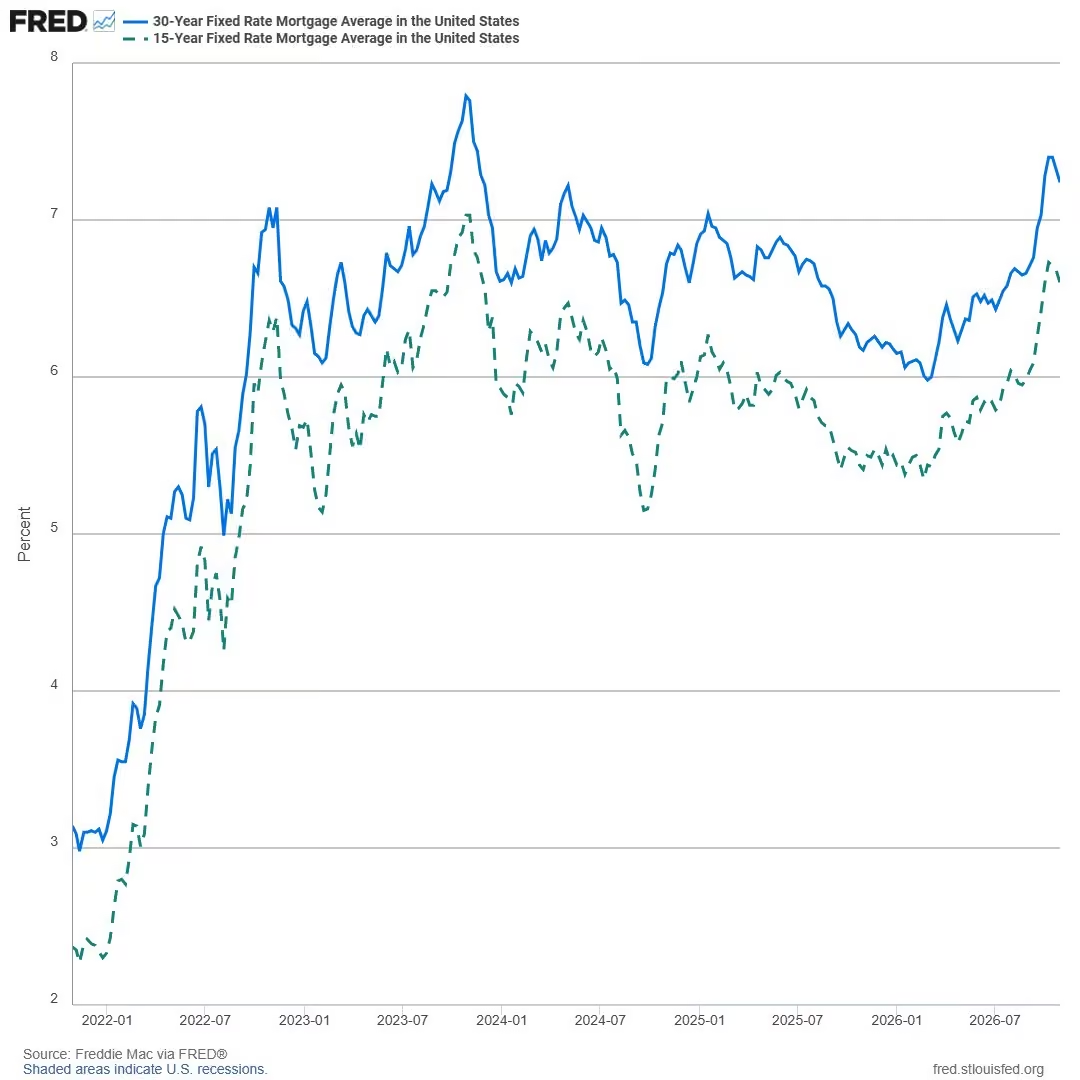
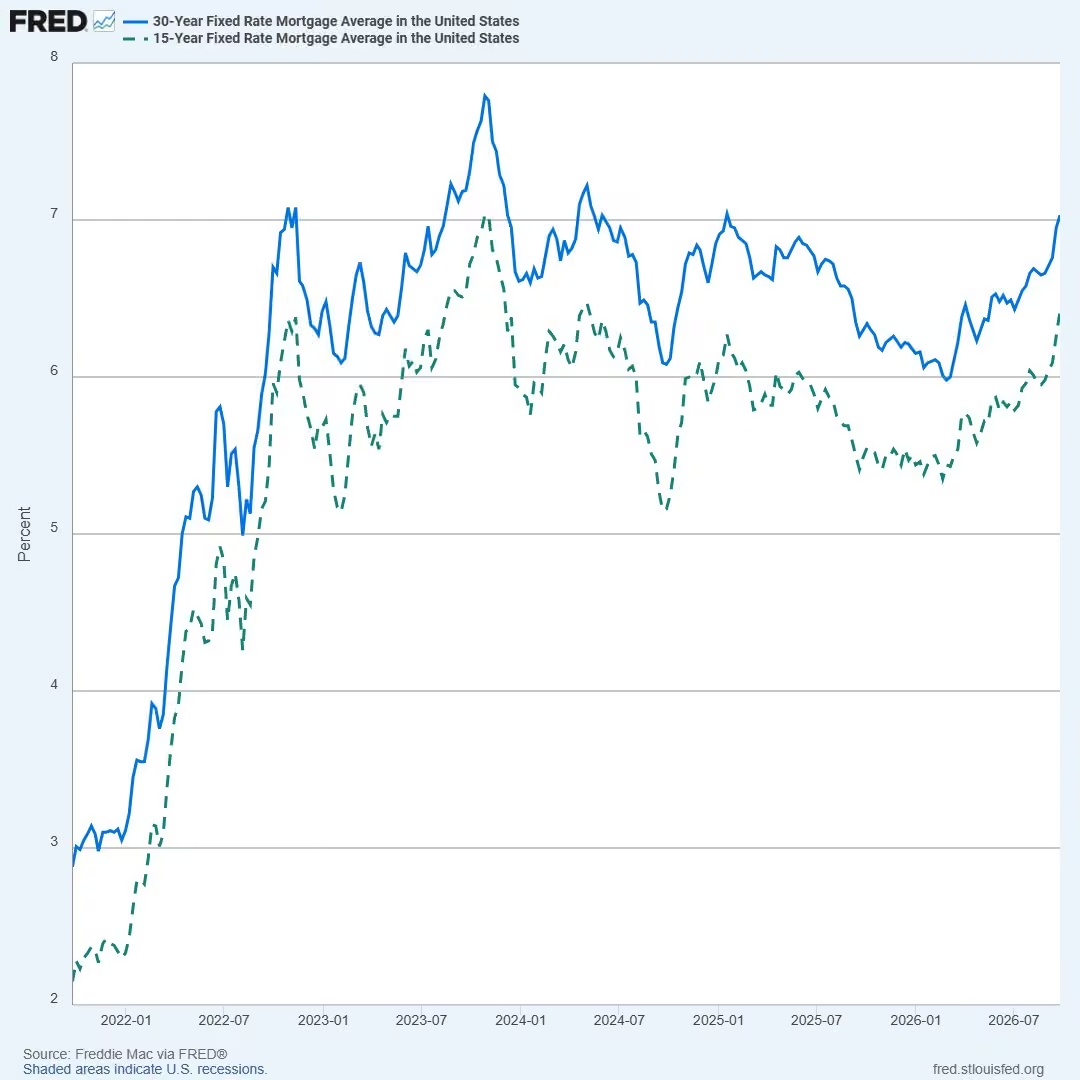
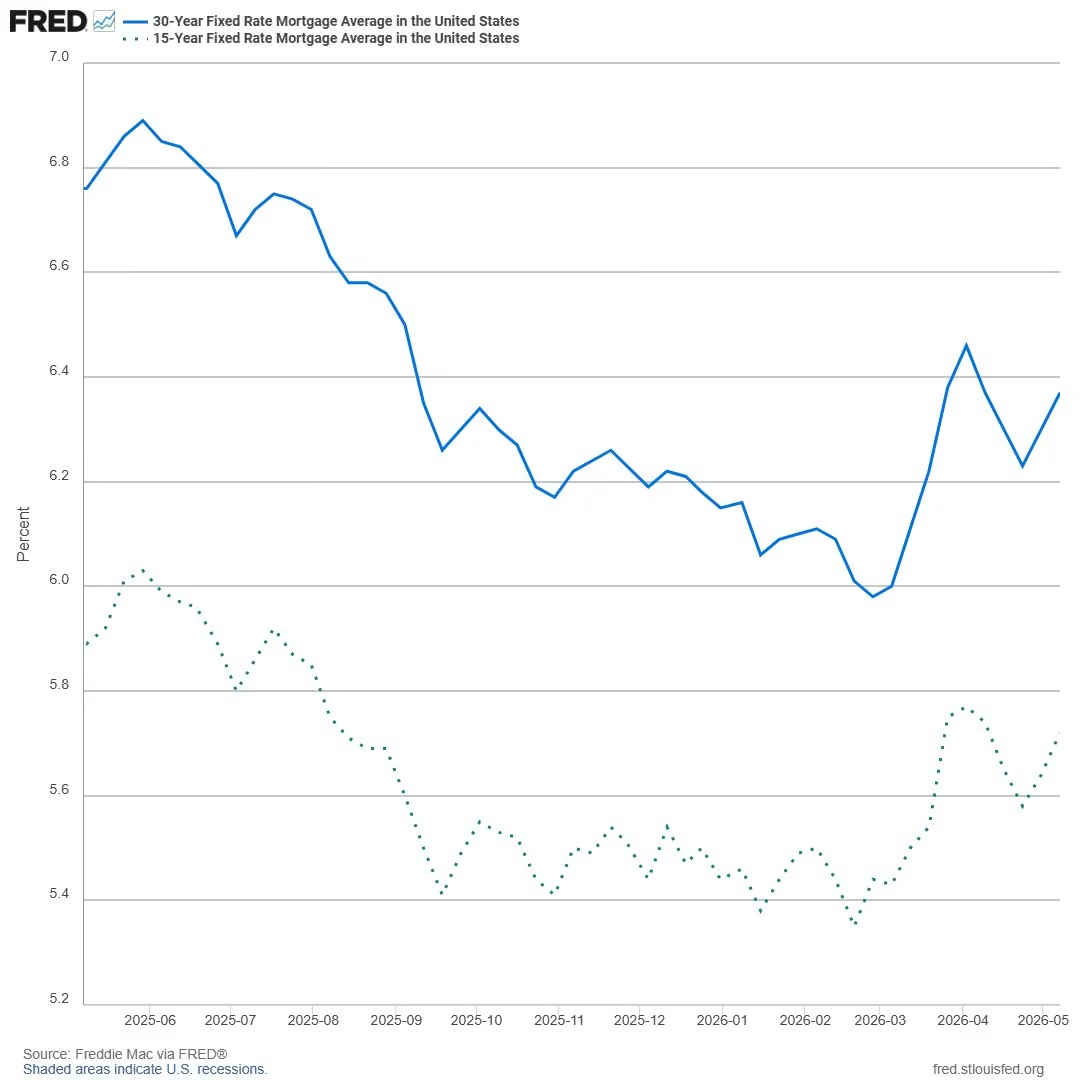
In the week ending Nov. 19, average fixed 30-year and 15-year mortgage rates increased, to 7.28% and 6.66%, respectively fred.stlouisfed.org/graph/?g=2177G
-
St. Louis Fed
@stlouisfed
In the week ending Nov. 14, seasonally adjusted initial claims for unemployment insurance benefits — those filed for the first time after a job loss — increased by 1,000, to 203,000. The four-week moving average rose 2,000, to 197,750 fred.stlouisfed.org/graph/?g=2176m
-
St. Louis Fed
@stlouisfed
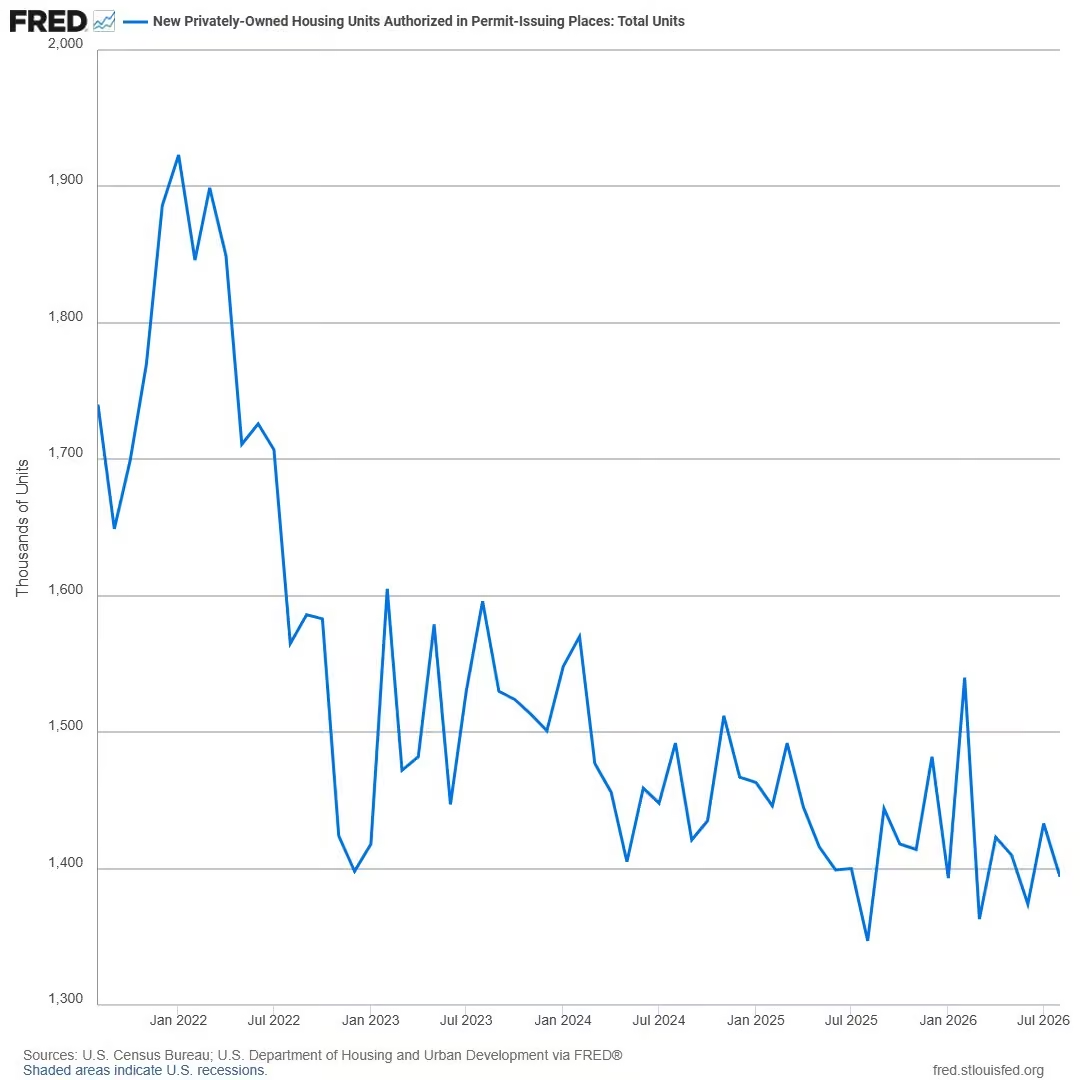
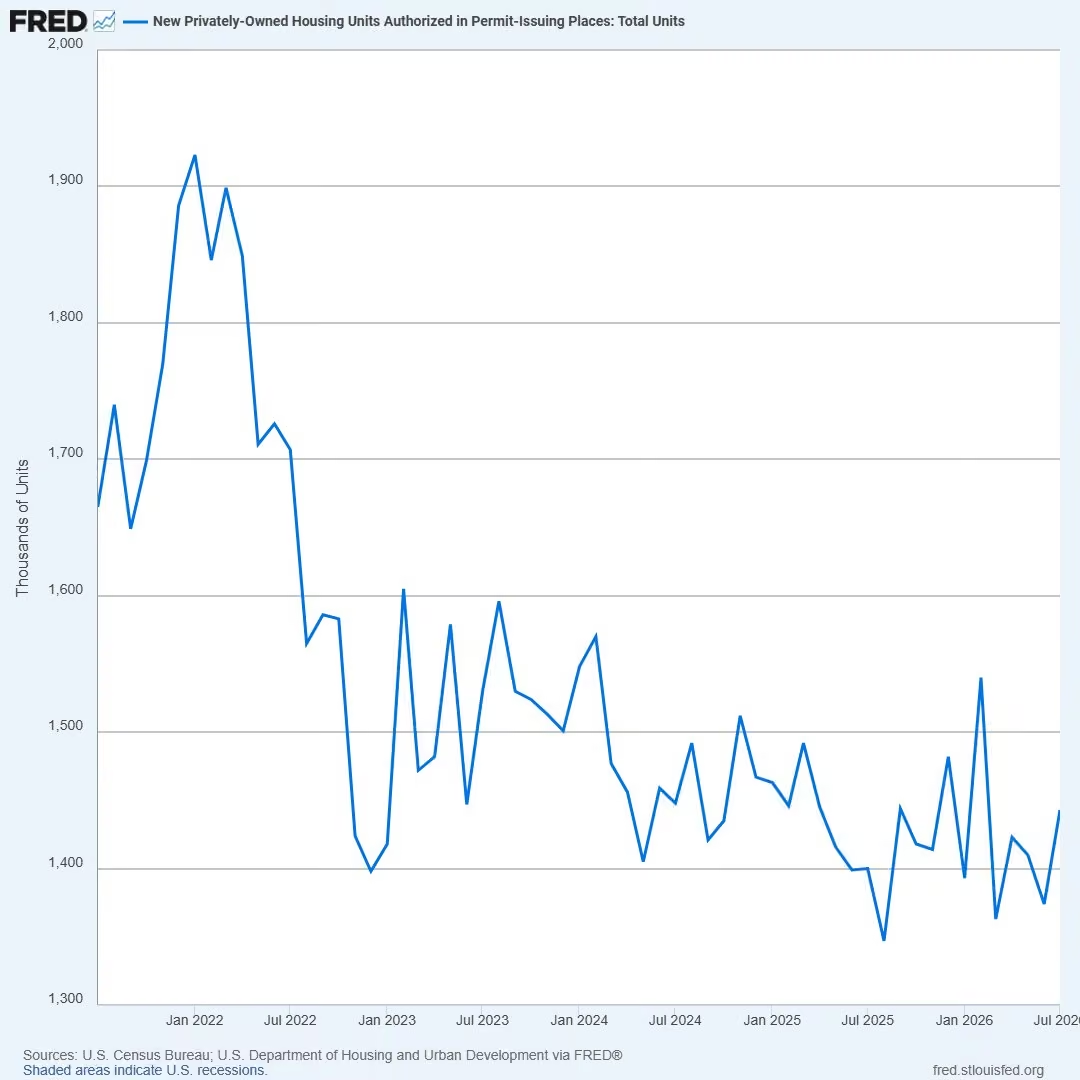
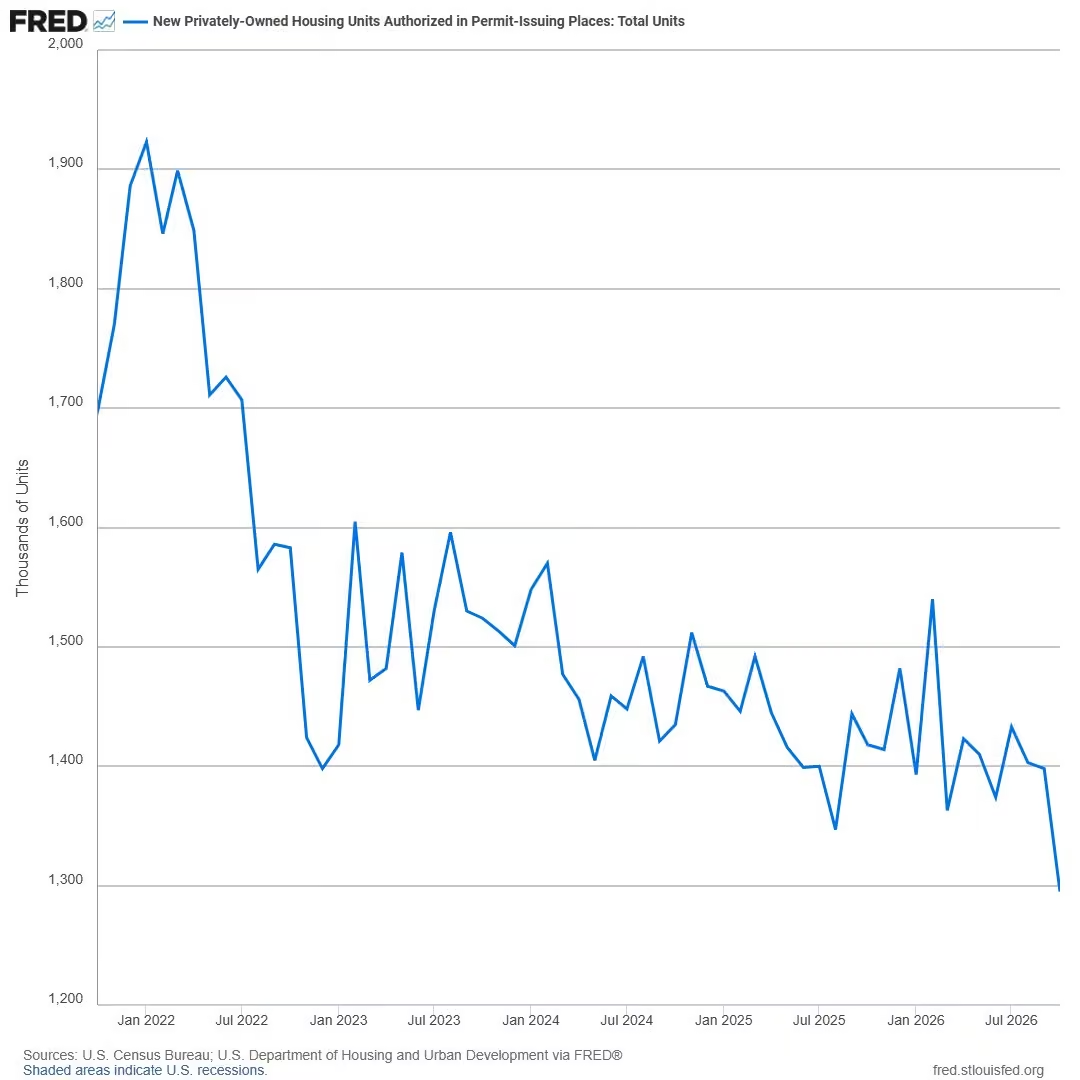
Permits to build privately owned U.S. housing were at a seasonally adjusted annual rate of 1.295 million units in October, a pace 7.4% below the September rate of 1.398 million and 8.7% below the October 2025 rate of 1.418 million fred.stlouisfed.org/graph/?g=214Se
-
St. Louis Fed
@stlouisfed
Privately owned U.S. housing starts registered a seasonally adjusted annual rate of 1.309 million units in October. This rate was 9.9% above September's estimate of 1.191 million and 2.8% above the October 2025 rate of 1.273 million fred.stlouisfed.org/graph/?g=214RH
-
St. Louis Fed
@stlouisfed
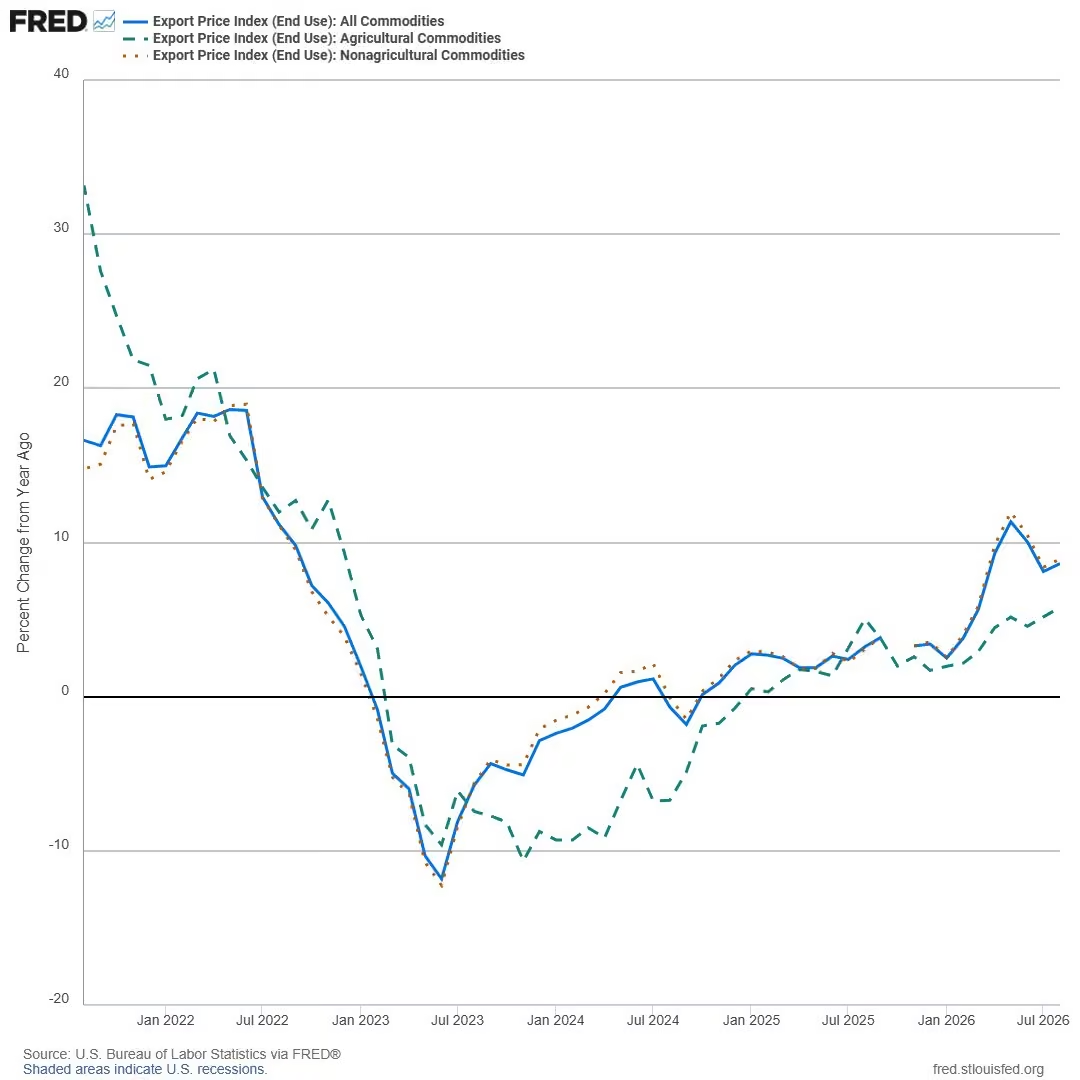
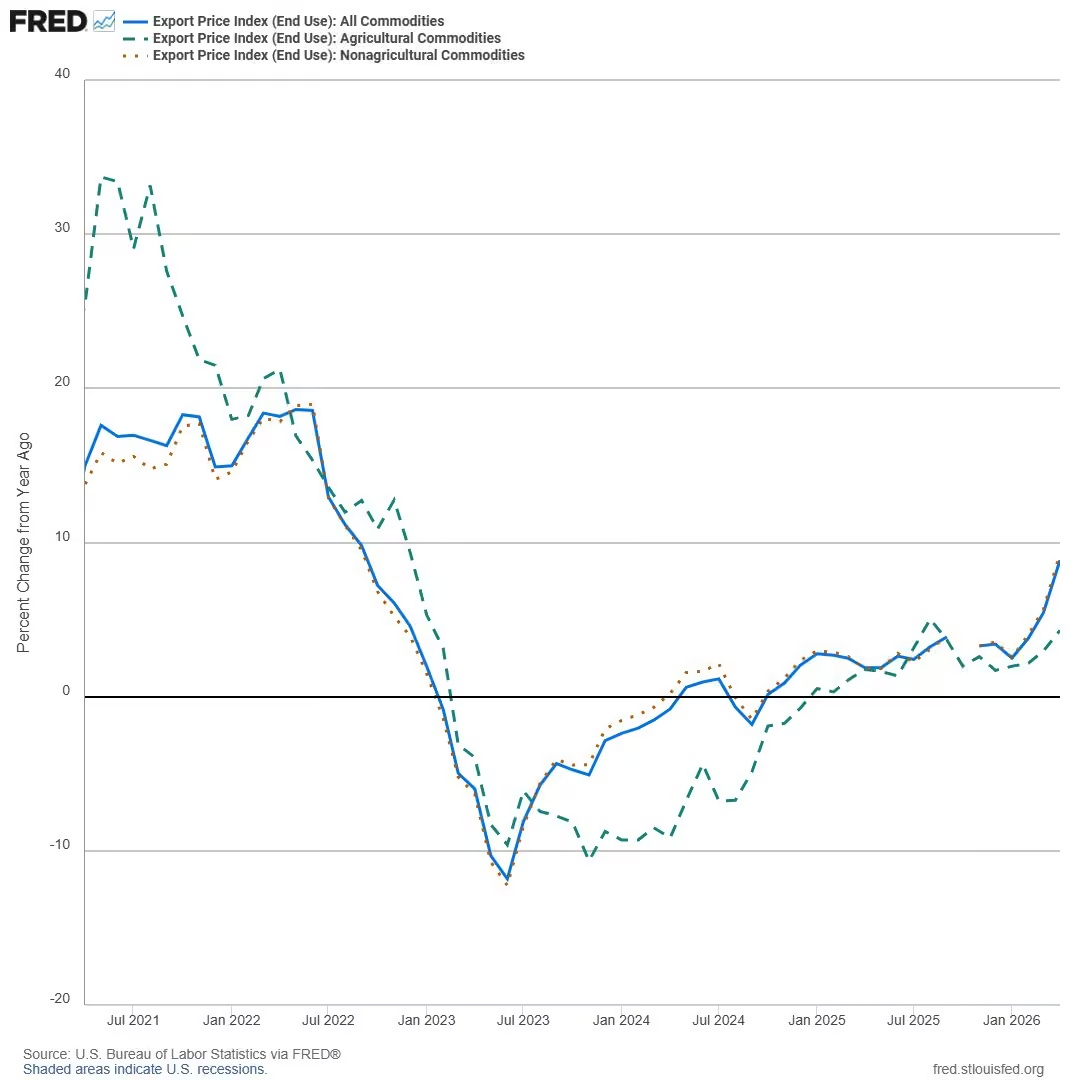
Per @BLS_gov release: U.S. export prices increased 1.1% in October amid higher prices for nonagricultural (+1.1%) and agricultural (+1.2%) exports fred.stlouisfed.org/graph/?g=212X4
-
St. Louis Fed
@stlouisfed
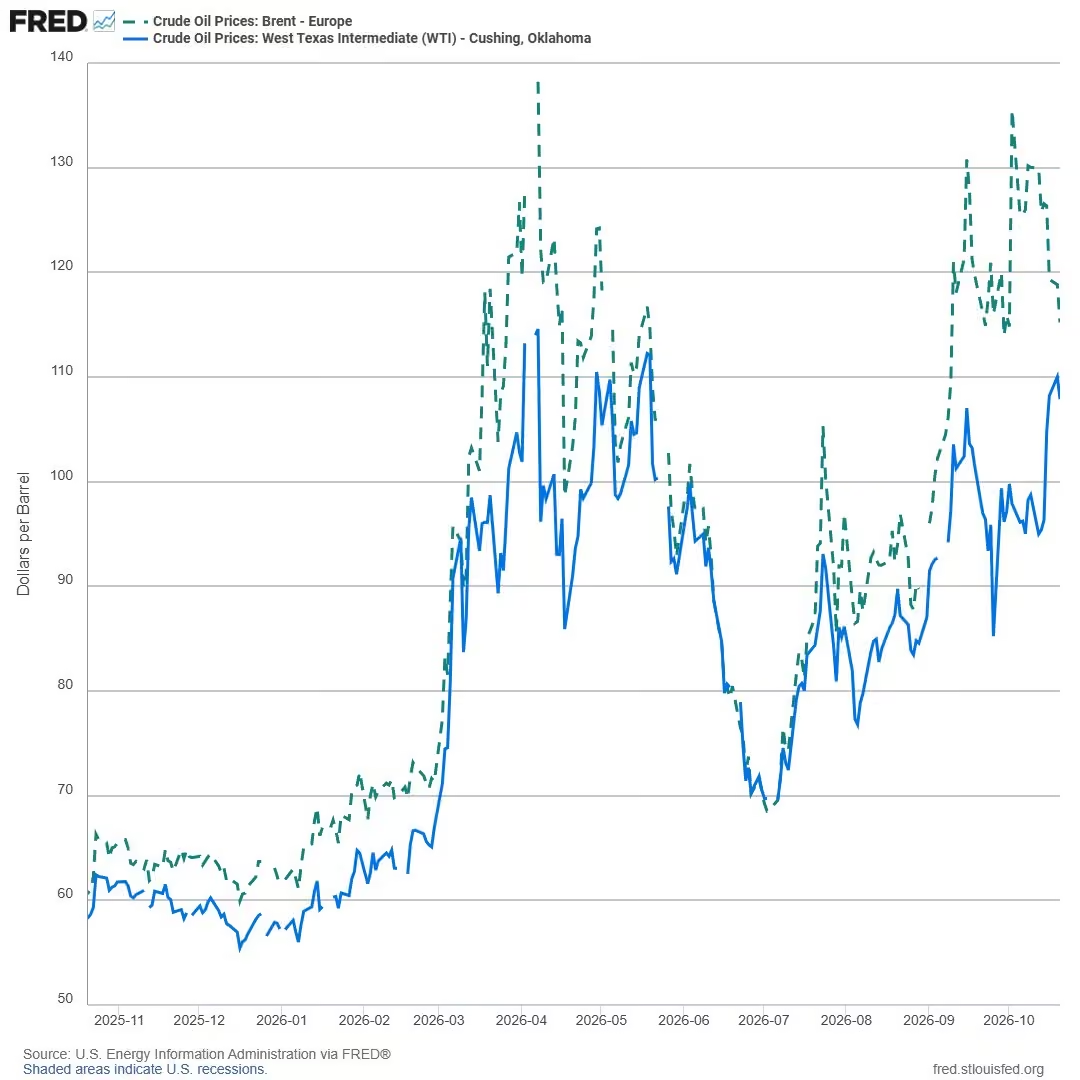
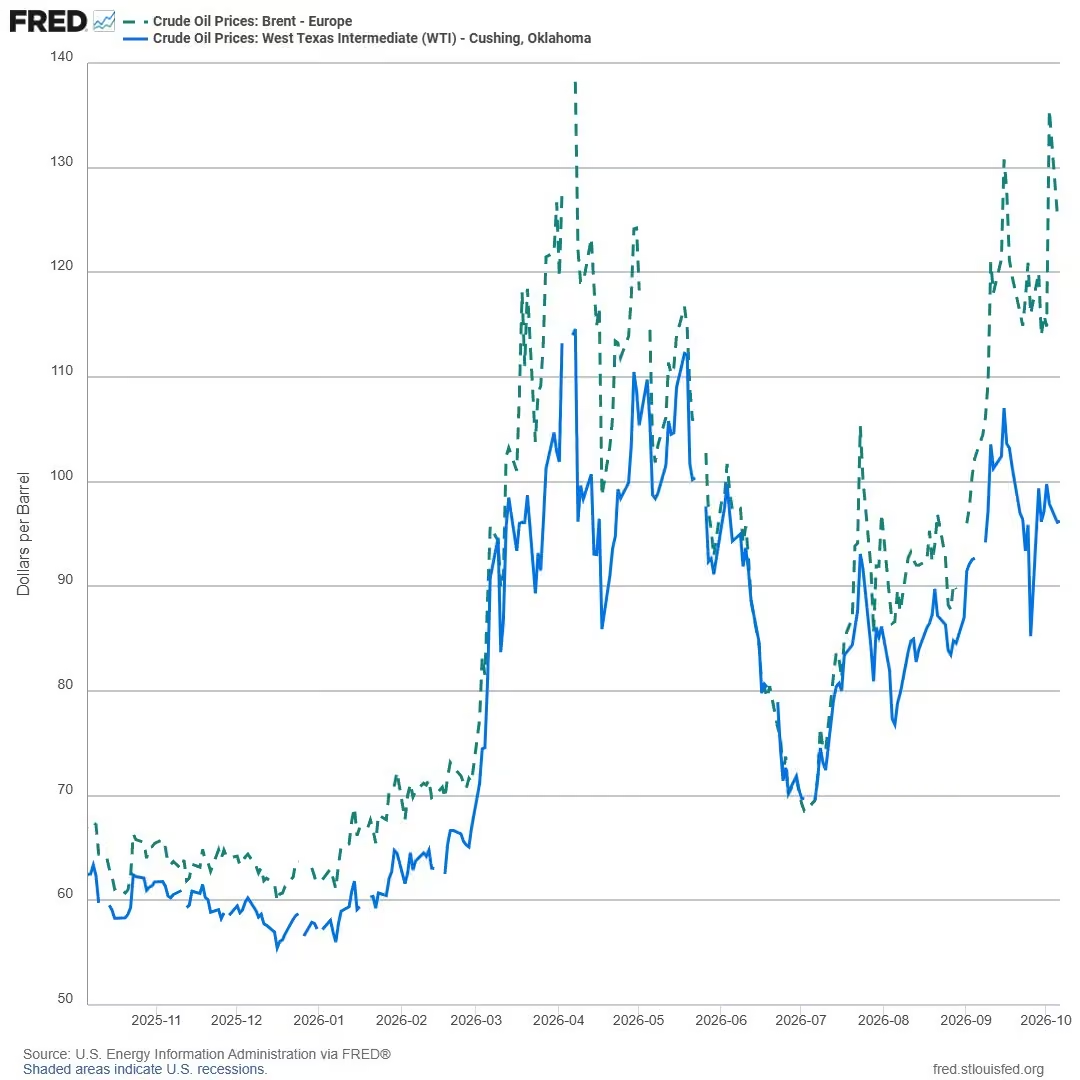
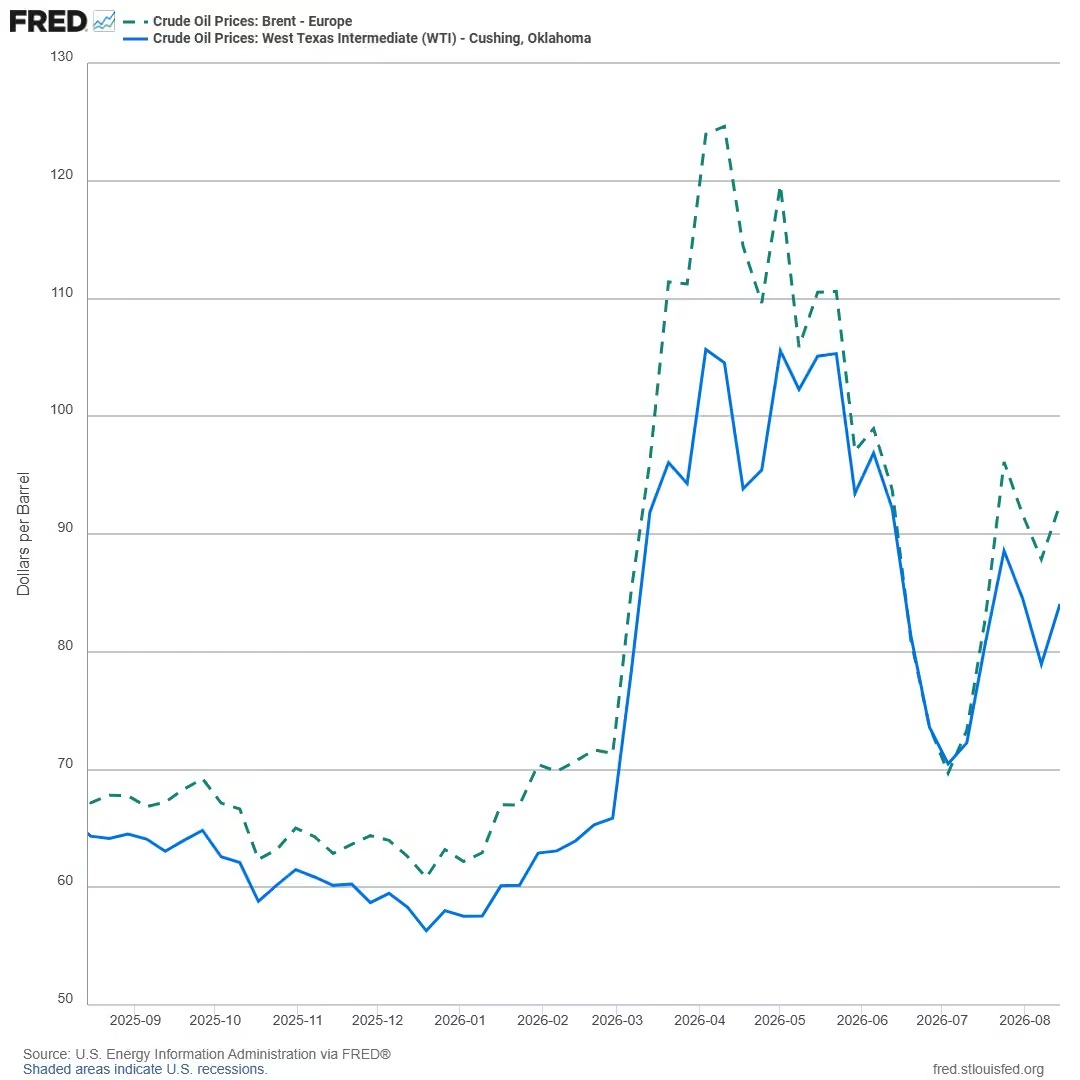
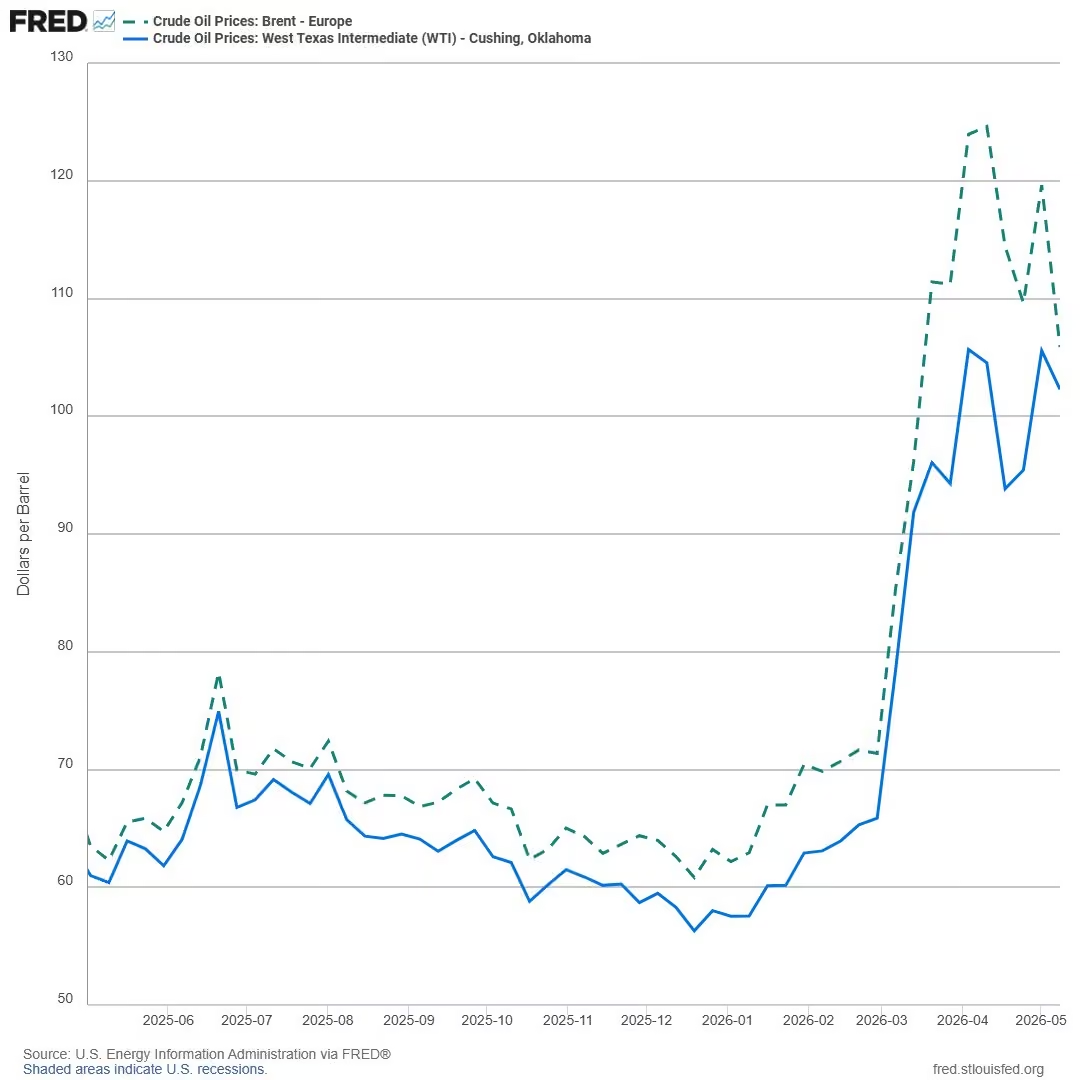
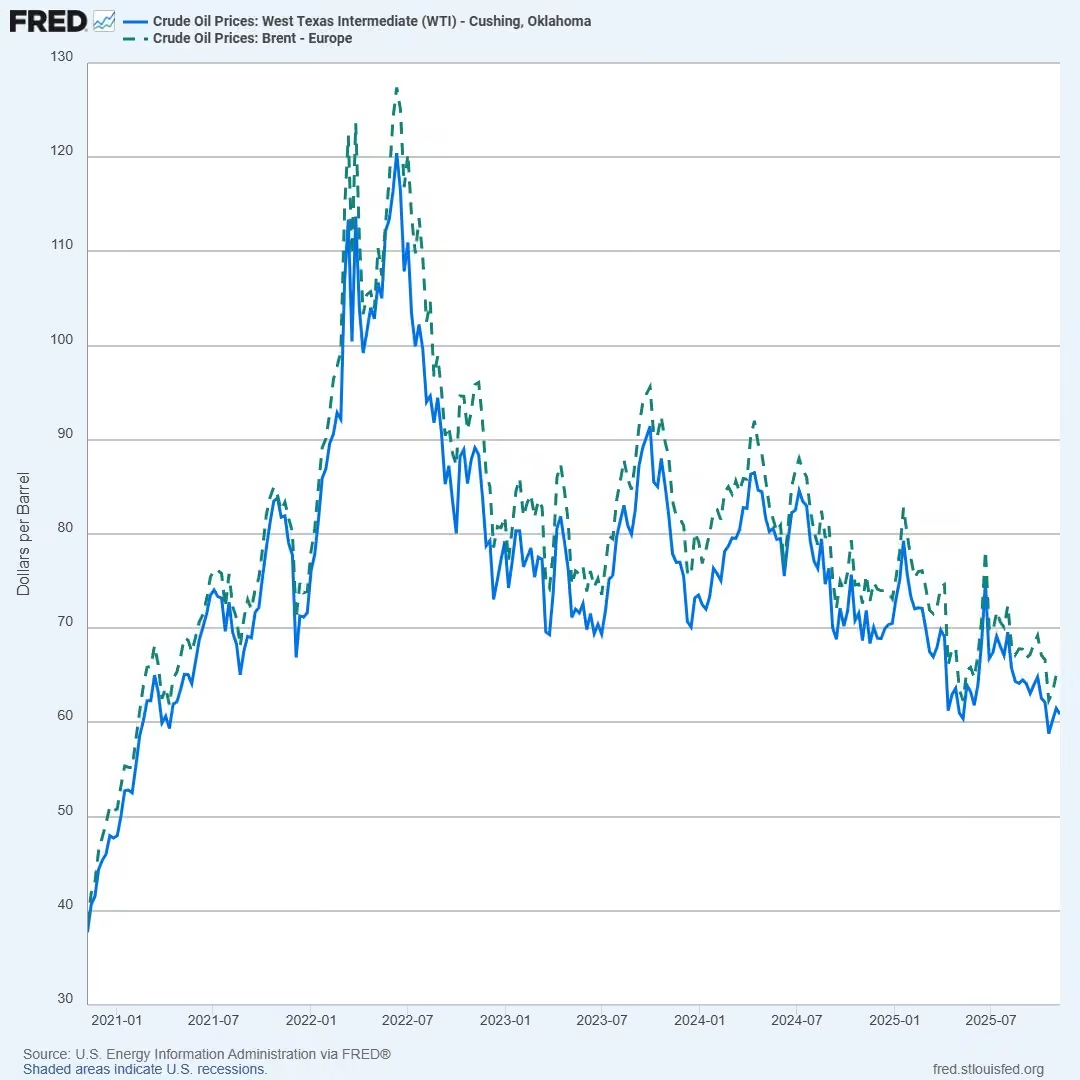
Daily spot prices for crude oil as of Nov. 17: Brent was at $92.94 a barrel and West Texas Intermediate crude oil was at $89.53 a barrel. For more, see FRED: fred.stlouisfed.org/release?rid=212
-
St. Louis Fed
@stlouisfed
Investors often accept lower returns on Treasury securities, dubbed the “convenience yield,” because they are viewed as safe and liquid. How has trade-off changed in recent years? Can Treasury buybacks boost the convenience yield? www.stlouisfed.org/on-the-economy/2026/nov/treasury-buyba…
-
St. Louis Fed
@stlouisfed
U.S. industrial production decreased 0.4% in October, the largest decrease since January 2026. Utilities and mining output led the decrease, falling 4.3% and 0.8%, respectively, while manufacturing activity edged up 0.3% fred.stlouisfed.org/graph/?g=2130h
-
St. Louis Fed
@stlouisfed
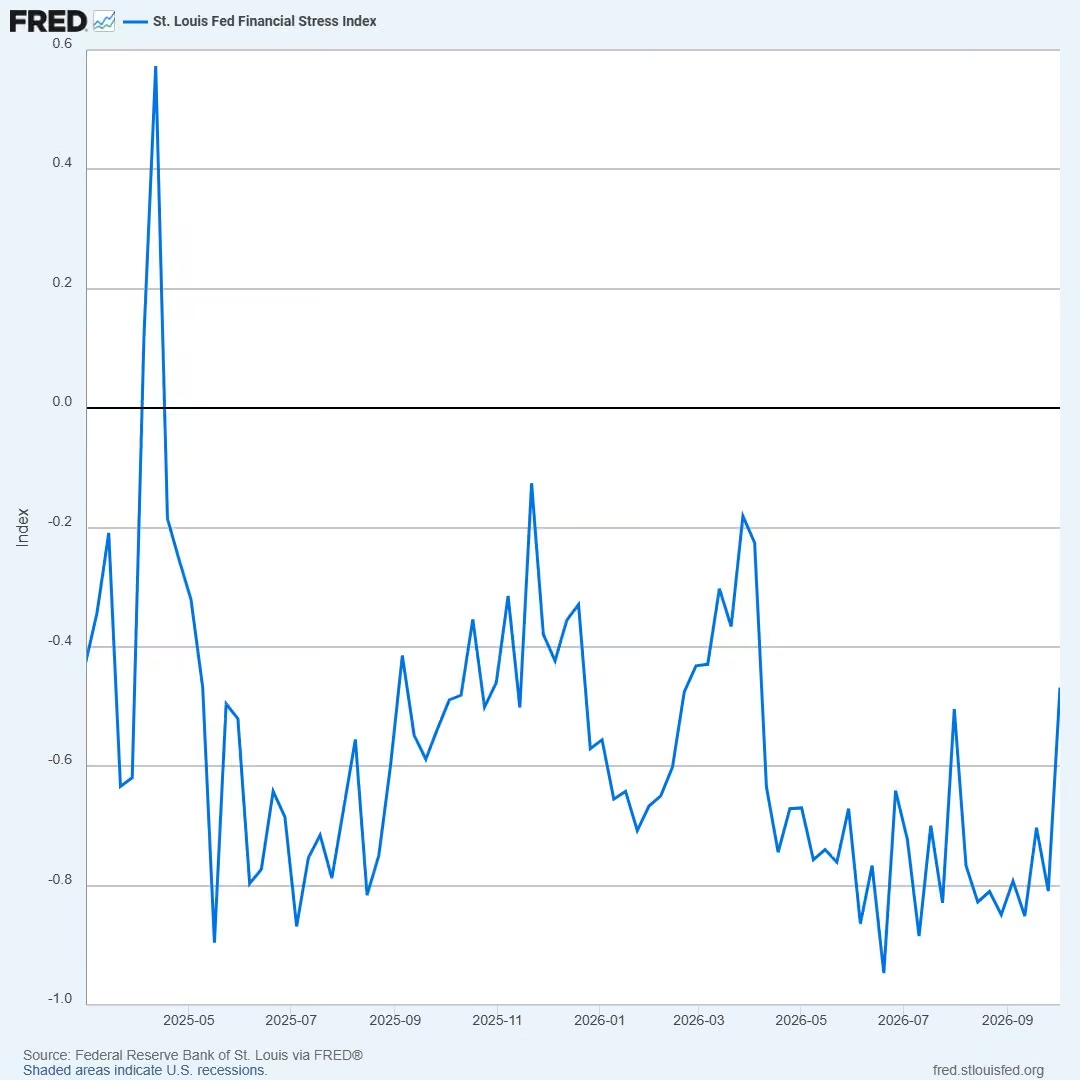
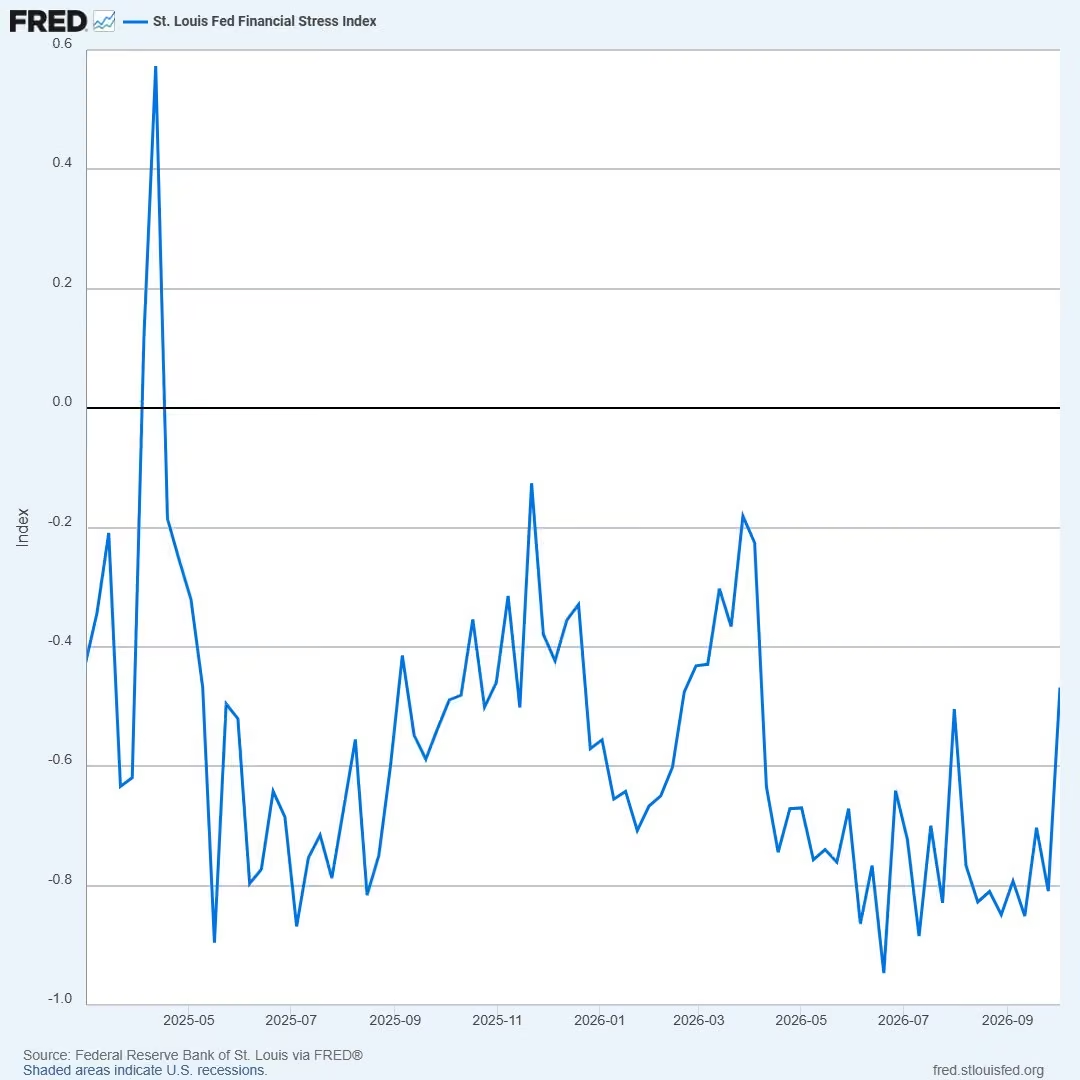
There was less stress in the financial markets in the week ending Nov. 13 than in the previous week. The St. Louis Fed Financial Stress Index measured -0.87 compared with the prior week's -0.49 reading. (0=normal financial market conditions; a value below 0 suggests below-average stress) fred.stlouisfed.org/graph/?g=2150G
-
St. Louis Fed
@stlouisfed
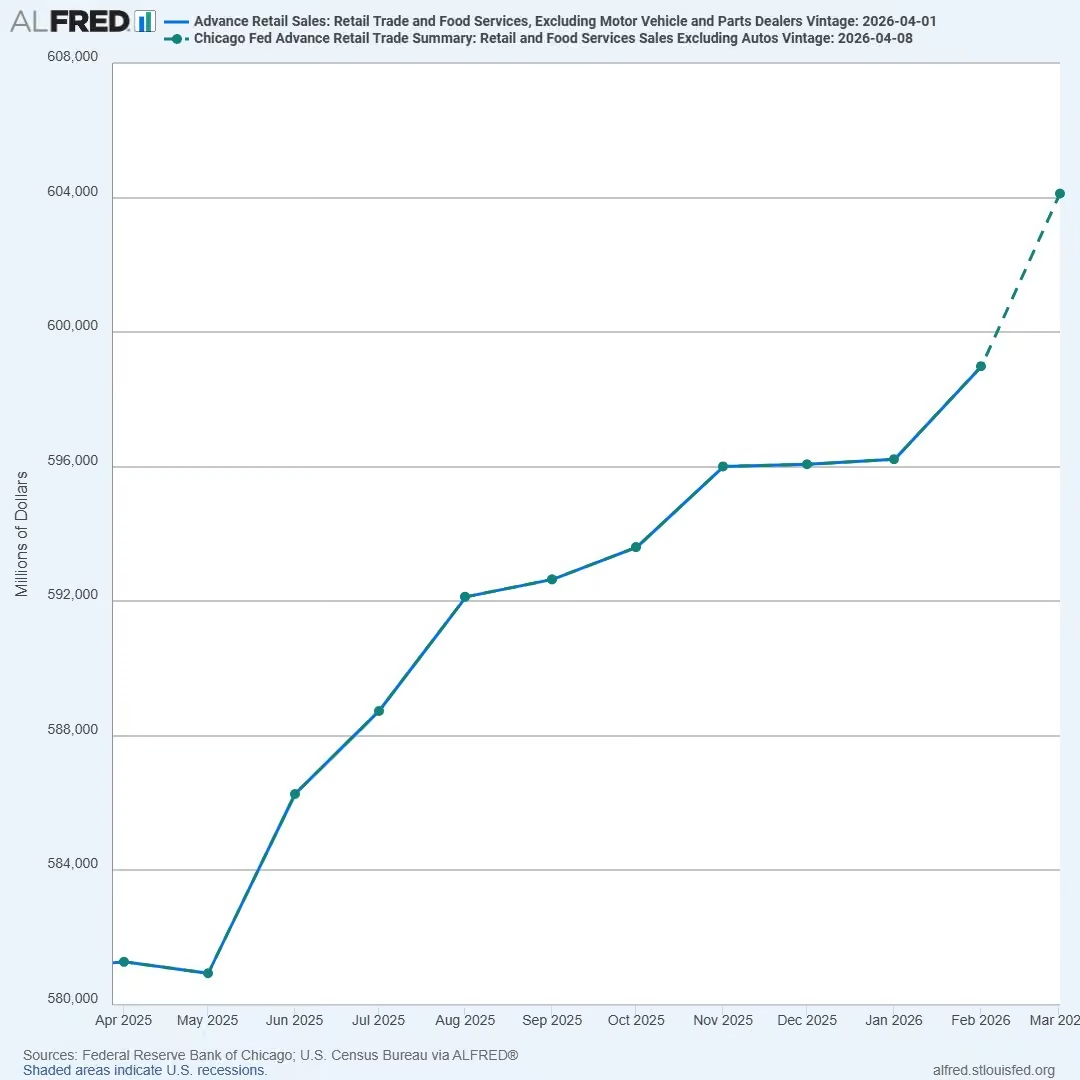
U.S. retail and food service sales per @uscensusbureau were $748.2 billion in October, up 0.2% from the previous month. September's spending was revised, with a 0.8% increase alfred.stlouisfed.org/graph/?g=212YH
-
St. Louis Fed
@stlouisfed
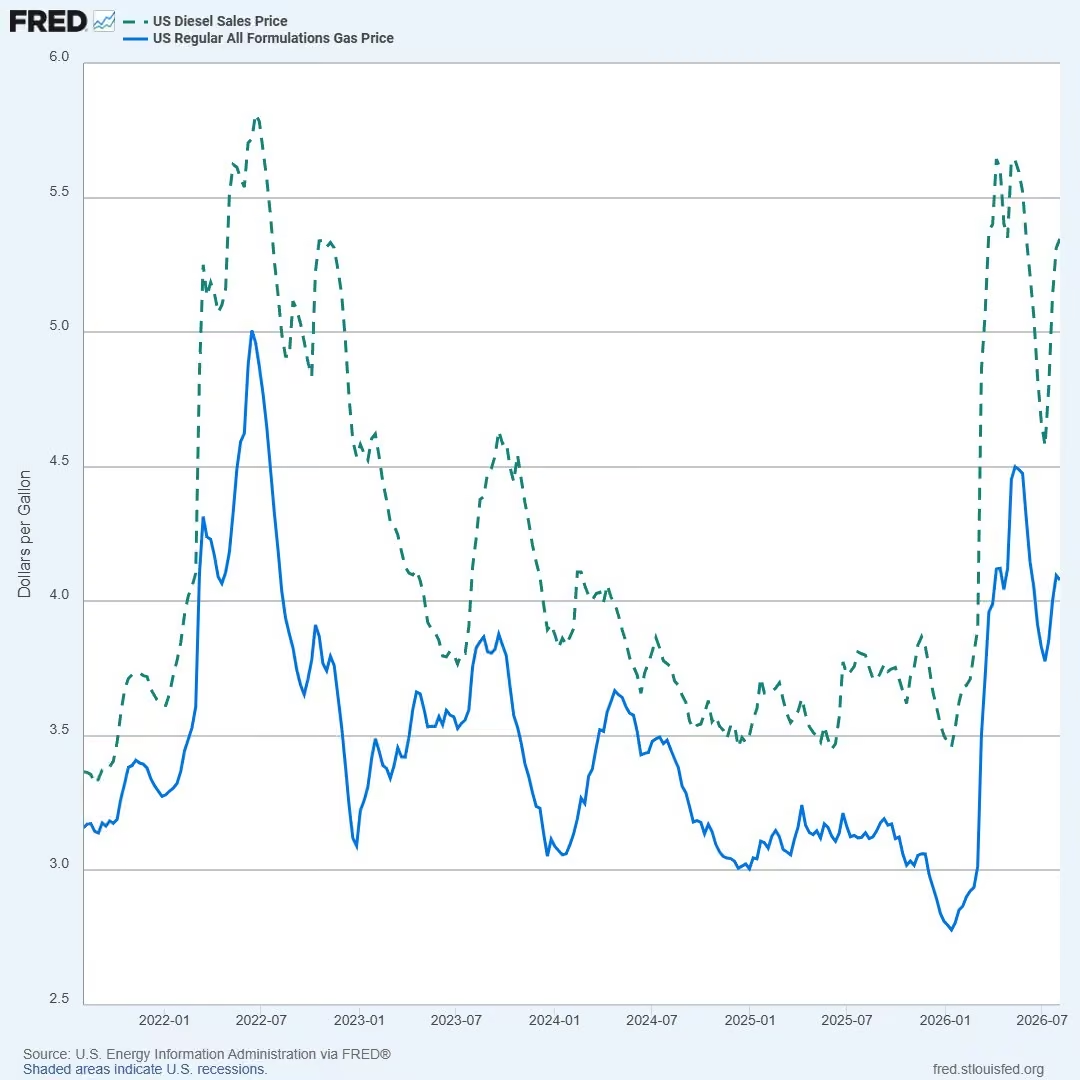
In the week ending Nov. 16, average U.S. diesel prices per gallon fell by 19 cents, to $5.94. Average gas prices per gallon also ticked down 19 cents, to $3.81 fred.stlouisfed.org/graph/?g=212Zj
-
St. Louis Fed
@stlouisfed
Tamagotchis. Beanie Babies. Thick Thanksgiving newspaper circulars. Black Friday shopping in the ’90s was a whole vibe. So why did everyone trade in the shopping lines for shopping carts online? We break down the shift www.stlouisfed.org/open-vault/2026/nov/black-friday-and-h…
-
St. Louis Fed
@stlouisfed
What are the labor markets and inflation telling us? Find out by following the cutting-edge research our economists conduct to help inform U.S. monetary policy. Explore their latest insights on:
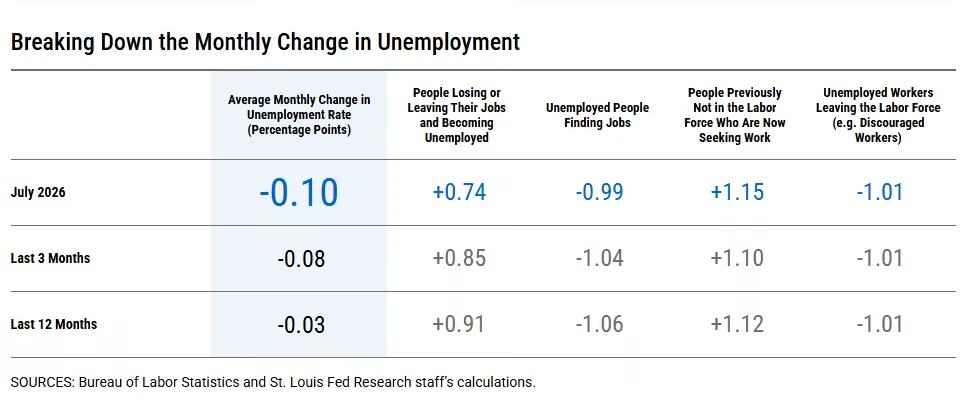
▶️How job losses, job gains, and labor force entries and exits shaped the unemployment rate
▶️How unexpected shifts in labor demand and supply showed up in payrolls and wages
▶️The share of inflation driven by supply and demand shocks, based on personal consumption expenditures (PCE) data
Check out our Monetary Policy Indicators hub to learn more: www.stlouisfed.org/research -
St. Louis Fed
@stlouisfed
Treasury buybacks improve the liquidity of U.S. government securities. Can that help push down the yield on these securities? Read this analysis by economist Paulina Restrepo-Echavarría (@paures12) and research associate Bontu Ankit Patro: www.stlouisfed.org/on-the-economy/2026/nov/treasury-buyba…
-
St. Louis Fed
@stlouisfed
Do you know these inflation terms: headline, core, trend, median, trimmed mean and sticky price? Visit the FRED Blog to be sure fred.stlouisfed.org/blog/2026/11/price-inflation-measured…
-
St. Louis Fed
@stlouisfed
What is the “convenience yield”? It’s the willingness of investors to accept a lower return on a bond because it offers nonmonetary value, such as being “safe” or very liquid. Evidence suggests the convenience yield is falling for longer-term Treasuries. Can Treasury buybacks reverse this decline? www.stlouisfed.org/on-the-economy/2026/nov/treasury-buyba…
-
St. Louis Fed
@stlouisfed
The FRED Blog provides state maps for the various measures of unemployment in the U.S. fred.stlouisfed.org/blog/2026/11/geographic-differences-i…
-
St. Louis Fed
@stlouisfed
When companies invest in R&D, where do they focus their dollars? An analysis looks at how U.S. corporate R&D spending has changed over time www.stlouisfed.org/on-the-economy/2026/nov/changing-face-…
-
St. Louis Fed
@stlouisfed
“The stories you tell us today often become the statistics we pore over months later. You help us maintain an informed view of the economy in real time,” St. Louis Fed President Alberto Musalem writes in a new commentary in @stltoday. “My colleagues and I share those personal stories during FOMC meetings when we consider policy options. Information from Americans of all walks of life — in every part of the country — helps us avoid groupthink and allows us to make more robust and representative policy decisions.”
In his Nov. 17 commentary, President Musalem describes how the Fed’s decentralized structure was designed to work well for all Americans and how the 12 regional Reserve banks serve as your voice in the Federal Reserve System. www.stltoday.com/opinion/column/article_8648dbe6-ace3-416… -
St. Louis Fed
@stlouisfed
St. Louis Fed authors Julian Kozlowski (@kozjuli), Juan Sanchez (@vediense) and Nicholas Sullivan and co-author Masataka Mori investigate how the AI investment boom is being financed www.stlouisfed.org/publications/review/2026/nov/financing…
-
St. Louis Fed
@stlouisfed
What is the most likely inflation scenario over the next 18 months, and what does it mean for monetary policy?
St. Louis Fed President Alberto Musalem shared his views on these questions and other aspects of the U.S. economy and monetary policy today at a @BancoCentral_AR conference. After delivering prepared remarks, he participated in a Q&A moderated by Gov. Santiago Bausili (@Kicker0024) and Deputy Gov. @vladiwerning of the Central Bank of Argentina.
View President Musalem’s remarks: www.stlouisfed.org/from-the-president/remarks/2026/remark… -
St. Louis Fed
@stlouisfed
Which technologies have drawn the most R&D investment from businesses in recent decades? How has it differed across U.S. industries? New research examines these questions www.stlouisfed.org/on-the-economy/2026/nov/changing-face-…
-
St. Louis Fed
@stlouisfed
Can you spot the differences? Unemployment rates vary according to the precise definition of each measure and according to where you are in the country. Check the FRED Blog for a look at how unemployment changes by region fred.stlouisfed.org/blog/2026/11/geographic-differences-i…
-
St. Louis Fed
@stlouisfed
Where have firms in the 10 most R&D-intensive U.S. industries typically spent their research budgets? Software? Biotech? AI? Read more: www.stlouisfed.org/on-the-economy/2026/nov/changing-face-…
-
St. Louis Fed
@stlouisfed
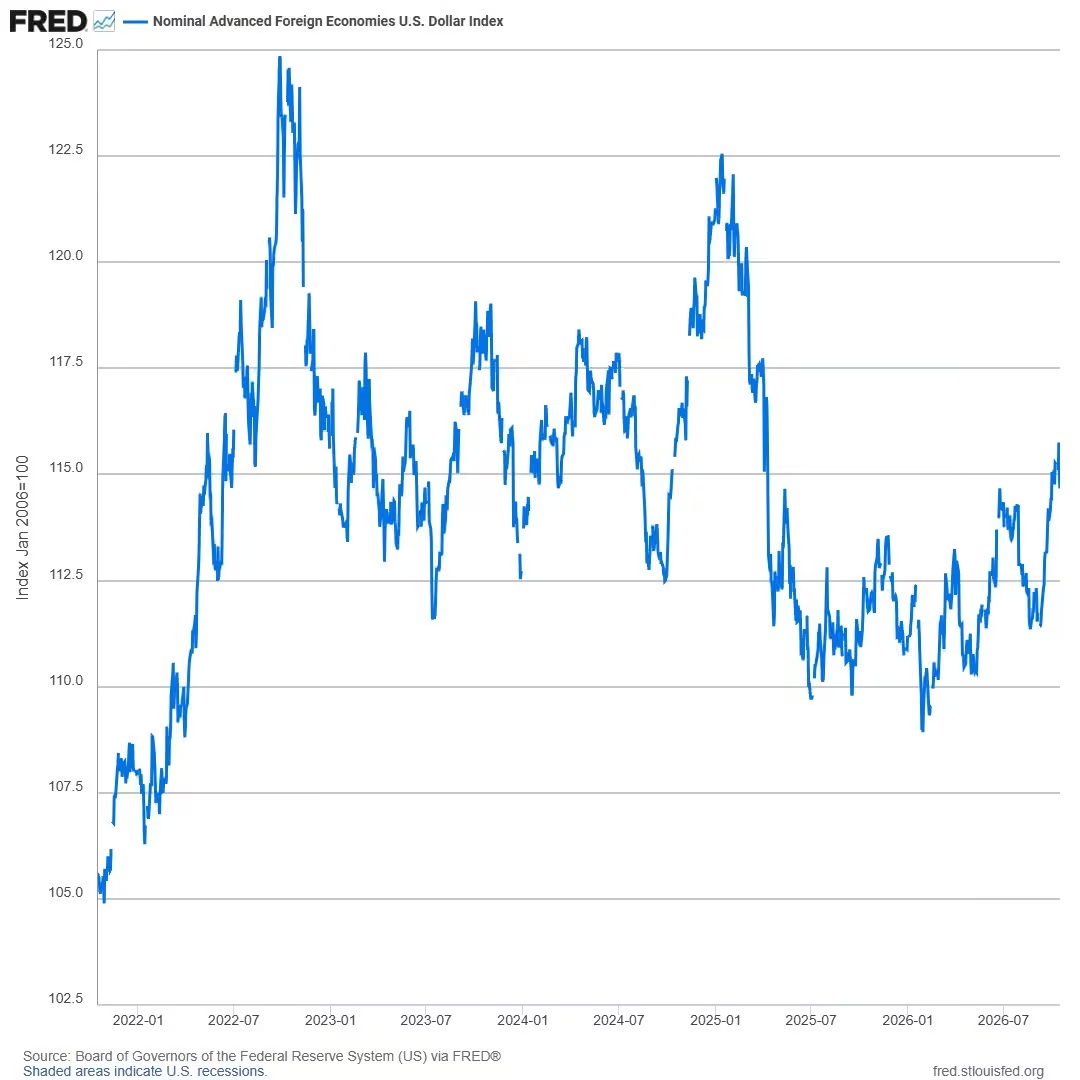
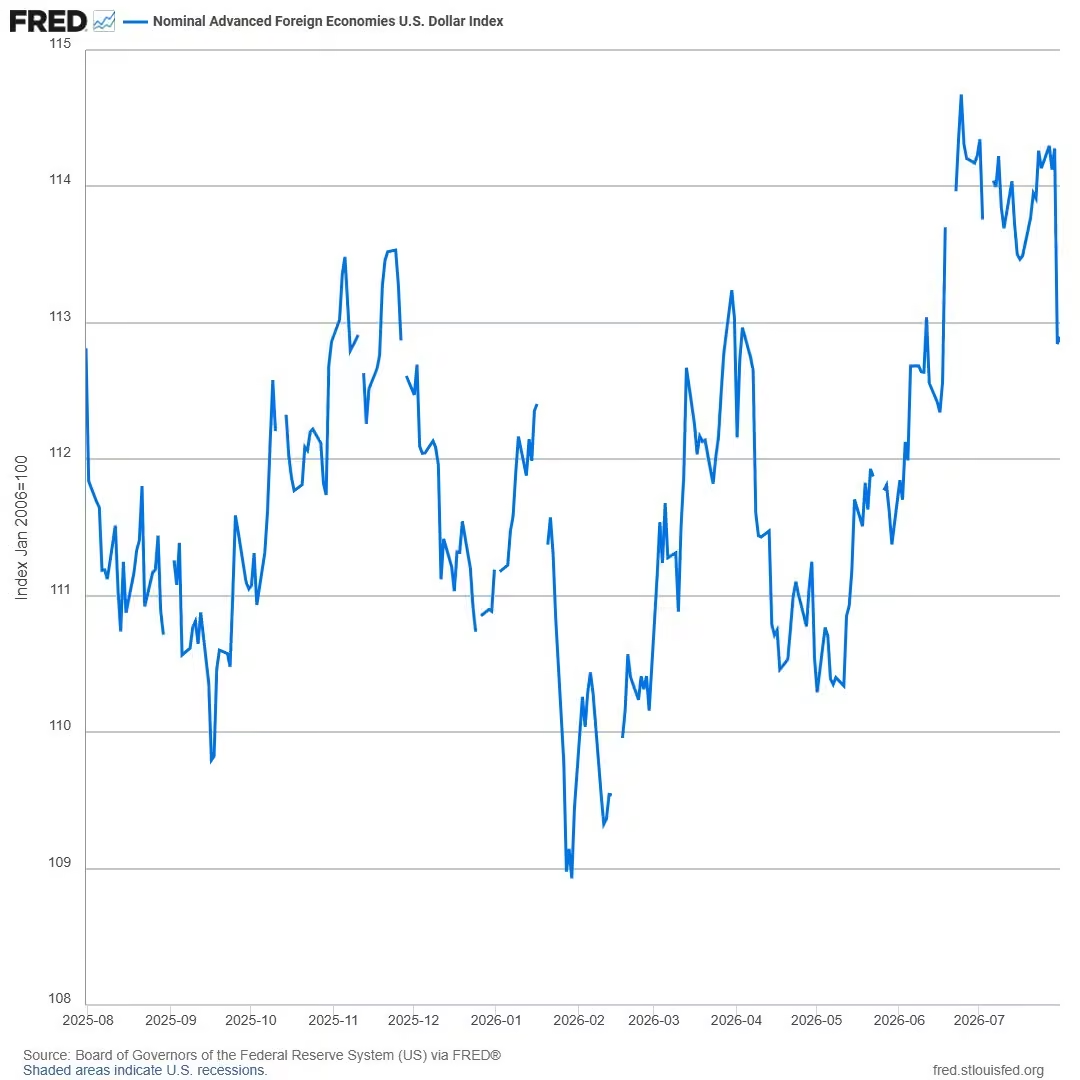
Daily trade-weighted U.S. dollar index ticked up to 116.2 as of Nov. 13 (January 2006=100). Want to track this index or others from the @federalreserve Foreign Exchange Rates - H.10 release? Check out FRED: fred.stlouisfed.org/release?rid=17
-
St. Louis Fed
@stlouisfed
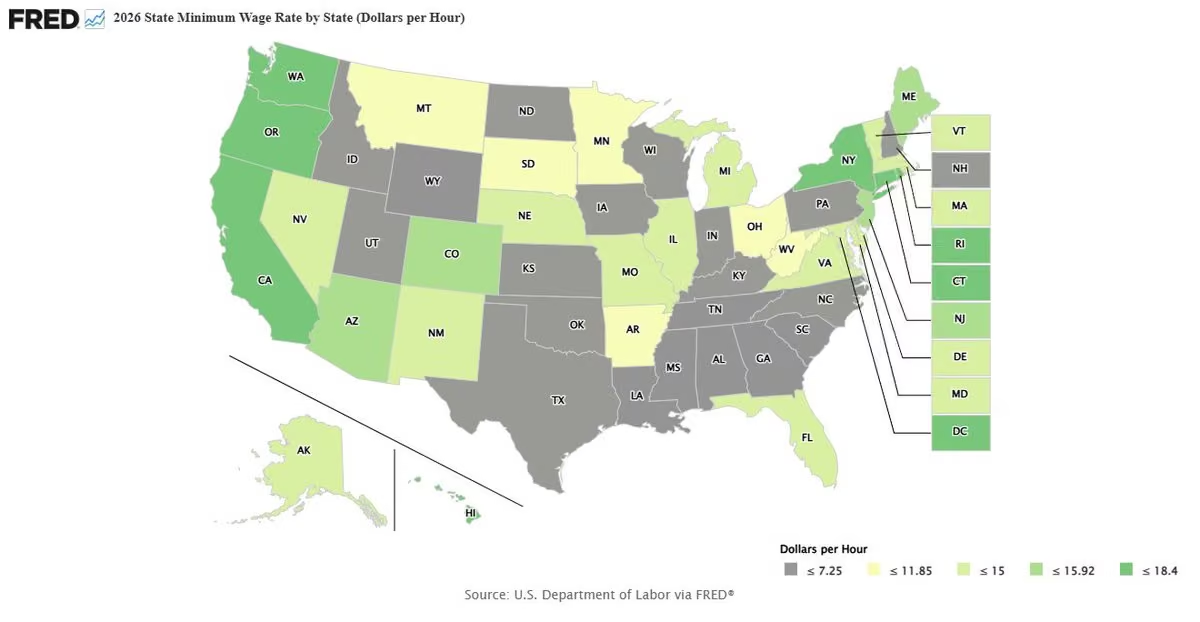
Local unemployment varies quite a bit: Depending on where you live, different measures can show vastly different rates.
For example, only California, Connecticut, Oregon, Washington, and Washington, D.C., are in the highest unemployment rate category in both the most basic measure (U-1) and the most inclusive measure (U-6).
Visit the FRED Blog for state maps that reveal these regional differences. fred.stlouisfed.org/blog/2026/11/geographic-differences-i… -
St. Louis Fed
@stlouisfed
R&D’s share of business fixed investment has increased since the early 2010s, with the sharpest jump from 2018 to 2020. What are companies spending their budgets on? www.stlouisfed.org/on-the-economy/2026/nov/changing-face-…
-
St. Louis Fed
@stlouisfed
Financing AI
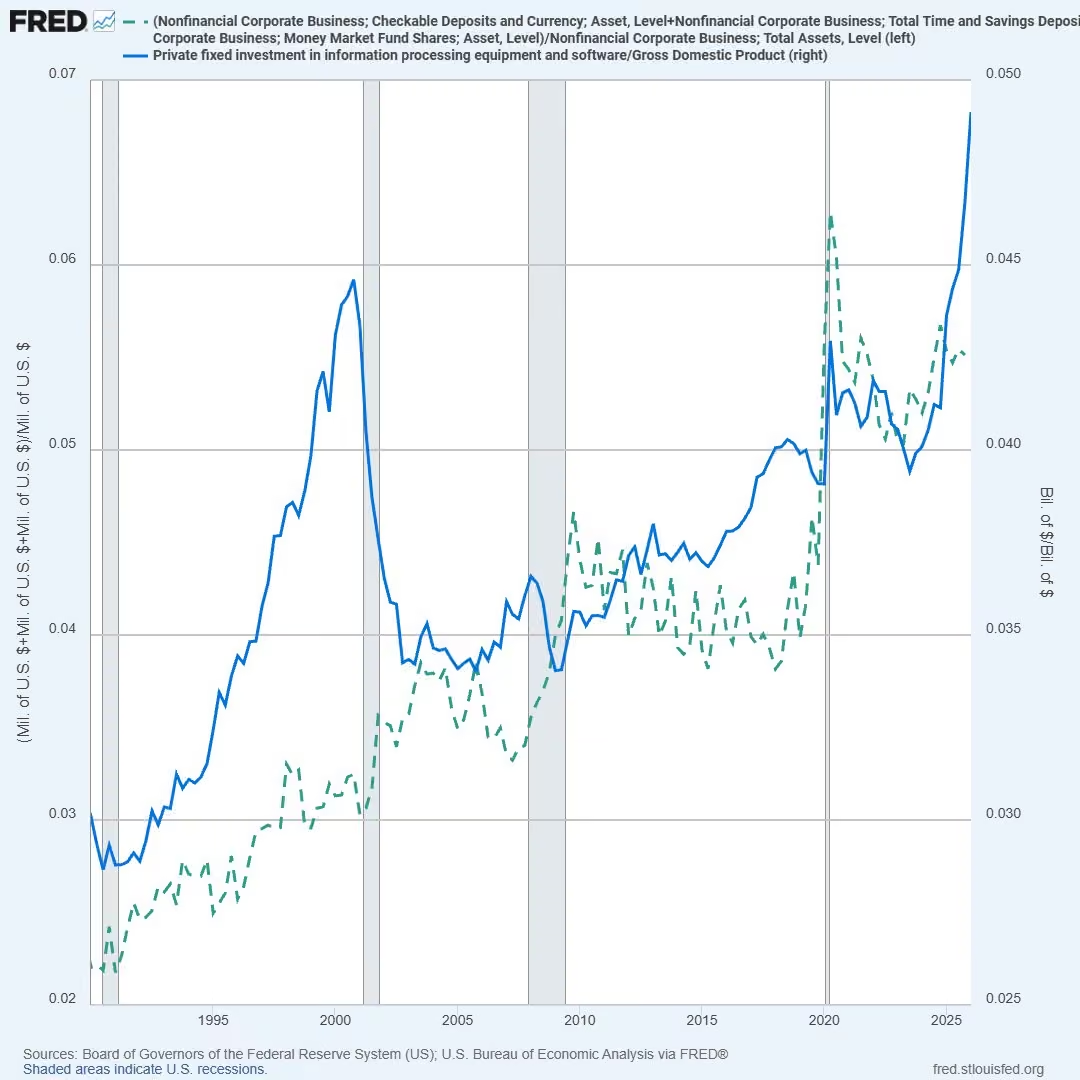
U.S. tech firms spent decades building up large cash reserves. Since gen AI, they’ve been spending those reserves — and more — on R&D, chips and data centers.
New research in the St. Louis Fed Review by Julian Kozlowski (@kozjuli), Masataka Mori, Juan M. Sánchez (@vediense) and Nicholas Sullivan tracks the financing of the AI investment boom.
➡️Cash holdings and investment are more strongly linked in the AI era than in earlier tech waves.
➡️The boom is concentrated among a small group of “hyperscalers.”
➡️Their cash-to-assets ratio fell while their investment-to-assets ratio nearly doubled.
➡️R&D led the 2018-23 expansion, while capital expenditures have been driving it since 2024.
➡️Data center builders are relying on growing cash flows, lower shareholder payouts and more debt.
➡️Semiconductor firms have enough cash flow to fund investment while raising payouts, growing cash and reducing debt.
Read the article for the full analysis: www.stlouisfed.org/publications/review/2026/nov/financing…
#financialmarkets -
St. Louis Fed
@stlouisfed
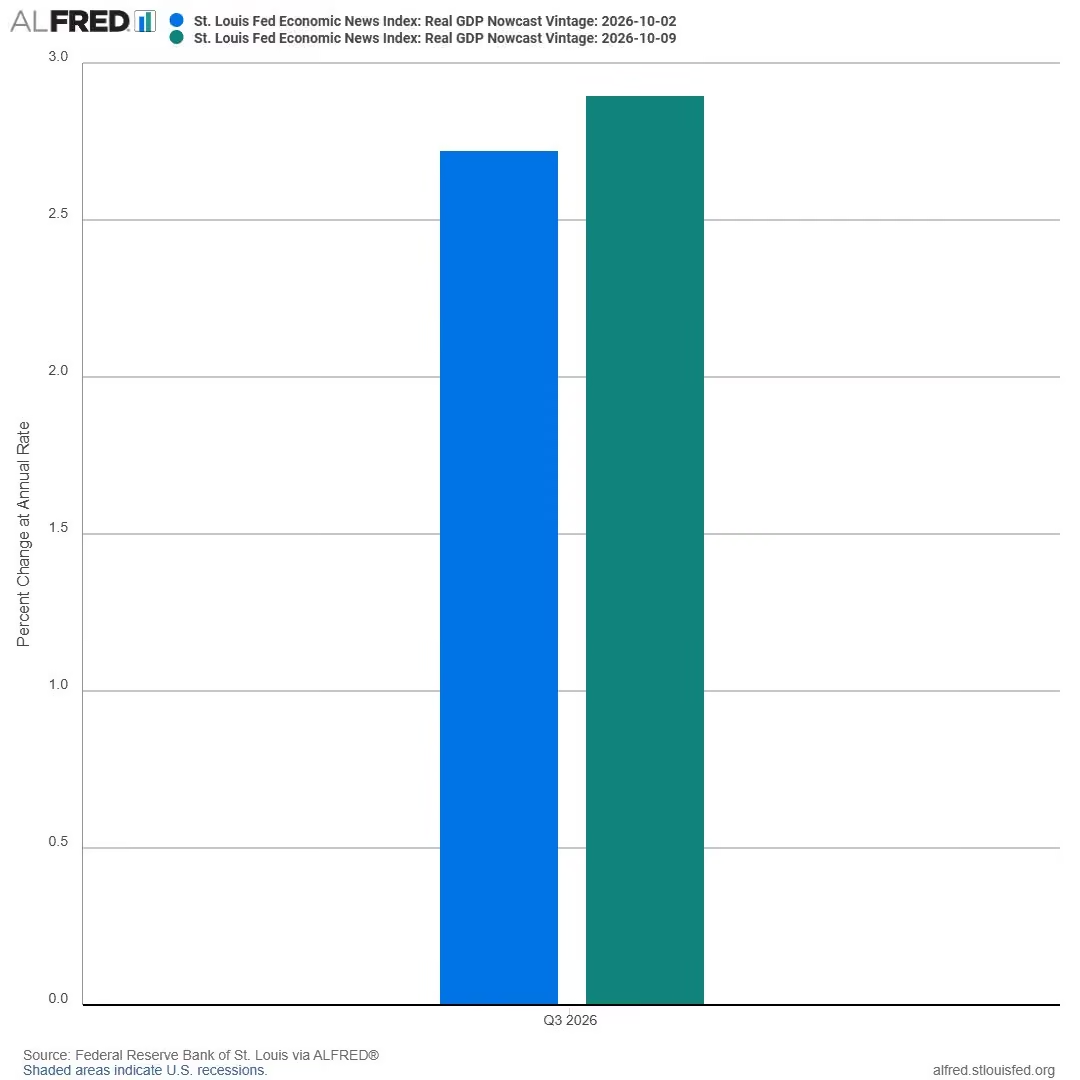
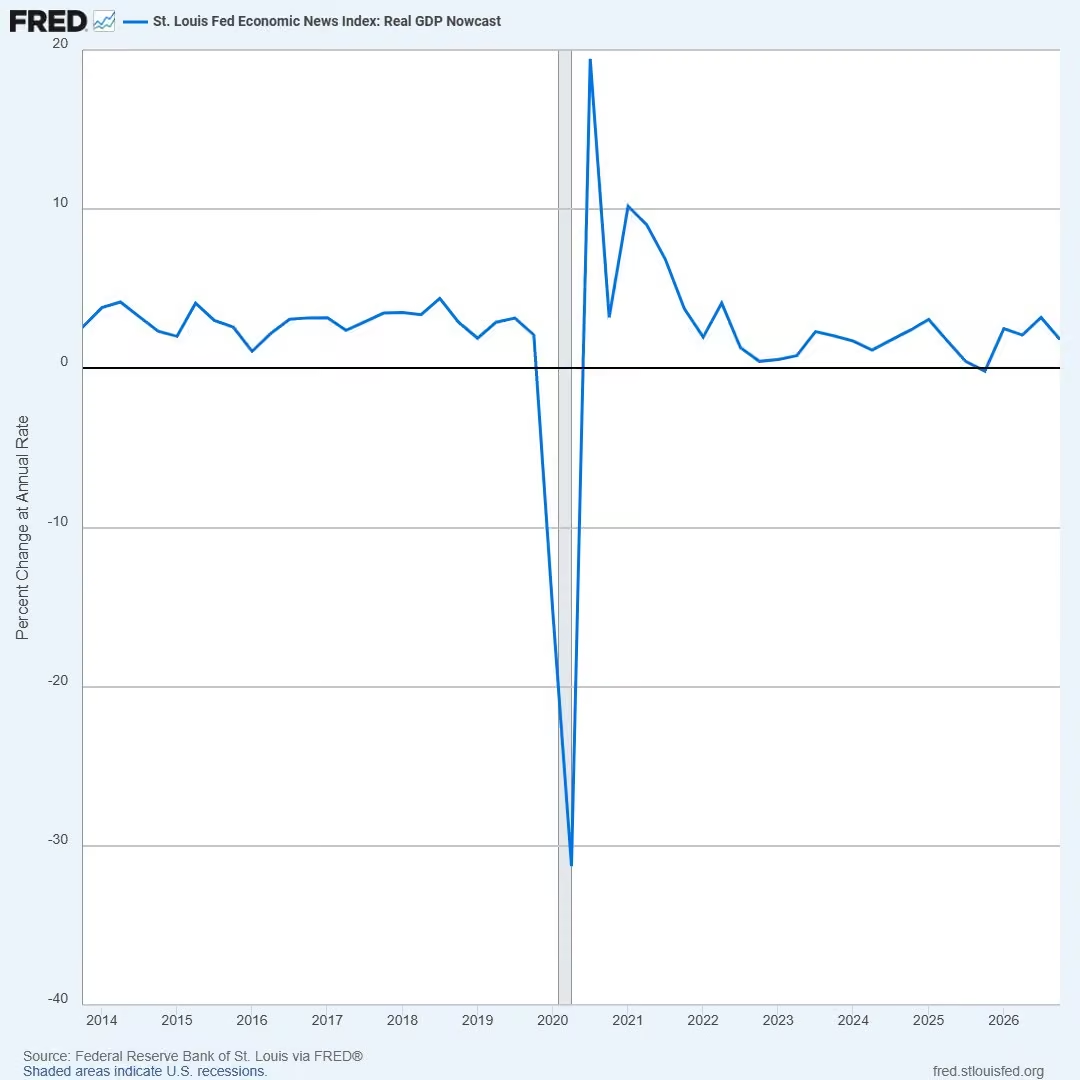
On Nov. 13, the St. Louis Fed Economic News Index was projecting Q4 real GDP growth of 1.8% at an annual rate. Our “nowcast” uses economic content from key monthly data releases to forecast the current quarter’s real GDP growth. Learn more: fred.stlouisfed.org/graph/?g=20XSB
-
St. Louis Fed
@stlouisfed
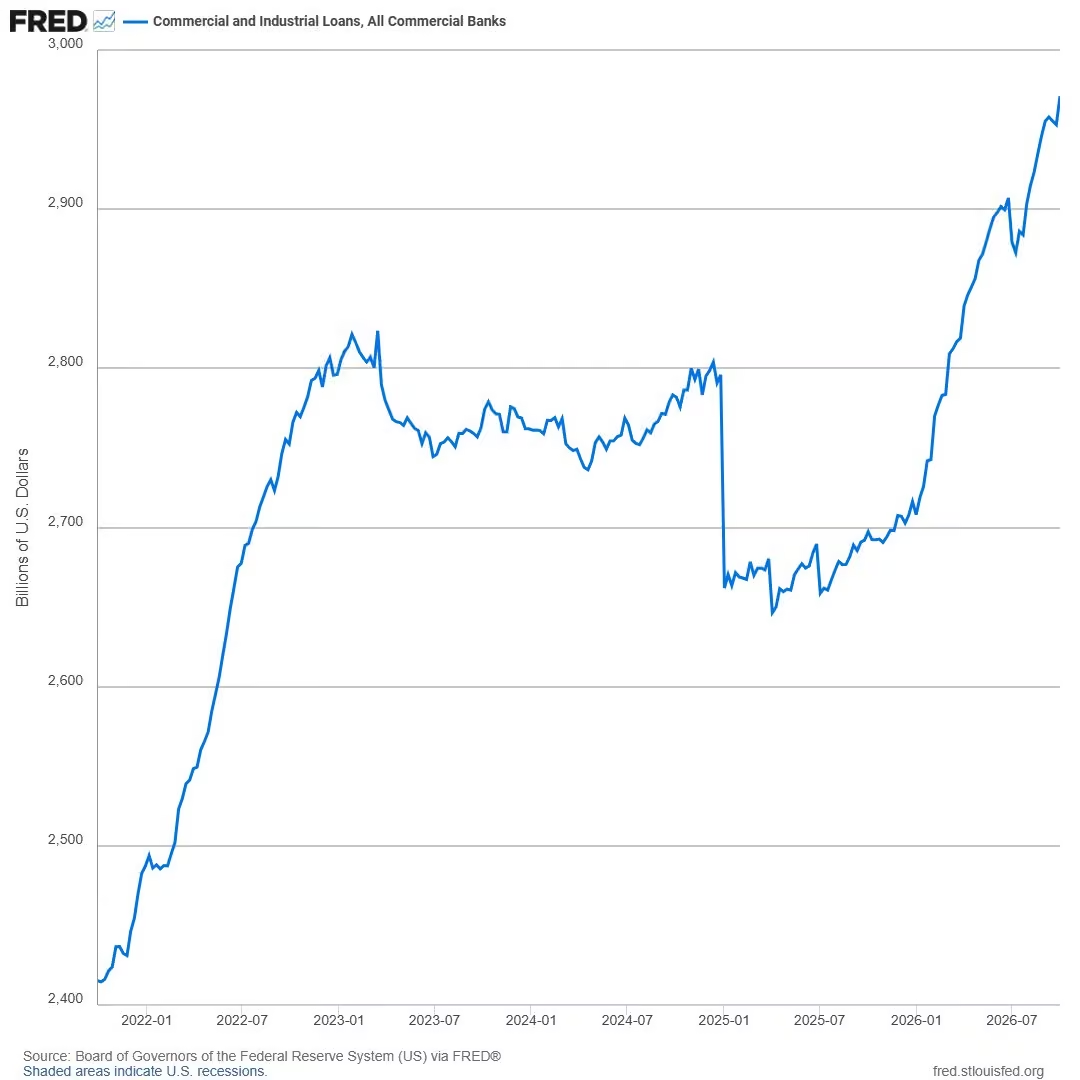
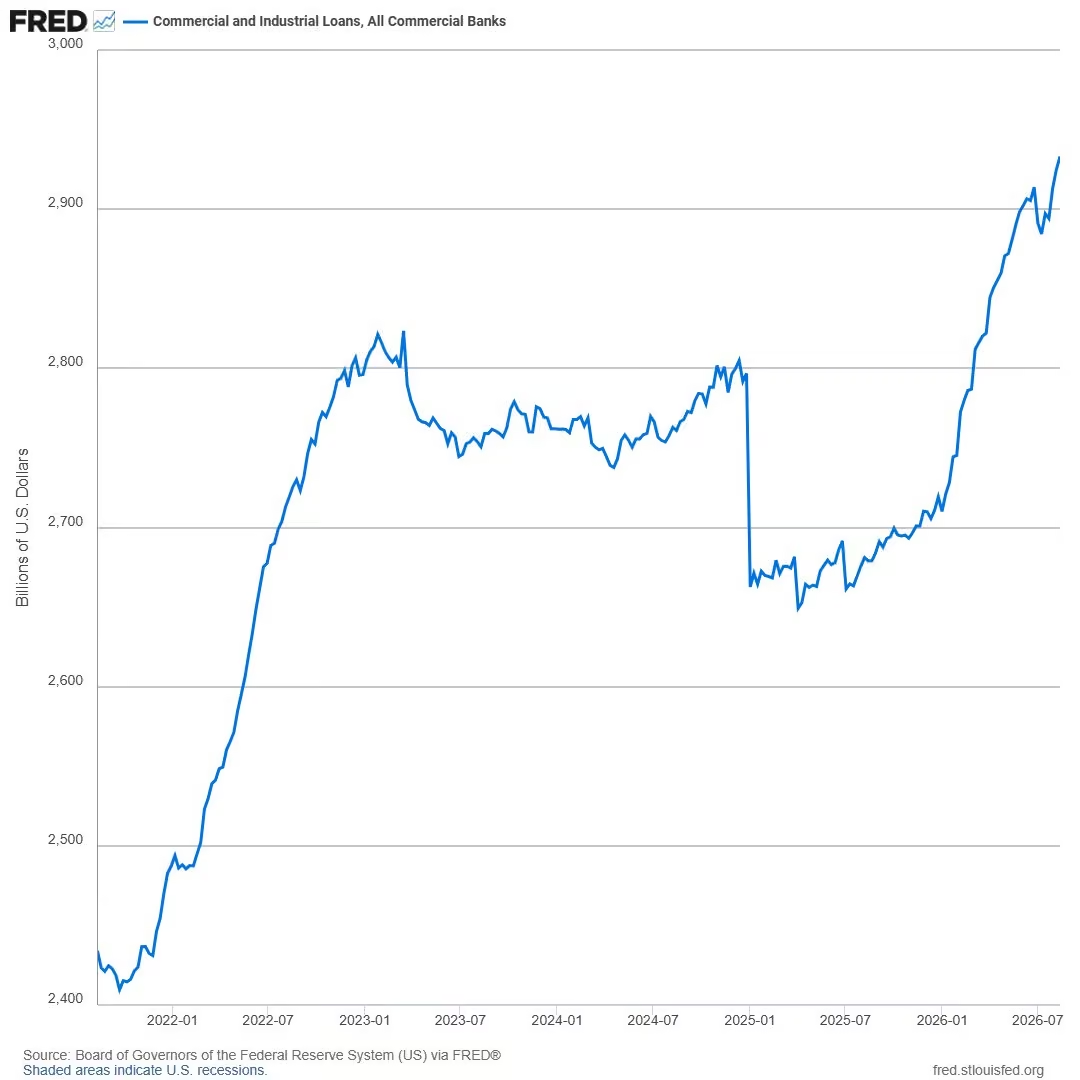
Commercial and industrial loans at all U.S. commercial banks declined by $591 million to $3.0 trillion in the week ending Nov. 4. See the level over time in FRED: fred.stlouisfed.org/graph/?g=20YcK
-
St. Louis Fed
@stlouisfed
In the week ending Nov. 12, the average fixed 30-year mortgage rate decreased to 7.11%. The average fixed 15-year mortgage rate ticked down to 6.45% fred.stlouisfed.org/graph/?g=20QKz
-
St. Louis Fed
@stlouisfed
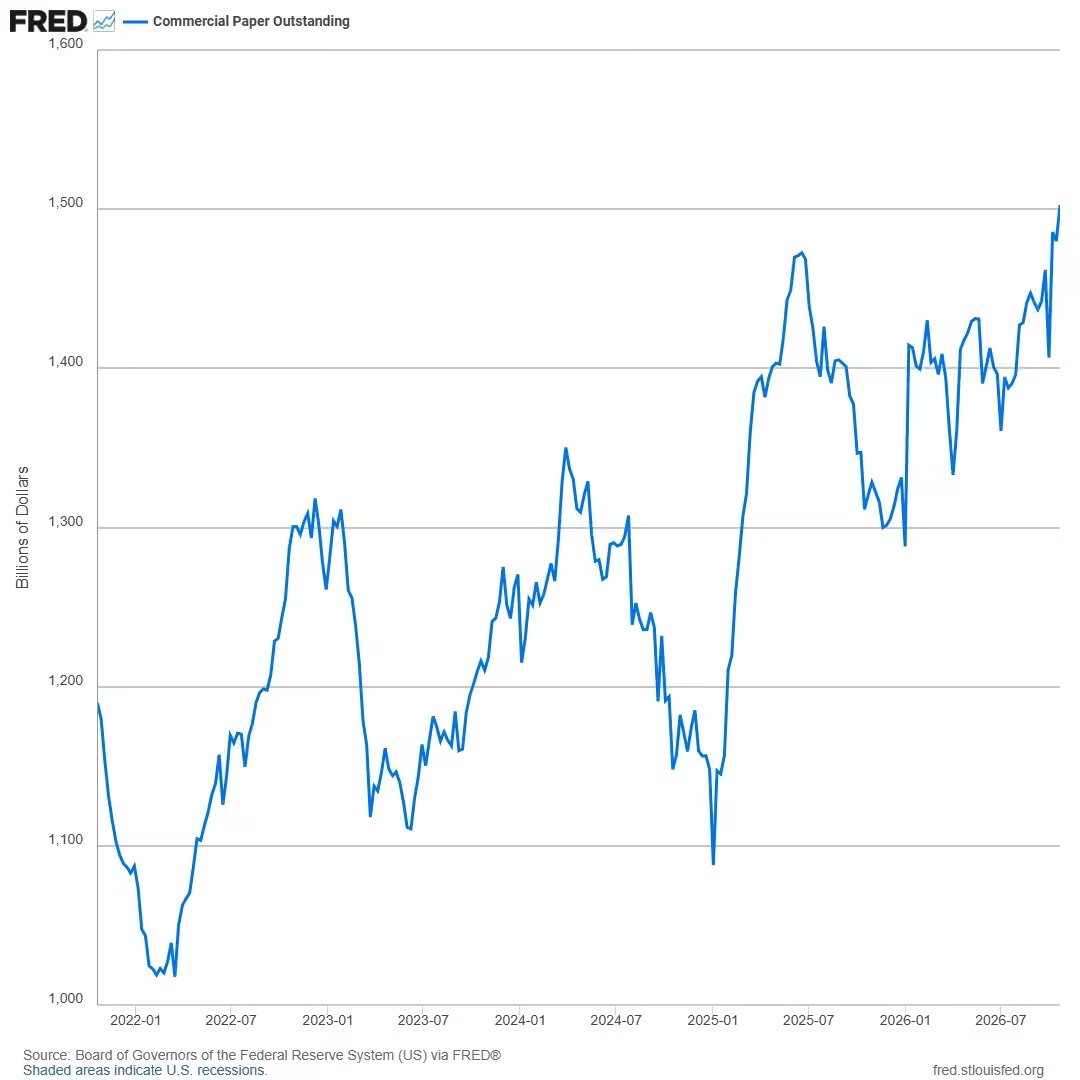
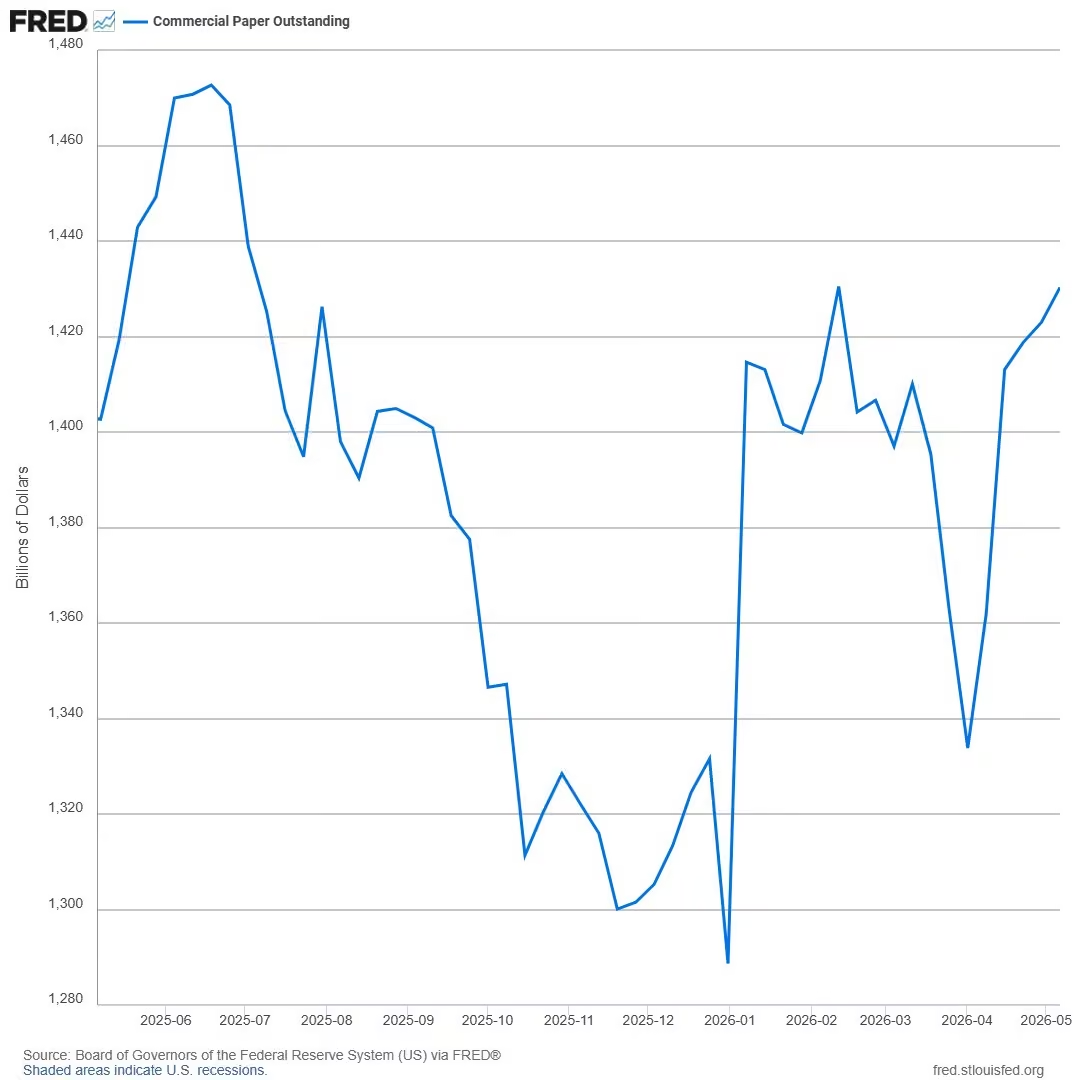
U.S. commercial paper outstanding rose to $1.51 trillion in the week ending Nov. 11, an increase of $4.2 billion from a week earlier, per @federalreserve data. Commercial paper comprises short-term, promissory notes issued mostly by corporations fred.stlouisfed.org/graph/?g=20R0F
-
St. Louis Fed
@stlouisfed
In the week ending Nov. 7, seasonally adjusted initial claims for unemployment insurance benefits — those filed for the first time after a job loss — increased by 9,000, to 200,000. The four-week moving average was unchanged, at 195,250 fred.stlouisfed.org/graph/?g=20PRv
-
St. Louis Fed
@stlouisfed
Do you know these inflation terms: headline, core, trend, median, trimmed mean and sticky price? Visit the FRED Blog to be sure fred.stlouisfed.org/blog/2026/11/price-inflation-measured…
-
St. Louis Fed
@stlouisfed
The AI investment boom is concentrated among a small group of large technology firms whose cash-to-assets ratio declined from 35% in 2018 to 16% in 2026 while their investment-to-assets ratio nearly doubled. Read the full technical analysis #financialmarkets
-
St. Louis Fed
@stlouisfed
While money growth seems to be a poor everyday predictor of inflation, it provides a useful signal when the money growth rate moves far outside its historical range. A new analysis has the details: www.stlouisfed.org/on-the-economy/2026/nov/does-money-sup…
-
St. Louis Fed
@stlouisfed
A new measure using vessel-tracking data from satellites reveals how much potential shipping capacity was lost because of congestion at U.S. ports during the COVID-19 pandemic. Read the analysis: www.stlouisfed.org/on-the-economy/2026/oct/measuring-ship…
-
St. Louis Fed
@stlouisfed
First, gather price changes for all the individual spending categories in the personal consumption expenditures (PCE) price index, rank them from smallest to largest and pick the one in the middle. That’s median PCE inflation. Visit the FRED Blog for more price index insights
-
St. Louis Fed
@stlouisfed
Labor market conditions indicators from @KansasCityFed suggest the level of activity increased modestly and momentum was little changed in October. Track the series in FRED: fred.stlouisfed.org/graph/?g=20Ln3
-
St. Louis Fed
@stlouisfed
Did you know you can find average price data in FRED — from the cost of ground beef and eggs to bread and coffee? Check those prices and more fred.stlouisfed.org/release?rid=454
-
St. Louis Fed
@stlouisfed
Sticky price CPI (slow-to-change consumer prices) rose 4.7% on an annualized basis in October, following a 3.4% increase in September. Graph and track the index from @AtlantaFed in FRED: fred.stlouisfed.org/graph/?g=20LSw
-
St. Louis Fed
@stlouisfed
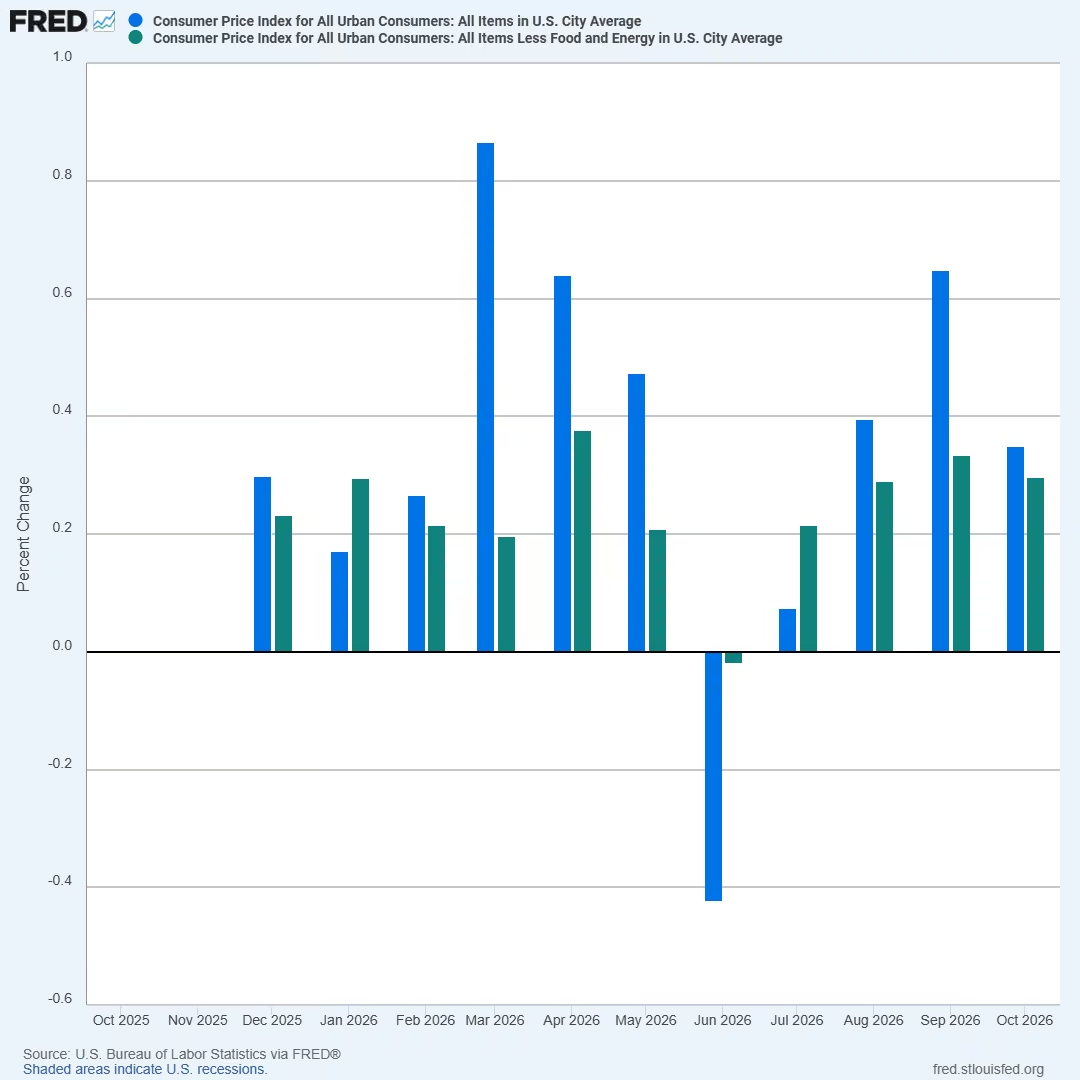
The consumer price index (CPI) increased a seasonally adjusted 0.4% in October. Excluding food and energy, "core" consumer prices increased 0.3% fred.stlouisfed.org/graph/?g=20L7D
-
St. Louis Fed
@stlouisfed
Does growth in the money supply predict U.S. inflation? The answer is a bit complicated:
o An analysis shows that money growth and inflation tend to move together mainly in extreme, high-inflation periods, but otherwise tend to drift apart.
o This is related to the velocity of the money supply, or the rate at which it circulates. At ordinary levels of money growth, changes in velocity growth can offset changes in money supply growth, nullifying the effect of excess money growth on inflation.
o Thus, while money growth seems to be a poor predictor of inflation for everyday use, it does provide a useful signal when the money growth rate moves far outside its historical range.
Read the analysis: www.stlouisfed.org/on-the-economy/2026/nov/does-money-sup… -
St. Louis Fed
@stlouisfed
St. Louis Fed authors Julian Kozlowski (@kozjuli), Juan Sanchez (@vediense) and Nicholas Sullivan and co-author Masataka Mori investigate how the AI investment boom is being financed #financialmarkets www.stlouisfed.org/publications/review/2026/nov/financing…
-
St. Louis Fed
@stlouisfed
The Census Bureau's Annual Integrated Economic Survey is a data workhorse. Visit the FRED Blog to learn how @BEA_News uses it to better measure activity in the U.S. economy fred.stlouisfed.org/blog/2026/11/how-the-aies-helps-bea-m…
-
St. Louis Fed
@stlouisfed
The producer price index for final demand — representing the wholesale cost of U.S. goods and services — increased 0.3% in October, following an upwardly revised 1.4% increase in September alfred.stlouisfed.org/graph/?g=20Xsi
-
St. Louis Fed
@stlouisfed
Analyzing the AI investment boom: Data center builders have used operating cash flow, lower payouts and rising debt issuance to fund their expansion, while semiconductor producers have generated more cash than what they invested. Read the full technical analysis #financialmarkets
-
St. Louis Fed
@stlouisfed
On Nov. 13, the St. Louis Fed Economic News Index was projecting Q4 real GDP growth of 1.8% at an annual rate. Our “nowcast” uses economic content from key monthly data releases to forecast the current quarter’s real GDP growth. Learn more: fred.stlouisfed.org/graph/?g=20XSB
-
St. Louis Fed
@stlouisfed
How is the AI investment boom being financed? New technical research from the St. Louis Fed tracks cash-to-assets and investment-to-assets ratios for tech firms and data center builders #financialmarkets www.stlouisfed.org/publications/review/2026/nov/financing…
-
St. Louis Fed
@stlouisfed
Commercial and industrial loans at all U.S. commercial banks declined by $591 million to $3.0 trillion in the week ending Nov. 4. See the level over time in FRED: fred.stlouisfed.org/graph/?g=20YcK
-
St. Louis Fed
@stlouisfed
What is median PCE inflation? The FRED Blog explains fred.stlouisfed.org/blog/2026/11/price-inflation-measured…
-
St. Louis Fed
@stlouisfed
Median PCE inflation data from the @ClevelandFed help track the underlying trend in consumer prices. Check the FRED Blog for the data and definitions fred.stlouisfed.org/blog/2026/11/price-inflation-measured…
-
St. Louis Fed
@stlouisfed
A new measure using vessel-tracking data from satellites reveals how much potential shipping capacity was lost because of congestion at U.S. ports during the COVID-19 pandemic. Read the analysis: www.stlouisfed.org/on-the-economy/2026/oct/measuring-ship…
-
St. Louis Fed
@stlouisfed
In the week ending Nov. 12, the average fixed 30-year mortgage rate decreased to 7.11%. The average fixed 15-year mortgage rate ticked down to 6.45% fred.stlouisfed.org/graph/?g=20QKz
-
St. Louis Fed
@stlouisfed
Inflation Measures 101
There are differences among inflation measures. For example, the Fed prefers to track PCE over CPI, and trend inflation can be more meaningful than headline inflation.
The Fed also has specialized inflation measures. For example:
• Trimmed mean PCE (@DallasFed) and CPI (@ClevelandFed) strip out the highest and lowest values
• Median PCE (@ClevelandFed) goes farther and tracks only the value in the middle
• Sticky price CPI (@AtlantaFed) tracks a subset of prices that change infrequently to gauge expectations about future inflation
Visit FRED for the data and visit the FRED Blog for the definitions
fred.stlouisfed.org/blog/2026/11/price-inflation-measured… -
St. Louis Fed
@stlouisfed
U.S. commercial paper outstanding rose to $1.51 trillion in the week ending Nov. 11, an increase of $4.2 billion from a week earlier, per @federalreserve data. Commercial paper comprises short-term, promissory notes issued mostly by corporations fred.stlouisfed.org/graph/?g=20R0F
-
St. Louis Fed
@stlouisfed
In the week ending Nov. 7, seasonally adjusted initial claims for unemployment insurance benefits — those filed for the first time after a job loss — increased by 9,000, to 200,000. The four-week moving average was unchanged, at 195,250 fred.stlouisfed.org/graph/?g=20PRv
-
St. Louis Fed
@stlouisfed
Do you know these inflation terms: headline, core, trend, median, trimmed mean and sticky price? Visit the FRED Blog to be sure fred.stlouisfed.org/blog/2026/11/price-inflation-measured…
-
St. Louis Fed
@stlouisfed
About half of U.S. college students who have taken one econ course never take another one. Should introductory economics focus on math-heavy models — or on how core concepts can help students understand the world? A blog post including insights from educators and other experts explores the question #econedmonth #teachecon www.stlouisfed.org/open-vault/2026/oct/what-how-teach-pri…
-
St. Louis Fed
@stlouisfed
Commodities — from the cocoa in your candy to the cotton in your jeans — are building blocks of usable goods and services. Commodity prices are generally driven by supply and demand factors, and understanding these can help you stay informed about the prices consumers see. Our blog explains: www.stlouisfed.org/open-vault/2025/dec/understanding-comm…
-
St. Louis Fed
@stlouisfed
Stay up to date on new scholarship from the Fed's 12 Reserve banks by subscribing to our working papers digest. The latest edition features 42 papers on topics like deposit insurance, agentic AI and oil supply mailchi.mp/2fc0e0a492fa/wpdigest
-
St. Louis Fed
@stlouisfed
While money growth seems to be a poor everyday predictor of inflation, it provides a useful signal when the money growth rate moves far outside its historical range. A new analysis has the details: www.stlouisfed.org/on-the-economy/2026/nov/does-money-sup…
-
St. Louis Fed
@stlouisfed
Labor market conditions indicators from @KansasCityFed suggest the level of activity increased modestly and momentum was little changed in October. Track the series in FRED: fred.stlouisfed.org/graph/?g=20Ln3
-
St. Louis Fed
@stlouisfed
In the week ending Nov. 9, average U.S. diesel prices per gallon fell by 17 cents, to $6.13. Average gas prices per gallon ticked down 16 cents, to $4.00 fred.stlouisfed.org/graph/?g=20L9s
-
St. Louis Fed
@stlouisfed
Did you know you can find average price data in FRED — from the cost of ground beef and eggs to bread and coffee? Check those prices and more fred.stlouisfed.org/release?rid=454
-
St. Louis Fed
@stlouisfed
Sticky price CPI (slow-to-change consumer prices) rose 4.7% on an annualized basis in October, following a 3.4% increase in September. Graph and track the index from @AtlantaFed in FRED: fred.stlouisfed.org/graph/?g=20LSw
-
St. Louis Fed
@stlouisfed
The consumer price index (CPI) increased a seasonally adjusted 0.4% in October. Excluding food and energy, “core” consumer prices increased 0.3% fred.stlouisfed.org/graph/?g=20L7D
-
St. Louis Fed
@stlouisfed
Daily trade-weighted U.S. dollar index ticked up to 114.9 as of Nov. 6 (January 2006=100). Want to track this index or others from the @federalreserve Foreign Exchange Rates - H.10 release? Check out FRED: fred.stlouisfed.org/release?rid=17
-
St. Louis Fed
@stlouisfed
A new measure using vessel-tracking data from satellites reveals how much potential shipping capacity was lost because of congestion at U.S. ports during the COVID-19 pandemic. Read the analysis: www.stlouisfed.org/on-the-economy/2026/oct/measuring-ship…
-
St. Louis Fed
@stlouisfed
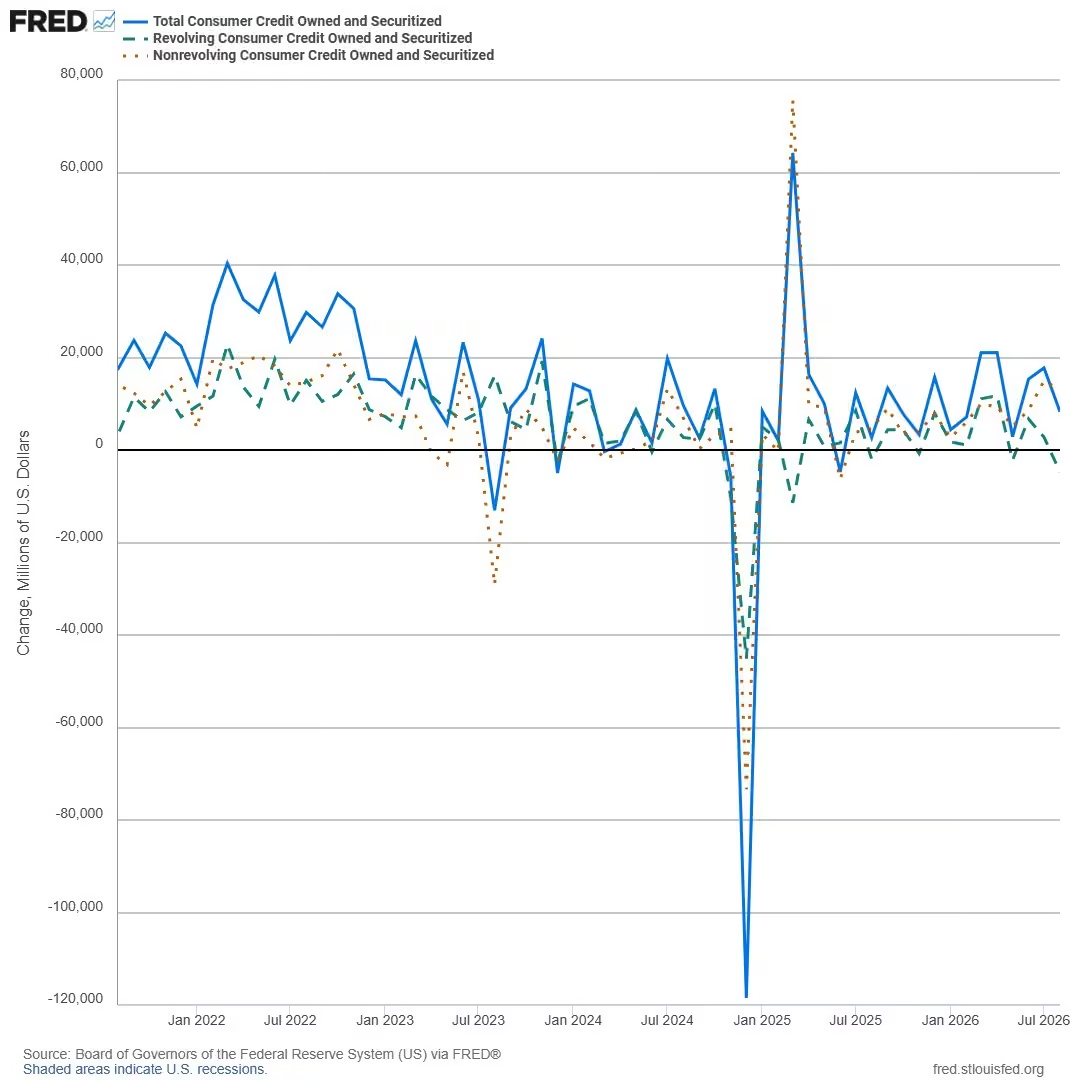
Total U.S. consumer credit increased $27.8 billion in September after rising $8.2 billion in August. Revolving credit (credit cards) and nonrevolving credit (auto and student loans) rose $16.3 billion and $11.5 billion, respectively fred.stlouisfed.org/graph/?g=20C7B
-
St. Louis Fed
@stlouisfed
Does growth in the money supply predict U.S. inflation? The answer is a bit complicated:
o An analysis shows that money growth and inflation tend to move together mainly in extreme, high-inflation periods, but otherwise tend to drift apart.
o This is related to the velocity of the money supply, or the rate at which it circulates. At ordinary levels of money growth, changes in velocity growth can offset changes in money supply growth, nullifying the effect of excess money growth on inflation.
o Thus, while money growth seems to be a poor predictor of inflation for everyday use, it does provide a useful signal when the money growth rate moves far outside its historical range.
Read the analysis: www.stlouisfed.org/on-the-economy/2026/nov/does-money-sup… -
St. Louis Fed
@stlouisfed
Each September, @BEA_News revises GDP, GDP by industry and state-level statistics in an annual update that incorporates more complete source data. The Census Bureau's Annual Integrated Economic Survey is a major tool in that effort fred.stlouisfed.org/blog/2026/11/how-the-aies-helps-bea-m…
-
St. Louis Fed
@stlouisfed
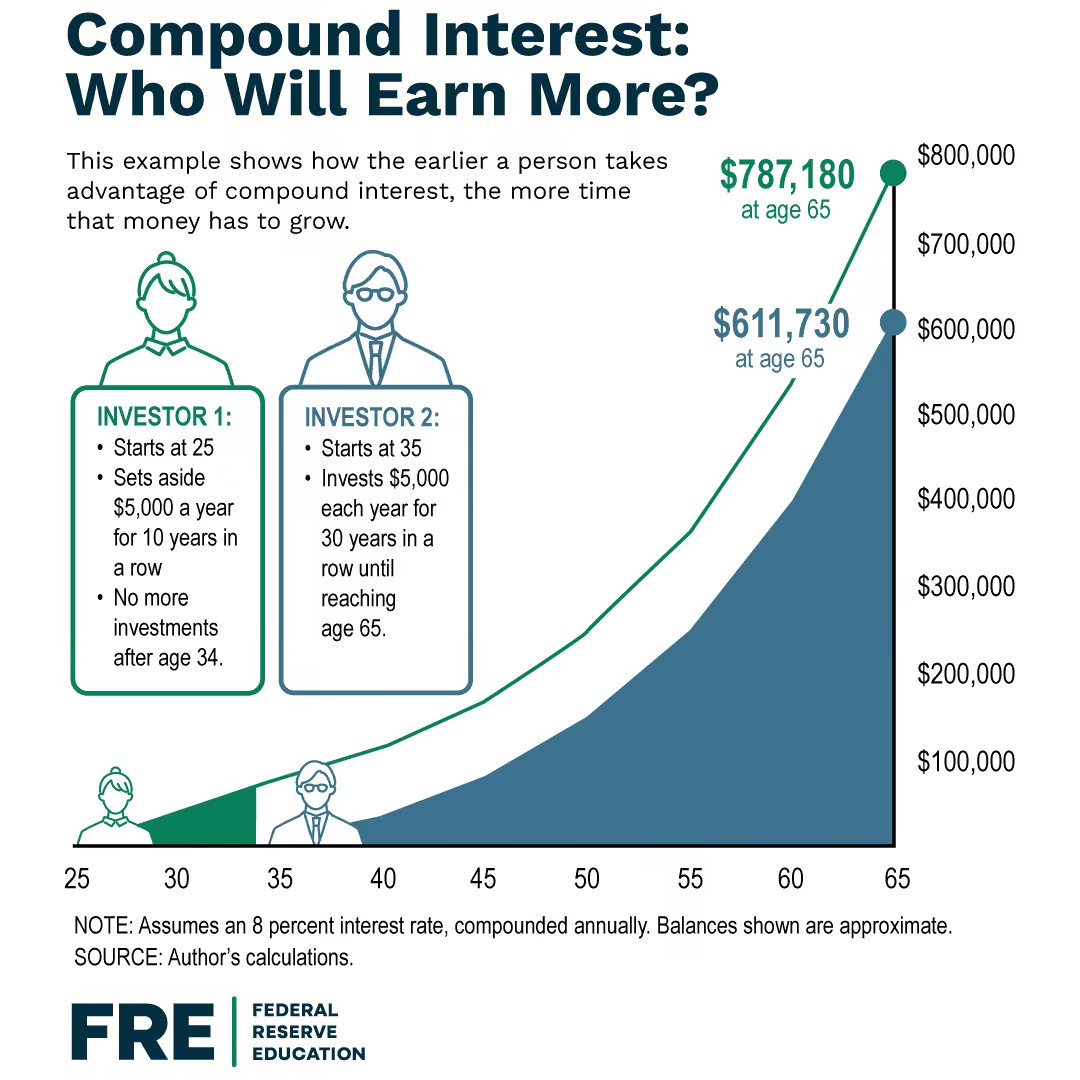
How does compounding interest work for you as a saver but against you as a borrower? This essay explains: www.stlouisfed.org/publications/page-one-economics/2026/n… #teachecon
-
St. Louis Fed
@stlouisfed
The Census Bureau's Annual Integrated Economic Survey is a data workhorse. Visit the FRED Blog to learn how @BEA_News uses it to better measure activity in the U.S. economy fred.stlouisfed.org/blog/2026/11/how-the-aies-helps-bea-m…
-
St. Louis Fed
@stlouisfed
In this new essay from the St. Louis Fed, explore how compound interest lets earnings generate more earnings, or debt generate more debt, over time: www.stlouisfed.org/publications/page-one-economics/2026/n… #teachecon
-
St. Louis Fed
@stlouisfed
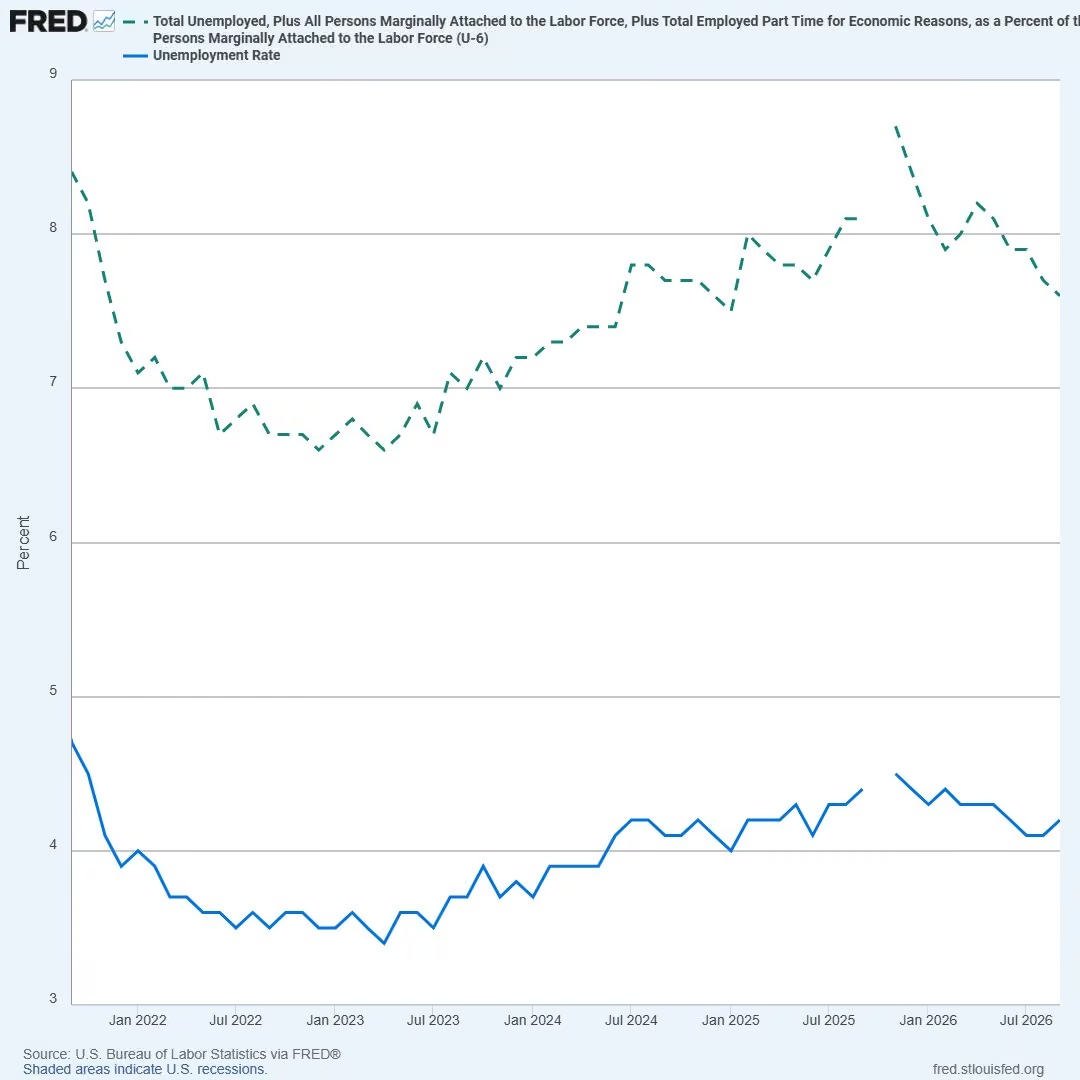
In October, the nation’s unemployment rate ticked down to 4.1% from the previous month’s 4.2%. The underemployment rate, which tracks those marginally attached to the labor force and people working part time for economic reasons, rose to 7.9% fred.stlouisfed.org/graph/?g=20Ba0
-
St. Louis Fed
@stlouisfed
In October, total nonfarm payrolls increased for a third month in a row, by 165,000. The changes in total nonfarm payroll employment for August and September were revised upward, showing employment in those months combined at 84,000 higher than previously reported
-
St. Louis Fed
@stlouisfed
Average hourly earnings for all employees on private nonfarm payrolls rose 14 cents, to $38.00, in October, per @BLS_gov. From a year earlier, average hourly earnings were up 3.1%, or $1.15 fred.stlouisfed.org/graph/?g=20Bga
-
St. Louis Fed
@stlouisfed
A new measure using vessel-tracking data from satellites reveals how much potential shipping capacity was lost because of congestion at U.S. ports during the COVID-19 pandemic. Read the analysis: www.stlouisfed.org/on-the-economy/2026/oct/measuring-ship…
-
St. Louis Fed
@stlouisfed
While money growth seems to be a poor everyday predictor of inflation, it provides a useful signal when the money growth rate moves far outside its historical range. A new analysis has the details: www.stlouisfed.org/on-the-economy/2026/nov/does-money-sup…
-
St. Louis Fed
@stlouisfed
A famous quote by Milton Friedman says that “inflation is always and everywhere a monetary phenomenon.” A natural question, then, is whether money supply growth is a reliable predictor of inflation. A new analysis covers this topic www.stlouisfed.org/on-the-economy/2026/nov/does-money-sup…
-
St. Louis Fed
@stlouisfed
There was more stress in the financial markets in the week ending Oct. 30 than in the previous week. The St. Louis Fed Financial Stress Index measured -0.52 compared with the prior week's -0.58 reading. (0=normal financial market conditions; a value below 0 suggests below-average stress) fred.stlouisfed.org/graph/?g=20xbB
-
St. Louis Fed
@stlouisfed
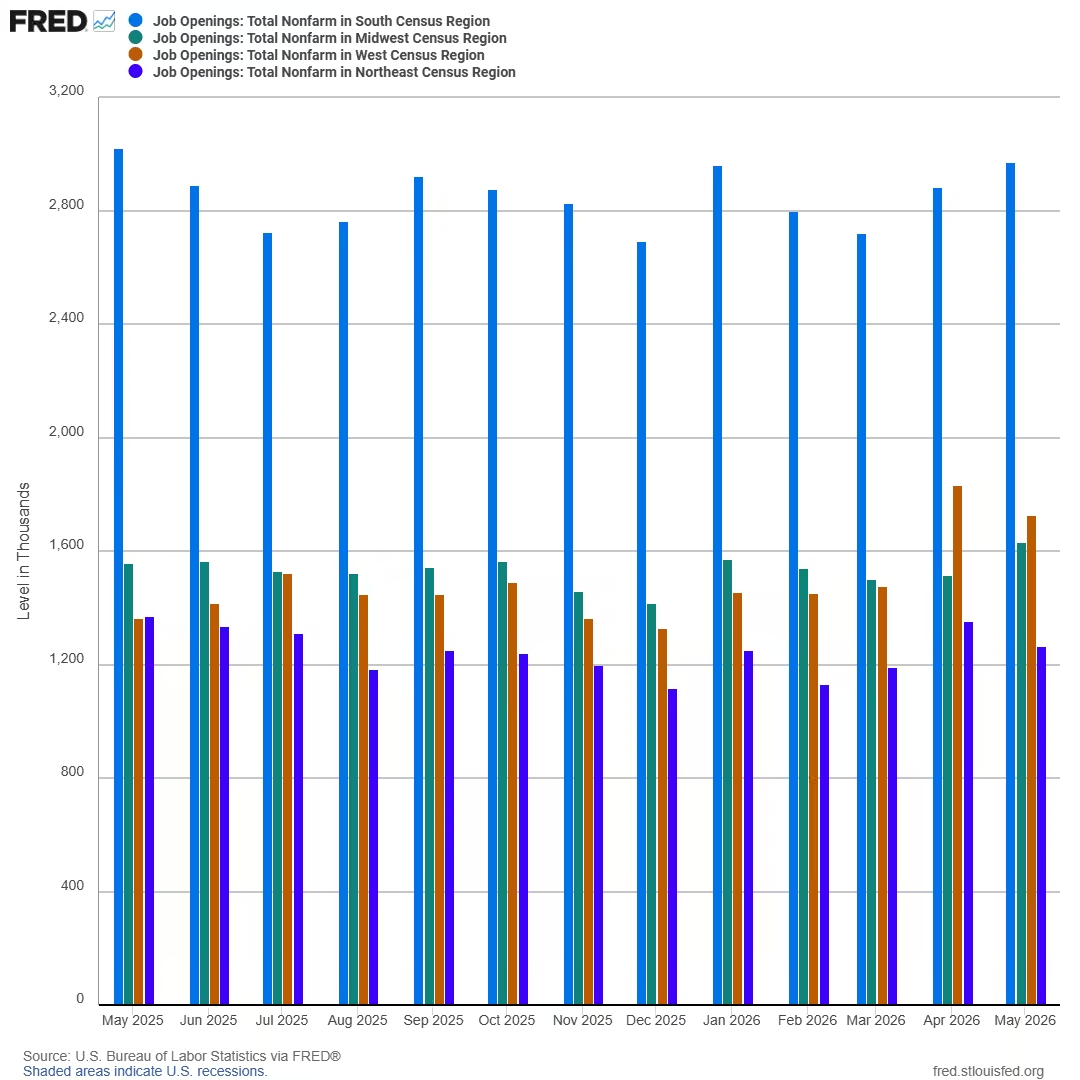
Interested in the latest @BLS_gov #jolts data? FRED has release tables covering U.S. job openings, hires, and more by sector and census region fred.stlouisfed.org/release?rid=192
-
St. Louis Fed
@stlouisfed
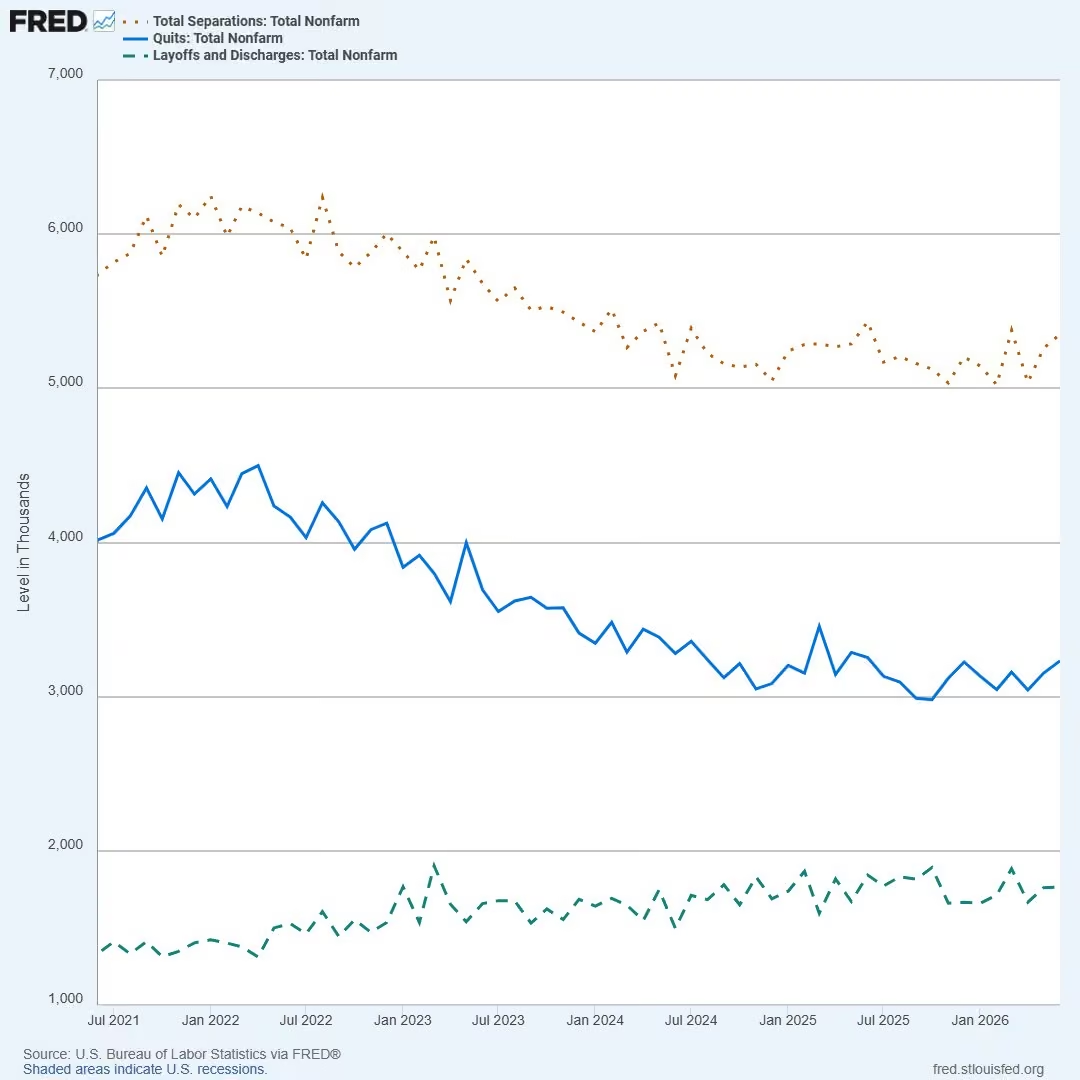
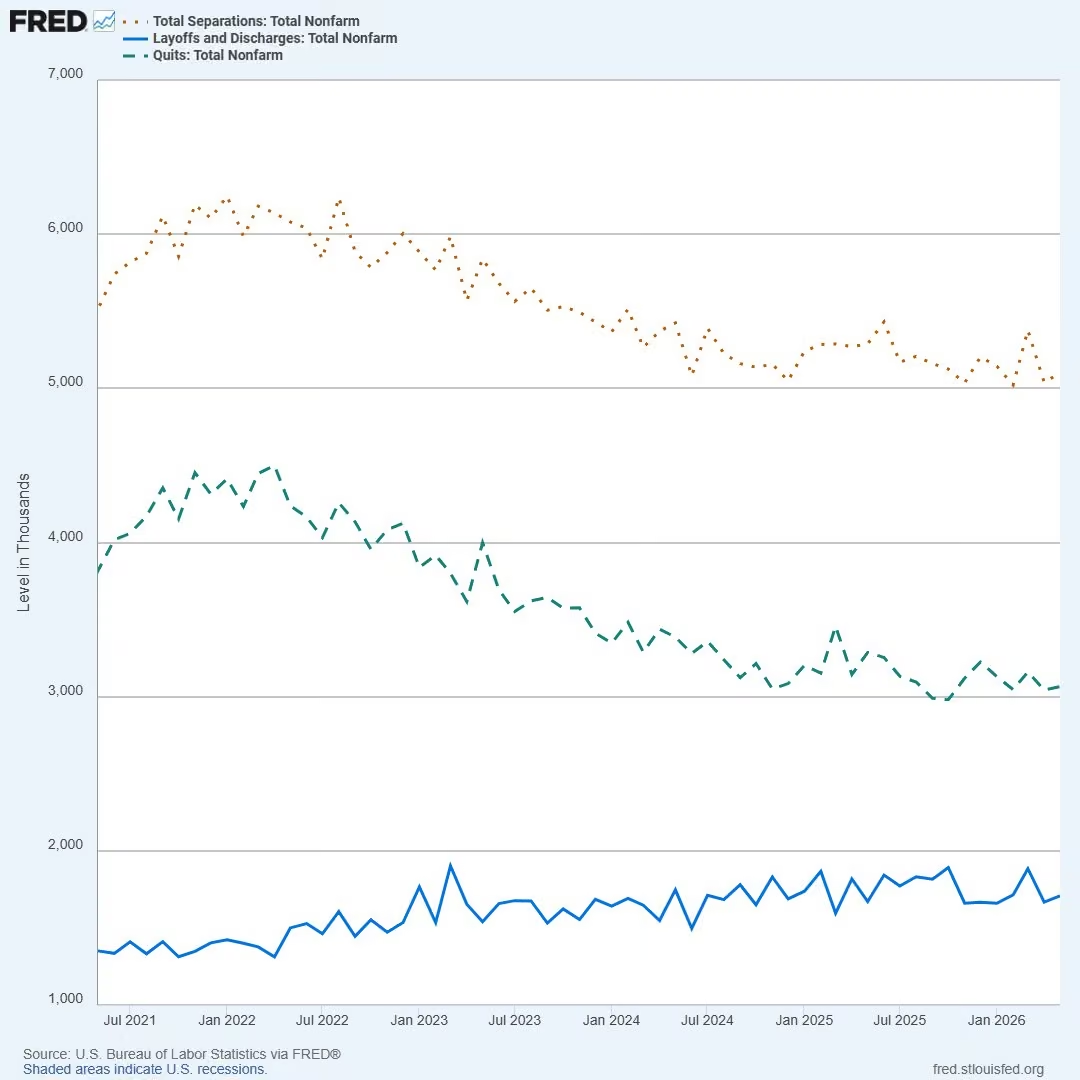
In September, U.S. job separations rose by 144,000 to 5.3 million. Within separations, quits increased to 3.4 million while layoffs and discharges dipped to 1.6 million #jolts fred.stlouisfed.org/graph/?g=20w6y
-
St. Louis Fed
@stlouisfed
Total nonfarm job openings increased by 333,000 to 7.5 million in September, per the latest @BLS_gov #jolts release. Hires ticked up 131,000 to 5.4 million fred.stlouisfed.org/graph/?g=20w4g
-
St. Louis Fed
@stlouisfed
Export growth has generally ranged from about −30% to +45%, far wider than swings in, say, GDP growth. Check the FRED Blog for @DallasFed global data fred.stlouisfed.org/blog/2026/11/how-do-global-merchandis…
-
St. Louis Fed
@stlouisfed
During the COVID-19 pandemic, how did surging demand for goods affect shipping? A new measure using satellite data covering U.S.-bound container ships shows how much potential shipping capacity was lost because of port congestion www.stlouisfed.org/on-the-economy/2026/oct/measuring-ship…
-
St. Louis Fed
@stlouisfed
An analysis shows that money growth and inflation tend to move together mainly in extreme, high-inflation periods, but otherwise tend to drift apart. Why does this happen? www.stlouisfed.org/on-the-economy/2026/nov/does-money-sup…
-
St. Louis Fed
@stlouisfed
Traverse City, Michigan, is no longer a micropolitan area. Check the FRED Blog for the data and details on @uscensusbureau's new statistical area delineations fred.stlouisfed.org/blog/2026/10/updates-to-MSA-maps-in-FRED
-
St. Louis Fed
@stlouisfed
Does money supply growth predict U.S. inflation? A new analysis finds it can provide a useful signal when the money growth rate moves far outside its historical range: www.stlouisfed.org/on-the-economy/2026/nov/does-money-sup…
-
St. Louis Fed
@stlouisfed
In October, the nation’s unemployment rate ticked down to 4.1% from the previous month’s 4.2%. The underemployment rate, which tracks those marginally attached to the labor force and people working part time for economic reasons, rose to 7.9% fred.stlouisfed.org/graph/?g=20Ba0
-
St. Louis Fed
@stlouisfed
In October, total nonfarm payrolls increased for a third month in a row, by 165,000. The changes in total nonfarm payroll employment for August and September were revised upward, showing employment in those months combined at 84,000 higher than previously reported
-
St. Louis Fed
@stlouisfed
How does time help your money grow? Explore the power of compounding interest and why starting to save early maximizes your savings: www.stlouisfed.org/publications/page-one-economics/2026/n… #teachecon
-
St. Louis Fed
@stlouisfed
In October, the transportation and warehousing industry added 25,000 jobs, reflecting growth in courier and messenger jobs, which rose by 17,000, and air transportation, which added 4,000 jobs, per @BLS_gov. See FRED for the latest data on payrolls by industry sector and selected industry detail fred.stlouisfed.org/release/tables?rid=50&eid=4881
-
St. Louis Fed
@stlouisfed
Average hourly earnings for all employees on private nonfarm payrolls rose 14 cents, to $38.00, in October, per @BLS_gov. From a year earlier, average hourly earnings were up 3.1%, or $1.15 fred.stlouisfed.org/graph/?g=20Bga
-
St. Louis Fed
@stlouisfed
In the week ending Oct. 31, seasonally adjusted initial claims for unemployment insurance benefits — those filed for the first time after a job loss — decreased by 6,000, to 189,000. The four-week moving average ticked down by 2,250 to 194,750 fred.stlouisfed.org/graph/?g=20ysb
-
St. Louis Fed
@stlouisfed
The U.S. labor force participation rate increased slightly in October, to 61.9%. For participation rates by educational attainment, race, sex and other categories, see FRED: fred.stlouisfed.org/graph/?g=20BAX
-
St. Louis Fed
@stlouisfed
What’s your role in America’s central bank? Today, St. Louis Fed President Alberto Musalem detailed his views on the importance of the Federal Reserve’s regional structure and the role the community plays in our work.
He also discussed the economy and monetary policy during a Q&A session moderated by John Kemper, president and CEO of Commerce Bancshares, Inc. The event was organized by @GreaterSTLinc and held at the Saint Louis Art Museum.
View President Musalem’s remarks and learn more about the St. Louis Fed’s connections to the people we serve: www.stlouisfed.org/from-the-president/remarks/2026/your-f… -
St. Louis Fed
@stlouisfed
Data agencies often recalibrate speedier, high-frequency survey data with lower-frequency, more-comprehensive efforts. The @uscensusbureau does this with its Annual Integrated Economic Survey. The FRED Blog has examples fred.stlouisfed.org/blog/2026/11/using-the-annual-integra…
-
St. Louis Fed
@stlouisfed
How can you gauge shipping disruptions when a crisis like the COVID-19 pandemic occurs? @RicardoVMarto and other economists have devised a new measure using data from satellites tracking vessels Read the analysis: www.stlouisfed.org/on-the-economy/2026/oct/measuring-ship…
-
St. Louis Fed
@stlouisfed
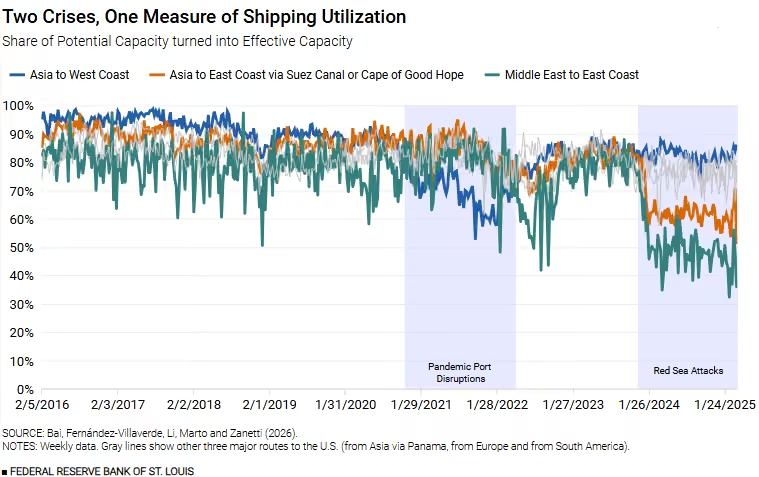
Starting in late 2023, Red Sea attacks led ships bound to the U.S. East Coast from Asia and from the Middle East to reroute around the Cape of Good Hope. A measure using satellite vessel-tracking data shows that disruption affected shipping utilization on those routes
-
St. Louis Fed
@stlouisfed
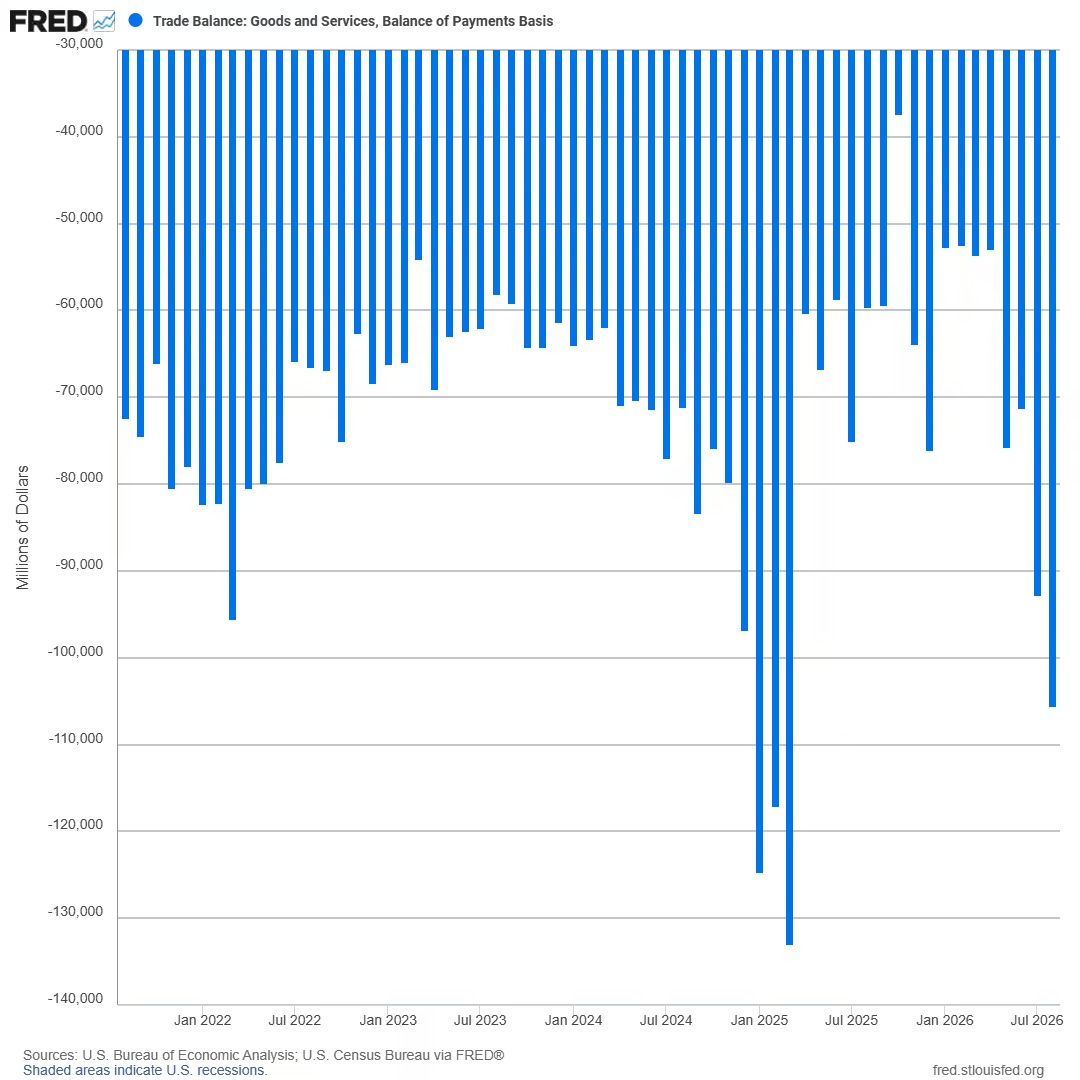
The U.S. trade deficit narrowed slightly in September to $105 billion, down $690 million from a revised gap of $105.7 billion in August, per @uscensusbureau and @BEA_News fred.stlouisfed.org/graph/?g=20x5T
-
St. Louis Fed
@stlouisfed
U.S. commercial paper outstanding rose to $1.50 trillion in the week ending Nov. 4, an increase of $4.3 billion from a week earlier, per @federalreserve data. Commercial paper comprises short-term, promissory notes issued mostly by corporations fred.stlouisfed.org/graph/?g=20yN9
-
St. Louis Fed
@stlouisfed
In the week ending Nov. 5, the average fixed 30-year mortgage rate decreased to 7.18%. The average fixed 15-year mortgage rate ticked down to 6.57% fred.stlouisfed.org/graph/?g=20yEr
-
St. Louis Fed
@stlouisfed
Monthly and quarterly @uscensusbureau surveys are built for speed: They use smaller samples and are best at measuring change from one period to the next. After the monthly surveys are taken, the annual version uses a much larger sample and more detail to recalibrate those monthly surveys. Check the FRED Blog for a discussion of this common practice among data agencies fred.stlouisfed.org/blog/2026/11/using-the-annual-integra…
-
St. Louis Fed
@stlouisfed
A new measure using vessel-tracking data from satellites reveals how much potential shipping capacity was lost because of congestion at U.S. ports during the COVID-19 pandemic. Read the analysis: www.stlouisfed.org/on-the-economy/2026/oct/measuring-ship…
-
St. Louis Fed
@stlouisfed
What are three drivers of money growth?
⌚Time: It gives earnings more opportunity to generate additional earnings.
📈Rate of return: Interest rates determine the speed at which your money grows.
💲Contributions: This includes your original investment amount and ongoing deposits.
Read about the power of compounding interest and why starting to save early maximizes your savings: www.stlouisfed.org/publications/page-one-economics/2026/n… #teachecon -
St. Louis Fed
@stlouisfed
The FRED Blog describes @DallasFed data on merchandise exports. It’s a global market, so exports across the globe rise and fall together depending on demand fred.stlouisfed.org/blog/2026/11/how-do-global-merchandis…
-
St. Louis Fed
@stlouisfed
Daily spot prices for crude oil as of Nov. 3: Brent was at $107.03 a barrel and West Texas Intermediate crude oil was at $99.64 a barrel. For more, see FRED: fred.stlouisfed.org/graph/?g=20xbR
-
St. Louis Fed
@stlouisfed
There was more stress in the financial markets in the week ending Oct. 30 than in the previous week. The St. Louis Fed Financial Stress Index measured -0.52 compared with the prior week's -0.58 reading. (0=normal financial market conditions; a value below 0 suggests below-average stress) fred.stlouisfed.org/graph/?g=20xbB
-
St. Louis Fed
@stlouisfed
Average fuel prices per gallon edged lower in the week ending Nov. 2. Diesel dipped by 6 cents to $6.29 and gasoline by 12 cents to $4.15 fred.stlouisfed.org/graph/?g=20w7w
-
St. Louis Fed
@stlouisfed
Interested in the latest @BLS_gov #jolts data? FRED has release tables covering U.S. job openings, hires, and more by sector and census region fred.stlouisfed.org/release?rid=192
-
St. Louis Fed
@stlouisfed
In September, U.S. job separations rose by 144,000 to 5.3 million. Within separations, quits increased to 3.4 million while layoffs and discharges dipped to 1.6 million #jolts fred.stlouisfed.org/graph/?g=20w6y
-
St. Louis Fed
@stlouisfed
Total nonfarm job openings increased by 333,000 to 7.5 million in September, per the latest @BLS_gov #jolts release. Hires ticked up 131,000 to 5.4 million fred.stlouisfed.org/graph/?g=20w4g
-
St. Louis Fed
@stlouisfed
Export growth has generally ranged from about −30% to +45%, far wider than swings in, say, GDP growth. Check the FRED Blog for @DallasFed global data fred.stlouisfed.org/blog/2026/11/how-do-global-merchandis…
-
St. Louis Fed
@stlouisfed
As of Oct. 30, the daily trade-weighted U.S. dollar index was measuring 114.4 (January 2006=100). See this index and more data from the @federalreserve Foreign Exchange Rates - H.10 release in FRED: fred.stlouisfed.org/release?rid=17
-
St. Louis Fed
@stlouisfed
How do global merchandise exports change over time?
Merchandise export growth has generally ranged from about −30% to +45%, far wider than swings in, say, GDP growth. And it’s a global market, so exports across the globe rise and fall together depending on demand.
Consider the Great Recession of 2007-2009. U.S. households and firms postponed big-ticket purchases, such as automobiles and machinery, and inflation-adjusted GDP dropped by 4.3%. World trade? That dropped by as much as 34.6%.
Visit the FRED Blog for the data and discussion fred.stlouisfed.org/blog/2026/11/how-do-global-merchandis… -
St. Louis Fed
@stlouisfed
Total U.S. construction spending fell 1.9% to a seasonally adjusted annual rate of $2.19 trillion in September, per @uscensusbureau fred.stlouisfed.org/graph/?g=20tSr
-
St. Louis Fed
@stlouisfed
Global merchandise exports do not change smoothly over time. They ebb and flow and undergo large changes in relatively short spans. Check the FRED Blog for the data and details fred.stlouisfed.org/blog/2026/11/how-do-global-merchandis…
-
St. Louis Fed
@stlouisfed
Explore the three drivers of money growth—time, rate of return, and contributions—and why starting to save early maximizes your savings: www.stlouisfed.org/publications/page-one-economics/2026/n… #teachecon
-
St. Louis Fed
@stlouisfed
Know small business leaders or owners? All 12 Federal Reserve banks are currently collecting responses to the Small Business Credit Survey as part of our role in supporting a strong economy.
The Fed conducts this annual nationwide survey to gather insights into business experiences and credit conditions. It’s open through Nov. 13 🔗 fedreserveboard.gov1.qualtrics.com/jfe/form/SV_38k9xZy8ay… -
St. Louis Fed
@stlouisfed
Traverse City, Michigan, is no longer a micropolitan area. Check the FRED Blog for the data and details on @uscensusbureau's new statistical area delineations fred.stlouisfed.org/blog/2026/10/updates-to-MSA-maps-in-FRED
-
St. Louis Fed
@stlouisfed
U.S. commercial paper outstanding dipped to $1.50 trillion in the week ending Oct. 28, a decrease of $3.6 billion from a week earlier, per @federalreserve data. Commercial paper comprises short-term, promissory notes issued mostly by corporations fred.stlouisfed.org/graph/?g=20k0C
-
St. Louis Fed
@stlouisfed
Commercial and industrial loans at all U.S. commercial banks grew by $5.2 billion to $3.0 trillion in the week ending Oct. 21. See the level over time in FRED: fred.stlouisfed.org/graph/?g=20kbs
-
St. Louis Fed
@stlouisfed
When people struggle to afford utilities, they often face difficult choices. Has energy insecurity risen? And what kind of trade-offs are lower-income U.S. households making? www.stlouisfed.org/on-the-economy/2026/oct/utility-cost-p…
-
St. Louis Fed
@stlouisfed
As the duration of joblessness lengthens, fewer workers remain eligible for unemployment benefits. At the same time, a larger share of those still eligible choose to claim them, according to this analysis www.stlouisfed.org/on-the-economy/2026/oct/unemployment-i…
-
St. Louis Fed
@stlouisfed
The FRED Blog tracks labor productivity in the information sector: publishing, broadcasting, telecommunications, data processing and data centers fred.stlouisfed.org/blog/2026/10/early-signs-of-ai-driven…
-
St. Louis Fed
@stlouisfed
There was more stress in the financial markets in the week ending Oct. 23 than in the previous week. The St. Louis Fed Financial Stress Index measured -0.58 compared with the prior week's -0.63 reading. (0=normal financial market conditions; a value below 0 suggests below-average stress) fred.stlouisfed.org/graph/?g=20gUT
-
St. Louis Fed
@stlouisfed
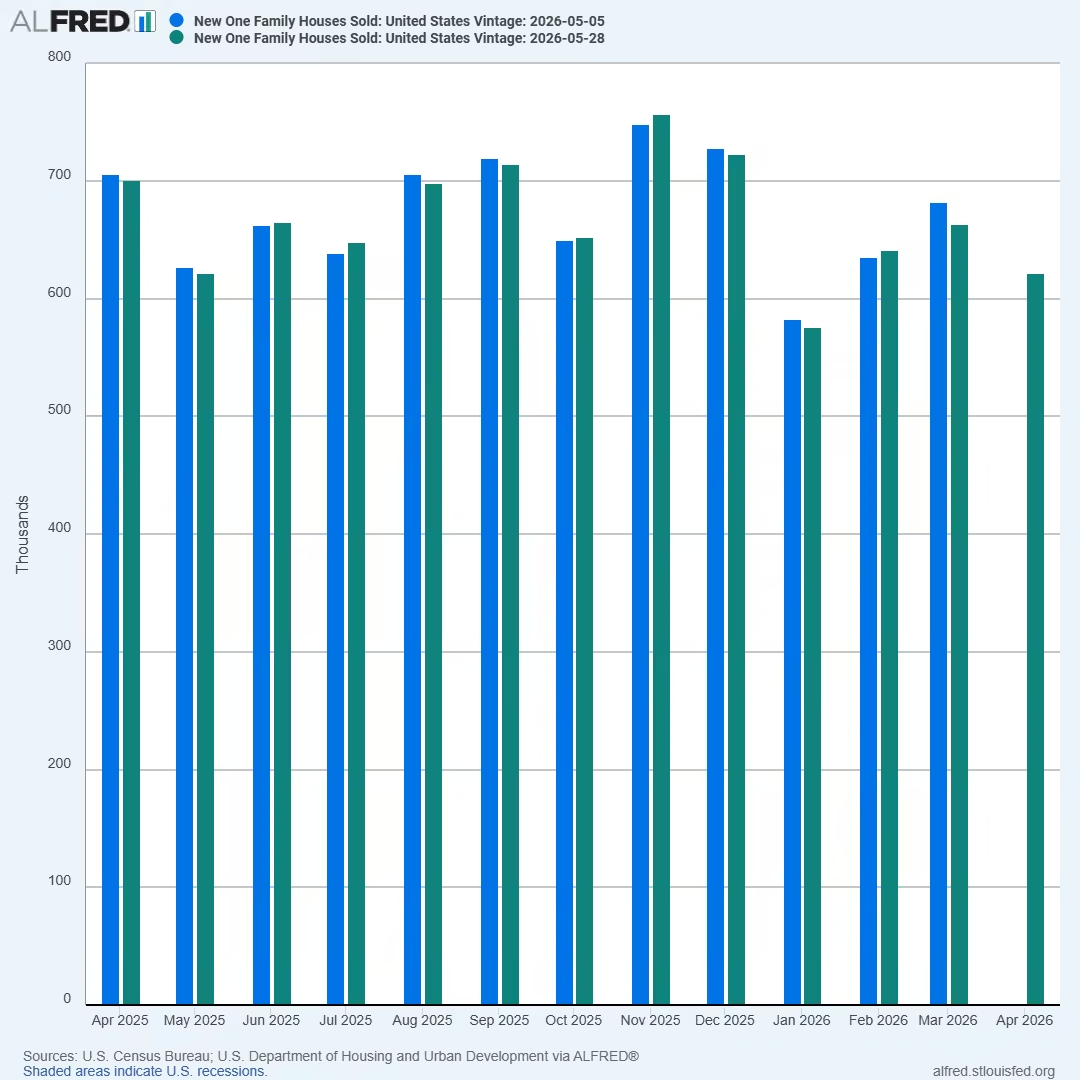
Sales of new U.S. single-family homes dipped 0.6% in September to a seasonally adjusted annual rate of 676,000 units, down from 680,000 units in August, per @uscensusbureau fred.stlouisfed.org/graph/?g=20ehI
-
St. Louis Fed
@stlouisfed
In August, U.S. home prices as measured by the S&P Cotality Case-Shiller National Home Price Index rose a seasonally adjusted 2.1% year over year, up from 1.9% in July. The 20- and 10-city composite indexes posted 2.6% and 3.6% annual gains, respectively fred.stlouisfed.org/graph/?g=20eRg
-
St. Louis Fed
@stlouisfed
Median sales price of new U.S. houses sold in September was $400,400 — an increase of $15,000 (or 3.9%) from August, but a decrease of $16,400 (or 3.9%) from September 2025 fred.stlouisfed.org/graph/?g=20en7
-
St. Louis Fed
@stlouisfed
Trading assets at U.S. global systemically important banks reached $3.7 trillion at the end of the second quarter of 2026, up from $2.5 trillion at the end of 2024 and doubling since the end of 2019. A new analysis traces the growth of these assets, which consist mostly of securities held for the purpose of reselling in the near future www.stlouisfed.org/on-the-economy/2026/oct/banking-analyt…
-
St. Louis Fed
@stlouisfed
A Shift in Productivity since GenAI
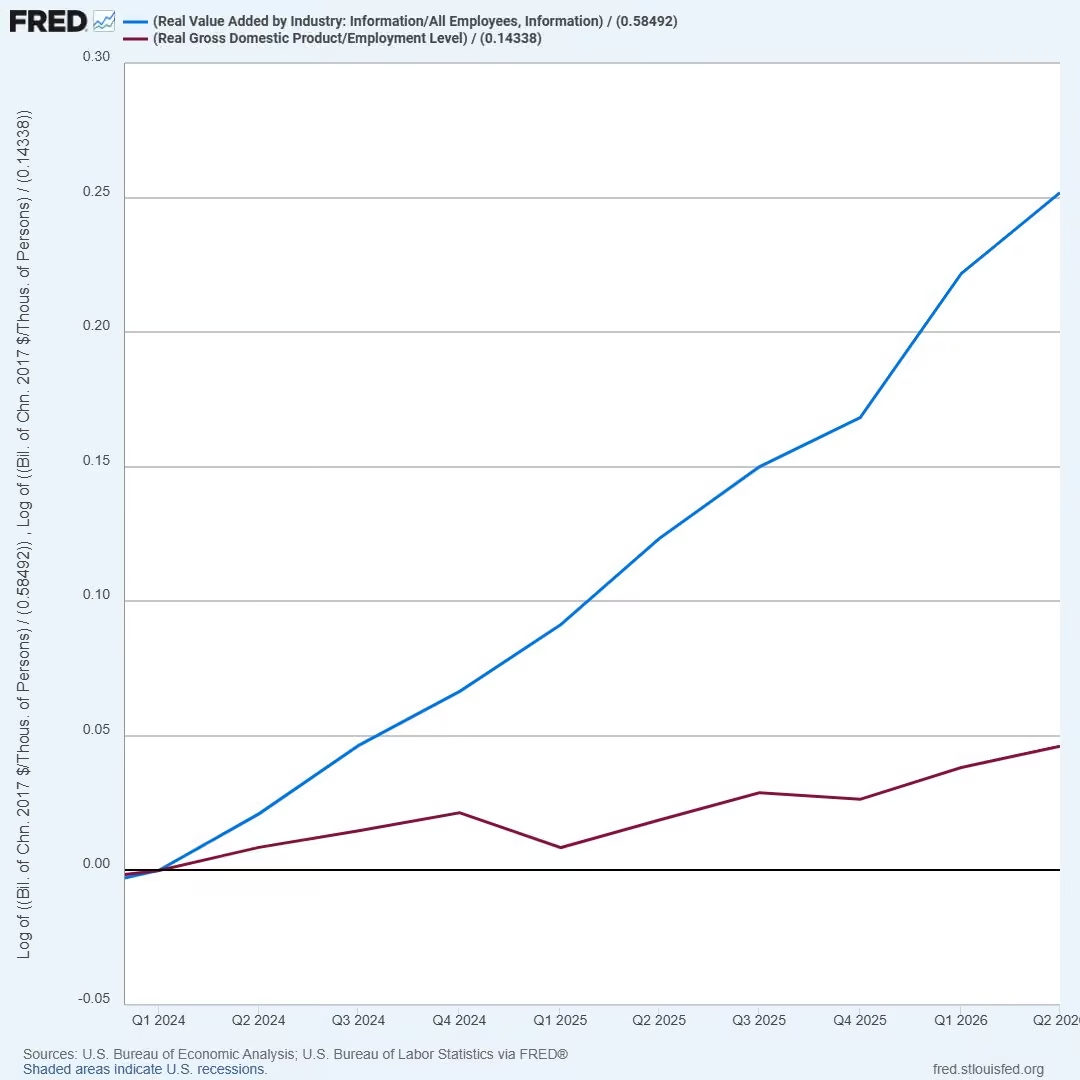
The information sector is small in total employment, but it’s big in labor productivity growth. AI may be helping this sector improve even faster.
Labor productivity in the information sector has typically been higher than aggregate labor productivity. For example, from 2010 to 2026, it grew at an average annual rate of 7.68% versus 1.22% in the overall economy.
Lately, though, information sector labor productivity has grown faster than usual and considerably faster than in the economy as a whole. From mid-2025 to mid-2026, it grew by 13.70% versus 2.17% in the overall economy.
Check the FRED Blog for the data and more discussion fred.stlouisfed.org/blog/2026/10/early-signs-of-ai-driven… -
St. Louis Fed
@stlouisfed
The FRED Blog has information and maps based on new data in FRED, which come from new Census Bureau statistical area delineations fred.stlouisfed.org/blog/2026/10/updates-to-MSA-maps-in-FRED
-
St. Louis Fed
@stlouisfed
Commodities — from the cocoa in your Halloween candy bars to the cotton in your jeans — are building blocks of usable goods and services. Commodity prices are generally driven by supply and demand factors, and understanding these can help you stay informed about the prices consumers see. Our blog explains: www.stlouisfed.org/open-vault/2025/dec/understanding-comm…
This media couldn't be displayed. See it on the original post. -
St. Louis Fed
@stlouisfed
The information sector accounts for a small fraction of total employment, only 1.8%. But it has generally been an important contributor to aggregate economic growth because of its strong productivity growth. AI may be helping this sector improve even faster. Go to the FRED Blog for the data and more details fred.stlouisfed.org/blog/2026/10/early-signs-of-ai-driven…
-
St. Louis Fed
@stlouisfed
A key challenge for unemployment insurance policy is that jobless workers are not a static group. Both the share of those who qualify for benefits and the share of those who claim them change over the duration of joblessness. A new analysis by St. Louis Fed economist @SerdarBirinci9 and his co-authors examines this dynamic: www.stlouisfed.org/on-the-economy/2026/oct/unemployment-i…
-
St. Louis Fed
@stlouisfed
How does the affordability of utilities — electricity, water, natural gas, and others — affect households of different income levels? www.stlouisfed.org/on-the-economy/2026/oct/utility-cost-p…
-
St. Louis Fed
@stlouisfed
Do U.S. households stretch to afford their utility bills? New research examines this question through two complementary measures: cost burden and the trade-offs that occur when paying breaks the budget www.stlouisfed.org/on-the-economy/2026/oct/utility-cost-p…
-
St. Louis Fed
@stlouisfed
U.S. commercial paper outstanding dipped to $1.50 trillion in the week ending Oct. 28, a decrease of $3.6 billion from a week earlier, per @federalreserve data. Commercial paper comprises short-term, promissory notes issued mostly by corporations fred.stlouisfed.org/graph/?g=20k0C
-
St. Louis Fed
@stlouisfed
Commercial and industrial loans at all U.S. commercial banks grew by $5.2 billion to $3.0 trillion in the week ending Oct. 21. See the level over time in FRED: fred.stlouisfed.org/graph/?g=20kbs
-
St. Louis Fed
@stlouisfed
Austin-Round Rock-Georgetown, TX MSA is now Austin-Round Rock-San Marcos, TX MSA. Make a note. And check the FRED Blog for details on the @uscensusbureau's new data landscape fred.stlouisfed.org/blog/2026/10/updates-to-MSA-maps-in-FRED
-
St. Louis Fed
@stlouisfed
The cost of utilities — like electricity and natural gas — can put pressure on household budgets, particularly for low- and moderate-income families. Read the research: www.stlouisfed.org/on-the-economy/2026/oct/utility-cost-p…
-
St. Louis Fed
@stlouisfed
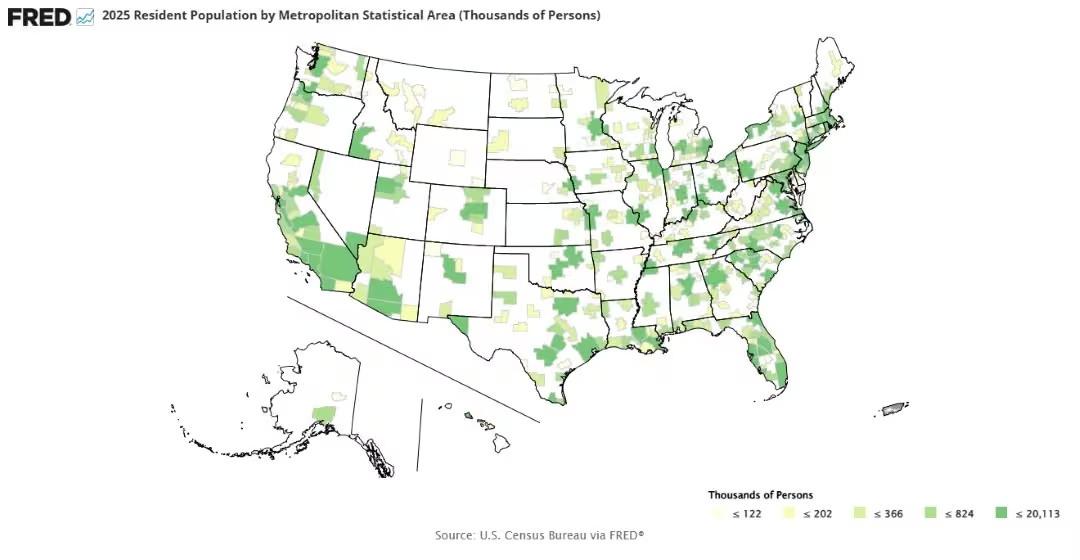
The @uscensusbureau has renamed 58 MSAs, graduated nine micropolitan areas to metropolitan areas and added three new MSAs. Check the FRED Blog for the data and details fred.stlouisfed.org/blog/2026/10/updates-to-MSA-maps-in-FRED
-
St. Louis Fed
@stlouisfed
Is inflation likely to stay meaningfully above the Fed’s target without additional monetary policy action? During a speech today, St. Louis Fed President Alberto Musalem said he viewed that inflation scenario as more likely than one in which additional policy firming will not be required.
He discussed the U.S. economy and monetary policy in his keynote address at the Shadow Open Market Committee meeting in New York. Following his speech, he participated in a Q&A moderated by Jeffrey Lacker.
View President Musalem’s remarks: www.stlouisfed.org/from-the-president/remarks/2026/remark… -
St. Louis Fed
@stlouisfed
A New Landscape for Geographic Data
FRED is including the @uscensusbureau’s new array of geographic data and delineations. Here are the highlights:
• No more micropolitan area data (<50,000 residents)
• Full metro status for nine former micropolitan areas
• Debut of three new MSAs
• New names for nearly 60 MSAs
Check the FRED Blog for the FRED data and details fred.stlouisfed.org/blog/2026/10/updates-to-MSA-maps-in-FRED -
St. Louis Fed
@stlouisfed
In the week ending Oct. 29, the average fixed 30-year mortgage rate decreased to 7.24%. The average fixed 15-year mortgage rate ticked down to 6.60% fred.stlouisfed.org/graph/?g=20i5Y
-
St. Louis Fed
@stlouisfed
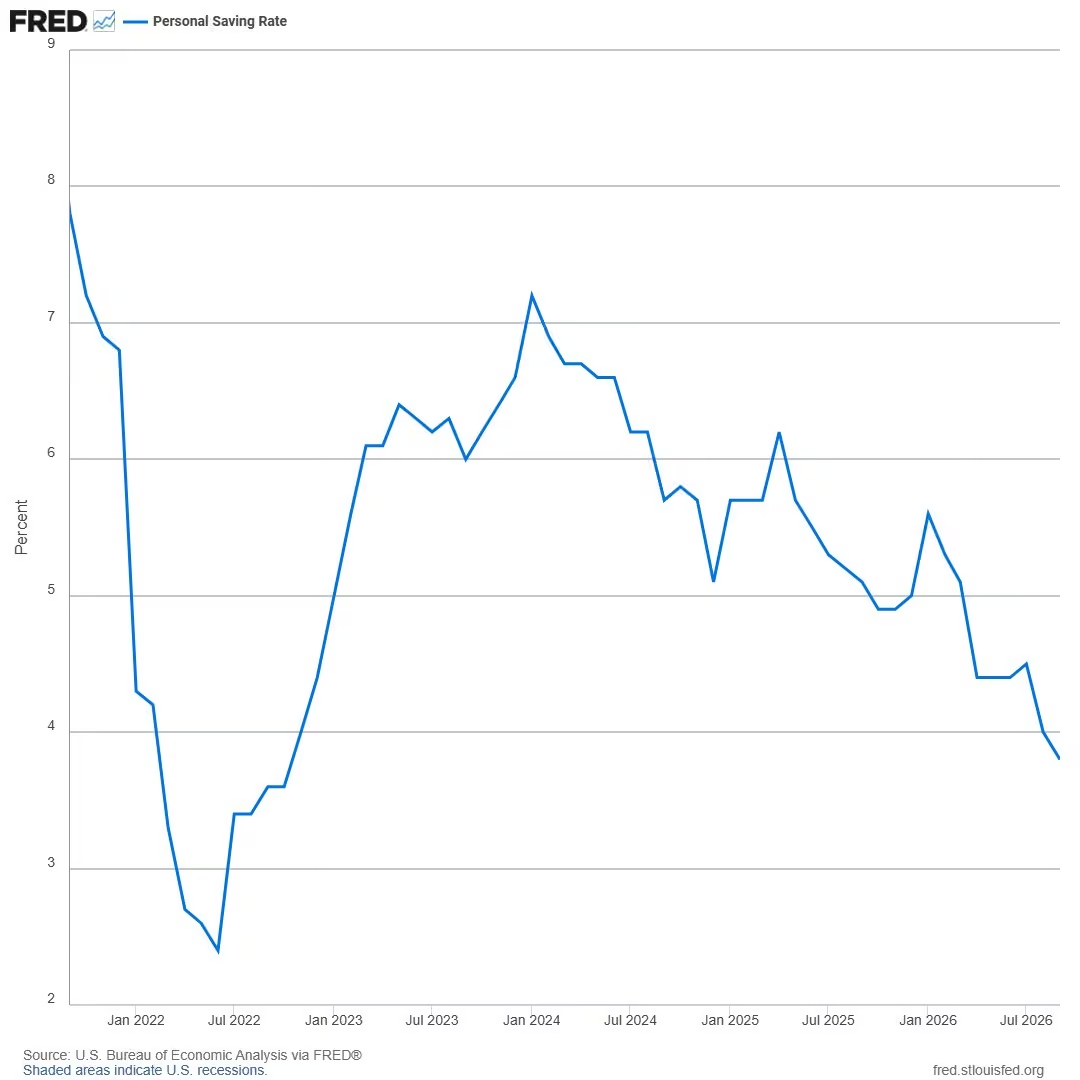
In September, the U.S. personal saving rate fell for the second consecutive month, to 3.8% of disposable income, down from 4.0% in August fred.stlouisfed.org/graph/?g=20hYq
-
St. Louis Fed
@stlouisfed
U.S. real #gdp increased at an annual rate of 3.4% in the third quarter of 2026, according to the “advance” estimate from @BEA_News. This follows an increase of 2.2% in the second quarter of 2026 fred.stlouisfed.org/graph/?g=20hXE
-
St. Louis Fed
@stlouisfed
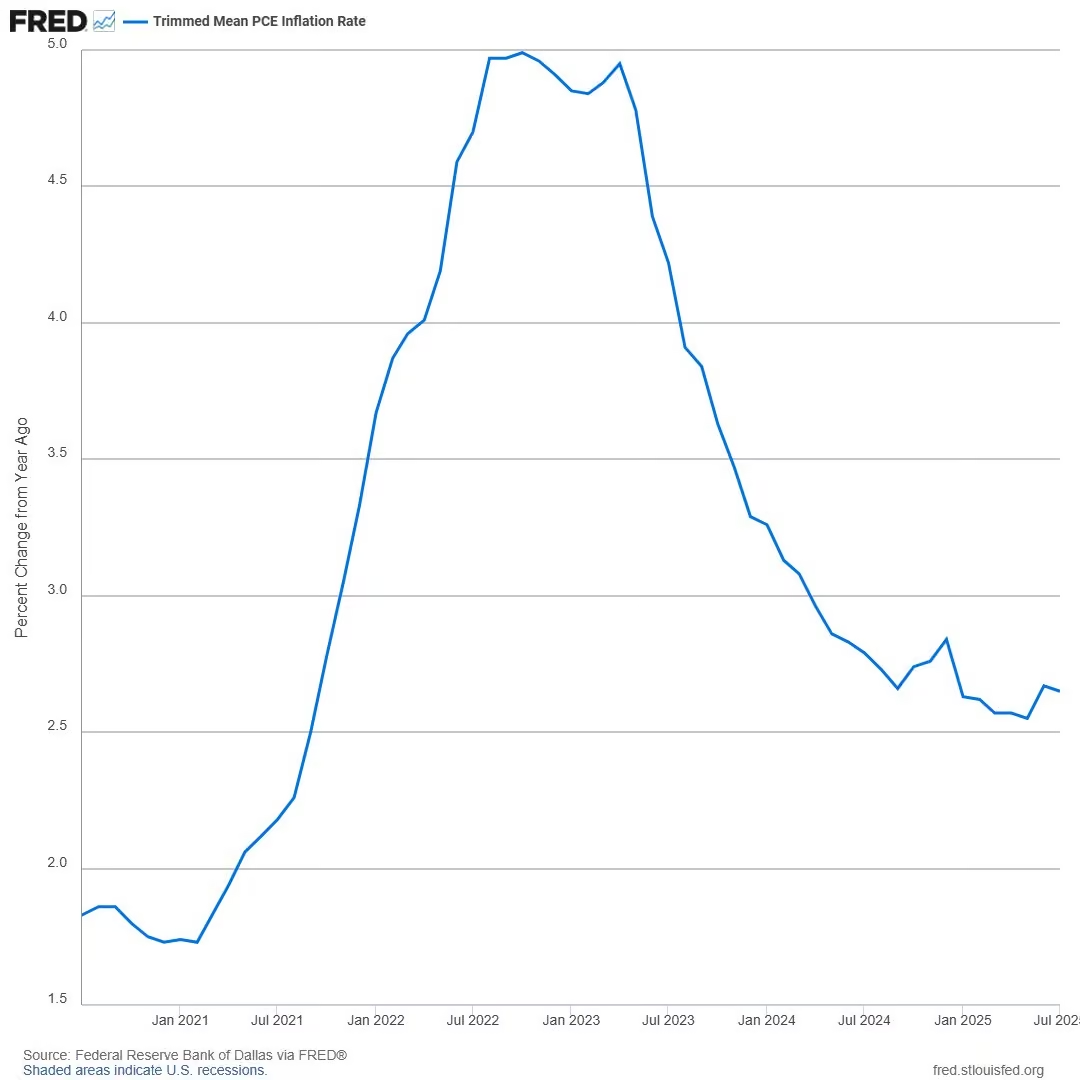
Trimmed mean PCE inflation rate — an alternative measure of core inflation from @DallasFed — was 2.3% for the 12 months ending in September, up slightly from August's reading of 2.2% fred.stlouisfed.org/graph/?g=20ifR
-
St. Louis Fed
@stlouisfed
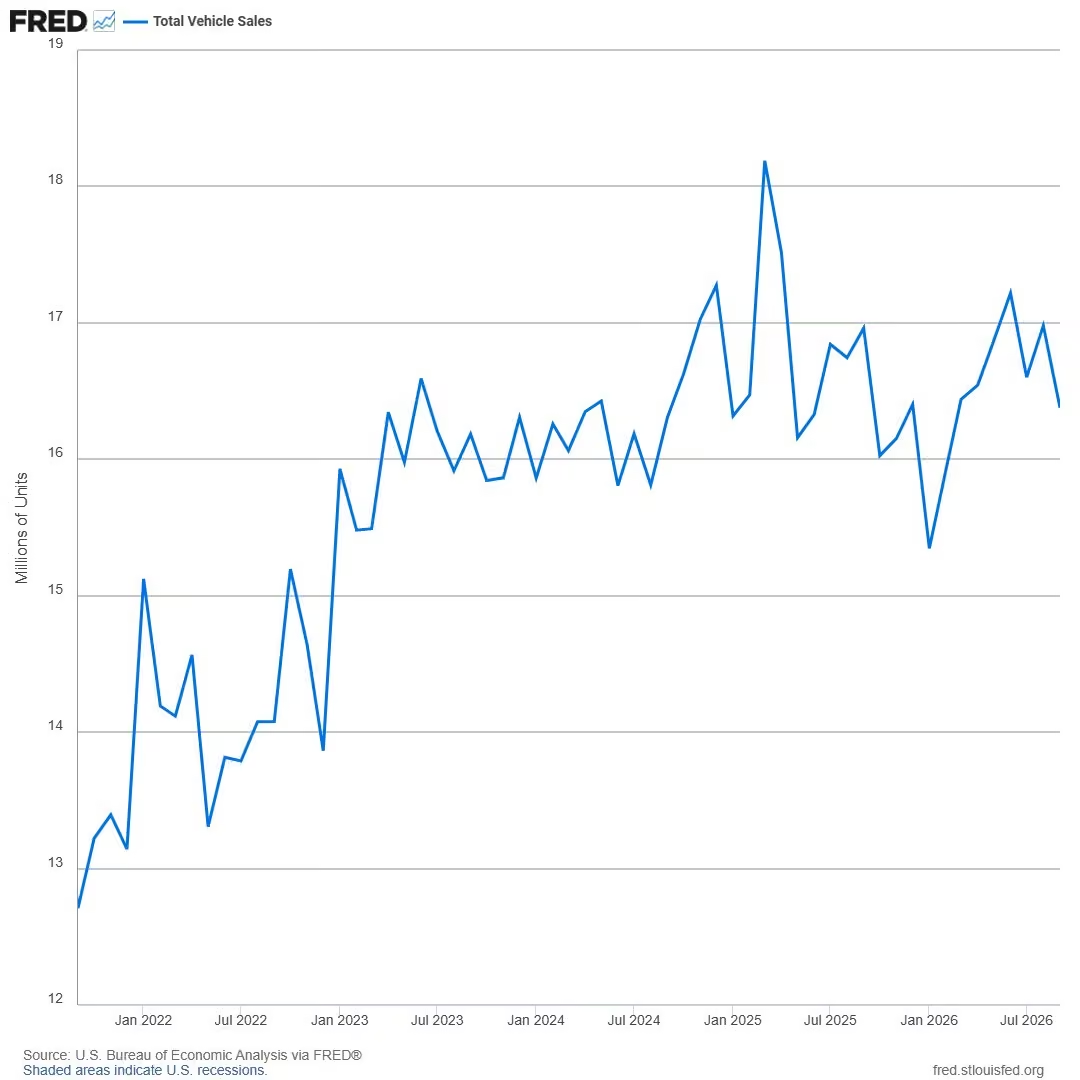
The total number of motor vehicles sold in the U.S. fell in September, to a seasonally adjusted annual rate of 16.4 million units — a decrease of 3.5% from August and down 3.4% from September 2025 fred.stlouisfed.org/graph/?g=20i1t
-
St. Louis Fed
@stlouisfed
In the week ending Oct. 24, seasonally adjusted initial claims for unemployment insurance benefits — those filed for the first time after a job loss — decreased by 1,000, to 194,000. The four-week moving average ticked down by 1,250 to 196,750 fred.stlouisfed.org/graph/?g=20i1O
-
St. Louis Fed
@stlouisfed
The personal consumption expenditures (PCE) price index increased at an annual rate of 3.6% from a year ago in September, up from August's 3.4%. Excluding food and energy costs, the “core PCE” price level ticked up to 3.1% on an annual basis fred.stlouisfed.org/graph/?g=20i0A
-
St. Louis Fed
@stlouisfed
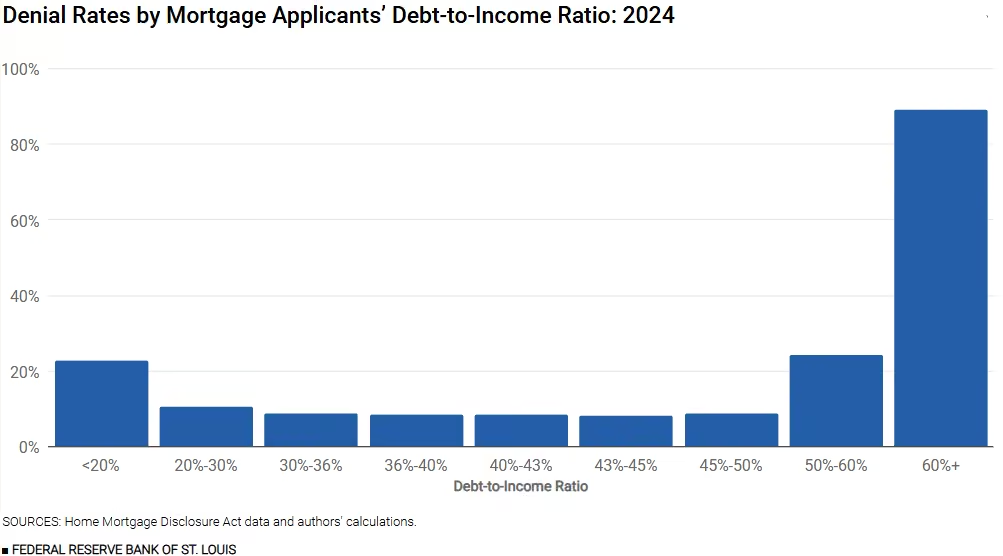
How does debt to income ratio affect mortgage applicants? And where does the denial “cliff” really appear? www.stlouisfed.org/on-the-economy/2026/jun/what-30-millio…
-
St. Louis Fed
@stlouisfed
Think a cheaper home means the mortgage approval is easier? Not always. For manufactured homes, the price isn't the problem — the property is. New research digs into why www.stlouisfed.org/on-the-economy/2026/oct/affordability-…
-
St. Louis Fed
@stlouisfed
Gross Domestic Product vs. Net Domestic Product
What’s the difference? Gross domestic product (GDP) measures all economic activity in a country.
But what happens if a country is, for example, hit by a major hurricane? The construction to rebuild infrastructure drives up investment, which shows up in GDP. The economy may look like it’s growing even though it’s only replacing broken capital. Net domestic product (NDP) measures economic activity but excludes this replacement of capital.
These two measures track each other closely because the U.S. economy is so large and diversified that most depreciation is regular and catastrophes don’t generate much visible change. You can see some differences if you look at growth rates from quarter to quarter. They aren’t huge, mostly less than half a percentage point, but still notable.
Check the FRED Blog for more data and detail. fred.stlouisfed.org/blog/2026/10/net-domestic-product -
St. Louis Fed
@stlouisfed
There was more stress in the financial markets in the week ending Oct. 23 than in the previous week. The St. Louis Fed Financial Stress Index measured -0.58 compared with the prior week's -0.63 reading. (0=normal financial market conditions; a value below 0 suggests below-average stress) fred.stlouisfed.org/graph/?g=20gUT
-
St. Louis Fed
@stlouisfed
Daily spot prices for crude oil as of Oct. 27: Brent was at $123.10 a barrel and West Texas Intermediate crude oil was at $103.37 a barrel. For more, see FRED: fred.stlouisfed.org/release?rid=212
-
St. Louis Fed
@stlouisfed
Stay up to date on new scholarship from the Fed’s 12 Reserve banks by subscribing to our working papers digest. The latest edition features 42 papers on topics like deposit insurance, agentic AI and oil supply mailchi.mp/2fc0e0a492fa/wpdigest
-
St. Louis Fed
@stlouisfed
Think a cheaper home means the mortgage approval is easier? Not always. For manufactured homes, the price isn't the problem — the property is. New research digs into why www.stlouisfed.org/on-the-economy/2026/oct/affordability-…
-
St. Louis Fed
@stlouisfed
Sales of new U.S. single-family homes dipped 0.6% in September to a seasonally adjusted annual rate of 676,000 units, down from 680,000 units in August, per @uscensusbureau fred.stlouisfed.org/graph/?g=20ehI
-
St. Louis Fed
@stlouisfed
In the week ending Oct. 26, average U.S. diesel prices per gallon rose 8 cents, to $6.35. Average gas prices per gallon declined for a fifth week in a row, by 2 cents, to $4.27 fred.stlouisfed.org/graph/?g=20eqx
-
St. Louis Fed
@stlouisfed
In August, U.S. home prices as measured by the S&P Cotality Case-Shiller National Home Price Index rose a seasonally adjusted 2.1% year over year, up from 1.9% in July. The 20- and 10-city composite indexes posted 2.6% and 3.6% annual gains, respectively fred.stlouisfed.org/graph/?g=20eRg
-
St. Louis Fed
@stlouisfed
Median sales price of new U.S. houses sold in September was $400,400 — an increase of $15,000 (or 3.9%) from August, but a decrease of $16,400 (or 3.9%) from September 2025 fred.stlouisfed.org/graph/?g=20en7
-
St. Louis Fed
@stlouisfed
About half of U.S. college students who have taken one econ course never take another one. Should introductory economics focus on math-heavy models — or on how core concepts can help students understand the world? A blog post including insights from educators and other experts explores the question #econedmonth #teachecon www.stlouisfed.org/open-vault/2026/oct/what-how-teach-pri…
-
St. Louis Fed
@stlouisfed
The St. Louis Fed isn't just our staff and our buildings. We depend on people from around the district to provide real-time insights into the economy. Our boards of directors and advisory councils are a big part of that connection. They keep us up to date on what's happening in their communities and at their businesses, so we can work toward a strong and resilient economy for all.
🔗 See where those important voices are from at the link below. You can also see a map that shows communities where the St. Louis Fed engaged with other stakeholders — throughout Arkansas, Illinois, Indiana, Kentucky, Mississippi, Missouri and Tennessee — last year. www.stlouisfed.org/about-us/representing-engaging-communi… -
St. Louis Fed
@stlouisfed
Gross domestic product measures all production in a country. Net domestic product removes production that replaces depreciated or destroyed goods. For example, rebuilding houses after a hurricane. Check the FRED Blog for a look at the data fred.stlouisfed.org/blog/2026/10/net-domestic-product
-
St. Louis Fed
@stlouisfed
Two borrowers, same income, same credit — but they face different odds of getting their mortgage approved when one is buying a traditional house and the other is purchasing a manufactured home. Why are manufactured homes “penalized” in mortgage lending? www.stlouisfed.org/on-the-economy/2026/oct/affordability-…
-
St. Louis Fed
@stlouisfed
As of Oct. 23, the daily trade-weighted U.S. dollar index was measuring 114.3 (January 2006=100). See this index and more data from the @federalreserve Foreign Exchange Rates - H.10 release in FRED: fred.stlouisfed.org/graph/?g=20cQl
-
St. Louis Fed
@stlouisfed
Learn the difference between GDP (gross domestic product) and NDP (net domestic product) on our blog fred.stlouisfed.org/blog/2026/10/net-domestic-product
-
St. Louis Fed
@stlouisfed
Commercial and industrial loans at all U.S. commercial banks grew by $4.8 billion to $2.99 trillion in the week ending Oct. 14. See the level over time in FRED: fred.stlouisfed.org/graph/?g=1ZZL1
-
St. Louis Fed
@stlouisfed
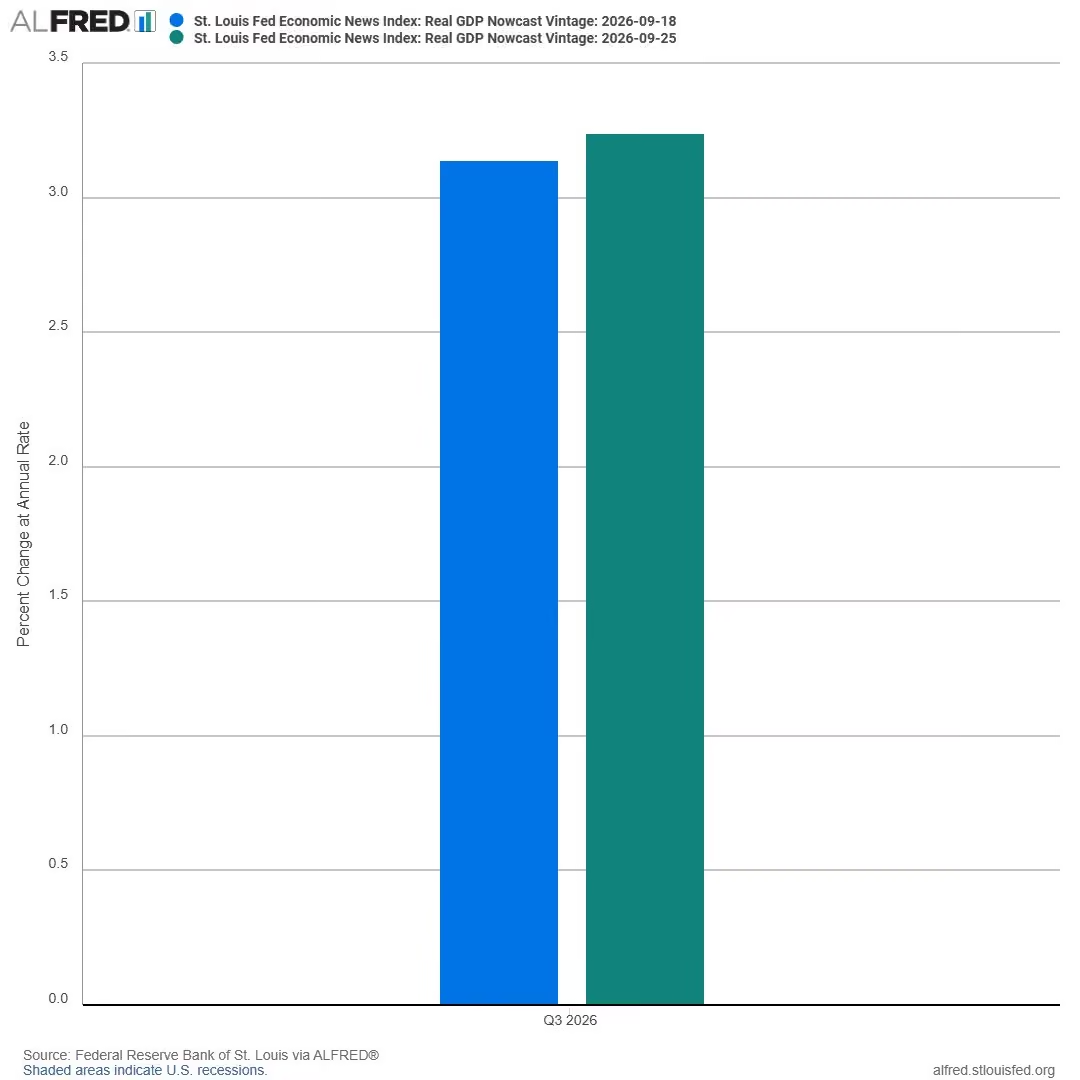
On Oct. 23, the St. Louis Fed Economic News Index was projecting Q3 real GDP growth of 3.2% at an annual rate, up from 2.8% a week earlier. Our “nowcast” uses economic content from key monthly data releases to forecast the current quarter’s real GDP growth. Learn more:
-
St. Louis Fed
@stlouisfed
U.S. commercial paper outstanding rose to $1.50 trillion in the week ending Oct. 21, an increase of $22.6 billion from a week earlier, per @federalreserve data. Commercial paper comprises short-term, promissory notes issued mostly by corporations fred.stlouisfed.org/graph/?g=1ZVC1
-
St. Louis Fed
@stlouisfed
There was more stress in the financial markets in the week ending Oct. 16 than in the previous week. The St. Louis Fed Financial Stress Index measured -0.63 compared with the prior week's -0.72 reading. (0=normal financial market conditions; a value below 0 suggests below-average stress) fred.stlouisfed.org/graph/?g=1ZULC
-
St. Louis Fed
@stlouisfed
Chambers of commerce play a role in shaping local economies — from identifying growth opportunities to using data-driven insights to solve complex challenges.
"The first thing you try to do is get everyone on the same page and get the facts," says Randy Zook, president and CEO of the @ARStateChamber. "What are the real numbers?"
Here, Zook discusses his approach to serving both rural and metro communities across Arkansas. Watch to learn how the St. Louis Fed impacts that effort.
#federalreserve #smallbusiness #economicdevelopment #leadership -
St. Louis Fed
@stlouisfed
AI adoption has climbed for businesses of all sizes. The FRED Blog provides rankings by business size, but also by industry and AI provider fred.stlouisfed.org/blog/2026/10/which-businesses-are-usi…
-
St. Louis Fed
@stlouisfed
Two borrowers, same income, same credit — but they face different odds of getting their mortgage approved when one is buying a traditional house and the other is purchasing a manufactured home. Why are manufactured homes “penalized” in mortgage lending? www.stlouisfed.org/on-the-economy/2026/oct/affordability-…
-
St. Louis Fed
@stlouisfed
In the week ending Oct. 17, seasonally adjusted initial claims for unemployment insurance benefits — those filed for the first time after a job loss — decreased by 6,000, to 194,000. The four-week moving average ticked down by 1,000 to 197,750 fred.stlouisfed.org/graph/?g=1ZUSB
-
St. Louis Fed
@stlouisfed
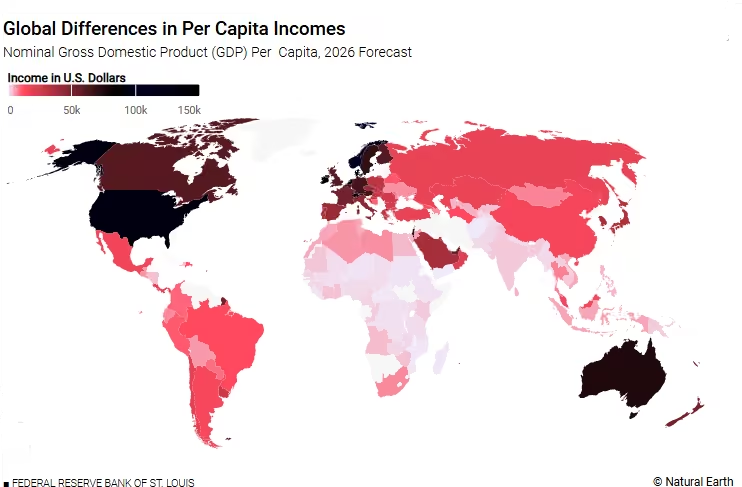
What economic factors drive global differences in national incomes? www.stlouisfed.org/on-the-economy/2026/oct/why-does-per-c…
-
St. Louis Fed
@stlouisfed
How are young adults who aren't working or in school spending their time? A new analysis uses survey data to explore this question www.stlouisfed.org/on-the-economy/2026/jul/how-are-discon…
-
St. Louis Fed
@stlouisfed
Permits to build privately owned U.S. housing were at a seasonally adjusted annual rate of 1.400 million units in September, a pace 0.2% below the August rate of 1.403 million and 3.0% below the September 2025 rate of 1.444 million fred.stlouisfed.org/graph/?g=1ZPbe
-
St. Louis Fed
@stlouisfed
Privately owned U.S. housing starts registered a seasonally adjusted annual rate of 1.221 million units in September. This rate was 5.2% below August's estimate of 1.288 million and 7.4% below the September 2025 rate of 1.319 million fred.stlouisfed.org/graph/?g=1ZPaL
-
St. Louis Fed
@stlouisfed
Larger companies are adopting AI faster than smaller ones, according to Ramp data newly added to FRED. Check the details at the FRED Blog fred.stlouisfed.org/blog/2026/10/which-businesses-are-usi…
-
St. Louis Fed
@stlouisfed
If manufactured homes are less expensive than traditional single-family homes, why are they harder to finance? www.stlouisfed.org/on-the-economy/2026/oct/affordability-…
-
St. Louis Fed
@stlouisfed
Apprenticeships in states that are part of the St. Louis Fed's region have been on the rise since COVID-19. Which occupations are experiencing the most growth in this type of job training? Which have seen opportunities decline? www.stlouisfed.org/on-the-economy/2026/oct/exploring-appr…
-
St. Louis Fed
@stlouisfed
How might you find unexpected ways to save? Our blog post author shares how her family scaled back to plug budget “leaks” #econedmonth www.stlouisfed.org/open-vault/2020/april/ways-plug-leaks-…
-
St. Louis Fed
@stlouisfed
Think a cheaper home means the mortgage approval is easier? Not always. For manufactured homes, the price isn't the problem — the property is. New research digs into why www.stlouisfed.org/on-the-economy/2026/oct/affordability-…
-
St. Louis Fed
@stlouisfed
Since the advent of GenAI, labor productivity in the information sector has grown much faster than usual and much faster than in the overall economy. Check the FRED Blog for the data and discussion fred.stlouisfed.org/blog/2026/10/early-signs-of-ai-driven…
-
St. Louis Fed
@stlouisfed
Commercial and industrial loans at all U.S. commercial banks grew by $4.8 billion to $2.99 trillion in the week ending Oct. 14. See the level over time in FRED: fred.stlouisfed.org/graph/?g=1ZZL1
-
St. Louis Fed
@stlouisfed
On Oct. 23, the St. Louis Fed Economic News Index was projecting Q3 real GDP growth of 3.2% at an annual rate, up from 2.8% a week earlier. Our “nowcast” uses economic content from key monthly data releases to forecast the current quarter’s real GDP growth. Learn more:
-
St. Louis Fed
@stlouisfed
How one family is making more informed choices with their household budget: Our blog post author shares how her family scaled back to plug budget “leaks” #econedmonth www.stlouisfed.org/open-vault/2020/april/ways-plug-leaks-…
-
St. Louis Fed
@stlouisfed
U.S. commercial paper outstanding rose to $1.50 trillion in the week ending Oct. 21, an increase of $22.6 billion from a week earlier, per @federalreserve data. Commercial paper comprises short-term, promissory notes issued mostly by corporations fred.stlouisfed.org/graph/?g=1ZVC1
-
St. Louis Fed
@stlouisfed
Daily spot prices for crude oil as of Oct. 20: Brent was at $115.22 a barrel and West Texas Intermediate crude oil was at $107.89 a barrel. For more, see FRED: fred.stlouisfed.org/graph/?g=1ZUKj
-
St. Louis Fed
@stlouisfed
In the week ending Oct. 22, the average fixed 30-year mortgage rate decreased to 7.32%. The average fixed 15-year mortgage rate ticked down to 6.68% fred.stlouisfed.org/graph/?g=1ZVli
-
St. Louis Fed
@stlouisfed
There was more stress in the financial markets in the week ending Oct. 16 than in the previous week. The St. Louis Fed Financial Stress Index measured -0.63 compared with the prior week's -0.72 reading. (0=normal financial market conditions; a value below 0 suggests below-average stress) fred.stlouisfed.org/graph/?g=1ZULC
-
St. Louis Fed
@stlouisfed
In the week ending Oct. 17, seasonally adjusted initial claims for unemployment insurance benefits — those filed for the first time after a job loss — decreased by 6,000, to 194,000. The four-week moving average ticked down by 1,000 to 197,750 fred.stlouisfed.org/graph/?g=1ZUSB
-
St. Louis Fed
@stlouisfed
If manufactured homes are less expensive than traditional single-family homes, why are they harder to finance? www.stlouisfed.org/on-the-economy/2026/oct/affordability-…
-
St. Louis Fed
@stlouisfed
What economic factors drive global differences in national incomes? www.stlouisfed.org/on-the-economy/2026/oct/why-does-per-c…
-
St. Louis Fed
@stlouisfed
Apprenticeships in states that are part of the St. Louis Fed's region have been on the rise since COVID-19. Which occupations are experiencing the most growth in this type of job training? Which have seen opportunities decline? www.stlouisfed.org/on-the-economy/2026/oct/exploring-appr…
-
St. Louis Fed
@stlouisfed
St. Louis Fed On the Economy® blog offers analysis and data from our economic experts. Catch the latest www.stlouisfed.org/on-the-economy
-
St. Louis Fed
@stlouisfed
How are young adults who aren't working or in school spending their time? A new analysis uses survey data to explore this question www.stlouisfed.org/on-the-economy/2026/jul/how-are-discon…
-
St. Louis Fed
@stlouisfed
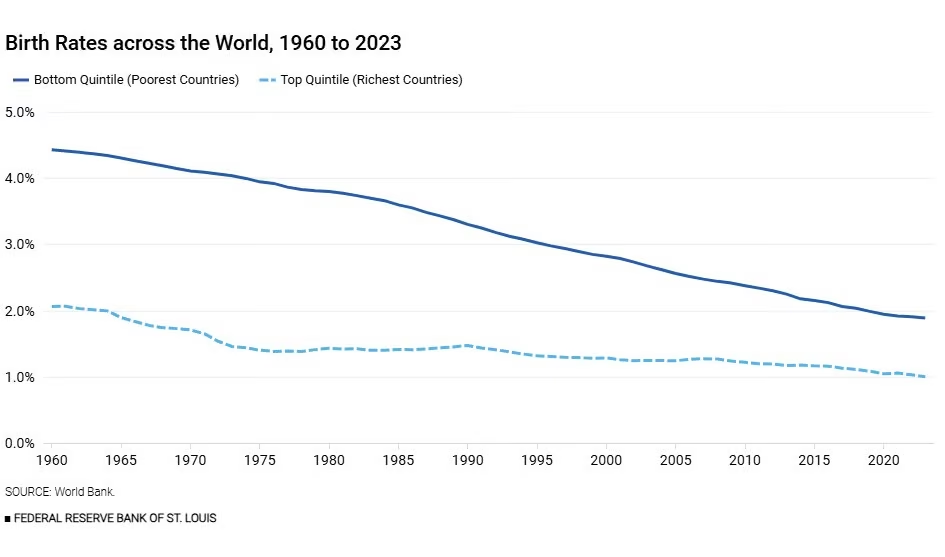
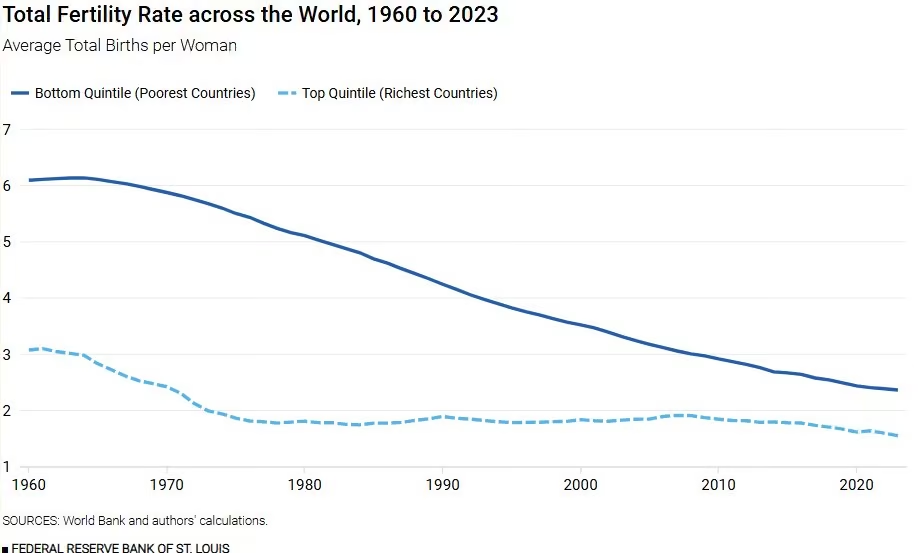
What shapes a country's population growth? And how might a country's income level play a role? www.stlouisfed.org/on-the-economy/2026/apr/drivers-popula…
-
St. Louis Fed
@stlouisfed
Chambers of commerce play a role in shaping local economies — from identifying growth opportunities to using data-driven insights to solve complex challenges.
"The first thing you try to do is get everyone on the same page and get the facts," says Randy Zook, president and CEO of the @ARStateChamber. "What are the real numbers?"
Here, Zook discusses his approach to serving both rural and metro communities across Arkansas. Watch to learn how the St. Louis Fed impacts that effort.
#federalreserve #smallbusiness #economicdevelopment #leadershipThis media couldn't be displayed. See it on the original post.
St. Louis Fed
@stlouisfed
Watch more conversations from local business leaders throughout our district: www.stlouisfed.org/about-us/your-fed-your-voice
-
St. Louis Fed
@stlouisfed
AI adoption has climbed for businesses of all sizes. The FRED Blog provides rankings by business size, but also by industry and AI provider fred.stlouisfed.org/blog/2026/10/which-businesses-are-usi…
-
St. Louis Fed
@stlouisfed
Permits to build privately owned U.S. housing were at a seasonally adjusted annual rate of 1.400 million units in September, a pace 0.2% below the August rate of 1.403 million and 3.0% below the September 2025 rate of 1.444 million fred.stlouisfed.org/graph/?g=1ZPbe
-
St. Louis Fed
@stlouisfed
Privately owned U.S. housing starts registered a seasonally adjusted annual rate of 1.221 million units in September. This rate was 5.2% below August's estimate of 1.288 million and 7.4% below the September 2025 rate of 1.319 million fred.stlouisfed.org/graph/?g=1ZPaL
-
St. Louis Fed
@stlouisfed
New insights from the St. Louis Fed: Research illustrates how inflation has behaved during past productivity booms and busts. Plus: an analysis of the banking industry’s recent performance and a look ahead to our annual professors conference. Find more in the latest issue of In Focus: News and Notes from the St. Louis Fed mailchi.mp/stls.frb.org/watch-president-musalems-qa-at-bl…
-
St. Louis Fed
@stlouisfed
The information sector, including software and publishing, has the highest AI adoption rates. Next in line? Finance and insurance, manufacturing, retail trade, health care and social assistance, construction, and accommodation and food services. Check the FRED Blog for more
-
St. Louis Fed
@stlouisfed
In the week ending Oct. 19, average U.S. diesel prices per gallon rose by 10 cents, to $6.28. Average gas prices per gallon ticked down 5 cents, to $4.28 fred.stlouisfed.org/graph/?g=1ZPIU
-
St. Louis Fed
@stlouisfed
Larger companies are adopting AI faster than smaller ones, according to Ramp data newly added to FRED. Check the details at the FRED Blog fred.stlouisfed.org/blog/2026/10/which-businesses-are-usi…
-
St. Louis Fed
@stlouisfed
Daily trade-weighted U.S. dollar index dipped to 114.7 as of Oct. 16 (January 2006=100). Want to track this index or others from the @federalreserve Foreign Exchange Rates - H.10 release? See FRED: fred.stlouisfed.org/release?rid=17
-
St. Louis Fed
@stlouisfed
AI adoption has climbed for businesses of all sizes. The FRED Blog provides rankings by business size, but also by industry and AI provider fred.stlouisfed.org/blog/2026/10/which-businesses-are-usi…
-
St. Louis Fed
@stlouisfed
The St. Louis Fed isn't just our staff and our buildings. We depend on people from around the district to provide real-time insights into the economy. Our boards of directors and advisory councils are a big part of that connection. They keep us up to date on what's happening in their communities and at their businesses, so we can work toward a strong and resilient economy for all.
🔗 See where those important voices are from at the link below. You can also see a map that shows communities where the St. Louis Fed engaged with other stakeholders — throughout Arkansas, Illinois, Indiana, Kentucky, Mississippi, Missouri and Tennessee — last year. www.stlouisfed.org/about-us/representing-engaging-communi… -
St. Louis Fed
@stlouisfed
Two borrowers, same income, same credit — but they face different odds of getting their mortgage approved when one is buying a traditional house and the other is purchasing a manufactured home. Why are manufactured homes “penalized” in mortgage lending? www.stlouisfed.org/on-the-economy/2026/oct/affordability-…
-
St. Louis Fed
@stlouisfed
If manufactured homes are less expensive than traditional single-family homes, why are they harder to finance? www.stlouisfed.org/on-the-economy/2026/oct/affordability-…
-
St. Louis Fed
@stlouisfed
About half of U.S. college students who have taken one econ course never take another one. Should introductory economics focus on math-heavy models — or on how core concepts can help students understand the world? A blog post including insights from educators and other experts explores the question #econedmonth #teachecon www.stlouisfed.org/open-vault/2026/oct/what-how-teach-pri…
-
St. Louis Fed
@stlouisfed
Apprenticeships in states that are part of the St. Louis Fed’s region have been on the rise since COVID-19. Which occupations are experiencing the most growth in this type of job training? Which have seen opportunities decline? www.stlouisfed.org/on-the-economy/2026/oct/exploring-appr…
-
St. Louis Fed
@stlouisfed
U.S. commercial paper outstanding fell to $1.48 trillion in the week ending Oct. 14, a decrease of $5.7 billion from a week earlier, per @federalreserve data. Commercial paper comprises short-term, promissory notes issued mostly by corporations fred.stlouisfed.org/graph/?g=1ZEyL
-
St. Louis Fed
@stlouisfed
In the week ending Oct. 10, seasonally adjusted initial claims for unemployment insurance benefits — those filed for the first time after a job loss — ticked up by 1,000, to 199,000. The four-week moving average ticked up by 250 to 198,500 fred.stlouisfed.org/graph/?g=1ZEse
-
St. Louis Fed
@stlouisfed
How much profit would you give up for convenience? Bond investors lately seem to be accepting lower yields for safer and tradable Treasuries, compared with AAA corporate bond yields. Visit the FRED Blog for more info fred.stlouisfed.org/blog/2026/10/Is-the-Treasury-convenie…
-
St. Louis Fed
@stlouisfed
U.S. retail and food service sales per @uscensusbureau were $745.0 billion in September, up 0.8% from the previous month. July's spending was revised, with a 1.3% increase alfred.stlouisfed.org/graph/?g=1ZEpt
-
St. Louis Fed
@stlouisfed
The producer price index for final demand — representing the wholesale cost of U.S. goods and services — increased 1.3% in September, following an upwardly revised 0.5% increase in August alfred.stlouisfed.org/graph/?g=1ZEMn
-
St. Louis Fed
@stlouisfed
Which occupations have seen a surge in active apprenticeships across states that are part of the Fed's Eighth District? www.stlouisfed.org/on-the-economy/2026/oct/exploring-appr…
-
St. Louis Fed
@stlouisfed
The consumer price index (CPI) increased a seasonally adjusted 0.6% in September. Excluding food and energy, “core” consumer prices increased 0.3% fred.stlouisfed.org/graph/?g=1ZCCm
-
St. Louis Fed
@stlouisfed
Think a cheaper home means the mortgage approval is easier? Not always. For manufactured homes, the price isn't the problem — the property is. New research digs into why www.stlouisfed.org/on-the-economy/2026/oct/affordability-…
-
St. Louis Fed
@stlouisfed
If manufactured homes are less expensive than traditional single-family homes, why are they harder to finance? www.stlouisfed.org/on-the-economy/2026/oct/affordability-…
-
St. Louis Fed
@stlouisfed
FRED has added 14 data series about the adoption of artificial intelligence (AI) by businesses. The AI Index from Ramp uses firms’ corporate spending on services from AI companies to estimate adoption rates by provider, industry and company size. Learn more:
-
St. Louis Fed
@stlouisfed
NEW: FRED has added 14 data series about artificial intelligence (AI) adoption by businesses reported by Ramp (@tryramp) fred.stlouisfed.org/news/2026/10/fred-adds-data-from-ramp…
-
St. Louis Fed
@stlouisfed
In the week ending Oct. 12, U.S. diesel and gas prices dipped for a third week in a row, to $6.18 and $4.33 per gallon, respectively fred.stlouisfed.org/graph/?g=1ZCD7
-
St. Louis Fed
@stlouisfed
Did you know you can find average price data in FRED — from the cost of ground beef and eggs to electricity and gasoline? Check those prices and more fred.stlouisfed.org/release?rid=454
-
St. Louis Fed
@stlouisfed
August survey results showed sales remained strong for businesses in the St. Louis Fed's region — despite their need to raise prices to customers. Read more survey results: www.stlouisfed.org/on-the-economy/2026/oct/eighth-distric…
-
St. Louis Fed
@stlouisfed
Manufactured houses offer an affordable alternative for many people. Yet the U.S. mortgage lending system isn't built to underwrite this type of home, creating a structural barrier for many seeking homeownership. Read the analysis: www.stlouisfed.org/on-the-economy/2026/oct/affordability-…
-
St. Louis Fed
@stlouisfed
In an August survey, firms in the St. Louis Fed's region reported the prices they charged to customers had risen 3% over the past year, and they expected the same increase in the next 12 months www.stlouisfed.org/on-the-economy/2026/oct/eighth-distric…
-
St. Louis Fed
@stlouisfed
Debt-to-income ratios, loan type, collateral, and lender behavior create compounding effects that make mortgages harder to get for first-time buyers www.stlouisfed.org/on-the-economy/2026/jun/mortgage-borro…
-
St. Louis Fed
@stlouisfed
What economic factors drive global differences in national incomes? www.stlouisfed.org/on-the-economy/2026/oct/why-does-per-c…
-
St. Louis Fed
@stlouisfed
Commodities — from the cocoa in your Halloween candy bars to the cotton in your jeans — are building blocks of usable goods and services. Commodity prices are generally driven by supply and demand factors, and understanding these can help you stay informed about the prices consumers see. Our blog explains: www.stlouisfed.org/open-vault/2025/dec/understanding-comm…
This media couldn't be displayed. See it on the original post. -
St. Louis Fed
@stlouisfed
Unemployment insurance isn’t always a simple yes-or-no program. Eligibility and benefit take-up both change as unemployment continues, offering important insights into how jobless workers access financial support. Read the analysis: www.stlouisfed.org/on-the-economy/2026/oct/unemployment-i…
-
St. Louis Fed
@stlouisfed
Utilities represent a significant cost for low-income households, who spend five times more in this area as a share of income than high-income households do. Read more: www.stlouisfed.org/on-the-economy/2026/oct/utility-cost-p…
-
St. Louis Fed
@stlouisfed
Per @BLS_gov release: U.S. export prices increased 2.2% in September amid higher prices for nonagricultural (+2.1%) and agricultural (+2.6%) exports. From a year earlier, prices advanced 11.6% — the largest year-over-year rise since July 2022 fred.stlouisfed.org/graph/?g=1ZGzs
-
St. Louis Fed
@stlouisfed
What are trading assets? And how much have they grown at the largest, most complex U.S. banks in recent years? www.stlouisfed.org/on-the-economy/2026/oct/banking-analyt…
-
St. Louis Fed
@stlouisfed
Per @BLS_gov release: U.S. import prices advanced 1.1% in September, driven by higher prices for nonfuel (+0.7%) and fuel (+4.8%) imports. From a year earlier, import prices were up 8.1% — the largest 12-month advance since July 2022 fred.stlouisfed.org/graph/?g=1ZGyu
-
St. Louis Fed
@stlouisfed
U.S. industrial production increased 0.7% in September, the largest monthly rise since April. Utilities output led the advance, climbing 3.5%, while manufacturing and mining activity edged up 0.3% and 0.2%, respectively fred.stlouisfed.org/graph/?g=1ZGwk
-
St. Louis Fed
@stlouisfed
On Oct. 16, the St. Louis Fed Economic News Index was projecting Q3 real GDP growth of 2.8% at an annual rate, down slightly from the prior week’s 2.9%. Our “nowcast” uses economic content from key monthly data releases to forecast the current quarter’s real GDP growth. Learn more: alfred.stlouisfed.org/graph/?g=1ZGtG
-
St. Louis Fed
@stlouisfed
The latest issue of In Focus: News and Notes from the St. Louis Fed is out now. Subscribe to get the next issue directly in your inbox: www.stlouisfed.org/subscribe-in-focus-news-and-notes
-
St. Louis Fed
@stlouisfed
Only looking at unemployment insurance participation right after a job loss can be misleading. New research by St. Louis Fed economist @SerdarBirinci9 and his co-authors shows eligibility and benefit use shift significantly over the duration of joblessness www.stlouisfed.org/on-the-economy/2026/oct/unemployment-i…
-
St. Louis Fed
@stlouisfed
More workers in states that are part of the St. Louis Fed’s region have gotten job training through apprenticeship programs in recent years. But challenges to continued growth remain — like low completion rates and difficulty in creating employer buy-in. Read more:
-
St. Louis Fed
@stlouisfed
The St. Louis Fed’s @MatuschkaLindo and Charles Gascon discuss economic conditions across the Eighth District and the rest of the nation in the latest Beige Book episode of the Timely Topics podcast www.stlouisfed.org/timely-topics/october-2026-beige-book-…
-
St. Louis Fed
@stlouisfed
Which state in the Fed’s Eighth District saw the biggest increase in apprenticeships after the Great Recession? After the COVID-19 recession? www.stlouisfed.org/on-the-economy/2026/oct/exploring-appr…
-
St. Louis Fed
@stlouisfed
U.S. Treasury securities offer a degree of safety and tradability that corporate bonds can’t provide. So, investors accept lower yields for Treasuries than for corporate bonds. How much lower? Lately, a little lower than usual. Check the FRED Blog for the data and discussion
-
St. Louis Fed
@stlouisfed
U.S. commercial paper outstanding fell to $1.48 trillion in the week ending Oct. 14, a decrease of $5.7 billion from a week earlier, per @federalreserve data. Commercial paper comprises short-term, promissory notes issued mostly by corporations fred.stlouisfed.org/graph/?g=1ZEyL
-
St. Louis Fed
@stlouisfed
In the week ending Oct. 15, the average fixed 30-year mortgage rate was unchanged at 7.40%. The average fixed 15-year mortgage rate ticked down to 6.71% fred.stlouisfed.org/graph/?g=1ZEtR
-
St. Louis Fed
@stlouisfed
In the week ending Oct. 10, seasonally adjusted initial claims for unemployment insurance benefits — those filed for the first time after a job loss — ticked up by 1,000, to 199,000. The four-week moving average ticked up by 250 to 198,500 fred.stlouisfed.org/graph/?g=1ZEse
-
St. Louis Fed
@stlouisfed
How much profit would you give up for convenience? Bond investors lately seem to be accepting lower yields for safer and tradable Treasuries, compared with AAA corporate bond yields. Visit the FRED Blog for more info fred.stlouisfed.org/blog/2026/10/Is-the-Treasury-convenie…
-
St. Louis Fed
@stlouisfed
U.S. retail and food service sales per @uscensusbureau were $745.0 billion in September, up 0.8% from the previous month. July's spending was revised, with a 1.3% increase alfred.stlouisfed.org/graph/?g=1ZEpt
-
St. Louis Fed
@stlouisfed
How much growth have apprenticeship programs in the states that are part of the St. Louis Fed’s region seen in recent years? How does this compare with the nation’s growth? www.stlouisfed.org/on-the-economy/2026/oct/exploring-appr…
-
St. Louis Fed
@stlouisfed
The Convenience of Treasuries
Treasuries offer a degree of safety and tradability that corporate bonds don’t, so investors accept lower yields for Treasuries in exchange for these benefits. This “Treasury convenience yield” is captured in the option-adjusted spread of the ICE BofA AAA U.S. Corporate Index, a dataset FRED provides.
This measure compares yields on the highest-rated corporate bonds with a Treasury yield curve, adjusting for options embedded in the corporate bonds.
The spread averaged 67 basis points during 2012-19, compared with 36 basis points from the beginning of 2025 to Oct 8, 2025. Lately, the spread has been wider than this recent average, but has moved unevenly.
Convenience is a factor, but there’s also corporate credit risk and liquidity conditions. Check the FRED Blog for a graph, a history and an explanation of the data fred.stlouisfed.org/blog/2026/10/Is-the-Treasury-convenie… -
St. Louis Fed
@stlouisfed
The producer price index for final demand — representing the wholesale cost of U.S. goods and services — increased 1.3% in September, following an upwardly revised 0.5% increase in August alfred.stlouisfed.org/graph/?g=1ZEMn
-
St. Louis Fed
@stlouisfed
Which occupations have seen a surge in active apprenticeships across states that are part of the Fed’s Eighth District? www.stlouisfed.org/on-the-economy/2026/oct/exploring-appr…
-
St. Louis Fed
@stlouisfed
What does St. Louis Fed President Alberto Musalem wish more people knew about the Fed? Find out in his Q&A on our blog. He also talks about the Fed’s decentralized structure, his FOMC meeting preparation and monetary policy independence www.stlouisfed.org/open-vault/2026/oct/president-musalem-…
-
St. Louis Fed
@stlouisfed
Two borrowers, same income, same credit — but they face different odds of getting their mortgage approved when one is buying a traditional house and the other is purchasing a manufactured home. Why?
Manufactured houses have persistently higher mortgage denial rates because of collateral concerns — including appraisal difficulties and property classification issues — independent of economic cycles or interest rates.
As a result, rural regions experience a “geographic penalty,” in which access to credit depends on local housing stock.
Without improvements to the institutional infrastructure for valuing and financing manufactured houses, this penalty will likely persist.
Read more: www.stlouisfed.org/on-the-economy/2026/oct/affordability-… -
St. Louis Fed
@stlouisfed
Beige Book: What is the latest picture of economic activity and employment in the communities served by the St. Louis Fed? www.stlouisfed.org/publications/beige-book
-
St. Louis Fed
@stlouisfed
What is the inflation outlook among businesses in the St. Louis Fed’s region? www.stlouisfed.org/on-the-economy/2026/oct/eighth-distric…
-
St. Louis Fed
@stlouisfed
There was less stress in the financial markets in the week ending Oct. 9 than in the previous week. The St. Louis Fed Financial Stress Index measured -0.72 compared with the prior week's -0.47 reading. (0=normal financial market conditions; a value below 0 suggests below-average stress) fred.stlouisfed.org/graph/?g=1ZCNM
-
St. Louis Fed
@stlouisfed
Sticky price CPI (slow-to-change consumer prices) rose 3.4% on an annualized basis in September, following a 3.1% increase in August. Graph and track the index from @AtlantaFed in FRED: fred.stlouisfed.org/graph/?g=1ZCOh
-
St. Louis Fed
@stlouisfed
The consumer price index (CPI) increased a seasonally adjusted 0.6% in September. Excluding food and energy, “core” consumer prices increased 0.3% fred.stlouisfed.org/graph/?g=1ZCCm
-
St. Louis Fed
@stlouisfed
The consumer price index rose 3.7% year-over-year in September, not seasonally adjusted, little changed from the previous month. Excluding food and energy, “core” consumer prices increased 2.6% in September fred.stlouisfed.org/graph/?g=1ZCC8
-
St. Louis Fed
@stlouisfed
NEW: FRED has added 14 data series about artificial intelligence (AI) adoption by businesses reported by Ramp (@tryramp) fred.stlouisfed.org/news/2026/10/fred-adds-data-from-ramp…
-
St. Louis Fed
@stlouisfed
Think a cheaper home means the mortgage approval is easier? Not always. For manufactured homes, the price isn’t the problem — the property is. New research digs into why www.stlouisfed.org/on-the-economy/2026/oct/affordability-…
-
St. Louis Fed
@stlouisfed
In the week ending Oct. 12, U.S. diesel and gas prices dipped for a third week in a row, to $6.18 and $4.33 per gallon, respectively fred.stlouisfed.org/graph/?g=1ZCD7
-
St. Louis Fed
@stlouisfed
Did you know you can find average price data in FRED — from the cost of ground beef and eggs to electricity and gasoline? Check those prices and more fred.stlouisfed.org/release?rid=454
-
St. Louis Fed
@stlouisfed
How is current economic activity in the Eighth Federal Reserve District? Find out in the latest Beige Book www.stlouisfed.org/publications/beige-book
-
St. Louis Fed
@stlouisfed
Businesses told the St. Louis Fed in an August survey they had seen steady cost increases over the previous 12 months. Despite these higher costs, many reported strong sales, mainly because of stable demand and higher volumes. Read more survey results: www.stlouisfed.org/on-the-economy/2026/oct/eighth-distric…
-
St. Louis Fed
@stlouisfed
If manufactured homes are less expensive than traditional single-family homes, why are they harder to finance? www.stlouisfed.org/on-the-economy/2026/oct/affordability-…
-
St. Louis Fed
@stlouisfed
August survey results showed sales remained strong for businesses in the St. Louis Fed’s region — despite their need to raise prices to customers. Read more survey results: www.stlouisfed.org/on-the-economy/2026/oct/eighth-distric…
-
St. Louis Fed
@stlouisfed
Manufactured houses offer an affordable alternative for many people. Yet the U.S. mortgage lending system isn’t built to underwrite this type of home, creating a structural barrier for many seeking homeownership. Read the analysis: www.stlouisfed.org/on-the-economy/2026/oct/affordability-…
-
St. Louis Fed
@stlouisfed
In an August survey, firms in the St. Louis Fed’s region reported the prices they charged to customers had risen 3% over the past year, and they expected the same increase in the next 12 months www.stlouisfed.org/on-the-economy/2026/oct/eighth-distric…
-
St. Louis Fed
@stlouisfed
First-time homebuyers face significantly higher mortgage denial rates than those purchasing a second home or an investment property. Reasons for this reflect more than differences in a few financial thresholds. What are they? www.stlouisfed.org/on-the-economy/2026/jun/mortgage-borro…
-
St. Louis Fed
@stlouisfed
Debt-to-income ratios, loan type, collateral, and lender behavior create compounding effects that make mortgages harder to get for first-time buyers www.stlouisfed.org/on-the-economy/2026/jun/mortgage-borro…
-
St. Louis Fed
@stlouisfed
What economic factors drive global differences in national incomes? www.stlouisfed.org/on-the-economy/2026/oct/why-does-per-c…
-
St. Louis Fed
@stlouisfed
Tight job markets benefit workers in general, but how do young adults and first-time job seekers fare specifically? www.stlouisfed.org/on-the-economy/2026/oct/how-much-do-yo…
-
St. Louis Fed
@stlouisfed
Commercial and industrial loans at all U.S. commercial banks grew by $17.9 billion to $2.97 trillion in the week ending Sept. 30. See the level over time in FRED: fred.stlouisfed.org/graph/?g=1Zt3K
-
St. Louis Fed
@stlouisfed
On Oct. 9, the St. Louis Fed Economic News Index was projecting Q3 real GDP growth of 2.9% at an annual rate, up from the prior week's 2.7%. Our “nowcast” uses economic content from key monthly data releases to forecast the current quarter's real GDP growth. Learn more:
-
St. Louis Fed
@stlouisfed
There was more stress in the financial markets in the week ending Oct. 2 than in the previous week. The St. Louis Fed Financial Stress Index measured -0.47 compared with the prior week's -0.81 reading. (0=normal financial market conditions; a value below 0 suggests below-average stress) fred.stlouisfed.org/graph/?g=1Zmwd
-
St. Louis Fed
@stlouisfed
In the week ending Oct. 3, seasonally adjusted initial claims for unemployment insurance benefits — those filed for the first time after a job loss — ticked down by 2,000, to 197,000. The four-week moving average fell by 2,500 to 198,000 fred.stlouisfed.org/graph/?g=1Zq2A
-
St. Louis Fed
@stlouisfed
U.S. commercial paper outstanding grew to $1.49 trillion in the week ending Oct. 7, an increase of $78.9 billion from a week earlier, per @federalreserve data. Commercial paper comprises short-term, promissory notes issued mostly by corporations fred.stlouisfed.org/graph/?g=1ZqgJ
-
St. Louis Fed
@stlouisfed
FRED has data on the assets that back pension funds: Assets for defined contribution pensions have grown far more than assets for defined benefit pensions. Check the FRED Blog for the definitions and details and a graph of the data fred.stlouisfed.org/blog/2026/10/assets-across-pension-types
-
St. Louis Fed
@stlouisfed
The U.S. trade deficit widened in August to $105.6 billion, growing $12.7 billion from a revised gap of $92.8 billion in July, per @uscensusbureau and @BEA_News fred.stlouisfed.org/graph/?g=1Zkdx
-
St. Louis Fed
@stlouisfed
Tortoise and the Hare: DB vs. DC Pensions
401(k)s are defined contribution (DC) pensions managed by the employees themselves, who tend to select riskier investments to maximize retirement income. Traditional pensions that pay a fixed income after retirement are defined benefit (DB) pensions managed by employers, who tend to choose safer investments to ensure they can meet their obligations.
From 2021 to 2026, DC pension assets grew from $9.20 trillion to $12.27 trillion, while DB assets fell from $3.68 trillion to $3.07 trillion.
But riskier investments are more exposed to downturns. In the Great Recession, DC pension assets fell 30%, from $3.73 trillion to $2.60 trillion, while the safer investments in DB pensions actually grew 5%, from $2.46 trillion to $2.58 trillion.
Check the FRED Blog for all the data fred.stlouisfed.org/blog/2026/10/assets-across-pension-types -
St. Louis Fed
@stlouisfed
Total U.S. consumer credit increased $8.3 billion in August after rising $17.7 billion in July. Nonrevolving credit (auto and student loans) rose $13.1 billion and revolving credit (credit cards) decreased $4.8 billion fred.stlouisfed.org/graph/?g=1Zn3P
-
St. Louis Fed
@stlouisfed
Daily spot prices for crude oil as of Oct. 6: Brent was at $125.44 a barrel and West Texas Intermediate crude oil was at $96.24 a barrel. For more, see FRED: fred.stlouisfed.org/graph/?g=1ZmPE
-
St. Louis Fed
@stlouisfed
There was more stress in the financial markets in the week ending Oct. 2 than in the previous week. The St. Louis Fed Financial Stress Index measured -0.47 compared with the prior week's -0.81 reading. (0=normal financial market conditions; a value below 0 suggests below-average stress) fred.stlouisfed.org/graph/?g=1Zmwd
-
St. Louis Fed
@stlouisfed
Did the severity of a U.S. metro area's unemployment during the COVID-19 recession affect future job gains for young workers? www.stlouisfed.org/on-the-economy/2026/oct/how-much-do-yo…
-
St. Louis Fed
@stlouisfed
How does economics explain the wide differences in countries' incomes across the globe? Read the analysis: www.stlouisfed.org/on-the-economy/2026/oct/why-does-per-c…
-
St. Louis Fed
@stlouisfed
The overall U.S. unemployment rate has been at or below 4.5% for nearly five years. What kind of difference has this stretch of labor market strength made for young workers? www.stlouisfed.org/on-the-economy/2026/oct/how-much-do-yo…
-
St. Louis Fed
@stlouisfed
Consider this: In 2024, about 60% of owner-occupied homes had mortgages and a little more than 30% of total annual household spending was devoted to housing. Is it any wonder that mortgage rates are one of the most watched and reported interest rates in the U.S. financial system?
But what determines mortgage rates? Because home mortgages are long-term (often 30-year) loans, bankers look at a wide variety of factors, including what they believe economic conditions and expectations will be during the duration of the loan, when they set the interest rate.
This new article explains how mortgage interest rates are connected to many parts of the economy, including mortgage-backed securities, Treasury notes and long-term expectations — and why the connection between monetary policy and mortgage rates is weaker than it is with short-term rates #teachecon www.stlouisfed.org/publications/page-one-economics/2026/o… -
St. Louis Fed
@stlouisfed
Labor market conditions indicators from @KansasCityFed suggest the level of activity declined modestly and momentum was little changed in September. Track the series in FRED: fred.stlouisfed.org/graph/?g=1ZkB3
-
St. Louis Fed
@stlouisfed
In the week ending Oct. 5, U.S. diesel and gas prices dipped for a second week in a row, to $6.20 and $4.35 per gallon, respectively fred.stlouisfed.org/graph/?g=1ZkfN
-
St. Louis Fed
@stlouisfed
How did your state do?
On Sept. 30, @BEA_News released real GDP data for all U.S. states for the second quarter of 2026.
• 44 of 50 state economies grew in the first quarter, as did Washington, D.C. The national average was 2.2% annualized growth.
• The median state (Iowa) grew at 1.7%, which is below the national average. A total of 31 states and D.C. had slower growth than the national average.
• New York had the fastest annualized growth, at 4%.
• Alaska, Kansas, Nebraska, North Dakota, West Virginia and Wyoming contracted, with West Virginia experiencing the steepest contraction, at –2.3% annualized.
Check the FRED Blog for all the data. fredblog.stlouisfed.org/2026/10/real-gdp-growth-by-state-… -
St. Louis Fed
@stlouisfed
The U.S. trade deficit widened in August to $105.6 billion, growing $12.7 billion from a revised gap of $92.8 billion in July, per @uscensusbureau and @BEA_News fred.stlouisfed.org/graph/?g=1Zkdx
-
St. Louis Fed
@stlouisfed
Employees with 401(k)s want to maximize their retirement income, so they often invest in higher risk/higher return assets such as stocks. Employers who manage traditional defined benefit pensions want to ensure they can fulfill their obligations to former employees, so they tend to invest in lower risk/lower return assets such as bonds. To see which strategy has performed better, check the FRED Blog fred.stlouisfed.org/blog/2026/10/assets-across-pension-types
-
St. Louis Fed
@stlouisfed
A strong labor market following the COVID-19 recession has been highly effective at helping improve young workers' employment opportunities, though gains differ across metro areas www.stlouisfed.org/on-the-economy/2026/oct/how-much-do-yo…
-
St. Louis Fed
@stlouisfed
Tortoise and the Hare: DB vs. DC Pensions
401(k)s are defined contribution (DC) pensions managed by the employees themselves, who tend to select riskier investments to maximize retirement income. Traditional pensions that pay a fixed income after retirement are defined benefit (DB) pensions managed by employers, who tend to choose safer investments to ensure they can meet their obligations.
From 2021 to 2026, DC pension assets grew from $9.20 trillion to $12.27 trillion, while DB assets fell from $3.68 trillion to $3.07 trillion.
But riskier investments are more exposed to downturns. In the Great Recession, DC pension assets fell 30%, from $3.73 trillion to $2.60 trillion, while the safer investments in DB pensions actually grew 5%, from $2.46 trillion to $2.58 trillion.
Check the FRED Blog for all the data fred.stlouisfed.org/blog/2026/10/assets-across-pension-types -
St. Louis Fed
@stlouisfed
Thanks to everyone who joined us in St. Louis or online for FRED Con, which brought the future of economic data storytelling into focus. The first-ever event explored AI, innovation and what’s next for economic data.
Catch up on the highlights: fred.stlouisfed.org/news/2026/08/fred-con-navigating-trus… -
St. Louis Fed
@stlouisfed
Commercial and industrial loans at all U.S. commercial banks grew by $17.9 billion to $2.97 trillion in the week ending Sept. 30. See the level over time in FRED: fred.stlouisfed.org/graph/?g=1Zt3K
-
St. Louis Fed
@stlouisfed
On Oct. 9, the St. Louis Fed Economic News Index was projecting Q3 real GDP growth of 2.9% at an annual rate, up from the prior week’s 2.7%. Our “nowcast” uses economic content from key monthly data releases to forecast the current quarter’s real GDP growth. Learn more:
-
St. Louis Fed
@stlouisfed
Tortoise and the hare: Assets behind traditional pensions tend to be safer with slower growth, while assets backing 401(k)s tend to grow fast but are more exposed to the risks of recessions. Check the FRED Blog for the full discussion and a graph of the data
-
St. Louis Fed
@stlouisfed
Tight job markets benefit workers in general, but how do young adults and first-time job seekers fare specifically? www.stlouisfed.org/on-the-economy/2026/oct/how-much-do-yo…
-
St. Louis Fed
@stlouisfed
After the COVID-19 recession in 2020, young workers saw greater employment gains in those U.S. metro areas that had less-severe joblessness and longer periods of low unemployment. Learn how these factors helped shape outcomes www.stlouisfed.org/on-the-economy/2026/oct/how-much-do-yo…
-
St. Louis Fed
@stlouisfed
In the week ending Oct. 3, seasonally adjusted initial claims for unemployment insurance benefits — those filed for the first time after a job loss — ticked down by 2,000, to 197,000. The four-week moving average fell by 2,500 to 198,000 fred.stlouisfed.org/graph/?g=1Zq2A
-
St. Louis Fed
@stlouisfed
A strong labor market following the COVID-19 recession has been highly effective at helping improve young workers’ employment opportunities, though gains differ across metro areas www.stlouisfed.org/on-the-economy/2026/oct/how-much-do-yo…
-
St. Louis Fed
@stlouisfed
In the week ending Oct. 8, the average fixed 30-year mortgage rate rose to 7.40%, the highest since November 2023. The average fixed 15-year mortgage rate increased to 6.73% fred.stlouisfed.org/graph/?g=1Zqgi
-
St. Louis Fed
@stlouisfed
U.S. commercial paper outstanding grew to $1.49 trillion in the week ending Oct. 7, an increase of $78.9 billion from a week earlier, per @federalreserve data. Commercial paper comprises short-term, promissory notes issued mostly by corporations fred.stlouisfed.org/graph/?g=1ZqgJ
-
St. Louis Fed
@stlouisfed
FRED has data on the assets that back pension funds: Assets for defined contribution pensions have grown far more than assets for defined benefit pensions. Check the FRED Blog for the definitions and details and a graph of the data fred.stlouisfed.org/blog/2026/10/assets-across-pension-types
-
St. Louis Fed
@stlouisfed
How long does unemployment need to remain extremely low for young workers to see meaningful job gains? For those new to the labor market? Find out more: www.stlouisfed.org/on-the-economy/2026/oct/how-much-do-yo…
-
St. Louis Fed
@stlouisfed
What are St. Louis Fed President Alberto Musalem’s current views on the U.S. economy, inflation and monetary policy? How does he interpret what’s happening in the bond market? He discussed these and other topics during a Q&A Thursday with Michael McKee at @Bloomberg’s The Future of Fixed Income event.
President Musalem noted inflation remains elevated and is being driven by persistent demand pressures and negative supply shocks. He emphasized the importance of bringing inflation back down to 2% in a timely manner and of containing any further broadening of inflationary pressures or second-round effects.
Watch the Q&A: www.bloomberg.com/news/videos/2026-10-08/fed-s-musalem-si… -
St. Louis Fed
@stlouisfed
Don’t miss St. Louis Fed President Alberto G. Musalem’s conversation with Michael McKee at @Bloomberg’s The Future of Fixed Income event. Watch live beginning at 12:40 p.m. CT / 1:40 p.m. ET today: www.bloomberg.com/live/stream
-
St. Louis Fed
@stlouisfed
The U.S. trade deficit widened in August to $105.6 billion, growing $12.7 billion from a revised gap of $92.8 billion in July, per @uscensusbureau and @BEA_News fred.stlouisfed.org/graph/?g=1Zkdx
-
St. Louis Fed
@stlouisfed
Total U.S. consumer credit increased $8.3 billion in August after rising $17.7 billion in July. Nonrevolving credit (auto and student loans) rose $13.1 billion and revolving credit (credit cards) decreased $4.8 billion fred.stlouisfed.org/graph/?g=1Zn3P
-
St. Louis Fed
@stlouisfed
The overall U.S. unemployment rate has been at or below 4.5% for nearly five years. What kind of difference has this stretch of labor market strength made for young workers? www.stlouisfed.org/on-the-economy/2026/oct/how-much-do-yo…
-
St. Louis Fed
@stlouisfed
Daily spot prices for crude oil as of Oct. 6: Brent was at $125.44 a barrel and West Texas Intermediate crude oil was at $96.24 a barrel. For more, see FRED: fred.stlouisfed.org/graph/?g=1ZmPE
-
St. Louis Fed
@stlouisfed
There was more stress in the financial markets in the week ending Oct. 2 than in the previous week. The St. Louis Fed Financial Stress Index measured -0.47 compared with the prior week's -0.81 reading. (0=normal financial market conditions; a value below 0 suggests below-average stress) fred.stlouisfed.org/graph/?g=1Zmwd
-
St. Louis Fed
@stlouisfed
Did the severity of a U.S. metro area’s unemployment during the COVID-19 recession affect future job gains for young workers? www.stlouisfed.org/on-the-economy/2026/oct/how-much-do-yo…
-
St. Louis Fed
@stlouisfed
Don’t miss St. Louis Fed President Alberto Musalem’s conversation with Michael McKee at @Bloomberg’s The Future of Fixed Income event. Watch live Thursday beginning at 12:40 p.m. CT / 1:40 p.m. ET: www.bloomberg.com/live/stream
-
St. Louis Fed
@stlouisfed
Explore why mortgage rates follow 10-year Treasury yields and mortgage-backed securities rather than the federal funds rate #teachecon www.stlouisfed.org/publications/page-one-economics/2026/o…
-
St. Louis Fed
@stlouisfed
How does economics explain the wide differences in countries' incomes across the globe? Read the analysis: www.stlouisfed.org/on-the-economy/2026/oct/why-does-per-c…
-
St. Louis Fed
@stlouisfed
Labor market conditions indicators from @KansasCityFed suggest the level of activity declined modestly and momentum was little changed in September. Track the series in FRED: fred.stlouisfed.org/graph/?g=1ZkB3
-
St. Louis Fed
@stlouisfed
In the week ending Oct. 5, U.S. diesel and gas prices dipped for a second week in a row, to $6.20 and $4.35 per gallon, respectively fred.stlouisfed.org/graph/?g=1ZkfN
-
St. Louis Fed
@stlouisfed
How did your state do?
On Sept. 30, @BEA_News released real GDP data for all U.S. states for the second quarter of 2026.
• 44 of 50 state economies grew in the first quarter, as did Washington, D.C. The national average was 2.2% annualized growth.
• The median state (Iowa) grew at 1.7%, which is below the national average. A total of 31 states and D.C. had slower growth than the national average.
• New York had the fastest annualized growth, at 4%.
• Alaska, Kansas, Nebraska, North Dakota, West Virginia and Wyoming contracted, with West Virginia experiencing the steepest contraction, at –2.3% annualized.
Check the FRED Blog for all the data. fredblog.stlouisfed.org/2026/10/real-gdp-growth-by-state-… -
St. Louis Fed
@stlouisfed
The U.S. trade deficit widened in August to $105.6 billion, growing $12.7 billion from a revised gap of $92.8 billion in July, per @uscensusbureau and @BEA_News fred.stlouisfed.org/graph/?g=1Zkdx
-
St. Louis Fed
@stlouisfed
Ireland’s per capita income, based on GDP in current dollars, is expected to be $140,186 this year, while Yemen’s per capita income will be only $384. What economic forces shape such large differences in national incomes? www.stlouisfed.org/on-the-economy/2026/oct/why-does-per-c…
-
St. Louis Fed
@stlouisfed
Daily trade-weighted U.S. dollar index dipped to 114.9 as of Oct. 2 (January 2006=100). Want to track this index or others from the @federalreserve Foreign Exchange Rates - H.10 release? See FRED: fred.stlouisfed.org/release?rid=17
-
St. Louis Fed
@stlouisfed
What happens when unlimited wants are confronted by a limited supply of goods, services, time, money and opportunities? www.stlouisfed.org/open-vault/2020/january/real-life-exam… #tradeoffs #opportunitycost
-
St. Louis Fed
@stlouisfed
Consider this: In 2024, about 60% of owner-occupied homes had mortgages and a little more than 30% of total annual household spending was devoted to housing. Is it any wonder that mortgage rates are one of the most watched and reported interest rates in the U.S. financial system?
But what determines mortgage rates? Because home mortgages are long-term (often 30-year) loans, bankers look at a wide variety of factors, including what they believe economic conditions and expectations will be during the duration of the loan, when they set the interest rate.
This new article explains how mortgage interest rates are connected to many parts of the economy, including mortgage-backed securities, Treasury notes and long-term expectations — and why the connection between monetary policy and mortgage rates is weaker than it is with short-term rates #teachecon www.stlouisfed.org/publications/page-one-economics/2026/o… -
St. Louis Fed
@stlouisfed
Between 2014 and 2021, across the Midwest and South, rural communities received just 22 cents for every $1 invested per capita in an urban community.
In conversations across the St. Louis Fed’s District, rural business and community development leaders explained how they address those kinds of capital gaps. Read what they had to say: www.stlouisfed.org/open-vault/2026/sep/what-four-towns-ta… -
St. Louis Fed
@stlouisfed
Workers with a college degree earn more on average than workers with only a high school diploma. How does this college premium change over a career? www.stlouisfed.org/on-the-economy/2026/aug/how-does-colle…
-
St. Louis Fed
@stlouisfed
How does economics explain the wide differences in countries’ incomes across the globe? Read the analysis: www.stlouisfed.org/on-the-economy/2026/oct/why-does-per-c…
-
St. Louis Fed
@stlouisfed
What does the September #jobsreport reveal about the state of the U.S. labor market? Find out from our Flash Report, which analyzes unemployment flows www.stlouisfed.org/on-the-economy/2026/oct/flash-report-u…
-
St. Louis Fed
@stlouisfed
Key economic research shows differences in capital, skills, productivity, and economic and political institutions play an important role in shaping output and income variations across countries www.stlouisfed.org/on-the-economy/2026/oct/why-does-per-c…
-
St. Louis Fed
@stlouisfed
In the week ending Sept. 26, seasonally adjusted initial claims for unemployment insurance benefits — those filed for the first time after a job loss — ticked down by 1,000, to 197,000. The four-week moving average fell by 2,500 to 200,000 fred.stlouisfed.org/graph/?g=1Z9R1
-
St. Louis Fed
@stlouisfed
Get the rundown on U.S. banks' latest profitability, credit quality, liquidity and capital metrics www.stlouisfed.org/on-the-economy/2026/sep/banking-analyt…
-
St. Louis Fed
@stlouisfed
Home mortgage interest rates are connected to many parts of the economy, including mortgage-backed securities, Treasury notes and long-term expectations. Read more about these dynamics #teachecon www.stlouisfed.org/publications/page-one-economics/2026/o…
-
St. Louis Fed
@stlouisfed
Of the 50 U.S. state economies, 44 grew in the second quarter of 2026, as did Washington, D.C. Alaska, Kansas, Nebraska, North Dakota, West Virginia and Wyoming contracted. Check @BEA_News data in the FRED Blog to see precisely how your state fared fredblog.stlouisfed.org/2026/10/real-gdp-growth-by-state-…
-
St. Louis Fed
@stlouisfed
Why does the 10-year Treasury note act as a benchmark for mortgage rates? This essay explains #teachecon www.stlouisfed.org/publications/page-one-economics/2026/o…
-
St. Louis Fed
@stlouisfed
What economic factors drive global differences in national incomes? www.stlouisfed.org/on-the-economy/2026/oct/why-does-per-c…
-
St. Louis Fed
@stlouisfed
U.S. banking industry performance in five key indicators: www.stlouisfed.org/on-the-economy/2026/sep/banking-analyt…
-
St. Louis Fed
@stlouisfed
Average fixed mortgage rates rose in the week ending Oct. 1, to 7.3% for the 30-year and 6.6% for the 15-year, the highest levels since November 2023 fred.stlouisfed.org/graph/?g=1Z9SS
-
St. Louis Fed
@stlouisfed
From a low of -2.3% in West Virginia to a high of +4% in New York, the FRED Blog maps economic growth data for the second quarter of 2026 for all 50 states fredblog.stlouisfed.org/2026/10/real-gdp-growth-by-state-…
-
St. Louis Fed
@stlouisfed
Discover why the 10-year Treasury note is the key benchmark for mortgage rates — and why the connection between monetary policy and mortgage rates is weaker than it is with short-term rates #teachecon www.stlouisfed.org/publications/page-one-economics/2026/o…
-
St. Louis Fed
@stlouisfed
On Oct. 2, the St. Louis Fed Economic News Index was projecting Q3 real GDP growth of 2.7% at an annual rate, down from the prior week’s 3.2%. Our “nowcast” uses economic content from key monthly data releases to forecast the current quarter’s real GDP growth. Learn more:
-
St. Louis Fed
@stlouisfed
Average hourly earnings for all employees on private nonfarm payrolls rose 5 cents to $37.81 in September, per @BLS_gov. From a year earlier, average hourly earnings were up 3.0%, or $1.11 fred.stlouisfed.org/graph/?g=1ZcWR
-
St. Louis Fed
@stlouisfed
Our Flash Report examines how the number of people losing jobs, finding jobs, entering the labor force, or leaving the workforce altogether combined to keep unemployment little changed in September.
• Headline unemployment rose from 4.1% in August to 4.2% in September. More precise data show the rate increased only slightly, from 4.141% to 4.175%.
• This very modest uptick was primarily driven by two offsetting forces: more unemployed people chose to keep looking for work, and more unemployed people found jobs.
• Nonfarm payroll growth slowed in September to 29,000 jobs — less than half as many as forecasts expected.
Check out the full analysis of the latest #jobsreport, just out today, for a deeper look at what these moves tell us about U.S. labor market conditions. www.stlouisfed.org/on-the-economy/2026/oct/flash-report-u… -
St. Louis Fed
@stlouisfed
The U.S. labor force participation rate increased slightly in September, to 61.8%. For participation rates by educational attainment, race, sex and other categories, see FRED: fred.stlouisfed.org/graph/?g=1ZcV2
-
St. Louis Fed
@stlouisfed
U.S. commercial paper outstanding fell to $1.41 trillion in the week ending Sept. 30, a decrease of $55.2 billion from a week earlier, per @federalreserve data. Commercial paper comprises short-term, promissory notes issued mostly by corporations fred.stlouisfed.org/graph/?g=1Zd0w
-
St. Louis Fed
@stlouisfed
In September, total nonfarm payrolls increased by 29,000 after rising by 133,000 (revised down) in August. July’s reading was also revised down to show a loss of 10,000. Combined, the revisions show employment in July and August as 60,000 lower than previously reported
-
St. Louis Fed
@stlouisfed
What does the September #jobsreport reveal about the state of the U.S. labor market? Find out from our Flash Report, which analyzes unemployment flows www.stlouisfed.org/on-the-economy/2026/oct/flash-report-u…
-
St. Louis Fed
@stlouisfed
How much did your state’s economy grow in the second quarter of 2026? Check the FRED Blog’s map of freshly released data from @BEA_News fredblog.stlouisfed.org/2026/10/real-gdp-growth-by-state-…
-
St. Louis Fed
@stlouisfed
In September, the nation’s unemployment rate ticked up to 4.2% from the previous month’s 4.1%. The underemployment rate, which tracks those marginally attached to the labor force and people working part time for economic reasons, declined slightly, to 7.6% fred.stlouisfed.org/graph/?g=1ZcA3
-
St. Louis Fed
@stlouisfed
The #jobsreport, just out today, shows unemployment increased from 4.1% in August to 4.2% in September. Our Flash Report looks at how people moving into and out of unemployment and the labor force combined to affect the U.S. jobless rate www.stlouisfed.org/on-the-economy/2026/oct/flash-report-u…
-
St. Louis Fed
@stlouisfed
Profitability at U.S. banks hit its highest level since 2021. How did other measures of banking sector health look in the second quarter? www.stlouisfed.org/on-the-economy/2026/sep/banking-analyt…
-
St. Louis Fed
@stlouisfed
How much did the U.S. banking sector grow in the second quarter? Find out in our overview of current industry conditions: www.stlouisfed.org/on-the-economy/2026/sep/banking-analyt…
-
St. Louis Fed
@stlouisfed
Total U.S. construction spending rose 0.9% to a seasonally adjusted annual rate of $2.2 trillion in August, per @uscensusbureau fred.stlouisfed.org/graph/?g=1Z9RN
-
St. Louis Fed
@stlouisfed
In the week ending Sept. 26, seasonally adjusted initial claims for unemployment insurance benefits — those filed for the first time after a job loss — ticked down by 1,000, to 197,000. The four-week moving average fell by 2,500 to 200,000 fred.stlouisfed.org/graph/?g=1Z9R1
-
St. Louis Fed
@stlouisfed
Get the rundown on U.S. banks’ latest profitability, credit quality, liquidity and capital metrics www.stlouisfed.org/on-the-economy/2026/sep/banking-analyt…
-
St. Louis Fed
@stlouisfed
Average fixed mortgage rates rose in the week ending Oct. 1, to 7.3% for the 30-year and 6.6% for the 15-year, the highest levels since November 2023 fred.stlouisfed.org/graph/?g=1Z9SS
-
St. Louis Fed
@stlouisfed
How did your state do?
On Sept. 30, @BEA_News released real GDP data for all U.S. states for the second quarter of 2026.
• 44 of 50 state economies grew in the first quarter, as did Washington, D.C. The national average was 2.2% annualized growth.
• The median state (Iowa) grew at 1.7%, which is below the national average. A total of 31 states and D.C. had slower growth than the national average.
• New York had the fastest annualized growth, at 4%.
• Alaska, Kansas, Nebraska, North Dakota, West Virginia and Wyoming contracted, with West Virginia experiencing the steepest contraction, at –2.3% annualized.
Check the FRED Blog for all the data. fredblog.stlouisfed.org/2026/10/real-gdp-growth-by-state-… -
St. Louis Fed
@stlouisfed
FRED is all about ensuring the public has easy access to reliable economic data. Be sure to check out FRED Con’s final panel session, Accessible for All, starting in just a few minutes news.research.stlouisfed.org/2026/08/fred-con-navigating-…
-
St. Louis Fed
@stlouisfed
Want a sneak peek at FRED’s future? Check out the demo of FRED’s MCP Connector at 2:25 p.m. CT news.research.stlouisfed.org/2026/08/fred-con-navigating-…
-
St. Louis Fed
@stlouisfed
Data can tell powerful stories. Be sure to check out FRED Con’s panel of data storytelling experts at 1:15 p.m. CT news.research.stlouisfed.org/2026/08/fred-con-navigating-…
-
St. Louis Fed
@stlouisfed
Be sure to tune into FRED Con today! Next up: a conversation about the importance of trust in economic data news.research.stlouisfed.org/2026/08/fred-con-navigating-…
-
St. Louis Fed
@stlouisfed
Want a sneak peek at FRED’s future? Check out the demo of FRED’s MCP Connector at 10:40 a.m. CT news.research.stlouisfed.org/2026/08/fred-con-navigating-…
-
St. Louis Fed
@stlouisfed
📺 LIVE NOW: Join us on YouTube for FREDcon. The future of economic data is here—what comes next?
Watch now: news.research.stlouisfed.org/2026/08/fred-con-navigating-… -
St. Louis Fed
@stlouisfed
Daily spot prices for crude oil as of Sept. 29: Brent was at $113.96 a barrel and West Texas Intermediate crude oil was at $96.16 a barrel. For more, see FRED: fred.stlouisfed.org/graph/?g=1Z8l9
-
St. Louis Fed
@stlouisfed
FRED Con starts at 9 a.m. CT. Our one-day livestreamed conference is dedicated to exploring the now and next of economic data. Watch: news.research.stlouisfed.org/2026/08/fred-con-navigating-…
-
St. Louis Fed
@stlouisfed
In August, the U.S. personal saving rate fell for the first time since April, to 4.1% of disposable income, down from 4.6% in July fred.stlouisfed.org/graph/?g=1Z7Uq
-
St. Louis Fed
@stlouisfed
The total number of motor vehicles sold in the U.S. rose in August, to a seasonally adjusted annual rate of 17.0 million units — an increase of 2.4% from July and up 1.4% from August 2025 fred.stlouisfed.org/graph/?g=1Z8A4
-
St. Louis Fed
@stlouisfed
There was slightly less stress in the financial markets in the week ending Sept. 25 than in the previous week. The St. Louis Fed Financial Stress Index measured -0.81 compared with the prior week's -0.70 reading. (0=normal financial market conditions; a value below 0 suggests below-average stress) fred.stlouisfed.org/graph/?g=1Z8zV
-
St. Louis Fed
@stlouisfed
Trimmed mean PCE inflation rate — an alternative measure of core inflation from @DallasFed — was 2.2% for the 12 months ending in August, down from July's reading of 2.3% fred.stlouisfed.org/graph/?g=1Z8zX
-
St. Louis Fed
@stlouisfed
Third and final estimate: GDP increased at an annual rate of 2.2% in the second quarter of 2026, up from the 1.5% rise in the second estimate. See comprehensive revisions to previous data by @BEA_News in archival database ALFRED: alfred.stlouisfed.org/graph/?g=1Z7TX
-
St. Louis Fed
@stlouisfed
How did the U.S. banking sector perform in the second quarter? These five key metrics offer a snapshot: www.stlouisfed.org/on-the-economy/2026/sep/banking-analyt…
-
St. Louis Fed
@stlouisfed
In August, the personal consumption expenditures (PCE) price index increased at an annual rate of 3.4%, little changed from July's rate. Excluding food and energy costs, the “core” PCE price index held at 3.0% on a 12-month basis fred.stlouisfed.org/graph/?g=1Z7UQ
-
St. Louis Fed
@stlouisfed
FRED Con is tomorrow — we hope you can virtually join our livestreamed conference dedicated to exploring the now and next of economic data. Learn more about the conference and how you can watch: FRED Con: news.research.stlouisfed.org/2026/08/fred-con-navigating-…
-
St. Louis Fed
@stlouisfed
How does economic research affect you?
The St. Louis Fed’s economic research team has been making an important difference in the health of the nation’s economy for decades. Our researchers rank in the top 1% of research institutions worldwide (according to RePEc). They focus all of that expertise to benefit the people we serve.
Hear from them about why they've chosen this form of public service and why it matters for you.This media couldn't be displayed. See it on the original post. -
St. Louis Fed
@stlouisfed
Daily trade-weighted U.S. dollar index dipped to 113.9 on Sept. 25 after reaching a two-month high of 114.2 on Sept. 24 (January 2006=100). To track this index or others from the @federalreserve Foreign Exchange Rates - H.10 release, check out FRED fred.stlouisfed.org/graph/?g=1Z5aZ
-
St. Louis Fed
@stlouisfed
In the week ending Sept. 28, average U.S. diesel prices per gallon fell by 15 cents, to $6.38. Average gas prices per gallon ticked down by 1 cent, to $4.47 fred.stlouisfed.org/graph/?g=1Z6FK
-
St. Louis Fed
@stlouisfed
See FRED for the latest @BLS_gov data on job openings by census region and sector #jolts fred.stlouisfed.org/release/tables?rid=192&eid=6615
-
St. Louis Fed
@stlouisfed
In August, U.S. job separations fell by 58,000, to 5.1 million. Within separations, quits and layoffs and discharges decreased, to 3.1 million and 1.6 million, respectively #jolts fred.stlouisfed.org/graph/?g=1Z6yl
-
St. Louis Fed
@stlouisfed
Total nonfarm job openings fell in August, to 7.1 million, down 256,000 from July's upwardly revised number. Hires ticked up by 46,000, to 5.2 million fred.stlouisfed.org/graph/?g=1Z6xF
-
St. Louis Fed
@stlouisfed
As is the case for households and businesses, even the federal government needs an account to manage its bills and receive income from various sources. This account, provided by the Federal Reserve in its role as fiscal agent, is called the Treasury general account.
Check the FRED Blog for more discussion: fredblog.stlouisfed.org/2026/09/what-is-the-treasury-gene… -
St. Louis Fed
@stlouisfed
Curious about the job market, housing trends, or banking stats? Our newsletter brings you research-backed stories on AI in the workplace, the rent vs. buy debate, and lending by major banks. Don't miss out — sign up today! www.stlouisfed.org/subscribe-in-focus-news-and-notes
-
St. Louis Fed
@stlouisfed
How and what should the Federal Reserve communicate regarding monetary policy?
St. Louis Fed President Alberto Musalem addressed the topic today during an event hosted by @CFMUK (the Centre For Macroeconomics) at @LSEnews (the London School of Economics and Political Science). He shared his view that a central bank should communicate how it turns incoming information into monetary policy – the framework for policy decisions. President Musalem discussed three gains from having a clearly communicated framework: smoother monetary policy transmission, better economic outcomes and stronger accountability to the public.
Following his speech, he participated in a Q&A moderated by @R2Rsquared (Ricardo Reis), A. W. Phillips Professor of Economics at LSE.
View President Musalem’s remarks: www.stlouisfed.org/from-the-president/remarks/2026/how-an… -
St. Louis Fed
@stlouisfed
Mark your calendar: St. Louis Fed President Alberto Musalem will speak at 12:30 p.m. CT/1:30 p.m. ET today at an event hosted by @CFMUK (the Centre For Macroeconomics) at @LSEnews (the London School of Economics and Political Science). He will give remarks on central bank communications and participate in a Q&A.
Register for the event: www.lse.ac.uk/events/monetary-policy -
St. Louis Fed
@stlouisfed
The latest data from the FOMC are now on the FRED Blog, including the median economic projections for growth fredblog.stlouisfed.org/2026/09/fomc-summary-of-economic-…
-
St. Louis Fed
@stlouisfed
Want to know how much is in the U.S. government’s checking account? As of Sept. 23, it was $947,317,000. Check the FRED Blog and this FRED graph every Wednesday for the updates fredblog.stlouisfed.org/2026/09/what-is-the-treasury-gene…
-
St. Louis Fed
@stlouisfed
Commercial and industrial loans at all U.S. commercial banks dipped by $2.4 billion in the week ending Sept. 16, to $2.97 trillion, for the first decline in eight weeks fred.stlouisfed.org/graph/?g=1Z4HY
-
St. Louis Fed
@stlouisfed
In our latest newsletter, see how AI is being used on the job, when renting is cheaper than buying, and how lending by the biggest U.S. banks has changed www.stlouisfed.org/subscribe-in-focus-news-and-notes
-
St. Louis Fed
@stlouisfed
Analysis: A boom in an industry’s labor productivity can help slow producer price inflation. Learn how: www.stlouisfed.org/on-the-economy/2026/sep/do-productivit…
-
St. Louis Fed
@stlouisfed
When you hear reports about the federal government's financial situation, the information is often based on the money flowing into and out of the Treasury general account. Visit the FRED Blog for the data and details on this account fredblog.stlouisfed.org/2026/09/what-is-the-treasury-gene…
-
St. Louis Fed
@stlouisfed
Mark your calendar: St. Louis Fed President Alberto Musalem will speak at 12:30 p.m. CT/1:30 p.m. ET Tuesday at an event hosted by @CFMUK (the Centre For Macroeconomics) at @LSEnews (the London School of Economics and Political Science). He will give remarks on central bank communications and participate in a Q&A.
Register for the event: www.lse.ac.uk/events/monetary-policy -
St. Louis Fed
@stlouisfed
New research shows unusually strong growth in labor productivity tends to slow producer price inflation — at the industry level. How might AI-driven efficiency gains fit into this picture? www.stlouisfed.org/on-the-economy/2026/sep/do-productivit…
-
St. Louis Fed
@stlouisfed
The latest data from the FOMC are now on the FRED Blog, including the median economic projections for growth fredblog.stlouisfed.org/2026/09/fomc-summary-of-economic-…
-
St. Louis Fed
@stlouisfed
Securities-based loans and lending to nondepository financial institutions have become increasingly important for U.S. banks identified as being global systemically important banks. Read the analysis: www.stlouisfed.org/on-the-economy/2026/sep/banking-analyt…
-
St. Louis Fed
@stlouisfed
Global systemically important banks, or GSIBs, are the world's largest and most complex. Eight such banks are based in the U.S. How have their lending practices changed in recent years? www.stlouisfed.org/on-the-economy/2026/sep/banking-analyt…
-
St. Louis Fed
@stlouisfed
In August 2026, the Risk of Recession Was 0.08%
A couple of economists have developed a dataset that shows, each month, the probability the U.S. economy is in recession.
Because they use timely indicators to calculate these estimates, the data for any given month are available on the first business day of the next month.
The values closely match the recession dates from the NBER, whose dating process takes a bit longer. But there are also some false positives associated with this dataset: Several spikes in the probability of recession, such as the ones around October 1998 and March 2023, did not develop into actual recessions.
Check the FRED Blog for the data and discussion fredblog.stlouisfed.org/2026/09/estimating-the-risk-of-re… -
St. Louis Fed
@stlouisfed
U.S. commercial paper outstanding grew to $1.46 trillion in the week ending Sept. 23, an increase of $19.8 billion from a week earlier, per @federalreserve data. Commercial paper comprises short-term, promissory notes issued mostly by corporations fred.stlouisfed.org/graph/?g=1Z0r6
-
St. Louis Fed
@stlouisfed
Publicly traded options reflect expectations about future economic conditions. The @KansasCityFed uses options prices to measure how financial markets perceive the future of short-term interest rates. Check the FRED Blog for the data and discussion fredblog.stlouisfed.org/2026/09/using-options-prices-to-m…
-
St. Louis Fed
@stlouisfed
Productivity and inflation: What happens to producer prices across U.S. industries when productivity soars? www.stlouisfed.org/on-the-economy/2026/sep/do-productivit…
-
St. Louis Fed
@stlouisfed
On Sept. 25, the St. Louis Fed Economic News Index was projecting Q3 real GDP growth of 3.2% at an annual rate, up from the prior week’s 3.1%. Our “nowcast” uses economic content from key monthly data releases to forecast the current quarter’s real GDP growth. Learn more:
-
St. Louis Fed
@stlouisfed
In “Measuring Capital Controls: Data, Methods, and Trade-offs across De Jure and De Facto Measures,” St. Louis Fed economist Paulina Restrepo-Echavarria (@paures12) and research associate Mickenzie Bass review the approaches to measuring capital controls—both the official, legal restrictions and the actual frictions that exist in practice.
Read the full academic analysis www.stlouisfed.org/publications/review/2026/sep/measuring… -
St. Louis Fed
@stlouisfed
Median sales price of new U.S. houses sold in August was $393,700 — an increase of $1,500 (or 0.4%) from July, but a decrease of $24,200 (or 5.8%) from August 2025 fred.stlouisfed.org/graph/?g=1YXBO
-
St. Louis Fed
@stlouisfed
How do prices behave during productivity booms and busts in U.S. industries? What might past booms tell us about AI’s potential to tamp down inflation? New research looks at these questions www.stlouisfed.org/on-the-economy/2026/sep/do-productivit…
-
St. Louis Fed
@stlouisfed
Sales of new U.S. single-family homes ticked up 6.4% in August to a seasonally adjusted annual rate of 684,000 units. July's sales pace was revised higher by @uscensusbureau, at 643,000 units from the previously reported 607,000 alfred.stlouisfed.org/graph/?g=1YXAP
-
St. Louis Fed
@stlouisfed
There was slightly less stress in the financial markets in the week ending Sept. 18 than in the previous week. The St. Louis Fed Financial Stress Index measured -0.91 compared with the prior week's -0.85 reading. (0=normal financial market conditions; a value below 0 suggests below-average stress) fred.stlouisfed.org/graph/?g=1YVMw
-
St. Louis Fed
@stlouisfed
When an industry experiences a boom in productivity, do producer prices in that industry rise more slowly than they do in others? Find out: www.stlouisfed.org/on-the-economy/2026/sep/do-productivit…
-
St. Louis Fed
@stlouisfed
“Measuring Capital Controls”: Recent academic research from the St. Louis Fed defines and summarizes capital control measures and differentiates between what's officially on the books and what actually binds capital flows in practice www.stlouisfed.org/publications/review/2026/sep/measuring…
-
St. Louis Fed
@stlouisfed
Because of their simplicity, economic models can be a powerful tool for testing economic hypotheses and theories. But building a model that looks at the entire economy is far from simple: www.stlouisfed.org/open-vault/2026/april/modeling-us-economy
-
St. Louis Fed
@stlouisfed
In August 2026, the Risk of Recession Was 0.08%
A couple of economists have developed a dataset that shows, each month, the probability the U.S. economy is in recession.
Because they use timely indicators to calculate these estimates, the data for any given month are available on the first business day of the next month.
The values closely match the recession dates from the NBER, whose dating process takes a bit longer. But there are also some false positives associated with this dataset: Several spikes in the probability of recession, such as the ones around October 1998 and March 2023, did not develop into actual recessions.
Check the FRED Blog for the data and discussion fredblog.stlouisfed.org/2026/09/estimating-the-risk-of-re… -
St. Louis Fed
@stlouisfed
Analysis: A boom in an industry’s labor productivity can help slow producer price inflation. Learn how: www.stlouisfed.org/on-the-economy/2026/sep/do-productivit…
-
St. Louis Fed
@stlouisfed
U.S. commercial paper outstanding grew to $1.46 trillion in the week ending Sept. 23, an increase of $19.8 billion from a week earlier, per @federalreserve data. Commercial paper comprises short-term, promissory notes issued mostly by corporations fred.stlouisfed.org/graph/?g=1Z0r6
-
St. Louis Fed
@stlouisfed
On Sept. 25, the St. Louis Fed Economic News Index was projecting Q3 real GDP growth of 3.2% at an annual rate, up from the prior week’s 3.1%. Our “nowcast” uses economic content from key monthly data releases to forecast the current quarter’s real GDP growth. Learn more:
-
St. Louis Fed
@stlouisfed
Can a productivity boom push down inflation? A new analysis examines this question using historical industry-level data www.stlouisfed.org/on-the-economy/2026/sep/do-productivit…
-
St. Louis Fed
@stlouisfed
Global systemically important banks, or GSIBs, are the world’s largest and most complex. Eight such banks are based in the U.S. How have their lending practices changed in recent years? www.stlouisfed.org/on-the-economy/2026/sep/banking-analyt…
-
St. Louis Fed
@stlouisfed
In August 2026, the Risk of Recession Was 0.08%
A couple of economists have developed a dataset that shows, each month, the probability the U.S. economy is in recession.
Because they use timely indicators to calculate these estimates, the data for any given month are available on the first business day of the next month.
The values closely match the recession dates from the NBER, whose dating process takes a bit longer. But there are also some false positives associated with this dataset: Several spikes in the probability of recession, such as the ones around October 1998 and March 2023, did not develop into actual recessions.
Check the FRED Blog for the data and discussion fredblog.stlouisfed.org/2026/09/estimating-the-risk-of-re… -
St. Louis Fed
@stlouisfed
Securities-based loans and lending to nondepository financial institutions have become increasingly important for U.S. banks identified as being global systemically important banks. Read the analysis: www.stlouisfed.org/on-the-economy/2026/sep/banking-analyt…
-
St. Louis Fed
@stlouisfed
Median sales price of new U.S. houses sold in August was $393,700 — an increase of $1,500 (or 0.4%) from July, but a decrease of $24,200 (or 5.8%) from August 2025 fred.stlouisfed.org/graph/?g=1YXBO
-
St. Louis Fed
@stlouisfed
Sales of new U.S. single-family homes ticked up 6.4% in August to a seasonally adjusted annual rate of 684,000 units. July's sales pace was revised higher by @uscensusbureau, at 643,000 units from the previously reported 607,000 alfred.stlouisfed.org/graph/?g=1YXAP
-
St. Louis Fed
@stlouisfed
A dataset recently added to FRED estimates the probability of recession. Because it uses timely indicators to calculate these estimates, the data for any given month are available on the first business day of the next month. Visit the FRED Blog for a graph of the data and more information about the methodology fredblog.stlouisfed.org/2026/09/estimating-the-risk-of-re…
-
St. Louis Fed
@stlouisfed
In the week ending Sept. 24, the average fixed 30-year mortgage rate rose to 7.03%, the highest since January 2025. The average fixed 15-year mortgage rate increased to 6.42% fred.stlouisfed.org/graph/?g=1YXVy
-
St. Louis Fed
@stlouisfed
In the week ending Sept. 19, seasonally adjusted initial claims for unemployment insurance benefits — those filed for the first time after a job loss — ticked down by 1,000, to 197,000. The four-week moving average fell by 1,750 to 202,250 fred.stlouisfed.org/graph/?g=1YXAg
-
St. Louis Fed
@stlouisfed
People’s inflation expectations play a central role in monetary policymaking, but they’re typically summarized by a single statistic—the mean or median forecast. This kind of summary may miss important information.
In new research, St. Louis Fed economist Michael Owyang and co-authors look at University of Michigan household survey microdata from 1978 to 2019 and posit that the full distribution of inflation expectations is relevant for monetary policy analysis.
Findings:
➡️Households' inflation expectations are, among other things, more dispersed than professional forecasts (i.e., some expect very high inflation).
➡️A shock can reshape the distribution of their inflation expectations without changing the mean.
➡️A shock can increase disagreement among households and shift expectations away from near-target inflation (1% to 3%) and toward the extremes of either deflation or high inflation. A focus on mean expectations alone would miss this shift in beliefs entirely.
Central banks could monitor distributional statistics, not only central tendencies, and interpret different expectation measures as complementary indicators tied to different populations and information environments.
Read the technical article www.stlouisfed.org/publications/review/2026/aug/understan… -
St. Louis Fed
@stlouisfed
Daily spot prices for crude oil as of Sept. 22: Brent was at $114.89 a barrel and West Texas Intermediate crude oil was at $96.41 a barrel. For more, see FRED: fred.stlouisfed.org/release?rid=212
-
St. Louis Fed
@stlouisfed
The latest data from the FOMC are now on the FRED Blog, including the median economic projections for growth fredblog.stlouisfed.org/2026/09/fomc-summary-of-economic-…
-
St. Louis Fed
@stlouisfed
There was slightly less stress in the financial markets in the week ending Sept. 18 than in the previous week. The St. Louis Fed Financial Stress Index measured -0.91 compared with the prior week’s -0.85 reading. (0=normal financial market conditions; a value below 0 suggests below-average stress) fred.stlouisfed.org/graph/?g=1YVMw
-
St. Louis Fed
@stlouisfed
On the “new M2”: The Fed provides information on the amount of money in the economy. One such measure is M2, which the FRED Blog takes great care to explain fredblog.stlouisfed.org/2026/09/measuring-money-with-m2/
-
St. Louis Fed
@stlouisfed
The FOMC has released the summary of participants' latest economic projections for the unemployment rate, inflation, real GDP growth and the federal funds rate. Check the FRED Blog for the recent history and the latest data fredblog.stlouisfed.org/2026/09/fomc-summary-of-economic-…
-
St. Louis Fed
@stlouisfed
Export controls are broad in scope but concentrated where they matter economically. New research finds that high-tech products and large trade flows are especially likely to be targeted, and that geopolitical rivalry matters most for technologically sensitive products
-
St. Louis Fed
@stlouisfed
In the week ending Sept. 21, average U.S. diesel prices per gallon rose by 24 cents, to $6.53. Average gas prices per gallon increased 16 cents, to $4.48 fred.stlouisfed.org/graph/?g=1YSML
-
St. Louis Fed
@stlouisfed
AI adoption is much higher in the U.S. than it is in Europe. Will this widen the gap between U.S. and European productivity growth? www.stlouisfed.org/on-the-economy/2026/mar/mind-gap-ai-ad…
-
St. Louis Fed
@stlouisfed
How do geopolitics and technology shape modern export controls? New St. Louis Fed research uses detailed product-level data to show that export-related trade interventions disproportionately target high-tech products and economically important trade relationships, with the strongest geopolitical effects among countries that rival one another www.stlouisfed.org/publications/review/2026/sep/geopoliti…
-
St. Louis Fed
@stlouisfed
Daily trade-weighted U.S. dollar index rose to 113.1 as of Sept. 18 (January 2006=100). Want to track this index or others from the @federalreserve Foreign Exchange Rates - H.10 release? See FRED: fred.stlouisfed.org/release?rid=17
-
St. Louis Fed
@stlouisfed
What are CEOs at U.S. companies telling investors about the expected productivity gains from AI?
A new analysis of approximately 490,000 earnings call transcripts from nearly 5,200 publicly traded firms examines this question. It finds that:
▶️ Executives are strongly optimistic about AI-related productivity effects, even if such effects are not yet clearly visible in overall productivity data.
▶️ The share of productivity-related discussions involving AI began rising dramatically after the release of ChatGPT in late 2022. This suggests productivity improvements are increasingly being framed through the lens of AI.
▶️ The overwhelming majority of talk about productivity is forward-looking, especially when it centers around AI. In the call transcripts, more than 9 in 10 sentences that mentioned AI-related productivity referred to future gains.
Read more: www.stlouisfed.org/on-the-economy/2026/jul/ai-productivit… -
St. Louis Fed
@stlouisfed
NEW: FRED has added 137 data series about the adoption of generative artificial intelligence technology in the U.S. 📈
The information is collected through the Real-Time Population Survey (RPS) to measure:
(a) the share of working-age adults using generative AI for work, outside of work, and overall
(b) the reported time savings due to generative AI use
(c) comparative usage rates for generative AI, computers and the internet
news.research.stlouisfed.org/2026/07/fred-adds-data-about… -
St. Louis Fed
@stlouisfed
When executives discuss productivity on earnings calls, AI is increasingly top of mind. How bullish are U.S. firms on AI's expected impact? www.stlouisfed.org/on-the-economy/2026/jul/ai-productivit…
-
St. Louis Fed
@stlouisfed
AI adoption is much higher in the U.S. than it is in Europe. Will this widen the gap between U.S. and European productivity growth? www.stlouisfed.org/on-the-economy/2026/mar/mind-gap-ai-ad…
-
St. Louis Fed
@stlouisfed
In a @Reuters interview today, St. Louis Fed President Alberto Musalem said he sees the likely need for tighter monetary policy to put a meaningful restraint on inflation. President Musalem also shared his views on the risks and sources of inflation in the discussion
-
St. Louis Fed
@stlouisfed
U.S. industrial production held steady in August after rising 0.2% the prior month. Utilities activity rose by 1.8%, mining output increased by 0.1% and manufacturing output declined by 0.3% fred.stlouisfed.org/graph/?g=1YJDe
-
St. Louis Fed
@stlouisfed
U.S. commercial paper outstanding grew to $1.4 trillion in the week ending Sept. 16, an increase of $5.3 billion from a week earlier, per @federalreserve data. Commercial paper comprises short-term, promissory notes issued mostly by corporations fred.stlouisfed.org/graph/?g=1YKw5
-
St. Louis Fed
@stlouisfed
Publicly traded options reflect expectations about future economic conditions. The @KansasCityFed uses options prices to measure how financial markets perceive the future of short-term interest rates. Check the FRED Blog for the data and discussion fredblog.stlouisfed.org/2026/09/using-options-prices-to-m…
-
St. Louis Fed
@stlouisfed
The U.S. dollar is the world's dominant reserve currency, serving as a store of value, a medium of exchange and a unit of account. But what is a reserve currency? And how does a central bank use reserves in the global market? Find out more: www.stlouisfed.org/publications/page-one-economics/2026/s…
-
St. Louis Fed
@stlouisfed
Understanding the progressive income tax in the U.S. means looking beyond people's overall rates. Both the composition of income and how each income source is taxed shape the distribution of federal tax burdens. Recent research finds that:
➡️ The federal income tax system is progressive, with higher earners paying larger shares of their income in taxes. But the degree of progressivity depends on whether income comes from wages, investments or other sources.
➡️ Wage income is taxed more progressively, ranging from negative effective tax rates for the lowest earners (because of refundable credits) to over 22% for the highest earners. This drives most of the system's overall progressivity.
➡️ Investment income and other nonwage sources show much flatter tax rates across income groups. Since wealthy households receive more income from these sources, the overall tax system becomes less progressive at the top than wage taxation alone would suggest.
Read the full analysis: www.stlouisfed.org/on-the-economy/2026/sep/how-does-feder… -
St. Louis Fed
@stlouisfed
In the week ending Sept. 17, the average fixed 30-year mortgage rate rose to 6.95%. The average fixed 15-year mortgage rate increased to 6.26% fred.stlouisfed.org/graph/?g=1YI0Q
-
St. Louis Fed
@stlouisfed
In the week ending Sept. 12, seasonally adjusted initial claims for unemployment insurance benefits — those filed for the first time after a job loss — ticked down by 10,000, to 196,000. The four-week moving average fell by 2,750 to 203,250 fred.stlouisfed.org/graph/?g=1YI0m
-
St. Louis Fed
@stlouisfed
Capital controls are regulations that restrict capital movements across countries, influencing macroeconomic outcomes like growth and economic stability. The latest academic research from the St. Louis Fed examines the history of measuring these official policies and their economic effects www.stlouisfed.org/publications/review/2026/sep/measuring…
-
St. Louis Fed
@stlouisfed
“M2” measures how much money is readily available in the economy. That is, cash plus funds easily converted to cash. The FRED Blog shows this value, as of June 2026, was $23 trillion. Visit the FRED Blog for more detail fredblog.stlouisfed.org/2026/09/measuring-money-with-m2/
-
St. Louis Fed
@stlouisfed
Permits to build privately owned U.S. housing were at a seasonally adjusted annual rate of 1.394 million units in August, a pace 2.7% below the July rate of 1.433 million and 3.5% above the August 2025 rate of 1.347 million fred.stlouisfed.org/graph/?g=1YHZV
-
St. Louis Fed
@stlouisfed
Privately owned U.S. housing starts registered a seasonally adjusted annual rate of 1.275 million units in August. This rate was 2.6% below July's estimate of 1.309 million and 1.2% below the August 2025 rate of 1.291 million fred.stlouisfed.org/graph/?g=1YHZn
-
St. Louis Fed
@stlouisfed
Visit the FRED Blog for a map of the U.S. population with a credit score below 660 fredblog.stlouisfed.org/2026/09/a-new-calculation-for-sub…
-
St. Louis Fed
@stlouisfed
U.S. retail and food service sales per @uscensusbureau were $773.9 billion in August, up 1.2% from the previous month. July's spending was revised, with a 0.5% decrease alfred.stlouisfed.org/graph/?g=1YEVG
-
St. Louis Fed
@stlouisfed
U.S. export prices rose 8.6% year over year in August, up from an 8.1% increase the previous month. Prices for nonagricultural exports increased 8.9% and agricultural exports ticked up 5.8% from a year prior, per the @BLS_gov release. See FRED for a breakdown of the latest data:
-
St. Louis Fed
@stlouisfed
U.S. import prices rose 7.0% year over year in August, up from a 6.1% increase the previous month. Excluding fuel prices, import prices increased by 5.5% year over year
-
St. Louis Fed
@stlouisfed
Read the latest academic research from the St. Louis Fed: Why tracking only average inflation expectations isn't complete www.stlouisfed.org/publications/review/2026/aug/understan…
-
St. Louis Fed
@stlouisfed
How progressive is the federal income tax system? Find out in this analysis by Yu-Ting Chiang (@YuTingChiang4) and Collin Eldridge www.stlouisfed.org/on-the-economy/2026/sep/how-does-feder…
-
St. Louis Fed
@stlouisfed
U.S. industrial production held steady in August after rising 0.2% the prior month. Utilities activity rose by 1.8%, mining output increased by 0.1% and manufacturing output declined by 0.3% fred.stlouisfed.org/graph/?g=1YJDe
-
St. Louis Fed
@stlouisfed
The @KansasCityFed's PRS index measures financial market perceptions: Positive values indicate a belief that interest rates are more likely to end up higher than projected. Negative values indicate the opposite belief, that rates are more likely to end up lower than projected. From late 2022 to early 2026, index values were generally below zero. Since early 2026, index values have generally been above zero. Visit the FRED Blog for more data and detail fredblog.stlouisfed.org/2026/09/using-options-prices-to-m…
-
St. Louis Fed
@stlouisfed
U.S. commercial paper outstanding grew to $1.4 trillion in the week ending Sept. 16, an increase of $5.3 billion from a week earlier, per @federalreserve data. Commercial paper comprises short-term, promissory notes issued mostly by corporations fred.stlouisfed.org/graph/?g=1YKw5
-
St. Louis Fed
@stlouisfed
Publicly traded options reflect expectations about future economic conditions. The @KansasCityFed uses options prices to measure how financial markets perceive the future of short-term interest rates. Check the FRED Blog for the data and discussion fredblog.stlouisfed.org/2026/09/using-options-prices-to-m…
-
St. Louis Fed
@stlouisfed
Don't miss! The livestreamed FRED Con on Oct. 1 and hear about the now and next of economic data. @federalreserve Gov. Christopher Waller will offer opening remarks at the one-day livestreamed conference. Learn more and tune in news.research.stlouisfed.org/2026/08/fred-con-navigating-…
St. Louis Fed
@stlouisfed
Session 1 will highlight generative AI’s impact on finding and working with data
St. Louis Fed
@stlouisfed
Session 2 will cover trusted data and the importance of transparency and accuracy
St. Louis Fed
@stlouisfed
Session 3 will discuss storytelling techniques that turn data into insights
St. Louis Fed
@stlouisfed
Session 4 will focus on accessibility that helps everyone engage with economic data. See the full agenda and mark your calendar: news.research.stlouisfed.org/2026/08/fred-con-navigating-…
-
St. Louis Fed
@stlouisfed
The U.S. dollar is the world’s dominant reserve currency, serving as a store of value, a medium of exchange and a unit of account. But what is a reserve currency? And how does a central bank use reserves in the global market? Find out more: www.stlouisfed.org/publications/page-one-economics/2026/s…
-
St. Louis Fed
@stlouisfed
Understanding the progressive income tax in the U.S. means looking beyond people’s overall rates. Both the composition of income and how each income source is taxed shape the distribution of federal tax burdens. Recent research finds that:
➡️ The federal income tax system is progressive, with higher earners paying larger shares of their income in taxes. But the degree of progressivity depends on whether income comes from wages, investments or other sources.
➡️ Wage income is taxed more progressively, ranging from negative effective tax rates for the lowest earners (because of refundable credits) to over 22% for the highest earners. This drives most of the system’s overall progressivity.
➡️ Investment income and other nonwage sources show much flatter tax rates across income groups. Since wealthy households receive more income from these sources, the overall tax system becomes less progressive at the top than wage taxation alone would suggest.
Read the full analysis: www.stlouisfed.org/on-the-economy/2026/sep/how-does-feder… -
St. Louis Fed
@stlouisfed
In the week ending Sept. 17, the average fixed 30-year mortgage rate rose to 6.95%. The average fixed 15-year mortgage rate increased to 6.26% fred.stlouisfed.org/graph/?g=1YI0Q
-
St. Louis Fed
@stlouisfed
In the week ending Sept. 12, seasonally adjusted initial claims for unemployment insurance benefits — those filed for the first time after a job loss — ticked down by 10,000, to 196,000. The four-week moving average fell by 2,750 to 203,250 fred.stlouisfed.org/graph/?g=1YI0m
-
St. Louis Fed
@stlouisfed
Permits to build privately owned U.S. housing were at a seasonally adjusted annual rate of 1.394 million units in August, a pace 2.7% below the July rate of 1.433 million and 3.5% above the August 2025 rate of 1.347 million fred.stlouisfed.org/graph/?g=1YHZV
-
St. Louis Fed reposted
Centre For Macroeconomics
@CFMUK
🎟️ TICKETS AVAILABLE NOW
Join us for a conversation with Alberto Musalem, President of the Federal Reserve Bank of St Louis @stlouisfed
📅 Tuesday 29 September
⏲️ 6.30 - 7.30pm
For more details and to register for tickets, click here 👉 www.lse.ac.uk/events/monetary-policy
#lseevents -
St. Louis Fed
@stlouisfed
Privately owned U.S. housing starts registered a seasonally adjusted annual rate of 1.275 million units in August. This rate was 2.6% below July's estimate of 1.309 million and 1.2% below the August 2025 rate of 1.291 million fred.stlouisfed.org/graph/?g=1YHZn
-
St. Louis Fed
@stlouisfed
“M2” measures how much money is readily available in the economy. That is, cash plus funds easily converted to cash. The FRED Blog shows this value, as of June 2026, was $23 trillion. Visit the FRED Blog for more detail fredblog.stlouisfed.org/2026/09/measuring-money-with-m2/
-
St. Louis Fed
@stlouisfed
Daily spot prices for crude oil as of Sept. 15: Brent was at $130.80 a barrel and West Texas Intermediate crude oil was at $107.02 a barrel. For more, see FRED: fred.stlouisfed.org/graph/?g=1YFCI
-
St. Louis Fed
@stlouisfed
In a new episode of our Teach Economics podcast, Toronto Metropolitan University professor Eric Kam describes how “edutainment” helps him teach economics to hundreds of students at a time www.stlouisfed.org/education/teach-economics-podcast-seri…
-
St. Louis Fed
@stlouisfed
U.S. retail and food service sales per @uscensusbureau were $773.9 billion in August, up 1.2% from the previous month. July's spending was revised, with a 0.5% decrease alfred.stlouisfed.org/graph/?g=1YEVG
-
St. Louis Fed
@stlouisfed
U.S. export prices rose 8.6% year over year in August, up from an 8.1% increase the previous month. Prices for nonagricultural exports increased 8.9% and agricultural exports ticked up 5.8% from a year prior, per the @BLS_gov release. See FRED for a breakdown of the latest data:
-
St. Louis Fed
@stlouisfed
U.S. import prices rose 7.0% year over year in August, up from a 6.1% increase the previous month. Excluding fuel prices, import prices increased by 5.5% year over year fred.stlouisfed.org/graph/?g=1YEU1
-
St. Louis Fed
@stlouisfed
The total fertility rate (TFR) is one factor affecting population growth. How has TFR evolved across the world in recent decades? www.stlouisfed.org/on-the-economy/2026/jun/declining-fert…
-
St. Louis Fed
@stlouisfed
On the “new M2”: The Fed provides information on the amount of money in the economy. One such measure is M2, which the FRED Blog takes great care to explain fredblog.stlouisfed.org/2026/09/measuring-money-with-m2/
-
St. Louis Fed
@stlouisfed
In the week ending Sept. 14, average U.S. diesel prices per gallon rose by 32 cents, to $6.29. Average gas prices per gallon increased 16 cents, to $4.32 fred.stlouisfed.org/graph/?g=1YD6W
-
St. Louis Fed
@stlouisfed
Daily trade-weighted U.S. dollar index edged up to 111.8 as of Sept. 11 (January 2006=100). Want to track this index or others from the @federalreserve Foreign Exchange Rates - H.10 release? See FRED: fred.stlouisfed.org/graph/?g=1YAR2
-
St. Louis Fed
@stlouisfed
Small business owners: What have been your successes and challenges over the past year, and what is your outlook for the future? The Fed seeks your feedback in this year's Small Business Credit Survey.
Join thousands of other for-profit small businesses that share their experiences to help shape policies and programs fedreserveboard.gov1.qualtrics.com/jfe/form/SV_38k9xZy8ay… -
St. Louis Fed
@stlouisfed
“M2” measures how much money is readily available in the economy. That is, cash plus funds easily converted to cash. The FRED Blog shows this value, as of June 2026, was $23 trillion. Visit the FRED Blog for more detail fredblog.stlouisfed.org/2026/09/measuring-money-with-m2/
-
St. Louis Fed
@stlouisfed
Workers with a college degree earn more on average than workers with only a high school diploma. How does this college premium change over a career? www.stlouisfed.org/on-the-economy/2026/aug/how-does-colle…
-
St. Louis Fed
@stlouisfed
You have many ways to store your dollars — some liquid and some less liquid. The most liquid asset is cash, followed by checking and savings accounts. Retirement accounts are less liquid, as they carry large penalties for early withdrawal. Check the FRED Blog for a short lesson on these measures of money fredblog.stlouisfed.org/2026/09/measuring-money-with-m2/
-
St. Louis Fed
@stlouisfed
What share of U.S. workers across occupations use AI? And among all workers who perform a specific job task, what share use AI for that task? www.stlouisfed.org/on-the-economy/2026/sep/what-work-does…
-
St. Louis Fed
@stlouisfed
Read why the U.S. dollar is the world's dominant reserve currency, which brings both benefits and trade-offs for the U.S. www.stlouisfed.org/publications/page-one-economics/2026/s…
-
St. Louis Fed
@stlouisfed
The St. Louis Fed isn't just our staff and our buildings. We depend on people from around the district to provide real-time insights into the economy. Our boards of directors and advisory councils are a big part of that connection. They keep us up to date on what's happening in their communities and at their businesses, so we can work toward a strong and resilient economy for all.
🔗 See where those important voices are from at the link below. You can also see a map that shows communities where the St. Louis Fed engaged with other stakeholders — throughout Arkansas, Illinois, Indiana, Kentucky, Mississippi, Missouri and Tennessee — last year. www.stlouisfed.org/about-us/representing-engaging-communi… -
St. Louis Fed
@stlouisfed
On the “new M2”: The Fed provides information on the amount of money in the economy. One such measure is M2, which the FRED Blog takes great care to explain fredblog.stlouisfed.org/2026/09/measuring-money-with-m2/
-
St. Louis Fed
@stlouisfed
On Sept. 11, the St. Louis Fed Economic News Index was projecting Q3 real GDP growth of 2.4% at an annual rate, little changed from the previous week. The index uses economic content from key monthly data releases to estimate GDP growth alfred.stlouisfed.org/graph/?g=1YpnL
-
St. Louis Fed
@stlouisfed
In the week ending Sept. 10, the average fixed 30-year mortgage rate ticked up to 6.76%. The average fixed 15-year mortgage rate rose to 6.09% fred.stlouisfed.org/graph/?g=1YmVm
-
St. Louis Fed
@stlouisfed
Know small business leaders or owners? All 12 Fed banks are collecting responses to the Small Business Credit Survey. This annual nationwide survey surfaces insights into business experiences and credit conditions. Open now through Nov. 13: fedreserveboard.gov1.qualtrics.com/jfe/form/SV_38k9xZy8ay…
-
St. Louis Fed
@stlouisfed
The consumer price index (CPI) increased a seasonally adjusted 0.4% in August. Excluding food and energy, “core” consumer prices increased 0.3% fred.stlouisfed.org/graph/?g=1Yp1C
-
St. Louis Fed
@stlouisfed
33 Million Unscored Borrowers Are Now Scored
The New York Fed updated the way it measures subprime credit risk, and the changes are significant. The Consumer Credit Panel dataset identifies consumers who have subprime credit scores. For example, the data can be mapped to show the percentage of subprime borrowers in each U.S. county.
On Aug. 10, 2026, a new methodology was put in place:
• The credit-scoring model now uses a broader set of personal finance information details.
• The data sample is now larger by 33 million consumers who were not previously included in the measurement.
FRED has the subprime credit risk data for mapping, graphing and downloading. And the FRED Blog has the full story about this switch in methodology and its implications fredblog.stlouisfed.org/2026/09/a-new-calculation-for-sub… -
St. Louis Fed
@stlouisfed
The St. Louis Fed isn't just our staff and our buildings. We depend on people from around the district to provide real-time insights into the economy. Our boards of directors and advisory councils are a big part of that connection. They keep us up to date on what's happening in their communities and at their businesses, so we can work toward a strong and resilient economy for all.
🔗 See where those important voices are from at the link below. You can also see a map that shows communities where the St. Louis Fed engaged with other stakeholders — throughout Arkansas, Illinois, Indiana, Kentucky, Mississippi, Missouri and Tennessee — last year. www.stlouisfed.org/about-us/representing-engaging-communi… -
St. Louis Fed
@stlouisfed
If birth rates had stayed at 1960 levels, how much greater would the global population be today? And how would it be distributed between higher- and lower-income countries? www.stlouisfed.org/on-the-economy/2026/may/declining-birt…
-
St. Louis Fed
@stlouisfed
What’s new in subprime? The current calculation for subprime credit risk from the New York Fed includes 33 million more borrowers than before. Check the FRED Blog for the data and details fredblog.stlouisfed.org/2026/09/a-new-calculation-for-sub…
-
St. Louis Fed
@stlouisfed
FRED has added 137 data series about the adoption of generative artificial intelligence technology in the U.S. 📈
The information is collected through the Real-Time Population Survey (RPS) to measure:
(a) the share of working-age adults using generative AI for work, outside of work, and overall
(b) the reported time savings due to generative AI use
(c) comparative usage rates for generative AI, computers and the internet
news.research.stlouisfed.org/2026/07/fred-adds-data-about… -
St. Louis Fed
@stlouisfed
History buffs: The FRED Blog discusses the oldest U.S. data series in FRED, which includes public works spending all the way back to 1791 fredblog.stlouisfed.org/2026/07/the-oldest-us-data-series…
-
St. Louis Fed
@stlouisfed
Do you spend gift money more freely than your paycheck? Mental accounting is likely the reason. Explore this phenomenon and how it shapes our financial decisions www.stlouisfed.org/publications/page-one-economics/2026/a…
-
St. Louis Fed
@stlouisfed
Join the thousands of small businesses that take the annual #smallbusinesscreditsurvey. Set aside a few minutes to make your voice heard fedreserveboard.gov1.qualtrics.com/jfe/form/SV_38k9xZy8ay…
-
St. Louis Fed
@stlouisfed
NEW: FRED has added 5,582 data series from the Annual Integrated Economic Survey (AIES) reported by @uscensusbureau. AIES data provide comprehensive national data on business revenues, expenses, payroll and employment for 1,046 economic activities on an annual basis. Learn more:
-
St. Louis Fed
@stlouisfed
Did you know you can find average price data in FRED—from the cost of ground beef and eggs, to electricity and gasoline? Check those prices and more fred.stlouisfed.org/release?rid=454
-
St. Louis Fed
@stlouisfed
U.S. commercial paper outstanding fell to $1.44 trillion in the week ending Sept. 9, a decrease of $4.5 billion from a week earlier, per @federalreserve data. Commercial paper comprises short-term, promissory notes issued mostly by corporations fred.stlouisfed.org/graph/?g=1Ypo3
-
St. Louis Fed
@stlouisfed
The consumer price index rose 3.4% year-over-year in August, not seasonally adjusted, little changed from the previous month. Excluding food and energy, “core” consumer prices increased 2.4% in August fred.stlouisfed.org/graph/?g=1Yp1V
-
St. Louis Fed
@stlouisfed
On Sept. 11, the St. Louis Fed Economic News Index was projecting Q3 real GDP growth of 2.4% at an annual rate, little changed from the previous week. The index uses economic content from key monthly data releases to estimate GDP growth alfred.stlouisfed.org/graph/?g=1YpnL
-
St. Louis Fed
@stlouisfed
The consumer price index (CPI) increased a seasonally adjusted 0.4% in August. Excluding food and energy, “core” consumer prices increased 0.3% fred.stlouisfed.org/graph/?g=1Yp1C
-
St. Louis Fed
@stlouisfed
Sticky price CPI (slow-to-change consumer prices) rose 3.1% on an annualized basis in August, following a 3.5% increase in July. Graph and track the index from @AtlantaFed in FRED: fred.stlouisfed.org/graph/?g=1YpnE
-
St. Louis Fed
@stlouisfed
Visit the FRED Blog for a map of the U.S. population with a credit score below 660 fredblog.stlouisfed.org/2026/09/a-new-calculation-for-sub…
-
St. Louis Fed
@stlouisfed
Weekly spot prices for crude oil rose in the week ending Sept. 4: Brent to $99.09 per barrel and West Texas Intermediate to $91.18 per barrel. Want to track these or other spot prices from @EIAgov? See FRED: fred.stlouisfed.org/release?rid=212
-
St. Louis Fed
@stlouisfed
In the week ending Sept. 10, the average fixed 30-year mortgage rate ticked up to 6.76%. The average fixed 15-year mortgage rate rose to 6.09% fred.stlouisfed.org/graph/?g=1YmVm
-
St. Louis Fed
@stlouisfed
If you work with data from the New York Fed's Consumer Credit Panel, you should know its methodology changed and now includes 33 million more borrowers than before. The rates of subprime credit scores are now markedly different across U.S. counties fredblog.stlouisfed.org/2026/09/a-new-calculation-for-sub…
-
St. Louis Fed
@stlouisfed
In the week ending Sept. 5, seasonally adjusted initial claims for unemployment insurance benefits — those filed for the first time after a job loss — ticked down by 1,000, to 206,000. The four-week moving average fell by 1,500 to 206,000 fred.stlouisfed.org/graph/?g=1YmUA
-
St. Louis Fed
@stlouisfed
The producer price index for final demand — representing the wholesale cost of U.S. goods and services — increased 0.4% in August, following an upwardly revised 0.1% increase in July alfred.stlouisfed.org/graph/?g=1YmTS
-
St. Louis Fed
@stlouisfed
The St. Louis Fed isn't just our staff and our buildings. We depend on people from around the district to provide real-time insights into the economy. Our boards of directors and advisory councils are a big part of that connection. They keep us up to date on what's happening in their communities and at their businesses, so we can work toward a strong and resilient economy for all.
🔗 See where those important voices are from at the link below. You can also see a map that shows communities where the St. Louis Fed engaged with other stakeholders — throughout Arkansas, Illinois, Indiana, Kentucky, Mississippi, Missouri and Tennessee — last year. www.stlouisfed.org/about-us/representing-engaging-communi… -
St. Louis Fed
@stlouisfed
The New York Fed has changed the way it measures subprime credit risk in its Consumer Credit Panel. Read more at the FRED Blog about this switch in methodology and its potential implications for analysts and researchers fredblog.stlouisfed.org/2026/09/a-new-calculation-for-sub…
-
St. Louis Fed
@stlouisfed
The U.S. stopped producing pennies in November 2025. Learn what’s happening at cash registers and what to do with your 1-cent coins sitting in jars www.stlouisfed.org/open-vault/2026/jan/making-sense-of-no…
-
St. Louis Fed
@stlouisfed
Are you doing OK financially? Since 2019, the share of adults reporting they're OK moneywise has stayed high, at about 75%. But consumer sentiment has tumbled since 2019. Visit the FRED Blog to hear the likely reasons why fredblog.stlouisfed.org/2026/09/measures-of-consumer-sent…
-
St. Louis Fed
@stlouisfed
What are the trade-offs of a strong U.S. dollar? For U.S. businesses, it can mean they’re less competitive in global markets. But there are benefits as well. Read more here: www.stlouisfed.org/publications/page-one-economics/2026/s…
-
St. Louis Fed
@stlouisfed
Labor market conditions indicators from @KansasCityFed suggest the level of activity increased and momentum decelerated in August. Track the series in FRED: fred.stlouisfed.org/graph/?g=1Ykou
-
St. Louis Fed
@stlouisfed
St. Louis Fed Financial Stress Index measured -0.79 in the week ending Sept. 4, a slight uptick from the prior week’s -0.85 reading (0=normal financial market conditions; a value below 0 suggests below-average stress) fred.stlouisfed.org/graph/?g=1Ykn9
-
St. Louis Fed
@stlouisfed
When executives discuss productivity on earnings calls, AI is increasingly top of mind. How bullish are U.S. firms on AI's expected impact? www.stlouisfed.org/on-the-economy/2026/jul/ai-productivit…
-
St. Louis Fed
@stlouisfed
Because of their simplicity, economic models can be a powerful tool for testing economic hypotheses and theories. But building a model that looks at the entire economy is far from simple: www.stlouisfed.org/open-vault/2026/april/modeling-us-economy
-
St. Louis Fed
@stlouisfed
There's a lot of confusion about what matters in credit scoring, from soft inquiries to credit utilization. Here's the reality behind some common myths: www.stlouisfed.org/open-vault/2026/sep/truth-about-common…
-
St. Louis Fed
@stlouisfed
Wage income is taxed progressively by the federal government, with higher earners paying a larger share of their wages in taxes. Income from investments and other nonwage sources, however, is taxed at flatter rates across income groups www.stlouisfed.org/on-the-economy/2026/sep/how-does-feder…
-
St. Louis Fed
@stlouisfed
Approximately 60% of the world’s foreign exchange reserves were held in dollar-denominated assets between 2000 and 2024. But why is the U.S. dollar so widely used and held? Find out in this recent essay www.stlouisfed.org/publications/page-one-economics/2026/s… #teachecon
-
St. Louis Fed
@stlouisfed
This morning Abby Anderson of our Economy Museum and Senior Economic Education Specialist Andrea Caceres-Santamaria spoke to @ksdknews about this week's Teacher Open House at the St. Louis Fed www.ksdk.com/video/news/education/st-louis-fed-helps-teac…
-
St. Louis Fed
@stlouisfed
Total U.S. consumer credit increased $18.1 billion in July after rising $14.6 billion in June. Nonrevolving credit (auto and student loans) rose $15.3 billion and revolving credit (credit cards) increased $2.8 billion fred.stlouisfed.org/graph/?g=1YifJ
-
St. Louis Fed
@stlouisfed
We're excited to present FRED Con — a one-day livestreamed conference dedicated to exploring the now and next of economic data. Learn about the Oct. 1 conference and how you can watch: news.research.stlouisfed.org/2026/08/fred-con-navigating-…
-
St. Louis Fed
@stlouisfed
What share of U.S. workers across occupations use AI? And among all workers who perform a specific job task, what share use AI for that task? www.stlouisfed.org/on-the-economy/2026/sep/what-work-does…
-
St. Louis Fed
@stlouisfed
FRED Blog: Before the pandemic, adults increasingly reported they were not worse off than they were 12 months prior. After the pandemic, they increasingly reported they were. Check the FRED Blog for the data and discussion fredblog.stlouisfed.org/2026/09/measures-of-consumer-sent…
-
St. Louis Fed
@stlouisfed
Credit scoring can involve several factors. Not knowing the details about those factors can lead to myths. This explainer highlights commonly misunderstood areas: www.stlouisfed.org/open-vault/2026/sep/truth-about-common… #creditmyths #financialeducation
-
St. Louis Fed
@stlouisfed
Read why the U.S. dollar is the world’s dominant reserve currency, which brings both benefits and trade-offs for the U.S. www.stlouisfed.org/publications/page-one-economics/2026/s…
-
St. Louis Fed
@stlouisfed
The U.S. trade deficit widened in July to $88.6 billion, up $17.4 billion from a gap of $71.2 billion in June, per @uscensusbureau and @BEA_News fred.stlouisfed.org/graph/?g=1Y5S4
-
St. Louis Fed
@stlouisfed
Average hourly earnings for all employees on private nonfarm payrolls rose 10 cents to $37.75 in August, per @BLS_gov. From a year earlier, average hourly earnings were up 3.1%, or $1.13 fred.stlouisfed.org/graph/?g=1Y9OP
-
St. Louis Fed
@stlouisfed
More than three-quarters of the country's agricultural loans are held by U.S. community banks. Read this analysis: www.stlouisfed.org/on-the-economy/2026/jul/banking-analyt…
-
St. Louis Fed
@stlouisfed
FRED has survey data that measure household financial well-being. But what households say about their own finances doesn’t always align with consumer sentiment about the overall economy. Check the FRED Blog for the data and discussion fredblog.stlouisfed.org/2026/09/measures-of-consumer-sent…
-
St. Louis Fed
@stlouisfed
Are you doing OK financially? Since 2019, the share of adults reporting they’re OK moneywise has stayed high, at about 75%. But consumer sentiment has tumbled since 2019. Visit the FRED Blog to hear the likely reasons why fredblog.stlouisfed.org/2026/09/measures-of-consumer-sent…
-
St. Louis Fed
@stlouisfed
On Sept. 4, the St. Louis Fed Economic News Index was projecting Q3 real GDP growth of 2.4% at an annual rate, little changed from the previous week. The index uses economic content from key monthly data releases to estimate GDP growth alfred.stlouisfed.org/graph/?g=1Ya6l
-
St. Louis Fed
@stlouisfed
Average hourly earnings for all employees on private nonfarm payrolls rose 10 cents to $37.75 in August, per @BLS_gov. From a year earlier, average hourly earnings were up 3.1%, or $1.13 fred.stlouisfed.org/graph/?g=1Y9OP
-
St. Louis Fed
@stlouisfed
The U.S. labor force participation rate increased slightly in August, to 61.6%. For participation rates by educational attainment, race, sex and other categories, see FRED: fred.stlouisfed.org/graph/?g=1Y9Nj
-
St. Louis Fed
@stlouisfed
In August, total nonfarm payrolls increased by 162,000 after rising by 21,000 (revised up) in July. June's reading was also revised up to show a gain of 31,000 alfred.stlouisfed.org/graph/?g=1Y9LM
-
St. Louis Fed
@stlouisfed
Are You Doing OK Financially?
FRED has survey data that measure household financial well-being. Since 2019, the share of adults reporting they’re doing OK moneywise has stayed high, at about 75%.
FRED also has survey data that measure consumer sentiment about the overall economy. Since 2019, this measure has fallen sharply and remains low.
So, what people say about their own finances doesn’t always align with consumer sentiment. Households who may feel relatively secure about their own finances can still be pessimistic about the overall economy.
fredblog.stlouisfed.org/2026/09/measures-of-consumer-sent… -
St. Louis Fed
@stlouisfed
Commercial and industrial loans at all U.S. commercial banks grew by $11.2 billion to $2.96 trillion in the week ending Aug. 26. See the long-term trend in FRED: fred.stlouisfed.org/graph/?g=1Yall
-
St. Louis Fed
@stlouisfed
Before the COVID-19 pandemic, measures of household financial well-being and overall consumer sentiment were aligned. After the pandemic, consumer sentiment fell while the share of adults who said they were doing OK financially remained high. Visit the FRED Blog to see the data and learn more fredblog.stlouisfed.org/2026/09/measures-of-consumer-sent…
-
St. Louis Fed
@stlouisfed
What does the August #jobsreport reveal about the state of the U.S. labor market? Find out from our Flash Report, which analyzes unemployment flows www.stlouisfed.org/on-the-economy/2026/sep/flash-report-u…
-
St. Louis Fed
@stlouisfed
In August, the nation’s unemployment rate was unchanged at 4.1%. The underemployment rate, which tracks those marginally attached to the labor force and people working part time for economic reasons, ticked down to 7.7% fred.stlouisfed.org/graph/?g=1Y9Kn
-
St. Louis Fed
@stlouisfed
On Sept. 4, the St. Louis Fed Economic News Index was projecting Q3 real GDP growth of 2.4% at an annual rate, little changed from the previous week. The index uses economic content from key monthly data releases to estimate GDP growth alfred.stlouisfed.org/graph/?g=1Ya6l
-
St. Louis Fed
@stlouisfed
Not all income is taxed the same. A new analysis details how federal income tax progressivity depends on whether income comes from wages, investments or other nonwage sources www.stlouisfed.org/on-the-economy/2026/sep/how-does-feder…
-
St. Louis Fed
@stlouisfed
Average hourly earnings for all employees on private nonfarm payrolls rose 10 cents to $37.75 in August, per @BLS_gov. From a year earlier, average hourly earnings were up 3.1%, or $1.13 fred.stlouisfed.org/graph/?g=1Y9OP
-
St. Louis Fed
@stlouisfed
The U.S. labor force participation rate increased slightly in August, to 61.6%. For participation rates by educational attainment, race, sex and other categories, see FRED: fred.stlouisfed.org/graph/?g=1Y9Nj
-
St. Louis Fed
@stlouisfed
In August, total nonfarm payrolls increased by 162,000 after rising by 21,000 (revised up) in July. June's reading was also revised up to show a gain of 31,000 alfred.stlouisfed.org/graph/?g=1Y9LM
-
St. Louis Fed
@stlouisfed
FRED has survey data that measure household financial well-being. But what households say about their own finances doesn’t always align with consumer sentiment about the overall economy. Check the FRED Blog for the data and discussion fredblog.stlouisfed.org/2026/09/measures-of-consumer-sent…
-
St. Louis Fed
@stlouisfed
The #jobsreport, just out today, shows August unemployment was unchanged at 4.1%. Our Flash Report looks at how the combination of moves into and out of unemployment and the labor force combined to keep the U.S. jobless rate steady www.stlouisfed.org/on-the-economy/2026/sep/flash-report-u…
-
St. Louis Fed
@stlouisfed
Comparing price indexes for homeownership and renting shows the rapid rise of homeownership costs in 2020 and the high values since then. Check the FRED Blog for the data and details fredblog.stlouisfed.org/2026/08/is-this-a-good-time-to-rent/
-
St. Louis Fed
@stlouisfed
What share of U.S. workers across occupations use AI? And among all workers who perform a specific job task, what share use AI for that task? www.stlouisfed.org/on-the-economy/2026/sep/what-work-does…
-
St. Louis Fed
@stlouisfed
Which is the better financial choice — owning or renting your home? An indexed ratio of house prices to rents helps show their relative values more clearly. Check the FRED Blog for the data and discussion fredblog.stlouisfed.org/2026/08/is-this-a-good-time-to-rent/
-
St. Louis Fed
@stlouisfed
There’s a lot of confusion about what matters in credit scoring, from soft inquiries to credit utilization. Here’s the reality behind some common myths: www.stlouisfed.org/open-vault/2026/sep/truth-about-common… #creditmyths #financialeducation
-
St. Louis Fed
@stlouisfed
In “Understanding the Distribution of Inflation Expectations,” St. Louis Fed economist Michael Owyang and co-authors Julie Bennett, Neville Francis, Brooke Hathhorn and Jonghyuck Lim synthesize recent evidence about inflation expectations. They demonstrate a practical method for tracking distributional changes using standard VAR tools www.stlouisfed.org/publications/review/2026/aug/understan…
-
St. Louis Fed
@stlouisfed
U.S. commercial paper outstanding fell to $1.44 trillion in the week ending Sept. 2, a decrease of $5.9 billion from a week earlier, per @federalreserve data. Commercial paper comprises short-term, promissory notes issued mostly by corporations fred.stlouisfed.org/graph/?g=1Y617
-
St. Louis Fed
@stlouisfed
Federal income tax rates are progressive for individuals: Higher earners pay a larger share of their income in taxes. But the degree of progressivity depends on whether income comes from wages, investments or other nonwage sources www.stlouisfed.org/on-the-economy/2026/sep/how-does-feder…
-
St. Louis Fed
@stlouisfed
In the week ending Sept. 3, the average fixed 30-year mortgage rate ticked up to 6.71%. The average fixed 15-year mortgage rate rose to 6.04% fred.stlouisfed.org/graph/?g=1Y5UP
-
St. Louis Fed
@stlouisfed
The FRED Blog considers households who may feel relatively secure about their own finances while still being pessimistic about the overall economy fredblog.stlouisfed.org/2026/09/measures-of-consumer-sent…
-
St. Louis Fed
@stlouisfed
In the week ending Aug. 29, seasonally adjusted initial claims for unemployment insurance benefits — those filed for the first time after a job loss — ticked up by 2,000, to 206,000. The four-week moving average increased by 1,500 to 207,250 fred.stlouisfed.org/graph/?g=1Y5Sx
-
St. Louis Fed
@stlouisfed
From the FRED Blog: The most recent measure of the cost of owning a home (vs. renting a home) remains near historical peaks, suggesting renting today is a relatively better financial choice for housing fredblog.stlouisfed.org/2026/08/is-this-a-good-time-to-rent/
-
St. Louis Fed
@stlouisfed
The U.S. trade deficit widened in July to $88.6 billion, up $17.4 billion from a gap of $71.2 billion in June, per @uscensusbureau and @BEA_News fred.stlouisfed.org/graph/?g=1Y5S4
-
St. Louis Fed
@stlouisfed
Does checking your credit score hurt your score? Does carrying a balance help? Our blog has a breakdown of what really affects your score and what doesn’t www.stlouisfed.org/open-vault/2026/sep/truth-about-common…
-
St. Louis Fed
@stlouisfed
How might generative AI affect wages and jobs? It depends in part on the technology’s effect on productivity. In an interview for our blog, a St. Louis Fed economist explains some of productivity’s impact on other economic variables www.stlouisfed.org/open-vault/2026/aug/role-productivity-…
-
St. Louis Fed
@stlouisfed
Beige Book: How is current economic activity in the Eighth Federal Reserve District? Find out in the latest Beige Book www.stlouisfed.org/publications/beige-book
-
St. Louis Fed
@stlouisfed
How is AI used in the workplace? A new index looks to measure AI adoption among U.S. workers for specific job tasks. Find out more: www.stlouisfed.org/on-the-economy/2026/sep/what-work-does…
-
St. Louis Fed
@stlouisfed
St. Louis Fed technical research: Learn why central banks could choose to monitor the full distribution of inflation expectations—not just averages—because disagreement, skewness and tail behavior contain policy-relevant information www.stlouisfed.org/publications/review/2026/aug/understan…
-
St. Louis Fed
@stlouisfed
Renting vs. Owning Your Home
Which is the better financial choice, owning or renting your home? This question includes plenty of things to consider. Price is a clear one, which FRED data can help illuminate.
1. Choose a house price index. Say, the U.S. Federal Housing Finance Agency all-transactions house price index.
2. Choose a rent price index. Say, the CPI for rents.
3. Place the house price index as the numerator and the rent price index as the denominator.
Now you have a ratio that tracks the ups and downs of the relative cost of owning a house, with values for each point in time. A high ratio means house prices are growing faster than rents, making homeownership a relatively more expensive proposition. A lower ratio means the opposite — that buying a home is a comparatively better deal.
Visit the FRED Blog for all the data and details, including how inflation affects rent and house prices differently.
fredblog.stlouisfed.org/2026/08/is-this-a-good-time-to-rent/ -
St. Louis Fed
@stlouisfed
St. Louis Fed Financial Stress Index fell to -0.85 in the week ending Aug. 28 from the prior week's -0.81. (0=normal financial market conditions, with a value below 0 suggesting below-average stress.) fred.stlouisfed.org/graph/?g=1Y2II
-
St. Louis Fed
@stlouisfed
Is your plumber using AI? Maybe more than you think.
New research from the St. Louis Fed looks at two important questions for understanding the effects of AI on the U.S. labor market:
▶️Which occupations see the highest rates of AI adoption?
▶️Which job tasks are workers most likely to use AI for?
Using data from their Real-Time Population Survey, they created a pair of indexes to track AI adoption in different occupations and for types of tasks. They found AI use in the workplace tends to be widespread but shallow. Specifically:
▶️In more than 80% of occupations, at least 1 in 5 workers use AI.
▶️In more than 40% of job tasks, at least 1 in 5 workers use AI.
▶️In just 40% of occupations, half or more workers use AI.
▶️In less than 3% of job tasks, half or more workers use AI.
What’s more, AI adoption doesn’t always appear where it might be expected. Predicted AI adoption based on an occupation’s or a task’s “exposure” to the technology sometimes matches actual uptake and sometimes differs sharply.
For example, occupations built around sensitive records—think medical secretary—adopt AI far less than predicted. Jobs that require face-to-face interaction but also information-gathering, planning and communication—think special education teacher—may adopt AI far more than predicted.
In short, understanding why some workers adopt AI while others do not may be as important as understanding the work the technology is used to do.
Read the full analysis: www.stlouisfed.org/on-the-economy/2026/sep/what-work-does… -
St. Louis Fed
@stlouisfed
Weekly spot prices for crude oil edged lower in the week ending Aug. 28: Brent to $89.73 per barrel and West Texas Intermediate to $84.62 per barrel. Want to track these or other spot prices from @EIAgov? See FRED: fred.stlouisfed.org/release?rid=212
-
St. Louis Fed
@stlouisfed
Beige Book: What is the latest picture of economic activity and employment in the communities served by the St. Louis Fed? www.stlouisfed.org/publications/beige-book
-
St. Louis Fed
@stlouisfed
We're excited to present FRED Con — a one-day livestreamed conference on Oct. 1 dedicated to exploring the now and next of economic data.
The conference will include opening remarks from Federal Reserve Gov. Christopher Waller. Panels will cover:
✅Generative AI: How artificial intelligence is reshaping economic data discovery, processing and analysis.
✅Trusted Data: Why accuracy, transparency and provenance matter more than ever.
✅Storytelling: The art of turning numbers into compelling narratives.
✅Accessibility: Making data usable for everyone, from beginners to experts.
Learn more about the event and bookmark the livestream: news.research.stlouisfed.org/2026/08/fred-con-navigating-… -
St. Louis Fed
@stlouisfed
Job openings for durable goods manufacturing and for health care and social assistance rose in July, by 76,000 and 54,000, respectively. Job openings for professional and business services declined by 65,000, and those for leisure and hospitality decreased by 42,000. See FRED for the latest @BLS_gov data on job openings by census region and sector #jolts fred.stlouisfed.org/graph/?g=1Y1Do
-
St. Louis Fed
@stlouisfed
In the week ending Aug. 31, average U.S. diesel prices per gallon dipped by 5 cents, to $5.60. Average gas prices per gallon declined by 1 cent, to $4.07 fred.stlouisfed.org/graph/?g=1Y1B5
-
St. Louis Fed
@stlouisfed
Total U.S. construction spending fell 0.5% to a seasonally adjusted annual rate of $2.16 trillion in July, per @uscensusbureau fred.stlouisfed.org/graph/?g=1Y1zM
-
St. Louis Fed
@stlouisfed
In July, U.S. job separations decreased by 265,000, to 5.1 million. Within separations, quits and layoffs and discharges decreased, to 3.1 million and 1.7 million, respectively #jolts fred.stlouisfed.org/graph/?g=1Y1nW
-
St. Louis Fed
@stlouisfed
Total nonfarm job openings rose in July, to 7.3 million, up 89,000 from June’s downwardly revised number. Hires decreased by 278,000, to 5.1 million fred.stlouisfed.org/graph/?g=1Y10O
-
St. Louis Fed
@stlouisfed
Over 80% of U.S. occupations have at least 1 in 5 workers using AI, and for more than 40% of major job tasks, AI use among workers exceeds 20%. Which careers and tasks show the most and least AI adoption? www.stlouisfed.org/on-the-economy/2026/sep/what-work-does…
-
St. Louis Fed
@stlouisfed
See FRED for the latest @BLS_gov data on job openings by census region and sector #jolts fred.stlouisfed.org/release/tables?rid=192&eid=6615
-
St. Louis Fed
@stlouisfed
What work does generative AI do? The number of people who have adopted AI on the job is only one factor in determining the technology’s effect on the U.S. labor market www.stlouisfed.org/on-the-economy/2026/sep/what-work-does…
-
St. Louis Fed
@stlouisfed
The latest data from sectors in the St. Louis Fed’s regional economic conditions survey, from least favorable to most favorable: agriculture, goods, services, real estate and construction. See the full results: www.stlouisfed.org/research/economic-conditions-survey-re…
-
St. Louis Fed
@stlouisfed
Curious about productivity and its role in the economy? Our blog breaks down what it means and why it matters for inflation, wages and the future of work www.stlouisfed.org/open-vault/2026/aug/role-productivity-…
-
St. Louis Fed
@stlouisfed
What is labor productivity? It’s how much a worker can produce in a certain amount of time. In an interview for our blog, St. Louis Fed economist Alexander Bick explains how shifts in labor productivity and other measures of productivity — including those from generative AI — can affect pay, inflation and jobs www.stlouisfed.org/open-vault/2026/aug/role-productivity-…
-
St. Louis Fed
@stlouisfed
We're excited to present FRED Con — a one-day livestreamed conference dedicated to exploring the now and next of economic data. Learn about the Oct. 1 conference and how you can watch: news.research.stlouisfed.org/2026/08/fred-con-navigating-…
-
St. Louis Fed
@stlouisfed
New research from St. Louis Fed economist Michael Owyang and coauthors shows how macroeconomic shocks reshape the entire distribution of household inflation expectations, not just their central tendencies www.stlouisfed.org/publications/review/2026/aug/understan…
-
St. Louis Fed
@stlouisfed
Many economists believe rising productivity from AI use could help lower inflation. But why would greater productivity potentially have that effect? In an interview for our blog, St. Louis Fed economist Alexander Bick explains the relationships between productivity and inflation and employment trends www.stlouisfed.org/open-vault/2026/aug/role-productivity-…
-
St. Louis Fed
@stlouisfed
AI survey data from the Generative Artificial Intelligence Adoption Tracker are now in FRED. As workers report their AI use and time savings, trends are emerging fredblog.stlouisfed.org/2026/08/does-generative-ai-save-t…
-
St. Louis Fed
@stlouisfed
Daily trade-weighted U.S. dollar index ticked up to 112.2 as of Aug. 28 (January 2006=100). See this index and more data from the @federalreserve Foreign Exchange Rates - H.10 release in FRED: fred.stlouisfed.org/graph/?g=1XZeC
-
St. Louis Fed
@stlouisfed
The St. Louis Fed’s third-quarter survey of regional business contacts shows a more positive outlook in the District overall, as well as in Little Rock, Louisville and St. Louis. Not so much in Memphis. See the full results: www.stlouisfed.org/research/economic-conditions-survey-re…
-
St. Louis Fed
@stlouisfed
The share of U.S. hospitals reporting vacant positions in healthcare opportunity occupations—those that don’t require four years of college but pay above the national median wage—generally rose from 2019 to 2023. Did this trend persist in 2024? www.stlouisfed.org/on-the-economy/2026/aug/strategies-add…
-
St. Louis Fed
@stlouisfed
We're excited to present FRED Con — a one-day livestreamed conference dedicated to exploring the now and next of economic data. Learn about the Oct. 1 conference and how you can watch: news.research.stlouisfed.org/2026/08/fred-con-navigating-…
-
St. Louis Fed
@stlouisfed
New research from St. Louis Fed economist Michael Owyang and coauthors shows how macroeconomic shocks reshape the entire distribution of household inflation expectations, not just their central tendencies www.stlouisfed.org/publications/review/2026/aug/understan…
-
St. Louis Fed
@stlouisfed
Trimmed mean PCE inflation rate — an alternative measure of core inflation from @DallasFed — was 2.3% for the 12 months ending in July, unchanged from June's reading fred.stlouisfed.org/graph/?g=1XVXe
-
St. Louis Fed
@stlouisfed
Does Generative AI Save Time? See the Survey Details.
More workers are using generative AI. The ones already using it are leaning on it more heavily and they say it’s saving them more time.
The Generative Artificial Intelligence Adoption Tracker uses data from a national survey of workers to learn how fast and how intensely they’re adopting AI technology. Economists Alexander Bick, Adam Blandin and David Deming built the tracker, and their data are now freely available in FRED.
What do the data show? Measures of AI usage are trending steadily upward:
• The share of workers using AI grew from 28.2% in 2024 to 39.2% in mid-2026.
• The share of work hours they used AI grew from 4.1% to 6.3%.
• The share of work hours saved by using AI grew from 1.6% to 2.2%.
These numbers suggest AI is not just a novelty; it's starting to free up real work hours. If this trend holds, generative AI could show up in broader productivity statistics in the years ahead.
Visit the FRED Blog for the data and discussion fredblog.stlouisfed.org/2026/08/does-generative-ai-save-t… -
St. Louis Fed
@stlouisfed
From the St. Louis Fed’s latest regional economic conditions survey: In the previous quarter, banking contacts overall had mildly positive expectations for loan demand. Actual demand this quarter surpassed those expectations. See the full results: www.stlouisfed.org/research/economic-conditions-survey-re…
-
St. Louis Fed
@stlouisfed
Are U.S. hospitals hiring across “opportunity occupations,” which are jobs that pay above-median wages without four years of college? A new analysis uses recent data to examine this question www.stlouisfed.org/on-the-economy/2026/aug/strategies-add…
-
St. Louis Fed
@stlouisfed
The U.S. personal saving rate rose for the first time in six months in July, to 3.0% of disposable income from 2.6% in June fred.stlouisfed.org/graph/?g=1XVV9
-
St. Louis Fed
@stlouisfed
Does generative AI save us time at work? See the survey details in FRED. For the story behind the numbers, visit the FRED Blog fredblog.stlouisfed.org/2026/08/does-generative-ai-save-t…
-
St. Louis Fed
@stlouisfed
Sales of new U.S. single-family homes fell in July to a six-month low of 607,000 units (seasonally adjusted). This rate was 10.5% below June's revised pace of 678,000 units alfred.stlouisfed.org/graph/?g=1XVyQ
-
St. Louis Fed
@stlouisfed
Workers with a college degree earn more on average than workers with only a high school diploma. How does this college premium change over a career? www.stlouisfed.org/on-the-economy/2026/aug/how-does-colle…
-
St. Louis Fed
@stlouisfed
What are U.S. hospitals doing to address worker shortages in healthcare “opportunity occupations”? Read the analysis: www.stlouisfed.org/on-the-economy/2026/aug/strategies-add…
-
St. Louis Fed
@stlouisfed
The St. Louis Fed’s third-quarter survey of regional business contacts shows little change in activity and a slightly less pessimistic outlook. See the full results: www.stlouisfed.org/research/economic-conditions-survey-re…
-
St. Louis Fed
@stlouisfed
On Aug. 28, the St. Louis Fed Economic News Index was projecting Q3 real GDP growth of 2.4% at an annual rate, up from the previous week’s projection of 1.9%. The index uses economic content from key monthly data releases to estimate GDP growth alfred.stlouisfed.org/graph/?g=1XWI5
-
St. Louis Fed
@stlouisfed
Survey data show that the adoption rate of generative AI technology is climbing and so are the time savings. Visit the FRED Blog for the data and discussion fredblog.stlouisfed.org/2026/08/does-generative-ai-save-t…
-
St. Louis Fed
@stlouisfed
Schools, hospitals and workforce organizations are joining forces to address healthcare worker shortages. What strategies are they using to grow talent? www.stlouisfed.org/on-the-economy/2026/aug/strategies-add…
-
St. Louis Fed
@stlouisfed
Commercial and industrial loans at all U.S. commercial banks grew by $11.8 billion to $2.95 trillion in the week ending Aug. 19. See the long-term trend in FRED: fred.stlouisfed.org/graph/?g=1XWJH
-
St. Louis Fed
@stlouisfed
Job Declines Continue in the “D.M.V.”
The District of Columbia, Maryland and Virginia lost jobs in each of the past three quarters. Washington, D.C., continues to shed jobs at a relatively high rate, with a loss of -4.8% in the second quarter relative to one year ago. Maryland and Virginia had losses of -0.7% and -1%, respectively.
Minnesota and Nevada were the top job winners in the nation, gaining 1.4% and 2%, respectively.
For the MSAs, Waterloo-Cedar Falls, Iowa, had the largest net job loss of -3.2%. Sandusky, Ohio, had the strongest job growth at 5%.
Check the FRED Blog for the data on all U.S. states and MSAs.
fredblog.stlouisfed.org/2026/08/state-and-metro-employmen… -
St. Louis Fed
@stlouisfed
“Opportunity occupations” in healthcare are careers that don’t require a four-year degree but pay more than the national median wage—think respiratory therapy, clinical technician roles and nursing. In which of these jobs are openings rising? www.stlouisfed.org/on-the-economy/2026/aug/strategies-add…
-
St. Louis Fed
@stlouisfed
The latest issue of In Focus: News and Notes from the St. Louis Fed is out now. Subscribe here: www.stlouisfed.org/subscribe-in-focus-news-and-notes
-
St. Louis Fed
@stlouisfed
AI survey data from the Generative Artificial Intelligence Adoption Tracker are now in FRED. As workers report their AI use and time savings, trends are emerging fredblog.stlouisfed.org/2026/08/does-generative-ai-save-t…
-
St. Louis Fed
@stlouisfed
From the FRED Blog: In the second quarter, Waterloo-Cedar Falls in Iowa had the largest job loss among all MSAs in the nation, at -3.2%. The Sandusky MSA in Ohio had the largest job growth, at 5%. Check the FRED Blog for data across the nation fredblog.stlouisfed.org/2026/08/state-and-metro-employmen…
-
St. Louis Fed
@stlouisfed
The St. Louis Fed listens to how businesses and communities in our region experience the economy. Results from our third-quarter survey show that a greater number of respondents are reporting rising sales figures. Employment and hours per employee remain steady.
See the full results: www.stlouisfed.org/research/economic-conditions-survey-re… -
St. Louis Fed
@stlouisfed
In the week ending Aug. 27, the average fixed 30-year mortgage rate ticked up to 6.66%. The average fixed 15-year mortgage rate rose to 5.98% fred.stlouisfed.org/graph/?g=1XWhd
-
St. Louis Fed
@stlouisfed
In the week ending Aug. 22, seasonally adjusted initial claims for unemployment insurance benefits — those filed for the first time after a job loss — ticked down by 4,000, to 203,000. The four-week moving average increased by 1,250 to 205,500 fred.stlouisfed.org/graph/?g=1XWgs
-
St. Louis Fed
@stlouisfed
Jobs in the “D.M.V.” — District of Columbia, Maryland and Virginia — have fallen over the past three quarters. The latest data, for the second quarter of 2026, show Washington, D.C., had the largest job loss in the nation, at -4.8%. How did the others fare?
-
St. Louis Fed
@stlouisfed
U.S. commercial paper outstanding grew to $1.45 trillion in the week ending Aug. 26, an increase of $6 billion from a week earlier, per @federalreserve data. Commercial paper comprises short-term, promissory notes issued mostly by corporations fred.stlouisfed.org/graph/?g=1XWiZ
-
St. Louis Fed
@stlouisfed
College graduates earn more on average than high school graduates. This college premium declines over the life cycle when measured using annual earnings but rises when measured using hourly wages. Why? www.stlouisfed.org/on-the-economy/2026/aug/how-does-colle…
-
St. Louis Fed
@stlouisfed
The total number of motor vehicles sold in the U.S. fell in July, to a seasonally adjusted annual rate of 16.8 million units — a decrease of 1.7% from June and down 1.4% from July 2025 fred.stlouisfed.org/graph/?g=1XVSX
-
St. Louis Fed
@stlouisfed
St. Louis Fed Financial Stress Index rose to -0.81 in the week ending Aug. 21 from the prior week's -0.83. (0=normal financial market conditions, with a value below 0 suggesting below-average stress.) fred.stlouisfed.org/graph/?g=1XVUZ
-
St. Louis Fed
@stlouisfed
Weekly spot prices for crude oil edged higher in the week ending Aug. 21: Brent to $94.20 per barrel and West Texas Intermediate to $87.35 per barrel. Want to track these or other spot prices from @EIAgov? See FRED: fred.stlouisfed.org/release?rid=212
-
St. Louis Fed
@stlouisfed
Trimmed mean PCE inflation rate — an alternative measure of core inflation from @DallasFed — was 2.3% for the 12 months ending in July, unchanged from June’s reading fred.stlouisfed.org/graph/?g=1XVXe
-
St. Louis Fed
@stlouisfed
New technical research: Learn how the attributes of patience and cognitive ability interact with credit constraints in determining college attainment www.stlouisfed.org/publications/review/2026/aug/patience-…
-
St. Louis Fed
@stlouisfed
In July, the personal consumption expenditures (PCE) price index increased at an annual rate of 3.7%, matching June’s rounded rate. Excluding food and energy costs, the “core” PCE price index held at 3.3% on a 12-month basis fred.stlouisfed.org/graph/?g=1XVVi
-
St. Louis Fed
@stlouisfed
From the FRED Blog: In the second quarter, Waterloo-Cedar Falls in Iowa had the largest job loss among all MSAs in the nation, at -3.2%. The Sandusky MSA in Ohio had the largest job growth, at 5%. Check the FRED Blog for data across the nation fredblog.stlouisfed.org/2026/08/state-and-metro-employmen…
-
St. Louis Fed
@stlouisfed
The U.S. personal saving rate rose for the first time in six months in July, to 3.0% of disposable income from 2.6% in June fred.stlouisfed.org/graph/?g=1XVV9
-
St. Louis Fed
@stlouisfed
The U.S. economy grew at an annualized rate of 1.5% in Q2 2026, per the second estimate of real gross domestic product from @BEA_News. This rate was unchanged from the advance estimate released last month.
Check out the data and @BEA_News release in FRED: fred.stlouisfed.org/graph/?g=1XVUt -
St. Louis Fed
@stlouisfed
Average fuel prices per gallon ticked higher in the week Aug. 24: Diesel rose to $5.65 from $5.45 a week earlier, and gasoline rose to $4.09 from $4.05 fred.stlouisfed.org/graph/?g=1XVCp
-
St. Louis Fed
@stlouisfed
Median sales price of new U.S. houses sold in July was $393,800 — a decline of $9,300 (or 2.3%) from June and the lowest median price since July 2021 fred.stlouisfed.org/graph/?g=1XVzs
-
St. Louis Fed
@stlouisfed
The latest issue of In Focus: News and Notes from the St. Louis Fed: On CNBC’s “Squawk on the Street,” St. Louis Fed President Alberto Musalem (right) discussed why he supported an increase in the policy rate at the July FOMC meeting and noted he’s keeping an open mind for the next meeting mailchi.mp/stls.frb.org/watch-president-musalems-aug-20-c…
-
St. Louis Fed
@stlouisfed
Sales of new U.S. single-family homes fell in July to a six-month low of 607,000 units (seasonally adjusted). This rate was 10.5% below June’s revised pace of 678,000 units alfred.stlouisfed.org/graph/?g=1XVyQ
-
St. Louis Fed
@stlouisfed
Workers with a college degree earn more on average than workers with only a high school diploma. How does this college premium change over a career?
• College graduates earn more, on average, than high school graduates. This gap, or college premium, differs over the life cycle depending on how earnings are measured.
• When measured using annual earnings, the college premium declines as years of potential experience increase. But when measured using hourly wages, the college premium increases somewhat with experience. What helps explain this? High school graduates and college graduates face a different evolution of hours worked over their careers.
• Annual earnings are the product of hourly pay and the amount of time spent working. Approximately 80% of college graduates work full time and for the full year within the first several years of their career. The share of high school graduates working full time and for the full year increases gradually, reaching the mid-70% range after several decades.
• These shifts in labor market attachment over the life cycle can help explain why the annual earnings premium declines while the hourly wage premium rises.
Read the analysis: www.stlouisfed.org/on-the-economy/2026/aug/how-does-colle… -
St. Louis Fed
@stlouisfed
Did your region gain or lose jobs in the second quarter of 2026? Check the FRED Blog for maps of state and metro area employment data, fresh from @BLS_gov fredblog.stlouisfed.org/2026/08/state-and-metro-employmen…
-
St. Louis Fed
@stlouisfed
How does the relative size of the college premium change as workers' years of potential experience increase? Read the analysis: www.stlouisfed.org/on-the-economy/2026/aug/how-does-colle…
-
St. Louis Fed
@stlouisfed
Learn how foreign direct investment differs from exporting and why attracting FDI matters for nations. Check out our blog for expert insights www.stlouisfed.org/open-vault/2026/aug/what-is-foreign-di…
-
St. Louis Fed
@stlouisfed
When measured using annual earnings, the college premium declines as years of potential experience increase. But when measured using hourly wages, the college premium increases somewhat with experience. A blog post explores why: www.stlouisfed.org/on-the-economy/2026/aug/how-does-colle…
-
St. Louis Fed
@stlouisfed
Daily trade-weighted U.S. dollar index declined to a three-month low of 111.4 as of Aug. 21 (January 2006=100). See this index and more data from the @federalreserve Foreign Exchange Rates - H.10 release in FRED: fred.stlouisfed.org/graph/?g=1XVc4
-
St. Louis Fed
@stlouisfed
The FRED Blog maps the latest data from @BLS_gov to track employment across U.S. states and metropolitan statistical areas fredblog.stlouisfed.org/2026/08/state-and-metro-employmen…
-
St. Louis Fed
@stlouisfed
New insights from the St. Louis Fed: Research suggests excluding specific energy products gives a clearer inflation picture. Plus: An analysis of 490,000 earnings calls shows C-suite executives are bullish on AI productivity — even if gains aren't visible yet. Read more in the latest issue of In Focus: News and Notes from the St. Louis Fed mailchi.mp/stls.frb.org/watch-president-musalems-aug-20-c…
-
St. Louis Fed
@stlouisfed
Workers with a college degree earn more on average than workers with only a high school diploma. How does this college premium change over a career? www.stlouisfed.org/on-the-economy/2026/aug/how-does-colle…
-
St. Louis Fed
@stlouisfed
Commercial and industrial loans at all U.S. commercial banks grew by $8.4 billion to $2.93 trillion in the week ending Aug. 12. See the long-term trend in FRED: fred.stlouisfed.org/graph/?g=1XUsT
-
St. Louis Fed
@stlouisfed
In the week ending Aug. 15, seasonally adjusted initial claims for unemployment insurance benefits — those filed for the first time after a job loss — ticked down by 6,000, to 206,000. The four-week moving average increased by 4,250 to 204,000 fred.stlouisfed.org/graph/?g=1XU2S
-
St. Louis Fed
@stlouisfed
U.S. commercial paper outstanding grew to $1.44 trillion in the week ending Aug. 19, an increase of $12.5 billion from a week earlier, per @federalreserve data. Commercial paper comprises short-term, promissory notes issued mostly by corporations fred.stlouisfed.org/graph/?g=1XU5h
-
St. Louis Fed
@stlouisfed
The effective tariff rate on imports to the U.S. fell from a peak of 11% in late 2025 to just below 7% in May 2026. How has this affected inflation? www.stlouisfed.org/on-the-economy/2026/aug/tariff-effects…
-
St. Louis Fed
@stlouisfed
St. Louis Fed Financial Stress Index declined further in the week ending Aug. 14, down to -0.83 from -0.77 a week earlier (0=normal financial market conditions; a value below 0 suggests below-average stress) fred.stlouisfed.org/graph/?g=1XTNi
-
St. Louis Fed
@stlouisfed
U.S. industrial production increased 0.2% in July after rising 0.3% the prior month. Utilities activity ticked up by 0.5% and manufacturing increased by 0.2% while mining output fell by 0.6% fred.stlouisfed.org/graph/?g=1XTsP
-
St. Louis Fed
@stlouisfed
How much did tariffs contribute to inflation in the first half of 2026? Read the analysis: www.stlouisfed.org/on-the-economy/2026/aug/tariff-effects…
-
St. Louis Fed
@stlouisfed
The job-specific shock for software coders was not caused by a slowing tech industry but likely by the emergence of AI tools, says recent research. Visit the FRED Blog to learn more fredblog.stlouisfed.org/2026/08/is-ai-reducing-employment…
-
St. Louis Fed
@stlouisfed
Permits to build privately owned U.S. housing were at a seasonally adjusted annual rate of 1.443 million units in July, a pace 5.0% above the June rate of 1.374 million and 3.1% above the July 2025 rate of 1.400 million fred.stlouisfed.org/graph/?g=1XTsB
-
St. Louis Fed
@stlouisfed
Privately owned U.S. housing starts registered a seasonally adjusted annual rate of 1.239 million units in July. This rate was 12.4% below June's estimate of 1.415 million and 13.5% below the July 2025 rate of 1.432 million fred.stlouisfed.org/graph/?g=1XTsu
-
St. Louis Fed
@stlouisfed
U.S. import prices increased 5.9% year over year in July. Excluding fuel prices, import prices increased by 4.5% year over year fred.stlouisfed.org/graph/?g=1XTs9
-
St. Louis Fed
@stlouisfed
More than three-quarters of the country's agricultural loans are held by U.S. community banks. Read this analysis: www.stlouisfed.org/on-the-economy/2026/jul/banking-analyt…
-
St. Louis Fed
@stlouisfed
Why do gasoline prices stay elevated when oil prices fall? Factors beyond the price of crude oil influence the price at the pump www.stlouisfed.org/on-the-economy/2026/aug/when-oil-price…
-
St. Louis Fed
@stlouisfed
The federal minimum wage is $7.25 per hour, and 20 states follow that rate. The other states have higher minimum wages: from West Virginia's $8.75 to Washington, D.C.'s $18.40. Visit the FRED Blog for more on the national picture fredblog.stlouisfed.org/2026/08/state-minimum-wages-and-c…
-
St. Louis Fed
@stlouisfed
We’re excited to present FRED Con — a one-day livestreamed conference dedicated to exploring the now and next of economic data. Learn about the Oct. 1 conference and how you can watch: news.research.stlouisfed.org/2026/08/fred-con-navigating-…
-
St. Louis Fed
@stlouisfed
AI and the Loss of Software Jobs
Since 1991, annual employment growth in the computer systems design industry outpaced overall employment growth, except for two distinct periods:
• In 2002-2003, the industry reeled back from the dot-com buildup of the late 1990s and was exposed to the 2001 recession.
• After 2022, a different type of employment shock took place.
Recent research suggests this job-specific shock for software coders isn’t caused by a slowing tech industry but likely from the emergence of AI tools.
Visit the FRED Blog for a close look at the data fredblog.stlouisfed.org/2026/08/is-ai-reducing-employment… -
St. Louis Fed
@stlouisfed
The word “disconnected” suggests withdrawn or inactive. But the American Time Use Survey offers a more nuanced story of how disconnected young adults—18- to 24-year-olds who are neither employed nor enrolled in school—spend their time www.stlouisfed.org/on-the-economy/2026/jul/how-are-discon…
-
St. Louis Fed
@stlouisfed
Commercial and industrial loans at all U.S. commercial banks grew by $8.4 billion to $2.93 trillion in the week ending Aug. 12. See the long-term trend in FRED: fred.stlouisfed.org/graph/?g=1XUsT
-
St. Louis Fed
@stlouisfed
U.S. export prices rose 8.2% year over year in July. Prices for nonagricultural exports increased 8.5% and agricultural exports ticked up 5.7% from a year prior, per the @BLS_gov release. See FRED for a breakdown of the latest data: fred.stlouisfed.org/graph/?g=1XTsh
-
St. Louis Fed
@stlouisfed
The job-specific shock for software coders was not caused by a slowing tech industry but likely by the emergence of AI tools, says recent research. Visit the FRED Blog to learn more fredblog.stlouisfed.org/2026/08/is-ai-reducing-employment…
-
St. Louis Fed
@stlouisfed
On Aug. 21, the St. Louis Fed Economic News Index was projecting Q3 2026 real GDP growth of 1.9% at an annual rate. The “nowcast” draws from key monthly data releases to forecast GDP growth for the current quarter. Learn more: fred.stlouisfed.org/graph/?g=1XUtx
-
St. Louis Fed
@stlouisfed
We’re excited to present FRED Con — a one-day livestreamed conference on Oct. 1 dedicated to exploring the now and next of economic data.
The conference will include opening remarks from Federal Reserve Gov. Christopher Waller. Panels will cover:
✅Generative AI: How artificial intelligence is reshaping economic data discovery, processing and analysis.
✅Trusted Data: Why accuracy, transparency and provenance matter more than ever.
✅Storytelling: The art of turning numbers into compelling narratives.
✅Accessibility: Making data usable for everyone, from beginners to experts.
Learn more about the event and bookmark the livestream: news.research.stlouisfed.org/2026/08/fred-con-navigating-… -
St. Louis Fed
@stlouisfed
Learn how foreign direct investment differs from exporting and why attracting FDI matters for nations. Check out our blog for expert insights www.stlouisfed.org/open-vault/2026/aug/what-is-foreign-di…
-
St. Louis Fed
@stlouisfed
Since 1991, annual employment growth in the computer systems design industry has almost always outpaced overall U.S. employment growth. With two exceptions: The rollback in 2002-2003 (after the dot-com buildup and the 2001 recession), as well as in 2022.
Visit the FRED Blog to see happened in 2022 fredblog.stlouisfed.org/2026/08/is-ai-reducing-employment… -
St. Louis Fed
@stlouisfed
The FRED Blog uses data from @BLS_gov and recent to discuss the recent deceleration of employment for software coders fredblog.stlouisfed.org/2026/08/is-ai-reducing-employment…
-
St. Louis Fed
@stlouisfed
In the week ending Aug. 15, seasonally adjusted initial claims for unemployment insurance benefits — those filed for the first time after a job loss — ticked down by 6,000, to 206,000. The four-week moving average increased by 4,250 to 204,000 fred.stlouisfed.org/graph/?g=1XU2S
-
St. Louis Fed
@stlouisfed
In the week ending Aug. 20, the average fixed 30-year mortgage rate decreased to 6.65%. The average fixed 15-year mortgage rate ticked down to 5.95% fred.stlouisfed.org/graph/?g=1XU59
-
St. Louis Fed
@stlouisfed
U.S. commercial paper outstanding grew to $1.44 trillion in the week ending Aug. 19, an increase of $12.5 billion from a week earlier, per @federalreserve data. Commercial paper comprises short-term, promissory notes issued mostly by corporations fred.stlouisfed.org/graph/?g=1XU5h
-
St. Louis Fed
@stlouisfed
U.S. states consider many factors when setting their minimum wage, including their own cost of living. One measure of this is something called the regional price parities index.
The national average cost of living gets a score of 100. The state with the highest cost is California, with a score of 110.72. This means prices there are 10.7% higher than average. The lowest is Arkansas's score of 86.94, with prices about 13.1% lower than average.
To know what kind of purchasing power a state minimum wage has, you can adjust the wage by this index.
• For example, Washington, D.C., has the highest minimum wage, but also a high cost of living. Its minimum wage value drops by about $1.66 to $16.74 when adjusted by its RPP.
• New Hampshire is one of the states with the lowest minimum wage ($7.25), which drops to $6.96 when adjusted by its RPP.
Visit the FRED Blog to see maps of the data fredblog.stlouisfed.org/2026/08/state-minimum-wages-and-c… -

St. Louis Fed
@stlouisfed
Patience is a virtue. It also affects the decision to attend college.
In new academic research, St. Louis Fed economist Guillaume Vandenbroucke studies how patience informs decisions that affect college enrollment and graduation www.stlouisfed.org/publications/review/2026/aug/patience-… -
St. Louis Fed
@stlouisfed
On @CNBC’s @SquawkStreet, St. Louis Fed President Alberto Musalem discussed why he supported an increase in the policy rate at the July FOMC meeting and noted he’s keeping an open mind for the next meeting. During his Aug. 20 interview with @SaraEisen, Steve Liesman and @carlquintanilla, he shared his views on the importance of bringing inflation down to 2%, the state of the labor market and what’s moving the bond market.
Watch the interview: cnb.cx/4qrowuT -
St. Louis Fed
@stlouisfed
St. Louis Fed President Alberto Musalem will be interviewed live on @CNBC’s @SquawkStreet at approximately 10:10 a.m. CT / 11:10 a.m. ET today. Watch the interview to hear his views on the U.S. economy and monetary policy.
-
St. Louis Fed
@stlouisfed
Learn how foreign direct investment differs from exporting and why attracting FDI matters for nations. Check out our blog for expert insights www.stlouisfed.org/open-vault/2026/aug/what-is-foreign-di…
-
St. Louis Fed
@stlouisfed
How does debt to income ratio affect mortgage applicants? And where does the denial “cliff” really appear? www.stlouisfed.org/on-the-economy/2026/jun/what-30-millio…
-
St. Louis Fed
@stlouisfed
The effective tariff rate on imports to the U.S. fell from a peak of 11% in late 2025 to just below 7% in May 2026. How has this affected inflation? www.stlouisfed.org/on-the-economy/2026/aug/tariff-effects…
-
St. Louis Fed
@stlouisfed
Weekly spot prices for crude oil edged higher in the week ending Aug. 14: Brent to $92.51 per barrel and West Texas Intermediate to $84.05 per barrel. Want to track these or other spot prices from @EIAgov? See FRED: fred.stlouisfed.org/release?rid=212
-
St. Louis Fed
@stlouisfed
St. Louis Fed Financial Stress Index declined further in the week ending Aug. 14, down to -0.83 from -0.77 a week earlier (0=normal financial market conditions; a value below 0 suggests below-average stress) fred.stlouisfed.org/graph/?g=1XTNi
-
St. Louis Fed
@stlouisfed
The FRED Blog maps the cost of living for U.S. states. The national average score is 100. The highest is California’s score of 110.72, which means prices there are 10.7% higher than average. The lowest is Arkansas’s score of 86.94, with prices about 13.1% lower than average
-
St. Louis Fed
@stlouisfed
U.S. industrial production increased 0.2% in July after rising 0.3% the prior month. Utilities activity ticked up by 0.5% and manufacturing increased by 0.2% while mining output fell by 0.6% fred.stlouisfed.org/graph/?g=1XTsP
-
St. Louis Fed
@stlouisfed
St. Louis Fed President Alberto Musalem will be interviewed live on @CNBC’s @SquawkStreet at approximately 10:10 a.m. CT / 11:10 a.m. ET tomorrow. Watch the interview to hear his views on the U.S. economy and monetary policy.
-
St. Louis Fed
@stlouisfed
Minimum Wage and Cost of Living: Currently, 20 U.S. states use the federal minimum wage of $7.25 per hour. Washington, D.C., and 30 states have higher minimum wages. Washington, D.C.’s is the highest, at $18.40. West Virginia’s is the lowest, at $8.75.
U.S. states consider many factors when setting their minimum wage, including their own cost of living. One measure of this is something called the regional price parities index. The national average cost of living gets a score of 100. The state with the highest cost is California, with a score of 110.72. This means prices there are 10.7% higher than average. The lowest is Arkansas’s score of 86.94, with prices about 13.1% lower than average.
To know what kind of purchasing power a state minimum wage has, you can adjust the wage by this index. For example, Washington, D.C., has the highest minimum wage, but also a high cost of living. Its minimum wage value drops by about $1.66 to $16.74 when adjusted by its RPP. New Hampshire is one of the states with the lowest minimum wage ($7.25), which drops to $6.96 when adjusted by its RPP.
Visit the FRED Blog to see maps of the data fredblog.stlouisfed.org/2026/08/state-minimum-wages-and-c… -
St. Louis Fed
@stlouisfed
How much did tariffs contribute to inflation in the first half of 2026? Read the analysis: www.stlouisfed.org/on-the-economy/2026/aug/tariff-effects…
-
St. Louis Fed
@stlouisfed
Permits to build privately owned U.S. housing were at a seasonally adjusted annual rate of 1.443 million units in July, a pace 5.0% above the June rate of 1.374 million and 3.1% above the July 2025 rate of 1.400 million fred.stlouisfed.org/graph/?g=1XTsB
-
St. Louis Fed
@stlouisfed
Privately owned U.S. housing starts registered a seasonally adjusted annual rate of 1.239 million units in July. This rate was 12.4% below June's estimate of 1.415 million and 13.5% below the July 2025 rate of 1.432 million fred.stlouisfed.org/graph/?g=1XTsu
-
St. Louis Fed
@stlouisfed
U.S. export prices rose 8.2% year over year in July. Prices for nonagricultural exports increased 8.5% and agricultural exports ticked up 5.7% from a year prior, per the @BLS_gov release. See FRED for a breakdown of the latest data: fred.stlouisfed.org/graph/?g=1XTsh
-
St. Louis Fed
@stlouisfed
U.S. import prices increased 5.9% year over year in July. Excluding fuel prices, import prices increased by 4.5% year over year fred.stlouisfed.org/graph/?g=1XTs9
-
St. Louis Fed
@stlouisfed
In the week ending Aug. 17, average U.S. diesel prices per gallon increased by 20 cents, to $5.45. Average gas prices per gallon rose by 4 cents, to $4.05 fred.stlouisfed.org/graph/?g=1XTsI
-
St. Louis Fed
@stlouisfed
The effective tariff rate on imports to the U.S. fell from a peak of 11% in late 2025 to just below 7% in May 2026. How has this affected inflation? www.stlouisfed.org/on-the-economy/2026/aug/tariff-effects…
-
St. Louis Fed
@stlouisfed
As of Aug. 14, the daily trade-weighted U.S. dollar index was measuring 112.2 (January 2006=100). See this index and more data from the @federalreserve Foreign Exchange Rates - H.10 release in FRED: fred.stlouisfed.org/release?rid=17
-
St. Louis Fed
@stlouisfed
The federal minimum wage is $7.25 per hour, and 20 states follow that rate. The other states have higher minimum wages: from West Virginia’s $8.75 to Washington, D.C.’s $18.40. Visit the FRED Blog for more on the national picture fredblog.stlouisfed.org/2026/08/state-minimum-wages-and-c…

-
St. Louis Fed
@stlouisfed
U.S. states consider many factors when setting their minimum wage, including their cost of living. Visit the FRED Blog for maps of the data fredblog.stlouisfed.org/2026/08/state-minimum-wages-and-c…
-
St. Louis Fed
@stlouisfed
More than three-quarters of the country's agricultural loans are held by U.S. community banks. Read this analysis: www.stlouisfed.org/on-the-economy/2026/jul/banking-analyt…
-
St. Louis Fed
@stlouisfed
The word “disconnected” suggests withdrawn or inactive. But the American Time Use Survey offers a more nuanced story of how disconnected young adults—18- to 24-year-olds who are neither employed nor enrolled in school—spend their time www.stlouisfed.org/on-the-economy/2026/jul/how-are-discon…
-
St. Louis Fed
@stlouisfed
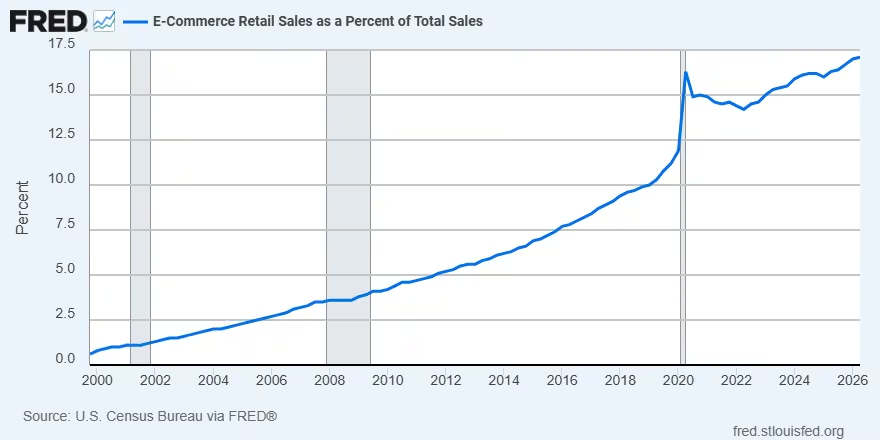
Do you know your state’s minimum wage? How about its cost of living relative to the national average? The FRED Blog has the numbers fredblog.stlouisfed.org/2026/08/state-minimum-wages-and-c…
-
St. Louis Fed
@stlouisfed
Why do gasoline prices stay elevated when oil prices fall? Factors beyond the price of crude oil influence the price at the pump www.stlouisfed.org/on-the-economy/2026/aug/when-oil-price…
-
St. Louis Fed
@stlouisfed
In “Patience and Credit Constraints in Education,” St. Louis Fed economist Guillaume Vandenbroucke studies how the attributes of cognitive ability and patience affect the decision to attend college. Read the full academic analysis www.stlouisfed.org/publications/review/2026/aug/patience-…
-
St. Louis Fed
@stlouisfed
Commercial and industrial loans at all U.S. commercial banks grew by $12.9 billion to $2.92 trillion in the week ending Aug. 5. See the long-term trend in FRED: fred.stlouisfed.org/graph/?g=1XSyM
-
St. Louis Fed
@stlouisfed
On Aug. 14, the St. Louis Fed Economic News Index was projecting Q3 2026 real GDP growth of 2.4% at an annual rate. The “nowcast” draws from key monthly data releases to forecast GDP growth for the current quarter. Learn more: fred.stlouisfed.org/graph/?g=1XSv5
-
St. Louis Fed
@stlouisfed
The producer price index for final demand — representing the wholesale cost of U.S. goods and services — was unchanged in July, following an upwardly revised 0.1 decrease in June alfred.stlouisfed.org/graph/?g=1XSac
-
St. Louis Fed
@stlouisfed
Sticky price CPI (slow-to-change consumer prices) rose 3.5% on an annualized basis in July, following a 0.8% increase in June. Graph and track the index from @AtlantaFed in FRED: fred.stlouisfed.org/graph/?g=1XRX6
-
St. Louis Fed
@stlouisfed
The St. Louis Fed Financial Stress Index declined to -0.77 in the week ending Aug. 7 from the prior week's -0.51. (0=normal financial market conditions, with a value below 0 suggesting below-average stress.) fred.stlouisfed.org/graph/?g=1XRXa
-
St. Louis Fed
@stlouisfed
Did you know you can find average price data in FRED—from the cost of eggs and ground beef, to milk and coffee? Check those prices and more: fred.stlouisfed.org/release?rid=454
-
St. Louis Fed
@stlouisfed
The index for shelter within the consumer price index rose 0.1% percent in July. The index for food also increased 0.1%, as the index for food away from home increased 0.3%, according to @BLS_gov fred.stlouisfed.org/graph/?g=1XRUx
-
St. Louis Fed
@stlouisfed
The consumer price index rose 3.4% year-over-year in July, not seasonally adjusted, down from 3.5% the previous month. Excluding food and energy, “core” consumer prices increased 2.5% in July fred.stlouisfed.org/graph/?g=1XRTz
-
St. Louis Fed
@stlouisfed
In our blog: Discover how foreign direct investment (FDI) can boost economic growth, increase government revenue and introduce new technology. Also learn about the potential risks of FDI for investors and countries www.stlouisfed.org/open-vault/2026/aug/what-is-foreign-di…
-
St. Louis Fed
@stlouisfed
.@KansasCityFed labor market conditions indicators for July suggest the level of activity increased and momentum accelerated. The level of activity indicator increased by 0.11, from 0.14 to 0.25. The momentum indicator increased by 0.21, from 0.16 to 0.37 fred.stlouisfed.org/graph/?g=1XRGO
-
St. Louis Fed
@stlouisfed
NEW: FRED has added two data series about the monthly median (50th percentile) probability of recession for the United States and the Euro Area reported by researchers Francesco Furno and Domenico Giannone. Learn more: news.research.stlouisfed.org/2026/08/fred-adds-data-on-pr…
-
St. Louis Fed
@stlouisfed
Patience. If you have it, you might spend time in college building your human capital. If you don't, you might skip college even if you have a strong ability to learn.
Read the academic analysis "Patience and Credit Constraints in Education" if you're not in a rush: -
St. Louis Fed
@stlouisfed
The U.S. labor force participation rate dropped sharply in the first half of 2026. Except for 2021-22, when the COVID-19 pandemic disrupted the labor market, June's rate reached its lowest level since 1976. What factors drove this decline? www.stlouisfed.org/on-the-economy/2026/aug/what-is-behind…
-
St. Louis Fed
@stlouisfed
Rural, High Revenue and Credit Worthy: Small Business Traits Affecting Access to Credit
The Small Business Credit Survey compiles information from firms with fewer than 500 employees. It provides credit risk and demographic information on these small businesses across the U.S. and categorizes them by credit risk and success in obtaining financing.
Small businesses with the following characteristics are more likely to receive the financing they seek than their counterparts:
• Good credit profile
• Rural
• More than $1 million in revenue
Visit the FRED Blog for more data and discussion about small business in America fredblog.stlouisfed.org/2026/08/can-small-business-owners… -
St. Louis Fed
@stlouisfed
Total U.S. consumer credit increased $14.2 billion in June after decreasing $1.1 billion in May. Nonrevolving credit (auto and student loans) rose $7.4 billion and revolving credit (credit cards) increased $6.7 billion fred.stlouisfed.org/graph/?g=1XQHL
-
St. Louis Fed
@stlouisfed
Booms in new types of technology have a habit of improving productivity. But measuring that improvement isn't easy and can take a bit of time.
In the 1990s, software, personal computers and the internet were expected to raise labor productivity growth, but the data didn't show that. At least not at first.
In 1996, Alan Greenspan looked at the numbers for labor productivity growth. They were low. He asserted that the current data were not yet reflecting the full benefits of the information and communications technology boom. As it turned out, over several years, those low productivity numbers were revised higher, bringing the official data closer in line with the accelerated productivity Greenspan had predicted.
ALFRED is the companion to the St. Louis Fed's FRED database that helps you see the data that were available at points in the past and how they were revised over time. Here's what the data showed:
➡️ In September 1996, labor productivity growth looked like it averaged just 0.9% from 1989 to 1995.
➡️ In February 2000, after a major revision to the National Income and Product Accounts in 1999, it was raised to 1.4%.
➡️ As of June 2026, it stands at 1.5%.
Visit the FRED Blog for the full story and the data fredblog.stlouisfed.org/2026/07/productivity-growth-as-se… -
St. Louis Fed
@stlouisfed
When crude oil prices surge and then drop, gasoline prices “rise like a rocket but fall like a feather.” This analysis looks at some reasons why this happens: www.stlouisfed.org/on-the-economy/2026/aug/when-oil-price…
-
St. Louis Fed
@stlouisfed
Texas Ratios for Banks Are Like Golf Scores: The Lower the Better
What’s a “Texas ratio?" You may have seen your bank advertise this as a mark of health. At its heart, this ratio measures a bank’s troubled loans against its capital resources.
In the 1980s, Texas had a banking crisis. To gauge banks’ credit risk at the time, a new measure was developed called the “Texas ratio.” It weighs two aspects of a bank’s balance sheet: nonaccrual and 90-day-delinquent loans and the real estate it has acquired from foreclosures against the capital resources the bank has to absorb losses from these troubled loans.
The lower the better: A ratio of 0% means the bank has no troubled loans. A ratio above 100% implies the bank may not have enough resources to cover its potential losses. In 1991, this ratio peaked at a value of 47.3 for U.S. banks. Since 2019, though, its value has been below 6.5.
Check the FRED Blog for the origin of the Texas ratio and an historical view of the data fredblog.stlouisfed.org/2026/08/what-is-the-texas-ratio/ -
St. Louis Fed
@stlouisfed
U.S. retail and food services sales fell 0.6% to $763.6 billion in July, the largest monthly drop since May 2025, following a revised gain of 0.2% in June. See the latest data including revisions from @uscensusbureau in archival database ALFRED alfred.stlouisfed.org/graph/?g=1XSvL
-
St. Louis Fed
@stlouisfed
On Aug. 14, the St. Louis Fed Economic News Index was projecting Q3 2026 real GDP growth of 2.4% at an annual rate. The “nowcast” draws from key monthly data releases to forecast GDP growth for the current quarter. Learn more: fred.stlouisfed.org/graph/?g=1XSv5
-
St. Louis Fed
@stlouisfed
FRED Blog: One way to gauge a bank’s health is to look at its nonaccrual and delinquent loans and the real estate it has acquired from foreclosures, all balanced against the capital resources it has to absorb losses from these troubled loans fredblog.stlouisfed.org/2026/08/what-is-the-texas-ratio/
-
St. Louis Fed
@stlouisfed
Why do gasoline prices stay elevated when oil prices fall? Factors beyond the price of crude oil influence the price at the pump www.stlouisfed.org/on-the-economy/2026/aug/when-oil-price…
-
St. Louis Fed
@stlouisfed
The “Texas ratio” is one way to gauge banks’ credit risk. The lower the better. In 1991, this ratio peaked at a value of 47.3 for U.S. banks. Since 2019, though, its value has been below 6.5. Check the FRED Blog for the origin of the Texas ratio and a historical view of the data
-
St. Louis Fed
@stlouisfed
In our blog: Discover how foreign direct investment (FDI) can boost economic growth, increase government revenue and introduce new technology. Also learn about the potential risks of FDI for investors and countries www.stlouisfed.org/open-vault/2026/aug/what-is-foreign-di…
-
St. Louis Fed
@stlouisfed
U.S. commercial paper outstanding grew to $1.43 trillion in the week ending Aug. 12, an increase of $1.6 billion from a week earlier, per @federalreserve data. Commercial paper comprises short-term, promissory notes issued mostly by corporations fred.stlouisfed.org/graph/?g=1XSbj
-
St. Louis Fed
@stlouisfed
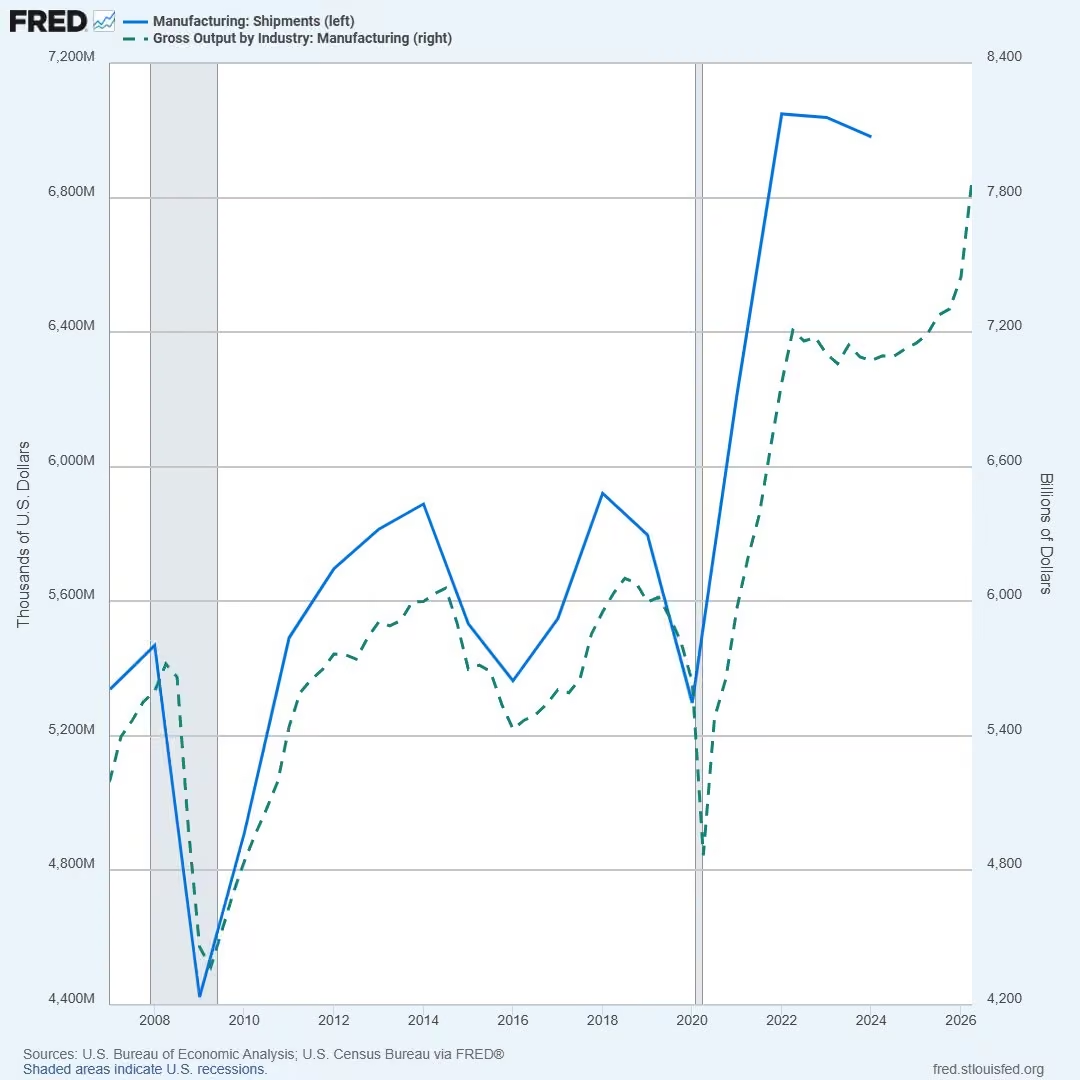
In the 1980s, Texas had a banking crisis. To gauge bank credit risk at the time, a new measure was developed called the “Texas ratio.” Check the FRED Blog for a graph of this ratio for all FDIC-insured banks in the U.S. fredblog.stlouisfed.org/2026/08/what-is-the-texas-ratio/
-
St. Louis Fed
@stlouisfed
In the week ending Aug. 8, seasonally adjusted initial claims for unemployment insurance benefits — those filed for the first time after a job loss — ticked up by 9,000, to 209,000. The four-week moving average was unchanged, at 199,000 fred.stlouisfed.org/graph/?g=1XSaf
-
St. Louis Fed
@stlouisfed
In the week ending Aug. 13, the average fixed 30-year mortgage rate decreased to 6.67%. The average fixed 15-year mortgage rate ticked down to 5.96% fred.stlouisfed.org/graph/?g=1XSao
-
St. Louis Fed
@stlouisfed
What’s the “Texas ratio?" You may have seen your bank advertise this as a mark of health. At its heart, the Texas ratio measures a bank’s troubled loans against its capital resources to absorb losses from those loans. Visit the FRED Blog for a brief history and the current ratio for banks nationwide fredblog.stlouisfed.org/2026/08/what-is-the-texas-ratio/
-
St. Louis Fed
@stlouisfed
The producer price index for final demand — representing the wholesale cost of U.S. goods and services — was unchanged in July, following an upwardly revised 0.1 decrease in June alfred.stlouisfed.org/graph/?g=1XSac
-
St. Louis Fed
@stlouisfed
AI adoption is much higher in the U.S. than it is in Europe. Will this widen the gap between U.S. and European productivity growth? www.stlouisfed.org/on-the-economy/2026/mar/mind-gap-ai-ad…
-
St. Louis Fed
@stlouisfed
Learn how foreign direct investment differs from exporting and why attracting FDI matters for nations. Check out our blog for expert insights www.stlouisfed.org/open-vault/2026/aug/what-is-foreign-di…
-
St. Louis Fed
@stlouisfed
Booms in new types of technology have a habit of improving productivity. But measuring that improvement isn't easy and can take a bit of time.
In the 1990s, software, personal computers and the internet were expected to raise labor productivity growth, but the data didn't show that. At least not at first.
In 1996, Alan Greenspan looked at the numbers for labor productivity growth. They were low. He asserted that the current data were not yet reflecting the full benefits of the information and communications technology boom. As it turned out, over several years, those low productivity numbers were revised higher, bringing the official data closer in line with the accelerated productivity Greenspan had predicted.
ALFRED is the companion to the St. Louis Fed's FRED database that helps you see the data that were available at points in the past and how they were revised over time. Here's what the data showed:
➡️ In September 1996, labor productivity growth looked like it averaged just 0.9% from 1989 to 1995.
➡️ In February 2000, after a major revision to the National Income and Product Accounts in 1999, it was raised to 1.4%.
➡️ As of June 2026, it stands at 1.5%.
Visit the FRED Blog for the full story and the data fredblog.stlouisfed.org/2026/07/productivity-growth-as-se… -
St. Louis Fed
@stlouisfed
Weekly spot prices for Brent and West Texas Intermediate crude oil declined to $87.86 and $78.94 per barrel, respectively, in the week ending Aug. 7. For more, see FRED: fred.stlouisfed.org/graph/?g=1XRXk
-
St. Louis Fed
@stlouisfed
Sticky price CPI (slow-to-change consumer prices) rose 3.5% on an annualized basis in July, following a 0.8% increase in June. Graph and track the index from @AtlantaFed in FRED: fred.stlouisfed.org/graph/?g=1XRX6
-
St. Louis Fed
@stlouisfed
The St. Louis Fed Financial Stress Index declined to -0.77 in the week ending Aug. 7 from the prior week's -0.51. (0=normal financial market conditions, with a value below 0 suggesting below-average stress.) fred.stlouisfed.org/graph/?g=1XRXa
-
St. Louis Fed
@stlouisfed
Did you know you can find average price data in FRED—from the cost of eggs and ground beef, to milk and coffee? Check those prices and more: fred.stlouisfed.org/release?rid=454
-
St. Louis Fed
@stlouisfed
The index for shelter within the consumer price index rose 0.1% percent in July. The index for food also increased 0.1%, as the index for food away from home increased 0.3%, according to @BLS_gov fred.stlouisfed.org/graph/?g=1XRUx
-
St. Louis Fed
@stlouisfed
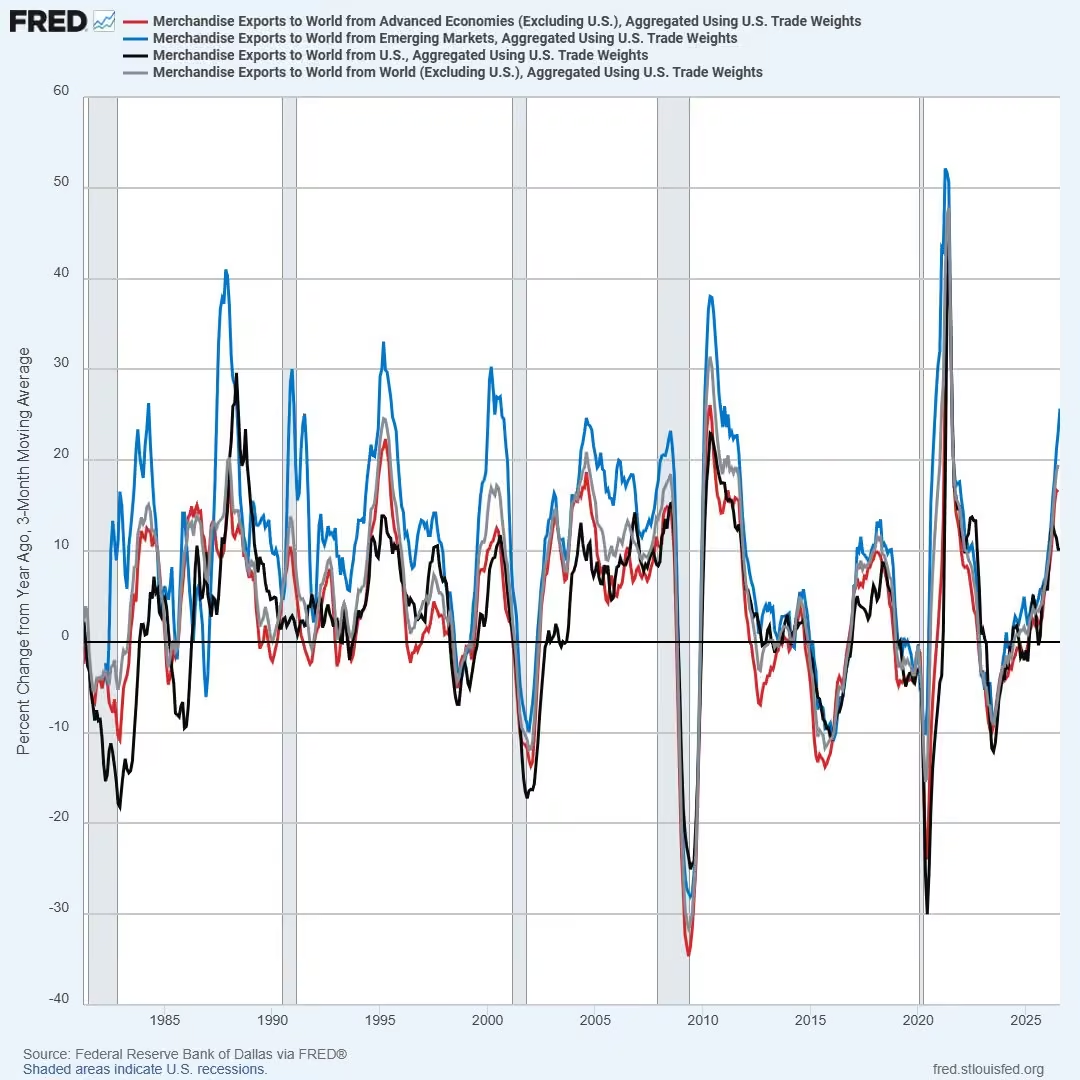
The consumer price index rose 3.4% year-over-year in July, not seasonally adjusted, down from 3.5% the previous month. Excluding food and energy, “core” consumer prices increased 2.5% in July fred.stlouisfed.org/graph/?g=1XRTz
-
St. Louis Fed
@stlouisfed
In our blog: Discover how foreign direct investment (FDI) can boost economic growth, increase government revenue and introduce new technology. Also learn about the potential risks of FDI for investors and countries www.stlouisfed.org/open-vault/2026/aug/what-is-foreign-di…
-
St. Louis Fed
@stlouisfed
Can small business owners access the credit they need? Visit the FRED Blog for the latest survey data and details fredblog.stlouisfed.org/2026/08/can-small-business-owners…
-
St. Louis Fed
@stlouisfed
.@KansasCityFed labor market conditions indicators for July suggest the level of activity increased and momentum accelerated. The level of activity indicator increased by 0.11, from 0.14 to 0.25. The momentum indicator increased by 0.21, from 0.16 to 0.37 fred.stlouisfed.org/graph/?g=1XRGO
-
St. Louis Fed
@stlouisfed
NEW: FRED has added two data series about the monthly median (50th percentile) probability of recession for the United States and the Euro Area reported by researchers Francesco Furno and Domenico Giannone. Learn more: news.research.stlouisfed.org/2026/08/fred-adds-data-on-pr…
-
St. Louis Fed
@stlouisfed
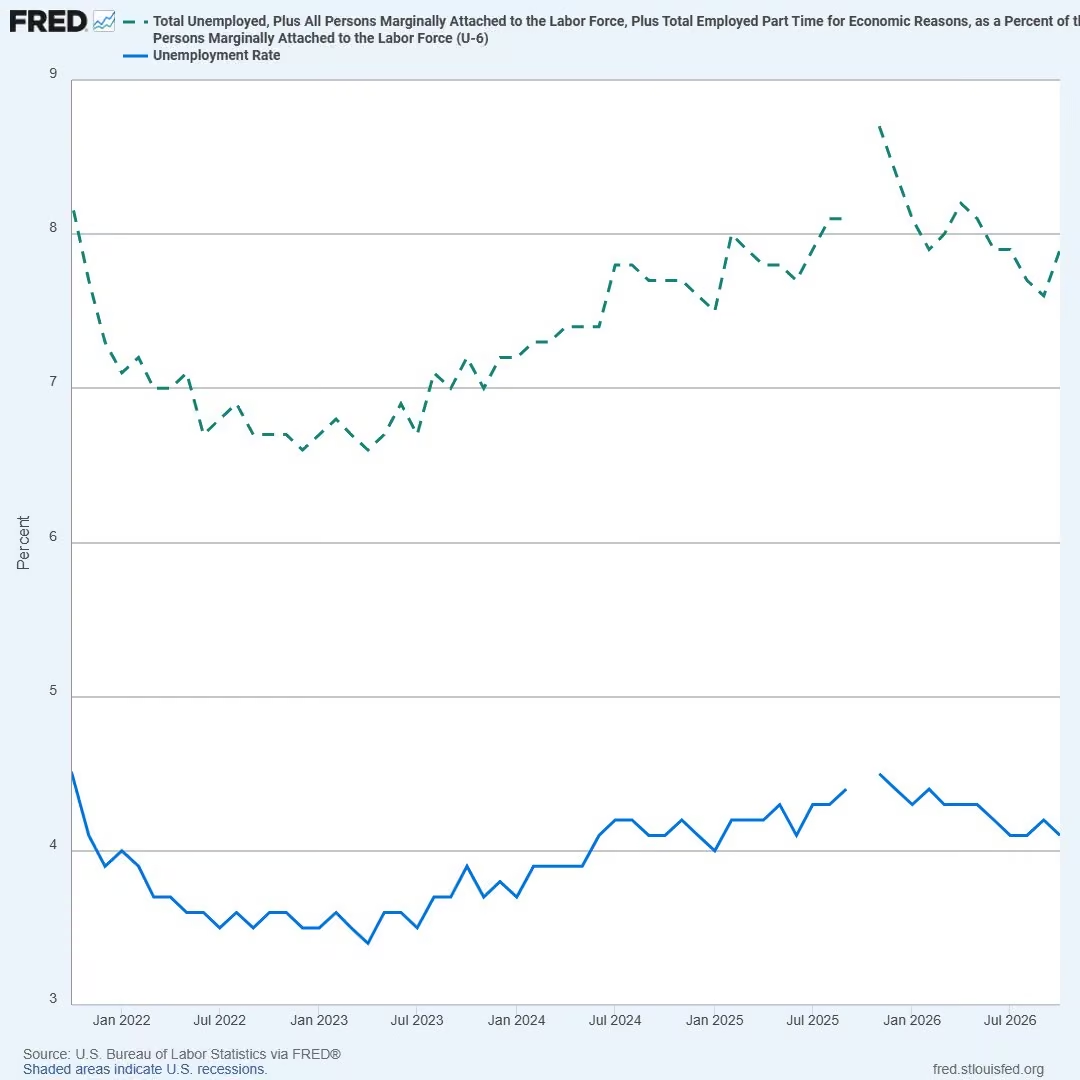
Patience. If you have it, you might spend time in college building your human capital. If you don’t, you might skip college even if you have a strong ability to learn.
Read the academic analysis "Patience and Credit Constraints in Education" if you’re not in a rush: -
St. Louis Fed
@stlouisfed
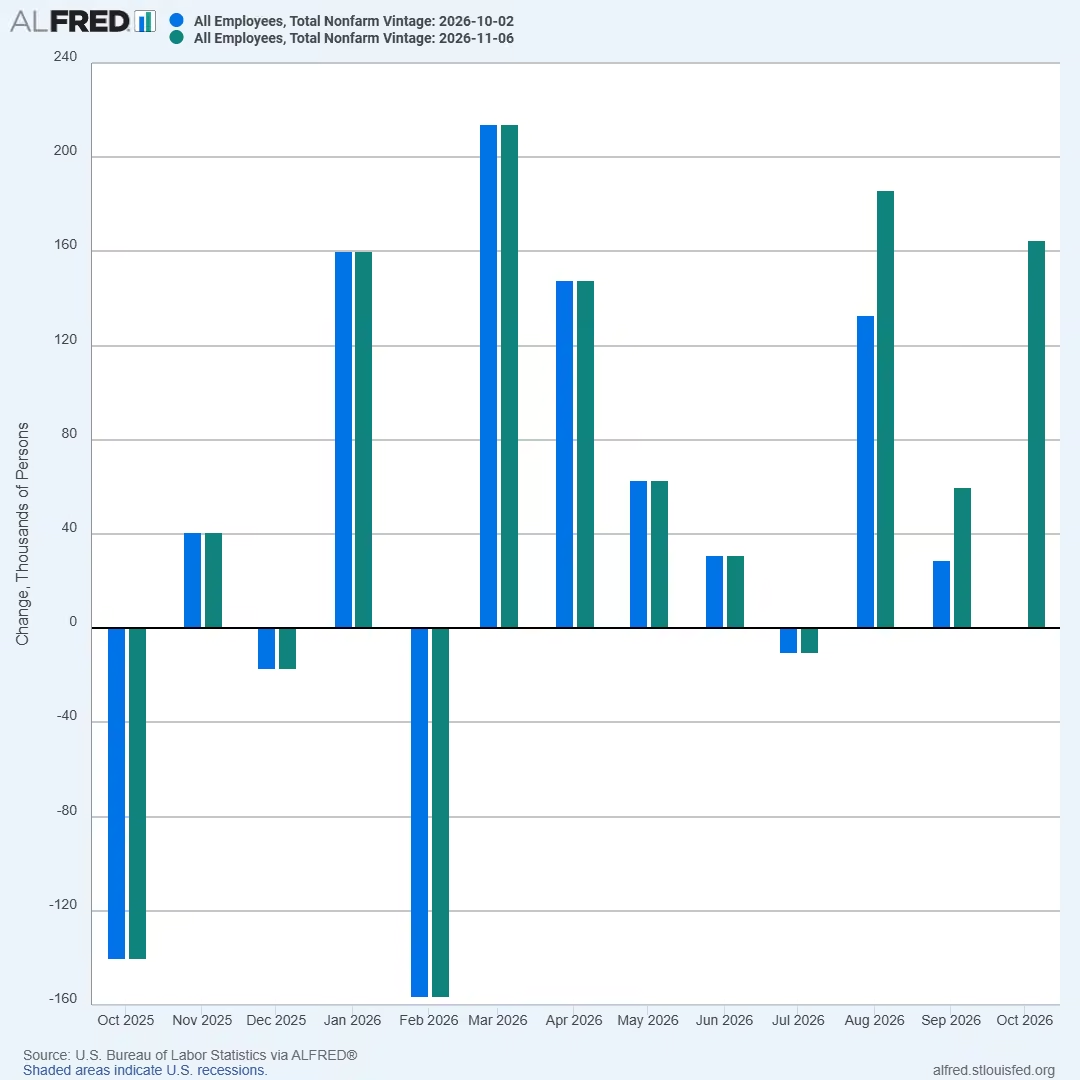
Survey data show that small firms with low credit risk more often get all the financing they seek. Small firms with riskier credit profiles get full financing less often and tend to be newer, smaller than average and more in need of financing. Check the FRED Blog for more detail
-
St. Louis Fed
@stlouisfed
FRED has data from the Small Business Credit Survey, and the FRED Blog describes the highlights: A small business is more likely to get all the financing it seeks if it is rural and has more than $1 million in revenue. Visit the FRED Blog for the latest survey data and details
-
St. Louis Fed
@stlouisfed
The U.S. labor force participation rate dropped sharply in the first half of 2026. Except for 2021-22, when the COVID-19 pandemic disrupted the labor market, June's rate reached its lowest level since 1976. What factors drove this decline? www.stlouisfed.org/on-the-economy/2026/aug/what-is-behind…
-
St. Louis Fed
@stlouisfed
Can small business owners access the credit they need? Visit the FRED Blog for the latest survey data and details fredblog.stlouisfed.org/2026/08/can-small-business-owners…
-
St. Louis Fed
@stlouisfed
Total U.S. consumer credit increased $14.2 billion in June after decreasing $1.1 billion in May. Nonrevolving credit (auto and student loans) rose $7.4 billion and revolving credit (credit cards) increased $6.7 billion fred.stlouisfed.org/graph/?g=1XQHL
-
St. Louis Fed
@stlouisfed
Rural, High Revenue and Credit Worthy: Small Business Traits Affecting Access to Credit
The Small Business Credit Survey compiles information from firms with fewer than 500 employees. It provides credit risk and demographic information on these small businesses across the U.S. and categorizes them by credit risk and success in obtaining financing.
Small businesses with the following characteristics are more likely to receive the financing they seek than their counterparts:
• Good credit profile
• Rural
• More than $1 million in revenue
Visit the FRED Blog for more data and discussion about small business in America fredblog.stlouisfed.org/2026/08/can-small-business-owners… -
St. Louis Fed
@stlouisfed
As of Aug. 7, the daily trade-weighted U.S. dollar index was measuring 112.4 (January 2006=100). See this index and more data from the @federalreserve Foreign Exchange Rates - H.10 release in FRED: fred.stlouisfed.org/release?rid=17
-
St. Louis Fed
@stlouisfed
Looking for key metrics about the U.S. banking sector? Follow the St. Louis Fed’s Banking Analytics blog series. Recent articles offer insights including:
➡️ The allowance for credit losses (ACL) coverage ratio for the banking system remained stable in Q1. The ratio of ACL to total loans and leases reveals important insights about a bank’s loan portfolio and risk assessment: www.stlouisfed.org/on-the-economy/2026/jul/banking-analyt…
➡️ Banks of all sizes have increased their exposure to Treasury securities. Total holdings as of Q1 stood at $1.8 trillion, up substantially from pre-pandemic levels: www.stlouisfed.org/on-the-economy/2026/jun/banking-analyt…
➡️ Lower asset yields compressed banks’ net interest margins (NIM) in Q1. Factors that could be impacting NIMs are falling interest rates, changes in balance sheet mix and competition: www.stlouisfed.org/on-the-economy/2026/jun/banking-analyt…
➡️ Agricultural loan growth outpaced overall loan growth at community banks last year. Agricultural banks represent only 20% of all banks but hold 40% of total agricultural loans: www.stlouisfed.org/on-the-economy/2026/jul/banking-analyt…
This series is part of our Supervision, Credit and Learning Division’s ongoing work to monitor the health of the banking system—and part of our commitment to a strong and resilient economy for all.
To get the latest “Banking Analytics” releases sent right to your inbox, subscribe to the On the Economy blog: www.stlouisfed.org/subscribe/blogsubscription -
St. Louis Fed
@stlouisfed
The U.S. labor force participation rate dropped sharply in the first half of 2026. Except for 2021-22, when the COVID-19 pandemic disrupted the labor market, June's rate reached its lowest level since 1976. What factors drove this decline? www.stlouisfed.org/on-the-economy/2026/aug/what-is-behind…
-
St. Louis Fed
@stlouisfed
In the week ending Aug. 6, the average fixed 30-year mortgage rate increased to 6.69%. The average fixed 15-year mortgage rate ticked down to 6.01% fred.stlouisfed.org/graph/?g=1XQaC
-
St. Louis Fed
@stlouisfed
Total U.S. consumer credit increased $14.2 billion in June after decreasing $1.1 billion in May. Nonrevolving credit (auto and student loans) rose $7.4 billion and revolving credit (credit cards) increased $6.7 billion fred.stlouisfed.org/graph/?g=1XQHL
-
St. Louis Fed
@stlouisfed
St. Louis Fed Financial Stress Index rose to -0.51 in the week ending July 31 from the prior week's -0.83. (0=normal financial market conditions, with a value below 0 suggesting below-average stress.) fred.stlouisfed.org/graph/?g=1XOcd
-
St. Louis Fed
@stlouisfed
Average hourly earnings for all employees on private nonfarm payrolls rose 2 cents to $37.62 in July, per @BLS_gov. From a year earlier, average hourly earnings were up 3.2%, or $1.15 fred.stlouisfed.org/graph/?g=1XQsX
-
St. Louis Fed
@stlouisfed
What does the July #jobsreport reveal about the state of the U.S. labor market? Read our Flash Report, which analyzes unemployment flows www.stlouisfed.org/on-the-economy/2026/aug/flash-report-u…
-
St. Louis Fed
@stlouisfed
In July, the nation’s unemployment rate ticked down to 4.1%. The underemployment rate, which tracks those marginally attached to the labor force and people working part time for economic reasons, was unchanged at 7.9% fred.stlouisfed.org/graph/?g=1XQs4
-
St. Louis Fed
@stlouisfed
The U.S. labor force participation rate decreased slightly in July, to 61.4%. For participation rates by educational attainment, race, sex and other categories, see FRED: fred.stlouisfed.org/graph/?g=1XQsJ
-
St. Louis Fed
@stlouisfed
The back and forth of bank assets: In the mid 1990s, FDIC-insured banks held about 50% of their investment securities until maturity. In 2010, that share had dwindled to 8%. Since then, their share of hold-to-maturity securities has risen. As of early 2025, it’s up to 39.8%. Visit the FRED Blog to see the data fredblog.stlouisfed.org/2026/08/what-securities-do-fdic-i…
-
St. Louis Fed
@stlouisfed
In June, U.S. job separations increased by 91,000 to 5.4 million. Within separations, quits and layoffs and discharges rose slightly, to 3.2 million and 1.8 million, respectively #jolts fred.stlouisfed.org/graph/?g=1XNUr
-
St. Louis Fed
@stlouisfed
Total U.S. construction spending fell 0.1% to a seasonally adjusted annual rate of $2.17 trillion in June. May's pace was also revised lower, per @uscensusbureau, to a flat reading of $2.17 trillion from the $2.21 trillion initially reported alfred.stlouisfed.org/graph/?g=1XNHG
-
St. Louis Fed
@stlouisfed
The U.S. trade deficit narrowed in June to $73.3 billion, down $4.4 billion from a revised gap of $77.6 billion in May, per @uscensusbureau and @BEA_News fred.stlouisfed.org/graph/?g=1XNU8
-
St. Louis Fed
@stlouisfed
New survey findings on AI adoption and workforce + productivity in the Fed's Eighth District:
➡️AI adoption among Eighth District firms is still early, with most reporting experimental or limited use.
➡️Firms using AI report meaningful efficiency gains, especially through reduced time spent on administrative or routine tasks.
➡️Nonadopters cite gaps in skills, data, technical infrastructure or business needs.
➡️Most firms expect little to no AI-related staffing changes in the next year, though many foresee a shift in the types of skills needed.
➡️AI is helping firms expand capacity and output with existing staff, supporting growth rather than driving job reductions (so far).
For more findings, check out our On the Economy blog: www.stlouisfed.org/on-the-economy/2026/jul/new-survey-fin… -
St. Louis Fed
@stlouisfed
FRED has Quarterly Banking Profile data on FDIC-insured institutions, including the securities those banks hold on their balance sheets. Mortgage-backed securities still make up the majority, but less so since their peak in 2008. Visit the FRED Blog for the big picture
-
St. Louis Fed
@stlouisfed
Booms in new types of technology have a habit of improving productivity. But measuring that improvement isn’t easy and can take a bit of time.
In the 1990s, software, personal computers and the internet were expected to raise labor productivity growth, but the data didn’t show that. At least not at first.
In 1996, Alan Greenspan looked at the numbers for labor productivity growth. They were low. He asserted that the current data were not yet reflecting the full benefits of the information and communications technology boom. As it turned out, over several years, those low productivity numbers were revised higher, bringing the official data closer in line with the accelerated productivity Greenspan had predicted.
ALFRED is the companion to the St. Louis Fed's FRED database that helps you see the data that were available at points in the past and how they were revised over time. Here’s what the data showed:
➡️ In September 1996, labor productivity growth looked like it averaged just 0.9% from 1989 to 1995.
➡️ In February 2000, after a major revision to the National Income and Product Accounts in 1999, it was raised to 1.4%.
➡️ As of June 2026, it stands at 1.5%.
Visit the FRED Blog for the full story and the data fredblog.stlouisfed.org/2026/07/productivity-growth-as-se… -
St. Louis Fed
@stlouisfed
What does the July #jobsreport reveal about the state of the U.S. labor market? Read our Flash Report, which analyzes unemployment flows www.stlouisfed.org/on-the-economy/2026/aug/flash-report-u…
-
St. Louis Fed
@stlouisfed
In July, the nation’s unemployment rate ticked down to 4.1%. The underemployment rate, which tracks those marginally attached to the labor force and people working part time for economic reasons, was unchanged at 7.9% fred.stlouisfed.org/graph/?g=1XQs4
-
St. Louis Fed
@stlouisfed
Total U.S. consumer credit increased $14.2 billion in June after decreasing $1.1 billion in May. Nonrevolving credit (auto and student loans) rose $7.4 billion and revolving credit (credit cards) increased $6.7 billion fred.stlouisfed.org/graph/?g=1XQHL
-
St. Louis Fed
@stlouisfed
Banks insured by the FDIC are buying a smaller share of mortgage-backed securities these days and larger shares of U.S. Treasuries and state and local bonds. Check the FRED Blog for a look at the data and discussion of bank balance sheets fredblog.stlouisfed.org/2026/08/what-securities-do-fdic-i…
-
St. Louis Fed
@stlouisfed
The U.S. labor force participation rate decreased slightly in July, to 61.4%. For participation rates by educational attainment, race, sex and other categories, see FRED: fred.stlouisfed.org/graph/?g=1XQsJ
-
St. Louis Fed
@stlouisfed
Average hourly earnings for all employees on private nonfarm payrolls rose 2 cents to $37.62 in July, per @BLS_gov. From a year earlier, average hourly earnings were up 3.2%, or $1.15 fred.stlouisfed.org/graph/?g=1XQsX
-
St. Louis Fed
@stlouisfed
In July, total nonfarm payrolls decreased by 23,000 after rising by 20,000 (revised down) in June. May's reading was also revised down to show a gain of 63,000 alfred.stlouisfed.org/graph/?g=1XQsu
-
St. Louis Fed
@stlouisfed
The #jobsreport, just out today, shows July’s unemployment rate fell to 4.1%. Our Flash Report looks at how the combination of moves into and out of unemployment and the labor force contributed to the U.S. jobless rate’s overall decline www.stlouisfed.org/on-the-economy/2026/aug/flash-report-u…
-
St. Louis Fed
@stlouisfed
Banks Lean into Treasuries with a “Buy and Hold” Approach
The FDIC looks at the financial conditions of the banks it insures, including their balance sheets. The majority of bank securities is still mortgage-backed securities (MBS), but the share of Treasury securities they hold has been steadily increasing.
Bank securities in 2008:
MBS 86.8%
Treasuries 1.6%
Bank securities in 2026:
MBS 60.7%
Treasuries 33.5%
Over a similar time frame, these banks have also increased the share of investment securities they intend to hold to maturity, rather than selling them off.
Bank investment securities in 2010:
Hold to maturity 8%
Available for sale 92%
Bank investment securities in 2025:
Hold to maturity 39.8%
Available for sale 60.2%
Visit the FRED Blog for more of the data and discussion fredblog.stlouisfed.org/2026/08/what-securities-do-fdic-i… -
St. Louis Fed
@stlouisfed
When the U.S. labor force participation rate declines, people may assume it is because of increasing numbers of discouraged workers. Was that the case in the first half of 2026? www.stlouisfed.org/on-the-economy/2026/aug/what-is-behind…
-
St. Louis Fed
@stlouisfed
The St. Louis Fed Review offers a short history on Milton Friedman: his work, vision and legacy as one of the pioneers of monetarism #economics www.stlouisfed.org/publications/review/2026/jul/future-of…
-
St. Louis Fed
@stlouisfed
One thing to watch for in the July jobs report—out this Friday—is the change in the U.S. labor force participation rate, particularly for people who are of prime working age (25-54). Why pay attention to this number?
• The labor force participation rate has fallen sharply this year. A declining participation rate is typically seen as a sign that more people are giving up on the job market.
• More than half of the decline came from a statistical correction to the population level in January and from the steady effects of an aging population, not from workers exiting the labor market. But part of the decline is due to June’s sharp drop in the participation rate among prime-age workers.
• While dramatic, the June drop brings the participation rate among prime-age workers back to a level consistent with recent years. However, a continued decline in coming months may signal a deeper change in the behavior of workers in this critical age group.
Read the analysis: www.stlouisfed.org/on-the-economy/2026/aug/what-is-behind… -
St. Louis Fed
@stlouisfed
U.S. commercial paper outstanding grew to $1.43 trillion in the week ending Aug. 5, an increase of $30.9 billion from a week earlier, per @federalreserve data. Commercial paper comprises short-term, promissory notes issued mostly by corporations fred.stlouisfed.org/graph/?g=1XQaD
-
St. Louis Fed
@stlouisfed
In the week ending Aug. 6, the average fixed 30-year mortgage rate increased to 6.69%. The average fixed 15-year mortgage rate ticked down to 6.01% fred.stlouisfed.org/graph/?g=1XQaC
-
St. Louis Fed
@stlouisfed
St. Louis Fed President Alberto Musalem gave a speech, titled “Monetary Policy and Productivity: Promoting Growth vs. Stabilizing Prices,” and participated in a Q&A today at @CDPP_SP (Center for Public Policy Debate) in São Paulo, Brazil. View his remarks: www.stlouisfed.org/from-the-president/remarks/2026/moneta…
-
St. Louis Fed
@stlouisfed
In the week ending Aug. 1, seasonally adjusted initial claims for unemployment insurance benefits—those filed for the first time after a job loss—ticked up by 1,000, to 199,000. The four-week moving average fell by 4,500, to 198,750 fred.stlouisfed.org/graph/?g=1XQaz
-
St. Louis Fed
@stlouisfed
In a new Review article, economic historian Michael Bordo provides economic context and detail on one of the pioneers of monetarism, Milton Friedman #economics www.stlouisfed.org/publications/review/2026/jul/future-of…
-
St. Louis Fed
@stlouisfed
The U.S. labor force participation rate dropped sharply in the first half of 2026. Was that because more people stopped looking for work, or were there other factors at play? Read the analysis: www.stlouisfed.org/on-the-economy/2026/aug/what-is-behind…
-
St. Louis Fed
@stlouisfed
New survey findings reveal how firms across the Fed’s Eighth District are using AI to boost efficiency and expand capacity—plus what’s holding back nonadopters www.stlouisfed.org/on-the-economy/2026/jul/new-survey-fin…
-
St. Louis Fed
@stlouisfed
On the 50th anniversary of Milton Friedman receiving the Nobel Prize in economics, a new article in the St. Louis Fed Review describes his legacy as a pioneer of monetarism #economics www.stlouisfed.org/publications/review/2026/jul/future-of…
-
St. Louis Fed
@stlouisfed
Weekly spot prices for Brent and West Texas Intermediate crude oil fell to $91.63 and $84.51 per barrel, respectively, in the week ending July 31. For more, see FRED: fred.stlouisfed.org/graph/?g=1XOch
-
St. Louis Fed
@stlouisfed
St. Louis Fed Financial Stress Index rose to -0.51 in the week ending July 31 from the prior week's -0.83. (0=normal financial market conditions, with a value below 0 suggesting below-average stress.) fred.stlouisfed.org/graph/?g=1XOcd
-
St. Louis Fed
@stlouisfed
What does “disconnection” from work and school opportunities look like for different young adults, and what are they doing instead? www.stlouisfed.org/on-the-economy/2026/jul/how-are-discon…
-
St. Louis Fed
@stlouisfed
How are AI's productivity effects being discussed in C-suites across the U.S.? A new analysis frames an answer using executives' own words www.stlouisfed.org/on-the-economy/2026/jul/ai-productivit…
-
St. Louis Fed
@stlouisfed
Mark your calendar: St. Louis Fed President Alberto Musalem will speak at @CDPP_SP (Center for Public Policy Debate) in São Paulo, Brazil, from 4:30-5:15 p.m. CT Thursday. He will give remarks on monetary policy and productivity and will participate in a Q&A.
Watch a livestream at the link: www.youtube.com/live/XG9_BQyQFek?cbrd=1&ucbcb=1 -
St. Louis Fed
@stlouisfed
A new survey of Eighth District firms offers key insights into AI usage and the workforce www.stlouisfed.org/on-the-economy/2026/jul/new-survey-fin…
-
St. Louis Fed
@stlouisfed
The U.S. labor force participation rate dropped sharply in the first half of 2026. Except for 2021-22, when the COVID-19 pandemic disrupted the labor market, June’s rate reached its lowest level since 1976. What factors drove this decline? www.stlouisfed.org/on-the-economy/2026/aug/what-is-behind…
-
St. Louis Fed
@stlouisfed
In the week ending Aug. 3, average U.S. diesel prices per gallon increased by 4 cents, to $5.35. Average gas prices per gallon fell by 2 cents, to $4.08 fred.stlouisfed.org/graph/?g=1XNUH
-
St. Louis Fed
@stlouisfed
See FRED for the latest @BLS_gov data on job openings by census region and sector #jolts fred.stlouisfed.org/release/tables?rid=192&eid=6615
-
St. Louis Fed
@stlouisfed
In June, U.S. job separations increased by 91,000 to 5.4 million. Within separations, quits and layoffs and discharges rose slightly, to 3.2 million and 1.8 million, respectively #jolts fred.stlouisfed.org/graph/?g=1XNUr
-
St. Louis Fed
@stlouisfed
Total nonfarm job openings ticked down by 178,000 in June, to 7.4 million. Hires rose by 96,000, to 5.3 million fred.stlouisfed.org/graph/?g=1XNUe
-
St. Louis Fed
@stlouisfed
The U.S. labor force participation rate for prime-age workers (those 25-54) dropped sharply in June. While sudden, it brought the rate back to 2023-25 levels. Coming jobs reports, starting with the July numbers out this Friday, may signal whether the rate will stabilize or decline further www.stlouisfed.org/on-the-economy/2026/aug/what-is-behind…
-
St. Louis Fed
@stlouisfed
The U.S. trade deficit narrowed in June to $73.3 billion, down $4.4 billion from a revised gap of $77.6 billion in May, per @uscensusbureau and @BEA_News fred.stlouisfed.org/graph/?g=1XNU8
-
St. Louis Fed
@stlouisfed
New survey findings on AI adoption and workforce + productivity in the Fed’s Eighth District:
➡️AI adoption among Eighth District firms is still early, with most reporting experimental or limited use.
➡️Firms using AI report meaningful efficiency gains, especially through reduced time spent on administrative or routine tasks.
➡️Nonadopters cite gaps in skills, data, technical infrastructure or business needs.
➡️Most firms expect little to no AI-related staffing changes in the next year, though many foresee a shift in the types of skills needed.
➡️AI is helping firms expand capacity and output with existing staff, supporting growth rather than driving job reductions (so far).
For more findings, check out our On the Economy blog: www.stlouisfed.org/on-the-economy/2026/jul/new-survey-fin… -
St. Louis Fed
@stlouisfed
"It is every type of business, every type of leader,” says Condrad Daniels.
Federal Reserve bank boards are filled with leaders from different corners of the economy. Daniels, chair of the St. Louis Fed's Louisville Branch board of directors, breaks down his role on the board and why different perspectives matter.
Learn more about the Fed and how its branch boards work. -
St. Louis Fed
@stlouisfed
As of July 31, the daily trade-weighted U.S. dollar index was measuring 112.9 (January 2006=100). See this index and more data from the @federalreserve Foreign Exchange Rates - H.10 release in FRED: fred.stlouisfed.org/graph/?g=1XNJe
-
St. Louis Fed
@stlouisfed
You might guess that construction employment in Minnesota hits its peak each August and its trough each February, but the FRED Blog has the data to prove it fredblog.stlouisfed.org/2026/08/how-does-seasonal-weather…
-
St. Louis Fed
@stlouisfed
Total U.S. construction spending fell 0.1% to a seasonally adjusted annual rate of $2.17 trillion in June. May’s pace was also revised lower, per @uscensusbureau, to a flat reading of $2.17 trillion from the $2.21 trillion initially reported alfred.stlouisfed.org/graph/?g=1XNHG
-
St. Louis Fed
@stlouisfed
Agricultural lending is concentrated among a subset of specialized lenders. These agricultural banks represent only 20% of all banks but hold 40% of all loans. Read more about agricultural lending in this analysis: www.stlouisfed.org/on-the-economy/2026/jul/banking-analyt…
-
St. Louis Fed
@stlouisfed
Would you prefer to work in construction in Minnesota or Kentucky? Check the FRED Blog for a lesson on seasonal employment fredblog.stlouisfed.org/2026/08/how-does-seasonal-weather…
-
St. Louis Fed
@stlouisfed
More than three-quarters of the country’s agricultural loans are held by U.S. community banks. Read this analysis: www.stlouisfed.org/on-the-economy/2026/jul/banking-analyt…
-
St. Louis Fed
@stlouisfed
FRED provides the tools to illuminate economic data, and the FRED Blog provides lessons on how to use data to understand the economy. Check out this post to make sense of seasonal adjustments in construction employment fredblog.stlouisfed.org/2026/08/how-does-seasonal-weather…
-
St. Louis Fed
@stlouisfed
The word “disconnected” suggests withdrawn or inactive. But the American Time Use Survey offers a more nuanced story of how disconnected young adults—18- to 24-year-olds who are neither employed nor enrolled in school—spend their time www.stlouisfed.org/on-the-economy/2026/jul/how-are-discon…
-
St. Louis Fed
@stlouisfed
When executives discuss productivity on earnings calls, AI is increasingly top of mind. How bullish are U.S. firms on AI’s expected impact? www.stlouisfed.org/on-the-economy/2026/jul/ai-productivit…
-
St. Louis Fed
@stlouisfed
In 1996, Alan Greenspan looked at labor productivity growth and claimed the current data were not yet reflecting the full benefits of the information and communications technology boom. Over several years, those low productivity numbers were revised higher, bringing the official data closer in line with the accelerated productivity Greenspan predicted. Find the data and details at the FRED Blog fredblog.stlouisfed.org/2026/07/productivity-growth-as-se…
-
St. Louis Fed
@stlouisfed
As crude oil and jet fuel prices soared in March, airfares remained grounded.
Jet fuel starts with kerosene, which is made from West Texas Intermediate light sweet crude oil. So, any disruptions in the price of crude oil will affect prices for jet fuel.
After the U.S.-Iran conflict began in February, crude oil prices spiked. And jet fuel prices rose even more dramatically.
But the reaction in prices for both U.S. and European airfares was much more muted. Why?
• Airfares include more than just fuel, even if it’s the largest component and 20%-30% of airlines’ total operating expenses.
• Airlines typically buy jet fuel with futures contracts, locking in prices months in advance.
If crude oil and kerosene prices remain elevated, of course, the picture for airfares may change.
Check the FRED Blog for the data and discussion: fredblog.stlouisfed.org/2026/07/the-link-between-crude-oi… -
St. Louis Fed
@stlouisfed
What are CEOs at U.S. companies telling investors about the expected productivity gains from AI?
A new analysis of approximately 490,000 earnings call transcripts from nearly 5,200 publicly traded firms examines this question. It finds that:
▶️ Executives are strongly optimistic about AI-related productivity effects, even if such effects are not yet clearly visible in overall productivity data.
▶️ The share of productivity-related discussions involving AI began rising dramatically after the release of ChatGPT in late 2022. This suggests productivity improvements are increasingly being framed through the lens of AI.
▶️ The overwhelming majority of talk about productivity is forward-looking, especially when it centers around AI. In the call transcripts, more than 9 in 10 sentences that mentioned AI-related productivity referred to future gains.
Read more: www.stlouisfed.org/on-the-economy/2026/jul/ai-productivit… -
St. Louis Fed
@stlouisfed
New survey data: Most Eighth District firms are testing or regularly using AI tools, but adoption is still in early stages. What’s driving the use of this technology? And what’s holding some businesses back? www.stlouisfed.org/on-the-economy/2026/jul/new-survey-fin…
-
St. Louis Fed
@stlouisfed
U.S. commercial paper outstanding grew to $1.4 trillion in the week ending July 29, an increase of $5.54 billion from a week earlier, per @federalreserve data. Commercial paper comprises short-term, promissory notes issued mostly by corporations fred.stlouisfed.org/graph/?g=1XMWk
-
St. Louis Fed
@stlouisfed
U.S. executives are increasingly framing productivity gains through the lens of AI, according to a new analysis of thousands of earnings call transcripts. What are they saying? www.stlouisfed.org/on-the-economy/2026/jul/ai-productivit…
-
St. Louis Fed
@stlouisfed
Crude oil is used to make kerosene-based jet fuel, which accounts for 20%-30% of airline operating costs. Although oil and jet fuel prices spiked in March after the U.S.-Iran conflict began, airfares responded more mildly. Visit the FRED Blog for price data and background on how airlines work with fuel costs fredblog.stlouisfed.org/2026/07/the-link-between-crude-oi…
-
St. Louis Fed
@stlouisfed
When do U.S. CEOs expect AI-related productivity gains to materialize? Earnings call data suggest that while firms may be investing and reorganizing around AI today, they see its productivity effects as more in the future www.stlouisfed.org/on-the-economy/2026/jul/ai-productivit…
-
St. Louis Fed
@stlouisfed
The Employment Cost Index — a broad measure of U.S. labor costs from @BLS_gov — rose 0.9% (seasonally adjusted) in the second quarter of 2026. Wages and salaries increased 0.9% during the period, while benefit costs were up 1.0%.
For the 12 months ending June 2026, the overall index was up 3.4% (not seasonally adjusted) fred.stlouisfed.org/graph/?g=1XMVO -
St. Louis Fed
@stlouisfed
The Bill of Rights was established in 1791. That’s the same year of the oldest U.S. data in FRED. Visit the FRED Blog for the latest details on the oldest data fredblog.stlouisfed.org/2026/07/the-oldest-us-data-series…
-
St. Louis Fed
@stlouisfed
New survey finding: Most Eighth District firms expect little to no AI-related staffing changes in the next year, though many foresee a shift in the types of skills needed ➡️ www.stlouisfed.org/on-the-economy/2026/jul/new-survey-fin…
-
St. Louis Fed
@stlouisfed
The Employment Cost Index — a broad measure of U.S. labor costs from @BLS_gov — rose 0.9% (seasonally adjusted) in the second quarter of 2026. Wages and salaries increased 0.9% during the period, while benefit costs were up 1.0%.
For the 12 months ending June 2026, the overall index was up 3.4% (not seasonally adjusted) fred.stlouisfed.org/graph/?g=1XMVO -
St. Louis Fed
@stlouisfed
From Texas light sweet crude oil, to kerosene, to jet fuel, to airfares: Check the FRED Blog’s step-by-step discussion of airlines’ cost pass-through since the U.S.-Iran conflict began fredblog.stlouisfed.org/2026/07/the-link-between-crude-oi…
-
St. Louis Fed
@stlouisfed
U.S. commercial paper outstanding grew to $1.4 trillion in the week ending July 29, an increase of $5.54 billion from a week earlier, per @federalreserve data. Commercial paper comprises short-term, promissory notes issued mostly by corporations fred.stlouisfed.org/graph/?g=1XMWk
-
St. Louis Fed
@stlouisfed
Analysis: “Disconnected” young adults who aren’t working or in school are more likely to spend time on caregiving responsibilities and household activities than their peers. Read more: www.stlouisfed.org/on-the-economy/2026/jul/how-are-discon…
-
St. Louis Fed
@stlouisfed
Crude oil prices surged in March after the start of the U.S.-Iran conflict in February. Jet fuel prices rose even more dramatically. But airfares? Not nearly as much. Check the FRED Blog for related data and discussion: fredblog.stlouisfed.org/2026/07/the-link-between-crude-oi…
-
St. Louis Fed
@stlouisfed
As the nation celebrates 250 years of American democracy, FRED celebrates 235 years of American data fredblog.stlouisfed.org/2026/07/the-oldest-us-data-series…
-
St. Louis Fed
@stlouisfed
What are CEOs at U.S. companies telling investors about the expected productivity gains from AI?
A new analysis of approximately 490,000 earnings call transcripts from nearly 5,200 publicly traded firms examines this question. It finds that:
▶️ Executives are strongly optimistic about AI-related productivity effects, even if such effects are not yet clearly visible in overall productivity data.
▶️ The share of productivity-related discussions involving AI began rising dramatically after the release of ChatGPT in late 2022. This suggests productivity improvements are increasingly being framed through the lens of AI.
▶️ The overwhelming majority of talk about productivity is forward-looking, especially when it centers around AI. In the call transcripts, more than 9 in 10 sentences that mentioned AI-related productivity referred to future gains.
Read more: www.stlouisfed.org/on-the-economy/2026/jul/ai-productivit… -
St. Louis Fed
@stlouisfed
St. Louis Fed On the Economy® blog offers analysis and data from our economic experts. Catch the latest www.stlouisfed.org/on-the-economy
-
St. Louis Fed
@stlouisfed
How are AI’s productivity effects being discussed in C-suites across the U.S.? A new analysis frames an answer using executives’ own words www.stlouisfed.org/on-the-economy/2026/jul/ai-productivit…
-
St. Louis Fed
@stlouisfed
History buffs: The FRED Blog discusses the oldest U.S. data series in FRED, which includes public works spending all the way back to 1791 fredblog.stlouisfed.org/2026/07/the-oldest-us-data-series…
-
St. Louis Fed
@stlouisfed
How are young adults who aren’t working or in school spending their time? A new analysis uses survey data to explore this question www.stlouisfed.org/on-the-economy/2026/jul/how-are-discon…
-
St. Louis Fed
@stlouisfed
Average fixed mortgage rates ticked up in the week ending July 30, to 6.7% for the 30-year and 6.0% for the 15-year fred.stlouisfed.org/graph/?g=1XMFD
-
St. Louis Fed
@stlouisfed
In the week ending July 25, seasonally adjusted initial claims for unemployment insurance benefits—those filed for the first time after a job loss—increased by 9,000, to 197,000. The four-week moving average declined for the fifth week in a row, by 5,000 to 202,750
-
St. Louis Fed
@stlouisfed
In September 1996, data analysts thought labor productivity growth averaged just 0.9% from 1989 to 1995. In February 2000, data revisions raised it to 1.4%. With more revisions, it currently stands at 1.5%. Visit the FRED Blog for the full story fredblog.stlouisfed.org/2026/07/productivity-growth-as-se…
-
St. Louis Fed
@stlouisfed
Advance estimate from @BEA_News: GDP increased at an annual rate of 1.5% in the second quarter of 2026 alfred.stlouisfed.org/graph/?g=1XMCM
-
St. Louis Fed
@stlouisfed
The trimmed mean PCE inflation rate decreased to 2.23% for the 12 months ending in June, down from 2.41% in May. For more on the @DallasFed alternative measure of core inflation, see FRED: fred.stlouisfed.org/graph/?g=1XMFi
-
St. Louis Fed
@stlouisfed
The personal consumption expenditures (PCE) price index increased at an annual rate of 3.7% from a year ago in June, down from May's 4.1%. Excluding food and energy costs, the “core PCE” price level dipped to 3.3% on an annual basis fred.stlouisfed.org/graph/?g=1XMEq
-
St. Louis Fed
@stlouisfed
The nation’s personal saving rate dipped to 2.7% in June, down from May’s 2.8%. The personal saving rate is the percentage of people’s disposable income they save instead of spend, per @BEA_News. For more, see FRED: fred.stlouisfed.org/graph/?g=1XMDG
-
St. Louis Fed
@stlouisfed
Why do some countries embrace AI more quickly? Management practices and whether firms encourage AI use among their workers are strongly linked to adoption rates, according to this new research www.stlouisfed.org/on-the-economy/2026/apr/why-does-ai-ad…
-
St. Louis Fed
@stlouisfed
The St. Louis Fed serves the Eighth Federal Reserve District. Our Regional Economy hub offers data and analysis for this vibrant area of the U.S. www.stlouisfed.org/research/regional-economy
-
St. Louis Fed
@stlouisfed
AI adoption is much higher in the U.S. than it is in Europe. Will this widen the gap between U.S. and European productivity growth? www.stlouisfed.org/on-the-economy/2026/mar/mind-gap-ai-ad…
-
St. Louis Fed
@stlouisfed
In the 1990s, software, personal computers and the internet were expected to raise labor productivity, but the data didn't show much growth. At least not at first. Read the story and track the data at the FRED Blog fredblog.stlouisfed.org/2026/07/productivity-growth-as-se…
-
St. Louis Fed
@stlouisfed
Weekly spot prices for West Texas Intermediate and Brent crude oil rose to $88.58 and $96.12 per barrel, respectively, in the week ending July 24. For more, see FRED: fred.stlouisfed.org/graph/?g=1XMk5
-
St. Louis Fed
@stlouisfed
St. Louis Fed Financial Stress Index fell to -0.83 in the week ending July 24 from the prior week's -0.70. (0=normal financial market conditions, with a value below 0 suggesting below-average stress.) fred.stlouisfed.org/graph/?g=1XMj5
-
St. Louis Fed
@stlouisfed
Why do some countries embrace AI more quickly? Management practices and whether firms encourage AI use among their workers are strongly linked to adoption rates, according to this new research www.stlouisfed.org/on-the-economy/2026/apr/why-does-ai-ad…
-
St. Louis Fed
@stlouisfed
Do you spend gift money more freely than your paycheck? Mental accounting is likely the reason. Explore this phenomenon and how it shapes our financial decisions www.stlouisfed.org/publications/page-one-economics/2026/a…
-
St. Louis Fed
@stlouisfed
In May, U.S. home prices as measured by the S&P/Case-Shiller National Home Price Index rose a seasonally adjusted 1.1% year over year, up from 0.9% in April. The 20- and 10-city composite indexes posted 1.6% and 2.4% annual gains, respectively fred.stlouisfed.org/graph/?g=1XM5p
-
St. Louis Fed
@stlouisfed
In the week ending July 27, average U.S. diesel prices per gallon increased by 18 cents, to $5.31. Average gas prices per gallon rose by 10 cents, to $4.10 fred.stlouisfed.org/graph/?g=1XM2q
-
St. Louis Fed
@stlouisfed
In the 1990s, software, personal computers and the internet were expected to raise labor productivity, but the data didn’t show much growth. At least not at first. Read the story and track the data at the FRED Blog fredblog.stlouisfed.org/2026/07/productivity-growth-as-se…
-
St. Louis Fed
@stlouisfed
The St. Louis Fed serves the Eighth Federal Reserve District. Our Regional Economy hub offers data and analysis for this vibrant area of the U.S. www.stlouisfed.org/research/regional-economy
-
St. Louis Fed
@stlouisfed
NEW: FRED has added 137 data series about the adoption of generative artificial intelligence technology in the U.S. 📈
The information is collected through the Real-Time Population Survey (RPS) to measure:
(a) the share of working-age adults using generative AI for work, outside of work, and overall
(b) the reported time savings due to generative AI use
(c) comparative usage rates for generative AI, computers and the internet
news.research.stlouisfed.org/2026/07/fred-adds-data-about… -
St. Louis Fed
@stlouisfed
ALFRED is the companion to our FRED database that helps you see the data that were available at points in the past and how they were revised over time. Check the FRED Blog for a story about labor productivity growth in the 1990s, when the productivity gains from personal computers and the World Wide Web were only fully captured after substantial data revisions fredblog.stlouisfed.org/2026/07/productivity-growth-as-se…
-
St. Louis Fed
@stlouisfed
Do you spend gift money more freely than your paycheck? Mental accounting is likely the reason. Explore this phenomenon and how it shapes our financial decisions www.stlouisfed.org/publications/page-one-economics/2026/a…
-
St. Louis Fed
@stlouisfed
NEW: FRED has added 137 data series about the adoption of generative artificial intelligence technology in the U.S. 📈
The information is collected through the Real-Time Population Survey (RPS) to measure:
(a) the share of working-age adults using generative AI for work, outside of work, and overall
(b) the reported time savings due to generative AI use
(c) comparative usage rates for generative AI, computers and the internet
news.research.stlouisfed.org/2026/07/fred-adds-data-about… -
St. Louis Fed
@stlouisfed
Official data are often revised in response to new economic developments. Visit the FRED Blog to hear a story from the 1990s, when the World Wide Web started to affect measures of labor productivity growth fredblog.stlouisfed.org/2026/07/productivity-growth-as-se…
-
St. Louis Fed
@stlouisfed
As of July 24, the daily trade-weighted U.S. dollar index was measuring 114.1 (January 2006=100). See this index and more data from the @federalreserve Foreign Exchange Rates - H.10 release in FRED: fred.stlouisfed.org/graph/?g=1XLQg
-
St. Louis Fed
@stlouisfed
St. Louis Fed On the Economy® blog offers analysis and data from our economic experts. Catch the latest www.stlouisfed.org/on-the-economy
-
St. Louis Fed
@stlouisfed
How can agricultural employment predict the point of economic takeoff? www.stlouisfed.org/publications/review/2026/feb/agricultu…
-
St. Louis Fed
@stlouisfed
In the week ending July 18, seasonally adjusted initial claims for unemployment insurance benefits—those filed for the first time after a job loss—fell by 22,000, to 187,000. The four-week moving average ticked down by 7,250, to 207,500 fred.stlouisfed.org/graph/?g=1Xiny
-
St. Louis Fed
@stlouisfed
In June, sales of new single-family houses were at a seasonally adjusted annual rate of 628,000, up 1.6% from May's upwardly revised rate of 618,000 alfred.stlouisfed.org/graph/?g=1XqTI
-
St. Louis Fed
@stlouisfed
The median sales price of new U.S. houses sold in June was $398,300, a decrease of $13,700 from May fred.stlouisfed.org/graph/?g=1XqVa
-
St. Louis Fed
@stlouisfed
Why do some countries embrace AI more quickly? Management practices and whether firms encourage AI use among their workers are strongly linked to adoption rates, according to this new research www.stlouisfed.org/on-the-economy/2026/apr/why-does-ai-ad…
-
St. Louis Fed
@stlouisfed
AI adoption is much higher in the U.S. than it is in Europe. Will this widen the gap between U.S. and European productivity growth? www.stlouisfed.org/on-the-economy/2026/mar/mind-gap-ai-ad…
-
St. Louis Fed
@stlouisfed
U.S. housing supply hasn't kept up with demand for decades. An analysis shows how this long-running shortfall can help explain today's affordability challenges www.stlouisfed.org/on-the-economy/2026/apr/supply-side-of…
-
St. Louis Fed
@stlouisfed
Because of their simplicity, economic models can be a powerful tool for testing economic hypotheses and theories. But building a model that looks at the entire economy is far from simple: www.stlouisfed.org/open-vault/2026/april/modeling-us-economy
-
St. Louis Fed
@stlouisfed
In the latest episode of Teach Economics: Journalist Peter Coy joins host Scott Wolla to discuss how good storytelling can help students make sense of the economy. Coy draws parallels between journalism and teaching—offering practical advice for educators looking to capture students’ attention, tap into their curiosity and move beyond zero sum thinking www.stlouisfed.org/education/teach-economics-podcast-seri…
-
St. Louis Fed
@stlouisfed
When did former Fed Chairman Alan Greenspan coin the term “irrational exuberance”? You can find the 1996 speech in which he first used the term in FRASER, our digital library of economic and Fed history. The latest In Focus: News and Notes from the St. Louis Fed highlights different ways to explore Greenspan's legacy mailchi.mp/efdd1493f6ea/harvard-professor-jason-furman-di…
-
St. Louis Fed
@stlouisfed
How does debt to income ratio affect mortgage applicants? And where does the denial “cliff” really appear? www.stlouisfed.org/on-the-economy/2026/jun/what-30-millio…
-
St. Louis Fed
@stlouisfed
U.S. import prices increased 7.1% year over year in June. Excluding fuel prices, import prices increased by 4.2% year over year fred.stlouisfed.org/graph/?g=1X6tG
-
St. Louis Fed
@stlouisfed
U.S. export prices rose 10.2% year over year in June. Prices for nonagricultural exports increased 10.6% and agricultural exports ticked up 4.6% from a year prior, per the @BLS_gov release. See FRED for a breakdown of the latest data: fred.stlouisfed.org/graph/?g=1X6tW
-
St. Louis Fed
@stlouisfed
Privately owned U.S. housing starts registered a seasonally adjusted annual rate of 1.427 million units in June. This rate was 19.0% above May's estimate of 1.199 million and 3.5% above the June 2025 rate of 1.379 million fred.stlouisfed.org/graph/?g=1X6ub
-
St. Louis Fed
@stlouisfed
U.S. industrial production increased 0.1% in June after a similar increase the prior month. Mining output rose by 0.1%, utilities activity ticked up by 0.4% and manufacturing was little changed fred.stlouisfed.org/graph/?g=1X6uO
-
St. Louis Fed
@stlouisfed
Permits to build privately owned U.S. housing were at a seasonally adjusted annual rate of 1.367 million units in June, a pace 3.0% below the May rate of 1.410 million and 2.3% below the June 2025 rate of 1.399 million fred.stlouisfed.org/graph/?g=1X6ut
-
St. Louis Fed
@stlouisfed
Commercial and industrial loans at all U.S. commercial banks increased $14.0 billion in the week ending July 15, to $2.89 trillion fred.stlouisfed.org/graph/?g=1XsPF
-
St. Louis Fed
@stlouisfed
The median sales price of new U.S. houses sold in June was $398,300, a decrease of $13,700 from May fred.stlouisfed.org/graph/?g=1XqVa
-
St. Louis Fed
@stlouisfed
In June, sales of new single-family houses were at a seasonally adjusted annual rate of 628,000, up 1.6% from May's upwardly revised rate of 618,000 alfred.stlouisfed.org/graph/?g=1XqTI
-
St. Louis Fed
@stlouisfed
Does storytelling have a place in the economics classroom? In this episode of Teach Economics: Journalist Peter Coy joins the St. Louis Fed’s Scott Wolla to discuss how good storytelling can help students make sense of the economy: www.stlouisfed.org/education/teach-economics-podcast-seri…
-
St. Louis Fed
@stlouisfed
How does debt to income ratio affect mortgage applicants? And where does the denial “cliff” really appear? www.stlouisfed.org/on-the-economy/2026/jun/what-30-millio…
-
St. Louis Fed
@stlouisfed
What shapes a country’s population growth? And how might a country’s income level play a role? www.stlouisfed.org/on-the-economy/2026/apr/drivers-popula…
-
St. Louis Fed
@stlouisfed
AI adoption is much higher in the U.S. than it is in Europe. Will this widen the gap between U.S. and European productivity growth? www.stlouisfed.org/on-the-economy/2026/mar/mind-gap-ai-ad…
-
St. Louis Fed
@stlouisfed
FRED has multiple data series that measure U.S. federal debt. Be sure you choose the right series when reporting the values. Visit the FRED Blog for some details that can help you stay on target fredblog.stlouisfed.org/2026/06/understanding-the-various…
-
St. Louis Fed
@stlouisfed
In the week ending July 18, seasonally adjusted initial claims for unemployment insurance benefits—those filed for the first time after a job loss—fell by 22,000, to 187,000. The four-week moving average ticked down by 7,250, to 207,500 fred.stlouisfed.org/graph/?g=1Xiny
-
St. Louis Fed
@stlouisfed
U.S. commercial paper outstanding—reflecting short-term promissory notes issued mostly by corporations—ticked up in the week ending July 22, by $2.8 billion to $1.39 trillion fred.stlouisfed.org/graph/?g=1XjIu
-
St. Louis Fed
@stlouisfed
Average fixed mortgage rates ticked up in the week ending July 23, to 6.58% for the 30-year and 5.96% for the 15-year fred.stlouisfed.org/graph/?g=1Xj74
-
St. Louis Fed
@stlouisfed
How is a company’s purchase of custom software different from a traditional capital expenditure? And does a firm’s size play a role in this investment? www.stlouisfed.org/on-the-economy/2025/sep/aggregate-impl…
-
St. Louis Fed
@stlouisfed
If birth rates had stayed at 1960 levels, how much greater would the global population be today? And how would it be distributed between higher- and lower-income countries? www.stlouisfed.org/on-the-economy/2026/may/declining-birt…
-
St. Louis Fed
@stlouisfed
U.S. housing supply hasn't kept up with demand for decades. An analysis shows how this long-running shortfall can help explain today's affordability challenges www.stlouisfed.org/on-the-economy/2026/apr/supply-side-of…
-
St. Louis Fed
@stlouisfed
St. Louis Fed Financial Stress Index rose to -0.70 in the week ending July 17 from the prior week's -0.88. (0=normal financial market conditions, with a value below 0 suggesting below-average stress.) fred.stlouisfed.org/graph/?g=1X9vm
-
St. Louis Fed
@stlouisfed
Daily spot prices for crude oil as of July 17: Brent was at $82.93 a barrel and West Texas Intermediate crude oil was at $80.77 a barrel. For more, see FRED: fred.stlouisfed.org/graph/?g=1X9sX
-
St. Louis Fed
@stlouisfed
Because of their simplicity, economic models can be a powerful tool for testing economic hypotheses and theories. But building a model that looks at the entire economy is far from simple: www.stlouisfed.org/open-vault/2026/april/modeling-us-economy
-
St. Louis Fed
@stlouisfed
The FRED Blog tackles the nuances of U.S. public debt: intragovernmental transactions, fiscal vs. calendar year, stock vs. flow variables … fredblog.stlouisfed.org/2026/06/understanding-the-various…
-
St. Louis Fed
@stlouisfed
🏚️ New research: Lenders and personal finance experts often cite 43% as the cutoff for a mortgage applicant’s debt-to-income ratio. But an analysis of 30 million mortgages shows this isn’t the case www.stlouisfed.org/on-the-economy/2026/jun/what-30-millio…
-
St. Louis Fed
@stlouisfed
Why do some countries embrace AI more quickly? Management practices and whether firms encourage AI use among their workers are strongly linked to adoption rates, according to this new research www.stlouisfed.org/on-the-economy/2026/apr/why-does-ai-ad…
-
St. Louis Fed
@stlouisfed
U.S. housing supply hasn’t kept up with demand for decades. An analysis shows how this long-running shortfall can help explain today’s affordability challenges www.stlouisfed.org/on-the-economy/2026/apr/supply-side-of…
-
St. Louis Fed
@stlouisfed
Because of their simplicity, economic models can be a powerful tool for testing economic hypotheses and theories. But building a model that looks at the entire economy is far from simple: www.stlouisfed.org/open-vault/2026/april/modeling-us-economy
-
St. Louis Fed
@stlouisfed
How does debt to income ratio affect mortgage applicants? And where does the denial “cliff” really appear? www.stlouisfed.org/on-the-economy/2026/jun/what-30-millio…
-
St. Louis Fed
@stlouisfed
Average fuel prices per gallon ticked higher in the week ending July 20: Diesel rose to $5.13 from $4.80 a week earlier, and gasoline rose to $4.00 from $3.86 fred.stlouisfed.org/graph/?g=1X96v
-
St. Louis Fed
@stlouisfed
The total fertility rate (TFR) is one factor affecting population growth. How has TFR evolved across the world in recent decades? www.stlouisfed.org/on-the-economy/2026/jun/declining-fert…
-
St. Louis Fed
@stlouisfed
As of July 17, the daily trade-weighted U.S. dollar index was measuring 113.5 (January 2006=100). See this index and more data from the @federalreserve Foreign Exchange Rates - H.10 release in FRED: fred.stlouisfed.org/release?rid=17
-
St. Louis Fed
@stlouisfed
How does debt to income ratio affect mortgage applicants? And where does the denial “cliff” really appear? www.stlouisfed.org/on-the-economy/2026/jun/what-30-millio…
-
St. Louis Fed
@stlouisfed
U.S. import prices increased 7.1% year over year in June. Excluding fuel prices, import prices increased by 4.2% year over year fred.stlouisfed.org/graph/?g=1X6tG
-
St. Louis Fed
@stlouisfed
U.S. export prices rose 10.2% year over year in June. Prices for nonagricultural exports increased 10.6% and agricultural exports ticked up 4.6% from a year prior, per the @BLS_gov release. See FRED for a breakdown of the latest data: fred.stlouisfed.org/graph/?g=1X6tW
-
St. Louis Fed
@stlouisfed
Privately owned U.S. housing starts registered a seasonally adjusted annual rate of 1.427 million units in June. This rate was 19.0% above May's estimate of 1.199 million and 3.5% above the June 2025 rate of 1.379 million fred.stlouisfed.org/graph/?g=1X6ub
-
St. Louis Fed
@stlouisfed
U.S. industrial production increased 0.1% in June after a similar increase the prior month. Mining output rose by 0.1%, utilities activity ticked up by 0.4% and manufacturing was little changed fred.stlouisfed.org/graph/?g=1X6uO
-
St. Louis Fed
@stlouisfed
Permits to build privately owned U.S. housing were at a seasonally adjusted annual rate of 1.367 million units in June, a pace 3.0% below the May rate of 1.410 million and 2.3% below the June 2025 rate of 1.399 million fred.stlouisfed.org/graph/?g=1X6ut
-
St. Louis Fed
@stlouisfed
When did former Fed Chairman Alan Greenspan coin the term “irrational exuberance”? You can find the 1996 speech in which he first used the term in FRASER, our digital library of economic and Fed history. The latest In Focus: News and Notes from the St. Louis Fed highlights different ways to explore Greenspan’s legacy mailchi.mp/efdd1493f6ea/harvard-professor-jason-furman-di…
-
St. Louis Fed
@stlouisfed
From last May to this May, U.S. manufacturing employment decreased by 0.4%. This may seem small, but a nationwide figure can hide considerable variation across the country. Visit the FRED Blog to see data for every U.S. state plus the District of Columbia fredblog.stlouisfed.org/2026/07/us-manufacturing-employme…
-
St. Louis Fed
@stlouisfed
How Are “Disconnected” Young Adults Spending Their Time?
A substantial share of 18- to 24-year-olds are neither employed nor enrolled in school. A new analysis examines why labor market strength may not help everyone in the same way: www.stlouisfed.org/on-the-economy/2026/jul/how-are-discon… -
St. Louis Fed
@stlouisfed
What’s new in FRED? Find out in the latest In Focus: News and Notes from the St. Louis Fed, along with how vintage companion ALFRED can help you compare different methods to collect data, track updates, improve data accuracy, and more mailchi.mp/efdd1493f6ea/harvard-professor-jason-furman-di…
-
St. Louis Fed
@stlouisfed
Can a personal consumption expenditures (PCE) price index that excludes only energy goods provide a better measure of underlying inflationary pressures than core PCE? See the analysis: www.stlouisfed.org/on-the-economy/2026/jul/between-headli…
-
St. Louis Fed
@stlouisfed
Elizabeth Kepner of @ChicagoFed joins the St. Louis Fed’s @MatuschkaLindo and Charles Gascon to discuss economic conditions across the Eighth District and the rest of the nation. Listen to the latest Beige Book podcast www.stlouisfed.org/timely-topics/july-2026-beige-book-int…
-
St. Louis Fed
@stlouisfed
Economists often use inflation measures that exclude volatile food and energy prices to get a better sense of underlying price pressures. Is there a better method? www.stlouisfed.org/on-the-economy/2026/jul/between-headli…
-
St. Louis Fed
@stlouisfed
From a low of -1.6% in South Dakota to a high of +4.5% in Washington, the FRED Blog maps first-quarter economic growth data for all 50 states fredblog.stlouisfed.org/2026/07/real-gdp-growth-by-state-…
-
St. Louis Fed
@stlouisfed
In the week ending July 11, seasonally adjusted initial claims for unemployment insurance benefits—those filed for the first time after a job loss—fell by 8,000, to 208,000. The four-week moving average ticked down by 4,750, to 214,250 fred.stlouisfed.org/graph/?g=1X5hy
-
St. Louis Fed
@stlouisfed
U.S. commercial paper outstanding—reflecting short-term promissory notes issued mostly by corporations—decreased in the week ending July 15, by $6.6 billion to $1.39 trillion fred.stlouisfed.org/graph/?g=1X5sb
-
St. Louis Fed
@stlouisfed
U.S. retail and food services sales ticked up 0.2% in June following a revised gain of 1.0% in May. See the latest results alongside initial data from @uscensusbureau in archival database ALFRED: alfred.stlouisfed.org/graph/?g=1X5gW
-
St. Louis Fed
@stlouisfed
U.S. manufacturing employment is down, but each state has its own story. Check the FRED Blog for the data and discussion fredblog.stlouisfed.org/2026/07/us-manufacturing-employme…
-
St. Louis Fed
@stlouisfed
Thank you to @jasonfurman, the Aetna Professor of the Practice of Economic Policy at the @Harvard University @Kennedy_School, for delivering this year’s Homer Jones Memorial Lecture. Furman explored why consumer sentiment remains low despite strong economic fundamentals, and whether that gap matters for the broader macroeconomy.
St. Louis Fed
@stlouisfed
View videos and slides from the lecture: www.stlouisfed.org/homer-jones/2026-lecture
-
St. Louis Fed
@stlouisfed
New research by St. Louis Fed economist Fernando Martin (@martinbcra) suggests policymakers could improve their read on inflation trends by excluding only specific energy products, like gasoline.
• To avoid misgauging inflation, policymakers use alternative price indexes that can best capture underlying inflationary pressures.
• A key alternative measure is to remove volatile energy and food prices from the headline personal consumption expenditures (PCE) price index. While this core PCE index is a less volatile measure, it also removes prices for a sizable share of consumer spending.
• However, excluding only energy goods like gasoline from headline PCE creates a smoother and more representative inflation measure, as these goods are highly volatile and closely linked to oil prices.
• PCE excluding energy goods closely tracks headline inflation trends and retains a larger share of consumer spending, making it a useful tool for interpreting price changes without overreacting to short-term shocks.
Read the full analysis: www.stlouisfed.org/on-the-economy/2026/jul/between-headli… -
St. Louis Fed
@stlouisfed
New research by St. Louis Fed economist Fernando Martin (@martinbcra) shows removing energy goods from PCE inflation data offers a clearer picture of underlying inflation, without cutting out other important spending categories www.stlouisfed.org/on-the-economy/2026/jul/between-headli…
-
St. Louis Fed
@stlouisfed
What is the latest picture of economic activity and employment in the communities served by the St. Louis Fed? www.stlouisfed.org/publications/beige-book
-
St. Louis Fed
@stlouisfed
St. Louis Fed Financial Stress Index dipped to -0.88 in the week ending July 10 from the prior week's -0.72. (0=normal financial market conditions, with a value below 0 suggesting below-average stress.) fred.stlouisfed.org/graph/?g=1X3ZV
-
St. Louis Fed
@stlouisfed
The producer price index for final demand—representing the wholesale cost of U.S. goods and services—declined 0.3% in June, following a downwardly revised 0.6% increase in May alfred.stlouisfed.org/graph/?g=1X3ZL
-
St. Louis Fed
@stlouisfed
Daily spot prices for crude oil as of July 13: Brent was at $81.62 a barrel and West Texas Intermediate crude oil was at $79.20 a barrel. For more, see FRED: fred.stlouisfed.org/graph/?g=1X43l
-
St. Louis Fed
@stlouisfed
How is current economic activity in the Eighth Federal Reserve District? Find out in the latest Beige Book www.stlouisfed.org/publications/beige-book
-
St. Louis Fed
@stlouisfed
To avoid misgauging inflation, policymakers use alternative price indexes that can capture underlying inflationary pressures. What’s the best approach for constructing these measures? www.stlouisfed.org/on-the-economy/2026/jul/between-headli…
-
St. Louis Fed
@stlouisfed
Of the 50 U.S. state economies, 47 grew at least a little in the first quarter of 2026. South Dakota, Nebraska and Iowa slipped a bit. Check the FRED Blog for @BEA_News data to see how your state fared fredblog.stlouisfed.org/2026/07/real-gdp-growth-by-state-…
-
St. Louis Fed
@stlouisfed
The consumer price index rose 3.5% year-over-year in June, not seasonally adjusted, down from 4.2% the previous month. Excluding food and energy, “core” consumer prices increased 2.6% in June fred.stlouisfed.org/graph/?g=1X3HE
-
St. Louis Fed
@stlouisfed
Sticky price CPI (slow-to-change consumer prices) from @AtlantaFed rose 0.8% on an annualized basis in June, following a 2.9% increase in May fred.stlouisfed.org/graph/?g=1X3P8
-
St. Louis Fed
@stlouisfed
Looking to enjoy some sweet summer favorites? FRED has average price data for everything from ice cream to strawberries fred.stlouisfed.org/release?rid=454
-
St. Louis Fed
@stlouisfed
How much did your state’s economy grow in the first quarter of 2026? Check the FRED Blog’s map of freshly released data from @BEA_News fredblog.stlouisfed.org/2026/07/real-gdp-growth-by-state-…
-
St. Louis Fed
@stlouisfed
In the week ending July 13, average U.S. diesel prices per gallon increased by 22 cents, to $4.80. Average gas prices per gallon rose by 8 cents, to $3.86 fred.stlouisfed.org/graph/?g=1X3LQ
-
St. Louis Fed
@stlouisfed
The consumer price index (CPI) decreased a seasonally adjusted 0.4% in June. Excluding food and energy, “core” consumer prices held steady fred.stlouisfed.org/graph/?g=1X3Jf
-
St. Louis Fed
@stlouisfed
Economist William M. Rodgers III talks with @stlmag about what’s behind the “low-hire, low-fire” economy nationally and in the St. Louis Fed’s district—and how it’s affecting recent college grads
www.stlmag.com/business/college-grads-struggle-jobs/ -
St. Louis Fed
@stlouisfed
How did your state do?
The Bureau of Economic Analysis (@BEA_News) recently released real GDP data for all U.S. states for the first quarter of 2026.
• 47 of 50 state economies grew during the first quarter. The national average was 2.1% annualized growth.
• The median state (West Virginia) grew 1.4%, which was below the national average.
• In total, 33 states had slower growth than the national average.
• Washington had the fastest annualized growth, at 4.5%.
• South Dakota, Nebraska and Iowa contracted, with South Dakota experiencing the steepest contraction at -1.6%.
Check the FRED Blog for all the data: fredblog.stlouisfed.org/2026/07/real-gdp-growth-by-state-… -
St. Louis Fed
@stlouisfed
In the 1990s, Fed Chairman Alan Greenspan believed advances in information technology had expanded the U.S. economy’s productive capacity. How did that insight affect U.S. monetary policy? www.stlouisfed.org/on-the-economy/2026/jul/guiding-moneta…
-
St. Louis Fed
@stlouisfed
In the 1990s, the rapid spread of information technology expanded the productive capacity of the U.S. economy. What can we learn from the Federal Reserve’s response to the economic impact of IT during that decade? www.stlouisfed.org/on-the-economy/2026/jul/guiding-moneta…
-
St. Louis Fed
@stlouisfed
Young workers' employment-to-population ratio, unemployment rate and labor force participation rate have all deteriorated in recent years. What has driven these changes? www.stlouisfed.org/on-the-economy/2026/jun/how-shifts-lab…
-
St. Louis Fed
@stlouisfed
As of July 10, the daily trade-weighted U.S. dollar index was measuring 113.7 (January 2006=100). See this index and more data from the @federalreserve Foreign Exchange Rates - H.10 release in FRED: fred.stlouisfed.org/graph/?g=1X3ij
-
St. Louis Fed
@stlouisfed
Why does the FOMC have an explicit target for inflation but not for employment? And what happens if the Fed’s dual mandate goals are in conflict? Find out in this explainer www.stlouisfed.org/open-vault/2026/july/how-does-fed-inte…
-
St. Louis Fed
@stlouisfed
Is AI raising the bar for young workers trying to secure their first job in a “low-hire, low-fire” labor market? www.stlouisfed.org/on-the-economy/2026/jun/how-shifts-lab…
-
St. Louis Fed
@stlouisfed
A new analysis looks at job openings, hiring and layoffs to quantify the “low-hire, low-fire” labor market nationally and in the Fed's Eighth District www.stlouisfed.org/on-the-economy/2026/jun/its-still-busi…
-
St. Louis Fed
@stlouisfed
St. Louis Fed Financial Stress Index dipped to -0.72 in the week ending July 3 from the prior week's -0.65. (0=normal financial market conditions, with a value below 0 suggesting below-average stress.) fred.stlouisfed.org/graph/?g=1X2g4
-
St. Louis Fed
@stlouisfed
The U.S. trade deficit widened in May to $77.6 billion, up $23.0 billion from a gap of $54.6 billion in April, per @uscensusbureau and @BEA_News fred.stlouisfed.org/graph/?g=1X1ZD
-
St. Louis Fed
@stlouisfed
The reserves that U.S. banks hold back to cover credit losses, measured as a percentage of total loans, held steady in the first quarter of 2026. What might this suggest about the risk in their loan portfolios? www.stlouisfed.org/on-the-economy/2026/jul/banking-analyt…
-
St. Louis Fed
@stlouisfed
See FRED for the latest @BLS_gov data on job openings by census region and sector #jolts fred.stlouisfed.org/release/tables?rid=192&eid=6615
-
St. Louis Fed
@stlouisfed
Which factor do economists believe is the main reason adults choose not to have children—money or time? Read the full essay to find out www.stlouisfed.org/publications/page-one-economics/2026/j… #teachecon
-
St. Louis Fed
@stlouisfed
Total U.S. consumer credit declined $182.5 million in May after increasing $20.8 billion in April. Nonrevolving credit (auto and student loans) rose $5.1 billion and revolving credit (credit cards) declined $5.3 billion fred.stlouisfed.org/graph/?g=1X2gg
-
St. Louis Fed
@stlouisfed
Can there be sustained economic growth with fewer workers? As birth rates decline globally, understanding the economic forces behind demographic changes is important. Read the full essay www.stlouisfed.org/publications/page-one-economics/2026/j… #teachecon
-
St. Louis Fed
@stlouisfed
Apprenticeships can be a powerful tool for building economic mobility and addressing critical skills gaps. What is being done in the St. Louis region to foster these programs? www.stlouisfed.org/open-vault/2026/june/challenges-strate…
-
St. Louis Fed
@stlouisfed
Commercial and industrial loans at all U.S. commercial banks decreased $24.6 billion in the week ending July 1, to $2.88 trillion fred.stlouisfed.org/graph/?g=1X2GL
-
St. Louis Fed
@stlouisfed
U.S. commercial paper outstanding—reflecting short-term promissory notes issued mostly by corporations—increased in the week ending July 8, by $34.1 billion to $1.40 trillion fred.stlouisfed.org/graph/?g=1X2EE
-
St. Louis Fed
@stlouisfed
On July 10, our Economic News Index was projecting Q2 2026 real GDP growth of 1.7% at an annual rate, up from 1.5% the previous week. The “nowcast” draws from key monthly data releases to forecast GDP growth. Learn more: alfred.stlouisfed.org/graph/?g=1X2DO
-
St. Louis Fed
@stlouisfed
Between 1960 and 2020, U.S. birth rates dropped by over half while incomes soared. Discover why the value of people’s time is reshaping population growth www.stlouisfed.org/publications/page-one-economics/2026/j… #teachecon
-
St. Louis Fed
@stlouisfed
Measuring U.S. Federal Deficits
The FRED Blog explains there are two key ways to define the federal deficit:
➡️ The total deficit is the difference between all that the government takes in (revenues) and all that it pays out (expenditures). It represents the amount of new borrowing in a given period.
➡️ The primary deficit is close, but it excludes the interest payments the government must pay on existing federal debt. This measure is often a more useful way to assess today's fiscal policy without including the financial burden of past decisions.
It's also helpful to scale deficits by GDP in the calculation, which helps show how large the deficit is in relation to the size of the entire economy.
View U.S. deficit data back to 1940: fredblog.stlouisfed.org/2026/07/primary-deficits-a-short-… -
St. Louis Fed
@stlouisfed
Is AI raising the bar for young workers trying to secure their first job in a “low-hire, low-fire” labor market? www.stlouisfed.org/on-the-economy/2026/jun/how-shifts-lab…
-
St. Louis Fed
@stlouisfed
Why are birth rates declining in wealthy nations? The answer lies in opportunity costs. As economies grow and incomes rise, the time required to raise children becomes more valuable. Learn how economics explains demographic shifts www.stlouisfed.org/publications/page-one-economics/2026/j…
-
St. Louis Fed
@stlouisfed
St. Louis Fed economist Subhayu Bandyopadhyay and co-author Santiago Pinto develop a theoretical model to examine whether threats of tariffs could mitigate illegal immigration www.stlouisfed.org/publications/review/2026/jun/strategic…
-
St. Louis Fed
@stlouisfed
Check the FRED Blog to learn about postwar patterns in U.S. government spending, the rare federal budget surplus and how interest rates can worsen or improve federal deficits fredblog.stlouisfed.org/2026/07/primary-deficits-a-short-…
-
St. Louis Fed
@stlouisfed
Commercial and industrial loans at all U.S. commercial banks decreased $24.6 billion in the week ending July 1, to $2.88 trillion fred.stlouisfed.org/graph/?g=1X2GL
-
St. Louis Fed
@stlouisfed
U.S. commercial paper outstanding—reflecting short-term promissory notes issued mostly by corporations—increased in the week ending July 8, by $34.1 billion to $1.40 trillion fred.stlouisfed.org/graph/?g=1X2EE
-
St. Louis Fed
@stlouisfed
On July 10, our Economic News Index was projecting Q2 2026 real GDP growth of 1.7% at an annual rate, up from 1.5% the previous week. The “nowcast” draws from key monthly data releases to forecast GDP growth. Learn more: alfred.stlouisfed.org/graph/?g=1X2DO
-
St. Louis Fed
@stlouisfed
Ever wonder how the Fed impacts your community?
Our annual report highlights the people and projects driving economic progress across the Fed’s Eighth District www.stlouisfed.org/annual-report/2025/our-people-our-work
St. Louis Fed
@stlouisfed
St. Louis Fed
@stlouisfed
St. Louis Fed
@stlouisfed
-
St. Louis Fed
@stlouisfed
Measuring U.S. Federal Deficits
The FRED Blog explains there are two key ways to define the federal deficit:
➡️ The total deficit is the difference between all that the government takes in (revenues) and all that it pays out (expenditures). It represents the amount of new borrowing in a given period.
➡️ The primary deficit is close, but it excludes the interest payments the government must pay on existing federal debt. This measure is often a more useful way to assess today’s fiscal policy without including the financial burden of past decisions.
It’s also helpful to scale deficits by GDP in the calculation, which helps show how large the deficit is in relation to the size of the entire economy.
View U.S. deficit data back to 1940: fredblog.stlouisfed.org/2026/07/primary-deficits-a-short-… -
St. Louis Fed
@stlouisfed
Have export restrictions targeting specific sectors and technologies become more popular across the globe? Might more recent U.S. tariff policy signal an eventual shift away from this trend? www.stlouisfed.org/on-the-economy/2026/may/how-trade-poli…
-
St. Louis Fed
@stlouisfed
New academic paper: Illegal immigration has prompted some nations to consider not only stronger border control but also the use of tariffs to encourage other nations to cooperate in border enforcement www.stlouisfed.org/publications/review/2026/jun/strategic…
-
St. Louis Fed
@stlouisfed
The FRED Blog discusses U.S. federal deficits, sometimes with great interest and sometimes with much less interest. Learn how interest rates affect the measures of primary and total deficits fredblog.stlouisfed.org/2026/07/primary-deficits-a-short-…
-
St. Louis Fed
@stlouisfed
What do falling employment-to-population ratios indicate for the job prospects of young adult workers? www.stlouisfed.org/on-the-economy/2026/jun/its-still-busi…
-
St. Louis Fed
@stlouisfed
Education, job type and county trends shape Americans’ likelihood of working from home www.stlouisfed.org/open-vault/2026/may/who-works-from-hom…
-
St. Louis Fed
@stlouisfed
Average fixed mortgage rates ticked up in the week ending July 9, to 6.49% for the 30-year and 5.82% for the 15-year fred.stlouisfed.org/graph/?g=1X2sW
-
St. Louis Fed
@stlouisfed
The FRED Blog explains how best to track U.S. federal deficits over time fredblog.stlouisfed.org/2026/07/primary-deficits-a-short-…
-
St. Louis Fed
@stlouisfed
In the week ending July 4, seasonally adjusted initial claims for unemployment insurance benefits—those filed for the first time after a job loss—fell by 2,000, to 215,000. The four-week moving average ticked down by 3,750, to 218,750 fred.stlouisfed.org/graph/?g=1X2qM
-
St. Louis Fed
@stlouisfed
Young workers' employment-to-population ratio, unemployment rate and labor force participation rate have all deteriorated in recent years. What has driven these changes? www.stlouisfed.org/on-the-economy/2026/jun/how-shifts-lab…
-
St. Louis Fed
@stlouisfed
How can agricultural employment predict the point of economic takeoff? www.stlouisfed.org/publications/review/2026/feb/agricultu…
-
St. Louis Fed
@stlouisfed
The total fertility rate has been declining among both high-income and low-income countries for several decades. How much has the gap narrowed? www.stlouisfed.org/on-the-economy/2026/jun/declining-fert…
-
St. Louis Fed
@stlouisfed
First-time homebuyers face significantly higher mortgage denial rates than those purchasing a second home or an investment property. Reasons for this reflect more than differences in a few financial thresholds. Read the analysis: www.stlouisfed.org/on-the-economy/2026/jun/mortgage-borro…
-
St. Louis Fed
@stlouisfed
St. Louis Fed Financial Stress Index dipped to -0.72 in the week ending July 3 from the prior week's -0.65. (0=normal financial market conditions, with a value below 0 suggesting below-average stress.) fred.stlouisfed.org/graph/?g=1X2g4
-
St. Louis Fed
@stlouisfed
Foreign investors want U.S. assets, but in what form? The FRED Blog breaks down foreign portfolio holdings: Equities lead at 59.4%, then long-term Treasuries at 19.9% and corporate bonds at 13.3% (as of April 2026). Visit the FRED Blog for the full list fredblog.stlouisfed.org/2026/07/what-us-assets-are-held-o…
-
St. Louis Fed
@stlouisfed
Total U.S. consumer credit declined $182.5 million in May after increasing $20.8 billion in April. Nonrevolving credit (auto and student loans) rose $5.1 billion and revolving credit (credit cards) declined $5.3 billion fred.stlouisfed.org/graph/?g=1X2gg
-
St. Louis Fed
@stlouisfed
Apprenticeships can be a powerful tool for building economic mobility and addressing critical skills gaps. What is being done in the St. Louis region to foster these programs? www.stlouisfed.org/open-vault/2026/june/challenges-strate…
-
St. Louis Fed
@stlouisfed
A new analysis looks at job openings, hiring and layoffs to quantify the “low-hire, low-fire” labor market nationally and in the Fed’s Eighth District www.stlouisfed.org/on-the-economy/2026/jun/its-still-busi…
-
St. Louis Fed
@stlouisfed
The latest issue of In Focus: News and Notes from the St. Louis Fed is out now. Subscribe here: www.stlouisfed.org/subscribe-in-focus-news-and-notes
-
St. Louis Fed
@stlouisfed
Is AI raising the bar for young workers trying to secure their first job in a “low-hire, low-fire” labor market? www.stlouisfed.org/on-the-economy/2026/jun/how-shifts-lab…
-
St. Louis Fed
@stlouisfed
The U.S. trade deficit widened in May to $77.6 billion, up $23.0 billion from a gap of $54.6 billion in April, per @uscensusbureau and @BEA_News fred.stlouisfed.org/graph/?g=1X1ZD
-
St. Louis Fed
@stlouisfed
In the week ending July 6, average U.S. diesel prices per gallon declined for the ninth week in a row, by 9 cents to $4.58. Average gas prices per gallon decreased for the eighth week in a row, by 5 cents to $3.78 fred.stlouisfed.org/graph/?g=1X1XV
-
St. Louis Fed
@stlouisfed
Foreign investors hold a changing mix of U.S. financial assets. Today, equities account for more than half of U.S. assets held. Treasuries spiked during the Great Recession and moved to the top spot, but have since declined. Invest in some data literacy and learn more at the FRED Blog fredblog.stlouisfed.org/2026/07/what-us-assets-are-held-o…
-
St. Louis Fed
@stlouisfed
Banks’ coverage ratios for credit losses say something about the loans they make, their risk assessment and overall economic health. How has this measure been trending, and where does it stand in 2026? www.stlouisfed.org/on-the-economy/2026/jul/banking-analyt…
-
St. Louis Fed
@stlouisfed
The FRED Blog looks at how Treasury securities fit into the global portfolio of U.S. financial assets. In April 2026, long-term Treasuries made up 19.9% of U.S. assets held overseas, while equities made up 59.4%. Explore the shifting mix of foreign portfolio holdings since the 1980s ➡️️ fredblog.stlouisfed.org/2026/07/what-us-assets-are-held-o…
-
St. Louis Fed
@stlouisfed
The reserves that U.S. banks hold back to cover credit losses, measured as a percentage of total loans, held steady in the first quarter of 2026. What might this suggest about the risk in their loan portfolios? www.stlouisfed.org/on-the-economy/2026/jul/banking-analyt…
-
St. Louis Fed
@stlouisfed
As of July 2, the daily trade-weighted U.S. dollar index was measuring 113.8 (January 2006=100). See this index and more data from the @federalreserve Foreign Exchange Rates - H.10 release in FRED: fred.stlouisfed.org/graph/?g=1X1M7
-
St. Louis Fed
@stlouisfed
See FRED for the latest @BLS_gov data on job openings by census region and sector #jolts fred.stlouisfed.org/release/tables?rid=192&eid=6615
-
St. Louis Fed
@stlouisfed
What U.S. Assets Do Foreign Investors Prefer?
As of April 2026:
• Equities made up 59.4% of total U.S. financial assets held abroad. That’s roughly $23.2 trillion.
• Long-term Treasuries were 19.9%.
• Long-term corporate bonds were 13.3%.
• Short-term Treasuries were 3.8%.
• U.S. federal agency bonds were 3.6%, which is roughly $1.4 trillion.
This mix of assets changes over time, depending on economic conditions. ⬇️
From 1984 to October 2008, equities held the top spot, accounting for a third of all U.S. assets held abroad. The Great Recession led investors to safer assets, and in November 2008 Treasuries surpassed equities. Since March 2013, equities have been back on top.
FRED has the data history going back to 1984, and the FRED Blog adds background and detail to those data fredblog.stlouisfed.org/2026/07/what-us-assets-are-held-o… -
St. Louis Fed
@stlouisfed
The latest issue of In Focus: News and Notes from the St. Louis Fed is out now. Subscribe here: www.stlouisfed.org/subscribe-in-focus-news-and-notes
-
St. Louis Fed
@stlouisfed
First-time homebuyers face significantly higher mortgage denial rates than those purchasing a second home or an investment property. Reasons for this reflect more than differences in a few financial thresholds. Read the analysis: www.stlouisfed.org/on-the-economy/2026/jun/mortgage-borro…
-
St. Louis Fed
@stlouisfed
The FRED Blog tracks recent changes in tariffs and in the prices of durable goods fredblog.stlouisfed.org/2026/07/durable-goods-inflation-a…
-
St. Louis Fed
@stlouisfed
Is AI raising the bar for young workers trying to secure their first job in a “low-hire, low-fire” labor market? www.stlouisfed.org/on-the-economy/2026/jun/how-shifts-lab…
-
St. Louis Fed
@stlouisfed
Commercial and industrial loans at all U.S. commercial banks increased $6.02 billion in the week ending June 24, to $2.90 trillion fred.stlouisfed.org/graph/?g=1X0T8
-
St. Louis Fed
@stlouisfed
Total U.S. construction spending ticked up a seasonally adjusted 0.1% to $2.21 trillion in May after rising 0.3% in April (downwardly revised from 0.4%). See the latest result and data revisions in archival database ALFRED: alfred.stlouisfed.org/graph/?g=1X0iT
-
St. Louis Fed
@stlouisfed
St. Louis Fed Financial Stress Index rose to -0.64 in the week ending June 26 from the prior week's -0.96. (0=normal financial market conditions, with a value below 0 suggesting below-average stress.) fred.stlouisfed.org/graph/?g=1X0ma
-
St. Louis Fed
@stlouisfed
Why Didn't Semiconductor Prices Rise Earlier in the AI Boom?
Information processing and data center construction made up one-third of total business investment in the U.S. in Q3 2025, the highest share since 1947.
The producer price index that includes semiconductors rose about 19% from January to May 2026, which is a new trend: For much of the recent past, these prices were relatively stable and changed only slowly.
If the AI boom was expected, why the delay in higher prices?
• Increased demand and higher prices for semiconductors may occur only after data center construction and business plans are more fully formed.
• Recent earnings reports from semiconductor firms suggest data center demand has expanded to a wider set of AI processors and not only the most advanced types.
• Semiconductor markets had excess inventories post-pandemic, which may have kept prices down. But these inventories may be normalizing just as data center orders are strengthening.
Check the FRED Blog for more ➡️ fredblog.stlouisfed.org/2026/06/ai-investment-and-semicon… -
St. Louis Fed
@stlouisfed
Why is it so hard for a first-time homebuyer to get a mortgage?
First time homebuyers face significantly higher mortgage denial rates than those purchasing a second home or an investment property.
Buyers seeking a second property tend to have higher incomes and to be able to afford a larger down payment. These financial advantages help insulate them from critical underwriting thresholds.
While first-time homebuyers have weaker financial profiles, they also face other constraints, including the type of lender they typically use and loans that require a higher loan-to-value ratio. These multiple disadvantages create a compounding effect.
Read the full analysis: www.stlouisfed.org/on-the-economy/2026/jun/mortgage-borro… -
St. Louis Fed
@stlouisfed
Master accounts have long been the gateway for depository institutions to access Federal Reserve financial services, such as collecting checks, electronically transferring funds and distributing cash. How do they work? www.stlouisfed.org/open-vault/2026/june/explaining-federa…
-
St. Louis Fed
@stlouisfed
Wishing you a safe and happy Fourth of July as the nation marks the 250th anniversary of the Declaration of Independence.
#independenceday -
St. Louis Fed
@stlouisfed
The U.S. labor force participation rate decreased slightly in June, to 61.5%. For participation rates by educational attainment, race, sex and other categories, see FRED: fred.stlouisfed.org/graph/?g=1X0Dz
-
St. Louis Fed
@stlouisfed
In May, U.S. job separations increased by 63,000 to 5.1 million. Within separations, quits and layoffs and discharges rose slightly, to 3.1 million and 1.7 million, respectively #jolts fred.stlouisfed.org/graph/?g=1X02J
-
St. Louis Fed
@stlouisfed
Total nonfarm job openings ticked up by 9,000 in May, to 7.6 million, the highest level since May 2024. Hires decreased by 45,000, to 5.2 million fred.stlouisfed.org/graph/?g=1WZZI
-
St. Louis Fed
@stlouisfed
What does the June #jobsreport reveal about the state of the U.S. labor market? Read our Flash Report, which analyzes unemployment flows www.stlouisfed.org/on-the-economy/2026/jul/flash-report-u…
-
St. Louis Fed
@stlouisfed
Higher tariffs in 2025 coincided with higher prices for durable goods. Now that the effective tariff rate is declining, durable goods prices may do the same. Check the FRED Blog to see what the data show fredblog.stlouisfed.org/2026/07/durable-goods-inflation-a…
-
St. Louis Fed
@stlouisfed
Is AI raising the bar for young workers trying to secure their first job in a “low-hire, low-fire” labor market? www.stlouisfed.org/on-the-economy/2026/jun/how-shifts-lab…
-
St. Louis Fed
@stlouisfed
Commercial and industrial loans at all U.S. commercial banks increased $6.02 billion in the week ending June 24, to $2.90 trillion fred.stlouisfed.org/graph/?g=1X0T8
-
St. Louis Fed
@stlouisfed
U.S. commercial paper outstanding—reflecting short-term promissory notes issued mostly by corporations—decreased in the week ending July 1, by $35.8 billion to $1.36 trillion fred.stlouisfed.org/graph/?g=1X0GK
-
St. Louis Fed
@stlouisfed
Can one country's trade policy, or the threat of a trade policy, alter another country's migration incentives and enforcement choices? Read the academic paper www.stlouisfed.org/publications/review/2026/jun/strategic…
-
St. Louis Fed
@stlouisfed
What does the June #jobsreport reveal about the state of the U.S. labor market? Read our Flash Report, which analyzes unemployment flows www.stlouisfed.org/on-the-economy/2026/jul/flash-report-u…
-
St. Louis Fed
@stlouisfed
Young workers’ employment-to-population ratio, unemployment rate and labor force participation rate have all deteriorated in recent years. What has driven these changes? www.stlouisfed.org/on-the-economy/2026/jun/how-shifts-lab…
-
St. Louis Fed
@stlouisfed
Average hourly earnings for all employees on private nonfarm payrolls rose 13 cents to $37.64 in June, a 0.3% increase, per @BLS_gov. From a year earlier, average hourly earnings were up 3.5%, or $1.28 fred.stlouisfed.org/graph/?g=1X0DG
-
St. Louis Fed
@stlouisfed
The U.S. labor force participation rate decreased slightly in June, to 61.5%. For participation rates by educational attainment, race, sex and other categories, see FRED: fred.stlouisfed.org/graph/?g=1X0Dz
-
St. Louis Fed
@stlouisfed
In the week ending June 27, seasonally adjusted initial claims for unemployment insurance benefits—those filed for the first time after a job loss—fell by 1,000, to 215,000. The four-week moving average ticked down by 2,500, to 222,000 fred.stlouisfed.org/graph/?g=1X0DL
-
St. Louis Fed
@stlouisfed
U.S. employers added 57,000 more workers to nonfarm payrolls in June, taking the total to 159 million. The rise followed a downwardly revised 129,000 increase in May alfred.stlouisfed.org/graph/?g=1X0Dk
-
St. Louis Fed
@stlouisfed
The nation’s unemployment rate ticked down to 4.2% in June from 4.3% in May. See FRED for related @BLS_gov employment situation data. fred.stlouisfed.org/graph/?g=1X0De
-
St. Louis Fed
@stlouisfed
What’s eroding employment opportunities for young workers? This analysis looks at several factors, including a decline in job openings and a rise in demand for workers with AI-related skills www.stlouisfed.org/on-the-economy/2026/jun/how-shifts-lab…
-
St. Louis Fed
@stlouisfed
Average fixed mortgage rates ticked down in the week ending July 2, to 6.43% for the 30-year and 5.79% for the 15-year fred.stlouisfed.org/graph/?g=1X0Et
-
St. Louis Fed
@stlouisfed
Our Flash Report examines how the number of people losing jobs, finding jobs, entering the labor force, or leaving the workforce altogether contributed to June’s overall decline in unemployment.
• The U.S. unemployment rate fell from 4.3% in May to 4.2% in June, which was in line with its 12-month average. More precise data show a slightly larger decline in the rate of 0.11 percentage points.
• This decline was driven primarily by fewer people entering the labor force seeking work and more unemployed people choosing to leave the labor force rather than keep looking.
• Nonfarm payroll growth slowed in June to 57,000 jobs—half as many as expected.
Check out the full analysis of the latest #jobsreport, out today, for a deeper look at what these moves tell us about labor market conditions. www.stlouisfed.org/on-the-economy/2026/jul/flash-report-u… -
St. Louis Fed
@stlouisfed
The FRED Blog tracks recent changes in tariffs and in the prices of durable goods fredblog.stlouisfed.org/2026/07/durable-goods-inflation-a…
-
St. Louis Fed
@stlouisfed
First-time homebuyers face significantly higher mortgage denial rates than those purchasing a second home or an investment property. Reasons for this reflect more than differences in a few financial thresholds. Read the analysis: www.stlouisfed.org/on-the-economy/2026/jun/mortgage-borro…
-
St. Louis Fed
@stlouisfed
Labor market conditions for young workers have weakened since 2023. Is AI playing a role? www.stlouisfed.org/on-the-economy/2026/jun/how-shifts-lab…
-
St. Louis Fed
@stlouisfed
New research shows how the U.S. mortgage market’s structure can make buying a first home tougher than buying a second house or investment property. Understanding these barriers helps explain why some families struggle to get their loans approved www.stlouisfed.org/on-the-economy/2026/jun/mortgage-borro…
-
St. Louis Fed
@stlouisfed
Total U.S. construction spending ticked up a seasonally adjusted 0.1% to $2.21 trillion in May after rising 0.3% in April (downwardly revised from 0.4%). See the latest result and data revisions in archival database ALFRED: alfred.stlouisfed.org/graph/?g=1X0iT
-
St. Louis Fed
@stlouisfed
Semiconductor prices hadn’t moved much during the early stages of the AI boom, but the latest price data show a steep rise. Check the FRED Blog for the price data and details fredblog.stlouisfed.org/2026/06/ai-investment-and-semicon…
-
St. Louis Fed
@stlouisfed
Since April 2023, hiring in the U.S. has slowed. Why are young workers, especially recent college grads new to the labor market, bearing the brunt? www.stlouisfed.org/on-the-economy/2026/jun/how-shifts-lab…
-
St. Louis Fed
@stlouisfed
Weekly spot prices for West Texas Intermediate and Brent crude oil fell to $73.59 and $73.63 per barrel, respectively, in the week ending June 26. For more, see FRED: fred.stlouisfed.org/graph/?g=1X0kN
-
St. Louis Fed
@stlouisfed
St. Louis Fed Financial Stress Index rose to -0.64 in the week ending June 26 from the prior week’s -0.96. (0=normal financial market conditions, with a value below 0 suggesting below-average stress.) fred.stlouisfed.org/graph/?g=1X0ma
-
St. Louis Fed
@stlouisfed
Why Didn't Semiconductor Prices Rise Earlier in the AI Boom?
Information processing and data center construction made up one-third of total business investment in the U.S. in Q3 2025, the highest share since 1947.
The producer price index that includes semiconductors rose about 19% from January to May 2026, which is a new trend: For much of the recent past, these prices were relatively stable and changed only slowly.
If the AI boom was expected, why the delay in higher prices?
• Increased demand and higher prices for semiconductors may occur only after data center construction and business plans are more fully formed.
• Recent earnings reports from semiconductor firms suggest data center demand has expanded to a wider set of AI processors and not only the most advanced types.
• Semiconductor markets had excess inventories post-pandemic, which may have kept prices down. But these inventories may be normalizing just as data center orders are strengthening.
Check the FRED Blog for more ➡️ fredblog.stlouisfed.org/2026/06/ai-investment-and-semicon… -
St. Louis Fed
@stlouisfed
Daily trade-weighted U.S. dollar index measured 114.2 as of June 26 (January 2006=100). See this index and more data from the @federalreserve Foreign Exchange Rates - H.10 release in FRED: fred.stlouisfed.org/graph/?g=1WZIR
-
St. Louis Fed
@stlouisfed
Why is it so hard for a first-time homebuyer to get a mortgage?
First time homebuyers face significantly higher mortgage denial rates than those purchasing a second home or an investment property.
Buyers seeking a second property tend to have higher incomes and to be able to afford a larger down payment. These financial advantages help insulate them from critical underwriting thresholds.
While first-time homebuyers have weaker financial profiles, they also face other constraints, including the type of lender they typically use and loans that require a higher loan-to-value ratio. These multiple disadvantages create a compounding effect.
Read the full analysis: www.stlouisfed.org/on-the-economy/2026/jun/mortgage-borro… -
St. Louis Fed
@stlouisfed
In May, U.S. job separations increased by 63,000 to 5.1 million. Within separations, quits and layoffs and discharges rose slightly, to 3.1 million and 1.7 million, respectively #jolts fred.stlouisfed.org/graph/?g=1X02J
-
St. Louis Fed
@stlouisfed
See FRED for the latest @BLS_gov data on job openings by census region and sector #jolts fred.stlouisfed.org/release/tables?rid=192&eid=6615
-
St. Louis Fed
@stlouisfed
In the week ending June 29, average U.S. diesel prices per gallon declined for the eighth week in a row, by 16 cents to $4.67. Gas prices per gallon decreased for the seventh week in a row, by 8 cents to $3.83 fred.stlouisfed.org/graph/?g=1X03u
-
St. Louis Fed
@stlouisfed
Total nonfarm job openings ticked up by 9,000 in May, to 7.6 million, the highest level since May 2024. Hires decreased by 45,000, to 5.2 million fred.stlouisfed.org/graph/?g=1WZZI
-
St. Louis Fed
@stlouisfed
Are price pressures from the AI boom starting to emerge? The semiconductor-related producer price index rose 19% from January 2026 to May 2026. Check the FRED Blog for the price data and details fredblog.stlouisfed.org/2026/06/ai-investment-and-semicon…
-
St. Louis Fed
@stlouisfed
Master accounts have long been the gateway for depository institutions to access Federal Reserve financial services, such as collecting checks, electronically transferring funds and distributing cash. How do they work? www.stlouisfed.org/open-vault/2026/june/explaining-federa…
-
St. Louis Fed
@stlouisfed
Debt-to-income ratios, loan type, collateral, and lender behavior create compounding effects that make mortgages harder to get for first-time buyers www.stlouisfed.org/on-the-economy/2026/jun/mortgage-borro…
-
St. Louis Fed
@stlouisfed
Read the latest academic research from St. Louis Fed economist Subhayu Bandyopadhyay and coauthor Santiago Pinto: "Import Tariffs and Illegal Immigration: A Strategic Analysis" www.stlouisfed.org/publications/review/2026/jun/strategic…
-
St. Louis Fed
@stlouisfed
Although data center construction and semiconductor purchases are both related to the AI boom, changes in their prices may be occurring at different stages of the investment process. Check the FRED Blog for the price data and details fredblog.stlouisfed.org/2026/06/ai-investment-and-semicon…
-
St. Louis Fed
@stlouisfed
Why do first-time buyers face higher mortgage denial rates than those buying a second house? Read this analysis of the structural market forces that shape access to credit www.stlouisfed.org/on-the-economy/2026/jun/mortgage-borro…
-
St. Louis Fed
@stlouisfed
Master accounts have long been the gateway for depository institutions to access Federal Reserve financial services, such as collecting checks, electronically transferring funds and distributing cash. How do they work? www.stlouisfed.org/open-vault/2026/june/explaining-federa…
-
St. Louis Fed
@stlouisfed
Using surveys to track AI usage in the workplace can help economists understand the technology’s economic impact. This blog post examines how a survey’s design can affect its comparability of data across borders www.stlouisfed.org/on-the-economy/2026/jun/measuring-ai-a…
-
St. Louis Fed
@stlouisfed
A swing in household optimism: Bankrate survey data in FRED show that, from 2018 to 2025, the share of adults expecting better finances fell from 44% to 34%. The share expecting worse finances jumped from 12% to 32%. Visit the FRED Blog for details on how households might behave in the year ahead fredblog.stlouisfed.org/2026/06/are-americans-optimistic-…
-
St. Louis Fed
@stlouisfed
When comparing American firms and European firms, which group has been quicker to adopt AI? Read the analysis: www.stlouisfed.org/on-the-economy/2026/jun/measuring-ai-a…
-
St. Louis Fed
@stlouisfed
People say they feel relatively stable today, but optimism about future finances is cooling. When expectations dim, economic activity could dim too. Check the FRED Blog for data and discussion of a household survey from Bankrate and one from the Fed fredblog.stlouisfed.org/2026/06/are-americans-optimistic-…
-
St. Louis Fed
@stlouisfed
On June 26, our Economic News Index was projecting Q2 2026 real GDP growth of 1.3% at an annual rate, down from 1.4% the previous week. The “nowcast” draws from key monthly data releases to forecast GDP growth. Learn more: alfred.stlouisfed.org/graph/?g=1WZ7e
-
St. Louis Fed
@stlouisfed
U.S. commercial paper outstanding—reflecting short-term promissory notes issued mostly by corporations—decreased in the week ending June 24, by $3.5 billion to $1.4 trillion fred.stlouisfed.org/graph/?g=1WZ9O
-
St. Louis Fed
@stlouisfed
Taken together, the Bankrate and SHED surveys paint a picture of cautious households: solid well-being now, less confidence about tomorrow. Check the data in FRED and the story behind the numbers in the FRED Blog fredblog.stlouisfed.org/2026/06/are-americans-optimistic-…
-
St. Louis Fed
@stlouisfed
Consumer confidence and expectations shape spending and saving across the economy. Bankrate’s consumer survey data in FRED show a steady rise since 2018 in the share of Americans who expect their finances to worsen. Check the FRED Blog for the details: fredblog.stlouisfed.org/2026/06/are-americans-optimistic-…
-
St. Louis Fed
@stlouisfed
Commercial and industrial loans at all U.S. commercial banks dipped $4.49 billion in the week ending June 17, to $2.90 trillion fred.stlouisfed.org/graph/?g=1WZaf
-
St. Louis Fed
@stlouisfed
Do you spend gift money more freely than your paycheck? Mental accounting is likely the reason. Explore this phenomenon and how it shapes our financial decisions www.stlouisfed.org/publications/page-one-economics/2026/a…
-
St. Louis Fed
@stlouisfed
You know how people use banks and credit unions for financial services? Federal Reserve master accounts provide similar services to financial institutions. Learn how: www.stlouisfed.org/open-vault/2026/june/explaining-federa…
-
St. Louis Fed
@stlouisfed
Using surveys to track AI usage can help economists understand the technology’s economic impact. Why might this be a challenging task?
• Worker-based surveys find higher rates of AI adoption in the U.S. than in Europe. Yet firm-level surveys suggest a higher adoption rate in Europe.
• This U.S.-European difference in AI adoption among firms appears to stem from how surveys ask about AI. The main European survey asks broader questions, such as whether AI is used in marketing; the key U.S. survey had focused just on the technology’s use in production of goods and services.
• A recent update to the U.S. survey question boosted the reported AI adoption rate among American firms, showing that how AI use is measured is key to understanding the technology’s economic impact.
Read the analysis: www.stlouisfed.org/on-the-economy/2026/jun/measuring-ai-a… -
St. Louis Fed
@stlouisfed
U.S. commercial paper outstanding—reflecting short-term promissory notes issued mostly by corporations—decreased in the week ending June 24, by $3.5 billion to $1.4 trillion fred.stlouisfed.org/graph/?g=1WZ9O
-
St. Louis Fed
@stlouisfed
Worker-based surveys indicate higher rates of AI adoption in the U.S. than in Europe. Yet firm-level surveys suggest the opposite. Why the discrepancy? www.stlouisfed.org/on-the-economy/2026/jun/measuring-ai-a…
-
St. Louis Fed
@stlouisfed
On June 26, our Economic News Index was projecting Q2 2026 real GDP growth of 1.3% at an annual rate, down from 1.4% the previous week. The “nowcast” draws from key monthly data releases to forecast GDP growth. Learn more: alfred.stlouisfed.org/graph/?g=1WZ7e
-
St. Louis Fed
@stlouisfed
Taken together, the Bankrate and SHED surveys paint a picture of cautious households: solid well-being now, less confidence about tomorrow. Check the data in FRED and the story behind the numbers in the FRED Blog fredblog.stlouisfed.org/2026/06/are-americans-optimistic-…
-
St. Louis Fed
@stlouisfed
Consumer confidence and expectations shape spending and saving across the economy. Bankrate’s consumer survey data in FRED show a steady rise since 2018 in the share of Americans who expect their finances to worsen. Check the FRED Blog for the details: fredblog.stlouisfed.org/2026/06/are-americans-optimistic-…
-
St. Louis Fed
@stlouisfed
Commercial and industrial loans at all U.S. commercial banks dipped $4.49 billion in the week ending June 17, to $2.90 trillion fred.stlouisfed.org/graph/?g=1WZaf
-
St. Louis Fed
@stlouisfed
In the week ending June 20, seasonally adjusted initial claims for unemployment insurance benefits—those filed for the first time after a job loss—fell by 12,000, to 215,000. The four-week moving average ticked up by 750, to 224,250 fred.stlouisfed.org/graph/?g=1WYOB
-
St. Louis Fed
@stlouisfed
Differences in AI adoption rates between U.S. and European firms appear to stem from the way various surveys ask about AI usage. Read the analysis: www.stlouisfed.org/on-the-economy/2026/jun/measuring-ai-a…
-
St. Louis Fed
@stlouisfed
Average fixed mortgage rates ticked up in the week ending June 25, to 6.49% for the 30-year and 5.84% for the 15-year fred.stlouisfed.org/graph/?g=1WYOI
-
St. Louis Fed
@stlouisfed
The total number of motor vehicles sold in the U.S. rose in May, to a seasonally adjusted annual rate of 16.5 million units—an increase of 0.7% from April and up 2.9% from May 2026 fred.stlouisfed.org/graph/?g=1WYOy
-
St. Louis Fed
@stlouisfed
The personal consumption expenditures (PCE) price index increased at an annual rate of 4.1% from a year ago in May, up from April's 3.8%. Excluding food and energy costs, the “core PCE” price level ticked up to 3.4% on an annual basis fred.stlouisfed.org/graph/?g=1WYNr
-
St. Louis Fed
@stlouisfed
The nation’s personal saving rate was 3.0% in May, unchanged from April's reading. The personal saving rate is the percentage of people’s disposable income they save instead of spend, per @BEA_News. For more, see FRED: fred.stlouisfed.org/graph/?g=1WYNh
-
St. Louis Fed
@stlouisfed
Third and final estimate: GDP increased at an annual rate of 2.1% in the first quarter of 2026, up from the 1.6% rise in the second estimate. See comprehensive revisions to previous data by @BEA_News in archival database ALFRED: alfred.stlouisfed.org/graph/?g=1WYN0
-
St. Louis Fed
@stlouisfed
FOMC Summary of Economic Projections, June 2026—
• Median projections for the unemployment rate in 2027 and 2028 are consistent with a stable labor market near its longer-run unemployment rate.
• The median projection for core inflation in Q4 2026 is higher, rising from 2.7% to 3.3%.
• The median projections for future GDP show signs of stable growth in the U.S. economy for the next few years.
How have indicators changed since the March 2026 SEP release? The FRED Blog shows you how to graph the latest data, along with data from past projections: ➡️ fredblog.stlouisfed.org/2026/06/fomc-summary-of-economic-… -
St. Louis Fed
@stlouisfed
The cost of making a penny has risen sharply over the past decade, from 1.3 cents to 3.7 cents, leading the U.S. to stop producing the coins. Learn how this will affect cash transactions www.stlouisfed.org/publications/page-one-economics/2026/m…
-
St. Louis Fed
@stlouisfed
What do falling employment-to-population ratios indicate for the job prospects of young adult workers? www.stlouisfed.org/on-the-economy/2026/jun/its-still-busi…
-
St. Louis Fed
@stlouisfed
The FOMC’s projections for the unemployment rate in 2027 and 2028 are consistent with a stable labor market near the longer-run unemployment rate. Check the FRED Blog for more on the FOMC's recently released summary of economic projections fredblog.stlouisfed.org/2026/06/fomc-summary-of-economic-…
-
St. Louis Fed
@stlouisfed
Income, housing, family composition and age all shape inflation experiences, with renters and low-income households bearing bigger burdens www.stlouisfed.org/publications/review/2026/mar/us-inflat…
-
St. Louis Fed
@stlouisfed
Weekly spot prices for Brent and West Texas Intermediate crude oil fell to $81.00 and $81.36 per barrel, respectively, in the week ending June 19. For more, see FRED: fred.stlouisfed.org/graph/?g=1WYAC
-
St. Louis Fed
@stlouisfed
A new analysis looks at job openings, hiring and layoffs to quantify the “low-hire, low-fire” labor market nationally and in the Fed’s Eighth District www.stlouisfed.org/on-the-economy/2026/jun/its-still-busi…
-
St. Louis Fed
@stlouisfed
The median sales price of new U.S. houses sold in May was $424,900, an increase of $8,400 from April fred.stlouisfed.org/graph/?g=1WYxf
-
St. Louis Fed
@stlouisfed
In May, sales of new single-family houses were at a seasonally adjusted annual rate of 580,000, down 7.3% from April's upwardly revised rate of 626,000 alfred.stlouisfed.org/graph/?g=1WYx9
-
St. Louis Fed
@stlouisfed
How are recent college grads faring in a “low-hire, low-fire” labor market? www.stlouisfed.org/on-the-economy/2026/jun/its-still-busi…
-
St. Louis Fed
@stlouisfed
Birthday cash hits different than paycheck money, right? That's mental accounting—our brains sort dollars into categories based on where it comes from even though it’s all worth the same. Explore how this quirk shapes every spending choice www.stlouisfed.org/publications/page-one-economics/2026/a…
-
St. Louis Fed
@stlouisfed
The latest issue of In Focus: News and Notes from the St. Louis Fed is out now. Subscribe here: www.stlouisfed.org/subscribe-in-focus-news-and-notes
-
St. Louis Fed
@stlouisfed
St. Louis Fed economists Manu Garcia and Carlos Garriga analyze over 30 million mortgage applications from 2018 to 2024 to understand why potential homebuyers get denied www.stlouisfed.org/publications/review/2026/may/determina…
-
St. Louis Fed
@stlouisfed
Why does weakness in the labor market tend to hit young workers first? www.stlouisfed.org/on-the-economy/2026/jun/its-still-busi…
-
St. Louis Fed
@stlouisfed
The FOMC has released its latest summary of economic projections for the unemployment rate, core PCE inflation, real GDP growth and the fed funds rate. Check the FRED Blog for recent projections and the latest data fredblog.stlouisfed.org/2026/06/fomc-summary-of-economic-…
-
St. Louis Fed
@stlouisfed
Daily trade-weighted U.S. dollar index measured 113.7 as of June 18, the highest level since May 2025 (January 2006=100). Track the index in FRED: fred.stlouisfed.org/graph/?g=1WXTT
-
St. Louis Fed
@stlouisfed
Young adult workers are often the first to feel the effects of a soft labor market. What might their employment outcomes suggest about where the U.S. economy is heading? Read the analysis: www.stlouisfed.org/on-the-economy/2026/jun/its-still-busi…
-
St. Louis Fed
@stlouisfed
In the week ending June 22, average U.S. diesel and gas prices per gallon declined to their lowest levels since March. Diesel declined to $4.83 per gallon and gas to $3.91 fred.stlouisfed.org/graph/?g=1WY8J
-
St. Louis Fed
@stlouisfed
The U.S. ceased making pennies amid rising production costs and the declining use of cash. Explore the economics of minting coins and how rounding will affect cash transactions www.stlouisfed.org/publications/page-one-economics/2026/m…
-
St. Louis Fed
@stlouisfed
The latest issue of In Focus: News and Notes from the St. Louis Fed highlights President Alberto Musalem’s visit to Kentucky and Indiana this month mailchi.mp/9052a524d96b/president-musalem-engages-with-ke…
-
St. Louis Fed
@stlouisfed
How do we stay in touch with the needs and challenges facing the agribusiness sector? Wade Litton, of the St. Louis Fed's Agribusiness Industry Council, shares how listening and taking action leads to better decisions www.stlouisfed.org/about-us/your-fed-your-voice/wade-litton
-
St. Louis Fed
@stlouisfed
The total fertility rate has been declining among both high-income and low-income countries for several decades. How much has the gap narrowed? www.stlouisfed.org/on-the-economy/2026/jun/declining-fert…
-
St. Louis Fed
@stlouisfed
How have fertility rates evolved over the past 60 years? An analysis looks at average births per woman across low-income and high-income countries www.stlouisfed.org/on-the-economy/2026/jun/declining-fert…
-
St. Louis Fed
@stlouisfed
For the past 20 years, Japan and China have alternated positions as the largest and second-largest overseas holders of U.S. Treasuries. But things in China have changed. Check the FRED Blog for the latest on the international players that hold U.S. debt fredblog.stlouisfed.org/2026/06/who-holds-us-treasury-sec…
-
St. Louis Fed
@stlouisfed
“What 30 Million Applications Reveal about Mortgage Denial Thresholds”: New research by Carlos Garriga and Manu García of the St. Louis Fed shows that lenders’ often-cited 43% debt-to-income rule isn’t what drives mortgage denials: www.stlouisfed.org/on-the-economy/2026/jun/what-30-millio…
-
St. Louis Fed
@stlouisfed
We are saddened by the passing today of Alan Greenspan, Chairman of the Board of Governors from 1987 to 2006. The Federal Reserve Archival System for Economic Research has preserved transcripts of his public statements fraser.stlouisfed.org/title/452
Federal Reserve
@federalreserve
Federal Reserve notes with deep sadness the passing of Alan Greenspan: www.federalreserve.gov/newsevents/pressreleases/other2026…
Photos of Chairman Greenspan: www.flickr.com/photos/federalreserve/albums/7215763835402… -
St. Louis Fed
@stlouisfed
In the week ending June 13, seasonally adjusted initial claims for unemployment insurance benefits—those filed for the first time after a job loss—fell by 4,000, to 226,000. The four-week moving average ticked up by 4,000, to 223,250 fred.stlouisfed.org/graph/?g=1WWrd
-
St. Louis Fed
@stlouisfed
St. Louis Fed Financial Stress Index dipped to -0.87 in the week ending June 5 from the prior week’s -0.69. (0=normal financial market conditions, with a value below 0 suggesting below-average stress.) fred.stlouisfed.org/graph/?g=1WVrw
-
St. Louis Fed
@stlouisfed
U.S. retail and food services sales climbed 0.9% in May following a revised gain of 0.4% in April. See the latest results alongside initial data from @uscensusbureau in archival database ALFRED: alfred.stlouisfed.org/graph/?g=1WVta
-
St. Louis Fed
@stlouisfed
U.S. export prices rose 11.2% year over year in May. Prices for nonagricultural exports increased 11.8% and agricultural exports ticked up 5.5% from a year prior, per the @BLS_gov release. See FRED for a breakdown of the latest data: fred.stlouisfed.org/graph/?g=1WVf5
-
St. Louis Fed
@stlouisfed
U.S. import prices increased 6.7% year over year in May. Excluding fuel prices, import prices increased by 3.7% year over year fred.stlouisfed.org/graph/?g=1WVeS
-
St. Louis Fed
@stlouisfed
Privately owned U.S. housing starts registered a seasonally adjusted annual rate of 1.177 million units in May. This rate was 15.4% below April's estimate of 1.392 million and 8.7% below the May 2025 rate of 1.289 million fred.stlouisfed.org/graph/?g=1WVgU
-
St. Louis Fed
@stlouisfed
Permits to build privately owned U.S. housing were at a seasonally adjusted annual rate of 1.413 million units in May, a pace 0.7% below the April rate of 1.423 million and 0.2% below the May 2025 rate of 1.416 million fred.stlouisfed.org/graph/?g=1WVgW
-
St. Louis Fed
@stlouisfed
“What 30 Million Applications Reveal about Mortgage Denial Thresholds”: New research by Carlos Garriga and Manu García of the St. Louis Fed shows that lenders’ often-cited 43% debt-to-income rule isn’t what drives mortgage denials: www.stlouisfed.org/on-the-economy/2026/jun/what-30-millio…
-
St. Louis Fed
@stlouisfed
The total fertility rate (TFR) is one factor affecting population growth. How has TFR evolved across the world in recent decades? www.stlouisfed.org/on-the-economy/2026/jun/declining-fert…
-
St. Louis Fed
@stlouisfed
FRED has multiple data series that measure U.S. federal debt. Be sure you choose the right series when reporting the values. Visit the FRED Blog for some details that can help you stay on target fredblog.stlouisfed.org/2026/06/understanding-the-various…
-
St. Louis Fed
@stlouisfed
The FRED Blog helps you to be super accurate when talking about the U.S. debt-to-GDP ratio fredblog.stlouisfed.org/2026/06/understanding-the-various…
-
St. Louis Fed
@stlouisfed
This research studies how regional defense spending affects regional income, decomposing government defense spending into a local (direct) effect and a spillover (indirect) effect. Find it in the St. Louis Fed’s Review www.stlouisfed.org/publications/review/2026/jun/local-spi…
-
St. Louis Fed
@stlouisfed
🏚️ New research: Lenders and personal finance experts often cite 43% as the cutoff for a mortgage applicant’s debt-to-income ratio. But an analysis of 30 million mortgages shows this isn’t the case www.stlouisfed.org/on-the-economy/2026/jun/what-30-millio…
-
St. Louis Fed
@stlouisfed
Pursuing higher levels of education contributes to accumulating more human capital and earning more income. In turn, that results in a more positive financial self-assessment. Check the FRED Blog for a survey that backs up this premise fredblog.stlouisfed.org/2026/06/hows-the-economic-well-be…
-
St. Louis Fed
@stlouisfed
It’s often said lenders will deny a mortgage if an applicant’s ratio of debt to income is above 43%. But do they really follow this conventional wisdom? www.stlouisfed.org/on-the-economy/2026/jun/what-30-millio…
-
St. Louis Fed
@stlouisfed
According to the 2025 Survey of Household Economics and Decisionmaking (SHED), 73% of adults are "doing okay financially" or "living comfortably." Check the FRED Blog for the story behind the numbers fredblog.stlouisfed.org/2026/06/hows-the-economic-well-be…
-
St. Louis Fed
@stlouisfed
Apprenticeship opportunities are expanding into new fields, such as health care. For many young people, this can be a promising path for building economic mobility. What does the St. Louis region need to expand these programs? www.stlouisfed.org/open-vault/2026/june/challenges-strate…
-
St. Louis Fed
@stlouisfed
What do 30 million applications reveal about mortgage denial thresholds?
Lenders and personal finance experts often give 43% as the threshold for a mortgage applicant’s ratio of debt to income. But a close examination of millions of home purchase mortgage applications suggests this isn’t the case.
In fact, as this figure shows, the point where denial rates begin to rise sharply is when applicants’ debt-to-income ratios grow larger than 50%.
See the analysis by St. Louis Fed economists Carlos Garriga and Manu García: www.stlouisfed.org/on-the-economy/2026/jun/what-30-millio… -
St. Louis Fed
@stlouisfed
Don’t miss out on the world-class scholarly research being done at the Fed’s 12 Reserve banks. Subscribe to the monthly working papers digest. Each digest delivers full-text links to new working papers, organized by topic.
The latest edition features working papers from 77 authors on topics such as banking regulation, rental prices and labor force participation.
➡️ Subscribe today: mailchi.mp/2fc0e0a492fa/wpdigest
➡️ Latest issue: mailchi.mp/d6277a3a8134/new-research-from-reserve-bank-ec… -
St. Louis Fed
@stlouisfed
How are U.S. households faring? FRED recently added a dataset from the Survey of Household Economics and Decisionmaking, and the FRED Blog uses it to reveal some important information about household financial health fredblog.stlouisfed.org/2026/06/hows-the-economic-well-be…
-
St. Louis Fed
@stlouisfed
Apprenticeships can be a powerful tool for building economic mobility and addressing critical skills gaps. What is being done in the St. Louis region to foster these programs? www.stlouisfed.org/open-vault/2026/june/challenges-strate…
-
St. Louis Fed
@stlouisfed
The total fertility rate has been declining among both high-income and low-income countries for several decades. How much has the gap narrowed? www.stlouisfed.org/on-the-economy/2026/jun/declining-fert…
-
St. Louis Fed
@stlouisfed
Pursuing higher levels of education contributes to accumulating more human capital, which helps one earn more income. As household surveys show, this results in a more positive financial outlook fredblog.stlouisfed.org/2026/06/hows-the-economic-well-be…
-
St. Louis Fed
@stlouisfed
In the week ending June 13, seasonally adjusted initial claims for unemployment insurance benefits—those filed for the first time after a job loss—fell by 4,000, to 226,000. The four-week moving average ticked up by 4,000, to 223,250 fred.stlouisfed.org/graph/?g=1WWrd
-
St. Louis Fed
@stlouisfed
U.S. commercial paper outstanding—reflecting short-term promissory notes issued mostly by corporations—fell in the week ending June 17, by $12.6 billion to $1.4 trillion fred.stlouisfed.org/graph/?g=1WWul
-
St. Louis Fed
@stlouisfed
Average fixed mortgage rates declined in the week ending June 18, to 6.47% for the 30-year and 5.81% for the 15-year fred.stlouisfed.org/graph/?g=1WWtd
-
St. Louis Fed
@stlouisfed
FRED has economic data, and the FRED Blog helps you take full advantage of it. The latest example: The global picture of who holds U.S. debt.
With a new dataset from the Treasury International Capital (TIC) system, the FRED Blog lists the top countries that hold U.S. Treasuries and graphs their dynamic rankings over time. For the past 20 years, Japan and China have alternated positions as the largest and second-largest overseas holders of U.S. Treasuries. But things in China have changed. As of March 2026, the top two countries holding the largest amounts are now Japan and the United Kingdom.
The top nine international holders of U.S. debt, in descending order, are Japan, United Kingdom, China, France, Canada, Belgium, Ireland, Cayman Islands and Luxembourg. They account for almost half of all this debt currently held overseas.
Check the FRED Blog for more data and details on the international landscape for U.S. Treasuries: fredblog.stlouisfed.org/2026/06/who-holds-us-treasury-sec… -
St. Louis Fed
@stlouisfed
The FRED Blog displays and discusses household financial health with new data from the Survey of Household Economics and Decisionmaking. One takeaway: College graduates, more broadly, report a more comfortable financial life than other adults fredblog.stlouisfed.org/2026/06/hows-the-economic-well-be…
-
St. Louis Fed
@stlouisfed
The total fertility rate (TFR) is one factor affecting population growth. How has TFR evolved across the world in recent decades? www.stlouisfed.org/on-the-economy/2026/jun/declining-fert…
-
St. Louis Fed
@stlouisfed
FRED has economic data. The FRED Blog helps you take full advantage of it. The latest post looks at the top countries that hold U.S. Treasuries and graphs their dynamic rankings over time fredblog.stlouisfed.org/2026/06/who-holds-us-treasury-sec…
-
St. Louis Fed
@stlouisfed
U.S. retail and food services sales climbed 0.9% in May following a revised gain of 0.4% in April. See the latest results alongside initial data from @uscensusbureau in archival database ALFRED: alfred.stlouisfed.org/graph/?g=1WVta
-
St. Louis Fed
@stlouisfed
St. Louis Fed Financial Stress Index dipped to -0.87 in the week ending June 5 from the prior week’s -0.69. (0=normal financial market conditions, with a value below 0 suggesting below-average stress.) fred.stlouisfed.org/graph/?g=1WVrw
-
St. Louis Fed reposted
Federal Reserve
@federalreserve
Read Chairman Warsh's full opening statement from the #fomc press conference (PDF): www.federalreserve.gov/mediacenter/files/FOMCpresconf2026…
-
St. Louis Fed reposted
Federal Reserve
@federalreserve
Watch Chairman Warsh’s statement from the #fomc press conference:
Intro clip: www.youtube.com/watch?v=Y19yD0aEljs
Full video: www.youtube.com/watch?v=fR7oZvlk_eY
Press conference materials: www.federalreserve.gov/monetarypolicy/fomcpresconf2026061… -
St. Louis Fed
@stlouisfed
The St. Louis Fed serves the Eighth Federal Reserve District. Our Regional Economy hub offers data and analysis for this vibrant area of the U.S. www.stlouisfed.org/research/regional-economy
-
St. Louis Fed
@stlouisfed
U.S. export prices rose 11.2% year over year in May. Prices for nonagricultural exports increased 11.8% and agricultural exports ticked up 5.5% from a year prior, per the @BLS_gov release. See FRED for a breakdown of the latest data: fred.stlouisfed.org/graph/?g=1WVf5
-
St. Louis Fed
@stlouisfed
U.S. import prices increased 6.7% year over year in May. Excluding fuel prices, import prices increased by 3.7% year over year fred.stlouisfed.org/graph/?g=1WVeS
-
St. Louis Fed
@stlouisfed
Privately owned U.S. housing starts registered a seasonally adjusted annual rate of 1.177 million units in May. This rate was 15.4% below April's estimate of 1.392 million and 8.7% below the May 2025 rate of 1.289 million fred.stlouisfed.org/graph/?g=1WVgU
-
St. Louis Fed
@stlouisfed
Permits to build privately owned U.S. housing were at a seasonally adjusted annual rate of 1.413 million units in May, a pace 0.7% below the April rate of 1.423 million and 0.2% below the May 2025 rate of 1.416 million fred.stlouisfed.org/graph/?g=1WVgW
-
St. Louis Fed
@stlouisfed
Average U.S. diesel prices per gallon ticked down to $5.06 in the week ending June 15. Gas prices per gallon also fell, to $4.05 fred.stlouisfed.org/graph/?g=1WVgY
-
St. Louis Fed
@stlouisfed
How have fertility rates evolved over the past 60 years? An analysis looks at average births per woman across low-income and high-income countries www.stlouisfed.org/on-the-economy/2026/jun/declining-fert…
-
St. Louis Fed
@stlouisfed
For the past 20 years, Japan and China have alternated positions as the largest and second-largest overseas holders of U.S. Treasuries. But things in China have changed. Check the FRED Blog for the latest on the international players that hold U.S. debt fredblog.stlouisfed.org/2026/06/who-holds-us-treasury-sec…
-
St. Louis Fed
@stlouisfed
Japan, China, Canada, U.K., Ireland, France, Belgium, Luxembourg and Cayman Islands are the top international holders of U.S. debt fredblog.stlouisfed.org/2026/06/who-holds-us-treasury-sec…
-
St. Louis Fed
@stlouisfed
U.S. industrial production increased 0.1% in May after rising an upwardly revised 0.9% the prior month. Mining output rose by 1.2%, utilities activity declined by 0.4% and manufacturing was little changed fred.stlouisfed.org/graph/?g=1WSm6
-
St. Louis Fed
@stlouisfed
Daily trade-weighted U.S. dollar index declined to 112.6 as of June 12 (January 2006=100). Want to track this index or other foreign exchange rates from @federalreserve? See FRED: fred.stlouisfed.org/release?rid=17
-
St. Louis Fed
@stlouisfed
FRED has economic data. The FRED Blog helps you take full advantage of it. The latest post looks at the top countries that hold U.S. Treasuries and graphs their dynamic rankings over time fredblog.stlouisfed.org/2026/06/who-holds-us-treasury-sec…
-
St. Louis Fed
@stlouisfed
Japan, England, France, Canada and Belgium are all playing in #worldcup2026. Along with China, they’re also the top six holders of U.S. Treasuries overseas. Check the FRED Blog for the full dataset on Treasuries and discussion fredblog.stlouisfed.org/2026/06/who-holds-us-treasury-sec…
-
St. Louis Fed
@stlouisfed
FRED recently added data from the Treasury International Capital (TIC) system. The FRED Blog shows which nine countries hold almost half of all the U.S. Treasuries currently held overseas fredblog.stlouisfed.org/2026/06/who-holds-us-treasury-sec…
-
St. Louis Fed
@stlouisfed
Thinking about your next smoothie or getaway vacation? Our blog has some questions to ask yourself before you spend www.stlouisfed.org/open-vault/2020/january/real-life-exam… #opportunitycost
-
St. Louis Fed
@stlouisfed
Commercial and industrial loans at all U.S. commercial banks rose $2.06 billion in the week ending June 3, to $2.91 trillion fred.stlouisfed.org/graph/?g=1WRJM
-
St. Louis Fed
@stlouisfed
On June 12, our Economic News Index was projecting Q2 2026 real GDP growth of 1.4% at an annual rate, down from 1.6% the previous week. The “nowcast” draws from key monthly data releases to forecast GDP growth. Learn more: alfred.stlouisfed.org/graph/?g=1WRJq
-
St. Louis Fed
@stlouisfed
U.S. commercial paper outstanding—reflecting short-term promissory notes issued mostly by corporations—rose in the week ending June 10, by $11.4 billion to $1.41 trillion fred.stlouisfed.org/graph/?g=1WRIv
-
St. Louis Fed
@stlouisfed
The total fertility rate has been declining among both high-income and low-income countries for several decades. How much has the gap narrowed? www.stlouisfed.org/on-the-economy/2026/jun/declining-fert…
-
St. Louis Fed
@stlouisfed
For 20 years, ALFRED has stored every update made to every FRED data series, all 860,000 of them. Check the FRED Blog to learn how to put ALFRED to good use fredblog.stlouisfed.org/2026/06/what-can-alfred-do-for-you/
-
St. Louis Fed
@stlouisfed
Get a quick overview of how the U.S. economy is doing. This interactive dashboard highlights key economic indicators (GDP, CPI, PCE, employment, and more): www.stlouisfed.org/on-the-economy/data/economy-at-a-glance
-
St. Louis Fed
@stlouisfed
Did you know you can find average price data in FRED—from the cost of chicken breasts and ground beef, to bread and soft drinks? Check those prices and more fred.stlouisfed.org/release?rid=454
-
St. Louis Fed
@stlouisfed
Average fixed mortgage rates rose in the week ending June 11, to 6.52% for the 30-year and 5.84% for the 15-year fred.stlouisfed.org/graph/?g=1WReF
-
St. Louis Fed
@stlouisfed
From the FRED Blog: ALFRED helps you identify and correct data errors, compare different methods of collecting data, track periodic updates, and improve the data’s accuracy and completeness fredblog.stlouisfed.org/2026/06/what-can-alfred-do-for-you/
-
St. Louis Fed
@stlouisfed
The producer price index for final demand—representing the wholesale cost of U.S. goods and services—rose 1.1% in May, following a similar increase in April fred.stlouisfed.org/graph/?g=1WRdQ
-
St. Louis Fed
@stlouisfed
ALFRED illuminates windows in time to help you view historic data, even (and especially) if the data were wrong at the time. The FRED Blog explains fredblog.stlouisfed.org/2026/06/what-can-alfred-do-for-you/
-
St. Louis Fed
@stlouisfed
Commercial and industrial loans at all U.S. commercial banks rose $2.06 billion in the week ending June 3, to $2.91 trillion fred.stlouisfed.org/graph/?g=1WRJM
-
St. Louis Fed
@stlouisfed
How can agricultural employment predict the point of economic takeoff? www.stlouisfed.org/publications/review/2026/feb/agricultu…
-
St. Louis Fed
@stlouisfed
On June 12, our Economic News Index was projecting Q2 2026 real GDP growth of 1.4% at an annual rate, down from 1.6% the previous week. The “nowcast” draws from key monthly data releases to forecast GDP growth. Learn more: alfred.stlouisfed.org/graph/?g=1WRJq
-
St. Louis Fed
@stlouisfed
U.S. commercial paper outstanding—reflecting short-term promissory notes issued mostly by corporations—rose in the week ending June 10, by $11.4 billion to $1.41 trillion fred.stlouisfed.org/graph/?g=1WRIv
-
St. Louis Fed
@stlouisfed
Most economic time series reflect what is known today. They provide the most current, most accurate versions of the data. But what if you want to look back at data from yesterday? That’s where ALFRED (Archival Federal Reserve Economic Data) can help.
For 20 years, ALFRED has stored every update made to every FRED data series—all 860,000 of them. It illuminates windows in time to help people:
• Compare different methods to collect data
• Track periodic, comprehensive updates
• Improve data accuracy and completeness
📊 Learn how to put ALFRED to use fredblog.stlouisfed.org/2026/06/what-can-alfred-do-for-you/ -
St. Louis Fed
@stlouisfed
The total fertility rate (TFR) is one factor affecting population growth. How has TFR evolved across the world in recent decades? www.stlouisfed.org/on-the-economy/2026/jun/declining-fert…
-
St. Louis Fed
@stlouisfed
What can ALFRED do for you? Check out the FRED Blog to learn how comparing data vintages can help you better understand economic history to see the data that were available on specific dates fredblog.stlouisfed.org/2026/06/what-can-alfred-do-for-you/
-
St. Louis Fed
@stlouisfed
In the week ending June 6, seasonally adjusted initial claims for unemployment insurance benefits—those filed for the first time after a job loss—rose by 4,000, to 229,000. The four-week moving average ticked up by 4,250, to 219,000 fred.stlouisfed.org/graph/?g=1WReb
-
St. Louis Fed
@stlouisfed
Average fixed mortgage rates rose in the week ending June 11, to 6.52% for the 30-year and 5.84% for the 15-year fred.stlouisfed.org/graph/?g=1WReF
-
St. Louis Fed
@stlouisfed
The producer price index for final demand—representing the wholesale cost of U.S. goods and services—rose 1.1% in May, following a similar increase in April fred.stlouisfed.org/graph/?g=1WRdQ
-
St. Louis Fed
@stlouisfed
From the FRED Blog: ALFRED helps you identify and correct data errors, compare different methods of collecting data, track periodic updates, and improve the data’s accuracy and completeness fredblog.stlouisfed.org/2026/06/what-can-alfred-do-for-you/
-
St. Louis Fed
@stlouisfed
NEW: FRED has added 85 data series from the Survey of Household Economics and Decisionmaking reported by @federalreserve. The survey measures the economic well-being of U.S. households and identifies potential risks to their finances. Learn more: news.research.stlouisfed.org/2026/06/fred-adds-survey-of-…
-
St. Louis Fed
@stlouisfed
FRED has multiple data series that measure U.S. federal debt. Be sure you choose the right series when reporting the values. Visit the FRED Blog for some details that can help you stay on target fredblog.stlouisfed.org/2026/06/understanding-the-various…
-
St. Louis Fed
@stlouisfed
The FRED Blog helps you to be super accurate when talking about the U.S. debt-to-GDP ratio fredblog.stlouisfed.org/2026/06/understanding-the-various…
-
St. Louis Fed
@stlouisfed
Did you know you can find average price data in FRED—from the cost of chicken breasts and ground beef, to bread and soft drinks? Check those prices and more fred.stlouisfed.org/release?rid=454
-
St. Louis Fed
@stlouisfed
The consumer price index rose 4.2% year-over-year in May, not seasonally adjusted. Excluding food and energy, “core” consumer prices increased 2.9% fred.stlouisfed.org/graph/?g=1WQXX
-
St. Louis Fed
@stlouisfed
Weekly spot prices for Brent and West Texas Intermediate crude oil rose to $98.95 and $96.87 per barrel, respectively, in the week ending June 5. For more, see FRED: fred.stlouisfed.org/graph/?g=1WR0r
-
St. Louis Fed
@stlouisfed
Sticky price CPI (slow-to-change consumer prices) from @AtlantaFed rose 2.9% on an annualized basis in May, following a 4.6% increase in April fred.stlouisfed.org/graph/?g=1WR0m
-
St. Louis Fed
@stlouisfed
St. Louis Fed Financial Stress Index fell to -0.87 in the week ending June 5 from -0.69 a week prior. (0=normal financial market conditions, with a value below 0 suggesting below-average stress.) fred.stlouisfed.org/graph/?g=1WQYk
-
St. Louis Fed
@stlouisfed
The FRED Blog helps you to be super accurate when talking about the U.S. debt-to-GDP ratio fredblog.stlouisfed.org/2026/06/understanding-the-various…
-
St. Louis Fed
@stlouisfed
NEW: FRED has added six data series about preferences for and perceptions of financial risks reported by the @KansasCityFed. Learn more: news.research.stlouisfed.org/2026/06/fred-adds-financial-…
-
St. Louis Fed
@stlouisfed
Average U.S. diesel prices per gallon ticked down to $5.21 in the week ending June 8. Gas prices per gallon also fell, to $4.15 fred.stlouisfed.org/graph/?g=1WPcl
-
St. Louis Fed
@stlouisfed
It’s often said lenders will deny a mortgage if an applicant’s ratio of debt to income is above 43%. But do they really follow this conventional wisdom? www.stlouisfed.org/on-the-economy/2026/jun/what-30-millio…
-
St. Louis Fed
@stlouisfed
The FRED Blog tackles the nuances of U.S. public debt: intragovernmental transactions, fiscal vs. calendar year, stock vs. flow variables … fredblog.stlouisfed.org/2026/06/understanding-the-various…
-
St. Louis Fed
@stlouisfed
The U.S. trade deficit narrowed in April to $55.9 billion, down $704 million from a revised gap of $56.6 billion in March, per @uscensusbureau and @BEA_News fred.stlouisfed.org/graph/?g=1WPbV
-
St. Louis Fed
@stlouisfed
How does debt to income ratio affect mortgage applicants? And where does the denial “cliff” really appear? www.stlouisfed.org/on-the-economy/2026/jun/what-30-millio…
-
St. Louis Fed
@stlouisfed
The FRED Blog helps you to be super accurate when talking about the U.S. debt-to-GDP ratio fredblog.stlouisfed.org/2026/06/understanding-the-various…
-
St. Louis Fed
@stlouisfed
This research studies how regional defense spending affects regional income, decomposing government defense spending into a local (direct) effect and a spillover (indirect) effect. Find it in the St. Louis Fed’s Review www.stlouisfed.org/publications/review/2026/jun/local-spi…
-
St. Louis Fed
@stlouisfed
It’s often said lenders will deny a mortgage if an applicant’s ratio of debt to income is above 43%. But do they really follow this conventional wisdom? www.stlouisfed.org/on-the-economy/2026/jun/what-30-millio…
-
St. Louis Fed
@stlouisfed
Daily trade-weighted U.S. dollar index rose to 112.7 as of June 5 (January 2006=100). Want to track this index or other foreign exchange rates from @federalreserve? See FRED: fred.stlouisfed.org/release?rid=17
-
St. Louis Fed
@stlouisfed
The latest research from the St. Louis Fed’s Review offers a method of using disaggregate regional data to more precisely answer macroeconomic questions. In this case, the effects of defense spending on income www.stlouisfed.org/publications/review/2026/jun/local-spi…
-
St. Louis Fed
@stlouisfed
The FRED Blog tackles the nuances of U.S. public debt: intragovernmental transactions, fiscal vs. calendar year, stock vs. flow variables … fredblog.stlouisfed.org/2026/06/understanding-the-various…
-
St. Louis Fed
@stlouisfed
Total U.S. consumer credit rose $20.7 billion in April after increasing $22.2 billion in March. Nonrevolving credit (auto and student loans) rose $9.1 billion and revolving credit (credit cards) edged up $11.6 billion fred.stlouisfed.org/graph/?g=1WMdr
-
St. Louis Fed
@stlouisfed
The nation’s unemployment rate was unchanged in May, at 4.3%. See FRED for related @BLS_gov data. Stay tuned for our insights on unemployment trends fred.stlouisfed.org/graph/?g=1WLZe
-
St. Louis Fed
@stlouisfed
U.S. commercial paper outstanding—reflecting short-term promissory notes issued mostly by corporations—rose in the week ending June 4, by $10.7 billion to $1.40 trillion fred.stlouisfed.org/graph/?g=1WLm1
-
St. Louis Fed
@stlouisfed
In the week ending May 30, seasonally adjusted initial claims for unemployment insurance benefits—those filed for the first time after a job loss—rose by 13,000, to 225,000. The four-week moving average ticked up by 6,500, to 214,750 fred.stlouisfed.org/graph/?g=1WLl1
-
St. Louis Fed
@stlouisfed
Thinking about your next smoothie or getaway vacation? Our blog has some questions to ask yourself before you spend www.stlouisfed.org/open-vault/2020/january/real-life-exam… #opportunitycost
-
St. Louis Fed
@stlouisfed
See FRED for the latest @BLS_gov data on job openings by census region and sector #jolts fred.stlouisfed.org/release/tables?rid=192&eid=6615
-
St. Louis Fed
@stlouisfed
Total nonfarm job openings rose by 731,000 in April, to 7.6 million. Hires decreased by 419,000 to 5.1 million fred.stlouisfed.org/graph/?g=1WKoQ
-
St. Louis Fed
@stlouisfed
During the COVID-19 pandemic, firm startup rates surged in the U.S. Did business formation rise across cities of all sizes? Read the analysis: www.stlouisfed.org/on-the-economy/2026/may/geography-star…
-
St. Louis Fed
@stlouisfed
In April, U.S. job separations decreased by 400,000 to 5.0 million. Within separations, quits and layoffs and discharges both decreased, to 3.0 million and 1.7 million, respectively #jolts fred.stlouisfed.org/graph/?g=1WKmX
-
St. Louis Fed
@stlouisfed
Total U.S. construction spending rose a seasonally adjusted 0.4% to $2.17 trillion in April after rising 0.2% in March (downwardly revised from 0.6%). See the latest result and data revisions in archival database ALFRED: alfred.stlouisfed.org/graph/?g=1WJWW
-
St. Louis Fed
@stlouisfed
What happens when unlimited wants are confronted by a limited supply of goods, services, time, money and opportunities? www.stlouisfed.org/open-vault/2020/january/real-life-exam… #tradeoffs #opportunitycost
-
St. Louis Fed
@stlouisfed
How does debt to income ratio affect mortgage applicants? And where does the denial “cliff” really appear? www.stlouisfed.org/on-the-economy/2026/jun/what-30-millio…
-
St. Louis Fed
@stlouisfed
Total U.S. consumer credit rose $20.7 billion in April after increasing $22.2 billion in March. Nonrevolving credit (auto and student loans) rose $9.1 billion and revolving credit (credit cards) edged up $11.6 billion fred.stlouisfed.org/graph/?g=1WMdr
-
St. Louis Fed
@stlouisfed
St. Louis Fed economist Charles Gascon discusses the findings of the newest Beige Book on economic conditions nationally and in St. Louis with @kmoxnews www.audacy.com/kmox/news/local/higher-energy-prices-conti…
-
St. Louis Fed
@stlouisfed
U.S. employers added 172,000 more workers to nonfarm payrolls in May, taking the total to 159 million. The rise followed an upwardly revised 179,000 increase in April alfred.stlouisfed.org/graph/?g=1WLZy
-
St. Louis Fed
@stlouisfed
Our Flash Report examines how May’s labor market data—the number of people losing jobs, finding jobs, entering the labor force, or leaving the workforce altogether—combined to keep the overall U.S. unemployment rate stable.
• The unemployment rate in May was 4.3%, unchanged from March and April. More precise data show the rate fell slightly, just 0.04 percentage points.
• The number of people losing jobs, finding jobs from unemployment, entering the labor force, or leaving the workforce altogether changed little in May.
• Unemployment has been broadly stable over the past year, and the labor market continues to show resiliency.
Check out the full analysis of the latest #jobsreport, just out today, for a deeper look at what these moves tell us about labor market conditions www.stlouisfed.org/on-the-economy/2026/jun/flash-report-m… -
St. Louis Fed
@stlouisfed
On June 5, our Economic News Index was projecting Q2 2026 real GDP growth of 1.6% at an annual rate, up from 1.0% the previous week. The “nowcast” draws from key monthly data releases to forecast GDP growth. Learn more: alfred.stlouisfed.org/graph/?g=1WM1j
-
St. Louis Fed
@stlouisfed
St. Louis Fed President Alberto Musalem touched base with people and businesses today in Kentucky and Indiana and learned that inflation was top of mind and they saw the labor market as balanced and stable. He visited River Ridge Commerce Center, met business leaders, and toured @GoodwillKY’s West Louisville Opportunity Center.
-
St. Louis Fed
@stlouisfed
Average hourly earnings for all employees on private nonfarm payrolls rose 12 cents to $37.53 in May, a 0.3% increase, per @BLS_gov. From a year earlier, average hourly earnings were up 3.4%, or $1.25 fred.stlouisfed.org/graph/?g=1WM0b
-
St. Louis Fed
@stlouisfed
The U.S. labor force participation rate was unchanged in May, at 61.8%. For participation rates by educational attainment, race, sex and other categories, see FRED: fred.stlouisfed.org/graph/?g=1WLZL
-
St. Louis Fed
@stlouisfed
The nation’s unemployment rate was unchanged in May, at 4.3%. See FRED for related @BLS_gov data. Stay tuned for our insights on unemployment trends fred.stlouisfed.org/graph/?g=1WLZe
-
St. Louis Fed
@stlouisfed
What does the May #jobsreport reveal about the state of the U.S. labor market? Read our Flash Report, which analyzes unemployment flows www.stlouisfed.org/on-the-economy/2026/jun/flash-report-m…
-
St. Louis Fed
@stlouisfed
St. Louis Fed research director Carlos Garriga details to @CNBC a new study on how more mortgage applicants are denied as higher interest rates cause debt-to-income ratios to rise cnb.cx/3RO7RV2
-
St. Louis Fed
@stlouisfed
To avoid refinancing at a higher mortgage rate, borrowers looking to tap home equity have turned to HELOCs in recent years. St. Louis Fed economist Juan M. Sánchez (@vediense) examines a broad surge in HELOC use among U.S. homeowners www.stlouisfed.org/on-the-economy/2026/jun/tracking-shift…
-
St. Louis Fed
@stlouisfed
The FRED Blog explains the path of core inflation and why the Fed tends to travel there fredblog.stlouisfed.org/2026/06/why-exclude-food-and-ener…
-
St. Louis Fed
@stlouisfed
U.S. commercial paper outstanding—reflecting short-term promissory notes issued mostly by corporations—rose in the week ending June 4, by $10.7 billion to $1.40 trillion fred.stlouisfed.org/graph/?g=1WLm1
-
St. Louis Fed
@stlouisfed
We listen to how people in our region are experiencing the #economy. Among other outreach, St. Louis Fed economists conduct a quarterly survey of area businesses and community leaders.
📊 Interactive dashboard with the latest data: www.stlouisfed.org/research/economic-conditions-survey-re… -
St. Louis Fed
@stlouisfed
Folks have their preferences when it comes to measuring inflation. The Fed has preferred #pce over #cpi and core PCE over PCE with food and energy. Check the FRED Blog for some data snapshots fredblog.stlouisfed.org/2026/06/why-exclude-food-and-ener…
-
St. Louis Fed
@stlouisfed
Average fixed mortgage rates dipped in the week ending June 4, to 6.48% for the 30-year and 5.79% for the 15-year fred.stlouisfed.org/graph/?g=1WLlE
-
St. Louis Fed
@stlouisfed
In the week ending May 30, seasonally adjusted initial claims for unemployment insurance benefits—those filed for the first time after a job loss—rose by 13,000, to 225,000. The four-week moving average ticked up by 6,500, to 214,750 fred.stlouisfed.org/graph/?g=1WLl1
-
St. Louis Fed
@stlouisfed
Jeremy Hill of @KansasCityFed joins the St. Louis Fed’s @MatuschkaLindo and Charles Gascon to discuss economic conditions across the Eighth District and the rest of the nation in the latest Beige Book episode of the Timely Topics podcast www.stlouisfed.org/timely-topics/june-2026-beige-book-int…
-
St. Louis Fed
@stlouisfed
How is current economic activity in the Eighth Federal Reserve District? Find out in the latest Beige Book www.stlouisfed.org/publications/beige-book
-
St. Louis Fed
@stlouisfed
Weekly spot prices for Brent and West Texas Intermediate crude oil fell to $97.05 and $93.45 per barrel, respectively, in the week ending May 29. For more, see FRED: fred.stlouisfed.org/graph/?g=1WKKi
-
St. Louis Fed
@stlouisfed
Home equity lines of credit, or HELOCs, are on the rise. How do usage patterns differ among borrowers in the highest- and lowest-income U.S. ZIP codes? www.stlouisfed.org/on-the-economy/2026/jun/tracking-shift…
-
St. Louis Fed
@stlouisfed
St. Louis Fed Financial Stress Index rose to -0.69 in the week ending May 29 from -0.76 a week prior. (0=normal financial market conditions, with a value below 0 suggesting below-average stress.) fred.stlouisfed.org/graph/?g=1WKKe
-
St. Louis Fed
@stlouisfed
Low mortgage rates in 2020 and 2021 fueled a refinancing boom. Where have homeowners increasingly turned for access to home equity since rates began to rise? www.stlouisfed.org/on-the-economy/2026/jun/tracking-shift…
-
St. Louis Fed
@stlouisfed
See FRED for the latest @BLS_gov data on job openings by census region and sector #jolts fred.stlouisfed.org/release/tables?rid=192&eid=6615
-
St. Louis Fed
@stlouisfed
Total nonfarm job openings rose by 731,000 in April, to 7.6 million. Hires decreased by 419,000 to 5.1 million fred.stlouisfed.org/graph/?g=1WKoQ
-
St. Louis Fed
@stlouisfed
Beige Book: What is the latest picture of economic activity and employment in the communities served by the St. Louis Fed? www.stlouisfed.org/publications/beige-book
-
St. Louis Fed
@stlouisfed
In the week ending June 1, average U.S. diesel prices per gallon declined for the fourth week in a row, to $5.35. Gas prices per gallon decreased for a third week in a row, to $4.31 fred.stlouisfed.org/graph/?g=1WKp8
-
St. Louis Fed
@stlouisfed
During the COVID-19 pandemic, firm startup rates surged in the U.S. Did business formation rise across cities of all sizes? Read the analysis: www.stlouisfed.org/on-the-economy/2026/may/geography-star…
-
St. Louis Fed
@stlouisfed
The cost of labor is important for business decision-making, and there are several ways to measure it. Check the FRED Blog to learn the differences and see the data: fredblog.stlouisfed.org/2026/06/three-different-measures-…
-
St. Louis Fed
@stlouisfed
Nationwide, the average amount of debt that borrowers hold in home equity lines of credit, or HELOCs, has risen 14% since 2022. What drove this increase? www.stlouisfed.org/on-the-economy/2026/jun/tracking-shift…
-
St. Louis Fed
@stlouisfed
In April, U.S. job separations decreased by 400,000 to 5.0 million. Within separations, quits and layoffs and discharges both decreased, to 3.0 million and 1.7 million, respectively #jolts fred.stlouisfed.org/graph/?g=1WKmX
-
St. Louis Fed
@stlouisfed
Unit labor cost captures how much employers spend to produce a unit of output. These costs have declined since their recent peak in 2022, owing to solid labor productivity growth fredblog.stlouisfed.org/2026/06/three-different-measures-…
-
St. Louis Fed
@stlouisfed
Daily trade-weighted U.S. dollar index edged down to 111.4 as of May 29 (January 2006=100). Want to track this index or other foreign exchange rates from @federalreserve? See FRED: fred.stlouisfed.org/graph/?g=1WJZk
-
St. Louis Fed
@stlouisfed
Home equity lines of credit, or HELOCs, have become more popular with homeowners in recent years. St. Louis Fed economist Juan M. Sánchez (@vediense) looks at data on just how much www.stlouisfed.org/on-the-economy/2026/jun/tracking-shift…
-
St. Louis Fed
@stlouisfed
St. Louis Fed President Alberto Musalem visited St. Charles Community College’s Regional Workforce Innovation Center in Wentzville, Mo. He learned how training is offered to students in areas such as robotics. Visits like these maintain real-time understanding of economic conditions in our District.
-
St. Louis Fed
@stlouisfed
Mortgage denial rates were up between 2022 and 2024. What drove this increase in rejected loan applications? www.stlouisfed.org/on-the-economy/2026/may/impact-rising-…
-
St. Louis Fed
@stlouisfed
Have export restrictions targeting specific sectors and technologies become more popular across the globe? Might more recent U.S. tariff policy signal an eventual shift away from this trend? www.stlouisfed.org/on-the-economy/2026/may/how-trade-poli…
-
St. Louis Fed
@stlouisfed
The cost of labor is important for business decision-making, and there are several ways to measure it. Check the FRED Blog to learn the differences and see the data: fredblog.stlouisfed.org/2026/06/three-different-measures-…
-
St. Louis Fed
@stlouisfed
From 2015 to 2024, before more recent U.S. tariff policy, broad trade measures gave way to targeted restrictions on certain sectors and technologies (like export bans and licensing requirements). What drove this global shift? www.stlouisfed.org/on-the-economy/2026/may/how-trade-poli…
-
St. Louis Fed
@stlouisfed
Check the FRED Blog for three ways to measure labor costs fredblog.stlouisfed.org/2026/06/three-different-measures-…
-
St. Louis Fed
@stlouisfed
Total U.S. construction spending rose a seasonally adjusted 0.4% to $2.17 trillion in April after rising 0.2% in March (downwardly revised from 0.6%). See the latest result and data revisions in archival database ALFRED: alfred.stlouisfed.org/graph/?g=1WJWW
-
St. Louis Fed
@stlouisfed
How much have corporate profits grown? @ErikSherman taps research from St. Louis Fed economist Ricardo Marto for his @Forbes article on record quarterly corporate profits www.forbes.com/sites/eriksherman/2026/05/28/new-corporate…
-
St. Louis Fed
@stlouisfed
Has trade policy around the globe become more selective and strategic since 2015? St. Louis Fed economist @AmSantacreu examines this question www.stlouisfed.org/on-the-economy/2026/may/how-trade-poli…
-
St. Louis Fed
@stlouisfed
The FRED Blog uses the latest @BLS_gov data to track employment in U.S. states and MSAs fredblog.stlouisfed.org/2026/05/state-and-metro-employmen…
-
St. Louis Fed
@stlouisfed
A potential mortgage borrower’s finances and credit profile may stay the same, but when interest rates rise, monthly payments jump—and suddenly many applications that once were accepted are now denied. Read more: www.stlouisfed.org/on-the-economy/2026/may/impact-rising-…
-
St. Louis Fed
@stlouisfed
Do larger U.S. cities have higher firm startup rates? This analysis looks at how the geography of business formation has changed during the past 45 years www.stlouisfed.org/on-the-economy/2026/may/geography-star…
-
St. Louis Fed
@stlouisfed
The nation’s personal saving rate was 2.6% in April, down from March's 3.2%. The personal saving rate is the percentage of people’s disposable income they save instead of spend, per @BEA_News. For more, see FRED: fred.stlouisfed.org/graph/?g=1WGFx
-
St. Louis Fed
@stlouisfed
The personal consumption expenditures (PCE) price index increased at an annual rate of 3.8% from a year ago in April, up from March's 3.5%. Excluding food and energy costs, the “core PCE” price level ticked up to 3.3% on an annual basis fred.stlouisfed.org/graph/?g=1WGFW
-
St. Louis Fed
@stlouisfed
The median sales price of new U.S. houses sold in April was $422,500, an increase of $31,400 from March fred.stlouisfed.org/graph/?g=1WGMF
-
St. Louis Fed
@stlouisfed
The trimmed mean PCE inflation rate decreased to 2.35% for the 12 months ending in April, down from 2.36% in March. For more on the @DallasFed alternative measure of core inflation, see FRED: fred.stlouisfed.org/graph/?g=1WGXO
-
St. Louis Fed
@stlouisfed
In April, sales of new single-family houses were at a seasonally adjusted annual rate of 622,000, down 6.2% from March’s downwardly revised rate of 663,000 alfred.stlouisfed.org/graph/?g=1WGLf
-
St. Louis Fed
@stlouisfed
Jobs in the “DMV”: The District of Columbia, Maryland and Virginia have recently lost jobs. In the first quarter of 2026, D.C. had the largest job loss (-5.2%) and Maryland had the second largest (-1.7%). Check the FRED Blog for all the data fredblog.stlouisfed.org/2026/05/state-and-metro-employmen…
-
St. Louis Fed
@stlouisfed
Commercial and industrial loans at all U.S. commercial banks rose $9.1 billion in the week ending May 20, to $2.9 trillion fred.stlouisfed.org/graph/?g=1WIzS
-
St. Louis Fed
@stlouisfed
U.S. commercial paper outstanding—reflecting short-term promissory notes issued mostly by corporations—decreased in the week ending May 27, by $40.4 billion to $1.39 trillion fred.stlouisfed.org/graph/?g=1WIq2
-
St. Louis Fed
@stlouisfed
New research from the St. Louis Fed finds that credit access is highly sensitive to monetary policy: as interest rates go up, so do debt-to-income ratios, and so do mortgage denial rates
www.stlouisfed.org/publications/review/2026/may/determina… -
St. Louis Fed
@stlouisfed
This analysis of 30 million mortgage applications finds rising interest rates in 2022 and 2023 can explain the jump in loan denial rates from 2021 to 2024 www.stlouisfed.org/on-the-economy/2026/may/impact-rising-…
-
St. Louis Fed
@stlouisfed
“The Determinants of Mortgage Denial," a new academic paper from the St. Louis Fed, examines how interest rates, debt-to-income ratios and race affect approval and denial of mortgage applications www.stlouisfed.org/publications/review/2026/may/determina…
-
St. Louis Fed
@stlouisfed
After declining from highs in the late 1970s, the firm startup rate began to rise in the 2010s, with a shift toward larger cities. Did this trend change during the COVID-19 pandemic? www.stlouisfed.org/on-the-economy/2026/may/geography-star…
-
St. Louis Fed
@stlouisfed
Lenders use a benchmark of 43% debt-to-income ratio or lower when assessing whether to approve a mortgage application. New research finds that the effective debt-to-income ceiling is actually about 50% www.stlouisfed.org/publications/review/2026/may/determina…
-
St. Louis Fed
@stlouisfed
Rising mortgage rates don’t just lift borrowing costs—they actually cause more loan denials by pushing some borrowers over strict debt-to-income limits. Read the analysis: www.stlouisfed.org/on-the-economy/2026/may/impact-rising-…
-
St. Louis Fed
@stlouisfed
Learn how theories on government’s role in the economy have evolved over the past 250 years, from those of Adam Smith to models used by modern-day economists www.stlouisfed.org/on-the-economy/2026/may/1776-economics…
-
St. Louis Fed
@stlouisfed
“The Determinants of Mortgage Denial," a new academic paper from the St. Louis Fed, examines how interest rates, debt-to-income ratios and race affect approval and denial of mortgage applications www.stlouisfed.org/publications/review/2026/may/determina…
-
St. Louis Fed
@stlouisfed
What’s the biggest reason for a denied mortgage loan? Is it a weak credit profile, or a high debt-to-income ratio? www.stlouisfed.org/on-the-economy/2026/may/impact-rising-…
-
St. Louis Fed
@stlouisfed
Restrictions on global trade rose sharply after 2019. Did these new interventions reflect a shift in how countries were structuring trade policy? www.stlouisfed.org/on-the-economy/2026/may/how-trade-poli…
-
St. Louis Fed
@stlouisfed
From the St. Louis Fed’s latest regional economic conditions survey: Banking contacts overall expected loan demand to increase this quarter. It did not. A slight increase is expected next quarter. See the full results www.stlouisfed.org/research/economic-conditions-survey-re…
-
St. Louis Fed
@stlouisfed
How has global trade policy been shifting? St. Louis Fed economist @AmSantacreu traces the rapid rise of trade restrictions targeting specific sectors and technologies from 2015 to 2024, and asks what more recent U.S. tariff policy may mean for this trend www.stlouisfed.org/on-the-economy/2026/may/how-trade-poli…
-
St. Louis Fed
@stlouisfed
On May 29, our Economic News Index was projecting Q2 2026 real GDP growth of 1.0% at an annual rate, down from 1.3% the previous week. The “nowcast” draws from key monthly data releases to forecast GDP growth. Learn more: alfred.stlouisfed.org/graph/?g=1WIpC
-
St. Louis Fed
@stlouisfed
Weekly spot prices for Brent and West Texas Intermediate crude oil ticked up to $110.61 and $105.32 per barrel, respectively, in the week ending May 22. For more, see FRED: fred.stlouisfed.org/graph/?g=1WHgT
-
St. Louis Fed reposted
Central Bank Iceland
@centralbank_is
In his speech at the Reykjavík Economic Conference President Alberto Musalem of the Federal Reserve Bank of St. Louis (@stlouisfed) argued that officials should refrain from overly relying on progress in AI development in order to fight inflation.
-
St. Louis Fed
@stlouisfed
St. Louis Fed economist Alexander Bick and his co-author Adam Blandin speak to @BrookingsInst Podcast on Economic Activity about their research on AI adoption rates in the U.S. versus Europe www.brookings.edu/articles/why-is-the-u-s-outpacing-europ…
-
St. Louis Fed
@stlouisfed
The total number of motor vehicles sold in the U.S. fell in April, to a seasonally adjusted annual rate of 16.3 million units—a decrease of 1.3% from March and down 7.2% from April 2025 fred.stlouisfed.org/graph/?g=1WGIV
-
St. Louis Fed
@stlouisfed
Did your region gain or lose jobs in the first quarter of 2026? Check the FRED Blog for maps of state and MSA employment data, fresh from @BLS_gov fredblog.stlouisfed.org/2026/05/state-and-metro-employmen…
-
St. Louis Fed
@stlouisfed
The nation’s personal saving rate was 2.6% in April, down from March's 3.2%. The personal saving rate is the percentage of people’s disposable income they save instead of spend, per @BEA_News. For more, see FRED: fred.stlouisfed.org/graph/?g=1WGFx
-
St. Louis Fed
@stlouisfed
In the week ending May 23, seasonally adjusted initial claims for unemployment insurance benefits—those filed for the first time after a job loss—rose by 5,000, to 215,000. The four-week moving average ticked up by 6,250, to 209,000 fred.stlouisfed.org/graph/?g=1WGIa
-
St. Louis Fed
@stlouisfed
The personal consumption expenditures (PCE) price index increased at an annual rate of 3.8% from a year ago in April, up from March's 3.5%. Excluding food and energy costs, the “core PCE” price level ticked up to 3.3% on an annual basis fred.stlouisfed.org/graph/?g=1WGFW
-
St. Louis Fed
@stlouisfed
The median sales price of new U.S. houses sold in April was $422,500, an increase of $31,400 from March fred.stlouisfed.org/graph/?g=1WGMF
-
St. Louis Fed
@stlouisfed
The trimmed mean PCE inflation rate decreased to 2.35% for the 12 months ending in April, down from 2.36% in March. For more on the @DallasFed alternative measure of core inflation, see FRED: fred.stlouisfed.org/graph/?g=1WGXO
-
St. Louis Fed
@stlouisfed
In April, sales of new single-family houses were at a seasonally adjusted annual rate of 622,000, down 6.2% from March’s downwardly revised rate of 663,000 alfred.stlouisfed.org/graph/?g=1WGLf
-
St. Louis Fed
@stlouisfed
Employment in the Tar Heel state has been resilient: After solid job growth in fourth quarter 2025, North Carolina had the second-highest jobs gain in the first quarter of 2026. Check the FRED Blog for the data on all U.S. states fredblog.stlouisfed.org/2026/05/state-and-metro-employmen…
-
St. Louis Fed
@stlouisfed
Second estimate from @BEA_News: U.S. real #gdp increased at an annual rate of 1.6% in the first quarter of 2026, down from the 2.0% increase reported in the advance estimate alfred.stlouisfed.org/graph/?g=1WGCc
-
St. Louis Fed
@stlouisfed
St. Louis Fed President Alberto Musalem shared his views on various aspects of U.S. monetary policy today in an interview with @BloombergTV. Watch the interview: www.bloomberg.com/news/videos/2026-05-28/musalem-on-possi…
-
St. Louis Fed
@stlouisfed
Average fixed mortgage rates ticked up in the week ending May 28, to 6.53% for the 30-year and 5.87% for the 15-year fred.stlouisfed.org/graph/?g=1WGO8
-
St. Louis Fed
@stlouisfed
How should the promise of higher productivity growth change the reality of monetary policy today? St. Louis Fed President Alberto Musalem spoke on this topic at a Central Bank of Iceland (@sedlabanki_is) and @NorthwesternU conference. View his remarks: www.stlouisfed.org/from-the-president/remarks/2026/produc…
(Photos courtesy of the Central Bank of Iceland.) -
St. Louis Fed
@stlouisfed
St. Louis Fed Financial Stress Index dipped to -0.76 in the week ending May 22 from -0.74 a week prior. (0=normal financial market conditions, with a value below 0 suggesting below-average stress.) fred.stlouisfed.org/graph/?g=1WFhA
-
St. Louis Fed
@stlouisfed
FRED has added 4,260 data series about cross-border portfolio investment flows and positions between U.S. residents and foreign residents, reported by the U.S. Department of the Treasury, the Board of Governors of the Federal Reserve System and the Federal Reserve Bank of New York. Learn more: news.research.stlouisfed.org/2026/05/fred-adds-data-from-…
-
St. Louis Fed
@stlouisfed
St. Louis Fed President Alberto Musalem will speak at the Central Bank of Iceland (@sedlabanki_is) and @NorthwesternU conference from 9:15-9:40 a.m. CT Thursday; watch a livestream at the link. And tune in to @BloombergTV at 12:10 p.m. CT that day for his live interview.
-
St. Louis Fed
@stlouisfed
St. Louis Fed economists Manu Garcia and Carlos Garriga analyze over 30 million home purchase mortgage applications from 2018-2024 to identify what determines mortgage denial www.stlouisfed.org/publications/review/2026/may/determina…
-
St. Louis Fed
@stlouisfed
Economists use models to analyze fiscal roles across federal, state and local governments. How have those models changed over time? www.stlouisfed.org/on-the-economy/2026/may/1776-economics…
-
St. Louis Fed
@stlouisfed
Want the latest economic research from the Fed's 12 Reserve banks straight to your inbox? Subscribe to the monthly edition of Working Papers Digest. The latest edition includes 31 papers from 89 authors. Sihn-up here: mailchi.mp/2fc0e0a492fa/wpdigest
-
St. Louis Fed
@stlouisfed
The firm startup rate is a critical measure of U.S. business dynamism. How has it changed over the past five decades? www.stlouisfed.org/on-the-economy/2026/may/geography-star…
-
St. Louis Fed
@stlouisfed
The daily trade-weighted U.S. dollar index was measuring 111.9 as of March 22 (January 2006=100). Want to track this index or other foreign exchange rates from @federalreserve? See FRED: fred.stlouisfed.org/release?rid=17
-
St. Louis Fed
@stlouisfed
The St. Louis Fed’s second-quarter survey of regional business contacts shows a slight increase in overall activity but a deterioration in their economic outlook. See the full results www.stlouisfed.org/research/economic-conditions-survey-re…
-
St. Louis Fed
@stlouisfed
How did firm startup rates fare in the U.S. from 2018 to 2023? Which areas saw the biggest increase, and which areas saw the biggest decline? www.stlouisfed.org/on-the-economy/2026/may/geography-star…
-
St. Louis Fed
@stlouisfed
In March, U.S. home prices as measured by the S&P/Case-Shiller National Home Price Index rose a seasonally adjusted 0.7% year over year, down slightly from February. The 20- and 10-city composite indexes posted 0.8% and 1.4% annual gains, respectively fred.stlouisfed.org/graph/?g=1WD5c
-
St. Louis Fed
@stlouisfed
Discover how the 2025 St. Louis tornado impacted consumer credit in the latest In Focus: News and Notes from the St. Louis Fed. mailchi.mp/stls.frb.org/insights-on-banking-credit-trends…
-
St. Louis Fed
@stlouisfed
The St. Louis Fed ensures high-quality, authentic currency circulates throughout the Fed’s Eighth District, maintaining the integrity of cash used by banks, businesses and consumers. Learn more about our work www.stlouisfed.org/annual-report/2025/our-people-our-work
-
St. Louis Fed
@stlouisfed
Commercial and industrial loans at all U.S. commercial banks rose $5.5 billion in the week ending May 13, to $2.9 trillion fred.stlouisfed.org/graph/?g=1Wy5s
-
St. Louis Fed
@stlouisfed
Fewer but bigger U.S. banks: From 2020 to 2025, the number of banks fell 13% while average assets per institution grew 33% to $5.8 billion. Explore the reasons behind this industry consolidation: www.stlouisfed.org/on-the-economy/2026/may/banking-analyt…
-
St. Louis Fed
@stlouisfed
From the St. Louis Fed’s latest regional economic conditions survey: Contacts reported robust price increases, mainly due to widespread increases in energy and other nonlabor costs. See the full results www.stlouisfed.org/research/economic-conditions-survey-re…
-
St. Louis Fed
@stlouisfed
Rory Thomas, president and CEO of the Memphis Medical District Collaborative, discusses health, community investment and economic development in this episode of Your Fed, Your Voice. He says leveraging data and community stories are what make the collaborative impactful
-
St. Louis Fed
@stlouisfed
Where you live shapes your chances of working remotely.
The latest In Focus: News and Notes from the St. Louis Fed explores how education, occupation and county trends influence work-from-home opportunities mailchi.mp/stls.frb.org/insights-on-banking-credit-trends… -
St. Louis Fed
@stlouisfed
Average fixed mortgage rates ticked up in the week ending May 21, to 6.51% for the 30-year and 5.85% for the 15-year fred.stlouisfed.org/graph/?g=1WvyS
-
St. Louis Fed
@stlouisfed
Permits to build privately owned U.S. housing were at a seasonally adjusted annual rate of 1.442 million units in April, a pace 5.8% above the March rate of 1.363 million, but 0.2% below the April 2025 rate of 1.445 million fred.stlouisfed.org/graph/?g=1WvnC
-
St. Louis Fed
@stlouisfed
Stay plugged in to economic research from the Fed’s 12 Reserve banks by subscribing to our monthly working papers digest. The latest edition includes 31 papers from 89 authors. Be sure to sign up now mailchi.mp/2fc0e0a492fa/wpdigest
-
St. Louis Fed
@stlouisfed
The unemployment rate recently has done something it almost never does: rise slowly from a low level, but without any sharp rise or recession. Check the FRED Blog for the data and discussion fredblog.stlouisfed.org/2026/05/the-peculiar-recent-behav…
-
St. Louis Fed
@stlouisfed
St. Louis Fed Financial Stress Index measured -0.74 in the week ending May 15, up from the prior week’s -0.76. (0=normal financial market conditions, with a value below 0 suggesting below-average stress.) fred.stlouisfed.org/graph/?g=1WtH3
-
St. Louis Fed
@stlouisfed
The St. Louis Fed listens to how businesses and communities in our region experience the economy. Results from our second-quarter survey show a slight bump in overall economic activity but a slight drop in respondents’ outlook, among other findings www.stlouisfed.org/research/economic-conditions-survey-re…
-
St. Louis Fed
@stlouisfed
The velocity of money is a marker of how active an economy is. Velocity in the U.S. has dropped from a value of 2.6 in 2004 to 1.6 in 2019. Check the FRED Blog for a comparison with India’s velocity fredblog.stlouisfed.org/2026/05/velocity-of-money-the-inv…
-
St. Louis Fed
@stlouisfed
What's happening with businesses' cash reserves as they increase investment in AI? Visit the FRED Blog for the recent history of IT R&D fredblog.stlouisfed.org/2026/05/rising-capital-expenditur…
-
St. Louis Fed
@stlouisfed
What is the Federal Open Market Committee? www.stlouisfed.org/open-vault/2021/february/what-is-feder…
-
St. Louis Fed
@stlouisfed
IT R&D for gen AI: Check the FRED Blog to see how firms have been spending their cash reserves, from the dot-com boom to today’s AI boom fredblog.stlouisfed.org/2026/05/rising-capital-expenditur…
-
St. Louis Fed
@stlouisfed
Commercial and industrial loans at all U.S. commercial banks rose $5.5 billion in the week ending May 13, to $2.9 trillion fred.stlouisfed.org/graph/?g=1Wy5s
-
St. Louis Fed
@stlouisfed
What percentage of total banking assets in the Eighth Federal Reserve District are held by banks supervised by the St. Louis Fed? Find out in our annual impact report: www.stlouisfed.org/annual-report/2025/our-people-our-work
-
St. Louis Fed
@stlouisfed
The FRED Blog explains what the “market yield on U.S. Treasury securities at 10-year constant maturity, quoted on an investment basis” means. It may sound like dense jargon, but each part is meaningful fredblog.stlouisfed.org/2026/05/how-are-benchmark-borrowi…
-
St. Louis Fed reposted
Federal Reserve
@federalreserve
Kevin Warsh takes oath of office as chairman and a member of the Board of Governors of the Federal Reserve System, and the Federal Open Market Committee unanimously selects Warsh as its chairman: www.federalreserve.gov/newsevents/pressreleases/other2026…
-
St. Louis Fed
@stlouisfed
U.S. commercial paper outstanding—reflecting short-term promissory notes issued mostly by corporations—decreased in the week ending May 20, by $774 million to $1.4 trillion fred.stlouisfed.org/graph/?g=1WvAe
-
St. Louis Fed
@stlouisfed
Many interest rates for borrowing money in the U.S. are based on a Treasury securities yield reflected in a very popular FRED data series. The FRED Blog tells the story of how that series' numbers are calculated fredblog.stlouisfed.org/2026/05/how-are-benchmark-borrowi…
-
St. Louis Fed
@stlouisfed
Where you live shapes your chances of working remotely. The latest In Focus: News and Notes from the St. Louis Fed explores how education, occupation and county trends influence work-from-home opportunities #remotework mailchi.mp/stls.frb.org/insights-on-banking-credit-trends…
-
St. Louis Fed
@stlouisfed
Average fixed mortgage rates ticked up in the week ending May 21, to 6.51% for the 30-year and 5.85% for the 15-year fred.stlouisfed.org/graph/?g=1WvyS
-
St. Louis Fed
@stlouisfed
St. Louis Fed Financial Stress Index measured -0.74 in the week ending May 15, up from the prior week’s -0.76. (0=normal financial market conditions, with a value below 0 suggesting below-average stress.) fred.stlouisfed.org/graph/?g=1WtH3
-
St. Louis Fed
@stlouisfed
Privately owned U.S. housing starts registered a seasonally adjusted annual rate of 1.465 million units in April. This rate was 2.8% below March's estimate of 1.507 million, but 4.6% above the April 2025 rate of 1.400 million fred.stlouisfed.org/graph/?g=1WvmI
-
St. Louis Fed
@stlouisfed
In the week ending May 16, seasonally adjusted initial claims for unemployment insurance benefits—those filed for the first time after a job loss—fell by 3,000, to 209,000. The four-week moving average ticked down by 1,500, to 202,500 fred.stlouisfed.org/graph/?g=1WvnO
-
St. Louis Fed
@stlouisfed
Permits to build privately owned U.S. housing were at a seasonally adjusted annual rate of 1.442 million units in April, a pace 5.8% above the March rate of 1.363 million, but 0.2% below the April 2025 rate of 1.445 million fred.stlouisfed.org/graph/?g=1WvnC
-
St. Louis Fed
@stlouisfed
Visit the FRED Blog to learn why the 10-year Treasury yield is so important and why each feature of the data matters fredblog.stlouisfed.org/2026/05/how-are-benchmark-borrowi…
-
St. Louis Fed
@stlouisfed
Data on 10-year U.S. Treasury securities make up one of the most popular series in FRED. Check out the FRED Blog for a piece-by-piece description of what they measure fredblog.stlouisfed.org/2026/05/how-are-benchmark-borrowi…
-
St. Louis Fed
@stlouisfed
Discover how the 2025 St. Louis tornado impacted consumer credit in the latest In Focus: News and Notes from the St. Louis Fed. mailchi.mp/stls.frb.org/insights-on-banking-credit-trends…
-
St. Louis Fed
@stlouisfed
From public goods to fiscal federalism: Our blog explains some of the economic theories used to think about government and the economy www.stlouisfed.org/on-the-economy/2026/may/1776-economics…
-
St. Louis Fed
@stlouisfed
In this episode of Teach Economics, journalist and podcaster Stacey Vanek Smith discusses how storytelling can help students better grasp the meaning of complicated economic topics www.stlouisfed.org/education/teach-economics-podcast-seri…
-
St. Louis Fed
@stlouisfed
Since Adam Smith wrote “The Wealth of Nations” in 1776, the theories and models economists use to study public goods in the economy have changed substantially. Our blog looks at how www.stlouisfed.org/on-the-economy/2026/may/1776-economics…
-
St. Louis Fed
@stlouisfed
Weekly spot prices for Brent and West Texas Intermediate crude oil ticked up to $110.53 and $105.10 per barrel, respectively, in the week ending May 15. For more, see FRED: fred.stlouisfed.org/graph/?g=1WtqB
-
St. Louis Fed
@stlouisfed
Why is the number of U.S. banks declining while assets are on the rise? Learn about the effects of bank consolidation www.stlouisfed.org/on-the-economy/2026/may/banking-analyt…
-
St. Louis Fed
@stlouisfed
The velocity of money is a marker of how active an economy is. Velocity in the U.S. has dropped from a value of 2.6 in 2004 to 1.6 in 2019. Check the FRED Blog for a comparison with India’s velocity fredblog.stlouisfed.org/2026/05/velocity-of-money-the-inv…
-
St. Louis Fed
@stlouisfed
How do economists estimate an interest rate that exists only in theory? Our blog explores various approaches to modeling the “just-right” real interest rate that would prevail at full employment and 2% inflation www.stlouisfed.org/on-the-economy/2026/may/comparing-fomc…
-
St. Louis Fed
@stlouisfed
Education, job type and county trends shape Americans’ likelihood of working from home www.stlouisfed.org/open-vault/2026/may/who-works-from-hom…
-
St. Louis Fed
@stlouisfed
From the FRED Blog: When there’s a high level of uncertainty in the economy, households tend to postpone consumption and firms tend to postpone investment, which slows down economic activity fredblog.stlouisfed.org/2026/05/economic-policy-uncertain…
-
St. Louis Fed
@stlouisfed
This year marks the 250th anniversary of both the Declaration of Independence and Adam Smith’s “The Wealth of Nations.” How have economists’ theories about government’s role in the economy evolved? www.stlouisfed.org/on-the-economy/2026/may/1776-economics…
-
St. Louis Fed
@stlouisfed
Rory Thomas, president and CEO of the Memphis Medical District Collaborative, discusses health, community investment and economic development in this episode of Your Fed, Your Voice. He says leveraging data and community stories are what make the collaborative impactful
-
St. Louis Fed
@stlouisfed
IT R&D for gen AI: Check the FRED Blog to see how firms have been spending their cash reserves, from the dot-com boom to today’s AI boom fredblog.stlouisfed.org/2026/05/rising-capital-expenditur…
-
St. Louis Fed
@stlouisfed
A country’s population growth is the product of its natural increase (births less deaths) and net migration. But the relative significance of each factor differs based on the country’s income level, according to this analysis www.stlouisfed.org/on-the-economy/2026/apr/drivers-popula…
-
St. Louis Fed
@stlouisfed
AI-related investment boosted real GDP growth in 2025 beyond even what IT investment contributed to GDP during the dot-com boom. See the FRED Blog for the data and discussion fredblog.stlouisfed.org/2026/05/rising-capital-expenditur…
-
St. Louis Fed
@stlouisfed
Stay plugged in to economic research from the Fed’s 12 Reserve banks by subscribing to our monthly working papers digest. The latest edition includes 31 papers from 89 authors. Be sure to sign up now mailchi.mp/2fc0e0a492fa/wpdigest
-
St. Louis Fed
@stlouisfed
Firms have intensified their research and development during the AI boom. They’ve reduced their cash holdings, too, likely to pay for R&D. Check the FRED Blog for the details fredblog.stlouisfed.org/2026/05/rising-capital-expenditur…
-
St. Louis Fed
@stlouisfed
Did you know? FRED added 15,000 new data series last year, and digital library FRASER expanded its collection by more than 36,000 historical items. Learn more about our research-related information services in our annual impact report www.stlouisfed.org/annual-report/2025/our-people-our-work
-
St. Louis Fed
@stlouisfed
Average fuel prices per gallon edged slightly lower in the week ending May 18: Diesel dipped to $5.60 and gasoline to $4.49. See these prices in FRED: fred.stlouisfed.org/graph/?g=1Wrd3
-
St. Louis Fed
@stlouisfed
What's happening with businesses' cash reserves as they increase investment in AI? Visit the FRED Blog for the recent history of IT R&D fredblog.stlouisfed.org/2026/05/rising-capital-expenditur…
-
St. Louis Fed
@stlouisfed
As of May 15, the daily trade-weighted U.S. dollar index was measuring 111.7 (January 2006=100). Want to track this index or other foreign exchange rates from @federalreserve? See FRED: fred.stlouisfed.org/release?rid=17
-
St. Louis Fed
@stlouisfed
From the FRED Blog: When there’s a high level of uncertainty in the economy, households tend to postpone consumption and firms tend to postpone investment, which slows down economic activity fredblog.stlouisfed.org/2026/05/economic-policy-uncertain…
-
St. Louis Fed
@stlouisfed
The cost of making a penny has risen sharply over the past decade, from 1.3 cents to 3.7 cents, leading the U.S. to stop producing the coins in November 2025. Learn how this will affect cash transactions #teachecon www.stlouisfed.org/publications/page-one-economics/2026/m…
-
St. Louis Fed
@stlouisfed
The unemployment rate recently has done something it almost never does: rise slowly from a low level, but without any sharp rise or recession. Check the FRED Blog for the data and discussion fredblog.stlouisfed.org/2026/05/the-peculiar-recent-behav…
-
St. Louis Fed
@stlouisfed
Similar shares of the U.S.-born and immigrant populations in metro areas across the Fed’s Eighth District have a bachelor’s degree. Does educational attainment at other levels differ? www.stlouisfed.org/on-the-economy/2026/apr/immigrants-edu…
-
St. Louis Fed
@stlouisfed
Remote work is more common among workers with higher education levels and those in white-collar jobs. And individual workers who live in counties where working from home is more common are more likely to work from home themselves www.stlouisfed.org/open-vault/2026/may/who-works-from-hom…
-
St. Louis Fed
@stlouisfed
On May 15, our Economic News Index was projecting Q2 2026 real GDP growth of 0.8% at an annual rate, down from 2.0% the previous week. The “nowcast” draws from key monthly data releases to forecast GDP growth. Learn more: alfred.stlouisfed.org/graph/?g=1WgQi
-
St. Louis Fed
@stlouisfed
Commercial and industrial loans at all U.S. commercial banks were little changed in the week ending May 6, at $2.9 trillion fred.stlouisfed.org/graph/?g=1WgRb
-
St. Louis Fed
@stlouisfed
U.S. industrial production increased 0.7% in April after falling 0.3% the prior month. Manufacturing and utilities activity rose by 0.6% and 1.9%, respectively. Mining output was little changed fred.stlouisfed.org/graph/?g=1Wgcm
-
St. Louis Fed
@stlouisfed
U.S. retail and food services sales were up 0.5% in April following a 1.6% increase in March (seasonally adjusted). On an annual basis, retail sales rose 4.9% in April, up from a 4.2% increase in March fred.stlouisfed.org/graph/?g=1WeLk
-
St. Louis Fed
@stlouisfed
U.S. import prices increased 4.2% year over year in April, the largest rise since October 2022. Excluding fuel prices, import prices increased by 2.9% year over year fred.stlouisfed.org/graph/?g=1WeyF
-
St. Louis Fed
@stlouisfed
U.S. export prices rose 8.8% year over year in April, the largest year-over-year increase since September 2022. Prices for nonagricultural exports increased 9.3% and agricultural exports rose 4.3% from a year prior, per the @BLS_gov release. See FRED for a breakdown of the latest
-
St. Louis Fed
@stlouisfed
Producer price index for final demand—a measure of the wholesale cost of U.S. goods and services—climbed 1.4% in April for the largest monthly rise since March 2022. In the 12 months through April, producer prices were up 6.0%, the largest advance since December 2022
-
St. Louis Fed
@stlouisfed
Sticky price CPI (slow-to-change consumer prices) from @AtlantaFed rose 4.6% on an annualized basis in April, following a 2.4% increase in March fred.stlouisfed.org/graph/?g=1WaTe
-
St. Louis Fed
@stlouisfed
The consumer price index rose 3.8% year-over-year in April, not seasonally adjusted, the largest increase since May 2023. Excluding food and energy, “core” consumer prices increased 2.8% fred.stlouisfed.org/graph/?g=1WaPG
-
St. Louis Fed
@stlouisfed
The unemployment rate recently has done something it almost never does: rise slowly from a low level, but without any sharp rise or recession. Check the FRED Blog for the data and discussion fredblog.stlouisfed.org/2026/05/the-peculiar-recent-behav…
-
St. Louis Fed
@stlouisfed
Education, job type and county trends shape Americans’ likelihood of working from home www.stlouisfed.org/open-vault/2026/may/who-works-from-hom…
-
St. Louis Fed
@stlouisfed
The peculiar case of the unemployment rate fredblog.stlouisfed.org/2026/05/the-peculiar-recent-behav…
-
St. Louis Fed
@stlouisfed
The neutral real interest rate—also called r*, or r-star—is the theoretical rate that would prevail when maximum employment and 2% inflation are reached. How do economists estimate this “unobservable” rate? www.stlouisfed.org/on-the-economy/2026/may/comparing-fomc…
-
St. Louis Fed
@stlouisfed
Various models and financial market measures offer very different estimates of the neutral real interest rate, or r*. An analysis examines whether averaging such estimates can offer a more balanced view of this theoretical interest rate www.stlouisfed.org/on-the-economy/2026/may/comparing-fomc…
-
St. Louis Fed
@stlouisfed
The birth rate is higher in low-income countries than in high-income countries, but both have seen birth rates fall steadily since 1960. How much has the gap narrowed? www.stlouisfed.org/on-the-economy/2026/may/declining-birt…
-
St. Louis Fed
@stlouisfed
After major stimulus in the COVID-19 pandemic, supply shocks from geopolitical strife, and record unemployment movement, the unemployment rate has become a puzzle. Check the FRED Blog for details fredblog.stlouisfed.org/2026/05/the-peculiar-recent-behav…
-
St. Louis Fed
@stlouisfed
St. Louis Fed Financial Stress Index measured -0.76 in the week ending May 8, down from the prior week’s -0.67. (0=normal financial market conditions, with a value below 0 suggesting below-average stress.) fred.stlouisfed.org/graph/?g=1WcwP
-
St. Louis Fed
@stlouisfed
Not all deposits in U.S. banks are insured by the FDIC. See how the share of uninsured deposits has evolved over the past 10 years www.stlouisfed.org/on-the-economy/2026/apr/banking-analyt…
-
St. Louis Fed
@stlouisfed
Similar shares of the U.S.-born and immigrant populations in metro areas across the Fed’s Eighth District have a bachelor’s degree. Does educational attainment at other levels differ? www.stlouisfed.org/on-the-economy/2026/apr/immigrants-edu…
-
St. Louis Fed
@stlouisfed
The velocity of money is a marker of how active an economy is. Velocity in the U.S. has dropped from a value of 2.6 in 2004 to 1.6 in 2019. Check the FRED Blog for a comparison with India’s velocity fredblog.stlouisfed.org/2026/05/velocity-of-money-the-inv…
-
St. Louis Fed
@stlouisfed
Remote work is more common among workers with higher education levels and those in white-collar jobs. And individual workers who live in counties where working from home is more common are more likely to work from home themselves www.stlouisfed.org/open-vault/2026/may/who-works-from-hom…
-
St. Louis Fed
@stlouisfed
U.S. industrial production increased 0.7% in April after falling 0.3% the prior month. Manufacturing and utilities activity rose by 0.6% and 1.9%, respectively. Mining output was little changed fred.stlouisfed.org/graph/?g=1Wgcm
-
St. Louis Fed
@stlouisfed
In the week ending May 9, seasonally adjusted initial claims for unemployment insurance benefits—those filed for the first time after a job loss—rose by 12,000, to 211,000. The four-week moving average increased by 750, to 203,750 fred.stlouisfed.org/graph/?g=1WeN0
-
St. Louis Fed
@stlouisfed
.@FreddieMac, @Bankrate, and @federalreserve use different methods to calculate and report mortgage and consumer credit data. Their data are generally very similar, but the FRED Blog helps you compare the differences and similarities for yourself fredblog.stlouisfed.org/2026/05/bankrate-and-freddie-mac-…
-
St. Louis Fed
@stlouisfed
Average fixed mortgage rates ticked down in the week ending May 14, to 6.36% for the 30-year and 5.71% for the 15-year fred.stlouisfed.org/graph/?g=1WeMe
-
St. Louis Fed
@stlouisfed
Two separate data sources use two different methods to provide the same thing: information on mortgage rates. Check the FRED Blog for a short lesson in comparison shopping for the data you need fredblog.stlouisfed.org/2026/05/bankrate-and-freddie-mac-…
-
St. Louis Fed
@stlouisfed
U.S. retail and food services sales were up 0.5% in April following a 1.6% increase in March (seasonally adjusted). On an annual basis, retail sales rose 4.9% in April, up from a 4.2% increase in March fred.stlouisfed.org/graph/?g=1WeLk
-
St. Louis Fed
@stlouisfed
The FRED Blog shows you how to use FRED graphing tools to compare similar but not identical datasets fredblog.stlouisfed.org/2026/05/bankrate-and-freddie-mac-…
-
St. Louis Fed
@stlouisfed
What is the neutral real interest rate, also called r-star? And how is it used to judge the stance of monetary policy? www.stlouisfed.org/on-the-economy/2026/may/comparing-fomc…
-
St. Louis Fed
@stlouisfed
U.S. import prices increased 4.2% year over year in April, the largest rise since October 2022. Excluding fuel prices, import prices increased by 2.9% year over year fred.stlouisfed.org/graph/?g=1WeyF
-
St. Louis Fed
@stlouisfed
U.S. export prices rose 8.8% year over year in April, the largest year-over-year increase since September 2022. Prices for nonagricultural exports increased 9.3% and agricultural exports rose 4.3% from a year prior, per the @BLS_gov release. See FRED for a breakdown of the latest data: fred.stlouisfed.org/graph/?g=1WeFa
-
St. Louis Fed
@stlouisfed
Thank you to members of our industry councils representing agribusiness, health care, real estate and transportation across our District. They shared valuable perspectives with St. Louis Fed President Alberto Musalem at the Spring Industry Councils meeting.
-
St. Louis Fed
@stlouisfed
Education, job type and county trends shape Americans’ likelihood of working from home www.stlouisfed.org/open-vault/2026/may/who-works-from-hom…
-
St. Louis Fed
@stlouisfed
When there’s a high level of uncertainty in the economy, households tend to postpone consumption and firms tend to postpone investment, which slows down economic activity fredblog.stlouisfed.org/2026/05/economic-policy-uncertain…
-
St. Louis Fed
@stlouisfed
Who is more likely to work from home? Workers with higher education levels, those in white-collar jobs, and those in who live in counties with higher work-from-home rates www.stlouisfed.org/open-vault/2026/may/who-works-from-hom…
-
St. Louis Fed
@stlouisfed
Weekly spot prices for Brent and West Texas Intermediate crude oil dipped to $105.88 and $102.28 per barrel, respectively, as of May 8. Track these prices, and more, in FRED: fred.stlouisfed.org/graph/?g=1Wcy1
-
St. Louis Fed
@stlouisfed
St. Louis Fed Financial Stress Index measured -0.76 in the week ending May 8, down from the prior week’s -0.67. (0=normal financial market conditions, with a value below 0 suggesting below-average stress.) fred.stlouisfed.org/graph/?g=1WcwP
-
St. Louis Fed
@stlouisfed
Producer price index for final demand—a measure of the wholesale cost of U.S. goods and services—climbed 1.4% in April for the largest monthly rise since March 2022. In the 12 months through April, producer prices were up 6.0%, the largest advance since December 2022
-
St. Louis Fed
@stlouisfed
Remote work is more common among workers with higher education levels and those in white-collar jobs. And individual workers who live in counties where working from home is more common are more likely to work from home themselves www.stlouisfed.org/open-vault/2026/may/who-works-from-hom…
-
St. Louis Fed
@stlouisfed
The neutral real interest rate—also called r*, or r-star—is the theoretical rate that would prevail when maximum employment and 2% inflation are reached. How do economists estimate this “unobservable” rate? www.stlouisfed.org/on-the-economy/2026/may/comparing-fomc…
-
St. Louis Fed
@stlouisfed
After major stimulus in the COVID-19 pandemic, supply shocks from geopolitical strife, and record unemployment movement, the unemployment rate has become a puzzle. Check the FRED Blog for details fredblog.stlouisfed.org/2026/05/the-peculiar-recent-behav…
-
St. Louis Fed
@stlouisfed
Average U.S. diesel prices per gallon held steady at $5.64 in the week ending May 11. Gas prices per gallon rose 5 cents to $4.50 fred.stlouisfed.org/graph/?g=1WaSJ
-
St. Louis Fed
@stlouisfed
Sticky price CPI (slow-to-change consumer prices) from @AtlantaFed rose 4.6% on an annualized basis in April, following a 2.4% increase in March fred.stlouisfed.org/graph/?g=1WaTe
-
St. Louis Fed
@stlouisfed
The consumer price index rose 3.8% year-over-year in April, not seasonally adjusted, the largest increase since May 2023. Excluding food and energy, “core” consumer prices increased 2.8% fred.stlouisfed.org/graph/?g=1WaPG
-
St. Louis Fed
@stlouisfed
If birth rates had stayed at 1960 levels, how much greater would the global population be today? And how would it be distributed between higher- and lower-income countries? www.stlouisfed.org/on-the-economy/2026/may/declining-birt…
-
St. Louis Fed
@stlouisfed
The peculiar case of the unemployment rate fredblog.stlouisfed.org/2026/05/the-peculiar-recent-behav…
-
St. Louis Fed
@stlouisfed
How do economists estimate an interest rate that exists only in theory? Our blog explores various approaches to modeling the “just-right” real interest rate that would prevail at full employment and 2% inflation www.stlouisfed.org/on-the-economy/2026/may/comparing-fomc…
-
St. Louis Fed
@stlouisfed
Chambers of commerce and other regional leaders shared perspectives on financial conditions, state and local developments, and workforce and talent challenges at a meeting today with St. Louis Fed President Alberto Musalem. Their insights help inform our understanding of the Eighth Federal Reserve District’s economy
-
St. Louis Fed
@stlouisfed
What would the world population be, and how would it be distributed, if birth rates hadn’t declined for the past 60 years?
• World population has risen by 5 billion over the past 60 years. However, this increase has been uneven across high- and low-income countries, with the growth in low-income countries being significantly higher.
• Birth rates have fallen steadily in both high- and low-income countries, with the gap between the top and bottom quintiles of nations—ranked by GDP per capita—narrowing from 2.4 percentage points in 1960 to 0.9 percentage points in 2023.
• Without this decline in birth rates, the population of high-income countries would be nearly 400 million people greater than it is today, and the population of low-income countries would be about 3 billion people greater.
Read the analysis: www.stlouisfed.org/on-the-economy/2026/may/declining-birt… -
St. Louis Fed
@stlouisfed
What’s the relationship between a country’s birth rate and its real GDP per capita? Read the analysis: www.stlouisfed.org/on-the-economy/2026/may/declining-birt…
-
St. Louis Fed
@stlouisfed
Not all deposits in U.S. banks are insured by the FDIC. See how the share of uninsured deposits has evolved over the past 10 years www.stlouisfed.org/on-the-economy/2026/apr/banking-analyt…
-
St. Louis Fed
@stlouisfed
What would the world population be, and how would it be distributed, if birth rates hadn’t declined for the past 60 years? www.stlouisfed.org/on-the-economy/2026/may/declining-birt…
-
St. Louis Fed
@stlouisfed
The neutral real interest rate—also called r*, or r-star—is the theoretical rate that would prevail when maximum employment and 2% inflation are reached. How do economists estimate this “unobservable” rate? www.stlouisfed.org/on-the-economy/2026/may/comparing-fomc…
-
St. Louis Fed
@stlouisfed
Similar shares of the U.S.-born and immigrant populations in metro areas across the Fed’s Eighth District have a bachelor’s degree. Does educational attainment at other levels differ? www.stlouisfed.org/on-the-economy/2026/apr/immigrants-edu…
-
St. Louis Fed
@stlouisfed
From the FRED Blog: When there’s a high level of uncertainty in the economy, households tend to postpone consumption and firms tend to postpone investment, which slows down economic activity fredblog.stlouisfed.org/2026/05/economic-policy-uncertain…
-
St. Louis Fed
@stlouisfed
The velocity of money is a marker of how active an economy is. Velocity in the U.S. has dropped from a value of 2.6 in 2004 to 1.6 in 2019. Check the FRED Blog for a comparison with India’s velocity fredblog.stlouisfed.org/2026/05/velocity-of-money-the-inv…
-
St. Louis Fed
@stlouisfed
What is the neutral real interest rate, also called r-star? And how is it used to judge the stance of monetary policy? www.stlouisfed.org/on-the-economy/2026/may/comparing-fomc…
-
St. Louis Fed
@stlouisfed
A pretty penny: Explore why the U.S. stopped producing the penny (hint: reasons include rising costs and the declining use of cash) and the role rounding will play in future cash transactions #teachecon www.stlouisfed.org/publications/page-one-economics/2026/m…
-
St. Louis Fed
@stlouisfed
On May 8, the St. Louis Fed Economic News Index was projecting Q2 2026 real GDP growth of 2.0% at an annual rate. The “nowcast” draws from key monthly data releases to forecast GDP growth fred.stlouisfed.org/graph/?g=1W1du
-
St. Louis Fed
@stlouisfed
Total U.S. consumer credit jumped $24.9 billion in March—the largest monthly increase in a year—after rising $8.8 billion in February. See the breakdown by nonrevolving credit (auto and student loans) and revolving credit (credit cards) in FRED: fred.stlouisfed.org/graph/?g=1VZwn
-
St. Louis Fed
@stlouisfed
U.S. commercial paper outstanding—reflecting short-term promissory notes issued mostly by corporations—rose for the fifth week in a row in the week ending May 6, by $7.3 billion to $1.4 trillion fred.stlouisfed.org/graph/?g=1W1pv
-
St. Louis Fed
@stlouisfed
Average hourly earnings for all employees on private nonfarm payrolls rose 6 cents to $37.41 in April, a 0.2% increase, per @BLS_gov. From a year earlier, average hourly earnings were up 3.6%, or $1.29 fred.stlouisfed.org/graph/?g=1W12p
-
St. Louis Fed
@stlouisfed
The U.S. labor force participation rate declined for a fifth straight month in April, to 61.8%, the lowest level since October 2021 fred.stlouisfed.org/graph/?g=1W10L
-
St. Louis Fed
@stlouisfed
Total U.S. construction spending rose 0.6% in March, per the latest @uscensusbureau data release. Residential spending increased 1.6%, while nonresidential spending declined 0.2% fred.stlouisfed.org/graph/?g=1VZ1G
-
St. Louis Fed
@stlouisfed
The nation’s unemployment rate held steady at 4.3% in April.
-See FRED for related @BLS_gov employment situation data fred.stlouisfed.org/graph/?g=1W0VI
-Check out our Flash Report for a fuller analysis www.stlouisfed.org/on-the-economy/2026/may/flash-report-h… -
St. Louis Fed
@stlouisfed
The median sales price of new U.S. houses sold in March was $387,400, a decrease of $21,600 from February and the lowest price since July 2021 fred.stlouisfed.org/graph/?g=1VSu4
-
St. Louis Fed
@stlouisfed
In March, sales of new single-family houses were at a seasonally adjusted annual rate of 682,000, up 7.4% from February’s rate of 635,000 alfred.stlouisfed.org/graph/?g=1VStE
-
St. Louis Fed
@stlouisfed
Privately owned U.S. housing starts registered a seasonally adjusted annual rate of 1.502 million units in March. This rate was 10.8% above both February’s estimate of 1.356 million and the March 2025 rate of 1.355 million fred.stlouisfed.org/graph/?g=1Vw82
-
St. Louis Fed
@stlouisfed
In March, U.S. job separations increased by 356,000 to 5.4 million. Within separations, quits ticked up to 3.2 million while layoffs and discharges rose to 1.9 million #jolts fred.stlouisfed.org/graph/?g=1VSsJ
-
St. Louis Fed
@stlouisfed
Total nonfarm job openings were little changed in March, at 6.9 million. Hires rose by 655,000 to 5.6 million fred.stlouisfed.org/graph/?g=1VSsf
-
St. Louis Fed
@stlouisfed
The U.S. trade deficit widened in March to $60.3 billion, up $2.5 billion from a gap of $57.8 billion in February, per @uscensusbureau and @BEA_News fred.stlouisfed.org/graph/?g=1VSq7
-
St. Louis Fed
@stlouisfed
See FRED for the latest @BLS_gov data on job openings by census region and sector #jolts fred.stlouisfed.org/release/tables?rid=192&eid=6615
-
St. Louis Fed
@stlouisfed
The U.S. ceased making pennies in 2025 amid rising production costs and the declining use of cash. Explore the economics of minting coins and how rounding will affect cash transactions without the penny #teachecon www.stlouisfed.org/publications/page-one-economics/2026/m…
-
St. Louis Fed
@stlouisfed
What does the April #jobsreport reveal about the state of the U.S. labor market? Read our Flash Report, which analyzes unemployment flows www.stlouisfed.org/on-the-economy/2026/may/flash-report-h…
-
St. Louis Fed
@stlouisfed
On May 8, the St. Louis Fed Economic News Index was projecting Q2 2026 real GDP growth of 2.0% at an annual rate. The “nowcast” draws from key monthly data releases to forecast GDP growth fred.stlouisfed.org/graph/?g=1W1du
-
St. Louis Fed
@stlouisfed
Total U.S. consumer credit jumped $24.9 billion in March—the largest monthly increase in a year—after rising $8.8 billion in February. See the breakdown by nonrevolving credit (auto and student loans) and revolving credit (credit cards) in FRED: fred.stlouisfed.org/graph/?g=1VZwn
-
St. Louis Fed
@stlouisfed
Average interest rates for fixed-rate mortgages edged higher for a second straight week in the week ending May 7, as the 30-year rose to 6.37% and the 15-year to 5.72% fred.stlouisfed.org/graph/?g=1VZpQ
-
St. Louis Fed
@stlouisfed
U.S. commercial paper outstanding—reflecting short-term promissory notes issued mostly by corporations—rose for the fifth week in a row in the week ending May 6, by $7.3 billion to $1.4 trillion fred.stlouisfed.org/graph/?g=1W1pv
-
St. Louis Fed
@stlouisfed
Our Flash Report examines how April’s labor market flows—the number of people losing jobs, finding jobs, entering the labor force, or leaving the workforce altogether—combined to keep the overall unemployment rate stable.
• The U.S. unemployment rate came in at 4.3% in April, unchanged from its March level. More precise data show the rate rose slightly to 4.337% from 4.256% during this period.
• The number of workers leaving or losing their jobs and becoming unemployed rose in April, reversing a decline observed in March.
• The labor market continues to be resilient, with the unemployment rate changing little in the past 12 months.
Check out the full analysis of the latest #jobsreport, just out today, for a deeper look at what these moves tell us about labor market conditions. www.stlouisfed.org/on-the-economy/2026/may/flash-report-h… -
St. Louis Fed
@stlouisfed
U.S. employers added 115,000 more workers to nonfarm payrolls in April, taking the total to 158.7 million. The rise followed an upwardly revised 185,000 increase in March alfred.stlouisfed.org/graph/?g=1W0Yz
-
St. Louis Fed
@stlouisfed
Average hourly earnings for all employees on private nonfarm payrolls rose 6 cents to $37.41 in April, a 0.2% increase, per @BLS_gov. From a year earlier, average hourly earnings were up 3.6%, or $1.29 fred.stlouisfed.org/graph/?g=1W12p
-
St. Louis Fed
@stlouisfed
The U.S. labor force participation rate declined for a fifth straight month in April, to 61.8%, the lowest level since October 2021 fred.stlouisfed.org/graph/?g=1W10L
-
St. Louis Fed
@stlouisfed
The nation’s unemployment rate held steady at 4.3% in April. See FRED for related @BLS_gov employment situation data and our upcoming #flashreport for a fuller analysis fred.stlouisfed.org/graph/?g=1W0VI
-
St. Louis Fed
@stlouisfed
The FRED Blog discusses the invisible pulse of the economy—something called the velocity of money fredblog.stlouisfed.org/2026/05/velocity-of-money-the-inv…
-
St. Louis Fed
@stlouisfed
Similar shares of the U.S.-born and immigrant populations in metro areas across the Fed’s Eighth District have a bachelor’s degree. Does educational attainment at other levels differ? www.stlouisfed.org/on-the-economy/2026/apr/immigrants-edu…
-
St. Louis Fed
@stlouisfed
The cost of making a penny has risen sharply over the past decade, from 1.3 cents to 3.7 cents, leading the U.S. to stop producing the coins in November 2025. Learn how this will affect cash transactions #teachecon www.stlouisfed.org/publications/page-one-economics/2026/m…
-
St. Louis Fed
@stlouisfed
The velocity of money is a marker of how active an economy is. Velocity in the U.S. has dropped from a value of 2.6 in 2004 to 1.6 in 2019. Check the FRED Blog for a comparison with India’s velocity fredblog.stlouisfed.org/2026/05/velocity-of-money-the-inv…
-
St. Louis Fed
@stlouisfed
The velocity of money is how fast money moves through an economy to make purchases. High velocity indicates an active economy, while low velocity indicates a less active one. Check the FRED Blog for conditions in the U.S. and India over 15 years fredblog.stlouisfed.org/2026/05/velocity-of-money-the-inv…
-
St. Louis Fed
@stlouisfed
In the week ending May 2, seasonally adjusted initial claims for unemployment insurance benefits—those filed for the first time after a job loss—increased by 10,000, to 200,000. The four-week moving average declined by 4,500, to 203,250 fred.stlouisfed.org/graph/?g=1VYDx
-
St. Louis Fed
@stlouisfed
Weekly spot prices for Brent and West Texas Intermediate crude oil rose to $119.63 and $105.57 per barrel, respectively, as of May 1. Track these prices, and more, in FRED: fred.stlouisfed.org/graph/?g=1VWxR
-
St. Louis Fed
@stlouisfed
St. Louis Fed Financial Stress Index measured -0.67 in the week ending May 1, little changed from the prior week’s -0.68 (0=normal stress, with a number below 0 signifying less than normal stress) fred.stlouisfed.org/graph/?g=1VW3p
-
St. Louis Fed
@stlouisfed
The cost of making a penny has risen sharply over the past decade, from 1.3 cents to 3.7 cents, leading the U.S. to stop producing the coins in November 2025. Learn how this will affect cash transactions #teachecon www.stlouisfed.org/publications/page-one-economics/2026/m…
-
St. Louis Fed
@stlouisfed
St. Louis Fed President Alberto Musalem discussed the U.S. economy, monetary policy and banking today in a Q&A with Mississippi Bankers Association President Gordon Fellows at the association’s annual convention.
St. Louis Fed
@stlouisfed
Listen to the recording on our website: www.stlouisfed.org/from-the-president/remarks/2026/ms-ban…
-
St. Louis Fed
@stlouisfed
Economist Chuck Gascon puts recent jobs data in perspective for @stlmag. Be careful when looking at Missouri’s job opening rate alone, he advises info.stlmag.com/business-newsletter-050526?ecid=ACsprvsVH…
-
St. Louis Fed
@stlouisfed
Average U.S. diesel prices per gallon ticked up to $5.64 in the week ending May 4. Gas prices per gallon rose to $4.45 fred.stlouisfed.org/graph/?g=1VSz3
-
St. Louis Fed
@stlouisfed
The median sales price of new U.S. houses sold in March was $387,400, a decrease of $21,600 from February and the lowest price since July 2021 fred.stlouisfed.org/graph/?g=1VSu4
-
St. Louis Fed
@stlouisfed
In March, sales of new single-family houses were at a seasonally adjusted annual rate of 682,000, up 7.4% from February’s rate of 635,000 alfred.stlouisfed.org/graph/?g=1VStE
-
St. Louis Fed
@stlouisfed
See FRED for the latest @BLS_gov data on job openings by census region and sector #jolts fred.stlouisfed.org/release/tables?rid=192&eid=6615
-
St. Louis Fed
@stlouisfed
Privately owned U.S. housing starts registered a seasonally adjusted annual rate of 1.502 million units in March. This rate was 10.8% above both February’s estimate of 1.356 million and the March 2025 rate of 1.355 million fred.stlouisfed.org/graph/?g=1Vw82
-
St. Louis Fed
@stlouisfed
In March, U.S. job separations increased by 356,000 to 5.4 million. Within separations, quits ticked up to 3.2 million while layoffs and discharges rose to 1.9 million #jolts fred.stlouisfed.org/graph/?g=1VSsJ
-
St. Louis Fed
@stlouisfed
Total nonfarm job openings were little changed in March, at 6.9 million. Hires rose by 655,000 to 5.6 million fred.stlouisfed.org/graph/?g=1VSsf
-
St. Louis Fed
@stlouisfed
Hear how the St. Louis Fed is building a strong and resilient economy for all from many Main Street voices throughout the Eighth Federal Reserve District: www.stlouisfed.org/annual-report/2025/our-people-our-work
-
St. Louis Fed
@stlouisfed
The U.S. trade deficit widened in March to $60.3 billion, up $2.5 billion from a gap of $57.8 billion in February, per @uscensusbureau and @BEA_News fred.stlouisfed.org/graph/?g=1VSq7
-
St. Louis Fed
@stlouisfed
From the FRED Blog: When there’s a high level of uncertainty in the economy, households tend to postpone consumption and firms tend to postpone investment, which slows down economic activity fredblog.stlouisfed.org/2026/05/economic-policy-uncertain…
-
St. Louis Fed
@stlouisfed
As of May 1, the daily trade-weighted U.S. dollar index was measuring 110.3 (January 2006=100). Want to track this index or other foreign exchange rates from @federalreserve? See FRED: fred.stlouisfed.org/release?rid=17
-
St. Louis Fed
@stlouisfed
The ratio of uninsured deposits to total deposits held by U.S. banks stood at 43.3% in the fourth quarter of 2025. What has affected this ratio in recent years? www.stlouisfed.org/on-the-economy/2026/apr/banking-analyt…
-
St. Louis Fed
@stlouisfed
How’s the economy in India? The FRED Blog looks specifically at two things: Reporting by major media outlets in India that reveal the current level of uncertainty and how that has affected that nation’s consumption, investment and GDP. Check the blog for more
-
St. Louis Fed
@stlouisfed
In for a penny? Explore why the U.S. ended penny production in 2025 and how rounding will shape cash transactions without the 1 cent coin #teachecon www.stlouisfed.org/publications/page-one-economics/2026/m…
-
St. Louis Fed
@stlouisfed
Not all deposits in U.S. banks are insured by the FDIC. See how the share of uninsured deposits has evolved over the past 10 years www.stlouisfed.org/on-the-economy/2026/apr/banking-analyt…
-
St. Louis Fed
@stlouisfed
The FRED Blog offers a lesson in measuring economic policy uncertainty as well as the effects of that uncertainty. Check the blog for the data and discussion fredblog.stlouisfed.org/2026/05/economic-policy-uncertain…
-
St. Louis Fed
@stlouisfed
The total number of motor vehicles sold in the U.S. rose in March, to a seasonally adjusted annual rate of 16.7 million units—an increase of 3.7% from February and down 9.0% from March 2026 fred.stlouisfed.org/graph/?g=1VA7s
-
St. Louis Fed
@stlouisfed
Similar shares of the U.S.-born and immigrant populations in metro areas across the Fed’s Eighth District have a bachelor’s degree. Does educational attainment at other levels differ? www.stlouisfed.org/on-the-economy/2026/apr/immigrants-edu…
-
St. Louis Fed
@stlouisfed
In the week ending April 25, seasonally adjusted initial claims for unemployment insurance benefits—those filed for the first time after a job loss—decreased by 26,000, to 189,000. The four-week moving average ticked down by 3,500, to 207,500 fred.stlouisfed.org/graph/?g=1VA6n
-
St. Louis Fed
@stlouisfed
U.S. real #gdp increased at an annual rate of 2.0% in the first quarter of 2026, according to the “advance” estimate from @BEA_News. This follows an increase of 0.5% in the fourth quarter 2025 fred.stlouisfed.org/graph/?g=1VA2v
-
St. Louis Fed
@stlouisfed
The trimmed mean PCE inflation rate ticked up to 2.36% for the 12 months ending in March, up slightly from 2.35% in February. For more on the @DallasFed alternative measure of core inflation, see FRED: fred.stlouisfed.org/graph/?g=1VA9u
-
St. Louis Fed
@stlouisfed
The personal consumption expenditures (PCE) price index increased at an annual rate of 3.5% from a year ago in March, up from February's 2.8%. Excluding food and energy costs, the “core PCE” price level ticked up to 3.2% on an annual basis fred.stlouisfed.org/graph/?g=1VA4X
-
St. Louis Fed
@stlouisfed
Because of their simplicity, economic models can be a powerful tool for testing economic hypotheses and theories. But building a model that looks at the entire economy is far from simple: www.stlouisfed.org/open-vault/2026/april/modeling-us-economy
-
St. Louis Fed
@stlouisfed
From the FRED Blog: FRED recently added Bankrate Monitor (BRM) National Index data on the average interest rates offered on bank deposits. Some data goes back to 1984 fredblog.stlouisfed.org/2026/04/whats-happening-with-inte…
-
St. Louis Fed
@stlouisfed
Stay plugged in to economic research from the Fed’s 12 Reserve banks by subscribing to our monthly working papers digest. The latest edition includes 31 papers from 89 authors. Be sure to sign up now mailchi.mp/2fc0e0a492fa/wpdigest
-
St. Louis Fed
@stlouisfed
The nation’s personal saving rate was 3.6% in March, down from February's 3.9%. The personal saving rate is the percentage of people’s disposable income they save instead of spend, per @BEA_News. For more, see FRED: fred.stlouisfed.org/graph/?g=1VA3y
-
St. Louis Fed
@stlouisfed
Nationally, immigrants are more likely than the U.S.-born population to be at the highest and lowest levels of educational attainment. Is this also true in the Fed’s Eighth District?
www.stlouisfed.org/on-the-economy/2026/apr/immigrants-edu… -
St. Louis Fed
@stlouisfed
Permits to build privately owned U.S. housing were at a seasonally adjusted annual rate of 1.372 million units in March, a pace 10.8% below the February rate of 1.538 million and 7.4% below the March 2025 rate of 1.481 million fred.stlouisfed.org/graph/?g=1VwE0
-
St. Louis Fed
@stlouisfed
In the week ending April 24, the St. Louis Fed Financial Stress Index increased, to -0.68 from -0.76 the previous week. (0=normal stress, with a number below 0 meaning less than normal stress.) For more info, see FRED: fred.stlouisfed.org/graph/?g=1VwI0
-
St. Louis Fed
@stlouisfed
The S&P Cotality Case-Shiller National Home Price Index registered an annual gain of 0.7% in February, down slightly from a 0.8% gain in the prior month. Its 20- and 10-city composite indexes were up 0.9% and 1.5%, respectively fred.stlouisfed.org/graph/?g=1Vsu4
-
St. Louis Fed
@stlouisfed
Can optimism about future AI-related productivity gains immediately affect the economy? Using a macro model, this analysis by @mfariacastro and @serdarozkanEN suggests these expectations could raise output and inflation before such gains materialize www.stlouisfed.org/on-the-economy/2026/mar/can-ai-optimis…
-
St. Louis Fed
@stlouisfed
Customers tend to expect a higher interest rate for their longer-term deposits in a bank or thrift. You’ll find a discussion of banking basics and an interest rate switcheroo in the FRED Blog fredblog.stlouisfed.org/2026/04/whats-happening-with-inte…
-
St. Louis Fed
@stlouisfed
Why do some countries embrace AI more quickly? Management practices and whether firms encourage AI use among their workers are strongly linked to adoption rates, according to this new research www.stlouisfed.org/on-the-economy/2026/apr/why-does-ai-ad…
-
St. Louis Fed
@stlouisfed
U.S. firms have a higher share of workers using AI than European firms do. This new analysis finds management practices are a surprisingly powerful predictor of usage www.stlouisfed.org/on-the-economy/2026/apr/why-does-ai-ad…
-
St. Louis Fed
@stlouisfed
Why does AI adoption differ so widely across countries? New research points to workforce composition and how strongly firms encourage employees to use AI www.stlouisfed.org/on-the-economy/2026/apr/why-does-ai-ad…
-
St. Louis Fed
@stlouisfed
What percentage of immigrants to the U.S. have graduate degrees? What percentage don’t have a high school diploma? And how do those compare with the U.S.-born population? www.stlouisfed.org/on-the-economy/2026/apr/immigrants-edu…
-
St. Louis Fed
@stlouisfed
Interchange, or “swipe” fees, made up about 11% of U.S. banks’ noninterest income in 2025, up from 9% in 2021 www.stlouisfed.org/on-the-economy/2026/apr/banking-analyt…
-
St. Louis Fed
@stlouisfed
The FRED Blog looks at oil prices at key points in the Iran conflict: One result was that European oil markets were affected more than U.S. oil markets fredblog.stlouisfed.org/2026/04/how-markets-have-responde…
-
St. Louis Fed
@stlouisfed
U.S. housing supply hasn’t kept up with demand for decades. An analysis shows how this long-running shortfall can help explain today’s affordability challenges www.stlouisfed.org/on-the-economy/2026/apr/supply-side-of…
-
St. Louis Fed
@stlouisfed
Customers tend to expect a higher interest rate for their longer-term deposits in a bank or thrift. You’ll find a discussion of banking basics and an interest rate switcheroo in the FRED Blog fredblog.stlouisfed.org/2026/04/whats-happening-with-inte…
-
St. Louis Fed
@stlouisfed
Why are greater shares of immigrants to the U.S. found at the highest and lowest levels of educational attainment relative to the native-born population? www.stlouisfed.org/on-the-economy/2026/apr/immigrants-edu…
-
St. Louis Fed
@stlouisfed
Real conversations. Real impact. St. Louis Fed President Alberto G. Musalem shares why listening to people across our region is essential to understanding how the economy is really working for communities.
-
St. Louis Fed
@stlouisfed
What can the American Community Survey tell us about how educational attainment among immigrants has changed in recent years, across the U.S. and in the Fed’s Eighth District? www.stlouisfed.org/on-the-economy/2026/apr/immigrants-edu…
-
St. Louis Fed
@stlouisfed
The @ChicagoFed estimates the volume of retail sales eventually reported by the @uscensusbureau, providing an early snapshot of national retail spending. Check FRED Blog for the data and the details: fredblog.stlouisfed.org/2026/04/early-signals-about-retai…
-
St. Louis Fed
@stlouisfed
Estimates of advanced retail sales, as reported by the @ChicagoFed, allow economic researchers and policymakers to make early assessments of current trends in consumer purchases. Learn more on the FRED Blog fredblog.stlouisfed.org/2026/04/early-signals-about-retai…
-
St. Louis Fed
@stlouisfed
FRED has added 13 new data series reported by the @ChicagoFed: estimates of retail and food services sales and prices, excluding some motor vehicles and parts. Learn about these data at the FRED Blog fredblog.stlouisfed.org/2026/04/early-signals-about-retai…
-
St. Louis Fed
@stlouisfed
St. Louis Fed President Alberto Musalem gave a speech on the economic outlook and monetary policy at an @AEI event today. He also participated in a Q&A moderated by AEI’s @MichaelRStrain. View President Musalem’s remarks: www.stlouisfed.org/from-the-president/remarks/2026/econom…
-
St. Louis Fed
@stlouisfed
St. Louis Fed President Alberto Musalem learned about innovations in agriculture and heard the perspectives of key industry leaders at a roundtable discussion and tour this week in Chesterfield, Mo. They discussed the challenges facing farmers and others in the agriculture sector
-
St. Louis Fed
@stlouisfed
St. Louis Fed President Alberto Musalem recently traveled to Northwest Arkansas, where he toured the @UArkansas National Multi-User Silicon Carbide Research and Fabrication Laboratory (MUSiC) in Fayetteville and @crystalbridges in Bentonville
-
St. Louis Fed
@stlouisfed
Weekly spot prices for Brent and West Texas Intermediate crude oil decreased to $64.30 and $60.87 per barrel, respectively, in the week ending Nov. 7. For spot prices from @EIAgov on a weekly, monthly or annual frequency, see FRED: fred.stlouisfed.org/release?rid=212
-
St. Louis Fed
@stlouisfed
Daily spot prices for Brent and West Texas Intermediate crude oil ticked up to $67.09 and $62.49 per barrel, respectively, as of Oct. 6. For more spot prices from @EIAgov, check out FRED: fred.stlouisfed.org/release?rid=212
-
St. Louis Fed
@stlouisfed
Weekly spot prices for Brent and West Texas Intermediate crude oil rose to $68.33 and $63.98 per barrel, respectively, in the week ending Sept. 19. Interested in tracking these or other spot prices from @EIAgov? See FRED: fred.stlouisfed.org/release?rid=212
-
St. Louis Fed
@stlouisfed
St. Louis Fed President Alberto Musalem discussed the economic outlook, the balance of risks and monetary policy at a @BrookingsInst event Sept. 22 in Washington, D.C. www.stlouisfed.org/from-the-president/remarks/2025/brooki…
-
St. Louis Fed
@stlouisfed
Trimmed mean PCE inflation rate for the 12 months ending in July was 2.7%, unchanged from June's rounded rate. For more on the @DallasFed alternative measure of core inflation, see FRED: fred.stlouisfed.org/graph/?g=1LUCc
-
St. Louis Fed
@stlouisfed
Weekly spot prices for Brent and West Texas Intermediate crude oil dipped to $67.17 and $64.34 per barrel, respectively, in the week ending Aug. 15. For spot prices from @EIAgov on a weekly, monthly or annual frequency, see FRED: fred.stlouisfed.org/release?rid=212
-
St. Louis Fed
@stlouisfed
Weekly spot prices for Brent and West Texas Intermediate crude oil increased to $71.77 and $69.15 per barrel, respectively, in the week ending July 11. For spot prices from @EIAgov on a weekly, monthly or annual frequency, see FRED: fred.stlouisfed.org/release?rid=212
-
St. Louis Fed
@stlouisfed
FRED just added a new household survey about layoffs and quits, which complements the JOLTS business survey about the same topic. Check the FRED Blog for a comparison fredblog.stlouisfed.org/2025/06/data-on-quits-and-layoffs/
-
St. Louis Fed
@stlouisfed
Weekly spot prices for Brent and West Texas Intermediate crude oil ticked up to $67.18 and $64.06 per barrel, respectively, in the week ending June 6. For spot prices from @EIAgov on a weekly, monthly or annual frequency, see FRED: fred.stlouisfed.org/release?rid=212
-
St. Louis Fed
@stlouisfed
The Federal Reserve might seem like a faraway entity, but the central bank is intentionally decentralized so we can stay plugged in to local communities. Here are 4 ways the St. Louis Fed listens to Main Street: www.stlouisfed.org/open-vault/2018/may/ways-fed-listens-m…
-
St. Louis Fed
@stlouisfed
Weekly spot prices for Brent and West Texas Intermediate crude oil ticked up to $67.92 and $63.62 per barrel, respectively, in the week ended April 25. For spot prices from @EIAgov on a weekly, monthly or annual frequency, see FRED: fred.stlouisfed.org/release?rid=212
-
St. Louis Fed
@stlouisfed
Weekly spot prices for Brent and West Texas Intermediate crude oil increased in the week ending March 24, to $72.62 and $68.28 per barrel, respectively. To track these or other spot prices from @EIAgov, see FRED: fred.stlouisfed.org/release?rid=212
-
St. Louis Fed
@stlouisfed
Weekly spot prices for Brent and West Texas Intermediate crude oil decreased in the week ending March 7, to $71.93 and $67.52 per barrel, respectively. To track these or other spot prices from @EIAgov, see FRED: fred.stlouisfed.org/release?rid=212
-
St. Louis Fed
@stlouisfed
.@AtlantaFed’s sticky price CPI (slow-to-change consumer prices) rose 3.9% on an annualized basis in September, following a 3.5% increase in August. Graph and track the index in FRED: fred.stlouisfed.org/graph/?g=1vu61
-
St. Louis Fed
@stlouisfed
In 2023, FRASER built on its historical materials of the Reserve Banks, adding hundreds of circular letters of the @ChicagoFed to the larger collection, which now has more than 25,000 items fraser.stlouisfed.org/title/federal-reserve-bank-new-york…
-
St. Louis Fed
@stlouisfed
The consumer price index rose 0.3% in January, seasonally adjusted. Excluding food and energy, “core” consumer prices increased 0.4% fred.stlouisfed.org/graph/?g=1gyvr
-
St. Louis Fed
@stlouisfed
As measured by debt delinquency, the share of Americans experiencing financial distress rose in 2023. With credit card debt, the distress has returned to a level seen during the Great Recession www.stlouisfed.org/on-the-economy/2023/dec/share-american…
-
St. Louis Fed
@stlouisfed
Examine what it takes for money to move quickly and reliably to and from bank accounts, and how the Federal Reserve’s FedNow service contributes to U.S. payment systems, in this Page One Economics issue: www.stlouisfed.org/publications/page-one-economics/2024/0…
-
St. Louis Fed
@stlouisfed
We welcome our 2024 boards of directors at the St. Louis head office and branches in Little Rock, Louisville and Memphis. Directors provide an important connection between the St. Louis Fed and the communities we serve. Learn more: www.stlouisfed.org/about-us/leadership-governance/board-o…
-
St. Louis Fed
@stlouisfed
The St. Louis Fed announces that Alberto G. Musalem will be our next president and CEO, beginning April 2. Musalem is an economist and executive with over 27 years of public and private sector experience in economic policy, finance and markets: www.stlouisfed.org/news-releases/2024/01/04/st-louis-fed-…
-
St. Louis Fed
@stlouisfed
An analysis looks at how defense spending among the nations with the highest expenditures has changed since 1992 and what may have driven the changes www.stlouisfed.org/on-the-economy/2023/jan/military-expen…
-
St. Louis Fed
@stlouisfed
Nonprofits serving low- to moderate-income communities reported staffing challenges and financial struggles due to COVID-19 www.stlouisfed.org/on-the-economy/2021/december/nonprofit…
-
St. Louis Fed
@stlouisfed
In our #womenineconomics podcast episode, listen to @BYU @BrigitteMadrian discuss how her work in behavioral economics impacted employer-sponsored savings plans www.stlouisfed.org/timely-topics/women-in-economics/brigi… #womeninecon #econtwitter
-
St. Louis Fed
@stlouisfed
Know someone on the fence about studying economics? A February symposium is designed to inspire and encourage women and underrepresented minorities interested in the subject www.stlouisfed.org/open-vault/2021/january/inspiring-youn…
-
St. Louis Fed
@stlouisfed
High school and college students, we’re saving your spot. Join the 2021 virtual #womenineconomics Symposium, featuring @drlisadcook @BrigitteMadrian @Marietmora Nancy Rose and @AbigailWozniak: events.stlouisfed.org/event/wie2021
-
St. Louis Fed
@stlouisfed
High school/college students and educators: Reserve your spot for the 2021 #womenineconomics Symposium, featuring @drlisadcook @BrigitteMadrian @Marietmora @AbigailWozniak and Nancy Rose: events.stlouisfed.org/event/wie2021/summary?5S%2CM3%2C65c…
-
St. Louis Fed
@stlouisfed
In 1987, financial assets for all U.S. households were about 2.5 times U.S. GDP. Today, that value is about 4 times U.S. GDP fredblog.stlouisfed.org/2019/06/assets-u-s-households-hold/
-
St. Louis Fed
@stlouisfed
Not a data person but care about the economy? Our free database, FRED, makes it easy for anyone to get accurate info—like the #inflation rate. More #letsfredthat how-tos: www.youtube.com/playlist?list=PLKcwEC4jDwiPzAMEWz4G8Elm40…
-
St. Louis Fed
@stlouisfed
Long live the king? FRED just crowned a new winner for longest data series—Population in England, which dates back to 1086 fred.stlouisfed.org/graph/?g=lQCr
-
St. Louis Fed
@stlouisfed
The U.S. trade deficit has steadily widened since the collapse of the Bretton Woods system. Why is that? www.stlouisfed.org/publications/regional-economist/third-…
-
St. Louis Fed
@stlouisfed
What has no intrinsic value? Both bitcoin and the cash in your wallet. Learn other qualities they share www.stlouisfed.org/open-vault/2018/april/three-ways-bitco…