Politicians, athletes, journalists, NGOs, companies... They all use
corporation-owned social networks to communicate with us. Citizens
shouldn't have to hand over their data to companies to read content
published by public entities. Public Feeds changes that by making posts
of popular accounts freely available.
Read more.
Institute of Economic Affairs
The Institute of Economic Affairs (IEA) is a British right-wing, free-market think tank, which is registered as a charity. Associated with the New Right, the IEA says that it seeks to "further the dissemination of free-market thinking" by "analysing and expounding the role of markets in solving economic and social problems". More on Wikipedia
@bhatti_saqib MP on why the old university promise, degree in, career out, has been broken since the 2008 financial crash. With nearly 700,000 graduates currently job hunting, he argues the sector needs a fundamental rethink built around value and outcomes, not just access.
“I think it’s going to be a very expensive business.”
On @GBNEWS, IEA Editorial and Research Fellow Professor Len Shackleton warns that the government’s plan to get young people back into work will mean a major new scheme, new institutions and large numbers of advisers and counsellors, with no real return on welfare spending this Parliament.
📸 Last week, the IEA joined the @Vinson_Centre and @TheCEME for the Annual Policy Conference in Buckingham, discussing mass flourishing in a free society.
Have we seen the beginning of the end of protectionist economic populism?
Gabriel Calzada, founder and president of Universidad de las Hespérides, joins @DanielJHannan to discuss how Trump’s tariff wars accidentally united the left and right against protectionism.
💼 “If you make an experienced worker and an inexperienced worker artificially cost the same amount to an employer, you’re going to employ none of the latter category.”
Welfare reforms, the NEET crisis and new HMRC powers unpacked in the latest episode of the IEA Podcast👇
What caused Spain’s major power cut, and what lessons has the country learned?
Gabriel Calzada, founder and president of Universidad de las Hespérides, joins @DanielJHannan to explain how pushing renewables onto the grid without the investment to back it up led to blackouts.
Why do investors pile into loss-making AI stocks, ignore opportunities in plain sight, or sell off after their football team loses?
In The Madness of Markets, Alex Edmans, Professor of Finance at London Business School, draws on the psychology of social contagion to show how even seasoned professionals make irrational calls, and how you can avoid their mistakes.
Join us as @DanielJHannan, IEA Director General, opens the evening before Professor Edmans @aedmans presents the book and sits down for a discussion and audience Q&A.
🗓️ Thu 19 November ⏱️ Doors open at 18:00, presentation from 18:30 📍 IEA, 2 Lord North Street, Westminster
If the NHS is the envy of the world, why hasn’t the rest of the world copied it?
Shadow Health Secretary Damian Hinds @DamianHinds joins @DanielJHannan to discuss why record levels of NHS spending have failed to deliver better outcomes and whether Britain needs to rethink its approach to healthcare.
“The state has made it incredibly expensive to employ young people.”
On @TalkTV, IEA Chief Economist @doktor_val explains why youth unemployment has hit a 14-year high, and how minimum wage hikes, National Insurance rises and new labour market regulations have made it too costly for businesses to hire and keep on young workers.
Is Britain’s higher education system fit for purpose? 📉
Over 40% of universities are running financial deficits, yet the sector remains over-regulated, blocking the competition and innovation needed to fix it.
IEA Editorial and Research Fellow Professor Len Shackleton, editor of our new book The Higher Education Delusion, writes for @CapX on why our universities are letting down students, business and the taxpayer alike.
Financial pressure is pushing UK universities into an open-door recruitment policy. 🚩
Universities are leaning harder than ever on overseas students, almost 700,000 a year, often with little scrutiny of whether they’re ready for degree-level study.
IEA Editorial and Research Fellow Professor Len Shackleton, editor of our new book The Higher Education Delusion, writes for @CityAM on why Britain’s universities are in economic, academic and cultural decline.
Is a degree from a UK university still worth it? 🎓
More than 518,000 students started degrees this autumn on the promise of a better-paid career. But for growing numbers of graduates, the numbers no longer add up.
IEA Editorial and Research Fellow Professor Len Shackleton, editor of our new book The Higher Education Delusion, tells The Telegraph why a degree is no longer the safe bet it once was.
🎓 Are Britain’s universities really “world-leading”?
🏛️ Graduates facing tax rates of up to 71%. Firsts up from 7% to 30%, while average entry grades have fallen sharply in just four years. An estimated fifth of tuition fees funding research instead of teaching.
📚 The Higher Education Delusion, a new book from the IEA, brings together ten contributors to explain what’s gone wrong with UK higher education and how to fix it.
Three cities in three days, hundreds of students, countless fascinating conversations, & lots of fun along the way!
Anyone who thinks today’s young people are a lost cause should think again.
They are hungry for knowledge, eager to challenge ideas, & more than capable of engaging in serious debate.
At a time when public discourse can seem increasingly polarised, helping young people develop the knowledge, confidence, & critical thinking skills to engage with the world has never been more important. 🗣️📚
Fifty years ago, Hayek said money shouldn’t be a state monopoly. With stablecoins and digital currencies on the rise, was he right?
Hear from @lawrencehwhite1, @freddienew and @nickbrooks, in a panel discussion chaired by @bryancheang_, marking 50 years of Hayek’s ‘Denationalisation of Money’ and launching the IEA’s new research programme on the future of money.
🗓️ Tue 8 December ⏱️ Doors open at 18:30 📍 IEA, 2 Lord North Street, Westminster
The Conservatives are right about stronger work incentives and lower hiring barriers, but freezing social rents, restricting claimant spending through payment cards, and excluding the State Pension risk undermining those same goals.
@doktor_val, IEA Chief Economist, responds to the Conservative welfare plan.
Think you could run the country’s finances better than the Chancellor? 💰
Prove it. The IEA-@Vinson_Centre Budget Challenge is calling on sixth form students to put their economic ideas to the test and create their own Budget for Britain.
🏫 Three cities, three days and plenty of big economic questions. This week, the IEA’s Northern Schools Tour took our speakers to sixth-form students at Stretford Grammar School in Manchester, Emmanuel College in Newcastle and The Edinburgh Academy, in partnership with the Vinson Centre.
🎓 Across the three conferences, hundreds of students explored what drives economic growth, why trade matters, how we should think about inequality and opportunity, and what past economic crises can teach us. The tour closed in Edinburgh with a focus on liberty, choice and responsibility.
🗣️ The real highlight was the students themselves, who brought sharp questions and lively debate to every session. Our thanks go to the schools, speakers and students who made the tour such a success. Economic education shouldn’t stop at the classroom door, and we look forward to the next one.
🎓 The IEA’s Northern Schools Tour arrived in Edinburgh today for a conference at The Edinburgh Academy.
Working with the Vinson Centre, our speakers explored Britain’s economic growth challenges, inequality, and the importance of liberty, choice and responsibility. Closer to home, students also heard about the challenges and opportunities within the Scottish economy.
Another fantastic opportunity to engage students with the economic ideas shaping their future and hear their thoughtful questions and contributions.
Thank you to everyone who joined us, and a special thanks to Ewen Stewart, Director of @iimr_buckingham, for speaking today!
🇺🇸 “How fantastic to have turned free trade into an election-winning issue.”
On this week’s IEA Podcast, Maeve Halligan is joined by Lord Hannan and Robert Armstrong, Director of the Institute for Free Trade, to unpack what the results mean for Trump, American trade policy and Britain. Then closer to home: ahead of the UK–EU summit, is the Government trading sovereignty for a smoother border?
🎧 Watch the full episode, out now on YouTube at the link 👇️
🎓 The IEA's Northern Schools Tour continued today at Emmanuel College in Newcastle, joined by students from other schools in Newcastle and Middlesbrough.
Alongside the Vinson Centre, our speakers explored Britain's growth challenges, economic inequality and lessons from past economic crises.
Another day of encouraging students to question, debate and develop their understanding of economics. Another day of excellent student contributions and insightful questions.
"Personal independence payments have increased by 65% between 2019 and last year."
IEA Chief Economist @doktor_val explains on Times Radio why online assessments have led to a huge jump in benefit claimants, and that this type of support might not be reaching those most in need.
🎓 Yesterday, the Future Minds Economics Conference, hosted and organised by the LSE Hayek Program and in partnership with the IEA, brought together 360 sixth form students from 13 schools to explore some of the biggest questions facing our economy.
💷 From understanding capitalism to tackling Britain's growth challenges, students heard from leading policymakers and economists, including the IEA's @DanielJHannan and @bryancheang_ and put their questions to the panels.
🎙️ A fantastic day of debate and discussion about the ideas shaping our future.
Slavery reparations claims are gaining political momentum, even as the economic case behind them remains largely untested.
In a new IEA paper, Professor Doug Stokes @profdws examines whether Britain’s prosperity was really built on slavery, weighs that against what abolition cost the country, and argues the real priority should be the 50 million people still in slavery today.
Read our new paper, The Atonement Complex by Professor Doug Stokes, out today 👇
One estimate puts Britain’s slavery reparations bill at £18.8 trillion, but is the full history being told?
In a new IEA report, Professor Doug Stokes @profdws examines whether Britain’s prosperity was really built on slavery, weighing it against what Britain paid to help abolish the trade.
"We have absolutely nothing to apologise for!" On @TalkTV, IEA Director General @DanielJHannan explains that Britain has absolutely nothing to apologise for and that abolishing slavery was one of our proudest moments as a country.
Demands for slavery reparations amount to international blackmail and giving in will only invite further claims.
Writing in the Daily Mail, Professor Doug Stokes @profdws draws on his new IEA paper, The Atonement Complex, to explain why Britain should reject demands for reparations👇
The US doesn’t have free-market healthcare. It just has more expensive socialised healthcare. 83% of US health spending is government-mandated, in the UK it’s 81%.
@mfcannon breaks down the real difference between the two systems. Watch the full conversation now👇
The reparations bill being demanded for slavery works out at over £200,000 for every person in Britain.
On @GBNEWS, IEA Director General @DanielJHannan explains why Britain is being singled out for reparations, while countries such as Ethiopia and Saudi Arabia, which didn't ban slavery until the 1940s and 1960s, face no such demands.
Read our new paper, The Atonement Complex by Professor Doug Stokes @profdws, out today 👇
50 million people are in modern slavery today. That should be the Commonwealth’s priority, not a £18.8 trillion reparations bill for events centuries ago.
Professor Doug Stokes @profdws new paper is out today, exclusively in @GBNEWS 👇
From 4–6 November, our Northern Schools Tour — delivered with the Vinson Centre — takes big economic questions straight into the classroom, with stops at schools in Manchester, Newcastle and Edinburgh.
Students will explore the ideas shaping growth, trade, inequality and the economy of the future, hearing directly from our speakers and putting their own questions to the table.
Follow along this week for highlights from each stop. 🚗
💷 The 2026 Budget doesn’t reward ambition — it quietly taxes it away.
Frozen tax thresholds mean more of every pay rise gets swallowed by tax, and a sharp minimum wage hike makes it costlier to hire young workers. The OBR says this could cost 215,000 jobs — with young people hit twice.
We compared the Chancellor's Budget with the IEA's Alternative Budget – from welfare spending and taxes to the cost of servicing Britain's national debt.
Britain’s low unemployment was built on businesses having the confidence to hire and the freedom to let people go.
On LBC, @DanielJHannan explains how making it harder for firms to dismiss workers had discouraged hiring, contributing to youth unemployment reaching Mediterranean levels.
But government giveaways don’t come from a magic money tree. They come at a cost - through taxes, borrowing and the choices we make about public spending.
📉 “The two biggest numbers in that Budget were not cited by the Chancellor.” IEA Director General @DanielJHannan on headroom, fiscal drag and half a million new higher-rate taxpayers.
Read below on Economic Affairs and subscribe for more 👇
"Taken together, this is what business as usual feels like. The tax burden rises to an all time high to accommodate the historically large costs of managing a historically large national debt burden."
IEA Chief Economist Valentin Boboc responds to today’s Budget, warning that welcome pro-growth measures are being undermined by higher taxes, more spending and greater complexity.
The IEA’s Alternative Budget set out a different path: simpler taxes, spending restraint and reforms to unlock economic growth. @doktor_val #budget2026
Borrowing costs have indeed reached unprecedented levels. This is because previous governments have failed to credibly commit to a programme of fiscal consolidation to fix our public finances.
Fuel duty is an inefficient way of administering road charges. Instead of making marginal changes, the Government should consider abolishing fuel duty altogether and replacing that with a more sensible road pricing system. #budget2026
Britain’s tax code is already riddled with cliff edges and special cases. A separate allowance for one group of pensioners adds another layer, and another cost. Simpler, flatter taxes would serve everyone better. #budget2026
The tax rates may be frozen, but the tax take isn’t. Frozen thresholds quietly pull more people into higher bands every year, as inflation and pay rises push incomes up while the thresholds stay put. #budget2026
Taxes on landlords don’t stay with landlords. Whether through higher rents, fewer homes to let or less money spent on upkeep, tenants end up footing the bill. #budget2026
The IEA's Lord Hannan warns against short-term fixes that leave Britain poorer in the long run.
With borrowing high and economic growth weak, tomorrow's Budget is a test of whether the Chancellor is prepared to make the difficult choices needed to restore prosperity.
📈 “Even if the Chancellor announces no new taxes, the tax burden would continue to increase.”
Ahead of tomorrow’s Budget, IEA Chief Economist Dr Valentin Boboc @doktor_val explains to @Telegraph how frozen thresholds pull people into higher rates of tax as their earnings rise 👇
In any given FY, people who contribute enough to cover their per-capita share of state spending are private sector employees earning at least £42,600 pa.
Believe it or not, everyone else is a net recipient.
Ahead of the Chancellor’s upcoming Budget, IEA President @DanielJHannan argues in The Telegraph that Britain can cut the deficit without raising taxes.
Our Alternative Budget sets out how a £115.5bn deficit could become a £7.8bn surplus in less than two years.
A windfall tax on banks could raise £2bn, but cost the industry £20bn.
Our Research Fellow @rob_a_armstrong explains on @bbcsml why hitting one of Britain’s most important industries with higher taxes could do more harm than good.
The IEA’s Alternative Budget sets out how simpler taxes and tighter spending could help tackle the problem. But even with these reforms, Britain would still be borrowing just to pay the interest by 2030 - 31.
🗽 We left the EU. Why aren’t we making the most of it?
🔥 @DanielJHannan joins me and @harryricher96 for a joint podcast with @iealondon on Britain’s unused Brexit freedoms and whether Britain should worry about Javier Milei’s Falklands rhetoric.
The IEA’s Lord Hannan and Dr Valentin Boboc in today’s @DailyMailUK discuss the Government’s “Be Ready” emergency campaign.
They argue that strengthening national resilience requires a greater focus on reliable infrastructure and public reassurance, rather than household stockpiling advice.
Cutting government spending requires political courage.
Writing for @ConHome, IEA Chief economist Dr Valentin Boboc argues that the Chancellor must be willing to spend political capital to get the public finances under control.
Our Alternative Budget, published this week, sets out how to cut taxes, control spending and reduce borrowing.
Everyone knows Britain needs to get a grip on its public finances. But having such a narrow tax base means that changes will hit specific, organised groups, so even small cuts come with a high political cost.
The Jackdaw field was discovered 21 years ago and first approved in 2022.
Today’s approval is welcome but absurdly late, says @mayerandrew. With the laws that blocked it still in place, it won’t restore investor confidence or energy security 👇
📈 “Falling unemployment and wage growth of 3.7 per cent are encouraging.”
But IEA Chief Economist @doktor_val warns small firms are cutting vacancies amid higher labour costs, and says the Government should make investment and hiring easier 👇
💷 “There is no reason for us to be raising taxes.” The IEA’s Alternative Budget 2026 sets out a different path for Britain’s public finances, explains @DanielJHannan on @TalkTV 👇
💷 The IEA’s Alternative Budget 2026 is out now. @DanielJHannan sets out what a serious plan for Britain’s public finances looks like. Read it at the link below 👇️
💷 £75 billion of tax cuts 🏠 Stamp duty and inheritance tax abolished 🛡️ New Defence Bonds, ring-fenced for defence 📉 Current budget in surplus, debt on a falling path
📢 Don’t miss it: The IEA’s Alternative Budget launches next week on 19 October at 6PM 🏦 A fully costed, pro-growth blueprint for Britain, ahead of the Government’s Budget. Hear from Lord Hannan and IEA Chief Economist Dr Valentin Boboc. 🎟️ Get your free ticket below!
📉 “No one in their right mind actually believes that, including the bond markets.” Christopher Snowdon is sceptical of the IMF’s view that Britain will close its deficit by 2030/31. Full episode of the IEA podcast out now 👇
Your bank will no more pay bank taxes than your house pays the council tax, your TV set the licence fee or your car the vehicle excise duty. All taxes are paid by human beings.
New series on Economic Affairs: The Providence Papers 📜
Eben Wilson sets out a savings-based alternative to a National Care Service across three essays: how to pay for social care, who should run it, and why reform keeps stalling.
"We've had an explosion in the working age welfare bill" 📈 IEA Head of Political Economy @K_Niemietz discusses Labour's reluctance to cut welfare spending on @GBNEWS. Watch below 👇️
📅 There’s lots on at the IEA across the rest of October, from artificial intelligence and the Alternative Budget to entrepreneurship and global democracy. We’d love to see you there.
The IMF has told the Chancellor to “stay the course” on the public finances.
Our Chief Economist @doktor_val told @TheSun that any windfall from stronger growth should be saved, not spent, to build a buffer against future shocks and bring forward a budget surplus.
🏦 “In every war, money always wins.” Adam LeBor interviewed by the IEA's @1689Freeman on the Bank for International Settlements, from its wartime dealings with Nazi Germany to its work on digital currencies today. Watch the latest IEA Interview 👇️ youtu.be/QqEB9fzP67g
The IFS warns of £35bn in spending pressures ahead of the Budget.
With the tax burden already at historic highs, our Chief Economist @doktor_val says the answer has to be spending restraint, not another round of tax rises.
📊 Conference season, scored. @doktor_val, our Chief Economist, put 30 proposals from Labour, the Conservatives, Reform UK, the Lib Dems and the Greens to the test. Every party had at least one idea worth keeping, but too many familiar mistakes 👇
⚖️ "Governments need to live by the same moral code as the rest of us." @DanielJHannan and David Nott, President and CEO of @ReasonFdn, on how to make the case for liberty. Watch the latest IEA Interview 👇️ youtu.be/FrKjo59MPvM
The IEA has long made the case for scrapping inheritance tax.
Our paper A Taxing Inheritance found the UK has the fifth-highest inheritance tax in the OECD, while 18 of the 38 member countries don't tax what parents leave their children at all.
📰 IEA analysis leads today’s Sunday Express: Funding the Government’s National Care Service through income tax could cost someone earning £40,000 an extra £617 a year 👇
It wasn’t Thatcherism that did for manufacturing industries. It was nationalisation. And then carbon taxes. John Redwood has kept the receipts. He really is one of our most penetrating writers. open.substack.com/pub/ieainsider/p/burnham-has-misdiagnos…
💷 "The Government should build on this momentum by easing the burden on businesses and workers, with lower and simpler taxes, lighter regulation and cheaper energy."
Andy Burnham used his Labour Party Conference speech to set out a vision for giving people more control over the economy, but it isn't clear where the money will come from.
IEA Senior Economist Valentin Boboc responds:
🏥 Social care: A new National Care Service could create a significant, open-ended spending commitment, with the funding still to be worked out.
🏠️ Housing: Help to Buy-style support could boost demand without addressing the underlying shortage of homes.
📈 Growth: Britain needs to focus on lower taxes, controlled spending and removing barriers to investment and building.
❓ Open borders or a welfare state? Milton Friedman said you can't have both: "I'm all in favour of immigration provided it remains illegal." Listen to more on this week's IEA Podcast 👇
🎲 "Making it dearer and harder to bet legally does not magically eliminate demand. It simply redirects it to the black market and across the Atlantic." IEA Spokesman @maevehalligan on why Britain keeps the credit and America keeps the cash, for @ConHome 👇
💷 Which tax kills the economy faster – stamp duty or inheritance tax? The IEA's latest debate settles the score. Watch our new podcast episode👇 www.youtube.com/watch?v=679oyvbFKjA&t=1s
📊 @julianHjessop, Economics Fellow, responds to today's Bank of England interest rate decision:
"The MPC's decision to leave interest rates on hold today was understandable but it also opens up the Bank to criticism that it is simply kicking the can further down the road.
"Inflation has been above target for most of the last five years and is not expected to fall back to 2% for at least another year.
"There are strong arguments against raising UK interest rates as far as the markets are currently expecting, including the weakness of the labour market and of broad money growth.
"But a small increase now might have helped to safeguard credibility and reduce the need for larger increases later."
@K_Niemietz on the @GuidoFawkes Show argues the recent surge in working age welfare spending, not pensions or the ageing population, is where cuts need to happen.
The pick up in rental inflation in today's CPI data is another example of how clumsy state intervention is harming the very people it is supposed to help... (1/3) 🧵
This would be the chart that would worry me at No.10 (North & South). Rents now rising at +4.2% YoY. There were plenty of warnings that the Renters Reform Act would constrain supply, and cause a surge in rents. Typically rents lag core inflation by ~18 months (due to lease renewal lags) so the pick coming now - with more inflation likely in the new year - risks making this a big political problem heading into an election.
📊 @doktor_val, Senior Economist, responds to today's figures showing UK inflation rising to 3.1%:
"Inflation rising to 3.1% underlines the continuing squeeze on household budgets, with global disruption and pressures on food and energy supplies threatening further price increases.
"Ministers cannot control events abroad, but they can stop making essentials more expensive at home. Higher public spending risks adding to inflationary pressures. The government should instead cut the costs imposed by its own policies, from planning restrictions that hold back housebuilding to levies on energy bills and regulations that make doing business more expensive. Making essentials cheaper to produce and supply is the key to lasting relief."
📊 Valentin Boboc (@doktor_val), Senior Economist, responds to today's ONS figures showing UK payroll employment down 145,000 in a year:
"Britain's labour market continues to weaken. Today's ONS estimates show payroll employment fell by another 26,000 in August, leaving 145,000 fewer employees than a year ago. Annual median pay growth has also slowed to 3.5 per cent.
"The weakness is being felt across the country. Payroll employment is down on a year ago in every nation and English region except Northern Ireland, with London recording a 1 per cent fall.
"Fewer people in work and weaker pay growth will also make it harder to grow tax revenues and repair the public finances. With the Budget approaching, the government should treat these figures as a clear warning against loading further costs and restrictions onto employers. Britain needs businesses hiring and investing, not being given more reasons to hold back."
📊 @julianHjessop, Economics Fellow, responds to today's unexpected growth figures ahead of the Autumn Budget:
"The UK economy was still holding up better than most had expected in July, but this may just be the calm before the next storm.
The recent strength in services partly reflects some tailwinds that are already fading, including the initial boost to consumer spending from the hot weather.
The persistent weakness of the construction sector confirms that the Government has yet to 'fix the foundations'.
Other tailwinds may last longer, notably the surge in spending on AI-related goods and services. This goes some way towards explaining the recent improvements in some of the productivity data.
Unfortunately, any good news from two months ago is now being blown away by the fresh headwinds coming from energy prices and the bond markets.
The UK economy is still lurching from crisis to crisis. The surge in the cost of government borrowing will heap more pressure on the Chancellor, who is far more likely to respond by raising taxes further than by cutting spending.
It is also hard to see how the Bank of England can continue to keep official interest rates on hold when inflation is set to rise further above target.
The Government needs a much bolder strategy to boost growth by freeing up the supply side of the economy, rather than adding to the burdens of tax and regulation.
John Healey did say some of the right things in his 'Growth Speech' on Monday, but the gap between rhetoric and reality seems as wide as ever."
“My view is that Brexit has not been a major economic shock.”
@julianhjessop, a contributing author to the IEA’s The Great Stagnation, argues that high energy costs are a better explanation for Britain’s economic underperformance than Brexit.
"We are pulling off the extraordinary double of simultaneous emigration and immigration crises, exporting our entrepreneurs and replacing them with people who go onto benefits."
"Poor energy policy is one of the big reasons why the British economy has stopped growing."
In his latest article for The @Telegraph, @JulianHJessop argues that expensive energy, not Brexit, explains why Britain is stagnating. He draws on The Great Stagnation, a new IEA book examining the real causes of the UK's economic malaise.
🚨 "We're only going to end the great stagnation if we can harness those animal spirits in our economy."
Shadow Chancellor @griffitha at the IEA launch of The Great Stagnation, setting out the case for fewer regulators, flexible labour markets and a renewed culture of risk-taking to get Britain growing again.
Responding, @DanielJHannan, Director General, Institute of Economic Affairs said:
"The Chancellor is right about two things. Britain needs more wealth creation and the cost of welfare needs to come down. But identifying the problem is the easy part. Britain will not become richer by having the state direct more investment.
“If John Healey genuinely wants businesses to invest, grow and make profits, he should remove the obstacles government puts in their way - high taxes, expensive energy, planning restrictions and excessive regulation.
“Above all, he cannot talk about wealth creation while leaving the door open to yet more tax rises. The test of next month’s Budget is whether he is prepared to control spending and remove barriers to growth, rather than once again asking taxpayers to pick up the bill.”
🗣️ The Prime Minister says Britain took "a series of wrong turns" from the 1980s. Our @K_Niemietz says that's vibes-based economics, not history, and it lets today's Government off the hook for a growth failure that's entirely its own.
⚠️ "The danger is a doom loop, where higher interest rates drive up the amount government has to pay in interest charges on its debts, which in turn worry the markets as these could become unaffordable."
@johnredwood on the risk facing UK public finances.
The trouble with this line is not just that it is untrue. It is that it is a terrifyingly dangerous displacement activity. It gets the PM out of having to address the real causes of our decline: high spending, high taxes, high borrowing, high regulation, high energy prices.
🚨 "Our total national debt, which has just passed the £3 trillion mark, is now the fourth largest in the world, after the much larger economies of the US, China and Japan."
@DanielJHannan was on @TalkTV to discuss Andy Burnham's first day back in Westminster and the economic challenges facing Britain.
🍽️ Food for Thought recap: on Wed 26 August we hosted writer and research consultant Renie Anjeh for the latest in our lunchtime discussion series exploring ideas in the classical liberal tradition. Great turnout and a lively Q&A, thank you to all who joined!
Next up: Mon 21 Sept, we welcome Charles Goodhart and Manoj Pradhan. Don't miss it 👇
1 in 5 jobs in Britain now require a government licence, up from 13-14 per cent fifteen years ago.
The list runs from gas engineers to nursery workers to racehorse trainers, and once licensed, gatekeepers keep raising the bar to entry. Find The Great Stagnation at
“They're going to be permanently disadvantaged in the labor market”
Professor Len Shackleton in discussion with @1689Freeman about how labour market regulation has affected UK economic growth in an interview briefing on his chapter in the IEA's forthcoming book ‘The Great Stagnation’
📉 IEA response to the latest ONS stats on NEETs. Professor Len Shackleton, Editorial and Research Fellow at the IEA:
"Today's data on NEETs, covering April-June, show a slight improvement compared with the previous three-month period, but the position is still worse than a year ago. At 13.0%, the proportion of young people who are not in employment, education and training remains far too high and must worry the government.
"There are many forces driving the NEETs figures, but two of the most important ones are the cost of employing young people, which has risen sharply under this government, and the incentives for young people to claim sickness benefits - with a huge increase in the numbers with mental health problems since COVID.
"Although the latest release doesn't give a breakdown by region, earlier ONS figures show NEETs are not evenly distributed around the country. The North East, for example, has (at over 20%) more than twice the rate in the South West. So the likelihood of being NEET is also tied up with wider regional inequality - availability of entry-level jobs, transport and also factors such as drug use and family dysfunction.
"The government is not doing anything significant to turn back these problems. Its £3000 subsidy to take on young workers will have little effect compared with genuine attempts at labour market reform and tackling access to welfare. Indeed, it may shortly be worsening prospects for the young if it persists in restricting the use of zero hours contracts, a traditional way into employment for young people."
Energy bills are up about a third since the last election - and more than double 2019 levels.
Following today’s Ofgem price cap announcement, IEA Energy Analyst @mayerandrew explains why rising bills aren’t just about gas prices, but the growing costs of Britain’s Net Zero energy system.
Supermarkets are nothing short of a modern miracle.
A large Tesco Superstore carries around 40,000 product lines, sourced from over 20,000 British farmers and 70 countries, available year-round. A feat of logistics unimaginable just a few generations ago.
Yet in Britain today the supermarket is cast not as a marvel but as a villain, blamed for the very prices it has spent a century driving down.
A strong majority, 70 per cent, believe that supermarkets are making excessive profits. However, this conclusion has largely been driven by misinformation.
The public believes that supermarkets are making 32 pence for every £1 that shoppers spend. In reality, their margins are around just 3 pence per £1 spent, compared with the all-industry net margin benchmark of roughly 8.5 pence.
When you inform voters about the profits supermarkets make, public opinion shifts dramatically. The level of agreement that supermarkets are profiteering drops to 32 per cent, while disagreement rises to 44 per cent.
That represents a fall from +58 to -12 in net agreement that supermarkets are profiteering, an unusually large shift in public opinion from providing just a single piece of additional information.
Responding, @mayerandrew, Energy Analyst at the Institute of Economic Affairs said:
“Today’s rise in the energy price cap is another blow for households already struggling with high energy costs.
Britain’s Net Zero energy system is embedding high costs while the Government blocks investment in our own resources. Renewables require expensive back-up, balancing and connections, yet Britain has been far too slow to develop new nuclear power.
Tinkering with who pays may provide short-term relief, but it won’t bring costs down. That requires a pause and reset of the current approach.”
“To find a time when Britain was paying higher taxes than now, we’ve got to go back to 1947.”
@DanielJHannan responds to @andyburnham's refusal to rule out further tax rises, arguing that Britain can’t keep meeting demands for higher spending by taxing more.
Firms just stop taking the risk on these recent graduates.
@MaeveHalligan joins @GB News to discuss how higher employer National Insurance and sharp minimum wage increases are squeezing opportunities for recent graduates entering the UK jobs market.
"Data centres are essential infrastructure. They enable our hospitals to function, our emergency services, our banks to operate, our streaming services and our radio stations."
@matthewlesh on @LBC makes the case that data centres are basic national infrastructure, not a luxury.
@DanielJHannan on the IEA Podcast asks whether Britain is becoming an “us and them” society with an increasingly protected public sector sustained by an increasingly squeezed private sector.
“There isn’t an endless line of people queuing up to sponsor sport and culture.”
As the Premier League kicks off, @cjsnowdon on the IEA podcast discusses the impact of banning gambling sponsorship and why clubs further down the football pyramid could end up paying the biggest price.
🔴 Why is public sector pay racing ahead of private sector pay? 🔴 What is net zero really costing you? 🔴 What happens when football clubs ban gambling sponsors?
@DanielJHannan speaks with @K_Niemietz and @CJSnowdon about the widening pay divide, the price of net zero, and the economics of gambling sponsorship in football. 👇
“We shot ourselves in the foot after the financial crisis”
@TomClougherty in discussion with @1689Freeman, unpacking the UK’s flawed tax policy following the financial crisis, which he explores in his chapter of the IEA’s forthcoming book, ‘The Great Stagnation’
📊 IEA response to the latest public finances, retail sales and PMI data. @julianHjessop, Economics Fellow:
'The latest official data highlight the fragility of the public finances as John Healey prepares his first Budget. Government borrowing was £2.3 billion above forecast in July, and £0.7 billion higher than in the same month a year ago.
'Most worryingly, spending growth - notably on benefits - outpaced revenues despite a bumper month for income tax receipts.
'There is some better news today on the economy. The PMI survey of private sector activity and the GfK measure of consumer confidence both picked up further in August.
"Retail sales dipped in July but this follows two strong months, and the underlying trend still looks good. Nonetheless, the Chancellor will have to tread carefully. Higher inflation will boost public spending more than it boosts revenues, and the cost of government borrowing is already rising again.
"The economy may be benefitting from a 'Burnham bounce', but this is unlikely to survive another bumper tax-and-spend Budget."
“The two things that work are workfare and sanctions.”
After Reform unveiled its welfare plans, @JGBartholomew joined @DanielJHannan on the @IEA podcast to argue that sanctions are essential to making the welfare system work - and asked why the word doesn’t appear once in Reform’s 50-page paper.
Today’s debate over Net Zero raises a fundamental question - what happens when Britain stops producing the oil and gas it still consumes?
Earlier this week, @DanielJHannan spoke to @TimesRadio about Rosebank and Jackdaw, arguing that blocking domestic production simply means importing energy from overseas instead, at an economic, environmental and geopolitical cost.
As the Conservatives unveil plans to cut Britain’s energy costs, previously published IEA analysis from David Turver (@7kiwi) warned that renewable subsidies and grid-integration costs are on course to double to £40bn a year by 2030.
His research explains why cheap generation doesn’t necessarily mean cheap electricity.
📊 In response to today's ONS inflation data, @julianHjessop, Economics Fellow at the IEA:
"Market forces are helping to keep inflation in check, despite the headline rate jumping to 2.9 per cent.
"As expected, the bulk of the rise was driven by higher household energy bills following the increase in the Ofgem cap. Most other components were little changed, while food price inflation fell again, providing little support for claims that supermarket 'price gouging' is driving up grocery bills.
"It is still too soon to sound the 'all clear'. Inflation could rise further in the coming months as pipeline pressures feed through, and may not return to the Bank of England's 2 per cent target until late next year. But subdued demand, strong competition and yesterday's weak labour market data should reassure the Bank that the risks of second round effects are limited.
"The best way to get inflation down is a combination of sound money and allowing market forces to do their job. Rather than constantly tinkering with individual prices, the government should free up markets to increase the supply of housing, food and energy - and reverse the many policies saddling businesses with additional costs."
“If you don’t care about welfare benefits, it will come up and bite you in the backside.”
After Reform unveiled its welfare plans, @JGBartholomew joins @DanielJHannan on the IEA Podcast to discuss the choices facing all parties - with Britain’s national debt now above £3 trillion.
📉 In response to today's labour market data, @julianHjessop, Economics Fellow at the IEA:
"Today's labour market data are dire. The UK economy continues to shed payroll jobs, with net losses of 94,000 over the past year and 188,000 since July 2024. The unemployment rate remains stubbornly high, with a big jump in the single month figure for June.
"Reflecting the weakness of demand for labour, regular pay growth in the private sector has slowed to less than 3%, which will not be enough to keep pace with inflation in the second half of the year.
"In contrast, pay growth in the public sector is running above 6%. This divergence is unsustainable.
"Britain's labour market is continuing to show the strain of the rising costs of employment.
"Businesses have been hit by higher employer National Insurance, a higher minimum wage and an expanding regulatory burden. It should be no surprise that employers are responding by hiring fewer people, cutting vacancies and holding down wages.
"The Government cannot tax and regulate its way to a stronger labour market. Ministers should focus on reducing the cost of hiring, removing barriers to work and giving businesses the confidence to invest and create jobs."
Release green belt land near railway stations. Around 2 million homes could fit on land within walking distance of a station. Ministers changed planning rules this way in 2024 to create the grey belt category — they could do it again.
UK industrial electricity prices are 63% above the International Energy Agency's global median (2024).
It isn't gas. UK gas prices are actually marginally below the same median. The gap comes from renewables subsidies, hydrocarbon taxes, and hidden backup and grid costs.
📉 "A fine example of what I have termed the capitalist command economy"
@cjsnowdon writes for @thecriticmag on how "social value" rules turned government contracts into a vehicle for political virtue-signalling, at the expense of value for money
“The original think tank was not interested in advising on the minutiae of government policy, but was rather intent on waging a grander war of ideas. Its aim was to keep the free market flame alive and popularise the ideas of Hayek and similarly minded economists.”
The Telegraph on the IEA's mission to keep free market ideas alive. Read more 👇
💰 "Only capital markets reliably correct errors for established companies. If properly combined with arms-length regulation, there is no better system for correcting oligarchy and monopoly."
Miles Saltiel on why markets beat all alternatives.
🌍 Is the rules based trading system broken for good? 📈 Do tariffs actually shrink a trade deficit? ⚔️ Could economic security become the new argument for protectionism?
💰 "Most countries realised wealth taxes were a costly mistake and repealed them long since."
@DanielRaisbeck shows Colombia is one of only three OECD nations still clinging to wealth taxes, serving as a cautionary tale for Britain and other tax-hungry jurisdictions.
🗽 "A liberal system elevates the individual over the collective, process over outcome, the rules over the rulers."
@DanielJHannan argues that post-liberals deliberately blur the meaning of liberalism to dismiss the Western order that defines Anglo-American democracy.
💰 Is America really richer than Britain, and is the gap widening? 📋 How Britain's procurement rules have quietly become a hidden tax 🎓 What a Cambridge scandal reveals about universities and groupthink
🚄 Britain builds high-speed rail at 6x the cost of Japan.
Japan's labour costs are similar to ours, its land is scarcer and its terrain far more challenging. The gap isn't geography or cost of labour, it's institutional.
New IEA research reveals the true scale of Britain's infrastructure crisis. 🧵
The first scheme collapsed in 2005 after costs doubled and funding was pulled. The second was rejected at a public inquiry in 2016. A third is now underway, with services not expected until the late 2030s.
🇦🇷 "Most of Milei's reforms are reversible at a low political cost because, in Argentina, institutional restrictions are usually de jure, not de facto."
@n_cachanosky warns that without true institutional safeguards, Argentina's libertarian reforms depend entirely on maintaining political power.
🌍 "I am becoming morosely convinced that a major global conflict is gathering head and that we will be caught as much off-guard as our ancestors were at the start of the 20th century."
@DanielJHannan on why peace is no guarantee of lasting peace.
🏠 "If you have a rationing system for toasters and you cap the production of toasters, you turn them into a luxury good."
@K_Niemietz uses the toaster analogy to explain how Britain's housing shortage has created an affordability crisis despite the rhetoric of "social housing."
🎲 Responding to claims from Gambling Harm UK about the impact of gambling on road safety, @cjsnowdon, Head of Lifestyle Economics at the IEA, said:
"This is a ludicrous attempt to turn gambling into an issue of public safety. The study is wholly based on an online survey of 5,639 motorists, a tiny proportion of whom claim to have ever felt distracted, excited or anxious about gambling while driving. The supposedly negative effects of gambling are entirely self-reported and never exceed 2% of the sample. Competent social scientists treat such small numbers with caution because every survey will have a few people who don't understand the question, answer at random or are simply being mischievous. Instead, the authors extrapolate wildly. Since 1% of respondents claimed to have been in a collision that involved thoughts of gambling, they claim that 530,000 car crashes have resulted from gambling!
"This is truly preposterous, but we can expect more junk science like this now that anti-gambling research is being funded to the tune of £20 million a year via the gambling levy. The group that funded this 'research', Gambling Harm UK, has already received £1,248,620 from the levy."
💼 "Nobody invented capitalism. Capitalism just emerged. It just came along."
@K_Niemietz explains how capitalism is an organic economic order that developed naturally, not a designed system imposed by policymakers or institutions.
🗣️ "It does seem crazy that we're going down this Trumpian lane of having these immensely high tariffs, which always serve to the detriment of the industries they're supposed to protect."
@DanielJHannan challenges ministers on steel tariffs and the India trade deal in the Lords.
⚡ "Net zero was popular in every test of opinion in the early 2000s. People thought it was a good idea because they didn't realise what it was going to cost."
@DanielJHannan explains how public support for Net Zero collapsed once people understood the true economic price.
📊 "You don't have to be on the political right to see that is a problem."
@DanielJHannan notes that inflated disability claims are widely recognized as an issue, but there's a double standard when it comes to reforming welfare systems.
🚂 "The only thing worse than rail privatization was rail nationalization. It was so much worse on every measurable outcome."
@DanielJHannan compares British Rail to today's system, showing privatization improved punctuality, safety, quality and prices while reducing subsidies.
🚨 "If the United Kingdom were a U.S. state, they would be the poorest U.S. state. They would be poorer than the Mississippi, which is currently the poorest US state."
Tyler Goodspeed, former Chair of the White House Council of Economic Advisors, on just how far Britain has fallen behind the United States. 👇
💊 "Today, as in earlier decades, free-marketeers have the medicine that can cure the patient. But back then, that medicine was a bitter pill, whereas now, it is a cherry-flavoured candy."
@K_Niemietz on why the case for reform has become easier to make. 👇
💼 "Youth unemployment has surpassed 1 million. We are in a very sort of unique, unprecedented situation."
@doktor_val warns that Britain's labour market regulations have reduced flexibility, particularly hitting retail and hospitality sectors where young people find entry-level work.
🏗️ "One good way to speed up the process would be to release very small amounts of the Greenbelt around some of the most well-connected, underdeveloped places in the country."
@doktor_val on practical solutions to Britain's housing shortage.
The tricky thing about solving homelessness during a major housing shortage is that public intervention is exceptionally costly, because governments and councils must outbid ordinary citizens for housing that is already expensive.
The best way to solve homelessness, and to control the cost of any further public intervention, is to aggressively speed up private housebuilding across the country.
Until then, we'll be stuck running large bureaucratic programmes that are both expensive and ineffective.
8 measures. No cost to the Treasury. Deliverable within 100 days.
As Andy Burnham prepares to take office as Prime Minister, our Director General @DanielJHannan sets out eight ways to remove the regulatory barriers holding Britain back. 🧵
Release green belt land near railway stations. Around 2 million homes could fit on land within walking distance of a station. Ministers changed planning rules this way in 2024 to create the grey belt category — they could do it again.
Cut red tape on major projects. All 47 recommendations of the Nuclear Regulatory Task Force have been accepted. The job now is to legislate as soon as possible. The government could also consider applying the same principles across all major infrastructure.
Scrap vehicle excise duty for a single road charge. Road taxation is already a patchwork of fuel duty, an EV mileage charge and local tolls. A road pricing pilot would secure the tax base and strengthen devolved authorities' powers.
"None of these measures asks for money the country does not have," writes @DanielJHannan. Eight reforms, zero cost to the Treasury, deliverable within 100 days.
"How extraordinary, after that achievement, now to be seriously talking about ripping it all up, because, we don't like what things are being said about us on Twitter"
@DanielJHannan criticises moves to restrict free speech, framing them as a betrayal of Britain's historic principles over social media criticism.
🗳️ Ten years on from Vote Leave, was the campaign's biggest enemy on its own side? 🏋️ Why Matthew Elliott says Brexit was just a "gym pass," not the workout itself 🇬🇧 What a free market Government still hasn't delivered
📈 "You can get away with nationalisations, price controls, excessive money-printing and Mazzucatoism, but only if you have a reservoir of pent-up innovations ready to be unleashed."
⚖️ "Clearly the privatised American system is much better for people's health. Now, that doesn't mean you have to say, abolish the NHS. Let's move to an American system."
@Simmons__ clarifies that acknowledging the strengths of privatised healthcare doesn't mean scrapping the NHS entirely.
📈 "If you take the most basic laboratory quality experiments, North Korea was more socialist and South Korea was more capitalist. East Germany was more socialist and West Germany was more capitalist.”
@DanielJHannan uses divided nations as real-world experiments to compare socialist and capitalist outcomes.
📊 "The median British voter thinks that the NHS is making a profit of between 30 and 40%. Surely the one thing everyone knows about the NHS is that it is free. It's not allowed to charge anyone."
@DanielJHannan challenges the public's basic understanding of how the NHS actually works.
🚨 98 per cent of respondents rejected the Government's plan for union recruitment meetings every five working days. Ministers are pressing ahead anyway.
Len Shackleton on the Employment Rights Act consultation. 👇
🚩 "Doesn't it tell you something, that every time it has been tried, revolutionary socialism has ended, not just in poverty but in gulags and torture chambers and firing squads?"
@DanielJHannan challenges the "real socialism has never been tried" defence.
📉 Is Britain actually neoliberal, or has it drifted into a "capitalist command economy"? 🏥 Why do most Brits think the NHS turns a 30-40% profit? 🇮🇪🇬🇷 Would a bond market crisis make Britain more like Ireland, or Greece?
🤡 Is Count Binface the insurgency Britain's politics needs, or just BBC comedy in a rosette? 📊 Is GDP the wrong way to measure a country's success? 📺 Should the Government get to decide which news you see online?
🏛️ "A Labour government in the 70s also wanted to introduce a wealth tax, and then once they started to look at the practicalities... they realised this isn't worth it."
Responding to proposals to regulate the packaging and display of e-cigarettes, @cjsnowdon, Head of Lifestyle Economics at the IEA, said:
"Most people wrongly believe that vaping is at least as dangerous as smoking. This ignorance has led to vapers switching back to cigarettes and to smokers not switching to vapes. The government should be hammering home the message that vaping is a much safer alternative.
"Instead, it is sending the message that vapes are as bad as cigarettes by treating the two products the same. The forthcoming vape tax combined with a display ban and plain packaging will keep people smoking."
🚧 "I'm not sure that I've seen any recent leader who's had the appetite to begin that battle."
@DanielJHannan on BBC Politics Live on why taking on the anti-reform civil service, judiciary and quangocracy is a fight no politician has been willing to start.
🚧 "Unless Parliament is prepared to repeal the thicket of rules that prevent us getting anything built in this country, we are not going to grow economically."
@DanielJHannan on BBC Politics Live on why planning and eco-regulation are strangling UK growth.
📢 Call for Papers: Economic Affairs Research Workshop 2026
The Vinson Centre, in partnership with @UnivHesperides and @en_UFMMadrid , is pleased to invite submissions for the Economic Affairs Research Workshop, taking place 10–12 December 2026 at the @UniOfBuckingham.
The workshop welcomes theoretical and empirical research broadly inspired by the classical liberal tradition. We particularly encourage submissions in: • Philosophy, Politics and Economics (PPE) • Other topics aligned with the Classical Liberal tradition
Submission requirements: 📄 Extended outline (approximately 1,000–2,000 words) 📄 Abstract and brief CV 📅 Submission deadline: 31 July 2026 📅 Acceptance notifications: 11 September 2026
This is an excellent opportunity to receive feedback on your research, engage with scholars working in the classical liberal tradition, and contribute to discussions on applying economic principles to practical affairs.
🇳🇿 Is New Zealand's business lobby actually pro-market, not pro-business? 🔒 Was lockdown more lethal than the virus? 🌍 Can Britain forge closer trade ties with the CANZUK nations?
@DanielJHannan speaks with Katherine Rich, CEO of BusinessNZ. 👇
📜 "If you sat down with a blank piece of paper and were asked to design a tax system from scratch, the one thing you wouldn't do is build the system Britain has today."
Anne Strickland (@strickia) writes for Economic Affairs on why Britain's tax code has drifted so far from anything resembling simplicity. 👇
The answer is not nationalisation. It is resolving ownership, finding a private partner, and above all a policy for cheap energy that makes steel viable.
@johnredwood, 'How to save British steel', in Economic Affairs 👇
💷 "We ban North Sea oil exploration, but import North Sea oil from Norway."
@mattwridley on the absurdity of the UK's energy policy, we're not cutting emissions, we're just exporting them at higher cost and higher carbon footprint. Read more ⬇️
🗣️ "Women were relatively freer in the Roman world than they were in ancient Athens, and I think that allowed economic prosperity to reach a higher level."
Economist @vnbateman links Rome's lasting success to the freedom of its women.
🗣️ Responding to Andy Burnham's speech, Senior Economist at the Insitute of Economic Affairs Dr Valentin Boboc (@doktor_val) said:
"Andy Burnham is right that growth cannot be legislated into existence from Whitehall. His call for a more streamlined state, with decisions pushed towards local governments, is welcome.
"The question is whether we are willing to give local governments responsibilities as well as powers, together with regulatory independence. After all, the key to devolution enabling growth is the ability of regions to test different regulatory environments and fiscal programmes, and compete to discover which setups work best, incentivised by the fact that the gains from growth are retained locally.
"If devolution means handing out funds whilst keeping everything else bound by the same rules, it won’t make a material difference to the obstacles to growth we currently face."
@mattwridley: author of The Rational Optimist and one of Britain's most celebrated science writers, making the case for human ingenuity and free exchange.
Read him every other Thursday in Economic Affairs, the IEA's new daily platform.
A new daily platform bringing together Britain's best free-market economists, writers and thinkers. The case for freedom and prosperity, made every day.
Our Editor @WTMAtkinson sets out the mission. Subscribe now. 👇
📢 Applications are open for our 2026 Beloff Conference
We are delighted to invite applications for our 2026 Beloff Conference, a three-day residential programme taking place at the @Vinson_Centre, @UniOfBuckingham from 14–16 September 2026.
Designed for postgraduate students and final-year undergraduates with an interest in economics, public policy, and classical liberalism, the Beloff Conference brings together some of the brightest young minds for an intensive programme of discussion, debate, and learning.
This year's programme will explore the topic of Migration. Through an interdisciplinary lens, participants will explore the economic, historical, philosophical, and geopolitical dimensions of migration, engaging with questions surrounding welfare systems, borders, displacement, diasporas, and international relations.
Speakers will include Professor Jonathan Portes (Professor of Economics and Public Policy at King's College London), Professor Syed Kamall (Professor of Politics and International Relations at St Mary's University London and Member of the House of Lords), Professor Eric Kauffman (Professor of Politics at the University of Buckingham and writer), and many more!
The conference is entirely free to attend, with accommodation and meals provided. Places are highly competitive, with only 15 participants selected.
If you're looking to deepen your understanding of one of the defining policy issues of our time while engaging with leading academics and fellow students, make sure you apply!
🚬 How did Australia's tobacco tax revenue collapse from $16bn to $4bn? 💸 Can you tax a product so hard you lose the money? 🇬🇧 Is Britain heading the same way?
@CJSnowdon speaks with Rohan Pike, founder of the Australian Border Force's Tobacco Strike Team. 👇
Politicians aren't following the evidence, they're being pushed around by pressure groups and opinion polls. @CJSnowdon takes apart a decade of public health regulation in his new book Inside the Sausage Factory, out now. 👇
"Smoking was already falling fast, helped by the rise of vaping, before plain packaging was even mandatory. The policy took the credit for a trend it didn't start."
@cjsnowdon on plain packaging, for his new book Inside the Sausage Factory. 👇
🩹 "When the policies were eventually introduced, there was little sign that they made the slightest improvement to any of the problems they were supposed to address."
@CJSnowdon on plain packaging, the sugar tax and minimum pricing. 👇
🍺 Minimum pricing was sold on a claim that it cut alcohol deaths 32% in British Columbia.
That came from a model. There was never a 32% reduction in deaths and there wasn’t a 10% increase in the minimum price. BC didn’t even have a minimum price for a unit of alcohol.
🎰 On fixed-odds betting, ministers admitted there was a "lack of evidence" the machines were a major problem, then cut the maximum bet from £100 to £2 anyway.
It was supposed to reduce the number of problem gamblers. Problem gambling sat at 0.4% before. It's 0.4% now.
📊 CPI inflation held at 2.8% in May, against expectations of a rise to 3%. @julianHjessop, IEA Economics Fellow, commented:
"The official figures for May provide a bit more reassurance on inflation. The CPI measure was unchanged at 2.8%, against expectations of a rise to 3%, while food price inflation actually fell.
The underlying picture is relatively simple: upward pressure from higher transport costs (mainly motor fuel and airfares) was offset by falls in inflation almost everywhere else.
This is consistent with the survey evidence that weak demand and strong competition are keeping corporate pricing power in check, despite rising costs. Market forces are far more effective in controlling inflation than any amount of government tinkering.
These figures will help the Bank of England to justify keeping interest rates on hold this week, especially if tomorrow's labour market data is also soft. Nonetheless, inflation has now been back above the 2% target for more than a year and a half, and it is still likely to rise further.
Even if the US-Iran peace deal holds, there is plenty of cost pressure in the pipeline from past increases in commodity prices and from the ongoing disruption to global supply chains. The UK government is still loading businesses with extra costs too. Inflation is therefore unlikely to return to the 2% target before the end of next year. This is pushing the boundaries of what could reasonably be downplayed as a 'temporary' overshoot.
In short, today's data may give the Bank of England a little more breathing room, but it is far too soon to dismiss the upside risks either to inflation or to interest rates."
🎙️ The new Director General, @DanielJHannan, on @TalkTV's Jeremy Kyle Breakfast Show: the IEA will keep "making the argument for limited government, more competitiveness, lower taxes and freedom."
@cjsnowdon challenges the government's under-16s social media ban in The Critic, arguing Australia's "world-leading" approach has already failed and risks pushing teenagers toward unregulated alternatives. 👇
Responding to the Government's ban on social media for under-16s, @cjsnowdon, Head of Lifestyle Economics at the Institute of Economic Affairs, said:
"We must stop judging new legislation by the good intentions of its advocates rather than its likely consequences. We know from Australia that most teenagers will get around the ban and that those who are not able to do so will suffer from social isolation.
"There are legitimate concerns about screen addiction among both children and adults, but parents are already able to restrict what their children see online and limit the number of hours they can use a smartphone. These guardrails are removed when kids log in via VPNs or sign up to platforms as adults.
"What the Government is trying to do is reminiscent of attempts to ban the printing press. It is similarly impractical, illiberal and ultimately undesirable."
🔴 Is degrowth just authoritarianism with better branding? 💡 Why the government built the maze and is now selling a map 🥦 Why cheap vegetables are apparently a scandal
Britain built the most dynamic economy the world had ever seen. It led the world in industrialisation, railways and steamships — and created prosperity on an unprecedented scale.
Victorian Manchester and Birmingham tell two sides of the same story. Manchester: rapid expansion, ballooning wealth alongside appalling working conditions. Birmingham: greater diversity of trades, smaller workshops, skilled workers and social mobility.
"The majority voice of British public opinion never learned to regard business as a truly worthy human activity."
"Britain's anti-business prejudice, embedded and reinforced over the centuries, has not gone away. Faith in capitalism has never been strong in this country."
Martin Vander Weyer writes in On Morality, Human Behaviour and Economics.
'On Morality, Human Behaviour and Economics' brings together eleven economists, philosophers and theologians — drawing on Adam Smith, Hayek and Mandeville, as well as the teachings of Islam, Christianity and Judaism.
The moral terrain has been ceded. This book reclaims it.
Responding to Conservative proposals to repeal the Public Sector Equality Duty, @1689Freeman, Managing Editor at the Institute of Economic Affairs, said:
"Proposals to scrap the Public Sector Equality Duty are welcome. It would reduce bureaucratic box ticking by public sector officials and reduce public bodies’ exposure to drawn out court cases, like the one that prevented a former pub converting to new homes on the grounds the council had failed to consider the duty in the Equality Act.
"However, it does not address other areas of concern such as Section 159 of the Equality Act’s ‘positive action’ provisions, which can allow irrelevant identity criteria like race, sex or sexuality to play a role in recruiting. Politicians should be tackling knotty and sensitive issues from a rational liberal position like this, but those who really want to prioritise meritocracy should consider removing positive action from public sector recruitment along with the Equality Duty."
🚨 "When the British state allows such men to stay, but then histrionically refuses entry to irritating American influencers, we have a problem."
Lord @danieljhannan writing in the @DailyMail on the government's border priorities — banning influencers while small boat arrivals commit serious crimes.
📢 Responding to the Government's plan to regulate images on devices, @matthewlesh, Public Policy Fellow at the Institute of Economic Affairs said:
"The Government's plan to turn every smartphone into a government scanning device is a creepy infringement on user privacy that will inevitably be exploited by bad actors with nefarious intent – be it criminal hackers or authoritarian governments.
"Over 90% of contact child sexual abuse is committed by people known to the child, according to the NSPCC. No phone-level fix addresses that. The unglamorous task of safeguarding children does not come with easy technical fixes.”
📉 "The worse things get, the worse our political climate becomes."
@K_Niemietz argues that free-market accelerationism is a delusion — economic deterioration won't deliver reform. It'll just drive more people toward bad ideas. 👇
📉 "The OBR has now conceded that the Chancellor's National Insurance raid hit growth and jobs harder than initially estimated, with youth unemployment at an eleven-year high as a result. The only sustainable route to fix our public finances is a combination of economic growth and spending restraint. Trying to plug the gap with tax rises only digs the hole deeper."
@doktor_val, IEA Senior Economist, on the OBR's growth forecast evaluation.
📰 Fraser Nelson on why Britain's long-term trends tell a different story to the social media caricature ⚡ Zia Yusuf on law and order, mass immigration and what a Reform government would actually do 🏛️ Lord Frost on the crisis of state authority and why government has forgotten how to govern
🏠 "The best way to address wealth inequality, if this is something you genuinely care about in this country, would be fixing the current housing shortage."
@doktor_val on the IEA podcast on what actually drives inequality in Britain.
📉 "If you increase the minimum wage, employers are going to think: we need to get everything out of this person. That can mean it is impossible for them to enter the labour market."
@1689Freeman explains who really pays the price of minimum wage rises.
📉 "People used to draw a big contrast between youth unemployment in southern Europe and the United Kingdom. We had a flexible labour market and a booming hospitality sector. And now we're hitting double digits."
@doktor_val warns Britain is becoming the thing we used to criticise about Spain.
💡 "It's treating energy companies like welfare providers, which they're not. And then obviously the people who pay for that are not the energy companies, but us."
@mayerandrew on @LBC explains why rising energy bills are a policy failure — not a market one. 👇
💡 "It's treating energy companies like welfare providers, which they're not. And then obviously the people who pay for that are not the energy companies, but us."
@mayerandrew on TalkTV explains why rising energy bills are a policy failure — not a market one.
These depressing figures are bound to lead to calls for more government intervention, but Ministers should remember the principle of "first do no harm".
The best thing that the government can do now would be to reverse some of the policies which have made the problems worse.
Businesses have been saddled with many extra costs which are actively discouraging them from employing young people.
At the same time, the benefits system is actively discouraging some young people from seeking work.
I would look at higher education too. Many modern universities are failing to prepare young people properly for the world of work, making graduates less employable. The student loan system is distorting choices as well.
📊 Labour held just 2 in 10 of its own seats 🗳️ Reform is splitting its vote 50-50 between Tory and Labour 📉 Can maths predict elections better than the polls?
@1689Freeman speaks with Dr George Maher on Britain's political realignment. 👇
🧵 IEA Economics Fellow @JulianHJessop on UK inflation and price caps:
"The news that UK inflation slowed by more than expected in April is welcome but may be as good as it gets for the rest of the year. The CPI measure is still likely to rise towards 4% in the coming months as more of the cost increases caused by the Middle East crisis feed through the pipeline.
However, two factors should cap the upside, without the need for further clumsy state intervention.
One is that demand is weakening and the labour market is continuing to deteriorate. This means that corporate pricing power is limited and the risks of second round effects, including a wage-price spiral, are minimal.
The second factor, which is just as important, is that growth in broad money has been subdued. This is in sharp contrast to the rapid acceleration in money growth in 2021 which helped to fuel the surge in inflation in 2022.
In the meantime, the UK government should continue to resist calls for 'voluntary' caps on the prices of essential foods. This idea is not new - Rishi Sunak floated something similar when he was Prime Minister in 2023, before backing down.
However, the direction of travel is towards even more state intervention in wage and price setting, based on vibes rather than evidence. This is already costing jobs, reducing the supply of rented housing, and distorting the market for energy.
One difference this time is that the new proposal might be linked to regulatory concessions, such as relaxing or delaying new packaging rules and levies. But this is desperate tinkering. These measures are only a small part of the extra costs that government has imposed on businesses, on top of the fallout from the Iran war.
Crucially, the supermarket sector is already highly competitive, and retailers work on tiny margins. Price caps are only likely to reduce both the supply and quality of the items that are capped, while raising the prices of others.
The government should focus on freeing up the supply side of the economy and easing the constraints that are contributing to higher prices, rather than distorting markets further."
🌍 "Did he believe in capitalism? Or was he thrilled by spaceflight? No. He wanted to spend all the money for Obamacare — and this was the starting point for private spaceflight."
💸 Is political chaos actually costing us money? 🏭 Britain's "capitalist command economy" — what does it mean? 👑 The King's Speech: growth agenda or more of the same?
🧵 "Private ownership. State control. It's not socialism. Nobody's seizing anything. But it's not capitalism either. Because the price mechanism is being systematically overridden."
@cjsnowdon on Britain's capitalist command economy. 👇
🇬🇧 "The first official estimate confirmed that the UK economy made a flying start to 2026, but we have been here before: the first quarter has seen the strongest growth in each of last four years, followed by a marked slowdown.
"This may partly reflect some problems with the seasonal adjustments, which have been acknowledged by the Office for National Statistics. Nonetheless, the earlier improvements in many business and consumer surveys suggest that most of the 0.6% increase in GDP was genuine.
"Unfortunately, the same indicators are already pointing to a much weaker second quarter as the fallout from the crisis in the Middle East starts to hit. The decent growth in the first quarter will be as good as it gets.
"For now, manufacturing and most services appear to be holding up well, perhaps benefitting from demand brought forward to beat the expected supply shortages and price rises.
"But activity in key sectors such as retail, construction, and the housing market, is starting to weaken sharply, and confidence is fragile.
"The mounting political uncertainty at home will not help either. Nervousness in the financial markets over the fate of the Prime Minister is adding to the upward pressure on borrowing costs. The lack of any meaningful measures to boost growth in the King's Speech is a worry too. Instead, the Government chose to double down on clumsy state interventions which are holding the economy back."
🏗️ "Britain has built an 'extraction economy', where plenty of things are arbitrarily rationed."
Dr Valentin Boboc on City AM contrasts Labour's two competing visions—the Growth Group's supply-side agenda versus Tribune's demand for looser fiscal rules and wealth taxes. 👇
👨💼 "The capitalist command economy gives politicians power without responsibility. They get all the benefits of having control without the downside of having to produce anything."
🗳️ @CallumTPrice: "87 per cent said that the government should focus more on economic growth, while only 9 per cent said the UK is already wealthy enough."
The demand for growth is there — politicians just need to speak to what it means for real people 👇
🏠 "Do you want them to compete with the native born population for the meagre housing stock, or do you want all of them to be housed? That is the choice."
@K_Niemietz on the real trade-off at the heart of Britain's housing and migration debate. 👇
💬 "An annual wealth tax offers no solution to either [anaemic growth or the housing crisis], and risks actively hindering the growth we desperately need."
@DanNeidle, Founder of Tax Policy Associates, on the IEA's new IEA paper. 👇
🏠 Home ownership among 30–34 year olds peaked at 60% in 1989.
Today it stands at 38%.
That collapse didn't happen because billionaires hoarded all the houses. It happened because Britain stopped building them. A wealth tax won't fix that. More homes will. 👇
🧾 @EMaggiori_ : "MMT was born out of an accounting mistake — they thought whenever the government collects taxes, the money disappears. They literally destroy the money."
Emmanuel Maggiori exposes the error at the heart of Modern Monetary Theory. 👇
🏛️ Council tax. Stamp duty. Inheritance tax. Capital gains tax.
None of these are called a wealth tax. But combined, they all fall on wealth or the ownership of assets. The UK has been taxing wealth for decades — just without using that label.
📈 Wealth inequality fell throughout most of the 20th century — not because governments confiscated wealth at the top, but because more people built pension and housing wealth of their own.
That's the model worth reviving. Create wealth. Don't tax it.
🇬🇧 Britain has no wealth tax. Yet it raises more tax from wealth than every country that does - Spain, Switzerland and Norway - and every other OECD nation.
We shouldn't be looking for more ways to tax wealth.
💸 "They say things that are technically true but economically untrue — government debt can always be repaid... but it can still default economically." 👇
Emmanuel Maggiori on the dangerous half-truths of MMT.
🏦 The IEA's Shadow Monetary Policy Committee voted 8-1 to hold the Bank rate.
“A reasonable objective is to keep a stable money growth, and we have a pleasantly stable monetary growth. So, there is no reason to change bank rate.” @andrew_lilico, SMPC Chair
💼 Is the Government pricing young people out of work? 🤖 Three years of ChatGPT — what has it actually done to UK jobs? ⚡ Miliband's energy reform won't cut your bills
🗣️ We are delighted to announce that @DanielJHannan will be joining us as our new Director General.
"The IEA set Britain free. When it was founded in 1955, there was a consensus in favour of high spending, industrial management and economic planning. Ralph Harris and Arthur Seldon showed people what was wrong with those ideas, and thus unleashed the genius of our nation.
We face a similar challenge today. Public spending and taxation are higher now than they were in 1955. We are back to the fatal conceit, the idea that politicians, bureaucrats and planners know best.
Just like the IEA's founders, we need to change people's minds, to open people's eyes. The route to national prosperity, now as then, is through deregulation, free trade, sound money and low spending. It's not just the politicians we need to convince; it's not even primarily the politicians. When voters understand the case for smaller government, MPs follow.
I am so grateful to every one of my predecessors, from Ralph Harris, who inspired me as a teenager, to David Frost, whom I am proud to call my friend. They kept the flame burning. Now it is time to heap up the fire."
— Lord Hannan of Kingsclere, incoming Director General of the IEA, from 1 June 2026.
📊 Why do 1 in 3 young Britons hold a positive view of communism? 👴 Will millennials ever grow out of socialism? 🏗️ Why can't Britain build anything anymore?
@K_Niemietz reveals why classical liberalism is fighting for its life. 👇
📊 UK inflation has jumped from 3.0% to 3.3% in March — and we're only in the early stages of the shock.
@JulianHJessop: "The jump in UK inflation from 3.0% to 3.3% in March is bad news but not quite as bad as some feared. This jump can be entirely accounted for by increases in transport costs (mainly motor fuels), which is hopefully a one-off. Core inflation (excluding food and energy) ticked down from 3.2% to 3.1%. Nonetheless, these numbers are too high for comfort, and the headline rate is moving even further away from the MPC's 2% target.
"This is also just the early stages of the latest inflation shock. It will take several months for the jumps in the costs of fuel and other commodities to be passed through in full to the prices of other goods and services. In the near term, inflation will probably fall back in April, reflecting the reduction in the Ofgem cap on domestic energy bills. But pipeline pressures are building elsewhere and, unless the Government intervenes further, the Ofgem cap is going up again in July.
"Demand is weak. Firms have little pricing power and the softness of the labour market means wage growth is likely to remain subdued. Broad money has been growing at an acceptable pace of around 4% — unlike the 15%+ peak in 2021, which helped fuel the 2022 inflation spike.
"Unless the Middle East crisis escalates further, UK inflation will probably be capped at around 4% this year and then fall sharply next year. But this is still a major shock, with the economy set to flatline at best in Q2 and possibly Q3 too."
🎙️ "Since 1955, a think tank called the Institute for Economic Affairs has been arguing that Britain has gone much too far down the road to socialism."
🌍 "Everybody basically thinks the UK economy is doing pretty poorly — but when you ask them how we're doing compared to America or other countries, they think we're doing much, much better than we are."
📊 Brits think we're as rich as America — the data says otherwise 🏥 The left-wing think tank that accidentally agreed with the IEA on the NHS 🛒 The SNP wants to cap the price of bread and eggs — here's why it'll backfire
🌍️ Want to help shape the big decisions of our time? 🌍
The Public Policy Bootcamp (3-5 June, University of Buckingham) is a 2.5-day residential deep dive into today’s key challenges (from global trade to fiscal policy) hosted by the @iealondon and the @Vinson Centre.
⚡ Three quarters of UK energy isn't electricity — it's oil, gas and coal 🏭 How green regulation created Britain's industrial graveyard 🛢️ Why the North Sea is being abandoned while Norway thrives
@mayerandrew speaks with @CeeMacBee of the Great British Business Council on free market solutions to Britain's energy and climate policy. 👇
🚀 "Property rights underpin capitalism here on Earth, and they will have to underpin it in space as well." @K_Niemietz reviews Rainer Zitelmann's case for space capitalism in @CityAM. 👇
🏠 "It is almost a ritual that he comes up demanding rent control powers. I think he does it because he knows he's not going to get them. It's just a straightforward populist signalling device."
🔴 IEA LIVESTREAM in less than 30 minutes!!! 📷 Do Brits really want economic growth? with @DavidGHFrost, @K_Niemietz and @matthewlesh, Country Manager at Freshwater Strategy & Public Policy Fellow. 📷👇
Degree-educated, London-based homeowners with a relatively positive economic outlook. The only group who believe growth will benefit them personally. They're already convinced. The challenge is everyone else.
🤔 Squeezed Sceptics — 22% — Pro-growth but not convinced.
Working-age, mid-income, Midlands and Wales. They want growth but believe the benefits will go to the rich, corporations and the government — not them.
Lower income, insecure work, Midlands, Wales and Scotland. The hardest group to reach. They believe growth benefits corporations and the wealthy — not ordinary people. Basic security comes before everything else.
📉 We're not coasting at the top. We're falling behind — and most of us had no idea.
That gap between perception and reality is exactly why growth must be the national priority. The first step to fixing a problem is understanding how serious it is.
Do Brits really want economic growth? with @DavidGHFrost, @K_Niemietz and @matthewlesh, Country Manager at Freshwater Strategy & Public Policy Fellow. 👇
🎙️ Should Kanye West have been banned from the UK? 🏠 Do rent controls help renters — or harm them? 💷 Is the minimum wage now hurting the people it's meant to help?
IEA Editorial Director Kristian Niemietz on Britain's wage compression, as figures suggest the UK's wage distribution is now flatter than that of the Soviet Union.
🔪 What really kills economic growth? 🇬🇧 Why has Britain been 30% poorer than America for a century? 📉 Was 2008 caused by greed — or something else entirely?
Tyler Goodspeed exposes 300 years of recession myths. 👇
🌐 "Until the 18th century, there were no circumstances where you could randomly insult people and not expect to suffer the consequences personally, either reputationally or indeed physically."
🚨 Applications are NOW OPEN for Freedom Week 2026! 🚨
Join us for a fully-funded week-long conference at Sidney Sussex College, Cambridge (17-21 August) exploring classical liberalism, free markets, & the ideas of liberty.
University students/recent graduates: don't miss out, this is completely FREE (accommodation, food, everything!).
👏 @DavidGHFrost delivered a powerful address at our latest briefing event, arguing that Britain must shrink the state and reclaim national sovereignty to build a freer, happier, and more prosperous country.
📚️ Empirical studies confirm spontaneous order outperforms government regulation at generating economic growth, managing natural resources and providing public services.
The evidence is clear: evolved institutions work better than imposed rules.
Governments expanded in size and scope. Welfare programmes grew, driven by 'social justice' demands. Emergency powers assumed during crises were never rescinded. State surveillance became more sophisticated. Public disillusionment deepened.
⚖️ Hayek's critique of 'social justice': it's a concept empty of meaning.
Different people attach different ideas to it. Any attempt to impose one interpretation requires coercion and expanded state power - disrupting the price signals on which prosperity depends.
✍️ Dr Eamonn Butler's guide to Hayek's Law, Legislation and Liberty explains how cultural evolution - not top-down design - produced the institutions on which our freedom and prosperity depend.
📖 Why is Hayek's masterwork "a great book, but not a good book"? ⚖️ What does "social justice" actually mean — and why can't anyone agree? 🏛️ How does top-down planning always end up attracting the worst people to power?
@1689Freeman speaks with @eamonnbutler, Director of the Adam Smith Institute, on Hayek's Law, Legislation and Liberty 🔗
📊 Why did the Industrial Revolution happen in Britain and not anywhere else? 👶 How did medieval fertility patterns shape the modern economy? 🏛️ Why did good institutions alone fail to spark growth?
@1689Freeman speaks with Dr. Gregory Clark, Professor of Economics, on the demographic secret behind the Industrial Revolution 🔗
📉 Is the UK really the hardest hit economy in the G20? 🏘️ Are the Government's new towns actually just extensions with a rebrand? 🤖 Will AI replace capitalism — or is this just another tech revolution?
🏠 "I would love it if Grand Designs ceased to exist as a programme because the process of building your own home was so easy that it made very bad television."
Responding to the latest OECD economic outlook, @doktor_val, Senior Economist at the Institute of Economic Affairs said:
"The OECD’s numbers confirm the country’s fiscal and economic vulnerabilities predate the current crisis. The UK entered this supply shock with weak growth, a cooling labour market and already elevated energy prices - which is why we are forecast to take the biggest hit from the war out of the major economies.
"The government should tread carefully on the policy response. Broad demand subsidies risk making inflation stickier and pushing up borrowing costs, making it harder for investment and employment to recover. Priority should be given to removing the barriers that prevent the economy from producing more."
🚇 "Everybody who lives in London would be happy to volunteer to take a week's holiday just to drive a tube train for a week because it'd be an absolute blast."
@rorysutherland has a mischievous solution to the tube strikes. 👇
💷 "Put a pound under the mattress in 1800 and it would have bought more in 1900. Put one under the mattress the year I was born and it buys practically nothing today."
@SteveBakerFRSA explains the silent theft of your savings. 👇
🔄 "There are a lot of people who like working, want to work, but simply because of other life circumstances, they can't say, I will be at this location between nine and five, five days a week without fail."
🌦️ Climate policy should rest on two pillars: a uniform, comprehensive emissions trading system covering the whole economy, and strict technology neutrality.
A properly functioning ETS eliminates the need for the overlapping instruments that define and cripple the current system.
✍️ Welcoming our new Senior Economist, @doktor_val, with his first piece for the IEA.
"The Chancellor deserves credit for honesty — but the speech is long on institutional creativity and short on what would actually make the biggest difference." 👇
🏭 Steel tariffs will hurt the cost of living — IEA reacts:
"Putting a 50% tariff on imported steel will not make British steel cheaper. But will make all steel, used by British industry, most of which will still need to be imported, immediately more expensive. It will protect some UK plants from competition and save a handful of steel jobs. But at the expense of jobs elsewhere, as trade partners retaliate, higher prices undermine wider competitiveness, kill British exports, and add to the cost-of-living crisis. We will all get poorer for years to come because Ministers don't like bad headlines today." — @mayerandrew, Energy Analyst
"At a time when the public is worried about the rising cost of living, it is surprising that the government is embracing a policy specifically designed to raise the price of a key industrial input good. Tariffs on steel will lead to higher production costs in a huge range of industries that use steel, from car manufacturing to construction, which will in turn drive up the price of the goods they produce. This both increases the cost of living in Britain and makes UK exports less competitive abroad. If the government wants to help, it should focus on removing or reforming policies which constrain the supply of energy and give the UK some of the highest industrial prices in the world." — @1689Freeman, Managing Editor
Disappointing to see Reeves rehashing claims that Brexit has reduced GDP by "as much as 8%".
This figure is made up by comparing UK growth since 2016 with various mismatched groups of other countries and assuming that any shortfall can only be due to Brexit. Obviously flawed.
Rachel Reeves says that Brexit did 'deep damage' to the UK's economy, equivalent to an 8 per cent hit to GDP
She says it has led to higher costs for businesses, higher prices in shops and shrinking markets for exporters
'Brexit did deep damage. Recent independent studies indicate its GDP impact could be as much as 8 per cent. It has meant higher costs for businesses, and therefore higher costs in our shops. It has meant shrinking markets for UK exporters and our strategic industries exposed as protectionist barriers rise worldwide.
'Deals with India, the US and other allies are extremely welcome and beneficial but no trade deal with any individual nation can outweigh the importance of our relationship with a bloc with which we share a land border, with which our supply chains are closely intertwined and that accounts for almost half our trade. There is also a strategic imperative for deeper integration between the UK and the EU. Where it is in our national interest to align with further EU regulation we should be prepared to do so'
💡 "Selling sunlight and breezes as free energy, without mentioning the cost of capturing, converting and backing them up, was always a catastrophic folly."
IEA's Energy Analyst @mayerandrew on Britain's energy crisis. 👇
Targeted temporary support to help deal with the impact of higher energy prices for those most at risk is a better approach than the blanket subsidies used in 2022.
On this the Government will be under pressure, particularly if the crisis extends into the summer, and they will need to hold their nerve.
Their Net Zero plans will make no immediate difference, and their past plans have increased our energy system costs to some of the highest in the world.
That said, their focus on fast-tracking nuclear is good. Nuclear can reliably replace all types of fossil fuels for electricity and support future industries like data centres.
The push to accelerate offshore wind repeats past mistakes as it needs a duplicate firm power energy system to back it up when the wind isn’t blowing.
This either means more gas power idling expensively on standby as peaking plant, or if global supply chain shortages persist, could require a return to using coal to avoid blackouts. There are no good, fast, and cheap alternatives this decade. If the goal then is to ‘get us off the fossil fuels roller-coaster’ less net zero spin and more nuclear-power spinning turbines are the way ahead.”
PM 5 steps on cost of living - Energy price cap until end of June & legal direction to companies to pass on savings - Fuel price cap until Sept. Petrol stations to give live prices - £53m for most exposed heating oil customers - Pressing on with building secure energy for UK. Fast tracking new nuclear power stations - Press for swift resolution - that is what will help the CoL -
"A good tax system would not have an inheritance tax and, ultimately, ours should be abolished. But even a hesitant government can reform the system now." @rorymeakin
"A nation serious about growth and about giving families the freedom to build something lasting, would not levy a 40% charge on wealth that has already been taxed." @davidGHfrost
🌍 Why are Brits fleeing to Dubai instead of building lives here? ⚛️ Why is nuclear power £400bn cheaper than the Government's renewables plan? 🗣️ How is free speech being quietly dismantled across the West?
The government does not really know what it is hoping to achieve with a vaping ban, and has no idea what the consequences will be. It is a solution looking for a problem.
💊 "If evidence-based policy was more than a slogan, Whitty would be asking why we are wasting our time messing around with advertising when we have a proven remedy for obesity."
@cjsnowdon on why the public health establishment can't admit that jabs work. 👇
Some options for dealing with oil and gas price shocks.
🚗Cut fuel duty (don't just cancel the rise). 🚗Remove the VAT double tax from the duty and cut VAT to 5%. 🚗Scrap the outdated biofuels mandate.
🛢️Scrap the North Sea windfall tax and simplify the regime. 🛢️Align fracking regs with other extractive industries.
🏭Review to reduce the renewable system charges currently on industry bills. Don't just move them around. 🏭Implement regulatory reforms that let things get built fast, particularly new generation.
🏠Ditch the energy price cap. It discourages efficiency... but 🏠Do use targeted welfare to relieve hardship.
🤡Bin Net Zero targets 🤡Bin Net Zero regulations
The goal of UK energy policy could be secure, affordable, abundant energy — in that order.
Decarbonisation is possible when it doesn't damage those ends.
For example nuclear can replace both gas power and old expensive renewables linked to the price of gas by bad policy.
And is better than adding new renewables capacity that still requires gas as backup.
Decisions best made by market reforms that level the playing field between technology choices and fuel sources.
What policy options should the government be considering in the face of an oil and gas crisis?
Short term options are available, and if we want not just to survive the current crisis, but thrive the next time, we need a focus on growth, innovation, and markets.
⚡ "If prices spike as they did in 2022, the government needs to follow Carter/Reagan and let the price mechanism work, not Truss/Nixon by subsidising use."
@mayerandrew in @CityAM on what policymakers must learn from the 1970s oil crisis to protect Britain today. 👇
🗳️ "We won the election with 70% of the votes. Because we collected the tallies, because we won the election, they started to persecute us. They started to torture us."
@jesusarmasccs on what happened after the Venezuelan opposition won the 2024 presidential election. 👇
'Steady as she goes' statement wrong when we need change
Responding to the Chancellor's Spring Statement, @julianHjessop, Economics Fellow at the Institute of Economic Affairs said:
"The Chancellor sent a signal of “steady as she goes” today but what was really needed is a change of course.
"There is little sign that the government’s economic plan is working. In particular, the OBR’s forecasts for growth have been revised down and those for unemployment have been revised up.
"Inflation is at least projected to fall a little more quickly, but this forecast has already been overtaken by the surge in energy prices following the escalation of the crisis in the Middle East.
"The jumps in the cost of oil and natural gas could also mean that interest rates do not fall as much as hoped, leading to a renewed increase in the cost of government borrowing.
"More positively, the updated OBR forecasts show a small improvement in "fiscal headroom" since the November Budget. On paper, this means the government is still on course to hit its fiscal targets.
"But the margin for error is still wafer thin, and it may not take much more bad news to force the Chancellor to come back with even more tax increases in the Autumn.
"Today’s speech was light in three areas in particular.
"First, there was not enough acknowledgement of the part that the government’s own policies have played made in freezing hiring and driving up unemployment. The Chancellor does at least now seem to recognise that the large increases in minimum wages have harmed the job prospects of young people. But employers are still being burdened with additional costs through increased taxes and more regulation.
"Second, there is still no clear plan to bring spending under control, especially in the big ticket areas of welfare, pensions, and healthcare. Difficult decisions keep being put off, which is all the riskier given the need to increase the resources for defence.
"Third, energy policy is a mess. Renewables may or may not be the future, but for now the disruption in the supply from the Middle East has simply underlined the need to make more use of the reserves of oil and gas that we already have."
📊 What should Rachel Reeves say in today's Spring Statement? Our Director General @DavidGHFrost has 10 wishes for the Chancellor - a roadmap to reverse Britain's economic decline and actually deliver growth. 👇
🌍 9. TARIFFS AND TRADE: Reduce to zero all tariffs on goods which Britain does not itself produce except where there is a clear national security justification. 🇪🇺 10. THE EU "RESET": End negotiations on alignment with EU rules without a say. Reverse the decision to join Erasmus (saving nearly £600m).
⚠️ "The Government's only real strategy is to talk about economic growth whilst increasing taxation, spending and regulation year on year. But doing that is a choice. Not doing these things is a deliberate choice - a choice to get gradually poorer every year."
The IEA Board of Trustees is delighted to announce that @DavidGHFrost will become Director General and Ralph Harris Fellow of the Institute in January 2026.
🗳️ How did Americans for Prosperity build a grassroots army of millions? 💪 What can Britain learn from their campaign strategy? 🇬🇧 Can we create our own movement for economic freedom?
💸 "If the government was an insurance company like Aviva or Prudential, running pension schemes, the regulator would be knocking at the door shutting it down."
@johnpenrosenews exposes the financial reality of the state pension. 👇
🚂 "The only consistent complaint about the Industrial Revolution comes from intellectuals and artists, not from the people who actually come from poverty.
@johanknorberg destroys the myth that free markets hurt the working class. 👇
🖊️“A classical liberal cannot be per se ‘anti-union’ (or, for that matter, ‘pro-union’). They can only be against legislation that gives unions special privileges or coercive powers, for the same reason that they would be against legislation that gave tennis clubs or CAMRA special privileges or coercive powers.” - @K_Niemietz
🚨 "A unilateral ban undermines the UK's multilateral position on trade...and biodiversity conservation."
📺 Conservation economist @FrancisVorhies discusses his new IEA research warning that a proposed trophy hunting ban would undermine wildlife conservation efforts 👇
🗣️ "I sometimes think that NHS defenders are more willing to let patients suffer and die than they are willing to let an American tell them how often it happens." - @mfcannon
🗣️ "Whilst slavery and empire were really not what drove the Industrial Revolution...they did do a great deal of damage to those that were conquered..."
📺 Economic historian @vnbateman at our latest panel discussion on @K_Niemietz's research into the economics of colonialism 👇
✍️ "A study from the USA found that a ban on non-tobacco flavours led to a 4.6 per cent increase in cigarette sales. A study of seven US states also found that flavour bans were associated with higher cigarette sales."
📢 @matthewlesh has been appointed Head of Public Policy at the IEA!
Matthew said: "I’m extremely excited to be joining the Institute of Economic Affairs. The IEA kept the flame of liberty and classical economics alive against the stagnant post-war consensus."


 Institute of Economic Affairs
@iealondon



 Anthony Boutall


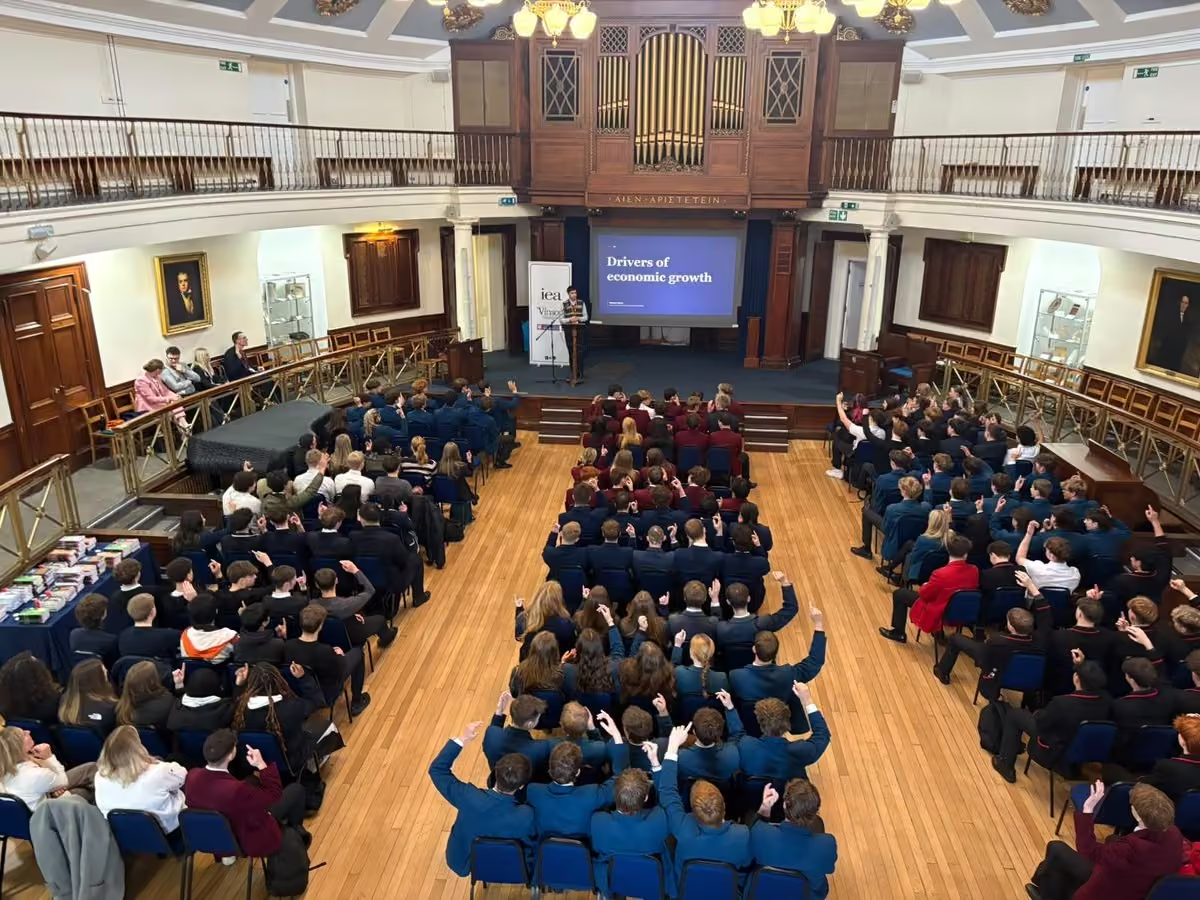


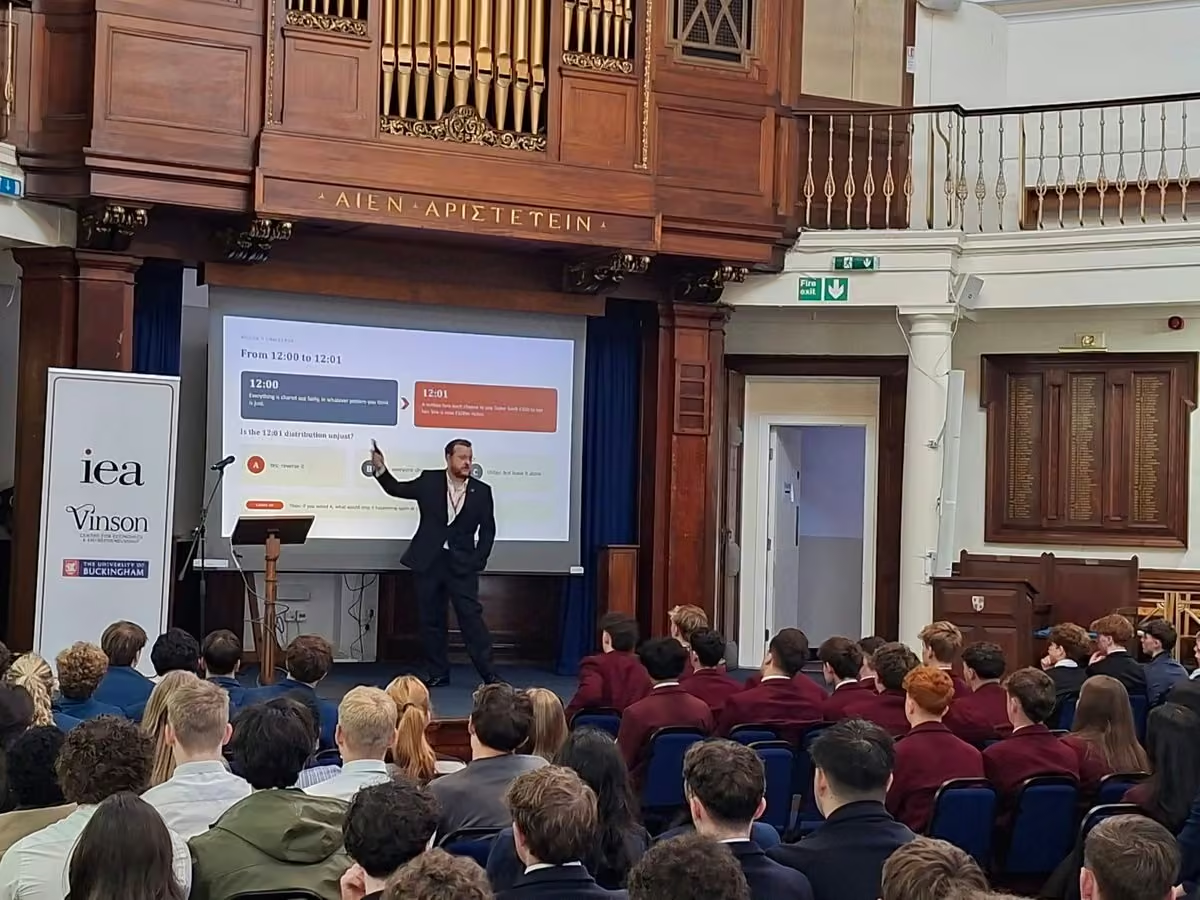


 Valentin Boboc


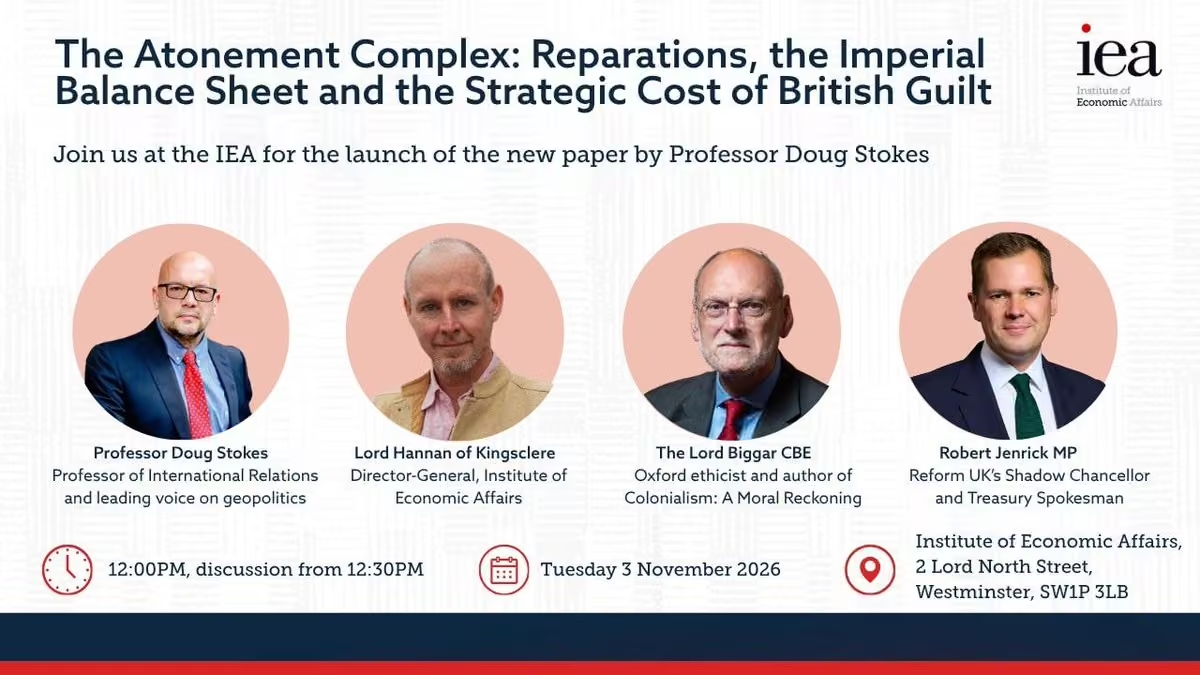


 Daniel Hannan

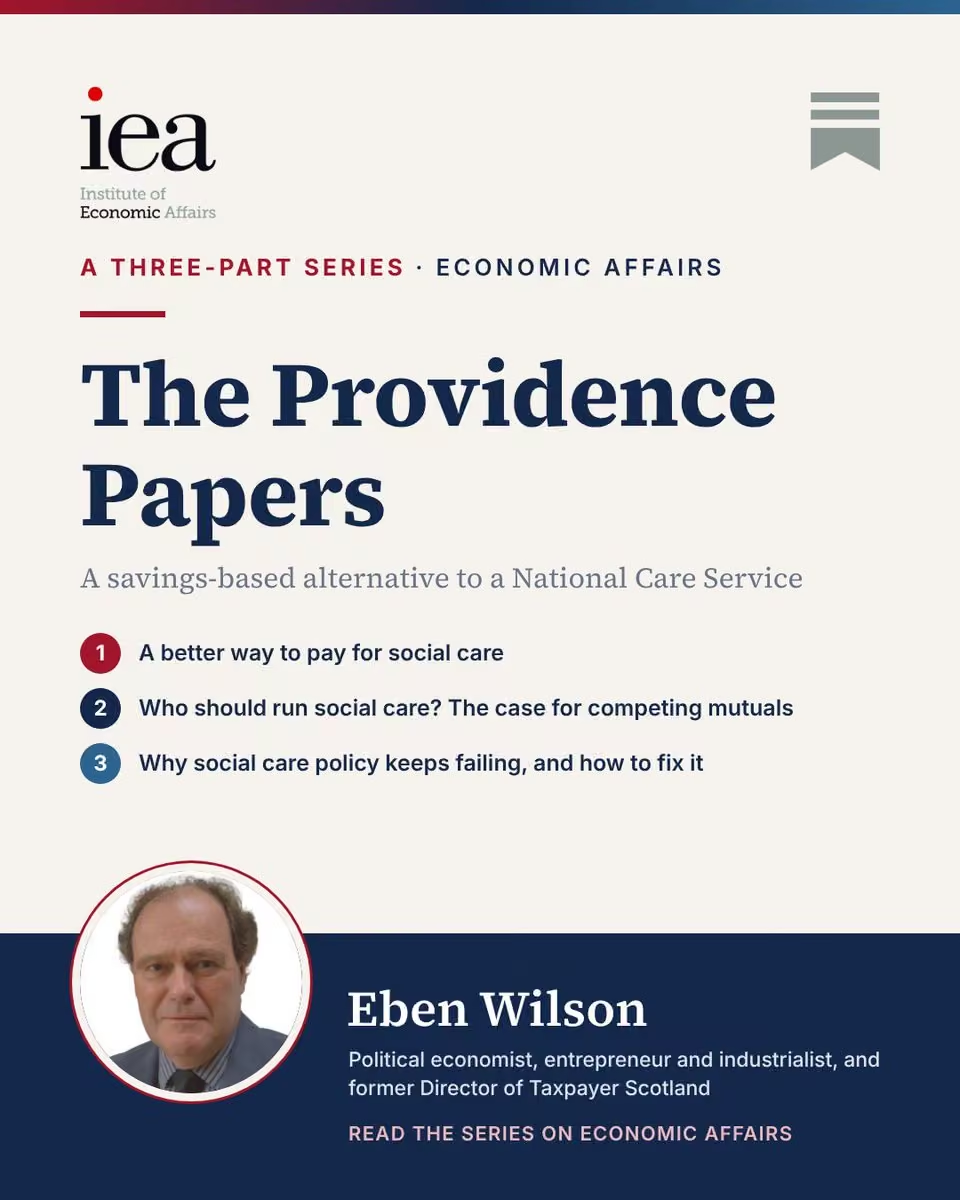


 Julian Jessop


 Christopher Snowdon


 Simon French


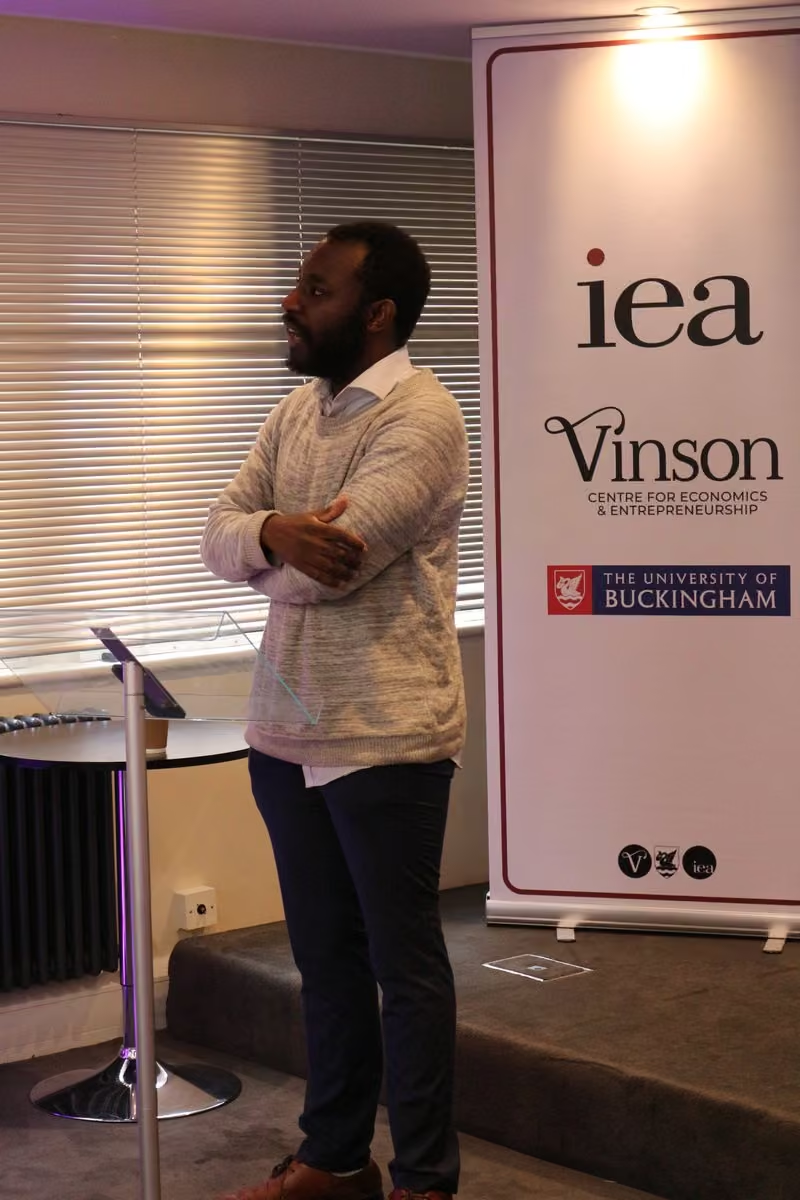


 Matthew Lesh


 Vinson Centre Official













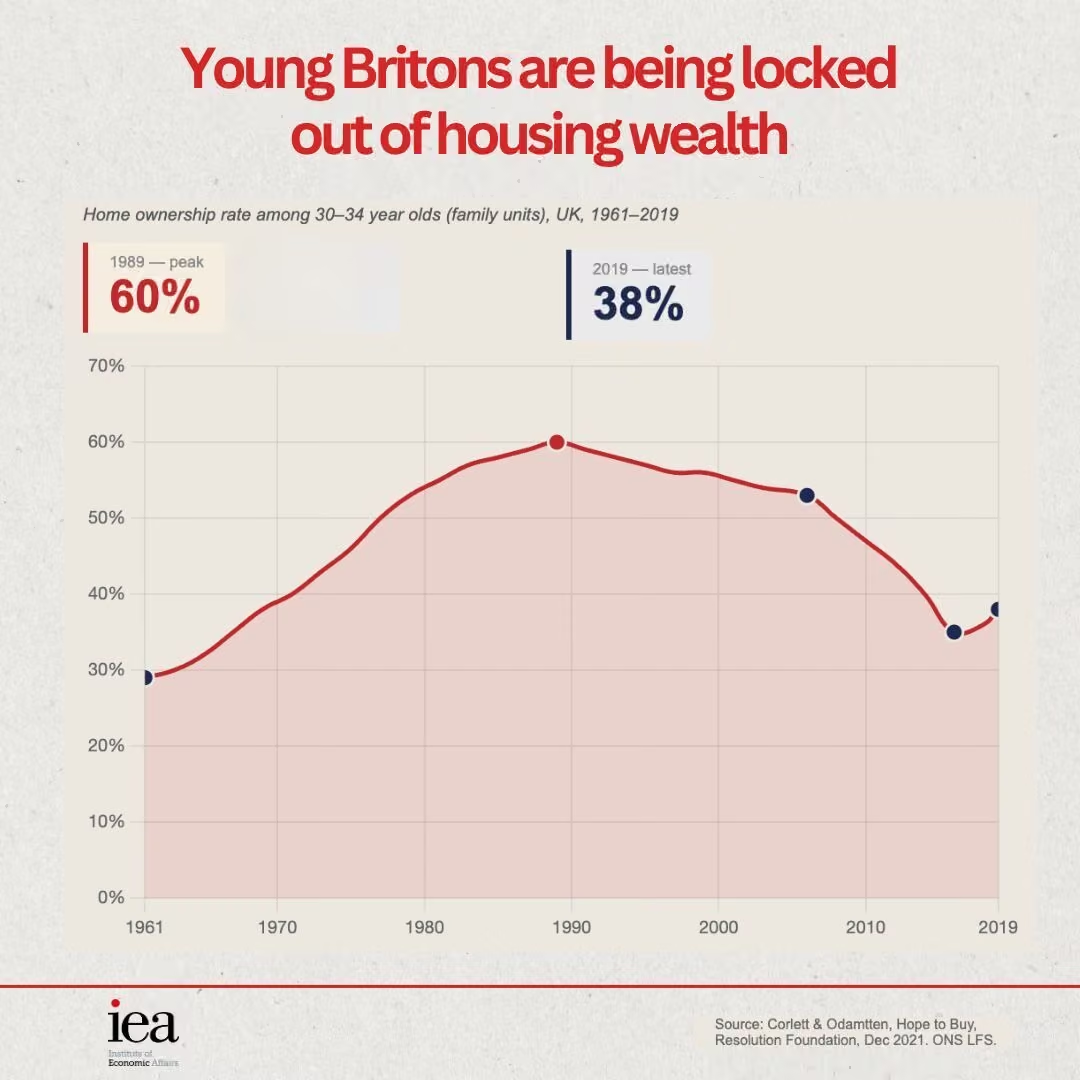







 Polymarket


 BBC Politics


 Callum Price


 Steven Swinford

 Andy Mayer
 Beth Rigby


