 ILRI.org
@ILRI

On #cop31's Enhancing Implementation day, five asks to turn pledges into delivery for the 1.7 billion people who depend on livestock.


Politicians, athletes, journalists, NGOs, companies... They all use corporation-owned social networks to communicate with us. Citizens shouldn't have to hand over their data to companies to read content published by public entities. Public Feeds changes that by making posts of popular accounts freely available. Read more.

The International Livestock Research Institute or ILRI is an international agricultural research institute within the CGIAR – formerly the Consultative Group for International Agricultural Research. It was established in 1994 by merger of the International Laboratory for Research on Animal Diseases in Nairobi in Kenya, and the International Livestock Centre for Africa in Addis Ababa in Ethiopia. It is a non-profit, non-governmental organisation. More on Wikipedia
The International Livestock Research Institute (ILRI) aims for better lives, better planet through livestock. ILRI is a @CGIAR centre
ILRI.org reposted
 ICPAC
@IGAD_CPAC
📢 Day 2, Week 2 at the IGAD Pavilion (A266B)! #igadatcop31
Join our four side events today.
Anticipatory Climate Action in the Horn of Africa — Pastoralist youth and women lead their own resilience. 09:00-10:30
Strengthening Digital Agro-Climate Advisory Services (DACAS) - Trusted climate advice that helps farmers and pastoralists act early. 11:00-12:30
Raising the Returns on Resilience: From Drought Early Warning to Early Action (Kenya) — Kenya shows how early warning can lead to early action. 13:30-15:00
From Water Stress to Climate Resilience
Practical water solutions build food and water security. 15:30-17:00
Come and join the conversation! 🤝
#cop31 #climateactionnow #hornofafrica


ILRI.org reposted
 AMR Kenya🇰🇪
@AMR_Kenya
🤝 TOGETHER, WE CAN PREVENT AMR! 🌍💊
As we mark World AMR Awareness Week 2026, we extend our heartfelt appreciation to all our partners for their commitment, collaboration, and continued support in the fight against antimicrobial resistance (AMR).
Your contributions strengthen advocacy, surveillance, awareness, and action across human, animal, plant, and environmental health.
Thank you for standing with us in protecting the effectiveness of antimicrobials and safeguarding our shared future. 💚
One Health, One Action: Prevent AMR Now!
#waaw2026 #onehealth #preventamrnow

ILRI.org reposted
 Dr Kamau Mwangi
@P_mwas
Surveillance tells us which antibiotics still work.
Without data from labs in every sector, treatment becomes guesswork. Strong laboratories are AMR prevention.
#onehealthoneaction #preventamrnow #waaw2026 @KEMRI_Kenya @NPHIKenya @ILRI @Xl_Thespian @Sharonmelon73 @HazelAlai
 ILRI.org
@ILRI
What is antimicrobial resistance (AMR), and why should anyone who eats, farms or gets sick care about it? An ILRI explainer for
@cgiar @cgiar_saaf @WHO, @FAO, @UNEP @WOAH
#waaw #amr #onehealth


 ILRI.org
@ILRI
AMR happens when bacteria, viruses, fungi and parasites stop responding to the medicines meant to kill them. Bacterial AMR is already linked to more than 4.7 million deaths a year.


 ILRI.org
@ILRI
Livestock matters: most antimicrobials sold globally are used in animals raised for food. Resistant microbes move between animals, people and the environment.
ILRI.org
@ILRI
One Health, one action: Prevent AMR now. Learn more: www.ilri.org/world-amr-awareness-week-2026
ILRI.org
@ILRI
One Health runs on people who can work across sectors. The case for investing in One Health capacity building: on.cgiar.org/3Usonfd #onehealth
@CGIAR @CGIAR_SAAF
 ILRI.org
@ILRI
COP31 is the "Implementation COP". For livestock-dependent communities, action starts with feed.
Climate-adapted forages, reliable seed systems, and market connections are ready for wider adoption.
🎥 Watch here: on.cgiar.org/4ztQPLU
#cop31 #livestock
ILRI.org
@ILRI
National action plans on antimicrobial resistance (AMR) are only as good as their implementation. How to move them from plans to practice in agrifood systems: on.cgiar.org/4BWFvdR @CGIAR @CGIAR_SAAF #amr
 ILRI.org
@ILRI
Responsible antimicrobial use starts in communities. A new brief looks at the education innovations that help tackle antimicrobial resistance (AMR) on farms: on.cgiar.org/4zBQzLK
@CGIAR @CGIAR_SAAF
#onehealth #waaw2026
 ILRI.org
@ILRI
Zoonotic diseases don't respect sector boundaries, so control can't either. Evidence on One Health innovations from Africa and Asia: on.cgiar.org/3URIhjQ
@CGIAR @CGIAR_SAAF
#onehealth

ILRI.org reposted
 CGIAR Multifunctional Landscapes
@CGIARenviro
Meet the TERRA speakers at #cop31antalya
Joining us from MDA Brasil, @BiovIntCIAT_eng, @IFAD, @ILRI, AFA, Kenya and Ethiopia
📅 Mon 16 Nov | 12:00–13:00 | Food & Agriculture Pavilion
Co-organized with @CGIAR, @FAO, @IIED and partners
www.youtube.com/@cgiar/streams
#foodagpavilion


ILRI.org reposted
 Sustain Africa
@SustainAfrica_
Join the conversation at #cop31: Restoring Soil Health in Africa by linking indigenous knowledge, integrated soil fertility management, digital soil information and investment for lasting impact.
 ILRI.org
@ILRI
🇳🇬 Nigeria plans to more than double the value of its livestock sector in 10 years, from USD 32 billion to USD 72 billion.
At #cop31, it openly discussed the climate questions that growth raises.
Five lessons for other countries 🧵👇


 ILRI.org
@ILRI
🐄 2. Start with productivity
Farmers change practices when it raises their income. Better feed, health, and genetics can cut emissions intensity by up to 30 percent while increasing output, through tools like a heat-stable vaccine for sheep and goats.
ILRI.org
@ILRI
🏛️ 3. Give livestock an institutional home
Nigeria has a dedicated livestock ministry and includes livestock in its national climate plan. In Tanzania, a livestock master plan supported by ILRI helped secure USD 624 million in proposed investment.
ILRI.org
@ILRI
💰 4. Design finance for the borrower
Livestock receives about 0.1 percent of climate development finance. Grants, concessional loans, and results-based payments all have a role. Rural women without collateral may be better served by grants and village savings groups.
ILRI.org
@ILRI
🗣️ 5. Co-create in local languages
Work through the cooperatives and savings groups people already use. One example: a youth-designed chatbot that answers farmers' questions in Swahili.
ILRI.org
@ILRI
🌍 The average Nigerian has access to about 7 kg of meat a year. The average American: about 120 kg.
For ILRI's Aditi Mukherji, that makes livestock investment in the Global South a climate justice question.
🔗 Read the full story: www.ilri.org/news/measure-it-finance-it-share-it-what-nig…
ILRI.org
@ILRI
Human and animal health services rarely reach pastoralist communities together. Community-designed One Health units change that. A scalable model for rural Africa:
@CGIAR @CGIAR_SAAF
on.cgiar.org/4BUQkNi
#onehealth
 ILRI.org
@ILRI
One Health commitment doesn't become joint action on its own. Coordination has to be built. Lessons on institutionalizing One Health from Asia and Africa: on.cgiar.org/4sS1luV
@CGIAR @CGIAR_SAAF
#onehealth
 ILRI.org
@ILRI
In Senegal, herders who received climate advisories co-produced with ILRI, raised their use of improved feed and fodder management from 11% to 72%.
At 17:00 today, John Recha joins AGRA at the Food and Ag pavilion: From Forecasts to Farm Decisions.
#cop31 @turkiyecop31
 ILRI.org
@ILRI
Camels feed and carry pastoral families across Africa’s drylands, yet we know very little about their methane emissions. At ILRI’s Kapiti Research Station, Mohamed Habibou Assouma’s team is following 24 free-grazing camels to find out. #cop31
📖: on.cgiar.org/4zdED1Q
 ILRI.org
@ILRI
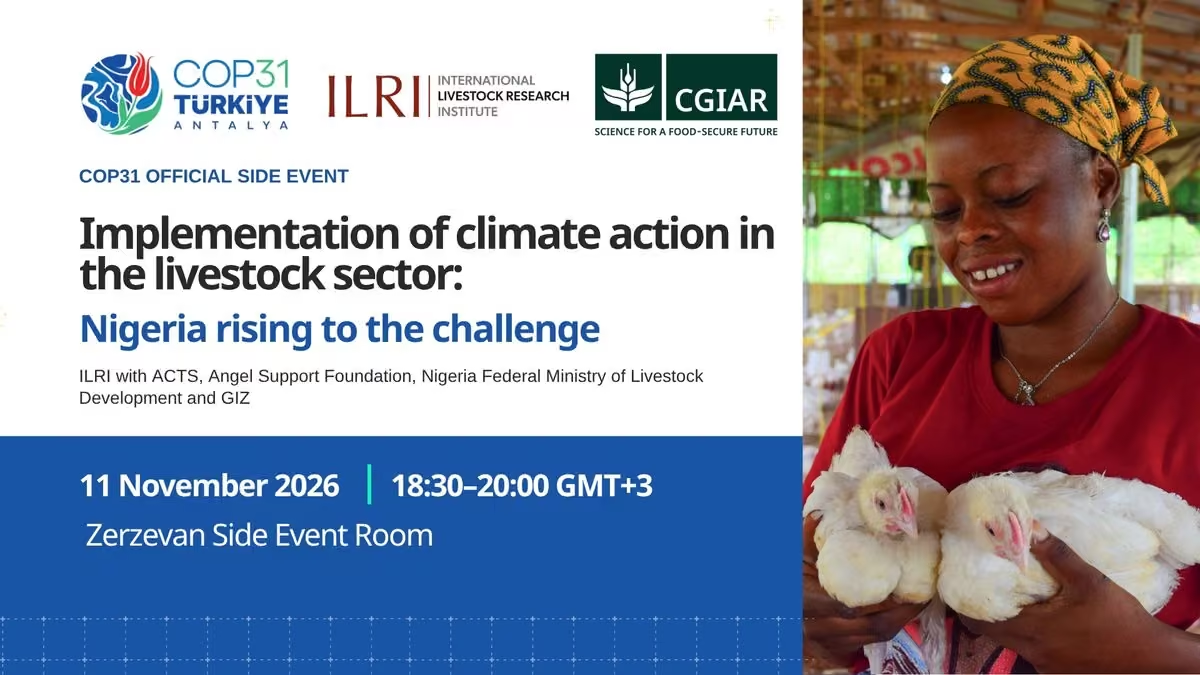
Tomorrow at #cop31: Nigeria plans to grow its livestock sector to US$72 billion a year by 2035 while meeting its Nationally Determined Contributions commitments. Hear how it's coordinating climate action in livestock.
See our full list of events: on.cgiar.org/4zfLqrU
#cop31
 ILRI.org
@ILRI
#cop31 opens today on Food, Agriculture and Health day, the year agriculture's negotiating track ends. Whatever follows should back the 1.7 billion people who depend on livestock and are already taking climate action. www.ilri.org/events/cop31
 ILRI.org
@ILRI
As droughts intensify across drylands, pastoralists are switching to hardy camels for food security, milk, and income stability 🐫☀️
Full story via The Standard 📖:
www.standardmedia.co.ke/environment-climate/article/20015…
#climateadaptation #pastoralism
 ILRI.org
@ILRI
#climatechange continues to pose severe risks to rural livelihoods in Zambia, particularly through recurrent droughts
Read how @ILRI and @CGIAR are helping farmers build resilience through forage production and preservation: on.cgiar.org/4z1S6d4
#climateaction


 ILRI.org
@ILRI
Why invest in #onehealth? 💡
Over 30 years of research by CGIAR & @ILRI proves that integrated interventions at the intersection of animals, humans, and the environment create real economic and social impact.
Explore the briefs: www.ilri.org/onehealthbriefs
@CGIAR_SAAF
ILRI.org reposted
 DLCI Kenya
@DLCI_Kenya
On 4 November, @DLCI_Kenya co-hosted the Policy Forum “Towards thriving, resilient and prosperous drylands in the Horn of Africa” with the International Livestock Research Institute (@ILRI ) and the Dryland Observatory (@jameel_observ).
The forum brought together policy conversations on the issues shaping the future of the region’s drylands: the outlook for drylands, rangelands and pastoralists beyond the International Year of Rangelands and Pastoralists (IYRP) and global debates; institutionalising the capacities needed for prosperous and resilient drylands; achieving the right to food in the drylands; managing El Niño and who leads anticipatory and early action; and new models for investing in drylands.
@DLCI_Kenya Head of Programmes @bilachj moderated the opening conversation on the outlook for drylands, rangelands and pastoralists in the Horn of Africa, while DLCI CEO Dr. @JMokku moderated the closing discussion on investing in drylands. The day ended with a look at an emerging research, learning and policy agenda for drylands and the announcement of the Dryland Observatory.
Dryland communities’ priorities must remain in focus—in these conversations and in the decisions that follow. Connecting pastoralist experience with research, policy and investment is central to that.
@IGAD_CPALD @PPGKenya @SwissDevCoop @IGADsecretariat @EdinburghUni @ProsperGlb_org @GALVmed @JMokku @HonAdanHaji @NanokEpuyoCBS


 ILRI.org
@ILRI
Most countries have One Health strategies. Implementation is the gap. Our new summary brief draws on four decades of CGIAR work in Africa and Asia to show what it takes to invest and scale.
on.cgiar.org/4f7xed1
#onehealth
 ILRI.org
@ILRI
Most countries have a One Health strategy. Making it work on the ground is the hard part.
This #worldonehealthday, explore 10 new briefs drawing on 40+ years of CGIAR One Health work in Africa and Asia, from the CGIAR SAAF Program.
www.ilri.org/onehealthbriefs #onehealth


 ILRI.org
@ILRI
@CGIAR_SAAF @IWMI_ @IFPRI @BiovIntCIAT_eng @OHRECA_ILRI


ILRI.org reposted
DLCI Kenya
@DLCI_Kenya
@DLCI_Kenya continues to support pastoralist communities in raising awareness of existing policies, services, and opportunities to strengthen their livelihoods.
In Siana Ward, Narok County, we held dialogues with pastoralist communities on livestock health—including vaccination, feed and fodder, and the diseases affecting herds—access to reliable livestock health information, the pastoralist cooperative model, and opportunities to work with government entities to improve livestock service delivery.
The dialogues were held across five locations: Nkineji, Olesere, Oloolaimutia, Talek, and Eldonyo-Narasha. In each, we convened separate sessions for women, youth, and elders, allowing every group to speak to its own priorities and giving us a fuller picture of how decisions about livestock health are made within households and across the community.
Central to these discussions is the National Livestock Development and Promotion Service (NLDPS), established following resolutions of the 4th Pastoralist Leadership Summit. The service presents an important opportunity for pastoralist communities to access structured support for livestock health and production.
These dialogues are undertaken in partnership with @ILRI , reflecting our shared commitment to improving pastoralist livelihoods and strengthening livestock health systems in Kenya’s drylands.
@GALVmed @ILRI @jameel_observ @IGAD_CPALD @christensenfund @PPGKenya @SwissDevCoop


ILRI.org reposted
 CGIAR
@CGIAR
👨🏫 Training more people seemed like the answer. But training is hard to scale and even trained users still need expert support.
What if that expertise was built directly into the model? 🤖
@BiovIntCIAT_eng @IFPRI @ILRI @WorldFishCenter @CGIAR_Data @CGIARPolicy
ILRI.org reposted
 Shaukat Abdulrazak,PhD,EBS
@Profshaukat
Livestock is more than animals—it is food security, jobs, livelihoods and economic sovereignty. At the 2026 APSK Scientific Symposium in Malindi @KilifiCountyGov, I was Honoured to officiate the opening ceremony, called for science, research and innovation to transform livestock production, strengthen food safety, empower farmers and pastoralists, and drive value addition. Our goal to move from raw commodity exports to high-value products, industrialisation and prosperity. Research must reach the farm, the factory and the market. Setting up relevant #clusters, centres of excellence, #grandchallenge Kenya use of emerging technologies like Artificial intelligence and precision livestock farming, Genomics, precision breeding and reproductive biotechnology and Novel feeds, feed biotechnology and precision nutrition. @nacosti @KENIAupdates @nrfkenya @pthigo @FAOLivestock @ILRI @kalromkulima @sri_kenya @Livestock_Dev @OfficePCS_KE @APSK_Kenya
#livestock #sciencefordevelopment


ILRI.org reposted
ICPAC
@IGAD_CPAC
📢 The 2nd Eastern Africa Dialogue Platform on Anticipatory Action has culminated in the adoption of the Mombasa Ministerial Declaration on Anticipatory Action, 2026, marking a significant step towards institutionalising anticipatory action across the IGAD region.
IGAD Member States committed to strengthening early warning systems, sustainable financing and coordinated action before disasters strike.
Read the full declaration ➡️ shorturl.at/FIv2A
#eadp2
 ILRI.org
@ILRI
To tackle climate & productivity challenges, Kenya is developing a new Livestock Master Plan (LMP). Recently, the National Tech Committee trained in Nairobi on using data to target investments and support farmers. 🇰🇪
#livestockmasterplan


 ILRI.org
@ILRI
Catch the recording of the 29 October discussion on genetic diversity, soil health, and food systems at the CGIAR Food & Agriculture Pavilion. Featuring insights from @SNV_world, and Seed Savers Network Kenya.
📺 Watch here: : on.cgiar.org/4BFhMPe
#cop17armenia #livestock


 ILRI.org
@ILRI
ILRI is seeking a Director for the REAP Consortium to lead sustainable livestock and youth employment programs across 7 countries.
📍 Nairobi 🇰🇪 or Addis Ababa 🇪🇹
🎓 Req: PhD & 15+ yrs senior experience
🗓️ Deadline: Nov 25, 2026
Apply now: www.ilri.org/join-us/jobs-careers?jid=62830-director-reap…
 ILRI.org
@ILRI
El Niño can disrupt livestock routes, markets and increase disease risks. Connecting climate forecasts with community data, insurance can help protect livestock and livelihoods before losses escalate. Learn more: on.cgiar.org/4zg587t
#elnino #climateaction


 ILRI.org
@ILRI
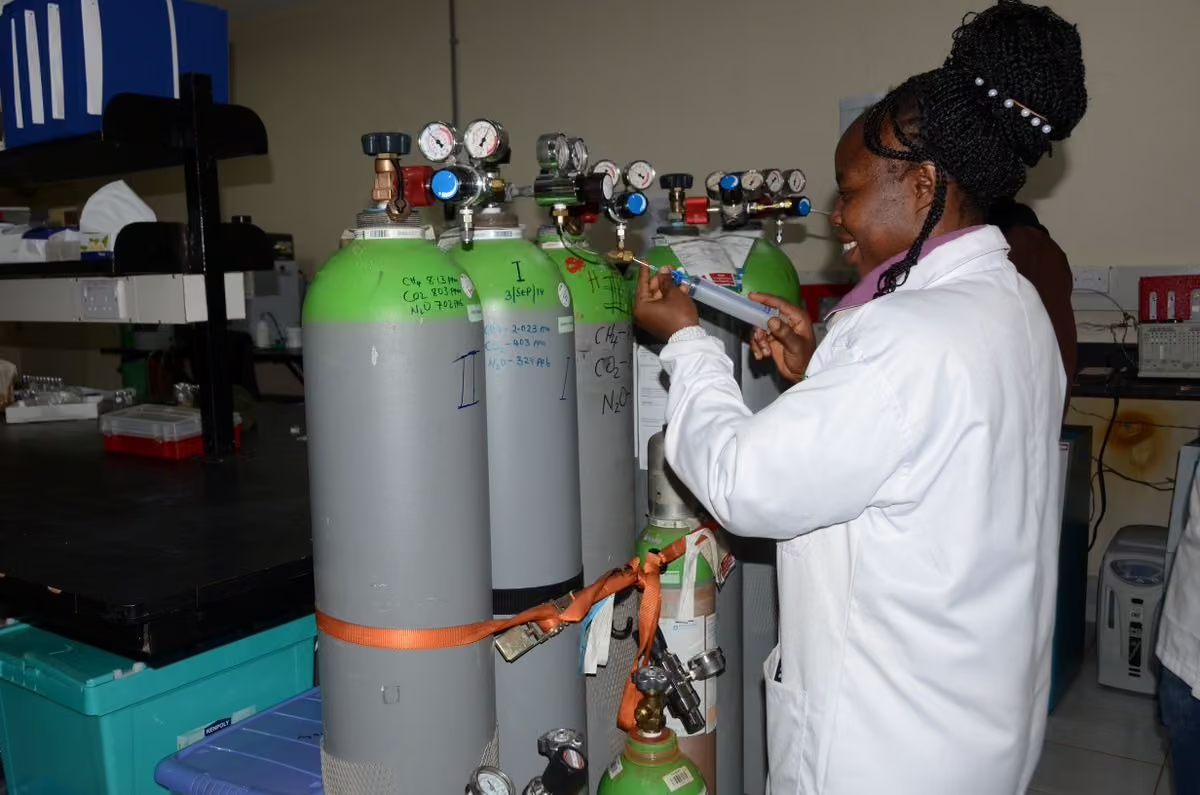
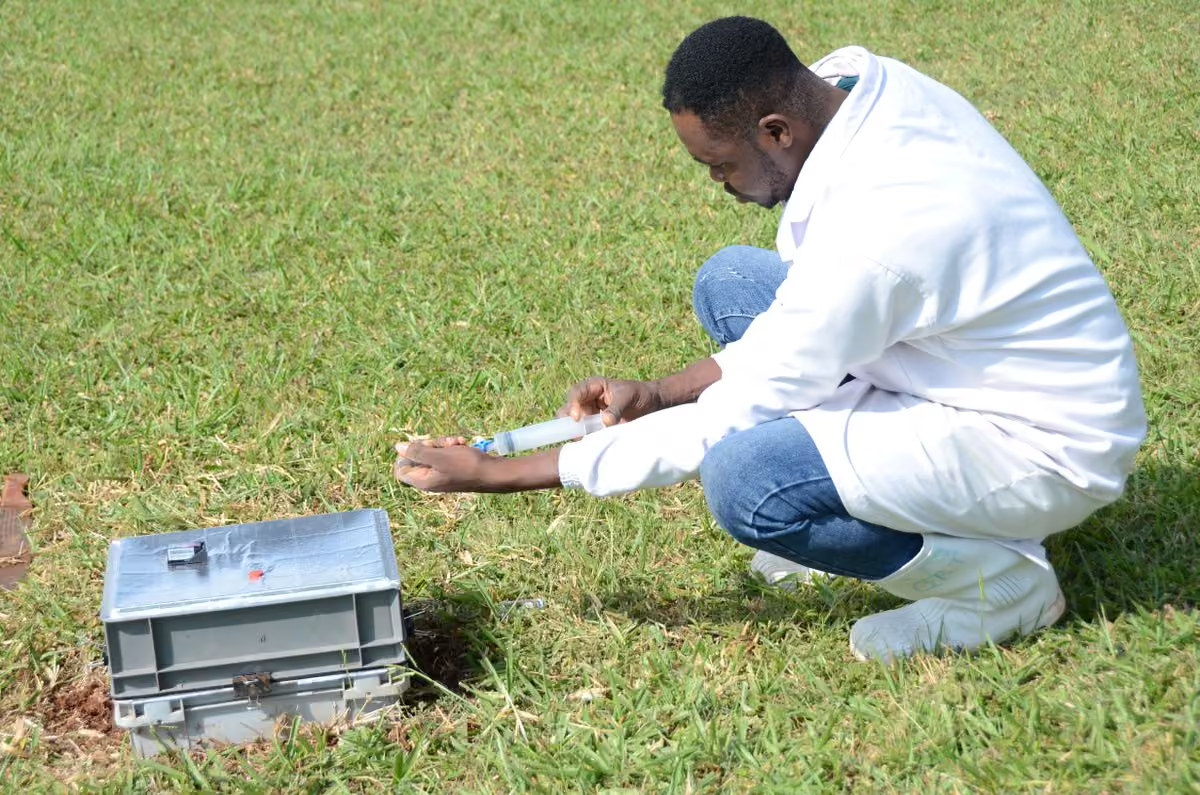
🌍 What happens when 2 research centres join forces for Africa’s climate research?
@IITA_CGIAR researchers Deborah Ogundepo & Joseph Oyelude trained at @ILRI’s Mazingira Centre on greenhouse gas measurement. 📊
Read: on.cgiar.org/4Bm7B1X
#climateaction

 ILRI.org
@ILRI
Sierra Leone is looking for proven livestock solutions—and ILRI brought them to #mita2026. 🌍
From thermostable vaccines 💉 to high-quality cassava feed 🌿 & digital advisory tools 📱, we’re ready to adapt and scale field-tested innovations across the region. 🚀
#livestock


 ILRI.org
@ILRI
From cells to landscapes 🌾🐄🐟
At #cbdcop17, @ILRI, @BiovIntCIAT_eng, and @WorldFishCenter discussed how crop, livestock, and fish genetic diversity can make livelihoods more resilient, and how to ensure the communities who conserve it share in the benefits. #biodiversity


 ILRI.org
@ILRI
🔬 New research from ILRI's Mazingira Centre shows that adding two fodder shrubs many farmers already grow to a typical dairy cow's diet could help reduce methane emissions.
Read more: on.cgiar.org/48jFseg
#dairyfarming #kenya #climatesmartfarming #ilri #livestockresearch


ILRI.org reposted
 BIG3Africa
@BIG3Africa
Kenya has more than 4 million camels, but how much methane do they produce?
Africa’s first camel methane measurement trial, led by @ILRI and @Cirad, aims to determine whether these drought-resilient animals are also climate-friendly.
READ: big3africa.org/2026/10/21/kenyas-drought-proof-camels-fac…
#climatechange
ILRI.org reposted
 CORAF | #MITA2026
@CORAFNews
#mita2026 | @CORAFNews extends its gratitude to the Government of Sierra Leone, its partners, researchers, innovators, and participants for making this 6th edition a success.
#merci au Gouvernement de la Sierra Leone, à nos partenaires et à tous les participants !

 ILRI.org
@ILRI
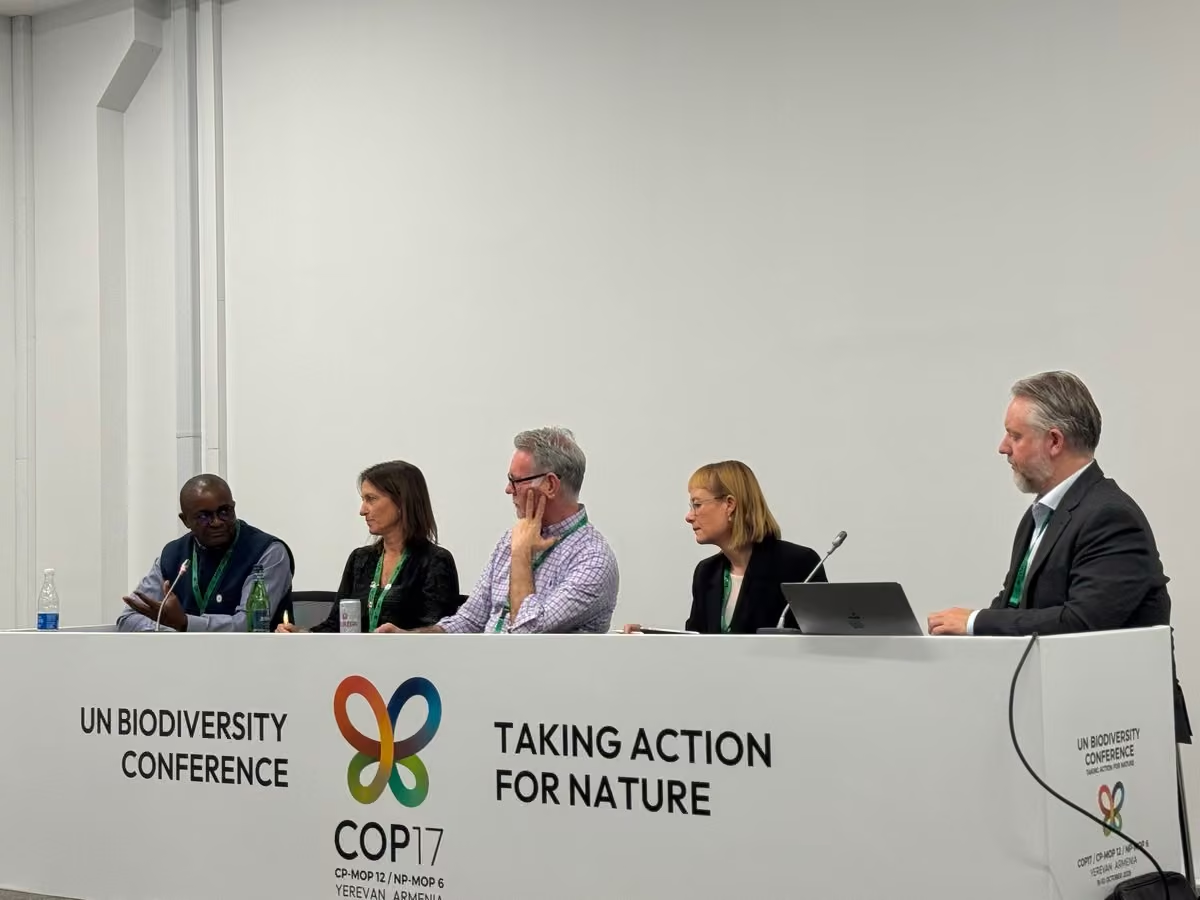
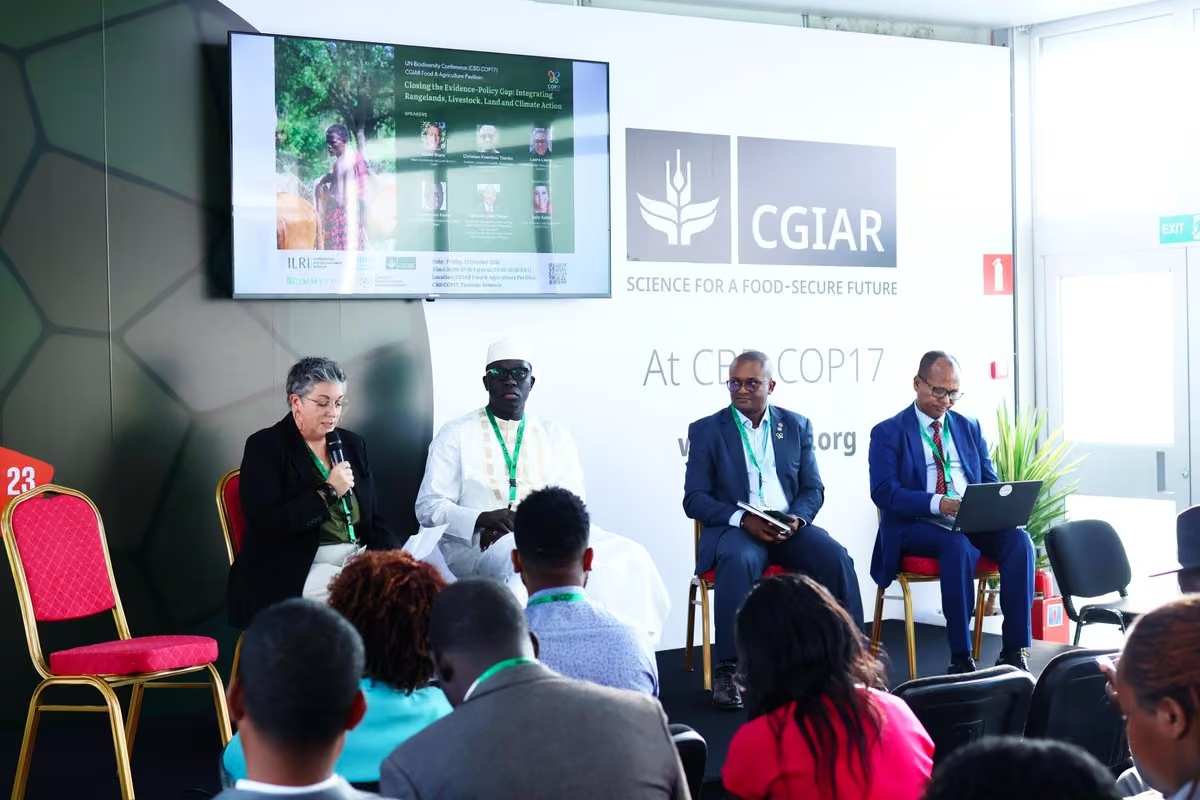
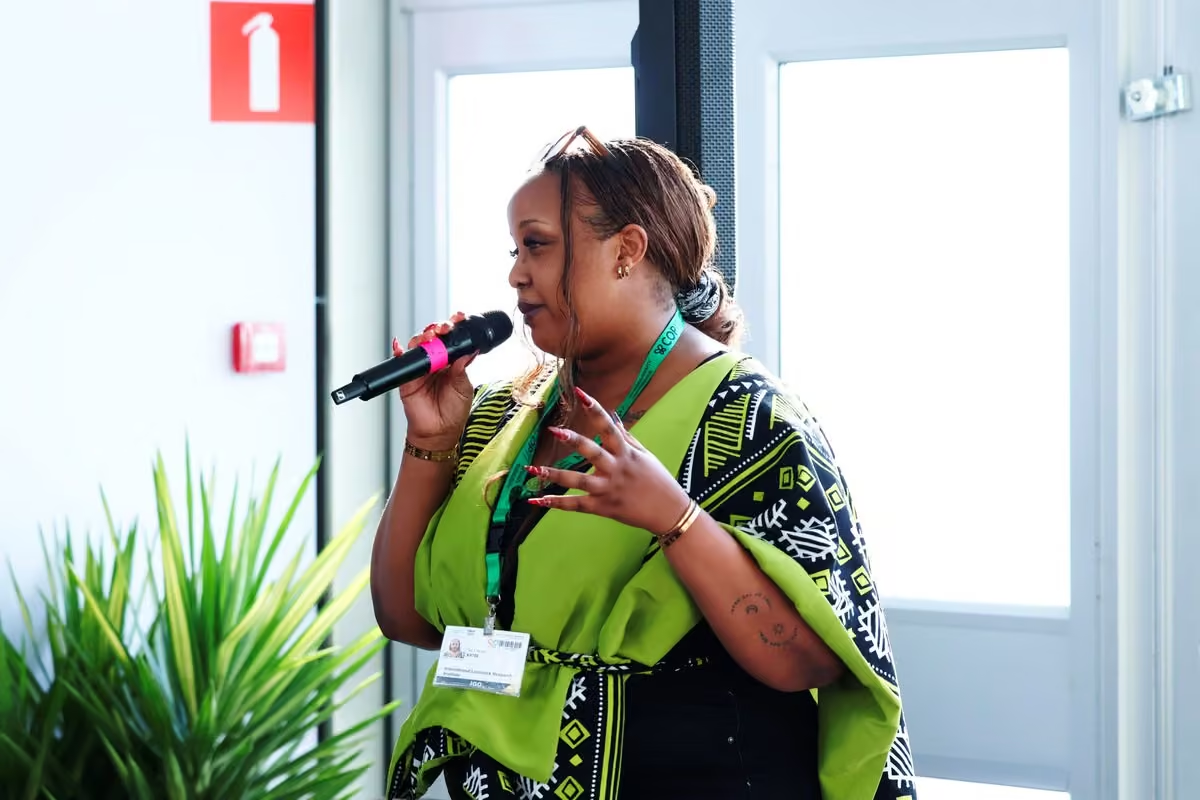
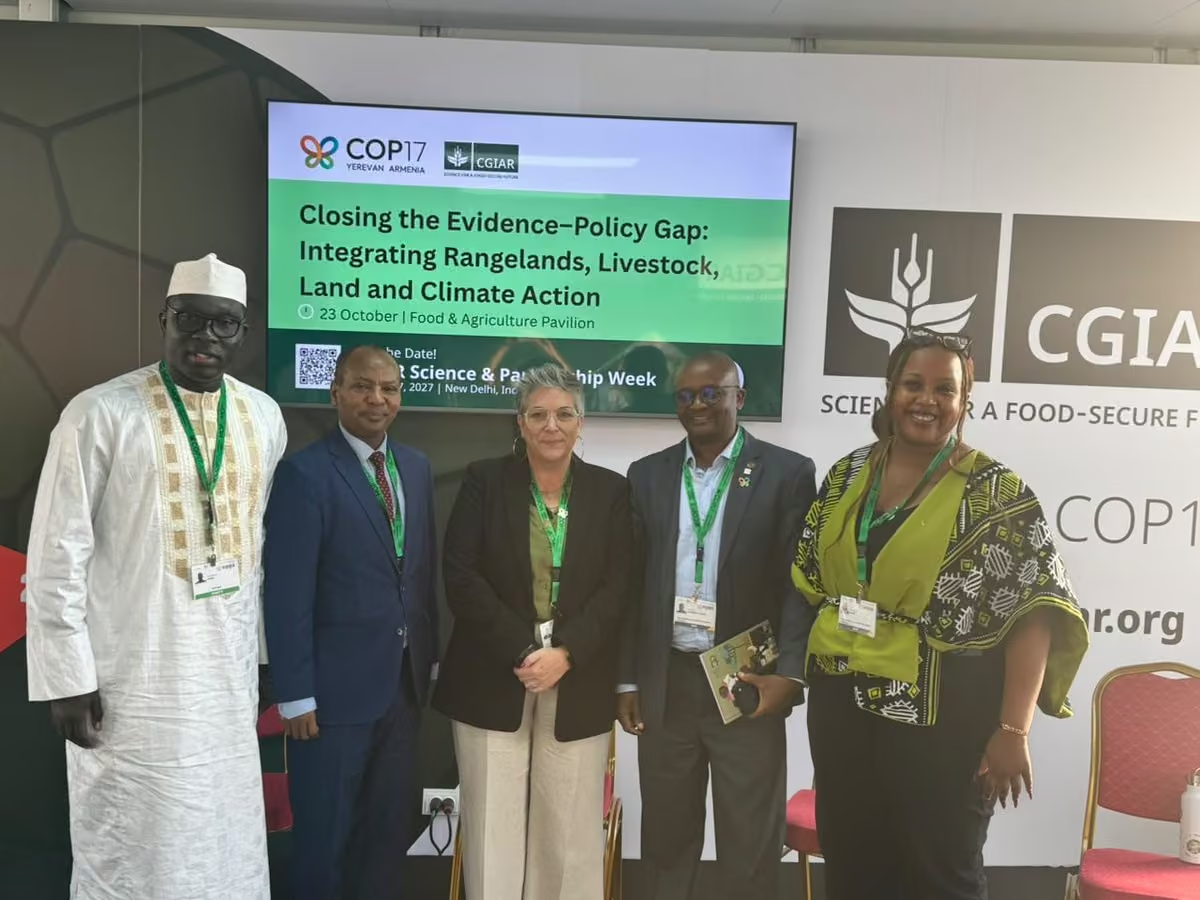
🌍 Highlights from @ILRI at #cbdcop17 in Yerevan, Armenia!
We brought livestock genetic diversity, rangeland restoration, and pastoralist rights to the center of global biodiversity action.
Here’s a recap of our key sessions & takeaways 🧵👇
 ILRI.org
@ILRI
🌱 23 Oct: Moderated by @ILRI’s @sallykatee, our CGIAR Pavilion session tackled "Closing the Evidence–Policy Gap" with experts from @UNEP, AGN, @CIMMYT & @CBD_Secretariat.
ILRI.org
@ILRI
💡 Key Insights:🔹 Rangelands cover >50% of land & support 2B people 🔹 Locally adapted livestock breeds drive drought resilience 🔹 Synergies needed across NBSAPs, NDCs & LDN targets 🔹 Pastoral mobility & knowledge must be protected
ILRI.org
@ILRI
📺 Missed the live discussion? Catch the full recording from the CGIAR Pavilion at #cbdcop17 here:www.youtube.com/watch?v=aZSZq2DJM-k
#cop17armenia #pastoralism #livestockgenetics #cgiar #climateaction
ILRI.org
@ILRI
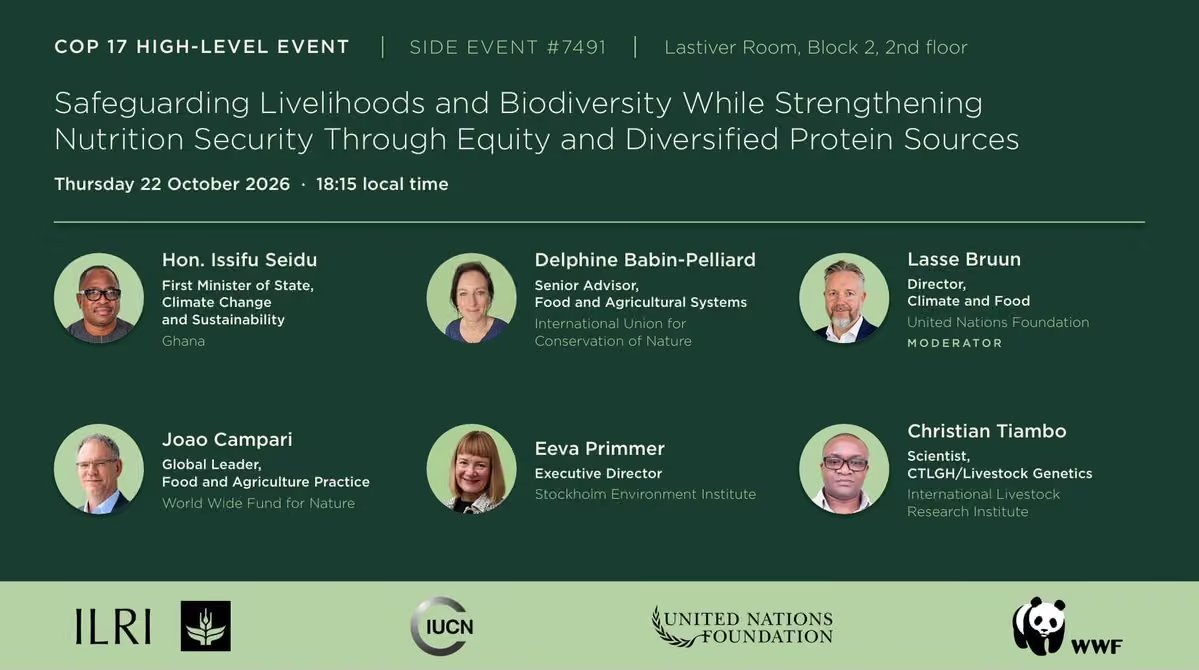
Join ILRI and partners at COP 17 today at 18:15 EAT!
We are exploring how to safeguard livelihoods and biodiversity while strengthening nutrition security through equity and diversified protein sources.
📍 Lastiver Room, Block 2, 2nd floor
#cop17armenia #foodsystems
 ILRI.org
@ILRI
During a visit to @ILRI’s Kapiti Centre, @GatesFoundation’s Samuel Thevasagayam commended our climate-resilient livestock breakthroughs—from the Dorper–Red Maasai sheep crossbreed to nutritious alfalfa & sorghum forage.
#climateresilience #foodsecurity #livestock
ILRI.org
@ILRI
Happening today at #borlaugdialogue! 🚨
Join ILRI & global leaders for "Deploying livestock solutions for nutrition, climate & sustainable development." @WorldFoodPrize @ADjikeng
⏰ Today, 18:15–20:15 CDT
📍 Des Moines, IA
#climateaction

 ILRI.org
@ILRI
Biodiversity also lives in Africa's livestock. Find ILRI at CBD COP17 in Yerevan:
19–21 Oct · Biodiversity Tech Expo
23, 26 and 29 Oct · #foodagpavilion
30 Oct · Official side event: The Missing Multiplier
➡️ on.cgiar.org/47tSxBz
#cop17armenia @UNBiodiversity @CGIAR


ILRI.org reposted
 ACIAR
@ACIARAustralia
An #aciar-supported chicken breeding program in Cambodia has won the 2026 ISSCA Global Award, which recognises high-impact and scalable innovations from the Global South. 🇰🇭
Read more: www.aciar.gov.au/media-search/news/poultry-innovation-cam…
@ILRI
 ILRI.org
@ILRI
Why is ILRI heading to COP 17 in Armenia? 🇦🇲 We are joining global partners to champion the critical role of local and indigenous livestock in global biodiversity. Advocating for biological diversity that serves both the planet and local communities.
#cop17armenia #biodiversity
ILRI.org
@ILRI
🌱 From a small plot to a thriving business in Central Ethiopia! Quality seed, training & reliable markets made it happen. Gombora Cooperative farmers pooled 25ha to produce 19 MT of quality forage seed. 🌾
Happy #worldfoodday! 🌍
Read more: on.cgiar.org/3TFJQRt
#taat


ILRI.org reposted
 FAO Livestock
@FAOLivestock
Rome Call urges investment in peste des petits ruminants (PPR) eradication & foot-and-mouth disease (FMD) control.
Ministers & partners reaffirm commitment to eradicating PPR by 2040 through sustained financing, national ownership & joint action.
🔗www.fao.org/ppr/news-and-events/news/news-detail/rome-cal…

ILRI.org reposted
 ISAAA_AfriCenter
@afri_isaaa
➡Today, on World Food Day, we take time to appreciate millions of people from underprivileged communities who labour hard to ensure they are food secure, and to raise children in environments pummeled by challenges.
➡Also this being the International Year of The Woman Farmer, we remember the women across our continent who, tasked with primary care giving, work hard on barely enough land to ensure their families are well fed.
➡The official theme of the day: “Innovate today. Nourish tomorrow", requiring our look into use of data, technology, and artificial intelligence to transform agrifood systems, combat global hunger, and make nutritious food affordable and sustainable, marries beautifully with a call we have had sustained here at ISAAA AfriCenter for ages: use of agricultural biotechnology to feed the world.
➡This day calls for a relook of policies, communication streams, and collaboration avenues among different players to ensure biotech crops, for example, which harbour beneficial characteristics such as drought tolerance, quick yielding and pest resistance, can be adopted by farmers across the continent without hassle.
➡We particularly give our flowers to women who are in pursuit of food security through use of tech an innovation in the continent, and for whom we have formed a community in the African Women for Biosciences (AWfB) (africenter.isaaa.org/awfb).
➡We equally appreciate the men who have battled hard to ensure women have a voice, once greatly suppressed by society. 🙏🏽
➡Next year, in June, we shall assemble in Dakar, Senegal 🇸🇳 for the #abbc2027 (abbcsymposium.org) to agree on, inter alia, how researchers, having developed quite useful technologies, can build trust among societies for easier adoption.
Our aim? To harness the tech we are building and effortlessly feed Africa.
Happy International World Food Day!!!!
@corteva @Cirad @ILRI @kalromkulima @COMESA_HQ @au_ibar @BiosafetyKenya @IowaStateU University @CropLifeKenya @CropLifeIntl @Bayer @2blades @PREZODE @ICGEBCapeTown

ILRI.org reposted
 World Organisation for Animal Health in Africa
@africa_woah
Early detection starts on the ground. D3 of the @WOAH #zoosursy Symposium explores community-led early warning, frontline diagnostics, with experienc from Guinea, Gabon and C/ d’Ivoire, and research on Ebola antibodies in bats.
Strengthening OneHealth surveillance across Africa.


 ILRI.org
@ILRI
Proven livestock solutions exist but often stay underfunded 📉🐑 Join @ILRI's side event: "Deploying livestock solutions for nutrition, climate & sustainable development" 🌱🤝 @WorldFoodPrize
📅 Oct 21
⏰ 18:15 CDT
📍 Iowa Events Center, Des Moines
#borlaugdialogue #ilri

 ILRI.org
@ILRI
Livestock is a path to ending hunger for 1.7B people 🌍🐄 Join @ILRI for "A new livestock conversation: Before hunger wins" to turn potential into real commitments 🤝🌾@WorldFoodPrize
📅 Oct 21
⏰ 14:15 CDT
📍 Iowa Events Center, Des Moines
#worldfoodprize2026 #zerohunger


ILRI.org reposted
 World Organisation for Animal Health
@WOAH
Every 9 minutes, a person dies of rabies.
Rabies still kills more than 59,000 people every year. Yet countries around the world have shown that, by putting existing knowledge and tools into action, dog-mediated rabies can be eliminated.
This year’s World Rabies Day theme, “Stronger Together,” reminds us that eliminating rabies requires that we all work together.
When animal and human health systems work together and if we vaccinate our dogs, we can prevent rabies from reaching people and move closer to a world where no one dies from this entirely preventable disease.
We must work together to stop rabies before it reaches people.
#worldrabiesday #wrd
ILRI.org
@ILRI
Rabies is preventable, yet Kenya records an estimated 2,000 human deaths annually. ILRI’s Lian Thomas explains why dog vaccination, stronger surveillance, and access to treatment are critical to stopping transmission.
Read here: on.cgiar.org/4rHGBoT
#rabies #worldrabiesday
 ILRI.org
@ILRI
Three tools, three countries, one idea: communities are active partners in One Health, not just recipients. 🌍
Thrilled that our work with @LivestockUni & partners was recognized at the @FAO One Health Conference in Rome! Congrats to Siobhan Mor & Farah Isse Mumin. 🏆


 ILRI.org
@ILRI
How are we mobilizing community knowledge?1️⃣ CZP tool: Helps communities in Somalia rank zoonotic risks to directly inform national action plans.2️⃣ OH-KAP survey: Measures knowledge on AMR & food safety.3️⃣ Community Conversations: Drives behavior change in 🇪🇹 🇰🇪 🇸🇴.
ILRI.org
@ILRI
"Communities already hold the knowledge that should guide One Health action. These tools give that knowledge a structured route into planning." —Siobhan Mor.
Delivered with @AmoudUniversity, @VSF_Suisse, @Amref_Worldwide & Somali national bodies. #onehealth #zoonoses
ILRI.org reposted
 Heifer International Asia
@heifer_asia
⁉️ How do we build a more #climateresilient #livestocksector while recognising the vital role animals play in the lives and livelihoods of billions of people?
This was at the heart 💚 of “Can It Scale? A Pitching Session for Livestock Investment Solutions” at #climateweeknyc, co-hosted by @Heifer International, International Livestock Research Institute (@ILRI ), Environmental Defense Fund and Global Dairy Platform Inc.
We were particularly proud to see Dilip Bhandari, our Sr. Director of Programs - Livestock Technology and One Health, Asia, takes the stage to present a model that addresses a critical gap in rural communities: access to affordable, high-quality animal health services.


 ILRI.org
@ILRI
Rabies claims lives every year, with nearly half being children. This #worldrabiesday, learn why vaccinating dogs is the most effective way to stop the spread and save human lives.
📺 Watch: www.youtube.com/watch?v=qqic71k91fQ
@CGIAR @WHO @WOAH
#onehealth #endrabiesnow #animalhealth
ILRI.org reposted
 Heifer International
@Heifer
Can it scale?
At #climateweeknyc, our very own @dbhandariLR pitched a plan to train 3,000 women and youth as agro-vet entrepreneurs, bringing animal health and climate-smart services to 1.5M smallholder households.
Scalability = farmer value + local capacity + markets + finance.


ILRI.org reposted
 TheFact Daily
@TheFact_ng
NiMet, ILRI Push Climate Data To Nigeria’s Farms thefact.ng/nimet-ilri-push-climate-data-to-nigerias-farms/ @nimetnigeria @ILRI
ILRI.org
@ILRI
At #climateweeknyc, @ILRI co-hosted "Can It Scale?", a pitching session on turning livestock ideas into investable solutions.
The message: livestock solutions must deliver for livelihoods, nutrition, resilience and climate at once. 🧵
#livestock #foodsystems #climateaction


 ILRI.org
@ILRI
What did 3 yrs of the @CGIAR Scaling Fund teach us about last-mile innovation? 🌱
At #scalingweek2026, @ILRI's Esther Kihoro explored equity & responsible scaling with partners.
Dive into the lessons learned: on.cgiar.org/4dLGS4n
#impactatscale


 ILRI.org
@ILRI
Karibu! #scalingweek2026 is live at our Nairobi campus 🦸🏾
3 days of scaling heroes sharpening their superpowers: real challenges, practical solutions, stronger partnerships.
Follow along all week 👇
@CGIAR #scalingforimpact

ILRI.org reposted
CGIAR
@CGIAR
The energy is high in Nairobi, Kenya today as #scalingweek2026 begins!
Convened by the CGIAR Scaling for Impact program and @ILRI.org, Scaling Week brings together 400 scaling champions across food, land and water systems to work on real-world scaling questions and challenges.


 ILRI.org
@ILRI
The future of sustainable livestock depends on connecting science, investment, and action. At @ScienceSummit for #newyorkclimateweek, we explored financing low-emission systems. Science is rarely enough; farmers need viable economic solutions to scale adoption. #unga81


 ILRI.org
@ILRI
Join ILRI, @CGIAR, @BezosEarthFund, @WWF, and partners for a dialogue on financing low-emission livestock and grazing systems to sustainably meet growing global demand. 🐄💰
⏰ 13:00 EDT | 20:00 EAT
📍 Cure, Manhattan
💻 Join virtually: on.cgiar.org/4AjO8hD
#climateweeknyc!
 ILRI.org
@ILRI
We’ve partnered with the Kenya Pastoralist Market Development (KPMD) network and off-taker companies across 10 counties to build supply-ready, climate-resilient herds in Kenya. 🐐🌍
Read more: on.cgiar.org/4AlKl3y
@StrathU
#climateresilience #foodsecurity
 ILRI.org
@ILRI
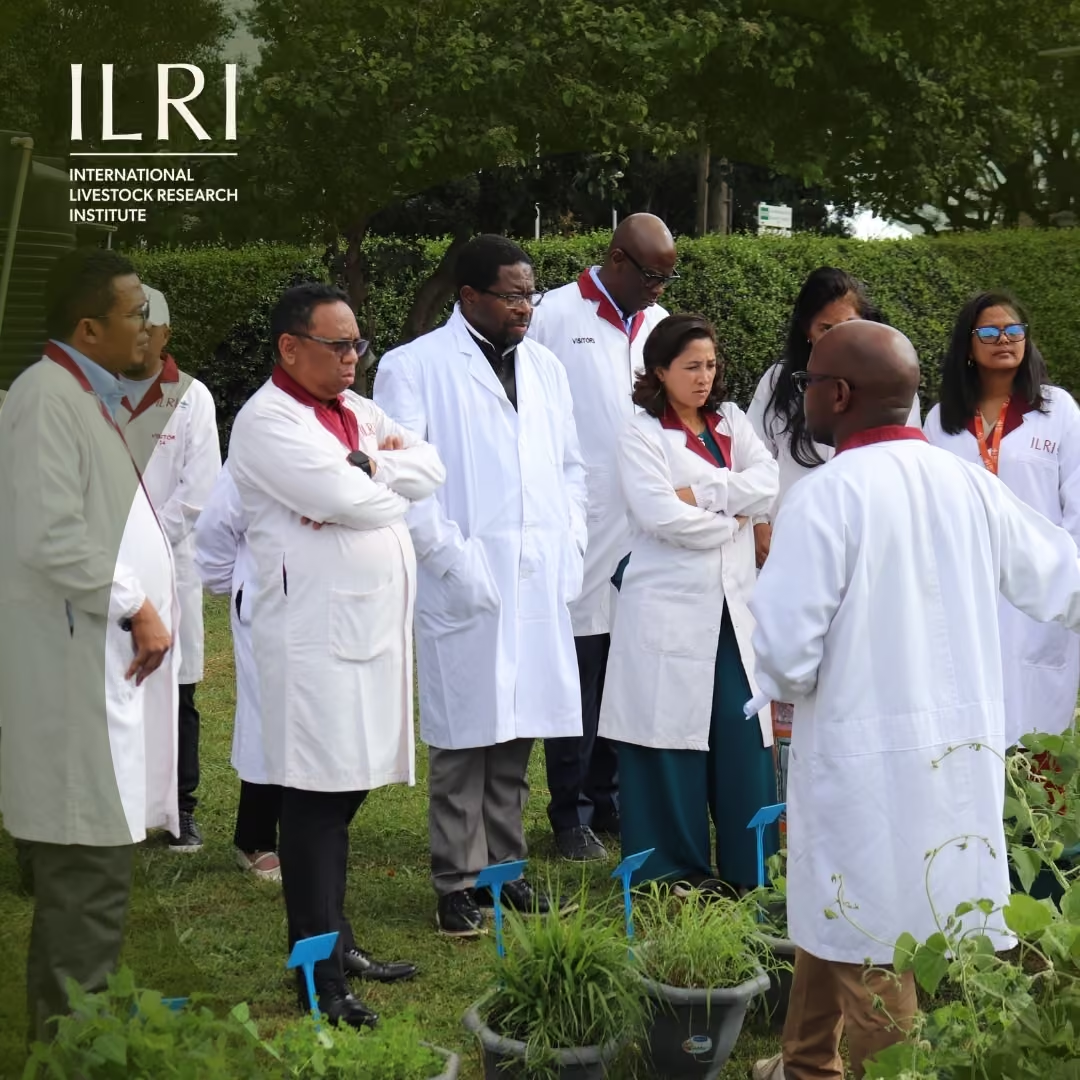
🇲🇬 Madagascar is moving forward with its new National Livestock Master Plan to boost livelihoods.
A recent visiti explored innovations in digital tools, animal health, and forage seeds to make it a reality. 🐄🌱 Read more: on.cgiar.org/4AlKl3y
#livestock #madagascar #cgiar
 ILRI.org
@ILRI
Our recent Tropical Livestock Systems course equipped local researchers with the tools and knowledge to drive sustainable dairy innovations and improve livelihoods.🐄🇪🇹
Read the full story here: on.cgiar.org/4yxDXEu
#dairy #ethiopia #livestock #foodsecurity @ILRI @CGIAR
 ILRI.org
@ILRI
How do we move #onehealth from a concept to everyday practice? 🌍
Over 5 years, the #cohesa project empowered 12 African countries to embed One Health in governance, education & communities.
💡 Read more here: on.cgiar.org/46s5smX
@ILRI @CIRAD @AfriCenterISAAA @OACPS_RI

ILRI.org reposted
 KEMRI-Wellcome
@KEMRI_Wellcome
Dr. Dishon Muloi, Molecular Epidemiologist and Veterinarian, @ILRI led a panel on Development Partners’ perspectives on financing for AMR containment. The discussion emphasised AMR as a systems issue requiring broad, multisectoral collaboration, stronger antibiotic regulation, resilient health systems, evidence-informed prescribing, and financing that reaches where it matters most including patients. #amrgovernanceandfinancingsummit2026 #amr #onehealth #amrfinancing

ILRI.org reposted
 Climate Lens News
@climatelensnews
Discussions during the Africa Food Systems Forum 2026 #afsforum2026 on the future of livestock keeping in Africa revealed that, despite having one-fifth of the world’s cattle, the continent produces only about 5 per cent of global milk while spending between $70 billion and $100 billion annually on food imports. Read👉🏿
climate.co.ke/africa-turns-to-homegrown-solutions-to-clos… @ILRI @au_ibar @CKLAfricaltd
ILRI.org reposted
 One Health - U of Guelph
@OneHealthUofG
A PREZODE webinar on Thurs. Sept. 24, 7:00 am EDT, will explore how sustainable livestock production can contribute to preventing zoonotic diseases emergence, while supporting biodiversity, food security, climate resilience and pastoral livelihoods: prezode-initiative.org/en/one-health-an-anchor-for-sustai…
 ILRI.org
@ILRI
Growing up in Cameroon, pigs & chickens paid for @ADjikeng 's education. Today, he is the DG of @ILRI.
Listen to his powerful conversation with @paulnewnham on the Future Fork podcast here: open.spotify.com/episode/6iej1JXtyQwmYvrzjhNKIs
#foodsecurity #zerohunger
 ILRI.org
@ILRI
Climate anomalies like El Niño have severe effects on livestock and agriculture, from heat stress to disrupted markets.
Teferi Dejene explains why we must contextualize climate forecasts across the livestock, water, and health sectors.
#afsf2026 #climateaction #livestockmatters
ILRI.org
@ILRI
Only 14% of climate finance in six African countries goes to livestock-focused projects. A decade of data, one clear gap. New from @ILRI's LiveSys project 🧵/carousel below.
#climatefinance #livestock


 ILRI.org
@ILRI
What does it take to build a healthier food system? 🥕Esther Omosa, ILRI's Senior Nutrition Specialist, explains why targeted investments are key to ensuring adequate and diverse diets for all at #afsf2026.
#foodsecurity #nutrition #healthydiets
ILRI.org
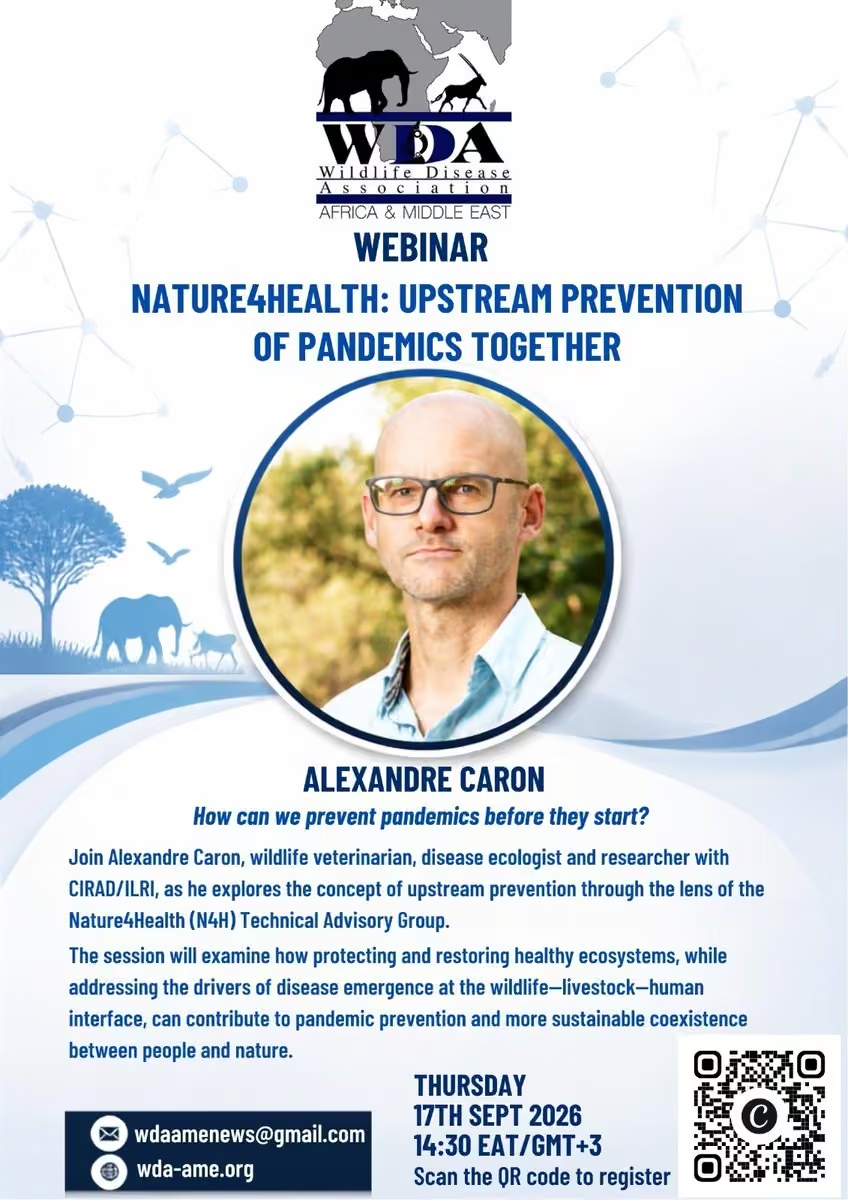
@ILRI
Join CIRAD/ILRI researcher Alexandre Caron for the @WDA_AME webinar, Nature4Health: Upstream Prevention of Pandemics Together, on 17 September 2026 at 1430 hours EAT.🦠🌿
🔗 Register here: on.cgiar.org/4xUCVSY
#nature4health #wildlifehealth #pandemicprevention
 ILRI.org
@ILRI
Young people need a voice in shaping the future of Africa’s food systems.
At #afsforum2026, ILRI’s Anthony Whitbread reflects on creating jobs in feed and livestock value chains — and having youth at the table when programs are designed.
🎥 Watch 👇
#livestock #ilri
ILRI.org
@ILRI
From one small side event in 2023 to 7+ central events this year! 📈 ILRI Emeritus Fellow Shirley Tarawali reflects on how livestock is finally taking its rightful place at the center of the #afsforum2026 discussions. No longer just "the cow in the room"! 🐄🌾 #foodsystems
ILRI.org
@ILRI
Why is single-sector intervention failing to stop Antimicrobial Resistance (AMR)? 🤔
Amos Mhone breaks down how weak governance, unregulated pharma markets, and behaviors of farmers and vets drive antimicrobial misuse in Malawi & Kenya.
🌍🐄
#onehealth #amr #ilri #globalhealth
ILRI.org
@ILRI
This 22–24 September, scaling practitioners gather at the ILRI Campus in Nairobi for CGIAR #scalingweek2026 to tackle real challenges and turn evidence into action.
📍 Nairobi, Kenya
👉 on.cgiar.org/4qrwEv6
cc: @CGIAR
#scalingweek2026 #scalingforimpact
 ILRI.org
@ILRI
At #wohc2026, ILRI’s Hung Nguyen shared a practical, risk-based approach: map the value chain, understand local socio-economic drivers, and co-create sustainable solutions with communities. 🌍🤝🌱
#onehealth


 ILRI.org
@ILRI
Lower methane or higher milk yields — does a farmer have to choose one? ILRI's Bayissa Hatew says climate-smart forage may deliver both.
🎧 New Africa Science Focus episode, via @SciDevNet: on.cgiar.org/46c4ZoV
#climatesmartagriculture #livestock #methane #ilri
 ILRI.org
@ILRI
🌍 Joining us at #wohc2026 in Lisbon? Drop by the @ILRI and @CGIAR booth!
Explore our latest #onehealth research, tools & evidence on:
🦠 Zoonoses
💊 AMR
🥩 Food safety
🐾 Wildlife health
Meet our colleagues driving impact across Africa & Asia!
👉 www.ilri.org/events/9th-world-one-health-congress-lisbon


 ILRI.org
@ILRI
🦠 Nearly 9% of wildlife farmers studied in Vietnam showed evidence of previous hantavirus exposure.
ILRI explain why the findings are an early warning for Southeast Asi and why #onehealth action matters.
🔗 Read more: on.cgiar.org/4ylRChX
#hantavirus #zoonoses #ilri
 ILRI.org
@ILRI
Yesterday at #afsf2026, we moved from strategy to action for #africanlivestock! 🌍🚀
After scaling regional value chains at the 2nd Ministerial Deep Dive with AU-IBAR, we grew partnerships for nutrition and trade at our networking reception. 🐄
#livestock #afsforum2026


 ILRI.org
@ILRI
Livestock contributes 50% to pastoral incomes & 40% of agricultural GDP—yet climate finance often overlooks it. At the @OECD session on Climate Finance, Shirley Tarawali explained why the sector is a climate solution, not a liability. 🌍🐄
#afsf2026 #afsforum2026 #livestock


 ILRI.org
@ILRI
We made a powerful impact at the Nourishing Food Systems: Policy to Plate session yesterday. @CGIAR @CGIAR_SAAF #afsforum2026 #afsf2026 #ilriatafsf


ILRI.org reposted
 AWARD Fellowships
@AWARDFellowship
Why invest in women’s food systems leaders?
At #afsforum2026, our speakers will spotlight investments that grow jobs, nourish nations, and build resilience.
Don’t miss our sessions. Explore our full speaker lineup 👇
ttps://shorturl.at/06Uuf


ILRI.org reposted
ILRI.org
@ILRI
Ahead of #afsf2026 in Kigali, Siboniso Moyo shares how @ILRI is bringing research-backed solutions to the table. We're ready to partner with leaders to turn science into action.
See you in Kigali! 🇷🇼👇
Learn more here: on.cgiar.org/4wUMVdG
#afsf2026 #foodsystems
ILRI.org
@ILRI
Ahead of #afsf2026 in Kigali, Siboniso Moyo shares how @ILRI is bringing research-backed solutions to the table. We're ready to partner with leaders to turn science into action.
See you in Kigali! 🇷🇼👇
Learn more here: on.cgiar.org/4wUMVdG
#afsf2026 #foodsystems
ILRI.org
@ILRI
From engaging panels to high-level dialogues, the ILRI team has been on the ground championing sustainable solutions for land degradation.
Take a look at some of our favorite highlights from the events so far! 📸👇
#ilri #unccd #landrestoration #pastoralism #cop17mongolia


 ILRI.org
@ILRI
Today at #unccd #cop17mongolia, @ILRI is co-hosting a high-level session on scaling rangeland restoration across Africa with @giz_gmbh, @WWF, @AU_IBAR, @LandCoalition & partners 👇
📍 MET-04, Blue Zone
⏰ 10:30 AM – 12:00 PM
#united4land #herland
 ILRI.org
@ILRI
We’re launching a regional Coalition to mobilize investments into nature-positive dryland economies
@GCF, @GEF & the Africa Green Investment Forum.
Ready to scale real impact? Join here: on.cgiar.org/4isXKA4
#cop17mongolia #unccdcop17 #climateaction
 ILRI.org
@ILRI
Public finance isn't enough. Today at #unccd #cop17 Finance Day, we're exploring investment pathways to reward the local land stewards who manage our vital, under-financed rangelands.
#cop17mongolia #unccdcop17
@IUCN @LVMH @WorldBankGroup @UNCCD @theGEF @CGIAR @BirdLife_News

 ILRI.org
@ILRI
🌍 Half the Earth's land is rangeland, worth up to $47 TRILLION a year. It appears in the climate plans of 24 countries. Forests: 181. Launched today at #unccdcop17, Rangelands Rising makes the investment case. 🧵👇 #rangelandsrising #iyrp2026
 ILRI.org
@ILRI
The shift the report asks for: stop seeing 500 million pastoralists as aid recipients. They're the primary long-term investors in rangelands — putting in labour, knowledge and herds every day. Back them as partners. 🐐
ILRI.org
@ILRI
Rangelands cover half the Earth. They feed millions, store carbon and hold a third of its biodiversity. It's time to invest in them. 📄 Read Rangelands Rising 👉 www.ilri.org/rangelands-rising-investing-sustainable-mana…
#rangelandsrising #iyrp2026 #unccdcop17
ILRI.org
@ILRI
Tomorrow. The time of rangelands and pastoralists has arrived. Rangelands Rising launches at UNCCD COP17.
🐄🌾 #rangelandsrising #iyrp2026 #unccdcop17
 ILRI.org
@ILRI
What if the people blamed for degrading half the Earth's land are actually its best stewards? 🌍
The evidence is in.
24 Aug.
#rangelandsrising
 ILRI.org
@ILRI
Half the Earth's land is grazed, not ploughed — and almost no one is investing in it. That changes on 24 Aug at #unccdcop17. 🐐 Rangelands Rising is coming.
#rangelandsrising #iyrp2026
 ILRI.org
@ILRI
Invasive plant species are a major threat to pastoralism and a leading cause of rangeland degradation. @UNCCD
Join ILRI and partners at #unccdcop17 to explore solutions, rangeland monitoring, private sector investment and priority actions to address their spread.
📅 19 Aug | 12:30–13:30 (GMT+8)
📍 IUCN Pavilion, COP17 Blue Zone
Sign up for the global call to action to rid our rangelands of invasive species here: on.cgiar.org/4hIk9Jt
#invasivespecies #rangelands #pastoralism #ilri #cop17mongolia #united4land, #herland #sport4land #youth4land
 ILRI.org
@ILRI
Join us today, 18 August 2026, to discuss agricultural resilience! 🌍
Our #afsforum2026 webinar explores "Surviving shocks: Investing in sustainable production for resilient food systems in Africa" and how we can invest in soil health.
🕒 1500–1630 hours (EAT)
📍 Zoom
🤝 With @AGRA, @ILRI, and @BiovIntCIAT_eng.
Join the conversation! on.cgiar.org/4hAZoiT
 ILRI.org
@ILRI
How are Kenyan dairy producers adapting to changing climates? By learning from each other. 🇰🇪 🐄
In Bomet County, adaptation pioneer farmers are sharing practical solutions like silage making and growing sweetpotato vines to keep livestock productive during dry spells.
Through the HABITAT project, the International Livestock Research Institute (ILRI) helps organize farmer-led field days. Learning in local languages with real on-farm demonstrations encourages more smallholder farmers to adopt climate-smart practices. Read more: www.ilri.org/news/farmer-farmer-learning-helps-kenyan-dai…
#cgiar #dairyfarming #climateadaptation #kenya


 ILRI.org
@ILRI
Why is ILRI heading to UNCCD COP17 in Ulaanbaatar? 🌍
Did you know rangelands cover approximately 54% of our planet? 🌍 Despite their massive scale, they are frequently mischaracterized as marginal or degraded landscapes.
Here is the reality: rangelands and pastoral systems are incredibly productive ecosystems central to climate resilience, biodiversity, and global food security! From August 17–28, the International Livestock Research Institute (ILRI) is heading to #unccdcop17 in Ulaanbaatar, Mongolia, to champion science-backed solutions.
🔗 Tap the link on.cgiar.org/4wYAIpe to explore our side events, delegate lineup, and the upcoming Rangelands Rising report!
#ilri #cop17 #iyrp2026 #rangelands #pastoralism #climateaction #landrestoration #sustainability #cgiar


 ILRI.org
@ILRI
Could pig feeds be a hidden pathway for African Swine Fever? 🤔🐖
With a near 100% fatality rate, ASF devastates smallholder farmers. @ILRI & @narouganda are mapping contamination risks across Uganda's feed value chains, combining indigenous knowledge with upcoming lab analysis at NaLIRRI. 🔬🌾
#asf #livestock #pigfarming #uganda


 ILRI.org
@ILRI
🌿 A dual solution for Madagascar’s farmers!
Mucuna pruriens is changing the game in the Vatovavy & Fitovinany regions—providing protein-rich livestock feed AND boosting soil fertility. 🐄🌱
See how early adopters are increasing yields and building climate resilience: www.ilri.org/news/mucuna-gains-ground-dual-solution-forag…
#climateaction #agtech #livestock #soilhealth #madagascar @CGIAR


 ILRI.org
@ILRI
Nigeria’s livestock sector holds massive potential! 📈 The new Nigeria Livestock Master Plan (N-LMP) unites government, academia & the private sector to drive evidence-based investments across 20 states. 🤝
See how we're turning data into action: on.cgiar.org/4buuO6D
#nigeria #foodsecurity #livestockmasterplan #agriculturalpolicy


 ILRI.org
@ILRI
Climate impacts could shrink Africa's agricultural productivity by 6% by 2050. 📉🌍
To counter this, we’re supporting African negotiators with the scientific evidence needed to champion climate-resilient agriculture globally. 🌾🤝
See how we are reframing livestock as a tool for resilience. 🐄✨ Read our 2026 Corporate Report: [Link to Report] 📖👇
on.cgiar.org/4vI1dyP 📖
#climateaction #resilientagriculture #africaclimate #foodsecurity #sustainability #climatepolicy #ilri #sustainabledevelopment
 ILRI.org
@ILRI
Building resilient food systems in Africa starts with equipping our scientists! 🌱🧬
For 6 months, the BecA-ILRI Hub hosted #vacsfellowship scientists for intensive, hands-on training in modern #plantbreeding, genomics & seed systems.
Through the BecA-ILRI Hub, ILRI leverages its advanced genomics and molecular breeding facilities to empower a wider network of scientists working to build resilient food systems
@CGIAR @CIMMYT
#foodsecurity #scienceforimpact #becailrihub


 ILRI.org
@ILRI
The latest #sofi report confirms a harsh reality: 2 in 3 Africans cannot afford a healthy diet, largely due to the high cost of nutrient-rich foods like milk, meat & eggs. This locks families into a cycle of malnutrition. But it doesn't have to be this way. 🌍
@FAO @WFP @WHO @UNICEF @IFAD
 ILRI.org
@ILRI
🇲🇬 Livestock supports 70% of rural households in Madagascar, yet historically received <1% of public ag funding.
💰 That's changing. We partnered with the Malagasy government & partners to co-create a $400M Livestock Master Plan to revitalize the sector. 🧵 1/2
📊 The evidence-based roadmap targets cattle, dairy, poultry, pigs & small ruminants. The goal? Boost milk production to 474M liters 🥛 and cut poultry mortality in half! 📉🐣
🚀 Explore this milestone in our 2026 Corporate Report: on.cgiar.org/4v7IrQ2
#livestockresearch #foodsecurity #agriculturaleconomics #madagascar #sustainableagriculture


 ILRI.org
@ILRI
Cattle manure is a vital natural fertilizer for African smallholders, but traditional uncovered storage leads to nutrient loss & GHG emissions.
New research from @ILRI’s Mazingira Centre explores how to protect these nutrients for better yields and a cooler planet. 🌍👇
www.ilri.org/news/maximizing-value-manure-how-local-data-…
#climateaction #smallholderfarmers
 ILRI.org
@ILRI
New in The Lancet Regional Health – Africa (@TheLancet): the first landscape analysis of AMR research in Tanzania. Of 799 studies, 88.5% focus on human health alone, just 7% on animals and 1.6% on the environment.
on.cgiar.org/4aRnEZW
@dishonmuloi @CGIAR @CGIAR_SAAF
#amr #onehealth #tanzania #globalhealth #ilri
 ILRI.org
@ILRI
Huge congratulations to ILRI Director General Appolinaire Djikeng on receiving an Honorary Doctorate in Science from his alma mater, @Bruneluni! 🎓🎉 This recognizes his tremendous contributions to bioscience, agriculture, and environmental health.
“This recognition belongs to the exceptional colleagues across ILRI, smallholder livestock farmers, and our partners.” – Appolinaire
Join us in celebrating this outstanding achievement! 👏🌍🐄
#livestockscience #agsci #foodsystems #honorarydoctorate
@ADJIKENG

 ILRI.org
@ILRI
Cassava waste is a massive environmental challenge—but it's also an untapped resource. ♻️
Through our High-Quality Cassava Peels innovation, we're turning pollution into nutritious, low-cost livestock feed. A win for People, Profit, and the Planet! 🌍📈
By replacing up to 15% of expensive maize in animal feed, our High-Quality Cassava Peels innovation lowers costs for farmers, cuts methane emissions, and creates jobs for women and youth. 👩🏾🌾
See how we're scaling this solution in our 2026 Corporate Report: on.cgiar.org/4eFuLXB
#circulareconomy #sustainableagriculture #livestockfeed #agtech #foodsecurity
 ILRI.org
@ILRI
For years, global media painted livestock purely as a "baddie" 🚫, ignoring the Global South where animals are vital bank accounts 🏦, insurance 🛡️, and essential nutrition for millions 🥛🥩.
See how a decade of science and advocacy 🔬📈 shifted the narrative from scapegoat to solution.
🔗 Read our full corporate report: on.cgiar.org/3TaUTRK
#livetock #sciencecommunication #sustainableagriculture #foodsecurity #policy

 ILRI.org
@ILRI
Antimicrobial resistance is a silent threat to animals, humans, and our environment. 🚨🦠 But Kenya is fighting back with a unified One Health approach! 🌍🇰🇪
Read "Not on our watch" to see how comprehensive AMR monitoring is making a difference. 🔬🐄
Read our 2026 Corporate Report 📖👇
🔗 on.cgiar.org/3SCTfYZ
#amr #onehealth #livestock #globalhealth
 ILRI.org
@ILRI
In rural Nepal, dairy farmers face a major hurdle: limited access to veterinary services. This gap keeps yields low, often averaging under 1 ton per cow/year. 📉🐄
Rather than just treating sick animals, local Village Livestock Promoters provide hands-on training on feeding, breeding, and preventive care. 🩺💡
By introducing a digital feed-balancing tool, one local farmer boosted his buffalo’s milk production from 9L to 12L a day! 🥛📈
Because Village Livestock Promoters come from the communities they serve, they build trust quickly and bridge a crucial extension gap for smallholder farmers. 🤝👩🌾
Explore more of these global impact stories in our 2026 Corporate Report. Read it here: 📖🌍 on.cgiar.org/4gOMInV

 ILRI.org
@ILRI
Mastitis can cut a dairy cow's milk production in half—or stop it completely. 🛑🥛
Our researcher Faith Koech breaks down how to protect your herd from this bacterial infection.
Key takeaways:
Clinical mastitis is visible (swelling, clots).
Sub-clinical mastitis is invisible but highly common.
Prevent spread by keeping sleeping quarters clean and strictly sanitizing milking equipment.
Use the California Mastitis Test (CMT) to detect invisible infections early.
Download and share the Preventing Mastitis in Dairy Cows Farmer's Guide: on.cgiar.org/4wmBfkb
#livestockresearch #dairycows #onehealth
ILRI.org
@ILRI
Vietnam has one of the highest pork consumption rates in the world (~30kg/person/year). 🐖 But traditional markets face a major challenge: high Salmonella contamination.
See how @ILRI & partners are changing that from the slaughterhouse to the stall. 👇 on.cgiar.org/4xVLqxA
The solution? Simple, low-cost interventions:
1️⃣ Raised stainless-steel grids to keep meat off the floor during slaughter.
2️⃣ Training market vendors to separate tools and ditch unhygienic cardboard displays.
The result: Salmonella rates dropped by up to 23%! 📉
#foodsafety #publichealth #onehealth #vietnam
@CGIAR @CGIAR_SAAF

 ILRI.org
@ILRI
How do you help farmers prepare for unpredictable weather? 📱🌍
By putting climate data directly into their hands! 🤲 We’re working with @CGIAR & @AICCRA_Africa to deliver digital climate advisories across Ethiopia 🇪🇹, Kenya 🇰🇪, and Senegal 🇸🇳. 🌱
Discover how science is driving on-the-ground impact. Read the full story in our 2026 Corporate Report: on.cgiar.org/4bfUMdP
#climateaction #agtech #ilri
 ILRI.org
@ILRI
Our 2026 corporate report is out.
Here's what's in it. 🧵
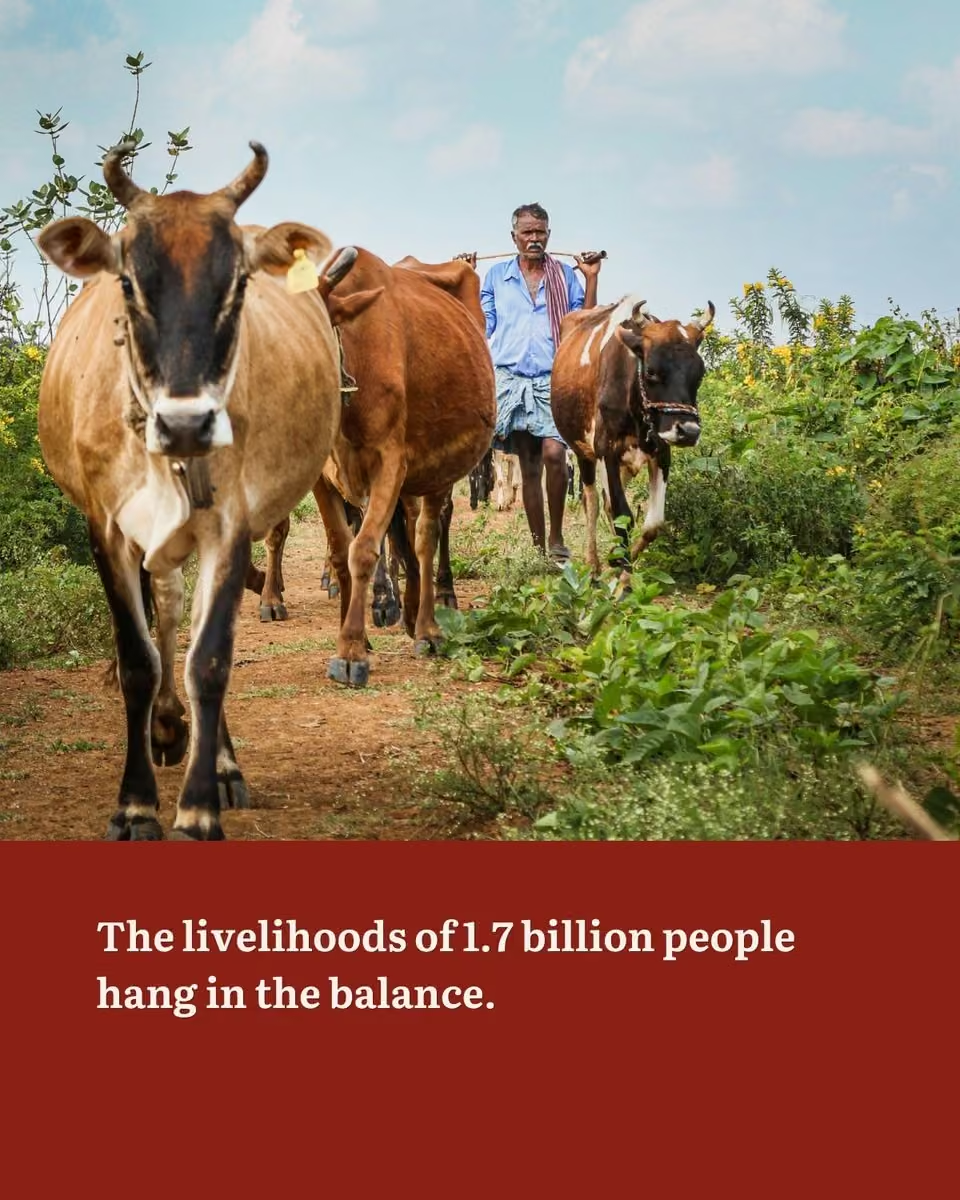
1/ 130,000+ farmers in Ethiopia are now receiving climate-smart guidance on feed and forage — via radio and mobile messages in local languages. Practical. Scalable. Working.
#livestockscience #climateresilience #smallholderfarmers #ilri


 ILRI.org
@ILRI
In Kenya, 8 labs are now equipped and 18 counties are trained to monitor antimicrobial resistance — feeding into global databases that guide coordinated responses.
ILRI.org
@ILRI
The science is working. The partnerships are delivering. What's missing is sustained investment — at the very moment development funding for agriculture is contracting.
Read the full report: www.ilri.org/corporate-report-2026
ILRI.org
@ILRI
💡Healthy cows produce more milk, generate higher incomes for farmers, and contribute to more sustainable dairy systems. Preventing mastitis is one of the simplest ways to achieve this.
🐄 Watch our @ShambaShapeUp episode on mastitis prevention (16:26–21:40): youtu.be/Vh6Mpen_5O8
#mastitis #dairyfarming #ilri
 ILRI.org
@ILRI
300M people. That’s our target. 🌍
Today, @ILRI launches our 2026 Corporate Report. We are outlining the critical, climate-smart solutions needed to transition livestock systems and build resilience across Africa and Asia.
See how we get there—and what’s at stake if we don't. Read it now: on.cgiar.org/4xWgYn8
#ilri2026 #climateaction #agtech
ILRI.org
@ILRI
Can a city's sewage warn you about the next outbreak before the first patient shows up?
ILRI's Samuel Oyola just won USD 1.45 million from @gatesfoundation to find out: AI reading wastewater genomics across 30 Kenyan catchments to flag outbreaks and drug resistance early.
Read more: on.cgiar.org/4xVPaiy
#genomicsurveillance #amr #onehealth #pandemicpreparedness
 ILRI.org
@ILRI
Something we've been working on all year drops June 29.
1.7 billion people depend on livestock for their livelihoods.
Climate change is on track to cut livestock productivity by up to 70% in parts of Africa and Asia.
And funding for agricultural research is falling.
Our 2026 corporate report has a lot to say about all of this. June 29. 🧵
#livestockscience #climateaction #foodsecurity #sustainableagriculture #globaldevelopment #amr #africa #agtech #sustainability
 ILRI.org
@ILRI
How can livestock unlock economic, environmental and social benefits for Kenya? 🐄🌱
Join ILRI scientists at the #kalroconference2026 side event on Sustainable Livestock in Kenya.
📅 18 June 2026 | ⏰ 9–11 AM EAT 📍 KALRO, Nairobi
#sustainablelivestock
 ILRI.org
@ILRI
Can local pastoralist institutions successfully regenerate rangelands? 🌿 New @ILRI research says yes. Traditional practices like seasonal grazing and resting pastures restore ecosystems, boost livestock production, and conserve biodiversity. 🐄
Over 17 years, tracking 5M+ hectares across Kenya and Ethiopia, researchers found a massive reduction in bare soil. Today, on the International Day to Combat Desertification and Drought, we recognize the communities managing these lands for generations. 🤝🌍
Read more here: on.cgiar.org/4vioib9
@jasonsircely @fionaflintan
#respectrangelands #unitedforland #foodsystems #pastoralism #rangelands
 ILRI.org
@ILRI
We are proud to co-host the China-Africa Agricultural S&T & Industrial Cooperation Forum in Nairobi! This week, we are driving the transition toward industry-led, market-driven agricultural partnerships. 🧵👇
Highlights from the forum:
🤝 MoU Signed: ILRI formalized a new strategic partnership with Tecon to accelerate ag-tech innovation.
🔬 Livestock Health Masterclass: Musa Mulongo led a vital afternoon session focused on upgrading the livestock industry through advanced disease prevention & control.
By aligning scientific research with industrial capacity, we are strengthening food security & climate resilience across Africa.
#agtech #livestock #chinaafrica Forum 🌍🐄


 ILRI.org
@ILRI
How do we unlock climate finance for rangelands? 🤔💰 At yesterday's #sb64 side event co-hosted by @ILRI, GIZ, and @AGNESAfrica, experts shared insights on scaling climate-resilient rangeland initiatives and expanding public-private investment frameworks.
@CGIARgender
#livestocksystems #climatefinance #sb64 #resilientrangelands #africaagriculture
 ILRI.org
@ILRI
How can a glass of milk power a home? 🥛⚡️
Increasing smallholder dairy productivity isn't just about food security—it's a path to clean, renewable bioenergy and green rural jobs.
See how @ILRI is turning dairy into economic growth: on.cgiar.org/4uvAcgv
#sustainabledevelopment #livestockresearch #circulareconomy #climatesmartag #africaagriculture
 ILRI.org
@ILRI
🌍 Climate-induced droughts and feed shortages are threatening livestock productivity in Zambia & Zimbabwe.
🐄 In response, @ILRI and local partners have released 9 new forage-based diets alongside Rural Mills to ensure resilient farmers and stronger livestock. 🌾
🌱 Learn how drought-tolerant forages are supporting climate adaptation, protecting rangelands, and creating new income opportunities for smallholders across the region: youtu.be/-68alEssDO4
#climateaction #agriculture #foodsecurity #zambia #zimbabwe
@CGIAR
ILRI.org
@ILRI
Yesterday in Addis Ababa, stakeholders gathered for the Dairy Consultative Workshop & #worldmilkday2026. Key priorities discussed: scaling proven tech, ensuring quality assurance, and empowering women to build a resilient, competitive Ethiopian dairy sector 🥛🇪🇹👩🏾🌾. #goodmilkforethiopia #strongertogether


 ILRI.org
@ILRI
Livestock are vital for food security but highly vulnerable to climate change. How can Animal Genetic Resources (AnGR) help us adapt and mitigate these impacts? 🌱🐄
Join the @ILRI and @FAO joint webinar on Climate-Smart Management of AnGR to find out!
📅 10 June 2026
⏰ 2:00 - 4:00 PM EAT
🔗 Join here: fao.zoom.us/j/98280258179?pwd=JSsTys3WAwVKCzcTaP10BpiGbHl…
ID: 982 8025 8179 | Passcode: 56906826
#climateaction #livestock #foodsecurity
 ILRI.org
@ILRI
"By 2050, more than one in four people on the planet will be African... Africa must become the breadbasket, not only for its rising population, but for the rest of the world," says @ADjikeng, highlighting the energy and creativity youth bring to the agricultural landscape.
Join the discussion on reshaping African agriculture: on.cgiar.org/43YvSva
#dialoguenext #foodsecurity

 ILRI.org
@ILRI
Unsafe food costs Africa $16B in lost productivity annually, but receives only $55M in global investment. The burden falls where the investment does not.
This #worldfoodsafetyday, we're looking at solutions that actually work for the informal food sector. 🧵
www.ilri.org/events/world-food-safety-day-burden-solution…
@CGIAR @WHO @FAO
#worldfoodsafetyday #safefood #communityhealth #ilri


 ILRI.org
@ILRI
Vietnam has one of the highest pork consumption rates in the world.🐖 But traditional markets face a major challenge: high Salmonella contamination.
The solution? Simple, low-cost interventions:
1️⃣ Raised stainless-steel grids to keep meat off the floor during slaughter.
2️⃣ Training market vendors to separate tools and ditch unhygienic cardboard displays.
The result: Salmonella rates dropped by up to 23%! 📉
See how @ILRI & partners are changing that from the slaughterhouse to the stall. 👇
www.ilri.org/index.php/news/slaughterhouses-markets-makin…
#foodsafety #publichealth #onehealth #vietnam
@CGIAR @FAO
 ILRI.org
@ILRI
Climate action requires practical solutions for the communities hit hardest. 🌱 This #worldenvironmentday, ILRI is highlighting how sustainable livestock and rangeland management are vital tools for building climate resilience across the Global South. It's time to act #nowforclimate.
Discover our research: www.ilri.org/research/themes/livestock-climate-and-enviro…
#onecgiar #worldenvironmentday @CGIAR
 ILRI.org
@ILRI
How do we protect public health while securing livelihoods in Africa’s informal food markets? 🌍Join @ILRI Senior Scientist Silvia Alonso for the World Food Safety Day regional webinar: "Building Africa’s Food Safety Future: From Evidence to Action."🤝 Co-organized by @FAO, @WHO, @WFP, @au_ibar & @CCAFRICA2012
📅 11 June 2026
🕒 14:00 EAT (Nairobi) | 11:00 GMT (Accra) | 13:00 SAST (SA)
🗣️ Eng / Fr / Port
Register: on.cgiar.org/49qGg2g🔗
#worldfoodsafetyday #foodsafety #onehealth
 ILRI.org
@ILRI
Why are animal diseases like Ebola & coronaviruses jumping to humans more frequently? 🧵
As ILRI scientist Bernard Bett explains on @BBCWorldService, environmental shifts, urbanization & food security challenges are bringing us closer to wildlife than ever before.
While we can't completely stop spillovers, a #onehealth approach combines predictive science & resilient infrastructure to halt localized outbreaks before they become pandemics.
Watch how researchers are monitoring the threat: on.cgiar.org/4dV8js4
#infectiousdiseases #epidemiology #pandemicpreparedness
 ILRI.org
@ILRI
Tomorrow is #worldmilkday, and this year we’re focusing on a critical reality: Healthy herds mean a cooler planet. 🌍🐄
When climate shocks and severe droughts hit, it is women smallholders—who operate with less land and fewer safety nets—who lose the most.
At @ILRI, we believe the solution isn't fewer animals, but smarter science. Closing the productivity gap is one of the most powerful climate interventions we have:
🔹 More Milk, Same Herd: Moving from local breeds to well-matched crossbreds can triple milk yields
🔹 Climate-Smart Resilience: Developing heat-tolerant breeds and drought-adapted forages through our Livestock and Climate Solutions Hub to protect women's livelihoods.
By getting better genetics, nutrition, and health tools directly to smallholder farms, we can simultaneously lower emissions and secure incomes.
Stay tuned as we celebrate the women at the heart of dairy tomorrow!
🔗 on.cgiar.org/4fgJSaG
@FAOLivestock @CGIAR @GlobalDairyP
#climatesmartag #livestockscience #worldmilkday #sustainability #methanereduction #womeninscience


 ILRI.org
@ILRI
The #ilri Uganda Office recently hosted a team from @StrathmoreU, moving our earlier Nairobi MoU into real-world action.
Together, we're exploring 4 key areas to transform agrifood systems:
1️⃣ Co-creating business & entrepreneurship training for pig value chain actors.
2️⃣ Applying mathematical modeling to tackle pork tapeworm, #amr in poultry, & pig value chains.
3️⃣ Strengthening institutional & leadership capacity.
4️⃣ Joint resource mobilization & collaborative research.
Excited for a strong, impactful partnership that drives innovation and capacity building! 🌍🐷📊
#partnerships #agresearch #innovation #uganda


 ILRI.org
@ILRI
For #worldmilkday, we're letting an @ILRI research cow answer the questions that matter most about milk, care, and the incredible women who keep dairy farming going every single day. 🐄🎙️
A thread on climate change, data, and the ultimate dairy awards: 👇 (1/6)
🔗 Our research: on.cgiar.org/4fgJSaG
@FAOLivestock @GlobalDairyP @CGIAR
#worldmilkday #askacow #womenindairy


 ILRI.org
@ILRI
ILRI is hiring! 📢 We're looking for a Director: Strategic Partnerships, Advocacy and Communications 🌍💼
Lead our global strategy, build vibrant innovation ecosystems for low- & middle-income countries, & position ILRI as a trusted thought leader. 🤝🌱
📅 Closes: 18 June 2026
🔗 on.cgiar.org/4dFpq0V
 ILRI.org
@ILRI
Methane accounts for 30% of global temperature rises. The good news? Practical solutions in the livestock sector already exist. 🐄✨
ILRI Senior Scientist Claudia Arndt briefed Kenyan MPs on the power of better feed & health: ✅ +30% Milk production ✅ -15% Methane emissions per unit of milk ✅ Better livelihoods
Science becomes impact when it reaches the hands of decision-makers. We’re proud to support African Parliaments in drafting the legislation and budgets needed to scale these climate-smart solutions. 🌍⚖️
#methaneaction #kenya #climatepolicy #foodsecurity
@ILRI @GlobalMethane @UNEP
 ILRI.org
@ILRI
How can we turn livestock systems into climate solutions? 🌱🐄
The new @ILRI LiveSys CapDev program is equipping African policymakers with the skills to integrate climate-smart practices and finance into national priorities.
Highlights from Module 1:
📍 Held in Nairobi & Kapiti Research Station
👥 Participants from 🇰🇪, 🇿🇲, and 🇳🇬
💡 Focus on Climate, Gender, and Policy
"Improving livestock systems requires professionals who can connect climate, agriculture, and finance." — Laura Cramer, ILRI.
Full story: bit.ly/ILRI-CapDev-News
#climateaction #livestock #africa #sustainability #livesys
 ILRI.org
@ILRI
In Uganda, pig farming is a pathway to prosperity—but only if we challenge the myths holding women back. 📉➡️📈
New @ILRI research shows how breaking "taboos" around women in livestock (like providing AI services or owning large farms) boosts family income and community resilience. 🐖💪
Read more on how gender-transformative research is unlocking new opportunities: www.ilri.org/news/women-working-ugandas-pig-sector-how-ch…
#womeninag #uganda #foodsecurity #livestock
 ILRI.org
@ILRI
Rangelands are productive food systems, not "marginal" lands! 🐄🌱At #glfnairobi, the call was loud:
1️⃣ Trust pastoralist knowledge 🧠
2️⃣ Move from relief to anticipatory action 🛡️
3️⃣ Bridge the gap between science & policy 🧪
We leave as ambassadors! 🌍📢
@adjikeng
#pastoralism #climateresilience #sustainability #glf
ILRI.org
@ILRI
We’re diving deep into unlocking finance for rangeland & pastoralist economies. Through the STELARR project, @ILRI is bridging the gap between traditional systems and global financial markets.
3 Investor-Ready Pillars:
🐂 Sustainable livestock systems
🌱 Nature-based businesses
🌡️ Climate-friendly value chains
Pastoralists aren’t just beneficiaries—they are the lead co-investors in our regenerative future. 🤝✨
The Visionaries:
@RobertNasi @SergeWilmes @FionaFlintan @JeremyRiro @KenKimani @NyokabiNjuguna @TommasoIserMenini
Partners in Action:
@CGIAR @Luxembourg @OlPejeta @TheBarkaFoundation @IUCN @theGEF
#sustainablefinance #rangelandrestoration #pastoralism #climateresilience #investinnature #ilri #glfafrica


 ILRI.org
@ILRI
"The camel didn't used to need water for 15 days, but the rangeland has changed." — Hon. Muhammad Ibrahim Elmi 🗣️
1️⃣ Beyond Milk: Did you know camel hump fat is one of the best natural moisturizers? We’re looking at soaps and cosmetics to boost youth/women-led enterprises! 🧴✨
2️⃣ Health First: Addressing "unknown" camel diseases through regional registries and rapid diagnostics. A #onehealth priority! 🩺🌍
3️⃣ Breeding Tech: Overcoming gaps in artificial insemination through advanced embryo transfers.
4️⃣ Climate Smart: Protecting the "resilience animal" of the drylands while managing healthy rangelands 🌵🐪.
#livestockdevelopment #onehealth #camelvaluechain #sustainableag #ilri #kenya #innovation #agribusiness


 ILRI.org
@ILRI
@CGIAR @CommunityJameel @jameel_observ
@GovtOfKenya @DLCI_Kenya @mercycorps
@twahirah3 @ehpatel @guliye_abdi @Nenkari Juma Mohammed Musa Ilona Gluecks Hon. Muhammed Elmi Piers Simpkin Tumal Galdibe Simon Kuria @DrDWako
ILRI.org reposted
DLCI Kenya
@DLCI_Kenya
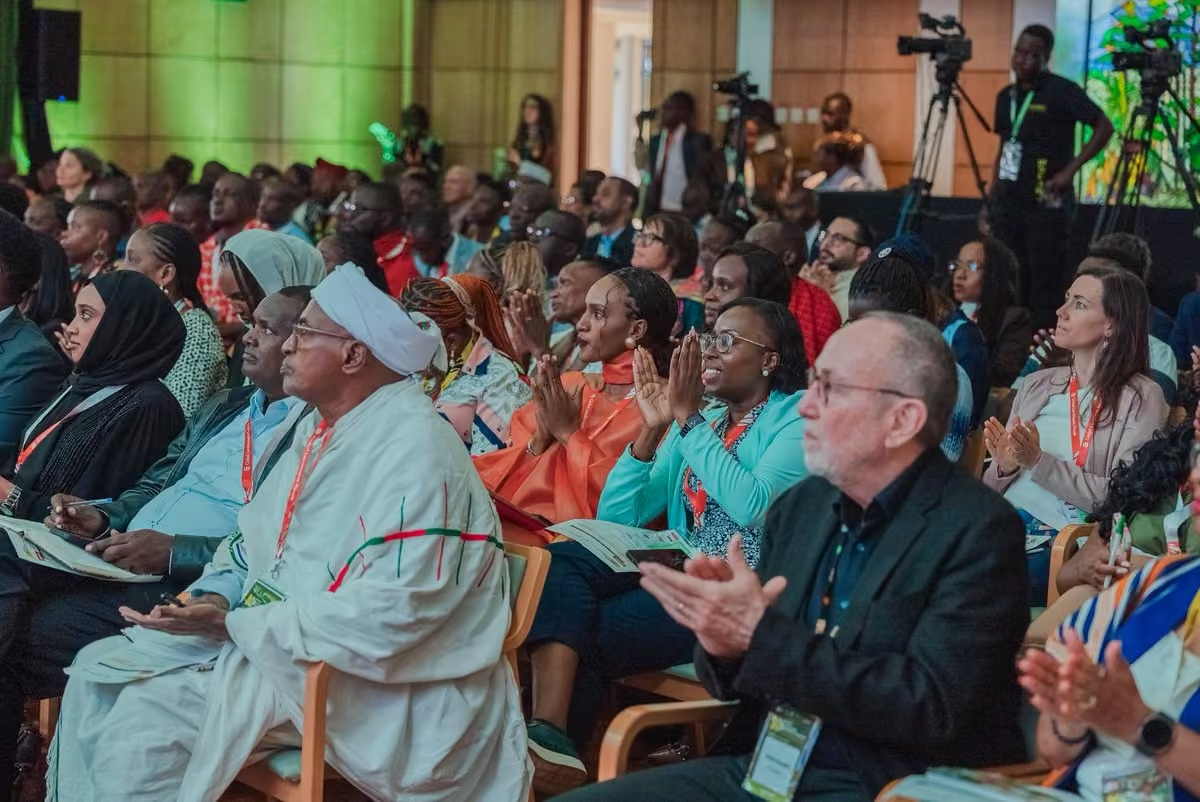
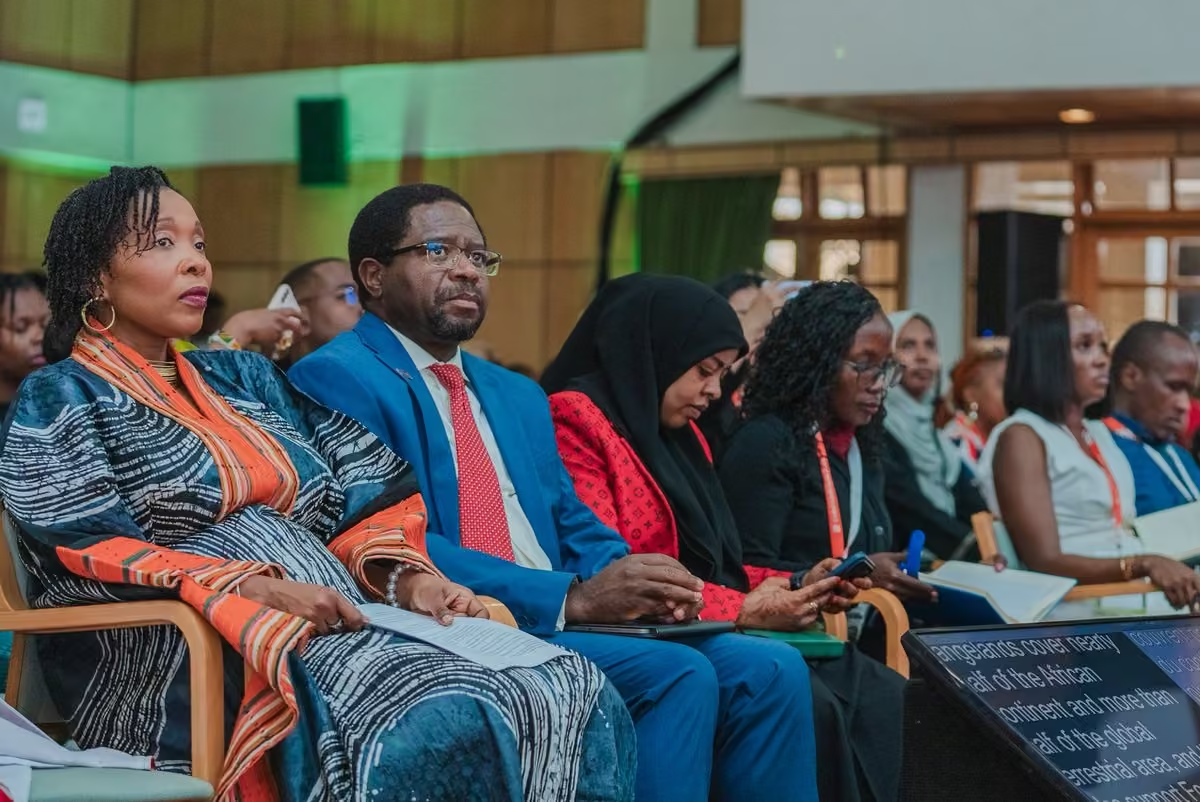
Yesterday, the Global Landscapes Forum Africa #glfafrica 2026 officially kicked off at the @CIFOR_ICRAF center in nairobi.
The summit is bringing together researchers, government representatives, development partners, and Pastoralist communities to discuss the role of rangelands in food security, biodiversity conservation, and climate resilience.
The discussions continue to highlight the importance of strengthening rangeland management systems and advancing practical solutions for drylands across Africa.
@WHH_Kenya @PPGKenya @jameel_observ @ILRI @christensenfund @mercycorpske @PacidaKenya @KWCAKenya @NamatiKenya @Karamojadf


ILRI.org reposted
 PACIDA
@PacidaKenya
POSTCARDS from day 1 of the #glfafrica 2026.
A pastoralist depends on the land to survive. Cattle require land. Wildlife requires land. Discussions continue on day 2 of #glfafrica 2026, exploring what conservation looks like for those who know the land best.
#glfafrica


 ILRI.org
@ILRI
🐪 Camels are central to resilient livelihoods and climate adaptation in Kenya's ASALs.
Join us at #glfafrica today as we discuss operationalizing the new Camel Centre of Excellence to coordinate research, policy, and private sector engagement.
📍 Resilient Rangelands Pavilion
🕑 14:15 - 15:15 EAT
🔗 on.cgiar.org/4dnmqal
#pastoralism #climateresilience #onehealth @ILRI @JameelObservatory
 ILRI.org
@ILRI
Rangelands cover over 40% of the Earth's land surface, yet they remain one of the most under-recognized ecosystems. 🌍✨
We’re heading to @GlobalLandscapesForum Africa 2026 to change that. Catch our speakers at multiple sessions in the next two days. Together with pastoralist communities, we’re spotlighting innovation, governance, and the power of local stewardship.
#stewardingourrangelands #glfafrica #ilri #pastoralistvoices #naturebasedsolutions


 ILRI.org
@ILRI
International Livestock Research Institute is ready for GLF Africa 2026 🌍
📍 Find us at the ILRI booth
🌱 Discover how rangelands power livelihoods, climate resilience, and sustainable food systems
👉 Check out our events: www.ilri.org/events/global-landscape-forum-africa-2026-st…
#glfafrica #ilri #rangelands #pastoralists #africa
ILRI.org
@ILRI
We honor the life of Eugene Robert Terry (1937–2026), a giant of African agricultural science. 🕊️
From founding Director General of @AfricaRice to his leadership at @ILRI and @AATF, his brilliance fueled food security across the continent. 🌾
A mentor, a scientist, and a friend to many. He will be greatly missed.
Full tribute: on.cgiar.org/48C4RAy
#eugeneterry #globaldev #africanagriculture #scienceforgood
ILRI.org
@ILRI
📢 HAPPENING TODAY!
@ianscoones joins the IYRP PADD Seminar to discuss: "Why a new narrative is needed" for rangelands and pastoralists. 🌍✨
Don't miss out on this deep dive into the future of dryland development.
📍 BIEA, Nairobi & Online
🔗 Join here: on.cgiar.org/4cPx8WL
#iyrp2026 #pastoralism #livestock #onehealth #drylandresilience @ILRI @BIEA_Nairobi
 ILRI.org
@ILRI
Pastoralism isn't a relic of the past—it’s a vital force for a resilient future. 🐄✨
Join @ILRI this #earthday for "Hooves of Hope." Explore how grazing systems restore rangelands, build soil carbon, and support livelihoods.
🎙️ Keynote: Siboniso Moyo
📅 April 22
🕒 15:00 CET
📍 soil4climate-org.zoom.us/webinar/register/WN_2KM1841uTliM…
#iyrp2026 #earthday #climatesolutions #soilhealth
 ILRI.org
@ILRI
At the Regional Conference on Sustainable Livestock Transformation in Hanoi, ILRI’s Shirley Tarawali shared key insights on:
✅ Biosecurity & food safety 🛡️
✅ Climate-smart production 🌍
✅ Smallholder access to finance & knowledge 📈
✅ Inclusive value chains 🤝
Collaborating with MARD, FAO, and CIRAD, we are working to ensure livestock remains a pathway to prosperity in Asia and the Pacific. 🌏💡
🔗 Watch more: on.cgiar.org/4mtRNDb
#onehealth #sustainablelivestock #ilri #vietnamlivestock #agrifoodsystems
ILRI.org
@ILRI
What if the answers to climate resilience in drylands are already there? 🧐
In Ethiopia, @ILRI is using the Pioneer Positive Deviance (P-PD) approach to learn from "pastoralist pioneers"—herders finding local solutions to drought and forage scarcity. 🐄🌾
From local innovation to national strategy. 🇪🇹
Read more: on.cgiar.org/4mklZjR
#livestockmatter #climateaction #ethiopia #resilience #onecgiar @CGIAR @EU_Commission
 ILRI.org
@ILRI
Why is silage quality still a challenge for smallholder dairy farmers in Kenya? 🇰🇪🐄
A new @ILRI study in Nandi and Bomet counties explores the gap between silage adoption and silage quality. Even pioneer farmers face suboptimal results. 📉
Read more: bit.ly/406DizX
#livestock #dairyfarming #kenya #animalfeed #cgiar 🌾
 ILRI.org
@ILRI
How do we close the livestock feed gap in Ethiopia? 🇪🇹 🌾
By "bundling" innovations! 📦
ILRI’s integrated approach combines:
🌱 Improved forage seeds
📱 Digital advisory services
🤝 Capacity sharing
Impacting 50,000+ farmers & counting! 📈
Full story: on.cgiar.org/4e9SDmj
#ethiopia #climateaction #onecgiar
@ILRI @CGIAR @A4NH_CGIAR
 ILRI.org
@ILRI
An @ILRI study warns that Anthelmintic Resistance (AHR) is a growing threat to livestock productivity and food security across the continent.
Why it matters:
📉 Up to 58% less weight gain in sheep
🥛 78% drop in milk yield
💰 Billions in potential economic losses
We need urgent action on drug regulation and better data to stop the spread.
Full story: www.ilri.org/news/common-livestock-dewormers-may-be-faili…
@dishonmuloi
#animalhealth #globalgoals #africa #climatechange
 ILRI.org
@ILRI
#onehealth recognizes that the health of people, animals and the environment is connected — and that solutions need to work across the whole system.
Join CGIAR at the #onehealthsummit to learn more: on.cgiar.org/3NWSUhR
#worldhealthday


ILRI.org reposted
 Dr Saia Ma'u Piukala
@RD_WPRO
The beautiful city of Lyon 🇫🇷 is saying bienvenue - welcome! - to the world.
From small island countries and areas to the most populous nations, all attending the global #onehealth Summit - co-hosted by France and Indonesia 🇮🇩 - underscoring the crucial interconnectedness of human, animal and ecosystem health.
The first of its kind, the high-level gathering brings together heads of state, ministers representing diverse portfolios, and multilateral institutions - including the One Health Quadripartite comprising of @WHO, he UN Food and Agriculture Organization @FAO, the UN Environment Programme @UNEP and the World Organisation for Animal Health @WOAH.
A pleasure to witness the WHO Western Pacific Region well-represented here, and to begin the week by meeting Ministers of Health Dr Claude Gambey of New Caledonia and @BudiGSadikin of Indonesia.
As well, Hung Nguyen-Viet, Asia Regional Director of the International Livestock Research Institute @ILRI - whom I unexpectedly ran into at the airport!
New Caledonia - a French overseas collectivity in the South Pacific - has long embraced One Health.
Key actions include reducing #antimicrobial use in livestock including the territory's pork industry; managing climate-sensitive diseases including #dengue and #leptospirosis; and establishing regional research partnerships such as PREZODE One Health Action in the Pacific.
Indonesia has customised the global One Health Joint Plan of Action (OHJPA), bringing together stakeholders from multiple ministries and a range of professional associations including ILRI.
Indonesia's OHJPA's focus includes health systems strengthening through enhancing One Health; reducing risks of emerging and re-emerging zoonotic epidemics and pandemics; and controlling and eliminating endemic zoonotic, neglected tropical, and vector-borne diseases.
For its part, ILRI has been involved in Indonesia's Climate Smart Agriculture Initiative, to balance food production with environmental sustainability; avian influenza control among backyard poultry systems; improving animal disease reporting and response; and strengthening mixed farming systems with livestock and crops.
So, you see how it's all connected - humans, animals, the environment!
I'm looking forward to contributing to, and learning from, the Summit - with gratitude to France and Indonesia for co-hosting this symbol of multilateralism in health. 🙏
#togetherforhealth #standwithscience #healthforall #worldhealthday


ILRI.org reposted
CGIAR
@CGIAR
On the ground at the #onehealthsummit, Hung Nguyen of @ILRI explains how a #onehealth approach drives solutions - from food safety to antimicrobial resistance 🧑🌾 🐄 🌱 Connecting human, animal and environmental health is key to tackling today’s risks.
@oneplanetsummit
ILRI.org
@ILRI
Pollution and food security are two sides of the same coin. 🪙 🌍
ILRI DG @ADjikeng moderated an expert panel at the #onehealthsummit in Lyon to discuss recommendations for sustainable food systems.
The Implementation Roadmap:
1️⃣ Plastics: Using One Health to mitigate trade-offs in plastic pollution responses (Megan Deeney, @LSHTM).
2️⃣ Agriculture: Focus on plant-environment interactions to ensure food safety (Laura De Gara).
3️⃣ Chemicals: Addressing the "triple threat" of chemical pollution (Patrick Allard, @UCLA).
4️⃣ Practice: Championing transdisciplinary research to catalyze a food system revolution (Olanike Adeyemo).
We must bridge the gap between research and real-life implementation to reach a sustainable 2050. 🚀
@oneplanetsummit @CGIAR
#onehealth #foodsystems #actforonehealth #pollution


 ILRI.org
@ILRI
CGIAR at the #onehealthsummit in Lyon: food systems research linking people, animals & planet. @ILRI DG @ADjikeng will speak on integrated, evidence-based #onehealth solutions. @oneplanetsummit
#onehealth #foodsystems #research
 ILRI.org
@ILRI
As we conclude #cow Month, we celebrate the pastoralist communities who manage vast rangelands under increasingly unpredictable climates. To these keepers of the land, the cow is a source of life and a pillar of culture.🐄
Join us in spotlighting the International Year of Rangelands and Pastoralists.
Find out more : on.cgiar.org/4m3MqdG
@smithchibolt @laura_omotayo @mclusho1
#pastoralists #rangelands #iyrp #livestock
ILRI.org
@ILRI
"Rabies is 100% preventable, but only if we act early and collectively." — @ADjikeng. 📢
Our teams were on the ground in Uthiru & Kawangware this month, supporting @NairobiCityCounty @kspca in a mass vaccination drive. Here is why this matters:
🐕 98% of human rabies cases in Kenya come from dog bites.
📉 70% vaccination coverage in dogs can stop the virus entirely.
🧼 15 mins of washing a bite wound with soap can save a life.
ILRI colleagues supported the drive as both vaccinators and data collectors to help build a safer future for Nairobi residents. 🇰🇪✨
#endrabies #onehealth #ilri #veterinarymedicine #nairobi #kspca


ILRI.org reposted
 Jameel Observatory for Food Security Early Action
@jameel_observ
Observatory researchers and partners recently developed a satellite-based approach to map national livestock feed supply and demand, so Governments, businesses and producers can better plan and manage livestock feed resources.
jameelobservatory.org/eo-feed-policy-options/
@ILRI @JohnYumbya @au_ibar

ILRI.org reposted
 Global Methane Hub
@Gmethanehub
Healthy animals 🐄 = productive farms🥛 + better livelihoods 💰 + lower methane 🌍
In Nandi, Kenya, @EnvDefenseFund and @ILRI are training farmers to treat mastitis. This is boosting milk yields & incomes while lowering methane intensity 👇🏾
globalmethanehub.org/agriculture
ILRI.org
@ILRI
ILRI is joining Nairobi City Council and KSPCA for a massive vaccination drive this March in Uthiru and Kawangware. 💉🐾
Our teams hit the ground at Uthiru: AHITI Kabete Field to provide:
Injections by KVB-registered vets.
Precision data collection to map coverage.
Join them again this Friday and Saturday in Kawangware, Nairobi.


ILRI.org reposted
 FAO Asia Pacific
@FAOAsiaPacific
Climate change, disease risks & rising demand are straining livestock systems. This week, Asia-Pacific leaders meet to advance sustainable livestock transformation for food security, livelihoods & the environment.
👉www.fao.org/asiapacific/news/news-detail/asia-pacific-cou…
#foodsystems #livestock #climateaction

 ILRI.org
@ILRI
How do we transform livestock systems for a changing climate? 🌡️
Day 1 of the #aabcf Workshop in Vietnam is underway! Experts from @ILRI, @Unimelb, and @UQ_News are leading sessions on:
Strategic levers for beef production 🥩
Methane production and intensity 💨
The impact of climate disasters on animal health 🏥
The goal: provide early and mid-career scientists with the practical tools needed to build resilient systems back home.
#climateaction #livestock #biosciences #vietnam #researchimpact
 ILRI.org
@ILRI
Honored to welcome a high-level delegation from #burundi to @ILRI Nairobi!
Together with @CGIAR partners @CIFOR_ICRAF, @BiovIntCIAT_eng & @IUCN, we discussed scaling science-based solutions for 🇧🇮’s climate goals. 🌍✨
Highlights:
✅ Aligning with NDC 3.0 & National Adaptation Plans.
✅ Building climate-resilient agri-food systems.
✅ Showcasing lab-to-field research for investment readiness. 🔬
Collaboration is key to turning policy into practice. 🤝
#climateaction #agrifoodsystems #cgiar #sustainability
 ILRI.org
@ILRI
💧 #worldwaterday may have been yesterday, but the drive for a water-secure future is 24/7. We’re proud to partner with @IWMI_ to empower women and build resilient communities. Together across @CGIAR, we make every drop count. 🌍
Read more: 👉 on.cgiar.org/4uM1d0G
#watersecurity #waterandgender #onecgiar #sustainabledevelopment
 ILRI.org
@ILRI
🚨 Rabies is preventable, but only if we act together.
Following a tragic human fatality earlier this year, @ILRI is joining Nairobi City Council and @KSPCA for a massive vaccination drive this March in Uthiru and Kawangware. 💉🐾
Our teams are hit the ground to provide:
Injections by KVB-registered vets.
Precision data collection to map coverage.
What you need to know to stay safe:
✅ Vaccinate dogs annually.
✅ Wash any bite wound with soap + water for 15 mins.
✅ Seek medical help IMMEDIATELY. Don't wait for symptoms.
✅ Keep pets confined to prevent contact with stray/wild animals.
#rabiesfreekenya #onehealth #vaccineswork #nairobi
 ILRI.org
@ILRI
Big news! 📢 We are thrilled that ILRI’s 'Vendor Business School for Healthy Diets (VBS-4HD)' is a key project in the new ANH Academy Competitive Research Grants portfolio! 🌍
#foodsystems #nutrition #healthydiets #urbannutrition #agriculture

ILRI.org reposted
ILRI.org
@ILRI
ILRI scientists are using "genomic time travel" to understand how African cattle became so incredibly diverse and adaptable. 🌍
See the incredible legacy of traditional pastoralist herders, whose methodical breeding over centuries has sustained the health and wealth of African communities. By looking back at these genetic traits, we can better navigate the future of sustainable livestock production.
See more: youtu.be/SFFdE0NsEe0
📸: ILRI / Stevie Mann and Eric Ouma
#iyrp2026 #africanfarming #cattle #sciencenews #sustainability
ILRI.org
@ILRI
We are honored to announce that @ADjikeng will be joining an essential conversation on bridging the gap between scientific innovation and climate finance. 🤝
This session dives deep into how science-based solutions—when paired with policy reforms, public investment, and blended finance—can effectively de-risk agri-food investments and mobilize private capital. 📈
Key Discussion Points:
Strengthening Resilience: Strategies to fortify agri-food systems against climate volatility. 🌾
Crowding in Private Capital: Utilizing de-risking tools to encourage coordinated public–private action. 🏦
From Science to Investment: Introducing the ADB–CGIAR Clearinghouse Facility, an operational platform that converts scientific and technical innovations into investment-ready inputs for sovereign and non‑sovereign projects. 💡
@ADB_HQ , @ILRI , @FAO
#livestockpathways #climateaction #agrifoodsystems #sustainabledevelopment
 ILRI.org
@ILRI
Sustainable livestock transformation means better results from farm to market:
✅ healthier diets
✅ better livelihoods
✅ fewer health risks
✅ lower pressure on climate and nature
Join the Regional Conference to learn more on this issue 👉 www.ilri.org/events/regional-conference-sustainable-lives…
@FAO @Cirad @CGIAR
 ILRI.org
@ILRI
The future of sustainable food systems is being built by the women of ILRI. We continue to celebrate our incredible team—the researchers, specialists, and leaders advancing agricultural science to nourish the planet. We are honored to work alongside you as you transform lives through science. 🌍👩🏼🔬"🔬✨👩🏽🌾
See more: www.ilri.org/iwd2026
@CGIAR @CGIARgender @ILRI
#iwd2026 #womeninscience #foodsecurity
ILRI.org
@ILRI
The year is 2046.
Vaccine access is within reach even in remote communities.
Antibiotics in livestock systems are used responsibly.
But it wasn’t always this way.
Illustrated by Phoebe Ouma, in collaboration with @gstrategylab, @WOAH & @ILRI.
Coming April 2026.
✉️ www.globalstrategylab.org/newsletter/
#amr #gender #iwd2026
 ILRI.org
@ILRI
Happy #internationalwomensday! Women are the backbone of rural economies and play a critical role in livestock management globally.
At ILRI, we are deeply committed to championing the women who are shaping the future of global food security. To all the women feeding the world and advancing agricultural science: thank you! 🔬✨👩🏽🌾
@CGIAR @CGIARgender @ILRI
#iwd2026 #womeninscience #livestockforlivelihoods #foodsecurity


 ILRI.org
@ILRI
Happening Now⏰
How do we ensure #women's voices and contributions are recognized in food systems?
Join us for a special #iwd2026 event on ‘Rights. Justice. Action: Co-Creating Equitable Agri-food Systems with Women at the Centre.'
🗓️ March 2, 2026 | 9:30 AM EAT
📍on.cgiar.org/4qI84Vx
@AWARDFellowship @CGIARgender @ILRI @CIFOR @ADjikeng @icipe @ncdehaan @elianeubalijoro @alessadr @alegalie @Dorinebolo
#forallwomenandgirls #genderinag


 ILRI.org
@ILRI
GGAA - Thank you - mailchi.mp/1e037714b4ea/ilri-newsletter-february-16543003
ILRI.org reposted
CGIAR
@CGIAR
🔬 🐄 Through science-driven practical innovation, ILRI is working alongside farming communities in Africa to strengthen livestock systems & protect animal health.
Safeguarding livestock means safeguarding food security, income and stability for millions.
@ILRI @WebsEdgeTV
ILRI.org
@ILRI
Event Alert🔇
Women are key to food systems yet face persistent inequalities. This #iwd2026, join us for a conversation on ‘Co-creating equitable agrifood systems with women at the center.’
📅 March 2, 2026 | 9:30 AM EAT
🔗 on.cgiar.org/4qI84Vx
@AWARDFellowship @CGIARgender @ILRI
@CIFOR @ADjikeng @icipe @ncdehaan @elianeubalijoro @alessadr @alegalie @Dorinebolo


 ILRI.org
@ILRI
📢 JUST LAUNCHED: A landmark guide to saving Africa’s livestock! 🌍📚
We’ve partnered with AABNet, @AU_IBAR, and @CTLGH_info to release "African Livestock Genetic Resources and Sustainable Breeding Strategies."
It’s a treasure trove of knowledge for the future of food security. 🧵👇 #livestockgenetics #foodsecurity


 ILRI.org
@ILRI
“Africa's livestock genetic diversity is not just a heritage—it is a climate and development tool.” — Prof. @ADjikeng , DG @ILRI.
By protecting these breeds, we protect the livelihoods of millions. 💪🏾🌽
ILRI.org
@ILRI
📖 Read the full guide and discover how we can build a resilient future for African agriculture.
www.ilri.org/events/african-livestock-genetic-resources-a…
#zerohunger #africanagriculture #researchmatters
ILRI.org
@ILRI
🌍 New research shows that 59% of bacteria in African wildlife carry antibiotic resistance—a direct result of human & agricultural contamination.
🦅 Birds: 93% resistance
🐒 Primates: 35%
🦓 Herbivores: 25%
We must integrate wildlife into #amr surveillance to protect global health. 🧬
Read more: on.cgiar.org/3ML2bsK
#africa #onehealth #sciencecommunication @ILRI @nature
 ILRI.org
@ILRI
Our vision is a future where Kenya’s agri-food transformation is powered by CGIAR innovations and co-developed with national partners to drive a resilient, high-income economy. 🇰🇪🌾
Together, @cgiar policy @ILRI @IFPRI and other CGIAR centers and local partners are bridging the gap between research and policy to deliver:
Co-created evidence 📑
Institutional capacity sharing 🏛️
Inclusive, research-based solutions 💡
Follow us for updates from the launch! ✨
#policyhubkenya #agriinnovation #kenya #cgiar #feb24
@cgiarpolicy @cgiar @ilri @ifpri @kilimoKE @Planning_Ke @KIPPRAKENYA @KALROnetwork @KEPSA_KENYA @AsnetKenya
@PETS_Kenya @KNBStats @TegemeoInstitut @uonbi
 ILRI.org
@ILRI
Antimicrobial resistance threatens the food supply for billions of people - and addressing it requires prevention, stewardship, and investment now.
ILRI researches antimicrobial and antibiotic use in livestock, tracking resistant bacteria in food chains, assessing environmental impacts of farm antibiotic use, and developing evidence-based solutions for farmers and policymakers.
#whylivestockmatter #amr
ILRI.org
@ILRI
@ILRI and @WOAH are leveling up their partnership to tackle the intersection of climate change and #onehealth.
5 key focus areas:
🔬 Disease modeling
🛡️ Biosecurity
🔥 Climate adaptation
🎓 Capacity building
📜 Policy evidence
Details: on.cgiar.org/3MFIJO3
#animalhealth #woah #ilri


ILRI.org reposted
ISAAA_AfriCenter
@afri_isaaa
Kenya is experiencing severe hunger which, according to the United Nations, has directly affected over 2.1 million people, particularly in the northeastern region.
Communities living in these areas are mainly pastoralist, and so cattle have been dying in droves.
As Kenya, and other parts of Africa, face erratic weather patterns, and livestock farmers continue to suffer shortages of feeds, we maintain that adoption of biotech foods and feeds will shield thousands, if not millions, of people and cattle from debilitating famines.
The cost of delay, especially through protracted court battles, is greatly detrimental to our countries' socio-economic wellbeing.
To speed up adoption and ease availability of food and feed to communities in distress is a discussion we seriously need to prioritise.
ISAAA AfriCenter stands ready to support with any information and knowledge products needed towards these initiatives, and convenings to this effect.
Although not the silver bullet to the drought crises, the world has the technology to mitigate effects of droughts, and we should optimize it.
#makesciencecount
#foodforthought

ILRI.org reposted
 AU-IBAR
@au_ibar
Africa speaks with one voice on #livestock #biodiversity.
AU-IBAR & @ILRI are convening a continental dialogue to advance Africa’s Common Position ahead of CBD COP17, positioning livestock genetic resources as key to climate resilience, food security & sustainable development


 ILRI.org
@ILRI
Mark your calendars: 20 Feb! 🗓️
AABNet, @ILRI, @CTLGH, & @au_ibar are launching the definitive reference for animal breeding in Africa. 🧬🌍
This book sets the scientific baseline for genetics as a tool for #climateaction & food security.
Register: on.cgiar.org/3OucIZJ
#livestockgenetics #africanscience #sustainableag
ILRI.org
@ILRI
🌍 We're Hiring: Two Strategic Consultants to Drive Impact
As the Livestock Data for Decisions (LD4D) network transitions to a more action-oriented approach, we're seeking consultants to help strengthen the network's strategic direction, diversify funding, and support LD4D Solutions Groups in generating practical, impactful solutions for livestock development.
📋 We're seeking:
1. Strategic Advisor: Provide strategic and technical guidance to ensure LD4D remains impactful and financially sustainable in the livestock development sector across low- and middle-income countries.
→ View full Terms of Reference: edin.ac/4qQgk6J
2. Qualitative Research Consultant: Design and implement qualitative methodologies to refine our Solutions Group challenges and enhance our data and evidence synthesis through member consultations.
→ View full Terms of Reference: edin.ac/49Wc93f
📅 Application Deadline: February 28, 2026
How to Apply: Send your cover letter, CV, and daily rates to ld4d@ed.ac.uk
Only shortlisted candidates will be contacted.
Join us in driving sustainable, evidence-based livestock development solutions!
#ld4d #hiring #internationaldevelopment #livestockdevelopment #consultancy #globalhealth #development
ILRI.org
@ILRI
When it comes to preventing the next pandemic, can we really afford to underinvest in prevention research?
ILRI aims to provide actionable insights for policymakers to break the chain of transmission for future zoonotic (animal-to-human) diseases, examining root causes at the level of human-animal-environment interactions.
#whylivestockmatter
ILRI.org
@ILRI
From Nigeria 🇳🇬 to Tanzania 🇹🇿 and Senegal 🇸🇳—the perfect formula for the future? It starts with her. 🧪✨
@mclusho1
#womeninscience #idwgs #womeninstem
ILRI.org
@ILRI
To every girl dreaming of a life in the lab: there is a space for you here.🧪✨
@RoseOjuok @linnetochieng
#womeninscience #idwgs
#womeninstem #sciencetok #everyvoiceinscience
ILRI.org
@ILRI
How might antibiotics used for livestock affect the very soils that farming depends on?
That's just one of ILRI's areas of research. Visit our website for more updates 👇
 ILRI.org
@ILRI
Good animal welfare isn’t just about compassion; it also makes systems work better.
ILRI views animal welfare as integral to sustainable livestock systems, addressing it by community engagement, technological innovation and policy development to benefit animals and people.
#whylivestockmatter
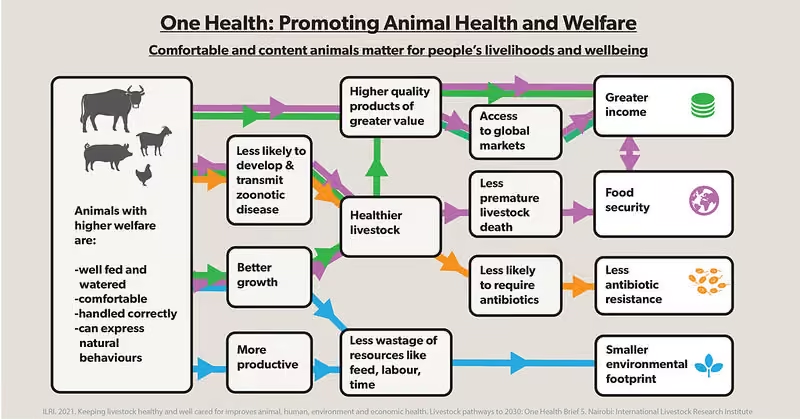 ILRI.org
@ILRI
The new Africa–Asia Bioscience Challenge Fund (AABCF) is upskilling researchers from 6 countries to tackle climate risks & food insecurity through advanced biosciences work at the BecA-ILRI Hub
Read more: on.cgiar.org/3LRPJak
#onecgiar #livestockmatter #climatesmart #aabcf @ACIARAustralia @Uom @Uni_Queensland
ILRI.org
@ILRI
What are mycotoxins? 🍄⚠️
Think of them as invisible poisons produced by molds that hide in feed like maize. They can reach humans directly through food or indirectly through milk from animals eating contaminated feed.
To tackle this, @ILRI and @AKEFEMA launched the Technical Advisory Committee (TAC) for Mycotoxins Assessment in Animal Feed this week at the Eka Hotel! 🤝
The goal: provide validated tools and guidelines so Kenyan farmers can access safe, high-quality feed. 🐄
#kenyaagriculture #feedsafety #sustainablefarming #whylivestockmatter
 ILRI.org
@ILRI
🌏 ILRI knows that livestock matter to hundreds of millions of people in low- to middle-income countries around the world. Here's why 👇
youtube.com/shorts/uSJLesJrBrg
#whylivestockmatter
ILRI.org reposted
 IUCN Eastern Europe and Central Asia
@IUCN_ECARO
🌾 Rangelands matter - for biodiversity, livelihoods and climate resilience. But how do we ensure their sustainable future?
Across Central Asia, rangelands sustain communities, wildlife and ecosystems throughout vast landscapes. Yet these critical ecosystems face increasing pressure from land degradation, biodiversity loss and climate change.
Momentum is building globally as preparations advance for #cop17mongolia and activities continue under the #iyrp2026.
To support early regional engagement, an upcoming dialogue will bring together governments, pastoralist organisations, civil society and partners
Join the Regional Dialogue on Sustainable Rangelands and Pastoralism for Asia & Arab Region to exchange experiences and identify joint priorities for action:
📆 12 February
⏱️ 08:00 - 09:15 UTC
Languages: English, Arabic, Russian, Chinese 👉 Register here: engage.iucn.org/event/regional-dialogues-sustainable-rang…
#united4land #unccdcop17 #КОП17 @IUCN_forests @unccd @ILRI @theGEF @iki_germany @WWF
 ILRI.org
@ILRI
#didyouknow? Wildlife farming is intrinsically high in risk, low in animal welfare, and deleterious for biodiversity: it is unlikely to be safe or sustainable.
Domesticated animal farming is an attractive alternative, especially in Africa. Shifting cultural attitudes towards non-consumptive use is also attractive, especially in Southeast Asia.
Community engagement is crucial to the sustainable management of wild meat resources.
Approaches for improving food safety in informal markets can be extended to de-risking wild meat value chains.
Read our report: 'Eating wild animals: The rewards are as big as the risks'
#wildmeat #bushmeat #whylivestockmatter
ILRI.org
@ILRI
ILRI researches animal-source foods, focusing on their crucial role in combating malnutrition (stunting, anaemia) in low-income countries, while also addressing sustainability and environmental impacts.
#whylivestockmatter
 ILRI.org
@ILRI
Why do livestock matter for nutrition?
In wealthy countries, families could supplement a vegan diet with vitamins and high-protein meat alternatives like tofu, quinoa and plant milks. But that’s not possible in low-income countries, where people eat very small quantities of animal-sourced foods.
In those places, increasing consumption of milk, eggs and meat can dramatically improve nutrition outcomes.
#whylivestockmatter
 ILRI.org
@ILRI
Livestock is central to #ethiopia’s economy, yet feed scarcity remains a major barrier. 🐂🌾
@ILRI @CGIAR_AICCRA, and @TAAT_Africa. are bridging this gap in the Hadiya Zone with "bundled innovations"—combining climate-smart forage with digital advisory tools.
Watch how: youtu.be/H-cnHK8phwc
#onecgiar #whylivestockmatter #foodsystems #agtech
ILRI.org
@ILRI
Big news from the Philippines! Quezon City has turned support for food vendors into official policy.
The new Ordinance No. 3430-S-2025 institutionalizes the Vendor Business School, a partnership between the city and @CGIAR to empower the informal food sector. 🥗🏙️
@ILRI, @Cipotato @Rice_Today
#foodsecurity #onecgiar
Read more here: on.cgiar.org/3ZAHdQ2
ILRI.org
@ILRI
#climatechange threatens the livelihoods of smallholder farmers, but they're fighting back. We asked farmers to share their best practices - watch and learn! 👇
youtube.com/shorts/pE6miteL7jE
#myclimatesolution
ILRI.org
@ILRI
Congratulations to Patrick K. Ketiem, PhD, on his appointment as the new director general of KALRO.
ILRI and KALRO share a strong, long-standing collaboration delivering solutions for smallholder farmers in Kenya. We value this partnership deeply and look forward to building on our shared achievements.
#ilri #kalro #partnership #agriculture #kenya
 ILRI.org
@ILRI
A Centre of Excellence for Antimicrobial Susceptibility Testing (AST) has been established in Nairobi, following a partnership between @ILRI, @ICARS_global and the EUCAST Development Laboratory.
Key achievements:
🧫 ~4,000 isolates from 5 African countries tested
🥼 Research officer trained 7 weeks in Sweden, now leading regional efforts
🎧 13 webinars on AST methods & QC
🗣️ Two 5-day regional trainings in Nairobi
🔬 In-country training in 7 countries, 52 lab staff trained
🌍 Strengthening AST capacity across Africa for better AMR surveillance & public & animal health.
Read the full report 🔗 ➡️ on.cgiar.org/45w1E44
#antimicrobialresistance #ast #capacitybuilding


 ILRI.org
@ILRI
❗ Rabies is incurable and fatal once symptoms appear, after infection. The most common source of infection is dog bites and scratches.
There are 10 things you should know to prevent rabies 👇
youtube.com/shorts/dzuTzjY63WE
#onehealth
ILRI.org
@ILRI
Big news. Big partnership. Big impact.
@ILRI and @CIMMYT just signed an MoU to supercharge innovation in crop and livestock systems.
More climate resilience. More food security. More wins for farmers.
Let’s go. 🚀🌾🐄
Read more: on.cgiar.org/4q3Nb6V
#climateresilience #foodsecurity
 ILRI.org
@ILRI
#climatechange threatens the livelihoods of smallholder farmers, but they're fighting back. We asked farmers to share their best practices - watch and learn! 👇
youtube.com/shorts/z-LGbAExf_Y
#myclimatesolution
ILRI.org
@ILRI
Open to researchers, the public and private sector alike, @CGIAR's only poultry facility offers innovation and technical expertise to transform poultry systems.
Contact o.hanotte@cgiar.org or w.esatu@cgiar.org to discuss opportunities.
#hatchingknowledge
ILRI.org
@ILRI
Try our new AI-powered chatbot which delivers evidence-based answers to livestock health questions, drawing on a wealth of @CGIAR and @CGSpaceResearch research 👇
 ILRI.org
@ILRI
We all know ChatGPT... now what about CGIAR-GPT?
With @CGIAR we've created a chatbot where you can ask questions about animal health, diseases, pathogens, or veterinary care.
The answers are drawn from both ILRI's published science on @CGSpaceResearch as well as related materials.
Try it here 👇
 CGIAR Digital Transformation
@CGIAR_Data
🐄 With @ILRI we launched an AI-powered chatbot delivering instant, evidence-based answers to livestock health questions helping herders access reliable advice when it matters
Developed with a 🇰🇪 startup, it turns @CGIAR research into real-world action 👇 on.cgiar.org/4sJchub
 ILRI.org
@ILRI
#climatechange threatens the livelihoods of smallholder farmers, but they're fighting back. We asked farmers to share their best practices - watch and learn! 👇
youtube.com/shorts/B0haOoS-CnA
#myclimatesolution
ILRI.org
@ILRI
What happens when farmers, scientists, and policy makers actually talk to each other?
In Kenya and Uganda, the CIRNA project shows how strong communication and farmer-approved manure management practices can improve health, protect the environment, and strengthen rural livelihoods.
www.ilri.org/news/cirna-project-achieves-impact-tailored-…
ILRI.org
@ILRI
How do you raise animals in a warming world, without warming it further?
That’s the question bringing scientists and partners from eastern Africa, Southeast Asia, and partner universities in Australia together this week at International Livestock Research Institute (ILRI) in Nairobi. From 19–23 January 2026, researchers at the Africa–Asia Biosciences Challenge Fund workshop are rolling up their sleeves to explore how livestock systems can produce more food, withstand climate shocks, and cut emissions at the same time.
The workshop is part of broader effort to help national scientists tackle shared challenges: unpredictable climates, rising demand for meat and milk, and the urgent need to protect both livelihoods and the planet.
Rather than abstract debate, the workshop is hands-on. The goal is simple but ambitious: help scientists turn cutting-edge bioscience into solutions that farmers can actually use - and that policymakers can trust.
Yesterday's sessions delved into the building blocks of climate-smart livestock: healthier animals, higher productivity, and smarter use of data. Fellows tested real tools, from measuring methane emissions to experimenting with low-emission feeds and management practices they can pilot back home.
Over the week, the learning moves from labs to fields, from data analysis to practical design.
By the end of the workshop, participants leave not just with new skills, but with cross-regional partnerships and a shared mission: to make livestock systems across Africa and Southeast Asia more resilient, more productive, and far better aligned with a climate-constrained future.
#climatesmartlivestock #aabcf #ilri #biosciences #climateresilience #livestockresearch

 ILRI.org
@ILRI
#didyouknow? ‘Wild meat’, eaten for food and perceived medicinal properties, is neglected both as a pathway for zoonosis transmission and emergence and a pathway out of poverty in Africa and Southeast Asia.
Wild meat makes substantial contributions to nutrition in Africa, and to satisfying food preferences in Asia.
In at least 60 countries, wild meat makes up at least 20% of dietary protein. At least 15 countries would risk food insecurity without wild meat.
Check out our report 'Eating wild animals: Rewards, risks and recommendations' for the full picture.
ILRI.org
@ILRI
🌿“Most animals in this part of the world are still eating crop residues and grazing natural pastures, so productivity and performance are relatively low.
Better feed systems incorporating these forages should also provide a boost to livestock productivity.”
Chris Jones, ILRI program leader for feed and forage development.
👇
ILRI.org
@ILRI
Can we feed livestock better for a more sustainable future?
@BiovIntCIAT_eng, in collaboration with @ILRI, @ICARDA, their Genebanks, and the @Gmethanehub think so.
🌍 Read more about the Low-Methane Forages project on our website.
ILRI.org
@ILRI
🐄 🥛 Supporting the world’s most vulnerable farming communities starts with listening and delivering solutions that work on the ground. Better feed means healthier animals, higher milk yields, higher incomes.
#withsciencewecan follows @CGIAR – the world’s largest publicly funded agricultural research network – as it turns the Global South into a living laboratory for survival. Watch a piece of ILRI's contribution below 👇
ILRI.org
@ILRI
Sustainable livestock farming needs accurate data. A commonly repeated claim is that it takes huge volumes of water to produce a kilogram of red meat - but this comes from counting every single drop of water falling on grazing land: youtube.com/shorts/ld8JqJ8th1M
ILRI.org
@ILRI
We all know ChatGPT... now what about CGIAR-GPT?
With @CGIAR we've created a chatbot where you can ask questions about animal health, diseases, pathogens, or veterinary care.
The answers are drawn from both ILRI's published science on @CGSpaceResearch as well as related materials.
Try it here 👇
CGIAR Digital Transformation
@CGIAR_Data
🐄 With @ILRI we launched an AI-powered chatbot delivering instant, evidence-based answers to livestock health questions helping herders access reliable advice when it matters
Developed with a 🇰🇪 startup, it turns @CGIAR research into real-world action 👇 on.cgiar.org/4sJchub
ILRI.org
@ILRI
For smallholder livestock farmers in Ethiopia, livestock mean milk on the table, income for school fees, and power for farming. But when animals don’t have enough nutritious feed, productivity drops and livelihoods are put at risk.
This is why feed and forage innovations matter. ILRI, alongside national and regional partners, provides farmers with practical, sustainable solutions to ensure food security and raise resilience.
In particular, farmer field days brought communities together to and share solutions. In 2025 alone, 31,900 farmers benefited from these efforts, with field days at the heart of capacity building, peer learning, and farmer-to-farmer knowledge sharing.
As one farmer put it: “We can take responsibility to transfer this knowledge to our fellow farmers.”
Read the full story: www.ilri.org/news/farmers-showcase-benefits-integrated-cr…
ILRI.org reposted
ILRI.org
@ILRI
In Northern Ghana’s Upper East Region, a woman raises livestock - but when it’s time to vaccinate or sell, the decision isn’t hers.
That everyday reality spurred researchers to investigate into how deeply-rooted gender norms shape livestock production and marketing, while quietly blocking women's decision-making power. They found these norms don’t just persist by chance; they systematically limit women’s ownership, agency, and economic participation, reinforcing a status quo of dependency and exclusion.
The result? Women are locked out of critical resources, from animal health services to the proceeds from livestock sales, with real consequences for livelihoods, food security, and poverty reduction.
But change is possible. Evidence points to solutions: gender-responsive veterinary services, digital tools to improve vaccine access, financial inclusion, market access, and deliberate gender-transformative approaches rooted in local realities.
Because without tackling restrictive gender norms, livestock development will never be truly equitable - and its impact will always fall short.
Read the full paper to learn what needs to change, and how: hdl.handle.net/10568/179665
 ILRI.org
@ILRI
Can we feed livestock better for a more sustainable future?
@BiovIntCIAT_eng, in collaboration with @ILRI, @ICARDA, their Genebanks, and the @Gmethanehub think so.
🌍 Read more about the Low-Methane Forages project on our website.
ILRI.org
@ILRI
Read the full story here: www.ilri.org/news/can-we-feed-livestock-better-more-susta…
ILRI.org
@ILRI
In Northern Ghana’s Upper East Region, a woman raises livestock - but when it’s time to vaccinate or sell, the decision isn’t hers.
That everyday reality spurred researchers to investigate into how deeply-rooted gender norms shape livestock production and marketing, while quietly blocking women's decision-making power. They found these norms don’t just persist by chance; they systematically limit women’s ownership, agency, and economic participation, reinforcing a status quo of dependency and exclusion.
The result? Women are locked out of critical resources, from animal health services to the proceeds from livestock sales, with real consequences for livelihoods, food security, and poverty reduction.
But change is possible. Evidence points to solutions: gender-responsive veterinary services, digital tools to improve vaccine access, financial inclusion, market access, and deliberate gender-transformative approaches rooted in local realities.
Because without tackling restrictive gender norms, livestock development will never be truly equitable - and its impact will always fall short.
Read the full paper to learn what needs to change, and how: hdl.handle.net/10568/179665
ILRI.org
@ILRI
Are foodborne illnesses a bigger threat than malaria?
ILRI researches and addresses foodborne illnesses (FBD) in developing nations, highlighting their massive health and economic burden, often linked to informal food systems. We promote One Health approaches to manage risks from farm to fork, to improve safety of animal-source foods through policy, research and consumer engagement.
youtube.com/shorts/AfjZITPUCpI
ILRI.org
@ILRI
Six years ago, the One Health Research, Education and Outreach Centre in Africa (OHRECA) at ILRI set out to turn #onehealth from concept into action across #africa.
Here's a short reminder of what One Health is - and why it matters 👇
youtube.com/shorts/DlnwYME9CDY
ILRI.org
@ILRI
Climate shocks are hitting drylands harder—and faster—than ever. 🌍
What if crowdsourcing and citizen science could strengthen resilience, improve drought insurance, and support smarter decisions for pastoralists?
This new report shows how such local data, powered by the KAZNET platform, are transforming climate-risk management in East Africa. 📊
Discover how local data from markets, rangelands, and households is shaping the future of drought response. 👇
Jameel Observatory for Food Security Early Action
@jameel_observ
Supporting pastoralist resilience through real-time monitoring of drought: Our partners show the potential of crowdsourced data for drought early warning
@Kelvinchish @nd_jensen @ILRI
story: jameelobservatory.org/dirisha/
download: hdl.handle.net/10568/179512
 ILRI.org
@ILRI
If you missed this webinar, don't worry - watch it online here 👇
 CGIAR Breeding for Tomorrow
@CGIARbreeding
Remote sensing + AI transform agriculture, from better crop yield forecasts to mapping invasive species 🐛
@IFPRI @ILRI experts share real-world insights, breakthroughs & challenges in applying satellite data for decision-making in rangeland management ⤵️
www.ifpri.org/event/ai-and-remote-sensing-for-agricultura…

ILRI.org reposted
 Ismahane Elouafi
@CGIAR_EMD
Coming straight from my heart - warm congratulations to @NamukoloC on her appointment as Head of the @CGIAR Liaison Office for Africa. 🌍 I know she brings deep experience, credibility and a commitment to Africa’s food-secure future.
@ILRI
on.cgiar.org/4pKKOpy
ILRI.org
@ILRI
Read the latest research from ILRI East and Southeast Asia, covering One Health approaches to research and surveillance, zoonotic risk in livestock and wildlife value chains, food safety and public health outcomes emerging from animal production systems, antimicrobial use and its implications, and more!
www.ilri.org/news/publication-updates-ilri-east-and-south…
ILRI.org
@ILRI
We are pleased to share that @NamukoloC has become the new Head of the @CGIAR Liaison Office for Africa, effective from 1 January 2026.
In this strategic role, Covic will support the CGIAR Continental Champion for Africa — a rotational role currently held by @simeonehui, Director General of @IITA_CGIAR — in advancing CGIAR’s mission to deliver science and innovation that transform food, land, and water systems across Africa.
www.cgiar.org/news-events/news/dr-namukolo-covic-leads-cg…
 ILRI.org
@ILRI
After nearly two decades working on food safety, animal health, and One Health in Asia, Fred Unger, former regional representative of the International Livestock Research Institute (ILRI) in Asia, retired on 31 December 2025, leaving behind a legacy rooted in people, policy, and community.
“What I am most proud of is not a single project,” Unger reflected, “but that we started small, stayed consistent, and grew together—with partners, with institutions, and with countries.”
As Unger steps down from his regional leadership role, partners across Southeast Asia describe him not only as a scientist, but as a bridge-builder between disciplines, institutions, and research and real-world action.
In recognition of his long-standing contributions to agricultural development, food safety, and capacity development, he received a certification from Viet Nam’s Ministry of Agriculture and Environment in 2024, followed by an honor from the National University of Laos in 2025.
Read the full tribute to Fred Unger on our website.
 ILRI.org
@ILRI
With nearly 40,000 captive wild animals raised across hundreds of small-scale facilities, Thai Nguyen Province in northern Vietnam is emerging as a critical frontline for preventing zoonotic disease outbreaks.
Through a One Health approach, local authorities, researchers and development partners are strengthening biosafety, surveillance and coordination to reduce the risk of diseases spilling over from animals to humans.
Recent progress and next steps were discussed at a workshop held on 17-18 December 2025 on captive wildlife farming management and zoonotic disease control. You can read the full workshop details on our website.
#onehealth

 ILRI.org
@ILRI
We are proud that @OHRECA_ILRI changed the state of genomics in East Africa.
Before 2020, many African institutions depended on sending samples abroad for sequencing, a timeconsuming process that made real-time genomic insights almost impossible.
Funded by @BMZ_Bund, OHRECA acquired the NextSeq 550, a high-throughput genomics sequencing machine. The technology made it possible to track the COVID-19 virus in Africa during the pandemic, but it also spurred the growth of a vital infrastructure of skilled experts in genomic sequencing.
Thanks to its new sequencing capabilities, ILRI forged partnerships with public health agencies, universities, and global research networks. Kenya’s position in pathogen genomics strengthened, and ILRI became one of the Africa Centres for Disease Control and Prevention (CDC) genomics centers of excellence.
ILRI is now positioned to detect additional pathogens in the future, whether through new approaches such as wastewater surveillance, or deploying local expertise.
No single investment can stop a pandemic. But OHRECA’s investments show that the right tools in the right place can determine how quickly a region can detect, respond, and stay ahead of the next threat.
Visit our website to read the full story! #onehealth

ILRI.org reposted
CGIAR
@CGIAR
🐄 🥛 Supporting the world’s most vulnerable farming communities starts with listening and delivering solutions that work on the ground. Better feed means healthier animals, higher milk yields, higher incomes.
@ILRI
on.cgiar.org/3KX8Gba
🎥 @WebsEdgeTV
ILRI.org reposted
Jameel Observatory for Food Security Early Action
@jameel_observ
With @ILRI and partners, our research accelerator project on ‘next-generation earth observation for anticipatory drought risk management in East African drylands’ recently convened an expert meeting on drought risk products and solutions for the region.
hdl.handle.net/10568/178777
 ILRI.org
@ILRI
Nigeria’s livestock sector contributes significantly to agricultural GDP but has long faced constraints like low productivity, feed shortages, and weak infrastructure.
Without a data-driven strategy, rising demand for meat, milk and eggs threatens to outpace domestic production — increasing import dependence and stalling economic growth.
Under the World Bank-supported Livestock Productivity and Resilience Support (L-PRES) project, ILRI led a rigorous 24-month, evidence-based analysis to develop the technical pillars of Nigeria’s first ever National Livestock Master Plan (NLMP).
These outputs form a robust framework for transforming the sector from informal, low-productivity systems to efficient, market-oriented and resilient value chains.
📊 ILRI’s leadership made the difference:
✨ Provided foresight modelling, geospatial analysis and economic policy insights to project sector goals to 2050.
✨ Integrated stakeholder views from across Nigeria to ensure the strategy is locally owned and validated.
✨ Identified five priority value chains — cattle (beef & dairy), poultry, sheep, goats, and pigs — as engines for growth, and highlighted emerging microlivestock opportunities such as grasscutter, snails, rabbits, honeybees, quail and guinea fowl.
📍 Officially presented to the Honourable Minister of Livestock Development, ILRI’s work now provides the analytical foundation for a 5-year investment roadmap under Nigeria’s NLMP — aligned with the Nigeria Livestock Growth Acceleration Strategy (NL-GAS) to attract targeted financing and boost domestic production.
🌍 Building on success: Drawing from precedents like Tanzania’s ILRI-supported Livestock Master Plan — which mobilized $624 million in public and private investment — ILRI continues to show how data-driven strategy unlocks real development impact across livestock systems.
👉 As new year begins, follow us for more updates on the pathway to growth, resilience and inclusive prosperity for Nigeria’s livestock sector!
#livestocktransformation #ilri #foodsecurity #agricultureinnovation

ILRI.org reposted
 One Health Centre in Africa
@OHRECA_ILRI
Watch Bernard Bett @bett_bk reflect on what OHRECA built and why it continues to matter for One Health in Africa.
Watch it here 👇🏿
www.youtube.com/watch?v=b9ocYypBQgw
ILRI.org reposted
Jameel Observatory for Food Security Early Action
@jameel_observ
@twahirah3 examines the dynamics that shape #drought and disaster response outcomes in #kenya
jameelobservatory.org/tahira-disasters/
doi.org/10.1111/disa.70031
@ILRI
ILRI.org
@ILRI
In Madagascar, livestock nutrition is often a battle against the elements.
Seasonality, climate change, and deep-seated gender inequalities create a complex web of challenges for smallholder farmers.
For too long, "ready-made" solutions have failed because they ignored the lived reality of the households they were meant to help.
At ILRI, we are investigating a different path. Through the Gendered Feed Assessment Tool (G-FEAST), we’ve shifted the focus from prescribing answers to asking the right questions.
We worked to move beyond preconceived notions by listening to how both women and men organise their animals' feed and how social roles dictate resource management.
🗣️ G-FEAST served as a bridge, opening a shared understanding of feeding systems directly with the communities.
👩🔬 We trained a team of 23 Malagasy researchers and practitioners to lead these assessments across six diverse regions.
⚖️ By identifying how the division of labour shifts during food shortages, we ensured that interventions support economic initiatives for women and youth.
By focusing on inclusion and capacity building, we are empowering Malagasy institutions and farmers to develop their own resilient feed systems.
As the new year begins, follow us for more research highlights from 2025!
#madagascar #livestocknutrition #genderequality #climateresilience #sustainableag #ilrimovingtheneedle #g_feast

ILRI.org reposted
One Health Centre in Africa
@OHRECA_ILRI
Six years ago, OHRECA set out to turn #onehealth from concept into action across #africa.
As we close this chapter, we share an interactive experience exploring six years of milestones, partnerships, and real-world impact
Begin the journey here 👇tours.dobiison.com/Enterprise/ILRI_OHRECA

ILRI.org reposted
CGIAR
@CGIAR
🌱 For over 50 years, CGIAR’s science and innovation have helped people thrive in the face of growing challenges by:
✔️ Developing resilient crops that withstand heat, drought, and disease
✔️ Improving livestock, aquaculture and soil and water management
on.cgiar.org/3KX8Gba
ILRI.org reposted
ILRI.org
@ILRI
In Senegal, high-quality climate data has existed for years, but for the farmer on the ground, it was often too scattered or technical to be useful.
Producers faced a "translation gap," where vital weather information arrived too late or was too complex to inform critical planting and grazing decisions.
At ILRI, through the AICCRA project, we investigated how to turn raw data into a lifeline. The result was the AgData Hub.
The AgData Hub centralises climate, agricultural, and pastoral data, allowing experts to analyse it collectively rather than in silos.
📻 Instead of raw forecasts, farmers now receive targeted guidance via radio, WhatsApp, and voice calls on sowing dates and pasture management.
🗓️ We worked with the Multidisciplinary Working Groups (GTP) to harmonize tools, ensuring bulletins match the actual agricultural calendar.
🤝 This wasn't a "turnkey" delivery; ILRI co-designed the platform with ANACIM to ensure it met their specific operational needs and could be sustained long-term.
By anchoring the AgData Hub within Senegal’s national institutions, we are ensuring that climate-smart agriculture is driven by data that is as dynamic as the environment itself.
As the new year begins, follow us for more research highlights from 2025!
#climatesmartag #senegal #agdata #digitalagriculture #foodsecurity #aiccra #ilrimovingtheneedle #dataforgood

 ILRI.org
@ILRI
Turning the page on 2025 - New Years greetings from ILRI - mailchi.mp/cgiar/ilri-endof2024-newsletter-16541600
 ILRI.org
@ILRI
Appolinaire Djikeng, ILRI director general, reflects on ILRI's achievements in 2025.
youtu.be/8QYqWdj6zFg
ILRI.org
@ILRI
Uganda's piggery sector is booming, yet smallholder farmers often remain locked out of its full potential. They face a maze of challenges: poor genetics, inconsistent feed, rampant disease, and a severe lack of reliable advisory services.
At ILRI, we're investigating how cutting-edge digital solutions can transform this landscape.
For this, we created PigSmart - a comprehensive digital ecosystem that's putting science-backed guidance directly into farmers' hands.
Our approach combined rigorous data from ILRI trials with culturally relevant delivery:
🎧 Complex scientific messages were translated into engaging audio skits in Luganda, making critical information accessible to everyone.
🤝 Farmers in 55 groups across four districts listened to these skits, sparking interactive discussions led by trained extension providers.
📚 Information, Education, and Communication (IEC) materials were distributed to reinforce best practices in manure management, heat stress, breeding, and biosecurity.
By empowering over 1,200 farmers with practical knowledge, PigSmart isn't just improving pig health and productivity; it's building a more competitive, resilient, and environmentally sustainable pork industry in Uganda.
As the new year begins, follow us for more research highlights from 2025!
#ugandaagriculture #pigfarming #digitalextension #agtech #livestock #foodsecurity #ilrimovingtheneedle #onehealth #sustainablefarming
 ILRI.org
@ILRI
In rural India, when crops fail due to heatwaves or drought, livestock becomes the ultimate safety net. Yet, the women who perform the majority of animal care often do so with the least access to veterinary services, finance, and decision-making power.
At ILRI, we are investigating the "Gender-Climate" nexus. Through the Gender-Livestock-Climate Analytic Approach (GLCAA), we are uncovering how climate stress intensifies gender inequality—and how empowering women can stabilize entire food systems.
Using the Women’s Empowerment in Livestock Index (WELI), we surveyed households across five states - Andhra Pradesh, Bihar, Odisha, Gujarat, and Rajasthan - to identify exactly where the gaps in power and resources lie.
Our response combined immediate relief with long-term skill building:
🩺 Treated 2,000+ animals for parasitic and nutritional ailments, providing an essential lifeline to families in climate-vulnerable zones.
🎓 Equipped 280 women with climate-smart management skills, focusing on water efficiency and fodder conservation to withstand environmental shocks.
🛡️ Shifted the focus from "crisis management" to regular vaccinations and check-ups, safeguarding household assets.
By positioning women as the primary managers of climate-smart livestock systems, we aren't just improving livelihoods; we are ensuring that India’s rural economy is built to last.
As the new year begins, follow us for more research highlights from 2025!
#indiaagriculture #genderequality #climateaction #livestock #womenempowerment #ilrimovingtheneedle #icar #resilience


 ILRI.org
@ILRI
In the remote corridors of Lao Cai and Phu Tho, a single sick animal can threaten an entire community’s livelihood. Traditionally, limited veterinary access and low biosecurity adoption have left Vietnamese farmers vulnerable to devastating disease outbreaks.
At ILRI, we are investigating how digital tools can act as the first line of defense. Through the ICT4Health project, we’ve introduced a game-changer: the FarmVetCare app.
Innovation only works if it’s accessible. We didn't just launch an app; we built a community-wide safety net by combining technology with physical biosecurity kits.
📡 The app links farmers directly to veterinarians and village health workers for instant disease reporting and alerts.
🎓 We trained 518 farmers, of which 57% are women, alongside 32 veterinary experts on antimicrobial resistance and digital record-keeping.
🛡️ 259 farmers received "Biosecurity Intervention Kits" (PPE, disinfectants, and sprayers) to turn digital knowledge into on-farm protection.
By strengthening the farmer-vet connection, we aren't just preventing disease, we’re building a more resilient, transparent, and secure food system for Vietnam.
Supported by MAFRA (Republic of Korea) and the National Institute of Veterinary Research (NIVR).
#agtech #onehealth #vietnamagriculture #digitalhealth #biosecurity #animalhealth #ilrimovingtheneedle
 ILRI.org
@ILRI
In Southeast Asia, smallholder poultry productivity is often stalled by low-yielding breeds and limited market access. At ILRI, we are investigating how targeted "genetic gains" can break this cycle.
Through the Asian Chicken Genetic Gains (AsCGG) project, we’ve moved beyond the lab to prove that better science equals resilient livelihoods.
We conducted rigorous trials to find the perfect balance between high yield and local adaptability.
In Vietnam, on-farm trials revealed that improved breeds (like Sassoli Red and Tetra) produced 1.5–3x more eggs than traditional varieties, directly boosting income. In Cambodia, we professionalised indigenous Skouy breeding, with parent stock now fetching up to USD 15 and reducing the need for off-farm labor.
🔄 We used innovation platforms to link 60+ households with researchers and the private sector.
🧠 Trained farmers in artificial insemination, biosecurity, and digital record-keeping.
🚀 Empowered 90+ women with specialized poultry management and gender equity training.
Supported by @ACIARAustralia, NIAS, and NAHPRI, we are proving that genetic improvement is a high-speed lane to food security.
As the new year begins, follow us for more research highlights from 2025!
#poultryscience #vietnamag #cambodia #foodsecurity #womeninag #ilrimovingtheneedle


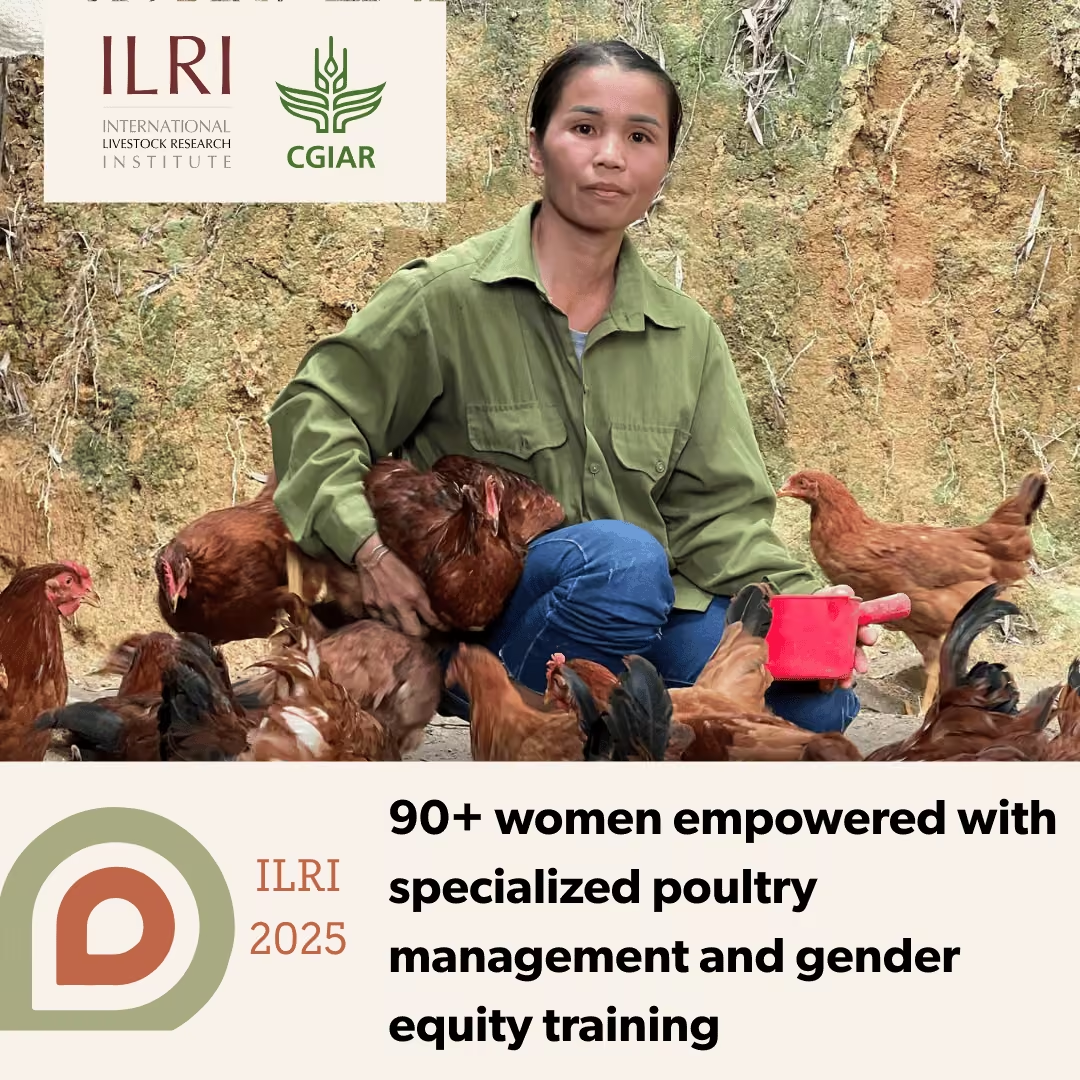
 ILRI.org
@ILRI
For too long, the Global South has been a "graveyard" for agricultural pilots. Brilliant research-backed solutions are born, tested, and proven, only to stall before reaching the millions of farmers who need them.
At @ILRI, we’re investigating the systemic bottlenecks that keep innovation fragmented.
Born during @CGIAR’s Scaling Week in late 2024, a powerful new alliance is turning the tide.
The Scaling Coalition, founded by @CGIAR, @FAO, the @gatesfoundation, @GIZ, and the @WorldBank, is moving beyond talk to operational agility.
One of the biggest hurdles to global progress is data interoperability. Currently, the datasets used by major organizations to assess innovations "cannot talk to each other." This creates a massive intelligence gap.
The Coalition is actively dismantling these bottlenecks through three critical workstreams:
🔄 Synchronizing global data systems to identify and track winning innovations.
🧠 Pooling expertise to reduce the time and cost of deployment.
🚀 Moving from isolated projects to inclusive, large-scale agrifood system transformation.
The Scaling Coalition is not a closed club; it is an open, evidence-based engine for change. By sharing protocols and strategies, we reduce the risk for investors and the wait time for farmers.
The question isn't whether we have the solutions—it's whether we can coordinate well enough to deliver them.
📩 Is your organization ready to move from pilot to impact? To join the Scaling Coalition, contact our Secretariat:
Nicoletta Buono (ILRI): n.buono@cgiar.org
Till Rockenbauch (GIZ): till.rockenbauch@giz.de
As the year comes to a close, follow us for more research highlights from 2025!
#agtech #scalingimpact #globalsouth #innovation #agriculturaldevelopment #foodsystems #ilrimovingtheneedle #cgiar #worldbank #giz #fao
 ILRI.org
@ILRI
In rural East Africa, a quiet revolution is rewriting the social contract of the household. While millions of women remain excluded from formal labor markets, the need for family income has never been more urgent.
At ILRI, we investigated the barriers holding back women agripreneurs and found that success requires more than just technical tools, it requires a total ecosystem shift.
Our Women in Business project moved beyond simple aid. We built a sustainable commercial model that connects:
👩⚕️ Young women vets: Serving as skilled entrepreneurs who provide vaccines and high-quality breeds.
🐣 Women farmers: Accessing improved poultry, specialized feed, and reliable veterinary care.
📈 Private markets: Establishing direct links to urban vendors to ensure profitable sales.
Innovation often fails when it ignores the human element. Our research identified a critical barrier: the fear that a wife’s financial success might threaten traditional household dynamics.
We didn't ignore these tensions. Through "edutainment" like the Kenyan TV series Maisha Makutano and community dialogues, we demonstrated how women's economic agency benefits the entire family.
This model, supported by the Ministry of Livestock and Fisheries Development, AKM Glitters Company Limited and Shujaaz Inc, proves that when you tackle gender inequality as a business challenge, the results are transformative.
As the year comes to a close, follow us for more research highlights from 2025!
#womeninbusiness #agdev #poultryfarming #genderequity #ilrimovingtheneedle #foodsecurity
 ILRI.org
@ILRI
31,900 Ethiopian farmers- have closed the feed gap. Here's how everything changed for them.
In Ethiopia's crop-livestock systems, farmers faced a brutal constraint: not enough climate-smart, high-quality animal feed to keep their livestock productive.
So ILRI tried something different: bundling.
We integrated improved forages, strengthened seed systems, capacity development, mass and mobile media, and market access into one cohesive approach across Amhara, Oromia, Sidama and Central Ethiopia.
🌾 31,900 smallholder farmers directly benefited (23-25% women)
📚 998 farmers, extension agents, and experts trained
📻 130,000+ reached through community radio and mobile messaging
🌱 68 hectares dedicated to quality forage seed multiplication
Farmers don't need just technology, they need systems. A new forage variety is useless without seed access. Training is wasted without demonstration plots. Knowledge doesn't spread without radio and mobile networks carrying it.
By piloting forage seed systems alongside technical support and strategic communication, we addressed interconnected needs simultaneously. Farmers adopted innovations faster because the ecosystem supported them.
The feed gap isn't closed yet. But when tens of thousands of households gain access to nutritious feed and the knowledge to use it, livestock productivity shifts, and with it, climate resilience.
As the year comes to a close, follow us for more research highlights from 2025!
#climatesmartagriculture #livestockproductivity #feedsystems #ethiopiaagriculture #systemsthinking #ilrimovingtheneedle
ILRI.org
@ILRI
ILRI helped pastoralists in northern Kenya increase their livestock income by 55% 📈
Since 2019, KAZNET, a digital platform implemented by ILRI through @CGIARAfrica, has transformed how over 6,000 pastoralists across Marsabit, Samburu, Isiolo, Wajir, and Garissa make critical decisions about when to move herds, where to sell livestock, and how to manage rangelands under climate pressure.
The numbers tell the story:
📱 15% higher use of crowdsourced information
🤝 27% increase in social learning
💰 55% boost in livestock income
📊 80%+ of users report better decision-making
Traditional knowledge met real-time data. Herders now access rangeland conditions, market prices, and climate information through their phones, blending generations of pastoral wisdom with evidence they can act on immediately.
Women and youth became the most active users, reshaping who holds information power in pastoral communities.
Impact evaluation revealed something critical: When pastoralists choose selling markets based on real-time data rather than proximity or habit, they find more profitable buyers.
When they plan movements with rangeland monitoring, they protect both animals and land.
This is citizen science at scale, not extracting knowledge from communities, but equipping them to generate, share, and act on it themselves.
Climate uncertainty doesn't disappear. But facing it blind versus facing it informed? That's the difference between survival and strategy.
As the year comes to a close, follow us for more research highlights from 2025!
#pastorallivelihoods #citizenscience #climateadaptation #digitalinnovation #aiccra #ilrimovingtheneedle #kaznet
ILRI.org
@ILRI
But climate change is beginning to unravel the way of life for pastoralists. The biggest risk they now face is repeated and prolonged extreme drought.
One of the most promising innovations humans have come up with to manage risk is insurance. Until ILRI and its partners developed the Index-Based Livestock Insurance (IBLI), there had never been any form of agricultural insurance for dryland pastoralists.
Our story looks back on 15 years of IBLI, a powerful climate-change adaptation tool, and how it has also driven significant innovation in research practice.
fifty.ilri.org/stories/managing-climate-risks-livestock-i…
 ILRI.org
@ILRI
700,000 Kenyan farmers now know whether to plant short or long-season crops. Five years ago, they were guessing.
Kenya's Agricultural Observatory Platform (KAOP) has been transformed. What started as basic 14-day forecasts is now a national AgData Hub integrating:
🌡️ Climate data
🌱 Soil data
📊 Market data
🌾 Crop data
This helps to deliver seasonal forecasts and 30-year historical climate records directly to farmers' phones.
"Having proven its utility, the clear next step is to scale this transformative tool to all 47 counties," says Paul Murage, director of @MeteoKenya.
Climate adaptation isn't just about resilience, it's about giving farmers the precision to act decisively when weather patterns shift.
This work is a product of long-term engagement with @kalromkulima and @MeteoKenya which @CGIARAfrica, through ILRI, has facilitated since 2021.
As the year comes to a close, follow us for more research highlights from 2025!
#climatesmartagriculture #digitalagriculture #climateadaptation #ilrimovingtheneedle
ILRI.org reposted
ILRI.org
@ILRI
A vaccine that can survive the Sahel can save livelihoods.
ILRI has developed a thermotolerant vaccine for peste des petits ruminants (PPR) - the sheep and goat plague killing up to 70% of infected animals, threatening 300 million families, and costing $2.1 billion annually.
Working with Hester Biosciences Limited and Mali's Central Veterinary Laboratory, our vaccine stays effective for nine days at 38.5°C. No more guessing if vaccines melted en route to remote pastoralists.
Field trials in #mali saw the vaccines provide 99% protection. Now we're scaling with @GatesFoundation and @AfDB_Group support, starting with 1 million doses for 35,000 families in central Mali.
But technical solutions aren't enough. PPR moves across borders. Pastoralists cross ecosystems. Eradication demands transboundary coordination and reaching the last mile.
Rinderpest was eradicated by 2011. PPR is next. Target: 2030.
Read more about this story here 👉 fifty.ilri.org/stories/peste-des-petits-ruminants
@CGIAR
 ILRI.org
@ILRI
For 10 years, @Mazingira_ILRI has transformed how the world understands greenhouse gas emissions from African livestock systems 🐮
From pioneering field measurements and drone-based methane work to supporting Tier 2 national inventories, Mazingira has built a unique measurement-to-policy ecosystem that strengthens national measurement, reporting and verification (MRV) systems and informs global climate dialogue.
Find out how local research capacity, cutting-edge science, and strong partnerships are shaping Africa’s climate-smart livestock future 👏 - fifty.ilri.org/stories/mazingira
@CGIAR
ILRI.org
@ILRI
ILRI offers a wide range of top research facilities. Watch our quick slideshow to see what we have: youtu.be/pDbV1MheHks
ILRI.org reposted
ILRI.org
@ILRI
How can livestock programs better support family nutrition? 🥛
Our #moremilk story from #rwanda and #kenya shows how collaboration can improve child nutrition and strengthen livelihoods 🐮 🌍
Learn more 👇
#livestock #nutrition #foodsystems #partnerships #researchfordevelopment #ilrimovingtheneedle @CGIAR @SilviaAlonso78
ILRI.org
@ILRI
A vaccine that can survive the Sahel can save livelihoods.
ILRI has developed a thermotolerant vaccine for peste des petits ruminants (PPR) - the sheep and goat plague killing up to 70% of infected animals, threatening 300 million families, and costing $2.1 billion annually.
Working with Hester Biosciences Limited and Mali's Central Veterinary Laboratory, our vaccine stays effective for nine days at 38.5°C. No more guessing if vaccines melted en route to remote pastoralists.
Field trials in #mali saw the vaccines provide 99% protection. Now we're scaling with @GatesFoundation and @AfDB_Group support, starting with 1 million doses for 35,000 families in central Mali.
But technical solutions aren't enough. PPR moves across borders. Pastoralists cross ecosystems. Eradication demands transboundary coordination and reaching the last mile.
Rinderpest was eradicated by 2011. PPR is next. Target: 2030.
Read more about this story here 👉 fifty.ilri.org/stories/peste-des-petits-ruminants
@CGIAR
ILRI.org
@ILRI
Madagascar has approved its Livestock Sector Master Plan (PDSEM), marking a crucial step for the future of livestock farming in the country.
Developed under the leadership of the Ministry of Agriculture and Livestock (MINAE), with support from the Food Systems Resilience Programme (FSRP), the PDSEM is based on in-depth economic analyses and a broad participatory process that began in April 2024. It aims to modernise the sector in a sustainable manner, while strengthening climate resilience, food security and rural household incomes.
ILRI is honoured to have accompanied the Ministry in this process, alongside Cirad, by providing technical and analytical support in a manner that respects national leadership. As Abdrahmane Wane, ILRI Regional Director for West and Central Africa, pointed out, these priority sectors can become real drivers of growth, "provided they benefit from targeted and coherent interventions."
Targeted investments could lead to a 17% increase in red meat production, 75% for white meat, and up to 72% for dairy production, while significantly reducing animal losses through the strengthening of veterinary services and improved availability of livestock feed.
As Narindra Rakotoarijaona, Director General of Agriculture and Livestock, pointed out: "The PDSEM allows us to determine the direction that the livestock sector in Madagascar will take over the next 15 years, as well as the results expected during this period."
She also praised the contribution of technical partners, noting that the plan was developed to respond to national priorities, while drawing on solid scientific expertise.
For their part, the members of the Technical Committee (MINAE technicians) emphasised that the PDSEM is now a strategic reference tool, intended to be integrated into the ministry's programmes and to serve as a basis for strengthening public-private partnerships and mobilising investment in the sector.
The validation of the PDSEM now paves the way for a new phase: the operational implementation of the plan, its integration into public policy and the preparation of a National Forum on Investment in Livestock.
ILRI looks forward to continuing its engagement alongside MINAE and all partners to support the implementation of this strategic framework for the benefit of livestock farmers, local communities and the sustainable transformation of livestock systems in Madagascar.


ILRI.org reposted
ILRI.org
@ILRI
For the first time in East Africa methane and feed have been directly measured from free-grazing pastoral cattle under real rangeland conditions.
@Mazingira_ILRI scientists adapted internationally recognised methods to work in African pastoral systems.
These field measurements provide Africa-specific data that can strengthen national GHG inventories and support mitigation strategies that actually work for grazing livestock systems.
👉 See how the team captured cattle breath and feed intake in real rangeland conditions: www.ilri.org/news/major-milestone-achieved-measuring-meth…
ILRI.org
@ILRI
“Milk is white gold 🥛 It is one of the most nutritious animal-sourced foods. So when you increase milk yield, you increase opportunities for food and nutritional security for not only the farmers but their neighbours.” – ILRI's former Program Leader for Livestock Genetics Nutrition and Feed Resources, Okeyo Mwai.
Watch this short video to learn the multitude of benefits from better milk farming: youtu.be/tIzdEOvEwfM
@CGIAR
ILRI.org
@ILRI
One evidence-based roadmap. Multiple countries transformed.
For the past decade, ILRI has helped 8 countries transform their livestock sectors through Livestock Master Plans - evidence-based roadmaps that turn ambition into investment.
🇪🇹 Ethiopia attracted backing from the @worldbank and @AfDB_Group. Private companies scaled up. Four new artificial insemination centers were built.
🇮🇳 Odisha, India boosted its livestock budget from INR 4 billion to 7 billion after developing its plan in 2022.
These aren't top-down strategies. We bring government and private sector into the same room to ask: Where does this sector need to go? Then we build a 15-year strategy with concrete, costed interventions.
"It's big picture thinking," says ILRI development economist @isabaltenweck. "In a work environment, it's not often that we're allowed to dream."
But the plans deliver more than dreams. They attract donors, mobilise capital, and create clear pathways for millions of livestock keepers to improve productivity and livelihoods.
Seven countries have now developed master plans with ILRI, @FAO, @CIRAD and @AU_IBAR.
Each is tailored to local needs, whether it's addressing child malnutrition in Madagascar or boosting dairy genetics in Ethiopia.
The question isn't whether to invest in livestock. It's how - and that requires a plan.
Read the full story 👉 fifty.ilri.org/stories/power-plan
#livestockdevelopment #agdev #foodsecurity #evidencebasedpolicy #globalsouth #ilrimovingtheneedle
ILRI.org
@ILRI
At ILRI we are working towards safe, nutritious food for everyone.
Take Vietnam, for example. Over half the pork sold in traditional markets there was contaminated with Salmonella, making families sick and costing nearly 1% of the country's GDP each year.
The main cause being simple cross-contamination from unhygienic practices.
We believe in tackling these problems with practical, science-based solutions.
Through our #safepork project, we worked with partners to make a big difference with small interventions 🐷
We provided vendors with low-cost hygiene kits, including separate knives and cutting boards, and trained over 500 workers on proper food safety practices.
Following this, Salmonella contamination dropped from 52% to 24%, and consumers were willing to pay 20% more for the safer pork.
This successful project has since helped #vietnam establish a national Food Safety Task Force to keep up the progress.
We're proud to highlight how targeted research and collaboration can deliver safer food and healthier lives.
To learn more about our work on this project and its impact, explore our story: fifty.ilri.org/stories/safer-pork-healthier-people
#foodsafety #movingtheneedle #foodsystems #whylivestockmatter #withsciencewecan #handinhand @CGIAR @chinguyencomms
ILRI.org
@ILRI
How can livestock programs better support family nutrition? 🥛
Our #moremilk story from #rwanda and #kenya shows how collaboration can improve child nutrition and strengthen livelihoods 🐮 🌍
Learn more 👇
#livestock #nutrition #foodsystems #partnerships #researchfordevelopment #ilrimovingtheneedle @CGIAR @SilviaAlonso78
ILRI.org reposted
Jameel Observatory for Food Security Early Action
@jameel_observ
#anticipatoryaction and pastoralism in Africa: A synthesis of current challenges, opportunities, and priorities
latest from our research team: doi.org/10.1111/disa.70026
@alaninaddis @nd_jensen @sfderbyshire @twahirah3 @JohnYumbya @Tsitati_George @SPARC_Ideas @ILRI @IGAD_CPALD
ILRI.org
@ILRI
Feeding livestock effectively is one of farmers' biggest challenges, made harder by climate change and rising costs.
Poor feeding lowers yields and increases greenhouse gas emissions, while past "one-size-fits-all" solutions often failed to match local realities 📉
ILRI developed the Feed Assessment Tool (FEAST) to change that 🛠️
Through farmer consultations and local data, FEAST identifies critical feed gaps and recommends tailored solutions that work in their context.
Now used in 22 countries across Africa, Asia, and Latin America, FEAST is driving change:
🇹🇿 In Tanzania, it helped redirect a feed project to areas most in need of milk supply 🥛
🇷🇼 In Rwanda, the approach was so effective the government is now applying it to pig farming 🐷
To find out more about how we used #feast to improve #livestock feeding, see our video explainer - youtu.be/HbyCiXiTlbU
And read the full story: fifty.ilri.org/stories/moveable-feast
#feedassessment #climateaction #agriculture #researchfordevelopment #foodsystems #tailoredsolutions #movingtheneedle @CGIAR
ILRI.org
@ILRI
When poultry become more than livestock 🐓🇹🇿
In rural Tanzania, we found women farmers were not able to access the profitable poultry breeds transforming livelihoods across Africa.
Investigations into this uncovered more questions and layers of hidden barriers.
Gender norms prevented women from travelling to markets. Male gatekeepers controlled access to suppliers and veterinary services. Even success brought new challenges - when women's chicken businesses thrived, some men tried to take them over.
ILRI could not work within these norms, we had to transform them.
20 female veterinary graduates became poultry vendors, along with a social media campaign which normalised women as business leaders.
This saw egg production double, and women poultry vendors tripled their incomes and gained unprecedented decision-making power.
This showed gender-transformative approaches can empower women, and unlock economic potential that benefits entire communities.
Watch here to find out how we empowered women through these 'feathered ATMs' 👉 youtu.be/hjyCy-H1zX4
@alegalie @CGIARgender @CGIAR @
#genderequality #sustainabledevelopment #agricultureinnovation #ilrimovingtheneedle
ILRI.org
@ILRI
For the first time in East Africa methane and feed have been directly measured from free-grazing pastoral cattle under real rangeland conditions.
@Mazingira_ILRI scientists adapted internationally recognised methods to work in African pastoral systems.
These field measurements provide Africa-specific data that can strengthen national GHG inventories and support mitigation strategies that actually work for grazing livestock systems.
👉 See how the team captured cattle breath and feed intake in real rangeland conditions: www.ilri.org/news/major-milestone-achieved-measuring-meth…
ILRI.org reposted
 Shahida.Hussien
@ShahidaHussien
'Yelimat Tirufat initiative consists of four commodities, from this dairy is the main with the objective of ensuring food security, import substitution, job creation increasing revenue from export earning.' Tsigereda Fikadu of @MoA_Ethiopia
@ILRI @CGIAR
 Shahida.Hussien
@ShahidaHussien
'Livestock contribute 26% from agricultural sector & 4% of the national gross domestic product, & also the contribution to ensuring food & nutrition security is high.' Tsigereda Fikadu of @MoA_Ethiopia
@ILRI @CGIAR


ILRI.org reposted
CGIAR Multifunctional Landscapes
@CGIARenviro
How can sustainable agriculture practices be scaled globally and work locally?
Find out at our webinar on 11 Dec featuring experts from @ILRI, @IFPRI, @IWMI_ & @BiovIntCIAT_eng 🌿
#naturepositive #biodiversity #aginnovation


ILRI.org reposted
CGIAR Digital Transformation
@CGIAR_Data
Experts from diverse disciplines tested an animal health chatbot by @ILRI and @Fahamu_AI to gauge performance and provide insights to refine its accuracy.
The AI is trained on a curated set of peer-reviewed scientific papers.
Explore the chatbot : animalanswers.ilri.org
 ILRI.org
@ILRI
Theo Knight-Jones, ILRI veterinary epidemiologist, comments on the international bird flu threat.
www.npr.org/2025/12/08/nx-s1-5629191/bird-flu-hasnt-reach… @NPR

ILRI.org reposted
 FAO Viet Nam
@FAOVietNam
10 Years of Partnership for Safer Food 🇻🇳
On 5 Dec, @FAOVietNam, Ministry of Agriculture and Environment, @ILRI & partners co-hosted the 4th OHP Food Safety Meeting.
Supported by the Republic of Korea.
#foodsafety #onehealth


ILRI.org reposted
 PanAfrican Agriculture
@panagrimedia
Local concentrate feeds and feedlotting slash methane emissions, boost beef yields in Tanzania -new study
Improved feeding systems are not just about increasing weight gain, they're powerful levers for both productivity and climate goals-Authors
panagrimedia.com/local-concentrate-feeds-and-feedlotting-… @ILRI
ILRI.org reposted
ILRI.org
@ILRI
Pioneer-Positive Deviance is an approach focused on leveraging locally derived solutions, championed by farmers themselves.
Why is it so effective? Watch our video to find out.
youtu.be/eTky0ySkSrw
ILRI.org
@ILRI
Improved chicken breeds, developed by ILRI Poultry Facility, can take egg production from 60 to 200 per year.
This is just one example of the science that can be developed there. Watch our short video and contact w.esatu@cgiar.org and o.hanotte@cgiar.org to discuss research ideas. youtube.com/shorts/J0k5KaSs0QU
ILRI.org
@ILRI
Pioneer-Positive Deviance is an approach focused on leveraging locally derived solutions, championed by farmers themselves.
Why is it so effective? Watch our video to find out.
youtu.be/eTky0ySkSrw
ILRI.org reposted
ILRI.org
@ILRI
Learn more about #ibli #cop30 #ilriclimatestories 👇
hdl.handle.net/10568/175345

ILRI.org reposted
ILRI.org
@ILRI
ARBO-WATCH is being implemented by a consortium of 9 institutions including @ILRI, @KEMRI_Kenya , @MOH_Kenya, @DiscoverJKUAT, @EPHIEthiopia, Global One Health Initiative @OSUGlobal, @SomaliOneHealth & @MoH_Somalia.
Read more: www.ilri.org/research/projects/arbo-watch-project
#ilriclimatestories
ILRI.org reposted
ILRI.org
@ILRI
How cassava peel becomes an affordable, safe livestock feed ingredient: www.ilri.org/news/high-quality-cassava-peel-mash-technolo…
#cop30 #ilriclimatestories

ILRI.org reposted
ILRI.org
@ILRI
ILRI has been carrying out forage-based feed innovations for climate resilience in the Ethiopian Rift Valley, as part of Ukama Ustawi (UU), a CGIAR regional integrated initiative 👇 www.cgiar.org/news-events/news/farmers-in-hawassa-zuria-d… #cop30 @CGIAR
ILRI.org reposted
ILRI.org
@ILRI
🌍 More beef, lower methane emissions intensity in #tanzania: researchers show feedlot systems using locally available feed ingredients can deliver tangible productivity and climate benefits.
www.ilri.org/news/feedlot-feeding-improves-beef-productiv…
@ArndtClaudia @Mazingira_ILRI @SokoineU @AarhusUni_int
ILRI.org reposted
Jameel Observatory for Food Security Early Action
@jameel_observ
Co-designing climate resilience: advancing drought risk financing in East Africa - short report from our October dialogue with @ILRI and partners
www.cgiar.org/news-events/news/co-designing-climate-resil…
ILRI.org reposted
Shahida.Hussien
@ShahidaHussien
With over 70 million cattle, 52.5 million goats, 42.9 million sheep & 8.1 million camels Ethiopia has a vast biological resource base that can significantly boost food security, nutrition, employment & export earnings. @MoA_Ethiopia @ILRI @CGIAR
 Shahida.Hussien
@ShahidaHussien
'The #ethiopiandairysectoralassociation has a vision of transforming the dairy sector from subsistence to vibrant, commercial, & high-value industry that contributes significantly to national nutrition, & economic growth.' Mulugeta Yimer
@MoA_Ethiopia @ILRI @CGIAR

ILRI.org reposted
PanAfrican Agriculture
@panagrimedia
Researchers push for regiontailored vaccines to tackle African Swine Fever
panagrimedia.com/researchers-push-for-regiontailored-vacc… @ILRI
ILRI.org
@ILRI
🌍 More beef, lower methane emissions intensity in #tanzania: researchers show feedlot systems using locally available feed ingredients can deliver tangible productivity and climate benefits.
www.ilri.org/news/feedlot-feeding-improves-beef-productiv…
@ArndtClaudia @Mazingira_ILRI @SokoineU @AarhusUni_int
ILRI.org reposted
CGIAR Digital Transformation
@CGIAR_Data
Accurate methane measurement is essential for effective mitigation. In tests led by the @ILRI and its partners on rangeland animals in Africa, drone technology demonstrated its ability to deliver precise, reliable methane data.
Read more: on.cgiar.org/3Y5immC

ILRI.org reposted
ILRI.org
@ILRI
Blanket reductions in antibiotic use in animals will stall if farmers lack security, support and the right incentives. Stewardship must be grounded in equity, adapted to climate realities, and responsive to those who raise the animals that feed the world.
@CGIAR @amrhub @ArshneeM @WOAH #waaw2025 #amr
ILRI.org reposted
ILRI.org
@ILRI
Read the full article by @AMRHub lead @ArshneeM - 'Rethinking antibiotic use: Why the global debate misses low-and-middle-income countries’ realities'
theanimalecho.woah.org/en/antibiotic-use-why-the-global-d…
ILRI.org reposted
Shahida.Hussien
@ShahidaHussien
'Livestock contribute 26% from agricultural sector & 4% of the national gross domestic product, & also the contribution to ensuring food & nutrition security is high.' Tsigereda Fikadu of @MoA_Ethiopia
@ILRI @CGIAR
ILRI.org reposted
Jameel Observatory for Food Security Early Action
@jameel_observ
Just published: Institutional and policy networks in disaster management in the Horn of Africa: insights from Kenya
Reporting on our research with @ILRI @SPARC_Ideas
doi.org/10.1111/disa.70031
@twahirah3
ILRI.org reposted
Shahida.Hussien
@ShahidaHussien
To transform the livestock sector the Ethiopian government published the Livestock & Fisheries Investment Handbook on May 2025. Expected to accelerate private sector participation in livestock & fisheries industries. @MoA_Ethiopia @ILRI @CGIAR
hdl.handle.net/10568/174651
Shahida.Hussien
@ShahidaHussien
With over 70 million cattle, 52.5 million goats, 42.9 million sheep & 8.1 million camels Ethiopia has a vast biological resource base that can significantly boost food security, nutrition, employment & export earnings. @MoA_Ethiopia @ILRI @CGIAR
Shahida.Hussien
@ShahidaHussien
'The #ethiopiandairysectoralassociation has a vision of transforming the dairy sector from subsistence to vibrant, commercial, & high-value industry that contributes significantly to national nutrition, & economic growth.' Mulugeta Yimer
@MoA_Ethiopia @ILRI @CGIAR
ILRI.org reposted
 Rwanda Agriculture & Animal Resources Devpt Board
@RwandaAgriBoard
Today, RAB, in collaboration with @ILRI , kicked off a five-day Rwanda Land-Soil-Crop (LSC) Hub Validation, User Training, Business Plan & Financial Strategy Workshop aimed at advancing climate-smart agriculture.


ILRI.org reposted
 Jacobo Arango
@Jacobo_ABC
Honored to join the Gates Foundation Livestock & Aquaculture Convening in South Africa, representing the Low-Methane Forages project supported by the @BezosEarthFund and the @gatesfoundation
@BiovIntCIAT_eng @ILRI @ICARDA
Excited to show preliminary results 🐄🌿:

 ILRI.org
@ILRI
Blanket reductions in antibiotic use in animals will stall if farmers lack security, support and the right incentives. Stewardship must be grounded in equity, adapted to climate realities, and responsive to those who raise the animals that feed the world.
@CGIAR @amrhub @ArshneeM @WOAH #waaw2025 #amr
ILRI.org
@ILRI
Read the full article by @AMRHub lead @ArshneeM - 'Rethinking antibiotic use: Why the global debate misses low-and-middle-income countries’ realities'
theanimalecho.woah.org/en/antibiotic-use-why-the-global-d…
ILRI.org reposted
ILRI.org
@ILRI
Antimicrobialresistance will hit low- to middle-income countries hardest, including reducing food security. We need to widen the lens to combat it effectively, says CGIAR AMR Hub lead Arshnee Moodley.
Stewardship must be grounded in equity, adapted to climate realities, and responsive to those who raise the animals that feed the world.
Read the full article in comments 👇

ILRI.org reposted
ILRI.org
@ILRI
In Vietnam’s Northwest Highlands, the @CGIAR SAPLING initiative (2022-2024) with @ILRI & @BiovIntCIAT_eng showed how climate-smart livestock systems can drive animal productivity, climate resilience & environmental benefits.
@CGIAR_SAAF (2025–2030) will scale these climate-smart livestock solutions further!
#cop30 #ilriclimatestories
Read more below 👇
ILRI.org reposted
CGIAR
@CGIAR
At #cop30: Locally led climate adaptation: a ‘business unusual’ agenda for research & development, where participants compared different approaches to implementing locally led adaptation
📺 on.cgiar.org/44ygDd7
@Cop30noBrasil @IWMI_ @ILRI @irri @CIMMYT @IFPRI
ILRI.org reposted
 Inter Press Service
@ipsnews
Livestock should be recognised as more than a source of emissions and as an important solution for climate resilience, food security & adaptation, especially in developing countries where they are the backbone of rural economies, warns @ILRI's @ADjikeng www.ipsnews.net/2025/11/as-cop30-takes-place-can-africa-d…
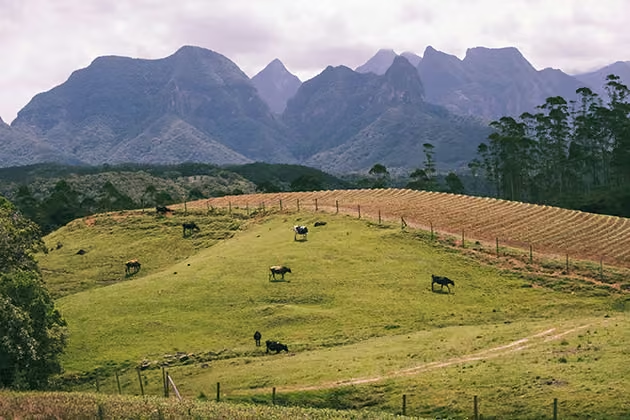 ILRI.org
@ILRI
Antimicrobialresistance will hit low- to middle-income countries hardest, including reducing food security. We need to widen the lens to combat it effectively, says CGIAR AMR Hub lead Arshnee Moodley.
Stewardship must be grounded in equity, adapted to climate realities, and responsive to those who raise the animals that feed the world.
Read the full article in comments 👇
ILRI.org reposted
ILRI.org
@ILRI
In India, ILRI & @icarindia are supporting women farmers against #climatechange.
The 'Gender-livestock-climate analytic approach for livelihood improvement in distressed areas of India’ (GLCAA) project has introduced women-friendly livestock tools & techniques.
See link below!
ILRI.org reposted
ILRI.org
@ILRI
Farmers and policymakers need to base their farming strategies on accurate data, including methane emissions. @ILRI & @icarindia are capturing regional, seasonal, and dietary variations in India to guide policy and practices better.
#ilriclimatestories #cop30
ILRI.org reposted
 FAO Eastern Africa
@FAOEastAfrica
A major step for animal health in Eastern Africa. @FAO, @AU_IBAR, @jumuiya & @IGADSecretariat validated the 2026–2035 #fmd Control Framework for 12 countries: 🇧🇮🇩🇯🇨🇩🇪🇷🇪🇹🇰🇪🇸🇴🇸🇸🇸🇩🇷🇼🇺🇬🇹🇿.
Workshop included veterinary services, wildlife sector and experts from @ILRI @WOAH @GALVmed.


ILRI.org reposted
 SPARC_Ideas
@SPARC_Ideas
📣📣NEW BLOGS: Working in fragile & #conflict-affected drylands can be rewarding & demanding. The challenges demand strong partnerships underpinned by trust.
In these 2 blogs, SPARC Fund Manager @PaulineNjiraini shares what we’ve learned in six years of working in complex regions ➡️:
🔗 www.sparc-knowledge.org/news-blog/blog/challenges-and-ada…
🔗 www.sparc-knowledge.org/news-blog/blog/power-trust-corner…
@CPEDNG @KenyattaUni @SanaaCenter @CAUSALDesign @rayelphas @IDRC_CRDI @FCDOResearch @afriscout @Cowater_Intl @ILRI @ODI_Global @IYRP2026

ILRI.org reposted
ILRI.org
@ILRI
ILRI and @WorldFish, supported by UK’s @DefraGovUK, are developing a framework to analyze health risks for #ghana and #zambia in the face of #climatechange.
#cop30 #ilriclimatestories
ILRI.org reposted
ILRI.org
@ILRI
For Nigeria’s livestock sector, feed costs are up to 70% of production costs. Meanwhile cassava peel and organic waste in landfills produces pollution & methane emissions.
ILRI research provides a win-win solution to create affordable, safe & sustainable livestock feed for poultry, pig and fish farmers while reducing #ghg emissions from waste.
#ilriclimatestories #cop30
Read more below 👇
ILRI.org reposted
ILRI.org
@ILRI
"From where I sit, working across smallholder and semi-intensive livestock systems in Africa and Asia, the antimicrobial resistance narrative still leans heavily on high-income realities. The focus often tends to be on reducing antimicrobial use, yet there’s more to explore, especially around access, quality, and practical support for farmers’ needs when few viable alternatives exist."
Arshnee Moodley, @CGIAR_AMRhub lead, explains why the global debate around #amr is missing vital realities.
theanimalecho.woah.org/en/antibiotic-use-why-the-global-d…
ILRI.org reposted
Inter Press Service
@ipsnews
Livestock should be recognised as more than a source of emissions and as an important solution for climate resilience, food security & adaptation, especially in developing countries where they are the backbone of rural economies, warns @ILRI's @ADjikeng www.ipsnews.net/2025/11/as-cop30-takes-place-can-africa-d…
 ILRI.org
@ILRI
Uruguay's @INIA_UY visit confirms incredible potential for South-South collaboration! Combining INIA's expertise in sustainable, export-oriented systems with ILRI's focus on smallholders will yield significant results. @isabaltenweck @nimmodmk @anniecook @ehpatel @dishonmuloi
#foodsecurity #livestockresearch #agriculturalinnovation #onehealth #climatesmartagriculture #ilri #inia #kenya #uruguay #southsouthcooperation


ILRI.org reposted
 AICCRA
@CGIARAfrica
Hands-on demos and a visit to a women-led CBBP highlight a growing momentum in transforming the small ruminant sector through a marriage of science and community-led innovation.
Read more about our engagement in CBBPs here: aiccra.cgiar.org/news/how-community-led-innovation-transf…
#climatesmartethiopia #readytoscale


ILRI.org reposted
AICCRA
@CGIARAfrica
#ethiopia
@JimmaUniv's College of Agriculture and Veterinary Medicine hosted a National Training Workshop on Reproductive Biotechnology to support community-based sheep and goat breeding programs (CBBP).
Experts from @ICARDA 🇪🇹 and 🇹🇳 teams trained young and emerging experts and practitioners from across research centers and universities nationwide.
Training topics ranged from genetics dissemination and best practices to artificial insemination, ultrasound pregnancy diagnosis, and sire certification.


ILRI.org reposted
 Alphonso Van Marsh
@AlphonsoVM
🌍🌱Africa’s farmers are on the frontlines of climate change.
Join @AfDB_Group WEDNESDAY for the "Forum on Promoting Climate-Smart Agriculture for African Farmers’ Resilience to Climate Change" - explore real solutions that boost resilience and food security.
#climatesmartafrica

ILRI.org reposted
Alphonso Van Marsh
@AlphonsoVM
🔬Research drives Africa’s agricultural resilience to climate change. Leading institutions - @FARAinfo, @CORAFNews, @ICRISAT, @IWMI_, @ILRI and others - share innovations at the Forum on Promoting Climate-Smart Agriculture for African Farmers’ Resilience to Climate Change.⤵️


ILRI.org reposted
Inter Press Service
@ipsnews
Livestock should be recognised as more than a source of emissions and as an important solution for climate resilience, food security & adaptation, especially in developing countries where they are the backbone of rural economies, warns @ILRI's @ADjikeng www.ipsnews.net/2025/11/as-cop30-takes-place-can-africa-d…
 ILRI.org
@ILRI
ILRI hosted a promotional workshop in Nakuru County to raise awareness among stakeholders about the Dairy Farmer Advisor innovation and gather insights on how to improve it for wider adoption.
www.ilri.org/news/advocating-adoption-farmer-advisor-mode…
ILRI.org
@ILRI
"From where I sit, working across smallholder and semi-intensive livestock systems in Africa and Asia, the antimicrobial resistance narrative still leans heavily on high-income realities. The focus often tends to be on reducing antimicrobial use, yet there’s more to explore, especially around access, quality, and practical support for farmers’ needs when few viable alternatives exist."
Arshnee Moodley, @CGIAR_AMRhub lead, explains why the global debate around #amr is missing vital realities.
theanimalecho.woah.org/en/antibiotic-use-why-the-global-d…
ILRI.org reposted
 Marchmont Comms
@MarchmontComms
#dyk 🇧🇷 increased livestock productivity by 61% in the last 20 years, while reducing pasture use and emissions?
In a new piece from @ipsnews, @ILRI's @ADjikeng explores lessons Africa can take away to develop its livestock sector 👇
www.ipsnews.net/2025/11/as-cop30-takes-place-can-africa-d…
#whylivestockmatter

ILRI.org reposted
 SustainableShrimp
@SShrimpPartner
This #waaw25, Dr Rebecca Doyle (@ILRI & University of Edinburgh) brings the research perspective on how animal welfare is a vital tool in tackling antimicrobial resistance.
▶️www.wfa.org/WAAW25 #amr #animals4amr
ILRI.org
@ILRI
The Gendered Feed Assessment Tool (G-FEAST) is putting communities in Madagascar at the center of diagnosing livestock feed problems and designing solutions.
Read what was discovered:
www.ilri.org/news/g-feast-journey-madagascar-building-res…
ILRI.org reposted
ILRI.org
@ILRI
The ARBO-WATCH project is linking climate data to mosquito-borne disease trends, to help the governments of Kenya, Somalia and Ethiopia act before #dengue and #chikungunya outbreaks occur.
#cop30 #ilriclimatestories
@bett_bk
ILRI.org
@ILRI
Happening today at #cop30 - a session to showcase @CGIAR’s science-based, finance-ready innovations that cut emissions, boost productivity, and build resilience. It will highlight evidence, partnerships, and investment opportunities to position livestock and aquatic systems as key solutions in achieving climate, adaptation, and global food system goals.
 ILRI.org
@ILRI
A new study identifies how to reduce #antimicrobialresistance in Uttar Pradesh, India, by tracking how bacteria can be transmitted from poultry slaughterhouses to households, and identifies how to stop this, including:
🧼 Better hygiene practices in retail outlets and households
🍖 Safer handling of raw and cooked meat by restaurants and consumers
Read more: www.ilri.org/news/cgiar-study-informs-antimicrobial-resis…
#waaw2025 #amr

ILRI.org reposted
ILRI.org
@ILRI
ILRI provides Kenya & Ethiopia's pastoralists with index-based livestock insurance (#ibli) to provide financial protection against drought and #climatechange.
Policyholders, of which 43% are women, are less likely to carry out livestock distress sales or reduce meals. #cop30
ILRI.org reposted
 CGIAR Sustainable Animal and Aquatic Foods
@CGIAR_SAAF
Resilient food systems mean better nutrition, stronger livelihoods, and a healthier planet. See how it's done at our @Cop30noBrasil session on scaling solutions for animal and aquatic foods.
Watch live: events.cgiar.org/Scalingsolutionsforresilientanimalandaqu…
Nov 20 | 12 PM BRT!
#cop30 #withsciencewecan

ILRI.org reposted
CGIAR
@CGIAR
❓ Did you know? Every $1 invested in CGIAR research returns $10 in impact.
With new funding announced at #cop30, we’re scaling solutions for food, land, and water systems. on.cgiar.org/49VixIl
#investinscience #cop30 #foodsystems

ILRI.org reposted
 World Federation for Animals
@WrldFed4Animals
Day 2 of #waaw25: Dr Rebecca Doyle (@ILRI & University of Edinburgh) is bringing the research perspective on how animal welfare is a vital tool in tackling antimicrobial resistance.
▶️ Learn more: www.wfa.org/WAAW25
#animals4amr #amr @fourpawsint @TheBrooke @CIWF_global
ILRI.org
@ILRI
Curious about sustainable livestock solutions? Follow us to find out more!
The CIRcularity of Nutrients in AgroecoSystems and co-benefits on animal and human health (CIRNA) project aims to minimize GHG emissions, enhance organic fertilizer, and safeguard human and animal health.
The project has also generated country-specific data to improve estimations of national emissions and evaluate mitigation options.
See link in comments to read more!
#ilriclimatestories #cop30
@sonja_leitner
ILRI.org
@ILRI
In Ethiopia's Hawassa Zuria district, farmers are growing climate solutions alongside their crops to protect against the negative impacts of erratic rainfall.
See link in comments to read more!
#ilriclimatestories #cop30 @CGIAR @HaimanotSeifu
ILRI.org
@ILRI
ILRI has been carrying out forage-based feed innovations for climate resilience in the Ethiopian Rift Valley, as part of Ukama Ustawi (UU), a CGIAR regional integrated initiative 👇 www.cgiar.org/news-events/news/farmers-in-hawassa-zuria-d… #cop30 @CGIAR
ILRI.org
@ILRI
In India, ILRI & @icarindia are supporting women farmers against #climatechange.
The 'Gender-livestock-climate analytic approach for livelihood improvement in distressed areas of India’ (GLCAA) project has introduced women-friendly livestock tools & techniques.
See link below!
ILRI.org
@ILRI
In Vietnam’s Northwest Highlands, the @CGIAR SAPLING initiative (2022-2024) with @ILRI & @BiovIntCIAT_eng showed how climate-smart livestock systems can drive animal productivity, climate resilience & environmental benefits.
@CGIAR_SAAF (2025–2030) will scale these climate-smart livestock solutions further!
#cop30 #ilriclimatestories
Read more below 👇
ILRI.org
@ILRI
Farmers and policymakers need to base their farming strategies on accurate data, including methane emissions. @ILRI & @icarindia are capturing regional, seasonal, and dietary variations in India to guide policy and practices better.
#ilriclimatestories #cop30
ILRI.org
@ILRI
ILRI and @WorldFish, supported by UK’s @DefraGovUK, are developing a framework to analyze health risks for #ghana and #zambia in the face of #climatechange.
#cop30 #ilriclimatestories
ILRI.org
@ILRI
For Nigeria’s livestock sector, feed costs are up to 70% of production costs. Meanwhile cassava peel and organic waste in landfills produces pollution & methane emissions.
ILRI research provides a win-win solution to create affordable, safe & sustainable livestock feed for poultry, pig and fish farmers while reducing #ghg emissions from waste.
#ilriclimatestories #cop30
Read more below 👇
ILRI.org
@ILRI
How cassava peel becomes an affordable, safe livestock feed ingredient: www.ilri.org/news/high-quality-cassava-peel-mash-technolo…
#cop30 #ilriclimatestories
ILRI.org
@ILRI
The ARBO-WATCH project is linking climate data to mosquito-borne disease trends, to help the governments of Kenya, Somalia and Ethiopia act before #dengue and #chikungunya outbreaks occur.
#cop30 #ilriclimatestories
@bett_bk
ILRI.org
@ILRI
ARBO-WATCH is being implemented by a consortium of 9 institutions including @ILRI, @KEMRI_Kenya , @MOH_Kenya, @DiscoverJKUAT, @EPHIEthiopia, Global One Health Initiative @OSUGlobal, @SomaliOneHealth & @MoH_Somalia.
Read more: www.ilri.org/research/projects/arbo-watch-project
#ilriclimatestories
ILRI.org
@ILRI
ILRI provides Kenya & Ethiopia's pastoralists with index-based livestock insurance (#ibli) to provide financial protection against drought and #climatechange.
Policyholders, of which 43% are women, are less likely to carry out livestock distress sales or reduce meals. #cop30
ILRI.org
@ILRI
Learn more about #ibli #cop30 #ilriclimatestories 👇
hdl.handle.net/10568/175345
ILRI.org reposted
ILRI.org
@ILRI
In Ethiopia's Hawassa Zuria district, farmers are growing climate solutions alongside their crops to protect against the negative impacts of erratic rainfall.
See link in comments to read more!
#ilriclimatestories #cop30 @CGIAR @HaimanotSeifu
ILRI.org reposted
CGIAR
@CGIAR
9.3M farmers in 9 countries accessed CGIAR climate information through TV, SMS & voice services (2022–2024).
With @CGIARAfrica reaching 4M farmers, digital platforms are helping smallholders adapt to climate shocks and secure resilient harvests.
🔗 on.cgiar.org/40xSqlh

ILRI.org reposted
ILRI.org
@ILRI
ILRI joins national partners in marking World Antimicrobial Awareness Week. @ericfevre spoke on ILRI's work supporting the Kenya National Action Plan on Prevention and Containment of Antimicrobial Resistance, supported by the Flemming fund UK. ILRI has been working closely with the National Antimicrobial Stewardship Interagency Committee (NASIC) and other partners like the University of Nairobi Center for Epidemiological Modelling and Analysis @CEMA_Africa @uonbi @FAO @UNEP @MOH_Kenya @WOAH @AfricaCDC @DrLoice #waaw2025 #amrawareness


ILRI.org reposted
 The Conversation Africa
@TC_Africa
Aquaculture is booming in Lake Victoria, transforming local livelihoods and nutrition. 🐟 How will this rapid growth shape the region’s future?
theconversation.com/fish-farming-is-booming-in-lake-victo…
💻 Ekta Patel, @ILRI and Eric Teplitz and Kathryn Fiorella, @Cornell University
#healthandmedicine
ILRI.org
@ILRI
ILRI joins national partners in marking World Antimicrobial Awareness Week. @ericfevre spoke on ILRI's work supporting the Kenya National Action Plan on Prevention and Containment of Antimicrobial Resistance, supported by the Flemming fund UK. ILRI has been working closely with the National Antimicrobial Stewardship Interagency Committee (NASIC) and other partners like the University of Nairobi Center for Epidemiological Modelling and Analysis @CEMA_Africa @uonbi @FAO @UNEP @MOH_Kenya @WOAH @AfricaCDC @DrLoice #waaw2025 #amrawareness
ILRI.org
@ILRI
Representatives from Flemming Fund, Tabitha Kimani from @FAO , @KenyaRedCross and Dr.Wekesa from the Ministry of Agriculture and Livestock Development all spoke to how partnerships play a key role in enforcing the theme "Act Now: Protect Our Present, Secure Our Future."


 ILRI.org
@ILRI
As #waaw2025 begins @ehpatel, Kathryn Fiorella & Eric Teplitz shine a spotlight on aquaculture in #lakevictoria, calling for improved production practices to lower misuse of antibiotics & cross-sector coordination to promote responsible use.
#onehealth
The Conversation Africa
@TC_Africa
Aquaculture is booming in Lake Victoria, transforming local livelihoods and nutrition. 🐟 How will this rapid growth shape the region’s future?
theconversation.com/fish-farming-is-booming-in-lake-victo…
💻 Ekta Patel, @ILRI and Eric Teplitz and Kathryn Fiorella, @Cornell University
#healthandmedicine
ILRI.org
@ILRI
🌾 Rangelands and pastoralist systems are central to global food security climate action, and rural livelihoods—yet they still don’t get the recognition or investment they deserve.
On 14 Nov at the Action on Food Hub at #cop30, ILRI brought together experts to highlight just how vital these systems are. Rangelands cover 54% of the world’s land surface and store 550 gigatons of soil carbon, making them one of the largest natural climate solutions we have. Pastoralists manage about 80% of these landscapes, supporting hundreds of millions of people directly and nearly 2 billion through the food, income, and ecosystem services they provide.
And yet—less than 3% of global adaptation finance reaches pastoralist communities.
Setting the scene, @khaosanlao reminded everyone just how significant these systems are, noting that pastoralism and rangelands cover around 54% of the terrestrial world, and that mobile livestock systems are often 2–10 times more productive per unit of land in drylands than sedentary systems.
From there, speakers painted a vivid picture of why pastoralism must be taken seriously in global climate and food system debates.
Johanna von Braun (International Land Coalition) pointed out that rangelands stewarded by 500 million pastoralists hold 550 gigatons of soil carbon, yet these ecosystems remain “invisible” in many policy conversations.
Building on that, Nelly Bosibori (@MercyCorps) highlighted the economic case, explaining that every dollar invested in rangelands returns anywhere from $4 to $35—a reminder that climate-smart systems can be both sustainable and financially sound.
Isaac Tobiko (Indigenous Peoples Organization) grounded the conversation in rights, stressing that there is no pastoralism without secure land tenure and mobility—a fundamental truth for communities whose resilience depends on movement.
Looking at biodiversity and land management, Josefina Eisel (Global Roundtable for Sustainable Beef) warned that grasslands still lack basic legal protection despite their immense environmental value, putting both ecosystems and livelihoods at risk.
And from a government perspective, Lamin Yata (Ministry of Environment, Senegal) made it clear that livestock systems are highly vulnerable to climate change, but they also hold strong potential for both mitigation and adaptation, if properly supported.
Bringing the session to a close, Deoda Diata (@isdb_group) captured the collective sentiment: pastoralists are central to resilience, climate action, and sustainable growth—not peripheral actors, but key drivers of climate-smart development.
Participants agreed that valuing pastoralists means valuing climate action. Recognising their rights, their mobility, their knowledge systems, and ensuring meaningful finance reaches them is essential for building food systems that are resilient, inclusive, and sustainable.

 ILRI.org
@ILRI
🌍 How can livestock transitions advance climate goals and protect the people who depend on them?
On 14 Nov at the #actiononfood Pavilion, ILRI co-hosted a roundtable on just transition and inclusive governance in food and agriculture, examining how livestock systems can evolve in ways that strengthen resilience, protect livelihoods, and uphold social justice.
The dialogue highlighted that the global call to transition away from industrial animal agriculture must not overshadow the realities of smallholders and pastoralists, whose low-impact systems sustain communities, steward ecosystems, and anchor food security.
Key insights from the session included:
🔹 People-first climate action: There was an emphasis on shifting climate strategies to center people, not just emissions, ensuring local communities shape solutions.
🔹 Contextualizing just transition: The concept, originating in energy must be adapted for agriculture’s diversity, avoiding generalizations and respecting regional differences.
🔹 Balancing agendas: Participants stressed that climate mitigation must complement priorities such as adaptation, food security, and rural development, especially across Africa.
🔹 Financing justice: Climate finance for agriculture remains far below needs; supporting smallholders and pastoralists requires predictable, accessible, and locally appropriate funding.
🔹 Youth and equity: There was a call for intersectional approaches (age, gender, ethnicity) and fair access to finance, opportunities, and decision-making.
🔹 Role of cooperatives & private sector: Speakers highlighted the importance of extension and sustainability programs, while private sector actors stressed the need for stable, long-term regulatory environments.
Todd Crane of ILRI captured the session’s core message:
“If we want to achieve mitigation gains through the livestock sector as part of just transitions, we need to focus on the adaptation goals and priorities of smallholders and pastoralists, and make mitigation gains along the way.”
Conversations concluded on reinforcing the importance of locally led solutions, inclusive governance, and policies that reflect the realities of producers across the Global South. #cop30


ILRI.org reposted
Heifer International
@Heifer
🐄 Livestock are often seen as part of the problem in global climate debates.
At #cop30, Heifer joins @EnvDefenseFund, @ILRI and @giz_gmbh to share how global partners are reimagining livestock systems to drive climate solutions.
🌍 Learn more → www.heifer.org/climate

ILRI.org reposted
 IFPRI
@IFPRI
📢 Save the date!
📌 AI and Remote Sensing for Agricultural Insights: From Satellite Imagery to Decision Support
📆 November 20, 2025, 9:30 – 10:30 am EST
💬 Pierre C. Sibiry Traoré (@ILRI), @PaliwalAmbica (ILRI), Andrew Howe (@allen_ai), and @EliotJonesGarc1 (IFPRI).
🎫 www.ifpri.org/event/ai-and-remote-sensing-for-agricultura…
@CGIAR
 ILRI.org
@ILRI
Much like Brazil thirty years ago, many of today’s developing countries struggle to produce meat, milk and eggs efficiently. The impact is that hunger and poverty are prevalent in these countries and, in some, still rising.
Unlocking the benefits of science-based interventions to raise productivity and cut emissions intensity will require reframing the worldwide sustainability discussion around livestock – seeing it as a solution to be invested in, rather than a problem to be swept under the rug.
This year’s #cop30 conference must be a moment when the world recognises that livestock, managed well, are an important part of a more pragmatic global strategy which both protects the planet and raises the welfare of its people.
Read ILRI director general @ADjikeng's full op-ed in @ipsnews 👇
www.ipsnews.net/2025/11/as-cop30-takes-place-can-africa-d…

ILRI.org reposted
 International Dairy Federation
@FIL_IDF
Join IDF at #cop30 Brazil – AgriZone Side Event!
Explore how #livestock support #ecosystems, #soilhealth & #biodiversity 🌍
📅 Nov 19 | 🕝 14:30 | 📍 Belém, Brazil
Let’s value livestock in #sustainability! #idfdairyvoice #foodsystems #livelihoods #cop30

ILRI.org reposted
ILRI.org
@ILRI
Curious about sustainable livestock solutions? Follow us to find out more!
The CIRcularity of Nutrients in AgroecoSystems and co-benefits on animal and human health (CIRNA) project aims to minimize GHG emissions, enhance organic fertilizer, and safeguard human and animal health.
The project has also generated country-specific data to improve estimations of national emissions and evaluate mitigation options.
See link in comments to read more!
#ilriclimatestories #cop30
@sonja_leitner
ILRI.org reposted
 WFO
@worldfarmersorg
At #cop30 “#livestock Balancing Act” event, @SistemaCNA showcases how integrated crop–livestock–forestry systems are driving #climate adaptation & mitigation in 🇧🇷 livestock sector.
Scaling solutions depends on accessible finance, information & technical assistance for #farmers.
#farmersinaction #farmers4climate #farmersatcop #cop30brasil #cop30amazonia #cop30brasilamazonia @ILRI @CGIAR


ILRI.org reposted
 Farmers Review Africa
@FarmersAfric
Australia partners with @ILRI to upskill #livestock #researchers from #africa and #asia farmersreviewafrica.com/australia-partners-with-ilri-to-u… via @Farmers Review Africa
ILRI.org reposted
CGIAR
@CGIAR
📢 🌍 At #cop30, CGIAR has received over $142M in pledges from the UK, Denmark, Belgium, and Canada! This vital support will drive agricultural innovation and resilience for a food-secure future. @BelgiumMFA @canadadev @FCDOGovUK @fvmdk
🔗 Read more: on.cgiar.org/49VixIl


ILRI.org reposted
ILRI.org
@ILRI
Drones prove their worth in measuring livestock methane in Africa 🚁🐄
New research from @Mazingira_ILRI and partners shows that drones can accurately measure methane from grazing livestock, offering a practical tool for improving GHG inventories and climate action.
Key findings from drone trials at ILRI’s Kapiti Research Station (now published in Biogeosciences):
• Accurate: Drone measurements aligned with IPCC Tier 1 & 2 estimates.
• Responsive: Detected higher methane after grazing.
• Scalable: Worked for herds of cattle, sheep, goats & camels.
• Smart targeting: Satellite data could help guide drone flights.
Partners: University of Oslo, NIBIO, @LaStatale, ILRI.
www.ilri.org/news/drones-prove-their-worth-measuring-live… #cop30
ILRI.org
@ILRI
Cows that thrive in the heat — and protect the planet. From climate-smart breeding to low-methane feed, innovations are transforming dairy and increasing productivity for smallholder farmers across Africa and Asia. See these breakthroughs at the Growing Innovations Showcase in the #cop30 AgriZone. #aginnovationcop30
ILRI.org
@ILRI
Livestock are vital to smallholder farmers’ livelihoods — but also contribute 7% of global greenhouse gas emissions. Innovations in breeding and feed are changing that. New approaches are helping farmers raise heat-tolerant, higher-yielding, and lower-emission herds. Explore these sustainable livestock solutions at the Growing Innovations Showcase in the #cop30 AgriZone. #aginnovationcop30
ILRI.org
@ILRI
Don't miss the Growing Innovations exhibit at the #cop30 Agrizone in Belém, Brazil, showcasing partner solutions under the @gatesfoundation’s Agricultural Innovation Showcase.
From climate-smart breeding to low-methane feed, innovations are transforming dairy and increasing productivity for smallholder farmers across Africa and Asia.
#aginnovationcop30


 ILRI.org
@ILRI
Today's events at #cop30.
🌍 Join us in our journey to a future for sustainable livestock 🐄 to find out:
🐐 What does a just transition mean for livestock—one that includes equity, social justice & locally driven adaptation?
🌱 How will pastoralism & rangelands be part of global sustainability?

 ILRI.org
@ILRI
🌍 #cop30 Event recap: Livestock balancing act - climate, nutrition and livelihoods
Yesterday, ILRI co-convened an important COP30 discussion on one of the most urgent and complex challenges of our time: how to align livestock development with global climate goals while supporting food security and the livelihoods of 1.3 billion people.
Agriculture must feed a growing world, reduce emissions, and strengthen farmer resilience—all at the same time. Livestock systems sit at the heart of this challenge and opportunity.
Our panel explored how innovations in animal health, genetics, feed, integrated systems, and policy can unlock “triple wins” for climate, hunger, and livelihoods, helping countries meet the 1.5°C target without compromising nutrition or income.
Here are a few key insights from the speakers:
🔹 Amanda Roza (Brazilian Confederation of Agriculture & Livestock)
“Brazil has recovered 30 million hectares of degraded pasture—boosting adaptation, improving herd well-being, and reducing the need for deforestation.”
“Integrated systems and new technologies are helping us lower methane while improving productivity.”
🔹 Donald Moore (@GlobalDairyP)
“Less than 4% of global climate financing goes to agriculture, and of that 4% the percentage that ends up with livestock is very small, less than, a quarter of 1% so in the sector. The opportunity that livestock presents from an emissions reduction viewpoint is yet to see finance flowing to it. .”
🔹 Alex Rinkus (@Health4Animals)
“In taking actions to improve climate footprint of livestock, a balance in recognising the multifaceted nature of livestock and maintaining those benefits needs to be achieved in a way that respects the environment for better efficiency.”
🔹 Pamela Router (@EnvDefenseFund)
“The interconnected crises of climate change and hunger require fast actions, especially as animal health has an impact on productivity and greenhouse gas emissions. We need clear measurements on this impact to improve our modelling and our understanding and subsequently provide the evidence base of how that actually works. .”
🔹 Chris Adamo (@Danone)
“Sustainability is the piece that brings up resilience. The better the nutrition you have, the better the productivity is, the lower the methane intensity is on that liter of milk."
The message was clear: With the right investments, livestock can deliver climate solutions while strengthening resilience, nutrition, and farmer incomes.
📺 Watch the full recording to explore all insights: www.youtube.com/live/Ap9iwJ-ckl4
 ILRI.org
@ILRI
Drones prove their worth in measuring livestock methane in Africa 🚁🐄
New research from @Mazingira_ILRI and partners shows that drones can accurately measure methane from grazing livestock, offering a practical tool for improving GHG inventories and climate action.
Key findings from drone trials at ILRI’s Kapiti Research Station (now published in Biogeosciences):
• Accurate: Drone measurements aligned with IPCC Tier 1 & 2 estimates.
• Responsive: Detected higher methane after grazing.
• Scalable: Worked for herds of cattle, sheep, goats & camels.
• Smart targeting: Satellite data could help guide drone flights.
Partners: University of Oslo, NIBIO, @LaStatale, ILRI.
www.ilri.org/news/drones-prove-their-worth-measuring-live… #cop30
ILRI.org
@ILRI
Commencing soon at #cop30 today - exploring the pivotal role of livestock in the global climate goals and food security agenda.
@Cop30noBrasil @CGIAR
 ILRI.org
@ILRI
🌏 Australia is partnering with ILRI to power the next generation of sustainable livestock leaders.
An AUD 1 million partnership led by @ACIARAustralia will train and support outstanding researchers from Vietnam, Lao PDR, Cambodia, Ethiopia, Tanzania, and Kenya to advance research that improves productivity, sustainability, and climate adaptation in livestock systems. This includes:
🔬 Build national research capacity through the Africa-Asia Biosciences Challenge Funds program, offering fellowships and training.
🎓 Launch a PhD program focused on climate solutions for livestock, dairy, and mixed farming systems, in collaboration with @ILRI, @UniMelb and @UQ_News.
Together, we’re investing in people, innovation, and global collaboration for a more sustainable, equitable, and climate-resilient livestock future. 🐮
www.ilri.org/news/australia-partners-international-livest… #tropag @ADjikeng
ILRI.org
@ILRI
At this year's COP30, the ALive4Climate Alliance comes together to highlight the solutions and pathways for how sustainable livestock can positively benefit adaptation efforts whilst also cutting emissions.
🎫 Find our events here: whylivestockmatter.org/cop30
🌐 About the Alliance:

ILRI.org reposted
CGIAR
@CGIAR
🎤 Yesterday’s #foodagpavilion events at @Cop30noBrasil: Science, innovation & partnerships shaping the future of food and #climateaction
👉 on.cgiar.org/4nPuGlu
👉 on.cgiar.org/3JQuowE
👉 on.cgiar.org/43niWzh
@ILRI @IWMI_ @CIMMYT @IFPRI @embrapa @CGIARclimate


 ILRI.org
@ILRI
📣 Delivering on Food System Climate Finance: Value for Farmers, Impact for the Planet at #cop30!
Coalition of Action 4 Soil Health (CA4SH), @EnvDefenseFund, @IDH & @SNV_AgriFood will explore how finance can deliver for rural communities and investors.
#whylivestockmatter

ILRI.org reposted
ILRI.org
@ILRI
The One Health Centre in Africa (OHRECA) has spent years advancing research, policy, and partnerships that strengthen One Health systems across sub-Saharan Africa.
Join us for @OHRECA_ILRI's close-out webinar on 12 November (2:00–3:30 PM EAT) as we celebrate its impact and legacy.
Register today: ilri-org.zoom.us/webinar/register/WN_laPK0hMFQbOGhBiogsgEnw
#onehealth #ohreca @CGIAR


ILRI.org reposted
ILRI.org
@ILRI
� Grasslands in the Climate–Biodiversity–Land Restoration Nexus at #cop30!
Hear from experts at @WWF, @ILRI & @SNV on integrating native grasslands into global climate frameworks to restore nature & tackle climate change!
#whylivestockmatter | #alive4climate

ILRI.org reposted
CGIAR
@CGIAR
As #cop30 begins, the stakes are clear: 🌍 Food demand will rise 60% by 2050.
CGIAR is delivering climate-smart crops—like drought-tolerant maize & fast-maturing beans—to secure food & livelihoods for millions.
🌿 Join us at the #foodagpavilion: on.cgiar.org/47Z2gkR
 ILRI.org
@ILRI
The One Health Centre in Africa (OHRECA) has spent years advancing research, policy, and partnerships that strengthen One Health systems across sub-Saharan Africa.
Join us for @OHRECA_ILRI's close-out webinar on 12 November (2:00–3:30 PM EAT) as we celebrate its impact and legacy.
Register today: ilri-org.zoom.us/webinar/register/WN_laPK0hMFQbOGhBiogsgEnw
#onehealth #ohreca @CGIAR
ILRI.org
@ILRI
� Grasslands in the Climate–Biodiversity–Land Restoration Nexus at #cop30!
Hear from experts at @WWF, @ILRI & @SNV on integrating native grasslands into global climate frameworks to restore nature & tackle climate change!
#whylivestockmatter | #alive4climate
ILRI.org reposted
ILRI.org
@ILRI
💡 Livestock Balancing Act: Climate, Nutrition & Livelihoods at #cop30!
Join @ILRI, @CGIAR, @EDF, @SNV, @MercyCorps, @HeiferIntl, @GlobalDairyP, @CoalitionL45963,@IYRP2026, @soil4climate and @worldfarmersorg experts as they explore livestock’s role in sustainable
#foodsystems.
 ILRI.org
@ILRI
📝 Last week, we hosted a critical discussion on contextualizing the EAT-Lancet 2.0 report for African food systems. While global dietary shifts are needed, Animal Source Foods (ASFs) remain nutritionally invaluable in African contexts, especially for vulnerable populations. The challenge is ensuring sustainable and equitable scaling within planetary boundaries.
#foodsystems #africa #nutrition #eatlancet #asfs #sustainabledevelopment #foodpolicy
ILRI.org
@ILRI
The International Livestock Research Institute (ILRI), through the expertise of researchers like Laura Cramer, Fiona Flintan, Tahira Mohamed and Isabelle Baltenweck, is providing critical evidence on how to achieve climate equity in livestock systems ahead of COP30.
Our joint brief 'A fairer future: Equitable climate action in low- and middle-income countries' livestock systems' lays out a clear path for policymakers:
📈 Raise climate ambition for livestock and methane at COP30: Integrate livestock interventions and methane mitigation targets for the sector into NDCs and national climate strategies.
🌿 Recognize pastoralism as a climate-smart solution: Prioritize policies that integrate mobility as a key land management tool, supporting sustainable rangelands.
🚨 Invest in early warning and early action systems: Strengthen infrastructure and systems to deliver timely, inclusive, and actionable information, enabling pastoralists to make informed decisions and build resilience.
ILRI's research is driving the call to make livestock climate action fair, effective, and inclusive. ✨
Read the full report here: hdl.handle.net/10568/177665
#cop30 #climateaction #livestock #ilri #foodsystems #pastoralism
 ILRI.org
@ILRI
💡 Livestock Balancing Act: Climate, Nutrition & Livelihoods at #cop30!
Join @ILRI, @CGIAR, @EDF, @SNV, @MercyCorps, @HeiferIntl, @GlobalDairyP, @CoalitionL45963,@IYRP2026, @soil4climate and @worldfarmersorg experts as they explore livestock’s role in sustainable
#foodsystems.
ILRI.org
@ILRI
🐄🐐 Did you know livestock support up to 70% of rural households in sub-Saharan Africa? The ILRI EAT-LANCET Dialogue is exploring how we can unlock sustainable livestock potential for better lives and a better planet.
#livestock #livelihoods #ruraleconomy #africanagriculture #resilience #foodforall #subsaharanafrica
ILRI.org reposted
CGIAR
@CGIAR
📢 Over the next two weeks at #cop30, @CGIARclimate and @FAOclimate are hosting over 50 events at the Food and Agriculture Pavilion #foodagpavilion!
🗓️ Explore the agenda and sign up for updates 🔗 on.cgiar.org/47Z2gkR
 ILRI.org
@ILRI
How is climate variability reshaping disease patterns, ecosystems, and health systems?
Join us TODAY at 2:00–3:30 PM EAT for a webinar unpacking the health impacts of climate change—from zoonotic and vector-borne diseases to biodiversity loss and policy preparedness.
Featuring experts from ILRI, @CIRAD, @MRCza, and Zambia’s Public Health Institute. Scan the QR code or register via ilri-org.zoom.us/webinar/register/WN_fPXU6N27Sw27M4cX6xGKlQ
#onehealth #climateresilience #ohreca #publichealthpolicy

ILRI.org reposted
One Health Centre in Africa
@OHRECA_ILRI
Hear from experts at @ILRI , @Cirad , South Africa Medical Rsearch Council, and Zambia’s Public Health Institute. They’ll share field-tested insights and policy reflections from work across Africa.Register now: ilri-org.zoom.us/webinar/register/WN_fPXU6N27Sw27M4cX6xGKlQ
#climatehealth #onehealth
 ILRI.org
@ILRI
On 3 November we hosted the 'Regional dialogue on diets, nutrition and animal-source foods in African food systems: Contextualizing the EAT-Lancet 2.0 report'
Our esteemed speakers, panellists and guests explored a multitude of topics and questions.
🌍 How can we design sustainable food systems for the projected 9.6 billion people who will populate our planet by 2050?
🏥 Why are rates of obesity rising for some in Africa, whilst malnutrition remains a critical issue?
🥗 How can we balance nutritional needs with cultural, economic, and regional realities?
📈 What role is there to play by private companies, local businesses, and community health workers?
🎯 How can healthy diets be incentivised?
Follow us here for our forthcoming write-up of the event. You can also access some of our speaker presentations below.
2025 EAT-Lancet Commission: What's New - hdl.handle.net/10568/177510
EAT-Lancet 2025 within the context of African diets and food systems - hdl.handle.net/10568/177511
With thanks to the Kenya National Livestock Development and Promotion Service, AGRA, UNEP, KALRO, ABC, KEMRI and more.

ILRI.org reposted
 Hon. Jonathan Mueke, CBS
@jmueke
This morning, I had a productive meeting with Prof. Appolinaire Djikeng, Director General of the International Livestock Research Institute (ILRI), and his team.
We discussed ILRI’s continued support in rolling out the Kenya Livestock Master Plan and their plan to set up a large-scale forage production initiative at the Kapiti Research Station and Wildlife Conservancy in Machakos County. The project will help boost forage supply, reduce feed costs, and promote climate-smart agriculture across our semi-arid regions.
Together, we remain committed to transforming Kenya’s livestock sector under the Bottom-Up Economic Transformation Agenda (BETA) and Vision 2030.


ILRI.org reposted
ILRI.org
@ILRI
Over the past decade, Thai Nguyen University of Medicine and Pharmacy and Thai Nguyen University of Agriculture and Forestry have worked closely with @vohun_nco and ILRI to turn One Health theory into classroom learning and community practice.
One of Thai Nguyen’s most prominent successes is its One Health field sites, where students apply knowledge directly in local communities.
@CGIAR_SAAF is building on these achievements to “strengthen the link between science, education, and community action”
Read how: www.ilri.org/news/decade-academic-and-research-partnershi…
#onehealthday
ILRI.org reposted
Shahida.Hussien
@ShahidaHussien
A collaborative work led by @MoA_Ethiopia in partnership with @ILRI @CGIAR national research institutes, & development partners builds on the Food Systems Countdown to 2030 Initiative to develop a food systems monitoring and evaluation #m&E framework.
Shahida.Hussien
@ShahidaHussien
@NamukoloC explained how the @CGIAR is addressing common challenges and opportunities across five impact areas through its 2030 research and innovation strategy & how these efforts align with @AUC_CAADP nutrition goals.
@ILRI @MoA_Ethiopia

ILRI.org reposted
 devpolicy.org
@devpolicy
🚨New Devpolicy Talks Podcast🚨 Water, climate and adaptation: a conversation with Dr Aditi Mukherji
🔊 podcasts.apple.com/au/podcast/water-climate-and-adaptatio…
#water #climatecrisis #ipcc @ILRI @cgiar @cgiarclimate @IPCC_CH
ILRI.org reposted
 The Crop Trust
@CropTrust
The Crop Trust recently facilitated a review of @ILRI's Forage Genebank in Ethiopia — a vital hub for conserving forage diversity.
Since 2012, ILRI has made great progress, and with continued support it’s on track to meet its goals and boost global agricultural resilience.


ILRI.org reposted
CGIAR
@CGIAR
🌿 Celebrating 10 years of advancing #onehealth in Vietnam!
Partners at @TnUniversity, @vohun_nco & @ILRI pioneered Vietnam’s first One Health textbook & practical manual—linking science, education & community action.
👉 on.cgiar.org/4hEe0fp
#internationalonehealthday
ILRI.org reposted
ILRI.org
@ILRI
With 75% of emerging infections coming from animals, preventing the next pandemic means we need to refine safety practices around wildlife farming.
In Vietnam a new study identifies gaps in risk awareness and trust between wildlife farmers and government: www.ilri.org/news/living-wildlife-vietnams-battle-against…
#onehealthday
 ILRI.org
@ILRI
🌍 One Health is a unifying approach to sustain the health of people, animals and ecosystems.
We created a key guide to livestock-related policies and actions for countries to transform and scale One Health, for the benefit of all 👇whylivestockmatter.org/invest-in-one-health
#onehealthday
 ILRI.org
@ILRI
With 75% of emerging infections coming from animals, preventing the next pandemic means we need to refine safety practices around wildlife farming.
In Vietnam a new study identifies gaps in risk awareness and trust between wildlife farmers and government: www.ilri.org/news/living-wildlife-vietnams-battle-against…
#onehealthday
ILRI.org
@ILRI
Over the past decade, Thai Nguyen University of Medicine and Pharmacy and Thai Nguyen University of Agriculture and Forestry have worked closely with @vohun_nco and ILRI to turn One Health theory into classroom learning and community practice.
One of Thai Nguyen’s most prominent successes is its One Health field sites, where students apply knowledge directly in local communities.
@CGIAR_SAAF is building on these achievements to “strengthen the link between science, education, and community action”
Read how: www.ilri.org/news/decade-academic-and-research-partnershi…
#onehealthday
ILRI.org reposted
ILRI.org
@ILRI
1. ‘We face multiple forms of malnutrition & a sustainability crisis. It is a global challenge, but in Africa, stunting is 30% among children. At the same time, obesity & overweight are on an upward trajectory, and all diet-related diseases are also increasing.’ @NamukoloC

ILRI.org reposted
ILRI.org
@ILRI
Global health security depends equally on how we produce, sell and consume food as it does on the biosafety practices in laboratories and the infection control measures in hospitals.
ILRI scientists @Bett_bk and @ehpatel explain ILRI's work on animal health also supports human and environmental health - and how countries can strategically invest in One Health security.
theanimalecho.woah.org/en/advancing-one-health-security-t… @WOAH
 ILRI.org
@ILRI
Global health security depends equally on how we produce, sell and consume food as it does on the biosafety practices in laboratories and the infection control measures in hospitals.
ILRI scientists @Bett_bk and @ehpatel explain ILRI's work on animal health also supports human and environmental health - and how countries can strategically invest in One Health security.
theanimalecho.woah.org/en/advancing-one-health-security-t… @WOAH
ILRI.org reposted
ILRI.org
@ILRI
Join our regional dialogue on the EAT-Lancet 2.0 Report on 3 Nov 2025.
With two of the report’s commissioners, ILRI’s @NamukoloC, DG’s Representative to Ethiopia, and Mario Herrero, former ILRI staff and current professor @CornellCALS, we will examine how livestock contributes towards Africa’s path to healthy and sustainable food systems.
Register here: ilri-org.zoom.us/meeting/register/EeDJ16hyR_mhp_G4vaplOg

ILRI.org reposted
Shahida.Hussien
@ShahidaHussien
@NamukoloC explained how the @CGIAR is addressing common challenges and opportunities across five impact areas through its 2030 research and innovation strategy & how these efforts align with @AUC_CAADP nutrition goals.
@ILRI @MoA_Ethiopia
 Shahida.Hussien
@ShahidaHussien
Happening now: Evidence for Food Systems Transformation Towards Common Visions of National Food Systems Transformation Pathways: Lessons Learned a side event
@AUC_CAADP PP @ILRI @CGIAR @MoA_Ethiopia

ILRI.org reposted
Shahida.Hussien
@ShahidaHussien
Happening now: Evidence for Food Systems Transformation Towards Common Visions of National Food Systems Transformation Pathways: Lessons Learned a side event
@AUC_CAADP PP @ILRI @CGIAR @MoA_Ethiopia
ILRI.org reposted
ILRI.org
@ILRI
Investing in animal health supports global health. 75% of new emerging infections affecting humans come from animals, and low- and middle-income countries are often at the frontlines.
Taking a #onehealth approach, ILRI has been developing innovative solutions such as diagnostic tests to identify pathogens and genetic resistance circulating silently across ecosystems, and creating new vaccine candidates to strengthen animal health systems. ILRI has also found illegal and informal wildmeat value chains are perilously overlooked by global health security.
Yet advancing global health requires more than than surveillance and biosafety. ILRI scientists @ehpatel and @Bett_bk explain more in their article for @WOAH online publication space The Animal Echo.
theanimalecho.woah.org/en/advancing-one-health-security-t…
ILRI.org reposted
Shahida.Hussien
@ShahidaHussien
'Food systems make significant contributions to the transgression of planetary boundaries #eatlancet report. Food systems transformation is critical to addressing food security, nutrition & also climate change & the survival of life on earth.' @NamukoloC @ILRI @CGIAR


 Shahida.Hussien
@ShahidaHussien
@NamukoloC will deliver a keynote on ‘Building Knowledge Bridges for Climate, Environment, & Food Security Innovations to Support Food Systems Transformation’ @ILRI @CGIAR #clifood #hawassauniversity

ILRI.org reposted
 Farming First
@farmingfirst
Farmers are on the frontlines of #climateadaptation!
In Kenya, Doreen & Edwin Mitey adapted to drought by improving herd productivity and diversifying crops. Learn more from @ILRI 👇🏾
www.ilri.org/news/Farmers-driving-climate-adaptation
#whylivestockmatter
ILRI.org
@ILRI
Investing in animal health supports global health. 75% of new emerging infections affecting humans come from animals, and low- and middle-income countries are often at the frontlines.
Taking a #onehealth approach, ILRI has been developing innovative solutions such as diagnostic tests to identify pathogens and genetic resistance circulating silently across ecosystems, and creating new vaccine candidates to strengthen animal health systems. ILRI has also found illegal and informal wildmeat value chains are perilously overlooked by global health security.
Yet advancing global health requires more than than surveillance and biosafety. ILRI scientists @ehpatel and @Bett_bk explain more in their article for @WOAH online publication space The Animal Echo.
theanimalecho.woah.org/en/advancing-one-health-security-t…
ILRI.org
@ILRI
1. ‘We face multiple forms of malnutrition & a sustainability crisis. It is a global challenge, but in Africa, stunting is 30% among children. At the same time, obesity & overweight are on an upward trajectory, and all diet-related diseases are also increasing.’ @NamukoloC
ILRI.org
@ILRI
2. Our food systems are not delivering what they need to, but they can depending on what we do. Food systems are intertwined; what we do in one place affects another. The time for integrated action is NOW. @NamukoloC @CGIAR
 ILRI.org
@ILRI
3. The key to unlocking resilient food systems is through equitable partnerships built on transparency and trust, and all solutions must be contextualised. Thank you, @nfp_sdg2, for hosting this vital discussion! @NamukoloC @CGIAR

ILRI.org reposted
Jameel Observatory for Food Security Early Action
@jameel_observ
Harmonizing Climate Risk Management in Agricultural Extension (CRMAE) Curricula Targeting Livestock Systems - update and report from our April workshop with @CGIARAfrica
drylandfutures.org/crmae-livestock/
hdl.handle.net/10568/175292
@as_grossi @alaninaddis
ILRI.org
@ILRI
Join our regional dialogue on the EAT-Lancet 2.0 Report on 3 Nov 2025.
With two of the report’s commissioners, ILRI’s @NamukoloC, DG’s Representative to Ethiopia, and Mario Herrero, former ILRI staff and current professor @CornellCALS, we will examine how livestock contributes towards Africa’s path to healthy and sustainable food systems.
Register here: ilri-org.zoom.us/meeting/register/EeDJ16hyR_mhp_G4vaplOg
ILRI.org reposted
 Alliance of Bioversity International and CIAT
@BiovIntCIAT_eng
🌱 At #csa2025, we’re tackling climate-smart livestock.
On Nov 6, join @Jacobo_ABC along with @ILRI, @Clim_Eat, and @CCACoalition to discover practical, scalable solutions for farmers, animals and the planet. 🌎
👉 allbiociat.org/4hur7zH

ILRI.org reposted
ILRI.org
@ILRI
The drylands of Africa and the Middle East are often portrayed only through crisis headlines: hunger, conflict, poverty, and extremism. Yet these regions are also home to extraordinary innovation and potential.
🎧#dynamicdrylands, the new podcast by ILRI-comanaged research programme SPARC Ideas, shines a spotlight on the adaptability and resilience of people in the drylands in the face of huge changes – from civil wars to climate shocks – and how governments, donors and NGOs can support them. Episodes:
1️⃣ What place do #pastoralists have in a fast-changing Africa?
2️⃣ Aid (in)effectiveness: “What really happens after an NGO packs their bags and leaves?”
3️⃣ Facing floods and surviving civil wars: adaptability and resilience in Sudan and South Sudan
4️⃣ Development on the margins: how can aid actors build resilience in fragile places?
5️⃣ Farming after fighting: how smallholder farmers recover when the conflict ends
... In the words of podcast host Bola Mosuro: "If you work in development, you're going to want to listen."
Find Dynamic Drylands on Acast, Amazon Music, Apple Podcasts, Spotify and YouTube: shows.acast.com/dynamic-drylands/about

ILRI.org reposted
ILRI.org
@ILRI
Worm infections in livestock are a hidden but highly destructive enemy that cause losses ranging from millions to billions of USD. A new review finds resistance to common deworming drugs and calls for urgent research, regulation and awareness in Africa to tackle this issue now.
www.ilri.org/news/common-livestock-dewormers-may-be-faili…
@WOAH @AU_IBAR @WAAVPPARA
ILRI.org reposted
 SDG2AdvocacyHub
@SDG2AdvocacyHub
🟡Can we reframe the protein conversation? Amb. Ertharin Cousin kicks off the #borlaugdialogues, challenging us to move beyond 'us vs. them' thinking in global nutrition and diet discussions. @WorldFoodPrize @CGIAR @ILRI
ILRI.org reposted
 Paul Newnham 🇦🇺
@paulnewnham
Great insights from Appolinaire Djikeng, DG of @ILRI:
“Without enough protein, children are falling behind around the world."
We need a multiplicity of solutions to drive change at all levels.
#worldfoodprize #borlaugdialogues #goodfood4all
 ILRI.org
@ILRI
Happening today 2-3pm EAT…
One Health Centre in Africa
@OHRECA_ILRI
Happening Tomorrow!
🎓 Training 🧬 Impact 🌍 Collaboration
Join us for the One Health capacity strengthening webinar 27 Oct | 2:00–3:30 PM EAT
Let’s reflect on what it takes to build Africa’s #onehealth capacity.
Register now: ilri-org.zoom.us/webinar/register/WN_82kUrqHoRJi8vE5aTsnWlA


ILRI.org reposted
 Dishon Muloi
@dishonmuloi
Our latest paper led by Lucy Gatitu @uonbi
ILRI.org
@ILRI
Worm infections in livestock are a hidden but highly destructive enemy that cause losses ranging from millions to billions of USD. A new review finds resistance to common deworming drugs and calls for urgent research, regulation and awareness in Africa to tackle this issue now.
www.ilri.org/news/common-livestock-dewormers-may-be-faili…
@WOAH @AU_IBAR @WAAVPPARA
ILRI.org reposted
ILRI.org
@ILRI
‘Farmers will only adopt what they know can work for them, and it may not be what researchers believe will work for them.'
Recognising the value of local knowledge and grassroots innovation, ILRI researchers are supporting pioneering farmers to form networks where they can share insights on how to adapt farming productively to climate change.
So far, the Positive Pioneer-Deviance program has connected over 28,000 households across Kenya, Ethiopia and Colombia.
Impact data from Kenya shows a 75% increase in milk production, 52% better livestock health, and 30% enhanced cost efficiency for participating farmers.
Read the fully story! www.ilri.org/news/Farmers-driving-climate-adaptation
ILRI.org reposted
 The Protein PACT
@TheProteinPACT
Livestock is an important economic asset for women across the world. @ILRI reports about 2/3 of the developing world's rural livestock keepers are women. Join us in celebrating women in #animalag on this International Day of Rural Women!
www.ilri.org/knowledge/stories/why-women-are-essential-li…

ILRI.org reposted
PanAfrican Agriculture
@panagrimedia
𝐍𝐞𝐰 𝐜𝐥𝐢𝐦𝐚𝐭𝐞 𝐟𝐮𝐧𝐝𝐢𝐧𝐠 𝐭𝐚𝐫𝐠𝐞𝐭𝐬 𝐄𝐚𝐬𝐭 𝐀𝐟𝐫𝐢𝐜𝐚’𝐬 𝐝𝐚𝐢𝐫𝐲 𝐬𝐞𝐜𝐭𝐨𝐫
The $358M DaIMA programme will help build a low-emission, climate-resilient dairy industry across Kenya, Rwanda, Tanzania & Uganda.
panagrimedia.com/new-climate-funding-targets-east-africas… @ILRI @IFAD
ILRI.org reposted
SDG2AdvocacyHub
@SDG2AdvocacyHub
💬 What mindset shift is most needed to build trust across systems?
We’re glad to see diverse voices coming together to reimagine collaboration for #goodfood4all. @ILRI @CGIAR @WorldFoodPrize @BiovIntCIAT_eng
Paul Newnham 🇦🇺
@paulnewnham
💬 What mindset shift is most needed to build trust across systems?
I’ll be sharing thoughts and insights on this important question today at an event hosted by @TheFSFInstitute, in collab with the @EnvDefenseFund & @ILRI.
Check: www.accelevents.com/e/2025-norman-e-borlaug-international…
#goodfood4all
 ILRI.org
@ILRI
Africa’s One Health future starts with capacity.
Join us for the @OHRECA_ILRI close-out webinar on 27 October | 2:00–3:30 PM EAT as we reflect on cross-disciplinary training, fellowship outcomes, and strategies for sustaining a skilled #onehealth workforce across the continent.
Register: ilri-org.zoom.us/webinar/register/WN_82kUrqHoRJi8vE5aTsnWlA
Let’s shape the next chapter of public health leadership.
#capacitybuilding #africahealth

ILRI.org reposted
 Science Africa
@ScienceAfrica5
#ilri Unveils Heat-Tolerant #cattle to Boost #climate Resilience
Scientists at @ILRI have developed a breed of #cattle that can withstand extreme heat, offering hope to #farmers grappling with the growing impacts of climate change.
#climatechange
➡️🔗news.scienceafrica.co.ke/ilri-unveils-heat-tolerant-cattl…

ILRI.org reposted
SPARC_Ideas
@SPARC_Ideas
📢Now online: Charting New Paths in Africa's Drylands
Ahead of #iyrp2026, new documentary shines a spotlight on pastoralism – one of the most critical, but marginalised livelihoods in Africa – and paints a rarely seen picture of the dynamism of people living in the drylands.
🎦➡️www.youtube.com/watch?v=rhEuZk68LFQ @ILRI @IDRC_CRDI @mercycorps @jameel_observ @IYRP2026

ILRI.org reposted
 MESHA Science
@MeshaScience
Reducing Greenhouse Emissions in African Agriculture: Mazingira Center at @ILRI , Nairobi
youtu.be/V0JTITiyorA
Coverage from the International Federation of Agricultural @IFAJ Journalists Congress 2025.
#ifajcongres2025
ILRI.org reposted
ISAAA_AfriCenter
@afri_isaaa
Today, Kenya celebrates Mashujaa Day, an event to recognize and to honour its historical figures and heroes.
At @afri_isaaa, we are also glad to appreciate you for standing for truth in the face of attacks on science.
As you may recall, we were at the #abbc2025 symposium less than two months ago for discussions on how to effectively torpedo misinformation and disinformation amid incessant wars to taint new scientific innovations and to slow down socioeconomic progress, therefore.
We promised to #talksciencefacts and to tirelessly engage people within and without our space to ensure that falsehoods will NOT triumph over facts.
For upholding this responsibility, for staying true to the course, for standing for science, for fact-checking, for the determination to ensure science thrives as it ought to, we honour you today.
You are a SHUJAA for science and society!!
We also call on you to join the afriscidialogue.org portal where all your science questions are addressed, and where key scientific questions are answered conclusively.

ILRI.org reposted
AICCRA
@CGIARAfrica
🇸🇳𝐓𝐡𝐞 𝐎𝐜𝐭𝐨𝐛𝐞𝐫 𝐏𝐚𝐬𝐭𝐨𝐫𝐚𝐥 𝐁𝐮𝐥𝐥𝐞𝐭𝐢𝐧 (𝐍𝐨. 𝟓𝟏) 𝐢𝐬 𝐨𝐮𝐭 𝐧𝐨𝐰.
Led by the Pastoral Committee of the Directorate of Livestock🇸🇳 and supported by AICCRA, it compiles weather, pasture, water, and animal health information to help herders make timely decisions.
𝐊𝐞𝐲 𝐩𝐨𝐢𝐧𝐭𝐬 𝐭𝐡𝐢𝐬 𝐦𝐨𝐧𝐭𝐡
👉 Senegal River Valley (north): Floodwaters have covered some rangelands. Soils are waterlogged and muddy, which can cause animals to get bogged down.
👉 Rift Valley fever (RVF): The disease is circulating in animals and humans in six regions (Saint-Louis, Louga, Matam, Tambacounda, Dakar, Fatick).
👉 Water: Ponds are largely full and 96% of boreholes are operational.
👉 Heat: The temperature–humidity index indicates moderate to severe heat stress for herds in the sylvo-pastoral zone.
𝐀𝐜𝐭𝐢𝐨𝐧𝐬 𝐭𝐨 𝐭𝐚𝐤𝐞 𝐧𝐨𝐰
👉 Choose safe grazing routes, avoiding flooded pastures, and prioritize outings early in the morning and late afternoon.
👉 Strengthen vector control and targeted vaccination against RVF. Apply biosecurity measures (hygiene, isolation of sick animals, clean equipment).
👉 Report any borehole failures and alert veterinary services in case of unusual abortions, mortalities, or suspect symptoms.
👉 Cut and store fodder now to last through the dry season; check and maintain firebreaks around grazing areas.


 ILRI.org
@ILRI
🐄 Pastoralists produce a huge amount of the meat and milk Africans consume. Yet #pastoralism is increasingly treated as a problem in Africa’s drylands: perceived as old-fashioned, low-tech and incompatible with modern-day development.
🎧 In this new episode of #dynamicdrylands, the podcast produced by SPARC Ideas, Ken Otieno of Reconcile and Mark Kaigwa of Nendo, overturn these myths. They show how #pastoralists are innovative, adaptable, and capable of thriving – if they are given the chance.
In advance of the UN International Year of Rangelands and Pastoralists in 2026, this episode is a timely reminder of the innovativeness, adaptability and importance of pastoralism to dryland economies.
SPARC is a research programme co-managed by ILRI.
Listen here, or wherever you get your podcasts: shows.acast.com/dynamic-drylands/about

ILRI.org reposted
ILRI.org
@ILRI
Over 500 participants from 50+ countries, including 17 in Africa, are coming together to tackle one of the biggest climate challenges of our time: transforming livestock systems for a sustainable future.
📍It’s the first time the International Greenhouse Gas & Animal Agriculture Conference (#ggaa) is being held in Africa and this year’s agenda reflects that urgency:
• Broader representation from regional partners
• A sharper focus on finance, scaling, and farmer-led climate solutions
• Side events for applied learning and real-world collaboration
🔑 Regional representatives shared five clear messages:
1️⃣ Livestock plays many roles — supporting livelihoods, food security, and culture, while contributing significantly to national GDPs.
2️⃣ Productivity is key to sustainability — helping meet growing demand, improve livelihoods, and lower emissions through efficiency and carbon sequestration.
3️⃣ Small-scale farmers need context-specific solutions — practical tools that are locally relevant and incentivised, not imposed.
4️⃣ Financing is critical — to reduce emissions and meet demand, investment must match ambition.
5️⃣ Trust and action go hand in hand — building trust with farmers means co-developing low-cost solutions and turning climate targets into real change on the ground.
If you’re at the conference or following remotely, join the conversation and help shape what sustainable livestock looks like.
#whylivestockmatter #climateaction #ilri #livestockfordevelopment #ilrimovingtheneedle #ghg #ggaa2025 #sustainability
 ILRI.org
@ILRI
The drylands of Africa and the Middle East are often portrayed only through crisis headlines: hunger, conflict, poverty, and extremism. Yet these regions are also home to extraordinary innovation and potential.
🎧#dynamicdrylands, the new podcast by ILRI-comanaged research programme SPARC Ideas, shines a spotlight on the adaptability and resilience of people in the drylands in the face of huge changes – from civil wars to climate shocks – and how governments, donors and NGOs can support them. Episodes:
1️⃣ What place do #pastoralists have in a fast-changing Africa?
2️⃣ Aid (in)effectiveness: “What really happens after an NGO packs their bags and leaves?”
3️⃣ Facing floods and surviving civil wars: adaptability and resilience in Sudan and South Sudan
4️⃣ Development on the margins: how can aid actors build resilience in fragile places?
5️⃣ Farming after fighting: how smallholder farmers recover when the conflict ends
... In the words of podcast host Bola Mosuro: "If you work in development, you're going to want to listen."
Find Dynamic Drylands on Acast, Amazon Music, Apple Podcasts, Spotify and YouTube: shows.acast.com/dynamic-drylands/about
ILRI.org reposted
CGIAR
@CGIAR
🎉 This #worldfoodday we congratulate @FAO on 80 years of work for food security, nutrition & sustainability.
Together, FAO & CGIAR work #handinhand for better production, nutrition, environment & life.
#fao80 #withsciencewecan

ILRI.org reposted
 World Food Prize Foundation
@WorldFoodPrize
🥩🌱 Join us at Borlaug Dialogue #sideevent: Rewriting the Protein Narrative: Truth, Trust and Sustainable Solutions to explore how animal & alternative proteins can work together for a sustainable future! Register: www.accelevents.com/e/2025-norman-e-borlaug-international…
@TheFSFInstitute @EnvDefenseFund @ILRI

ILRI.org reposted
 Leg4Dev
@Leg4Dev
🐐 New reseearch from @ASARECA @ccardesa_sadc with @CGIARAfrica and @Leg4Dev in partnership with @ILRI @ICARDA @InstituteEiar on strengthening small ruminant value chains in Africa through forage legumes and gender equity.
📖 Read the report on CG Space: hdl.handle.net/10568/176736
 ILRI.org
@ILRI
‘We can't get rid of livestock,’ said ILRI scientist Laura Cramer at the UNFCCC’s Subsidiary Bodies 62nd meetings in Bonn.
‘This is not an option for hundreds of millions of people in the Global South…It's like asking somebody from Europe to give up their bank account—because for pastoralists, animals are where their wealth is.’
In much of Africa, livestock plough fields, contribute fertiliser for crops in the form of manure, keep grasslands healthy by grazing vegetation and spreading seeds, act as a last-resort insurance policy during times of stress, and confer social status and cultural meaning.
ILRI is advocating for livestock on the world stage. Read the full story of how: www.ilri.org/index.php/news/When-policy-meets-pasture
ILRI.org reposted
SPARC_Ideas
@SPARC_Ideas
📢📢Event: Are you at the @CGIAR #gender #equality & inclusion conference 2025 in Cape Town?
Don’t miss our panel ‘SPARC insights for shifting social norms to enhance resource access and #resilience in drylands’ on Thurs Oct 9 at 1.30pm local time in Room 9
We’ll share evidence from different agri-food systems in Nigeria, Somaliland & South Sudan: www.sparc-knowledge.org/news-blogs/events/sparc-insights-…
@IYRP2026 @IDRC_CRDI @FAO @IDRC_ESARO @IDRC_BRACO @FUDECO_NG @CPEDNG @MercyCorps @ILRI #acceleratingequalityinag

ILRI.org reposted
 African BioGenome Project
@DAISEA_AfricaBP
To register, please visit: docs.google.com/forms/d/e/1FAIpQLSf7hjKnQ_rJooL902otNSDvF…
@keambou_ti
@ctlgh_info
@ILRI
 ILRI.org
@ILRI
Over 500 participants from 50+ countries, including 17 in Africa, are coming together to tackle one of the biggest climate challenges of our time: transforming livestock systems for a sustainable future.
📍It’s the first time the International Greenhouse Gas & Animal Agriculture Conference (#ggaa) is being held in Africa and this year’s agenda reflects that urgency:
• Broader representation from regional partners
• A sharper focus on finance, scaling, and farmer-led climate solutions
• Side events for applied learning and real-world collaboration
🔑 Regional representatives shared five clear messages:
1️⃣ Livestock plays many roles — supporting livelihoods, food security, and culture, while contributing significantly to national GDPs.
2️⃣ Productivity is key to sustainability — helping meet growing demand, improve livelihoods, and lower emissions through efficiency and carbon sequestration.
3️⃣ Small-scale farmers need context-specific solutions — practical tools that are locally relevant and incentivised, not imposed.
4️⃣ Financing is critical — to reduce emissions and meet demand, investment must match ambition.
5️⃣ Trust and action go hand in hand — building trust with farmers means co-developing low-cost solutions and turning climate targets into real change on the ground.
If you’re at the conference or following remotely, join the conversation and help shape what sustainable livestock looks like.
#whylivestockmatter #climateaction #ilri #livestockfordevelopment #ilrimovingtheneedle #ghg #ggaa2025 #sustainability
ILRI.org reposted
PanAfrican Agriculture
@panagrimedia
𝐀𝐟𝐫𝐢𝐜𝐚 𝐡𝐨𝐬𝐭𝐬 𝐥𝐚𝐧𝐝𝐦𝐚𝐫𝐤 𝐆𝐆𝐀𝐀 𝟐𝟎𝟐𝟓 𝐂𝐨𝐧𝐟𝐞𝐫𝐞𝐧𝐜𝐞 𝐢𝐧 𝐍𝐚𝐢𝐫𝐨𝐛𝐢, 𝐜𝐞𝐧𝐭𝐞𝐫𝐢𝐧𝐠 𝐜𝐥𝐢𝐦𝐚𝐭𝐞-𝐬𝐦𝐚𝐫𝐭 𝐥𝐢𝐯𝐞𝐬𝐭𝐨𝐜𝐤 𝐬𝐨𝐥𝐮𝐭𝐢𝐨𝐧𝐬
panagrimedia.com/africa-hosts-landmark-ggaa-2025-conferen… @ILRI
ILRI.org
@ILRI
“The Nigeria Livestock Master plan is not merely a document; it is a blueprint for transformation. The strategic roadmap is designed to unlock the vast potential of Nigeria’s livestock sector.
The Nigerian livestock sector is a cornerstone to the economy, contributing significantly to employment, food security and rural development. It accounts for approximately 17% of the gross agricultural GDP and 5% of the national GDP.”
The NLMP is aimed at addressing the challenges of the sector head on by guiding the development of a sustainable livestock sector and attract targeted investments from governments, development partners and the private sector.”
Honourable Minister of Livestock Development, Idi Mukhtar Maiha.
www.ilri.org/index.php/news/ilri-presents-results-livesto…
ILRI.org
@ILRI
The 9th International Greenhouse Gas & Animal Agriculture Conference (#ggaa2025) kicked off on Sunday, 5 October, in Nairobi with pre-conference workshops and an opening ceremony.
Throughout the week, delegates will explore the latest research, connect with global experts, and discuss GHG mitigation, measurement, modelling, policies, and on-farm practices shaping the future of livestock systems.
🔗 See the full program of events, keynote speakers, and breakout sessions: ggaaconference.org and follow us on social media for updates.
The 9th GGAA Conference is co-hosted by ILRI and the Norwegian Institute of Bioeconomy Research (NIBIO).

ILRI.org reposted
 Environmental Compliance Institute
@eci_africa
Day 1 of #ggaa2025 kicks off in Nairobi!
Scientists, policymakers and practitioners gather to explore cutting-edge research on GHG mitigation, modeling & sustainable livestock systems.
📅 Oct 5–9 | Hosted by @ILRI & @NIBIOBioeco
#climateaction #methane #cleanair #agriculture


ILRI.org reposted
CGIAR
@CGIAR
🌍 On November 3, @CGIAR_EMD Ismahane Elouafi joins the @CNN inaugural #globalperspectives Summit in London, which will explore Africa’s growing role in shaping our global future.
Learn more: on.cgiar.org/41P5KCy
#cnnglobalperspectives #businessinafrica
@CNNPR
 ILRI.org
@ILRI
Join the One Health in Africa Centre in a free 90-minute webinar: 'Community Engagement and Behavior Change in One Health' on 8 October.
Explore how meaningful community engagement drives sustained behavior change for healthier people, animals, and ecosystems, with an array of experts from ILRI, Welcome Trust, AMREF, VSF-G, and the University of Edinburgh.
We'll tackle critical questions like:
• How do we move from consultation to real co-creation?
• What strategies work to sustain behavior change?
• How can we ensure engagement is ethical and inclusive?
Register here: ilri-org.zoom.us/meeting/register/RCsyTrt2RDWU98oui2UNsg
#onehealth #communityengagement #behaviorchange #webinar #publichealth
 ILRI.org
@ILRI
Day two of the research and dialogue on "Building the Resilience and Prosperity of Pastoralists and Dryland Communities" continues today. Be sure to join us ... You can follow the discussions from the links provided here 👇 jameelobservatory.org/cop6/
Today's sessions explore food price trends, rangeland health, climate finance, improving use of data, land tenure systems and opportunities to enhance capacities in dryland regions. The day ends with a forward-looking plenary.

ILRI.org reposted
 Unlimit Health
@unlimit_health
📢 If you’re at #nnn2025 this week, here’s a quick message from @DrNickNgwili and @DrMattDZ
🔗 Find more on the SUSTAIN project here: unlimithealth.org/news/2-million-to-tackle-devastating-pa…
@ILRI @EdinburghUni @FCDOGovUK @The_MRC @Makerere @imperialcollege @GuluVarsity #beatntds
ILRI.org
@ILRI
Happening today ... a dialogue on ‘Building the Resilience and Prosperity of Pastoralists and Dryland Communities' with IGAD Centre for Pastoral Areas & Livestock Development, SPARC Ideas and many partners and collaborators.
Join the conversation using the livestreaming links provided here: jameelobservatory.org/cop6/
 ILRI.org
@ILRI
Today's talks are available online here: jameelobservatory.org/cop6/
0900: Opening plenary: building the resilience and prosperity of pastoralists and dryland communities
1100: Rethinking early and anticipatory actions to better manage shocks and risks in drylands
14:00: Maintaining pastoralist mobility in a context of tenure insecurity, land use change and conflict
16:00: Advancing locally led early and anticipatory actions in drylands


ILRI.org reposted
Jameel Observatory for Food Security Early Action
@jameel_observ
LIVESTREAMING 1 and 2 October
Building the Resilience and Prosperity of Pastoralists and Dryland Communities
Session list and links: jameelobservatory.org/cop6/
#pastoralcommunities | #pastoralistprosperity | #drylandresilence
 ILRI.org
@ILRI
🚨 Livestock Data for Decisions (LD4D) and the Climate & Clean Air Coalition have launched the Digital Services Investment Roadmap for the Livestock Sector!
The aim? Harness the power of digital services to reduce methane emissions and emissions intensity from the livestock sector while increasing food production.
It provides governments and development banks with:
1⃣ Practical recommendations
2⃣ Case studies from around the world
3⃣ Four investment pathways to scale #digitalservices4livestock
Roadmap co-authors include ILRI scientists Ram Dhulipala and Laura Cramer.
Learn more 👇
edin.ac/3VUq02p
#whylivestockmatter
ILRI.org
@ILRI
ILRI's Women in Business project featured on new Kenyan edutainment TV series 'Maisha Makutano', a soap opera exploring storylines about women agripreneurs in their communities.
“The series is deeply rooted in research, ensuring that its themes resonate with local audiences while sparking real conversations and behavior change,” producer Rahma Seif explained.
Full story: www.ilri.org/news/maisha-makutano-kenyas-new-edutainment-…
ILRI.org
@ILRI
What do Nigeria's pastoralist women want for themselves, their families and children - and how is that changing?
🎧In this ILRI-supported episode of the research programme @SPARC_Ideas’ podcast, hear from Fulani women like Umaira: shows.acast.com/dynamic-drylands/episodes/episode-5-invis…

ILRI.org reposted
SPARC_Ideas
@SPARC_Ideas
📢 NEW BRIEF: Are you a donor funding research on women’s empowerment in fragile & conflict-affected regions?
♀️Read our new brief on key lessons from locally led action research on women’s empowerment in the #drylands of #nigeria & #south Sudan: www.sparc-knowledge.org/publications-resources/lessons-fu…
@FUDECONG @IDRC_CRDI @CPEDNG @KenyattaUni @katharine_v @IYRP2026
ILRI.org reposted
 ICPALD
@IGAD_CPALD
📢Upcoming 2-day dialogue on ‘Building the #resilience and Prosperity of #pastoralists and Dryland Communities’ convened by three research for policy & practice institutions: @IGAD_CPALD, @SPARC_Ideas & @jameel_observ
The dialogue brings together development partners & investors, NGOs, INGOs, Financial Institutions, Governments, Civil Society Actors, Pastoral Associations, Policy & Research Organizations, Researchers & Policy makers.
#pastoralcommunities
#pastoralistprosperity
#drylandresilence
#climateadaptationresilience

ILRI.org reposted
Jameel Observatory for Food Security Early Action
@jameel_observ
This week we are in Nairobi with @IGAD_CPALD , @SPARC_Ideas and many partners examining insights, evidence and lessons on #pastoralistprosperity, #drylandresilience, opportunities for #pastoralcommunities and a new impetus for drylands.
More info at jameelobservatory.org/cop6

ILRI.org reposted
 Hung Nguyen ILRI
@Hung_NguyenV
International Livestock Research Institute @ILRI is hiring: #phd Graduate Fellow - Exploring barriers to livestock vaccination in smallholder systems in sub-Saharan Africa: A Mixed Methods Study of #ppr Control in Small Ruminants in Mali and Ethiopia. ilri.simplicant.com/jobs/58057-phd-graduate-fellow-explor…
ILRI.org reposted
One Health Centre in Africa
@OHRECA_ILRI
Act now: You, Me, Community. Rabies is 100% preventable—but only if we act together. Scan the QR code to learn how you can protect your loved ones and support a rabies-free future.
#worldrabiesday #onehealth #endrabies #zeroby30

ILRI.org reposted
ILRI.org
@ILRI
The ILRI poultry facility in Addis Ababa is more than a research and education space - it is a platform for transformative partnerships.
We are inviting governments, donors, development organizations, academia, and the private sector to join us in shaping the future of poultry systems.
Why poultry?
Because poultry offers one of the fastest, inclusive, and sustainable pathways to nutrition, income generation, and resilience for smallholder farmers, women, and youth.
Why collaborate?
Because the challenges within the poultry sector are complex, and no single actor can tackle them alone. By uniting our diverse resources and expertise, we can transform scientific innovations into tangible solutions that will elevate food security and improve livelihoods.
The ILRI poultry facility is open to partnerships that will turn research into real-world impact.
Contact Wondmeneh Esatu (w.esatu@cgiar.org) and Olivier Hanotte (o.hanotte@cgiar.org) to collaborate on poultry innovations that drive food systems transformation.
Learn more: youtu.be/mwfH-4v76DM
#hatchingknowledge
 ILRI.org
@ILRI
Nelly Njiru, ILRI gender and livestock expert, explains to KBC TV why research on gender norms and women's empowerment are integral to a future of sustainable livestock.
www.youtube.com/watch?v=1J_N5I8E_H4
#kbcchannel1 #kbcbusiness #kenyanews
ILRI.org
@ILRI
Livestock systems took the spotlight on Day 1 of the #fanrpan2025 Dialogue in Johannesburg 🇿🇦. Experts from across Africa explored climate-smart, inclusive solutions to strengthen extensive livestock systems for food security & low-emissions growth.
Experts called for urgent, coordinated action to build resilience, champion equity & align policies for climate-smart livestock futures. Read more: www.ilri.org/news/resilient-herds-sustainable-futures-pol…
ILRI.org
@ILRI
At the @EnvDefenseFund @CCACoalition event on Smarter Feed, Stronger Genes, Healthier Herds International Livestock Research Institute (ILRI) Director General @ADjikeng delivered a keynote on the path to lowering livestock emissions through improved productivity
✨ Key Takeaways:
💡 Productivity first – Boosting productivity is the foundation. Adaptation and mitigation are co-benefits: better yields meet growing demand, improve farmer livelihoods, and reduce emissions.
🧬 Stronger genetics – Heat-tolerant breeds can cut GHG emissions while raising productivity by 4–14%.
💉 Animal health – Vaccinations and parasite control can reduce emissions intensity by 33–40%. Tackling mastitis alone can deliver >10% reductions in emissions.
🌱 Smarter feed – High-quality, drought-resistant forages can increase milk yields by up to 40%, with even bigger gains when paired with improved dairy breeds.
💰 The challenge? We have the solutions – what’s missing is investment and institutional support. What’s needed:
🔗 Integrated science solutions with adaptation-mitigation co-benefits finding way to bundle the technologies to meet farmer needs and demands
🤝 Stronger North–South–South partnerships, capacity building, and donor engagement.
📊 Better MRV systems tailored to LMIC contexts – local data, emission factors, and models.
✅ The science is clear: sustainable livestock systems can deliver productivity, resilience, and climate solutions. Now is the time to invest and scale.
#whylivestockmatter #climateaction #mazingira Andy Jarvis Aditi Mukherji
Check out the presentation: hdl.handle.net/10568/176651
 ILRI.org
@ILRI
🧬 Our genetics laboratory is powering poultry innovations at the ILRI poultry facility!
Equipped with advanced tools for DNA and RNA extraction, PCR and ELISA diagnostics, and sophisticated bioinformatics, we are proud to offer a comprehensive platform for end-to-end research in animal genetics, health, and nutrition.
Recently, we've integrated Oxford Nanopore sequencing technology, a state-of-the-art tool that allows for rapid, real-time sequencing of genomes to help scientists pinpoint traits associated with productivity and disease resistance.
Our facility is open for partnerships with research institutes, universities, and the private sector to leverage these capabilities for lasting impact!
To collaborate, contact Wondmeneh Esatu, Bersabhe Solomon and Olivier Hanotte.
#hatchingknowledge
 ILRI.org
@ILRI
70% of poultry production cost is feed. For smallholder farmers, this is one of the biggest barriers to scaling up income and household nutrition.
At the ILRI poultry facility in Addis Ababa, we are testing an innovative high-protein, locally producible feed - Black Soldier Fly (BSF) larvae.
BSF are environmentally sustainable, converting organic waste into feed, and affordable for smallholder farmers.
The use of insect-based feeds is growing across Africa, Asia, Europe, and North America. And with the right investments in research, regulation, and awareness, we can scale these solutions significantly in the years ahead.
We invite governments, development partners, private sector, and academia to collaborate with us in scaling this innovation. Together, we can create poultry systems that are sustainable and resilient!
Contact Olivier Hanotte (o.hanotte@cgiar.org) and Wondmeneh Esatu (w.esatu@cgiar.org) to discuss collaboration opportunities.
#hatchingknowledge
ILRI.org
@ILRI
Tanzania’s dairy and poultry sectors are hatching big plans.
On 18–19 June in Moshi, livestock experts co-designed a roadmap to boost productivity, empower farmers, and build inclusive livelihoods — all part of the new CGIAR Sustainable Animal and Aquatic Foods (SAAF) Science Program.
About 50 representatives from government agencies, research institutions, the private sector, financial institutions, and development partners attended the SAAF launch and workshop.
Amos Omore, ILRI regional representative for eastern and southern Africa, emphasized the importance of bundling integrated innovative solutions combining of technologies, business models, training, and enabling policies for sustainable transformation of the dairy and poultry sub-sectors.
www.ilri.org/news/saaf-workshop-designs-pathways-strength…
ILRI.org
@ILRI
🇮🇳 At DialogueNEXT in New Delhi (8–9 Sept), over 400 farmers, scientists & leaders gathered to mark #worldagricultureday and explore solutions for global food security.
🌍 ILRI assistant DG Shirley Tarawali joined a panel on “Reimagining the NEXT stage of nutrition and food systems”, sharing insights on how livestock and innovation can drive healthier, more sustainable diets for a growing world.
In India milk, meat & eggs are vital for diets, farmer livelihoods and constitute some $140B of the economy, but also contribute to GHG emissions and resource use.
Her message? We can achieve “triple wins”: better nutrition, stronger rural development & lower environmental impacts — through science, innovation & partnerships that support smallholder farmers.
Read the full story: www.ilri.org/news/agricultural-leaders-explore-future-foo…
ILRI.org
@ILRI
Kenya’s dairy sector set to benefit of millions of farmers, business operators, and consumers thanks to a 5-year Memorandum of Understanding between ILRI and @KenyaDairyBoard to strengthen their existing collaboration and explore complementary research.
The MoU will further the MoreMilk project, market access, animal health research, breeding for better productivity, and more.
“Healthier animals means more milk and more income for farmers,” said Annie Cook, ILRI senior scientist.
Isabelle Baltenweck, ILRI program lead, said market constraints such as those faced by women and youth must be addressed.
“More milk will come from the right cow," said ILRI senior scientist and genetics expert Gebregziabher Gebreyohannes.
Read the full story: www.ilri.org/news/ilri-and-kenya-dairy-board-sign-agreeme…
ILRI.org
@ILRI
In August 2025, ILRI and CIAT brought together farmers, cooperatives, policymakers, and other local partners in Son La and Thai Nguyen for two co-design workshops exploring how the new CGIAR Sustainable Animal and Aquatic Foods (SAAF) program can scale up solutions that improve food security, resilience, and rural incomes.
The workshops highlighted the shared challenges and unique strengths of the two provinces.
Government officials, veterinary officers, farmers, women’s and youth representatives, universities, traders, feed companies, and processors identified several joint priorities. Read them here: www.ilri.org/index.php/cgiar-saaf-science-program-codesig…
ILRI.org
@ILRI
The Tilili is an indigenous chicken breed to Ethiopia. Over the last four years, the ILRI poultry facility, in partnership with the @AmharaResearch, @roslininstitute, @EdinburghUni, and @SRUC, has been working to improve the productivity and resilience of this breed.
Through this partnership, the facility has developed a chicken breed that performs well in tough smallholder conditions and withstands environmental and disease challenges.
Here are the achievements 👇
#hatchingknowledge
 ILRI.org
@ILRI
Yesterday marked a significant milestone as ILRI officially presented the National Livestock Sector Analysis and Strategy (LSS/LSA) to the Federal Ministry of Livestock Development in Abuja, Nigeria.
This strategy, a key deliverable of the National Livestock Master Plan (NLMP), provides an evidence-based roadmap for transforming Nigeria’s livestock sector. It's not just a document; as Honourable Minister Idi Mukhtar Maiha said, it's a "blueprint for transformation" that directly tackles challenges like low productivity, disease outbreaks, and limited market access. 💡
Grounded in 24 months of extensive analysis, consultations, and scenario modeling, the LSS/LSA highlights both the gaps and the opportunities. Without strategic action, Nigeria faces a growing gap between production and demand for animal-sourced foods. However, with targeted investments, the country can meet rising domestic demand, reduce import dependence, and even become a regional livestock hub. 📈
The strategy is built on five priority value chains—cattle, poultry, pigs, small ruminants, and feed systems—with interventions focused on:
1. Raising Productivity: Expanding pasture cultivation, feedlot systems, and community breeding programs.
2. Improving Animal Health: Scaling up vaccination coverage to cut mortality rates and protect household incomes.
3. Enhancing Infrastructure: Investing in infrastructure and market access to reduce losses and increase value addition.
4. Strengthening Policies: Creating an enabling environment for investment through stronger policies and private sector engagement.
5. Empowering Communities: Giving women and youth access to finance and technology to boost productivity and inclusion. 👩🌾
As Dr. Sirak Bahta from ILRI explained, this roadmap offers the evidence-based scenarios needed to guide government, private sector, and development partners in mobilizing investments for sustainable growth, food security, and rural prosperity. 🌱
Next steps include finalizing the comprehensive Livestock Master Plan and socializing the NLMP with key stakeholders.
@DolapoEnahoro, @SirakBahta, @OladejiBamidele, @FrancisWanyoike, @FolushoOnifade, @Nigeria Livestock Master Plan Updates, Federal Ministry of Livestock Development @Ngfmld
#nigeria #livestock #agriculture #foodsecurity #development #nlmp #ilri


 ILRI.org
@ILRI
The ILRI poultry facility in Addis Ababa is a poultry innovation, training and education hub which is open to the global scientific community.
Since 2018, the facility has advanced cutting-edge research and development in poultry genetics, nutrition, and health to help improve smallholders’ productivity.
For our facility to deliver long-term, scalable impact, we believe it is important that we collaborate with governments, development organizations, the private sector, and academia.
For our partners, we offer access to world-class infrastructure, training opportunities, and a platform to turn knowledge into practical solutions.
Connect @poultrymann (w.esatu@cgiar.org) and @OlivierHanotte (o.hanotte@cgiar.org) to explore partnership opportunities.
#hatchingknowledge
 ILRI.org
@ILRI
Did you know poultry farming can transform food systems? And it can do this through strong partnerships.
At ILRI’s poultry facility in Addis Ababa, we are working with governments, development organizations, private sector actors, and academia to deliver real-world poultry solutions.
Why does this matter?
💵 Poultry farming offers a unique opportunity for income generation, particularly for women and youth, creating dignified work and stronger rural economies.
🍗 Poultry offers vulnerable communities affordable, high-quality protein source to tackle malnutrition and have food security.
🧬 Chicken genetic solutions improve locally adapted chicken breeds are climate-resilient and suited tough smallholder conditions.
📈 Partnerships enable sustainable market systems, access to finance, local job creation, and over-all long-term impact.
The ILRI poultry facility strives to bring together expertise, resources, and commitment to strengthen poultry systems that deliver on nutrition, livelihoods, and resilience.
We invite partners to explore how ILRI’s poultry facility can support shared goals in food security, sustainable agriculture, and economic inclusion.
Reach out to Wondmeneh Esatu (w.esatu@cgiar.org) and Olivier Hanotte (o.hanotte@cgiar.org) to discuss future collaborations.
#hatchingknowledge
 ILRI.org
@ILRI
ILRI poultry facility in numbers!
Contact @poultrymann and @OlivierHanotte about future research collaborations.
#hatchingknowledge
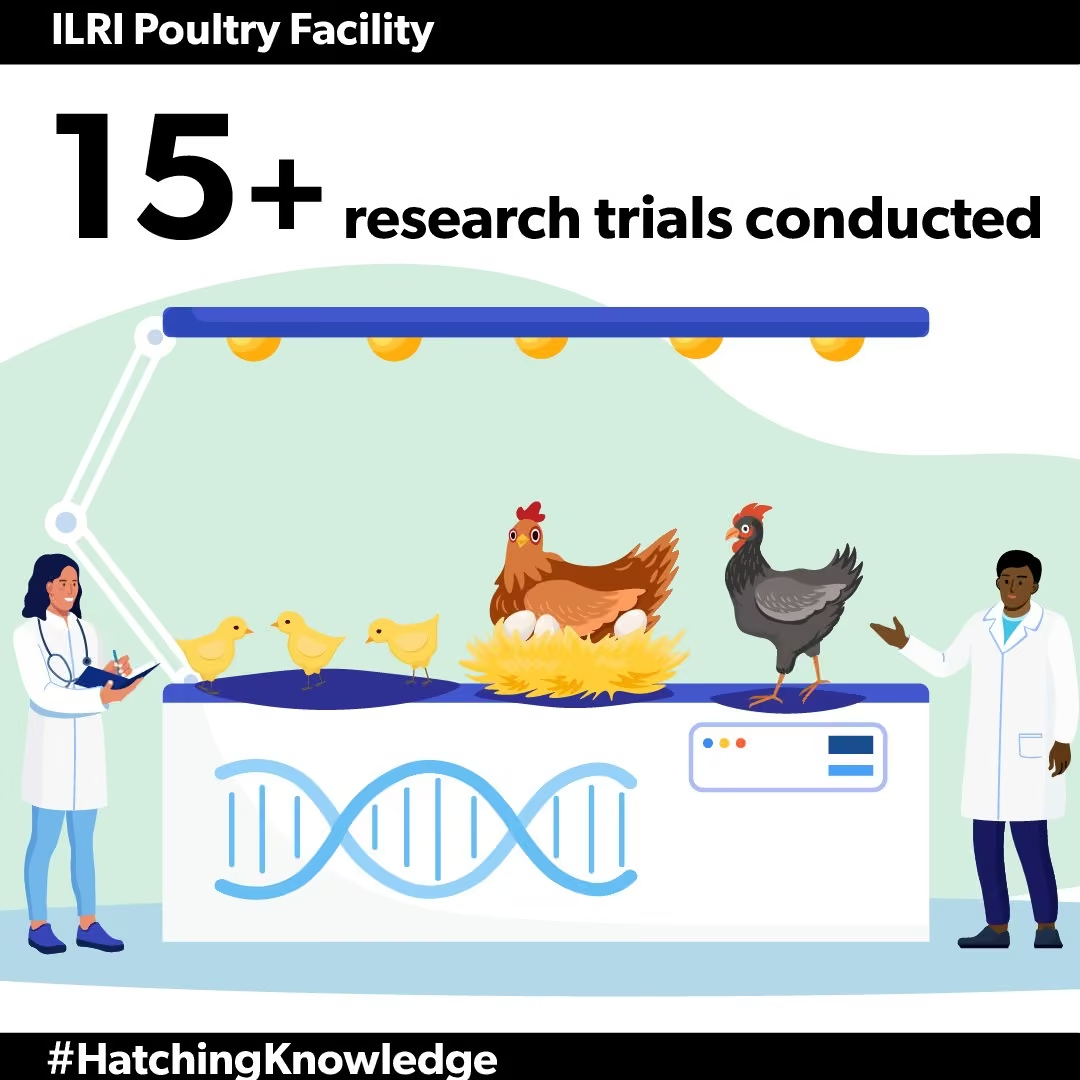

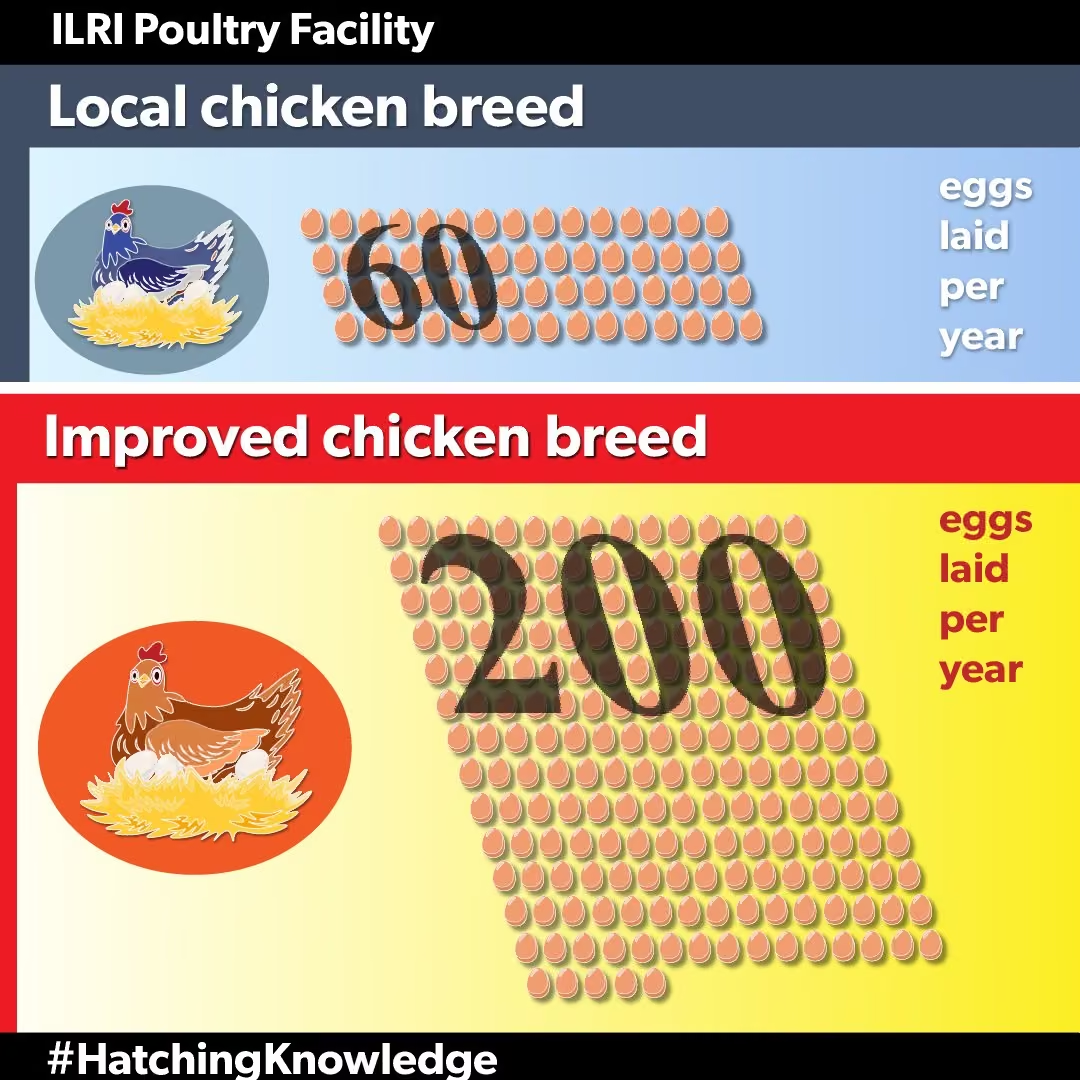
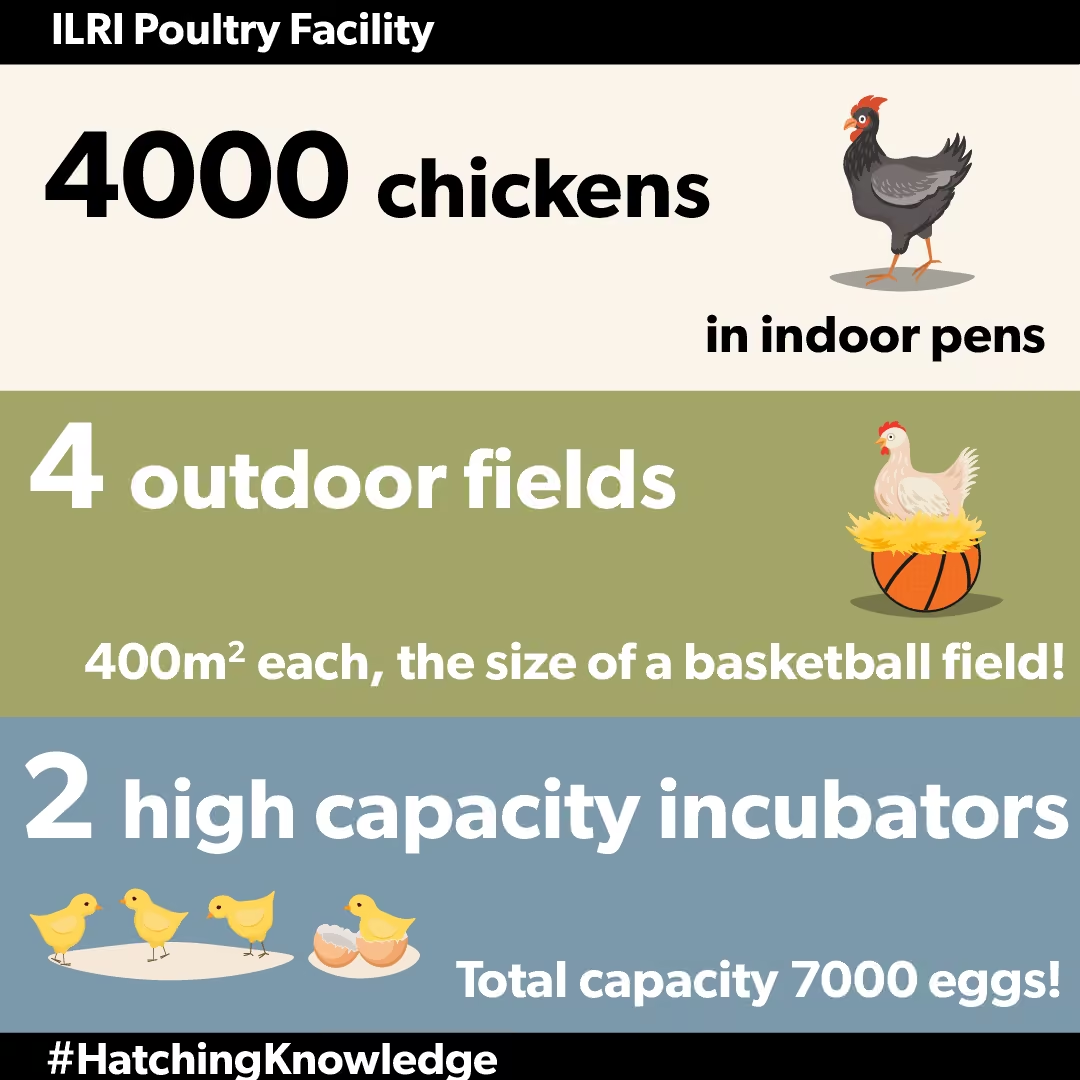 ILRI.org
@ILRI
Open to researchers, students, and the public and private sector alike, @CGIAR's only poultry facility offers innovative infrastructure and deep technical expertise to support transformative work in poultry systems.
Learn more and contact us here 👇www.ilri.org/news/ilri-cgiar-poultry-research-facility-re…
#hatchingknowledge
 ILRI.org
@ILRI
Join us at #climateweeknyc 2025 on 23 Sept for a powerful discussion answering how we can address climate through animal health.
@CGIAR | @edf | @UNEP | @GlobalDairyP | @FAO | @Hung_cenpher #animalhealth #climate #onehealth
 ILRI.org
@ILRI
Capacity and innovation in numbers. Here’s how the ILRI poultry facility contributes to shaping poultry systems in Africa and beyond!
#hatchingknowledge
ILRI.org reposted
Shahida.Hussien
@ShahidaHussien
By improving indigenous livestock, the initiative aims to reduce emissions while strengthening productivity, food security, & climate resilience for millions of smallholder farmers across the continent. @ILRI @CGIAR
 Shahida.Hussien
@ShahidaHussien
@ILRI is commitmented to balancing the growing demand for animal products with the need to address climate & environmental challenges. Boosting productivity while reducing the negative impacts of animal agriculture. @NamukoloC
@CGIAR
 Shahida.Hussien
@ShahidaHussien
Happening now: launching the Global Methane Genetics Initiative Accelerating Reduced Emissions in Indigenous Breeds in Africa @ILRI @CGIAR


ILRI.org reposted
FAO Livestock
@FAOLivestock
🤲🐮Regional partnerships are key to accelerating #sustainablelivestock transformation.
By aligning efforts and sharing resources and knowledge, we can achieve far more together than alone!
Only 2 weeks to the Global Conference!
Don’t miss the webcast➡️ www.fao.org/events/detail/fao-global-conference-on-sustai…

ILRI.org reposted
Shahida.Hussien
@ShahidaHussien
Happening now: launching the Global Methane Genetics Initiative Accelerating Reduced Emissions in Indigenous Breeds in Africa @ILRI @CGIAR
ILRI.org reposted
ILRI.org
@ILRI
Did you know poultry farming can transform food systems? And it can do this through strong partnerships.
At ILRI’s poultry facility in Addis Ababa, we are working with governments, development organizations, private sector actors, and academia to deliver real-world poultry solutions.
Why does this matter?
💵 Poultry farming offers a unique opportunity for income generation, particularly for women and youth, creating dignified work and stronger rural economies.
🍗 Poultry offers vulnerable communities affordable, high-quality protein source to tackle malnutrition and have food security.
🧬 Chicken genetic solutions improve locally adapted chicken breeds are climate-resilient and suited tough smallholder conditions.
📈 Partnerships enable sustainable market systems, access to finance, local job creation, and over-all long-term impact.
The ILRI poultry facility strives to bring together expertise, resources, and commitment to strengthen poultry systems that deliver on nutrition, livelihoods, and resilience.
We invite partners to explore how ILRI’s poultry facility can support shared goals in food security, sustainable agriculture, and economic inclusion.
Reach out to Wondmeneh Esatu (w.esatu@cgiar.org) and Olivier Hanotte (o.hanotte@cgiar.org) to discuss future collaborations.
#hatchingknowledge
ILRI.org
@ILRI
Is livestock research in Africa where it is supposed to be?
No, says ILRI DG Appolinaire Djikeng in a recent interview for Nature Africa.
ILRI.org
@ILRI
Brucellosis misdiagnosis was costing Kenya millions 💊💸 and risking drug resistance.
Evidence + stakeholder engagement led to a new policy directing hospitals to use better tests — putting people’s health & safety first.
Science shaping policy, policy protecting lives. Read the story: www.ilri.org/knowledge/stories/brucellosis-misdiagnosis-c…
#onehealth #zoonoses

ILRI.org reposted
ILRI.org
@ILRI
🙌 International Livestock Research Institute (ILRI) and Kenya Dairy Board sign new MOU to strengthen Dairy systems in Kenya from 'farm to glass' 🥳
We’re proud to mark a new chapter with the Kenya Dairy Board (KDB). Today’s Memorandum of Understanding (MOU) formalizes years of collaboration, learning, and sharing—aligning our strengths to work from farm to glass to improve dairy production, processing, and consumer awareness. The Kenyan Dairy Board and ILRI have been working together through the More Milk project.
Appolinaire Djikeng, Director General of ILRI, said ‘Together, this partnership can bridge critical gaps, strengthening both the informal and formal dairy chains, improving milk safety and quality standards, and scaling innovations that enhance productivity and resilience among smallholder farmers'
🔬 + 🏛️ Research meets regulation: This partnership brings together ILRI’s cutting-edge science and KDB’s sector leadership to unlock new opportunities for smallholder farmers, processors, and consumers.
What this MOU enables:
🥛 Value-chain improvement — farm to glass
🧪 Stronger food safety, surveillance & lab support
📣 Better consumer awareness & vendor training
🤝 Evidence-informed standards and policy alignment
The Kenyan Dairy Board and ILRI have been working together through the More Milk project. Dr. Kimutai Maritim, Managing Director, Kenya Dairy Board, highlighted:
“The More Milk 2 project is a great example of collaboration between KDB and ILRI and aligns with our mandate and core functions to regulate, promote, and develop Kenya’s dairy industry. This MOU strengthens our ability to deliver on that promise with innovation, integrity, and impact.”
🌍 Onward to a safer, more inclusive, and more competitive dairy sector.
#dairy #foodsafety #sustainability #onehealth


ILRI.org reposted
ILRI.org
@ILRI
What does climate-smart livestock 🐄 really mean for Africa? In a recent interview with Nature Africa, Appolinaire Djikeng breaks down how innovative livestock solutions are helping farmers adapt to climate change and improve food security. Read more here: www.nature.com/articles/d44148-025-00268-1
#sustainablefarming 🧑🌾 #foodsecurity 🍽️ #climatechange 🌍
ILRI.org reposted
FAO Livestock
@FAOLivestock
How can we better prevent pandemics?
Join us on 18 September for a webinar #onehealth: institutionalization & operationalization
@FAO, @WHO, @UNICEF & partners will explore cross-sector collaboration, governance & best practices you can apply.
www.fao.org/one-health/resources/events/events-detail/web…
 ILRI.org
@ILRI
ILRI’s newly refurbished office in Guwahati, Assam, was inaugurated by @ShirleyTarawali , ILRI Assistant Director General, in the presence of Ram Pratim Deka (ILRI Country Representative, India), Hiramoni Dev, and Chandrani Goswami on 10 September 2025 🎉.
This reinforces ILRI’s commitment to research for development in the NE region, where livestock are integral to almost every rural household across the region’s eight states. ILRI looks forward to continuing its engagement with partners to advance better lives, better planet through livestock 🐄🌱. #whylivestockmatter
 ILRI.org
@ILRI
CGIAR launches Sustainable Animal and Aquatic Foods program, building on the success of the Sustainable Animal Productivity Project (SAPLING).
ILRI and Bioversity-CIAT held a workshop to develop the direction of the program on August 21 in Son La province, in collaboration with the Son La Sub-Department of Livestock, Animal Health and Fisheries.
Read ore: van.nongnghiepmoitruong.vn/cgiar-launches-sustainable-ani…
ILRI.org
@ILRI
A new policy brief by ILRI and experts in Kenya offers ways to reduce the cost of livestock feeds for livestock producers.
Download it here: www.ilri.org/news/experts-offer-recommendations-reduce-co…
ILRI.org
@ILRI
🙌 International Livestock Research Institute (ILRI) and Kenya Dairy Board sign new MOU to strengthen Dairy systems in Kenya from 'farm to glass' 🥳
We’re proud to mark a new chapter with the Kenya Dairy Board (KDB). Today’s Memorandum of Understanding (MOU) formalizes years of collaboration, learning, and sharing—aligning our strengths to work from farm to glass to improve dairy production, processing, and consumer awareness. The Kenyan Dairy Board and ILRI have been working together through the More Milk project.
Appolinaire Djikeng, Director General of ILRI, said ‘Together, this partnership can bridge critical gaps, strengthening both the informal and formal dairy chains, improving milk safety and quality standards, and scaling innovations that enhance productivity and resilience among smallholder farmers'
🔬 + 🏛️ Research meets regulation: This partnership brings together ILRI’s cutting-edge science and KDB’s sector leadership to unlock new opportunities for smallholder farmers, processors, and consumers.
What this MOU enables:
🥛 Value-chain improvement — farm to glass
🧪 Stronger food safety, surveillance & lab support
📣 Better consumer awareness & vendor training
🤝 Evidence-informed standards and policy alignment
The Kenyan Dairy Board and ILRI have been working together through the More Milk project. Dr. Kimutai Maritim, Managing Director, Kenya Dairy Board, highlighted:
“The More Milk 2 project is a great example of collaboration between KDB and ILRI and aligns with our mandate and core functions to regulate, promote, and develop Kenya’s dairy industry. This MOU strengthens our ability to deliver on that promise with innovation, integrity, and impact.”
🌍 Onward to a safer, more inclusive, and more competitive dairy sector.
#dairy #foodsafety #sustainability #onehealth
ILRI.org
@ILRI
What does climate-smart livestock 🐄 really mean for Africa? In a recent interview with Nature Africa, Appolinaire Djikeng breaks down how innovative livestock solutions are helping farmers adapt to climate change and improve food security. Read more here: www.nature.com/articles/d44148-025-00268-1
#sustainablefarming 🧑🌾 #foodsecurity 🍽️ #climatechange 🌍
ILRI.org reposted
 Sputnik Afrique
@sputnik_afrique
"Si nous ne faisons rien, nous sommes en difficulté. Nous devons montrer la voie car nous sommes les plus touchés", mis en garde @NamukoloC de @CGIAR / @ILRI.
Namukolo Covic a préconisé une agriculture climato-intelligente: irrigation, culture de plantes et élevage de bétail résistants à la sécheresse, et investissement des ressources propres de l'Afrique.
6/6
ILRI.org reposted
Shahida.Hussien
@ShahidaHussien
@NamukoloC highlights how AI-driven platforms enhance agricultural adaptation & build resilient food systems. She also emphasizes the role of aligning climate finance with agriculture & AI to unlock sustainable farming systems across Africa. #africaclimatesummit @ILRI #nedamco
 Shahida.Hussien
@ShahidaHussien
Brining together leaders, researchers, & the private sector to explore how AI driven finance and innovation can accelerate climate action while supporting Africa’s sustainable development #africaclimatesummit @ILRI @CGIAR #nedamco


ILRI.org reposted
Shahida.Hussien
@ShahidaHussien
#ccgap would guide regional and local governments in mainstreaming gender concerns to address climate change challenges in Ethiopia. #africaclimatesummit @ILRI @CGIAR @CGIARAfrica


 Shahida.Hussien
@ShahidaHussien
#ccgap puts women and vulnerable groups at the center of Ethiopia’s climate response and action.
Enriches decision-making
Empower women & narrows gender gap
Enhances the effectiveness of climate responses
Accelerate progress towards the Paris agreement & #sdgs @ILRI @CGIARAfrica

ILRI.org reposted
Jameel Observatory for Food Security Early Action
@jameel_observ
Join us on zoom for today's session on Integrating Policy Frameworks for Sustainable and Resilient Livestock Development in Africa (1600 EAT)
us06web.zoom.us/j/87280774363?pwd=ohyFBBVRXL7kAMjaXVCm1Qp…
Jameel Observatory for Food Security Early Action
@jameel_observ
On 10 September, @twahirah3 speaks at two @ACS2ET side events:
Policy & Advocacy Dialogue on Disaster Risk Reduction and #anticipatoryaction in the Horn of Africa with @IGAD_CPAC
Policy Frameworks for Sustainable and Resilient Livestock Development in Africa with @ILRI
 ILRI.org
@ILRI
Livestock systems are a cornerstone of African economies, supporting hundreds of millions of livelihoods, making significant contributions to food and nutrition security, and serving as a safety net in times of crisis. However, these systems face growing challenges from climate change, land degradation, disease pressures, and weak policy integration, further complicated by the multi-level governance within the continent.
Today, at #acs2, livestock systems are on the agenda!
Join us at 16:00-17:00 (EAT) in Room F1 for a side event on ‘Integrating policy frameworks for sustainable and resilient livestock development in Africa.’
Organized with: @ILRI, Government of Kenya, @CGIARAfrica , @mercycorps , @jameel_observ , LiveSys
More AICCRA at @Africa Climate Summit 2: africaclimatesummit2.et/pia
 ILRI.org
@ILRI
ILRI was at @ACS2ET, co-hosting and attending various events that recognize the critical role climate-smart solutions and systems play in livelihoods, nutrition, and resilience.
Browse our events here: www.ilri.org/index.php/events/acs2
#whylivestockmatter #climatesmartafrica #acs2

 ILRI.org
@ILRI
Africa’s farmers are at the heart of a global solution to climate change. 🌍 With support from the Bezos Earth Fund and the Global Methane Hub, ILRI has launched a $3.35M initiative to accelerate reduced emissions in indigenous cattle breeds. This is a game-changer for people and the planet! 🐄💚
Why this matters:
While livestock in Africa contribute 18% of global livestock methane emissions, practical solutions are within reach.
By applying advanced genetics to Africa’s indigenous breeds, we can cut methane emissions by 12% over 20 years and reduce emissions per kilogram of milk by 20–25% within just five years. 🧬
This isn't just about science—it's about empowering communities. Farmers, especially women and youth, will get access to more resilient, productive livestock, strengthening food security and livelihoods across the continent. 👩🌾🌾
This initiative is about building climate resilience, creating rural opportunity, and delivering permanent solutions for generations to come.
Together with our partners across Africa and beyond, we are proving that climate action and agricultural productivity can go hand in hand. 🤝
@BezosEarthFund @Cirad @CIRDES_BF @kalromkulima @WUR_WCDI Université Abomey-Calavi @GlobalMethaneHub
#climateaction #agriculture #foodsecurity #africa #livestock


ILRI.org reposted
AICCRA
@CGIARAfrica
At the Climate Action Innovation Hub at #acs2, @ADjikeng, Director General, @ILRI had a powerful encouragement for the innovators in the room: let’s take these climate solutions from Africa to the world. 🌍⭐️
The Hub has been filled with presentations from young, clever & enthusiastic entrepreneurs who are already building a climate-smart Africa for their communities and countries.
Want to be inspired? Meet the innovators here: aiccra.cgiar.org/news/meet-climate-action-innovators-comi…
We can’t wait to hear more from them - join us tomorrow, Wed 10 Sept, for the last day of the @_AfricanUnion Climate Action Innovation Hub - at the AU Pavilion at @ACS2ET
ILRI.org reposted
AICCRA
@CGIARAfrica
#acs2 Day 3 starts with 'Farming the Future' in mind with partners from @ProjectLSC.
Join the conversation at Room AP4.
#acs2 #readytoscale #climatesmartafrica

 Land Soil Crop Hubs
@ProjectLSC
🎙️Introducing the speakers for tomorrow's #acs2 side event, "Farming the future: Land, soil & crop hubs for climate-smart agriculture and rural transformation." ⤵️

ILRI.org reposted
Shahida.Hussien
@ShahidaHussien
Climate change is degrading land, raising emissions & fueling food insecurity. #csa offers solutions boosting productivity, resilience & farmers’ incomes while protecting our planet.
#africaclimatesummit
@ILRI @CGIAR @CGIARAfrica

ILRI.org reposted
Shahida.Hussien
@ShahidaHussien
#lschubs bring together available data in information hubs at a national level. Provides sustainable real time actionable insights for farmers extension workers planners & policy makers. Its operational in Ethiopia, Kenya and Rwanda. #africaclimatesummit @ILRI @CGIAR @CGIARAfrica
 Shahida.Hussien
@ShahidaHussien
Climate change is degrading land, raising emissions & fueling food insecurity. #csa offers solutions boosting productivity, resilience & farmers’ incomes while protecting our planet.
#africaclimatesummit
@ILRI @CGIAR @CGIARAfrica
ILRI.org reposted
Shahida.Hussien
@ShahidaHussien
Happening now: ‘Farming the Future: Land, Soil & Crop Hubs for Climate-Smart Agriculture and Rural Transformation’ side event at #africaclimatesummit
@ILRI @CGIAR @CGIARAfrica


ILRI.org reposted
Shahida.Hussien
@ShahidaHussien
Showcasing how climate science, innovation, & inclusive approaches can accelerate Africa’s climate-smart future in agriculture, food systems transformation and climate-informed science & evidence. #africaclimatesummit
@ILRI
@CGIAR
@CGIARAfrica


 Shahida.Hussien
@ShahidaHussien
Happening now: ‘Collaborative solutions: Leveraging AI for resilient agriculture, energy, and risk systems in Africa’ side event at #africaclimatesummit
@ILRI @CGIAR @CGIARAfrica

 ILRI.org
@ILRI
🚨 Today at the Second Africa Climate Summit!
Developing Early Warning Systems for Dengue and Chikungunya Fevers in the Horn of Africa
Don’t miss:
• Presentations from Kenya Medical Research Institute, Ethiopia Public Health Institute(EPHI), and the International Livestock Research Institute
• Perspectives from Somalia Ministry of Health, EPHI, and Kenya
• Dialogue on how prediction tools can be integrated into public health decision-making
📅 10 Sept 2025 | 🕛 12:00–1:30 PM | 📍 Room M9, AICC, Addis Ababa
Register to join online: ilri-org.zoom.us/meeting/register/iiu787xTSMyqZLcVENd0SQ
Together, we can build climate-smart tools to protect communities from mosquito-borne diseases.
#africaclimatesummit #onehealth #climatehealth #arbowatch
 ILRI.org
@ILRI
The "Reimagining the NEXT Stage of Nutrition and Food Systems" panel at DialogueNEXT brought together leaders from the farming community, global research centers, and the Indian government to explore innovative approaches to enhancing food security, dietary quality, and health outcomes.
@ShirleyTarawali was a panelist. Her specific contribution to the discussion addressed the role of livestock in creating healthier diets within more diverse and resilient food systems.
The event, was presented by the @WorldFoodPrize in partnership with @CIMMYT , @BISA , @CGIAR , and @icarindia - Indian Council of Agricultural Research
#dialoguenext #foodsystems #agriculture #nutrition #india #foodsecurity #farmersfirst


ILRI.org reposted
Shahida.Hussien
@ShahidaHussien
Harnessing AI for Africa’s resilience requires more than innovation it demands partnerships that bridge governments, researchers, private sector, and communities. #africaclimatesummit
@ILRI @CGIAR @CGIARAfrica

 Shahida.Hussien
@ShahidaHussien
Showcasing how climate science, innovation, & inclusive approaches can accelerate Africa’s climate-smart future in agriculture, food systems transformation and climate-informed science & evidence. #africaclimatesummit
@ILRI
@CGIAR
@CGIARAfrica
Shahida.Hussien
@ShahidaHussien
Happening now: ‘Collaborative solutions: Leveraging AI for resilient agriculture, energy, and risk systems in Africa’ side event at #africaclimatesummit
@ILRI @CGIAR @CGIARAfrica
ILRI.org
@ILRI
Outbreaks of dengue and chikungunya are rising in the Horn of Africa.
join our #africaclimatesummit side event on early warning systems powered by climate data.
📅 10 sept | 🕛 12:00–1:30 pm | 📍 Room M9, AICC Addis
Register online: ilri-org.zoom.us/meeting/register/iiu787xTSMyqZLcVENd0SQ
#onehealth #climatehealth #arbowatch

ILRI.org reposted
AICCRA
@CGIARAfrica
🌍@ACS2ET kicked off on a high note in Addis 🇪🇹
The AICCRA team also kicked off its first side event, hosted by @OSC_OCS and @AGNChairUNFCCC, with a critical lens into Africa’s climate and development future.
The dialogue called for a radical shift in the approach to achieving sustainable growth and resilience in the age of the global climate crisis.
Key messages:
🌿” Ecologically driven development in Africa must be rooted in resilience, equity and sovereignty, emphasizing that ecosystems must be treated as development infrastructure, not merely resources.” - @DrGGWodaje
📊Dawit Solomon, the lead for AICCRA East and Southern Africa, called for regionally tailored adaptation pathways, emphasized the need for localized, data-driven solutions and advocated universal early warning systems, citing AICCRA's experience on the continent.
''Africa stands at a unique position to lead on climate-positive development by blending indigenous knowledge with scientific innovation, strengthening ecological sovereignty, and advancing resilience-driven food systems transformation''
- @NamukoloC of @ILRI
#climatesmartafrica #acs2 #readytoscale


 Organisation of Southern Cooperation - OSC
@OSC_OCS
🌍 A fruitful participation of the OSC at the Second Africa Climate Summit (ACS-2) in Addis Ababa.
Today, Secretary-General @MBinMussallam joined Heads of State, ministers, and senior policymakers at the Opening Ceremony. The OSC also hosted a panel discussion on Ecological Sovereignty and Southern Agency, in partnership with the African Group of Negotiators (AGN) on Climate Change) and Accelerating Impacts of CGIAR Climate Research for Africa (AICCRA), highlighting the urgency of advancing an Ecologically-Driven Development (EDD) model that unites social justice, climate resilience, and self-determination for the Greater South.
The participation of the OSC set the stage for promoting EDD as a framework for ecologically-driven strategies, while building momentum towards a Southern-led “1.5°C Survival Pact” in the lead-up to COP30 and other global negotiations.


ILRI.org reposted
AICCRA
@CGIARAfrica
This week, the @ACS2ET is being held in Addis Ababa🇪🇹, with a strong focus on adaptation and resilience in #africa.
🎥 In Senegal🇸🇳, AICCRA is providing a very concrete response with a new 3D educational video entitled
“Preserving the quality of milk during the rainy season.”
➡️ Goal: to help farmers in Dagana (northern) and other areas better anticipate weather forecasts, avoid feeding mistakes at the start of the rainy season, and guarantee quality milk despite the uncertainties.
At the heart of the summit discussions: how can climate solutions be translated into real impacts on the ground? With AICCRA Senegal, we are making this link between science, innovation, and local practices so that every farmer has the tools they need for their daily work.
📌 This video illustrates our commitment to transforming climate information and research into concrete levers for strengthening the resilience of food systems.
🎥 Watch the video : youtu.be/aoApMRUB22s
See more AICCRA @ Africa Climate Summit 2: aiccra.cgiar.org/events/aiccra-africa-climate-summit-2
 ILRI.org
@ILRI
Men and women face different restrictions in livestock farming. Is it better to work around existing barriers, or transform them?
ILRI research shows a combined approach leads to greater empowerment and more positive changes for women.
ILRI.org
@ILRI
New study confirms hotspots for pork tapeworm in northern Uganda, validating a risk mapping method created previously by researchers.
Identifying such hotspots means they can be targeted with intensified control interventions that use a #onehealth approach to encompass human and pig populations.
Such interventions could include improved sanitation and pig husbandry practices, as well as community-wide education to break the cycle of pork tapeworm transmission.
Read more: www.ilri.org/news/new-study-confirms-endemic-pig-tapeworm…
ILRI.org
@ILRI
AFSF: Livestock farming in the service of food security (ministers) #afsf2025 #afsforum2025 #livestock
Read more: fr.apanews.net/news/des-ministres-africains-sengagent-a-t…
ILRI.org
@ILRI
Africa bets on livestock for its food security and economic growth. #afsf2025 #afsforum2025 #whylivestockmatter #livestock
Read more: www.sudquotidien.sn/lafrique-parie-sur-lelevage-pour-sa-s…
ILRI.org reposted
FAO Livestock
@FAOLivestock
🐛 From insects to other local feed options: discover solutions that boost #animalhealth, optimize resource use, and promote sustainability at the Global Conference on #sustainablelivestock.
📅29 Sept – 3 Oct
Learn more and save the date for the webcast: www.fao.org/events/detail/fao-global-conference-on-sustai…

ILRI.org reposted
Marchmont Comms
@MarchmontComms
“Feeding the ambitions of Africa’s youth through #agriculture is a sure path to feeding the future,” says @AGRA’s Hailemariam Dessalegn, Former 🇪🇹 PM.
In @cnbcafrica, he urges leaders to invest in #youth to drive growth 👇🏾
www.cnbcafrica.com/2025/africas-youth-have-a-growing-appe…
#afsforum | @TheAGRF | @ILRI
ILRI.org reposted
FAO Livestock
@FAOLivestock
A sustainable future starts with healthy animals.
#animalhealth impacts billions of people every day, from the food we eat to our health. 🐑💚
Healthy livestock are essential, but we all have a role to play: Farmers, governments, businesses and you.
#onehealth
ILRI.org reposted
Jameel Observatory for Food Security Early Action
@jameel_observ
On 10 September, @twahirah3 speaks at two @ACS2ET side events:
Policy & Advocacy Dialogue on Disaster Risk Reduction and #anticipatoryaction in the Horn of Africa with @IGAD_CPAC
Policy Frameworks for Sustainable and Resilient Livestock Development in Africa with @ILRI
ILRI.org reposted
 FARA Africa
@FARAinfo
Join us for the next #km4agd webinar!
'Bridging #km, Research & Policy for Agricultural Transformation'
🗓️11 Sept 2025
⏰10:00 GMT+0
📍via Zoom
Guest Speaker: Michael Victor @ILRI
Register: faraafrica.zoom.us/meeting/register/yDMTgWZGSFS7fFk-q7pkiw
#knowledgemanagement #agricultureresearch #agriculturepolicy

 ILRI.org
@ILRI
At the IsDB-CGIAR Partnership for Impact session, Siboniso Moyo highlighted a critical truth: we already have the solutions, but the real challenge is catalyzing them to change lives at scale.
She emphasized two key strategies:
* Move Beyond Pilots: Innovations often stall in pilot projects. To create real impact, we must find the right partners to scale research into solutions for millions.
* Strengthen Trusted Partnerships: While global organizations like CGIAR have a role, success depends on working closely with national partners, governments, and local actors. As she noted, "Everyone must play their part, from the laboratory to the market."
The @IsDB–@CGIAR partnership is a perfect example of this in action, with programs like the @TAAT initiative already delivering proven innovations to millions of people.
Future dialogues must include more voices from governments and national partners to ensure our science directly addresses their priorities.
#innovation #partnerships #agriculture #foodsecurity #development #cgiar #isdb #sustainability #impact


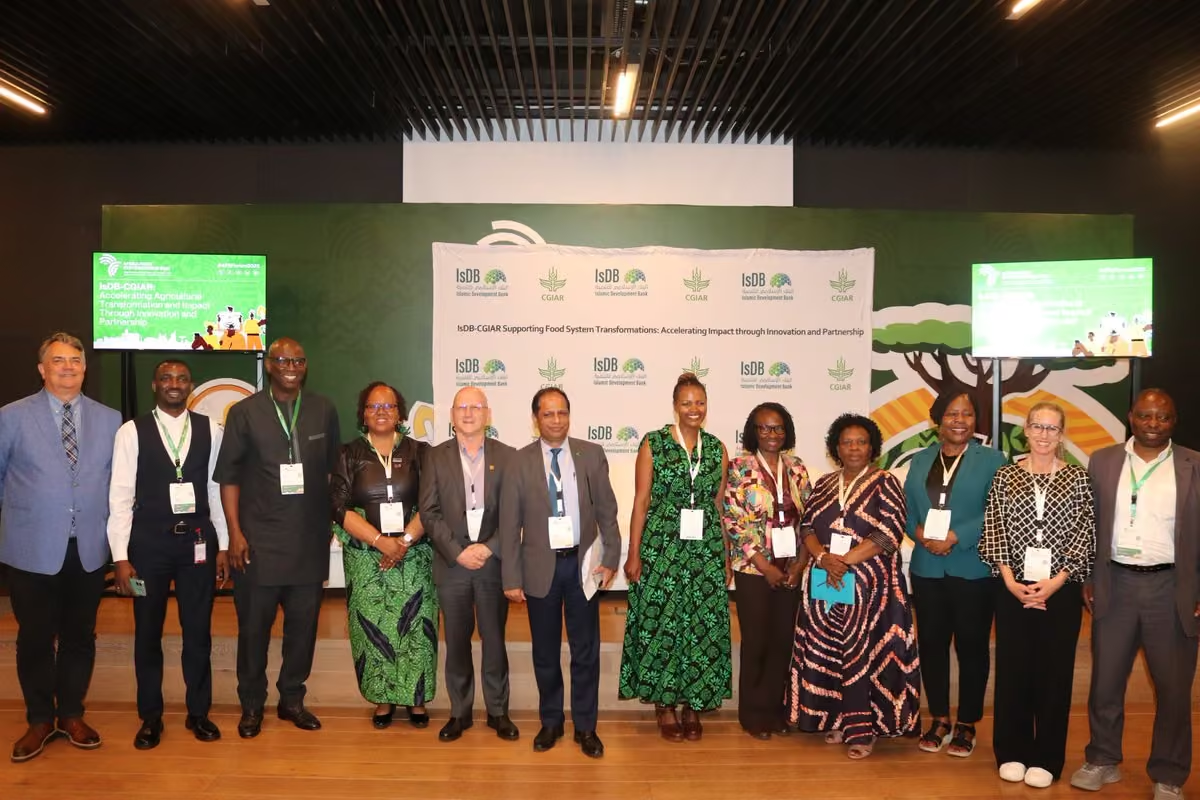 ILRI.org
@ILRI
At #afsf2025, our side event placed a spotlight on pastoralism as a central pillar of Africa’s food systems. Pastoralist systems support 268 million people across 36 African countries, and in West Africa they provide 65% of beef and 75% of milk consumed. Yet, despite this massive contribution, pastoralism often remains invisible in global food system dialogues.
The discussions centered on tough but necessary questions around the future of pastoralism: how it can evolve to remain competitive, which models are effectively integrating youth and women into value chains, how traditional knowledge can be blended with modern innovations, and what political reforms and investments are needed to trigger real transformation.
Challenges discussed
• Climate change, feed shortages (over 40% of production costs), and environmental degradation.
• Weak policies and minimal public investment, despite pastoralism supplying 50% of livestock exports in West Africa.
• Infrastructure gaps — from corridors to water access and cross-border trade facilitation.
Some identified solutions and opportunities shared during the dialogue were:
Public-Private Partnerships – Examples like the GARBAL service in the Sahel are already providing herders with real-time data for decision-making.
Youth Innovation – The PastorHackathon showcased over 600 youth-led solutions, including climate-smart digital tools.
Governance – Stronger policies and inclusive governance to give pastoralism a greater role, including youth engagement in local decision-making and emerging opportunities like pastoral tourism.
Cross-country learning – Sharing what works across borders, from participatory rangeland management in Tanzania to index-based livestock insurance models in East Africa.
Siboniso Moyo shared on the role of ILRI’s research in transforming the food system, stating that we play a major part in:
• Developing climate-smart, low-emission livestock systems that also promote equity for women pastoralists, ensuring they remain influential in their communities.
• Advancing genetic research, identifying animals adaptable to harsh conditions, and scaling drought-resilient forages.
• Supporting participatory rangeland management, which strengthens collective stewardship of resources.
• Scaling index-based livestock insurance, which cushions shocks by enabling farmers to restock after droughts.
Furthermore, to show our deeper commitment, ILRI has strengthened the visibility in West and Central Africa — signaling our readiness to engage with governments, partners, and communities in even more meaningful ways.
Dr. Huyam Salih, Director, AU-IBAR, @SNV, @CIRAD, @mercycorps, @IFAD, @IYRP
#pastoralism #foodsystems #livestock #resilience #youthinagriculture #afsf2025


ILRI.org reposted
 Shamba Shape Up
@shambashapeup
Tune into Munda Make Over on ZNBC TV 1 this weekend at 15:00 to learn how to build a simple perch for your chicken house. To watch the English version, Click the link below😁
youtu.be/Fi3QU6BuhDU
Let's all learn together!😌🫶
@ILRI Supported by AID-I project through @CIMMYT
 ILRI.org
@ILRI
African Ministers Commit To Livestock Transformation As Key To Food Security And Economic Growth At First-Ever Ministerial Deep-Dive On Livestock #afsf2025 #foodsystems #livestock
Read more: africa.com/african-ministers-commit-to-livestock-transfor…
@AUIBAR, @GIZ, @ILT, @GatsbyAfrica, @SNV, #afsforum2025 , @AGRA_Africa , @CGIAR
ILRI.org reposted
ACIAR
@ACIARAustralia
As a key partner, @ILRI plays a vital role in advancing sustainable livestock systems. #aciar was pleased to meet recently to discuss co-investment, and share project activities and plans. We look forward to building on this collaboration.
#sdg17 🤝

ILRI.org reposted
ILRI.org
@ILRI
"ILRI works with a wide range of partners through science to generate and co-create solutions that improve lives."
Siboniso Moyo stated at the #afsf2025 side event roundtable on Poultry & Livestock Value Chain Opportunities for Africa
She highlighted several critical points:
The Power of Science: Technologies in genetics, feed, and animal health are the backbone of productivity. It's amazing to see how simple, evidence-based improvements can dramatically increase milk production for smallholder farmers.
Markets as an Engine for Growth: We need to create market certainty that rewards quality. Without it, farmers won't have the incentive to adopt new, productivity-enhancing technologies.
Youth as Catalysts: Young people are naturally drawn to technology and data. We should be empowering them to lead innovation in livestock, from poultry to digital solutions.
Building Resilience: We discussed innovative solutions like Index-Based Livestock Insurance (IBLI), which provides a safety net for pastoral communities facing climate shocks. And we must integrate the private sector to ensure essential animal health services are available locally.
Building a sustainable and resilient food system in Africa requires a collaborative effort that connects science with on-the-ground realities.
#livestock #poultry #agriculture #africa #foodsystems #ruraldevelopment #ilri #sustainableagriculture #youthinag #animalhealth


 ILRI.org
@ILRI
"ILRI works with a wide range of partners through science to generate and co-create solutions that improve lives."
Siboniso Moyo stated at the #afsf2025 side event roundtable on Poultry & Livestock Value Chain Opportunities for Africa
She highlighted several critical points:
The Power of Science: Technologies in genetics, feed, and animal health are the backbone of productivity. It's amazing to see how simple, evidence-based improvements can dramatically increase milk production for smallholder farmers.
Markets as an Engine for Growth: We need to create market certainty that rewards quality. Without it, farmers won't have the incentive to adopt new, productivity-enhancing technologies.
Youth as Catalysts: Young people are naturally drawn to technology and data. We should be empowering them to lead innovation in livestock, from poultry to digital solutions.
Building Resilience: We discussed innovative solutions like Index-Based Livestock Insurance (IBLI), which provides a safety net for pastoral communities facing climate shocks. And we must integrate the private sector to ensure essential animal health services are available locally.
Building a sustainable and resilient food system in Africa requires a collaborative effort that connects science with on-the-ground realities.
#livestock #poultry #agriculture #africa #foodsystems #ruraldevelopment #ilri #sustainableagriculture #youthinag #animalhealth
ILRI.org
@ILRI
The first livestock ministerial deep dive at the African Food Systems Forum on 3 Sept 2025 tackled the daily struggles behind Africa’s paradox – massive livestock resources, massive import bills, operating at just 10-20% of global efficiency standards.
Africa has 85% of the world's livestock keepers but produces only 2.6% of the world's milk. There is a growing recognition that Africa cannot achieve sustainable food security and agricultural growth without putting livestock on the food systems agenda.
13 countries participated in a dialogue hosted by ILRI, GIZ and African Union outlining 3 pathways for policy to practice.
1. Youth as CEOs, not just herders:
For the 53 million unemployed African youth shown on our slide, this isn’t about handouts. Agricultural transformation requires new technologies, new interventions, new dimensions, and market access to motivate the youth. We must transform it from subsistence to precision livestock business, Nigeria’s Minister emphasized.
2. Genetic gains = Immediate income
When a farmer’s cow produces 2 liters per day instead of 8, it’s not an abstract policy failure – it’s a family that can’t afford school fees. Multiple countries are committed to genetic improvement programs which mean better breeds, higher yields, and more income per animal for farmers within 2-3 years.
3. WhatsApp Diplomacy = Real Solutions
Beyond Bureaucracy: Senegal’s minister proposed a WhatsApp group for livestock ministers – seemingly simple, but revolutionary. When livestock diseases cross borders (as they always do), farmers need solutions in days, not diplomatic communiques.
-
Demand for meat will triple and milk will double by 2050, but ministers recognized this won't require building bigger systems – it’s about making current systems work.
Africa also imports $50 billion in food annually. Ministers committed to:
o Feed banks to reduce dependency
o Regional cooperation to stop fragmented markets
o Youth entrepreneurship to scale local production
o Genetic improvements to boost productivity
Mali also championed crop-livestock-fisheries integration and called on technical partners to adopt a unified approach.
Ministers didn’t just talk – they asked for change through:
- Calling for an annual livestock ministerial session at AFSF for accountability
- Direct peer-to-peer collaboration mechanisms.
- Technical partnership with institutions.
For farmers, this means solutions working in Uganda will reach Senegal faster, youth training models from Tanzania replicate across the continent.
The gap between 10-20% efficiency and global standards isn’t technical – it is institutional. Yesterday’s session created the political infrastructure to bridge that gap one farm at a time.
#whylivestockmatter #afsf2025
 ILRI.org
@ILRI
Transforming food systems in West and Central Africa isn't just about producing more; it's about connecting science, investment, and policy to unlock the region's immense potential.
At the recent IsDB-CGIAR Partnership for Impact session #afsf2025 , Abdrahmane Wane delivered a powerful message about the urgent need for action. With a rapidly growing and youthful population, and changing consumption habits, demand for agricultural products is soaring. Yet, nearly 70% of these products pass through informal markets.
Abdrahmane emphasized that the solutions already exist—from adapted dairy genetics to low-cost animal health interventions and productivity-boosting nutrition technologies. The real challenge, he stated, is scaling their adoption.
For investors, agriculture is often seen as too risky. The key to attracting private sector engagement lies in reducing that risk through digitalization, insurance, and supportive policies. Governments have a critical role to play in providing the institutional guarantees and a favorable environment to build investor confidence.
#foodsystems #africa #agriculture #investment #innovation #isdb #cgiar #sustainabledevelopment


 ILRI.org
@ILRI
At #afsf25 in Dakar on 2 Sept, #zimbabwe placed livestock firmly on the continental agenda, calling for stronger partnerships to unlock the sector’s potential for food security and economic growth.
The Permanent Secretary outlined concrete areas for deeper collaboration with global and regional partners, such as joint research with ILRI on East Coast fever vaccines and scaling up climate-smart feed innovations.
Over 60% of Zimbabwe’s population depends on livestock for survival, underscoring the urgency of placing it at the heart of Africa’s food systems transformation.
Read the full story: spikedmedia.co.zw/zimbabwe-champions-livestock-transforma… #whylivestockmatter
ILRI.org reposted
SPARC_Ideas
@SPARC_Ideas
📢Event at #afsf2025: Thurs, Sept 4 – 8.30am-10am: Oval Room: ‘From margins to mainstream’: The role of pastoralism in food systems transformation
If you’re a policymaker, donor, investor, tech expert or practitioner at #afsf2025, join our event where we’ll show you how supporting #pastoralism can address #food security, #climate, #economic & #peacebuilding goals in West Africa 👉: www.sparc-knowledge.org/news-blogs/events/margins-mainstr…
@ILRI @IFAD @CGIAR
 ILRI.org
@ILRI
Sub-Saharan Africa has the fastest-growing, youngest population of any continent. 70% of Africans are under 30, but they also face the worst regional unemployment rate in the world.
But there are significant opportunities to be found in Africa’s agrifood sector to meet the needs of young people, says Hailemariam Dessalegn, Former Prime Minister of Ethiopia and AGRA Board Chair.
Country leaders need to implement youth-focused policies to increase access to land, finance, training, and technology, and attract young talent back to rural economies, providing training and mentorship so youth can collaborate and innovate. They must increase investment in research, technology and infrastructure, from markets to transportation to veterinary services, he recommends.
Read the full article: www.cnbcafrica.com/2025/africas-youth-have-a-growing-appe…
#whylivestockmatter #afsf2025
 ILRI.org
@ILRI
ILRI invites all qualified, technically competent, and eligible suppliers to participate in our ongoing supplier prequalification exercise. A wide range of goods, works, and services required to support our research and operational activities.
📌 Submission of applications must be done through the Tendersure portal before the deadline on 19 Sept 2025: tendersure.africa/available-jobs
For any inquiries or technical support, please contact the ILRI Procurement Office at:
📩 ILRIProcurementKenya@cgiar.org
 ILRI.org
@ILRI
📢 Calling photojournalists and photo enthusiasts! 📸
The #cohesa project is running a photo competition for images that tell the story of #onehealth - the vital interconnections between humans, animals, and the environment.
Prizes will be awarded to the top 3 images. Entrants must be from one of the 12 project member countries: Ethiopia, Somalia, Kenya, Uganda, Tanzania, Rwanda, Botswana, Mozambique, Malawi, Namibia, Zambia and Zimbabwe.
The deadline for entries has been extended to 15 September 2025. Visit onehealthobservatory.org/resources/one-health-photo-compe… to find out more!

ILRI.org reposted
 Anselme SHYAKA
@shyakaa
Our work has been featured in the One Health Newsletter! @OneHealthCom
If you want to check the launch event again and the guidelines, click on this link onehealthobservatory.org/news/rwanda-unveils-guidelines-m…
A big thank you to colleagues @_Igihozo_, @MugishaEmma2, @Bibsiraki and partners at @RMC_Rwanda @afri_isaaa, @ILRI and @ughe_org who supported the process.
#onehealth #collaboration #storytelling
@onehealthughe
#cohesa
@PressACP
@OacpsProgramme
@EU_Commission
@Cirad


ILRI.org reposted
 Prof. Appolinaire Djikeng
@ADjikeng
 ILRI.org
@ILRI
We are delighted to be part of the #afsf2025 conversation in Dakar!
On 2 September, ILRI, led by Siboniso Moyo, Namukolo Covic, and Abdrahman Wane, will be speaking at the IDB and CGIAR's “Partnership for Impact” session.
From science and innovation to strengthening value chains and regional partnerships, their contributions will highlight how we can build resilient, inclusive, and climate-smart food systems across Africa.
📍 1600-1900 hours | Press Conference Room


 ILRI.org
@ILRI
CGIAR Chief Scientist Sandra Milach delivering opening remarks at the @CGIAR x @TAAT event #afsf2025 #foodsystems
 ILRI.org
@ILRI
ILRI will be at #afsforum2025, cohosting and attending an array of events that recognise the critical role livestock systems play for livelihoods, nutrition and resilience.
Browse our events here: www.ilri.org/events/africa-food-systems-forum-2025
#whylivestockmatter
ILRI.org
@ILRI
On 1 Sept our first co-hosted event at #afsf2025 will explore the next steps of the #caadp Kampala Declaration, Africa’s bold commitment to transforming its agri-food systems by 2035.
 ILRI.org
@ILRI
Don't miss a line-up of top speakers for our co-hosted event 'Breaking Silos - Implementing the CAADP Kampala Strategy' on 1 Sept, 1730-1930 GMT, at #afsf2025 #whylivestockmatter
 ILRI.org
@ILRI
On 2 Sept at #afsf2025 we will be cohosting the @CGIAR - @isdb_group showcase from 1600-1900 GMT.
This partnership aims to identify sustainable pathways for investments in food security and agriculture in IsDB member countries. #whylivestockmatter

ILRI.org reposted
 Nicholas Ngwili, Ph.D.
@DrNickNgwili
Good news is that through this evidence we have received funding from UKRI MRC to test the effectiveness of some interventions including mass deworming in humans and pigs #sustain-Uganda project. @unlimithealth and MOH, Gulu and Makerere university
ILRI.org
@ILRI
New study confirms high prevalence of pork tapeworm infections in areas of northern #uganda, researchers call for intensified targeted control interventions targeting both human and porcine hosts using a #onehealth approach.
youtu.be/8DmmT6Js5xg
Nicholas Ngwili, Ph.D.
@DrNickNgwili
Our new publication confirming the hyperendemicty of Porcine cysticercosis in four districts of northern Uganda.
Read more journals.plos.org/plosntds/article?id=10.1371/journal.pnt…
ILRI.org reposted
 peterballantyne
@peterballantyne
A good read!
Options for a just transition for livestock under climate change - Philip Thornton, Eva Wollenberg, Laura Cramer, Fiona Flintan, 2025
doi.org/10.1177/00307270251365668
@ILRI
ILRI.org reposted
 AGRA - Sustainably Growing Africa’s Food Systems.
@AGRA_Africa
In just 2 days, Dakar becomes the hub of bold ideas and fresh solutions.
The #afsforum2025 will showcase how innovation is transforming Africa’s food systems, from farms to markets, and policies to people.
The future of food is being reimagined.
#afsforum2025 #ourfoodourfuture #agra #agraimpact

ILRI.org reposted
 ASARECA
@ASARECA
ASARECA and partners implementing the Accelerating Impacts of @CGIAR Climate Research for Africa (@CGIARAfrica ) Project (aiccra.cgiar.org) including Alliance of Bioversity International and @BiovIntCIAT_eng , the lead institution for the @CGIARAfrica project, @ILRI , and @ICARDA on August 27, 2025 paid a courtesy call on the Acting Director Bulindi Zonal Agricultural Research and Development Institute (@Bulindi_Zardi), of the National Agricultural Research Organization @narouganda , Dr. Moses Mwesigwa, at his offices in Bulindi, Hoima district.
During the meeting, Dr. Mwesigwa committed to ensuring that @NARO will ensure farmers develop a mindset of ownership of the Community Based initiative, which has just been introduced to the district. “Our main role is to empower the farmers to become experts of their own,” he said. “From the science angle, @narouganda will support the framers to introduce the right pastures and fodder to optimize nutrition.”
The chief trainer for the community-based initiative, Dr. Aynalem Haile, @ICARDA Senior Livestock scientist, urged the Director to take lead in supporting the monitoring of the genetic improvement initiative. “It is critical to emphasize the improvement of the local breeds through selection of desired traits, nutrition, and promoting animal health and institutionalizing the practices of the best bet approach,” Dr. Haile counselled.
@ASARECA provided a heavy-duty platform (surface) digital weighing scale and a Samsung tablet to BuZARDI for monitoring progress to the breeding programme. The initiative is funded through the @CGIARAfrica project, which is financed by the @WorldBank and aims to strengthen the technical, institutional, and human capacity needed to enhance transfer of climate-relevant information, decision-making tools, and technologies in support of scaling efforts in IDA-eligible countries in Africa.


ILRI.org reposted
ILRI.org reposted
Shamba Shape Up
@shambashapeup
Are your Chickens not growing?🐥Tune into Munda Make Over!📺Let's learn how make simple, nutritious feed at home. Save money, get bigger chickens & more eggs.
To watch the English version, click the link below.
youtu.be/ZLaaJNjEfFo
@ILRI Supported by AID-I through @CIMMYT

ILRI.org reposted
FARA Africa
@FARAinfo
We are excited to host Mr. Michael Victor of @ILRI as guest speaker at the 3rd #km4agd #cop Webinar
Theme: Bridging #km, Research & Policy for Agricultural Transformation
📅 Sept. 11 2025
🕙 10:00 GMT+0
📍 Zoom
Register via 🔗 faraafrica.zoom.us/meeting/register/yDMTgWZGSFS7fFk-q7pkiw
#agrifoodsystems


ILRI.org reposted
 Microbes.info
@MicrobesInfo
#african #swine #fever #vaccine candidate shows promise against some #virus strains ...
| #africanswinefever | #asf | #pigs | #hogs | By @ilri.org via @sciencex.bsky.social
phys.org/news/2025-08-african-swine-fever-vaccine-candida…
ILRI.org reposted
ILRI.org
@ILRI
Agriculture can offer enormous opportunities for Gen-Z Africans today, writes @HMDessalegn, Former Prime Minister of #ethiopia & @AGRA_Africa Board Chair, for @cnbcafrica.
But this can only happen by creating systemic changes. At the upcoming #afsforum2025 country leaders must recognise that feeding the ambitions of Africa’s youth through agriculture is a sure path to feeding the future.
Full article: www.cnbcafrica.com/2025/africas-youth-have-a-growing-appe…

ILRI.org reposted
CGIAR
@CGIAR
CGIAR at #afsf2025: joining the Presidential Summit, roundtables, thematic platforms, and launching @ICRISAT’s 2025–30 Strategy.
With @CGIARScaling, @AGRA_Africa, @Taat_Africa and @CGIARAfrica we advance science-based solutions for food security.
🔗 on.cgiar.org/3JhUsA6

ILRI.org reposted
AICCRA
@CGIARAfrica
📰As we get close to the @ACS2ET, the importance of Weather and Climate Services (WCS) is being highlighted in our recent studies published by experts from @The_IGC, AICCRA 🇪🇹 @ILRI, @IFPRI, @CIMMYT, and @climatesociety.
Findings in the Ethiopia-wide assessments reveal that
🌾 Access to WCS boosts maize yields by 27% & wheat by 17%, outperforming fertilizer in some cases
📈scaling WCS boosts maize yields 11%, grows agricultural GDP by 5.5%, and raises national GDP 3.6%.
Read in depth from the two-series publication👇
aiccra.cgiar.org/publications/climate-information-service…
aiccra.cgiar.org/publications/climate-and-weather-service…
#climatesmartafrica #readytoscale #foodsecurity #climateinformationservices #digitalagriculture #greeneconomy


ILRI.org reposted
IFPRI
@IFPRI
📢IFPRI’s Jef L. Leroy and Alan de Brauw will participate in this IUNS-ICN 2025 Scientific Symposium:
📌 Improving the healthiness of food environments in low- and middle-income countries – evidence from Nigeria, Kenya, Tanzania, Vietnam, and the Philippines
⏲️August 28, 2025, from 8:00am – 9:30am (CET)
🔗 Learn more here: www.ifpri.org/event/23rd-international-congress-of-nutrit…
#icn2025 @CGIAR @GAINalliance @BiovIntCIAT_eng @ILRI

ILRI.org reposted
Jameel Observatory for Food Security Early Action
@jameel_observ
Entrepreneurial Ecosystem Approach for Climate-Smart Small Ruminant Production in Pastoral Communities
@ilri presentation explores ways livestock genetic innovations and business development can improve livelihoods of pastoralist communities in Kenya.
hdl.handle.net/10568/176232
ILRI.org reposted
Jameel Observatory for Food Security Early Action
@jameel_observ
Launching, maintaining, expanding and disseminating crowd-sourced information in drylands
KAZNET Manual published by @CGIARAfrica and @ILRI
hdl.handle.net/10568/176159
ILRI.org reposted
ILRI.org
@ILRI
National livestock routes mapped for the first time in Kenya.
The maps will be integrated into the country’s National Livestock Market Information System, providing producers, traders, and policy makers with accurate, timely information.
www.ilri.org/news/mapping-kenyas-livestock-routes-arterie…
ILRI.org reposted
ASARECA
@ASARECA
@ASARECA has provided farmers belonging to Buseesa Farmers Association in Kibaale district an assortment of items aimed at promoting the Community Based Breeding Programme (#cbbp) in the district. The kitty comprising a Samsung data collection tablet, 1,000 ear tags for goats, a heavy duty platform (surface) digital weighing scale, a suspended digital weighing scale, and an ear tag applicator, were handed over to the farmers by Kibale district Chief Administrative Officer, Mr. John Katotoroma on August 27, 2025.
@ASARECA and partners, the National Agricultural Research Organization @narouganda , Zonal Agricultural Research and Development Institute (@Bulindi_Zardi), the Accelerating Impacts of CGIAR Climate Research for Africa (@CGIARAfrica ) Project (aiccra.cgiar.org) in partnership with the Alliance of Bioversity International and CIAT, the lead institution for the @CGIARAfrica project, @ILRI , and @ICARDA have been in the district from August 25 to 26 to train farmers and agricultural extension officers on Community Based Breeding, an approach with a proven track record of improving the productivity of locally available genetics while preserving genetic integrity.
During the training, the farmers and researchers were supported to undertake baseline data on goat flocks as a foundation for practicing breeding best practices. They will utilize the kitty to mark the goats, and continue monitoring desired traits for genetic improvement. The initiative is funded through the AICCRA project, which is financed by the @WorldBank and aims to strengthen the technical, institutional, and human capacity needed to enhance transfer of climate-relevant information, decision-making tools, and technologies in support of scaling efforts in IDA-eligible countries in Africa.


ILRI.org reposted
Jameel Observatory for Food Security Early Action
@jameel_observ
The state of climate information and agro-advisory services in Africa. hdl.handle.net/10568/176195
Assesses the roles of regional, national and subnational organizations with insights from Burkina Faso, Ethiopia, Kenya, Mozambique, Nigeria and Rwanda
@ILRI
ILRI.org reposted
AICCRA
@CGIARAfrica
Join us at #afsforum2025 for a side event focused on *future-proofing* food systems for West Africa and beyond.
AICCRA's @ZRBellarmin will highlight insights from how innovative partnerships and science-backed solutions are working to create meaningful outcomes.
Tuesday 2 September | 18-19:30
aiccra.cgiar.org/events/aiccra-afs-forum-2025
#readytoscale

ILRI.org reposted
CGIAR
@CGIAR
🌍 CGIAR science and innovation are shaping Africa’s future, influencing policy, driving investment, and bringing climate-smart solutions to millions of farmers and households.
Learn more at the #afsforum, 31 August–5 September.
#withsciencewecan #africa #foodsecurity
ILRI.org
@ILRI
National livestock routes mapped for the first time in Kenya.
The maps will be integrated into the country’s National Livestock Market Information System, providing producers, traders, and policy makers with accurate, timely information.
www.ilri.org/news/mapping-kenyas-livestock-routes-arterie…
ILRI.org
@ILRI
The PigSmart platform helps improve pig farming in #uganda by providing tailor-made messages, developed by ILRI, on challenges farmers face.
www.ilri.org/news/ugandas-agriculture-ministry-adopts-pig…
ILRI.org
@ILRI
A promising African swine fever vaccine by @USDA and ILRI protects pigs against some strains of the virus that are found in Africa.
However, its performance varied widely depending on virus type.
The team recommends continued research into matching vaccines to virus types, as well as exploring new vaccine designs that could provide broader protection against #africanswinefever.
Read the full story: www.ilri.org/news/new-african-swine-fever-vaccine-shows-p…

ILRI.org reposted
FAO Livestock
@FAOLivestock
Livestock in harmony with nature 🌾🌿
#gasl connects partners to champion efficient and sustainable use of natural resources. #sustainablelivestock
shorturl.at/dw1Fm

ILRI.org reposted
 CGIAR GENDER
@CGIARgender
Young people actively play critical roles in #foodsystems! They are also vital to the future of these food systems as the continually drive innovation and sustainability.
Join us at #afsforum2025 and learn how we can support them better:
on.cgiar.org/3HvRgk8
@CGIAR

ILRI.org reposted
Ismahane Elouafi
@CGIAR_EMD
Looking forward to joining colleagues and partners at #afsforum2025.
CGIAR will showcase how science, evidence, and partnerships support the shift from project outcomes to system-wide transformation through @CGIARScaling, with Africa’s youth leading the way.
#ourfoodourfuture
 ILRI.org
@ILRI
ILRI is at the forefront of uncovering how climate change is affecting antimicrobial resistance (#amr). A new article in @BulletinAtomic explains the current and future concerns of AMR, livestock farming and people in Africa.
thebulletin.org/2025/08/climate-change-and-antimicrobial-… @OHRECA_ILRI @CGIAR_SAAF @ArshneeM @amrhub

ILRI.org reposted
ISAAA_AfriCenter
@afri_isaaa
This is a renewed call for entries for the One Health photo competition 2025. 📸
#cohesa’s One Health 2025 photo competition aims to highlight real-life stories, challenges, and successes that demonstrate the interconnections between humans, animals, and the environment.
The competition will promote awareness of the One Heath approach among photojournalists, photography enthusiasts and the public, while building a database of high quality OH-related photos from across the continent.
Entries can be in one or both of the following categories:
1. Single photo taken within the past 2 years
2. Photo story; 4-10 single photos taken over 2 years
Prizes -per category: 💵
• 1st prize- $250
• 2nd prize- $150
• 3rd prize- $100
Key dates:
1. Submissions open: 15th July 2025 🗓️
2. Deadline: 15th September 2025 🗓️
3. Winners announced: October/ November 2025, during a COHESA partners’ meeting. 🗓️
The information is here: onehealthobservatory.org/resources/one-health-photo-compe…
@ILRI

ILRI.org reposted
Shamba Shape Up
@shambashapeup
This weekend on Munda Make Over, we learn correct biosecurity measures for healthy chickens🐥.
Watch Munda Make Over on ZNBC TV 1, Saturday & Sunday at 15:00📺 or catch the English version here😁- youtu.be/eXMYw9_rag8
@ILRI
#farmingisthefuture #smartagriculture
 ILRI.org
@ILRI
Agriculture can offer enormous opportunities for Gen-Z Africans today, writes @HMDessalegn, Former Prime Minister of #ethiopia & @AGRA_Africa Board Chair, for @cnbcafrica.
But this can only happen by creating systemic changes. At the upcoming #afsforum2025 country leaders must recognise that feeding the ambitions of Africa’s youth through agriculture is a sure path to feeding the future.
Full article: www.cnbcafrica.com/2025/africas-youth-have-a-growing-appe…
ILRI.org reposted
 Livestock Data for Decisions
@LD4D_community
📢 Join LD4D Photo Competition Today! 📸
Submit your photos & showcase your work across our network of 2,000+ members.
📅 08 Oct, 23:55pm GMT
Competition categories: edin.ac/45TQHdB
Join the LD4D Network: edin.ac/3XS2l3N
Good luck 🤞🍀
#sustainablelivestock
ILRI.org
@ILRI
ILRI seeks a Head - Monitoring, Evaluation, Learning and Impact Assessment (MELIA) to lead the development and implementation of systems to monitor, evaluate, and enhance the impact of the institute’s programs. Deadline 13 Sept.
www.ilri.org/join-us/jobs-careers?jid=57798-head-monitori… #ilrijobs
 ILRI.org
@ILRI
Invest in livestock for better lives.
Farm animals are pathways to more—and more nourishing—foods, to more promising livelihoods and livable incomes, to better human health and to healthier environments.
 ILRI.org
@ILRI
Rwanda’s livestock farmers are grappling with rising feed costs. But one solution is High Quality Cassava Peels (HQCP) technology, which IITA–CGIAR has been promoting through the RUNRES project.
The technology converts waste cassava peel into a cost-effective and sustainable feed ingredient, providing livestock feed for farmers, and inspiring cassava and animal feed entrepreneurs.
www.iita.org/news-item/scaling-up-high-quality-cassava-pe…
ILRI.org
@ILRI
ILRI) seeks a Manager for the Kapiti Research Station and Wildlife Conservancy to lead the management and operations at Kapiti to deliver on the ILRI Corporate Strategy 2030. The incumbent will be responsible for the development and execution of the long-term strategy of Kapiti and engaging and communicating with a wide variety of stakeholders. Deadline 28 Aug.
www.ilri.org/join-us/jobs-careers?jid=57800-manager-kapit… #ilrijobs

ILRI.org reposted
ILRI.org
@ILRI
A new study investigates antimicrobial use governance in #malawi, finding several important opportunities to build a safer future that protects animal productivity, and human, animal and environmental health.
Read what they are here:
hdl.handle.net/10568/175701 #onehealth #amr

ILRI.org reposted
CGIAR
@CGIAR
🌾 CGIAR is showcasing powerful science, collaborations, and innovations at #afsforum2025.
Join us to discuss our contributions to sustainable food systems across the continent.
🗓️ 29 Aug-5 Sept
🔗 Register: on.cgiar.org/3JhUsA6
@TheAGRF @CGIAR_EMD @NamukoloC @CGIARScaling
 ILRI.org
@ILRI
ILRI seeks a Head of ICT, Data Systems and Digital Transformation to ensure that ILRI’s digital infrastructure, data capabilities, and innovation systems are fit-for-purpose, scalable, and aligned with its scientific and institutional goals.
Deadline 13 Sept. Full details:
 ILRI.org
@ILRI
ILRI seeks a Livestock Commodity Lead - Livestock Production and Development Expert to identify impact opportunities, working with internal and external stakeholders to catalyse and scale transformative livestock-based solutions/innovations for the different livestock commodities. Deadline for applications is 13 Sept.
Read full details and apply here: www.ilri.org/join-us/jobs-careers?jid=57796-livestock-com…
ILRI.org
@ILRI
ILRI seeks a Regional Director, Eastern and Southern Africa to provide strategic direction and implementation of ILRI’s research for development portfolio in the region. Deadline 13 Sept.
Full details: www.ilri.org/join-us/jobs-careers?jid=57795-regional-dire…
ILRI.org reposted
CGIAR
@CGIAR
🌎 Why does Africa need science-based food systems transformation?
Find out at #afsforum2025, where CGIAR experts will share how co-creation and scaling are powering change.
🗓️ 29 Aug-5 Sept
🔗 Register: on.cgiar.org/3JhUsA6
@TheAGRF @CGIAR_EMD @NamukoloC @CGIARScaling

ILRI.org reposted
FAO Livestock
@FAOLivestock
Ticks and other tiny pests spread diseases that threaten animals, people, and food security worldwide. 🌍
With rising resistance to treatments integrated approaches, regulations and innovation are key to protect animals, environment and communities.
www.fao.org/animal-health/resources/publications/guidelin…
ILRI.org reposted
 Food Tank
@foodtank
Join @FoodTank + @RockefellerFdn at #climateweeknyc 🌍 for “Nourishing People, Planet, and our Future” — Thurs, Sept 25 (9AM) @TheGreeneSpace.
Speakers: @adamajrbrothers, @ILRI, @wfp, @nycfood, @swetac, @IFPRI + more. 🎶 Performance by @cajmahal + @thisiscaldwellofficial.
🔗 Register: www.eventbrite.com/e/climate-week-nyc-nourishing-people-p…
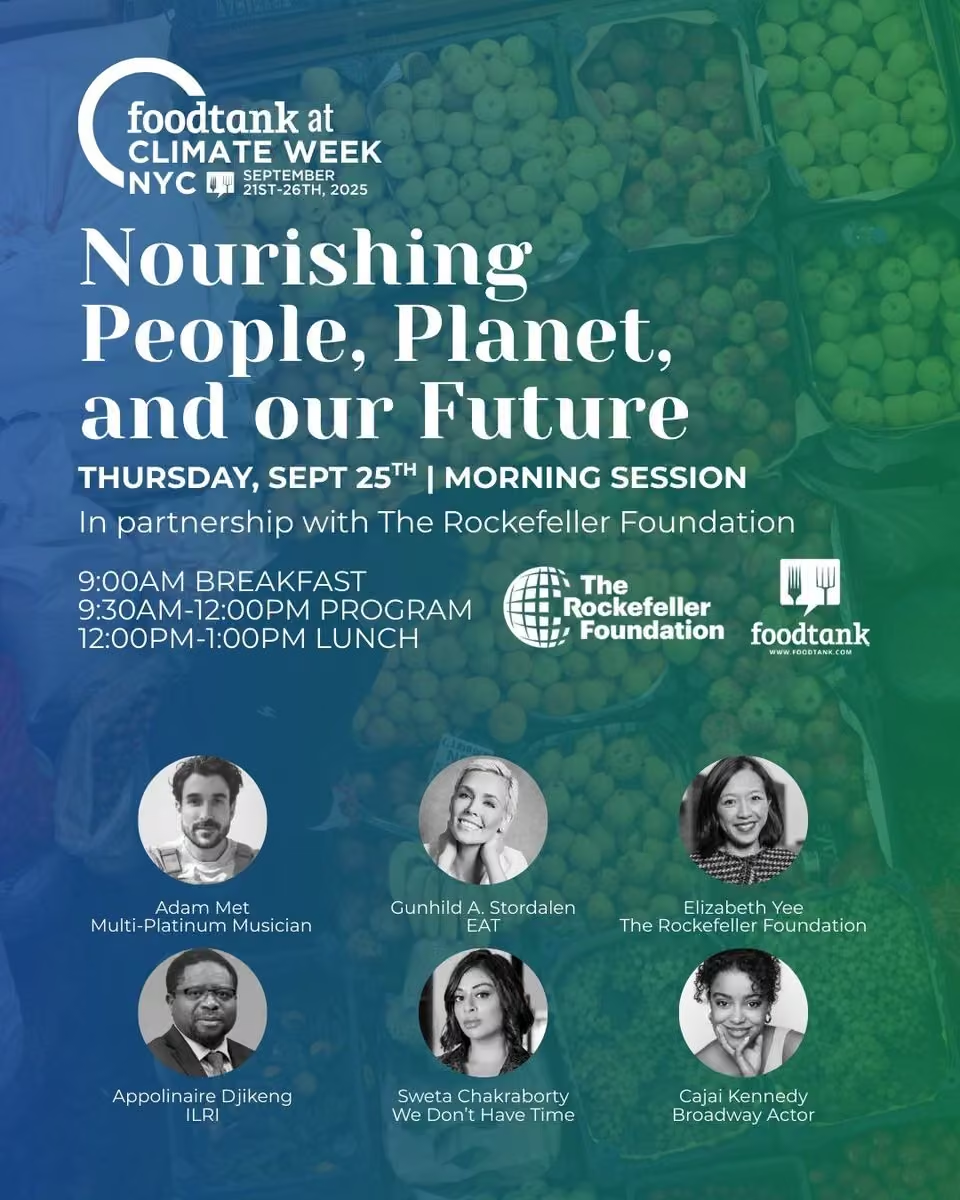 ILRI.org
@ILRI
ILRI senior principal scientist @hung_cenpher will be a keynote speaker at the 22nd Annual Southern African Society for Veterinary Epidemiology and Preventive Medicine #sasvepm Congress 2025, taking place 20-22 August 2025.
sasvepm.org/22nd-annual-sasvepm-congress-2025/ #onehealth

ILRI.org reposted
Jameel Observatory for Food Security Early Action
@jameel_observ
University of Edinburgh PhD scholar @JohnYumbya reports on his work with @ILRI and @au_ibar assessing livestock feed demand and supply in several african countries.
jameelobservatory.org/feed-balances-john-mutua/

ILRI.org reposted
 Daniel Peprah
@dannypepps
ILRI Africa-Asia Bioscience Challenge Fund #aabcf Fellowship:
3-month, fully funded training in climate-smart livestock.
Open to early/mid-career scientists in 🇪🇹 🇰🇪 🇹🇿 🇰🇭 🇱🇦 🇻🇳
Apply by 31 Aug 2025: @ILRI
ilri.simplicant.com/jobs/57769-africa-asia-bioscience-cha…
ILRI.org reposted
 The Crawford Fund
@CrawfordFund
🌟 Missed last week's #25cfconf conference? All presentation slides are now online!
View them anytime and catch up on the insights 👉 www.crawfordfund.org/events/2025-conference/2025-conferen…
@ACIARAustralia @CGIAR @ILRI @IFPRI @WorldFishCenter

ILRI.org reposted
FAO Livestock
@FAOLivestock
Did you know that since 2000, around 150 livestock breeds have gone extinct?
Today, nearly 30% of local breeds are at risk of vanishing forever. This threatens not just biodiversity but also food security, rural livelihoods, & resilience to #climatechange. 🐄🐏
 ILRI.org
@ILRI
Globally, Africa bears a disproportionate number of human deaths from rabies caused by dog bites. Yet many vaccination campaigns are designed using general models that fail to reflect local contexts.
In Kenya, ILRI researcher @KaraniMaurice has seen firsthand how lack of data leads to poor planning and mismatches between regions and actual vaccination coverage.
His research aims squarely at these gaps, providing evidence-based guidance and helping policymakers and donors better understand the costs to achieve adequate vaccination coverage.
Read an interview with Maurice Karani on his inspiration, ongoing research, and advice to young researchers by @LivUni: news.liverpool.ac.uk/2025/08/12/becoming-an-expert-mappin…
ILRI.org reposted
Prof. Appolinaire Djikeng
@ADjikeng
Good animal health is essential for human health and livelihoods in the face of climate change. African nations cannot afford to omit animal health and welfare from climate change planning and commitments. Together with Emmanuelle Soubeyran, director general of World Organisation for Animal Health, we explain what Africa and the rest of the world need to do to keep our animals healthy and well, and to integrate animal health into both climate change mitigation and sustainable development strategies.
www.ipsnews.net/2025/08/the-missing-link-in-africas-clima…
#onehealth #animalhealth @ILRI
ILRI.org reposted
 Thanawat Tiensin
@ThanawatTiensin
🐏 In Badakhshan, @FAO’s Livestock Farmer Field School is helping livestock keepers like Lal Mohammad 🧑🌾 improve animal care & feeding.
💰 Higher incomes
🥛🥩🧀🥗 Better nutrition
🛡 Stronger livelihoods
#sustainablelivestock @FAOLivestock #ruraldevelopment #onehealth
 FAO in Afghanistan
@FAOAfghanistan
In Badakhshan, @FAO’s Livestock Farmer Field School is building the capacity of livestock keepers like Lal Mohammad to improve animal care and feeding practices. The approach is contributing to increased incomes, improved nutrition and more resilient livelihoods.

ILRI.org reposted
One Health - U of Guelph
@OneHealthUofG
The journal @VirusesMDPI is putting together a special issue on the theme: "One Health Approach: Tackling the Spillover of Zoonotic Viruses from Wildlife to Humans."
The deadline for manuscript submissions is October 31.
More info: www.mdpi.com/journal/viruses/special_issues/XK6LNR6XP7
 ILRI.org
@ILRI
A new study investigates antimicrobial use governance in #malawi, finding several important opportunities to build a safer future that protects animal productivity, and human, animal and environmental health.
Read what they are here:
hdl.handle.net/10568/175701 #onehealth #amr
ILRI.org reposted
AICCRA
@CGIARAfrica
📰The authors read targeted #adaptation, improved feed quality and grazing management as urgent actions.
Read more: cgspace.cgiar.org/items/57cf6e90-84b5-4c52-a0a2-3704d0d9997b
#climatesmartafrica #readytoscale


ILRI.org reposted
AICCRA
@CGIARAfrica
🌍#climatechange is redrawing the map of East Africa, threatening some livestock systems while offering opportunities in others🐂🐐
A recent study, using #machinelearning and satellite data, projects:
📉Up to 37% loss in 🇪🇹 key livestock systems
📈Potential gains in parts of 🇰🇪and 🇺🇬
🟰Minimal net change in 🇹🇿
Here are the key highlights from the study.


ILRI.org reposted
CGIAR
@CGIAR
🌾 CGIAR is joining the Africa Food Systems Forum 2025!
From partnerships to scaling innovations, we're discussing Africa-led solutions that deliver real change.
🗓️ 29 Aug-5 Sept
🔗 Register: on.cgiar.org/3JhUsA6
@TheAGRF @CGIAR_EMD @CGIARScaling
#afsforum2025

ILRI.org reposted
 ACIAR in Africa
@ACIARAfrica
It is vital to rethink #africa's pastoral lands:
✅ Use inclusive language to bridge divides between farmers and pastoralists
✅ Invest in grazing reserves, fodder banks, water infrastructure and early warning systems
✅ Protect land rights and mobility corridors
✅ More👇
#sdg17
 ACIAR
@ACIARAustralia
A recent #aapcra workshop at the XII International Rangeland Congress brought together a delegation of rangelands experts from Nigeria, Ghana, Kenya and Tanzania to address the challenges of pastoralism and dryland development. 🇦🇺🇳🇬🇬🇭🇰🇪🇹🇿
Read more: www.aciar.gov.au/media-search/blogs/rethinking-africas-pa…

ILRI.org reposted
ILRI.org
@ILRI
Who are the key players making a difference for Community-Based Breeding Programs and Animal Health Interventions in #ethiopia?
A new study finds and analyses 43 different stakeholders, identifying which hold the most power and interest to drive real change, and what gaps to fill, including weak monitoring, shaky funding, and too little technical support in some areas.
The study suggests better means of cooperation for more effective programs, and how to bring animal healthcare to places that are currently hard to reach.
Read the study here: hdl.handle.net/10568/176045

ILRI.org reposted
FAO Livestock
@FAOLivestock
More than 450 participants from over 80 countries joined the @FAO’s Global Conference on #animalhealth Innovation, Reference Centres and Vaccines, advancing #onehealth & veterinary vaccine development.
Explore the highlights in the 2024 Annual Report⤵️
openknowledge.fao.org/handle/20.500.14283/cd6166en

ILRI.org reposted
 Amos Lucky Mhone
@Amos_L_Mhone
🚨 New research alert!
Our latest study maps Malawi’s 🇲🇼 governance & regulatory gaps in antimicrobial use in agriculture—revealing urgent needs for better monitoring, veterinary guidelines, & One Health coordination to tackle AMR.
doi.org/10.1016/j.soh.2025.100119
@CGIAR_SAAF @ILRI
ILRI.org
@ILRI
Who are the key players making a difference for Community-Based Breeding Programs and Animal Health Interventions in #ethiopia?
A new study finds and analyses 43 different stakeholders, identifying which hold the most power and interest to drive real change, and what gaps to fill, including weak monitoring, shaky funding, and too little technical support in some areas.
The study suggests better means of cooperation for more effective programs, and how to bring animal healthcare to places that are currently hard to reach.
Read the study here: hdl.handle.net/10568/176045
ILRI.org reposted
FAO Livestock
@FAOLivestock
Farmers, policymakers, researchers, civil society, NGOs, and industry will come together at the @FAO Global Conference to exchange knowledge and advance innovation for more #sustainablelivestock systems.
📅 29 Sept - 1 Oct 2025
Find out more➡️ www.fao.org/events/detail/fao-global-conference-on-sustai…

ILRI.org reposted
AICCRA
@CGIARAfrica
This study, as part of the @ACIARAfrica supported Strengthening Adaptive
Capacity of Extensive Livestock Systems for
Food and Nutrition Security and Low-emissions
Development in Eastern and Southern Africa
project, investigates the political economy and
stakeholder dynamics of two significant livestock
Interventions in Ethiopia: community-based breeding programs and animal health interventions.
Read more: cgspace.cgiar.org/items/970c732f-3a51-44c1-9df3-09a3667ced41
#climatesmartafrica #readytoscale


ILRI.org reposted
AICCRA
@CGIARAfrica
📰A new study maps 43 stakeholders across government, private sector, farming cooperatives and community leaders in Ethiopia’s sheep and goat breeding and animal health programs, revealing power dynamics, gaps, and opportunities for stronger collaboration.
Stronger linkages, policy action & sustainable funding are key to unlocking rural resilience. 🐑💉📄
Here is a summary of the key findings from the study 👇


ILRI.org reposted
CGIAR
@CGIAR
Ethiopian youth are successfully running chicken frying businesses established through the @ILRI Tropical Poultry Genetics Solutions project and the Ministry of Labour and Skills, providing cheap, nutritious and tasty street food!
on.cgiar.org/40X3tVs
#internationalyouthday
ILRI.org reposted
 African Institute for Capacity Development (AICAD)
@AICAD_Kenya
On 12 Aug 2025, #aicad extended its collaboration to @ILRI , strengthening partnerships for research, innovation, and sustainable development in Africa. #aicad #ilri #partnerships #sustainabledevelopment

ILRI.org reposted
ISAAA_AfriCenter
@afri_isaaa
So what did we gather from the webinar on Lessons in Institutionalization of One Health, Ethiopia case study, end last month? Well, @wanjiru_edna detailed it in a blog story.
Crucially, as Prof Mirgissa Kaba noted, more needs to be set aside for this mission: human resource, money, time, etc.
Here's the read:
afriscidialogue.org/blog/from-policy-to-people-ethiopias-… and Prof Kaba's quote.

ILRI.org reposted
ILRI.org
@ILRI
ILRI DG and Senior Director for the Livestock-based systems of the CGIAR, Appolinaire Djikeng was hosted on the Addis Dialogue on EBC WORLD during UNFSS+4. He notes that strong leadership is being witnessed, and it recognizes that the livestock sector is a key contributor to the Horn's GDP. Watch the full interview here: youtu.be/MejcDZGMq5I
#addisdialogue #un #unfss+4
ILRI.org reposted
ILRI.org
@ILRI
Planning for #climatechange tends to overlook its impacts on animal agriculture. Just 20 out of 176 countries mentioned animal health and welfare in their latest climate commitments.
African nations can't afford to make this omission, say @ADjikeng and @WOAH_DG.
Here are a few of the crucial reasons 👇
❗ Climate change accelerates threats of animal disease and antimicrobial resistance.
🦠 Without stronger prevention measures, zoonotic diseases could kill 12 times as many people in 2050 compared to 2020. But prevention is both possible and incredibly cost-effective.
🌍 Smart animal health and husbandry practices can reduce climate-warming emissions from livestock by up to 30%.
🍲 Healthy animals support livelihoods and nutrition for nations and livelihoods.
In a powerful article for @IPSNews, they urge governments to seize the opportunity to elevate #animalhealth now: www.ipsnews.net/2025/08/the-missing-link-in-africas-clima…
@WOAH
ILRI.org reposted
FAO Livestock
@FAOLivestock
"We need to be part of the transformation."
This #internationalyouthday, youth call for inclusion in policymaking for a sustainable livestock sector.
Let’s listen. Let’s act.
ILRI.org reposted
World Organisation for Animal Health
@WOAH
Since Louis Pasteur developed the first laboratory-produced vaccine in 1872, vaccination has remained at the heart of protecting both human and animal health.
It helps prevent disease outbreaks, reduces economic losses, safeguards communities that depend on livestock, and plays a vital role in limiting the spread of zoonotic diseases. Vaccination also enables safe trade and contributes to global economic stability by helping countries reach disease-free status.
In the latest State of the World's Animal Health 2025 report, we highlight the positive impact of vaccination as one measure on a selection of high-priority animal diseases and challenges, take a look: www.woah.org/en/the-state-of-the-worlds-animal-health/

ILRI.org reposted
Ismahane Elouafi
@CGIAR_EMD
Join us for #acceleratingequalityinag conference in Cape Town, South Africa and showcase innovative research, explore effective strategies and innovations and contribute to discussions on advancing equality in food, land, and water systems
👉 gender.cgiar.org/news/accelerating-equality-agri-food-sys… @CGIAR
ILRI.org reposted
Shamba Shape Up
@shambashapeup
Don’t miss Munda Make Over This Saturday & Sunday at 15:00 on ZNBC TV 1!📺
Do you want healthy, strong chicks? Learn how to improve your brooding house so your chicks grow well!
@ILRI
To catch the English episode, click the link: youtu.be/vbawhRDrneE

ILRI.org reposted
AICCRA
@CGIARAfrica
🌍 The #sadc region faces increasing climate-related threats (floods, droughts, and pest outbreaks) undermining livelihoods, food security, and regional stability.
At the @ccardesa_sadc and AICCRA-led session, we explored how Climate Information Services (CIS) can drive #climatesmartagriculture:
✅ Bridge science & action with usable data
✅ Share climate information across borders for joint early warning action
✅ Integrate CIS into national agriculture policies to boost adaptation efforts
✅Develop a comprehensive SADC framework that promotes CIS and CSA
✅ Mobilize finance & strengthen PPPs for CSA tech adoption
✅ Document & scale success stories across the region
With collaboration & innovation, the SADC region can build resilient agrifood systems that withstand climate shocks and extremes.
#climatesmartafrica #fanrpan2025 #readytoscale


ILRI.org reposted
 Centre For Dryland Agriculture, BUK
@CDA_BUK
CDA Hosts Seminar in Collaboration with ILRI on Livestock and Climate Environment, Showcasing Innovative Solutions for Dryland Communities
The Centre for Dryland Agriculture (CDA), Bayero University Kano, in collaboration with the International Livestock Research Institute (ILRI), on Friday, 8th August 2025, held a special seminar on “Livestock and Climate Environment: Opportunities through Innovations.”
The seminar brought together researchers, industry stakeholders, postgraduate students, and development partners to explore climate-resilient solutions for pastoralists and smallholder livestock farmers, particularly in dryland regions.
Read more:cda-buk.edu.ng/cda-hosts-seminar-in-collaboration-with-il…
#ilri #cda #dryland #research #livestock


ILRI.org reposted
IFPRI
@IFPRI
Despite the large potential of the livestock sector to drive poverty reduction efforts and economic growth, data gaps can undermine our understanding of the contribution of this sector.
Learn more in this blog by @KibromAbay, Hailemariam Ayalew Tiruneh, Zelalem Terfa, Joseph Karugia, and Clemens Breisinger: on.cgiar.org/3TJhOko
@CGIAR @ILRI @VoxDev
 ILRI.org
@ILRI
Planning for #climatechange tends to overlook its impacts on animal agriculture. Just 20 out of 176 countries mentioned animal health and welfare in their latest climate commitments.
African nations can't afford to make this omission, say @ADjikeng and @WOAH_DG.
Here are a few of the crucial reasons 👇
❗ Climate change accelerates threats of animal disease and antimicrobial resistance.
🦠 Without stronger prevention measures, zoonotic diseases could kill 12 times as many people in 2050 compared to 2020. But prevention is both possible and incredibly cost-effective.
🌍 Smart animal health and husbandry practices can reduce climate-warming emissions from livestock by up to 30%.
🍲 Healthy animals support livelihoods and nutrition for nations and livelihoods.
In a powerful article for @IPSNews, they urge governments to seize the opportunity to elevate #animalhealth now: www.ipsnews.net/2025/08/the-missing-link-in-africas-clima…
@WOAH
ILRI.org
@ILRI
'Animal health isn’t just a veterinary concern – it’s a global public good,' say @ADjikeng, director general of @ILRI, and Emmanuelle Soubeyran @WOAH_DG, director general of @WOAH.
In a compelling opinion piece for @IPSnews, they outline why, in the face of #climatechange, governments must seize the opportunity to elevate animal health as a national priority.
www.ipsnews.net/2025/08/the-missing-link-in-africas-clima…
ILRI.org reposted
CGIAR GENDER
@CGIARgender
Young women and men are leading bold actions in food, land and water systems
As we approach 2025 #youthday, we celebrate their leadership and call for more investment in their opportunities and agency
Read more: gender.cgiar.org/events/international-youth-day-2025 #youthinag @CGIAR
ILRI.org reposted
CGIAR
@CGIAR
🌍 CGIAR experts are heading to the Africa Food Systems Forum!
Join us to see how we are working to co-create & scale solutions across Africa.
🗓️ 31 Aug-5 Sept
🔗 Register here: on.cgiar.org/3JhUsA6
@TheAGRF @CGIAR_EMD @CGIARScaling
#afsforum2025

ILRI.org reposted
DLCI Kenya
@DLCI_Kenya
"𝘐𝘯 𝘵𝘩𝘦 𝘭𝘢𝘴𝘵 𝘥𝘳𝘰𝘶𝘨𝘩𝘵, 2.6 𝘮𝘪𝘭𝘭𝘪𝘰𝘯 𝘭𝘪𝘷𝘦𝘴𝘵𝘰𝘤𝘬 𝘥𝘪𝘦𝘥 , 𝘤𝘰𝘴𝘵𝘪𝘯𝘨 𝘒𝘦𝘯𝘺𝘢 𝘒𝘚𝘩 226𝘉 𝘢𝘯𝘥 𝘜𝘚𝘋 2.2𝘉 𝘪𝘯 𝘢𝘪𝘥. 𝘞𝘦 𝘬𝘦𝘦𝘱 𝘭𝘰𝘴𝘪𝘯𝘨 𝘣𝘪𝘭𝘭𝘪𝘰𝘯𝘴, 𝘭𝘪𝘷𝘦𝘴𝘵𝘰𝘤𝘬, 𝘢𝘯𝘥 𝘭𝘪𝘷𝘦𝘴, 𝘺𝘦𝘵 𝘱𝘰𝘭𝘪𝘤𝘪𝘦𝘴 𝘳𝘦𝘮𝘢𝘪𝘯 𝘳𝘦𝘢𝘤𝘵𝘪𝘷𝘦. 𝘛𝘩𝘪𝘴 𝘪𝘴 𝘯𝘰𝘵 𝘢 𝘤𝘭𝘪𝘮𝘢𝘵𝘦 𝘤𝘳𝘪𝘴𝘪𝘴 ; 𝘪𝘵’𝘴 𝘢 𝘱𝘰𝘭𝘪𝘤𝘺 𝘧𝘢𝘪𝘭𝘶𝘳𝘦." – Dr. @JMokku , PhD, CEO, Drylands Learning & Capacity Building Initiative.
Watch his full address at the #kenyameatexpo2025 on why fixing the nation starts with fixing our drylands narrative, policy, and practice and why pastoralism is central to Kenya’s future.
@GatsbyAfrica @NationMediaGrp @KenyaMeat @retrakenya @ASALs_Regional @kilimoKE @KenyaAsal @_AfricanUnion @IGAD_CPALD @IGADsecretariat @ILRI @FCDCKenya @PNTVAfrica @PPGKenya @PLSKenya
ILRI.org reposted
Centre For Dryland Agriculture, BUK
@CDA_BUK
What if the key to a healthier planet grazed right under our noses?
Join the Centre for Dryland Agriculture, Bayero University Kano, for a special seminar on "Livestock, Climate and Environment: Opportunities Through Innovations."
Discover how we can create sustainable livestock production in the face of climate challenges with expert insights from:
Dr. Rupsha Banerjee
Dr. Kelvin Sikuku
Dr. Samuel Derbyshire
🗓️ Friday, 8th August 2025
⏰ 10:00 AM
📍 CDA Conference Hall, BUK
Don't miss this opportunity to explore innovative solutions for a sustainable future. See you there!
#livestock
#climatechange
#sustainability
#drylandagriculture #bayerouniversitykano
#buk
 ILRI.org
@ILRI
ILRI DG and Senior Director for the Livestock-based systems of the CGIAR, Appolinaire Djikeng was hosted on the Addis Dialogue on EBC WORLD during UNFSS+4. He notes that strong leadership is being witnessed, and it recognizes that the livestock sector is a key contributor to the Horn's GDP. Watch the full interview here: youtu.be/MejcDZGMq5I
#addisdialogue #un #unfss+4
ILRI.org
@ILRI
Tropical Poultry Genetics Solutions (TPGS), a science-led project implemented by @ILRI, is working to reshape how rural communities engage with poultry farming by developing locally improved chicken breeds and contributing to nutrition, entrepreneurship and economic inclusion.
Running from August 2022 to July 2025, the project is being implemented in 9 countries; 6 in Africa and 3 in southeast Asia.
Read more: www.ilri.org/news/tpgs-offers-poultry-breeding-solutions-…
ILRI.org
@ILRI
Congratulations to the winners of the ILRI CapDev Challenge pitching contest! This program is shaping future science leaders by teaching them to turn research into powerful messages.
Read the full story: www.ilri.org/news/and-winners-are-kicking-next-phase-ilri…
#innovation #futureleaders #agriculture #sustainabledevelopment #sciencecommunication
 ILRI.org
@ILRI
The Low Methane Forage project is looking for plants containing antimethanogenic compounds (AMCs) to build a more sustainable, food-secure future that reduces methane emissions while improving livelihoods of farmers across the Global South.
Find out how: www.ilri.org/news/can-we-feed-livestock-better-more-susta… @ICARDA @BiovIntCIAT_eng @Mazingira_ILRI

ILRI.org reposted
AICCRA
@CGIARAfrica
The countdown is on to #afsforum2025! Coming soon to Senegal, we're excited to join colleagues from @BiovIntCIAT_eng, @ILRI, regional partners and more!
More info on AICCRA's engagements: aiccra.cgiar.org/events/aiccra-afs-forum-2025
We'd love to see you there!
#afsf2025

ILRI.org reposted
Ismahane Elouafi
@CGIAR_EMD
🌍 Media and development leaders from @Tsinghua_Uni's GDHCC visited @ILRI Nairobi, supported by @gatesfoundation China, to connect with @CGIAR's work on the ground and explore partnership opportunities. 🤝
@ADjikeng
#onecgiar #withsciencewecan #chinaafrica


ILRI.org reposted
 VoxDev
@vox_dev
How good are livestock statistics in Africa?
Last month on VoxDev, @KibromAbay (@IFPRI), @Haileaya1 (@IFPRI), Zelalem Terfa (@ILRI), Joseph Karugia (@ILRI) & Clemens Breisinger (@IFPRI) outlined research on Ethiopia: voxdev.org/topic/methods-measurement/how-good-are-livesto…
ILRI.org reposted
CGIAR
@CGIAR
ICRISAT and partners launch an AI-powered climate advisory!
The initiative brings together a robust consortium of @CGIAR centers & NARS partners from India-@ICRISAT @ILRI @icarindia @Indiametdept-to deliver hyper-local insights for agriculture
Read more: on.cgiar.org/453wO2U


ILRI.org reposted
CGIAR
@CGIAR
A great day of science & storytelling at @ILRI!
We welcomed top Chinese journalists via @Tsinghua_Uni and @gatesfoundation China, highlighting groundbreaking agri-innovation from CGIAR’s Kenya-based centers — from crops and livestock to AI and aquatic foods.
#withsciencewecan


ILRI.org reposted
PanAfrican Agriculture
@panagrimedia
𝐍𝐞𝐰 𝐫𝐞𝐬𝐞𝐚𝐫𝐜𝐡 𝐬𝐮𝐩𝐩𝐨𝐫𝐭𝐬 𝐛𝐞𝐭𝐭𝐞𝐫 𝐝𝐢𝐬𝐞𝐚𝐬𝐞 𝐦𝐚𝐧𝐚𝐠𝐞𝐦𝐞𝐧𝐭 𝐢𝐧 𝐋𝐚𝐤𝐞 𝐕𝐢𝐜𝐭𝐨𝐫𝐢𝐚’𝐬 𝐜𝐚𝐠𝐞 𝐟𝐢𝐬𝐡 𝐢𝐧𝐝𝐮𝐬𝐭𝐫𝐲
panagrimedia.com/new-research-supports-better-disease-man… @ILRI
ILRI.org reposted
AICCRA
@CGIARAfrica
🌍For those attending, please join us at the #fanrpan Annual Regional Multistakeholder Policy Dialogue 2025 in 🇿🇦
Our joint session with @FANRPAN, @ILRI and Unique Land Use, with the support of @ACIARAfrica, today shares insights from 🇪🇹🇰🇪🇿🇼 on building resilient, gender-sensitive and low-emissions extensive livestock systems.
Read more about the project here: www.aciar.gov.au/project/ls-2020-152


ILRI.org reposted
 Prof Anne Muigai
@AnneMuigai_Prof
And the 3rd EA and CA @DAISEA_AfricaBP is off to a great start!! Very grateful for the inaugural talk by @hung_cenpher representative of DG @ILRI,@ADjikeng on One Health that set the perspective on the intersections between the components of One Health @EBPgenome
@eaafricabp

 ILRI.org
@ILRI
During UNFSS+4, the Director General’s Representative to Ethiopia, CGIAR Ethiopia Country Convenor Naumukolo Covic, had a media engagement session on food systems on EBC TV. Recap here: 2nd UN Food System Summit #foodsystems #unfss #whylivestockmatter
ILRI.org
@ILRI
What needs to be done to accelerate progress on equality in food, land and water systems?
Join conversations happening this October at the #acceleratingequalityinag conference and see how we can drive solutions through evidence and learning
👉 www.genderinag2025.com
@CGIAR

ILRI.org reposted
 Kelvin Mashisia Shikuku
@Kelvinchish
HOTP: Check out our latest paper in Food Policy based on a randomized evaluation of #kaznet #crowdsourcing initiative in the #drylands of East Africa. KAZNET improved information use, influenced behavior & enhanced welfare. Ungated: www.sciencedirect.com/science/article/pii/S030691922500140X.

ILRI.org reposted
ILRI.org
@ILRI
Can #ai help reduce #heatstress & increase #animalwelfare in the face of #climatechange, assessing livestock's health & comfort more effectively than traditional methods?
Read about this new research by @ILRI & @SRUCResearch 👇
theanimalecho.woah.org/en/breeding-for-resilience-interpr…
ILRI.org reposted
ILRI.org
@ILRI
ILRI is collaborating with the Sustainable Nutrition Initiative on an interactive food system scenario model for Kenya.
This model will simulate at the sub-national & national levels to plan for a more inclusive, resilient & sustainable food future.
www.ilri.org/news/road-better-nutrition-kenya-through-foo…
ILRI.org reposted
ILRI.org
@ILRI
COHESA carries out pedagogy training in Kampala, addressing gaps in delivery of One Health education by equipping lecturers with tools and skills that would enable them to capacitate their students to teach One Health principles.
www.ilri.org/news/integrating-technology-and-pedagogy-tra… #onehealth
ILRI.org reposted
IFPRI
@IFPRI
There is a significant gap in the quality and reliability of livestock data, which inhibits evaluations of the livestock sector’s role in livelihoods and national economies and therefore impedes evidence-based livestock policies and investments.
Learn more in this recent blog: on.cgiar.org/3TJhOko
@CGIAR @ILRI @voxdev
 ILRI.org
@ILRI
COHESA carries out pedagogy training in Kampala, addressing gaps in delivery of One Health education by equipping lecturers with tools and skills that would enable them to capacitate their students to teach One Health principles.
www.ilri.org/news/integrating-technology-and-pedagogy-tra… #onehealth
ILRI.org reposted
World Organisation for Animal Health
@WOAH
Vaccination – one key element of disease prevention and control – is little talked about.
Vaccination, alongside other measures, has saved countless lives, prevented economic losses, and reduced the need for antimicrobial treatments, playing a fundamental role in the fight against antimicrobial resistance.
Vaccines are a powerful tool at our disposal. Yet, access to vaccines remains uneven, and challenges persist in vaccine research, production, distribution and uptake.
Ensuring equitable access to safe, effective vaccines, alongside other control measures must be a priority for all of us. Read more about how the role of vaccines for improved animal health in the latest State of the World's Animal Health report: www.woah.org/en/the-state-of-the-worlds-animal-health/
ILRI.org reposted
CGIAR
@CGIAR
The High-Level Panel at #unfss4 called for food systems transformation driven by science and rights-based principles. Speakers shared how collaboration and real-world action are driving progress toward the SDGs.
🎥: www.unfoodsystemshub.org/un-food-systems-summit-4-stockta…
@CGIARPolicy; @FAO; @UN_CFS; @hlpe_cfs

 ILRI.org
@ILRI
Can #ai help reduce #heatstress & increase #animalwelfare in the face of #climatechange, assessing livestock's health & comfort more effectively than traditional methods?
Read about this new research by @ILRI & @SRUCResearch 👇
theanimalecho.woah.org/en/breeding-for-resilience-interpr…
ILRI.org reposted
Farmers Review Africa
@FarmersAfric
New #research supports better disease management in LakeVictoria’s cage fish industry farmersreviewafrica.com/new-research-supports-better-dise… via @FarmersAfric @KmfriResearch @ILRI
ILRI.org reposted
Shaukat Abdulrazak,PhD,EBS
@Profshaukat
I hosted the Director General International LivestockResearch Institute @ILRI @ADjikeng when he paid me a courtesy call. We discussed areas of collaborations in the science, research, innovation and technology disciplines.
The discussions centred on various interventions for close collaboration leveraging on shared resources for livestock transformation programme including livestock production, animal health and nutrition.
We reiterated the overarching vision of boosting research to influence policy while at the same time mainstream socialisation of science through science communication.
I spoke to research excellence framework which leverages on integrated approach to onboard aspects of science, research, innovation and technology in everyday day life and contributing to socioeconomic transformation.
The National Research Agenda @nrfkenya queries into all activities within the space and their specific contributions. Would like to see closer working relations with @CGIAR and build a strong ecosystem in research and technology with other partners @IAEATC @FAO @AFRAAfrica
We committed to more engagements to strategize way forward on various issues of convergence to upscale science, research, innovation and technology including strengthening capacity. @OfficePCS_KE @nacosti


ILRI.org reposted
Ismahane Elouafi
@CGIAR_EMD
Nearly 3B people still can’t afford a healthy diet. However, science, backed by evidence and real-world solutions by organizations like@CGIAR, can drive transformation in the food system. New #oped with with @trinidad1949 in @SciDevNet
on.cgiar.org/4kYuWgE🌍
ILRI.org
@ILRI
ILRI is collaborating with the Sustainable Nutrition Initiative on an interactive food system scenario model for Kenya.
This model will simulate at the sub-national & national levels to plan for a more inclusive, resilient & sustainable food future.
www.ilri.org/news/road-better-nutrition-kenya-through-foo…
ILRI.org reposted
Jameel Observatory for Food Security Early Action
@jameel_observ
Linking humanitarian response with resilience building in the drylands of the Horn of Africa - lightning talk at our May meeting: by Tahira Mohamed (ILRI).
Download: hdl.handle.net/10568/174657

ILRI.org reposted
Shahida.Hussien
@ShahidaHussien
To structure its food systems transformation, Ethiopia aligned with the Five Action Tracks from the UNFSS. These tracks lay the foundation for change addressing nutrition, sustainability, equity, and resilience. @NamukoloC #unfss2025 by @FAO @ILRI @CGIAR

ILRI.org reposted
Anselme SHYAKA
@shyakaa
The COHESA project is calling on photographers & storytellers!
Join the One Health Photo Competition 2025 and help capture the links between people, animals & the environment.
Submit your entry 👉 onehealthobservatory.org/resources/one-health-photo-compe…
#onehealth #cohesa #photocompetition2025
@ughe_org
@ILRI
@Cirad
@afri_isaaa
#cohesa
ILRI.org reposted
Jameel Observatory for Food Security Early Action
@jameel_observ
Pastoralism and early warning - lightning talk at our May meeting: by Samuel Derbyshire (ILRI).
Download: hdl.handle.net/10568/174656

ILRI.org reposted
Shahida.Hussien
@ShahidaHussien
Ethiopia used an evidence-informed process to identify 24 game-changing solutions from nutrient-dense food production & smart technologies to improved markets, land reforms, & safety nets· #unfss2025 @FAO @ILRI @CGIAR


 Shahida.Hussien
@ShahidaHussien
To structure its food systems transformation, Ethiopia aligned with the Five Action Tracks from the UNFSS. These tracks lay the foundation for change addressing nutrition, sustainability, equity, and resilience. @NamukoloC #unfss2025 by @FAO @ILRI @CGIAR
ILRI.org
@ILRI
The ILRI poultry facility in Addis Ababa, Ethiopia is open to researchers, students, and the public and private sector alike, advances science, education, training & enabling partnerships to drive tangible impact in poultry systems.
Read more: www.ilri.org/news/ilri-cgiar-poultry-research-facility-re…
ILRI.org
@ILRI
Cheap, convenient street food is especially important in countries like Ethiopia, where underconsumption of animal-source foods & malnutrition are significant issues, & chicken-frying businesses are being set up by ILRI in partnership with the government.
www.ilri.org/news/ethiopias-chicken-frying-stalls-provide…
ILRI.org reposted
One Health - U of Guelph
@OneHealthUofG
FYI, @ILRI has produced a report that synthesises the available evidence on wild meat and recommends practices and research priorities to mitigate the biodiversity conservation and zoonotic risks related to its consumption: cgspace.cgiar.org/items/1ca9e796-ad7a-4e7d-8bad-5e0a4867ee43

ILRI.org reposted
Shahida.Hussien
@ShahidaHussien
Ethiopia has made progress in transforming its food systems. Substantial production increases have resulted in increased dietary diversity, improved health outcomes, expansion of food markets & enhancement in livelihoods. #unfss2025 @MoA_Ethiopia @EthiopianATA @ILRI @CGIAR

 Shahida.Hussien
@ShahidaHussien
Happening now: Partnerships that Deliver: Unlocking Investments for a Resilient and Climate-Smart Agrifood Systems in Ethiopia side event at #unfss2025 @MoA_Ethiopia @EthiopianATA
@UNIDO @FAO @ILRI @CGIAR


ILRI.org reposted
Shahida.Hussien
@ShahidaHussien
Happening now: High-Level Panel: Listening to Practitioners: Barriers and Enablers of Food Systems Transformation #unfss2025 organized by @FAO @ILRI @CGIAR

ILRI.org reposted
Shahida.Hussien
@ShahidaHussien
Exploring how enablers can be leveraged in different contexts as well as how different players can help advance food systems transformation from their own role, when inclusive governance is built in #unfss2025 organized by @FAO @ILRI @CGIAR

 Shahida.Hussien
@ShahidaHussien
Happening now: High-Level Panel: Listening to Practitioners: Barriers and Enablers of Food Systems Transformation #unfss2025 organized by @FAO @ILRI @CGIAR
ILRI.org reposted
Shahida.Hussien
@ShahidaHussien
Happening now: Partnerships that Deliver: Unlocking Investments for a Resilient and Climate-Smart Agrifood Systems in Ethiopia side event at #unfss2025 @MoA_Ethiopia @EthiopianATA
@UNIDO @FAO @ILRI @CGIAR
ILRI.org reposted
 Ethiopian Agricultural Transformation Institute
@Ethiopian_ATI
🔴🌱 Live from #unfss2025
Ethiopia is driving climate-resilient agriculture forward—scaling up innovations, investments & partnerships to build a sustainable food future.
@MoA_Ethiopia @FMoHealth
@FAO @UNIDO
#climatesmartag #foodsystems #resilience


 ILRI.org
@ILRI
ILRI's DDG Partnerships and Impact, Siboniso (Boni) Moyo giving her closing remarks during the Livestock Coalition Side Event | Accelerating Food Systems Transformation in Sub-Saharan Africa: Livestock as a Catalyst for Investment, Innovation, and Resilience #unfss2025 #livestock
 ILRI.org
@ILRI
Join ILRI at #unfss2025, Addis Ababa! 🌍 Explore livestock's role in #foodsystems transformation for #ssa, focusing on #landrestoration & #investment.
📅 July 28, 2025
📍 UNCC, Addis Ababa
Learn more: www.ilri.org/events/accelerating-food-systems-transformat…

ILRI.org reposted
DLCI Kenya
@DLCI_Kenya
@DLCI_Kenya CEO Dr. Jarso Mokku is attending the #unfss4 Intergovernmental Roundtable on Pastoralism: A Sustainable Food System, which is taking place from July 27th to 29th, 2025, at the UN-Africa Economic Centre in Addis Ababa, Ethiopia. The UN Food Systems Conference is taking place for the first time in Africa this year, co-hosted by Ethiopia and Italy.
As part of the “Voices from the field” segment, Dr. Jarso will spotlight Kenya’s drylands, raising critical reflections on pastoralist livelihoods, climate shocks, and why policy must protect pastoralism to ensure food security and resilience in Africa.
UN food system conferences are attended by all UN member States, UN agencies, pastoralists, civil societies, and other stakeholders to reflect on achievements since the 2021 UN Food Systems Summit.
The 4th conference is advocating for pastoralism to be recognized as a highly adaptable, sustainable food system central to food security, climate resilience, livelihoods, and environmental protection, particularly in drylands with minimal and variable rainfall.
@FoodSystems #unfss2025 #foodsystems @UN @FCDCKenya @kilimoKE @jameel_observ @ILRI @JMokku @GuyoMalichaRob1 @ASALs_Regional


 ILRI.org
@ILRI
Namukolo Covic speaking during WBCSD Event | ‘Strengthening Enabling Conditions for Food Systems Change through Policy Mechanisms’

ILRI.org reposted
Shahida.Hussien
@ShahidaHussien
This session, led by Kenya and Cameroon and cohosted by the @BiovIntCIAT_eng and @ILRI, will highlight scalable models in feed innovation, value chain resilience, regenerative grazing, and climate smart livestock. #unfss2025 @CGIAR


 Shahida.Hussien
@ShahidaHussien
Climate change threatens livestock productivity. Reduction in milk & meat production in African and Asian countries may exceed 50%. Despite challenges like climate vulnerability, feed deficits, land degradation, the potential remains significant. @ILRI @CGIAR @BiovIntCIAT_eng
ILRI.org reposted
Shahida.Hussien
@ShahidaHussien
Livestock sustains the livelihoods of 1.7 billion people globally. 60% of rural households in developing countries rely on livestock for economic security. Livestock contributes 40% GDP #unfss2025 @ILRI @CGIAR @BiovIntCIAT_eng
 Shahida.Hussien
@ShahidaHussien
Happening now: Accelerating Food Systems Transformation in Sub-Saharan Africa: Livestock as a Catalyst for Investment, Innovation, and Resilience Side Event #unfss2025 @ILRI @CGIAR @BiovIntCIAT_eng


ILRI.org reposted
Shahida.Hussien
@ShahidaHussien
Happening now: Accelerating Food Systems Transformation in Sub-Saharan Africa: Livestock as a Catalyst for Investment, Innovation, and Resilience Side Event #unfss2025 @ILRI @CGIAR @BiovIntCIAT_eng
ILRI.org reposted
Shahida.Hussien
@ShahidaHussien
#fbdg provides dietary recommendations to improve diet quality focusing on diversity, food safety, & optimal health while promoting food system actions that support sustainability. Everyone should use the guidelines to make informed decisions. @NamukoloC @ILRI @CGIAR
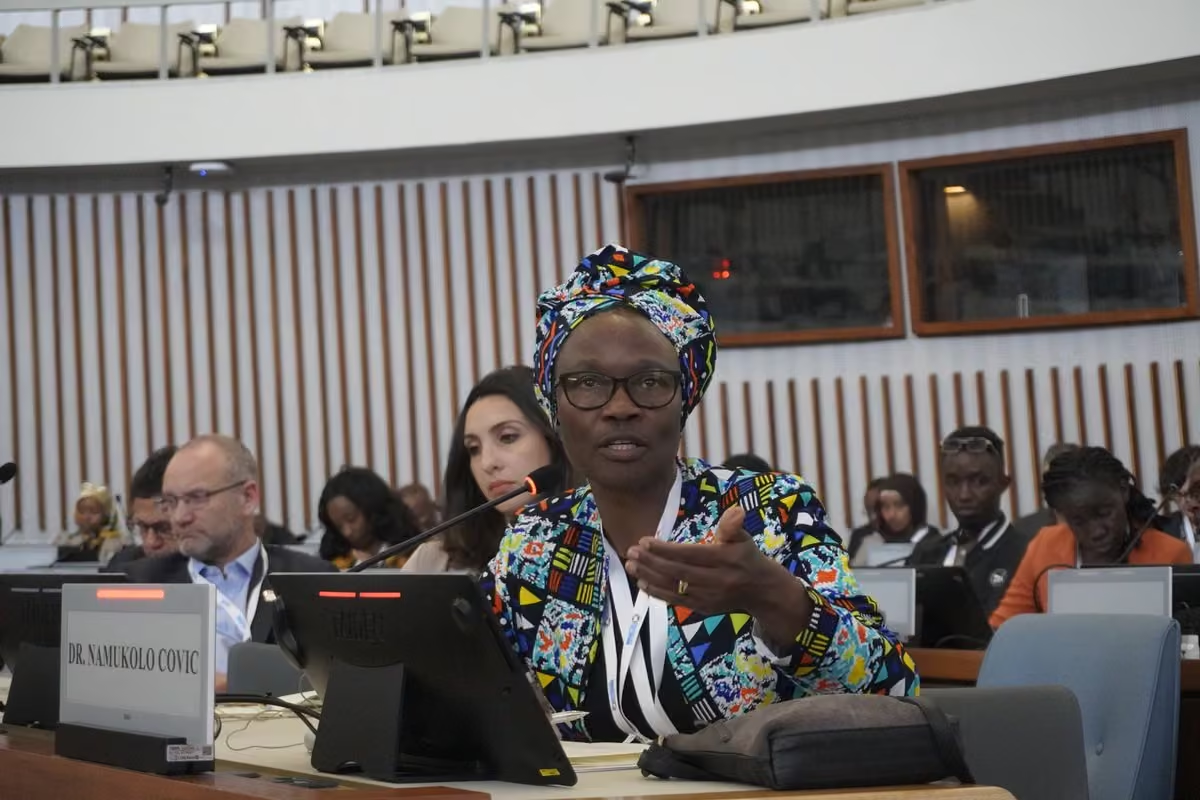
 Shahida.Hussien
@ShahidaHussien
Policy mechanisms including fiscal incentives, standards, & public procurement reduces investment risks; creating conditions that can enable political support, reduces market uncertainty, & accelerates the shift toward healthy, sustainable, & just diets. #unfss2025 @ILRI @CGIAR

 Shahida.Hussien
@ShahidaHussien
Transparency, &clear roles are essential to translate national food systems strategies into effective multi-stakeholder implementation. When government leadership is followed by company commitment, it is possible to align political, & societal goals. #unfss2025 @ILRI @CGIAR

 Shahida.Hussien
@ShahidaHussien
A dialogue between governments, industry, and civil society with the aim to strengthen collaboration to accelerate towards healthy, sustainable & just diets. #unfss2025 @ILRI @CGIAR

 Shahida.Hussien
@ShahidaHussien
Happening now: Strengthening Enabling Conditions for Food Systems change through Policy Mechanisms Investment Dialogue at the #unfss2025 @ILRI @CGIAR


ILRI.org reposted
Shahida.Hussien
@ShahidaHussien
Policy mechanisms including fiscal incentives, standards, & public procurement reduces investment risks; creating conditions that can enable political support, reduces market uncertainty, & accelerates the shift toward healthy, sustainable, & just diets. #unfss2025 @ILRI @CGIAR
Shahida.Hussien
@ShahidaHussien
Transparency, &clear roles are essential to translate national food systems strategies into effective multi-stakeholder implementation. When government leadership is followed by company commitment, it is possible to align political, & societal goals. #unfss2025 @ILRI @CGIAR
Shahida.Hussien
@ShahidaHussien
A dialogue between governments, industry, and civil society with the aim to strengthen collaboration to accelerate towards healthy, sustainable & just diets. #unfss2025 @ILRI @CGIAR
Shahida.Hussien
@ShahidaHussien
Happening now: Strengthening Enabling Conditions for Food Systems change through Policy Mechanisms Investment Dialogue at the #unfss2025 @ILRI @CGIAR
ILRI.org reposted
Shahida.Hussien
@ShahidaHussien
A dialogue between governments, industry, and civil society with the aim to strengthen collaboration to accelerate towards healthy, sustainable & just diets. #unfss2025 @ILRI @CGIAR
Shahida.Hussien
@ShahidaHussien
Happening now: Strengthening Enabling Conditions for Food Systems change through Policy Mechanisms Investment Dialogue at the #unfss2025 @ILRI @CGIAR
ILRI.org reposted
ILRI.org
@ILRI
Did you know animal-source foods are vital for nutrition? 🥩🥛 ILRI is proud to participate in #unfss4, to highlight livestock's crucial role in addressing malnutrition and building healthier diets.
Learn more: www.ilri.org/events/un-food-systems-summit-4-stocktake-un…
#healthydiets #sustainablelivestock

ILRI.org reposted
International Dairy Federation
@FIL_IDF
Join #unfss2025, Addis Ababa for a sideevent: #livestock can drive #foodsystems transformation in #subsaharanafrica thru #landrestoration & #investment solutions. 28 July | 📍 UNCC Addis🔗 alliancebioversityciat.org/events/unfss4 Led by @kilimoKE @MinAgriCm, @BiovIntCIAT_eng @ILRI @GSLC_Livestock
 ILRI.org
@ILRI
Meet Edwin & Doreen, #ilri's pioneer farmers in Bomet, Kenya! Their diverse crop & livestock approach is building resilience, shared with 15,000+ households via #peerlearning.
Watch here: youtu.be/qyj9uhY1ouk
@PPD @HABITAT @CGIAR @KALRO
ILRI.org
@ILRI
Did you know animal-source foods are vital for nutrition? 🥩🥛 ILRI is proud to participate in #unfss4, to highlight livestock's crucial role in addressing malnutrition and building healthier diets.
Learn more: www.ilri.org/events/un-food-systems-summit-4-stocktake-un…
#healthydiets #sustainablelivestock
ILRI.org
@ILRI
#dyk 🌱📻 ILRI & partners are using radio & mobile tech to help 91,000+ farmers adopt drought-tolerant forages & better feeding practices. Huge impact!
Learn more: www.ilri.org/news/radio-and-mobile-voices-cultivate-clima…
#ethiopia #agriculture #innovation #foodsecurity #climateaction
ILRI.org reposted
International Dairy Federation
@FIL_IDF
Join #unfss2025, Addis Ababa for a sideevent: #livestock can drive #foodsystems transformation in #subsaharanafrica thru #landrestoration & #investment solutions. 28 July | 📍 UNCC Addis🔗 alliancebioversityciat.org/events/unfss4 Led by @kilimoKE @MinAgriCm, @BiovIntCIAT_eng @ILRI @GSLC_Livestock
 ILRI.org
@ILRI
July 9-ILRI was thrilled to host students from the World Food Prize Youth Initiative. Big thanks to their teachers & Dr. Kenneth Monjero from KALRO for joining. This visit underscored our vital partnerships in encouraging #youthinstem.
#futureoffood #scienceeducation


 ILRI.org
@ILRI
🐄 Join us at #unfss2025 in Addis Ababa for a powerful side-event on how #livestock can drive #foodsystems transformation in #africa.
📅 28 July | 📍 UNCC Addis
🔗 alliancebioversityciat.org/events/unfss4
Led by 🇰🇪 @kilimoKE & 🇨🇲 @MinAgriCm, with @BiovIntCIAT_eng, @ILRI & @GSLC_Livestock

ILRI.org reposted
ILRI.org
@ILRI
Workshop for beef cattle value chain convened in northwest Vietnam held to identify key challenges that hinder the development of a more inclusive and efficient market.
www.ilri.org/vietnam-market-systems-analysis-workshop
ILRI.org reposted
ILRI.org
@ILRI
Contagious Bovine Pleuropneumonia is a highly infectious plague of cattle. Eradicating it from Kenya will be a complex and collaborative task - but one which can succeed.
Scientists from ILRI, KALRO, the DVS, and other institutes explain how: www.ilri.org/news/ilri-teams-kenyan-government-and-partne…

ILRI.org reposted
 KALRO
@kalromkulima
Today, Mr. Kenneth Monjero, a biotechnologist at the KALRO Biotechnology Research Centre – Kabete, led a KALRO delegation to the @ILRI Friday Morning Coffee forum to explore strategic collaborations with ILRI and other @CGIAR institutions.


 ILRI.org
@ILRI
Contagious Bovine Pleuropneumonia is a highly infectious plague of cattle. Eradicating it from Kenya will be a complex and collaborative task - but one which can succeed.
Scientists from ILRI, KALRO, the DVS, and other institutes explain how: www.ilri.org/news/ilri-teams-kenyan-government-and-partne…
ILRI.org reposted
VoxDev
@vox_dev
How good are livestock statistics in Africa?
Last week on VoxDev, @KibromAbay (@IFPRI), @Haileaya1 (@IFPRI), Zelalem Terfa (@ILRI), Joseph Karugia (@ILRI) & Clemens Breisinger (@IFPRI) outlined research on Ethiopia: voxdev.org/topic/methods-measurement/how-good-are-livesto…
ILRI.org
@ILRI
Workshop for beef cattle value chain convened in northwest Vietnam held to identify key challenges that hinder the development of a more inclusive and efficient market.
www.ilri.org/vietnam-market-systems-analysis-workshop
ILRI.org reposted
CGIAR GENDER
@CGIARgender
Only 0️⃣ 1️⃣ day left before the close of early bird registration for the upcoming #acceleratingequalityinag conference
Join other delegates as we discuss how we can accelerate progress on equality in food, land and water systems?
👉 www.genderinag2025.com
@CGIAR @IWMI_

ILRI.org reposted
CORAF | #MITA2026
@CORAFNews
🚨 #mita2025 – Final Call!
Do you have a #technology for integrated soil management?
We’re looking for:
✅ Proven & validated solutions
✅ Climate-resilient
✅ Gender & nutrition sensitive
✅ Rural-community friendly.
Apply now 👉 ee.coraf.org/x/pmfN1sl6
⏰ Deadline: July 15.

ILRI.org reposted
CGIAR GENDER
@CGIARgender
📢 Happening tomorrow 15:00 EAT
📌 The Future of Youth Jobs in Agrifood Systems in #africa
💬 @aruhweza @swomamo @KibromAbay @heckertjessica1 @mashwachakka @ncdehaan @blackiesq
@EngMwende
🎟️ www.ifpri.org/event/the-future-of-youth-jobs-in-agrifood-…
@IFPRI @CGIAR @AGRA_Africa @ILRI @WorldBank @FoodSystems

ILRI.org reposted
The Crawford Fund
@CrawfordFund
🌏 #25cfconf: @aditimukherji will join our Annual Conference this year for a session on Achieving a Pathway to Climate Resilience, sharing lessons from Asia and elsewhere. h
👤 Read her bio: www.crawfordfund.org/events/2025-conference/2025-speaker-…
ℹ️ Register: www.crawfordfund.org/events/2025-conference/
@CGIAR @ILRI
 ILRI.org
@ILRI
Now available: the 18th issue of the ILRI East and Southeast Asia newsletter, covering activities from January-June 2025 and upcoming activities later this year.
Read and subscribe here: www.ilri.org/news/issue-18-ilri-east-and-southeast-asia-n…
ILRI.org reposted
Shahida.Hussien
@ShahidaHussien
Slides highlighting some of @CGIAR Innovation & digitalization works developed in collaboration with key partners and stakeholders #moit @ILRI @CGIARAfrica


 Shahida.Hussien
@ShahidaHussien
This work is energized by @CGIAR new 2025–2030 Research Portfolio, which raises the ambition of agricultural science and innovation. #moit @ILRI @CGIARAfrica

ILRI.org reposted
AICCRA
@CGIARAfrica
#happeningnow @ILRI 🇪🇹 campus, a high-level delegation led by H.E. Dr. Belete Molla, Minister of Innovation and Technology, engaged with @CGIAR and affiliated institutions to explore potential collaboration with the @MinistryofInno2 to support agricultural food systems transformation.
AICCRA 🇪🇹's innovations on digital agriculture support tools, agro-climate advisories, site-specific fertilizer application, SmaRT pack innovations, climate-smart feed and forage innovations were presented to the delegation by Dr. Teferi Demissie.
The minister also visited the facilities @ILRI to further engage with the science teams driving food systems transformation with the support of various cutting-edge innovations and technologies. 👩🌾🐂🌾🐔🛰️
#digitalethiopia #climatesmartethiopia #readytoscale


 Shahida.Hussien
@ShahidaHussien
Happening now: Consultation workshop to explore potential collaboration between the Ministry of Innovation & Technology #moit & @CGIAR
Supporting agricultural food systems transformations
@ILRI @CGIARAfrica


ILRI.org reposted
Farming First
@farmingfirst
“Across #africa, livestock are more than just animals, they are the foundation for livelihoods, food and nutrition security, and sustainable farming,” says @ILRI's Karen Marshall.
Explore opportunities to unlock livestock innovations 👇🏾
farmingfirst.org/2025/07/opportunities-for-unlocking-live…

ILRI.org reposted
ILRI.org
@ILRI
📢 Early bird registration till 15 July 📰
Join @cgiargender at the conference ‘Accelerating equality in food, land and water systems; Driving solutions through evidence and learning’.
📍 Cape Town, South Africa
🗓️ October 7-9, 2025
👉 www.genderinag2025.com
ILRI.org reposted
ILRI.org
@ILRI
"We are living in a climate crisis, and the patterns of crop and livestock diseases are shifting. Our task is clear: we must understand the current disease landscape to better anticipate and manage emerging threats." @NamukoloC.
Read her full remarks: www.ilri.org/news/cgiar-and-national-plant-protection-org…
ILRI.org reposted
ILRI.org
@ILRI
Each year, zoonotic diseases cost the world USD 500 billion from lives lost and economic disruptions. Yet preventive measures cost just USD 20 billion per year.
We need more investment in proactive, risk-based animal health services to protect public health. #worldzoonosesday

ILRI.org reposted
ILRI.org
@ILRI
On #worldzoonosesday we also celebrated decades of our work to combat #riftvalleyfever in Africa. Read about our achievements here: www.ilri.org/index.php/news/world-zoonoses-day-2025-how-i…
ILRI.org reposted
VoxDev
@vox_dev
🆕 How good are livestock statistics in Africa?
Today on VoxDev, @KibromAbay (@IFPRI), @Haileaya1 (@IFPRI), Zelalem Terfa (@ILRI), Joseph Karugia (@ILRI) & Clemens Breisinger (@IFPRI) outline research on Ethiopia: voxdev.org/topic/methods-measurement/how-good-are-livesto…
ILRI.org
@ILRI
"We are living in a climate crisis, and the patterns of crop and livestock diseases are shifting. Our task is clear: we must understand the current disease landscape to better anticipate and manage emerging threats." @NamukoloC.
Read her full remarks: www.ilri.org/news/cgiar-and-national-plant-protection-org…
ILRI.org
@ILRI
Each year, zoonotic diseases cost the world USD 500 billion from lives lost and economic disruptions. Yet preventive measures cost just USD 20 billion per year.
We need more investment in proactive, risk-based animal health services to protect public health. #worldzoonosesday
ILRI.org
@ILRI
Read a recent op-ed by ILRI senior principal scientist @hung_cenpher which outlines the true costs of inaction against zoonotic diseases, for humans and animals - and what we stand to gain by investing today.
#worldzoonosesday
www.ilri.org/news/preventing-next-pandemic-one-health-res…
ILRI.org
@ILRI
On #worldzoonosesday we're highlighting ILRI's work against neglected zoonotic diseases - like #qfever.
ILRI scientists have crafted a new national risk map providing vital information to improve surveillance and control of this zoonotic disease.
www.cgiar.org/research/publication/mapping-the-risk-of-q-…

 ILRI.org
@ILRI
'Spillover' events are when animal diseases become zoonotic - able to infect humans.
On #worldzoonosesday, we're highlighting ILRI's research into the wild meat industry, and what can be done to make it not only more sustainable, but safer?
www.ilri.org/news/eating-wild-animals-rewards-are-big-risks
ILRI.org
@ILRI
Q. What's the biggest driver of new zoonoses?
A. Land use change.
In a rapidly changing world, we need a #onehealth approach to prevent the next pandemic and make a healthier future for all.
Learn more: www.ilri.org/news/eating-wild-animals-rewards-are-big-risks
#worldzoonosesday
ILRI.org
@ILRI
#rabies is a fatal zoonotic disease once symptoms appear. But it is preventable, with the right vaccines.
On #worldzoonosesday, we're celebrating ILRI & partners' work to raise awareness, close knowledge gaps, & campaign for animal vaccinations.
www.ilri.org/knowledge/publications/documenting-challenge…


 ILRI.org
@ILRI
On #worldzoonosesday we also celebrated decades of our work to combat #riftvalleyfever in Africa. Read about our achievements here: www.ilri.org/index.php/news/world-zoonoses-day-2025-how-i…
ILRI.org reposted
ILRI.org
@ILRI
On #worldzoonosesday we're highlighting ILRI's work against neglected zoonotic diseases - like #qfever.
ILRI scientists have crafted a new national risk map providing vital information to improve surveillance and control of this zoonotic disease.
www.cgiar.org/research/publication/mapping-the-risk-of-q-…
ILRI.org
@ILRI
📢 Early bird registration till 15 July 📰
Join @cgiargender at the conference ‘Accelerating equality in food, land and water systems; Driving solutions through evidence and learning’.
📍 Cape Town, South Africa
🗓️ October 7-9, 2025
👉 www.genderinag2025.com
ILRI.org reposted
ILRI.org
@ILRI
Read a recent op-ed by ILRI senior principal scientist @hung_cenpher which outlines the true costs of inaction against zoonotic diseases, for humans and animals - and what we stand to gain by investing today.
#worldzoonosesday
www.ilri.org/news/preventing-next-pandemic-one-health-res…
ILRI.org reposted
ILRI.org
@ILRI
'Spillover' events are when animal diseases become zoonotic - able to infect humans.
On #worldzoonosesday, we're highlighting ILRI's research into the wild meat industry, and what can be done to make it not only more sustainable, but safer?
www.ilri.org/news/eating-wild-animals-rewards-are-big-risks
ILRI.org reposted
CGIAR
@CGIAR
🌍Arshnee Moodley, head of the CGIAR Antimicrobial Resistance Hub at @ILRI, has been appointed chair of the @WOAH Antimicrobial Resistance Working Group.
More: on.cgiar.org/4eBVuCL
#research
ILRI.org reposted
Jameel Observatory for Food Security Early Action
@jameel_observ
Index-based livestock insurance to support pastoralists against droughts
Short policy comment by @nd_jensen and colleagues explaining origins and purpose of IBLI in East Africa
@rafiki80 @Kelvinchish @ILRI
doi.org/10.1016/j.foodpol.2025.102909
ILRI.org reposted
Unlimit Health
@unlimit_health
Thanks to @ISNTDPress for the session on the pork tapeworm project in Uganda by @ILRI @Makerere @GuluVarsity @EdinburghUni @CGIAR @MinofHealthUG. Taeniasis is poorly understood & one of the most neglected among the NTDs @FCDOGovUK @The_MRC. Watch: youtu.be/Yg5aAgVVLt4
ILRI.org reposted
 AGNES Africa
@AGNESAfrica1
This week, the AGNES in collaboration with International Livestock Research Institute (@ILRI ) convened a Sensitization and Training Workshop on the Africa Agriculture Adaptation Atlas for policymakers, private sector actors, and civil society organisations from Eastern Africa


ILRI.org reposted
ILRI.org
@ILRI
Q. What's the biggest driver of new zoonoses?
A. Land use change.
In a rapidly changing world, we need a #onehealth approach to prevent the next pandemic and make a healthier future for all.
Learn more: www.ilri.org/news/eating-wild-animals-rewards-are-big-risks
#worldzoonosesday
ILRI.org reposted
ILRI.org
@ILRI
#rabies is a fatal zoonotic disease once symptoms appear. But it is preventable, with the right vaccines.
On #worldzoonosesday, we're celebrating ILRI & partners' work to raise awareness, close knowledge gaps, & campaign for animal vaccinations.
www.ilri.org/knowledge/publications/documenting-challenge…
ILRI.org reposted
One Health Centre in Africa
@OHRECA_ILRI
🐷Did you know #taeniasolium, the pork tapeworm, threatens both human and animal health? This #worldzoonosesday, see how #ohreca and partners are tackling this zoonotic parasite in Uganda’s pork value chain!
🎥 Watch and share: youtu.be/0J5QN2lSOOI
#onehealth @ILRI
ILRI.org reposted
One Health Centre in Africa
@OHRECA_ILRI
🐱🍖 Did you know? #toxoplasmagondii—a sneaky parasite in undercooked meat, soil and cat feces can harm pregnant women & immunocompromised people. This #worldzoonosesday, learn 10 key facts & how to stay safe!
🎥 Watch this short guide: youtube.com/shorts/nM4x2o49MPg
#onehealth @ILRI
ILRI.org reposted
Amos Lucky Mhone
@Amos_L_Mhone
#worldzoonosesday
Each year, zoonotic diseases cost the world USD 500 billion . Yet preventive measures cost just USD 20 billion per year.
We need more investment in proactive, risk-based animal health services to prevent future pandemics.
www.ilri.org/news/preventing-next-pandemic-one-health-res…

ILRI.org reposted
 Dr Emmanuelle Soubeyran
@WOAH_DG
Three out of four originated in animals. Today, about 60% of all newly reported infectious diseases globally are zoonotic. This #worldzoonosesday, @WOAH calls for stronger surveillance, cooperation & investment in prevention and One Health.
ILRI.org
@ILRI
Are you a livestock breeder or social researcher working in LMICs to improve livelihoods in livestock?
Then read our new article providing a key framework to inform gender-responsive livestock breeding programs, for equitable, sustainable progress.
hdl.handle.net/10568/175349
 ILRI.org
@ILRI
Ethiopian Livestock and Fisheries Investment Handbook launched to bridge animal-source food production gaps and engage private sector in Ethiopia’s livestock and fisheries industries.
Prepared by the Ministry of Agriculture in collaboration with ILRI.
www.ilri.org/news/newly-launched-investment-handbook-outl…
ILRI.org
@ILRI
⏳ The countdown is on!
From 7-9 Oct 2025, @CGIARGender will gather in Cape Town for the #acceleratingequalityinag Conference. Take advantage of the early bird registration discount before 15 July.
🔗 Save your spot:
www.genderinag2025.com
ILRI.org reposted
CGIAR
@CGIAR
CGIAR #inthenews
🔬@kalromkulima & @ILRI are at the forefront of biotechnology-driven vaccine development in Kenya, advancing safer, locally produced solutions for Rift Valley Fever and African Swine Fever to safeguard livestock.
More: on.cgiar.org/4ejjsTc
@TheStarKenya
ILRI.org reposted
CGIAR
@CGIAR
CGIAR #inthenews
🧫 In Kenya, @kalromkulima and @ILRI are shaping the future of livestock health, deploying advanced biotechnology to develop precise, safe vaccines for Rift Valley and African Swine Fevers.
More: on.cgiar.org/4ejjsTc
@TheStarKenya #research
ILRI.org reposted
CGIAR Digital Transformation
@CGIAR_Data
🐄🌍 EnviroCow by @ILRI is @CGIAR_Data’s Digital Innovation of the Week—a model that helps simulate GHG emissions and nutrient flows in dairy systems.
It supports smarter, climate-resilient decisions for sustainable dairy farming.
🔗 www.ilri.org/research/projects/envirocow
#onecgiar #agtech

ILRI.org reposted
ILRI.org
@ILRI
In recent years, a regional project across Ethiopia, Kenya, and Zimbabwe has been placing women at the centre of livestock interventions to support more climate-resilient and inclusive livestock systems.
Read the full story: www.ilri.org/news/empowering-women-sheep-and-goat-farmers… @ACIARAustralia @ICARDA
ILRI.org reposted
ILRI.org
@ILRI
In Cambodia, the Participatory Indigenous Chicken Breeding Improvement Program (PICBIP) is focusing on improving the local Skouy breed for the benefit of smallholder farmers: www.ilri.org/news/improved-indigenous-chicken-project-boo…
ILRI.org reposted
ILRI.org
@ILRI
Wild meat is deeply embedded in rural livelihoods and urban consumption in Africa and Asia, yet trends remain under-researched.
To help address this knowledge gap, scientists and practitioners gathered at #iccb2025 for a symposium on #wildmeat:
www.ilri.org/news/forests-forks-addressing-wild-meat-trad…
ILRI.org
@ILRI
In recent years, a regional project across Ethiopia, Kenya, and Zimbabwe has been placing women at the centre of livestock interventions to support more climate-resilient and inclusive livestock systems.
Read the full story: www.ilri.org/news/empowering-women-sheep-and-goat-farmers… @ACIARAustralia @ICARDA
ILRI.org reposted
ILRI.org
@ILRI
New publications documenting the unique ecotypes of indigenous chickens in key Asian countries are now available.
The domestic chicken is believed to have originated in these regions, over 8,000 years ago.
hdl.handle.net/10568/174863
hdl.handle.net/10568/174861
@ACIARAustralia

ILRI.org reposted
 ISNTD
@ISNTD_Press
Taenia solium infections remain a heavy parasitic threat worldwide, with potentially devastating effects on human health & neurology. Discover #onehealth interventions in #uganda ahead of #worldzoonosesday at #isntdconnect!
👉Jul 3 | 9.00-10.30 UTC
👉www.isntd.org/isntd-connect

ILRI.org reposted
Shahida.Hussien
@ShahidaHussien
Happening now: National Conference on Agri-food Research and Innovation for Sustainable Development, organized by Hawassa University in collaboration with @ILRI and other partners
@CGIAR @NamukoloC


ILRI.org reposted
CGIAR
@CGIAR
🌏On World Food Safety Day 2025, @ILRI and partners in Vietnam showcased how evidence-based approaches are transforming food systems and protecting public health.
Learn more: on.cgiar.org/4jNHN4N
#foodsecurity
ILRI.org
@ILRI
Wild meat is deeply embedded in rural livelihoods and urban consumption in Africa and Asia, yet trends remain under-researched.
To help address this knowledge gap, scientists and practitioners gathered at #iccb2025 for a symposium on #wildmeat:
www.ilri.org/news/forests-forks-addressing-wild-meat-trad…
ILRI.org
@ILRI
In Cambodia, the Participatory Indigenous Chicken Breeding Improvement Program (PICBIP) is focusing on improving the local Skouy breed for the benefit of smallholder farmers: www.ilri.org/news/improved-indigenous-chicken-project-boo…
ILRI.org reposted
Ismahane Elouafi
@CGIAR_EMD
🔬 Kenya’s @kalromkulima and @ILRI are driving local biotech solutions to tackle Rift Valley Fever and African Swine Fever—protecting livestock with safer, homegrown vaccines.
More: on.cgiar.org/4ejjsTc
@TheStarKenya

ILRI.org reposted
Jameel Observatory for Food Security Early Action
@jameel_observ
Anticipatory action opportunities for pastoralist areas in the Horn of Africa
A new report provides key messages from discussions on #anticipatoryaction for drylands and pastoralists.
jameelobservatory.org/aa-drylands/
hdl.handle.net/10568/175138
@ILRI @SPARC_Ideas @IGAD_CPALD
 ILRI.org
@ILRI
Don't miss this symposium on 19 June at @ICCB2025, featuring ILRI's @ehpatel. How can #wildmeat hunting, trade and consumption become safer and more sustainable for all?
Find full details: www.xcdsystem.com/iccb/program/5UZ6ezJ/index.cfm


ILRI.org reposted
ILRI.org
@ILRI
🌏 If you're attending @ICCB2025, don't miss this symposium 'From Forest to Fork' on 19 June, focusing on the impacts of #wildmeat on food security, health, livelihoods and biodiversity in the Asia-Pacific, featuring ILRI's @ehpatel.
Find full details at: www.xcdsystem.com/iccb/program/5UZ6ezJ/index.cfm

ILRI.org reposted
ILRI.org
@ILRI
ILRI is teaming up with @kalromkulima, @Dir_vetservices & stakeholders to eradicate the deadly cattle disease contagious bovine pleuropneumonia #cbpp from #kenya—a shared goal that will involve everyone from farmers to scientists to policymakers.
www.ilri.org/news/ilri-teams-kenyan-government-and-partne…

ILRI.org reposted
ILRI.org
@ILRI
"Diagnostics are like a torch in the dark—they guide treatment decisions & underpin antimicrobial stewardship. We’re proud to support regional efforts to strengthen diagnostic systems & promote the responsible use of veterinary medicines.”
www.ilri.org/news/improving-antimicrobial-diagnostic-capa… @dishonmuloi
ILRI.org reposted
CGIAR GENDER
@CGIARgender
In pastoralist societies, men and women hold different roles, each contributing unique knowledge of their shared environment.
Recent workshop by @ILRI shows how participatory GIS can transform resource management and gender inclusion in the area: www.ilri.org/news/empowering-every-voice-participatory-gi…
ILRI.org reposted
Jameel Observatory for Food Security Early Action
@jameel_observ
#anticipatoryaction in the #drylands: Exploring key challenges and opportunities for early warning in pastoralist areas of the Greater Horn of Africa
hdl.handle.net/10568/175138
@SPARC_Ideas @ILRI @sfderbyshire @CRDD_kenya @rahmah2017 @twahirah3 @rafiki80
ILRI.org reposted
Anselme SHYAKA
@shyakaa
Join us for a live #cohesa webinar this Friday, June 20 | ⏰ 8:30–11:30 CAT / 9:30–12:30 EAT
One Health, One Story: Strengthening Journalism at the Human-Animal-Environment Interface
📍 Launch of Rwanda’s One Health Media Guidelines
🔗 Register: webinar.afriscidialogue.org/webinars/one-health-one-story…
@onehealthughe
#cohesa
#onehealth
@PressACP
@OacpsProgramme
@EU_Commission
@ILRI
@afri_isaaa
@Cirad
@ughe_org

ILRI.org reposted
 Bram Govaerts CIMMYT
@bramaccimmyt
Drylands cover 46% of land & support 44% of global agriculture, but face rising threats from #climatechange.
@CGIAR's Global Strategy for Resilient Drylands aims to transform food, land & water systems in these ecosystems.
www.cgiar.org/global-strategy-resilient-drylands
#desertificationanddroughtday
ILRI.org
@ILRI
"Diagnostics are like a torch in the dark—they guide treatment decisions & underpin antimicrobial stewardship. We’re proud to support regional efforts to strengthen diagnostic systems & promote the responsible use of veterinary medicines.”
www.ilri.org/news/improving-antimicrobial-diagnostic-capa… @dishonmuloi
ILRI.org reposted
PanAfrican Agriculture
@panagrimedia
Kenyan dairy project seeks to deliver safe milk to consumers
panagrimedia.com/kenyan-dairy-project-seeks-to-deliver-sa…
@ILRI
ILRI.org reposted
CGIAR
@CGIAR
🐄 Mapping Ethiopia’s livestock routes is transforming the livelihoods of pastoralists. With @ILRI’s digital innovations, policymakers can now better support access to services along key corridors.
Learn more: on.cgiar.org/3T1TNEV
#innovation
ILRI.org
@ILRI
ILRI is teaming up with @kalromkulima, @Dir_vetservices & stakeholders to eradicate the deadly cattle disease contagious bovine pleuropneumonia #cbpp from #kenya—a shared goal that will involve everyone from farmers to scientists to policymakers.
www.ilri.org/news/ilri-teams-kenyan-government-and-partne…
ILRI.org reposted
Livestock Data for Decisions
@LD4D_community
Welcome @MamaNjihia, @ILRI to LD4D Steering Committee!
#policy + climate champion 🌍 She’s bridging science & decision-making to drive climate-smart #livestock solutions.
🔗Read more: edin.ac/43dItKk
#sustainablelivestock #onehealth #livestockdata #globaldevelopment
 ILRI.org
@ILRI
🌏 If you're attending @ICCB2025, don't miss this symposium 'From Forest to Fork' on 19 June, focusing on the impacts of #wildmeat on food security, health, livelihoods and biodiversity in the Asia-Pacific, featuring ILRI's @ehpatel.
Find full details at: www.xcdsystem.com/iccb/program/5UZ6ezJ/index.cfm
ILRI.org reposted
 Tsehay Gashaw
@tsehay
Snapshot from Day-1 @ACAT2025: A strong call to put farmers at the center of all Ag solutions. They're not just recipients — they're key partners in shaping the future of agriculture. #acat2025 #farmersfirst #aginnovation @ILRI

ILRI.org reposted
Tsehay Gashaw
@tsehay
Speakers at @ACAT2025 emphasized a crucial shift in agricultural development: co-creating with farmers to ensure their voices and knowledge drive innovation—essential for sustainable and scalable impact. 🌾 #acat2025 @ILRI
Tsehay Gashaw
@tsehay
Snapshot from Day-1 @ACAT2025: A strong call to put farmers at the center of all Ag solutions. They're not just recipients — they're key partners in shaping the future of agriculture. #acat2025 #farmersfirst #aginnovation @ILRI
ILRI.org reposted
ILRI.org reposted
AICCRA
@CGIARAfrica
✨At the #smartharvest high-level stakeholder briefing meeting @ILRI 🇪🇹, AICCRA, with its partners at @ICARDA, @BiovIntCIAT_eng and @metos_austria, showcased the program's work on digital innovations and SmartHarvest to accelerate Ethiopia’s agricultural transformation🚜📲
High-level attendees included H.E. Dr. Belete Molla, Minister at @MinistryofInno2, Ethiopia; H.E. Dr. Sofyia Kassa, State Minister @MoA_Ethiopia; and H.E. Dr. Endrias Geta Beldeda, State Minister @MILLsEthiopia, who offered strategic guidance on current and future engagements.
Highlights :
🤝📰Importance of partnerships with @CGIAR, public and private sector actors, and international development partners
👩🌾🤳 Crucial role of digital solutions in strengthening and enhancing resilience across Ethiopia’s agri-food systems
#climatesmartafrica #readytoscale #digitalag


ILRI.org reposted
ILRI.org
@ILRI
Infectious disease outbreaks can occur when humans, livestock & wildlife mingle. Studying how microbes that live on & inside animals & humans change due to interactions could help better predict & prevent outbreaks, says a new #onehealth study.
hdl.handle.net/10568/175067 @ericfevre

ILRI.org reposted
ILRI.org
@ILRI
ILRI scientist & @CGIAR @AMRHub lead @ArshneeM has been appointed chair of the @WOAH Antimicrobial Resistance Working Group.
"We cannot talk about healthy animals or nutritious food without acknowledging the essential role of antimicrobials."
www.ilri.org/news/cgiar-scientist-takes-leadership-role-g…
ILRI.org reposted
ILRI.org
@ILRI
5 June 2025- Honoured to host the @GatesFoundation GGO team @ILRI Nairobi 🇰🇪 with @CGIAR & @AATF!
We explored innovations in livestock 🐄 nutrition and health, genetics, climate resilience 🌍 & digital tools 📊 to transform African agriculture.
#whylivestockmatter


ILRI.org reposted
ILRI.org
@ILRI
Read our newsletter celebrating World Food Safety Day 2025 – Science in action - mailchi.mp/cgiar/ilri-endof2024-newsletter-16535512
 ILRI.org
@ILRI
Infectious disease outbreaks can occur when humans, livestock & wildlife mingle. Studying how microbes that live on & inside animals & humans change due to interactions could help better predict & prevent outbreaks, says a new #onehealth study.
hdl.handle.net/10568/175067 @ericfevre
ILRI.org
@ILRI
ILRI scientist & @CGIAR @AMRHub lead @ArshneeM has been appointed chair of the @WOAH Antimicrobial Resistance Working Group.
"We cannot talk about healthy animals or nutritious food without acknowledging the essential role of antimicrobials."
www.ilri.org/news/cgiar-scientist-takes-leadership-role-g…
ILRI.org reposted
Climate Lens News
@climatelensnews
International Livestock Research Institute (ILRI) hosted a Livestock Investors and Startups pitch forum for impact investors to explore innovative technologies. Read 👇🏿 climate.co.ke/ilri-convention-pitches-tech-solutions-to-d… @ILRI
ILRI.org reposted
 Ekta Patel
@ehpatel
As I gear up for @ICCB2025 I look forward to discussing #wildmeat trade risks with others from @FAO
@TheWCS @CIFOR_ICRAF where I will be sharing our findings from border settlements
@ILRI #onehealth @OHRECA_ILRI
theconversation.com/eating-wild-meat-carries-serious-heal…
ILRI.org reposted
CGIAR Digital Transformation
@CGIAR_Data
🚀 #happeningnow: The All Centers #agrillm Workshop is live at @ILRI! 🌾🤖
Experts from across @CGIAR are uniting to explore how #ai & #llms can revolutionize agriculture—from smarter decisions in the field to scaling solutions that close the innovation gap. 🌍🌱


 ILRI.org
@ILRI
5 June 2025- Honoured to host the @GatesFoundation GGO team @ILRI Nairobi 🇰🇪 with @CGIAR & @AATF!
We explored innovations in livestock 🐄 nutrition and health, genetics, climate resilience 🌍 & digital tools 📊 to transform African agriculture.
#whylivestockmatter
ILRI.org reposted
CGIAR
@CGIAR
🛰️@ILRI’s mapping of Ethiopia’s livestock routes is paving the way for more innovative pastoral policies. Digitizing movement corridors will help ensure pastoralists get the services they need, where and when they need them.
More: on.cgiar.org/3T1TNEV
#livelihoods
ILRI.org
@ILRI
Read our newsletter celebrating World Food Safety Day 2025 – Science in action - mailchi.mp/cgiar/ilri-endof2024-newsletter-16535512
ILRI.org reposted
ILRI.org reposted
FAO Viet Nam
@FAOVietNam
On #worldfoodsafetyday 2025, @FAOVietnam, @WHOVietnam, @ILRI & National Institute of Animal Science held a forum with 200+ students in Ha Noi 🇻🇳. The event spotlighted science’s role in food safety & youth’s power in shaping a safer, sustainable food system 🌍🥗
@FAOWHOCodex


ILRI.org reposted
Prof. Appolinaire Djikeng
@ADjikeng
World Food Safety Day has always been an important day that ILRI celebrates and contributes globally with our national partners. This year is even more important given this year's theme 'Science in Action', focusing on the use of scientific knowledge as key to reducing illness, cutting costs and saving lives.
This year, @ILRI #vietnam colleagues together with the National Institute of Animal Science (NAIS), @WHO and @FAO organized a forum to promote and strengthen stakeholder engagement and collaboration in food safety and science-based policymaking.
Our food safety research is about saving lives in places where the risks are often invisible but deeply harmful. In many low- and middle-income countries (LMICs), food safety remains a challenge, and foodborne illnesses present serious threat to public health. We focus on mitigating risks, understanding the economic implications of unsafe food, improving safety within informal markets, capacity development of policymakers and vendors, and changing behaviours.
Read about the forum here: : www.ilri.org/news/vietnam-marks-world-food-safety-day-202…
ILRI.org reposted
The Conversation Africa
@TC_Africa
As many as three-quarters of emerging infectious diseases originate from wildlife.
theconversation.com/eating-wild-meat-carries-serious-heal…
💻 Ekta Patel, @ILRI / Julia E. Fa, @ManMetUni
#healthandmedicine
ILRI.org reposted
PanAfrican Agriculture
@panagrimedia
International Livestock Research Institute (@ILRI ) joins $27.4M Global Initiative to cut methane from livestock panagrimedia.com/international-livestock-research-institu…
ILRI.org reposted
 Zoonoses & EID
@ZoonoticDisease
Great to see our review piece out in @TrendsMicrobiol
Using the microbiota to study connectivity at human–animal interfaces
doi.org/10.1016/j.tim.2025.05.006
#onehealth
@ILRI
@livuninews
@Cirad
@NationalZoo
@KEMRI_Wellcome
@NDMOxford
@UCPH_Research
@dishonmuloi
 ILRI.org
@ILRI
World Food Safety Day 2025 was marked in Vietnam by a forum held by The National Institute of Animal Science with support of @FAO, @ILRI & @WHO.
200+ students from Hanoi Law University & the Women’s Academy attended to discuss food safety & policymaking.
www.ilri.org/news/vietnam-marks-world-food-safety-day-202…
ILRI.org
@ILRI
ILRI joins the rest of the world to mark #worldfoodsafetyday2025 on 7 June under the theme ‘Food safety: Science in action’.
Find out what we’re doing to make food safer around the world: www.ilri.org/events/world-food-safety-day-2025 #foodsafety
ILRI.org reposted
SPARC_Ideas
@SPARC_Ideas
👏Congratulations to our @SPARC_Ideas researcher @Kelvinchish for being shortlisted (out of 200 applicants) for the Sasakawa Awards at the Global Platform for #drr for his work on KAZNET - a crowdsourcing mobile phone app. #gp2025
www.sparc-knowledge.org/news-blog/news/data-resilience-ke…
@ILRI @UNDRR
ILRI.org reposted
ILRI.org
@ILRI
Invest in #onehealth today to prevent tomorrow’s pandemics, or pay a heavy price in the future, says ILRI health program lead @hung_cenpher in @TC_Africa. He explains why One Health is essential across the world: theconversation.com/preventing-the-next-pandemic-one-heal… @WOAH @WHO @FAO @UNEP #ohhlep
ILRI.org
@ILRI
🌍This #worldenvironmentday, let's unite to protect our planet's natural systems.
Every action matters in building a more resilient future.
🔗Learn more: www.cgiar.org/news-events/news/world-environment-day-2025…
#onecgiar @UNEP
ILRI.org reposted
Jameel Observatory for Food Security Early Action
@jameel_observ
From animal intestines to radio signals: anticipation without certainty in the drylands of the Horn of Africa - poster from our May meeting in Addis Ababa: by George Tsitati.
Download: hdl.handle.net/10568/174671

ILRI.org reposted
Jameel Observatory for Food Security Early Action
@jameel_observ
Using earth observation data to estimate livestock diet composition and quality - poster from our May meeting in Addis Ababa: by John Mutua.
Download: hdl.handle.net/10568/174668

ILRI.org reposted
 CGIAR Nutrition
@CGIARnutrition
Registration for #anh2025 is now open!
Annual #foodsystems #agriculture #nutrition #health conference in
📍Dar es Salaam 🇹🇿 & online: 📚Learning Labs: 16-18 June (online) & 23 June (in person) 🔎Research Conference: 24-26 June (hybrid) 🔗 www.anh-academy.org/academy-week/2025/about-the-conferenc…
See you there!

ILRI.org reposted
Ismahane Elouafi
@CGIAR_EMD
🌿 CGIAR is innovating to restore ecosystems, improve land use, and boost climate resilience.
This #worldenvironmentday, explore how our science is helping to shape a sustainable future for both people and the planet.
🔗 on.cgiar.org/3HiI0PK
#one CGIAR @UNEP
 ILRI.org
@ILRI
Ambica Pariwal will be engaging on talks on Bridging Gender Gaps in Rangeland Resource and Conflict Mapping: The Role of Participatory GIS, A Case Study in Kenya at #iyrp2026 #rangelands
Explore the strategy: www.ilri.org/news/grounded-strategies-resilient-rangeland… #iyrp2026 #rangelands

ILRI.org reposted
CGIAR
@CGIAR
🌍 This #worldenvironmentday, let's unite to protect our planet's natural systems.
Every action matters in building a more resilient future.
🔗 Learn more: on.cgiar.org/3HiI0PK
#onecgiar @UNEP

ILRI.org reposted
CGIAR
@CGIAR
🐐 @ILRI’s new thermostable, cost-effective vaccine for goat plague marks a significant step in safeguarding livestock-dependent communities in West Africa, where small ruminants are central to #foodsecurity and income.
Read more: on.cgiar.org/3Hp0U7z
ILRI.org reposted
SPARC_Ideas
@SPARC_Ideas
🏆#sparc_ideas scientist @Kelvinchish has been nominated for the 2025 @UNDRR Sasakawa Award for his work on crowdsourcing mobile phone app KAZNET.
The winner will be announced today at #gp2025
⌛️18:15 - 19:15 (UTC +2 Geneva) June 5.
▶️Watch live & find out more: www.sparc-knowledge.org/news-blog/news/data-resilience-ke…
@ILRI @IYRP2026 #sendaiframework
ILRI.org
@ILRI
New publications documenting the unique ecotypes of indigenous chickens in key Asian countries are now available.
The domestic chicken is believed to have originated in these regions, over 8,000 years ago.
hdl.handle.net/10568/174863
hdl.handle.net/10568/174861
@ACIARAustralia
ILRI.org reposted
 Economics Students Association of Kenya
@kesa_kenya
In the aim of building our members' touch with applying their skills, in collaboration with
@MMUESA_, we visited @ILRI to learn about their work and foster collaborations. Led by @PaulMuguro1 and MMUESA leadership, we engage in conversations about the role of research.


ILRI.org reposted
 International Rangeland Congress Australia 2025
@IRC_Aust_2025
🌾 Be sure to check out the #irc2025 Exhibition Hall!
Tech, tools, and talks—plus great networking with the rangeland community. Don’t miss it! 🤝🌍
@AusRangeSoc @INRAE_Intl @ILRI @Cirad @SelmetUmr @TERN_Aus
#rangelandscongress #irc2025 #ircaus #irc2025 #iyrp2026 #rangelands
ILRI.org reposted
SPARC_Ideas
@SPARC_Ideas
Find out how @Kelvinchish and other SPARC researchers on the @ILRI team are supporting locally led digital innovations which help #pastoralists in East Africa👇
AICCRA
@CGIARAfrica
📱🐄 From data to resilience: a digital #livestock market platform - KAZNET - is setting a new standard for how local knowledge, backed by digital technology, can bridge economic gaps for pastoralists in Kenya and Ethiopia’s arid regions.
✨@kelvinchish and the KAZNET platform have been shortlisted for the 2025 @UNDRR Sasakawa Award for disaster risk reduction.
Watch more from Kelvin here: youtu.be/QcdcrCGFYEE
Learn about KAZNET: aiccra.cgiar.org/news/data-resilience-how-citizen-volunte…
 ILRI.org
@ILRI
From data to resilience - ILRI senior scientist @Kelvinchish & #kaznet team shortlisted for the 2025 Sasakawa Award, out of 200 global nominees.
The winner will be announced on 5 June, as part of #gp2025.
The theme is ‘Connecting science to people.'
globalplatform.undrr.org/conference-event/2025-sasakawa-a…
ILRI.org reposted
ASARECA
@ASARECA
📍 Kigali, Rwanda | 🗓️ Day 2 – June 3, 2025
We are deep into Day 2 of the Advancing Climate-Smart Agriculture through Rwanda’s LSC-Hub workshop. @ProjectLSC
Today, national stakeholders representing public agencies, farmer organizations, research institutions, development partners, and the private sector engaged in hands-on sessions to evaluate and provide feedback on the Rwanda LSC-Hub platform.
Through group discussions, participants shared valuable insights on:
✅ User experience and system navigation
✅ Data access and information retrieval features
✅ Map visualization tools
✅ Customization needs
✅ Platform security and access control
This collaborative approach ensures the platform is user-driven, inclusive, and ready for national scale-up.
The teams from @RwandaAgriBoard, @ISRICorg, @ILRI @ASARECA, @IUCN, and Wageningen University & Research, are facilitating meaningful dialogue and capturing actionable input.


ILRI.org reposted
CGIAR GENDER
@CGIARgender
How can we empower women towards sustainable and equitable food systems?
Recent event by @CGIARgender @AWARDFellowship @ILRI @CIFOR_ICRAF highlighted the persistent challenges and promising pathways for empowering women in agriculture
👉 gender.cgiar.org/news/empowering-women-towards-sustainabl… #genderinag
ILRI.org reposted
ASARECA
@ASARECA
As we conclude a highly productive #day2 of the Rwanda LSC-Hub workshop, the momentum continues to build.
Dr. André Kooiman, Senior Sustainable Land Management Expert at @ISRICorg and @ProjectLSC Hubs Project Coordinator, commended the progress made in the development of the LSC-Hub, applauding the teams for their dedication to co-creating a platform that reflects the needs of farmers, institutions, and development partners.
His remarks reinforced the importance of collaborative, data-driven approaches to achieving sustainable agricultural transformation.
Dr. John Recha, Project Manager,@ILRI expertly facilitated an engaging round of group feedback, guiding participants through technical discussions on how the Hub can be refined to better serve end users across Rwanda’s agricultural landscape.
Looking ahead to #day3, discussions will shift to:
▶️Institutionalizing the LSC-Hub within Rwanda’s national agriculture systems
▶️ Establishing a robust monitoring and learning framework
▶️ Designing sustainable scaling strategies


 ILRI.org
@ILRI
ILRI facilitated a visit by #nigeria's Federal Ministry of Livestock Development to #tanzania to learn from its successful Livestock Master Plan, from empowering women and youth to engaging private sector support, financing and more.
Read more: www.ilri.org/news/nigerias-livestock-master-plan-learns-t…
ILRI.org
@ILRI
The best farmers are ideal to share knowledge and skills in their communities. A new stydt looks how these sharing networks work, and how to make them more effective.
www.ilri.org/news/farmer-farmer-approach-offers-solutions…
ILRI.org
@ILRI
Invest in #onehealth today to prevent tomorrow’s pandemics, or pay a heavy price in the future, says ILRI health program lead @hung_cenpher in @TC_Africa. He explains why One Health is essential across the world: theconversation.com/preventing-the-next-pandemic-one-heal… @WOAH @WHO @FAO @UNEP #ohhlep
ILRI.org reposted
AMR Kenya🇰🇪
@AMR_Kenya
This week, NASIC together with other AMR stakeholders with support from the @gstrategylab and @ILRI is conducting a 3 day #smartchoiceprocess workshop to build consensus on priority antimicrobial resistance activities in NAP AMR across the one health sectors for policy action


ILRI.org reposted
Jameel Observatory for Food Security Early Action
@jameel_observ
Index-Based Livestock Takaful (IBLT) uptake and Somali pastoralists' risk-sharing norms - poster from our May meeting in Addis Ababa: by Abdishakur Diriye.
Download: hdl.handle.net/10568/174661
 ILRI.org
@ILRI
Anthony Whitbread had this to say ahead of the Strategies for building resilient pastoral and agropastoral systems in Africa talks at the International Rangeland Congress.
📖 See how ILRI is showing up here: www.ilri.org/news/grounded-strategies-resilient-rangeland…
#rangelands #climateresilience
 ILRI.org
@ILRI
By learning from peers through pioneer adaptation farming, this farmer from Nandi, Kenya has increased her milk yield per cow to 15 litres. She now gets 45 litres of milk per day from her farm.
Read about pioneer adaptation: hdl.handle.net/10568/169005 #worldmilkday
ILRI.org reposted
International Rangeland Congress Australia 2025
@IRC_Aust_2025
🌍 Day 2 at #irc2025 kicked off with a welcome from Hon Clare Scriven, followed by powerful keynotes from Mongolia on community-led conservation, and ILRI’s Appolinaire Djikeng on livestock & sustainability.
@AusRangeSoc @ILRI
#rangelandscongress #irc2025 #ircaus #irc2025
ILRI.org reposted
ILRI.org
@ILRI
As first Collaborating Center for #onehealth, ILRI will work alongside @WOAH & partners to translate research into policy & action.
'This recognition reinforces our commitment to livestock research for healthy people, animals & ecosystems." @ADjikeng
www.ilri.org/news/ilri-declared-first-collaborating-cente…
ILRI.org reposted
ILRI.org
@ILRI
ILRI is headed to @IRC_Aust_2025 next month to continue raising the global profile of rangelands & pastoralism, with a full program by our scientists to share evidence to guide smarter policies & investments.
Details here: www.ilri.org/news/grounded-strategies-resilient-rangeland…
#rangelandscongress
#iyrp2026
ILRI.org reposted
ILRI.org
@ILRI
Today is #worldmilkday and we are celebrating ILRI's research to support dairy farmers, vendors & consumers!
Such as:
🥛 The #moremilk 2 project, which is helping informal milk vendors in Kenya improve milk safety, quality and build better livelihoods: www.ilri.org/news/four-year-initiative-launched-improve-m…
ILRI.org reposted
ILRI.org
@ILRI
The first #moremilk project worked with informal milk vendors in #kenya to work towards safer milk, more sales, healthier children. #enjoydairy on #worldmilkday today!
youtu.be/LY2n_PZPFJQ
ILRI.org reposted
ILRI.org
@ILRI
Today is #worldmilkday and we are celebrating ILRI's research to support dairy farmers, vendors and consumers, such as:
📈 The 10-year National Dairy Development Strategy in partnership with the Ethiopian Ministry of Agriculture: www.ilri.org/news/ilri-signs-agreements-seven-universitie…
#enjoydairy
ILRI.org reposted
ILRI.org
@ILRI
On #worldmilkday, we're celebrating ILRI's research to support dairy farmers, including:
📱 The Dairy Data App to track dairy animal performance in smallholder enterprises, available in Kenya, Tanzania, Nigeria, Nepal, Uganda, Rwanda, Ethiopia & Zambia: www.ilri.org/news/africa-asia-dairy-genetic-gains-project…
ILRI.org reposted
ILRI.org
@ILRI
Kenya’s informal dairy sector accounts for about 75% of the country’s milk supply & is set to undergo a major transformation, with the launch of the #moremilk for lives & livelihoods initiative, led by @ILRI & @KenyaDairyBoard.
youtu.be/9DQS7kQI1Ik #worldmilkday #enjoydairy
ILRI.org reposted
ILRI.org
@ILRI
Happy #worldmilkday!
🐄 MaziwaPlus is a new ILRI-led project to reduce mastitis cases in dairy cattle and curb antibiotic use in smallholder dairy farms in Kenya. Read more: www.ilri.org/news/new-project-launched-tackle-mastitis-sm…
#enjoydairy @WorldMilkDay
ILRI.org
@ILRI
The first #moremilk project worked with informal milk vendors in #kenya to work towards safer milk, more sales, healthier children. #enjoydairy on #worldmilkday today!
youtu.be/LY2n_PZPFJQ
ILRI.org
@ILRI
Today is #worldmilkday and we are celebrating ILRI's research to support dairy farmers, vendors and consumers, such as:
📈 The 10-year National Dairy Development Strategy in partnership with the Ethiopian Ministry of Agriculture: www.ilri.org/news/ilri-signs-agreements-seven-universitie…
#enjoydairy
ILRI.org
@ILRI
On #worldmilkday, we're celebrating ILRI's research to support dairy farmers, including:
📱 The Dairy Data App to track dairy animal performance in smallholder enterprises, available in Kenya, Tanzania, Nigeria, Nepal, Uganda, Rwanda, Ethiopia & Zambia: www.ilri.org/news/africa-asia-dairy-genetic-gains-project…
ILRI.org
@ILRI
Happy #worldmilkday!
🐄 MaziwaPlus is a new ILRI-led project to reduce mastitis cases in dairy cattle and curb antibiotic use in smallholder dairy farms in Kenya. Read more: www.ilri.org/news/new-project-launched-tackle-mastitis-sm…
#enjoydairy @WorldMilkDay
ILRI.org
@ILRI
Today is #worldmilkday and we are celebrating ILRI's research to support dairy farmers, vendors & consumers!
Such as:
🥛 The #moremilk 2 project, which is helping informal milk vendors in Kenya improve milk safety, quality and build better livelihoods: www.ilri.org/news/four-year-initiative-launched-improve-m…
ILRI.org
@ILRI
Kenya’s informal dairy sector accounts for about 75% of the country’s milk supply & is set to undergo a major transformation, with the launch of the #moremilk for lives & livelihoods initiative, led by @ILRI & @KenyaDairyBoard.
youtu.be/9DQS7kQI1Ik #worldmilkday #enjoydairy
ILRI.org reposted
 Dept of Animal Husbandry & Dairying, Min of FAH&D
@Dept_of_AHD
Smt. Alka Upadhyaya, Secretary, Department of Animal Husbandry & Dairying, GoI, held a sideline meeting with Professor Appolinaire Djikeng, Director General, ILRI, during the 92nd WOAH General Session in Paris.
The discussion focused on future areas of collaboration in India’s livestock sector, including One Health initiatives, biosecurity, food safety, and tackling antimicrobial resistance (AMR).
#livestockdevelopment #onehealth #biosecurity #foodsafety #amr #dahd #ilri #woah2025 #globalpartnerships #animalhealth
 ILRI.org
@ILRI
ILRI is headed to @IRC_Aust_2025 next month to continue raising the global profile of rangelands & pastoralism, with a full program by our scientists to share evidence to guide smarter policies & investments.
Details here: www.ilri.org/news/grounded-strategies-resilient-rangeland…
#rangelandscongress
#iyrp2026
ILRI.org
@ILRI
As first Collaborating Center for #onehealth, ILRI will work alongside @WOAH & partners to translate research into policy & action.
'This recognition reinforces our commitment to livestock research for healthy people, animals & ecosystems." @ADjikeng
www.ilri.org/news/ilri-declared-first-collaborating-cente…
ILRI.org reposted
Land Soil Crop Hubs
@ProjectLSC
🇪🇹 The National Workshop on Advancing Climate-Smart Agriculture through Ethiopia’s LSC-Hub began today in Addis Ababa! Stakeholders from @MoA_Ethiopia, @InstituteEiar, @ILRI, ISRIC, WUR, @ASARECA and @IUCN will plan LSC-Hub institutionalisation, scaling and sustainability🌱

ILRI.org reposted
Inter Press Service
@ipsnews
Antimicrobial Resistance is a global crisis. It makes infections in people, animals, and even plants harder—or sometimes impossible—to treat. Without working medicines, routine illnesses can become life-threatening, says Dr. Arshnee Moodley, @ILRI www.ipsnews.net/2025/05/explainer-how-germs-outsmart-anti…

ILRI.org reposted
Farmers Review Africa
@FarmersAfric
@ILRI develops new heat-tolerant vaccine aimed at eradicating goat plague disease from #africa by 2030 farmersreviewafrica.com/ilri-develops-new-heat-tolerant-v… via @FarmersAfric
ILRI.org reposted
Marchmont Comms
@MarchmontComms
Healthier #livestock = better productivity 🐄
@ILRI & @CevaSanteAnimal have signed an MoU to launch an Animal Health Innovation Hub for Africa at ILRI #nairobi. The hub will unite experts to advance animal health solutions.
More in @SmartfarmerAfri 👇🏾
smartfarmerkenya.com/ceva-and-ilri-sign-mou-to-establish-…
ILRI.org reposted
ASARECA
@ASARECA
ASARECA has long partnered with CGIAR centers such as @ILRI, @IITA_Uganda, @IWMI_, @IFPRI, @CIFOR_ICRAF, and the Alliance of Bioversity and @BiovIntCIAT_eng. These collaborations have delivered climate-smart innovations, evidence-based policy tools, and integrated water and land management solutions across the region.#asareca #cgiar #aginnovation #climatesmartag #foodsecurity


ILRI.org reposted
CGIAR
@CGIAR
🌍 @ILRI’s EnviroCow, featured in CGIAR’s flagship report, helps African farmers breed cows that produce less methane and cope better with climate change.
Learn more: on.cgiar.org/4jdzH51
@Devex
ILRI.org reposted
 Nelson Hima🇷🇼
@NelsonGahima
Bioinformatics is key to tackling future pandemics. I'm happy to have represented my country in the public health bioinformatics fellowship by @AfricaCDC & @ASLM_News. Kudos to the @ILRI team for their professionalism and many thanks to @RBCRwanda for the support! #bioinformatics


 ILRI.org
@ILRI
Decision-maker question: “How can we build and implement strategies resulting in better health for people, animals, and the environment?”
One answer: "Integrated service delivery in Ethiopia, Kenya, and Somalia."
CGIAR flagship report: www.cgiar.org/flagshipreport2025/nutrition/ #withsciencewecan
 ILRI.org
@ILRI
OvipestePlus, a heat-tolerant vaccine created by ILRI, #mali’s Central Veterinary Lab & @Hesterindia, offers new hope to eradicate peste de petits ruminants (#ppr), a fatal disease affecting goats & sheep, as part of a 5-year scaling up deployment plan.
www.cgiar.org/news-events/news/lifting-all-boats-with-a-h…
ILRI.org reposted
FAO Livestock
@FAOLivestock
🚨 #happeningtoday | Multi-stakeholder perspectives on the role of camelids for a sustainable livestock sector. Case studies and success stories from around the world.
📅 27 May
14.00 Rome time
📍 Register here: shorturl.at/F1lRq
#fao #yearofcamelids #sustainablelivestock
 ILRI.org
@ILRI
Happening today 14.00-15.00 EAT 26 May at #afdbam2025: 'Accelerating Climate Finance for Sustainable Livestock Development in Africa' with speakers including ILRI assistant DG Shirley Tarawali and @CGIAR_EMD Ismahane Elouafi.
This event will be livestreamed - follow for updates!
 ILRI.org
@ILRI
The livestream of the high-level roundtable at #afdbam2025 is now available here: www.youtube.com/live/0VzmxHbuS0Y?t=6783

ILRI.org reposted
Inter Press Service
@ipsnews
Antimicrobial Resistance is a global crisis. It makes infections in people, animals, and even plants harder—or sometimes impossible—to treat. Without working medicines, routine illnesses can become life-threatening, says Dr. Arshnee Moodley, @ILRI www.ipsnews.net/2025/05/explainer-how-germs-outsmart-anti…
 ILRI.org
@ILRI
New project unites ILRI & @SRUCResearch to develop higher quality livestock forages that produce low methane emissions for sub-Saharan Africa.
Teams plan to expand the work in #ethiopia over the next year.
www.ilri.org/news/developing-forages-reduce-environmental… @FCDOGovUK @CGIAR
ILRI.org reposted
ISAAA_AfriCenter
@afri_isaaa
However perfect an idea 💡 is, if not actualized/implemented, then it remains just that: a perfect idea. That will not be of much help, right?
Zambia has sat and discussed how to move the dialogue on One Health from the boardroom to the ground- and this Thursday, we are hearing from their experts: Prof Musso Munyeme and Dr Raymond Hamoonga on the Operationalization of One Health in their country.
📅 : May 29, 2025 (Thursday)
🕙 : 10:00am-11.30pm CAT (UTC +2)
✍ : From Policy to Practice: Operationalizing One Health in Zambia
Register HERE: 📍 webinar.afriscidialogue.org/webinars/the-silent-influence…
You cannot miss this!!

ILRI.org reposted
Prof. Appolinaire Djikeng
@ADjikeng
Congratulations to the Ministry of Health, Kenya on the official launch of the Kenya National Public Health Institute (KNPHI)! This centralized institute marks a transformative step in Kenya’s public health landscape— bringing together #diseasesurveillance, #emergencyresponse, #healthresearch, and #policycoordination under one strategic umbrella. At a time when global health threats continue to prove the need for resilient health systems, KNPHI is a landmark investment in Kenya’s capacity to respond swiftly and effectively to emerging public health challenges. As noted by the Cabinet Secretary during the launch: “It provides us with a unified platform to prioritize public health needs, mobilize resources efficiently, build laboratory and workforce capacity, and generate research that will guide our national policies.” The integration of key departments and programs—including #diseasesurveillance, #zoonoticdiseasemanagement, #emergencyoperations, #healthinformatics, and the #nationalpublichealthlaboratories- will strengthen cross-sector collaboration and reinforce the One Health approach in policy and practice. At ILRI we reaffirm our commitment to supporting the Ministry of Health and its partners in advancing research, emergency preparedness, and evidence-based policy for better public health outcomes. The World Bank | Africa CDC | @AMREF IANPHI
#cgiar #onehealth #publichealth #kenya #knphi #globalhealth


ILRI.org reposted
Prof. Appolinaire Djikeng
@ADjikeng
Congratulations to Ministry of Agriculture, Ethiopia on the launch of the Ethiopian Livestock and Fisheries Investment Handbook — a significant milestone in unlocking the full potential of the country’s livestock and fisheries sector through increased private investment. This Handbook is a timely response to Ethiopia’s 10-Year Agricultural Transformation Plan and the growing demand for animal-source foods, driven by rapid population growth and urbanization. It aims to provide both domestic and international investors with greater clarity and confidence to invest in one of Africa’s most dynamic and resource-rich agricultural sectors.
Importantly, the Handbook outlines a supportive investment environment, detailing incentives such as tax holidays, duty-free capital goods imports, access to investment loans, and competitively leased land. It also maps out institutional support designed to ease market entry and mitigate risk. We at the International Livestock Research Institute (ILRI) are proud to have collaborated with the Ministry of Agriculture in developing this vital resource. With the continent's largest livestock population and abundant natural assets -including fertile land, diverse agro-ecologies, and extensive water resources - Ethiopia is well positioned for a transformative journey toward sustainable agricultural growth.
💡 Private sector participation is key to turning this potential into real impact — driving food security, job creation, and inclusive economic development.
#ethiopia #livestock #fisheries #investment #agriculture #privatesector #foodsecurity #ilri #publicprivatepartnership


ILRI.org reposted
Inter Press Service
@ipsnews
Antimicrobial Resistance is a global crisis. It makes infections in people, animals, and even plants harder—or sometimes impossible—to treat. Without working medicines, routine illnesses can become life-threatening, says Dr. Arshnee Moodley, @ILRI www.ipsnews.net/2025/05/explainer-how-germs-outsmart-anti…
 ILRI.org
@ILRI
Decision-maker question: “How can we help young women succeed as food entrepreneurs?”
One answer: "Empowering women in business through healthy chickens in Tanzania."
CGIAR's flagship report: www.cgiar.org/flagshipreport2025/gender/ #withsciencewecan
 ILRI.org
@ILRI
The first national maps of livestock routes are being created by @SPARC_Ideas @IGAD_CPALD, Ethiopia & Kenya. They will provide policymakers with a centralized platform for managing livestock movements, improving planning & supporting pastoralists.
www.ilri.org/news/mapping-national-livestock-routes-ethiopia
ILRI.org
@ILRI
Decision-maker question: “How can we best achieve national progress towards meeting global climate targets?”
One answer: "EnviroCow – a net zero future for sub-Saharan Africa’s smallholder cattle production."
CGIAR's flagship report: www.cgiar.org/flagshipreport2025/climate/ #withsciencewecan
ILRI.org reposted
CGIAR GENDER
@CGIARgender
Last day of @KIPPRAKENYA conference features @ILRI ‘s Isabelle Baltweneck sharing some findings on youth involvement in livestock production and marketing in East Africa
#youthaction @CGIAR
 ILRI.org
@ILRI
On #biodiversityday, we remember conservation should include chickens as well as cheetahs! 🧬
ILRI scientist @keambou_ti explains why: www.ipsnews.net/2024/10/chickens-well-cheetahs-biodiversi…
 ILRI.org
@ILRI
@ILRI @Loeffler_News @JCVenterInst researchers design tools to develop vaccines more efficiently for #africanswinefever virus.
The reverse-genetics system could be applied to other viruses including #lumpyskindisease, #zika, #chikungunya & #ebola.
www.ilri.org/news/researchers-design-tools-develop-vaccin…
ILRI.org
@ILRI
ILRI had great conversations on #internationalwomensday on empowering women in food systems with @CIFOR_ICRAF, @AWARDFellowship, @icipe, and @CGIARgender. as we celebrated the incredible women driving change in agriculture🌍💜 #iwd #genderequality #foodsystems #iwd2025


 ILRI.org
@ILRI
Fabian Kausche joins ILRI as the new Deputy Director General of Research and Innovation, bringing several decades of senior executive experience in the global pharmaceutical industry and a unique perspective to contribute to ILRI’s vision and mission.
www.ilri.org/news/ilri-welcomes-dr-fabian-kausche-new-dep…
ILRI.org
@ILRI
#brucellosis is the world's most widespread disease transmitted between humans and animals #zoonosis. See how you can stop the transmission below
 ILRI.org
@ILRI
1/2 ILRI is proud to have supported advocacy for animal health and welfare as part of the #actionforanimalhealth #a4ah coalition, leading to a declaration by the government of #ethiopia last week to strengthen the country’s animal health system
actionforanimalhealth.org/government-ministers-approve-de…
 ILRI.org
@ILRI
ILRI.org
@ILRI
#milk is not only an affordable source of nutrition, but a source of livelihoods. Just ask milk bar seller Peter Gichini.
#enjoydairy on #worldmilkday.
youtu.be/UlGxTmU3UQE
ILRI.org
@ILRI
We ❤️ milk!
And here are some reasons why. First, the #moremilk project: youtu.be/LY2n_PZPFJQ
#worldmilkday #enjoydairy
ILRI.org
@ILRI
A mid-term review shows the ILRI-led Asian Chicken Genetics Gains (AsCGG) project is improving livelihoods for poultry farmers in #cambodia and #vietnam, prompting further funding by @ACIARAustralia to expand the project to countries of the Pacific 🐓 🌏
www.ilri.org/news/successful-improved-smallholder-poultry…
ILRI.org
@ILRI
An intensifying livestock business in #africa can often run into prevailing gender and social norms that hinder development.
Which is why the @CevaSanteAnimal-@GALVmed PREVENT project is adopting a “#gender lens” to serve female poultry farmers.
farmingfirst.org/2024/03/why-africas-livestock-intensific…
 ILRI.org
@ILRI
This week @ILRI Ethiopia is hosting Director Generals from all @CGIAR centers based in Africa, including @AfricaRice @BaboucarrManne8, @CIFOR_ICRAF @IITA_CGIAR @ICARDA @elianeubalijoro @Adjikeng
 ILRI.org
@ILRI
Meat inspectors in #uganda are now using the Open Data Kit (ODK) to improve #animaldisease surveillance. After a two-week training co-hosted by ILRI, follow-up meetings were held on March 24 to review and improve the ODK tool.
Learn about the outcomes:
www.ilri.org/news/open-data-kit-improve-livestock-disease…
ILRI.org
@ILRI
Don’t miss @hung_cenpher speaking at this @TheAGRF session TOMORROW at 12.15 EAT. Have you registered yet? #agrf2021
Hung Nguyen ILRI
@Hung_NguyenV
Please join us at the #agrf202 event organised by @IFAD
#onehealth Approach for Building Resilience
@TheAGRF
@ohreca_ilri
 ILRI.org
@ILRI
#worldanimalvaccinationday
.@ILRI has deployed the Nobel Prize-winning technology, CRISPR-Cas9, to accelerate #africanswinefever vaccine development: www.ilri.org/news/ilri-deploys-nobel-prize-winning-techno…
 ILRI.org
@ILRI
The #imf says #covid19 will wipe out $9 trillion over 2 years. @WorldBank says #zoonoticdiseases cost $100 billion+ in the last 20 years. Early detection is crucial to minimise cost to human lives and economic damage. Read the @UNEP @ILRI #zoonosesreport: ilri.org/preventing-next-pandemic
 ILRI.org
@ILRI
@RosettaAtHome #ilri has joined the pursuit of a #covid19 vaccine
ILRI.org
@ILRI
ILRI computing capacity made available to COVID-19 vaccine developers news.ilri.org/2020/04/17/ilri-computing-capacity-made-ava…
 ILRI.org
@ILRI
ILRI computing capacity made available to COVID-19 vaccine developers news.ilri.org/2020/04/17/ilri-computing-capacity-made-ava…
ILRI.org
@ILRI
Addressing gender dynamics in agricultural innovation platforms clippings.ilri.org/2015/08/27/ipbrief14
 ILRI.org
@ILRI
Daily Tail is out! paper.li/ILRI/1297708335 Stories via @vnereah @Lloyd_LP @gordon_conway


 Susan MacMillan


