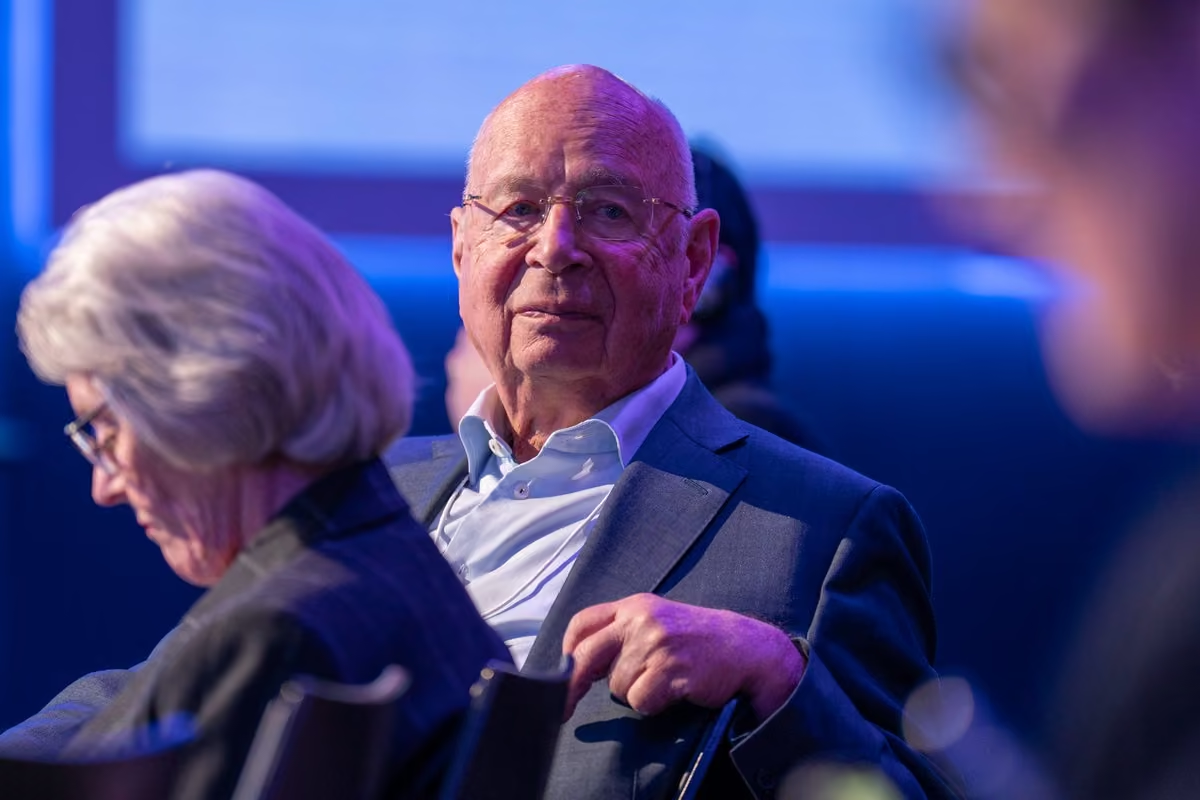
Reminiscing about the genesis of the stakeholder theory and the foundation of the World Economic Forum at the ETH Global Lecture Series in Zürich.
Klaus Schwab
Klaus Martin Schwab (German: [klaʊs ˈmaʁtiːn ʃvaːp]; born 30 March 1938) is a German mechanical engineer, economist, and founder of the World Economic Forum (WEF). He was the WEF's chairman from January 1971 until his resignation in April 2025. More on Wikipedia
-
Klaus Schwab
@ProfKlausSchwab
-
Klaus Schwab
@ProfKlausSchwab
I enjoyed speaking about ‘The Future of Universities' at my Alma Mater, the @ETH in Zurich and reminiscing about my time at the university 70 years ago.
This media couldn't be displayed. See it on the original post. -
Klaus Schwab
@ProfKlausSchwab
"Constructive optimism is neither blind faith nor forced cheerfulness. It is a deliberate choice of attitude, rooted in values and in a belief in human potential."
More in my book 'Restoring Truth and Trust':
➡️🔗books2read.com/Restoring-Truth-Trust/ #intelligentage -
Klaus Schwab
@ProfKlausSchwab
Using artificial intelligence is now common. Being transformed by it is not.
More in my latest book 'The Competitive Enterprise in the Intelligent Age':
➡️🔗books2read.com/Competitive-Enterprise #intelligentage -
Klaus Schwab
@ProfKlausSchwab
Concluding my Asia visit in Singapore🇸🇬
My discussions with Josephine Teo, Minister for Digital Development and Information and YGLs focused on technological transformation, responsible leadership and the opportunities and challenges of the #intelligentage. -
Klaus Schwab
@ProfKlausSchwab
In Singapore🇸🇬, continuing the dialogue on the future of knowledge and global decision-making in the #intelligentage with Prof. Tan Eng Chye and Prof. Susanna Leong of @NUSingapore and Prof. Christian Wolfrum of @NTUsg.
-
Klaus Schwab
@ProfKlausSchwab
Better decisions in the Intelligent Age come from connecting frontier knowledge with the experience of decision-makers. I discussed this in Hong Kong with business, financial and academic leaders. It is how we build a future based on truth and trust.
-
Klaus Schwab
@ProfKlausSchwab
Continuing the dialogue in Hong Kong with Young Global Leaders, Global Shapers and the wider leadership community. We spoke across generations about leadership and our shared responsibility for the future.
-
Klaus Schwab
@ProfKlausSchwab
Glad to be back in Hong Kong and renew long-standing friendships with political, business and financial leaders.
Valuable discussions on trust, international cooperation and the challenges facing the global economy. -
Klaus Schwab
@ProfKlausSchwab
Continuing the university discussions in Asia🌍 with President Teruo Fujii of the University of Tokyo and President Kohei Itoh of Keio University.
Exploring how universities can bring frontier knowledge closer to global decision-making in the #intelligentage. -
Klaus Schwab
@ProfKlausSchwab
Engaging with Young Global Leaders, Global Shapers and Social Entrepreneurs in Beijing🇨🇳
An inspiring exchange on leadership, responsibility and shaping the future. -
Klaus Schwab
@ProfKlausSchwab
Continuing the university visits in Asia 🌏
At @PKU1898, meeting with Professor Jiang Guohua, Vice Chair of the University Council, and at @Tsinghua_Uni, with President Li Luming.
Valuable exchanges on the role of universities in shaping the #intelligentage -
Klaus Schwab
@ProfKlausSchwab
Impressions from my lecture on “The Intelligent Era: From Technological Power to Global Responsibility” at the 47th China Foreign Affairs University (CFAU) Forum in Beijing 🇨🇳
This media couldn't be displayed. See it on the original post. -
Klaus Schwab
@ProfKlausSchwab
On a lecture series in Asia 🌏
First stop: the China Foreign Affairs University, addressing the 47th CFAU Forum on “The Intelligent Era: From Technological Power to Global Responsibility" and meeting with Yang Tao, of the Chinese People's Institute of Foreign Affairs (CPIFA). -
Klaus Schwab
@ProfKlausSchwab
The #intelligentage book series is a practical and comprehensive effort to help people, institutions, and societies prepare for what lies ahead.
This media couldn't be displayed. See it on the original post.
Klaus Schwab
@ProfKlausSchwab
The five-part book series is available from all major booksellers:
➡️🔗books2read.com/TheIntelligentAge
➡️🔗books2read.com/Longevity-Retirement
➡️🔗books2read.com/Restoring-Truth-Trust
➡️🔗books2read.com/Universities
➡️🔗books2read.com/Competitive-Enterprise
#intelligentage -
Klaus Schwab
@ProfKlausSchwab
In an age when change is the only constant, education is our society's insurance policy.
Nations no longer compete only on resources or capital. They compete on their capacity to learn.
Klaus Schwab
@ProfKlausSchwab
More in my book 'Universities, Professors, and Students in the Intelligent Age', available from all major booksellers.
➡️🔗 books2read.com/Universities #intelligentage -
Klaus Schwab
@ProfKlausSchwab
When leaders plan their AI strategy, talent is too often treated as an afterthought.
The biggest mistake leaders can make in the #intelligentage is treating talent as a secondary concern. It is not. It is the transformation.
Klaus Schwab
@ProfKlausSchwab
More in my book 'The Competitive Enterprise in the Intelligent Age':
➡️🔗books2read.com/Competitive-Enterprise #intelligentage -
Klaus Schwab
@ProfKlausSchwab
How we imagine retirement shapes how we experience it. Retirement should not be a period of mental retreat. It should be a period of intellectual expansion.
The years after work can be among the most curious, creative, and generative of our lives - if we choose to make them so.
Klaus Schwab
@ProfKlausSchwab
More in my book 'Longevity and Retirement in the Intelligent Age', available from all major booksellers.
➡️🔗books2read.com/Longevity-Retirement #intelligentage -
Klaus Schwab reposted
Klaus Schwab
@ProfKlausSchwab
Trust cannot be demanded, engineered, or bought. It is earned, slowly, through how we act.
Trust is the reward of virtue.
In an age of powerful machines, the oldest human qualities - honesty, integrity, character - matter more than ever. -
Klaus Schwab reposted
Klaus Schwab
@ProfKlausSchwab
What should our activities become in a world transformed by artificial intelligence? x.com/i/article/2105904849992712192
-
Klaus Schwab
@ProfKlausSchwab
Trust cannot be demanded, engineered, or bought. It is earned, slowly, through how we act.
Trust is the reward of virtue.
In an age of powerful machines, the oldest human qualities - honesty, integrity, character - matter more than ever.
Klaus Schwab
@ProfKlausSchwab
More in my book 'Restoring Truth and Trust', available from all major booksellers.
➡️🔗books2read.com/Restoring-Truth-Trust #intelligentage -
Klaus Schwab reposted
Klaus Schwab
@ProfKlausSchwab
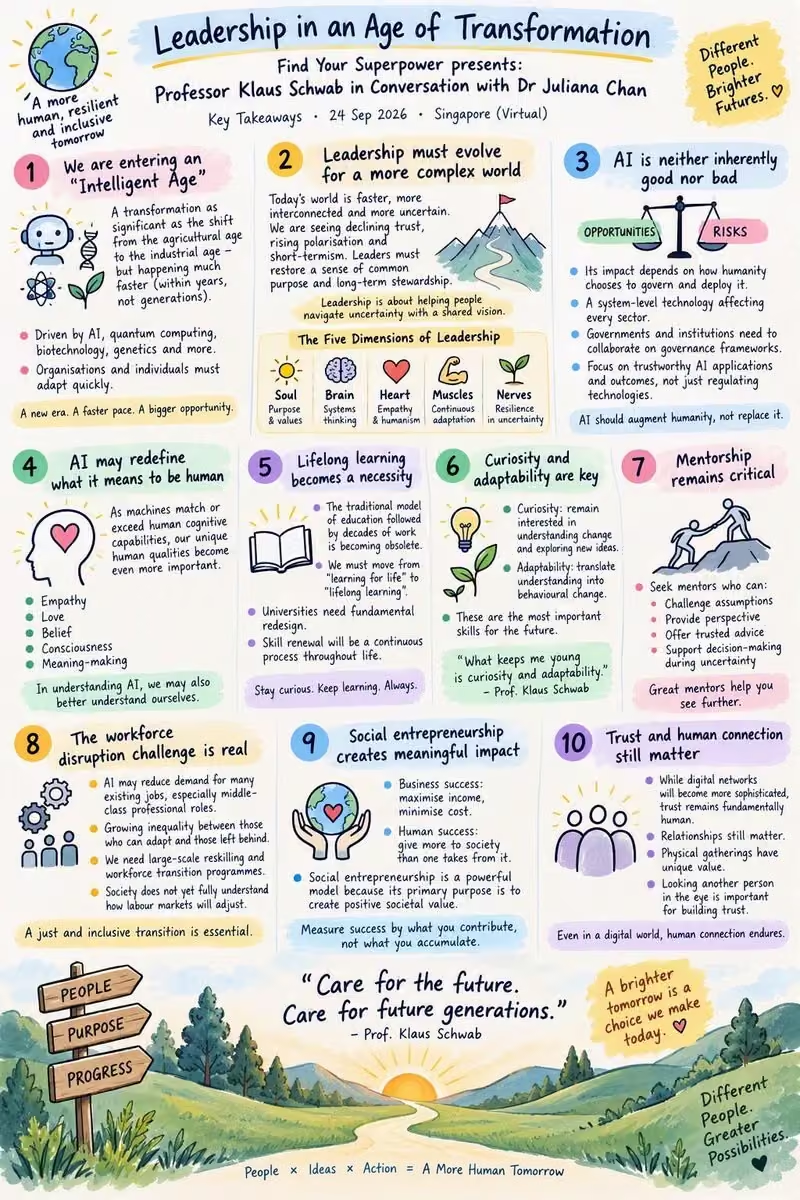
What keeps me young is curiosity and adaptability.
Check out this AI-generated summary of my fireside chat about 'Leadership in an Age of Transformation' with @JulianaChanPH. -
Klaus Schwab
@ProfKlausSchwab
What should our activities become in a world transformed by artificial intelligence? x.com/i/article/2105904849992712192
-
Klaus Schwab
@ProfKlausSchwab
What keeps me young is curiosity and adaptability.
Check out this AI-generated summary of my fireside chat about 'Leadership in an Age of Transformation' with @JulianaChanPH. -
Klaus Schwab
@ProfKlausSchwab
The bridges that matter most are the ones built before they become indispensable.
China Xinhua News
@XHNews
China is no longer only adapting to the institutions of the global system; it is increasingly seeking to contribute ideas and initiatives to the debate about how that system should evolve, Klaus Schwab, founder of the Geneva-based World Economic Forum, wrote in a column.
-
Klaus Schwab
@ProfKlausSchwab
Committed to China since 1979 - On the 20th anniversary of the @WEF's Beijing Office x.com/i/article/2104516391814451200
-
Klaus Schwab reposted
Klaus Schwab
@ProfKlausSchwab
In the Intelligent Age, the greatest strategic risk may not be failing to build enough. It may be building too much of the past while investing too little in the future. x.com/i/article/2102002312612880384
-
Klaus Schwab
@ProfKlausSchwab
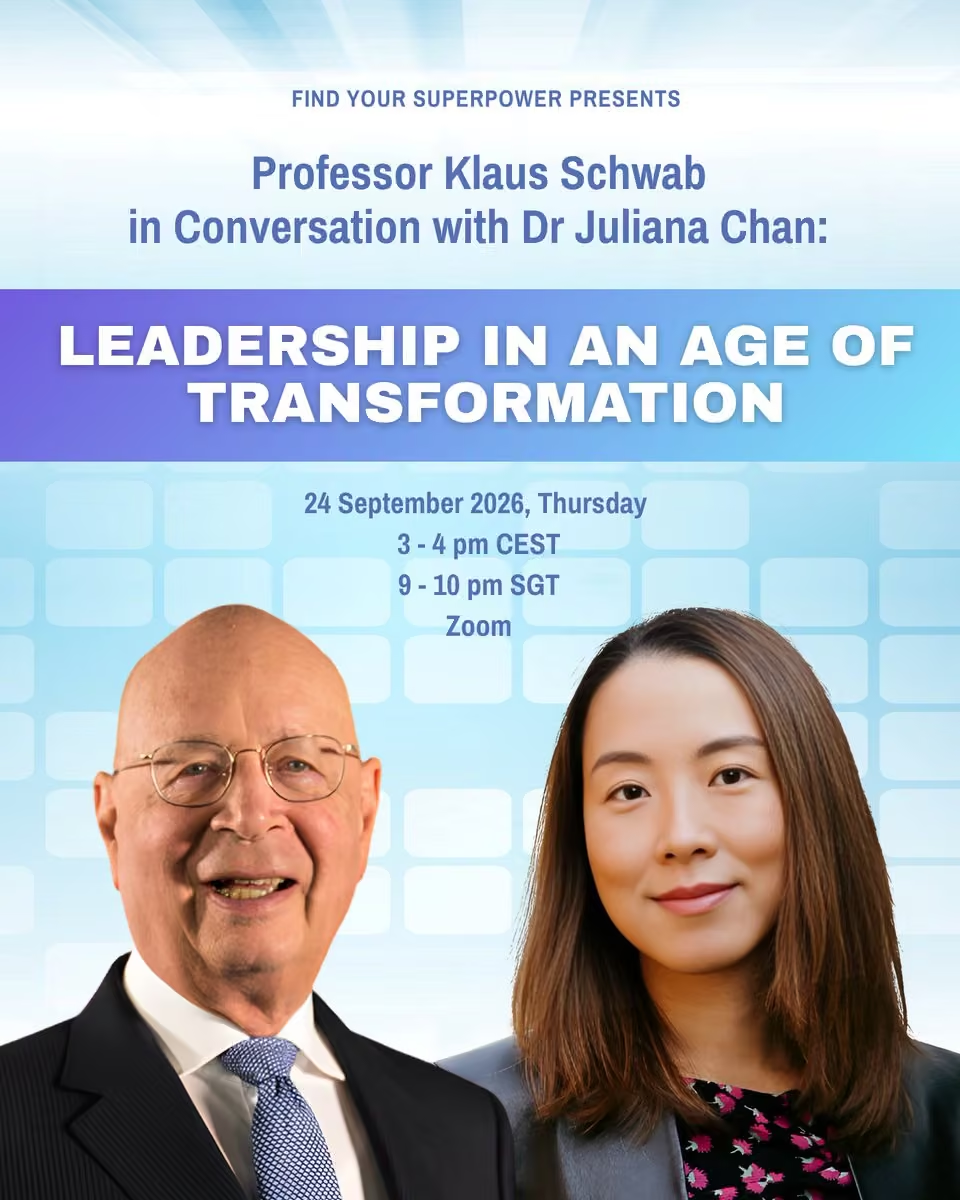
Looking forward to the fireside chat with @julianachanph tomorrow, Thursday 24.09.2026 at 15:00 CEST.
Please register on Zoom: ➡️🔗zoom.us/webinar/register/WN_lmFY8fEMShid9rJBKYMeSg -
Klaus Schwab
@ProfKlausSchwab
In the Intelligent Age, the greatest strategic risk may not be failing to build enough. It may be building too much of the past while investing too little in the future. x.com/i/article/2102002312612880384
Klaus Schwab
@ProfKlausSchwab
More in my book 'The Competitive Enterprise in the Intelligent Age'.
➡️🔗 books2read.com/Competitive-Enterprise #intelligentage -
Klaus Schwab reposted
Klaus Schwab
@ProfKlausSchwab
Knowledge used to be what universities gave you.
Now it's at your fingertips.
So what are universities for?
My answer, 32 years into teaching: stop lecturing.
Start curating. Turn students into co-creators of knowledge, not recipients of it.This media couldn't be displayed. See it on the original post. -
Klaus Schwab
@ProfKlausSchwab
Knowledge used to be what universities gave you.
Now it's at your fingertips.
So what are universities for?
My answer, 32 years into teaching: stop lecturing.
Start curating. Turn students into co-creators of knowledge, not recipients of it.This media couldn't be displayed. See it on the original post.
Klaus Schwab
@ProfKlausSchwab
More in my book 'Universities, Professors, and Students in the Intelligent Age', now for only US$2.99 on Amazon.
➡️🔗www.amazon.com/dp/B0GT1F3HQY
#intelligentage -
Klaus Schwab reposted
Klaus Schwab
@ProfKlausSchwab
We are building machines of extraordinary intelligence. The question is what will guide that intelligence.
It is wisdom that must guide intelligence.
More in 'Thriving and Leading in the Intelligent Age':
➡️🔗books2read.com/TheIntelligentAge #intelligentage -
Klaus Schwab
@ProfKlausSchwab
We are building machines of extraordinary intelligence. The question is what will guide that intelligence.
It is wisdom that must guide intelligence.
More in 'Thriving and Leading in the Intelligent Age':
➡️🔗books2read.com/TheIntelligentAge #intelligentage -
Klaus Schwab
@ProfKlausSchwab
Many leaders believe the path to an intelligent enterprise runs through buying the right technology.
It does not.
The intelligent enterprise is built, not bought. Models matter, but operating design matters more.
➡️🔗books2read.com/Competitive-Enterprise #intelligentage
Schwab Academy
@SchwabAcademy
"Many leaders believe the path to an intelligent enterprise runs through buying the right technology. It does not.
The intelligent enterprise is built, not bought. Models matter, but operating design matters more." - @ProfKlausSchwab
➡️🔗 books2read.com/Competitive-Enterprise #intelligentage -
Klaus Schwab reposted
Klaus Schwab
@ProfKlausSchwab
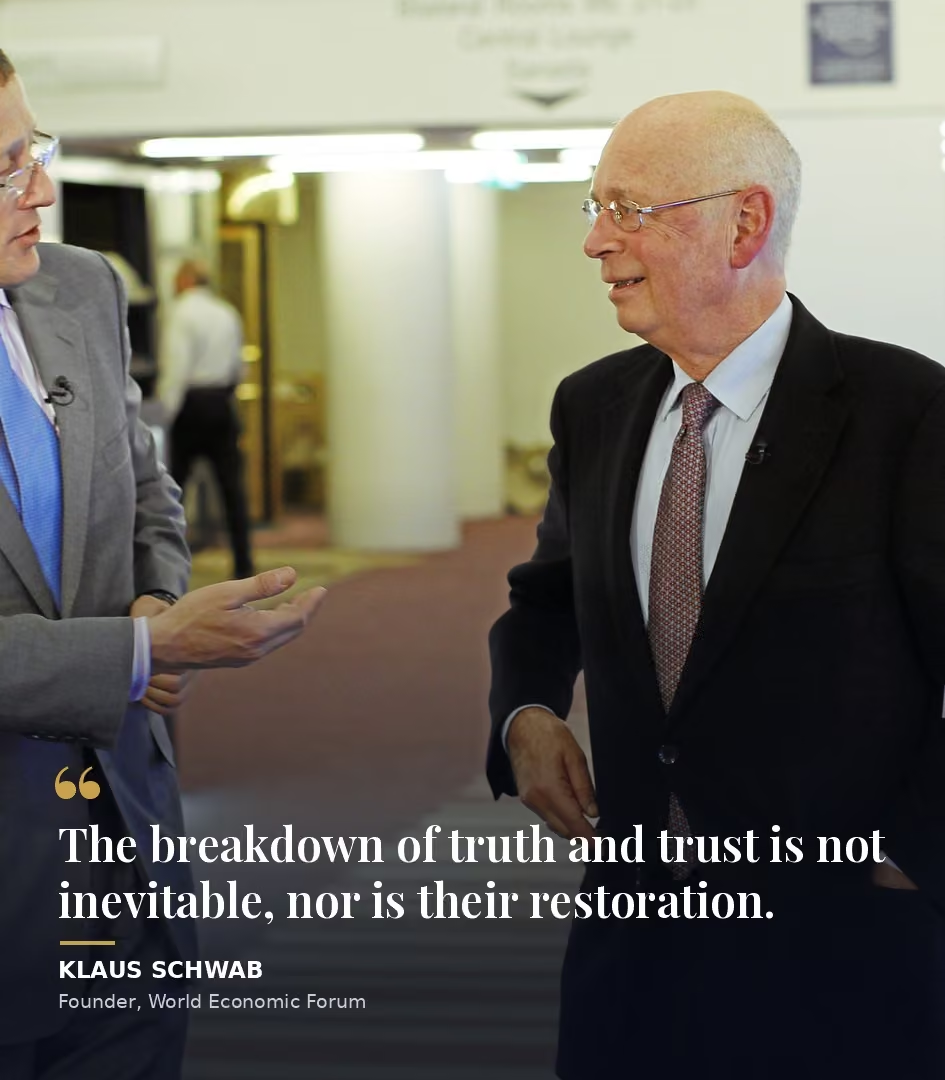
It is tempting to see the erosion of truth and trust as an unstoppable tide. It is not.
The breakdown of truth and trust is not inevitable, nor is their restoration.
More in my book 'Restoring Truth and Trust':
➡️🔗books2read.com/Restoring-Truth-Trust #intelligentage
Schwab Academy
@SchwabAcademy
"It is tempting to see the erosion of truth and trust as an unstoppable tide. It is not. The breakdown of truth and trust is not inevitable, nor is their restoration." - @ProfKlausSchwab
-
Klaus Schwab reposted
Klaus Schwab
@ProfKlausSchwab
We have built our institutions around the idea that life winds down at a fixed age. That idea is now out of date. 65 can be not an end but a new beginning.
More in my book 'Longevity and Retirement in the Intelligent Age':
➡️🔗books2read.com/Longevity-Retirement #intelligentage
Schwab Academy
@SchwabAcademy
"We have built our institutions around the idea that life winds down at a fixed age. That idea is now out of date. 65 can be not an end but a new beginning." - @ProfKlausSchwab
More in his book 'Longevity and Retirement in the Intelligent Age':
➡️🔗books2read.com/Longevity-Retirement -
Klaus Schwab
@ProfKlausSchwab
It is tempting to see the erosion of truth and trust as an unstoppable tide. It is not.
The breakdown of truth and trust is not inevitable, nor is their restoration.
More in my book 'Restoring Truth and Trust':
➡️🔗books2read.com/Restoring-Truth-Trust #intelligentage
Schwab Academy
@SchwabAcademy
"It is tempting to see the erosion of truth and trust as an unstoppable tide. It is not. The breakdown of truth and trust is not inevitable, nor is their restoration." - @ProfKlausSchwab
-
Klaus Schwab
@ProfKlausSchwab
Most companies now use artificial intelligence.
Far fewer have been changed by it.
Adoption is not the same as advantage.
More in my book 'The Competitive Enterprise in the Intelligent Age':
➡️🔗books2read.com/Competitive-Enterprise #intelligentage
Schwab Academy
@SchwabAcademy
Most companies now use artificial intelligence.
Far fewer have been changed by it.
Adoption is not the same as advantage.
The competitive question is no longer whether a company is using AI, but whether it is redesigning itself around intelligence faster than its competitors. -
Klaus Schwab
@ProfKlausSchwab
Can Corporations Survive the Age of AI? x.com/i/article/2081660497204543488
-
Klaus Schwab
@ProfKlausSchwab
How should we govern technologies that change faster than our institutions can legislate?
Traditionally, regulation has been like steering a large ship: slow and deliberative. In the Intelligent Age, we need it to be more like riding a surfboard: keeping balance on fast-moving waves.
This does not mean less governance. It means governance that learns as quickly as the systems it oversees.
More in my book 'Restoring Truth and Trust', available from all major booksellers: ➡️🔗 books2read.com/Restoring-Truth-Trust #intelligentage -
Klaus Schwab
@ProfKlausSchwab
We are entering an age that will reshape economies, institutions, and daily life.
We must not enter the #intelligentage sleepwalking. We must enter it with awareness, wisdom, and courage.
More in 'Thriving and Leading in the Intelligent Age':
➡️🔗books2read.com/TheIntelligentAge -
Klaus Schwab
@ProfKlausSchwab
Everything in the #intelligentage rests on two pillars.
Without truth, we lose our shared reality. Without trust, we lose our ability to act together. Restoring them is the defining governance challenge of our time.
➡️My book Restoring Truth and Trust:
🔗books2read.com/Restoring-Truth-Trust -
Klaus Schwab
@ProfKlausSchwab
What makes a nation competitive in the Intelligent Age?
Nations are no longer competing only on natural resources, manufacturing strength, or financial capital. They are increasingly competing on their capacity to learn, adapt, and innovate.
That is why the transformation of our universities is not an educational question alone, it is a question of national competitiveness.
More in my book 'Universities, Professors, and Students in the Intelligent Age', available from all major booksellers:
➡️🔗books2read.com/Universities #intelligentage -
Klaus Schwab
@ProfKlausSchwab
Every era of business has demanded a different organizing principle.
The industrial firm was built to standardize.
The digital firm was built to connect.
The intelligent firm must be built to adapt.
My latest book: ➡️🔗books2read.com/Competitive-Enterprise #intelligentage -
Klaus Schwab
@ProfKlausSchwab
They say a person's best years are behind them after a certain age. I believe this is one of the great falsehoods of our time.
➡️More in my book 'Longevity and Retirement in the Intelligent Age', available from all major booksellers. 🔗books2read.com/Longevity-Retirement #intelligentage -
Klaus Schwab
@ProfKlausSchwab
What makes an effective leader in the Intelligent Age?
Leadership must integrate five essential capacities: the soul, the brain, the heart, the muscles, and the nerves.
More in my book' Thriving and Leading in the Intelligent Age'
➡️🔗books2read.com/TheIntelligentAgeThis media couldn't be displayed. See it on the original post. -
Klaus Schwab
@ProfKlausSchwab
After more than 50 years of convening leaders to shape a better future, I am bringing that conversation to Instagram.
➡️Follow along for the journey: instagram.com/ProfKlausSchwab -
Klaus Schwab
@ProfKlausSchwab
If you want to be competitive keep the system in mind and the system has to be adaptive and innovative.
My latest book about ‘The Competitive Enterprise in the Intelligent Age’ is out now.
➡️🔗books2read.com/Competitive-Enterprise #intelligentageThis media couldn't be displayed. See it on the original post. -
Klaus Schwab
@ProfKlausSchwab
The shift to the #intelligentage is fundamentally changing how companies compete. Advantage is no longer defined by digital transformation or scale but by how deeply intelligence is embedded into every decision, workflow, and operating model.
➡️🔗books2read.com/Competitive-EnterpriseThis media couldn't be displayed. See it on the original post. -
Klaus Schwab
@ProfKlausSchwab
Can Corporations Survive the Age of AI?
Read my latest article in @TIME which coincides with the launch of my new book 'The Competitive Enterprise in the Intelligent Age.
➡️🔗time.com/article/2026/07/01/can-corporations-survive-the-… #intelligentage -
Klaus Schwab
@ProfKlausSchwab
-
Klaus Schwab
@ProfKlausSchwab
Artificial intelligence is transforming how knowledge is created, validated, and shared. Universities must therefore rethink their mission, moving beyond episodic education toward lifelong learning.
📘My book, Universities, Professors and Students in the Intelligent Age is now available on @Amazon for only US$2.99. ➡️🔗a.co/d/0eYGrd8j -
Klaus Schwab
@ProfKlausSchwab
The World Economic Forum Must Remain True to Its Mission
Will the World Economic Forum @WEF remain a mission-driven institution for public-private cooperation, or will it become a prestigious conference and networking enterprise?
The future of the World Economic Forum will not depend solely on how many heads of state and government come to its Annual Meeting in Davos, how much media attention it continues to attract, or how successful its corporate partnerships are. A deeper question is at stake: will the Forum remain a mission-driven institution or will it gradually evolve into a brand-driven organization?
This question has become particularly urgent today. International institutions are under increasing pressure. Geopolitical tensions are rising; technological transformations are reshaping economies and societies; and trust in elites, corporations, and public institutions has weakened in many parts of the world. At such a moment, an organization like the Forum must not appear to be just another global platform. Trust has become the scarcest resource in international cooperation.
Trust and Responsibility
For more than fifty years, the World Economic Forum has been guided by a mission: to improve the state of the world by creating a new form of international cooperation. It has brought together representatives of government, business, academia, civil society, and culture, and later included social entrepreneurs and young leaders. The Forum was never conceived merely as a conference. It was designed as a platform of responsibility.
The Forum’s brand became strong because its mission was strong. It earned trust because it was perceived as an institution serving a purpose greater than itself. Leaders came to Davos not only to be seen but to contribute. Companies participated not only to expand their networks but also to deepen their understanding of their broader responsibilities to society. Governments used the Forum as a place to exchange perspectives in a broader, more informal, and future-oriented environment.
This mission-driven orientation was not simply a matter of culture. It was also the foundation upon which the Forum achieved a unique status: recognition as an international organization for public-private cooperation. This status was not granted because the Forum had become a well-known brand. It was earned because the Forum demonstrated over decades that it serves the public interest, operates as a neutral platform, and complements existing international institutions wherever governments, business, and civil society must act together.
To safeguard this mission institutionally, a governance structure was created. Leaders of governments, international organizations, academia, business, and civil society were not just participants in individual events; they were intended to serve on the Board of Trustees as stewards of the Forum’s oversight and strategic direction. This broad institutional representation distinguished the Forum from a conference organizer or a corporate network. It ensured that the Forum would not be driven by business interests or a particular ideology but could fulfill its mandate as an impartial international organization dedicated to public-private cooperation.
This is also where the Forum’s close connection to Switzerland originates. The Forum was able to develop in Geneva and Davos because it reflected fundamental Swiss values: neutrality, reliability, discretion, bridge-building, dialogue across divides, and responsibility toward the common good. Switzerland is not a place for demonstrations of power; it is a place for mediation. The Forum gained international credibility because it embodied these values.
A brand-driven organization, however successful it may be, does not possess the same credibility, neutrality, and institutional independence. A brand can attract attention, create visibility, and open doors. But a brand alone does not create legitimacy. Legitimacy arises from mission, consistency, independence, and the perception that an institution serves a purpose greater than itself.
For the Forum, this is not merely a philosophical distinction. It is an institutional one. The Forum’s special status and the privileges associated with it were not granted to a brand; they were granted to an institution with a public mission. They rest on neutrality, multistakeholder legitimacy, mission orientation, and a demonstrable contribution to international cooperation.
If the Forum loses this character and develops into a purely brand-driven organization, it will not only lose cultural substance. It will also undermine the very foundation of the special recognition that distinguishes it from ordinary global platforms.
The Cultural Difference
Every successful institution faces this danger. In its early years, people join an organization because they believe in its purpose and want to be part of something meaningful. But when an institution becomes successful, visible, and prestigious, a different motivation can emerge. People may no longer join primarily to serve the institution but to use it, as a platform for personal visibility, career advancement, and future opportunities.
This is the cultural difference between a mission-driven organization and a brand-driven one. In the former, people ask: What can I contribute? In the latter, they ask: What can this institution do for me?
In the former, leadership is stewardship. In the latter, leadership becomes positioning. In the former, the long-term public interest remains the ultimate point of reference. In the latter, image, influence, and short-term advantage gain increasing weight.
From the outside, the two cultures may appear similar. Both use the language of purpose. Both publish reports, organize events, and discuss global challenges. Internally, however, they are fundamentally different. One culture places the brand in service of the mission. The other uses the mission to protect the brand.
For the World Economic Forum, this distinction is existential. The Forum does not possess the legitimacy of a state, the authority of a treaty-based organization, or the democratic mandate of an elected institution. Its legitimacy has always rested on trust: trust in its neutrality, its independence, its long-term orientation, and its commitment to the public interest.
In a world marked by geopolitical fragmentation, technological disruption, and social polarization, such trust is more necessary than ever. The challenges posed by artificial intelligence, climate change, cyber threats, biotechnology, social inequality, and demographic transformation cannot be addressed by governments acting alone, nor by businesses, universities, or civil society acting in isolation. The need for a credible multistakeholder platform is not diminishing. It is growing.
For this very reason, it would be dangerous to measure the success of the Forum solely in terms of visibility, reach, or brand strength. If the Forum becomes primarily a stage for corporate positioning, political signaling, media exposure, or institutional self-interest, it may continue to be successful for a long time. The Annual Meeting in Davos will still attract leaders. The brand will remain strong. Financial reserves may remain solid. Yet the Forum would gradually become ordinary: one global platform among many.
The greatest risk facing the Forum is therefore not its disappearance. Its brand, network, and history are too strong for that. The greater risk is a gradual transformation: from a trusted institution for public-private cooperation into a prestigious conference and networking enterprise.
The future of the Forum depends on whether its leadership, governing bodies, members, partners, and employees understand that the brand is not the purpose. The decisive question is not whether the Forum will remain famous. It will. The question is whether it will remain necessary, and whether it will continue to deserve its special status and the privileges that accompany it.
If the Forum renews its mission, protects its independence, strengthens its multistakeholder character, and attracts people who wish to serve rather than exploit it, its future can be greater than its past. If, however, it becomes merely a brand, it may retain the name, the stage, and the visibility, but lose the spirit that made it unique.
The choice is simple, yet consequential: the Forum can remain a mission that created a brand. Or it can become a brand searching for a mission.
-------------------------
This guest commentary was first published in the Neue Zürcher Zeitung @NZZ "Bei der Zukunft des World Economic Forum muss es um die Mission gehen, nicht um die Marke, schreibt der Gründer" ➡️🔗www.nzz.ch/meinung/die-zukunft-des-world-economic-forum-e… -

Klaus Schwab
@ProfKlausSchwab
It was a pleasure speaking with Ira Pastor @irat1onal and explain the notion of the #intelligentage on his podcast Progress, Potential and Possibilities @ProgressPotent1.
This media couldn't be displayed. See it on the original post. -
Klaus Schwab
@ProfKlausSchwab
The need for ongoing global dialogue
The G7 and G20 remain important. But they are no longer enough. They were created for a world in which governments and in particular the largest economies could still claim to represent the decisive centres of power. That world has changed.
In the age of intelligence, power is now distributed. Governments set the rules, but it is businesses that drive innovation and investment. Scientists create knowledge. Civil society provides legitimacy. Younger generations articulate the demands of the future. International organisations ensure continuity and institutional memory.
The major challenges of our time - artificial intelligence, climate change, cybersecurity, public health, debt, migration and social cohesion - are no longer separate issues. They constitute systemic transformations. They cannot be managed through annual summits, pre-prepared communiqués and diplomatic choreography.
Artificial intelligence (AI) illustrates this shortcoming with particular clarity. It is not enough to invite the heads of major technology companies to Évian or elsewhere for a few hours, and then consider the matter to have been dealt with politically. AI will transform competitiveness, employment, education, security, democracy and human dignity. It requires an ongoing dialogue between governments, technology sector leaders, scientists, ethicists, educators, investors, workers, civil society and younger generations.
What the world needs is a new framework for global dialogue: interdisciplinary, multi-stakeholder and continuous.
Interdisciplinary, because no critical issue now falls within the remit of a single ministry or academic discipline. Multi-stakeholder, because no single actor possesses all the tools needed to provide solutions. Continuous, because technologies evolve in a matter of weeks, markets shift in a matter of seconds and crises cross borders overnight.
New technologies can help make such a dialogue possible. Digital platforms and artificial intelligence can link fragmented knowledge, detect emerging risks earlier, bridge language and cultural divides, and broaden participation. Used responsibly, they can transform global dialogue from an occasional event into a permanent system of collective learning.
But such a platform will only be credible if it is independent, impartial and free from any particular interest. It must not be the instrument of any government, economic group, technology sector or ideology.
This is not an argument against the G7 or the G20. It is a recognition that they must be complemented by a broader platform.
In a fragmented world, trust will become the most valuable form of capital. It is built through repeated, serious and structured engagement between those who do not always agree, but who recognise that they share a common global future.
The era of summit diplomacy must give way to that of continuous cooperation. This is the new realism of responsible global leadership.
-------------------------
This article was originally published in French in the Tribune de Genève : www.tdg.ch/g7-klaus-schwab-appelle-a-repenser-la-gouverna…. -
Klaus Schwab
@ProfKlausSchwab
Honoured to have been speaking with Professor @LgMpedi, of the University of Johannesburg @go2uj about my latest book Universities, Professors and Students in the Intelligent Age.
The ebook is currently on special offer for only US$2.99 on Amazon
➡️📘a.co/d/0j47CKKUThis media couldn't be displayed. See it on the original post. -
Klaus Schwab
@ProfKlausSchwab
-
Klaus Schwab
@ProfKlausSchwab
"Over the past years already we had the tendency to abdicate decision-making to experts. Now we abdicate our decision-making to algorithms."
Watch my conversation with @EdieLush & @MichaelOreskes about the #intelligentage.
➡️🔗weareallgoingtodie.substack.com/p/klaus-schwab-and-the-en…This media couldn't be displayed. See it on the original post. -
Klaus Schwab
@ProfKlausSchwab
‘Intelligent life’ redefined – where does this leave humans?
➡️🔗www.moneyweb.co.za/news/south-africa/intelligent-life-red… - @Moneyweb #intelligentage -
Klaus Schwab
@ProfKlausSchwab
«We need an international trust seal for artificial intelligence» - My message at the #digitalswitzerland summit in Andermatt🇨🇭
-
Klaus Schwab
@ProfKlausSchwab
-
Klaus Schwab
@ProfKlausSchwab
Live🚨
Speaking about ‘The Intelligent Age and the Responsibility of African Leadership’ at the University of Johannesburg @go2uj 🇿🇦
University of Johannesburg
@go2uj
Public Lecture by Prof Klaus Schwab x.com/i/broadcasts/1yGBeepOgynKN
-
Klaus Schwab
@ProfKlausSchwab
Looking forward to speaking about ‘The Intelligent Age and the Responsibility of African Leadership’ at the University of Johannesburg @go2uj 🇿🇦
👀Watch it live
📅 Friday, 29 May 2026 🕒 15:00
📽️youtube.com/watch?v=xlJUcZlsuEE
#intelligentage -
Klaus Schwab
@ProfKlausSchwab
I will be speaking about my new book: ‘Universities, Professors, and Students In The Intelligent Age’ at the University of Johannesburg.
📅 Friday, 29 May 2026 🕞 15:30
📽️ youtube.com/watch?v=xlJUcZlsuEE #intelligentage -
Klaus Schwab
@ProfKlausSchwab
It was a pleasure speaking to the students and faculty at @BTUuniversity in Tbilisi🇬🇪 about my latest book 'Universities, Professors and Students in the Intelligent Age'
➡️🔗books2read.com/Universities/
დიდი მადლობა! -
Klaus Schwab
@ProfKlausSchwab
-
Klaus Schwab
@ProfKlausSchwab
Wondering how I use #ai?
👀Watch my conversation with @BeniFisch at the @SwissMediaForum 2026 in Lucerne🇨🇭This media couldn't be displayed. See it on the original post. -
Klaus Schwab
@ProfKlausSchwab
I had the pleasure of speaking about the transformative power of #ai at the @SwissMediaForum in Luzern.
-
Klaus Schwab
@ProfKlausSchwab
“The #intelligentage is young, and we are all its students. With the right principles to guide us – truth, trust, responsibility, and an unwavering respect for human dignity. I am confident we can master it to create a better future.”
⬇️🔗books2read.com/Restoring-Truth-Trust/ -
Klaus Schwab
@ProfKlausSchwab
“Learning will change in a revolutionary way. Instead of learning for life, we will have to transfer to a system which is dictated by lifelong learning.”
Get my latest book ➡️🔗books2read.com/Universities #intelligentageThis media couldn't be displayed. See it on the original post. -
Klaus Schwab
@ProfKlausSchwab
“Lifelong learning is no longer just a slogan for students; it’s a job description for professors.”
➡️🔗books2read.com/Universities #intelligentageThis media couldn't be displayed. See it on the original post. -
Klaus Schwab
@ProfKlausSchwab
Universities Must Reinvent Themselves for the Intelligent Age
My latest essay in @TIME
➡️🔗 time.com/article/2026/04/13/universities-must-reinvent-th… #intelligentage -
Klaus Schwab
@ProfKlausSchwab
What should universities look like in the age of AI and constant change?
My latest book Universities, Professors and Students in the Intelligent Age is now available as a FREE eBook download for a limited time only.
➡️🔗books2read.com/UniversitiesThis media couldn't be displayed. See it on the original post. -
Klaus Schwab
@ProfKlausSchwab
Mastering AI is not about technology. It’s about lifelong learning. Knowledge is expiring faster than ever. Those who learn fastest will lead. Download my latest book for free from April 13-15.
➡️🔗books2read.com/UniversitiesThis media couldn't be displayed. See it on the original post. -
Klaus Schwab
@ProfKlausSchwab
The transition from the Digital Age to the Intelligent Age is not just another tech cycle. It is a true quantum leap in a completely new civilization.
My interview with @MarcKowalsky in @Bilanz
French➡️🔗 www.pme.ch/dossiers-et-hors-series/digital-shapers-2026-i…
German➡️🔗 www.bilanz.ch/digital-shapers/kuenstliche-intelligenz-kla… -
Klaus Schwab
@ProfKlausSchwab
Retirement Is a Strategic Mistake - Unless We Redesign Life for the Intelligent Age
History will look back at our time and ask a simple question: How could humanity extend life so dramatically—yet fail to redesign the way we live accordingly?
We are going through one of the most profound transformations in human history. Artificial intelligence is reshaping industries. Digital platforms are reorganizing power. Entire sectors are being reinvented. Yet the most revolutionary development is neither technological nor geopolitical. It is demographic.
For the first time in the history of human civilization, a large share of humanity will live close to a century. Longevity is not merely a medical achievement. It is a structural shift in the human condition. And yet, we continue to organize life according to a model designed for a 70-year or shorter lifespan.
Education, career, retirement—that’s how we think about life. Three stages. Yet strides in longevity have made his model is obsolete.
In our rapidly changing world, we must recognize that intelligence is not only artificial; it must also be societal. We must apply systemic thinking to the architecture of life itself. A 100-year life cannot be compressed into a front-loaded education, a 40-year career sprint, and three decades of passive withdrawal.
Retirement, as traditionally defined, is not a reward. It is a design flaw.
The deeper issue is not financial sustainability—although that matters. The deeper issue is human dignity and purpose. Work has never been merely an economic activity. It provides identity, structure, belonging, and contribution. When individuals cross an arbitrary age threshold and are expected to step aside, society signals that relevance has an expiration date.
Now, that relevance should expand—not contract—with experience.
As machines assume routine tasks, human comparative advantage shifts toward judgment, ethical discernment, creativity, and wisdom. These capacities often mature over time. The later decades of life may become the most strategically valuable, not the least.
This demands a new life model.
Instead of three stages, we need multi-stage lives. Education cannot be confined to youth; it must recur throughout life. Reinvention must be normalized. Contribution must evolve, not cease. The additional decades of longevity must be structured as phases of renewal—periods where individuals redesign their role in society.
Governments must rethink pension systems not simply as transfer mechanisms but as platforms enabling active participation. Corporations should replace abrupt retirement with phased transitions, advisory roles, and intergenerational collaboration models. Universities must become lifelong institutions, welcoming the 70-year-old learner as naturally as the 20-year-old student.
Most importantly, individuals must embrace reinvention as a mindset. In a world of continuous technological change, adaptability is not optional—it is existential.
Health becomes central in this framework. Longevity without vitality is not progress. Our current age—what I call the Intelligent Age—requires integrated thinking: physical health, cognitive resilience, emotional balance, and purposeful engagement form one coherent system.
There is also a societal dimension that is frequently overlooked. In times of disruption, societies require continuity. Experience anchors transformation. Intergenerational collaboration—combining youthful experimentation with seasoned judgment—creates resilience.
Retirement must shift from retreat to renewal.
Longevity gives us time. The Intelligent Age gives us tools. What remains is leadership—the courage to rethink deeply embedded assumptions about life’s trajectory.
We are not merely extending lifespan. We are redefining the human lifecycle.
If we design wisely, the final decades of life will not be a period of decline but a stage of synthesis—where experience, reflection, and purpose converge.
In the #intelligentage, the most meaningful contributions may come not at the beginning of life—but at its renewed horizon.
This editorial appeared original in @TIME Magazine ➡️🔗time.com/7381776/retirement-is-a-strategic-mistake/
Klaus Schwab
@ProfKlausSchwab
My book ‘Longevity and Retirement in the Intelligent Age’ is available from all major online booksellers. ➡️🔗books2read.com/Longevity-Retirement
-
Klaus Schwab
@ProfKlausSchwab
-
Klaus Schwab
@ProfKlausSchwab
"We have to get rid of the word 'old'! We have to redefine what aging really means."
Listen to my fireside chat with Dr. Avinash Jayaswal about my book 'Longevity and Retirement in the Intelligent Age'
➡️🔗books2read.com/Longevity-Retirement
Avinash Jayaswal, MD MBS
@avinstud
New episode release w/ Pr. Schwab, former Chairman of the WEF open.spotify.com/episode/750EXhoFCa5phVijgfug7e
-
Klaus Schwab
@ProfKlausSchwab
What will universities look like in the age of artificial intelligence?
We are entering a transformation that reaches far beyond educational reform. The Intelligent Age, shaped by artificial intelligence, exponential technologies, and deep societal change, questions the very purpose of universities, the role of professors, and the expectations placed on students. It challenges not only how we teach but why we educate.
Higher education stands at a decisive moment. Universities can help societies master the Intelligent Age, or risk losing relevance and public trust. What is at stake is not only employability or institutional prestige but the capacity of societies to preserve truth, cultivate judgment, and sustain human and democratic values in a technology-driven world.
The book 'Universities, Professors and Students in the Intelligent Age' is written from a clear conviction: incremental adjustments are no longer sufficient. Artificial intelligence is transforming how knowledge is created, validated, and shared. Universities must therefore rethink their mission, moving beyond episodic education toward lifelong learning, interdisciplinary integration, and responsibility toward society.
The perspective offered here is shaped by my own path as a professor and by decades of close engagement with universities worldwide, as well as by my work in building and leading global institutions. It also draws on my reflections in 'Restoring Truth and Trust in the Intelligent Age', arguing that technological progress must be accompanied by a renewed commitment to truth, responsibility, and institutional integrity.
Yet the central challenge of the Intelligent Age is not technological; it is human. Our ability to compute and optimize has advanced faster than our ability to contextualize, exercise judgment, and act responsibly. Professors must increasingly serve as mentors and ethical guides; students must become active co-creators of their learning; universities must reclaim their role as institutions of wisdom and public purpose.
The book speaks not only to academic leaders, professors, and students but also to parents, policymakers, business leaders, and citizens. The future of innovation, social cohesion, and democratic resilience depends on how higher education evolves.
‘Universities, Professors and Students in the Intelligent Age’ is available from all major online booksellers: ➡️🔗books2read.com/Universities
#intelligentage -
Klaus Schwab
@ProfKlausSchwab
Honoured to be the guest of @Bilanz Business Talk with Dirk Schutz to be airing on Swiss television SRF1 this Sunday 15.03. at 13:00.
➡️🎥 www.srf.ch/play/tv/sendung/bilanz-standpunkte?id=c5890634…
Klaus Schwab
@ProfKlausSchwab
"Let's replace the notion of 'Age' with 'Fit'"
➡️Watch the full 50-minute interview
🎥www.srf.ch/play/tv/bilanz-standpunkte/video/wef-und-wahrh…This media couldn't be displayed. See it on the original post. -
Klaus Schwab
@ProfKlausSchwab
"We need a neutral platform."
I discussed the future of the @WEF in @DavosKlosters and the @SchwabAcademy with Swiss daily @NZZ. Link below⬇️
NZZ
@NZZ
Um den Standort Schweiz zu sichern, plädiert Schwab dafür, das wertvolle Grundstück am Hauptsitz in Cologny bei Genf der öffentlichen Hand zu schenken. Von der schweizerischen Stiftungsaufsicht möchte er wissen, was seine Rechte als Stifter sind. www.nzz.ch/wirtschaft/wef-gruender-klaus-schwab-ich-hoffe…
-
Klaus Schwab
@ProfKlausSchwab
The Five Dimensions of Effective Leadership
We live in an era some call a “polycrisis,” with multiple crises cascading and public trust in leadership at a historic low.
People around the world are sceptical of political leaders, business leaders, even religious and community leaders, often with good reason.
Scandals, broken promises, and widening divides have left many feeling that those in power are not worthy of their trust.
And yet, paradoxically, this is exactly when we need better leadership, leaders capable of uniting people to tackle climate change, navigate technological disruption, and heal social fractures. So, the challenge is clear: how can leaders personally embody truth and trust, and how can they institutionalize those values in their organizations and nations?
I have developed my own concept to define what makes a leader in our fast-moving, complex world. It’s a personal shorthand of five elements that help me ensure I’m considering the whole leader, not just one aspect. The dimensions below highlight qualities such as humility, courage, and the responsible stewardship of power.
Soul: The soul of leadership represents purpose and values. It is the moral compass and the depth of character that a leader brings to their role. A leader with “soul” has a clear sense of why they lead, a mission beyond self-interest, and a grounding in ethical principles.
Brain: The brain of leadership stands for intellect and vision. A leader must make sense of complexity and chart a clear course of action. In the Intelligent Age, this quality is more important than ever; the world is awash in data and intricacy, and people look to leaders to synthesize information into wisdom.
Heart: The heart of leadership is empathy and emotional intelligence. It is the quality that enables a leader to connect with people, to feel what they feel, and to earn genuine loyalty. Leaders with “heart” demonstrate compassion. They show that they care about their people’s struggles and dreams.
Muscle: The muscle of leadership refers to drive, action, and execution power. This is the ability to get things done, to turn visions into reality through hard work, influence, and effective management. A leader may have a brilliant plan and noble intentions, but they need muscle to implement them. In part, muscle is about personal stamina and perseverance. Leadership is often a marathon not a sprint, and it demands a certain toughness. But it’s also about the savvy use of resources and authority.
Nerves: The nerves of leadership represent courage and calm under pressure. This is the aspect of leadership that allows one to face fears, make tough calls, and stand firm in crises. It is often in moments of great adversity that true leadership is revealed. Having “nerves” means a leader can handle stress and make decisions even when the outcome is uncertain or the popular opinion is against them. It also encompasses boldness, the willingness to take risks for a worthy cause.
These five dimensions – soul, brain, heart, muscle, and nerves – are like the anatomy of leadership excellence.
Of course, no individual is perfectly balanced across them all and different situations may call for one more than the others. But I encourage emerging leaders to reflect through this lens and consider whether they are developing all these aspects of themselves. It’s a reminder that leadership is multifaceted: it requires moral depth, sharp intellect, human connection, the ability to execute, and the bravery to lead in storms.
Excerpt from my book ‘Restoring Truth and Trust an Agenda for the Intelligent Age’ available from all major online booksellers. ➡️🔗books2read.com/Restoring-Truth-TrustThis media couldn't be displayed. See it on the original post. -
Klaus Schwab
@ProfKlausSchwab
The fragile foundation of the #intelligentage
We are facing a dramatic, yet somewhat intangible crisis. When the truth becomes unstable, society loses its bearings.
For German-speakers my latest opinion piece in @BILANZ
➡️🔗 www.bilanz.ch/unternehmen/wie-ki-vertrauen-in-der-gesells… -
Klaus Schwab
@ProfKlausSchwab
Retirement is a strategic mistake - unless we redesign life for the #intelligentage.
Read my latest OpEd in @TIME ⬇️
time.com/7381776/retirement-is-a-strategic-mistake/ -
Klaus Schwab
@ProfKlausSchwab
Our future will be decided by leaders who choose integrity over expediency; by technologists who design for humanity’s better angels; by business executives who see people, not just profit; and by citizens who hold each other and their institutions accountable.
This media couldn't be displayed. See it on the original post.
Klaus Schwab
@ProfKlausSchwab
My latest book ‘Restoring Truth and Trust’ is available from all major online booksellers.
➡️🔗books2read.com/Restoring-Truth-Trust
#intelligentage -
Klaus Schwab
@ProfKlausSchwab
We are moving with exponential speed into the Intelligent Age.
The #intelligentage is not just characterized by artificial intelligence. It will overturn the logic of the industrial world:
1️⃣ Intelligence Replaces Energy as the Primary Source of Power
The Industrial Age was built on coal, oil, and electricity. The Intelligent Age is built on artificial intelligence and data. Power no longer belongs to those who control resources but to those who control algorithms.
2️⃣ The End of Standardization
Industrial society worshipped uniformity. Assembly lines shaped economies and minds. The Intelligent Age destroys sameness. Personalization at scale becomes the norm. Mass production gives way to mass individuality.
3️⃣ The Collapse of Linear Thinking
Industrial logic was linear: extract, produce, distribute. The Intelligent Age is nonlinear, adaptive, self-learning. Static systems will fail. Only intelligent ecosystems will survive.
4️⃣ The Redefinition of Work
Machines once replaced muscles. Now they challenge cognition. Entire professions will disappear. New ones will emerge overnight. Work will not be stable - it will be continuously reinvented.
5️⃣ Trust Becomes the Ultimate Currency
In the Industrial Age, capital was scarce. In the Intelligent Age, intelligence scales infinitely - but trust does not. Societies that lose trust will lose stability.
6️⃣ Sovereignty Is Transformed
Industrial power strengthened nation-states. Intelligent systems ignore borders. Cybersecurity, AI, quantum networks operate globally. Governance must evolve or become irrelevant.
7️⃣ Hierarchies Will Be Challenged
Industrial institutions centralized authority. The Intelligent Age distributes influence through platforms and networks. Leadership without legitimacy will collapse.
8️⃣ Education Becomes Permanent Infrastructure
The Industrial model educated once for a lifetime of work. The Intelligent Age requires lifelong reskilling. Learning becomes the backbone of economic survival.
9️⃣ GDP Is No Longer Enough
Industrial success was measured in output. The Intelligent Age will measure resilience, adaptability, sustainability, and collective intelligence. Growth without systemic intelligence becomes fragility.
🔟 The Ultimate Shift: From External Expansion to Inner Evolution
The Industrial Age expanded outward - territory, factories, markets. The Intelligent Age forces inward evolution - ethical judgment, responsibility, cognitive maturity. Technology advances faster than moral frameworks. This gap defines our era.This media couldn't be displayed. See it on the original post. -
Klaus Schwab
@ProfKlausSchwab
“Retirement, in the Intelligent Age, is not about checking out. It’s about finally having the freedom to focus on what matters most to you.
Later life is a time of continued contribution, not because we have to work but because humans thrive when active and connected.
It means that each individual has the freedom to design a later life that suits them, whether that involves work, play, learning, volunteering, family, or all of these in balance.
The key is that it’s active and intentional, not a passive waiting game."
Klaus Schwab
@ProfKlausSchwab
The book ‘Longevity and Retirement in the Intelligent Age’ is available from all major online booksellers. ➡️🔗books2read.com/Longevity-Retirement
#intelligentage -
Klaus Schwab
@ProfKlausSchwab
"Skills and intelligence are the new currency of the Intelligent Age. The individuals, companies, and countries that leverage AI effectively will surge ahead, while others risk falling behind. Whoever masters the Intelligent Age will dominate the world."
This media couldn't be displayed. See it on the original post.
Klaus Schwab
@ProfKlausSchwab
The book ‘Thriving and Leading in the Intelligent Age’ is available from all major online booksellers. ➡️🔗books2read.com/TheIntelligentAge
-
Klaus Schwab
@ProfKlausSchwab
The world has become much more individualistic and to a certain extent egoistic.
In such a situation you have a tendency to create your own truth and of course social media is very much an amplifier of it. That is the element which creates this polarisation in our world today.This media couldn't be displayed. See it on the original post.
Klaus Schwab
@ProfKlausSchwab
From industrial to intelligent: Inside humanity's next civilizational shift
Discussing my latest book, Restoring Truth and Trust with @GMutizwa on @CNBCAfrica.
➡️🔗www.cnbcafrica.com/media/7770118252456/from-industrial-to… -
Klaus Schwab
@ProfKlausSchwab
Reflecting on decades of work to make the world a better place.
I was honoured to speak with @YahooFinance Executive Editor @BrianSozzi on the Opening Bid Unfiltered podcast about my latest book 'Restoring Truth and Trust'.
➡️🔗youtu.be/TV64LZof3tw #intelligentage -
Klaus Schwab
@ProfKlausSchwab
From industrial to intelligent: Inside humanity's next civilizational shift
Discussing my latest book, Restoring Truth and Trust with @GMutizwa on @CNBCAfrica.
➡️🔗www.cnbcafrica.com/media/7770118252456/from-industrial-to… -
Klaus Schwab
@ProfKlausSchwab
-
Klaus Schwab
@ProfKlausSchwab
"We have become much more egocentric on an individual and also on a national level and that makes international cooperation so much more difficult."
Thank you Anthony @Scaramucci for having me on the Open Book podcast to talk about the #intelligentage book series.This media couldn't be displayed. See it on the original post.
Anthony Scaramucci
@Scaramucci
With this being the week of the World Economic Forum (@wef), who better to talk to on Open Book than the person who founded the forum, the legendary Klaus Schwab (@ProfKlausSchwab)
Watch this episode here on X, YouTube, Spotify. Listen wherever you get your podcasts.
Timestamps
0:00 Klaus Schwab Introduction
1:21 Klaus's origin story and background of the World Economic Forum (WEF)
3:18 Cold War, Tension with China, and how Klaus brought people together
4:44 How did Klaus think about curating the WEF?
6:12 Message for business and political leaders
8:13 What is misunderstood about artificial intelligence?
11:30 How do you prevent bad guys from using AI for nefarious reasons?
13:42 What distinguishes different kinds of leaders?
16:13 The secret to longevity
17:56 For people going through ups and downs, how can they navigate it?
19:55 What do you recommend people do to navigate life?
22:25 The biggest concern about the world today
25:10 Message for young people today
28:20 Five WordsThis media couldn't be displayed. See it on the original post.
Klaus Schwab
@ProfKlausSchwab
➡️🔗 The Open Book podcast is also available on
Apple Podcasts: podcasts.apple.com/us/podcast/world-economic-forum-founde…
Spotify: open.spotify.com/episode/4wanNTZ00AsOMlK7BOtW55
YouTube: youtu.be/hKKojLYB7rs -
Klaus Schwab
@ProfKlausSchwab
"We should use the evolution of artificial intelligence as a wake-up call for what it actually means to be human."
👀Watch & listen to my conversation with Anthony @Scaramucci below ⬇️ #wef26 #davosThis media couldn't be displayed. See it on the original post.
Anthony Scaramucci
@Scaramucci
With this being the week of the World Economic Forum (@wef), who better to talk to on Open Book than the person who founded the forum, the legendary Klaus Schwab (@ProfKlausSchwab)
Watch this episode here on X, YouTube, Spotify. Listen wherever you get your podcasts.
Timestamps
0:00 Klaus Schwab Introduction
1:21 Klaus's origin story and background of the World Economic Forum (WEF)
3:18 Cold War, Tension with China, and how Klaus brought people together
4:44 How did Klaus think about curating the WEF?
6:12 Message for business and political leaders
8:13 What is misunderstood about artificial intelligence?
11:30 How do you prevent bad guys from using AI for nefarious reasons?
13:42 What distinguishes different kinds of leaders?
16:13 The secret to longevity
17:56 For people going through ups and downs, how can they navigate it?
19:55 What do you recommend people do to navigate life?
22:25 The biggest concern about the world today
25:10 Message for young people today
28:20 Five WordsThis media couldn't be displayed. See it on the original post. -
Klaus Schwab
@ProfKlausSchwab
The transition to the #intelligentage will completely change our lives.
I enjoyed talking to Anthony @Scaramucci on the Open Book podcast about my book 'Thriving and Leading in the Intelligent Age'.
➡️🔗books2read.com/TheIntelligentAge
Anthony Scaramucci
@Scaramucci
With this being the week of the World Economic Forum (@wef), who better to talk to on Open Book than the person who founded the forum, the legendary Klaus Schwab (@ProfKlausSchwab)
Watch this episode here on X, YouTube, Spotify. Listen wherever you get your podcasts.
Timestamps
0:00 Klaus Schwab Introduction
1:21 Klaus's origin story and background of the World Economic Forum (WEF)
3:18 Cold War, Tension with China, and how Klaus brought people together
4:44 How did Klaus think about curating the WEF?
6:12 Message for business and political leaders
8:13 What is misunderstood about artificial intelligence?
11:30 How do you prevent bad guys from using AI for nefarious reasons?
13:42 What distinguishes different kinds of leaders?
16:13 The secret to longevity
17:56 For people going through ups and downs, how can they navigate it?
19:55 What do you recommend people do to navigate life?
22:25 The biggest concern about the world today
25:10 Message for young people today
28:20 Five WordsThis media couldn't be displayed. See it on the original post. -
Klaus Schwab
@ProfKlausSchwab
Our societies face a decline of truth and trust. Without truth, we lose a shared reality; without trust, we lose our capacity to act together.
This media couldn't be displayed. See it on the original post.
Klaus Schwab
@ProfKlausSchwab
My latest book ‘Restoring Truth and Trust’ and contribution to #davos is available from all major online booksellers.
➡️🔗books2read.com/Restoring-Truth-Trust
#wef26 #wef #intelligentage -
Klaus Schwab
@ProfKlausSchwab
Truth and Trust – Key for Our Future
As a new year begins, global attention gravitates toward elections, geopolitical tensions, economic uncertainty, and the accelerating advance of AI. Yet beneath these visible developments lie two deeper forces that will shape our shared future far more profoundly: truth and trust.
These are not abstract virtues. They are the basic conditions that allow complex societies to function in an era defined by rapid technological change, economic interdependence, and growing social fragmentation. And today, both truth and trust are under mounting pressure.
For most of the modern era, societies operated with the assumption that, although citizens may disagree on priorities or ideology, they broadly shared a common factual basis. That assumption is dissolving. Digital technology fragments information flows into personalized realities; synthetic content blurs the difference between the genuine and the fabricated; and algorithms reward the provocative rather than the accurate. The consequence is not simply misinformation—this is a broader social fragility, a weakening of the common foundations on which societies rely to decide what is reliable and what is not. When different groups inhabit incompatible versions of reality, public reasoning falters, consensus becomes elusive, and even the most basic collective decisions can stall.
At the same time, trust in institutions, leaders, media and even in fellow citizens has eroded. Trust is often described as a sentiment, but in modern society it is a structural asset: the invisible infrastructure that allows cooperation in markets, in democratic institutions, and in daily civic life. When trust is present, societies manage uncertainty with confidence and legitimacy. When trust declines, even competent institutions struggle to act, information loses persuasive power, and polarization thrives. Businesses increasingly recognize stakeholder trust as a strategic resource; governments and global organizations, too, are discovering that their legitimacy rests less on formal authority and more on the confidence they inspire.
The challenges of the intelligent age intensify these dynamics. Artificial intelligence now mediates large portions of human communication, decision-making and knowledge formation. As systems become more autonomous and opaque, their impact on public understanding grows. A society that already struggles to determine what is true will find it even harder when confronted with content that is effortless to fabricate and difficult to verify. A society that already doubts its institutions will hesitate to adopt technologies that require confidence in their design and governance. Progress will not come from innovation alone, but from the social capacity to interpret, trust, and integrate innovation.
Looking to the year ahead, the most consequential questions are not technological forecasts or geopolitical predictions. They are simpler and more fundamental: Can societies still agree on basic facts? Do citizens retain enough trust in their institutions to navigate uncertainty? And can we expect stability or progress in a world where truth is unstable and trust increasingly fragile?
Truth and trust are not nostalgic ideals. They are the operating foundations of any functioning society, and the decisive variables of the intelligent age. Whether the coming years bring fragmentation or renewal will depend less on the sophistication of our technologies than on the coherence of the truths we share and the strength of the trust that binds us.
Klaus Schwab
@ProfKlausSchwab
The book ‘Restoring Truth and Trust’ is available from all major online booksellers.
➡️🔗books2read.com/Restoring-Truth-Trust
#intelligentage
Klaus Schwab
@ProfKlausSchwab
The world in 2035 according to Klaus Schwab
➡️🔗agefi.com/en/news/politics/the-world-in-2035-according-to… by @FjLelievre in @AGEFIcom.
Klaus Schwab
@ProfKlausSchwab
For German speakers here is my OpEd in @FAZnet.
➡️🔗x.com/FAZ_Wirtschaft/status/2008271973231522203 🙏@CarstenKnop
FAZ Wirtschaft
@FAZ_Wirtschaft
Prägende Kräfte: Wahrheit und Vertrauen – Schlüssel für unsere Zukunft (von Klaus Schwab)
www.faz.net/aktuell/wirtschaft/klaus-schwab-wahrheit-und-… -
Klaus Schwab
@ProfKlausSchwab
"With the Schwab Academy I want to focus mainly on global cooperation of universities."
Listen to my conversation with Sibylle Barden, reflecting on the challenges and responsibilities of the #intelligentage.
🎙️🔗open.spotify.com/episode/2M8HN9ACjiOSwfSqSAxyyQThis media couldn't be displayed. See it on the original post. -
Klaus Schwab
@ProfKlausSchwab
-
Klaus Schwab
@ProfKlausSchwab
“Without truth, we lose trust.”
I was honoured to join Sibylle Barden for an in-depth conversation on her podcast, reflecting on the challenges and responsibilities of the #intelligentage.
🎙️🔗open.spotify.com/episode/2M8HN9ACjiOSwfSqSAxyyQ -
Klaus Schwab
@ProfKlausSchwab
Our society faces a dramatic, but elusive, crisis.
Beneath a surface of political volatility and technological acceleration lie two quietly deteriorating foundations: truth and trust. Their erosion is reshaping the global landscape...
➡️🔗time.com/7343078/fragile-foundations-intelligent-age-trut… @TIME -
Klaus Schwab
@ProfKlausSchwab
Preparing for the Intelligent Age
At the threshold of a new year, I find myself less inclined to make predictions and more inclined to pause.
We live in what I call The Intelligent Age - an age shaped by artificial intelligence, longer lives, and permanent connectivity. Much has been written about its opportunities and risks. Yet beyond institutions, markets, and technologies, this age reaches deeply into our personal lives. It changes how we work, how we learn, how we relate to one another, and how we make sense of ourselves.
What feels new is not complexity alone, but responsibility. Many of the structures that once carried decisions for us - stable careers, clear professional paths, trusted authorities - have loosened. Judgment increasingly returns to the individual. We are invited, sometimes uncomfortably, to think for ourselves, to learn continuously, and to decide when not to delegate our choices to systems, experts, or algorithms.
This quiet shift has become my central preoccupation. In my recent books, Thriving and Leading in the Intelligent Age and Longevity and Retirement in the Intelligent Age, I have tried to explore how leadership, work, and life planning might regain orientation in a world that no longer offers simple scripts.
The books to come - Restoring Truth and Trust in the Intelligent Age, Universities, Professors and Students in the Intelligent Age, and Companionship in the Intelligent Age - continue this reflection from different angles. Together, they circle around one question: how can we remain human, responsible, and connected in an age that is increasingly intelligent, but not necessarily wise?
I am convinced that this age should not be approached with fear. It calls for attentiveness rather than anxiety, for learning rather than certainty, and for companionship rather than withdrawal. Technology can support this journey - but only if we treat it as a companion, never as a substitute for judgment, care, or responsibility.
The Intelligent Age is not something that simply happens to us. It takes shape through countless small, often unnoticed decisions: how we use our attention, how we relate to others, how we learn, and how we accept responsibility for our lives.
I share these thoughts at the beginning of the year not as conclusions, but as an invitation - to reflection, to dialogue, and to a quieter confidence that the future remains open, if we choose to shape it with dignity and care.
Klaus Schwab
@ProfKlausSchwab
The #intelligentage book series is available from major booksellers:
Longevity and Retirement in the Intelligent Age
➡️🔗 books2read.com/Longevity-Retirement
Thriving and Leading in the Intelligent Age
➡️🔗 books2read.com/TheIntelligentAge -
Klaus Schwab
@ProfKlausSchwab
As the year comes to a close, I want to reflect on how longer lives are reshaping society - an issue at the heart of my latest book.
'Longevity and Retirement in the Intelligent Age' is available from major online booksellers and also as audiobook:
➡️🔗books2read.com/Longevity-Retirement
A New Horizon for Humanity
We are on the cusp of being able to add years to life and life to years in ways previously unimaginable. Laboratories are demonstrating that aging is not an immutable fate but a process that can be slowed, paused, and even reversed in some aspects.
From gene therapies that prolong life 40% in mice, to senolytics that make old animals run with the vigor of youth, to human trials where diet and metformin nudge biological clocks backward, the momentum is undeniable. At the same time, everyday wisdom about healthy living is being validated at the molecular level, giving each of us tools to enhance our own longevity starting now.
As the longevity revolution takes hold, we will see its effects rippling through every facet of society. The very definition of “old” will change. Reaching 100 may become relatively routine by the end of this century (the number of centenarians worldwide is expected to increase eight times by 2050), and people will arrive at that milestone in far better shape than today.
Retirement will likely be reshaped or redefined, with more focus on lifelong learning and phased careers. Healthcare will shift from reacting to diseases to proactively maintaining wellness and preventing aging-related decline. Children born today could realistically have great-grandparents and even great-great-grandparents active in their lives.
But with these changes comes great responsibility. We must strive to ensure longevity technologies are accessible and benefit all, not just a privileged few. We must support individuals in finding purpose and maintaining dignity over the course of a life spanning more than 100 years. We must adjust social systems, from pension plans to urban design, to accommodate a multistage life course. And we must do so sustainably, being stewards of our planet so it can support more long-lived humans.
A deeply personal dimension must also be considered. As lifespans extend, each of us has the chance to create richer life narratives. You might have time to pursue passions that a shorter life wouldn’t allow: start a new business at 70, write a novel at 80, get a degree at 90, or mentor children at 100.
Relationships could last longer – even celebrating an 80th wedding anniversary or having 50 years to watch grandchildren grow (and perhaps see them have kids of their own). The added time could enhance the human experience, allowing for personal reinvention and the strengthening of family and community bonds.
Yet, even as science works its magic, the essence of a fulfilling, long life will remain timeless: health, love, purpose, and community. The Intelligent Age might provide the apps, the gene tweaks, and the robot helpers, but meaning will still come from how we use our years. In many ways, the longevity revolution is as much about a change in mindset as in biology: seeing aging not as a decline to be feared but as a journey that can be navigated and optimized.
As we stand on the new horizon of redefined retirement and extended vitality, it’s worth reflecting on why we embarked on this quest to prolong life in the first place. It’s not merely to see bigger numbers on birthday cakes. It’s because life is precious, and more life, especially healthy life, means more opportunity to experience all that being human has to offer: more laughter, more sunrises, more innovation, more connection.
The longevity revolution promises not just to add time to our lives but life to our time. And that is a future worth striving for, at any age. -
Klaus Schwab
@ProfKlausSchwab
Farewell to the Global Shapers Community
I will be stepping down from the Chairmanship of the @GlobalShapers Community, a community I created 15 years ago, and one of the creations I am most proud of.
When I look at the many initiatives you have undertaken to improve the state of the world, I do so with deep gratitude and unshakable confidence in your generation.
As I reflect now, in my 88th year of life, four principles stand out - principles that have guided my own journey, and which I want to share with you, hoping that they may guide your own path.
FIRST PRINCIPLE – LEADERSHIP MUST BE COHESIVE.
Leadership is not a single skill or position. It requires soul (purpose), brain (systemic thinking), heart (empathy), muscles (the ability to act), and nerves (resilience). Think about leadership as a whole. Cultivate your soul, your brain, your heart, your muscles, and your nerves if you truly want to make a difference.
SECOND PRINCIPLE – MEASURE YOUR LIFE BY WHAT YOU GIVE.
I have often been asked why I created foundations and communities rather than businesses. My answer is simple: I wanted to give more to others and to society than I took from it. If you see your life as a balance sheet, aim to leave it with a positive contribution to others. Whereas in business this would be called a loss, in life it defines your legacy.
THIRD PRINCIPLE – DO NOT LOSE TIME WITH NEGATIVITY.
As my career progressed and success grew, I encountered increasing criticism, resistance—and at times animosity. These experiences taught me that negativity is unavoidable if you try to make a difference. They also taught me not to waste energy on it. Negativity drains strength without creating progress. Focus on building what you believe is right.
FOURTH PRINCIPLE – PRACTICE CONSTRUCTIVE OPTIMISM.
Many people ask me what has kept me young. My answer is constructive optimism. The belief that improvement is possible - and worth working for - keeps curiosity alive, gives energy meaning, and makes setbacks bearable. Optimism, combined with responsibility, is a powerful force.
You are not shaping a distant future—you are shaping the present. When I see your commitment, seriousness, and sense of responsibility, I know that the community we built together is in good hands.
I step aside with gratitude for what you have already achieved, and with sincere confidence in what you will still accomplish.
With my very best wishes for your personal journeys and your continued service to society,
Klaus Schwab
Founder, Global Shapers Foundation
-----------------------------
The @GlobalShapers Community, founded by Klaus Schwab, is a worldwide network of more than 10,000 young leaders active in over 500 cities. It empowers people under 30 to shape their communities through concrete, values-driven action. Non-partisan and impact-oriented, the community connects local initiatives with a strong global sense of responsibility.
@JeddahHub @KTMShapers @YYCShapers @Shapers_Dhaka @shapersCHD @GenevaShapers @shaperscdmx @mumbaishapers @DublinShapers @GlobalShaperBLR @GlobalShapersMu @sfglobalshapers @shaperspoa @KolkataShapers @brisbaneshapers @DohaShapers @ArushaShapers @GSCIndore @ShapersGDL @GlobalShapersNL @shapersankara @ShapersKyiv @GShapersPOS @ShapersPuebla @BrusselShapers @ChicagoShapers @londonshapers @MilanShapers @Calishapers @ManamaShapers @GSIslamabad @ShapersVan @ShapersJaipur @GlobalShaperSCL @YerevanShapers @GSC_Muscat @globalshapershn @GS_Mbabane @YaoundeShapers @ShapersAmman @ParisShapers @GlobalShapersLA @GSImphal @SowetoHub @BaltimoreShaper @nicosiashapers -
Klaus Schwab
@ProfKlausSchwab
"Don't look at retirement as the end of your productive life. Start early to prepare for retirement to have a purposeful life."
This media couldn't be displayed. See it on the original post. -
Klaus Schwab reposted
Schwab Academy
@SchwabAcademy
"We have entered a new epoch of human development. I call it The Intelligent Age, and it represents a step beyond anything we have seen before." - @ProfKlausSchwab
Get the book ➡️🔗www.amazon.com/dp/B0FXBJBDG6 -
Klaus Schwab
@ProfKlausSchwab
A Life Shaped by Purpose and Global Engagement
Throughout my life, my driving force has always been a mission to improve the state of the world. This commitment shaped every phase of my career and ultimately led me to found the World Economic Forum.
From the beginning, I envisioned the Forum as more than just an annual gathering.
It was designed as a platform for dialogue, collaboration, and action, bringing together business leaders, policymakers, academics, and civil society representatives to find solutions to global challenges.
What started as a small meeting in 1971 evolved into an institution that has influenced international cooperation, sustainability, economic policies, and global governance.
I have witnessed firsthand how bringing together people with different perspectives can foster innovative solutions, and I have always believed that progress is not inevitable – it must be shaped, guided, and achieved through collective effort.
The Forum’s success and impact have reinforced one of the key lessons of my life: nothing of great significance is achieved alone.
The best ideas emerge when people from different generations, cultures, and disciplines come together to challenge assumptions and build bridges. That is why, throughout my career, I have placed special emphasis on engaging with young people.
For 32 years, I was a university professor, guiding students who would later go on to become influential leaders in various fields. Seeing their potential and recognizing the need to nurture responsible leadership, I founded the Forum of Young Global Leaders (@YGLvoices), creating a space where emerging decision-makers could collaborate on solutions to pressing global issues.
Later, I expanded this vision with the @GlobalShapers Community, which empowers young people in cities around the world to lead impactful projects in their communities.
"Age should never be a barrier to dialogue"
These initiatives were born out of my deep belief that age should never be a barrier to dialogue and cooperation. When older and younger generations engage in mutual learning, wisdom meets innovation and both sides gain from the exchange.
The older generation brings experience, resilience, and historical perspective; the younger generation brings fresh ideas, digital fluency, and a sense of urgency. I have repeatedly been energized by these conversations and inspired by the talent and passion of young leaders. The future belongs to them, but it is our responsibility to ensure that they inherit a world that is prepared for the challenges ahead.
Maintaining my engagement and productivity over the decades has been closely tied to preserving my physical health. It’s been my conviction that a strong body supports a strong mind.
All my life, I have challenged myself physically, from climbing many 4,000-meter peaks in the Alps to competing in cross-country skiing marathons. Even today, I make it a priority to swim for at least half an hour every day, a habit that provides both exercise and reflection.
These activities have not only kept me fit; they have reinforced my mental discipline, resilience, and ability to embrace challenges. In a world that is rapidly evolving, the ability to adapt, push forward, and test one’s limits is not only relevant in youth; it remains vital throughout life.
As I have often said, physical and mental endurance go hand in hand, and taking care of one’s health is one of the most important investments a person can make for a fulfilling later life.
Beyond professional achievements and personal well-being, my greatest fortune has been to experience a deeply fulfilling family life. For 54 years, I have had the privilege of sharing my journey with Hilde, who has been my partner, advisor, and source of strength.
Together, we have built a life rich with shared experiences, mutual respect, and unwavering support. Family has been a foundation upon which I have been able to take on the world’s challenges, knowing that I have a source of love and stability to return to. While I have dedicated much of my time to global issues, the personal bonds of family have provided the balance and perspective that sustain true happiness.
Over the course of my life, I have met countless leaders, thinkers, and changemakers. Some have left a lasting legacy; others have faded into history. What distinguishes those who remain relevant and impactful?
It is not their titles or their past achievements but their ability to stay engaged, to keep contributing, and to continue learning. It is they who understand that purpose does not expire at a certain age but must be nurtured for a lifetime.
"We must rethink aging"
The book ‘Longevity and Retirement in the Intelligent Age’ is, in many ways, my call to action, for policymakers and business leaders as well as for individuals.
We must rethink aging not as an inevitable decline but as a new horizon of possibilities. I have seen firsthand how people who stay engaged in meaningful pursuits, whether through work, mentorship, creativity, or community service, are not only happier but healthier, not only wiser but more fulfilled.
The notion that a person’s best years are behind them after a certain age is one of the great falsehoods of our time. In reality, our potential does not fade; it shifts, expands, and takes new forms.
As I write these lines at the age of 87, I do not see myself at the end of my journey. I see myself continuing to contribute, to explore, and to learn. My wife shares this same passion for engagement, continuing to lead initiatives that integrate arts, culture, and social impact. Together, we see life not as a series of endings but as a continuous unfolding of opportunities.
"Retirement is not an end but a beginning"
And that is the message I wish to leave you with: retirement is not an end but a beginning. It is a chapter that offers immense freedom, the freedom to choose how you want to contribute, to explore ideas that fascinate you, and to create a legacy that extends beyond your own lifetime.
The world is changing rapidly and those who adapt will not only survive but thrive. The Intelligent Age is upon us, offering tools and opportunities that no previous generation had. By embracing technology, lifelong learning, and intergenerational collaboration, we can rewrite the script of aging, turning it into a time of vibrancy, influence, and meaning.
I have been fortunate to experience this personally. But my hope is that what I have lived should not be the exception but the norm. For those who are healthy, curious, and driven, retirement should be a time of reinvention, not withdrawal. It should be a period in which experience meets innovation, where wisdom is shared, and where the gifts of longevity are fully embraced.
This is the vision I leave you with: a world in which people do not simply grow old but grow forward, where every stage of life is valued for its unique contributions, where aging is not feared but welcomed as a time of deep engagement, contribution, and joy.
If we build a society that supports this vision, through policies, cultural narratives, and personal choices, then we will all benefit. The future belongs not just to the young but to all who continue to seek, to learn, and to create. Let us step into that future boldly, embracing new horizons and proving that the best is yet to come.
The book ‘Longevity and Retirement in the Intelligent Age’ is available from all major online booksellers.
➡️🔗books2read.com/Longevity-Retirement
#intelligentage -
Klaus Schwab
@ProfKlausSchwab
'Thriving and Leading in the Intelligent Age' is now available as an audiobook.
➡️🎧play.google.com/store/audiobooks/details?id=AQAAAEDqnHfcjM
Schwab Academy
@SchwabAcademy
Professor Klaus Schwab’s 'Thriving and Leading in the Intelligent Age' is now available as an audiobook.
Tune in to explore the technologies reshaping our world and the mindsets leaders need to thrive.
➡️🎧 play.google.com/store/audiobooks/details?id=AQAAAEDqnHfcjM #intelligentageThis media couldn't be displayed. See it on the original post. -
Klaus Schwab
@ProfKlausSchwab
What I have been lucky to experience, remaining engaged in work, learning, and contributing to society well into my 80s, should be the norm, not the exception.
1/3
Klaus Schwab
@ProfKlausSchwab
For those who are healthy and interested, this level of activity and purpose should be a realistic and encouraged option, not a rare privilege.
We must rethink aging as an era of potential rather than as a winding down of life’s journey.
2/3
Klaus Schwab
@ProfKlausSchwab
‘Longevity and Retirement in the Intelligent Age’ is available from all major online booksellers.
➡️🔗books2read.com/Longevity-Retirement
#intelligentage -
Klaus Schwab
@ProfKlausSchwab
The future of aging isn’t about slowing down.
It’s about stepping up.
At the age of 87, I remain as engaged and active as ever, continuing to explore ideas, contribute to meaningful projects, and shape discussions about the future of society.
My wife, Hilde, now in her late 70s, shares this same enthusiasm for life. Both of us have been fortunate to experience what I believe should be a new norm for aging, a period of continued engagement, contribution, and fulfillment rather than withdrawal or stagnation.
While many consider retirement to be the natural end of professional life, I have had the privilege of working for more than 20 years beyond the traditional retirement age, and this experience has been immensely rewarding, intellectually stimulating, and personally enriching.
During this extended phase of my career and life, I have met countless so-called “retired” individuals who struggled with a loss of direction, purpose, and, often, health. The excitement, challenges, and community that work had once provided were suddenly absent, leaving many to feel disconnected and unfulfilled.
It became clear to me that our societal approach to retirement is outdated: its framing as a time to slow down rather than as a new chapter of potential growth, creativity, and contribution.
This realization is what inspired me to write the book ‘Longevity and Retirement in the Intelligent Age’ and call for a new narrative on aging and retirement. What I have been lucky to experience, remaining engaged in work, learning, and contributing to society well into my 80s, should be the norm, not the exception.
For those who are healthy and interested, this level of activity and purpose should be a realistic and encouraged option, not a rare privilege.
We must rethink aging as an era of potential rather than as a winding down of life’s journey.
Klaus Schwab
@ProfKlausSchwab
The book ‘Longevity and Retirement in the Intelligent Age’ is available on Google Play. play.google.com/store/books/details?id=CC2cEQAAQBAJand Amazon: www.amazon.com/dp/B0G4MW9FL1/
#intelligentage -
Klaus Schwab
@ProfKlausSchwab
Honoured to have been featured in the latest issue of INTERVIEW by Ringier.
Thank you @BlickCH @Reza_Rafi & @MarcWalder.
Schwab Academy
@SchwabAcademy
Professor Klaus Schwab and his wife Hilde reading their interview published in the latest issue of INTERVIEW by @Ringier_AG.
➡️🔗shop.interviewbyringier.ch. -
Klaus Schwab
@ProfKlausSchwab
Welcome to the @SchwabAcademy!
This media couldn't be displayed. See it on the original post. -
Klaus Schwab
@ProfKlausSchwab
This book is the culmination of years of reflection, research, and conversations with some of the brightest minds.
I have written this book not only to explain what is coming but to stir action. I believe we are facing a historic opportunity, and a historic responsibility.This media couldn't be displayed. See it on the original post.
Klaus Schwab
@ProfKlausSchwab
The book 'Thriving and Leading in the Intelligent Age: Mastering Change with Purpose' is available on Amazon.
Amazon France: amzn.eu/d/hiVPOy4
Amazon UK: amzn.eu/d/ivQEqW5
Amazon US: a.co/d/bkl2IKm ⬇️ -
Klaus Schwab
@ProfKlausSchwab
The End of Business as Usual
We are living through one of the most consequential transitions in the history of business.
Just as steam power and electricity once transformed entire industries, today intelligent technologies—artificial intelligence (AI), automation, and digital platforms—are reshaping the foundations of commerce, competition, and capitalism itself.
This is more than a technological revolution. It is a redefinition of what it means to create value, to lead, and to thrive in an age of constant disruption.
For over a century, business operated under assumptions inherited from the industrial age: that growth meant scale, that efficiency trumped adaptability, and that workers were interchangeable units of production.
But those assumptions are collapsing under the weight of new realities. In the #intelligentage, value is no longer tied primarily to physical assets but to ideas, relationships, algorithms, and the ability to learn faster than change itself.
A business enterprise is no longer a pipeline; it is a platform. It is not just a machine; it is a living, adaptive ecosystem. And leadership is no longer defined by control but by the capacity to navigate uncertainty with purpose and foresight.
The companies that will shape the next decade are not necessarily the biggest, but the boldest. They are not waiting for disruption to come to them.
The corporations of tomorrow are using intelligent technologies today to reimagine the very purpose of their business. Whether through personalized health, climate-neutral operations, or AI-enhanced problem-solving, these businesses are turning possibility into purpose.
But let us be clear: this transformation is not automatic and it is not benign. Intelligent systems carry the potential to either amplify humanity or diminish it. If businesses pursue only efficiency, they will replace people. If they pursue meaning and innovation, they will elevate people. The choice is ours, and it is one of the defining choices of our time.
This is why business leaders must go beyond digital transformation. We must undergo a mental transformation. We must shed the habits of an age obsessed with short-term profit and embrace a model of enterprise that places resilience, inclusivity, and human dignity at its core.
Over the past several decades, I have witnessed how economic paradigms evolve. What I see now is not just evolution, it is a civilizational leap.
A new kind of capitalism is emerging, one that is informed by intelligence, driven by purpose, and accountable to all stakeholders, including future generations.
First published in @TIME
➡️🔗time.com/7329637/intelligent-age-business/
Klaus Schwab
@ProfKlausSchwab
The book 'Thriving and Leading in the Intelligent Age: Mastering Change with Purpose' is available on Amazon.
Amazon France: amzn.eu/d/hiVPOy4
Amazon UK: amzn.eu/d/ivQEqW5
Amazon US: a.co/d/bkl2IKm ⬇️ -
Klaus Schwab
@ProfKlausSchwab
The End of Business as Usual
We are living through one of the most consequential transitions in the history of business.
My latest article in @TIME time.com/7329637/intelligent-age-business/
TIME
@TIME
"Business leaders must go beyond digital transformation. We must undergo a mental transformation. We must shed the habits of an age obsessed with short-term profit and embrace a model of enterprise that places resilience, inclusivity, and human dignity at its core," writes @ProfKlausSchwab time.com/7329637/intelligent-age-business/
-
Klaus Schwab
@ProfKlausSchwab
“Klaus Schwab is far from retiring.” - @JulieEigenmann writes about the @SchwabAcademy in Swiss French daily @LeTemps.
➡️🔗www.letemps.ch/economie/a-87-ans-le-fondateur-du-wef-klau… -
Klaus Schwab
@ProfKlausSchwab
This week marks an important milestone in my life’s journey.
I am publishing my new book, Thriving and Leading in the Intelligent Age, which opens a new chapter, not only for me personally but also for the mission that has guided me for more than half a century.
1/8 🧵⬇️Post not available here, view on X
Klaus Schwab
@ProfKlausSchwab
Throughout my life, I have sought to build bridges, between nations, generations, and ideas. Now, I wish to continue this service in a different form: through reflection, education, and inspiration.
7/8
Klaus Schwab
@ProfKlausSchwab
My goal is to guide both today’s leaders and the next generation toward a future in which technology serves humanity, not the other way around.
8/8
Schwab Academy
@SchwabAcademy
Ready to thrive and lead in the Intelligent Age, where AI, innovation, and exponential change define the future?
We are entering the #intelligentage – a new era driven by artificial intelligence, exponential technologies, and rapid transformation.
1/3 🧵⬇️ -
Klaus Schwab reposted
Piyush Goyal
@PiyushGoyal
Met @ProfKlausSchwab, Founder & Executive Chairman, @WEF.
Conveyed India's continued support to global collaborative efforts for the good of large communities especially the vulnerable.
Govt. policies reflect our stakeholder responsibility for a better future for all. -
Klaus Schwab reposted
Iván Duque 🇨🇴
@IvanDuque
Muy complacidos de reunirnos con @ProfKlausSchwab, fundador de @wef, un gran amigo de Colombia, a quien le agradecemos su respaldo y el reconocimiento que hace al cumplimento de las metas que nos trazamos como país en la lucha contra #crisisclimática
-
Klaus Schwab
@ProfKlausSchwab
The #davosagenda has given us detailed insights into the state of the world in 2022. A personal highlight was Ursula @vonderleyen's special address on the importance of restoring trust in government and between world leaders.
Watch more here: www.weforum.org/events/the-davos-agenda-2022This media couldn't be displayed. See it on the original post. -
Klaus Schwab reposted
Ngozi Okonjo-Iweala
@NOIweala
Discussing global trade & supply chains at the @wef with @ProfKlausSchwab @AmbassadorTai @PGelsinger @ssulayem & Mr Lundstedt. Let’s seize opportunities in the supply chain crisis for geographic diversification of supply chains to foster inclusion. Click- www.weforum.org/events/the-davos-agenda-2022/sessions/res…
-
Klaus Schwab reposted
World Economic Forum
@wef
Special Address by @OlafScholz Federal Chancellor of Germany with @ProfKlausSchwab #davosagenda x.com/i/broadcasts/1ZkJzblYgmdJv
-
Klaus Schwab reposted
Winnie Byanyima
@Winnie_Byanyima
Thk you @ProfKlausSchwab & your team for our meeting today to discuss how #wef 2022 will encourage govt, business, philanthropy & CSO leaders to unite to end #covid19, to achieve #accesstomedicines, transform the future of health care, save lives & protect our economies.
-
Klaus Schwab reposted
Børge Brende
@borgebrende
The time to act for climate is now. The First Movers Coalition launched by @wef and just mentioned by @potus @WhiteHouse leverages collective purchasing power to create market demand for new decarbonizing tech. Stay tuned for the launch event on 4 November at #cop26.
-
Klaus Schwab
@ProfKlausSchwab
The @wef’s Forum #cop26 Live programme begins today. Find out more about our sessions and speakers here: www.weforum.org/events/forum-cop26-live-2021
-
Klaus Schwab
@ProfKlausSchwab
Ahead of #cop26, more than 90 CEOs of global organizations are committed to reduce emissions by more than 1Gt* annually by 2030 and believe that businesses can do more if world leaders set a target that keeps 1.5C in reach.
Read the letter here: www.weforum.org/agenda/2021/10/cop26-ceo-climate-alliance… -
Klaus Schwab reposted
Christine Lagarde
@Lagarde
We are emerging from this pandemic with economies that have stabilised and are recovering. Now focused and targeted support is needed for the sectors that have been badly hurt.
Read my full exchange with @ProfKlausSchwab for @TIME www.ecb.europa.eu/press/inter/date/2021/html/ecb.in210901… -
Klaus Schwab reposted
TIME
@TIME
Join us for a live #time100talks featuring World Economic Forum Founder and Executive Chairman @ProfKlausSchwab and European Central Bank President Christine @Lagarde. Register now: ti.me/2WFJL1W
-
Klaus Schwab reposted
UN Biodiversity
@UNBiodiversity
"Achieving an ambitious #post2020 global #biodiversity framework with measurable targets is imperative for humanity, & it must engage business & citizens in achieving it."
— @wef Executive Chairman @ProfKlausSchwab at the #biodiversityprecop2021.
🔴LIVE: cbd.int/precop-2021/live -
Klaus Schwab
@ProfKlausSchwab
It was a pleasure to discuss and reflect with @CourtneyFingar on the ways we can achieve a more inclusive and environmental global economy. What encourages me, is that Stakeholder capitalism is not a fiction, it is already practiced by some companies in a real way.
Investment Monitor
@InvestMonitorAI
@ProfKlausSchwab founder and executive chairman of the @wef discusses his new book, the impact of Covid-19 on the global economic system, and the rising role of #esg.
www.investmentmonitor.ai/comment/conversation-wef-founder… -
Klaus Schwab reposted
Investment Monitor
@InvestMonitorAI
In his book Stakeholder Capitalism: Making the Case for a Global Economy that Works for Progress, People and Planet, @wef founder @ProfKlausSchwab explains how Covid-19 has exacerbated the need to fix the problems inherent in the global economic system.
www.investmentmonitor.ai/features/the-urgent-case-for-sta… -
Klaus Schwab
@ProfKlausSchwab
Enjoyed this conversation with @BadrJafar discussing #philanthropy and our outlook for the sector. Thank you @CambridgeCSP for hosting. youtu.be/gwDJivIcVz4
-
Klaus Schwab reposted
Project Syndicate
@ProSyn
In this week's Say More, Klaus Schwab of @wef praises New Zealand’s Living Standards Framework, suggests how companies can help address #inequality, and offers reasons for hope that stakeholder #capitalism is gaining ground. www.project-syndicate.org/say-more/an-interview-with-klau…
-
Klaus Schwab
@ProfKlausSchwab
“Rebuilding a better, post-Covid-19 world with a new mindset of stakeholders”. Thank you @theSTeditor and @ShefaliRekhi for this wide-ranging interview on Stakeholder Capitalism, Singapore, & our Special Annual Meeting in @straits_times www.straitstimes.com/world/rebuilding-a-better-post-covid…
-
Klaus Schwab
@ProfKlausSchwab
"Radio Davos” addresses many of the important issues we discuss this week during #davosagenda, such as ESG, climate change, and stakeholder capitalism.
Listen to it here: www.weforum.org/events/the-davos-agenda-2021/about/radio-… @wef -
Klaus Schwab reposted
World Economic Forum
@wef
Special Address by @EmmanuelMacron, President of France with @ProfKlausSchwab #davosagenda @Elysee www.pscp.tv/w/ct7FNDIyNjMzMzJ8MXluS09CZGpPclh4UuijUiGPDNM…
-
Klaus Schwab reposted
TIME
@TIME
“To take care of the environment is looking at new business opportunities.” @ProfKlausSchwab, founder and executive chairman of the World Economic Forum (@wef), on why it’s important to think about greener initiatives and solutions as we rebuild the economy #time100talks
-
Klaus Schwab reposted
World Economic Forum
@wef
.@ProfKlausSchwab says 'the #covid19 crisis has shown that companies which were committed to the stakeholder concept have performed much better because they have invested into the long-term vitality of the company.'
Watch the full session at #davosagenda: wef.ch/3sV1Wwt -
Klaus Schwab reposted
Alexander De Croo 🇺🇳
@alexanderdecroo
Glad to participate in the launch of @ProfKlausSchwab's new book at the start of this year's digital World Economic Forum.
COVID-19 should be a turning point towards building more resilient, inclusive and sustainable economies.
#wef21 #davosagenda www.pscp.tv/w/1vOGwERRqXRxB -
Klaus Schwab
@ProfKlausSchwab
The @wef's #davosagenda begins today. Join in to hear from government, business and civil society leaders in over 130 sessions: wef.ch/davosagenda
-
Klaus Schwab reposted
Mariana Mazzucato
@MazzucatoM
Tomorrow, I’ll be linking my new Mission Economy book to the future of stakeholder capitalism at #davosagendaweek.
Tune in Monday at 15:30 CET to hear my conversation with @ProfKlausSchwab, @efelsenthal, @angeliquekidjo, @Dan_Schulman, @alexanderdecroo
www.weforum.org/events/the-davos-agenda-2021/sessions/dev… -
Klaus Schwab reposted
Francine Lacqua
@flacqua
@ProfKlausSchwab @wef @petervanham @yannzo
Bloomberg TV
@BloombergTV
“Climate change, if we do not tackle it, could be the next big, -- let’s say, virus, with much more damaging and long-term consequences compared to Covid-19,” World Economic Forum Founder and Executive Chairman Klaus Schwab tells @flacqua www.bloomberg.com/news/videos/2021-01-22/wef-s-schwab-on-…
This media couldn't be displayed. See it on the original post. -
Klaus Schwab
@ProfKlausSchwab
Delighted to have joined Twitter. I look forward to hearing from you here, as we prepare for @wef's #davosagenda week, taking place virtually in January 2021.
For more info, have a look at its site: www.weforum.org/events/the-davos-agenda-2021