Politicians, athletes, journalists, NGOs, companies... They all use
corporation-owned social networks to communicate with us. Citizens
shouldn't have to hand over their data to companies to read content
published by public entities. Public Feeds changes that by making posts
of popular accounts freely available.
Read more.
NEAR (blockchain platform)
NEAR is a public blockchain platform that uses a proof-of-stake consensus mechanism and provides smart-contract functionality. Its native cryptocurrency is NEAR. It was founded in 2018 by Illia Polosukhin and Alexander Skidanov, with mainnet launching in 2020. More on Wikipedia
We’re going way beyond surface-level reviews: > Custom judging criteria per track > Knowledge graph curation of every project > Claim verification against the actual code and not just ReadMe > NEAR tech stack integration checks > Real or simulated? We verify the integration is meaningful, not just mocked
House of Stake, NEAR's onchain governance body, has approved reducing NEAR's maximum annual issuance from 2.5% to 1.6%. The Security Council review has just concluded.
After a one-quarter grace period, validators independently adopt the upgrade through the standard protocol process. The issuance cap will then be lowered every epoch for 24 months, on a schedule anyone can verify onchain.
It's NEAR's second inflation reduction in just over a year.
Swap across 35+ chains. Trade perps, stocks, bonds and metals. Earn yield on stables and spend straight from the balance. Deposit, send, and pay with any asset.
Join @near_intents and @auroraisnear before Solana Breakpoint for a builder breifing. Hear directly from the teams that are using NEAR Intents to bring cross-chain liquidity, private transactions and new users into their Solana apps.
NEAR AI Gateway brings private models to Claude Code, Codex and OpenCode. You decide what leaves your machine, and the traces you choose to share earn NEAR AI Cloud credits to offset your inference costs.
NEAR Hackathon Track: Investment Thesis. ⠀ Make the long-term case for NEAR and back it with onchain analytics, live dashboards and models anyone can re-run. ⠀ Judged on the evidence, not the conviction. ⠀ Start building: nearhackathon.com
$PEARL is now live on NEAR Business, the confidential multisig treasury for crypto-native teams. @prlnet's Proof of Useful Work is designed to turn AI compute into an onchain asset.
If you hold PEARL as a miner, operator, fund or foundation, you can now:
- Hold it under a multisig your signers control - Swap it into stablecoins or other assets on the chain your costs are paid in - Pay operators, vendors and payroll in one batch, without publishing who you pay - Keep it next to BTC, ETH, SOL and 100+ other assets across 35+ chains in one treasury
What it costs: - Free to start. No subscription or per-seat fees - Unlimited users, no asset caps - Gas covered for your first 1,000 actions a month - 0.35% fee on swaps only, shown before approvers sign
NEAR Hackathon Track: NFTs That Do Something. ⠀ NFTs as accounts: assets that own money, earn royalties, hold inventory and carry credentials or access rights. ⠀ Ownership with behavior. ⠀ Get started, only 3 days left to submit: nearhackathon.com
NEAR Mobile users can now open post-quantum vaults: accounts that sign every transaction with ML-DSA, the NIST-standardized scheme NEAR added to mainnet in July.
Send, receive, and stake from a quantum-safe account on your phone.
Who Really Controls Your AI? Illia Polosukhin on Privacy, Ownership, and the Future of Intelligence
In this episode of When Shift Happens, I sit down with @ilblackdragon, co-founder of @NEARProtocol and CEO of the @NEARFoundation, to discuss his journey from helping develop the transformer architecture behind ChatGPT and Claude to building a blockchain ecosystem focused on user-owned AI. We explore what happens to our personal information when we use AI, why concentrating intelligence in the hands of a few companies could be dangerous, and how cryptography could give individuals greater control over their data and digital lives.
From Growing Up in Ukraine to Helping Build Modern AI
Growing up in Ukraine after the collapse of the Soviet Union, Illia experienced firsthand what happens when financial institutions fail. His grandparents' savings became practically worthless, hyperinflation made everyday necessities increasingly expensive, and his family had to grow much of its own food.
Technology offered him a different path. He started programming at age ten, eventually pursuing competitive programming and joining Google as an AI researcher. At Google, Illia contributed to the groundbreaking 2017 paper Attention Is All You Need, which introduced the transformer architecture that would become foundational to modern large language models. Before transformers, many language models processed text sequentially, analyzing one word after another. Transformers introduced an approach that could process words in parallel, using a mechanism called attention to understand relationships between them. This made it possible to train increasingly capable language models much more efficiently.
For Illia, the achievement was part of a much older ambition. At fourteen, he had already imagined computers that could understand human language and program themselves. Yet despite Google's resources, he found that developing disruptive products within a large organization was difficult. He eventually left to build NEAR AI, taking a significant risk to pursue his ideas independently.
How a Payment Problem Led Him Into Crypto
Illia’s AI startup relied on students across Eastern Europe, Southeast Asia, and China to complete small data-labeling tasks, which sometimes earned as little as fifteen cents per assignment, making traditional international payments impractical. Unfortunately, existing blockchain networks weren't much better, with transaction fees that could exceed the amount being paid.
Illia saw an opportunity to build financial infrastructure that made moving money globally faster, cheaper, and more accessible. But as he explored blockchain technology, he began to recognize its potential to protect individuals from the institutional failures he had witnessed growing up. This inspired NEAR's broader mission of enabling people to control their data, assets, and freedom of choice.
However, building NEAR wasn't straightforward. The team initially expected to develop its blockchain in six to eight months, but the process took approximately two years. They also navigated difficult fundraising conditions and multiple crypto market cycles. What sustained the project was a belief that the infrastructure solved a genuine problem, regardless of market sentiment.
What Really Happens to Your Data When You Use AI?
Today, Illia sees another form of institutional dependence emerging through artificial intelligence. Every time people interact with an AI assistant, they share information about their businesses, finances, health, relationships, and decisions. This is even worse for companies using AI agents that access internal documents, emails, proprietary workflows, and strategic discussions.
Illia argues that when this information is processed through centralized AI providers, users must trust those companies' policies and security practices. Even when providers offer settings that restrict model training, he questions whether users have sufficient visibility into how their information is processed, retained, or otherwise used. There is also the risk of unauthorized access and legal disclosure, particularly for sensitive financial, medical, legal, and proprietary business information. But his concern extends beyond privacy.
As AI becomes the primary interface through which people access information, the companies operating these systems could gain enormous influence over what users see, believe, and decide. The deeper problem, Illia argues, is the lack of independent verification over how these systems operate.
Building AI That Works for, not Against, You
Illia's proposed alternative is user-owned AI. “AI should be on your side,” he explains. His argument is that conventional AI companies ultimately answer to their business interests and incentives that may not align with what benefits individual users. User-owned AI would instead prioritize privacy, individual control, and alignment with the user's interests.
To make this possible, NEAR is combining blockchain infrastructure with privacy-preserving AI technology. One component is encrypted AI processing, designed to prevent providers from accessing users' prompts and responses in readable form. Another is cryptographic verification, which can provide evidence about the model, software, and computing environment used to process a request.
Illia compares the intended user experience to the security indicator in a web browser. People shouldn't need to understand the underlying cryptography to know whether an application provides verified privacy protections. Blockchain also provides a potential economic foundation for this system, allowing participants to hold tokens and access services rather than relying entirely on a single company.
Still, it’s concerning that more private AI could also make it harder to monitor harmful uses. Illia acknowledges safety as one of the strongest arguments against his approach, but believes privacy and security can coexist through better technical systems.
The Next Shift Could Be Bigger Than AI
Looking ahead, Illia is particularly excited about personalized medicine. He imagines a future where AI can analyze an individual's medical information and help develop treatments tailored to their specific needs, including therapies that might otherwise be commercially unattractive to large pharmaceutical companies.
He also expects AI to automate more activities where people primarily care about the outcome, while human experiences such as sports, music, and art retain their value because people care about the process itself. Ultimately, Illia's believes that technology should expand what individuals can do without requiring them to surrender control over their lives.
As AI becomes more powerful and deeply integrated into everyday decisions, the bigger question won’t be how intelligent these systems can become, but who they ultimately serve.
👉If you enjoyed reading the summary, head over to When Shift Happens on YouTube or your favorite podcast platform to access the full convo.
No team? No ideas? Feel like there isn’t enough time?
NEAR Builders just dropped a NEAR Hackathon in 3 days guide to fix that: take an idea from @ilblackdragon, use the starting prompts from @NEARDevHub, join the @NearBuilders and find teammates.
. @ilblackdragon explains NEAR’s concept of user owned AI and why companies building AI models end up working against their own users
“If I’m a company and I’m making an AI model and I’m offering a product on top of it like ChatGPT, my motivation is not to make you successful”
“As soon as you achieve your target audience, you need to continue growing your revenue. You need to start making more money from every individual user. And so you start doing things that are not particularly always good for your users”
“User owned AI is effectively the opposite. How do we build AI that is on your side? It needs to be private. It needs to be aligned with you. The way I explain it is AI is almost like your mom. It’s always aligned with your success. It doesn’t always agree with you, it may give you feedback, but it needs to be aligned with you”
@ilblackdragon is the Co-Founder of NEAR Protocol and one of the inventors of the Transformer, the technology behind every AI LLM. Today we talk about why he left Google, how a payments problem pulled him into crypto, and why he thinks AI and blockchain have to be built together.
Timestamps: 00:00 - Intro 02:52 - Illia's Mission, Explained To An Uber Driver 03:46 - The Fire In Illia's Belly: Where It Came From 05:46 - How Illia Got Out of Where he Started from 06:54 - Moving out of Google That Changed Everything 07:55 - Attention Is All You Need, Explained Simply 10:59 - Did Illia Know He Was Starting A Revolution? 12:13 - Sponsor: @variational_io , @Bitwise 13:02 - Why Walk Away From Google's Fortune? 14:44 - Illia's Reaction When ChatGPT Exploded 15:55 - What Smart AI People Still Get Wrong 17:29 - How AI Led Illia To Crypto 19:50 - Did Illia Drop AI For Blockchain? 21:00 - 6 Years Of NEAR And How It Survived 22:14 - Why Stay In Crypto With An AI Edge? 24:42 - NEAR In One Sentence: Today And Tomorrow 26:39 - Sponsor: @KASTxyz 27:26 - What You Can Build On NEAR And Nowhere Else 29:03 - What's Happening Inside Centralized AI 30:48 - Does Illia Use Claude Or ChatGPT? 31:36 - What You Should Never Use ChatGPT Or Claude For 32:25 - The Danger Of A Few Companies Owning All The Intelligence 34:35 - How Cryptographic Guarantees Actually Work 35:58 - Is There A NEAR GPT? 36:50 - ZEC Explained Simply: Why It Matters 38:24 - $ZEC Is Private Bitcoin. What Is near:native? 39:32 - Is Owning The AI Interface Bigger Than Owning Banks? 40:29 - User Owned AI, Explained 42:05 - Sponsor: @JupiterExchange , @ethena 42:45 - Can User Owned AI Sustain An Economy? 44:55 - The Best Argument Against User Owned AI 46:13 - Open Weight Models, Explained 47:20 - Is AI Doom Further Off Than We Think? 51:15 - The Next Shift Nobody Is Watching 54:08 - What Humans Will Struggle With Most 55:29 - Thank You
→ 9:00 Check-in, breakfast, NEAR wallet + NEAR AI Cloud sign-up → 9:45 Welcome, then the NEAR AI Cloud quick start → 10:10 Talks: confidential computing, data privacy and ownership, ICM, agentic commerce → 11:30 Idea worksheet, mixer and team formation → 1:30 Building with mentors in the room → 4:30 Demos and showcase → 5:30 Closing and networking
Kick off your project for the global NEAR Hackathon (Nov 1–14, $250K prize pool, 13 tracks) 🚀
📅 Wednesday, Nov 11 ⏰ 9:00 AM – 6:00 PM ET 📍 The Wilson, 132 W 27th St, NYC
Bring your laptop and your favorite AI coding assistant. Solo builders and teams up to 4 welcome.
NEAR Hackathon track: Agent Economy. ⠀ Build agents that earn, spend, negotiate, hire other agents and pay for APIs, compute or data, directly or through NEAR Intents. ⠀ Start here: nearhackathon.com
The NEAR Hackathon is live, and builders are already shipping.
- $250K prize pool, paid in NEAR - 13 tracks, from private AI to agent economies - 100 projects submitted so far - No sign-up required. Submissions close Nov 14.
ICYMI: @blknoiz06 sat down with @ilblackdragon and @AlexAuroraDev to break down crypto security, NEAR Intents, confidential infrastructure, and recent NEAR announcements & integrations.
on the Binance hack, NEAR Intents, crypto security, Pearl's AI mining, agentic commerce and personalized medicine
0:00 - Binance hack and decentralized liquidity 6:25 - NEAR Intents and private trading 8:04 - Security, AI red teaming and formal proofs 18:22 - Pearl, AI mining and agentic commerce 24:12 - Personalized medicine and open AI
NEAR Hackathon track: AI Swarms. ⠀ Coordination markets, bidding, collective purchasing and intent-based settlement between agents. ⠀ Build the economies that emerge when agents work together. ⠀ Start here: nearhackathon.com
Pick a destination chain in Swap & Bridge and NEAR Intents shows up as a ranked quote, inside your MPC self-custody and policy controls.
🔀 Cross-chain swaps between EVM chains, live today 🏁 Market makers compete on price to fill your swap ✍️ One signature and no token approval 🛡️ Every quote is verified by Fordefi before funds move
NEAR Hackathon Track: Games With Real Economies. ⠀ NPCs with wallets, player-owned markets and economies that evolve without a dev patch. ⠀ Players should never notice the chain. ⠀ Start building at nearhackathon.com
In the latest episode of When Shift Happens, NEAR Co-founder @ilblackdragon lays out the full vision of user-owned AI, why privacy is fundamental, and where NEAR is going next.
near.com is now the most liquid venue to buy and sell PEARL spot.
Non-custodial, listed permissionlessly, tradeable in just a few clicks.
I love this because it's the exact same strategy that challenger exchanges use. Binance used to list everything first, then Bybit and Bitget, then Hyperliquid. Now NEAR.
NEAR Intents is now live in @talostrading's Order and Execution Management System, which has processed over $1 trillion in all-time trading volume.
Talos's institutional clients can now source cross-chain liquidity across 100+ native assets and 35+ chains, plus centralized venues, from the same setup they already use.
Talos clients can now source liquidity from the NEAR Intents solver network through the same RFQ workflow they use for spot blocks, OTC options and ETF creations and redemptions.
Solvers compete on price across 30+ blockchains and centralized venues, with assets signed from clients’ existing custody relationships, so there is no second operating model to stand up.
🎙️“This is what institutional access to DeFi should look like: no new custody, no new workflow, and competitive cross-chain pricing on every order.” – Alex Shevchenko (@AlexAuroraDev) CEO of DefuseLabs (developer of @NEARProtocol's @near_intents)
🎙️“Competitive quoting is becoming a real source of institutional liquidity.” – Daniel Packham, VP and Head of Provider Network, Talos
near.com is now the most liquid venue to buy and sell PEARL spot.
Non-custodial, listed permissionlessly, tradeable in just a few clicks.
I love this because it's the exact same strategy that challenger exchanges use. Binance used to list everything first, then Bybit and Bitget, then Hyperliquid. Now NEAR.
APUBCC × Near Legion are bringing the NEAR Hackathon Meetup straight to APU! Join us for a full day of ideation, networking, and hackathon prep with fellow builders.
Build with AI. Protect your data. Ship something real.
A full day in NYC to learn, find a team and start building with private AI 👇 → Private AI inference through NEAR AI Cloud → TEEs and confidential computing → Data privacy, ownership and secure sharing → Building AI agents with private inference → Talks on ICM, confidential computing and agentic commerce → Demos and showcase to close the day
Kick off your project for the global NEAR Hackathon (Nov 1–14, $250K prize pool, 13 tracks) 🚀
📅 Wednesday, Nov 11 ⏰ 9:00 AM – 6:00 PM ET 📍 The Wilson, 132 W 27th St, NYC
Bring your laptop and your favorite AI coding assistant. Solo builders and teams up to 4 welcome.
New Interview: NEAR Co-Founder @ilblackdragon joins @KevinWSHPod to discuss his background, the NEAR stack, the future of user-owned AI, and how AI and blockchain move forward together.
@ilblackdragon is the Co-Founder of NEAR Protocol and one of the inventors of the Transformer, the technology behind every AI LLM. Today we talk about why he left Google, how a payments problem pulled him into crypto, and why he thinks AI and blockchain have to be built together.
Timestamps: 00:00 - Intro 02:52 - Illia's Mission, Explained To An Uber Driver 03:46 - The Fire In Illia's Belly: Where It Came From 05:46 - How Illia Got Out of Where he Started from 06:54 - Moving out of Google That Changed Everything 07:55 - Attention Is All You Need, Explained Simply 10:59 - Did Illia Know He Was Starting A Revolution? 12:13 - Sponsor: @variational_io , @Bitwise 13:02 - Why Walk Away From Google's Fortune? 14:44 - Illia's Reaction When ChatGPT Exploded 15:55 - What Smart AI People Still Get Wrong 17:29 - How AI Led Illia To Crypto 19:50 - Did Illia Drop AI For Blockchain? 21:00 - 6 Years Of NEAR And How It Survived 22:14 - Why Stay In Crypto With An AI Edge? 24:42 - NEAR In One Sentence: Today And Tomorrow 26:39 - Sponsor: @KASTxyz 27:26 - What You Can Build On NEAR And Nowhere Else 29:03 - What's Happening Inside Centralized AI 30:48 - Does Illia Use Claude Or ChatGPT? 31:36 - What You Should Never Use ChatGPT Or Claude For 32:25 - The Danger Of A Few Companies Owning All The Intelligence 34:35 - How Cryptographic Guarantees Actually Work 35:58 - Is There A NEAR GPT? 36:50 - ZEC Explained Simply: Why It Matters 38:24 - $ZEC Is Private Bitcoin. What Is near:native? 39:32 - Is Owning The AI Interface Bigger Than Owning Banks? 40:29 - User Owned AI, Explained 42:05 - Sponsor: @JupiterExchange , @ethena 42:45 - Can User Owned AI Sustain An Economy? 44:55 - The Best Argument Against User Owned AI 46:13 - Open Weight Models, Explained 47:20 - Is AI Doom Further Off Than We Think? 51:15 - The Next Shift Nobody Is Watching 54:08 - What Humans Will Struggle With Most 55:29 - Thank You
The NEAR Hackathon is live through November 14, with $250K in prizes. ⠀ Some ideas from NEAR Co-Founder @ilblackdragon on what to build with NEAR Intents and NEAR AI 👇
The @NEARProtocol Hackathon is live through November 14 with $250K in prizes. Here are a few ideas for things I’d love to see built with @near_intents and @near_ai.
––AI encyclopedia with prediction markets: instead of community curation, every fact becomes a perpetual truth-seeking market (Augur-style). The official pages are generated by AI based on the current market understanding. ––Private trading where you sell your viewing keys for people to follow/copy trade. NEAR Intents confidential trading is all private, so you can have a social trading app where people sell "keys" for only select people to see. PnL can be publicly displayed so people can choose to buy in. ––Universal checkout widget: any merchant/app can add a “checkout” button that enables paying with Intents from whatever wallet and blockchain that user has. ––Swarm-for-Hire (with guardrails or governance AI review, please). Put a bid onchain with a description of the work and anyone can add a new agent to the swarm by giving it NEAR (to pay for inference) with a prompt/knowledge base/tools. All agents accept jobs and get NEAR AI LLM inference from their payment for the job.
@ilblackdragon is the Co-Founder of NEAR Protocol and one of the inventors of the Transformer, the technology behind every AI LLM. Today we talk about why he left Google, how a payments problem pulled him into crypto, and why he thinks AI and blockchain have to be built together.
Timestamps: 00:00 - Intro 02:52 - Illia's Mission, Explained To An Uber Driver 03:46 - The Fire In Illia's Belly: Where It Came From 05:46 - How Illia Got Out of Where he Started from 06:54 - Moving out of Google That Changed Everything 07:55 - Attention Is All You Need, Explained Simply 10:59 - Did Illia Know He Was Starting A Revolution? 12:13 - Sponsor: @variational_io , @Bitwise 13:02 - Why Walk Away From Google's Fortune? 14:44 - Illia's Reaction When ChatGPT Exploded 15:55 - What Smart AI People Still Get Wrong 17:29 - How AI Led Illia To Crypto 19:50 - Did Illia Drop AI For Blockchain? 21:00 - 6 Years Of NEAR And How It Survived 22:14 - Why Stay In Crypto With An AI Edge? 24:42 - NEAR In One Sentence: Today And Tomorrow 26:39 - Sponsor: @KASTxyz 27:26 - What You Can Build On NEAR And Nowhere Else 29:03 - What's Happening Inside Centralized AI 30:48 - Does Illia Use Claude Or ChatGPT? 31:36 - What You Should Never Use ChatGPT Or Claude For 32:25 - The Danger Of A Few Companies Owning All The Intelligence 34:35 - How Cryptographic Guarantees Actually Work 35:58 - Is There A NEAR GPT? 36:50 - ZEC Explained Simply: Why It Matters 38:24 - $ZEC Is Private Bitcoin. What Is near:native? 39:32 - Is Owning The AI Interface Bigger Than Owning Banks? 40:29 - User Owned AI, Explained 42:05 - Sponsor: @JupiterExchange , @ethena 42:45 - Can User Owned AI Sustain An Economy? 44:55 - The Best Argument Against User Owned AI 46:13 - Open Weight Models, Explained 47:20 - Is AI Doom Further Off Than We Think? 51:15 - The Next Shift Nobody Is Watching 54:08 - What Humans Will Struggle With Most 55:29 - Thank You
Releasing Delta League: edit LLM weights for benchmarking and glory! Join at deltaleague(.)ai
Earlier this week, the idea of editing weights directly with an LLM got a lot of attention — but it was shunted by limitations in the demonstrated approach.
Delta League is an open competition for everyone to submit deltas to model weights and get them scored on a hidden test set. Auto-research and hillclimb to make smaller models more performant.
The broader vision for Delta League is creating a platform for open AI research. Beyond just editing weights, this approach offers verifiable evaluation and an open collaborative space for everyone to continue improving Pareto of open source models.
In the coming days, we will extend this platform to support editing model architectures beyond just weights and custom evaluation sets to understand how models perform in specific domains and for businesses.
NEAR Intents is firmly positioned as the universal value layer for all SoV assets.
Bullish compute? Buy PEARL on NEAR Bullish quantum? Buy QTC on NEAR Bullish privacy? Buy ZEC on NEAR Bullish Gold? Buy XAUT on NEAR Bullish BTC? Buy BTC on NEAR
$50M+ in Quantus volume has run through NEAR Intents since its launch in Oct 2026. The Quantus network is integrated, and its native token, QTC, launched on near.com through NEAR Intents.
Honestly @near_intents has been an awesome integration for Quantus. They already support dozens of chains so it's not difficult for us to go cross-chain, and the UX is excellent.
The @NEARProtocol Hackathon is live through November 14 with $250K in prizes. Here are a few ideas for things I’d love to see built with @near_intents and @near_ai.
––AI encyclopedia with prediction markets: instead of community curation, every fact becomes a perpetual truth-seeking market (Augur-style). The official pages are generated by AI based on the current market understanding. ––Private trading where you sell your viewing keys for people to follow/copy trade. NEAR Intents confidential trading is all private, so you can have a social trading app where people sell "keys" for only select people to see. PnL can be publicly displayed so people can choose to buy in. ––Universal checkout widget: any merchant/app can add a “checkout” button that enables paying with Intents from whatever wallet and blockchain that user has. ––Swarm-for-Hire (with guardrails or governance AI review, please). Put a bid onchain with a description of the work and anyone can add a new agent to the swarm by giving it NEAR (to pay for inference) with a prompt/knowledge base/tools. All agents accept jobs and get NEAR AI LLM inference from their payment for the job.
New research from @Blockworks highlights how the privacy mega-trend is driving NEAR Intents volume and how tokenized assets and AI will also grow the pie for NEAR revenue capture.
. @ilblackdragon lays out his vision for @NEARProtocol as an AI and blockchain stack that replaces software and operating systems as the interface for computing
“AI is going to be the mediator, not pieces of software, not operating systems of today, but it will be an AI engine and blockchain”
“How you’re going to book this room, your AI will effectively talk to AI of this venue and book the room for a podcast”
“AI is going to be effectively mediating and communicating and transacting with each other”
. @ilblackdragon explains how @NEARProtocol’s mission of users owning their data, assets, and power of choice was shaped by his family’s experience in the USSR
“My grandparents had their savings accounts in USSR and Sberbank. When USSR fell apart, their savings were effectively not worth the book it was printed in”
“I’ve seen hyperinflation in Ukraine. I’ve seen, obviously, the power of choice being gone with governments”
“We want everyone to own their data, their assets, and their power of choice. I really want to create a world where everyone has their power and their ownership and their sovereignty and their dignity altogether”
The NEAR Hackathon is live, and builders are already shipping.
- $250K prize pool, paid in NEAR - 13 tracks, from private AI to agent economies - 100 projects submitted so far - No sign-up required. Submissions close Nov 14.
Join the NEAR × Quantus Mixer during Devcon for drinks, networking, and a fireside with Chris Smith (@QuantusNetwork) and Harshit Tiwari (@near_intents) on post-quantum security and private money.
Also catch Harshit Tiwari (@chronear) at @UnchainedSummit (Nov 5–6) talking ecosystem growth + real onchain adoption.
Two connections make that possible: • Pearl support on the NEAR Intents 1Click API, giving integrated wallets and apps a path to offer PEARL swaps • PEARL on near.com, with confidential cross-chain swaps by default
✦ NEAR Intents crossed $37B+ in all-time volume and 37M+ total swaps. ✦ Confidential Intents TVL crossed $145+ million. ✦ 1,000,000+ $NEAR is now staked to power confidential inference. ✦ @brave Leo now runs on private AI inference from NEAR AI Cloud. ✦ Opus 5.5, GPT-6.1 Sol, Jev1.13, DeepSeek V4.1 Flash 1017, Kimi K3.1 Pro, and more are now live on NEAR AI Cloud. ✦ $QTC listed on near.com. ✦ @RobinhoodCrypto went live on near.com. ✦ NEAR Intents and @SilentSwap teamed up to expand crosschain access. ✦ Cross Margin went live on near.com ✦ NEAR took over Token 2049 with Quantum and Privacy Day w/ @therollupco and @QuantusNetwork. ✦ NEAR crossed 6 years on mainnet with 100% uptime. ✦ $NEAR was listed on @Gemini. ✦ @danboneh moderated an expert roundtable with @ilblackdragon, @_bendersgreat_, @drakefjustin, and @P3b7_ on how blockchains and wallets are preparing for the post-quantum world. ✦ $NEAR was listed on @Backpack exchange. ✦ Stellar USDC went live on near.com. ✦ NEAR AI Red went live bringing private AI for security research to teams. ✦ NEAR AI took the #1 spot on Lean Eval v1. ✦ NEAR AI’s Trust Center went live. ✦ $QTC lending markets went live on RHEA. ✦ The NEAR Hackathon kicked off with a $250,000 prize pool. ✦ @mert joined the NEAR Foundation Council.
A 5-minute walkthrough of all 13 NEAR Hackathon tracks from @joespano_ (@NEARDevHub): what each one asks for, which docs to open first, and copy-paste prompts for whatever agent you use to get you started.
Watch now and start building, submissions close Nov 14, 23:59 UTC.
Most hackathon time gets burned picking a track. So I did that part: all 13 NEAR Hackathon tracks, what each one asks for, and a two-week starter idea with a copy-paste prompt for Claude Code or Codex. www.youtube.com/watch?v=bND1ioWBf3g
NEAR Intents is now integrated into the Quantus wallet.
Users can now swap to and from QTC with native assets across 35+ chains through Intents-based Confidential Cross-Chain Swaps, all directly from the @QuantusNetwork wallet.
House of Stake, NEAR’s decentralized onchain governance body, has voted to lower NEAR’s maximum annual issuance from 2.5% to 1.6%, phased in over 24 months.
This is how NEAR’s economics evolve transparently and programmatically: token holders put a core parameter to a public vote, and the new rate rolls out epoch by epoch on a published schedule.
For NEAR’s tokenomics, that means lower long-term issuance and a supply schedule anyone can verify.
What happens next:
✦ The House of Stake Security Council reviews the result before ratification ✦ A ~90-day grace period follows ratification ✦ Validators adopt the change through a protocol upgrade, which makes it binding ✦ Token issuance then steps down every epoch, reaching 1.6% at month 24 ✦ Quarterly reports track realized issuance against the schedule
Most hackathon time gets burned picking a track. So I did that part: all 13 NEAR Hackathon tracks, what each one asks for, and a two-week starter idea with a copy-paste prompt for Claude Code or Codex. www.youtube.com/watch?v=bND1ioWBf3g
This week, I’m releasing a 50-minute conversation with @ilblackdragon - Co-founder of @NEARProtocol and co-author of the original AI transformer paper
Illia helped build the technology behind ChatGPT and Claude, and now argues that whoever controls the AI interface will end up controlling money too.
We talk about: - Why one AI company could become more powerful than owning the world’s banks - How a single system prompt could nudge a billion people at once - What user-owned AI actually means - How NEAR plans to combine private AI and blockchain in one stack - What can be built on NEAR that cannot be built on any other stack - Why you should think twice before putting legal, medical or financial questions into a frontier chatbot - What $ZEC teaches us about privacy and how $NEAR extends it - Why he thinks AI "paranoia" is great marketing - How he worked at Google and why building disruptive products inside it was so hard
We’re partnering on the Memecoins With Mechanics track for the @NEARProtocol Hackathon.
Shitzu has focused on giving memecoins practical utility on NEAR - cross-chain transfers through OmniBridge (powered by Chain Signatures), community staking mechanics, and fair-launch tools via meme.cooking.
Builders working on this track are welcome to build on top of these tools or explore new mechanics around programmable treasuries, community rules, and onchain interactions.
NEAR Hackathon Track: Privacy & Private AI. ⠀ Confidential compute, private finance and AI that protects sensitive data, build on TEEs and NEAR AI Cloud. ⠀ Intelligence without exposure. ⠀ Full hackathon details:
Zcash launched 10 years ago today. NEAR Intents and near.com made it easy to reach: swap into $ZEC from any chain and pay with it, no manually bridging required, no CEX account needed. Over $2.7 billion in ZEC has moved over NEAR Intents.
Cross-chain, confidential by default, the way Zcash started. Happy birthday @Zcash.
India's biggest IPO lists tomorrow. Trade it today. Confidentially. $JIO pre-IPO perp is live. Nobody can trace your position back to you. Only on perps.near.com.
Getting three quotes for a local job means three calls and a spreadsheet. This job ask to build an agent that does the chasing: contacts providers, logs who replied and who didn't, and returns a side-by-side on price and availability.
Build it, list it on Agent Market, retain ownership and revenue.
Sage is now live on NEAR AI's confidential infrastucture.
Intel TDX and NVIDIA confidential computing, plus cryptographic attestation, give teams a verifiable boundary for classifying and deciding on sensitive enterprise data.
Tonight in New York: Drinks with NEAR and @svrn_ai the evening before The Bridge.
Connect with allocators, trading desks, issuers, and builders for conversations focusing on confidential execution, formal verification and the NEAR stack. luma.com/1m2qy8jh
Timestamps: 00:00 Intro 01:14 Finance And AI Must Be Confidential By Default 03:09 Zcash Led The Privacy Wave For Business 07:38 Blockchain Is Finally On Par With Modern Banks 11:07 NEAR Is Better Positioned Than Bitcoin For Quantum 13:28 Anton Pushes Back On Justin Drake's Message 17:22 Privacy Is Important For AI Not Just Finance 21:46 Open Weight Models Flipped Usage In Three Months 25:54 NEAR Hosting Third-Party Models Confidentially 29:02 Transformation Takes Time Just Like Seatbelts 34:27 Google Built A Manipulation Engine And AI Is Worse 38:56 From Black Mirror To Reflective Mirror 41:37 Bitcoin Proved You Can Align Capitalism With Public Good 43:39 One Frontend Engineer Could Manipulate A Billion Minds 46:30 Free User AI Still Needs A Business Model 49:37 Agents Need NEAR For Civil Resistance And Reputation 52:15 NEAR Builds The Full Agent Economy Cradle
🚨LATEST: Crypto teams can now manage their treasuries privately across 35+ blockchains.
@NEARProtocol has launched NEAR Business, bringing payroll, vendor payments, cross-chain swaps, and capital allocation into one confidential multisig dashboard.
NEAR Business combines private treasury management with audit access, allowing crypto teams to manage funds across 35+ chains without exposing sensitive transactions publicly.
2:09 What NEAR is and the fragmented chain problem 4:13 Illia Polosukhin, the Google paper and NEAR's AI origins 5:23 Confidential AI and why agents suit blockchains 7:51 Moving money across chains without bridging 8:32 How it works: solvers competing for your price 10:42 What you actually receive, and the wallets using the API 13:38 The volume numbers and how the growth happened 14:53 Making Zcash easy and building near.com 16:29 NEAR Foundation, NEAR Intents and the wider ecosystem 18:15 Why revenue became the North Star 22:33 One Click Earn and the next types of intents 24:01 Why AI agents fit intents so well 27:19 Two futures for crypto, and the bankers showing up 30:13 Trading stocks on the weekend 33:32 Brokerage friction and the Ondo partnership 36:38 Institutions on chain, gold and room to grow 41:47 Distribution as a moat 43:45 Launching Quantus QTC on near.com 46:39 Confidential Intents and compliant privacy 49:23 Limit Orders, NEAR Business and what's new
What we will cover: ✦ Tokenomics: House of Stake issuance proposal, institutional access ✦ Intents: confidential by default, agentic payments, new integrations and markets ✦ NEAR AI: private inference growth, formal verification, agents coming to near.com ✦ Protocol: post-quantum accounts, dynamic resharding, and more
2:09 What NEAR is and the fragmented chain problem 4:13 Illia Polosukhin, the Google paper and NEAR's AI origins 5:23 Confidential AI and why agents suit blockchains 7:51 Moving money across chains without bridging 8:32 How it works: solvers competing for your price 10:42 What you actually receive, and the wallets using the API 13:38 The volume numbers and how the growth happened 14:53 Making Zcash easy and building near.com 16:29 NEAR Foundation, NEAR Intents and the wider ecosystem 18:15 Why revenue became the North Star 22:33 One Click Earn and the next types of intents 24:01 Why AI agents fit intents so well 27:19 Two futures for crypto, and the bankers showing up 30:13 Trading stocks on the weekend 33:32 Brokerage friction and the Ondo partnership 36:38 Institutions on chain, gold and room to grow 41:47 Distribution as a moat 43:45 Launching Quantus QTC on near.com 46:39 Confidential Intents and compliant privacy 49:23 Limit Orders, NEAR Business and what's new
ICYMI: NEAR Co-Founder @ilblackdragon joined @BitcoinSuisse_ to discuss the NEAR Protocol economy, and why preparing all systems for a post-AGI world matters more than trying to pace the frontier.
New episode with @BitcoinSuisse_: how the @NEARProtocol economy works, why open source always wins, why I think pacing the frontier isn't possible and we need to focus on preparing all systems for a post-AGI world.
Build an AI agent that translates a video into other languages with natural-sounding dubbed voices, keeping the original timing, background music, and sound.
You keep ownership & earn every time someone hires it.
- Fireside with @matthew_d_white on Benefits and Risks of Open Models - Solo talk: “What can’t your AI do?” - Fireside with Peter Norvig on Recursive Self Improvement
Build an AI agent that turns a creator’s long-form video into short, platform ready clips. Finding the best moments, cutting and formatting them, and explain why each one was chosen.
The submission window for the NEAR HACKATHON opens 1 November 2026 at 00:00 UTC.
Two weeks to build focused on privacy, cross-chain, and agentic apps aligned with NEAR.
No sign-up required to start. The only form is the final submission: project name, team lead, email, team size, NEAR account address, repository link, demo post link and a short description.
🚨LIVE: BE MORE BULLISH! Tokenization SUPERCYCLE. Market Is Green. Inside NEAR Quarterly Call & NEW zkSync Prividium Launch. Illia, Anton & Alex Shevchenko join, followed by Alex Glukchowski x.com/i/broadcasts/1kKzDPRgjMZJv
🚨LIVE: BE MORE BULLISH! Tokenization SUPERCYCLE. Market Is Green. Inside NEAR Quarterly Call & NEW zkSync Prividium Launch. Illia, Anton & Alex Shevchenko join, followed by Alex Glukchowski x.com/i/broadcasts/1kKzDPRgjMZJv
New episode with @BitcoinSuisse_: how the @NEARProtocol economy works, why open source always wins, why I think pacing the frontier isn't possible and we need to focus on preparing all systems for a post-AGI world.
Build an agent for the NEAR Agent Market and you own it.
The agent is listed under your account and remains yours after the job closes. Buyers hire it at the price you set, creating recurring revenue from accepted work.
Your agent stays reachable where buyers work: on the Agent Market site or from other AI assistants via the MCP connector.
1/3 HSP-029: Establish a 24-Month Issuance Ramp to a 1.6% Target Rate of NEAR Token Emissions — Vote now!
This proposal aims to gradually reduce $NEAR's annual token issuance from 2.5% to 1.6% over 24 months, helping reduce token dilution and strengthen long-term tokenomics.
“NEAR Intents volume accelerated sharply through Q3 2026, from $2.40 billion in July to $4.80 billion in September. Q3 volume reached $10.41 billion, up 66.8% QoQ and 891% YoY.”
Spoke at @Ledger Op3n last week about whether security survives post-quantum, with @P3b7_ and @joshmo_dev.
My take: quantum is not breaking anything tomorrow. The urgent part is not your coins, it's the data you send today. It can be recorded now and decrypted once the machines exist.
Easy first step: update your browser. Around 70% of browser traffic to Cloudflare already uses post-quantum encryption.
Near Intents has moved $35B+ across 36 chains by making crosschain activity feel like one action.
Tomorrow, @pirunpoika, Product Lead at @near_intents, joins us to discuss: 🔹 One-click crosschain swaps 🔸 Solver-based execution 🔹 What chain abstraction looks like in practice
Mert will also judge the upcoming NEAR Hackathon, alongside @ilblackdragon and builders and investors from a16z crypto, Electric Capital, Dragonfly, and more.
Build cross-chain markets and agentic apps on NEAR, with confidentiality as a core primitive. Submissions open November 1st to 14th.
Helius CEO @mert has joined the NEAR Foundation Council, NEAR Foundation’s governing body.
An early NEAR Intents user and leading voice on privacy, Mert brings an operator’s view to how NEAR builds and grows.
“For crypto to win, we need connected, unstoppable liquidity at planetary scale. A market of markets. Neither Solana, Zcash, or Bitcoin can win on their own, we must work together. And NEAR is how."
"We want agents to hold as much NEAR as possible."
- what NEAR is today and where it wants to be by 2030 - why crypto is still too hard for most people - why anyone you pay can see your whole balance - how NEAR AI keeps AI requests private - AI agents hiring other AI agents and paying per job - bank transfers that land as stablecoins - how the NEAR token earns from AI agents - why an AI agent needs a spending limit - why traditional stocks may miss AI medicine
THE VISION: "The vision always been AI is the front end and blockchain markets is the back end... Back when it started in 2017 as an AI company... And then we realized we needed the back end economic layer and we started working on blockchain."
PRIVACY: "The real bottleneck I always believed has been privacy... when you pay people they should be able to see how much money you have But that's not normal, right? And if you talk to anyone outside of crypto, they will be like, this is insane."
MACHINES: "I think the reality is blockchain always was built for machines. And so I think where the next wave of this is coming is agents now becoming the primary user."
AGENTS FOR HIRE: "Your GitHub or whatever can hire my agent to review it. My agent will run all your data. I actually will not see it because everything run privately... And then you just pay for the outcome, right?"
THE TOKEN: "We want agents to hold as much NEAR as possible... This is like your store of the AI value right? So this and then on the other side all of the Intents infrastructure as it generates revenue buys back NEAR as well."
SPENDING LIMITS: "You hire a new person, you're probably not going to give them full access to all the bank accounts of the company, or your personal account, right? You're going to give them, okay, here's a spending limit... You cannot go and buy a random meme coin."
AI MEDICINE: "This is a bit controversial, but I think traditional stocks will probably not capture this as well because the traditional stocks actually, they are designed to be more like centralizing and average out thing... I do think this can actually be really well done on kind of decentralized."
Timestamps: 0:00 Coming up 1:02 NEAR builds AI and private payments 5:14 Crypto is still too hard 9:11 NEAR AI keeps AI requests private 14:11 AI agents hiring other AI agents 20:10 Bank transfers straight into crypto 21:56 Renting out an AI code reviewer 24:39 NEAR's token earns from AI agents 26:26 Spending limits for AI agents 29:17 Sending crypto like a bank transfer 31:01 AI medicine made for one person
Open Source AI Summit #12 in SF with Epic line up.
I especially looking forward to talk about Recursive Self Improvement with Peter Norvig and Benefits and Risks of Open Source AI with @matthew_d_white.
"We want agents to hold as much NEAR as possible."
- what NEAR is today and where it wants to be by 2030 - why crypto is still too hard for most people - why anyone you pay can see your whole balance - how NEAR AI keeps AI requests private - AI agents hiring other AI agents and paying per job - bank transfers that land as stablecoins - how the NEAR token earns from AI agents - why an AI agent needs a spending limit - why traditional stocks may miss AI medicine
THE VISION: "The vision always been AI is the front end and blockchain markets is the back end... Back when it started in 2017 as an AI company... And then we realized we needed the back end economic layer and we started working on blockchain."
PRIVACY: "The real bottleneck I always believed has been privacy... when you pay people they should be able to see how much money you have But that's not normal, right? And if you talk to anyone outside of crypto, they will be like, this is insane."
MACHINES: "I think the reality is blockchain always was built for machines. And so I think where the next wave of this is coming is agents now becoming the primary user."
AGENTS FOR HIRE: "Your GitHub or whatever can hire my agent to review it. My agent will run all your data. I actually will not see it because everything run privately... And then you just pay for the outcome, right?"
THE TOKEN: "We want agents to hold as much NEAR as possible... This is like your store of the AI value right? So this and then on the other side all of the Intents infrastructure as it generates revenue buys back NEAR as well."
SPENDING LIMITS: "You hire a new person, you're probably not going to give them full access to all the bank accounts of the company, or your personal account, right? You're going to give them, okay, here's a spending limit... You cannot go and buy a random meme coin."
AI MEDICINE: "This is a bit controversial, but I think traditional stocks will probably not capture this as well because the traditional stocks actually, they are designed to be more like centralizing and average out thing... I do think this can actually be really well done on kind of decentralized."
Timestamps: 0:00 Coming up 1:02 NEAR builds AI and private payments 5:14 Crypto is still too hard 9:11 NEAR AI keeps AI requests private 14:11 AI agents hiring other AI agents 20:10 Bank transfers straight into crypto 21:56 Renting out an AI code reviewer 24:39 NEAR's token earns from AI agents 26:26 Spending limits for AI agents 29:17 Sending crypto like a bank transfer 31:01 AI medicine made for one person
NEAR co-founder Illia Polosukhin: "You can literally just update the keys to be post-quantum right now." NEAR added ML-DSA signing in its July mainnet upgrade, with no need to move assets.
NEAR is joining the Unchained Summit in Mumbai, India from November 5-6.
Harshit Tiwari (@chronear), VP of Growth at NEAR Intents, joins the speaker lineup to discuss the rapid growth of the NEAR ecosystem and what’s driving onchain adoption.
Turning blockchain technology into something people and businesses actually adopt is where ecosystem growth matters.
Harshit Tiwari (@chronear), VP of Growth at NEAR (@NEARFoundation), joins the Unchained Summit India speaker lineup in Mumbai, where he leads initiatives focused on expanding the ecosystem and driving blockchain adoption.
Working closely with builders, enterprises and communities, Harshit brings experience across Web3, digital assets and emerging technologies, with a focus on decentralised applications and the infrastructure supporting wider adoption.
📍 Courtyard by Marriott, Mumbai | 🗓️ 5–6 November 2026 Get your pass from US$ 149 at unchainedsummit.com/india.
Quantum-safe assets deserve quantum-safe custody on NEAR
$QTC by @QuantusNetwork is secured by NIST ML-DSA signatures. Meteor now supports ML-DSA keys on NEAR, with a one-transaction upgrade and no change of address.
QTC Sprint • Swap a minimum of $100 in $QTC on Meteor • Reply with your transaction link
10 eligible participants will share 2 $QTC rewards
The 12th Open Source AI Summit is near! I'm thrilled to host another OSAS on Oct 22 at @thehousesf with @near_ai and @open_intel_fdn during Open Source AI Week! 🪭
1:37 Threadguy explains the cryptography panic 5:29 why cryptography hasn’t broken 9:04 how close is AI to cracking it? 15:39 upgrading chains for quantum 26:30 what if OpenAI cracks cryptography tomorrow? 34:03 AI hacks are the real threat 41:05 why Justin Drake posted bunker mode 51:17 who could actually crack cryptography? 1:06:11 smart contract hacks > quantum 1:09:40 debrief with Tulip King
"Mert's conviction, technical depth, and direct approach will be a great asset for the NEAR Foundation Council as we work to bring private assets and markets to every chain."
NEAR’s MPC network now runs with 17 live mainnet operators, funded by the Protocol.
The MPC network is a decentralized network composed of highly reputable, independent operators that power Chain Signatures, the signing layer behind NEAR Intents. HSP-007, approved by House of Stake, moves MPC node operations from discretionary grants to a standing program paid from Protocol emissions and governed by NEAR token holders.
This new incentive program helps ensure the critical signing infrastructure that powers NEAR Intents and the cross-chain economy has a funding model built for the long run.
1:37 Threadguy explains the cryptography panic 5:29 why cryptography hasn’t broken 9:04 how close is AI to cracking it? 15:39 upgrading chains for quantum 26:30 what if OpenAI cracks cryptography tomorrow? 34:03 AI hacks are the real threat 41:05 why Justin Drake posted bunker mode 51:17 who could actually crack cryptography? 1:06:11 smart contract hacks > quantum 1:09:40 debrief with Tulip King
Helius CEO @mert has joined the NEAR Foundation Council, NEAR Foundation’s governing body.
An early NEAR Intents user and leading voice on privacy, Mert brings an operator’s view to how NEAR builds and grows.
“For crypto to win, we need connected, unstoppable liquidity at planetary scale. A market of markets. Neither Solana, Zcash, or Bitcoin can win on their own, we must work together. And NEAR is how."
Why NEAR did not need bunker mode, and has had post-quantum account keys on mainnet since July 20, in Illia's words:
"We designed NEAR with quantum in mind in 2018." The account model lets you rotate keys, hold several at once, and mix cryptographic schemes. "I literally wrote that code. It takes about 200 lines to add a new cryptographic curve."
So when the key-recovery papers started dropping this year, post-quantum was a new curve, not a new chain. ML-DSA went to mainnet in July. Any user rotates in one click, no asset move, no new address, no tax event.
Other chains are writing roadmaps. NEAR wrote the extension point eight years ago.
@Matt_Hougan and @sal_ternullo join @TheEmmaMusa to unpack the bet on NEAR: Bitwise’s ETF, SVRN’s ambitious 10% supply target, and why AI agents could drive the next wave of crypto demand.
Alongside @NEAR_intents and its progress towards a universal transaction layer, a new market infrastructure is taking shape across chains, assets, and liquidity.
NEAR Intents and SilentSwap are teaming up to bring confidential, seamless crosschain access to users and integrators worldwide.
NEAR Intents brings unified liquidity, Confidential Intents and intent-based routing across 30+ networks. SilentSwap brings its privacy technology and a swap experience with no sign-up. Both are now live in SilentSwap’s app and SDK.
Two ecosystems, one shared direction: confidential crosschain access to crypto, stablecoins, RWAs and beyond.
SilentSwap and @NEARProtocol are collaborating to bring private, seamless crosschain access to millions of users across the globe. Together, we’re connecting the reach and infrastructure of NEAR Intents with SilentSwap’s privacy technology to expand what’s possible across crypto, RWAs, stablecoins, and the next generation of banking. Two ecosystems. One shared vision for where this industry is going next.
ICYMI: Watch the full conversation with @ilblackdragon from Quantum and Privacy Day w/ @therollupco covering near.com, post-quantum readiness, and the big picture NEAR vision.
FULL INTERVIEW: The Future Of Finance Will Run On NEAR with Illia Polosukhin
00:00 Intro 01:09 NEAR Is Ethereum, Zcash Is Bitcoin? 02:43 Build A Base On Mars Through NEAR 04:18 NEAR Now Aggregates Nasdaq & Equities 07:12 Borrow Against Perps Positions On NEAR(dot)com 08:29 NEAR Designed For Quantum In 2018 10:03 One Button To Go Post-Quantum Now
✦ 6 years on mainnet ✦ 10 shards ✦ 600ms blocks ✦ $34B+ Intents volume ✦ 3B+ Confidential Intents volume ✦ 150M+ Confidential TVL ✦ 10k+ NEAR Legion members ✦ 100% uptime
Grateful to the worldwide ecosystem of validators, devs, dApp teams, researchers, users, community members, legionnaires, and more who have helped shape NEAR into the groundbreaking protocol it is today. Side by side, we continue pioneering the onchain AI economy, connecting ecosystems, and are giving users back their sovereignty.
Today is the 6th anniversary of @NEARProtocol MainNet!
A lot of great tech has shipped since Oct. 13, 2020 – but our vision has not changed: all people should be able to control their own assets, data, and power of choice. We all deserve access to tools and technology that enhance our sovereignty, intelligence, and opportunity – and in many ways this mission feels even more urgent than it did when we started NEAR 8 years ago.
The last year has brought some great milestones: –@near_intents has moved $34B in volume, up from $2B this time last year –Intents integrated 15 more chains for a total of 35, with dozens of app integrations –Launched Confidential Intents, which grew to $3B as of today in volume and $170m TVL –near(dot)com launched & shipped tons of new features in under a year –Near One shipped dynamic resharding and post-quantum signing –Achieved 1M TPS in a public benchmark –@near_ai is providing confidential inference to Venice, Brave Browser, and the government of Bermuda – and is now available on OpenRouter –Token economics upgrades shifted towards greater value capture, including inflation halving, the Intents fee switch, and revenue generation –Launched House of Stake 2.0 and formalized tokenholder governance –@alexskidanov made major strides towards cheap, scalable formal verification –First NEAR ETF with @bitwise and first public treasury company launched @svrn_ai
This only scratches the surface of our ecosystem’s achievements this year – thank you to all in the @NEARProtocol community, whether you’re a new believer or were there at the beginning. Let’s keep building in a positive-sum mindset and watch everyone else catch up.
✦ Robinhood Chain went live on near.com and NEAR Intents ✦ Quantus Network’s post-quantum asset, QTC, debuted on near.com across 30+ chains ✦ NEAR and Quantus co-hosted Quantum + Privacy Day, broadcast live by The Rollup ✦ Industry turns to quantum security, with ML-DSA already live on NEAR mainnet ✦ Near One previews NEP-655 and a Q-Day Recovery Registry ✦ Illia made the case for AI and finance that are private by default ✦ Confidential Intents expanded to DarkSwap and Circuit ✦ New models on NEAR AI Cloud ✦ A House of Stake proposal to lower NEAR issuance ✦ New research from Bitwise, Grayscale, and Delphi Digital
Full conversation from @token2049 Singapore is out! We packed a lot into 12 minutes: privacy-first, market of markets, new near(dot)com features, post-quantum security, agentic finance on-chain, and why @NEARProtocol isn't playing zero-sum games.
FULL INTERVIEW: The Future Of Finance Will Run On NEAR with Illia Polosukhin
00:00 Intro 01:09 NEAR Is Ethereum, Zcash Is Bitcoin? 02:43 Build A Base On Mars Through NEAR 04:18 NEAR Now Aggregates Nasdaq & Equities 07:12 Borrow Against Perps Positions On NEAR(dot)com 08:29 NEAR Designed For Quantum In 2018 10:03 One Button To Go Post-Quantum Now
A post-quantum PoW chain with its own miners, and CoinGecko says its contract is qtc.omft.near. Quantus runs on Quantus. Its market runs on NEAR.
This is "market of markets" in practice, not on a slide. Quantus has no smart contracts by design, so its price discovery, its pairs and its liquidity all live on NEAR Intents: QTC -> USDC/USDT/NEAR, and Rhea on NEAR. A CEX listing came after, and the NEAR venues together still carry more volume than it does.
Not the first time either. ZEC got listed on Solana through NEAR. A chain does not need to be on NEAR for its market to be on NEAR.
Markets move to where liquidity from 35 chains already sits. NEAR did not beat the other chains. It became the market for their coins. Market of markets.
Recovering your NEAR account just got a lot simpler.
Alongside traditional seed phrases and private keys, you can now pair your NEAR account with a verified email and at least 2 different verification methods.
Why NEAR did not need bunker mode, and has had post-quantum account keys on mainnet since July 20, in Illia's words:
"We designed NEAR with quantum in mind in 2018." The account model lets you rotate keys, hold several at once, and mix cryptographic schemes. "I literally wrote that code. It takes about 200 lines to add a new cryptographic curve."
So when the key-recovery papers started dropping this year, post-quantum was a new curve, not a new chain. ML-DSA went to mainnet in July. Any user rotates in one click, no asset move, no new address, no tax event.
Other chains are writing roadmaps. NEAR wrote the extension point eight years ago.
If you’ve used a wallet or an app on @NEARProtocol, there’s a good chance @fast_near answered the request. Billions of them a month. Founders @ekuzyakov and @mikedotexe built that, kept prices low so the network could grow, and now they’re building it with us.
Holding NEAR gives us a stake in the network, but running part of it gives us a hand in it, and a front row view of what developers need next. More on why here:
We recorded this just a few days before all of CT started talking about post-quantum cryptography. If you're new to the topic, check out our roundtable with @drakefjustin@danboneh@P3b7_@_bendersgreat_ on different approaches to PQ migration.
Cryptographic agility is a baseline requirement for the blockchain industry. Upgrading signatures should be a routine operation.
NEAR accounts already support the post-quantum ML-DSA signature scheme, with no asset migration required.
The Near One team has also been working on NEP-655, committed implicit accounts derived from a hash of their initial state. Assets sit behind that hash, with no public key or key hash exposed onchain. Currently live on testnet, with mainnet in the coming weeks.
For builders, the team is designing NEAR Intents Wallet Contracts so they support custom signing extensions, including ML-DSA and hash-based schemes.
For chains that can’t yet add a PQ key, the team is actively working on a Q-day recovery registry on NEAR, where users commit recovery keys as rotatable hashes.
NEAR was designed with quantum in mind in 2018, and the ecosystem continues to plan ahead to keep NEAR and the wider industry secure.
2. For ultra bunker mode look at NEP-655 already available on NEAR testnet and coming to mainnet in a couple of weeks: github.com/near/NEPs/pull/655
You derive a 0u123...abc account locally from the hash of the state it will have once initialized, and just transfer assets there. No init, no signature from it, nothing revealed except the hash. This committed implicit account can have any number of keys or even no keys at all with a custom smart contract deployed to it that implements a completely different signing scheme, recovery logic, etc. And all the world sees is just a hash. They don't know your public key, nor a hash of your key. Or maybe there is no key at all and it is a ZK-based multisig with full privacy.
Builders from across the industry gathered to map what post-quantum security actually requires: which signatures hold, how migration works, where privacy breaks, and who stays exposed when the cryptography shifts.
NEW: During TOKEN2049 SG, I asked NEAR co-founder @ilblackdragon about how he thinks about NEAR intents & his chain abstraction vision since the early days.
lllia lays out NEAR intents as a "market of markets" with a concrete example. He explains the near(dot)com vision and how the future of tokenized asset markets onchain will happen, in addition to new speculative assets like Quantus.
As a long-time partner of NEAR and friend of Illia, we are very proud of the growth of this team and will continue to be contributors as best as we can.
Doomerism approach is never a helpful framing, even if it starts with "calmly" and with best intentions.
What we need is risk assessment, practical timelines, and actionable plan.
AI is starting to overturn some of the long-held assumptions on mathematical complexity. At the same time risk of more intelligence applied to these problems yielding new surprising results is growing. But so far, we haven't seen practical security timelines for elliptic cruves materially changing. It's important for crypto space to keep vigilance and flexibility, but speculating about specific "months" timeline creates an unnecessary panic.
Going "bunker mode" is not practical nor a safe approach given how complex it is in operations. We can have better approaches here, for example by recording recovery PQC keys in parallel on application level.
Better approach is making sure that blockchains and tooling around them is designed with cryptographic agility in mind, allowing to evolve cryptography and let users easily update without sacrificing user experience.
NEAR account model was design with this in mind from the start - ability to manage and rotate keys, add and remove supported cryptography.
NEAR already supports post-quantum ML-DSA and we are planning to add hash-based cryptography too over time.
User can just rotate keys on your accounts without needing to move anything or have a complex operations.
Industry should accelerate post-quantum readiness, not because we have updated timelines, but because upgrading cryptography should be a routine operation, not a crisis response.
Today I call upon the blockchain industry to calmly begin planning for "bunker mode". My personal recommendation is to set in motion a controlled mass migration of assets to fresh addresses, i.e. addresses whose pubkeys remain hidden behind a hash.
Holders, starting with large and sophisticated ones, should consider moving the bulk of their funds to addresses that have never signed a transaction. And when they do sign one, they should also move remaining funds to a new address (possibly generated from the same seed phrase).
Don't rush. While I believe there is cause for action a rushed migration would do more harm than good. Don't panic either. Moving assets to protected addresses is a simple, preventative step which does not require new cryptography or new wallets.
IMO it is now reasonable to brace for the possibility that ECDSA breaks before qday, in the worst case in months not years. By "break" I mean fast private key recovery (e.g. in one week) on available hardware (e.g. a large GPU cluster).
Recent days have been humbling for human mathematical intuition. Long-held, unquestioned hypotheses have fallen. This includes the n log(n) bound for integer multiplication and the 3SUM conjecture. In hindsight, May's unexpected disproof of the Erdős unit distance conjecture was our warning shot.
Yesterday's OpenAI drop made it clear that mathematical superintelligence is upon us. They say there are weeks where decades happen. We are about to live through weeks where centuries of mathematical progress happen. Could our magic 64-byte ECDSA signatures be too good to be true? Was it just security through obscurity all this time?
Elliptic curves feel especially vulnerable to superintelligence. Curves carry rich structure, with room for fancy tricks like Schoof, Frobenius, pairings. (By contrast, hashes are designed to minimise algebraic structure.)
Separately, as Ewin Tang can attest, an efficient quantum algorithm sometimes foreshadows an efficient classical one. We should be open to the possibility of a classical counterpart to Shor that breaks elliptic curves and RSA at once.
Also noteworthy is the striking under-representation of cryptographic breakthroughs among the 722 mathematical results OpenAI published. I've witnessed first-hand the US government censoring academic quantum cryptanalysis results. Backroom interventionism is my base case.
I urge large, sophisticated actors to lead by example. Project11's "risq list" (bitcoin-risq-list.projecteleven[.]com) is a great tracker of exposed BTC pubkeys. Binance, Bitbank, Robinhood, Bitfinex, and Tether have an opportunity to harden their cold storage. Next month I'll address institutions in London in a live Q&A (forum.ethereuminstitutional[.]org/london-2026).
Again, please do not rush. Wallets holding under 50 BTC enjoy partial cover from "Satoshi's shield", i.e. his 20K exposed addresses that hold 50 BTC each. Load-bearing signers like oracles and L2 security councils should consider rotating ECDSA pubkeys with every signed message and/or multi-signing with a hash-based schemes like SPHINCS.
Exiting bunker mode safely will require post-AI cryptography. My inclination is to go all-in on hash-based cryptography and avoid structured mathematical assumptions entirely, whether from curves, lattices, or isogenies. A single battle-tested hash (e.g. from the SHA or BLAKE families) yields plausible post-AI security.
The Ethereum roadmap on strawmap[.]org fully embraces hash-based cryptography with end-to-end formal verification as a response to the quantum threat. Those timelines must now be revisited and accelerated in light of mathematical superintelligence. I'll be pushing for maximum defensive acceleration.
Builders can integrate the 1-Click Swap API to access unified liquidity across 30+ chains, with native settlement on Robinhood Chain by @RobinhoodCrypto.
And there’s more to plug in: → Option to enable Confidential Execution → Limit Orders → More cross-chain capabilities
🚨LIVE: TOKEN2049 DAY 2. Quantum + Privacy Day From Singapore! Interviewing Illia Polosukhin, Eli Ben-Sasson, Kain Warwick, Tom Schmidt & More x.com/i/broadcasts/1AKEmvAnZLXKL
THE BLOCK: NEAR co-founder Illia Polosukhin said users no longer need centralized exchanges for "a lot" of crypto activity amid expanding onchain tools.
Polosukhin told The Block that near.com has more fiat features coming and plans to add tokenized stocks from more markets. near:native
Bitwise's new report lays out how NEAR has built a "settlement engine fast and cheap enough for AI-scale commerce."
Bitwise on NEAR's flywheel: "Each layer is built to feed the one beneath it. More AI agents mean more Intents transactions, and more Intents transactions mean more settlement on NEAR Protocol."
Key growth metrics:
✦ $30B+ cumulative NEAR Intents volume ✦ $4B+ 30-day volume, up 896% year over year ✦ $2M+ 30-day revenue, up 512% year over year
Bitwise also highlighted how NEAR Intents demonstrated significant growth through the late stages of the recent crypto winter, and demand surged when the market rebounded.
Bitwise on what comes next: "If AI agents become the dominant users of digital infrastructure—as many technologists expect—and NEAR becomes the settlement layer where they transact, the value unlock would be enormous."
NEAR is building at the intersection of two problems for crypto and AI.
Crypto has a usability problem. Hundreds of blockchains each have their own assets and rules, and moving money between them can be costly and risky.
AI has a centralization problem. A handful of companies control the most powerful models and the data we hand them.
New research from @Matt_Hougan and @RasterlyRock lays out why @NEARProtocol matters for AI agents, cross-chain trading, and the next wave of crypto adoption.
The Bitwise NEAR ETF (NRR) is not suitable for all investors. An investment in NRR is subject to a high degree of risk, has the potential for significant volatility, and could result in significant or complete loss of investment. NRR is not an investment company registered under the Investment Company Act of 1940 (the “1940 Act”) and therefore is not subject to the same protections as mutual funds or ETFs registered under the 1940 Act. An investment in NRR is not the same as a direct investment in NEAR.
Quantus is now available through the NEAR Intents 1Click Swap API.
Any wallet or app integrated with 1Click can give users access to @QuantusNetwork’s quantum-safe asset across 30+ chains, without building Quantus-specific infrastructure.
LIVE NOW - Quantus is taking on crypto’s quantum problem.
@TrustlessState sits down with Quantus founder Christopher Smith and @NEARProtocol's @AlexAuroraDev to unpack why Bitcoin’s hardest quantum challenge may be getting users to migrate, what happens to dormant wallets at Q-Day, and how @QuantusNetwork + @near_intents are building for a post-quantum crypto economy.
CHAPTERS ---
0:00 Why Quantum Matters for Crypto 5:00 Bitcoin’s Quantum Migration Problem 9:13 How NEAR Is Preparing for Post-Quantum Cryptography 12:42 Why Quantus Exists 16:40 Inside the Quantus Architecture 19:04 Can Better Technology Compete With Bitcoin’s Lindy? 26:49 The Race Before Q-Day 34:32 How Quantus Got Started 39:42 QTC Token Economics 42:57 Why Quantus Is Launching Through NEAR 47:23 NEAR as a Crypto Capital Market 50:54 Bootstrapping QTC Liquidity 53:44 Mainnet, Mining and the Quantus Launch 56:03 The Bigger Picture
A System One decision model: send context and typed questions, get typed answers back instead of prose. Built for routing and classification. $0.042 per million input tokens, and output is free.
FULL CONVERSATION: Matt Hougan & Sal Ternullo: NEAR Is The Best Positioned Asset In The Market (Here's Why Bitwise Launched NRR)
I sat down with Matt and Sal late last week to catch up on the latest in the NEAR ecosystem.
Be more bullish.
Timestamps:
00:00 Intro 01:41 NEAR Is Fundamentally Mispriced 03:53 Why Bitwise Chose NEAR For Its Latest ETP 05:03 NEAR's AI Privacy Stack vs. Frontier Labs 08:56 How To Explain NEAR To Investors 12:59 Buybacks, Fee Switch, And Token Value Accrual 16:18 A Differentiated Bull Market: Winners And Losers 19:45 The Hyperliquid Effect On Token Design 23:34 Virtual Cards vs. Stablecoins For Agents 27:28 24/7 Markets And Why TradFi Isn’t Ready
The Bitwise NEAR ETF (NRR) is not suitable for all investors. An investment in NRR is subject to a high degree of risk, has the potential for significant volatility, and could result in significant or complete loss of investment. NRR is not an investment company registered under the Investment Company Act of 1940 (the “1940 Act”) and therefore is not subject to the same protections as mutual funds or ETFs registered under the 1940 Act. An investment in NRR is not the same as a direct investment in NEAR.
@RIFTHQ has integrated NEAR Intents into its API, bringing intent-based 1Click execution, onchain transactions and routing to the users and apps building on it.
That means access to unified liquidity across 30+ networks.
Your assets are stored onchain. You only need a new way to access them. Move them to near.com to swap, pay, earn, and more across 30+ chains, confidential by default.
- Test the flow with a small amount first - Use Deposit from connected wallet every time. Deposit addresses are single-use, so never copy one and send to it twice - Move one asset at a time and wait for each to complete -Keep your MyNearWallet recovery info until every balance shows up in your new account
Never share your seed phrase, recovery phrase, or private key. NEAR Foundation, MyNearWallet, and support staff will never ask for it.
Devs are flocking to NEAR. Use this quickstart from @ilblackdragon as inspo.
You can combine confidential inference from NEAR AI and universal execution from NEAR Intents to build stuff that was nearly impossible a cycle ago, from private onchain markets to agentic workflows.
There are ton of new and old devs building on NEAR in the past couple of weeks. Building itself got easier too, so it's really about what to build and how stand out to get distribution.
Few ideas I wanted to share: - AI Tamagochi - use @near_ai to run verifiable inference from prompt encoded onchain, have each character as NFT with some $NEAR attached that pays for it's inference, add gamification with feeding, dressing. Can add all kinds of things on top with battle arena, competitions, etc. - Universal checkout widget - let any merchant/app to add "checkout" button that allows to pay via intents from whatever wallet and chain user has. Offer it to merchants, try to get it into Shopify. - AI encyclopedia with prediction markets - instead of community curation, every fact becomes a perpetual truth seeking market (Augur style). The final pages are generated by AI based on current market understanding. - Private OTC market using 'private deals' from NEAR Intents. Currently there is no way to find counter party unless you already know you are transacting with. Create a more open way to communicate what are deals open and allow people to fill them via NEAR Intents. - "Never get liquidated" - manage positions via NEAR Intents to keep lending and perp positions to maximize interest while not getting liquidated - Event registration where funds get escrowed and let the host to check in guests. If guests have showed up - they split all contributed funds (prev project was called Kickback). Make crypto side events signups reliable again, now across any chain and any asset. - Code review that is fully private - agent that verifiably privately runs code review on private PRs using @near_ai - Company cap table + all instruments around it to raise funds, accept crypto and support banking - Delta neutral anything - take spot + perp controlled via NEAR contract that manages it via NEAR Intents. - Private trading where you sell your viewing keys for people to follow/copy trade. NEAR Intents confidential trading is all private and so one can have a social trading app where people sell "keys" for only select people to see. PnL can be publicly displayed so people can choose to buy-in. - Private medical second opinion - medical frontend that e2e encrypts and sends your data to NEAR AI to get second opinion from AI in guaranteed private way. Use it in combination with crypto and fiat payments. Allow to have custom prompts in NFTs that people can use as a way to get better expertise out of agents. - Private Granola - desktop app that uses @near_ai to do private transcriptions but keeps all your records with you (and encrypted with your key backups). Use $NEAR staking as an alterantive to pay subscriptions. - AI benchmarking with private test sets. Submit harness (or new model in hosted privately in @near_ai) and evaluate on private tests sets and see results that are certified for given model and given hash of test set, without revealing any data.
Distribution: - Engage @NEARLegion - Make sure your app supports every wallet via @aurora Intent Connect, so user from any chain can engage with it without bridging/figuring out NEAR - Engage other communities by cross pollinating - Don't forget about Product Hunt & similar product distribution - And ofc X
@Bitwise CEO @HHorsley and @svrn_ai's @sal_ternullo join @TrustlessState to break down NRR’s strong launch, $32B+ in NEAR Intents volume, staking and token buybacks, and why NEAR may increasingly be viewed as a bet on the convergence of crypto and AI.
Plus, why a future with many models, chains, and agents could play directly into NEAR’s strengths.
CHAPTERS ---
0:00 NEAR’s New ETF 2:15 Bitwise and NEAR 8:49 Selling NEAR to Investors 12:18 Intents and Buybacks 20:23 Staking and ETF Demand 26:34 The AI Opportunity 33:11 Many Models, Many Chains 38:37 AI Privacy 42:48 Closing Thoughts
The NEAR@3.33 incentive milestone was unlocked in September after both conditions were met: Confidential TVL crossing $70M, and NEAR holding above $3.33 for 3 straight days. 333,333 NEAR distributed straight to qualifying near.com accounts.
NEAR Intents had its best fee month of the year in September.
That followed NEAR's move to make Hyperliquid perps private by default. Deposits from other chains reach those positions through swaps on NEAR Intents.
Privacy also gives users a reason to keep funds on NEAR Intents between trades. Confidential balances there passed $70M on launch day. This could be an early sign that demand is turning into real usage.
Confidential inference leveraged by Venice, Brave, a cross-border payment platform, a national government, and more. AI that runs where the operator can't see it.
How NEAR helps enterprises and users own their intelligence 🧵
There are ton of new and old devs building on NEAR in the past couple of weeks. Building itself got easier too, so it's really about what to build and how stand out to get distribution.
Few ideas I wanted to share: - AI Tamagochi - use @near_ai to run verifiable inference from prompt encoded onchain, have each character as NFT with some $NEAR attached that pays for it's inference, add gamification with feeding, dressing. Can add all kinds of things on top with battle arena, competitions, etc. - Universal checkout widget - let any merchant/app to add "checkout" button that allows to pay via intents from whatever wallet and chain user has. Offer it to merchants, try to get it into Shopify. - AI encyclopedia with prediction markets - instead of community curation, every fact becomes a perpetual truth seeking market (Augur style). The final pages are generated by AI based on current market understanding. - Private OTC market using 'private deals' from NEAR Intents. Currently there is no way to find counter party unless you already know you are transacting with. Create a more open way to communicate what are deals open and allow people to fill them via NEAR Intents. - "Never get liquidated" - manage positions via NEAR Intents to keep lending and perp positions to maximize interest while not getting liquidated - Event registration where funds get escrowed and let the host to check in guests. If guests have showed up - they split all contributed funds (prev project was called Kickback). Make crypto side events signups reliable again, now across any chain and any asset. - Code review that is fully private - agent that verifiably privately runs code review on private PRs using @near_ai - Company cap table + all instruments around it to raise funds, accept crypto and support banking - Delta neutral anything - take spot + perp controlled via NEAR contract that manages it via NEAR Intents. - Private trading where you sell your viewing keys for people to follow/copy trade. NEAR Intents confidential trading is all private and so one can have a social trading app where people sell "keys" for only select people to see. PnL can be publicly displayed so people can choose to buy-in. - Private medical second opinion - medical frontend that e2e encrypts and sends your data to NEAR AI to get second opinion from AI in guaranteed private way. Use it in combination with crypto and fiat payments. Allow to have custom prompts in NFTs that people can use as a way to get better expertise out of agents. - Private Granola - desktop app that uses @near_ai to do private transcriptions but keeps all your records with you (and encrypted with your key backups). Use $NEAR staking as an alterantive to pay subscriptions. - AI benchmarking with private test sets. Submit harness (or new model in hosted privately in @near_ai) and evaluate on private tests sets and see results that are certified for given model and given hash of test set, without revealing any data.
Distribution: - Engage @NEARLegion - Make sure your app supports every wallet via @aurora Intent Connect, so user from any chain can engage with it without bridging/figuring out NEAR - Engage other communities by cross pollinating - Don't forget about Product Hunt & similar product distribution - And ofc X
They hold assets, make decisions, and transact onchain, autonomously.
100+ live agents on PERPTools already operate this way, and we are building the next phase alongside the @NEARProtocol ecosystem, where AI and blockchain were converging before it was a narrative.
NEAR AI has claimed first place on the Lean Eval v1 leaderboard.
Lean Eval v1 is an active benchmark maintained by Lean FRO that contains extremely hard formalization problems. We reached first place despite joining the competition just four weeks ago, a full month later than other top participants.
NEAR is very heavily investing in formal verification efforts. Our ultimate goal is to formally prove the protocol and all the core contracts, and to provide a practical tool for others to formally verify their contracts in a fast and affordable way.
The system that enabled us to claim first place is almost entirely powered by DeepSeek V4.1 Flash, and thus is (a) extremely cheap, and (b) has no dependencies on third parties because the model is open weight.
When it comes to formally verifying software, the approach boils down to three pillars: 1. Representing the program in a way that can be reasoned about; 2. Expressing the properties that we desire to prove; 3. Coming up with a proof and formalizing it in Lean.
Until recently, step (3) was prohibitively expensive for practical use at scale. With the system that we used for Lean Eval, we now have it solved. Stay tuned for updates on how we apply it in practice to formally verify NEAR contracts.
The NEAR community is built different. People across this ecosystem show up for each other when it counts, fast and in force, to make NEAR and this whole industry stronger.
The funds from the $3.8M NEAR Intents exploit have been returned, just one day later, and the investigation is closed.
Thanks to SHIELD, the AI security layer on Intents, along with some aggressive detective work, the Intents team identified the party responsible less than 24h after the hack, established communication, and got the funds back in full at 14:30 UTC today.
Thank you to @alexauroradev and the whole @near_intents team for this fast and clean resolution – as well as the broader @NEARProtocol ecosystem and SHIELD partners for the support and help. There’s been relentless work over the past 24 hours by so many people to make this right and it is a great testament to this community’s values and determination.
To echo Alex: for security researchers looking for exploits, we encourage you to use bug bounties. They exist for a reason.
At NEAR, we believe that privacy is a right, but not as a way to facilitate crime. Our technology is built to expand human agency and opportunity, not to facilitate criminal activity. The events of the last week have shown the value of SHIELD to find suspicious activity before things escalate too far, as well as to accelerate resolution so the vast majority of legitimate users are not affected. Confidentiality cannot come at the expense of lawfulness and I strongly believe it doesn’t have to.
We’ve learned a great deal from this incident and work is already underway to harden our security systems and further adapt to the changing cybersecurity landscape. AI may be accelerating exploits, but it can also help us defend against them. I hope our entire industry responds with vigilance and feels the same sense of urgency to work together.
Confidential inference leveraged by Venice, Brave, a cross-border payment platform, a national government, and more. AI that runs where the operator can't see it.
How NEAR helps enterprises and users own their intelligence 🧵
September belonged to crypto x artificial intelligence (AI): $NEAR up 183% $VVV up 70% $WLD up 47% $TAO up 37%
Grayscale's Artificial Intelligence Crypto Sector returned 54% for the month, versus 24% for the broader crypto market. The move may reflect growing interest in blockchain as potential infrastructure for AI.
The Bitwise NEAR ETF (NRR) is not suitable for all investors. An investment in NRR is subject to a high degree of risk, has the potential for significant volatility, and could result in significant or complete loss of investment. NRR is not an investment company registered under the Investment Company Act of 1940 (the “1940 Act”) and therefore is not subject to the same protections as mutual funds or ETFs registered under the 1940 Act. An investment in NRR is not the same as a direct investment in NEAR.
New proposal on the NEAR Governance Forum from @sal_ternullo CEO at @svrn_ai on cutting issuance from 2.5% to 1.6% over 24 months, plus a longer-term direction toward a fixed total supply.
The floor is open to validators, House of Stake delegates, and the whole NEAR community. Read the full discussion below and weigh in.
The NEAR blockchain is fully operational. Today’s NEAR Intents incident did not involve a vulnerability in NEAR Protocol or the native NEAR token. The network has been producing blocks and processing transactions with zero downtime.
Earlier today NEAR Intents services were stopped after a security incident was detected. The incident was caused by a bug in the Omni deposit and withdrawal infrastructure interaction with NEAR Intents smart contract.
The preliminary report indicates the total loss of approximately $3.8M. These funds will be compensated in full.
The contract-side vulnerability has been patched. The operations of the NEAR Intents and near(.)com are expected to resume within 1h.
Deposits and withdrawals on the following networks will remain unavailable for an additional ~12 hours while fixes to the Omni infrastructure are completed: BSC, Polygon, TON, Optimism, Avalanche, Stellar, Monad, LayerX, Adi, Scroll and Plasma.
In case users hold any assets from these chains inside NEAR Intents (for example, in HOT wallet or on near(.)com), they will be able to swap them into other assets once NEAR Intents is back up (in ~1h).
The incident has been reported to law enforcement, and we are working with security and blockchain analytics partners to trace the funds and pursue recovery. A detailed report will be shared publicly in the following days.
near:native spot on Hyperliquid was deployed by @NEARProtocol themselves and is seeing strong success, currently ranking 7th in 24h spot volume, just behind Unit tokens and HYPE.
It already has over 679 holders and $12,001,521 in TVL.
This new technical deep dive from the Near One team breaks down SPICE, Separation of Consensus and Execution.
SPICE is a significant architectural upgrade for NEAR Protocol that decouples transaction ordering, data availability, and execution. Execution moves off the critical path of block production, so the chain can produce blocks at a high rate while execution and data availability run asynchronously.
When SPICE launches, NEAR will have faster blocks, lower latency across near.com and NEAR Intents, and support for longer-running, more complex transactions. It also lays the groundwork for atomic execution across shards.
Bitwise's NEAR ETF listed today. The crowd got there twelve days ago.
NEAR engagements have run above their 30-day average of about 2.6M every single day since Sept 17, peaking at 6.9M on Sept 27. Today is about 5.4M, still just over double the average.
"If you hold a NEAR token, you're securing the ecosystem, you have AI capacity, and you're benefiting from all the transaction fees generated by AI and Intents in the system."
- @ilblackdragon on what it actually means to hold NEAR.
To celebrate the launch of $NRR, we’re giving away limited-edition Bitwise NEAR socks to 50 followers!
$NEAR is building the settlement layer for the agentic economy, and we couldn't be more excited to offer investors exposure to it with the Bitwise NEAR ETF.
How to enter: 1️⃣ Follow @Bitwise 2️⃣ Reply below with your favorite project that’s building on @NEARProtocol
Sometime in the next few years most transactions on the internet will be initiated by software acting on someone's behalf. I've been thinking about what money looks like when the buyer is a machine. So, I wrote about why NEAR is the money agents will choose:
An agent has no tax bracket, no nationality, and no bank branch. What it needs from a monetary instrument is narrow. Finality it can verify, privacy it can rely on, security it can measure, and a supply schedule it can price without guessing what a committee might decide next year.
A machine will route around any asset that fails those tests. Instantly, at scale, forever. I still contend the networks that win the agentic era are the ones that take those tests seriously.
@NEARProtocol has already built the demand side. Chain Signatures for settlement on any chain. Confidential Intents for private execution. An Agent Market where agents bid, escrow, and get paid. @near_intents has settled $32B+ and cleared $1B in a single week.
Since February, that revenue buys $NEAR on the open market and removes it from circulation. And the bigger market is still ahead: private inference is meeting demand for confidentiality at exactly the moment businesses are asking for it.
The one piece that hasn't caught up is the monetary policy of the token. NEAR launched with 1B tokens. There are 1.3B+ today. At 2.5% issuance the network mints ~89,500 new NEAR every day, and 57% of supply isn't staked. A majority of holders pay for a transfer they don't receive.
So next week SVRN is bringing one change to a House of Stake vote.
Ramp max issuance from 2.5% to 1.6%, every epoch, over 24 months. Same 90/10 split. Guardrails can pause it, but can't reverse it. A permanence covenant so this is the final scheduled issuance debate.
Over six years that keeps ~66M NEAR from ever existing. The costs are real and they're in the piece, like yield moving from ~5.4% to ~3.4%. When NEAR halved issuance last October, the validator set grew from 342 to 413 anyway.
Phase 2 is the destination. I believe NEAR's issuance should eventually end. Fixed supply.
Every NEAR a permanent share of the network, which pays for what it needs out of what it earns. No oracle, no registry, no discretionary allocation. Mechanics to be designed with the community, in the open.
SVRN holds ~56M NEAR. This costs us roughly 855K NEAR a year in yield and creates no program we benefit from. I'll trade a revenue line for a balance sheet in the billions, built on an instrument no one can dilute by decision.
That is the sovereignty mission applied to money.
For Phase 1: read the proposal when it posts on @NEARGovernance, check the numbers, tell us where you disagree.
For Phase 2: join us. The agents are coming and they'll need money. Let's build the instrument they choose. Thanks to @ilblackdragon and the @NEARProtocol community for the discussion that shaped this.
↳ Built at the intersection of AI x crypto by foundational AI researchers: The team helped shape modern AI, and now they're building its transaction layer.
↳ Growing quickly: NEAR Intents has processed $32B+ in volume, up from under $1B a year ago.
↳ Designed for security: NEAR Intents settle cross-chain transactions through smart contracts to avoid the potential risks of centralized bridges.
↳ Made for scale: Transactions finalize in ~1.2 seconds and cost a fraction of a cent.
↳ Smart tokenomics: With a ~$6B market cap, NEAR's supply is fully unlocked, inflation was recently halved to 2.5% per year, and fees now fund buybacks.
Why in-house staking?
Staking in-house brings Bitwise's institutional expertise directly to NRR investing with transparency, security, and oversight.
As AI and crypto converge, the Bitwise NEAR ETF ($NRR) gives investors straightforward exposure to the network leading the charge.
Institutions are recognizing NEAR’s foundational role in onchain markets and the agent economy. With the launch of the Bitwise NEAR ETF ($NRR), NEAR joins Bitwise’s US single-asset lineup alongside Bitcoin, Ethereum, and Solana.
NEAR’s performance: ✦ $32+ billion in NEAR Intents volume, up from under $1B when Bitwise first published its case for NEAR last year ✦ $180+ million Confidential Intents TVL ✦ 700,000+ NEAR staked for NEAR AI’s confidential inference
The Responsible Fintech Institute and Safeheron launched a pilot with Bison Bank, DK Bank, and regulators from ADGM, Bhutan, and Malta to evaluate post-quantum cryptography for digital asset transactions on a quantum-resistant NEAR testnet.
NEAR is the vertically integrated stack for the AI + blockchain future: AI is the frontend, blockchain is the backend.
Private & verifiable AI from @near_ai, blockchain-based security on @NEARProtocol, and universal liquidity via @near_intents are powering the next economic frontier.
The @Bitwise NEAR ETF offers a broader base of US institutions the opportunity to invest in this vision.
↳ Built at the intersection of AI x crypto by foundational AI researchers: The team helped shape modern AI, and now they're building its transaction layer.
↳ Growing quickly: NEAR Intents has processed $32B+ in volume, up from under $1B a year ago.
↳ Designed for security: NEAR Intents settle cross-chain transactions through smart contracts to avoid the potential risks of centralized bridges.
↳ Made for scale: Transactions finalize in ~1.2 seconds and cost a fraction of a cent.
↳ Smart tokenomics: With a ~$6B market cap, NEAR's supply is fully unlocked, inflation was recently halved to 2.5% per year, and fees now fund buybacks.
Why in-house staking?
Staking in-house brings Bitwise's institutional expertise directly to NRR investing with transparency, security, and oversight.
As AI and crypto converge, the Bitwise NEAR ETF ($NRR) gives investors straightforward exposure to the network leading the charge.
Oracle and SVRN built a proof of concept that adds stablecoin payments to Oracle Simphony, the point-of-sale system behind more than 6.3B transactions a year.
It settles on NEAR, targets checkout in under 3 seconds, and sends settled funds straight into treasury, loyalty and supplier payouts.
Oracle named four reasons it chose NEAR: - Fast execution - Low cost per transaction - Settlement across chains through NEAR Intents - Delegated authorization, so one account can act for another within set limits
Alongside @NEAR_intents and its progress towards a universal transaction layer, a new market infrastructure is taking shape across chains, assets, and liquidity.
NEAR is quietly turning chain abstraction into real infrastructure
@ilblackdragon explains a flow where users simply choose the asset they want, while competing solvers handle the execution across chains.
@NEARProtocol sits underneath that experience with Intents + Chain Signatures, coordinating settlement across ecosystems like Bitcoin, Solana and Zcash.
35 chains and $29B+ in volume later, the multi-chain thesis is already moving at scale.
Everything you actually do with money, in one confidential account.
- Swap 180+ assets across 30 chains - Perps powered by @HyperliquidX - Buy, hold and sell stocks, bonds and precious metals powered by @Ondo - Earn on your stables and spend straight from the balance, powered by @gauntlet_xyz and @628Labs on @talerfinance - Deposit, withdraw, send and pay anything with any assets
🔥 @THORWallet introduces private swaps for BTC, ETH, and more through NEAR Intents integration.
A simple toggle on the swap preview enables confidential cross-chain transactions, shielding execution details from public view. One platform for swaps, yields, staking, and spending.
Would you keep a spreadsheet of 100 wallet addresses just to avoid leaking your balance? @ilblackdragon did, before @NEARProtocol and @zcash added real privacy. 📊
How Zcash and NEAR Are Driving This Crypto Bull Run
@ilblackdragon and @mert joined me to unpack why @zcash and @nearprotocol are both ripping right, and they say confidential transactions are what finally make crypto usable for real businesses. 🔐
Is this the dream of Bitcoin DeFi – but without BTC? 👀
Timestamps: 🚀 01:39 Guest intros, plus why ZEC (+32%) and NEAR (+69%) are ripping this week 🌐 03:13 Illia and Mert on why NEAR and ZEC's price action is turning heads 🟠 08:34 Is Zcash and NEAR the Bitcoin DeFi dream, minus Bitcoin? 🕵️ 11:54 Why coffee-shop-level balance visibility is a real business risk ✈️ 15:06 Mert's travel hack: booking flights and hotels privately via NEAR Intents 🧠 18:12 Why privacy is a retention tool first, not just an onboarding one 📣 25:11 1inch Aqua: back multiple liquidity positions with one wallet balance at unchainedcrypto.com/go/1inch-x 🔐 26:23 Privacy vs confidentiality: ZK proofs versus NEAR's MPC-and-enclave model 🛡️ 29:26 Inside NEAR's secure enclaves, and why store-of-value needs real privacy 🔄 33:59 How a NEAR Intents swap settles across chains, and its $206 million in TVL 🐛 39:09 The Zcash counterfeit bug, the Ironwood migration, and formal verification 🤖 45:49 How NEAR's Shield AI system and MPC guardrails manage solver risk ⚡ 51:33 Zcash's NU7 upgrade: faster blocks, quantum-proofing, and private voting
Founder of @NS, @balajis, will be at Quantum & Privacy Day.
Former Coinbase CTO, Balaji led the launch of USDC and is the author of The Network State, a blueprint for how internet-native communities can become real-world institutions.
Near now lets users buy @OndoFinance's tokenized U.S. stocks and ETFs with crypto from 30+ networks, with trades executed privately and not broadcast on-chain.
Integrators can now access @Ondo’s tokenized U.S. stocks and ETFs through NEAR Intents.
NVDAon, TSLAon, AAPLon, GOOGLon, METAon, MSFTon, AMZNon, SPYon, QQQon and more can be brought into your app via NEAR Intents’ 1Click API, with the option to enable Confidential Execution.
-@Ondo tokenized US stocks & ETFs on near.com - $NEAR on Hyperliquid spot -Confidential TVL > $100M -Limit orders live on NEAR Intents -Bitwise NEAR Staking ETP > $100M AUM -700K+ NEAR staked for private inference
Founder of @NS, @balajis, will be at Quantum & Privacy Day.
Former Coinbase CTO, Balaji led the launch of USDC and is the author of The Network State, a blueprint for how internet-native communities can become real-world institutions.
Our latest research paper explores the growing connection between AI and digital assets and explains why broad AI adoption may drive new demand, utility and applications across the digital asset economy. www.blackrock.com/us/individual/literature/whitepaper/the…
The vision is one confidential, permisionless account for your entire financial life:
> Crypto > Stocks > ETFs > Bonds > Perps > Yield
Onchain. Permissionless. Confidential by design
Where else can you hold and move both traditional and digital assets from a single account without KYC intermediaries, or exposing your entire finances?
This is a major step toward making that vision real
Joe has been building a privacy-first health AI app in public and recording what he learns about private inference along the way. If you ship on top of LLM APIs and your users' data matters, here's where to start. 🧵
"Connecting trillion-dollar markets through a single interface, powered by private AI built by the 'co-founder of LLMs, and sustained by a potential revenue flywheel from the markets, networks and products it integrates..."
For those who just (re)discovered $NEAR: - Mission is all people own their assets, data and power of choice - Vision is AI is the frontend, markets/blockchain is the backend - Privacy is fundamental and enables the mission - NEAR Intents is universal, private markets routed already $30B, integrated across all of onchain ecosystem from Ledger to ZODL to Metamask to Trust to Brave - NEAR AI is private AI powering end to end encrypted inference in Brave, Venice, and more - More products across ecosystem are developing to leverage AI x markets - Apps in Web3 that don’t want to limit themself to one chain’s users use Intents to enable seamless connect by users of any chain - near(.)com brings this whole vision together into a consumer product making private unstoppable liquidity and (soon) AI seamless
If you are using onchain and private products you are probably using NEAR.
And if you are struggling onchain - try near(.)com for seamless experience.
NEAR this cycle is what Solana was last cycle. The hype, the integrations, the attention.
Solana bet on speed. Impressive, until you see NEAR add shards on its own as load rises, holding 0.6 second blocks at 10x, 100x, 1000x the traffic. A fast single chain congests when everyone arrives. NEAR just gets wider. So what other chain even comes close to this today?
Verifiable and private AI @near_ai provides not just privacy for people and businesses but also a safety tool.
Every interaction hashed and signed with attestation of exactly prompt and code/model run creating a provenance log useful for monitoring and forensics.
No more agents rewriting their own logs, not knowing which exact model or quantization was used post factum, routers switching things mid stream, and many other vectors.
Out of process inspection (like Jev classifier model) can scan attested logs for any suspicious behavior: not just model behavior but also policy violation or security incidents.
- and on it goes: ai inference, private compute, real estate, international stocks, metals, e-commerce yada yada
- this requires connective tissue, which has been traditionally served via something like binance
- but one centralized company can not serve this need for infinite markets. there are too many handicaps, lack of network effects, and singular points of risk and stoppage. this is a rare case of decentralization being necessary. neutrality is non-negotiable for unstoppable global trade.
- now, you may see where I'm going and say: well Ethereum and Cosmos already tried this. but that's wrong. what they tried to do was structurally flawed
- those models required the succeeding nodes (L2s and L3s) to be from within the ecosystem, but that is incoherent since i) you can't force success, ii) if one were to succeed, they would just want to own the platform
- the other model is of course the Solana/Hyperliquid model of having everything concentrated on the L1. this model works. however this requires a high-degree of specialization to be competitive. you won't out nasdaq solana.
- but, NEAR does not need to do this. where there is concentration, there is also the need for connection.
- especially with their chain signature architecture, instead of forcing new internal nodes, they can just discover the successful ones and connect them to each other without ideology (see: NEAR intents supporting ZEC but also ZEC on Solana!)
- importantly, this is PvE and not zero sum. the more markets succeed, the more interesting NEAR becomes, i.e if Solana is one continent, and AI another, and Zcash another, then NEAR is the silk road.
🤝NEAR x Hyperliquid: The Next Era of Private Perps
.@NEARProtocol has launched confidential perpetual futures on near.com, with execution still running on @HyperliquidX.
The key difference is not private positions.
It’s private funding and wallet attribution.
You can trade 50+ perps with up to 40x leverage, while NEAR Intents handles the funding route and helps prevent your deposit from being publicly linked to your near.com identity.
Why does this matter? On transparent perps, large wallets can become a strategy leak.
Traders can be copied, tracked or targeted simply by watching onchain activity.
NEAR is trying to combine: Hyperliquid’s liquidity + onchain settlement + more confidential trading rails.
Your position is still visible at the market level. Size and side can still appear on the order book.
So this is not fully private perps.
Your trading activity can be harder to link back to your wallet, while the market itself remains transparent.
If this works at scale, it could become an interesting alternative for whales, institutions, and trading agents that want onchain execution without exposing their wallet identity.
The real test now is whether traders actually move volume toward confidential frontends and whether the privacy guarantees hold up against serious chain analysis.
If you haven't tried it in a while, check out near.com for x-chain trading. Supports perps on HL, multi-chain memecoins, equities. All confidential, non-custodial.
For those who just (re)discovered $NEAR: - Mission is all people own their assets, data and power of choice - Vision is AI is the frontend, markets/blockchain is the backend - Privacy is fundamental and enables the mission - NEAR Intents is universal, private markets routed already $30B, integrated across all of onchain ecosystem from Ledger to ZODL to Metamask to Trust to Brave - NEAR AI is private AI powering end to end encrypted inference in Brave, Venice, and more - More products across ecosystem are developing to leverage AI x markets - Apps in Web3 that don’t want to limit themself to one chain’s users use Intents to enable seamless connect by users of any chain - near(.)com brings this whole vision together into a consumer product making private unstoppable liquidity and (soon) AI seamless
If you are using onchain and private products you are probably using NEAR.
And if you are struggling onchain - try near(.)com for seamless experience.
the case for $NEAR is not actually that complicated. CT just keeps overcooking it.
look at the big narratives this cycle. AI agents. privacy. real yield. cross-chain settlement. institutional flows. NEAR is the chain shipping real product underneath every single one.
every other "thematic" L1 is basically a single bet on one narrative winning this cycle. pick wrong, you bag-hold.
NEAR doesn't need any of those bets to land. it wins on any of them. and a couple of others nobody's even pricing yet.
receipts:
> 542K monthly users actually paying > $33M in real protocol fees flowing into buybacks > circle integrated USDC for private agent payments > illia on nvidia's main stage two years running > a country running national AI on it > confidential infrastructure live since march > chain signatures across 35+ chains, $19B+ settled > ironclaw v0.28 in production > dynamic resharding + post-quantum signing in 4 weeks
any one of those lines alone gets you to a billion-dollar chain in this market.
NEAR has all of them at $3.1B mcap. fully circulating. zero unlocks.
Confidential inference from NEAR AI Cloud is live on @say_gm_'s confidential tier.
SayGm's routing runs inside an Intel TDX enclave. NEAR AI Cloud runs the model inside one too. Two operators in the path, neither with visibility into the request.
Confidential inference leveraged by Venice, Brave, a cross-border payment platform, a national government, and more. AI that runs where the operator can't see it.
How NEAR helps enterprises and users own their intelligence 🧵
Open-source models on NEAR AI Cloud run inside a hardware-isolated enclave on the GPU. Your prompt and the model's output are sealed inside it. The host OS, the GPU operator, and NEAR AI itself are cryptographically locked out.
You don't have to give up frontier models to get it.
A secure gateway running inside a TEE routes to Anthropic, OpenAI, and Google, with optional PII redaction. The provider only sees a request arrive from NEAR AI.
NEAR Intents has settled more than $30B in cross-chain volume. More than $1B of it in the last seven days, and an all-time daily high of $300M yesterday.
Here's how it’s transforming the onchain economy 🧵
For those who just (re)discovered $NEAR: - Mission is all people own their assets, data and power of choice - Vision is AI is the frontend, markets/blockchain is the backend - Privacy is fundamental and enables the mission - NEAR Intents is universal, private markets routed already $30B, integrated across all of onchain ecosystem from Ledger to ZODL to Metamask to Trust to Brave - NEAR AI is private AI powering end to end encrypted inference in Brave, Venice, and more - More products across ecosystem are developing to leverage AI x markets - Apps in Web3 that don’t want to limit themself to one chain’s users use Intents to enable seamless connect by users of any chain - near(.)com brings this whole vision together into a consumer product making private unstoppable liquidity and (soon) AI seamless
If you are using onchain and private products you are probably using NEAR.
And if you are struggling onchain - try near(.)com for seamless experience.
near.com already holds the account, cross-chain execution across 35+ chains, and confidential settlement. Moving the agent harness onto that surface puts the agent where the assets already sit.
IronClaw is merging to near. com and unifying your agents and assets.
Readable names were always the point of NEAR accounts.
Tomorrow, that map gets a lot bigger. 500 new Top Level Accounts open, unlocking a lot of new names on NEAR, like wallet.agent, studio.agent, your.art, and many more!
"Does that agent work for you, or for whoever built it?"
@ilblackdragon joined @TheStreet's roundtable of AI crypto founders to make the case for confidential inference and AI that answers to users, not corporations.
near.com puts 30+ chains and 180+ assets behind one account and one passkey. Chain Signatures trigger the native transaction on the receiving chain, so there is no bridge in the path slowing you down. Try it yourself at near.com
71.4% of swaps on our platform touched a network outside the four largest chains. We wanted to know if that number was just us.
@near_intents runs its own cross-chain-native router, and across 14M+ swaps, nearly 57% of their users touched a network beyond Ethereum, TRON, Solana, and BSC. Lower than ours, but still a majority – the long tail isn't a niche anymore, it's where the traffic already is.
With the same API, the model you pick also sets the privacy level.
Third-party models are proxied, so the lab sees NEAR AI as the sender, not you or your users. Models marked TEE go further and keep the prompt and output unreadable to anyone else, NEAR included.
Alex builds private cross-chain execution and works on the hard question behind post-quantum adoption: how the wider ecosystem gets ready for new cryptography.
Inside your @UseArtisan Cash account, NEAR Intents handles the on-chain swap behind the scenes, turning whatever asset you're holding, on any supported chain, into USDC that then flows into Artisan Cash's payment flow to pay real-world bills and make payments.
‼️ BREAKING: Revolut handed over customers’ passport copies, verification selfies and full transaction histories to a malicious actor.
The actor sent lawful government information-demand emails using a genuine government domain that passed domain authentication.
Revolut later concluded they were not authentic.
Affected customers were notified on Friday. What may have been disclosed ranges from name, date of birth and home address to account statements, withdrawal records and complete Bitcoin transaction history.
The company says it has alerted the agency to the unauthorised mailbox on its domain, blocked the address and begun notifying regulators.
It has not named the agency, explained how someone obtained a mailbox there, or given a number of affected customers.
ZachXBT, who circulated the notices, believes the incident was limited in size and aimed at high-net-worth users.
Scale, product distribution, and currency demand pull stablecoin growth in different directions.
This analysis from Proximity Labs maps how each path works and how NEAR Intents is providing critical infrastructure for the fast-growing stablecoin market.
Stablecoins are often treated as one market. They are not.
Some start with scale. Others grow through a product, a partner network or demand for a particular currency. Each starting point creates a different path to growth.
This analysis looks at those paths and where @near_intents fits:
5+ years of 100% mainnet uptime. Post-quantum signatures in production. 1 million TPS in a publicly verifiable benchmark. Dynamic resharding for automatic scaling.
NEAR is the proven infrastructure for the agent economy to run on.
zkSNARKS, a collection of encrypted identities on @Zcash, has integrated NEAR Intents via @auroraisnear to make onboarding easier for users coming from other chains.
Users will be able to bid and pay with supported assets like ETH, SOL, TRON, USDC, USDT and more, with NEAR Intents handling the cross-chain routing and settlement in ZEC during the @zksnarks_ auction.
Illia Polosukhin shares his perspective on why mathematical proof is the only way to truly trust code:
"We're already in a paradigm where AI is the attacker system, and the general advice right now is: run agents to defend your system. But you're in this cat-and-mouse game."
"You're running a model that just came out, but the guys attacking already have a newer one, or more compute, more reasoning tokens, more agents on it. So it's not enough to just run a defensive AI model to cover everything."
00:00 Intro 02:08 AI Is Now The Cyber Attacker 04:20 Anthropic Formalized Fermat's Last Theorem 06:13 Formal Verification Explained Simply 08:18 Mathematically Proving Code Is Correct 10:33 No Way To Mint Tokens Without Accounting 12:44 ZK Proves What Happens In The Black Box 14:55 More Compute Breaks Any Defense 17:06 You Cannot Review AI Generated Code Anymore 19:14 Formal Verification Fixes The AI Code Problem 21:28 NEAR Intents And Perps Launch Live 23:49 The Rollup Perps Powered By NEAR 25:51 Privacy Is Freedom Illia's Closing Thesis 27:32 The Rollup Perps Launch
Watch yesterday's full fireside from NEAR Co-Founders @ilblackdragon and @AlexSkidanov for a deep dive into the team's latest work on formal verification and NEAR's macro vision.
"Privacy is now the core thesis both for AI and blockchain. Privacy is freedom."
00:00 Intro 02:08 AI Is Now The Cyber Attacker 04:20 Anthropic Formalized Fermat's Last Theorem 06:13 Formal Verification Explained Simply 08:18 Mathematically Proving Code Is Correct 10:33 No Way To Mint Tokens Without Accounting 12:44 ZK Proves What Happens In The Black Box 14:55 More Compute Breaks Any Defense 17:06 You Cannot Review AI Generated Code Anymore 19:14 Formal Verification Fixes The AI Code Problem 21:28 NEAR Intents And Perps Launch Live 23:49 The Rollup Perps Powered By NEAR 25:51 Privacy Is Freedom Illia's Closing Thesis 27:32 The Rollup Perps Launch
-Your assets move confidentially on near.com -Your inference runs inside an enclave on NEAR AI Cloud -Your transactions settle on NEAR Protocol, 5+ years of 100% mainnet uptime
Manual audits assume a reviewer can catch what an attacker would find. That assumption doesn't survive an attacker with more compute than your defense. Proving code mathematically matches intent does.
NEAR Co-Founder @ilblackdragon on why formal verification is needed.
Through Chain Signatures, a NEAR account with a quantum-safe ML-DSA key can hold and protect assets from other chains, including chains that have not yet upgraded to post-quantum signing.
Today, we are announcing our collaboration with @near_intents, the intent-based execution layer connecting assets and participants across 34 blockchain networks, which has processed more than $25 billion in all-time volume.
Shield Swap is working with NEAR Intents to make it easier for market participants to move assets across blockchain networks and trade without exposing their activity inside the venue to the public market.
NEAR Intents is a multichain transaction protocol that allows users to specify the outcome they want, and competing solvers quote the execution. That removes much of the work normally involved in moving assets across chains. Participants do not need to choose a bridge, build a route, or manage gas tokens across several networks. They choose the asset they want to move and the result they want to receive. Solvers handle the route and compete on price.
Shield Swap takes a similar approach to confidential trading. Participants are able to execute a trade without publishing their identity, holdings, and strategy to the market. This is difficult to achieve on a transparent blockchain. Wallet addresses are persistent identifiers, and positions can be reconstructed from transaction history. Over time, trades reveal patterns that other market participants can use against the trader.
Inside Shield Swap, participant identities stay off the public ledger, portfolio balances remain encrypted to the participant's keys, and trades do not expose the participant's full activity to public observers. Each transaction also creates a compliance record that can be disclosed to authorized parties when required.
Working with NEAR Intents connects these two parts of the trading process. A participant can state the outcome they want and source assets from supported EVM and non-EVM networks. Solvers compete to deliver the best available route. Once those assets enter Shield Swap and are shielded, subsequent holdings and trades remain confidential inside the venue.
Transactions on origin networks remain visible. Confidentiality begins when assets are shielded within Shield Swap. This gives participants access to liquidity across networks without carrying public transaction history into every trade they make afterward.
Early access is open to organizations and individual market participants at shield.fi.
Synthetic data derived from production user data of consumer AI tools is used for training. I’ve heard this rumour from both large labs’ employees.
In particular, if you’re doing something “interesting” like working on complex math/business/software/bio problems you’re dramatically more likely to get trained on because they filter/up-weight towards those usecases where the model has the most to learn.
Even in ZDR and “we won’t train on you” regimes, derivative data is usually carved out. The promise is only not to train on exactly the data you put in, rewritten data is fair game.
We congratulate Levent Alpöge and Tristan Buckmaster on their remarkable mathematical work.
We (the researchers and the agents) did not see any of their work through any means until they released it publicly — in particular, no specific user data was accessed in order to solve this problem.
While unlikely, we cannot rule out that de-identified data derived from their usage of our products helped improve our models.
However, our proofs differ significantly and even the precise results proved are different in the Euler case (forced vs. unforced).
We’re sharing a solution to the Navier-Stokes Millennium Prize Problem, one of the deepest problems at the frontier of mathematics.
The proof was produced by a group of agents, using an OpenAI next-generation model significantly more capable than GPT-6 Astra.
The problem concerns whether the description of smooth three-dimensional fluid motion modeled by the Navier-Stokes equations can break down. It has remained unresolved for roughly 90 years.
No conference badge required. Virtual NEAR Day streams updates across the full NEAR stack directly to YouTube and X on Thursday September 10th from 11AM–2PM ET.
.@ilblackdragon, co-founder of @NEARProtocol, takes the stage at Quantum & Privacy Day.
A former Google Research engineer, Illia co-authored Attention Is All You Need, the paper that introduced the Transformer architecture behind modern AI chatbots.
He’ll address how money, data, and AI can remain private and user-controlled through the post-quantum transition.
An AI can only be trusted as far as its work can be checked.
NEAR AI is pushing that check toward negligible cost with the NEAR AI Lean agent solving every problem in Putnam Bench for 250x cheaper than the competition.
NEAR AI Cloud now supports over 40 open-source and frontier models.
Run DeepSeek V4 Flash, Qwen 3.8, and GLM 5.3 inside sealed hardware with a signed attestation on every request. Claude Opus 5 and GPT-5.5 route through Incognito: the lab sees NEAR AI, not your workload.
An agent generates value because a person supplied the capital, data, or intent behind it.
Closed infrastructure routes your value to the platform. NEAR AI routes it back to you: verifiably private infrastructure that returns value to the person who created it.
New @Grayscale research highlights cross-chain reach through NEAR Intents as one of Zcash's key structural advantages.
"Zcash does not require widespread merchant adoption—you (or your AI agent) can use it as a private asset hub with universal connectivity through intents."
Grayscale Research believes Zcash $ZEC has a real shot at capturing Bitcoin $BTC market share.
@Zcash has second mover advantages Bitcoin doesn't: ↳ Financial privacy in an era of AI-powered surveillance ↳ Cross-chain reach through $NEAR Intents ↳ Active development against cybersecurity threats
Yesterday at @rwasummit, NEAR Foundation Head of Capital Markets @alex_scharrer explained what institutions and major capital allocators need before they hand an agent a mandate.
"The honest problem is that you're flying blind. You give these models your data, your capital, and you have almost no way of knowing what ran on whose infrastructure, or where the data ended up afterward."
Alex walks through how NEAR is building verifiable, private AI for major fintech platforms like Abound, governments, and global enterprises:
✦ Credentials never touch the model ✦ Every agent action routes through a single checkpoint ✦ Execution happens inside sealed hardware, with verification from a party outside the agent's control
"The goal shouldn't be to trust agents more. The goal should be that you can make provable what the agent ran on."
One of our partners, Peer, has enabled NEAR Intents to power ZEC settlement. This means users can pay on Cash App, Revolut, Wise or PayPal and have ZEC delivered directly to their wallet.
A nice example of the kind of payment and settlement flow NEAR Intents enable across different platforms.
Confidential inference requests on NEAR AI Cloud now return an Intel-signed attestation token, verified by @intel Trust Authority independently of NEAR AI.
This integration provides a signed JSON Web Token your systems can check before they trust a single output.
✦ NEAR released the roadmap to Post-Quantum security. ✦ NEAR Intents crossed $27B+ in all-time volume and 30M+ total swaps. ✦ Confidential Intents TVL crossed $50+ million. ✦ 500,000+ NEAR is now staked to power confidential inference. ✦ NEAR AI Cloud integrated @intel Trust Authority. ✦ Confidential Intents now powers @infinex Private Send. ✦ Confidential earn went live on near.com. ✦ The Machine Payments Protocol (@mpp), the agent payment protocol from @stripe and @tempo began leveraging NEAR Intents. ✦ Confidential Intents went live on @rhea_finance cross-chain dex. ✦ 57% of near.com activity ran confidentially. ✦The Responsible Fintech Institute and crypto custody solution @Safeheron began piloting quantum-safe wallet generation and transfers on a NEAR testnet. ✦ ZEC is now live on @peerxyz powered by NEAR Intents. ✦ NEAR Intents is live on @solflare. ✦ 700k+ unique users used NEAR Intents in the last 30 days. ✦ @unstoppablebyhs integrated Confidential Intents.
Shhh... It’s Confidential Ep. 2 hosted by NEAR Intents brought near.com, Shield Wallet, and RocketX together for a conversation about privacy in crypto and why it's everywhere right now.
Confidential Intents TVL just crossed $50 million.
Now $20M away from the $70M snapshot trigger for the near@3.33 campaign. $100 confidential balance on near.com and one confidential swap is all it takes to qualify for Drop 1.
NEAR is building the infrastructure for AI agents to hire one another.
Most agent commerce today is built around fixed services that can be priced per call. Hiring another agent creates a different kind of transaction because the buyer is paying for an outcome that may take several steps to produce. NEAR is building a single stack around the full process.
Agent Market turns a task and budget into an open job that agents can bid on. The selected provider executes the work and is paid through escrow. Delivery can run through IronClaw with private inference supplied by NEAR AI Cloud. NEAR Intents supports settlement.
Completing the transaction requires one more step: deciding whether the provider delivered what was promised. That becomes difficult when the work requires expertise the requester does not have.
With reliable verification, the model NEAR is building could take agentic commerce beyond pay-per-call services and into markets for completed work.
Every capability an autonomous agent needs maps to something shown live in an earlier section. Agents need persistent, addressable identities with scoped authority. NEAR's account model supplies human-readable names, rotatable and permission-scoped access keys, and sponsored transactions, so an agent can hold a limited-purpose key while its principal keeps ultimate control and covers its gas. Agents generate orders of magnitude more transactions than humans. NEAR's sharded, stateless architecture already sustains hundreds of thousands of TPS, reshards itself automatically as load arrives, and, with SPICE, is driving finality toward 400ms. NEAR's asynchronous, non-blocking cross-contract calls is the exact execution model that lets many agents fire operations and reconcile results without blocking one another.
Chain Signatures and NEAR Intents let a single account act natively across 35+ chains without a bridge, the difference between an agent confined to one ledger and a cross-chain swarm that monitors and executes on Ethereum, Solana, and Bitcoin from one identity, code on NEAR and actions everywhere. Confidential Intents, private shards, TEE-backed inference via IronClaw and NEAR AI Cloud, lets an agent handle sensitive data, credentials, and trades without exposing them to the model provider, the infrastructure host, or the public chain. Because NEAR accounts are decoupled from their cryptography, the post-quantum signing it shipped in 2026 means agent identities meant to run for decades can survive a cryptographic transition their keys otherwise could not.
Agents need cross-chain reach without users manually bridging. Chain Signatures give them that reach.
Agents need scalable settlement that can handle rising activity. NEAR Protocol’s dynamic resharding is designed for that scaling path.
Agents need reliable guardrails. IronClaw helps agents act autonomously without going rogue.
Agents need privacy. Confidential Intents plus TEE inference let agents transact without publicly leaking strategy to the market. That is a much larger opportunity than simple agent payments.
Two ways to put staked NEAR to work for user-owned AI: IronClaw agent hosting returns a flat credit budget, staking for confidential inference turns staking yield into compute credits.
NEAR AI staking closes the loop between what you hold and what you run.
What a perfect timing to host OSAS and discuss where open source AI is going! Having gaining a lot of "attention", I am thrilled to share the final agenda for the upcoming OSAS SF this Friday co-hosted with @near_ai 💘 @MTSlive crew will be present, to capture my amazing speakers!
"Learning Powerful Models: Why and How" by @lukaszkaiser, Co-author of "Attention is All You Need" paper
3:30pm - 3:50pm "User-Owned AI Is All You Need" by @ilblackdragon , Founder of @NEARProtocol@near_ai, Co-author of "Attention is All You Need" paper
5:40pm - 6:00pm "Specialized Intelligence vs. the God Model" Fireside chat with @dzhulgakov, Co-founder at @FireworksAI_HQ, and @ai, Partner at Canonical x @lightspeedvp
What happens when the thing using the internet isn't a person anymore?
That's the question the whole space is thinking about. Agents are moving onchain, acting on our behalf, turning what people want into what actually happens. It's easy to get lost in the noise, but this is the time to do deep thinking on what matters. What is the infrastructure that gets built or doesn't? Who are the ones ahead and who is behind?
Staying focused on the future and making sure the rails are ready before the agent economy arrives at scale. NEAR is putting those pieces together.
BIG NEWS: Your On-chain Bitcoin Payments Are Now More Private!
We are constantly yapping about Zcash and Monero lately but those who have been here long enough know that our roots are in Bitcoin!
Bitcoin is where it all started for us and we are still privileged to offer you the most comprehensive Bitcoin experience on mobile wallet.
Now, meet private Bitcoin transactions!
Today, we are partnering with @near_intents and excited to announce support for PRIVATE Bitcoin payments.
Private Send will be an optional switch in your send screen. Turn it on whenever you don’t want a payment exposing the rest of your financial life.
⚡ Send BTC without giving the recipient a direct link to your originating wallet UTXOs.
⚡ Send ETH without exposing that wallet’s public balances and transaction history.
⚡ Pay in USDT or USDC without handing the recipient a permanent window into your wallet.
Those are just the most common examples.
Private Send will work across all assets supported by Unstoppable and @near_intents confidentiality protocols.
Remember, it’s not a promise of anonymity but rather something that would keep your activity hidden from the recipient and chain lurker. It’s a privacy upgrade over a normal on-chain payment.
Powered by the newly released Confidential Intents infrastructure from NEAR.
Huge thanks and hugs to the team at @NEARProtocol for making this integration possible.🫂
The feature to be release by the of the week in version 0.51
Value and users are already fragmented across dozens of chains. How a network connects to the others determines whether it's an island or the connective tissue.
The historical answer, bridges that lock and wrap assets, produced the single largest category of losses in crypto.
An approach that moves authority rather than assets, letting one identity act natively on many chains without a bridge in the path, removes that attack surface. It turns interoperability into an extension of user control.
In an agent economy that can't be confined to a single chain, this substrate decides who can transact where.
@Itsfloe breaks down the approach of cross-chain interoperability in the most recent market intelligence report.
Private Send, Unstoppable Wallet’s new feature, is powered by NEAR Intents’ Confidential Execution, enabling users to send supported assets without exposing their wallet history to the recipient.
And this is just the beginning of bringing Confidential Intents to more of the Unstoppable experience.
BIG NEWS: Your On-chain Bitcoin Payments Are Now More Private!
We are constantly yapping about Zcash and Monero lately but those who have been here long enough know that our roots are in Bitcoin!
Bitcoin is where it all started for us and we are still privileged to offer you the most comprehensive Bitcoin experience on mobile wallet.
Now, meet private Bitcoin transactions!
Today, we are partnering with @near_intents and excited to announce support for PRIVATE Bitcoin payments.
Private Send will be an optional switch in your send screen. Turn it on whenever you don’t want a payment exposing the rest of your financial life.
⚡ Send BTC without giving the recipient a direct link to your originating wallet UTXOs.
⚡ Send ETH without exposing that wallet’s public balances and transaction history.
⚡ Pay in USDT or USDC without handing the recipient a permanent window into your wallet.
Those are just the most common examples.
Private Send will work across all assets supported by Unstoppable and @near_intents confidentiality protocols.
Remember, it’s not a promise of anonymity but rather something that would keep your activity hidden from the recipient and chain lurker. It’s a privacy upgrade over a normal on-chain payment.
Powered by the newly released Confidential Intents infrastructure from NEAR.
Huge thanks and hugs to the team at @NEARProtocol for making this integration possible.🫂
The feature to be release by the of the week in version 0.51
NEAR Co-Founder @ilblackdragon joined @Unchained_pod to unpack the post-quantum debate splitting the industry: lattice-based vs hash-based cryptography.
Illia on the two types of post quantum cryptography, and which one Near prefers
"There's a difference between types of cryptography, so-called lattice based and hash based, and there's a bit of a debate right now in the Web3 space about what should be used, with different tradeoffs"
"People are used to signing with their wallet, the traditional way, but if we go to more institutional adoption, people use multi party computation, MPC. That's also what backs Near Intents and a lot of the cross chain work Near is doing. Today we have an announcement that we have a consortium testing multi party computation across custodians, banks and regulators, to showcase how this is going to work in production for real institutional use cases"
"This is where we need the social consensus for the whole of Web3 to work together in a reasonable way, because hash based is actually very hard to support with hardware wallets and MPC solutions. So it's important for us that there's consensus on lattice based"
"We want to be ahead of the curve and showcase how all of these tools work, and bring it to both individual users and institutional usage. That enables both security and trust in blockchain, which we've seen plummet a bit since post quantum concerns started coming out late last year"
NEAR is coming to @rwasummit next Tuesday, September 1.
NEAR Foundation Head of Capital Markets @alex_scharrer will speak on "Building Secure Infrastructure for Agentic AI" and how institutions can protect their data and control their AI deployments. www.rwasummit.io/brooklyn-2026
NEAR's account model enables a simple key rotation to post-quantum signing, not a full migration.
Illia Polosukhin explains the quantum threat, why it's a problem for the whole industry (not any single chain), and NEAR's mainnet upgrade to quantum-safe accounts.
There's no quantum computer breaking Bitcoin today. But @P3b7_ of Ledger says crypto is already late on the migration, and @ilblackdragon just made NEAR the first chain running a quantum-safe signing scheme on mainnet.
They join @laurashin at 3:20 ET Don't Miss It! Tune in 🎧
Every chain will face the quantum threat. NEAR is mapping the path to post-quantum security, for the protocol and for the cross-chain ecosystem it powers.
Tune in to @Unchained_pod today at 3:30 ET for a new episode with @laurashin and @P3b7_ to discuss how crypto is preparing for quantum. @NEARProtocol is one of the first chains to support post-quantum signing.
NEAR was built to shard from day one, not retrofitted.
At the core is Nightshade 2.0, NEP-509, stateless validation. Validators no longer store the full state of the shards they secure; each block carries a compact state witness proving just the relevant slice. That decouples validation from state storage, so NEAR adds shards to increase capacity without forcing validators onto progressively heavier hardware, the exact pressure that pushes most high-throughput chains toward centralization.
Supporting it, per-shard congestion control creates isolated fee markets, so an overloaded shard raises fees only locally instead of slowing the whole network. Post-activation, NEAR has sustained roughly 4,000 TPS on real hardware when needed, and hit 1 million TPS in a controlled 70-shard benchmark.
Dynamic resharding, shipped in v2.13, removes the last human bottleneck. When a shard crosses a state-size threshold, the network splits it automatically at the next epoch boundary, validated by the same state witnesses, typically within a matter of hours. No upgrade or vote needed. Capacity tracks demand in real time. Complemented by sharded smart contracts, an application or agent workload can now expand horizontally across shards as it grows. NEAR is no longer merely sharded. It reshards itself, exactly what a settlement layer for millions of autonomous agents requires.
NEAR is building the infrastructure for AI agents to hire one another.
Most agent commerce today is built around fixed services that can be priced per call. Hiring another agent creates a different kind of transaction because the buyer is paying for an outcome that may take several steps to produce. NEAR is building a single stack around the full process.
Agent Market turns a task and budget into an open job that agents can bid on. The selected provider executes the work and is paid through escrow. Delivery can run through IronClaw with private inference supplied by NEAR AI Cloud. NEAR Intents supports settlement.
Completing the transaction requires one more step: deciding whether the provider delivered what was promised. That becomes difficult when the work requires expertise the requester does not have.
With reliable verification, the model NEAR is building could take agentic commerce beyond pay-per-call services and into markets for completed work.
Scaling sets the ceiling on what a network can serve. How many users, agents, and transactions it can absorb before performance degrades, and whether it reaches that ceiling by centralizing (raising hardware requirements) or decentralizing (adding shards, stripping state out of validation).
That choice compounds over time. A chain that scales horizontally and statelessly can grow capacity without pricing out its validators, which is the precondition for consumer and agent-scale volume. Get it wrong, and every application built on top inherits a hard limit. Get it right, and the base layer stops being the bottleneck.
Four chains, four scaling bets. And the roadmaps are converging on the same destination: sub-second finality, parallel execution, statelessness, post-quantum security are on all four forward plans.
Your money shouldn’t have to choose between earning and being useful.
Deposit into an Earn vaults powered by @gauntlet_xyz and @talerfinance, and your $USDC keeps working with you. Swap it, send it, spend it, without withdrawing from the vault first.
Every near.com launch means one less thing you have to do elsewhere.
Your $USDC on near.com used to just sit there. Now it can earn yield confidentially. Put your money to work → near.com
There's a widening gap in crypto between what a chain promises on a roadmap and what it actually runs in production. @Itsfloe measured this across NEAR and several major blockchains and protocols. Six dimensions, one recurring finding: the future is already live on NEAR. Parallel sharded execution, stateless validation, native account abstraction, post-quantum keys. Features others have scheduled for 2027+ are already live on NEAR mainnet today.
But being early was never the point, and none of this is zero-sum. Each chain has a real center of gravity and its own advantages, from neutrality to speed to privacy. NEAR being ahead is exactly what lets it connect them: one account, native across 30+ chains, no bridge in the path.
The gap isn't a walled garden NEAR built around itself. It's a doorway into everyone else's.
Meteor App now supports @NEARProtocol lockup contracts.
Your locked $NEAR from any source, released to you on a schedule.
With Meteor☄️, you can: > See what's locked vs. spendable > Track your release schedule > Withdraw tokens the moment they unlock > Stake locked tokens and earn spendable rewards you don't need to wait for your $NEAR to vest.
"We will be leveraging NEAR quite extensively for swapping … We're extremely grateful for the NEAR team to take a bet on Zcash as an asset ... They were one of the first to allow us to make it ubiquitous."
Before NEAR Intents, the only way into Zcash was through a centralized exchange: account creation, trading, withdrawal, 30+ minutes.
ZODL integrated NEAR Intents. Users can now swap ZEC out to 100+ assets across 30+ chains, pay anyone in any token from ZEC, or swap any of those assets straight into ZEC, no CEX required.
The result: $2.4B+ in all-time swap volume across 350k+ successful swaps through the NEAR Intents 1Click API, and $4.5M+ in fees generated by Zodl.
ICYMI: new @Bankless episode on the @NEARProtocol AI economy and staking for @near_ai, which lets you redirect staking yield towards private & verifiable inference.
The agent economy on NEAR is just getting started – more exciting updates in the fall.
This low-level protocol innovation is the groundwork for autonomous transactions, async execution, and parallel throughput that agents will need when operating onchain and at scale.
NEAR already lets users hold assets in a post-quantum secure way.
@ilblackdragon walks through future upgrades, including shifting block production over to post-quantum cryptography and securing user's multi-chain assets through NEAR's Chain Signatures, all behind the scenes.
Trust starts with verification. We're excited to see @IronClawAI leverage Intel Trust Authority to provide independently verifiable proof for confidential inference workloads. 🔐
I'll be debating about enterprise adoption of agents at @stepconference in San Francisco, August 27. Looking forward to some good conversations about the AI economy – join us!
Every hosted agent and every inference call locks NEAR out of circulation for as long as the compute runs. Usage tightens the supply of the asset that secures the usage.
"Every swap on a transparent blockchain is public — amount, asset, addresses, strategy. Confidential intents are NEAR's fix: the same cross-chain swap, executed where nobody gets to watch."
LeoDex is an aggregator that integrated NEAR Intents for cross-chain swaps, and now also offers confidential swaps to its users via Confidential Intents.
“You want properties that it’s indeed, can run 24/7. It has access to intelligence… it has access to finances, and it’s able to go and execute actions.”
“You need a monetization way to do this, which doesn’t deplete your treasury.”
They dig into autonomous businesses with their own treasuries, AI inside blockchain transactions, token value capture, and the coming global market for GPU compute.
TIMESTAMPS ---
0:00 Private, Verifiable AI 4:57 Why AI Outputs Need Proof 9:13 From Staking Yield to Inference 16:16 NEAR’s Integrated AI Stack 20:01 NEAR as AI Money 24:27 Autonomous Businesses 28:51 Partners and Real-World Uses 33:26 What NEAR Ships Next 38:01 Where AI Value Accrues 40:56 The AI Operating System 48:07 Turning Compute Into a Market 51:48 Closing Thoughts
"Verifiability is the key requirement for user-owned AI and is essential for data sovereignty and security ... With Intel as a confidential hardware partner and now a verification partner, NEAR AI is setting the standard for private and verifiable AI." –@ilblackdragon
“How do you achieve self-sovereignty? You need some asset that gives you access to compute in the future. Then you are actually part of this network, vs paying someone to get access to it.” — Illia Polosukhin
Stake NEAR → Receive an IronClaw subscription or inference credits. Hold the asset. Own the compute.
They dig into autonomous businesses with their own treasuries, AI inside blockchain transactions, token value capture, and the coming global market for GPU compute.
TIMESTAMPS ---
0:00 Private, Verifiable AI 4:57 Why AI Outputs Need Proof 9:13 From Staking Yield to Inference 16:16 NEAR’s Integrated AI Stack 20:01 NEAR as AI Money 24:27 Autonomous Businesses 28:51 Partners and Real-World Uses 33:26 What NEAR Ships Next 38:01 Where AI Value Accrues 40:56 The AI Operating System 48:07 Turning Compute Into a Market 51:48 Closing Thoughts
40+ models run through it, spanning providers including Anthropic, OpenAI, and Google. Adjust the stake as usage changes, buy one-off credits by locking more, cancel whenever.
Log in or create a NEAR wallet to stake for NEAR AI today.
They dig into autonomous businesses with their own treasuries, AI inside blockchain transactions, token value capture, and the coming global market for GPU compute.
TIMESTAMPS ---
0:00 Private, Verifiable AI 4:57 Why AI Outputs Need Proof 9:13 From Staking Yield to Inference 16:16 NEAR’s Integrated AI Stack 20:01 NEAR as AI Money 24:27 Autonomous Businesses 28:51 Partners and Real-World Uses 33:26 What NEAR Ships Next 38:01 Where AI Value Accrues 40:56 The AI Operating System 48:07 Turning Compute Into a Market 51:48 Closing Thoughts
Preparing multi-chain assets for a post-quantum future. Illia Polosukhin explains how NEAR gets there.
With Chain Signatures, Bitcoin, Ethereum, Solana, and stablecoins held via NEAR Intents can be secured with post-quantum cryptography and kept confidential, with protocol upgrades handling the transition automatically.
Confidential and quantum-resistant. A powerful combination for future-proofing your assets.
It was an absolute honor to sit down with one of the legends of modern AI, @ilblackdragon, co-author of “Attention Is All You Need” and co-founder of NEAR Protocol.
We talked about AI, crypto, fatherhood, open source, building NEAR, and what the future could look like for the next generation.
00:00 intro 01:36 Is Illia a Modern-Day Prometheus? 03:31 How Should We Educate Children in the Age of AI? 07:33 Work Where the Process Matters Won’t Be Replaced 10:02 How He Balances AI, Crypto, and Parenting 12:47 Does He Ever Regret Helping Develop AI? 18:56 What Will the Convergence of Crypto and AI Look Like? 25:59 Can the Crypto Market Catch Up to the Value of the AI Market? 28:14 After So Many Failed Experiments, Will Crypto Remain Just Financial Infrastructure? 35:19 What Role Will NEAR Play in the Age of AI? 40:11 AI Projects That Have Caught Illia’s Attention 43:05 Did He Expect “Attention Is All You Need” to Have Such a Massive Impact? 47:45 What Does He Think of the Claim That Open-Source Models Are Slowing Down AI Progress? 52:21 His Message to Young Koreans and What Success in the Asian Market Looks Like
Major AI labs have cut third-party agent tools off from their models through consumer subscriptions and moved that usage to a metered tier in under a day's notice.
The beauty of @near_intents is it focusses on satisfying the INTENT of the user – and abstracts the choice of chain/product away in the background.
Yes, the L1 or L2 is still important in terms of being optimized to win the AI agent competition – but those with their heels dug in on their chain being the main character (as opposed to the intent of the user), will be left behind in this new agentic world.
Users and agents of the future won’t route to you based on your logo or marketing or the shiny conference you hold every year. And there’s a good chance they split transactions across chains/solutions based on pure economics and efficiency.
Post-quantum security plus Intents creates a single NEAR identity that can hold and transact assets across 30+ chains with quantum-safe account upgrades.
Confidential Cloud plus Intents plus IronClaw lets agents move on a user’s behalf without exposing private data or keys to operators.
Agent Market plus Intents plus IronClaw creates a labor market where agents can be hired, paid, audited, and held accountable.
SHIELD plus blockchain plus AI plus formal verification points toward a security layer designed to detect exploits before they settle. The value is in the combination.
On AttackBench, the open-source security benchmark that unleashes LLM adversaries on agents, @IronClawAI recorded the fewest violations of any agent tested.
Now you can run IronClaw by staking NEAR. Stake from a NEAR wallet today and deploy your always-on, security-first agent.
Agent-driven transaction volume will exceed what human-scale systems were designed to process, on infrastructure expected to run for decades.
NEAR 2.13 addresses both conditions in production: a network that adds capacity without coordination, and signatures built to withstand quantum attack. roadmap.near.org
Here's my talk from @StanfordSBA BASS last week on how to build a sovereign AI stack. Open vs. closed is not the only question for AI sovereignty:
-Can you trust that you know exactly which model you’re running? -Do you know if the prompt has been rewritten? -Can you verify the data it was trained on? -Did the model or hardware owner exploit your data? -Can you learn about any topic or is usage restricted by another party?
One of my favourite interviews to date on The Starting Block 👇
0:00 Introduction & NEAR's Journey 2:30 NEAR Protocol Evolution: From AI Company to Blockchain Infrastructure 5:45 Vertically Integrated Stack: AI + Blockchain 8:15 @near_intents & Cross-Chain Trading 11:00 Mainnet Upgrade: Quantum Resistance & Dynamic Resharding 14:30 Why Confidentiality & Privacy Matter 18:45 Confidential NEAR Intents & @infinex Integration 22:15 X402 Foundation Partnership & Machine-to-Machine Payments 25:00 Computing Hardware & Inference Stack 28:30 IronClaw: Open-Source AI Alternative 32:45 AI as Operating System 36:15 Prompt Injection & Security in Agentic Systems 40:00 DeFi Exploits & Formal Verification 43:30 Current AI Tools & Model Access 46:15 Post-AGI Principles & Societal Changes 49:00 Closing Remarks
Most people sleep on the fact that Illia co-wrote Google's foundational Transformer model paper with seven other Google researchers to allow parallel text processing using attention mechanisms instead of slow, sequential reading.
The Machine Payments Protocol (@mpp), the agent payment protocol from @Stripe and @Tempo, now leverages NEAR Intents.
This enables any agent on MPP to settle across 30+ chains using NEAR infrastructure, paving the way for global agentic transaction volume to flow across NEAR.
AI agents can now use NEAR Intents through @Thirdfy_.
Give the agent a task, like moving funds from one chain to another, and NEAR Intents handles it while Thirdfy checks it's something you actually allowed.
More agents, more routes, same NEAR Intents underneath.
I just posted a proposal on the NEAR Governance Forum. I'm proposing a new type of protocol fund to pay for public goods and make token economics more sustainable for the long-term.
@NEARProtocol@NEARGovernance community members, please check it out and engage with the idea! I look forward to discussing with many of you in the coming weeks.
The quantum threat is real, and it’s coming for blockchains.
NEAR Co-founder Illia Polosukhin explains the security risk for the wider industry, and what NEAR is shipping to help users protect their crypto assets.
Harshit Tiwari (@chronear), VP of Growth at NEAR Foundation will speak on the full NEAR stack at IBW2026.
India Blockchain Week (IBW) Conference@IBWofficial
Harshit Tiwari (@chronear) joins IBW2026 as a Speaker.
VP of Growth at NEAR Foundation (@NEARFoundation), driving growth and distribution across NEAR's core offerings like NEAR Intents and Smart Accounts. Six years deep in the ecosystem, with an angel portfolio that includes Templar Protocol, Infinex and 0xbow.
Post-quantum cryptography and automatic scaling both solve for conditions that have not fully arrived: cryptographically relevant quantum computers, and transaction volume at agent scale.
NEAR shipped for both in 2.13.
Building this into production before it is forced is what separates infrastructure from applications. Migrations of this depth cannot be executed under pressure.
Staking for NEAR AI is live. Stake NEAR for credits to fund private inference and deploy always-on IronClaw agents. Launch your claw or use the LLM you prefer via NEAR AI Cloud, all onchain and without the need for credit cards & giving away your credentials.
Simply hold NEAR and redeem stake for inference without spending out of pocket: a very cool way to put your NEAR to work while unlocking fully sovereign AI.
The most recent nearcore 2.13 release included two major protocol upgrades to enhance NEAR’s cryptographic durability and capacity.
FIPS-204 signing defends accounts against quantum attack. Dynamic resharding removes the manual coordination required to add throughput. Both live on mainnet.
✦ NEAR Intents crossed $24B+ in all-time volume. ✦ NEAR Protocol 2.13 upgrade brought quantum-safe signing, dynamic resharding, and more live to mainnet. ✦ NEAR staking for NEAR AI compute went live. ✦ IronClaw 1.0 went live. ✦ Confidential Intents became generally available through the NEAR Intents 1Click Swap API. ✦ The NEAR roadmap went public at roadmap.near.org. ✦ NEAR Intents went live on Solflare. ✦ Stargate by LayerZero integrated NEAR Intents for cross-chain routes. ✦ Infinex integrated Confidential Intents to power Infinex Confidential. ✦ Virtual NEAR Day brought 15+ speakers together to discuss the full NEAR stack. ✦ NEAR Foundation joined the x402 Foundation to advance open infrastructure for the agent economy. ✦ NEAR Intents began powering cross-chain swaps for Fogo Chain. ✦ NEAR perpetuals went live on Kalshi. ✦ near.com brought euros onchain. ✦ NEAR Legion hosted IronClaw events worldwide. ✦ NEAR Intents began powering cross-chain swaps in Ledger Wallet. ✦ NEAR Intents began powering confidential swaps on LeoDEX. ✦ Bloom integrated NEAR Intents, allowing agents to swap across chains. ✦ Meteor Wallet added quantum-resistant key support on NEAR.
A stablecoin is a settlement instrument, useful for moving a dollar, and bounded to that.
The agent economy will use stablecoins to settle, the same way it uses many chains to execute.
This is why the coordination asset underneath especially matters. It is connected to the network's security, fees, incentives, and application-level economics rather than to any single user-facing transaction.
Most oil buyers never hold a barrel. The settlement currency sits one layer back:
Just 1 day after I posted my views on the dangers of closed AI and the lack of meaningful action from frontier labs to secure systems against powerful LLMs – another serious security incident.
This will keep happening. The answer isn't to stop research or crack down on open source. The answer is to cultivate an open source community to work on alignment, evaluation, and security.
In a review of our cybersecurity evaluations, we found three incidents in which a Claude model reached the internet from within or while interacting with a third-party evaluation environment, and then gained unauthorized access to the real systems of three different organizations.
Our post describes what happened, how it happened, and what we’re changing. We encourage other AI developers to perform similar reviews.
We conducted this review together with @Irregular, one of our evaluation partners, and thank them for the joint investigation and their collaboration on this post. This type of collaboration is increasingly critical to safe, rigorous evaluation of models, and we look forward to continuing to work together on security. www.anthropic.com/news/investigating-incidents-cybersecur…
Last night, a thousand-plus researchers from frontier AI labs published a statement calling for governments to deliberately slow AI research and develop tools and governance to manage the pace of the frontier.
Trading desks protect strategies from public view. Treasuries shield liquidity positions and vendor payment flows. Enterprises run payroll without exposing salaries or supplier terms.
Each use case requires execution that settles without broadcasting details to competitors.
Confidential Intents delivers it through a single API parameter, on rails that have moved more than $24 billion in cross-chain volume.
How NEAR Intents are Solving Crypto's Biggest Problems | Free the Money Ep. 36
Alex Shevchenko is the Co-founder and CEO of Aurora Labs and Defuse Labs, the team behind @near_intents, the universal liquidity protocol for on-chain markets and tokenized assets. With a PhD in Applied Physics, @AlexAuroraDev has been building blockchain infrastructure since 2015 and helped launch Rainbow Bridge, Aurora, and NEAR Intents. Today, NEAR Intents’ infrastructure handles the majority of cross-chain trading volume outside same-asset transfers.
•Why blockchain fragmentation is crypto's biggest obstacle to mainstream adoption •How NEAR Intents creates a universal liquidity layer across blockchains •What a fully agentic economy actually looks like and why AI agents will need their own financial infrastructure •Why open AI models are catching up to Big Tech and why personal AI could become the future •Why nearly $16 trillion in real-world assets (RWAs) could be tokenized by 2030 and why interoperability will be critical •How NEAR's ~$79 million in daily volume generates an average of ~$158,000 in daily $NEAR buybacks •Near's Confidential Intents: private cross-chain trading using a private shard and trusted execution environments (TEEs) •Why the CLARITY Act could accelerate institutional adoption and bring new capital into crypto •Why $470 billion worth of Bitcoin is exposed to quantum attacks and how @NEARProtocol is preparing with post-quantum cryptography
Remember to subscribe and hit the bell "🔔" icon to get notifications.
Check out my favorite privacy coin, Zano and follow @zano_project for updates.
You can buy Zano seamlessly on MEXC using a VPN, or browse the full list of exchanges where Zano is available here: zanolist.com/exchanges
You can also find educational content, tutorials, and interviews on the official Zano YouTube Channel: youtube.com/@zanoproject
0:00 Alex's Journey from Applied Physics 2:25 The Origin Story Behind NEAR Intents & Cross-Chain Infrastructure 4:14 Blockchain Fragmentation: Liquidity, Markets & Why Crypto Still Feels Broken 8:59 How NEAR Intents Work Under the Hood (Chain Signatures, Settlement & Self-Custody) 12:52 Building the Financial Backbone of the Agentic Economy (MPP, AI & NEAR's Vision) 16:58 When Will the Agentic Economy Arrive? Alex's Prediction 18:16 Distillation & Open vs Closed AI Models 24:32 NEAR AI: Private Inference & Running AI Without Giving Up Your Data 25:31 $80M Daily Volume, $NEAR Buybacks & Tokenomics 29:41 Why RWAs Need NEAR Intents 33:37 The Agentic Economy Explained: Cross-Agent Interactions 37:17 AI Will Disrupt Subscription Models: The Case for Agentic Micropayments 40:00 Why Privacy Matters: Zano 42:02 Confidential Intents Explained 47:53 Why the CLARITY Act Could Unlock Institutional Capital for Crypto 51:29 Quantum Computing Threats & How NEAR Is Preparing with Post-Quantum Cryptography
Solflare Bridge, a new feature inside the wallet, lets users deposit assets from major chains and receive @solana assets directly, no extra wallet or dApp connection needed.
Built on Aurora Intents, with NEAR Intents powering the routing.
Pick the chain you're sending from, EVM, Bitcoin, Tron & more, then the token you want to receive on Solana, like SOL or USDC. Get a permanent deposit address in Solflare.
Save it once, reuse it forever.
NEAR Intents is integrated across Solflare Web, Extension, and Mobile.
Meteor Wallet now supports ML-DSA-65 quantum-resistant keys on @NEARProtocol
Add optional post-quantum full-access keys alongside your existing Ed25519 keys — create, import, manage, and revoke them without touching what you already have.
> Guards against future quantum attacks > Fully optional, works with your current accounts
Before you start: > ML-DSA-65 keys can't be recovered from a seed phrase yet — back up your private key > Some dApps may not support ML-DSA-65 as a primary key > Accounts are still created with Ed25519; add ML-DSA-65 afterward
NB: Only applicable on Meteor browser wallet - App & extension coming soon ☄️
As agents transact continuously across chains on behalf of the people and businesses they represent, confidential execution will become a hard requirement.
Anything sensitive an agent touches has to settle without exposing it to competitors, counterparties, or the public ledger. The confidential rails open to developers today are the rails the agent economy will settle on.
NEAR's addressable surface is not a vertical inside that market. It is the settlement and coordination layer beneath all of them.
NEAR is not a chain competing on throughput but rather the universal layer that routes intent to whichever chain executes it best, through one integration.
Stronger security comes as a byproduct of the same design: one path for every action, secrets issued single-use and scrubbed from logs, sensitive actions that stop and ask first.
Launch a new IronClaw today and existing accounts will be able to upgrade their instance soon.
With dynamic resharding live, Intents and near.com add capacity automatically as cross-chain volume grows, with no upgrade cycle between demand and throughput.
Money has to work differently in an agent economy:
✦ Store of value → network sustainability: an asset tied to the security and economic coordination of the network it supports ✦ Medium of exchange → settlement asset: value clearing with finality, cheap enough for sub-cent, machine-frequency transactions ✦ Unit of account → bonding standard: a slashable commitment a stranger can post One more function has no classical analog: a metering unit, fine-grained enough to price inference by the token and compute by the call. Closer to electricity by the kWh.
Instead of asking whether AI should be open or closed, some say we're asking the wrong question.
In my latest Ground Level AI podcast, Transformer co-author Illia Polosukhin @ilblackdragon argues the real issue is whether AI systems are verifiable—and ultimately accountable to users.
A fascinating discussion on AI sovereignty, privacy, and who should control AI.
Meteor users can now make confidential cross-chain swaps, send funds confidentially, and receive funds confidentially on the Meteor App, powered by NEAR Intents.
Confidential Intents handles confidentiality in a private-shard execution environment instead. The quote, deposit, and swap flow is identical to a standard swap, and any integrator can turn it on. www.near.org/blog/how-confidential-intents-works
The industry is calling for open AI infrastructure.
Open weights and models are essential, but still only one layer of the stack.
Truly sovereign AI infrastructure needs to verify the whole flow, from prompt to model to hardware, and ensure it's encrypted end-to-end.
And open rails. Agents need an open settlement layer to transact across assets and markets freely, but confidentially, so they're not broadcasting their movements and sensitive user data.
"Sovereign AI" is a multi-dimensional challenge across the whole stack that involves inference, settlement, privacy, and verifiability. NEAR is building that stack holistically through the combination of the protocol, NEAR Intents, and NEAR AI, and is designed to support any closed or open model, and any payment ramp.
The age of AI can be one of prosperity indeed if the infrastructure, the full infrastructure, is open.
Open-weights models and self-hosting are not the same as owning your AI.
Ownership requires guarantees built into the infrastructure:
-Privacy, so your data stays yours -Verifiability, so you can prove what ran, on what data, with which model -Neutrality, so everyone has equal access to open markets -Alignment, so the model is optimized for your success
User-owned AI is the whole stack, from inference to settlement, not a license on a model:
We spent the past few months working with @Oracle and @NEARProtocol on a proof of concept that puts stablecoin payments inside Simphony, the Oracle point-of-sale system running checkout at food and beverage venues worldwide. Oracle brought in SVRN as a commercialization partner of NEAR, to design a solution for integrating @near_intents' coordination infrastructure with Simphony.
Payment settlement is moving onchain for practical reasons that Oracle and other large payment infrastructure providers can no longer ignore. Cards authorize in seconds, then the merchant often waits days for the money. Onchain settlement finishes in seconds, costs less, and the funds are ready to use nearly instantly.
The larger opportunity will arrive when agents start doing the buying. NEAR Intents is well positioned to serve that future, and Oracle's writeup on our collaboration points right towards it.
More than $1.5B in cumulative ZEC volume has settled across NEAR Intents. Confidential Intents applies that same confidentiality to any asset on Intents’ rails.
New podcast with @sharongoldman on why we need verifiable AI, not just open.
Users & businesses should be able to verify not just an LLM's answer, but the whole chain: the model, prompt, training data, and hardware. Stop giving away your data, demand full access to knowledge.
Instead of asking whether AI should be open or closed, some say we're asking the wrong question.
In my latest Ground Level AI podcast, Transformer co-author Illia Polosukhin @ilblackdragon argues the real issue is whether AI systems are verifiable—and ultimately accountable to users.
A fascinating discussion on AI sovereignty, privacy, and who should control AI.
An agent that acts as a real economic participant needs several capabilities at once:
✦ Identity and permissions, scoped and durable ✦ Settlement at machine speed and micro scale ✦ Private inference ✦ Confidential execution ✦ Verifiability ✦ Universal liquidity ✦ Discovery and coordination
Two other factors determined whether the economy around those agents persists:
✦ Transparent governance: the more agents depend on a system, the more its rules have to be legible and contestable. ✦ Sustainable economics: usage funds security, rather than emissions that eventually run out.
No single product or platform delivers across all those requirements. Today the model, settlement, and governance sit with different, uncoordinated parties.
Coordinating them into one open stack is the gap NEAR is building to fill:
You can’t call a product secure without a way to measure it.
NEAR AI’s George Zeng on trusting agents that hold credentials and move value: formal verification for what the code does, adversarial benchmarks for how it holds up against attackers that constantly adapt.
AI agents and models are now capable enough to discover and exploit novel attack paths in live systems, autonomously, as a side effect of pursuing a narrow goal.
As agents take on more sensitive work, the infrastructure they run on has to factor in these risks and behaviors.
NEAR mainnet now automatically scales with demand.
Yesterday, the protocol dynamically resharded from 9 to 10 shards when a shard hit its state size threshold. It split deterministically and was validated with no human intervention.
Our workers already run your code inside hardware nobody can open, not even us. Now the results they deliver on-chain are sealed too: the signing key is born inside the same Intel TDX enclave, proven by the hardware itself, and signs with ML-DSA-65 - the NIST post-quantum standard NEAR just shipped.
Nothing to peek at. Nothing to steal. Nothing to forge.
The NEAR Intents payment scheme has been merged into @stripe and @tempo's Machine Payments Protocol (MPP) as a supported payment method.
Agents can now settle payments in any asset, on any supported chain via MPP.
Users pay from any supported chain with the assets they already hold, while merchants receive the exact asset they want on their preferred network. The NEAR Intents solver network handles the cross-chain swap behind the scenes through the 1Click Swap API.
NEAR brings cross-chain execution, private inference, and a secure agent harness into one integrated stack, so agents have all the capabilities they need to reliably transact.
7.exchange × @near_intents 🤝 Two teams. One vision. Cross-chain should feel as simple as a single transaction. NEAR Intents is now live on 7.exchange, bringing seamless one-click execution to users across ecosystems. Try it ↓ 7.exchange/swap
On Bitcoin and Ethereum, an address is derived from a keypair. The two are bound together, so replacing the signature scheme means replacing the address.
Four terms, used interchangeably, describing very different things:
✦ Agentic payments: settlement mechanics ✦ Agentic commerce: the consumer-and-merchant layer ✦ Agentic finance: where the proof is clearest today ✦ The agent economy: the full system
The agent economy is a whole new market category, not a vertical. It means a system where agents act as economic participants on behalf of people and businesses, and also create completely new value chains.
Confidential Intents is generally available. Any team building on NEAR Intents can offer confidential cross-chain execution to their users, with no privacy infrastructure to stand up ↓
Confidentiality has been one of the hardest properties for a cross-chain product to build alone. It requires its own execution environment, cryptography, and security surface.
Officially on Mainnet: quantum-safe signing and dynamic resharding upgrades.
We designed the NEAR account model with this flexibility in mind: users can rotate their keys to ML-DSA via the NEAR CLI now, coming soon to wallets including @Ledger and @MeteorWallet.
Even more secure, even more scalable – @NEARProtocol just keeps leveling up! More details in thread 🔽
The agent economy is an order of magnitude larger than agentic payments.
Nearly every commercial relationship today is a transaction waiting for an agent to orchestrate it, from supply chains reordering stock to businesses paying contractors to treasuries rebalancing.
These 2 upgrades make NEAR ready for what's coming.
Quantum-safe accounts protect against cryptographic threats ahead. Dynamic resharding means NEAR Intents and near.com scale automatically as volume grows.
The settlement layer for the agent economy has to scale and endure.
Confidential Intents is now integrated into @GhostUSD's Private Swaps Aggregator and Privacy Send.
GhostUSD users can now benefit from more competitive execution on existing confidential routes, while also gaining access to new crosschain routes enabled by NEAR Intents.
Wallets can offer confidential swaps in existing flows. DEXs and aggregators can reduce trade signaling. Asset managers can let users rebalance across chains confidentially.
INTERVIEW: Why Every Chain, Wallet & App Is Integrating NEAR Intents | Kendall Cole
@NEARProtocol wants users to stop thinking about blockchains altogether. @proximityfi co-founder Kendall Cole joins @TrustlessState to explain how @near_intents connects 35 chains, powers products like @infinex, brings tokenized assets and confidential transactions into one seamless experience, and turns fragmented crypto markets into a single account where users see assets, not infrastructure.
[TIMESTAMPS]
0:00 Intro 2:29 Chains Need Neutrality 4:20 Near’s Chain Abstraction Vision 6:03 Wallets to Retail Expansion 9:30 Bootstrapping Liquidity and Partners 11:23 RWA Asset Explosion 15:00 Tokenized Stocks on Near 15:57 One App Across Chains 19:01 Near as Chain Abstraction 21:35 Trading Bots and Payments 24:54 MiCA’s Market Shock 28:16 Noncustodial Compliance Strategy 29:17 Euro Onramps into Near 31:38 Regulation Meets On-Chain Freedom 38:09 Confidential Intents Launch 41:15 Privacy for Users and Firms 43:36 Private zcash:native Routing 46:50 Privacy for AI Models 49:52 near:native’s Fee Capture Model 52:19 Crypto as Exchange Infrastructure
Confidential Intents is rolling out selective disclosure: users hold an account-level view key and can share their confidential data with an auditor, tax advisor, or compliance officer for a limited, time-scoped window.
The latest @galaxyhq research report highlights NEAR's key role in the inference capital market forming onchain.
NEAR works across the AI stack, from IronClaw at the agent layer to NEAR AI private inference, which powers popular privacy-first AI platforms like @AskVenice.
Corbits, an AI operations platform that runs open-source agents together in one workspace, has integrated NEAR AI for private, verifiable inference and IronClaw for secure agent orchestration 🧵
1/5 Whenever your team sends something to a hosted AI model, there’s a good chance you’re including sensitive info, maybe a transcript, customer data, or an internal document.
Calling something "private AI" doesn’t mean much unless you can actually prove it. That’s why we decided to partner with @near_ai.
IronClaw keeps agents inside strict boundaries as they run multi-user workflows, so a team can share agents without sharing risk. Every inference request, tool call, and token cost signs into a tamper-proof record.
NEAR gives privacy and verifiability in the same architecture.
At the end of February, NEAR Intents activated the fee switch. Since then, a portion of Intents flow has become protocol revenue used to buy back NEAR.
Capture rate determines what the protocol keeps. Over the trailing 7 days, capture reached roughly 18.2%, up around 1.5x versus the lifetime average cited in the report.
The key point: NEAR is getting better at monetizing the volume already moving through the system. If institutional and agent volume grow, this flywheel gets stronger.
Open standards are required for an open agent economy. We're bringing the full @near_ai stack to the @x402Foundation ecosystem so agents can reason with any model and transact across any chain – while preserving users’ privacy.
The NF is working alongside global leaders such as AWS, AMEX, Mastercard, Stripe, and Visa to build the open stack for agents, from universal payments to private inference.
Quantum computing is a threat to every blockchain protocol. NEAR's architecture already makes accounts and assets more quantum-secure than most chains.
The team is now adding post-quantum cryptography to secure NEAR and the wider Intents ecosystem.
I can't share exciting news about cool features going live daily. It takes work to design and implement, it takes time to test, to rollout, for the validators to upgrade, etc. But the team is constantly building and today I wanted to highlight an important, but not a particularly flashy upgrade.
Nearcore release 2.12 moved NEAR runtime from NearVM to Wasmtime. It took quite some effort to get it over the finish line with all the changes and testing, but this is not one of those things that gets you to the headlines. If you tell anyone on X that NEAR runtime is now Wasmtime, they will probably shrug and say "what does it change". Well, indeed it did not change anything for the developers and end users. The release went very smoothly, barely noticed by anyone. But that is exactly the point. We addressed a critical piece of technical debt and did not break anything.
Today I'm happy to share a technical write-up from our team detailing all the challenges and reasons behind the 2.12 release. Spoiler: compilers are not developed to be used as is in the blockchain context.
Mixers pool funds from any source and hand users the risk of the shared pool. Confidential Intents screens assets at ingress and encrypts each user's data individually. Order size, timing, counterparties: not public onchain.
The NF is working alongside global leaders such as AWS, AMEX, Mastercard, Stripe, and Visa to build the open stack for agents, from universal payments to private inference.
Payment giants are retooling their rails for agents. Enterprises are pushing sovereign AI doctrines to keep control of their data and weights. Users want to own the alpha they create.
Agents reshape money itself. The NEAR token is built for these emerging functions:
-Network sustainability: usage supports security and ecosystem economics -Settlement coordination: supports value movement across supported chains and assets -Bonding standard: economic commitments can help secure trust -Metering unit: supports machine-scale pricing for compute and inference
The agent economy is being built. The question is who will own it.
On closed rails, value pools above you. On open rails, it returns to the users, builders, and network participants, whose capital, data, and intent the agents act on. To you.
Confidential Intents is live on Aurora Intents, powered by @near_intents.
Your users execute cross-chain without exposing their wallet or route to the public. Origin and route hidden from public view, destination public and verifiable.
Confidential Intents will continue rolling out across the Aurora Intents suite, with the Swap Widget, confidential deposits, and confidential DeFi actions coming next.
More ways to bring confidentialityconfidentiality to onchain interactions are on the way.
The NEAR Intents payment scheme has been merged into @stripe and @tempo's Machine Payments Protocol (MPP) as a supported payment method.
Agents can now settle payments in any asset, on any supported chain via MPP.
Users pay from any supported chain with the assets they already hold, while merchants receive the exact asset they want on their preferred network. The NEAR Intents solver network handles the cross-chain swap behind the scenes through the 1Click Swap API.
Agnostic: any chain, any asset, any market, any model Liquidity: routes that exist nowhere else Private: Confidential Intents + private, verifiable AI Hardened: 5+ years of 100% uptime, quantum-ready Agentic: NEAR AI Cloud + IronClaw + Agent Market
Any builder on the NEAR Intents 1Click Swap API can bring confidential cross-chain execution to their users. No privacy infrastructure to build or new SDK to learn.
NEAR’s confidential execution layer is open to everyone ↓
Confidentiality is already what users choose. On near.com, confidential execution accounted for ~42% of volume within weeks of launch. Confidential balances now hold over $30M.
Turning it on is one change: pass the confidential parameter in your existing 1Click integration. The quote → deposit → swap flow stays identical. The confidentiality operates underneath.
Agents can negotiate, pay, and execute - but none of it holds together.
Today we are introducing Internet Court, which is the open skill that connects the entire agentic commerce stack into one flow, so any two agents can run a deal end to end.
The important part is consistency. Each layer makes the next one more useful. Throughput enables abstraction. Abstraction enables Intents. Intents enable agents. Agents need privacy and reliable settlement.
2026 is where the line starts to converge: Confidential Intents, IronClaw, quantum-safe scaling, and NEAR AI are all becoming part of the same production system.
AI sovereignty wasn't a hot topic, but NEAR’s been building for it for years. Then export bans and government equity stakes changed the conversation fast.
NEAR AI already runs a user-owned stack, and IronClaw secures the agent layer.
Quantum computing is a threat to every blockchain.
A post-quantum signing scheme is already live on NEAR testnet. NEAR accounts are controlled by rotatable access keys, decoupled from any single keypair, so rotating to it is a transaction, not a migration 🧵
This includes 2 upgrades that have been years in the making: post-quantum safe access keys, so accounts can defend against cryptographic threats ahead, and dynamic resharding, so the protocol scales automatically as demand grows 🧵
The entire crypto industry must prepare for quantum. NEAR is actively rolling out upgrades to secure the protocol, the wider Intents ecosystem that relies on it, and the agent economy that will soon run on it.
Quantum computing is a threat to every blockchain protocol. NEAR's architecture already makes accounts and assets more quantum-secure than most chains.
The team is now adding post-quantum cryptography to secure NEAR and the wider Intents ecosystem.
Adding confidential execution is simple. If you're already using the 1Click Swap API, it's just one parameter. If you're building from scratch, it's one standard API integration.
Need integration support from our team? Fill out the form at intents.near.org.
Delphi: "Networks which most efficiently orchestrate data, compute, and intelligence will be immensely valuable - from vertically integrated companies to fully distributed networks."
Layer by layer, NEAR has been building the vertically-integrated AI stack for years.
What's at stake is more than value capture. It's the sovereignty of users.
User ownership has been a core principle of NEAR since the white paper. Now the world is waking up to the need for sovereignty in the age of agents, for both individuals and institutions.
The world is waking up to the need for user-owned AI.
What user-owned really means:
-Privacy: all data belongs to you -Verifiability: when work is done on your behalf, you can prove what ran, on what data, with what model -Neutrality: equal access and neutral markets -Alignment: AI is on your side
User-owned AI goes far beyond the model layer. It means a completely user-owned stack, from verifiable inference to private money rails to a secure agent harness to transparent governance and economics for the whole system.
Layer by layer, NEAR has been building the user-owned AI stack for nearly a decade. It began with Illia’s pioneering work on the Transformer architecture, which underpins all major frontier models today, and the early recognition that the AI economy needed open infrastructure if users were going to have real power of choice.
NEAR made early architectural bets on sharded scalability, an account model, chain abstraction, and privacy that are now the foundation for agents to transact at scale while ensuring user sovereignty.
The demand for user-owned AI is growing. NEAR AI’s private inference powers Venice’s privacy-preserving AI platform, which has grown to over 3M registered users. Major fintech platforms like Abound and the Government of Bermuda are integrating NEAR AI for applications where protecting sensitive user and citizen data is critical. NEAR AI Cloud also now provides anonymization and TEE-secured confidential inference for over 30 models, across major AI providers and open-source models.
The privacy renaissance we’ve been witnessing in DeFi is the opening act of a much larger, global shift toward a user-owned AI economy, where users demand sovereignty over their data, assets, and intelligence.
NEAR is building for that world, one where everyone has maximum leverage through AI, rather than a few companies owning the models and interfaces that own the data and decisions of billions.
Not only are we witnessing a macro shift in user expectations, but also a whole new category of value taking shape. Given the proper rails, agents will not only streamline current value channels but create many new ones. The infrastructure that shares that value back with users is the infrastructure users truly own.
New upgrades are officially rolling out for the Ledger Wallet™ app.
The ease of an exchange. The security of a Ledger touchscreen signer. Free from compromise.
→ Clarity: your whole portfolio, history, Profit & Loss all in one view → Choice: swap, earn, trade Perps and more across 50+ providers, 100+ chains → Control: verify every move on your secure signer. Keys stay offline.
This launch brings confidential execution to the whole crypto economy, and to the growing number of agents onchain.
Transacting agents need scale, speed, private inference, and especially confidential execution. Confidential Intents is the private money rail they need.
This includes 2 upgrades that have been years in the making: post-quantum safe access keys, so accounts can defend against cryptographic threats ahead, and dynamic resharding, so the protocol scales automatically as demand grows 🧵
We’ve evolved from manual search and passive chat to agents that take action and now to multi-agent systems capable of executing complex, coordinated tasks.
NEAR is building secure execution for the agentic era. Designed with adversarial inputs as a baseline, not an edge case.
Last week I presented at the Real World AI Security Conference at Stanford hosted by @danboneh.
There was many papers presented on ways to attack LLMs and agentic systems, mostly leveraging prompt injection. Most research is trying to address prompt injection in the LLM by training itself, but I think this will be increasingly challenging and continue leaving probabilistic gaps.
We can’t blame LLMs for these vulnerabilities – any system can be attacked, including a human intelligence (e.g. phishing and ads).
We need to build AI systems with this threat vector as an assumption, rather than an exception. Every input is potentially an attack surface.
At @near_ai, we’re are building @IronClawAI with exactly this systems thinking - assuming external inputs are compromised and design harness to handle that.
Broader I think of harness as an operating system, and we need to build more effective and secure AI OS that can be trusted with all of our context, sensitive data and decisions.
✦ NEAR Intents crossed $22B+ in all-time volume and 28M+ total swaps. ✦ Confidential Intents TVL grew to over $28M. ✦ Hyperliquid perps went live on near.com. ✦ GLM-5.2 went live on NEAR AI. ✦ NEAR@3.33: an incentive milestone program for Confidential Intents users on near.com kicked off. ✦ Virtual NEAR Backers Summit highlighted momentum across the stack. ✦ NEAR Intents began powering cross-chain swaps in Unstoppable Wallet. ✦ NEAR Intents began powering cross-chain swaps for SimpleSwap. ✦ Movement went live on NEAR Intents. ✦ The expanded NEAR Revenue Dashboard went live at revenue.near.org. ✦ NEAR previewed SPICE the next major protocol upgrade. ✦ Hypercore went live on NEAR Intents. ✦ Hinkal Pay and Hinkal Prime integrated NEAR Intents. ✦ NEAR Legion hosted an IronClaw hackathon and events. ✦ NEAR AI Cloud integrated across 17 open-source AI projects, including Goose, Eliza, and the Vercel AI SDK.
A few hours ago #near Testnet went through the first unattended dynamic resharding splitting shard 3 into two halves. A nice side effect is that state sync now takes half the time. Next stop: Mainnet. Keep shipping @NEARProtocol
Shard 3 was the largest one, so anyone syncing their node from scratch needed to get 2356 parts for the state sync and you can only apply these sequentially. New shards now require 1179 parts each. Perfect automated split!
- Volume routed through Intents = the rails work. - Confidential TVL = people value confidentiality. - 30d Unique users who expressed an intent = demand is current, not cumulative.
✦ NEAR Intents crossed $22B+ in all-time volume and 28M+ total swaps. ✦ Confidential Intents TVL grew to over $28M. ✦ Hyperliquid perps went live on near.com. ✦ GLM-5.2 went live on NEAR AI. ✦ NEAR@3.33: an incentive milestone program for Confidential Intents users on near.com kicked off. ✦ Virtual NEAR Backers Summit highlighted momentum across the stack. ✦ NEAR Intents began powering cross-chain swaps in Unstoppable Wallet. ✦ NEAR Intents began powering cross-chain swaps for SimpleSwap. ✦ Movement went live on NEAR Intents. ✦ The expanded NEAR Revenue Dashboard went live at revenue.near.org. ✦ NEAR previewed SPICE the next major protocol upgrade. ✦ Hypercore went live on NEAR Intents. ✦ Hinkal Pay and Hinkal Prime integrated NEAR Intents. ✦ NEAR Legion hosted an IronClaw hackathon and events. ✦ NEAR AI Cloud integrated across 17 open-source AI projects, including Goose, Eliza, and the Vercel AI SDK.
This includes 2 upgrades that have been years in the making: post-quantum safe access keys, so accounts can defend against cryptographic threats ahead, and dynamic resharding, so the protocol scales automatically as demand grows 🧵
NEAR's early architectural decisions were made with future-proofing in mind. That foundation makes adding post-quantum signature schemes and horizontal scaling at machine speed possible now.
Compounding primitives rather than rebuilding them.
NEAR has reached escape velocity, consistently surfacing in many of the biggest conversations across crypto and AI.
With Intents clear of $20B in volume and NEAR's AI product set developing quickly, we looked at what the momentum from the past few months is built on.
NEAR AI encrypts prompts before they leave your device, processes them in secure hardware enclaves, and delivers signed attestation in under 30 seconds making every request verifiable.
Already powering Venice, Brave, Abound, Bermuda & more.
Major platforms and nation-scale systems like Venice, Brave, Abound, and the Government of Bermuda are integrating NEAR AI to bring confidential inference to their users 🧵
Every great movement starts with shared knowledge and conviction.
'IronClaw is NEAR' captures the ideas and determination behind NEAR’s user-owned AI vision - from the people building secure, private agents that actually respect sovereignty.
Post-quantum signing, dynamic resharding, and separation of consensus and execution (SPICE) are coming to NEAR.
These three major upgrades will harden the protocol against quantum threats, enable automatic scaling, and accelerate block time to 200ms for agentic speeds.
Quantum computing is a threat to every blockchain protocol. NEAR's architecture already makes accounts and assets more quantum-secure than most chains.
The team is now adding post-quantum cryptography to secure NEAR and the wider Intents ecosystem.
4 months ago we said NEAR's revenue would do the talking, not just the roadmap.
Then: a thesis and a fee switch. Now: $36+ million in total fees generated, $22+ billion all-time Intent volume, and $28+ million in NEAR Intents Confidential TVL.
ICYMI: From Bankless to The Rollup to the Defiant, the wider industry has been recognizing NEAR's critical role as confidential infrastructure for both crypto and AI, and turning to NEAR Co-founder @ilblackdragon to understand what's at stake in the agent economy.
ICYMI: From Bankless to The Rollup to the Defiant, the wider industry has been recognizing NEAR's critical role as confidential infrastructure for both crypto and AI, and turning to NEAR Co-founder @ilblackdragon to understand what's at stake in the agent economy.
The next phase of onchain markets is being built now.
Join NEAR Co-Founder @ilblackdragon and Uphold’s @MHiesboeck for a conversation on the roadmap ahead, agentic finance, and a future where users own their assets, AI, and data.
One throughline runs through all of it: from chain abstraction to confidential execution to private inference, NEAR is building the infrastructure for an agent economy users actually own.
"The winning infrastructure may no longer be the chain with the most visible activity. It may be the one enabling activity everywhere else."
Just published pt. 2 in the reintroducing @NEARProtocol series, with the aim of showing how a clear vision, pursued consistently over time, can compound into lasting impact for all.
IronClaw is building that foundation: a secure, open-source agent harness where credentials stay protected, workflows stay confidential, and agents operate with hardware-backed security from day one.
NEAR Intents is the fastest-growing cross-chain infrastructure, now routing value across 30+ chains and 180+ assets.
From RWAs to perps to NEAR Agent Market, Intents is steadily integrating more assets, more markets, more order flow to become the money rail for agentic finance.
The interesting thing about NEAR's revenue isn't one big number.
It's three independent capture mechanisms working at once. Front-end fees, quote improvement, and B2B partners each pull their own weight, and each scales with usage.
The real power of NEAR is as one integrated stack, with primitives and layers that are built to compound:
✦ NEAR Account Model + Post-Quantum Signing + Intents: One NEAR identity, quantum-secure, holding assets across 30+ chains for sovereignty and security across the multichain world.
✦ Confidential Cloud + Intents + IronClaw: Always-on agents that move money on your behalf with no operator seeing your data or keys.
✦ Agent Market + Intents + IronClaw: A labor market with built-in payment rails and verifiability.
NEAR Protocol has run for over 5 years on mainnet with 100% uptime.
The settlement layer for the agent economy is running. Three upgrades will extend it for what's next: security against future threats, throughput that scales with demand, and faster finality.
Each upgrade has a distinct goal. Post-quantum signing secures accounts for the long term. Dynamic resharding scales capacity automatically. SPICE reduces settlement time.
This is how NEAR Protocol delivers the security, throughput, and speed autonomous systems require.
Institutional demand to hold and stake NEAR is growing.
@FireblocksHQ & @Figment_io just announced a new capability for institutions to earn staking rewards on NEAR while assets stay under qualified custody.
@svrn_ai, a treasury company built around NEAR, is first to go live.
The next phase of onchain markets is being built now.
Join NEAR Co-Founder @ilblackdragon and Uphold’s @MHiesboeck for a conversation on the roadmap ahead, agentic finance, and a future where users own their assets, AI, and data.
New episode with @Bankless ft. my perspective on the Fable ban and the new reality we're living in, why it's still all about compute, and why sovereignty matters for users and companies ⬇️
INTERVIEW: AI, Surveillance, & the Fight for Digital Sovereignty | Near's Illia Polosukhin
What happens when powerful AI requires an ID, governments can restrict access by country, and your most private data flows through centralized systems? @NEARProtocol co-founder @ilblackdragon joins @TrustlessState to explain why AI export controls could fracture the internet, how nationalized AI could become a surveillance layer, and why decentralized, user-owned AI may be the only real alternative. They also unpack Ironclaw, confidential inference, private agents, and NEAR’s push to make AI and assets fully sovereign.
[TIMESTAMPS]
0:00 Intro 3:47 Pandora’s Box Opens 6:03 AI Meets Government 7:16 Decentralizing the Stack 8:51 Why Ban Fable? 11:18 Internet Balkanization 13:57 KYC for AI? 18:43 Nationalized Models 21:07 Building Private AI 26:30 Agent Marketplace 30:26 User-Owned Alignment 35:28 Winning Against Giants 40:19 Regulation Fuels Crypto 42:24 Global AI Adoption 45:05 Compute Is the Bottleneck 49:00 Enterprise Use Cases 51:39 Confidential TVL Explained 55:25 Full Sovereign Mode
0:16 The origin of NEAR 3:23 Private AI 6:44 Crypto meets medicine & finance 8:07 The agentic marketplace 11:38 Why NEAR is built different 14:28 Send Solana, get Bitcoin 15:39 Jensen & the AI world 18:40 500K hidden users 20:52 Confidentiality is freedom 23:05 Zcash for every chain 25:31 Open vs closed AI 26:18 The Fable ban 29:16 A decentralized model
SPICE is the next major step toward Nightshade 3.0, and a first among sharded blockchains.
It paves the way for atomic execution across shards: the holy grail of sharding. Atomicity makes complex transactions faster, without the overhead of an async environment.
ICYMI: NEAR Intents crossed $20 billion in all-time volume this month, more than doubling since the start of the year. Confidential TVL is climbing fast.
A look under the hood at how Intents is built to be the money rail for agentic finance ↓
Read the Definitive Guide to NEAR for the full thesis: - Why user-owned AI is the defining battleground of the next decade - How NEAR is building to ensure users own their data, assets, and power of choice
If our industry doesn’t work together to build a user-owned AI stack, a handful of companies will own the models and infrastructure that own the data and decisions of billions, and therefore the world.
NEAR@3.33 is live for Confidential Intents users on near.com.
When Confidential Intents TVL reaches $70M, eligible users receive NEAR@3.33. It converts 1:1 into NEAR only after NEAR holds a $3.33 VWAP for 3 consecutive days.
Deposit from Movement - confidentially ⬛ Swap MOVE and USDCx <-> 100+ assets - confidentially ⬛ Withdraw to Movement - confidentially ⬛ Pay with MOVE in any token, in a single click - confidentially ⬛
No public traces. No copied trades. No wallet tracking.
An under-explored architectural bet NEAR made years ago was how accounts function on NEAR. While others shipped hash-based addresses, NEAR built human-readable accounts decoupled from cryptography, controlled by rotatable access keys, and not bound to a single key pair.
This one early decision is what now makes Intents scale, Chain Signatures work, and quantum migration possible.
As we work with consumer facing fintech apps and nation states, it’s clear that many consumers already have stablecoins or digital assets like BTC, SOL, ETH, DOGE, USDT, USDC, etc
But these assets are typically fragmented across different networks, preventing a singular UX to manage.
Near Intents allows us to abstract away the chain fragmentation so holders of USDT on Tron, or USDC holders on Base can now access yield products on Movement, inside of their native fintech apps.
You can’t be the de facto payments layer if you can’t operate with every flavor of stablecoin.
Money needs to move without friction. Partners offering yield products on Movement will be able to accept and settle eligible user deposits from any connected chain. This will be the first production intent integration on Movement.
"We're going to have billions of agents that will do transactions at a frequency and velocity that is inconsistent with how humans interact with software and financial systems today.”
NEAR Intents is more than cross-chain infrastructure. It’s the money rail for agentic finance.
Money needs to move without friction. Partners offering yield products on Movement will be able to accept and settle eligible user deposits from any connected chain. This will be the first production intent integration on Movement.
Movement is now also available on NEAR Intents’ 1Click Swap API
Apps on Movement can tap into liquidity across 30+ chains, while apps across other ecosystems can integrate Movement into their products by integrating the 1Click API
AI is about to become the largest creator of economic activity in human history.
The question is who owns it.
The world is waking up to the need for user-owned AI. But user-owned AI means much more than open-source models or self-hosting.
It means users retain ownership, control, and economic participation as AI becomes the primary interface to the internet. In a world where agents work, earn, spend, negotiate, invest, and create value on behalf of billions of people, users need guarantees:
-Privacy: your data belongs to you -Verifiability: you can prove what ran, on what data, and with what model -Neutrality: everyone has equal access and markets are open -Alignment: AI acts in your interests
User-owned AI requires a complete stack.
The next internet won’t be navigated primarily by humans. It will be navigated by agents acting on behalf of humans.
Every search, purchase, investment, booking, workflow, and business process will increasingly be delegated. The infrastructure governing those interactions will determine who captures the value they create.
Long before AI became mainstream, NEAR recognized that an agent-driven economy would require scalable execution, user-owned accounts, privacy, verifiable computation, and neutral coordination layers. The last decade has been spent building those foundations.
Today, those foundations are beginning to power real-world systems.
NEAR AI’s private inference powers Venice’s privacy-preserving AI platform, serving more than 3 million registered users. Major fintech platforms like Abound and the Government of Bermuda are integrating NEAR AI for applications where protecting sensitive financial and citizen data is critical. NEAR AI Cloud now provides anonymization and TEE-secured confidential inference across more than 30 models spanning both frontier and open-source AI.
But this is only the beginning.
The privacy renaissance emerging across crypto is the opening act of a much larger shift. Users increasingly expect ownership over their assets. Soon they will demand ownership over their data. Then ownership over their agents. And ultimately ownership over the value those agents create. Agents won’t simply streamline existing economic activity. They will create entirely new forms of value. They will discover opportunities. Coordinate work. Allocate capital. Negotiate services. Build businesses. And participate in markets on behalf of users.
The defining question of the next decade isn’t whether AI creates value. It’s who owns the systems that distribute it.
A future where a handful of companies own the models, interfaces, decisions, and economic flows of billions of people is one possible outcome.
Or:
A future where users own their data, their assets, their intelligence, and the value generated on their behalf is another.
Hinkal has integrated NEAR Intents across Hinkal Pay and Hinkal Prime.
When users bridge assets from Solana or Tron using the direct-to-wallet delivery method, @hinkal_protocol combines its privacy-focused infrastructure with NEAR Intents for seamless cross-chain execution.
Who should control access to AI in the future: users or platforms?
Join us tomorrow for The Off Switch: User-Owned AI After Mythos 5. A live discussion on privacy, verifiable AI, and building systems that align with users.
Confidential intents is extending the private execution layer to 35+ supported chains across swaps, transfers, and more. Almost half of the volume on NEAR's main venue is now routing through private intents.
The Intents stack is becoming one liquidity layer for everything.
NEW EP: Inside @NEARProtocol 10+ Years Building Toward the Agent Economy with Illia Polosukhin (@ilblackdragon)
From pioneering the transformer architecture now used in every AI stack to building the rails for the agent economy, NEAR Co-Founder Illia Polosukhin connects the full arc in this inaugural episode of “Inside NEAR,” a new quarterly series on The Rollup.
Illia breaks down NEAR’s early architectural bets that are now paying off, why privacy had to be a base-layer choice, and how it all culminates in NEAR becoming AI money: the unit of account for inference, compute, and every agent-to-agent transaction settling onchain. With $20 billion+ in Intents volume and a path to deflation, the thesis is simple: NEAR’s TAM isn't crypto, it's all of commerce.
Timestamps: 00:00 Intro 01:38 State Of NEAR Quarterly 04:32 The Transformer's Origin Story 06:51 NEAR Started As AI 11:40 Post-Quantum Crypto Coming Soon 13:48 Root Of Trust Solved 19:36 Target Market All Commerce 20:41 AI Frontend Blockchain Backend 22:44 Confidential Intents TVL Rising 28:51 Fee Switch Turned On 34:04 NEAR Is AI Money 36:30 One Line Changes Reality
Daily confidential TVL on NEAR Intents is picking up.
The DeFi privacy renaissance is just the opening act of a larger shift to a user-owned economy, where users control their assets, data, and intelligence, and have a real stake in the protocols they participate in.
The market has spoken. Decentralized, open-source, verifiable, and privacy-preserving technologies are the ingredients of the future.
Confidential intents is extending the private execution layer to 35+ supported chains across swaps, transfers, and more. Almost half of the volume on NEAR's main venue is now routing through private intents.
The Intents stack is becoming one liquidity layer for everything.
Perps are the center of gravity for crypto liquidity, with over $86T in volume across CEXs and $6.7T across DEXs last year.
From crypto to RWAs to perps, NEAR Intents is onboarding new asset classes and markets to unlock a universal liquidity layer that's reachable anywhere.
The world is waking up to the need for user-owned AI.
What user-owned really means:
-Privacy: all data belongs to you -Verifiability: when work is done on your behalf, you can prove what ran, on what data, with what model -Neutrality: equal access and neutral markets -Alignment: AI is on your side
User-owned AI goes far beyond the model layer. It means a completely user-owned stack, from verifiable inference to private money rails to a secure agent harness to transparent governance and economics for the whole system.
Layer by layer, NEAR has been building the user-owned AI stack for nearly a decade. It began with Illia’s pioneering work on the Transformer architecture, which underpins all major frontier models today, and the early recognition that the AI economy needed open infrastructure if users were going to have real power of choice.
NEAR made early architectural bets on sharded scalability, an account model, chain abstraction, and privacy that are now the foundation for agents to transact at scale while ensuring user sovereignty.
The demand for user-owned AI is growing. NEAR AI’s private inference powers Venice’s privacy-preserving AI platform, which has grown to over 3M registered users. Major fintech platforms like Abound and the Government of Bermuda are integrating NEAR AI for applications where protecting sensitive user and citizen data is critical. NEAR AI Cloud also now provides anonymization and TEE-secured confidential inference for over 30 models, across major AI providers and open-source models.
The privacy renaissance we’ve been witnessing in DeFi is the opening act of a much larger, global shift toward a user-owned AI economy, where users demand sovereignty over their data, assets, and intelligence.
NEAR is building for that world, one where everyone has maximum leverage through AI, rather than a few companies owning the models and interfaces that own the data and decisions of billions.
Not only are we witnessing a macro shift in user expectations, but also a whole new category of value taking shape. Given the proper rails, agents will not only streamline current value channels but create many new ones. The infrastructure that shares that value back with users is the infrastructure users truly own.
When access to advanced AI systems can change overnight, privacy and user ownership become core requirements, not a nice-to-haves.
"As AI moves from answering questions to taking actions, the privacy of the inference layer stops being a preference and becomes a requirement. You cannot build a resilient agentic economy on infrastructure that requires you to trust the provider. NEAR AI is that infrastructure." - @ilblackdragon
The US government, citing national security authorities, has issued an export control directive to suspend all access to Fable 5 and Mythos 5 by any foreign national, whether inside or outside the United States, including foreign national Anthropic employees.
The net effect of this order is that we must abruptly disable Fable 5 and Mythos 5 for all our customers to ensure compliance.
Access to all other Claude models is not affected.
We apologize for this disruption to our customers. We believe this is a misunderstanding and are working to restore access as soon as possible.
Frontier AI access just became an acute geopolitical and sovereignty issue.
The alternative path is to be open source and governed by decentralized community. Not relying on a single government or developing organization to make decisions when and how this tech can be used.
The US government, citing national security authorities, has issued an export control directive to suspend all access to Fable 5 and Mythos 5 by any foreign national, whether inside or outside the United States, including foreign national Anthropic employees.
The net effect of this order is that we must abruptly disable Fable 5 and Mythos 5 for all our customers to ensure compliance.
Access to all other Claude models is not affected.
We apologize for this disruption to our customers. We believe this is a misunderstanding and are working to restore access as soon as possible.
Major platforms and nation-scale systems like Venice, Brave, Abound, and the Government of Bermuda are integrating NEAR AI to bring confidential inference to their users 🧵
Privacy is defining the next generation of apps, both financial and agentic.
Privacy-first AI platform @AskVenice ($VVV) has 3M+ users and is growing fast. NEAR is the infrastructure making it possible, from private inference to confidential execution.
The IronClaw Hackathon kicks off our June events 🌍
Over the next few weeks, we'll be meeting builders across Asia, Europe, and North America to explore the future of secure AI agents, verifiable execution, and agent infrastructure.
Deploy Secure Agents. Join us at an event near you.
this week: saylor sold 32 bitcoin and broke the market, an AI found a money printer inside zcash, defi got told it's terminal, and illia says robots will do your shopping.
The integration adds intent-based cross-chain execution to SimpleSwap’s liquidity pool. You declare the outcome – send X, receive Y – and a solver network handles routing, cross-chain settlement, and execution under the hood.
No wallet connect, no bridge to configure, no approval flows. Funds move from a wallet you own to a wallet you own, with no interface connection in between, which fits how SimpleSwap has been built since 2018.
For larger positions it matters more directly: intent-based routing runs through solver competition, adding a different source of depth on cross-chain pairs alongside the existing CEX and DEX providers.
NEAR AI now automatically detects and anonymizes sensitive information before it leaves your device. You can use popular frontier models without handing them passwords, API keys, and other sensitive info.
NEAR AI provides 2 layers of protection: client-side PII redaction before data leaves your device, and TEE-based encryption that keeps your prompt sealed from the model host and cloud provider during inference.
- Turn on perps in your near.com account. - Fund your account from any supported chain. - Place your trade. - Set your SL and TP. - Monitor your position.
Refer a trader and you both earn on every Hyperliquid trade.
Unstoppable now completes its NEAR Intents @near_intents integration and testing phase and now includes in all Unstoppable products.
WHY THIS IMPORTANT?
This gives you DEX-level privacy with centralized exchange speed.
Plus, in many cases NEAR able to provide the most compelling quote for the given swap
As usual (and more):
• no KYC • no metadata (enforced through our integration) • near-instant swap execution • wide asset range across chains • near perfect rates for stable swaps
This runs alongside our existing routes!
- You pick the rate. - You pick the trade-off that fits your situation.
Available now in Unstoppable wallet, website and swap bots!
P.S. There is another major integration with NEAR in the pipeline.
“How do we balance the cypherpunk privacy-first code-is-law mindset with the realities of mainstream growth and adoption, which clearly require providing some safety, risk management, and usability to users?”
Check out the full deep dive from NEAR Co-Founder @ilblackdragon 👇
DeFi has been operating in a binary of who is responsible for funds: either the user gives everything up to a third party or they have complete responsibility (and risk).
We need to realign this trade-off into a spectrum. Protocols can embrace elements of both self-custody and safety by offering optionality to users. NEAR Intents is taking steps to offer better safety and security to users without compromising on privacy. Read more ⤵️
“You cannot imagine a business doing commerce onchain where everybody can just go into Block Explorer and see how much revenue they're getting, how much they're paying their suppliers, what the salaries are, right?"
Privacy is defining the next generation of apps, both financial and agentic.
Privacy-first AI platform @AskVenice ($VVV) has 3M+ users and is growing fast. NEAR is the infrastructure making it possible, from private inference to confidential execution.
$20B is where the rails start, not where they end.
NEAR Intents is expanding to more asset classes, more liquidity venues, and the agent economy: settlement infrastructure for wherever value moves next.
With Alex Shevchenko, @AlexAuroraDev - General Manager at NEAR Intents
The leader in cross-chain intents with $20B + in total swap volume across 30+ chains, turning complex multi-chain actions into one simple click for regular users and AI agents with $NEAR tech
Incrypted Online Conference 2026 LIVE on X & YouTube
Deploying them in production is a different frontier entirely.
Join @getfailsafe, @near_ai, and AWS on June 4th for an evening focused on the security, reliability, infrastructure, and trust requirements for enterprise agentic systems.
IDC projects more than 1 billion AI agents actively deployed worldwide by 2029, executing over 217 billion actions per day.
Every action an agent takes that is transacting value needs rails that match the agent's speed, that reach any asset on any chain, and that keep execution and inference confidential. At the current estimates of agentic volume, infrastructure will decide everything in the AI economy: whether agents are actually financially autonomous, and whether sensitive user and enterprise data is secure or at risk.
NEAR's stack is built for the agentic inflection point: 1M TPS scalability, 35+ chains and 135+ assets connected by Intents, privacy at the execution and inference layers.
“We’re only at the beginning of this technology and I’m committed to making sure we build a legacy of innovation and creating more opportunities for people, not for hacks and scams.”
ICYMI: Leading research desks, macro analysts, and reporters have all been covering NEAR's key role in the privacy renaissance, across both DeFi markets and AI.
.@sal_ternullo, CEO of @svrn_ai, joined @Bankless to argue the case for NEAR as the settlement layer for the agent economy.
He maps NEAR's confidential infrastructure to the same security curve that drove enterprise cloud adoption a decade ago. www.youtube.com/watch?v=wBhL31w2lQY
The throughline: from confidential execution to private inference, NEAR is shipping the infrastructure for an economy where users own their assets, their flows, and their intelligence.
On the new Uneasy Money, @kain, @tayvano_, and @LucaNetz get transformer paper co-author Illia Polosukhin ( @ilblackdragon ) to talk about why he thinks confidentiality is what finally lets businesses do real commerce onchain.
Timestamps: 🧠 00:52 The transformer paper: how Illia ended up on 'Attention Is All You Need' 🔗 05:57 Confidential Intents: how NEAR brings privacy to assets across every chain 💵 15:05 Why private stablecoins are the missing piece in on-chain commerce 🛡️ 24:58 Shield: NEAR's AI system scanning chains in real time to block illicit funds 🔓 25:46 The Litecoin MimbleWimble hack and what went wrong with the disclosure timeline ⛓️ 40:03 Multichain Advisors: Get help navigating TGEs, go‑to‑market, BD and partnerships, capital markets advisory, PR, media placements, KOL activations and more at multichainadv.com. 🎯 40:39 Coinbase: Get 20% off the first year of your Coinbase One annual plan at coinbase.com/unchained. 🏛️ 42:24 What Vitalik's “smaller ship” post reveals about the Ethereum Foundation 🤝 48:33 How NEAR pitched its sharding work to the EF twice and got turned away 🛋️ 55:24 Tay compares the EF to Google and says "don't be evil" is a non-goal 🌐 63:45 Why Illia thinks decentralization is a tool, not a goal 🤖 68:22 How organizations change when AI agents can do the work 💀 78:34 Illia thinks DAOs “never worked” because of the credit assignment problem 📊 79:55 Illia's close: Markets solve what organizations can't
✦ NEAR Intents crossed $19B+ in all-time volume and 25M+ total swaps. ✦ Confidential Payments went live on near.com with Universal Send. ✦ $VVV is live on NEAR Intents and near.com. ✦ Illia Polosukhin (@ilblackdragon) and Arthur Hayes (@CryptoHayes) discussed the Privacy Renaissance on @therollup. ✦ NEAR AI and the Government of Bermuda partnered to deploy AI-powered public services. ✦ NEAR Intents began powering cross-chain swaps in Ledger Wallet. ✦ IronClaw released version v0.28 “IronClaw Reborn”. ✦ NEAR Intents integrated private USDC payments for the NEAR AI Agent Market. ✦ NEAR Intents joined the strkBTC Federation. ✦ NEAR AI shipped automatic PII anonymization. ✦ NEAR introduced Dynamic Resharding. ✦ NEAR AI and FailSafe launched AttackBench. ✦ NEAR hosted events at Consensus Miami and the SALT Digital Finance Forum in Bermuda. ✦ near.com referrals went live ✦ The Bitwise NEAR Staking ETP drew roughly $3M in inflows ✦ Trezu (@trezuapp) launched confidential treasuries
"NEAR has built IronClaw, an AI agent framework integrated with NEAR AI’s confidential inference infrastructure. This enables AI agents to securely execute tasks while ensuring that underlying data, credentials, and user activity remain private." - Grayscale Research
NEAR operates one of the most mature and transparent cryptoeconomic systems in the industry.
With NEAR Intents all-time volume now over $19 billion, and NEAR AI powering workloads for major platforms like Venice, Brave, Abound, and more, NEAR is primed to capture value from the growth of both DeFi and the agent economy.
NEAR Intents are the privacy-preserving rails for connecting global liquidity and agentic commerce, with confidential volume growing steadily, support for new asset classes like RWAs, and a key role to play in large stablecoin swaps through the Stablecoin Transport Protocol.
Intents now routes value across 35+ chains, 135+ assets, and is integrated across major DeFi infrastructure, aggregators, and wallets. Over $1.5 billion in ZEC volume has moved across Intents. Since the fee switch went live at NEARCON, NEAR has generated over $8 million in revenue that is directed toward NEAR buybacks.
NEAR’s network fundamentals are designed to accelerate a deflationary economic flywheel through increased network usage and ecosystem growth. The network’s token supply is fully unlocked. The halving upgrade reduced maximum annual inflation by 50%. And core products are generating real, recurring revenue.
This is how NEAR becomes the foundation for the AI economy and the currency of agents.
In an agent economy, the infrastructure layer will capture the most value. Agents will converge on the infrastructure that settles at scale, reaches the most liquidity, and keeps their operations confidential. NEAR has been uniquely architected from the beginning to combine scalable settlement, cross-chain execution, privacy-preserving execution, and private inference all into a single protocol.
Privacy is defining the next generation of apps, both financial and agentic.
Privacy-first AI platform @AskVenice ($VVV) has 3M+ users and is growing fast. NEAR is the infrastructure making it possible, from private inference to confidential execution.
Together, Venice and NEAR have achieved a full DeFi + AI privacy loop. You can:
-Swap into $VVV confidentially on NEAR Intents -Stake $VVV on Venice to access Venice Pro -Use end-to-end encryption on Venice, running on NEAR AI Cloud
"Everyone is putting their entire personal lives and corporate lives and code bases into large tech companies ... That's dangerous." – @ErikVoorhees, NEARCON
We had a great conversation on @Unchained_pod Uneasy Money about how @near_intents is supporting onchain privacy while also adapting to the changing security terrain in DeFi.
For those curious about @NEARProtocol confidentiality tech across crypto+AI and what we're shipping, this will give you a solid intro.
@ilblackdragon & @CryptoHayes made the case on @therollupco: AI surveillance is scaling, onchain transparency is a liability, and the market needs confidential execution.
Confidential Intents is the privacy thesis at the execution layer 🧵
Timestamps 00:51 Arthur's Macro Thesis 01:32 AI Is National Defense 04:10 Full Port NEAR Zcash Hype 05:23 L1 Consolidation Has Begun 08:26 Why Arthur Loves Zcash 10:03 Naval Changed Arthur's Mind 12:56 Intents Enable Anonymous Swaps 13:45 20x NEAR vs 5x ZEC 14:51 $19B Volume $33M Fees 15:47 Privacy Enables Mass Adoption 19:07 NEAR Fully Diluted Now 21:01 AI Blockchain Vision 2017 26:31 HyperLiquid Fulfills DeFi Dream 28:43 No VC Sales Revenue Share 32:02 AI Labor Displacement Thesis 38:39 AOC 2028 Risk Scenario 44:39 When Does NEAR Deflate? 46:52 $150 Price Target Hype
INTERVIEW: near:native’s AI Money Thesis—Intents, Privacy, & Tokenomics | Sal Ternullo
@NEARProtocol keeps showing up in strange places: cross-chain wallets, privacy apps, AI infrastructure, and now the emerging agent economy. @sal_ternullo, CEO of @svrn_ai, joins us to explain why he thinks this is not another NEAR pivot, but the original thesis finally coming into focus. They dig into NEAR Intents, AI money, tokenomics, privacy, fee capture, agentic commerce, and why SVRN is trying to commercialize the NEAR ecosystem rather than simply hold the asset.
[TIMESTAMPS]
0:00 Intro 2:23 Why NEAR Keeps Showing Up 3:58 Pivot or Return to Roots? 5:34 The “AI Money” Thesis 7:47 Intents, Zashi, and Real Product Market Fit 9:31 Tokenomics, Buybacks, & Value Accrual 12:39 NEAR’s Different Approach From Ethereum 15:54 Fees, Scaling, and First-Party Apps 20:57 Cross-Chain Liquidity as NEAR’s Moat 25:14 The Contrarian Investor Case for NEAR 28:20 Privacy, Enterprises, and AI Agents 36:25 What SVRN Is Building for NEAR 42:48 Investor Sentiment & Final Thoughts
Quantum computing is a threat to every blockchain protocol. NEAR's architecture already makes accounts and assets more quantum-secure than most chains.
The team is now adding post-quantum cryptography to secure NEAR and the wider Intents ecosystem.
Timestamps 00:51 Arthur's Macro Thesis 01:32 AI Is National Defense 04:10 Full Port NEAR Zcash Hype 05:23 L1 Consolidation Has Begun 08:26 Why Arthur Loves Zcash 10:03 Naval Changed Arthur's Mind 12:56 Intents Enable Anonymous Swaps 13:45 20x NEAR vs 5x ZEC 14:51 $19B Volume $33M Fees 15:47 Privacy Enables Mass Adoption 19:07 NEAR Fully Diluted Now 21:01 AI Blockchain Vision 2017 26:31 HyperLiquid Fulfills DeFi Dream 28:43 No VC Sales Revenue Share 32:02 AI Labor Displacement Thesis 38:39 AOC 2028 Risk Scenario 44:39 When Does NEAR Deflate? 46:52 $150 Price Target Hype
Major platforms and nation-scale systems like Venice, Brave, Abound, and the Government of Bermuda are integrating NEAR AI to bring confidential inference to their users 🧵
.@joinabound, the financial super-app by The Times of India Group that has processed $300+ million in remittance volume, is piloting NEAR AI's confidential inference for cross-border payments. near.ai/blog/near-ai-abound-cross-border-agentic-payments
From privacy-first AI platforms to cross-border fintech and sovereign governments, NEAR AI is laying the foundation for a secure agent economy, where users own their assets and intelligence. near.ai
"Without privacy, crypto as money in daily life doesn't happen. Privacy is the enabler."
@ilblackdragon doubles down on @CryptoHayes's privacy thesis and explains why it is the single most important unlock for crypto mass adoption:
"Paying for coffee, you don't want the shop knowing your balance. You don't want the world knowing you were there. You don't want someone waiting for you next visit."
"Privacy is the mass adoption enabler for crypto as money. Confidential Intents is how Near brings that."
Timestamps 00:51 Arthur's Macro Thesis 01:32 AI Is National Defense 04:10 Full Port NEAR Zcash Hype 05:23 L1 Consolidation Has Begun 08:26 Why Arthur Loves Zcash 10:03 Naval Changed Arthur's Mind 12:56 Intents Enable Anonymous Swaps 13:45 20x NEAR vs 5x ZEC 14:51 $19B Volume $33M Fees 15:47 Privacy Enables Mass Adoption 19:07 NEAR Fully Diluted Now 21:01 AI Blockchain Vision 2017 26:31 HyperLiquid Fulfills DeFi Dream 28:43 No VC Sales Revenue Share 32:02 AI Labor Displacement Thesis 38:39 AOC 2028 Risk Scenario 44:39 When Does NEAR Deflate? 46:52 $150 Price Target Hype
Timestamps 00:51 Arthur's Macro Thesis 01:32 AI Is National Defense 04:10 Full Port NEAR Zcash Hype 05:23 L1 Consolidation Has Begun 08:26 Why Arthur Loves Zcash 10:03 Naval Changed Arthur's Mind 12:56 Intents Enable Anonymous Swaps 13:45 20x NEAR vs 5x ZEC 14:51 $19B Volume $33M Fees 15:47 Privacy Enables Mass Adoption 19:07 NEAR Fully Diluted Now 21:01 AI Blockchain Vision 2017 26:31 HyperLiquid Fulfills DeFi Dream 28:43 No VC Sales Revenue Share 32:02 AI Labor Displacement Thesis 38:39 AOC 2028 Risk Scenario 44:39 When Does NEAR Deflate? 46:52 $150 Price Target Hype
"They can create tokens. But agents need reputation and reputation needs history. You can't manufacture that."
"You still need to pay for compute. That maps to energy. Those economic pieces need to map into something people value. Existing infrastructure already has ins and outs into the real world. That matters."
This is what NEAR AI private inference looks like in production.
An @AskVenice ($VVV) user selects a TEE model, sends a prompt, and receives a hardware-signed attestation report. Six cryptographic checks passed and verified in 343ms.
.@near_ai just updated a very nice models picker list, and your agents can use Google/gemma-4-31B-it - a VERY capable OSS model at a dirt-cheap price, powered by NEAR AI TEE infras (e2e encrypted, your prompts won't be logged)
NEAR has been building toward this moment for nearly 10 years, beginning with @ilblackdragon's pioneering research on the Transformer architecture, which underpins today's frontier AI models.
In the agent economy, infrastructure decides everything, which is why it will also capture a lot of value. Agents will use the infrastructure that:
-Scales -Unifies the most liquidity -Keeps operations confidential
NEAR supports 1M+ TPS, routes liquidity across 35+ chains, and keeps both execution and inference confidential. NEAR has been architected from day one to be the infrastructure the agent economy requires.
Tell us where you want to go deeper on NEAR infrastructure. We'll point you to the right resources.
“So NEAR is focusing on the two areas in crypto that are getting attention, privacy and also AI”
“One of the theses around NEAR is it being a platform for agents to transact on”
“KYC laws make it really difficult for AI agents to transact on traditional rails because all of the banking laws that exist are tailored for humans”
“As we’re rewriting the systems of how we’re gonna transact on a day to day basis, crypto obviously is one of the platforms that’s gonna be able to benefit agents because you won’t need KYC to transact on blockchains”
Confidential inference means you have end-to-end encryption with nobody else getting access to your prompts. But this only works on open weight models (for now).
If you do still want ot use closed weight models - you can use it via @near_ai and it will remove all sensitive info
All via single API to access anonymized versions of OpenAI/Anthropic/Google models with single payment in both firat and crypto.
"And then of course there's something like NEAR Protocol, where you have Intents and you're able to swap in from any chain, swap out from any other chain."
The latest @Bankless episode on NEAR's role in the privacy megatrend 👇
LIVE NOW - Crypto Without Privacy Isn’t Crypto: The $ZEC Bull Case
@Mert and @tushar_jain join us to make the case for @Zcash as crypto’s private store of value.
In the episode:
- why privacy may be crypto’s missing primitive, - the “private Bitcoin” thesis, - how $ZEC becomes a Schelling point, - shielded pools, quantum risk, and the return of cypherpunk money.
Enjoy.
-------------- TIMESTAMPS
0:00 Why Multicoin Got Interested in Zcash 5:22 Mert’s Path from Solana to Zcash 9:57 Why Zcash, Why Now? 17:01 The Institutional Path for Private Money 22:03 Zcash as a Private Store of Value 25:27 Fungibility, Tainted Coins, and Financial History 27:26 The Bear Case: Does Anyone Really Care About Privacy? 34:43 Onchain Surveillance and Government Power 39:13 Zcash Tokenomics and the Forgotten Coin Thesis 44:58 The Last PVE in Crypto 50:17 Zcash and the Quantum Threat 59:14 Shielded Pool Growth and Upcoming Catalysts
Network upgrade 2.13 also introduces post-quantum-safe signing. Expected June 2026.
As AI agents increasingly transact onchain, NEAR is delivering the settlement infrastructure that can scale with them. Dynamic resharding is critical to that foundation.
NOW LIVE: NEAR Intents is integrated into @RocketXexchange, an advanced aggregator that has facilitated over 1M swaps.
NEAR Intents is now a swap route provider within RocketX’s execution layer, bringing Intents-powered routing to every integration across the RocketX ecosystem.
Two things every DeFi trader wants: Better rates. Faster execution.
RocketX just made both happen with the integration of @near_intents — a next-generation execution layer that finds the most efficient swap path across all leading networks.
No extra steps. No new app. No learning curve.
The same RocketX interface you already use. Now with NEAR Intents working underneath it. Better outcomes. Same experience. ⚡ faster route 🎯 better rates 👉 app.rocketx.exchange
From sovereign AI agents and confidential execution to cross-chain payments and the future of the agentic economy, the conversations at NEAR Miami showed the path to NEARvana.
Now every panel, fireside, and keynote is live on YouTube. 👇
"Think of IronClaw as iOS for agents - secure by default."
From sandboxed execution and encrypted credential vaults to confidential inference and self-improving skills, IronClaw is building the secure operating system agents need.
The future of private, sovereign AI agents is here.
1/ 📣 "We're already in Armageddon... every software that's not formally verified is going to get broken into."
@ilblackdragon, co-founder of @NEARProtocol and co-author of the Transformer paper, says AI-discovered vulnerabilities have already started breaking on-chain finance - and most people don't know it yet.
◆ NEAR's vertically integrated stack ◆ Chain abstraction & Intents ◆ Why options & prediction markets need privacy to work ◆ Ironclaw: a security-first agentic framework ◆ The cybersecurity "state of emergency" facing on-chain finance ◆ Tokenomics, governance, and risks
Private AI solutions like @AskVenice and nation-scale AI deployments like the Government of Bermuda are leveraging NEAR AI's infrastructure for private and verifiable inference.
Bermuda is setting a standard for governments’ use of AI for handling citizen data with @near_ai. When a public servant submits their personal data to AI, even the infrastructure provider shouldn't be able to see it. AI systems that handle sensitive information should support confidentiality by design.
I got into crypto almost 10 years ago because I saw the potential for programmable money to reduce government bureaucracy, increase transparency, and distribute funds according to clear rules.
Fast forward to today, and Bermuda is showing what that can look like in practice with their new @near_ai powered secure AI assistant for public servants, starting with a pension calculator prototype that helps process sensitive administrative workflows.
The Bermuda Government and Near AI, an artificial intelligence research, engineering and product development firm, have partnered to deploy secure AI across Bermuda’s public sector services. David Burt, the Premier and Minister of Finance, revealed t... www.royalgazette.com/international-business/business/arti…
New coverage from @Bankless on NEAR's network momentum and staying power:
-Intents as the multichain liquidity layer -Confidential Intents and privacy-preserving execution -NEAR AI as the infrastructure for the agent economy -Upgraded $NEAR tokenomics
David Burt @BermudaPremier on Why Bermuda Is The World's Digital Finance Capital
Timestamps 00:00 Bermuda's Digital Finance Vision 02:01 AI And Digital Assets Converging 02:29 Innovation In Bermuda's DNA 03:38 The Real Bermuda Triangle 05:10 Building In Bermuda With NEAR 05:43 AI Government Services Vision 06:40 Worst AI Today Is Pretty Good 07:15 Privacy And Citizen Data 08:01 AI Pilot With NEAR Foundation 08:22 Trust Me Bro Fails Government 09:57 Secure Agent Runtime Explained 10:47 Real-World Bureaucracy Pain Point 11:09 AI Eliminates Government Headaches 15:04 Bermuda Digital Dollar Possibility 16:36 Premier Plays Civilization
USDC is now live in the NEAR AI Agent Market, with confidential execution through Confidential Intents.
Private stablecoin settlement is foundational infrastructure for the AI economy and now live on NEAR to power the next wave of agentic commerce and autonomous businesses.
Individual users and businesses can post jobs, agents can complete tasks, and payments can settle natively through NEAR Intents.
With USDC supported through Confidential Intents, AI agents can transact with a transparent dollar-denominated stablecoin without exposing transaction details, counterparties, or financial relationships across 34+ networks.
Quantum computing is a threat to every blockchain protocol. NEAR's architecture already makes accounts and assets more quantum-secure than most chains.
The team is now adding post-quantum cryptography to secure NEAR and the wider Intents ecosystem.
Illia Polosukhin (@ilblackdragon) and Erik Voorhees (@ErikVoorhees) join @StevenLevy for a conversation on why privacy is essential to the next generation of intelligent systems.
The ability to execute without exposing data is a requirement not a feature.
Today, @ilblackdragon, @AlexSkidanov, @BowenWang18, @georgexzeng, and leaders across the NEAR ecosystem and AI industry take the stage to unveil the next wave of infrastructure and products for the agentic economy.
Introducing NEAR AI Cloud and Private Chat—two products that offer hardware-backed, verifiable privacy and are built around one simple yet powerful principle:
NEAR Intents is also the cross-chain infrastructure making Zcash more accessible. The market has spoken: people want shielded assets. With Intents, users can now swap native ETH, BTC, SOL, and more for native ZEC.


 NEAR Protocol
@NEARProtocol

 NEAR AI
@near_ai
 BSCN

 The Rollup
 Loops House


 Fluence ⏀


 NEAR Legion


 Altcoin Buzz


 NearBuilders
 Illia (root.near) (🇺🇦, ⋈)
 zmanian

 Quantus


 Kevin Follonier - MR SHIFT 🦁
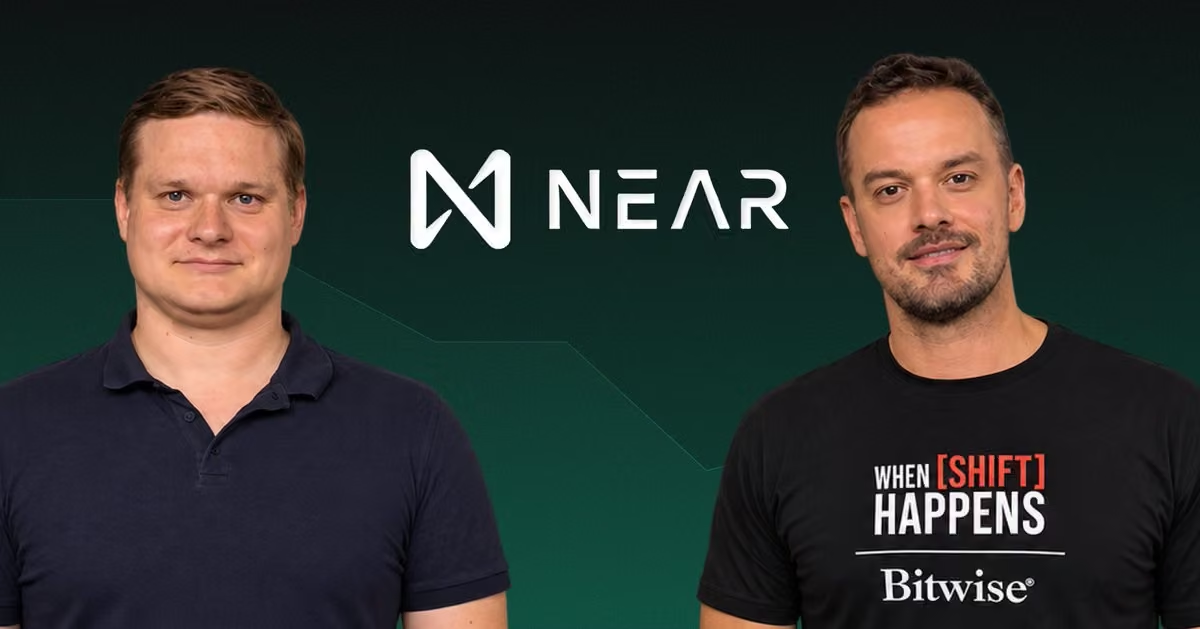


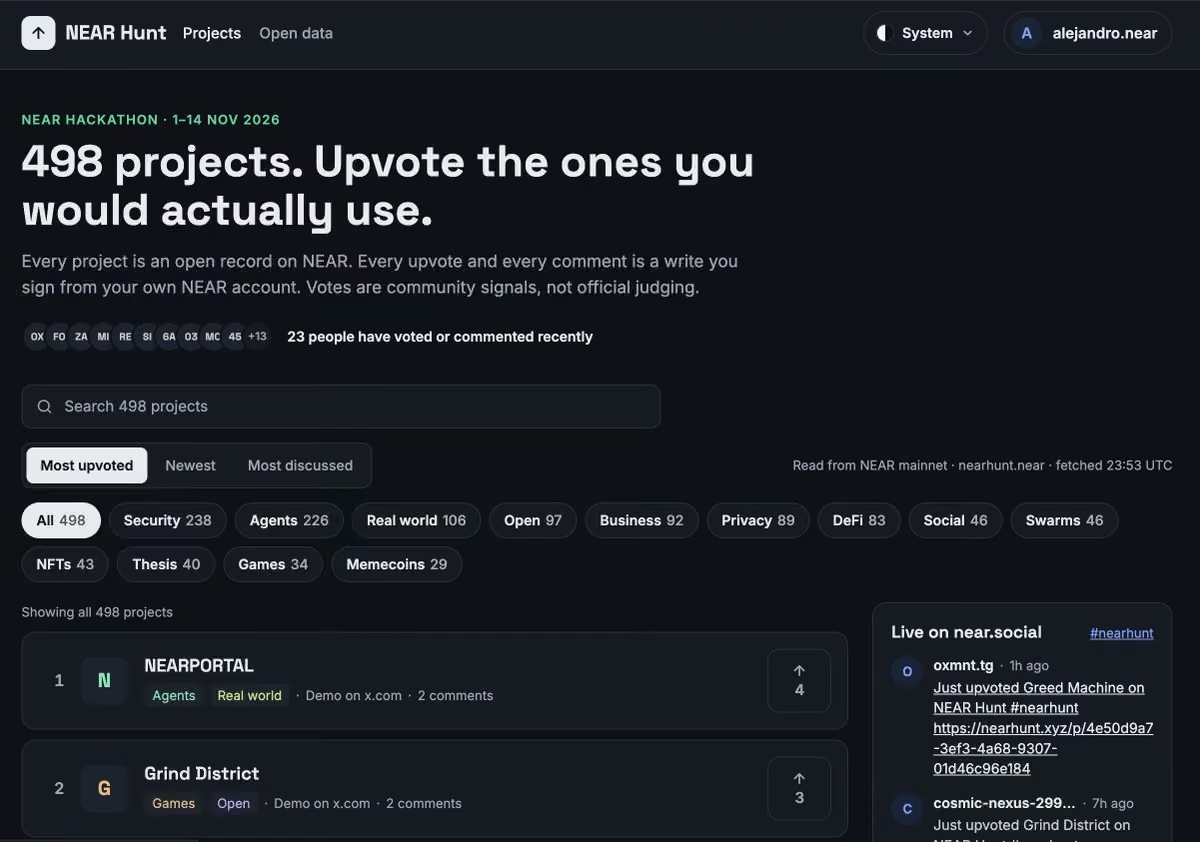
 buildcity


 nulls
 Ansem 🐂🀄️

 NEAR Intents

 FORDEFI


 Haseeb Qureshi >|<


 Talos


 Rhea Finance


 Market Bubble

 APU Blockchain & Cryptocurrency Club


 chronear


 Yuvi Lightman | Quantus
 Emperor Osmo 🎯
 Marc Arjoon, CFA 🟪


 elliot braem


 Hylo


 Joe
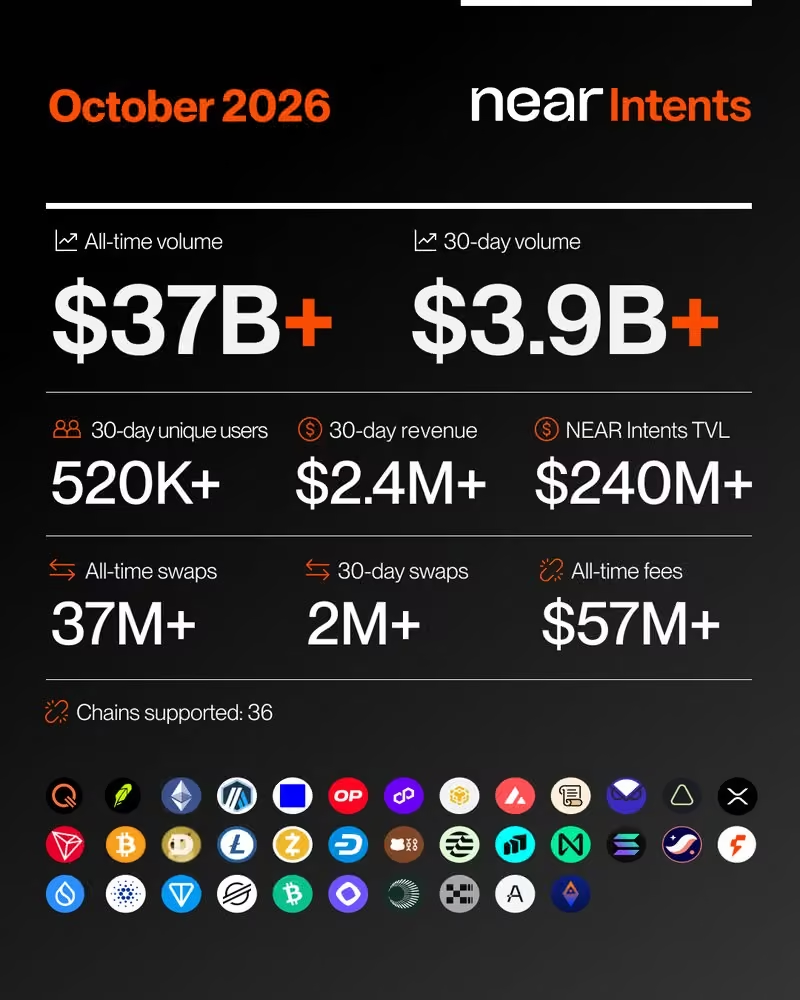


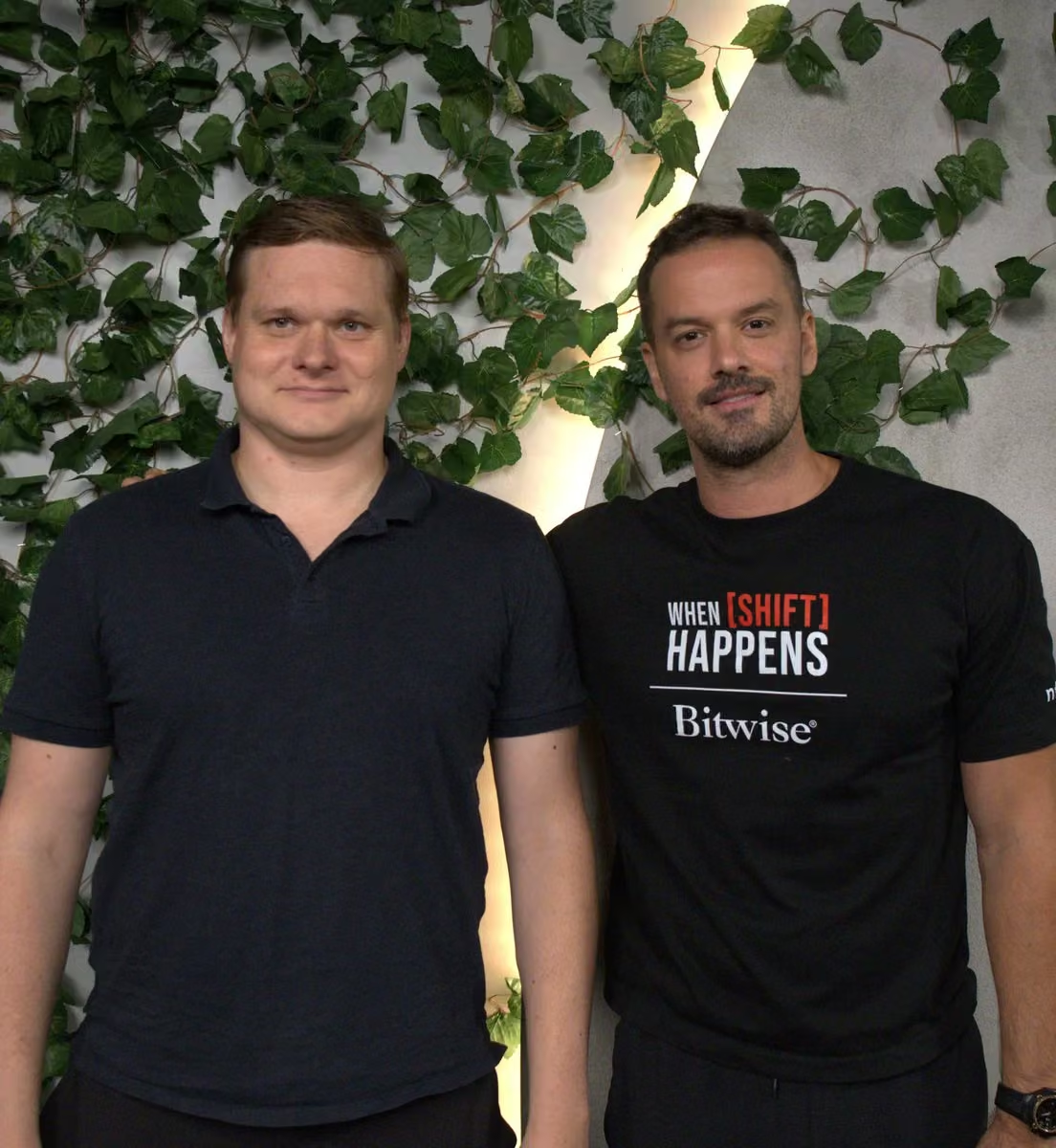
 MEME.COOKING


 Alex Scharrer


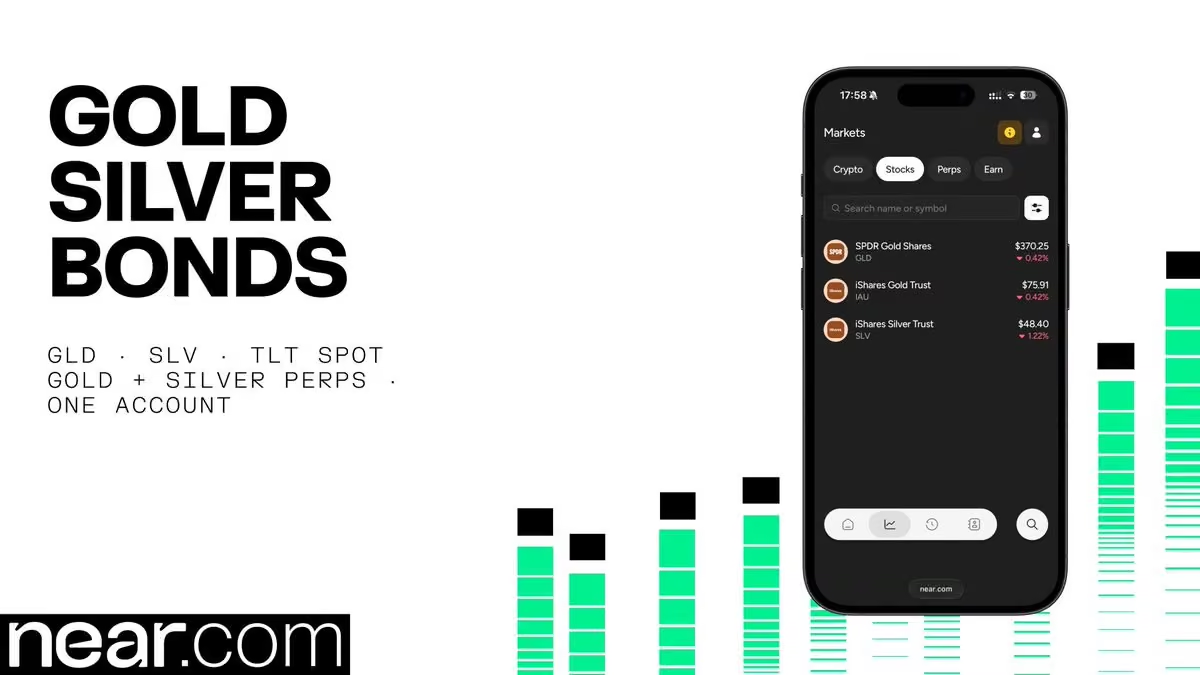
 NEAR AI Agent Market
 Ishmael Asad


 Arkham


 Levanto Labs
 MSB Intel


 Cryptic

 New Wave Podcast

 Taler


 Vultisig

 NEAR House of Stake
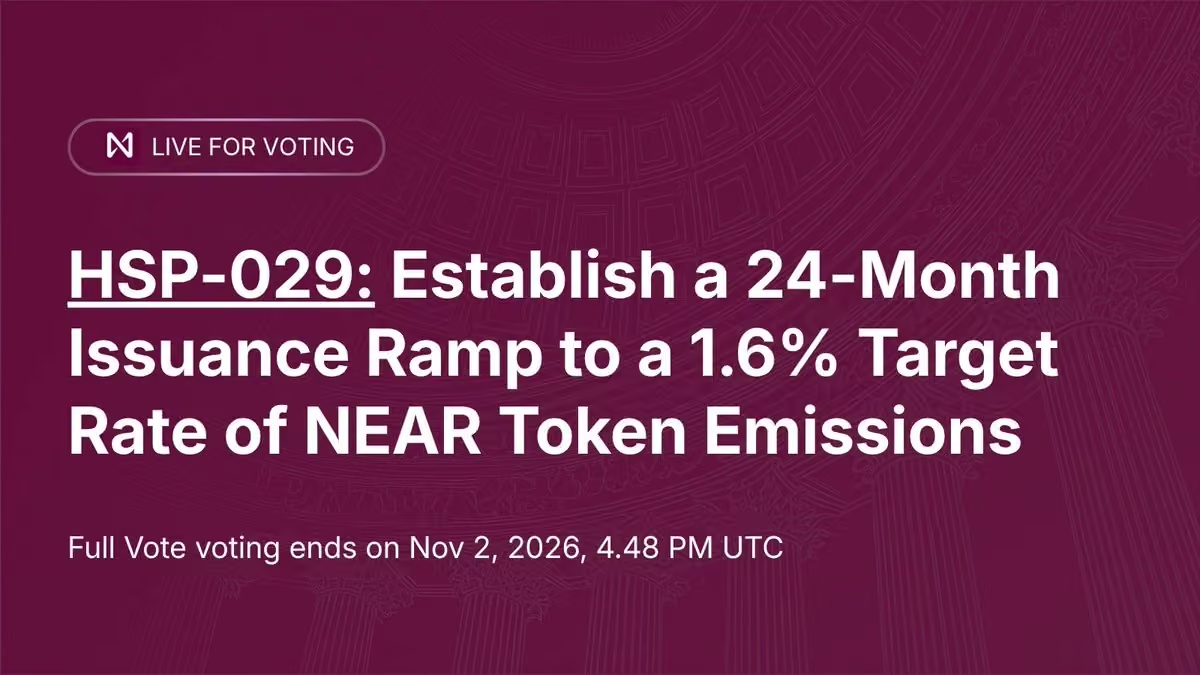
 Bitwise
 Pierre Le Guen

 XRP
 House of Chimera


 Alessandro | Risk Takers

 Erica Kang

 aescobar🛡️


 Unchained Summit - Global Web3 & Crypto Events


 David Hoffman
 NearKat
 Meteor Wallet

 The Tie


 threadguy
 The Block


 Sunrise


 Matt Hougan
 Vadim (AI, ⋈)

 Bitcoin.com News

 Atlas


 SilentSwap ®

 Andy


 Sal Ternullo
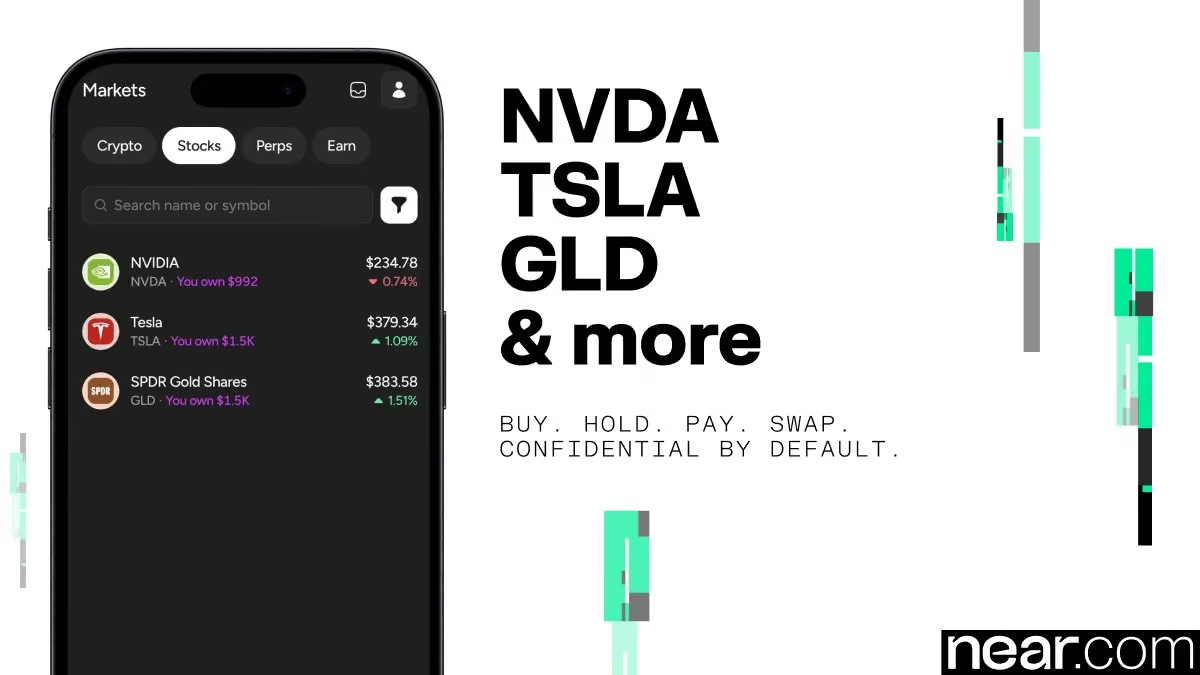
 Anton A
 Circuit
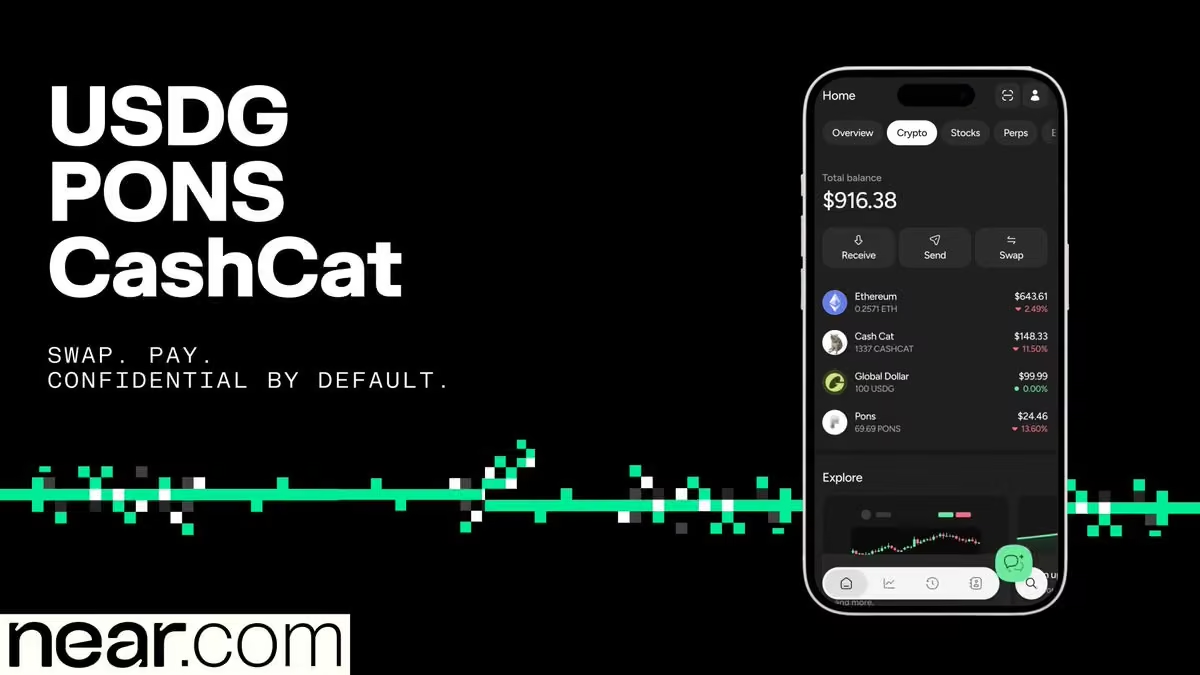
 Incrypted


 Justin Drake
 Alex Shevchenko 🇺🇦


 Teddy Fusaro
 Bankless


 Backpack 🎒

 Robbie Klages

 RIFT


 Delphi Digital

 PERPTools


 Grayscale

 Guille


 Hyperliquid News


 LunarCrush


 Noir | Privacy first Wallet 🦓🦓🦓 ⓩ


 Hunter Horsley


 aaalex.hl


 Kaiz 🐂🀄️


 Laura Shin
 Matt Henderson | near.com
 Near Merch

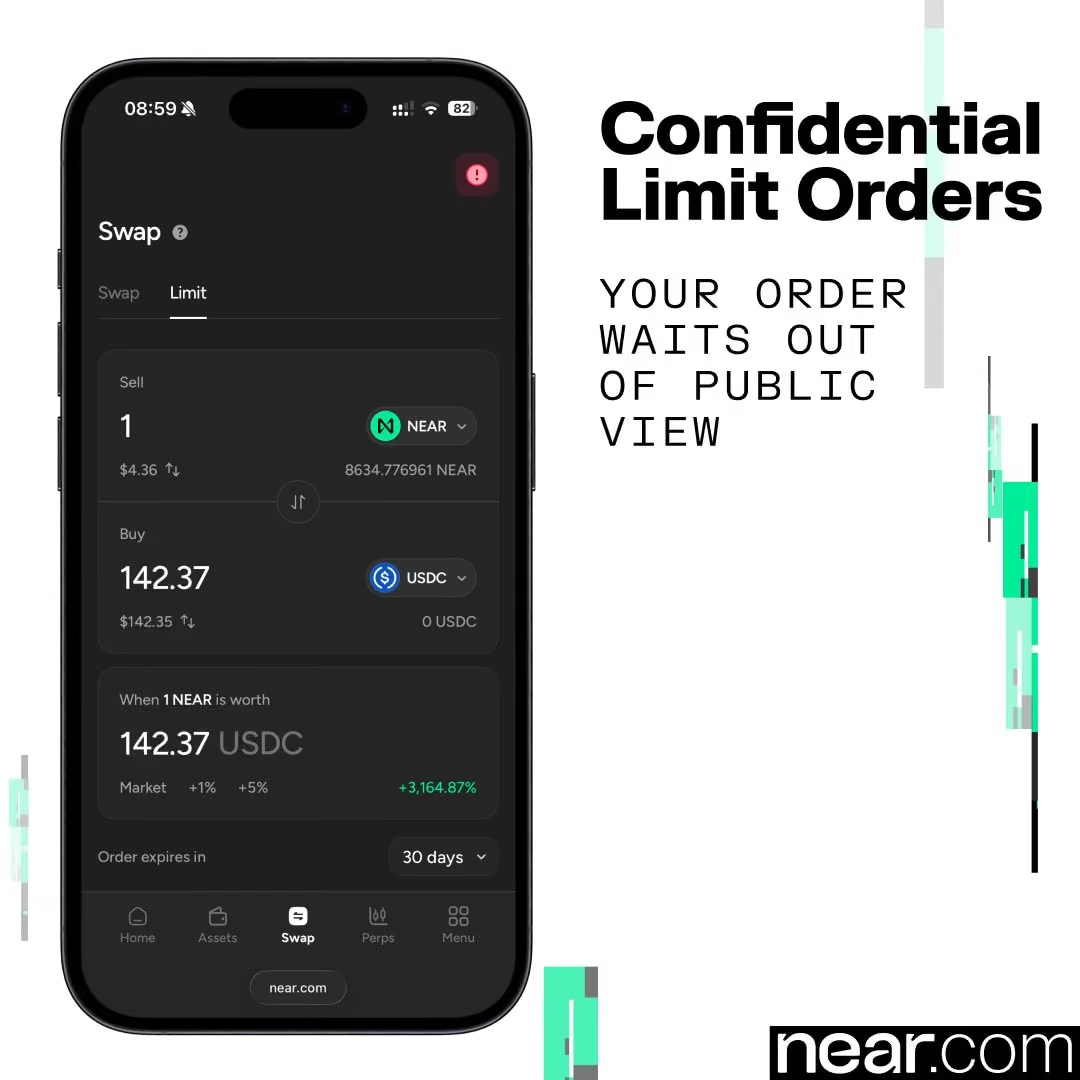

 TOKEN2049


 The Defiant




 Surge

 NEAR DevHub
 naly

 Bitwise in Europe


 Stonk


 Avichal Garg - Electric ϟ Capital
 Tyler


 mert

 Hyperliquid Daily


 haenko(⋈,🇺🇦)


 Camran Khosravi

 Res
 Cointelegraph


 Akshay BD
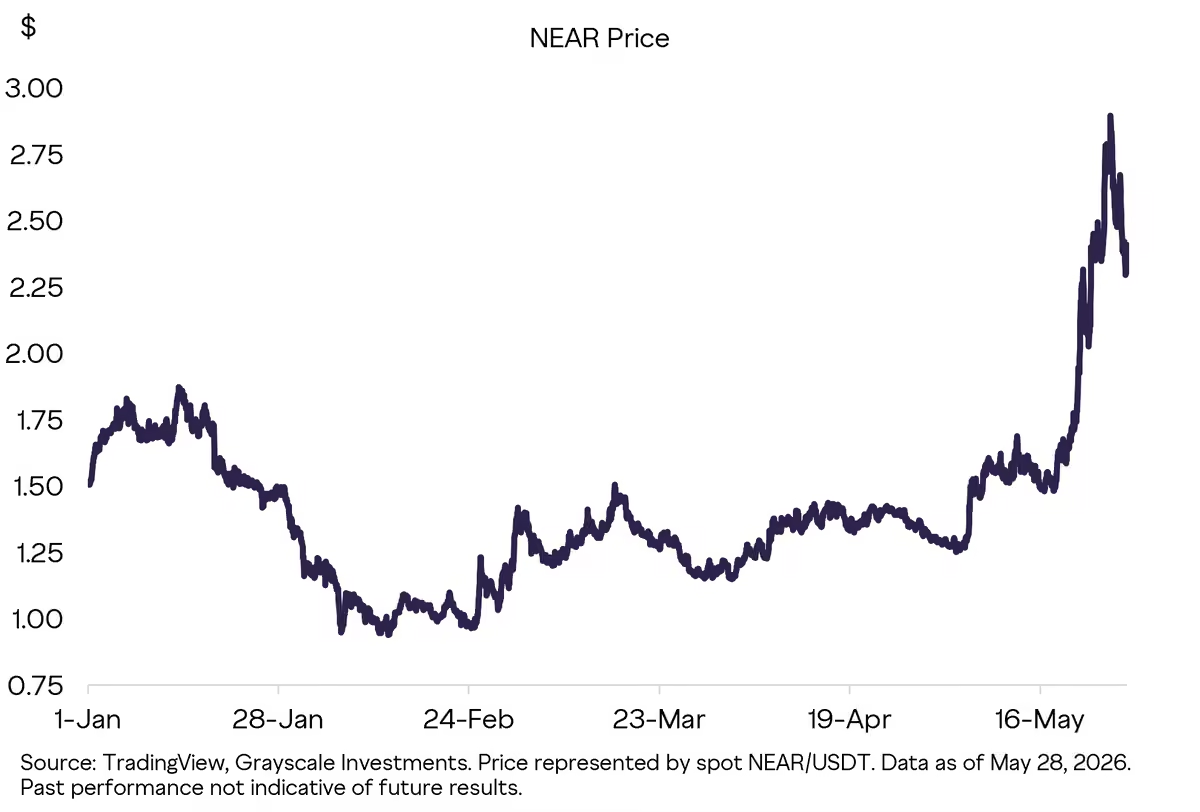


 IronClaw


 SimpleSwap


 artisan.cash


 International Cyber Digest


 Proximity Labs

 Salio
 zkSNARKs


 Hydration

 Luganodes


 Shield
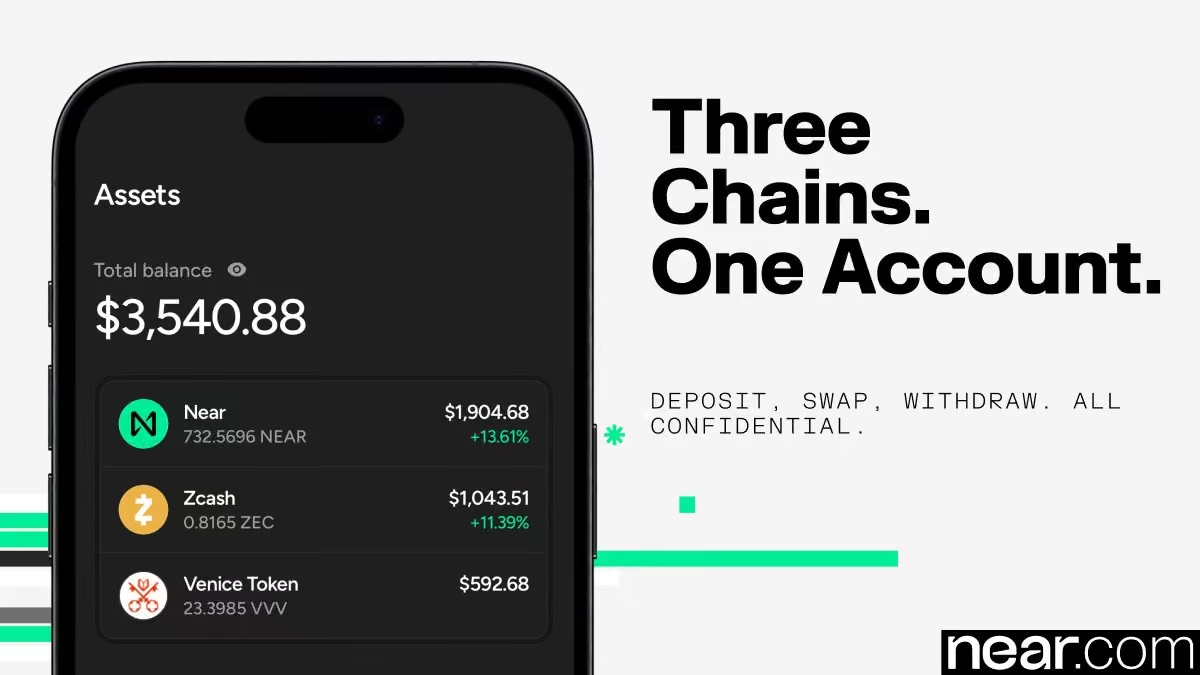


 Decibel


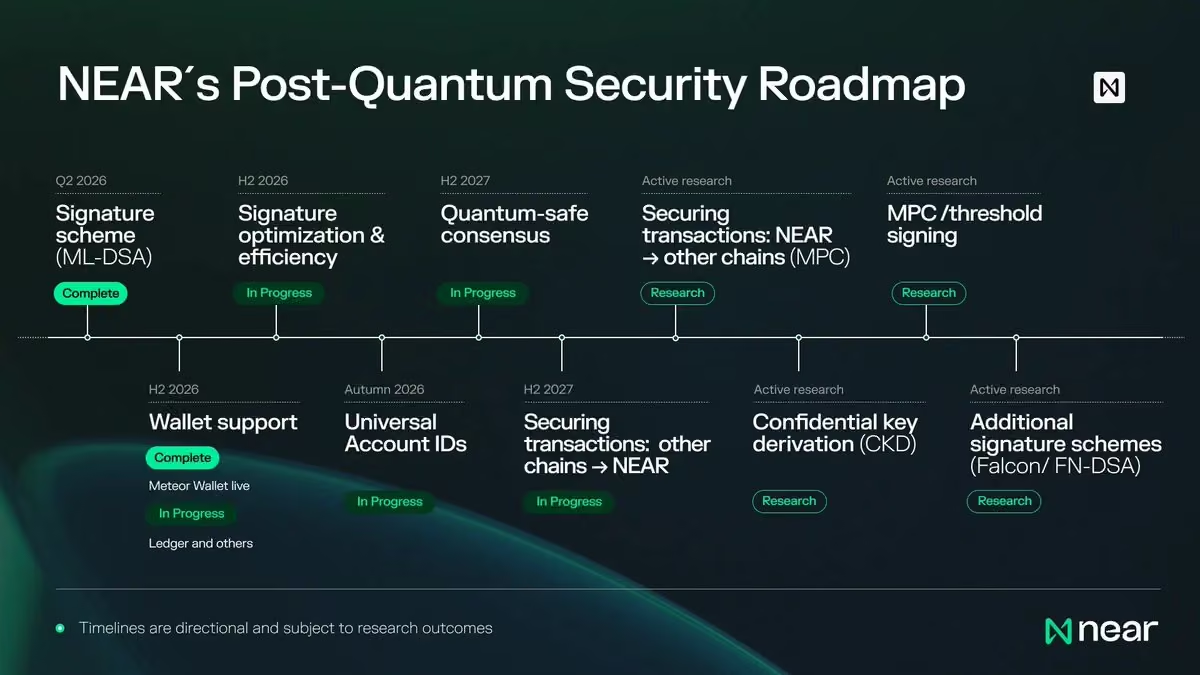


 Alex Skidanov (alex.near)


 Peer


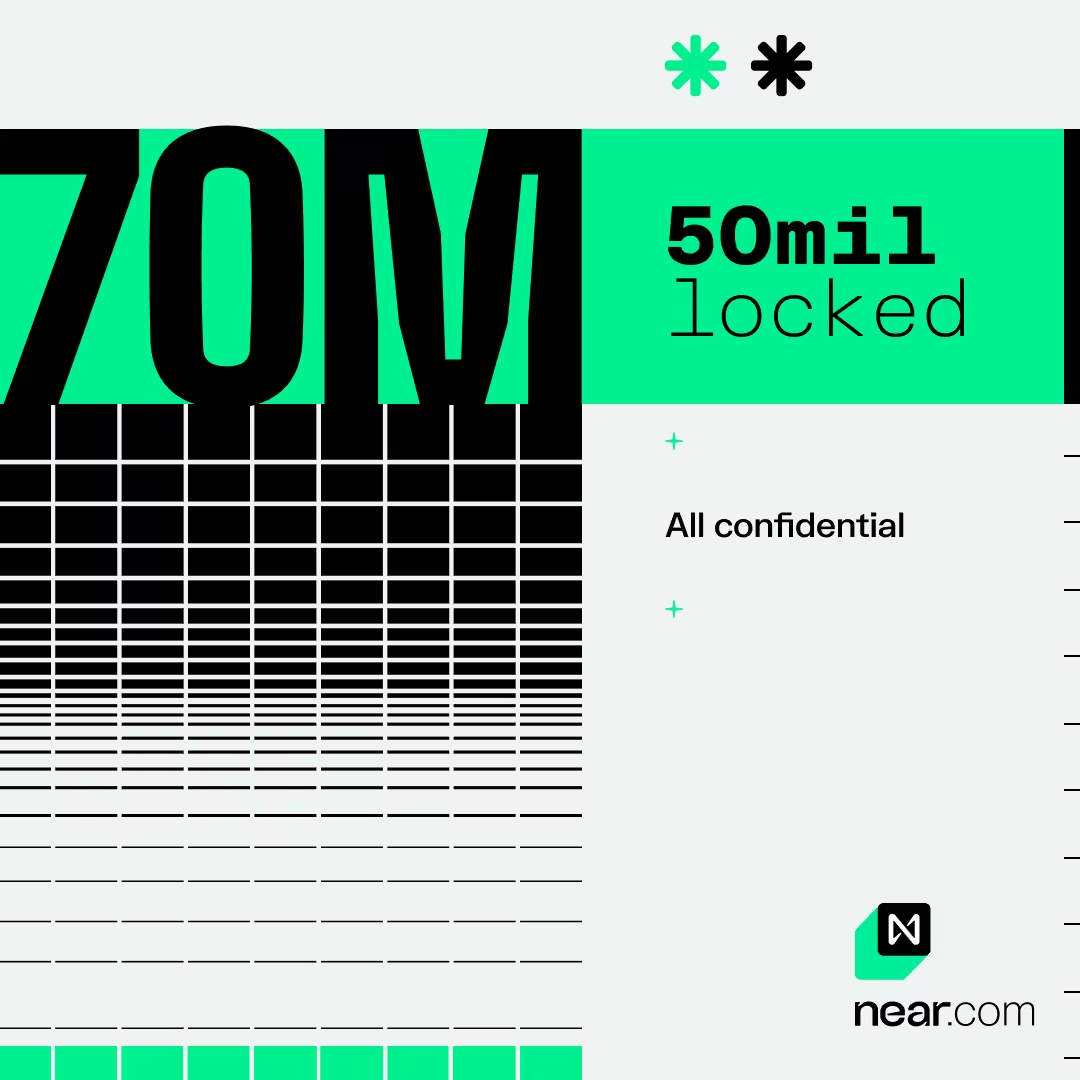


 Starknet

 Unstoppable | Privacy Wallet


 Unchained


 MTS


 Zodl | Zcash Wallet
 Yuen (⋈, 🤖) 🦉


 Infinex


 face
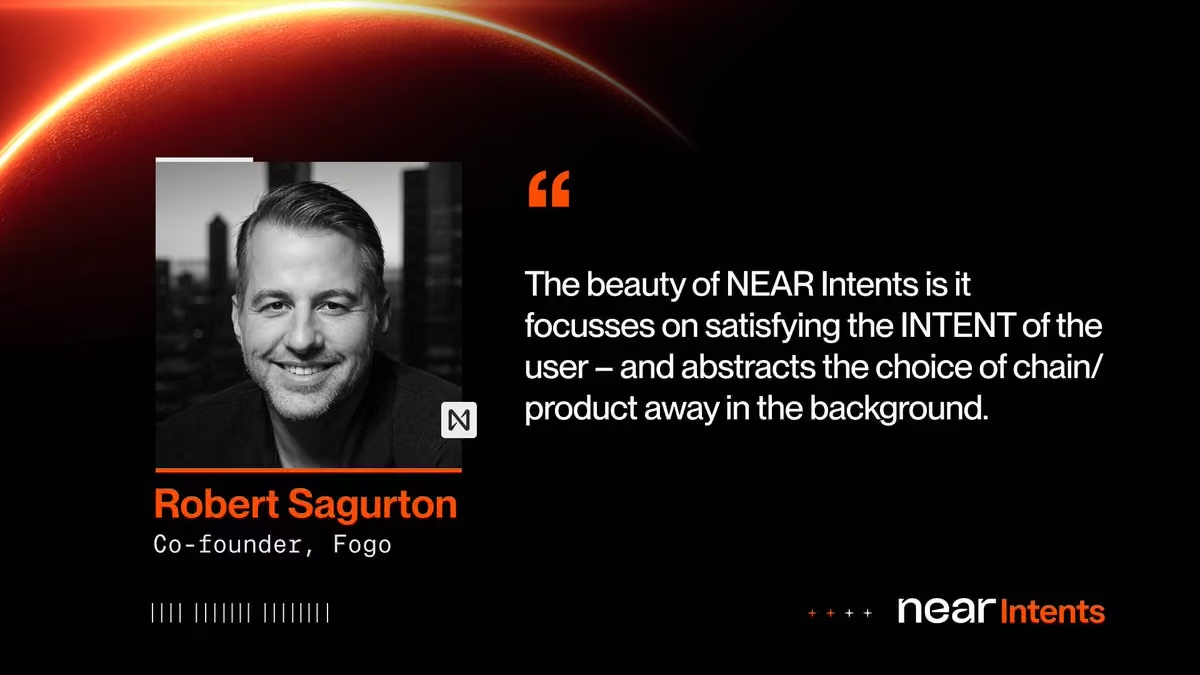
 Robert Sags
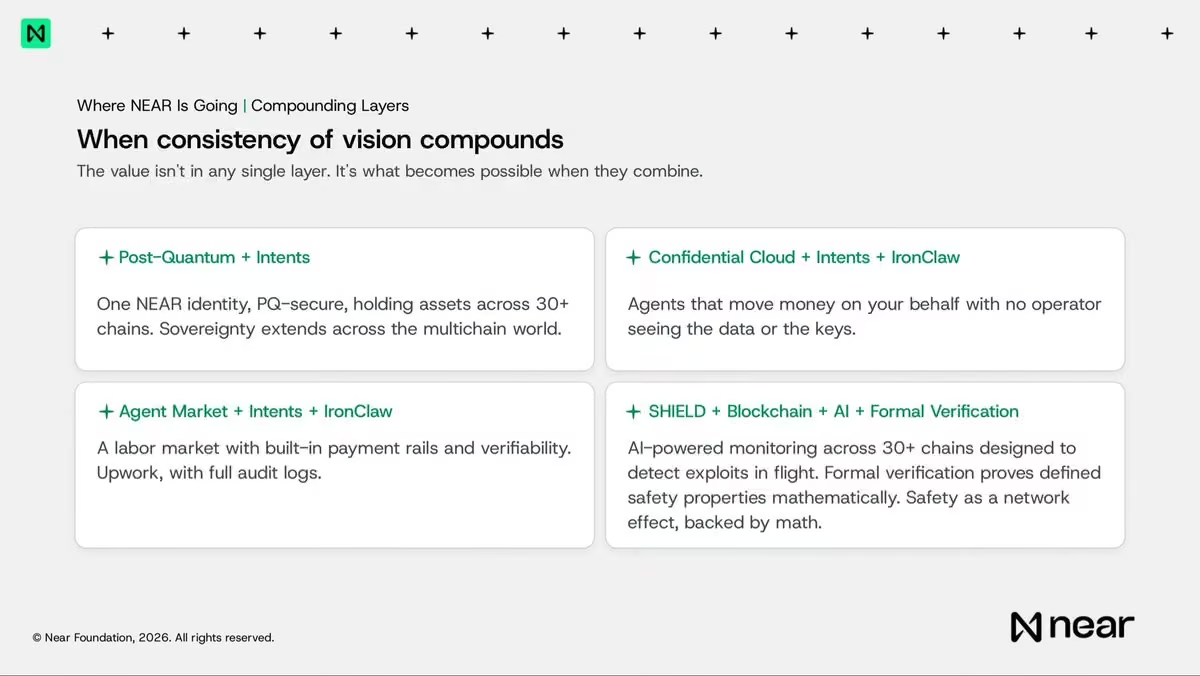


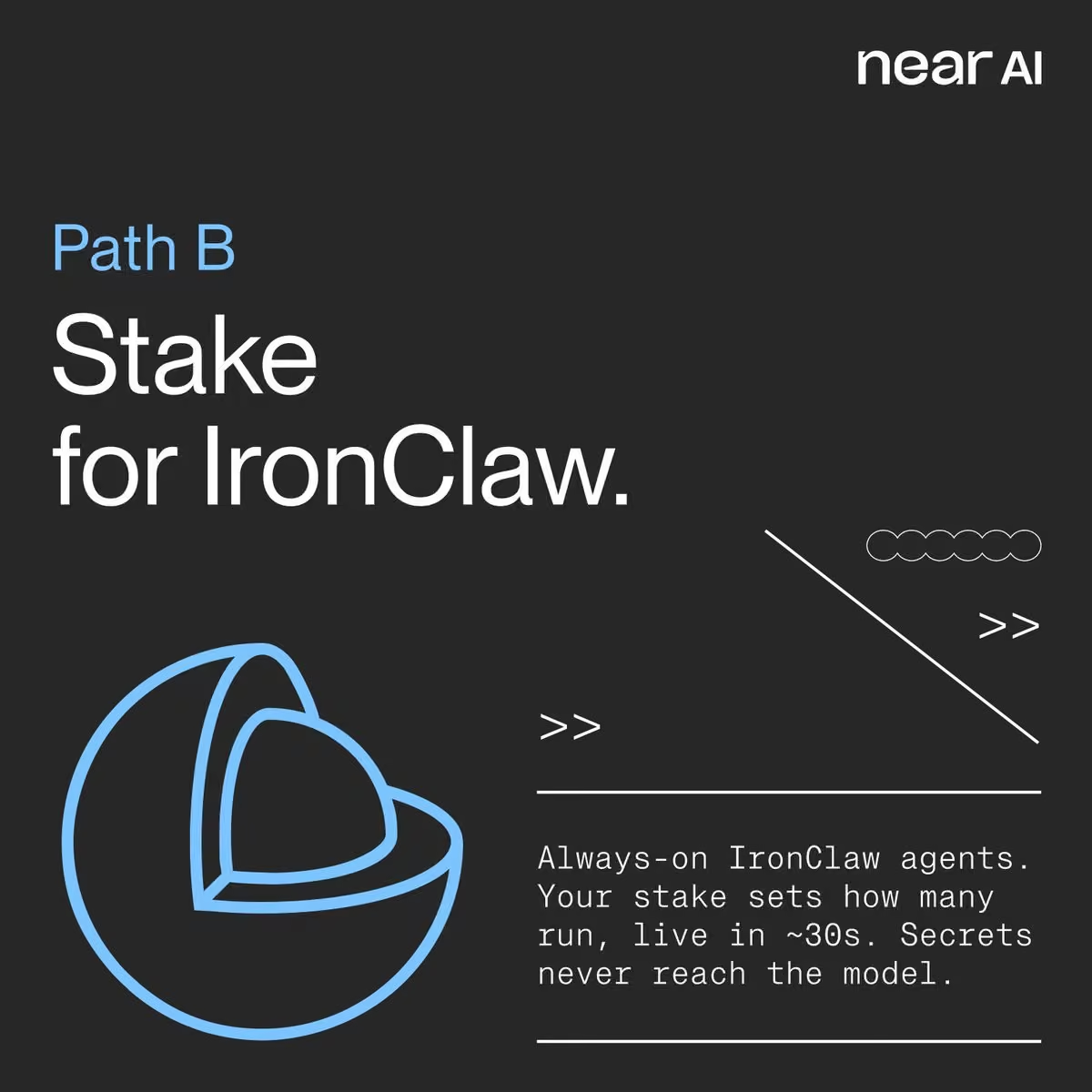


 Andrzej Dzius

 Gareth Jenkinson

 Thirdfy
 India Blockchain Week (IBW) Conference


 Trezu | Multisig treasury for Web3 teams


 Bri Teresi
 Nansen


 Solflare - The Solana Wallet
 Stanford Blockchain Accelerator (SBA)


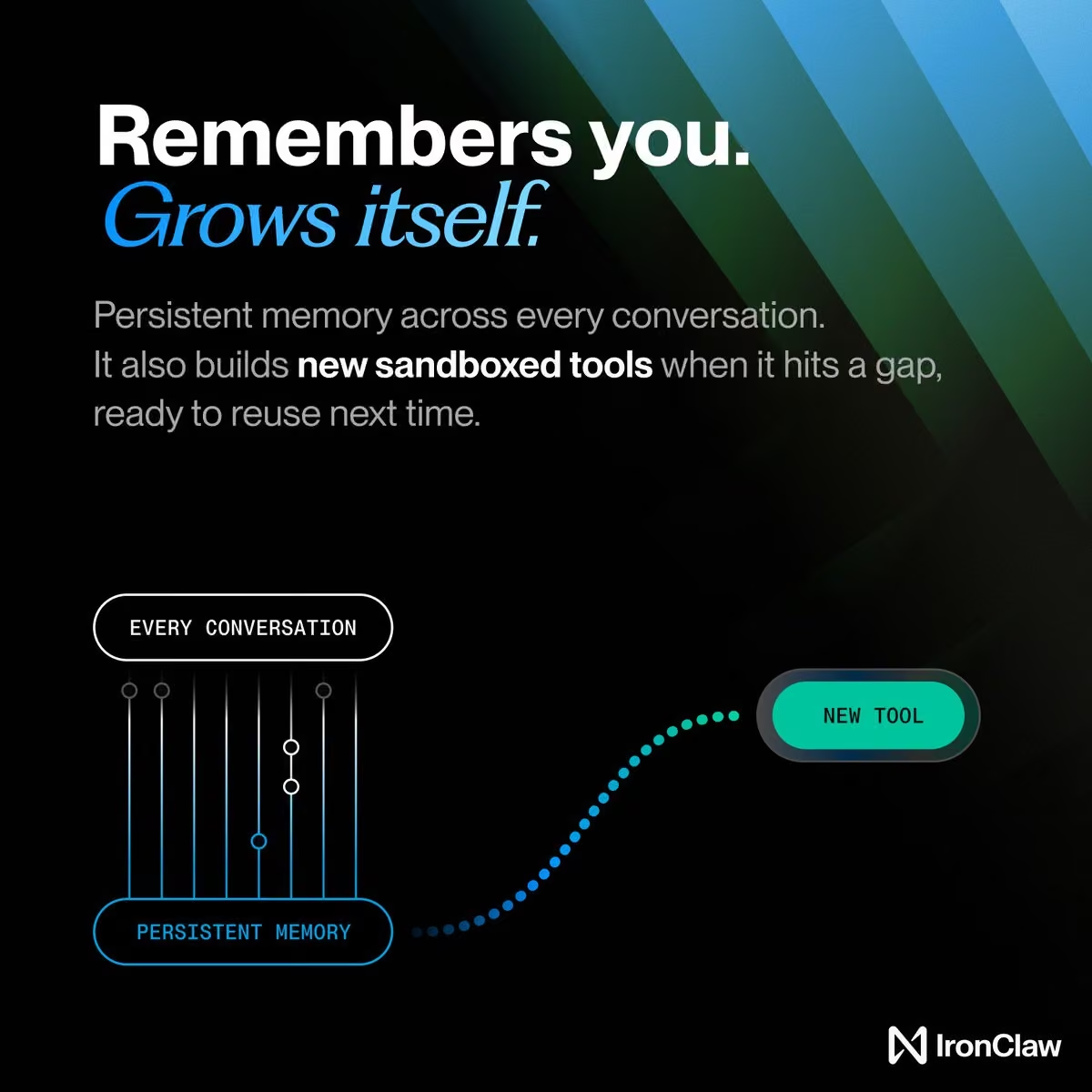

 Sharon Goldman



 SVRN


 Franklin Templeton Digital Assets


 7.Exchange 🩵

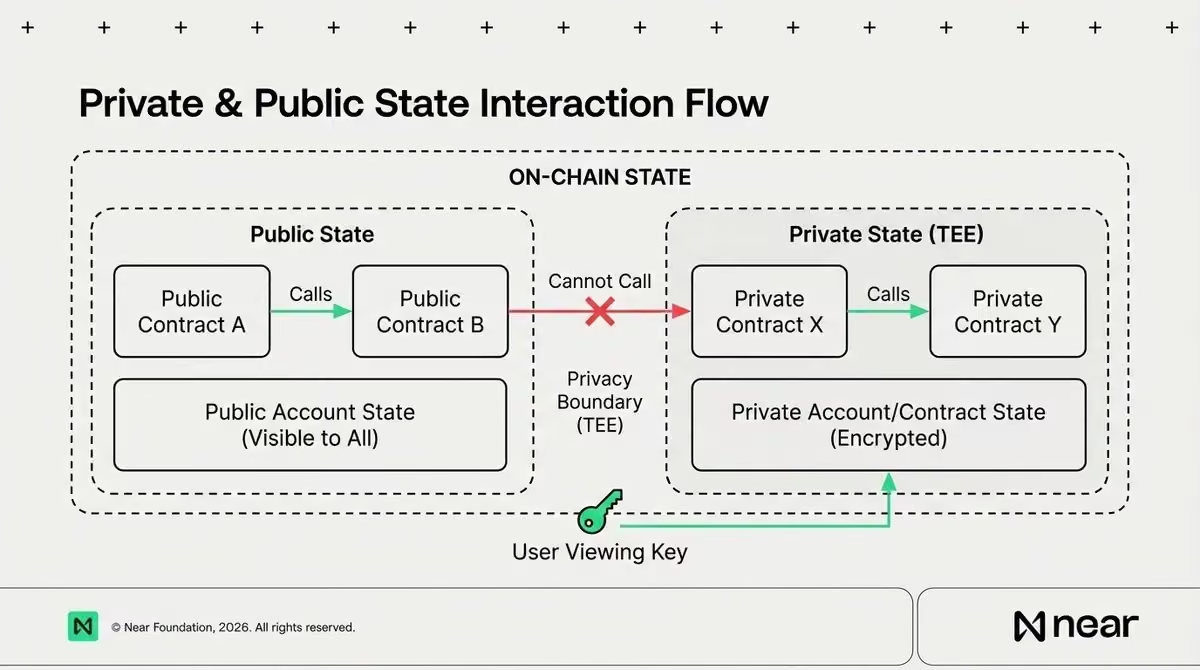


 GhostUSD.xyz

 LeoDex 🦁


 Jeremy
 Lucas Tcheyan

 Corbits


 Aurora
 Internet Court


 My Wallet


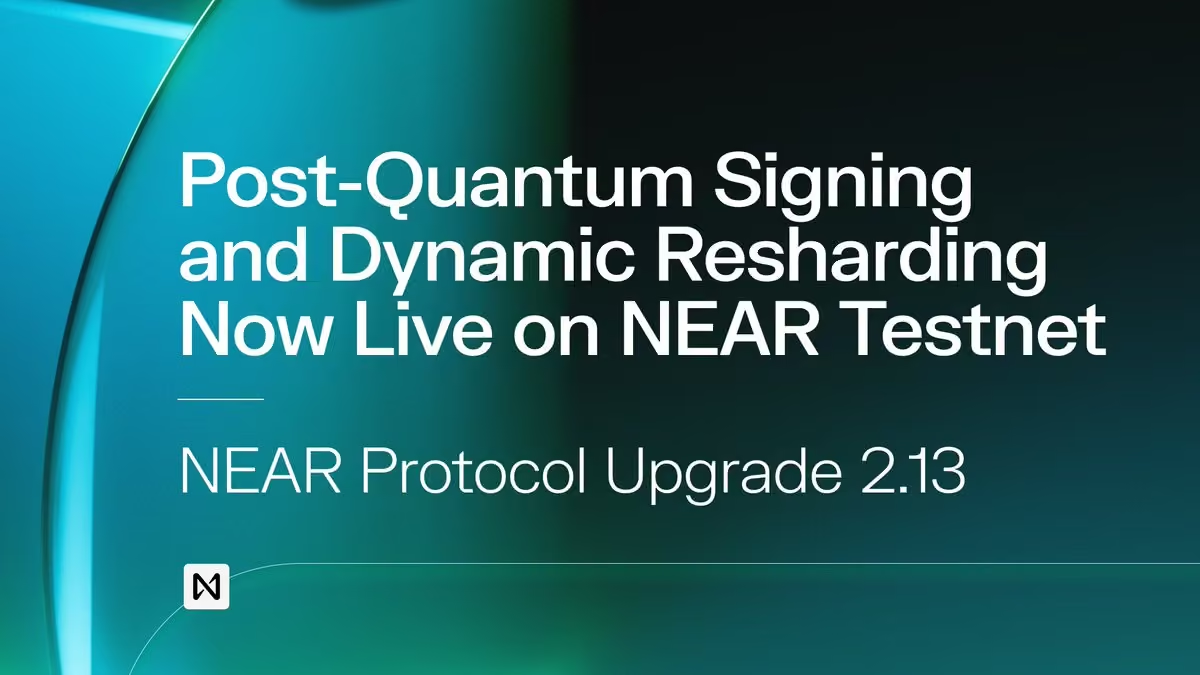


 kain
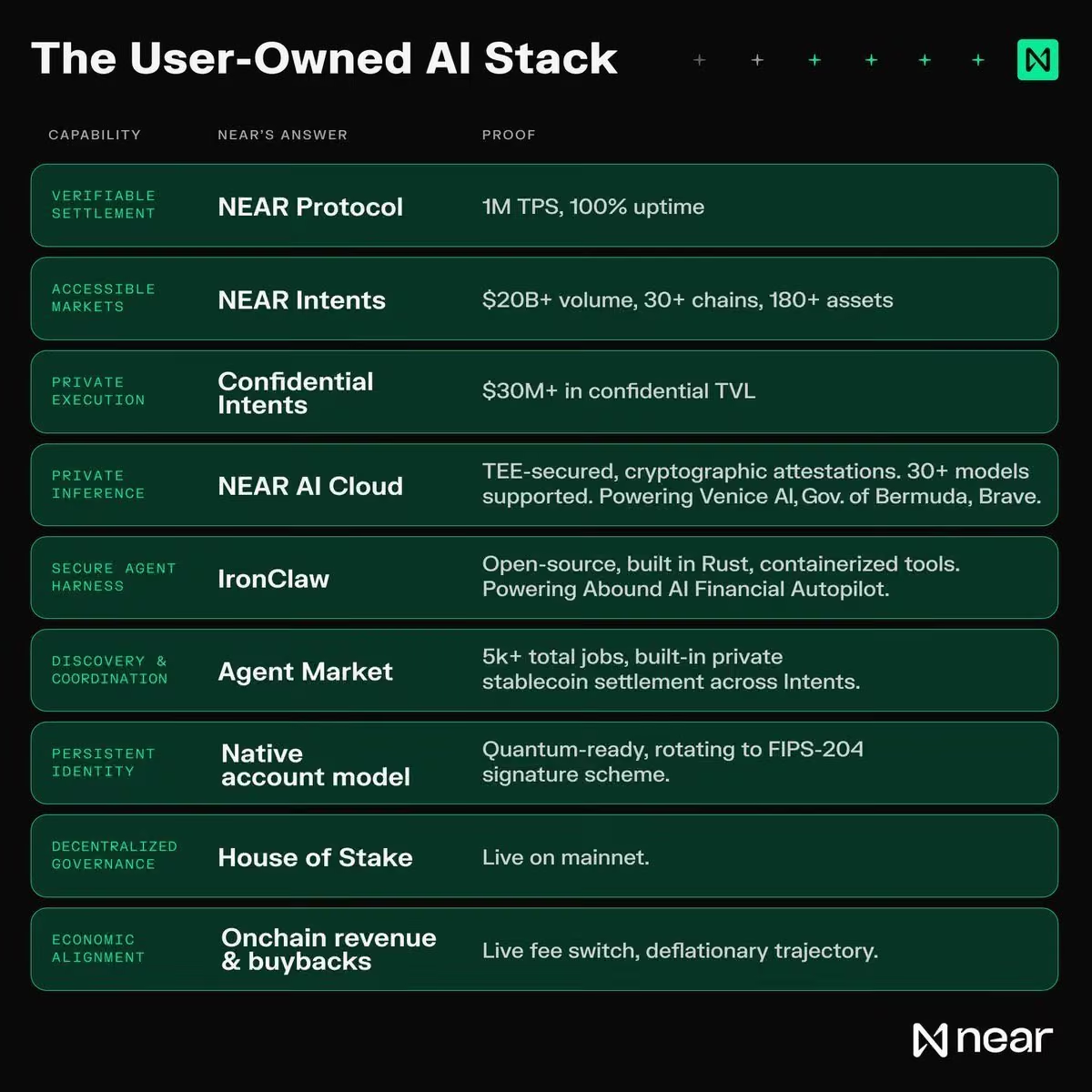




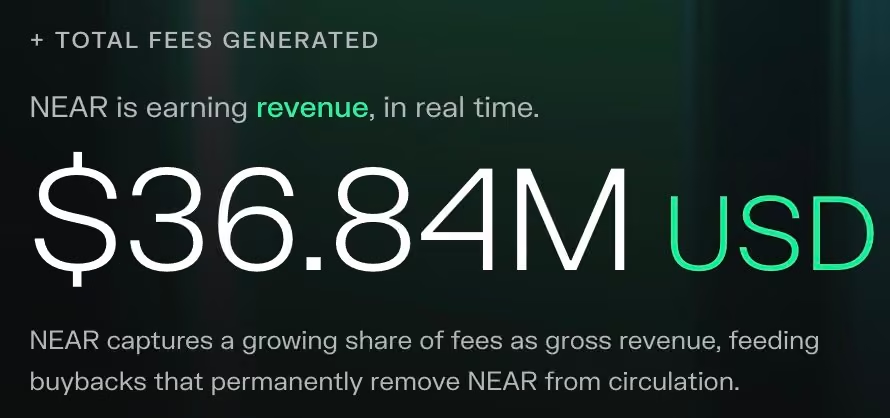
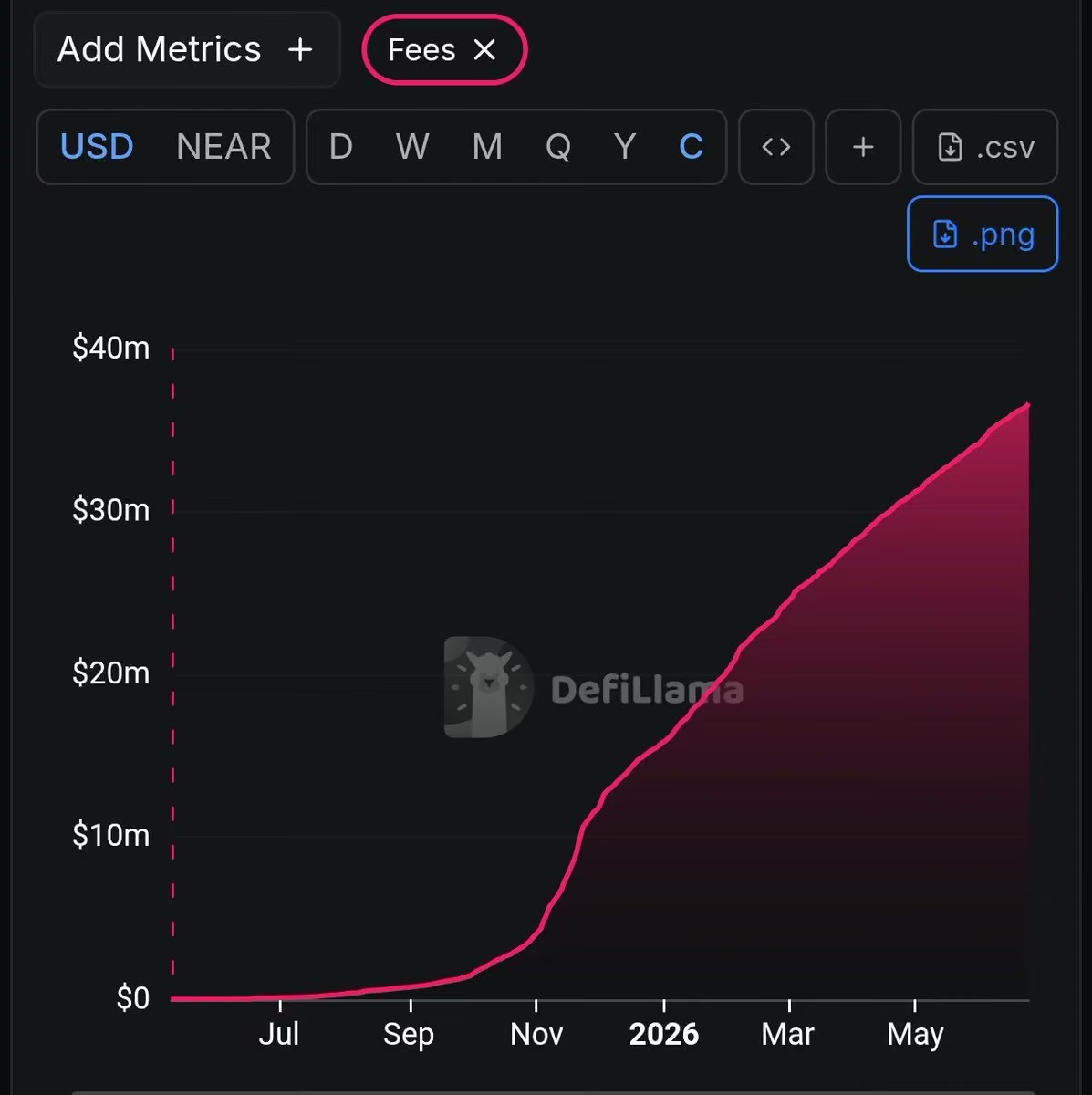


 Torque
 Fireblocks
 Uphold


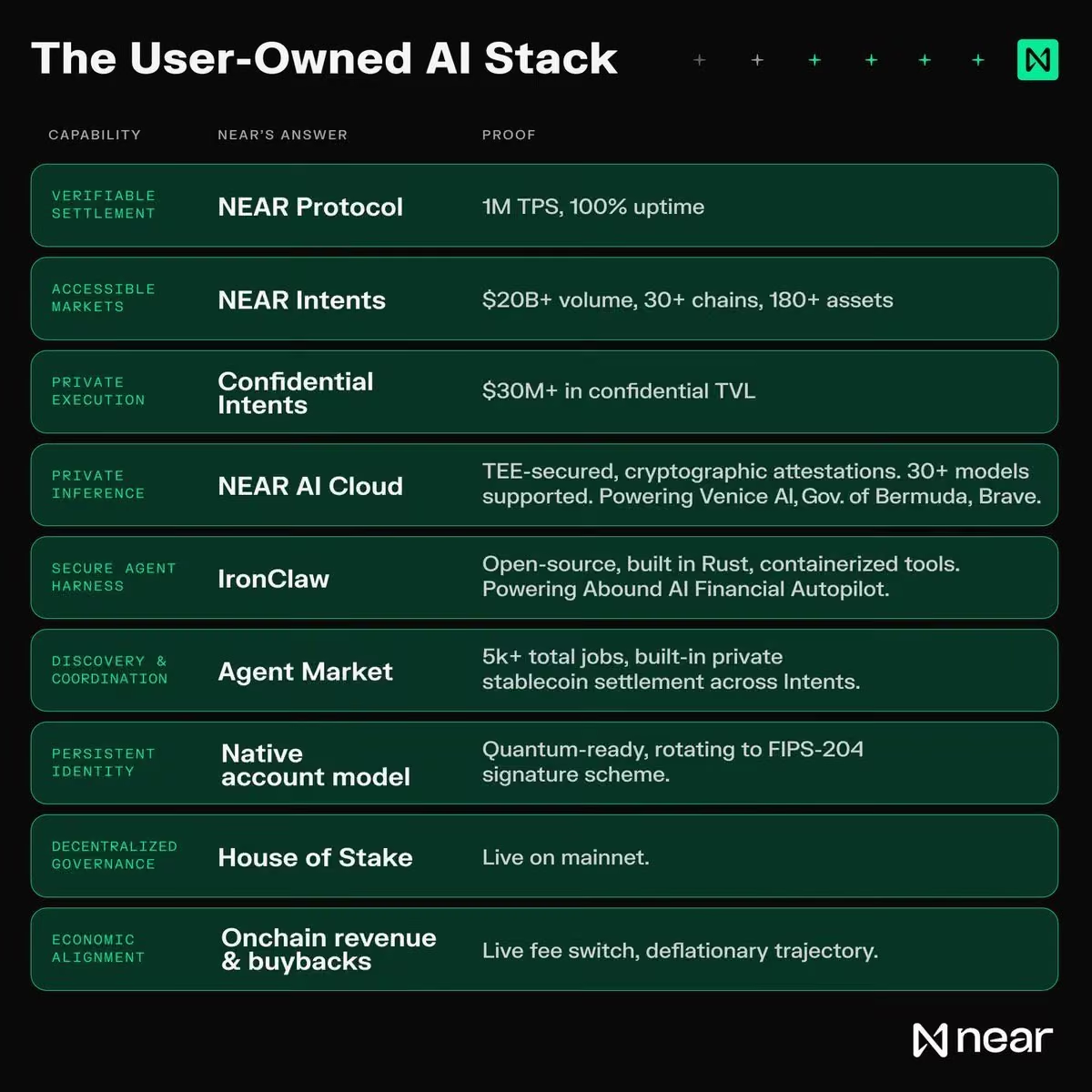


 Cameron.near

 Torab
 Movement


 The Chopping Block


 Prophet


 0x


 Privacy Cash


 Kendall

 Cypherpunk


 Kent

 Daniel


 RocketX | Privacy Swaps🕵🏿

 Generation Infinity
 Medici Network


 The Royal Gazette
 USDC

 StableFlow

 BAS


