 NBER
@nberpubs

Another year of health insurance has no meaningful effect on self-rated health, from Yu Liu, Kevin Callison, and Robert Kaestner www.nber.org/papers/w36020


Politicians, athletes, journalists, NGOs, companies... They all use corporation-owned social networks to communicate with us. Citizens shouldn't have to hand over their data to companies to read content published by public entities. Public Feeds changes that by making posts of popular accounts freely available. Read more.

The National Bureau of Economic Research (NBER) is an American private nonprofit think tank "committed to undertaking and disseminating unbiased economic research among public policymakers, business professionals, and the academic community". The NBER is known for proposing start and end dates for recessions in the United States. More on Wikipedia
The National Bureau of Economic Research is dedicated to conducting and disseminating nonpartisan economic research.
NBER
@nberpubs
Another year of health insurance has no meaningful effect on self-rated health, from Yu Liu, Kevin Callison, and Robert Kaestner www.nber.org/papers/w36020
NBER
@nberpubs
Economics research on mental health has boomed since 2015. A new review covers its economic costs, four key drivers (endowments, economic resources, education and trauma), what shapes treatment, and why the episodic nature of mental illness strains standard health models, from Janet Currie and @MeltemDaysal www.nber.org/papers/w36019
 NBER
@nberpubs
A K-3 phonics-based reading intervention improved test scores. Gains persisted, spilled over to math, and had long-run effects on HS graduation, 4-year degrees, and earnings, from Alex Hollingsworth, @berto_econ, and Nikolaos Zirogiannis www.nber.org/papers/w36018
 NBER
@nberpubs
New Stata commands fereg and feppml fit regressions with many fixed effects. In simulations, they were 5–62 and 5–87 times faster than reghdfe and ppmlhdfe, from @JFSchmieder www.nber.org/papers/w36017
 NBER
@nberpubs
Developing a third order approximation of a state dependent pricing and showing how it provides a convenient way to capture nonlinear inflation dynamics, from @lucagaglia, Mark Gertler, @SimoneLenzu, Joris Tielens, and Al-Mahdi Ebsim www.nber.org/papers/w36016
 NBER
@nberpubs
Two Open Calls for Papers: Place and Aging Conference and Health Care Administration and Fraud Conference. Submissions due by 11:59pm ET on Monday, June 7, 2027. Full info: www.nber.org/calls-papers-and-proposals/place-and-aging-c… and www.nber.org/calls-papers-and-proposals/health-care-admin…
NBER
@nberpubs
Featured in the latest Digest: Why Are Credit Card Interest Rates So High?
www.nber.org/digest/202611/why-are-credit-card-interest-r…
 NBER
@nberpubs
Education helps explain America’s partisan gender gap: compulsory schooling widened political differences between men and women where it increased attainment, from Philip DeCicca, Harry Krashinsky, and @ErikNesson www.nber.org/papers/w36015
 NBER
@nberpubs
Natives in skill groups most affected by high-skill temporary immigrants experienced slower earnings growth and a relative decline in full-time employment, from George J. Borjas www.nber.org/papers/w36014
 NBER
@nberpubs
Adding a pricier option should only pull demand from existing ones. But in a Lyft field experiment with 7.2M riders, a premium ride boosted demand for the cheapest ride and for not riding at all. A surprisingly high price, it seems, makes people focus on cost, from Nicola Gennaioli, @econ_4_everyone, Matthias Rodemeier, and Gregory K. Sun www.nber.org/papers/w36013
 NBER
@nberpubs
Aid effectiveness today depends on last-mile delivery, from @ErikaDeserra, Andrea Guariso, and Nancy Qian www.nber.org/papers/w36012
 NBER
@nberpubs
Does green debt change how firms are run? Across 3,944 sustainable bond issuances (2013–2022), a 1% rise in sustainable debt share boosts the odds of adopting sustainable governance by 9.2%, lifting environmental performance 16%. Only for non-financial firms, though, from @JitendraAswan19 and Roberto Rigobon www.nber.org/papers/w36011
 NBER
@nberpubs
When homeownership or marriage feel out of reach, young adults may turn to financial gambles. Using a survey plus millions of linked Korean credit, telecom and card records, new research finds crypto app use rises during unemployment and falls after winning a housing lottery, from Costas Arkolakis, Spencer Y. Kwon, Dominic Russel, Claire Shi, and Hyunjoo Yang www.nber.org/papers/w36010
 NBER
@nberpubs
The first randomized trial of social impact measurement finds that treated firms exhibit nearly twice the revenue growth and raise nearly twice as much capital as control firms, from Emanuele Colonnelli, Timothy McQuade, Natalia Rigol, and Benjamin N. Roth www.nber.org/papers/w36009
 NBER
@nberpubs
Can rate hikes raise prices? In a customer-market model, higher rates make firms value today’s profits over keeping customers, so they raise prices. This effect can be significant and grows with policy uncertainty, from Bruce C. Greenwald and @JosephEStiglitz
 NBER
@nberpubs
Wage earners can’t easily dodge taxes; the self-employed often can. Across 29 developing countries, this unfairness between similar earners rivals the rich–poor gap. In Pakistan, learning about it raised fairness concerns but not support for reform, from Pierre Bachas, Christopher A. Hoy, Anders Jensen, and Mahvish Shaukat www.nber.org/papers/w36007
 NBER
@nberpubs
Switching the 340B drug discounting program from up-front discounts to rebates poses risks to safety-net provider finances, from @Courtemanche_CJ www.nber.org/papers/w36006
 NBER
@nberpubs
Using Chicago’s contract for ShotSpotter to illustrate the importance of going beyond hypothesis testing when evaluations are underpowered relative to the effect needed for benefits to exceed costs, from Terence Chau, Philip J. Cook, Javier Lopez, Jens Ludwig, Alejandro Roemer, and Adam K. Soliman www.nber.org/papers/w36005
 NBER
@nberpubs
Proposing a novel method to estimate a main monetary policy shock that explains more business cycle variation than prior shocks and sheds new light on the transmission mechanism, from Christoph Boehm, Husang Kim, and @KronerNiklas www.nber.org/papers/w36004
 NBER
@nberpubs
Studying a leading Chinese e-commerce platform to examine whether there is a link between AI and firm growth, from Panle Jia Barwick, Lu Fang, Jinhan Liu, Huilan Xu, and Zhe Yuan www.nber.org/papers/w36003
 NBER
@nberpubs
A property tax experiment in Ghana that randomly provides tax education to property owners and frontline officials, from Anders Jensen, Nikhil Kumar, and Konstantin Poensgen www.nber.org/papers/w36002
 NBER
@nberpubs
An asset-pricing perspective on precautionary saving, from @mileskimball and @mastantuno www.nber.org/papers/w36001
 NBER
@nberpubs
Using Taiwan's 2003 SARS epidemic as a natural experiment, instrumenting prenatal care with gestational exposure to SARS-induced fear that reduced visits by over 20 percent, from Chien-Tzu Cheng, Shin-Yi Chou, and Hsien-Ming Lien www.nber.org/papers/w36000
 NBER
@nberpubs
Many randomized controlled trials in development economics are underpowered and/or test ineffective policies. As a result, 30 percent of published findings in leading journals are false, from Qingyuan Chai, @lang_econ, and Liang Zhong www.nber.org/papers/w35999
 NBER
@nberpubs
Opting into a stem-cell registry’s engagement initiative reveals which potential donors are more likely to be available when later called as a match, a field experiment finds, from Michael Haylock, Patrick Kampkötter, @Mario_Macis, Susanne Seitz, Robert Slonim, and Daniel Wiesen
 NBER
@nberpubs
Naloxone coprescription laws increased naloxone prescribing by 275%, opioid use disorder medications by 56%, and treatment admissions by 297%, without increasing opioid prescribing, from Shin-Yi Chou, Jiarun Li, and Bingjin Xue www.nber.org/papers/w35997
 NBER
@nberpubs
Featured in the latest Bulletin on Health: Cognitive Load and Treatment Decisions of Emergency Department Doctors
www.nber.org/bh/20263/cognitive-load-and-treatment-decisi…
 NBER
@nberpubs
Analyzing the food stamp program both as a potential investment in children’s health capital and as a redistributive tool by studying the 1979 reform that made food stamps free, from Amy Finkelstein, @profnoto, and Charlie Rafkin www.nber.org/papers/w35996
 NBER
@nberpubs
Providing the first causal estimate of the effect of ocean temperature on fisheries, from Fabio Cevenini, Christopher Costello, and Carlo Fezzi www.nber.org/papers/w35994
 NBER
@nberpubs
Studying how exposure to peers affects college application behavior, from Ana M. Gazmuri and Elena Prager www.nber.org/papers/w35993
 NBER
@nberpubs
Featured in the latest Digest: The Valuation Gap Between US and European Firms
www.nber.org/digest/202611/valuation-gap-between-us-and-e…
 NBER
@nberpubs
Large broadband providers invest more in electorally competitive counties. Greater capacity in these areas is associated with fewer subsequent state policies facilitating entry, from Karam Kang and Mo Xiao www.nber.org/papers/w35992
 NBER
@nberpubs
Conducting a Bayesian hierarchical meta-analysis of 49 studies on poverty Graduation programs, defined as containing at least three of five components: consumption support, savings facilitation, skills training, coaching, and a lumpsum transfer, from Samantha Carter, Edward Jee, @deankarlan, and Patrick Premand www.nber.org/papers/w35991
 NBER
@nberpubs
Advised retirees keep about two-thirds of portfolios in equities in old age, 30–40pp above the unadvised. Advisor style and trust drive it. Welfare gains are comparable to advice costs, from Allison T. Cole, Maarten Meeuwis, Alessandro Previtero, and Noah Stoffman
 NBER
@nberpubs
Open call for Applications, PhD Student Workshop on Microeconomic Policies & Economic Growth. Workshop to be held in Washington, DC on March 31, 2027. Submit papers by 11:59pm EDT on December 16, 2026. More information: www.nber.org/calls-papers-and-proposals/phd-student-works…
 NBER
@nberpubs
Studying California's short-term lodging price transparency law (AB 537), which from July 1, 2024 required Airbnb and other providers to advertise fee-inclusive prices, from Ginger Zhe Jin, Liad Wagman, and Jingyi Xing www.nber.org/papers/w35989
 NBER
@nberpubs
Estimating the maximal Sharpe ratio in large cross-sections of assets directly, without constructing the efficient portfolio, from Mikhail Chernov, Bryan T. Kelly, Semyon Malamud, and Johannes Schwab www.nber.org/papers/w35988
 NBER
@nberpubs
Featured in the latest Bulletin on Entrepreneurship: Entrepreneurship Training Can Help Founders Learn When to Quit
www.nber.org/be/20262/entrepreneurship-training-can-help-…
 NBER
@nberpubs
Partnering with Indian police stations from Bihar to evaluate an intervention designed to change police responses to gender-based violence, from @sofiafamaral, Girija Borker, @Prof_Nishith_P, and @micasviatschi www.nber.org/papers/w35986
 NBER
@nberpubs
Exposure to unconventional monetary policy made deposit retention costlier and riskier for banks, from Philip Strahan and Tuo Yang www.nber.org/papers/w35985
 NBER
@nberpubs
Surveying Indonesian villagers on how well off they are and how much a modest cash transfer would help them, from @rema_nadeem, @emilybreza, @ben_olken, Abhijit Banerjee, Arun G. Chandrasekhar, and @GideonMoore www.nber.org/papers/w35984
 NBER
@nberpubs
Featured in the latest Digest: Global Externalities of US Government R&D
www.nber.org/digest/202611/global-externalities-us-govern…
 NBER
@nberpubs
University student presence—not Gen-z population, not educated urban adults—predicts where protests start and also how they diffuse into an off-campus uprising, from @ProfSultanEcon and @mushfiq_econ www.nber.org/papers/w35983
 NBER
@nberpubs
Using LLMs as synthetic survey respondents finds that institutions report weaker green tastes yet greener portfolio tilts than retail investors, citing outside pressure, from Xindi He and Lubos Pastor www.nber.org/papers/w35982
 NBER
@nberpubs
The same inflation news can lead professional forecasters to revise stock return expectations differently, depending on their narratives, from Christian Conrad, Julius Theodor Schoelkopf, Michael Weber, and Frank Brueckbauer www.nber.org/papers/w35981
 NBER
@nberpubs
Post-Covid-19 inflation was predominantly driven by unexpectedly strong demand forces, both in the United States and in the Euro Area, from @DomenicoGiannon and @gprimice www.nber.org/papers/w35980
 NBER
@nberpubs
Self-censorship on college campuses is not simply about being conservative: students with moderate views self-censor the most, due to differences in topic saliency and confidence, from Peter Arcidiacono, Cory Dowd, and Matthew Lilley www.nber.org/papers/w35979
 NBER
@nberpubs
How mission-oriented R&D can give shape to new industries: WWII radar R&D produced knowledge, human capital, and an architecture that provided a foundation for commercial entry, from @daniel_p_gross and Maria P. Roche www.nber.org/papers/w35978
 NBER
@nberpubs
Presenting a new interest rate parity relation and show that it plays a major role in the important agency debt markets, from Matthias Fleckenstein, Sven Klingler, and Francis A. Longstaff www.nber.org/papers/w35977
 NBER
@nberpubs
Analyzing optimal tariffs in a dynamic version of the Venables (1987) framework with a time-to-build lag in firm creation, from Christoph Boehm, Andrei A. Levchenko, and Wei Xiang www.nber.org/papers/w35976
 NBER
@nberpubs
Globalization’s frontier shifted from the global factory to the global office. The factory is bloc-shaped, dominated by China. The office is star-shaped, dominated by America, from @BaldwinRE www.nber.org/papers/w35975
 NBER
@nberpubs
How different are two-way fixed effects from modern difference-in-differences estimations? An AI-assisted review of 1,147 staggered adoption specifications finds estimates are highly correlated and sign flips are rare, from @instrumenthull www.nber.org/papers/w35974
 NBER
@nberpubs
Measuring expected excess returns using market yields and professional forecasts of future yields, showing that they are tightly linked to a standard measure of risk: bonds’ betas with respect to the stock market, from Matteo Leombroni, @CarolinPflueger, and Adi Sunderam
 NBER
@nberpubs
Featured in the latest Bulletin on Health: A Subscription Model for Hepatitis C Treatment
www.nber.org/bh/20263/subscription-model-hepatitis-c-trea…
 NBER
@nberpubs
Open call for papers, Economics and Finance of Higher Education. Conference to be held in Cambridge, MA on October 15, 2027. Submit papers by 11:59pm EDT on February 17, 2027. More information: www.nber.org/calls-papers-and-proposals/economics-and-fin…
 NBER
@nberpubs
Democratization has heterogeneous effects on growth via public goods choice depending on the degree of inequality, polarization of interests, and entrepreneurship opportunities, from @afosterri and Mark R. Rosenzweig www.nber.org/papers/w35972
 NBER
@nberpubs
Developing and implementing a property-rights based approach for defining welfare weights in economic models of climate change, from Simon F. Lang, Matthew D. Gordon, and Matthew J. Kotchen www.nber.org/papers/w35971
 NBER
@nberpubs
Studying taxation in matching environments in which both equilibrium sorting and the sharing of match surplus are endogenous, from @margaretgchen, Mikhail Golosov, and Ilia Krasikov www.nber.org/papers/w35970
 NBER
@nberpubs
Ambient air quality monitoring improves the pricing of environmental risk for Chinese firms by stock analysts, and has sustained impacts on stock prices, from Namrata Kala, Jalal Sani, Nemit Shroff, and Pengdong Zhang www.nber.org/papers/w35969
 NBER
@nberpubs
Showing that high-frequency macroeconomic forecast data from Kalshi responds to monetary policy in the standard way, with little or no role for a "Fed Information Effect", from Eric T. Swanson, Wang Renxuan, and Yanbin Wu www.nber.org/papers/w35968
 NBER
@nberpubs
Studying optimal monetary policy in HANK by maximizing households’ joint surplus without a stance on redistribution, and find that a reweighted dual mandate is nearly optimal, from @Dbaqaee, @arielburst, and @jptguerreiro www.nber.org/papers/w35967
 NBER
@nberpubs
Featured in the latest Digest: Inflation and Nominal Wage Adjustment
www.nber.org/digest/202611/inflation-and-nominal-wage-adj…
 NBER
@nberpubs
NASA's Space Race R&D fostered automation-intensive innovation. US manufacturing industries more exposed to this activity experienced persistent declines in labor share, from Apoorva Babbar, Shawn Kantor, Alexander Whalley, and Jingyuan Zeng www.nber.org/papers/w35966
 NBER
@nberpubs
Synthesizing existing research and presenting new calculations of income levels, inequality, and intergenerational mobility in Russia, from @Butaeva_K, @sndurlauf, and Dmitry Rudenko www.nber.org/papers/w35965
 NBER
@nberpubs
Everyone talks about what AI will do. But almost nobody asks who will pay for the machines, from Jesús Fernández-Villaverde www.nber.org/papers/w35964
 NBER
@nberpubs
Featured in the latest Bulletin on Entrepreneurship: Could Venture Capital Finance Africa's Startups?
www.nber.org/be/20262/could-venture-capital-finance-afric…
 NBER
@nberpubs
Studying engineering schools in India, no meaningful differences in instructional quality between reservation category faculty and general category faculty are detected, from @RobertFairlie6, @saurabhk2701, Prashant Loyalka, and @notgaganshallow www.nber.org/papers/w35963
 NBER
@nberpubs
Global imbalances have increased sharply, driven mainly by financial factors. A reduction could trigger large international spillovers, with negative macro and financial effects, from Stefan Avdjiev, @KristinJForbes, Tsvetelina Nenova, and Marjorie Santos www.nber.org/papers/w35962
 NBER
@nberpubs
Connecticut's LEAP program that conducts home visits for chronically absent students decreased chronic absenteeism and severe discipline incidents, from Eric Brunner, Shangyue Jiang, and @SteveRo48195125 www.nber.org/papers/w35961
 NBER
@nberpubs
Open call for papers, Aging and Health. Conference to be held in Hornbæk, Denmark on June 13–15, 2027. Submit papers by 11:59pm EDT on January 14th, 2027. More information: www.nber.org/calls-papers-and-proposals/aging-and-health
 NBER
@nberpubs
Developing a positive, transaction-level theory of which actors qualify as Coasian stakeholders, how that set of stakeholders changes, and how the capacity to prevent, delay, or reduce the joint value of a focal value-creating transaction affects value creation and capture, from Matthew J. Higgins, Peter G. Klein, Anita McGahan, and Rob Wuebker www.nber.org/papers/w35960
 NBER
@nberpubs
The modern research effort in behavioral finance began in the 1980s. Forty years later, this paper reviews recent progress in the field, lists open questions, and comments on new directions, from Nicholas C. Barberis www.nber.org/papers/w35959
 NBER
@nberpubs
Does foreign ownership threaten national security? Developing a theory that links non-contractible decisions to multinational firm boundaries and national security, in line with US regulation, from Rodrigo Adão and Olivier Kooi www.nber.org/papers/w35958
 NBER
@nberpubs
In a typical quarter, 20 percent of US tariffs rise, 20 percent fall, and 60 percent remain unchanged. Showing how tariff staggering alters the transmission of tariff shocks, from @SSchmittGrohe and Martín Uribe www.nber.org/papers/w35957
 NBER
@nberpubs
Examining whether sovereign ratings are consistent with economic theory, from @ojblanchard1, Daniel Leigh, and @MishraPrac www.nber.org/papers/w35956
 NBER
@nberpubs
'Silver Loading' makes ACA health insurance coverage cheaper by boosting federal subsidies, from @cdrake219, @bjdickmayhew, Dylan Nagy, and Mark Shepard www.nber.org/papers/w35955
 NBER
@nberpubs
Studying institutional cash management by constructing a novel dataset that records the specific money market funds held by each mutual fund in each month from 2010 to 2024, from Ali Hortaçsu and Younggeun Yoo www.nber.org/papers/w35954
 NBER
@nberpubs
Studying AI adoption. As of April 2026, 2.9 percent of US consumers paid for AI services. Results point to limited differentiation, close substitutes, and low switching costs, from Mark L. Egan, Dominic Russel, Claire Shi, and Vincent Yao www.nber.org/papers/w35953
 NBER
@nberpubs
A model of geoeconomic competition between two interdependent hegemons, from Christopher Clayton, @m_maggiori, and @jschreger www.nber.org/papers/w35952
 NBER
@nberpubs
Developing a tractable framework for analyzing geopolitics as a network of coordination and strategic influence, from @ErnestLiuEcon, Stephen J. Redding, Bennett Smith-Worthington, and @david_yang www.nber.org/papers/w35951
 NBER
@nberpubs
Just because you are training your replacement doesn't mean there isn't money in it, from @joshgans and Peter Landry www.nber.org/papers/w35950
 NBER
@nberpubs
Using GenAI to extract managerial expectations from over 120,000 earnings calls finds that these expectations predict GDP growth, employment, production, and wages, from @mjha91, Jialin Qian, Michael Weber, and Baozhong Yang www.nber.org/papers/w35949
 NBER
@nberpubs
fevc, a Stata command, implements leave-out bias-corrected worker–firm variance decompositions, with parallel computation and diagnostics for numerical precision, from @JFSchmieder www.nber.org/papers/w35948
 NBER
@nberpubs
How sensitive is your headline finding to the functional form you chose for your model? Introducing an LLM workflow for functional form sensitivity analysis, from Isaiah Andrews, Simon C. Essig Aberg, and Jesse M. Shapiro www.nber.org/papers/w35947
 NBER
@nberpubs
In Medicare chemotherapy episodes, access to relevant subspecialists reduced three-year mortality by 4.5 percentage points, with no detectable rise in spending or fragmentation, from René Karadakic, David C. Chan Jr, Nancy L. Keating, Bruce E. Landon, and @ml_barnett
 NBER
@nberpubs
Featured in the latest Bulletin on Health: Why Has US Healthcare Expenditure Growth Slowed?
www.nber.org/bh/20263/why-has-us-healthcare-expenditure-g…
 NBER
@nberpubs
Household production accounts for a significant fraction of carbon emissions and is driven by household's economizing and desire to reduce their own emissions, from Stephie Fried, @LagakosDavid, and Hannah Rhodenhiser www.nber.org/papers/w35945
 NBER
@nberpubs
An audit study finds that nursing homes practice selective admissions by payer, but model estimates suggest that this account for only a small portion of the quality gap, from @liraneinav, Amy Finkelstein, Jesse Gubb, @nealemahoney, and James Okun www.nber.org/papers/w35944
 NBER
@nberpubs
Comparing founders who build abroad or return home after foreign experience with comparable local founders in the same country, from Paul A. Gompers and Henry Woo www.nber.org/papers/w35943
 NBER
@nberpubs
Trade allows specialization, but specialization is risky. Workers avoid volatile sectors, often the ones where scale pays off most. Result: US gains from trade fall ~20 percent, from @xiaomaucsd and Natalia Ramondo www.nber.org/papers/w35942
 NBER
@nberpubs
Studying H-2A visas: migrants earn over $16,000 a season, send 70 percent home, and report high satisfaction with the program. Poverty falls, but wives' mental health worsens, from Melanie Morten, Beatriz Magaloni, Sebastián Cubillos, and Alice Yiqian Wang www.nber.org/papers/w35941
 NBER
@nberpubs
Small cash transfers to Zambian college students cut sexual activity, increased condom use, and improved partner quality, from @BauNatalie, @femonomics, and Bryce Millett Steinberg www.nber.org/papers/w35940
 NBER
@nberpubs
Using 1986–2019 data on 27 countries finds that family-friendly policies accounted for a substantial reduction in gender employment and earnings gaps and child penalties, from @FranBlau, Lawrence Kahn, Freddy Bachmann, @HelenBurkhardt, Leonardo Peñaloza-Pacheco, and David Titus
 NBER
@nberpubs
Studying optimal design of income tax deductions for activities that are difficult for tax administrators to distinguish, such as deductions for business versus personal expenditures, from @jacobsgoldin, Sebastian Koehne, and Nicholas Lawson www.nber.org/papers/w35938
 NBER
@nberpubs
Reviewing puzzles in the literature on regional variations in health and health care, and suggesting a key role for health care productivity in explaining them, from Amy Finkelstein and @JonSkinner17 www.nber.org/papers/w35937
 NBER
@nberpubs
Using Medicare’s expanded coverage of clinical trial costs for elderly trial participants to investigate how lowering the cost of including one group shapes its representation, subsequent innovation, and product adoption, from @jenn_kao and @tamaroostrom www.nber.org/papers/w35936
 NBER
@nberpubs
Open call for papers, The Economic Implications of GLP-1 Therapies. Conference to be held in Cambridge, MA on March 4, 2027. Submit papers by 11:59pm EDT on December 15, 2026. More information: www.nber.org/calls-papers-and-proposals/economic-implicat…
 NBER
@nberpubs
Studying interventions intended to eliminate gender differences in labor market outcomes, principally wages, from Carla Varona Cervantes and Russell Cooper www.nber.org/papers/w35935
 NBER
@nberpubs
New country-level measures of productivity in collecting taxes and their role in economic development, from Radhika Goyal, Anders Jensen, @LagakosDavid, @AbdouNdiayeNYU, and Yuntian Zhao www.nber.org/papers/w35934
 NBER
@nberpubs
Albania banned religion in 1967, razing religious sites except the 6 percent listed as monuments in 1948. Where none survived, women’s employment rose more, from @RichMurphy_Econ and Shqiponja Telhaj www.nber.org/papers/w35933
 NBER
@nberpubs
France’s Visale rent insurance helps vulnerable tenants access housing and move to higher-wage areas at moderate public cost—but may raise rents for ineligible renters, from Thomas Bézy, @LevyAntoine, and Timothy McQuade www.nber.org/papers/w35932
 NBER
@nberpubs
Using the case study of California's $20 fast-food minimum wage to explore the sensitivity of synthetic control and synthetic difference-in-differences methods to researcher degrees of freedom, from @jeffreypclemens, Olivia Edwards, Jonathan Meer, and Joshua D. Nguyen
 NBER
@nberpubs
Featured in the latest Bulletin on Entrepreneurship: Who Gets Ahead in Venture Capital: New Evidence from 100,000 Investors' Careers
www.nber.org/be/20262/who-gets-ahead-venture-capital-new-…
 NBER
@nberpubs
Finding moderate effects of most unconditional financial policies on college attendance, with small effects on completion conditional on attendance. By contrast, some merit-based incentives have substantial effects, from @douglasnharris99, Christopher R. Taber, and Yu (Alan) Yang
 NBER
@nberpubs
Studying the role occupational ladders play in average wage growth and in the fanning out of wages over the life cycle, from Henry E. Siu, Kelly Foley, and Guido Matias Cortes www.nber.org/papers/w35929
 NBER
@nberpubs
Self-oriented central banks should care about currency misalignments. Cooperation isn't needed if policy rules are set before asset trading; setting them after lowers welfare, from @LouphouC and Charles Engel www.nber.org/papers/w35928
 NBER
@nberpubs
Can AI predict household behavior? HouseholdBench tests 13 LLMs on 32 tasks. A fine-tuned open model rivals frontier AI and approaches statistical benchmarks, from Jin Huang, Diego Ferreras Garrucho, Yutong Xie, Walter M. Yuan, Qiaozhu Mei, @ChenLian92, and @JADHazell
 NBER
@nberpubs
Managerial misperceptions and heuristics lead to inefficient contract design, reducing firm performance by over 55 percent and challenging key assumptions of optimal contracting, from @fannan2316 and Collin B. Raymond www.nber.org/papers/w35788
 NBER
@nberpubs
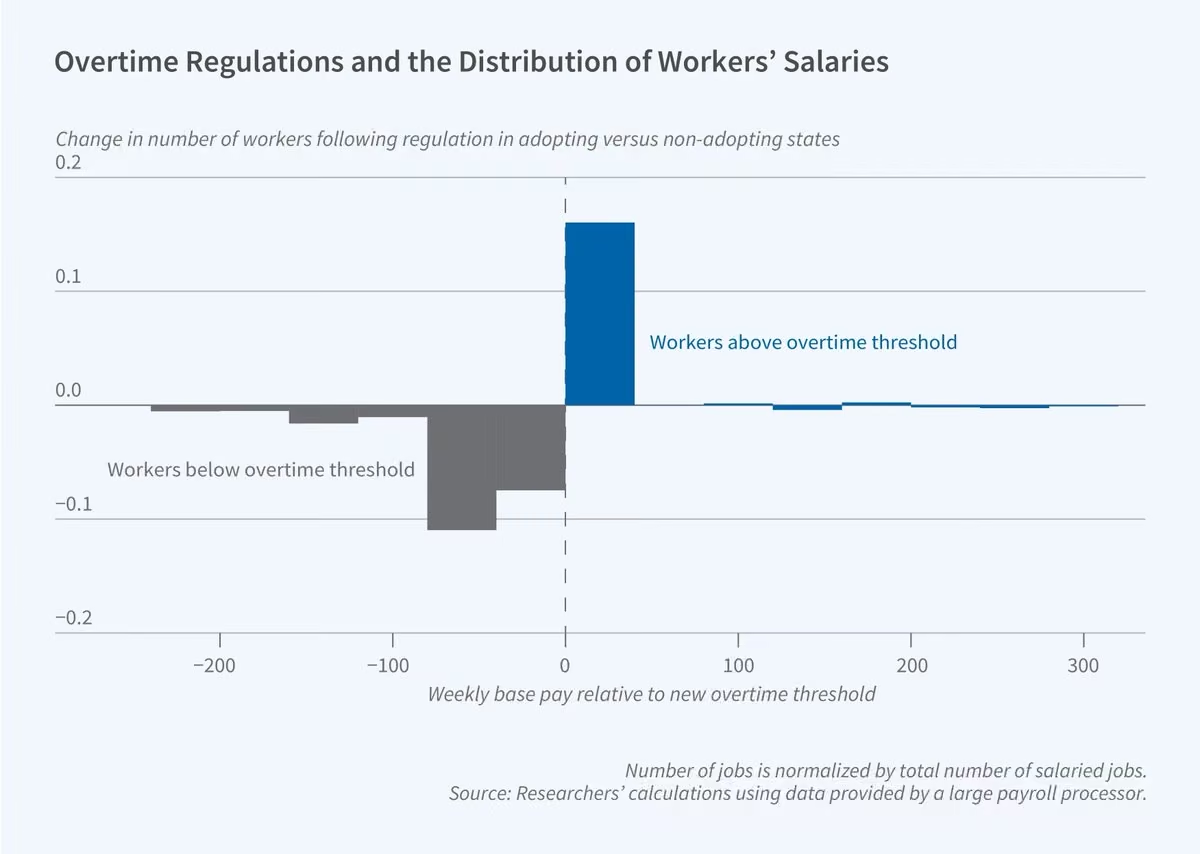
Featured in the latest Digest: Firm Responses to Changes in Overtime Pay Thresholds
www.nber.org/digest/202610/firm-responses-changes-overtim…
 NBER
@nberpubs
Why give foreign aid, and how? The why is complicated yet often converges to the same policy. The how is about the evidence, from @deankarlan www.nber.org/papers/w35926
 NBER
@nberpubs
Formalizing and generalizing the theory behind using “calibration questions” to correct for scale-use heterogeneity, from @Dan_J_Benjamin, Kristen B. Cooper, Ori Heffetz, @mileskimball, and Jiannan Zhou www.nber.org/papers/w35925
 NBER
@nberpubs
If China’s goal is to reduce its carbon emissions and thereby slow climate change, benchmarks need to be tightened within the existing rate-based system or an alternative system adopted, from Shuang Zhang and @ColumbiaCEEP www.nber.org/papers/w35924
 NBER
@nberpubs
A low-cost intervention in which coaches delivered text messages that encouraged persistence promoted high school completion among adults who returned to earn a diploma, from @berto_econ, Pietro Pellerito, and @PSullivanT www.nber.org/papers/w35923
 NBER
@nberpubs
Health care may save or harm the federal budget, from David M. Cutler www.nber.org/papers/w35922
 NBER
@nberpubs
Arguing that conventional migration regressions can be biased, as they do not reflect how workers choose among competing locations, from @borusyak, @dix_rafael, and Brian K. Kovak www.nber.org/papers/w35921
 NBER
@nberpubs
Reviewing the evidence on firm-sponsored training and shows that firms train workers differently depending on how they are organized, from @ProfDavidDeming, @raffasadun, and @EconStanton www.nber.org/papers/w35920
 NBER
@nberpubs
Venture capital finances customer capital intensive firms, having shifted away from knowledge capital intensive firms over the past 30 years, from @m_aragoneses, Young Soo Jang, and @profsufi www.nber.org/papers/w35919
 NBER
@nberpubs
Documenting that firms' investment responds to global price of risk shocks. Constructing a model to identify a risk dimension to stabilization policies, from Caitlin Hegarty, @MatiasMoretti1, Pablo Ottonello, and Diego J. Perez www.nber.org/papers/w35918
 NBER
@nberpubs
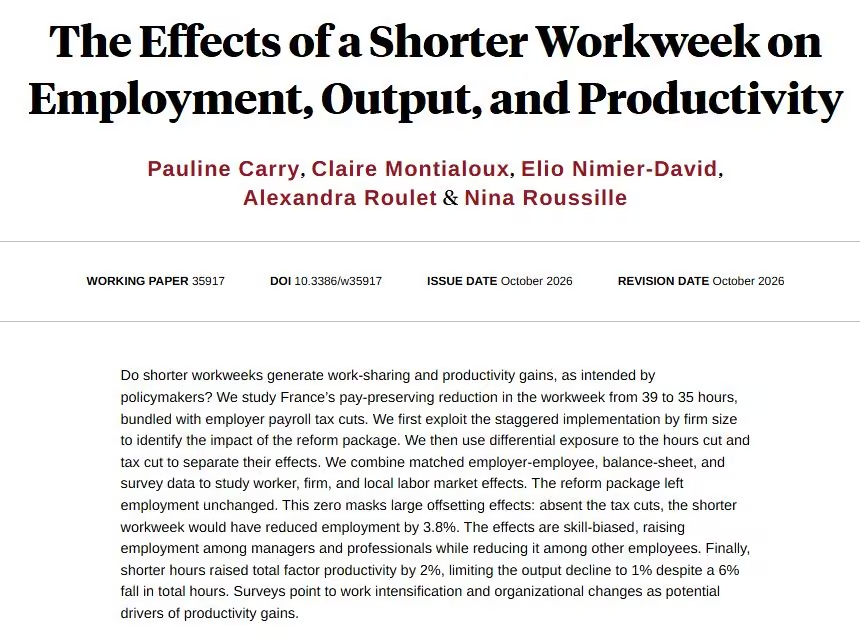
France’s 35-hour workweek didn’t generate work-sharing: absent tax cuts, employment would have fallen 3.8%, concentrated among lower-skill workers. TFP rose 2%, output fell 1%, from @PaulineCarry, @cmontialoux, @ElioNimier, Alexandra Roulet, and @ninaroussille
 NBER
@nberpubs
Challenging the assumption that stronger intellectual property rights alone would catalyze discovery-based R&D, from Chirantan Chatterjee, Aniruddh Bhaskaran, and Matthew J. Higgins www.nber.org/papers/w35916
 NBER
@nberpubs
Public transit access affects school choice in Chicago, with longer travel times limiting demand for top-rated schools among Black students, from Cecilia H. Moreira, Steven L. Puller, and Ini Umosen www.nber.org/papers/w35915
 NBER
@nberpubs
Using a dynamic factor time series model to estimate the national mortality impact of the Great Recession, from Amy Finkelstein, @profnoto, and Enzo Profili www.nber.org/papers/w35914
 NBER
@nberpubs
How do Fed Chairs spend their time? Systematically analyzing the daily calendars of Ben Bernanke, Janet Yellen, and Jerome Powell, from @td_econ and Dali Tsakadze www.nber.org/papers/w35913
 NBER
@nberpubs
In rural Sierra Leone, upgrading savings groups into mobile money and bank agents expands markets, but consumer feedback drives larger gains for households, groups, and providers, from @fannan2316 and Seth Garz www.nber.org/papers/w35912
 NBER
@nberpubs
The latest NBER Reporter is now live: www.nber.org/reporter?page=1&perPage=50
Featuring Mark Duggan’s Martin Feldstein Lecture on Social Security Reform in an Era of Fiscal Deficits, and research summaries by:
• Christoph Boehm, Andrei A. Levchenko, and Nitya Pandalai-Nayar
• Kasey Buckles, Joseph Price, and Zachary Ward
• Kalena Cortes
• Stefan Nagel
NBER
@nberpubs
In theory, demand distortions such as credit constraints can raise the welfare gains from green subsidies. Demonstrating this in an RCT of induction stoves in Kenya, from @BerkouwerS and @josh_t_dean www.nber.org/papers/w35911
 NBER
@nberpubs
The covariance matrix of asset returns is assumed to have an eigenvalue cliff. Showing that the cliff does not survive the conditioning information on which modern empirical asset pricing relies, from Mikhail Chernov, Bryan T. Kelly, Semyon Malamud, and Johannes Schwab
 NBER
@nberpubs
Characterizing equilibrium in models with endogenous production networks, generalizes Hulten's Theorem, and describes the macro effects of micro volatility, from Simone Cerreia-Vioglio, Roberto Corrao, @joel_flynn, and Giacomo Lanzani www.nber.org/papers/w35909
 NBER
@nberpubs
Expanding Medicaid increased credit-card borrowing by improving access to credit. The credit-supply channel generated 30 percent of the policy’s net welfare gains, from Gideon Bornstein and @sashaindarte www.nber.org/papers/w35908
 NBER
@nberpubs
Mortgage fee waivers meant to help borrowers often benefit lenders instead: New evidence shows loan officers pass through less than 40 percent of the savings, from Neil Bhutta, @Key_Z_E, and Adithya Raajkumar www.nber.org/papers/w35907
 NBER
@nberpubs
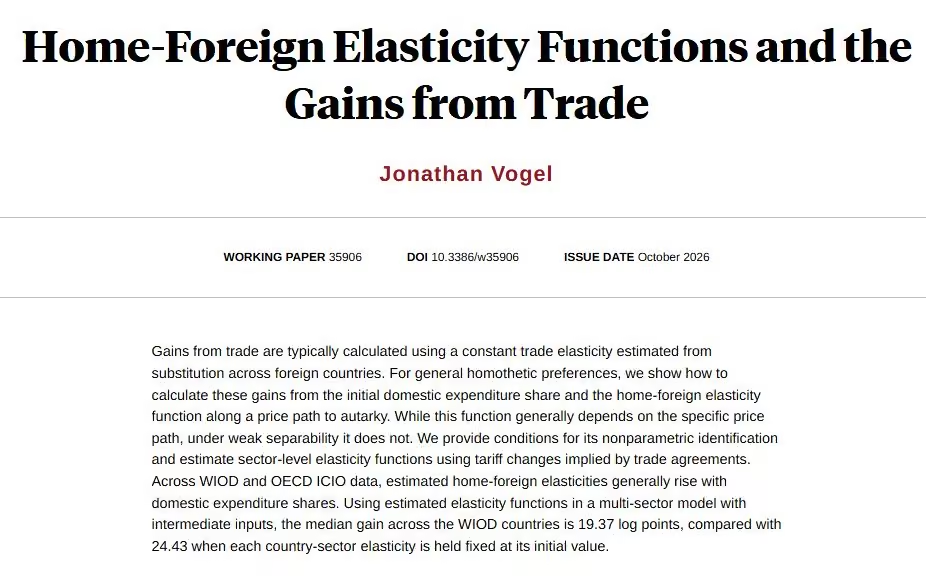
Direct estimates show home-foreign expenditure elasticities rise with domestic expenditure shares, reducing gains from trade relative to fixing elasticities at initial values, from @JonathanVogel1 www.nber.org/papers/w35906
 NBER
@nberpubs
Featured in the latest Digest: Subsidized Childcare and Mothers' Labor Outcomes in Quebec
www.nber.org/digest/202610/subsidized-childcare-and-mothe…
 NBER
@nberpubs
Showing that widespread use of LLMs in credit markets can lead to an endogenous market structure where ex-ante identical lenders specialize across qualitatively distinct segments, from Maryam Farboodi, Péter Kondor, and Pablo Kurlat www.nber.org/papers/w35905
 NBER
@nberpubs
Are we consuming too much groundwater from Earth's 3,400 aquifers? Three- to four-fifths of aquifers have water extraction above the welfare-maximizing rate, costing trillions of dollars, from Brian Greaney, @_josephshapiro, and Katherine R.H. Wagner www.nber.org/papers/w35904
 NBER
@nberpubs
Open call for papers, Applications of Artificial Intelligence in Healthcare. Conference to be held in Stanford, CA on June 2–3, 2027. Submit papers by 11:59pm EDT on February 18, 2027. More information: www.nber.org/calls-papers-and-proposals/applications-arti…
 NBER
@nberpubs
Before 1906, naturalizations spiked 30 percent in election years. Federal standards erased that cycle, especially in patronage-run cities. Rules can thus discipline political bias, from Abhay Aneja and @guoxu_econ www.nber.org/papers/w35903
 NBER
@nberpubs
Why does US monetary policy move global asset prices so much? Dollar funding: when the Fed tightens, dollar-funded arbitrageurs lose wealth, raising the global price of risk, from Rohan Kekre and Moritz Lenel www.nber.org/papers/w35902
 NBER
@nberpubs
Featured in the latest Bulletin on the Economics of Alzheimer's Disease and Related Dementias: Employment and Cognitive Decline
www.nber.org/ba/20262/employment-and-cognitive-decline?pa…
 NBER
@nberpubs
Modeling the labor market and public budget effects of immigration finds that inflows in Europe and US in 2019–2024 mostly increased welfare of natives, from Michele Battisti, @giov_peri, and Eleonora Romano www.nber.org/papers/w35901
 NBER
@nberpubs
Studying the role of foreign ideas in US innovation by constructing a directed “genealogy” of technologies from the full text of 13 million patents filed between 1887 and 2024, from Tarek Alexander Hassan, @AakashKalyani, and @jczldv www.nber.org/papers/w35900
 NBER
@nberpubs
California's Billionaire Tax Act would collect roughly $30 billion. Accounting for lost income taxes from departures, the mean Net Present Value is negative $39 billion, from Benjamin Jaros and Joshua Rauh www.nber.org/papers/w35899
 NBER
@nberpubs
Multilateral controls on dual-use goods reduce leakage and adversaries’ real military spending. Acting alone, even with an embargo, cannot match the security impact, from Jingting Fan, @kylelhandley, and Nuno Limão www.nber.org/papers/w35898
 NBER
@nberpubs
Inverting structural gravity to recover trade cost changes delivering targeted outcomes. Domestic cost changes are far more powerful than international ones, from James E. Anderson, Mario Larch, and Yoto V. Yotov www.nber.org/papers/w35897
 NBER
@nberpubs
Documenting three findings that challenge the conventional view of pension funds as stabilizing investors, from @AleksAndonov, Kristy A. E. Jansen, and Joshua Rauh www.nber.org/papers/w35896
 NBER
@nberpubs
Changes in the US Supreme Court's ideological balance shift macroeconomic expectations. Demonstrating this using deaths of Supreme Court Justices as quasi-experimental shifts, from @td_econ and Naixin Zhang www.nber.org/papers/w35895
 NBER
@nberpubs
Presenting a roadmap for ex-ante power calculations when evaluating policies aimed at small, vulnerable populations, illustrated with abortion bans' effects on economic welfare, from @kmpjones and @mayrapinedat www.nber.org/papers/w35894
 NBER
@nberpubs
Brazil's affirmative action helped more disadvantaged students graduate from top college programs, but knock-on effects from displacing other students reduced the overall gains, from @NanoBarahona, @cauedobbin, and @seb_otero www.nber.org/papers/w35893
 NBER
@nberpubs
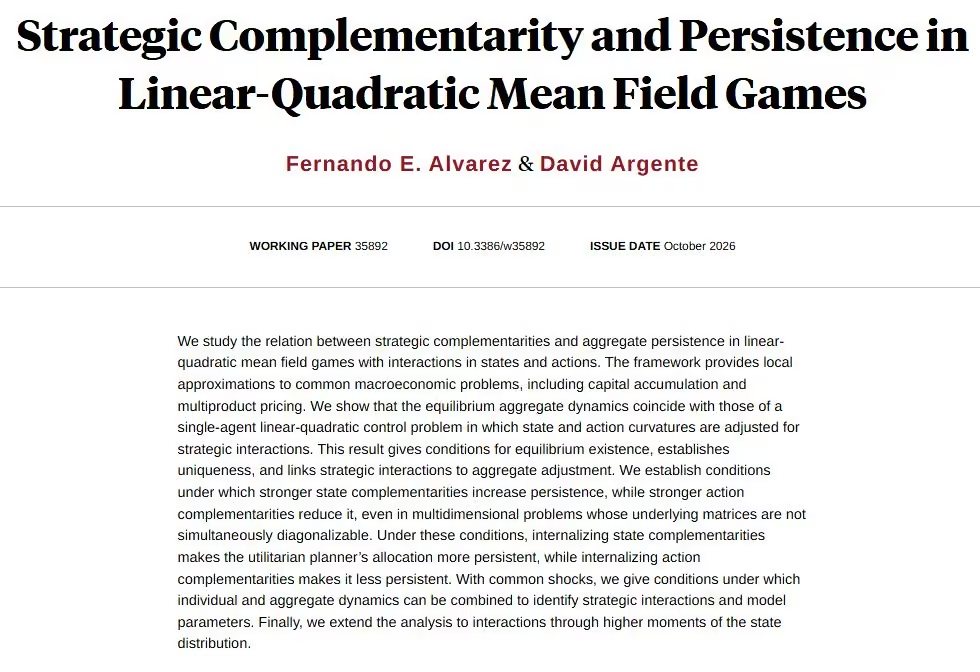
Studying how strategic interactions in states and actions shape equilibrium dynamics, persistence, the planner’s allocation, and identification in linear-quadratic mean field games, from Fernando E. Alvarez and @dargente05 www.nber.org/papers/w35892
 NBER
@nberpubs
Focusing on measuring intimate partner violence by introducing a novel, privacy-enhancing data collection method, from Jorge M. Agüero, Ursula T. Aldana, Erica M. Field, Veronica Frisancho, Ignacio Rodriguez Hurtado, and Javier Romero www.nber.org/papers/w35891
 NBER
@nberpubs
Estimating how much it would cost to handgun buyers to choose a less lethal alternative and using those estimates to simulate how many lives could be saved cost effectively, from @btshapir, Sara Drango, and Sarah Moshary www.nber.org/papers/w35890
 NBER
@nberpubs
Featured in the latest Bulletin on the Economics of Alzheimer's Diseases and Related Dementias: Probably Dementia and Health Insurance Choices
www.nber.org/ba?page=1&perPage=50
 NBER
@nberpubs
Studying how China uses access to public equity markets as an instrument of industrial policy, from Zhiguo He, Yiming Qian, Xi Sun, and Wang Renxuan www.nber.org/papers/w35889
 NBER
@nberpubs
Firms that go public reduce information asymmetries and by doing so gain improved access to both debt and equity markets, from Andres Almazan, Nathan Swem, Sheridan Titman, and @GregWeitzner www.nber.org/papers/w35888
 NBER
@nberpubs
Congestion pricing works best when drivers are heterogeneous in preferences and road network exposure. Showing how these forces interact in practice using data from a big experiment, from @AterItai, @itsbradross, Adi Shany, and @shoshievass www.nber.org/papers/w35887
 NBER
@nberpubs
Bank of Japan policy discontinuities reveal that stock purchases raise interest rates before yield curve control, but stock prices afterward, offering a nuanced view of the inelastic market hypothesis, from Masao Fukui and Masayuki Yagasaki www.nber.org/papers/w35886
 NBER
@nberpubs
Featured in the latest Digest: Skill Erosion During Career Interruptions: Evidence from Military Physicians
www.nber.org/digest/202610/skill-erosion-during-career-in…
 NBER
@nberpubs
Examining if asset price movements can be explained even with ex post observations of their drivers, from Bryan T. Kelly, Yinan Su, and Chao Zhang www.nber.org/papers/w35885
 NBER
@nberpubs
With exposure time fixed, working with one outgroup partner builds stronger ties; working with several reduces the majority’s misperceptions about the outgroup, from Anujit Chakraborty, @arkdevghosh, @hmmlowe, and Gareth Nellis www.nber.org/papers/w35884
 NBER
@nberpubs
When sellers have private information about their costs, incentives to distort output choices to affect future competition can be important even with many sellers, from Andrew Sweeting, Xuezhen Tao, and Qian Wang www.nber.org/papers/w35883
 NBER
@nberpubs
Can randomized evaluation help us understand systemic racial discrimination? Exploring how randomized controlled trials can help us understand systemic racial discrimination—and where they fall short, from Dania V. Francis, @robgillezeau, @nomadj1s, and @aviceisza
 NBER
@nberpubs
Does remote work raise fertility? After 2020, births fell among married women with more teleworkable college majors, while their full-time employment rose, from @acjohnston0 www.nber.org/papers/w35881
 NBER
@nberpubs
Examining how physical health, health behaviors, and mortality vary with income for prime-age adults, from @liraneinav, Amy Finkelstein, and @Sehyunhong95 www.nber.org/papers/w35880
 NBER
@nberpubs
Cross-border learning is key in semiconductors and often mediated through market mechanisms, from @PennyG_Yale, @juhreka13, @GiuliaLoForte, and Jeff Thurk www.nber.org/papers/w35879
 NBER
@nberpubs
With randomized oversight, it is possible to provide guardrails so that AI agents don't go rouge, from @joshgans and @profholden www.nber.org/papers/w35878
 NBER
@nberpubs
Indirect variational inference pairs variational inference (VI) with indirect inference to remove VI's approximation bias while retaining its scalability. Applying this to nonlinear models of earnings dynamics, from Neele L. Balke, Stéphane Bonhomme, and Thibaut Lamadon
 NBER
@nberpubs
Estimating the effects of Critical Access Hospital designation on hospital finances, capacity, and organizational outcomes, from @ianhealthecon and Katie Leinenbach www.nber.org/papers/w35876
 NBER
@nberpubs
Featured in the latest Digest: What Leads to Fiscal Adjustment?
www.nber.org/digest/202610/what-leads-fiscal-adjustment?p…
 NBER
@nberpubs
Analyzing the academic affiliations of nearly 6,000 award-winning researchers in 18 major fields in the natural sciences, engineering, and social sciences from the 1820s to the 2020s, focusing on the 1960s onward, from Richard B. Freeman, Danxia Xie, @Hanzhe_Zhang, and @hanzhou2003 www.nber.org/papers/w35875
 NBER
@nberpubs
Hybrid tax planning strategies accounted for 36 percent of foreign profits of US multinational companies in 2016. A structural model quantifies planning costs, tax revenue losses, and investment implications, from Rosanne Altshuler, Lysle Boller, Kevin A. Roberts, and @J_C_Suarez
 NBER
@nberpubs
The 1982 Tylenol recall, which likely reduced acetaminophen use in pregnant women and fetal exposure, was not associated with changes in autism or ADHD among affected cohorts, from @ChrisWorsham, Charles Bray, Joshua Rothman, Brian Kwan, and @AnupamBJena www.nber.org/papers/w35873
 NBER
@nberpubs
Using a randomized controlled trial to identify heterogeneous impacts in the presence of noncompliance, from @orazio_at, Lina Cardona-Sosa, and Ziqian Liu www.nber.org/papers/w35872
 NBER
@nberpubs
Long-term air pollution exposure increases chronic disease, especially hypertension, even among young, healthy adults. New evidence from US Army personnel, from Joshua S. Graff Zivin, Johnny Huynh, Timothy Frank Justicz, Adriana Lleras-Muney, and Matthew J. Neidell
 NBER
@nberpubs
Novel database of Russell 3000 corporate climate targets over 25 years enables new research of how voluntary commitments interact with carbon pricing, regulations, and subsidies, from @josephaldy, Michael W. Toffel, Alison J. Ong, and Lavender Yang www.nber.org/papers/w35869
 NBER
@nberpubs
Line drawing is a pervasive feature of legal design. The considerations that shape the optimal line placement share a common structure across a surprisingly large number of legal domains, from @jacobsgoldin and David Weisbach www.nber.org/papers/w35868
 NBER
@nberpubs
How does monetary policy affect firm investment? Estimating the full response distribution finds that only 5 percent of firm-time observations respond strongly; most heterogeneity remains unexplained, from @td_econ, @THEdanjlewis, Davide Melcangi, and @pilossopher
 NBER
@nberpubs
Studying how El Salvador’s 2022 State of Exception, which ended two decades of gang territorial control, reshaped Salvadoran society, from Carlos Schmidt-Padilla, @melnikov_n_v, and @micasviatschi www.nber.org/papers/w35866
 NBER
@nberpubs
The AI buildout is historically large and financially consequential. As financing migrates off hyperscalers' balance sheets, leverage and opacity grow, from @SVNieuwerburgh www.nber.org/papers/w35865
 NBER
@nberpubs
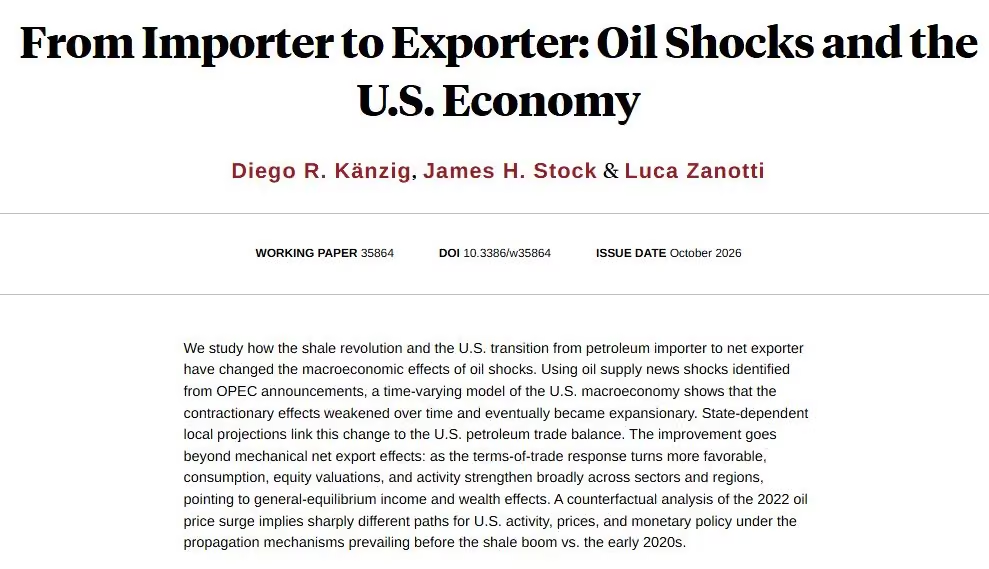
As the US shifted from petroleum importer to net exporter, oil supply shocks became less contractionary and eventually expansionary, reflecting broader income and wealth effects, from @drkaenzig, James H. Stock, and Luca Zanotti www.nber.org/papers/w35864
 NBER
@nberpubs
What have we learned from two decades of research about the 2000s housing boom? Arguing that the cycle was a perfect storm that involved all the usual suspects, from Adam Guren www.nber.org/papers/w35863
 NBER
@nberpubs
Examining why rising powers survive periods in which established states can still suppress them, from Johann Caro-Burnett, @SFGaliani, and Gustavo Torrens www.nber.org/papers/w35862
 NBER
@nberpubs
Showing how labor supply, wages, health, and disability claims have evolved in the UK, and examining how reforms have changed work incentives over this period, from Richard Blundell, Monica Costa-Dias, @gmazeine, @CostasMeghir, and Tom Waters www.nber.org/papers/w35861
 NBER
@nberpubs
Textual discussions of portfolio companies by private equity managers in the first years after the investment convey substantial information about their ultimate performance, from Josh Lerner, Fiona Paine, and Antoinette Schoar www.nber.org/papers/w35860
 NBER
@nberpubs
Open call for papers, Japan Project Meeting, 2027. Conference to be held in Tokyo, Japan on August 3–4, 2027. Submit papers by 11:59pm EDT on December 1, 2026. More information: www.nber.org/calls-papers-and-proposals/japan-project-mee…
 NBER
@nberpubs
Nearly one-third of US STEM PhD students now write their dissertations with AI. Rarer at top programs, more common for non-native English speakers. AI users are more likely to enter industry, from @daniel_p_gross, @DShvadron, and @HansenZhang13 www.nber.org/papers/w35859
 NBER
@nberpubs
Exposure to large-scale stressors reduces levels of FT3, a thyroid hormone, altering relationships between FT3, body composition, and cortisol and increasing cardiometabolic risk, from Ralph I. Lawton, Duncan Thomas, Elizabeth Frankenberg, Cecep Sumantri, Teresa Seeman, Eileen Crimmins, and Daniel Hochbaum www.nber.org/papers/w35858
 NBER
@nberpubs
New machines do raise demand for skilled workers, just not at the firms that buy them. New data show the skill bias arises at suppliers that install and run them, from Gert Bijnens, Anders Humlum, and Stijn Vanormelingen www.nber.org/papers/w35857
 NBER
@nberpubs
COVID-19 labor force exit is persistent particularly for low skilled workers and low-skill unmarried men, from Andrew C. Barr, Laura Kawano, Bruce Sacerdote, and Michael Stevens www.nber.org/papers/w35856
 NBER
@nberpubs
More physicians and higher physician quality, measured by licensing exam scores, reduce patient mortality in Chilean public hospitals, from Juan Pablo Atal, @tlarroucau, Pablo Muñoz, and @cristobalotero www.nber.org/papers/w35855
 NBER
@nberpubs
Norway's controversial 2021–2024 reforms nearly doubled the tax on business wealth. Firms of affected owners did not invest less, and outmigration was limited to the very top, from @Mariusring www.nber.org/papers/w35854
 NBER
@nberpubs
Denmark quasi-randomly assigned 12,000+ refugee children across towns. Those placed where social mobility is higher earned more as adults and had fewer convictions and teen births, from @MeltemDaysal, Joseph J. Doyle Jr., @NaeimSamandari, Emil A. L. Simonsen, and @tramir
 NBER
@nberpubs
As Japan shrinks and ages, young people and births cluster in big cities, leaving rural areas older, emptier, and costlier to sustain, from @eli_gnn, Yuhei Miyauchi, Nuno Paixao, Xinle Pang, and Yuta Suzuki www.nber.org/papers/w35852
 NBER
@nberpubs
Parenting programs generate latent human capital, buffering children against schooling shocks in middle childhood, from Shruti Jha, @econ_4_everyone, Rebecca C. Royer, and Anya Samek www.nber.org/papers/w35851
 NBER
@nberpubs
The scope of multiple equilibria in sovereign debt markets, from @ojblanchard1, @pmbruera, and @gonhuertas www.nber.org/papers/w35850
 NBER
@nberpubs
A California staffing requirement leads facilities to bunch below the regulatory threshold and has little effect on staffing, from @AldenCheng_Econ and @rileyleague www.nber.org/papers/w35849
 NBER
@nberpubs
Featured in the latest Digest: Where Immigrants Settle and US Economic Growth
www.nber.org/digest/202610/where-immigrants-settle-and-us…
 NBER
@nberpubs
State e-cigarette retail licensure laws with strong penalties for non-compliance reduced nicotine vaping among Black youths by 2.5–4.0 percentage points but had no effect on White youths, from Dhaval M. Dave, Jooyoung Kim, and @SDSUCHEPS www.nber.org/papers/w35848
 NBER
@nberpubs
Who gains from accelerated math? Letting kids with top 20 percent math scores take algebra and geometry early raises calculus-taking and STEM/business degrees—but effects vary by non-cognitive skill, from David Card and Laura Giuliano www.nber.org/papers/w35847
 NBER
@nberpubs
Are prediction markets politically biased, or biased by race, sex, or age? The answer, based on a 145-year sample, is no, from Eric Zitzewitz www.nber.org/papers/w35846
 NBER
@nberpubs
Limiting stakes on prediction markets also limits arbitrage, and this can undermine the efficient pricing they are known for, from Eric Zitzewitz www.nber.org/papers/w35845
 NBER
@nberpubs
Finding a substantial increase in dental services use after an adult Medicaid dental benefit, with larger effects in counties with more oral health care provider practices, from @DS_Grossman, Kole T. Reddig, Jane Ruseski, and Fotinos Panagakos www.nber.org/papers/w35844
 NBER
@nberpubs
I provide necessary and sufficient conditions for valuing complementarities from direct and total subsidy responses. The formula uses existing estimates and guides new experiments, from @dargente05 www.nber.org/papers/w35843
 NBER
@nberpubs
Showing that the Rosenwald schools helped spur the Civil Rights Movement in Southern counties about a generation after the schools were built, from Daniel Aaronson, Mark Borgschulte, Sunny Liu, and Bhashkar Mazumder www.nber.org/papers/w35842
 NBER
@nberpubs
The FTC argues Amazon did not declare its auction rules. This paper shows when that matters, from @joshgans www.nber.org/papers/w35841
 NBER
@nberpubs
Decomposing individual firm stock returns into two distinct components: SYS, the component of returns that can be linked to systematic risk and public information releases; and an orthogonal residual RES, from Federico Baldi-Lanfranchi, Pierre Collin-Dufresne, and Kent D. Daniel
 NBER
@nberpubs
Open call for papers, Economic Analysis of Regulation. Conference to be held in Cambridge, MA on May 7, 2027. Submit papers by 11:59pm EDT on February 9, 2027. www.nber.org/calls-papers-and-proposals/economic-analysis…
 NBER
@nberpubs
AI sounds like one mind. But LLMs turn training data into votes. This microeconomic foundation of LLMs explains why their advice can cycle: A beats B, B beats C, C beats A, from Raša Karapandža and Yaw Nyarko www.nber.org/papers/w35839
 NBER
@nberpubs
The persistence of media sentiment depends not only on whether the news is good or bad, but also on what the news is about, from @isha89agarwal, @wentong_chen, and @EswarSPrasad www.nber.org/papers/w35838
 NBER
@nberpubs
Using a randomized trial in Chile to study how information about school quality affects families’ choices and how scaling up the intervention changes its impact, from @Claudiallende, Francisco Gallego, and @chrisaneilson www.nber.org/papers/w35837
 NBER
@nberpubs
Featured in the latest Digest: AI and the Performance of Workers with Disabilities
www.nber.org/digest/202610/ai-and-performance-workers-dis…
 NBER
@nberpubs
Using a large sample of Canadian lottery winners to estimate the causal effects of a financial windfall on consumption, savings, and wage earnings, from Rajashri Chakrabarti, Philippe d'Astous, @KoryKroft, Sheisha Kulkarni, Vyacheslav Mikhed, @profnoto, Sahil Raina, and Barry Scholnick www.nber.org/papers/w35836
 NBER
@nberpubs
The Pandemic EBT program, which gave families money for school meals lost to COVID-19 closures, raised weekly spending on sugary items by 16 percent among lower-income households with kids, from Georgina Cisneros and @bf_churchill www.nber.org/papers/w35835
 NBER
@nberpubs
Trade agreements raise emissions and carbon taxes undermine the balance of concessions. Integrating carbon pricing into the World Trade Organization, with its burden balanced, sharply cuts emissions, from @Farid__Farrokhi, @ALashkaripour, and Homa Taheri www.nber.org/papers/w35834
 NBER
@nberpubs
New NBER Book released: The Economics of Place-Based Policies
www.nber.org/books-and-chapters/economics-place-based-pol…
 NBER
@nberpubs
Promoting savings reduces spending on alcohol, transactional sex, and gambling among high-risk men in western Kenya, from Harsha Thirumurthy, Elizabeth F. Bair, @deanyang, Teniola I. Egbe, Benard Ayieko, Julius Wesonga, Sue Napierala, Connie Celum, Mary E. Putt, Carol S. Camlin, and Mark Ayallo www.nber.org/papers/w35833
 NBER
@nberpubs
Presenting inference for regression with data that are correlated across some measure of distance; most often geographic distance, from A. Colin Cameron and @DougMil02368894 www.nber.org/papers/w35801
 NBER
@nberpubs
Considering inference when observations are correlated within clusters that are independent of each other, from A. Colin Cameron and @DougMil02368894 www.nber.org/papers/w35800
 NBER
@nberpubs
Open call for proposals, i3 Open Data Fellows Program - 2027. Submit proposals by 11:59pm EDT on November 1, 2026. More information: www.nber.org/calls-papers-and-proposals/open-data-fellows…
 NBER
@nberpubs
Global warming raises mortality through more than heat: 1°C increases annual deaths by 2.5 per 1,000, and adverse economic effects explain two-thirds of the gap, from @AdrienBilal, @drkaenzig, and Krzysztof Lisiecki www.nber.org/papers/w35832
 NBER
@nberpubs
Subjective models matter for monetary policy transmission, from Francesco D’Acunto, Dimitris Georgarakos, Geoff Kenny, and Michael Weber www.nber.org/papers/w35831
 NBER
@nberpubs
Should climate policy target fossil fuel demand or supply? This paper discusses the value of both, analyzing emissions leakage, barriers to clean tech, and distributional impacts, from @RyanMKellogg www.nber.org/papers/w35830
 NBER
@nberpubs
Importers tend to be few, large, and have market power, so they're already too small relative to what's efficient, and tariffs make that distortion worse. Accounting for this, the optimal tariff turns out to be negative (an import subsidy), and even more so for larger countries, from Jonathan Becker, Corina Boar, and Virgiliu Midrigan www.nber.org/papers/w35829
 NBER
@nberpubs
Should AI providers be liable when their tools help both attackers and defenders? This paper finds that moderate liability can improve welfare even while increasing harm, that full liability is never optimal under monopoly, and that requiring universal guardrails makes liability unnecessary, from @joshgans www.nber.org/papers/w35828
 NBER
@nberpubs
Behavioral economics gives us a new way to understand why homicides surged during the pandemic, then plummeted, from Jens Ludwig www.nber.org/papers/w35827
 NBER
@nberpubs
Better cross-country data and measurement have raised the contribution of inputs—mostly human capital—in accounting for international differences in GDP per worker, from @LagakosDavid and @todd_schoellman www.nber.org/papers/w35826
 NBER
@nberpubs
New research on Savannah, GA finds that building affordable homes on vacant and abandoned lots raised neighboring property values by 11 percent, and by up to 35 percent where infill projects clustered, from Edward W. Chen, Reagan L. Lengefeld, and Omar Isaac Asensio
 NBER
@nberpubs
Population projections often assume that future fertility rates will stop declining after falling below some threshold, but that is at odds with global historical patterns, from Diane Coffey, @MikeGeruso, Dean Spears, and Sangita Vyas www.nber.org/papers/w35824
 NBER
@nberpubs
A new Overlapping Generations model shows there's a welfare-maximizing rate of population growth, trading off higher output per worker against fewer workers per retiree, and that optimal rate may well be negative. Adding pay-as-you-go social security pushes it even lower, from Laurence M. Ball www.nber.org/papers/w35823
 NBER
@nberpubs
The dollar remains dominant, with the euro and renminbi stuck in a fragmented second tier. Innovations like dollar-backed stablecoins could entrench that dominance further. Rivals could still catch up by embracing innovation, though a multipolar system might prove more fragile in a crisis, from @gordonliao, @EswarSPrasad, and Tony Zhang www.nber.org/papers/w35822
 NBER
@nberpubs
Long contracts signed in booms make markets thinner and slower to adjust. In the containership leasing market, this "contracting externality" leads to major capital misallocation, especially after crashes, from Maria Garcia-Osipenko, Nicholas Vreugdenhil, and Nahim B. Zahur
 NBER
@nberpubs
Across 2.5 million candidates in Spain and France, names influence sorting into parties, from Jesús Fernández-Villaverde and Carlos Sanz www.nber.org/papers/w35820
 NBER
@nberpubs
Livestock Risk Protection endorsements cluster around CME option expirations, but simulated subsidy-capture gains are small, concentrated in low-volatility periods, and come with worse downside risk, from Yifei Zhang, Andrew Keller, Shawn Arita, and @SteinbachAgEcon
 NBER
@nberpubs
Childcare quality is important for child development, which is described by a complex process with many inputs, from @orazio_at, Raquel Bernal, Michele Giannola, and @mnores_ecd www.nber.org/papers/w35818
 NBER
@nberpubs
Building Food at Home inflation measures from item-level transactions data, comparing them to official statistics, and showing how modern data can capture consumer choices more accurately, from Steve Coffey, @gabriel_ehrlich, @JHaltiwanger_UM, @jarmin_ron, @djatumich, Tod Johnson, and Matthew D. Shapiro www.nber.org/papers/w35817
 NBER
@nberpubs
Was the Great Depression a result of an over accumulation of investment during the 1920s, despite a slowdown in new product development and satiated demand? From Harold L. Cole, Stefano Cravero, and Jeremy Greenwood www.nber.org/papers/w35816
 NBER
@nberpubs
Technical change often simplifies work. This increases productivity, but it also makes workers more replicable or commoditized, and may therefore reduce wages, from Masao Fukui, @eminakamura2, and @JonSteinsson www.nber.org/papers/w35815
 NBER
@nberpubs
Can Rust Belt regions bounce back? French areas with access to Luxembourg's booming job market saw higher employment, population, and incomes, and less far-right voting, which suggests declining industrial regions can recover when labor demand rebounds on a large enough scale, from @LevyAntoine and @MathildeMunoz www.nber.org/papers/w35814
 NBER
@nberpubs
Open call for applications: Digital Economics and AI Tutorial to be held January 20-21, 2027 at Stanford University. Deadline for submission: 11.59pm EST on November 3, 2026. Full information: www.nber.org/calls-papers-and-proposals/digital-economics…
 NBER
@nberpubs
Zero-sum environments can foster beliefs that curb wasteful competition but suppress effort and innovation—creating a cultural growth trap. This feature is studied in the context of Europe after 1500, from @ABergeron_econ, Jean-Paul Carvalho, Joseph Henrich, @DrNathanNunn, and @jonathanweigel www.nber.org/papers/w35813
 NBER
@nberpubs
Maritime chokepoints are not just local logistics risks, they are a channel through which geopolitical, climate, and infrastructure disruptions become shocks for entire transport capacity, from Giulia Brancaccio, @myrto_kaloup, Theodore Papageorgiou, and Yixin
 NBER
@nberpubs
Open call for papers: Compensation of Top Executives: Determinants and Consequences
conference to be held June 22, 2027 in Cambridge, MA. Submission deadline: 11:59pm ET on Wednesday, February 3, 2027. More information: www.nber.org/compensation-top-executives-determinants-and…
 NBER
@nberpubs
An Atlantic Meridional Overturning Circulation collapse may overturn some of the effects of global warming—easing its impact on developing countries and instead harming more advanced economies, from @jlcruzalv, @klausvanieper, and @HansbergRossi www.nber.org/papers/w35811
 NBER
@nberpubs
Childhood neighbors influence career paths: Living next door to someone in an occupation raises the chance of holding that occupation 30 years later by 10 percent, from @MikeJAndrews44, @ryanreedhill, @joepricebyu, and @1rileywilson www.nber.org/papers/w35810
 NBER
@nberpubs
Humanity is likely to be below replacement fertility. That has never happened before. But, the real surprise is that the fall has been concentrated in low- and middle-income countries and among poorer and less educated women, from Jesús Fernández-Villaverde and Patrick Norrick
 NBER
@nberpubs
Satellite ship-tracking data show the 2021 West Coast crisis and the Red Sea attacks cost the US 0.69 percent and 0.35 percent of output, largely because carriers shift ships without accounting for the congestion they create. Surprisingly, tariffs can ease that congestion and offset their usual cost, from Xiwen Bai, Jesús Fernández-Villaverde, @YiliangLi_, Ricardo Marto, and @FZanettiOxford www.nber.org/papers/w35808
 NBER
@nberpubs
Time fixed effects don't absorb aggregate shocks in production networks: shocks spread unevenly through prices, costs, and demand, so IV and diff-in-diff estimates can mix direct effects with network "leakage." Calibrated to the US economy, this bias can exceed 130 percent of the true effect, from Bernard Herskovic and Gill Segal www.nber.org/papers/w35807
 NBER
@nberpubs
Deep learning methods are projection methods, and merging their key features will produce better solution methods, from Kenneth L. Judd and Karl Schmedders www.nber.org/papers/w35806
 NBER
@nberpubs
Firm-level income tax reconciliation tables show that the Tax Cuts and Jobs Act substantially reduced the foreign tax advantages of US multinationals, from Anmol Bhandari and Ellen McGrattan www.nber.org/papers/w35805
 NBER
@nberpubs
From the Beveride curve, this research constructs a Phillips curve that describes inflation as a decreasing and convex function of unemployment, such that the divine coincidence holds, from Pascal Michaillat and Emmanuel Saez www.nber.org/papers/w35804
 NBER
@nberpubs
In a study of NBA data, work causally raises injury risk. Coaches rest players in response, raising player productivity, from Kala Krishna, Sergey Lychagin, and Lewis S. McLean www.nber.org/papers/w35803
 NBER
@nberpubs
Evidence from Italy's Cassa per il Mezzogiorno and the US Apollo program shows industrial policies originate in political projects and last as long as their vision stays credible, from Lottie Field, @juhreka13, and Michele Zampa www.nber.org/papers/w35802
 NBER
@nberpubs
Open call for papers: "Inflation: The 34th NBER-TCER-CEPR TRIO Conference" to be held March 6-7, 2027 in Tokyo, Japan. Submission deadline 11:59pm (ET) November 20, 2026. Full details: www.nber.org/calls-papers-and-proposals/inflation-34th-nb…
 NBER
@nberpubs
On the 250th anniversary of Adam Smith’s The Wealth of Nations: What ignited humanity’s ascent from millennia of stagnation, and what are the roots of global inequality? From @GalorOded www.nber.org/papers/w35799
 NBER
@nberpubs
Guideline and physician performance in atrial fibrillation depend on how bleeding harms vary across patients; robust treatment rules can perform well across plausible harm assumptions, from @jabaluck, @LeilaEcon, and David C. Chan Jr www.nber.org/papers/w35798
 NBER
@nberpubs
Studying how property rights uncertainty affects prices and speculative activities in the housing markets using a natural comparison of full and limited property houses in Shenzhen, from @HanmingF, Jing Wu, and Vincent Yao www.nber.org/papers/w35797
 NBER
@nberpubs
For recent college graduates, unemployment rates did not spike in summer 2026 relative to previous years’ summer months possibly due to AI effects, from @RobertFairlie6 and Jane Wu www.nber.org/papers/w35796
 NBER
@nberpubs
Green innovation rises in downturns even as non-green innovation falls. A model matched to this evidence implies larger, greener subsidy effects in recessions, from @drkaenzig, @maxkonradt, Lixing Wang, and @DonghaiZhang3 www.nber.org/papers/w35795
 NBER
@nberpubs
Open call for papers: Race and Stratification in the Economy. The conference will be held on April 2, 2027, in Cambridge, Massachusetts. Submission deadline: 11:59pm (EST) December 10, 2026. More info: www.nber.org/race-and-stratification-economy
 NBER
@nberpubs
Anticipated regulation can spur permitting without accelerating investment, as demonstrated by a Colorado case-study. This identifies a novel channel for regulatory leakage, from Anna French and Nicholas Vreugdenhil www.nber.org/papers/w35794
 NBER
@nberpubs
Introducing the expanded Global Repository of Income Dynamics (GRID), a database of harmonized administrative-data statistics on income inequality, volatility, and mobility across 26 countries. Led by Fatih Guvenen, Luigi Pistaferri, Giovanni L. Violante, with country teams worldwide. www.grid-database.org
NBER
@nberpubs
AI's economic impact? By the end of 2025, markets priced in 32.6 percent higher software engineering productivity, implying 3.6–6.5 percent higher GDP. Both more than doubled by mid-2026, from Alex Blumenfeld, @JADHazell, @ChenLian92, and Andreas Schaab www.nber.org/papers/w35793
 NBER
@nberpubs
Korea’s 1993 higher education reform markedly increased college completion, which later led to a substantial mortality reduction among the students’ aging parents, from Ah-Reum Lee, William H. Dow, and Jacqueline M. Torres Torres www.nber.org/papers/w35792
 NBER
@nberpubs
Remote work post-Covid boosts employment and lowers commute time for disabled and older workers in the UK but comes with lower wages, from Ian Burn, Melissa D. Gentry, and Joanna Lahey www.nber.org/papers/w35791
 NBER
@nberpubs
Euro cash changeovers are used to test price-setting theories. The moving-boundary problem is solved analytically. Historical data from six countries support state-dependent pricing, from Fernando E. Alvarez, @dargente05, @albertocavallo, and Francesco Lippi
 NBER
@nberpubs
The text of children's books convey a broad emotional range but images overwhelmingly show happiness/calm—a mismatch that consumer demand for "positive" imagery may reinforce, narrowing the emotions children encounter, from @aadukia, Matthew Bonci, Paula Dastres Gallardo, @emileigharrison, Jake Nicoll, and @TeodoraSzasz www.nber.org/papers/w35789
 NBER
@nberpubs
An LLM workflow that reproduces, improves, and extends economics research has been applied to over 4,000 published replication packages, from Matthew Schwartz, Isaiah Andrews, and Jesse M. Shapiro www.nber.org/papers/w35782
 NBER
@nberpubs
Proposing to use quasi-exogenous variation in market structure to estimate equilibrium pricing policy functions, from @GGowrisankaran, Christopher D. Bruegge, and Alex Gross www.nber.org/papers/w35787
 NBER
@nberpubs
Using plausibly exogenous veterans’ payments, new evidence shows stimulus checks generate large, hump-shaped increases in consumption, with multipliers above 2 after a year, from @jptguerreiro, @JADHazell, @drkaenzig, and Ed Manuel www.nber.org/papers/w35786
 NBER
@nberpubs
Studying how the US-China trade war has reshaped global trade patterns, creating significant spillovers to third countries, from @pol_antras, Adrian Kulesza, and @a_presbitero www.nber.org/papers/w35785
 NBER
@nberpubs
When a spouse becomes incapacitated, older adults use substantially more formal care and become less sensitive to its price, revealing the value of spousal care, from Itzik Fadlon, @talgross, @Hoagland_Alex, and @timothyjlayton www.nber.org/papers/w35784
 NBER
@nberpubs
In a new theory of bundling frictions, increasing productivity of cognitive skills explains changing patterns in within occupation wage inequality in the US, from @chrisedmond and @Simon_Mongey www.nber.org/papers/w35783
 NBER
@nberpubs
Studying how aggregate financial conditions shape firm insurance and, through it, labor income risk, from Maarten Meeuwis, @DimitrisPapan20, and @L_Schmidt_Econ www.nber.org/papers/w35781
 NBER
@nberpubs
New evidence shows that incorporation capital requirements substantially reduce entrepreneurial entry without screening on entrepreneurial quality, from Annika Bacher, Andreas Fagereng, @Mariusring, and Ella Getz Wold www.nber.org/papers/w35780
 NBER
@nberpubs
Considering official and alternative data sources for measuring and projecting the role of US manufacturing in the global semiconductor manufacturing industry, from David M. Byrne, @robertkurtzman, and @heidilwilliams_ www.nber.org/papers/w35779
 NBER
@nberpubs
When regulation is fragmented across countries, foreign political frictions determine whether corporate stewardship or policy advocacy better addresses global externalities, from @RobinJSD, Doron Levit, @nmalenko, and @r_jmagda www.nber.org/papers/w35778
 NBER
@nberpubs
Discussing how immigration affects identity, and the implications for politics, from Vasiliki Fouka and Marco Tabellini www.nber.org/papers/w35777
 NBER
@nberpubs
They find that high school courses exposing students to careers in education did not increase entry into the profession, likely because course takers do not enroll in college, from Danielle Sanderson Edwards and @MatthewAKraft www.nber.org/papers/w35776
 NBER
@nberpubs
Firms affected by interest deductibility limitations experience significant declines in patenting and a narrowing of the technological scope of their patent portfolios, from Xinru Chen, Mara Faccio, Stefano Manfredonia, and Jin Xu www.nber.org/papers/w35775
 NBER
@nberpubs
Migrants from Austria to Germany and those from Germany to Austria both earn higher wages after moving. Gains are largest for those who stay the longest in the destination, from @CEU, David Card, @DauthEcon, Wolfgang Frimmel, Julia Schmieder, and Rudolf Winter-Ebmer
 NBER
@nberpubs
Fertility delays compound across generations to raise age at first grandmotherhood, from Dora L. Costa and @mattkahn1966 www.nber.org/papers/w35773
 NBER
@nberpubs
After CA adopted workplace heat protections, injuries on hot days fell 15–27 percent for outdoor workers, from Olesya Fomenko, @mpmcinerney, and Sebastian Negrusa www.nber.org/papers/w35772
 NBER
@nberpubs
US life insurance integrated without decentralizing: from 1888 to 1940 control of premium shifted between regions while the national share kept in-state barely moved, from Pawel Janas www.nber.org/papers/w35771
 NBER
@nberpubs
Studying how advertising claims direct consumers to different customer experiences, and how prices change the available evidence, from @joshgans www.nber.org/papers/w35770
 NBER
@nberpubs
Geographic breadth did not stabilize US life insurers between 1888 and 1940: the lower volatility and higher survival that came with expansion reflected scale, not diversification, from Pawel Janas www.nber.org/papers/w35769
 NBER
@nberpubs
Stablecoins may extend the dollar’s global reach, but history shows their stability and dollar dominance ultimately depend on credible institutions, not technology, from Michael D. Bordo and Carolyn Wilkins www.nber.org/papers/w35768
 NBER
@nberpubs
Arguing that China’s distinctive lending structure—bilateral rollover risk without default risk—disciplines recipient countries' borrowing on international markets, from Illenin O. Kondo, @cesarspa1, and Zachary J. Swaziek www.nber.org/papers/w35767
 NBER
@nberpubs
Open call for paper submissions: The Economics of Community Colleges conference April 6-7, 2028 in Cambridge, MA. Full information www.nber.org/economics-community-colleges
 NBER
@nberpubs
Movements in short- and medium-term yields largely reflect changing interest-rate expectations, which are systematically inconsistent across maturities and horizons, from Pooya Molavi, Alireza Tahbaz-Salehi, and Andrea Vedolin www.nber.org/papers/w35766
 NBER
@nberpubs
Featured in the latest Digest: Artificial Intelligence and Hedge Fund Investing
www.nber.org/digest/202609/artificial-intelligence-and-he…
 NBER
@nberpubs
New evidence from the 2023 Panel Study of Income Dynamics shows family-structure disparities in young-adult poverty have narrowed, while gaps in college completion persist, from @kearney_melissa, @phil_wellesley, and Alden Q. Barson www.nber.org/papers/w35765
 NBER
@nberpubs
Reporting on two randomized field experiments that incentivized thousands of Oregon homeowners to participate in pre-existing fire department programs to reduce wildfire risk, from @pbaylis, Judson Boomhower, Bob Horton, and Chris Mulverhill www.nber.org/papers/w35764
 NBER
@nberpubs
Having an additional child does leads to higher remote-work rates among women with children before COVID but not after, from Benjamin W. Cowan and Mohamed Hafis Zida www.nber.org/papers/w35763
 NBER
@nberpubs
Across 1,200 startup acquisitions by eight tech firms, innovation rises before the deal, acquired patents gain citations after it, but 31 percent of target employees leave within a year, from @florianederer, @ReginaSeibel4, and Timothy Simcoe www.nber.org/papers/w35762
 NBER
@nberpubs
Using a representative sample of Americans to conduct and analyze a survey on gender attitudes, from @josh_t_dean, @christine_exley, Muriel Niederle, and Heather Sarsons www.nber.org/papers/w35761
 NBER
@nberpubs
Firms differ in their orientation toward employee well-being. Workers who move to firms with higher well-being scores take more sickness absences, without changing healthcare usage, from Riccardo Di Francesco, @instrumenthull, and Seetha Menon www.nber.org/papers/w35760
 NBER
@nberpubs
Free natural gas during Georgia’s pandemic lockdown increased household consumption by 2–7 percent, a modest response to an extreme price drop, from Anna Alberini, Levan Bezhanishvili, Milan Ščasný, and @Roberton3Will www.nber.org/papers/w35759
 NBER
@nberpubs
Historically, left-wing populism is linked to deficit monetization and higher inflation. Today, central banks with that legacy respond more aggressively to inflation expectations, from Luis I. Jácome, Nicolás E. Magud, Samuel Pienknagura, and Martín Uribe www.nber.org/papers/w35758
 NBER
@nberpubs
For each k≥4, there is a spectrum network where every station exit saves a channel and no single interference relaxation does (+solved 56-year-old Dirac's Conjecture), from @alex8chan www.nber.org/papers/w35757
 NBER
@nberpubs
Using data from Singapore to study whether pro-integrity social norms can substitute for formal enforcement in deterring misconduct by public officials, from Tomasz Piskorski, Amit Seru, Jian Zhang, and Chun Zhao www.nber.org/papers/w35756
 NBER
@nberpubs
Presenting causal evidence that state-level school finance reforms increase macroeconomic output, from @KiraboJackson www.nber.org/papers/w35755
 NBER
@nberpubs
Subsidized access to appreciating public assets in rapidly growing economies can serve as a powerful instrument for intergenerational redistribution, from Kaiji Chen, @HanmingF, and Yang Tang www.nber.org/papers/w35754
 NBER
@nberpubs
Investors treat the second month of earnings season as news even though it mostly repeats the first. Stock market returns continue, then reverse when fresh earnings arrive, from Hongye Guo and Jessica Wachter www.nber.org/papers/w35753
 NBER
@nberpubs
Black neighborhoods saw a boost in entrepreneurship during COVID, inverting their historical startup deficit, consistent with an expectations-driven equilibrium shift, from @FazioCathy, @jorgeguzmancbs, @sstern_mit, and Yan Xu www.nber.org/papers/w35752
 NBER
@nberpubs
No evidence that the Medicaid expansions had a beneficial effect on mortality, but the Affordable Care Act, net of Medicaid expansion, reduced mortality, from Anuj Gangopadhyaya, Cuiping Schiman, and Robert Kaestner www.nber.org/papers/w35751
 NBER
@nberpubs
A field experiment with 10,000 professionals shows that female students get more information on work/life balance than male students when asking the same questions about careers, from @GallenYana and Melanie Wasserman www.nber.org/papers/w35750
 NBER
@nberpubs
California fast-food minimum wage hurt small chains, but no impact on aggregate fast-food employment (yet), from Vitor C. Melo, @NeumarkEcon, Liam Sigaud, and Gary A. Wagner www.nber.org/papers/w35749
 NBER
@nberpubs
Examining how information affects the choice between Social Security Disability Insurance and Old-Age Insurance benefits for people between 62 and full retirement age, from @priyanka_anand4, Tran Thi Phu-Duyen, and @sita.slavov www.nber.org/papers/w35748
 NBER
@nberpubs
Arguing that automation calls for more progressive labor income taxation: larger Earned Income Tax Credit subsidies at the bottom, lower taxes in the middle, and higher taxes at the top, from Henrik Kleven and @omzidar www.nber.org/papers/w35747
 NBER
@nberpubs
A twins study identifies the heritability of earnings and their AKM components. Heritability is upward biased by interactions among twins, from David Card, @rothstein_jesse, and @MoisesYi3 www.nber.org/papers/w35746
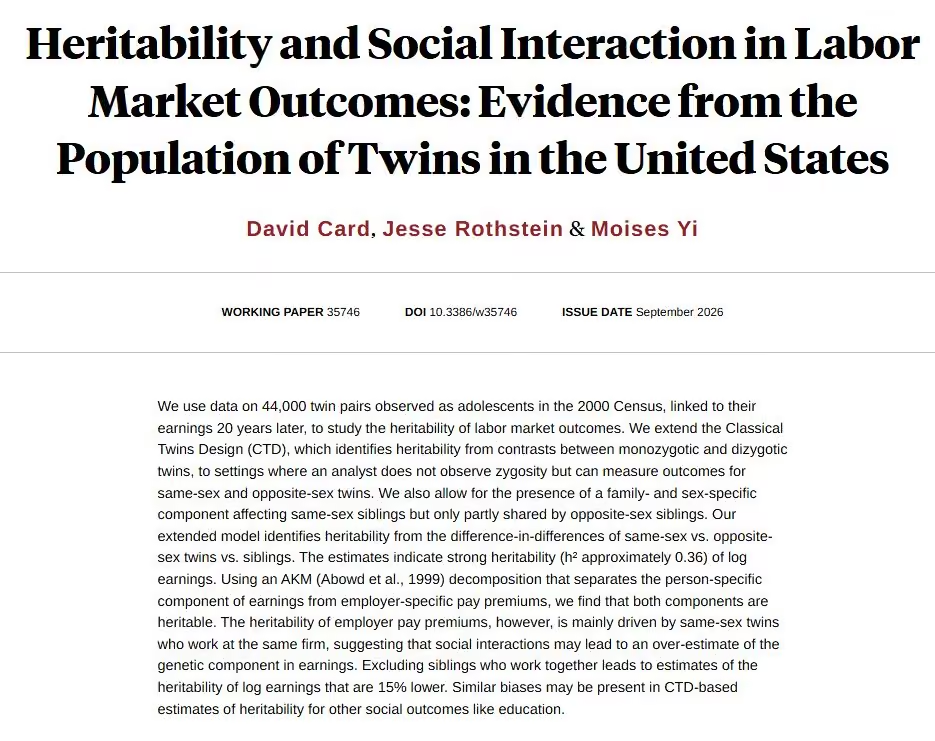 NBER
@nberpubs
An overview of land transfer policies and economic benefits. Discussing federal government retention, market failure, and resource scarcity arguments, from Gary D. Libecap www.nber.org/papers/w35745
 NBER
@nberpubs
Describing three stages at which AI enters the measurement pipeline—discovery, construct definition, and observation—and what each demands of researchers, from Melissa Dell and @asheshrambachan www.nber.org/papers/w35744
 NBER
@nberpubs
Using MA data from 1860 to 1915 to study the claim that in the late 19th century, Americans feared that crowded immigrant neighborhoods were spreading disease through industrial cities, from @K_A_Eriksson, Peter Zhixian Lin, and @NiemeshEcon www.nber.org/papers/w35743
 NBER
@nberpubs
Is dollar safe-asset richness declining? Not for domestic liquidity, but yes for global. Dollar repo has overtaken Treasurys, from @ProfArvindKrish and Miguel Chumbo www.nber.org/papers/w35742
 NBER
@nberpubs
When taxes are non-salient but inattention is rational, classical tax formulas may still survive, from George-Marios Angeletos and Matias Bayas-Erazo www.nber.org/papers/w35741
 NBER
@nberpubs
Communities In Schools, a program which places coordinators in high-poverty schools to match struggling students with services, raises test scores, graduation, and adult earnings, from Benjamin Goldman, Jamie Gracie, and Sonya Porter www.nber.org/papers/w35740
 NBER
@nberpubs
Open call for Letters of Intent, Emerging Scholar Pilot Proposals. Submit Letters of Intent by 11:59pm EDT on January 31, 2027. More information: www.nber.org/calls-papers-and-proposals/emerging-scholar-…
 NBER
@nberpubs
SNAP soda/candy restrictions cut spending by 11 percent and calories/sugar by 5–8 percent at 13 percent of the out-of-pocket burden of an equivalent excise tax, from Crossan Cooper, Katja Seim, and Jintaek Song www.nber.org/papers/w35739
 NBER
@nberpubs
A survey of 4,000 women in urban India finds that fear of street harassment shapes whether 70 percent of them work. Past-year victimization is especially high in Delhi, at 65 percent, from Lori A. Beaman, @seema_econ, and Anisha Sharma www.nber.org/papers/w35738
 NBER
@nberpubs
Featured in the latest Digest: Capital Gains Taxation and Investor Risk-Taking
www.nber.org/digest/202609/capital-gains-taxation-and-inv…
 NBER
@nberpubs
Chile’s food labels reduced sugar purchases per dollar by 9 percent. Shoppers switched from labeled to unlabeled products, and firms reformulated, but effects varied widely by category, from @NanoBarahona, @cristobalotero, @seb_otero, and Joshua J. Kim www.nber.org/papers/w35737
 NBER
@nberpubs
Chicago’s HOPE VI demolitions imposed large welfare costs on displaced public-housing adults while raising housing prices and benefiting higher-income homeowners, from @MilenaAlmagro, @EricChyn, and @BryanAStuart www.nber.org/papers/w35736
 NBER
@nberpubs
The introduction of patent rights for plant biotechnology increased technology development and downstream agricultural productivity, from Jacob Moscona www.nber.org/papers/w35735
 NBER
@nberpubs
Can foreign attacks strengthen the regime they seek to weaken? Presenting empirical evidence that the 2026 US–Israeli strikes reduced anti-regime protest and boosted pro-regime mobilization, from @ProfSultanEcon, @lwantchekon, and Yaroslav Prokhorskoy www.nber.org/papers/w35734
 NBER
@nberpubs
Evidence suggests that Economic Connectedness, the share of one’s friends who have high income, promotes patenting innovation. Evidence is consistent with a financing channel, from Brad Cannon, @4misceldah, and Joshua Thornton www.nber.org/papers/w35732
 NBER
@nberpubs
"Bunching" affects the measurement of uncertainty from probabilistic survey questions but interventions can reduce it, from @cconces, Laura Crespo, Carlos Gento, @lm_guirola, and @ernesvillanueva www.nber.org/papers/w35733
 NBER
@nberpubs
Political participation tracks housing wealth accumulation at the individual level, revealing deeper individual differences shaping electoral engagement and economic performance, from Carlos Fernando Avenancio-León, Yutao He, and Michael Reher www.nber.org/papers/w35731
 NBER
@nberpubs
An overview of existing evidence on American Indian economic development and directions for future research, from Randall Akee and Emilia Simeonova www.nber.org/papers/w35730
 NBER
@nberpubs
In a randomized controlled trial in Chile, large loans increased treated firms’ profits by 13.4 percent, from @deankarlan, Natalia Rigol, and Benjamin N. Roth www.nber.org/papers/w35729
 NBER
@nberpubs
At a Ugandan university, coethnic peers boost achievement early but effects fade; peers with visible scholarship signals generate lasting gains beyond underlying ability, from Isaac Ahimbisibwe, @secarrell, and Travis Lybbert www.nber.org/papers/w35728
 NBER
@nberpubs
Featured in the latest Digest: How Do Falling Birth Rates Affect Economic Growth?
www.nber.org/digest/202609/how-do-falling-birth-rates-aff…
 NBER
@nberpubs
Using telemetric data to document the racial composition of motorists on MA highways and assess racial disparities in police stops compared to common benchmarks, from Xiaofeng Gong, Yuling Han, @susan_t_parker, @Matthew Ross, and @SteveRo48195125 www.nber.org/papers/w35727
 NBER
@nberpubs
Federal flood buyouts help households adapt to climate risk. But households of color receive at least 6 percent less compensation, with stark differences in where families relocate, from Kay Jowers, Lala Ma, and Christopher D. Timmins www.nber.org/papers/w35726
 NBER
@nberpubs
Children removed from Supplemental Security Income and their siblings do not experience worse long-term outcomes when parents offset benefit loss with additional earnings, from Manasi Deshpande, Alessandra Voena, and Jason B. Weitze www.nber.org/papers/w35725
 NBER
@nberpubs
OSHA inspections reduced injuries at nearby uninspected workplaces. Spillover effects were several times larger than direct effects and are missed by naïve estimates, from @mslaterjohnson, David Levine, and Michael W. Toffel www.nber.org/papers/w35646
 NBER
@nberpubs
An analysis of government messaging and smokers’ perceptions of e-cigarette risks using a randomized online experiment to determine the effects of different cigarette risk messaging about an outbreak of lung injuries, from Lawrence Jin, Donald S. Kenkel, @Adm5Alan, @Grace_Nettie, Revathy Suryanarayana, and Hua Wang www.nber.org/papers/w35724
 NBER
@nberpubs
Proposing a theory of costly voting in which citizens have prosocial motives, explaining both established and newly documented patterns in turnout data, from Dan M. Bernhardt, @laurent_bouton, Stefan Krasa, and Francesco Squintani www.nber.org/papers/w35723
 NBER
@nberpubs
Expanded access to the contraceptive pill for minors improved infant health across generations, with the largest gains among Black families, from @HNoghani, @DavidSlusky, @erdal_tekin_, and @hoa_vuxuan www.nber.org/papers/w35722
 NBER
@nberpubs
National capitals often anchor a nation's infrastructure. China's Grand Canal shows such politics-driven infrastructure can be useful but also misallocate resources, from Ying Bai, Xiaoyu Bian, and Ruixue Jia www.nber.org/papers/w35721
 NBER
@nberpubs
Foundational expertise may be a prerequisite for extracting durable skill from AI-assisted practice, from @davidautor, Tanya Rodchenko, Josh Martin, Zanna Iscenko, Scott Strand, David Pearl, and Melissa Ferere www.nber.org/papers/w35720
 NBER
@nberpubs
Examining the utility of AI tools in auditing adherence to pre-analysis plans, from @jeffreypclemens and Anwita Mahajan www.nber.org/papers/w35719
 NBER
@nberpubs
Discussing the urbanizing effects of four trends in transportation technology: shared mobility (such as Uber), autonomy (such as Waymo), vertical travel, and green mobility, as provided by bike lanes, from Edward L. Glaeser www.nber.org/papers/w35718
 NBER
@nberpubs
The No Surprises Act reduced provider network participation in the specialties and states most affected by the reform, contrary to the prediction that removing balance billing makes network participation more attractive, from Panle Jia Barwick, Anran Li, Tianli Xia, and Shizhe Yu
 NBER
@nberpubs
Capital inflow shocks have sizable expansionary effects on output, operating through stronger domestic consumption and investment and easier financing conditions, from Jongrim Ha, Dohan Kim, M. Ayhan Kose, and Francis E. Warnock www.nber.org/papers/w35716
 NBER
@nberpubs
In the presence of a progressive tax system, a switch from inflationary financing to debt financing leads to debt accumulation by top earners, the saving glut of the rich, from @Francesco_Bia, @nicoloceneri, @LeonardoMelosi, and @forket86 www.nber.org/papers/w35715
 NBER
@nberpubs
Cognitive noise models provide a unified explanation, based on the efficient use of scarce cognitive resources, for many anomalies documented in behavioral economics, from Ryan Oprea and Michael Woodford www.nber.org/papers/w35714
 NBER
@nberpubs
Anti-scrappage tax policies in Brazil increase vehicle age, pollution, and health risks, while creating a political environmental trap, from @gfmonteiro_ and Edson R. Severnini www.nber.org/papers/w35713
 NBER
@nberpubs
When experts know more than their evidence proves, verifiability trades credibility for flexibility: it aids communication under conflict but hinders it under aligned preferences, from Alessandro Lizzeri, Yichuan Lou, and Jacopo Perego www.nber.org/papers/w35712
 NBER
@nberpubs
A survey experiment and a policy shock in China show that more patient limited partners lead venture capitalists to hold companies longer, invest earlier, and achieve better exits and innovation, from @YingxiangLi, @Tong Liu, and @TingXuFinance www.nber.org/papers/w35711
 NBER
@nberpubs
An “ultra-poor graduation program” raised child development indicators by 0.16 to 0.26 standard deviations and led to broad shifts in parental inputs and behaviors, from @afosterri, @MoritzPoll, and Hyun Soo Suh www.nber.org/papers/w35710
 NBER
@nberpubs
Studying age discrimination in a Chinese labor market with a job ladder, where worker productivity is revealed over time, from Shuaizhang Feng, Lars Lefgren, Jieyi Liu, Brennan Platt, and Xiaoyu Xia www.nber.org/papers/w35709
 NBER
@nberpubs
Fear of a crash drives some investors to “step out” of the market. Stocks sensitive to this variation had lower returns. Even “non-marginal investors” matter to market prices, from @WGoetzmann, Dasol Kim, and @RobertJShiller www.nber.org/papers/w35708
 NBER
@nberpubs
A network extension of Q theory finds competition is a key driver of aggregate investment; cost-of-capital shocks yield heterogeneous investment and markup responses across firms, from @mcecibustamante and @BPellegrino_CBS www.nber.org/papers/w35707
 NBER
@nberpubs
Featured in the latest Digest: Valuing the Dollar's Reserve Currency Status
www.nber.org/digest/202609/valuing-dollars-reserve-curren…
 NBER
@nberpubs
Providing the first large-scale economic evidence on the frequency and purpose of workplace meetings, using administrative data from Norway, from @ProfDavidDeming, Katrine V. Løken, @alpwillen, and Yaling Xu www.nber.org/papers/w35706
 NBER
@nberpubs
Automatic stabilizers aren’t automatically timely. Unemployment insurance may respond immediately to recessions, but households don’t: imperfect expectations cut the initial spending boost in half, from Bence Bardóczy and @jptguerreiro www.nber.org/papers/w35705
 NBER
@nberpubs
Modern war lowers output, not only by destroying productive factors, but also by making the surviving factors work less efficiently, from Marvin Amann, @YGorodnichenko, and Oleksandr Talavera www.nber.org/papers/w35704
 NBER
@nberpubs
Open call for papers, Health and Healthcare Variations across the Population. Conference to be held in Cambridge, MA on May 14, 2027. Submit papers by 11:59pm EDT on February 11, 2027. More information: www.nber.org/calls-papers-and-proposals/health-and-health…
 NBER
@nberpubs
Expanding access to US small-business support crowded out the smallest and most productive firms, leading to stark declines in business dynamism and innovation, from J. David Brown, Matthew Denes, Ran Duchin, and John Hackney www.nber.org/papers/w35703
 NBER
@nberpubs
Solving the RI-logit model analytically for two related families of priors known respectively as Positive Stable and Tempered Stable distributions, from @BPellegrino_CBS www.nber.org/papers/w35702
 NBER
@nberpubs
Teachers under-recommend high-achieving, low-socioeconomic status students; personalized feedback corrects misperceptions, narrows socioeconomic gaps, and raises top-track enrollment, from @michelacarlana, Francesca Miserocchi, and @EleonoraPatacc2 www.nber.org/papers/w35701
 NBER
@nberpubs
Analyzing a class of time-compressed data and showing that they have magnified variability stemming from the fact that the cross-section variance of a non-stationary panel “fans out” with time, from Serena Ng and Nikolay Gospodinov www.nber.org/papers/w35700
 NBER
@nberpubs
Open call for papers, Innovation in the Agricultural and Food System. Conference to be held in Washington, DC on May 21, 2027. Submit papers by 11:59pm EDT on February 15, 2027. More information: www.nber.org/calls-papers-and-proposals/innovation-agricu…
 NBER
@nberpubs
Proposing a new estimator for regression discontinuity designs that in simulations matched to 12 applications consistently outperform previously proposed estimators, from Aditya Ghosh, @guido_imbens, and Stefan Wager www.nber.org/papers/w35699
 NBER
@nberpubs
Cash or kind? One-time or monthly? It matters. Food-store marginal propensity to consume range 0.06 to 0.38 across four pandemic transfers, from Therese Bonomo, Krista J. Ruffini, and @dwschanz www.nber.org/papers/w35698
 NBER
@nberpubs
Online job postings data reliably capture the distribution of vacancies, but not the distribution of employers that are hiring due to an underrepresentation of small firms, from @wherethejobsat, @ProfLisaBKahn, and @AndreasIMueller www.nber.org/papers/w35697
 NBER
@nberpubs
Loan rates are usually viewed as prices that shape borrower incentives, but can also serve another role in a principal-agent problem by determining how informative repayment is about unobservable effort inside the bank. Studying how the two roles interact, from Kinda Cheryl Hachem www.nber.org/papers/w35696
 NBER
@nberpubs
Analyzing the 1930s Great Plains Shelterbelt, a large-scale forestation program across the US Midwest, from Florian Grosset-Touba, @annapappp, and @ctaylor463 www.nber.org/papers/w35695
 NBER
@nberpubs
Comparison points decrease decisions when tied to inputs and increase them when tied to outputs, consistent with comparisons serving as information about how to navigate tradeoffs, from Thomas Graeber and @BenjaminEnke www.nber.org/papers/w35694
 NBER
@nberpubs
Analyzing the role of automatic and semiautomatic adjustment mechanisms in public pension design, from Peter A. Diamond www.nber.org/papers/w35693
 NBER
@nberpubs
Documenting, modeling, and estimating the heterogenous effects of the Affordable Care Act, from @Pietro_Tebaldi, Andrea Scalenghe, and Joseph Orsini www.nber.org/papers/w35692
 NBER
@nberpubs
Data from 10 million US high schoolers show that exposure to air pollution driven by wildfire smoke slows the rate of learning and increases achievement gaps by race and income, from A. Patrick Behrer, Joshua Goodman, J. Parker Goyer, and @rjisungpark www.nber.org/papers/w35670
 NBER
@nberpubs
Featured in the latest Digest: Accounting for the Rise and Fall of Disability Insurance Enrollment
www.nber.org/digest/202609/accounting-rise-and-fall-disab…
 NBER
@nberpubs
Study how credibility shapes inflation and debt: strong central-bank mandates lower inflation and sustain more debt; weak credibility makes inflation respond to fiscal pressures, from @luigi_bocola, @gaston_chaumont, Alessandro Dovis, and Rishabh Kirpalani www.nber.org/papers/w35691
 NBER
@nberpubs
Pollution responds to shifts in the political environment, motivating a dynamic model of public investment, from Pierre Bodere, Giulia Brancaccio, and Karam Kang www.nber.org/papers/w35690
 NBER
@nberpubs
Echo chambers are not the biggest problem. AI advice is worse when weak priors conflict with preferences, and awareness of AI sycophancy may reduce bias but not information loss, from Georgy Egorov and @k_sonin www.nber.org/papers/w35689
 NBER
@nberpubs
Assessing the role of AI-generated assessments of manuscripts in improving the quality of peer review, from @joshgans www.nber.org/papers/w35688
 NBER
@nberpubs
Combing cash-Treasury and real-duration premia with estimates of how additional private supply reprices the outstanding Treasury stock, from Ricardo J. Caballero www.nber.org/papers/w35687
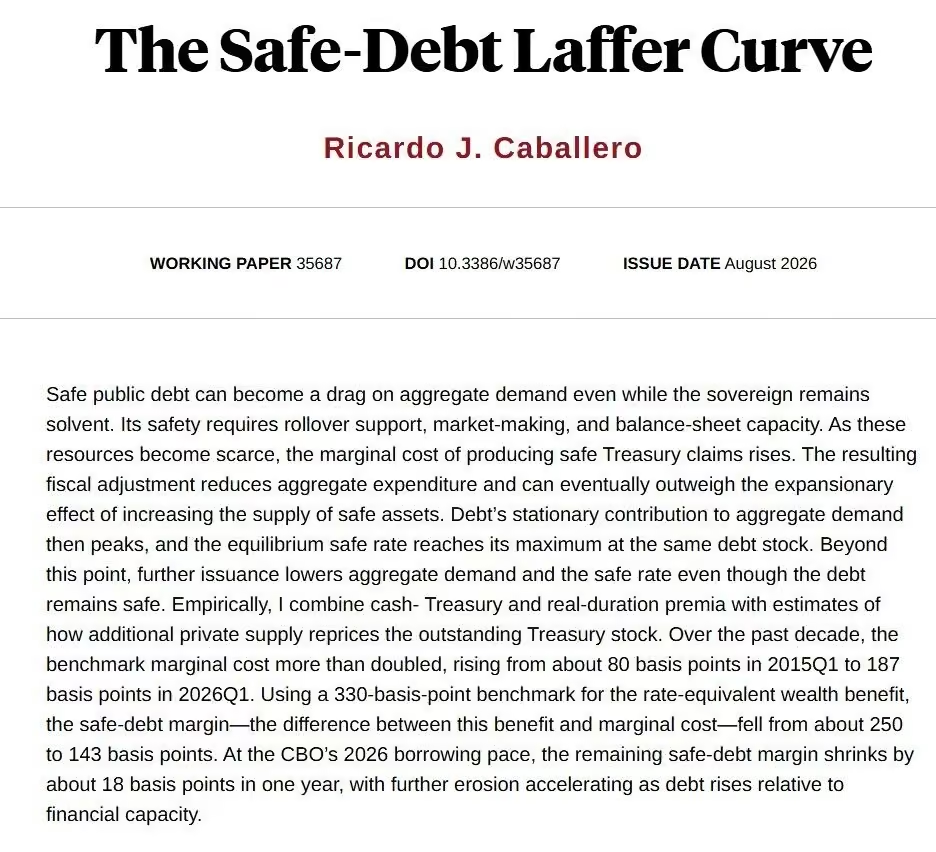 NBER
@nberpubs
Using the universe of state public health laws and the legislative calendar, this paper finds that public health laws reduced mortality during 1911–1928, from @MartinHSaavedra www.nber.org/papers/w35686
 NBER
@nberpubs
Studying international cooperation in a general environment with pecuniary and non-pecuniary externalities across countries, from John Sturm Becko and Arnaud Costinot www.nber.org/papers/w35685
 NBER
@nberpubs
AI investment is associated with higher firm productivity growth after 2018, with gains concentrated in AI jobs that build organization capital: systems, processes, and workflows, from @TaniaBabina, Alex X. He, and Renhao Jiang www.nber.org/papers/w35684
 NBER
@nberpubs
Analyzing the economics of the elimination of the federal GradPLUS loan program, from @turnersarahe www.nber.org/papers/w35683
 NBER
@nberpubs
The European Union Emissions Trading System led to steep emissions declines and only moderate economic impacts because of reallocation across firms and clean technology adoption, from @rAButters, @jacksondorsey6, and @ivanjrudik www.nber.org/papers/w35682
 NBER
@nberpubs
Randomized cash transfers have negative psychological spillovers on non-recipients, targeted transfers don't, from Travis Baseler, Jules Gazeaud, and @snowberg www.nber.org/papers/w35681
 NBER
@nberpubs
Analyzing and decomposing survey error in an empirical Total Survey Error framework, from Bruce D. Meyer, Nikolas Mittag, Derek Wu, Anthony Tatarka, and Patrick Langetieg www.nber.org/papers/w35680
 NBER
@nberpubs
New NBER Book released: The Economics of Transformative AI
www.nber.org/books-and-chapters/economics-transformative-ai
 NBER
@nberpubs
Providing the design and properties of a maximally efficient new form of liquidity savings mechanisms, from @DarrellDuffie, Srisht F. Singh, and Chaojun Wang www.nber.org/papers/w35679
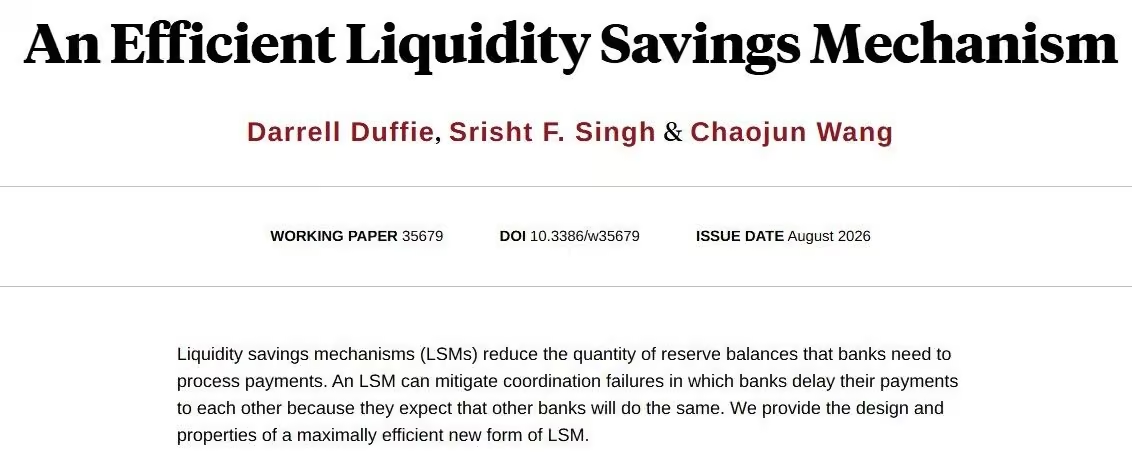 NBER
@nberpubs
A new atomic contracting protocol resolves holdup in networks of bilaterally bargaining agents, from @DarrellDuffie and Chaojun Wang www.nber.org/papers/w35678
 NBER
@nberpubs
Creating and distributing new task-level adoption indices for generative AI usage, from Alexander Bick, Adam Blandin, @ProfDavidDeming, and Tyler R. Schumacher www.nber.org/papers/w35677
 NBER
@nberpubs
The individual economic consequences of wildfires are unevenly distributed, extend beyond property damage, and persist for years as individuals and communities recover, from @pbaylis, Judson Boomhower, @JonathanColmer, and @john_voorheis www.nber.org/papers/w35675
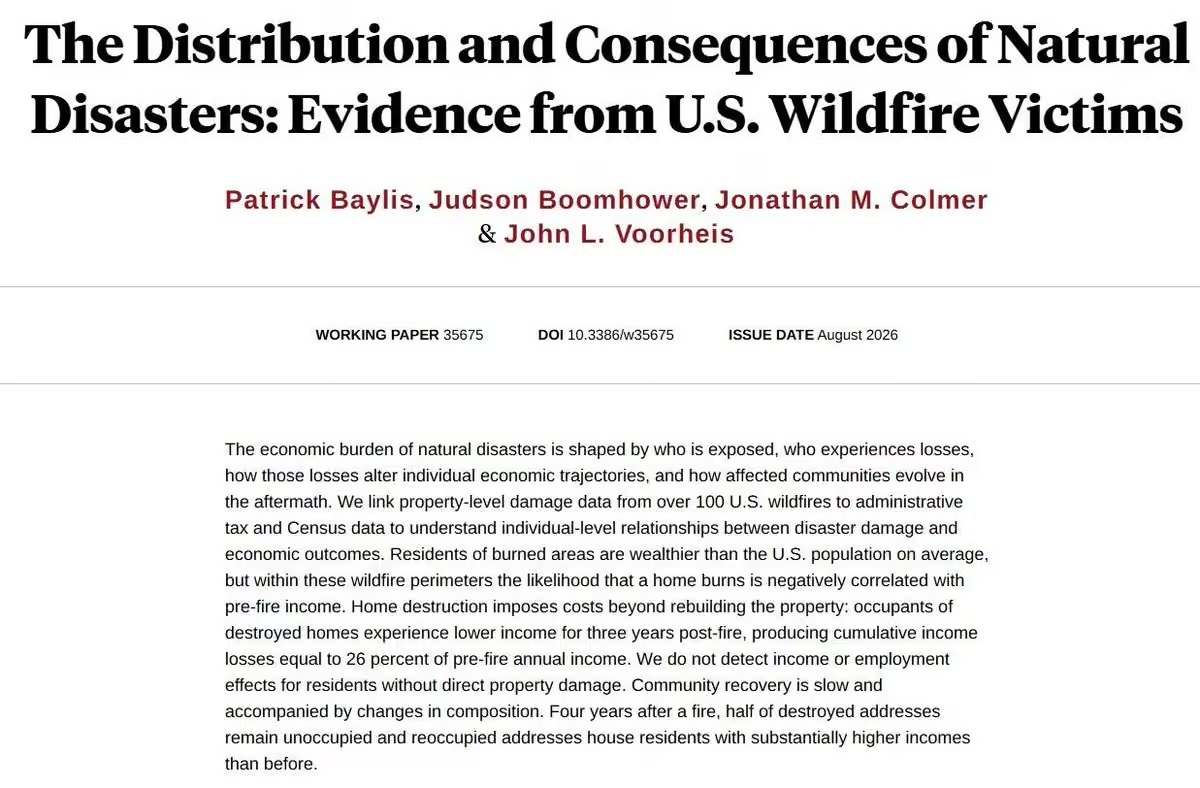 NBER
@nberpubs
Economic theory and evidence provide insight into making place-based policies more effective, from Matthew Freedman and @NeumarkEcon www.nber.org/papers/w35674
 NBER
@nberpubs
Why didn't US tightening trigger a 1982-style sudden stop in EMs? Better monetary policy and flexible exchange rates, yes—but fiscal space is key, from Drishan Banerjee, @galinahale_ucsc, and @harrison_shieh www.nber.org/papers/w35673
 NBER
@nberpubs
English police predict serious recidivism in domestic abuse cases barely better than chance; errors reflect cognitive biases, not preferences, worsened by a flawed questionnaire, from @jgrogger, Andrew Jordan, and @KirchmaierTom www.nber.org/papers/w35672
 NBER
@nberpubs
Increasingly prevalent chains of private tutoring centers raise students' test scores, deepen educational inequality, and shape outcomes by schools are judged, from Joshua Goodman and Samuel Nitkin www.nber.org/papers/w35671
 NBER
@nberpubs
Geopolitical risk reshapes global reserves: gold up, dollar down. A new paper with on sanctions, safe assets, and the dollar's shine fading, from @kaiarvai, Nuno Coimbra, and @marco_pnch www.nber.org/papers/w35669
 NBER
@nberpubs
Low rates of labor mobility result in higher euro-area unemployment. Over a million additional people would find employment If Europeans moved as much as Americans, from Erin P. Gibson, Christopher L. House, Christian Proebsting, and Linda L. Tesar www.nber.org/papers/w35668
 NBER
@nberpubs
Featured in the latest Digest: Urban Congesting Pricing and the Response Times of Emergency Medical Services
www.nber.org/digest/202609/urban-congestion-pricing-and-r…
 NBER
@nberpubs
Official lending is large, senior, and countercyclical, continuing after sovereigns fall into arrears on private debt. Asking why sovereign finance exhibits this division of labor across creditors, from Qing Liu, Zanhui Liu, and Vivian Zhanwei Yue www.nber.org/papers/w35667
 NBER
@nberpubs
Showing Prospect Theory resolves puzzles in the valuation of health and in cost-effectiveness, because people value preventing health losses more than equally sized gains, from Karen Mulligan, @drishtibaid, Jason N. Doctor, and Darius N. Lakdawalla www.nber.org/papers/w35666
 NBER
@nberpubs
Studying how opening private markets to retail investors affects investors and firms, from Lubos Pastor, Robert F. Stambaugh, and Lucian A. Taylor www.nber.org/papers/w35665
 NBER
@nberpubs
Documenting an increase in US income risk from 1969 to 2019, distinguishing permanent from transitory risk, from J. Carter Braxton, @KyleHerkenhoff, Chengdai Huang, Michael Nattinger, Jonathan L. Rothbaum, and @L_Schmidt_Econ www.nber.org/papers/w35664
 NBER
@nberpubs
Across seven work tasks, the LLM that performs best on its own is often not the one that best guides a weaker model, from @kennywongchamch, @krisgulati, Min Min Fong, and @abhishekn www.nber.org/papers/w35663
 NBER
@nberpubs
The most comprehensive fiscal policy to promote healthy diets had no detectable impact on the health of pregnant women and newborn children, from @cawley_john, Mallory Dreyer, and @KosaliSimon www.nber.org/papers/w35662
 NBER
@nberpubs
US tariff shocks raise not only the average tariff but also its dispersion across goods, with sizable effects on imports and the trade balance, from @SSchmittGrohe and Martín Uribe www.nber.org/papers/w35661
 NBER
@nberpubs
After 2014 US cases, GOP messaging linking Ebola to immigration spiked most in safe seats, indicating signaling to their base, and did not follow the patterns of voters' anxiety, from @FilipeCampante, @EmilioDepetrisC, and @RDurante_2020 www.nber.org/papers/w35660
 NBER
@nberpubs
SNAP restrictions on sugary drinks reduced average SNAP’s household retail purchases of restricted drinks by 12.4 percent, from @huntallcott, Amy Finkelstein, Anna Grummon, and @profnoto www.nber.org/papers/w35659
 NBER
@nberpubs
In Seattle school choice, mechanisms using preference intensities raise mean student welfare over a frontier ordinal mechanism and 74 percent of students prefer the cardinal assignment, from Hülya Eraslan, Jeremy T. Fox, and YingHua He www.nber.org/papers/w35658
 NBER
@nberpubs
Analyzing a large corpus of papers in international trade to document a shift in methodology from theoretical or empirical to quantitative modeling and assessing these developments, from @davidgatkin and Benjamin Faber www.nber.org/papers/w35657
 NBER
@nberpubs
How did culture evolve? What shaped the mosaic within and across societies? Ancestral migration, socioeconomic change, ecological mismatch, and prehistoric diversity shaped adaptation, from @GalorOded, @Marc_Klemp, and Daniel C. Wainstock www.nber.org/papers/w35656
 NBER
@nberpubs
Cryptocurrency has become a channel for elite capture and diversion of financial aid provided to developing countries, with implied leakage of 2 to 6 cents per aid dollar, from @sumit_prof, Peiyi Jin, @EswarSPrasad, and Daniel Rabetti www.nber.org/papers/w35655
 NBER
@nberpubs
Market power in lithium, nickel, and cobalt production—and interdependence among these inputs—shape battery supply chains and green technology adoption worldwide, from @tomasdiino, Jonathan T. Elliott, and @AllanHsiao www.nber.org/papers/w35654
 NBER
@nberpubs
Introducing the notion of marginal cumulative multiplier—the effect of either government spending or taxation on output holding the other fiscal instrument constant—and applying it to consolidation episodes in 16 countries from 1978–2020, from Roberto Perotti and Luca Sala
 NBER
@nberpubs
What attitudes account for declining fertility preferences? Increasingly, children are viewed as interfering with freedom and less important for a fulfilling life, from @raquel1fernan, @InesBerniell, and @milagrosonofri www.nber.org/papers/w35651
 NBER
@nberpubs
Colleges that high-testing and higher-income students attend spend much more on instruction. Potential economic justifications for this allocation have little empirical support, from @zbleemer and @rothstein_jesse www.nber.org/papers/w35650
 NBER
@nberpubs
Childcare offers the opportunity of a win-win policy that supports women's careers and child development, but only when quality of provision is high enough, from Serena Goldberg and @CostasMeghir www.nber.org/papers/w35649
 NBER
@nberpubs
When fentanyl deaths hit a county, buprenorphine treatment rises 5 to 17 percent within 1–2 quarters, but only where prescribing capacity already exists, from @NicoleSiegal, @DrSumedhaGupta, Matthew C. Aalsma, Stephen Crystal, Jennifer Miles, Hillary Samples, Allen Campbell, @KosaliSimon, and @RosaliePacula www.nber.org/papers/w35648
 NBER
@nberpubs
USD dominance remains resilient. Even under major global shocks, no rival currency emerges as a major challenger, highlighting strong inertia in the monetary system, from Michael D. Bordo and Cécile Bastidon www.nber.org/papers/w35647
 NBER
@nberpubs
Medicare deregulation policy restrained by state policy and spills over to other payers, from Daniel R. Arnold, Michael R. Richards, Yashaswini Singh, and Christopher M. Whaley www.nber.org/papers/w35645
 NBER
@nberpubs
Examining the role of (mis)perceptions of regime performance as drivers of political attitudes, from @DAcemogluMIT, @nicolas_ajz, @gcruces_, @MartinFiszbein, Gaston Garcia Zavaleta, and Carlos Molina www.nber.org/papers/w35644
 NBER
@nberpubs
Proposing a new approach, cluster-weight inference of time-to event, from Meera Krishnamoorthy, Donna Tjandra, Divya Shanmugam, Amanda E. Kowalski, and Jenna Wiens www.nber.org/papers/w35643
 NBER
@nberpubs
Fiscal dominance in RANK hinges on income being perpetually demand-determined. Anchor the long run, and fiscal effects vanish; HANK restores them through non-Ricardian demand, from George-Marios Angeletos, @ChenLian92, @ChristianKWolf, and Dalton Rongxuan Zhang
 NBER
@nberpubs
Studying the gaps in how public AI benchmarks steer research allocate investments and how those gaps can become profitable, from @alex8chan www.nber.org/papers/w35641
 NBER
@nberpubs
Worker heterogeneity in wealth and income interacts with firm labor market power, shaping optimal taxes. New quantitative theory of market power with firm and worker heterogeneity, from @David_W_Berger, @KyleHerkenhoff, Jaehun Jeong, and @Simon_Mongey www.nber.org/papers/w35640
 NBER
@nberpubs
Counties hit hardest by the Great Recession saw children's test scores fall and achievement gaps widen. School budgets held steady, but family incomes and home values fell, from Karla Cordova and @JessamynSchall1 www.nber.org/papers/w35639
 NBER
@nberpubs
Featured in the latest Digest: The Long-Term Effects of Tuition-Free Community College
www.nber.org/digest/202608/long-term-effects-tuition-free…
 NBER
@nberpubs
New payment technologies increase transfer speed and benefit depositors, but reduce bank deposit balances and slow deposit growth, putting pressure on banks and monetary policy, from Xu Lu, Yang Song, and Yao Zeng www.nber.org/papers/w35638
 NBER
@nberpubs
Entrepreneurs who become legislators support more pro-business bills, but only if they are pro-entry, from @RonnieChatterji, @jorgeguzmancbs, Joyce Ma, and @ryanmcdevitt www.nber.org/papers/w35637
 NBER
@nberpubs
Decomposing stock returns into a duration-matched Treasury component, identified from monetary policy surprises, and a payoff component, from @OlivierWang1 www.nber.org/papers/w35636
 NBER
@nberpubs
Occupational Licensing does not improve the quality or safety of Uber rides, from Jonathan Hall, Jason Hicks, Morris M. Kleiner, and Yun taek Oh www.nber.org/papers/w35635
 NBER
@nberpubs
Designing a method for measuring the risk preferences of agents in the deep past, from @remylevin and @daniela_vidart www.nber.org/papers/w35634
 NBER
@nberpubs
In IV studies, if researchers selectively report results with the best first stage F-test or best second stage t-test, it generates bias towards OLS, from Michael P. Keane, Timothy Neal, and Patrick Vu www.nber.org/papers/w35633
 NBER
@nberpubs
In a field experiment with 645 households, an AI chatbot increased property-tax appeals by 9.1 percentage points, but the gains were concentrated among more advantaged households, from @Justin_E_Holz, @pereztruglia, @andrewrsimon, and @zentnerale www.nber.org/papers/w35632
 NBER
@nberpubs
Who becomes a doctor, and does it matter? Cohorts entering the profession when outside options are weaker practice more financially motivated medicine, even decades later, from Diane E. Alexander and Molly Schnell www.nber.org/papers/w35631
 NBER
@nberpubs
Examining US 2025 trade by developing an open-economy New Keynesian model with tariff heterogeneity, inventories, and shocks to investment that capture the AI-driven boom, from Francesco Ferrante, Andrea Prestipino, Andrea Raffo, and @tradewartracker www.nber.org/papers/w35630
 NBER
@nberpubs
A minimax justification for independent, rather than complete, randomization in experiments, from @instrumenthull www.nber.org/papers/w35629
 NBER
@nberpubs
Minimum wages reduce employment, hours, and earnings for workers in both poor and non-poor families, from @NeumarkEcon and Emma Wohl www.nber.org/papers/w35628
 NBER
@nberpubs
Evidence of fraudulent diagnostic misreporting leading to unnecessary care and finding it is strongly associated with provider profit motivation and weak prosocial preferences, from @paul_gertler and @kwantada www.nber.org/papers/w35627
 NBER
@nberpubs
Using randomized pay experiments among Uber drivers, paired with a natural experiment in access to a competitor, to examine how outside options shape labor supply to the firm, from @sydneecaldwell and Emily Oehlsen www.nber.org/papers/w35626
 NBER
@nberpubs
Studying voluntary disclosure when partially-naive receivers observe a public signal correlated with the sender’s private information, from Marty Haoyuan Chen and Ginger Zhe Jin www.nber.org/papers/w35625
 NBER
@nberpubs
Studying how wages adjusted during the recent inflation period, from Erik Hurst, Christina Patterson, Nela Thomas Richardson, and Ye Liv Wang www.nber.org/papers/w35624
 NBER
@nberpubs
Local electoral maps often underrepresent Black and Hispanic voters. Segregation creates bias even without intent; Voting Rights Act of 1965 oversight may have helped enacted maps partly offset it, from Carlos Fernando Avenancio-León, Daniel B. Jones, and Ying Shi
 NBER
@nberpubs
Exploring the efficacy of an online after-school tutoring program that complements teacher-provided computer-assisted learning practice, from @poreopoulos, Ruochong Dong, and Nina Low www.nber.org/papers/w35622
 NBER
@nberpubs
Studying a population of 6,000 middle-school students to see if research-based computer-assisted learning can make tutoring more scalable and effective, from @poreopoulos, Michael Liut, @Alpsungu, and Nina Low www.nber.org/papers/w35621
 NBER
@nberpubs
Studying the effects of utilizing an AI tutor (through Khan Academy) for 18 Tennessee middle schools, from @poreopoulos and Nina Low www.nber.org/papers/w35620
 NBER
@nberpubs
Michigan school data shows that schools’ distinct reporting tendencies explain about 40 percent of variation in child maltreatment reporting rates, from @JasonBaron4, Micah Y. Baum, Joseph J. Doyle Jr., Maria D. Fitzpatrick, Brian Jacob, and Joseph P. Ryan www.nber.org/papers/w35619
 NBER
@nberpubs
Demography may reshape global power by 2100: aging and falling fertility weaken China, while immigration and AI strengthen the US. Technology and people will determine hegemony, from @sbenzell, @kotlikoff, and Victor Yifan Ye www.nber.org/papers/w35618
 NBER
@nberpubs
Post-GFC regulatory pressure pushed banks toward issuing covenant-lite leveraged loans—since they're easier to sell—with the effect concentrated among more stressed or stringently regulated banks, and these loans carry a liquidity advantage that lowers their credit spread, especially for private firms, from Robert Prilmeier and René M. Stulz www.nber.org/papers/w35617
 NBER
@nberpubs
Childbirth reduces the likelihood that women become CEOs, and marriage increases the likelihood that men do, from Santiago Campos-Rodríguez and @NeumarkEcon www.nber.org/papers/w35616
 NBER
@nberpubs
Local projections that interact macro shocks with measures of the systematic policy regime identify policy causal effects, just like standard regressions on policy shocks, from Ed Manuel and @ChristianKWolf www.nber.org/papers/w35615
 NBER
@nberpubs
US workers initially employed in an occupation that contracts by at least 25 percent have 5 percent lower cumulative career earnings despite slightly more quarters worked, from Erling Barth, Maria Forthun Hoen, Sari Pekkala Kerr, and @william_r_kerr www.nber.org/papers/w35614
 NBER
@nberpubs
Estimating the short-run impact of restrictions on sugary beverage purchases with SNAP funds, from David E. Frisvold and @LozanoRojasF1 www.nber.org/papers/w35613
 NBER
@nberpubs
Examining what ultimately supports the market value of US government debt, from @ricardo_delao and Wenhao Li www.nber.org/papers/w35612
 NBER
@nberpubs
Elite social clubs amplify political power by expanding members' networks. Using Argentina's Jockey Club to show club membership raises families' odds of winning elected office, from @jblabonne, @pquerubo, Martín Rossi, Sebastian M. Saiegh, Ivan San Miguel, and Shanker Satyanath
 NBER
@nberpubs
A randomized trial in India showed that using government property tax assessors led to more revenue, and higher accuracy, than outsourcing assessments to private firms, from Esther Duflo, @rema_nadeem, @ben_olken, and Shreya Tandon www.nber.org/papers/w35610
 NBER
@nberpubs
Policies of reserve accumulation and currency undervaluation have significant effects on manufacturing share, supply chain orientation, productivity, and welfare, from Paul Bergin, Woo Jin Choi, and Ju H. Pyun www.nber.org/papers/w35609
 NBER
@nberpubs
Featured in the latest Digest: When Input Prices Rise, Cheaper Varieties See Higher Inflation
www.nber.org/digest/202608/when-input-prices-rise-cheaper…
 NBER
@nberpubs
Providing a guide on imperfect competition in labor markets, focusing on the firm-specific labor supply elasticity as the definition of a firm’s labor market power, from @sydneecaldwell, @arindube, and @snaidunl www.nber.org/papers/w35608
 NBER
@nberpubs
Why are credit card rates so high? What are the economics of credit card banking? Answering these questions using account-level data on 550 million monthly accounts, from @idrechs, @HyeyooonJung, Weiyu Peng, Dominik Supera, and Guanyu Zhou www.nber.org/papers/w35607
 NBER
@nberpubs
Identifying another financial consequence of dementia that begins before onset: persons with dementia are more likely to have “bare” Medicare—leaving them exposed to high out-of-pocket spending, from @mpmcinerney, Lorena Moreno, and Jennifer M. Mellor www.nber.org/papers/w35606
 NBER
@nberpubs
In a study of 112,063 Chilean loan seekers, a price comparison tool corrected biased interest rate beliefs, leading to more negotiation and lower rates without more search, from @ErikBerwart, @SeanKHiggins, Sheisha Kulkarni, and @santiagotruffa www.nber.org/papers/w35605
 NBER
@nberpubs
Every structural vector autoregression result depends on identifying restrictions and variables. Economists discipline the first but often choose the second by hand. This paper ends this asymmetry, from @YuchengYang1993 and @zha_tao www.nber.org/papers/w35604
 NBER
@nberpubs
Using data from South Carolina finds that exposure to a peer’s self-harm death increases probability of a self-harm diagnosis by nearly 50 percent, from Emily Cuddy, @PrincetonCHW, @elisajacome, and Lucy Manly www.nber.org/papers/w35603
 NBER
@nberpubs
Using new data on 1.2 million students at 60 coeducational US colleges (1915–1943) to study how colleges shape who marries whom and the next generation's education, from Ran Abramitzky, @seperez84, and @joepricebyu www.nber.org/papers/w35602
 NBER
@nberpubs
The 988 calling code improved suicide crisis line call answering in states with larger pre-launch capacity gaps, but gains were not accompanied by lower suicide mortality, from @benconomics, Niketana Kannan, and @jzhangecon www.nber.org/papers/w35601
 NBER
@nberpubs
Higher recall fluency makes people's beliefs (and choices) more sensitive to cues and experiences—relevant or not—making it an economically relevant personal trait, from Pedro Bordalo, Nicola Gennaioli, @MO3rien, and Andrei Shleifer www.nber.org/papers/w35600
 NBER
@nberpubs
Extending Fogel's 1964 social savings approach to incorporate traffic congestion and externalities and showing this affects where transportation investment has the greatest benefit, from @treballen, @SimonFuchs4, and @WoanFoongWong www.nber.org/papers/w35599
 NBER
@nberpubs
Open call for papers, 50th Annual International Seminar on Macroeconomics. Conference to be held at the Central Bank of Montenegro on June 18-19, 2027. Submit papers by 11:59pm EDT on November 1, 2026. More information: www.nber.org/50th-annual-international-seminar-macroecono…
 NBER
@nberpubs
Studying how extended stockholder liability shaped bank resolution during and after the Panic of 1893, comparing California state banks with national banks, from Haelim Anderson, Charles W. Calomiris, and Jennifer S. Rhee www.nber.org/papers/w35598
 NBER
@nberpubs
Linking two global trends—AI and geoeconomic fragmentation—asking how fragmentation affects the international diffusion of AI, the magnitude of gains, and their distribution across economies, from Barry Eichengreen, George Cui, Asmaa A. El-Ganainy, Yevgeniya Koriyenko, Elyad Shojaei, Li Zeng, and Shihangyin Zhang www.nber.org/papers/w35597
 NBER
@nberpubs
Studying how in-store display ads communicate information about a product’s price and quality, both directly through ad content and indirectly through inferences consumers draw, from Jean-Pierre H. Dubé, Ilya Morozov, Franklin She, and Anna Tuchman www.nber.org/papers/w35596
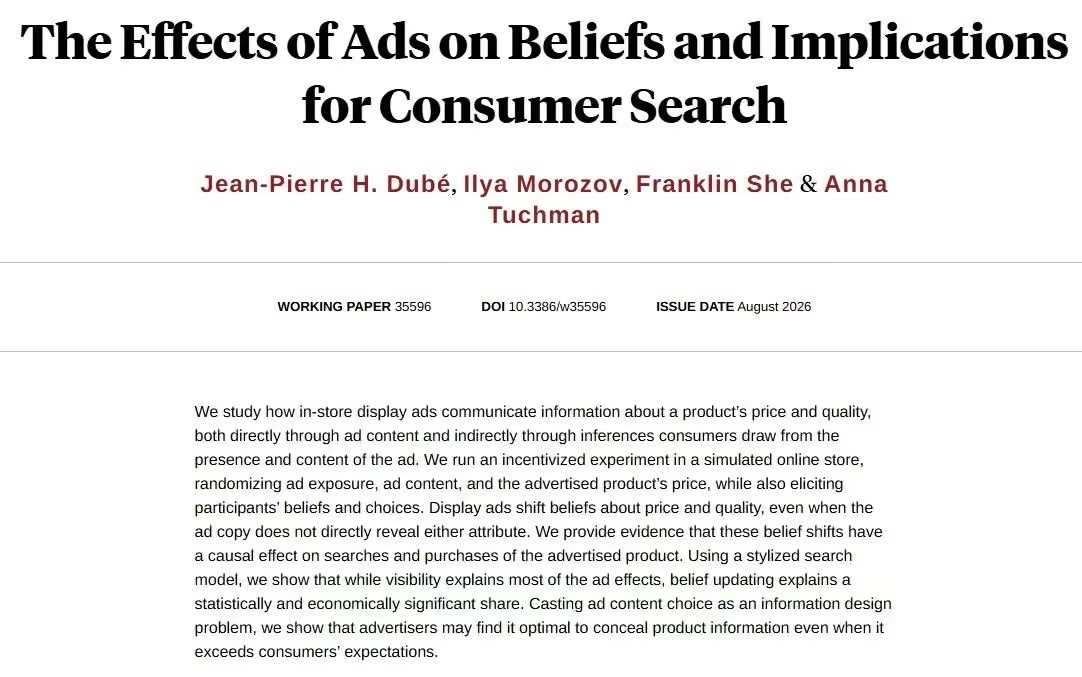 NBER
@nberpubs
Conventional static welfare gains from trade abstract from dynamic effects through endogenous factor accumulation and technological innovation, from @BennyKleinman, @ErnestLiuEcon, and Stephen J. Redding www.nber.org/papers/w35595
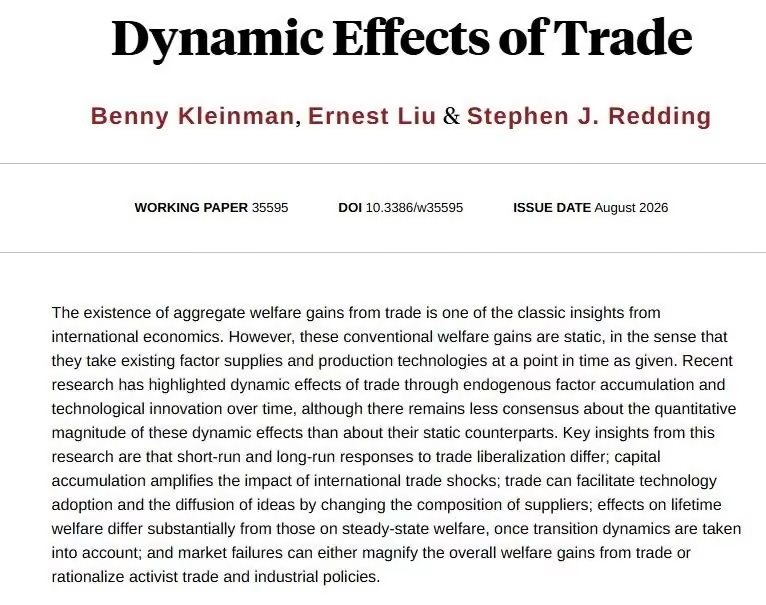 NBER
@nberpubs
Using price-earnings ratios to infer rents from ideas; a calibrated growth model finds the largest listed firms contribute less to productivity growth than their sales share, from Timo Boppart, @PeteKlenow, Reiko Laski, and @Huiyu Li www.nber.org/papers/w35594
 NBER
@nberpubs
Revisiting the empirical evidence on capital structure adjustment and the prevalence of financing “inaction”, from Zhiguo He, Peter M. DeMarzo, and Qiping Xu www.nber.org/papers/w35593
 NBER
@nberpubs
Exploring the welfare costs of the loss of animal life in a consequentialist total utilitarian framework that incorporates the intrinsic value of living beings through their sentience, from @AdrienBilal, Noémie Pinardon-Touati, and Conor Walsh www.nber.org/papers/w35592
 NBER
@nberpubs
Fetal exposure to PM2.5 lowers cognitive test scores in China, with the largest losses among women who have brothers and receive less family help with schooling, from Xin Zhang, Yixuan Wang, Xingyi Hu, and @xcyale www.nber.org/papers/w35591
 NBER
@nberpubs
Featured in the latest Digest: AI Tools and Scientific Innovation
www.nber.org/digest/202608/ai-tools-and-scientific-innova…
 NBER
@nberpubs
How bilateral sovereign lending interacts with market debt. When market borrowing improves bilateral terms, debt and default risk rise, making bilateral debt perilous, from @fqroldan and @cesarspa1 www.nber.org/papers/w35590
 NBER
@nberpubs
A randomized unconditional cash transfer of $1,000 per month for 3 years had spillover effects onto non-recipient household members but did not change household structure, from @elizabethrds, @dbroockman, @evavivalt, @pat_k_krause, @smilleralert, and @alexbartik
 NBER
@nberpubs
In econometric coding, giving AI more agency is far more valuable than increasingly sophisticated prompt engineering, from @SFGaliani, Federico Ariel López, and @raul_sosa2908 www.nber.org/papers/w35588
 NBER
@nberpubs
Property taxes function as embedded leverage, with higher property taxes redistributing housing away from the elderly to the young, from Joshua Coven, Sebastian Golder, @arpitrage, and @AbdouNdiayeNYU www.nber.org/papers/w35587
 NBER
@nberpubs
Restricting frontier AI models for exclusive evaluation prior to public release changes the cybersecurity game, from @joshgans www.nber.org/papers/w35586
 NBER
@nberpubs
There is persistence in subfertility, affecting both female and male children of parents that experienced infertility. Assisted reproductive technologies equalize fertility outcomes if used, from Viktoria Falk, @AMadestam, and Emilia Simeonova www.nber.org/papers/w35585
 NBER
@nberpubs
Brazil's outsourcing reforms displaced security guards via layoffs, not transfers to contract firms. Employment recovered in 5 years and wages stayed about 12 percent lower, from @mayara_pfs and @mbwong www.nber.org/papers/w35584
 NBER
@nberpubs
The innovative "subscription model" for Hepatitis C drugs in Louisiana dramatically expanded care, lowered transmission, and produced sizeable fiscal savings, from Kevin Callison, @contirena1, Jonathan Gruber, and @jwswallace www.nber.org/papers/w35583
 NBER
@nberpubs
Tracking immigrant earnings 1981–2021, finding 20–33 percent leave within 10 years. Recent cohorts reach native parity faster, mainly due to higher entry earnings, from Randall Akee, @jimmy_chin_, and Daniel L. Crown www.nber.org/papers/w35582
 NBER
@nberpubs
Using a sufficient statistics approach finds that India’s Phillips curve is 10 times steeper than the US’s, due to more flexible prices and weaker macro real rigidities, from Juan Herreño, Noémie Pinardon-Touati, and Malte Thie www.nber.org/papers/w35581
 NBER
@nberpubs
Open call for papers, Workshop on Development Economics and Networks for Early-Career Researchers. Conference to be held in Cambridge, MA on December 5, 2026. Submit papers by 11:59pm EDT on September 15, 2026. More information: www.nber.org/calls-papers-and-proposals/workshop-developm…
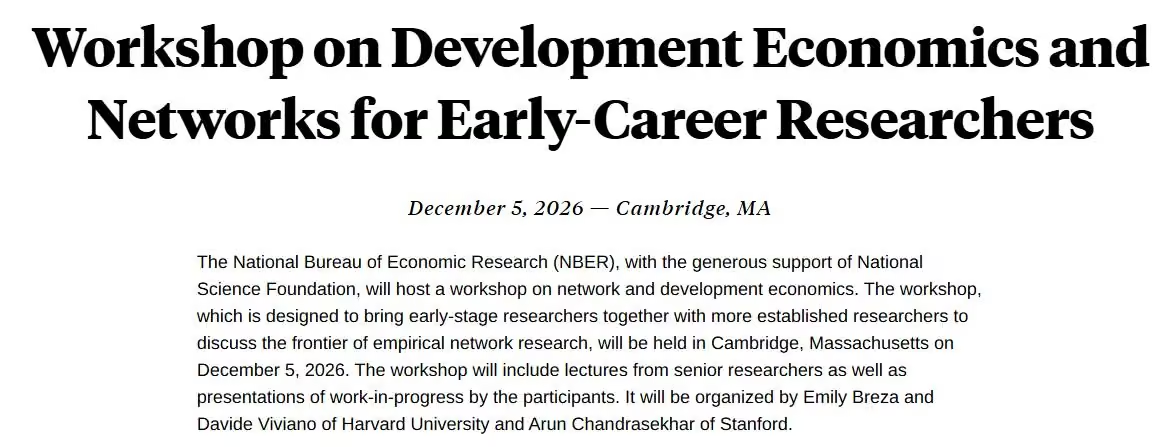 NBER
@nberpubs
What holds back job-to-job mobility and productivity growth? The role of risk aversion and incomplete markets, and a new, pro-growth role for unemployment insurance, from Alex Clymo, Piotr Denderski, @ayusufmercan, and @Schoefer_B www.nber.org/papers/w35580
 NBER
@nberpubs
Individual stocks, corporate bonds, and equity options exhibit common latent factors linked to macro variables, but their price differences suggest market segmentation, from Zhongtian Chen, @NickRoussanov, Xiaoliang Wang, and Dongchen Zou www.nber.org/papers/w35579
 NBER
@nberpubs
Over a century of individual corporate bond prices shows the credit risk premium is significantly positive but time-varying, predicting bond returns and macroeconomic conditions, from Mohammad Ghaderi, Sébastien Plante, @NickRoussanov, and Sang Byung Seo www.nber.org/papers/w35578
 NBER
@nberpubs
Examining the financial and product-market frictions that constrain European firms’ to scale, from @beckerbobo, Efraim Benmelech, and Joao Monteiro www.nber.org/papers/w35577
 NBER
@nberpubs
Children's randomized genetic endowments evoke differential parental and teacher expectations for human capital acquisition, from Philipp Dierker and @daltonconley www.nber.org/papers/w35576
 NBER
@nberpubs
Using a randomized survey experiment in the Italian Survey of Consumer Expectations to study how observability and commonality shape responses to a €1,000 employer bonus, from Tullio Jappelli and Luigi Pistaferri www.nber.org/papers/w35575
 NBER
@nberpubs
Featured in the latest Digest: Governments and Global Credit Markets: Two Centuries of Evidence
www.nber.org/digest/202608/governments-and-global-credit-…
 NBER
@nberpubs
Open call for papers, Economics of Transportation in the 21st Century. Conference to be held Virtually on October 16, 2026. Submit papers by 11:59pm EDT on September 3, 2026. More information: www.nber.org/calls-papers-and-proposals/economics-transpo…
 NBER
@nberpubs
Half of US adults use AI for financial guidance. Using prompts written by real users finds that LLM advice follows lifecycle theory. Decomposing its variation into demand and supply, from @TahaChoukhmane, @timdesilva, @wdwlin, and Matthew Akuzawa www.nber.org/papers/w35574
 NBER
@nberpubs
Growth can occur despite climate change, but at a slower rate. Their interplay implies a warming cap that boosts growth, from @AdrienBilal, Thibault Ingrand, and @drkaenzig www.nber.org/papers/w35573
 NBER
@nberpubs
Models that solve the equity premium puzzle cannot generate the persistent interest rate differences between risky and safe currencies—a currency premium puzzle, from Tarek Alexander Hassan, Thomas Mertens, and Jingye Wang www.nber.org/papers/w35572
 NBER
@nberpubs
Experimental evidence that beliefs about union wins increase support for unions among non-union workers in low-wage sectors, from @EDerenoncourt, @arindube, @snaidunl, Heather Sarsons, and Niharika Singh www.nber.org/papers/w35571
 NBER
@nberpubs
Planning a spillover experiment? Proposing designs that can dramatically boost effective sample size by optimally correlating the treatment assignments of network-connected units, from @borusyak, @instrumenthull, and Evan M. Munro www.nber.org/papers/w35570
 NBER
@nberpubs
How elite are the people we elect? Linking members of Congress born 1830–1950 back to the census household where they grew up, to trace the economic origins of political power, from @jamesfeigenbaum, @andrewbhall, @danmthomp, and @jesselyoder www.nber.org/papers/w35569
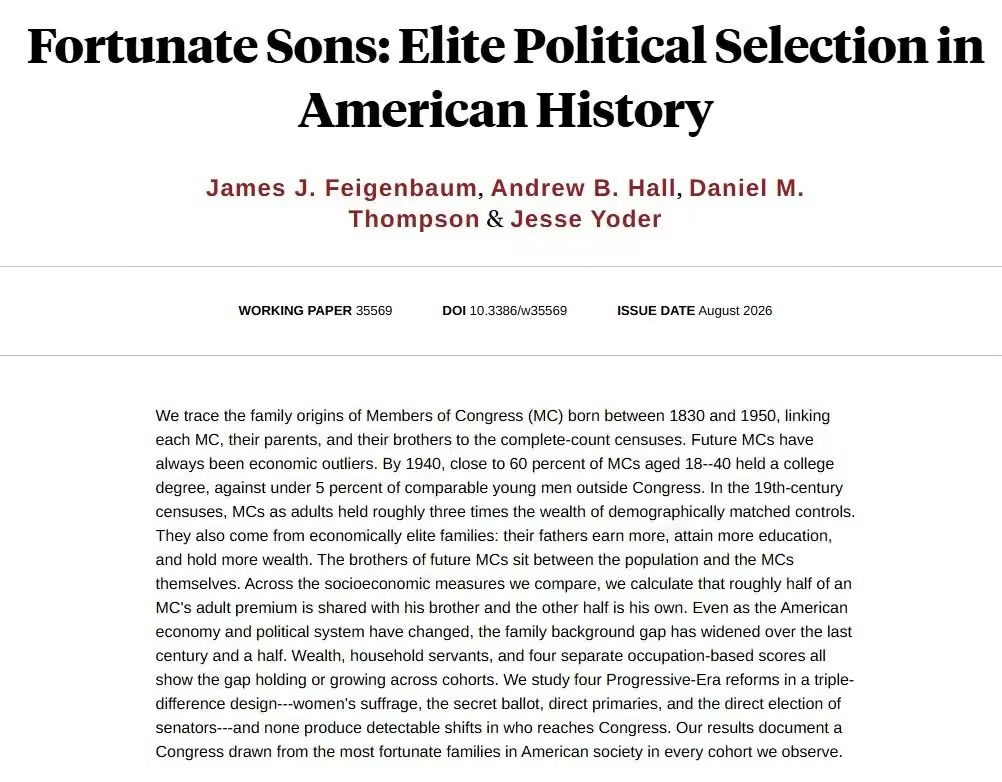 NBER
@nberpubs
Open call for proposals, Grants to Support Data for Economic Measurement Research Projects. Submit proposals by 11:59pm EDT on September 30, 2026. More information: www.nber.org/calls-papers-and-proposals/grants-support-da…
 NBER
@nberpubs
How do civil service protections affect public sector performance? An analytic guide to the growing literature on bureaucrats and public institutions, from @guoxu_econ www.nber.org/papers/w35568
 NBER
@nberpubs
Arguing that a policy response, in regards to behavioral interventions, is economically meaningfully only relative to the response generated by alternative policies, from @econ_4_everyone, Matthias Rodemeier, Sutanuka Roy, and Gregory K. Sun www.nber.org/papers/w35567
 NBER
@nberpubs
Child cognitive and behavioral impairments have lasting health impacts. US longitudinal data points to 60–70 percent higher rates of work-limiting health conditions in adulthood, from Hope Corman, Kelly Noonan, and Nancy Reichman www.nber.org/papers/w35566
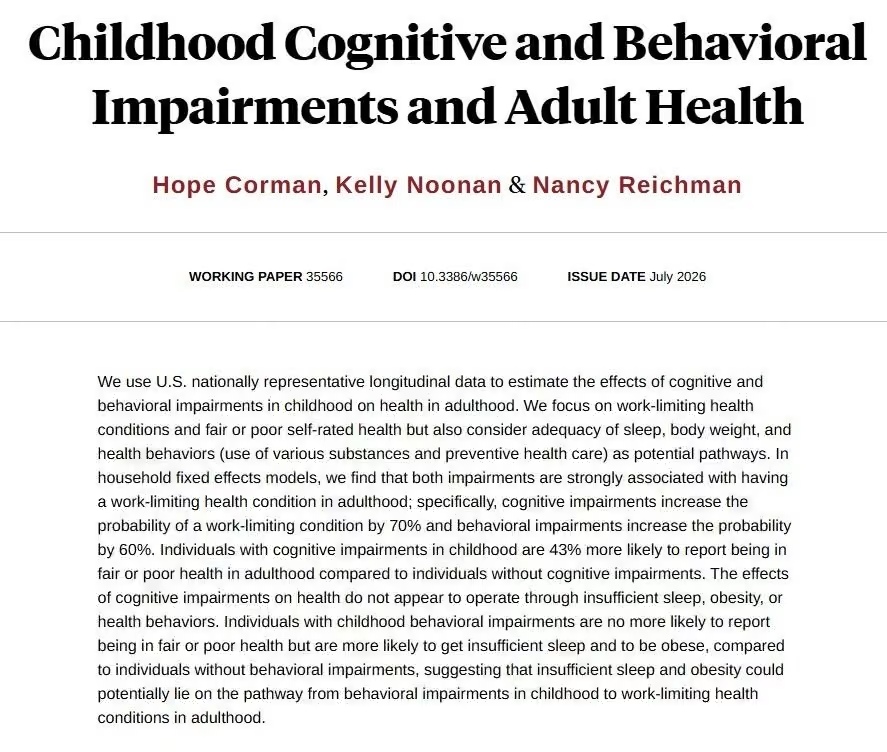 NBER
@nberpubs
Rival firms linked by common ownership are more likely to form cartels and to sustain them longer. After a cartel dissolves, those ownership ties are reduced, from Vincent Abraham, @florianederer, and Catarina Marvao www.nber.org/papers/w35565
 NBER
@nberpubs
In the US and many countries worldwide, levels of financial literacy are low and have not been improving over time, from @Dr_AnnaLusardi www.nber.org/papers/w35564
 NBER
@nberpubs
Demonstrating that multiple self-fulfilling fundamental as well as sentiment driven stochastic inflation equilibria exist in the Lucas (1973) island model, from @BenhabibJess, Pengfei Wang, and Yi Wen www.nber.org/papers/w35563
 NBER
@nberpubs
Because of China’s production-oriented monetary regime, credit expansion can become disinflationary rather than reflationary, from Jeffery (Jinfan) Chang and Wei Xiong www.nber.org/papers/w35562
 NBER
@nberpubs
About 26 percent of the 2025 US tariff increase passes through to consumer prices, from Mary Amiti, Sebastian Heise, and @deweinstein www.nber.org/papers/w35561
 NBER
@nberpubs
Expanding H-1B visas boosted US worker incomes and productivity, especially in non-STEM jobs, with gains flowing downstream via supply chains, from Ran Abramitzky, @leah_boustan, Ahmet Gulek, and Jens Hainmueller www.nber.org/papers/w35560
 NBER
@nberpubs
Studying jobs in which workers value both producing useful output and knowing that output depends on their own contribution, from @joshgans www.nber.org/papers/w35559
 NBER
@nberpubs
Multi-site, multi-year randomized controlled trials of comprehensive supports for high school students at risk of dropping out shows that effects on high school completion can vary substantially, from @ProfTDee, @chloergibbs, Rebecca Margolit-Chan, Lillian Morrell, and James X. Sullivan www.nber.org/papers/w35558
 NBER
@nberpubs
Granular data from decentralized finance lending pools reveal stablecoin deposits as a new class of safe asset, anchored in Treasuries yet as fragile as other forms of private money, from Murillo Campello, Angela Gallo, Lira Mota, and Tammaro Terracciano www.nber.org/papers/w35557
 NBER
@nberpubs
How could China's exam system retain legitimacy if networks mattered so much? Because exam performance and connections reinforced each other in career success, from Ying Bai and Ruixue Jia www.nber.org/papers/w35556
 NBER
@nberpubs
Who finances the US current account? New evidence highlights factors explaining the shift in external demand for US Treasuries from foreign central banks to private investors, from @anusha_chari and Gian Maria Milesi Ferretti www.nber.org/papers/w35555
 NBER
@nberpubs
A theory that integrates Burdett–Mortensen with firm dynamics puts firm growth, not size, at the heart of wage setting and shows the optimal policy boosts business dynamism, from Marc de la Barrera and Masao Fukui www.nber.org/papers/w35554
 NBER
@nberpubs
Featured in the latest Digest: Crowd-Out of Employer-Provided Health Insurance by the Affordable Care Act
www.nber.org/digest/202608/crowd-out-employer-provided-he…
 NBER
@nberpubs
Reforms during the 2010 financial crisis cut pharmacy prices and markups in Portugal. Over the next 10 years wages of pharmacists fell by a third, from David Card, Ana Rute Cardoso, and Pedro Luis Silva www.nber.org/papers/w35553
 NBER
@nberpubs
Credit frictions reduce productivity and wages by about 25 percent, and have gotten worse since the Great Recession. Using credit default risk data for 23 million firm-years to examine the impact of credit frictions arising from firm-level default risk on aggregate economic performance, from Timothy J. Besley, @pj_lambert, Isabelle A. Michalski-Roland, and @johnvanreenen www.nber.org/papers/w35552
 NBER
@nberpubs
Chinese patenting reflects innovative progress, isn’t concentrated in corporate giants, relies heavily on universities, and isn’t driven by inventors with US experience/training, from Josh Lerner, @nummoose, @DimitrisPapan20, Amit Seru, and Zunda Winston Xu
 NBER
@nberpubs
Citizens attribute good outcomes to the government of the party they like and blame the other party for bad outcomes. This can be fully rational when attribution is ambiguous, from Ricardo Alonso, @monicambravo, Gerard Padró I Miquel, Carlos Sanz, and @silviavannutell
 NBER
@nberpubs
Melissa Dell, Harvard University, and Ashesh Rambachan, Massachusetts Institute of Technology, presented the 2026 Methods Lecture on "Estimation and Inference with AI-Generated Data". www.youtube.com/watch?v=ydYXe2FxErk
 NBER
@nberpubs
A framework for selecting innovation funding mechanism depending on whether a policymaker can articulate the problem, specify the solution, or identify a team to contract with, from @mattsclancy, Matthew Esche, Siddhartha Haria, Claire T. McMahon, Christopher M. Snyder, and @calebwatney www.nber.org/papers/w35549
 NBER
@nberpubs
Financial markets are frequently distressed. Proposing a "market-backstop principle" where central banks could impose modest liquidity requirements and be buyer-of-last-resort, from Frederic Boissay and @haralduhlig www.nber.org/papers/w35548
 NBER
@nberpubs
Studying identification and optimal policy design in a broad class of principal-agent models, from Brent R. Hickman, @econ_4_everyone, Ian Muir, and Gregory K. Sun www.nber.org/papers/w35547
 NBER
@nberpubs
LinkedIn histories aren’t fixed; 19 percent of users edit past jobs. These “time-travel” edits track job moves and reveal rising AI language after 2022, and fading DEI mentions after 2025, from @I_Am_NickBloom, @GideonMoore, Lisa K. Simon, and Caelan Wilkie-Rogers
 NBER
@nberpubs
Studying whether AI can spot history's turning points using 120 years of newspaper data, to measure institutional uncertainty and detect critical junctures as they unfold, from Michael Callen, Gregory Levy, Saipremnath Muthukumaran, @jonathanweigel, and Noam Yuchtman
 NBER
@nberpubs
Proposing a solution for bias that results from non-random sample entry, from @econ_4_everyone www.nber.org/papers/w35544
 NBER
@nberpubs
Diagnosis-contingent incentives that tie treatment incentives to diagnostic results reduce unnecessary treatment and improve welfare, from @MariaDieci, @paul_gertler, Jonathan T. Kolstad, and Carlos Paramo www.nber.org/papers/w35543
 NBER
@nberpubs
Technology-driven creative destruction in the product market passes through to worker earnings, from Brice C. Green, Leonid Kogan, @DimitrisPapan20, and @L_Schmidt_Econ www.nber.org/papers/w35542
 NBER
@nberpubs
Featured in the latest Digest: How Japanese Fuel-Economy Subsidies Affected Cars Sold in America
www.nber.org/digest/202608/how-japanese-fuel-economy-subs…
 NBER
@nberpubs
Open call for proposals, Roybal Center for Behavior Change in Health - Clinical Trial Applications. Submit papers by 11:59pm EDT on October 1, 2026. More information: www.nber.org/calls-papers-and-proposals/roybal-center-beh…
 NBER
@nberpubs
Intermediated debt markets give rise to two-tiered liquidity effects at currency and asset market levels. Government policies to join a currency area affect competition in asset markets, from @ProfJiang www.nber.org/papers/w35541
 NBER
@nberpubs
Examining whether algorithmic risk assessments improve child-protection decisions, where supervisors decide which cases need closer scrutiny, from @JasonBaron4, @arkdevghosh, and Richard Lombardo www.nber.org/papers/w35540
 NBER
@nberpubs
A quantitative picture of the discourse on China in the US over time and across official documents and media, from Mert Geyiktepe and @rodrikdani www.nber.org/papers/w35539
 NBER
@nberpubs
The cognitively impaired account for approximately 29 percent of total long-term care expenditures in the Netherlands, from Gaia Bagnasco, @pieter_bakx, Stijn Coremans, and @BramWouterse www.nber.org/papers/w35538
 NBER
@nberpubs
Mark Duggan, Stanford University (Soon to be University of Toronto), presented the 18th Annual Martin Feldstein Lecture on "Social Security Reform in an Era of Fiscal Deficits". www.youtube.com/watch?v=4lCGLAYmHy8
 NBER
@nberpubs
Large-scale randomized trial finds low-cost reminders increased influenza vaccination, while machine learning identified patients most responsive to incentives, from Kelsey Moran, Gail M. Rosenbaum, Amir Goren, Michelle N. Meyer, Christopher F. Chabris, and Joseph J. Doyle Jr.
 NBER
@nberpubs
A citywide experiment in the DR Congo finds that progressive property taxation raised revenue by 56 percent, boosting compliance at the bottom while raising liabilities at the top, from @gabezt, Arthur Laroche, @ABergeron_econ, Joana Naritomi, @jonathanweigel, and Marina Mavungu Ngoma www.nber.org/papers/w35536
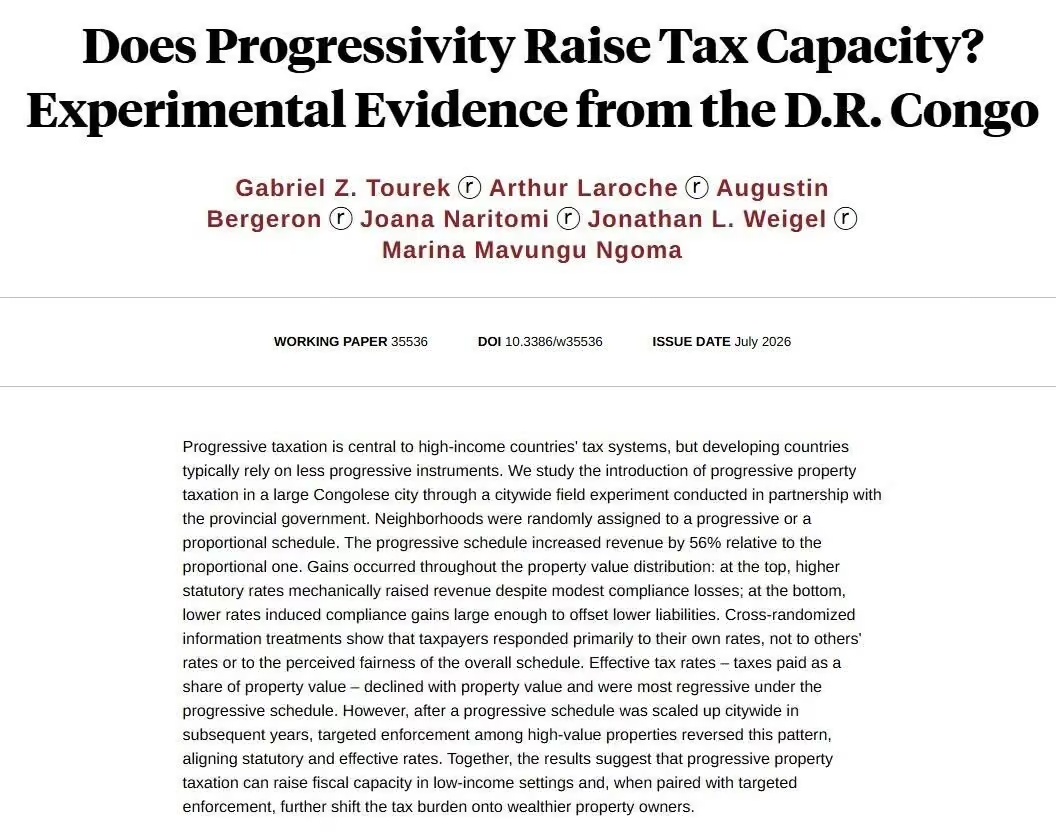 NBER
@nberpubs
China's Yangtze fishing ban unintentionally boosted science as research funding rose about 22 percent and publications/citations nearly doubled for protected fish, by restoring specimen supply, from Minhao Chen, Lin William Cong, Haoyu Gao, Andrew Karolyi, and Hui Wang
 NBER
@nberpubs
Tax avoidance through personal holding companies in Sweden and Norway shelters 50 percent of dividend income from taxation, leading to a sharp drop-off in effective tax rates at the top, from @Mariusring, @SeimSeim, and @gabriel_zucman www.nber.org/papers/w35534
 NBER
@nberpubs
County health departments established in the early 1900s increased longevity for those exposed in utero or early childhood, with the largest gains among disadvantaged children, from @HNoghani and @jasonmfletcher www.nber.org/papers/w35533
 NBER
@nberpubs
Arguing that the “Confucian Fertility Paradox” dissolves once two strands of the tradition are separated and recognize that modernization affected them very differently, from @HanmingF and Chang Liu www.nber.org/papers/w35532
 NBER
@nberpubs
Reforms that anonymized China’s imperial exams and ended local recommendations increased commoner entry into office and reduced, especially scholar-led, social unrest, from Jingjing Chen, Jianlei Han, Shing-Yi Wang, and Yongxiang Wang www.nber.org/papers/w35531
 NBER
@nberpubs
Curtailing renewables wastes cheap, clean energy. In nationwide trials in Great Britian and Spain, letting prices go to zero for consumers captured welfare gains curtailment leaves behind, from Daniel Lopez Garcia, @rdmetcalfe, Andrew R. Schein, and Yixin Sun
 NBER
@nberpubs
Positive temperature shocks have persistent and detrimental impacts on weekly US state economic conditions, possibly due to the effect of heat on labor productivity, from Kimberly A. Berg, Chadwick C. Curtis, and Nelson C. Mark www.nber.org/papers/w35529
 NBER
@nberpubs
Finding a core tension in active asset management: skilled managers generate performance through policy insights while attracting flows through sentiment alignment, from Zhenyu Gao, Wei Xiong, and Jian Yuan www.nber.org/papers/w35528
 NBER
@nberpubs
Examining how networks formed through college athletics influence the early-career trajectories of Ivy League graduates, from Paul Gompers, George Hu, Will Levinson, and @SachinS1703 www.nber.org/papers/w35527
 NBER
@nberpubs
When deliberation noise varies systematically between individuals, accounting for decision processes is essential to accurately determining preferences, from Cesar Chavez Padilla, Shuaizhang Feng, James J. Heckman, and Zhe Yang www.nber.org/papers/w35526
 NBER
@nberpubs
Investigating whether, by providing better and more timely information, the first mandatory online reporting and auditing program for wastewater discharge releases in the US improved facility compliance and environmental performance, while also allowing state regulators to more effectively monitor and enforce regulations, from Wayne B. Gray, Ronald Shadbegian, and Ann Wolverton www.nber.org/papers/w35525
 NBER
@nberpubs
Studying Canada’s unemployment insurance system, where benefit duration increases discretely when prior hours worked crosses various thresholds, from @urfriendlen and Simon Quach www.nber.org/papers/w35524
 NBER
@nberpubs
Higher immigration rates predicted higher labor productivity growth across OECD countries over the period 1990–2024, from Gaetano Basso, Mitali R. Mathur, and @giov_peri www.nber.org/papers/w35523
 NBER
@nberpubs
In India’s 4G rollout, spillovers across phones and networks shape entry and product variety. Policies that curb foreign firms can weaken the complementary market and backfire, from Chirantan Chatterjee, Ying Fan, and Debi Prasad Mohapatra www.nber.org/papers/w35522
 NBER
@nberpubs
Machine learning lets lenders predict who's profitable, boosting margins 7–9 percentage points, but cuts out women and poorer borrowers. Heterogeneous treatment effects on borrowers inconclusive, from @Susan_Athey, Bruno Fava, @deankarlan, @adammosman, and Jonathan Zinman
 NBER
@nberpubs
Examining the rapid expansion and convergence of retail betting markets, from Scott R. Baker, Justin Balthrop, Mark J. Johnson, Jason D. Kotter, and Kevin Pisciotta www.nber.org/papers/w35520
 NBER
@nberpubs
Sustainable investing that shifts capital from “brown” to “green” firms can backfire, making brown firms more brown without making green firms more green, from @samhartzmark and Kelly Shue www.nber.org/papers/w35519
 NBER
@nberpubs
Once the price of passive equity stakes to the government and a firm's policy exposure are determined in equilibrium, the owners' consent reveals nothing about whether they benefit, from @joshgans www.nber.org/papers/w35518
 NBER
@nberpubs
Providing causal estimates of the global social returns to US public R&D. A shock equal to 1 percent of the federal R&D capital stock raises foreign total factor productivity by 1 percent within 12 years, from @GusMicrotoMacro, Andrew J. Fieldhouse, Karel Mertens, @Ishan_Nath, and Valerie A. Ramey www.nber.org/papers/w35517
 NBER
@nberpubs
Quantifying the price and distributional impact of the nationwide disclosure of property-level flood risk from First Street data on US housing platforms, from @BillingsEcon, @sophcalderwang, and Weiling Liu www.nber.org/papers/w35516
 NBER
@nberpubs
Paul Goldsmith-Pinkham, Associate Professor of Finance at the Yale School of Management, presented "Using AI in Household Finance Research: A Practical Guide" at the Household Finance Conference during the 2026 Summer Institute.
www.youtube.com/watch?v=c5g6A-Ci-ho
 NBER
@nberpubs
University licensing contracts shape value capture by allocating control over technologies’ future development and commercialization, rather than price alone, from Anparasan Mahalingam and Matthew J. Higgins www.nber.org/papers/w35515
 NBER
@nberpubs
How does subsidized childcare impact the long-run careers of mothers? Evidence from Quebec's universal childcare program shows an enduring and growing impact with higher earnings, from Michael Baker, Jonathan Gruber, and @kevinmilligan www.nber.org/papers/w35514
 NBER
@nberpubs
Industry distress predicts lower returns beyond firm-level distress: industry left-tail risk weakens competition-distress feedback, thus reducing negative discount-rate exposure, from Hui Chen, Winston Wei Dou, Hongye Guo, and Yan Ji www.nber.org/papers/w35513
 NBER
@nberpubs
Sanctions cut Venezuela's oil output by two-thirds and made every remaining barrel two-and-a-half times dirtier; surviving fields ran past capacity and cut maintenance, from @FiorettiMichele, Kavanaugh FitzPatrick, and Alessandro Iaria www.nber.org/papers/w35512
 NBER
@nberpubs
Open call for papers, The Economics of Firearm Markets, Crime, and Gun Violence. Conference to be held in Cambridge, MA on February 6, 2027. Submit papers by 11:59pm EDT on October 28, 2026. More information: www.nber.org/calls-papers-and-proposals/economics-firearm…
 NBER
@nberpubs
Globally, consumers who rely on local signals such as grocery bills form more biased expectations, with trust in economic institutions shaping information choice, from Francesco D’Acunto and Michael Weber www.nber.org/papers/w35511
 NBER
@nberpubs
Introducing Eurobonds and a centralized treasury in the euro area could eliminate the tail risks of deflation and fiscal stagflation, and benefit both low- and high-debt countries, from @Francesco_Bia, @Qingyuan_Fang, @LeonardoMelosi, and @AnnaRogantiniPi www.nber.org/papers/w35510
 NBER
@nberpubs
In Germany, Hungary, and Italy, projected income gains increased support for more open immigration, but majority support required unrealistically large gains, from Cristina Cattaneo, Daniela Grieco, Nicola Lacetera, and @Mario_Macis www.nber.org/papers/w35509
 NBER
@nberpubs
Credit scores cause at least part of the default they predict for risky borrowers. A score assessed on separating defaulters from non-defaulters is rewarded for defaults it causes, from Victor Duarte and @JuliaAFonseca www.nber.org/papers/w35508
 NBER
@nberpubs
Global pension funds are shifting out of bonds and into riskier mutual funds and alternative assets, making debt costs to borrowers more sensitive to market shocks, from Ding Ding, @fang_leon, Bryan Hardy, and Karen K. Lewis www.nber.org/papers/w35507
 NBER
@nberpubs
Surveying recent advances in the economic theory of identity formation as embedded into an inter-generational cultural transmission process, from @albertobisin and Thierry Verdier www.nber.org/papers/w35506
 NBER
@nberpubs
Administrative micro-data from Norway suggest the automatic exchange of bank account information between countries has curbed outflows of wealth to tax havens, from Annette Alstadsæter, Niels Johannesen, @LghSegal, and @gabriel_zucman www.nber.org/papers/w35505
 NBER
@nberpubs
New data on bank runs reveals that poor fundamentals are key for whether runs lead to bank failure and have severe consequences for the broader economy, from Sergio A. Correia, @StephanLuck, and @EmilVerner www.nber.org/papers/w35504
 NBER
@nberpubs
An experiment with 4,000 Americans shows that size alone doesn’t trigger public support for antitrust. Evidence of consumer harm does, from @pereztruglia and Jeffrey Yusof www.nber.org/papers/w35503
 NBER
@nberpubs
Leveraging mandatory combat deployments of physicians in the US military to obtain novel causal estimates of skill depreciation and learning-by-doing, from Trevor Fitzgerald, @gupta_atulk, and @sdschwab www.nber.org/papers/w35502
 NBER
@nberpubs
Human capital factors predict career progression and investment outcomes in venture capital. Achieving superstar status increases access to highly valued startups, from @blake_ajackson and Ilya A. Strebulaev www.nber.org/papers/w35501
 NBER
@nberpubs
Constructing a novel stock-level measure of volatility disagreement as the cross-sectional dispersion of realized variance forecasts built from heterogenous information sets and machine learning models, from Turan G. Bali, Bryan T. Kelly, and Mathis Mörke www.nber.org/papers/w35500
 NBER
@nberpubs
Analysis of 11 million US patents shows inventions have spread out in idea space since 1836, helping explain weaker spillovers and lower research productivity, from @inaganguli, @jeffrlin, Vitaly Meursault, and @nick_reynolds88 www.nber.org/papers/w35499
 NBER
@nberpubs
It is optimal to hedge all currency exposures except the USD and the Euro to manage risk. But Uncovered Interest Parity deviations in high interest currencies create an offsetting effect, from Luis M. Viceira and Sally Shen www.nber.org/papers/w35498
 NBER
@nberpubs
Critical-mineral trade has concentrated into a China-centered hub-and-spoke network, giving pricing power, from Josh Kirk, @evgenia_passari, and @helene_rey www.nber.org/papers/w35497
 NBER
@nberpubs
How equilibrium patterns of production, trade, and input sourcing in complex supply chains are shaped by aggregate risk, from @castrovincenzi, Adry Gracio, @econgaurav, and @nityanayar www.nber.org/papers/w35496
 NBER
@nberpubs
Many would adopt human enhancement technologies but want them regulated. And those who wouldn't adopt don't want them banned. Demand and governance have different determinants, from Giovanni Immordino, @Mario_Macis, Immacolata Marino, and Fabrizio Panebianco
 NBER
@nberpubs
How firms adjust their political spending when public scrutiny rises, temporarily withdrawing contributions while preserving long-run influence, from Eric A. Baldwin, Takuma Iwasaki, John J. Donohue, and Charlie Grabois www.nber.org/papers/w35494
 NBER
@nberpubs
How firms and workers adjust when previously restricted migrants gain full and portable work rights in a labor market with substantial informality, from @vitto_dicandia and @silviavannutell www.nber.org/papers/w35493
 NBER
@nberpubs
Analysis of equilibrium impact of no-poach agreements using a dynamic monopsony framework finds that wage harm far exceeds that of noncompetes and wage fixing schemes, from @agottfries and Gregor Jarosch www.nber.org/papers/w35492
 NBER
@nberpubs
Large cuts in US military university research funding in the 1970s drove lasting declines in scientists, PhDs, research output, and leadership in formerly defense-driven fields, from @daniel_p_gross, Bhaven N. Sampat, and @HansenZhang13 www.nber.org/papers/w35491
 NBER
@nberpubs
What makes AI economically valuable? AI is used by humans to make decisions. The optimal way to train or benchmark AI depends on that joint use, in a formal decision-theoretic way, from @afinetheorem and @joshgans www.nber.org/papers/w35490
 NBER
@nberpubs
Studying the effects of discrete diagnostic thresholds on the rates at which deceased donor kidneys are discarded, as well as the underlying mechanisms, from Hannah Bae and @jeffreypclemens www.nber.org/papers/w35489
 NBER
@nberpubs
Non-quantifiable uncertainty discourages investment more than quantifiable risks, from @HealGeoff and Marcella Lucchetta www.nber.org/papers/w35488
 NBER
@nberpubs
Unstructured data, such as text and images, can be used to estimate dynamic equilibrium models and their structural parameters, from Sara Casella, Jesús Fernández-Villaverde, @StephenEKHansen, Ryohei Oishi, and Minchul Shin www.nber.org/papers/w35487
 NBER
@nberpubs
Primary care physicians learn about specialist quality from their own patients’ outcomes, but informational frictions lead to suboptimal referrals, with about one-quarter of patients referred to a different specialist under improved information, from @ianhealthecon and Seth Richards-Shubik www.nber.org/papers/w35486
 NBER
@nberpubs
Demand flexibility is key to the future grid but does it work at scale? A 2.6M-customer field experiment finds consumers cut peak demand by 23 percent, with EVs, batteries, and heat pumps, from Louise Bernard, @rdmetcalfe, and Andrew Schein www.nber.org/papers/w35485
 NBER
@nberpubs
Size-based payroll tax notches act as barriers to mobility, substantially distort firm behavior, and bias conventional difference-in-differences estimates, with much larger effects than previously detected, from Sami Jysmä, Youssef Benzarti, and Jarkko Harju
 NBER
@nberpubs
The new HARS framework shows how shock heteroskedasticity can sharpen economic inference, restore the 90 percent credible interval standard, and alter economic conclusions, from Dawis Kim and @zha_tao www.nber.org/papers/w35483
 NBER
@nberpubs
Featured in the latest Digest: The COVID-19 Pandemic and Innovation in Remote Work Technologies
www.nber.org/digest/202607/covid-19-pandemic-and-innovati…
 NBER
@nberpubs
Joint custody boosts fathers’ earnings and mental health and improves kids' test scores, with no measurable downsides for mothers, from Stella Canessa, Gordon B. Dahl, Anna Hasselqvist, @CostasMeghir, Susan Niknami, Mårten Palme, Helmut Rainer, Olof Rosenqvist, and @pengpeng_xiao
 NBER
@nberpubs
AI-generated covariates from LLMs can bias regressions. A new method, AI-Powered Inference, corrects the bias and combines models for valid and efficient inference, from Junting Duan and Markus Pelger www.nber.org/papers/w35481
 NBER
@nberpubs
Examining the accuracy and usefulness of information from five major household surveys over the period 1999–2019 for examining trends in mental health, from Christopher J. Ruhm www.nber.org/papers/w35480
 NBER
@nberpubs
Debt can push viable firms out of the market. Quantifying the welfare losses from excess exits finds that the marginal propensity to exit with debt disciplines financial frictions, from Gideon Bornstein and @lcastillomart www.nber.org/papers/w35479
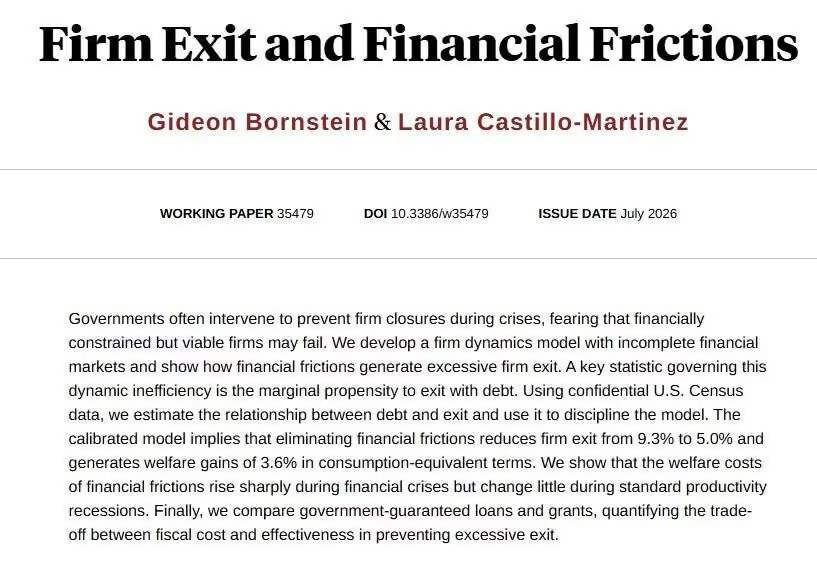 NBER
@nberpubs
Adding a short couples' planning session to a Liberian cash transfer program amplified economic benefits. However, it led to more intimate partner violence in the highest-risk homes, from Sarika Gupta, Jessica Leight, Daniel W. Maggio, and Simone G. Schaner
 NBER
@nberpubs
Investigating how spousal health shocks impact retirement transitions, from Hyeran Chung, Haena Lee, and @sita.slavov www.nber.org/papers/w35477
 NBER
@nberpubs
Estimating a model of labor supply, labor demand, and bargaining over wages between local teacher unions and school districts in Pennsylvania’s public school system from 2013 to 2019, from Tirza J. Angerhofer, Allan Collard-Wexler, and Matthew C. Weinberg www.nber.org/papers/w35476
 NBER
@nberpubs
GLP-1 treatment cuts long-term sickness leave by 17 percent in Danish admin data, with fiscal benefits of 1.3–1.5 percent of annual earnings, but no impacts on income or employment, from @MeltemDaysal, Camille JH. Fredrickson, @idalykkekr, @tramir, and @jzhangecon
 NBER
@nberpubs
Examining monopsony models by building a dynamic model incorporating labor market power and endogenous effort, from Michael Rubens and Bernardo S. Silveira www.nber.org/papers/w35474
 NBER
@nberpubs
Comparing predictions from merger simulations to realized prices for 101 mergers. Simulations without cost synergies overpredict price increases but screen harmful mergers well, from @bhattacv, @IllanesGaston, @avner_ak, José D. Salas, and David Stillerman www.nber.org/papers/w35473
 NBER
@nberpubs
Featured in the latest Digest: Gender Disparities in College Enrollment and Marriage Patterns
www.nber.org/digest/202607/evolving-gender-disparities-co…
 NBER
@nberpubs
The Congressional Budget Office describes its analytical framework for modeling the economic effects of changes in federal funding for R&D, using an R&D capital stock approach and an R&D components approach, from Sheila Campbell, Jaeger Nelson, Eli A. Schrag, @heidilwilliams_, and Caleb K. Wroblewski www.nber.org/papers/w35472
 NBER
@nberpubs
Extending analysis of the 1918 influenza pandemic to evaluate early-life and childhood exposure to the pandemic on old-age longevity, from @HNoghani and @jasonmfletcher www.nber.org/papers/w35471
 NBER
@nberpubs
State- and county-level Preston curves show that economic growth in the 2010s no longer translated into broad gains in life expectancy, from Ritikaa Khanna, Rourke O'Brien, Andrew C. Stokes, Atheendar Venkataramani, and Elizabeth Wrigley-Field www.nber.org/papers/w35470
 NBER
@nberpubs
German elderly adults suffering from cognitive impairment are 30 percent more likely to receive any care, and obtain on average both 6 more hours of formal and informal care per week, from Elsa Perdrix, Axel H. Börsch-Supan, @diw_jgeyer, @PeterHaan8, and Sami Louahlia
 NBER
@nberpubs
Examining the incidence and economic burden of cognitive impairment among older individuals in Italy within the long-term care system, from Agar Brugiavini, @ludokarr, Gloria Moroni, Rinaldo Naci, and @PasiniCaFoscari www.nber.org/papers/w35441
 NBER
@nberpubs
Developing methods for partially identifying supply-demand systems and related welfare parameters under unobserved market heterogeneity and discrete instruments, from Ingvil Gaarder, Lancelot Henry de Frahan, Magne Mogstad, Alexander Torgovitsky, and Oscar Volpe
 NBER
@nberpubs
Evidence on women's experiences in platform-based driving and delivery work using survey and administrative data from India and Indonesia, from @achadhvaryu, Levina Adiputri, Valentina Brailovskaya, Priyanka Dua, Jenny Susan John, Pratibha Joshi, Terry Muthahhari, Rivandra Royono, and Jack Thunde www.nber.org/papers/w35467
 NBER
@nberpubs
Why did the USD weaken and why did yields rise after the April 2025 tariffs? A 3–12 percent (versus US GDP) drop in demand for dollar bonds—perhaps gradual, since asset prices are forward-looking, from Rohan Kekre and Moritz Lenel www.nber.org/papers/w35466
 NBER
@nberpubs
Studying social insurance with imperfect eligibility screening, focusing on Unemployment Insurance during its expansion in 2020 and 2021, from Adam Isen, @EliraKuka, and @BryanAStuart www.nber.org/papers/w35465
 NBER
@nberpubs
Using data from Spain finds that physical limitations drive care use and nursing home entry more than cognitive impairment; informal care makes up 69–81 percent of dementia cost, from @JoanCostaiFont, Sergi Jimenez-Martin, Juan Oliva, Cristina Vilaplana-Prieto, and Analía Viola
 NBER
@nberpubs
Evaluating an alternative measure of vulnerability based on the concept of a natural level of capital flows, from John D. Burger, Francis E. Warnock, and Veronica Cacdac Warnock www.nber.org/papers/w35463
 NBER
@nberpubs
Unexpected loss of kin affects post-traumatic stress and depressive symptoms in the short and long-run; community-level mortality shocks have smaller and less persistent effects, from Elizabeth Frankenberg, Cecep Sumantri, and Duncan Thomas www.nber.org/papers/w35462
 NBER
@nberpubs
Developing a simple and intuitive Pigouvian perspective on optimal trade policy, from Arnaud Costinot and @IvanWerning www.nber.org/papers/w35461
 NBER
@nberpubs
Analyzing collaborative experimentation across multiple independent domains, from Charles Angelucci and Roi Orzach www.nber.org/papers/w35460
 NBER
@nberpubs
Revisiting fiscal sustainability through the lens of the government’s budget constraint, from Barry Eichengreen, Maxime Menuet, and Gregory Donnat www.nber.org/papers/w35459
 NBER
@nberpubs
When WWI sparked a sudden anti-German backlash in 1917, banks with German-sounding names that kept them lost assets, deposits, and market share, while those that rebranded escaped, from Kris James Mitchener, Matthew S. Jaremski, and Kilian Rieder www.nber.org/papers/w35458
 NBER
@nberpubs
Job ads can signal hidden job traits. Evidence from German workers shows this distorts discrete choice estimates of workers’ willingness to pay, from Pawel Adrjan, Mária Balgova, @simon_jaeger, Jonas Jessen, and @JSockin www.nber.org/papers/w35457
 NBER
@nberpubs
How did the early Social Security program affect recipients' children? New research finds it enabled sons to move to better-matched labor markets and earn more in the long run, from Daniel K. Fetter, Lee M. Lockwood, and Paul Mohnen www.nber.org/papers/w35456
 NBER
@nberpubs
Asking why mixed-use development is common in Taipei but rare in US cities, and measuring the land-use wedges behind this difference, from Yu-Hsin Ho, Chang-Tai Hsieh, Wen-Tai Hsu, and Yu-Jhih Luo www.nber.org/papers/w35455
 NBER
@nberpubs
Competition reduces the rate of suboptimal choices, but does not drive it to zero, from David B. Huffman, Lamar Pierce, Alex Rees-Jones, and Germán J. Reyes www.nber.org/papers/w35454
 NBER
@nberpubs
Merging data on financial sanctions and the cross-border payments network. Heavily sanctioned economies shift towards the yuan. Elsewhere, the dollar remains resilient, from Gregor Matvos and @BrentNeiman www.nber.org/papers/w35453
 NBER
@nberpubs
Curation of research shows growth in studies on economic wellbeing and Latino populations; employment, tax credits, and mixed status households revealed as open topics for future work, from Matthew Maury, Agustina Laurito, @Gen_Pov, and Kevin Kamto Sonke www.nber.org/papers/w35452
 NBER
@nberpubs
Data from 380 trillion tokens of AI consumption across more than 400 models (2 percent of global AI consumption) shows detailed effects of AI on firms, markets, and workers, from @nicolaborri, Aleh Tsyvinski, and Yukun Liu www.nber.org/papers/w35451
 NBER
@nberpubs
Featured in the latest Bulletin on Health: Sugar Restriction at Early Ages Mitigates Genetic Obesity Risk
www.nber.org/bh/20262/sugar-restriction-early-ages-mitiga…
 NBER
@nberpubs
20 percent of investor bond trading happens in bundles—a swap, or a basket—contrary to the canonical view. Dealers aren't just selling bonds, they sell insurance against price risk, from Jason Allen and Milena Wittwer www.nber.org/papers/w35450
 NBER
@nberpubs
Top hub ports dominate global shipping while rising Chinese port ownership boosts operations but favors its own ships, heightening importance of critical nodes and who owns them, from @juhreka13, Dávid Krisztián Nagy, @ClaudiaSteinwen, and @WoanFoongWong www.nber.org/papers/w35449
 NBER
@nberpubs
Showing that incorporating uninsurable countercyclical income risk into a standard international Real Business Cycle model can account for major open-economy macro puzzles, from Sushant Acharya, @ChalleEdouard, and @LouphouC www.nber.org/papers/w35448
 NBER
@nberpubs
Using a difference-in-discontinuities design to study the effects of federal aid to school districts during the COVID-19 pandemic, from @jeffreypclemens, @phoxie58, and @stanveuger www.nber.org/papers/w35447
 NBER
@nberpubs
Open call for papers, Measuring and Modeling Market Power in the Labor Market. Conference to be held in Cambridge, MA on May 14, 2027. Submit papers by 11:59pm EDT on January 13, 2027. More information: www.nber.org/calls-papers-and-proposals/measuring-and-mod…
 NBER
@nberpubs
A handful of industrial zones in Vietnam generate significant employment gains while the rest generate almost none. Foreign manufacturers operate as enclaves, from @BrianMccaig, Margaret S. McMillan, Marina Mavungu Ngoma, and Anh T. Pham www.nber.org/papers/w35446
 NBER
@nberpubs
Pairing HR incentives with a communication tech raised productivity 5 percent, cut absenteeism 13 percent, and lifted worker earnings 3 percent in Indian garment factories. Technology alone had no effect, from @achadhvaryu, @smitgade1, Piyush Gandhi, @teresa_s_molina, and @AnantNyshadham www.nber.org/papers/w35445
 NBER
@nberpubs
AI can redesign residual risk. Showing why competitive insurance may underuse the very prevention that makes high risks insurable, from @alex8chan.bsky.social www.nber.org/papers/w35444
 NBER
@nberpubs
Studying aberrant, destabilizing behavior by miners on the Bitcoin blockchain, who have incentives to attack one another's blocks when rewards are high, from Fabian Schär, Dario Thürkauf, and David Yermack www.nber.org/papers/w35443
 NBER
@nberpubs
Comparing the utilization, intensity, and cost of long-term care in Japan across those with a dementia diagnosis, those with physical limitations but no dementia, and those with neither, from Rong Fu, Sizhe Liu, @toshi_iizuka, and Haruko Noguchi www.nber.org/papers/w35442
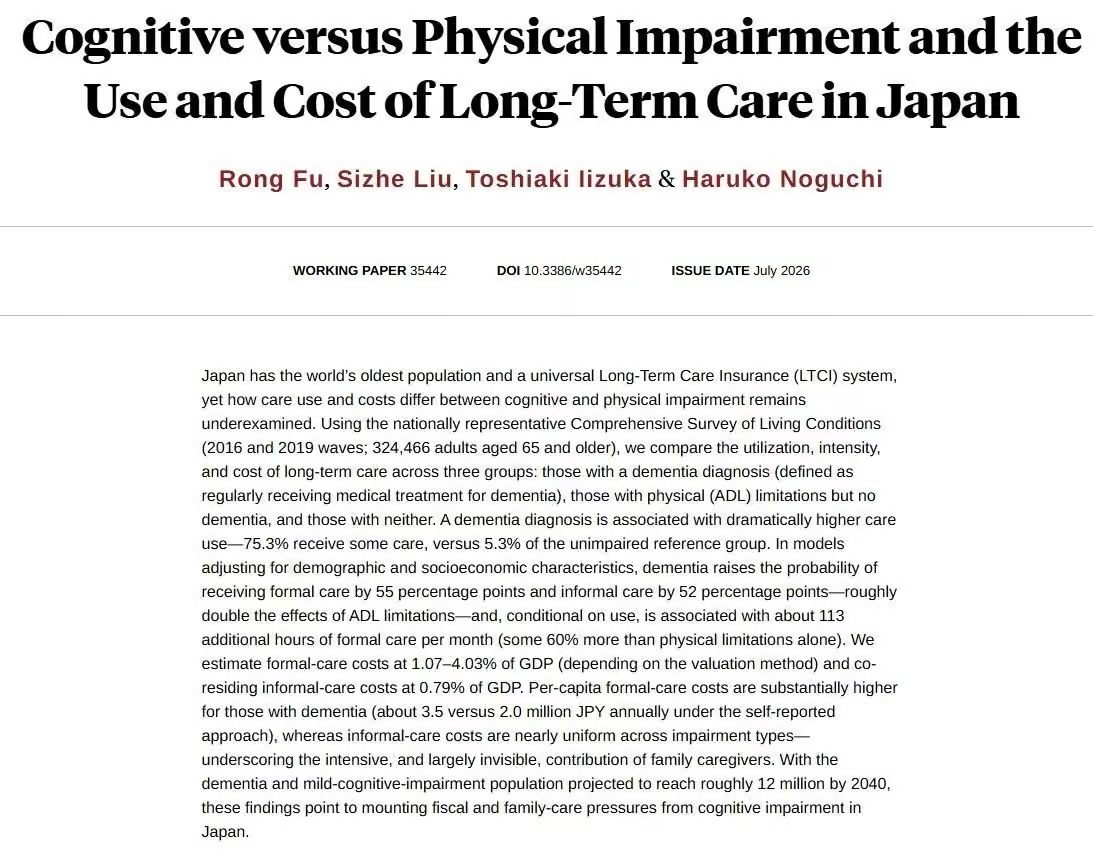 NBER
@nberpubs
What drives veterans' choice between VA and private care? 50–60 percent of geographic variation reflects individual factors, not place. Distance and wait times explain only a small share, from Marika Cabral, David C. Chan Jr, and @sethneller www.nber.org/papers/w35440
 NBER
@nberpubs
Do monetary policy rates actually reach borrowers? New evidence from 96 countries shows pass-through to small and medium enterprises. Pass-through is much weaker in poorer economies, from Santosh Anagol and Shing-Yi Wang www.nber.org/papers/w35439
 NBER
@nberpubs
Using take-up decisions in Canadian disability insurance, a $1 benefit increase is estimated to generate $2.20 in insurance value and $0.60 in incentive costs, from Andreas Haller and @stefan_staubli www.nber.org/papers/w35438
 NBER
@nberpubs
Featured in the latest Digest: Multimodal Freight Transport
www.nber.org/digest/202607/multimodal-freight-transport?p…
 NBER
@nberpubs
Analyzes how AI-driven increases in productivity growth, job displacement, and shifts in the income distribution could affect federal debt—and how fiscal policies might respond, from Karen Dynan, Douglas Elmendorf, and Louise Sheiner www.nber.org/papers/w35437
 NBER
@nberpubs
Using surveys, administrative data, and a randomized controlled trial to show that personalized information shifts students toward better study methods and improves exam performance, from Agustina Affonso, Esteban M. Aucejo, Stephanie El Khoury, and @tlarroucau
 NBER
@nberpubs
Asking whether time series models—using only data on current and past inflation, but incorporating stochastic volatility and exhibiting time-varying persistence—performed better in forecasting inflation, from Mark W. Watson www.nber.org/papers/w35435
 NBER
@nberpubs
A guaranteed tuition offer shifted low-income students into a top university. The students graduated sooner and earned more selective degrees, narrowing the gap with higher-income peers, from Elizabeth Burland, Nora Delaney, @dynarski, Katherine B. Leu, CJ Libassi, @michelmorek, @steph_r_owen, Mary A. Quiroga, and Elizabeth Salinas www.nber.org/papers/w35434
 NBER
@nberpubs
Examining the labor market effects of overtime coverage in the United States, where salaried workers are covered for overtime if their base pay falls below a legislated salary threshold, from Simon Quach www.nber.org/papers/w35433
 NBER
@nberpubs
In Canada, COVID-19 school closures reduced employment among partnered mothers of school-aged children and increased benefit receipt among single parents, from Dean R. Lillard, @SDSUCHEPS, Zihao Sheng, and Casey Warman www.nber.org/papers/w35432
 NBER
@nberpubs
A new real-time out-of-sample benchmark to assess the benefits of agentic AI systems for asset pricing, from @rkoijen and Bradford Levy www.nber.org/papers/w35431
 NBER
@nberpubs
Memory shapes consumption and saving. Prompting Zambian farmers to recall expenses changed beliefs, and increased savings and crop revenue, from Ned Augenblick, B. Kelsey Jack, @supKaur, Felix Masiye, and Nicholas Swanson www.nber.org/papers/w35430
 NBER
@nberpubs
Course-embedded, AI-enabled chatbots can improve course performance and support take-up, from Katharine E. Meyer, @linzcpage, @catherinematah, Eric Smith, Brendan Tyler Walsh, Candice L. Fifield, Michelle Tyson, Amy E. Eremionkhale, Michael Evans, Shelby Frost, and Eye Eoun Jung
 NBER
@nberpubs
Examining how state policies requiring firms to facilitate workplace retirement saving affect household balance sheets, from Adam Bloomfield, Ngoc Dao, Kyung Min Lee, and @sita.slavov www.nber.org/papers/w35373
 NBER
@nberpubs
Featured in the latest Bulletin on Health: Health Effects of Managed Care Delivery for Medicaid's Long-Term Services and Supports
www.nber.org/bh/20262/health-effects-managed-care-deliver…
 NBER
@nberpubs
Contrary to conventional wisdom, benefit-based taxation can support substantial redistribution, from Jo Ellery and Matthew C. Weinzierl www.nber.org/papers/w35429
 NBER
@nberpubs
Ambient air pollution and premature mortality in China, from Bissan Ghaddar, Kimberly Singer Babiarz, Hongbin Li, Lingsheng Meng, Lynn Hildemann, Han Hong, Alvise Scarabosio, Meili Wang, @aprajit_mahajan, Peng Yin, Maigeng Zhou, and Grant Miller www.nber.org/papers/w35428
 NBER
@nberpubs
Examining whether drug decriminalization reduces overdoses by using synthetic controls for Oregon and Washington finds that overdose deaths rose while drug arrests fell after decriminalization, from David Hall, @benconomics, and @q_econ www.nber.org/papers/w35427
 NBER
@nberpubs
Examining the importance of hospital quality, patient selection, and congestion in affecting equilibrium health outcomes, using COVID-19 data, from @GGowrisankaran, @KelliMarquardt, and Robert Town www.nber.org/papers/w35426
 NBER
@nberpubs
Reasons for decline in fertility involve greater female autonomy and a mismatch between the desires of men and women, from @PikaGoldin www.nber.org/papers/w35425
 NBER
@nberpubs
Across countries, licensed workers generally earn higher wages, but national economies have worse outcomes, from @Jon_Hartley_ and Morris M. Kleiner www.nber.org/papers/w35424
 NBER
@nberpubs
People overestimate how much income boosts life satisfaction. Correcting this belief leads them to place less weight on income in life decisions, from @pereztruglia and Rafael Macedo Rubião www.nber.org/papers/w35423
 NBER
@nberpubs
Competition among smog-check stations creates a race to the bottom—passing dirty cars to win customers. Monopoly delegation fixes it, cutting emissions without sacrificing quality, from @NanoBarahona, Juan-Pablo Montero, and @pedroskorin www.nber.org/papers/w35422
 NBER
@nberpubs
Quantitative easing worsens government debt sustainability, from Wenhao Li and Sebastian Merkel www.nber.org/papers/w35421
 NBER
@nberpubs
Introducing a practical framework for valuing morbidity that estimates willingness to pay across health conditions, improving health benefit estimates for environmental policy, from Mark Dickie and Matthew J. Neidell www.nber.org/papers/w35420
 NBER
@nberpubs
Realistic missing markets for opportunity lead to excessive residential segregation by economic status when neighborhoods matter for child outcomes, from @lkatz42 www.nber.org/papers/w35419
 NBER
@nberpubs
Qualified Small Business Stock tax subsidies push venture capitalists toward riskier, more innovative startups, yielding both more failures and more unicorns. Angel investors receiving the same benefits show no such shift, from Murillo Campello and @_GJunqueira
 NBER
@nberpubs
Physical disabilities reduce the value of variety in people's time use at least as much as their earnings. Repeated measures of disability are needed to obtain correct estimates, from Daniel S. Hamermesh www.nber.org/papers/w35417
 NBER
@nberpubs
Developing a tractable quantitative model of international trade in which agents make bilateral investments in resilience under general equilibrium uncertainty, from @BennyKleinman, @ErnestLiuEcon, Stephen J. Redding, and David Xu www.nber.org/papers/w35416
 NBER
@nberpubs
Total factor productivity growth is conditionally additive, not exponential, from Callum J. Jones, David López-Salido, and @ThomasPHI2 www.nber.org/papers/w35415
 NBER
@nberpubs
Featured in the latest Digest: Banking Regulations and 1970s Stagflation
www.nber.org/digest/202607/banking-regulations-and-1970s-…
 NBER
@nberpubs
Evidence on how NYC’s congestion pricing program affects emergency medical service response performance, from Yulia Chikish, Gregory J. Colman, Dhaval M. Dave, @humphreys_brad, Zachary Santamaria, and Zachary Winship www.nber.org/papers/w35414
 NBER
@nberpubs
A framework for causal inference with asset prices and quantities, and uncovering a missing coefficient problem, from Valentin Haddad, Zhiguo He, Paul Huebner, Péter Kondor, and @erikloulou www.nber.org/papers/w35413
 NBER
@nberpubs
Studying the emerging market for tokenized US Treasuries and yield-bearing dollar instruments on public blockchains, from Chen Lin, @EswarSPrasad, Daniel Rabetti, and Che Zhang www.nber.org/papers/w35412
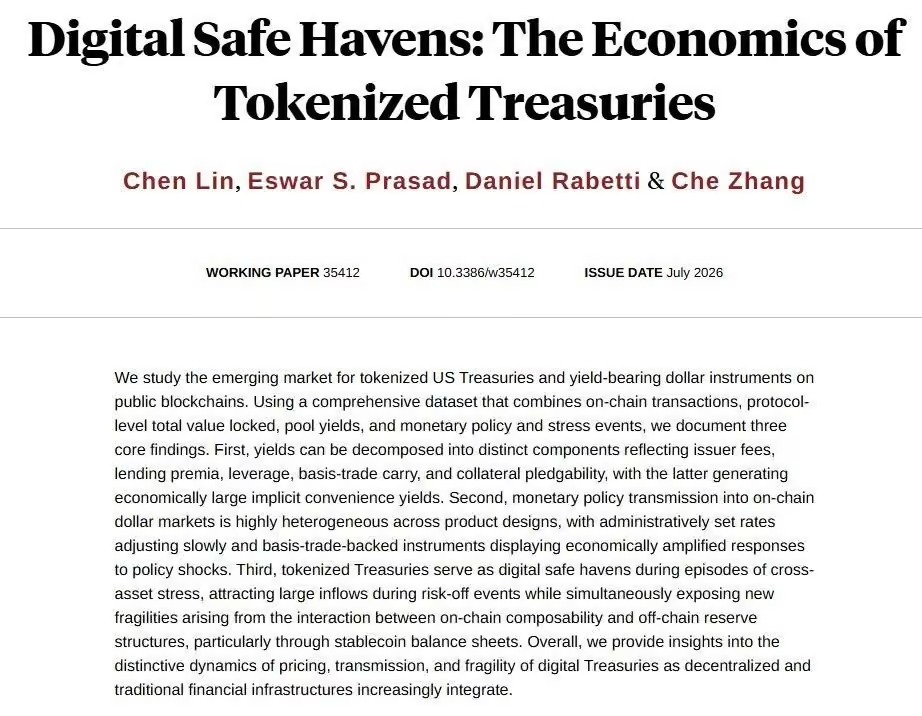 NBER
@nberpubs
With uncertainty about persistence, forecasts become more persistent and overreact at long horizons. This mechanism jointly rationalizes asset pricing and macro forecasting puzzles, from @joel_flynn, Maksim Meinert, and Karthik Sastry www.nber.org/papers/w35411
 NBER
@nberpubs
Experiential and social learning are complements. In Pakistan, lasting chlorination emerged only when households learned about returns firsthand and had learning neighbors, from Agha A. Akram, Gabriella Fleischman, Reshmaan N. Hussam, and @akib_kn www.nber.org/papers/w35410
 NBER
@nberpubs
Featured in the latest Bulletin on Health: How Inspection Timing Affects Care Quality in US Nursing Homes
www.nber.org/bh/20262/how-inspection-timing-affects-care-…
 NBER
@nberpubs
Racial disparities in test scores, absenteeism and discipline incidents increase in Connecticut public schools post-pandemic, but absenteeism disparities recover by 2024–25, from Eric Brunner, @SteveRo48195125, and Xinrui Wang www.nber.org/papers/w35409
 NBER
@nberpubs
The recent removal of government subsidies to flood insurance were suboptimal; the benefits in terms of reduced disaster spending and risk protection exceed the moral hazard costs, from Jonathan Gruber and Adam Solomon www.nber.org/papers/w35408
 NBER
@nberpubs
Standardized test scores improve predictions of academic performance but matter relatively less for admissions decisions, since few applicants are near the decision threshold, from @jgaeb1, Calvin Isley, Christopher Avery, and @5harad www.nber.org/papers/w35407
 NBER
@nberpubs
The standard use of average price elasticities to calculate responses to carbon taxes may understate the price increases needed to meet emissions targets by 50 percent, from Jonathan T. Hawkins-Pierot and Katherine R.H. Wagner www.nber.org/papers/w35406
 NBER
@nberpubs
Uncovering a new mechanism that links growth and a decline in the energy intensity of production, observed globally since 1990, from Kathryn McDonald, Noémie Pinardon-Touati, and Conor Walsh www.nber.org/papers/w35405
 NBER
@nberpubs
Examining whether employers value community college bachelor’s degrees by conducting the first audit study of Community College Baccalaureate degrees, finds interview-request rates similar to traditional bachelor’s degrees, from @riacton, @CamilaNtMorales, Julia A. Turner, @Lois-Miller, and @KalenaCortes www.nber.org/papers/w35404
 NBER
@nberpubs
A guide for economists writing a literature review who want to summarize evidence, incorporate covariates, and adjust for selectivity, from @p_ganong, Avik Garg, and @maxkasy www.nber.org/papers/w35403
 NBER
@nberpubs
Open economies import foreign demand through quantities (local boom) if marginal propensities to consume are high, and prices (exchange rate appreciation) of financial markets are imperfect, from @ChenLian92, @MukhinDA, and @ChristianKWolf www.nber.org/papers/w35402
 NBER
@nberpubs
Over 70 years and across the globe, falling birth rates haven't slowed growth. Scarcity of young workers spurs labor-saving innovation, raising GDP per working-age adult and wages, from @DAcemogluMIT, @davidautor, Keelan Beirne, and Andrew Scott www.nber.org/papers/w35401
 NBER
@nberpubs
Open call for papers, Assessing the US Medical Innovation System. Conference to be held in Cambridge, MA on February 5, 2027. Submit papers by 11:59pm EDT on November 2, 2026. More information: www.nber.org/calls-papers-and-proposals/assessing-us-medi…
 NBER
@nberpubs
Building a model that combines heterogeneous households with incomplete markets and state-dependent pricing with strategic complementarities by firms to analyze the effects of large macroeconomic shocks and policy interventions, from @GregWKaplan and Ken Miyahara
 NBER
@nberpubs
Assessing the predictive power of several candidate explanations for the dramatic variation across states in recent fluctuations in Medicaid enrollment, from @jeffreypclemens, Helena Detering, and Anwita Mahajan www.nber.org/papers/w35399
 NBER
@nberpubs
The currency in which traded goods are invoiced has a first-order implication for the short-run impact of tariffs on the economy, from Stéphane Auray, Michael B. Devereux, and Aurélien Eyquem www.nber.org/papers/w35398
 NBER
@nberpubs
Health advantages from higher status emerged in China across all social classes in the early 1700s, from Wolfgang Keller, Carol H. Shiue, and Karen Eggleston www.nber.org/papers/w35396
 NBER
@nberpubs
Experiences of low inflation persistence stabilized long-run inflation expectations, making them appear well anchored, but renewed persistent inflation could destabilize them again, from @umalmend and @ProfStefanNagel www.nber.org/papers/w35395
 NBER
@nberpubs
Featured in the latest Digest: Regulatory Limits on the Concentration of Mutual Fund Portfolios
www.nber.org/digest/202607/regulatory-limits-concentratio…
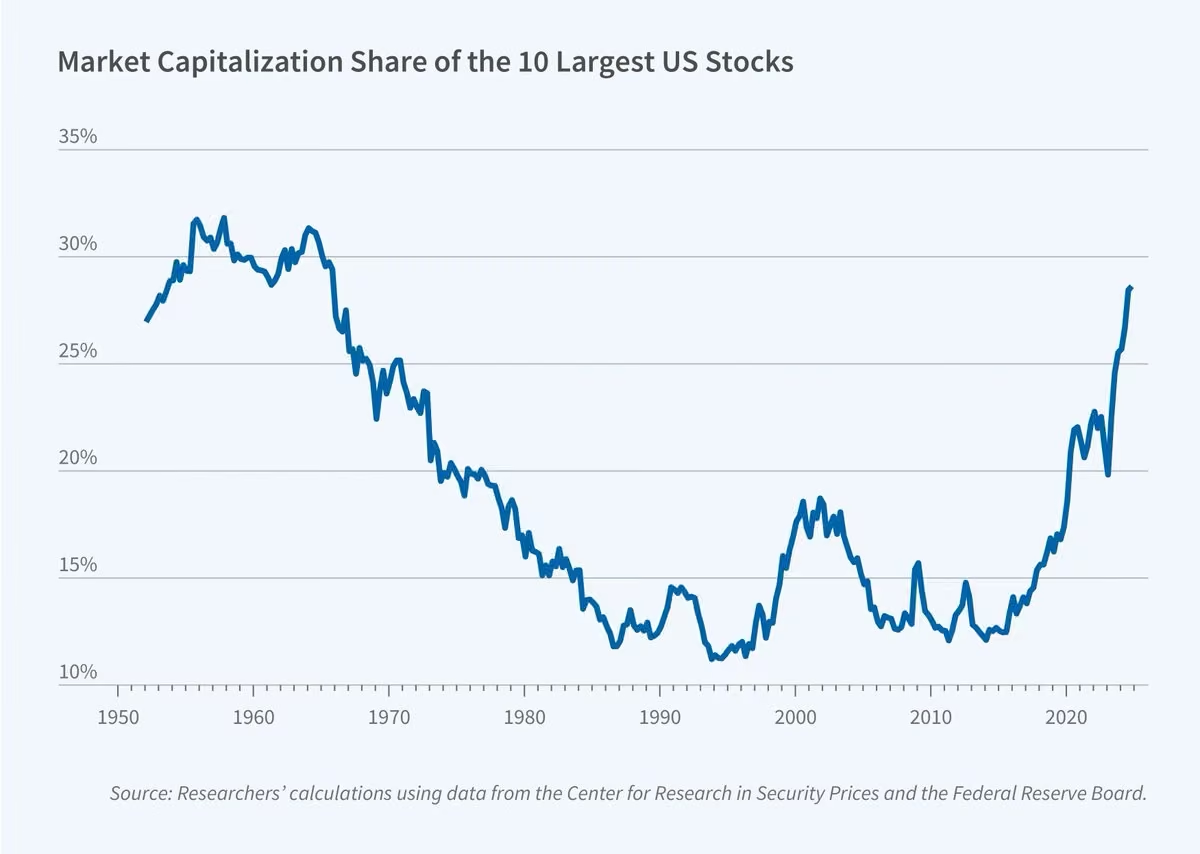 NBER
@nberpubs
Wealth inequality shapes asset demand and asset valuation. Sufficiently high probabilities of falling into extreme poverty lead to asset bubbles, from Xuning Ding and @ProfJiang www.nber.org/papers/w35393
 NBER
@nberpubs
Using microdata on patenting from the Era of Mass Migration to highlight a new channel how immigrants contributed to US growth: they settled in urban innovation hubs, from Costas Arkolakis, Sun Kyoung Lee, and Michael Peters www.nber.org/papers/w35392
 NBER
@nberpubs
Analyzing the effects of financial repression on inflation and bond risk premia in a model with bondholders and taxpayers, from @rgomezcram, @HowardKung2, @HannoLustig, and David Zeke www.nber.org/papers/w35391
 NBER
@nberpubs
Revisiting the determination of prices and quantities when markets don’t clear. Without the invisible hand, uncertainty shocks are stagflationary and demand shocks absorb slack, from @joel_flynn, George Nikolakoudis, and Karthik Sastry www.nber.org/papers/w35390
 NBER
@nberpubs
Using long-run official bilateral lending data to document that geopolitical risk fragments lending toward allies, weakening risk-sharing because aligned countries face more synchronized shocks, from @javierbianchi7, Sebastian Horn, @GiovanniMarcoR2, and @cesarspa1
 NBER
@nberpubs
As asset managers tailor products to heterogeneous investors and decentralize stewardship, shareholder power becomes fragmented, from Andrey Malenko, @nmalenko, and Anton Tsoy www.nber.org/papers/w35388
 NBER
@nberpubs
GLP-1-induced weight loss increases single women's partnership rates by 29 percentage points and non-employed women's employment rates by 27 percentage points after 1.5+ years, from @rebeccardiamond www.nber.org/papers/w35387
 NBER
@nberpubs
Developing a calibrated general-equilibrium model to study how different configurations of trade and financial policy reshape the hierarchy of global currencies, from Tarek Alexander Hassan, Thomas M. Mertens, Jingye Wang, and Tony Zhang www.nber.org/papers/w35386
 NBER
@nberpubs
Semi-liquid private credit funds, despite fast-growing, meet outflows by selling illiquid loans, borrowing more, and delaying payments, creating run-like risks for investors, from @fangcb0822, Itay Goldstein, and Yao Zeng www.nber.org/papers/w35385
 NBER
@nberpubs
Examining the effects of Medicaid routine vision benefits among adults dually eligible for Medicare and Medicaid, from Michel H. Boudreaux, Brandy Lipton, and @mpmcinerney www.nber.org/papers/w35384
 NBER
@nberpubs
Unilateral vetoes are widely used in practice. Characterizing their obvious strategy-proofness and providing empirical evidence of their efficacy in two applications, from Quitzé Valenzuela-Stookey, @JasonBaron4, and Richard Lombardo www.nber.org/papers/w35383
 NBER
@nberpubs
The value of a statistical life as a measure of living standards: it already incorporates new goods, quality improvements, and nonmarket goods such as climate change, from Philip Trammell and @ChadJonesEcon www.nber.org/papers/w35382
 NBER
@nberpubs
Featured in the latest Digest: Who Ultimately Pays Credit Card Interchange Fees?
www.nber.org/digest/202607/redistributive-impact-credit-c…
 NBER
@nberpubs
Residents of poor neighborhoods see earnings growth similar to richer areas, and those who gain tend to move out. This selective migration keeps poor neighborhoods poor, from @andy_garin, Ethan Jenkins, @evanmast2, and @BryanAStuart www.nber.org/papers/w35381
 NBER
@nberpubs
Medicare Part D reduced retail pharmacies 5 percent in counties with more elderly residents. Pre-implementation uncertainty suppressed entry; reduced profitability prevented recovery, from @bf_churchill, Georgina Cisneros, and @KelliMarquardt www.nber.org/papers/w35380
 NBER
@nberpubs
Open call for papers, Big Data, Artificial Intelligence, and Financial Economics. Conference to be held in Cambridge, MA on November 13, 2026. Submit papers by 11:59pm EDT on August 13, 2026. More information: www.nber.org/calls-papers-and-proposals/big-data-artifici…
 NBER
@nberpubs
Monetary policy leaning against experience-based inflation expectations generates secular movements in real interest rates beyond changes in the natural rate of interest, from @ProfStefanNagel www.nber.org/papers/w35379
 NBER
@nberpubs
Moment choices can move structural estimates quite far when the model is wrong, sometimes with little increase in model-implied standard errors, from Isaiah Andrews and Bas Sanders www.nber.org/papers/w35378
 NBER
@nberpubs
Studying how trade shocks affect labor markets, focusing on the adjustment process shaped by frictions and institutions, and discussing policies that can ease adjustment costs, from @dix_rafael and Brian K. Kovak www.nber.org/papers/w35377
 NBER
@nberpubs
Should policymakers learn about prices or quantities? When taxes create deadweight losses or there are distributional concerns, quantities may be more important, from Denise Dipasquale, Edward L. Glaeser, Adam M. Guren, and Paul S. Willen www.nber.org/papers/w35376
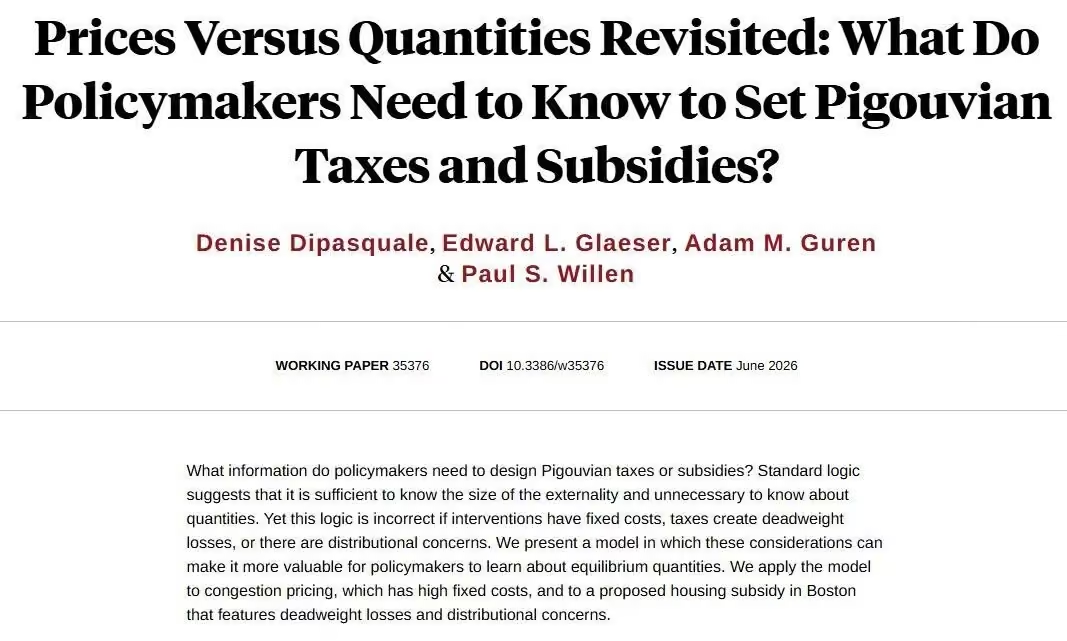 NBER
@nberpubs
Studying how parents may invest differently across children by compensating the disadvantaged child or by reinforcing the child with higher expected returns, from @felbarrera, Leonardo Bonilla-Mejía, @MatiasBusso, @SFGaliani, Hyunjae Kang, @juansebastmunoz, and Juan Pantano
 NBER
@nberpubs
A new practitioner's guide to using LLMs in economic history covers the workflow, pitfalls, and validation, with four worked examples from paintings to Franklin D. Roosevelt’s wartime speeches, from @Andreas_Ferrara www.nber.org/papers/w35374
 NBER
@nberpubs
AI answers can divert web publisher revenue and quality signals. The market design takeaway: without compensation and audits, costly open-web information may fall below replacement, from @alex8chan www.nber.org/papers/w35344
 NBER
@nberpubs
Examining the relative performance of deaf or hard of hearing workers on one of China’s largest food-delivery platforms, from Yanyou Chen, Mitchell Hoffman, Huilan Xu, and Zhe Yuan www.nber.org/papers/w35372
 NBER
@nberpubs
Using ancient DNA data to measure migration over the past 10,000 years shows that human mobility followed climate corridors and migration acted as adaptation to climate change, from Peter Huybers, Marco Tabellini, @ctaylor463, and Francesco Toti www.nber.org/papers/w35371
 NBER
@nberpubs
A parent-directed empathy program for Chinese middle schoolers raised elite high school admission by 3.2pp years later, by reshaping classroom friendship networks, from Flavio Cunha, @QinyouH, Yiming Xia, and Naibao Zhao www.nber.org/papers/w35370
 NBER
@nberpubs
Studying the effect of unanticipated inflation in the labor market, from @pilossopher, Jane M. Ryngaert, and Jesse J. Wedewer www.nber.org/papers/w35369
 NBER
@nberpubs
Higher wage floors due to minimum wage increases or repeal of subminimum wages do not appear to have disproportionate impacts on workers with disabilities, from Roisin O'Neill, Shailee Manandhar, and Douglas L. Kruse www.nber.org/papers/w35368
 NBER
@nberpubs
Estimating the effect of particulate matter air pollution on preschool attendance using restricted administrative data from the state of Georgia, from Mahta Ghafarianghadim and @GarthHeutel www.nber.org/papers/w35367
 NBER
@nberpubs
Average partial effects in nonlinear binary-outcome models can be misleading when calculated over the wrong sample, and recomputing them on the relevant subsample yields unbiased and often materially different estimates, from Brian Curran, Bruce D. Meyer, and Derek Wu
 NBER
@nberpubs
A Texas field experiment finds counselor workshops increased high-achieving students’ interest in economics, especially women, but not major enrollment, from Kennedy Johnston, Jonathan Meer, and @danilaserra_eco www.nber.org/papers/w35365
 NBER
@nberpubs
Concealment of social-group membership between pairs of workers weakened intergroup relations by making them unsure of each other's identity and less able to interact authentically, from Anujit Chakraborty, @arkdevghosh, @hmmlowe, and Gareth Nellis www.nber.org/papers/w35364
 NBER
@nberpubs
Trying to purify a metric to reducing gaming in markets can backfire when a metric feeds into prices but not when it feeds into rank/position, from @joshgans and @skominers www.nber.org/papers/w35363
 NBER
@nberpubs
Banning affirmative action in state contracting caused minority- and women-owned contractors to downsize and enter into state contracting in smaller numbers, but not to shut down, from Benjamin Rosa www.nber.org/papers/w35362
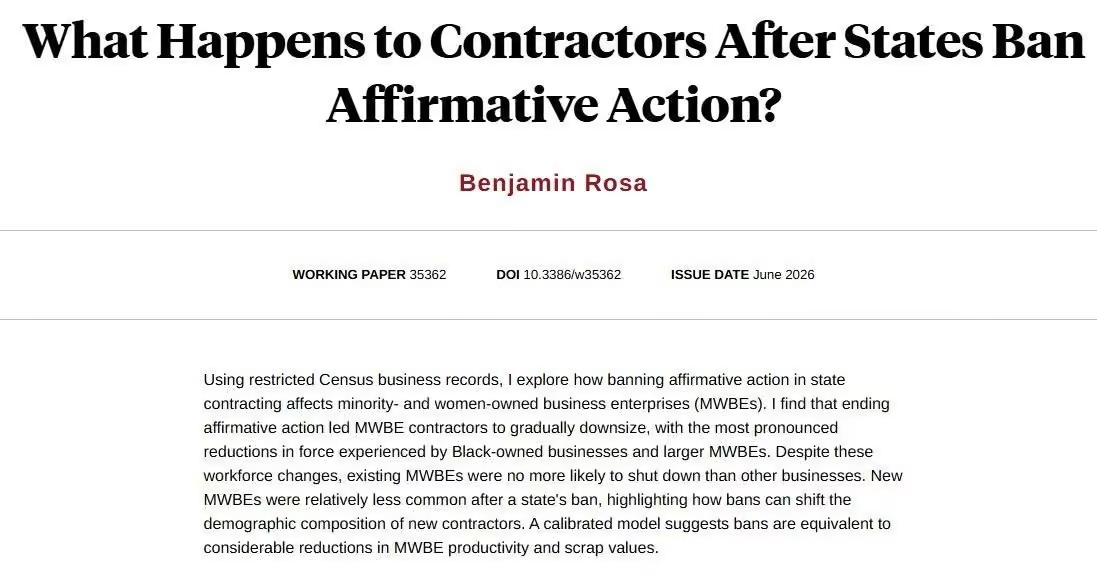 NBER
@nberpubs
Firms led by expert managers are more likely to become multinationals. Managers' expertise contributes to explaining multinationals' risk premia, from José L. Fillat and @StefaniaGaretto www.nber.org/papers/w35361
 NBER
@nberpubs
Can climate disasters spark rebellion? How the 1970 Bhola Cyclone helped transform grievance into mobilization, fueling Bangladesh’s war of independence, from @ProfSultanEcon and @mushfiq_econ www.nber.org/papers/w35360
 NBER
@nberpubs
A literature review of the effects of transportation infrastructure on the way people and economic activity distribute themselves across regions and cities, from Gilles Duranton and Matthew Turner www.nber.org/papers/w35359
 NBER
@nberpubs
Railway access in the early 1900s affected the size and destination of emigration from Mexico to the US starting in 1910 and up to 2010, from @drescamillag and @giov_peri www.nber.org/papers/w35358
 NBER
@nberpubs
Studying whether brief narrative testimonials shift willingness to attend virtual shared medical appointments, a care format in which 5–15 patients with a shared non-urgent health condition meet simultaneously with a clinician, from @RueMartel, Monika Heller, Sanjay Jain, Amalia R. Miller, and Kamalini Ramdas www.nber.org/papers/w35357
 NBER
@nberpubs
Open call for papers, Macroeconomic Effects of Population Aging. Conference to be held virtually on September 18, 2026. Submit papers by 11:59pm EDT on August 5, 2026. More information: www.nber.org/calls-papers-and-proposals/macroeconomic-eff…
 NBER
@nberpubs
Developing a dynamic stochastic model of markets with an externality and multiple trading frictions, and cap-and-trade as the leading application, from @nicolaborri, Yukun Liu, Aleh Tsyvinski, and Xi Wu www.nber.org/papers/w35356
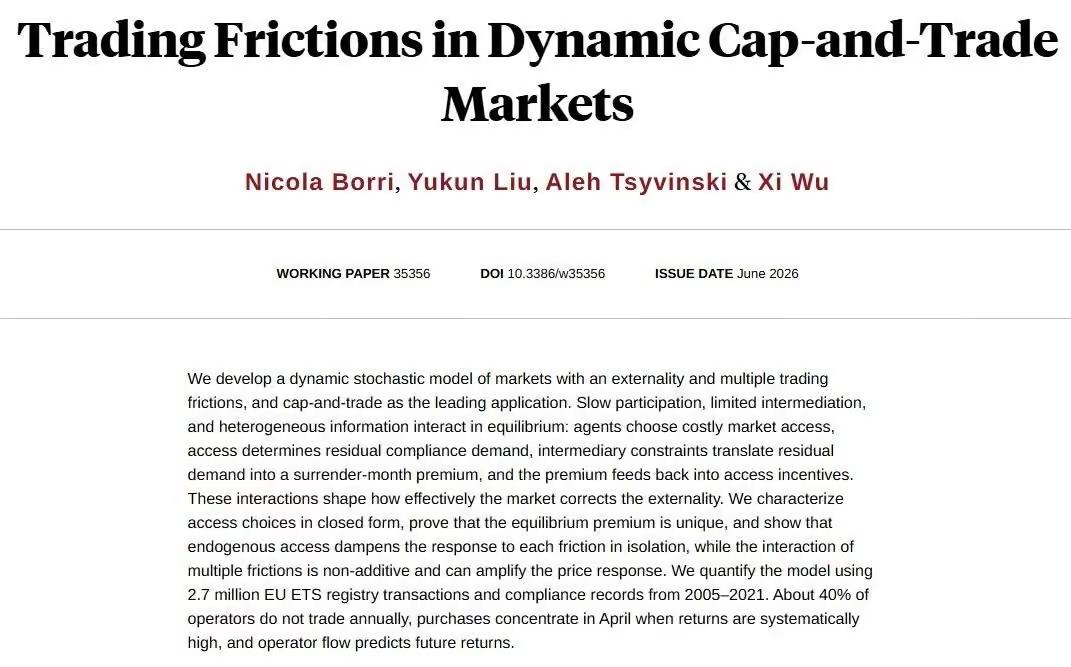 NBER
@nberpubs
Examining the implications of panel attrition for the age profile of subjective ill-being in the Global Flourishing Study, from @d_blanchflower, @AlexanderBryson, and Alan J. Cui www.nber.org/papers/w35355
 NBER
@nberpubs
Introducing “perceived inflation”, an attention-weighted inflation measure derived from a model in which households allocate attention across goods and observe noisy price signals, from Neville Francis www.nber.org/papers/w35354
 NBER
@nberpubs
AI has the potential to reduce wage inequality by allowing lower-skill workers to do the jobs that used to be exclusive territory of higher-skill workers, from @AlthoffLukas and @ReichardtHugo www.nber.org/papers/w35353
 NBER
@nberpubs
Insurers can curb overuse with cost-sharing for consumers (e.g. copays, deductibles) or cost-sharing for firms (e.g. prospective payment). How much of each are best?, from @jabaluck, Oren Sarig, and Jintaek Song www.nber.org/papers/w35352
 NBER
@nberpubs
Viewpoint neutrality, requiring teachers to cover varied views, can weaken direct instruction but improve overall learning by making homophilous peer interactions more informative, from Georgy Egorov and @k_sonin www.nber.org/papers/w35351
 NBER
@nberpubs
Experimental economists use best practices to reduce demand effects. Reviewing these methods shows that demand effects have very limited impact, from Jonathan de Quidt, Lise Vesterlund, and Alistair Wilson www.nber.org/papers/w35350
 NBER
@nberpubs
Sovereign scale valuations of AI and semiconductor companies price more than capacity: new research models this as planning capital, which embeds past and future learning, from Andrew Caplin www.nber.org/papers/w35349
 NBER
@nberpubs
Employees often know quality problems before the market does. Using 4.3 million Glassdoor reviews to build a new measure of firm quality that predicts recalls, brand value, and profitability, from Wei Cai, Dennis Campbell, Yaxuan Chen, Yufei Chen, and @andreapratnyc
 NBER
@nberpubs
A national survey of K-12 principals finds teachers’ AI use rose rapidly, while schools serving more disadvantaged students report less AI guidance and training, from @cqcampos and John D. Singleton www.nber.org/papers/w35347
 NBER
@nberpubs
Open call for papers, Economics of Religion. Conference to be held in San Francisco, CA on November 14, 2026. Submit papers by 11:59pm EDT on September 1, 2026. More information: www.nber.org/calls-papers-and-proposals/economics-religion
 NBER
@nberpubs
Declining mortality and morbidity of the elderly is estimated to have raised expected lifetime Social Security spending by 14 percent compared to 6 percent for Medicare spending, from @liraneinav and Amy Finkelstein www.nber.org/papers/w35346
 NBER
@nberpubs
Wearable electroencephalography technologies present new opportunities to quantify neural correlates of decision making in real-time, financially consequential settings, from Liang Chen, Tse-Chun Lin, Fei Wu, Xingjian Zheng, and @thefinderouter1 www.nber.org/papers/w35345
 NBER
@nberpubs
Studying the role of foreign exchange and gold reserves in mitigating the US monetary policy spillovers to exchange rates at times of geopolitical fragmentation and de-dollarization, from Joshua Aizenman, Jamel Saadaoui, Gazi Salah Uddin, and @naoki_yago www.nber.org/papers/w35337
 NBER
@nberpubs
Featured in the latest Digest: What Happens When the Flow of Immigrant Workers Suddenly Stops?
www.nber.org/digest/202606/what-happens-when-flow-immigra…
 NBER
@nberpubs
Examining when should a hegemon prefer to coerce private entities or their governments, from Christopher Clayton, @m_maggiori, and @jschreger www.nber.org/papers/w35343
 NBER
@nberpubs
Examining why the Big Three financial literacy questions work so well and show that they provide a reliable, valid, and internationally consistent measure of financial literacy, from Tim Kaiser, @Dr_AnnaLusardi, @OS_Mitchell, and Luis Oberrauch www.nber.org/papers/w35342
 NBER
@nberpubs
Low trust in the European Central Bank is widespread among German firms, shaping expectations of fiscal dominance when debt rises in high-debt Euro Area countries, from @Francesco_Bia, Renato Faccini, @LeonardoMelosi, and @NilsWehrhoefer www.nber.org/papers/w35341
 NBER
@nberpubs
The opioid epidemic reshaped local population dynamics in the US. More affected commuting zones grew more slowly, driven by higher out-migration—especially among college-educated, from @caroartc, @Viquibarone, and Stephen Claassen www.nber.org/papers/w35340
 NBER
@nberpubs
Race-blind policy doesn't guarantee racial equality. The WWII GI Bill doubled white college completion but steered Black veterans into dead-end training. The gap persists today, from @AlthoffLukas and @ChrisSzerman www.nber.org/papers/w35339
 NBER
@nberpubs
Using a simple rational-choice model to examine the strengths and weaknesses of various experimental designs, from @econ_4_everyone www.nber.org/papers/w35338
 NBER
@nberpubs
Considering a model of automation embedded in a political environment where workers can undertake a revolt, and greater inequality between capital and labor increases the likelihood of a revolt, from @DAcemogluMIT, @AArdaGitmez, and @ShadmehrMehdi www.nber.org/papers/w35336
 NBER
@nberpubs
Firms with high monopsony power respond less to monetary policy shocks. Oligopsony dampens aggregate monetary policy effects; declining concentration flattened the Phillips curve, from Bence Bardóczy, Gideon Bornstein, and Sergio Salgado www.nber.org/papers/w35335
 NBER
@nberpubs
Studying the optimal design of trade and industrial policy when governments pursue environmental objectives along traditional welfare goals, from Panle Jia Barwick, Jack Collison, @PennyG_Yale, Shanjun Li, and @YuchengWang20 www.nber.org/papers/w35334
 NBER
@nberpubs
Estimating the effect of total abortion bans enacted after Dobbs vs. Jackson Women's Health on sexual behavior, from @jim_flynn9, @caitlin_k_myers, and David R. Munro www.nber.org/papers/w35333
 NBER
@nberpubs
In 1900–1910, immigrant families caught up to US-born families through having more women and children contribute, even as immigrant women barely closed the gap with US-born women, from @EconZach www.nber.org/papers/w35332
 NBER
@nberpubs
For fully remote workers, coming to the office for one day a month increases productivity by 8 percent and reduces quit rates by a third. Mechanism is better connection with colleagues, from @cevatgirayaksoy, @I_Am_NickBloom, Steven J. Davis, Victoria Marino, and Cem Ozguzel
 NBER
@nberpubs
Featured in the latest Bulletin on the Economics of Alzheimer's Disease and Related Dementias: Institutional Special Needs Plans for Nursing Home Residents with Dementia
www.nber.org/ba/202601/institutional-special-needs-plans-…
 NBER
@nberpubs
Validated against contemporaneous responses, a survey of 916 trainees and their career intentions finds a –22 percentage point change in academia intentions and a US-departure shift concentrated among foreign-born scientists, from @pierre_azoulay, @raffasadun, and @danielascur
 NBER
@nberpubs
Why are micro labor supply elasticities small but macro negative? Same utility specification reconciles both in the presence of strong income effects and heterogeneity, from Loukas Karabarbounis www.nber.org/papers/w35329
 NBER
@nberpubs
Quantifying the impact of the loss of reserve currency status in goods and asset markets, from @ProfJiang, @ProfArvindKrish, @HannoLustig, and @rrichmond www.nber.org/papers/w35328
 NBER
@nberpubs
The 50-year decline in US male labor force participation is partly driven by men’s beliefs about the returns to work, shaped by lifetime experiences of male labor markets, from @remylevin and @daniela_vidart www.nber.org/papers/w35327
 NBER
@nberpubs
Latin America's momentous decline of fertility was related to rising women’s education and industrialization but not women’s employment or children's education, from Regina Calles and Tom Vogl www.nber.org/papers/w35326
 NBER
@nberpubs
Dynamic risk adjustment can reward prevention and curb coding games by pricing health plans’ lifetime incentives, not one-year spending predictions, from @alex8chan www.nber.org/papers/w35325
 NBER
@nberpubs
Testing the female sensitivity hypothesis that women are more treatment-responsive than men. Across 200+ studies and tests, no evidence is found, yet supportive citations persist, from Felipe Araujo, Neeraja Gupta, and Lise Vesterlund www.nber.org/papers/w35324
 NBER
@nberpubs
Financial literacy shapes how people make annuity decisions more than whether they annuitize, from @illinibizdean www.nber.org/papers/w35323
 NBER
@nberpubs
Featured in the latest Digest: New Work, New Technologies, and the Skill Premium
www.nber.org/digest/202606/new-work-new-technologies-and-…
 NBER
@nberpubs
How do age verification laws impact pornography consumption in the US? Access restrictions reduced overall time spent on adult sites by roughly 10 percent, from @mattbrown_econ, Emily J. Davis, and @Devin_G_Pope www.nber.org/papers/w35322
 NBER
@nberpubs
Liability can drive AI doctor adoption, but optimal rules depend on the usable medical record: rich records support strong liability; coarse records favor partial rules, from @alex8chan www.nber.org/papers/w35321
 NBER
@nberpubs
Data drives automation by simultaneously increasing the productivity of automated tasks and expanding the automation frontier. Yet, the economy may remain only partially automated, from Maryam Farboodi, Andrew J. Koh, and Anchi Xia www.nber.org/papers/w35320
 NBER
@nberpubs
Optimistic borrowers reduce payments on student loans by $40, increase non-durable spending by $100 per month and postpone durable spending while waiting for uncertainty to resolve, from @dkoust, Michael Weber, and Constantine Yannelis www.nber.org/papers/w35319
 NBER
@nberpubs
Slum clearance policies in Chile that housed families in peripheral neighborhoods versus central areas reduce children's adult earnings and schooling in the long-run, from @ferrojas90 and Felipe Carrera www.nber.org/papers/w35318
 NBER
@nberpubs
Air pollution and internal migration in the US from 2005–2019, from Michael Keller, @KnittelMIT, Benjamin Krebs, and Simon Luechinger www.nber.org/papers/w35317
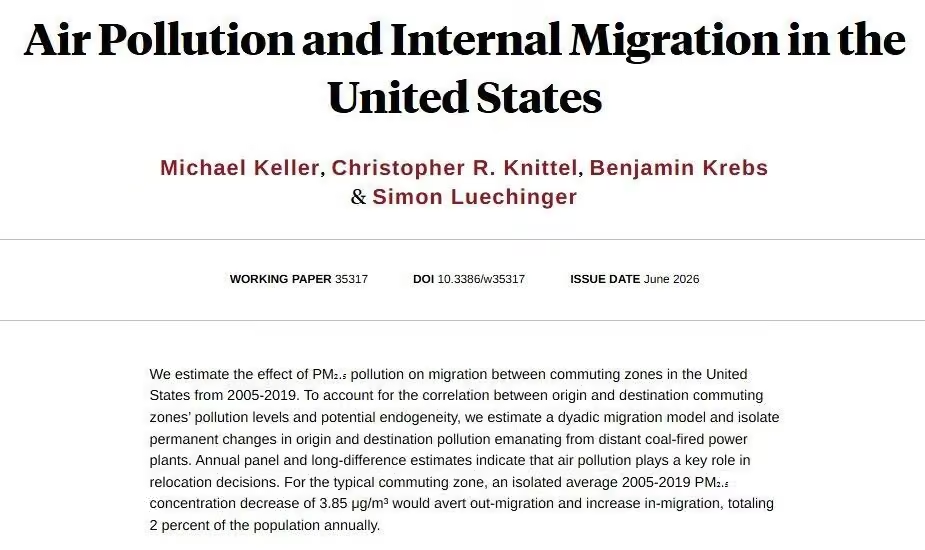 NBER
@nberpubs
Inflation is better predicted by the ratio of vacancies to effective searchers (capturing availability of workers from all sources) than by the ratio of vacancies to unemployment, from @kgahome, @JHaltiwanger_UM, and Lea E. Rendell www.nber.org/papers/w35316
 NBER
@nberpubs
The income channel to labor polarization explains substantial shares of increases in relative wages and hours-worked shares of high- and low-skill workers between 1980 and 2016, from Diego A. Comin, Ana Danieli, and Martí Mestieri www.nber.org/papers/w35315
 NBER
@nberpubs
Featured in the latest Bulletin on the Economics of Alzheimer's Disease and Related Dementias: Parental Dementia and the Wellbeing of Adult Children
www.nber.org/ba/202601/parental-dementia-and-wellbeing-ad…
 NBER
@nberpubs
Information on domestic peers’ AI adoption raises firms’ expected AI investment; similar information on foreign peers does not, from Ursel Baumann, @zoebcullen, Ester Faia, Annalisa Ferrando, @pereztruglia, and Judit Rariga www.nber.org/papers/w35314
 NBER
@nberpubs
Intergenerational class mobility in the late Qing era is studied, with changes in dynamics, notably a collapse in upward mobility, revealing the footprints of late imperial crises, from @Butaeva_K, @sndurlauf, and Alexander Shapoval www.nber.org/papers/w35313
 NBER
@nberpubs
Economists have studied how to persuade decision-makers; considering who transmits information without persuasion, from @joshgans www.nber.org/papers/w35312
 NBER
@nberpubs
Linear solution methods overstate the effects of fiscal stimulus in heterogeneous-agent models, even for empirically relevant shock sizes, from @javierbianchi7 and @GregWKaplan www.nber.org/papers/w35311
 NBER
@nberpubs
Assessing the impact on fertility rates of the US rollout of the iPhone from June 2007 through February 2011, from @caitlin_k_myers and Ezekiel Hooper www.nber.org/papers/w35310
 NBER
@nberpubs
If workers enjoy tasks, automation can both increase work satisfaction while reducing pay, from @joshgans www.nber.org/papers/w35309
 NBER
@nberpubs
Studying whether female leadership reduces corruption using close mixed-gender elections in Brazilian municipalities over two decades, from Julieta Peveri and @ClemenceTricaud www.nber.org/papers/w35308
 NBER
@nberpubs
The two leading US climate bills include carbon tariffs, differing on if they pair with domestic policy. Comparing the emissions and economic impacts of each approach, from Gregory Casey, @kyle_c_meng, and @ivanjrudik www.nber.org/papers/w35307
 NBER
@nberpubs
Studying how frontline supervisors shape outcomes in public organizations with competing objectives and limited monitoring, from @MatthewGudgeon, Andrew Jordan, and Taeho Kim www.nber.org/papers/w35306
 NBER
@nberpubs
Legalized sports gambling reduces household food sufficiency by 2.1 percent among working-age adults without a college degree, from Xiaohui Guo, Lizhong Peng, and Chad Meyerhoefer www.nber.org/papers/w35305
 NBER
@nberpubs
Using an Earth System Model coupled to a high-resolution integrated assessment model, to assess the economic impacts of Solar Radiation Modification finds that most countries experience gains, from Jenny Bjordal, Evelien van Dijk, Henri Cornec, Anthony A. Smith Jr., and Trude Storelvmo www.nber.org/papers/w35304
 NBER
@nberpubs
Evaluating other countries' optimal tariffs and the prospects of sustaining international trade cooperation when a large player—the United States—exits the cooperative trade regime, from Barthélémy Bonadio, Andrei A. Levchenko, and @nityanayar www.nber.org/papers/w35303
 NBER
@nberpubs
Proposing a novel approach to uncover features of parental speech that map into children’s skills. The authors’ home-visiting experiments shift those features and improve child outcomes, from Julie Pernaudet, @econ_4_everyone, Arnoldo Müller-Molina, Majid Ahmadi, Imrul Huda, Ajay Sailopal, and Dana Suskind www.nber.org/papers/w35302
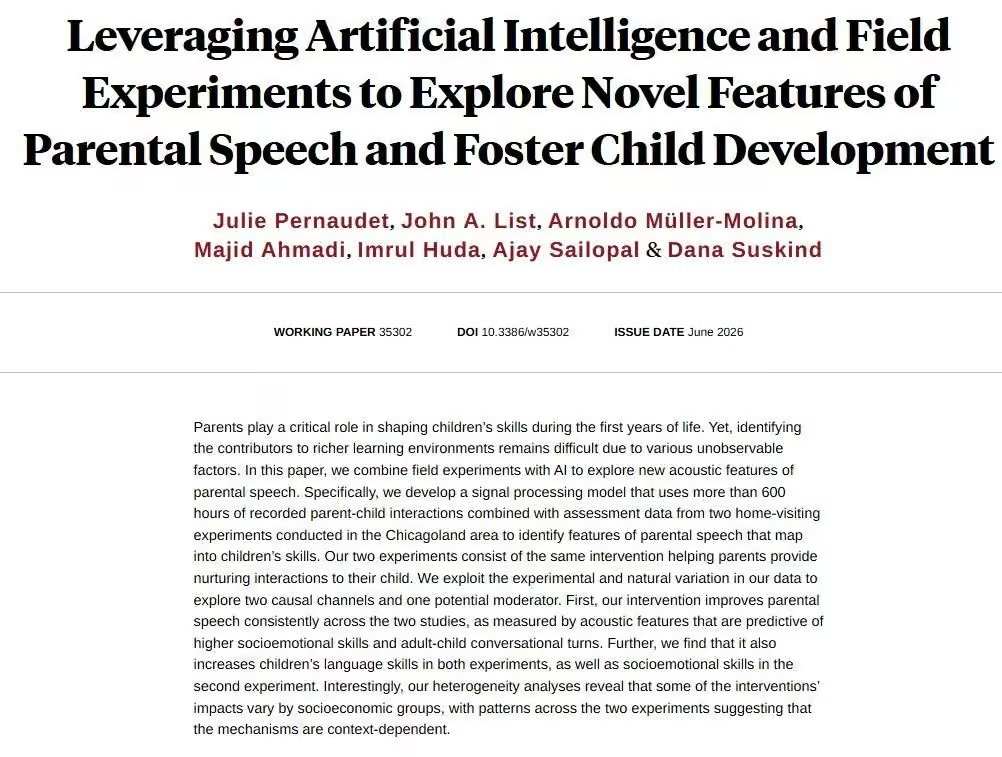 NBER
@nberpubs
The role of inflation and real wages in the 2024 US Presidential Election, from @JuanFelipeRiano and Francesco Trebbi www.nber.org/papers/w35301
 NBER
@nberpubs
Why has Social Security Disability enrollment has been declining since 2013? Lower-skilled men are applying less, likely because of better employment opportunities, from Manasi Deshpande, Maxwell Kellogg, Magne Mogstad, and Kuan-Ju Tseng www.nber.org/papers/w35300
 NBER
@nberpubs
Opening the ‘file drawer’ via a meta-analysis of parent engagement interventions by estimating a publication model with written and documented, but unwritten studies, from @peterbergman_ and Nat Chowanajin www.nber.org/papers/w35299
 NBER
@nberpubs
Featured in the latest Digest: The Dollar's Evolving Role in International Bond Markets
www.nber.org/digest/202606/dollars-evolving-role-internat…
 NBER
@nberpubs
Studying whether regional wage differences can identify the effects of a national minimum wage, from Daniel Haanwinckel www.nber.org/papers/w35298
 NBER
@nberpubs
Quantitative easing can boost output and inflation in a deep liquidity trap at lower cost than conventional fiscal policy, making it vital when fiscal space is limited, from Tobias Adrian, Christopher Erceg, Marcin Kolasa, Jesper Lindé, and Pawel Zabczyk www.nber.org/papers/w35297
 NBER
@nberpubs
GLP-1 innovation could reshape socioeconomic gradients in obesity by reducing reliance on behavioral weight control, from J. Felipe Montano-Campos, Bryan Tysinger, Dana Goldman, and Darius N. Lakdawalla www.nber.org/papers/w35296
 NBER
@nberpubs
Can we predict who will struggle in the labor? Using NLSY79 data to show it is possible to identify weakly attached workers by their late twenties, from Rui Castro, Jiyoung Kim, @fabolange, Jérôme Larivière, and Markus Poschke www.nber.org/papers/w35295
 NBER
@nberpubs
Introducing Geographic PageRank, an innovative measure of place quality that is based on migration decisions, employing a recursive algorithm that leverages the full network of migration flows, from @alexbellecon, @sophcalderwang, and Shusheng Zhong www.nber.org/papers/w35294
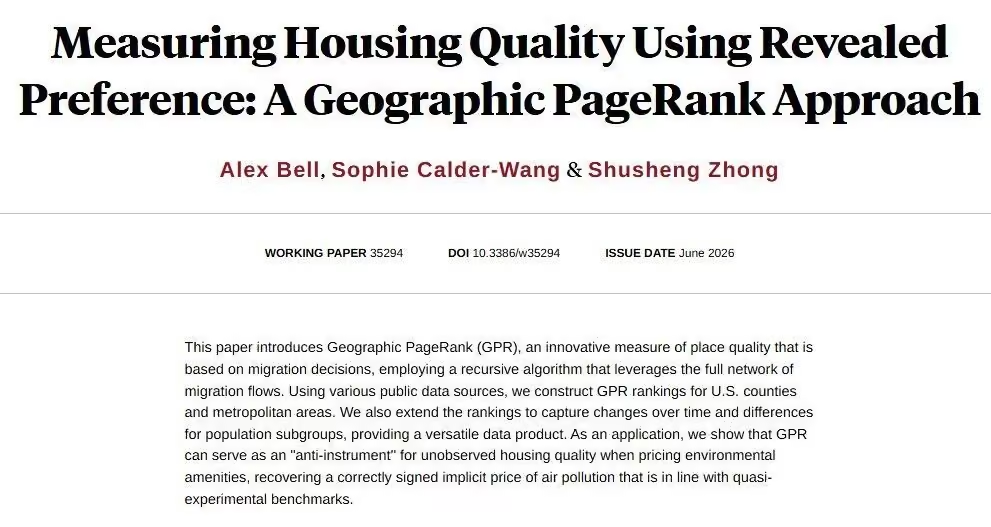 NBER
@nberpubs
Estimating the causal effect of height on adolescents’ body image, encompassing self-perceptions of weight, the accuracy of those perceptions, and weight-management aspirations, from @monicajdeza, Neiva J. Fortes, and @mariabzhu www.nber.org/papers/w35293
 NBER
@nberpubs
A strategy targeting those driving gun violence in Baltimore's hardest-hit district cut shootings and homicides by a third in 18 months, with no rise in overall arrests, from Max Kapustin, @aaronchalfin, Jeremy Biddle, Brian A. Wade, Natasha Khade, Cristina Layana, Ben Struhl, and Anthony A. Braga www.nber.org/papers/w35292
 NBER
@nberpubs
Testing what gets bureaucrats to implement mandated programs. Incentives, evidence, support: zero effect. Reminder phone calls: +20 percentage points. Attention matters, from @patrickagte, Daniel R. Morales, @chrisaneilson, @seb_otero, and @raogautam www.nber.org/papers/w35291
 NBER
@nberpubs
Featured in the latest Digest: Banks vs. Private Credit Funds: A Balance-Sheet Comparison
www.nber.org/digest/202606/banks-vs-private-credit-funds-…
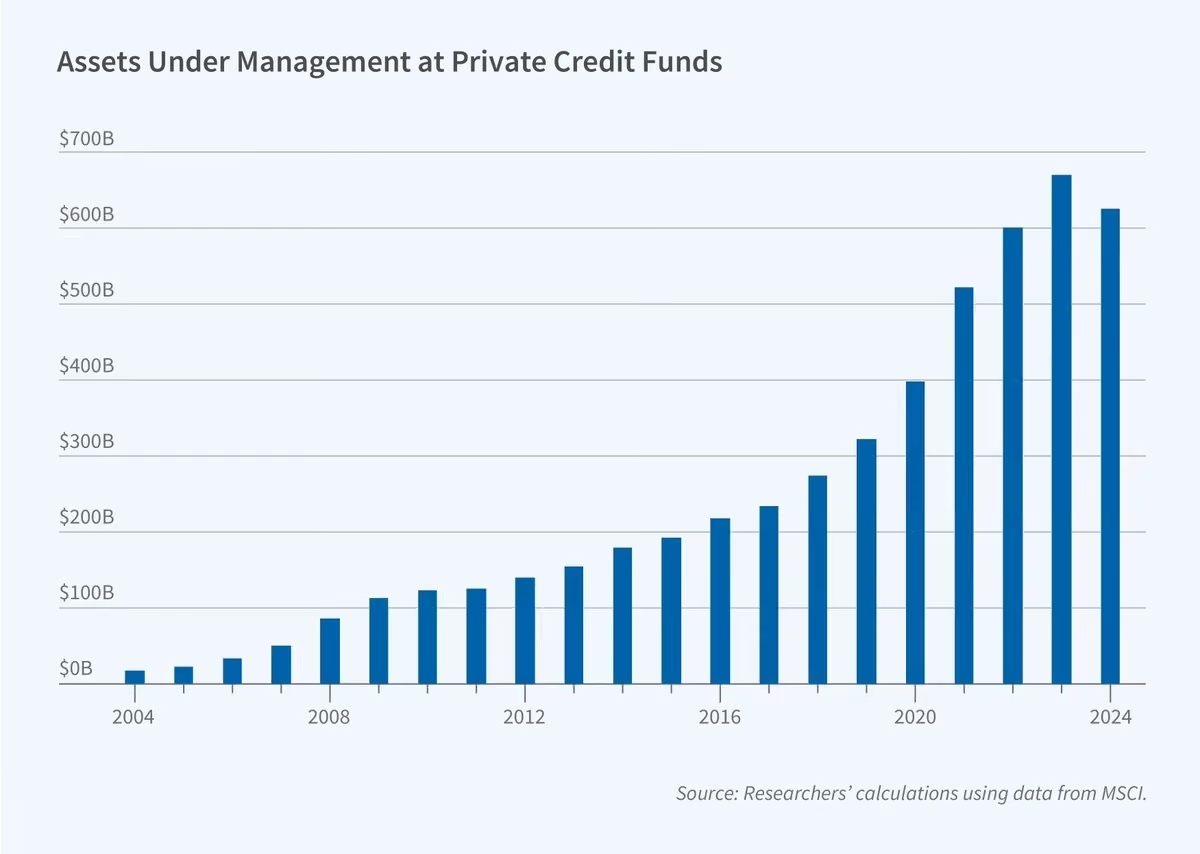 NBER
@nberpubs
The five largest US tech firms are nearly doubling capex—from $380B in 2025 to $755B in 2026. They face bankruptcy unless productivity booms commensurately, from Jessica Wachter and Jonathan Wachter www.nber.org/papers/w35290
 NBER
@nberpubs
US drinking water pollution has fallen rapidly; Safe Drinking Water Act loans reduce pollution and save lives. Analyzing 266 million pollution readings from Freedom of Information Act requests and Medicare data, from @DavidKeiserEcon, Bhashkar Mazumder, @davidmolitor, and @_josephshapiro www.nber.org/papers/w35288
 NBER
@nberpubs
Proposing a resolution to a foundational question in general equilibrium theory, “when is an equilibrium stable?”, that has remained largely unresolved for nearly 150 years, from @IvanWerning and @guido_lorenzoni www.nber.org/papers/w35205
 NBER
@nberpubs
Featured in the latest Bulletin on the Economics of Alzheimer's Disease and Related Dementias: The Financial Impact of Cognitive Decline Before Dementia Diagnosis
www.nber.org/ba/202601/financial-impact-cognitive-decline…
 NBER
@nberpubs
Studying whether readers are willing to pay for local journalism by using quasi-random paywall hits at a major US metro newspaper, finding the answer is yes—but subscriptions alone won't pay for it, from @gregmartinphd, @shoshievass, and @cpfiffer www.nber.org/papers/w35289
 NBER
@nberpubs
After the Civil War, wives and daughters of disabled Union veterans entered wage work at higher rates, helping enable women-led Temperance Crusade activism, from Madison K. Arnsbarger, @Andreas_Ferrara, and Paige Montrose www.nber.org/papers/w35287
 NBER
@nberpubs
Sophisticated analysts' expected stock returns are strongly correlated with valuations, are contrarian, and predict future returns, in contrast with individual investors, from @dthesmar and @EmilVerner www.nber.org/papers/w35286
 NBER
@nberpubs
US manufacturing productivity growth has been zero since 2010. Showing how the invasion of imports undermined competitiveness as early as the year 2000, from Robert J. Gordon and Kenneth Ryu www.nber.org/papers/w35285
 NBER
@nberpubs
Preference for home care may lead to an expansion of home care services but not necessarily for those with much higher needs, from Nicholas-James Clavet, Pierre-Carl Michaud, and Julien Navaux www.nber.org/papers/w35284
 NBER
@nberpubs
A global estimation method learns the parameter-to-moment mapping, and treats prices as parameters and market clearing as moment conditions, reducing run time from days to minutes, from Victor Duarte and @JuliaAFonseca www.nber.org/papers/w35283
 NBER
@nberpubs
Studying the role of public risk-sharing in markets where firms face substantial cost uncertainty, focusing on public reinsurance in health insurance, from Paul H.S. Kim and Anran Li www.nber.org/papers/w35282
 NBER
@nberpubs
Low doses of affirmative action improve long-run outcomes, while high doses have negative effects. The ultimate effect of affirmative action depends on its dose, from Yi Chen, Chao Fu, Hongbin Li, Teng Li, and Siyan Tang www.nber.org/papers/w35281
 NBER
@nberpubs
Examining how much fraud there is in Medicare and who commits it, from @liraneinav, Amy Finkelstein, @YunanJi, @nealemahoney, and @GideonMoore www.nber.org/papers/w35280
 NBER
@nberpubs
A review on how non-user externalities—the benefits or harms that product adoption imposes differentially on non-users versus users—shape market outcomes, from Leonardo Bursztyn, Jan Fasnacht, @BenHandel, Rafael Jiménez-Durán, Aaron Leonard, Filip Milojević, @cp_roth, and Cass R. Sunstein www.nber.org/papers/w35279
 NBER
@nberpubs
Exploring how a pollution tax can be designed to accommodate ethical objections. Considering four types of objections and showing their effect on the magnitude of the tax, from @GarthHeutel www.nber.org/papers/w35278
 NBER
@nberpubs
Examining weight stigma shows that the "obese" cutoff increases patient mortality. Analyses of diagnostic effort and clinical documentation point to stigma as a mechanism, from Manasvini Singh www.nber.org/papers/w35277
 NBER
@nberpubs
A model of artificial general intelligence competition shows how market fragmentation, resource constraints, and policy shape equilibrium speed–safety tradeoffs and catastrophic risk, from @ethanbdm, @WiolaDziuda, and @mpolborn1 www.nber.org/papers/w35276
 NBER
@nberpubs
Studying how the productivity effects of AI evolve across successive generations of tools, and to what extent do task-level gains ultimately translate into final output, from Mert Demirer, Leon Musolff, and Liyuan Yang www.nber.org/papers/w35275
 NBER
@nberpubs
Developing and estimating a structural model of multiproduct production that allows plant-product quality and factor-augmenting input efficiency, from Yi Lee, Shengyu Li, and Mark J. Roberts www.nber.org/papers/w35274
 NBER
@nberpubs
Featured in the latest Digest: Asset Transfers and End-of-Life Management of Oil and Gas Wells
www.nber.org/digest/202606/asset-transfers-and-end-life-m…
 NBER
@nberpubs
AI-driven investing has grown steadily since the early 2010s. AI hedge funds performed well before 2017, but the outperformance declined since then, from @chenshuangcufe, @csialm, and David X. Xu www.nber.org/papers/w35273
 NBER
@nberpubs
Geopolitical fragmentation can weaken dollar debt dominance when countries earn yuan-linked revenues but owe dollar liabilities, potentially triggering self-reinforcing cascades, from Felipe Benguria, Eugenio I. Rojas, and Felipe Saffie www.nber.org/papers/w35272
 NBER
@nberpubs
Documenting and explain the gap between measures of AI exposure and measures of AI adoption in the workplace, from Ilse Lindenlaub, Ryungha Oh, Maria Alejandra Rodriguez, and @laura_veldkamp www.nber.org/papers/w35271
 NBER
@nberpubs
Analyzing the health impacts of the shrinking Great Salt Lake in Utah. Marginal annual costs range from $81 to $175 million per 100 km squared, exceeding mitigation costs, from Lena Harris, @Cawaterecon, and Danae Hernandez-Cortes www.nber.org/papers/w35270
 NBER
@nberpubs
Exposure to frontier knowledge through college courses increases educational attainment and earnings, by keeping students engaged and by building labor-market skills, from @BarbaraBiasi and @ProfSongMa www.nber.org/papers/w35269
 NBER
@nberpubs
Studying the impact on state government finances of the Medicaid continuous coverage requirement that was in effect during the COVID-19 pandemic, from @jeffreypclemens and Anwita Mahajan www.nber.org/papers/w35268
 NBER
@nberpubs
Estimating the effects of early academic rank in elementary school on later cognitive and noncognitive outcomes in the context of Mexico, from @Eunsik_Chang, @MaraPadillaR, and Cecilia Peluffo www.nber.org/papers/w35267
 NBER
@nberpubs
Proposing an output-based approach to measure the missing value of data, from Ankit Bhutani, Guillermo Ordoñez, and @laura_veldkamp www.nber.org/papers/w35266
 NBER
@nberpubs
The employer size wage effect disappears completely across establishments within the same firm, even though they operate in different local labor markets, from @AndreDiegmann, Steffen Müller, and @Schoefer_B www.nber.org/papers/w35265
 NBER
@nberpubs
Exploiting wildfire smoke to show that intermittent disruptions to school-based care reduce mothers’ employment even when formal “care” is available, from Joshua S. Graff Zivin and @shoonlee8 www.nber.org/papers/w35264
 NBER
@nberpubs
Examining time trends in rates of uninsured, public insurance coverage, and employer-sponsored insurance by groups defined by the ratio of income to the Federal Poverty Line, from Anuj Gangopadhyaya and Robert Kaestner www.nber.org/papers/w35263
 NBER
@nberpubs
Documenting strong but slow portfolio responses to a wealth-tax-induced shock to the equity premium that are consistent with adjustment frictions and moderate risk aversion, from Andreas Fagereng, Luigi Guiso, and @Mariusring www.nber.org/papers/w35262
 NBER
@nberpubs
Building new data on startups in Africa to study which types of financing these firms demand, how financing is allocated in practice, and the implications for startup creation and the composition of the sector, from Emanuele Colonnelli, Marcio Cruz, @mariana_ppl11, @PorzioTommaso, and Chun Zhao www.nber.org/papers/w35261
 NBER
@nberpubs
Providing theoretical and empirical perspectives on whether the risk-free rate exceeds the risk-adjusted growth rate, from Stavros Panageas www.nber.org/papers/w35260
 NBER
@nberpubs
Proposing a method for automated, probabilistic evaluation of the frequentist properties of procedures in a given setting, from Isaiah Andrews, Simon C. Essig Aberg, and Jesse M. Shapiro www.nber.org/papers/w35259
 NBER
@nberpubs
Featured in the latest Digest: Convenience Yields: The US Dollar vs. US Treasuries
www.nber.org/digest/202606/convenience-yields-us-dollar-v…
 NBER
@nberpubs
Studying who owns US rental housing by using a new method tracing ownership through Census, IRS, and SEC records. Individual landlords own the large majority of rental units in 11 metros, from @stephkestelman, @rebeccardiamond, @john_eric, @katempenn, @WinnieVanDijk, and @john_voorheis www.nber.org/papers/w35258
 NBER
@nberpubs
Both defense and nondefense discretionary spending show no trend relative to GDP over the past three decades, which implies a worse fiscal outlook than in official projections, from Karen Dynan, Douglas Elmendorf, and Theresa Gullo www.nber.org/papers/w35257
 NBER
@nberpubs
Finding strong intergenerational inequality in housing, which is only partially explained by differences in child earnings and is plausibly amplified by housing supply constraints, from Ariel J. Binder, Max Risch, and @john_voorheis www.nber.org/papers/w35256
 NBER
@nberpubs
The term “deep-tech innovation” has attracted growing attention the lack of definition limits investment and stifles research into the field. This paper’s new framework delineates the bound, from Johann Kortsch, Stefan Raff-Heinen, David Bendig, Martin Murmann, Colin Schulz, and Fiona Murray www.nber.org/papers/w35255
 NBER
@nberpubs
Proposing a theory, called Innovatisation, to explain the recent transformations of the space sector and the observed rise of innovation, from Benoit Cornet, Marc-André Chavy-Macdonald, and Dominique Foray www.nber.org/papers/w35254
 NBER
@nberpubs
Finding no evidence of an asset-threshold poverty trap, from @deankarlan, Amol Singh Raswan, and @chrisudry www.nber.org/papers/w35253
 NBER
@nberpubs
Distribution costs in Indian manufacturing are high. As domestic distribution improved in the 2000s, large firms grew, and small firms shrank; manufacturing consumption rose 25 percent, from Cian Ruane and @Ale_M_Peter www.nber.org/papers/w35252
 NBER
@nberpubs
Studying how information treatments affect corruption perceptions and prosocial behavior in Ukraine, from @YGorodnichenko, Ilona Sologoub, and Yuriy Fedyk www.nber.org/papers/w35251
 NBER
@nberpubs
Nonresponse in BLS rent surveys has risen to 40 percent. Testing alternative imputation methods finds that despite theoretical concerns, different approaches yield similar results, from Lara Loewenstein, @hmontag3, and Randal Verbrugge www.nber.org/papers/w35250
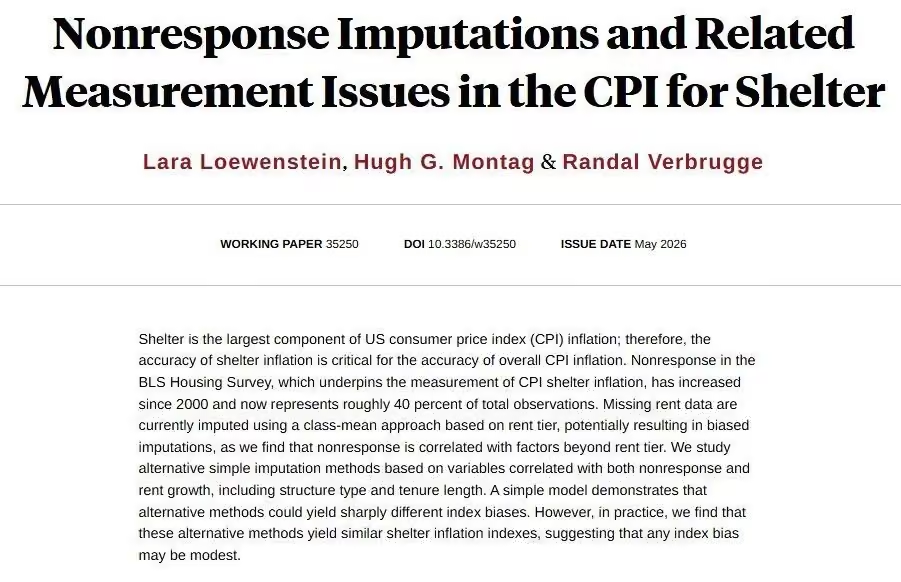 NBER
@nberpubs
New evidence on Smoot-Hawley Tariff Act: tariff hikes cut targeted imports sharply, with costs borne mainly by US importers, reducing welfare by about 0.2 percent of GDP, from Kris James Mitchener and @mathpedemonte www.nber.org/papers/w35249
 NBER
@nberpubs
Local governments in the US are more likely to delay or reject FOIA requests ahead of elections in more corrupt states, reducing transparency precisely when it is needed most, from @rfisman, Aron Malatinszky, and Eyub Yegen www.nber.org/papers/w35248
 NBER
@nberpubs
The performance gap between large language models and point-in-time language models can be narrowed through scale, from Bryan T. Kelly, Semyon Malamud, Johannes Schwab, and Teng Andrea Xu www.nber.org/papers/w35247
 NBER
@nberpubs
Presenting several new and counterintuitive facts about Modern Portfolio Theory, from Oliver Hellum, Theis I. Jensen, Bryan T. Kelly, and Semyon Malamud www.nber.org/papers/w35246
 NBER
@nberpubs
Shale gas has saved US consumers about $200 billion annually since 2007, from Lucas W. Davis www.nber.org/papers/w35245
 NBER
@nberpubs
Using data on applicants to MIT's PhD program to show that elite economics PhD programs have a causal effect on research success. The endowment tax hike threatens this, from @metrics52, @MarcDiederichs, and Glenn Ellison www.nber.org/papers/w35244
 NBER
@nberpubs
A better market index for asset pricing includes all firms, not only publicly listed ones. This new index resolves many asset pricing puzzles jointly and explains what size factors do, from Sung Je Byun, Johnathan Loudis, and @L_Schmidt_Econ www.nber.org/papers/w35243
 NBER
@nberpubs
Asking why openness has been a strong catalyst for catch-up growth in some regions or countries, while in others openness has been followed by stalled convergence, divergence, or stagnation, from Joshua Aizenman, @hiroitopdx, and Jamel Saadaoui www.nber.org/papers/w35242
 NBER
@nberpubs
People want to know how AI makes decisions—until knowing means they can no longer look away, from @alex8chan www.nber.org/papers/w35240
 NBER
@nberpubs
Both IPCC policymaker summaries and subsequent newspaper coverage systematically frame climate findings toward the more severe end of the underlying technical evidence, from @SFGaliani, @Franco_MettLG, and @raul_sosa2908 www.nber.org/papers/w35216
 NBER
@nberpubs
Featured in the latest Digest: How Large Language Models Are Reshaping the Book Market
www.nber.org/digest/202605/how-large-language-models-are-…
 NBER
@nberpubs
Featured in the latest Digest: Taxation and the Origins of the French Revolution
www.nber.org/digest/202605/taxation-and-origins-french-re…
 NBER
@nberpubs
Open call for papers, Economic Measurement in the Agricultural Economy. Conference to be held in Washington, DC on November 6, 2026. Submit papers by 11:59pm EDT on August 18, 2026. More information: www.nber.org/calls-papers-and-proposals/economic-measurem…
 NBER
@nberpubs
Distributional impacts of Kenya’s 2016 interest-rate regulation, which capped bank lending rates but left one digital platform, called M-Shwari, exempt on the lending side, from Aroon Narayanan, @SuriTavneet, and Prashant Bharadwaj www.nber.org/papers/w35166
 NBER
@nberpubs
How the global population living in extreme poverty fell dramatically over the period 1990-2025, the extent to which changes within as opposed to between cohorts contributed to poverty declines, and the key changes in the lives of households as they transitioned out of (and into) poverty, from Vincent J. Armentano, @PaulFNiehaus, and Tom Vogl www.nber.org/papers/w35163
 NBER
@nberpubs
A proposals of ways to understanding different views of meritocracy and links them to assignments of students to schools and workers to firms, from @sndurlauf www.nber.org/papers/w35151
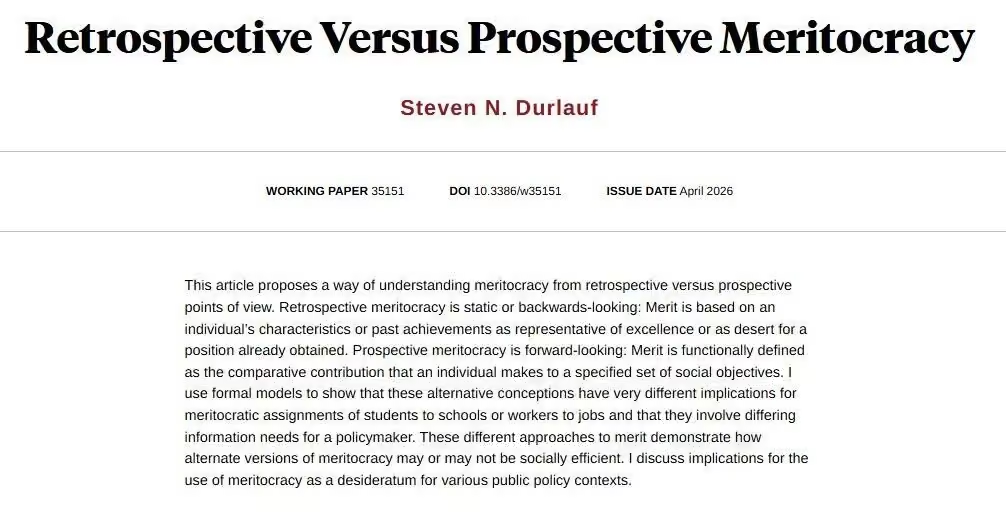 NBER
@nberpubs
Cash acts as a fallback when outages and natural disasters disrupt digital payments. Using data, surveys, and a randomized controlled trial to show cash improves resilience, from Fernando E. Alvarez, @dargente05, and @dianavanpatten www.nber.org/papers/w35115
 NBER
@nberpubs
Developing a dynamic general equilibrium model with a rational asset bubble and an occasionally binding borrowing constraint, from @NinaBiljanovska, Jordi Galí, @LGornicka, and @alexvardoulakis www.nber.org/papers/w35050
 NBER
@nberpubs
Forecasts of how AI will affect the US economy, from @ezrakarger, Otto Kuusela, @jabaluck, @afinetheorem, @basilhalperin, @toddrjones, @connacher_, Philip Trammell, Matt Reynolds, Dan Mayland, Ria Viswanathan, Ananaya Mittal, Rebecca Ceppas de Castro, Josh Rosenberg, and Philip Tetlock www.nber.org/papers/w35046
 NBER
@nberpubs
California’s $20 fast-food minimum wage raised restaurant prices approximately 3–4 percent. Other prices including food-at-home exhibit no differential movement, pointing to wage-driven pass-through, from @jeffreypclemens, Olivia Edwards, Jonathan Meer, and Joshua D. Nguyen
 NBER
@nberpubs
Within occupations, what makes new work different from more work is that new work creates demand for novel expertise that expands the variety of work and commands a wage premium, from @davidautor, Caroline Chin, Anna M. Salomons, and Bryan Seegmiller www.nber.org/papers/w34986
 NBER
@nberpubs
Developing a general equilibrium model of international trade in which the temporal structure of production is a key determinant of comparative advantage, from @pol_antras and Adrian Kulesza www.nber.org/papers/w34983
 NBER
@nberpubs
Studying where AI actually helps in science by modeling four stages of research. AI excels at screening vast possibilities, but human judgment remains key for new ideas, from @professor_ajay, John McHale, and Alexander Oettl www.nber.org/papers/w34953
 NBER
@nberpubs
A series of randomized controlled trials evaluated the impact of data-driven targeting rules to allocate scarce bandwidth in call times for a program providing agricultural advice, from @Susan_Athey, Shawn Cole, @ShanjuktaN, and Jessica Zhu www.nber.org/papers/w34951
 NBER
@nberpubs
A randomized controlled trial with an education technology application shows that personalization increases engagement. Benefits are larger for users that gain access after the system has scaled to more users, from Keshav Agrawal, @Susan_Athey, Ayush Kanodia, @ShanjuktaN, and @EmilPalikot www.nber.org/papers/w34950
 NBER
@nberpubs
Causal machine learning reveals that the heterogeneous impact of job displacement can be predicted in advance; there is substantial heterogeneity within firms and education groups, from @Susan_Athey, Lisa K. Simon, Oskar Nordström Skans, Johan Vikström, and Yaroslav Yakymovych
 NBER
@nberpubs
Poor weather when touring a college campus reduces students' likelihood of applying, from Olivia Feldman, Joshua M. Hyman, and @MattMcGann www.nber.org/papers/w34944
 NBER
@nberpubs
High school quality has large impacts on college enrollment and college graduation rates and on earnings at age 30, from @ppmbekeani, John P. Papay, Ann Mantil, and Richard J. Murnane www.nber.org/papers/w34913
 NBER
@nberpubs
Featured in the latest Digest: Impact of Minimum Pay Rules on Gig Delivery Drivers
www.nber.org/digest/202603/impact-minimum-pay-rules-gig-d…
 NBER
@nberpubs
AI's potential to extend human judgment and enable new tasks is transformative yet underexploited. This paper defines pro-worker AI and discusses how to build it, from @DrDaronAcemoglu, @davidautor, and @baselinescene www.nber.org/papers/w34854
 NBER
@nberpubs
Developing a dynamic model of teacher productivity and presenting evidence that teacher effectiveness can change when teachers transfer across very different school contexts, from @MatthewAKraft, John P. Papay, Jessalynn K. James, and Manuel Monti-Nussbaum www.nber.org/papers/w34845
 NBER
@nberpubs
Examining the relationship between the rise in cocaine-related overdose deaths in the US and increased coca cultivation in Colombia in the late 2010s, from @xinmingd, @benconomics, Shan Zhang, and @thefinderouter1 www.nber.org/papers/w34788
 NBER
@nberpubs
Reassessing Milton Friedman’s monetarism, showing how its core ideas persist in modern macro models and policy rules, and why monetary aggregates still matter as a cross-check against incipient high inflation, from Michael D. Bordo www.nber.org/papers/w34765
 NBER
@nberpubs
Studying what facilitates career transitions across sectors through a field experiment analyzing two programs. Tech jobs increase by 15 percentage points with mentoring and by 11 percentage points when workers create portfolios, from @Susan_Athey and Emil Palikot
 NBER
@nberpubs
The very rapid decline in fertility in Latin America is driven by behavioral change, rather than demographic changes. Childlessness plays only a minor role in, from @milagrosonofri, @InesBerniell, @raquel1fernan, and Azul Menduiña www.nber.org/papers/w34749
 NBER
@nberpubs
Although nearly 8 million Americans use Medicaid home and community-based services for long-term support, there is more to learn about the best ways to finance and deliver this care, from Jacob M. Sims Speyer, @aneeman, Norma B. Coe, and Ellen Meara www.nber.org/papers/w34701
 NBER
@nberpubs
Open call for applications, NBER Innovation Research Boot Camp 2026. Boot Camp to be held in Cambridge, MA on July 17–23, 2026. Submit applications by 11:59pm EDT on February 12, 2026. More information: www.nber.org/calls-papers-and-proposals/nber-innovation-r…
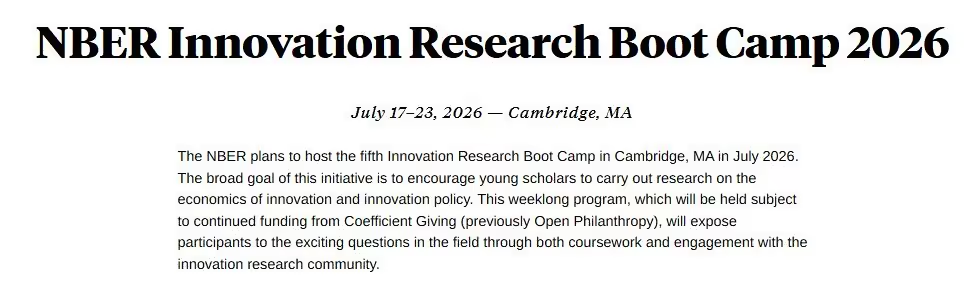 NBER
@nberpubs
Running an experiment in which participants pose as investors finds that they price corporate intent, controlling for corporate actions. Participants value shares in companies that reduce pollution relative to peers, from @augustinlandier, @PARISASTRY, and @dthesmar
 NBER
@nberpubs
Extending IV identification and kappa-weighting to cover more elaborate scenarios, from @metrics52, Andres Santos, and Otávio Tecchio www.nber.org/papers/w34607
 NBER
@nberpubs
Adding heterogeneous firms to a HANK model uncovers the central role of marginal propensities to invest in the transmission mechanism of monetary and fiscal policy, from Thomas Winberry, @a_auclert, Matthew Rognlie, and @ludwigstraub www.nber.org/papers/w34611
 NBER
@nberpubs
Human capital is central to growth, and the elimination of poverty. Discussing obstacles to human capital accumulation and evidence on policies that can promote it, from Philippe Aghion, Ingvild Almås, and @CostasMeghir www.nber.org/papers/w34602
 NBER
@nberpubs
96 percent of US income inequality is within ethnic groups and only 4 percent between them, a pattern that persists across time and regions, from @GalorOded and Daniel C. Wainstock www.nber.org/papers/w34558
 NBER
@nberpubs
Surveying econometric innovations related to differences-in-differences estimators and event-study models with time-varying treatment effects, from Alberto Abadie, @metrics52, Brigham Frandsen, and Jörn-Steffen Pischke www.nber.org/papers/w34550
 NBER
@nberpubs
Superior stock trading performance by US congressional leaders, from Shang-Jin Wei and Yifan Zhou www.nber.org/papers/w34524
 NBER
@nberpubs
Energy-saving tech shocks—not prices—drive the decoupling of output and energy use, with little evidence of rebound effects, underscoring the role of efficiency gains, from @drkaenzig and Charles T. Williamson www.nber.org/papers/w34511
 NBER
@nberpubs
Curriculum shapes more than skills as taking STEM in high school boosts tech careers—but also shifts politics as boys grow more conservative and girls more progressive, from Robert Ainsworth, Rajeev H. Dehejia, @andrei_mntn, Cristian Pop-Eleches, and Miguel Urquiola
 NBER
@nberpubs
Analyzing the forecasts of research results for 100 papers as research forecasts determine R&D and other research decisions, from @sdellavi and @evavivalt www.nber.org/papers/w34493
 NBER
@nberpubs
Population aging creates room for the government to increase debt without increasing interest rates. But a large eventual fiscal adjustment is still needed to pay for entitlements, from @a_auclert, @hannesmalmberg1, Matthew Rognlie, and @ludwigstraub www.nber.org/papers/w34470
 NBER
@nberpubs
Brexit has cut UK GDP by 6 percent to 8 percent by 2025. These negative impacts come from higher uncertainty, reduced demand, diverted management time and trade costs, from @I_Am_NickBloom, Philip Bunn, @mizenpaul, Pawel Smietanka, and @GregoryThwaites www.nber.org/papers/w34459
 NBER
@nberpubs
Campaigns targeting political outsiders may backfire: criticizing Javier Milei’s proposals reduced support among some voters but mobilized others to advocate for him, from Georgy Egorov, @sguriev, Maxim Mironov, and Ekaterina Zhuravskaya www.nber.org/papers/w34430
 NBER
@nberpubs
Defendants guilty of identical DWI offenses face sharply different outcomes by race, gender, and resources, revealing systemic inequality in punishment beyond, from @JeffDenning, @benconomics, Lars Lefgren, Emily C. Leslie, and Cody Tuttle www.nber.org/papers/w34425
 NBER
@nberpubs
Featured on the latest Digest: Movie Subtitles and English Language Acquisition
www.nber.org/digest/202510/movie-subtitles-and-english-la…
 NBER
@nberpubs
A comprehensive overview of China’s lending to developing countries, from Sebastian Horn, Carmen M. Reinhart, and Christoph Trebesch www.nber.org/papers/w34359
 NBER
@nberpubs
Bank supervision in the United States plays an important role in anticipating, monitoring, and disciplining failing banks, from Sergio A. Correia, @StephanLuck, and @EmilVerner www.nber.org/papers/w34343
 NBER
@nberpubs
The latest NBER Reporter is now live: www.nber.org/reporter?page=1&perPage=50
Featuring N. Gregory Mankiw’s Martin Feldstein Lecture on the US Fiscal Future, and research summaries by:
• Pol Antràs, Teresa C. Fort & Felix Tintelnot
• Niels Gormsen & Kilian Huber
• Amir Kermani & Timothy McQuade
• Manju Puri.
NBER
@nberpubs
Featured in the latest Digest: Universal Occupational Licensing Recognition and Healthcare Access
www.nber.org/digest/202510/universal-occupational-licensi…
 NBER
@nberpubs
Estimating the effects of moving away from violent environments into safer areas on migrants' academic achievement in the context of the Mexican war on drugs, from @MaraPadillaR and Cecilia Peluffo www.nber.org/papers/w34270
 NBER
@nberpubs
Examining the recent slow growth in manufacturing productivity, from @EnghinAtalay, Ali Hortaçsu, Nicole Kimmel, and @ChadSyverson www.nber.org/papers/w34264
 NBER
@nberpubs
Outlining a research agenda and nine grand challenges for studying the economic impacts of transformative artificial intelligence, from @erikbryn, @akorinek, and @professor_ajay www.nber.org/papers/w34256
 NBER
@nberpubs
Analyzing a Chicago reform that awarded select principals greater autonomy over budgets and operations while holding resources largely unchanged, from @KiraboJackson www.nber.org/papers/w34216
 NBER
@nberpubs
Matching the Forbes 400 to tax data finds that they pay a total tax rate of 24 percent of economic income, lower than the 30 percent tax rate paid on average in the US, from Akcan S. Balkir, Emmanuel Saez, Danny Yagan, and @gabriel_zucman www.nber.org/papers/w34170
 NBER
@nberpubs
Moral values influence people's view of debt contracts: conservative values line up very strongly with support for credit scores, stricter collateral, and tough bankruptcy, from Fiona Paine, Antoinette Schoar, and @dthesmar www.nber.org/papers/w34092
 NBER
@nberpubs
Watch the 2025 Summer Institute Methods Lectures, Uncovering Causal Mechanisms: Mediation Analysis and Surrogate Indices. www.nber.org/research/videos/2025-methods-lecture-raj-che…
 NBER
@nberpubs
Modeling computers and AI as cognitive tools provides a lens to interpret evidence on inequality, workflows, and teams, from @professor_ajay, @joshgans, and @avicgoldfarb www.nber.org/papers/w34034
 NBER
@nberpubs
Barely passing the MCAS science exam increases high-school graduation and college outcomes of students near the score threshold, from Ann Mantil, John Papay, @ppmbekeani, and Richard J. Murnane www.nber.org/papers/w34023
 NBER
@nberpubs
Using the Earned Income Tax Credit to study how an influx of cash affects food expenditure patterns of eligible households, from @emmajlag, Leslie McGranahan, and @dwschanz www.nber.org/papers/w34007
 NBER
@nberpubs
AI can transform both strategic decision-making and daily operations within central banks, with significant potential for workforce augmentation, from @SophiaKazinnik and @erikbryn www.nber.org/papers/w33998
 NBER
@nberpubs
Humans cause greenhouse gas emissions, but human depopulation, starting in a few decades, will not meet today's climate challenges, from Mark Budolfson, @MikeGeruso, Kevin J. Kuruc, Dean Spears, and Sangita Vyas www.nber.org/papers/w33932
 NBER
@nberpubs
Combining field experiments and a new model to study salary negotiations, from @zoebcullen, Bobak Pakzad-Hurson, and @pereztruglia www.nber.org/papers/w33903
 NBER
@nberpubs
Analysis of over one million stated preference tradeoffs reveals family well-being and financial security have 10 to 20 times higher marginal utilities than happiness/life satisfaction measures, from @Dan_J_Benjamin, Kristen B. Cooper, Ori Heffetz, @mileskimball, and @tushardonnay www.nber.org/papers/w33846
 NBER
@nberpubs
A study of expectations formation when the underlying process has thick tails, from @timdesilva, Eugene Larsen-Hallock, Adam Rej, and @dthesmar www.nber.org/papers/w33808
 NBER
@nberpubs
How parental divorce shapes children's resources and futures, from @acjohnston0, Maggie R. Jones, and Nolan G. Pope www.nber.org/papers/w33776
 NBER
@nberpubs
Open call for papers, Disaggregated National Accounts: Measurement and Application. Conference to be held virtually on December 11, 2025. Submit papers by 11:59pm EDT on August 27, 2025. More information: www.nber.org/calls-papers-and-proposals/disaggregated-nat…
 NBER
@nberpubs
Universal Pre-Kindergarten from 1995 to 2020 boosted Pre-K enrollment and led to increases of 1.2 percent, 1.5 percent, and 1.6 percent in labor force participation, employment, and hours worked, respectively, from @KiraboJackson, Julia A. Turner, and @jacobbastian25
 NBER
@nberpubs
Occupational licensing is associated with widening earnings inequality in the United States during the 1983–2019 period, from Kihwan Bae, Morris M. Kleiner, Conor Norris, and Edward J. Timmons www.nber.org/papers/w33732
 NBER
@nberpubs
Tariff shocks can lead to short-run recessions, as consumers both at home and abroad postpone purchases. These recessions outweigh the traditional welfare effects of tariffs, from @a_auclert, Matthew Rognlie, and @ludwigstraub www.nber.org/papers/w33726
 NBER
@nberpubs
The Thresholding Multiple Outcomes method addresses spatial correlation in regressions by using information from additional outcomes to identify correlated locations, from @sdellavi, @guido_imbens, Woojin Kim, and @DRitzwoller www.nber.org/papers/w33716
 NBER
@nberpubs
Exploring how, given the limits on monetary policy, fiscal policy could play a larger role in stabilization, from @ojblanchard1 www.nber.org/papers/w33698
 NBER
@nberpubs
A framework to analyze quotas and other quantity-based distortions, like the H-1B visa cap, Argentina's capital controls, and NYC taxicab medallions in general equilibrium, from @Dbaqaee and @ksangani8 www.nber.org/papers/w33695
 NBER
@nberpubs
Tariffs can be stagflationary in a global general equilibrium setting. The net impact of tariffs on inflation, employment, and the US dollar depends on the policy response of all countries in the trade war, from @skalemliozcan, Can Soylu, and Muhammed A. Yildirim
 NBER
@nberpubs
A 2011 Wisconsin reform weakened teachers' unions, raised test scores, and was a political win for its main proponent, from @BarbaraBiasi and @wsandholtz www.nber.org/papers/w33666
 NBER
@nberpubs
The first annual meeting of the NBER Coordinating Center on the Economics of AD/ADRD will be held on June 12, 2025 at the Bethesda North Marriott Hotel & Conference Center in Rockville, MD. Travel funding for early career investigators is available. Registration and full information event.roseliassociates.com/nberjune2025/
 NBER
@nberpubs
Around 4 percent of GDP was spent to mitigate deaths from Covid-19; AI's existential risk is arguably at least as large, from @ChadJonesEcon www.nber.org/papers/w33602
 NBER
@nberpubs
Developing a measure to capture the temporal dimension of production and compute it using data from publicly traded companies worldwide, from @pol_antras and Vitalii Tubdenov
www.nber.org/papers/w33499
 NBER
@nberpubs
An examination of the value managers create finds that managers apply different skills in different proportions depending on the production technology in which they are embedded, from @alanmbenson and Kathryn L. Shaw www.nber.org/papers/w33431
 NBER
@nberpubs
Cognitive strategy instruction in college at best impacts grade-related outcomes like GPA, but not metacognitive knowledge or persistence, from Jarod T. Apperson, A. Nayena Blankson, Francesina Jackson, @aviceisza, Bruce Wade, and Jimmeka Guillory Wright www.nber.org/papers/w33380
 NBER
@nberpubs
Unilateral decarbonization pays for itself in large economies. New domestic costs-of-carbon estimates of $226/ton US, $216/ton EU, suggest over 80 percent decarbonization is optimal, from @AdrienBilal and @drkaenzig www.nber.org/papers/w33364
 NBER
@nberpubs
Exploring the role of political economy forces in bolstering or constraining a country's geoeconomic power, from @chris_d_clayton, @m_maggiori, and @jschreger www.nber.org/papers/w33353
 NBER
@nberpubs
Gig workers are more likely to become entrepreneurs, particularly those who are lower income, younger, and benefit from flexibility, from Matthew R. Denes, Spyridon Lagaras, and @M_Tsoutsoura www.nber.org/papers/w33347
 NBER
@nberpubs
Exploring past episodes of technological disruption in the US labor market, with the goal of learning lessons about the likely future impact of AI, from @ProfDavidDeming, Christopher Ong, and @LHSummers www.nber.org/papers/w33323
 NBER
@nberpubs
Outlining several unexplored areas in international trade, from @pol_antras www.nber.org/papers/w33312
 NBER
@nberpubs
New tools for dynamic-treatment effect estimation with instrumental variables show the effects of revascularization on quality of life are larger and more persistent than conventional analyses suggest, from @metrics52, Bruno Ferman, Carol Gao, @instrumenthull, Otavio L. Tecchio, and Robert W. Yeh www.nber.org/papers/w33296
 NBER
@nberpubs
Analyzing data on Chilean firms to examine whether credit lines and government-backed credit guarantees mitigated the impact of the large sudden stop event during the pandemic — the withdrawal of international capital, from Miguel Acosta-Henao, Andrés Fernández, @gom_patty, and @skalemliozcan www.nber.org/papers/w33283
 NBER
@nberpubs
Gifted education boosts college entry of disadvantaged, high-IQ boys and closes gaps with female counterparts. The gains are mediated by improvements in non-cognitive outcomes, from David Card, @EricChyn, and Laura Giuliano www.nber.org/papers/w33282
 NBER
@nberpubs
Using an analysis of over 8,000 economics PhDs and their advisors to find what determines economics PhD student research success, from @metrics52 and @MarcDiederichs www.nber.org/papers/w33281
 NBER
@nberpubs
A practical guide to recent econometric advances with shift-share instruments, from @borusyak, @instrumenthull, and @Xjaravel www.nber.org/papers/w33236
 NBER
@nberpubs
An overview of alternative theories on the causes and nature of large economic fluctuations, from @JosephEStiglitz www.nber.org/papers/w33218
 NBER
@nberpubs
Results from a guaranteed income program for low-income households in Compton, California, from Sidhya Balakrishnan, @SewinChanNYU, @smconstantino, @jhaushofer, and @JMorduch www.nber.org/papers/w33209
 NBER
@nberpubs
Despite consumers responding rationally to fintech information and performing targeted search, fintech can lead them to behave counter to their preferences for remittance sending, from Eduardo Nakasone, Máximo Torero, and @aviceisza www.nber.org/papers/w33183
 NBER
@nberpubs
A new stylized fact about firm growth: The shift from labor to intermediate inputs reflects high substitution elasticity and monopsony and pushes down the labor share, from Matthias Mertens and @Schoefer_B www.nber.org/papers/w33172
 NBER
@nberpubs
The market for AI foundation models exhibits fierce competition but risks future concentration through market tipping and vertical integration, with major societal implications, from @akorinek and @JaaiVipra www.nber.org/papers/w33139
 NBER
@nberpubs
The impact of Generative AI on finance practice and research, including a description of helpful tools, tips, and examples for financial economists, from @andrea_eisfeldt and @gregorschub www.nber.org/papers/w33076
 NBER
@nberpubs
Childhood socioeconomic status (SES) influences peer recognition as scientists who grew up in high-SES families are more likely to be perceived as "stars" conditional on publications, from Anna Airoldi and @PMoserEcon www.nber.org/papers/w33063
 NBER
@nberpubs
The utilization of labor and capital in Kenya is increasing in firm size, market access, and economic activity, from @mwwalkerecon, Nachiket Shah, @tedmiguel, @EggerDennis, @solimanfelix, and @TilmanGraff www.nber.org/papers/w33055
 NBER
@nberpubs
Self-employed individuals have higher average income and steeper, more persistent income growth profiles than paid-employed peers with similar characteristics, from Anmol Bhandari, Tobey Kass, Thomas J. May, Ellen McGrattan, and Evan Schulz www.nber.org/papers/w32948
 NBER
@nberpubs
Using a randomized lottery design shows that full-day universal pre-k raises parents' earnings by 22 percent, with gains persisting for at least six years after pre-k, from @john_eric, @chrisaneilson, @Xiaoyang_Ye, and @SethDZimmerman www.nber.org/papers/w33038
 NBER
@nberpubs
Inflation Reduction Act subsidies for EVs decrease CO2 emissions and help US auto firms at the expense of foreign firms. Government cost per additional EV exceeds $23k, from @huntallcott, Reigner Kane, Maximilian S. Maydanchik, @_josephshapiro, and @FelixTintelnot
 NBER
@nberpubs
A review of key developments in the Heterogeneous Agent New Keynesian literature through the lens of a simple model, with ready-to-use code for the main model and many extensions, from @a_auclert, Matthew Rognlie, and @ludwigstraub www.nber.org/papers/w32991
 NBER
@nberpubs
Studying optimal redistributive taxation in an environment with asset price changes, from Mark A. Aguiar, @ben_moll, and @Florian_Scheuer www.nber.org/papers/w32951
 NBER
@nberpubs
A study of bank failures in the US from 1865 to 2023 finds that failures are primarily caused by deteriorating fundamentals, rather than bank runs, from @ogoun, @StephanLuck, and @EmilVerner www.nber.org/papers/w32907
 NBER
@nberpubs
The long run impacts of an intervention targeted to premature children, known as Kangaroo Mother Care, from @orazio_at, Cortes, Maldonado, Rodriguez-Lesmes, Charpak, Tessier, Ruiz, Gallego, Hernandez, Uriza, and @AndresGallegosV www.nber.org/papers/w32851
 NBER
@nberpubs
Retirement and precautionary motives are the dominant motives for saving in Europe partly because social safety nets are not fully adequate, from @charlesyuji and Luigi Ventura www.nber.org/papers/w32838
 NBER
@nberpubs
Exploring the role of money when income risk in uninsurable, from @farmerrf www.nber.org/papers/w32836
 NBER
@nberpubs
Using individual-level data to identify opioid users and to estimate the effect on health and labor market outcomes from a 2012 Austrian reform restricting benzodiazepine use, from @AhammerAlex and @analisapackham www.nber.org/papers/w32804
 NBER
@nberpubs
In Uganda, the returns to vocational training survive the pandemic, as skilled workers gain more sector-specific experience pre-shock and switch firms more easily during the crisis, from Livia Alfonsi, @bassi_vittorio, @imranrasul3, and Elena Spadini www.nber.org/papers/w32785
 NBER
@nberpubs
A permanent increase in temperatures will lower the level of GDP per capita, but not its long-run growth rate, in affected countries, from @Ishan_Nath, Valerie A. Ramey, and @PeteKlenow www.nber.org/papers/w32761
 NBER
@nberpubs
The automatic exchange of bank information has led to massive increases in tax compliance, showing that tax evasion is not a law of nature in a globalized world, from Hjalte Fejerskov Boas, Niels Johannesen, @okoctk, Lauge Truels Larsen and @gabriel_zucman www.nber.org/papers/w32714
 NBER
@nberpubs
Comprehensive data on China’s government and private venture capital funds' activities in the AI sector reveals three important contrasts between government and private venture capital funds, from @MartinBeraja, Wenwei Peng, @david_yang, and Noam Yuchtman www.nber.org/papers/w32701
 NBER
@nberpubs
A general equilibrium model of labor markets endogenizes workers' outside options and analyzes various equilibrium outcomes, from Patrick Rey and @JosephEStiglitz www.nber.org/papers/w32700
 NBER
@nberpubs
A new method of identifying good managers finds good managers have roughly twice the impact on team performance as good workers, from Ben Weidmann, Joseph Vecci, @_farahsaid, @ProfDavidDeming, and @SoniaBhalotra www.nber.org/papers/w32699
 NBER
@nberpubs
Japan’s massive public investments in codifying technical knowledge explain why it was unique among non-Western countries in industrializing in the 19th and early 20th centuries, from @juhreka13, Shogo Sakabe, and @deweinstein www.nber.org/papers/w32667
 NBER
@nberpubs
People’s beliefs about the economy strongly overreact to household-level income changes, and even adverse health events, in part due to emotion-driven selective recall, from @dtaubinsky, Luigi Butera, Matteo Saccarola, and Chen Lian www.nber.org/papers/w32664
 NBER
@nberpubs
South Korean firm concentration increased dramatically in the “growth miracle” period, but the contribution of the largest firms to GDP and welfare has been positive, from @JaedoChoi, Andrei A. Levchenko, Dimitrije Ruzic, and @ShimYounghun www.nber.org/papers/w32648
 NBER
@nberpubs
Software substitutes for labor, while equipment complements labor. The rise of software explains higher markups and lower labor share, from Sangmin Aum and Yongseok Shin www.nber.org/papers/w32591
 NBER
@nberpubs
Analyzing frameworks for designing new international trade rules; Trade regimes are in crisis as advanced economies adopt new industrial policies, from @Martin_M_Guzman and @JosephEStiglitz www.nber.org/papers/w32533
 NBER
@nberpubs
Can decision times be used to better understand expert decisions in the field? A simple model and evidence from editorial decisions, from David Card, @sdellavi, Chenxi Jiang, and @dtaubinsky www.nber.org/papers/w32515
 NBER
@nberpubs
Labor markets in higher-income countries are more meritocratic, meaning there is more skill-based sorting between workers and jobs. This matters for development in subtle ways, from @orianabandiera, @AnanyaKotia, Lindenlaub, @economoser, and @andreapratnyc www.nber.org/papers/w32375
 NBER
@nberpubs
A study of 34 countries finds that, culture — in particular individualism — is the biggest factor explaining international differences in working from home, from @PabloZarate98, Dolls, Davis, @I_Am_NickBloom, @Jose_MariaRD, and @cevatgirayaksoy www.nber.org/papers/w32374
 NBER
@nberpubs
The increased share of reporting self-employment in US tax data post-2000 is not due to the rise of platform gig work. Rather, more taxpayers report self earnings to benefit from the Earned Income Tax Credit, from @andy_garin, @JacksonEmilieA, and @dkoust www.nber.org/papers/w32368
 NBER
@nberpubs
A large medical debt relief experiment finds no effects on financial outcomes, health, and healthcare utilization, and moderate reduction in payments of existing medical bills, from @ray_kluender, @nealemahoney, @francisawong, and Wesley Yin www.nber.org/papers/w32315
 NBER
@nberpubs
LinkedIn data can be used to measure the racial, ethnic, and gender mix of companies' workforces, and differences in mass layoffs and promotions, from Alexander Berry, Elizabeth M. Maloney, and @NeumarkEcon www.nber.org/papers/w32294
 NBER
@nberpubs
Brazilian municipalities receiving solar parks see short-term increases in jobs, GDP and taxes, while wind parks provide no local job impacts but long-term revenue and GDP effects, from @FabianScheifel and David Popp www.nber.org/papers/w32274
 NBER
@nberpubs
Three hours of individual tutoring per week by Italy’s Tutoring Online Program in response to the pandemic increased math performance by 0.23 standard deviations in 2020 and 0.20 standard deviations in 2022, from @michelacarlana and @elianalaferrara www.nber.org/papers/w32272
 NBER
@nberpubs
Call for papers, Economics of Artificial Intelligence: Political Economy Challenges. The conference will be held in Toronto, Canada on September 19–20, 2024. Submit papers by 11:59pm EDT on June 1, 2024. More information: www.nber.org/calls-papers-and-proposals/economics-artific…
 NBER
@nberpubs
AI and Artificial General Intelligence's impact on wages depends on automation's pace versus capital accumulation; slow automation may raise wages, rapid may decrease wages pre-full automation, from @akorinek and Suh www.nber.org/papers/w32255
 NBER
@nberpubs
Upstream firms in supply networks underinvest in resilience, but policies incentivizing capacity investment, reducing spot market reliance, and enhancing competition can mitigate this, from Agostino Capponi, Chuan Du, and @JosephEStiglitz www.nber.org/papers/w32221
 NBER
@nberpubs
Call for papers: Economics of Talent. The conference will be held in Cambridge, MA, on November 15, 2024. Submit papers by 11:59pm EDT on September 11, 2024. More information: www.nber.org/calls-papers-and-proposals/economics-talent
 NBER
@nberpubs
A study of Ugandan firms finds that increasing information on procurement opportunities does not increase participation in public procurement but changing firms’ perceptions of corruption does, from Colonnelli, Loiacono, Muhumuza, and @edoardoteso www.nber.org/papers/w32170
 NBER
@nberpubs
The unique opportunity that AI offers the labor market is to extend the relevance, reach, and value of human expertise, from @davidautor www.nber.org/papers/w32140
 NBER
@nberpubs
A snapshot of gender inequality across key education and work indicators in Latin America and the Caribbean, from @InesBerniell, @raquel1fernan, and Sonya Krutikova www.nber.org/papers/w32104
 NBER
@nberpubs
Using cash transfers to examine the relationship between income and child development in the Indian state of Jharkhand, from @Jeff_Weaver_, @sandipz, @PaulFNiehaus, and @karthik_econ www.nber.org/papers/w32093
 NBER
@nberpubs
Cataloguing policies that have been deployed by jurisdictions seeking to mitigate the effects of tax competition, from @DavidRAgrawal, James M. Poterba, and @omzidar www.nber.org/papers/w32090
 NBER
@nberpubs
The 2018–19 trade-war between the US, China, and other US trade partners has not provided economic help to the US heartland, but it has benefited the Republican Party, from @davidautor, Anne Beck, David Dorn, and Gordon H. Hanson www.nber.org/papers/w32082
 NBER
@nberpubs
Deriving a simple condition that determines whether a multinational firm's plants are substitutes or complements in a model export-platform foreign direct investment, from @pol_antras, @evgenii_fadeev, @Tfpiasecki, and @FelixTintelnot www.nber.org/papers/w32081
 NBER
@nberpubs
Reviewing key findings of research into market implications of asymmetric information and mechanism design, surveying aspects of the intellectual development of the economics of information from the 1970s to today, from @JosephEStiglitz and @ak2912 www.nber.org/papers/w32049
 NBER
@nberpubs
India’s road investments from the early 2000s improved aggregate welfare, particularly for the largest and smallest urban markets, from Kathryn Baragwanath Vogel, @Gordon H. Hanson, @akhandelwal8, Chen Liu, and Hogeun Park www.nber.org/papers/w32047
 NBER
@nberpubs
A comprehensive high school support program for disadvantaged youth living in the largest public housing project in Torontoleads to substantial reductions in criminal activity, from @AdamLavecchia, @poreopoulos, and Noah Spencer www.nber.org/papers/w32045
 NBER
@nberpubs
Students who participated in an early elementary reading tutoring program were over twice as likely to reach the target reading stage by the end of kindergarten, from @KalenaCortes, Karen Kortecamp, @loeb_susanna, and @Carly__Robinson www.nber.org/papers/w32039
 NBER
@nberpubs
Introducing the concept of climate matching as a driver of migration: movers select destinations with climates similar to their place of origin, from Marguerite Obolensky, Marco Tabellini, and @ctaylor463 www.nber.org/papers/w32035
 NBER
@nberpubs
News-based sentiment can help predict GDP growth and Fed policy, from Jules H. van Binsbergen, Svetlana Bryzgalova, Mayukh Mukhopadhyay, and Varun Sharma www.nber.org/papers/w32026
 NBER
@nberpubs
Across countries, population growth is at least as important as per capita consumption growth in contributing to growth in consumption-equivalent welfare, from @adhami_mohamad, Mark Bils, @ChadJonesEcon, and @PeteKlenow www.nber.org/papers/w31999
 NBER
@nberpubs
RA review of literature that examines changes to institutions, consists of real-time studies of plausible critical junctures, and exploits field experiments, from Michael Callen, @jonathanweigel, and Noam Yuchtman www.nber.org/papers/w31964
 NBER
@nberpubs
Exploring the impact of AI on global digital trade and cross-border data flows finds that AI drives a ten times rise in mobile app usage while data restrictions knock off half of this, from Ruiqi Sun and Daniel Trefler www.nber.org/papers/w31925
 NBER
@nberpubs
Subjecting algorithm implementation to regulatory approval or mandating testing is insufficient to implement the social optimum, from @jptguerreiro, @sergiorebelo6, and Pedro Teles www.nber.org/papers/w31921
 NBER
@nberpubs
Being in a competition union rather than in a federal union decreases poorer individuals’ welfare by up to 20 percent, from @MathildeMunoz www.nber.org/papers/w31920
 NBER
@nberpubs
Countries’ choices of institutions and labor regulations, not just their productivity differentials, drive trade patterns in labor-intensive services, from Mathilde Muñoz www.nber.org/papers/w31876
 NBER
@nberpubs
NBER will host an NSF-sponsored mentoring program to help economics faculty at minority-serving institutions develop NSF grant proposals.
Virtual workshop Jan 25, one-on-one mentoring later. Registration closes Jan 18 '24
www.nber.org/calls-papers-and-proposals/mentoring-program…
NBER
@nberpubs
Considering the optimal use of AI technology and the conditions in which rapid development of AI should continue or stop, from @ChadJonesEcon www.nber.org/papers/w31837
 NBER
@nberpubs
US manufacturing is almost four times more exposed to industrial inputs from China than standard statistics suggest, from @BaldwinRE, @freeman_reb, and @Angel__Theo www.nber.org/papers/w31820
 NBER
@nberpubs
Call for Fellowship Applicants: 13 fellowships to support dissertation writers, 11 post-doctoral fellowships, and one post-doctoral researcher, on various topics for the 2024-25 academic year. Application deadline 12/7/23, full details at www.nber.org/career-resources/calls-fellowship-applications
NBER
@nberpubs
A large, mandatory profit-sharing scheme in France led to a significant increase in workers' income. It neither reduced investment nor increased productivity, from @ElioNimier, @DSraer, and @dthesmar www.nber.org/papers/w31804
 NBER
@nberpubs
How, when, and why women in the US obtained legal rights equal to men’s regarding the workplace, marriage, family, SS, credit markets, and elsewhere in the economy, from @PikaGoldin www.nber.org/papers/w31762
 NBER
@nberpubs
Interoperability between mobile money providers lowers overall fees, but also lowers network coverage and financial inclusion, especially in rural and poor districts, from @MarkusEconomist @NicolaLimodio and @SpadavecchiaL www.nber.org/papers/w31696
 NBER
@nberpubs
Differences in time preferences are closely associated with longstanding North-South differences in student achievement in both Italy and the United States, from @EricHanushek, Lavinia Kinne, Pietro Sancassani, and @Woessmann www.nber.org/papers/w31690
 NBER
@nberpubs
Analyzing how mistrust, misperception, and misunderstanding can lead to conflict and drive its dynamics, from @DrDaronAcemoglu and Alexander Wolitzky www.nber.org/papers/w31681
 NBER
@nberpubs
Restorative practices in Chicago Public Schools improved school climate, reduced arrests of children by 19%, and cut suspensions without hurting classmates’ academic performance, from @aadukia, Benjamin Feigenberg, and @Fatemeh_Momeni www.nber.org/papers/w31675
 NBER
@nberpubs
Learning about bank risk makes consumers more likely to withdraw their deposits, but information about FDIC insurance and communication about bank stability by the Fed can reassure depositors, from Sandri, @Grigoli82, @YGorodnichenko, and Coibion www.nber.org/papers/w31644
 NBER
@nberpubs
An increase in the remuneration of Italian municipal cabinets triggers a sizable increase in criminal attacks against their members, from @massimo_pulejo and @pquerubo www.nber.org/papers/w31586
 NBER
@nberpubs
Variation in income inequality across societies is associated with variation in ancestral population diversity, shaped during the Out-of-Africa Migration, from @GalorOded, @Marc_Klemp, and Daniel C. Wainstock www.nber.org/papers/w31580
 NBER
@nberpubs
The roll-out of broadband internet helped patients choose higher-quality health care providers, leading to improvements in health outcomes for elective procedures, from @jnvanparys and Zach Y. Brown www.nber.org/papers/w31579
 NBER
@nberpubs
Summer after summer, men’s labor force participation remains stable while women's participation drops sharply, a decline associated with school closures for summer break, from Brendan M. Price and Melanie Wasserman www.nber.org/papers/w31566
 NBER
@nberpubs
Modeling shows higher energy prices are causing a recession in the EU as households cut back on domestic spending to pay energy bills, from @a_auclert, Hugo Monnery, Matthew Rognlie, and @ludwigstraub www.nber.org/papers/w31543
 NBER
@nberpubs
Discussing the literature that has developed in recent years providing evidence on how industrial policies work, from @juhreka13, @straightedge, and @rodrikdani, www.nber.org/papers/w31538
 NBER
@nberpubs
Multinational firms are more likely to trade not only in countries in which, but also with other countries within those affiliates’ region, from @pol_antras, @evgenii_fadeev, @Tfpiasecki, and @FelixTintelnot www.nber.org/papers/w31488
 NBER
@nberpubs
How the economic environment affects how agents learn from new information, from Weber, Candia, Ropele, Lluberas, Frache, Meyer, Kumar, @YGorodnichenko, Georgarakos, Coibion, Kenny, and Ponce www.nber.org/papers/w31485
 NBER
@nberpubs
Since 1870, there has never been a time in US history when immigrants as a group were more likely than White US-born men to be incarcerated, from Ran Abramitzky, @leah_boustan, @elisajacome, @seperez84, and @jdtorres96 www.nber.org/papers/w31440
 NBER
@nberpubs
Showing how tax redistribution between capitalists and workers, coupled with capital mobility, leads to a rationale for countries to seek to export their ideology, from @pol_antras and Gerard Padró I Miquel www.nber.org/papers/w31399
 NBER
@nberpubs
Call for papers, Economics of Mobility. The conference will be held in Cambridge, MA on Friday, October 27, 2023. Submit papers by 11:59pm EST on Thursday, August 10, 2023. More information: www.nber.org/calls-papers-and-proposals/economics-mobility
 NBER
@nberpubs
Charter school expansion improves learning outcomes for average students as competitive effects induce public schools to raise their quality, from Michael Gilraine, Uros Petronijevic, and John D. Singleton www.nber.org/papers/w31328
 NBER
@nberpubs
Documenting the psychological cost of financial constraints and integrating these findings into a tractable model of intertemporal decision-making, from @d_sergeyev Chen Lian, and @YGorodnichenko www.nber.org/papers/w31285
 NBER
@nberpubs
Examining the existence of a gender well-being gap by estimating gender differences across 55 subjective well-being metrics, from @D_Blanchflower and @AlexanderBryson www.nber.org/papers/w31212
 NBER
@nberpubs
Historically Black colleges and universities punch significantly above their weight in preparing Black college students, from Gregory Price and @aviceisza www.nber.org/papers/w31131
 NBER
@nberpubs
Study of the welfare impact of inflationary shocks throughout the distribution finds that inflationary oil shocks are regressive but monetary expansions are progressive, from @pipeton8 @JohnRGrigsby Eric Qian, and Conor Walsh www.nber.org/papers/w31124
 NBER
@nberpubs
Evidence that curation algorithms (recommender systems) can learn and propagate biases that users themselves do not want, from @AmandaYAgan, Diag Davenport, Jens Ludwig, and @m_sendhil www.nber.org/papers/w30981
 NBER
@nberpubs
Language models like ChatGPT will revolutionize economic research: a long list of use cases for how to benefit and speculate on the long-term effects, from @akorinek www.nber.org/papers/w30957
 NBER
@nberpubs
The most comprehensive description of a Web3 ecosystem utilizing large-scale computation reveals inequality and exclusion, which are mitigated by recent redistributive programs, from Lin William Cong, Ke Tang, Yanxin Wang, and Xi Zhao www.nber.org/papers/w30949
 NBER
@nberpubs
Neighborhood peers left behind by school lottery winners have higher arrest rates. These negative effects are larger than the reductions in arrests for lottery winners, from @AndrewBibler, @BillingsEcon, and @SteveRo48195125 www.nber.org/papers/w30936
 NBER
@nberpubs
Data from 2.6m patient visits show that physicians significantly alter care processes after vertical integration and that patients' post-procedure complications increase substantially, from Saghafian, Song, Newhouse, Landrum, and Hsu www.nber.org/papers/w30928
 NBER
@nberpubs
An “Austrian” model of global value chains (GVCs): how lower interest rates, trade credit, and trade finance foster an increase in the share of GVC trade in world trade, from @pol_antras www.nber.org/papers/w30901
 NBER
@nberpubs
Excess savings from fiscal transfers have long-lasting effects on aggregate demand as they trickle up the wealth distribution to agents with low marginal propensities to consume, from @a_auclert, Matthew Rognlie, and @ludwigstraub www.nber.org/papers/w30900
 NBER
@nberpubs
CAPM-based measures of the cost of capital are poor. The IRR of comparable firms explains the cross-section of firm values much better, and is easy to implement, from Nicolas Hommel, @augustinlandier, and @dthesmar www.nber.org/papers/w30898
 NBER
@nberpubs
US inflation is driven by demand and supply shocks in 2/3, 1/3 proportion respectively, where fiscal stimulus accounts for more than half of the demand side, from Julian di Giovanni, @skalemliozcan, @Asilvub, and Muhammed A. Yildirim www.nber.org/papers/w30892
 NBER
@nberpubs
A framework to study the interplay between world trade and interest rates in the 'Austrian' tradition of Bohm-Bawerk, from @pol_antras www.nber.org/papers/w30844
 NBER
@nberpubs
Call for Papers: 46th Annual NBER Summer Institute held in Cambridge, MA July 10-28, '23. Meetings will be held in person and livestreamed on YouTube. To be considered for presentation, papers must be submitted by 11:59pm (EST) on Wed, Mar 22, 2023. Info: www.nber.org/calls-papers-and-proposals/2023-nber-sumer-i…
NBER
@nberpubs
New meta-analysis suggests that water treatment reduces the odds of overall child mortality by around 30%, from Michael Kremer, Stephen P. Luby, Ricardo Maertens, Brandon Tan, and Witold Więcek www.nber.org/papers/w30835
 NBER
@nberpubs
Small restaurants experience a 5 percent revenue increase after being listed on Yelp, from @mike_luca, @abhishekn, and @gaurisubramani www.nber.org/papers/w30810
 NBER
@nberpubs
Teen suicides plummeted in March '20, when schools shut due to COVID. Returning from online to in-person schooling was associated with a 12-18% increase in teen suicides, from @benconomics @SDSUCHEPS and Schaller www.nber.org/papers/w30795
 NBER
@nberpubs
Under Liquid Democracy, decisions are taken by referendum, and voters can delegate their votes to others. Delegation is used too much and leads to inferior decisions, from @joe_d_campbell, Casella, de Lara, Mooers, and Ravindran www.nber.org/papers/w30794
 NBER
@nberpubs
Increasing local access to amenities may shorten daily trip lengths, reducing traffic-related congestion and emissions at the cost of socially isolating the poor, from Abbiasov, Heine, Glaeser, Ratti, Sabouri, Salazar Miranda, and Santi www.nber.org/papers/w30752
 NBER
@nberpubs
3G mobile internet expansion in developing countries increases the labor force participation rate of women and the employment rates of both men and women, from @gchiplunkar and @PennyG_Yale www.nber.org/papers/w30741
 NBER
@nberpubs
A review of economic research on the EU's General Data Protection Regulation: its impact on firms, consumers, privacy, competition, and innovation, from @garjoh_canuck www.nber.org/papers/w30705
 NBER
@nberpubs
Classifying 100,000 founders of high-growth startups by race and explaining a third of the $3 million difference in venture funding between Black-founded and other similar startups, from @drlisadcook, @marxmatt, and Emmanuel Yimfor www.nber.org/papers/w30682
 NBER
@nberpubs
NBER will host an NSF-sponsored mentoring program to help economics faculty at minority-serving institutions develop NSF grant proposals.
Virtual workshop Jan 27, one-on-one mentoring later. Registration closes Jan 19 '23.
www.nber.org/calls-papers-and-proposals/mentoring-program…
NBER
@nberpubs
Analysis using computer vision algorithms and observational data from a microlending marketplace finds that choices made by borrowers creating online profiles impact platform fairness and efficiency, from @Susan_Athey, @deankarlan, Palikot, and Yuan www.nber.org/papers/w30633
 NBER
@nberpubs
Developing and analyzing a new system of disaggregated economic accounts, from Asger L. Andersen, Emil Toft Hansen, Kilian Huber, Niels Johannesen, and @ludwigstraub www.nber.org/papers/w30630
 NBER
@nberpubs
Women's rights have greatly expanded over the past 200 years, and economic development is a key reason why, from @TertiltMichele, @mdoepke, @AnneHannusch, and Laura Montenbruck www.nber.org/papers/w30617
 NBER
@nberpubs
Anti-Asian incidents spiked by 4000 percent in Trump-supporting counties following Trump’s “Chinese virus” tweets, over and above the spike observed in Clinton-supporting counties, from Andy Cao, @jasonmlindo, and @ZhongJiee www.nber.org/papers/w30588
 NBER
@nberpubs
Evidence of information frictions driving wage inequality: when businesses gain access to high quality salary benchmarks, wage dispersion among new hires across firms drops substantially, from @zoebcullen, @ShengwuLi, and @pereztruglia www.nber.org/papers/w30570
 NBER
@nberpubs
At least two-thirds of the world’s youth do not obtain basic skills; the present value of eliminating these deficits is five times world GDP, from Sarah Gust, @EricHanushek, and @Woessmann www.nber.org/papers/w30566
 NBER
@nberpubs
Currently, women are 3 to 15 times more likely to be selected as members of the AAAS and NAS than men with similar publication and citation records, from David Card, @sdellavi, Patricia Funk, and Nagore Iriberri www.nber.org/papers/w30510
 NBER
@nberpubs
Call for papers: Economic Analysis of Regulation, a virtual conference to be held February 9, 2023. Submit by midnight (ET) on Thursday, November 17, 2022. More information: www.nber.org/calls-papers-and-proposals/economic-analysis…
NBER
@nberpubs
Racial and ethnic disparities in retirement outcomes are significant and could be impacted by outreach , from @aviceisza Amaia Calhoun, and Gabriella J.O. Lee www.nber.org/papers/w30456
 NBER
@nberpubs
How the interdependence in multinational firms' final-good production and input-sourcing decisions across countries influences their responses to trade policy and other shocks, from @pol_antras @evgenii_fadeev @Tfpiasecki and @FelixTintelnot www.nber.org/papers/w30450
 NBER
@nberpubs
An approach that makes it easy to check robustness of structural estimation to choice of moments or model misspecification, from @sc_cath Mehran Ebrahimian, @DSraer and @dthesmar www.nber.org/papers/w30443
 NBER
@nberpubs
A primer on the economics of environmental innovation, from Mads Greaker and David Popp www.nber.org/papers/w30415
 NBER
@nberpubs
Analysis using job application data and plausible instruments for wages finds direct evidence of substantial job differentiation which may lead to significant firm monopsony power, from @joseazar, @steventberry, and @mioana www.nber.org/papers/w30365
 NBER
@nberpubs
The Annual Meeting of the Retirement and Disability Research Consortium will be held virtually on August 4 & 5, 2022, 12:00-4:00 pm EST. The YouTube livestream link will be posted at the following shortly before the conference.
www.nber.org/programs-projects/projects-and-centers/retir…
#2022rdrc @RetirementRsrch
NBER
@nberpubs
Public health campaigns on social media during COVID-19 were effective at influencing individuals’ self-reported beliefs and their knowledge of how to get vaccines, from @Susan_Athey, Kristen Grabarz, @mike_luca, and Nils C. Wernerfelt www.nber.org/papers/w30273
 NBER
@nberpubs
The Phillips curve of a menu cost model is like the one of a Calvo model, just with a higher slope, from Adrien Auclert, Rodolfo D. Rigato, Matthew Rognlie, and @ludwigstraub www.nber.org/papers/w30264
 NBER
@nberpubs
Differences in rules for unemployment insurance across states lead to an 8% Black-White gap in unemployment benefits, from @DaphneSkandalis, @mioana, and Maxim N. Massenkoff www.nber.org/papers/w30252
 NBER
@nberpubs
COVID-19 response policies aimed at stimulating aggregate demand would not have produced such high inflation without the negative sectoral supply shocks, from Julian di Giovanni, @skalemliozcan, @asilvub, and Muhammed A. Yildirim www.nber.org/papers/w30240
 NBER
@nberpubs
A heterogeneous-agent model predicts that countries with large fiscal deficits experience excess savings and a slow-motion current account deficit, consistent with recent data, from Rishabh Aggarwal, Adrien Auclert, Matthew Rognlie, and @ludwigstraub www.nber.org/papers/w30185
 NBER
@nberpubs
Featured in the latest issue of The Reporter: The Social Value of Science and Innovation Investments and Sources of Breakthroughs, www.nber.org/reporter/2022number1/social-value-science-an…
 NBER
@nberpubs
Analysis of the diffusion of state-level policies in the US and how it relates to different models of policy diffusion, from @sdellavi and Woojin Kim www.nber.org/papers/w30142
 NBER
@nberpubs
Analysis of the introduction of Chilean regulations to limit profit shifting finds no effect on taxes paid and a sharp increase in tax advisory services, from Sebastián Bustos, @DinaPomeranz, @J_C_Suarez, José Vila-Belda, and @gabriel_zucman www.nber.org/papers/w30114
 NBER
@nberpubs
The children of college-educated parents in the US are much more likely to live with two parents than other children; this college gap in family structure has contributed to widening household inequality, from @kearney_melissa www.nber.org/papers/w30078
 NBER
@nberpubs
Politicians have long called for using reference pricing rules to control US drug prices, but such rules may do more to raise prices abroad than lower them in the US, from Pierre Dubois, @ashdgandhi, and @shoshievass www.nber.org/papers/w30053
 NBER
@nberpubs
Small campaign contributions rose dramatically over the last decade. These donors are more representative, more expressively motivated, and more responsive to TV ads than larger donors, from @laurent_bouton, @CageJulia, Edgard Dewitte, and @VinPons www.nber.org/papers/w30050
 NBER
@nberpubs
Uncertain returns to US financial intermediaries spill over to emerging markets as intermediaries deleverage, leading to capital outflows from emerging markets and higher UIP premia, from Ozge Akinci, @skalemliozcan, and @skalemliozcan www.nber.org/papers/w30026
 NBER
@nberpubs
When people are offered financial incentives to protect the environment, the larger the environmental benefits, the smaller the economic gains for participants, from @seema_econ www.nber.org/papers/w29954
 NBER
@nberpubs
Support for econ 101 mechanisms (undistorted competition, profit and utility maximization) is stronger among people who hold "individualistic" moral values, from Augustin Landier and @dthesmar www.nber.org/papers/w29942
 NBER
@nberpubs
A new method applied in Uganda shows that fathers spend less on their daughters than their sons, while mothers do not. Dads' lower altruism for their daughters plays a role, from @RDizonRoss and @seema_econ www.nber.org/papers/w29912
 NBER
@nberpubs
How monetary policy is transmitted domestically and internationally when markets have local investors and limited arbitrage, from @pogourinchas, Walker D. Ray, and Dimitri Vayanos www.nber.org/papers/w29875
 NBER
@nberpubs
Using course syllabi to document the extent to which teaching in colleges and universities is up to date with respect to the research frontier, from @BarbaraBiasi and @ProfSongMa www.nber.org/papers/w29853
 NBER
@nberpubs
A framework for modeling systemic forms of discrimination and its underlying sources, and a novel decomposition to identify systemic discrimination, from @aislinnbohren, @instrumenthull, and @alexoimas www.nber.org/papers/w29820
 NBER
@nberpubs
A simple way to improve how economists measure a person's willingness to pay for a good in surveys and lab experiments, from Rebecca Dizon-Ross and @seema_econ www.nber.org/papers/w29814
 NBER
@nberpubs
The government cannot run a “free lunch” when the interest rate (R) is less than the growth rate of the economy (G); R has to be less than the difference between G and the elasticity of (R-G) to debt, from @atifrmian, @ludwigstraub, and @profsufi www.nber.org/papers/w29707
 NBER
@nberpubs
Call for Applications: Graduate Student Workshop on Heterogeneous Agent Macroeconomics. To be held in-person, assuming public health conditions permit, June 6-8, '22, Cambridge, MA. Applications due no later than 11:59 pm (EST) Monday, February 28, 2022. www.nber.org/graduate-student-workshop-heterogeneous-agen…
NBER
@nberpubs
Experimental evidence indicates investors do not care about impact; their only motive to hold socially responsible stocks is value alignment, from Jean-François Bonnefon, Augustin Landier, Parinitha R. Sastry, and @dthesmar www.nber.org/papers/w29647
 NBER
@nberpubs
Emerging markets can reduce their external finance premia during risk-off shocks by employing preemptive policies before these shocks, from Mitali Das, Gita Gopinath, and @skalemliozcan www.nber.org/papers/w29615
 NBER
@nberpubs
Better-managed firms are able to make more accurate micro and macro predictions; management practices are critical to helping firms deal with change and unpredictable events, from @I_Am_NickBloom, Kawakubo, Meng, Mizen, Riley, Senga, and @johnvanreenen www.nber.org/papers/w29591
 NBER
@nberpubs
NBER will host an NSF-sponsored mentoring program to help economics faculty at minority-serving institutions develop NSF grant proposals.
Virtual workshop Feb 25, one-on-one mentoring later. Registration closes
Feb 10 '22.
www.nber.org/calls-papers-and-proposals/mentoring-program…
NBER
@nberpubs
NBER is offering a post-doctoral fellowship (2022-23 academic year) for research on racial and ethnic disparities in economic outcomes. Open to recent PhDs and other early-career scholars. Application deadline January 19, 2022: www.nber.org/racial-and-ethnic-disparities-economic-outcomes
NBER
@nberpubs
Welfare for Black Americans was 43 percent of that for White Americans in 1984 and rose to 60 percent by 2019, but a large gap remains, from @jeanfbrou, @ChadJonesEcon, and @PeteKlenow www.nber.org/papers/w29539
 NBER
@nberpubs
According to a microsimulation, between 2020 and 2060 the US labor force of workers aged 15 to 74 will increase by 16.2 percent, while Germany’s will decline by 10.7 percent, from @rboheim, Thomas Horvath, Thomas Leoni, and Martin Spielauer www.nber.org/papers/w29534
 NBER
@nberpubs
Call for Fellowship Applicants: The NBER is accepting applications for 14 fellowships to support dissertation-writers, and 10 post-doctoral fellowships, on various topics for the 2022-23 academic year. Application deadline 12/9/21, full details at www.nber.org/career-resources/calls-fellowship-applications
NBER
@nberpubs
Global distribution of authorship in economics journals is highly skewed and has not improved much despite significant income gains in the developing world, from Jacob Greenspon and @rodrikdani www.nber.org/papers/w29435
 NBER
@nberpubs
Human capital growth played a key role in the process of global structural transformation by reducing the supply of agricultural workers, from @PorzioTommaso, @federi_ro, and Gabriella V. Santangelo www.nber.org/papers/w29390
 NBER
@nberpubs
A review of the empirical evidence on how taxes affect innovation and a simple model of labor and capital income taxes when there are spillovers and non-pecuniary benefits from innovation, from @S_Stantcheva www.nber.org/papers/w29359
 NBER
@nberpubs
A campaign to eliminate the use of gender preferences in job vacancies in Austria led to a rise in diversity in hiring, from David Card, @FabriColella, and Rafael Lalive www.nber.org/papers/w29350
 NBER
@nberpubs
A survey of work using Bayesian learning in macroeconomics, including the growing literature on the data economy, from @isaacbaley and Laura Veldkamp www.nber.org/papers/w29338
 NBER
@nberpubs
Advanced economies reduced small business failures and unemployment through fiscal policy during COVID-19; emerging markets were not as successful, from @pogourinchas, @skalemliozcan, Veronika Penciakova, and Nick Sander www.nber.org/papers/w29293
 NBER
@nberpubs
A synthesis of recent empirical research on how economic development affects the environment, from @seema_econ www.nber.org/papers/w29191
 NBER
@nberpubs
Assessing how to understand past US economic growth and what it holds for the future, from @ChadJonesEcon www.nber.org/papers/w29126
 NBER
@nberpubs
Examination of the diffusion of 29 disruptive technologies across time, geographies, industries, and firms, from Nicholas Bloom, Tarek Alexander Hassan, @AakashKalyani, Josh Lerner, and Ahmed Tahoun nber.org/papers/w28999
 NBER
@nberpubs
The opportunity gap in moving to higher-wage work drives income inequality between workers with and without college degrees, from @pqblair, @DebroyPapia, and @justinheck nber.org/papers/w28991
 NBER
@nberpubs
Administrative data reveal striking gender gaps related to gender bias in the utilization of subsidized hospital care under a state health insurance scheme in India, from @DupasPascaline and @radhi_jain nber.org/papers/w28972
 NBER
@nberpubs
An analysis of the gender gap in the selection of Fellows of the Econometric Society shows historical negatives for women turning to positive premiums for highly qualified female candidates in recent years, from Card, @sdellavi, Funk, and Nagore nber.org/papers/w28942
 NBER
@nberpubs
A randomized controlled trial in Ghana shows scholarships for secondary school increase skills, delay childbearing and improve labor market outcomes for women, who are less likely to access secondary school, from Duflo, @DupasPascaline, and Kremer nber.org/papers/w28937
 NBER
@nberpubs
Expectations of exchange rates vs ex-post exchange rates show different results for the Uncovered Interest Parity premium in emerging and advanced economies, implying an investment risk premium in emerging markets from @skalemliozcan and
@liliana_vvarela
nber.org/papers/w28923
 NBER
@nberpubs
The rise in import prices after a depreciation can cause a contraction in a Heterogeneous-Agent New Keynesian open economy model due to households’ high marginal propensity to consume, from Auclert, Rognlie, Souchier, and @ludwigstraub nber.org/papers/w28872
 NBER
@nberpubs
While most people would pay to lose weight themselves, married couples agree that keeping the wife svelte is more valuable than keeping the husband fit, from Kristjana Baldursdottir, Paul McNamee, Edward C. Norton, and Tinna Laufey Asgeirsdóttir nber.org/papers/w28791
 NBER
@nberpubs
Risk-Taking and Monetary Policy Transmission: Evidence from Loans to SMEs and Large Firms, from Cecilia R. Caglio, R. Matthew Darst, and Ṣebnem Kalemli-Özcan www.nber.org/papers/w28685
 NBER
@nberpubs
Among randomly assigned entrepreneurial teams, greater diversity correlated with reduced performance, but the negative effect was alleviated when teams are endogenously formed, from Sophie Calder-Wang, Paul A. Gompers, and Kevin Huang www.nber.org/papers/w28684
 NBER
@nberpubs
New empirical evidence on the impact of the Covid-19 recession on women's employment across countries, and what this implies for gender equality in the post-pandemic labor market, from @TitanAlon, @SenaCoskun11, @mdoepke, David Koll, and @TertiltMichele www.nber.org/papers/w28632
 NBER
@nberpubs
A new method to design short survey modules by using machine learning to find the survey questions that best predict a "gold standard" measure based on a qualitative interview, from @seema_econ, Monica Biradavolu, and Jan Cooper www.nber.org/papers/w28626
 NBER
@nberpubs
Lower interest rates beget higher inequality in financial wealth. The rise in total wealth inequality is modest, from @ProfGreenwald, Matteo Leombroni, @HannoLustig, and @SVNieuwerburgh www.nber.org/papers/w28613
 NBER
@nberpubs
A survey of the economics literature on global value chains, from @pol_antras and Davin Chor www.nber.org/papers/w28549
 NBER
@nberpubs
On average, a $1000 increase in per-pupil public school spending increases test scores by 0.044 SD, high-school graduation by 2.1 percentage points, and college-going by 3.9 percentage points, from @KiraboJackson and @c_mackevicius www.nber.org/papers/w28517
 NBER
@nberpubs
An analysis of the optimal portfolio of vaccine investments for countries with different characteristics, from Ahuja, @Susan_Athey, Baker, @ebudish, Castillo, Glennerster, @skominers, Kremer, Lee, Prendergast, Snyder, @ATabarrok, Tan, and Więcek www.nber.org/papers/w28492
 NBER
@nberpubs
NBER Summer Institute 2021 will be held online Monday, July 12 to Friday, July 30. View the schedule www.nber.org/conferences/summer-institute-2021. Please submit papers for consideration by 11:59pm PDT on Monday, April 5 www.nber.org/call-papers-44th-annual-nber-summer-institute. Most presentations will be live-streamed on YouTube.
NBER
@nberpubs
Can exponential growth result if productivity is the best draw from a probability distribution? From @ChadJonesEcon www.nber.org/papers/w28340
 NBER
@nberpubs
Without further technological or organizational innovations, remote work may not be here to stay just yet, from @juhreka13, Mara P. Squicciarini, and Nico Voigtländer
www.nber.org/papers/w28251
 NBER
@nberpubs
Evaluating the extent to which the world economy has entered a phase of de-globalization, and speculative thoughts on the future of global value chains in post-COVID-19, from @pol_antras
www.nber.org/papers/w28115
 NBER
@nberpubs
Comprehensive review shows how satellites and machine learning can measure and aid economic development, from @MarshallBBurke, Anne Driscoll, David Lobell, and Stefano Ermon
nber.org/papers/w27879
 NBER
@nberpubs
Study estimates a nine percentage point increase in SME failures in 17 countries due to COVID-19, leading to a loss of 3.1% of employment and resulting in a 0.75 pp decrease in CET-1 ratio, from @pogourinchas, Kalemli-Özcan, Penciakova, and Sander
nber.org/papers/w27877
 NBER
@nberpubs
Optimal foreign exchange interventions lean against the wind and are spread out over time. But, they also push capital inflows to others leading to a rat race with excessive interventions and low global r*, from Sebastián Fanelli and @ludwigstraub
nber.org/papers/w27872
 NBER
@nberpubs
The COVID-19 recession has hit women's employment much harder than men's, deepening the recession and driving up the gender wage gap, but also helping erode unequal gender norms, from @@TitanAlon, @mdoepke, @@janeor_econ, and @TertiltMichele
nber.org/papers/w27660
 NBER
@nberpubs
After the government stimulus, poorer households had more rapid spending and savings growth than richer households, from Bachas, @p_ganong, @pascaljnoel, @joevavra, Wong, @farrell_diana, and @FionaGreigDC
nber.org/papers/w27617
 NBER
@nberpubs
Tight lending standards amplify and prolong temporary downturns in credit markets. If bank capital constrains lending, policies that stop tightening can avoid permanent damage to the credit market, from Michael J. Fishman, @ProfJAParker, and @ludwigstraub
nber.org/papers/w27610
 NBER
@nberpubs
A study on the large and sustained impacts on water purification and child health of a program providing monthly coupons for free water treatment solution, from @DupasPascaline, Nhlema, @zacharywagnerr, Wolf, and Wroe
nber.org/papers/w27570
 NBER
@nberpubs
Using variation in the intensity of government-mandated lockdowns in India, domestic violence complaints increased while rape complaints decreased in districts with the strictest lockdowns, from Saravana Ravindran and @Manisha_econ
nber.org/papers/w27562
 NBER
@nberpubs
Due to the racial wealth gap, Black and Hispanic households cut their consumption 20-50 percent more than white households when faced with a similarly sized income shock, from @p_ganong, @nomadj1s, @pascaljnoel, @FionaGreigDC, @farrell_diana, and Wheat
nber.org/papers/w27552
 NBER
@nberpubs
In an economy with present-biased agents and random taste shocks, the optimal savings system in some ways resembles the US savings system, from @johnbeshears, James J. Choi, Christopher Clayton, Christopher Harris, David Laibson, and @BrigitteMadrian
www.nber.org/papers/w27459
 NBER
@nberpubs
A review of economics research on how cultural norms can limit women's participation and success in the labor market in developing countries, from @seema_econ
www.nber.org/papers/w27449
 NBER
@nberpubs
Wildfires in the US account for more than a quarter of key air pollutants in recent years, but exposure does not follow traditional socioeconomic gradients, from @MarshallBBurke, Anne Driscoll, Jenny Xue, Sam Heft-Neal, Jennifer Burney, and Michael Wara
www.nber.org/papers/w27423
 NBER
@nberpubs
Income, along with housing and work arrangements, predicts self-protecting behaviors during the COVID-19 pandemic, from @NWPapageorge, Matthew V. Zahn, Michèle Belot, Eline van den Broek-Altenburg, Syngjoo Choi, Julian C. Jamison, and Egon Tripodi www.nber.org/papers/w27378
 NBER
@nberpubs
Evidence that women see COVID-19 as a more serious problem than men, and agree and comply more with related public health rules, from @vingalasso, @VinPons, @paola_profeta, Michael Becher, Sylvain Brouard, and @MartialFoucault www.nber.org/papers/w27359
 NBER
@nberpubs
2020 NBER Summer Institute, July 6-25, will be live-streamed on the NBER's YouTube channel. Meeting schedule here conference.nber.org/confer/2020/SI2020/SI2020.html
URLs for the streams are assigned at the start of each meeting, and will be posted as soon as they are available here conference.nber.org/confer/2020SI_Livestream.html
NBER
@nberpubs
COVID-19 created three new hires for every 10 layoffs. According to firm-level forecasts, the COVID shock will sharply raise the reallocation of sales and jobs across firms in the next 12 months, from @Jose_MariaRD, Nicholas Bloom, and Steven J. Davis www.nber.org/papers/w27137
 NBER
@nberpubs
A survey of 6,800 unemployed workers in Germany to provides evidence of how their job search effort progresses over their unemployment period, from @sdellavi, Jörg Heining, @JFSchmieder, and Simon Trenkle www.nber.org/papers/w27037
 NBER
@nberpubs
Lockdowns make married people happier, if little income and work time are lost, while lockdowns reduce single people’s happiness a lot, from Daniel S. Hamermesh www.nber.org/papers/w27018
 NBER
@nberpubs
Explaining the aggregate risk that financial institutions choose to expose themselves to, and which typically contribute to financial crises, from Luigi Bocola and @guido_lorenzoni www.nber.org/papers/w26985
 NBER
@nberpubs
The dramatic rise in inequality generated a “saving glut” of the rich which financed the large accumulation of debt by the non-rich, from @atifrmian, @ludwigstraub, and @profsufi www.nber.org/papers/w26941
 NBER
@nberpubs
High debt burdens lower aggregate demand and natural interest rates. This “indebted demand” limits fiscal and monetary policies, and necessitates addressing structural causes of inequality, from @atifrmian, @ludwigstraub, and @profsufi www.nber.org/papers/w26940
 NBER
@nberpubs
Economic supply shocks associated with the COVID-19 epidemic — shutdowns, layoffs, and firm exits — may trigger changes in aggregate demand larger than the shocks themselves, from Veronica Guerrieri, @guido_lorenzoni, @ludwigstraub, and @IvanWerning www.nber.org/papers/w26918
 NBER
@nberpubs
“Human capital” research surged across all economics publications but increased even more at the NBER, where at the end of our first century we can confidently say that we are all human capitalists now, from @PikaGoldin and @lkatz42 www.nber.org/papers/w26909
 NBER
@nberpubs
NYC subway expansion created $7 billion in real estate value and shortened subway commutes significantly. While private gains exceeded the cost, the government's share of the gains did not, from @arpitrage, @SVNieuwerburgh, and Constantine Kontokosta www.nber.org/papers/w26789
 NBER
@nberpubs
A review of the economic logic behind Advance Market Commitments, the experience with the pnuemococcal vaccine pilot, and key issues for future such programs, from Michael Kremer, Jonathan D. Levin, and Christopher M. Snyder www.nber.org/papers/w26775
 NBER
@nberpubs
Shifting authority from monitors to procurement officers in Pakistan reduces prices by 9% without hurting quality, from @orianabandiera, @myklebest, @adnanqk, and @andreapratnyc www.nber.org/papers/w26733
 NBER
@nberpubs
Forecasting the results of experiments: piloting an elicitation strategy, from @sdellavi, Nicholas Otis, and Eva Vivalt www.nber.org/papers/w26716
 NBER
@nberpubs
The NBER invites researchers to submit papers for potential presentation at the 2020 NBER Summer Institute, July 6-24 in Cambridge, MA. The submission deadline is March 18, 2020.
conference.nber.org/confer/2020/SI2020/call2020.html
NBER
@nberpubs
A framework that accounts for benefits derived from the information revolution, which are not counted in GDP, and are found to be potentially large, from Charles R. Hulten and Leonard I. Nakamura www.nber.org/papers/w26578
 NBER
@nberpubs
Factorial designs are common in randomized controlled trials. The perceived power gains come at the cost of either bias and false positives, or a more complication interpretation, from @karthik_econ, @marome1, and @wuthrich_k www.nber.org/papers/w26562
 NBER
@nberpubs
The strength of domestic services is important for the success of manufacturing sectors. Countries with weak domestic services may partly alleviate the problem by importing services, from Xuepeng Liu, Aaditya Mattoo, Zhi Wang, and Shang-Jin Wei www.nber.org/papers/w26542
 NBER
@nberpubs
An overview of the conceptual aspects associated with the rise of global value chains (GVCs), including the key determinants and implications of GVC participation, and speculative thoughts on the future of GVCs, from @pol_antras www.nber.org/papers/w26539
 NBER
@nberpubs
The US border closed to European immigrants in the 1920s. US-born workers’ earnings fell as substitutable factors flowed in – labor into cities and capital into rural areas, from Ran Abramitzky, Philipp Ager, @leah_boustan, Elior Cohen, and Casper Hansen www.nber.org/papers/w26536
 NBER
@nberpubs
A purely production-based asset pricing model that allows producers to transform goods across states of nature and links asset prices to macroeconomics, from @JohnHCochrane www.nber.org/papers/w26535
 NBER
@nberpubs
Automatically enrolling workers in payroll deduction-funded savings accounts could be a cost-effective way to help households save for a rainy day, from @johnbeshears, James Choi, Mark Iwry, @dcjretiresecure, David Laibson, and @BrigitteMadrian www.nber.org/papers/w26498
 NBER
@nberpubs
A theoretical framework for studying the effects on trade, income distribution, and the welfare of economic unions that differ in size and scope, from Gino Gancia, Giacomo A. M. Ponzetto, and Jaume Ventura www.nber.org/papers/w26473
 NBER
@nberpubs
Monetary easing can lead to lower investments and productive efficiency as it subsidizes privately beneficial but socially wasteful leveraged buybacks, from Viral V. Acharya and Guillaume Plantin www.nber.org/papers/w26471
 NBER
@nberpubs
A new measure suggests that risk perceptions embedded in stock prices are an important driver of the business cycle and are not fully rational, from Carolin Pflueger, Emil Siriwardane, and Adi Sunderam www.nber.org/papers/w26290
 NBER
@nberpubs
How can innovation and entrepreneurship policy become more experimental? The different ways to use experiments to make more impactful programs, and some of the challenges, from @abravobiosca www.nber.org/papers/w26273
 NBER
@nberpubs
Foreign STEM PhD students are more interested than native PhDs in joining startups during grad school, but less likely to do so after graduation. What factors enable or constrain foreign STEM workers? From Michael Roach, Henry Sauermann, and John Skrentny www.nber.org/papers/w26225
 NBER
@nberpubs
A banking union is efficient at sharing all domestic demand shocks like deleveraging and fiscal consolidation, while a capital market union is necessary to share supply shocks, from Joseba Martinez, Thomas Philippon, and Markus Sihvonen www.nber.org/papers/w26026
 NBER
@nberpubs
Including cuisine as a cultural product reverses Anglo-American trade surpluses in audiovisual products that motivate many international restrictions on cultural trade, from Joel Waldfogel https:// www.nber.org/papers/w26020
 NBER
@nberpubs
Innovations in consumer content delivery are all around us, but they cannot be seen in GDP. Presentation of an empirical framework to account for these innovations in real GDP, from @tornqvist999 and @carolcorrado www.nber.org/papers/w26010
 NBER
@nberpubs
A merger between rival firms internalizes business-stealing effects arising from their parallel innovation efforts and thus tends to depress innovation incentives, from Giulio Federico, @ProfFionasm, and Carl Shapiro www.nber.org/papers/w26005
 NBER
@nberpubs
A study of the entry and exit of firms across U.S. industries over the past 40 years, from Germán Gutiérrez and Thomas Philippon www.nber.org/papers/w26001
 NBER
@nberpubs
The flattening of the Phillips curve in the context of cyclical economic activity, from James H. Stock and Mark W. Watson www.nber.org/papers/w25987
 NBER
@nberpubs
U.S. industrial concentration can be good or bad, but it has become more negative in recent years, from Matias Covarrubias, Germán Gutiérrez, and Thomas Philippon www.nber.org/papers/w25983
 NBER
@nberpubs
Increased-emerging market corporate bond issues reflect search for yield by developed- country investors which created a yield discount for bonds that are large enough to be included in bond indexes, from Calomiris, Larrain, Schmukler, and @twilliams8 www.nber.org/papers/w25979
 NBER
@nberpubs
A quantitative account of the sources of international GDP co-movement, from Zhen Huo, Andrei A. Levchenko, and Nitya Pandalai-Nayar www.nber.org/papers/w25978
 NBER
@nberpubs
In a model with asset price booms and speculation, prudential monetary policy can improve financial stability with a degree of effectiveness similar to tightening leverage limits, from Ricardo J. Caballero and @alpsimsek_econ www.nber.org/papers/w25977
 NBER
@nberpubs
A study of the role of gender in the evaluation of economic research, using submissions to four leading journals, from David Card, @sdellavi, Patricia Funk, and Nagore Iriberri www.nber.org/papers/w25967
 NBER
@nberpubs
Subjective uncertainty about firms’ expected growth of sales, employment, and investment is highly predictive of absolute forecast errors, from David Altig, Jose Maria Barrero, Nicholas Bloom, Steven J. Davis, Brent H. Meyer, and Nicholas Parker www.nber.org/papers/w25956
 NBER
@nberpubs
A study of the impact of the Perry Preschool Project on the children and siblings of the original participants, from James J. Heckman and Ganesh Karapakula www.nber.org/papers/w25889
 NBER
@nberpubs
How the indeterminacy agenda in macroeconomics provides a micro-foundation for Keynes' General Theory that does not rely on the assumption that it is costly to change prices, from @farmerrf www.nber.org/papers/w25879
 NBER
@nberpubs
The U.S. has long held the top position in attracting global talent, and a large share of its skilled workforce is foreign born. But the gap with other nations is closing, from @william_r_kerr www.nber.org/papers/w25875
 NBER
@nberpubs
The rise of factors such as software, intellectual property, brand, and innovative business processes, known as “intangible capital,” can explain much of the weakness in physical capital since 2000, from Nicolas Crouzet and Janice C. Eberly www.nber.org/papers/w25869
 NBER
@nberpubs
Warming temperatures have large effects on economic output in both wealthy and poor countries, from Marshall Burke and Vincent Tanutama www.nber.org/papers/w25779
 NBER
@nberpubs
Call for fellowship applicants: Two pre-doctoral fellowships in behavioral macroeconomics will be awarded for the academic year 2019-2020. Application deadline: 11:59 pm (EST) Sunday, May 19, 2019. View full details here: nber.org/callforpapers/fellowshiponbehavioralmacroeconomi…
NBER
@nberpubs
Why have equity values risen so much? Evidence on the driving forces behind the sharp increase in equity values over the post-war era, from Daniel L. Greenwald, Martin Lettau, and Sydney C. Ludvigson www.nber.org/papers/w25769
 NBER
@nberpubs
Accounts of the policymaking process in episodes of major financial distress show cases where shifts to austerity were driven by problems with market access, as well as shifts due to policymakers’ choices, from Christina D. Romer and David H. Romer www.nber.org/papers/w25768
 NBER
@nberpubs
The washing machine market reveals the benefits and costs of targeted vs. global import duties, from Aaron Flaaen, Ali Hortaçsu, and Felix Tintelnot, from Aaron B. Flaaen, Ali Hortaçsu, and Felix Tintelnot www.nber.org/papers/w25767
 NBER
@nberpubs
Capital flows are significantly affected by global factors that drive both gross and net flows. Countries with large net liabilities are most sensitive to this global capital flows cycle, from J. Scott Davis, Giorgio Valente, and Eric van Wincoop www.nber.org/papers/w25721
 NBER
@nberpubs
A news-based equity-volatility tracker that moves with the VIX and with realized volatility on the S&P 500. Parsing text from news lets the source of market volatility be identified, from Scott R. Baker, Nicholas Bloom, Steven J. Davis, and Kyle J. Kost www.nber.org/papers/w25720
 NBER
@nberpubs
Exchange rates are predictable by assessing the text-based communications about policy issued by central banks. Those policies have spillover effects for other countries' exchange rates, from Charles W. Calomiris and Harry Mamaysky www.nber.org/papers/w25714
 NBER
@nberpubs
A study of “patent trolls” – firms that buy patents only to license them, rather than utilize them in practice – finds both positive and negative outcomes from such behavior, from David S. Abrams, Ufuk Akcigit, Gokhan Oz, and Jeremy G. Pearce www.nber.org/papers/w25713
 NBER
@nberpubs
Prudential capital controls are ineffective when international spillovers are taken into account, from J. Scott Davis and Michael B. Devereux www.nber.org/papers/w25710
 NBER
@nberpubs
A new metric, GDP-B, which quantifies the benefits, rather than the costs, of many goods whose welfare contributions are not well-measured by GDP, from @erikbryn, Avinash Collis, W. Erwin Diewert, Felix Eggers, and @KevinElZorro www.nber.org/papers/w25695
 NBER
@nberpubs
Financial stress tests from a network perspective, focusing on central counterparties (CCPs) as key network hubs, and an indicator for monitoring CCP risk to the financial system, from Richard B. Berner, Stephen G. Cecchetti, and Kermit L. Schoenholtz www.nber.org/papers/w25686
 NBER
@nberpubs
During 2018, the U.S. experienced substantial price increases for intermediate and final goods, reductions in import variety, and complete pass-through of tariffs into domestic prices of imports, from Mary Amiti, Stephen J. Redding, and David Weinstein www.nber.org/papers/w25672
 NBER
@nberpubs
The relevance of market power to redistributive taxation and the relevance of inequality to antitrust and other competition policies, from Louis Kaplow www.nber.org/papers/w25578
 NBER
@nberpubs
Ambiguity aversion – when individuals are averse to situations where the probabilities of various scenarios are unknown – helps explain how people invest, from Kanin Anantanasuwong, Roy Kouwenberg, @OS_Mitchell, and Kim Peijnenberg www.nber.org/papers/w25561
 NBER
@nberpubs
Suggestive evidence that when algorithms are involved in hiring, admissions, and criminal justice, proving discrimination may be easier, from Jon Kleinberg, Jens Ludwig, Sendhil Mullainathan, and Cass R. Sunstein
 NBER
@nberpubs
Since 2002, U.S tax incentives intended to reduce investment costs have had limited effects on job growth and average earnings and may lead firms to replace workers with machines, from Daniel G. Garrett, @real_eric_ohrn, and @J_C_Suarez www.nber.org/papers/w25546
 NBER
@nberpubs
Averaging 7% returns annually, external sovereign bonds from 91 countries have compensated investors for risk of defaults, wars, and global crises over the period 1815–2016 from Josefin Meyer, Carmen M. Reinhart, and Christoph Trebesch www.nber.org/papers/w25543
 NBER
@nberpubs
A new perspective on the Synthetic Control method as a weighted least squares regression estimator with time fixed effects and unit weights, from Dmitry Arkhangelsky, Susan Athey, David A. Hirshberg, Guido W. Imbens, Stefan Wager www.nber.org/papers/w25532
 NBER
@nberpubs
Over the past 60 years the largest U.S. firms have not become larger or more productive.The contribution of such firms to aggregate U.S. productivity growth has fallen by more than one third since 2000, from Germán Gutiérrez and Thomas Philippon www.nber.org/papers/w25529
 NBER
@nberpubs
Deactivation of a user’s Facebook account reduces political polarization, increases subjective well-being, and causes a long-lasting reduction in Facebook use, from @HuntAllcott, Luca Braghieri, Sarah Eichmeyer, and Matthew Gentzkow www.nber.org/papers/w25514
 NBER
@nberpubs
Puzzles about recent U.S. inflation, including an apparent breakdown of the Phillips curve, disappear if core inflation is measured by a weighted median of industry inflation rates, from Laurence M. Ball and Sandeep Mazumder www.nber.org/papers/w25512
 NBER
@nberpubs
A study of global inflationary pressures finds no evidence that inflation is about to rise, but the sustained deflationary pressures following the Great Recession have abated, from Olivier Coibion, Yuriy Gorodnichenko, and Mauricio Ulate www.nber.org/papers/w25511
 NBER
@nberpubs
Featured in this month’s issue of the NBER Digest: India's Demonetization Reduced Employment and Economic Activity nber.org/digest/feb19/w25370.shtml
 NBER
@nberpubs
In contrast to bonds, levered loans do not require SEC registration; this distinction plays an important role in firms’ choices between funding via loans or bonds, from Robert Prilmeier and René M. Stulz www.nber.org/papers/w25467
 NBER
@nberpubs
For China, Europe, and the United States, the top one percent’s share of wealth has increased from 28 percent in 1980 to 33 percent today, from @gabriel_zucman www.nber.org/papers/w25462
 NBER
@nberpubs
Estimates of local fiscal multipliers and spillovers for the United States using a dataset based on U.S. Department of Defense contracts, from Alan J. Auerbach, Yuriy Gorodnichenko, and Daniel Murphy www.nber.org/papers/w25457
 NBER
@nberpubs
12 things experimental economists should do more of to help bolster the credibility of their work, from @ECzibor, David Jimenez-Gomez, and John A. List www.nber.org/papers/w25451
 NBER
@nberpubs
Assessing various models’ abilities to explain the comovements of G10-currency changes, from Arash Aloosh and Geert Bekaert www.nber.org/papers/w25449
 NBER
@nberpubs
Featured in this month’s issue of the NBER Digest: e-Commerce and the Pricing Behavior of Traditional Retailers nber.org/digest/jan19/w25138.shtml
 NBER
@nberpubs
Venting Out: Exports during a Domestic Slump, from Miguel Almunia, @pol_antras, David Lopez-Rodriguez, and Eduardo Morales www.nber.org/papers/w25372
 NBER
@nberpubs
Potential tradeoffs between research methods in answering important questions versus providing more cleanly identified estimates on problems that are potentially of lesser interest, from @christopherruhm www.nber.org/papers/w25320
 NBER
@nberpubs
A review of research on human errors in probabilistic reasoning and judgement biases, from Daniel J. Benjamin www.nber.org/papers/w25200 #behavioraleconomics
 NBER
@nberpubs
Complementary investments required by general purpose technologies such as AI are often intangible and poorly measured, from @erikbryn, @danielrock, and Chad Syverson www.nber.org/papers/w25148 #industrialorganization
 NBER
@nberpubs
How Will Persistent Low Expected Returns Shape Household Economic Behavior? From Vanya Horneff, Raimond Maurer, and @OS_Mitchell www.nber.org/papers/w25133
 NBER
@nberpubs
More Amazon Effects: Online Competition and Pricing Behaviors, from @albertocavallo www.nber.org/papers/w25138
 NBER
@nberpubs
Post-FOMC Announcement Drift in U.S. Bond Markets, from Jordan Brooks, Michael Katz, and Hanno Lustig www.nber.org/papers/w25127
 NBER
@nberpubs
In a comparison of self-reported well-being vs. actual data, people consistently, but irrationally, predict they will be better off in five years, from @DeatonAngus nber.org/papers/w24369
NBER
@nberpubs
A study of whether stock brokers play a role in spreading order flow information using trade-level data, from @Andrea_Barbon, @FranzFranzoni and @augustinlandier www.nber.org/papers/w24089
NBER
@nberpubs
What do editors maximize? Evidence from four leading economics journals www.nber.org/papers/w23282 @sdellavi
NBER
@nberpubs
Globalization, inequality and welfare, from @pol_antras www.nber.org/papers/w22676
NBER
@nberpubs
Do credit card companies screen for behavioral biases? www.nber.org/digest/sep16/w22360.html
 NBER
@nberpubs
Predicting experimental results: Who knows what? New paper from @sdellavi www.nber.org/papers/w22566
NBER
@nberpubs
The analytics of the Greek Crisis www.nber.org/papers/w22370
NBER
@nberpubs
Reference-dependent job search: Evidence from Hungary, from @sdellavi www.nber.org/papers/w22257
NBER
@nberpubs
A review of recent research in the international trade and investment program www.nber.org/reporter
NBER
@nberpubs
How the end of ‘professor’s privilege’ in Norway impacted innovation at universities www.nber.org/papers/w22057
NBER
@nberpubs
Estimating social preferences and gift exchange at work, from @sdellavi & @raogautam www.nber.org/papers/w22043
NBER
@nberpubs
Information frictions and adverse selection, from @BenHandel & @jtkolstad www.nber.org/papers/w21759
NBER
@nberpubs
The Margins of Global Sourcing: Theory and Evidence from U.S. Firms www.nber.org/papers/W20772


