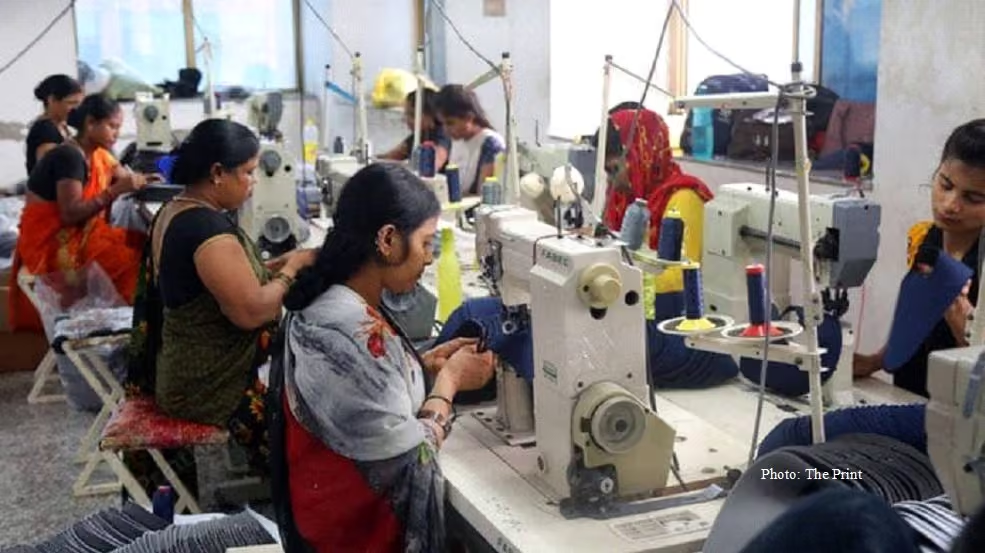
“97% of Indian women are married by age 30.”
NCAER’s Prof. @SonaldeDesai on how marriage traditions, family expectations and social standing shape household spending in India’s estimated $130 billion #weddingeconomy, in @business_today.
www.businesstoday.in/india/story/indias-big-fat-wedding-s…
National Council of Applied Economic Research
National Council of Applied Economic Research (NCAER) is India’s oldest and largest independent, non-profit, economic policy research think tank. Established in New Delhi in 1956, it acquired considerable national and international standing within only a few decades of its founding. It is one of a handful of think tanks globally that combine rigorous analysis and policy outreach with deep data collection capabilities, especially for household surveys. More on Wikipedia
-
NCAER
@ncaer
-
NCAER
@ncaer
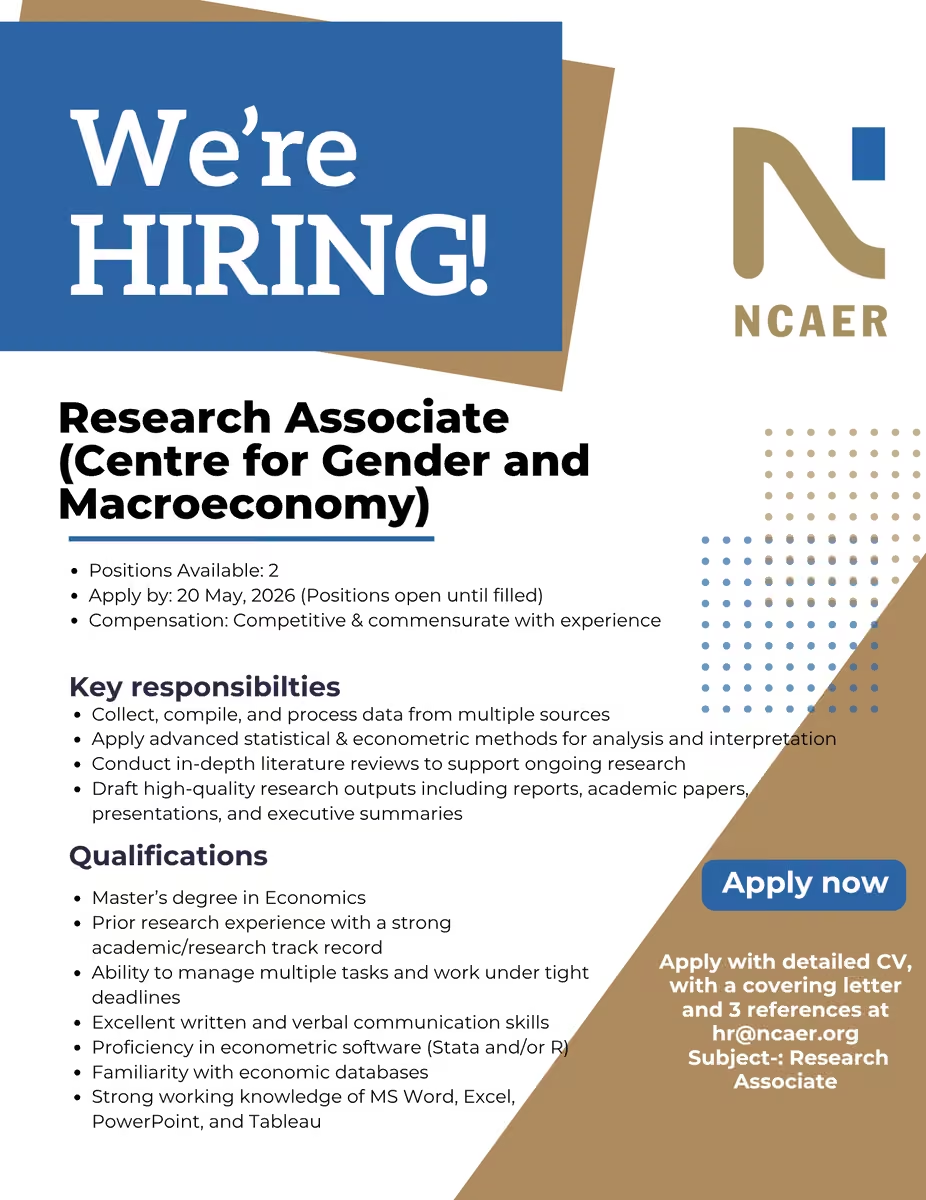
NCAER is Hiring!
We invite applications for the position of Strategic Associate – Research & Communications Outreach at NCAER, New Delhi.
Join our research and communications team to amplify the impact of policy research through strategic communication, digital engagement, and compelling storytelling.
Apply here: ncaer.org/career/strategic-associate-research-communicati… -
NCAER
@ncaer
NCAER congratulates Prof. @Pallavi_Econ, Professor and Deputy Director at the NCAER–National Data Innovation Center (NDIC), on her appointment to the Technical Advisory Group (TAG) for Household Surveys of the National Sample Survey (NSS), constituted by the Ministry of Statistics and Programme Implementation (@GoIStats).
The appointment recognises her expertise on technical aspects related to India's household surveys and data ecosystem. -
NCAER
@ncaer
NCAER is Hiring!
The National Council of Applied Economic Research (NCAER) invites applications for two Associate Fellows at its Centre for Employment, Entrepreneurship and Productivity (CEEP), New Delhi.
Be part of a dynamic research team focused on employment generation, labour markets, entrepreneurship, skills, and productivity. Contribute to evidence-based research that informs public policy and helps expand economic opportunities across India.
Recent PhD graduates are strongly encouraged to apply!
For more, please click here: ncaer.org/career/associate-fellow-centre-for-employment-e… -
NCAER
@ncaer
NCAER is Hiring!
The National Council of Applied Economic Research (NCAER) invites applications for a Senior Fellow at its Centre for Employment, Entrepreneurship and Productivity (CEEP), New Delhi.
Join our team and contribute to research and policy initiatives shaping India's employment landscape, labour markets, entrepreneurship, and productivity.
Apply now!
For detailed information about the positions, eligibility criteria, and application process,
visit: ncaer.org/career/senior-fellow-centre-for-employment-entr…
Application Deadline: December 20, 2026 -
NCAER
@ncaer
How can gender data help identify gaps in girls’ learning and transitions to education and employment? NCAER’s Prof. @Pallavi_Econ moderated “Beyond Enrolment: Girls’ Learning, Choices and Transitions” at the National Conference on #genderdata and #statistics in New Delhi.
NCAER
@ncaer
Organised by @GoIStats and @unwomenindia. Key takeaways:
➡️Go beyond enrolment: foundational learning, STEM, technical and vocational pathways
➡️Target rural girls and SC and ST girls
➡️Link education, skilling and labour-market systems with gender data -
NCAER
@ncaer
#makeinindia added 14.4 million manufacturing workers, but output per worker barely moved and the self-employed share rose from 42.2% to 47.8% (Periodic Labour Force Survey, 2017-18 to 2023-24). NCAER’s @Iamjyotithakur and Dhruv Pratap Singh: tie incentives to salaried jobs.
-
NCAER
@ncaer
Irrigation helps climate resilience, but it’s not enough. NCAER’s study of 57 projects across 20 States: 68% of command-area households reported higher productivity and incomes; 67% outside reported stagnation or decline.
Read: www.thehindubusinessline.com/opinion/irrigation-helps-in-… #climateresilience -
NCAER
@ncaer
"Greater equality in care work, plus formal part-time jobs, could lift India’s female labour force participation from 37% to 43%,” says NCAER’s Dr @aakash_dev94.
He shared the findings at a recent @ADB_HQ - @gatesfoundation workshop in Jakarta.
Read NCAER Working Paper No. 178: -
NCAER
@ncaer
Women’s safety is an economic imperative.
Safer infrastructure, gender-sensitive education and inclusive workplaces are key to bringing more women into quality jobs and unlocking India’s growth potential.
NCAER’s @BornaliBhandari writes in @businessline.
🔗ncaer.org/publication/womens-safety-is-crucial-to-indias-…
#womenssafety #economicgrowth -
NCAER
@ncaer
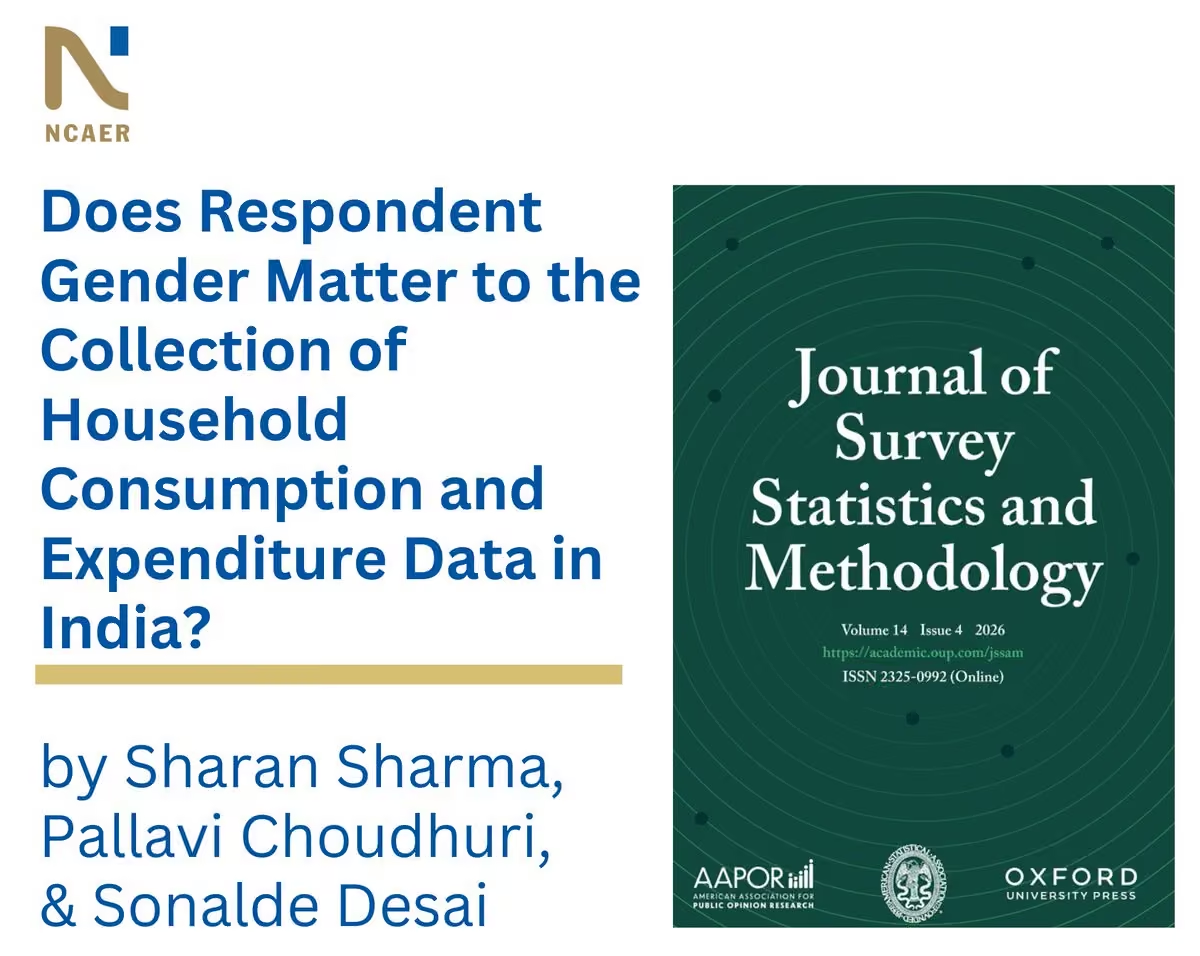
📢 New paper: "Does respondent gender influence the measurement of household consumption and expenditure categories?
Drawing on IHDS-III data, NCAER faculty and IHDS team members Sharan Sharma, Pallavi Choudhuri and Sonalde Desai examine gender differences in reported consumption and expenditure across 34 categories. Published in the Journal of Survey Statistics and Methodology, the study finds that gender differences in expenditure reporting vary across categories, while remaining generally modest.
Key findings:
1. Gender effects are generally modest but vary across expenditure categories, with female respondents reporting lower non-zero values in 10 of the 13 categories analysed.
2. Annual education expenses show a notable exception: female respondents report approximately 17% higher average expenses than male respondents.
3. Shopping and expense-management responsibilities partially explain gender differences, while age, education and assistance during interviews have moderating effects on non-zero reported values.
The findings illustrate why respondent gender may need to be considered when interpreting household expenditure estimates and assessing survey measurement practices.
@snsharma | @Pallavi_Econ | @SonaldeDesai
Read More: academic.oup.com/jssam/advance-article/doi/10.1093/jssam/… -
NCAER
@ncaer
We are inviting applications for the position of Associate Fellow – Centre for Gender and Macroeconomy (CGME) at the National Council of Applied Economic Research (NCAER), New Delhi.
Join our team and contribute to advancing research on gender equality, women's economic participation, and the macroeconomic implications of gender gaps in India.
Apply Now: ncaer.org/career/associate-fellow-centre-for-gender-and-m…
For detailed information about the role, eligibility criteria, and application process, visit: ncaer.org
Application Deadline: November 15, 2026 -
NCAER
@ncaer
At MARG 2026, a conversation on scaling urban roads transformation across states and cities with:
➡️ Shri @krishnabgowda, Minister, @GBA_office, @Govt_Karnataka
➡️ Smt. Usha Padhee, Additional Chief Secretary, HUDD, Government of Odisha
➡️ Alka Upadhyaya, Former Secretary, Ministry of Road Transport & Highways - India
Moderated by Nithya Ramesh, Director, Planning and Design, @janausp
--
MARG 2026 is organised by the NCAER, Jana Urban Space Foundation, and @Janaagraha1.
#marg2026 #transformingurbanroads #urbanroads -
NCAER
@ncaer
Insights from our panel on Financing India’s urban roads at MARG 2026:
➡️Alka Upadhyaya
➡️Abhay Kantak
➡️Abhishek Chhajer
➡️Sujit Kumar
➡️Tushar Thakkar
Moderated by Vivek Brimrawh, Consulting Head - Stakeholder Relations, NCAER.
#marg2026 is organised by NCAER, @janausp and @Janaagraha1 -
NCAER
@ncaer
“India has transformed the journey between its cities. Together, we can now transform everyday journeys within them.”
Shri @nitin_gadkari, Union Minister of Road Transport and Highways, at #marg2026, organised by NCAER, @janausp and @Janaagraha1. -
NCAER
@ncaer
Watch now: Shri @nitin_gadkari delivers the keynote at MARG 2026 on what on what the experience of building India’s highways can teach the planning and building of city roads, hosted at NCAER with @janausp and @Janaagraha1. [youtube.com/live/Yq5DqQ28vjg] #urbanroads
-
NCAER
@ncaer
Does education move everyone towards better employment at the same pace?
New research using panel data from NCAER’s India Human Development Survey (IHDS) examines how college education influences access to white-collar employment among young men in India. The study finds that while higher education can help individuals move out of casual work and into more secure occupations, the occupational advantages associated with a college degree are not shared equally. These findings highlight how social and economic advantages can reinforce existing inequalities even as access to higher education expands.
@SonaldeDesai | @Pallavi_Econ | @ihdscorner
Read the issue to explore the findings: ncaer.org/wp-content/uploads/2026/10/IHDS-Research-Digest… -
NCAER
@ncaer
What happens when households must borrow to meet the costs of healthcare?
New research using two rounds of NCAER’s India Human Development Survey (IHDS) examines the links between non-communicable disease (NCD)-related healthcare expenditure, household borrowing, and impoverishment in India. The study finds that incorporating loan repayments into assessments of household welfare reveals levels of financial distress that conventional consumption-based measures often overlook.
@ihdscorner
Read the issue to explore the findings: ncaer.org/wp-content/uploads/2026/10/IHDS-Research-Digest… -
NCAER
@ncaer
Explore the latest findings from the October edition of the IHDS Research Digest📊
Using NCAER’s India Human Development Survey data, this issue features two studies that examine: (a) how borrowing to meet non-communicable disease-related healthcare costs can deepen household impoverishment, and (b) how the occupational benefits of higher education vary across socioeconomic backgrounds. Together, these studies underscore how financial vulnerability and unequal access to opportunities continue to shape household well-being and reinforce persistent socioeconomic disparities.
@ihdscorner
Read the issue to explore the findings:
ncaer.org/wp-content/uploads/2026/10/IHDS-Research-Digest… -
NCAER
@ncaer
NCAER’s India Human Development Survey finds a surprising omission of births from women’s birth histories.
Post not available here, view on X
NCAER
@ncaer
Research Team: Sharan Sharma, @SonaldeDesai , @DebasisBarik25 and Om Prakash Sharma.
Read more:
N-IUSSP Weekly Newsletter: Gone and forgotten? Omissions of birth histories in an Indian survey
www.niussp.org/fertility-and-reproduction/gone-and-forgot…
NCAER
@ncaer
Original Research Article: Sharma, S., Desai, S., Barik, D., & Sharma, O. P. (2024). Gone and forgotten? Predictors of birth history omissions in India. Demographic Research, 50, 929–966.
doi.org/10.4054/DemRes.2024.50.32 -
NCAER
@ncaer
NCAER is Hiring!
We are inviting applications for the position of Senior Executive (HR) at the National Council of Applied Economic Research (NCAER), New Delhi.
Join our team and contribute to an organisation at the forefront of economic research and policy engagement in India.
Apply Now!
For detailed information about the role, eligibility criteria and application process, visit: ncaer.org/career/senior-executive-hr/
#hiring #careersatncaer #jobopening #seniorexecutive #ncaer -
NCAER
@ncaer
If AI improves faster than we evolve, speed, chess, theorem proving and even consciousness are all temporary lines. Almost any boundary you set [for a self-designing system] will be crossed at some point. Marshall Van Alstyne (@InfoEcon), Allen & Kelli Questrom Professor at @BU_Tweets raises these concerns at NCAER. Watch: www.youtube.com/watch?v=xGVB3ifz70k&list=PLf2SdT9259Pg&in…
This media couldn't be displayed. See it on the original post. -
NCAER
@ncaer
NCAER successfully conducted a two-day workshop on 15–16 October 2026, which was led by Professor @poonam_munjal and her team, to build the capacity of Government of Andhra Pradesh officials in using GST outward supply data for GSVA estimation and the analysis of monthly sectoral trends, under the state’s AI Task Force initiative.
@Iamjyotithakur | @yashika_khattar -
NCAER
@ncaer
Classic randomized control trials won’t work for clinical AI.
Adapa Karthik, Regional Advisor for Digital Health, @WHO: “You would automatically see the model that you had in the beginning of the intervention is not the same model that is going at the end.”
Watch here:This media couldn't be displayed. See it on the original post. -
NCAER
@ncaer
Passionate about the future of AI and Digital Public Infrastructure?
Join NCAER as a Research Associate at the Centre for AI, Digital Public Infrastructure, and Digital Futures (CADF). Contribute to cutting-edge research shaping India’s digital transformation.
#cadf #artificialintelligence #digitalpublicinfrastructure #digitaltransformation #research
Apply here: ncaer.org/career/research-associate-centre-for-ai-digital… -
NCAER reposted
NCAER
@ncaer
Passionate about advancing sustainable energy infrastructure?
Join NCAER as Strategic Associate – Energy Sector at the Centre for Economics of Transportation, Mobility and Logistics (CETML).
#cetml #urbanmobility #infrastructuredevelopment #energy
Apply here: -
NCAER
@ncaer
“It’s not for the lack of information. It’s about connecting the right people to the right set of information that they actually need.” Uttara Madurai Ananthkrishnan, her research on the last mile of #technologyadoption shows it needs sustained follow-up, not just awareness.
Watch full: youtu.be/BOxlPou8b2kThis media couldn't be displayed. See it on the original post. -
NCAER
@ncaer
“India faces a gap between its infrastructure investment needs and the finance available. Patient, long-term capital such as sovereign wealth funds will be essential to bridging it.”
Mr. Suresh Goyal, Director General, NCAER, said at the 99th Perspectives Lecture of the School of Public Policy and Governance, @PolicyTiss Hyderabad, on Friday.
Key takeaways:
→ Infrastructure Investment Trusts, regulated by the Securities and Exchange Board of India (@SEBI_updates), let governments and developers recycle capital from operating assets into new projects.
→ They give institutional and retail investors access to stable, infrastructure-backed cash flows, as seen in the National Highways Infra Trust (which Mr. Goyal set up and led).
→ The InvIT market has grown rapidly, but India’s infrastructure financing gap remains wide.
→ Evolving public-private partnership models need contractual safeguards that balance investor returns with public accountability.
Watch our podcast episode to learn more: www.youtube.com/watch?v=tpDapezIG38
#infrastructurefinance #assetmonetisation -
NCAER
@ncaer
After four consecutive quarters of moderation, mainly due to prolonged geopolitical tensions, business sentiment improved in Q2 FY2026-27 ahead of the festive season. The Business Confidence Index (BCI), a measure of business sentiments, rose from 99.8 in Q1 to 107.8 in Q2, according to the latest NCAER Business Expectations Survey.
Read here: ncaer.org/publication/the-ncaer-business-expectations-sur…
@BornaliBhandari | Ajaya Sahu | Isha Dayal | Kemparajeurs Subbarajeurs -
NCAER
@ncaer
NCAER welcomes Mr. Pranavant.
We are delighted to welcome Mr. Pranavant as Head - Program Management at the Centre for Economics of Transportation, Mobility and Logistics (CETML), effective 19 October 2026. With nearly four decades of experience in transport infrastructure, financing, and urban mobility, he brings deep expertise and leadership to the Centre.
We look forward to his contributions in strengthening the Centre's work and expanding its impact. -
NCAER
@ncaer
The Sixteenth Finance Commission has recommended grants totalling Rs. 7.91 lakh crore for duly constituted rural and urban local bodies for the period 2026–27 to 2030–31.
NCAER faculty member @sauban_10 argues that the Union Finance Commission must ensure continuity and predictability in local body financing while leveraging its financial support to strengthen State Finance Commissions.
Read more: ncaer.org/publication/strengthening-institutions-of-state… -
NCAER
@ncaer
Passionate about advancing sustainable energy infrastructure?
Join NCAER as Strategic Associate – Energy Sector at the Centre for Economics of Transportation, Mobility and Logistics (CETML).
#cetml #urbanmobility #infrastructuredevelopment #energy
Apply here: -
NCAER
@ncaer
NCAER Visiting Professor, Kumar V. Pratap, argues that the Government should introduce safeguards in the upcoming round of airport privatisation.
Specifically, it should cap the number of airports that can be awarded to a single bidder and ensure that the bidding parameter is not treated as a cost to be recovered through higher user development fees charged to passengers.
Read more: ncaer.org/publication/restoring-sanity-in-airport-privati… -
NCAER
@ncaer
Almost 40% of India’s rise in workforce participation came from agriculture.
On #futureofwork, @kanmahajan says every sector is growing, but “we are really not able to move people out from the farm to the non-farm sector.”
Full conversation: www.youtube.com/watch?v=FX00cjIZFr8This media couldn't be displayed. See it on the original post. -
NCAER
@ncaer
NCAER Faculty Member, @aakash_dev94, participated in the Jobs and Development Conference, held on 9-10 October 2026 at the Hong Kong University of Science and Technology (HKUST), Hong Kong, where he presented a working paper titled “Households, Frictions and Gender Gap: A Search Model of Labour Force Participation in India.” The conference was hosted by the HKUST Institute for Emerging Market Studies (IEMS) and co-organised by the World Bank Group, UNU-WIDER, the International Labour Organization (ILO), the Development Policy Research Unit (DPRU) at the University of Cape Town, and the Institute for Structural Research (IBS), Poland.
The paper investigates the factors underlying India’s gender gap in labour force participation, with a particular focus on the interaction between household responsibilities and labour market frictions. The findings underscore the importance of policies aimed at reducing household constraints, improving labour market access, and creating an enabling environment for greater female workforce participation -
NCAER
@ncaer
In the latest episode of Parisila Perspectives, Dr. Ratna Sahay, Professor, NCAER, emphasizes Bihar’s bifurcation burden, and Jharkhand’s advantage. “When it came to the financial liabilities, that was divided according to the population, so most of their liabilities went to Bihar."
#bihar #publicfinance #statefinances #viksitbharat
🎙️ Full episode here: youtube.com/watch?v=BQKUi3V1pPgThis media couldn't be displayed. See it on the original post. -
NCAER
@ncaer
The IEPF Chair Unit at NCAER, in collaboration with NISM, Mumbai, organised the IEPFA–NCAER Investor Education & Protection Seminar at NISM on 8 October 2026 as part of the celebrations for #worldinvestorweek2026.
The seminar, themed “The Future is Now: Gen Z Driving Universal Digital Financial Education for Viksit Bharat,” underscored the pivotal role of young investors in advancing universal digital financial literacy and strengthening investor protection in the evolving financial ecosystem.
Speakers included Mr. Suresh Goyal, DG, NCAER; Mr. Sanjay C. Purao, Executive Director, SEBI; Mr. Sashi Krishnan, Director, NISM; and Dr. @csmohapatra_dr, IEPF Chair Professor, NCAER. The speakers encouraged participants to become financially informed, digitally empowered, and responsible contributors to the vision of Viksit Bharat. -
NCAER
@ncaer
"We need to ask whether policy implementation is gender-sensitive, responsive, or transformative," said Dr @BornaliBhandari, Professor and Co-Director of the Centre for Gender and Macroeconomy, NCAER, in her opening comments as Chief Guest at book launches of Gender Mainstreaming & Development and Gender and Inclusive Development.
-
NCAER
@ncaer
In India, a college education is not a ticket to prosperity, unless you are already privileged - the reverse is true in the US where a college degree offers a good chance of a better life.
Post not available here, view on X
NCAER
@ncaer
They compare #highereducation outcomes for disadvantaged youth in India and the US. Find more insights and questions in their chapter: ncaer.org/publication/indias-occupational-transformation-…
NCAER
@ncaer
The Indian Economy: Navigating a Global Turning Point, edited by @kaushikcbasu, Sonalde Desai, @_ADeshpande and Nirvikar Singh (@simonschuster), 2026) is available: www.simonandschuster.com/books/The-Indian-Economy/Kaushik…
-
NCAER reposted
NCAER
@ncaer
🔊Calling all former NCAER researchers, consultants, faculty, and staff — we'd love to reconnect!
NCAER Connect is open, an alumni network designed to:
→ Reconnect NCAER alumni with each other
→ Expand professional networks
→ Collaborate on research and impact initiatives
→ Share knowledge and resources
→ Mentor future talent
→ Stay engaged with the NCAER fraternity
🔗Sign up: forms.gle/6tezfXBwX7n4wJRZ9 -
NCAER
@ncaer
What Pathways Do Households Use to Access Essential Services?
Drawing on NCAER’s India Human Development Survey (IHDS-II) data, recent research examines how urban households leverage different forms of social networks to access essential services under varying housing conditions. The study explores the role of both patronage-based relationships and collective-action networks in helping households navigate challenges related to service provision. The findings indicate that households experiencing greater material precarity and poorer housing conditions are more likely to rely on both patronage and collective-action mechanisms to secure access to basic services.
@borateaishwarya | @amu_ser | @ihdscorner
Read the issue to explore the findings: ncaer.org/wp-content/uploads/2026/09/IHDS-Research-Digest… -
NCAER
@ncaer
Bihar "missed the boat on the #greenrevolution, partly because land was hugely fragmented," says Dr. Ratna Sahay, NCAER, on Parisila Perspectives.
🎙️ Full episode here: youtube.com/watch?v=BQKUi3V1pPgThis media couldn't be displayed. See it on the original post. -
NCAER
@ncaer
What Role Does Irrigation Play in Shaping Household Diets?
Using NCAER’s India Human Development Survey (IHDS-II) data, recent research explores irrigation as a potential pathway linking agricultural inputs with household nutrition. The study examines whether improved access to irrigation contributes to better food consumption patterns and enhanced dietary quality among farming households. The findings suggest that while irrigation can increase agricultural productivity and household incomes, greater access to irrigation does not automatically translate into more diverse or nutritious diets.
Read the issue to explore the findings: ncaer.org/wp-content/uploads/2026/09/IHDS-Research-Digest…
@rajan_abhis | @OlesyaAgEcon | @ihdscorner -
NCAER
@ncaer
NCAER’s latest Monthly Digest for September 2026 is out!
Check out our latest Research, Publications, Events, and Other Offerings.
Read here: mailchi.mp/4c2401cc4b38/feb-73393 -
NCAER
@ncaer
Explore the latest findings from the latest edition of the IHDS Research Digest.
Drawing on data from the NCAER India Human Development Survey (IHDS), the latest edition of the NCAER IHDS Research Digest features two insightful studies. The first examines the relationship between irrigation, food consumption, and diet quality among farming households, highlighting the role of irrigation in shaping nutritional outcomes. The second explores how housing conditions influence the use of patronage and collective-action networks for accessing basic services. Together, these studies provide valuable insights into the ways in which socioeconomic and material conditions intersect with access to services, resources, and overall household well-being.
Read the issue to explore the findings:
ncaer.org/wp-content/uploads/2026/09/IHDS-Research-Digest… -
NCAER
@ncaer
Recognising the importance of digital financial literacy, informed financial decision-making, and investor protection among Gen-Z, NCAER's IEPF Chair Unit, in collaboration with @SNUChennai, organised the Investor Education & Protection Workshop at Shiv Nadar University Chennai on 28 September 2026 on the theme “Digital Financial Literacy: Gen-Zs as Catalysts for Investor Education & Protection towards Viksit Bharat.”
The IEPF Chair Professor @csmohapatra_dr moderated the discussion and underscored the critical role of Gen-Z in fostering responsible investing, enhancing financial awareness, and promoting investor protection in an increasingly digital financial ecosystem. -
NCAER
@ncaer
NCAER is pleased to inform that the IEPF Chair Professor @csmohapatra_dr and Senior Research Analyst, @Depannita2 have contributed a chapter titled “Financial Inclusion for Viksit Bharat: Sustained Literacy, Trust, and Access for All” in the edited book Financial Inclusion for Viksit Bharat: Innovations, Evidence and Pathways Toward Equitable Development, published by Palgrave Macmillan in 2026.
The chapter explores key dimensions of financial inclusion, emphasising sustained financial literacy, trust-building, and equitable access as critical enablers of a Viksit Bharat.
link.springer.com/book/10.1007/978-981-92-0807-4 -
NCAER
@ncaer
India’s permanent-magnet challenge goes beyond securing rare-earth minerals.
NCAER faculty members Suvajit Banerjee and @PohitSanjib and research staff @mondal_sovini write that India’s permanent-magnet challenge is not just about securing rare-earth minerals or reducing imports, but understanding where technological dependence accumulates across the value chain. The Integrated Techno-Economic Mapping (ITEM) framework maps the chain stage by stage to identify capability gaps and strategic technology chokepoints, providing an evidence base for targeted industrial policy
Read more: ncaer.org/publication/missing-measure-in-indias-magnet-mi… -
NCAER
@ncaer
In Bihar, secondary education was 16% in 2005. Free cycles for girls "accelerated enrollment to 65%," says Dr. Ratna Sahay, Professor, NCAER on Parisila Perspectives.
🎙️ Full episode here: youtube.com/watch?v=BQKUi3V1pPgThis media couldn't be displayed. See it on the original post. -
NCAER
@ncaer
Can digital protection and opportunity for children go hand in hand?
A new Op-Ed by NCAER faculty @DibyasreeG, co-authored with @garimaagar54890 of The Quantum Hub, draws on findings from the India Human Development Survey (IHDS-III). The article calls for a balanced approach to online safety—one that addresses potential harms while preserving children’s opportunities to learn, connect and build digital capabilities. It also highlights the need to account for existing inequalities in digital access and participation when designing policies for a safer digital environment.
@ihdscorner | @tqh_policy
Read more: ncaer.org/publication/create-the-right-digital-ecosystem-… -
NCAER
@ncaer
"There cannot be a #viksitbharat without viksit states."
📢 Out today: The Road to Viksit Bharat on Parisila Perspectives, with Suresh Goyal, Director General, NCAER, and Dr. @ratna_sahay, NCAER, on Bihar.
🎙️ Watch here: www.youtube.com/watch?v=BQKUi3V1pPg
Co-authors: @santosh_econ | @Prof_Nishith_P |
@aakash_dev94
#viksitbharat #bihar #sustainabledevelopmentgoals #publicpolicy -
NCAER
@ncaer
India’s digital agriculture transformation must turn data into better decisions for farmers.
NCAER faculty member Saurabh Bandyopadhyay (@sauban_10) writes that India’s digital agricultural transformation is creating unprecedented visibility into farms. The next challenge is to build the institutional and economic links that turn information into action—and action into better outcomes for farmers. A satellite image is not the outcome; a better decision is.
Read more: ncaer.org/publication/now-that-india-can-see-its-farms-wh… -
NCAER
@ncaer
"There cannot be a #viksitbharat without viksit states." Suresh Goyal, Director General, NCAER, and Dr.
@ratna_sahay, NCAER, on why Bihar is key, in The Road to Viksit Bihar on Parisila Perspectives.
🎥 Full episode out tomorrow.
www.youtube.com/embed/y2WYuDYo5Ks
Co-authors: @santosh_econ | @Prof_Nishith_P | @aakash_dev94
#viksitbharat #bihar #sustainabledevelopmentgoals #publicpolicyThis media couldn't be displayed. See it on the original post. -
NCAER
@ncaer
Better longitudinal data is key to understanding women’s work and empowerment.
NCAER faculty Sonalde Desai recently participated in the webinar Gender Data That Drives Change: Celebrating Ten Years of Global Partnership through EMERGE, hosted by Newcomb Institute. Alongside experts from the World Bank, ICRW Africa and UN Women, Professor desai highlighted the need for longitudinal datasets to better capture women’s work and empowerment over time and understand their trajectories. The discussion also explored how gender data can inform policy and programmes and priorities for strengthening gender data and evidence.
@SonaldeDesai, @AnitaRajNewcomb, @newcombinst, @AletheiaDonald, @Evelyne_Opondo, @PABSeck -
NCAER
@ncaer
Closing the financial literacy gap for India’s gig workers.
NCAER IEPF Chair Professor @csmohapatra_dr and research staff @Depannita2 write that gig workers in India face a financial literacy gap that can affect their ability to manage irregular incomes, insurance and taxes. They call for targeted policy measures, financial education and platform-based solutions to strengthen workers’ financial well-being.
Read here: ncaer.org/publication/lets-financially-equip-gig-workers/ -
NCAER
@ncaer
How might India’s changing population dynamics reshape its regional economic and political landscape?
In a new interview with @Bloomberg TV, NCAER faculty Professor @SonaldeDesai discusses the interplay between population ageing in southern India, migration from northern states, differences in employment structures and changing patterns of political representation. Featured in a segment titled “India’s Silicon Valley Is Straining Under Its Own Growth” as part of Bloomberg TV’s Wall Street Week, Professor Desai’s observations highlight the complex relationship between demographic change, employment and regional political power as India undergoes a broader economic and demographic transition.
Watch the interview here:
finance.yahoo.com/video/indias-silicon-valley-straining-u… -
NCAER
@ncaer
India has spent years preparing for ethanol. The next challenge is preparing the infrastructure to carry it.
NCAER faculty member @PohitSanjib and research staff @mondal_sovini write that India’s E20 transition is often viewed through the lens of engine mileage, vehicle compatibility and performance. But E20 is not only an engine story. Its success will also depend on whether blending facilities, underground storage tanks, pipelines, pumps, seals and leak-detection systems are ready for a changing fuel regime.
Read more: ncaer.org/publication/indias-e20-transition-needs-to-look… -
NCAER
@ncaer
Growth gains must widen: Better jobs and more productive firms are the next test.
NCAER faculty member @sauban_10 writes that India’s growth story is entering an important new phase. Rising corporate profitability, stronger investment, improved infrastructure and expanding digital connectivity have created a solid foundation for sustained growth. The next challenge is to translate these gains into wider industrial capacity, better-quality jobs, more productive firms and greater economic mobility.
Read more: ncaer.org/publication/growth-gains-must-widen/ -
NCAER
@ncaer
Since 2021, investor participation in India's National Highway Infrastructure Trust grew from 27 to 600+. Assets under management grew from ₹8,000 crore to ₹50,000 crore+. How?
In the latest episode of Parisila Perspectives, Suresh Goyal, Director General, NCAER, recounts setting up the Trust from scratch in 2020–21 and traces the growth that followed.
🎙️ Full episode here: youtu.be/tpDapezIG38
@jagannarayan | @NHAI_OfficialThis media couldn't be displayed. See it on the original post. -
NCAER
@ncaer
🔊Calling all former NCAER researchers, consultants, faculty, and staff — we'd love to reconnect!
NCAER Connect is open, an alumni network designed to:
→ Reconnect NCAER alumni with each other
→ Expand professional networks
→ Collaborate on research and impact initiatives
→ Share knowledge and resources
→ Mentor future talent
→ Stay engaged with the NCAER fraternity
🔗Sign up: forms.gle/6tezfXBwX7n4wJRZ9 -
NCAER
@ncaer
Kumar V Pratap underscores the need for higher infrastructure investment, significantly more private participation in the space and for government data on infrastructure investments versus targets in an op-ed for the The Economic Times @ET_Marketing (Sep 18).
He is a Professor of Practice at @ShivNadarUniv and a Visiting Professor at NCAER.
Read the full article here: ncaer.org/publication/are-we-seeing-a-turnaround-in-infra… -
NCAER
@ncaer
Our Centre for Health Economics, together with PATH's Centre for Health Research and Innovation, convened the 16th Future Trends Forum earlier this month — bringing together government, industry, and global health leaders from over 10 countries.
Read more: -
NCAER
@ncaer
To draw long-term capital into India's #infrastructure, government should "focus sharply on expanding the basket of assets for monetisation," says Suresh Goyal, Director General, NCAER, at the 13th SBI Banking & Economics Conclave (@TheOfficialSBI) in Mumbai today.
-
NCAER
@ncaer
We welcome Dr. Indu Bhushan (@ibhushan) as Chair of the Advisory Council, Centre for Health Economics. Founding CEO of Ayushman Bharat PM-JAY — the world's largest publicly funded health-insurance scheme — and former Director General for East Asia at the Asian Development Bank (@ADB_HQ). #healtheconomics
-
NCAER
@ncaer
Resilience must be built into every layer of India's infrastructure, says Jagannarayan Padmanabhan, CRISIL Intelligence.
In the latest episode of Parisila Perspectives, he discusses domestic manufacturing of tunnel boring machines, energy security, and diversifying supplier bases as global trade routes shift.
🎙️ Full episode here: www.youtube.com/watch?v=tpDapezIG38This media couldn't be displayed. See it on the original post. -
NCAER
@ncaer
NCAER is pleased to share that Professor @SonaldeDesai and Dr @Pallavi_Econ have contributed a chapter, “India’s Occupational Transformation: A Tale of Two Escalators,” to The Indian Economy: Navigating a Global Turning Point, edited by Kaushik Basu, Sonalde Desai, Ashwini Deshpande, and Nirvikar Singh, and published by Simon & Schuster, New York, in 2026.
-
NCAER
@ncaer
NCAER’s IEPF Chair Unit, in collaboration with @SRCCOfficial, organised the IEPFA–NCAER Investor Education & Protection Annual Conference 2026–27 on “Building Financially Resilient Youth: Sustainable Digital Financial Literacy & Investor Protection towards Viksit Bharat” at SRCC, University of Delhi, on 8 September to mark International Literacy Day.
The conference brought together policymakers, financial-sector experts, academicians and practitioners, including Professor Simrit Kaur, Principal, SRCC; Dr Prabodh Seth, Former Member, CBDT; Mr Suresh Goyal, DG, NCAER; Mr H R Khan, Former Deputy Governor, RBI; and Professor @csmohapatra_dr, IEPF Chair. Speakers emphasised the importance of sustained digital financial literacy, informed investment behaviour and stronger investor protection in building financially resilient youth. -
NCAER
@ncaer
“Women’s health does not begin with pregnancy, nor end with childbirth. It is shaped across the life course, making a life-course approach essential for women’s full participation in India’s demographic dividend and the vision of Viksit Bharat 2047,” said NCAER faculty member, @DibyasreeG, during a panel discussion on “Beyond Survival: Maternal Health and Child Health, Gender and India’s National Priority,” convened by @armmanindia in partnership with @innbreakthrough.
The discussion, moderated by journalist Priya Ramani featuring Dr @Ajay_ajKhera, @EngenderHealth and @hegde_aparna , ARMMAN, examined how gender shapes women’s and children’s health outcomes, and why maternal and child health must be central to gender equality, women’s economic participation, and India’s vision of Viksit Bharat 2047. -
NCAER
@ncaer
📢New episode of Parisila Perspectives, NCAER's podcast series, out today!
Suresh Goyal, Director General, NCAER, and @jagannarayan Padmanabhan, Crisil Intelligence, discuss:
They discuss:
➡️ Why we need a systems-thinking approach when building for transport, mobility and logistics
➡️ Lessons from tunnel boring machine shortages, energy security concerns, and the limited size of India's flagged shipping fleet
➡️ Unlocking domestic capital — insurance, pensions, InvITs and retail investors — as the next wave of infrastructure financing
➡️ The National Highway Infrastructure Trust's growth: investor participation rising from nearly 27 to over 600, and assets under management rising from ₹8,000 crore to over ₹50,000 crore
🎙️ Watch here: youtu.be/tpDapezIG38 -
NCAER
@ncaer
🎙️How can gender data inform policy change?
Join Dr. @SonaldeDesai (Professor and Centre Director, NCAER-NDIC), Dr. @AletheiaDonald (Senior Economist, @WorldBankAfrica), and Ms. @Evelyne_Opondo (Executive Director, International Center for Research on Women (@ICRW), Africa) for a webinar on, “Gender Data that Drives Change: Celebrating Ten Years of Global Partnership through EMERGE," organised by EMERGE and @Tulane University.
🗓️Sept 23, 2026
⏰8:30–10:00 PM IST
🔗 Register: tulane.zoom.us/webinar/register/WN_zvsZeWmNT5eiikpn4el98Q -
NCAER
@ncaer
India needs ₹145–155+ lakh crore in infra investment over the next 5 years — nearly 2x the last five.
How are we building for resilience?
In this episode of Parisila Perspectives, Suresh Goyal, DG, NCAER, sits down with Jagannarayan Padmanabhan, Senior Director and Global Head at CRISIL Intelligence, to explore why India's next decade of infrastructure has to be about systems-thinking, resilience, and financing at scale.
🎥 Full episode out tomorrow.
www.youtube.com/watch?v=qO2B6QqJEXUThis media couldn't be displayed. See it on the original post. -
NCAER
@ncaer
NCAER announces the release of NCAER’s Annual Report, highlighting the Institute’s research, policy engagement, publications, and key initiatives over the past year.
The report reflects NCAER’s continued commitment to advancing evidence-based economic research and contributing to informed policymaking in India.
Read here: ncaer.org/wp-content/uploads/2026/09/NCAER_AR_2025-26.pdfThis media couldn't be displayed. See it on the original post. -
NCAER
@ncaer
“Integrated human development is key to harnessing our demographic dividend.” The plus-one Anganwadi idea by @karthik_econ
"We need to focus on integrated human development, spanning nutrition and early-childhood education in the early years," says the Tata Chancellor's Professor of Economics at the University of California, San Diego and Non Resident Senior Fellow at NCAER.
His argument, backed by a large-scale RCT in Tamil Nadu finds:
→ India has among the highest child stunting rates in the world, and low school readiness
→ Most of the learning gap between public and private schools opens up between ages 3 and 5
→ Anganwadis today function mostly as daycare, not early education
→ Adding one extra Anganwadi worker, focused on pre-school education, produces dramatic gains in learning outcomes and a meaningful drop in stunting within 18 months
→ Estimated ROI: 12–20x the cost — roughly 2,000% returnsThis media couldn't be displayed. See it on the original post. -
NCAER
@ncaer
NCAER is pleased to announce the release of its Working Paper, “The Fiscal Landscape of West Bengal: Performance, Challenges and a Roadmap for Consolidation,” by Anil K Sharma, Aswathi Nair, Arjita Chandna, Meevel Jerry, Nishtha Kanodia, and Shubhangi Saxena.
The paper examines West Bengal’s fiscal performance, key challenges to fiscal sustainability, and priorities for fiscal consolidation, benchmarking the State against all States and Odisha. It identifies pathways to strengthen resource mobilisation and expenditure management, raise capital outlays, and build greater fiscal resilience.
Read paper: ncaer.org/publication/the-fiscal-landscape-of-west-bengal… -
NCAER
@ncaer
India’s young men and women are aspirational—and willing to wait for the careers they want.
NCAER Visiting Faculty member Farzana Afridi argues that while the new labour codes are a step in the right direction, creating “good” jobs and genuine career pathways—not merely employment—is no longer optional. Failure to create such opportunities risks squandering the potential of an entire generation.
Read more: ncaer.org/publication/what-the-young-want-and-why-creatin… -
NCAER
@ncaer
"We have the capital, but lack the supply of investable propositions, and the credibility of the counterparties offering them," said Mr Suresh Goyal, Director General, NCAER, at the Annual Infrastructure Summit on 'Revitalising Private Capital for Infrastructure Development' today.
Discussions covered:
➡️ Scaling InvITs & bond markets
➡️ Surety bonds vs bank guarantees
➡️ DFI credit enhancement
➡️ Municipal bonds for urban infra -
NCAER
@ncaer
An uneven monsoon can become an economic shock—affecting rain-fed crops, farm incomes, food prices, and rural purchasing power.
In an op-ed, NCAER faculty member @sauban_10 argues for early, crop-specific assessments of yield losses and proactive measures on food stocks, imports, and supply chains. Such timely action can help prevent an uneven monsoon from turning into a wider food-price shock.
Read more: ncaer.org/publication/an-uneven-monsoon-calls-for-an-earl… -
NCAER
@ncaer
NCAER is pleased to announce the release of its Working Paper, “Assessing the Fiscal Dynamics of Chhattisgarh State: A Comparative Study with Jharkhand and Odisha,” by Anil K Sharma, Arjita Chandna, and Jayanta Talukder.
The paper examines Chhattisgarh’s revenue mobilisation, expenditure quality, fiscal deficits, debt sustainability, and fiscal discipline, comparing the State’s fiscal performance with that of Jharkhand and Odisha. While Chhattisgarh performs relatively well in revenue generation and developmental spending, rising committed expenditure and widening fiscal deficits could pose challenges to its fiscal sustainability.
Read paper: ncaer.org/publication/assessing-the-fiscal-dynamics-of-ch… -
NCAER
@ncaer
What role do social networks play in household participation in financial markets?
Using NCAER’s IHDS-II (2011–12) data, new research examines the relationship between social networks and household participation in risky financial assets in India. The analysis finds that stronger social networks are associated with greater participation in risky financial markets, with information transmission emerging as an important pathway. The association also varies across social groups and occupational categories.
@DevendraBajpaiK | @ihdscorner
Read more: ncaer.org/wp-content/uploads/2026/08/IHDS-Research-Digest… -
NCAER
@ncaer
Will CBAM undercut the gains from the India-EU trade pact?
NCAER faculty member Suvajit Banerjee and his co-author Tommaso Morotti examine how differences between the EU and Indian carbon-pricing frameworks could impose additional compliance costs on Indian exporters. They highlight why greater policy convergence may be critical to ensuring that trade and climate objectives reinforce, rather than undermine, each other.
Read more: ncaer.org/publication/will-cbam-undercut-gains-from-the-i… -
NCAER
@ncaer
NCAER’s latest Monthly Digest for August 2026 is out!
Check out our latest Research, Publications, Events, and Other Offerings.
Read more: mailchi.mp/3ae132c53d1c/feb-71693 -
NCAER
@ncaer
How can early-life exposure to environmental stress affect children’s learning outcomes?
Drawing on data from NCAER’s IHDS-II (2011–12), new research examines the association between early-life exposure to extreme heat and children’s learning achievement. The findings indicate that greater exposure is associated with poorer performance in reading, writing, and mathematics. The study also identifies physical development, household coping capacity, and health environments as potential pathways through which early-life environmental conditions may shape later learning outcomes.
@sourishmustafi, @punarjitrc, @ihdscorner
Read more: ncaer.org/wp-content/uploads/2026/08/IHDS-Research-Digest… -
NCAER
@ncaer
A new 10-year partnership to strengthen research on India’s transport, mobility and logistics (TML) sector.
Vertis has signed an MoU with NCAER’s NHAI Centre for Economics of Transportation, Mobility and Logistics (CETML), committing ₹10 crore over 10 years towards research that will inform the development, financing and growth of the TML sector.
The partnership aligns with a shared vision for Viksit Bharat 2047—and the recognition that robust evidence-based research fueling transport, mobility and logistics is core to India’s economic growth and development.
@NHAI_Official -
NCAER
@ncaer
How is India’s changing social structure reflected in the emergence of the middle class?
At an NCAER seminar organised this week, NCAER faculty member Professor @SonaldeDesai, presented her paper, “A Tale of Two Middle Classes,” which examines the size, composition, and orientations of India’s middle class. The presentation explored how India’s changing social structure is reflected in the emergence and evolution of its middle classes, while highlighting the divergence between objective measures of middle-class status and people’s subjective perceptions of their economic and social position.
The seminar was chaired by Mr. Suresh Goyal, Director General, NCAER, with Dr Amita Baviskar, Professor, Ashoka University, and Mr. Aurélien Kruse, Lead Economist, World Bank India, serving as discussants.
@WorldBankIndia, @AshokaUniv -
NCAER
@ncaer
How do financial inclusion and physical mobility shape women’s participation in the workforce?
NCAER Research Staff @Nishat_1495 presented her paper, “Unveiling Mobility Constraints: Financial Inclusion, Physical Mobility and Female Labour Force Participation in India,” at the Women in Leadership in Economics (WiL) Mentoring & Networking Program, held as part of the ACES Summer School in Kathmandu on 11 August 2026. The study examines how physical mobility and financial inclusion influence women’s participation in the workforce, drawing on longitudinal panel data on ever-married women from NCAER’s IHDS-II and IHDS-III datasets. -
NCAER
@ncaer
Explore the latest findings from the August edition of the NCAER IHDS Research Digest📊
Using @ncaer’s India Human Development Survey data, this issue features (a) a study examining how early-life exposure to extreme heat is associated with children’s learning outcomes, and (b) research exploring the relationship between social networks and household participation in risky financial markets. Together, the studies highlight how environmental conditions and social connections shape human capital formation and economic decision-making.
Read more: ncaer.org/wp-content/uploads/2026/08/IHDS-Research-Digest… -
NCAER
@ncaer
El Niño is more than a climate shock—it can also become an economic shock, affecting farm incomes, food prices, and rural consumption.
In an op-ed, NCAER faculty member @sauban_10 examines why irrigation is not just about raising farm productivity, but also about strengthening climate resilience, stabilising farm incomes, and protecting rural demand. He highlights the critical importance of ensuring that water reaches farmers—particularly those at the tail end of irrigation command areas.
Read more: ncaer.org/publication/when-el-nino-hits-the-farm-inflatio… -
NCAER
@ncaer
Looking to learn, contribute, and make an impact through policy-relevant research?
Join NCAER as a Programme Manager in the Centre for Economic Growth (CEG), where you will help coordinate research, grants, partnerships, events, communications, and institutional workflows, while learning from and contributing to the Centre’s work.
Apply here: ncaer.org/career/program-manager-centre-for-economic-grow… -
NCAER
@ncaer
Looking to learn and grow in an economic policy think tank?
Join NCAER as a Fellow/Associate Fellow in the Centre for Economic Growth (CEG) and work in a policy-oriented research environment on issues related to the investment climate, jobs and skills, trade, innovation, urban development, and state capacity.
Apply here: ncaer.org/career/associate-fellow-fellow-centre-for-econo… -
NCAER
@ncaer
Looking to contribute to and lead impactful, policy-relevant research on India’s economic growth and development?
Join NCAER as a Senior Fellow in the Centre for Economic Growth (CEG) and contribute to and lead high-quality policy research on issues related to investment climate, jobs and skills, trade, innovation, urban development, and state capacity.
Apply here: ncaer.org/career/senior-fellow-centre-for-economic-growth… -
NCAER
@ncaer
The @ILONewDelhi and @ncaer convened a Policy Brief Launch event on “Advancing Women’s Digital Financial Inclusion in the Platform Economy” on 24 August at the NCAER campus in New Delhi. The event opened with welcome remarks by Mr. Suresh Goyal, Director General, NCAER, followed by opening remarks from Ms. Michiko Miyamoto, Country Director, ILO DWT SA-CO/India. The event was chaired by Dr Ratna Sahay, Honorary Professor, NCAER.
The ILO–NCAER Policy Brief was presented by Dr Aakash Dev, Fellow, NCAER; Mr. Karun Gopinath, National Project Coordinator, ILO; and Dr Radhicka Kapoor, Senior Specialist–Employment, ILO DWT SA-CO/India.
The Policy Brief highlights affordable access to payments, savings, credit and insurance as critical enablers of decent work, while underscoring the potential of India’s Digital Public Infrastructure, platform-generated data and cash-flow-based lending to expand women’s access to finance. Discussions also emphasised the importance of gender-sensitive design, robust data protection and safeguards against algorithmic bias to ensure that digital finance translates into greater economic opportunity, income security and resilience for women. -
NCAER
@ncaer
NCAER faculty member and IEPF Chair Professor @csmohapatra_dr delivered a Special Address to the Core Group on NSFE 3.0 (2026–31) at NCFE, Vashi on 2-3 August 2026, calling for more targeted, actionable and behaviour-oriented financial education. He proposed four additional Cs—Class-Orientation/Categorization, Cyber Safety, Claim and Convergence—to complement the existing 5C approach, with emphasis on life-stage needs, digital safety, AI-enabled frauds, credit-score literacy and financial inclusion. Senior Research Analyst, IEPF Chair Unit, @Depannita2 presented on “Reducing Unclaimed Financial Assets through Financial Education: Priorities for NSFE 3.0.”
-
NCAER
@ncaer
NCAER faculty member and IEPF Chair Professor @csmohapatra_dr and Senior Research Analyst @Depannita2 participated in an NSE Investor Awareness Session at NSE Exchange Plaza, Mumbai on 1 August 2026, on “Investor Protection and Market Development: Advancing the Depth, Breadth and Inclusiveness of Capital Markets.” Prof. Mohapatra delivered the keynote on investor awareness, protection, and informed investing, while Ms. Depannita highlighted the importance of greater investor awareness for a more inclusive and resilient financial ecosystem.
-
NCAER
@ncaer
Looking to make an impact in governance and institutional affairs? Join NCAER as Manager – Governance, Legal & Secretarial Affairs.
Apply now: ncaer.org/career/manager-governance-legal-secretarial-aff… -
NCAER
@ncaer
Local and global factors that sustain the primacy of the dollar continue to be in play despite geopolitical faultlines, Professor @B_Eichengreen told delegates at the NCAER-ICAP Lecture.
Drawing from his latest book, Money Beyond Borders: Global Currencies from Croesus to Crypto published by @PrincetonUPress, Professor Eichengreen explored the rise of potential alternatives, such as the euro, renminbi, gold, the Indian rupee, CBDC networks, Project Agora and non-traditional currencies.
Watch the full lecture here: ncaer.org/event/the-dollar-and-its-discontent/This media couldn't be displayed. See it on the original post. -
NCAER
@ncaer
Why are many households cooking dal on LPG but roti on a chulha?
NCAER faculty members Suvajit Banerjee and Madhura Chowdhuri examine what Kharif-season cooking patterns reveal about the affordability and sustainability of India’s transition to clean cooking. Their findings show that households often respond to the costs and practical constraints of clean fuels by reverting to a mix of traditional and modern cooking fuels.
Read more: ncaer.org/publication/smoky-hearths/ -
NCAER
@ncaer
NCAER faculty member @Nishat_1495 was invited as a speaker at the Behavioural Insights for Policy (BiP) India Workshop, held on 25–26 July 2026 at IIM Kozhikode. In her presentation, “Colourism, Confidence and Productivity: Experimental Evidence from India,” she shared experimental evidence on how skin colour, as a visible identity marker, can shape confidence, productivity, and experiences of discrimination.
-
NCAER
@ncaer
How prepared are students for NEET’s shift to computer-based testing?
NCAER faculty member @DibyasreeG examines India’s digital preparedness for NEET’s transition to computer-based testing from 2027, drawing on the NCAER–The Quantum Hub report based on NCAER’s IHDS-III (2022–24) data. She highlights persistent digital disparities and underscores the need for sustained investment in digital preparedness, alongside stronger examination security and transparency to ensure all students can adapt to the new format.
Read more: ncaer.org/publication/neets-digital-transition-must-be-ma… -
NCAER
@ncaer
What does “good mothering” actually mean to married women in Delhi?
A new study by NCAER faculty member @Iamjyotithakur draws on Hays’ Intensive Mothering Ideology to explore how married women in Delhi understand and negotiate the ideals of motherhood.
The study examines how culture, religion, age, education and employment shape whether women internalise, negotiate or contest prevailing norms of “good” motherhood.
Read more: journals.sagepub.com/doi/abs/10.1177/24556327261451594 -
NCAER
@ncaer
Greetings from NCAER to all our partners, collaborators and well-wishers on India's 80th Independence Day.
-
NCAER
@ncaer
Join NCAER’s Centre for Economic Growth (CEG) as a Research Associate and contribute to policy-oriented research through data analysis, research, diagnostics and evidence-based policy work on India’s growth, productivity, jobs, trade and urban development.
Apply here: -
NCAER
@ncaer
Humankind is at an inflection point, we must act now to protect future generations - Arunava Majumdar, Dean, Stanford Doerr School of Sustainability (@stanforddoerr), Stanford University told delegates at IPF 2026.
This media couldn't be displayed. See it on the original post. -
NCAER
@ncaer
Join NCAER’s new Centre for AI, Digital Public Infrastructure and Digital Futures (CADF) as a Fellow and contribute to cutting-edge research and policy work on AI, DPI, digital transformation and the digital economy.
Apply here: ncaer.org/career/fellow-centre-for-ai-digital-public-infr… -
NCAER
@ncaer
AI should make knowledge accessible across languages for a billion Indians.
@NandanNilekani, Co-Founder and Chairman, Infosys; Chairman, NCAER Governing Board, said in his keynote address at the India Policy Forum, hosted at our campus last week.This media couldn't be displayed. See it on the original post. -
NCAER
@ncaer
Speaking on “Gender Inequality in India, SDGs, and Link with Macroeconomy,” Professor Ratna Sahay (@ratna_sahay) of NCAER said that the key outcome targets should include women’s full participation in economic life, with equal rights to economic resources, land and property; greater access to and use of technology; stronger representation in leadership and decision-making; and universal access to sexual and reproductive health.
She made these observations at IPF 2026, hosted by NCAER in collaboration with NITI Aayog and the World Bank, during a session on “Accelerating Human Development: Systems and Interventions.” -
NCAER
@ncaer
An annual independent district-level household survey could be a game-changer for governance, said @karthik_econ, Tata Chancellor’s Professor of Economics at the University of California, San Diego, at IPF 2026, hosted by NCAER in collaboration with NITI Aayog and the World Bank.
Sharing his conviction that such a survey could enable the regular measurement of key Sustainable Development Goal (SDG) outcomes, Professor Muralidharan said it would provide independent indicators of development and growth, as well as learning outcomes, nutrition, health, and employment. Speaking on “Accelerating Human Development: Systems and Interventions,” he noted that the Telangana survey model provides a proof of concept for conducting similar surveys in aspirational districts across different states. -
NCAER
@ncaer
While India has made a significant progress in reducing maternal and child mortality, we need to focus our attention on the next major challenge: nutrition. Speaking at the IPF 2026, which was hosted by NCAER in collaboration with NITI Aayog and the World Bank, Santosh Kumar Gautam (@santosh_econ), Professor of Development and Global Health Economics at the University of Notre Dame, noted at a panel discussion on states and the Sustainable Development Goals. In his remarks he highlighted that children born with low birth weight are less likely to attend school, less likely to achieve better educational outcomes, and more likely to suffer from ill health as adults.
These disadvantages, he said, have far-reaching consequences for productivity, educational attainment, and poverty reduction. He also drew attention to anaemia, describing it as a “silent epidemic” that is undermining physical development and, ultimately, the quality of India’s growth. -
NCAER
@ncaer
A core takeaway from the session on ‘Industrial Policies’ was that industrial policy is most likely to succeed when it facilitates learning and technological upgrading, enables firms to achieve scale, builds domestic linkages, and exposes them to international markets. The session was organised as part of the ongoing India Policy Forum (IPF) Conference, jointly organised by NCAER, NITI Aayog, and the World Bank. It was moderated by Franziska Ohnsorge, Chief Economist for Asia at the World Bank.
The panel featured Shekhar Aiyar, Director and Chief Executive, ICRIER; Nagesh Kumar, Director and Chief Executive, ISID; Laveesh Bhandari, President and Senior Fellow, CSEP; and Rana Hasan, Director, Centre for States Economic Growth, NCAER. The panellists also critically examined the importance of administrative capacity, strategic and national security considerations, foreign direct investment, and ‘learning by doing’ in shaping the effectiveness of industrial policy. -
NCAER
@ncaer
Per capita income depends critically on a country’s structural transformation, with urbanization being one of the most important drivers. India’s pace of urbanization remains relatively slow, and achieving at least the 60 per cent threshold should be a key priority for states. Dr @APanagariya, Professor, Columbia University and Former Chairman, 16th Finance Commission, made this observation while chairing a panel discussion on State Governance and Finances at the IPF 2026 hosted by @ncaer jointly with @NITIAayog and the @WorldBankIndia. The other distinguished speakers who participated in the panel were: Professors Alok Johri, McMaster University; Amartya Lahiri, University of British Columbia; Ravi Bapna, University of Minnesota; and, Mr Suresh Goyal, Director General of NCAER.
-
NCAER
@ncaer
For India to achieve sustained high growth and technological advancement, its superstar firms must move beyond protected domestic markets and evolve into innovative, globally competitive enterprises.
Professor Chang-Tai Hsieh, Distinguished Service Professor of Economics at the University of Chicago, made this observation while delivering the T. N. Srinivasan Memorial Lecture, titled ‘What Do Superstar Firms Do?’, at the India Policy Forum (IPF) 2026. The session was chaired and moderated by Shri Suman Bery, former Vice Chairman, NITI Aayog. -
NCAER
@ncaer
“The genius of DPI is that it works at population scale, it is interoperable and it is built on trust,” V. Anantha Nageswaran, Chief Economic Advisor, Government of India, cautioned fellow panellists and delegates at NCAER’s India Policy Forum during a panel discussion on the ‘Growing Impact or AI and DPI’. Mr Nageswaran said that the real question was not whether India has a horse in the AI generation race, but whether India could govern the diffusion - so that the amplification on its rails is, on balance, net positive.
The panel was moderated by @ravibapna, Curtis L. Carlson Chair Professor in Business Analytics and Information Systems, University of Minnesota. Fellow panelists included @thesamasher, Associate Professor, Imperial College London and Visiting Professor, NCAER; Shankar Maruwada, Co-founder and CEO, EkStep Foundation/Co-founder and CEO, Centre for Digital Public Infrastructure; and Sanjay Jain, Director, Digital Public Infrastructure, Gates Foundation. -
NCAER
@ncaer
A research paper presented at NCAER's India Policy Forum (IPF) 2026 suggests that the sustained growth of contract labour—now accounting for more than 40 per cent of manufacturing employment—has significant implications for India's labour market policies.
The session was chaired by Rana Hasan, Director, Centre for Economic Growth of States, NCAER; formerly Regional Economic Advisor, South Asia Department, Asian Development Bank. It featured Dr Rahul Singh (SP Jain Institute of Management and Research) and Dr Vidhya Soundararajan (Centre for Advanced Financial Research and Learning, CAFRAL) as the paper's authors and presenters. The discussants were Dr Farzana Afridi (Indian Statistical Institute and NCAER), Dr Ritam Chaurey (Johns Hopkins University), Dr @Radhicka (International Labour Organization). -
NCAER
@ncaer
An engaging session at the IPF 2026 Conference, moderated by Mr @AshishDhawanTCF, Member of the NCAER Governing Board, featured two presentations: Dr @APanagariya, Professor, Columbia University and former Chairman of the 16th Finance Commission, spoke on the “State-driven Reform Agenda”, while Ms Anuradha Thakur, Secretary, Department of Economic Affairs, presented on “Capital Mobilisation and Macro Policy: Industrial Dynamism and Innovation in India”.
In their respective presentations, Professor Panagariya underscored the need to accelerate urbanisation through a single, empowered office to enable faster decision-making, reduce administrative burdens, and limit opportunities for rent-seeking. Ms Thakur emphasised that, in the next phase of India’s development, macroeconomic policy, capital formation, and industrial strategy will need to be woven into a coherent growth narrative. -
NCAER
@ncaer
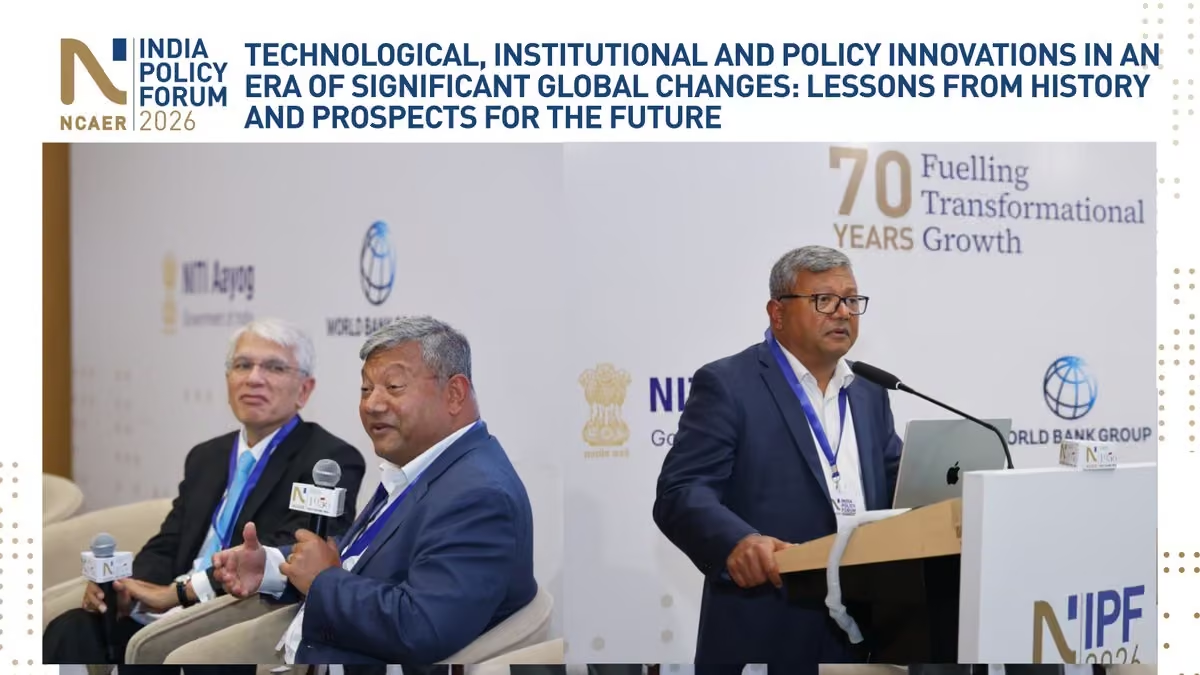
At the ongoing IPF 2026, Professor Arunava Majumdar, Dean of the @stanforddoerr, spoke on “Technological, Institutional, and Policy Innovations in an Era of Significant Global Changes: Lessons from History and Prospects for the Future.” He underscored the importance of translating research into scalable technologies by effectively aligning the complementary strengths of government, academia, and industry.
Such collaboration, he argued, is essential for delivering policy-relevant outcomes and driving innovation at scale. He also emphasised that balancing curiosity-driven research with continuous feedback from real-world implementation is critical to fostering sustainable growth and advancing human well-being. As he aptly observed, “If you cannot build, you cannot learn; and if you cannot learn, you cannot lead.” -
NCAER
@ncaer
India's underperformance in food processing reflects weak productivity growth in both cultivation and processing, high energy costs, fragmented farm supply chains, inadequate quality-control systems, and an unstable trade policy. A paper presented at NCAER's India Policy Forum (IPF) 2026 argues for a comprehensive policy approach spanning the entire farm-to-export value chain—including production, infrastructure, finance, and market access—while ensuring that farmers also benefit from these reforms.
The session was chaired by Mr Suresh Goyal, Director General of NCAER, and featured Dr @shoumitro_c (Johns Hopkins University) as the lead presenter. The discussants were Dr Mekhala Krishnamurthy (Ashoka University), Dr @shilpa_555 (Indian School of Business), and Mr Harish Damodaran (The Indian Express). -
NCAER
@ncaer
A paper by NCAER researchers, presented at the India Policy Forum (IPF) 2026, identifies six priority areas—education, health, governance and law and order, flood mitigation, private sector development, and women's empowerment—as critical to enhancing productivity and employment in Bihar and transforming the state's development trajectory.
The session was chaired by Professor Arvind Panagariya (Columbia University) and featured Dr @ratna_sahay (NCAER), Dr @santosh_econ (University of Notre Dame), Dr Nishith Prakash (Northeastern University), and Mr @aakash_dev94 (NCAER) as panellists. The discussants were Professor @karthik_econ (University of California San Diego) and Dr Surjit Bhalla, former Executive Director for India at the International Monetary Fund. -
NCAER
@ncaer
Union Finance Minister Smt. @nsitharaman delivered the CD Deshmukh Lecture 2026, at our campus as part of IPF, yesterday.
Watch the full Distinguished Address here: youtu.be/APZK-epnjDo
@FinMinIndia | @nsitharamanoffcThis media couldn't be displayed. See it on the original post. -
NCAER
@ncaer
Delivering the distinguished CD Desmukh Lecture 2026 hosted by NCAER, Hon’ble Union Minister for Finance & Corporate Affairs Smt. @nsitharaman underscored India's ambition to become a developed nation and a developed civilization by 2047.
Deconstructing that mandate, the Union Finance Minister defined this development India aspires for as one that combines prosperity with trust, enterprise with responsibility, innovation with civilizational wisdom, global leadership with cultural rootedness, environmental stewardship with economic progress, and finally, individual success with collective welfare.
The true yardstick, she said, will be whether each generation leaves behind a stronger, wiser, more compassionate and more capable India than the one which it inherited.
FM Smt. @nsitharaman concluded with a reminder that 2047 is not a destination, it is a milestone that we must cross for the continuing civilization that is India.
The CD Deshmukh Lecture 2026 was a part of NCAER’s India Policy Forum 2026.
@nsitharamanoffc | @FinMinIndia -
NCAER
@ncaer
Smt. Nirmala Sitharaman, Hon'ble Minister of Finance and Minister of Corporate Affairs, being welcomed by Suresh Goyal, Director General, NCAER, to deliver the Distinguished CD Deshmukh Lecture at the NCAER Auditorium today.
Watch live here: www.youtube.com/live/9ga9tF3ivpQ?cbrd=1&ucbcb=1 -
NCAER reposted
Nirmala Sitharaman Office
@nsitharamanoffc
Watch LIVE: Smt @nsitharaman delivers the CD Deshmukh Lecture, organised by the National Council of Applied Economic Research (@ncaer), in New Delhi. x.com/i/broadcasts/1kKzDDZDQzaJv
-
NCAER reposted
NCAER
@ncaer
Happening today at 6:00pm.
Smt. Nirmala Sitharaman, Hon. Minister of Finance and Minister of Corporate Affairs, will deliver the annual CD Deshmukh lecture 2026 at NCAER's Indian Policy Forum (IPF) on August 6. @FinMinIndia
Watch live here: youtube.com/live/9ga9tF3ivpQ -
NCAER
@ncaer
The IPF 2026 organised an insightful discussion on the "Evolving Role of Think Tanks in Evidence-based Policymaking", which was chaired by Mr Rajendra Pawar, former Vice Chairman of NCAER’s Governing Board alongside former Director Generals of NCAER Mr Suman Bery; Dr Poonam Gupta; Dr Shekhar Shah; current Director General, Mr Suresh Goyal; and, former Research Councillor, Dr Shashanka Bhide.
The panellists discussed how research, data, and policy work can drive informed decision-making.
#evidencebasedpolicy #thinktanks #publicpolicy -
NCAER
@ncaer
Happening today at 6:00pm.
Smt. Nirmala Sitharaman, Hon. Minister of Finance and Minister of Corporate Affairs, will deliver the annual CD Deshmukh lecture 2026 at NCAER's Indian Policy Forum (IPF) on August 6. @FinMinIndia
Watch live here: youtube.com/live/9ga9tF3ivpQ -
NCAER
@ncaer
Reviewing India's macro-development experience since 1980, a session at NCAER's India Policy Forum (IPF) 2026 underscored the urgent need for labour market reforms and an improved business environment to accelerate the country's long-term economic development.
Chaired by Dr Poonam Gupta, Deputy Governor of the Reserve Bank of India, the session featured Dr Alok Johri (McMaster University) and Professor Amartya Lahiri (University of British Columbia) as lead presenters. The discussants were Mr Aurélien Kruse (World Bank) and Dr Soumyakanti Ghosh (State Bank of India). -
NCAER
@ncaer
Dr Ashok Kumar Lahiri, Honourable Vice Chairman of NITI Aayog of India delivered a Keynote address at the India Policy Forum 2026 on "Savings and Investment Potential", which was attended by several economists, industry leaders, and policy makers.
In his lecture, he encouraged participants to think about ways to remove the obstacles that pose any risks to India's journey to Viksit Bharat by 2047. -
NCAER
@ncaer
A team of eminent economists & NCAER academic faculty released the India Policy Forum 2025 volume, which contains research papers presented at the previous IPF Conference. These empirical papers, based on robust, original research, are published after revisions based on IPF Discussants’ comments, a lively floor discussion, & the editorial review from the IF editors, as well as support & guidance from an international Research Panel.
The dignitaries who released the IPF volume included the NCAER Vice Chairman, Mr Manish Sabharwal, NCAER Non-Resident Senior Fellows & Professors @karthik_econ and @krishna_pravin, & NCAER Secretary and Operations Director, Dr Anil Sharma. The release of the IPF volume was followed by a keynote address on the key issue of ‘Savings and Investment Potential in India’ by Dr Ashok Lahiri, Vice Chairman, NITI Aayog. -
NCAER
@ncaer
Regulation, largely carried out through statutory regulatory authorities, is deeply embedded in India's economic landscape. Regulatory intervention is often necessitated by market failures arising from—or resulting in—asymmetric information, negative externalities, and market power. It is therefore imperative to strengthen checks and balances within regulatory institutions and undertake structural reforms to the legal frameworks that govern them.
At a session of the India Policy Forum 2026, chaired by Professor @MahendraDevS, Chairman of the Economic Advisory Council to the Prime Minister, the panellists explored how India can design more effective and accountable regulatory systems. The session featured Mr @ajay_shah (XKDR Forum), Dr Devesh Kapur and Dr @krishna_pravin (Johns Hopkins University), and Dr Rana Hasan (Centre for Economic Growth and Development at NCAER), as panellists. -
NCAER
@ncaer
How do we accelerate the growth of new entrepreneurs?
India will have more than a million startups by 2035, Mr Nandan Nilekani said while delivering opening remarks at NCAER’s IPF 2026 conference. Making a strong case for supporting entrepreneurship, the Co-founder & Chairman of Infosys and Chairman of NCAER’s governing board said that India’s startups grew from 10,000 startups to 150,000 startups in just 10 years, a pace he expects to continue.
Urging the availability of AI in all Indian languages, Mr Nilekani, said significant value and productivity benefits will come from giving a billion people access to AI. — IPF Keynote Address — @NandanNilekani -
NCAER
@ncaer
Debt as a share of GDP in the United States is back up to its post World War II levels.”- @B_Eichengreen
Read our notes from the NCAER-ICAP Distinguished Lecture, delivered by Prof Eichengreen in Mumbai last week, here: ncaer.org/event/the-dollar-and-its-discontent/This media couldn't be displayed. See it on the original post. -
NCAER
@ncaer
📢 We're hiring!
Join the NCAER National Data Innovation Centre (NDIC) as a Design and Outreach Associate and help transform research into impactful visual and digital communication. Apply by 20 August 2026 (or until the position is filled).
#hiring #graphicdesign #communications #publicpolicy
Apply here: ncaer.org/career/design-and-outreach-associate/ -
NCAER
@ncaer
NCAER faculty member @sauban_10 argues that India's environmental compensation framework should move beyond compensatory afforestation and focus on restoring ecosystem functions to better balance infrastructure development with environmental sustainability.
Read more: -
NCAER
@ncaer
Credibility, rule of law, and political alliances have always underpinned monetary leadership, and the history of money bears this out.
NCAER
@ncaer
To know more, read our notes from @B_Eichengreen's NCAER-ICAP Distinguished Lecture 2026: ncaer.org/event/the-dollar-and-its-discontent/
-
NCAER
@ncaer
Who is truly included in India's digital transformation story?
The latest issue of the NCAER's IHDS Research Digest features "The Evolving Landscape of Digital Inclusion in India," a report jointly produced by NCAER and the Women in the Digital Economy Network (WiDEN) at @tqh_policy (TQH). Based on NCAER’s IHDS-III data, the report examines the evolving landscape of digital inclusion in India and offers insights for building a more equitable digital economy.
@DibyasreeG, @garimaagar54890, @BhartiAparajita, @Sonakshi_93, @Pallavi_Econ, @SonaldeDesai, @ihdscorner
Read more: ncaer.org/wp-content/uploads/2026/07/IHDS-Research-Digest… -
NCAER
@ncaer
NCAER research staff members Amit Mitra and @PohitSanjib discuss how a multi-chemistry battery ecosystem, powered by AI-driven innovation, is transforming clean energy storage and creating a unique opportunity for India to build a self-reliant and sustainable energy future.
Read more: ncaer.org/publication/breaking-the-lithium-dependency-the… -
NCAER
@ncaer
NCAER faculty member and IEPF Chair Professor, @csmohapatra_dr, participated in a DD National live panel discussion on 24 July 2026 on the theme, "Financial Literacy to Financial Well-being for MSMEs." During the discussion, he highlighted the 4Ds as the pillars of financial resilience for MSMEs: Documentation, Digitalisation of Financial Literacy & Awareness, Debt Management, and Discreet Management.
He emphasised that these four dimensions collectively strengthen financial discipline, improve access to formal finance, enhance business resilience, and foster sustainable growth for MSMEs.
#financialliteracy #financialwellbeing #msmes #investoreducation #viksitbharat -
NCAER
@ncaer
Privacy need not be at odds with data collection - Dr. @SonaldeDesai
Prof. @SonaldeDesai, Centre Director, NCAER–National Data Innovation Centre navigates the privacy question in data collection by straddling the anecdotal and the empirical.
🎙️ Both parts of Episode 2 of Parisila Perspectives — Data-led Change, Evidence-led Policy — are now live. Watch: ncaer.org/podcasts/This media couldn't be displayed. See it on the original post. -
NCAER
@ncaer
India's vulnerability lies less in the availability of critical minerals than in the absence of commercial-scale, ultra-high-purity processing and refining capabilities.
NCAER research staff members @PohitSanjib and @mondal_sovini argue that future technological competitiveness will depend not only on access to critical minerals but also on the ability to recover, refine and manufacture semiconductor-grade materials domestically. Developing this midstream ecosystem should therefore be a strategic policy priority.
Read more: ncaer.org/publication/go-after-the-new-gold/ -
NCAER
@ncaer
NCAER’s latest evaluation of the Pradhan Mantri Gram Sadak Yojana (PMGSY) highlights the transformative impact of all-weather rural road connectivity.
The study finds that improved road access has enhanced connectivity to markets, education, healthcare, financial services, and livelihood opportunities, while also strengthening women's mobility and safety and contributing to greater rural prosperity.
#pmgsy #ruraldevelopment #evidencebasedpolicy
@BornaliBhandari | @joshi_ljoshi | @charujain13dec | Ajaya Kumar Sahu | Astha Sen | Nijara Deka | K S Urs | Nishika Pal | Nitesh Khandelwal | Jagbir | Ravindar Mahto
Read more: ncaer.org/publication/impact-evaluation-of-pradhan-mantri… -
NCAER
@ncaer
Parisila Perspectives, NCAER’s podcast series, goes live today with part two of our episode on Data-led Change, Evidence-led Policy!
In this episode, Suresh Goyal, Director General, NCAER, is joined by Dr. @SonaldeDesai, Centre Director, NCAER–National Data Innovation Centre, and @AdilZainulbhai, Former Chairman, McKinsey India, and former Chairman, Capacity Building Commission of India.
They discuss:
➡️The commitment to sustained trust in data collection and use
➡️The new shape of poverty in Indian households
➡️Why strengthening statistical capacity, validating new data sources, and making research more accessible are essential for better governance
🎙Watch Parisila Perspective’s latest episode, Data-led Change, Evidence-led Policy – Part 2 here:
www.youtube.com/watch?v=2fd1xg5rF5M -
NCAER
@ncaer
Is India facing a population crisis, or the challenge of managing demographic change?
In a recently published article, NCAER faculty member @SonaldeDesai argues that alarmist narratives about population growth and decline often distract from the real policy challenges. The article calls for a balanced, evidence-based approach to managing India's demographic transition while avoiding rhetoric that fuels unnecessary fear and social division.
Read more: ncaer.org/publication/population-spectres-do-harm-managin… -
NCAER
@ncaer
NCAER’s IEPF Chair Unit, in collaboration with @PondiUni_Ofcl, organised the IEPFA-NCAER Investor Education and Protection Conference on the theme, "Criticality of Digital Financial Literacy and Behavioural Skills: Key Enablers of Investor Education and Protection."
Addressing the conference, IEPF Chair Professor @csmohapatra_dr highlighted the importance of strengthening behavioural skills alongside digital financial literacy to empower investors, combat fraud, enable informed decision-making, and advance universal financial inclusion on the path to Viksit Bharat. -
NCAER
@ncaer
How do visible identities shape people's experiences of discrimination?
NCAER faculty member Nishat Anjum presented her paper, "Skin Colour Salience and Perceived Discrimination: An Experimental Study from India," at an oral session of the 28th Annual Conference of the Association for Heterodox Economics (AHE), held at the University of Coimbra, Portugal, on 1 July 2026. Co-authored with Sujoy Chakravarty and Divya Vaid, the study examines how making skin colour salient influences perceptions of discrimination among college students in Kolkata and Delhi, India -
NCAER
@ncaer
NCAER faculty member @poonam_munjal was one of the panel speakers in technical session on "Strengthening State-Level Logistics Infrastructure for Mining & Metals Growth" at the FICCI Conference on Enhancing Competitiveness of Mining and Metals: Focus Area – Efficient Logistics, held on 10 July 2026.
The session brought together industry experts and policymakers to discuss strategies for strengthening state-level logistics infrastructure, improving supply chain efficiency, and advancing sustainable growth in the mining and metals sector. -
NCAER
@ncaer
Shomik Mehndiratta on why combining mobility data with other datasets is a powerful indicator of economic activity.
National Highways Authority of India-NCAER Centre for Economics of Transportation, Mobility and Logistics will bring a variety of data pieces together to yield insights and direction for evidence-led policymaking.
Watch this space for glimpses into our intensive research.This media couldn't be displayed. See it on the original post. -
NCAER
@ncaer
In a new article, NCAER faculty member @sauban_10 explores how stronger connectivity, expanded regional trade, and deeper integration with Bangladesh and the Bay of Bengal region could create new opportunities for industrial renewal in West Bengal.
Read more: -
NCAER
@ncaer
When the policy needs are undeniable, institutions move quickly.
Shri Santosh Kumar Yadav, IAS, Chairman, NHAI, inaugurated the NHAI–NCAER Centre for Economics of Transportation, Mobility and Logistics yesterday.
With the ambition to become a globally recognised hub for research, the Centre marks a significant step towards stronger evidence-led policymaking. -
NCAER
@ncaer
We are delighted to announce the launch of the @NHAI_Official Centre for Economics of Transport, Mobility, and Logistics at @ncaer today, marking the establishment of India’s first applied economics research Centre dedicated to this sector.
Inaugurated by the NHAI Chairman, Shri Santosh Kumar Yadav, the Centre is the outcome of an MoU signed between NHAI and NCAER, with NHAI as its founding anchor. The launch was followed by an inception workshop bringing together senior NHAI officials, transport economists, infrastructure developers, and investors to deliberate on and help shape the Centre’s research agenda. -
NCAER reposted
NCAER
@ncaer
We are hiring a Senior Fellow/ Fellow, Centre for Economics of Transportation, Mobility and Logistics (CETML)!
Join NCAER and contribute to rigorous, evidence-based healtheconomic policy research on transportation, mobility and logistics in India.
Apply here: -
NCAER
@ncaer
Parisila Perspectives, NCAER’s podcast series, releases a chat on Data-led Change, Evidence-led Policy (Part 1) today!
In this episode, Suresh Goyal, Director General, NCAER, is joined by Dr. @SonaldeDesai, Centre Director, NCAER–National Data Innovation Centre, and @AdilZainulbhai, Former Chairman, McKinsey India, and former Chairman, Capacity Building Commission of India.
They discuss:
1. How robust data can lead to better policy
2. How AI can help collect, parse and wield data, and where it stops short
3. Why the quality of evidence depends on the quality of data collection
4. What India's experience can teach us about building stronger data ecosystems
🎙Watch Parisila Perspective’s latest episode, Data-led Change, Evidence-led Policy – Part 1 here: www.youtube.com/watch?v=NeQ92RDGcek -
NCAER
@ncaer
Mr Suresh Goyal, the Director General of NCAER, is speaking on the theme, ‘Scaling with Stability: The Next Phase of Start-up Growth’, at the Foundation for Innovation and Technology Transfer (FIIT) Summit 2026, at IIT Delhi.
As a leading investment-focused platform, this Strategic Investment & DeepTech Capital Summit brings together high-potential deep-tech start-ups & a diverse spectrum of investors, including institutional funds, venture capital firms, angel networks & ecosystem leaders.
It is designed to facilitate investment interactions for start-ups & founder-investors through evaluations, start-up showcases & knowledge sessions focused on fundraising, venture-building, private market investing, & scalable strategies.
@fitt_iitd, @sidbiofficial, @IndiaEximBank -
NCAER reposted
CAG of India
@IndiaCAG
The Comptroller and Auditor General of India chaired a High-level Round Table Conference on July 10, 2026, on Theme Based Audit on Multimodal Transport and Logistics Initiatives in Indian Railways, attended by the Chairman, Railway Board, Additional Members Railways and senior representatives from CONCOR, DFCCIL, National Highway Logistics Management Ltd (NHLML) and Ministry of Ports, Shipping and Waterways (MoPSW) to discuss key audit insights and strategic recommendations of this audit. This audit aims to suggest recommendations for policy coherence in multimodal transportation, reduction of logistics cost to GDP and increasing logistics efficiency coupled with cost competitiveness in transport economics.
Leveraging the C&AG’s unique cross-sectoral and cross-departmental mandate, an Integrated Audit Group constituted within the C&AG's organisation enabled continuous inter-ministerial consultation and examination throughout the audit process. The exercise was further strengthened through engagement with Ministries, knowledge partners, including IIM Mumbai, NCAER, NICDC Logistics Data Services Ltd (NLDSL) bringing academic rigour and evidence-based analytical perspectives to this audit.
This milestone represents the culmination of an intensive six-month, pan-India, multidomain and cross-sectoral examination of multimodal transport and logistics initiatives, with a particular focus on the role of Indian Railways and its integration with other modes of transport across critical logistics hubs. The audit was conducted on a robust evidence base, developed through the triangulation of field audit observations, extensive stakeholder consultations, beneficiary survey outcomes and analysis of policy, operational, and institutional frameworks, thereby ensuring comprehensive, objective and actionable insights and recommendations.
@dfccil_india @RailMinIndia @nicdc01 @ncaer @Official_NHLML @shipmin_india @IIMMumbai @concor_india -

NCAER
@ncaer
India’s civil servants are getting AI ready – in the past year, 1.8 million civil servants completed an AI course through the Capacity Building Commission.
In the latest episode of Parisila Perspectives, @AdilZainulbhai, makes a strong case for using AI to make policy, research and governance more efficient and effective.
🎙️Stay tuned for the podcast episode this Saturday.This media couldn't be displayed. See it on the original post. -
NCAER
@ncaer
NCAER visiting faculty member @usdas argues that debt offices do not cause debt crises, but every crisis passes through one. The overdue reform, he contends, is to establish by statute a debt office with a mandate to act as the state's economic agent, oversee the full sovereign balance sheet, and carry a protected duty to issue timely warnings.
Read more: ncaer.org/publication/debt-office-overhaul-overdue-in-low… -
NCAER
@ncaer
Data-led intelligence has shaped better decision-making for over 170 years.
In 1854, a deadly cholera outbreak swept through Soho, London, claiming more than 600 lives. While many believed the disease spread through bad air, Dr. John Snow used data to trace the outbreak to a contaminated water pump—changing the course of public health.
In the latest episode of Parisila Perspectives, Suresh Goyal, Director General, NCAER, harks back to data’s early beginnings while casting a spotlight on its all-critical future as he speaks with Prof. @SonaldeDesai, Centre Director, NCAER–National Data Innovation Centre, and @AdilZainulbhai, Former Chairman, McKinsey India, and former Chairman, Capacity Building Commission of India.This media couldn't be displayed. See it on the original post. -
NCAER
@ncaer
Can a semiconductor project become the foundation of an entirely new industrial model for West Bengal?
NCAER research staff Suvajit Banerjee and @mondal_sovini examine West Bengal's semiconductor ambitions. In their article, they argue that a semiconductor project can serve as the foundation of a new industrial model only if it is supported by a robust ecosystem comprising world-class infrastructure, a skilled workforce, strong institutions, sustainable practices, and a long-term policy commitment.
Read more: ncaer.org/publication/bengals-chance-to-plant-a-new-tree/ -
NCAER
@ncaer
Paperless trade improves efficiency, but a paperless border is not yet a frictionless border.
Analysis by NCAER research staff @mondal_sovini and @PohitSanjib finds that India's trade gains from digitalisation remain constrained by fragmented institutional coordination, limited cross-border interoperability, and infrastructure gaps. To fully realise the benefits of digital trade reforms, paperless systems must be complemented by robust physical connectivity and an efficient, reliable trade logistics system.
Read more: ncaer.org/publication/indias-paperless-border-paradox-evi… -
NCAER
@ncaer
We are hiring a Strategic Research Associate, Centre for Economics of Transportation, Mobility and Logistics (CETML)!
Join NCAER and contribute to rigorous, evidence-based economic policy research on transportation, mobility and logistics in India.
Apply here: -
NCAER
@ncaer
NCAER Professor @poonam_munjal delivered a talk on "Leveraging GST Data for Economic Insights and Policy" at the event "Swarna Andhra @ 2047: Economic Intelligence for Governance," held in Tirupati on 2–3 July 2026.
-
NCAER
@ncaer
NCAER’s latest Monthly Digest for June 2026 is out!
Check out our latest Research, Publications, Events, and Other Offerings.
🔗mailchi.mp/ad64858fcc14/feb-68787 -
NCAER
@ncaer
We are hiring a Senior Fellow/ Fellow, Centre for Economics of Transportation, Mobility and Logistics (CETML)!
Join NCAER and contribute to rigorous, evidence-based healtheconomic policy research on transportation, mobility and logistics in India.
Apply here: -
NCAER
@ncaer
As global trade becomes increasingly shaped by regional trade agreements, should India consider joining the CPTPP?
In their latest analysis, NCAER Visiting Faculty Professor @krishna_pravin and his co-author @_Monil_Sharma_ examine the economic case for India's participation in the CPTPP, assessing its potential benefits and the broader implications for India's trade strategy.
Read more: ncaer.org/publication/a-club-india-should-join-why-cptpp-… -
NCAER
@ncaer
How can India reform its education system to improve employability through vocational education?
In their latest article, NCAER Visiting Faculty Farzana Afridi and her co-author Arjita Chandna argue that integrating vocational education into the school system, strengthening industry linkages, and creating clear pathways from training to employment can significantly enhance employability, boost productivity, and better prepare young people for the world of work.
Read more: ncaer.org/publication/reforming-indias-vocational-skillin… -
NCAER
@ncaer
“Imagine if India were to create rails for intelligence, that allow governments to provide more efficient services which reach the citizen rather than the citizen searching for those services.”
India's Digital Public Infrastructure transformed identity, payments and service delivery. @Shankar4EkStep, Co-founder & CEO, EkStep Foundation, argues that the next frontier is building "intelligence rails"—embedding AI into this foundation so that public services become more proactive, accessible and responsive.
🎥 Read more: ncaer.org/event/workshop-on-the-economics-of-ai-and-digit…This media couldn't be displayed. See it on the original post. -
NCAER
@ncaer
NCAER research staff members Madhura Chowdhuri and co-author Sagari Gupta argue that it is time to shift the narrative on digital inclusion—from focusing solely on access to addressing the emerging second digital divide, where the meaningful use of digital opportunities becomes the true measure of inclusion.
Read more: ncaer.org/publication/the-true-measure-of-digital-inclusi… -
NCAER
@ncaer
"Productivity and prosperity is about access to money and opportunity."
With digital inclusion and access to Digital Public Infrastructure (DPI) largely achieved, @kamyachandra, Co-founder & CEO, Centre for Digital Public Infrastructure, argues that India's next frontier is unlocking the services layer—using DPI to expand access to credit, markets and opportunities that drive productivity and prosperity.
🎥 Read more: ncaer.org/event/workshop-on-the-economics-of-ai-and-digit…This media couldn't be displayed. See it on the original post. -
NCAER
@ncaer
NCAER faculty member Professor @BornaliBhandari participated as a panellist in @Uber_India's "Uber Surakshit: Safety Never Stops" programme on June 30, 2026, in the session "Safer Work, Stronger Platforms: Advancing Gig Worker Safety."
The discussion emphasised that the safety of #platformworkers extends well beyond road safety. It requires a holistic approach that safeguards both the physical and mental well-being of gig workers, helping create safer and more sustainable work environments. #gigwork #workersafety #platformeconomy #mentalhealth #roadsafety
For more on this, please read the NCAER report on Food Delivery Platform Workers. ncaer.org/publication/socio-economic-impact-assessment-of… -
NCAER
@ncaer
"No country as poor, as linguistically diverse, and as religiously diverse as India gave every citizen the right to vote [after Independence]."
With political inclusion accomplished, Manish Sabharwal, Co-founder, TeamLease Services, underscores India's next bastion: mass prosperity, through access, equity and productivity.
In the inaugural episode of Parisila Perspectives, he joins Suresh Goyal, Director General, NCAER to discuss the policy choices that could shape India's long-term development.
🎥 Watch the full episode:
youtu.be/g2cQAjRNVYUThis media couldn't be displayed. See it on the original post. -
NCAER
@ncaer
Using NCAER”s India Human Development Survey data, new research examines the health implications of changing living arrangements for married women in patrilocal households. The findings suggest that while the death of a parent-in-law may modestly increase women's autonomy and decision-making power, these gains do not always offset the added household and economic responsibilities that often accompany such transitions.
Read more: ncaer.org/wp-content/uploads/2026/06/IHDS-Research-Digest… -
NCAER
@ncaer
What shapes educational opportunity in India?
New research using NCAER”s India Human Development Survey data examines disparities in private school enrolment and children's schooling experiences. The findings highlight how social background and household circumstances jointly shape access to private schooling, while underscoring the influence of school environments on children's experiences and educational outcomes.
Read more: ncaer.org/wp-content/uploads/2026/06/IHDS-Research-Digest… -
NCAER
@ncaer
Envisioning Andhra Pradesh as a ₹308 lakh crore economy with a per capita income of ₹55 lakh by 2047, the state government hosted its flagship event, Swarna Andhra @ 2047 Vision: Economic Intelligence for Governance.
On this occasion, Mr Suresh Goyal, Director General of @ncaer, moderated a panel discussion on 2nd July 2026, on ‘Data, Statistics and India’s Growth Agenda’, featuring eminent speakers: Shri Saurabh Garg, Secretary, MoSPI; Shri R. Balasubramaniam and Shri K. V. Raju, Members, NITI Aayog; Dr V. Anantha Nageswaran, Chief Economic Adviser, GoI; and Dr S. Mahendra Dev, Chairman, EAC-PM. -
NCAER
@ncaer
Former CDC USA Country Director and Senior Medical Epidemiologist Dr Michael Friedman delivered a thought-provoking talk at NCAER on the "Top 10 Health Challenges Facing Us Today." Covering topics ranging from chronic diseases and mental health to artificial intelligence, health economics, and pandemic preparedness, the session sparked engaging discussions on the future of public health in India and the critical role of evidence-based policymaking in addressing emerging health challenges.
This lecture was a first of many fora planned to inform the focal areas for NCAER’s newly formed Centre for Health Economics led by newly appointed Nisha Gupta. -
NCAER
@ncaer
📢 The June edition of the NCAER IHDS Research Digest is out now!
Using NCAER”s India Human Development Survey data, this issue features: (a) research examining disparities in private school enrolment and children's schooling experiences, and (b) a study exploring how changing household structures shape women's health and wellbeing. Together, these findings highlight the enduring influence of family environments on inequality and wellbeing.
Read more: ncaer.org/wp-content/uploads/2026/06/IHDS-Research-Digest… -
NCAER
@ncaer
India's semiconductor ambitions depend on more than fabs and financial incentives.
NCAER research staff Suvajit Banerjee, @mondal_sovini, and @PohitSanjib argue that the real challenge lies upstream—in securing reliable supplies of critical minerals. As long as China maintains its cost advantage, processing capacity, and integrated supply chains, diversifying supply through friend-shoring will remain an economic challenge, not merely a geopolitical imperative.
Read more: ncaer.org/publication/critical-minerals-and-dependence-on… -
NCAER
@ncaer
In a recent article, NCAER research staff members @sauban_10, @joshi_ljoshi, @charujain13dec, and Kushagra Thakral argue that rainfall deficits are often a symptom of a deeper challenge—water stress.
Drawing on findings from NCAER’s study for the Central Water Commission covering 57 major irrigation projects across 20 states, they emphasise the need to strengthen irrigation performance, ensure more equitable water distribution, and build climate-resilient water systems to enhance long-term water security.
Read more: ncaer.org/publication/rainfall-deficit-is-only-the-sympto… -
NCAER
@ncaer
NCAER IEPF Chair Professor @csmohapatra_dr has edited the volume Claiming the Unclaimed: Unlocking the Potential of Idle Financial Assets in India, published by @authorityiepf and @theicai.
The book proposes a citizen-centric, interoperable national framework for managing unclaimed financial assets by integrating asset discovery, verification, settlement, institutional coordination, digital financial literacy, and assisted support services to facilitate the return of unclaimed financial assets to their rightful owners with transparency, dignity, and trust. @Depannita2 has also co-authored a chapter in this volume. -
NCAER
@ncaer
NCAER faculty members @PohitSanjib, @chetana_c1, @DEV_6309 and their co-authors have published India’s first state-level Integrated Assessment Model for Odisha, linking CGE & MESSAGEix models. Results show that green investments can reduce emissions while supporting growth, jobs, energy security & sustainable development.
Read more: doi.org/10.1080/15567249.2026.2669829 -
NCAER
@ncaer
Nearly 75% of working-age women in India are outside the labour force. Why?
An NCAER Working Paper by NCAER faculty member @aakash_dev94 and co-author Partha Chatterjee finds that the interaction between unpaid household work and labour market frictions is central to explaining India’s low female labour force participation. Using a calibrated household search model, the authors show that women’s reservation wages are significantly higher than men’s. The gender gap is driven by household responsibilities (45%), labour market frictions (35%), and their interaction (20%).
#flfp #gendereconomics #india #laboureconomics
Read more: ncaer.org/publication/households-frictions-and-gender-gap… -
NCAER
@ncaer
📊 Strengthening Research for Smarter Infrastructure
@NCAER and @NHAI_Official have signed an MoU to establish the NHAI Centre for Economics of Transportation, Mobility and Logistics.
The new research centre at NCAER will be a dedicated platform for applied research across key areas, including highway economics, freight logistics, toll policy, asset monetisation, road safety, technology adoption, and mobility systems.
Drawing our seven decades of policy-relevant economic research and data capabilities, the new centre will generate rigorous evidence to support decision-making across India's transportation and logistics ecosystem.
Read the press release: www.pib.gov.in/PressReleasePage.aspx?PRID=2276991®=48&…
#transportation #mobility #logistics #infrastructure #evidencebasedpolicy #nhai #buildinganation -
NCAER
@ncaer
What happens to climate commitments as geopolitical priorities evolve?
NCAER research faculty member Suvajit Banerjee and co-author Stutii Srivastava examine the resilience of global climate finance commitments in a changing geopolitical landscape, and assess the challenges and opportunities associated with the proposed $1.3 trillion climate finance goal.
Read more: ncaer.org/publication/the-climate-promise-that-wont-survi… -
NCAER
@ncaer
NCAER faculty members @PohitSanjib, @chetana_c1, @DEV_6309 and their co-authors have published India’s first state-level Integrated Assessment Model for Kerala, linking CGE & MESSAGEix models. Results show that green investments can reduce emissions while supporting growth, jobs, energy security & sustainable development.
Read more: doi.org/10.47852/bonviewGLCE62026965 -
NCAER
@ncaer
The final session of the NCAER Workshop on the Economics of AI-DPI focused on defining priority research programmes for India’s future in this domain. The NCAER is set to launch a new research centre dedicated to this area of study.
The session was chaired by former NITI Aayog Vice-Chairman, Shri Suman Bery and moderated by Thurro Co-founder Mr Akhilesh Tilotia. Speakers included Abhishek Singh, Director General of the National Testing Agency; Karthik Adapa, Regional Advisor for Digital Health at the World Health Organization; and, Bhagwan Chowdhry of the Indian School of Business, who shared their perspectives on shaping India’s research agenda in AI-DPI.
🔗ncaer.org/event/workshop-on-the-economics-of-ai-and-digit… -
NCAER
@ncaer
NCAER faculty member Jyoti Thakur served as an expert discussant at the launch of Driving the Energy Transition: Workforce, Skills, and Gender in India's Renewable Energy Sector, a report by MNRE, CEEW, and NRDC. In the breakout session, Strengthening Clean Energy Job Data in India, she discussed how official employment datasets capture clean energy workers and identified opportunities to improve clean energy workforce data in India.
-
NCAER
@ncaer
How does access to water shape women’s lives beyond the household?
Using NCAER IHDS panel data, new research finds that access to indoor piped drinking water is associated with improved employment and health outcomes among rural women. These benefits are particularly pronounced in poorer households, underscoring how investments in basic household infrastructure can ease the disproportionate burdens borne by women and support greater economic participation and wellbeing.
@AshishKumarSed1 | @ihdscorner
Read more: ncaer.org/wp-content/uploads/2026/05/IHDS-Research-Digest… -
NCAER
@ncaer
The NCAER Workshop on AI-DPI brought together diverse perspectives on AI, governance, and the future of work.
Chaired by T. Koshy, former Managing Director of the Open Network for Digital Commerce (ONDC), the session featured speakers Sofia Bapna (University of Minnesota); Jonathan Hersh (Chapman University); Amit Mehra (Naveen Jindal School of Management); Shehnaz Ahmed (Vidhi Centre for Legal Policy); and, Prof. Kanika Mahajan (Ashoka University).
🔗ncaer.org/event/workshop-on-the-economics-of-ai-and-digit… -
NCAER
@ncaer
Why does India’s female labour force participation remain among the lowest in the world?
Writing for Ideas for India, NCAER faculty member @aakash_dev94 and his co-author Partha Chatterjee argue that a ‘household-market trap’, driven by macroeconomic conditions and the unequal burden of unpaid work, keeps many women out of the workforce. They argue that dismantling these structural barriers is essential for improving women’s employment and fostering inclusive economic growth.
Read more: ncaer.org/publication/why-three-quarters-of-indian-women-… -
NCAER
@ncaer
Beyond connectivity: who is truly participating in the digital economy?
NCAER collaborated with @tqh_policy to convene a discussion on India’s Transformation: The Evolving Landscape of Digital Inclusion, a jointly produced research report that draws on NCAER’s IHDS-III data to examine how people access, use, and benefit from digital technologies. NCAER faculty, @DibyasreeG along with @garimaagar54890, presented key findings from the report.
The event brought together research scholars, industry experts, and civil society representatives for a series of sessions, including a panel discussion featuring voices from the field. Participants explored emerging challenges and opportunities and identified pathways for the next chapter of India’s digital inclusion journey.
@BhartiAparajita | @sonakshi_93 | @Pallavi_Econ | @SonaldeDesai
Read the report: ncaer.org/publication/the-evolving-landscape-of-digital-i… -
NCAER
@ncaer
The next phase of India’s agricultural transformation must be export-oriented, standards-driven, and focused on strengthening value chains.
NCAER faculty members @sauban_10 and @joshi_ljoshi
argue that improving aggregation, standards compliance, institutional coordination, and market access is essential to strengthening agricultural value chains and enhancing India’s competitiveness in global agri-food trade.
Read more: ncaer.org/publication/the-next-phase-of-indias-agricultur… -
NCAER
@ncaer
NCAER is pleased to announce the appointment of Nisha Gupta as Director of the Centre for Health Economics.
Nisha joins NCAER with more than 25 years of experience as a global health executive, diplomat, and behavioural scientist. Her career spans leadership roles at postings across Central and East Asia, the Middle East, and Africa, where she has advanced innovative approaches to complex health and development challenges.
At a time when health is a critical driver of economic resilience, productivity, and inclusive growth, Nisha's arrival marks an exciting new endeavour for NCAER. She brings a rare blend of strategic vision, scientific rigor, and navigation of complex international policy. Her stewardship will amplify NCAER's core analytical capabilities, deepen its contribution with global best practices, and build on India's distinctive experience in delivering impactful solutions at scale.
We look forward to her leadership of the Centre as a hub for actionable, data-driven policy engagement, and cross-sector collaboration to advance health and economic outcomes for all. -
NCAER
@ncaer
How is ageing reshaping systems of support in India?
Drawing on NCAER IHDS data, new research explores how family structure, functional health, labour force participation, and state support interact to shape the wellbeing of Indians aged 60 and above. The findings point to declining intergenerational co-residence and an expanding role for pensions and health insurance, highlighting an evolving balance between family, individual resources, and state support in ensuring wellbeing and security in later life.
@DebasisBarik25 | @Neerad_D | @snsharma | @SonaldeDesai | @ihdscorner
Read more: ncaer.org/wp-content/uploads/2026/05/IHDS-Research-Digest… -
NCAER
@ncaer
NCAER faculty member @Pallavi_Econ chaired a panel discussion on “Challenges in Measuring Women’s Income and Wealth” on the second day of the 6th India Public Policy Network (IPPN) Conference, held at the National Law School of India University (@NLSIUofficial), Bengaluru, from June 8–11, 2026.
The panel explored conceptual, methodological, and data-related challenges in measuring women’s economic contributions, highlighting the need for stronger evidence to better understand women’s economic realities and inform effective policy design. -
NCAER
@ncaer
We are hiring a Associate Fellow, Health Economics!
Join NCAER and contribute to rigorous, evidence-based health economic policy research in India.
Apply here: ncaer.org/career/associate-fellow-ncaer-centre-for-health… -
NCAER
@ncaer
The NCAER Workshop on AI-DPI featured another special session on “Technology, Regulation and Behavioural Outcomes”; where speakers examined a range of issues, including “Amplifying Local News on Social Media”; “Evaluating India’s Tax Reform in Online Real-Money Gaming”; “Road Safety Compliance in Life-Improvement Apps”; and “Mitigating Delays in Criminal Investigations”.
The session was chaired by Professor Venkatesh Balasubramanian of IIT Madras. Presentations were delivered by Ananya Sen (Heinz College of Information Systems and Public Policy); Madhu Viswanathan (Indian School of Business); Uttara Madurai Ananthkrishnan (University of Washington); and, Anandasivam Gopal (Nanyang Technological University), who shared their research and insights across these themes.
🔗ncaer.org/event/workshop-on-the-economics-of-ai-and-digit… -
NCAER
@ncaer
NCAER’s latest Monthly Digest for May 2026 is out!
Check out our latest Research, Publications, Events, and Other Offerings.
Read more: mailchi.mp/db3b3bf230ff/feb-67331 -
NCAER
@ncaer
We are hiring a Senior Fellow, Health Economics!
Join NCAER and contribute to rigorous, evidence-based health economic policy research in India.
Apply here: ncaer.org/career/senior-fellow-ncaer-centre-for-health-ec… -
NCAER
@ncaer
Explore the latest findings from the May edition of the NCAER IHDS Research Digest
Drawing on NCAER India Human Development Survey data, this edition features two studies. The first examines how family structure, labour force participation, functional health, and state support influence the wellbeing of older Indians. The second investigates how access to indoor piped drinking water affects women’s employment and health outcomes. Together, these findings underscore the critical role of social and physical infrastructure in shaping wellbeing across the life course.
Read more: ncaer.org/wp-content/uploads/2026/05/IHDS-Research-Digest… -
NCAER
@ncaer
The second day of the NCAER Workshop on the Economics of AI-DPI commenced with a session on “Making AI Work for Humanity.”
Chaired by Professor Ravi Bapna, the session explored key themes including “AI, Inequality and Development”; “Guidelines vs. Guardrails for AI”; and, “What Is Generative AI Worth?” Distinguished speakers included Marshall Van Alstyne of Questrom School of Business, Boston University; Jean-Louis Arcand, President of the Global Development Network; Saharsh Agarwal of ISB; and Avinash Collis of Heinz College of Information Systems and Public Policy, Carnegie Mellon University, who shared their insights on the opportunities and challenges of AI-driven development.
🔗ncaer.org/event/workshop-on-the-economics-of-ai-and-digit… -
NCAER
@ncaer
Can removing restrictions on women’s night work expand female employment?
As part of the NCAER Seminar Series, Dr @asanishasharma Associate Professor at Ashoka University, presented her paper, “From Dusk Till Dawn: The Impact of Lifting Night Shift Bans on Female Employment,” on 18 May 2026. The study found that relaxing restrictions on women’s night work increased female employment in large firms, with gains concentrated in firms already employing women, export-oriented industries, and regions with higher unemployment. NCAER faculty member @Nishat_1495 served as the discussant. -
NCAER
@ncaer
The special session, “From Transactions to Insights,” at NCAER’s Workshop on the Economics of AI and DPI examined how digital exhaust generated by DPI platforms can be transformed into actionable insights and used to strengthen the research ecosystem around products such as UPI, FASTag, and GST.
Chaired by NRVVMK Rajendra, Member (Finance) NHAI and moderated by Alok Gupta from the University of Minnesota, the session featured Shomik Mehndiratta and Jen JungEun Oh (both World Bank); Prof R Srinivas from IIM- Bangalore, CEO of Indian Highways Management Company Ltd Mudit Agarwal; and Shivnath Thukral, Vice-President (Public Policy) of PhonePe as panelists. The discussion highlighted the potential of DPI-generated data to inform research, improve policymaking, and drive innovation.
🔗ncaer.org/event/workshop-on-the-economics-of-ai-and-digit… -
NCAER
@ncaer
NCAER research staff @mondal_sovini and @PohitSanjib argue that India’s semiconductor ambitions cannot rely on assembly alone. In the absence of domestic refining and processing capacity, strategic dependence will continue.
The defining challenge today is not merely access to resources, but leadership over the value chain.
Read more: ncaer.org/publication/invisible-inputs-visible-risks/ -
NCAER
@ncaer
The second session of NCAER’s Workshop on the Economics of AI and DPI focused on expanding economic opportunities through financial inclusion and on charting the path forward for Digital Public Infrastructure (DPI).
Discussions featured insights from CDPI CEO, Kamya Chandra; Shankar Maruwada of the EkStep Foundation; and Shashwat Alok and Pranav Jindal from ISB, who shared their perspectives on leveraging DPI to enhance financial access, foster innovation, and support inclusive economic growth. -
NCAER
@ncaer
The AI & Digital Public Infrastructure (DPI) Workshop hosted by NCAER received extensive wide media coverage. The discussions brought together policymakers, researchers, and practitioners to explore how AI can strengthen public service delivery, foster inclusion, and accelerate digital transformation in India.
An important milestone in shaping the future of AI-enabled public infrastructure.
🔗ncaer.org/event/workshop-on-the-economics-of-ai-and-digit… -
NCAER
@ncaer
“Just released: new from IHDS-III (2022-24) 📢
Manish Sabharwal just released a report on “The Evolving Landscape of Digital Inclusion in India” jointly produced by NCAER in collaboration with @tqh_policy. The report highlights the layered and evolving nature of digital participation in India where mobile-first internet access has both expanded access and limited the quality of digital participation.
Read the full report here: ncaer.org/publication/the-evolving-landscape-of-digital-i…
@ihdscorner | @TeamLease -
NCAER
@ncaer
The inaugural session of NCAER’s Workshop on the Economics of AI and Digital Public Infrastructure (DPI) examined why this emerging area is of particular importance for India. The session brought together policymakers, researchers, and product builders from across the world for a wide-ranging discussion.
NCAER Director General, Suresh Goyal, presented the vision behind the workshop, which serves as a precursor to the proposed establishment of a new research centre focused on the economics of AI and DPI. CCI Chairperson Ravneet Kaur; MeitY Secretary S Krishnan; MoSPI Secretary Saurabh Garg; Professor Ravi Bapna (University of Minnesota); and, Professor Anindya Ghosh (New York University) offered their perspectives on the subject. The session was chaired and moderated by NCAER Vice-Chairman, Manish Sabharwal.
🔗ncaer.org/event/workshop-on-the-economics-of-ai-and-digit… -
NCAER
@ncaer
"India's DPI usage is better than most technology usage by many advanced countries in the world."
But the next challenge is productivity, jobs, and mass prosperity.
🎥 Watch the full episode:
youtu.be/g2cQAjRNVYUThis media couldn't be displayed. See it on the original post.Post not available here, view on X
NCAER
@ncaer
According to Manish Sabharwal, the next generation of DPI should help enable:
• Stronger enterprises
• Higher productivity
• Faster economic growth
NCAER
@ncaer
These are exactly the questions NCAER's Workshop on the Economics of AI and Digital Public Infrastructure will explore on 5–6 June.
Learn more:
ncaer.org/event/workshop-on-the-economics-of-ai-and-digit…
#ai #dpi #economicgrowth #viksitbharat2047 -
NCAER
@ncaer
"We've delivered mass democracy. We haven't delivered mass prosperity."
Manish Sabharwal says in the inaugural episode of #parisilaperspectives.
🎥 Full episode: www.youtube.com/watch?v=g2cQAjRNVYUThis media couldn't be displayed. See it on the original post.Post not available here, view on X
NCAER
@ncaer
The conversation explores:
• Enterprise DPI
• Regulatory cholesterol
• Manufacturing
• AI and the future of work
• Lessons from China
NCAER
@ncaer
These are exactly the questions that NCAER's AI-DPI Workshop will examine on 5–6 June.
Stay tuned for clips and insights throughout the week.
#ai #dpi #viksitbharat2047 -
NCAER
@ncaer
Writing for Policy Edge, NCAER faculty members
@ratna_sahay and @aakash_dev94 caution against viewing rising female labour force participation and leadership representation as sufficient indicators of economic inclusion.
They argue that meaningful progress in women’s economic empowerment requires addressing structural barriers through stronger care systems, safer mobility, better skilling, more formal employment opportunities, and greater decision-making power.
Read more: ncaer.org/publication/womens-workforce-gains-need-structu… -
NCAER
@ncaer
As environment-related disruptions become more frequent, who gets left behind when classrooms shut?
NCAER faculty member @DibyasreeG examines how weather-induced school closures can deepen existing learning inequalities, particularly in communities where access to digital resources remains uneven.
Read more: ncaer.org/publication/weather-induced-school-closureshurt… -
NCAER
@ncaer
NCAER faculty member Sanjib Pohit and his co-author Stutii Srivastava argue that India is building the regulatory architecture, sovereign bond market, and startup ecosystem needed to lead the climate economy, yet major funding gaps persist. The stakes are exceptionally high, but so is the opportunity. Green finance may be imperfect, but its direction is unmistakable.
Read more: ncaer.org/publication/redefining-capital-in-a-climate-con… -
NCAER
@ncaer
A new study published in Margin—The Journal of Applied Economic Research by Amit Mitra, Souryabrata Mohapatra, Sovini Mondal, Srija Basu Chaudhury, and @PohitSanjib finds that rising temperatures have severe effects on staple crops such as rice and wheat, while pearl millet and cotton appear comparatively more climate resilient.
The study also warns that, by the late 21st century, combined shifts in temperature and precipitation could substantially reduce yields of pigeon pea and maize.
🔗 doi.org/10.1177/00252921261438943 -
NCAER
@ncaer
NCAER research staff member Asrar Alam and his co-author Vidya Mahambare from the Great Lakes Institute of Management argue that many young Indians spend extraordinarily long periods waiting for the “right” job opportunity to emerge. The rise of AI is likely to prolong that wait even further.
ncaer.org/publication/elusive-jobs-how-ai-will-demand-eve… -
NCAER
@ncaer
NCAER faculty members @poonam_munjal and @DrPalashBaruah argue that, for generations, women’s unpaid work within the home has remained largely invisible in national productivity measures. The Time Use Survey marks an important step toward addressing that longstanding oversight.
🔗ncaer.org/publication/indian-mothers-care-sacrifices-are-… -
NCAER
@ncaer
NCAER faculty members @poonam_munjal and @DrPalashBaruah, along with their co-authors Vidya Mahambare and Niharika Gowthaman from the Great Lakes Institute of Management, find that with fewer than half of young adults employed, the labour market is becoming increasingly polarised between chronic overwork and underemployment.
Read more: ncaer.org/publication/the-employment-profile-of-indias-yo… -
NCAER
@ncaer
Released: The latest edition of NCAER’s peer-reviewed journal, Margin: The Journal of Applied Economic Research.
This issue features research papers examining diverse themes, including climate change and Indian crop yields; oil prices & equity market volatility in the Asia-Pacific region; the impact of Black Swan events on Indian banking; firm-level variables affecting mergers & acquisitions in BRICS nations; and, income sources & inequality among farm households in Gujarat.
Read more: ncaer.org/publication/margin-volume-20-issue-1/ -
NCAER
@ncaer
At the NCAER Workshop on Climate Finance and Clean Energy Transition, Banaras Hindu University faculty member Hrushikesh Mallick presented a paper titled “Fiscal Decentralisation and Renewable Energy Development in Indian States,” featuring an econometric analysis of the impact of fiscal decentralisation on renewable energy development while accounting for key socio-economic factors.
🔗 ncaer.org/event/ncaer-workshop-on-climate-finance-and-cle… -
NCAER
@ncaer
NCAER faculty member @BornaliBhandari represented NCAER at the inaugural meeting of the Research Advisory Committee organised by the National Council for Vocational Education and Training (NCVET).
The meeting focused on strengthening India’s evidence-based skilling ecosystem through the establishment of NCVET’s Research Division. This initiative marks a significant step towards institutionalising research and promoting evidence-based policymaking within the vocational education and training ecosystem.
🔗www.pib.gov.in/PressReleasePage.aspx?PRID=2263340®=3&l… -
NCAER
@ncaer
At the NCAER Workshop on Climate Finance and Clean Energy Transition, NCAER faculty member, @chetana_c1, presented a paper titled “Binding Constraints in India’s Renewable Energy Transition.”
The paper emphasised the need for improved access to finance, expanded storage infrastructure, and the promotion of green employment.
🔗 ncaer.org/event/ncaer-workshop-on-climate-finance-and-cle… -
NCAER
@ncaer
NCAER IHDS research staff members, including Sonalde Desai, Pallavi Choudhuri, Amaresh Dubey, Sharan Sharma, Debasis Barik, Bijay Chouhan, Dinesh Tiwari, Ruchi Jain, Dibyasree Ganguly, Athira Vinod, and Jaya Koti, presented research based on IHDS data at the Population Association of America Annual Meeting 2026 held in St. Louis.
In addition, the research team, along with another team member, Devneel Basudev Goswami, hosted an IHDS booth to showcase research findings based on the dataset and share updates from the third round of IHDS data collection, which was completed in 2024.
@SonaldeDesai | @Pallavi_Econ | @snsharma | @DebasisBarik25 | @jruchi6 | @DibyasreeG | @DevneelGoswami | @ihdscorner | -
NCAER
@ncaer
At the NCAER Workshop on Climate Finance and Clean Energy Transition, NCAER faculty member, @chetana_c1, presented a paper titled “Public Financing for Renewable Energy Sector Development.” She discussed the role of public finance and fiscal decentralisation in supporting the energy transition.
The paper highlighted low budgetary allocations to the renewable energy sector and underscored the need for improved planning and monitoring.
Read more: ncaer.org/event/ncaer-workshop-on-climate-finance-and-cle… -
NCAER
@ncaer
India’s Social Security Code is a big shift—bringing gig workers into the net, closing wage loopholes, and improving portability.
NCAER visiting faculty member Farzana Afridi and her co-author @Iamjyotithakur, argue that the real test will be the design and implementation, as higher compliance costs may push firms into informality, thereby constraining job growth.
Read more: ncaer.org/publication/indias-new-labour-reforms-code-on-s… -
NCAER
@ncaer
A Capability-Based Index of Women’s Well-Being in Assam.
A new research paper by NCAER staff member, Nijara Deka, examines women’s well-being in Assam, India, through the lens of the Capability Approach to focus on women’s substantive freedoms and lived experiences.
Read more: -
NCAER
@ncaer
With wage progression favouring younger workers, the manufacturing sector will struggle to retain skilled, middle-level workers.
NCAER research staff member, Jayanta Talukder, argues that a manufacturing sector that rewards youth while penalising experience will struggle to retain skilled workers in the decades ahead, leading to greater social friction across both organised and unorganised sectors.
Read more: ncaer.org/publication/manufacturing-penalises-experienced… -
NCAER
@ncaer
India’s labour market is undergoing a major transformation.
NCAER visiting faculty member Farzana Afridi and her co-author Arjita Chandna unpack the Code on Wages, examining how the reform seeks to simplify India’s wage laws, strengthen minimum wage provisions, and improve wage security for workers, while also enhancing employment and productivity outcomes.
Read more: ncaer.org/publication/indias-new-labour-reforms-code-on-w… -
NCAER
@ncaer
NCAER faculty member, IEPF Chair Professor @csmohapatra_dr, delivered a keynote address at the @icssr National Conference on 'Business Management in the Era of Digital Transformation' organised by @juaonline, Anoopsahar.
In his address, he emphasised that financial awareness, supported by transparency and an ethical ecosystem, builds consumer trust in digital platforms and serves as a cornerstone of ethical business management. -
NCAER
@ncaer
📢NCAER is hiring Research Associates!
Join us to build your career and contribute to rigorous, evidence-based economic policy research in India.
Apply here: ncaer.org/career/research-associate-2/ -
NCAER
@ncaer
A NCAER study, Impact of Food Delivery Platforms on Restaurants, conducted by a team led by @BornaliBhandari, was cited in an Op-Ed in the Financial Express.
The report was referenced to highlight how the platform economy is contributing to the formalisation of the restaurant sector.
Read Report: ncaer.org/publication/impact-assessment-of-food-delivery-… -
NCAER
@ncaer
What if India’s path to net zero begins where land meets the coast, not just in factories?
NCAER researchers @mondal_sovini and @PohitSanjib argue that protecting ocean health is essential to unlocking the blue economy’s carbon storage potential – offering India a practical, low-cost pathway to net zero that can no longer be ignored.
Read more: ncaer.org/publication/when-carbon-rises-can-the-blue-carb… -
NCAER
@ncaer
How do remittances shape food security among rural households in India?
Using two waves of NCAER’s India Human Development Survey data, new research traces the pathways linking domestic remittances to food security. The findings show that remittances reduce food insecurity primarily by boosting purchasing power, rather than through agricultural investment or home production. These results underscore the need to strengthen rural markets and expand access to affordable, nutritious food.
Read more: ncaer.org/wp-content/uploads/2026/04/IHDS-Research-Digest… -
NCAER
@ncaer
📢 Delighted to share that the NCAER IHDS team, along with other collaborators, is participating in the Population Association of America Annual Meeting 2026.
Through a series of research presentations and the IHDS booth, the team will showcase data-driven work that brings insights from India to the forefront of global demographic research and discussion.
@SonaldeDesai | @Pallavi_Econ | @DebasisBarik25 | @jruchi6 | @DibyasreeG | | @charujain13dec | @Neerad_D | @DevneelGoswami | @ihdscorner | @snsharma -
NCAER
@ncaer
NCAER’s latest Monthly Digest for April 2026 is out!
Check out our latest Research, Publications, Events, and Other Offerings.
Read more: mailchi.mp/ff49cc0c5b06/feb-65627 -
NCAER
@ncaer
NCAER organised an insightful workshop on “Climate Finance and Clean Energy Transition” on 6 May, focusing on the evolving challenges and opportunities in India’s renewable energy journey.
Discussions explored fiscal decentralisation, public finance, affordability, storage infrastructure, discom reforms, green employment, and the need for a balanced and inclusive energy transition. -
NCAER reposted
IMFinIndia
@IMF_India
Insightful perspectives from @RBI DG Poonam Gupta and @IMFAsiaPacific Director Krishna Srinivasan, with a thoughtful discussion moderated by @AshokAkaybee and contributions from @RamSinghEcon—leading to a timely and meaningful discussion. Thanks @ncaer for hosting a rich seminar!
-
NCAER
@ncaer
How is India positioned to deal with the oil price shock and manage its inflation-targeting framework?
NCAER faculty member, @ratna_sahay, explains, arguing that India is well positioned due to the buffers it has to absorb shocks, as well as the strength of its inflation-targeting framework.
Watch interview 👇 at ANI: -
NCAER
@ncaer
The NCAER organised a joint seminar and discussion on “India’s Inflation Targeting Framework” and “Regional Economic Outlook for Asia and the Pacific” on May 5, 2026.
The session featured Dr Poonam Gupta, Deputy Governor, RBI, and Dr Krishna Srinivasan, Director of the Asia and Pacific Department, IMF, who delivered presentations on India’s inflation targeting framework and the regional economic outlook for Asia and the Pacific, respectively.
The session was chaired by Shri AK Bhattacharya, Editorial Director, Business Standard, and Dr Ram Singh, Director, Delhi School of Economics, served as the discussant. Mr Suresh Goyal, Director General, NCAER, delivered the welcome address. -
NCAER
@ncaer
Happening today!
Joint Seminar and Discussion on ‘India’s Inflation Targeting Framework’ and ‘Regional Economic Outlook for Asia and Pacific’.
Join us at NCAER for a session featuring two complementary themes: an overview and assessment of India’s inflation targeting regime by Dr Poonam Gupta, Deputy Governor of the Reserve Bank of India (RBI), and a broader discussion of the recently released IMF biannual publication, the Regional Economic Outlook for Asia and Pacific by Dr Krishna Srinivasan, Director, Asia and Pacific Department, IMF. -
NCAER
@ncaer
India’s labour statistics have taken a significant step forward.
With monthly estimates, district-level data, and richer household insights, the revamped PLFS 2025 marks a major upgrade. NCAER faculty members @iamjyotithakur & Dhruv Pratap Singh assess what has changed, what hasn’t, and why it matters.
Read more: ncaer.org/publication/inside-the-new-periodic-labour-forc… -
NCAER
@ncaer
India has the opportunity to transform ageing from a narrative of decline into one defined by continued connection, purpose, and grace.
Research staff at NCAER, @DrPalashBaruah and Madhura Chowdhuri note that urbanisation, migration, and shifting aspirations are reshaping family and social structures. As a result, many older adults are navigating later life with greater independence—but also, at times, increased isolation. It is therefore time to rethink what dignified ageing truly looks like.
Read more: ncaer.org/publication/reimagining-indias-old-age-homes/ -
NCAER
@ncaer
What are the implications of the four new Labour Codes for job creation and labour productivity?
The NCAER visiting faculty member, Farzana Afridi and her co-authors Arjita Chandna, Aliva Smruti, Jayanta Talukder and @Iamjyotithakur, undertake a comprehensive analysis of each of the four Labour Codes within a unified framework, encompassing an examination of their key legal provisions, the trajectory of state-level implementation, and a detailed evaluation of their potential impact on employment generation and labour productivity.
Read more: ncaer.org/publication/pathways-to-jobs-a-review-of-indias… -
NCAER
@ncaer
How are inequalities in physical development reproduced across generations?
New research using NCAER’s India Human Development Survey data finds a strong intergenerational link in height based on parent–son pairs. The results show that differences in sons’ height across socioeconomic groups are largely explained by parental characteristics and educational attainment. These gaps stem more from unequal starting conditions than from differences in how these factors translate into outcomes.
Read more: ncaer.org/wp-content/uploads/2026/04/IHDS-Research-Digest… -
NCAER
@ncaer
The April edition of the NCAER IHDS Research Digest is out now!
Drawing on NCAER’s India Human Development Survey data, this issue features: (a) a study on intergenerational height disparities, highlighting the role of parental characteristics and education, and (b) research on how domestic remittances influence food security through market-based pathways. Together, these studies show how family conditions and income flows shape inequality and well-being.
Read more: ncaer.org/wp-content/uploads/2026/04/IHDS-Research-Digest… -
NCAER
@ncaer
NCAER research staff member @RaktimavaBose presented his paper, “Quantifying the Economic Effect of India’s Recent FTAs with Oman, New Zealand, and the EU,” at the 9th SANEM Annual Economists’ Conference, jointly organised by SANEM, ADB, the World Bank, and IFPRI in Dhaka, Bangladesh (17–19 April 2026).
His ongoing research uses CGE modelling to shed light on trade dynamics and the broader macroeconomic impacts of these agreements. -
NCAER
@ncaer
NCAER study on “Public Financing for Renewable Energy Sector Development: Recommendations for the 16th Finance Commission” is cited in the newspaper article as highlighting the growing role of innovative financing in India’s power sector.
www.mercomindia.com/irfc-disburses-₹10-billion-loan-to-ma… -
NCAER
@ncaer
Decentralised water conservation structures strengthen groundwater security, improve livelihoods, and enhance the effectiveness of large irrigation investments.
Drawing on field evidence from 20 states and 57 irrigation projects, NCAER faculty members,
@sauban_10, @joshi_ljoshi, @charujain13dec and Kushagra Thakral, argue that these structures are critical and should be viewed not as substitutes, but as complements to large irrigation systems.
Read more: ncaer.org/publication/decentralised-water-conservation-st… -
NCAER
@ncaer
The new labour codes have the potential to address long-standing worker concerns.
NCAER visiting faculty member, Farzana Afridi argues that while the new labour codes mark an important step toward modernising India’s labour regulatory framework, their success hinges on effective implementation, supportive policies, and strong institutional capacity.
🔗ncaer.org/publication/in-workers-protests-in-noida-and-be… -
NCAER
@ncaer
Time Use Survey data reveal significant disparities in the hours worked by India’s youth.
NCAER faculty member @poonam_munjal, along with her co-author Vidya Mahambare, GLIM, use the Ministry of Statistics and Programme Implementation’s Time Use Survey to estimate both the proportion of young adults engaged in paid employment and the number of hours they work on a typical day. Their article highlights pronounced gender gaps and substantial variation across Indian states, and it raises an important question: could the adoption of AI help reduce these disparities?
Read more: ncaer.org/publication/are-young-indians-under-or-overwork… -
NCAER
@ncaer
Greater representation of women in policymaking leads to better social outcomes and stronger economic performance.
NCAER faculty members @ratna_sahay and @aakash_dev94 argue that in settings marked by significant gender disparities and entrenched cultural biases, expanding women’s participation has played a critical role in advancing cultural change and enhancing macroeconomic results.
#womeninpolicy #genderequality #inclusivegrowth
Read more: ncaer.org/publication/more-the-merrier-women-in-policymak… -
NCAER
@ncaer
NCAER IEPF Chair Professor @csmohapatra_dr delivered a valedictory address at the HR Conclave "Utkarsh 2026" organised by the South Eastern Coalfields Limited on April 11, 2026.
He spoke on "From Payroll to Prosperity: Reimagining Strategic HR Leadership in Driving Financial Awareness as a Catalyst for Workforce Well-being.” -
NCAER
@ncaer
NCAER research staff member, @RaktimavaBose and his co-author Sreoshi Banerjee examine the thermodynamic crisis in India’s textile hubs. They highlight that each degree above 30°C can reduce annual output by 2%, making heat stress a critical supply chain risk for industrial policy.
Read more: ncaer.org/publication/the-thermal-cost-of-indias-textile-… -
NCAER
@ncaer
Mixed methods research is not just a methodology, it is a philosophy of balance and inclusivity.
A book chapter by NCAER faculty member @charujain13dec unpacks its design, benefits, challenges, software tools, and the growing role of AI.
Read more: ncaer.org/publication/research-methodology-a-guide-to-res… -
NCAER
@ncaer
NCAER faculty members @BornaliBhandari and Isha Dayal examine policies to address #gender #gaps in the #renewable #energy sector. They note that the sector remains heavily male-dominated, particularly in technical and field-based roles.
Women employed in renewable energy companies are often concentrated in corporate offices and support functions, rather than in engineering or operations positions.
Listen here: www.youtube.com/watch?v=-P_2OuY-JQo
Read more: renewablewatch.in/2026/03/24/bridging-the-gap-addressing-… -
NCAER
@ncaer
A recently released NCAER report, “Assessing the Effectiveness of Regulated Small Borrowing in India,” prepared for the Microfinance Industry Network (MFIN), presents a detailed assessment of borrower profiles, loan utilization, repayment behaviour, financial awareness, and levels of digital adoption.
Based on a sample of over 10,000 borrowers across 10 states, the report offers key insights into financial inclusion.
Read more: ncaer.org/publication/assessing-the-effectiveness-of-regu… -
NCAER
@ncaer
In a warming world, canals don’t just raise farm output, they stabilise incomes, reduce risk, and support rural transformation.
NCAER research staff members @sauban_10, @joshi_ljoshi, @charujain13dec, Kushagra Thakral and their co-authors Pradip Biswas and CH S S Bharadwaja, argue that canals are no longer mere conduits of water; they are instruments of stability in an era defined by climate volatility.
Read more: ncaer.org/publication/canals-in-a-warming-world-why-irrig… -
NCAER
@ncaer
NCAER faculty member, @Pallavi_Econ, delivered a lecture at the National Workshop on Quantitative Methods in Social Science Research organised by the Madras Institute of Development Studies (MIDS) on March 12, 2026.
Her lecture focussed on non-sampling bias in probability samples, and leveraging panel structure of longitudinal data for multivariate analysis, particularly for addressing endogeneity and selection biases in empirical research. -
NCAER
@ncaer
NCAER Director General, Mr Suresh Goyal delivered a talk on “Case for Infrastructure Investment Trusts (InvITs) in Raising Public Finances” at the Indian School of Public Policy on April 10, 2026.
-
NCAER
@ncaer
Women feature prominently in campaign promises of empowerment, but their limited presence in nomination lists exposes a persistent gap between rhetoric and reality.
NCAER faculty member Jyoti Thakur notes that the current and forthcoming elections will test whether parties treat women’s inclusion as a substantive political commitment or simply as campaign rhetoric.
Read more: ncaer.org/publication/womens-reservation-cannot-wait-for-… -
NCAER
@ncaer
Delivering a presentation on “Leveraging Finance for Building Public Infrastructure-Case of InviT”, at the Lal Bahadur Shastri National Academy of Administration, Mussoorie, the NCAER Director General Mr Suresh Goyal underscored the criticality of infrastructure as a multiplier for national GDP.
He emphasised the role of investments in various infrastructural projects, including highways, airports, ports & the urban sector, in boosting economic growth & enabling fiscal consolidation. Mr Goyal was addressing senior IAS officers participating in a Phase 5 mid-career training programme aimed to equip them with skills in handling key strategic & economic issues as India transitions toward a developed-economy status.
@LBSNAA_Official -
NCAER
@ncaer
The NCAER, in collaboration with the World Bank, organised a discussion on the Bank’s latest South Asia Economic Update and its implications for India at NCAER on April 9, 2026.
The session was chaired by Shri Suman Bery, Honourable Vice Chairman of NITI Aayog. It featured the World Bank’s Chief Economist for South Asia, Dr Franziska Ohnsorge and Lead Economist, Mr Aurelien Kruse, who presented the report. Dr Sudipto Mundle, Chairman of the Board of Centre for Development Studies and Dr Nagesh Kumar, Director and Chief Executive, Institute for Studies in Industrial Development served as discussants. Dr Anil K Sharma, Secretary and Operations Director, NCAER made the welcome remarks. The event was attended by policy makers, researchers and representatives from various think tanks.
#southasia | #economicupdate | #publicpolicy
@WorldBank | @NITIAayog -
NCAER
@ncaer
Happening today!
What does the latest South Asia Economic Update (April 2026) by the World Bank reveal about the region’s economic trajectory?
Join us at NCAER for an engaging discussion on these emerging trends and policy implications. The session will be chaired by Shri Suman Bery, Honourable Vice Chairman of NITI Aayog.
#southasia | #economicupdate | #publicpolicy @WorldBank | @NITIAayog -
NCAER
@ncaer
Stable fiscal indicators, strong growth, and subdued inflation position India as a rare island of stability in a turbulent global environment.
However, shrinking fiscal space could constrain its ability to absorb the economic shock expected from the Iran war.
Read more: -
NCAER
@ncaer
NCAER faculty member @poonam_munjal participated in an insightful panel titled “Who Earns, Who Cares, Who Migrates? And How Policy Can Influence” at an event organised by the Madras Management Centre, Chennai, on March 6, 2026.
The discussion was part of the conference “Unlocking India’s Women Dividend: Accelerating the Journey from Education to Economic Empowerment.” -
NCAER
@ncaer
NCAER’s latest Monthly Digest for March 2026 is out!
Check out our latest Research, Publications, Events, and Other Offerings.
Read here: mailchi.mp/806c8d955c6f/feb-63872 -
NCAER
@ncaer
India’s renewed push for small hydropower is a welcome step, but its success will depend on effective implementation.
NCAER research staff @chetana_c1 & Ujala Kumari note that much of India’s small hydropower potential remains untapped, constrained by clearance delays, inadequate transmission infrastructure, challenging terrain, and persistent financing gaps.
Read more: ncaer.org/publication/small-hydro-power-push-needs-state-… -
NCAER
@ncaer
Watershed development is emerging as a crucial strategy for strengthening rural climate resilience in India.
NCAER faculty members @sauban_10 and @joshi_ljoshi observe that its role extends beyond improving crop output to enhancing soil moisture, promoting groundwater recharge, and supporting broader rural transformation.
Read more: ncaer.org/publication/watershed-development-can-become-in… -
NCAER
@ncaer
How have women’s lives in India changed over the past two decades?
On the occasion of Women’s History Month, this special issue of the NCAER’s IHDS Research Digest draws on two decades of @ncaer’s India Human Development Survey data to examine gender transformations in India. It highlights significant gains in women’s education, evolving family norms, and improvements in everyday well-being, while also drawing attention to persistent inequalities in household responsibilities and labour market participation.
Read more: ncaer.org/wp-content/uploads/2026/03/IHDS-Research-Digest… -
NCAER
@ncaer
As philanthropy shifts from a leap of faith to a numbers-driven exercise, NCAER faculty member, Professor @SonaldeDesai observes that a growing emphasis on outcome monitoring, scalability, and sustainability may leave heartfelt grassroots organisations struggling to access resources.
Read more: ncaer.org/publication/when-philanthropy-is-less-leap-of-f… -
NCAER
@ncaer
When work becomes formal, profitable, and visible, men tend to assume leadership and ownership roles. This is not incidental; it is structural.
NCAER Researchers Nijara Deka and @sameeha249, show that while women may enter the workforce in large numbers, evidence across multiple sectors indicates that participation does not automatically translate into leadership positions or economic power.
Read more: ncaer.org/publication/what-happens-when-womens-work-becom… -
NCAER
@ncaer
NCAER faculty member, G.C. Manna, Senior Adviser, highlights key refinements in the GDP series, noting that expanding the coverage of ASI and further refining ASUSE would enable a more accurate estimation of GVA per worker and contribute to improved GDP and GSDP estimates.
Read more: ncaer.org/publication/new-gdp-series-charting-the-path-ah… -
NCAER
@ncaer
Can changes in how questions are framed—and who is asked—affect labour market estimates?
Using primary survey data from rural India, the article “What Did They Say? Respondent Identity, Question Framing and the Measurement of Employment” by @rosaabraham6, @Nishat_1495, @rahullahoti, and Hema Swaminathan, finds that detailed, activity-specific questions yield significantly higher estimates of women’s employment. It also shows that men tend to underreport their wives’ work, reflecting gendered perceptions of employment.
Read more: doi.org/10.1093/wber/lhag001 -
NCAER
@ncaer
NCAER Consultant @RaktimavaBose was awarded the Best Paper Award at the International Conference on Contemporary Issues of Economic Development, jointly organised by National Stock Exchange(NSE) India and Visva-Bharati University, Shantiniketan.
The paper, titled “Building Water Accounts: Physical Supply and Use Tables for India’s Water Resources,” was co-authored with @PohitSanjib and @chetana_c1 and presents a comprehensive framework for tracking the physical supply and sectoral use of India’s water resources. -
NCAER
@ncaer
How did Indian households readjust their consumption baskets during the COVID-19 pandemic?
NCAER faculty members @Pallavi_Econ and @SonaldeDesai examine shifts in household expenditure between 2019 and 2021 using panel survey data. Their new journal article, titled “Changes in the Household Expenditure Basket in India during COVID-19,” is published in the latest issue of Demographic Research.
Read more: ncaer.org/publication/changes-in-the-household-expenditur… -
NCAER
@ncaer
India’s agricultural residues—such as straw, husk, and dung—are often burned or discarded despite their economic potential.
NCAER faculty member, @joshi_ljoshi argues that scaling circular agriculture will require stronger biomass markets, FPO-led aggregation, improved infrastructure, and streamlined regulations to transform agricultural waste into bio-inputs, bioenergy, and new sources of income for farmers.
Read more: ncaer.org/publication/correcting-market-and-regulatory-fa… -
NCAER
@ncaer
India’s gender gap in employment cannot be understood without recognising the time constraints created by the unequal burden of unpaid domestic and care work.
NCAER faculty member @DibyasreeG argues that a more gender-equal distribution of household responsibilities is a key policy lever for expanding women’s labour force participation.
Read more: ncaer.org/publication/how-domestic-chores-constrain-women… -
NCAER
@ncaer
How is ageing reshaping systems of support in India?
Using two waves of NCAER's IHDS data, NCAER faculty members @DebasisBarik25 and @SonaldeDesai, along with their co-authors Neerad Deshmukh and @snsharma from the University of Maryland, examine how family structure, functional health, work participation, and state support interact to shape the well-being of Indians aged 60 and above.
Read more: ncaer.org/publication/the-trinity-of-support-negotiating-… -
NCAER
@ncaer
A critical aspect to note about 2025 is that AI is no longer just a technological upgrade—it marks a structural shift in how scholarship is created, validated, and disseminated.
NCAER research staff members, @PohitSanjib and @mondal_sovini that far from simply automating mundane tasks, the rise of AI tools has started to reshape the norms and expectations of scholarly communication, raising new questions about authenticity, authorship, and the future of peer review.
Read more: ncaer.org/publication/ai-and-editorial-workflows-lessons-… -
NCAER
@ncaer
NCAER convened a National Workshop on the “Assessment of Indirect and Intangible Benefits of Irrigation Projects” in collaboration with the Central Water Commission (CWC), Ministry of Jal Shakti, on March 17, 2026 at the NCAER campus.
Experts from 20 States and Union Territories participated and deliberated on ways to strengthen appraisal frameworks to better capture the indirect and intangible benefits of irrigation projects.
#irrigation #waterresources #publicpolicy -
NCAER
@ncaer
A digital economy needs a blend of both: algorithms assess client risk profiles and ensure suitable recommendations, human oversight adds value.
NCAER faculty members @csmohapatra_dr & @Depannita2 argue that AI may be reshaping the machinery of publishing, but what underpins scholarly communication—a commitment to rigor, transparency, and fairness—remains, and must remain, firmly in our hands.
🔗ncaer.org/publication/robo-advisors-vs-humans-who-wins/ -
NCAER
@ncaer
NCAER hosted a Women’s Day talk on 16 March 2026 with Ms Simran Sharma, a leading figure in Indian para-sports, at its campus.
Ms Simran spoke about her success in national and international sprint events, including a bronze at the 2024 Paris Paralympics, and her goal of winning Paralympic gold for India.
She also credited the constant support of her coach and husband, Naik Gajendra Singh. NCAER Director General, Mr. Suresh Goyal said the event reflected NCAER’s commitment to celebrating women’s achievements and promoting gender equality.
🔗ncaer.org/event/in-conversation-with-ms-simran-sharma-cha… -
NCAER
@ncaer
What India’s Time Use Survey reveal about gender, age, and digital inequality?
NCAER faculty member @DrPalashBaruah and his co-author D.L. Wankhar argue that India’s screens have become a public institution, but its benefits remain unevenly distributed. The challenge ahead is not merely to expand access, but to ensure that time, attention, and agency are more equitably shared.
Read more: ncaer.org/publication/what-are-indians-watching-more-scre… -
NCAER
@ncaer
📢 NCAER is hiring Team Assistants.
Apply here: ncaer.org/career/executive-assistant-team-assistant/ -
NCAER
@ncaer
NCAER research staff member @Depannita2 presented a paper titled “Exploring Gender Disparities in Digital and Financial Literacy: A Systematic Review and Bibliometric Study,” co-authored with Shivani Chaudhry and IEPF Chair Professor @csmohapatra_dr, at the International Conference on Advancing Economics (ICAE) held at Christ University Delhi NCR on February 26, 2026.
The study highlights how socio-cultural barriers, unequal digital access, and limited female participation in financial decision-making continue to drive gender gaps, underscoring the need for inclusive education policies and gender-responsive digital financial ecosystems.
#womensempowerment #financialliteracy #digitalinclusion -
NCAER
@ncaer
NCAER hosted a webinar titled “Gender Transformation: Insights from the India Human Development Survey (IHDS)” on March 3, 2026 to mark Women’s History Month.
Moderated by Professor Sonalde Desai, the event featured NCAER Director General, Mr Suresh Goyal and IHDS team members Dr Pallavi Choudhuri, Dr Debasis Barik, Dr Ruchi Jain, Dr Dibyasree Ganguly and Dr Athira Vinod from NCAER, along with Dr Sharan Sharma from University of Maryland. The discussion drew on two decades of IHDS data (between 2004 and 2024) to highlight shifts in education, family expectations, women’s mobility, and the ongoing challenges of measuring work and empowerment.
@SonaldeDesai | @Pallavi_Econ | @snsharma | @DebasisBarik25 | @jruchi6 | @DibyasreeG @UofMaryland | @ihdscorner
Watch the webinar here: www.youtube.com/watch?v=5pEYvtmc7XY -
NCAER
@ncaer
NCAER faculty member, IEPF Chair Professor @csmohapatra_dr spoke at the IEPFA-NCAER Workshop held at Sapphire International School on March 7, 2026, on the occasion of International Women’s Day.
He delivered a talk titled “The Future is Now: Financial Education for Gen-Alpha and Bridging the Gender Gap for a Viksit Bharat.” In his address, he highlighted the importance of early financial education, digital safety, and gender-inclusive financial literacy to empower young learners and women to participate confidently in the digital financial ecosystem. -
NCAER
@ncaer
How do education and wealth compare in shaping adult mortality risk?
Using longitudinal data from @ncaer’s India Human Development Survey, new research finds that educational attainment has a substantially stronger protective effect on mid-age (15–59) mortality than household wealth. The analysis also identifies community-level educational effects—particularly for women—highlighting education’s multidimensional role in shaping adult survival outcomes.
Read more: ncaer.org/wp-content/uploads/2026/02/IHDS-Research-Digest… -
NCAER
@ncaer
Can household financial shocks produce gender-differentiated educational setbacks?
New research using @ncaer’s IHDS-I and IHDS-II data shows that gender differences in secondary school dropout are shock-specific, with distinct patterns depending on the type and persistence of household economic adversity. Although girls have lower average dropout rates, their vulnerability increases under certain financial hardships, while boys are more likely to drop out in response to shocks that create immediate income pressures.
Read more: ncaer.org/wp-content/uploads/2026/02/IHDS-Research-Digest… -
NCAER
@ncaer
📢 The February edition of the NCAER IHDS Research Digest is out now!
Using @ncaer’s data from the India Human Development Survey, this issue features (a) a study examining how household financial shocks produce gender-differentiated impacts on education and (b) research comparing the relative influence of education and wealth in shaping mortality risk in mid-adulthood.
Read more: ncaer.org/wp-content/uploads/2026/02/IHDS-Research-Digest… -
NCAER
@ncaer
NCAER faculty member @DebasisBarik25 served as a resource person at the 3-day workshop, “Decoding Large-Scale Public Health Data: Structure and Evaluation Strategies,” organised by the Population Studies Unit at the Indian Statistical Institute, Kolkata from February 10–12, 2026.
His lecture highlighted the use of multiple waves of the India Human Development Survey panel for demography and health research, with particular emphasis on leveraging its panel structure for longitudinal analysis. -
NCAER
@ncaer
NCAER’s latest Monthly Digest for February 2026 is out!
Check out our latest Research, Publications, Events, and Other Offerings.
Read here: mailchi.mp/29c5927d26bc/feb-62341 -
NCAER
@ncaer
NCAER hosted a lecture titled “Thriving with Human-Centred AI” by Ravi Bapna, Curtis L. Carlson Chair Professor in Business Analytics & Information Systems in the Information & Decision Sciences Department at the Carlson School of Management, University of Minnesota, on March 6, 2026.
Professor Bapna discussed how organisations and individuals can harness human-centred AI to drive innovation and enhance productivity. The Director General of NCAER, Suresh Goyal also addressed the gathering on the occasion. -
NCAER
@ncaer
Despite recent improvements, women’s participation remains well below its potential, especially in urban areas and in higher-productivity sectors.
Writing in the Deccan Herald, NCAER faculty member @aakash_dev94 reflects on what Budget 2026 signals for care infrastructure, women’s work, and the road ahead.
🔗ncaer.org/publication/from-care-infrastructure-to-womens-… -
NCAER
@ncaer
Converting agricultural residue into biomass pellets and biochar can cut pollution, sequester carbon, and reduce reliance on coal.
NCAER faculty member @chetana_c1 and her co-author @SRath93 argue that the real solution to Delhi’s stubble smoke crisis lies in using crop residue to produce clean energy, which can reduce pollution while delivering wider environmental and social benefits.
Read more: ncaer.org/publication/stubble-burning-can-delhi-turn-a-ch… -
NCAER
@ncaer
NCAER, in collaboration with the CWC, organised the Southern Regional Workshop on the Assessment of Indirect and Intangible Benefits of Irrigation Projects on 20th February 2026 in Bengaluru.
The workshop brought together officials and distinguished participants from the four states (Andhra Pradesh Karnataka, Kerala, Tamil Nadu and Telangana), CWC and NCAER, to deliberate on the indirect and intangible benefits of irrigation projects. -
NCAER
@ncaer
Happening today.
Register for the webinar here: ncaer.zoom.us/webinar/register/WN_rGq-WpX0QZO8NGXQOyFLuA
NCAER
@ncaer
NCAER webinar on Gender Transformation: Insights from the India Human Development Survey (IHDS), March 3, 2026 at 6:30 PM IST.
Celebrate Women’s History Month by joining the NCAER IHDS team, for a discussion on emerging insights from a survey of more than 40,000 households between 2004 and 2024.
@SonaldeDesai | @Pallavi_Econ | @snsharma | @DebasisBarik25 | @jruchi6 | @DibyasreeG | @ihdscorner
Register in advance for this webinar here: ncaer.zoom.us/webinar/register/WN_rGq-WpX0QZO8NGXQOyFLuA -
NCAER
@ncaer
NCAER faculty member, Pallavi Choudhuri, was a panelist at the Inception Workshop of the Gender Responsive Cell, organised by the Department of Agriculture & Farmers’ Empowerment, Government of Odisha, and the International Food Policy Research Institute in Bhubaneswar on February 13, 2026.
The panel emphasised the need for disaggregated, data-driven insights to strengthen gender-responsive planning, implementation, and monitoring in Odisha’s agriculture sector.
@Pallavi_Econ | @IFPRISAO | @krushibibhag -
NCAER
@ncaer
📢NCAER is hiring Hardware & Infrastructure Engineer.
Apply here: ncaer.org/career/hardware-infrastructure-engineer/ -
NCAER
@ncaer
When implemented effectively, AI will not merely power new applications; it will also underpin the structural transformation required to achieve a developed India.
In this Op-Ed, NCAER faculty member @sauban_10 argues that the central question before India is whether AI will remain a private efficiency tool or evolve into a public productivity multiplier aligned with the vision of Vikshit Bharat@2047.
🔗ncaer.org/publication/ai-and-the-road-to-vikshit-bharat/ -
NCAER
@ncaer
With patchy digital infrastructure at border points and limited real-world access to TIR corridors, seamless paperless trade is still more promise than practice.
NCAER researcher @mondal_sovini & @PohitSanjib argue that if India wants the India-EU FTA to lift exports and draw deeper into value chains, it must reduce the time and cost of moving goods across borders.
🔗ncaer.org/publication/india-eu-fta-why-paperless-trade-re… -
NCAER
@ncaer
NCAER faculty member, IEPF Chair Professor, @csmohapatra_dr was a Guest speaker in a seminar at Jadavpur University, Kolkata on February 16, 2026.
He urged young people to acquire comprehensive digital financial literacy and data protection skills to support responsible financial decision-making, particularly in light of the rise in digital scams and fraud. -
NCAER
@ncaer
Bilateral agreements with the UK, New Zealand, and Oman reflect a calibrated, strategic approach to economic diplomacy in an evolving global trade landscape.
NCAER researcher @PohitSanjib & @RaktimavaBose along with their co-author Piyali Majumder, faculty at IIM, Rohtak, analyse India’s evolving trade strategy, highlighting deeper diversification through bilateral engagements with the UK, New Zealand and Oman.
Read more: ncaer.org/publication/deep-deals-deeper-strategy-indias-b… -
NCAER
@ncaer
NCAER hosted a seminar where Dr @MamtaMurthi (Vice President) & Dr Joana Silva (Deputy Chief Economist) at the World Bank’s People Practice Group, presented findings from the Bank’s latest flagship report, “Building Human Capital Where It Matters: Homes, Neighborhoods, and Workplaces”.
The report draws on cross-country evidence from household surveys, administrative data, & labour market statistics to examine trends in nutrition, learning, workforce skills, & employment across low- and middle-income countries.
The discussion was chaired by Mr Suresh Goyal, Director General, NCAER, while Dr @Pallavi_Econ, Senior Fellow & Deputy Director at NCAER’s National Data Innovation Centre (NDIC), was the discussant. -
NCAER
@ncaer
NCAER webinar on Gender Transformation: Insights from the India Human Development Survey (IHDS), March 3, 2026 at 6:30 PM IST.
Celebrate Women’s History Month by joining the NCAER IHDS team, for a discussion on emerging insights from a survey of more than 40,000 households between 2004 and 2024.
@SonaldeDesai | @Pallavi_Econ | @snsharma | @DebasisBarik25 | @jruchi6 | @DibyasreeG | @ihdscorner
Register in advance for this webinar here: ncaer.zoom.us/webinar/register/WN_rGq-WpX0QZO8NGXQOyFLuA -
NCAER
@ncaer
Amid rapid demographic change, migration is often seen as a solution to labour shortages. Yet for many poor and semi-skilled workers, relocation remains deeply challenging.
NCAER faculty members @DebasisBarik25 & Dinesh Kumar Tiwari along with their co-author @m_banerji, explore the vulnerabilities faced by labour migrants and highlight the structural constraints shaping their livelihoods in a book chapter, COVID-19 and Labor Migration in India: Evidences from the Pandemic
Read more: www.routledge.com/COVID-19-and-Labor-Migration-in-India-E… -
NCAER
@ncaer
Happening today!
NCAER Seminar on ‘Human Capital Policy for Development: The Role of Home, Neighbourhoods, and Work’, which will feature a presentation by Mamta Murthi, Vice President for People at the World Bank and Joana Silva, Deputy Chief Economist for People at the @worldbankgroup on their new flagship report. -
NCAER
@ncaer
The NITI Aayog study, “Scenarios Towards Viksit Bharat and Net Zero,” was launched at the Dr Ambedkar International Centre on February 9, 2026 by Shri Suman Bery, Vice Chairman and Shri BVR Subrahmanyam, CEO of NITI Aayog; along with Dr Anantha N Nageswaran, Chief Economic Advisor; and, Dr Arvind Virmani, Member of NITI Aayog.
The report incorporates the results of NCAER modelling work on Macroeconomic Implications of Energy Transition. The study was led by Professor Sanjib Pohit from NCAER side. -
NCAER
@ncaer
The NCAER, in collaboration with the CWC, organised Eastern Regional Workshop on the “Assessment of Indirect and Intangible Benefits of Irrigation Projects” on February 13, 2026 in Guwahati.
The workshop brought together officials from the Brahmaputra Board, CWC and NCAER, along with distinguished participants from NITI Aayog and state-level irrigation departments from Assam, Bihar, Jharkhand, Odisha and Manipur, to deliberate on the indirect and intangible benefits of irrigation projects. -
NCAER
@ncaer
By simultaneously engaging deeply with the EU and the US, India is positioning itself as a swing economy in a polarised world.
NCAER faculty member, @sauban_10, argues that India stands at an unusual — and potentially transformative — moment in the global economic order. Taken together, the trade deals with the EU and the US could quietly but decisively reshape the country’s growth trajectory.
🔗ncaer.org/publication/when-india-courts-both-parents-of-g… -
NCAER
@ncaer
The debate on irrigation must move beyond slogans to evidence. The question is not whether dams should exist, but how they are designed, managed and governed to ensure inclusive, sustainable outcomes.
NCAER faculty members, @sauban_10 and @joshi_ljoshi argue that the real issue isn’t ideology, but performance: How well do dams deliver — and for whom? India needs better-performing irrigation systems, evaluated over their full lifecycle.
Read more: ncaer.org/publication/beyond-pro-dam-vs-anti-dam-what-ind… -
NCAER
@ncaer
The NCAER, in collaboration with the CWC, organised a Western Regional Workshop on the “Assessment of Indirect and Intangible Benefits of Irrigation Projects” on February 9, 2026 in Pune.
The workshop brought together officials from the CWC and NCAER, along with distinguished participants from NITI Aayog and state-level irrigation departments from Maharashtra, Gujarat, Goa and Madhya Pradesh, to deliberate on the indirect and intangible benefits of irrigation projects. -
NCAER
@ncaer
During the panel discussion on ‘Alternative Investment Ecosystems: The Future of Private Markets’, at the Conference on Securities Markets, Mr Suresh Goyal, Director General, NCAER, highlighted the importance of the infrastructure sector in economic growth.
He suggested that Infrastructure Investment Trusts (Invits), which offer retail investors access to infrastructure, represent a low-risk, high-return asset class for investors. Lauding SEBI for ushering in high-quality regulation on Invits through consistent engagement with the industry, he flagged the need for creating capacity & spreading awareness through consistent conversations about equity markets in the coming days. -
NCAER
@ncaer
India’s reading class is shrinking, and this is not a passing phase but a structural shift cutting across age, gender, and geography.
Using recent data from the Time Use Survey (TUS), NCAER faculty member @DrPalashBaruah and his co-author D.L. Wankhar argue that leisure reading in India is facing not a change in taste, but a crisis of time.
Read more: ncaer.org/publication/indias-reading-class-is-shrinking/ -
NCAER
@ncaer
The Director General of NCAER, Suresh Goyal, will participate in a panel discussion on ‘Alternative Investment Ecosystems: The Future of Private Markets’ at the annual International Research Conference on Securities Markets Annual Conference, organised by National Institute of Securities Markets (NISM) and SEBI, in Mumbai on 12–13 February 2026.
The Conference will deliberate on the theme, “Navigating the Future of Indian Securities Market,” highlighting innovation, inclusion, resilience in an increasingly dynamic global landscape. -
NCAER
@ncaer
NCAER’s latest Monthly Digest for January 2026 is out!
Check out our latest Research, Publications, Events, and Other Offerings.
Read here: ncaer.org/publication/ncaer-news-january-2026/ -
NCAER
@ncaer
NCAER Professor @BornaliBhandari participated in the Chintan Shivir 2026 & Dialogue on Vision 2047, organised by the Centre for Public Policy and Good Governance (CPPGG), Department of Planning, Government of Uttarakhand, in Dehradun on January 23–24, 2026.
She contributed to the sessions on Skill Development & Livelihoods and Revenue & Public Finance. -
NCAER
@ncaer
The NCAER, in collaboration with the CWC, organised a Northern Regional Workshop on the “Assessment of Indirect and Intangible Benefits of Irrigation Projects” on February 2, 2026.
The workshop brought together officials from the CWC and NCAER, along with distinguished participants from NITI Aayog and state-level irrigation departments, to deliberate on the indirect and intangible benefits of irrigation projects. -
NCAER
@ncaer
The Honourable Minister of State for MSDE, Shri Jayant Chaudhari, cited the NCAER Skills Gap Report in the Rajya Sabha on February 4, 2026 while discussing skill gap studies for future policy and programme formulation.
For more details, please read the report: -
NCAER
@ncaer
When migration reshapes livelihoods, who bears the hidden health costs?
Using @ncaer's IHDS-I and IHDS-II data, new research examines women’s health in migrant and non-migrant households in India, finding lower BMI and higher undernutrition among women left behind. The findings highlight how women’s empowerment and social networks interact with migration dynamics to shape health disparities, underscoring the need for supportive social and institutional frameworks.
Read the issue to explore the findings: ncaer.org/wp-content/uploads/2026/01/IHDS-Research-Digest… -
NCAER
@ncaer
When transfers are unconditional, what happens to learning?
Using @ncaer's IHDS-I and IHDS-II data, new research examines whether a Samaritan’s Dilemma arises from in-kind transfers to elementary school children in India. It finds differential learning outcomes between recipient and non-recipient children, highlighting how policy design, particularly incentive alignment, shapes the effectiveness of education-related transfers.
Read the issue to explore the findings: ncaer.org/wp-content/uploads/2026/01/IHDS-Research-Digest… -
NCAER
@ncaer
📢 NCAER is Hiring: Research Associate
Join NCAER’s National Data Innovation Centre and build your career while contributing to rigorous, data-driven, evidence-based economic policy research in India.
Apply here: ncaer.org/career/research-associate-2/ -
NCAER
@ncaer
Explore the latest findings from the January edition of the NCAER IHDS Research Digest📊
Using @ncaer's India Human Development Survey data, this issue features (a) an analysis of how the design of education-related transfers shapes learning outcomes, and (b) an examination of how household migration relates to women’s health and nutrition.
Read the issue to explore the findings: ncaer.org/wp-content/uploads/2026/01/IHDS-Research-Digest… -
NCAER
@ncaer
The India–EU trade deal offers benefits to both parties, though with important caveats.
According to NCAER faculty member @sauban_10, the agreement delivers aggregate gains and strategic advantages, but outcomes will depend on effectively navigating adjustment costs, competitiveness, and regulatory shifts
Read more: ncaer.org/publication/india-eu-deal-a-conditional-win/ -
NCAER
@ncaer
India’s ageing population is fast becoming a national concern, with millions of elderly individuals lacking reliable support and care.
NCAER faculty members @poonam_munjal and @DrPalashBaruah, along with co-author Vidya Mahambare of Great Lakes Institute of Management, point to inadequate institutional mechanisms for elder care as the elderly population is projected to near 350 million by 2050.
Read more: ncaer.org/publication/india-is-facing-a-silent-elderly-ca… -
NCAER
@ncaer
NCAER faculty member IEPF Chair Professor, @csmohapatra_dr has received the Bharat Vikas Award 2025 from the Institute of Self Reliance for advancing the cause of investor education & protection.
-
NCAER
@ncaer
An economy that keeps women out of paid work is, quite literally, operating with less power.
NCAER faculty member @aakash_dev94 discusses how gender is not a side issue, but it shapes how the economy moves, how stable it is, and how far it can go. A stronger economy takes shape when everyone gets to pedal and steer.
🔗ncaer.org/publication/indias-economic-momentum-and-the-mi… -
NCAER
@ncaer
The NCAER Data Innovation Centre, in collaboration with @GoIStats, hosted a conference on Enhancing Gender Statistics on January 15–16, 2026.
Policymakers, researchers, and statisticians discussed conceptual, methodological, and policy challenges in collecting and using data on gender. The two-day event concluded with key insights and takeaways to advance official data systems.
Read More:
PIB release: www.pib.gov.in/PressReleasePage.aspx?PRID=2215626®=3&l…
Blog: ndic.ncaer.org/event/enhancing-gender-statistics/ -
NCAER
@ncaer
Skilling, improved access to formal credit, and greater ease of doing business can boost entrepreneurship and generate new jobs.
NCAER visiting faculty member Farzana Afridi outlines recent trends in self-employment and examines the key challenges associated with such work. She also proposes policy solutions to address these constraints and strengthen entrepreneurship and job creation.
Read more: ncaer.org/publication/self-employment-in-india-promoting-… -
NCAER
@ncaer
Despite the strengthening of gram panchayat finances through successive Finance Commission grants, deep-seated institutional constraints persist.
NCAER research staff members @sauban_10, @joshi_ljoshi & @Bharadwaj_C14 based on a study of over 500 gram panchayats, show that while Finance Commission grants have significantly strengthened local finances, their transformative potential remains uneven.
Read more: ncaer.org/publication/are-finance-commission-grants-empow… -
NCAER
@ncaer
Skill and Gender Gaps in Green Growth.
NCAER research staff members @BornaliBhandari & Isha Dayal explore the latest developments, innovations, and opportunities shaping India’s renewable energy sector.
For more, please listen to the podcast: www.youtube.com/watch?v=-P_2OuY-JQo -
NCAER
@ncaer
Addressing India’s twin challenges of augmenting the number of formally skilled workers and the quality of skill training?
NCAER visiting faculty Farzana Afridi and her co-author Arjita Chandna suggest the need for reforming India’s education system and integrating well designed Vocational Education and Training (VET). India can learn from the experiences of other countries by adapting both unique features and common elements of successful VET models.
Read more: ncaer.org/publication/reforming-indias-vocational-skillin… -
NCAER
@ncaer
India’s fish food basket is changing from freshwater staples to premium seafood.
NCAER research staff members @sauban_10 and @joshi_ljoshi find a shift from freshwater fish to higher-value marine fish and shrimp, with implications for nutrition, livelihoods, and fisheries policy.
Read more: ncaer.org/publication/from-freshwater-staples-to-premium-… -
NCAER
@ncaer
India’s shrimp industry stands at a defining crossroads today.
NCAER research staff members @mondal_sovini & @PohitSanjib argue for diversifying exports toward China, Belgium, Russia, Vietnam, and other non-U.S. markets, supported by stronger certification, traceability, and value-added processing to turn disruption into inclusive, job-rich, long-term growth.
🔗ncaer.org/publication/indias-shrimp-exports-must-seek-to-… -
NCAER
@ncaer
NCAER is hiring a Strategic Associate to work closely with the Director General. The position offers unique opportunities for learning by doing.
Apply here: ncaer.org/career/strategic-associate-to-the-director-gene… -
NCAER
@ncaer
Sustainable crop choices and smart agricultural practices are essential to balancing livelihoods with water security.
NCAER research staff members @RaktimavaBose & @PohitSanjib note that India remains a major exporter of virtual water, sending billions of litres of embedded water abroad through crops such as rice, cotton, and sugarcane—even as domestic water stress continues to intensify.
🔗ncaer.org/publication/invisible-drain/ -
NCAER
@ncaer
Innovation leadership is driven not merely by increased R&D spending, but by investment grounded in technology foresight.
NCAER research team members @PohitSanjib & @mondal_sovini argue that the country should recognise R&D as a key economic engine by increasing public investment and strengthening private-sector participation. Beyond simply playing catch-up, they emphasise the need for a proactive technology forecasting strategy.
Read more: ncaer.org/publication/innovation-as-national-strategy-can… -
NCAER
@ncaer
Gradual and predictable fare indexing is essential to the sustainability of urban metro systems.
Using survey data, NCAER faculty members @sauban_10 & Isha Dayal find strong commuter willingness to pay for reliable service across income groups. The greater risk lies not in fare increases themselves, but in delaying them.
Read more: ncaer.org/publication/balancing-affordability-and-financi… -
NCAER
@ncaer
Emerging market outcomes in 2026 will be shaped less by growth forecasts and more by institutional autonomy.
NCAER visiting faculty member @usdas argues that the standard emerging markets playbook – built around cycles, spreads and carry – has reached its analytical limits. By late 2026, geopolitical pressure may supersede institutional capacity as the binding constraint.
Read more: ncaer.org/publication/outlook-2026-emerging-markets-will-… -
NCAER
@ncaer
NCAER faculty member, Suvajit Banerjee presented a paper on “Compliance Without Exclusion: Modelling the Sustainability-Competitiveness Trade-offs for Asian Garment Exporters” at the 35th Annual Economics Conference held at Jadavpur University on January 7, 2026.
-
NCAER
@ncaer
How has feminist advocacy shaped population policy over the past five decades?
At a conversation jointly organised by NCAER and FESDIG at NCAER, Judith Bruce of The Population Council, reflected on her five decades of global experience. In the session, “Lessons from Global Advocacy for Gender Justice in the Population Field: 1975–2025,” she traced the evolution of feminist advocacy in population policy, drawing on policy analysis, evidence-based programme design, and grassroots engagement. -
NCAER
@ncaer
Lessons from MGNREGA are crucial to the success of VB-GRAM G.
NCAER faculty member, @SonaldeDesai, writes that for VB-GRAM G to succeed, it is essential to honestly assess which features of MGNREGA have stood the test of time and which ones require recalibration.
🔗ncaer.org/publication/to-make-vb-g-ram-g-work-evaluate-mg… -
NCAER
@ncaer
NCAER’s latest Monthly Digest for December 2025 is out!
Check out our latest Research, Publications, Events, and Other Offerings.
Read here: ncaer.org/publication/ncaer-news-december-2025/ -
NCAER
@ncaer
📢 NCAER is hiring Team Assistant. Join us to build your career while contributing to evidence-based economic policy research in the country.
Apply here: ncaer.org/career/team-assistant/ -
NCAER
@ncaer
📢 NCAER is hiring Research Associates. Join us to build your career while contributing to evidence-based economic policy research in the country.
Apply here: ncaer.org/career/research-associate/ -
NCAER
@ncaer
How can India unlock women’s labour market potential?
Using a macro-simulation framework, this study by NCAER faculty members @aakash_dev94 & @ratna_sahay, finds that formalising part-time work and redistributing unpaid care responsibilities could increase female labour force participation (FLFP) by around 6 percentage points.
Read more: ncaer.org/publication/womens-labour-market-potential-unpa… -
NCAER
@ncaer
NCAER faculty member Suvajit Banerjee conducted an academic outreach workshop at the University of Kalyani on Input–Output Analysis (IOA), Social Accounting Matrices (SAM), and their applications in policy modelling.
-
NCAER
@ncaer
NCAER staff members extended a warm welcome to the new Director General of NCAER, Mr Suresh Goyal.
-
NCAER
@ncaer
How obesity is progressively eroding traditional rich–poor disparities in NCDs across LMICs?
In a commentary published in the journal Archives of Women Health and Care, @ncaer faculty @DebasisBarik25 argues that while chronic obesity substantially increases the risk of developing noncommunicable diseases (NCDs), reversing elevated BMI can significantly reduce this risk.
Read more: ncaer.org/publication/obesity-socioeconomic-transitions-a… -
NCAER
@ncaer
How can reliable district-level income estimates be generated from limited survey samples?
Using @ncaer’s IHDS-I and IHDS-II data in conjunction with population census data from 2001 and 2011, this study applies a small area estimation framework to assess gaps in direct survey-based income estimates at the district level.
By integrating household survey and administrative data, the analysis demonstrates how model-based approaches enhance the reliability of income distribution estimates in both rural and urban areas.
Read more: ncaer.org/wp-content/uploads/2025/12/IHDS-Research-Digest… -
NCAER
@ncaer
India must bridge the skills gap to unlock the job-creation potential of the new labour codes.
NCAER visiting faculty member Farzana Afridi and her co-author Janani Rangan argue that while the new labour codes could encourage greater private investment in labour-intensive sectors, job growth will remain limited unless India undertakes reforms in its skilling ecosystem to raise labour productivity.
Read more: ncaer.org/publication/new-labour-codes-target-job-growth-… -
NCAER
@ncaer
Season's Greetings and Happy New Year to our partners, collaborators and well-wishers!
-
NCAER
@ncaer
Can access to formal credit alter how rural workers allocate their labour?
Using @ncaer’s IHDS-II data, this study examines how access to formal credit influences labour allocation in rural India. The analysis highlights heterogeneity across gender, land ownership, and credit constraints, illustrating how financial access shapes productivity and employment choices.
@gunjan20jan | @Dr_NehaG | @narayanan_kiitb | @ihdscorner
Read more: ncaer.org/wp-content/uploads/2025/12/IHDS-Research-Digest… -
NCAER
@ncaer
📢 The December edition of the NCAER IHDS Research Digest is out now!
Using @ncaer’s India Human Development Survey data, this issue features - (a) a study on how formal credit access influences labour allocation decisions among rural workers and (b) new research employing small area estimation (SAE) to address limitations of survey-based measures of district-level income inequality.
Read the issue to explore more: ncaer.org/wp-content/uploads/2025/12/IHDS-Research-Digest… -
NCAER
@ncaer
The latest edition of NCAER’s peer-reviewed journal, Margin: The Journal of Applied Economic Research, has been released.
This issue features research papers spanning a wide range of themes, including corporate foreign exchange risk; noncommunicable diseases and female obesity; effective communication channels for financial inclusion; trade in value added and employment in the manufacturing sector; and, intergovernmental transfers and revenue efforts of Indian states.
@usdas | @rohitgoel_rg | @DebasisBarik25
Read here: ncaer.org/publication/margin-volume-19-issue-2/ -
NCAER
@ncaer
NCAER’s recent report on “India’s Employment Prospects: Pathways to Jobs” has been cited widely.
The report highlights the crucial role of skilling and small enterprises as key drivers of job creation in the country.
Read more: ncaer.org/publication/indias-employment-prospects-pathway… -
NCAER
@ncaer
The roll back of select Quality Control Orders refocuses policy attention on balancing regulation with competitiveness in global supply chains.
NCAER Visiting Faculty @krishna_pravin and Research Staff Member Monil Sharma examine how recalibrating product standards can lower costs, support manufacturing, and strengthen India’s integration with global markets.
Read more: ncaer.org/publication/on-quality-control-orders-awelcome-… -
NCAER
@ncaer
NCAER released its reports on “Impact of Food Delivery Platform Sector on the Indian Economy” on December 18, 2025.
The report examines the food delivery platform sector separately because it is not classified independently in the national accounts and assesses its economic contribution.
🔗ncaer.org/publication/impact-of-food-delivery-platform-se… -
NCAER
@ncaer
NCAER released its report on “Impact of Food Delivery Platforms on Restaurants” on December 18, 2025.
The report underscores how food delivery platforms help formalize a predominantly informal sector, while offering restaurants both financial and non-financial benefits from participating.
Read more: ncaer.org/publication/impact-assessment-of-food-delivery-… -
NCAER
@ncaer
Climate finance isn’t just about targets, it’s about how states spend.
NCAER research staff @chetana_c1 and her co-author Subrata Sekhar Rath reason that higher capital investment in renewables and better state-level budgeting can accelerate India’s clean energy goals while supporting growth.
Read more: ncaer.org/publication/climate-finance-at-the-state-level-… -
NCAER
@ncaer
Limited access to skills keeps women trapped in low-paid farm work.
NCAER research staff Laxmi Joshi, @BornaliBhandari & Ajaya K Sahu argue that women make up over 40% of India’s agricultural workforce, yet most remain unskilled and unpaid. Empowering women farmers is key to the future of Indian agriculture.
Read more: ncaer.org/publication/why-gender-sensitive-skilling-is-a-… -
NCAER
@ncaer
NCAER faculty member @aakash_dev94 served as a Lead Discussant in the thematic session on “Generating Quality Employment, Reaping the Demographic Advantage, and Strengthening Social Programmes” at the International Conference on “Towards a Prosperous and Inclusive Jharkhand”, held in Ranchi on December 12, 2025.
#ncaer #inclusivegrowth #qualityemployment #demographicdividend -
NCAER
@ncaer
Rare earths require tier-based prioritization, not a one-size-fits-all approach.
According to NCAER research staff Mr @RaktimavaBose & Dr @PohitSanjib, India’s critical minerals policy is constrained by a uniform treatment of 30 minerals, overlooking variations in vulnerability, import dependence, and strategic importance.
Read more: ncaer.org/publication/critical-differences/ -
NCAER
@ncaer
Shaken by US tariffs? No, just stirred.
Drawing on NCAER Business Expectations Survey data, Isha Dayal, Ajaya Sahu, Kemparajeurs Subbarajeurs and @BornaliBhandari, examine the short-term impact of US tariffs on Indian firms and conclude that Indian companies have, thus far, remained largely resilient to the tariff shock.
Read more: ncaer.org/publication/shaken-by-us-tariffs-no-just-stirred/ -
NCAER
@ncaer
Reforms in finance, labour, and infrastructure form the backbone of future growth.
In their article published in Yojana on December 8, 2025, the NCAER research staff @chetana_c1 @RaktimavaBose @PohitSanjib reviewed India’s rising GDP and key policy reforms, analysing the role of domestic demand, export diversification, digital transformation, and sustainable development.
🔗ncaer.org/publication/rising-gdp-charting-indias-growth-s… -
NCAER
@ncaer
NCAER visiting faculty member Farzana Afridi and her co-author @Iamjyotithakur argue that India’s employment prospects lie not in a handful of large factories but in millions of small enterprises that form the bedrock of its economy.
Read more: ncaer.org/publication/indias-small-enterprises-hold-key-t… -
NCAER
@ncaer
NCAER faculty members Dr @poonam_munjal, Dr G C Manna and Dr @Iamjyotithakur had a wonderful meeting with the Honourable CM of Andhra Pradesh Shri N. Chandrababu Naidu on December 9, 2025.
The discussion focused on forward-looking ideas for integrating technology to strengthen the State’s statistical system and developing real-time monitoring tools to support the growth targets of the Swarna Andhra 2047 Initiative. -
NCAER
@ncaer
NCAER released its report, “India’s Employment Prospects: Pathways to Jobs” on December 11, 2025.
The report highlights the crucial role of skilling and small enterprises as key drivers of job creation in the country. Simulations conducted as part of the study indicate that, under a moderate growth scenario, expanding the formally skilled workforce could yield substantial employment gains in labour-intensive sectors. -
NCAER
@ncaer
What does the gender of the last child reveal about enduring social preferences in India?
NCAER faculty member Nijara Deka and her co-author Gautam Kumar Das write that although son preference in Indian families has declined, there remains relatively little corresponding preference for daughters. Addressing this imbalance will require more than incremental reforms; it calls for a structural recalibration in how families, communities, and institutions value girls.
Read more: ncaer.org/publication/the-last-childs-gender-still-tells-… -
NCAER
@ncaer
Stronger digital access, improved financial inclusion, and more robust social protection systems can significantly reshape the future of women in the platform economy.
The @ncaer, in collaboration with the @ilo, organised a workshop on “Building Inclusive Economies: Gender, Financial Inclusion, and the Platform Workforce”, where these themes emerged as key points of discussion.
#digitalinclusion #womenandwork #platformeconomy #genderinclusion #ilo #ncaer -
NCAER
@ncaer
Africa is both system-exposed and system-critical in shaping global debt dynamics, mineral supply chains, demographic trends, and climate stability.
NCAER visiting faculty member @usdas examines how South Africa’s G20 presidency, with its emphasis on Ubuntu—“I am because we are”—signals a deeper shift in how global finance perceives Africa’s role within the international system.
Read more: ncaer.org/publication/africas-ubuntu-economics-takes-the-… -
NCAER
@ncaer
NCAER’s latest Monthly Digest for November 2025 is out!
Check out our latest Research, Publications, Events, and Other Offerings.
Read here: mailchi.mp/2422729c0ee3/feb-57604 -
NCAER
@ncaer
By leveraging advanced artificial intelligence and big-data analytics, India can develop new ways to anticipate and close emerging skill gaps.
NCAER faculty member @BornaliBhandari and her co-author Ashish Desai, a faculty member of SPJIMR, argue that with world-class digital infrastructure, abundant talent, and growing momentum, India is well positioned to build a skilling ecosystem that is far more adaptive and insight-driven.
🔗ncaer.org/publication/ai-signals-offer-new-roadmap-for-in… -
NCAER
@ncaer
As India’s carbon sinks weaken, the country’s climate strategy confronts a structural blind spot.
NCAER faculty member Suvajit Banerjee argues why we must stop treating natural sinks as a stable backstop and a peripheral concern.
Read more: ncaer.org/publication/indias-carbon-sink-is-weakening-cli… -
NCAER
@ncaer
How do informal businesses navigate India’s urban economy?
At a Brownbag Seminar held at NCAER, Dr Dalal Moosa, Senior Economist in the Social Protection and Labour Global Practice at the World Bank, presented a comparative analysis of informal and formal micro-enterprises, offering important insights for designing policies to support urban entrepreneurship. -
NCAER
@ncaer
Is 'resilience' a genuine shield—or a comforting mirage?
NCAER Visiting Professor @usdas writes that, from climate volatility to mounting debt pressures, resilience is frequently invoked yet seldom interrogated. As a borrowed metaphor, it now obscures more than it clarifies.
Read more: ncaer.org/publication/how-resilience-became-global-financ… -
NCAER
@ncaer
Can changes in inheritance rights influence women’s agency?
Using @ncaer’s IHDS data, this study investigates state-level amendments to the Hindu Succession Act and finds that these reforms are associated with improvements in women’s economic participation, attitudes toward intimate partner violence, and various dimensions of physical and civil autonomy. The effects differ across socio-economic groups and settings, underscoring the varied contexts in which legal reforms shape women’s lives.
Read the issue to explore the findings: ncaer.org/wp-content/uploads/2025/11/IHDS-Research-Digest… -
NCAER
@ncaer
What does the word ‘flexibility’ mean in the context of platform work?
NCAER faculty members @BornaliBhandari, Ajaya K Sahu, K S Urs and their co-author Samarth Gupta (IIM Calcutta) in their Op-Ed explore the concept of #flexibility at work in online food delivery #platforms.
Read more: ncaer.org/publication/flexibility-and-workers-rights-in-a… -
NCAER
@ncaer
How far does the extended family shape children’s educational prospects?
New research using @ncaer’s IHDS data examines the influence of grandparents’ education on household spending on children’s schooling. When considered alongside differences in family structure, the heterogeneous effects of extended family members highlight the important role families play in prioritizing children’s learning.
Read the issue to explore the findings: ncaer.org/wp-content/uploads/2025/11/IHDS-Research-Digest… -
NCAER
@ncaer
Explore the latest findings from the November edition of the NCAER IHDS Research Digest📊
Using @ncaer’s India Human Development Survey data, this issue presents (a) an analysis of how extended family members shape household spending on children’s education and (b) a study examining how amendments to inheritance laws relate to multiple dimensions of women’s empowerment.
Read the issue to explore the findings: ncaer.org/wp-content/uploads/2025/11/IHDS-Research-Digest… -
NCAER
@ncaer
NCAER research staff member @RaktimavaBose and his co-author Sreoshi Banerjee examine the economic and human costs of groundwater contamination, highlighting the urgent need for real-time monitoring, stronger regulatory enforcement, and sustainable agricultural practices to support India’s long-term growth and resilience.
Read more: ncaer.org/publication/hidden-cost-of-polluted-groundwater/ -
NCAER
@ncaer
NCAER faculty member @charujain13dec spoke at the '9th India Land and Development Conference 2025' organised at Ahmedabad.
She participated in two panels on Gender, SDGs, and Land and Women’s Land Ownership and Intimate Partner Violence, discussing how these issues are particularly linked to marginalized women. -
NCAER
@ncaer
NCAER faculty member IEPF Chair Professor @csmohapatra_dr addressed participants at the IEPFA–NCAER Annual Conference 2025–26.
He emphasized the need for a coordinated strategy for digitalised financial education to provide real-time information to investors in both rural and urban areas, in order to expand the investor base and minimize vulnerabilities to scams and fraud. -
NCAER
@ncaer
Despite early promise, biodiesel has remained a subaltern in India’s biofuel narrative.
NCAER faculty member @PohitSanjib and his co-author Anandajit Goswami emphasise that with efficient institutions, assured feedstock prices and technology-driven value-chain support, biodiesel can drive rural jobs, income growth and low-carbon development.
Read more: ncaer.org/publication/biofuel-paradigm-and-the-need-for-t… -
NCAER
@ncaer
NCAER visiting faculty member @usdas discusses India’s evolving role in the global economy on the Bretton Woods Committee podcast.
With host Emily Slater, he examines the drivers of India’s rise, how its strategic choices are perceived globally, and the implications for future economic governance.
Watch: www.youtube.com/watch?reload=9&v=IomHlJeeITE -
NCAER
@ncaer
NCAER faculty member Suvajit Banerjee, presented his paper ‘The Thawing Backbone of Asia: Economy-wide Risks and Resilience Pathways for India from HKH Glacier Retreat’ at the 20th International Convention of the East Asia Economic Association (EAEA) held at Manila, Philippines during the period from November 8-9, 2025.
-
NCAER
@ncaer
When data gaps persist, policies are shaped by uncertainty.
In a recently published BBC article on “The case for and against counting castes in India”, NCAER faculty member Dr @SonaldeDesai explains that without updated data, policymakers fall back on outdated classifications that may not fully capture contemporary social dynamics.
For more, read the full article: www.bbc.com/news/articles/cn51qdg5ywgo -
NCAER
@ncaer
With the rise of nuclear families, India’s informal care system is becoming increasingly unsustainable.
NCAER faculty member @DrPalashBaruah and his co-author D. L. Wankhar suggest formalising care through trained caregivers, daycare services, eldercare, and community support to create significant economic opportunities, particularly for women.
Read more: ncaer.org/publication/the-invisible-economy-quantifying-i… -
NCAER
@ncaer
NCAER faculty member @DebasisBarik25 delivered a talk at the Five Days National Workshop on NSSO, NFHS and IHDS Data Analysis for Empirical Research, organised by the St. Xavier’s University, Kolkata on November 11, 2025.
-
NCAER
@ncaer
To unlock the full potential of blue carbon, India must integrate coastal ecosystems into its formal climate strategy.
NCAER research staff members @PohitSanjib and @mondal_sovini suggest acknowledging the carbon-sequestration potential of coastal ecosystems in revised Nationally Determined Contributions, integrating them into voluntary carbon markets and climate-finance mechanisms, and making their restoration a priority.
Read more: ncaer.org/publication/the-blue-economy/ -
NCAER
@ncaer
NCAER faculty member @DebasisBarik25 delivered a talk on the 10th of November at the Vidyasagar University, West Bengal.
He spoke on the Implications of Hypogamous Marriage on Household Economy and Children’s Education in Contemporary India. -
NCAER
@ncaer
With the Total Fertility Rate falling below replacement level, the country faces a major demographic shift.
NCAER researchers Kritika Soni and @JayantaTalukde3 note that the 2025–2035 period offers a demographic dividend as the working-age population peaks in India. It is an opportunity that demands swift action to close skill, employment, and gender gaps.
Read more: ncaer.org/publication/limits-of-indias-demographic-sweet-… -
NCAER
@ncaer
Gender violence isn’t just a women’s issue, it’s a societal failure.
NCAER faculty member Nijara Deka argues that genuine transformation must extend beyond material empowerment to foster the social courage needed to challenge norms and to reject the framing of resistance as rebellion.
Read more: ncaer.org/publication/curbing-gender-violence/ -
NCAER
@ncaer
Infrastructure evaluations must go beyond physical outputs to capture social, health, and gender impacts.
NCAER faculty members @sauban_10, Laxmi Joshi and Kushagra Thakral discuss the importance of identifying and assessing these intangible benefits to ensure that India’s infrastructure investments are more equitable and guided by evidence.
Read more: ncaer.org/publication/why-infrastructure-evaluations-must… -
NCAER
@ncaer
NCAER’s latest Monthly Digest for October 2025 is out!
Check out our latest Research, Publications, Events, and Other Offerings.
Read here: mailchi.mp/9ba02105711b/feb-56087 -
NCAER
@ncaer
NCAER faculty member IEPF Chair Professor @csmohapatra_dr, addressed the rural SHG women members at an Investor Education Workshop at Sangoha village in Karnal, Haryana.
He discussed how women-led SHGs can act as catalysts for local investment, entrepreneurship, and empowerment. -
NCAER
@ncaer
Time-use data on paid work in India shows stark economic disparities across sectors and demographic groups.
Using data from the latest Time Use Survey, NCAER faculty member @DrPalashBaruah and his co-author DL Wankhar reveal deep inequalities by gender, age, location, and employment type.
Read more: ncaer.org/publication/how-india-really-spends-its-working… -
NCAER
@ncaer
A modern agricultural economy extends beyond the field, covering the entire value chain from crop planning to market delivery.
NCAER faculty members Laxmi Joshi, Ajaya Sahu, and @BornaliBhandari emphasize the pivotal role of skills in transforming this agriculture value chain.
Read more: ncaer.org/publication/plug-the-gaps-in-agriculture-sector/ -
NCAER
@ncaer
As India transitions to EVs, hybrid and flex-fuel systems, and smarter factories, the demand for skilled labour is outpacing supply.
NCAER faculty members Isha Dayal and @BornaliBhandari emphasize the need for coordinated action on both the supply and demand sides to bridge the automotive industry’s skill gap.
Read more: ncaer.org/publication/bridging-the-skill-gap-in-indias-au… -
NCAER
@ncaer
Scholarships don’t just ease financial burdens; they transform school attendance.
Using @ncaer’s IHDS data, new research finds that full scholarships in India’s public schools cut absenteeism by almost 35%, particularly benefiting girls, minority communities, and low-income households.
Read More: ncaer.org/wp-content/uploads/2025/10/IHDS-Research-Digest…
@tanmay_devi | @ihdscorner -
NCAER
@ncaer
Role of aspirations and insecurities in shaping conspicuous consumption in an emerging economy.
New research using @ncaer’s India Human Development Survey data explores how income inequality induces households to undertake consumption decisions, which offer a fleeting sense of wellbeing while undermining long-term productive investments.
Read More: ncaer.org/wp-content/uploads/2025/10/IHDS-Research-Digest…
@saravana_iimc, @Rashmish, @ihdscorner -
NCAER reposted
Kyunghoon Kim
@Kyunghoon_Kim_
Dr. Bornali Bhandari of @ncaer unpacked India’s “3E” challenge — education, employability, and employment.
She emphasized the urgency of identifying skill gaps and improving skilling systems to align India’s workforce with its growth ambitions.
@BornaliBhandari
(2/x) -
NCAER
@ncaer
NCAER faculty member IEPF Chair Professor @csmohapatra_dr, while addressing at the @Uoheco Hyderabad, stressed the need for sustainable financial education as the key to unlocking investor potential and building informed investing habits.
-
NCAER
@ncaer
📢 The October edition of the NCAER IHDS Research Digest is out now!
Using @ncaer’s India Human Development Survey data, this issue features research on – (a) how rising income inequality influences perceptions of prosperity and (b) how school scholarships reduce absenteeism and expand access to education?
Read the issue to explore the findings: ncaer.org/wp-content/uploads/2025/10/IHDS-Research-Digest… -
NCAER
@ncaer
Mitigating labour demand-supply mismatch in India's auto sector through Labour Market Information System.
The latest NCAER policy brief by Isha Dayal and @BornaliBhandari highlights that many in-demand automotive roles face both geographic and skill shortages—workers are either unavailable or lack required skills.
Read more: ncaer.org/publication/skill-shortages-and-gaps-in-the-mot… -
NCAER
@ncaer
NCAER’s quarterly Business Expectations Survey for Q2 of FY 2025-26 indicates softening of business sentiment, with the Business Confidence Index moderating to 142.6 in second quarter of 2025-26 from 149.4 in the first quarter, though it was still higher than the corresponding Q2 of 2024-25 (134.3).
Read more: ncaer.org/publication/the-ncaer-business-expectations-sur… -
NCAER
@ncaer
Amidst global uncertainties, business sentiment in India moderated in Q2 of the current fiscal year (FY 2025-26).
The survey was conducted in September covering 484 companies across six cities, days after the Trump Administration announced additional tariff on Indian goods.
Read here: ncaer.org/publication/the-ncaer-business-expectations-sur… -
NCAER
@ncaer
Revisiting the Sovereignty Premium: How a Hidden Tax Is Reshaping Global Finance?
Building on his earlier work on the “sovereignty premium,” NCAER Visiting Professor @usdas explores how this once-theoretical concept has quietly evolved into an implicit tax, reshaping the architecture of global finance and cross-border flows.
Read more: ncaer.org/publication/why-nations-now-pay-more-and-give-u… -
NCAER
@ncaer
NCAER and @authorityiepf in collaboration with @Uoheco are organising a workshop on “Sustainable Financial Education: Building Informed Investors and Harnessing Youth Power for Viksit Bharat” on October 27, 2025 at Savitribai Phule DST Auditorium, University of Hyderabad at 1.00 pm. Join us to know more!
-
NCAER
@ncaer
Caring for the elderly is not merely a social welfare issue; it is both a moral obligation and an economic necessity.
NCAER research staff members @DrPalashBaruah and @sameeha249 stress the urgency of building a care economy ecosystem to support the elderly before it becomes too late.
Read more: ncaer.org/publication/india-is-unprepared-for-its-demogra… -
NCAER
@ncaer
NCAER Visiting Professor @usdas and his co-author Hansika Nath in their brief “Breaking the Trap: Debt Dynamics and Sustainable Finance in the Global South” argue that finance in development has taken on multiple, overlapping, and often confusing forms, making it difficult to discern the true nature of financing flows to many countries.
Read more: ncaer.org/publication/breaking-the-trap-debt-dynamics-and… -
NCAER
@ncaer
NCAER faculty member @aakash_dev94 presented a paper on “Unlocking Women’s Workforce Potential in India” at the 24th International #iassi2025 Annual Conference.
The simulations in the paper showed that formalising part-time jobs could increase India’s female labour force participation rate (LFPR) by 6 percentage points.
#womenineconomy #genderequality -
NCAER
@ncaer
NCAER is happy to share a glimpse of the Festival of Lights celebration - embracing the Diwali spirit and the joy of togetherness!
-
NCAER
@ncaer
NCAER wishes all its partners, collaborators and well-wishers a very Happy & Joyous Diwali!
-
NCAER
@ncaer
NCAER faculty member IEPF Chair Professor @csmohapatra_dr delivered the Keynote Address at the Regional Investor Awareness Seminar organized by @NSEIndia and @SEBI_India at @dpa_delhipolice, New Delhi on October 8, 2025.
He stressed the importance of financial vigilance, fraud prevention, gender equity, and law enforcement in protecting investors and promoting financial literacy. He also highlighted trainees' role as community protectors against fraud and advocates for informed investing. -
NCAER
@ncaer
How has private schooling shaped learning inequality in India?
Using NCAER’s India Human Development Survey data, NCAER faculty Dr Athira Vinod presented a paper titled “Stratifier or Equaliser? Heterogeneity in Private Premium in India Over Two Decades” co-authored with Shriyam Gupta on 10th October 2025 at the Economics of Education session of the Young Scholars' Conference 2025 organised by the Centre for Economic Studies and Planning at Jawaharlal Nehru University. -
NCAER
@ncaer
Using NCAER’s India Human Development Survey data, NCAER faculty Dr @PhdGupta presented a paper titled “Hedging Against Climate Risks: Long-Term vs. Circular Migration in Rural India” co-authored with Dr @Pallavi_Econ, Mr. Bijay Chouhan and Dr @SonaldeDesai at the JETNET Annual Conference 2025, organized by the Just Transition Research Centre, IIT Kanpur, held on October 7–8 October 2025 at The International Centre, Goa.
-
NCAER
@ncaer
Due to a lack of reliable data, most economic models overlook water as a factor of production.
NCAER faculty members @chetana_c1, @RaktimavaBose & @PohitSanjib have developed India’s first Physical Supply-Use Table (PSUT) for water, mapping water flows across various sectors. This offers crucial insights into the country's water security challenges and represents a significant step toward integrating water into NCAER’s ORANI-India or TERM-India model.
Read more: ncaer.org/publication/building-water-accounts-physical-su… -
NCAER
@ncaer
Empowering women in the textile industry goes beyond mere involvement, it requires meaningful transformation.
NCAER faculty members @charujain13dec and @BornaliBhandari emphasize the importance of reskilling and upskilling women engaged in the textile industry and advocate a dual approach to create pathways in both traditional and emerging sectors.
Read more: ncaer.org/publication/building-skills-for-new-job-roles-f… -
NCAER
@ncaer
A financially literate, digitally savvy, and confident population forms the cornerstone of sustainable economic growth and stability.
NCAER faculty member IEPF Chair Professor @csmohapatra_dr and his co-author @Depannita2 highlight the importance of integrating behavioural awareness, strong consumer protection, and digital trust into the investor ecosystem as key elements in advancing the nation’s path toward a Viksit Bharat.
Read more: ncaer.org/publication/modernise-financial-education/ -
NCAER
@ncaer
Insecure land rights limit women’s economic opportunities and increase their vulnerability to poverty and gender-based violence.
A study by an NCAER faculty member @charujain13dec and co-authors, based on data from 12 states/UTs, finds that women have less access to land, with smaller plot sizes and poorer quality compared to men’s holdings.
Read more: www.ncaer.org/wp-content/uploads/2022/09/1642661918WP-132… -
NCAER
@ncaer
The impact of gender gaps in digital financial inclusion differs across countries.
Research by NCAER faculty member @ratna_sahay and her co-authors shows that greater gender diversity on Executive Boards improves fintech firm performance, and that higher financial and digital literacy among women helps reduce gender gaps.
Read more: ncaer.org/wp-content/uploads/2023/03/NCAER_WP_146.pdf -
NCAER
@ncaer
NCAER Faculty IEPF Chair Professor @csmohapatra_dr was invited to speak in a panel discussion on "Educating and Protecting Investors in the Digital Era Role” on 7th of October 2025.
He emphasized the importance of greater financial awareness — learning, verifying, investing, and protecting — as key steps toward creating a financially literate society.
#worldinvestorweek #viksitbharat #investorprotection #financialliteracy -
NCAER
@ncaer
NCAER faculty member IEPF Chair Professor @csmohapatra_dr and his co-author @Depannita2 emphasise that while digital investing has expanded rapidly, lack of adequate financial education and behavioural biases expose investors to significant risks.
#digitalindia #viksitbharat
Read more: ncaer.org/publication/behavioural-traps-in-online-investi… -
NCAER
@ncaer
Why is agricultural protection non-negotiable for India’s farmers and dairy workers?
Every trade deal turns into a human story when agriculture and dairy farming are the lifelines for hundreds of millions of farmers in the country. Writing in The Indian Express, @ncaer faculty Dr @SonaldeDesai traces how India’s small farmers navigate their lives while safeguarding their livelihoods.
Read more: ncaer.org/publication/dear-donald-trump-hear-out-indian-f… -
NCAER
@ncaer
NCAER’s latest Monthly Digest for September 2025 is out!
Check out our latest Research, Publications, Events, and Other Offerings.
Read here: mailchi.mp/9ddc0915e6d3/feb-53981 -
NCAER
@ncaer
Women’s unpaid care work supports the economy but remains largely invisible.
@ncaer faculty member @aakash_dev94 notes that India’s new Labour Codes with provisions for wages, childcare, maternity support, and gig worker protections, are a step toward acknowledging its value.
#genderequality #womenatwork #newlabourcodes
Read more: ncaer.org/publication/who-cooked-your-dinner-a-new-recipe… -
NCAER
@ncaer
Increased participation of women in policymaking leads to a shift in priorities, resulting in improved social outcomes.
A recent working paper by NCAER faculty member @ratna_sahay and her co-authors Benedict Clements, Huy Nguyen, and @mehakjain_6 finds that the presence of more women in policymaking is associated with higher health and education budgets, lower child mortality rates, improved access to clean water, and longer years of quality schooling.
#genderequality #womeninleadership
Read paper: ncaer.org/publication/women-in-policymaking-social-spendi… -
NCAER
@ncaer
India’s elderly care economy is still in its early stages, but it holds immense potential.
NCAER faculty member @DrPalashBaruah and his co-author DL Wankhar argue that a well-organized caregiving sector can do more than address a critical social need. It can drive large-scale job creation and foster innovations in health-care.
Read here: ncaer.org/publication/care-economy-the-missing-pillar-in-… -
NCAER
@ncaer
A new concept is transforming global finance: the sovereignty premium—the economic price nations are prepared to pay to maintain financial independence.
NCAER Visiting Faculty member @usdas argues that the sovereignty premium is no longer an abstract idea. It is a form of geopolitical insurance, a deliberate investment in structural resilience to guard against exclusion and protect national interests.
Read more: ncaer.org/publication/the-sovereignty-premium-countries-p… -
NCAER
@ncaer
NCAER faculty member @DebasisBarik25 spoke at the ISEC Platinum Jubilee International Conference on Statistics and Data Science for Development Planning, hosted by ISI Kolkata during September 23-25, 2025.
He discussed how economic hardships experienced throughout life affect adult mortality in India. -
NCAER
@ncaer
How intersecting risk factors and co-morbidities affect the elderly in India?
New research using @ncaer’s IHDS-II data explores demographic, socioeconomic, lifestyle, and contextual determinants of co-morbidity among older Indians.
Read More: ncaer.org/wp-content/uploads/2025/09/IHDS-Research-Digest… -
NCAER
@ncaer
How can we reliably measure household’s economic well-being?
Using longitudinal data from @ncaer’s India Human Development Survey, a new study finds that asset indices consistently track long-term economic well-being better than income or consumption.
Read More: ncaer.org/wp-content/uploads/2025/09/IHDS-Research-Digest…
@BharSoumyajit | @ihdscorner -
NCAER
@ncaer
📰 Out now! Explore the September edition of the NCAER IHDS Research Digest.
Using @ncaer’s India Human Development Survey data, this issue includes
(a) study on the reliability of asset indices compared to income or total expenditure in assessing household’s long-term economic status and
(b) research exploring the prevalence and determinants of co-morbidity among older Indians, highlighting critical insights for policies aimed at household well-being and promoting healthier ageing.
Read the issue to explore the findings: ncaer.org/wp-content/uploads/2025/09/IHDS-Research-Digest… -
NCAER
@ncaer
India’s fertility decline may reshape everything from household structures to national policies.
In the podcast “What do India’s declining fertility rates mean for the future?” published by The Hindu, NCAER faculty Dr @SonaldeDesai unpacks the drivers of this demographic transition. She also discusses policy interventions in health systems, education and employment to create sustainable support structures for parents and senior citizens.
Tune in to the podcast to grasp the full picture: www.thehindu.com/podcast/in-focus-podcast-what-do-indias-… -
NCAER
@ncaer
NCAER @authorityiepf Chair Professor @csmohapatra_dr delivered the keynote address at the International Conference on Behavioural Economics, hosted by Christ University in Yeshwanthpur, Bangalore.
His talk focused on the intricacies of investor decision-making behaviour in the digital age. -
NCAER
@ncaer
Sharing the media coverage & insights from a recent NCAER study on “Assessment of Logistics Cost in India”.
To know more about the study, please visit us: ncaer.org/publication/assessment-of-logistics-cost-in-india/ -
NCAER
@ncaer
A recent study by NCAER estimates that logistics costs account for 7.97% of India’s GDP and 9.09% of the total output value of the non-services sectors.
Led by Professors @poonam_munjal and @PohitSanjib, along with @DrPalashBaruah, @yashika_khattar, @mondal_sovini, Afaq Hussain and @DPIITGoI team, the study provides a detailed breakdown of the components and sub-components of logistics costs. It also estimates freight costs for each mode of transport, expressed in terms of cost per tonne per km.
Read here: ncaer.org/publication/assessment-of-logistics-cost-in-india/This media couldn't be displayed. See it on the original post. -
NCAER
@ncaer
NCAER faculty member @SonaldeDesai has authored a book review of Renegotiating Patriarchy: Gender, Agency and the Bangladesh Paradox, published in the journal Population and Development Review.
Read here: onlinelibrary.wiley.com/doi/10.1111/padr.70024 -
NCAER
@ncaer
NCAER faculty member @authorityiepf Chair Professor @csmohapatra_dr addressed the students of @FORE_Delhi at Gurugram, emphasizing the importance of acquiring and regularly updating digital financial knowledge to remain safe, secure, and confident participants in India's journey toward #viksitbharat2047.
-
NCAER
@ncaer
Explore NCAER’s 2024–25 Annual Report for a comprehensive overview of our policy events, research, new initiatives, publications, and staff activities throughout the year!
Access here: ncaer.org/wp-content/uploads/2025/09/NCAER_AR_2024-25.pdf -
NCAER
@ncaer
NCAER and @authorityiepf, in collaboration with @FORE_Delhi, Gurugram Campus, are organising a hybrid workshop titled “Digital Financial Literacy: The Panacea for Sustaining Financial Sector Resilience in the Journey to Viksit Bharat.”
Join us to explore how digital financial education contributes to building a resilient financial sector. -
NCAER
@ncaer
India's agricultural future depends on synchronizing water availability with crop calendars to address the twin challenges of drought stress and waterlogging.
NCAER faculty members @lax_joshi and @sauban_10 explore the risks posed by uncoordinated rainfall patterns and inflexible crop schedules, and suggest strategies for better alignment between water availability and crop planning.
Read here: ncaer.org/publication/timing-is-money-why-india-must-alig… -
NCAER
@ncaer
NCAER faculty member @SonaldeDesai has authored a book review of Demography, Representation, Delimitation: The North-South Divide in India, published in The Hindu.
Read here: www.thehindu.com/books/review-of-ravi-k-mishra-demography… -
NCAER
@ncaer
The Companies Act of 2013 represented a major milestone in promoting gender-inclusive corporate leadership in India.
A study by NCAER faculty members @ratna_sahay and her co-authors, based on a survey of select NSE-listed companies, found that the inclusion of women on boards and in top management roles leads to improved company performance and higher employee satisfaction ratings.
Read here: ncaer.org/wp-content/uploads/2025/08/IPF2024-Paper-3.pdf -
NCAER
@ncaer
A study by NCAER faculty and their collaborators explores how petroleum and electricity consumption – and their resulting carbon emissions – impact Kerala's economic growth.
It examines which source contributes more to emissions and whether a substitution between the two aligns with India’s and Kerala’s sustainable development goals.
For more details, please read: ncaer.org/publication/dynamics-of-energy-consumption-econ… -
NCAER
@ncaer
A significant proportion of women employed in the dairy sector are grappling with a dual challenge of low productivity in the informal segment and a lack of necessary skills for formal employment.
NCAER faculty members @sauban_10, Ajaya Kumar Sahu, and @BornaliBhandari examine the root causes of this issue and suggest ways to overcome the low-equilibrium trap.
🔗ncaer.org/publication/uplift-women-in-dairying/ -
NCAER
@ncaer
While the Digital India Land Records Modernisation Programme has led to notable progress, certain aspects still fall short of the intended targets.
A recent study by the NCAER titled "Evaluation of Quality of Land Records", sponsored by the Department of Land Resources (DoLR), Ministry of Rural Development, Government of India, highlights the ground realities of land record digitisation and its perceived usefulness among users in four states – Punjab, Delhi, Chandigarh, and Rajasthan.
Read here: ncaer.org/publication/study-on-evaluation-of-quality-of-l… -
NCAER
@ncaer
Caste, religious, and gender-based segregation is not just an issue of equity—it also limits economic growth.
NCAER faculty member @Iamjyotithakur and her co-author Karthick V argue that addressing these entrenched divides requires reducing informality in the workforce, strengthening social protection, and creating equal opportunities for all.
Read here: ncaer.org/publication/the-opportunity-gap-at-the-heart-of… -
NCAER
@ncaer
The GST 2.0 reforms are expected to deliver substantial benefits by stabilizing the rate structure, encouraging consumption, and driving economic growth.
NCAER visiting faculty Vivek Johri emphasises that effective implementation is essential to realizing these gains.
🔗ncaer.org/publication/dealing-with-after-effects-of-reform/ -
NCAER
@ncaer
NCAER’s latest Monthly Digest for August 2025 is out!
Check out our latest Research, Publications, Events, and Other Offerings.
Read here: mailchi.mp/6360561a0c22/feb-52308 -
NCAER
@ncaer
Macro-financial surveillance, specifically monitoring of the interconnections between the financial system and the broader macroeconomy, often fails when it is needed most.
NCAER visiting faculty @usdas examines why major disruptions—from the 1997 Asian crisis to the 2008 crash and recent geopolitical shocks—keep revealing critical blind spots, and what can be done to address them.
Read more: ncaer.org/publication/why-macrofinancial-surveillance-fai… -
NCAER
@ncaer
India’s renewable energy drive requires state budgets to shift focus from short-term relief measures to long-term strategic investments.
NCAER faculty members @chetana_c1 and Subrata Rath note that without comprehensive reforms in state-level spending, as well as advancements in grid modernization and manufacturing, the country is unlikely to achieve its renewable energy generation targets.
Read here: ncaer.org/publication/indias-renewable-energy-push-calls-… -
NCAER
@ncaer
NCAER faculty IEPF Chair Professor @csmohapatra_dr delivered a talk on “Advancing Financial Awareness: An Integrated Vision for India’s Development" at the CHRIST (Deemed to be University), Bangalore Yeshwanthpur Campus on September 2, 2025.
He highlighted the importance of financial awareness at an individual, households, and national level for achieving the goals of #viksitbharat. -
NCAER
@ncaer
Is the country’s electrification financially sustainable in the long run?
A NCAER paper examines the fiscal condition of state electricity distribution companies and recommends that all electricity subsidies be provided directly to consumers through Direct Benefit Transfers for Electricity (DBT-E), rather than routed through distribution companies (discoms), to ensure commercial viability.
Read more: www.ncaer.org/wp-content/uploads/2024/07/IPF2023-Paper-2.pdf -
NCAER
@ncaer
Understanding local nuances is key to designing targeted interventions that address women's specific needs in a state.
The NCAER report on Women’s Conditions in Assam notes progress in education and health but highlights ongoing gaps in employment, safety, and empowerment. It calls for region-sensitive policies to close these gaps and improve women's overall well-being.
Read here: ncaer.org/publication/womens-conditions-in-assam/ -
NCAER
@ncaer
Can short-term migration shield rural households from climate shocks?
New research using @ncaer’s IHDS data and @Indiametdept’s gridded climate files shows that temporary migration diversifies livelihoods and increases non-agricultural income without raising overall expenditure. However, the uneven distribution of benefits highlights the need for targeted policy interventions.
Read more: ncaer.org/wp-content/uploads/2025/08/IHDS-Research-Digest… -
NCAER
@ncaer
What is the cost of widowhood in India?
A first-of-its-kind longitudinal study using @ncaer’s IHDS data reveals elevated mortality among widowed men and women under 60, with widows in conservative gender settings facing heightened health risks due to persistent inequalities rooted in patriarchal gender norms.
Read more: ncaer.org/wp-content/uploads/2025/08/IHDS-Research-Digest… -
NCAER
@ncaer
📢 The August edition of the IHDS Research Digest is out now!
Using @ncaer’s data from the India Human Development Survey, this edition features:
(1) an exploration of gender inequality in mortality risk associated with widowhood relative to married adults, and (2) an analysis of temporary migration as a strategy for livelihood diversification and climate adaptation in rural India.
Read the issue to explore the findings: ncaer.org/wp-content/uploads/2025/08/IHDS-Research-Digest… -
NCAER
@ncaer
Given the high expectations surrounding GST rate rationalisation, it is crucial to seize this moment and ensure the reform is both impactful and well-designed.
NCAER visiting faculty Vivek Johri stresses the need to get every detail right — from compensation cess and refunds to anti-profiteering — to ensure a smooth transition.
Read here: ncaer.org/publication/gst-reform-grab-this-chance-to-make… -
NCAER
@ncaer
NCAER faculty member @authorityiepf Chair Prof. @csmohapatra_dr addressed bankers at @MDIGurgaon on “Banking Leaders of Tomorrow: Driving Decisions in the Boardroom”.
He emphasized the urgent need to enhance digital financial literacy to achieve Viksit Bharat, calling on senior bankers to prioritize innovation, resilience, and trust as the pillars of future-ready banking. -
NCAER
@ncaer
The global economy is moving from a high-integration equilibrium towards a more fragmented state, driven by rising tariffs and sanctions.
NCAER visiting faculty @usdas notes that financial firms are responding by restructuring operations to navigate conflicting regulations, leading to soaring compliance costs and constant business recalculations.
🔗ncaer.org/publication/the-impossible-choice-tariffs-sanct… -
NCAER
@ncaer
Rising sea levels and climate-driven migration pose an existential threat to the Sundarbans.
NCAER faculty @RaktimavaBose and his co-author Dr Sreoshi Banerjee stress the urgent need for focused, effective policies to safeguard the region and ensure sustainable livelihoods for its communities.
Read here: ncaer.org/publication/the-sundarbans-rising-waters-lost-c… -
NCAER
@ncaer
Applying Computable General Equilibrium (CGE) Modelling to Energy Policy Analysis.
NCAER faculty members Suvajit Banerjee and @PohitSanjib explore the broader applicability and significance of CGE modelling in shaping energy policy discussions in a chapter featured in the newly published book "Economics of the Energy Crisis."
For more details: www.routledge.com/Economics-of-the-Energy-Crisis-Environm… -
NCAER
@ncaer
How can India reform its education system by incorporating vocational education to enhance employability?
NCAER visiting faculty member Farzana Afridi and her co-author Arjita Chandna emphasize the need for investing more in India’s human capital and reinventing the vocational training system to enhance employability.
Read more: ncaer.org/publication/indias-vocational-training-system-n… -
NCAER
@ncaer
India’s gender landscape is evolving beyond a simple north-south dichotomy.
NCAER faculty @Iamjyotithakur and her co-author N Manimekalai explore emerging trends in gender development, highlighting that certain northern states are challenging stereotypes by achieving improved outcomes for women, while some southern regions are encountering new challenges.
🔗ncaer.org/publication/gender-justice-beyond-indias-north-… -
NCAER
@ncaer
Understanding out-of-pocket health spending helps improve financial protection.
A study by NCAER researchers analyses the key features of such spending that lead to catastrophic and impoverishing outcomes.
Read here: ncaer.org/publication/an-anatomy-of-out-of-pocket-expendi… -
NCAER
@ncaer
Why do free markets continue to undervalue women’s work, and what can be done to change this?
NCAER faculty member @aakash_dev94 argues that market forces alone can’t correct gendered labour biases and calls for policies that genuinely recognize and reward women’s contributions, especially the often-invisible labour.
🔗ncaer.org/publication/the-invisible-hand-isnt-gender-neut… -
NCAER
@ncaer
The Centre's decisive and forward-looking vision for a reformed GST is both timely and pushes the right buttons.
NCAER Senior Advisor Mr Vivek Johri suggests that these reforms must be complemented by efforts to enhance fairness and transparency in the dispute resolution process to improve compliance and build greater trust among various stakeholders.
For more details, please read: ncaer.org/publication/gst-reforms-must-streamline-rates-b… -
NCAER
@ncaer
NCAER faculty member @authorityiepf Chair Professor @csmohapatra_dr moderated a roundtable on “Viksit Bharat: Decoding the Data Dilemma — Sovereignty, Strategy & Security in the AI Age”, which was organised by @CKSIndia on 12th of August 2025.
He emphasized the need for a dynamic policy that balances economic growth and innovation with the protection and security of personal data in the context of data governance and AI adoption. -
NCAER
@ncaer
India has made commendable progress in digital inclusion; however, disparities based on gender, age, and income continue to persist.
NCAER faculty @DrPalashBaruah and his co-author suggest that addressing these gaps may require targeted initiatives and nuanced interventions to ensure that the advantages of the digital economy are accessible to all.
🔗ncaer.org/publication/digital-inclusion-strong-strides-bu… -
NCAER
@ncaer
India’s journey toward holistic rural development cannot be realized without financially empowered Gram Panchayats.
NCAER faculty @sauban_10 and @lax_joshi argue that time has come to unleash the potential of Gram Panchayats by enabling them to chart their own fiscal path through capacity building; participatory budgeting; incentive-linked devolution; and, asset mapping and monetisation.
Read here: ncaer.org/publication/empowering-panchayats-through-own-r…
#panchayatiraj #fiscalautonomy #localgovernance #digitalindia -
NCAER
@ncaer
NCAER faculty member Nijara Deka participated in Oxford Poverty and Human Development Initiative’s inaugural Advanced Course 2025 (from August 4-8) on deepening knowledge and skills in the use of multidimensional poverty measurement and analysis. 🌍📊 #endpoverty #ophi2025”
-
NCAER
@ncaer
With firms in renewable energy sector seeking more women for various roles, technical and vocational education can open valuable career paths.
@ncaer faculty, Isha Dayal and @BornaliBhandari show that the share of #women in the #green #energy sector, is currently low. But, this is likely to change with firms actively seeking women across various roles in the renewable energy sector.
🔗ncaer.org/publication/with-men-driving-indias-renewable-e… -
NCAER
@ncaer
NCAER’s latest Monthly Digest is out!
Check out our latest publications— working papers, journal articles, Op-Eds, and reports!
Read here: mailchi.mp/1726c43cf7a1/feb-50863 -
NCAER
@ncaer
To achieve the goal of 500 GW of installed renewable energy capacity by 2030, states require access to green energy grants. Due to the sector’s high risks and relatively low returns, public investment must take the lead.
For more details, please read a working paper by NCAER faculty @chetana_c1, @PohitSanjib and their co-authors : 🔗 ncaer.org/publication/public-financing-for-renewable-ener… -
NCAER
@ncaer
NCAER’s quarterly Business Expectations Survey for Q1 of FY 2025-26 indicates improved business sentiment, with the Business Confidence Index rising for the third consecutive quarter.
A majority of respondents expect growth in production (78.7%) and domestic sales (79.1%) over the next six months.
Please read the full report here: ncaer.org/wp-content/uploads/2025/08/NCAER-BES-2025-26-Q1… -
NCAER
@ncaer
Despite global headwinds, business sentiment in India stayed strong in Q1 of the current fiscal year (FY 2025-26).
The survey, conducted in June across 479 companies in six cities, nearly a month before the Trump Administration's recent tariff hike.
Please read the full report here: ncaer.org/wp-content/uploads/2025/08/NCAER-BES-2025-26-Q1… -
NCAER
@ncaer
To combat climate change, India’s transition away from coal presents a formidable economic and social challenges.
NCAER research staff @RaktimavaBose & @chetana_c1 examine complexities tied to economic growth, energy security, government revenues, and the livelihoods of millions as India forges ahead with its renewable energy goals to combat climate change.
Read more: ncaer.org/publication/indias-coal-transition-must-overcom… -
NCAER
@ncaer
Can Quotas Alone Boost Women’s Workforce Participation?
NCAER research faculty @Iamjyotithakur examines the deeper structural barriers women face in Bihar, cautioning that without addressing these, quotas risk becoming yet another missed opportunity.
🔗ncaer.org/publication/will-womens-quota-in-bihar-make-a-d… -
NCAER
@ncaer
Can male-skewed sex ratios influence patriarchal gender norms?
New research using @ncaer’s IHDS and Census data finds that in districts with male-dominated sex ratios, women tend to gain greater bargaining power within traditionally patriarchal marriage structures.
Read More: ncaer.org/wp-content/uploads/2025/07/IHDS-Newsletter-July…
@suneha_seetahul | @ihdscorner -
NCAER
@ncaer
Do unwanted births have health costs for women beyond motherhood?
Data from @ncaer’s India Human Development Survey reveals that women who had unwanted births were significantly more likely to report a decline in their overall health years after childbirth, compared to those who had wanted births.
Read More: ncaer.org/wp-content/uploads/2025/07/IHDS-Newsletter-July… -
NCAER
@ncaer
Greening deserts poses ecological and hydrological challenges that must be addressed for long-term sustainable water management.
NCAER research staff @RaktimavaBose and his co-author Sreoshi Banerjee advocate for science-based water use, groundwater regulation, climate-resilient development, and biodiversity protection.
🔗ncaer.org/publication/the-greening-of-thar-desert-a-mirag… -
NCAER
@ncaer
Explore findings from the latest July edition of the NCAER’s IHDS Research Digest📊
This issue of the NCAER IHDS Research Digest features articles utilising @ncaer's India Human Development Survey data for research on sex ratio and fertility preferences and impacts of unwanted fertility on self-rated health of women in India.
Read More: ncaer.org/wp-content/uploads/2025/07/IHDS-Newsletter-July… -
NCAER
@ncaer
In an era of rapid technological advancement, acquiring new skills, reskilling, and upskilling are essential drivers of economic growth.
A recent report by NCAER research staff presents a dynamic and adaptable methodology that can be consistently applied across different economic sectors to identify skill shortages and gaps.
🔗ncaer.org/publication/methodology-for-assessing-skill-sho… -
NCAER
@ncaer
Digital adoption has grown faster than digital literacy, resulting in an environment where access doesn’t always mean empowered use.
NCAER Faculty IEPF Chair Professor @csmohapatra_dr and @Depannita2 argue that India needs a multi-dimensional approach to financial literacy to ensure that every citizen uses digital tools safely, wisely, and confidently.
🔗ncaer.org/publication/bridging-the-digital-chasm/ -
NCAER
@ncaer
Historical experience with debt swaps shows persistent limitations in realizing the twin objectives of debt relief and development finance.
NCAER’s visiting faculty @usdas explores this fundamental contradiction, advocating for a shift away from hybrid mechanisms toward specialized tools—comprehensive restructuring for addressing debt issues, and direct financing to meet development goals.
🔗ncaer.org/publication/do-debt-swaps-deliver-on-developmen… -
NCAER
@ncaer
With the growing trend of coercive bilateralism, India faces the challenge of balancing immediate tactical needs with long-term economic priorities.
NCAER Visiting Faculty Professor @krishna_pravin and research staff member @Monilsays assess the implications of coercive bilateralism on India, other nations, and the evolving landscape of global rule-making.
🔗ncaer.org/publication/coercive-bilateralism-new-world-ord… -
NCAER
@ncaer
Moving beyond clicks to build trust-driven digital financial education for Viksit Bharat.
NCAER faculty IEPF Chair Professor @csmohapatra_dr and @Depannita2 in their Op-Ed stress that digital financial education must embed fraud awareness, grievance redress, and behavioural nudges to truly empower citizens.
🔗ncaer.org/publication/beyond-clicks-and-scrolls-digital-f… -
NCAER
@ncaer
NCAER announces search for its next Director General. For more details click here: ncaer.org/career/ncaer-announces-search-for-its-next-dire…
-
NCAER
@ncaer
It is essential to tackle the deeper structural and societal issues that continue to restrict women’s participation in the economy.
NCAER research staff Kritika Soni and @JayantaTalukde3 suggest that India’s economy risks remaining in a low-growth equilibrium unless we address the well-known barriers preventing women from entering the workforce.
🔗 ncaer.org/publication/womens-participation-in-the-labour-… -
NCAER
@ncaer
At the #genderpolicysymposium, NCAER Faculty Professor @ratna_sahay joined @Smritiirani, @ShamikaRavi, Soumya Kapoor & Isabelle Tschan to discuss reforms needed for women-led development and equity-driven change.
#investinwomen #genderequity -
NCAER
@ncaer
Addressing occupational segregation and promoting equitable economic access in urban India.
A paper by NCAER Faculty @Iamjyotithakur, co-authored with Karthick V, examines the extent of occupational segregation among various gender and socio-religious groups in urban India.
The study measures segregation levels and explores the key factors contributing to these disparities.
Read here: ncaer.org/publication/gender-and-caste-nexus-occupational… -
NCAER
@ncaer
What qualifies as climate action—and why is so much of it overlooked?
NCAER’s Visiting Faculty @usdas suggests that across emerging markets and developing economies (EMDEs), governments are investing in risk reduction, resilience, and long-term institutional transitions.
However, many of these interventions remain invisible to global climate finance frameworks—not because they lack climate relevance, but because they don’t fit standard categories.
Read here: ncaer.org/publication/how-developing-countries-are-turnin… -
NCAER
@ncaer
NCAER faculty @ReshmaRoshania presented a paper, which she has co-authored with @SonaldeDesai on the Public Distribution System and Impacts on Household Food Consumption at the 10th Annual Agriculture, Nutrition and Health Academy Week held in Dar es Salaam, Tanzania, from 23-26 June 2025.
She also chaired a session on Gender, Equity and Empowerment.
#anh2025 | @ihdscorner -
NCAER
@ncaer
Reclaiming unclaimed financial assets to reduce financial opacity, enhance institutional accountability, and promote inclusive economic growth.
NCAER Faculty IEPF Chair Prof. @csmohapatra_dr, @Manu_Prathap & @Depannita2 in a co-authored paper compare a number of global financial systems and identify issues that need to be tackled while recommending a unified digital approach to unlock idle wealth locked across banks, insurers, and capital markets with intensified awareness campaigns.
🔗ncaer.org/publication/a-cross-country-analysis-of-the-ins… -
NCAER
@ncaer
NCAER's monthly newsletter is out!
Check out our latest publications— including op-eds, journal articles, and reports by our staff!
Read here: mailchi.mp/aa8ce93b2765/feb-49678 -
NCAER
@ncaer
Technical textiles, an emerging sunrise sector, presents significant opportunities for economic growth and employment for skilled workers.
According to NCAER faculty @charujain13dec and @BornaliBhandari, India has the potential to become a global leader in technical textiles with better awareness, sufficient infrastructure, improved domestic machinery production and skilling.
🔗ncaer.org/publication/weaving-opportunities/ -
NCAER
@ncaer
Countries such as Chile, Sweden, and Germany have increased female employment through quality childcare, affordable housing, and reforms supporting part-time work.
NCAER faculty @ratna_sahay & @aakash_dev94 argue that India can achieve the same by investing in women-friendly transport, safe hostels, childcare infrastructure, and by formalising part-time jobs with fair wages.
🔗ncaer.org/publication/build-a-creche-like-you-would-a-hig…
#flfpr #narishakti #womenatwork -
NCAER
@ncaer
India’s digital finance boom is real — yet access without awareness is risky.
NCAER faculty @csmohapatra_dr, IEPF Chair Professor highlights in @indiablooms the critical need to prioritise Digital Financial Literacy (DFL) as a core life skill to safeguard India’s digital finance future. DFL isn’t optional — it’s essential for a safe and inclusive digital finance ecosystem.
🔗ncaer.org/publication/from-access-to-awareness-why-india-… -
NCAER
@ncaer
The country must shift its policy focus from wastewater disposal to its reuse and recycling.
@ncaer research staff @mitraamit18 and his co-author Souryabrata Mohapatra review the status of wastewater wastage and how should India tap its wastewater through better treatment and reuse mechanisms.
🔗ncaer.org/publication/why-india-must-tap-its-wastewater-p… -
NCAER
@ncaer
India’s digital revolution must be reimagined to serve every Indian — not just the urban, young, male minority that currently benefits the most.
NCAER faculty @DrPalashBaruah and his co-author D.L. Wankhar highlight the digital skew and suggest ways to ensure inclusiveness through targeted interventions are needed.
These can include rural digital literacy drives in local languages, special training for the elderly and simplified interfaces, empowering women with direct access to mobile technology and policies to include individuals in banking and tech ecosystems.
🔗ncaer.org/publication/swipe-tap-exclude-the-uneven-march-… -
NCAER
@ncaer
Research using @ncaer’s IHDS data shows an increase in wage inequality among women in India, driven by rising within-group inequality across different social groups, along with considerable geographical heterogeneity.
The paper finds higher wage inequality among women in urban India compared to rural areas. The analysis underscores the need for disaggregated and intersectional approaches to examine wage inequality.
Read More: ncaer.org/wp-content/uploads/2025/06/IHDS_Newsletter_June…
@AnamPandoh | @ihdscorner -
NCAER
@ncaer
The evolving role of 'sovereign wealth funds' (SWFs) in global finance.
NCAER’s Visiting Faculty @usdas argues that the Santiago Principles—often misunderstood as mere transparency checklists—are a living framework for global financial governance. Born from preventive diplomacy, these principles continue to shape how sovereign capital is deployed in an increasingly fragmented world.
🔗ncaer.org/publication/understanding-the-santiago-principles/ -
NCAER
@ncaer
What is the cost of unexpected motherhood on women’s careers?
Paper using @ncaer’s IHDS data shows the negative effects on women’s labour outcomes, such as wages and employment, when actual births exceed planned ones.
Read More: ncaer.org/wp-content/uploads/2025/06/IHDS_Newsletter_June…
@anirban1976 | @sarkh_sukanya | @ihdscorner -
NCAER
@ncaer
We had an incredible India Policy Forum 2025 from June 26-27 @ncaer Campus!
The event brought together eminent policymakers, practitioners, and policy analysts, including some of the best economists in the world working on India.
Check out the video to relive the key highlights of the event! -
NCAER
@ncaer
Since 2005, China’s financial ecosystem has undergone a fundamental shift.
NCAER’s Visiting Faculty @usdas explores this remarkable transformation—one marked by growing complexity, persistent contradictions, and a steadily expanding global footprint, much of it driven by Chinese financial institutions.
Read more: ncaer.org/publication/the-arc-of-ascent-of-chinas-financi… -
NCAER
@ncaer
📢 The June edition of the IHDS Newsletter is out now!
Using @ncaer’s India Human Development Survey data, this issue features papers with insights on the labour market, including the effect of motherhood on labour market outcomes and a close examination of rising wage inequality among women in India.
Read More: ndic.ncaer.org/wp-content/uploads/2025/06/IHDS_Newsletter… -
NCAER
@ncaer
NCAER and IHD jointly launched a book by NCAER’s Senior Advisor, Dr G.C. Manna, titled “75 Years of the Indian National Sample Survey” on June 30, 2025.
The event featured a panel discussion chaired by Professor S. Mahendra Dev, Chairman of the EAC-PM. Dr Saurabh Garg, Secretary, MoSPI, also addressed the gathering. -
NCAER
@ncaer
The Government of India is set to launch its first household income survey. NCAER has pioneered such surveys in the past.
NCAER faculty @SonaldeDesai has been appointed to the survey’s technical advisory panel.
🔗www.pib.gov.in/PressReleasePage.aspx?PRID=2138905 -
NCAER
@ncaer
The Economic Times cited a new paper by NCAER’s Visiting Faculty Farzana Afridi & her co-authors, highlighting India’s potential to create 30 crore jobs in manufacturing and services by 2030 through skilling.
Titled "Landscape of Employment in India: Pathways to Jobs," the paper was discussed at the recently concluded India Policy Forum 2025.
🔗economictimes.indiatimes.com/news/economy/policy/india-ca… -
NCAER
@ncaer
Reforming and strengthening logistics is key to realizing India’s export ambitions in a globally competitive trade environment.
NCAER research staff @Monilsays writes in a column that while India has taken big strides in its logistical infrastructure but it must press ahead with reforms to meet its aspiration of becoming a global trading power.
🔗ncaer.org/publication/export-thrust-india-should-move-goo… -
NCAER
@ncaer
At NCAER’s IPF 2025, Gaurav Chiplunkar and Pinelopi K. Goldberg, presented a paper on “Gender Gaps in Entrepreneurship in India: Entry Barriers and Growth Constraints”.
The session was chaired by Professor Ratna Sahay. TOI carried an exclusive report on the paper. -
NCAER reposted
NITI Aayog
@NITIAayog
Viksit Rajya for Viksit Bharat @ 2047: Pathways to Fiscal Strength and Inclusive Growth
NITI Aayog, in association with National Council of Applied Economic Research (NCAER), convened a dynamic half-day Public Policy Workshop as part of the India Policy Forum 2025 in New Delhi on June 28, 2025. This distinguished platform brought together senior policymakers, state government officials, and globally renowned scholars to engage in substantive deliberations on the strategic imperatives required to realise the vision of Viksit Bharat by 2047.
The workshop was addressed by the Vice Chairman of NITI Aayog, Shri Suman Bery, Members Shri Rajiv Gauba and Dr. Vinod Kumar Paul, and Dr. Arvind Panagariya, Chairman of the Sixteenth Finance Commission of India. The proceedings centred on strengthening fiscal architecture, advancing governance innovations, and fostering inclusive socio-economic development.
The dialogue emphasised the importance of data-driven policymaking and institutional innovation in empowering Indian states to become fiscally resilient, socially progressive, and globally competitive Viksit Rajya.
#pmoindia #nitiaayog #publicpolicy #datadriven #fiscalreform #viksitbharat2047 #policyinnovation #inclusivegrowth #indiapolicyforum2025 -
NCAER
@ncaer
The latest edition of India Policy Forum volume, containing the papers and deliberations of the previous IPF in 2024 was jointly released by the NCAER Chairman, Mr Nandan Nilekani; along with the Vice-Chairman of NITI Aayog, Mr Suman Bery; the World Bank Chief Economist for South Asia, Dr Franziska Ohnsorge; Dr Poonam Gupta, Deputy Governor of RBI; and the other two volume co-editors, Dr Pravin Krishna, and Dr Karthik Muralidharan.
-
NCAER
@ncaer
A panel on India’s Multiple Financial Transitions, was moderated by Mr Suman Bery, VC NITI Aayog which featured Dr Arvind Virmani, Dr Nagesh Kumar and Dr Pravakar Sahoo.
-
NCAER
@ncaer
Geopolitical turmoil in the global landscape can have significant implications for India and its economy.
Dr Ashley Tellis and Mr Swaminathan Aiyar participated in a panel discussion on the impact of global volatilities on India, moderated by Mr Sadanand Dhume. -
NCAER
@ncaer
A study by Dr Namrata Kala and her co-authors describes several key stylised facts on Indian innovation in the twenty-first century.
The paper was discussed by Dr Franziska Ohnsorge and Dr Rajat Kochhar in a session chaired by Mr Manish Sabharwal. -
NCAER
@ncaer
Women entrepreneurs confront disproportionate barriers in access to finance, infrastructure, and in navigating regulatory environments, find Dr Gaurav Chiplunkar and Professor Pinelopi Goldberg.
The session was chaired by NCAER professor Dr Ratna Sahay with Dr Vidhya Soundararajan and Dr Shresth Garg as discussants. -
NCAER
@ncaer
Karnataka has achieved a remarkable transformation during the last 3 decades.
A paper on the Economic Growth and Development of Karnataka was presented by Dr Govinda Rao, and discussed by Professor Karthik Muralidharan and Dr N R Bhanumurthy.
The session was chaired by Professor Nirvikar Singh. -
NCAER
@ncaer
The first day of the IPF 2025 started with the presentation of a paper titled “Pathways to Jobs” by NCAER Visiting Professor Farzana Afridi and included several interesting sessions like “Global Economic Outlook” and the IPF Lecture on “India’s Role in the New World Disorder”.
Here are snatches of media coverage of ‘IPF 2025’. Watch the space for further updates. -
NCAER
@ncaer
Rapidly evolving geopolitical developments across the world are bound to impact the global economic outlook in the coming days.
Panel Discussion on 'Global Economic Outlook', moderated by Dr Auguste Kouame, featured leading economists and policy analysts, Mr Andrew Batson, Ms Joyce Chang, Dr Prachi Mishra, and Mr Holger Schmieding. -
NCAER
@ncaer
What do the trade policies of the US administration mean for the international trade ecosystem?
A panel discussion on the topic was moderated by Dr Pravin Krishna in which Mr Martin Wolf and Professor Heiwai Tang provided interesting insights. -
NCAER
@ncaer
Professor Ufuk Akcigit from the University of Chicago spoke about two critical, interrelated constraints on firm growth and innovation in India, in a lecture at the India Policy Forum chaired by NCAER Chairman, Mr Nandan Nilekani.
-
NCAER
@ncaer
What are the key drivers of corporate investment in India?
Dr Poonam Gupta and Dr Amartya Lahiri discussed a paper by Professor Amiyatosh Purnanandam and Dr Arushi Sharma highlighting the constraints faced by firms in capitalising on investment opportunities in India.
The discussion was chaired by Mr Suman Bery, VC, NITI Aayog. -
NCAER
@ncaer
The discussion on the pathways to job and the concomitant challenges and opportunities for India’s workforce was chaired by the Chairman, EAC-PM, Dr Mahendra Dev, with Dr Deepak Mishra, Professor Karthik Muralidharan and Mr Manish Sabharwal as the discussants.
Dr Farzana Afridi and co-authors highlighted the labour market demand & supply constraints hindering attainment of the employment goals for Viksit Bharat. -
NCAER
@ncaer
NCAER faculty @DrPalashBaruah and @poonam_munjal carried out a survey in the state of Assam in which they find that MSMEs in Assam are digitally ready, but customers must catch up. Real transformation needs demand-side action.
Read more: ncaer.org/publication/assam-is-wary-of-digital-payments-i… -
NCAER
@ncaer
Explore the state report for Nagaland on the NITI-NCAER States Economic Forum, which monitors critical state-level data developments.
Visit us at the NITI-NCAER States Economic Forum: ncaer.org/ncaer-niti-states-economic-forum/ -
NCAER
@ncaer
India has reduced poverty and boosted economic opportunities, but further progress requires structural reforms and inclusive planning.
NCAER Faculty @sauban_10 explores how to align economic growth with employment through skilling, labour-intensive sectors & grassroots empowerment.
🔗ncaer.org/publication/aligning-economic-growth-with-emplo… -
NCAER
@ncaer
Sharing the data insights and trends of Punjab across the key domains of Demography, Employment, Economic Structure, & Socio-economic & Fiscal Indicators.
Visit us at the NITI-NCAER States Economic Forum: ncaer.org/ncaer-niti-states-economic-forum/ -
NCAER
@ncaer
Financial inclusion must go beyond simple access to real economic empowerment.
A recent NCAER working paper by IEPF Chair Prof. @csmohapatra_dr & @Depannita2 outlines a four-pillar strategy: sustained financial literacy; institutional trust; inclusive technology; and, community-driven ecosystems for a resilient, rights-based approach to financial inclusion.
Read paper: ncaer.org/publication/a-long-term-financial-inclusion-str… -
NCAER
@ncaer
How do education and social networks shape fertility decisions in India?
New analysis of IHDS panel data shows media exposure and networks reduce births, while household power dynamics can raise them. Fertility choices are shaped by both learning and influence.
Read more about insights on diffusion & gendered decision-making : ncaer.org/wp-content/uploads/2025/05/IHDS_Newsletter_May_…
#gender #ihds #gendereconomics #indiadata -
NCAER
@ncaer
NCAER Faculty IEPF Chair Prof @csmohapatra_dr spoke at the workshop jointly organized by @ncaer and @authorityiepf in collaboration with Office of Head Skill Development Centres @ONGC_.
He emphasized that in today’s digital age, financial literacy and institutional trust are vital safeguards against frauds. And, stressed the need for financial empowerment, which is a core life skill and a national priority under ViksitBharat@2047. #investorawareness. -
NCAER reposted
Oil and Natural Gas Corporation Limited (ONGC)
@ONGC_
In the heart of Agartala, Tripura, #ongc #skilldevelopment Centre hosted an impactful Investor Education & Protection Workshop on 16 June 2025 as a collaborative effort with @IEPFAuthority and @ncaer.
With a sharp focus on #market complexities, #digitalscams & investor #vigilance, experts, regulators and scholars joined forces to decode the digital financial landscape and empower every #investor.
#youareenergy #energynowandnext -
NCAER
@ncaer
Understanding the evolving landscape of high-growth sectors for designing responsive skilling strategies.
NCAER has recently completed and presented a National Skill Gap Study based on a detailed analysis of seven high growth sectors for the Ministry of Skill Development and Entrepreneurship (MSDE).
To read more: ncaer.org/publication/national-skill-gap-study-for-high-g… -
NCAER reposted
Skill India
@MSDESkillIndia
Bridging the Skill Gap for a Future-Ready Workforce
To build responsive and future-ready skilling strategies, understanding where the jobs of tomorrow will emerge is key. Under the SANKALP scheme, MSDE commissioned a National Skill Gap Study, conducted by NCAER, to develop a robust framework and methodology for sectoral and state-level skill demand assessment.
The study offers strategic insights into seven high-growth sectors, helping shape targeted interventions for India's dynamic labour market.
The report was unveiled at the Kaushal Manthan Regional Workshop in the presence of Hon’ble Ministers and other key dignitaries.
#skillindia #kaushalbharat #futureofwork #sankalp #msde #skillingindia -
NCAER reposted
Skill India
@MSDESkillIndia
Kaushal Manthan – Regional Workshop for Southern States & UTs
Held today at Kanha Shanti Vanam, Hyderabad, the workshop brought together policy makers and senior officials from Andhra Pradesh, Karnataka, Kerala, Telangana, Andaman & Nicobar Islands, and other southern states and UTs to advance collaborative skilling efforts under the vision of Viksit Bharat@2047.
Chaired by Shri Jayant Chaudhary, Hon’ble Minister of State (Independent Charge) for Skill Development and Entrepreneurship and Minister of State for Education, the workshop served as a platform for high-level dialogue on regional skilling priorities, convergence of schemes, and pathways to implementation excellence.
The event also witnessed the formal launch of the National Skill Gap Study by NCAER, providing critical insights into the future demands of high-growth sectors. Presentations on the newly approved National ITI Upgradation Scheme reinforced the government’s commitment to building robust infrastructure, enhancing training quality, and strengthening industry alignment. States and UTs presented impactful innovations and scalable models, reinforcing the importance of shared learning and inter-state collaboration in shaping a future-ready and inclusive skilling ecosystem.
@S_PrakashPatil
#skillindia #kaushalmanthan #msde #viksitbharat2047 #skillingindia #southindiaskills #itiupgradation -
NCAER
@ncaer
Happening today!
NCAER and @authorityiepf Investor Education and Protection Workshop in collaboration with the Office of Head Skill Development Centres, @ONGC_, New Delhi on “Understanding Nuances of Financial Markets and Ensuring Investor Protection in the Digitalized World” at ONGC Agartala.
Join the workshop: ongc-co-in.zoom.us/j/94224025772?pwd=0yAPiY6za5CB3oJbQUDE… -
NCAER
@ncaer
Upcoming event!
NCAER and @authorityiepf are organising a workshop on “Understanding Nuances of Financial Markets and Ensuring Investor Protection in the Digitalized World” in collaboration with the Office of Head Skill Development Centres, ONGC, New Delhi in Agartala. -
NCAER
@ncaer
India needs cost-effective, road-based public transport system for better last-mile connectivity in urban areas.
NCAER faculty @PohitSanjib and @mondal_sovini write whether planners in India need to reassess choices for tomorrow’s transit systems and invest in the most sustainable and cost-effective solutions.
🔗ncaer.org/publication/urbanisation-and-the-challenge-of-i… -
NCAER
@ncaer
Estimating the impact of new US tariffs is difficult due to the complexity of amendments and exemptions.
NCAER faculty Isha Dayal finds that there is a lot of ambiguity regarding actual applicable tariffs of US’s imports, which must be dealt with before finalizing a trade deal with the US.
Read more: ncaer.org/publication/hard-to-gauge-impact-of-trump-tariffs/ -
NCAER
@ncaer
NCAER Faculty IEPF Chair Professor @csmohapatra_dr was invited to speak in a panel discussion on the "Role of Investor Education in Protecting from Scams and Frauds" in a Doordarshan programme "Paisa Bolta Hain" on 9th of June 2025.
He highlighted that in the backdrop of rising scams, frauds, and false promises, it is greed, fear, ignorance, false sense of urgency, and negligence that scammers exploit—investor education is the only true shield.
#investorawareness #financialliteracy #stopscams -
NCAER
@ncaer
NCAER faculty @BornaliBhandari, Isha Dayal, Ajaya K Sahu and K S Urs using data from the Business Expectations Survey find that firms still continue to rely on cash for managing their day-to-day transactions, though there are wide regional variations.
Read more: -
NCAER
@ncaer
In an era of rising climate uncertainty, water needs to be treated as a finite economic resource.
NCAER research staff Anushka Bandyopadhyay, @RaktimavaBose and @sauban_10 unpack why reforms in fixing how the country uses its water resources, have become a necessity.
🔗ncaer.org/publication/india-cannot-resolve-its-food-chall…
#watercrisis #agriculture #groundwater #policyreform #sustainability #india -
NCAER
@ncaer
Shifting fully from BSIV to BSVI emission standards in India will boost air quality, health, and overall economic well-being.
NCAER faculty @PohitSanjib and his co-authors assess the impact of ethanol blended fuel and Bharat Stage VI Emission Standards in an article published in the American Journal of Respiratory and Critical Care Medicine.
Read more: ncaer.org/publication/impact-of-ethanol-blended-fuel-and-… -
NCAER
@ncaer
How do local connections shape trust in public institutions?
Using IHDS panel data (2004–05 & 2011–12), a new study finds that households with ties to panchayat officials report significantly higher confidence in local governance, pointing to elite capture and unequal access.
📘 Read more: ncaer.org/wp-content/uploads/2025/05/IHDS_Newsletter_May_…
#publictrust #localgovernance #ihds #datafordevelopment -
NCAER
@ncaer
To boost tourism, the neighbouring states of West Bengal and Odisha should take inspiration from European countries and focus on smart collaboration rather than competition.
To know more, please read an Op-Ed by NCAER research staff, Suvajit Banerjee & @mondal_sovini
🔗ncaer.org/publication/why-bengal-odisha-should-create-an-…
#eastcoasttourism #odisha #westbengal -
NCAER
@ncaer
For irrigation policy to be effective and sustainable, it must become more adaptive, decentralised, and rooted in data.
NCAER Faculty, @sauban_10 writes in an Op-Ed in @FinancialXpress that irrigation planning and execution must be aligned with sowing calendars and agricultural time frames.
Read more: ncaer.org/publication/irrigation-and-cropping-must-be-in-… -
NCAER
@ncaer
NCAER Faculty @chetana_c1 served as a panellist at an event on “Tracing the Flow: Evaluating Scrap Steel Policies through Material Flow Input Output and Trade Analysis” organized by the @ICRIER.
She discussed challenges in modelling steel industry. -
NCAER
@ncaer
A multi-pronged strategy is essential to manage India’s water paradox of growing scarcity amidst abundance.
NCAER Faculty @PohitSanjib and @mitraamit18 along and their co-author S Mohapatra discuss systemic challenges across the water sector—from source sustainability to end-use gaps. And, ways to safeguard livelihoods, supporting economic development, and achieving long-term sustainability.
🔗ncaer.org/publication/the-water-paradox-in-india-managing… -
NCAER
@ncaer
Explore the latest findings from the May edition of the IHDS Newsletter 📊
From how local ties shape trust in governance to how education and social networks influence fertility decisions, discover new evidence from IHDS panel data.
📘 Read more: ncaer.org/wp-content/uploads/2025/05/IHDS_Newsletter_May_…
#ihds #indiadata #governance #gendereconomics #datafordevelopment -
NCAER
@ncaer
A shift towards nature-based, climate sensitive designs is the only way our cities can cope recurrent urban flooding.
In an Op-Ed @TheStatesmanLtd, NCAER research staff @mitraamit18 and @PohitSanjib write how other global cities facing similar challenges have effectively managed urban flooding.
🔗ncaer.org/publication/cities-must-address-root-causes-of-… -
NCAER
@ncaer
In a recent paper, @ncaer faculty members @aakash_dev94 & @ratna_sahay at the Centre for Gender and Macroeconomy, NCAER find that female labour force participation in India can increase by 6 percentage points, in part through the formalisation of part-time employment.
Read more here: ncaer.org/publication/unlocking-womens-workforce-potentia… -
NCAER
@ncaer
NCAER Faculty @Pallavi_Econ served as a panellist in the Data Users Conference organised by the National Statistics Office (NSO) under the Ministry of Statistics and Programme Implementation (MoSPI) in collaboration with the Indian School of Business on 27th May 2025.
She highlighted the growing female work participation in the unincorporated sector & the value of forward-looking private sector CAPEX data for policy & research. -
NCAER
@ncaer
Industry-aligned skilling programmes, convenient modes of commute and remote work opportunities have the potential to unlock pathways to bring more women into the labour force.
NCAER faculty Isha Dayal & @BornaliBhandari write in an Op-Ed: ncaer.org/publication/employability-of-women-outside-the-… -
NCAER
@ncaer
Green hydrogen holds the key to decarbonizing India's hard-to-abate sectors and achieving net-zero by 2070.
NCAER research staff Anushka Bandyopadhyay and @RaktimavaBose and their co-author Debanka Samanta examine how the National Green Hydrogen Mission can shape India’s clean energy future.
Read the article: ncaer.org/publication/green-hydrogen-is-the-missing-link-… -
NCAER
@ncaer
NCAER IEPF Chair Professor @csmohapatra_dr held a Faculty Interactive Session at the Sapphire International School on "Empowering Educators: The Role of Financial Literacy and Investor Protection in Shaping the Future of Citizens" on 26th May 2025.
He highlighted the critical role of teachers at school and society alike in imparting updated financial knowledge to maximize financial well-being.
#financialliteracy #investorprotection #educationmatters -
NCAER
@ncaer
The greatest opportunity in India’s wastewater sector lies in embracing the circular economy — reduce, reuse, recycle.
A new @FinancialXpress Op-Ed by @ncaer's research staff Amit Mitra and @PohitSanjib and their co-author Souryabrata Mohapatra explores how market reforms and Public-private partnerships can unlock the wastewater sector’s untapped potential.
🔗ncaer.org/publication/fixing-fault-lines-in-wastewater-ma… -
NCAER
@ncaer
Explore the state report for Rajasthan on the NITI-NCAER States Economic Forum, which monitors critical state-level data developments.
Visit us at the NITI-NCAER States Economic Forum: ncaer.org/ncaer-niti-states-economic-forum/ -
NCAER
@ncaer
NCAER faculty @PohitSanjib, @chetana_c1 & @DevenderPrata12 in collaboration with Centre for Policy Studies (CoPS), Australia develop a bottom-up model--TERM (The Enormous Regional Model)-for India.
Such bottom-up models help in understanding the implications of region-specific policies and how these effect the rest of India.
Read the paper: ncaer.org/publication/impact-of-a-drought-in-southindia-o… -
NCAER
@ncaer
Sharing the data insights and trends of Tripura across the key domains of Demography, Employment, Economic Structure, & Socio-economic & Fiscal Indicators.
Visit us at the NITI-NCAER States Economic Forum: ncaer.org/ncaer-niti-states-economic-forum/ -
NCAER
@ncaer
The next financial storm in many developing economies might be brewed not by a domestic credit boom, but by turbulent global trade, commodity swings or disruptions in dollar funding critical for trade finance.
For more details please read an Op-Ed by @ncaer Visiting Professor @usdas
ncaer.org/publication/preventing-trade-shocks-from-igniti… -
NCAER
@ncaer
'@ncaer @authorityiepf Chair Professor @csmohapatra_dr spoke at a roundtable on 19th of May 2025 organised by @CKSIndia on "The Future of Data Protection & Policy Making in India".
He stressed the need for a holistic framework, developing robust infrastructure & a strong pool of cyber experts with a citizen-centric approach towards #viksitbharat. -
NCAER
@ncaer
In a fragmented world, communication is no longer the last mile of policy. It is the first.
NCAER Visiting Professor @usdas writes that the quality of communication is not an accessory — it is the very ground on which fiscal, monetary, and structural reforms stand.
For more details, please read: ncaer.org/publication/a-failure-to-communicate-is-an-econ… -
NCAER
@ncaer
Explore the state report for Meghalaya on the NITI-NCAER States Economic Forum, which monitors critical state-level data developments.
Visit us at the NITI-NCAER States Economic Forum: ncaer.org/ncaer-niti-states-economic-forum/ -
NCAER
@ncaer
Presenting the state report for Kerala as part of the NITI-NCAER States Economic Forum’s tracking of the macro and fiscal landscape of the state’s economy.
Visit us at the NITI-NCAER States Economic Forum: ncaer.org/ncaer-niti-states-economic-forum/ -
NCAER
@ncaer
Changes in higher education policies abroad can lead to a boom in India's education sector.
NCAER Visiting Faculty Dr Farzana Afridi suggests a dynamic policy effort, which can ensure that India grabs this golden opportunity presented by the shifting global scenario to foster a boom in its education sector.
Read the Op-Ed: ncaer.org/publication/how-indian-universities-can-benefit… -
NCAER
@ncaer
India is missing out on the demographic dividend that an educated female workforce could offer.
In the EconoTalk May 2025 Digest of the @medcindia, @NCAER faculty, @DebasisBarik25 opines that offering on-the-job training, flexible work hours, or work-from-home options, and childcare facilities in the workplace have the potential to raise the labour force participation among Indian women.
Read here: ncaer.org/publication/school-to-work-a-tale-of-missing-fe… -
NCAER
@ncaer
Sharing the coverage & insights from the recent NCAER-ILO roundtable discussion on “Advancing Female Employment in Urban India”.
To know more you may visit us : ncaer.org/event/roundtable-discussion-on-advancing-female… -
NCAER
@ncaer
Inviting an imaginative & creative thinker to join NCAER’s National Data Innovation Centre as a Communications & Outreach Associate.
Candidates with a background in Economics, Graphic Design, Mass Communication, Journalism or related fields will be considered for the position.
Hurry up & reach out to us with your profiles: ncaer.org/career/communications-and-outreach-associate/ -
NCAER
@ncaer
The NCAER-ILO Roundtable discusses investing in the care economy and formalising part-time and flexible work to boost urban female employment.
@Radhicka
#careeconomy #womenatwork #inclusivegrowth #timeuse -
NCAER
@ncaer
Explore the state report for Arunachal Pradesh on the NITI-NCAER States Economic Forum, which monitors critical state-level data developments.
Visit us at the NITI-NCAER States Economic Forum: ncaer.org/ncaer-niti-states-economic-forum/ -
NCAER
@ncaer
Migration is reshaping household priorities.
The new research featuring IHDS data shows migrant households allocate less to food but more to conspicuous consumption and to productive investments compared to non-migrant households.
Read more about the economics of mobility: ncaer.org/wp-content/uploads/2025/04/IHDS-Newsletter-Apri…
#ihds #householdconsumption #datafordevelopment -
NCAER
@ncaer
Presenting the state report for Goa as part of the NITI-NCAER States Economic Forum’s tracking of the macro and fiscal landscape of the state’s economy.
Visit us at the NITI-NCAER States Economic Forum: ncaer.org/ncaer-niti-states-economic-forum/ -
NCAER
@ncaer
🚨 NCAER's monthly newsletter is out!
Check out our latest publications— including op-eds, journal articles, and reports by our staff!
Read here: mailchi.mp/51deb9e97b46/feb-45872 -
NCAER
@ncaer
Can migration influence education across generations?
A new study using IHDS data finds that short-term parental migration strengthens intergenerational educational persistence, especially for higher transitions when driven by economic distress.
Read more: ncaer.org/wp-content/uploads/2025/04/IHDS-Newsletter-Apri…
#ihds #education #migration #datafordevelopment -
NCAER
@ncaer
#economicmonitoring
NCAER maps various high-frequency indicators of the Indian economy across 8 sectors, including Agriculture; Industry; Services; Trade; Fiscal; Banking; Financial Markets; Inflation; and Employment.
The heatmap below tracks these indicators for 2 years.
Access the latest Monthly Economic Review for April 2025 here: ncaer.org/wp-content/uploads/2025/05/MER-April-2025.pdf -
NCAER
@ncaer
#economicmonitoring
The National Growth and Macroeconomic Centre at @ncaer presents its Monthly Economic Review for April 2025, tracking key sectoral indices and projections to provide a comprehensive overview of the Indian economy.
You can see some of the highlights below and access the full Monthly Economic Review here: ncaer.org/wp-content/uploads/2025/05/MER-April-2025.pdf -
NCAER
@ncaer
How many handloom weavers are there in India?
NCAER faculty, @BornaliBhandari, @charujain13dec and Ajaya K Sahu write about vastly different estimates of handloom weavers from various data sources data making it challenging for policy makers.
Read the Op-Ed: -
NCAER
@ncaer
Bidding farewell to Dr Poonam Gupta, NCAER Director General.
NCAER’s journey under her leadership has been stimulating. All staff wishes her success in her new role. She will be dearly missed. -
NCAER
@ncaer
Explore the state report for Chhattisgarh on the NITI-NCAER States Economic Forum, which monitors critical state-level data developments.
Visit us at the NITI-NCAER States Economic Forum: ncaer.org/ncaer-niti-states-economic-forum/ -
NCAER
@ncaer
Presenting the state report for Haryana as part of the NITI-NCAER States Economic Forum’s tracking of the macro and fiscal landscape of the state’s economy.
Visit us at the NITI-NCAER States Economic Forum:
ncaer.org/ncaer-niti-states-economic-forum/ -
NCAER
@ncaer
The convergence of public funding, private innovation, and community ownership could transform India’s wastewater from a liability into a resource.
NCAER Faculty Dr @PohitSanjib and his co-author Dr Souryabrata Mohapatra suggest ways to reclaim India’s wastewater future in an Op-Ed.
🔗ncaer.org/publication/beyond-the-drain-can-india-reclaim-… -
NCAER
@ncaer
Business sentiments remained elevated in the fourth quarter of 2024–25 signalling that the pace of economic activity remains robust, albeit at a moderated pace.
🔗ncaer.org/publication/the-ncaer-nse-business-expectations… -
NCAER
@ncaer
Explore the state report for Andhra Pradesh on the NITI-NCAER States Economic Forum, which monitors critical state-level data developments.
Visit us at the NITI-NCAER States Economic Forum: ncaer.org/ncaer-niti-states-economic-forum/ -
NCAER
@ncaer
Presenting the state report for Maharashtra as part of the NITI-NCAER States Economic Forum’s tracking of the macro and fiscal landscape of the state’s economy.
Visit us at the NITI-NCAER States Economic Forum: ncaer.org/ncaer-niti-states-economic-forum/ -
NCAER
@ncaer
Creating age-inclusive financial ecosystems is critical as the country prepares for a demographic transition towards an ageing society.
NCAER faculty @csmohapatra_dr, IEPF Chair Professor and his co-author @Depannita2, examine the unintended exclusion of senior citizens from digital finance and ways to address it.
Read the Op-Ed published in @livemint: ncaer.org/publication/digital-divide-are-we-leaving-our-s…
#financialinclusion #digitaldivide #ageingandtechnology #fintechpolicy #inclusivedevelopment #digitalindia -
NCAER
@ncaer
As the nation moves towards a net zero carbon emission by 2070, it is imperative to reduce emissions of transportation, warehousing, and supply chain emissions.
Read an Op-Ed by NCAER Research Staff @mondal_sovini and @PohitSanjib in @the_hindu.
🔗ncaer.org/publication/steering-the-decarbonisation-of-ind… -
NCAER
@ncaer
Greater gender diversity in the executive board is associated with better performance of fintech firms.
A paper by @ncaer’s Prof @ratna_sahay and her co-authors explores the interaction between ‘women’ and ‘fintech’ by examining: the role of women leaders and determinants of gender gaps in the usage of digital services to better understand the cross country differences.
🔗www.ncaer.org/publication/women-in-fintech-as-leaders-and… -
NCAER
@ncaer
Explore the state report for Odisha on the NITI-NCAER States Economic Forum, which monitors critical state-level data developments.
Visit us at the NITI-NCAER States Economic Forum: ncaer.org/ncaer-niti-states-economic-forum/ -
NCAER
@ncaer
Balancing AI’s benefits with sustainability will be key to ensuring that it accelerates, rather than hinders, India’s green transition.
NCAER Consultant @RaktimavaBose and his co-author Anushka Bandyopadhyay discuss AI’s potential to revolutionize energy efficiency, renewable integration, and sustainability. And, also the challenge of managing AI’s own growing energy demands.
🔗ncaer.org/publication/ai-the-power-player-indias-energy-s… -
NCAER
@ncaer
Ways to tap revenue generating sources for Urban Local Bodies (ULBs) to achieve sustainability.
A recent NCAER study in collaboration with Smart City Mission (SCM) and Ministry of Housing and Urban Affairs (MoHUA) based on three case studies demonstrates that proper planning of projects; coordination among all stake holders; technological innovations; and, skills to explore untapped revenue generating sources, could help ULBs in achieving revenue sustainability.
Read here: ncaer.org/publication/city-economics/ -
NCAER
@ncaer
The skill intervention initiative undertaken by Smart City Missions holds huge benefits.
A recent NCAER study in collaboration with Smart City Mission (SCM) and Ministry of Housing and Urban Affairs (MoHUA) examines how skilling centres in smart cities could enhance skill development and employability.
Read here: ncaer.org/publication/city-economics-employment/ -
NCAER
@ncaer
Sharing the data insights and trends of Bihar across the key domains of Demography, Employment, Economic Structure, & Socio-economic & Fiscal Indicators.
Visit us at the NITI-NCAER States Economic Forum: ncaer.org/ncaer-niti-states-economic-forum/ -
NCAER
@ncaer
Capital crunch stifles entrepreneurs in low-income economies.
NCAER Faculty @usdas writes in his Op-Ed that for vulnerable low-income economies, where capital market emergence remains uncertain, the priority must be not just vision – but realism.
🔗ncaer.org/publication/capital-crunch-stifles-entrepreneur… -
NCAER
@ncaer
NCAER Professor @SonaldeDesai has been awarded the prestigious Harriet B. Presser Award at @PopAssocAmerica 2025 for her outstanding contributions to gender and population research.
Her pioneering work on the India Human Development Survey (@ihdscorner) continues to shape global conversations on data, gender, and policy.
@UofMaryland | @bsosumd
#ihds #genderdata #demography -
NCAER
@ncaer
📢 Presenting Volume 4 of the NCAER-NDIC Early Career Fellows Newsletter & Podcast!
The final edition of the series features new research on improving data quality and relevance, ranging from age-specific BMI cut-offs for older adults to rethinking how we measure academic success in schools.
🔗 Read more: ndic.ncaer.org/wp-content/uploads/2025/04/NDIC-Fellows-Ne…
🎧 Listen now: soundcloud.com/coord_ndic/tracks
#healthdata #educationresearch #evidenceforpolicy -
NCAER
@ncaer
Presenting the state report for Gujarat and its summary as part of the NITI-NCAER States Economic Forum, which tracks the macro and fiscal landscape of the state’s economy.
🔗ncaer.org/ncaer-niti-states-economic-forum/ -
NCAER
@ncaer
📢 Delighted to share the lineup of @ncaer's IHDS team participating in #paa2025.
From health and education to climate migration and gender disparities, our data-driven research brings Indian perspectives to the forefront of global demographic dialogue.
#ihds #datafordevelopment #demography -
NCAER
@ncaer
NCAER IEPF Chair Professor @csmohapatra_dr, was invited for a live panel discussion on "Criticality of Female Financial Literacy for Viksit Bharat" in a Doordarshan programme titled "Paisa Bolta Hain" on 7th of April 2025.
He emphasized that bridging the gender gap in financial knowledge is not just a social imperative but an economic necessity. Financially literate women contribute to stronger households, resilient communities, and a more inclusive economy. -
NCAER
@ncaer
The evidence and long-term analysis of the drivers of climate change clearly show the inevitable fate of our planet if we remain passive.
Read an Op-Ed by NCAER Research Associate, Amit Mitra and his co-author in @FirstIndia
🔗ncaer.org/publication/unmasking-climate-change-denial/ -
NCAER
@ncaer
Released--NCAER's latest monthly newsletter!
Read: us22.campaign-archive.com?u=e9cd0c20345b21427d6fb88d9&id=…
In the News—the NITI NCAER States Economic Forum launched by the Honourable FM Smt. Nirmala Sitharaman.
Featuring our new publications, including a special issue of our peer-reviewed journal, Margin; Op-Eds & more! -
NCAER
@ncaer
It is crucial to prioritize sustainable trade of critical minerals between India and the Mineral Security Partnership (MSP)
A paper by NCAER Faculty Dr Suvajit Banerjee and his co-authors delves into the intricate dynamics of the critical mineral trade between India and 13 other members of the Mineral Securities Partnership (MSP), using the 'gravity model of trade.
Read more: ncaer.org/publication/bolstering-critical-minerals-trade-… -
NCAER
@ncaer
Released: Latest Issue of Margin – A Peer-Reviewed Journal
The latest issue of Margin, jointly published by @ncaer and @Sage_Publishing, is now available. Drawing on findings from first 2 waves of @ihdscorner, this special issue explores key themes including weather shocks and their socio-economic impact, the role of social networks in mobility, trends in health insurance, and developments in education.
🔗 Read here: ncaer.org/publication/margin-volume-18-issue-3-4/ -
NCAER
@ncaer
#economicmonitoring
NCAER maps various high-frequency indicators of the Indian economy across 8 sectors, including Agriculture; Industry; Services; Trade; Fiscal; Banking; Financial Markets; Inflation; and Employment.
The heatmap below tracks these indicators for 2 years.
Access the latest Monthly Economic Review for March 2025 here: ncaer.org/wp-content/uploads/2025/04/MER-March-2025.pdf -
NCAER
@ncaer
#economicmonitoring
The National Growth and Macroeconomic Centre at @ncaer presents its Monthly Economic Review for March 2025, tracking key sectoral indices and projections to provide a comprehensive overview of the Indian economy.
You can see some of the highlights below and access the full Monthly Economic Review here: ncaer.org/wp-content/uploads/2025/04/MER-March-2025.pdf -
NCAER
@ncaer
NCAER is proud to share the news of appointment of NCAER Director General, Dr Poonam Gupta, as Deputy Governor of the Reserve Bank of India. Please join us in congratulating her!
-
NCAER
@ncaer
Special thanks to Mr Kumar Vivek, Mr Lainkhankhup Guite, Mr Vikal Jain & Mr Himanshu Jha of the 16th Finance Commission for their technical assistance on the dashboard to the @NCAER States Economic Forum team.
Explore the dashboard here: ncaer.org/ncaer-niti-aayog-state-fiscal-and-economic-dash… -
NCAER
@ncaer
NITI Aayog and NCAER in collaboration with 16th Finance Commission, unveils a comprehensive forum to track India’s State-level macro, fiscal, demographic, and socio-economic indicators.
Sharing the glimpse of the NITI-NCAER States Economic Forum launch event. -
NCAER
@ncaer
NCAER & @NITIAayog launch the NITI NCAER States Economic Forum, bringing you the latest State-level data across various indicators & benchmarks to enable incisive research & drive economic policy.
This media couldn't be displayed. See it on the original post. -
NCAER
@ncaer
As India moves up the production value chain, it must invest in the quality of its workforce.
Read @ncaer Visiting Faculty Farzana Afridi’s Op-Ed in the Indian Express as she addresses the challenge of job creation in the face of capital deepening.
🔗ncaer.org/publication/in-india-labour-needs-as-much-focus… -
NCAER
@ncaer
Beyond the Headlines: Women’s Lives in Data
This International Women's Day special edition unveils fresh insights from IHDS-3, where data tells the stories behind progress and challenges. From education gaps to healthcare access and gender roles. What’s changing for women in India?
Explore the latest findings.🔗 Read now: ndic.ncaer.org/wp-content/uploads/2025/03/IHDS-Newsletter… -
NCAER
@ncaer
NCAER Research Associate @mondal_sovini presented a paper at the St. Xavier’s International Conference (2025) held on 21st & 22nd March 2025 at St. Xavier's University, Kolkata.
She presented a paper on "Economics of Trams versus Alternative Road-based Urban Transport Mode: A Life Cycle Cost Analysis” -
NCAER
@ncaer
NCAER Faculty @Pallavi_Econ joined an expert panel at the National Workshop on Longitudinal Surveys in India, hosted by @MIDS_Chennai.
As a panel expert, she highlighted innovations in survey methodology & data quality, and how strengthening longitudinal research is crucial for evidence-based policymaking, based on critical insights from the India Human Development Survey (IHDS). -
NCAER
@ncaer
📢 Presenting Volume 3 of the NCAER-NDIC Early Career Fellows Newsletter & Podcast!
This edition delves into rethinking data quality. From measuring leisure among older adults to re-evaluating slum statistics and interviewer bias in sensitive surveys.
🔗 ndic.ncaer.org/wp-content/uploads/2025/03/NDIC-Fellows-Ne…
🎧 soundcloud.com/coord_ndic/tracks -
NCAER
@ncaer
Technology is shaping the future of work, but access to high-value IT jobs remains unequal due to lack of access to better education, training, and job networks.
Bridging these gaps is essential for an inclusive and equitable tech industry, write @DrPalashBaruah & DL Wankhar in @DeccanHerald
🔗ncaer.org/publication/the-social-gaps-in-indias-it-workfo… -
NCAER
@ncaer
🌱 India’s climate response must balance mitigation & adaptation.
While Budget 2025 boosts clean energy, adaptation gaps leave vulnerable communities exposed. Can we build resilience alongside growth?
Read NCAER RA Amit Mitra’s view in @businessline
🔗 ncaer.org/publication/budgeting-for-a-green-future-striki…
#climateaction #greenbudget -
NCAER
@ncaer
Five years after COVID-19 changed the world, what are the lessons we can carry forward for such future emergencies – whether due to a new virus or due to natural disasters?
Read an Op-Ed by NCAER Faculty @SonaldeDesai in Indian Express: ncaer.org/publication/five-years-on-five-lessons-from-cov… -
NCAER
@ncaer
India has immense potential to boost women's workforce participation. From flexible work policies to better childcare support, understand how we can bridge the gap and empower women economically!
Read the opinions of NCAER faculty @aakash_dev94 & @ratna_sahay ncaer.org/publication/how-india-can-boost-womens-particip…
#womeninworkforce #genderequality #indiaprogress -
NCAER
@ncaer
Prof. @BornaliBhandari participated in the 2nd Korea-India Future Economy and Industry Forum (KI-FEIF).
She pointed out India needs to tread a balanced path forward of both high economic growth and increased employment. -
NCAER
@ncaer
🚰 India’s water crisis is deepening!
Despite major investments, groundwater depletion, urban shortages & inefficiencies in irrigation persist. Urgent reforms in water governance are needed.
Read NCAER Professor @PohitSanjib latest view in @TelanganaToday 👇 #watercrisis #sustainability
🔗ncaer.org/publication/leakages-in-indias-water-security/ -
NCAER
@ncaer
NCAER faculty Isha Dayal & @BornaliBhandari find that green jobs are underreported in India's employment statistics.
They provide suggestions to ensure better data accuracy, and highlight the need for dedicated & appropriate data collation at the sectoral and occupational level.
🔗ncaer.org/publication/expansion-in-renewable-energy-impli… -
NCAER
@ncaer
'@ncaer and @MSDESkillIndia SANKALP programme conducted four regional webinars on ‘Methodology for Skill Demand Assessment’ during the period from March 11 and 13, 2025 along with a national workshop on March 18, 2025.
-
NCAER
@ncaer
Roundtable discussion @raisinadialogue on ‘Checkmate or Comeback? EMDEs in the Great Global Macroeconomic Rebalancing’ moderated by @ncaer DG Poonam Gupta, focused on policy responses for EMDEs to combat disruptions like climate shocks & debt vulnerabilities.
-
NCAER
@ncaer
How will the retreat of global aid and programme suspensions impact the debt-stressed low-income countries?
Read the latest blog by @ncaer Visiting Professor @usdas in @OMFIF, which makes the case for structural reforms to ensure that today’s funding crisis does not create an irreversible debt spiral.
🔗ncaer.org/publication/what-happens-when-global-donors-shy… -
NCAER
@ncaer
'@ncaer DG Poonam Gupta participates in a panel discussion on ‘Crisis Coordination: New Economic Order Imperatives’ as part of the prestigious @raisinadialogue, India’s premier conference on geopolitics and geo-economics.
-
NCAER
@ncaer
The year-over-year growth rate in the Index of Industrial Production accelerated to 5% in January 2025, from 3.2% in December 2024.
-
NCAER
@ncaer
India’s financial system is growing fast — but is regulation keeping pace?
This op-ed by NCAER faculty @usdas highlights that India needs proactive reforms to balance growth, regulation, and stability.
Read: ncaer.org/publication/indias-financial-system-between-exp… -
NCAER
@ncaer
📢 Presenting Volume 2 of the NCAER-NDIC Early Career Fellows Newsletter & Podcast! This edition explores data gaps in mortality statistics, labour underutilization, and hidden diabetes in India.
🔗 Read here: ndic.ncaer.org/wp-content/uploads/2025/03/NDIC-Fellows-Ne…
Listen now: soundcloud.com/coord_ndic/tracks -
NCAER
@ncaer
The Consumer Price Index headline inflation decelerates to 3.6% in February 2025, from 4.3% in January 2025.
The Consumer Food Price Index inflation also decelerated from 6% in January 2025 to 3.7% in February 2025. -
NCAER
@ncaer
While India’s external sector appears robust, a closer examination of firm-level data of the SME sector reveals an emerging vulnerability.
A blog by @ncaer faculty analyses vulnerability of SMEs to external commercial borrowings (ECBs) and ways to manage macrofinancial stability.
Read here: ncaer.org/publication/safeguarding-indias-growth-fx-risk-… -
NCAER
@ncaer
'@ncaer India Human Development Survey team explores ‘gatekeeping’, the phenomenon where access to a sample person in the household is controlled by another person.
In their recent paper in @SurveyPractice they discuss the prevalence of gatekeeping and implications of these results for survey practice.
Read: ncaer.org/publication/can-i-interview-her-gatekeeping-in-… -
NCAER
@ncaer
NCAER Faculty @chetana_c1, @RaktimavaBose & @PohitSanjib write in @RW_Mag about the employment implications of India's updated Nationally Determined Contributions by 2030.
-
NCAER
@ncaer
'@ncaer DG Poonam Gupta has been featured in this year’s list of ‘Most Influential Women in Education’ brought out by @BWEducate on Women’s Day recognising their visionary leadership & impact on the country’s educational landscape.
🔗www.bweducation.com/article/most-influential-women-in-edu… -
NCAER
@ncaer
Today’s op-ed by @ncaer DG Poonam Gupta examines FII sell-off episodes and suggests measures to soften their impact on the Indian economy.
🔗ncaer.org/publication/tackling-the-impact-of-trump-tantrum/ -
NCAER
@ncaer
DG @ncaer Dr Poonam Gupta delivered a keynote address during Session on ‘Women in Policymaking’ at an event organised by @DRDO_India to celebrate International Women’s Day.
-
NCAER reposted
IEPFA (Investor Education and Protection Fund)
@authorityiepf
IEPFA - @ncaer , hosted a crucial workshop on "Her Freedom, Her Future," focusing on financial and digital literacy for women's economic empowerment. We're committed to building a financially inclusive India. #iepfa #ncaer #womensempowerment #financialliteracy #viksitbharat
-
NCAER
@ncaer
Greetings on the International Women’s Day!
Countries with gender diversity in decision-making have witnessed better performance of their economies and companies.
There is need for policy to formalise part-time employment to increase female labour force participation in India and prevent women from exiting the labour force, writes NCAER’s Prof @ratna_sahay in @timesofindia.
🔗ncaer.org/publication/that-sadly-uncracked-glass-ceiling/ -
NCAER reposted
Barry Eichengreen
@B_Eichengreen
I speak with CNBC-India www.youtube.com/watch?v=7bM6otUsm5M
-
NCAER
@ncaer
Happening Today!
@ncaer @authorityiepf in collaboration with @SSCBS are organising a workshop to celebrate #iwd2025 on the theme “Her Freedom, Her Future: Financial & Digital Literacy for Women's Economic Empowerment and a Prosperous Viksit Bharat.”
We aim to empower women with the knowledge & tools to achieve financial independence and digital inclusion to shape a brighter, more inclusive future! -
NCAER
@ncaer
NCAER is proud to co-host two key sessions (Inequality, Gender & Education, & Rural Women in the context of Agrarian crisis) at the @cwdsorg conference.
The international conference titled 'Reflections on the Past: Looking to the Future', marking 50 yrs of Towards Equality Report took place from 3rd to 5th of March 2025. #iwd2025 -
NCAER
@ncaer
The degradation of lakes is not only an environmental issue but also a significant economic concern.
NCAER RA Amit Mitra & co-authors examine the crisis of lake degradation and the implications of the loss of these natural assets using the example of Hyderabad’s lakes in an Op-Ed.
🔗ncaer.org/publication/hyderabads-dying-lakes-a-wake-up-ca… -
NCAER reposted
I4I: Ideas for India - हिन्दी
@I4I_Hindi
अंतर्राष्ट्रीयमहिलादिवस2025# महिलाओं के कार्यबल की क्षमता को बढ़ाना- आकाश देव @aakash_dev94 (@ncaer ), रत्ना सहाय (NCAER, @CGDev)
पूरा आलेख यहाँ पढ़ें : www.ideasforindia.in/topics/productivity-innovation/unloc… -
NCAER
@ncaer
Can a mother’s empowerment shape her children’s gender beliefs?
Research using @ncaer's IHDS data examines the relationship between mothers’ empowerment and adolescent children’s gender beliefs.
Read here: ncaer.org/wp-content/uploads/2025/02/IHDS-Newsletter-Feb-… -
NCAER
@ncaer
In the lead-up to #iwd2025, NCAER faculty @aakash_dev94 reflects at the progress and challenges in bringing women into leadership positions and suggests that bold policy measures, cultural shifts, and institutional support are required to break the barriers that hinder women’s leadership.
Read his @IndianExpress piece here: ncaer.org/publication/india-must-act-now-to-empower-women… -
NCAER
@ncaer
📢 Introducing the NCAER-NDIC Early Career Fellows Newsletter and Podcast!
From the roles of Aadhar in improving age data quality; time use surveys, in estimating women in economic activities; and, new tools in measuring urban growth.
🔗Read now: ndic.ncaer.org/wp-content/uploads/2025/02/NDIC-Fellows-Ne…
Podcast: soundcloud.com/coord_ndic -
NCAER
@ncaer
Can formalising part-time work and redistributing unpaid care work unlock women’s workforce potential?
NCAER faculty @aakash_dev94 & @ratna_sahay simulate this impact & find by formalising part-time employment, redistributing unpaid care work, and promoting gender equality, India can unlock a brighter, more inclusive path for its society today and for future generations.
Read here: ncaer.org/publication/unlocking-womens-workforce-potential/ -
NCAER
@ncaer
NCAER’s Monthly Economic Review for February has been cited widely.
Read the round up of economic and policy developments in India here: ncaer.org/wp-content/uploads/2025/02/MER-February-2025.pdf -
NCAER
@ncaer
On #zerodiscriminationday, read NCAER Professor @ratna_sahay's Op-Ed on the prevalence of Intimate Partner Violence (IPV).
She highlights how even employment doesn’t translate into protection from intimate partner violence for women.
Read more: www.ncaer.org/publication/why-earning-women-are-more-at-r… -
NCAER
@ncaer
NCAER maps various high-frequency indicators of the Indian economy across 8 sectors, including Agriculture; Industry; Services; Trade; Fiscal; Banking; Financial Markets; Inflation; and Employment.
The heatmap below tracks these indicators for 2 years. Access the latest Monthly Economic Review for February 2025 here: ncaer.org/wp-content/uploads/2025/02/MER-February-2025.pdf -
NCAER
@ncaer
#economicmonitoring
The National Growth and Macroeconomic Centre at @ncaer presents its Monthly Economic Review for February 2025, tracking key sectoral indices and projections to provide a comprehensive overview of the Indian economy.
You can see some of the highlights below and access the full Monthly Economic Review here: ncaer.org/wp-content/uploads/2025/02/MER-February-2025.pdf -
NCAER
@ncaer
NCAER Consultant @RaktimavaBose presented his paper at the 8th SANEM Annual Economists’ Conference (SAEC) 2025, February 21-23, 2025, Dhaka, Bangladesh.
His paper “Assessing the Impact of EU’s CBAM and Domestic Carbon Tax Policies: Implications for India” was discussed in the session on Energy Security, Green Growth & Environment. -
NCAER
@ncaer
How does geoeconomic connectedness help to navigate geopolitical vulnerabilities?
NCAER Visiting Professor @ShekharAiyar & Franziska Ohnsorge examine geoeconomic fragmentation of different kinds and construct an index of geoeconomic vulnerability in this working paper: www.ncaer.org/publication/geoeconomic-fragmentation-and-c… -
NCAER
@ncaer
NCAER Research Associate Amit Mitra presented a paper at the 8th SANEM Annual Economists’ Conference (SAEC) 2025, held in Dhaka from February 21-23.
The paper titled "Climate Change Impact on Indian Crop Yields: Retrospective Analysis and Future Projections," was presented under the conference sub-theme Environment and Sustainable Climate Solutions. -
NCAER
@ncaer
The monthly @ncaer IHDS newsletter features research publications using IHDS survey data.
For the February edition, featured papers include what shapes the gender beliefs of adolescents, & how parental migration affects children's health.
Explore: ncaer.org/wp-content/uploads/2025/02/IHDS-Newsletter-Feb-… -
NCAER
@ncaer
NCAER Professor @ratna_sahay in conversation with @SubramanianKri & @krishna_pravin, hosted by @CGDev.
They discuss Krishnamurthy Subramanian's recent book 'India@100', economic reforms for Viksit Bharat, role of women, and uncertain global environment.
Watch: www.youtube.com/watch?v=MujbqqpYXXU -
NCAER
@ncaer
💻 Eager to explore opportunities to work at NCAER?
See our open positions: ncaer.org/careers/
Discover NCAER's experts: ncaer.org/peoples/?category=researcher -
NCAER
@ncaer
NCAER faculty @chetana_c1 & @PohitSanjib decode the budgetary provisions for the renewable sector. #budget2025 #viksitbharat
They highlight the emphasis on investments committed to solar & nuclear energy.
🔗ncaer.org/publication/indias-initiatives-to-strengthen-gr… -
NCAER reposted
NCAER
@ncaer
📢 Join our dynamic Communications team!
We are looking for hiring two Communications and Outreach Associates with a Bachelor's (or Master’s) degree in Economics and degree/diploma in Mass Communications.
Apply now: ncaer.org/career/communications-and-outreach-associate/ -
NCAER
@ncaer
NCAER Visiting Distinguished Prof @B_Eichengreen critically examines the efficacy of U.S. export restrictions on advanced semiconductors to China.
Drawing parallels to historical precedents, he questions whether these measures will achieve their intended strategic objectives.
Read the article here: ncaer.org/publication/will-us-export-restrictions-work/ -
NCAER reposted
NSE India
@NSEIndia
A panel on 'Macro-financial Stability in the Era of Disruptions' at the IIMK-NSE 2nd Annual Conference on Macroeconomics, Banking & Finance happening today at our Exchange @NSEIndia was moderated by Shri Mridul Saggar, Professor of Economics, IIM Kozhikode and participated by Su Shri Poonam Gupta, Director, NCAER, Shri Ranil Salgado, Senior IMF Representative India, Shri Neeraj Gambhir, Group Executive, Treasury, Markets & Wholesale Banking, Axis Bank, and Shri Saugata Bhattacharya, Centre for Policy Research & MPC member.
#nse #nseindia #iimk #economicinsights #bankingandfinance #macroeconomics @IIMKozhikode @ncaer -
NCAER
@ncaer
The role of Kisan Credit Cards in improving farmers’ financial security remains crucial.
In this op-ed, @ncaer Research Associate Ravi Kumar Gupta explains that while raising the subvention limit is an important step, several challenges on aspects of repayment schedule still remain to be addressed.
Read here: ncaer.org/publication/kisan-credit-card-is-limit-enhancem… -
NCAER reposted
IIM Kozhikode
@IIMKozhikode
Next up at the #iimkozhikode #nse 2nd Annual Conference on #macroeconomics #banking and #finance is a panel discussion on Macro-financial Stability in the Era of Disruptions. Watch live on: www.youtube.com/live/66dkGyWG6Jk
@NSEIndia @AxisBank @bankofbaroda @ncaer -
NCAER
@ncaer
A ‘Viksit Bharat’ needs Viksit States, & Viksit States need healthy public finances, asserts op-ed by @ncaer Director General Poonam Gupta in @EconomicTimes.
The article lists several measures for strengthening fiscal health of the States.
Read here: ncaer.org/publication/road-to-viksit-bharat-need-to-fix-s… -
NCAER
@ncaer
Ensuring sustainability and effectiveness of programmes is imperative for achieving policy success.
NCAER Senior Advisor Aradhna Aggarwal cautions against policy layering, which can overburden bureaucracy, strain resources, and compromise the implementation of multiple initiatives.
🔗ncaer.org/publication/policy-layering-execution-mind-the-… -
NCAER reposted
I4I: Ideas for India - हिन्दी
@I4I_Hindi
प्रौद्योगिकी में प्रगति तथा रोज़गार में बदलाव : भारत में हालिया रुझान | आकाश देव @aakash_dev94 (@ncaer ), रजत कथूरिया (@ShivNadarUniv)
पूरा आलेख यहाँ पढ़ें : www.ideasforindia.in/topics/productivity-innovation/techn… -
NCAER
@ncaer
Mitigating the adverse impacts of the sudden rise of reciprocal tariffs and protectionist trade policies to the existing trade finance order.
NCAER Visiting Prof @usdas suggests ways to alleviate the risks of America’s reciprocal tariffs to the global trade finance.
🔗ncaer.org/publication/reciprocal-tariffs-could-disrupt-9-… -
NCAER
@ncaer
Interested in working with NCAER?
Check out and apply now to our open roles across Research and Communications here: ncaer.org/careers/ -
NCAER
@ncaer
Firms and policy makers are now increasingly looking for supply chains which are less vulnerable to geo-political tensions.
Using investment-level data for over 3,00,000 instances of greenfield FDI between 2003 and 2022, NCAER’s Visiting Professor @ShekharAiyar and his co-authors show how geo-political alignment plays a significant role in driving bilateral investments.
🔗ncaer.org/publication/investing-in-friends-the-role-of-ge… -
NCAER
@ncaer
📢Journal article alert!
Read NCAER Faculty @DibyasreeG's co-authored paper exploring how gendered use of time affects health and well-being of children and adolescents in India.
🔗onlinelibrary.wiley.com/doi/10.1111/jora.70007
#genderequality #timeuse #healthmatters #adolescence #younglives #india -
NCAER
@ncaer
You may want to read the full paper by Poonam Gupta and @B_Eichengreen covered in the @bsindia editorial.
Read here: www.ncaer.org/wp-content/uploads/2025/02/NCAER-WP-180.pdf -
NCAER
@ncaer
India’s dairy sector needs to balance competition for resources and stress on the ecosystems to achieve sustainability goals.
NCAER Working Paper by @ncaer faculty @sauban_10 and @lax_joshi describes how the dairy sector can achieve these goals without putting ecosystem and biodiversity under strain.
🔗www.ncaer.org/wp-content/uploads/2022/09/1653631254NCAER-… -
NCAER
@ncaer
Working Paper on State Finances by NCAER Director General Poonam Gupta and @B_Eichengreen highlighted in @FinancialXpress
Read here: www.ncaer.org/wp-content/uploads/2025/02/NCAER-WP-180.pdf -
NCAER
@ncaer
'@ncaer @authorityiepf Chair Professor @csmohapatra_dr, @NSEIndia stated In the era of digital disruptions, staying informed at all times is critical, making investor education a continuous journey as financial markets evolve in tandem with digitalisation along with growing complexities of investment product.
-
NCAER
@ncaer
NCAER Faculty @aakash_dev94 made a presentation on 'Family Ties & Economic Shifts: Understanding the Macroeconomics of Low Labour Force Participation' at the Department of Economics, Dyal Singh College, University of Delhi on 8th of February, 2025.
-
NCAER reposted
Barry Eichengreen
@B_Eichengreen
www.ncaer.org/wp-content/uploads/2025/02/NCAER-WP-180.pdf
"The State of the States: Federal Finance in India" -
NCAER
@ncaer
📢 Join our dynamic Communications team!
We are looking for hiring two Communications and Outreach Associates with a Bachelor's (or Master’s) degree in Economics and degree/diploma in Mass Communications.
Apply now: ncaer.org/career/communications-and-outreach-associate/ -
NCAER
@ncaer
On the occasion of the 17th Foundation Day @NSSTA_Official, NCAER Professor @SonaldeDesai spoke on the importance of capacity development for producing and using official statistics.
pib.gov.in/PressReleasePage.aspx?PRID=2102924 #dataforgovernance -
NCAER
@ncaer
From insightful panel discussions to thought-provoking podcasts, we’ve got your intellectual food for thought covered!
Dive into the Multimedia section on www.ncaer.org
🎙️ ncaer.org/podcasts/
📽️ ncaer.org/videos/ -
NCAER
@ncaer
CPI Headline inflation decelerates to 4.3% in January 2025, from 5.2% in December 2024. The Consumer Food Price Index inflation also decelerated from 8.4% in December 2024 to 6% in January 2025.
-
NCAER
@ncaer
A past to be proud of, and a future to look forward to 🔭
Explore NCAER’s Legacy, Mission and Vision to learn what drives us to make an impact.
ncaer.org/about-us/ -
NCAER
@ncaer
Collaborative efforts of the Centre, RBI & Finance Commission needed to enforce fiscal discipline in States, proposes @ncaer paper. Also recommends reforms to enhance institutional capacity & provide relief to indebted States.
Read here: www.ncaer.org/wp-content/uploads/2025/02/NCAER-WP-180.pdf -
NCAER
@ncaer
Boosting female labour force participation is not just a matter of gender equality but is also an economic imperative.
NCAER faculty @aakash_dev94 & @ratna_sahay write in today's @the_hindu how to unlock women's workforce potential via a multi-pronged policy approach.
🔗www.ncaer.org/publication/unlocking-womens-workforcepoten… -
NCAER
@ncaer
'@ncaer @authorityiepf in collaboration with @NSEIndia is organizing a workshop “Investor Education, not a One-Stop Effort: Synergy and Digitalisation is the need of the hour!” at the @ICBMSBE Hyderabad today!
The workshop will share insights on modern financial education strategies & their impact on investor protection. -
NCAER
@ncaer
🗓️ Explore our latest conferences, workshops, and symposiums in just a few clicks!
Mark your calendars, get set, & explore our Events section: www.ncaer.org/events/ -
NCAER
@ncaer
📊Interested to work on macro, state’s fiscal and economic issues, and international trade?
We are looking for four exceptional Research Associates to work directly with @ncaer Director General, Dr Poonam Gupta or other Senior Researchers!
Apply Now: www.ncaer.org/career/research-associates/ -
NCAER
@ncaer
Big ideas happen @ncaer!
Explore our Research Publications— including our Flagships, Working Papers, Journals, Reports and more— to stay ahead of the curve: www.ncaer.org/publications-home/ -
NCAER
@ncaer
While AI can improve short-term predictive accuracy, it remains unclear whether it will detect vulnerabilities rooted in past.
NCAER Visiting Professor @usdas evaluates the blind spots & ways to guard against the erosion of historical context in AI’s analysis.
🔗www.ncaer.org/publication/new-ai-models-risk-economic-amn… -
NCAER
@ncaer
💻 We are bringing NCAER’s cutting-edge research into sharper focus with a new online experience!
Explore our new digital home at www.ncaer.org 🖱️ -
NCAER
@ncaer
NCAER's monthly newsletter is out!
Read: us22.campaign-archive.com?u=e9cd0c20345b21427d6fb88d9&id=…
Check out our latest publications— including the release of a report; an issue of our peer-reviewed journal, Margin; Op-eds, and three new Working Papers by our staff! -
NCAER
@ncaer
An op-ed by @ncaer DG Poonam Gupta suggests that though setting of policy rates attracts most attention, the RBI should also strengthen other functions to become the central bank of a Viksit Bharat.
Read the op-ed here: economictimes.indiatimes.com/opinion/et-commentary/move-b… -
NCAER
@ncaer
The Reserve Bank of India has projected the real GDP growth forecast for FY 2025-26 to 6.7% in its meeting held from February 5 to 7, 2025.
-
NCAER
@ncaer
The Monetary Policy Committee of the Reserve Bank of India reduced policy repo rate by 25 basis points to 6.25% in its meeting held from February 5 to 7, 2025.
-
NCAER
@ncaer
Intimate Partner Violence (IPV) & women's economic opportunities.
In today's @TOIIndiaNews, NCAER Professor @ratna_sahay explores IPV's incidence, causes, and mitigating factors using NFHS-5 data.
Read more: www.ncaer.org/publication/why-earning-women-are-more-at-r… -
NCAER
@ncaer
📢 NCAER is hiring Associate Fellows!
We are looking for recent Econ PhDs interested in working in the domains of:
✅Applied macroeconomics
✅Trade policy
✅Employment & labour market
Apply Now: www.ncaer.org/career/associate-fellows-macro-trade-and-em… -
NCAER
@ncaer
River linking challenges.
NCAER Faculty @PohitSanjib writes that river-linking projects will require homegrown institutional solution with an in-built grievance redressal system to manage inter-State claims.
🔗www.ncaer.org/news/river-linking-challenges -
NCAER reposted
The Quantum Hub
@tqh_policy
🧵Special thanks to all participants for their valuable insights on transforming research into actionable policy outcomes.
-
NCAER
@ncaer
How AI & digitalisation can transform India's pension schemes?
Read this op-ed by NCAER Faculty @csmohapatra_dr & RA @Depannita2 how AI and digitalisation can enhance accessibility, streamline administration & improve fund management through predictive analytics.
🔗www.ncaer.org/news/how-ai-and-digitalisation-can-make-ind… -
NCAER
@ncaer
Reduction of energy poverty is a growing concern globally.
Research using @ncaer's IHDS data finds urbanization, income, & educational attainment, having a separate kitchen as the main factors facilitating Clean Fuel Use.
Read more: ndic.ncaer.org/wp-content/uploads/2025/01/IHDS-Newsletter… -
NCAER reposted
The Quantum Hub
@tqh_policy
Last week, The Quantum Hub (@tqh_policy) and NCAER (@ncaer) hosted a thought-provoking roundtable on "Translating Research on Women's Economic Empowerment into Policy: Progress and Prospects" at the NCAER campus in Delhi.
We were honoured to have Padma Bhushan Dr. Devaki Jain share powerful insights on feminist economics research in India, drawing from her extensive experience with the Planning Commission and the South Commission.
Prof. Sonalde Desai's (@SonaldeDesai) keynote highlighted critical emerging areas, including the changing dynamics of platform work, the gig economy, AI, and evolving family structures in India. The discussions brought forth important perspectives on data gaps in measuring women's work, particularly in the context of household enterprises and the informal sector.
The sessions, moderated by Dr. Pallavi Choudhuri (@Pallavi_Econ) (NCAER-NDIC) and TQH Founding Partner Aparajita Bharti (@BhartiAparajita), featured rich discussions on:
➡️ Improving survey methodologies to better capture women's economic contributions
➡️ Addressing challenges in the gig economy, particularly around worker classification and social security
➡️ Strengthening the research-policy interface
We’re grateful to our co-hosts, NCAER, for partnering with us to facilitate this crucial dialogue on advancing women's economic empowerment in India.
#womenseconomicempowerment #genderequality #feministeconomics #womenatwork #economicinclusion
@YaminiYaminina @sudcurious @sohineee -
NCAER
@ncaer
NCAER Working Paper on Intimate Partner Violence and Women’s Economic Empowerment by NCAER Faculty @ratna_sahay & @Navya__S & co-author @NewiakMonique has been featured in the @htTweets 'Mind the Gap' Newsletter by @namitabhandare.
Explore the findings here: www.ncaer.org/publication/intimate-partner-violence-and-w…
Newsletter: www.hindustantimes.com/ht-newsletter/htmindthegap02022025… -
NCAER
@ncaer
Globally, approximately 1 in 16 women experience an unwanted pregnancy each year.
Research using @ncaer's IHDS panel data examines the predictors of unwanted births in India and ways to reduce unwanted pregnancies.
Read more: ndic.ncaer.org/wp-content/uploads/2025/01/IHDS-Newsletter… -
NCAER
@ncaer
India needs to focus on the mantra of ‘Reduce, Reuse, and Recycle’ to meet the challenge of urban waste management.
An Op-ed by NCAER faculty @chetana_c1 & @PohitSanjib, the authors suggest significant need for research and development focussing on reuse and recycling.
🔗www.ncaer.org/publication/reduce-reuse-and-recycle/ -
NCAER
@ncaer
The Central Government debt for FY2025-26 is budgeted at 56.1 per cent of GDP.
For FY2024-25, debt to GDP ratio is revised upwards to 57.1 per cent compared to the Budget Estimate of 56.8 per cent. -
NCAER
@ncaer
The Revised Estimate of fiscal deficit for FY2024-25 is 4.8 per cent of GDP, lower than the Budget Estimate of 4.9 per cent.
For FY2025-26, the Budget Estimate for fiscal deficit is 4.4 per cent. -
NCAER
@ncaer
Taking stock of women's empowerment 50 years since the landmark report 'Towards Equality'.
NCAER Faculty @Iamjyotithakur & her co-author review progress made since 1974 on aspects related to education, health, economic opportunities & representation in @DeccanHerald.
🔗www.ncaer.org/publication/indias-women-the-long-road-to-e… -
NCAER
@ncaer
NCAER report on 'Evaluation of the Regulatory Performance of the Insolvency and Bankruptcy Board of India' has been cited in the Economic Survey 2024-25.
Read the Report: www.ncaer.org/wp-content/uploads/2021/12/NCAER-Report-Dec… -
NCAER
@ncaer
NCAER Prof @BornaliBhandari delivered a talk on 'Unravelling the Gig Economy: Insights from a study of Food Delivery Platform Workers'.
This was a part of a training program organised by V.V. Giri National Labour Institute, @LabourMinistry and was attended by 27 officials from 19 countries. -
NCAER
@ncaer
📢 IHDS Newsletter for January 2025 is out!
Read insights from @ncaer's India Human Development Survey data featuring articles on factors contributing to unwanted births and household energy choices under multiple fuel uses.
Read more: www.ncaer.org/wp-content/uploads/IHDS-Newsletter-Jan-2025… -
NCAER
@ncaer
The global real GDP growth projections by the multilateral and rating organizations range from 2.5 to 3.3 percent for 2025.
For more insights on the recent economic developments, please refer to the latest edition of NCAER’s Monthly Economic Review: www.ncaer.org/wp-content/uploads/MER-January-2025.pdf -
NCAER
@ncaer
How do crises influence the relationship between inflation uncertainty and inflation expectations?
Read this @ncaer working paper for insights into how the COVID-19 pandemic and Russia-Ukraine war affected inflation uncertainty and inflation expectations.
🔗www.ncaer.org/publication/firm-inflation-expectations-unc… -
NCAER
@ncaer
⚕️ Is growing health insurance coverage adequately covering hospitalisation costs?
NCAER research staff @yashika_khattar & @DrPalashBaruah explore the disparities between insurance coverage and actual reimbursement using the Comprehensive Annual Modular Survey (CAMS) of the National Sample Survey (NSS) 79th round (2022-23)
🔗www.ncaer.org/news/insurance-coverage-reimbursement-of-ho… -
NCAER
@ncaer
'@ncaer maps a number of high-frequency indicators of the Indian Economy across 8 sectors, including Agriculture; Industry; Services; Trade; Fiscal; Banking; Financial Markets; and, Employment and Inflation.
You can track them in the heatmap below for 2 years and access the latest Monthly Economic Review for January 2025 here: www.ncaer.org/wp-content/uploads/MER-January-2025.pdf -
NCAER
@ncaer
NCAER’s Monthly Economic Review for January is out!
See the highlights below and access the full analysis here: www.ncaer.org/wp-content/uploads/MER-January-2025.pdf -
NCAER
@ncaer
Time to reimagine the Mahatma Gandhi National Rural Employment Guarantee Scheme in the context of changing socio-economic landscape over the last twenty years.
Read this @livemint article by NCAER Professor @SonaldeDesai -
NCAER
@ncaer
What are the implications of "America First" for the Global South?
NCAER Visiting Prof @usdas highlights five critical pathways through which American policy can redefine Global South cooperation.
🔗www.ncaer.org/news/five-implications-of-america-first-for… -
NCAER
@ncaer
On this Republic Day, explore the findings of a NCAER study of Gram Panchayats across 23 states which delves into the status & challenges faced by the GPs in generating their own revenues.
🔗www.ncaer.org/publication/study-to-assess-the-availabilit… -
NCAER
@ncaer
On #nationalvotersday, hear this NCAER podcast about Election Commission's efforts to increase voter participation in the country.
youtu.be/9m7XqhN0ofM -
NCAER
@ncaer
The workers who upgrade their skills have a better chance of thriving in a technology-driven economy.
NCAER faculty @aakash_dev94 & his co-author Rajat Kathuria suggest that bridging the skills gap in the labour market will help tackle the headwinds of technological advancements.
🔗www.ncaer.org/news/technological-advancement-and-employme… -
NCAER
@ncaer
On #nationalgirlchildday read the NCAER study on Beti Bachao Beti Padhao scheme.
The study is based on a survey of 816 households in 14 states.
Read here: www.ncaer.org/publication/an-evaluation-of-india039s-beti… -
NCAER
@ncaer
Investor Education and Protection in the age of Digital Revolution.
In an evolving financial landscape with the advent of digitalisation, NCAER Faculty @csmohapatra_dr & RA @Depannita2 review the existing architecture for investor education and protection in India.
Read the paper: www.ncaer.org/publication/investor-protection-framework-m… -
NCAER
@ncaer
NCAER researcher @Navya__S presented NCAER study on Female Leadership in India— co-authored with @ratna_sahay & @mahimavasishth— at @ShivNadarUniv’s Macroeconomics Conference.
Read the study which explores the impact of female leadership in India on firm level performance: www.ncaer.org/publication/female-leadership-in-india-firm… -
NCAER
@ncaer
NCAER faculty @Iamjyotithakur presented her work on “Nexus of Gender & Caste: Occupational Segregation in Indian Megacities" at the 65th Annual Conference by @isle_india at Bengaluru.
-
NCAER
@ncaer
Will 2025 be the year of India’s ascent towards global leadership?
NCAER Visiting Prof @usdas ✍️ in this @OMFIF piece that beyond its domestic goals, 2025 can be pivotal for India’s leadership to advance the global South’s priorities & shaping BRICS’ economic agenda.
www.ncaer.org/news/2025-could-be-the-tipping-point-for-in… -
NCAER
@ncaer
How does origin country corruption shapes immigrants’ political trust in host-country institutions?
NCAER Visiting Distinguished Prof @B_Eichengreen & co-authors use survey data from 38 countries to find that immigrants’ exposure to corruption in early adulthood in their origin country is an important determinant of the trust in host-country institutions.
🔗www.ncaer.org/news/how-origin-country-corruption-shapes-i… -
NCAER
@ncaer
A recently released NCAER-NSE Business Expectations Survey of ~500 firms has been cited in @timesofindia.
Read insights from survey here: www.ncaer.org/wp-content/uploads/NCAER-BES-Jan-25.pdf
TOI citation: timesofindia.indiatimes.com/business/india-business/busin… -
NCAER
@ncaer
Understanding the shifting pattern of unemployment using Periodic Labour Force Survey (PLFS) data
In today's @DeccanHerald, NCAER Faculty @DrPalashBaruah & his co-author analyse the PLFS data between 2020-21 & 2023-24 and find significant shifts across gender, age, & the duration of unemployment.
📎www.ncaer.org/news/why-indias-job-crunch-is-on-a-longer-s… -
NCAER
@ncaer
How does the inflation uncertainty of firms influence their inflation expectations?
Read the paper by NCAER Faculty Janani Rangan & Abhiman Das (@IIMAhmedabad), which explores the dynamics between inflation expectations, uncertainty and beliefs of firms.
🔗www.ncaer.org/publication/firm-inflation-expectations-unc… -
NCAER
@ncaer
How would formalizing flexible work and shared caregiving affect female labour force participation?
NCAER faculty @aakash_dev94 & @ratna_sahay's study shows how these shifts will increase female labour force participation!
🔗www.ncaer.org/publication/unlocking-womens-workforce-pote… -
NCAER
@ncaer
💲 What impact would a Trump presidency have on the dollar?
Hear the NCAER podcast with Visiting Professors @B_Eichengreen & @usdas on the enigma of the dollar's reign and its supremacy as an international reserve currency.
youtu.be/WQJmJXEnybM -
NCAER
@ncaer
'@ncaer Prof @csmohapatra_dr was invited for a panel discussion at @icssr National Conference on "Financial Inclusion, a Potential Game Changer for Vision Viksit Bharat" at @JUFET on January 16th.
He highlighted how financial literacy is a critical tool empowering vulnerable communities which drives productivity & income for sustainable economic growth—a critical lever for achieving the vision of #viksitbharat. -
NCAER reposted
Ministry of Labour & Employment, GoI
@LabourMinistry
#reviewmeeting on #socialsecurity proposal for #gig👷 & #platformworkers🚴♂️ chaired by Secretary, M/o Labour & Employment, Govt. of 🇮🇳 @SumitaDawra in hybrid💻 mode. Major platform aggregators and officials @LabourDg, @ncaer participated in the meeting. (1/2)
-
NCAER
@ncaer
📢 New Working Paper alert!
NCAER faculty @aakash_dev94 & @ratna_sahay quantify the macroeconomic & labour market implications of gender equality in unpaid care work.
They find that formalising part-time employment and equalising the time burden of unpaid care work between genders leads to an increase in female labour force participation.
🔗www.ncaer.org/publication/unlocking-womens-workforce-pote… -
NCAER
@ncaer
What does the latest slide in the Indian rupee augur for India’s growth story?
Financial Times cites NCAER Director General Dr Poonam Gupta as saying that the Indian economy is resilient enough and policy interventions can soon turn the tide in favour of the world’s fastest-growing major economy.
Read the article here: drive.google.com/file/d/1D3gU9uiL0wxXeG2CKYVPk24h5biw8Xmo… -
NCAER
@ncaer
📢 New Working Paper alert!
NCAER researchers @ratna_sahay & @Navya__S & co-author @NewiakMonique study the links between women's formal work and Intimate Partner Violence (IPV) risk in India.
Explore the findings here: www.ncaer.org/publication/intimate-partner-violence-and-w… -
NCAER
@ncaer
What does the data from official sources tell us about the crime against women in the state of Assam?
NCAER faculty Nijara Deka & co-authors analyse data from the National Crime Records Bureau (NCRB) & National Family Health Survey (NFHS)-5 in their article in @epw_in Engage.
🔗www.ncaer.org/news/empirical-evidence-of-crime-against-wo… -
NCAER
@ncaer
NCAER IEPF Chair Prof @csmohapatra_dr was invited for a discussion about 'Criticality of Managing Personal Finance' on a Doordarshan programme 'Paisa Bolta Hai' on January 12, 2025.
He stressed the need for an effective financial education as the key to manage personal finance & delineated on the responsibility of individuals, Govt, Regulators in promoting the same in a mission-mode approach. -
NCAER
@ncaer
According to the NCAER-NSE's recent round of Business Expectations Survey—carried out in Dec 2024 covering 496 firms across six cities— majority of respondent firms (74.3% and above) expected domestic production & sales to increase in the next six months.
Explore other insights from the survey: www.ncaer.org/wp-content/uploads/NCAER-BES-Jan-25.pdf -
NCAER
@ncaer
NCAER-NSE’s Business Expectations Survey for Q3 of 2024-25 is out!
After a slight moderation in Q2, the Business Confidence Index (BCI) ⬆️ to 138.4 in Q3 of 2024-25 compared to 134.3 in the previous quarter (Q2 of 2024-25) & was higher than the corresponding quarter a year ago (127.6 in Q3 of 2023–24).
🔗www.ncaer.org/wp-content/uploads/NCAER-BES-Jan-25.pdf -
NCAER
@ncaer
NCAER Visiting Distinguished Professor @B_Eichengreen discusses the incoming US President-elect and his team’s idea to actively depressing the dollar with the goal of boosting US export competitiveness.
He writes that experience has shown that “sterilized intervention”— as this combined Treasury-Fed operation is known— has very limited effects.
🔗www.ncaer.org/news/can-trump-dump-the-dollar -
NCAER
@ncaer
How AI and digitalisation can make India's pension schemes more accessible and efficient?
Read @ncaer IEPF Chair Prof @csmohapatra_dr & RA @Depannita2's op-ed on how AI-driven predictive models can allow pension fund managers to make more informed decisions about investment strategies, risk management, and asset allocation.
🔗www.ncaer.org/news/how-ai-and-digitalisation-can-make-ind… -
NCAER
@ncaer
On #nationalyouthday read this article by NCAER faculty @poonam_munjal & Asrar Aslam based on a NCAER study.
They share insights about the promise of vocational education programs and skilling for youth.
www.ncaer.org/news/skilling-in-schools-how-do-we-make-ind… -
NCAER
@ncaer
While the fintech industry has grown, women leadership in the fintech industry, although growing, remains scarce.
A paper by NCAER Faculty @ratna_sahay, @mahimavasishth & co-authors finds greater gender diversity in the executive leadership is associated with better performance of fintech firms.
🔗www.ncaer.org/publication/women-in-fintech-as-leaders-and… -
NCAER
@ncaer
A paper by NCAER faculty @PohitSanjib & co-authors attempts to analyse the economic cost of air pollution in Delhi/Haryana.
The study is based on a survey of households to find out whether the introduction of clean fuel has reduced pollution or not.
Read: www.ncaer.org/publication/health-and-economic-impact-of-a… -
NCAER
@ncaer
'@ncaer Faculty @charujain13dec & Ruchi Jain empirically investigate the incidence & causes of chronic absenteeism on variations in the attainment of foundational skills of primary school students.
The study finds a significant ⬇️ in attainment of foundational skills, as the absenteeism rate ⬆️ from ‘normal’ to ‘chronic'.
🔗www.ncaer.org/publication/chronic-absenteeism-and-its-imp… -
NCAER
@ncaer
'@ncaer Visiting Professor @usdas writes in his Op-Ed how African leadership can use opportunities in 2025 to take the continent from being a policy recipient to a proactive global player.
Read here: www.ncaer.org/news/outlook-2025-crucial-bridge-year-for-a… -
NCAER
@ncaer
River linking challenges require a national body to avoid inter-State conflicts.
NCAER faculty Professor @PohitSanjib ✍️ in the Hindu @businessline that this commission should give broad policy outlines, monitor river basins and their administration.
🔗www.ncaer.org/news/river-linking-challenges -
NCAER
@ncaer
How can investments in electrification yield gendered outcomes?
New research using @ncaer's IHDS data along with other datasets shows that improved reliability of electricity is beneficial for women’s empowerment in terms of mobility, participation in household decision-making, health autonomy, & safety.
Read more: ideasforindia.in/topics/human-development/powering-progre… -
NCAER
@ncaer
The recently released report is the methodological framework document for @DPIITGoI & @ncaer's ongoing study on Assessing the Logistics Cost for India.
This study will adopt a hybrid approach using both primary and secondary data for a comprehensive assessment of National Logistics Cost and its components.
Read more: www.ncaer.org/publication/framework-for-assessment-of-log… -
NCAER
@ncaer
Africa is proactively reshaping its economic identity, positioning itself as a key player in global trade, finance and sustainability efforts.
Visiting @ncaer Prof @usdas outlines how African leadership can make Africa a cornerstone of international economic and climate strategies.
🔗www.ncaer.org/news/outlook-2025-crucial-bridge-year-for-a… -
NCAER
@ncaer
📢 Journal article alert!
NCAER Faculty @Iamjyotithakur & her co-authors use data from time-use surveys conducted in India & Poland to compare the situation of women in these two countries.
The authors find a few similarities and some marked differences particularly on aspects related to economic activity depending on the level of education.
Read: journals.ue.poznan.pl/REF/article/view/1900 -
NCAER
@ncaer
'@ncaer Professor @BornaliBhandari contributed to deliberations held by the @LabourMinistry recently.
NCAER faculty Bornali Bhandari & Ajaya K Sahu's recommendations for approaching design of social cover for gig workers is summarised in this op-ed: www.ncaer.org/news/universal-social-security-works-best-f…
Ministry of Labour & Employment, GoI
@LabourMinistry
#reviewmeeting on formulation of #socialsecurityscheme for #gig & #platformworkers chaired by Secretary, M/o L&E, Govt. of 🇮🇳@SumitaDawra held in New Delhi today. (1/3)
-
NCAER
@ncaer
The NCAER report, “Framework for Assessment of Logistics Cost in India”, was released by Hon. @CimGOI Sh. Piyush Goyal.
The report presents methodology for the ongoing comprehensive study on estimating the National Logistics Cost, being led by two senior NCAER Faculty members, Professors @poonam_munjal & @PohitSanjib.
Read the Report: www.ncaer.org/wp-content/uploads/NCAER_Logistics_Cost_Ass… -
NCAER
@ncaer
Amid concerns over increasing global economic inequalities, @ncaer’s Visiting Professor @ShekharAiyar cautions against protectionism and turning away from the liberal economic order.
Watch this episode of NCAER Podcasts here: youtu.be/BkZr22oVPt4 -
NCAER reposted
@Logistics_MoCIGOV
@Logistics_MoCI
Hon'ble CIM, @PiyushGoyal, in the presence of Sh. @JitinPrasada Hon'ble Minister of State for MoCI and @GoI_MeitY, and Sh. Amardeep Singh Bhatia, Secretary, @DPIITGoI, & other esteemed dignitaries, launched #leads2024 report and Logistics Cost Framework today at Bharat Mandapam!
-
NCAER
@ncaer
Insecure land rights often inhibit economic prospects for women, making them vulnerable to poverty and gender-based violence.
Read the paper by @ncaer faculty @charujain13dec and co-authors, which analyses data from 12 states/UTs to examine gender dimensions of land ownership in the country.
Read here: www.ncaer.org/wp-content/uploads/2022/09/1642661918WP-132… -
NCAER
@ncaer
India’s emphasis on greater reliance on renewable energy sources for power generation would not only generate jobs in the energy sector, but also increase overall employment in the economy.
@ncaer faculty @chetana_c1 and her co-authors, use new Social Accounting Matrix (SAM) to analyse India’s energy transition and its impact on employment. @SagePubIndia : journals.sagepub.com/toc/mara/18/1-2 -
NCAER
@ncaer
'@ncaer’s paper on “Rethinking Social Safety Nets in a Changing Society” has been cited by IndiaSpend in an article titled “Snakes & Ladders: India’s Path Out of Poverty”.
In the study, NCAER Prof @SonaldeDesai and her co-authors find that people move in and out of poverty, depending on life’s circumstances such as natural disasters, illness and other financial shocks.
Read the paper here: www.ncaer.org/wp-content/uploads/2024/06/IPF-2024-Confere… -
NCAER
@ncaer
Factors influencing rural households' choice of cooking fuel.
New research using @ncaer's IHDS data identifies the determinants of household energy shifts to adopting clean fuels.
🔗www.ncaer.org/wp-content/uploads/IHDS-Newsletter-Dec-2024… -
NCAER
@ncaer
As we move into 2025, don't miss @ncaer's top research takeaways from 2024 and other updates for the month of December encapsulated in the monthly newsletter: mailchi.mp/ncaer/dec
Not subscribed? Sign up for our updates: ncaer.us22.list-manage.com/subscribe?u=e9cd0c20345b21427d… -
NCAER
@ncaer
📊 Did you know @ncaer publishes a heatmap for 28 high-frequency indicators across 8 sectors, including employment, inflation, and industry?
To access the Monthly Economic Review for December, click here: www.ncaer.org/wp-content/uploads/MER-December-2024.pdf
Click 👇to enlarge the heatmap for the last two years -
NCAER
@ncaer
The Monthly Economic Review for December is out!
See the highlights below and access the full analysis here: www.ncaer.org/wp-content/uploads/MER-December-2024.pdf -
NCAER
@ncaer
'@ncaer Visiting Professor @thesamasher was on the panel “Reforming Indian Statistical System for More Informed Policymaking” at the 24th Neemrana Conference organised by @ICRIER & @ncaer
ICRIER
@ICRIER
Can data-driven decisions shape effective policies for India's #viksitbharat mission? Our esteemed panelists—Saurabh Garg, @_ADeshpande, @amitbasole, and Sam Asher —shared their insights in a session expertly moderated by Suman Berry.
-
NCAER
@ncaer
What drives migration among India's poor?
Research using @ncaer's IHDS data shows long-term migration stems from debt, resources, and family events, while short-term migration affects marginalized groups, triggered by shocks and low rural wages.
🔗www.ncaer.org/wp-content/uploads/IHDS-Newsletter-Dec-2024… -
NCAER
@ncaer
NCAER Visiting Distinguished Professor @B_Eichengreen was a panelist at the @cepr_org Paris Symposium, hosted by the Banque de France.
He spoke about the debt landscape & prospects for consolidation in advanced countries & emerging markets.
Watch: www.youtube.com/watch?v=SqH0EgWhHOM -
NCAER
@ncaer
🔖 Access the latest issue of Margin— a peer-reviewed journal published jointly by NCAER & @SagePubIndia: journals.sagepub.com/toc/mara/18/1-2
Check out papers on India's Inflation Targeting Regime 🏦; Health Coverage ⚕️; SAM for India's energy transition 🌱; Gains from trade & firm size 🏭; and Technical Efficiency & Elementary Education 🎒 -
NCAER
@ncaer
#onthisday | 27 December 1945: The IMF formally came into existence.
@ncaer Visiting Prof @B_Eichengreen in this @ProSyn piece sketches the reform agenda for the IMF, as it comes close to completing 80 years: ncaer.org/news/unlocking-imf-reform -
NCAER
@ncaer
On the International Day of Epidemic Preparedness, explore the @ncaer report 'India Covid-19 Poverty Monitor Report'.
The report has documented the all-round impact of the COVID-19 pandemic on population groups and associated coping strategies: www.ncaer.org/publication/india-covid-19-poverty-monitor-… -
NCAER
@ncaer
NCAER Professor @BornaliBhandari's views at the recent @IndianExpress Thinc Conference on cities and how skilling can open up urbanisation.
For details read here: indianexpress.com/article/india/ie-thinc-sixth-edition-ou… -
NCAER reposted
Barry Eichengreen
@B_Eichengreen
Capsule review of "One from the Many: Globalization since 1850" www.foreignaffairs.com/reviews/one-many-global-economy-1850
-
NCAER
@ncaer
🎄NCAER wishes all its partners, collaborators and well-wishers a very happy holiday season & a Merry Christmas!
-
NCAER
@ncaer
The Employment Linked Incentive scheme could be made more holistic by incorporating skilling and training aspects of work.
NCAER Faculty Isha Dayal, @BornaliBhandari, & Ajaya Kumar Sahu write how ELI can be linked with the supply-side by improving the employability of the youth.
🔗www.ncaer.org/news/government-has-made-welcome-moves-to-c… -
NCAER reposted
The New Indian Express
@NewIndianXpress
#devidelhiawards2024 | Poonam Gupta, Director General, @ncaer, lauded for her work in the field of Economics.
@KeralaGovernor @PrabhuChawla @santwana99 @tallysolutions @KiaasaOfficial @PCJeweller
@gifts_ahujsons @prabhatam_group @radicokhaitan
@Fratelli_Wines @Sunday_Standard @Eventxpress
@indulgexpress -
NCAER
@ncaer
On #nationalfarmersday2024, read research by NCAER faculty on farm machinery industry in India.
The authors have suggested measures to foster growth of the non-tractor farm machinery industry in India to better meet the needs of Indian farmers.
Read the White paper: www.ncaer.org/wp-content/uploads/2023/02/NCAER-Report-Mak…
Policy brief: www.ncaer.org/wp-content/uploads/2023/04/Policy-Brief-on-… -
NCAER
@ncaer
📢 The December edition of IHDS Newsletter is here!
Explore insights from the @ncaer's India Human Development Survey featuring #research papers on 'Household Cooking Fuel Transition' & 'Determinants of Migration from Poor Households'
Read more: www.ncaer.org/wp-content/uploads/IHDS-Newsletter-Dec-2024… -
NCAER reposted
ICRIER
@ICRIER
Day 2 of the Neemrana Conference began with a session on-India's Newfound Macro Stability: Blip or Trend-featuring @SubbaraoDuvvuri, Viral Acharya, Poonam Gupta & Ashima Goyal. The session, chaired by Shankar Acharya, sparked discussions on #macroeconomic stability & resilience.
-
NCAER reposted
-
NCAER
@ncaer
NCAER Visting Distinguished Prof @B_Eichengreen's latest paper uses large-scale survey data covering 38 countries to get insights on how exposure to institutionalised corruption in home-country affects political trust in destination country for migrants.
cepr.org/publications/dp19775
Barry Eichengreen
@B_Eichengreen
"Corruption Exposure, Political Trust and Immigrants." New CEPR working paper with C. Aksoy et al. cepr.org/publications/dp19775
-
NCAER
@ncaer
For green energy transition capturing regional disparities is crucial.
In today's @businessline, NCAER faculty @chetana_c1 & @PohitSanjib write about the need for ‘bottom-up’ State-level models and planning.
🔗 www.ncaer.org/news/green-energy-transition -
NCAER
@ncaer
The India-Middle East-Europe Economic Corridor (IMEC) can play a pivotal role in various economic and geostrategic spheres by facilitating trade integration between Asia and Europe.
NCAER Faculty @suva_bn1983 has co-authored a paper analysing the impact of trade integration across the IMEC.
🔗idp.springer.com/transit?redirect_uri=https%3A%2F%2Flink.… -
NCAER
@ncaer
As India aims to achieve greater gender parity in the workforce, the Thozhi model offers a replicable framework for other states.
NCAER Faculty @aakash_dev94 ✍️ how Thozhi Hostels' public-private partnership model is creating a favourable work environment for women in urban areas.
🔗www.ncaer.org/news/how-tamil-nadu-has-created-favourable-… -
NCAER
@ncaer
In this op-ed, @ncaer research staff Amit Mitra & Souryabrata Mohapatra opine that the COP29 summit could have marked a turning point on climate finance.
However, the actual outcome is a cautionary tale of political gridlock in the face of an escalating crisis.
🔗 www.ncaer.org/news/cop29-another-missed-opportunity -
NCAER
@ncaer
📢 Journal article alert!
On #internationalmigrantsday, read NCAER Faculty @ReshmaRoshania's co-authored paper exploring how migration patterns affect child growth.
🔗www.sciencedirect.com/science/article/pii/S1353829224002235 -
NCAER
@ncaer
'@ncaer Professor @csmohapatra_dr featured on a Doordarshan telecast about 'Cryptocurrency: Challenges in India'.
He highlighted the volatility risks involved & the need for a comprehensive regulatory framework for effective Investor protection.
Watch: youtu.be/NUFyUH9VGSU -
NCAER
@ncaer
Visting Distinguished Professor @ncaer, @B_Eichengreen's latest column takes stock of the American economy as a Presidential term comes to a close.
Project Syndicate
@ProSyn
.@UCBerkeley’s @B_Eichengreen offers a postmortem of @JoeBiden’s record on GDP growth, employment, inflation, trade, and immigration. www.project-syndicate.org/magazine/biden-legacy-on-growth…
-
NCAER
@ncaer
Trump’s proposed 100% tariff on BRICS' countries represents a blend of domestic politics and global power shifts.
@ncaer research staff Amit Mitra & Souryabrata Mohapatra ✍️on its implications for India with both opportunities and challenges.
🔗www.ncaer.org/news/trumps-us-first-policy-indias-strategi… -
NCAER
@ncaer
Lessons from the profound mismatch between Germany’s current economic situation and its institutional inheritance.
In his column in @ProSyn, @ncaer Visiting Distinguished Professor @B_Eichengreen discusses the faltering German economy & how its institutional legacy has contributed to the current crisis.
🔗www.ncaer.org/news/the-crisis-that-germany-needs -
NCAER reposted
MyIIPAलोकप्रशासन
@iipa9
IIPA is glad to be part of release of “The Nehru Development Model' by @APanagariya with @amitabhk87 as the Chief Guest. @DrSJaishankar shared his views through a video. Dr Poonam Gupta, DG, @ncaer moderated the session.@vnalok @DoPTGoI
-
NCAER
@ncaer
Can Kolkata strike a balance between tradition & innovation to meet its growing mobility needs while reducing its carbon footprint?
@ncaer Professor @PohitSanjib & RA @mondal_sovini analyse and compare trams & electric buses for their long-term economic, environmental & operational impacts.
🔗www.ncaer.org/news/kolkata-needs-trams-not-battery-run-buses -
NCAER
@ncaer
In view of UN Women's #16daysofactivism against Gender Based Violence, read this paper by NCAER faculty @ratna_sahay and her co-authors, Monique Newiak, & @Navya__S: www.imf.org/en/Publications/WP/Issues/2024/11/21/Intimate…
They study the links between women's formal work and Intimate Partner Violence (IPV) risk in India. -
NCAER
@ncaer
Recalibrating sustainable financing for low- and middle-income economies (LMIEs).
@ncaer Visiting Professor @usdas and his co-author delve into the complexities of implementing sustainable finance in LMIEs and emphasise the critical need for policy reforms.
Read the chapter in the edited volume by @ORFAmerica
static1.squarespace.com/static/5ca0ec9b809d8e4c67c27b3a/t… -
NCAER
@ncaer
NCAER, in collaboration with the @WorldBankSAsia, organised a discussion on “Working Women: Policy Options to Raise Female Employment in India”.
The World Bank’s latest South Asia Development Update says increasing women’s participation in labour force could increase regional GDP by up to 51%. -
Post not available here, view on XPost not available here, view on X
NCAER
@ncaer
6 / @Helpageindia promotes elder-friendly policies & programme implementation.
In conversation with Anupama Dutta, we learn about the programs run by @Helpageindia, their gender focus, the challenges they face, and areas requiring policy actions. ndic.ncaer.org/6-conversation-with-anupama-helpage-india/ -
NCAER
@ncaer
NCAER's #indiapolicyforum welcomes you!🗓 July 12-15, 2021. Register now for Delhi's much-awaited conference with academics, policymakers & industry experts on Indian economic policy.
ncaer.zoom.us/webinar/register/WN__-62C0u3QU-ZzQWWWC9uTg
@NandanNilekani @karthik_econ @surjitbhalla
@sumanbery @SonaldeDesai -
NCAER
@ncaer
The video recording of #ipf2018 15th Anniversary event – Reflections: CEA @arvindsubraman in conversation with @Prof_Karthik_M is now available on NCAER U Tube channel www.youtube.com/watch?v=jbShn53n7t8&t=705s @FinMinIndia @UCSanDiego
Know more: India Policy Forum 2018 www.ncaer.org/event_details.php?EID=226