Thanks for coming by @cleoabram!
Watch the HUGE* If True episode on @neuralink's new tech and the future of brain chips here: youtu.be/Vna0hkq7U1g
Politicians, athletes, journalists, NGOs, companies... They all use corporation-owned social networks to communicate with us. Citizens shouldn't have to hand over their data to companies to read content published by public entities. Public Feeds changes that by making posts of popular accounts freely available. Read more.
Neuralink Corp. is an American neurotechnology company that is developing implantable brain–computer interfaces (BCIs). It was founded by Elon Musk and a team of eight scientists and engineers. Neuralink was launched in 2016 and first publicly reported in March 2017. The company is based in Fremont, California, with plans to build a three-story building with office and manufacturing space in Del Valle, about 10 miles east of Gigafactory Texas, Tesla's headquarters and manufacturing plant. More on Wikipedia
Thanks for coming by @cleoabram!
Watch the HUGE* If True episode on @neuralink's new tech and the future of brain chips here: youtu.be/Vna0hkq7U1g
Our engineers recently visited one of our speech restoration study participants for a 72-hour hackathon.
The goal: rapidly prototype as many features as possible to enhance the experience of using Neuralink to communicate with thought.
Here are some of the things we built 🧵
If you’re interested in learning more about the hackathon experience, check out our blog:
neuralink.com/updates/72-hour-voice-hackathon/
Neuralink devices are investigational and have not been approved by the FDA or other regulatory authorities. These videos feature voluntary clinical trial participants sharing their personal experiences, which may not reflect all participants or future outcomes.
Early Neuralink speech restoration data:
We are enabling speech to text and voice at conversational rates in participants with ALS. One participant achieved 75 WPM at 5.8% WER on a 125k-word vocabulary in their first week.
Presented today at the 2026 Annual NEALS Meeting by Dr. Nader Pouratian.
Full abstract:
onlinelibrary.wiley.com/doi/10.1002/mus.70436
Dr. Nader Pouratian is the principal investigator for the VOICE study (NCT07224256), an early feasibility study of Neuralink’s precise robotically implanted brain-computer interface for communication restoration.
Visit our trials page to learn more about the study and join our Patient Registry:
neuralink.com/trials/speech-restoration/
Neuralink devices are investigational and have not been approved by the FDA or other regulatory authorities.
Our clinical trial participants have now used their Neuralink implants for over 50,000 hours, building one of the largest datasets of intracortical neural activity ever.
We used it to pretrain a foundation model for BCI: self-supervised neural encoders that turn noisy, drifting spikes into stable representations.
Some initial results:
• Decoders that keep working for weeks instead of days. For some users, calibration dropped from 10 min/day to 10 min/week
• Teleporting cursors that jump straight to the intended target
• A new cursor-control record of 11.32 bits per second (exceeding the performance of most able-bodied people)
We’re just getting started. Future directions include pooling data across participants, one-shot (or zero-shot) calibration, and an API for the motor cortex.
Read more:
neuralink.com/updates/pretraining-on-50000-hours
Through the VOICE trial, Terry is using his Neuralink implant to help fine-tune a brain-to-voice interface for himself and others who can’t speak. He trained the algorithm first by miming speech as best he could, then by simply thinking the words and hearing them come out in his own natural voice.
Powered by Grok Voice from @SpaceXAI
Neuralink devices are investigational and have not been approved by the FDA or other regulatory authorities. This video features voluntary clinical trial participants sharing their personal experiences, which may not reflect all participants or future outcomes.
A beautiful surprise
Neuralink devices are investigational and have not been approved by the FDA or other regulatory authorities. This video features voluntary clinical trial participants sharing their personal experiences, which may not reflect all participants or future outcomes.
With Neuralink, Audrey is creating art with her mind.
Learn more about Neuralink’s clinical trials: neuralink.com/trials/
Neuralink devices are investigational and have not been approved by the FDA or other regulatory authorities. This video features voluntary clinical trial participants sharing their personal experiences, which may not reflect all participants or future outcomes.
We've been exploring how clinical trial participants can control a powered wheelchair — with their minds.
Here's how we’re doing it 🧵
We're studying how participants can navigate real-world environments using this system.
There’s more to do, but this provides a glimpse into how Neuralink can help restore independent mobility for people with paralysis.
Neuralink devices are investigational and have not been approved by the FDA or other regulatory authorities. This video features voluntary clinical trial participants sharing their personal experiences, which may not reflect all participants or future outcomes.
The dura is the brain's armor: a membrane so tough that a surgeon normally cuts through it with a scalpel. For the first time in our clinical trials, we inserted the electrode threads of our implant straight through the dura and into the cortex, keeping the dura intact.
Here's how we did it 🧵
We like to say “the best step is no step” and deleting the durectomy takes one of the most delicate manual steps out of the procedure. This potentially means a safer, more repeatable surgery, and a real path to scaling Neuralink to the many people who could benefit.
This first-of-its-kind procedure was performed at @UHN Toronto Western Hospital as part of our clinical trials. The participant was controlling a cursor with their thoughts within an hour of surgery, and recovery is progressing as expected.
Neuralink devices are investigational and have not been approved by the FDA or other regulatory authorities. This video features voluntary clinical trial participants sharing their personal experiences, which may not reflect all participants or future outcomes.
Our goal at Neuralink is to restore abilities that were thought to be lost forever due to injury, accident, or disease.
See how Audrey, who is paralyzed due to spinal cord injury, uses her brain-computer interface to play video games with her mind.
Neuralink devices are investigational and not FDA approved. This video features voluntary clinical trial participants sharing their personal experiences, which may not reflect all participants or future outcomes.
“That first signature resembled my actual, physical handwriting.”
Neuralink devices are investigational and not FDA approved. This video features voluntary clinical trial participants sharing their personal experiences, which may not reflect all participants or future outcomes.
After a car accident left her paralyzed from the neck down, Audrey didn’t think she would be able to draw or paint again.
20 years later, she became the first female participant in our clinical trials. Now, she uses her brain-computer interface to create art with her mind.
Neuralink devices are investigational and not FDA approved. This video features voluntary clinical trial participants sharing their personal experiences, which may not reflect all participants or future outcomes.
The needle grasps and inserts each electrode thread of our implant into the brain.
We've built the technology to produce these needles in-house, using lasers to mill features invisible to the naked eye.
Neuralink devices are investigational and not FDA approved.
We're building a surgical robot capable of reaching any brain region. The goal: a generalized neural interface to help solve any condition that originates in the brain.
Neuralink devices are investigational and not FDA approved. This video features voluntary clinical trial participants sharing their personal experiences, which may not reflect all participants or future outcomes.
Our robot is designed to insert hundreds of ultra-fine, flexible threads with thousands of electrodes within microns of targeted neurons while avoiding vasculature and adapting to real-time brain motion.
We are working to restore mobility that was lost due to disease or spinal cord injury by allowing participants to control robotic arms with their thoughts.
See how this is possible.
Life with ALS or a spinal cord injury often means navigating a gradual or sudden loss of independence.
Neuralink aims to restore autonomy to those with unmet medical needs—starting with device control and communication, and expanding toward vision and other applications.
ALS has gradually taken away Kenneth’s ability to speak. Through Neuralink’s VOICE clinical trial, he’s exploring how a brain-computer interface designed to translate thought to speech could help restore autonomy in his daily life.
Watch to learn more:
We now have 21 participants enrolled in trials worldwide.
Check out how our Neuralnauts are driving BCI technology forward.
neuralink.com/updates/two-years-of-telepathy/
ALS is a neurodegenerative disease that gradually and relentlessly takes away bodily functions, such as the ability to speak.
With Neuralink, we aim to restore the voices of those who have lost them.
Meet Brad @ALScyborg, the third person in the world to receive a @neuralink brain implant. Brad lost his voice to ALS. Neuralink has given that back, and with it, the ability to reconnect with his loved ones.
@djseo and our recruiting team visited several schools to provide an overview of Neuralink, including recent progress updates and an outline for the company’s path ahead.
Watch the presentation:
Participants in our clinical trials have extended digital computer control to physical devices such as assistive robotic arms.
Over time, we plan to expand the range of devices controllable via Neuralink.
After injury paralyzed him from the neck down, @RockyNoHands tested many assistive technologies to reconnect with the world. He re-learned how to play video games with a mouth-operated controller and is now a pro gamer with multiple Guinness World Records and a significant following.
We invited Rocky to Neuralink to share his story, learn about our technology, and discuss the possibilities of brain interfaces for paralysis and other unmet medical needs.
🇬🇧 We’re excited to announce our first participant in the UK!
Paul, who is paralyzed due to motor neuron disease, received his Neuralink implant at @uclh earlier this month and was able to control a computer with his thoughts just hours after surgery.
ALS took Nick’s arm mobility. Now, he can control a robotic arm with his Neuralink device to feed himself.
“Life with my BCI has been and continues to be so surreal and so rewarding. Can’t wait to see what comes next!”
There are now 12 people around the world with Neuralink implants. Collectively, they’ve had their devices for 2,000 days and accumulated over 15,000 hours of use.
We look forward to continuing to explore the possibilities of neural interfaces with all of our participants!
Moments after implantation, our device can provide visibility into real-time neural activity. This video shows the gradual increase in activity as one of our recent participants wakes up post-procedure 🌅🧠
🇨🇦 We just completed two surgeries in Canada—our first procedures outside the United States!
This marks an important step towards bringing our technology to more people around the world.
We successfully completed both P8 and P9 this weekend, our first time performing two surgeries in one day. Both participants are recovering well and in great spirits. We are looking forward to supporting them on their Neuralink journey.
School's out for summer! Here's daddy-daughter time with one of our participants.
Watch the latest update from the Neuralink team.
In sharing our story with investors and our internal team, we realized there's no reason we shouldn’t share that very same story with the rest of the world.
So in 2 weeks, we’ll have a public demo where we share that presentation with some bonus content.
Stay tuned.
We’re excited to announce our $650M Series E fundraising with participation from key investors including ARK Invest, DFJ Growth, Founders Fund, G42, Human Capital, Lightspeed, QIA, Sequoia Capital, Thrive Capital, Valor Equity Partners, Vy Capital, amongst others.
We’re building technology to transform people’s lives: helping restore autonomy to those with motor, speech, or vision impairment by enabling them to control computers and robotic arms with their minds, output verbal thought as text, and generate visual perception.
With this funding, we accelerate our path to bringing life-changing capabilities to more people, and continue pushing the boundaries of what’s possible with brain-computer interfaces.
🇦🇪 We’re launching our first clinical trial in the Middle East at Cleveland Clinic Abu Dhabi in partnership with the Department of Health Abu Dhabi!
The UAE-PRIME trial explores how individuals with motor and speech impairment can use thought to control devices & communicate.
🪡 We often get questions about the safety of our implant’s electrode threads.
In this video, Dave, a member of our technical staff, shares data highlighting the leap forward in safety that our technology provides.
We've received Breakthrough Device Designation from the FDA to help restore communication for individuals with severe speech impairment. (1/3)
We’re excited to announce the approval and launch of a new feasibility trial to extend BCI control using the N1 Implant to an investigational assistive robotic arm.
This is an important first step towards restoring not only digital freedom, but also physical freedom. More info to come, but the CONVOY Study will enable cross-enrolling participants from the ongoing PRIME Study.
To read more about the PRIME Study: neuralink.com/patient-registry/us/
🇨🇦 We’re happy to announce that Health Canada has approved the launch of our first clinical trial in Canada! Recruitment is now open.
If you have quadriplegia due to ALS or SCI, you may qualify. Visit our Patient Registry to learn more and apply.
neuralink.com/patient-registry/ca/
We have received Breakthrough Device Designation from the FDA for Blindsight.
Join us in our quest to bring back sight to those who have lost it. Apply to our Patient Registry and openings on our career page neuralink.com
Early progress with our second participant
neuralink.com/blog/prime-study-progress-update-second-par…
Redefining the boundaries of human capability requires pioneers.
If you have quadriplegia and want to explore new ways of controlling your computer, we invite you to participate in our clinical trial.
We’ve just passed 100 days since the first participant in our clinical trial received his Neuralink implant. Read our latest progress update here: neuralink.com/blog/prime-study-progress-update-user-exper…
We aim to build the future of brain-computer interfaces. Want to create the future with us?
Apply to openings on our career page: neuralink.com/careers
Apply to join our Patient Registry: neuralink.com/patient-registry/
Who’s next? @MagnusCarlsen
We’ll be live streaming an update on X today at 2:30 pm PT
Check out our latest video to learn more about our PRIME Study! 🧠📱
We’re excited to announce that recruitment is open for our first-in-human clinical trial!
If you have quadriplegia due to cervical spinal cord injury or amyotrophic lateral sclerosis (ALS), you may qualify. Learn more about our trial by visiting our recent blog post.
It can be difficult to visualize how tiny our threads are. We had a banana for scale, but Pager ate it 🍌
Join us in developing our next generation robot to reduce surgery time while improving patient safety 🤖
We’re happy to announce our $280M Series D round led by @foundersfund. We’re extremely excited about this next chapter at Neuralink.
If you’d like to help make the first human experience incredible and work on engineering challenges to restore vision and mobility, come join!
We currently have over 20 of our latest generation implants that have passed the 5-year mark of accelerated aging on benchtop (and still going!) 5⃣🚀 #techtuesday
We are excited to share that we have received the FDA’s approval to launch our first-in-human clinical study!
This is the result of incredible work by the Neuralink team in close collaboration with the FDA and represents an important first step that will one day allow our technology to help many people.
Recruitment is not yet open for our clinical trial. We’ll announce more information on this soon!
At Neuralink, we have imaging capabilities that let us see exactly what’s going on in fully sealed devices. For implant debugging, we often capture high-resolution 2D and 3D images with microCT. It’s what’s on the inside that counts ♥️ #techtuesday
Livestream link for today’s event: neuralink.com/stream
See you at 6 pm PT
Announcing our $205M Series C funding round
neuralink.com/blog/series-c/
If you’re an awesome SW eng come join us! Your first task will be to enable telepathy 🤯 We’re creating our first human app to allow a paralyzed person to regain their digital freedom by telepathically controlling their phone/computer in an effortless way.
boards.greenhouse.io/neuralink/jobs/4414970003
💪🏽👀🦾
Jokes aside, this is quite a thoughtful overview of the recent demo from Paul Nuyujukian. Full length video here: youtu.be/rzNOuJIzk2E
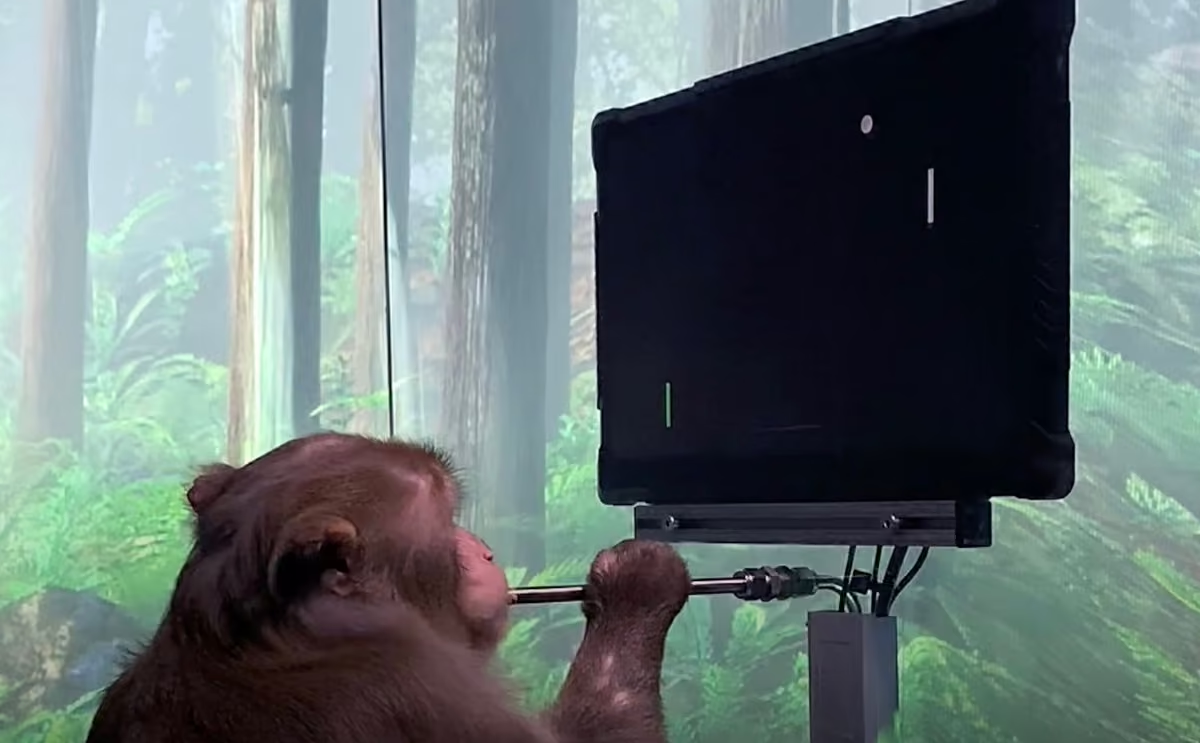
Monkey MindPong youtu.be/rsCul1sp4hQ
For a more in depth look, please visit neuralink.com/blog/
Robots
robots@neuralink.com
youtu.be/-gQn-evdsAo
Snout Boops youtu.be/iSutodqCZ74
Neuralink event livestream is up: youtu.be/DVvmgjBL74w
See you at 3pm PT
Introducing Neuralink www.youtube.com/watch?v=kPGa_FuGPIc
We've released a preprint with additional scientific detail on our devices for domain experts who want to know more. You can find it on bioArxiv: "An integrated brain-machine interface platform with thousands of channels" www.biorxiv.org/content/10.1101/703801v1
Presentation beginning shortly. Livestream is now up at youtube.com/watch?v=r-vbh3t7WVI
Thanks for all of the interest. All invites have now gone out for the Tuesday event. (Be sure to check your spam folder!) Livestream details will be available on our website shortly before event start at 8pm Pacific Time on Tuesday July 16th.
We're having an event next Tuesday in San Francisco to share a bit about what we've been working on the last two years, and we’ve reserved a few seats for the internet. Apply here: neuralink.typeform.com/to/JLuM56