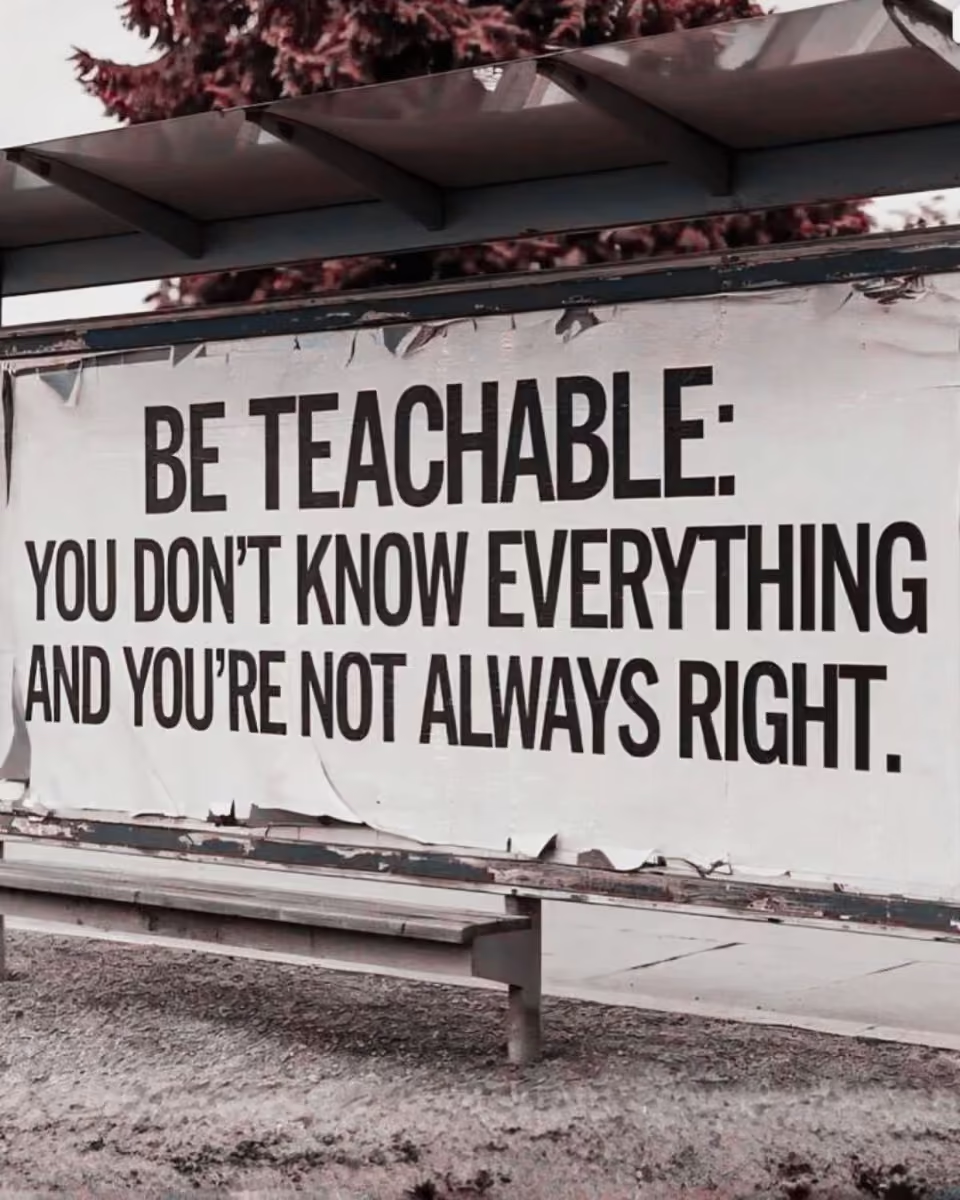
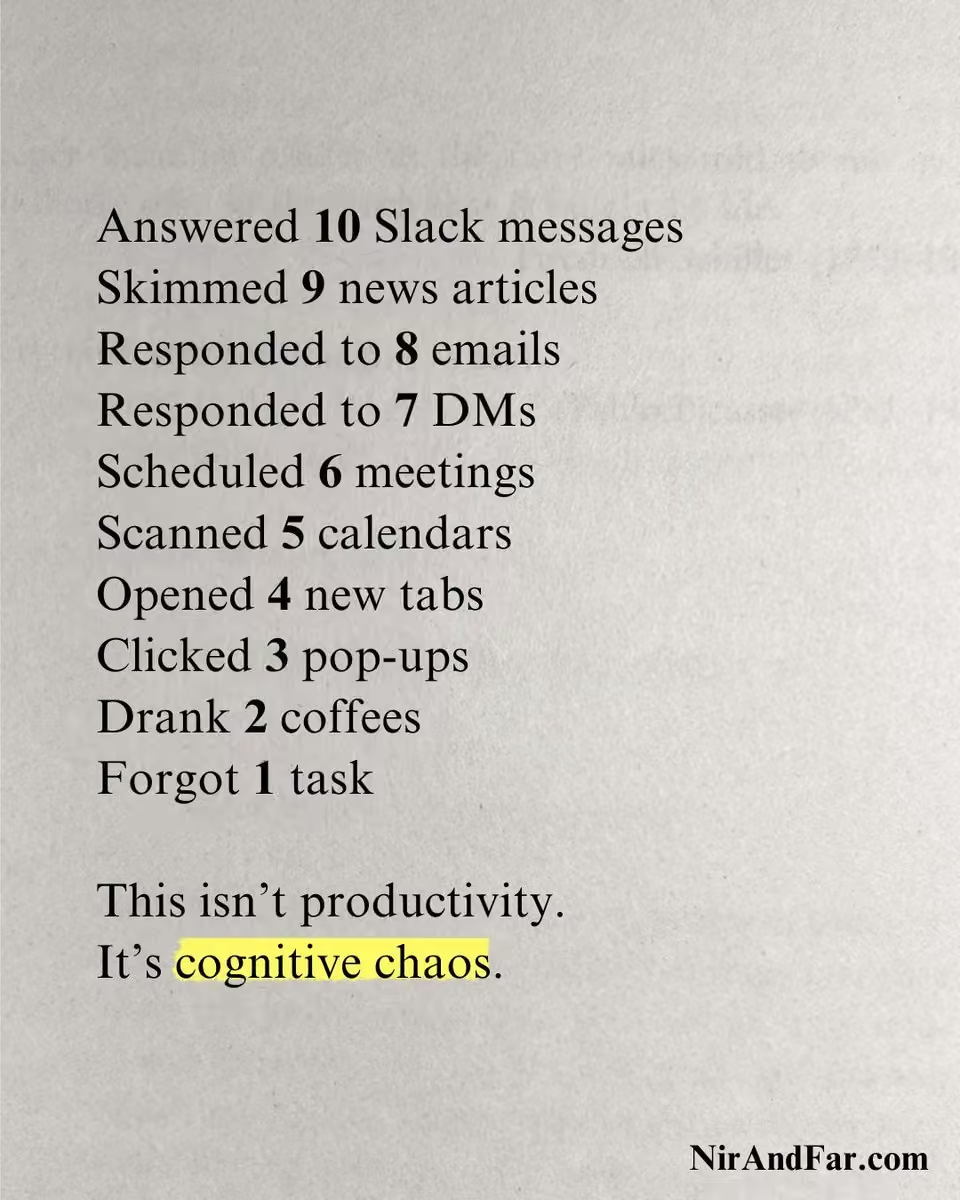
Saying no is harder than it should be.
Not because we don't know what we want to do. Because we don't want to feel what comes with declining — the guilt, the awkwardness, the worry that we're letting someone down.
So we say yes. And then we resent the yes. And then the work we actually planned to do gets pushed to a later that never comes.
Here's the reframe: you can't say you got distracted unless you know what you got distracted from. If your calendar is empty, every request is a reasonable one. If your calendar reflects what you said mattered, a new request is competing with something specific.
That's the shift. Stop treating no as a verdict on the other person. Treat it as a defense of a prior commitment you already made to yourself.
A few scripts that help:
"I'd love to, but I've already committed that time to something else."
"Not yet." (The 10-minute version of no — you're not refusing, you're delaying long enough for the urge to pass.)
"Let me check my calendar" — and then actually check it against what you said the week was for.
None of this makes the discomfort go away. It makes the discomfort survivable for the ten minutes it takes to decline.
Time management is pain management. Saying no is the smallest version of that skill.
Nir Eyal
Nir Eyal is an American author, lecturer, and investor. He is the author of Hooked: How to Build Habit-Forming Products (2014), Indistractable: How to Control Your Attention and Choose Your Life (2019), and Beyond Belief: The Science-Backed Way to Stop Limiting Yourself and Achieve Extraordinary Results (2026). His books address behavioral design, habit formation, attention, and motivation. More on Wikipedia
-
Nir Eyal
@nireyal
-
Nir Eyal
@nireyal
Most people think distraction is binary. You're either focused or you're not. The phone is either in your hand or it isn't.
That framing is wrong, and it's why most "focus" advice fails.
Distraction isn't a switch. It's a dial.
On one end: deep work on what you planned to do. On the other: the escape behavior you reach for when the work gets uncomfortable. Everything in between is some mix of the two.
Which means the question isn't "am I distracted?" The question is: which way is the dial turning right now, and what's turning it?
The answer, almost always, is discomfort. Boredom with the task. Anxiety about whether you can do it. Frustration that it's harder than you thought. The dial turns toward distraction because distraction relieves the feeling.
This is why app blockers aren't enough. You can lock the phone in a drawer and still find yourself reorganizing your desk, refilling your coffee, checking the fridge. The dial finds something.
The fix isn't more willpower. It's noticing which way the dial is turning, and asking what discomfort is turning it. Name the feeling. Sit with it for ten minutes. Then decide.
You can only say you got distracted if you know what you got distracted from. -
Nir Eyal
@nireyal
High performers don't have better brains. They have better beliefs about their brains.
Six things they understand that most people get wrong:
1. Willpower isn't a muscle that gets tired.
Carol Dweck's work at Stanford showed that signs of ego depletion only appeared in subjects who believed willpower was a limited resource. The people who didn't believe the myth didn't experience the effect. Willpower behaves more like an emotion — it waxes and wanes with how you feel and think.
2. Distraction starts from within.
The phone isn't the cause. It's the cope. Every distraction is an attempt to escape discomfort — boredom, anxiety, loneliness, uncertainty. Until you look at the feeling underneath, no app blocker will save you.
3. The opposite of distraction isn't focus. It's traction.
Both words come from the Latin trahere, "to pull." Traction is action that pulls you toward what you planned to do. Distraction pulls you away. You can only call something a distraction if you know what you got distracted from.
4. Time management is pain management.
All behavior is driven by the desire to escape discomfort. Productivity isn't a scheduling problem. It's the skill of sitting with discomfort long enough to do the thing that matters.
5. Identity precedes behavior.
Vegetarians don't debate bacon. People who are indistractable don't white-knuckle through temptation — they've already decided who they are. Change the label, and the behavior follows.
6. Beliefs are tools, not truths.
The belief that willpower is limited makes it limited. The belief that you're "addicted" removes your agency. Swap the belief, and what's possible changes with it.
The brain isn't the bottleneck. The story you tell about it is. -
Nir Eyal
@nireyal
6 tough truths about getting more done:
1. You can't call something a distraction unless you know what it distracted you from. Without a plan for your time, everything is just time passing.
2. The root cause of distraction isn't your phone. It's discomfort. The phone is the cope. Boredom, anxiety, loneliness, fatigue — these are the triggers. The app is just where you run.
3. Willpower isn't a muscle that gets tired. The ego-depletion research didn't replicate. Treat willpower like an emotion that waxes and wanes, not a fuel tank you drain by lunch.
4. Time management is pain management. Productivity isn't about doing more. It's about sitting with the discomfort long enough to do what you said mattered.
5. The opposite of distraction isn't focus. It's traction. Both come from the Latin trahere — to pull. Traction pulls you toward what you planned. Distraction pulls you away. You need the plan first.
6. Identity precedes behavior. People who get things done don't call themselves "people trying to focus." They call themselves indistractable. Vegetarians don't debate bacon.
None of this is a hack. It's the uncomfortable work of looking at what you're running from, and scheduling what you'd do if you weren't. -
Nir Eyal
@nireyal
Most to-do lists fail for the same reason: they tell you what to do, but not when to do it.
That's why I stopped making to-do lists years ago. I became a schedule builder instead.
The tool is timeboxing — and the research behind it is unusually strong. A 2018 review in the Harvard Business Review called it the single most useful productivity practice. Cal Newport has called it the highest-leverage habit for knowledge workers.
Here's the cheat sheet:
1. Start with your values, not your tasks. Three domains: you, relationships, work. If your calendar doesn't reflect what you say matters, your calendar is lying for you.
2. Box the time, not the task. You don't schedule "write chapter 3." You schedule "9-11am: writing." The box protects the time. What you do inside it is a separate question.
3. Plan the week on Sunday. Fifteen minutes. Review what's coming, block the time, make it visible to the people who need to see it.
4. Expect to fail the first week. And the second. Timeboxing is a skill, not a switch. You adjust the schedule to match reality — not abandon it when reality pushes back.
The point of a timeboxed calendar isn't to control every minute. It's to give you something to come back to when you get pulled away.
You can't call something a distraction unless you know what you got distracted from. -
Nir Eyal
@nireyal
Changing your mind isn't a weakness. It's the whole point.
Most people treat a change of mind as a loss — proof they were wrong, proof they can't be trusted, proof they should have known better the first time. So they dig in. They defend the old position long after the evidence has moved.
But beliefs aren't facts. They're tools. And the test of a good tool isn't how long you've owned it — it's whether it still does the job.
When new information arrives, you have two options: update the belief, or defend the identity built around it. Only one of those gets you closer to reality.
The people I trust most are the ones who can say, plainly, "I used to think X. Here's what changed my mind." No performance. No apology. Just the update.
That's not inconsistency. That's thinking. -
Nir Eyal reposted
Dara
@daraladje
A false belief can make you perform better.
Nir Eyal, author of Hooked, told me how a made-up statistic helped change the way Serena Williams played tennis.
Serena was struggling with her volleys at Wimbledon and had lost confidence playing close to the net.
Her coach, Patrick Mouratoglou, told her she won 80% of points when she moved forward.
He made the number up.
But she believed it, started playing more aggressively, and went on to win Wimbledon.
We spend so much time asking whether our beliefs are true. We rarely ask whether they're useful.
What would you attempt if you didn't believe you were bad at it?
This week on the Library of Minds, I chat with @nireyal about why beliefs are tools, not truths, why you might not be as addicted to your phone as you think, and how the stories we tell ourselves shape what we're capable of.
1:00 - Why Clubhouse Didn’t Stick
3:37 - You Can Always Buy Growth, But Not This
9:02 - The 4 Steps of the Hook Model
13:34 - Great Products Get Better With Use
19:26 - Is Social Media That Bad?
26:57 - It’s Not the Algorithm’s Fault
41:10 - Stop Saying “Dopamine”
48:49 - The Man Who Overdosed on Placebos
56:30 - The Lie That Made Serena Williams Better
1:06:00 - Find Your Blind Spots With Nir’s DelphiThis media couldn't be displayed. See it on the original post. -
Nir Eyal
@nireyal
Most leadership advice is folklore. The research tells a different story.
Nine psychology studies every leader should know — and what they actually mean when you stop reading the headlines and read the papers:
1. Hawthorne (1920s–30s). People change their behavior when they know they're being watched. Attention itself is an intervention. Before you redesign the workflow, notice how much of the gain comes from the fact that someone is finally paying attention.
2. Milgram (1961). Ordinary people will cause harm when an authority figure tells them to. If you're the authority, the room is quieter than you think. Dissent is a design problem, not a personality trait.
3. Asch conformity (1951). People will agree with an obviously wrong answer to go along with the group. A single visible dissenter breaks the spell. Your job isn't to have the right opinion. It's to make it safe to voice the second one.
4. Stanford Prison (1971). Zimbardo overstated the findings, and the replication record is ugly — but the smaller, real lesson still holds: roles shape behavior fast. Titles are instructions.
5. Dweck on mindset (2000s). Praise effort, not talent. People told they're smart avoid hard problems. People told they worked hard take them on. This applies to your performance reviews more than it applies to your kids.
6. Deci & Ryan, self-determination theory. Autonomy, competence, relatedness. Pay people fairly, then get out of the way. Extrinsic rewards crowd out intrinsic motivation for work that requires judgment.
7. Kahneman & Tversky on loss aversion. Losses feel roughly twice as big as equivalent gains. Which is why your team resists change you think is obviously an improvement. They're not being irrational. They're being human.
8. Carter et al. (2015) on ego depletion. Willpower isn't a muscle that gets tired. The original Baumeister finding didn't replicate. Stop designing your week around the myth that you have a fixed daily budget of self-control.
9. Gabriele Oett -
Nir Eyal
@nireyal
Successful people don't have more willpower. They have fewer decisions.
Every choice you make burns cognitive fuel. Deciding what to eat for breakfast uses the same mental machinery as deciding whether to take the meeting, whether to hit the gym, whether to open Twitter instead of writing.
The people who seem endlessly disciplined aren't white-knuckling their way through the day. They've pre-decided the recurring stuff once, then put it on autopilot.
9 decisions worth making once:
1. When you wake up. (Same time, every day.)
2. What you eat for breakfast.
3. When you exercise — put it on the calendar, treat it like a meeting with your boss.
4. When you check email. (Twice a day beats 40 times a day.)
5. When you do your hardest work. Protect that block.
6. When your phone is away from you.
7. When you're off the clock. A hard stop makes the workday count.
8. Who you say yes to. Pre-commit to the relationships that matter.
9. When you go to bed.
This is what behavioral scientists call pre-commitment. You remove the choice from the moment of weakness and hand it to the version of you who was thinking clearly.
The fewer things you decide in the moment, the more willpower you have for the things that actually require judgment.
Time management is pain management. And one of the sharpest pains is choosing, over and over, something you already know the answer to. -
Nir Eyal
@nireyal
Before a big decision, most people ask friends. Friends tell you what you want to hear.
Books don't.
Here are 20 sentences I re-read before any decision that matters:
1. The obstacle is the way.
2. You suffer more in imagination than in reality.
3. We are what we repeatedly do.
4. Memento mori — remember you will die.
5. The best time to plant a tree was 20 years ago. The second best is now.
6. Fall seven times, stand up eight.
7. Hard choices, easy life. Easy choices, hard life.
8. If it's not a hell yes, it's a no.
9. The cave you fear to enter holds the treasure you seek.
10. First, solve the problem. Then, write the code.
11. The quality of your life is the quality of your questions.
12. Comparison is the thief of joy.
13. What you resist, persists.
14. Discipline equals freedom.
15. Between stimulus and response, there is a space.
16. The person who says it cannot be done should not interrupt the person doing it.
17. If you want to go fast, go alone. If you want to go far, go together.
18. Everything you want is on the other side of fear.
19. Don't let perfect be the enemy of good.
20. This too shall pass.
I don't follow all of them. I don't even agree with all of them.
But re-reading them forces me to notice the discomfort I'm trying to decide my way out of. Most big decisions aren't information problems. They're emotion problems in disguise.
The sentences slow me down long enough to see which one I'm actually facing. -
Nir Eyal
@nireyal
You can't say you got distracted unless you know what you got distracted from.
Most people get this wrong. They point at the proximal cause — the phone, the news, the coworker, the kid — and call it distraction. But the activity itself tells you almost nothing.
Spending twenty minutes in your inbox isn't distraction if you planned to answer email. It is distraction if you planned to write a proposal.
Same behavior. Opposite verdict.
I made this distinction in Indistractable using two words that share the same Latin root, trahere — "to pull." Traction pulls you toward what you said you'd do. Distraction pulls you away.
Which means the diagnostic question isn't "what is distracting me?" That question sloughs off responsibility onto whatever is nearest. The question is:
"What did I plan to do?"
Then check for the gap between what you said you'd give your attention to and what you did instead.
The worst kind of distraction is the kind that looks productive. An hour of answering work messages while the one task you'd decided mattered — the taxes, the edit, the proposal — sits untouched. You feel busy. You were pulled away from the thing anyway.
Full essay: nir.substack.com/p/the-cause-of-distraction-is-not-what -
Nir Eyal
@nireyal
Most people treat beliefs like one of two things: facts they've verified, or articles of faith no evidence could shake.
Both are wrong.
Beliefs are a third category: firmly held opinions that are open to revision based on new evidence. They're the mental maps we draw with limited information. Which means they're tools — the way a hammer or a chisel is a tool. And when you're carrying the wrong tool for the job, life gets harder than it needs to be.
Harvard psychologist David Levari ran an experiment where he showed people a series of faces and gradually reduced the number of angry ones. Participants kept seeing threat that was no longer there. His finding: "When problems become rare, we count more things as problems."
The same thing happens with the beliefs we carry about our relatives, our abilities, our luck. The threat passed. The belief didn't.
Byron Katie's four questions are the cleanest way I know to audit one:
1. Is this belief true?
2. Can I be certain it's true?
3. How do I react when I believe it?
4. Who would I be without it?
The goal isn't to land on one correct belief. It's to unstick your thinking enough to see a portfolio of options — and then choose.
We don't declutter the garage just to fit the camping gear. We do it for the mental space. Your beliefs deserve the same spring cleaning.
nir.substack.com/p/the-clutter-stressing-you-out-isnt -
Nir Eyal
@nireyal
No caption test
-
Nir Eyal
@nireyal
Most self-help books tell you how to be good at work. Very few tell you how to be good at life.
That's the gap this month's Essentials for the Busy Mind pick tries to close.
The premise is simple: the skills that make you effective at your job — focus, discipline, prioritization — aren't the same skills that make you a good partner, a present parent, a steady friend, a person who sleeps well at night.
Work rewards output. Life rewards attention.
And attention is the one resource most of us spend without tracking.
If you want to think more carefully about what you're optimizing for — and whether the thing you're good at is actually the thing that matters — join us this month.
Join us: essentials.nirandfar.com -
Nir Eyal
@nireyal
In March 2021, the Ever Given wedged sideways in the Suez Canal and blocked roughly 12% of global trade. The disruption cost an estimated $60 billion.
The companies that fared better had one thing in common: buffers. Stockpiled parts. Backup suppliers already lined up. They planned not just for "just in time" but for "just in case."
Most of us do the opposite with our calendars. We schedule for perfect conditions — every meeting ends on time, energy holds, traffic cooperates. Then one thing runs late and the whole day unravels.
In this week's guest post on nirandfar.com, Ben Meer (whose book How to Be Good at Life is our November pick in Essentials for the Busy Mind) offers a framework he calls the Four B's for making a timeboxed schedule survive a messy day:
1. Buffers. Fifteen minutes between meetings. A protected 3–4 p.m. block as a pressure-release valve. Overflow Fridays for work that genuinely needs another session.
2. Barriers. Change the environment so the predictable failure gets harder. Ben took the batteries out of his TV remote and stored them on the other side of the house.
3. Backups. An implementation intention for Plan B, not just Plan A. "If work blows up my 6 p.m. workout, then I will do 10 minutes of bodyweight at home." Research shows if-then plans make people two to three times more likely to follow through.
4. Beacons. Early-warning signals. If you've skipped the 6 p.m. workout four times in two weeks, 6 p.m. is the problem — not your discipline.
Push efficiency too far and it becomes fragility. The strongest systems don't break because they know how to bend.
nir.substack.com/p/how-to-build-systems-that-survive -
Nir Eyal
@nireyal
Most productivity systems collapse under their own weight. Too many apps. Too many categories. Too many rules you abandon by Wednesday.
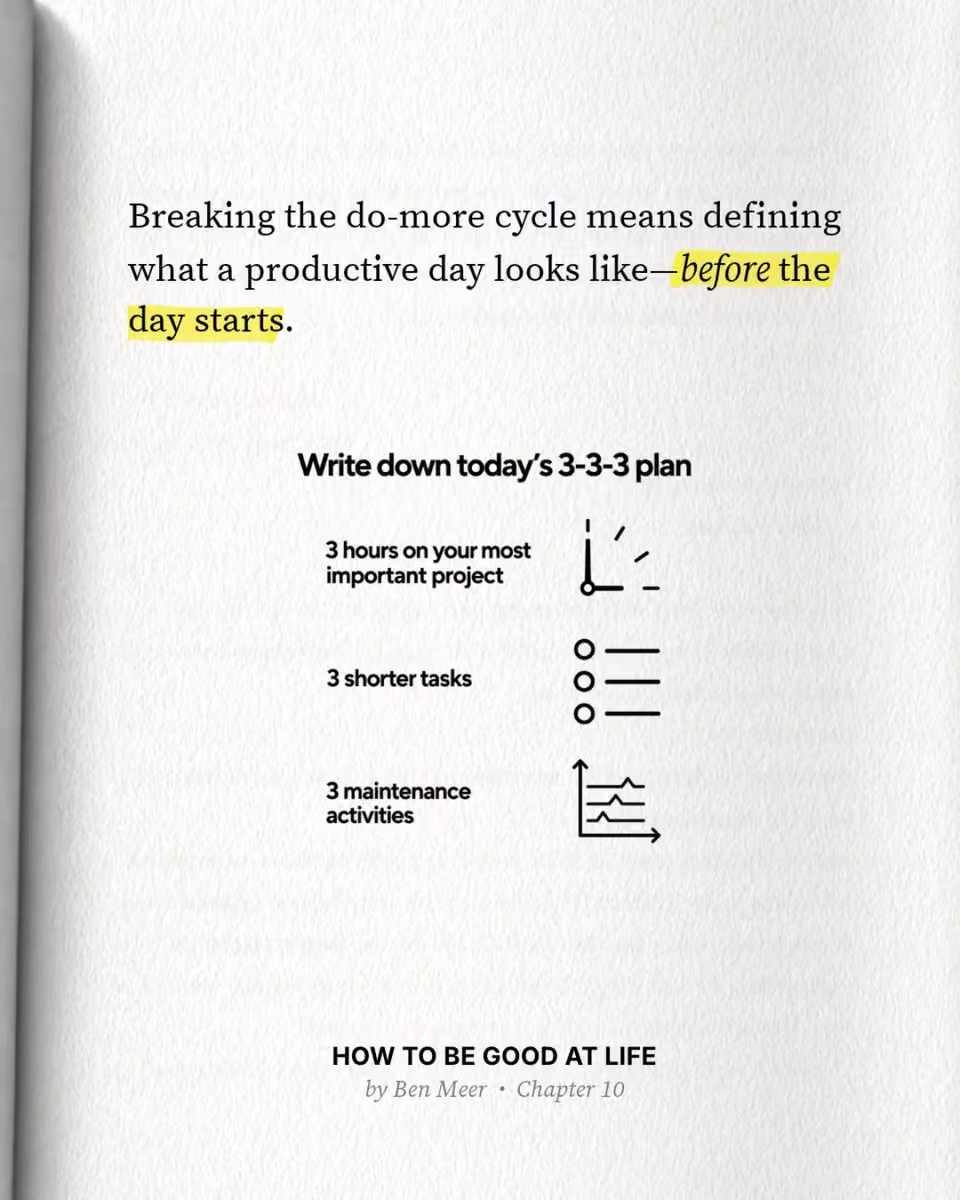
Oliver Burkeman's 3-3-3 plan is the opposite. It fits on an index card.
Here's how it works:
3 hours on your most important project.
3 shorter tasks that have been nagging you.
3 maintenance activities — email, admin, the stuff that keeps the lights on.
That's the day.
What I like about it, from a behavioral design standpoint: it forces you to decide in advance. You can't say you got distracted unless you know what you got distracted from. The 3-3-3 structure gives distraction something to be measured against.
It also respects a truth most productivity advice ignores — you are not going to do twelve important things today. You might do one deep thing and a handful of small ones. Planning for that honestly beats pretending otherwise.
The best schedule isn't the one that captures everything. It's the one you'll actually follow. -
Nir Eyal
@nireyal
Most of what you read, you forget.
Not because you're distracted. Not because you have a bad memory. Because reading and remembering are two different skills, and almost nobody practices the second one.
I used to burn through books and retain almost nothing. I'd finish something, feel smarter for a week, then couldn't tell you the author's main argument a month later. The problem wasn't the books. It was that I treated reading as consumption instead of encoding.
Here's what actually works:
1. Read with a pen. Highlight the sentence that made you stop. Not every clever line — only the one you'd want to find again a year from now.
2. Write one sentence per chapter in your own words. If you can't, you didn't understand the chapter. Go back.
3. Transfer the highlights into a single document you actually revisit. The notebook in your drawer doesn't count. The notes app you never open doesn't count. One place. Searchable.
4. Teach it to someone — out loud, over coffee, in a post. The research on the protégé effect is clear: preparing to teach forces you to encode in a way passive reading never will.
The reason most people forget what they read isn't a memory problem. It's that they finish the book and move on. The retention happens in what you do after you close it.
Reading more books isn't the goal. Remembering a few of them is. -
Nir Eyal
@nireyal
Your team doesn't have a focus problem.
They have a culture problem.
When people can't concentrate at work, the first instinct is to blame Slack, email, meetings, phones — the usual suspects. Block the apps. Ban the notifications. Buy another productivity tool.
But the external triggers are rarely the real issue. They're the symptom.
The real question is: why do people feel they can't ignore the ping? Why do they open the inbox instead of the doc? Why does the meeting feel safer than the work?
Usually it's because the culture punishes anyone who tries to concentrate. If you don't respond to the message within ten minutes, your manager assumes you're slacking. If you block two hours to think, someone books over it. If you miss a Slack thread, you're out of the loop.
In a culture like that, distraction isn't a personal failing. It's a rational response to how performance actually gets measured.
You can hand every employee a copy of Indistractable and it won't matter. The behavior won't change until the environment does.
Three things leaders can actually do:
1. Make it psychologically safe to be unavailable. Not just allowed — expected. Block time on your own calendar for deep work and tell people why.
2. Create a forum for employee concerns. When people have nowhere to raise frustrations, the frustrations leak out as distraction. Give them a channel.
3. Model the behavior. If you email at 11pm, your team will too, no matter what the policy says.
Focus isn't a willpower problem. It's a design problem. And the design starts with the people running the company. -
Nir Eyal
@nireyal
The fastest way to ruin an aspirational OKR is to make someone's bonus depend on hitting it.
This is the quiet reversal almost no leader sees. A stretch goal is supposed to describe a future the organization doesn't yet know how to achieve. Google's own playbook puts the "sweet spot" at 60-70%. If you consistently hit 100%, you weren't stretching.
Attach a bonus to it and the psychology flips. Laszlo Bock, Google's former head of people operations, said when they linked product-usage OKRs to compensation, people "started gaming the system to get their bonuses."
A 2026 lab study found the same thing in miniature: when people set their own production goals, they picked lower targets and produced less on average when hitting the goal triggered a bonus. Missing no longer meant falling short — it meant losing an expected reward. So they protected themselves.
This is the pattern worth watching across management practices. The obvious failure is neglect — people skip the process. The dangerous failure is reversal — people use the tool in a way that undermines the purpose it was designed to serve. A score goes up. A practice looks implemented. And the behavior it was meant to change is now being rewarded.
The repair: label every OKR from the start. Commitments get resourced and delivered. Stretch goals get judged by the quality of the bet, the evidence gathered, and what you decided next. A miss should prompt diagnosis, not punishment.
If every stretch goal is hit, the team wasn't stretching. It was negotiating.
nir.substack.com/p/why-companies-keep-getting-personality -
Nir Eyal
@nireyal
Is psychiatry keeping us sick?
Something is deeply wrong with the mental health system. Instead of leading to recovery, it often perpetuates cycles of dependency on therapy, medication, and diagnoses.
Psychiatric diagnoses — unreliable to begin with — have become our identities rather than tools for recovery. More people are in therapy than ever before, and yet collective mental health isn't improving.
For disorders like ADHD and PTSD, medication is prioritized over education or therapy that teaches people how to cope. We treat medication as a cure-all and never learn the tools that would actually help us heal.
This is the iatrogenic problem: the unintended, harmful consequences of psychiatric diagnosis and treatment itself.
Normal behavior, pathologized.
Sadness and anxiety, once considered everyday emotions, have become problems to eradicate. Many of us have succumbed to the false idea that negative emotions are bad, when in reality they are healthy and useful. Just like hunger prompts us to eat, emotions are signals telling us to tend to our well-being.
But as emotions have become pathologized, there's a growing belief that any emotional discomfort needs to be "fixed."
Psychiatry has a long history of this. Homosexuality was listed as a mental illness in the DSM until 1973, and "sexual orientation disturbance" until 1987. The 2022 addition of prolonged grief disorder has drawn similar warnings from researchers that it will "lead to medicalization of normal grief responses and overdiagnosis."
Awareness has gone up. So has diagnosis. That isn't the same as getting better. -
Nir Eyal
@nireyal
The day I learned Facebook bought WhatsApp for $19 billion, I didn't celebrate my own recent success as an author. I spiraled into self-doubt. "Why hadn't I built a simple messaging app?"
Sound familiar?
We've all been told comparison is toxic. The thief of joy. The fast track to misery. If that's true, why do our minds keep returning to it?
Recent research suggests watching others succeed doesn't just make us feel bad. It lights a fire under us. Comparison can be a bad habit, but there's a hidden upside we've been missing.
A friend recently told me about her "secret mentor" — someone she follows online who serves as her unofficial measuring stick. Usually someone similar in age and background who's achieved what she aspires to. Yes, sometimes the comparison leaves her feeling inadequate. More often, it's a north star. Proof the goal isn't a pipe dream.
Comparative thoughts make up about 12% of our daily mental activity. We'd better learn to use them well.
The trick is a self-compassionate relationship with ourselves while acknowledging our natural tendency to measure. Comparison isn't the thief of joy. Misused comparison is. -
Nir Eyal
@nireyal
Before treating kids with therapy and medication, make sure they're getting enough "psychological nutrients."
The numbers are hard to look away from. 13% of 3- to 17-year-olds in the U.S. have a mental or behavioral health diagnosis. Among teens 12 to 17, it's 20.3%. Globally, 15% of 10- to 19-year-olds have a mental health disorder.
And it hasn't always been like this. Between 2012 and 2018, child mental illness rose 34.6% — before COVID. Depression diagnoses in kids 3 to 17 grew 27% from 2016 to 2020.
Parents and teachers blame social media. But the studies show only a weak correlation, not causation. It's just as likely — more likely — that kids with poor family dynamics, no autonomy, or crushing academic pressure find distraction in their phones. Too much tech use is a symptom. Not the cause.
As diagnoses climb, so does reliance on therapy and medication. These can help. But they're reactive, not preventive. If we want to support kids' mental health, we have to look at one of the root causes.
So what is it about modern childhood that's making kids so unhappy?
The answer sits in the gap between what children need psychologically and what their daily lives actually give them. Many childhood struggles come from lifestyle factors, not chemical imbalances. Addressing those should be the first step — not the last. -
Nir Eyal
@nireyal
Most of what drains your attention isn't the work in front of you. It's the running tally of things you can't do anything about.
The traffic. The email someone hasn't answered. The decision your boss hasn't made yet. The weather on the day of the event.
Your brain treats all of it as urgent — because unresolved feels like unsafe. So it keeps circling back, pretending that one more loop of worry will unlock a solution. It won't.
The psychologist Julian Rotter called this the locus of control. People with an internal locus focus on what they can influence. People with an external locus fixate on what's happening to them. The research is consistent: internal locus correlates with lower anxiety, better performance, and more follow-through on hard things.
The practical move is smaller than it sounds. When you notice yourself spiraling, ask one question: is this something I can act on in the next hour? If yes, do the smallest version of it. If no, write it down and close the loop deliberately — "not mine to solve right now."
This isn't resignation. It's the opposite. You're reclaiming the attention you were spending on things that don't move, and spending it on the one or two things that do.
Focus isn't a feeling. It's a decision about where your effort is allowed to go. -
Nir Eyal
@nireyal
How to make a hard decision.
Most of us treat hard decisions like math problems. We pile up more information, more pros-and-cons lists, more opinions from more people, and wait for the answer to feel obvious.
It rarely does.
The reason a decision is hard isn't usually that you lack information. It's that both options cost you something you care about, and no amount of analysis will erase that cost.
So the question stops being "which option is right?" and becomes "which cost am I willing to live with?"
That's a different kind of question. It's not analytical. It's about values.
A few things that help:
1. Name the discomfort you're trying to avoid by not deciding. Hard decisions get postponed because deciding means feeling something — regret, loss, guilt, uncertainty. If you can name the feeling, you've already loosened its grip.
2. Ask what your future self will respect, not what will feel good this week. The version of you a year from now has different information than the version panicking today.
3. Set a decision deadline. Not a research deadline. A decision deadline. Open-ended deliberation is just distraction wearing a serious face.
4. Accept that you're choosing between trade-offs, not between right and wrong. Grown-up decisions are almost always this.
The people who seem decisive aren't smarter. They've just stopped waiting for the discomfort to go away before they act. -
Nir Eyal
@nireyal
No caption test
-
Nir Eyal
@nireyal
Most of us say we want to read more. Then another year goes by and the stack on the nightstand looks exactly the same.
I don't think the problem is willpower. I don't think it's screens, either. It's that reading, for most adults, has quietly become a solo activity with no deadline and no one waiting on the other end.
Compare that to a show you watch because your friends are watching it, or a workout you show up for because someone is expecting you at the gym. The behavior isn't more enjoyable. It's more accountable.
That's why I started Essentials for the Busy Mind.
One short, powerful book a month. A small community of people reading it alongside you. No homework, no performance, no 600-page doorstops you'll quit by chapter three.
The point isn't to look well-read. It's to actually finish the kind of books that change how you think — and to do it with people who are doing the same thing on the same month.
If you've been meaning to get back to reading, this is the easiest on-ramp I know how to build.
Join us: essentials.nirandfar.com -
Nir Eyal
@nireyal
The most important education I ever got, I paid for myself.
Not the degrees. Not the Stanford lectureship. The books I read because I needed to solve a problem in my own life.
I used to be clinically obese. School didn't fix that. I read my way out of it — behavioral science, habit research, the actual studies on why we eat when we aren't hungry.
Later, when my own phone use was embarrassing me in front of my daughter, I didn't go back for another degree. I read. I ran the experiments on myself. That became Indistractable.
Formal education hands you a credential. Self-education hands you a life you actually chose.
The people I know who kept getting more interesting past 40 all have the same habit: they read like their lives depend on it. Because, quietly, they do.
Pick the problem that's bothering you most right now. Find the three best books on it. Read them this quarter. That's the whole program. -
Nir Eyal
@nireyal
Your labels are your limits.
The words you use to describe yourself aren't neutral. They're instructions.
Say "I'm bad with money" often enough and your brain stops looking for evidence that contradicts it. Say "I have no willpower" and you've written yourself a permission slip to quit before you start.
Carol Dweck's work at Stanford showed this years ago with willpower. The people who believed willpower was a limited resource ran out of it. The people who didn't, didn't. Same task. Same brains. Different label.
This is why I'm careful about the identity I attach to a behavior. "I'm trying to focus more" is weak. "I'm indistractable" is a label that does work on your behalf. Vegetarians don't negotiate with bacon. They don't need to. The label already decided.
Beliefs aren't facts. They're tools. And the label you repeat about yourself is the one your behavior will eventually match.
So it's worth asking: which of the labels I carry around are actually serving me — and which ones am I just repeating because I heard them long enough to believe them? -
Nir Eyal
@nireyal
You're the CEO of your life.
That's not a motivational line. It's a job description.
A CEO doesn't react to whatever lands in their inbox. They decide what matters, put it on the calendar, and defend that time against everything else competing for it. Nobody schedules their day for them. Nobody tells them what deserves their attention.
Most of us don't run our lives this way. We run on to-do lists — reactive, open-ended, and infinitely expandable. A to-do list doesn't tell you when something will get done. It just reminds you that it hasn't.
The fix is to stop being a to-do list maker and start being a schedule builder. Open your calendar. Decide — in advance — what you want to do with your time, and block it. Deep work. Family dinner. Exercise. The hobby you keep saying you'll get back to.
If it's not on the calendar, it won't happen. If it is on the calendar, and something else pulls you away, you now know you got distracted. You can't say you got distracted from something you never planned to do in the first place.
The CEO of your life doesn't ask "what should I do today?" They ask "did I do what I said I'd do?"
Run your life like you'd run a company you actually cared about. -
Nir Eyal
@nireyal
Facts are forgotten by lunch.
The things you actually remember from any book, lecture, or conversation are the stories. The character who failed. The moment that reframed everything. The scene you can still picture a decade later.
That's not a bug in how we learn. It's the design.
Our brains evolved for narrative long before they evolved for data. Jonathan Haidt calls the mind a storytelling machine — we don't reason our way into beliefs, we reason our way out of the ones our stories already built.
Which is why the most persuasive communicators aren't the ones with the best evidence. They're the ones with the best story carrying the evidence.
If you want someone to remember what you said tomorrow, don't lead with the statistic. Lead with the person it happened to.
Facts inform. Stories stick. -
Nir Eyal reposted
Interintellect 🧭
@interintellect_
During our SuperSalon" Beliefs, Unconventional Lives, Writing Careers & More" host @p_millerd and bestselling author @nireyal talked about his book "Beyond Belief" and why our natural disquiet is what actually drives human progress.
Wanting more isn't a flaw, it's the fire behind every breakthrough. -
Nir Eyal
@nireyal
Being busy isn't the same as being productive.
Most of us know this, and yet we keep falling into the same traps — the ones that make the day feel full while the work that matters sits untouched.
Here are seven I've had to catch myself in:
1. Reacting instead of planning. If your calendar is built by other people's emails, you don't have a schedule. You have an inbox with time slots.
2. Mistaking motion for progress. Shuffling tabs, re-reading Slack, tidying your to-do list — all of it feels like work. None of it is.
3. Saying yes by default. Every yes to someone else's priority is a no to your own. The calendar doesn't lie about this.
4. Treating urgency as importance. The loudest task is rarely the most important one. Urgency is a feeling, not a filter.
5. Multitasking. The research is unambiguous: you're not doing two things at once. You're doing both of them worse.
6. Avoiding the hard thing. Distraction is almost always an escape from discomfort. The task you keep putting off is usually the one that would move you forward.
7. Not planning time for yourself. If your values — rest, health, family, deep work — don't appear on your calendar, they don't exist in your week.
Time management is pain management. You can't out-hustle discomfort. You can only decide, in advance, what you'd do without it — and then put it on the calendar. -
Nir Eyal
@nireyal
Getting distracted isn't the problem. Staying distracted is.
Everyone loses focus. The question is how fast you come back.
Most advice treats refocusing like willpower — just try harder, push through, white-knuckle your way back to the task. That's not a strategy. That's a wish.
Refocusing is a skill. And like any skill, it has techniques you can practice.
Here are 12 that actually work:
1. Name what pulled you away. You can't manage what you won't look at. Was it boredom? Anxiety? A notification? Say it out loud.
2. Use the 10-minute rule. Tell yourself you can give in to the distraction — in 10 minutes. Surf the urge until then. Most urges pass.
3. Return to your timeboxed schedule. If you don't have one, that's the first problem. You can't say you got distracted unless you know what you got distracted from.
4. Close the tab. Not minimize. Close.
5. Put the phone in another room. Not face-down. Another room.
6. Write down the intrusive thought. Capture it on paper so your brain stops rehearsing it.
7. Stand up and move for 60 seconds. Reset the body, reset the attention.
8. Re-read the last sentence you wrote (or the last line of code, email, paragraph). Momentum returns through the work itself.
9. Ask: what am I trying to escape right now? Discomfort is the root cause of nearly every distraction.
10. Make a pre-commitment. Use a site blocker, a focus mode, a locked drawer. Design the environment so the distracted version of you can't win.
11. Lower the stakes. Tell yourself you only have to do five minutes of the hard thing. Starting is 90% of it.
12. Forgive yourself and continue. Self-criticism after a distraction causes more distraction. The research on self-compassion is clear — people who forgive themselves recover faster.
The goal isn't to never get distracted. The goal is to notice sooner and return faster.
That's what being indistractable actually looks like. -
Nir Eyal
@nireyal
Beliefs aren't facts. They're tools.
And like any tool, they wear out.
Most of us walk around using beliefs we picked up at 12, 22, or 32 without ever asking whether they still work. We treat them as truths about who we are instead of what they actually are: instruments we chose (or inherited) to get through something.
Here are 7 signs a belief has stopped serving you:
1. It used to protect you. Now it isolates you.
2. It explains your past better than it predicts your future.
3. You defend it harder when it's challenged than when it's working.
4. It makes you feel certain, but not capable.
5. The people who gave it to you no longer live by it themselves.
6. It keeps you safe from the exact thing you say you want.
7. You can't remember the last time it changed your behavior — only how you talk about yourself.
The test for a belief isn't whether it feels true. It's whether it still does the job you hired it for.
When it doesn't, you're allowed to put it down. -
Nir Eyal
@nireyal
The opposite of distraction isn't focus. It's traction.
Both words come from the same Latin root — trahere — meaning "to pull." Traction is any action that pulls you toward what you said you'd do. Distraction is any action that pulls you away from it.
Which means you can't actually say you got distracted unless you know what you got distracted from.
Here are the 4 steps to becoming Indistractable:
1. Master internal triggers.
Most distraction doesn't start with your phone. It starts with discomfort — boredom, anxiety, loneliness, uncertainty — that you're trying to escape. The phone is the cope, not the cause. Learn to sit with the feeling for 10 minutes before acting on it. Most urges pass. The ones that don't, you can honor on your own terms.
2. Make time for traction.
If it's not on your calendar, it isn't real. Timebox your values — work, relationships, your own body and mind — into a weekly schedule you actually keep. Be a schedule builder, not a to-do list maker. A to-do list tells you what you didn't finish. A calendar tells you whether you lived the day you planned.
3. Hack back external triggers.
Every ping, badge, and notification is a question your phone is asking you. Most of them don't deserve an answer. Turn off anything that doesn't serve you. The research on interruption recovery is brutal — it takes an average of 23 minutes to return to a task after a single interruption.
4. Prevent distraction with pacts.
Pre-commit before the moment of weakness. Effort pacts (a website blocker), price pacts (money on the line), and identity pacts ("I'm the kind of person who doesn't check email before 10am") work because they make the distracted choice harder than the chosen one.
Time management is pain management. You don't need another productivity app. You need to notice what you're running from. -
Nir Eyal
@nireyal
Promotions don't go to the people who work hardest. They go to the people who think differently about work.
After years studying behavioral design in companies, I've noticed seven mental habits that separate the people who get promoted from the people who keep waiting for it.
1. They treat their calendar as a contract with themselves.
Most people write to-do lists and hope the day accommodates them. Promoted people decide in advance what their time is for — then defend it. The schedule is the strategy.
2. They look for the discomfort.
Every hard task carries a feeling you're trying to escape: boredom, self-doubt, the dread of being judged. People who advance notice the feeling and stay with it for ten minutes instead of opening Slack.
3. They separate identity from feedback.
A bad review is information, not a verdict. The habit is to ask "what's true here?" before "what does this say about me?"
4. They finish small things on time.
Reliability compounds faster than brilliance. The person who sends the thing on Thursday afternoon when they said Thursday afternoon becomes the person managers trust with bigger things.
5. They write down what they want.
Vague ambition stays vague. Specific ambition — "I want to lead this product line in 18 months" — gives your attention something to organize around.
6. They assume good faith longer than feels comfortable.
The colleague who dropped the ball probably didn't do it to spite you. People who assume malice early burn relationships they later need.
7. They treat their career as a series of experiments, not a ladder.
Ladders have one path up. Experiments have hypotheses, results, and iterations. The second frame fits how careers actually work.
None of these are talent. All of them are habits — which means they're available to you starting today. -
Nir Eyal
@nireyal
Nobody talks about the failure rates.
Most diets fail. Most New Year's resolutions fail. Most attempts to build a lasting habit fail. And yet the self-help industry keeps selling the same playbook: try harder, want it more, believe in yourself.
The problem isn't the person. It's the model.
For decades, behavior change was built on the idea that willpower is a limited resource you deplete over the day. Roy Baumeister's ego depletion studies made it gospel. Then Evan Carter's 2015 meta-analysis showed the effect largely disappears once you correct for publication bias. Carol Dweck's work went further: signs of depletion only showed up in people who already believed willpower was finite.
Which means the belief itself is doing the work.
If you think you're running out of self-control at 3pm, you will. If you think willpower is more like an emotion — waxing and waning with how you feel and what you've eaten and whether you slept — you treat it the way you'd treat any other passing state. You don't quit because it showed up.
This is why I keep coming back to the same idea: beliefs aren't facts. They're tools. And when the tool you've been handed has a failure rate this high, the answer isn't to grip it harder. It's to put it down and pick up a better one.
Look for the discomfort you're trying to escape. Schedule what you'd do if it weren't there. That's the whole practice. -
Nir Eyal
@nireyal
When should you decide fast, and when should you sleep on it?
Most productivity advice tells you to trust your gut. Other advice tells you to slow down and analyze. Both are half-right.
The research points to a cleaner rule: match the decision speed to the decision type.
For small, reversible choices — what to eat, which email to answer first, whether to take the meeting — decide fast. The cost of deliberating is higher than the cost of being wrong. You can undo it.
For big, irreversible choices — hiring someone, signing a contract, leaving a job — sleep on it. Not because your gut is wrong, but because a delay lets the emotional charge fade and the actual trade-offs surface.
Jeff Bezos calls these Type 1 and Type 2 decisions. Type 2 (reversible) should be made quickly and by individuals. Type 1 (one-way doors) deserve more time and more input.
The mistake most people make isn't deciding too fast or too slow. It's using the wrong speed for the wrong door.
Before your next decision, ask one question: can I walk this back?
If yes, decide now.
If no, sleep on it. -
Nir Eyal
@nireyal
Nine books that changed how I think about behavior, belief, and attention.
Not a listicle. Just the ones I keep returning to when I'm stuck.
1. Thinking, Fast and Slow — Daniel Kahneman
The two-system model of the mind. If you only read one book on how you actually decide things, read this.
2. Influence — Robert Cialdini
Six principles of persuasion, all backed by named studies. I've never designed a product without it on the desk.
3. The Power of Habit — Charles Duhigg
Cue, routine, reward. The loop that shaped how I wrote Hooked.
4. Mindset — Carol Dweck
Fixed vs. growth. The research on how belief about ability changes performance is stronger than most self-help books ever get to cite.
5. Drive — Daniel Pink
Autonomy, mastery, purpose. Pink translates Deci and Ryan's self-determination theory into something you can actually use at work.
6. Flow — Mihaly Csikszentmihalyi
What it feels like to be fully absorbed, and the conditions that make it possible. The opposite of distraction has a name.
7. Predictably Irrational — Dan Ariely
The systematic ways we deceive ourselves. Read it before you trust your own next big decision.
8. The Willpower Instinct — Kelly McGonigal
McGonigal takes the research on self-control and makes it practical. Pairs well with the argument that willpower isn't a finite resource.
9. Man's Search for Meaning — Viktor Frankl
The one that doesn't fit the behavioral-science shelf but belongs on it anyway. Between stimulus and response, there is a space. In that space is our power to choose.
Which of these have you read? And what would you add? -
Nir Eyal
@nireyal
The people who want to see you win aren't always the ones you'd expect.
Sometimes it's not family. Sometimes it's not the oldest friends. Sometimes it's a colleague you barely know, a reader who sends one line of email, a mentor who has no reason to spend an hour on your problem — and does anyway.
I used to assume the strongest support would come from the closest relationships by default. It doesn't work that way. Proximity isn't the same as belief. Someone can love you and still flinch when you try something they can't picture themselves doing. That flinch isn't cruelty. It's just what belief looks like when it hasn't caught up to you yet.
So the question worth asking isn't "who's in my corner because they're supposed to be?" It's "who actually lights up when I win?"
Pay attention to the answer. Then spend more time there. -
Nir Eyal
@nireyal
Six beliefs quietly run your life. Most of them aren't true.
You didn't choose them. You inherited them — from parents, teachers, culture, the last decade of your own self-talk. And because you never examined them, they operate like facts. They aren't facts. They're tools. And some of the tools you're using are broken.
Here are six I've had to put down:
1. "Willpower is a limited resource."
Carol Dweck's work showed ego depletion only appears in people who already believe willpower runs out. Believe it's finite and it acts finite. Believe it's more like an emotion — waxing and waning with how you feel — and it behaves like one.
2. "I'm addicted to my phone."
Calling normal, uncomfortable behavior an addiction hands your agency to the device. The phone isn't the cause. It's the cope. The real question is what you were trying to escape when you picked it up.
3. "I just need more focus."
The opposite of distraction isn't focus. It's traction — both from the Latin trahere, to pull. You can't say you got distracted unless you know what you got distracted from. No plan, no distraction. Just a day.
4. "I don't have time."
You have time. You have priorities that don't match your calendar. A schedule builder decides in advance; a to-do list maker reacts all day and calls it busy.
5. "I'll do it when I feel ready."
Ready is a feeling that arrives after you start, not before. Waiting for it is the most sophisticated form of procrastination we've invented.
6. "This is just who I am."
Identity is the most powerful belief of the six — and the most editable. Vegetarians don't debate bacon. Indistractable people don't negotiate with the urge. Change the label and the behavior follows.
Beliefs aren't facts. They're tools. If one of yours isn't working, put it down and pick up a better one. -
Nir Eyal
@nireyal
Most people can't say no because they've confused politeness with obligation.
Every yes is a no to something else — usually the work you said mattered. If your calendar is full of other people's priorities, you don't have a time problem. You have a permission problem.
Here are 7 requests you're allowed to say no to:
1. The meeting with no agenda.
2. The "quick call" that could be an email.
3. The favor that only benefits the asker.
4. The event you already dread.
5. The project outside your role.
6. The message that demands an instant reply.
7. The commitment your future self will resent.
None of these require an apology. None require a long explanation. "I can't take that on right now" is a complete sentence.
Saying no isn't rude. It's how you protect the yes you already made to yourself. -
Nir Eyal
@nireyal
6 brutal truths about focus nobody tells you:
1. Distraction isn't a tech problem. It's a discomfort problem.
You don't reach for your phone because it's addictive. You reach for it because you don't want to feel what you're feeling — bored, anxious, uncertain, stuck. The phone is the cope, not the cause.
2. You can't call it a distraction unless you know what you got distracted from.
If your calendar is empty, everything is a distraction and nothing is. Traction is what you planned to do. Distraction is what pulled you away from it. Both come from the Latin trahere — to pull. You need the plan first.
3. Willpower isn't a muscle that gets tired.
Carol Dweck's research showed signs of ego depletion only appeared in people who believed willpower was limited. Willpower is more like an emotion. It waxes and wanes. Treat it that way and it stops running out.
4. "I'll focus better tomorrow" is the lie that keeps you distracted today.
The urge passes in about 10 minutes. Sit with it. Don't say no — say not yet. Ten minutes later, you usually don't want the thing anymore.
5. To-do lists don't produce focus. Timeboxed calendars do.
A to-do list is a wish. A calendar is a commitment. Schedule the work you said matters, then defend the block like you'd defend a meeting with your boss.
6. The opposite of distraction isn't focus. It's traction.
Focus is what you're trying to do. Traction is doing it. The gap between them is where discomfort lives — and that's the only place worth looking. -
Nir Eyal
@nireyal
A moment from a recent event.
Every time I step off a stage, I'm reminded that the questions from the audience teach me more than my own talk did.
That's the part of this work I didn't expect when I started writing books — the conversations after. -
Nir Eyal
@nireyal
Most people never audit their beliefs.
They inherit them — from parents, teachers, culture, old versions of themselves — and then spend decades acting on assumptions they've never actually examined.
Here's the uncomfortable part: a belief doesn't have to be true to shape your behavior. It just has to go unquestioned.
"I'm not a disciplined person."
"I'm bad with money."
"I can't focus anymore."
"People like me don't do things like that."
Each of these runs in the background like code. You don't notice it. You just notice the output — the missed workout, the avoided conversation, the project you never start.
A belief audit is simple:
1. Write down the thing you keep failing at.
2. Ask what you'd have to believe about yourself for that failure to make sense.
3. Ask where that belief came from.
4. Ask if it's actually true, or just familiar.
Most of the beliefs holding people back aren't lies they were told. They're conclusions they drew once, under stress, and never revisited.
Beliefs aren't facts. They're tools. And when a tool stops working, you're allowed to put it down. -
Nir Eyal
@nireyal
Timeboxing is the most powerful time-management technique I know. But there's no single right way to do it.
Some people set the same schedule every week and review it on Sundays. Others rebuild their calendar daily and review it the night before. Some use a spreadsheet in 15- or 30-minute increments. Others use Google Calendar. Others use one of the dozens of timeboxing apps.
What they share isn't the tool. It's the sequence.
Step One: Identify your values.
Russ Harris, author of The Happiness Trap, defines values as "how we want to be, what we want to stand for, and how we want to relate to the world around us." They're attributes of the person you want to become — being an honest person, a loving parent, a trusted teammate.
You never finish a value any more than finishing a painting lets you finish being creative. A value is a guiding star. It's the fixed point you use to make choices.
Sort yours across three life domains: You, Relationships, Work.
Step Two: Turn your values into time.
Decide how much time each domain needs to be consistent with the person you say you want to be. List the specific activities that exercise those values — this is what I call traction. Workout class and meal planning for the health value. A weekly date night for the partner value. Deep work blocks for the professional value.
Then you put those blocks on the calendar, in advance, before anything else can claim the space.
One thing worth saying plainly: no productivity technique is effective and easy. It's going to be effective and hard. Nothing will magically fix time management without some effort on your part.
But once you can point to your calendar and say "this is what a day lived by my values looks like," you finally have something to be distracted from. And that's the whole game. -
Nir Eyal
@nireyal
"Those who keep learning will keep rising in life." — Charlie Munger
Munger read constantly. Not to sound smart at dinner parties, but because he understood something most ambitious people miss: the compounding curve on knowledge is steeper than the one on money.
A book a week for a decade isn't 520 books. It's a mind that can see patterns other people can't.
The uncomfortable part is that learning feels like nothing while you're doing it. No dopamine spike. No visible progress. Just the slow work of sitting with an idea you don't fully understand until you do.
That discomfort is why most people stop. It's also why the ones who don't, rise. -
Nir Eyal
@nireyal
That flutter when someone likes your post. The warm glow after your boss praises your presentation. The slight panic when your work gets criticism instead of praise.
We've all been conditioned to seek approval from family, friends, and bosses before taking action. But here's the uncomfortable truth: you'll never live on your own terms if you live by external validation.
Researchers studying high-approval-need individuals found their self-esteem is directly correlated with how positively they believe others perceive them. That's a psychological trap. Your sense of worth becomes hostage to opinions that are fickle, subjective, and completely beyond your control.
There's something I've always admired about artists: their nearly stubborn, unrealistic belief in their own talents.
If you decide to become an artist, you'll face more adversity than in almost any other profession. Study art in college and you'll hear, "But what are you going to do with that degree?" Say you want to act or dance and you'll hear, "There's so much competition. Only a few make it."
Artists can't let criticism dictate what they create — even though critique is baked into the work.
Igor Stravinsky, now considered one of the greatest composers of the 20th century, caused riots in Paris theaters in the early 1900s because the French aristocracy wasn't ready for his music. Musicians today argue it was precisely his indifference to public opinion that let him revolutionize the sound of the age.
The artists we remember weren't the ones who took the best notes from the crowd. They were the ones who kept working when the crowd booed.
Approval is not a plan. It's a leash. -
Nir Eyal
@nireyal
A 2024 Gallup report found that 62% of people globally are not engaged at work. Another 15% are actively disengaged.
Nearly 8 in 10 people feel checked out while on the clock.
I've had this conversation with friends and readers more times than I can count. They're not in toxic workplaces. They're bored. They feel undervalued. They think their work doesn't matter.
And because the job pays the bills, they feel shackled to it.
So are we supposed to just suck it up? Accept that not everyone gets a fulfilling job?
No. Even when your job doesn't seem meaningful, you can still create meaning. Fulfillment doesn't have to be something your job gives you. It can be something you bring to your job.
Here's what happens when you don't: dissatisfaction at work seeps into everything else. Your self-worth. Your relationships. Ironically, feeling unfulfilled often makes you worse at your job, which makes work bleed into every other domain of your life.
Dissatisfaction is a powerful internal trigger. A negative feeling that drives us to distraction.
The drive to relieve discomfort — including the emotional kind — is the root cause of all our behavior. Distraction is one way our brains try to handle that discomfort. So when you feel bored, undervalued, or regretful at work, you reach for the phone, the snack, the tab you don't need open.
The fix isn't quitting (yet). It's noticing the discomfort, naming it, and deciding what you'd rather do with the next 45 minutes instead of escaping it. -
Nir Eyal
@nireyal
Most people try to change their behavior by white-knuckling it. Grit your teeth. Push through. Try harder next time.
The research says that's backwards.
Behavior isn't primarily driven by willpower. It's driven by what you believe about yourself, what you believe about the task, and what you believe about your capacity to sit with discomfort.
Carol Dweck's work on mindset showed that people who believed willpower was a limited resource actually behaved as if it were — running out of steam, losing control. People who believed it wasn't, didn't. Same brain. Different belief. Different outcome.
That's the leverage point.
You don't change behavior by fighting yourself. You change it by examining the beliefs that make the old behavior feel necessary in the first place. The urge to check the phone, skip the workout, break the promise — those aren't willpower failures. They're attempts to escape a feeling.
Change the belief about the feeling, and the behavior follows.
Beliefs aren't facts. They're tools. And when you understand how they work, you can set them aside when they're unhelpful and replace them with better ones. -
Nir Eyal
@nireyal
Not your fault. Still your responsibility.
That's the line I keep coming back to when people ask me about distraction, about weight, about any behavior they wish they could change.
I grew up clinically obese. That wasn't my fault. I was a kid. I didn't design the food environment, I didn't stock the pantry, I didn't invent the snacks engineered to override satiety.
But at some point, the story stopped being about what happened to me and started being about what I was going to do about it.
The same is true for attention.
Your phone was built by teams of very smart people whose job is to keep you scrolling. The apps use variable rewards, social approval, infinite feeds. That's not paranoia — that's the business model. It's not your fault the environment is hostile.
But it is your responsibility to do something about it.
This is where most of the conversation goes wrong. People pick a side. Either it's all personal willpower (blame the individual) or it's all Big Tech (blame the company). Both framings fail you.
Blaming yourself leads to shame, and shame leads back to the phone. Blaming the company leads to helplessness, and helplessness leads back to the phone.
The more useful frame is the one you'd use with a friend: I know this wasn't set up in your favor. And I know you're the only one who can change it.
Look for the discomfort you're trying to escape. Schedule what you'd do without it. Make the phone harder to reach than the thing that matters.
Not your fault. Still your responsibility. Both are true, and only one of them moves you forward. -
Nir Eyal
@nireyal
Most people lose their morning before it starts.
They wake up, grab the phone, and hand the first hour of the day to whoever emailed, texted, or posted overnight. Then they wonder why they can't focus.
The morning isn't a mood. It's a design problem.
Here are 7 steps I use to reclaim mine:
1. Decide the night before what the morning is for. If you don't plan the time, someone else will fill it.
2. Keep the phone out of the bedroom. The first input of the day shouldn't be a stranger's agenda.
3. Use an actual alarm clock. A $10 device removes the single biggest external trigger in your life.
4. Timebox the first 90 minutes. Put the block on your calendar the way you'd put a meeting with your boss.
5. Do the hard thing first — the one you'll invent excuses to avoid by 2pm.
6. Notice the discomfort that pulls you toward the phone. Boredom, anxiety, dread. That feeling is the real trigger, not the notification.
7. Sit with the urge for ten minutes before acting on it. Most urges don't survive the wait.
Distraction isn't a tech problem. It's a discomfort problem. The morning is just where it shows up first.
Plan the time, or lose it. -
Nir Eyal
@nireyal
Saying yes to everything isn't kindness. It's a habit of avoiding the discomfort of disappointing someone.
And every yes you give away is a no to something you already told yourself mattered.
Here are 7 requests you're allowed to decline — without guilt, without a paragraph-long explanation, without rehearsing the apology in your head for the rest of the day:
1. The meeting that could have been an email.
2. The favor that only benefits the asker.
3. The plan you already know you'll regret agreeing to.
4. The project outside your role, your interest, or your capacity.
5. The invitation you're accepting out of obligation, not desire.
6. The commitment that requires you to cancel something you already committed to.
7. The request that violates a value you've already decided to protect.
Notice the pattern. Every one of these is a request to trade your calendar — the one you sat down and built on purpose — for someone else's priorities.
You can't say you got distracted unless you know what you got distracted from. Same with obligation. You can't defend your time unless you've decided in advance what it's for.
"No" is a complete sentence. But the real work happens before the request ever arrives — in the schedule you already made. -
Nir Eyal
@nireyal
When is "good enough" actually good enough?
Most productivity advice tells you to push harder. Aim higher. Never settle.
But there's a point where the extra effort stops paying off — and starts costing you.
Economists have a name for this: diminishing returns. The first hour on a project moves the needle. The tenth hour polishing the same slide moves almost nothing.
The problem is, perfectionism doesn't feel like inefficiency. It feels like conscientiousness. It feels like you care.
What it really is: a way to avoid the discomfort of shipping. As long as the work isn't done, it can't be judged.
Here's the reframe I use. Before I start a task, I decide what "done" looks like. Not perfect — done. I write it in my calendar next to the timebox.
When the timer runs out, the work ships. Not because it's flawless. Because I said it would.
"Good enough" isn't a lower standard. It's a decided standard. The people who ship consistently aren't the ones who care less. They're the ones who defined the finish line before they started running. -
Nir Eyal
@nireyal
A moment from a recent event.
The best conversations always happen off-stage — in the hallway after the talk, over coffee before the keynote, in the questions someone was too shy to ask from the mic.
That's where I learn the most about what people are actually struggling with. Not the polished question, but the honest one whispered afterward: "I know what I should do. Why can't I do it?"
My answer is almost always the same. Look for the discomfort. The behavior you can't seem to stop is usually a way to escape a feeling you haven't named yet.
Grateful to everyone who came up and shared theirs. -
Nir Eyal
@nireyal
Congrats to @Codie_Sanchez on her new book, Own or Be Owned, out today!
One idea in it deserves more attention: a great quarter and a burned-out owner can look identical on a P&L. And all too often, though unnecessarily, go hand-in-hand.
Revenue is up. Customers are happy. Meanwhile, you can’t get through dinner without checking something on your phone.
Codie calls this “owner dependency.” The business still needs your constant input and final say, even after years.
What happens when you take a vacation?
Does the team keep things running, or do you just do your job from a hotel? Bleh! 🤮 No thanks!
And what did you want from owning a business in the first place? A particular lifestyle? Something you could grow? Something you could eventually sell?
Those questions are easy to put off when there’s always another problem to handle. But you could spend years getting better at running a business that still doesn’t give you the life you wanted.
That’s what Codie’s book gets into, along with the practical stuff: pricing, hiring, and finding the weak links that keep you stuck.
Grab your copy of Own or Be Owned:
link.amazon/B0bNc2YnW -
Nir Eyal
@nireyal
Difficulty isn't proof you're failing. It's proof you're growing.
We've been taught to read struggle as a stop sign. If it's hard, something must be wrong. If I have to force it, maybe it's not for me. Maybe I picked the wrong goal, wrong career, wrong habit.
But that reading gets the psychology backwards.
The things that reshape you — a new skill, a hard conversation, a workout that actually taxes you, writing that doesn't come easy — are supposed to feel uncomfortable. That's the mechanism. Discomfort is the tuition.
The problem is we treat discomfort as a signal to escape. Phone comes out. Fridge opens. Tab switches. Not because we're weak, but because our brains are wired to move away from pain, and every app on your home screen has been designed to receive you when you do.
Sit with the discomfort for ten minutes without acting on it. That's it. That's the protocol. Most of the time the urge passes and the work continues. Sometimes it doesn't, and you learn something about what you were really trying to escape.
Either way, the difficulty wasn't the enemy. It was the evidence. -
Nir Eyal
@nireyal
Confidence isn't a personality trait. It's a byproduct.
We treat it like something you either have or don't — a fixed asset, like height. But the research on self-efficacy from Albert Bandura at Stanford shows the opposite: confidence is built through small mastery experiences, one at a time.
Here are 7 small moments that quietly build it:
1. Keeping a promise you made to yourself when no one would have noticed you broke it.
2. Doing the thing you said you'd do at the time you said you'd do it — the values-based timeboxed schedule in action.
3. Sitting with an uncomfortable feeling for ten minutes instead of reaching for your phone. (Surf the urge. It passes.)
4. Saying "not yet" instead of "no" when a distraction shows up during focused work.
5. Finishing something small and boring you'd been avoiding. The dishes. The email. The form.
6. Telling someone the truth when a small lie would have been easier.
7. Noticing you did any of the above — and letting yourself count it.
None of these look like confidence from the outside. That's the point. Confidence is the residue of behavior you can trust yourself to repeat.
You don't feel your way into acting differently. You act your way into a different sense of self. -
Nir Eyal
@nireyal
Belief doesn't just describe who you are. It shows you who you can become.
That's the part most self-help gets backwards. We treat beliefs as reports on reality — accurate or inaccurate, true or false. But beliefs aren't facts. They're tools.
A belief about yourself — "I'm the kind of person who follows through," "I'm not someone who gets rattled by a hard conversation" — isn't a measurement of who you already are. It's a lens that changes what you notice, what you attempt, and what you're willing to sit with when it gets uncomfortable.
Carol Dweck's work on mindset showed this decades ago. Students who believed intelligence was fixed avoided challenges that might expose them. Students who believed intelligence could grow reached for those same challenges. Same kids, different beliefs, different lives.
The practical move isn't "believe in yourself." That's a poster, not a method. The move is to notice which belief you're currently running, ask whether it's serving the version of you you're trying to become, and — if it isn't — try on a better one.
Beliefs are tools. Pick the ones that build. -
Nir Eyal
@nireyal
Most events are forgettable by design.
Same keynote format. Same networking break. Same lanyard. Attendees leave with a tote bag and no memory worth keeping.
That's a behavioral design failure, not a logistics one.
What makes an event stick isn't the content — it's the structure of the experience around the content. Twelve principles I keep coming back to when I design or advise on gatherings:
1. Start with a clear purpose. Not a theme. A purpose. Why does this exist, and what should be different for the person leaving?
2. Curate the guest list ruthlessly. Who is in the room is the product.
3. Design for the first ten minutes. First impressions are the frame the rest of the event gets remembered through.
4. Break the script early. Do something on purpose that signals this won't be the event they expected.
5. Build in variable reward. Not everything should be predictable on the agenda. Surprise is what memory encodes.
6. Create moments of shared vulnerability. Real conversation, not name-tag small talk.
7. Use constraints. Time limits, prompts, seating rules — friction that forces interaction.
8. Give people something to do, not just something to watch. Passive audiences don't remember.
9. Choreograph the peaks and the end. Daniel Kahneman's peak-end rule: people remember the most intense moment and the final moment. Design both.
10. Remove one thing you thought was essential. Most events are over-programmed.
11. Leave white space. Unstructured time is where the real event happens.
12. Give them something to take away — a phrase, a question, an artifact — that reactivates the memory later.
Events aren't remembered for what you put in. They're remembered for what they made people feel and do.
Design for that, or don't bother. -
Nir Eyal
@nireyal
Wake up! This is what’s really happening with kids and tech. It isn’t just the tech. It’s us! www.newyorker.com/culture/open-questions/have-we-destroye…
-
Nir Eyal
@nireyal
Difficulty isn't evidence that something is wrong. It's often evidence that something is working.
We've been trained to treat friction as a signal to stop. The workout that hurts, the conversation that feels tense, the project that stalls — the reflex is to back off, wait for motivation, find an easier path.
But the research on skill acquisition, on habit formation, on almost anything that changes you, points the other way. The discomfort is the mechanism. Anders Ericsson's work on deliberate practice made this explicit: the hours that build expertise are the ones that feel effortful, awkward, borderline unpleasant. Comfort is what you feel when you're doing what you already know how to do.
The same is true of behavior change. When you sit with the urge to check your phone instead of acting on it, that's not a failure of the method. That's the method. The discomfort you're avoiding is exactly the thing you're trying to learn to tolerate.
This reframes what a hard day means. If the work felt difficult, you weren't doing it wrong. You were probably doing it right. -
Nir Eyal
@nireyal
"You just got lucky."
It's the story we tell ourselves when someone else succeeds. It protects our ego. It lets us stay where we are.
But here's the problem: if you believe their win was luck, you also have to believe yours would be too. That belief quietly closes the door before you ever try.
Luck plays a role in every outcome. Nobody denies that. But when "they got lucky" becomes the default explanation, it stops being an observation and starts being an excuse — a way to avoid looking at the work, the risk, and the years of unseen effort behind what looks like an overnight win.
Beliefs aren't facts. They're tools. And this particular tool keeps you comfortable and stuck at the same time.
Swap it for a better one. Ask what they did that you haven't. Ask what discomfort they sat with that you've been avoiding. That question is harder to answer than "they got lucky" — which is exactly why it's worth asking. -
Nir Eyal
@nireyal
When discomfort shows up, most of us reach for the phone before we even know we're doing it.
That's the move worth studying.
We tend to think distraction is a technology problem. It isn't. The phone is the cope, not the cause. The cause is the feeling we're trying to escape — boredom, anxiety, loneliness, uncertainty, the low hum of a task we don't want to start.
As is the case with all human behavior, distraction is just another way our brains attempt to deal with pain. If we accept that, it follows that the only way to handle distraction is by learning to handle discomfort.
A few things that actually help:
Name the sensation before you act on it. "I'm about to open Twitter because I feel restless." Just labeling it slows the reflex.
Wait ten minutes. Not "no" — "not yet." Most urges pass. The ones that don't are usually telling you something worth listening to.
Have something to come back to. You can't say you got distracted unless you know what you got distracted from. Put the thing on your calendar. Now the urge has something to be measured against.
The uncomfortable truth is that distraction is almost always an unhealthy escape from reality. The good news is the same: you can practice staying. -
Nir Eyal
@nireyal
A moment from a recent event.
Every time I speak, someone comes up afterward and says something like: "I thought I was the only one who kept reaching for my phone when I didn't want to."
You're not. That's the whole point of the work.
The pull isn't a character flaw. It isn't a dopamine problem. It's discomfort — boredom, anxiety, loneliness, uncertainty — and the phone is the nearest exit.
Once you see that, the question stops being "how do I quit my phone?" and becomes "what am I trying not to feel?"
That's a question you can actually answer.
Thanks to everyone who showed up, asked hard questions, and stayed after to talk. These rooms are the reason I keep writing. -
Nir Eyal reposted
TonyVT SkarredGhost
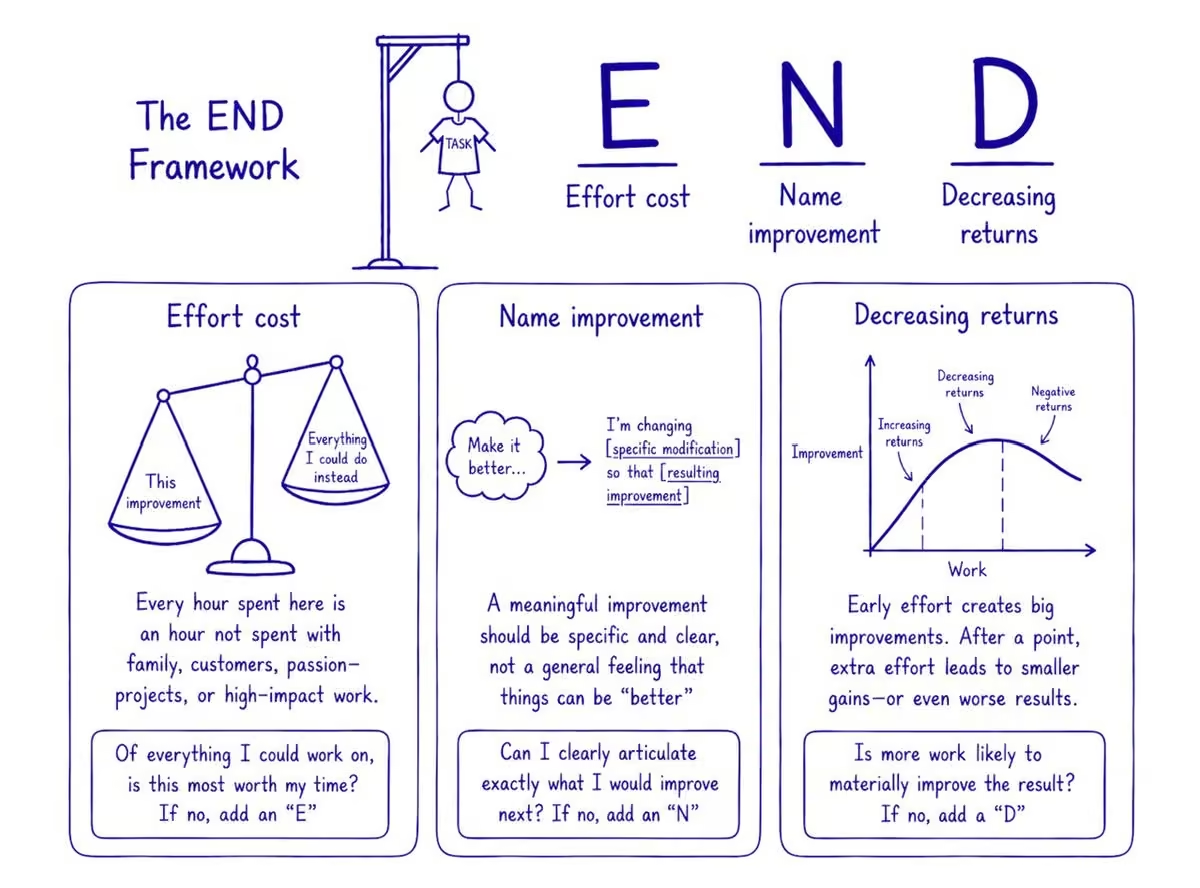
@SkarredGhost
Nice way to evaluate whether you should end a task or keep improving it. Kudos to @nireyal for creating it
nir.substack.com/p/when-is-good-enough-actually-good
#productivity #timemanagement -
Nir Eyal
@nireyal
What I tell myself before I walk on stage:
"They want me to succeed."
That's it. That's the whole ritual.
For years I did the opposite. I'd stand backstage running through everything that could go wrong — the joke that might not land, the slide that might not load, the question I might not have a good answer to. I told myself I was "preparing." I was actually rehearsing failure.
The belief I walked out with shaped what I noticed on stage. If I expected hostility, I found the one person checking their phone. If I expected warmth, I found the person nodding.
Same room. Different belief. Different talk.
This is what I mean when I say beliefs are tools, not truths. "The audience wants me to succeed" isn't a fact I can prove before I walk out. It's a tool I pick up because it changes what I pay attention to, and what I pay attention to changes how I perform.
The old belief — they're judging me — was also unprovable. I just never noticed I was choosing it.
You can swap the belief. Not by pretending. By asking whether the one you're carrying is actually helping you do the thing you're about to do.
If it isn't, put it down. -
Nir Eyal
@nireyal
Five decisions shape who you become.
Not the big ones people talk about — the school, the job, the city. Those matter less than we think.
The ones that actually compound are quieter:
1. What you decide to believe about yourself.
Your self-concept isn't a fact. It's a working theory. And you can revise it.
2. What you decide to feel about discomfort.
Most of what looks like a productivity problem is a discomfort problem. Distraction, procrastination, avoidance — they're all attempts to escape an internal state. Learn to sit with it and half your "willpower" issues dissolve.
3. What you decide to schedule.
You can't call something a distraction unless you know what you got distracted from. A values-based timeboxed calendar is the only honest way to measure your day.
4. Who you decide to spend time with.
Relationships aren't background music. They're the trigger environment for almost every behavior you repeat.
5. What you decide to call yourself.
Identity precedes behavior. Vegetarians don't debate bacon. Indistractable people don't negotiate with pings. The label does more work than the rule.
None of these are one-time decisions. You make them again every week, sometimes every hour.
That's the catch. And that's the opportunity. -
Nir Eyal reposted
Reads with Ravi
@readswithravi
The book: The lesson:
-
Nir Eyal
@nireyal
Everyone sells. Even if you're not in sales.
The engineer selling a technical approach to the team lead. The parent selling broccoli to a five-year-old. The founder selling a vision to the first hire who could have taken a safer job.
Selling isn't a job title. It's what you do any time you want someone to change what they believe, want, or do.
Most people resist this idea because they've confused selling with manipulation. Manipulation is getting someone to do something that's good for you and bad for them. Selling — done well — is getting someone to do something that's good for them, and telling them the truth about why.
Once you accept that you're always selling, the question stops being "should I persuade?" and becomes "am I persuading toward something that actually helps the person on the other end?"
That's the honest version of the job. And almost every job is some version of it. -
Nir Eyal
@nireyal
You don't have to earn your rest.
Somewhere along the way, we started treating rest like a reward — something you unlock after enough output. Enough emails answered. Enough boxes ticked. Enough proof that you deserve to stop.
But rest isn't a prize for productivity. It's a precondition for it.
The research on recovery is clear: attention is a finite resource within a given day, and the people who protect their downtime produce better work than the people who grind through it. Anders Ericsson's studies on elite performers found that the best violinists didn't just practice more — they slept more, rested more, and stopped when their focus was spent.
Yet most of us carry the opposite belief: that rest has to be justified. That until the work is done, we haven't earned the right to close the laptop. And because the work is never done, we never quite close it.
This is where beliefs quietly steer behavior. If you believe rest is a reward, you'll postpone it until you collapse. If you believe rest is part of the work, you'll schedule it like anything else that matters.
Open your calendar. Block the time you plan to rest with the same seriousness you block a meeting. Then honor it.
You don't have to earn your rest. You have to plan it. -
Nir Eyal
@nireyal
Every time you switch tasks, you pay a tax.
It's called attention residue. Sophie Leroy at the University of Washington coined the term in 2009 after showing that part of your mind stays stuck on the previous task even after you've moved on to the next one.
You're answering an email, then you jump to a Slack message, then back to the doc you were writing. Each switch feels quick. It isn't. A fragment of your attention lingers on what you just left, and the work in front of you gets a diminished version of you.
The cost isn't just slower work. It's shallower work. Decisions get worse. Errors go up. The sense of being busy all day without finishing anything — that's attention residue doing its job.
The fix isn't willpower. It's structure.
Timebox the task. Give it a start and an end on your calendar. When the block ends, close the tab, close the doc, and take a real break before the next one — even two minutes of doing nothing helps the residue clear.
You can't multitask your way out of this. You can only give one thing at a time your full attention, and then let it go before you pick up the next. -
Nir Eyal
@nireyal
Helplessness and hope aren't opposites of circumstance. They're beliefs about it.
Two people can face the same setback. One sees a door closing forever. The other sees a problem to solve. Same event, different belief — and the belief is what shapes the next move.
This matters because we tend to treat helplessness as an accurate read on reality. It rarely is. Martin Seligman's work on learned helplessness showed that once people conclude nothing they do matters, they stop trying — even when the situation changes and action would work.
Hope operates the same way, in reverse. It isn't optimism about outcomes. It's the belief that your actions can still move the needle. That belief is what keeps you in the game long enough to find out.
Beliefs aren't facts. They're tools. And when you notice you're holding one that says "nothing I do will change this," that's the moment to ask whether the belief is true — or just familiar. -
Nir Eyal
@nireyal
Focus on what you can control.
Most of what drains your attention isn't the work in front of you. It's the running commentary about things you can't change — the email someone hasn't sent back, the decision your boss might make next week, the outcome of a meeting that hasn't happened yet.
You can't control any of it. But you can control what you do in the next 90 minutes.
This is why timeboxing works when to-do lists don't. A list tells you what to do; it doesn't tell you when, and it doesn't protect you from the mental churn. A calendar block says: for this window, this is the thing. Everything else — including the worry — is off the table until the block ends.
The trick isn't willpower. It's narrowing the field. When you decide in advance what deserves your attention, you stop negotiating with yourself in the moment. And when the worry shows up anyway (it will), you have something concrete to return to.
You can't control the outcome. You can control the input. Schedule the input. -
Nir Eyal
@nireyal
16 lessons from 16 years working in behavioral science:
1. Distraction is internal, not technological. The phone is the cope, not the cause.
2. The opposite of distraction isn't focus. It's traction. Both come from the Latin trahere — to pull.
3. You can't call it distraction unless you know what you got distracted from. Open the calendar first.
4. Time management is pain management. All behavior is driven by the desire to escape discomfort.
5. Willpower isn't a muscle that gets tired. It's more like an emotion, waxing and waning with how we feel.
6. Beliefs aren't facts. They're tools. When one stops working, swap it.
7. Products manufacture desire by attaching themselves to internal triggers — the emotions we want to escape.
8. Habits form when a product reliably solves an emotional itch. Trigger, action, variable reward, investment.
9. Identity precedes behavior. Vegetarians don't debate bacon. Indistractable people don't debate the phone.
10. Schedule builders beat to-do list makers. A to-do list without a calendar is a wish list.
11. The 10-minute rule works. Surf the urge for ten minutes; most of the time it passes.
12. "We don't say no, we say not yet." The exact script matters more than the intention.
13. Every generation blames a new technology for ruining kids — novels, radio, TV, video games, phones. The data is always messier than the panic.
14. Pre-commitment beats willpower. Effort pacts, price pacts, identity pacts — engineer the friction in advance.
15. "Tech addiction" flatters us. It says the problem is out there. Usually it's in here.
16. The cure for boredom is curiosity. There is no cure for curiosity. -
Nir Eyal
@nireyal
20 sentences for when you feel behind:
1. The people you're comparing yourself to are comparing themselves to someone else.
2. "Behind" assumes there's a schedule. There isn't.
3. Most of what looks like speed is inheritance, luck, or a head start you can't see.
4. You are not late. You are on your own clock.
5. The urge to catch up is usually the urge to escape a feeling. Name the feeling first.
6. Envy is a signal, not a verdict. It tells you what you want. It doesn't tell you you've failed.
7. You cannot be distracted from something you never planned to do. Open the calendar.
8. Ten years is a long time. You will overestimate what you can do in a year and underestimate what you can do in a decade.
9. The person you'll be at 50 is watching what you do today. Don't perform for strangers online. Perform for them.
10. Comparison to a highlight reel is comparison to a lie.
11. The work compounds even when the results don't yet.
12. Rest is not the reward for finishing. It's the condition for continuing.
13. "Behind" is a story. Stories can be rewritten.
14. You don't need more motivation. You need less friction between you and the thing you already want to do.
15. The identity comes first. Schedule builder, not to-do list maker. Writer, not aspiring writer.
16. If you're 35 and think it's too late, ask a 55-year-old. They'll tell you 35 was young.
17. Nobody is thinking about you as much as you think they are.
18. The cure for feeling behind is doing the next small thing on your list. Not the biggest. The next.
19. You are allowed to want a quiet life.
20. Time management is pain management. The feeling of being behind is the pain. Sit with it for ten minutes before you reach for the phone. -
Nir Eyal
@nireyal
A moment from a recent event.
The questions I get after talks are almost never about the frameworks. They're about the discomfort underneath — the boredom people can't sit with, the anxiety they're trying to text their way out of, the guilt that pulls them back to email at 10pm.
That's the real work. The tactics only help once you're willing to look at what you're running from.
Grateful to everyone who showed up and asked the honest questions. -
Nir Eyal
@nireyal
Beliefs aren't facts. They're tools.
A limiting belief says: "I'm not the kind of person who can do this."
A liberating belief says: "I haven't figured out how to do this yet."
Same situation. Different tool.
The research on this is clearer than people think. Carol Dweck's work at Stanford showed that subjects who believed willpower was a limited resource showed signs of ego depletion. Subjects who didn't believe that, didn't. The belief itself was doing the work — not the biology underneath it.
That's what a tool means. You can pick it up, use it, and put it down when it stops being useful. You can swap it for a better one. You are not required to keep holding it just because you've held it for a long time.
Most of the beliefs that keep people stuck were never chosen. They were absorbed — from a parent, a teacher, a bad year, a single sentence someone said in passing. And then they got treated like facts.
They aren't facts. They're tools. And when you understand how they work, you can set them aside when they're unhelpful and replace them with better ones.
Ask of any belief you're carrying: is this pulling me toward the life I want, or away from it?
If it's pulling you away, you're allowed to put it down. -
Nir Eyal
@nireyal
Changing your mind isn't a sign of weakness. It's a sign of self-trust.
We're taught to admire consistency. Stick to your guns. Stay the course. Never flip-flop.
But consistency for its own sake is just stubbornness dressed up in a nicer suit. If the evidence changes and you don't, that isn't integrity. That's ego protecting itself from being wrong.
The people I trust most are the ones who can say, "I used to believe X. Here's what changed my mind." Not because they're wishy-washy, but because they treat their beliefs the way a scientist treats a hypothesis — provisional, testable, revisable.
Beliefs aren't facts. They're tools. And when a tool stops working, you don't grip it harder. You put it down and pick up a better one.
Self-trust isn't the confidence that you're right. It's the confidence that you can handle being wrong. -
Nir Eyal reposted
Max.
@maxwhitter
I just heard @nireyal say:
“You do not respond directly to reality. You respond to your interpretation of reality. Change that interpretation and you can change what you notice, how you experience difficulty, and what you subsequently do.”
Whaaaat?!?! -
Nir Eyal
@nireyal
Your beliefs are running silent code in the background of your life.
Most of what limits you isn't circumstance. It's an assumption you've never bothered to test.
Here are 9 beliefs that quietly cap what people achieve:
1. "I don't have willpower."
Carol Dweck's research showed signs of ego depletion only appeared in people who believed willpower was a limited resource. The belief did the limiting, not the biology.
2. "I'm just not a morning person / a math person / a disciplined person."
Identity statements sound like facts. They're forecasts. And forecasts change what you try.
3. "If I fail, it means something about me."
It means you tried something hard. That's it.
4. "I'll start when I feel ready."
Readiness is a feeling that shows up after you begin, not before.
5. "I have to feel motivated to act."
Motivation follows action more reliably than action follows motivation.
6. "This discomfort means something's wrong."
Discomfort is usually the toll for doing something that matters. The urge to escape it is what we call distraction.
7. "I'm too busy."
You're not too busy. You haven't decided what your time is for. A values-based schedule solves this; a to-do list doesn't.
8. "People like me don't do things like that."
The most useful sentence in behavior change might be: what would someone who did this believe about themselves?
9. "My beliefs are just how I see reality."
They aren't. Beliefs are tools, not truths. You can test them, swap them, and update them.
The interesting question isn't whether your beliefs are true. It's whether they're useful.
And if they aren't, you're allowed to pick better ones. -
Nir Eyal
@nireyal
"I'll believe it when I see it."
We say it like it's common sense. Like belief should wait for evidence.
But the research on expectation tells a different story. What you believe shapes what you notice, what you anticipate, and what you're willing to try. The seeing follows the believing more often than the other way around.
Think about it in your own life. The people who train for a marathon believe they can finish one before they can. The founder who ships believes the product matters before the market confirms it. The person who quits drinking believes they're the kind of person who doesn't drink before the identity feels natural.
Belief isn't a reward you earn after the proof arrives. It's the tool you use to go look for the proof.
That's not wishful thinking. It's how attention actually works. Your brain filters for what you've already decided is real.
So the question isn't whether your belief is true yet. It's whether it's useful — whether it points you at the evidence worth collecting.
Beliefs aren't facts. They're tools. Pick better ones. -
Nir Eyal
@nireyal
Had a conversation with CNN about attention, focus, and why so many of us feel hijacked by our devices.
Here's the part most coverage gets wrong:
Your phone isn't the cause of your distraction. It's the cope.
Distraction starts from within. Every time we reach for the screen, we're trying to escape an internal trigger — boredom, loneliness, anxiety, fatigue, uncertainty. The app is just the nearest exit.
That's why app blockers, screen-time limits, and dopamine detoxes work for about a week. They treat the symptom. The discomfort is still there, waiting for the next escape route.
The real skill isn't blocking the phone. It's learning to sit with the feeling that made you pick it up.
Try this: next time you feel the pull to check something, don't fight it. Notice it. Name the emotion underneath. Wait ten minutes. Most urges pass.
Time management is pain management. Once you accept that, the phone stops being the villain — and you stop being the victim. -
Nir Eyal
@nireyal
Beliefs aren't facts. They're tools. And like any tool, some outlive their usefulness.
Here are the 5 stages of outgrowing a limiting belief:
1. You don't know you hold it.
The belief feels like reality. "I'm not a math person." "I don't have willpower." "I'm just anxious." You're not defending the belief — you're wearing it.
2. You notice it, and defend it.
Someone challenges the belief and you push back. This is where most people stop. The belief has become part of who you think you are, so questioning it feels like an attack.
3. You test it.
Curiosity beats defensiveness. You run a small experiment. You take the class. You do the hard thing for ten minutes. You gather your own evidence instead of borrowing someone else's.
4. You replace it.
The old belief doesn't get argued away. It gets crowded out by a better one — one that fits the evidence you just collected.
5. You forget you ever believed it.
The new belief becomes invisible in the same way the old one was. That's the sign it took.
I've been through this cycle with my own weight, my own attention, and my own assumptions about what my kids are capable of. Every time, the same pattern. Every time, the last stage is the strangest — you can barely remember the person who thought otherwise.
Beliefs aren't truths. They're tools. Put down the ones that aren't working. -
Nir Eyal
@nireyal
Most people think money problems are math problems.
Morgan Housel's The Psychology of Money makes the opposite case: how you behave with money matters more than what you know about it.
A genius who loses emotional control can be a financial disaster. An ordinary person with no formal training can build wealth if they get a few behaviors right — patience, humility, room for error, staying in the game long enough for compounding to do its work.
That's why this book keeps showing up on my shelf and in conversations with people who study behavior for a living. It's not really about money. It's about the beliefs we carry into every decision — beliefs about risk, luck, envy, and enough.
We're reading it this month in Essentials for the Busy Mind — my monthly book club. If you've been meaning to pick it up, this is a good excuse.
Join us: essentials.nirandfar.com -
Nir Eyal
@nireyal
Distraction isn't a volume knob you can crank to zero. It's a dial.
Most productivity advice treats focus like an on/off switch. Turn off notifications. Delete the app. Go monk mode. Then, when the noise creeps back in — as it always does — you feel like you failed.
You didn't fail. You misunderstood the mechanism.
Distraction is the brain's response to discomfort. Boredom, anxiety, loneliness, uncertainty — the phone is the cope, not the cause. As long as you're a human being with a nervous system, the pull toward escape is going to be there. What changes is how far you turn the dial in either direction.
Turn it one way: toward traction. Traction and distraction come from the same Latin root, trahere — to pull. Traction is any action that pulls you toward what you said you'd do. Distraction is any action that pulls you away. You can only be distracted from something you actually planned.
Turn it the other way: toward avoidance. Not always with a screen. Sometimes it's a snack, a chore that suddenly feels urgent, a conversation you rehearse instead of the one you need to have.
The skill isn't eliminating the dial. It's noticing which way you're turning it, and why.
Open your calendar. Block the next two hours for the work that matters. Now distraction has something to be measured against — and you have something to come back to. -
Nir Eyal
@nireyal
Beliefs aren't facts. They're tools.
Most people treat their beliefs like weather — something that happens to them. But the research on belief is clear: what you believe about yourself, your capacity, and your circumstances changes what you actually do.
Three powers make this work:
1. Attention. Belief filters what you notice. Believe willpower is limited and you'll notice every moment of fatigue. Carol Dweck's lab found signs of ego depletion only in subjects who believed willpower was finite. The belief created the symptom.
2. Anticipation. Belief shapes what you expect next. Expect the meeting to go badly and you'll read every neutral face as hostile. Expect the workout to feel good afterward and you're more likely to show up.
3. Agency. Belief determines what you think is yours to change. "I'm just not a morning person" isn't a fact about your biology — it's a belief that closes a door before you've tried the handle.
The useful move isn't to "believe harder." It's to notice that your beliefs are tools you picked up somewhere, often without choosing them. You can put them down. You can pick up better ones.
Beliefs aren't truths. They're the lens. And you can change the lens. -
Nir Eyal
@nireyal
Yup, you're looking inside my head.
Prenuvo offered me a free MRI in exchange for sharing my honest experience.
I went in skeptical.
Whole-body scans can uncover things that look scary but turn out to be harmless. And for healthy people, we still don’t have evidence that routine full-body MRI improves longevity.
What impressed me wasn’t finding more data. It was getting help interpreting it.
After my scan, a doctor went through every finding with me and separated the things worth paying attention to from the things I could safely ignore.
More information isn’t always better. Useful information is.
For me, the combination of the scan and expert interpretation was illuminating.
If you’re considering one, you can learn more here: prenuvo.com/NIR -
Nir Eyal
@nireyal
A father and daughter reflect on how to find fulfillment at every life stage x.com/i/article/2084968263616757760
-
Nir Eyal
@nireyal
Saying no is a skill most of us never learned.
We say yes because it's easier in the moment. Yes to the meeting. Yes to the favor. Yes to the coffee chat we don't have time for. Then we resent the yes, and resent ourselves for giving it.
Here's what I've come to believe after years of studying attention: every yes is a no to something else. When you say yes to someone else's priority, you're saying no to your own. Usually to the work you told yourself mattered most.
The fix isn't a clever script. It's a prior decision.
If you've timeboxed your week — actually blocked the hours for the work, the family, the rest — then no becomes easy. You're not rejecting the person. You're honoring a commitment you already made to yourself.
"I can't, I have plans" is true. The plans are with your calendar.
Without that prior commitment, every request feels like a live negotiation, and you'll lose most of them. With it, no is just a description of reality.
Decide first. Then the no writes itself. -
Nir Eyal
@nireyal
Prenuvo gave me a free full-body MRI in exchange for an honest post.
I almost said no. The critics have a point. Scan a healthy person and the machine finds something in most of them, and there's no randomized trial showing whole-body MRI helps healthy people live longer the way we have for colonoscopy.
What changed my mind had nothing to do with the scan. After the results came in, a doctor sat with me and walked through all of it. What mattered, what didn't, what I could forget. No rush, no upsell.
That expert review was the most valuable part of the experience. Peace of mind without the panic.
That trade-off made sense to me. If it makes sense to you too, here's my link: prenuvo.com/NIR -
Nir Eyal
@nireyal
5 things about confidence I wish I'd known sooner:
1. Confidence isn't a trait. It's a belief you hold about yourself — and beliefs are tools, not truths. You can pick them up, test them, and put them down.
2. Waiting to feel confident before you act gets it backwards. The action comes first. The feeling follows. If you wait for the feeling, you'll wait forever.
3. What most people call "low confidence" is actually discomfort they haven't learned to sit with. The anxiety before the hard conversation, the pitch, the post. That's not a signal to stop. It's the price of doing the thing.
4. Confidence isn't the absence of self-doubt. It's the willingness to move while the doubt is still there. The people you think are confident aren't quieter inside. They just stopped treating the noise as instructions.
5. The fastest way to build it: keep small promises to yourself. Not big ones. Small ones. The identity forms in the follow-through, not the declaration.
Confidence isn't something you have. It's something you practice. -
Nir Eyal
@nireyal
20 sentences for when you want to quit.
Not a pep talk. Not a mantra. Just lines I've come back to when the work stops feeling like it's working.
1. The discomfort you're trying to escape is the work.
2. You didn't get distracted. You looked for a way out.
3. Traction and distraction come from the same Latin root — trahere, to pull. You are always being pulled by something. The only question is what.
4. Willpower isn't a muscle that gets tired. It's an emotion. Treat it like one.
5. You can't say you got distracted unless you know what you got distracted from.
6. The urge will pass whether you act on it or not.
7. Ten minutes. That's all you owe the discomfort before you decide anything.
8. The identity comes first. Vegetarians don't debate bacon. Indistractable people don't debate the notification.
9. You don't have a focus problem. You have a values problem you haven't put on the calendar yet.
10. The cure for boredom is curiosity. There is no cure for curiosity.
11. Most productivity advice is a coping mechanism dressed up as a system.
12. If the plan fails, the plan is the thing to fix — not you.
13. Quitting is a decision. Drifting away is a habit. Know which one you're doing.
14. Beliefs aren't facts. They're tools. The belief that you're the kind of person who quits is a tool you can put down.
15. Look for the discomfort. Then schedule what you'd do without it.
16. You are not addicted. You are avoiding.
17. The phone is the cope, not the cause.
18. The work you're avoiding is almost always the work that matters.
19. You already know what to do next. You're negotiating with yourself about whether to do it.
20. Time management is pain management. Everything else is decoration. -
Nir Eyal
@nireyal
Change your beliefs, change your results.
That sounds like a bumper sticker. It isn't. It's one of the most robust findings in behavioral science, and most people ignore it because it feels too simple to be true.
Here's what the research actually shows.
Stanford psychologist Carol Dweck ran a study on willpower. She found that signs of ego depletion — the classic "I've used up my self-control" effect — only showed up in people who believed willpower was a limited resource. People who believed willpower was abundant didn't deplete. Same task. Same conditions. Different belief. Different result.
The belief wasn't describing reality. The belief was producing it.
This is why I've stopped treating beliefs as facts about the world. Beliefs are tools. Some of them work for you. Some of them work against you. Most of them you inherited without noticing, from parents, teachers, a bad boss, one embarrassing moment in seventh grade.
You can test a belief the same way you'd test a tool. Does it help me do the thing I said I wanted to do? If yes, keep it. If no, put it down and try a different one.
A few beliefs I've deliberately swapped over the years:
"I'm not a morning person" → "I haven't built a morning I want to wake up to."
"I'm bad at focus" → "I haven't scheduled what focus is for."
"I don't have willpower" → "Willpower isn't finite. It's more like an emotion."
None of these swaps are affirmations. I'm not telling myself the universe will provide. I'm picking the belief that makes the next action possible instead of the belief that makes it impossible.
That's the whole move. Beliefs aren't truths. They're tools. And when you understand how they work, you can set them aside when they're unhelpful and replace them with better ones. -
Nir Eyal
@nireyal
Some decisions can be reversed. Others can't.
The ones that can't — leaving a job, ending a relationship, moving countries, having a kid — deserve a slower process than the ones we usually give them.
Most people decide big things the same way they decide small things: gut feeling, a conversation or two, then commit. That's fine for what to eat for dinner. It's not fine for what to do with the next decade of your life.
Before a decision you can't take back, ask yourself these seven questions:
1. What am I actually trying to solve? Name the problem underneath the decision, not the decision itself.
2. What would I tell a friend in the exact same situation? Distance changes what you can see.
3. What would the version of me ten years from now want me to choose? Not what's easier now — what compounds.
4. What am I running toward, and what am I running from? Both can be present. Only one should be steering.
5. What's the reversibility cost? If I'm wrong, what does it take to undo? Some doors close softly. Some slam.
6. Have I sat with the discomfort long enough to know if it's a signal or noise? Ten minutes of surfing the urge is a diagnostic, not a delay.
7. Am I deciding, or am I escaping? A lot of what looks like a decision is just distraction wearing a suit.
The questions won't make the choice for you. That's not their job. Their job is to make sure the choice is yours — considered, not coped-into.
The decisions you can't take back are worth taking your time on. -
Nir Eyal
@nireyal
"The Beliefs That Determine Whether You Succeed With AI" a great guest post by @Gleb_Tsipursky x.com/i/article/2082382045460721665
-
Nir Eyal
@nireyal
"The ability to observe without judgment is the highest form of intelligence." — Krishnamurti
Most distraction starts the moment we judge a feeling instead of noticing it.
Boredom shows up, and we call it a problem. Anxiety shows up, and we call it a threat. Loneliness shows up, and we reach for the phone before we've even named what we're reaching from.
The judgment happens so fast it feels like the feeling itself. It isn't.
What the research on urge surfing shows is that uncomfortable internal states — the ones that drive us to check, scroll, snack, refresh — peak and fade in about ten minutes if you let them. The problem isn't that the feeling is unbearable. The problem is that we won't sit with it long enough to find out.
Observation is the pause between the trigger and the action. It's the space where you notice "I'm bored" without adding "and I need to fix that right now."
That pause is where agency lives. -
Nir Eyal
@nireyal
Stop confusing your dreams with your goals.
A dream is something you want. A goal is something you've scheduled.
Most people say they want to write a book, get in shape, launch the business. Then they wait for motivation, for the right moment, for the version of themselves who finally has time. That's not a goal. That's a wish with a deadline attached to it in your head.
A goal lives on your calendar. It has a start time, an end time, and a specific action you've committed to doing during that block. If you can't point to it in your week, you don't have a goal — you have a daydream you keep re-visiting.
This is why I stopped writing to-do lists years ago. To-do lists let you feel productive without ever having to decide when the thing actually happens. A timeboxed schedule forces the decision. It turns the abstract ("get in shape") into the concrete ("Tuesday, 6:30-7:15am, gym").
The research on implementation intentions — Peter Gollwitzer's work going back to the 90s — is clear on this. People who specify when and where they'll do a thing are two to three times more likely to actually do it than people who just set the goal.
So the question isn't what do you want. The question is: when are you doing it?
If the answer isn't on your calendar, it's still a dream. -
Nir Eyal
@nireyal
8 beliefs that quietly separate high performers from everyone else.
Not habits. Not routines. Not morning cold plunges. Beliefs.
Because behavior follows belief. If you believe willpower is limited, you'll act like it is. Carol Dweck's lab showed exactly that — signs of ego depletion only appeared in subjects who believed willpower was finite.
Here are the eight I keep coming back to:
1. Discomfort is information, not a stop sign.
Every distraction is an attempt to escape a feeling. High performers notice the feeling instead of running from it.
2. Willpower isn't a muscle that gets tired. It's more like an emotion — it comes and goes based on how you're thinking and feeling.
3. The opposite of distraction isn't focus. It's traction. You can only be distracted from something you planned to do.
4. Time management is pain management. If you can't sit with discomfort, no calendar app will save you.
5. Identity precedes behavior. Schedule builders build schedules. Indistractable people plan their day. Vegetarians don't debate bacon.
6. Beliefs are tools, not truths. You can swap one that isn't working for one that does. That's not delusion — that's design.
7. Blame disempowers. Design empowers. "I'm addicted to my phone" ends the conversation. "What am I trying to escape?" starts it.
8. You can't call it distraction unless you know what you got distracted from.
None of these are hacks. They're the operating assumptions underneath the behavior. Change the belief and the behavior follows. -
Nir Eyal
@nireyal
If you want to change your life, change something you do daily.
Not something you do once. Not something you promise yourself on January 1st. Something you do today, and tomorrow, and the day after that.
Behavior compounds. The 20 minutes you spend scrolling before bed is a habit. The 20 minutes you spend reading before bed is also a habit. Same slot, different life.
Most people try to change their lives by changing the big things — the job, the city, the relationship. Those changes feel dramatic, so they feel important. But the daily behaviors run underneath all of it, and they don't care what city you're in.
Pick one. Just one. The thing you do every day without thinking. Replace it with something you'd rather be doing every day without thinking. Give it enough repetitions that it stops requiring willpower and starts requiring nothing at all.
That's the whole game. -
Nir Eyal
@nireyal
Why do you self-sabotage?
You set a goal. You know the steps. And then — right at the moment it matters — you eat the thing, skip the workout, open the app, pick the fight.
Most people call this a willpower problem. It isn't.
Self-sabotage is what happens when a behavior is doing a job you haven't acknowledged. The overeating soothes something. The scroll relieves something. The procrastination protects something. The behavior looks irrational only if you ignore the discomfort it's treating.
As is the case with all human behavior, distraction and self-defeating habits are attempts to deal with pain. If you accept that, the question changes. It stops being "how do I stop doing this?" and becomes "what am I trying not to feel?"
That's an uncomfortable question, which is why most people skip it and buy another planner instead.
Try this the next time you catch yourself in the act:
1. Name the feeling underneath the urge — boredom, anxiety, loneliness, inadequacy.
2. Write it down in ten words or less.
3. Wait ten minutes before acting on the urge. Surf it. Don't fight it.
You're not broken. You're coping. Once you can see what the behavior is for, you can pick a better tool for the same job. -
Nir Eyal
@nireyal
Most people treat their beliefs like facts. That's the mistake.
A belief isn't a truth about you. It's a tool you picked up somewhere — from a parent, a boss, a bad year — and kept using long after it stopped working.
"I'm bad with money."
"I'm not a morning person."
"I can't focus."
These don't describe you. They describe what you've been telling yourself about you. And the telling is what keeps the behavior in place.
Here's how to rewrite one:
1. Name the belief in plain language. Not "I struggle with X." Say the actual sentence you tell yourself.
2. Ask where it came from. Beliefs have origins. Most of them aren't yours — they were handed to you.
3. Ask what it costs you. Not in the abstract. This week. This month. This decade.
4. Write a replacement you can actually test. Not an affirmation. A hypothesis. "I can sit with discomfort for 10 minutes without acting on it." Then run the experiment.
Beliefs aren't facts. They're tools. When one stops working, put it down and pick up a better one. -
Nir Eyal
@nireyal
The real reason smart people stay stuck isn't lack of intelligence, effort, or opportunity.
It's belief.
Smart people accumulate beliefs the way careful investors accumulate positions — slowly, deliberately, based on evidence that once looked airtight. "I'm not a numbers person." "I don't have the right personality for that." "People like me don't do work like that."
Each one felt earned. Each one made sense at the time. And each one quietly took a decision off the table for the rest of their lives.
The trap isn't that the beliefs are wrong. It's that smart people treat them as facts.
Facts don't get re-examined. Facts don't get tested. Facts sit in the corner of your mind marked "settled" while the world — and you — keep changing.
Beliefs aren't facts. They're tools. And like any tool, a belief that helped you at 22 can be the thing keeping you stuck at 42.
The move isn't to "believe in yourself" harder. That's just swapping one untested belief for another. The move is to notice which beliefs you've stopped questioning, and ask a smaller question: is this still true, or was it ever?
Because the belief you refuse to examine is the one running your life. -
Nir Eyal
@nireyal
Ever wonder why we can't focus?
Most people blame the phone. The notifications. The algorithms engineered to hijack our attention. It's a comforting story because it puts the problem out there, somewhere we can point at.
But it's not the whole story. And the part we're leaving out is the part that actually matters.
Distraction starts from within.
Before you reached for the phone, something happened inside you. Boredom. Anxiety. Loneliness. Fatigue. Some flavor of discomfort you didn't want to sit with. The phone was the cope, not the cause.
The research is clear here: all human behavior is driven by the desire to escape discomfort. Even the behaviors we call "distraction." Especially those. If you accept that, then the only real way to handle distraction is to learn to handle discomfort.
Which means app blockers, screen-time limits, and dopamine-detox weekends will only get you so far. They treat the symptom. The internal trigger is still there, waiting for the next available exit.
Here's the harder move: next time you catch yourself reaching for the phone, don't judge it. Don't white-knuckle it. Just notice the feeling that came 10 seconds before the reach. Name it. Sit with it for ten minutes.
That's it. That's the whole protocol.
You can't be indistractable until you're willing to feel what you've been running from. -
Nir Eyal
@nireyal
Once a month, I sit down and ask myself the same 10 questions.
Not as a productivity ritual. As a way to notice where I've drifted — before the drift becomes the year.
Most of what we call "getting off track" isn't a dramatic collapse. It's a slow accumulation of unexamined weeks. You wake up in November wondering how you spent the year, and the honest answer is: you never checked.
The questions I ask myself:
1. What did I do this month that I'm proud of?
2. What did I do that I'd rather not repeat?
3. Where did I spend time I didn't plan to spend?
4. What did I schedule but not do — and why?
5. What did I do that I never scheduled — and why?
6. Who did I spend time with that mattered?
7. Who did I neglect?
8. What did I learn?
9. What am I avoiding?
10. What's one thing I'll change next month?
Question 9 is the hardest. It's usually the one pointing at the discomfort I've been using distraction to escape.
The review takes 20 minutes. It's the cheapest course correction I know. -
Nir Eyal
@nireyal
Self-doubt isn't the opposite of confidence. It's the price of caring about something.
The people who never doubt themselves aren't strong. They're either delusional or checked out.
Here are 7 signs you're actually stronger than your self-doubt:
1. You act before you feel ready.
Confidence doesn't precede action. It follows it. If you're waiting to feel sure, you'll wait forever. Doing the thing while afraid is the whole skill.
2. You notice the voice without obeying it.
The inner critic doesn't go away. But you've learned to hear "you're not good enough" and keep typing anyway. That's not silence. That's mastery.
3. You separate the discomfort from the decision.
Doubt is a feeling. Whether to quit is a choice. You've stopped letting one make the other.
4. You ask what the doubt is protecting you from.
Usually it's not failure. It's the discomfort of being seen trying. Once you name that, the doubt loses its grip.
5. You've stopped waiting for permission.
No one is coming to tell you you're ready. The credential you're waiting for doesn't exist. You've noticed.
6. You measure yourself against yesterday, not against people whose middle you're comparing to your beginning.
7. You keep going when the reward is uncertain.
This is the one that matters. Anyone can push through when success is guaranteed. Doing the work when it might not pay off — that's the signal you're stronger than the doubt.
Self-doubt isn't a bug in the system. It's what caring feels like from the inside. -
Nir Eyal
@nireyal
The most valuable asset you own isn't money.
It's your attention.
Money you can lose and earn back. Attention spent is gone for good. Every minute you give to something is a minute you can't give to anything else — which means the real question isn't how you spend your dollars. It's how you spend your hours.
Here's the uncomfortable part: most of us don't decide where our attention goes. We react. A notification pulls us one way. A worry pulls us another. A feed we didn't plan to open eats an afternoon we said mattered.
You can only call something a distraction if you know what it distracted you from. Which means the fix starts on the calendar, not the phone. Decide in advance what the next block of time is for. Then defend it.
Attention is the one thing you can't get more of. Treat it like it's worth more than money, because it is. -
Nir Eyal reposted
Curious Minds
@CuriousMindsHub
Beyond Belief by Nir Eyal is one of the best books I’ve read in 2026 so far.
It made me think differently about how our beliefs shape what we notice, what we expect, and what we believe is possible.
What are the best books you’ve read so far this year?
Reads with Ravi
@readswithravi
What is the best book you’ve read in 2026 so far?
-
Nir Eyal
@nireyal
Most personal finance advice treats money as a math problem.
Morgan Housel's The Psychology of Money makes the case that it isn't. It's a behavior problem — and behavior is much harder to teach than a spreadsheet formula.
A few ideas from the book that have stayed with me:
Doing well with money has little to do with how smart you are and a lot to do with how you behave. Housel points out that a janitor with patience can out-earn a Harvard MBA who panic-sells. The IQ isn't the variable. The temperament is.
Wealth is what you don't see. The cars, the houses, the watches — those are spent money. Actual wealth is the money not spent, sitting quietly, compounding. Which is why it's almost impossible to learn wealth by copying wealthy-looking people.
Room for error is the single most under-rated force in finance. Not because you can predict the crash, but because you can't. Margin of safety lets you stay in the game long enough for compounding to do its work.
The connection to my own work: money, like attention, is downstream of belief. What you believe about scarcity, about enough, about what other people think of your car — those beliefs drive the behavior long before any spreadsheet does.
If you haven't read it, August is a good month for it. -
Nir Eyal
@nireyal
You keep reaching for your phone. You know you do. You've deleted the apps, tried the grayscale trick, put it in another room — and by the afternoon it's back in your hand.
Here's the part most productivity advice gets wrong: the phone isn't the problem. It's the cope.
All human behavior is driven by the desire to escape discomfort. Boredom. Loneliness. Anxiety. Uncertainty about what to do next. The phone is just the nearest, most reliable exit.
That's why app blockers alone rarely work. You can block the exit, but the discomfort is still there — and your brain will find another door. Snacks. Email. A different tab. Yourself, three hours later, wondering where the day went.
The real work is upstream. When you feel the pull, don't fight it. Notice it. Ask what feeling you were about to escape from. Sit with it for ten minutes. Most urges pass.
You can't say you got distracted unless you know what you got distracted from. So open your calendar. Block the next two hours for the work you said mattered. Now the distraction has something to be measured against — and you have something to come back to.
Distraction starts from within. So does traction. -
Nir Eyal
@nireyal
The Focus Pyramid.
Most people try to build focus from the top down. They buy the app blocker, the noise-canceling headphones, the productivity system. Then they wonder why they still can't sit with their work for twenty minutes.
Focus doesn't start with tools. It starts underneath them.
Layer 1: Discomfort.
Every distraction is an attempt to escape an internal trigger — boredom, anxiety, loneliness, uncertainty. If you don't know what you're running from, no blocker will save you. The phone is the cope, not the cause.
Layer 2: Time.
You can't say you got distracted unless you know what you got distracted from. Open your calendar. Timebox the work you said matters. Distraction only exists in relation to traction — both come from the Latin trahere, to pull. You need something to be pulled away from before focus becomes a coherent idea.
Layer 3: Triggers.
Only now do the external triggers matter. Notifications, open tabs, the coworker who drops by. Hack these back in the order they interrupt your planned work — not in the order that feels urgent.
Layer 4: Pacts.
Effort pacts, price pacts, identity pacts. The pre-commitments you make when you're clear-headed to protect the version of you that isn't.
Build in that order. Skip a layer and the one above it collapses. -
Nir Eyal
@nireyal
Being stuck isn't a character flaw. It's a belief problem.
Beliefs aren't facts. They're tools. And when the tool stops working, you can swap it out.
Here are 7 mindset shifts I keep coming back to when I catch myself frozen:
1. From "I am this way" to "I am choosing this right now."
Identity feels fixed. Behavior isn't. Vegetarians don't debate bacon — they've decided who they are, and the choice disappears. Pick the identity first; the actions follow.
2. From "I need motivation" to "I need to sit with discomfort."
Motivation is a myth we tell ourselves so we don't have to feel the thing we're avoiding. All behavior — including procrastination — is an attempt to escape discomfort. Look for the discomfort first.
3. From "willpower is running out" to "willpower is an emotion."
Carol Dweck's work showed ego depletion only appears in people who believe willpower is limited. Believe it's an emotion — waxing and waning like any other — and it behaves like one.
4. From "I got distracted" to "distracted from what?"
You can only be distracted from something you planned to do. If it's not on your calendar, you weren't distracted. You were drifting.
5. From "the app hijacked me" to "I opened it to escape something."
The phone is the cope, not the cause. Name the feeling — boredom, anxiety, loneliness — and you've done more than any blocker can.
6. From "I'll do it when I feel ready" to "I'll surf the urge for 10 minutes."
Urges peak and pass. Ten minutes is usually enough. Not to say no forever — just not yet.
7. From "I need a new plan" to "I need to schedule what I already know matters."
You don't have a knowledge problem. You have a calendar problem. Open it. Block the two hours. The plan was never the missing piece.
Beliefs are tools, not truths. If the one you're holding keeps you stuck, put it down. -
Nir Eyal
@nireyal
Are your beliefs ruining your life?
Most people treat their beliefs like facts. They're not. Beliefs are tools — and like any tool, some help you build the life you want, and some quietly wreck it.
The belief that willpower is a limited resource makes you more likely to lose control. Carol Dweck's research at Stanford showed that ego depletion only appeared in people who already believed willpower runs out. The belief created the effect.
The belief that you're "addicted" to your phone makes it harder to put down. Blame the device and you hand away your agency. Look at the discomfort you're trying to escape and you get it back.
The belief that you're "just not a disciplined person" is the one that keeps the whole thing running.
Here's the shift: beliefs aren't truths you discovered. They're tools you picked up somewhere — from a parent, a teacher, a bad week in high school — and never put down. You can test them. You can swap them. You can replace an unhelpful one with a better one.
Ask yourself about a belief that's been running your life: Is this actually true, or is it just familiar? What would I do differently if I believed the opposite?
The belief you refuse to examine is the one shaping the most. -
Nir Eyal
@nireyal
Never underestimate a person who practices self-education.
Formal education ends. Self-education doesn't.
The person reading on the train, working through a textbook at night, watching lectures on the weekend — they're compounding something the credentialed often stop building the day they graduate.
What I've noticed about self-educators:
They ask better questions. Not because they're smarter, but because they've read across fields the rest of us assume don't connect.
They're harder to bluff. They've gone to the primary sources. They know what the study actually says, not just what the headline claimed it said.
They update faster. No identity tied to a degree, no tribe to defend — just the next book, the next paper, the next conversation.
And they tend to be quiet about it. The loudest people in the room are rarely the ones who've spent the most time alone with a book.
The credential gets you in the door. What you read after — every week, every year, for the rest of your life — is what decides where you end up. -
Nir Eyal
@nireyal
Most people think distraction is a technology problem.
It isn't. It's a discomfort problem.
The phone is the cope, not the cause. We reach for it when we're bored, anxious, lonely, uncertain — and then we blame the phone for the reach.
Here's what I've learned after years of studying this: you can't call something a distraction unless you know what you got distracted from. Open your calendar. Block the time for the work you said matters. Now distraction has something to measure against — and you have something to come back to.
The opposite of distraction isn't focus. It's traction. Both come from the Latin trahere, "to pull." One pulls you toward what you planned. The other pulls you away.
Start by looking for the discomfort underneath the pull. That's where the work actually is. -
Nir Eyal
@nireyal
Overthinking isn't a thinking problem. It's a discomfort problem.
We tell ourselves we're "working through it." Analyzing. Weighing options. Preparing.
But most of the time, the loop in our head isn't problem-solving. It's avoidance dressed up as productivity.
The thinking feels useful because it feels like effort. Meanwhile, the actual task — the email, the decision, the conversation — stays untouched.
Here's what I've noticed in my own life: the moments I overthink most aren't the moments a problem is hardest. They're the moments a problem is uncomfortable.
The discomfort comes first. The thinking comes after, as a way to stay near the problem without having to act on it.
That's why "just stop overthinking" never works. You can't reason your way out of a behavior whose whole purpose is to keep you reasoning.
What works better: name the discomfort underneath. Boredom. Anxiety. Fear of being wrong. Then sit with it for ten minutes without acting on it. The urge to keep looping almost always passes.
Overthinking is what we do when we'd rather think about the thing than do the thing. -
Nir Eyal
@nireyal
Most people don't lose 10 hours a week to big things. They lose it to small defaults they never questioned.
Here are 8 habits that give the time back. None of them require willpower. All of them require deciding once, so you don't have to decide again.
1. Timebox your calendar.
A to-do list is a wish. A calendar is a commitment. If it isn't on the schedule, it isn't real work — it's a hope you'll feel like it later.
2. Schedule the internal triggers, not just the tasks.
Most distraction isn't the phone. It's the discomfort you're trying to escape by reaching for it. Notice the feeling. Name it. Then go back to what you planned.
3. Use the 10-minute rule.
When the urge to switch tasks hits, tell yourself you can give in — in 10 minutes. Surf the urge. Most of the time it passes.
4. Remove external triggers you didn't consent to.
Turn off notifications you never agreed to. Every ping is someone else's priority interrupting yours.
5. Make a pact with yourself.
Effort pact, price pact, identity pact. Pre-commit when you're thinking clearly so you don't have to negotiate when you're not.
6. Sync your schedule with the people who matter.
Most time conflicts aren't about time. They're about expectations no one wrote down.
7. Plan tomorrow, today.
Five minutes the night before saves an hour the next morning. Decision fatigue is real. Pre-decide.
8. Build the identity, not just the habit.
"I'm indistractable" is a different sentence than "I'm trying to focus." Vegetarians don't debate bacon.
10 hours a week isn't found. It's reclaimed — one default at a time. -
Nir Eyal
@nireyal
Most self-help tells you to work harder. The research says something stranger: the people who pull ahead don't have better discipline. They have better beliefs.
Beliefs aren't facts. They're tools. And when you understand how they work, you can swap the ones that aren't serving you for ones that do.
Here are seven I've found worth holding — each one backed by a study I keep returning to.
1. Willpower isn't a limited resource.
Carol Dweck's lab showed that signs of ego depletion only appeared in people who believed willpower was finite. Everyone else kept going. The belief was doing the work, not the glucose.
2. Distraction starts from within.
The phone isn't the cause. It's the cope. Notice the discomfort you're trying to escape — boredom, anxiety, loneliness — and you've done more than any app blocker can.
3. The opposite of distraction is traction.
Both come from the Latin trahere, to pull. You can only say you got distracted if you know what you got distracted from. Open the calendar first.
4. Identity precedes behavior.
Vegetarians don't debate bacon. People who call themselves indistractable don't negotiate with the notification. The label does the lifting.
5. Time management is pain management.
All behavior is an attempt to escape discomfort. Productivity is the skill of sitting with that discomfort long enough to do what matters.
6. You can't be addicted to something you can quit.
The casual use of "addiction" flatters us — it locates the problem out there. For most people, the honest word is overuse, and overuse is a design problem you can fix.
7. Beliefs are tools, not truths.
This is the meta-belief that holds the others up. If a belief stops working, you're allowed to put it down.
The top 1% aren't grinding harder. They're carrying lighter assumptions. -
Nir Eyal
@nireyal
I believe in America, a country striving for a better future for 250 years. We have much more that unites us than divides us, and so much to celebrate. Happy 4th! 🇺🇸
-
Nir Eyal
@nireyal
7 habits holding you back from success:
1. Waiting to feel motivated before starting.
Motivation isn't the cause of action. It's usually the byproduct. The work comes first; the feeling follows. If you wait for the mood, you'll wait forever.
2. Treating your to-do list like a schedule.
A to-do list tells you what you'd like to do. A calendar tells you when you'll actually do it. Be a schedule builder, not a to-do list maker.
3. Blaming the phone.
The phone isn't the cause of your distraction. It's the cope. Distraction starts from within — with discomfort you're trying to escape. Time management is pain management.
4. Confusing being busy with being productive.
You can't say you got distracted unless you know what you got distracted from. Without a plan for your time, every interruption feels equally urgent.
5. Believing willpower is a limited resource.
The research on ego depletion didn't hold up. Carol Dweck's work shows that the people who believed willpower was finite were the ones who ran out of it. Willpower behaves more like an emotion than a fuel tank.
6. Saying no instead of saying not yet.
When an internal trigger pulls you toward distraction, you don't have to fight it. Wait ten minutes. Surf the urge. Most of the time, it passes on its own.
7. Trying to become focused instead of becoming indistractable.
Identity precedes behavior. Vegetarians don't debate bacon. People who call themselves indistractable don't negotiate with every ping.
The pattern underneath all seven: every one of these habits is a way of avoiding discomfort. Look for the discomfort. Then schedule what you'd do without it. -
Nir Eyal
@nireyal
The real luxuries of adult life aren't what the ads sell you.
They're quieter than that. And almost free.
Time to think without a notification interrupting you. The ability to say no without explaining yourself. A calendar that reflects what you actually value, not what someone else scheduled for you.
A full night of sleep. A long walk with no destination. A conversation that doesn't end because someone has to get back to their phone.
Most of these cost nothing. Most of them have been priced out of ordinary life anyway — not by money, but by attention.
That's the part worth sitting with. The scarcest things in adult life aren't expensive. They're protected. They belong to the people who decided, on purpose, what their time was for.
If you want them, you don't need more income. You need a schedule that defends them. -
Nir Eyal
@nireyal
When you stop chasing the wrong things, you give the right things a chance to catch you.
Most of what we call ambition is just running. Running from boredom, from doubt, from the discomfort of sitting still long enough to ask what we actually want.
The phone in your hand. The next promotion. The goal you set because someone else set it first. They keep you moving so you don't have to feel anything underneath.
But the right things — the work that matters, the relationships that hold, the version of yourself you'd respect — those don't shout. They don't trend. They wait quietly until you stop sprinting past them.
Stop chasing. Look down. Notice what's already there. -
Nir Eyal
@nireyal
Six truths about success most people learn too late:
1. Discomfort is the price of admission.
Every meaningful goal asks you to sit with something unpleasant — boredom, uncertainty, the dread of starting. Most people quit not because the work is hard, but because the feeling before the work is hard. Learn to handle the feeling, and the work gets done.
2. The opposite of distraction isn't focus. It's traction.
Both come from the Latin trahere — to pull. Traction pulls you toward what you said mattered. Distraction pulls you away. You can't say you got distracted unless you knew what you got distracted from.
3. Willpower isn't a muscle.
Carol Dweck's lab showed signs of ego depletion only in people who believed willpower was a limited resource. Treat it like an emotion instead — it comes and goes — and you stop using its absence as an excuse.
4. Identity precedes behavior.
Vegetarians don't debate bacon. People who call themselves indistractable don't negotiate with the notification. Decide who you are first; the actions follow.
5. Your calendar matters more than your to-do list.
A to-do list is a wish. A calendar is a commitment. If the work you said mattered isn't on your schedule, you don't actually plan to do it.
6. You can't call something a distraction if you never planned what to do instead.
This is the one most people miss. Distraction only exists relative to traction. Without a plan, there's just time passing — and you blaming your phone for it.
None of these are hacks. They're the things you wish you'd believed ten years ago. -
Nir Eyal
@nireyal
You're the CEO of your life.
That's not a motivational line. It's a description of how attention actually works.
No one else gets to decide what you do with the next hour. Not your manager, not the notification, not the person who emailed you at 11pm expecting an answer by morning. The decision to act is always yours — even when it doesn't feel like it.
The reason it doesn't feel like it is discomfort. Boredom, anxiety, uncertainty, the dull ache of a hard task. Most of what we call distraction is just an attempt to escape one of those feelings. The phone isn't the cause. It's the exit.
A CEO doesn't get to outsource that. A CEO sits with the uncomfortable quarterly numbers, the uncomfortable hire, the uncomfortable conversation. They schedule time for the hard thing and then they show up for it.
You can do the same with your day. Open your calendar. Decide in advance what the next block is for. When the urge to bail shows up — and it will — notice the feeling underneath it before you reach for the exit.
That's the job. Not motivation. Not willpower. Just running your own life like you're the one responsible for it.
Because you are. -
Nir Eyal
@nireyal
Confidence isn't knowing you'll succeed. It's knowing you'll figure it out.
Most people get this backwards. They think confidence is the feeling you get after you've already won — the certainty that the next thing will go your way because the last thing did.
That's not confidence. That's a winning streak.
Real confidence is quieter and more useful. It's the belief that whatever shows up, you'll find a way through it. Not because you have the answer in advance, but because you trust yourself to work the problem when it arrives.
This matters because the first version — "I know I'll succeed" — is fragile. The first failure breaks it. The second version — "I'll figure it out" — gets stronger every time something goes wrong, because every problem you work through is more evidence that you can.
Beliefs aren't facts. They're tools. And the belief that you'll figure it out is one of the most useful tools you can carry. -
Nir Eyal
@nireyal
Distraction and traction come from the same Latin root: trahere, to pull.
Traction is any action that pulls you toward what you said you'd do.
Distraction is any action that pulls you away from it.
The distinction matters because you can't say you got distracted unless you know what you got distracted from. Without a plan, every action is just an action. With a plan, the same action is either traction or distraction.
That's why timeboxing your calendar matters more than any app blocker. The calendar is the reference point. It's what makes "distraction" measurable in the first place.
And here's the part most people miss: the pull toward distraction almost always starts from an uncomfortable internal feeling — boredom, anxiety, loneliness, fatigue. The phone is the cope, not the cause.
So when you notice yourself pulled away, don't blame the device. Ask what you were trying to escape. Then go back to what your calendar said you'd do.
Traction is a choice. Distraction is too. -
Nir Eyal
@nireyal
Overthinking isn't a thinking problem. It's a discomfort problem.
We tell ourselves we're being careful. Weighing options. Doing our due diligence. But most of the time, the loop in our head isn't analysis — it's avoidance.
The decision feels heavy because making it means accepting a tradeoff. And accepting a tradeoff means sitting with the discomfort of what we won't get to have.
So instead of choosing, we deliberate. We open a new tab. We ask one more friend. We re-read the same pros and cons list at 11pm. The thinking feels productive. It isn't. It's the same coping mechanism as reaching for the phone — just dressed up as responsibility.
Here's what helped me stop:
1. Set a deadline for the decision. Most decisions don't deserve more than 10 minutes. The big ones rarely deserve more than a week.
2. Name the discomfort you're avoiding. "I'm scared I'll regret it." "I don't want to disappoint them." "I don't want to be wrong in public." Once it's named, it loses most of its power.
3. Decide what you'd do if you trusted yourself. Then do that.
Most overthinking ends not when we get more information, but when we get honest about what's actually slowing us down. The thinking was never the bottleneck. The feeling underneath it was. -
Nir Eyal
@nireyal
When my daughter says "I can't do this," I've learned to add one word: yet.
"I can't do this" is a closed door. "I can't do this yet" is a hallway.
The word comes from Carol Dweck's work on growth mindset at Stanford. In her studies, kids praised for effort kept trying harder problems. Kids praised for being smart gave up faster — because being smart was the identity they were protecting, and failing threatened it.
"Yet" does something small and structural. It moves the inability from a permanent trait to a temporary location on a timeline. You're not bad at fractions. You're not bad at piano. You're not bad at speaking up in meetings. You haven't gotten there yet.
I use it on myself too. "I haven't finished the book yet." "I haven't figured out that conversation yet." It sounds like a small linguistic trick. It isn't. The belief you hold about whether you can change is the belief that determines whether you try.
Beliefs aren't facts. They're tools. And "yet" is one of the cheapest, sharpest tools we have. -
Nir Eyal
@nireyal
Work on the things people can't take away.
Titles get reorganized. Companies get acquired. Markets shift, layoffs happen, the role you trained five years for can disappear in a Tuesday morning meeting.
But your judgment is yours. Your skills are yours. The relationships you've built, the things you've learned how to do under pressure — nobody can pull those back.
Most career anxiety I hear is really anxiety about the wrong asset. People are guarding the title, the office, the org-chart position. Those are on loan. The lender can call them in.
What's actually yours is whatever you've built inside yourself: the craft you've sharpened, the trust you've earned, the way you think about problems.
So when you're deciding what to spend the next hour on — or the next year — that's the test worth running. Is this making me more of something nobody can take away? Or am I just defending borrowed ground?
Spend your effort on the first one. -
Nir Eyal
@nireyal
Most people think they're stuck because of circumstance. They're not. They're stuck because of six choices they keep making without realizing they're choices.
1. Treating beliefs as facts.
"I'm not a morning person." "I'm bad at math." "I can't focus." These feel like descriptions of reality. They're not. They're rules you wrote and forgot you could rewrite. Beliefs aren't truths — they're tools. The wrong ones keep you exactly where you are.
2. Blaming the phone.
The phone isn't the cause of your distraction. It's the cope. Underneath every compulsive check is a feeling you don't want to sit with — boredom, anxiety, loneliness, uncertainty. Block the app and the feeling stays. Look at the feeling and the app loses its grip.
3. Waiting to feel ready.
Motivation doesn't precede action. It follows it. The people you think of as disciplined didn't wake up wanting to do the work — they did the work and the wanting showed up later. Waiting to feel ready is the most expensive form of procrastination there is.
4. Making to-do lists instead of schedules.
A to-do list is a wish. A calendar is a commitment. If it doesn't have a time on it, it isn't going to happen, and you already know which items have been migrating from list to list for months.
5. Calling discomfort a problem.
Discomfort is the price of every outcome worth having. Trying to eliminate it is trying to eliminate the work itself. The skill isn't avoiding discomfort. It's staying with it for ten more minutes than you used to.
6. Believing willpower runs out.
Carol Dweck's research found that ego depletion only shows up in people who believe willpower is finite. The belief creates the limit. Drop the belief and the limit goes with it.
None of these are personality traits. They're all choices. Which means you can choose differently starting now. -
Nir Eyal
@nireyal
Feeling distracted right now? What would you do with an extra day every week?
We're kicking off "Essentials for the Busy Mind" by putting the Indistractable Workbook into practice. Not a book you read and shelve. A four-week implementation program that builds the habits to win that time back.
First session July 5. Seats are limited.
essentials.nirandfar.com -
Nir Eyal
@nireyal
9 lies your mind tells you about success.
Most of what holds people back isn't a lack of talent or time. It's a handful of beliefs they've never bothered to examine. Beliefs aren't facts. They're tools — and when the tool is broken, it bends every effort out of shape.
Here are the nine I see most often:
1. "I'll be happy when I succeed."
The research on hedonic adaptation is clear: the win you're chasing won't feel the way you think it will, and it won't last as long as you think it will.
2. "I need motivation to start."
Motivation follows action more often than it precedes it. Waiting to feel ready is the most expensive form of procrastination.
3. "Willpower is a limited resource."
Roy Baumeister's ego depletion theory has been failing replication for a decade. Carol Dweck's work shows the depletion effect only appears in people who believe willpower is limited. The belief is the bottleneck.
4. "Successful people don't struggle with distraction."
They struggle with it constantly. They've just built systems — timeboxed calendars, pre-commitments — that don't depend on feeling focused.
5. "I'll do it when I have more time."
You won't. You'll have exactly as much time then as you do now. If it's not on your calendar, it's not real.
6. "Discomfort means something is wrong."
Discomfort is the price of doing the thing that matters. Time management is pain management.
7. "My phone is the problem."
The phone is the cope, not the cause. Distraction starts from within — from a feeling you're trying to escape.
8. "I should be further along by now."
This is comparison dressed up as ambition. It produces shame, not progress.
9. "This is just who I am."
Identity is downstream of behavior, not upstream. You become a schedule builder by building a schedule. Vegetarians don't debate bacon.
The through-line: every one of these beliefs feels true. That's what makes them sticky. The question isn't whether you believe them — it's whether the belief is doing useful work.
If -
Nir Eyal
@nireyal
Most companies treat distraction as an individual problem. Tell people to focus harder. Send them to a mindfulness app. Wonder why nothing changes.
The research points the other way. Distraction at work is usually a symptom of dysfunctional culture — and culture is a team problem, not a willpower problem.
In studying companies that actually solved this (Slack, BCG, a handful of others), I found the same pattern: they didn't ban tools or write longer focus guides. They built norms. Here are 12 rules focused teams tend to share:
1. No tech at meetings (except one laptop for notes).
2. Send meeting agendas in advance — or the meeting doesn't happen.
3. End meetings with clear next steps and owners.
4. Schedule focus blocks on shared calendars and protect them.
5. Use a signal — headphones, a sign, a status — that means "do not interrupt."
6. Default to async. Reserve synchronous time for what actually needs it.
7. Set response-time expectations by channel. Not everything is urgent.
8. Make it safe to say "I'm working on something, can this wait?"
9. Run weekly retros on what's pulling people off their work.
10. Leaders model the behavior. No after-hours Slacks from the top.
11. Treat psychological safety as infrastructure, not a perk.
12. Review the rules quarterly. The point isn't the list — it's the conversation.
The teams that get focus right don't have more disciplined people. They have agreements about what attention is for, and the nerve to defend them. -
Nir Eyal
@nireyal
Most performance advice is a pile of tips you forget by lunch. WILL IT MAKE THE BOAT GO FASTER? gives you one question instead, and it does the filtering for you.
@OlympianBen won Olympic gold with it. @coach_and_comic shows how to use it on land. Rare business book that earns its premise. Check it out:
www.amazon.com/Will-Make-Boat-Faster-Olympic-winning/dp/1… -
Nir Eyal
@nireyal
The easy thing today is finding your tribe. The hard thing is not disappearing into it. My friend @lukeburgis spent years studying how groups shape what we want and who we become. His new book, THE ONE AND THE NINETY-NINE, is about how to stay yourself while staying connected. Check it out! www.amazon.com/One-Ninety-Nine-Forging-Identity-Contagion…
-
Nir Eyal
@nireyal
Have you found yourself reading less and scrolling more?
Do you miss the life-changing power of reading a great book?
Do you want help putting what you read into practice with a thoughtful, amazing group of fellow readers?
Yup, us too! That's why we built the fix.
Today, we're announcing "Essentials for the Busy Mind."
1 book, 1 month, 4 facilitated discussions to put what you read into practice.
Want to join us? Link in comments.This media couldn't be displayed. See it on the original post.
Nir Eyal
@nireyal
Reserve your seat at: essentials.nirandfar.com
Nir Eyal
@nireyal
Anyone get to the bloopers?
-
Nir Eyal
@nireyal
Critical thinking isn't a single skill. It's a cycle.
You notice a claim. You check where it came from. You ask what would have to be true for it to be wrong. You update — or you don't — based on what you find. Then you do it again with the next claim.
Most of what passes for critical thinking online is step one: noticing a claim and feeling clever about doubting it. That's not thinking. That's posture.
The work is in the loop. Source. Test. Update. Repeat.
It's slower than having opinions. It's also the only thing that beats them. -
Nir Eyal
@nireyal
7 habits quietly killing your focus.
None of them are your phone.
We like to blame the device. It's the easiest target — flat, glowing, always within reach. But after years of studying why people lose hours they meant to spend on something else, I keep coming back to the same finding: distraction starts from within.
The phone is the cope. The habit underneath is the cause.
Here are the seven I see most:
1. Opening apps before you've decided what you want from them. If you didn't plan the visit, the app planned it for you.
2. Treating your to-do list as your schedule. A to-do list is a wish. A calendar is a commitment. You can't say you got distracted unless you know what you got distracted from.
3. Using "quick checks" to escape discomfort. Boredom, anxiety, loneliness, fatigue — the urge to check is almost always a flinch away from a feeling.
4. Saying yes to meetings that should have been a decision. Every unguarded hour gets colonized by someone else's priorities.
5. Keeping notifications on by default. Default settings are someone else's preferences for your attention.
6. Confusing being busy with making traction. Traction and distraction share the same Latin root — trahere, to pull. One pulls you toward what you said mattered. The other pulls you away.
7. Believing willpower runs out. The Carol Dweck work on this is clear: people who think willpower is limited show "depletion." People who don't, don't.
Notice that none of these are technological. They're all decisions — most of them made by not deciding.
The fix isn't a detox. It's a calendar block, a script for the urge ("not yet"), and the honesty to look at what you're trying to escape.
Time management is pain management. -
Nir Eyal
@nireyal
Six beliefs quietly run most of your life. You didn't choose them. You inherited them — from parents, teachers, the culture you grew up in, the algorithms you scroll past at midnight.
Most people treat their beliefs the way they treat their eye color: a fixed fact about who they are. But beliefs aren't facts. They're tools. And when you understand how they work, you can set them aside when they're unhelpful and replace them with better ones.
Here are six worth examining:
1. What you believe about willpower.
If you think it's a finite resource that runs out, you'll act like someone whose tank is always empty. Carol Dweck's research at Stanford found that signs of "ego depletion" only showed up in people who believed willpower was limited. The belief produced the effect.
2. What you believe about distraction.
If you think your phone is hijacking you, you'll keep trying to delete apps. If you understand distraction starts from within — as a way to escape discomfort — you'll start looking at what you're trying to escape.
3. What you believe about your identity.
Vegetarians don't debate bacon. People who say "I'm indistractable" don't argue with themselves about checking email during deep work. Identity precedes behavior, not the other way around.
4. What you believe about discomfort.
Most people treat discomfort as a signal that something is wrong. It's usually a signal that something matters. Time management is pain management.
5. What you believe about ability.
Fixed mindset vs. growth mindset isn't a slogan. It's the difference between "I can't" and "I can't yet."
6. What you believe about other people's intentions.
Assume malice and you'll find it. Assume curiosity and you'll find that too.
None of these beliefs are true in the way gravity is true. They're operating systems. The question isn't whether you have them. The question is whether they're the ones you'd choose if you saw them clearly. -
Nir Eyal
@nireyal
Most mornings don't get lost to big crises. They get lost to small surrenders — checking the phone before your feet hit the floor, opening email before you've decided what today is for.
Here are 7 steps to reclaim your mornings:
1. Decide the night before.
A morning without a plan is a morning that belongs to whoever pings you first. Block your first two hours on the calendar before you go to sleep.
2. Delay the phone.
The research on this is clearer than people want to admit. Checking your phone in the first 30 minutes hands your attention to other people's priorities before you've named your own.
3. Identify the internal trigger.
If you reach for the phone the second you're conscious, ask what you're trying to escape. Boredom? Anxiety about the day? Distraction is almost always a way of running from a feeling.
4. Timebox the first hour.
Not a to-do list. A schedule. Schedule builders finish what they planned; to-do list makers finish whatever's loudest.
5. Use an effort pact.
Make the distraction harder than the work. Phone in another room. Laptop on airplane mode until the first block is done.
6. Surf the urge.
When the pull to check something hits, wait 10 minutes. The urge passes more often than it wins. That's the whole game.
7. Review, don't moralize.
At the end of the week, look at what you planned versus what you did. Not to feel bad — to redesign next week.
You can't say you got distracted unless you know what you got distracted from. Mornings are where that gets decided. -
Nir Eyal
@nireyal
Most people think character is something you're born with. It isn't. It's the residue of five decisions you keep making — usually without noticing.
1. What you pay attention to.
Attention is the raw material of experience. William James said it a century ago: my experience is what I agree to attend to. The phone in your hand isn't stealing your life. It's revealing what you keep choosing to look at.
2. What you tolerate.
The behaviors you don't push back on become the behaviors around you. From your own procrastination to a colleague's interruption — silence reads as consent.
3. What you commit to in writing.
A value you haven't put on the calendar is a preference. Timeboxing your day is how you turn intention into identity. Schedule builders, not to-do list makers.
4. Who you spend time with.
You don't rise to the level of your goals. You fall to the level of the people whose discomfort you've learned to share. Pick carefully.
5. What you do with discomfort.
This is the one underneath the other four. Every distraction, every broken commitment, every avoided conversation traces back to an unwillingness to sit with a feeling. Time management is pain management.
None of these are personality traits. They're decisions. Which means tomorrow you can make different ones. -
Nir Eyal
@nireyal
Gratitude isn't a mood. It's a practice — and the research is clearer than the wellness industry lets on.
Robert Emmons at UC Davis has spent two decades studying it. People who kept a weekly gratitude journal reported better sleep, fewer physical complaints, more progress toward personal goals, and higher life satisfaction than control groups doing neutral or negative journaling. Not because gratitude is magic. Because attention is a finite resource, and what you point it at shapes what you notice next.
The trouble is that "be more grateful" is useless as instruction. It's the same category error as "be more focused" or "be happier." You can't will an emotion. You can only build the conditions for it.
So here are the seven prompts I actually use. One a day, ninety seconds each. Write them down — typing doesn't work the same way, and the research from Pam Mueller and Daniel Oppenheimer on handwriting and encoding is part of why.
1. Someone whose ordinary effort I benefited from today.
2. A problem I no longer have that I used to lose sleep over.
3. Something my body did for me today that I didn't have to think about.
4. A piece of infrastructure — physical or digital — that I'd miss in an hour if it vanished.
5. A mistake I made that turned out to teach me something I'd have paid for.
6. A person who is no longer in my life but whose voice I still hear when I'm deciding something hard.
7. Something about right now that future-me will be nostalgic for.
Notice what these have in common: none of them ask you to feel grateful. They ask you to look at something specific. Gratitude is a byproduct of specificity. "I'm grateful for my health" does nothing. "My knees carried me up three flights of stairs this morning without my noticing" does the work.
The practice isn't the feeling. The practice is the looking. -
Nir Eyal
@nireyal
Change your thinking, change your life.
It sounds like a bumper sticker. It isn't.
Beliefs aren't facts. They're tools. And the tools you've been handed — about willpower, about distraction, about what you're capable of — were mostly installed by accident.
A few examples of beliefs that quietly run people's lives:
"I have an addictive personality."
"I'm just not a morning person."
"Willpower is a limited resource."
That last one was treated as settled science for two decades, thanks to Roy Baumeister's ego depletion studies. Then Carol Dweck ran the experiment again and found something different: signs of depletion showed up only in people who believed willpower was finite. The belief was doing the work, not the biology.
Which means the belief is the lever.
You can't reason your way out of every unhelpful thought. But you can notice when one is running you, ask whether it's actually true, and try on a better one. Not as a mantra. As a test.
That's what beliefs are for. Not to be defended. To be used — and replaced when they stop working. -
Nir Eyal
@nireyal
Overthinking isn't a thinking problem. It's a discomfort problem.
When I catch myself replaying a conversation for the fifth time, or rehearsing an email I haven't sent, I used to think I was being thorough. Careful. Responsible.
I wasn't. I was avoiding a feeling.
The rumination researcher Susan Nolen-Hoeksema spent her career on this. Her finding, repeated across studies: rumination doesn't produce better decisions. It produces worse moods, slower action, and more rumination. The loop isn't sharpening your thinking. It's protecting you from the discomfort of moving on.
That's the part most productivity advice misses. "Just stop overthinking" is like telling someone to just stop being anxious. The thought isn't the cause. The thought is the cope.
What I do instead, when I notice the loop:
1. Name the feeling underneath. Usually it's some flavor of uncertainty, embarrassment, or fear of looking stupid. Naming it takes about ten seconds and changes what I'm dealing with.
2. Surf the urge for ten minutes. Don't act on it, don't argue with it. Just watch it. The urge to keep ruminating almost always fades inside that window.
3. Go back to what I planned to do. Not what feels urgent. What's on my calendar for this block of time. Traction, not reaction.
The loop ends when you stop treating it as a thinking problem and start treating it as a feeling you're trying not to have. -
Nir Eyal
@nireyal
High-agency people talk differently.
Listen to anyone who consistently gets things done — at work, in their family, in their own life — and you'll notice the language is structurally different from the people stuck waiting on permission, conditions, or someone else to move first.
Here are 12 phrases you hear from high-agency leaders:
1. "Let me figure it out."
2. "What's the next step?"
3. "I'll take responsibility for that."
4. "Here's what I'd suggest."
5. "I don't know yet, but I'll find out."
6. "What can I do to help?"
7. "I'll own this."
8. "Let's try and see."
9. "What would it take?"
10. "I'd rather decide and adjust than wait."
11. "Here's what I'm going to do."
12. "That's on me."
Notice what's missing. No blame. No vague hedging. No waiting for someone else to define the problem before they're willing to engage with it.
The research on this isn't subtle. Albert Bandura spent decades showing that self-efficacy — the belief that your actions actually matter — is one of the strongest predictors of whether people persist through difficulty. People who believe they can act, act. People who believe they can't, don't.
And belief, as I've argued before, is a tool. You can pick it up. You can put it down. You can change which one you're holding.
Start with the language. The phrase comes first. The identity follows. -
Nir Eyal
@nireyal
Beliefs aren't facts. They're tools.
Most of us treat our beliefs about ourselves like weather reports — accurate descriptions of conditions we can't change. "I'm not a morning person." "I have no willpower." "I'm bad at math."
But a belief isn't a finding. It's a frame. And frames can be swapped.
The research on this is clearer than people realize. Carol Dweck's lab at Stanford found that subjects who believed willpower was a limited resource showed signs of ego depletion. Subjects who didn't believe that, didn't. Same task. Same brain. Different belief, different outcome.
That's not motivational poster talk. That's the data.
So the question isn't whether your beliefs are true. The question is whether they're useful. Does this belief expand what's possible for you, or shrink it? Does it move you toward what you actually want, or give you a reason to stay where you are?
If a belief isn't serving you, you're allowed to set it down. Not because you've disproven it — but because you've outgrown it.
Beliefs are tools. Pick the ones that build something. -
Nir Eyal
@nireyal
5 truths about how people change.
Most behavior-change advice is built on a fantasy: that if you just want it badly enough, you'll do the thing. The research says otherwise. After two decades reading the literature and writing three books on behavior, here's what actually holds up.
1. People don't change because they're told to.
Lectures, warnings, and "shoulds" don't move behavior. They move guilt. And guilt is one of the discomforts people use distraction to escape from. If your change strategy is built on shaming yourself into action, you've designed a system that produces more of what you're trying to stop.
2. People change when the cost of staying the same outweighs the cost of changing.
This isn't motivational — it's mechanical. Behavior is driven by the desire to escape discomfort. As long as the current behavior relieves more pain than it causes, it stays. Change happens when the math flips.
3. Identity precedes behavior.
Vegetarians don't debate bacon. Indistractable people don't negotiate with their phones. Once the identity is settled, the behavior gets easier — because you're no longer fighting yourself every time the trigger fires. "I'm the kind of person who…" does more work than any to-do list.
4. Beliefs are tools, not truths.
Carol Dweck's work on willpower showed that people who believed willpower was finite ran out of it. People who didn't, didn't. The belief itself was the variable. If a belief about yourself isn't useful, you're allowed to put it down and pick up a better one.
5. The opposite of distraction isn't focus. It's traction.
Both come from the Latin trahere — to pull. Traction is what pulls you toward what you said mattered. Distraction is what pulls you away. You can't say you got distracted unless you know what you got distracted from. Change starts on the calendar, not in the head.
None of this requires more willpower. It requires looking at the discomfort underneath the behavior — and designing around it. -
Nir Eyal
@nireyal
Indistractable people don't have more willpower. They have better scripts.
When you watch how they talk to themselves and to other people, you notice the same handful of phrases coming up. The language isn't motivational. It's procedural. It gives the brain something to do other than reach for the phone.
Eight I've collected over the years:
1. "I'm not avoiding it, I'm scheduling it."
Distraction is anything you do other than what you planned. If it's on the calendar, it counts as traction — even if it's rest.
2. "What discomfort am I trying to escape right now?"
All behavior is driven by the urge to escape discomfort. The phone is the cope, not the cause. Naming the feeling is half the work.
3. "I'll surf the urge for ten minutes."
The 10-minute rule. You can do anything you want after ten minutes. Usually the urge passes before the timer does.
4. "We don't say no, we say not yet."
Borrowed from a parent I interviewed for Indistractable. It treats the impulse as legitimate without giving it the keys.
5. "That's not who I am."
Identity precedes behavior. Vegetarians don't debate bacon. Indistractable people don't debate notifications.
6. "What does my calendar say I should be doing?"
The calendar is the source of truth, not the to-do list. You can't say you got distracted unless you know what you got distracted from.
7. "Is this a values-based use of my time?"
The filter isn't "is this productive." It's "does this serve who I said I wanted to be."
8. "I'll make a pact with myself."
Pre-commitment — effort pacts, price pacts, identity pacts. You bind your future self because your present self knows it will get tired and reach for the easy thing.
None of these are hacks. They're the verbal residue of having decided, in advance, what you'd do when discomfort showed up. That's all being indistractable really is. -
Nir Eyal reposted
Nathan Barry
@nathanbarry
I had @nireyal on the podcast to break down Beyond Belief, his new NYT bestseller.
He spent 6 years researching what separates people who persist from people who quit.
We cover the placebo effect, burnout, and a wild rat experiment.
Search "Nathan Barry Show" to watch.This media couldn't be displayed. See it on the original post. -
Nir Eyal
@nireyal
Most people think they have a focus problem. They don't. They have a discomfort problem.
When you reach for your phone mid-task, you're not failing at willpower. You're escaping a feeling — boredom, anxiety, uncertainty about whether the next sentence is any good. The phone is the cope, not the cause.
This is why app blockers alone never fix it. You can lock the door and still spend the afternoon staring at it. The urge doesn't come from the device. It comes from the part of you that doesn't want to feel what the work feels like.
The useful question isn't "how do I focus more?" It's "what am I trying not to feel right now?"
Once you can name it — bored, anxious, lonely, stuck — you've already done more than any productivity app can do for you. You've located the internal trigger.
Then one rule: surf the urge for ten minutes. Don't fight it, don't act on it. Just sit with the feeling and notice what it does. Most urges peak and fade inside that window. The ones that don't are usually telling you something real about the work itself.
Focus isn't something you summon. It's what's left when you stop running. -
Nir Eyal
@nireyal
Most people think distraction is a tech problem.
It isn't. It's a discomfort problem.
The phone is the cope, not the cause. You can block every app on earth and still find something to run to — email, snacks, the fridge, the news. The behavior isn't about the device. It's about the feeling you're trying to escape.
Here's the cheat sheet I wish I'd had years ago, when I was the guy refreshing his inbox at his daughter's birthday party.
1. Master internal triggers.
You can't say you got distracted unless you know what you got distracted from — and what you were feeling when you left. Boredom. Anxiety. Loneliness. Uncertainty. Write it down when it happens. The trigger is the data.
2. Make time for traction.
The opposite of distraction isn't focus. It's traction. Both words come from the Latin trahere — to pull. Distraction pulls you away from what you planned. Traction pulls you toward it. But you can't have either without a plan. Open your calendar. Timebox the day around your values, not your to-do list.
3. Hack back external triggers.
Not all pings deserve a response. Ask of every notification: is this serving me, or am I serving it? Kill the rest.
4. Prevent distraction with pacts.
A pre-commitment to your future self. Effort pacts, price pacts, identity pacts. "I'm the kind of person who doesn't check email before 10am" is a more durable line of defense than willpower on demand.
Notice none of this is a hack. None of it is a detox. It's the unglamorous work of looking at the discomfort you've been outsourcing to a screen — and scheduling what you'd be doing without it.
Being indistractable isn't about doing more. It's about finally doing what you said mattered. -
Nir Eyal
@nireyal
20 sentences in 60 seconds.
That's the pace of a focused mind — not because the writer is faster, but because the writer stopped negotiating with the work.
Most people think productivity is about finding more time. It isn't. It's about shortening the gap between sitting down and starting.
That gap is where distraction lives. Email. Slack. The fridge. The phone. None of them are the cause — they're the escape route from the discomfort of beginning.
The research on this is clear: the urge to switch tasks peaks in the first few minutes of hard work, then fades. Sit with it for ten minutes and it usually passes. Open the new tab and you've trained yourself to flinch.
So the question isn't how to write 20 sentences in 60 seconds. The question is what you're willing to feel for the first 60 seconds before the sentences start. -
Nir Eyal
@nireyal
I had the chance to read an early copy of @ericries’ new book Incorruptible several months ago, and I’ve been thinking about it ever since.
For years, Eric helped founders answer:
“How do we build something people want?”
This book tackles a more difficult and important question:
“How do we build organizations that stay true to their mission as they grow?”
One of the book’s core insights is that organizational corruption rarely starts with bad people. More often, it emerges gradually through incentive structures, metrics, governance systems, and small compromises that compound over time.
That idea deeply resonated with me because it mirrors something we see in behavioral design: the environment shapes behavior far more than intention alone.
A thoughtful, timely, and important read for founders, leaders, and anyone trying to build institutions that endure without losing their soul.
“Incorruptible: Why Good Companies Go Bad—and How Great Companies Stay Great” launches today: www.amazon.com/Incorruptible-Good-Companies-Great-Stay/dp… -
Nir Eyal
@nireyal
Beliefs aren't facts. They're tools.
And most of the ones running your life were handed to you before you were old enough to question them.
Here are 9 ways your beliefs quietly limit what you achieve:
1. You treat them as truths instead of tools. A belief is a hypothesis your brain stopped testing. Once you forget that, you stop being able to update it.
2. You confuse familiarity with accuracy. The thought you've had a thousand times feels true because you've had it a thousand times. That's not evidence.
3. You inherited them. Most of what you believe about money, work, willpower, and worth came from people who never examined those beliefs either.
4. You let one bad experience become a rule. "I'm not good at X" is usually a single data point wearing a costume.
5. You believe willpower is finite. Carol Dweck's research showed signs of ego depletion only appeared in people who already believed willpower was limited. The belief produced the effect.
6. You believe you're "addicted" to your phone. That framing flatters the phone and disempowers you. The discomfort you're escaping was there before the device.
7. You believe motivation comes first. It doesn't. Action comes first; motivation follows. The belief in waiting to feel ready is what keeps you waiting.
8. You believe identity is fixed. Vegetarians don't debate bacon. People who see themselves as indistractable don't negotiate with every ping.
9. You don't know which beliefs you hold. The most limiting ones are invisible — they feel like reality.
The move isn't to think positive. It's to notice the belief, test it, and swap it for one that's more useful.
Beliefs are tools. Pick better ones. -
Nir Eyal
@nireyal
7 habits of indistractable people.
None of them involve an app blocker.
I spent years thinking my distraction problem was a technology problem. Delete the apps, install the blocker, buy the dumbphone. It never worked for long, because the phone was never the cause. It was the cope.
Here's what actually separates people who do their work from people who keep meaning to:
1. They master internal triggers. Distraction starts from within — boredom, anxiety, loneliness, fatigue. They notice the feeling before they reach for the escape.
2. They make time for traction. You can't say you got distracted unless you know what you got distracted from. They put the work on the calendar first.
3. They hack back external triggers. Notifications, pings, open-plan interruptions — they ask of each one: is this serving me, or am I serving it?
4. They prevent distraction with pacts. Effort pacts, price pacts, identity pacts. Pre-commitment, not willpower.
5. They schedule their values, not their tasks. Time for work, time for relationships, time for self. A to-do list can't tell you if you lived the day you meant to.
6. They sync with the people who matter. Distraction at work is often a relationship problem in disguise. So is distraction at home.
7. They treat themselves as capable adults. Not addicts. Not victims of their phones. People who can sit with discomfort for ten minutes without acting on it.
The through-line: indistractable isn't a personality trait. It's an identity you practice.
You don't get there by hating your phone. You get there by looking at what you were trying to escape when you picked it up. -
Nir Eyal
@nireyal
Most people think better decisions come from more information.
They don't. They come from better defaults.
Every day you make thousands of choices. What to eat. When to check your phone. Whether to open the tab you said you wouldn't. If each one requires deliberation, you lose. Not because you're weak — because the system is designed to drain you.
The fix isn't more willpower. It's fewer live decisions.
Pre-commit. Decide once, in advance, when you're calm and clear, what the rule is. Then when the moment comes, there's nothing to negotiate. The decision is already made.
A few that have worked for me:
— My calendar tells me what I'm doing at 9am. I don't ask myself.
— My phone lives in a drawer during deep work. Not nearby and resisted. Away.
— I don't keep food in the house I've decided not to eat.
This isn't discipline. It's design. The person who looks disciplined from the outside is usually just someone who removed the choice from the moment of weakness.
Master your decisions by making fewer of them. -
Nir Eyal
@nireyal
Beliefs aren't facts. They're tools.
And the ones you hold about yourself shape three things more than almost anything else: what you notice, what you expect, and what you do.
I call them the 3 Powers of Belief.
1. Attention.
Beliefs filter what you see. If you believe willpower is a limited resource, you'll notice every moment you feel "depleted." Carol Dweck's research found that signs of ego depletion only showed up in people who already believed willpower runs out. The belief produced the evidence, not the other way around.
2. Anticipation.
Beliefs shape what you expect next. If you believe distraction is something happening to you, you'll keep waiting for the next interruption. If you believe it starts from within, you start looking for the discomfort you're trying to escape.
3. Agency.
Beliefs decide what you do. "I'm not a snacker" beats "I'm trying not to snack." Vegetarians don't debate bacon. Identity closes the question before willpower has to open it.
The useful move isn't to chase truer beliefs. It's to ask whether the belief you're holding is doing the work you need it to do — and if it isn't, to swap it for one that does.
Beliefs are tools. Pick better ones. -
Nir Eyal
@nireyal
Beliefs aren't facts. They're tools.
The question isn't whether a belief is true. It's whether it's working.
Here are 9 signs the beliefs you're holding are doing their job:
1. You take action even when you don't feel ready.
2. Setbacks feel like data, not verdicts.
3. You can name what you want without flinching.
4. Discomfort doesn't automatically mean stop.
5. You stop waiting for permission you were never going to get.
6. Other people's success stops feeling like a referendum on you.
7. You notice the story you're telling yourself — and you can revise it.
8. Effort feels like the point, not the price.
9. You'd recommend your own inner monologue to a friend.
If most of these are missing, the belief isn't broken — it's just outdated. Swap it. Test a better one. See what changes.
That's the whole move. -
Nir Eyal
@nireyal
A mistake repeated more than once is a decision.
That line humbles me every time I read it.
When something goes wrong again and again, it's tempting to look outward: the deadline, the market, the team, the timing.
But if the same pattern keeps showing up, there's usually one common factor: me.
That realization stings. It's also empowering. Because if I'm part of the problem, I'm also part of the solution.
The shift comes when I start asking better questions:
What's my role in creating this pattern?
What assumptions am I not challenging?
What would it look like if I took full ownership of the next step?
Owning a repeated mistake isn't self-blame. It's reclaiming control.
And that's how growth finally happens. -
Nir Eyal
@nireyal
If you can't stop replaying things in your head, read this:
Overthinking feels productive. It feels like you're working on the problem.
But most of the time, you're not solving anything. You're just burning mental energy in a loop:
"What if I choose wrong?"
"Have I thought about every angle?"
"Maybe I should wait until I'm sure…"
Clarity is usually a result of action, not a prerequisite.
That's why I made a new 1-page playbook: 20 short sentences you can use to interrupt rumination and get back to doing.
Pick 1–2 that speak to you, and test them this week whenever you catch yourself in a cycle of overthinking.
Free download: www.nirandfar.com/playbooks/ -
Nir Eyal
@nireyal
Most people don't fail from lack of talent. They fail because of limiting beliefs.
Limiting beliefs feel like facts. But often they're just lies your brain repeats to keep you "safe."
The result? You play small. You procrastinate. Or you quit too soon.
The research backs this up:
→ When you believe you can't, performance drops. That's the dark side of self-fulfilling prophecies.
→ People with strong self-efficacy (belief in their own ability) persevere longer, bounce back faster, and choose challenge over comfort.
→ Even short self-affirmation practices can lower cortisol and improve outcomes under stress.
Here's how to start rewiring limiting beliefs today:
1. Spot the belief holding you back (left-hand column).
2. Reframe it into a growth statement (right-hand column).
3. Repeat until your brain treats it as default.
Every breakthrough starts with one belief challenged.
Which of these have you caught yourself saying? -
Nir Eyal
@nireyal
After five years studying belief psychology, here's the counterintuitive finding:
High achievers don't have fewer doubts than everyone else. They just choose different beliefs.
When faced with "I'm too old," they think "This is my starting point."
When they hear "You can't," they respond with "I haven't yet."
When obstacles appear, they see information, not stop signs.
I've mapped 12 belief patterns that separate people who stay stuck from those who break through.
The left column: beliefs that cause us to quit.
The right column: beliefs that lead to sustained action.
Your turn:
1. Pick ONE limiting belief you catch yourself thinking this week.
2. Replace it with its empowering alternative.
3. Then act on it, even imperfectly.
That's how change actually happens.
Which belief pattern do you struggle with most? -
Nir Eyal
@nireyal
We've trained our brains to hate stillness.
The moment there's a gap, we reach for stimulation. But your brain isn't designed for constant input. It's designed for attention, reflection, and deep thinking.
When every spare moment is filled, you rob yourself of:
- Processing big ideas
- Noticing small details
- Letting your mind wander into creativity
Boredom isn't the enemy. It's a playground for insight.
The next time you feel the itch to fill the gap, try this:
Pause. Sit in the discomfort. See what your brain serves up when you give it space.
Sometimes the best ideas arrive when nothing else is happening. -
Nir Eyal
@nireyal
You can build skills in months.
But self-belief? That's daily work.
Most people treat self-belief like a personality trait. Something you either have or you don't.
Belief doesn't work that way.
Over the 5+ years writing my upcoming book, BEYOND BELIEF, I learned that self-belief is not a switch. It's a practice.
A practice of showing up when you doubt yourself.
A practice of acting before you feel "ready."
A practice of collecting small wins that slowly rewrite the story you tell yourself.
You don't wait for self-belief to arrive. You behave your way into becoming someone who believes.
That's why believing in yourself feels like a full-time job. -
Nir Eyal
@nireyal
This quote stopped me cold.
Existing ≠ Living.
Existing is automatic.
Living is intentional.
Existing is about survival.
Living is about direction.
Existing asks: What do I have to do today?
Living asks: Why does it matter?
It's easy to drift into the current of routines, habits, and notifications. Harder to swim against it and choose what actually matters.
But the moment you pause long enough to ask what you want your days to mean — and start acting on it — that's when existing turns into living.
Does this resonate with you? -
Nir Eyal
@nireyal
Sometimes it takes one sentence to get back on track.
Here are 20 that have saved my focus thousands of times.
A few examples:
"If a task isn't timeboxed on my calendar, it doesn't exist."
"Multitasking taxes 40% of my day; I monotask with pride."
"One tab, one task. That's my rule."
"Attention is my scarcest asset. I choose to invest it intentionally."
I keep all 20 of these handy as mantras. When I feel my attention slipping, I read one. Usually that's enough.
I put the full set into a 1-page playbook you can download free here: www.nirandfar.com/playbooks/
Enjoy. -
Nir Eyal
@nireyal
The end of the month isn't just a date on the calendar. It's a chance to reflect and reset.
Six questions worth asking yourself today:
1. What did I learn this month?
2. What am I proud of accomplishing?
3. How did I step outside my comfort zone?
4. What distracted me, and why?
5. What's one habit I want to carry into next month?
6. What do I want to do less of next month?
These don't take long. But they give you clarity, help you track progress, and keep you focused on what matters most.
Even 15 minutes of focused reflection can sharpen your decision-making and strengthen your self-awareness.
End the month with reflection. Start the next with direction.
Which of these questions resonates most with you right now? -
Nir Eyal
@nireyal
I spent 5 years researching why high achievers plateau at work.
It's rarely a skills problem. It's usually a belief problem.
Here are the usual suspects:
→ "I need more preparation."
(Meanwhile, less-qualified people raise their hand.)
→ "Never show weakness."
(Meanwhile, you lose real connection and support.)
→ "Never say no."
(Meanwhile, your priorities get shredded.)
→ "I'm too introverted to lead."
(Meanwhile, you self-select out of growth.)
→ "My intensity is my strength."
(Meanwhile, your team quietly burns out.)
→ "I need more information."
(Meanwhile, the market moves on.)
If you want to break the plateau:
Pick ONE belief. For 7 days, behave as if the opposite is true.
Don't wait for confidence. Create evidence, and confidence follows.
Which one hit you hardest? -
Nir Eyal
@nireyal
1,200 times. That's how many times the average knowledge worker switches between tasks and apps each day, according to Harvard Business Review.
And every single switch costs you.
UC Irvine research shows it takes 23 minutes to fully regain focus after an interruption. And that's not counting the time spent on the distraction itself. That's just your brain trying to remember where you left off.
Do the math: a few "quick" interruptions per hour, and you've lost half your day just trying to refocus.
We confuse motion with traction. Busyness with effectiveness.
Opening tabs feels productive. Responding to urgent-but-not-important emails feels productive. Often it's just distraction in disguise.
In the age of information and AI, focus is the real competitive advantage.
Not who knows the most. But who knows what to ignore.
The future belongs to those who can think clearly in a noisy, distracted world. -
Nir Eyal
@nireyal
You don't have to earn your rest. You can just… take it.
Summer has a funny way of reminding me of this. It feels like a natural reset button.
But rest isn't a seasonal luxury. It's a year-round necessity.
The key is making it intentional, not a desperate recovery once burnout hits.
When we schedule rest with the same priority as work, we protect our energy before it runs out. If we don't, our minds will create their own version of rest through procrastination, distraction, and disengagement.
This week, ask yourself: what kind of rest do you need most right now?
→ Physical?
→ Mental?
→ Emotional?
→ Creative?
The right type of rest isn't a reward. It's part of the work.
How are you making space for rest this summer? -
Nir Eyal
@nireyal
One of the most underrated traits: being pleasant to work with.
Most people assume success goes to the most talented person in the room. In practice, opportunities go to the people others trust, respect, and enjoy collaborating with.
"Pleasant to work with" doesn't mean agreeable or passive. It means dependable. Clear. Constructive.
It shows up in small, repeatable behaviors:
→ Helping solve problems instead of only pointing them out
→ Listening carefully and remembering what matters
→ Delivering consistently without needing follow-ups
→ Staying steady when things get stressful
→ Speaking honestly, without making work harder than it needs to be
Over time, these behaviors compound. They build trust. They lead to repeat opportunities. They get you invited into rooms you never applied to enter.
Being pleasant to work with doesn't require special talent or a personality overhaul. But it might be one of the highest-return skills you develop over the course of your career. -
Nir Eyal
@nireyal
A famous food scientist accidentally revealed how a huge amount of modern “research” gets created.
And it’s terrifying.
This story in a new book by @DavidEpstein titled, “Inside the Box.”
www.amazon.com/dp/0593715713?tag=hookmodel-20&language=en_US
Brian Wansink was one of the biggest nutrition researchers in America.
His studies constantly went viral:
Bigger bowls make you eat more.
Hungry shoppers buy more junk food.
Cafeteria fruit placement changes behavior.
He advised the USDA.
His work shaped public policy.
Then he destroyed his own career with a blog post.
Not because he confessed fraud.
Because he casually described how the research process ACTUALLY worked.
One of his studies failed.
Nothing interesting showed up.
So he handed the data to a grad student and basically said:
“Keep digging. There’s gotta be something in there.”
So she kept slicing the data different ways until patterns appeared.
Suddenly:
people who paid less for pizza buffets felt guiltier.
Another pattern:
the FIRST slice mattered more for expensive buffets.
The LAST slice mattered more for cheap buffets.
Headline-worthy stuff.
The problem?
Those weren’t discoveries.
They were accidents.
If you search enough data long enough, random patterns ALWAYS appear.
That’s the scary part.
The researchers often weren’t lying.
They genuinely convinced themselves the patterns were meaningful.
David Epstein gives the perfect analogy:
It’s like firing bullets randomly at a wall…
Then drawing the bullseye afterward.
After Wansink’s blog post, scientists started investigating.
18 of his papers were eventually retracted.
But the bigger story is worse.
When researchers were finally forced to publicly state their hypotheses BEFORE experiments…
The number of successful medical breakthroughs suddenly collapsed.
Not because medicine stopped working.
Because science got stricter.
For years, researchers had too much freedom to reinterpret results afterward.
That line stopped me cold.
A lot of “insight” is just revisionist storytelling after the fact.
This extends way beyond science.
People do this constantly with:
business success
investing
productivity
relationships
careers
We create explanations AFTER outcomes happen.
Then pretend we predicted them all along.
Humans hate randomness.
So we manufacture meaning retroactively.
That’s what made this section of Epstein’s book so unsettling.
The danger isn’t bad intentions.
It’s how easy it is for smart people to fool themselves. -
Nir Eyal
@nireyal
This quote never fails to humble me. And I keep coming back to it for a reason.
When something goes wrong again and again, the tempting move is to look outward:
The deadline.
The market.
The team.
The timing.
At some point I have to ask: what's the one thing all these situations have in common?
Me.
That realization stings.
It's also weirdly empowering. If I'm part of the problem, I'm also part of the solution. That means I can actually do something about it.
The shift usually starts when I ask myself:
→ What's my role in creating this pattern?
→ What assumptions am I not challenging?
→ What would full ownership of the next step look like?
Owning a repeated mistake isn't self-blame. It's reclaiming control.
And that's how growth finally happens.
Start with question 1, 2, or 3.
---
▶️ Free 1-page playbooks you can download here: www.nirandfar.com/playbooks/
♻️ Repost to help your network too
🛎️ Follow me, Nir Eyal, for more posts like this
#personalgrowth #growthmindset #accountability #selfawareness #leadership -
Nir Eyal
@nireyal
"Fail fast", a mentor said when I was building my first company.
"Huh?" I thought.
What I didn’t understand then was this:
“Fail fast” wasn’t advice about giving up.
It was advice about learning faster.
Most people don’t avoid failure.
They avoid discovering they’re wrong.
So they wait.
They polish.
They overthink.
This hesitation is often driven by identity.
When failure feels like a statement about who you are, you delay it.
When it feels like data, you move faster.
If you knew you were 30 failures away from your goal, the strategy wouldn’t be to avoid failing.
It would be to fail intentionally and quickly.
If failure were just information, how fast would you want to fail? -
Nir Eyal
@nireyal
The most durable advantages are the ones no one can confiscate.
Titles can be taken.
Markets can shift.
Skills can get outdated.
But the beliefs you build - about who you are, what you can learn, and how you respond under pressure - travel with you everywhere.
In my New York Times Bestselling book 𝘉𝘦𝘺𝘰𝘯𝘥 𝘉𝘦𝘭𝘪𝘦𝘧, I argue that real leverage doesn’t come from controlling outcomes.
It comes from investing in what remains when outcomes change.
Your ability to adapt.
Your willingness to revise your thinking.
Your character when things don’t go your way.
That’s what makes people resilient without becoming rigid.
Confident without being fragile.
When you focus only on external wins, you’re always exposed.
When you work on the internal systems that shape how you act, setbacks lose their power.
You don’t become unstoppable by avoiding loss.
You become unstoppable by building what loss can’t touch.
What’s one belief you’re strengthening right now that no one can take away from you? -
Nir Eyal
@nireyal
99% of professionals overlook this skill:
being pleasant to work with.
Most people think career success comes from being the smartest person in the room.
But.... people don’t just hire skills.
They choose teammates they trust, respect, and enjoy collaborating with.
“Easy to work with” isn’t about being a pushover. It’s a skill.
A set of habits you can practice every day:
→ Solve problems instead of just pointing them out
→ Listen deeply (and remember the details)
→ Deliver consistently without needing reminders
→ Stay calm when everything feels like it’s falling apart
→ Speak honestly, but with kindness
Being easy to work with helps you:
✅ Build trust that lasts through tough times
✅ Get invited to career-defining opportunities
✅ Form connections that open doors others don’t even see
The flip side?
🚫 People who are hard to work with create friction that slows everyone down.
🚫 They miss out on opportunities that require collaboration.
🚫 They burn bridges they’ll wish they hadn’t.
Because being easy to work with doesn’t cost a thing.
But it might be the most valuable skill you’ll ever develop. -
Nir Eyal reposted
Reads with Ravi
@readswithravi
“Beyond Belief by Nir Eyal”
This book how beliefs function as powerful mental tools, showing us how to deliberately choose the right ones to unlock lasting motivation, resilience, and personal progress.
5 lessons from the book: -
Nir Eyal
@nireyal
More evidence for the Beyond Belief hypothesis!
Brandon Luu, MD
@BrandonLuuMD
Literally just having a delusional golden retriever mindset measurably changes outcomes and physiology.
Sleep badly? Convince yourself you're well rested.
Stressful day? Convince yourself it's fuel.
Failed? Convince yourself it's useful data. -
Nir Eyal
@nireyal
Here's something that surprised me:
Optimists don't just feel better.
They live 11-15% longer.
But here's the part that really matters:
Optimism isn't something you're born with.
It's trainable.
The Best Possible Self exercise takes 10 minutes.
It's been tested in dozens of studies.
And it works.
Why? It rewires how your brain evaluates what's possible.
Try it today.
Set a timer.
Write about your best possible future in three areas:
1) personal,
2) relational,
3) professional.
Your future self will thank you.
(And statistically, you'll have more time with that future self.) -
Nir Eyal reposted
Dr Rangan Chatterjee
@drchatterjeeuk
Pain and suffering are not the same thing and once you truly understand that, it changes everything.
In this week's new episode of my 'Feel Better, Live More' podcast, @nireyal reveals something I keep coming back to: pain is just a signal, just information. Suffering is the interpretation of that data.
When you realise you can disconnect the two, things you believed were impossible suddenly feel within reach, whether that's repairing a relationship, building a new habit, or simply showing up when it feels hard.
To hear more, tune in to episode 650 of 'Feel Better, Live More', out now in all the usual places. -
Nir Eyal
@nireyal
99% of people want to get better.
1% are willing to be bad first.
That one mindset difference explains why some people grow quickly…
and most stay stuck.
We don’t avoid new beginnings because we lack skill.
We avoid them because we don’t want to feel exposed.
Every confident person you admire has a trail of awkward, uncertain,
“please don’t look at this” first tries behind them.
If you can stomach being unpolished for a little while,
you unlock the possibility of becoming exceptional later.
The first step is rarely pretty.
But it’s always necessary.
Let this be your reminder to start before you’re ready.
Image credit: @alec_zamora -
Nir Eyal reposted
Reads with Ravi
@readswithravi
The book. The lesson.
-
Nir Eyal reposted
Timelo
@TimeIsMoney_Rme
Are you facing the stress of an uncertain future? Tip: focus on what you can control. www.nirandfar.com?p=10135 via @nireyal
-
Nir Eyal
@nireyal
The stats in this picture are not meant to discourage you.
They’re meant to liberate you.
Often, we only see the "survivors" (winners, successes) and ignore all the people who tried and didn't make it.
This is called "survivor bias".
This makes us think success is way more common than it actually is.
But a secret to succeeding is normalizing failure:
In 2016, researchers at Columbia University studied 400 students learning about famous scientists like Einstein, Curie, and Faraday.
Group 1: Heard only about their achievements
Group 2: Learned about their personal struggles
Group 3: Learned about their intellectual failures
After 6 weeks, Groups 2 and 3 dramatically outperformed Group 1.
Why?
Because knowing that brilliant people struggled made students realize: struggle isn't evidence of inadequacy. It's evidence you're trying hard enough.
So, if you feel like you’re failing, remember that:
The problem isn't that you're failing.
The problem is you think you're the only one failing.
You see:
→ The musician with a record deal (not their 10 years of playing empty bars)
→ The athlete in the NBA (not the 98.8% who didn't make it)
→ The artist in a gallery (not the 80% who never exhibit)
→ The funded startup (not the 399 rejected pitches that came before)
Even wildly successful people fail constantly.
Failure isn't a sign you're not good enough.
It's probably a sign you're playing at the right level.
---
Study cited: Lin-Siegler, X., Ahn, J. N., Chen, J., Fang, F.-F. A., & Luna-Lucero, M. (2016). Even Einstein struggled: Effects of learning about great scientists' struggles on high school students' motivation to learn science. -
Nir Eyal
@nireyal
This isn’t productivity.
It’s cognitive chaos.
Here's what many of us get wrong:
We confuse motion with traction.
Busyness with effectiveness.
Opening tabs feels productive.
Responding to urgent but not important emails feels productive.
But, often, it’s just distraction in disguise.
In the age of information and AI, focus is the real competitive advantage.
Not who knows the most.
But who knows what to ignore.
The future belongs to those who can think clearly in a noisy, distracted world.
Ask yourself today:
Am I in control?
Or am I reacting on autopilot? -
Nir Eyal
@nireyal
Another banger video from @JEverettLearned "The $10,000,000 Trauma Scam" youtu.be/obv9zeKzdx4
-
Nir Eyal
@nireyal
Join me for 2 exciting virtual events this week (today and tomorrow)!
Event 1: Free Masterclass on Breaking Limiting Beliefs in Business
(With Me, @MikeMichalowicz, and @chrisguillebeau)
📅 April 15 2026 (10.30am ET)
👉 Register here for free: mikemichalowicz.lpages.co/from-limiting-to-liberating-bel…
Event 2: Live Author Reading of my book Beyond Belief
📅 April 14 2026 (4pm PT/ 7pm ET)
👉 Register here for free: authorreadings.kit.com/nir-eyal
Hope to see some of you there! -
Nir Eyal
@nireyal
“Yet” might just be my favourite word.
Here are 3 reasons why:
(1) "Yet" reframes failure as progress
When you add "yet" to a statement, you’re saying that your current state is temporary and that improvement is not only possible but inevitable with effort and time.
(2) "Yet" helps me persist
One of the biggest reasons people quit is because they believe their current struggles are permanent.
They think, "If I’m not good at this now, I’ll never be good at it."
But the word "yet" reminds you that skill-building takes time.
(3) "Yet" stops me from judging myself
When you’re hard on yourself for not being where you want to be, it’s easy to spiral into negative self-talk.
"I’ll never get this right," "I’m just not cut out for this," "Why even bother?"
These thoughts can be paralyzing.
But adding "yet" to your internal dialogue introduces self-compassion.
So... here’s what to try this week:
1. Notice when you think or speak from limitation.
2. Add one “yet” at the end.
That's it.
Extraordinary results often start with an ordinary yet.
Which statement will you rewrite with “yet” today?
--
If you found this useful:
📚 Grab my NYT Bestselling Book BEYOND BELIEF to learn how to break through limiting beliefs and achieve extraordinary results
🛎️ Follow me, @nireyal, for more posts like this -
Nir Eyal
@nireyal
Does it feel like your AI slows its response if you leave the browser tab? Is this just me?
-
Nir Eyal
@nireyal
Loved reading @dannyfontaine's book "Pitch: How to Captivate and Convince Any Audience".
I used to be terrified of pitching.
During my first book tour (for my first book, Hooked), I realized that every talk I gave about the book was a "pitch" of sorts.
I needed to captivate and convince the audience of the book's message.
Suddenly, I had no choice but to show up, own the room, and actually 𝘮𝘰𝘷𝘦 people - not just inform them.
What helped me get there? Realizing that pitching is a trainable skill, not a fixed trait.
Once I made that decision, I became a student of it.
Danny's book can help anyone trying to improve at pitching.
P.S. For a high-res version of this book summary for free, visit www.nirandfar.com/playbooks/ -
Nir Eyal
@nireyal
Join me for 2 exciting virtual events next week!
(It’s completely free) 🧵
Nir Eyal
@nireyal
1️⃣ Event 1: Free Masterclass on Breaking Limiting Beliefs in Business
(With Me, @MikeMichalowicz, and @chrisguillebeau )
📅 April 15 2026 (10.30am ET)
Here’s what to expect:
- A candid conversation on how beliefs drive behavior and shape your business results
- Clear insights from me on habit formation, attention, and breaking free from internal triggers that derail focus
- Real-world examples from Mike’s entrepreneurial journey, including what worked and what didn’t
- Practical steps that you can implement right away from Chris so you can design a more intentional, sustainable way to work and live
- Live Q&A focused on the real challenges you’re facing right now
👉 Register here:
mikemichalowicz.lpages.co/from-limiting-to-liberating-bel…
Nir Eyal
@nireyal
2️⃣ Event 2: Live Author Reading of my book Beyond Belief
📅 April 14 2026 (4pm PT/ 7pm ET)
I’ll read excerpts from the book, including my favorite and your favorite passages.
Then we open it up. You bring your questions and we’ll dive into them.
👉 Register here:
authorreadings.kit.com/nir-eyal -
Nir Eyal
@nireyal
How to regain focus
(Hint: The trick isn’t resisting distractions.)
Most people think focus is about gritting your teeth
OR
finding the next productivity hack.
But both approaches often make things worse.
Why?
Hacks create a constant chase for the “perfect system,” which turns into procrastination disguised as productivity.
Willpower runs out. The more you fight distractions, the stronger they feel.
That’s why the smarter path is noticing urges instead of resisting them.
By acknowledging a temptation without judgment, you take away its power.
This “before and after” guide is built on that idea.
Each “before” pinpoints a common mental state (e.g. unmotivated, anxious, overwhelmed).
Each “after” gives you a small, concrete action to reset.
👉 Feeling stuck? Start with just 5 minutes.
👉 Mentally tired? Move your body, even briefly.
👉 Drifting into procrastination? Set a short timer.
The result is that you stop fighting yourself and start regaining focus faster and with less effort.
Over time, these micro-actions build resilience. You learn not to resist distractions, but to master them. -
Nir Eyal
@nireyal
Optimism isn't something you're born with. It's trainable.
This exercise shows you how:
The Best Possible Self exercise takes 10 minutes.
Used by psychologists worldwide.
Proven in 29+ studies with nearly 3,000 participants.
Here's how it works:
1️⃣ 𝗦𝘁𝗲𝗽 1: Set a timer for 10-15 minutes
2️⃣ 𝗦𝘁𝗲𝗽 2: Imagine your life 5 years from now when EVERYTHING has gone as well as it possibly could.
Not fantasy. Not winning the lottery.
But YOUR best possible life after working toward it.
3️⃣ 𝗦𝘁𝗲𝗽 3: Write it down in detail across 3 domains:
• PERSONAL: Your health, habits, growth
• RELATIONAL: Your relationships, family, friendships
• PROFESSIONAL: Your career, impact, achievements
4️⃣ 𝗦𝘁𝗲𝗽 4: Visualize it vividly for 5 minutes. What does a typical day look like?
Let's be clear:
This won't magically achieve your goals.
Visualization without action is useless.
But it WILL make you more optimistic.
And optimism has measurable effects:
• Better stress management
• Improved immune function
• 11-15% longer lifespan
The exercise changes your outlook, not your outcomes.
Your challenge: Today, spend 10 minutes writing about your best possible self. -
Nir Eyal
@nireyal
I used to think rest = sleep.
But it turns out that there are 7 types of rest.
Research by Dr. Saundra Dalton-Smith shows we need 7 types of rest to truly recover:
Here they are:
→ Physical Rest: Passive (sleep) or active (stretching, massage).
→ Mental Rest: Short breaks during work; offloading your to-do list.
→ Sensory Rest: Reducing screen time, bright lights, background noise.
→ Creative Rest: Nature, art, silence—anything that replenishes inspiration.
→ Emotional Rest: Releasing emotional burdens and allowing yourself to feel your emotions without judgment.
→ Social Rest: Balancing the energy you give to others with the energy you receive from supportive relationships.
→ Spiritual Rest: Purpose, connection, faith, or service beyond yourself.
I put the 7-types of rest all into the 1-page playbook you can download here:
www.nirandfar.com/playbooks/
Enjoy! -
Nir Eyal
@nireyal
My friend Eric Zimmer's new book "How a Little Becomes a Lot" is out today.
I got an early copy and loved it. If you've ever struggled to follow through on what matters to you, this one's worth your time.
(I was recently a guest on Eric's podcast @oneyoufeed. It was one of the best conversations I've had about what it really takes to change. The man knows what he's talking about!)
Can't recommend Eric's book enough.
Check it out here: oneyoufeed.net/book -
Nir Eyal
@nireyal
10 questions I ask myself at the end of each month
(to set up a better month ahead)
1️⃣ What did I do this month that actually mattered to me?
2️⃣ Where did my time go that I didn’t intend it to?
3️⃣ What distracted me and what was I really avoiding?
4️⃣ What belief shaped my behavior this month - for better or worse?
5️⃣ What was the single highest-leverage action I took?
6️⃣ What did I say yes to that should have been a no?
7️⃣ Where did I operate on autopilot instead of by choice?
8️⃣ Did I protect energy, not just time?
9️⃣ What am I proud of even if no one else saw it?
🔟 What are my top 3 priorities next month?
If you only had time to answer one of these, which would make the biggest difference to the month ahead? -
Nir Eyal
@nireyal
Many of us get stressed trying to control the uncontrollable.
Here's the good news:
Peace of mind doesn’t come from controlling everything.
It comes from mastering the small circle of things you 𝘤𝘢𝘯 control: your beliefs, your mindset, your attention, your reactions.
Your brain regains calm when you shift focus to what’s in your control.
As I describe in my new bestselling book Beyond Belief, this is called "internal locus of control".
Research shows it lowers stress, boosts resilience, and improves performance.
In this diagram, one column lists what you can control (your beliefs, your reactions, your effort).
The other shows what’s outside your control (the past, traffic, other people’s opinions).
Pause. Anchor your energy only on the left side.
When you feel overwhelmed, ask: "What's in my control right now?"
Then do one small reset. Close a tab, take a breath, or write down your next step.
Next time you feel stressed, pause and ask: Which column am I operating from?
P.S. If this idea resonates, grab a copy of my new bestselling book BEYOND BELIEF to learn more:
geni.us/beyondbelief -
Nir Eyal
@nireyal
Overthinking = Stuck in a mental maze.
Here’s how to break the cycle:
Step 1: Ask yourself: Am I replaying the same thought?
👉 If no, acknowledge it without judgment. Let it drift away.
👉 If yes, ask: Can I affect the situation?
Step 2: If it’s beyond your control, let it go.
👉 If you can influence it, ask: Will it matter tomorrow?
Step 3: Keep zooming out.
👉 Will it matter next week?
👉 Will it matter next year?
If the answer is no, release it.
If the answer is yes, take action.
Because action is the antidote to overthinking.
This simple sequence trains your mind to stop ruminating and start focusing on what truly matters.
Which question in this flowchart do you need most right now? -
Nir Eyal
@nireyal
We did it!! Beyond Belief is a New York Times Bestseller. 🎉 🎊 🙏 Thank you so much for your support!
Earlier this week, I got a text from my buddy and fellow author @JamesClear saying, “Beyond Belief will forever be a New York Times Bestseller,” along with a screenshot of my name on the list. That's how I first found out.
I was in utter disbelief (which seems ironic for a guy who’s just spent 6 years writing a book about overcoming limiting beliefs 😂)
As an author, making the NYT list has always been a dream. It’s taken me a lot of reflection and internal work to not let that goal get in the way of the more important goal of writing a book that will change lives.
That must remain the north star, and yet I’d be lying if I said this moment doesn’t mean something deep to me and my wife, business partner, writing collaborator, and best friend, Julie.
To everyone who read it, shared it, gifted it, or simply believed in it before they even opened the cover, YOU are the reason this happened.
Thank you for trusting me with your time and your heart. I don’t take that lightly. 🙏
And if you'd like to get your copy, you can get Beyond Belief here: geni.us/beyondbelief -
Nir Eyal
@nireyal
Engineering your own luck is easy when you understand the following:
• Luck isn't "chance"
• Luck favors those who step beyond the familiar - Into new places, new people, and new experiences.
• So‑called lucky individuals don’t actually experience more good fortune; they simply see more of it
• Lucky people consistently disrupt their routines.
Start by asking:
• What beliefs helped you get where you are today?
• Which ones still open doors?
• Which might be quietly closing them?
• Where are you playing it too safe?
• Are you doing enough to “provoke luck”?
To learn more, grab a copy of my new book Beyond Belief today!
geni.us/beyondbelief -
Nir Eyal
@nireyal
This story made me rethink everything I knew about pain and performance:
56-year-old former derivatives executive Daniel Gisler arrived at a Swiss hospital for a procedure that typically demands full sedation.
Gisler refused to be sedated.
His only shield against pain was the guidance of a fellow hypnosis student, someone he’d met just months before.
The surgeon watched in disbelief as Gisler, fully awake and unmedicated, drifted somewhere beyond the boundaries of pain.
He was aware of the pressure, the tugging, even the scraping of metal inside his body. But in his mind, he was somewhere else entirely.
Gisler’s experience is just one data point in a growing body of evidence supporting the effectiveness of hypnosedation.
Surgery without anesthesia isn’t something most of us would consider, and that’s not the point of the story.
But the fact that thousands of ordinary people, like Daniel Gisler, have successfully undergone major procedures this way reveals something profound about human potential:
We can reshape our perception of reality by directing our attention through the power of belief.
How much of your pain, whatever its source, is truly unavoidable, and how much is a matter of where you focus your mind?
The full story and lessons are in my book Beyond Belief.
geni.us/beyondbeliefThis media couldn't be displayed. See it on the original post. -
Nir Eyal
@nireyal
Which limiting belief below feels most familiar to you?
To learn how to turn limiting beliefs into liberating beliefs, check out my new book Beyond Belief!
I’m giving away some exclusive gifts to anyone who orders the book before March 16:
1️⃣ Free ticket to a “Break Through Limiting Beliefs” Workshop with me
2️⃣ The 30-Day Belief Transformation Journal (100+ pages)
3️⃣ (NEW) Beyond Belief at Work Private Interview Series
If this sounds interesting to you,
1️⃣ Get BEYOND BELIEF today here: www.nirandfar.com/beyond-belief/
2️⃣ Claim your EXCLUSIVE BONUSES here: www.nirandfar.com/belief-tools/ -
Nir Eyal
@nireyal
More people need to know about this study:
In my new book Beyond Belief, I talk about one of Dr Richard Wiseman’s most famous studies.
He asked participants to flip through a newspaper and count the number of photos it contained.
What the participant didn’t know was that halfway through, a huge ad read:
🛑 “Stop counting. There are 43 photos in this newspaper.”
Below this was a second message: “Tell the experimenter you have seen this and win $250.”
Most “unlucky” participants missed the message entirely.
They were so focused on completing the assigned task that they filtered out everything else - including a cash prize staring them in the face.
Meanwhile, those who considered themselves lucky were far more likely to spot the message and claim the money.
To get luckier, get better at spotting opportunities.
To learn more, grab a copy of my new book Beyond Belief today: geni.us/beyondbeliefThis media couldn't be displayed. See it on the original post. -
Nir Eyal
@nireyal
I've been overwhelmed by the support Beyond Belief has received. Thank you!
Writing this book changed my life and I hope reading it might change some of yours!
geni.us/beyondbelief -
Nir Eyal
@nireyal
This is my favourite mantra these days: "The body gets what it needs if you let it."
In my podcast interview with Abrahams_Matt on the Think Fast Talk Smart podcast, I explain why!
Check out our conversation here: www.youtube.com/watch?v=FyZ_WZTvNpgThis media couldn't be displayed. See it on the original post. -
Nir Eyal
@nireyal
24 hours to go!
Don't miss out on the bonuses I'm giving to early readers of Beyond Belief!
1️⃣ Free ticket to a “Break Through Limiting Beliefs” Workshop with me
(Date: March 21, 2026 @ 12pm ET / 4pm GMT)
✔ I’ll walk you through the belief-transformation system from Beyond Belief and share what I’ve learned working with leaders at JPMorgan Chase, the U.S. Air Force, PwC, and Amazon.
2️⃣The 30-Day Belief Transformation Journal (100+ pages)
✔ 30 days of guided prompts (a daily system for catching limiting beliefs in real time)
✔ 8 in-depth exercises to uncover the “root beliefs” driving your patterns
✔ Daily 5-minute belief-change templates you can do even on busy days
✔ Evidence tracking to make your beliefs work for you, instead of against you
3️⃣ Beyond Belief at Work Private Interview Series
Exclusive access to conversations with Kim Scott, Dr. David Burkus, Jon Levy.
If this sounds interesting to you:
1️⃣ Get BEYOND BELIEF today here: www.nirandfar.com/beyond-belief/
2️⃣ Claim your EXCLUSIVE BONUSES here: www.nirandfar.com/belief-tools/ -
Nir Eyal
@nireyal
48 hours to go!
Don't miss out on the bonuses I'm giving to early readers of Beyond Belief!
1️⃣ Free ticket to a “Break Through Limiting Beliefs” Workshop with me
(Date: March 21, 2026 @ 12pm ET / 4pm GMT)
✔ I’ll walk you through the belief-transformation system from Beyond Belief and share what I’ve learned working with leaders at JPMorgan Chase, the U.S. Air Force, PwC, and Amazon.
2️⃣The 30-Day Belief Transformation Journal (100+ pages)
✔ 30 days of guided prompts (a daily system for catching limiting beliefs in real time)
✔ 8 in-depth exercises to uncover the “root beliefs” driving your patterns
✔ Daily 5-minute belief-change templates you can do even on busy days
✔ Evidence tracking to make your beliefs work for you, instead of against you
3️⃣ Beyond Belief at Work Private Interview Series
Exclusive access to conversations with Kim Scott, Dr. David Burkus, Jon Levy.
If this sounds interesting to you:
1️⃣ Get BEYOND BELIEF today here: www.nirandfar.com/beyond-belief/
2️⃣ Claim your EXCLUSIVE BONUSES here: www.nirandfar.com/belief-tools/ -
Nir Eyal reposted
Arian Agrawal
@AgrawalArian
Belief is the unlock.
Before a company exists, before a product, before there’s traction. There’s a moment where someone decides that what they imagine just might be possible.
And that moment is fragile. We dive in with @nireyal and his book Beyond Belief this week. -
Nir Eyal
@nireyal
After studying belief psychology 5+ years, I've discovered something counterintuitive:
High achievers don't have fewer doubts than everyone else.
They just choose different beliefs.
When faced with "I'm too old," they think "This is my starting point."
When they hear "You can't," they respond with "I haven't yet."
When obstacles appear, they see information (not stop signs).
I've mapped out 12 belief patterns that separate people who stay stuck from those who break through.
The left column are beliefs that cause us to quit.
The right column are beliefs that lead to sustained action.
𝗬𝗢𝗨𝗥 𝗧𝗨𝗥𝗡:
1️⃣ Pick ONE limiting belief you catch yourself thinking this week.
2️⃣ Replace it with its empowering alternative.
3️⃣ Then act on it, even imperfectly.
That's how change actually happens.
Which belief pattern do you struggle with most?
P.S. If this idea resonates, grab a copy of my upcoming book BEYOND BELIEF to learn more: geni.us/beyondbelief
It explores the science-backed approach to breaking through limiting beliefs and achieving extraordinary results.
If you get a copy before March 16, you also get a bunch of exclusive gifts.
To learn more, visit: www.nirandfar.com/beyond-belief/ -
Nir Eyal reposted
Alex & Books 📚
@AlexAndBooks_
If you can change your mind, you can change your life.
Nir Eyal spent 5+ years studying the neuroscience of beliefs and how to turn limiting beliefs into liberating beliefs.
Here are 10 key lessons from @nireyal's new book "Beyond Belief": -
Nir Eyal
@nireyal
Visualization might be sabotaging you
Here’s why:
NYU psychologist Dr. Gabriele Oettingen spent decades studying this. In one experiment, she hooked participants up to blood pressure monitors and asked them to vividly visualize achieving their biggest dreams — the job, the body, the relationship.
Their blood pressure dropped immediately.
Sounds good, right?
It wasn't.
Their bodies had already registered the emotional reward — before any work was done.
In my book Beyond Belief, I call this the Circle of False Promise.
It works like this: you fantasize → reality disappoints → you feel more helpless → you escape back into fantasy.
Each cycle makes it harder to act.
The good news? There's a science-backed alternative.
Instead of visualizing success in isolation, you need to deliberately pair your goal with the real obstacles in your way. Then create an if-then plan for when those obstacles show up.
Example:
→ Goal: Run a 5K by June
→ Obstacle: I'll want to sleep in instead of train
→ Plan: I'll put my running shoes by my bed and commit to just putting them on
To learn more, grab a copy of Beyond Belief today and unlock exclusive bonuses!
www.nirandfar.com/beyond-belief/This media couldn't be displayed. See it on the original post. -
Nir Eyal
@nireyal
My new book Beyond Belief is out 🎉.
I wrote it for anyone who's ever felt held back by their own limiting beliefs.
Grab your copy today to break through limiting beliefs and achieve extraordinary results.
.
.
.
If you order Beyond Belief before 16 March 23.59 ET, you also get:
1️⃣ Free ticket to a “Break Through Limiting Beliefs” Workshop with me
(Date: March 21, 2026 @ 12pm ET / 4pm GMT)
✔ I’ll walk you through the belief-transformation system from Beyond Belief and share what I’ve learned working with leaders at JPMorgan Chase, the U.S. Air Force, PwC, and Amazon.
2️⃣The 30-Day Belief Transformation Journal (100+ pages)
✔ 30 days of guided prompts (a daily system for catching limiting beliefs in real time)
✔ 8 in-depth exercises to uncover the “root beliefs” driving your patterns
✔ Daily 5-minute belief-change templates you can do even on busy days
✔ Evidence tracking to make your beliefs work for you, instead of against you
3️⃣ (NEW) Beyond Belief at Work Private Interview Series
Exclusive access to conversations with Kim Scott, Dr. David Burkus, Jon Levy.
It's a lot. You get it completely for free when you order the book because I want you to be able to implement the lessons from the book, not just read about the theory.
If this sounds interesting, follow these two simple steps:
1️⃣ Get BEYOND BELIEF today here: www.nirandfar.com/beyond-belief/
2️⃣ Claim your EXCLUSIVE BONUSES here: www.nirandfar.com/belief-tools/This media couldn't be displayed. See it on the original post. -
Nir Eyal
@nireyal
Today is the day!! 🎉 Beyond Belief is available anywhere books are sold.
I spent the last 6 years writing this book, and it completely changed my life. I hope reading it might also change your life.
.
.
.
If you order Beyond Belief before 16 March 23.59 ET, you also get:
1️⃣ Free ticket to a “Break Through Limiting Beliefs” Workshop with me
(Date: March 21, 2026 @ 12pm ET / 4pm GMT)
✔ I’ll walk you through the belief-transformation system from Beyond Belief and share what I’ve learned working with leaders at JPMorgan Chase, the U.S. Air Force, PwC, and Amazon.
2️⃣The 30-Day Belief Transformation Journal (100+ pages)
✔ 30 days of guided prompts (a daily system for catching limiting beliefs in real time)
✔ 8 in-depth exercises to uncover the “root beliefs” driving your patterns
✔ Daily 5-minute belief-change templates you can do even on busy days
✔ Evidence tracking to make your beliefs work for you, instead of against you
3️⃣ (NEW) Beyond Belief at Work Private Interview Series
Exclusive access to conversations with Kim Scott, Dr. David Burkus, Jon Levy.
These aren't public podcast episodes. They're candid, practical conversations on the belief systems that determine how teams think, decide, and perform.
If this sounds interesting to you,
It's a lot. You get it completely for free when you order the book because I want you to be able to implement the lessons from the book, not just read about the theory.
If this sounds interesting, follow these two simple steps:
1️⃣ Get BEYOND BELIEF today here: www.nirandfar.com/beyond-belief/
2️⃣ Claim your EXCLUSIVE BONUSES here: www.nirandfar.com/belief-tools/This media couldn't be displayed. See it on the original post. -
Nir Eyal
@nireyal
#1 reason stopping us from starting:
Not (lack of) talent.
But the story we tell ourselves.
"I'm too old."
"I'm too late."
"I missed my window."
I've heard every version of this limiting belief.
And I've studied the psychology behind why we cling to these stories.
Here's what research shows:
Your brain doesn't care about your age.
Your potential doesn't expire.
Your past doesn't determine what's possible now.
The only real deadline is the one you invented.
Vera Wang entered fashion at 40.
Julia Child published her first cookbook at 50.
Colonel Sanders started KFC at 62.
You're not too old.
You're not too late.
You're not behind.
You're just believing a story that isn't true.
Start messy.
Start scared.
Start today.
Nir Eyal
@nireyal
📚 If this post resonates, my upcoming book BEYOND BELIEF explores the science-backed approach to breaking through limiting beliefs and achieving extraordinary results.
Get your copy today and unlock exclusive gifts www.nirandfar.com/beyond-belief/ -
Nir Eyal
@nireyal
When was the last time you quit something that mattered to you?
If you've ever quit because of the limiting beliefs, my new book Beyond Belief was written for you.
If you get a copy before March 16, you get access to exclusive bonuses, including:
1️⃣ Free ticket to a “Break Through Limiting Beliefs” Workshop with me
(Date: March 21, 2026 @ 12pm ET / 4pm GMT)
✔ I’ll walk you through the belief-transformation system from Beyond Belief and share what I’ve learned working with leaders at JPMorgan Chase, the U.S. Air Force, PwC, and Amazon.
2️⃣The 30-Day Belief Transformation Journal (100+ pages)
✔ 30 days of guided prompts (a daily system for catching limiting beliefs in real time)
✔ 8 in-depth exercises to uncover the “root beliefs” driving your patterns
✔ Daily 5-minute belief-change templates you can do even on busy days
✔ Evidence tracking to make your beliefs work for you, instead of against you
3️⃣ (NEW) Beyond Belief at Work Private Interview Series
Exclusive access to conversations with Kim Scott, Dr. David Burkus, Jon Levy.
These aren't public podcast episodes. They're candid, practical conversations on the belief systems that determine how teams think, decide, and perform.
If this sounds interesting to you,
1️⃣ Get BEYOND BELIEF today here: www.nirandfar.com/beyond-belief/
2️⃣ Claim your EXCLUSIVE BONUSES here: www.nirandfar.com/belief-tools/ -
Nir Eyal
@nireyal
This 10-minute exercise completely changed my relationship with my mother.
A few years ago, I sent her birthday flowers from across the world.
She thanked me.
Then mentioned they'd arrived half-dying and suggested I call the florist.
I felt that familiar sting. 𝘏𝘰𝘸 𝘵𝘺𝘱𝘪𝘤𝘢𝘭. 𝘕𝘦𝘷𝘦𝘳 𝘴𝘢𝘵𝘪𝘴𝘧𝘪𝘦𝘥. 𝘈𝘭𝘸𝘢𝘺𝘴 𝘤𝘳𝘪𝘵𝘪𝘤𝘢𝘭.
My wife Julie overheard the exact same call. She wasn't bothered at all.
My wife suggested I try something called The Work, a practice by author Byron Katie.
I've created this infographic to explain my spin on it, which I call "The Turnaround Method".
After practising The Turnaround Method for a few months, I came to realize that most relationship problems are belief problems in disguise.
My new book Beyond Belief explores exactly this — how the assumptions we carry into our relationships determine what we're capable of seeing.
See link in bio! -
Nir Eyal
@nireyal
This deceptively simple question changed my life:
If a belief is serving you—by adding delight, motivation, focus, or connection—there’s no need to shatter it.
On the flip side, some beliefs actively drain us. If you’re exhausting yourself maintaining a perfect social media image or avoiding new opportunities because you “can’t handle change,” it’s time to question those assumptions.
To learn how to select the right beliefs and change your life for good, check out my new book Beyond Belief!
For a limited time, I’m giving away some exclusive gifts to anyone who orders the book:
🎁 Free ticket to a “Break Through Limiting Beliefs” Workshop with me
(Date: March 21, 2026 @ 12pm ET / 4pm GMT)
✔ I’ll walk you through the belief-transformation system from Beyond Belief and share what I’ve learned working with leaders at JPMorgan Chase, the U.S. Air Force, PwC, and Amazon.
🎁 The 30-Day Belief Transformation Journal (100+ pages)
✔ 30 days of guided prompts (a daily system for catching limiting beliefs in real time)
✔ 8 in-depth exercises to uncover the “root beliefs” driving your patterns
✔ Daily 5-minute belief-change templates you can do even on busy days
✔ Evidence tracking to make your beliefs work for you, instead of against you
🎁 (NEW) Beyond Belief at Work Private Interview Series
Exclusive access to conversations with Kim Scott, Dr. David Burkus, Jon Levy.
If this sounds interesting to you,
1️⃣ Get BEYOND BELIEF today here: www.nirandfar.com/beyond-belief/
2️⃣ Claim your EXCLUSIVE BONUSES here: www.nirandfar.com/belief-tools/ -
Nir Eyal
@nireyal
If you've ever felt trapped by your beliefs, you're not alone.
The good news: Beliefs can change.
My new book Beyond Belief is all about the science of breaking through limiting beliefs and achieving extraordinary results.
.
.
.
If this idea resonates, grab a copy of my upcoming book BEYOND BELIEF to learn more: geni.us/beyondbelief
P.S. For a limited time, I’m giving away some exclusive gifts to anyone who orders the book:
1️⃣ Free ticket to a “Break Through Limiting Beliefs” Workshop with me
(Date: March 21, 2026 @ 12pm ET / 4pm GMT)
✔ I’ll walk you through the belief-transformation system from Beyond Belief and share what I’ve learned working with leaders at JPMorgan Chase, the U.S. Air Force, PwC, and Amazon.
2️⃣The 30-Day Belief Transformation Journal (100+ pages)
✔ 30 days of guided prompts (a daily system for catching limiting beliefs in real time)
✔ 8 in-depth exercises to uncover the “root beliefs” driving your patterns
✔ Daily 5-minute belief-change templates you can do even on busy days
✔ Evidence tracking to make your beliefs work for you, instead of against you
3️⃣ (NEW) Beyond Belief at Work Private Interview Series
Exclusive access to conversations with Kim Scott, Dr. David Burkus, Jon Levy.
These aren't public podcast episodes. They're candid, practical conversations on the belief systems that determine how teams think, decide, and perform.
If this sounds interesting to you,
1️⃣ Get BEYOND BELIEF today here: www.nirandfar.com/beyond-belief/
2️⃣ Claim your EXCLUSIVE BONUSES here: www.nirandfar.com/belief-tools/ -
Nir Eyal
@nireyal
Self-belief is a practice (not a personality trait)
Most people treat self-belief like a personality trait.
Something you either have or you don’t.
But belief doesn’t work that way.
Over the 5+ years writing my upcoming book, BEYOND BELIEF,
I learned that self-belief is not a switch.
It's more of a practice.
A practice of showing up when you doubt yourself.
A practice of acting before you feel “ready.”
A practice of collecting small wins that slowly rewrite the story you tell yourself.
You don’t wait for self-belief to arrive.
You behave your way into becoming someone who believes.
That’s why believing in yourself feels like a full-time job.
Nir Eyal
@nireyal
📚 To learn more about the theory and practice of breaking through limiting beliefs, check out my new book Beyond Belief.
For a limited time, you also get the following bonuses when you get a copy:
1️⃣ Live "Break Through Limiting Beliefs" Workshop with me
(Date: March 21, 2026 @ 12pm ET / 4pm GMT)
I'll walk you through the exact belief-change exercises I've used with leadership teams at JPMorgan Chase, Amazon, PwC, and the U.S. Air Force.
2️⃣ The 30-Day Belief Transformation Journal (instant access)
This journal gives you a simple daily system for catching limiting beliefs, reframing them, and gathering real-world evidence for better ones.
3️⃣ NEW: Beyond Belief at Work Private Interview Series
Exclusive access to conversations with Kim Scott, Dr. David Burkus, Jon Levy. These aren't public podcast episodes. They're candid, -
Nir Eyal
@nireyal
10 questions I ask myself at the end of each week
(to set up a better week ahead)
1️⃣ What did I do this week that actually mattered to me?
2️⃣ Where did my time go that I didn’t intend it to?
3️⃣ What distracted me and what was I really avoiding?
(Distraction is often a signal, not a failure.)
4️⃣ What belief shaped my behavior this week - for better or worse?
5️⃣ What was the single highest-leverage action I took?
6️⃣ What did I say yes to that should have been a no?
7️⃣ Where did I operate on autopilot instead of by choice?
8️⃣ Did I protect energy, not just time?
9️⃣ What am I proud of even if no one else saw it?
(After all, progress isn’t always visible).
🔟 What are my top 3 priorities next week?
If you only had time to answer one of these, which would make the biggest difference to your week ahead? -
Nir Eyal
@nireyal
How to regain focus
(Hint: The trick isn’t resisting distractions.)
Most people think focus is about gritting your teeth or finding the next productivity hack.
But both approaches often make things worse.
Why?
Hacks create a constant chase for the “perfect system,” which turns into procrastination disguised as productivity.
Willpower runs out. The more you fight distractions, the stronger they feel.
That’s why the smarter path is noticing urges instead of resisting them. By acknowledging a temptation without judgment, you take away its power.
This “before and after” guide is built on that idea.
Each “before” pinpoints a common mental state (e.g. unmotivated, anxious, overwhelmed).
Each “after” gives you a small, concrete action to reset.
👉 Feeling stuck? Start with just 5 minutes.
👉 Mentally tired? Move your body, even briefly.
👉 Drifting into procrastination? Set a short timer.
The result is that you stop fighting yourself and start regaining focus faster and with less effort.
Over time, these micro-actions build resilience. You learn not to resist distractions, but to master them. -
Nir Eyal
@nireyal
Excited to share insights from my new book "Beyond Belief" in this upcoming online session hosted by @ADPList I hope you'll join me!
adplist.org/session/nir-eyal-exclusive-why-smart-people-s… -
Nir Eyal
@nireyal
Your biggest problem isn't willpower.
It's your BELIEFS.
Here's what I mean:
Most of us go through life unaware of the beliefs running in the background, shaping what we notice, try, and avoid.
Like an operating system, these beliefs quietly determine what feels possible long before we make a choice.
This infographic contrasts two personas:
– One running on unexamined beliefs
– One running on intentional beliefs
Same world. Very different outcomes.
Which one do you recognize yourself in?
.
.
.
📚 P.S. If this idea resonates, grab a copy of my upcoming book BEYOND BELIEF.
It explores the science-backed approach to breaking through limiting beliefs and achieving extraordinary results.
For a limited time, I’m giving away some exclusive gifts to anyone who orders the book.
To learn more, visit: www.nirandfar.com/beyond-belief/ -
Nir Eyal
@nireyal
One of the most overlooked career skills:
Being pleasant to work with.
Many people assume success comes from being the most talented person in the room.
In practice, opportunities go to people others trust, respect, and enjoy collaborating with.
“Pleasant to work with” doesn’t mean agreeable or passive.
It means dependable. Clear. Constructive.
It shows up in small, repeatable behaviors:
Helping solve problems instead of only pointing them out
Listening carefully and remembering what matters
Delivering consistently without needing follow-ups
Staying steady when things get stressful
Speaking honestly, without making work harder than it needs to be
These behaviors do something powerful over time.
They build trust.
They lead to repeat opportunities.
They get you invited into rooms you never applied to enter.
Being pleasant to work with doesn’t require special talent or a personality overhaul.
But it might be one of the highest-return skills you develop over the course of your career. -
Nir Eyal
@nireyal
What if we systematically misjudge how much to share? A great new book by @proflesliejohn, titled "Revealing" unpacks the science behind that question — and what to do about it. Get it here: www.amazon.com/Revealing-Underrated-Oversharing-Leslie-Jo…
-
Nir Eyal
@nireyal
20 sentences to say when the voice in your head shouts, “I can’t.”
Which one resonates with you most?
.
.
.
📚 P.S. If this idea resonates, grab a copy of my upcoming book BEYOND BELIEF,
It explores the science-backed approach to breaking through limiting beliefs and achieving extraordinary results.
For a limited time, I’m giving away some exclusive gifts to anyone who orders the book.
To learn more, visit: www.nirandfar.com/beyond-belief/ -
Nir Eyal
@nireyal
99% ask: “Why me?”
Top 1% ask: “What is this teaching me?”
The first question makes sense.
It’s human.
It’s also disempowering.
“Why me?” assumes randomness, unfairness, or blame.
It keeps you stuck in reaction mode.
The second question does something different.
It assumes:
– This moment contains information
– You still have agency
– Meaning isn’t just "discovered", it’s developed
This shift is central to what I explore in my upcoming book Beyond Belief.
Events don’t determine outcomes.
Beliefs do.
Two people can face the same setback and have different outcomes.
One sees proof they’re unlucky.
The other sees feedback on what to change next.
Same situation.
Different belief.
Wildly different trajectory.
What’s one situation in your life that looks different when you ask the second question?
.
.
.
P.S. If this idea resonates, grab a copy of my upcoming book BEYOND BELIEF.
It explores the science-backed approach to breaking through limiting beliefs and achieving extraordinary results.
For a limited time, I’m giving away some exclusive gifts to anyone who orders the book.
To learn more, visit: www.nirandfar.com/beyond-belief/ -
Nir Eyal
@nireyal
If you can’t stop replaying things in your head, read this.
Overthinking feels productive.
It feels like you’re working on the problem.
But most of the time, you’re not solving anything.
You’re just burning mental energy in a loop:
“What if I choose wrong?”
“Have I thought about every angle?”
“Maybe I should wait until I’m sure…”
Clarity is usually a result of action, not a prerequisite.
That’s why I made this new 1-page cheat sheet:
20 short sentences you can use to interrupt rumination and get back to doing.
Instead of another hour of pro/con lists,
You use one line, take one visible action, and let reality give you feedback.
Scan through, pick 1–2 sentences that speak to you, and test them this week.
What’s one area of your life where overthinking keeps you stuck? -
Nir Eyal
@nireyal
Want to be a better communicator (and human)?
Remove "as I previously said" and "like I said" from your vocabulary.
It's filler at best. Condescending at worst.
If someone's asking, they need the answer — not proof that you already gave it.
Drop it. Just answer the question.
The most helpful people never keep score. -
Nir Eyal
@nireyal
“Yet” might just be my favourite word.
Here are 7 reasons why:
1) Reframes failure
2) Helps you persist
3) Prevents premature quitting
4) Interrupts harsh self-talk
5) Normalizes being a beginner
6) Shifts time horizon
7) Builds mental flexibility
A challenge for you this week:
1. Notice when you think or speak from limitation.
2. Add one “yet” at the end.
That's it.
Extraordinary results often start with an ordinary "yet".
Which statement will you rewrite with “yet” today?
--
If you found this useful:
“Yet” might just be my favourite word.
Here are 7 reasons why:
1) Reframes failure
2) Helps you persist
3) Prevents premature quitting
4) Interrupts harsh self-talk
5) Normalizes being a beginner
6) Shifts time horizon
7) Builds mental flexibility
A challenge for you this week:
1. Notice when you think or speak from limitation.
2. Add one “yet” at the end.
That's it.
Extraordinary results often start with an ordinary yet.
Which statement will you rewrite with “yet” today? -
Nir Eyal reposted
Arian Agrawal
@AgrawalArian
We think a lot about how ideas move from -1 → enduring impact @spc
Excited to host @nireyal for his book launch. He’s the bestselling author of Hooked and Indistractable, whose work has shaped how a generation of founders think about habit-forming products. -
Nir Eyal
@nireyal
Overthinking feels like being stuck in a mental maze.
Here’s how I break the cycle:
STEP 1: Ask yourself: Am I replaying the same thought?
👉 If no, acknowledge it without judgment. Let it drift away.
👉 If yes, ask: Can I affect the situation?
STEP 2: If it’s beyond your control, let it go.
👉 If you can influence it, ask: Will it matter tomorrow?
STEP 3: Keep zooming out.
👉 Will it matter next week?
👉 Will it matter next year?
If the answer is no, release it.
If the answer is yes, take action.
This simple sequence trains your mind to stop ruminating and start focusing on what truly matters. -
Nir Eyal
@nireyal
Last month, I asked 887 people what limiting belief was holding them back.
Here are the 20 most common answers:
Which one hits hardest for you?
.
.
.
P.S. If this idea resonates, grab a copy of my upcoming book BEYOND BELIEF to learn more.
It explores the science-backed approach to breaking through limiting beliefs and achieving extraordinary results.
For a limited time, I’m giving away some exclusive gifts to anyone who orders the book.
To learn more, visit: www.nirandfar.com/beyond-belief/ -
Nir Eyal
@nireyal
It’s easy to believe the answer is MORE.
But often what you need is LESS.
We think we need:
More time.
More motivation.
More certainty.
But growth usually asks for something quieter:
Fewer distractions.
Better boundaries.
A willingness to start before you feel ready.
Nothing dramatic.
Nothing glamorous.
Just follow through.
And that’s what makes it rare. -
Nir Eyal
@nireyal
Plot twist: There’s no such thing as “fake” vs “real” dopamine.
It’s the same chemical either way.
Nevertheless, the terms "fake" and "real" dopamine are useful for understanding what your brain learns to expect after different activities.
Dopamine plays a central role in reward learning and motivation.
When rewards come instantly and effortlessly, your brain adapts by raising the bar.
More stimulation is needed.
Less patience for boring work.
Lower baseline focus.
When rewards come after effort - or are spaced out - the opposite happens.
Your reward system becomes more sensitive.
Less stimulation feels rewarding.
Focus comes easier.
That’s the real advantage of “real” or “slow” dopamine.
So, the ultimate focus hack: reset your reward sensitivity.
High sensitivity → less stimulation needed to feel motivated
Low sensitivity → more stimulation needed for the same drive
One simple way to train this:
Between tasks, avoid quick hits (scrolling, snacks, notifications).
Do low-stimulation resets instead (walk, stretch, breathe).
Same brain chemical.
Different conditioning.
Very different results. -
Nir Eyal
@nireyal
Stop asking, “Am I ahead of them?”
Start asking: “Am I moving forward?”
We’re taught to measure ourselves against other people:
their titles, timelines, milestones, highlight reels.
The belief that quietly holds people back is this:
My progress only counts if it beats someone else’s.
That belief is exhausting.
And it’s false.
Progress isn’t relative to others.
It’s relative to you.
Who you were last year.
What you used to tolerate.
What used to scare you.
What used to stop you from acting.
That’s the only comparison that compounds.
Compete vertically, not socially.
Measure growth, not rank.
Build momentum, not optics.
It’s not you vs. them.
It’s you today vs. you yesterday.
And that’s a game you can win every day. -
Nir Eyal
@nireyal
Avoiding failure feels safe.
Until you realize what it costs.
Most people don’t consciously choose to avoid success.
They choose to avoid embarrassment, rejection, and uncertainty.
So they play it safe.
They wait until they’re ready.
They don’t apply, publish, pitch, or ask.
In my upcoming book BEYOND BELIEF, I write about how this happens quietly, through beliefs that sound reasonable:
“I’ll try when I’m more confident.”
“I don’t want to look foolish.”
“I’ll wait until the timing is better.”
But when you avoid failure, you’re also avoiding the conditions that make success possible.
Feedback.
Learning.
Iteration.
Momentum.
Success isn’t the absence of failure.
It’s what happens because you were willing to risk it.
The goal isn’t to seek failure.
It’s to stop letting the fear of it make decisions for you.
Where might you be avoiding failure and unknowingly avoiding progress too?
.
.
.
.
.
.
.
Image credit: Ryan Yockey
.
.
P.S. If this idea resonates, grab a copy of my upcoming book BEYOND BELIEF to learn more: geni.us/beyondbelief
It explores the science-backed approach to breaking through limiting beliefs and achieving extraordinary results.
For a limited time, I’m giving away some exclusive gifts to anyone who orders the book.
To learn more, visit: www.nirandfar.com/beyond-belief/ -
Nir Eyal
@nireyal
Many of us get stressed trying to control the uncontrollable.
Here's the good news:
Peace of mind doesn’t come from controlling everything.
It comes from mastering the small circle of things you 𝘤𝘢𝘯 control: your beliefs, your mindset, your attention, your reactions.
Your brain regains calm when you shift focus to what’s in your control.
Psychologists call this an internal locus of control and research shows it lowers stress, boosts resilience, and improves performance.
In this diagram, one column lists what you 𝘤𝘢𝘯 control (your reactions, beliefs, effort). The other shows what’s outside your control (the past, traffic, other people’s opinions).
Pause. Anchor your energy only on the left side.
When you feel overwhelmed, ask: "What's in my control right now?"
Then do one small reset—close a tab, take a breath, or write down your next step.
Next time you feel stressed, pause and ask: Which column am I operating from?
P.S. If this idea resonates, grab a copy of my upcoming book BEYOND BELIEF to learn more!
Link in bio :) -
Nir Eyal
@nireyal
What if there were a potion to soften your inner critic?
What we call an inner critic isn’t a personality flaw.
It’s a collection of beliefs you picked up (often early, often unconsciously) about who you’re allowed to be.
Beliefs like:
If I speak up, I’ll look foolish.
If I try and fail, I’ll lose respect.
If I’m not exceptional, I shouldn’t act at all.
Over time, those beliefs start narrating your life.
In my upcoming book Beyond Belief, I argue that:
The problem isn’t that these beliefs exist.
It’s that we confuse them for facts.
When you take them as truth, you hesitate.
You self-edit before the world ever gets a chance to respond.
Softening the inner critic means doing something very specific:
Questioning the belief behind the thought.
Is that true?
Where did I learn that?
Who would I be without it?
That’s the real “potion.”
.
.
.
.
.
P.S. If this idea resonates, grab a copy of my upcoming book BEYOND BELIEF to learn more: geni.us/beyondbelief
It explores the science-backed approach to breaking through limiting beliefs and achieving extraordinary results.
For a limited time, I’m giving away some exclusive gifts to anyone who orders the book.
To learn more, visit: www.nirandfar.com/beyond-belief/ -
Nir Eyal
@nireyal
A fun way to uncover your core values:
Revisit what you loved as a kid.
Whenever I'm feeling lost, I find it helpful to revisit the things I loved as a kid.
For most people, these activities usually point us back to our core value.
Here's a 10-minute exercise to find your way back:
1. What did you love doing at age 10?
Building things? Playing sports? Reading? Drawing? Write it down.
2. Why did you REALLY love it?
Was it:
• The challenge? → You value GROWTH
• The creative freedom? → You value EXPRESSION
• Being on a team? → You value CONNECTION
• Solving problems for others? → You value IMPACT
3. Is that value active in your life today?
If not, there's your gap.
Consider these scenarios:
• Valued GROWTH → Are you being challenged regularly?
• Valued EXPRESSION → Are you creating anything?
• Valued CONNECTION → Are you building meaningful relationships?
• Valued IMPACT → Are you solving problems that matter?
You don't need to pick up that childhood hobby again (though you can if you want).
You need to find NEW ways to express that SAME value in your current life.
For example: If you loved building LEGO and valued creating tangible results, you might launch a side project, lead initiatives at work, or mentor others.
The activity changes, but the core value stays the same.
What did you love doing as a kid? -
Nir Eyal
@nireyal
The most durable advantages are the ones no one can confiscate.
Titles can be taken.
Markets can shift.
Skills can get outdated.
But the beliefs you build - about who you are, what you can learn, and how you respond under pressure - travel with you everywhere.
In my new book 𝘉𝘦𝘺𝘰𝘯𝘥 𝘉𝘦𝘭𝘪𝘦𝘧, I argue that real leverage doesn’t come from controlling outcomes.
It comes from investing in what remains when outcomes change.
Your ability to adapt.
Your willingness to revise your thinking.
Your character when things don’t go your way.
That’s what makes people resilient without becoming rigid.
Confident without being fragile.
When you focus only on external wins, you’re always exposed.
When you work on the internal systems that shape how you act, setbacks lose their power.
You don’t become unstoppable by avoiding loss.
You become unstoppable by building what loss can’t touch.
What’s one belief you’re strengthening right now that no one can take away from you?
.
.
.
.
.
.
P.S. If this idea resonates, grab a copy of my upcoming book BEYOND BELIEF to learn more: geni.us/beyondbelief
It explores the science-backed approach to breaking through limiting beliefs and achieving extraordinary results.
For a limited time, I’m giving away some exclusive gifts to anyone who orders the book.
To learn more, visit: www.nirandfar.com/beyond-belief/ -
Nir Eyal
@nireyal
Rejection is uncomfortable.
Self-rejection is expensive.
All of us know what it's like to opt out early.
Not because we lack ability.
But because a belief about what might happen quietly makes the decision for us.
This is what I call letting beliefs pre-empt reality.
It's a pattern I explore in my upcoming book BEYOND BELIEF:
Our beliefs act as emotional forecasts.
They shape what we expect to feel - the sting of rejection, the shame of failure - and those forecasts keep us from even trying.
But here's what the research shows:
Rejection hurts, but it's temporary.
Missed opportunities linger.
They show up as regret.
As "I should have tried."
As the quiet sense that we played smaller than we had to.
You don't need more confidence.
You need fewer untested assumptions.
Apply anyway.
Send the message.
Share the idea.
Let the world decide.
That's how you stop letting limiting beliefs be the bottleneck.
.
.
.
.
.
.
.
.
.
.
.
.
P.S. If this idea resonates, grab a copy of my upcoming book BEYOND BELIEF to learn more: geni.us/beyondbelief
For a limited time, I’m giving away some exclusive gifts to anyone who orders the book.
If this sounds interesting to you,
1️⃣ Get BEYOND BELIEF today here: www.nirandfar.com/beyond-belief/
2️⃣ Claim your EXCLUSIVE GIFTS here: www.nirandfar.com/belief-tools/ -
Nir Eyal
@nireyal
This lesson hit me hard:
Your biggest barrier isn't external.
It's the belief that barriers exist.
Two thousand years ago, Stoic philosophers taught us to focus on what we control (our actions, responses, choices) not what we can't.
Buddhism called it karma.
Psychology later named it "locus of control."
The pattern is clear: People who believe their actions matter earn more, achieve more, and report greater life satisfaction.
Those who believe external forces control outcomes stay stuck.
The difference isn't talent or circumstances.
It's where you place your attention.
This is one of the Three Powers of Belief I explore in my upcoming book Beyond Belief: Attention shapes what you see as possible.
Ancient wisdom. Modern neuroscience. Same truth.
What's one area where shifting your focus could change your results?
.
.
.
.
.
.
.
.
.
.
.
.
P.S. If this idea resonates, grab a copy of my upcoming book BEYOND BELIEF to learn more: geni.us/beyondbelief
For a limited time, I’m giving away some exclusive gifts to anyone who orders the book.
If this sounds interesting to you,
1️⃣ Get BEYOND BELIEF today here: www.nirandfar.com/beyond-belief/
2️⃣ Claim your EXCLUSIVE GIFTS here: www.nirandfar.com/belief-tools/ -
Nir Eyal
@nireyal
If you've been waiting for the "right moment," read this:
Most people don't run out of time because life is short.
They run out because they quietly assume it will be long.
I've coached founders, leaders, parents, students. Different lives, but often the same limiting belief:
"I'll have time later to start the book, repair the relationship, take the risk, become who I want to be."
But that belief keeps them waiting. And time doesn't negotiate.
What I've learned—and what I explore in my book Beyond Belief—is that urgency isn't about panic. It's about agency: the power to act on what matters, even when conditions aren't perfect.
Agency is one of the Three Powers of Belief. It's what transforms intention into sustained action.
The paradox:
Empowering beliefs don't create action.
Empowering actions create beliefs.
When you take that first small step, you generate evidence. Evidence builds conviction. Conviction fuels the next step.
The trail won't wait for you to feel ready.
What would you regret not starting today?
P.S. If this idea resonates, grab a copy of my upcoming book BEYOND BELIEF to learn more: geni.us/beyondbelief
For a limited time, I’m giving away some exclusive gifts to anyone who orders the book.
If this sounds interesting to you,
1️⃣ Get BEYOND BELIEF today here: www.nirandfar.com/beyond-belief/
2️⃣ Claim your EXCLUSIVE GIFTS here: www.nirandfar.com/belief-tools/ -
Nir Eyal
@nireyal
Your team isn't underperforming because they lack talent.
They're stuck because:
→ Their attention is fragmented across 47 "priorities"
→ They're blindsided by risks they should have seen coming
→ They're waiting for permission instead of shipping work
In the past 5 years researching my upcoming book Beyond Belief, I learned what separates high-performing teams from those that plateau.
It comes down to three belief-driven systems:
1️⃣ Attention - Knowing what to focus on
2️⃣ Anticipation - Being able to anticipate what will happen (whether good or bad)
3️⃣ Agency - Being able to act rather than overanalyze
Most leaders try to fix performance with better processes. But processes fail when the underlying beliefs are broken.
If this idea resonates, grab a copy of my upcoming book BEYOND BELIEF to learn more: geni.us/beyondbelief
P.S. For a limited time, I’m giving away some exclusive gifts to anyone who orders the book:
🎁 Free ticket to a “Break Through Limiting Beliefs” Workshop with me
(Date: March 21, 2026 @ 12pm ET / 4pm GMT)
✔ I’ll walk you through the belief-transformation system from Beyond Belief and share what
I’ve learned working with leaders at JPMorgan Chase, the U.S. Air Force, PwC, and Amazon.
🎁 The 30-Day Belief Transformation Journal (100+ pages)
✔ 30 days of guided prompts (a daily system for catching limiting beliefs in real time)
✔ 8 in-depth exercises to uncover the “root beliefs” driving your patterns
✔ Daily 5-minute belief-change templates you can do even on busy days
✔ Evidence tracking to make your beliefs work for you, instead of against you
If this sounds interesting to you,
1️⃣ Get BEYOND BELIEF today here: www.nirandfar.com/beyond-belief/
2️⃣ Claim your EXCLUSIVE BONUSES here: www.nirandfar.com/belief-tools/ -
Nir Eyal
@nireyal
"Fail fast", a mentor said when I was building my first company.
"Huh?" I thought.
What I didn’t understand then was this:
“Fail fast” wasn’t advice about giving up.
It was advice about learning faster.
Most people don’t avoid failure.
They avoid discovering they’re wrong.
So they wait.
They polish.
They overthink.
This hesitation is often driven by identity.
When failure feels like a statement about who you are, you delay it.
When it feels like data, you move faster.
If you knew you were 30 failures away from your goal, the strategy wouldn’t be to avoid failing.
It would be to fail intentionally and quickly.
If failure were just information, how fast would you want to fail? -
Nir Eyal
@nireyal
Congrats to @slightchangepod on her wonderful new book, The Other Side of Change.
Worth picking up a copy! www.amazon.com/dp/0593713680?bestFormat=true&titleSource=… -
Nir Eyal
@nireyal
Optimism isn't something you're born with. It's trainable.
This exercise shows you how:
The Best Possible Self exercise takes 10 minutes.
Used by psychologists worldwide.
Proven in 29+ studies with nearly 3,000 participants.
Here's how it works:
1️⃣ Set a timer for 10-15 minutes
2️⃣ Imagine your life 5 years from now when EVERYTHING has gone as well as it possibly could.
Not fantasy. Not winning the lottery.
But YOUR best possible life after working toward it.
3️⃣ Write it down in detail across 3 domains:
• PERSONAL: Your health, habits, growth
• RELATIONAL: Your relationships, family, friendships
• PROFESSIONAL: Your career, impact, achievements
4️⃣ Visualize it vividly for 5 minutes. What does a typical day look like?
Let's be clear:
This exercise won't magically achieve your goals.
Visualization without action is useless.
But it WILL make you more optimistic.
And optimism has measurable effects:
• Better stress management
• Improved immune function
• 11-15% longer lifespan
The exercise changes your outlook, not your outcomes.
Your challenge today:
Spend 10 minutes writing about your best possible self.
Not to "manifest" it.
But to train your brain for optimism. -
Nir Eyal
@nireyal
You can’t change the people around you.
But you can change how you interpret them.
One of the ideas I explore in my book BEYOND BELIEF is how often relationship friction isn’t caused by what someone does but by the meaning we assign to it.
We’re quick to assume intent.
To decide what someone “really means.”
To build a story about who they are and why they act the way they do.
Over time, those stories harden into beliefs.
And once they do, every interaction gets filtered through them.
The problem is that we rarely stop to ask whether those beliefs are still accurate or whether they ever were.
Nothing about the other person has to change for the relationship to improve.
Sometimes, the shift happens when we question the lens we’re using to see them.
That doesn’t mean tolerating bad behavior.
It means distinguishing between facts and interpretations before reacting.
Before writing someone off, try this simple question:
What else might be true here?
If this idea resonates, check out Chapter 3 of my book BEYOND BELIEF to learn more: geni.us/beyondbelief
P.S. For a limited time, I’m giving away some exclusive gifts to anyone who orders the book:
🎁 Free ticket to a “Break Through Limiting Beliefs” Workshop with me
(Date: March 21, 2026 @ 12pm ET / 4pm GMT)
✔ I’ll walk you through the belief-transformation system from Beyond Belief and share what I’ve learned working with leaders at JPMorgan Chase, the U.S. Air Force, PwC, and Amazon.
🎁 The 30-Day Belief Transformation Journal (100+ pages)
✔ 30 days of guided prompts (a daily system for catching limiting beliefs in real time)
✔ 8 in-depth exercises to uncover the “root beliefs” driving your patterns
✔ Daily 5-minute belief-change templates you can do even on busy days
✔ Evidence tracking to make your beliefs work for you, instead of against you
If this sounds interesting to you,
1️⃣ Get BEYOND BELIEF today here: www.nirandfar.com/beyond-belief/
2️⃣ Claim your EXCLUSIVE BONUSES here: www.nirandfar.com/belief-tools/ -
Nir Eyal
@nireyal
The most reliable way to fail is to disqualify yourself.
Here's how to fix it:
Apply anyway.
Publish anyway.
Send the message anyway.
Yes, it can be that simple.
Most people don’t lose opportunities.
They pre-emptively opt out of them.
Not because you weren’t good enough
but because you never gave anyone else the chance to decide.
What’s one thing you’ve been talking yourself out of?
Quote credit: Sahil Lavingia -
Nir Eyal
@nireyal
Her coach lied to her face. A few weeks later, she won Wimbledon. Here's what happened: 🧵
Nir Eyal
@nireyal
While doing research for my book Beyond Belief, I came across this crazy story about tennis champion Serena Williams.
When Serena Williams was struggling with her confidence at the net, her coach Patrick Mouratoglou told her the stats showed she was winning 80% of points.
It wasn't true.
She was winning far fewer than 80% of the points.
But that lie helped her perform better.
From that day forward, she approached the net more frequently.
More confidently.
Her physical play underwent a dramatic shift.
As Mouratoglou later confessed: "The lie became the reality."
The same pattern shows up in research:
Men who believed they were taking steroids gained significantly more strength than the control group, even though the pills were pure sugar.*
They didn't just feel stronger. They actually lifted heavier weights because they trained harder.
The lesson: Your BELIEFS shape your effort.
Your effort shapes your outcomes.
So ask yourself:
What beliefs are you carrying into your biggest moments?
Are they helping you or holding you back?
Nir Eyal
@nireyal
This is what my new book Beyond Belief is about: The science-backed way to identify limiting beliefs and replace them with ones that actually work.
Get your copy here: geni.us/beyondbelief
P.S. For a limited time, I’m giving away some exclusive gifts to anyone who orders the book:
🎁 Free ticket to a “Break Through Limiting Beliefs” Workshop with me
🎁 The 30-Day Belief Transformation Journal (100+ pages)
If this sounds interesting to you, all you need to do is:
1️⃣ Get BEYOND BELIEF today here: www.nirandfar.com/beyond-belief/
2️⃣ Claim your EXCLUSIVE BONUSES here: www.nirandfar.com/belief-tools/
*Study: Ariel, G., & Saville, W. (1972). Anabolic steroids: The physiological effects of placebos. Medicine and Science in Sports and Exercise, 4(2), 124–126. -
Nir Eyal
@nireyal
The most dangerous place to be at work
is being completely sure you’re right.
Not because you’re incompetent.
But because certainty quietly shuts learning down.
What actually keeps you relevant isn’t confidence.
It’s teachability.
Here’s what that might look like in practice:
▶️ Asking questions before forming opinions
▶️ Treating feedback as data, not judgment
▶️ Being willing to revise your view in public
▶️ Testing ideas instead of defending assumptions
▶️ Listening for insight, not just agreement
▶️ Staying curious when something feels uncomfortable or unfamiliar
The people who grow fastest aren’t the loudest.
They’re the ones most open to being wrong.
Not because they lack conviction
but because they value learning more than protecting their ego.
In a world that won’t slow down, the safest move you can make is simple:
Stay teachable. -
Nir Eyal
@nireyal
What if the biggest thing holding you back isn’t a skill you’re missing, but a story you keep telling yourself?
“I’m not a leader.”
“I’m not creative.”
“I’m not confident.”
“I’m not good at difficult conversations.”
These aren’t facts.
They’re beliefs that have gone unchallenged.
In my new book Beyond Belief, I show how the moment you treat identity as fixed, growth becomes hard by definition.
After all, why try to become something you’ve already ruled out?
Change doesn’t start with becoming someone new.
It starts with questioning the labels you’ve been living under.
What’s one version of “I’m not that kind of person” you want to get rid of?
Nir Eyal
@nireyal
If this idea resonates, grab a copy of my upcoming book BEYOND BELIEF to learn more: geni.us/beyondbelief
P.S. For a limited time, I’m giving away some exclusive gifts to anyone who orders the book:
🎁 Free ticket to a “Break Through Limiting Beliefs” Workshop with me
(Date: March 21, 2026 @ 12pm ET / 4pm GMT)
✔ I’ll walk you through the belief-transformation system from Beyond Belief and share what I’ve learned working with leaders at JPMorgan Chase, the U.S. Air Force, PwC, and Amazon.
🎁 The 30-Day Belief Transformation Journal (100+ pages)
✔ 30 days of guided prompts (a daily system for catching limiting beliefs in real time)
✔ 8 in-depth exercises to uncover the “root beliefs” driving your patterns
✔ Daily 5-minute belief-change templates you can do even on busy days
✔ Evidence tracking to make your beliefs work for you, instead of against you
If this sounds interesting to you,
1️⃣ Get BEYOND BELIEF today here: www.nirandfar.com/beyond-belief/
2️⃣ Claim your EXCLUSIVE BONUSES here: www.nirandfar.com/belief-tools/ -
Nir Eyal
@nireyal
The most dangerous sentence starts with:
“I’m just not the kind of person who…”
Very few people are held back by who they are.
They’re held back by who they’ve decided they’re not.
“I’m not that kind of person.”
“I’m not confident.”
“I’m not creative.”
“I’m not good at conflict.”
These are beliefs that feel like facts simply because we’ve repeated them long enough.
Nir Eyal
@nireyal
In my new book BEYOND BELIEF, I call these LIMITING beliefs and show you how to transform them into LIBERATING beliefs.
📚 If this idea resonates, grab a copy of my upcoming book BEYOND BELIEF to learn more: geni.us/beyondbelief
P.S. For a limited time, you also get these exclusive gifts whenyou order the book:
🎁 Free ticket to a “Break Through Limiting Beliefs” Workshop with me
(Date: March 21, 2026 @ 12pm ET / 4pm GMT)
🎁 The 30-Day Belief Transformation Journal (100+ pages)
✔ 30 days of guided prompts
✔ 8 in-depth exercises to uncover the “root beliefs” driving your patterns
✔ Daily 5-minute belief-change templates you can do even on busy days
If this sounds interesting to you,
1️⃣ Get BEYOND BELIEF today here: www.nirandfar.com/beyond-belief/
2️⃣ Claim your EXCLUSIVE GIFTS here: www.nirandfar.com/belief-tools/ -
Nir Eyal
@nireyal
This exercise helped me become someone who "gets things done": The Agency Audit 🧵
Post not available here, view on X
Nir Eyal
@nireyal
Step 5
Nir Eyal
@nireyal
🎁 If you enjoyed this exercise, you might want to check out my 30-Day Belief Transformation Journal (100+ pages).
For a limited period, you can get it completely FOR FREE if you order my upcoming book Beyond Belief!
The journal includes:
✔ 30 days of guided prompts
✔ 8 in-depth exercises to uncover the “root beliefs” driving your patterns
✔ Daily 5-minute belief-change templates you can do even on busy days
✔ Evidence tracking to make your beliefs work for you, instead of against you
If this sounds interesting to you,
1️⃣ Get BEYOND BELIEF today here: www.nirandfar.com/beyond-belief/
2️⃣ Claim your FREE JOURNAL (and other bonuses) here: www.nirandfar.com/belief-tools/ -
Nir Eyal
@nireyal
Most people misunderstand confidence.
They think confidence is something you "project" but in reality:
External confidence (speaking up, leading meetings, handling pressure) is often a byproduct of internal evidence.
In psychology, this maps closely to the concept of “self-efficacy” - your belief that you can execute what’s required.
And the most powerful way to build it isn’t hype… It’s real wins you can point to (“mastery experiences” in psychology lingo)
When people struggle with confidence, they usually do one of these:
→ Wait to feel ready (and stay stuck)
→ Rely on performance hacks (momentary boost, shaky foundation)
→ Outsource belief to approval (validation fades fast)
A better sequence:
1️⃣ Create evidence (small + repeatable).
Pick the smallest uncomfortable action you can complete this week.
2️⃣ Track it.
Write down the win (yes, even if it’s “sent the message” or “asked the question”).
3️⃣ Let progress do its job.
Small wins build momentum and momentum changes how you show up.
Nir Eyal
@nireyal
📚 If this resonates, you might want to check out my upcoming book BEYOND BELIEF.
If you pre-order a copy, you also get these exclusive bonuses completely for free:
🎁 Free ticket to a “Break Through Limiting Beliefs” Workshop with me
(Date: March 21, 2026 @ 12pm ET / 4pm GMT)
✔ I’ll walk you through the belief-transformation system from Beyond Belief and share what I’ve learned working with leaders at JPMorgan Chase, the U.S. Air Force, PwC, and Amazon.
🎁 The 30-Day Belief Transformation Journal (100+ pages)
✔ 30 days of guided prompts
✔ 8 in-depth exercises to uncover the “root beliefs” driving your patterns
✔ Daily 5-minute belief-change templates you can do even on busy days
✔ Evidence tracking to make your beliefs work for you, instead of against you
If this sounds interesting to you,
1️⃣ Get BEYOND BELIEF today here: www.nirandfar.com/beyond-belief/
2️⃣ Claim your FREE JOURNAL (and other bonuses) here: www.nirandfar.com/belief-tools/ -
Nir Eyal
@nireyal
If you've ever felt held back by limiting beliefs, I hope my new book BEYOND BELIEF changes your life.
Whether it’s our relationships, our work, or our health, we all carry hidden limiting beliefs that keep us from living the life we deserve.
The good news is that there are science-based techniques to change our beliefs so that we can
✔ Improve our relationships
✔ Achieve more success at work
✔ Even extend our lifespans by a whopping 7.5 years!
For a limited time, I’m giving away some exclusive gifts to anyone who orders the book:🧵Post not available here, view on X
Nir Eyal
@nireyal
If this sounds interesting to you,
1️⃣ Get BEYOND BELIEF today here: www.nirandfar.com/beyond-belief/
2️⃣ Claim your FREE JOURNAL (and other bonuses) here: www.nirandfar.com/belief-tools/
Nir Eyal
@nireyal
The 5 years I spent writing Beyond Belief changed my life, I hope reading it will change yours too.
-
Nir Eyal
@nireyal
One of the easiest ways to drift through life is to end the year exactly where you began it.
A few worth asking yourself about the previous year:
→ What did I keep tolerating because it was familiar?
→ Where did I default to comfort instead of challenge?
→ Which habits or relationships stayed unchanged simply because change felt inconvenient?
Stagnation is rarely dramatic.
It’s quiet.
It looks like repeating the same weeks with slightly different dates.
Growth doesn’t require burning everything down.
But it does require choosing some friction on purpose.
The kind that stretches you.
The kind that teaches you something new.
The kind that signals you’re no longer operating on autopilot.
As 2026 starts, make a few deliberate decisions.
Decide what you’re done carrying.
Decide where you raise the bar.
Decide what actually changes next year.
That’s how you avoid ending up in the same place
(just twelve months older).
Wishing you all the most amazing 2026 blessed with growth, joy, and laughter! -
Nir Eyal
@nireyal
What would you start in 2026 if opinions didn’t hold you back?
In my upcoming book Beyond Belief, I write about how much of our stress comes from imagined evaluations.
That is, not real judgment but our interpretation of it.
Our brains fill in the gaps with fear, not facts.
Once you stop projecting your beliefs onto other people, something freeing happens:
You get your attention back.
Your energy back.
Your agency back.
What would you start this year if opinions didn’t hold you back?
📚 My upcoming book, Beyond Belief, explores the science-backed approach to breaking through limiting beliefs and achieving extraordinary results.
🎁 To pre-order and unlock exclusive gifts, visit: www.nirandfar.com/beyond-belief/ -
Nir Eyal
@nireyal
Save this for this evening! (Fun to do with loved ones too.)
Happy New Year, everyone!
Thanks for your support this year and wishing everyone a wonderful start to 2026! -
Nir Eyal
@nireyal
One of the most underrated traits: The willingness to KEEP TRYING.
Everyone talks about resilience. Very few people practice it once things actually get uncomfortable.
Trying again after a setback isn’t about motivation or optimism.
It’s about staying engaged when progress feels slow and uncertain.
That’s when growth actually happens:
When you take the next step without confidence
When you learn from what went wrong instead of replaying it
When you rebuild your sense of direction before chasing results
Resilience isn’t loud.
It doesn’t announce itself.
It shows up quietly in people who keep moving forward
even when - especially when - nothing feels guaranteed.
In 2026, I believe in our ability to keep trying.
Graphic credit: Mike Leber via LinkedIn -
Nir Eyal
@nireyal
After studying belief psychology for 5 years, I've discovered something counterintuitive:
High achievers don't have fewer doubts than everyone else.
They just choose different beliefs.
When faced with "I'm too old," they think "This is my starting point."
When they hear "You can't," they respond with "I haven't yet."
When obstacles appear, they see information (not stop signs).
I've mapped out 12 belief patterns that separate people who stay stuck from those who break through.
The left column are beliefs that cause us to quit.
The right column are beliefs that lead to sustained action.
𝗬𝗢𝗨𝗥 𝗧𝗨𝗥𝗡:
1️⃣ Pick ONE limiting belief you catch yourself thinking this week.
3️⃣ Replace it with its empowering alternative.
4️⃣ Then act on it, even imperfectly.
That's how change actually happens.
Which belief pattern do you struggle with most?
Nir Eyal
@nireyal
📚My upcoming book, Beyond Belief, explores the science-backed approach to breaking through limiting beliefs and achieving extraordinary results.
🎁To pre-order and unlock exclusive gifts, visit: www.nirandfar.com/beyond-belief/ -
Nir Eyal
@nireyal
This idea changed my life:
"Portfolio of Perspectives"
While writing my upcoming book Beyond Belief, I discovered that a lot of our “relationship” problems are really “perspective” problems.
We see people not as they are. But through the beliefs and assumptions we already hold. 🧵Post not available here, view on X
Nir Eyal
@nireyal
Writing this section of the book forced me to confront how often I treated my own judgments as facts and it changed how I show up as a husband, a dad, and a colleague.
Expanding your portfolio of perspectives doesn’t mean excusing harmful behavior.
It means seeing more of the picture before deciding what it means.
Everyone’s carrying something.
Some people just hide it better than others.
Nir Eyal
@nireyal
📚My upcoming book, Beyond Belief, has a whole chapter dedicated to improving your relationships through belief-change, featuring techniques like this.
🎁To pre-order and unlock exclusive gifts, visit: www.nirandfar.com/beyond-belief/ -
Nir Eyal
@nireyal
One of the most underrated traits: Being pleasant to work with.
Many people assume success comes from being the most talented person in the room.
In practice, opportunities go to people whom others trust, respect, and enjoy collaborating with.
“Pleasant to work with” doesn’t mean agreeable or passive.
It means dependable. Clear. Constructive.
It shows up in small, repeatable behaviors:
→ Helping solve problems instead of only pointing them out
→ Listening carefully and remembering what matters
→ Delivering consistently without needing follow-ups
→ Staying steady when things get stressful
→ Speaking honestly, without making work harder than it needs to be
Over time, these behaviors compound.
They build trust.
They lead to repeat opportunities.
They get you invited into rooms you never applied to enter.
Being pleasant to work with doesn’t require special talent or a personality overhaul.
But it might be one of the highest-return skills you develop over the course of your career. -
Nir Eyal
@nireyal
Vera Wang entered fashion at 40.
Julia Child published her first cookbook at 50.
Colonel Sanders started KFC at 62.
You're not too old.
You're not too late.
You're not behind.
You're just believing a story that isn't true.
Start messy.
Start scared.
Start today.
📚 If this post resonates, my upcoming book BEYOND BELIEF explores the science-backed approach to breaking through limiting beliefs and achieving extraordinary results.
🎁 To pre-order and unlock exclusive gifts, visit: www.nirandfar.com/beyond-belief/ -
Nir Eyal
@nireyal
If you can’t stop replaying things in your head, read this:
Overthinking feels productive.
It feels like you’re working on the problem.
But most of the time, you’re not solving anything.
You’re just burning mental energy in a loop:
“What if I choose wrong?”
“Have I thought about every angle?”
“Maybe I should wait until I’m sure…”
Clarity is usually a result of action, not a prerequisite.
That’s why I made this new 1-page playbook:
20 short sentences you can use to interrupt rumination and get back to doing.
Look through it. Pick 1–2 sentences that speak to you, and test them this week whenever you find yourself in a cycle of overthinking. -
Nir Eyal
@nireyal
Been using @freedom’s new app, Limit, and I’m really liking it.
Smart features that help you set boundaries with your attention
What I like most is that it doesn’t rely on guilt or brute-force blocking. It helps you put thoughtful limits around scrolling (the kind of approach I write about in Indistractable: designing your environment so you don’t have to rely on willpower)
Worth checking out if you’re trying to be more intentional with your attention!
Available for iOS in Apple's App Store. -
Nir Eyal
@nireyal
One of the most dangerous beliefs:
“I should already have this figured out.”
The moment you buy into that story, learning slows down.
You stop asking questions.
You hide your confusion.
You prioritize looking smart over getting smarter.
In my upcoming book BEYOND BELIEF, I describe this as a kind of "identity foreclosure":
When “I’m the expert” becomes a fixed label instead of a temporary role.
Once that belief hardens, curiosity has nowhere to go.
The fastest learners I know aren’t the ones with the highest IQ.
They’re the ones least attached to seeming smart.
They’re willing to look like beginners.
They say “I don’t know yet” without shame.
They treat mistakes as feedback, not evidence that they’re flawed.
If you want your beliefs to keep evolving, your ego has to stay flexible.
So be the person who asks the extra question.
Who admits when they’re lost.
Who keeps the book open when everyone else is closing their doors.
📚 My upcoming book, Beyond Belief, is all about the science-backed way to break through limiting beliefs and achieve extraordinary results. To pre-order and unlock exclusive gifts, visit: www.nirandfar.com/beyond-belief/ -
Nir Eyal
@nireyal
I spent 5 years researching why high achievers plateau at work.
It’s rarely a “skills” problem.
It’s usually a belief problem.
Here are the usual suspects:
→ “I need more preparation.”
(Meanwhile, less-qualified people raise their hand.)
→ “Never show weakness.”
(Meanwhile, you lose real connection and support.)
→ “Never say no.”
(Meanwhile, your priorities get shredded.)
→ “I’m too introverted to lead.”
(Meanwhile, you self-select out of growth.)
→ “My intensity is my strength.”
(Meanwhile, your team quietly burns out.)
→ “I need more information.”
(Meanwhile, the market moves on.)
If you want to break the plateau:
Pick ONE belief. For 7 days, behave as if the opposite is true.
Don’t wait for confidence.
Create evidence → confidence follows.
Which one hit you hardest? Comment with the belief you’re working on.
📚 My upcoming book, BEYOND BELIEF, is all about the science-backed way to break through limiting beliefs and achieve extraordinary results.
🎁 To pre-order and unlock exclusive gifts, visit: www.nirandfar.com/beyond-belief/ -
Nir Eyal
@nireyal
You can build skills in months.
But self-belief? That’s daily work.
Most people treat self-belief like a personality trait.
Something you either have or you don’t.
But belief doesn’t work that way.
Over the 5+ years writing my upcoming book, BEYOND BELIEF,
I learned that self-belief is not a switch.
It's more of a practice.
A practice of showing up when you doubt yourself.
A practice of acting before you feel “ready.”
A practice of collecting small wins that slowly rewrite the story you tell yourself.
You don’t wait for self-belief to arrive.
You behave your way into becoming someone who believes.
That’s why believing in yourself feels like a full-time job.
📚 To learn more about the theory and practice of breaking through limiting beliefs, check out my new book Beyond Belief: geni.us/beyondbelief -
Nir Eyal
@nireyal
Most adults don’t need more discipline. They need more permission to feel alive.
People often treat this quote like a piece of pretty advice, but it gets at something deeper:
We spend so much of our lives trying not to look foolish,
trying not to be too much,
trying not to care openly,
that we forget what it feels like to be fully alive.
But the moments that stay with us are the moments when we forget to manage ourselves.
When we laugh too loudly.
Say how we really feel.
Let our guard down long enough to experience something fully.
That’s the spirit of this quote.
What’s one small way you could let yourself be a little more alive today? -
Nir Eyal
@nireyal
99% of people want to get better.
1% are willing to be bad first.
That one mindset difference explains why some people grow quickly…
and most stay stuck.
We don’t avoid new beginnings because we lack skill.
We avoid them because we don’t want to feel exposed.
Every confident person you admire has a trail of awkward, uncertain,
"please don’t look at this," first tries behind them.
If you can stomach being unpolished for a little while,
you unlock the possibility of becoming exceptional later.
The first step is rarely pretty.
But it’s always necessary.
Let this be your reminder to start before you're ready.
Image credit: @alec_zamora -
Nir Eyal
@nireyal
20 sentences to say when the voice in your head shouts, “I can’t.” Which sentence speaks to you most?
My upcoming book, Beyond Belief, is all about the science-backed way to break through limiting beliefs and achieve extraordinary results.
📚 To pre-order and unlock exclusive gifts, visit link in bio. -
Nir Eyal
@nireyal
Favorite question lately: What would feel like a “miracle” if I let myself notice it today?
Einstein once said there are two ways to live your life:
as though nothing is a miracle, or as though everything is.
What I love about this idea is how quietly it challenges the way we move through the world.
Most of us don’t lose our sense of wonder intentionally.
It just gets crowded out. By routine, stress, repetition, familiarity.
But the opposite is also possible.
You can look at the same day, the same task, the same moment, and choose to see it differently.
To remember that many of the things you take for granted today were once things you hoped you’d have.
The more you notice, the more there is to notice.
The more you appreciate, the more there is to appreciate.
So, my question for you today:
What would feel like a miracle if you let yourself slow down long enough to notice? -
Nir Eyal
@nireyal
Harsh truth: Your need for control is making you less effective.
Here's what I mean:
I used to obsess over things outside my control.
Other people's reactions.
Unpredictable outcomes.
Things that already happened.
It was exhausting.
Then I learned about LOCUS OF CONTROL - a concept from psychology that changed how I manage stress.
Here's the idea:
Your peace of mind doesn't come from controlling everything around you.
It comes from mastering what's 𝘢𝘤𝘵𝘶𝘢𝘭𝘭𝘺 in your control:
• Your attention
• Your reactions
• Your effort
• Your beliefs
Research shows that people with an INTERNAL LOCUS OF CONTROL (those who focus on what they can influence) experience lower stress, higher resilience, and better performance.
Here's how to apply it:
Next time you feel overwhelmed, ask yourself:
"What's in my control right now?"
Then do ONE small thing:
• Close a distracting tab
• Take three deep breaths
• Write down your next step
You'll notice your nervous system calms down almost immediately.
P.S. I dive deeper into how shifting your locus of control unlocks agency and resilience in my new book Beyond Belief. If this resonates, you'll find the full framework there.
To pre-order, visit: geni.us/beyondbelief -
Nir Eyal
@nireyal
So... I never thought I'd build an AI version of myself. But here we are.
Google Labs asked me to create a "Portrait": an AI trained on my frameworks around distraction, habit formation, and behavioral design.
The goal: To make insights from my books Hooked and Indistractable accessible to anyone, anytime.
The process was fascinating.
Teaching an AI to think like me forced me to clarify my own thinking.
When I was asked, "How would you respond to someone struggling with constant distraction?" I had to distill years of research into clear, actionable steps.
It was humbling.
If you’re interested in taking a look, here’s how the Portrait can help you:
→ Identify what's triggering your distraction
→ Build better habits using the Hooked Model
→ Create systems that protect your attention
→ Apply behavioral design to products or your own life
It's not perfect. It can't replace human judgment or nuance.
But it can give you a starting point - with 24/7 access to frameworks that took me decades to develop.
If you're working on becoming indistractable, building habit-forming products, or just trying to understand why you keep getting pulled off track, give it a try here: portraits.google.com/nireyal -
Nir Eyal
@nireyal
"Someday" might be the most dangerous word in the English language.
Here's why:
It sounds like hope. But it's actually avoidance.
Your brain loves "someday" because it gives you the psychological comfort of intending to do something without the discomfort of actually doing it.
You get to feel like a person who values growth (without risking failure).
Ask yourself: 𝘞𝘩𝘢𝘵'𝘴 𝘵𝘩𝘦 𝘴𝘮𝘢𝘭𝘭𝘦𝘴𝘵 𝘱𝘰𝘴𝘴𝘪𝘣𝘭𝘦 𝘴𝘵𝘦𝘱 𝘐 𝘤𝘢𝘯 𝘵𝘢𝘬𝘦 𝘵𝘰𝘥𝘢𝘺?
Not someday. Today.
Not the whole business plan. One conversation with a potential customer.
Not the entire book. One paragraph.
Not the perfect health routine. One pushup.
What's your "someday"?
P.S. In my upcoming book Beyond Belief, I dedicate an entire section to reclaiming your agency and breaking free from the "someday" trap.
If you're tired of waiting for the perfect moment, the book gives you the frameworks to take action.
To pre-order, visit geni.us/beyondbelief -
Nir Eyal
@nireyal
Sometimes, it can be as simple as this.
This simple sequence trains your mind to stop ruminating and start focusing on what truly matters. Which question in this flowchart do you need most right now? -
Nir Eyal
@nireyal
Two people can look at the same moment and see completely different worlds.
Here's why:
Well, quite simply because of what they BELIEVE.
As this quote perfectly captures, our beliefs don’t just sit in the background.
They filter everything.
When I’m convinced something won’t work:
Every challenge feels final.
Setback feels personal.
Every obstacle becomes a reason to quit.
But when I believe there’s a way forward:
Problems look solvable.
Setbacks feel temporary.
The same situation opens in a completely different way.
So... what are you choosing to believe and see today?
📚 If you’re curious about how beliefs shape what we notice, what we attempt, and who we become, my new book BEYOND BELIEF explores this in depth.
To pre-order, visit: geni.us/beyondbelief -
Nir Eyal
@nireyal
1,200 times. That's how many times the average knowledge worker switches between tasks and apps each day.
(According to Harvard Business Review)
And every single switch costs you.
UC Irvine research shows it takes 23 minutes to fully regain focus after an interruption.
And that's not counting the actual time spent on the distraction. That's just your brain trying to remember where you left off.
Do the math: A few "quick" interruptions per hour, and suddenly you've lost half your day just trying to refocus.
We confuse motion with traction. Busyness with effectiveness.
Opening tabs feels productive. Responding to urgent but not important emails feels productive.
But, often, it’s just distraction in disguise.
In the age of information and AI, focus is the real competitive advantage.
Not who knows the most. But who knows what to ignore.
The future belongs to those who can think clearly in a noisy, distracted world.
📖 References:
HBR study: hbr.org/2022/08/how-much-time-and-energy-do-we-waste-togg…
UC Irvine study: ics.uci.edu/~gmark/chi08-mark.pdf -
Nir Eyal
@nireyal
“I’m too old.” “I’m not creative.”
We all have beliefs like these. The top 1% just deal with them differently:
Some beliefs work FOR you (liberating beliefs):
→ Adding motivation
→ Helping you spot opportunities
→ Building resilience when things get hard
Other beliefs make YOU work for THEM (limiting beliefs):
→ Draining your energy,
→ Creating Sunday night dread about Monday morning
→ Making you say "I can't" when you actually can
We all have limiting beliefs.
But top performers know how to treat beliefs like tools they deliberate choose, not truths they’re stuck with.
This means they’re able to transform limiting beliefs into liberating ones.
And that process starts with asking a simple question which I came across when researching my new book Beyond Belief:
"Is this belief serving me, or am I serving it?"
What belief are you serving that's no longer serving you?
If this resonated with you, check out my upcoming book Beyond Belief which is now available for pre-order!
Visit link in bio to learn more. -
Nir Eyal
@nireyal
Some exciting news: My new book BEYOND BELIEF is available for pre-order!
I've spent the past five years writing it, and honestly, it's the book that changed my life the most.
It started with a question I couldn't shake:
How can two people have the same goal and yet get completely different results?
I kept thinking the answer was discipline. Or intelligence. Or even just dumb luck.
But the more I dug into the research, the more everything pointed back to something invisible.
BELIEF…
And I don't mean the "manifest your dreams" kind of belief. Or the "just hustle harder" kind, either. I mean belief as an actual, practical tool. Something you can build, test, and update based on what actually works.
Through my research, I learned that belief have the power to change three things:
→ What you see (attention)
→ What you feel (anticipation)
→ What you do (agency)
This means that if you change your beliefs, and you literally change what opportunities you see, how your body responds to stress, and whether you keep going or give up.
The science behind this is wild.
I found stories of people who had surgery without anesthesia using only their minds.
Entrepreneurs who built empires by training themselves to spot possibilities others walked right past.
And research showing how the beliefs you hold about aging can predict how long you'll live better than your cholesterol levels.
I can't wait to share it with you.
You can pre-order the book here: geni.us/beyondbelief -
Nir Eyal
@nireyal
One of the most damaging things: calling yourself "lazy"/“distracted"/unfocused”.
“Identity Behavior Theory” shows that our behaviors and outcomes are heavily influenced by the identities we adopt.
Example: research published in top journals shows that people were significantly more likely to vote when asked, “Are you a voter?” rather than “Will you vote?”
A subtle shift from verb (VOTE) to noun (VOTER) changed real-world behavior.
This is why one of the most damaging things you can do is label yourself as “lazy,” “distracted,” or “unfocused.”
Identity becomes destiny.
Choose labels that empower rather than limit you.This media couldn't be displayed. See it on the original post. -
Nir Eyal
@nireyal
I love Emerson's story.
At 30, he walked away from the life everyone expected of him and chose the one he actually wanted.
Most of us never have the courage to do that.
In the early 1830s, Emerson was a young Unitarian minister in Boston.
It was a respected role, one his family had held for generations, and it offered him a clear, stable path for the future.
But privately, he was unravelling.
His wife had died after a long illness, and her loss forced him to confront a truth he had been avoiding:
The rituals he was performing no longer matched what he believed.
The ceremony of Communion, in particular, felt empty to him: an act people repeated without truly feeling connected to it.
That growing misalignment eventually pushed him to do something almost unthinkable for a man in his position: he resigned from the ministry, with no concrete plan for what came next.
After stepping away, he traveled to Europe.
He wandered. He read. He met thinkers like Coleridge, Wordsworth, and Carlyle.
And slowly, through that meandering path, he began forming the ideas that would define his life’s work: ideas about self-reliance, intuition, non-conformity, and the courage to trust your own mind.
None of that would have happened if he had stayed where he was “supposed” to stay.
To me, this is a story about those quiet moments when you realize the path you’re on no longer feels like the right one for you.
Most of us feel that moment at some point. But few of us act on it. Emerson did. And that’s how he became Emerson.
What part of your life no longer feels like yours to keep following? -
Nir Eyal
@nireyal
I wrote Indistractable because I wanted to fix my inability to focus. The answer lay in these 4 steps:
1️⃣ Master your internal triggers.
Distraction starts from within.
It’s driven by emotions like boredom, anxiety, and fatigue.
When you learn to notice those feelings instead of reacting to them, you break the loop.
2️⃣ Make time for traction.
If you don’t plan your day, someone else will.
You can’t call something a distraction unless you know what it distracted you from.
Timeboxing isn’t rigidity. it’s how you make space for what matters.
3️⃣ Hack back external triggers.
The pings, dings, and rings aren’t inevitable.
It takes just a few minutes to adjust your devices so you stay focused when it counts.
4️⃣ Prevent distraction with pacts.
When all else fails, willpower isn’t enough. That’s where pacts come in.
A pact is a promise you make in advance to stop yourself from going off track later.
It could be:
• A price pact (installing an app blocker or using software that locks you out of social media during work hours),
• An effort pact (leaving your phone in another room so it’s harder to reach),
• An identity pact (telling yourself, “I’m the kind of person who keeps my promises to myself.”)
When you apply these four steps together, distraction stops being a default.
You stop reacting and start directing your attention.This media couldn't be displayed. See it on the original post.
Nir Eyal
@nireyal
If you want to go deeper, the new paperback edition of Indistractable is out now (updated with practical tools and exercises to help you master focus in work and life)
To learn more, visit: www.nirandfar.com/indistractable/ -
Nir Eyal
@nireyal
A mistake many of us make:
We start living too late.
And stop learning too soon.
Which is why I love this quote.
It’s a great reminder to let the 𝘧𝘪𝘯𝘪𝘵𝘦 nature of life fuel your presence, and let the 𝘪𝘯𝘧𝘪𝘯𝘪𝘵𝘦 nature of learning fuel your growth.
To live fully today means to act on what we already know.
To learn endlessly means to stay humble enough to keep growing.
Most of us err on one side:
we either live recklessly and stop learning,
or we learn endlessly and forget to live.
The real art is doing both.
To live urgently, but not carelessly.
To learn constantly, but not endlessly prepare.
Treat every day as a chance to practice both. -
Nir Eyal
@nireyal
“A mistake repeated more than once is a decision.” - Paulo Coelho
That quote hit me hard.
What's a repeated mistake (i.e. a decision) that you want to "undo" this week?This media couldn't be displayed. See it on the original post. -
Nir Eyal
@nireyal
This quote makes me think of Mrs Dulski, my third-grade teacher. Here's why:
When I was in third grade, I was a struggling student.
English wasn’t my first language, and my grades showed it.
Then one day Mrs. Dulski pulled me aside and showed off my work to another teacher.
They looked at me with pride.
And in that moment, I felt seen. Capable. Enough.
I don’t remember what she said. But I’ll never forget how she made me feel.
As this beautiful Maya Angelou quote says, people may forget what you say. But they always remember how you made them feel.
It’s easy to underestimate the emotional residue we leave behind: a tone, a glance, a few words of belief.
But those are the moments that shape people for years.
It’s humbling to realize that our impact isn’t necessarily measured by what we know or say, but by the emotion we leave behind.
Who made you feel something you still remember? -
Nir Eyal
@nireyal
For one week, every time you reach for your phone, your inbox, or your favorite app — stop for a moment and ask yourself:
“What am I feeling right now?”
Write it down.
Boredom.
Loneliness.
Fatigue.
Anxiety.
Whatever it is, write it down.
Most of the time, our distractions have nothing to do with our devices.
They’re about the discomfort we’re trying to escape.
If you can’t name that sensation, you’ll stay stuck in the loop.
But when you can recognize that emotion, you create space between the trigger and your reaction.
And that’s the very first step to becoming Indistractable.This media couldn't be displayed. See it on the original post.
Nir Eyal
@nireyal
To learn the complete framework to improve your focus, check out my book Indistractable.
I’m giving away 2 gifts to anyone in the world who orders any edition of the book before 9 November 2025:
(1) $200 off my Indistractable Masterclass
AND
(2) A ticket to a live Q&A with me on 9 November (with a replay if you can’t make it).
All you need to do is follow these 3 steps:
1. Get the book
2. Hit the link in my bio
3. Fill out the form
That’s it.
I’ll email you everything.
Hope you enjoy reading the new version as much as I enjoyed (re)writing it! -
Nir Eyal
@nireyal
Existing ≠ Living.
Existing is automatic.
Living is intentional.
Existing is about survival.
Living is about direction.
Existing asks, What do I have to do today?
Living asks, Why does it matter? -
Nir Eyal
@nireyal
I’ve been happily married for over 20 years (and a parent for 17 years).
A friend recently asked me for marriage and parenting advice.
It made me realize how much I’ve learned and am still learning.
Here’s what I shared with him:
1️⃣ Strong partners make strong parents.
My mom once told me, “If there were a boat with only two seats, I’d throw you overboard to save your dad.”
Harsh? Maybe. But it taught me the most important lesson about marriage and parenting.
When I became a parent, I realized what she meant.
Strong partners make strong parents.
Kids feel safest when they see their parents united.
2️⃣ Pick one parenting philosophy.
It matters less which book you follow than whether you both follow the same one.
We chose Parenting with Love and Logic. Not because it’s perfect, but because we agreed.
Alignment beats ideology.
3️⃣ Replace “Let me know if you need help” with initiative.
Let’s be honest: most men underestimate the invisible workload their partners carry.
She notices things you don’t, and cares about details you might miss.
So don’t wait to be asked, plan together.
Every Sunday night, my wife and I sit down to map out the week:
who’s on duty when, who’s cooking, who’s driving.
It’s simple, but it keeps resentment (and surprises) to a minimum.
Parenting is a journey, and no one has all the answers, but prioritizing your partnership, getting on the same page, and planning intentionally can make a world of difference.
Parents and married couples, what would your advice be for my friend? -
Nir Eyal
@nireyal
If you struggle with focus, the “surf the urge” technique might be what you need.
Here's how it works:
Most people try to fight distractions with sheer willpower.
Or they give in right away.
Neither works.
This “surf the urge” technique was first coined in the early 1980s by addiction psychologist Dr. Alan Marlatt as part of Mindfulness-Based Relapse Prevention for addictive behaviors.
He compared urges to waves that can be ridden, not fought, based on a chat with a surfing enthusiast in his clinic.
Urges are like waves.
They rise, crest, and fade.
The discomfort feels endless but it always passes.
So, instead of reacting, you can train yourself to observe the urge without judgment.
This small pause gives you back control.
For example:
👉 The itch to scroll social media → “Not now. Let’s wait 10 minutes.”
👉 The craving for a snack → Watch it crest, then fade.
👉 The urge to procrastinate → Delay the escape, notice the feeling.
By noticing the urge without judgment, you re-train your brain to respond reflectively instead of reacting impulsively.
Most of the time, by the end of those 10 minutes, the urge has passed, and you’re free to refocus on what truly matters.This media couldn't be displayed. See it on the original post.
Nir Eyal
@nireyal
📚 If this resonated, you might enjoy the updated paperback edition of my book Indistractable.
I'm giving away some free gifts to anyone who orders before 9 November 2025.
To learn more, visit: www.nirandfar.com/indistractable/ -
Nir Eyal
@nireyal
This line from my book Indistractable is one of the hardest truths I’ve had to accept myself.
Distraction isn’t just about phones or notifications.
It’s about what we’re trying not to feel.
We scroll when we’re lonely.
We check email when we’re anxious.
We open a new tab when the work gets uncomfortable.
Every distraction starts with an emotion we’d rather avoid.
That’s what makes it powerful (and dangerous).
The solution isn’t self-control.
It’s self-compassion.
It’s learning to sit with the discomfort long enough to understand it.
Once you see the emotion behind the urge, the urge loses its grip.
Because often distraction isn’t the problem.
It’s the symptom.
The real question isn’t "How do I stop getting distracted?"
It's "What am I trying to escape?"
📚 If this resonated, you might enjoy the updated paperback edition of my book Indistractable.
I'm giving away some free gifts to anyone who orders before 9 November 2025.
To learn more, visit: www.nirandfar.com/indistractable/ -
Nir Eyal
@nireyal
We all need mirrors—people who reflect our true capabilities when self-doubt clouds our vision.
@SheilaGujrathi's new book, THE MIRROR EFFECT, is a playbook for building that essential support system. Congrats on the book launch!
www.amazon.com/dp/B0FKCXKTY8?bestFormat=true&tag=hookmode… -
Nir Eyal
@nireyal
These numbers completely changed how I see distraction:
10% of the time you check your phone is because it buzzes.
The other 90% is because of something "inside" you: boredom, anxiety, uncertainty, loneliness.
We think we’re checking in with the world, but really, we’re checking out of ourselves.
Being Indistractable isn’t about deleting apps or silencing notifications.
It’s about noticing what you’re feeling before you reach for relief.
📚 If this resonated, you might enjoy the updated paperback edition of my book Indistractable.
I'm giving away some free gifts to anyone who orders the book before 9 November 2025.
Link in bio!This media couldn't be displayed. See it on the original post. -
Nir Eyal
@nireyal
Technology gives us extraordinary power, as this quote by Jonathan Sacks says.
Power to learn, to create, to connect.
But it doesn’t tell us how to use that power. That part’s up to us.
When I wrote Indistractable, I realized the real challenge isn’t the device in our hands.
It’s the discomfort in our minds.
We reach for our phones not because they control us, but because we don’t know what else to do with our boredom, anxiety, or uncertainty.
Tech amplifies what’s already there.
If we’re scattered, it multiplies the noise. If we’re intentional, it multiplies our impact.
It’s whether we’re using it to serve our values or letting it shape them.
Power without direction is chaos. Power with purpose is creation.
What kind of power do you want your technology to amplify?
If this resonated, you might enjoy the updated paperback edition of my book Indistractable to get more tools on how to focus and train your attention.
I'm giving away some free gifts to anyone who orders before 9 November 2025. Link in bio! -
Nir Eyal
@nireyal
99% of us think distraction is about phones, apps, notifications.
It’s not.
It’s about integrity:
The gap between what we say we’ll do and what we actually do.
Every time you break a promise to yourself, you teach your brain that your word doesn’t matter.
That’s how self-doubt grows.
Being Indistractable means closing that gap.This media couldn't be displayed. See it on the original post.
Nir Eyal
@nireyal
📚 If this resonated, you might enjoy the updated paperback edition of my book Indistractable.
I'm giving away some free gifts to anyone who orders before 9 November 2025.
Link in bio! -
Nir Eyal
@nireyal
Epictetus said this almost 2,000 yrs ago.
Yet it feels written for this age.
Today, our attention shapes not just who we are, but who we become.
Every scroll, click, and headline quietly shapes us.
When you don’t choose what to attend to, something else (or someone else) will.
The loudest app.
The most emotional story.
The next viral outrage.
That’s what my book Indistractable is really about.
Yes, it’s about productivity.
But I think more importantly, it’s about sovereignty.
About reclaiming authorship of your mind.
Choosing what deserves your attention, and what doesn’t.
If this resonated, you might enjoy the updated paperback edition of my book Indistractable to get more tools on how to focus and train your attention.
I'm giving away some free gifts to anyone who orders before 9 November 2025.
Link in bio! -
Nir Eyal
@nireyal
The 10-Minute Rule 10x-ed my focus
And it's stupidly simple.
The idea: You can give in to any distraction… but not right now.
In 10 minutes.
That small pause reminds your brain who’s in charge.
You’re not saying “no” forever. You’re saying “not yet.”
And that’s often all it takes to break the spell.
The next time you feel the urge to check your phone, don’t fight it—delay it.
I first wrote about this technique in Indistractable, my book on how to master your attention in a world full of distractions.
It still works better than anything else I’ve tried.This media couldn't be displayed. See it on the original post.
Nir Eyal
@nireyal
📚 If this resonated, you might enjoy the updated paperback edition of my book Indistractable.
I'm giving away some free gifts to anyone who orders before 9 November 2025.
Visit www.nirandfar.com/indistractable/ to learn more. -
Nir Eyal
@nireyal
I love this quote by Mingyur Rinpoche. Even monks can get distracted (after YEARS of meditation). So:
Don’t try to eliminate distraction (it’s impossible).
Try to master your response to it instead.
We all get distracted. It’s inevitable.
That’s why I love this quote by Tibetan monk Mingyur Rinpoche. It reminds me that even monks who can spend years in silent retreat get distracted.
When I wrote Indistractable, people often assumed it was about removing every notification, deleting every app, blocking every website.
But that’s not the point.
Distractions will always exist.
Emails, pings, thoughts, worries. They’re part of being human.
What matters is what happens in the moment after the distraction.
As this quote suggests, awareness of distraction is the first victory step towards focus.
The instant you notice you’ve been pulled away, you’ve already broken the spell.
From there, the distraction can become your teacher.
A cue to breathe.
A signal to return.
A chance to practice coming back.
And that's how you win - not by fighting your impulses, but by befriending them.
Nir Eyal
@nireyal
📚 If this resonated, you might enjoy the updated paperback edition of my book Indistractable.
I'm giving away some free gifts to anyone who orders before 9 November 2025.
Visit www.nirandfar.com/indistractable/ to learn more. -
Nir Eyal
@nireyal
My book Indistractable is back!
Excited to share the updated 2025 edition (+ gifts for readers🎁)
When I first wrote the book in 2019, our biggest distractions were email, social media, and phone notifications. Now, it’s Zoom calls, Slack pings, and endless digital noise.
That’s why I went back and updated the book. It’s packed with fresh research, new stories, and practical tools for staying focused in today’s world.
And to celebrate the launch, I’m giving away two gifts to anyone in the world who orders the book before November 9:
🎁 $200 off my Indistractable Masterclass
PLUS
🎁 a ticket to a live Q&A with me on Sunday November 9 (with a replay if you can’t make it).
All you need to do is
(1) Get the book,
(2) Go to the link in my bio to fill out the form
(3) You’ll get an email from me with these gifts.
I hope you enjoy the new edition as much as I enjoyed working on it!
- Nir -
Nir Eyal
@nireyal
We talk a lot about giving time + money.
But the most generous thing you can give is your full attention.
When my daughter was five, we were sitting together with an activity book meant to help dads and daughters bond.
One of the prompts asked, “𝘐𝘧 𝘺𝘰𝘶 𝘤𝘰𝘶𝘭𝘥 𝘩𝘢𝘷𝘦 𝘢𝘯𝘺 𝘴𝘶𝘱𝘦𝘳𝘱𝘰𝘸𝘦𝘳, 𝘸𝘩𝘢𝘵 𝘸𝘰𝘶𝘭𝘥 𝘪𝘵 𝘣𝘦?”
I wish I could tell you what she said.
But I can’t. Because I wasn’t really there.
I was in the same room but my attention wasn’t.
I was looking at my phone, replying to something that felt “urgent” at the time but could have easily waited.
By the time I looked up, she was busy playing with her toys.
I'd missed that moment.
Since then, I’ve come to see that attention 𝘪𝘴 generosity.
Every moment we give someone our full focus, we’re telling them: 𝘠𝘰𝘶 𝘮𝘢𝘵𝘵𝘦𝘳 𝘮𝘰𝘳𝘦 𝘵𝘩𝘢𝘯 𝘢𝘯𝘺𝘵𝘩𝘪𝘯𝘨 𝘦𝘭𝘴𝘦 𝘳𝘪𝘨𝘩𝘵 𝘯𝘰𝘸.
Attention may be invisible, but people feel it.
In an age of infinite distractions, attention has become a scarce and even more valuable resource.
Who or what most deserves your attention right now? -
Nir Eyal
@nireyal
The best adulting advice I ever got:
“Everything is just prom.”
When I was a teenager, prom felt like the center of the universe.
Who I’d ask.
What I’d wear.
whether it’d be “perfect”.
It consumed weeks of mental energy.
Fifteen years later, I was running my second company, panicking that a deal falling through would ruin my life.
My business coach listened, then asked,
“Did you go to prom in high school?”
Me: “Yeah." (But thinking: what does this have to do with business?)
Coach: “Was prom a big deal?”
Me: “Huge.”
Coach: “Is it a big deal now?”
Me: “Not at all.”
He smiled and said, “Well, everything is just prom.”
That line never left me.
Every crisis feels existential in the moment. Until it doesn’t.
What feels existential today will one day be a funny story, a lesson, or a paragraph in your next chapter.
This statement can be true without diminishing how stressed or worried we feel in the moment.
But it might help me zoom out and gain a bit of perspective. -
Nir Eyal
@nireyal
Here’s something I wish I understood earlier:
The secret to success is… boring.
It’s often not about luck, talent, or timing.
It’s about volume.
The most successful people I know don’t have superhuman abilities.
They just follow the Law of Volume:
putting in not twice as many reps, but hundreds or thousands more than everyone else.
They show up.
They stay when others quit.
They play the long game.
But here’s the nuance most people miss: not all volume counts.
Doing more only matters when it’s done deliberately.
Think of the (often misunderstood) 10,000-hour rule.
K. Anders Ericsson’s research wasn’t about just logging hours.
It was about deliberate practice:
✅ Practicing with purpose
✅ Seeking feedback
✅ Pushing just beyond your comfort zone
You can’t get to mastery without repetition.
But you also can’t get to mastery with mindless repetition.
You need deliberate volume - reps that reveal patterns, produce feedback, and drive refinement.
That’s what turns effort into expertise.
The more you practice anything - a skill, a habit, even a brand choice - the more automatic it becomes.
You just have to make it intentional.
What’s one area where you’re focused on deliberate volume right now? -
Nir Eyal
@nireyal
This quote never fails to humble me.
It reminds me that growth starts with ownership.
When something goes wrong again and again, it’s tempting to look outward:
the deadline,
the market,
the team,
the timing.
But if the same pattern keeps showing up, there’s usually one common factor:
me.
That realization stings.
But it’s also empowering.
Because if I’m part of the problem, I’m also part of the solution.
And that means I can do something about it.
For me, the shift often comes when I start asking:
What’s my role in creating this pattern?
What assumptions am I not challenging?
What would it look like if I took full ownership of the next step?
Owning a repeated mistake isn’t self-blame.
It’s reclaiming control.
And that’s how growth finally happens. -
Nir Eyal
@nireyal
Thrilled to celebrate @janemariechen 's new book! It’s a powerful read on turning compassion into impact, packed with hard-won lessons you can use today. Big congrats, Jane!
www.penguinrandomhouse.com/books/736801/like-a-wave-we-br… -
Nir Eyal
@nireyal
“Yet” might just be my favourite word.
Here are 3 reasons why:
(1) "Yet" reframes failure as progress
When you add "yet" to a statement, you’re saying that your current state is temporary and that improvement is not only possible but inevitable with effort and time.
(2) "Yet" helps me persist
One of the biggest reasons people quit is because they believe their current struggles are permanent.
They think, "If I’m not good at this now, I’ll never be good at it." But the word "yet" reminds you that skill-building takes time.
(3) "Yet" stops me from judging myself
When you’re hard on yourself for not being where you want to be, it’s easy to spiral into negative self-talk.
"I’ll never get this right," "I’m just not cut out for this," "Why even bother?" These thoughts can be paralyzing.
But adding "yet" to your internal dialogue introduces self-compassion. It acknowledges that you’re a work in progress, and that’s okay.
Here’s what to try this week:
1. Notice when you think or speak from limitation.
2. Add one “yet” at the end.
That's it.
Extraordinary results often start with an ordinary yet.
Which statement will you rewrite with “yet” today? -
Nir Eyal
@nireyal
99% of professionals overlook the #1 skill that gives you an unfair advantage: being easy to work with.
Most people think career success comes from being the smartest person in the room.
But here’s the truth: people don’t just hire skills.
They choose teammates they trust, respect, and enjoy collaborating with.
“Easy to work with” isn’t about being a pushover. It’s a skill.
A set of habits you can practice every day:
→ Solve problems instead of just pointing them out
→ Listen deeply (and remember the details)
→ Deliver consistently without needing reminders
→ Stay calm when everything feels like it’s falling apart
→ Speak honestly, but with kindness
Being easy to work with helps you:
✅ Build trust that lasts through tough times
✅ Get invited to career-defining opportunities
✅ Form connections that open doors others don’t even see
The flip side?
🚫 People who are hard to work with create friction that slows everyone down.
🚫 They miss out on opportunities that require collaboration.
🚫 They burn bridges they’ll wish they hadn’t.
Because being easy to work with doesn’t cost a thing.
But it might be the most valuable skill you’ll ever develop. -
Nir Eyal reposted
📚 David Kadavy, author
@kadavy
How I stopped scrolling and started reading books…
This media couldn't be displayed. See it on the original post. -
Nir Eyal
@nireyal
.@GretchenRubin and @LoriGottlieb1 just launched “Since You Asked.”Already feels like an instant classic.
Episode 1: How Do You Stop Having the Same Fight Over and Over?
Small shifts break bad relationship habits.
👉 www.thesinceyouaskedpodcast.com -
Nir Eyal reposted
Katy Milkman
@katy_milkman
Last night I had the pleasure of interviewing @MikeGeruso at a @FamilyActionNet Zoom event about his phenomenal book, AFTER THE SPIKE: POPULATION, PROGRESS, AND THE CASE FOR PEOPLE (a.co/d/if8wE7u). This is a thread on my key takeaways from the conversation 🧵
-
Nir Eyal reposted
Chris Said
@Chris_Said
Teen depression has *declined* for the past 4 years, after peaking in 2021.
People should update on this.
The most parsimonious explanation is @glukianoff's theory that wokeness encouraged catastrophic thinking, acting as a sort of “reverse CBT”. -
Nir Eyal
@nireyal
My friend @FreeRangeKids, Lenore Skenazy, has a powerful new TED talk:
“Why you should spend less time with your kids.”
With humor and wisdom, she shows how giving children independence helps them grow—and makes parents saner too.
www.ted.com/talks/lenore_skenazy_why_you_should_spend_les… -
Nir Eyal reposted
Alex & Books 📚
@AlexAndBooks_
You spend a third of your day working–shouldn’t it be at least a little fun?
Author Bree Groff has spent her career helping businesses and employees create more enjoyable workplaces.
Here are 10 key lessons from her book "Today Was Fun": -
Nir Eyal
@nireyal
How to stop doing things that hold you back:
4 steps I took to break free from distraction /🧵Post not available here, view on X
Nir Eyal
@nireyal
Instead of fighting against uncomfortable feelings, explore them with curiosity. Ask yourself: "What am I trying to avoid right now?" This simple question is a great first step toward breaking the cycle of distraction.
Nir Eyal
@nireyal
Step 2: Make Time for What Matters
You can't call something a distraction unless you know what it's distracting you from. Start by identifying your values, then turn them into time by timeboxing your calendar.Post not available here, view on X
Nir Eyal
@nireyal
Become Indistractable Today
Living the life you want requires not only doing the right things but stopping the behaviors that hold you back. These strategies can help you get started.
Nir Eyal
@nireyal
Thanks for reading!
If you enjoyed this post, you’ll love my free weekly newsletter.
Join 150,000+ subscribers!
Link in bio!. -
Nir Eyal
@nireyal
Every minute of your day will get filled.
The only question is by whom.
The vast majority wake up every morning with a mostly unstructured calendar, leaving their most precious asset—their time—completely unguarded.Post not available here, view on X
Nir Eyal
@nireyal
Even scrolling social media is fine if you've made time for it. What matters is living with integrity to your schedule and your values.
This is the best way to make sure that you are determining how you’ll spend your precious time.
Nir Eyal
@nireyal
For more insights into time management techniques, join 150,000+ subscribers to my newsletter. Link in bio!
-
Nir Eyal
@nireyal
Here’s what fixed my chronic insomnia.
I used to lie in bed obsessing about not getting enough sleep. The more I worried, the worse it got.Post not available here, view on X
Nir Eyal
@nireyal
No phone scrolling, no checking email. I just let my mind relax without pressure.
Once I stopped treating sleep like a battle to be won, I started sleeping better than ever.
Nir Eyal
@nireyal
What helps you get to sleep?
For more tips like this, subscribe to my newsletter. Link in bio! -
Nir Eyal
@nireyal
Living a lie is exhausting.
I used to tell myself I’d wake up early to exercise. Yet every morning, I’d still be in bed, already adding a “tomorrow” to that promise.Post not available here, view on X
Nir Eyal
@nireyal
That's what being Indistractable is all about—keeping the same level of integrity with yourself as you maintain with others.
It's about doing what you say you will do, whether anyone else is watching or not.
Nir Eyal
@nireyal
If you want to become Indistractable, subscribe to my newsletter to learn how. Link in bio!
-
Nir Eyal
@nireyal
81% of kids with ADHD are medicated in some US states.
However, behavioral interventions can teach children the coping skills they need to manage their symptoms without side effects.
Pills don’t teach skills. -
Nir Eyal
@nireyal
Feeling sad today? Anxious before big meetings? Having trouble focusing in back-to-back Zoom calls?
You might think something is wrong with you. But here's the truth: /🧵Post not available here, view on X
Nir Eyal
@nireyal
Emotions aren't problems to fix—they're signals to listen to. Understanding this difference is key to better mental well-being.
Nir Eyal
@nireyal
Want more insights like these?
Join over 150,000 subscribers who receive my free newsletter.
Link in bio! -
Nir Eyal
@nireyal
I've spent years studying workplace productivity, and these 9 strategies have consistently proven most effective.
They're practical tools I use daily to stay Indistractable and get my work done: /🧵Post not available here, view on X
Nir Eyal
@nireyal
9. Practice Regular Reflection: Review and adjust your strategies weekly for continuous improvement
Nir Eyal
@nireyal
Want more tips on becoming Indistractable?
Join 150,000+ subscribers getting my free newsletter.
Link in bio. -
Nir Eyal
@nireyal
The antidote to impulsiveness is forethought.
When we leave things to the last minute, we've already lost.
When you plan ahead by timeboxing your schedule, you're not leaving these decisions to chance.
You're deciding in advance how you want to spend your time rather than letting impulses decide for you.
Here's what that looks like in practice:
1. Schedule time for what's important in your life (you, relationships, work)
2. Eliminate all white space in your calendar (yes, all of it)
3. Set aside 15 minutes each week to reflect and refine your schedule
When you plan ahead, you're not relying on willpower or motivation. You're creating a system that makes following through the default option. -
Nir Eyal
@nireyal
Being particular about organization isn't OCD.
Having a few restless nights isn't insomnia.
Being shy isn't social anxiety disorder.
The more we label everyday experiences as mental illness, the more likely we are to worsen our symptoms and distress. -
Nir Eyal
@nireyal
If you’re struggling to achieve your goals this year, it’s not because you're incapable.
But it could be because you got in your way.
Here are the four dream killers that could derail you:Post not available here, view on X
Nir Eyal
@nireyal
4. Distraction: Anything pulling you away from what you want to do. Even seemingly productive tasks like cleaning can be distractions if they prevent you from doing what you said you would.
Nir Eyal
@nireyal
The good news is that once you identify these limiting beliefs, you can take steps to overcome them.
The first step is recognizing which one impacts you most. -
Nir Eyal
@nireyal
Every morning, I spend 15 minutes doing something that completely transformed my productivity.
It’s a simple morning brain dump in my journal.
Science shows it can help reduce intrusive thoughts by 20% and significantly decrease anxiety throughout your day. Here’s why:Post not available here, view on X
Nir Eyal
@nireyal
Remember This
You can't eliminate stressors, but you can control their influence on your attention. A morning brain dump helps you take charge of your internal triggers rather than letting them control you.
Nir Eyal
@nireyal
Want more tips on becoming Indistractable?
Join 150,000+ subscribers getting my free newsletter.
Link in bio. -
Nir Eyal
@nireyal
Just saying “no” is terrible productivity advice.
Instead of refusing tasks, share your calendar and ask, “When?”
Managing time lands better than rejecting responsibilities. -
Nir Eyal
@nireyal
Living without regret is about ONE thing.
Making choices that align with YOUR values.Post not available here, view on X
Nir Eyal
@nireyal
We scroll mindlessly when we could be practicing our craft. We binge-watch shows when we could be writing our story. We say "yes" to things that pull us away from our priorities.
The antidote to regret isn't perfection; it's intention.
Nir Eyal
@nireyal
You must make conscious choices about your time rather than letting it slip away on autopilot.
What choices will you make today to honor your values? -
Nir Eyal
@nireyal
The most successful people fail. A lot.
They’re successful not because they don’t fail but because they turn failure into an opportunity. -
Nir Eyal
@nireyal
An individual's level of self-compassion has a greater effect on whether they will develop anxiety and depression than traumatic life events, family history, or social status.
-
Nir Eyal
@nireyal
When parents ask me about "screen addiction," I tell them they're focusing on the wrong thing.
The real problem isn't technology; it's whether our kids are getting the psychological nutrients they need in their offline lives.Post not available here, view on X
Nir Eyal
@nireyal
The solution isn't to cut kids off from technology. It's to ensure they have ample opportunities for meaningful play and social connection in all aspects of their lives.
Nir Eyal
@nireyal
Let's start viewing play not as a distraction from learning but as the essential work of childhood. Share this post if you agree!
-
Nir Eyal
@nireyal
3 Signs Your Workplace Has a Distraction Problem
(And How to Fix It at the Source) /🧵Post not available here, view on X
Nir Eyal
@nireyal
Key Takeaway
A distracted workforce isn't a technology problem—it's a culture problem.
Fix the underlying workplace dysfunction, and you'll naturally reduce distraction.
Nir Eyal
@nireyal
Thanks for reading!
If you enjoyed this post, you’ll love my free weekly newsletter.
Join 150,000+ subscribers!
Link in bio. -
Nir Eyal
@nireyal
Your sales team's success isn't just based on skill.
Research shows it takes luck, too.
Here are 4 science-backed strategies to create luck: 🧵Post not available here, view on X
Nir Eyal
@nireyal
2. Create Knowledge-Sharing Systems
Train your team to continuously gather and share intelligence about customers, prospects, competitors, and market trends. Organizations with strong knowledge-sharing systems are more agile and better at recognizing opportunities when they arise.
Nir Eyal
@nireyal
3. Foster Psychological Safety
Create an environment where team members can have honest conversations about challenges. Help salespeople separate immediate setbacks from their self-worth. When people feel safe discussing failures, they become more resilient and creative.
Nir Eyal
@nireyal
4. Set Failure Goals
Encourage your team to set targets for "failed" attempts, such as a specific number of unsuccessful sales calls. This will remove the shame of failure and prevent salespeople from becoming overly focused on results, which can decrease motivation.
Nir Eyal
@nireyal
Thanks for reading!
If you enjoyed this post, you’ll love my free weekly newsletter.
Join 150,000+ subscribers!
Link in bio -
Nir Eyal
@nireyal
Today's kids are 10 times more restricted than adults and TWICE as restricted as incarcerated felons.
As a parent, this floored me. But it explains a lot about why our children are increasingly seeking autonomy in digital spaces: /🧵Post not available here, view on X
Nir Eyal
@nireyal
But that isn’t all the fault of technology. Rather, we must understand that our children have a fundamental psychological need for autonomy—the freedom to make their own choices.
Nir Eyal
@nireyal
When we over-regulate their lives, we may inadvertently push them toward digital distractions.
If you want to raise an Indistractable child, you must find ways to give your kids appropriate levels of freedom and control in their daily lives so they don't need to seek it elsewhere. -
Nir Eyal
@nireyal
In 2003, my wife and I had a strange ritual before every sales call for my solar panel business.
We'd look at each other and say, "Let's go sell a solar system."
Back then, we thought we were just being playfully superstitious.
But research from Johns Hopkins University shows that we were onto something powerful: belief in luck actually creates it.
Professor Joël Le Bon's fascinating study revealed that salespeople who believe in luck take more strategic actions—more calls, more meetings, more follow-ups.
Those actions create what he calls "provoked luck," which accounts for up to 88% of successful sales.
Our little ritual didn't actually change our luck—it changed our behavior. That small boost of confidence and optimism led us to take more actions that created opportunities.
Success in sales takes luck. How are you creating the conditions for luck to find you? -
Nir Eyal
@nireyal
Everyone tells you to just "log off" to beat FOMO.
But research shows the solution isn't that simple. I've found that beating FOMO requires a more nuanced approach than just avoiding social media altogether.Post not available here, view on X
Nir Eyal
@nireyal
Disconnecting won’t solve your FOMO. First, you must regain control of how and when you connect.
Nir Eyal
@nireyal
Join 150,000+ subscribers getting my weekly newsletter where I share more evidence-based strategies for taking back control of your tech use. Link in bio.
-
Nir Eyal
@nireyal
When kids can't feel competent at school, they'll seek that feeling elsewhere.
The No Child Left Behind Act and its endless standardized testing has created an environment where many students rarely experience a sense of progress or achievement.
/🧵Post not available here, view on X
Nir Eyal
@nireyal
Technology is not the (only) culprit here. The real issue is that we've created an educational system that leaves many kids feeling perpetually inadequate, pushing them to seek validation through their screens.
Nir Eyal
@nireyal
If you want to learn more about how to help kids develop healthy relationships with technology, subscribe to my newsletter for weekly insights on psychology and tech (Link in bio).
-
Nir Eyal
@nireyal
If you really want to achieve your goals, consider this radical but remarkably effective technique: a price pact.
It may sound extreme, but I've used it successfully to maintain my fitness routine without missing a day: /🧵
Nir Eyal
@nireyal
The Science Behind It:
Research shows humans are "present-biased" and struggle to value future benefits. This technique overcomes that by creating immediate consequences. I’ve used it for fitness (i.e. burning calories), but it works for other goals, too.
Nir Eyal
@nireyal
Step 1: Choose Your Stakes
Take a crisp $100 bill, or any amount that would pain you to lose. You’re leveraging loss aversion here, which research shows is twice as motivating as gains.Post not available here, view on X
Nir Eyal
@nireyal
Important Warning:
Goal setting will hurt you if you set the wrong goals.
This technique, as effective as it is, can be dangerous. It is a very good way to get you to follow a routine, but it does not provide safeguards against repeating the wrong thing.
Nir Eyal
@nireyal
Thanks for reading!
Join 150,000+ subscribers who receive my newsletter for more insights like this.
Link in bio! -
Nir Eyal
@nireyal
Tech isn't (necessarily) addictive. This statement usually gets me some strange looks.
But here's the thing: When we label technology as "addictive," we're not only misunderstanding how habits and addictions work, we're giving away our power to change our relationship with tech.Post not available here, view on X
Nir Eyal
@nireyal
Understanding the difference between habits and addictions is crucial to regaining control of our digital lives.
Nir Eyal
@nireyal
Want more insights on psychology and technology? Subscribe to my free newsletter (Link in bio).
-
Nir Eyal
@nireyal
Failure isn't fatal. It's feedback.
Reframe setbacks in your job search as opportunities for growth rather than signs of personal defects. -
Nir Eyal
@nireyal
Here's a controversial take: Most of your meetings are a waste of time.
Here's why: The sole purpose of a meeting is to gain consensus. That's it!Post not available here, view on X
Nir Eyal
@nireyal
If you want to stop wasting time in pointless meetings, follow these rules:
1. The meeting organizer must circulate an agenda.
2. They must give their best shot at a solution in a brief written digest.
3. The goal must be to gain consensus around a specific decision.
Nir Eyal
@nireyal
No agenda, no meeting. Period.
For more productivity insights like this, subscribe to my weekly newsletter (link in bio). -
Nir Eyal
@nireyal
When kids are empowered to manage their own time and make their own choices, they develop better self-regulation skills than when parents try to control every minute of their day.
Here are 6 science-backed strategies to empower your kids with time management skills: /🧵Post not available here, view on X
Nir Eyal
@nireyal
Celebrate Progress, Not Perfection
Praise your child's efforts to manage their time, even if they don't always succeed. Learning self-regulation is a journey.
Nir Eyal
@nireyal
Thanks for reading!
For more parenting tips, join 150,000+ subscribers who receive my weekly newsletter.
Link in bio. -
Nir Eyal
@nireyal
Self-awareness is a superpower. It leads to stronger relationships, clearer purpose, and greater happiness.
And you don't need hours of meditation or years of therapy to develop it. /🧵Post not available here, view on X
Nir Eyal
@nireyal
Want more science-backed insights on building a better understanding of yourself and your motivations?
Check out my free weekly newsletter (link in bio) where I share research-based strategies for behavioral change.
Nir Eyal
@nireyal
Learn more about building your powers of introspection here: www.nirandfar.com/introspection/
-
Nir Eyal
@nireyal
You’re not lazy. You’re not broken.
You’re just stuck in a loop that kills real progress.
In this conversation, I explain why 90% of founders fail at productivity and the 4 steps that change the game.
Watch now → www.youtube.com/watch?v=tNYoOH7euCUThis media couldn't be displayed. See it on the original post. -
Nir Eyal
@nireyal
When working from home, distractions don't just come from technology—they come from family, too.
Here's a simple way to reclaim your focus while working from home:
Nir Eyal
@nireyal
Place a simple sign on your monitor that reads something like 'I am Indistractable right now.' I explained to my daughter that this meant that dad is in focus mode, so please do not interrupt unless it’s absolutely urgent.
Post not available here, view on X
Nir Eyal
@nireyal
With their help, our daughter learned to respect our focus time, and in turn, we're able to give her our complete attention when we're done working.
Nir Eyal
@nireyal
Want more science-backed techniques for becoming Indistractable at home and work? Subscribe to my newsletter (link in bio) 📩
-
Nir Eyal
@nireyal
Parenting isn’t easy. It’s hard to balance your career with quality family time. But it doesn’t have to be.
I became a much better dad by following this process: ⬇️Post not available here, view on X
Nir Eyal
@nireyal
Review & Adjust Weekly
Take 15 minutes each week to evaluate what worked and adjust your schedule accordingly.
Nir Eyal
@nireyal
Thanks for reading!
For more parenting tips, join 150,000+ subscribers who receive my weekly newsletter.
Link in bio. -
Nir Eyal
@nireyal
Want to know the simplest way to improve your child's mental health, academic performance, and family bonds? It's not an expensive program or fancy technique.
It's having regular family meals. Yet so many fail to do it consistently. Why?Post not available here, view on X
Nir Eyal
@nireyal
Even if you can only manage one or two distraction-free family meals per week, that's enough to start seeing benefits in your kid’s health.
Nir Eyal
@nireyal
Want more science-backed strategies for raising Indistractable kids? Subscribe to my free weekly newsletter for my latest research and insights (link in bio).
-
Nir Eyal
@nireyal
Fitness gurus keep you distracted with promises of magic solutions, supplements, and extreme routines.
But the truth is simple: You already know how to be healthy.
Exercise moderately but frequently, eat whole foods, and don't smoke. -
Nir Eyal
@nireyal
The biggest misconception about achieving long-term goals is that you need heroic bursts of effort. You don't. What you need is relentless, consistent progress.
Post not available here, view on X
Nir Eyal
@nireyal
This is why I advocate for timeboxing over to-do lists. Timeboxing helps you focus on input (your time and attention) rather than output (which you can't always control).
Nir Eyal
@nireyal
By showing up consistently, even when you don't feel particularly motivated or inspired, you build momentum toward your goals.
Nir Eyal
@nireyal
Anything worth having takes time. Stop waiting for motivation to strike and start building systems for consistency instead.
Nir Eyal
@nireyal
I’ve pulled together my favorite tools, frameworks, and resources that help me stay indistractable and build habit-forming products.
If you care about mastering attention or designing behavior, this list was made for you.
Get the curated stack here:
www.nirandfar.com/member-behavior-bonuses/ -
Nir Eyal
@nireyal
5 Habits That Are Secretly Making You Miserable
(And How to Break Free From Them) ⬇️Post not available here, view on X
Nir Eyal
@nireyal
Choose Self-Compassion
Talk to yourself the way you'd talk to a good friend. Replace toxic self-criticism with understanding and kindness.
Nir Eyal
@nireyal
If you are ready to take this forward, download my free habit tracker: www.nirandfar.com/habit-tracker
-
Nir Eyal
@nireyal
Your inner critic has a fatal flaw: it believes that beating yourself up leads to better performance.
But research shows the opposite is true.Post not available here, view on X
Nir Eyal
@nireyal
Learning to treat yourself with the same kindness you'd offer others isn't just nice—it's necessary for building resilience.
Nir Eyal
@nireyal
For more research-backed insights on building resilience and quieting your inner critic, subscribe to my free weekly newsletter.
www.nirandfar.com/sm-subscribe -
Nir Eyal
@nireyal
Our bodies are hardwired to treat every failure like a life-or-death situation. That's why even minor setbacks—like receiving criticism in an email—can trigger our fight-or-flight response.
But this intense physical and emotional response is completely out of proportion to most modern failures. While this reaction helped our ancestors survive, today, it often prevents us from learning and growing from our mistakes.
Understanding how we respond to failure is the first step to building resilience. Only then can we develop healthier ways to process setbacks and use them as stepping stones rather than stumbling blocks.
For more science-backed insights into building resilience, subscribe to my free weekly newsletter (link in bio)! -
Nir Eyal
@nireyal
Here’s how you can turn any failure into an opportunity for growth in just 3 steps: /🧵
Post not available here, view on X
Nir Eyal
@nireyal
Remember:
You can't avoid failure, but you can become an expert at handling it. Make failure your teacher, not your enemy.
Nir Eyal
@nireyal
Thanks for reading!
If you enjoyed this post, you’ll love my free weekly newsletter.
Join 150,000+ subscribers!
Link in bio -
Nir Eyal
@nireyal
Practice doesn't make perfect. Practice makes progress.
Don’t let unattainable standards stop you from trying, failing, and growing. -
Nir Eyal
@nireyal
The most successful people I've studied share a fascinating trait:
They expect to succeed, even in the face of failure.
Here’s how you can learn from them to build your own success engine:Post not available here, view on X
Nir Eyal
@nireyal
Track!
Use a habit tracker to prove to yourself that you can be consistent. When you slip up, let the data remind you that you can get back on track.
Nir Eyal
@nireyal
Thanks for reading!
If you enjoyed this post, you’ll love my free weekly newsletter.
Join 150,000+ subscribers!
www.nirandfar.com/sm-subscribe -
Nir Eyal
@nireyal
Does your child seem glued to their phone? Before blaming the technology, consider what they might be missing offline. 🧵
Post not available here, view on X
Nir Eyal
@nireyal
When kids can't fulfill these needs in their daily lives, they'll seek them elsewhere—often through technology.
Nir Eyal
@nireyal
Think about it: While we restrict children's freedom at school and home, social media offers endless choices. When they struggle to feel accomplished in academics, games provide constant achievement. When we limit their ability to socialize, their phones offer 24/7 connection.
Post not available here, view on X
Nir Eyal
@nireyal
Technology isn't the root cause of our children's distraction—it's just filling a void. Understanding these psychological nutrients is the first step to helping our kids develop a healthier relationship with technology.
Nir Eyal
@nireyal
If you want to learn how to become Indistractable and raise Indistractable kids, subscribe to my newsletter (link in bio)!
-
Nir Eyal
@nireyal
Imposter syndrome isn't a syndrome at all—it's a cognitive bias. And you can beat it. Here’s how:
Take note of your achievements and how you’ve grown as a person.
Celebrate your successes.
Share your failures with close friends and listen to them share theirs. -
Nir Eyal
@nireyal
Ever notice how the moment someone tells you to do something, you don't want to do it anymore?
That's called “psychological reactance,” a mental reflex that sabotages our goals. And once you understand this mechanism, you can hack it to work in your favor. Here’s how:Post not available here, view on X
Nir Eyal
@nireyal
Why This Works
By changing the dialogue, you shift from threat to choice—exercising freedom rather than losing it.
Nir Eyal
@nireyal
Thanks for reading!
If you enjoyed this post, you’ll love my free weekly newsletter.
Join 150,000+ subscribers!
www.nirandfar.com/li-profile/ -
Nir Eyal
@nireyal
Being 'ready' is a myth that holds you back.
You're ready to pursue a goal when you can put in the time to work toward it for as long as you said you would. -
Nir Eyal
@nireyal
Here's a simple yet powerful technique you can use to stop rumination:
Illeism, or speaking about yourself in the third person. Instead of saying "I messed up," I would say "Nir messed up."Post not available here, view on X
Nir Eyal
@nireyal
The next time you find yourself stuck in a mental loop, try this technique. Even a small change in how you talk to yourself can lead to profound shifts in how you think and feel.
Nir Eyal
@nireyal
For more science-backed tips to improve your life, subscribe to my free newsletter!
www.nirandfar.com/sm-subscribe -
Nir Eyal
@nireyal
Information overload is stealing your attention.
But while we can't control the flood of information coming our way, we can master how we consume it. Here’s how: 🧵Post not available here, view on X
Nir Eyal
@nireyal
Create Constraints
Ask yourself: "If I only had 30 minutes to stay informed today, what would I consume?" Constraints force better choices about what information stays and what goes.
Nir Eyal
@nireyal
Use Multi-Channel Multitasking
While single-channel multitasking degrades performance, you can efficiently consume content by pairing it with activities that use different attention channels—like listening to articles while exercising.
Nir Eyal
@nireyal
Master Your Info Intake
Without the ability to control your information diet, you'll go through life following someone else's agenda. Take control of what you consume and when you consume it.
Nir Eyal
@nireyal
Thanks for reading!
If you enjoyed this post, you’ll love my free weekly newsletter.
Join 150,000+ subscribers!
www.nirandfar.com/sm-subscribe -
Nir Eyal
@nireyal
Most workplace "crises" are completely predictable events that you or your boss failed to plan for.
Prevent this by schedule-syncing with your manager:
1. Show them your timeboxed calendar
2. List all tasks they've asked you to complete
3. Ask "How would you like me to prioritize?" -
Nir Eyal
@nireyal
When I struggled with chronic distraction, I learned something surprising:
Being hard on myself wasn't helping. Research is clear—showering ourselves in negative self-talk doesn't push us to success; it drowns us in our failures.
This is how self-compassion makes you stronger: 🧵
Nir Eyal
@nireyal
Your Success Depends On It
Research shows self-compassion makes people more resilient to setbacks and more likely to achieve their goals. Being kind to yourself isn't weak—it's strategic. Here’s how to do it.
Nir Eyal
@nireyal
Talk to Yourself Like a Friend
Instead of berating yourself for mistakes, speak to yourself as you would a friend facing the same situation. This simple shift helps you process setbacks with understanding rather than shame.
Nir Eyal
@nireyal
Recognize Your Humanity
When you mess up, remember that making mistakes is a universal human experience. You're not alone or uniquely flawed—you're simply human.
Nir Eyal
@nireyal
Focus on Growth, Not Guilt
Rather than dwelling on what went wrong, ask yourself: "What can I learn from this?" This mindset shift transforms setbacks into opportunities for improvement.Post not available here, view on X
Nir Eyal
@nireyal
Make Self-Compassion a Habit
Set aside time each day to acknowledge your efforts and progress, no matter how small. Consistent self-compassion builds resilience over time.
Nir Eyal
@nireyal
Thanks for reading!
If you enjoyed this post, you’ll love my free weekly newsletter.
Join 150,000+ subscribers!
www.nirandfar.com/li-profile/ -
Nir Eyal
@nireyal
Procrastination is not who you are. It's how you handle discomfort.
When facing a challenging task:
1. Name the emotion you're feeling
2. Explore it with curiosity, not contempt
3. Schedule the task in your calendar
4. Plan and track the input (your time), and the output will follow -
Nir Eyal
@nireyal
The most engaging products and apps use the same psychological principles that make gambling so compelling, if not outright addictive.
One of those principles is known as variable rewards.Post not available here, view on X
Nir Eyal
@nireyal
Understanding this psychology isn't just academic—it's crucial for building products that can genuinely help people while being mindful of their potential for distraction.
Nir Eyal
@nireyal
For more insights into the psychology behind habit-forming technology, subscribe to my free newsletter!
www.nirandfar.com/sm-subscribe -
Nir Eyal
@nireyal
The TNT Formula for Email Control:
Time spent on email (T) = Number of messages received (n) × Time per message (t)
To reclaim your time, you must reduce both variables through a systematic approach. -
Nir Eyal
@nireyal
Which of your life domains isn’t receiving enough attention?
Your life fits into three domains:
1. You (self-care, health, personal growth)
2. Relationships (family, friends, community)
3. Work (career goals, side projects, achievements).
Nir Eyal
@nireyal
Many mistakenly view these as competing priorities when, really, they're interconnected pillars that support each other.
When you skip sleep to meet a deadline, your relationships suffer. When you neglect friendships for work, your mental health takes a hit. When you ignore self-care, your performance plummets.
Nir Eyal
@nireyal
Each one needs dedicated attention to create a fulfilling life. That’s why we must deliberately make time for all three domains in our schedules based on our values.
If you want to learn how, you should subscribe to my free weekly newsletter!
www.nirandfar.com/li-profile/ -
Nir Eyal
@nireyal
"There was always a temptation to use mental illness not as an excuse but as a kind of fatalism...And sometimes you need to say no…I can be better. And by embracing that possibility, we can change."
–Matt Haig -
Nir Eyal
@nireyal
The words we use to describe ourselves become self-fulfilling prophecies. I've seen this firsthand.
Here’s how the words you use shape who you become: /🧵Post not available here, view on X
Nir Eyal
@nireyal
Talk About Progress
Using words like "yet," "currently," and "working on" reinforces that your current state isn't permanent. They create space for improvement.
Nir Eyal
@nireyal
Thanks for reading!
If you enjoyed this post, you’ll love my free weekly newsletter.
Join 150,000+ subscribers!
www.nirandfar.com/sm-subscribe -
Nir Eyal
@nireyal
3 signs your meeting is a waste of time:
1. No Clear Agenda
2. Information-Only Updates
3. No Decisions Required
What else would you add? -
Nir Eyal
@nireyal
Your doctor’s diagnosis is not infallible.
Doctors are highly trained, intelligent professionals, but, like any of us, they are vulnerable to cognitive bias.
This is how hidden mental shortcuts affect your diagnosis: /🧵Post not available here, view on X
Nir Eyal
@nireyal
Premature Closure
This is one of the most common cognitive biases in healthcare. A diagnosis is accepted before it has been fully established and before alternative diagnoses have been properly investigated.
Nir Eyal
@nireyal
Diagnostic Overshadowing
When symptoms of a new illness are incorrectly attributed to an already diagnosed condition, potentially missing important new developments in a patient's health.Post not available here, view on X
Nir Eyal
@nireyal
📌If you want to learn more about how psychology affects our daily lives and decisions, subscribe to my free newsletter. Join over 150,000 readers, getting evidence-based insights every week (link in bio).
Nir Eyal
@nireyal
You can learn more about this topic from article here: www.nirandfar.com/mental-health-identity/
-
Nir Eyal
@nireyal
Too often, we look for quick fixes to complex problems.
When I was researching distraction, I discovered that many people (myself included) were seeking an easy solution—an app, a supplement, or a pill that would "cure" our inability to focus.
But here's the reality:Post not available here, view on X
Nir Eyal
@nireyal
The point isn't that medication is bad—it's that we shouldn't expect pills alone to teach us the skills we need to manage our lives effectively.
Nir Eyal
@nireyal
Real, lasting change comes from understanding our behaviors and building better systems to support our goals.
For more science-based focus tips and techniques, subscribe to my free weekly newsletter!
www.nirandfar.com/sm-subscribe -
Nir Eyal
@nireyal
A diagnosis can feel like finally finding the missing puzzle piece to understanding yourself. But there's a dangerous flip side—when that label becomes your entire identity. /🧵
Post not available here, view on X
Nir Eyal
@nireyal
Maintaining Your Whole Self
Continue nurturing your relationships, interests, and goals outside of your diagnosis. Remember that you are not your mental health challenges; they're just one part of your story.
Nir Eyal
@nireyal
Thanks for reading!
If you enjoyed this post, you’ll love my free weekly newsletter.
Join 150,000+ subscribers!
Link in bio -
Nir Eyal
@nireyal
When you feel the urge to check your phone or scroll social media for the tenth time today, try this instead: 👇
Post not available here, view on X
Nir Eyal
@nireyal
The key is to observe your urges with curiosity instead of contempt. By imagining your thoughts as leaves on a stream, you create psychological distance from the discomfort that drives you to distraction.
Instead of trying to suppress the urge, you learn to let it pass naturally.
Nir Eyal
@nireyal
This simple technique helped smoking cessation participants quit at double the rate of traditional programs. Whether you're trying to break free from social media, stop procrastinating, or overcome any other distraction, managing your internal triggers is the first step.
Nir Eyal
@nireyal
For more science-based focus techniques, subscribe to my free weekly newsletter (link in bio)!
-
Nir Eyal
@nireyal
Stop managing tasks. Start managing time.
The science-backed way to take back control of your day: 👇Post not available here, view on X
Nir Eyal
@nireyal
Review Weekly
Spend 15 minutes each week reflecting on what worked and adjusting next week's schedule to make it easier to follow through.
Nir Eyal
@nireyal
Thanks for reading!
If you enjoyed this post, you’ll love my free weekly newsletter.
Join 150,000+ subscribers!
www.nirandfar.com/sm-subscribe -
Nir Eyal
@nireyal
Working too much isn't a virtue—it's a distraction.
Post not available here, view on X
Nir Eyal
@nireyal
The solution, however, isn't working less—it's working with intention. Here's what helped me:
I timeboxed my schedule, making specific blocks for focused work AND for my other values like family time. Then, I committed to following through on what I said I’d do.
Nir Eyal
@nireyal
If you want to learn how to manage your time more effectively, subscribe to my free weekly newsletter.
In it, I share practical tips and insights to improve your productivity and life.
www.nirandfar.com/sm-subscribe -
Nir Eyal
@nireyal
"I don't have enough time" is a myth we must stop telling ourselves.
We all have the same 24 hours. What separates the fulfilled from the frustrated isn't having more time. It's being intentional about how we spend it.
Nir Eyal
@nireyal
Here's what transformed my own relationship with time: I stopped treating my calendar like a repository for other people's priorities. Instead, I turned it into a blueprint for living my values.
Post not available here, view on X
Nir Eyal
@nireyal
Read this article to learn how a timeboxed calendar can improve your productivity:
www.nirandfar.com/control-your-calendar/
Nir Eyal
@nireyal
Want to learn more? Join over 150K subscribers to my free newsletter (link in my profile).
-
Nir Eyal
@nireyal
ADHD diagnoses in the US have skyrocketed.
Today, about 7 million American children aged 3-17 have been diagnosed, an 11.4% rate that's climbed by 1 million in just six years.
But here's the problem: A diagnosis can quickly become an identity.
"I have ADHD" transforms into "I am ADHD," and suddenly, that label dictates what you believe you can and cannot do.
How we label ourselves sets expectations, and expectations shape our reality.
That's why addiction researchers avoid calling people "addicts," instead referring to "people struggling with impulse control."
This language tweak separates people from their diagnosis and reframes the condition as something they can overcome.
While getting proper help is important, you shouldn't let your diagnosis define you.
Instead, consider adopting more empowering labels focused on what you can control through your behaviors, not fixed characteristics.
Remember, you are not your mental health condition. You are a person with talents, dreams, and the capacity for growth beyond any diagnosis.
If you liked this post, you’ll love my free newsletter. Subscribe at the link in my bio!This media couldn't be displayed. See it on the original post. -
Nir Eyal
@nireyal
3 Research-Backed Rules for Kids and Technology
Help your children build a healthy relationship with tech:Post not available here, view on X
Nir Eyal
@nireyal
The Goal Isn't Restriction
These rules help children develop agency and self-control with technology. We want our kids to learn healthy habits they can maintain even when we're not around.
Nir Eyal
@nireyal
Thanks for reading!
If you enjoyed this post, you'll love my free weekly newsletter.
Join 150,000+ subscribers!
www.nirandfar.com/sm-subscribe -
Nir Eyal
@nireyal
When your boss keeps interrupting you with "urgent" requests, the solution isn't to say "no" or work longer hours.
That's where schedule-syncing comes in.Post not available here, view on X
Nir Eyal
@nireyal
This simple practice:
- Gives managers visibility into your calendar.
- Forces them to make tough prioritization decisions
- Prevents last-minute "urgent" requests
- Helps you stay focused on what matters most
Nir Eyal
@nireyal
If you found this helpful, you should subscribe to my free weekly newsletter. I help 150,000+ subscribers improve their focus, time management, mindset, and more.
www.nirandfar.com/sm-subscribe -
Nir Eyal
@nireyal
How did your last weekly screen time report look? It’s okay to share; this is a safe space.
If you’re shocked and embarrassed about your screen time, a digital detox will NOT save you in the long run.
One study found that reducing screen time, rather than eliminating it, yields better results over time. This is because participants who reduced their smartphone use had to exercise their own agency and control.
The good news is, you’re not “addicted” to your smartphone. You simply need to learn how to use the tool as opposed to letting the tool use you.
Repost this if you’re done cycling through digital detoxes! -
Nir Eyal
@nireyal
Stop waiting for the "perfect" state of mind to get things done.
You don't need to feel perfectly motivated to be productive. You just need to practice a more disciplined approach. Here's how to get things done, even when you're not "feeling it."
Nir Eyal
@nireyal
The Flow Trap
Most tasks that matter don't meet the requirements for flow—they're not inherently enjoyable and don't provide immediate feedback. Waiting for flow is a recipe for procrastination.Post not available here, view on X
Nir Eyal
@nireyal
Remember This
You don't need to enjoy every moment of work to be productive. The ability to push through discomfort is what separates the Indistractable from the rest.
Nir Eyal
@nireyal
Thanks for reading!
If you enjoyed this post, you’ll love my free weekly newsletter.
Join 150,000+ subscribers!
www.nirandfar.com/sm-subscribe -
Nir Eyal
@nireyal
Your schedule, not your to-do list, is the key to living with integrity.
Instead of obsessing over how many tasks you complete, focus on the one thing you CAN control—the time and attention you dedicate to what matters most. -
Nir Eyal
@nireyal
Want to know the secret sauce of innovative companies? It's not fancy offices or unlimited snacks.
It's psychological safety.Post not available here, view on X
Nir Eyal
@nireyal
Psychological safety is built over time. It requires consistent effort and modeling from leadership. But the payoff is a more innovative, engaged, and productive team.
Nir Eyal
@nireyal
If you liked this post, you will love my weekly newsletter.
www.nirandfar.com/sm-subscribe -
Nir Eyal
@nireyal
Here's the truth: There are no shortcuts on the path to success. The time you spend searching for a quick fix is time you could have spent making real progress.
Post not available here, view on X
Nir Eyal
@nireyal
This work is challenging, but it gets easier once you commit to the process. You build effective habits and routines. You see results. And those results fuel further motivation.
So stop looking for shortcuts. Start committing to the process.
Nir Eyal
@nireyal
If you liked this post, you will love my weekly newsletter. Subscribe at the link in my bio for regular insights like this.
www.nirandfar.com/sm-subscribe -
Nir Eyal
@nireyal
Self-help is a billion-dollar industry, but there’s a secret those gurus don’t want you to know:
Many of the answers to life’s most important questions can be found inside of you, for free, through introspection:
Nir Eyal
@nireyal
Benefits of Introspection
Self-awareness leads to stronger relationships, clearer purpose, and greater happiness. It helps you control emotions and reduce stress. Here’s how to build it:Post not available here, view on X
Nir Eyal
@nireyal
Turn Insights into Action
Use your self-reflection to identify solutions to persistent problems. Implement changes based on your insights.
Nir Eyal
@nireyal
Thanks for reading!
If you enjoyed this post, you’ll love my free weekly newsletter.
Join 150,000+ subscribers!
www.nirandfar.com/sm-subscribe -
Nir Eyal
@nireyal
Those lion’s mane capsules (or whatever supplement gimmick) won’t fix your focus issues.
Instead, try a proven method like timeboxing.
Nir Eyal
@nireyal
Get started on your timeboxed calendar with my free schedule maker here:
www.nirandfar.com/sm-schedule-maker/ -
Nir Eyal
@nireyal
School-related anxiety isn't just common—it's expected. When 83% of teens blame school for their stress, we're not facing a mental health crisis. We're facing an education crisis. #kidsmentalhealth www.nirandfar.com?p=24229
-
Nir Eyal
@nireyal
The average working American has 4 hours of leisure time a day. So why do we still feel so pressed for time?
The problem isn't a lack of hours; it's the vicious cycle of distraction pulling us away from our goals. Here’s how to escape it:Post not available here, view on X
Nir Eyal
@nireyal
Embrace Discomfort
Uncomfortable emotions often drive us to distraction. Develop tools to deal with discomfort in healthier ways, rather than seeking escape through distraction.
Nir Eyal
@nireyal
Thanks for reading!
If you enjoyed this post, you’ll love my free weekly newsletter.
Join 150,000+ subscribers!
www.nirandfar.com/sm-subscribe -
Nir Eyal
@nireyal
Hard Truth: Love isn't enough to sustain relationships. Neither are good intentions.
If you're not deliberately making time for your relationships, they're getting your leftover time, and that’s simply not enough.Post not available here, view on X
Nir Eyal
@nireyal
The time you plan to spend with loved ones is never wasted time. Maintaining meaningful relationships keeps us happier and healthier for longer.
Nir Eyal
@nireyal
If you liked this post, you will love my weekly newsletter. Join over 150,000+ subscribers!
www.nirandfar.com/sm-subscribe -
Nir Eyal
@nireyal
For years, I struggled with sleepless nights, trying every remedy under the moon. But here's the truth: the best sleep hacks don't come in a bottle.
Here are some sleep hacks that actually work (No pills or potions required): /🧵Post not available here, view on X
Nir Eyal
@nireyal
Consistency is Key
Establish a consistent, relatively early bedtime. Stick to it even on weekends. This regulates your body's internal clock and promotes better sleep quality. Timebox your sleep if needed.
Nir Eyal
@nireyal
Track Your Sleep
Use a sleep tracker to objectively measure your sleep quality. Often, we sleep better than we think. Knowing this can reduce anxiety about sleep and actually help you sleep better.
Nir Eyal
@nireyal
Our Perception of Our Sleep Matters
Our belief about how well we sleep can affect our cognitive functioning more than actual sleep quality. Building a positive perception of your sleep can improve your overall well-being.
Nir Eyal
@nireyal
Thanks for reading!
If you enjoyed this post, you’ll love my free weekly newsletter.
Join 150,000+ subscribers!
www.nirandfar.com/sm-subscribe -
Nir Eyal
@nireyal
FOMO is messing with our heads. Here are 5 ways you can overcome it: /🧵
👇Post not available here, view on X
Nir Eyal
@nireyal
Remember the Curated Nature of Social Media
What we see online is often a highlight reel. Keep in mind that everyone experiences ups and downs, even if they don't share them on social platforms.
Nir Eyal
@nireyal
You should also:
1 - Follow me for more tips on becoming Indistractable
2 - Join over 150k subscribers who receive my free newsletter
www.nirandfar.com/sm-subscribe -
Nir Eyal
@nireyal
Multitasking works. Just not the way you’re doing it.
It’s true that working on a report while you’re in a meeting will yield poor results for both tasks.
But there’s a better way to multitask that can enhance your productivity:Post not available here, view on X
Nir Eyal
@nireyal
Pair a complex task with a lower-level task that uses a different sensory input. Think: pairing a walk with a work call, or cooking dinner while catching up with a friend.
Leveraging this technique helps you make the most of your time without compromising on quality.
Nir Eyal
@nireyal
For more productivity tips like this, subscribe to my free newsletter!
www.nirandfar.com/sm-subscribe -
Nir Eyal
@nireyal
Here’s how a $10K pact with Mark Manson helped me finish my book ‘Indistractable’: /🧵
👇Post not available here, view on X
Nir Eyal
@nireyal
But that price pact worked like a charm. Knowing I had so much on the line kicked me into high gear. I developed a consistent process, timeboxing 2 hours of distraction-free writing 6 days per week until I finished my draft.
Nir Eyal
@nireyal
Price pacts work because they move the pain of losing to the present moment instead of a far-off future. Sometimes, we must increase the pain of not doing something to finally get it done.
Nir Eyal
@nireyal
If you liked this thread, watch my full interview with Mark on The Subtle Art of Not Giving a F*ck Podcast:
www.youtube.com/watch?v=yJS-2we9la8
Nir Eyal
@nireyal
I also discuss topics like this in my weekly newsletter. Subscribe at the link in my bio!
-
Nir Eyal
@nireyal
Why you rebel against your own goals:
Psychological reactance is your knee-jerk reaction to being told what to do, even when you're the one doing the telling.
It kicks in when we feel our autonomy is threatened, which can lead to self-sabotage.Post not available here, view on X
Nir Eyal
@nireyal
By changing the dialogue, you put yourself back in charge. You're not being told what to do; you're choosing to make time for something that matters to you.
Your freedom isn't being threatened; it's being exercised.
Nir Eyal
@nireyal
Combating psychological reactance takes practice, but it's worth it to stop sabotaging your own goals.
For more science-backed insights like this, subscribe to my newsletter!
www.nirandfar.com/sm-subscribe -
Nir Eyal
@nireyal
The future belongs to fast learners.
It’s no longer what you know or who you know—it’s how quickly you can learn.
AI is making knowledge accessible. Experts share insights online. The real skill? Filtering signal from noise and executing fast.
How do you stay ahead?This media couldn't be displayed. See it on the original post.
Nir Eyal
@nireyal
Join us for more actionable insights into our beliefs and behaviors.
Subscribe to my free weekly newsletter! (Link in bio) -
Nir Eyal
@nireyal
Technology isn't the root cause of our distraction. Tech overuse is just a symptom of a deeper issue.
The real culprit of our distraction issues is our inability to deal with discomfort. We use technology to escape boredom, anxiety, and other uncomfortable emotions.
Nir Eyal
@nireyal
But we can learn to manage these internal triggers! By understanding what drives our behavior, we can regain control of our attention and become truly Indistractable.
Nir Eyal
@nireyal
If you want to overcome distraction, look inward, not at your screen.
Subscribe to my weekly newsletter to learn more about how to build healthier habits around technology and reclaim your focus.
www.nirandfar.com/sm-subscribe -
Nir Eyal
@nireyal
The best strategy? The one you stick with.
Success isn’t about the perfect method—it’s about consistency over intensity.
Great relationships? Daily effort.
Fitness? Show up every day.
Business growth? Put in the work daily.
Preach what you practice—it keeps you accountable.
What belief keeps you on track?This media couldn't be displayed. See it on the original post. -
Nir Eyal
@nireyal
"This situation is difficult, but I have the skills and abilities to deal with it."
I used to roll my eyes at affirmations like this. Cheesy self-help nonsense, right?
Wrong. Dead wrong. /🧵Post not available here, view on X
Nir Eyal
@nireyal
How Self-Affirmations Work
Self-affirmations remind us of who we are and what's important to us. This perspective helps us conquer internal triggers and avoid being our own worst critics in difficult situations.
Nir Eyal
@nireyal
Choosing Effective Affirmations
The best affirmations resonate with you personally, align with your goals, and inspire positive emotions. They should reinforce your self-worth and acknowledge your ability to handle challenges.Post not available here, view on X
Nir Eyal
@nireyal
The Power of Self-Compassion
By changing how we see ourselves, affirmations help us eliminate self-limiting beliefs. They foster self-compassion, making us more resilient in the face of challenges.
Nir Eyal
@nireyal
Thanks for reading!
If you enjoyed this post, you’ll love my free weekly newsletter.
Join 150,000+ subscribers!
www.nirandfar.com/sm-subscribe -
Nir Eyal
@nireyal
Some people seem to go from one success to another. Why?
It's not just luck or talent—there's a science behind success.
Typically, successful people keep getting more successful because of these 4 things:Post not available here, view on X
Nir Eyal
@nireyal
You don't need to be born lucky or talented. Anyone can adopt this success-breeding mindset.
You must challenge self-limiting beliefs about yourself, practice optimism, and expect success.
Nir Eyal
@nireyal
Remember, your outlook shapes your reality more than you might think. Subscribe to my newsletter to learn more about cultivating a successful mindset.
www.nirandfar.com/sm-subscribe -
Nir Eyal
@nireyal
Start your day with a 15-minute brain dump.
Before checking any devices, write about your worries, frustrations, and internal triggers.
This simple practice transforms intrusive thoughts into focused productivity, setting a clear path for your day ahead. -
Nir Eyal
@nireyal
These 9 habits might be the culprits behind your daily misery. But you have the power to change them. /🧵
👇
Nir Eyal
@nireyal
1. Constantly Checking Your Phone
The constant notifications and urge to check our phones disrupt our focus, drawing out the time needed to finish a task. This leads to dissatisfaction and misery when we give in to distraction.
Nir Eyal
@nireyal
2. Procrastination
Putting things off until the last minute increases stress and makes us discontent with ourselves. We procrastinate to avoid the discomfort associated with tasks, but this only prolongs our misery.Post not available here, view on X
Nir Eyal
@nireyal
9. Failing to Schedule Time for Distractions
Not scheduling time for distractions can lead to constant internal triggers driving you to distraction. Make time for the things you enjoy to prevent them from encroaching on your productive hours.
Nir Eyal
@nireyal
Thanks for reading!
If you enjoyed this post, you’ll love my free weekly newsletter.
Join 150,000+ subscribers!
www.nirandfar.com/sm-subscribe -
Nir Eyal
@nireyal
Beating yourself up won’t make you stronger. In fact, studies show it's holding you back.
Self-compassion—treating yourself with the kindness you'd offer a friend—is a far more powerful motivator.Post not available here, view on X
Nir Eyal
@nireyal
The next time you make a mistake or fall short, try speaking to yourself like a friend.
You might be surprised at how much more motivated and productive you become.
Nir Eyal
@nireyal
For more science-backed insights into motivation and productivity, subscribe to my free weekly newsletter!
www.nirandfar.com/sm-subscribe -
Nir Eyal
@nireyal
Flow makes work feel effortless—but it’s not for hard work.
Research shows flow happens with activities we enjoy, not the boring or frustrating tasks we tend to avoid.
Instead of chasing flow, focus on managing discomfort—because the ability to push through is what leads to real success.
How do you stay on track?This media couldn't be displayed. See it on the original post.
Nir Eyal
@nireyal
Find the truth behind Flow: www.nirandfar.com/the-pursuit-of-flow-is-overrated/
Nir Eyal
@nireyal
Join us for more actionable insights into our beliefs and behaviors.
Subscribe to my free weekly newsletter! (Link in bio) -
Nir Eyal
@nireyal
The illusion of control often leads us astray.
We seek to alleviate discomfort through distracting actions that make us feel in charge.
But true control comes from identifying our urges, pausing before acting, and focusing on what truly matters. -
Nir Eyal
@nireyal
Big congratulations to @neuranne on the release of her book, Tiny Experiments!
She’s a neuroscientist, entrepreneur, and founder of Ness Labs, and her work is transforming how we think about learning, curiosity, and growth.
We had an amazing conversation on my podcast about redefining success, embracing uncertainty, and the power of small experiments. Don’t miss it! youtu.be/HijBWw4AuCo -
Nir Eyal
@nireyal
We all know how tough it can be to stick with new habits (and New Year's resolutions – anyone?).
But what if there was a simple brain hack to make them last? In this piece, I share a science-backed strategy to train your brain for long-term success.
Check it out here: www.cnbc.com/2025/03/04/psychology-expert-this-brain-hack…
Big thanks to @CNBCMakeIt for the feature! -
Nir Eyal
@nireyal
Internal triggers—those uncomfortable emotions we seek to escape—are the root cause of most distractions, not your nosey coworker or overactive group chats.
To become indistractable, we need to disarm these internal triggers. Here's how you can start:Post not available here, view on X
Nir Eyal
@nireyal
3. Explore your sensations with curiosity, not contempt. How does the urge to get distracted feel in your body?
4. Beware of transitions. These "liminal moments" between activities are when we're most vulnerable to distraction.
Nir Eyal
@nireyal
By mastering our internal triggers, we can defuse distractions before they detonate our productivity.
For more practical focus and productivity tips, subscribe to my free weekly newsletter!
www.nirandfar.com/sm-subscribe -
Nir Eyal
@nireyal
Some people change your life with just a few words of belief.
In 3rd grade, I struggled—until my teacher, Mrs. Dulski, made me feel special. That shift took me from Cs and Ds to an A student.
No matter who you are, you can change someone’s life just by believing in them. Who was your Mrs. Dulski?This media couldn't be displayed. See it on the original post.
Nir Eyal
@nireyal
Join 150k+ for more actionable insights into our beliefs and behaviors.
Subscribe to my free weekly newsletter! (Link in bio)
Nir Eyal
@nireyal
Speaking of beliefs, you might be getting “manifestation” all wrong.
Find out why: www.nirandfar.com/science-of-manifestation/ -
Nir Eyal
@nireyal
Confirmation bias is ruining your decision-making.
Here’s how it works and how to beat it: 🧵Post not available here, view on X
Nir Eyal
@nireyal
Strategy 3: Think About Your Thinking
Stop and reflect when you encounter information that perfectly aligns with your worldview. Challenge yourself to look for contradictory evidence. This metacognition can help you make more rational decisions.
Nir Eyal
@nireyal
Thanks for reading!
If you enjoyed this post, you’ll love my free weekly newsletter.
Join 150,000+ subscribers!
www.nirandfar.com/sm-subscribe -
Nir Eyal
@nireyal
Stop telling yourself that willpower is a finite resource.
Research shows that our belief in willpower profoundly impacts our behavior. When we think willpower is limited, we're more likely to succumb to temptation and lose focus.Post not available here, view on X
Nir Eyal
@nireyal
Next time you feel your willpower waning, remember: it's not because you're running on empty.
It's an opportunity to reframe your thinking and push beyond what you thought possible.
Nir Eyal
@nireyal
For more insights into building an Indistractable mindset, subscribe to my weekly newsletter!
www.nirandfar.com/sm-subscribe -
Nir Eyal
@nireyal
Want to become an expert? Solve your own problems.
I wrote my first book because I couldn’t find answers on habit-forming products. My second? A solution to my own struggles with distraction.
If you have a problem, others do too. Dig deep, share your findings, and expertise will follow.This media couldn't be displayed. See it on the original post. -
Nir Eyal
@nireyal
"I don't have time" is a lie we often tell ourselves.
The hard truth is that we always have time for what truly matters to us. When we say we don't have time, we mean "it's not a priority."Post not available here, view on X
Nir Eyal
@nireyal
Next time you catch yourself saying, "I don't have time," consider whether what you’re avoiding is truly important to you. If that task is aligned with your values, you can make the time to do it by timeboxing.
Nir Eyal
@nireyal
Block out time for what's important, and follow through on your plan to work on it.
If you want more practical time management tips, subscribe to my free newsletter!
www.nirandfar.com/sm-subscribe -
Nir Eyal
@nireyal
Ever heard: How do you know someone’s a vegetarian? They’ll tell you.
It’s more than a joke—talking about what we believe reinforces our identity. Preaching makes us more likely to follow through.
So, what philosophy do you preach that shapes who you are?
PS. Just don’t be a jerk about it.This media couldn't be displayed. See it on the original post.
Nir Eyal
@nireyal
Join us for more actionable insights into our beliefs and behaviors. Don’t miss out – go to www.nirandfar.com/sm-subscribe
-
Nir Eyal
@nireyal
Consistently improve your productivity with this 15-minute weekly review:
- Review your successes and challenges
- Identify patterns in your behavior
- Adjust your strategies accordingly -
Nir Eyal
@nireyal
Distraction isn't about the device. It's a matter of how we handle our internal triggers.
When you reach for your phone to avoid a challenging task, that's distraction.Post not available here, view on X
Nir Eyal
@nireyal
Ultimately, a digital detox won’t make you Indistractable. To hack back your attention, you must master your triggers, make time for traction, and use technology on your own terms.
Nir Eyal
@nireyal
If you want to learn how to manage your time and overcome distraction, subscribe to my free newsletter!
www.nirandfar.com/sm-subscribe -
Nir Eyal
@nireyal
Ever been called something that stuck?
Lazy. Bad at math. Not good enough. Labels shape our identity—until we decide to change them.
Einstein struggled in school. Oprah was “too emotional.” Jordan was cut from his team. Labels didn’t define them, and they don’t have to define you.
Which ones are you shedding?This media couldn't be displayed. See it on the original post.
Nir Eyal
@nireyal
Find my thoughts on the dangers of labels for our mental health here: www.nirandfar.com/psychiatry-keeping-us-sick/
Nir Eyal
@nireyal
Join 150,000+ subscribers for more actionable insights into our beliefs and behaviors!
www.nirandfar.com/sm-subscribe -
Nir Eyal
@nireyal
As a parent, I've seen firsthand how technology can feel like a blessing and a curse for kids.
But tech isn't the enemy. Our problem is that our children aren’t taught how to use it without being controlled by it.
Here are 5 ways to help your kids control their tech use:Post not available here, view on X
Nir Eyal
@nireyal
5. Be the Change You Want to See
Children learn by example. Demonstrate healthy tech habits yourself. Put your phone away during family time, timebox your weekly calendar, and discuss your own struggles and strategies for managing distractions.
Nir Eyal
@nireyal
Thanks for reading!
If you enjoyed this post, you’ll love my free weekly newsletter.
Join 150,000+ subscribers!
www.nirandfar.com/sm-subscribe -
Nir Eyal
@nireyal
You won’t evolve if you ignore your emotions. They’re at the core of everything you do!
Mastering your emotions, not ignoring them, will help you become your best self. You can do these three steps:Post not available here, view on X
Nir Eyal
@nireyal
Technique: Surf the Urge
When a strong emotion hits, imagine riding it like a wave. Don't push it away or act on it; just observe as it rises and eventually subsides.
Nir Eyal
@nireyal
Technique: Recategorize Your Feelings
Try reframing negative emotions as positive ones with similar physical symptoms. For example, reframe nervousness as excitement or anticipation.Post not available here, view on X
Nir Eyal
@nireyal
Technique: Self-Affirmations
Use positive self-talk to break free from negative thought patterns and instill healthier habits. Choose affirmations that resonate with you personally.
Nir Eyal
@nireyal
Thanks for reading!
If you enjoyed this post, you’ll love my free weekly newsletter.
Join 150,000+ subscribers!
www.nirandfar.com/sm-subscribe -
Nir Eyal
@nireyal
One of the best life hacks? Taking a walk.
No screens, no distractions—just time to think, reflect, or catch up with a friend.
I’m thinking to share my thoughts in real-time while walking. Some ideas might be great, others not—but we can refine them together.
Would you join me?This media couldn't be displayed. See it on the original post. -
Nir Eyal
@nireyal
If you’re reading this between tasks at work, STOP.
Liminal moments can quickly turn a peek at X into an hour of scrolling. -
Nir Eyal
@nireyal
The hardest part of practicing what you preach? Personal integrity.
I wrote Indistractable, and I still get distracted. That’s not failure—it’s part of the process.
Being Indistractable isn’t about perfection. It’s about striving to do what you say you’ll do.This media couldn't be displayed. See it on the original post. -
Nir Eyal
@nireyal
"I need to be always available" is a lie you're telling yourself.
Let's bust this productivity myth wide open.Post not available here, view on X
Nir Eyal
@nireyal
Don't let the "always on" mentality trick you into running fast in the wrong direction.
For more insights like this, subscribe to my newsletter!
www.nirandfar.com/sm-subscribe
Nir Eyal
@nireyal
You can also learn more about this in my article:
www.nirandfar.com/handling-a-distracting-boss/ -
Nir Eyal
@nireyal
Self-criticism doesn't make you more resilient. Here's what does.
Studies show that self-compassion, not self-criticism, is the real key to resilience and success.
Nir Eyal
@nireyal
A 2015 review of 79 studies found that people who have a positive, caring attitude toward themselves tend to be happier.
Nir Eyal
@nireyal
Another study revealed that self-compassion had a greater effect on anxiety and depression than common risk factors like traumatic life events or lack of social support.
Nir Eyal
@nireyal
Next time you face a setback, try talking to yourself as you would to a friend. This simple shift can make you more resilient and motivated to tackle difficult challenges.
Nir Eyal
@nireyal
If you liked this post, you should subscribe to my weekly newsletter for more insights like this!
www.nirandfar.com/sm-subscribe -
Nir Eyal
@nireyal
Struggling with a problem? Research shows that thinking in the third person improves clarity.
One of the most effective strategies is writing a letter to someone else with the same issue. This simple exercise helps uncover solutions you already know.
Try it and see the results!This media couldn't be displayed. See it on the original post. -
Nir Eyal
@nireyal
Why do we spend so much effort protecting our stuff but do nothing to protect our time?
-
Nir Eyal
@nireyal
Even when we think we are seeking pleasure, we’re actually driven by the desire to free ourselves from the pain of wanting. www.nirandfar.com/skill-of-the-future/
-
Nir Eyal
@nireyal
1/Here's my take on the recent Facebook scandal involving research into the psychological effects of teens using Instagram.
Once again, I'll be fighting Brandolini’s Law “The amount of energy needed to refute bullshit is an order of magnitude larger than to produce it.” -
Nir Eyal
@nireyal
Distraction isn’t about the distraction itself.
It’s about how we respond to uncomfortable emotions. -
Nir Eyal
@nireyal
When it comes to taking back our attention and living by our values, we have to look for the root causes.
Distraction starts with discomfort. -
Nir Eyal
@nireyal
Just as the human body requires three macronutrients (protein, carbohydrates, and fat) to run properly, the human psyche needs three things to flourish: autonomy, competence, and relatedness according to Self-Determination Theory.
-
Nir Eyal
@nireyal
What could you accomplish if you could stay focused?
What if you had the power to become “indistractable?”
I discuss this with @cesarabeid here:
pmforthemasses.com/indistractable/ -
Nir Eyal
@nireyal
Checking work email, a seemingly productive task, is actually a distraction if it’s done when you intended to spend time with your family or work on a presentation.
-
Nir Eyal
@nireyal
Think of all the ways people steal your time.
The Roman Stoic philosopher Seneca wrote, “People are frugal in guarding their personal property; but as soon as it comes to squandering time, they are most wasteful of the one thing in which it is right to be stingy.” -
Nir Eyal
@nireyal
How Norms Change snip.ly/4fi1i
-
Nir Eyal
@nireyal
The Psychology of Choice www.psychologytoday.stfi.re/blog/behind-online-behavior/2…