In September, the @StateDept released 2,509 pages of declassified records — covering conflict diamonds in Africa, the Yugoslav Wars of the 1990s, Tiananmen Square situation reports, and letters from world leaders after 9/11. A window into recent history.
foia.state.gov/FOIALIBRARY/SearchResults.aspx
#foreignpolicy #foia
Office of the Historian
The Office of the Historian is an office of the United States Department of State within the Government of the United States of America. It is legally responsible for the preparation and publication of the official historical documentary record of U.S. foreign policy in the Foreign Relations of the United States series, which can be accessed at its website. It researches and writes historical studies on aspects of U.S. diplomacy for use by Department of State employees and the public. More on Wikipedia
-
HistoryAtState
@HistoryAtState

-
HistoryAtState
@HistoryAtState
Spotlight on Historian Bradford Morith from @StateDept’s Office of the Historian. Read his essay on “The Future of History” in SHAFR’s Passport, September 2026.
passport.shafr.org/article/roundtable-on-frus/ -
HistoryAtState
@HistoryAtState
What can declassified diplomacy teach the next generation of historians? Essays in SHAFR's Passport spotlight #frus as an essential classroom tool. See what @SHAFRhistorians are saying.
passport.shafr.org/article/roundtable-on-frus/ -
HistoryAtState
@HistoryAtState
Since 1948, Marine Security Guards have protected America's diplomats, embassies, and classified information worldwide. This #veteransday, we honor every Marine who stood that watch, and those who gave their lives in that service. Semper Fidelis.
history.state.gov/departmenthistory/marine-corps -
HistoryAtState
@HistoryAtState
On the @USMC’s 251st birthday, we remember the Marines who closed out the U.S. Embassy in Saigon. In 1975, the embassy’s Marine Security Guards requested to be the “last out of Vietnam.” After ensuring that no U.S. citizen under Chief of Mission authority was abandoned and that no classified material fell into enemy hands, eleven Marines boarded the final helicopter. The last American to board was Master Sergeant Juan J. Valdez. history.state.gov/departmenthistory/marine-corps
-
HistoryAtState
@HistoryAtState
June 25, 1950: North Korea invades South Korea. Seoul's 20 embassy Marines work 60+ hours straight, evacuating Americans and destroying code machines. All 20 get out. Three months later, Marines retaking the city raise the flag over the U.S. consulate.
history.state.gov/departmenthistory/marine-corps -
HistoryAtState
@HistoryAtState
World War I: The @StateDept asks for Marines as diplomatic couriers. Armed Marines in civilian clothes escort every sack of diplomatic and confidential dispatches between the U.S. and American missions across Europe.
history.state.gov/departmenthistory/marine-corps -
HistoryAtState
@HistoryAtState
Before Commodore Perry's mission to open relations with Japan, Marines rehearsed their drill on the U.S. Capitol lawn. In 1854, they performed it for Japan's commissioners, who praised their "soldierly air." Japan's reply: a troupe of sumo wrestlers.
history.state.gov/departmenthistory/marine-corps -
HistoryAtState
@HistoryAtState
1778: Diplomat John Adams sails to forge a French alliance. When the Boston meets a heavily armed British ship, Adams is ordered below deck. When it surrenders, the captain finds him with the Marines, musket in hand: "I ought to do my share of fighting."
history.state.gov/departmenthistory/marine-corps -
HistoryAtState
@HistoryAtState
No permanent allies. No permanent enemies. Only permanent interests. President George Washington’s Sept. 19, 1796, Farewell Address, published in newspapers across the country, made the case for American independence above all else in foreign affairs. Washington promoted the idea that the United States should not have permanent allies or enemies on the international stage, only permanent interests, with the goal of preserving American independence.
#ushistory #foreignpolicy -
HistoryAtState
@HistoryAtState
Since 1775, Marines and U.S. diplomats have served side by side, from protecting envoys at sea to guarding embassies worldwide. As George Shultz, Marine veteran and Secretary of State, put it: "Strength and diplomacy go together. They need each other."
history.state.gov/departmenthistory/marine-corps -
HistoryAtState
@HistoryAtState
What did the U.S. urgently need in 1795? Access to the Mississippi River. Thomas Pinckney delivered — negotiating the Treaty of San Lorenzo with the Spanish Government. On Oct. 27, 1795, the U.S. and Spain signed Pinckney’s Treaty — securing American navigation rights on the Mississippi River, codifying commercial relations, and resolving bitter territorial disputes that had shadowed the young republic.
#ushistory #foreignpolicy #diplomacy -
HistoryAtState
@HistoryAtState
After peace with Britain had been established and independence secured, the United States began to extend its territory westward, bringing it into conflict with native Indian tribes. Gen. Anthony Wayne — soldier turned diplomat — negotiated the Treaty of Greenville in 1795 to end hostilities and open the land around the Great Lakes region for U.S. settlement.
#ushistory #diplomacy -
HistoryAtState
@HistoryAtState
What do you do when you need your top diplomat fast? In 1794, George Washington tapped Supreme Court Chief Justice John Jay as special envoy to Britain to negotiate an agreement for U.S. maritime rights and trade. Jay’s Treaty signified a new era of U.S. diplomacy, where Britain’s relations with its former colonies would reflect their new status as a sovereign nation.
#diplomatichistory #ushistory #foreignpolicy -
HistoryAtState
@HistoryAtState
On April 22, 1793, President George Washington issued the Proclamation of Neutrality — refusing to take sides as Britain and France went to war. One of the most consequential — and controversial — decisions of the founding era.
#ushistory #foreignpolicy #diplomacy -
HistoryAtState
@HistoryAtState
In 1788: Before he was Secretary of State, Thomas Jefferson helped shape U.S. consular work — negotiating a convention with France that defined consul roles still familiar 235+ years later.
#ushistory #foreignpolicy #diplomacy -
HistoryAtState
@HistoryAtState
Morocco was one of the first nations to recognize U.S. independence. In 1786, diplomat Thomas Barclay negotiated a Treaty of Peace & Friendship — cementing one of America’s oldest and most enduring diplomatic relationships.
#ushistory #diplomacy -
HistoryAtState
@HistoryAtState
What ended the Revolutionary War? A treaty signed in Paris in 1783 by three American diplomats — John Adams, Benjamin Franklin & John Jay — and British MP David Hartley. It secured independence from Britain, freedom for POWs & addressed the fate of British loyalists in the new nation.
-
HistoryAtState
@HistoryAtState
On September 17, 1778, the United States signed the Treaty with the Delawares — also known as the Treaty of Fort Pitt — with the Delaware (Lenape) Nation. The agreement permitted U.S. military operations against the British in Mid-Atlantic regions inhabited by the Lenape, marking a significant moment in early American diplomacy.
#ushistory #diplomacy -
HistoryAtState
@HistoryAtState
Also on February 6, 1778, U.S. diplomats Benjamin Franklin, Silas Deane, and Arthur Lee signed the Treaty of Alliance with France in Paris — uniting both nations in “common cause” against Britain. The agreement governed not only military operations but also the terms of eventual peace negotiations.
#ushistory #diplomacy -
HistoryAtState
@HistoryAtState
On February 6, 1778, U.S. diplomats Benjamin Franklin, Silas Deane, and Arthur Lee signed the Treaty of Amity and Commerce in Paris with France — formally recognizing the United States as an independent nation and establishing a framework for bilateral trade.
#ushistory #diplomacy -
HistoryAtState
@HistoryAtState
Did you know? The Declaration of Independence wasn’t just America’s founding document — it was also the new nation’s first statement of foreign policy principles. By declaring independence, the signers asserted the United States’ right to conduct its own diplomacy and international trade.
#ushistory #foreignpolicy #diplomacy -
HistoryAtState
@HistoryAtState
How did the U.S. work with partners around the world to tackle the issue of conflict diamonds? A combination of carats and sticks. In this report, the State Department lays out its strategy for pushing reluctant governments and diamond industry executives to adopt strategies to combat diamond smuggling. See 00 STATE 211929: foia.state.gov/FOIALIBRARY/SearchResults.aspx?searchText=…
#foreignpolicy #diplomacy #foia -
HistoryAtState
@HistoryAtState
Turns out diplomats love puns. Check out this cable entitled, “Diamonds in the RUF.” The title may be a play on words but the subject is no laughing matter: it’s an investigation into the role conflict diamonds played in funding the Revolutionary United Front (RUF), the rebel group who fought for control during Sierra Leone’s 11-year civil war. See 00 FREETOWN 422: foia.state.gov/FOIALIBRARY/SearchResults.aspx?searchText=…
#foreignpolicy #diplomacy #foia -
HistoryAtState
@HistoryAtState
What if diamonds were no longer a girl’s best friend? In this dispatch, Belgian officials and representatives from the diamond industry worry that U.S. efforts to end the trade in conflict diamonds could tarnish the image of all diamonds. See 99 LONDON 10648: foia.state.gov/FOIALIBRARY/SearchResults.aspx?searchText=…
#foreignpolicy #diplomacy #foia -
HistoryAtState
@HistoryAtState
The @StateDept has released documents on “conflict diamonds,” from 1999 to 2003, which shed light on U.S. efforts to address this issue in collaboration with African governments, representatives of the diamond industry, and nongovernmental organizations. Visit the FOIA Library to view these records: foia.state.gov/FOIALIBRARY/Collections2.aspx
#foreignpolicy #diplomacy #foia -
HistoryAtState
@HistoryAtState
The #frus chapter on Venezuela documents the Reagan administration’s approach to U.S.-Venezuelan relations, with records covering arms sales and the state visits of Presidents Luis Herrera Campins and Jaime Lusinchi.
See Memorandum of Conversation, Washington, December 4, 1984: history.state.gov/historicaldocuments/frus1981-88v16/d478
@ReaganLibrary #foreignpolicy -
HistoryAtState
@HistoryAtState
The #frus chapter on Uruguay documents the Reagan administration’s support for democratization in Uruguay. Topics include bilateral trade negotiations, U.S. advocacy for structural economic reforms, and the reintegration of the Uruguayan military into civilian society.
See Memorandum of Conversation, Washington, June 17, 1986: history.state.gov/historicaldocuments/frus1981-88v16/d456
@Reagan_Library #foreignpolicy -
HistoryAtState
@HistoryAtState
The #frus chapter on Paraguay documents the evolution of U.S. policy toward the Stroessner government as it resisted democratization in Paraguay, as well as the Reagan administration’s endorsement of a “3-Ds” policy of drugs, democracy, and derechos humanos in Paraguay.
See Telegram from the Embassy in Paraguay to the Department of State, October 28, 1988: history.state.gov/historicaldocuments/frus1981-88v16/d413
@Reagan_Library #foreignpolicy -
HistoryAtState
@HistoryAtState
The #frus chapter on Ecuador documents the Reagan administration’s efforts to bolster democracy in Ecuador and increase bilateral cooperation regarding narcotics, terrorism, and economic stabilization.
See Memorandum of Conversation, Washington, January 14, 1986: history.state.gov/historicaldocuments/frus1981-88v16/d388
@Reagan_Library #foreignpolicy -
HistoryAtState
@HistoryAtState
The Office of the Historian @StateDept releases chapters on Ecuador, Paraguay, Uruguay, and Venezuela in Foreign Relations of the United States, 1981–1988, Volume XVI, South America.
history.state.gov/historicaldocuments/frus1981-88v16
@WHAAsstSecty @Reagan_Library #frus #frusrelease #ushistory #foreignpolicy #diplomacy -
HistoryAtState
@HistoryAtState
How the world responded to 9/11: The @StateDept has released a collection of condolence letters from nations around the world. The messages expressed shock and outrage, condemned the terrorist acts, and pledged support for the American people.
Visit the FOIA Library: foia.state.gov/FOIALIBRARY/SearchResults.aspx?collection=…
#neverforget #september11th #foia @Sept11Memorial
HistoryAtState
@HistoryAtState
“We all are…by our hearts with you.” Visit the FOIA Library to view the letter from Mongolia and other nations: foia.state.gov/FOIALIBRARY/SearchResults.aspx?collection=…
HistoryAtState
@HistoryAtState
“Such a despicable act of terrorism cannot and will not be tolerated by the world community.”
Visit the FOIA Library to view the letter from South Korea and other nations: foia.state.gov/FOIALIBRARY/SearchResults.aspx?collection=… -
HistoryAtState
@HistoryAtState
We honor the lives lost 25 years ago on September 11, 2001. We remember their families, the first responders who ran toward danger, and the resilience of the American people. #neverforget #september11th
-
HistoryAtState
@HistoryAtState
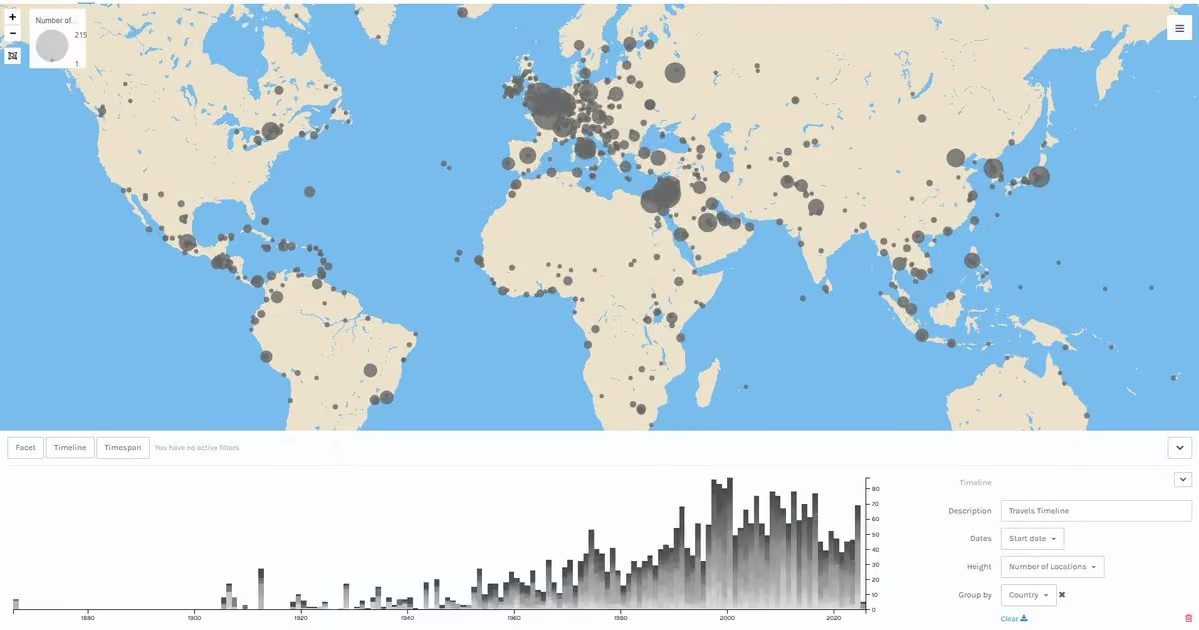
📊 Spotlight on Thomas Faith, Education Policy Director at @StateDept's Office of the Historian! On June 18, Tom led a guest presentation for the Department's PS311 Data Analysis and Visualization course — walking participants through the visualization of geographic data using the history.state.gov Travels datasets. Turning historical records into powerful data tools — that's diplomacy meeting the digital age. 🗺️💡
#diplomacy #ushistory #foreignpolicy #datavisualization @Stanford -
HistoryAtState
@HistoryAtState
Thomas Faith @StateDept highlighted a remarkable 1966 document that framed the future of U.S. space policy as a binary choice: unilateralism or cooperation. Six decades later, that question still shapes how America leads in space.
history.state.gov/historicaldocuments/frus1964-68v34/d54
#frus #spacediplomacy #statedept #historicalrecord #ussf -
HistoryAtState
@HistoryAtState
🚀 Special thanks to Thomas Faith, Education Policy Director at @StateDept's Office of the Historian, for hosting a session on space diplomacy in the FRUS series for the inaugural cohort of U.S. Space Force Regional Space Advisors — alongside State colleagues from NFATC, PM, ET, OES, EAP, EUR, and the Department of War. 🛰️🌍
#frus #spacediplomacy #statedept #historicalrecord #ussf #ushistory #foreignpolicy -
HistoryAtState
@HistoryAtState
Special thanks to @StateDept's Tom Opstal for briefing interagency FOIA and declassification professionals at a two-day equity recognition training seminar — sharing expertise to strengthen capacity on declassification referrals and FOIA consultations. Collaboration like this keeps the machinery of transparency and accountability running.
#foia #declassification #interagency #ushistory #foreignpolicy -
HistoryAtState
@HistoryAtState
💻 At ICEDD 2026, @StateDept's John Powers presented on behalf of Digital History Advisor, Joe Wicentowski, highlighting a new generation of coding tools empowering historians to build custom software/applications for their work.
#iced2026 #dodis #frus #digitalhistory -
HistoryAtState
@HistoryAtState
📜 At ICEDD 2026, @StateDept's John Powers shared a new approach tested in 2025: publishing individual FRUS chapters as they are cleared for release—rather than waiting for an entire volume.
The test case? Western Europe, 1977–1980—a 9-chapter volume covering 12 countries that had been stuck in declassification for 12 years. In August 2025, the Canada, Germany, and Nordic Countries chapters debuted to positive feedback from historians and archivists alike.
history.state.gov/historicaldocuments/frus1977-80v27
#icedd2026 #frus #diplomatichistory -
HistoryAtState
@HistoryAtState
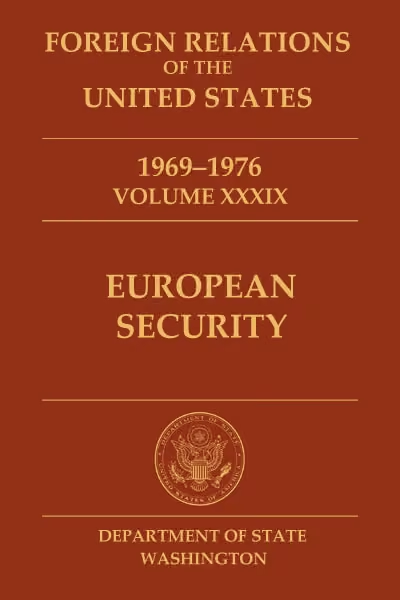
The Office of the Historian contribution to the 2026 ICEDD joint volume was drawn from the Foreign Relations of the United States volume on European Security, 1969–1976.
🔗 history.state.gov/historicaldocuments/frus1969-76v39
#icedd2026 #frus -
HistoryAtState
@HistoryAtState
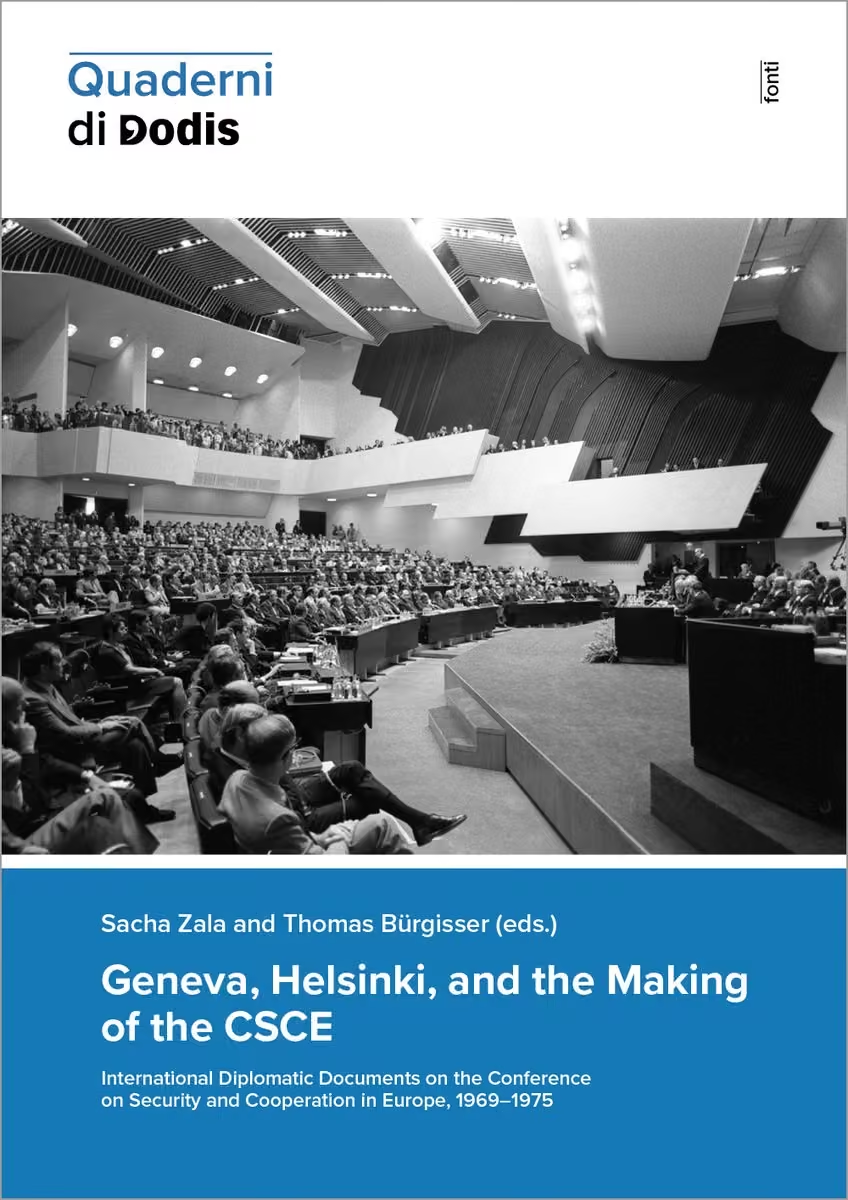
📚 Every two years, ICEDD publishes a joint volume on a key historical topic—drawing on documents from member archives to examine historical events from the perspectives of the different capitals of the world. Swiss research centre Dodis makes these documents freely accessible worldwide.
This year, the @StateDept Office of the Historian contributed historical documents to the joint volume: Geneva, Helsinki, and the Making of the CSCE: International Diplomatic Documents on the Conference on Security and Cooperation in Europe, 1969–1975
📖 Explore the volume in #dodis: diplomatic-documents.org/project/geneva-helsinki-and-the-…
#icedd2026 #ushistory #foreignpolicy -
HistoryAtState
@HistoryAtState
📢 This week, John Powers, Acting Director of the @StateDept Office of the Historian, is participating in the 18th International Conference of Editors of Diplomatic Documents (ICEDD) in Bern, 2–5 September 2026.
#icedd2026 #dodis #frus #diplomatichistory -
HistoryAtState
@HistoryAtState
The policy documents selected and published in FRUS give the American people a window into the key decisions that shaped U.S. national security. History. Transparency. Mission. 💪🏛️
#frus #diplomacy @StateDept #historicalrecord #ushistory #foreignpolicy -
HistoryAtState
@HistoryAtState
The declassification process is the backbone of the Department’s commitment to transparency and accountability. @StateDept declassification professionals conduct research, use declassification guides, and advocate with other agencies to release as much as possible. History is made here.
-
HistoryAtState
@HistoryAtState
The Foreign Relations of the United States (FRUS) series — the official historical record of U.S. foreign policy — depends on declassification work happening every day at @StateDept. #nationalsecurity #frus #foreignpolicy
-
HistoryAtState
@HistoryAtState
What’s the reward of compiling a #frus volume?
For @StateDept historian James Graham Wilson, it’s when they hit shelves after years of review and watching future leaders dig into the raw records.
Read our interview in @afsatweets #fsj: afsa.org/fsj/foreign-service-journal/past-never-past-how-…
HistoryAtState
@HistoryAtState
Read the full conversation in July’s
@afsatweets Foreign Service Journal: pic.x.com/dwmcrJxQj7 -
HistoryAtState
@HistoryAtState
What does it take to publish a #frus volume?
@StateDept historian James Graham Wilson says it’s a marathon, not a sprint.
From archival research and selection to peer reviews and interagency declassification, each volume takes years of meticulous work.
#america250
HistoryAtState
@HistoryAtState
Read the full conversation in July’s
@afsatweets
Foreign Service Journal: pic.x.com/dwmcrJxQj7 -
HistoryAtState
@HistoryAtState
While it isn’t a blueprint for every scenario, @StateDept historian James Graham Wilson says the 2,705 combined pages of the START I Foreign Relations of the United States volumes map out what sustained, serious negotiation can achieve under pressure.
#america250 #frus
HistoryAtState
@HistoryAtState
Read the full conversation in July’s
@afsatweets
Foreign Service Journal: pic.x.com/dwmcrJxQj7 -
HistoryAtState
@HistoryAtState
“Go to the sources.”
@StateDept historian James Graham Wilson hopes the #frus series helps students and the public empathize with the historical figures in these pages and grapple with their dilemmas. Faced with the same tradeoffs, what would you have done?
#america250
HistoryAtState
@HistoryAtState
Read the full conversation in July’s
@afsatweets
Foreign Service Journal: pic.x.com/dwmcrJxQj7 -
HistoryAtState
@HistoryAtState
What sparks a life dedicated to the archives?
For @StateDept Historian James Graham Wilson, it traces back to high school documentaries, a dissertation at @UVA and a moderate obsession with the ideas and people that brought about the end of the Cold War.
#america250 #frus
HistoryAtState
@HistoryAtState
Read the full conversation in July’s
@afsatweets
Foreign Service Journal: afsa.org/fsj/foreign-service-journal/past-never-past-how-… #fsj -
HistoryAtState
@HistoryAtState
What do you wish more people understood about the #frus series? State Department Historian James Graham Wilson breaks it down:
Myth: FRUS only publishes @StateDept documents.
Reality: Historians dig through CIA, Pentagon, NSC & presidential archives too.
#america250
HistoryAtState
@HistoryAtState
Read the full conversation in July’s @afsatweets Foreign Service Journal: pic.x.com/dwmcrJxQj7
-
HistoryAtState
@HistoryAtState
In 1988, VP George H.W. Bush met privately with Soviet Foreign Minister Shevardnadze. His candid message? If elected, he'd have to work hard to get conservative support to ratify START.
An archival gem uncovered by @StateDept historian James Graham Wilson.
#america250 #frus
HistoryAtState
@HistoryAtState
Read the full article: afsa.org/fsj/foreign-service-journal/past-never-past-how-…
-
HistoryAtState
@HistoryAtState
Think diplomacy is just handshakes and summits?
Behind the scenes, historians are uncovering the real story of U.S. foreign policy through the Foreign Relations of the United States (#frus) series.
Read our conversation in July’s @afsatweets Foreign Service Journal: afsa.org/fsj/foreign-service-journal/past-never-past-how-… #fsj -
HistoryAtState
@HistoryAtState
In 1966, Pres. Johnson signed the Freedom of Information Act — giving the public the right to request government records. It took effect in 1967. 60 years later, FOIA remains a cornerstone of government transparency and the #statedept is leading the way. #foia #frus #frusrelease #ushistory #foreignpolicy
-
HistoryAtState
@HistoryAtState
Since 1967, the Freedom of Information Act has given the public the opportunity to request federal records. @StateDept's FOIA program & @HistoryAtState keep that promise alive — follow for the latest #foia & #frus releases. #ushistory #foreignpolicy @USNatArchives @TheJusticeDept
-
HistoryAtState
@HistoryAtState
Transparency in diplomacy: @StateDept's MDR and FOIA programs & @HistoryAtState are releasing historical foreign policy records to the public. Follow along for the latest #foia & #frus document releases.
-
HistoryAtState
@HistoryAtState
Do classified State Dept. historical records need a special sign-off before declassification? On July 9, 2026, ISOO Notice 2026-03 answered that question for declassification reviewers across government—and it covers certain FOIA requests too.
For more information see: isoo-overview.blogs.archives.gov/2026/07/09/updated-depar…
#frus #foia #isoo #declassification -
HistoryAtState
@HistoryAtState
The Office of the Historian is pleased to participate in the @StateDept NFATC training curriculum, where historical context and current events shape a deeper understanding of U.S. foreign policy. #frus #ushistory #foreignpolicy #diplomacy
-
HistoryAtState
@HistoryAtState
The 1998 U.S. embassy attacks killed 224 people and wounded more than 4,500, the overwhelming majority of whom were Kenyan and Tanzanian civilians. Twelve American embassy staff, as well as 34 Kenyan and 10 Tanzanian locally employed staff lost their lives. Read the 35 Situation Report cables written in the days following: foia.state.gov/FOIALIBRARY/Collections2.aspx
View items from August 7, 1998 in the @NMAD collection: diplomacy.state.gov/the-august-7-1998-east-africa-embassy… -
HistoryAtState
@HistoryAtState
The 1998 U.S. embassy bombings in Kenya and Tanzania mark a pivotal moment in the history of U.S. foreign policy, diplomatic security, and the global struggle against transnational terrorism. The legacy of these attacks is ingrained in the physical architecture of U.S. embassies worldwide, the legal frameworks used to prosecute terrorists, and the intelligence reforms that followed. Visit the FOIA Library to view these previously classified records: foia.state.gov/FOIALIBRARY/Collections2.aspx
-
HistoryAtState
@HistoryAtState
Thank you for joining us on our tour of soccer-related #frus documents. For more content, search our datasets: history.state.gov/search?q="soccer" OR "World Cup"&within…
Now, onward to finals! #weare26 #fifaworldcup -
HistoryAtState
@HistoryAtState
In 1978, Brazilian President Geisel described the political significance of soccer to Secretary Kissinger: Lose the World Cup, lose the election. “So you can see why I am preoccupied in selecting a really good team… for the 1978 World Cup.”
history.state.gov/historicaldocuments/frus1969-76ve11p2/d128
#weare26 #fifaworldcup -
HistoryAtState
@HistoryAtState
Picture it: Munich, 1974. Kissinger joked about his goalie days, but the German press took his comments as a dig at the defensive tactics of the West German soccer team. Humor, sports allegiances, and diplomacy can be a challenging mix.
history.state.gov/historicaldocuments/frus1969-76ve15p1/d51
#weare26 #fifaworldcup -
HistoryAtState
@HistoryAtState
In October 1974, Kissinger recounted how he told Soviet Foreign Minister Gromyko the worst outcome would be an East German World Cup win. According to Kissinger, Gromyko grinned.
history.state.gov/historicaldocuments/frus1969-76ve15p1/d50
#weare26 #fifaworldcup -
HistoryAtState
@HistoryAtState
(2/2) As National Security Advisor Henry Kissinger showed U–2 photos of the Cuban naval expansion to White House chief of staff H.R. Haldeman, Kissinger reportedly exclaimed, “Those soccer fields could mean war, Bob. Cubans play baseball. Russians play soccer.”
#weare26 #fifaworldcup -
HistoryAtState
@HistoryAtState
(1/2) When the “beautiful game” meets a spy plane:
In August 1970, U–2 reconnaissance photos captured the construction of new facilities in Cienfuegos, Cuba. Analysts “believed that it was significant that there were no baseball fields—only soccer fields, suggesting Soviet occupation rather than Cuban.”
history.state.gov/historicaldocuments/frus1969-76v12/d214 -
HistoryAtState
@HistoryAtState
In 1969, violence at a World Cup qualifier ignited a “Soccer War” between El Salvador and Honduras. Read the declassified U.S. diplomatic record, published in #frus in 2009:
history.state.gov/historicaldocuments/frus1969-76ve10/ch19
#weare26 #fifaworldcup -
HistoryAtState
@HistoryAtState
In March 1963, James Symington wished the Alliance for Progress had the level of promotional excitement in Latin America as an announcer at a soccer game. 📻⚽ He suggested a broadcasting conference to generate that same energy behind the Alianza.
history.state.gov/historicaldocuments/frus1961-63v12/d57
#weare26 #fifaworldcup -
HistoryAtState
@HistoryAtState
In 1962, the U.S. launched an International Sports Kit Project, sending equipment for soccer, boxing, baseball, softball, volleyball, and basketball to over 50 countries. Within a year, 12,700 kits had been requested from 86 nations.
history.state.gov/historicaldocuments/frus1961-63v25/d156
#weare26 #fifaworldcup -
HistoryAtState
@HistoryAtState
(2/2) Soviet First Deputy Premier Kozlov responded that this 1945 incident “illustrated the friendship of the Soviet people for the Americans.”
For an eyewitness account, see p. 217 of John R. Deane’s The Strange Alliance (1947):
archive.org/details/bwb_C0-CEX-042
#weare26 #fifaworldcup -
HistoryAtState
@HistoryAtState
(1/2) In July 1959, Amb. Averell Harriman recalled “when Eisenhower and Zhukov appeared together at a soccer match in the Dynamo stadium in 1945 and put their arms around each other, the entire stadium had erupted into a roar of approval.”
history.state.gov/historicaldocuments/frus1958-60v10p1/d86
#weare26 #fifaworldcup -
HistoryAtState
@HistoryAtState
On April 25, 1950, Saudi Arabian players beat U.S. diplomats and Bechtel Inc. engineers 6–0 at soccer, just six years after men were imprisoned for playing with a homemade rag ball in the street. An April 30 memo attributed the policy change to Crown Prince Saud.
history.state.gov/historicaldocuments/frus1950v05/d643
#weare26 #fifaworldcup -
HistoryAtState
@HistoryAtState
From June 11 to July 19, 2026, the United States, Canada, and Mexico are jointly hosting the FIFA Men’s World Cup: www.state.gov/fifa-world-cup-26/
In honor of the beautiful game, we are highlighting documents from the #frus series that reference soccer and the World Cup.
#weare26 #fifaworldcup -
HistoryAtState
@HistoryAtState
Great partnerships make great diplomacy. 🤝 The Office of the Historian is proud to support @ECAatState's South Pacific Scholars program by sharing our deep knowledge of U.S.-Pacific regional history, covering trade, diplomacy, migration, security cooperation, and regional partnerships. #frus #ushistory #foreignpolicy #diplomacy
-
HistoryAtState
@HistoryAtState
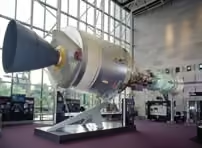
On July 17, 1975, Apollo and Soyuz docked 140 miles above Earth. President Ford called the crews. Brezhnev sent a message. The handshake didn't happen by accident. #frus #nasm50
Check out @NASA's mission history: www.nasa.gov/apollo-soyuz-test-project/
See the Ford-Brezhnev letters at @USNatArchives: ford.blogs.archives.gov/2025/07/17/apollo-soyuz/ -
HistoryAtState
@HistoryAtState
What does the #frus paper trail leading to Apollo-Soyuz look like? Memos debating whether to approach the Soviets. @NASA letter proposing compatible docking equipment. Kissinger reporting the first technical talks went well. @StateDept reminding Kissinger cooperation could pay off. It's all in Chapter 4. @airandspace #nasm50
history.state.gov/historicaldocuments/frus1969-76ve01/ch4 -
HistoryAtState
@HistoryAtState
At the 1972 Moscow summit, Nixon and Brezhnev signed SALT I—and a space agreement. One clause called for compatible U.S.-Soviet docking systems. That technical sentence became Apollo-Soyuz three years later. @NASA @USNatArchives #frus #nasm50
history.state.gov/historicaldocuments/frus1969-76ve01/d281 -
HistoryAtState
@HistoryAtState
In 1970, President Nixon reviewed a memo on international space cooperation and wrote in the margin: "This is a must." He wanted allied astronauts included in future missions—an idea that helped move space diplomacy from memo to policy. @USNatArchives #frus #nasm50
-
HistoryAtState
@HistoryAtState
One month after Apollo 11, @NASA Administrator Tom Paine briefed President Nixon on efforts to use the Moon landing to promote international space cooperation with allies—and the Soviet Union. #frus #nasm50
history.state.gov/historicaldocuments/frus1969-76ve01/d229 -
HistoryAtState
@HistoryAtState
Four months before Apollo 11, Secretary of State Rogers sent President Nixon a memo: "New Initiatives in Space Cooperation." America hadn’t reached the Moon yet. @StateDept was already asking how the U.S. space program could help diplomacy. @NASA #frus #spacediplomacy #nasm50
-
HistoryAtState
@HistoryAtState
🎉 Happy 50th, @airandspace! You preserve the spacecraft. We preserve the space diplomacy in #frus. Six documents tell the story of how the U.S. and USSR went from competition to cooperation—and docked in orbit. The handshake didn’t happen by accident. @NASA #otd #nasm50 #frus
-
HistoryAtState
@HistoryAtState
Diplomacy occurs in many settings. Sometimes even in the middle of the night at a remote Abuja overlook, as in this September 1994 readout of discussions between a senior NSC official and the Nigerian Foreign Minister.
Read more: foia.state.gov/FOIALIBRARY/SearchResults.aspx?searchText=… -
HistoryAtState
@HistoryAtState
Our diplomats are regularly tasked with the impossible, yet persist in clear-eyed “quixoticity”, as in this candid December 1992 report from Edmund DeJarnette, Director of the U.S. Liaison Office in Angola.
Read more: foia.state.gov/FOIALIBRARY/SearchResults.aspx?searchText=… -
HistoryAtState
@HistoryAtState
“Jaw jaw jaw is better than war war war” counselled Edmund DeJarnette, upon his October 1992 arrival in Angola amidst rising tensions.
Read more: foia.state.gov/FOIALIBRARY/SearchResults.aspx?searchText=… -
HistoryAtState
@HistoryAtState
The Office of the Historian is proud to support the Department’s celebration of 250 years of partnership with the U.S. Marine Corps. Special thanks to Ben Greene for contributing historical research to the pamphlet honoring a legacy of service and collaboration! @USMC #usmc250
-
HistoryAtState
@HistoryAtState
As @USMC celebrated its 250th birthday, the Department of State honored the Marines who have stood watch at our embassies and consulates worldwide. From 1775 to today, Marines embody "Semper Fidelis"—always faithful to protecting American diplomacy.
@StateDept #ushistory #marinecorps250
Read about the legacy: history.state.gov/departmenthistory/marine-corps -
HistoryAtState
@HistoryAtState
“The Marines and our diplomacy are tightly intertwined. Sometimes people have the mistaken idea that the strength represented by the Marines is an alternative to diplomacy. That’s wrong. Strength and diplomacy go together. They need each other.”—Secretary of State George P. Shultz.
Read the full history: history.state.gov/departmenthistory/marine-corps -
HistoryAtState
@HistoryAtState
The Marine Security Guard program, established in 1948, formalized the Marines' role in diplomatic security. Today MSGs protect U.S. personnel, classified information, and property at embassies in 150+ countries. @StateDept #ushistory #marinecorps250
Learn more: -
HistoryAtState
@HistoryAtState
Honoring #marinecorps250: In 1898, at Minister Edwin Conger's request, the Marine guard at the U.S. Legation in Beijing became the first permanent legation guard established by the Department—a milestone in protecting American diplomacy. #ushistory #marinecorps250
Read it in #frus: history.state.gov/historicaldocuments/frus1898/d175 -
HistoryAtState
@HistoryAtState
Continental Marines protected American diplomats crossing the Atlantic to secure alliances and negotiate treaties. When diplomat John Adams crossed the Atlantic in 1778 and they encountered an armed British ship, Adams joined the Marines on deck with musket in hand: “I ought to do my share of fighting.” #ushistory #marinecorps250
Read the story: history.state.gov/departmenthistory/marine-corps -
HistoryAtState
@HistoryAtState
NEW @StateDept: “A History of Collaboration: The U.S. Marine Corps & U.S. Department of State” explores nearly 250 years of Marines protecting U.S. diplomats, from 1775 to today's Marine Security Guards at 182 posts worldwide. #ushistory #marinecorps250
Read more: history.state.gov/departmenthistory/marine-corps -
HistoryAtState
@HistoryAtState
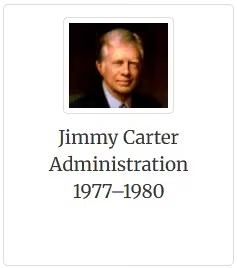
The release of three chapters of Western Europe, 1977–1980 — out of nine chapters in total — represents a recent innovation in FRUS publication.
This new approach allows the Office of the Historian to release declassified components of volumes as soon as they are cleared for publication, rather than waiting for the entire volume to be completed, ensuring that Department staff, researchers, and the American people have faster access to the official historical records.
history.state.gov/historicaldocuments/frus1977-80v27 -
HistoryAtState
@HistoryAtState
The release of START I, 1989–1991 in 2025 marks another milestone for the Department. It is the first FRUS publication (out of 33 planned volumes) documenting the George H.W. Bush administration.
history.state.gov/historicaldocuments/frus1989-92v31 -
HistoryAtState
@HistoryAtState
National Security Policy, 1985–1988, Part 1, traces the evolution of President Ronald Reagan’s central objective to achieve peace through strength. The documents illuminate his vision for the Strategic Defense Initiative (SDI) as a tool to protect America while also bringing the Soviets to the negotiating table.
history.state.gov/historicaldocuments/frus1981-88v44p1 -
HistoryAtState
@HistoryAtState
Don’t miss out on the seeing newly declassified documents on U.S. history and foreign policy! Follow us and dive into #frus content that shapes our understanding of foreign affairs!
www.history.state.gov -
HistoryAtState
@HistoryAtState
Since 1861, #frus has documented major U.S. foreign policy decisions and significant diplomatic activity, offering insight into how policymakers addressed complex challenges.
The latest #frus volumes, which include 639 new documents, underscore the Department’s commitment to transparency and the preservation of diplomatic history, providing readers with a clear view into the deliberations and decisions that have shaped America’s global role.
Read the 2025 Report to Congress: history.state.gov/about/reports -
HistoryAtState
@HistoryAtState
Join over 20 million visitors who have explored our website—ranked among the Department of State’s top five public engagement platforms.
www.history.state.gov -
HistoryAtState
@HistoryAtState
In 2025, the Office of the Historian published three new volumes in the congressionally mandated Foreign Relations of the United States (#frus) series, adding to its catalogue of more than 550 publications.
The 2025 Report to Congress highlights several modernization efforts by the Office of the Historian to improve efficiency and promote transparency.
Read the 2025 Report to Congress: history.state.gov/about/reports -
HistoryAtState
@HistoryAtState
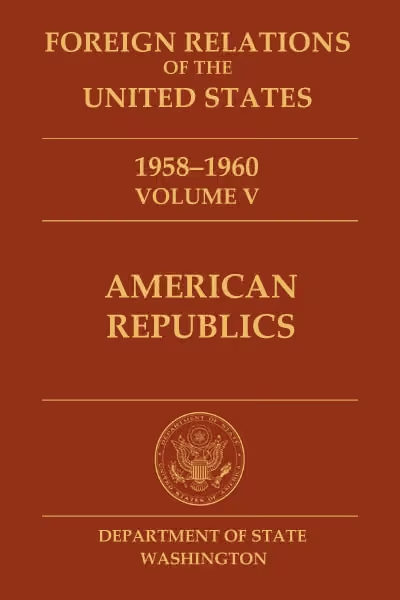
Our newly digitized microfiche supplement is a companion to the printed volume, Foreign Relations, 1958–1960, Volume V, American Republics:
history.state.gov/historicaldocuments/frus1958-60v05
#frus #frusrelease #ushistory #usforeignpolicy -
HistoryAtState
@HistoryAtState
The Office of the Historian releases Foreign Relations, 1958–1960, Volume V, Microfiche Supplement, American Republics:
history.state.gov/historicaldocuments/frus1958-60v05mSupp
@StateDept @IkeLibrary #frus #frusrelease #ushistory #usforeignpolicy -
HistoryAtState
@HistoryAtState
From energy showdowns to natural gas deals, narcotics, and intrigue—the late ’70s Caribbean was anything but quiet. Use the #frus volume’s index to uncover these topics during the Carter administration. #ushistory #caribbean
history.state.gov/historicaldocuments/frus1977-80v23/index -
HistoryAtState
@HistoryAtState
Guided by NSDD 148, Shultz and Gromyko agreed in 1985 to launch “umbrella talks”—three-track arms control negotiations in Geneva. Use the index to quickly locate the National Security Decision Directives featured in this volume. #coldwar #armscontrol
history.state.gov/historicaldocuments/frus1981-88v04/index -
HistoryAtState
@HistoryAtState
New to using FRUS in your research? Start with the index to find names, events, and common topics of conversation. Each FRUS index is crafted specifically for its volume and is reviewed by a subject-matter expert and is designed with the researcher’s needs in mind.
-
HistoryAtState
@HistoryAtState
Use the #frus index to discover key players you might have missed in historic, high-stakes talks. See: Pavel Palazhchenko and Dimitri Zarechnak, interpreters for Shultz-Shevardnadze ministerials and Gorbachev-Reagan talks. #diplomacy #coldwar
history.state.gov/historicaldocuments/frus1981-88v06/index -
HistoryAtState
@HistoryAtState
Looking to search a Foreign Relations of the United States volume using the index? Check out the first born-digital #frus indexes here:
Post not available here, view on X
HistoryAtState
@HistoryAtState
Foreign Relations of the United States, 1981–1988, Volume IV, Soviet Union, January 1983–March 1985
history.state.gov/historicaldocuments/frus1981-88v04/index
HistoryAtState
@HistoryAtState
Foreign Relations of the United States, 1981–1988, Volume VI, Soviet Union, October 1986–January 1989
history.state.gov/historicaldocuments/frus1981-88v06/index -
HistoryAtState
@HistoryAtState
The Office of the Historian has now published 8 born-digital indexes for #frus volumes in the Nixon, Carter, and Reagan subseries. These indexes provide a new level of accessibility to users and take a digital-first, collaborative approach to the traditional finding aid.
-
HistoryAtState
@HistoryAtState
OH was honored to join the Department’s Veterans Day Roll Call, recognizing veterans who have chosen a “second tour” of service at State. As DAS Kootz noted, their “dedication to an institution greater than any one person” is vital to American diplomacy and our success.
-
HistoryAtState
@HistoryAtState
On July 31, 1991, President George H.W. Bush and Soviet leader Mikhail Gorbachev signed the #starttreaty in Moscow—just weeks before an attempted coup in Moscow and a few months before the collapse of the Soviet Union. #frus
history.state.gov/historicaldocuments/frus1989-92v31/d239
@Bush41Library #frus #frusrelease #ushistory #foreignpolicy -
HistoryAtState
@HistoryAtState
A draft #starttreaty emerged in December 1987, but it took subsequent years of painstaking negotiations to broker a final agreement. Bush and Gorbachev (seen here off Malta in Dec. 1989) stayed committed.
history.state.gov/historicaldocuments/frus1989-92v31/d60
@Bush41Library #frus #ushistory #foreignpolicy -
HistoryAtState
@HistoryAtState
On January 20, 1989, George H.W. Bush became president, aiming to sign a #starttreaty. Having closely followed negotiations since 1982, his interest deepened during his final years as VP, shaping U.S. arms control policy.
history.state.gov/historicaldocuments/frus1989-92v31
#ushistory #diplomacy @Bush41Library -
HistoryAtState
@HistoryAtState
START I, 1989–1991 is the second of two #frus volumes covering the 1991 Strategic Arms Reduction Treaty. It follows:
history.state.gov/historicaldocuments/frus1981-88v11
#frus #frusrelease #ushistory #foreignpolicy -
HistoryAtState
@HistoryAtState
The Office of the Historian releases Foreign Relations, 1989–1992, Volume XXXI, START I, 1989–1991:
history.state.gov/historicaldocuments/frus1989-92v31
@StateDept @Bush41Library #frus #frusrelease #ushistory #foreignpolicy -
HistoryAtState
@HistoryAtState
The #frus Federal Republic of Germany chapter focuses on U.S. policies toward West Germany, including economic issues and issues such as relations with the Soviet Union and nuclear strategy.
history.state.gov/historicaldocuments/frus1977-80v27
#frus #frusrelease #ushistory #diplomacy @CarterLibrary -
HistoryAtState
@HistoryAtState
Documentation in the #frus Nordic Countries chapter emphasizes East-West security issues, strategic arms control, and energy as well as specific bilateral concerns.
history.state.gov/historicaldocuments/frus1977-80v27/d275
#frus #frusrelease #ushistory #diplomacy @CarterLibrary -
HistoryAtState
@HistoryAtState
Documentation in the #frus Canada chapter focuses on themes in U.S.-Canada relations such as economic, energy, and environmental issues, Cold War defense policy, and Canadian unity.
history.state.gov/historicaldocuments/frus1977-80v27
#frus #frusrelease #ushistory #diplomacy @CarterLibrary -
HistoryAtState
@HistoryAtState
The Office of the Historian @StateDept releases chapters on Canada, West Germany, and Nordic Countries in the Foreign Relations of the United States, 1977–1980, Volume XXVII, Western Europe:
history.state.gov/historicaldocuments/frus1977-80v27
#frus #frusrelease #ushistory #diplomacy @CarterLibrary -
HistoryAtState
@HistoryAtState
Strategic modernization, the Strategic Defense Initiative (SDI), interpretations of the Anti-Ballistic Missile (ABM) Treaty, and Soviet compliance are also key themes in the #frus volume covering START I negotiations during the Reagan administration:
history.state.gov/historicaldocuments/frus1981-88v11 -
HistoryAtState
@HistoryAtState
The National Security Policy #frus volume also captures internal deliberations in advance of the 1988 ABM Treaty Review, during which General William F. Burns led the U.S. delegation.
history.state.gov/historicaldocuments/frus1981-88v44p1
#frus #ushistory @Reagan_Library -
HistoryAtState
@HistoryAtState
National Security Policy #frus illuminates the Reagan administration’s interpretation of the 1972 Anti-Ballistic Missile (ABM) Treaty in advance of key summits between President Reagan and Soviet leader Mikhail Gorbachev between 1985 and 1988.
history.state.gov/historicaldocuments/frus1981-88v44p1 -
HistoryAtState
@HistoryAtState
National Security Policy #frus covers the Reagan administration’s efforts to modernize U.S. strategic forces, identify Soviet compliance and noncompliance with existing arms control agreements, and pursue the Strategic Defense Initiative (SDI).
history.state.gov/historicaldocuments/frus1981-88v44p1 -
HistoryAtState
@HistoryAtState
The Office of the Historian releases Foreign Relations, 1981–1988, Volume XLIV, Part 1, National Security Policy, 1985–1988:
history.state.gov/historicaldocuments/frus1981-88v44p1
@StateDept @Reagan_Library #frus #frusrelease #ushistory #foreignpolicy -
HistoryAtState reposted
National Foreign Affairs Training Center
@NFATCatState
The Foreign Relations of the United States series is a treasure trove of historical documents that tell the story of U.S. diplomacy.
Read more for a behind-the-scenes look at the detailed process of compiling and declassifying key diplomatic documents: www.linkedin.com/pulse/unlocking-detailed-history-us-fore… -
HistoryAtState reposted
National Foreign Affairs Training Center
@NFATCatState
Yesterday, Acting Director Brewer participated in the quarterly Historical Advisory Committee (HAC) meeting with @HistoryatState. The HAC is mandated by law and makes recommendations to FSI for the publication of historical records. Learn more on the Office of the Historian website: history.state.gov/about/hac/intro
-
HistoryAtState
@HistoryAtState
The Office of the Historian invites you to a discussion on past U.S. centennial planning in #frus, led by Adam Howard, the Historian of the Department of State.
To attend, please RSVP via email to FSIOHRSVP@state.gov. -
HistoryAtState
@HistoryAtState
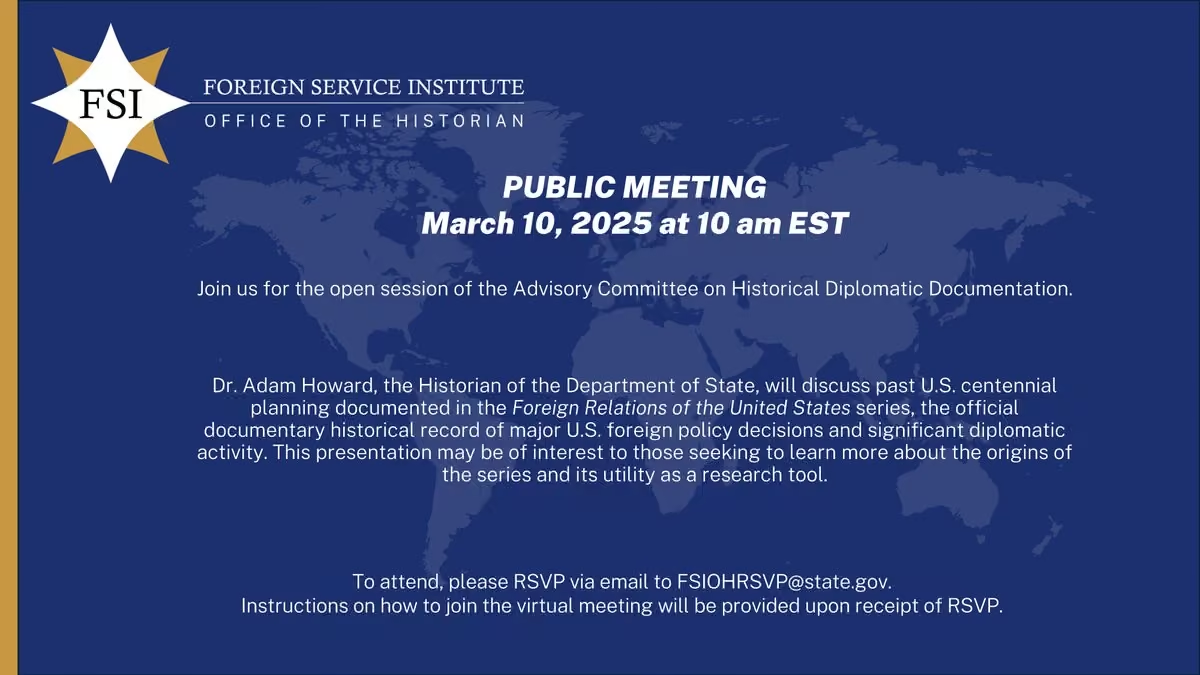
PUBLIC MEETING
March 10, 2025 at 10am EST
Learn about #frus, the official documentary historical record of major U.S. foreign policy decisions and significant diplomatic activity, and its utility as a research tool.
To attend, please RSVP via email to FSIOHRSVP@state.gov. -
HistoryAtState
@HistoryAtState
PUBLIC MEETING
March 10, 2025 at 10am EST
Join us for the open session of the Advisory Committee on Historical Diplomatic Documentation (#hac).
To attend, please RSVP via email to FSIOHRSVP@state.gov