 TheHillOpinion
@TheHillOpinion

@Will_PPI The midterm avalanche reveals a new political geography thehill.com/opinion/campaign/6215499-new-post-trump-polit…

Politicians, athletes, journalists, NGOs, companies... They all use corporation-owned social networks to communicate with us. Citizens shouldn't have to hand over their data to companies to read content published by public entities. Public Feeds changes that by making posts of popular accounts freely available. Read more.

The Progressive Policy Institute (PPI) is a non-profit 501(c)(3) organization that serves as a public policy think tank in the United States. The Democratic Leadership Council (DLC) founded it in 1989. The think tank has been described as a centrist Democratic institution. More on Wikipedia

Radically pragmatic policy to move the world forward.
PPI
@ppi
Big wins can breed costly assumptions.
At PPI’s post-midterm forum, @mollykmurphy of Impact Research noted that Republicans treated their 2024 gains as permanent, and it cost them.
If Democrats take election gains for granted, she warned, they will repeat that mistake.
 PPI
@ppi
Watch the full panel with @mollykmurphy, @McKenzieAWilson, and @DougSosnik: youtu.be/VdU_iNXQ7xo
PPI reposted
TheHillOpinion
@TheHillOpinion
@Will_PPI The midterm avalanche reveals a new political geography thehill.com/opinion/campaign/6215499-new-post-trump-polit…
PPI reposted
 Ian O’Keefe
@realianokeefe
Voters know that corruption makes their lives worse and more expensive.
And they voted Democrats into office to do something about it.
PPI
@ppi
Corruption is a kitchen table issue for American voters.
At PPI’s post-midterm forum, @JasonCrowCO said Democratic candidates ran on cleaning up Washington in every kind of district this cycle, and that voters expect them to deliver on that promise in the new Congress.
PPI
@ppi
Democrats won their majorities by running on affordability, and they cannot deliver it by adding trillions to a $2 trillion annual deficit.
As PPI’s @BudgetBen writes, the new Congress should pay for its priorities, adopt PAYGO rules, and confront the fiscal reality it inherited.
 Romina Boccia
@RominaBoccia
.@ppi’s Ben Ritz warns Democrats that deepening the deficit “could worsen the very affordability problems Democrats are hoping to solve.”
If Dems are serious about affordability, start with the deficit.
PPI
@ppi
Read the full piece from PPI’s @BudgetBen on how the new Democratic majority can reverse Trump’s costliest mistakes, set clear priorities, and deliver a durable affordability agenda without deepening the deficit it is inheriting: www.progressivepolicy.org/ritz-for-radically-pragmatic-de…
PPI
@ppi
Corruption is a kitchen table issue for American voters.
At PPI’s post-midterm forum, @JasonCrowCO said Democratic candidates ran on cleaning up Washington in every kind of district this cycle, and that voters expect them to deliver on that promise in the new Congress.
PPI
@ppi
Watch @JasonCrowCO’s full remarks at PPI’s post-midterm forum, “After the Avalanche: America’s New Political Geography,” on YouTube: youtu.be/VdU_iNXQ7xo
PPI reposted
 D.C. Sources
@dcsourcespod
“A repudiation does not necessarily translate into a win”
@claire_ainsley looks to UK Labour's trajectory under Keir Starmer to caution US Democrats that relying on an ambiguous anti-incumbent protest vote leaves a dangerous void once in power.
@EliStokols | @mauragillespie | @meghan_hays9 | @chrismeagher
PPI reposted
 Claire Ainsley
@claire_ainsley
Great to join @dcsourcespod with @EliStokols @Maura_Gillespie @chrismeagher @meghan_hays9 - where do the Democrats go from here?
D.C. Sources
@dcsourcespod
🆕 EPISODE of D.C. Sources STREAMING NOW on podcast apps and YouTube.
"The Democrats: What Now?"
Watch here: www.youtube.com/watch?v=fAFhHDXWekA
Listen on Podcast Apps: dcsources.us
@meghan_hays9 | @EliStokols | @Maura_Gillespie
 PPI
@ppi
The midterms showed Democrats can compete anywhere with the right candidates.
In @TheHillOpinion, @Will_PPI shows Hispanic, young, independent, and working-class voters swung toward Democrats.
The path forward is a pragmatic, pocketbook-focused, culturally mainstream majority.
 PPI
@ppi
Read @Will_PPI’s full column in @TheHillOpinion: thehill.com/opinion/campaign/6215499-new-post-trump-polit…
PPI
@ppi
Denver is lovely this time of year.
PPI convened Democrats there in April 2025 to study the “Colorado Way,” as @natsfert reported for @POLITICOMag.
 Natalie Fertig
@natsfert
As Democrats flock to Denver this week to sort out the future of their party:
I went to Denver after the 2024 election for @POLITICOMag to find out why Colorado shifted less toward Trump than any other blue state, and see why some Dems think it's a model for retaking power.

 PPI
@ppi
Read more about PPI’s New Directions convening in Denver: www.politico.com/news/magazine/2025/07/06/the-colorado-wa…
PPI reposted
Ian O’Keefe
@realianokeefe
Wise words from @JasonCrowCO on the future of the party in newly-Democratic congressional districts.
PPI
@ppi
Democrats won districts last week that had not voted blue in decades, and the harder work of holding them starts now.
At PPI’s post-midterm forum, @JasonCrowCO urged the party to put down lasting roots there:
“We don’t want to just rent those districts. We want to own them.”
PPI
@ppi
Democrats won districts last week that had not voted blue in decades, and the harder work of holding them starts now.
At PPI’s post-midterm forum, @JasonCrowCO urged the party to put down lasting roots there:
“We don’t want to just rent those districts. We want to own them.”
PPI
@ppi
The full forum, “After the Avalanche: America’s New Political Geography,” is available here: youtu.be/VdU_iNXQ7xo
PPI reposted
 Ed Gresser
@EBGresser
This week's Trade Fact: Following last week's public verdict on the Trump admin. & tariffs, @ppi's new trade policy paper - "End of an Error" - looks ahead w/ ideas for the next two years, and a more aspirational and positive U.S. agenda to follow. TL/DR:
 PPI
@ppi
Voters delivered a clear verdict on tariffs: 64% say they hurt their local economy, and just 14% say they helped.
In this week’s edition of Trade Fact, PPI’s @EBGresser reviews the data.
The incoming Congress should reclaim its tariff authority and repeal the costly decrees.
 PPI
@ppi
Read PPI’s post-election trade essay, “End of an Error,” from @EBGresser here: www.radicallypragmatic.org/p/voters-rejected-trumps-tarif…
PPI
@ppi
New Dems are the House majority makers, and @RepNikkiB is their new leader.
In a statement, PPI’s @stumalec congratulated her on her election as @NewDemCoalition chair for the 120th Congress.
She is the right leader to keep the new majority focused on delivering for America’s working families.


 New Democrat Coalition (NDC)
@NewDemCoalition
Honored to announce @RepNikkiB as the next chair of the New Democrat Coalition for the 120th Congress!
She will lead the largest class of New Dems in the history of our caucus and bring forward real solutions to lower costs and deliver results for working people.

PPI reposted
Natalie Fertig
@natsfert
Kansas Gov @LauraKellyKS talking this morning at @ppi’s post-election debrief about the impact of Trump’s beef imports and ICE raids in SW Kansas ag country that fired up voters to turn out and vote.

PPI reposted
 LabourList
@LabourList
🔴 Labour should learn from midterm wins and win back working class, says PPI president
👉️ Senior Reporter for LabourList, Daniel Green discusses the American midterms with Will Marshall, president and founder of the Progressive Policy Institute (PPI), who said the results represent a "turning point" in American politics – and offered a lesson for other centre-left parties globally.
Read now 👇
labourlist.org/2026/11/us-midterms-lessons-for-labour/
PPI
@ppi
The midterm results hold clear lessons for Labour and center-left parties everywhere.
@Will_PPI told @LabourList’s @DanGreenJourno that Democrats won in red territory with pragmatic candidates focused on the cost of living.
Winning back working-class voters must come first.
 PPI
@ppi
Read @DanGreenJourno’s full interview with @Will_PPI in @LabourList on what the midterms mean for Labour and the global center-left: labourlist.org/2026/11/us-midterms-lessons-for-labour/
PPI
@ppi
Democrats’ midterm gains bring a new test: turning opposition to President Trump into a governing agenda.
Tomorrow, PPI’s @Will_PPI hosts @LauraKellyKS, @JasonCrowCO, @mollykmurphy, Doug Sosnik, and @McKenzieAWilson on what drove the results and what Democrats should learn.
 PPI
@ppi
Join us Tuesday, November 10, at @PressClubDC in Washington.
Request to join here: luma.com/kucsozr5
Registration requires host approval.
PPI reposted
Claire Ainsley
@claire_ainsley
“Get the right candidates that map well to the terrain you’re trying to compete in, with mainstream values focused on the cost of living issues for working families.”
@Will_PPI speaks to @LabourList on lessons from the mid-terms
labourlist.org/2026/11/us-midterms-lessons-for-labour/

PPI reposted
 Deborah Mattinson
@debmattinson
Excellent analysis from @ppi Will Marshall - keep the focus on working class living standards...
labourlist.org/2026/11/us-midterms-lessons-for-labour/
PPI
@ppi
Last week’s midterms delivered a decisive verdict on Trump’s tariffs, chaos, and corruption.
Writing in @usatodayopinion, @Will_PPI says center-left Democrats who flipped red seats in Texas, Kansas, Iowa, and Ohio have shown the party how to win working Americans back in 2028.
 PPI
@ppi
Read the full op-ed from @Will_PPI in @usatodayopinion: www.usatoday.com/story/opinion/2026/11/09/democrats-2026-…
PPI reposted
PPI
@ppi
As the dust settles, one lesson stands out: center-left Democrats who won on tough terrain helped deliver this majority.
Days before the vote, @Will_PPI told @freddiejh8 on the @NewStatesman Politics Show that majorities require cross-class coalitions.
Tuesday’s results bore that out.
PPI
@ppi
Across liberal democracies, voters feel they have lost control over prices, borders, and technology.
Discussing her book, Control, with @hoffman_noa on @spectator’s Coffee House Shots, PPI’s @claire_ainsley argues the center-left must answer with a politics of personal progress.
 PPI
@ppi
Listen to the full conversation between PPI’s @claire_ainsley and @hoffman_noa on @spectator’s Coffee House Shots: spectator.com/podcast/we-need-to-get-real-claire-ainsley-…
PPI reposted
Claire Ainsley
@claire_ainsley
Does Andy Burnham have a plan to give voters back control? @hoffman_noa and I discuss Brexit, AI, immigration and welfare and my new book ‘Control’ out now by @BitebackPub for @SpecCoffeeHouse
 The Spectator
@spectator
On today's Coffee House Shots podcast: Labour has a new leader, but does Andy Burnham have a plan to give voters back control?
In this episode of Coffee House Shots, Noa Hoffman speaks to Claire Ainsley, Keir Starmer's former director of policy, about her new book, Control: How We Lost It and How to Take It Back.
Listen | spectator.com/podcast/we-need-to-get-real-claire-ainsley-…
PPI
@ppi
As the dust settles, one lesson stands out: center-left Democrats who won on tough terrain helped deliver this majority.
Days before the vote, @Will_PPI told @freddiejh8 on the @NewStatesman Politics Show that majorities require cross-class coalitions.
Tuesday’s results bore that out.
PPI
@ppi
In his statement on the results, @Will_PPI argues Democrats should take their cue from the candidates who won on the toughest terrain in American politics. www.progressivepolicy.org/midterm-rout-shows-trumps-spell…
PPI
@ppi
Every talented student deserves a fair shot at America’s top public schools.
PPI’s @RickKahlenberg told @Gothamist a pending Supreme Court case could make it easier to sue districts over race-neutral, economic-based admissions reforms, freezing in an “unfair status quo.”
 PPI
@ppi
Read the full @Gothamist story by @arya_sundaram, featuring analysis from PPI’s @RickKahlenberg: gothamist.com/news/supreme-court-case-could-affect-admiss…
PPI reposted
 Gothamist
@Gothamist
Supreme Court case could affect admissions reforms for NYC specialized schools
gothamist.com/news/supreme-court-case-could-affect-admiss…
PPI reposted
Ed Gresser
@EBGresser
Yes he was. www.progressivepolicy.org/trade-fact-of-the-week-in-a-hyp…
 Alan Cole
@AlanMCole
The war gives him an escape hatch, but indeed he was the one complaining that Americans get cheap toasters.
PPI
@ppi
Texas just elected its first Democratic senator since 1988, two years after President Trump carried the state by 14 points.
In @thetimes, @Will_PPI says the lesson is clear: to win red states, Democrats must nominate candidates suited to their electorates.
 PPI
@ppi
Read the full piece from @georgegrylls in @thetimes, featuring @Will_PPI on what Texas Democrats got right: www.thetimes.com/us/american-politics/article/how-texas-t…
PPI
@ppi
Tuesday’s results were a referendum on President Trump’s own decisions.
In @washsunperspect, @Will_PPI calls the midterms “Blowback,” as voters rejected tariffs and an Iran war that raised costs for working families, along with the weak candidates Trump chose.
 The Washington Sun Perspectives
@washsunperspect
Repudiation. Blowback. Fired. Experts describe the midterm elections in one word.
www.washingtonsun.com/perspectives/experts-describe-the-m…
PPI reposted
Ed Gresser
@EBGresser
This week's Trade Fact: Herbert Hoover in 1930 was the last pres. to defend a general tariff hike in a mid-term election. His results were very close to the Trump admin.'s yesterday. We compare, and suggest some lessons on the political impact of tariffs. www.progressivepolicy.org/the-last-president-to-defend-a-…
PPI
@ppi
Tariff increases carry a political price.
In this week’s Trade Fact, PPI’s @EBGresser finds that average tariffs rose by similar margins under Hoover and in 2025, and both midterms ended in heavy losses.
Because the Trump tariffs are decrees, the new Congress can repeal them.
 PPI
@ppi
Read the full Trade Fact from PPI’s @EBGresser: www.progressivepolicy.org/the-last-president-to-defend-a-…
PPI reposted
The Washington Sun Perspectives
@washsunperspect
Repudiation. Blowback. Fired. Experts describe the midterm elections in one word.
www.washingtonsun.com/perspectives/experts-describe-the-m…
PPI reposted
 Danielle Steitz
@danielle_steitz
The lame-duck session looks to be particularly defense-heavy:
- NDAA passage
- Ukraine support funding
- increased scrutiny on Pete Hegseth
Notably missing from the list? The party-line attempts at a defense reconciliation bill and an Iran supplemental.
 Margaret Brennan
@margbrennan
What's the unfinished business of the next few weeks? For Senator Tillis: Ukraine funding, defense funding & having Secretary Pete Hegseth face a "reckoning"
PPI
@ppi
Voters delivered a clear verdict on President Trump’s performance in Tuesday’s midterms.
In a statement, @Will_PPI calls the Democratic rout an accountability moment.
It is not a mandate for the left, he argues, but a call to build a broad, durable majority.


 PPI
@ppi
Read the full statement from @Will_PPI: www.progressivepolicy.org/midterm-rout-shows-trumps-spell…
PPI reposted
 Stuart Malec
@stumalec
As we celebrate, Democrats should heed these words going forward
 Politics & Poll Tracker 📡
@PollTracker2024
Former President Bill Clinton, quoted by Politico.
“If we have a good election, and I think we will, we have to realize that that’s the opportunity to establish trust — not the ability to take it for granted.”
 PPI
@ppi
Tuesday’s midterm results were a referendum on President Trump’s own choices.
In @washingtonsun, @Will_PPI sums up the night in one word: “Blowback.”
Tariffs, the attack on Iran, weak candidates, and a failed redistricting push all backfired on his party.
 PPI
@ppi
Read more from @Will_PPI in @washingtonsun’s midterm forum: www.washingtonsun.com/perspectives/experts-describe-the-m…
PPI
@ppi
Faster permitting means lower energy costs and more clean power for American families.
The Senate’s bipartisan deal adopts seven of nine reforms from PPI’s @colinmort, including review shot clocks, a 150-day limit on lawsuits, and stronger federal power line siting.
 Bipartisan Policy Center
@BPC_Bipartisan
The Bipartisan American Affordability and Jobs Act (BAAJA) is the most comprehensive permitting bill to date. It’s also a lot to understand, even for experts.
Our new resource hub at baajaexplained.org has the explainers, podcasts, and articles to understand how BAAJA would make it easier to build our nation’s energy infrastructure while protecting the environment. #permittingreform
 PPI
@ppi
PPI’s full comparison of the Senate bill and our blueprint for Democratic permitting reform is here, and it is featured in @BPC_Bipartisan’s Bipartisan American Affordability and Jobs Act (BAAJA) resource hub. www.progressivepolicy.org/senate-permitting-deal-tracks-c…
PPI
@ppi
Lowering energy bills and meeting climate goals must go together, or voters will reject both.
@GlobeOpinion points Massachusetts to a report by PPI’s Neel Brown and energy expert @JKempEnergy urging Maryland to put cost-effective emissions cuts ahead of mandates.
 PPI
@ppi
@GlobeOpinion argues that PPI’s report on Maryland offers sound lessons for Massachusetts as it weighs how to lower energy bills without abandoning its climate commitments.
Read the full editorial here: www.bostonglobe.com/2026/11/01/opinion/energy-affordabili…
PPI reposted
Claire Ainsley
@claire_ainsley
Ahead of a huge week in U.S. politics - with implications for the rest of the world - excellent preview here with @Will_PPI and @freddiejh8 for @NewStatesman
PPI
@ppi
Enthusiasm on the far left is real, but it is coming from voters Democrats already win.
On the @NewStatesman Politics Show, @Will_PPI tells @freddiejh8 the movement is driven by liberal white college graduates, not the working-class voters who have been leaving the party.
PPI
@ppi
Enthusiasm on the far left is real, but it is coming from voters Democrats already win.
On the @NewStatesman Politics Show, @Will_PPI tells @freddiejh8 the movement is driven by liberal white college graduates, not the working-class voters who have been leaving the party.
PPI
@ppi
Watch the full extended conversation between PPI’s @Will_PPI and @freddiejh8 on the @NewStatesman Politics Show: www.youtube.com/watch?v=0eT7jyM9nCE
PPI reposted
PPI
@ppi
The left’s primary wins reflect college-educated voters in deep-blue cities, not a grassroots movement.
Responding to @freddiejh8’s Tea Party comparison on the @NewStatesman Politics Show, @Will_PPI argues Democrats need more working-class voters to win lasting majorities.
PPI
@ppi
Most Americans now favor cutting or ending U.S. military aid to Israel, a sign of how far bipartisan support for the alliance has eroded.
@Will_PPI argues Israel’s next government must break with the annexationist right and rebuild support in both U.S. parties.
TheHillOpinion
@TheHillOpinion
@ppi Can new leaders stop Israel's slide into isolation? thehill.com/opinion/international/6180614-israel-us-relat…
PPI reposted
 Natural Allies for a Clean Energy Future
@Natural_Allies
What happens when all-or-nothing energy policies collide with the economics of supply & demand?
On Switchboard, @Michael_Nutter & @ppi’s Neel Brown share how rigid energy policies drive up costs & undermine efforts to reduce emissions.
Watch more: lnk.to/switchboardxx
PPI
@ppi
Since the Supreme Court ended affirmative action, Harvard’s Black freshman share has fallen from 18 percent to 9.3 percent.
PPI’s @RickKahlenberg tells @nytimes the drop was avoidable and that Harvard should do more to admit highly qualified working-class students.
 PPI
@ppi
Read the full @nytimes story by @stefsaul and @newsmark02 on shifting enrollment at Harvard and other elite colleges, with comments from PPI’s @RickKahlenberg: www.nytimes.com/2026/10/28/us/harvard-student-enrollment-…
PPI reposted
Ian O’Keefe
@realianokeefe
.@Will_PPI speaking with @RTL_com this morning on next week’s midterms and how Democrats can broaden their coalition to include more working-class, non-college voters.
 PPI
@ppi
Under Netanyahu, Israel is losing the battle for American public opinion, and favorable views of Israel have sunk to historic lows.
In @thehill, @Will_PPI argues Israel needs new leaders who will break with the annexationist right and rebuild bipartisan U.S. support.
 PPI
@ppi
Read @Will_PPI’s full column in @thehill on what Israel’s next government must do to win back American support: thehill.com/opinion/international/6180614-israel-us-relat…
PPI reposted
 Alyssa Brown-Ruiz
@Lyssa_B_Ruiz
I sat down with Politico's @AliceOllstein, author of the new book Side Effects: How Abortion Bans Impact Everyone’s Health, this morning for a @Women_in_Policy event. Thank you to Alice for joining us and spending years reporting on the effects of Roe v. Wade throughout the U.S.
PPI
@ppi
Four years after Dobbs, abortion bans are disrupting care well beyond abortion, from pregnancy and birth to hospital staffing.
This morning, PPI’s Women in Policy Alliance hosted @politico’s @AliceOllstein to discuss her new book, “Side Effects,” which documents that fallout.


PPI reposted
Danielle Steitz
@danielle_steitz
In addition, Caldwell has since been hired as a senior advisor in the Office of the Director of National Intelligence, which is not a job the government lets you have if you’re actually found to have leaked classified information! Hegseth has earned this distrust.
 Jim LaPorta
@JimLaPorta
For example: this is Defense Secretary Hegseth after he fired Dan Caldwell, a senior adviser; Darin Selnick, deputy chief of staff; Colin Carroll, chief of staff to the deputy defense secretary. None of them were ever found to have leaked classified information as Hegseth alleged.
Jim LaPorta
@JimLaPorta
Important to keep in mind: Defense Secretary Hegseth has a history of accusing people of leaking to the press, allegations that were never proven to be true. Also, could be mistaken but it’s not typical for Pentagon spokespeople to communicate that a service member is under a DOJ classified leak investigation.
Jim LaPorta
@JimLaPorta
Prior to his current role, he was previously the commanding general of the 101st Airborne Division (Air Assault).
 Nancy Youssef, نانسي يوسف
@nancyayoussef
Breaking news from me: Hegseth pushes out another Top General on the Joint Staff, this time the J-5 www.theatlantic.com/national-security/2026/10/brett-sylvi…
PPI
@ppi
Four years after Dobbs, abortion bans are disrupting care well beyond abortion, from pregnancy and birth to hospital staffing.
This morning, PPI’s Women in Policy Alliance hosted @politico’s @AliceOllstein to discuss her new book, “Side Effects,” which documents that fallout.
PPI reposted
 Washington Monthly
@monthly
Ukrainian Finance Minister Serhii Marchenko was in Brussels on September 28 when a Russian drone flew into the National Academy of Sciences, one of the country’s leading research institutes and a symbol of Ukrainian identity.
“Moscow’s new strategy of round-the-clock bombardment of civilian targets was already more than a month old, but the strike, which killed two academy employees, still came as a shock,” Kyiv-based Monthly contributor Tamar Jacoby writes. “The elegant 19th-century building in the center of Kyiv burst into flames, and a huge cloud of black smoke billowed from the open roof as terrified researchers inched out onto window ledges before climbing down ladders to the street.”
“War is longer, war is harder,” Marchenko explained to his audience in Belgium. “Russian jet drones are destroying our logistics, our retail storage, our refueling stations, our data centers.” Tax and customs revenues are falling short of expectations, and Kyiv will need more help than anticipated to get through the winter, not to mention the year ahead.
“For many in the minister’s audience in Brussels, it isn’t a question of whether to help, but how—where to find the money,” Jacoby continues.
Unlike President Donald Trump, who moved last week to lift sanctions on Russian diesel exports, Europe is determined to stand with Ukraine and keep the pressure on Moscow. But after nearly five years of fighting, Europeans are running out of options, which is why the debate is circling back again to an idea proposed and rejected several times in the past—leveraging the Russian Central Bank assets held in European financial institutions.
Read online: washingtonmonthly.com/2026/10/12/europeans-look-for-optio…

PPI reposted
 Richard Kahlenberg
@RickKahlenberg
Harvard saw a drop in Black admissions. So why does it hang onto legacy preferences and fail to recruit more working class students who bring economic and racial diversity? I shared my thoughts with @nytimes www.nytimes.com/2026/10/28/us/harvard-student-enrollment-…
PPI
@ppi
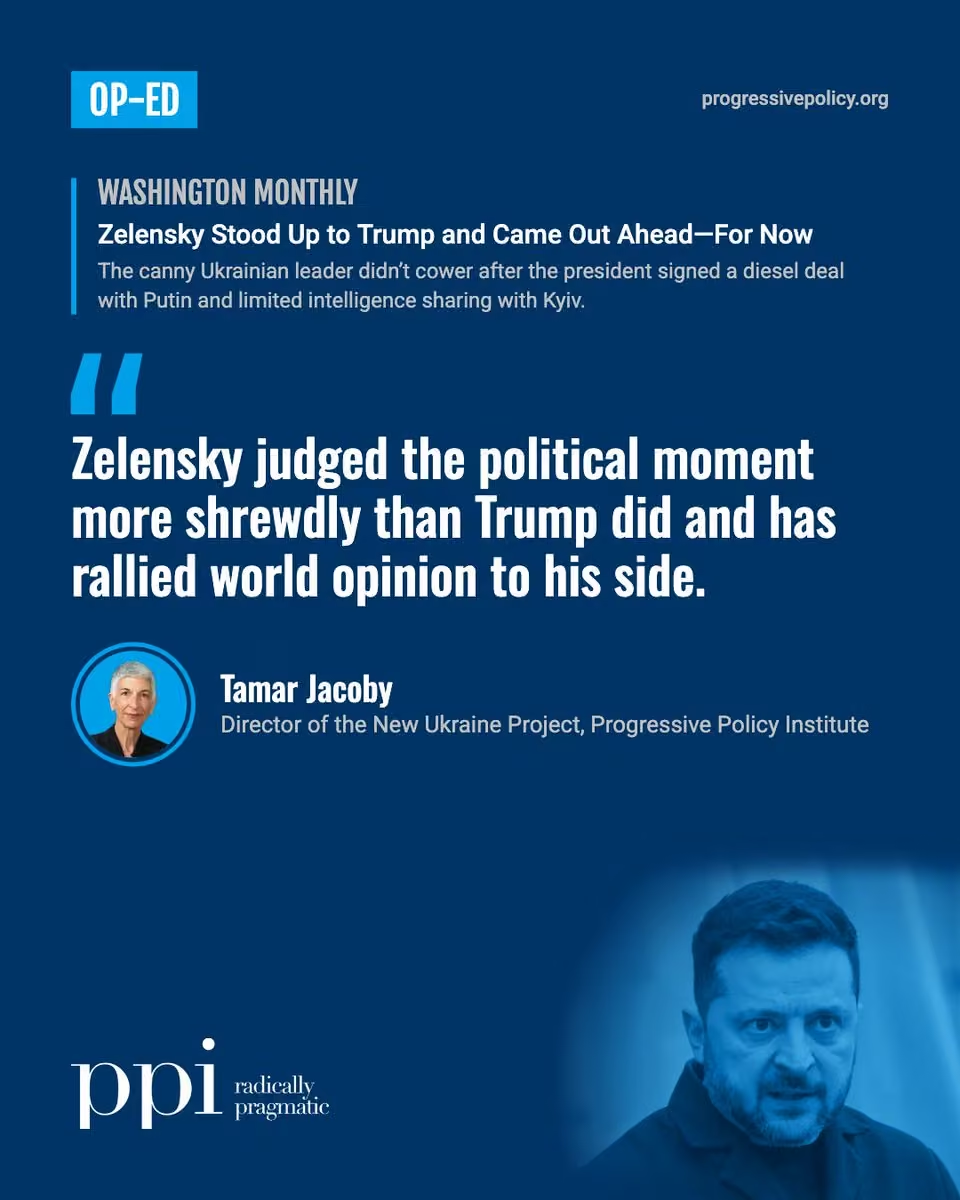
Zelensky’s refusal to back down after the U.S. eased Russian diesel sanctions has rallied Europe and several Republicans behind Ukraine.
In @monthly, PPI’s @tamarjacoby argues he read the moment more shrewdly than Trump, but a fair peace depends on allies holding firm.
 PPI
@ppi
Read PPI’s @tamarjacoby in @monthly on how Zelensky’s pushback rallied Europe and Congress behind Ukraine: washingtonmonthly.com/2026/10/28/zelensky-stood-up-to-tru…
PPI
@ppi
The left’s primary wins reflect college-educated voters in deep-blue cities, not a grassroots movement.
Responding to @freddiejh8’s Tea Party comparison on the @NewStatesman Politics Show, @Will_PPI argues Democrats need more working-class voters to win lasting majorities.
PPI
@ppi
Watch the full extended conversation between @Will_PPI and @freddiejh8 on the @NewStatesman Politics Show: www.youtube.com/watch?v=0eT7jyM9nCE
PPI reposted
 Tamar Jacoby
@tamarjacoby
Zelensky bests Trump for now - but many tough fights lie ahead washingtonmonthly.com/2026/10/28/zelensky-stood-up-to-tru…
PPI
@ppi
Democracy is in retreat: @freedomhouse counts 106 electoral democracies, down from 125 in 2016, and gives the U.S. its worst score ever.
In this week’s edition of Trade Fact, PPI’s @EBGresser argues that rebuilding trust means delivering on housing, energy, and living costs.
 PPI
@ppi
Read this week’s edition of Trade Fact from PPI’s @EBGresser: www.progressivepolicy.org/freedom-house-count-of-electora…
PPI
@ppi
Next week’s midterms will be a verdict on the party in power, not a choice between two governing agendas.
On the @NewStatesman Politics Show, @Will_PPI argues that voters are grading the party on inflation, tariffs, and the cost of living, and Democrats are wisely following their lead.
 PPI
@ppi
Listen to the full episode with the @NewStatesman’s @freddiejh8, political scientist @julia_azari, and the @nytimes’ @ShawnMcCreesh: www.newstatesman.com/podcasts/politics-podcast/2026/10/us…
PPI reposted
Ed Gresser
@EBGresser
This week's Trade Fact: W/ midterm election Tuesday, @freedomhouse's gloomy 2026 "Freedom in the World" report shows democracy troubled worldwide & the US' rating for democracy & civil liberties slipping. A @ppi report helps explain & points to solutions: www.progressivepolicy.org/freedom-house-count-of-electora…
PPI
@ppi
Students who succeed in high-poverty schools deserve extra consideration in selective admissions.
As the Supreme Court takes up Montgomery County’s magnet school case, PPI’s @RickKahlenberg argues in @The74 that the district’s race-neutral approach rightly rewards hard work.
 The 74
@The74
“We allege that board members did this for racial-balancing purposes,” Chris Kieser of @PacificLegal said about #scotus’ decision to hear a challenge to @MCPS’ admissions system for selective magnet middle schools www.the74million.org/article/supreme-court-to-weigh-discr…
 PPI
@ppi
America’s affordability crisis is about more than high prices.
In a new op-ed for @ProMarket_org, PPI’s Diana Moss argues that market power also erodes the quality and choice consumers depend on, and that strong antitrust enforcement belongs at the center of any cost-of-living agenda.
 PPI
@ppi
Read PPI’s Diana Moss in @ProMarket_org on why antitrust enforcement belongs at the center of the affordability debate: www.promarket.org/2026/10/28/the-affordability-crisis-ant…
PPI reposted
Richard Kahlenberg
@RickKahlenberg
In a new case SCOTUS has decided to take, the justices could reveal whether they are opposed to racial preferences, or to racial diversity itself. I spoke with @latimes in this story.
www.latimes.com/politics/story/2026-10-19/supreme-court-m…
PPI reposted
Ian O’Keefe
@realianokeefe
Catch @EBGresser on @AJEnglish / @AJMinWash at 9a ET for a discussion around Trump’s economy and issues driving voter behavior ahead of the midterms.
 Ed Gresser
@EBGresser
On with @AJEnglish at 9:00 to talk about the election, economy, etc
PPI reposted
Ed Gresser
@EBGresser
On with @AJEnglish at 9:00 to talk about the election, economy, etc
PPI reposted
 LSE USAPP blog
@LSEUSAblog
What the UK can teach the US about how to get disconnected youth back into work writes Bruno V. Manno of @PPI blogs.lse.ac.uk/usappblog/2026/06/26/what-the-uk-can-teac…
PPI
@ppi
AI can lower barriers to entry and help new competitors challenge incumbents well beyond the tech sector.
On October 28, PPI’s Diana Moss joins a panel at The @EconomistEvents Antitrust Summit to examine the evidence for AI’s pro-competitive effects, with a focus on health care.
PPI reposted
 POLITICOEurope
@POLITICOEurope
How much room does U.K. Chancellor John Healey have to deliver on budget day?
🎙️Matt Pound, ex-adviser to former U.K. Chancellor Rachel Reeves joins @patrickxrbaker and @saschaosullivan on Westminster Insider to unpack the tough choices ahead.
Listen 👉 megaphone.link/POLL3283957089
PPI
@ppi
No single private actor should hold a kill switch over a U.S. ally’s defense.
In the latest issue of Domain Awareness, PPI’s @tamarjacoby, Mary Guenther, and @danielle_steitz explain how Starlink restrictions weakened Ukraine’s drone defenses and eroded allied trust in U.S. technology. www.progressivepolicy.org/ukraine-blindsided-by-starlink-…
PPI reposted
 SCOPE Global Exchange
@SCOPE_GE
Should DMA gatekeeper status matter under the draft EU Merger Guidelines?
Diana Moss of @ppi says no: in merger review, gatekeeper status should bring neither a presumption nor stricter scrutiny.
Full interview: youtu.be/EMn1LQRh528
#mergercontrol
PPI reposted
The 74
@The74
#cte has earned its popularity. The research behind it is real, especially for young men who have been drifting away from school and work. But enrollment is not the goal. Opportunity is www.the74million.org/article/career-and-technical-ed-is-b…
 PPI
@ppi
Easing sanctions on Russia has not lowered what Americans pay for diesel.
In this week’s edition of Trade Fact, PPI’s @EBGresser shows prices barely moved after the administration’s October 9 waiver and argues pressure should fall on Russia as the invader, not on Ukraine.
PPI reposted
 Preston Cooper
@PrestonCooper93
I appreciate this point from Bruno Manno of @ppi that the Do No Harm test will help direct students to certificate programs with better outcomes--strengthening the value of the trade-school pathway.
 PPI
@ppi
Strong transatlantic partnerships are essential to American security and democratic resilience.
PPI was proud to lead a congressional delegation with Reps. @jahimes and @RepJasonCrow to the Warsaw Security Forum to discuss NATO, Ukraine, and the future of U.S.-European ties.


 PPI
@ppi
The transatlantic relationship is changing for good.
In new reflections from Warsaw, PPI’s Danielle Steitz and @tamarjacoby explain why there will be no return to the old status quo and why Europe’s most urgent need is now a truly collective defense. www.progressivepolicy.org/warsaw-security-forum-reflections/
PPI reposted
 Los Angeles Times
@latimes
Supreme Court may strike down school policies that limit Asian students www.latimes.com/politics/story/2026-10-19/supreme-court-m…
PPI
@ppi
Bipartisan permitting reform is a rare chance to build the power plants and transmission lines America needs.
PPI’s Neel Brown warns that rejecting this deal for a better one later could repeat Democrats’ 1974 mistake on health care policy and stall reform for decades.
PPI
@ppi
Tariffs and the war with Iran have pushed the farm economy into crisis.
PPI’s @EBGresser shows how higher costs, lost exports, and soaring diesel prices are squeezing farmers.
He urges repealing tariffs, mending ties with Canada and Mexico, and passing a farm bill.
PPI reposted
Washington Monthly
@monthly
Britain is weighing a problem the U.S. must address: The gap between school and work. Apprenticeship degrees are one solution.
washingtonmonthly.com/2026/10/19/fixing-americas-broken-w…
PPI reposted
 John Berlau
@jberlau
Thanks for having me on this panel on to discuss the work of my @ceidotorg colleagues & I on prediction markets’ benefits. I so enjoyed the discussion on this innovation & the right regulatory policy to govern it!
PPI
@ppi
Prediction markets matter well beyond sports.
This morning, PPI’s @MichaelMandel, @ceidotorg’s @jberlau, and Dartmouth’s Eric Zitzewitz explored how non-sports prediction markets can help small businesses hedge risk, workers plan careers, and policymakers see what’s ahead.
 PPI
@ppi
The administration’s tariffs are falling short of their own stated goals.
In this week’s edition of Trade Fact, PPI’s @EBGresser finds the goods trade deficit hit $136.6 billion in August, 50% above the Biden-era average. www.progressivepolicy.org/trump-administration-tariffs-ar…
PPI
@ppi
Prediction markets matter well beyond sports.
This morning, PPI’s @MichaelMandel, @ceidotorg’s @jberlau, and Dartmouth’s Eric Zitzewitz explored how non-sports prediction markets can help small businesses hedge risk, workers plan careers, and policymakers see what’s ahead.
PPI
@ppi
“[Prediction markets] have a really strong track record of being unbiased and performing better than other forecasts.”
Dartmouth’s Eric Zitzewitz shared research finding no partisan bias in election markets and showing that markets beat polls, analysts, and weather forecasts.
 PPI
@ppi
America’s schools test students on math and reading but rarely on whether they understand liberal democracy.
In @monthly, PPI’s @RickKahlenberg and Lief Lin offer a plan to fix that. washingtonmonthly.com/2026/10/09/time-to-teach-three-year…
PPI reposted
 The Concord Coalition
@ConcordC
@BudgetBen of @PPI on #facingthefuture: fixing our fiscal math would take 4% real GDP growth every year, forever.
Even an AI boom as big as the 90s internet boom "would not be enough" to get us there.
Watch here: youtu.be/_q-fToJ69dw
PPI reposted
Washington Monthly
@monthly
Schools are failing to teach students the advantages of liberal democracy—and the dangers of what could replace it. @RickKahlenberg
washingtonmonthly.com/2026/10/09/time-to-teach-three-year…
PPI
@ppi
Prediction markets are about far more than sports.
On October 14, PPI’s @MichaelMandel, CEI’s @jberlau, and Dartmouth’s Eric Zitzewitz will discuss their real-world economic and policy uses and the smart guardrails they need.
Register to attend: www.eventbrite.com/e/more-than-a-game-the-economic-promis…
PPI
@ppi
Shutdowns and runaway debt show Congress’s budget process is broken.
@BudgetBen says the Blue Dogs’ Congressional Budget Reform Act is “a good first step to modernize the budget process and push Congress to manage federal finances more responsibly.” bluedogs-gluesenkampperez.house.gov/media-center/press-re…
 Blue Dog Coalition
@HouseBlueDogs
Congress hasn’t passed a budget on time since 1996. Today, shutdowns and last-minute packages are routine, and the debt is at $40T.
That's why we're introducing the Congressional Budget Reform Act to restore fiscal responsibility and add guardrails to our broken budget process.
PPI reposted
 Michael Petrilli
@MichaelPetrilli
"As DC’s example suggests, the most realistic way to desegregate our schools today might actually be to focus on improving their results first." - @JHWeissmann @voxdotcom @ppi
www.vox.com/policy/505269/washington-dc-segregated-school…
PPI reposted
The Concord Coalition
@ConcordC
@BudgetBen of @PPI: "Everything you can do to bring [inflation] back down is gonna hurt."
The real fix for affordability long-term is expanding supply, not quick pain-free wins. #facingthefuture
Watch the full episode: youtu.be/_q-fToJ69dw
PPI
@ppi
Washington DC has the nation's lowest per capita emissions, yet its energy costs rose 93% in five years, faster than anywhere else.
A new PPI report by Neel Brown & John Kemp finds DC pays $750–$870 to abate each ton of carbon, twice what any state pays.
www.progressivepolicy.org/washington-dc-lowest-in-carbon-…
PPI reposted
 Rep. Josh Harder
@RepJoshHarder
🚨HUGE NEWS:
The Build America Caucus is launching an ambitious, bipartisan agenda focused on improving Americans’ lives by making it easier to build the things we need.
It just went live on our website for you to read. Here’s why you should: 🧵
buildamericacaucus-harder.house.gov/the-build-more-agenda
PPI
@ppi
In The Hill, Will Marshall argues Democrats keep blaming the economy for losing working-class voters while flinching from immigration.
Denmark's Social Democrats show a better path: control the border and integrate newcomers. thehill.com/opinion/immigration/6126121-center-left-imita…
PPI
@ppi
American K-12 education is going modular, as more families build their children’s schooling from microschools, online courses, and co-ops.
PPI’s Bruno Manno argues this shift is driven by children’s needs and that public systems must now catch up. www.realcleareducation.com/articles/2026/09/30/goodbye_to…
PPI
@ppi
Sea turtles are making a remarkable comeback on American beaches.
In this week’s edition of Trade Fact, PPI’s @EBGresser shows how simple, sustained policies like turtle-safe shrimp nets and beach lighting rules have helped Florida’s green turtle nests grow 100-fold since 1989.
PPI reposted
Claire Ainsley
@claire_ainsley
Can Andy Burnham keep up with his promises? I joined this week’s @SpecCoffeeHouse with @IsabelHardman to talk about a big speech and big change
spectator.com/podcast/can-andy-keep-up-with-his-promises/
The Spectator
@spectator
On today's Coffee House Shots podcast: Andy Burnham delivered his first conference speech as Prime Minister in Liverpool yesterday, promising a sweeping expansion of public services and a fresh look at Brexit, to warm reviews from the hall.
Patrick Gibbons is joined by Isabel Hardman and Claire Ainsley, Sir Keir Starmer's former director of policy, to weigh up what was promised and how the party is taking it.
Listen | spectator.com/podcast/can-andy-keep-up-with-his-promises | @claire_ainsley | @IsabelHardman
PPI
@ppi
Public schools have long bound a diverse nation together, but the culture war now puts them at risk.
In The Atlantic, PPI’s @RickKahlenberg shows how voucher advocates are exploiting the culture war and argues public schools should remain ideologically neutral while renewing their civic mission. www.theatlantic.com/ideas/2026/09/trump-school-vouchers-t…
PPI reposted
 iNHouse
@iNHouseComms
What do Labour Party members really think?
That was the topic of much discussion at Labour Conference this morning in the Lounge with @YouGov. A special thank you to Roads Minister, @justinmadders, @SkyNews’ @AliFortescue, @ppi’s @claire_ainsley and, as ever, YouGov’s @PME_Politics for getting day two started with such rich insight.
#lpc2026


PPI reposted
 The Regulatory Review
@TheRegReview
Join us Oct. 1 at 5pm ET in DC for an in-person panel on “Confronting the Nation’s Looming Fiscal Crises.” Featuring experts Olivia Mitchell (@OS_Mitchell), Jessica Riedl (@JessicaBRiedl), Ben Ritz (@BudgetBen), and David Skeel (@daskeel). Register: www.law.upenn.edu/calendar/event/74810-promises-to-keep-c…
 PPI
@ppi
States are expanding workforce credentials faster than they can tell which ones pay off.
In a new piece for @The74, PPI’s Bruno Manno draws lessons from Ohio’s reboot. www.the74million.org/article/so-many-credentials-so-littl…
PPI
@ppi
U.S. steel now costs more than twice the world average, yet domestic output is flat and American steel use has fallen about 10%.
In the latest edition of Trade Fact, PPI’s @EBGresser argues that expanding supply, as CHIPS did, beats raising prices and shrinking the market.
PPI
@ppi
As daily life continues to move online, reliable, high-speed internet has become a necessity. From work to healthcare to education, Americans depend on broadband to participate in the modern economy and remain connected. Rising consumer demand, combined with intense competition and government funding, has driven heavy investment across different technologies, with better coverage and quality of service than ever before.
Still, achieving high-quality, universal connectivity is a challenging goal, and policy plays an instrumental role in making it happen. One branch of policy is national. For example, with the 2021 passage of the Bipartisan Infrastructure Law, Congress created the Broadband Equity, Access, and Deployment (BEAD) program, allotting more than $42 billion over the next several years to expand broadband to underserved communities across the country. These funds supplement the massive spending by broadband companies such as AT&T, Verizon, Comcast, and Charter. According to estimates in PPI’s annual “Investment Heroes” report, these four companies alone have invested $325 billion in the United States over the past five years.
The second branch of policy is at the state level, where regulatory choices can make it easier or more costly to expand high-speed broadband. Consider California, for example, where a regulatory framework designed for a different era is complicating the expansion. By designating certain service providers as “carriers of last resort,” California requires them to provide basic telephone service to all customers within a designated service area.
These obligations, in turn, require the maintenance of copper networks, which represent a relic of the past that have not kept up with the standards of modern technology. In California, only 3% of the households served by AT&T still use traditional phone services.
In 2024, the California Public Utilities Commission (CPUC) dismissed AT&T’s application to be relieved of these obligations, making California the only one of 21 states where AT&T still operates copper networks not to grant relief. The decision has triggered a legal fight and federal action that could preempt the CPUC’s authority on the issue, both of which remain unresolved. www.progressivepolicy.org/what-california-is-giving-up-to…
PPI
@ppi
National security claims carry weight only when presidents use them responsibly.
In a new op-ed for MS NOW, PPI’s Danielle Steitz argues that stretching the term to justify pet projects like the proposed arch erodes judicial deference and public trust needed for real emergencies. www.ms.now/opinion/trump-arch-national-security-national-…
PPI reposted
Natural Allies for a Clean Energy Future
@Natural_Allies
🎙️ And we had the opportunity to sit down with @RepHorsford, former Chairman of @TheBlackCaucus, and @ppi’s Neel Brown for conversations on energy and affordability for our new Switchboard podcast.
Stay tuned—we’re excited to share more in the weeks ahead!


PPI reposted
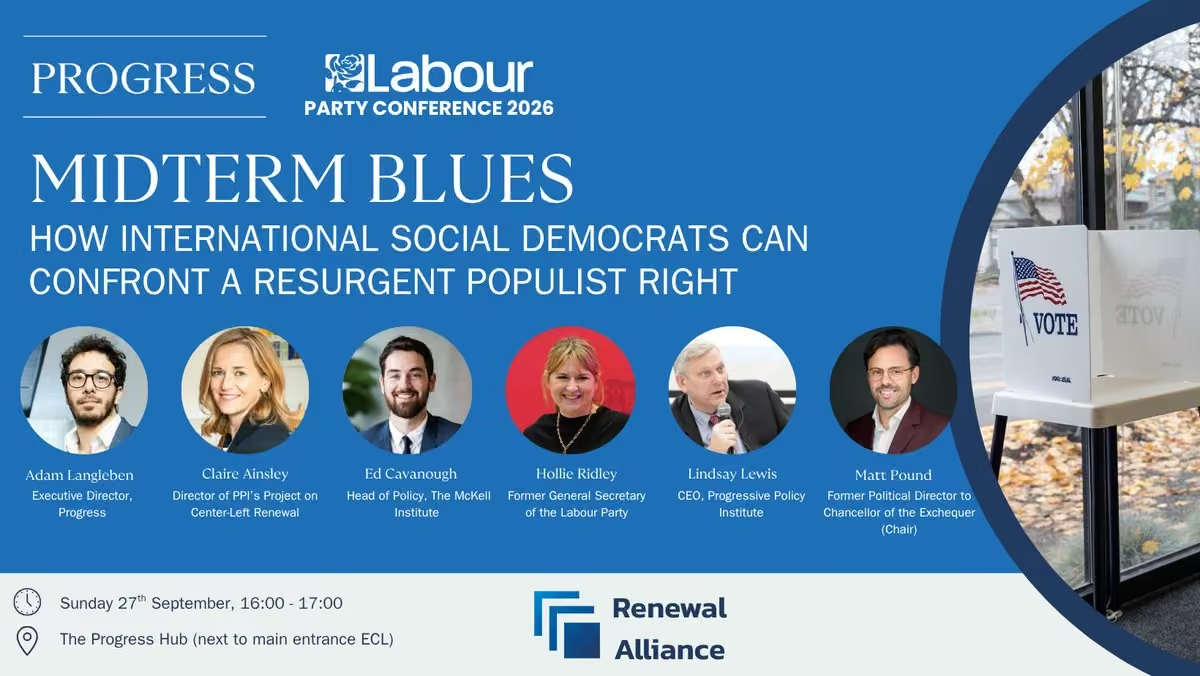
 Progress
@progbrit
Heading to Labour Party Conference?
Make sure a visit by the Progress Hub is on your itinerary!
From international politics and NHS reform to youth homelessness, social mobility and children’s health — we’ve got a packed programme of discussions.
📍 Liverpool
🗓️ Sunday 27th
 PPI
@ppi
Creditworthiness is fundamental to consumers’ access to housing, automobile loans, credit cards, and other financial opportunities. Yet many Americans have only a hazy grasp of how consumer credit data is collected, how that data is used to generate credit reports, and how they are used to produce a consumer “credit score,” or measure of their creditworthiness. It is not lost on consumers, however, that more competition in the market for credit scoring is likely to give them a better shot at obtaining credit.
Competition in the credit scoring market, and its role in fostering more choice and access to credit, should be a public policy imperative, especially during these troubled economic times. Until recently, the Fair Isaac Corporation (FICO) has dominated the credit scoring market in the U.S. In a commendable effort to inject competition, the Federal Housing Finance Agency (FHFA) — which plays a key role in regulatory oversight of home mortgage lending — recently approved the entry of VantageScore, a competitor to FICO.
Increased competition in credit scoring should benefit consumers. But the entry of VantageScore raises key questions about whether that competition will be fair. Namely, the three major credit reporting agencies (CRAs) — Experian, Equifax, and TransUnion — own VantageScore. This vertical integration means that the CRAs/VantageScore exclusively control the consumer credit data needed by its closest rival, FICO, and any future rivals, to generate credit scores. This positions the CRAs/VantageScore to potentially act on stronger incentives to steer business to VantageScore and away from competitors.
FHFA recognizes the harmful consequences of this scenario in the market for credit scoring. If it comes to pass, lenders and consumers would suffer through higher prices, less choice and variety, and slower innovation in credit scoring. Given the economic importance of the market, regulators, antitrust enforcers, and lawmakers should ask if this risk is acceptable. Introducing competition to challenge the dominance of an incumbent is good public policy. But swapping out a credit scoring market previously controlled by a single firm for one with two major players — one of which controls a critical input needed by competitors — is not a recipe for improved competition. www.progressivepolicy.org/the-credit-scoring-market/
PPI
@ppi
Rising energy costs are hitting families and small businesses hard.
At last week’s @CBCFInc Annual Legislative Conference, PPI’s Neel Brown and former Congressman Kendrick Meek joined @Natural_Allies to talk about the future of affordable energy.


 PPI
@ppi
The center-left is being squeezed by populist insurgents on the right and left.
@Will_PPI argues Democrats need more than moderation.
They must reclaim their legacy of bold, pragmatic reform rooted in America’s liberal tradition. thehill.com/opinion/campaign/6095970-center-left-populism…
PPI
@ppi
This week, PPI honored the 25 American nonfinancial companies that invested the most at home in 2025, powering the U.S. economy and laying the foundation for major productivity gains.
At PPI’s 2026 Investment Heroes reception, @RepJoshHarder, @RepMcClellan, Amazon’s @DavidZapolsky and PPI’s @MichaelMandel joined a discussion moderated by journalist @petercoy on AI infrastructure, permitting reform, domestic investment, and more.


 PPI
@ppi
The four leading firms, Amazon, Alphabet, Meta, and Microsoft, accounted for more than $269 billion of that total, up 61.1% from 2024, making the buildout of computing capacity for artificial intelligence the clear standout of this year’s rankings.
For the full 2026 Investment Heroes rankings, read and download the report here: www.progressivepolicy.org/investment-heroes-2026-getting-…
PPI reposted
Ed Gresser
@EBGresser
Couple of major-media polls asking about tariffs this week in different ways:
NYT/Siena connects tariff policy to Trump personally, gets 58% 'disapprove' of Trump handling of tariffs, v. 38% 'approve'.
 PPI
@ppi
Nick Miller is a Democrat who knows how to reach working-class voters. In 2022, he became the youngest candidate elected to Pennsylvania’s Senate in over a century by winning an Allentown-based district where more than three-quarters of adults lack a bachelor’s degree. This was no easy feat: Just two years later, the same district backed Donald Trump for president.
What was Miller’s secret?
“I ran as a pragmatic, commonsense candidate focused on results rather than ideology,” he says. “Independent voters play a critical role in our elections. And they consistently respond to leaders who are willing to work with anyone to get things done.”
If Democrats want to become competitive again outside the blue islands of major metro areas and college towns, their single most important task will be winning back the Americans without college degrees who have abandoned the party in droves during recent decades. This report brings together interviews with dozens of politicians who’ve already shown they can do just that: 28 state legislators from seven battleground states who, like Miller, have managed to prevail in competitive, heavily working-class districts. We asked them about the issues they focused on, how their voters view the national party, and what on-the-ground tactics they relied on to win. www.progressivepolicy.org/democrats-who-win-the-working-c…
PPI reposted
Claire Ainsley
@claire_ainsley
Who can beat Marine Le Pen? @debmattinson and I presented our latest research for @ppi in Paris this week.
Le Pen’s National Rally maintain their lead as the field of opponents start to narrow. French voters told us they want change:
www.economist.com/europe/2026/09/14/frances-centre-has-on…
PPI reposted
 Vox
@voxdotcom
A new report explains which topics they emphasize — and which they don’t. www.vox.com/politics/503064/ppi-report-working-class-demo…
PPI
@ppi
U.S. imports from China have fallen sharply on paper, but the underlying relationship has changed far less.
In this week’s edition of Trade Fact, PPI’s @EBGresser shows how China rerouted supply chains, expanded investment abroad, and grew its share of world exports since 2018.
PPI
@ppi
Published annually since 2012, PPI’s Investment Heroes report spotlights the public companies making the largest capital investments in the U.S. economy. Previous reports have focused on topics such as the relationship between higher capital investment, on the one hand, and lower inflation and faster job creation, on the other.
The main theme of this year’s report is simple: getting big things done. In recent years, Americans have become increasingly concerned that the United States has become a bumbling giant, unable to execute complex, forward-thinking projects. The result is stagnant living standards and a loss of the ability to defend ourselves.
Yet this year’s Investment Heroes report shows that America can still rise to the occasion to address our biggest economic and military challenges. By analyzing corporate financial reports, we find that the country’s top 25 Investment Heroes collectively invested $520.4 billion in the U.S. in 2025. This marks a 29.2% increase from our 2024 estimates.
The $520 billion in investment in equipment and structures spans much of the American economy, from factories and fiber networks to power grids and retailers. But the clear standout of this year’s investment is computing and the infrastructure needed to power AI. The four largest investors this year — tech firms Amazon, Alphabet, Meta, and Microsoft — collectively invested more than $269 billion in the U.S. in 2025, a 61.1% increase from their 2024 spending.
This year’s sizable investments in compute capacity are building the foundation for the expansion of AI applications beyond software and back-office efficiency. The country faces major challenges, including high costs of food, healthcare, housing, and energy; archaic government systems; and cybersecurity vulnerabilities, among others. The buildout led by this year’s Investment Heroes is creating the capacity and knowledge needed to tackle these challenges head-on. www.progressivepolicy.org/investment-heroes-2026-getting-…
PPI reposted
 Miranda Nazzaro
@mirandanazzaro
First in @thehill: The rapid AI buildout is making technology firms some of the top capital investors in the U.S., with investments jumping by more than 60 percent since last year.
More on the new report from @ppi thehill.com/homenews/6092229-ai-firms-top-capital-investors/
PPI reposted
Ian O’Keefe
@realianokeefe
If you want to hear more about how the AI infrastructure buildout is creating jobs and economic growth across the country, join @ppi tonight: www.eventbrite.com/e/ppis-2026-investment-heroes-awards-a…
 The Hill
@thehill
EXCLUSIVE: AI buildout propels tech firms to top of US investment ranking: Study
thehill.com/homenews/6092229-ai-firms-top-capital-investors/
PPI reposted
The Hill
@thehill
EXCLUSIVE: AI buildout propels tech firms to top of US investment ranking: Study
thehill.com/homenews/6092229-ai-firms-top-capital-investors/
PPI
@ppi
Data center development has become one of the most consequential and contentious infrastructure debates in communities across the country.
Last week, PPI organized an educational visit for a staff delegation from Congressional Black Caucus member offices, giving participants an opportunity to see how these projects get built.
The day began at an electrical pre-fabrication center in Fredericksburg, Virginia, where union electricians walked the delegation through the work required to build a data center before it becomes operational.
 PPI
@ppi
Staff met with union representatives, working electricians, and leaders from the Black Chamber of Commerce to discuss workforce development and the skilled trades.
Data center investment has led to hundreds of high-paying construction and infrastructure jobs in the surrounding community that do not require a college degree, and demand for union labor continues to grow as new campuses come online.
Staff also received a briefing on the policy landscape shaping this buildout, including rising energy demand, grid reliability, and permitting bottlenecks.
 PPI
@ppi
The delegation closed the day at a @STACKInfra data center campus, where company representatives explained what these facilities require to operate and what they return to the communities around them.
STACK has built new electrical substation and water treatment infrastructure serving the surrounding area, and has negotiated siting, noise mitigation, and infrastructure commitments directly with local governments and utilities.
 PPI
@ppi
PPI plans to host more educational opportunities like this one so that policymakers and their staff bring firsthand information to decisions that will shape energy costs, land use, and economic opportunity in communities across America.
PPI
@ppi
Russia is waging a hybrid war on Europe through sabotage, cyberattacks, and drone incursions.
Writing for @monthly, PPI’s @tamarjacoby argues Europe’s cautious posture is no longer enough, calling for a firmer response that imposes real costs on Moscow. washingtonmonthly.com/2026/09/14/europe-russia-hybrid-att…
PPI
@ppi
The Trump administration’s forced-labor tariffs would cost Americans roughly $100 billion a year.
In a new amicus brief before the Court of International Trade, PPI’s @EBGresser argues USTR never showed the targeted countries import forced-labor goods or that such imports burden U.S. commerce. www.progressivepolicy.org/amicus-curiae-brief-of-ed-gress…


PPI reposted
 RealClearEducation
@RealClearEd
Higher Ed Must Overcome Comforting Delusions www.realcleareducation.com/2026/09/14/higher_ed_must_over…
PPI reposted
PPI
@ppi
America’s economic strength depends on investment in energy, infrastructure, technology, equipment, and workers.
Join us on Wednesday, September 16, as PPI’s @MichaelMandel unveils the 2026 Investment Heroes report, which recognizes the 25 companies making the largest investments in America’s economic future.
Together, these companies invested $516 billion in FY25 year, a 28% increase over the previous year. Featuring:
🇺🇸 Rep. Josh Harder (@RepJoshHarder), Build America Caucus co-chair
🇺🇸 Rep. Jennifer McClellan (@RepMcClellan)
🇺🇸 Rep. Janelle Bynum (@RepBynum)
🇺🇸 Rep. Kristen McDonald Rivet (@repkmr)
🇺🇸 David Zapolsky (@DavidZapolsky), Chief Global Affairs and Legal Officer at Amazon
🇺🇸 Moderator Peter Coy (@petercoy)
Date: Wednesday, September 16
Time: 3:45 to 6 p.m. (program from 4 to 5 p.m., followed by a reception overlooking the waterfront)
Location: The Wharf, Washington, D.C. (exact location provided upon RSVP)
RSVP: www.eventbrite.com/e/ppis-2026-investment-heroes-awards-a…

PPI reposted
Richard Kahlenberg
@RickKahlenberg
I was pleased to discuss a new @ppi report with @jewishinsider connecting the dots between supporting American liberal democratic values & fighting antisemitism.
 Jewish Insider
@jewishinsider
The Progressive Policy Institute calls for making "American Democracy" a three-year high school requirement, arguing weak civic education leaves Jews and liberal democratic values vulnerable.
@MatthewShea__ reports: ji.news/5hzxx
 PPI
@ppi
America’s economic strength depends on investment in energy, infrastructure, technology, equipment, and workers.
Join us on Wednesday, September 16, as PPI’s @MichaelMandel unveils the 2026 Investment Heroes report, which recognizes the 25 companies making the largest investments in America’s economic future.
Together, these companies invested $516 billion in FY25 year, a 28% increase over the previous year. Featuring:
🇺🇸 Rep. Josh Harder (@RepJoshHarder), Build America Caucus co-chair
🇺🇸 Rep. Jennifer McClellan (@RepMcClellan)
🇺🇸 Rep. Janelle Bynum (@RepBynum)
🇺🇸 Rep. Kristen McDonald Rivet (@repkmr)
🇺🇸 David Zapolsky (@DavidZapolsky), Chief Global Affairs and Legal Officer at Amazon
🇺🇸 Moderator Peter Coy (@petercoy)
Date: Wednesday, September 16
Time: 3:45 to 6 p.m. (program from 4 to 5 p.m., followed by a reception overlooking the waterfront)
Location: The Wharf, Washington, D.C. (exact location provided upon RSVP)
RSVP: www.eventbrite.com/e/ppis-2026-investment-heroes-awards-a…
PPI
@ppi
America has an extraordinary tale to tell.
In a world of kings and queens, the founders created a revolutionary system of self-governance aimed at honoring political equality and human liberty.
Legendary fights erupted over how to empower a functioning government without threatening the freedom of individuals and how to address the country’s gravest failure to live up to its own professed values — chattel slavery.
Learning about the American political tradition ought to be exciting for students, especially since the ideals underpinning the Declaration of Independence still fuel today’s battles for social and economic justice. www.progressivepolicy.org/teaching-american-democracy-und…
PPI reposted
Richard Kahlenberg
@RickKahlenberg
The story of why and how America's revolutionary system of self governance was created pulses with drama. So why do students consider civics "boring" and what can be done about it? My new report with Lief Lin for @ppi www.progressivepolicy.org/teaching-american-democracy-und…
PPI reposted
Jewish Insider
@jewishinsider
The Progressive Policy Institute calls for making "American Democracy" a three-year high school requirement, arguing weak civic education leaves Jews and liberal democratic values vulnerable.
@MatthewShea__ reports: ji.news/5hzxx
PPI
@ppi
International cooperation on shared environmental challenges is still possible.
In this week’s edition of Trade Fact, PPI’s @EBGresser marks the first anniversary of the WTO’s Agreement on Fisheries Subsidies, which curbs public money driving overfishing worldwide.
PPI
@ppi
Republicans have long claimed an edge on national security as an issue, yet their midterm convention agenda includes zero mentions of defense or foreign policy.
In a new piece for Radically Pragmatic, PPI’s Danielle Steitz argues Democrats should answer with a bold vision of national security leadership. www.radicallypragmatic.org/p/republicans-are-running-from…
PPI
@ppi
Thank you to Kiki McLean, Steph Driver, Emma Weir, and Caty Payette for joining PPI’s Women in Policy Alliance this morning for a conversation on how to be an effective communicator in Washington, London, and beyond.
From presidential campaigns to Capitol Hill to 10 Downing Street, their reflections made clear that in an increasingly complex profession, showing up, reaching out, and earning trust one conversation at a time matter as much as ever.


 PPI
@ppi
Steph Driver, who served as director of communications at 10 Downing Street, takes up that question of trust at greater length in a new paper for the Institute for Government, arguing that government communications should evolve with the modern media environment rather than be rebuilt from scratch. www.instituteforgovernment.org.uk/publication/government-…
PPI
@ppi
Beyond the legal issues surrounding the New York Climate Superfund law, policymakers should reevaluate the wisdom of similar policy pursuits.
These policies raise prices of energy for consumers at a time when working families are struggling to make ends meet.
PPI
@ppi
Additionally, these policies do nothing to reduce greenhouse gas emissions.
Instead of retroactive, punitive measures that raise energy prices, policymakers should incentivize innovations in carbon emissions reductions, harnessing the power and knowledge of American energy companies to reduce greenhouse gas emissions affordably.
PPI reposted
PPI
@ppi
The U.S.-Canada trade relationship has long been one of the least contentious pillars of American economic policy. That is changing quickly.
In a recent interview with @TimesRadio, PPI’s @EBGresser, a former Assistant U.S. Trade Representative, walked through where the dispute stands and what it means for both countries. www.youtube.com/watch?v=gvvtw01N2FY
PPI
@ppi
The National Center for Education Statistics was gutted in 2025, but simply restoring it would be insufficient.
PPI’s Bruno Manno argues that history offers a better path: to rebuild NCES as a modern, curation-centered agency. fordhaminstitute.org/national/commentary/dont-just-defend…
PPI reposted
 Fordham Institute
@educationgadfly
Don’t just defend NCES. Don’t just destroy it.
Bruno Manno says it’s time to rebuild it.
Read more: fordhaminstitute.org/national/commentary/dont-just-defend…
 PPI
@ppi
The U.S.-Canada trade relationship has long been one of the least contentious pillars of American economic policy. That is changing quickly.
In a recent interview with @TimesRadio, PPI’s @EBGresser, a former Assistant U.S. Trade Representative, walked through where the dispute stands and what it means for both countries. www.youtube.com/watch?v=gvvtw01N2FY
PPI
@ppi
ICYMI: The New World screwworm, absent from the U.S. since 1966, has returned to Texas this summer.
In this week’s editon of Trade Fact, PPI’s @EBGresser links the reappearance to years of disinvestment in federal science agencies and calls for reinvesting in staff and inspection capacity. www.progressivepolicy.org/new-world-screwworms-arrived-in…
PPI
@ppi
Live Nation-Ticketmaster’s proposed DOJ settlement will not restore competition in primary ticketing.
In new comments to the federal court, PPI’s Diana Moss says behavioral remedies have already failed once before. Moss urges the court to order a structural breakup instead.


 PPI
@ppi
PPI’s comments identify two fatal flaws in the settlement.
It is the product of political interference, and its compliance and ticket authentication requirements do nothing to curb Live Nation-Ticketmaster’s incentive and ability to exercise monopoly power.


 PPI
@ppi
“The only remedy that truly restores competition is a structural one: break Ticketmaster off from Live Nation, then break it up,” said PPI’s Diana Moss.
Consumers spend roughly $20 billion every year on tickets, inflated by monopoly fees.
PPI reposted
 TicketNews
@TicketNews
Progressive Policy Institute @PPI is urging a federal judge to reject the DOJ’s Live Nation-Ticketmaster settlement — and says simply separating the companies isn’t enough.
Its proposal: break Ticketmaster itself into multiple competing companies.
www.ticketnews.com/2026/09/ppi-live-nation-ticketmaster-s…
PPI
@ppi
Education policy works best when the people shaping it answer to the communities they serve.
Writing in Merion West, PPI’s @rachelanncanter reflects on how distance from students distorts advocates’ incentives and argues for renewed accountability in national reform.
PPI reposted
RealClearEducation
@RealClearEd
What Did Federal Pandemic Aid Accomplish? www.realcleareducation.com/2026/08/25/what_did_federal_pa…
PPI
@ppi
Maryland has established some of the most aggressive and ambitious climate goals of any state in the US.
Under its 2022 Climate Solutions Now Act, it aims to cut greenhouse gas emissions by 60% below 2006 levels by 2031 and reach net-zero by 2045.
In addition to these ambitions, policymakers must now contend with spiking electricity demand and some of the country’s highest energy prices.
Ratepayers have seen increases at an average annual rate of 2.4% between 2019 and 2024, two-and-a-half times the average national rate of 0.9% after adjusting for inflation.
This dramatically complicates the prospect of quickly achieving net-zero while keeping electricity reliable and affordable for Marylanders. www.progressivepolicy.org/marylands-climate-goals-facing-…
PPI
@ppi
Bond yields near a 20-year high and a national debt past $40 trillion reveal the cost of Washington’s unsustainable fiscal policy.
PPI’s @BudgetBen explains Treasury’s latest moves only delay the reckoning. www.forbes.com/sites/benritz/2026/08/27/trump-administrat…
PPI reposted
Ed Gresser
@EBGresser
Two bits of context:
(i) Congress' pending bill w/ new sanctions on Russia but also new tariff authority. @PPI statement endorses sanctions but opposes tariff authority as very likely to be misused: www.progressivepolicy.org/ppi-yes-to-stronger-sanctions-o…
PPI
@ppi
A sweeping bill targeting Russia also hands Trump vast new tariff powers.
PPI’s @tamarjacoby writes that the bill codifies years of sanctions but leaves enforcement largely to the discretion of the president.
Washington Monthly
@monthly
Congress could still add guardrails to Lindsey Graham’s legacy sanctions bill to stop Trump from further abusing his tariff authority.
washingtonmonthly.com/2026/08/24/beyond-virtue-signaling-…
PPI
@ppi
Data centers are becoming one of the clearest paths to the middle class for American workers.
Electricians are earning family-sustaining wages and building long-term careers thanks to the infrastructure that powers the modern economy. www.nytimes.com/2026/08/21/opinion/data-centers-electrici…
PPI
@ppi
Less than 10 percent of America’s plastic gets recycled today, driving up landfill costs nationwide.
In a new op-ed for @the535news, PPI’s @stumalec argues advanced recycling could close that gap, saving municipalities up to $328 million a year in tipping fees.
PPI reposted
 535 News
@the535news
On The Floor is Yours: "Advanced Recycling Can Save American Families Millions, Congress Should Help Scale It"
@ppi's Stuart Malec makes the case: 535.news/op-ed/advanced-recycling-can-save-american-famil…

PPI reposted
 LSE Phelan US Centre
@LSE_US
In the @LSEUSAblog, Dr Bruno Manno (@ppi) analyses what the United States can learn from the UK’s efforts to tackle youth unemployment through work-based learning and career-connected education.
blogs.lse.ac.uk/usappblog/2026/08/14/the-uk-shows-that-wo…
PPI
@ppi
Returning authority to the states was never the goal of education reform.
In @RealClearEd, PPI’s Bruno Manno argues that today’s federal waivers should be judged by whether greater flexibility produces better results for students. www.realcleareducation.com/articles/2026/08/16/can_states…
PPI
@ppi
Social Security faces automatic across-the-board benefit cuts within six years, yet much of the Democratic Party still campaigns on expanding it.
PPI’s @BudgetBen argues that Rep. John Larson’s primary defeat should push Democrats to rethink their approach.
PPI reposted
 Wall Street Journal Opinion
@WSJopinion
Rep. John Larson’s loss should spur Democrats to rethink the politics of Social Security, writes @BudgetBen
www.wsj.com/opinion/geriatric-democrat-loses-to-a-moderat…
PPI reposted
Ian O’Keefe
@realianokeefe
.@Will_PPI: “Pragmatic liberals and moderates are more representative of the Democratic Party’s center of gravity and thus make stronger general election candidates. The democratic socialist strategy of pushing Democrats farther left, especially on cultural issues like immigration, crime and gender, can only compound their difficulty in reaching working Americans, who already see the party as too liberal.” www.progressivepolicy.org/wisconsin-democrats-give-their-…


PPI reposted
Ed Gresser
@EBGresser
This week's Trade Fact: Trump admin. trade policies changing minds. After 9 years of elevated tariffs & 18 months of Depression-type protectionism, support for tariffs is minimal & support for trade liberalization (per @TheArgumentMag this month) at a peak.
PPI
@ppi
American attitudes toward trade have shifted substantially since the last round of trade liberalization.
In this week’s Trade Fact of the Week, PPI’s @EBGresser reviews new polling showing 71% support for free trade agreements. www.progressivepolicy.org/trump-administration-trade-poli…
PPI
@ppi
America’s global lead in science depends on research funding decisions being made on merit rather than politics.
Writing in @RCScience, PPI’s Mary Guenther and Alix Ware examine OMB’s new grants rule and urge Congress to act before it takes effect on October 1.
PPI reposted
Ed Gresser
@EBGresser
This week's Trade Fact: The wrath of America's young people. Featuring @Kennedy_School's gloomy spring poll & awful @HappinessRpt findings; demographic & tech challenges; NIMBYism, tariff costs & other policy skews against Gen-Z. www.progressivepolicy.org/american-young-people-are-excep…
PPI reposted
Ian O’Keefe
@realianokeefe
.@Will_PPI: “Abdul El-Sayed’s narrower-than-expected victory in yesterday’s Michigan Democratic primary contest for U.S. Senate highlights the risks posed by left-wing ideologues to the party’s midterm election prospects. It likely will compound the party’s already difficult challenge of winning back the Senate this fall.” www.progressivepolicy.org/michigan-democrats-boost-republ…

 PPI
@ppi
State and local governments are now a decisive factor in America’s space competitiveness.
PPI’s Mary Guenther finds that the states winning the space race combine financial support, political attention, proximity to federal facilities, and a strong workforce.
PPI reposted
Ed Gresser
@EBGresser
Deep dive from @JeremiahDJohns on a @TheArgumentMag trade poll. Like most post-2024 polls it finds tariffs vy unpopular - bad for jobs, very bad for cost of living. Conversely, FTAs get wide support - 71% favor - & esp. among Democrats: www.theargumentmag.com/p/who-supports-free-trade-everyone
PPI
@ppi
More than 25 million Americans still smoke cigarettes, and reducing that number requires serious, evidence‑based leadership.
Congratulations to @RepMcClellan on serving as Democratic Vice Chair of the Congressional Tobacco Harm Reduction Caucus. This work matters for public health.
PPI
@ppi
PPI’s Project to End Smoking advances risk‑proportionate, people‑centered policies that protect youth while helping adults quit for good.
PPI looks forward to working with the caucus to accelerate the decline of cigarette smoking in the United States.
Read more here:
PPI reposted
Richard Kahlenberg
@RickKahlenberg
Race & class both matter in America, but a new study by Jon Shields & Corey Tazzara finds at UT Austin between 2011-25, 50 times as many courses were offered on race (1602) as class (32) www.chronicle.com/article/colleges-teach-gender-and-race-…
PPI
@ppi
Public support for data centers is falling fast, but a “panicky rush to freeze all new construction” is not an appropriate response for policymakers.
@Will_PPI argues the real risk is a Luddite backlash that cedes AI leadership to China. thehill.com/opinion/technology/6000228-ai-data-centers-u-…
PPI
@ppi
Sysco’s proposed $29 billion acquisition of Restaurant Depot would combine the largest broadline food distributor with the leading cash-and-carry wholesaler.
In a new letter to FTC Chair Andrew Ferguson, PPI’s Diana Moss warns the merger could raise food prices for restaurants and consumers. www.progressivepolicy.org/ppi-presses-ftc-on-syscos-29-bi…


 PPI
@ppi
PPI’s analysis explains that the Sysco-RD merger would create an enormous food distribution ecosystem with the potential to reduce competition, raise food costs for restaurants, and ultimately increase prices for American consumers for food away from home.
Protecting competition throughout the food supply chain is essential for affordable food prices for consumers, who are already besieged by high food price inflation.


 PPI
@ppi
Read the full letter here: www.progressivepolicy.org/wp-content/uploads/2026/07/PPI-…
PPI reposted
Washington Monthly
@monthly
The bachelor's degree is becoming modular—assembled from pieces instead of delivered as one four-year product. That could mean more opportunity, or a more insidious way of sorting students by class. washingtonmonthly.com/2026/07/29/the-quiet-redesign-of-th…
PPI
@ppi
Canada is the top export market for 27 U.S. states, buying over $330 billion in American goods annually.
In this week’s Trade Fact, PPI’s @EBGresser examines a new threat of tariffs against Canada. He argues for restoring a stable, predictable U.S.-Canada trade relationship.
PPI reposted
 Congresswoman Andrea Salinas
@RepSalinas
I joined @PPI for a fireside chat about space policy.
As a member of @ScienceDems, I know that space exploration drives scientific and economic progress that benefits all Americans.


 PPI
@ppi
American Studies scholars are responding to evidence of ideological bias in their field not with self-reflection, but with defensiveness and denial.
In a new essay, PPI’s @RickKahlenberg and Lief Lin rebut critics who mischaracterized their methodology and, in some cases, denied that objective historical truth exists at all.
The authors argue that a field unwilling to acknowledge America’s genuine progress does a disservice to serious scholarship and to the political left. www.radicallypragmatic.org/p/whats-wrong-with-american-st…
PPI reposted
 Jordan Weissmann
@JHWeissmann
So, my colleague @RickKahlenberg has been in a fight with the entire academic field of American Studies, which feels relevant to all the recent discussions about why academia has lost the public's trust. 🧵
PPI
@ppi
State and local investment is the missing piece in America’s space race with China.
PPI’s Mary Guenther and @MichaelMandel show how states like Florida, Texas, and California are financing spaceports and building competitive space economies. www.floridatoday.com/story/opinion/2026/07/27/floridas-an…
PPI
@ppi
Voters across Europe increasingly see the political center as hollow, fueling the far right’s rise.
New research by PPI’s Claire Ainsley and Deborah Mattinson, reported in @POLITICOMag, finds French voters persuadable but starved for real alternatives. www.politico.com/news/magazine/2026/07/24/centrism-france…
PPI reposted
Claire Ainsley
@claire_ainsley
With @debmattinson for @ppi - in @politico by @alexanderburns on our recent research on the rise of the right in France and the gap for the centre-left with working-class voters :
www.politico.com/news/magazine/2026/07/24/centrism-france…
PPI
@ppi
Backlash to Common Core nearly gutted Mississippi’s education reforms in 2015.
In a new piece for Radically Pragmatic, PPI’s @rachelanncanter recounts how one senator’s refusal to “do crazy shit” helped save the state’s reading law and accountability model.
PPI
@ppi
Workforce Pell promises a major step toward fairer funding for career training, but its rollout will be slower than many expect.
In a new piece for Community College Daily, PPI’s Michael Pearson explains how strict rules and data gaps could limit its early impact.
PPI
@ppi
World merchant shipping capacity has doubled since 2010, even as government trade policy has largely deadlocked.
@EBGresser tracks the boom and argues U.S. policy should rest on freedom of navigation, not compensation for securing shipping lanes. www.progressivepolicy.org/merchant-fleet-shipping-capacit…
PPI
@ppi
PPI’s Project to End Smoking aims to cut the U.S. adult smoking rate to 1% or less by 2040.
Giving adult smokers a path away from combustibles is essential to meeting that goal.
A new lawsuit threatens to make that harder.
PPI supports FDA regulation that helps adults who smoke access authorized alternatives while keeping illicit e-cigarettes and nicotine pouches off the market. www.reuters.com/legal/litigation/us-fda-sued-allowing-una…
PPI reposted
Ed Gresser
@EBGresser
Our applause for @RonWyden's Congressional Trade Powers Reform Act here ⬇️⬇️
PPI
@ppi
Presidential tariff decrees have raised prices for American families and imposed tens of billions in new monthly costs on U.S. businesses.
In a new statement, PPI’s @EBGresser applauds @RonWyden’s Congressional Trade Powers Reform Act to restore Congress’s constitutional authority over tariffs. www.progressivepolicy.org/ppi-applauds-legislation-to-res…
PPI
@ppi
Ideological swings from the far right to the far left divert antitrust enforcement from a pragmatic, consistent, and effective course, and Americans are paying the price.
PPI’s Diana Moss argues that it is time to return to an effective center-left antitrust approach, as Americans grapple with the worst cost-of-living crisis since the 1970s. www.progressivepolicy.org/charting-a-center-left-course-f…
PPI
@ppi
New 50 percent tariffs on most Canadian goods would raise costs for American families and businesses ahead of the November midterms.
Speaking to @washingtonpost, PPI’s @EBGresser said families and businesses hoping for price relief this fall will not get it.
PPI reposted
Claire Ainsley
@claire_ainsley
Labour’s relationship with working-class voters is in peril. New research for @ppi with @debmattinson in The Observer
With thanks to Convergent Opinion and Chris Clarke
observer.co.uk/news/politics/article/why-working-class-vo…
PPI
@ppi
Trump’s speech last night would be laughable if the implications for American democracy were not so serious.
More from PPI’s Danielle Steitz about the President’s baseless claims regarding Chinese interference in the 2020 election: www.progressivepolicy.org/trumps-claims-on-election-secur…
PPI reposted
Richard Kahlenberg
@RickKahlenberg
The American Identity Project, sponsored by @ppi, has many insightful board members writing about America 250. One is Harvard professor Elisa New, who has a terrific post about Teaching Phillis Wheatley. poetryinamerica.substack.com/p/teaching-phillis-wheatley-…
PPI
@ppi
Instead of promoting hope and prosperity, extremists on both sides are calling America a "rigged" nation where working Americans are destined to never succeed.
@Will_PPI argues that "rigged system" populism breeds voter cynicism and fatalism and feeds an appetite for utopian solutions. thehill.com/opinion/campaign/5971395-populism-rigged-syst…
PPI
@ppi
This morning, @RepSalinas joined Mary Guenther for this month’s Coffee & Conversation on Capitol Hill for a fireside chat on space policy.
Thank you to everyone who joined us for the conversation as we expand our growing Women in Policy Alliance!


 PPI
@ppi
America’s industrial working class has shrunk by nearly 1 million jobs since 2016.
In this week’s Trade Fact, @EBGresser examines what the decline says about tariffs, manufacturing employment, and the changing composition of the U.S. workforce. www.progressivepolicy.org/americas-industrial-working-cla…
PPI reposted
 Congressman Don Davis
@RepDonDavis
Peace is preserved through strength. As a veteran and co-chair of the For Country Caucus, I join the Progressive Policy Institute to discuss America's national security, strong alliances, and the leadership essential to keep our nation safe.
 PPI
@ppi
Career education programs transform children’s lives and better prepare them for life after graduation.
@rachelanncanter and Bruno Manno outline the need for work-based learning to not just be an add-on in high school education, but essential programming. www.progressivepolicy.org/a-practical-guide-to-work-based…
PPI
@ppi
Last week, Ukraine became the 3rd country outside of the U.S. to manufacture Patriot interceptors.
On @CNN, @tamarjacoby highlights the importance of these missiles as Ukraine continues to fight back against Putin.
PPI
@ppi
Also, happening tomorrow, @RepDonDavis will give opening remarks for Jacoby’s briefing on Capitol Hill. www.eventbrite.com/e/ukraine-europe-and-the-us-a-shifting…
PPI
@ppi
As the NATO Summit concludes, major steps were agreed by the U.S. to help Ukraine fight back against Russia.
However, Putin continues to endanger civilians. On @ianmastersmedia, @tamarjacoby recounts Russian ballistic missiles, cruise missiles & swarms of drones over her apartment.
soundcloud.com/user-830442635/web_tamar_jacoby-4
PPI
@ppi
Also sign up for Jacoby’s event on the Hill next week where she will discuss the shifting relationships between Ukraine, Europe, and the U.S.
www.eventbrite.com/e/ukraine-europe-and-the-us-a-shifting…
PPI
@ppi
The U.S. is responsible for approximately 35.7 million tons of plastic waste each year, with 75.6% of that waste ending up in landfills.
On the Powering America Podcast, Neel Brown highlights the economic and environmental gains of advanced recycling. thepoweringamericapodcast.com/episodes/neel-brown-can-bet…
PPI
@ppi
Happening Tuesday: Join @tamarjacoby, @melindaharing, @torrey_taussig, and @glastris for a timely conversation about the shifting relationships between Ukraine, Europe, and the U.S.
www.eventbrite.com/e/ukraine-europe-and-the-us-a-shifting…
PPI reposted
TheHillOpinion
@TheHillOpinion
@ppi NASA should remember how it helped SpaceX become what it is today thehill.com/opinion/technology/5957288-spacex-rise-nasa-r…
PPI
@ppi
America’s reign over global skylines is coming to an end.
In this week’s Trade Fact, @EBGresser examines how the locations of the world’s 100 tallest buildings have changed over time and where to find the next towering skyscrapers.
www.progressivepolicy.org/32-of-the-worlds-100-tallest-bu…
PPI reposted
 Razom for Ukraine 🇺🇸🤝🇺🇦
@razomforukraine
Join @ppi for a discussion about the shifting relationships between Ukraine, Europe, and the U.S. Where does America’s long-term interest lie? What should Congress do? Razom’s @melindaharing will be sharing her insights.
📅 July 14 | 8:45 to 10:00 am
📍Rayburn, Gold Room (2168)
 PPI
@ppi
.@USTR is attempting to restore Trump’s illegal 2025 tariffs, costing Americans $100 billion annually.
At today’s Section 301 hearing, @EBGresser testified that the new forced labor tariff attempt misuses U.S. trade law and fails to offer any evidence about forced labor imports.
PPI
@ppi
As Social Security’s insolvency looms, @SenWarren and @berniemoreno say the fix to stabilize the program is simple: scrap the payroll tax cap.
However, @budgetben argues eliminating the cap wouldn’t fix the program's insolvency and could make things worse.
PPI
@ppi
As America turns 250, partisan distrust now shapes who young people are willing to live and work beside.
Speaking at a forum hosted by PPI’s American Identity Project, @SHRM’s Johnny C. Taylor, Jr., cited polling on student division and called for renewing the bonds of a shared identity.
PPI
@ppi
Keir Starmer’s resignation as U.K is a cautionary tale for center-left parties.
PPI’s @claire_ainsley, a former Starmer adviser, argues Labour lost power by drifting from the economic concerns that won it. The lesson: deliver tangible results or lose voters’ trust.
PPI
@ppi
Michigan’s 100% clean energy mandate risks outpacing grid capacity and threatening the state’s manufacturing base.
In a new report, PPI’s Neel Brown and @JKempEnergy urge a shift to a pragmatic, outcomes-based approach based on emissions per capita, not rigid mandates.
PPI reposted
Ed Gresser
@EBGresser
Very strong statement today from @NewDemCoalition @DonBeyerVA on USMCA, America's strategic relationships with our two neighbors, & the mistake the admin. makes by not full-on renewing the agreement today. newdemocratcoalition.house.gov/media-center/press-release…
PPI reposted
Claire Ainsley
@claire_ainsley
@ppi has launched a new Substack - Radically Pragmatic- and here’s my reflections on what went wrong for Keir Starmer’s government and lessons for the global center-left.
Center-left parties have to remain as focussed in power on the everyday concerns of voters as in opposition:
 PPI
@ppi
Debates over America’s role in the global economy are as old as the republic itself.
In this week’s Trade Fact, @EBGresser traces trade’s share of GDP from 1790 to today and revisits Hamilton, Jefferson, and Paine on tariffs and commerce. www.progressivepolicy.org/global-economy-debates-are-not-…
PPI reposted
 Rep. Greg Stanton
@RepGregStanton
This weekend I led @PPI's New Directions immigration reform panel in Phoenix.
It’s clear Trump’s mass deportation agenda is not working. Instead, we should be securing the border and modernizing our immigration system to help grow our economy.
 PPI
@ppi
As the nation turns 250 this week, what makes America exceptional is not that it has been perfect but how much it has overcome.
Speaking at a forum hosted by PPI’s American Identity Project, @chavezlinda urged renewed civic education to keep liberal democracy alive.
PPI reposted
Jordan Weissmann
@JHWeissmann
An under-covered story: The Trump administration is now trying to dismantle economic affirmative action policies at universities that benefit all under-priveleged students. From @RickKahlenberg
www.radicallypragmatic.org/p/trumps-wrongheaded-war-on-ec…
 PPI
@ppi
Economic affirmative action is the fairest way to build diversity on campus, yet the Trump administration now calls it ‘proxy’ discrimination.
Writing for Radically Pragmatic, @RickKahlenberg argues the DOJ’s case against UC Davis is absurd and hands Democrats an opening.
PPI
@ppi
As America marks 250 years this week, the story we tell about the nation shapes its future.
Speaking at a forum with PPI’s American Identity Project, @RepRitchie made the case for a patriotic liberalism of the more perfect union, urging a return to hope over rage.
PPI
@ppi
“We [Democrats] are going on offense on immigration because Donald Trump overplayed his hand… We are going to fight for strong border security and a pathway for citizenship for people who have been here a long time” - @RepGregStanton at New Directions Phoenix
 PPI
@ppi
We’re hearing from Jimmy McCain at New Directions Phoenix about what it means to defend America’s interests abroad, and why we can’t give up on Ukraine
 PPI
@ppi
Former Rep. @BenMcAdams is with us at New Directions Phoenix, talking about the current affordability crisis, and the importance of adopting policies that actually resonate with voters — and that actually work to bring down costs — instead of relying on messaging and buzzwords.
 PPI
@ppi
.@RepValHoyle is at New Directions Phoenix, asking the question: “What do Democrats stand for right now?”
 PPI
@ppi
“I have not met a human being on the planet who does not want to be safe in their home and city” - San Francisco District Attorney @BrookeJenkinsSF on the importance of adopting a strong message on public safety and crime at our New Directions Phoenix event.

 PPI
@ppi
McKenzie Wilson of @blueroseorg is here at New Directions Phoenix, arguing that it’s imperative that to avoid losing voters who may not turn out all the time, Democrats must be cautious with the policies and candidates they support.
 PPI
@ppi
We’re kicking off our fourth New Directions retreat here in Phoenix today with welcome remarks from @MayorGallego, PPI President @Will_PPI and CEO Lindsay Lewis


 PPI
@ppi
Online food delivery now operates as a three-sided market that benefits consumers, merchants, and delivery workers alike.
In a new report, PPI’s @MichaelMandel and Andrew Fung warn that poorly calibrated fee and pay rules could disrupt these markets and leave everyone worse off.
PPI
@ppi
Americans face a historic cost-of-living crisis, yet the reintroduced American Innovation and Choice Online Act looks past it.
PPI’s Diana Moss argues the bill would divert scarce antitrust resources toward digital markets and away from food, healthcare, and housing.
PPI
@ppi
Forced labor is a serious human rights violation, but it should not be a pretext for sweeping tariffs.
@EBGresser shows USTR’s plan to tariff 60 trading partners rests on thin evidence and the flawed premise that forced labor means cheaper goods. www.progressivepolicy.org/the-u-s-prosecutes-about-200-ca…
PPI reposted
Jordan Weissmann
@JHWeissmann
PPI's Ben Ritz has a piece about his plan to save Social Security that's worth reading, even if you're not sold on his idea.
A key point: If you pass a big tax hike just to deal with SS, you need to think about what that means for the rest of your agenda...
 PPI
@ppi
Social Security is six years from insolvency, and saving it will take more than modest tweaks.
In the debut post of PPI’s new Substack, Radically Pragmatic, @BudgetBen argues that basing benefits on years worked rather than lifetime earnings can keep FDR’s promise intact.
PPI reposted
PPI
@ppi
Price caps on debit card interchange fees failed to lower costs for consumers, yet some lawmakers now want to apply the same approach to credit cards.
Join PPI on June 25 on Capitol Hill for a conversation with @robshapiro on why these mandates do not deliver the savings promised. www.eventbrite.com/e/debit-card-price-caps-dont-deliver-w…

PPI reposted
 InsideSources
@InsideSourcesDC
Counterpoint: Social Security Should Not Be Privatized "Social Security privatization is a false solution that would make retirement less secure for seniors while saddling workers with higher taxes and debt."
dcjournal.com/counterpoint-social-security-should-not-be-…
PPI
@ppi
Price caps on debit card interchange fees failed to lower costs for consumers, yet some lawmakers now want to apply the same approach to credit cards.
Join PPI on June 25 on Capitol Hill for a conversation with @robshapiro on why these mandates do not deliver the savings promised. www.eventbrite.com/e/debit-card-price-caps-dont-deliver-w…
PPI
@ppi
Coordinated intelligence is essential to keeping America safe in an era of rising global conflict.
PPI’s Danielle Steitz warns that gutting the Office of the Director of National Intelligence would revive the dangerous silos that failed to prevent 9/11. thehill.com/opinion/congress-blog/homeland-security/59326…
PPI reposted
 Information Technology and Innovation Foundation
@ITIFdc
🚨 LIVE: AICOA would make it harder for leading US firms to innovate, integrate services, and compete in the global tech race.
@JosephVConiglio, @GDufault, @RonnaMcDaniel, @ppi's Diana Moss, & @jack_g_nicastro discuss what’s at stake. Tune in now ⤵️ www.youtube.com/live/hYQ-J6ynBXc
PPI
@ppi
ICYMI: On the delay of Jay Clayton’s DNI nomination, PPI’s Danielle Steitz says President Trump is playing politics with America’s security. www.progressivepolicy.org/ppi-responds-to-clayton-nominat…
PPI
@ppi
New tariffs framed as a stand against forced labor would cost Americans far more than they could recover.
@EBGresser shows the administration’s proposed Section 301 duties of 10% and 12.5% could cost roughly $100 billion a year, more than 100 times the value of goods actually blocked at U.S. borders on forced-labor grounds. www.progressivepolicy.org/americans-supply-over-80-of-the…
PPI reposted
Claire Ainsley
@claire_ainsley
Very pleased to contribute to the deluge of essays this season for Jean Jaures Foundation in France with English translation for their “Third Left” series: Sovereign Citizens
www.jean-jaures.org/publication/la-troisieme-gauche-des-c…
 Fondation Jean-Jaurès
@j_jaures
🔴 Comment la gauche peut-elle reconquérir les classes populaires et moyennes ?
@claire_ainsley (@ppi) défend une « troisième gauche » post-identitaire, alliant justice sociale, souveraineté démocratique et prospérité économique ⤵️
www.jean-jaures.org/publication/la-troisieme-gauche-des-c…
PPI reposted
Information Technology and Innovation Foundation
@ITIFdc
AICOA could undermine American tech leadership without delivering meaningful benefits for competition.
This Thursday, @JosephVConiglio, @GDufault, @RonnaMcDaniel, @ppi's Diana Moss & @jack_g_nicastro will discuss its likely consequences.
Register ASAP ⤵️ itif.org/events/2026/06/18/aicoa-and-the-risks-to-america…
PPI
@ppi
The Democratic Party’s center of gravity on cultural issues increasingly diverges from the voters of color who anchor its base.
In the @nytimes, PPI’s @Will_PPI and @RickKahlenberg argue the nonwhite working class has become a powerful force for moderation.
PPI reposted
 Democracy Journal
@DemJournal
What explains the loss of enthusiasm for America and its democracy among young people, and what can be done about it? @BillGalston and @chavezlinda have an answer.
democracyjournal.org/arguments/toward-a-new-birth-of-patr…
PPI
@ppi
The panic over AI data centers overlooks their upside for the communities that host them.
In @TheAtlantic, PPI’s @MichaelMandel argues that new data centers will attract AI-driven businesses, since lower latency matters for firms that depend on real-time decisions at scale.
PPI
@ppi
Social Security is now on track to become insolvent in 2032, leaving the next president a fiscal crisis years in the making.
@BudgetBen explains how President Trump’s tax cuts and immigration policies accelerated the shortfall. He argues the next generation of leaders must embrace responsible reforms rather than costly punts. www.forbes.com/sites/benritz/2026/06/11/trump-is-leaving-…
PPI reposted
Democracy Journal
@DemJournal
Historically, in times of crisis, Americans have dug deep to engage with the founding ideals of liberty and political equality to shape a better future. Amidst cynicism about the current state of the country we can do it again.
democracyjournal.org/arguments/toward-a-new-birth-of-patr…
PPI
@ppi
Giving the government major ownership stakes in America’s leading artificial intelligence firms is a dangerous idea.
In a new letter to the editor, PPI’s @BudgetBen argues that a recent proposal from @SenSanders would put America’s most influential companies under political control. www.nytimes.com/2026/06/11/opinion/ai-wealth-bernie-sande…


PPI reposted
Ian O’Keefe
@realianokeefe
🚨🇺🇸 Soon via @CSPAN 3 … LIVE from the National Press Club: @ppi’s American Identity Project marks America’s 250th.
Feat. @Will_PPI, @RepDonBeyer, @RickKahlenberg, @laurameckler, @RepRitchie, @DavidBrooks224, @BillGalston, @chavezlinda, & @JohnnyCTaylorJr.
Tune in @ 12:30p ET!
 PPI
@ppi
America marks its 250th anniversary amid a generational crisis of faith in democracy.
On June 11, PPI’s American Identity Project convenes leading policymakers and scholars at the National Press Club to explore how we can spark renewed patriotism and democratic engagement for young Americans. www.eventbrite.com/e/working-toward-a-new-era-of-patrioti…
 Richard Kahlenberg
@RickKahlenberg
Young people have lost faith in democracy & in America. Can we spark a new birth of patriotism & democratic renewal? Join a @PPI forum featuring @DavidBrooks224 @BillGalston @RepRitchie @RepDonBeyer @laurameckler @JohnnyCTaylorJr @chavezlinda & @Will_PPI
www.eventbrite.com/e/working-toward-a-new-era-of-patrioti…
PPI
@ppi
Renewing young Americans’ faith in democracy is central to PPI’s American Identity Project.
In a new essay for @DemJournal, @BillGalston and @chavezlinda argue that social mobility, honest civic education, and cultural renewal can spark a new birth of patriotism.
PPI
@ppi
The World Cup could give the struggling U.S. tourist economy a needed lift, but rising costs and new visa barriers may shrink the boost.
@EBGresser notes that a B-2 tourist visa now costs $435, with bonds of up to $15,000 required for some fans. www.progressivepolicy.org/a-u-s-b-2-tourist-visa-for-the-…
PPI reposted
Richard Kahlenberg
@RickKahlenberg
What do we need in the age of Trump? A liberalism without elitism. Robert Coles showed the way, as I write in @monthly washingtonmonthly.com/2026/06/10/a-liberal-without-the-el…
PPI reposted
PPI
@ppi
America marks its 250th anniversary amid a generational crisis of faith in democracy.
On June 11, PPI’s American Identity Project convenes leading policymakers and scholars at the National Press Club to explore how we can spark renewed patriotism and democratic engagement for young Americans. www.eventbrite.com/e/working-toward-a-new-era-of-patrioti…
Richard Kahlenberg
@RickKahlenberg
Young people have lost faith in democracy & in America. Can we spark a new birth of patriotism & democratic renewal? Join a @PPI forum featuring @DavidBrooks224 @BillGalston @RepRitchie @RepDonBeyer @laurameckler @JohnnyCTaylorJr @chavezlinda & @Will_PPI
www.eventbrite.com/e/working-toward-a-new-era-of-patrioti…
PPI
@ppi
Education shouldn’t be the only path to a middle-class job.
Meta’s America’s Workforce Academy (paid training, industry credentials, guaranteed employment) tests what PPI’s New Skills for a New Economy framework advocates: a modern, fully-funded workforce system that treats degree and non-degree pathways with equal seriousness. www.wsj.com/opinion/high-tech-seeks-skilled-tradesmen-063…
PPI
@ppi
A modern workforce system treats all pathways seriously.
Learn more about PPI’s vision for an economy that works for everyone: www.progressivepolicy.org/project/new-skills-for-a-new-ec…
PPI reposted
Ian O’Keefe
@realianokeefe
.@BudgetBen: “[F]or the first time in a generation, Social Security’s trustees project the program’s primary trust fund will be depleted during the next presidential administration.”
PPI
@ppi
Social Security’s primary trust fund faces depletion by 2032 absent urgent reform, according to today’s trustees report.
@BudgetBen argues the next president must seriously consider protecting vulnerable retirees without imposing undue tax burdens on workers. Delay is unacceptable. www.progressivepolicy.org/ppi-next-president-must-save-so…
PPI
@ppi
America marks its 250th anniversary amid a generational crisis of faith in democracy.
On June 11, PPI’s American Identity Project convenes leading policymakers and scholars at the National Press Club to explore how we can spark renewed patriotism and democratic engagement for young Americans. www.eventbrite.com/e/working-toward-a-new-era-of-patrioti…
Richard Kahlenberg
@RickKahlenberg
Young people have lost faith in democracy & in America. Can we spark a new birth of patriotism & democratic renewal? Join a @PPI forum featuring @DavidBrooks224 @BillGalston @RepRitchie @RepDonBeyer @laurameckler @JohnnyCTaylorJr @chavezlinda & @Will_PPI
www.eventbrite.com/e/working-toward-a-new-era-of-patrioti…
PPI reposted
PPI
@ppi
Democrats face a critical choice between polarizing the party with ideological purity tests and building a durable coalition in the center.
@Will_PPI argues that progressives’ demand for cultural conformity and radical policies like AI nationalization alienates the working-class voters they claim to champion. thehill.com/opinion/campaign/5910420-progressive-democrat…
PPI reposted
PPI
@ppi
Globally, a strong center-left is the best bulwark against right-wing populism.
At WelcomeFest 2026, PPI’s @claire_ainsley joined @mattyglesias and @Yascha_Mounk to argue that pragmatic governance and a renewed brand can win back the working-class voters now drifting away.


 Welcome
@TheWelcomeTeam
🚨 Can’t wait to see everyone today at WelcomeFest 2026!
🏗️ Together we are building to win! 🛠️
PPI
@ppi
Earth observation satellites help us understand climate, predict natural disasters, and protect communities from the air we breathe to the water we drink.
On World Environment Day, PPI’s Mary Guenther and Susie Perez Quinn argue that proposed cuts to these systems would sacrifice scientific progress and real benefits that Americans depend on. www.baltimoresun.com/2026/06/04/satellite-funding-trump/
PPI reposted
Claire Ainsley
@claire_ainsley
Great to meet you Matt - and agree - here’s a piece I wrote for the New York Times on this and you might also be interested in @RickKahlenberg project on American identity www.nytimes.com/2025/06/19/opinion/border-policy-immigrat…
PPI
@ppi
Democrats face a critical choice between polarizing the party with ideological purity tests and building a durable coalition in the center.
@Will_PPI argues that progressives’ demand for cultural conformity and radical policies like AI nationalization alienates the working-class voters they claim to champion. thehill.com/opinion/campaign/5910420-progressive-democrat…
PPI
@ppi
Net-zero deadlines mean little without firm, carbon-free power that is actually built and running.
Neel Brown and @JKempEnergy find New Mexico’s 2045 clean-grid goal risks reliability and affordability unless paired with technology-neutral, outcome-based policy.
PPI
@ppi
Globally, a strong center-left is the best bulwark against right-wing populism.
At WelcomeFest 2026, PPI’s @claire_ainsley joined @mattyglesias and @Yascha_Mounk to argue that pragmatic governance and a renewed brand can win back the working-class voters now drifting away.
Welcome
@TheWelcomeTeam
🚨 Can’t wait to see everyone today at WelcomeFest 2026!
🏗️ Together we are building to win! 🛠️
PPI
@ppi
The AI data center boom is reshaping global trade flows.
@EBGresser reports 831 data centers are now under construction across the United States, fueling a torrent of semiconductor imports from Taiwan, whose economy is surging. www.progressivepolicy.org/831-data-centers-are-under-cons…
PPI
@ppi
A robust space launch sector is foundational to U.S. economic strength and national security.
Tomorrow, PPI and @ccianet host a Capitol Hill briefing featuring Mary Guenther and others on how Congress can foster a competitive, resilient launch economy and sustain American leadership. www.eventbrite.com/e/enabling-the-final-frontier-scaling-…
 PPI
@ppi
ICYMI: The Trump administration’s proposed “board of trade” with China raises a fundamental question: what actually counts as a “non-sensitive” good?
@EBGresser warns that years of expanding “national security” tariffs to cover even steel coffins has made that definition nearly impossible to apply with any consistency.
 POLITICO
@politico
Trump wants to ‘manage’ China trade. Businesses see a tariff opening. www.politico.com/news/2026/05/30/trump-china-businesses-t…
PPI
@ppi
Ukraine’s long-range strike campaign is reshaping the battlefield and exposing Europe’s deep-strike gap.
@tamarjacoby reports from Kyiv on how Ukrainian-made missiles and drones are degrading Russia’s war machine, and why Europe cannot afford to keep relying on American weapons that may not always be there. washingtonmonthly.com/2026/06/01/could-the-tide-be-turnin…
PPI reposted
 PPI's Women in Policy Alliance
@Women_in_Policy
Join us on Tuesday morning on Capitol Hill for our next Women in Policy Alliance Coffee & Conversation event, featuring a fireside chat with PPI's @claire_ainsley and @AnushkaAsthana of Channel 4 News.
RSVP Here: www.eventbrite.com/e/women-in-policy-alliance-coffee-conv…
PPI
@ppi
America’s chronic disease epidemic demands serious solutions grounded in science.
Alix Ware examines how HHS Secretary Kennedy has abandoned evidence-based health policy in favor of discredited theories, firing scientists and defunding research while eroding public trust in our health institutions. www.progressivepolicy.org/curing-maha-how-to-protect-publ…
PPI
@ppi
U.S. layoffs have risen for four consecutive years, reaching 21.2 million in 2025.
@EBGresser argues that Congress should revive and expand the Trade Adjustment Assistance program to support all displaced workers, not just those affected by imports.
The program offers job training, wage insurance, and relocation support that workers need to get ahead. www.progressivepolicy.org/u-s-layoffs-are-up-for-four-con…
PPI
@ppi
Advanced recycling could multiply U.S. plastic recycling by 2.5x.
@stumalec outlines how this proven technology, with proper regulatory support, can scale to address the scale of America’s plastic waste problem. www.progressivepolicy.org/the-waste-diversion-benefits-of…
 PPI
@ppi
Conventional recycling captures just 9% of America’s plastic waste. Advanced recycling technology can break down plastics that mechanical systems cannot, including flexible films and contaminated materials.
@stumalec argues the U.S. could increase plastic diversion rates to 19–23% while saving municipalities $230–$328 million annually in landfill fees. www.progressivepolicy.org/the-waste-diversion-benefits-of…
PPI reposted
Ian O’Keefe
@realianokeefe
.@ppi CEO Lindsay Mark Lewis: “@RepSmucker’s Protecting American Streaming and Innovation Act charts a smart and effective path, engaging Congress in support of a US ‘Section 301’ investigation of the OSA regulations. Strong, united, coordinated, bipartisan action ... would put Canada and our trading partners around the world on notice that we expect trade agreements to be followed and will not tolerate discriminatory policies that single out American firms for unfair and burdensome regulation.”

 PPI
@ppi
Today, PPI urged the House Ways and Means Committee to act on discriminatory Canadian regulations targeting American streaming services.
Canada just announced a massive new tax under the guise of protecting local content. Here’s the problem: it violates USMCA, and could cost consumers $7B over five years. www.progressivepolicy.org/wp-content/uploads/2026/05/PPI-…
PPI
@ppi
Canada’s argument: American platforms crowd out local programming.
Reality check: Streaming services have invested more in global content than ever before. One French show, “Lupin,” generated 90M euros for France’s economy and employed 600 local vendors.
PPI
@ppi
Congress needs to act on the Protecting American Streaming and Innovation Act and trigger a Section 301 investigation.
The U.S. can’t let this stand, and other countries are watching. If Canada gets away with this, expect a wave of copycat taxes on American digital services worldwide. That’s a losing game for innovation and consumers.
PPI
@ppi
As Americans prepare to honor those who died in service, three young voices reflect on what patriotism means today.
In essays curated by @RickKahlenberg, authors Jaxon Shealy, Ed Weinberg, and Armond Halbert explore how ordinary citizenship sustains American democracy.
PPI
@ppi
Europe’s governing parties are imploding as populists surge and working-class voters defect.
Democrats face the same choice as Labour: chase progressive purity or rebuild a broad coalition around credible economic solutions.
@Will_PPI argues Democrats must offer working Americans common ground on living costs, immigration, and crime to isolate MAGA extremists and win back the majority. thehill.com/opinion/campaign/5888865-uk-politics-fragment…
PPI reposted
Richard Kahlenberg
@RickKahlenberg
In advance of Memorial Day, at a time when many young Americans express a lack of enthusiasm for America and its democracy, @ppi & @CNLiberalism are highlighting 3 inspiring young voices who reject the idea that patriotism is uncool. www.progressivepolicy.org/what-it-means-to-be-an-american…
PPI
@ppi
Advanced recycling could keep 6.6 million tons of plastic waste out of landfills every year.
@stumalec examines how scaling this technology could boost waste diversion rates and save municipalities hundreds of millions in tipping fees annually. www.progressivepolicy.org/the-waste-diversion-benefits-of…
 PPI
@ppi
Conventional recycling captures just 9% of America’s plastic waste. Advanced recycling technology can break down plastics that mechanical systems cannot, including flexible films and contaminated materials.
@stumalec argues the U.S. could increase plastic diversion rates to 19–23% while saving municipalities $230–$328 million annually in landfill fees. www.progressivepolicy.org/the-waste-diversion-benefits-of…
PPI reposted
Ed Gresser
@EBGresser
This week's Trade Fact: @CommerceGov's April "232" decree puts 25% "national security" tariff on coffins. As they drive up coffin prices, DoC is unwittingly speeding the public's shift away from burial to cremation & endangering US casket-making future. www.progressivepolicy.org/u-s-coffin-prices-up-100-last-y…
PPI
@ppi
ICYMI: Coffin prices in America are up roughly $100 over the past year, driven largely by the Trump administration’s steel tariffs.
@EBGresser explains how tariffs intended to protect domestic manufacturing are instead accelerating the shift toward cremation and hastening the decline of American casket-makers. www.progressivepolicy.org/u-s-coffin-prices-up-100-last-y…
PPI reposted
Ian O’Keefe
@realianokeefe
.@ppi’s Diana Moss via @JakeLahut: “This is an enormous diversion away from the Live Nation - Ticketmaster monopoly ... Don’t look over here at the monopoly, look over there at the resale market. Let’s call the resale market a bunch of scalpers, make unsubstantiated claims about how it functions, and lay the blame at the feet of the resale market.”
 Jake Lahut
@JakeLahut
Dems have talked a big game about fighting back against Ticketmaster's monopoly, but the behemoth and its parent company Live Nation have quietly been waging an all-out blitz in state legislatures as they awaited trial.
A primer on that playbook: straightfromthehut.substack.com/p/ticketmasters-monopoly-…
 PPI
@ppi
School districts chasing technological silver bullets miss what actually works.
According to new research, high-performing districts focus on literacy, instructional consistency, teacher coaching, accountability, and human connection.
In @Forbes, @rachelanncanter shows that real change requires sustained investment and intentional system alignment. www.forbes.com/sites/lisachambers/2026/05/19/school-distr…
PPI
@ppi
Algorithmic pricing and innovation can expand consumer choice, lower costs, and reduce waste. But bad regulation risks pushing America toward a one-size-fits-all economy.
@MichaelMandel argues for smart guardrails, like Maryland’s Protection from Predatory Pricing Act, that preserve beneficial practices and limit harm to consumers. www.progressivepolicy.org/algorithmic-pricing-increased-v…
PPI reposted
Progress
@progbrit
We were also proud to officially launch the @RenewalAlliance alongside @ppi and @McKellInstitute - an exciting new international partnership for progressive politics🌍🌎🌏

PPI reposted
 Friday Institute
@FridayInstitute
Many factors led to Mississippi's education success-policy, people and persistence, says Rachel Canter, director of education policy at the @ppi. Canter presented to the #blueribboncommission this afternoon.

PPI reposted
Richard Kahlenberg
@RickKahlenberg
The number one way to get skeptical voters to consider Democratic candidates is also something the party should have done years ago. My new piece in @TheAtlantic www.theatlantic.com/ideas/2026/05/democrats-racial-prefer…
PPI reposted
Ed Gresser
@EBGresser
This week's Trade Fact: Manufacturers are the U.S.' largest importers, and likely largest tariff payers, with mini-case studies in metals & natural rubber. www.progressivepolicy.org/no-commercial-rubber-trees-grow…
PPI reposted
 publiccharters.org
@charteralliance
Over the last three decades, charter schools haven’t just expanded public school options — they’ve helped reshape expectations around flexibility, innovation, and opportunity in K–12 education. @ppi www.realcleareducation.com/articles/2026/05/11/how_the_ch…
PPI
@ppi
New from PPI’s @stumalec: Advanced recycling could increase America’s plastic diversion rate to 23% while saving local communities over $300 million per year.
Explore the full findings and policy implications in our latest report. www.progressivepolicy.org/advanced-recycling-could-more-t…
 PPI
@ppi
Conventional recycling captures just 9% of America’s plastic waste. Advanced recycling technology can break down plastics that mechanical systems cannot, including flexible films and contaminated materials.
@stumalec argues the U.S. could increase plastic diversion rates to 19–23% while saving municipalities $230–$328 million annually in landfill fees. www.progressivepolicy.org/the-waste-diversion-benefits-of…
PPI
@ppi
Conventional recycling captures just 9% of America’s plastic waste. Advanced recycling technology can break down plastics that mechanical systems cannot, including flexible films and contaminated materials.
@stumalec argues the U.S. could increase plastic diversion rates to 19–23% while saving municipalities $230–$328 million annually in landfill fees. www.progressivepolicy.org/the-waste-diversion-benefits-of…
PPI reposted
Ed Gresser
@EBGresser
In the @WSJ today - some very skeptical comments re the Trump admin.'s "Plan C" 301 tariffs. Norwegian fish? Bangladeshi cement? www.wsj.com/opinion/the-overproduction-excuse-for-trumps-…
PPI
@ppi
President Trump’s administration is invoking “structural excess capacity” to justify new tariffs, but the concept confuses normal trade with predatory behavior.
@EBGresser argues that exporting what you produce efficiently, whether Norwegian salmon or American aircraft, does not constitute malfeasance. www.wsj.com/opinion/the-overproduction-excuse-for-trumps-…
PPI reposted
 Scott Lincicome
@scottlincicome
Very weird, kinda unsettling data (via @EBGresser):
The United States' top export in February 2026 (and also now March) isn't energy or aircraft but... precious metals. And it's a trade that really took off in early 2025: www.progressivepolicy.org/precious-metal-is-now-the-u-s-t…

 PPI
@ppi
Running the Mississippi Marathon: How Other States Can Start Racing x.com/i/broadcasts/1NGaravAEMVJj
PPI
@ppi
The Trump administration’s Section 301 investigation into “structural excess capacity” misuses trade law to circumvent the Supreme Court’s February ruling on Section 301 tariffs.
In testimony before the Section 301 Committee, PPI’s @EBGresser showed the probe rests on economically unsound premises: the U.S. itself operates at 75.2% capacity utilization, the same rate cited as problematic globally. www.progressivepolicy.org/inconsistent-with-statutory-goa…
PPI reposted
 The Giving Review
@GivingReview
washingtonmonthly.com/2026/05/06/the-higher-education-acc…
“College accreditation is one of the least understood and most important issues in higher education,” @ppi’s Bruno V. Manno writes in @monthly. “It is the process by which private, nonprofit organizations recognized by the federal government decide whether a college meets basic standards of academic quality, financial stability, and institutional performance. The findings of this process have enormous consequences for the institution, including its ability to access federal student grants and loans. Now that the U.S. Department of Education has completed the opening round of public negotiations over a major accreditation overhaul, accreditation will likely garner more public attention.”
PPI reposted
The 74
@The74
TODAY: Join @ppi and The 74 Friday at 11 a.m. ET for a special conversation about the state's literacy breakthroughs www.the74million.org/article/the-untold-story-behind-the-…
PPI
@ppi
America’s founding ideals of individual freedom, equality, and self-rule remain the nation’s defining character, not ethnicity or “blood and soil” nationalism.
@Will_PPI argues that center-left leaders must offer reinvigorated liberal patriotism that rejects both Trump’s jingoism and the far-left’s reflexive anti-Americanism, and charts a path forward for national unity. thehill.com/opinion/white-house/5867848-generation-gap-na…
PPI reposted
Claire Ainsley
@claire_ainsley
I also cited the excellent work done by my @ppi colleague @RickKahlenberg on changing economic diversity in U.S. college admissions : www.progressivepolicy.org/the-rise-of-economic-affirmativ…
PPI reposted
Ed Gresser
@EBGresser
This week's Trade Fact: @howardlutnick gave Sen. Approps. four trade-flow stats in 20 words. The two he got right are *a lot* more interesting than the two mistakes. www.progressivepolicy.org/precious-metal-is-now-the-u-s-t…
PPI reposted
PPI
@ppi
Mississippi has delivered one of America’s most remarkable educational turnarounds over the past twenty years, with sustained gains in literacy and student achievement across demographics.
@rachelanncanter examines what made this transformation possible in a new report and companion essay in The Atlantic, revealing lessons other states can learn.
Join us Friday for a webinar with education leaders and experts. us06web.zoom.us/webinar/register/WN_2bqs0RzkQYWO9XyEiLtLug
 PPI
@ppi
U.S. export growth last year was revealing: Most of the 6% increase came from precious metals shipped overseas, not cars, planes, or grain.
In this week’s Trade Fact, @EBGresser examines what gold exports reveal about the true state of American trade. www.progressivepolicy.org/precious-metal-is-now-the-u-s-t…
PPI reposted
Washington Monthly
@monthly
As the Education Department wisely tries to reform the opaque, little-known accreditation world, some stakeholders worry that the Trump administration will go too far, @ppi's Bruno V. Manno writes.
washingtonmonthly.com/2026/05/06/the-higher-education-acc…
PPI
@ppi
Mississippi has delivered one of America’s most remarkable educational turnarounds over the past twenty years, with sustained gains in literacy and student achievement across demographics.
@rachelanncanter examines what made this transformation possible in a new report and companion essay in The Atlantic, revealing lessons other states can learn.
Join us Friday for a webinar with education leaders and experts. us06web.zoom.us/webinar/register/WN_2bqs0RzkQYWO9XyEiLtLug
PPI reposted
PPI
@ppi
America must embrace AI leadership while protecting communities from its disruptions.
@Will_PPI argues that the solution is smarter deals that ensure tech companies pay their share, create local opportunity, and advance innovation for all Americans. thehill.com/opinion/technology/5845295-data-centers-local…
PPI
@ppi
The federal criminal code is vague enough to let prosecutors pick a target first, then search for a crime later.
PPI Nonresident Fellow Jonathan Wroblewski examines how prosecutorial abuse exploits statutory gaps and proposes concrete reforms to rebuild guardrails against political weaponization of the justice system. slate.com/news-and-politics/2026/05/trump-vengeance-tour-…
PPI reposted
PPI
@ppi
The president’s assessment of Ukraine’s military position is fundamentally mistaken.
In an interview with CNN International, @tamarjacoby argues that Putin has been manipulating the administration from the outset, and that America’s strategic interests depend on a clear-eyed understanding of Russia as an adversary intent on weakening the West.
PPI reposted
Ian O’Keefe
@realianokeefe
.@ppi’s Diana Moss: “When a monopoly supports regulation of a market, there is a 99% chance … it protects their monopoly and market position.”
 San Francisco Chronicle
@sfchronicle
Fed up with resale ticket markups? Two California bills aim to crack down on a market that many believe has spiraled out of control. But would they really help? www.sfchronicle.com/politics/article/concert-ticket-resal…
PPI
@ppi
The president’s assessment of Ukraine’s military position is fundamentally mistaken.
In an interview with CNN International, @tamarjacoby argues that Putin has been manipulating the administration from the outset, and that America’s strategic interests depend on a clear-eyed understanding of Russia as an adversary intent on weakening the West.
PPI
@ppi
The indictment of James Comey for a social media post about seashells arranged as “86 47” is a live example.
This is precisely why structural reforms to narrow federal criminal law and restore prosecutorial guardrails matter. abcnews.com/US/grand-jury-indicts-former-fbi-director-jam…
PPI
@ppi
Federal criminal law is so broadly written that it invites selective enforcement and political abuse.
Jonathan Wroblewski, former director of the Office of Policy and Legislation in DOJ’s Criminal Division, documents how the Trump administration weaponized federal statutes against political opponents and proposes structural reforms to fortify the rule of law. www.progressivepolicy.org/fortifying-the-guardrails-refor…
PPI
@ppi
Americans rank fourth globally in median income but 44th in life expectancy, a gap driven largely by preventable causes.
In this week’s Trade Fact, @EBGresser examines why high earnings have not translated into longer lives, and what policies might close the divide.
PPI reposted
PPI
@ppi
Federal criminal law is so broadly written that it invites selective enforcement and political abuse.
Jonathan Wroblewski, former director of the Office of Policy and Legislation in DOJ’s Criminal Division, documents how the Trump administration weaponized federal statutes against political opponents and proposes structural reforms to fortify the rule of law. www.progressivepolicy.org/fortifying-the-guardrails-refor…
PPI
@ppi
The new Workforce Pell program offers a critical opportunity to expand registered apprenticeship, one of America’s most effective earn-and-learn pathways.
Bruno Manno argues that federal policy should treat apprenticeship not as a marginal option but as a centerpiece, paired with incentives that reward sponsors for scaling high-quality programs. www.educationnext.org/apprenticeship-should-be-a-centerpi…
PPI
@ppi
Federal criminal law is so broadly written that it invites selective enforcement and political abuse.
Jonathan Wroblewski, former director of the Office of Policy and Legislation in DOJ’s Criminal Division, documents how the Trump administration weaponized federal statutes against political opponents and proposes structural reforms to fortify the rule of law. www.progressivepolicy.org/fortifying-the-guardrails-refor…
PPI reposted
PPI
@ppi
Mississippi’s dramatic gains in student reading proficiency, from 49th nationally in 2013 to 9th in 2024, demonstrate what sustained, evidence-based education reform can achieve.
@rachelanncanter, who led Mississippi First’s policy advocacy, joins education experts today to discuss why the state’s improvements deserve to be called a “Marathon,” not a “Miracle.” www.aei.org/events/what-can-we-learn-from-the-mississippi…
PPI reposted
 ProMarket
@ProMarket_org
Did your 2026 March Madness bracket feel a bit too predictable this year?
According to new research in ProMarket by Diana L. Moss and the @ppi, the landmark House v. NCAA antitrust settlement has effectively transformed college athletics into a pay-to-play market.
PPI reposted
 Stigler Center
@StiglerCenter
Did your 2026 March Madness bracket feel a bit too predictable this year? For millions of fans, the thrilling unpredictability of college sports is changing rapidly, driven by a multibillion-dollar shift in how athletes are compensated and how universities operate.
According to new research in @ProMarket_org by Diana L. Moss and the @ppi the landmark House v. NCAA antitrust settlement has effectively transformed college athletics into a pay-to-play market.
promarket.org/2026/04/20/how-the-professionalization-of-c…
#antitrust #economics #collegesports #marchmadness #highered
PPI
@ppi
America must embrace AI leadership while protecting communities from its disruptions.
@Will_PPI argues that the solution is smarter deals that ensure tech companies pay their share, create local opportunity, and advance innovation for all Americans. thehill.com/opinion/technology/5845295-data-centers-local…
PPI
@ppi
Recent tax cut proposals from Democratic senators would exempt millions from federal income tax, but they’re poorly designed.
In a new interview on @ConcordC’s ‘Facing the Future’ podcast, @BudgetBen explains why these plans are regressive despite their progressive framing, cost trillions, and undermine fiscal responsibility. www.concordcoalition.org/facing-the-future/are-democrats-…
PPI reposted
Natural Allies for a Clean Energy Future
@Natural_Allies
Our NY State Co-Chair, @rubendiazjr, also joined @USHCC’s main stage with @ppi’s Neel Brown & @Avangrid’s CEO, José Antonio Miranda, discussing the direct link between energy policy & economic opportunity, and how all-or-nothing policies are adversely affecting working families.

PPI reposted
Richard Kahlenberg
@RickKahlenberg
It was great to be part of this spirited discussion!
PPI
@ppi
How Should Educators Teach America's Story? x.com/i/broadcasts/1dGYljVEjrXKX
PPI
@ppi
American schools can get dramatically better, but it takes sustained effort.
@EBGresser highlights new research showing how Mississippi climbed from near last to 9th nationally in reading through a decade of consistent, evidence-based reform. www.progressivepolicy.org/schools-can-get-much-better/
PPI reposted
The 74
@The74
STARTING SOON! Join The 74 and @ppi at 1 p.m. ET for a special conversation on how to teach the full American story as the country turns 250 www.the74million.org/article/how-should-educators-teach-a…
PPI
@ppi
How Should Educators Teach America's Story? x.com/i/broadcasts/1dGYljVEjrXKX
PPI
@ppi
Illinois has built one of the nation’s cleanest and most affordable energy systems, but rigid mandates to phase out natural gas risk reliability and costs.
Neel Brown and @JKempEnergy call for a pragmatic strategy built on new nuclear and flexible transition timelines.
PPI
@ppi
The House v. NCAA settlement transformed college sports from amateurism to a professional pay-to-play system.
Diana Moss finds that the financial arms race has already ‘priced in’ competitive gains, raising questions about whether record spending remains sustainable.
PPI reposted
Richard Kahlenberg
@RickKahlenberg
Looking forward to participating Wed 1 pm ET in a webinar with @ppi & @The74 on "How Should Educators Teach America's Story?" with @gtoppo Caroline Levander @RiceUniversity & Lief Lin
 PPI
@ppi
America’s reading and math scores have fallen since 2019, but Mississippi has kept improving.
@rachelanncanter explains what actually drove her home state’s rise from last to first on national assessments: coherent policy, careful implementation, and persistence.
PPI reposted
Richard Kahlenberg
@RickKahlenberg
Great to be part of a @AEI discussion with @rickhess99 @TimMinella & Jon Shields about how all students are hurt when professors present a slanted view. I discussed my @ppi coauthored with Lief Lin on the trouble with American studies www.youtube.com/watch?v=8derI2pQrew&t=8s
PPI reposted
 AEI Education
@AEIeducation
“Calling Mississippi a ‘miracle’ is a kind of dismissal. It allows us to marvel at the outcome without taking seriously the conditions that produced it. Miracles, after all, are not meant to be replicated. That’s why they’re miracles.” — @rpondiscio thenext30years.substack.com/p/the-mississippi-marathon-an…
PPI reposted
PPI
@ppi
A jury has found Live Nation-Ticketmaster liable for operating an illegal monopoly.
Diana Moss applauds the verdict, crediting the states for pushing to trial after the Trump DOJ settled prematurely. The court now turns to remedies, with hopes for meaningful relief for consumers. www.progressivepolicy.org/ppi-applauds-guilty-jury-verdic…
PPI
@ppi
Half of San Francisco’s third-graders still can’t read, despite millions spent on literacy reform.
@rachelanncanter argues that curriculum changes alone aren’t enough. Accountability for schools, administrators, and teachers is what actually drives results.
PPI
@ppi
China’s local governments are outspending American states and cities on the industries of the future.
@MichaelMandel finds U.S. state and local investment has fallen to just 0.7% of GDP, and calls on American governors and mayors to step up. www.progressivepolicy.org/what-americas-governors-and-may…
PPI
@ppi
A jury has found Live Nation-Ticketmaster liable for operating an illegal monopoly.
Diana Moss applauds the verdict, crediting the states for pushing to trial after the Trump DOJ settled prematurely. The court now turns to remedies, with hopes for meaningful relief for consumers. www.progressivepolicy.org/ppi-applauds-guilty-jury-verdic…
PPI
@ppi
A year into the Trump tariff regime, the administration’s own benchmarks show it isn’t working.
In this week’s Trade Fact, @EBGresser finds that manufacturing’s share of GDP has fallen, the trade deficit is largely unchanged, and families are paying roughly $1,750 more per year.
PPI reposted
 Spectrum News NY1
@NY1
StubHub has launched “Access: New York,” a new program to give away free tickets to youth teams across the state.
Read more: specne.ws/Fjg5RZ
PPI reposted
PPI
@ppi
The primary ticket market is broken.
Diana Moss joined NY1 to explain why the Live Nation-Ticketmaster monopoly is the real problem in ticketing, not resale.
With no resale, fans will have no choice except Ticketmaster, where they pay monopoly prices and fees.
PPI reposted
Claire Ainsley
@claire_ainsley
Global shocks are the new norm - we have to build secure national economies with plentiful homegrown energy.
Interview on the IMF global economic forecasts on this evening’s @BBCRadio4 World Tonight for @ppi (26.00):
www.bbc.co.uk/sounds/play/m002tzqw?partner=uk.co.bbc&orig…
PPI
@ppi
The primary ticket market is broken.
Diana Moss joined NY1 to explain why the Live Nation-Ticketmaster monopoly is the real problem in ticketing, not resale.
With no resale, fans will have no choice except Ticketmaster, where they pay monopoly prices and fees.
PPI
@ppi
Watch the full interview to hear her case: ny1.com/nyc/all-boroughs/news/2026/04/14/stubhub-launches…
PPI
@ppi
The yield loophole in the GENIUS Act poses a real threat to community bank deposits and local lending.
Paul Weinstein, Jr., argues that a recent report from the CEA sidesteps the core issue and that Congress must act to close the loophole. www.progressivepolicy.org/ppi-responds-to-cea-report-on-s…
PPI
@ppi
The rise of antisemitism and the decline of faith in liberal democracy among young Americans are two symptoms of the same disease.
@RickKahlenberg argues that rebuilding a shared American identity rooted in civic values is essential to combating both. ejewishphilanthropy.com/to-combat-antisemitism-strengthen…
PPI reposted
PPI
@ppi
Trump’s reckless handling of the Iran conflict is fracturing the transatlantic alliance at a historic cost.
@Will_PPI argues that America’s unreliability as an ally is a self-inflicted wound, and that Democrats must make the case for Atlantic solidarity. thehill.com/opinion/white-house/5823866-trump-nato-europe…
PPI reposted
 The Atlantic
@TheAtlantic
States educators are trying to emulate what Mississippi did to go from worst to first in education—but the national conversation misses a key aspect of why its literacy approach succeeded, @rachelanncanter writes. www.theatlantic.com/ideas/2026/04/mississippi-education-m…
PPI reposted
PPI
@ppi
Phonics alone won’t fix American education.
@rachelanncanter explains why states copying Mississippi’s literacy reforms are leaving out the part that actually made them work: real accountability for students, educators, and administrators alike. www.theatlantic.com/ideas/2026/04/mississippi-education-m…
PPI reposted
AEI Education
@AEIeducation
🚨On 4/27, @rpondiscio & three former Mississippi education officials will discuss the Mississippi Miracle & what the field of education can learn from it. RSVP at the link below ⬇️ www.aei.org/events/what-can-we-learn-from-the-mississippi…
PPI reposted
 Rachel Canter
@rachelanncanter
This report took months of work but its content took years of blood, sweat, and tears from myself, other advocates, policymakers, educators, families, and, most importantly, our children.
PPI
@ppi
America’s public schools are struggling, but Mississippi proves that dramatic improvement is possible.
@rachelanncanter argues that the state’s rise from last to first on national assessments wasn’t a miracle. It was twenty years of coherent policy, collective leadership, and hard-won persistence. www.progressivepolicy.org/inside-the-mississippi-marathon/
PPI
@ppi
Phonics alone won’t fix American education.
@rachelanncanter explains why states copying Mississippi’s literacy reforms are leaving out the part that actually made them work: real accountability for students, educators, and administrators alike. www.theatlantic.com/ideas/2026/04/mississippi-education-m…
PPI
@ppi
America’s public schools are struggling, but Mississippi proves that dramatic improvement is possible.
@rachelanncanter argues that the state’s rise from last to first on national assessments wasn’t a miracle. It was twenty years of coherent policy, collective leadership, and hard-won persistence. www.progressivepolicy.org/inside-the-mississippi-marathon/
PPI reposted
Ed Gresser
@EBGresser
This week's Trade Fact - A skeptical look at @USTradeRep's "301" investigation of 60 countries for not having a law like our "Sec. 307" to block imports of goods made with forced labor. Three points: www.progressivepolicy.org/u-s-customs-blocks-about-0-8-bi…
PPI
@ppi
The Trump administration is using forced labor as a pretext to recreate its IEEPA tariffs through Section 301, not to address a genuine trade problem.
In this week’s Trade Fact, @EBGresser finds that CBP blocks less than $1 billion in suspected forced-labor imports annually, a fraction of total trade. www.progressivepolicy.org/u-s-customs-blocks-about-0-8-bi…
PPI reposted
PPI
@ppi
Artemis II, NASA’s first crewed deep space mission in more than 50 years, traveled 252,756 miles from Earth this week, setting a new record for human spaceflight.
Mary Guenther explains what’s at stake for U.S. competitiveness, national security, and innovation in a new interview with @CBSNews 24/7.
PPI reposted
 CivxNow
@CivxNow
In this @EducationWeek piece, @AEI Director of Educational Policy Studies @RickHess99 & @PPI Director of the American Identity Project @RickKahlenberg discuss the teaching of shared American identities & the values embodied in our foundational documents: www.edweek.org/teaching-learning/opinion-how-to-teach-wha…
PPI
@ppi
Lawmakers are selling affordability theater: create the problem, offer a superficial fix, take credit for both.
@JeremiahDJohns argues that tariff rebates, rent control, and gas tax holidays are political sugar highs that leave the underlying cost crisis completely intact.
PPI
@ppi
Hospital consolidation is eroding access to care, driving up costs, and eliminating independent physician practices at an alarming rate.
A December 2025 report from PPI finds that hospital acquisitions reduced independent practices by up to 42% across nine specialties and calls for site-neutral payment reform, stronger antitrust enforcement, and rural health investment. www.progressivepolicy.org/fixing-a-broken-system-policy-r…
PPI reposted
PPI
@ppi
Higher education’s ideological tilt has real consequences for what is taught and researched in America’s colleges.
At an upcoming @AEI event, PPI’s @RickKahlenberg will join leading scholars to examine new evidence and outline practical reforms to strengthen academic integrity.
AEI Education
@AEIeducation
🚨On 4/16, join @rickhess99 for a public event w/@RickKahlenberg, @TimMinella & Jon Shields on how ideological bias distorts teaching & learning in higher ed. RSVP at the link below ⬇️ www.aei.org/events/how-higher-educations-ideological-tilt…
PPI
@ppi
The firing of Attorney General Pam Bondi underscores growing concerns about political interference in the justice system.
@Will_PPI warns that escalating “MAGA lawfare” threatens the rule of law and calls on Congress to ensure her successor is committed to impartial justice, not partisan enforcement. www.progressivepolicy.org/ppi-statement-on-the-firing-of-…
PPI
@ppi
Competition policy is central to today’s biggest economic debates, from media consolidation to the rising costs facing young people.
At the University of Colorado’s Conference on World Affairs, PPI’s Diana Moss will connect these challenges to practical antitrust solutions that improve competition and deliver for consumers. www.colorado.edu/cwa/2026-schedule

PPI reposted
AEI Education
@AEIeducation
🚨On 4/16, join @rickhess99 for a public event w/@RickKahlenberg, @TimMinella & Jon Shields on how ideological bias distorts teaching & learning in higher ed. RSVP at the link below ⬇️ www.aei.org/events/how-higher-educations-ideological-tilt…
PPI reposted
Ed Gresser
@EBGresser
This week's Trade Fact: "U.S. gas prices up from $2.98/gal to $4.02 last month."
Strait of Hormuz geography, Gulf state exports, tanker transits, crude oil prices, inflation, and family spending on gas. Plus cameo from Milton's "Paradise Lost": www.progressivepolicy.org/u-s-gasoline-prices-rose-from-2…
PPI
@ppi
Global energy chokepoints can drive rapid price shocks that hit American households directly.
Per @EBGresser, the near-total disruption of Strait of Hormuz traffic cut roughly 20% of global oil supply, driving U.S. gas prices up more than a third in weeks.
PPI
@ppi
The field of American studies loses credibility when it presents such a one-sided view of the United States.
@nataliapetrzela engages @RickKahlenberg’s report, which finds overwhelming negativity in the field; rebuilding trust requires rigor, balance, and a fuller account of America’s strengths and flaws. www.chronicle.com/article/can-american-studies-save-itself
PPI reposted
PPI
@ppi
No, @SenBooker, you are absolutely wrong.
@BudgetBen’s analysis was not limited to raising tax rates. He was looking at the total revenue that could be raised from any tax increase on households earning more than $400,000 per year. www.theatlantic.com/ideas/2026/03/democrats-slopulism-eco…
Cc: @DanaBashCNN
PPI reposted
PPI
@ppi
Scapegoating billionaires is a political distraction that won’t win back working-class voters.
@Will_PPI argues that Democrats should focus less on class warfare and more on growth, productivity, and lowering costs that matter most to working Americans. thehill.com/opinion/campaign/5801947-billionaire-scapegoa…
PPI reposted
Ed Gresser
@EBGresser
This week's Trade Fact: US government seen as increasingly corrupt. Data via @anticorruption's 2025 Corruption Perceptions Index - U.S. ranks 29th among 182 countries, down from 17th in 2015. As a lens, the admin's attempt to indict Fed Chair Powell: www.progressivepolicy.org/transparency-international-u-s-…
PPI
@ppi
Even in a divided Congress, targeted bipartisan progress remains possible on key issues.
Mary Guenther argues fixing NASA’s commercial space station program can unlock private investment and help reinforce U.S. leadership in the global space race. www.notus.org/perspectives/eight-bipartisan-ideas-that-co…
PPI reposted
 New Liberals
@CNLiberalism
Do Democrats have a slopulism problem? @BudgetBen joins @JeremiahDJohns to discuss why Democrats keep proposing bad populist policy, why Cory Booker's budget math doesn't add up, and why his approach is politically dangerous for Democrats.
podcasts.apple.com/us/podcast/do-democrats-have-a-slopuli…
PPI
@ppi
Scapegoating billionaires is a political distraction that won’t win back working-class voters.
@Will_PPI argues that Democrats should focus less on class warfare and more on growth, productivity, and lowering costs that matter most to working Americans. thehill.com/opinion/campaign/5801947-billionaire-scapegoa…
PPI
@ppi
Public confidence in clean, accountable government is eroding in the United States, with global rankings now at their lowest point in decades.
@EBGresser highlights new Transparency International data showing the U.S. has fallen to 29th, reflecting pressure on institutions and weakening norms. www.progressivepolicy.org/transparency-international-u-s-…
PPI reposted
Alan Cole
@AlanMCole
Ritz is completely correct and Booker is completely wrong.
I like both of guys overall, they're among my favorite Dems, actually.
But as a matter of substance, sorry no, you are not going to beat Ben Ritz in a budget debate.
PPI
@ppi
No, @SenBooker, you are absolutely wrong.
@BudgetBen’s analysis was not limited to raising tax rates. He was looking at the total revenue that could be raised from any tax increase on households earning more than $400,000 per year. www.theatlantic.com/ideas/2026/03/democrats-slopulism-eco…
Cc: @DanaBashCNN
PPI
@ppi
Now let’s talk about @SenBooker’s math: @The_Budget_Lab found the proposed tax plan, including tax increases, falls more than $5 trillion short: budgetlab.yale.edu/research/senator-bookers-keep-your-pay…
PPI
@ppi
So it’s time for @SenBooker to show his work: not only how he would fully pay for this plan, but also the new social spending he wants to do and the underfunded commitments in Social Security and Medicare our government has already made.
Because the math doesn’t math: a progressive agenda cannot coexist with nearly $7 trillion in tax cuts.
@BudgetBen has a fully thought-out plan that includes closing all the loopholes Sen. Booker mentioned and more, if he wants ideas: www.progressivepolicy.org/budgetblueprint/
PPI
@ppi
Women’s History Month is a time to recognize progress and continue creating more opportunities for women to lead.
Last night, PPI’s Women in Policy Alliance convened a discussion featuring Diana Moss, Katie Phillips, Sarah Paden, and moderator Jolie Libert to strengthen connections among women working in public policy.
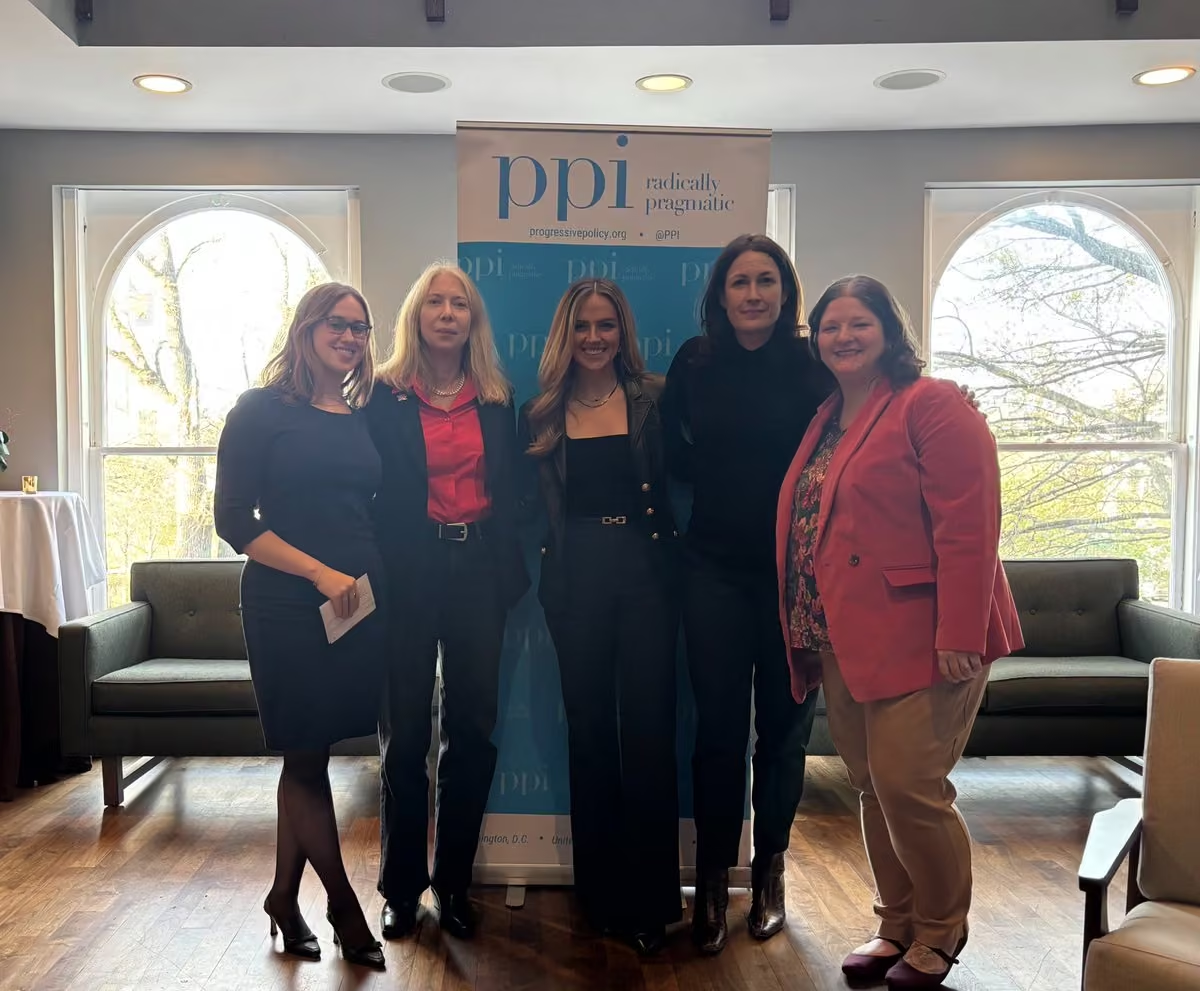
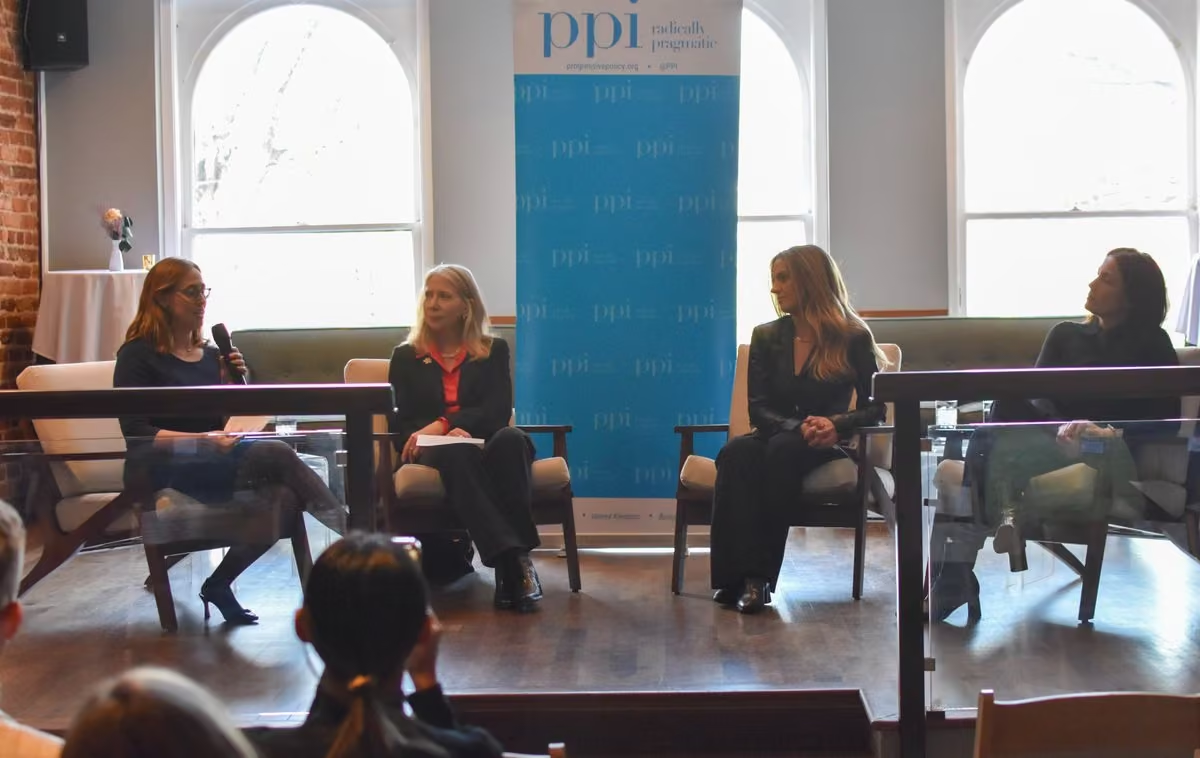
PPI reposted
Richard Kahlenberg
@RickKahlenberg
Integrated schools are the path out of a lot of our problems. My new piece explains the background on a plan to be voted on tomorrow in Montgomery County MD
 Bethesda Magazine | Bethesda Today
@bethesda_today
Opinion: MCPS’s smart plan to improve schools with regional programming bethesdamagazine.com/2026/03/24/opinion-mcpss-plan-improv…
 PPI
@ppi
Early childhood education is the missing piece in the “Mississippi Miracle” in reading outcomes.
@rachelanncanter highlights how aligning pre-K with K-3 reforms helped drive gains and why focusing only on phonics misses the bigger picture. www.the74million.org/zero2eight/an-overlooked-factor-of-t…
PPI reposted
 PYMNTS
@pymnts
What if AI’s biggest problem isn’t innovation but where the benefits actually show up?
As productivity surges in digital sectors and stalls elsewhere, the policy conversation is shifting toward outcomes, not just breakthroughs.
Michael Mandel, chief economist at the Progressive Policy Institute, explains why closing that gap is now the real challenge.
More on PYMNTS: www.pymnts.com/economy/2026/ai-policy-shifts-from-innovat…
PPI
@ppi
School integration remains one of the most effective ways to boost achievement and social mobility, yet many districts remain deeply segregated.
@RickKahlenberg highlights a new plan in Montgomery County, Md., that uses school choice to bring students together and strengthen opportunity in the classroom and beyond. fordhaminstitute.org/national/commentary/montgomery-count…
PPI reposted
Richard Kahlenberg
@RickKahlenberg
How do we teach kids what it means to be an American? My discussion with @rickhess99 about the @ppi American Identity Project in @EdWeekOpinion www.edweek.org/teaching-learning/opinion-how-to-teach-wha…
PPI reposted
The Atlantic
@TheAtlantic
Democrats “can’t tell Americans that the government will help solve their problems and that they won’t need to pay any taxes to fund it,” @BudgetBen argues. “That’s not offering a solution, just slop”: www.theatlantic.com/ideas/2026/03/democrats-slopulism-eco…
PPI
@ppi
Pennsylvania’s energy transition is entering a harder phase, as the easy emissions gains have already been captured and future progress will require balancing climate goals with affordability and economic growth.
Neel Brown and @JKempEnergy argue that a pragmatic, market-driven path is essential to sustaining decarbonization in the commonwealth. www.progressivepolicy.org/pennsylvanias-energy-crossroads…
PPI
@ppi
Elite colleges are enrolling far more low-income students after the end of race-based admissions, with Pell Grant shares rising sharply across top schools.
@RickKahlenberg shows how this shift is boosting economic and racial diversity. www.chronicle.com/article/economic-affirmative-action-is-…
PPI
@ppi
The Trump administration is reshaping federal education policy on the fly, moving more than 100 programs across agencies without a clear strategy.
Bruno Manno argues some functions may work better outside the Department of Education if they are better integrated with workforce and health systems. fordhaminstitute.org/national/commentary/could-breaking-e…
PPI
@ppi
Space activity is generating valuable environmental data while creating new, poorly understood risks to Earth’s atmosphere.
PPI’s Mary Guenther and Susie Perez Quinn, former NASA chief of staff, argue policymakers must fund the research needed to measure impacts and guide responsible growth. www.progressivepolicy.org/space-for-progress-earth-for-ke…
PPI
@ppi
With 100,000 satellites projected to orbit Earth by 2030, the environmental stakes of space activity are rising fast.
PPI’s Mary Guenther and Susie Perez Quinn, former NASA chief of staff, argue that policymakers must act now to align space innovation with environmental stewardship. www.progressivepolicy.org/space-for-progress-earth-for-ke…
PPI
@ppi
In today’s economy, who you know can matter as much as what you know.
Bruno Manno highlights a growing “social wealth gap,” where students with identical degrees see unequal outcomes because some have networks and others are left navigating opportunity alone.
PPI
@ppi
Space is already transforming life on Earth, powering everything from wildfire detection to climate monitoring. But we are still operating with major gaps in our understanding of how these activities affect the Earth’s atmosphere.
PPI’s Mary Guenther and Susie Perez Quinn argue that the solution is not a false choice between innovation and environmental protection.
Instead, they offer a pragmatic, integrated approach that invests in research, expands access to space-based data, deepens collaboration with industry, and prioritizes real-world data collection to close the knowledge gap. www.progressivepolicy.org/space-for-progress-earth-for-ke…
PPI
@ppi
With 100,000 satellites projected to orbit Earth by 2030, the environmental stakes of space activity are rising fast.
PPI’s Mary Guenther and Susie Perez Quinn, former NASA chief of staff, argue that policymakers must act now to align space innovation with environmental stewardship. www.progressivepolicy.org/space-for-progress-earth-for-ke…
PPI
@ppi
With 100,000 satellites projected to orbit Earth by 2030, the environmental stakes of space activity are rising fast.
PPI’s Mary Guenther and Susie Perez Quinn, former NASA chief of staff, argue that policymakers must act now to align space innovation with environmental stewardship. www.progressivepolicy.org/space-for-progress-earth-for-ke…
PPI reposted
PPI
@ppi
Democrats have a growing “slopulism” problem, risking a repeat of the mistakes that cost them credibility on the economy by embracing costly, unfocused policies instead of setting clear priorities.
@BudgetBen argues the party must make disciplined choices and a credible case for paying for them. www.theatlantic.com/ideas/2026/03/democrats-slopulism-eco…
PPI
@ppi
New tariff proposals risk raising costs for Americans while relying on questionable concepts like “structural excess capacity,” or “SExC.”
@EBGresser argues the administration’s focus on foreign “SExCiness” misreads global trade and could mean higher prices and weaker growth at home. www.progressivepolicy.org/trump-admin-accuses-foreigners-…
PPI reposted
Ian O’Keefe
@realianokeefe
NEW from @ppi via @TheAtlantic: “Some [Democrats] seem to be trying to out-Trump the president with their own brand of ‘slopulism’—half-baked policy proposals that sound good only if you don’t think too hard about them.” www.theatlantic.com/ideas/2026/03/democrats-slopulism-eco…
PPI
@ppi
Democrats have a growing “slopulism” problem, risking a repeat of the mistakes that cost them credibility on the economy by embracing costly, unfocused policies instead of setting clear priorities.
@BudgetBen argues the party must make disciplined choices and a credible case for paying for them. www.theatlantic.com/ideas/2026/03/democrats-slopulism-eco…
PPI reposted
 Brendan Duke 🇨🇦🇺🇸
@Brendan_Duke
Some 🔥🔥🔥from @ppi’s @BudgetBen on recent Democratic middle class tax cut proposals:
www.theatlantic.com/ideas/2026/03/democrats-slopulism-eco…
 PPI
@ppi
Democrats have a growing “slopulism” problem, risking a repeat of the mistakes that cost them credibility on the economy by embracing costly, unfocused policies instead of setting clear priorities.
@BudgetBen argues the party must make disciplined choices and a credible case for paying for them. www.theatlantic.com/ideas/2026/03/democrats-slopulism-eco…
PPI
@ppi
Industries that have antitrust exemptions & immunities are now highly concentrated, control the global market & raise prices for consumers.
At today’s @HouseJudiciary hearing, Diana Moss calls on Congress to revisit antitrust exemptions like the Shipping Act to preserve competition and end oligopoly behaviors.
PPI
@ppi
Read Moss’s full testimony below
www.progressivepolicy.org/ppis-moss-tells-house-judiciary…
PPI
@ppi
Putin’s conflict has no end in sight even as over 1.5 million casualties have occurred over the past 4 years.
For @wcpt820, PPI’s Tamar Jacoby sits down with @eisendrath to discuss the ongoing war in Ukraine and how it impacts Western Europe. youtu.be/tjl_U_FxGVk?t=610
PPI
@ppi
While President Trump brought the U.S. into a conflict in Iran with no clear endgame, progressives are more focused on typecasting the brutal regime that has destabilized the Middle East for decades as innocent.
For @TheHill, @Will_PPI argues that Trump’s reckless military action should not blind Democrats to the strategic & moral necessity of defanging the Islamic Republic. thehill.com/opinion/national-security/5780567-iran-us-con…
PPI reposted
Ed Gresser
@EBGresser
.@USTradeRep's FRN yesterday opens a "Structural Excess Capacity" '301' case v. 16 economies. *Lots* of big flaws, but a winner natural acronym: SExC. EU, Japan, Mexico, Bangladesh, Norway etc all too hot to fly, face tariffs for excessive SExCiness. ustr.gov/sites/default/files/files/Press/Releases/2026/US…
PPI
@ppi
Almost $20B of funding for the Broadband Equity Access and Deployment Program program remains unused.
For @BroadbandCensus, Mary Guenther argues that instead of wasting the allocated money, it should be placed in a reserve fund to connect Americans to the internet via satellite technology if they do not have access to traditional fiber cable infrastructure.
broadbandbreakfast.com/mary-guenther-bead-non-deployment-…
PPI
@ppi
Global trade stayed resilient in 2025.
In this week's Trade Fact, @EBGresser finds that trade volume grew 3.6%, the fastest pace since 2021, despite rising tariffs and geopolitical tensions.
www.progressivepolicy.org/2025-trade-growth-was-the-faste…
PPI
@ppi
Many Americans believed that the Supreme Court’s ruling in Students for Fair Admissions v. Harvard would create a dramatic collapse in campus diversity.
However, a new report by @RickKahlenberg and Aidan Shannon finds that universities are enacting new ways to sustain diversity, including creating a new “economic affirmative action" that uplifts students of all backgrounds.
www.progressivepolicy.org/new-ppi-report-finds-universiti…
PPI
@ppi
Join PPI's Reinventing America's Schools and The 74 for a webinar on the state of youth apprenticeships x.com/i/broadcasts/1dGYljByBQNKX
PPI
@ppi
The @DOJ’s proposed @Ticketmaster settlement is a slap on the wrist that lets the conglomerate conduct business as usual and harm fans. In a new statement, PPI’s Diana Moss condemns the weak proposal, highlighting the lack of strong structural remedies that allow anticompetitive practices to continue. www.progressivepolicy.org/ppi-says-proposed-doj-settlemen…
PPI reposted
 Jonathan Haidt
@JonHaidt
Now that the world is moving to put age limits on social media, we're seeing a lot of creativity in finding ways to do it well.
The Parents Over Platforms bill, from @RepAuchincloss, would have parents set age once, when setting up their child's phone.
thehill.com/opinion/technology/5759173-parents-vs-platfor…
PPI
@ppi
Refunding illegally collected tariff money is not difficult.
In a new analysis, PPI’s @EBGresser notes that about $175 billion in “IEEPA” tariffs can be repaid using existing customs systems, far less complex than the IRS’s $330 billion in annual tax refunds.
PPI
@ppi
Media consolidation demands rigorous, even-handed antitrust scrutiny.
PPI’s Diana Moss explains that a merger between Paramount and Warner Bros. Discovery is unlikely to trigger federal thresholds at the U.S. Department of Justice, unlike a hypothetical Netflix tie-up: The combined firm would expand its footprint in subscription streaming and legacy studio production and should get a close look. But it may be a marginal call in prompting enforcement action. deadline.com/2026/02/paramount-warner-bros-deal-regulator…
PPI
@ppi
Remedial education too often functions as a detour rather than a bridge to opportunity.
PPI’s Bruno Manno argues that colleges should replace multi-semester remediation with corequisite models, multiple-measure placement, and a focus on early gateway completion to accelerate student success and degree attainment. www.realcleareducation.com/articles/2026/03/03/developmen…
PPI
@ppi
Sound space policy requires economic expertise.
In @thehill, PPI’s Mary Guenther argues that eliminating NASA’s Office of the Chief Economist undercuts smart public–private partnerships and risks weakening America’s commercial space leadership. thehill.com/opinion/finance/5764923-nasa-commercial-space…
PPI reposted
Richard Kahlenberg
@RickKahlenberg
My colleague @colinmort & I have a new report out from @PPI on the latest bad idea from @realDonaldTrump www.progressivepolicy.org/institutional-investment-in-sin…
PPI
@ppi
Competition in live events is essential for fans and artists alike.
PPI’s Diana Moss explains how the DOJ and 40 states have brought a monopolization case against Live Nation-Ticketmaster and why state efforts should focus on consumer protection, not shielding monopoly power.
Breaking up the company is the only durable fix.
PPI reposted
Natural Allies for a Clean Energy Future
@Natural_Allies
“When we’re...reducing the supply, not modernizing plants...not building the anticipated renewables that we wanted to build, all the while, there’s a spike in demand from data centers and electrification, it...means prices go up,” says @ppi’s Neel Brown.
Read @zamoneperez ⬇️
 Steve Everley
@saeverley
Here's a crazy idea.
Maybe the answer to increased energy demand - and stay with me here - is increased energy supply across the board.
🤯
app.publicnewsservice.org/story/expert-both-natural-gas-r…
PPI
@ppi
Ending affirmative action did not devastate minority college enrollment; it shifted enrollment patterns beyond a narrow group of elite campuses.
PPI’s @RickKahlenberg explains that while selective schools saw declines, public universities gained, underscoring the case for class-based admissions reform that expands real opportunity. www.bostonglobe.com/2026/02/26/opinion/college-affirmativ…
PPI
@ppi
Presidents cannot use international emergencies as a pretext to create their own tariff systems.
In a new analysis of the Supreme Court’s Learning Resources, Inc. v. Trump ruling, PPI’s @EBGresser details how last year’s tariff experiment slowed growth, hurt rural America, raised costs, and failed to reduce the trade deficit. www.progressivepolicy.org/supreme-court-presidents-cannot…
PPI
@ppi
Urban school systems can improve fast when autonomy is matched with real accountability for results.
In @monthly, PPI’s David Osborne discusses New Orleans’s post-Katrina turnaround and his new documentary, “Turnaround.”
He argues that closing low-performing schools, backing strong charter operators, and expanding family choice drove gains in graduation and college-going. washingtonmonthly.com/2026/02/25/new-orleans-public-schoo…
PPI
@ppi
Meaningful education reform requires disciplined implementation of what works.
At PPI’s New Directions, education @rachelanncanter highlights Mississippi’s dramatic gains in reading and math driven by applying decades of research across all student groups.
PPI
@ppi
The proposed Nexstar–Tegna merger would reshape local television markets across the country, with direct consequences for consumers and competition.
PPI’s Diana Moss examines how the deal could increase retransmission fees, raise cable and streaming subscription prices, drive up local advertising rates, and reduce viewpoint diversity in local news.
Her latest in @ProMarket_org explores what the merger means for antitrust enforcement and the integrity of regulatory review. www.promarket.org/2026/02/25/the-nexstar-tegna-merger-wil…
PPI reposted
 Tahra Hoops
@TahraHoops
ICYMI: We also had our first Substack Live with @ppi's @EBGresser and @GaryWinslett to break down what the Court decided, why it matters, and what comes next as the Administration scrambles to find new legal footing for its tariff agenda. www.therebuild.pub/p/from-ieepa-overreach-to-scotus-reversal
PPI reposted
 Taylor Maag
@taylor_maag
Such a privilege to speak at @ppi #newdirections event earlier this month. I got to learn from impressive national, state and local leaders and discuss policy solutions that lower costs and expand economic opportunity for all Americans.
PPI
@ppi
America’s workforce strategy cannot leave out the majority of workers without four-year degrees.
At PPI’s New Directions, @taylor_maag highlights that millions of Americans leave college with debt but no credential of labor market value, even as employers increasingly prioritize skills over degrees.
PPI reposted
 Elan Sykes
@Elan_Sykes
Come hear @RepJoshHarder, me @ppi, and a bunch of other amazing panelists discuss permitting reform now!
x.com/i/broadcasts/1lJQRvRnjBBxE
PPI
@ppi
Housing affordability is a supply crisis, not a “Wall Street” takeover.
In a new report, PPI’s @RickKahlenberg and @colinmort find institutional investors own just 0.55% of single-family homes and show no link to higher prices.
The real solution is zoning reform and more homebuilding. www.progressivepolicy.org/institutional-investment-in-sin…
PPI
@ppi
America’s workforce strategy cannot leave out the majority of workers without four-year degrees.
At PPI’s New Directions, @taylor_maag highlights that millions of Americans leave college with debt but no credential of labor market value, even as employers increasingly prioritize skills over degrees.
PPI
@ppi
Monopoly power in ticketing is driving higher fees and fewer choices for fans.
PPI’s Diana Moss warns that state price caps on resale tickets risk undermining competition and interfering with antitrust enforcement.
The priority should be breaking up Live Nation-Ticketmaster and strengthening consumer protections. www.progressivepolicy.org/state-regulation-of-the-resale-…
PPI reposted
PPI
@ppi
The Supreme Court’s decision striking down the Trump administration’s IEEPA “emergency” tariffs is a necessary step toward restoring constitutional trade policy.
In a new statement, PPI’s @EBGresser argues Congress must now end the remaining “Section 232” tariffs and reassert its authority over trade. www.progressivepolicy.org/ppi-applauds-supreme-court-deci…
PPI reposted
Ed Gresser
@EBGresser
Last year the @IRSnews says it send out 103.8 million refunds totaling $328.9 billion dollars. @CBP likewise knows who paid, when, and how much. They can do it. www.irs.gov/newsroom/filing-season-statistics-for-week-en…
 Erica York
@ericadyork
The Court decided a president cannot impose tariffs under IEEPA, but it has not offered an answer for the illegally collected IEEPA tariff revenue.
Kavanaugh's dissent: "But the Court’s decision is likely to generate other serious practical consequences in the near term. One issue will be refunds. Refunds of billions of dollars would have significant consequences for the U. S. Treasury. The Court says nothing today about whether, and if so how, the Government should go about returning the billions of dollars that it has collected from importers."
PPI reposted
Claire Ainsley
@claire_ainsley
The Trump administration promised lower prices and industrial growth, but tariffs have meant higher costs of living to families, factory job loss and lost farm income - see @EBGresser response for @ppi to today’s Supreme Court decision :
PPI
@ppi
The Supreme Court’s decision striking down the Trump administration’s IEEPA “emergency” tariffs is a necessary step toward restoring constitutional trade policy.
In a new statement, PPI’s @EBGresser argues Congress must now end the remaining “Section 232” tariffs and reassert its authority over trade. www.progressivepolicy.org/ppi-applauds-supreme-court-deci…
PPI reposted
Ian O’Keefe
@realianokeefe
NEW via @ppi: @EBGresser “ ... beyond their real-world harm to families and businesses, they usurp Congress’s clear Constitutional authority over the rates of ‘taxes, duties, imposts, and excises,’ and substitute rule by personal decree for rule of law.”


 PPI
@ppi
The Supreme Court’s decision striking down the Trump administration’s IEEPA “emergency” tariffs is a necessary step toward restoring constitutional trade policy.
In a new statement, PPI’s @EBGresser argues Congress must now end the remaining “Section 232” tariffs and reassert its authority over trade. www.progressivepolicy.org/ppi-applauds-supreme-court-deci…
PPI reposted
Ed Gresser
@EBGresser
.@PPI statement on 6-3 decision striking down IEEPA tariffs: www.progressivepolicy.org/ppi-applauds-supreme-court-deci…
PPI
@ppi
The Supreme Court’s decision striking down the Trump administration’s IEEPA “emergency” tariffs is a necessary step toward restoring constitutional trade policy.
In a new statement, PPI’s @EBGresser argues Congress must now end the remaining “Section 232” tariffs and reassert its authority over trade. www.progressivepolicy.org/ppi-applauds-supreme-court-deci…
PPI reposted
 The National Security Institute
@MasonNatSec
LIVE: @jamil_n_jaffer is joined by Mary Guenther with @ppi, Paula Trimble with @MuonSpace, and moderator Clayton Swope with @CSIS.
@ConnectedDMV #spacenext
 PPI
@ppi
.@BLaw reports Judge Arun Subramanian rejected Live Nation’s bid to end the DOJ and states’ Sherman Act case at summary judgment.
PPI’s Diana Moss argued months ago in @ProMarket_org that the motion was a “house of cards” unlikely to survive. www.promarket.org/2025/12/11/canceling-the-antitrust-show…

 Bloomberg Law
@BLaw
Live Nation Loses Bid for Full Dismissal of DOJ Antitrust Suit news.bloomberglaw.com/antitrust/live-nation-loses-bid-for…
PPI
@ppi
U.S. manufacturing employment fell by 108,000 jobs in 2025, even as tariffs on everyday goods like toasters surged.
In this week’s Trade Fact, PPI’s @EBGresser examines the data and finds higher costs for families, minimal production shifts abroad, and no revival in U.S. appliance jobs. www.progressivepolicy.org/u-s-manufacturing-employment-is…
PPI
@ppi
Trust grows when leaders focus relentlessly on affordability in energy, health care, and household essentials.
At PPI’s New Directions, @RepScholten argues that rebuilding trust with working Americans requires clear, direct commitments to lower everyday costs.
PPI
@ppi
Populist parties often claim to stand with workers, but their policies tell a different story.
Writing in @DailyMirror, PPI’s @claire_ainsley argues that Nigel Farage’s Reform UK mirrors Donald Trump’s playbook of deregulation and tax promises that fail America’s working families. www.mirror.co.uk/news/politics/nigel-farages-reform-not-w…
PPI
@ppi
At PPI’s New Directions, PPI’s @EBGresser notes that factory hiring has dropped sharply, with fewer workers willing to leave jobs amid uncertainty.
Tariffs on key inputs like steel and aluminum risk putting U.S. auto producers further behind global competitors.
PPI
@ppi
PPI’s @BudgetBen explains why the proposed “Five and Dime” wealth tax would be difficult to administer, economically distortive, and likely to raise far less revenue than advertised.
He argues instead for closing capital gains loopholes, reforming the estate tax into a progressive inheritance tax, and strengthening enforcement to ensure the ultra-wealthy pay more without undermining investment and growth.
Democracy Journal
@DemJournal
Democracy enlisted @igorvolsky @amyhanauer and @ppi’s Ben Ritz to debate what the United States’ tax and inequality problems actually are, and what policies would solve them.
democracyjournal.org/magazine/79/should-billionaires-exist/
PPI
@ppi
Voters measure the economy by their paychecks, not by macroeconomic charts. That’s why restoring trust begins with acknowledging lived economic reality.
At PPI’s New Directions, @SenatorSlotkin argues that telling people the economy is better than they feel it is damages credibility when wages are not keeping up with costs.
PPI
@ppi
The nation’s fiscal outlook is deteriorating at an alarming pace.
In a new analysis, PPI’s Alex Kilander explains how the latest CBO projections show deficits topping $3 trillion, debt reaching 172% of GDP, and interest costs crowding out national priorities absent a balanced, pro-growth fiscal reset. www.progressivepolicy.org/trumps-failing-fiscal-report-card/
PPI
@ppi
Winning the midterms will not be enough to secure durable governing majorities or restore public trust.
PPI’s @Will_PPI argues that lasting success requires rebuilding support among working-class voters and offering a pragmatic agenda on growth, security, and national unity that can win the White House in 2028. thehill.com/opinion/campaign/5735438-democrats-2028-presi…
PPI
@ppi
Rebuilding trust among working people starts at home, not in Washington.
At PPI’s New Directions, Robin Johnson argues that the path forward begins by making neighbors and local leaders the face of the center-left rather than people in the nation’s capital.
PPI
@ppi
Affordability remains the decisive issue in American politics.
PPI’s @claire_ainsley argues that recent victories in Virginia and New Jersey show how pragmatic, cost-of-living focused campaigns can win back working- and middle-income voters and blunt the appeal of the populist right. www.progressivepolicy.org/ainsley-for-fabian-society-the-…
PPI
@ppi
Winning governing majorities requires confronting vulnerabilities, not avoiding them.
At PPI’s New Directions, PPI’s @claire_ainsley reflects on lessons from UK Labour’s repositioning under Keir Starmer, arguing that the center-left must address voter concerns directly, even when politically uncomfortable.
PPI
@ppi
Valentine’s Day chocolate prices are up 11.8% this year, reflecting both weather shocks and higher tariffs.
In this week’s Trade Fact, PPI’s @EBGresser finds 2025 tariff increases added $544 million to cacao and chocolate costs, raising prices, cutting jobs, and squeezing family budgets. www.progressivepolicy.org/valentines-day-boxed-chocolate-…
PPI
@ppi
The center-left strengthens its economic case when it is pro-consumer, not reflexively anti-corporation.
At PPI’s New Directions, strategist Pete Brodnitz argues that cracking down on hidden fees and corporate abuses is essential, but portraying all business as the villain undercuts the case for growth and good jobs.
PPI
@ppi
The UK government is confronting a defining test of leadership and discipline amid mounting political pressure.
In an interview with @ABCaustralia, PPI’s @claire_ainsley said the controversy surrounding Keir Starmer’s appointment of Lord Peter Mandelson reflects deeper frustrations with No. 10’s political operation.
She argued Labour must reset its governing team, strengthen parliamentary engagement, and refocus on delivering stability and results. www.abc.net.au/listen/programs/radionational-breakfast/uk…
PPI
@ppi
Hard work no longer guarantees economic security for millions of Americans.
At PPI’s New Directions in Lansing, Michigan, @repkmr explains that workers today often hold multiple jobs, work longer hours than previous generations, and still struggle to make ends meet.
A serious economic agenda must restore the reminder that work should lead to dignity and opportunity.
PPI reposted
Ed Gresser
@EBGresser
What's likely hurting politically is the actual tariffs themselves, not a potential vote. Polling has been consistent and negative: about 62%-38% early last year, and the same now. Our deep dive last week: www.progressivepolicy.org/the-u-s-publics-view-of-trump-t…
 Jake Sherman
@JakeSherman
The pitch from R leadership in the closed GOP meeting was that republicans should vote for the rule — which blocks tariff disapproval resolutions — because it saves republicans from painful votes through August. Democrats, they said, are trying to hurt the GOP politically.
The weakness in this argument is that many republicans hate the tariffs and want to vote against them repeatedly.
PPI
@ppi
American studies should confront injustice without abandoning seriousness about America itself.
Responding to @GutkinLen’s essay, “Does American Studies Have a Credibility Problem?,” PPI’s @RickKahlenberg and Lief Lin and argue in @chronicle that honest history necessarily recognizes democratic progress and self-correction. www.chronicle.com/blogs/letters/studying-the-whole-truth-…
PPI
@ppi
California’s latest ticketing proposal risks worsening the very problems fans face by shrinking competition in resale markets.
PPI’s Diana Moss warns that AB 1720 “puts consumers last, not first” by misdiagnosing the problem.
Price caps would weaken the only competitive market and further entrench Live Nation–Ticketmaster’s dominance. www.latimes.com/entertainment-arts/business/story/2026-02…
PPI
@ppi
Modernizing America’s permitting system is essential to building clean energy faster and at lower cost.
Join PPI on Feb. 24 at 11 a.m. EST for a virtual discussion moderated by PPI’s Neel Brown, with PPI’s @Elan_Sykes and a bipartisan panel on how permitting reform can accelerate clean energy while upholding environmental safeguards. us06web.zoom.us/webinar/register/WN_6TIPEz9rRiWPJZ_FFcnRBQ

PPI reposted
Claire Ainsley
@claire_ainsley
An honour to be part of New Directions for Democrats with @ppi in Michigan with Governor Gretchen Whitmer, Senator Elissa Slotkin, Rep Haley Stevens, Rep Hillary Scholten
Forging a new agenda for the center-left that wins for working people
www.progressivepolicy.org/project/project-on-center-left-…
PPI reposted
 Tim Ryan
@TimRyan
Loved the beer and conversation with @GovWhitmer in Lansing. She is one of the best voices in the Democratic Party. Our leaders would be wise to follow her lead on policy, messaging and just being a cool, midwesterner. @ppi is showing us the way!
PPI
@ppi
New ideas take shape when leaders come together beyond Washington.
Last night in East Lansing, Michigan, PPI kicked off the next chapter of New Directions with a dinner discussion featuring @GovWhitmer, moderated by PPI’s @TimRyan.
The evening launched a broader effort focused on affordability, work, and rebuilding public trust.
 PPI
@ppi
The future of center-left leadership is being built outside Washington.
Today in East Lansing, PPI’s New Directions convenes leaders for discussions on affordability, public safety, education, energy, economic growth, and more.
Watch the livestream here.
PPI
@ppi
PPI New Directions in Lansing 2026 x.com/i/broadcasts/1BRKjgwgZjBGw
PPI
@ppi
New ideas take shape when leaders come together beyond Washington.
Last night in East Lansing, Michigan, PPI kicked off the next chapter of New Directions with a dinner discussion featuring @GovWhitmer, moderated by PPI’s @TimRyan.
The evening launched a broader effort focused on affordability, work, and rebuilding public trust.
PPI
@ppi
PPI launched New Directions last year with convenings in Colorado and Nevada, bringing together rising political leaders outside of Washington for strategic dialogue focused on strengthening economic opportunity and reconnecting with working people.
In Lansing, PPI will continue these conversations with elected officials, policy experts, and emerging leaders from across the country.
PPI
@ppi
PPI New Directions in Lansing 2026 x.com/i/broadcasts/1BRKjgwgZjBGw
PPI
@ppi
Today, PPI’s @EBGresser joined @RepPettersen on Capitol Hill to spotlight the hidden costs of “pink tariffs” and the urgent need to modernize the U.S. tariff schedule.
Rep. Pettersen’s Pink Tariffs Study Act is a step toward fairer, smarter trade policy for all Americans.


PPI reposted
 U.S. Rep. Brittany Pettersen
@RepPettersen
Trump’s tariffs are driving up costs across the economy — but women are hit especially hard through so-called “pink tariffs” on everyday products like clothes, razors, and hygiene items.
I joined @ppi to discuss my bill — the Pink Tariffs Study Act — to shine a light on these unfair price gaps and the disproportionate impact Trump’s trade war is having on women.

 PPI
@ppi
Most Americans opposed President Trump’s tariffs a year ago, and public opinion has barely budged since.
In this week’s Trade Fact, PPI’s @EBGresser reviews a year of national and state polling showing steady, broad disapproval across parties and demographics, with support confined to narrow groups.
Ed Gresser
@EBGresser
This week's Trade Fact - Deep dive into trade & tariff polling, a year since the Trump admin.'s first tariff decree. Basically, large majorities didn't like it then, and few if any minds have changed since. www.progressivepolicy.org/the-u-s-publics-view-of-trump-t…
PPI
@ppi
College accreditation has quietly become one of the most powerful levers in higher education policy.
In @RealClearEd, PPI’s Bruno Manno explains how federal pressure, politics, and demands for measurable outcomes are transforming a once-technical process. www.realcleareducation.com/articles/2026/02/03/the_colleg…
PPI reposted
Ian O’Keefe
@realianokeefe
.@Will_PPI: “If you’re a Democrat today, you have to be asking yourself why we’re in the minority … The dilemma isn’t how to keep moving left. It’s how to get back the voters Clinton won twice in the ‘90s.” www.politico.com/news/2026/02/04/clinton-democrats-genera…
PPI
@ppi
The Jeffrey Epstein investigation is exposing a generational divide within the Democratic Party.
PPI’s @Will_PPI warns that turning away from the Clinton legacy without a clear plan to rebuild broad support could further erode the party’s coalition. www.politico.com/news/2026/02/04/clinton-democrats-genera…
PPI reposted
Elan Sykes
@Elan_Sykes
My latest intervention in the affordability discourse:
 PPI
@ppi
High energy costs are a major driver of the cost of living crisis for working families, with especially heavy burdens in Latino communities.
In a new report, PPI’s @Elan_Sykes finds Latino households are twice as likely as white households to experience energy insecurity.
He argues for modern infrastructure, permitting reform, and a balanced clean energy strategy that lowers costs and improves reliability. www.progressivepolicy.org/working-latinos-need-relief-fro…
PPI
@ppi
Academic fields lose public trust when scholarship becomes indistinguishable from political posturing.
In @chronicle, PPI’s @RickKahlenberg and Lief Lin’s new report is examined, documenting how American Studies has drifted toward ideological uniformity. www.chronicle.com/article/does-american-studies-have-a-cr…
PPI
@ppi
America’s civic life depends on more than home and work, but the shared spaces that knit communities together are disappearing.
In @monthly, PPI’s Bruno Manno argues that reviving “third places” is essential to rebuilding social capital, strengthening democracy, and reversing the rise of civic deserts. washingtonmonthly.com/2026/01/30/the-shrinking-space-betw…
PPI
@ppi
Buried inside the GOP’s One Big Beautiful Bill Act is a pro-growth reform that cuts the tax penalty on business investment.
PPI’s Alex Kilander and Nate Morris explain how full expensing boosts productivity and wages, but why its gains will be overwhelmed by debt, inflation, and giveaways to the wealthy. www.progressivepolicy.org/the-pro-growth-tax-reform-hidde…
PPI
@ppi
Russia’s renewed assault on Ukraine’s energy infrastructure is meant to break civilian morale during a brutal winter.
In @monthly, PPI’s @tamarjacoby reports from Kyiv on why Putin’s strategy is backfiring and how Ukrainians are responding with resilience and resolve.
PPI
@ppi
Extreme wealth concentration raises real concerns about inequality, democracy, and the tax code.
In @DemJournal, PPI’s Ben Ritz debates a proposed wealth tax, arguing it would be unworkable and economically harmful while better tax reforms remain on the table.
PPI
@ppi
Reducing emissions requires radical pragmatism, not absolutism.
PPI’s Neel Brown explains why policies focused solely on eliminating fossil fuels can backfire, locking in outdated systems and ultimately producing higher emissions.
PPI
@ppi
Trump’s so-called “Board of Peace” is a pay-to-play scheme masquerading as diplomacy.
In a new PPI analysis, PPI’s @juulpeterm explains how billion-dollar buy-ins and Trump’s lifetime control strip the board of legitimacy. www.progressivepolicy.org/trumps-board-of-peace-is-a-corr…
PPI
@ppi
Rising energy costs in New Jersey are no accident.
On @onnewjersey’s Energy Matters, PPI’s Neel Brown explains how ideologically driven energy decisions on both the left and the right are imposing an “activist tax” that consumers pay through higher prices and reduced reliability.
PPI
@ppi
ICYMI: American history deserves to be taught with both honesty and balance.
PPI’s @RickKahlenberg and Lief Lin argue in @WSJopinion that today’s American Studies too often omits our democratic achievements, and risks eroding civic confidence as a result.
PPI
@ppi
America’s history is complex, but teaching it as nothing but failure distorts reality and weakens civic confidence.
In @WSJopinion, PPI’s @RickKahlenberg and Lief Lin show how American Studies scholarship has become relentlessly one-sided.
They argue serious critique should coexist with an honest account of America’s democratic achievements. www.wsj.com/opinion/american-studies-cant-stand-its-subje…
PPI
@ppi
New Jersey’s climate ambitions are colliding with energy affordability and grid reality.
On @onnewjersey’s Energy Matters, PPI’s Neel Brown explains findings from PPI’s new report showing why rising costs risk undermining public support for the energy transition.
PPI
@ppi
There is no national security or economic case for the United States to annex Greenland.
PPI’s @juulpeterm explains that existing NATO commitments and U.S. basing already protect U.S. interests, making Trump’s fixation reckless, unnecessary, and deeply damaging to American alliances. dcjournal.com/point-on-greenland-trump-madness-runs-amok/
PPI
@ppi
Congress restored critical NASA funding in FY26, but there is “room for improvement,” says @RepGraceMeng.
At a PPI event covered by @SpaceNews_Inc, Rep. Meng joined PPI’s Mary Guenther to champion investments in Artemis, STEM, and science, and called for strong support in FY27.
PPI
@ppi
ACA subsidies have expired. Congress is stuck.
PPI’s Nate Morris lays out a better path: a permanent, fully paid-for plan to expand the ACA, cut costs, and keep health insurance affordable for millions.
PPI
@ppi
Read the latest from Nate Morris on why Congress should reject costly, temporary fixes, and instead adopt a smarter, permanent approach to expanding the ACA and reducing health care costs: www.progressivepolicy.org/a-smarter-path-forward-on-premi…
PPI reposted
 SpaceNews
@SpaceNews_Inc
House appropriator sees ‘room for improvement’ in NASA funding for 2027 spacenews.com/house-appropriator-sees-room-for-improvemen…
 PPI
@ppi
America’s history is complex, but teaching it as nothing but failure distorts reality and weakens civic confidence.
In @WSJopinion, PPI’s @RickKahlenberg and Lief Lin show how American Studies scholarship has become relentlessly one-sided.
They argue serious critique should coexist with an honest account of America’s democratic achievements. www.wsj.com/opinion/american-studies-cant-stand-its-subje…
PPI
@ppi
This morning, PPI and the Women in Policy Alliance brought together women in policy on Capitol Hill for coffee and conversation.
Thank you to @RepGraceMeng and PPI’s Mary Guenther, as well as everyone who joined us, for a thoughtful fireside chat on space policy.


PPI reposted
Ian O’Keefe
@realianokeefe
NEW via @WSJ: @RickKahlenberg: “There is nothing wrong with being critical of America; I’m critical of America. But the ultimate goal of American studies is to pursue the truth about America, the good and the bad.” www.wsj.com/arts-culture/books/american-studies-biased-pr…
PPI
@ppi
Is American studies still helping students grasp the full story of America?
A new report from PPI’s @RickKahlenberg and Lief Lin, featured in @WSJ, finds that American Quarterly offers a consistently critical and unbalanced view of the U.S. www.wsj.com/arts-culture/books/american-studies-biased-pr…
PPI
@ppi
The United States has no legal or historical claim to Greenland, and threatening tariffs against close allies undermines U.S. security and trade interests.
PPI’s @EBGresser explains why these threats are baseless, damaging, and require Congress to reassert control over tariff policy. www.progressivepolicy.org/the-u-s-has-no-claim-to-greenland/
PPI reposted
Ed Gresser
@EBGresser
This week's Trade Fact: The U.S. has no claim to Greenland. www.progressivepolicy.org/the-u-s-has-no-claim-to-greenland/
PPI
@ppi
ICYMI: Military threats against Iran risk doing more harm than good at a pivotal moment for the Iranian people.
In a new blog post, PPI’s @juulpeterm argues that President Trump’s saber-rattling reflects dangerous overconfidence rather than a serious strategy.
Smarter tools like diplomacy, cyber operations, and allied coordination offer a better path. www.progressivepolicy.org/america-and-iran-cant-afford-tr…
PPI
@ppi
Virginia’s clean energy goals are colliding with surging electricity demand from data centers.
In new analysis, PPI’s Neel Brown and John Kemp argue that rigid mandates risk higher costs and grid instability.
A pragmatic approach centered on reliability and affordability can sustain both economic growth and climate progress. www.progressivepolicy.org/the-virginia-challenge-meeting-…
PPI
@ppi
Stablecoin “rewards” may sound innovative, but they risk draining deposits from the community banks that finance small businesses, farmers, and underserved communities.
In @rc_markets, PPI’s Paul Weinstein Jr. explains how crypto firms are skirting the GENIUS Act’s ban on interest-bearing stablecoins.
Closing the stablecoin yield loophole is essential to protecting community lending. www.realclearmarkets.com/articles/2026/01/16/stablecoin_r…
PPI
@ppi
ICYMI: Venezuela’s oil production is down roughly 75% since 1998, despite the country sitting atop some of the world’s largest claimed crude reserves.
In this week’s PPI Trade Fact, @EBGresser explains how decades of misrule, corruption, and state control hollowed out Venezuela’s economy and collapsed oil output. www.progressivepolicy.org/venezuela-oil-production-is-dow…
PPI
@ppi
Great turnout at PPI’s space policy happy hour last night at Barrel on Capitol Hill!
Thanks to everyone who joined for thoughtful conversation on strengthening U.S. leadership in space innovation, technology, and strategy.


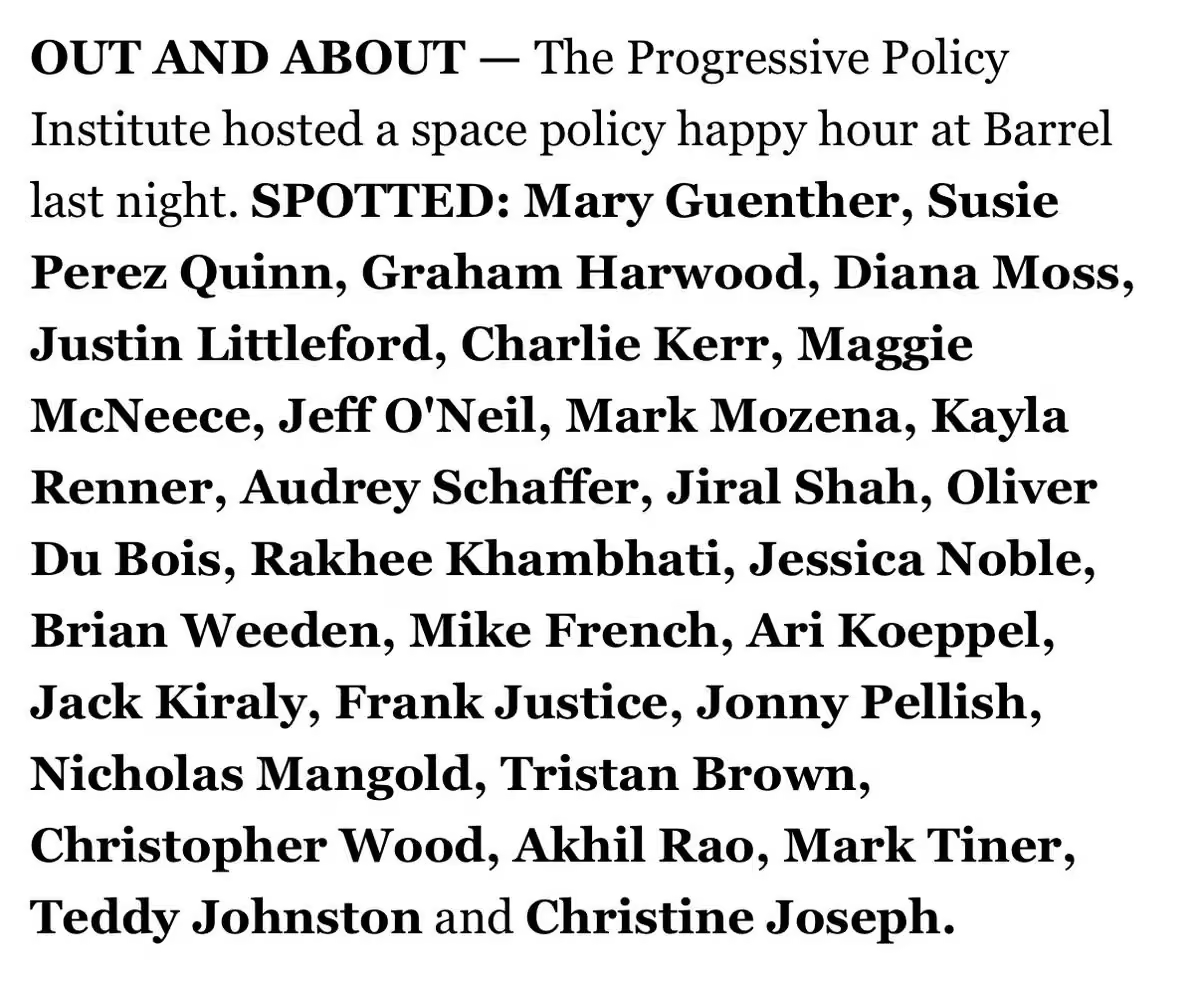 PPI
@ppi
America’s edge in space depends on an agile, innovative satellite industry.
PPI’s Mary Guenther applauds the bipartisan Satellite and Telecommunications Streamlining Act for reducing regulatory barriers and bolstering U.S. competitiveness with China. www.progressivepolicy.org/ppi-applauds-bipartisan-satelli…
PPI
@ppi
Congress’s failure to act on expiring ACA premium tax credits is already driving Americans out of coverage and pushing health-care costs in the wrong direction.
In a new piece, PPI’s Nate Morris explains why extending the pandemic-era subsidies as-is is fiscally unsustainable, and why political stalemate is blocking meaningful reform.
He argues for a smarter compromise: permanent, targeted subsidies that protect low- and middle-income families, reduce wasteful overpayments, and are fully paid for through health-care cost reforms. www.progressivepolicy.org/a-smarter-path-forward-on-premi…
PPI reposted
Ed Gresser
@EBGresser
This week's Trade Fact - The apparent admin Venezuela plan: keep 2nd-tier Chavistas in charge, work with them to refurbish the VZ oil industry, use the money to rebuild the VZ economy. Not likely to work we think, for 3 reasons: www.progressivepolicy.org/venezuela-oil-production-is-dow…
PPI
@ppi
Trump’s fixation on annexing Greenland is reckless, unnecessary, and dangerous for U.S. interests and alliances.
PPI’s @juulpeterm explains why the national security and economic rationales collapse under scrutiny and urges Congress to act now to stop this madness before it escalates. www.progressivepolicy.org/stop-trumps-greenland-madness-b…
PPI
@ppi
Autonomous vehicles could dramatically reduce crashes and save lives, but public trust in the technology remains alarmingly low.
In a new report, PPI’s Andrew Fung, Alex Kilander, and Aidan Shannon show how fragmented and opaque safety data fuels fear, backlash, and misguided calls for outright bans.
They argue that a unified federal reporting framework can replace speculation with evidence, strengthen oversight, and allow autonomous vehicles to earn public trust through transparency. www.progressivepolicy.org/building-trust-through-transpar…
PPI
@ppi
Letting enhanced ACA subsidies expire is pushing health insurance out of reach for millions of Americans.
PPI’s Alix Ware explains why these subsidies often determine whether people stay insured, and why inaction from Congress will leave families worse off.
PPI
@ppi
Workforce Pell could expand opportunity for workers, but only if states enforce real accountability.
In an op-ed for @The74, PPI’s Bruno Manno argues that states must ensure short-term Pell programs lead to real jobs and higher pay. www.the74million.org/article/congress-okd-pell-grants-for…
PPI reposted
Ian O’Keefe
@realianokeefe
NEW via @ppi: “Trump now recognizes that more Americans are facing financial hardship. Unfortunately, the president’s call for a one-year, 10% cap on credit card interest rates would lead to millions of working Americans losing access to traditional sources of credit.”
PPI
@ppi
Blunt credit card interest rate caps risk cutting off access to credit for the Americans facing the greatest financial strain.
In a new statement, PPI warns that a one-year 10% cap would push millions of working Americans out of the regulated credit market.
PPI
@ppi
Blunt credit card interest rate caps risk cutting off access to credit for the Americans facing the greatest financial strain.
In a new statement, PPI warns that a one-year 10% cap would push millions of working Americans out of the regulated credit market.
PPI
@ppi
Europe’s security is entering a new phase as Germany moves from strategic restraint to rapid rearmament amid Russian aggression and U.S. volatility.
In @monthly, PPI’s @tamarjacoby reports on Berlin’s dramatic spending, conscription planning, and political shifts.
PPI reposted
Rachel Canter
@rachelanncanter
The “science of reading” works, but to get the system to move, states must build the right conditions by aligning policies on standards, assessment, accountability, curriculum, pre-K, school turnaround, etc. I love how our belief in our children shines, too!
PPI
@ppi
Mississippi’s education turnaround shows that accountability and high expectations still matter for student success.
In @nytimes, PPI’s @rachelanncanter draws on her Mississippi First experience to explain why the “science of reading” worked because it was paired with standards, coaching, and real accountability for student progress. www.nytimes.com/2026/01/11/us/mississippi-schools-transfo…
PPI reposted
PPI
@ppi
Hospital acquisitions of physician practices are driving up health costs and reducing access to care.
Join PPI Jan. 15 on Capitol Hill for a briefing on how smart, bipartisan reforms can restore physician autonomy and improve affordability. www.eventbrite.com/e/ppi-briefing-the-loss-of-independent…
 PPI
@ppi
Virginia is showing America how to grow with AI without raising energy costs.
In an interview with @ABC13News, @SecGranholm explains how smart data center rules can lower electricity rates while delivering economic benefits for Virginia.
PPI
@ppi
In New Jersey, PPI’s Neel Brown warns that both Trump-era interventions and climate absolutism are driving an “Activist Tax” on households.
The solution is outcome-based climate policy that prioritizes reliability, affordability, and real emissions reductions.
PPI reposted
Ed Gresser
@EBGresser
This week's Trade Fact - Trump admin. not a great free speech defender. A look at its December ban on visas for several European & British critics, an October visa withdrawal for Wole Soyinka, and the record at home: www.progressivepolicy.org/the-trump-administration-is-not…
PPI
@ppi
Modernizing space regulation is essential for U.S. competitiveness as China expands its presence in orbit.
PPI’s Mary Guenther welcomes the Commerce Department’s mission authorization proposal while urging targeted improvements.
She outlines four recommendations to streamline timelines, limit red tape, balance security, and ensure effective oversight. www.progressivepolicy.org/progressive-policy-institutes-f…
PPI
@ppi
Misguided tech legislation would undermine one of America’s strongest engines of growth at the wrong moment.
PPI’s @MichaelMandel explains that reviving the American Innovation and Choice Online Act would hurt consumers and innovation, even as U.S. tech outperforms Europe under heavier regulation. www.progressivepolicy.org/misguided-tech-legislation-is-s…
PPI
@ppi
Opportunity is not just about what you know. It is also about who you know.
In @NationalAffairs, PPI’s Bruno Manno argues that “social capital” is critical infrastructure for upward mobility.
He calls for schools and employers to build bridging networks through mentoring and work-based learning. www.nationalaffairs.com/publications/detail/social-capita…
PPI
@ppi
Too many physical industries have been left out of the digital revolution. AI can change that.
PPI’s @MichaelMandel tells @ABC13News that AI offers new ways to cut costs without cutting jobs, revitalizing sectors like manufacturing and agriculture. www.progressivepolicy.org/an-ai-innovation-toolbox-for-go…
PPI
@ppi
Opportunity is not just about degrees or credentials. It’s also about networks.
In @AmericanThinker, PPI’s Bruno Manno argues that social capital, including mentors, connections, and trust, is essential economic infrastructure for mobility and growth. www.americanthinker.com/articles/2026/01/opportunity_and_…
PPI
@ppi
PPI is seeking a Summer Antitrust and Competition Law Fellow to contribute to research on competition, consumer protection, and market policy.
PPI’s fellowship, in partnership with the @ABAesq Antitrust Law Section, offers hands-on policy experience and a stipend.
Applications are due March 20, 2026. www.progressivepolicy.org/about/careers/
PPI
@ppi
Hospital acquisitions of physician practices are driving up health costs and reducing access to care.
Join PPI Jan. 15 on Capitol Hill for a briefing on how smart, bipartisan reforms can restore physician autonomy and improve affordability. www.eventbrite.com/e/ppi-briefing-the-loss-of-independent…
PPI
@ppi
These challenges aren’t inevitable. They’re the result of important policy choices.
PPI’s new report outlines bipartisan reforms to restore competition, strengthen physician autonomy, and expand access to care. www.progressivepolicy.org/ppi-warns-that-hospital-takeove…
PPI
@ppi
President Trump’s unauthorized military raid in Venezuela undermines American interests, global security, and the rule of law.
PPI’s @juulpeterm outlines how Trump’s actions reflect the worldview of an aspiring strongman, not a democratic leader. www.progressivepolicy.org/trump-plays-warlord-at-americas…
PPI reposted
Washington Monthly
@monthly
Subsidies for Scholarship Granting Organizations, the latest rage on the right, are being sold as a brilliant innovation to help underprivileged kids. Don’t fall for it.
washingtonmonthly.com/2025/12/17/trump-school-choice-tax-…
PPI
@ppi
Republicans keep promising solutions to rising health care costs. Once again, they’ve come up empty.
In @thehill, PPI’s @Will_PPI explains how GOP leaders blocked efforts to extend ACA premium subsidies while offering no serious alternative to help working families afford coverage.
The result is higher premiums, fewer insured Americans, and a party still unable to articulate a coherent plan to make health care affordable. thehill.com/opinion/healthcare/5655011-gop-health-policy-…
PPI
@ppi
ICYMI: Holiday tariffs are hitting families where it hurts. The U.S. tariff bill on toys and Christmas decorations has exploded this year.
In the latest Trade Fact of the Week, PPI’s @EBGresser shows that tariffs on toys and ornaments have jumped 300-fold, from $7 million last year to roughly $2 billion in 2025. www.progressivepolicy.org/tariff-bills-on-toys-and-christ…
PPI
@ppi
Trump’s new school-choice tax credit is being sold as an innovation to help underprivileged students.
In @monthly, PPI’s @rachelanncanter explains how the program functions as a donor-driven subsidy for private schools, with minimal guardrails, weak accountability, and little evidence it will improve outcomes for public school students.
Canter argues this tax credit is best understood as a stepping stone toward direct federal funding for private schools, and a distraction from the real work of strengthening and protecting public education for the vast majority of American children. washingtonmonthly.com/2025/12/17/trump-school-choice-tax-…
PPI
@ppi
In an interview with @KSEE24 and @CBS47, PPI’s @MichaelMandel explains why the Golden State leads the nation in AI development.
Mandel argues governors can take proactive steps to ensure states like California capture long-term growth, jobs, and affordability gains.
PPI
@ppi
This week, Congress approved the 2026 NDAA, one of the few bills that still moves annually through Washington and a key signal of U.S. defense priorities.
In a new policy memo, PPI’s Mary Guenther, @tamarjacoby, @juulpeterm, and @JtLittleford assess the NDAA’s good, bad, and ugly, from weapons programs and space policy to alliances, Ukraine, and the defense industrial base. www.progressivepolicy.org/inching-in-the-right-direction-…
PPI
@ppi
Without transparency or oversight, third-party litigation funders can control cases from behind the scenes. They can delay settlements, pressure attorneys, and prioritize financial returns over justice. Plaintiffs and courts are often unaware who is really making the decisions.
In @thehill, Phil Goldberg and PPI’s Lindsay Lewis warn that hedge funds and foreign investors are flooding the U.S. legal system with capital, treating lawsuits as high-yield assets rather than matters of justice. This growing market threatens the integrity of civil courts.
Courts should disclose when outside financiers are involved. Lawyers should answer to their clients, not investors, and policymakers should ensure the justice system remains accountable to the public. thehill.com/opinion/judiciary/5651240-foreign-influence-l…
PPI
@ppi
Despite clear signs of distress at iRobot, U.S. and European regulators moved to block Amazon’s acquisition. The result? iRobot collapsed, was sold to a Chinese competitor, and is no longer a standalone player in the market.
In a new piece PPI’s Diana Moss dissects how antitrust enforcers mishandled the Amazon–iRobot merger, and what it means for future competition policy.
Moss argues that enforcers overlooked the real market dynamic: New and disruptive competitors were already transforming the landscape. www.progressivepolicy.org/the-demise-of-irobot-how-antitr…
PPI
@ppi
Michigan is facing a literacy crisis, with fourth-grade reading scores near the bottom nationally.
At the Michigan Literacy Summit, @GovWhitmer made clear that reversing the trend will be her top priority in her final year in office.
PPI’s @rachelanncanter joined the summit to share lessons from Mississippi’s remarkable turnaround, where early literacy reforms and sustained investment helped the state lead the nation in reading gains.
As the founder of Mississippi First, Canter helped design and pass many of those reforms, from pre-K expansion to teacher pay raises. bridgemi.com/talent-education/whitmer-says-solving-litera…
 PPI
@ppi
To move from crisis to progress, states like Michigan need a clear roadmap rooted in evidence, not ideology.
In “A New Compact for Educational Excellence,” PPI’s @rachelanncanter outlines a bold framework for restoring public trust in K-12 education.
Drawing on lessons from Mississippi’s success, the report calls for universal literacy by fourth grade, rigorous accountability for results, and expanded public school options that meet the needs of every child. www.progressivepolicy.org/a-new-compact-for-educational-e…
PPI
@ppi
Americans are paying more this holiday season, not just for gifts but for Trump’s Christmas tax.
PPI’s Alex Kilander and Nate Morris explain how tariffs on everyday goods, from toys to coffee, are inflating prices and straining household budgets. www.progressivepolicy.org/americans-are-paying-more-this-…
PPI
@ppi
Space is increasingly central to national defense and global competition.
In @SpaceNews_Inc, PPI’s Mary Guenther explains how the Trump administration’s new national security strategy fails to address the growing importance of space.
Guenther argues that this omission weakens U.S. preparedness and risks ceding leadership in a vital domain. spacenews.com/trumps-national-security-strategy-ignores-s…
PPI reposted
Ian O’Keefe
@realianokeefe
.@Will_PPI: “What [Europeans are] getting from Trump is the strategy of max polarization [hollowing] out the center … established parties of left and right that dominated the post war era have gotten weaker. The nationalist or populist right’s revolt is against them.”
PPI
@ppi
Centrist parties across Europe are losing ground as populist movements exploit economic stagnation and rising distrust in democratic institutions.
In @politico, PPI’s @Will_PPI warns that Trump’s strategy of maximum polarization is hollowing out the center, noting that “the old established parties of left and right that dominated the post war era have gotten weaker.” www.politico.eu/article/europe-far-right-center-politics/
PPI
@ppi
Short-term Pell is a major test of whether faster, job focused training can expand economic opportunity.
In @RealClearEd, PPI’s Bruno Manno explains in how the Department of Education’s draft rules shape the balance between flexibility and accountability.
Manno argues that clear metrics and practical oversight are essential for Workforce Pell to work. www.realcleareducation.com/articles/2025/12/12/short-term…
PPI
@ppi
Centrist parties across Europe are losing ground as populist movements exploit economic stagnation and rising distrust in democratic institutions.
In @politico, PPI’s @Will_PPI warns that Trump’s strategy of maximum polarization is hollowing out the center, noting that “the old established parties of left and right that dominated the post war era have gotten weaker.” www.politico.eu/article/europe-far-right-center-politics/
PPI
@ppi
Plastic waste remains a major environmental and economic challenge, and innovation is essential to solving it.
In @RealClearEnergy, PPI’s @stumalec explains how advanced recycling offers a pragmatic path that strengthens sustainability and supports local economies.
Malec argues that modernizing recycling systems and embracing new technology can turn plastic waste into an engine for cleaner growth. www.realclearenergy.org/articles/2025/12/12/embracing_inn…
PPI
@ppi
Elite colleges are enrolling record numbers of low-income students as they shift admissions priorities after the end of affirmative action.
In @AP, PPI’s @RickKahlenberg argues that expanding access for economically disadvantaged students is a significant step forward and explains why class based strategies strengthen diversity without violating the law.
He concludes that economic diversity is essential for ensuring that America’s leadership class reflects the experiences of students who have faced real financial hardship. apnews.com/article/college-admissions-affirmative-action-…
PPI
@ppi
Live Nation-Ticketmaster is seeking summary judgment to halt the federal and state antitrust case before trial.
In @ProMarket_org , PPI’s Diana Moss explains that the motion aims to weaken antitrust enforcement and underscores the company’s entrenched market power across ticketing, promotion, and venues.
Moss argues that separating Ticketmaster from Live Nation is necessary to restore competition in live entertainment. www.promarket.org/2025/12/11/canceling-the-antitrust-show…
PPI
@ppi
Capping debit card interchange fees was meant to help consumers.
In a new PPI report, Robert Shapiro and Jerome Davis find that the policy led banks to raise account fees while merchants passed along little of their savings.
The result is higher costs for millions of consumers and greater reliance on credit cards. www.progressivepolicy.org/the-unanticipated-costs-and-con…
PPI
@ppi
ICYMI: Ukraine is not losing the war.
In @BulwarkOnline PPI’s @tamarjacoby, reporting from Kyiv, rebuts defeatist narratives and explains why Ukraine’s resilience, in battle and in governance, defies Trump’s grim assumptions.
 The Bulwark
@BulwarkOnline
The Ukrainians are not giving up. but for Washington, it’s apparently easier just to assume Russia will win the war and foreclose Ukraine’s options at the negotiating table. lnk.thebulwark.com/48JaZpS
lnk.thebulwark.com/48JaZpS
PPI
@ppi
PEPFAR has helped cut global HIV/AIDS mortality by 80% since 2003.
PPI’s @EBGresser explains how U.S. support saved lives in countries like Eswatini, and why today’s funding cuts threaten decades of progress. www.progressivepolicy.org/worldwide-hiv-aids-mortality-do…
PPI
@ppi
Ukraine isn’t losing the war. So why does the latest U.S. peace plan offer Russia territory it has failed to take?
In @BulwarkOnline, PPI’s @tamarjacoby lays out the state of the conflict and explains why the fighting will continue, yard by yard, through the winter and beyond.
PPI
@ppi
America cannot deter threats with a defense industrial base built for a different era.
In a new memo, PPI’s @juulpeterm and @JtLittleford lay out how the United States can rebuild a 21st century “arsenal of democracy.” www.progressivepolicy.org/rebuilding-the-arsenal-of-democ…
PPI reposted
Natural Allies for a Clean Energy Future
@Natural_Allies
In @thehill, @ppi’s @Will_PPI argues that Democrats must “set aside utopian climate remedies and put U.S. energy policy on a more realistic and politically sustainable track” by embracing an all-of-the-above energy strategy.
Read more: thehill.com/opinion/energy-environment/5633174-green-new-…
PPI
@ppi
ICYMI in @SpaceNews_Inc: A new analysis, commissioned by PPI, on the proposed EU Space Act delivers a clear warning.
The policy would drain investment from Europe and hit U.S. firms hardest, all while giving Beijing a strategic edge. spacenews.com/study-quantifies-costs-of-eu-space-act-to-e…
SpaceNews
@SpaceNews_Inc
Study quantifies costs of EU Space Act to European and U.S. companies spacenews.com/study-quantifies-costs-of-eu-space-act-to-e…
 PPI
@ppi
When the White House uses antitrust to reward allies and punish critics, the Netflix-Warner deal risks a review driven by politics, potentially raising prices for consumers.
For essential context, read analysis from PPI’s Diana Moss in @ProMarket_org. www.promarket.org/2025/08/11/trump-is-weaponizing-antitru…
 The Associated Press
@AP
BREAKING: Netflix to buy Warner Bros. Discovery, home to Harry Potter and Superman franchises, for $72 billion. apnews.com/article/netflix-warner-acquisition-studio-hbo-…
PPI
@ppi
Join PPI tomorrow, December 9, for the closing conference of the Transatlantic Dialogue on the Industrial Heartlands project, focused on how U.S. and German industrial regions can navigate rearmament, recarbonization, and political realignment.
PPI’s @claire_ainsley will chair a panel of U.S. and German mayors discussing practical strategies to strengthen local innovation and economic opportunity. podio.com/webforms/30506566/2577382
PPI reposted
The Concord Coalition
@ConcordC
Social Security needs work - @BudgetBen and the @ppi propose tax increases and benefit changes.
Tune in to Facing the Future to hear the reform proposal: www.concordcoalition.org/facing-the-future/government-reo…
PPI
@ppi
AI is reshaping America’s economic landscape.
In @AzCapitolTimes, PPI’s @MichaelMandel explains why governors must act now to secure AI investment by strengthening grids, offering smart incentives, and preparing a future ready workforce. azcapitoltimes.com/news/2025/12/04/as-competition-for-ai-…
PPI
@ppi
This week in Phoenix, PPI’s @MichaelMandel is meeting with Gov. Tim Walz (D-Minn.), Gov. Laura Kelly (D-Kan.), Gov. Ned Lamont (D-Conn.), Gov. Michelle Lujan Grisham (D-N.M.), and others to share PPI’s AI Innovation Toolbox for Governors. www.progressivepolicy.org/an-ai-innovation-toolbox-for-go…
PPI
@ppi
The Green New Deal has hit political and economic headwinds.
In @thehill, PPI’s @Will_PPI offers a pragmatic blueprint for climate action that wins broad support by embracing innovation, energy abundance, and working-class concerns. thehill.com/opinion/energy-environment/5633174-green-new-…
PPI reposted
PPI's Women in Policy Alliance
@Women_in_Policy
Thank you to everyone who joined us this morning at our final Women in Policy Alliance event of 2025.
A huge thank you to @RepFletcher and @EBGresser, who joined us for a fireside chat about pink tariffs and gender bias in the U.S. tariff code.
PPI
@ppi
Grateful to have @RepFletcher with @EBGresser at PPI this morning for a conversation on “pink tariffs” and gender bias in the U.S. tariff code.
When the tariff code treats women’s products differently from men’s, consumers feel the consequences in everyday purchases.


 PPI
@ppi
Grateful to have @RepFletcher with @EBGresser at PPI this morning for a conversation on “pink tariffs” and gender bias in the U.S. tariff code.
When the tariff code treats women’s products differently from men’s, consumers feel the consequences in everyday purchases.
PPI
@ppi
Missed the conversation?
Follow @EBGresser for sharp, data rich trade analysis and sign up for his weekly “Trade Fact of the Week.”
It’s the best way to find out how tariff decisions translate into real costs for working Americans and their families. www.progressivepolicy.org/newsletter/
PPI reposted
 Hospital Facts
@HospFactCheck
New from @ppi — hospital takeovers of independent physician practices are pushing healthcare costs higher and shrinking access to care. Independent clinics are down as much as 40% in some specialties, especially in rural areas, meaning fewer choices and pricier service for patients. www.progressivepolicy.org/ppi-warns-that-hospital-takeove…
PPI reposted
PPI
@ppi
Join PPI’s Women in Policy Alliance for Coffee & Conversation on Thursday, December 4.
@RepFletcher and PPI’s @EBGresser will break down tariffs, including the growing debate around pink tariffs and their real impact on women consumers. www.eventbrite.com/e/women-in-policy-alliance-coffee-conv…
PPI
@ppi
The proposed EU Space Act could harm the EU’s own space sector, strain U.S.–EU cooperation, and give China a competitive edge.
A new PPI-commissioned report calls for smarter, more flexible regulation that supports investment and innovation. www.progressivepolicy.org/eu-space-act-cost-impact-assess…
PPI
@ppi
Join PPI’s Women in Policy Alliance for Coffee & Conversation on Thursday, December 4.
@RepFletcher and PPI’s @EBGresser will break down tariffs, including the growing debate around pink tariffs and their real impact on women consumers. www.eventbrite.com/e/women-in-policy-alliance-coffee-conv…
PPI
@ppi
Hospital acquisitions of physician practices are quietly reshaping American health care.
In a new report, PPI’s Diana Moss, Alix Ware, and Lief Lin show how consolidation is driving up prices, reducing access, and undermining physician autonomy. www.progressivepolicy.org/fixing-a-broken-system-policy-r…
PPI
@ppi
Blaming institutional landlords for the housing crisis may be politically convenient, but it won't build a single new home.
Rebecca Smith explains why scapegoating is a distraction from the real issue: the urgent need to increase housing supply. www.realclearmarkets.com/articles/2025/11/28/you_cant_bla…
PPI
@ppi
Local news has been pummeled by change. AI can help.
In @thehill, PPI’s @MichaelMandel outlines how AI tools can help local outlets do more with less: boosting investigative reporting, reaching broader audiences, and rebuilding sustainable models. thehill.com/opinion/congress-blog/technology/5625784-loca…
PPI
@ppi
As Congress weighs federal AI preemption, states like NY are forging ahead with their own rules.
PPI’s @MichaelMandel is offering an “AI Innovation Toolbox for Governors,” including:
⚡ Grid upgrades
🎓 Workforce partnerships
💰 Targeted tax incentives spectrumlocalnews.com/nys/central-ny/politics/2025/11/26/…
PPI
@ppi
For a full framework on how states can support AI-driven growth, see @MichaelMandel’s AI Innovation Toolbox for Governors: www.progressivepolicy.org/an-ai-innovation-toolbox-for-go…
PPI
@ppi
ICYMI: U.S. food prices are up 3% this year, and tariffs may be adding $1B/month to the bill.
Americans still spend less of their income on food than at any point in the 20th century, but a decades-long decline in cost has stalled, writes @EBGresser. www.progressivepolicy.org/u-s-food-prices-up-3-this-year/
PPI
@ppi
Data centers are a necessary investment in the future, especially in U.S. states where physical industries have stalled.
As @MichaelMandel tells @TheWyomingStar: “You need to spend on technology to get the benefits of technology.” wyomingstarnews.org/2025/11/24/exclusive-the-great-build-…
PPI
@ppi
“You have to love the country in order to fix it.”
On @MSNOWNews with @KatyTurNBC, PPI’s @RickKahlenberg explains why Democrats must address the perception gap on patriotism, highlighted by a recent PPI poll showing a 19-point shortfall among voters without four-year degrees.
PPI
@ppi
This is the mission of PPI’s American Identity Project.
It explores what it means to be American today and how schools and civic institutions can foster a shared national identity grounded in democratic values and inclusive patriotism.
Learn more: www.progressivepolicy.org/project/american-identity-project/
PPI
@ppi
Trump’s proposed Ukraine deal isn’t a peace plan. Rather, it’s appeasement.
As @tamarjacoby writes in @monthly, the plan rewards Russia, weakens Ukraine, and leaves Europe vulnerable. The West must stand firm. washingtonmonthly.com/2025/11/25/trump-ukraine-plan-three…
PPI
@ppi
New York’s climate strategy is at a crossroads.
Despite nation-leading energy efficiency, rigid mandates are raising costs and risking reliability. In a new PPI report, Neel Brown calls for a pragmatic path that protects working families. www.progressivepolicy.org/new-yorks-climate-crossroads-as…
PPI
@ppi
RFK believed in a liberalism rooted in unity, work, and pride in country.
In @TheFP, PPI’s @RickKahlenberg and @AEI’s Ruy Teixeira argue that today’s Democrats must reclaim that spirit, before it’s too late. A bold call to renew patriotic progressivism. www.thefp.com/p/democrats-have-a-patriotism-problem
PPI reposted
Ian O’Keefe
@realianokeefe
.@ppi via @TheFP: @RickKahlenberg: “Bobby Kennedy’s liberal patriotism could function as shock therapy for a Democratic Party that today is desperately in need of a new direction. The Democrats need strong medicine if they are to win back the working class.”
 The Free Press
@TheFP
“Thursday marks the 100th anniversary of Robert F. Kennedy’s birth. Bobby Kennedy is mostly remembered today as a liberal icon, a tribune of the poor, and a critic of the Vietnam War, which he surely was. But it’s crucial, on this anniversary, to recall that he embodied a special brand of liberal patriotism that is at odds with so much of what the progressive left represents today.
There are many reasons why working-class Americans are skeptical of today’s Democrats, but one key factor looming behind it all is this: The party has a patriotism problem. There is a pervasive sense among voters that Democrats just don’t like this country very much.” —@RickKahlenberg and Ruy Teixeira
 PPI
@ppi
What if the real radicalism Democrats need is making government work again?
In @thehill, @Will_PPI argues for a bold, pragmatic agenda: modernize public institutions, tackle bureausclerosis, and prove democracy can still deliver. thehill.com/opinion/campaign/5613543-voters-reject-status…
PPI
@ppi
On this episode of The Union Podcast, @radiokeri sits down with Jennifer Coco, Interim Executive Director of The Center for Learning Equity, to discuss the recent @usedgov cuts and their impact on special education. x.com/i/broadcasts/1OyKAjreERMGb
PPI
@ppi
Democrats ignore patriotism at their peril.
In @TheFP, PPI’s @RickKahlenberg and @AEI’s Ruy Teixeira make a strong case for reclaiming RFK-style liberal patriotism: unifying, pro-worker, and proudly American. www.thefp.com/p/democrats-have-a-patriotism-problem
PPI
@ppi
A paper first presented at PPI’s Future of Antitrust conference is now shaping major legal arguments at the Supreme Court.
Cited in three leading amicus briefs in Trump v. Slaughter, it defends the FTC’s for-cause removal protections. www.progressivepolicy.org/a-defense-of-the-for-cause-term…
PPI reposted
Ed Gresser
@EBGresser
This week's Trade Fact - Basics on Trump administration tariff revision last Friday - coffee, banana, beef & dasheen tariffs to go; toy, tampon, bandaid, car tariffs to stay: www.progressivepolicy.org/trump-administration-tariff-inc…
PPI
@ppi
Napoleon’s symbolic retreat from Moscow didn’t save his army. Trump’s minor tariff rollback won’t save the U.S. economy.
In this week’s Trade Fact, @EBGresser explains why ending tariffs on coffee and bananas is not a real economic fix. www.progressivepolicy.org/trump-administration-tariff-inc…
PPI reposted
PPI
@ppi
Join PPI for a screening of “Turnaround: The Reinvention of New Orleans’ Public Education System” on Nov. 20 at 11:30 a.m. ET.
The film explores bold reforms that helped New Orleans become the fastest-improving urban school district in the U.S. www.eventbrite.com/e/documentary-screening-and-lunch-for-…
 PPI
@ppi
The federal government may have reopened, but the budget process is still broken.
On @SIRIUSXM’s POTUS Mornings with @MorningBriefing, @BudgetBen breaks down how continuing resolutions lock in outdated priorities and stall progress. www.progressivepolicy.org/ritz-on-potus-mornings-with-tim…
PPI
@ppi
“The working class hasn’t gone anywhere. It has just transformed.”
@claire_ainsley of PPI’s Project on Center Left Renewal explains how progressive parties can reconnect with a modern working class and why they must address immigration head-on. www.ips-journal.eu/interviews/the-working-class-hasnt-gon…
PPI
@ppi
Prices on goods like coffee, cars, and makeup have soared under Trump’s tariff regime.
In @washingtonpost, @EBGresser explains why these costly, ineffective tariffs should end and how reversing them can help relieve the pressure on American families. www.washingtonpost.com/business/2025/11/15/trump-tariff-r…
PPI
@ppi
Join PPI for a screening of “Turnaround: The Reinvention of New Orleans’ Public Education System” on Nov. 20 at 11:30 a.m. ET.
The film explores bold reforms that helped New Orleans become the fastest-improving urban school district in the U.S. www.eventbrite.com/e/documentary-screening-and-lunch-for-…
PPI
@ppi
Watch the trailer for “Turnaround” and see how bold public education reforms transformed New Orleans into a model for other cities: vimeo.com/886517630/8b8e45f1ac?share=copy
PPI
@ppi
Getting Beyond the DEI Wars x.com/i/broadcasts/1MnGnPaBEAexO
PPI
@ppi
ICYMI: Amtrak’s new Acela trains have better WiFi and cleaner bathrooms—but they won’t get you to NYC faster.
In @Forbes, PPI’s Paul Weinstein Jr. explains why only a major infrastructure overhaul will bring true high-speed rail to the U.S. www.forbes.com/sites/paulweinstein/2025/11/03/amtraks-new…
PPI
@ppi
Trade Fact of the Week: 30% of U.S. goods trade is with Canada & Mexico.
As the USMCA review approaches, @EBGresser argues against sweeping changes. USMCA works—what’s broken are tariff policies that hurt our economy & allies. www.progressivepolicy.org/30-of-all-u-s-goods-trade-is-wi…
PPI
@ppi
From Classroom to Career: The Path to a First Job x.com/i/broadcasts/1eaKbjPgaEoKX
PPI
@ppi
Join us Wednesday, Nov. 12 at 2 p.m. ET for a webinar from PPI’s Reinventing America’s Schools & @The74 examining how to better prepare young people for career success.
Featuring Carlo Salerno, @PrestonCooper93, Jennie Niles, and moderator Bruno Manno. us06web.zoom.us/webinar/register/WN_gF7jm-EeQb6Hkl9OUKNAZQ
 PPI
@ppi
Too many college grads are stranded before their careers start—entry-level jobs now demand years of experience.
In @HechingerReport, PPI’s Bruno Manno calls for earn-and-learn models, skills-based hiring & policy solutions to close the experience gap. hechingerreport.org/opinion-too-many-college-graduates-ar…
PPI
@ppi
And tune in this Wednesday at 2 pm for a webinar on how schools, colleges, & employers can better prepare young people for success in a changing economy—and what it will take to ensure every student has a strong start on the path to a good job.
Register: us06web.zoom.us/webinar/register/WN_gF7jm-EeQb6Hkl9OUKNAZQ

PPI reposted
Ian O’Keefe
@realianokeefe
NEW via @LabourList: “While [Zohran Mamdani’s] loud and proud embrace of democratic socialism may thrill cosmopolitan elites – including fellow travelers like Britain’s Jeremy Corbyn, it won’t travel far beyond big coastal metros.” labourlist.org/2025/11/good-news-for-democrats/
PPI
@ppi
670,000+ furloughed workers.
$14B in permanent economic losses.
Critical federal services destabilized.
PPI’s @timsprunt details the steep costs of the longest shutdown in U.S. history—and argues it's time for Congress to bring it to an end. www.progressivepolicy.org/the-longest-shutdown-ever-is-co…
PPI
@ppi
Big wins in Virginia and New Jersey show the strength of pragmatic progressives focused on affordability and security.
As @Will_PPI writes in @LabourList, Democrats are regaining ground by rejecting culture wars and speaking to everyday concerns. labourlist.org/2025/11/good-news-for-democrats/
PPI
@ppi
From this week’s PPI Trade Fact by @ebgresser:
Despite a 32% rise in global CO₂ since 2005, the world is becoming more carbon-efficient. GDP is up 84%, while emissions per $1,000 of output have fallen 28%. www.progressivepolicy.org/the-world-is-growing-more-carbo…
PPI reposted
Ed Gresser
@EBGresser
... and a lot of these 232 decrees are *very* shaky stuff: condensed milk and mosquito repellent are 'steel or aluminum derivative products', the strategic missile fleet needs tariffs on lumber and sofas, etc. Congress does need to take control over this.
PPI
@ppi
It’s time to restore trade policymaking to the legislative branch.
PPI featured in today’s @nytimes coverage of Trump-era tariffs: Trump used Section 232 to target over a third of U.S. imports—invoking national security to bypass Congress. www.nytimes.com/2025/11/05/us/politics/trump-tariff-alter…
PPI
@ppi
🏀As college basketball tips off this week, we’re revisiting PPI’s look at how NIL money, the transfer portal and a $20 billion settlement are transforming the game.
Here’s what to expect from the 2026 season ⬇️
 PPI
@ppi
College sports are at a crossroads.
Without action to ensure fairness for smaller programs and protect athlete welfare, the gap between the haves and have-nots will only continue to widen.
 PPI
@ppi
For a deeper look at how this new era in college sports is unfolding—and what policymakers can do to restore balance—read Diana Moss’ full analysis:
www.progressivepolicy.org/antitrusts-death-knell-for-amat…
PPI
@ppi
In @Forbes, PPI’s Bruno Manno highlights how dual enrollment is reshaping education.
With ~3M students earning college credit in high school, the challenge is ensuring that credit translates into meaningful progress toward a degree and a good job. www.forbes.com/sites/brunomanno/2025/11/03/dual-enrollmen…
PPI
@ppi
RFK’s liberal patriotism offers a roadmap for today’s Democrats in crisis.
In @lemondefr, PPI’s @RickKahlenberg argues that party renewal must include a focus on public safety and rebuilding trust across racial and class lines. www.lemonde.fr/article-offert/7a7d5977de98-6651271/les-de…
PPI
@ppi
Smart regulation should fuel innovation—not frustrate it.
But the EU Space Act, as drafted, could raise satellite costs by up to 30%, stifle industry progress, and undermine U.S.-EU space cooperation, warns PPI’s Mary Guenther. www.progressivepolicy.org/progressive-policy-institutes-f…
PPI
@ppi
As American support for Ukraine faces headwinds and regional risks grow, Europe has a critical window to step up.
This week, @TamarJacoby joined @KPrikk, @DaliborRohac, and @HelloLauraKelly to discuss Europe’s opportunity to counter Putin and sustain aid to Ukraine.

 PPI
@ppi
Social Security is in crisis—and Band-Aids won’t cut it.
In a new @MarketWatch feature, @BudgetBen offers a bold, pragmatic blueprint that rewards work and closes half the funding gap without breaking the program’s earned-benefit promise. www.marketwatch.com/story/social-security-is-hurtling-tow…
PPI
@ppi
Here’s the full proposal from @PPI and @BudgetBen: www.progressivepolicy.org/reform-that-rewards-work-2025/
PPI
@ppi
LIVE: The Union with @curtiseveryday & @radiokeri — the latest in public education news, policy, & politics.
Today: David Osborne joins to discuss his new documentary and lessons from New Orleans’ schools, plus updates on the shutdown’s education impact. x.com/i/broadcasts/1djxXWERvWRJZ
PPI
@ppi
Consolidation in seed and fertilizer markets is driving up costs for both farmers and consumers.
This week, PPI’s Diana Moss testified that lax antitrust has enabled market power bottlenecks that harm growers and eat into family food budgets. www.c-span.org/program/senate-committee/hearing-on-compet…
PPI
@ppi
Executive-imposed tariffs carry real costs—for families, the economy, and the rule of law.
Last week, @EdGresser joined the New Liberal Action Summit to examine how tariffs impact working-class Americans—and why their legality is now before SCOTUS. www.c-span.org/program/public-affairs-event/trump-adminis…
PPI
@ppi
In a healthy democracy, the rule of law—not political pressure—should guide enforcement.
PPI’s Diana Moss warns: Meddling in antitrust is eroding fair markets. From merger politics to the Kimmel takedown, her latest in @ProMarket_org reveals a troubling trend.
PPI
@ppi
Happening TOMORROW: Join @tamarjacoby, @kprikk, @DaliborRohac, and @HelloLauraKelly for a timely conversation on how the Ukraine war is spilling into Europe—and what the U.S. and its allies must do to counter Putin’s aggression. www.eventbrite.com/e/is-the-ukraine-war-spilling-into-eur…
 PPI
@ppi
A thriving U.S. space sector drives innovation, competitiveness, and job growth.
Last week, @Rep_Whitesides and PPI’s Mary Guenther called for sustained investment and smart regulation to chart a bold course for the future of U.S. space exploration. www.c-span.org/program/public-affairs-event/rep-george-wh…
PPI
@ppi
Happening Wednesday: Join @tamarjacoby, @kprikk, @DaliborRohac, and @HelloLauraKelly for a timely conversation on how the Ukraine war is spilling into Europe—and what the U.S. and its allies must do to counter Putin’s aggression. www.eventbrite.com/e/is-the-ukraine-war-spilling-into-eur…
 PPI
@ppi
LIVE: The Union with @curtiseveryday and @AlishaTSearcy— the latest in public education news, policy, & politics.
Today: The continued fallout from the federal government shutdown, the need for strong public schools & the drop in education degrees.
x.com/i/broadcasts/1nAKEEDkLdYKL
PPI reposted
Ed Gresser
@EBGresser
This week's Trade Fact - Note to Commerce Secretary: "No, Mr. Lutnick, ballistic missiles are not made of wood." www.progressivepolicy.org/note-to-commerce-secretary-no-m…
PPI
@ppi
States focused only on regulating AI risk missing out on transformative growth.
@MichaelMandel outlines five levers governors can use to compete in the AI economy—from tax incentives to smart energy and workforce training. www.progressivepolicy.org/an-ai-innovation-toolbox-for-go…
PPI
@ppi
Turnaround: Public School Choice and the Unlikely Story of New Orleans x.com/i/broadcasts/1eaKbjXkzbdKX
PPI
@ppi
Tomorrow, join us for a conversation on public school choice, equity, and the future of urban education.
@curtiseveryday moderates a panel with @Leslie_Jacobs, David Osborne, and Jerel Bryant.
Co-hosted by PPI and @The74. us06web.zoom.us/webinar/register/WN_kofpoJYzS32sogYGiTXBVw
 PPI
@ppi
Ahead of her testimony tomorrow before the DC Council, PPI’s Diana Moss is sounding the alarm on the RESALE Act.
Her message: price caps on ticket resale won’t protect fans—they’ll entrench Live Nation-Ticketmaster’s monopoly and reduce consumer choice. www.progressivepolicy.org/moss-urges-dc-council-not-to-re…
PPI
@ppi
Despite $200B in new tariffs, the Trump admin can’t just spend that money at will—Congress controls the purse strings.
@EBGresser: Tariffs are expensive for everyday Americans—but they haven’t made a real difference in the government’s budget. www.politico.com/news/2025/10/19/trump-struggles-to-crack…
PPI
@ppi
On Wednesday, join us for a conversation on public school choice, equity, and the future of urban education.
@curtiseveryday moderates a panel with @Leslie_Jacobs, David Osborne, and Jerel Bryant.
Co-hosted by PPI and @The74. us06web.zoom.us/webinar/register/WN_kofpoJYzS32sogYGiTXBVw
 PPI
@ppi
Estonia is on the front line of Russian provocation—and a model of democratic resilience.
Writing for @monthly, @TamarJacoby reports from Tallinn on why NATO unity matters, how Estonia is preparing, and what’s at stake for U.S. leadership in Europe. washingtonmonthly.com/2025/10/13/estonia-and-nato/
PPI
@ppi
LIVE: The Union with @curtiseveryday and @radiokeri — the latest in public education news, policy, and politics.
Today: The continued fallout from the federal government shutdown and how it affects the Department of Education.
x.com/i/broadcasts/1vAGRQzPOMVKl
PPI
@ppi
Trump’s tariff-driven “reindustrialization” is central planning, MAGA-style—and it's failing.
As @Will_PPI writes in @TheHillOpinion, it raises costs, hurts competitiveness, and distracts from the real challenge: winning the tech race with China. thehill.com/opinion/white-house/5558217-reindustrializati…
PPI
@ppi
AI investment today poses less risk to the broader economy, says @MichaelMandel in @TheFP.
It’s equity-funded, not debt-driven—so failures hit shareholders, not lenders. And investors are “ready to pivot when they learn what works and what doesn’t.” www.thefp.com/p/who-cares-if-ai-is-a-bubble
PPI
@ppi
Great turnout this morning at our Women in Policy Alliance Coffee & Conversation!
Thanks to everyone who joined us to build community, share insights, and support women shaping the future of public policy.

 PPI
@ppi
This week’s Trade Fact from @EdGresser highlights the economic harm and constitutional overreach of the Trump administration’s tariff decrees.
With 63% of Americans disapproving, the Senate has a chance to act and restore Congress’s authority over trade. www.progressivepolicy.org/u-s-public-disapproves-of-trump…
PPI reposted
Ed Gresser
@EBGresser
This week's Trade Fact: @RonWyden @RandPaul @timkaine et al seeking Senate votes to terminate Trump admin 'emergency' decrees & IEEPA tariffs on world, Canada, and Brazil: www.progressivepolicy.org/u-s-public-disapproves-of-trump…
PPI
@ppi
The AI‑jobs debate is too often framed as apocalypse vs. utopia. But the real outcome will be shaped by human choices.
In @Forbes, Bruno Manno outlines five stories—from “displacement” to “human renaissance”—to choose from and build toward. www.forbes.com/sites/brunomanno/2025/10/14/the-ai-jobs-de…
PPI
@ppi
As states consider AI regulation, some proposals include private rights of action that let lawyers sue without showing harm.
Phil Goldberg and Josh Hansen explain how this would fuel litigation abuse, not protect consumers, and threaten innovation. www.progressivepolicy.org/artificial-intelligence-not-art…
PPI reposted
 JustJobs Network
@JJNglobal
📢 Key Insights on U.S. Tariff Policy from Edward Gresser
In our recent webinar, "At a Crossroads: How Global Trade Shocks are Reshaping Employment", Edward Gresser — Former Assistant United States Trade Representative (USTR) for Trade Policy and Economics (2015–2021) — unpacked the dramatic rise in U.S. tariffs and their ripple effects across the world.
Gresser, who is currently the Vice President and Director for Trade and Global Markets at Progressive Policy Institute (PPI), noted that countries most dependent on U.S. markets — especially smaller economies — will feel the harshest consequences, while the U.S. itself is confronting paradoxical effects on its own industries.
US Tariff Policy and Rates:
🔹 The average U.S. tariff rate in 2024 was about 2.4% (or 1.5% if Chinese tariffs are excluded).
🔹 Tariffs have been lifted to about 18–20% using executive orders under the International Emergency Economic Powers Act (IEEPA) and Section 232 (a national security law).
🔹 This rate places the U.S. among the highest tariff countries in the world, and considerably above India's 12% rate.
🔹 The administration displays a dislike of multilateralism and international rules, believing they disadvantage the United States, and is intent on imposing its will on the world.
Domestic Opposition and Legal Fragility:
🔹 The public generally views the tariff increases as unpopular, with typically 60–64% expressing dislike.
🔹 The policies are legally fragile because they rely on executive decrees (often based on "far-fetched" national security threats, such as for kitchen cabinets) rather than tariff laws passed by Congress.
🔹 The administration is losing court challenges, and tariffs under the International Emergency Economic Powers Act may be cancelled in the next few months.
Impacts and Unintended Consequences:
🔹 The new system applies highly variable rates to different countries (e.g., India 50% for now, Laos 40%, Australia 10%). This creates confusion for U.S. businesses.
🔹 The macro-level damage varies; while India and China face high tariffs, they are relatively less dependent on the U.S. market compared to countries like Mexico or Central American nations.
🔹 Countries most reliant on preference and Free Trade Agreements (FTA) are most at risk.
🔹 The policy, justified to protect U.S. manufacturing, has so far had the opposite effect: manufacturing share of GDP dropped from 9.8% to 9.4%.
🔹 High tariffs on metal inputs (steel, aluminum, copper) are actually depressing U.S. manufacturing and encouraging imports from other countries, creating a paradox.
📽️ Watch the full discussion here: www.youtube.com/watch?v=khmG4sDYQWs
📽️ Watch | Why U.S. Tariffs Have Soared: Edward Gresser Explains America's New Trade Stance: www.youtube.com/watch?v=v8Zq2sQiTMk
#justjobsnetwork #edwardgresser #globaltrade #ustariffs #economicpolicy #tradepolicy #internationaleconomics #globalmarkets #uschinatrade #multilateralism #tradeshocks #economicimpact #employmenttrends #globaleconomy #tariffwars
@sabinadewan | @EBGresser | @YanLian31677392 | @JJNglobal | @ppi | @Swedishenterp | @willamette_u | @3rdworldnetwork
PPI
@ppi
An all-of-the-above energy strategy is the best path forward.
That means natural gas and renewables—lowering costs, boosting American competitiveness, and helping working families. Trump’s anti-clean energy agenda does the opposite. www.nytimes.com/2025/10/09/opinion/trump-energy-bills-pri…
PPI
@ppi
LIVE: The Union with @curtiseveryday and @radiokeri — the latest in public education news, policy, and politics.
Today: fallout from the Education Department shutdown, cuts to Minority-Serving Institutions, and guest Laura Waters, founder of NJ Ed Report x.com/i/broadcasts/1kvJpMlAkwkxE
PPI
@ppi
What’s Trump’s vision for universities? @RickKahlenberg says it’s the resegregation of higher ed.
Capitulating to Trump, the College Board scrapped “Landscape,” a tool that helped identify talented students by class—but not race. More via @monthly: washingtonmonthly.substack.com/p/who-deserves-opportunity…
PPI
@ppi
At the UK Labour Party Conference in Liverpool, PPI partnered with @FESonline and @UKLabour to convene leading center-left parties for a dialogue on political renewal.

 PPI
@ppi
.@kirstyjmcneill joined a joint fringe event hosted by PPI, @progbrit, and @McKellInstitute, emphasizing the value of shared lessons across progressive movements in the U.S., UK, and Australia.

 PPI
@ppi
.@progbrit’s conference reception, supported by PPI, featured remarks from Chancellor @RachelReevesMP, Health Secretary @wesstreeting, and Science and Technology Secretary @leicesterliz.
 PPI
@ppi
.@GovofCO is showing how the next generation of Democratic leaders can reclaim the case for open markets and economic optimism.
His defense of free trade reflects the pragmatic, pro-worker, pro-growth vision PPI has long championed. www.politico.com/news/magazine/2025/10/05/jared-polis-tru…
PPI
@ppi
Keir Starmer’s embrace of liberal patriotism—rooted in unity, aspiration, and working-class priorities—offers a vital response to Britain’s national populist surge.
As @claire_ainsley writes in @TheLibPatriot, it is a risky strategy, but a necessary one. www.liberalpatriot.com/p/can-liberal-patriotism-save-britain
PPI
@ppi
The Democratic Party is at another crossroads—one that echoes the Clinton-era soul-searching of the 1980s.
As new groups emerge to reshape the party’s future, PPI is once again at the center of the conversation, writes @RonBrownstein for @CNN. www.cnn.com/2025/10/05/politics/democrats-divided-centris…
PPI
@ppi
Can Democrats reconnect with the working class and regain a coherent, compelling message?
Last month in Las Vegas, PPI convened pragmatic Dems to take on that challenge.
Read @katyballs in @thetimes on how PPI is helping shape the future of the party. www.thetimes.com/us/opinion/article/kamala-harris-book-de…
PPI reposted
 AEI Tech Policy
@AEItech
At a recent @AEI and @PPI event, @MichaelMandel shared some important findings from his most recent report, Investment Heroes 2025: The Shape of the AI-Enabled Economy.
Catch the full event recording here: www.aei.org/events/investment-heroes-tracking-us-capital-…
PPI
@ppi
Democrats need leaders who can rebuild a cross-class, multiracial coalition by blending liberal ideals with middle-class values.
In @TheHillOpinion, @Will_PPI makes the case for looking to Bobby Kennedy’s 1968 campaign as a model for unifying leadership. thehill.com/opinion/campaign/5535497-kennedy-pragmatic-li…
PPI
@ppi
Union Podcast Episode 13 x.com/i/broadcasts/1eaKbjBmqgQKX
PPI reposted
Michael Petrilli
@MichaelPetrilli
WATCH NOW: The New Federal Education Tax Credit: Policy and Politics, featuring @ppi's Rachel Canter, @DFER_News's @Jorge_Elorza, @BrookingsEd's @JonValant, @FutureEdGU's @thomas_toch and yours truly. www.future-ed.org/webinar-the-new-federal-education-tax-c… @educationgadfly
PPI
@ppi
PPI’s David Evans, former general secretary of @UKLabour, offers advice to the global center-left:
“There is no route to sustainable power for centre-left [political] parties unless you have good relations, good contact and support from working-class voters.”
 PoliticsHome
@politicshome
"The art of politics is the art of competitive storytelling. And the story being told by the populist right is undoubtedly gaining traction..."
David Evans, former Labour general secretary, talks to @elliottengage about what Keir Starmer must do next www.politicshome.com/news/article/unsettled-pioneers-star…
PPI
@ppi
.@FICO_corp’s decision to license credit scores directly to mortgage resellers is a major shift in the credit reporting market.
“One new direct model could cut the FICO score royalty fee paid by mortgage lenders in half, with hopefully much of those savings being passed onto homebuyers,” said PPI’s Diana Moss and Paul Weinstein Jr. www.wsj.com/personal-finance/credit/fico-stock-pricing-mo…
PPI reposted
 Tim Sprunt
@timsprunt
My latest for @PPI dives into how to handle expiring enhanced ACA subsidies. Instead of establishing income caps, which would recreate the benefit cliff problem with the original ACA, benefits should gradually phase-out for households as their incomes increase.
 PPI
@ppi
As the Labour Party Conference concludes, where does the party leadership find itself politically? PPI’s @Claire_Ainsley talks with @Spectator about who Labour should appeal to and where they’re moving as a party.
Listen here: www.spectator.co.uk/podcast/labours-deputy-divisions-insi…
PPI
@ppi
Colleges can be more focused on innovation and upward mobility—if we accredit more universities centered on future employment success.
Listen to the final episode of Bruno Manno’s “Back to School Series,” featuring @sleschly: open.spotify.com/episode/2pCsmyTIn1keh416u2LeRn
PPI
@ppi
Yesterday, PPI & @AEI hosted an event surrounding @RickKahlenberg and Ruy Teixeira's latest report on RFK’s 1968 presidential election. During the event, Rick, joined by @Will_PPI, highlighted how RFK's liberal patriotic worldview is needed today to unify a fractured nation.


 PPI
@ppi
Our education system is fractured by cultural division.
In Episode 3 of our Back to School Series, Bruno Manno talks with @RickKahlenberg & Steven Wilson about how educators need to promote unity instead of teaching how each student is different.
open.spotify.com/episode/1AvPq46jWgxGrJa5QIpwrV
PPI
@ppi
This year’s Labour Conference is underway in Liverpool.
For @LabourList, @DebMattinson explores how Labour—and other center-left parties worldwide—can highlight their work and reconnect with disengaged constituents who don't follow the news everyday: labourlist.org/2025/09/deborah-mattinson-column-how-to-ge…
PPI reposted
Progress
@progbrit
With the proliferation of divisive right-wing politics, how can we on the left deliver for working people & offer a brighter future?
Joining us to discuss this are our friends and partners from @ppi and @McKellInstitute, providing insight from across the UK, US & Australia🇬🇧🇺🇸🇦🇺
 PPI
@ppi
Union Podcast Episode 12 x.com/i/broadcasts/1YqKDNrOEPVJV
PPI reposted
Progress
@progbrit
🕊️Winning for Working People: Global Lessons from the Populist Right w/ Kirsty McNeill MP, PPI's Lindsay Lewis and Claire Ainsley, The McKell Institute's Ed Cavanough and our own Adam Langleben
 PPI
@ppi
Join us at Labour Party Conference in Liverpool on Sunday for our fringe meeting with @ProgBritain and @McKellInstitute.
PPI’s Lindsay Lewis and @claire_ainsley will share how international center-left parties can learn from each other to win for working people.
 PPI
@ppi
How can students get ready for the future they want—and strengthen America’s economy and civic life?
In Episode 2 of “Back to School,” PPI’s Bruno Manno talks with @JaredPolis about his report “Let’s Get Ready! Educating All Americans for Success.”
open.spotify.com/episode/14LDqHMoIpvNeQlUkbny6D
PPI
@ppi
The Commerce Department recently declared milk and other foods preserved in cans as metal.
For @WSJopinion, @EBGresser explains how this absurd policy raises costs for the food industry that purchases many ingredients stored in metal packaging www.wsj.com/opinion/howard-lutnick-suggests-condensed-mil…
PPI
@ppi
“We can shun companies that succumb to White House bullying.”
Even with Kimmel’s return last night, @Will_PPI argues that the Americans need to hold companies accountable for bowing down to Trump.
www.nydailynews.com/2025/09/23/how-citizens-can-fight-mag…
PPI reposted
TheHillOpinion
@TheHillOpinion
@ppi How Democrats can get their economic mojo back thehill.com/opinion/finance/5510210-democrats-need-econom…
PPI reposted
 Cathy Reisenwitz
@CathyReisenwitz
Will Marshall at @ppi singing a similar tune in @thehill today: "Return to classic antitrust principles of consumer welfare. [Dems] should use the antitrust laws to inject more competition in highly concentrated markets when mergers and monopolies raise prices and choke off innovation in sectors like hospitals, ticket sales and food processing."
PPI
@ppi
How can political leaders build a broad coalition in divided times? We can learn from Bobby Kennedy in 1968.
Join PPI and AEI next Monday to hear about RFK’s liberal patriotism from @RickKahlenberg and Ruy Teixeira, featuring @RepRitchie.
Register below:
www.aei.org/events/what-robert-f-kennedys-liberal-patriot…
PPI
@ppi
The Fed cut rates, but its “dot plot” tells a deeper story.
In @Forbes, Paul Weinstein Jr. breaks down the growing divide on future rate policy—some want one more cut, others call for major easing. www.forbes.com/sites/paulweinstein/2025/09/17/fed-dot-plo…
PPI
@ppi
A broader, bolder agenda is needed to counter Trump’s nationalism and restore trust in liberal democracy.
In @thehill, @Will_PPI calls on Democrats to reconnect with non-college voters by focusing on affordability, skills, and economic mobility. thehill.com/opinion/finance/5510210-democrats-need-econom…
PPI
@ppi
Yesterday, PPI and @AEI co-hosted the launch of Investment Heroes 2025, spotlighting the companies driving U.S. capital investment in an AI-enabled economy.
Thank you to our panelists and partners for a forward-looking conversation on bipartisan investment.

 PPI
@ppi
This year’s Investment Heroes report found that the top 25 U.S. companies invested $403B in 2024—up 23% from the year before.
Amazon led the pack with $63.6B, followed by Alphabet and Meta, all fueling the infrastructure of the AI-enabled economy. www.progressivepolicy.org/investment-heroes-2025-the-shap…
PPI reposted
 Shane Tews
@ShaneTews
Join us this morning, 10:00 AM to 11:15 AM, AEI with the PPI for a panel discussion on the release of PPI’s annual report, Investment Heroes 2025: The Shape of the AI-Enabled Economy. As AI reshapes our economy, leaders across the political spectrum are embracing and encouraging investment in every sector of the U.S. economy.
Panelists: David Don, Senior Vice President for Public Policy, @comcast @drj_policy Nonresident Senior Fellow @AEI @ @MichaelMandel, Vice President, @ppi Holly S. (Sullivan), Vice President of Worldwide Economic Development, @amazon @aeitech www.aei.org/events/investment-heroes-tracking-us-capital-…
PPI
@ppi
Fall semester is here — but the July reconciliation bill has many unsure what’s next.
As part of a back-to-school podcast series, Bruno Manno sits down with @AEI’s @PrestonCooper93 to explore how the “One Big Beautiful Bill” affects higher ed. open.spotify.com/episode/3wyDQU4srTgwKLbHzuhKXR
PPI
@ppi
At PPI’s New Directions summit in Las Vegas, former Senator @DougJones joined a conversation on American identity and political polarization.
He urged Dems to “start talking more about being pro-American” — and to focus on values that unite us, not just the issues that divide.
 PPI
@ppi
Join PPI and @AEI tomorrow for the release of PPI’s annual Investment Heroes report, highlighting which U.S. companies are driving the most domestic capital investment and why it matters. www.aei.org/events/investment-heroes-tracking-us-capital-…
AEI Tech Policy
@AEItech
TOMORROW, SEPT 18 @ 10 AM
Investing in America is not a partisan issue, and as we look at the future AI-enabled economy, all political leaders should embrace and encourage more investments across all sectors of the US economy.
Join @ppi and @AEI for a live event to discuss this and more: www.aei.org/events/investment-heroes-tracking-us-capital-…
PPI
@ppi
Affordable, reliable energy is essential to both climate progress and economic security.
That was the message at PPI’s New Directions summit, where @SecGranholm and @TimRyan led a discussion on the future of American energy and manufacturing.
 PPI
@ppi
Nearly 100 reform-minded Democrats joined PPI in Las Vegas to chart a path back to working-class voters.
@TheNVIndy covered the event, where @Will_PPI called Vegas “one of America’s great working-class cities” — a perfect place to debate Dems’ future. thenevadaindependent.com/article/nevada-democrats-advised…
PPI
@ppi
Las Vegas was the perfect backdrop for the latest gathering in PPI’s New Directions for Democrats series.
Over the weekend, Nearly 100 reform-minded leaders came together to confront the party’s biggest challenge: how to win back working Americans.
Over two days, participants debated how Democrats can rebuild trust through bold ideas on the economy, education, climate, and cultural issues — and how to deliver upward mobility by focusing on cost of living, government reform, and real-world results.


 PPI
@ppi
These are tough conversations, but they are long overdue.
What began in Denver and deepened in Las Vegas is the foundation of a movement for commonsense reform — one that reestablishes Democrats as the party of working families and national renewal.
PPI
@ppi
Thanks to Trump’s “No Tax on Tips” law, adult content creators, including those on platforms like OnlyFans, could pay half as much in federal income tax as nurses or teachers earning the same.
@BudgetBen breaks down the consequences for most Americans. www.forbes.com/sites/benritz/2025/09/11/thanks-to-trump-a…
PPI
@ppi
Center-left parties are searching for a formula to win. PPI is helping shape the global playbook.
@Will_PPI and @claire_ainsley are interviewed in this @POLITICOEurope deep dive on Labour-Democrat ties, transatlantic strategy, and what’s next for Dems. www.politico.eu/article/britain-labour-party-democrats-ke…
PPI reposted
 Congresswoman Susie Lee
@RepSusieLee
Thanks @ppi for inviting me to join your roundtable this morning to discuss our path forward to lower costs for families and protect cleaner, cheaper forms of energy! From tariffs to rollbacks in clean energy programs, Nevada is feeling the impact of current policies.


PPI reposted
PPI
@ppi
Union Podcast: Live from Vegas! x.com/i/broadcasts/1jMJgRzXBkAGL
PPI
@ppi
As the NFL season continues, many Americans will participate in legalized sports gambling.
In a new report, @MichaelMandel found that while legalized sports betting has surged, it has not produced the widespread financial fallout that critics feared.
www.progressivepolicy.org/balancing-innovation-and-risk-t…
PPI
@ppi
Fewer than ⅓ of 8th graders read at grade level. 40% of 4th graders fall below basic literacy.
A new report by @rachelanncanter & @RAS_Education warns that both major political parties have abandoned serious efforts to improve public education. www.progressivepolicy.org/a-new-compact-for-educational-e…
PPI
@ppi
This morning, Rachel presented her findings on Capitol Hill, outlining her sweeping nine-point reform agenda to rebuild public education and restore national confidence in schools.

 PPI
@ppi
Happening tomorrow! Join us on Capitol Hill for a breakfast briefing where @rachelanncanter will present a bold plan to improve public schools and boost student achievement.
www.eventbrite.com/e/a-new-compact-for-educational-excell…
PPI reposted
Fordham Institute
@educationgadfly
On Sept. 9, join @ppi for a Capitol Hill briefing with Rachel Canter, their new Director of Education Policy. She’ll share A New Compact for Educational Excellence—a vision for strengthening America’s public schools.
Coffee + breakfast provided.
Register: www.eventbrite.com/e/a-new-compact-for-educational-excell…
 PPI
@ppi
Join PPI on Capitol Hill this Tuesday, September 9, for a breakfast briefing on a renewed education agenda, “A New Compact for Educational Excellence.”
@rachelanncanter will present a bold plan to improve public schools and boost student achievement. www.eventbrite.com/e/a-new-compact-for-educational-excell…
PPI
@ppi
Union Podcast Episode 10 x.com/i/broadcasts/1ZkKzZBEbDdKv
PPI
@ppi
Yesterday’s decision on the Google Search Case reinforces the importance of antitrust enforcement in promoting competition in digital markets while conveying a strong message about its limitations. Diana Moss outlines the future of technology competition. www.progressivepolicy.org/court-highlights-doj-overreach-…
PPI
@ppi
Also check out Diana’s latest “In Competition We Trust” episode where she unpacks why private antitrust enforcement, especially for price-fixing, is important for competition and consumers. open.spotify.com/episode/2qgINTKbCERYeTQFP3IIxh
PPI
@ppi
Katrina 20: The Future of Education in New Orleans x.com/i/broadcasts/1jMJgRjVybXGL
PPI
@ppi
Tune in today at 2 pm for Katrina 20, a @RAS_Education and @The74 webinar.
Join @curtiseveryday, @rachelanncanter and Dana Peterson as they discuss the past, present, and future of education in New Orleans and its lessons for the country.
Register here: us06web.zoom.us/webinar/register/WN_z6JxVPDvSX6aNaHTtrqRnw

PPI reposted
 Curtis Valentine
@curtiseveryday
WEBINAR: “Katrina 20: The Future of Education in New Orleans” 📚
Join us Wednesday, September 3rd at 2p.m. to hear Dana Peterson & Rachel Canter discuss how what we've learned will impact the future of public education in the city. @ppi @The74
Link: us06web.zoom.us/webinar/register/WN_z6JxVPDvSX6aNaHTtrqRnw

PPI reposted
Tamar Jacoby
@tamarjacoby
The generation that will reshape Ukraine after the war www.forbes.com/sites/tamarjacoby/2025/09/02/ukrainian-vet…
PPI reposted
TheHillOpinion
@TheHillOpinion
@ppi Trump is sinking but Democrats aren't rising. Here's why. thehill.com/opinion/campaign/5475761-trump-misdirection-d…
PPI
@ppi
Americans are beginning to see through Trump’s attempts to play them for suckers.
But that isn't enough — @Will_PPI argues that Democrats must rise to the occasion by remaking themselves the party of economic progress and political change America needs.
thehill.com/opinion/campaign/5475761-trump-misdirection-d…
PPI
@ppi
We're live! Join @curtiseveryday and special PPI guest @rachelanncanter as they drill down on the issues that matter to parents, teachers and students.
Union Podcast Episode 9: Education Reform in New Orleans on the 20th Anniversary of Hurricane Katrina x.com/i/broadcasts/1YpJkkRbrNVJj
PPI
@ppi
Tune in to the Union Pod LIVE at 10 am ET this morning! Featuring a discussion on Katrina's 20th anniversary with PPI's @rachelanncanter.
Watch here on X or across any of our social platforms.
 PPI
@ppi
Insufficient funding and investment has prevented Ukrainian defense manufacturers from reaching their full potential.
For @forbes, @tamarjacoby argues Kyiv is taking steps in the right direction, but can do more to support domestic defense production.
www.forbes.com/sites/tamarjacoby/2025/08/27/ukraine-looks…
PPI
@ppi
20 years after Katrina, a new PPI report reveals how New Orleans’ bold shift to public charter schools delivered major academic gains, offering a blueprint to transform struggling school districts nationwide.
Check out key takeaways and the full report: www.progressivepolicy.org/20-years-of-reinvention-educati…
 PPI
@ppi
Union Podcast Episode 8:
Join @curtiseveryday and @radiokeri as they break down the issues that matter to parents, teachers and students. x.com/i/broadcasts/1YqJDNzkjbwKV
PPI
@ppi
Despite talks of trilateral meetings and security guarantees, an end to the conflict in Ukraine remains uncertain, as leaders mostly sidestepped the crucial questions.
@tamarjacoby’s analysis of this week's summit between Trump, Zelenskyy & Europe:
washingtonmonthly.com/2025/08/20/trump-zelensky-european-…
PPI
@ppi
Jacoby also joined @fox5dc to share some insight on what it would take to broker a deal to stop the fighting:
www.fox5dc.com/video/1695500
PPI reposted
Curtis Valentine
@curtiseveryday
We Are Back…New Time! ⏰
“The Union Pod” 🎧 is back this Friday but now at 10am!
Join me and @RadioKeri for the latest news, politics, policy, polling, and advocacy in K-12 education!
Watch us live Fridays on FB, Twitter/X, LinkedIn, and YouTube! @The74 @NationalParents @ppi

PPI reposted
Ed Gresser
@EBGresser
This week's Trade Fact - The admin.'s inexplicable campaign against Canada this year gets some results: unemployment spike in Vegas as tourism falls, plunging wine & spirits exports, geo-strategic self-harm. What's the point of this? www.progressivepolicy.org/las-vegas-unemployment-is-up-12…
PPI
@ppi
Price hikes from Trump’s tariffs are decimating the auto industry and hitting consumers hard.
PPI’s Diana Moss calls for Democrats to advertise how Trump’s tariff policy puts working Americans in the cross-hairs, and to campaign on mitigating their harm.
thehill.com/opinion/finance/5459999-auto-tariffs-impact-c…
PPI reposted
Elan Sykes
@Elan_Sykes
Yes.
 PPI
@ppi
.@MichaelMandel warns Colorado’s first-in-the-nation AI law could stifle innovation, raise compliance costs, and slow job growth.
@GovofCO is right to urge a delay, and lawmakers should use the special session to rethink state-level AI regulation. www.progressivepolicy.org/revisiting-colorados-ai-law/
PPI reposted
Curtis Valentine
@curtiseveryday
Honored to be Founding Board Member for Center for Strong Public Schools!
The Center is a voice for education transformation, committed to strengthening public education while ensuring every child has access to high-quality educational opportunities.
strongschoolsnow.org @ppi
 PPI
@ppi
Trump ended race-based affirmative action.
Now his administration is targeting class-based alternatives that help both students of color and working-class white students.
@RickKahlenberg explains why that move could backfire in this @voxdotcom interview. www.vox.com/podcasts/457958/trump-affirmative-action-race…
PPI
@ppi
After his shameful performance in Anchorage, Donald Trump is sitting down with Zelensky and European leaders in Washington today.
For @monthly, @tamarjacoby outlines the plan they need to persuade him to follow: washingtonmonthly.com/2025/08/18/how-to-reverse-trumps-ca…
PPI
@ppi
At 90 years, Social Security is on an unsustainable path, with benefit cuts looming as the worker-to-retiree ratio declines.
On @NewsNation, @BudgetBen explains his new proposal to tie benefits to years worked instead of earnings to make the program fairer and more sustainable.
PPI reposted
Brendan Duke 🇨🇦🇺🇸
@Brendan_Duke
I don't agree with everything in here, but this is a thoughtful dissection of some of the issues facing Social Security and includes some creative benefit/tax reforms to make the program solvent.
We're gonna need plenty of this kind of work over the next decade.
PPI
@ppi
Social Security has safeguarded Americans’ retirement for 90 years, but automatic 24% benefit cuts loom unless Congress acts.
Ben Ritz outlines a blueprint that rewards work, protects low-income retirees, and secures the program for future generations. www.progressivepolicy.org/reform-that-rewards-work-2025/
PPI
@ppi
For 90 years, Social Security has kept millions of seniors out of poverty.
But unless Washington acts before the end of the next president’s term, benefits will drop by 24 percent. @BudgetBen explains the crisis — and his bold proposal to fix it.
PPI
@ppi
Social Security turns 90 today, and it’s facing a looming shortfall.
In @Forbes, PPI’s @BudgetBen outlines a bold new plan to modernize benefits, reward work, and restore sustainability without raising payroll taxes on younger workers. www.forbes.com/sites/benritz/2025/08/14/on-social-securit…
PPI reposted
New Liberals
@CNLiberalism
Social Security will be insolvent in seven years, and will face deep cuts if no action is taken. @BudgetBen and @JeremiahDJohns discuss how to save Social Security - how to shift benefits, increase revenues, and make Social Security more sustainable.
podcasts.apple.com/us/podcast/saving-social-security-ft-b…
PPI
@ppi
Many top colleges continue to favor the wealthy, giving preference to legacies and other privileged groups.
As @RickKahlenberg told @WBUR, ending race preferences won’t fix this. Class-based admissions can broaden opportunity for all talented students. www.wbur.org/onpoint/2025/08/12/diversity-campus-college-…
PPI
@ppi
Cuts to Medicaid are deeply unpopular with the majority of the American people, including Trump voters.
PPI’s Alix Ware suggests that by framing able-bodied adults as the new boogeymen for Medicaid, Republicans are calling out their own voters.
thehill.com/opinion/healthcare/5446883-republicans-medica…
PPI
@ppi
Social Security has safeguarded Americans’ retirement for 90 years, but automatic 24% benefit cuts loom unless Congress acts.
Ben Ritz outlines a blueprint that rewards work, protects low-income retirees, and secures the program for future generations. www.progressivepolicy.org/reform-that-rewards-work-2025/
PPI
@ppi
As Trump and Putin prepare to discuss swapping Ukrainian territory, the soldiers who’ve been defending it for years say they’d rather finish the fight now than leave it for their children.
@tamarjacoby sits down with two of those soldiers for @monthly: washingtonmonthly.com/2025/08/11/ukrainian-fighters-arent…
PPI reposted
ProMarket
@ProMarket_org
NEW: Diana Moss (@ppi) reviews four recent examples of the Trump administration weaponizing antitrust and regulation to stifle opposing ideological and political viewpoints.
www.promarket.org/2025/08/11/trump-is-weaponizing-antitru…
PPI reposted
Ian O’Keefe
@realianokeefe
ICYMI: More than 100 leaders from Capitol Hill, industry, and the press joined @ppi last night to discuss the future of space and national security policy.
A great conversation and an impressive group in the room.
 PPI
@ppi
More than 100 leaders from Capitol Hill, industry, and the press joined PPI at Hawk ‘n’ Dove last night to discuss the future of space and national security policy.
Thanks to everyone who joined us and to Mary Guenther, Head of Space Policy at PPI, for hosting.

 PPI
@ppi
More than 100 leaders from Capitol Hill, industry, and the press joined PPI at Hawk ‘n’ Dove last night to discuss the future of space and national security policy.
Thanks to everyone who joined us and to Mary Guenther, Head of Space Policy at PPI, for hosting.
PPI
@ppi
Read Mary Guenther’s latest report on why maintaining competition in the U.S. rocket launch market is critical for innovation, lower costs, and reliable access to space — and how monopoly risk could undermine all three. www.progressivepolicy.org/reigniting-rocket-competition-t…
PPI
@ppi
The left’s fixation on “equity” has alienated non-college Americans and weakened a broad center-left coalition.
In @thehill, @Will_PPI argues Democrats should return to America’s liberal tradition: equal opportunity for all, special privileges for none. thehill.com/opinion/campaign/5440666-equity-social-justic…
PPI
@ppi
A bright spot in the One Big Beautiful Bill: expansion of the Pell Grant to include short-term workforce training.
In @Forbes, PPI’s Bruno Manno explains how Workforce Pell redefines postsecondary education and boosts economic mobility. www.forbes.com/sites/brunomanno/2025/08/06/workforce-pell…
PPI reposted
Ed Gresser
@EBGresser
This week's Trade Fact: PPI assessment after reviewing the (sparse) information on Trump admin trade 'deals':
www.progressivepolicy.org/main-likely-impacts-of-trump-ad…
PPI
@ppi
Transparency in college admissions matters.
But in @nytimes, @RickKahlenberg says weaponizing data to undermine race‑neutral diversity efforts is wrong, and class‑conscious admissions are the fairest way to expand opportunity for talented students. www.nytimes.com/2025/08/05/nyregion/columbia-brown-admiss…
PPI
@ppi
.@TimRyan, Senior Advisor to PPI’s Campaign for Working Americans, warns Dems have already lost much of the heartland and risk losing more if they ignore the working class.
What resonates with far-left voters and a narrow New York primary base will not work in Middle America.
PPI
@ppi
The U.S. space launch market is booming, but competition is faltering.
A new report by Mary Guenther warns that heavy reliance on a single launch provider threatens national security, innovation, and affordable access to space for the U.S. www.progressivepolicy.org/reigniting-rocket-competition-t…
PPI
@ppi
In @politico Pro Space Preview, @samuelskove spotlights Guenther’s warning: Overdependence on one provider could jeopardize America’s ability to reach space reliably and affordably. www.politico.com/newsletters/politico-pro-space-preview/2…
PPI
@ppi
Next week: Join PPI’s Mary Guenther and Peter Juul at Hawk N Dove for a happy hour discussion on the future of space and national security policy. RSVP here: www.eventbrite.com/e/ppis-space-and-national-security-pol…
PPI reposted
Stuart Malec
@stumalec
Congratulations to @ppi's @JtLittleford for being selected to @NewAmerica & @OutInNatSec 2025 New Voices List! This is a well-earned recognition of his dedication and role in shaping the future of US national security and foreign policy.
 PPI
@ppi
The FCC’s outdated satellite rules were written decades ago and fail to reflect modern technology.
PPI is calling on the FCC to update power and spectrum limits to enable faster, cheaper internet, expand rural access, and close the digital divide. www.progressivepolicy.org/ppi-calls-on-fcc-to-update-sate…
PPI
@ppi
Public charter schools are public schools.
@rachelanncanter argues that Democrats should champion public school choice so every child, no matter their zip code, has access to a great education. www.realcleareducation.com/articles/2025/07/28/democrats_…
PPI
@ppi
The Union Podcast, Episode 6 x.com/i/broadcasts/1OyKALWDNpexb
PPI reposted
Tim Ryan
@TimRyan
We should not let the banks get away with crushing our college students with a rigged loan system of high rates with no down side for the banks. That needs reformed big time. But if you take out a loan you have to pay it back out of respect for the taxpayers that helped you @ppi
PPI
@ppi
Student loan forgiveness isn’t “free” — it’s paid for with taxpayer dollars, including those from Americans who never went to college.
In an @instituteforgov conversation with @AnushkaAsthana, @TimRyan underscored why this approach risks alienating the voters Democrats need.
PPI
@ppi
Student loan forgiveness isn’t “free” — it’s paid for with taxpayer dollars, including those from Americans who never went to college.
In an @instituteforgov conversation with @AnushkaAsthana, @TimRyan underscored why this approach risks alienating the voters Democrats need.
PPI
@ppi
Presenting “In Competition We Trust,” a new podcast series by Diana Moss.
For the first episode, Moss discusses with Darren Bush, professor at The University of Houston Law Center, about if current antitrust policy is benefitting American consumers.
open.spotify.com/episode/4IZSNimcsAxl0JxWA3ehfZ?nd=1&dlsi…
PPI
@ppi
Also, check out Diana’s latest op-ed in @InsideSourcesDC about how the SCORE Act caps NIL compensation and suppresses competition allowing the NCAA to once again exploit student athletes. dcjournal.com/antitrust-immunity-for-the-ncaa-thats-a-foul/
PPI
@ppi
.@NASA is still without a permanent administrator.
PPI’s Mary Guenther explains how the lack of leadership, along with budget cuts and safety cuts, puts the U.S. in a difficult position in the modern day space race. www.floridatoday.com/story/tech/science/space/2025/07/24/…
PPI
@ppi
The Federal Reserve’s independence is a cornerstone of market stability.
Political pressure — on display today — threatens that independence and could rattle markets. Paul Weinstein Jr. outlines in @Forbes why attempts to fire Powell would backfire: www.forbes.com/sites/paulweinstein/2025/07/24/five-reason…
PPI reposted
Tim Ryan
@TimRyan
Let’s keep building, let’s keep imagining a new future for our country. It will take much discipline and preparation. We deserve the best. Now let’s go create that future. I’m all in. Join us! @ppi
PPI
@ppi
Democrats need concrete, pragmatic solutions to rebuild trust and deliver results.
As Senior Advisor to PPI’s Campaign for Working Americans, @TimRyan told @krishgm on @Channel4News that the party can’t be caught flat-footed when Trump-era policies squeeze working families.
PPI
@ppi
Democrats need concrete, pragmatic solutions to rebuild trust and deliver results.
As Senior Advisor to PPI’s Campaign for Working Americans, @TimRyan told @krishgm on @Channel4News that the party can’t be caught flat-footed when Trump-era policies squeeze working families.
PPI
@ppi

 Aaron Rupar
@atrupar
Trump: "He has these think tanks. They build buildings for people that think."
PPI
@ppi
Trump’s abrupt pivot on Ukraine is as fragile as it is surprising.
In @monthly’s Politics Roundtable, PPI’s @tamarjacoby unpacks how Kyiv is adapting — and why Europe’s role is growing as U.S. policy whiplashes. washingtonmonthly.com/2025/07/21/trump-turns-on-putin-duc…
PPI
@ppi
Today, PPI hosted UK Labour MPs Jade Botterill, Kirith Entwistle, Gurinder Singh Josan, and Andrew Western through the British-American Parliamentary Group.
The conversation focused on lessons learned and challenges facing center-left parties on both sides of the Atlantic.
 PPI
@ppi
The Union Podcast, Episode 6 x.com/i/broadcasts/1DXxyqvObyRxM
PPI
@ppi
The original Bobby Kennedy built a diverse coalition in 1968 by uniting a fractured, post-segregation America.
With @AEI, @RickKahlenberg writes how today's political leaders should learn from his approach.
PPI
@ppi
Read the full report below: www.aei.org/research-products/report/bobby-kennedy-libera…
PPI
@ppi
Earlier today, @MosaicPPI hosted their largest Coffee and Conversation networking event on the Hill!
Thank you to all that came and heard from our wonderful colleagues and expand our growing Women in Policy Alliance!


PPI reposted
Ed Gresser
@EBGresser
This week's Trade Fact: Per @ILONews, worldwide child labor rate cut by half since 2000, from 16% of children 5-17 yrs to 7.8% now. The total is down by 108 million (from 245.5 million to 136.5 million), with Asia's child labor rate the world's lowest: www.progressivepolicy.org/the-world-child-labor-count-has…
PPI reposted
Claire Ainsley
@claire_ainsley
We have to have a center-left economic agenda of opportunity for working people -
A must-watch with @TimRyan @ppi senior advisor on @C4TheFourcast
 Krishnan Guru-Murthy
@krishgm
Latest Fourcast with former Democrat congressman and candidate Tim Ryan
 Channel 4 News
@Channel4News
Do Democrats need to move right to take on Trump?
youtu.be/IYCCs-L2X_s
 PPI
@ppi
This morning at the National Press Club, PPI’s Diana Moss hosted a conference on the future of antitrust in the Trump administration.
Moss led a timely discussion featuring leading antitrust, economic and legal experts on the critical competition issues impacting consumers.

 PPI
@ppi
Trump’s budget effectively decommissions the International Space Station.
For @thehill, PPI’s Mary Guenther highlights the soft power and economic impacts of this foolish move and the future of American space policy.
thehill.com/opinion/technology/5400108-trump-budget-iss-f…
PPI reposted
Tim Ryan
@TimRyan
Great conversation with @Keir_Starmer on how @UKLabour got back to a worker class message and agenda. Lots to learn! Wishing them the best of luck in getting their pro labour agenda implemented. Thank you @ppi & @InstituteGC for your leadership.
 PPI
@ppi
Last chance to register! Join us at the National Press Club tomorrow for a timely discussion on the future of antitrust.
PPI
@ppi
Join us for our Future of Antitrust Conference next week!
There, PPI’s Diana Moss will lead discussions on current antitrust enforcement and competition advocacy trends, and the future of competition and antitrust in the Trump Administration. www.eventbrite.com/e/ppis-future-of-antitrust-conference-…
PPI
@ppi
What can UK Labour learn from center-left parties abroad?
Tonight in Parliament, Deborah Mattinson and former U.S. Congressman Tim Ryan joined PPI to brief MPs on new global research and what it will take to win back the trust of working people.

 PPI
@ppi
Tonight’s briefing drew on “Build Back Belief,” new research by Deborah Mattinson, Claire Ainsley, and Tom Brookes.
It offers lessons from across the globe to help Labour deepen its connection with working Britons and hold together its 2024 coalition. www.progressivepolicy.org/build-back-belief-why-voters-ar…
PPI reposted
iNHouse
@iNHouseComms
🇺🇸Washington x Westminster🇬🇧, in our event space.
It was a pleasure to host @LabourTogether and @ppi this morning, bringing together policy makers from across the world to discuss why voters lose faith in governments and how to win them back 🌍


 PPI
@ppi
How can the center-left rebuild lasting support among working people?
This morning, PPI and @LabourTogether hosted a conversation in London with former Rep. Tim Ryan, Deborah Mattinson, Claire Ainsley, and Matthew Upton, highlighting new insights on voter trends.

PPI reposted
Deborah Mattinson
@debmattinson
Enjoyed working with @ppi over the last year on this report, published today www.progressivepolicy.org/build-back-belief-why-voters-ar…
PPI
@ppi
How can the center-left rebuild lasting support among working people?
This morning, PPI and @LabourTogether hosted a conversation in London with former Rep. Tim Ryan, Deborah Mattinson, Claire Ainsley, and Matthew Upton, highlighting new insights on voter trends.
PPI
@ppi
These insights come from “Build Back Belief,” a new report by Deborah Mattinson, Claire Ainsley, and Tom Brookes.
Drawing on research from the U.S., U.K., Australia, and Germany, it offers a roadmap for how the center-left can win back voters’ trust. www.progressivepolicy.org/build-back-belief-why-voters-ar…
PPI
@ppi
Trump’s sudden shift on Ukraine–calling out Putin and approving more military aid–marks a sharp rhetorical turn.
For @monthly, @tamarjacoby discusses the implications of his pivot. washingtonmonthly.com/2025/07/13/trumps-shift-on-ukraine/
PPI reposted
Richard Kahlenberg
@RickKahlenberg
This year is the centennial of Robert F. Kennedy's birth. Check out a new report I co-authored with Ruy Teixeira on RFK's life & relevance to politics today. @AEI & @PPI will cosponsor a forum to discuss in the fall. www.aei.org/research-products/report/bobby-kennedy-libera…
PPI
@ppi
Happening shortly: Former Rep. Tim Ryan joins Channel 4’s Anushka Asthana at @instituteforgov to talk U.S. politics, the 2024 election, and how Democrats can reconnect with working Americans.
Join virtually here: www.instituteforgovernment.org.uk/event/inside-trumps-ame…
PPI
@ppi
Putin's war with Ukraine and Iran's defanging have caused a global power shift.
@Will_PPI argues how the time is now for President Trump to strengthen our democratic alliances and finally defeat the “Axis of Autocracies.”
thehill.com/opinion/national-security/5393992-iran-defeat…
PPI
@ppi
The Union Podcast Episode 5 x.com/i/broadcasts/1BRKjmnMROQxw
PPI
@ppi
What can the global center-left learn from Trump’s return?
Join former Rep. Tim Ryan in London on July 14 as he unpacks U.S. politics, the 2024 election, and how Democrats can build a winning agenda for working Americans. Hosted by @instituteforgov. www.instituteforgovernment.org.uk/event/inside-trumps-ame…
PPI
@ppi
Building back belief in government can be done. But change is needed.
@claire_ainsley & @debmattinson explore how center-left parties can win back disaffected voters around the world.
observer.co.uk/news/opinion-and-ideas/article/do-our-lead…
PPI
@ppi
Join us for our Future of Antitrust Conference next week!
There, PPI’s Diana Moss will lead discussions on current antitrust enforcement and competition advocacy trends, and the future of competition and antitrust in the Trump Administration. www.eventbrite.com/e/ppis-future-of-antitrust-conference-…
PPI reposted
 Michael Bennet
@MichaelBennet
If Democrats want to build a durable majority again, they should look to Colorado.
We win by putting economic security first, challenging conventional party wisdom, and uniting around solutions that actually work.
That's the Colorado Way.
www.politico.com/news/magazine/2025/07/06/the-colorado-wa…
PPI
@ppi
As students near high school graduation, many are adrift with outdated expectations and little awareness of professional options.
For @the74, PPI’s Bruno Manno breaks down key insights from a report surveying nearly 700,000 students.
www.progressivepolicy.org/manno-for-the-74-survey-finds-t…
PPI
@ppi
How can Democrats build a winning agenda that reconnects with working Americans?
Join former Rep. Tim Ryan in London on July 14 as he shares insights from the frontlines of U.S. politics, in conversation with @AnushkaAsthana. www.instituteforgovernment.org.uk/event/inside-trumps-ame…
PPI
@ppi
Antitrust is evolving amid shifts in politics, market changes, and growing calls for reform.
Join PPI’s Diana Moss and other leading experts on July 16 for a half-day conference on shaping antitrust policy that delivers for both consumers and workers. www.progressivepolicy.org/event/future-of-antitrust-confe…
PPI
@ppi
The role of drones is changing the lives of infantrymen on the frontlines of Putin’s war in Ukraine.
For @monthly, @tamarjacoby speaks with an elite group of soldiers in Kharkiv about the evolving role of technology on the battlefield.
washingtonmonthly.com/2025/07/07/ukraine-infantry-adapts-…
PPI reposted
Tim Ryan
@TimRyan
Phenomenal weekend in Denver with @ppi. Make no mistake about it, I hate the @Broncos, but love Colorado!!!
PPI
@ppi
Colorado Democrats have built a durable governing majority by focusing on real issues that matter to voters.
That’s why PPI went to Denver this spring: to study what works and help bring it to 2026 and beyond. www.politico.com/news/magazine/2025/07/06/the-colorado-wa…
PPI
@ppi
The House v. NCAA settlement officially marks the end of amateurism in college sports
PPI’s Diana Moss urges Congress to enact comprehensive federal legislation to safeguard the welfare of collegiate athletes & the institution of collegiate sports.
www.progressivepolicy.org/antitrusts-death-knell-for-amat…
PPI
@ppi
Colorado Democrats have built a durable governing majority by focusing on real issues that matter to voters.
That’s why PPI went to Denver this spring: to study what works and help bring it to 2026 and beyond. www.politico.com/news/magazine/2025/07/06/the-colorado-wa…
PPI reposted
Ed Gresser
@EBGresser
This week's Trade Fact: On USAID, critical minerals, @marcorubio, and policies that "do not serve (and sometimes even harm) the core national interests of the U.S." www.progressivepolicy.org/the-u-s-needs-8000-tons-of-coba…
PPI reposted
Richard Kahlenberg
@RickKahlenberg
Terrific new @ppi report by @IanReifowitz on how far many Democrats have moved away from Barack Obama’s powerful, unifying story of America, and the importance of reinvigorating that vision today.” www.progressivepolicy.org/how-democrats-lost-sight-of-oba…
PPI
@ppi
Democrats have drifted from @BarackObama’s unifying vision—and paid the price.
@IanReifowitz says they must reclaim Obama’s inclusive, aspirational message that built a multiracial coalition and won decisive elections.
www.progressivepolicy.org/how-democrats-lost-sight-of-oba…
PPI reposted
Curtis Valentine
@curtiseveryday
If you missed @radiokeri and me on our special episode of “The Union” pod live the National Charter Schools Conference (#ncsc25)…
Thanks to our amazing guests! @The74 @QualityCharters @chartercollab @charteralliance @ppi
Watch: www.youtube.com/live/AenDVDlW-jw

PPI reposted
Claire Ainsley
@claire_ainsley
So looking forward to this: former Congressman Tim Ryan and senior advisor to @ppi in conversation with @AnushkaAsthana @Channel4News U.S. Editor, at the @instituteforgov
Sign up to join in person or online here:
www.instituteforgovernment.org.uk/event/inside-trumps-ame…
PPI reposted
 Rep. Ritchie Torres
@RepRitchie
Proud to be a part of this exciting initiative 🇺🇸🇺🇸🇺🇸
PPI
@ppi
As July 4 approaches, too many young Americans are no longer taught the ideals and shared values that bind us together.
At PPI, a new group led by Lawrence H. Summers and David Brooks will offer guidance on how schools can better teach American traditions and civic ideals.
PPI
@ppi
As July 4 approaches, too many young Americans are no longer taught the ideals and shared values that bind us together.
At PPI, a new group led by Lawrence H. Summers and David Brooks will offer guidance on how schools can better teach American traditions and civic ideals.
PPI
@ppi
Also joining to advise the American Identity Project are former U.S. Senators Doug Jones and Bill Bradley, Congressman Ritchie Torres, Darren Walker, Danielle Allen, Elisa New, William Galston, Linda Chavez, and Mark Lilla. www.progressivepolicy.org/ppi-announces-group-to-strength…
PPI
@ppi
The Union Podcast: Live from NCSC in Orlando! x.com/i/broadcasts/1djxXVoYqYRGZ
PPI reposted
Richard Kahlenberg
@RickKahlenberg
As July 4 approaches, excited to announce a new @PPI initiative to strengthen a shared American identity led by @LHSummers @nytdavidbrooks @SenBillBradley@DougJones @RitchieTorres @darrenwalker @dsallentess @BillGalston @chavezlinda Elisa New & Mark Lilla
www.progressivepolicy.org/ppi-announces-group-to-strength…
PPI reposted
Curtis Valentine
@curtiseveryday
“The Union” Pod 🎧 is hitting the road!
@radiokeri and I are live from Orlando and the National Charter Schools Conference (#ncsc25) Tuesday at 9am!
Join us live in the exhibition along talking news in education!
Join us! @charteralliance @NationalParents @ppi @RealMenTeach2
 PPI
@ppi
The Union Podcast Episode 4 x.com/i/broadcasts/1MYxNwkPQOLKw
PPI
@ppi
The GOP’s “OBBB” isn’t pretty at all, as it increases the national debt while removing vulnerable people from SNAP and Medicaid.
PPI’s Center for Funding America’s Future team explains the bill’s future economic impact in this week's Budget Breakdown:
www.progressivepolicy.org/gops-big-beautiful-bill-would-u…
PPI
@ppi
Medicaid cuts in the GOP's BBB would leave 8.6 million Americans without coverage & hit rural and underserved areas the hardest.
In a new report, Alix Ware argues both parties should improve the efficiency of the program rather than shifting cost burdens onto the working class.
 PPI
@ppi
Check out the full PPI report:
www.progressivepolicy.org/the-high-cost-of-republican-med…
PPI
@ppi
As NATO reconvenes, members are increasing their funding to appease Trump’s demands.
For @monthly, @tamarjacoby argues that European leaders are quietly preparing for a future where they can’t rely on U.S. protections. washingtonmonthly.com/2025/06/25/trump-nato-tensions/
PPI reposted
Ed Gresser
@EBGresser
This week's Trade Fact: On hourly-wage workers, the relevance of tariffs, and non-college opportunity. Basic stat: per @BLS_gov, the U.S. has 80 million hourly-workers, w/ 65 million in services, 8.5 million in manufacturing, & 1 million in ag and mining. www.progressivepolicy.org/80-of-american-hourly-wage-work…
PPI reposted
Curtis Valentine
@curtiseveryday
TOMORROW IS FRIDAY! 🚨
Join us for Episode 4: “The Union Pod” 🎧
Join me and @radiokeri live, every Friday at noon for latest news, politics, policy, research, and advocacy on education! 🍎 @ppi @The74 @NationalParents
Watch live on FB, LinkedIn, Twitter/X, or YouTube!ll
 PPI
@ppi
National Service, AmeriCorps, and the Future of Education x.com/i/broadcasts/1gqxvjEBvqBxB
PPI reposted
The 74
@The74
Don't miss out! Join The 74 and @ppi at 1 p.m. ET TODAY for a special conversation about national service organizations like AmeriCorps and the impact cuts to their funding could have on the future of public education. RSVP or tune in live here👇www.the74million.org/article/watch-live-national-service-…
PPI reposted
Curtis Valentine
@curtiseveryday
Join us Wednesday at 1pm to talk National Service, @AmeriCorps, and the future of education.
Tune in to hear @RickKahlenberg
and @AtashaJamesCEO discuss the power of individuals to improve educational outcomes for all children. @ppi @The74
Register: us06web.zoom.us/webinar/register/WN_cSVU5_JIT-mEv5c7hK6Iqg
 PPI
@ppi
As AI rapidly shapes the economy, patchwork state regulations make it difficult for comprehensive federal legislation to pass.
PPI’s Andrew Fung argues that a temporary, three-year moratorium on state-level AI regulation allows lawmakers time to craft thoughtful, uniform rules.
 PPI
@ppi
Check out the full report: www.progressivepolicy.org/the-case-for-a-targeted-ai-mora…
PPI
@ppi
30 years ago, rising deficits rattled the bond market, hurting the middle class.
PPI’s Paul Weinstein Jr. argues the bond market is facing the same issue today, and that the government must tackle high rates to ensure prosperity and economic growth.
www.forbes.com/sites/paulweinstein/2025/06/18/its-the-ear…
PPI reposted
Claire Ainsley
@claire_ainsley
New from me in today’s @nytimes - the progressive case for immigration control www.nytimes.com/2025/06/19/opinion/border-policy-immigrat…
PPI reposted
Ed Gresser
@EBGresser
This week's Trade Fact: The stunning success of vaccines, the complacency success can create, the consequent return of preventable diseases (measles this year), Mr. Kennedy at HHS, and malgovernance: www.progressivepolicy.org/one-u-s-measles-death-from-2000…
PPI
@ppi
Senate tweaks to the reconciliation bill aid investment but still slash Medicaid and raise debt for young Americans.
@BudgetBen & Nate Morris explain more in this week's Budget Breakdown: www.progressivepolicy.org/senate-changes-to-house-reconci…
PPI reposted
 JAMA USA
@JapanAutosUSA
Japanese-brand automakers aren’t just building cars in the US — they’re setting the gold standard for workforce development. A new white paper from @opp_america & @ppi outlines the success of long-term, employer-driven #wkdev training programs #mfg www.jama.org/jama-2025-workforce-whitepaper/
 PPI
@ppi
New from PPI's Head of Space Policy Mary Guenther:
 The Oklahoman
@TheOklahoman_
Opinion: Cuts to NASA space program will hurt Oklahoma and help China | Opinion www.oklahoman.com/story/opinion/columns/guest/2025/06/17/…
PPI
@ppi
Trump claims to tout military strength, but his defense budget cuts weaken America.
@juulpeterm calls on Democrats to lead the charge in U.S. defense spending, which would create a stronger military to safeguard American interests in an increasingly hostile world.
 PPI
@ppi
Check out the full report: www.progressivepolicy.org/an-affordable-necessity-the-cas…
PPI reposted
Tim Ryan
@TimRyan
Phenomenal piece by @Will_PPI “The centerpiece of a new Democratic offer to working families should be a new national commitment to guaranteeing “high skills for all.” @ppi thehill.com/opinion/campaign/5347049-trump-manufacturing-…
PPI
@ppi
The Union Podcast Episode 3 x.com/i/broadcasts/1djxXVperARGZ
PPI
@ppi
Factory jobs aren’t coming back—and most Americans don’t want them to.
In today's @TheHillOpinion, @Will_PPI argues Democrats should offer working families a new deal that equips them to compete for the jobs that define America’s future, not its past.
thehill.com/opinion/campaign/5347049-trump-manufacturing-…
PPI
@ppi
Apprenticeship degrees blend paid, work-based learning with college credit, helping people advance their careers without taking on crushing debt.
A new report explores how this model expands career opportunities while helping employers close skills gaps:
www.progressivepolicy.org/the-apprenticeship-degree-promo…
PPI reposted
Ed Gresser
@EBGresser
This week's Trade Fact, on the role of international students, and international education generally, in American economic and intellectual life: www.progressivepolicy.org/u-s-earnings-from-international…
PPI reposted
Curtis Valentine
@curtiseveryday
Join us for Episode 3: “The Union Pod” 🎧
NEW TIME: 12:30pm
Join me and @radiokeri live, every Friday for latest news, politics, policy, research, and advocacy on education! 🍎
Watch live on FB, LinkedIn, Twitter/X, or YouTube! @NationalParents @ppi @RealMenTeach2

PPI reposted
Natural Allies for a Clean Energy Future
@Natural_Allies
Cutting emissions can’t come at the cost of affordability. We must protect vulnerable communities facing tough choices like heating or eating.
Hear more from @TimRyan on @PBS’ Energy Switch and read @ppi’s study sharing solutions to accomplish both: www.progressivepolicy.org/energy-costs-come-first/
PPI
@ppi
As concerns about a slowing economy mount, one industry is providing a potential counterweight.
A new PPI report highlights how areas with a strong tech/info/ecommerce presence are both generating high-paying jobs and fueling broader economic expansion.
www.progressivepolicy.org/the-2025-ppi-tech-info-ecommerc…
PPI
@ppi
Rapid rates of technological advancement and the growth of digital ecosystems have begun to expose the limits of old antitrust tools.
In a new journal article for @NetworkLawRev, PPI’s Diana Moss calls for a dynamic, digital-era approach to competition.
www.networklawreview.org/moss-new-paradigm/
PPI reposted
Curtis Valentine
@curtiseveryday
“The Union” Pod 🎧, Episode 2 in the books!
Join me and @radiokeri live every Friday at noon for latest news, politics, policy, research, polling, and advocacy in education!
@ppi @NationalParents @RealMenTeach2 @The74
Watch: www.youtube.com/live/HSQXE5bas1A
 PPI
@ppi
The Union Podcast Episode 2 x.com/i/broadcasts/1RDGlzWvpRgxL
PPI
@ppi
Join Curtis and @radiokeri of @NationalParents
tomorrow for The Union Episode 2!
Live at Noon ET across all of our social platforms.
Curtis Valentine
@curtiseveryday
ANNOUNCEMENT! 🚨
Join me and @radiokeri Fridays at noon for “The Union”!
“The Union” is your weekly summary of the latest news, politics, policy, research, polling, and advocacy in education! 👨🏾🎓🧑🏼🎓
Join us here live Fridays at noon! @ppi @NationalParents @RealMenTeach2 @The74
PPI reposted
 Iratxe García Pérez /❤️
@IratxeGarper
A timely and forward-looking exchange with Will Marshall, President of the @ppi.
We explored bold, pragmatic strategies to defend democracy, promote inclusive growth, and tackle today’s most urgent challenges.
🇺🇸 Progressives must lead with ideas, and deliver with courage. Looking forward to continued collaboration.
 PPI
@ppi
This morning on Capitol Hill, @tamarjacoby led a briefing on the Russia-Ukraine war, where an expert panel tackled questions of American aid, European defense readiness & the West's long-term strategy.
Thanks to all the panelists & @ccaryl for moderating an important discussion.


PPI reposted
Ed Gresser
@EBGresser
This week's Trade Fact: The Court of International Trade last Wednesday struck down Trump admin's Feb. and April "IEEPA" tariff decrees. Their decision is under appeal & leaves work for Congress, but a good day for the Constitution & separation of powers. www.progressivepolicy.org/congress-shall-have-the-power-t…
PPI reposted
Elan Sykes
@Elan_Sykes
Spending the morning with NAWBO and PPI’s Neel Brown for a discussion on energy transition policies that respond to women’s top priorities as consumers and as business owners:
 PPI
@ppi
Some further analysis on the implications of the Brutal Budget Bill:
 PPI
@ppi
When the House passed it, @BudgetBen warned how this bill would be — by far — the biggest deficit increase in a partisan bill passed through the budget reconciliation process in U.S. history.
Today's CBO estimate confirms those glaring red flags.
www.forbes.com/sites/benritz/2025/05/22/house-republicans…
 The New York Times
@nytimes
Breaking News: President Trump’s signature bill could add $2.4 trillion to the national debt over the next decade, the Congressional Budget Office estimated. www.nytimes.com/live/2025/06/04/us/trump-news?smtyp=cur
PPI
@ppi
When the House passed it, @BudgetBen warned how this bill would be — by far — the biggest deficit increase in a partisan bill passed through the budget reconciliation process in U.S. history.
Today's CBO estimate confirms those glaring red flags.
www.forbes.com/sites/benritz/2025/05/22/house-republicans…
The New York Times
@nytimes
Breaking News: President Trump’s signature bill could add $2.4 trillion to the national debt over the next decade, the Congressional Budget Office estimated. www.nytimes.com/live/2025/06/04/us/trump-news?smtyp=cur
PPI
@ppi
New York’s proposed price caps on resale tickets might sound pro-consumer, but they’d entrench monopoly power and kill off competition in the resale market.
@PPI’s Diana Moss to New York lawmakers: Proposed caps would kneecap resale competition. www.progressivepolicy.org/ppi-urges-ny-lawmakers-to-rejec…
PPI reposted
New Democrat Coalition (NDC)
@NewDemCoalition
Happy Pride Month!
New Dems believe that all Americans deserve to live as their most authentic selves, regardless of who they are or who they love, and are proud to stand up for the rights of the LGBTQ+ community this month and every month.
 PPI
@ppi
The Union Podcast Episode 1 x.com/i/broadcasts/1BdGYqRVVLQGX
PPI
@ppi
Starting live at noon ET! Join us right here or across any of our social platforms
The 74
@The74
New podcast alert: Our partners at @ppi are teaming up with @NationalParents to launch a new podcast: The Union, featuring @curtiseveryday & @radiokeri in a weekly discussion of the latest education news, policy, research & advocacy. Stream on LinkedIn/X starting noon ET Friday
 PPI
@ppi
Trump says his “Big Beautiful Bill” cuts costs and lowers debt. In reality, the increased State and Local Tax (SALT) cap adds to the budget deficit.
This week's Budget Breakdown by Alex Kilander highlights the truth:
www.progressivepolicy.org/house-republicans-rub-salt-into…
PPI
@ppi
Without competitive shipping options, innovation in e-commerce hits a wall.
A new @PPI report shows why the UPS-FedEx duopoly is driving up shipping costs, and how boosting competition could keep prices low for consumers and businesses.
www.progressivepolicy.org/parcel-shipping-and-e-commerce-…
PPI
@ppi
As uncertainty about NATO’s future and U.S. involvement increases, European leaders are beginning to explore a Plan B.
For @Forbes, @tamarjacoby highlights the former Lithuanian Foreign Minister's concerns about the alliance’s stability:
www.forbes.com/sites/tamarjacoby/2025/05/28/europe-looks-…
PPI
@ppi
Happening tomorrow! @curtiseveryday and @radiokeri are kicking off The Union, a new live podcast series where they'll dive into the education issues that matter to parents, teachers and students.
We'll be live here and on our Facebook, YouTube and LinkedIn at 12 pm ET. Tune in!

PPI reposted
Tim Ryan
@TimRyan
A huge opening for Democrats bc Trump policies aren’t helping working people. Proud to work with @ppi to build a path forward for Ohio and America.
PPI
@ppi
Middle America is hurting, and Trump’s policies are making it worse.
@TimRyan, former congressman and Senior Advisor at @PPI, says Democrats must stop pandering to elites and start exposing how MAGA policies fail working families. www.newsweek.com/trump-policies-hurt-workers-americas-hea…
PPI reposted
Ian O’Keefe
@realianokeefe
If Democrats want to win back working-class voters, we have to do more than bash Trump.
@PPI’s @TimRyan lays it out in @Newsweek: The heartland is paying the price, and Dems need to say so. www.newsweek.com/trump-policies-hurt-workers-americas-hea…
PPI
@ppi
Middle America is hurting, and Trump’s policies are making it worse.
@TimRyan, former congressman and Senior Advisor at @PPI, says Democrats must stop pandering to elites and start exposing how MAGA policies fail working families. www.newsweek.com/trump-policies-hurt-workers-americas-hea…
PPI reposted
The Concord Coalition
@ConcordC
Last week, @ppi's @BudgetBen joined Facing The Future and explained how the rising interest payments on our national debt can cause a debt spiral and why Moody’s downgrade of the U.S. credit rating was not a surprise: www.concordcoalition.org/facing-the-future/ben-ritz/
PPI
@ppi
Trump’s plan to end the Russia-Ukraine conflict has not gone as intended, as it’s become clear Putin has no desire to stop fighting.
For @BulwarkOnline, @tamarjacoby outlines three actions the U.S. can take to support Ukraine and end the war:
www.thebulwark.com/p/three-essential-next-steps-on-ukrain…
PPI
@ppi
Economic populism has taken hold in America on the patronizing premise that working families want yesterday’s factory jobs back. But they know the economy has changed and want to be part of where it’s going — not where it has been.
@Will_PPI's latest:
thehill.com/opinion/finance/5314094-economic-populism-fro…
PPI
@ppi
Charter schools are public schools. Today’s 4-4 Supreme Court decision leaves in place the Oklahoma Supreme Court’s ruling that charter schools cannot be religious institutions.
This is an important victory for public education.
www.washingtonpost.com/politics/2025/05/22/supreme-court-…
PPI
@ppi
House Republicans passed their One Big Beautiful Bill Act today, defying many warnings of big negative consequences for the US.
@BudgetBen explains how this would be the biggest deficit increase passed through the budget reconciliation process in history:
www.forbes.com/sites/benritz/2025/05/22/house-republicans…
PPI reposted
PPI's Women in Policy Alliance
@Women_in_Policy
This morning, @MosaicPPI hosted its monthly Women’s Coffee and Conversation networking event as we continue to expand our Women in Policy Alliance.
Thanks to everyone who attended for stopping by!


PPI reposted
Tim Ryan
@TimRyan
RFK and MLK have given us the roadmap. Let’s listen.
This is the path forward. Check out and share your thoughts with me. We can’t just think about winning. We have to build a broad, robust, coalition that can sustain a governing majority. @ppi americanaffairsjournal.org/2025/05/renewing-the-democrati…
PPI reposted
Ed Gresser
@EBGresser
This week's Trade Fact: Via an eyeball-blurring review of 8 major polls on tariffs - CNN/SSRS, Washington Post/ABC, NBC, Fox News, NYT/Siena, Economist/YouGov - the public view of Trump tariffs is about 60% negative to 35% positive. www.progressivepolicy.org/polling-u-s-public-is-against-t…
PPI
@ppi
Out today: @BudgetBen hopped on @ConcordC's Facing the Future Podcast to discuss the Moody’s downgrade, how Congress avoids tough choices on debt and deficits, and whether there is a possibility of bipartisan action to address the national debt.
🎧Listen:
www.podbean.com/ep/pb-ppmuh-18b452a/
PPI
@ppi
Ritz also joined @siriusxmpotus The Briefing with Steve Scully yesterday.
Check out their full conversation:
PPI reposted
The Concord Coalition
@ConcordC
NEW: On this week's Facing The Future podcast, @BudgetBen of @ppi joins to talk the Moody's downgrade, how Congress avoids tough choices, and whether bipartisan action on the national debt and deficit is possible. Listen now wherever you get your podcasts: www.concordcoalition.org/facing-the-future/ben-ritz/
PPI
@ppi
What went wrong for Democrats and what can be done about it? How did the party of working-class people lose the trust of working Americans?
@RickKahlenberg takes a deep dive into those questions and more in a new article in @AmericanAffrs:
americanaffairsjournal.org/2025/05/renewing-the-democrati…
PPI reposted
Rep. Ritchie Torres
@RepRitchie
Proud to have received an A+ from @CNLiberalism's scorecard for Congressional Dems' response to Trump's tariff regime.
We as Democrats must speak out forcefully against Trump’s weaponization of tariffs to wreak havoc on the American economy.
New Liberals
@CNLiberalism
Today, we’re excited to announce the launch of the Congressional Tariff Messaging Index, a first-of-its-kind scorecard that evaluates the trade record of Democratic Lawmakers in the House, and how they’ve responded to Trump’s extreme tariff agenda. 🧵

PPI reposted
New Liberals
@CNLiberalism
Today, we’re excited to announce the launch of the Congressional Tariff Messaging Index, a first-of-its-kind scorecard that evaluates the trade record of Democratic Lawmakers in the House, and how they’ve responded to Trump’s extreme tariff agenda. 🧵
PPI
@ppi
House Republicans’ budget resolution claims to project $2.5 trillion in additional revenue from economic growth.
@BudgetBen warns that "even this figure, which has no basis in reality, isn’t enough to cover the cost of making expiring tax cuts permanent."
www.spokesman.com/stories/2025/may/15/with-trumps-big-bea…
PPI
@ppi
As long as the government is unsustainably growing our national debt faster than our economy, there can be no certainty in tax or spending policies.
Something has to change, and nobody knows what those specific changes will be until policymakers have the courage to make them.
PPI
@ppi
The rapidly growing space industry presents an opportunity for Democrats to articulate their own economic agenda to voters.
To lead on innovation, job creation, and American competitiveness, the party should make space policy more central to its vision:
payloadspace.com/democrats-have-ceded-leadership-on-space…
PPI
@ppi
The GOP's new “Big Beautiful Bill” is packed with costly tax breaks, deceptive tactics, and partisan policy riders — all masked by short-term gimmicks.
Today's Budget Breakdown by @BudgetBen and Alex Kilander dives into their budget-busting tax plan. www.progressivepolicy.org/gop-doubles-down-on-deceptive-b…
PPI reposted
PPI's Women in Policy Alliance
@Women_in_Policy
Join @ppi and our Women in Policy Alliance for our monthly Coffee & Conversation event on Thursday, May 22. Enjoy free coffee and pastries, while networking with women in policy from across DC! RSVP here:
www.eventbrite.com/e/women-in-policy-alliance-coffee-conv…
PPI
@ppi
We called it:
www.progressivepolicy.org/how-trumps-bbb-is-shaping-up-to…
 Eleanor Mueller
@Eleanor_Mueller
New: Republicans dubbed their reconciliation package "Big, Beautiful Bill" — a tongue-in-cheek callback to Democrats' Build Back Better.
It's now facing headwinds that look an awful lot like those that doomed its namesake.
With @BurgessEv and @KadiaGoba:www.semafor.com/article/05/14/2025/republicans-wrestle-wi…
PPI
@ppi
Thanks @RepJimmyPanetta for trying to prevent Ways and Means Republicans from ramming through a budget-busting bill with zero accountability.
 Rep. Jimmy Panetta
@RepJimmyPanetta
I offered the first amendment in the @WaysMeansCmte markup. A straightforward amendment to strike the unprecedented $4 trillion debt limit increase from the Majority’s partisan tax bill.
PPI
@ppi
Last month’s New Directions for Democrats event in Denver kicked off our efforts to reform the party and win back working Americans.
@CathyReisenwitz calls on Democrats in Alabama—a state abandoned by the party—to stand up & advocate for pragmatic ideas.
cnliberalism.org/posts/new-liberal-bulletin-cathy-reisenw…
PPI reposted
Ed Gresser
@EBGresser
This week's Trade Fact - Trump administration anti-trade-deficit campaign off to poor start: www.progressivepolicy.org/the-u-s-trade-deficit-has-nearl…
PPI
@ppi
As Zelenskyy heads to Istanbul to meet with Putin this week, some are speculating about a potential peace agreement. But odds are, he's betting that Trump will soon realize that Putin doesn’t really want peace.
@tamarjacoby explores this political gamble: washingtonmonthly.com/2025/05/14/zelenskys-big-istanbul-g…

PPI reposted
 Tobin Stone 🌐
@tobinjstone
Great new piece from @CathyReisenwitz today in reflecting on PPI's retreat in Denver last month, and the hard lessons for Alabama Democrats.
 PPI
@ppi
Capping credit card rates might sound helpful — but it could shut out the very people it's meant to protect.
In a new report, PPI examines better ways to strengthen consumer protections for working Americans without cutting off access to credit. www.progressivepolicy.org/cutting-credit-how-rate-caps-un…
PPI reposted
ProMarket
@ProMarket_org
NEW: In the wake of Democrats’ losses in 2024, progressives should focus on how antitrust can support a lower cost of living and increase consumer access to essential goods and services, writes Diana Moss (@ppi).
www.promarket.org/2025/05/12/antitrust-should-be-a-tool-f…
PPI
@ppi
Democrats who recognize the intrinsic value of antitrust have an important task-- they should focus on how it can support a lower cost of living and increase consumer access to essential goods and services.
More from Diana Moss today for @ProMarket_org:
www.promarket.org/2025/05/12/antitrust-should-be-a-tool-f…
PPI reposted
Washington Monthly
@monthly
Richard Kahlenberg has long championed race-neutral means to achieve liberal ends. His new book meets the moment.
washingtonmonthly.com/2025/05/12/diversity-without-racial…
PPI reposted
Rachel Canter
@rachelanncanter
America needs vision in education from both its parties, but Democrats nationally have really fallen behind. Here's my letter to them: www.realcleareducation.com/articles/2025/05/01/dear_democ…
PPI
@ppi
We're so thrilled to have Rachel on board and spearheading our education policy efforts!
Check out her first PPI piece for @RealClearEd, where she outlines how crucial it is for Democrats to come up with a compelling vision for American public education:
www.realcleareducation.com/articles/2025/05/01/dear_democ…
Rachel Canter
@rachelanncanter
I've made a professional leap to @ppi as their new Director of Education Policy. See the announcement:
www.progressivepolicy.org/rachel-canter-joins-ppis-reinve…
PPI
@ppi
PPI's @Will_PPI & @claire_ainsley spoke on the "Defeating Populism Without Becoming Populists" panel this AM at the @UCLPolicyLab Conference in London.
They stressed the importance of Ainsley’s Project on Center-Left Renewal and the key role the US plays in this global movement.

 PPI
@ppi
Marshall discussed the need for a new direction for Democrats to revitalize the party & build a cross-class coalition.
"Democrats need to get out of DC and into communities where we’re no longer competitive–we must reconnect with voters, hear their concerns & put them first."
 PPI
@ppi
Poland walks a tightrope between U.S. alliance and Russian threat. As Trump demands more from NATO, Warsaw's growing military strength brings both security and independence.
@tamarjacoby explores this complex dynamic for @monthly: washingtonmonthly.com/2025/05/07/polands-trump-conundrum-…
PPI reposted
 𝙱𝚛𝚢𝚊𝚗 𝚁𝚒𝚕𝚎𝚢 🗽🇺🇸
@FreeTradeBryan
"The 1890s were not America’s ‘wealthiest’ age" (just in case any of you were not aware): via @EBGresser @ppi
www.progressivepolicy.org/the-1890s-were-not-americas-wea…
PPI
@ppi
Charters at a Crossroads: Navigating the Future of Public Education in an Era of Legal Change x.com/i/broadcasts/1ynJOlWevnyxR
PPI
@ppi
Starting shortly-- join us!
The 74
@The74
Don't miss out! Join The 74 and @PPI TODAY at 2 p.m. ET for a special conversation about the pivotal religious charter school case. RSVP or watch live below 👇 www.the74million.org/article/charters-at-a-crossroads-nav…
PPI
@ppi
Happening today! Tune in live at 2 PM for a timely conversation about the pivotal SCOTUS case on the constitutionality of religious charter schools.
Register below, or watch live on any of our socials:
us06web.zoom.us/webinar/register/WN_B5Ui_UFCTxykf9Wd2kSTKA

PPI reposted
The 74
@The74
As SCOTUS considers the constitutionality of religious charters, could a favorable ruling reshape the charter landscape — or undermine their foundational principles? Join The 74 & @ppi at 2 p.m. ET tomorrow for a special conversation about the pivotal case us06web.zoom.us/webinar/register/WN_B5Ui_UFCTxykf9Wd2kSTKA
 PPI
@ppi
Trump and Republicans’ sweeping “Big Beautiful Bill” repeats and exacerbates the economic and political mistakes of Biden’s failed “Build Back Better” plan.
In a new paper, @BudgetBen argues that they have more in common than just their initials. www.progressivepolicy.org/how-trumps-bbb-is-shaping-up-to…
PPI reposted
publiccharters.org
@charteralliance
SCOTUS’s next move could reshape the charter school landscape. National Alliance COO @ericpaisner of joins @ppi and @The74 unpack the potential impact of the upcoming ruling. Register for the virtual webinar, this Wed: us06web.zoom.us/webinar/register/WN_B5Ui_UFCTxykf9Wd2kSTKA

PPI reposted
Curtis Valentine
@curtiseveryday
Join @ppi & @The74 to explore potential implications of Supreme Court decision for charter school governance, state funding, church-state separation, and educational equity. @QualityCharters @charteralliance
Link: us06web.zoom.us/webinar/register/WN_B5Ui_UFCTxykf9Wd2kSTKA
 PPI
@ppi
Last week’s local election gains by the Reform Party disrupted the two-party stronghold in the U.K.
@claire_ainsley spoke with @nytimes about how the fragmentation of society has morphed British politics. “There is multiparty voting now.”
Read more:
www.nytimes.com/2025/05/04/world/europe/england-elections…
PPI reposted
 Chad Aldeman
@ChadAldeman
Good piece from Rachel Canter @ppi —>
www.realcleareducation.com/articles/2025/05/01/dear_democ…
PPI
@ppi
Trump’s budget proposal today outlined his vision for $163 billion in cuts to government programs while increasing funds for defense.
Alex Kilander argues that his isolationist foreign policy stance does not justify this huge defense spending increase: www.progressivepolicy.org/gop-defense-increase-gets-less-…
PPI reposted
Curtis Valentine
@curtiseveryday
Happy “National Decision Day” to all these amazing students! 👨🏾🎓👩🏽🎓
Today is perfect day to launch the 4-part podcast series I co-hosted with @NaomiSheltonDC from @chartercollab, “Untapped Expertise: HBCUs as Charter Authorizers” Pod! @UNCF @ppi
Listen🎧: open.spotify.com/show/3t3TmdJgAtgIahj7ck2LE4

PPI reposted
Tim Ryan
@TimRyan
Honored to attend the @PPI Conference in Denver last weekend as a Senior Advisor to the Campaign for Working Americans. We’re building a Democratic renaissance—not by talking about what we’re against, but by fighting for what Americans deserve: a modern, forward-looking nation.
📸 w/ @RepLouCorrea @RepPerlmutter @RepVeasey @RepPettersen @MayorGallego


 PPI
@ppi
Trump’s proposed 25% NOAA cuts would gut satellite programs that track weather and climate from space.
Mary Guenther explains how this could leave Americans without key weather forecasting and research information they rely on to keep themselves safe: www.realclearscience.com/articles/2025/05/01/the_devastat…
PPI reposted
Natural Allies for a Clean Energy Future
@Natural_Allies
More than 1 in 4 U.S. households experience energy insecurity each year.
At #ushccenergy, @AVillaraigosa, @ppi’s Neel Brown, and @JulioFSHCC discussed how investing in natural gas infrastructure can deliver more affordable energy to communities in need in the energy transition.
 PPI
@ppi
You can never have enough Radically Pragmatic™️ leaders like @gtwhitesides!
 PPI
@ppi
Check out the highlights from our New Directions for Democrats event in Denver!
mailchi.mp/ppionline/ppi-new-directions-denver-recap-043025
PPI reposted
Rep. Ritchie Torres
@RepRitchie
I had a great conversation with @MarcDunkelman on his new book "Why Nothing Works," the missteps taken by some progressive policies, and the future of prosperous Democratic governance.
PPI reposted
 Josh Kraushaar
@JoshKraushaar
My writeup on the @ppi convening of moderate Democrats in Denver:
jewishinsider.com/2025/04/daily-kickoff-inside-debbie-was…
Jewish Insider
@jewishinsider
As official Washington spent the weekend at the parties surrounding the White House Correspondents Dinner, an intimate group of moderate Democratic elected officials, policy wonks and strategists met in Denver to present ideas for rehabilitating their party from the center.
Jewish Insider Editor-in-Chief @JoshKraushaar reports on the event in today's Daily Kickoff: link.ji.news/4iF7tjx
PPI
@ppi
Cutting needless red tape and making government work is paramount for effective Democratic leadership.
@stumalec, @colinmort & @Elan_Sykes chat with @TimRyan and @Rep_Whitesides to stress the importance of delivering abundance to drive permitting and housing reform.

 PPI
@ppi
Sen. @MichaelBennet leads a conversation alongside PPI’s Lindsay Lewis on the Colorado success story in going from a red to blue state.
CO strategist Lisa Kauffman: “Almost all of our electeds in Colorado are reformers. They’re leaders who are not satisfied with the status quo.”
 PPI
@ppi
PPI is in Denver this weekend to launch New Directions for Democrats, a series of regional conversations aimed at reinvigorating our party with new ideas & voices.
Our goal is to showcase a new generation of Democratic leaders who are making government work for working families.
 PPI
@ppi
Starting now- tune in live!
 Governor Jared Polis
@GovofCO
Tune in today as I join PPI’s Bruno Manno to discuss my Let’s Get Ready initiative to better prepare all children for success with the bipartisan National Governors Association.
This conversation will explore Colorado's innovative approaches to workforce development and education.
Watch it here: us06web.zoom.us/webinar/register/WN_Xql8uZDWTteoPjhMor2_cg
Graphic from @ppi
 PPI
@ppi
Tune in tomorrow! PPI’s Bruno Manno will moderate a discussion with Colorado Governor @JaredPolis.
The webinar will explore Colorado's innovative approaches to workforce development and education.
Register here: us06web.zoom.us/webinar/register/WN_Xql8uZDWTteoPjhMor2_cg
 PPI
@ppi
Join PPI and @RAS_Education TOMORROW for a webinar on teaching common democratic values in a divided America.
The discussion will center around how we can bring schoolchildren and recent graduates together around shared American values.
Register here: us06web.zoom.us/webinar/register/WN_011aKq6yRPuRLvZkC70hCw
 PPI
@ppi
Just one more day until our PPI at the @DemConvention event!
Join us to hear from Sen. @MichaelBennet, Gov. @jaredpolis, @RepSusanWild, @RepEspaillat, @TimRyan and more on our 2024 policy agenda.
Register below. We can't wait to see you in Chicago!
www.eventbrite.com/e/ppi-at-the-dnc-our-2024-policy-agend…
PPI
@ppi
“The problem with climate is not supply, it’s demand. The world is awash in oil and other countries will supply the oil if we don’t. The question is, can we reduce demand through substitute technologies?”
PPI’s @PaulBledsoe weighs in on the #willowproject
www.nytimes.com/2023/03/13/climate/willow-biden-oil-clima…
PPI
@ppi
Earlier today, PPI hosted a panel discussion on the political and policy implications from last week’s historic midterm elections.
Our panel’s experts dove deep into the results, analyzing the policy issues that motivated voters to deliver surprisingly strong Democratic wins.
 PPI
@ppi
Yesterday, PPI and @InstituteGC brought together tech policy experts for a thought-provoking discusion on all things tech, China, and the challenges ahead for geopolitics and tech regulation on the world stage.


 PPI
@ppi
🚨🚨🚨
For the last 10 years, @PPI has been releasing our #investmentheroes report, outlining the top companies investing in America’s economy through capital expenditures.
We’ll be giving the highlights throughout the week, but @BW has the scoop ⬇ www.bloomberg.com/news/articles/2021-06-01/amazon-s-34-bi…


