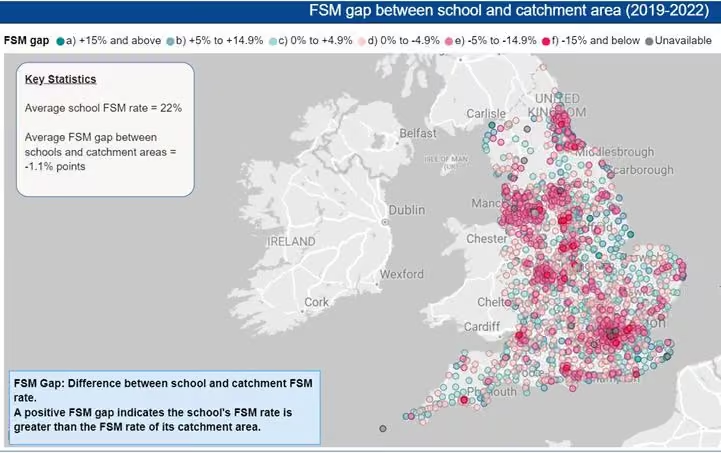
Talent is spread evenly across the country. Top A-level grades are not.
This year, an A or A* was 42% more common in London than in the North East or East Midlands.
In London, 32.7% of A-level grades were A or A*. In the North East, where I grew up, and the East Midlands, it was just 23.1%.
And when you look across England, an even clearer pattern emerges: London and the South East sit well ahead, with top-grade rates of 32.7% and 31.5%.
Then there’s a sharp drop to 27.9% in the East of England. Every other region falls between 23.1% and 27.9%, with results generally weaker in the North.
This obviously isn’t a map of where the most talented young people live. It’s a map of how differently that talent is being converted into attainment.
There’s no single explanation of course:
Poverty matters. Prior attainment matters. Access to schools and subjects matters. So does the support available outside school and the economic opportunities young people see around them.
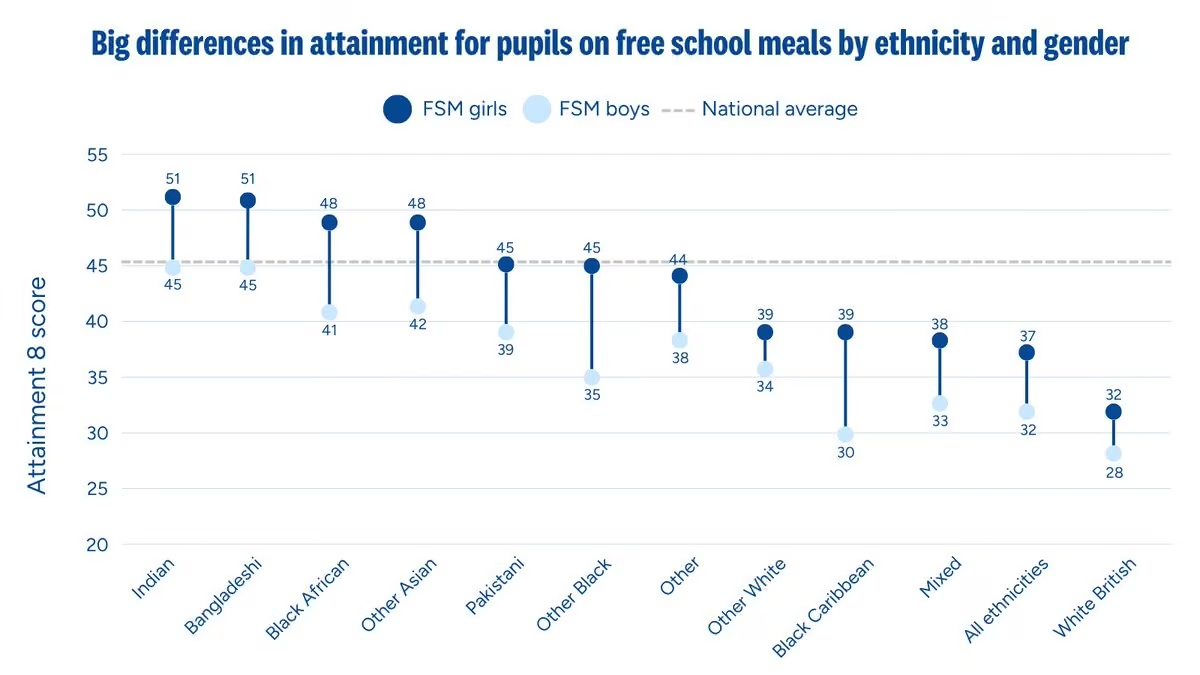
Demography matters too. Our recent @suttontrust Crossing Paths research found that London’s strong performance is partly driven by high attainment among ethnic-minority pupils, including disadvantaged ethnic-minority pupils. Whereas other regions have larger white working-class populations, currently the lowest-attaining major group.
London's success should be celebrated, and it's worth remembering that London schools weren’t always the success story they are today. A generation ago, educational outcomes in the capital were poor. They're now transformed.
Which means the huge regional differences we see today are neither inevitable nor immutable. The question now is why we haven’t managed to reproduce that progress for young people in the North and other parts of the country that continue to fall behind.
There isn't one easy answer of course. Closing these gaps means action on child poverty, early years education and teacher recruitment. But it also means being much more curious about why our education system works less well for particular communities, including white working-class young people.
A-level grades help determine who gets through the doors of our most selective universities, and from there into many of our most competitive careers.
A young person with the same underlying potential should not have dramatically different chances of accessing those opportunities because of where they happen to grow up.
Results day celebrates individual achievement. This map shows how much work remains to ensure that what a young person can achieve is not limited by where they grow up



 Alex Quigley
@AlexJQuigley



 Smart Thinking


 Higher Education Policy Institute


 Nick Harrison

 Shahnaz




 Jon Datta


 Social Mobility Commission


 Inside Your Ed


 Tes magazine


 Adam Boxer




 British Dyslexia Association


 Sean Harris FCCT


 COVID Social Mobility & Opportunities Study


 FutureMe

 Outreach North East

 Cambridge Sociology


 Mark Isherwood




 Carl Cullinane


 Cultural Learning Alliance


 Advancing Access


 Prof Michael Green FCCT


 Kids

 Disabled Children's Partnership
 Private Education Policy Forum
 Joanna Di-Bella
 Sky News
 Special Needs Jungle

 ASCL

 Lauren - QE Insights
 FE News
 The Association of Mental Health in Education

 Schools Week
 Geoff Barton


 The Social Mobility Foundation


 Basit Mahmood


 Ellen Broomé


 Culture Commons
 Civil Society
 PRWeek UK

 Times Higher Education

 ITV News Anglia


 Trinity MAT


 Social Mobility APPG


 Early Education and Childcare Coalition






 Imperial College London Outreach

 Wales Cancer Research Centre


 Department for Education