In the 18th and 19th centuries, body snatchers — known as “resurrection men” — proliferated as a response to a supply and demand problem.
Medical schools needed cadavers for student training, but the legal supply of executed criminals couldn’t keep pace.
🔗 Read the full opinion piece by Katherine O'Malley: undark.org/2026/10/30/body-snatchers-murky-whole-body-don…
Undark Magazine
Undark Magazine is a nonprofit online publication exploring science as a "frequently wondrous, sometimes contentious, and occasionally troubling byproduct of human culture." The name Undark is a deliberate reference to a radium-based luminous paint product called Undark that ultimately proved toxic, if not deadly for those who handled it. More on Wikipedia
-
Undark Magazine
@undarkmag

-
Undark Magazine
@undarkmag
What if the cruel voice in your head had a face?
Researchers in Denmark are testing virtual reality avatars that represent the internal voices experienced by some patients with eating disorders.
During therapy, patients confront the avatar while a clinician controls what it says.
The idea is gaining attention, even as researchers continue to ask how well it works.
🔗 Read the full story: undark.org/2026/10/30/avatar-deepfake-therapy/
#ai #virtualreality #technology #psychotherapy -
Undark Magazine
@undarkmag
The vagus nerve has become a wellness obsession online.
In medicine, researchers are asking a much bigger question: Can electrical signals in the nervous system be used to treat disease?
Undark spoke with neurosurgeon Kevin Tracey about the science behind that idea.
🔗: -
Undark Magazine
@undarkmag
What happens after someone donates their entire body to science?
Katherine O’Malley argues that the answer is less clear than many people might assume.
Whole-body donation in the U.S. operates without a single federal body overseeing the programs that receive and use donated remains.
🔗: undark.org/2026/10/30/body-snatchers-murky-whole-body-don… -
Undark Magazine
@undarkmag
Abandoned mines in Italy may offer clues to life on Mars.
Astrobiologist Luca Tonietti studies microbes living in dark, nutrient-poor, iron-rich environments that resemble conditions beneath the Martian surface.
Their survival strategies, and the traces they leave in rock, could help scientists know what to look for on the Red Planet.
📷 See the research through Andrea De Giovanni’s photographs. undark.org/2026/09/25/italy-extraterrestrial-life/ -
Undark Magazine
@undarkmag
Birds were once noise on weather radar. Now, that noise is data.
With machine learning, researchers can pull migrating birds out of radar images and watch movements that would be impossible to track one animal at a time.
🔗: undark.org/2026/10/30/aeroecology-bird-migration-ai/ -
Undark Magazine
@undarkmag
Schools are spending millions on AI systems designed to spot weapons.
Evidence that these tools actually prevent shootings remains thin, while false alarms can carry serious consequences for students.
🔗: undark.org/2026/02/13/as-more-schools-turn-to-ai-weapons-… -
Undark Magazine
@undarkmag
The search for alien life can begin surprisingly close to home.
Across Italy, scientists are studying some of Earth’s harshest environments to understand what life might look like on Mars or elsewhere in the universe.
🔗: undark.org/2026/09/25/italy-extraterrestrial-life/ -
Undark Magazine
@undarkmag
Science gets interesting when the answer refuses to settle down.
Entanglements: The Undark Podcast follows the questions that remain open even after the research has piled up.
Catch up on the latest conversations from Undark!
🔊 Available on Apple Podcasts, Spotify, Pandora, and SoundCloud.
🔗: undark.org/podcast/ -
Undark Magazine
@undarkmag
Undark’s November 2026 issue is here! 🗞️
Our cover story looks at life after cancer treatment, where being cancer-free can still leave survivors managing long-term health effects and a medical system that does not always know what comes next.
This month, Undark also explores how AI is changing migratory bird tracking, how virtual reality is entering difficult conversations in medicine, why engineers sometimes have to push things to the breaking point to keep people safe, and more.
🔎 See what’s inside the November issue: undark.org -
Undark Magazine
@undarkmag
Prediction markets have become increasingly visible in political coverage, especially after the 2024 election.
Their rise has fueled questions about whether they could eventually rival traditional polling.
Experts caution that the two tools measure fundamentally different things.
🔗 Learn more: undark.org/2026/05/05/prediction-markets-polling/ -
Undark Magazine
@undarkmag
Could a pig someday grow a human kidney or pancreas?
Scientists studying human-animal chimeras are working toward that possibility as roughly 100,000 people in the U.S. wait for organ transplants.
Researchers still face major biological obstacles before the idea could become a clinical reality.
Read the full story in Undark. undark.org/2026/09/25/brain-trust-human-animal-chimeras/ -
Undark Magazine
@undarkmag
The November issue of Undark is here.
Our cover story looks at the complicated reality of life after cancer, when being cancer-free can still mean years of medical consequences.
Across the rest of the issue, Undark follows the questions that surface when science meets the institutions and people expected to live with its effects.
🔬 Explore the November issue! undark.org -
Undark Magazine
@undarkmag
This weekend, most Americans will turn their clocks back an hour.
The ritual has survived decades of debate over whether we should keep changing the clocks at all.
What does the science say about how we mark time? 🕰️
🔗 Read more: undark.org/2024/03/11/time-zones-daylight-saving/ -
Undark Magazine
@undarkmag
Genomic databases hold an extraordinary amount of information. Some records, however, no longer carry enough context to show exactly where the data came from or how reliable they are.
As those archives become training material for AI, Jonathan Jacobs and Patrick Boyle argue that this old problem deserves new attention.
🔗: undark.org/2026/09/25/opinion-ai-biology-data-gap/ -
Undark Magazine
@undarkmag
Antonio Damasio argues that consciousness may have begun with something much more basic than abstract thought: the body’s need to stay alive.
In Natural Intelligence & the Logic of Consciousness, the neuroscientist traces consciousness back to homeostatic feelings and explores what that theory could mean for artificial intelligence.
Read Emily Cataneo’s review in Undark.
🔗: undark.org/2026/09/25/book-review-natural-intelligence/ -
Undark Magazine
@undarkmag
Sweden was once a frontrunner in digital education. Now, its schools are rethinking when technology actually helps students learn.
The shift has opened a broader debate over foundational skills and what evidence should guide classroom technology.
🔗 Read the full story: -
Undark Magazine
@undarkmag
Is AI truly intelligent?
Undark asked five experts in linguistics, computer science, cognitive science, and psychology.
Their answers differ sharply, beginning with disagreement over what the word “intelligence” should mean at all.
🔗: undark.org/2026/09/25/interview-artificial-intelligence/ -
Undark Magazine
@undarkmag
A poll says a candidate has 48% support, with a margin of error of ±3 points. How much uncertainty does that actually capture?
Less than many readers might assume.
As Americans head toward the 2026 midterm elections, we’re revisiting Michael Schulson’s 2020 look at the statistical shorthand that accompanies nearly every election poll, and the debate over whether it communicates uncertainty well at all.
🔗: undark.org/2020/11/23/polls-margin-of-error-gets-new-scru… -
Undark Magazine
@undarkmag
Human-animal chimera research is advancing unevenly across countries, with scientists still navigating biological barriers, funding restrictions, oversight, and ethical considerations.
Undark looks at where the science stands, and how far researchers think it could go.
🔗: -
Undark Magazine
@undarkmag
What exactly is the “self”?
In an excerpt from Alive: The Hidden Intelligence of the Living World, writer and natural philosopher Melanie Challenger starts with the roots of “consciousness,” once meaning “knowing with.”
She suggests consciousness may be understood as “knowledge of the knowledge of the body.”
All organisms, she writes, have some minimal knowledge of the body, while humans also appear able to discuss that knowledge with ourselves.
🔗: undark.org/2026/09/25/excerpt-challenger-alive/ -
Undark Magazine
@undarkmag
Human embryo research has long been shaped by the 14-day rule. Embryo models grown from stem cells can be studied longer.
Some scientists are now proposing a tiered system with later cutoffs tied to developmental milestones, including Days 28 and 56.
As the models become more complex, the debate over where to draw the line is getting harder to avoid.
Read Frieda Klotz’s story in Undark.
🔗: undark.org/2026/09/25/brain-trust-model-embryos/ -
Undark Magazine
@undarkmag
To search for life beyond Earth, scientists first study the strangest places on our own planet.
Across Italy, researchers are exploring Mars-like mines, growing cyanobacteria under simulated starlight, examining some of Earth’s oldest fossils, and sampling microbes in geothermal springs.
Andrea De Giovanni documents the work in a photo essay for Undark.
🔗: undark.org/2026/09/25/italy-extraterrestrial-life/ -
Undark Magazine
@undarkmag
The Ship of Theseus asks a deceptively simple question: If every plank of a ship is eventually replaced, is it still the same ship?
C. Brandon Ogbunu sees a version of that problem emerging in science as AI takes over more of the research process, one task at a time.
How much can be automated before something essential changes?
🔗: undark.org/2026/09/25/opinion-ai-ship-of-theseus/ -
Undark Magazine
@undarkmag
Human-animal chimeras could eventually help scientists grow organs for transplantation.
They also raise thornier questions: Could human cells end up in an animal’s brain? Could they become reproductive cells? What safeguards would be enough?
Scientists say they are working on ways to prevent those outcomes. Critics argue the technology could still be pushed much further.
Read Charles Schmidt’s report.
🔗: undark.org/2026/09/25/brain-trust-human-animal-chimeras/ -
Undark Magazine
@undarkmag
Stem cell-based embryo models can mimic some of the earliest stages of human development, giving scientists access to a period of pregnancy that is otherwise difficult to study.
Researchers hope the models could improve understanding of fertility, miscarriage, congenital anomalies, and maternal health.
Their growing sophistication is also raising new ethical questions.
🔗: undark.org/2026/09/25/brain-trust-model-embryos/ -
Undark Magazine
@undarkmag
Scientists have spent decades trying to build life from non-living parts.
SpudCell, a synthetic cell created by University of Minnesota researcher Kate Adamala, can feed, grow, divide, compete for food, and replicate its DNA.
Scientists still generally stop short of calling it fully alive.
Read Sarah Scoles’ story on the evolving quest to create life in a lab.
🔗: undark.org/2026/09/25/brain-trust-life-in-a-lab/ -
Undark Magazine
@undarkmag
If AI helped someone with a severe brain injury communicate, how would we know the technology was accurately conveying what they meant?
In this episode of Entanglements, Judy Illes and Joseph J. Fins explore the promise of AI-enabled neural implants, the risks of misinterpreting patients’ wishes, and the importance of preserving autonomy.
🎧 Listen on Apple Podcasts, Spotify, Pandora, or SoundCloud: undark.org/2026/09/25/podcast-neural-implants/ -
Undark Magazine
@undarkmag
Researchers in Japan report producing the first live-born human-animal chimeras: baby mice containing human cells integrated into their blood vessels and heart muscles.
The experiment is part of a broader effort to understand whether animals could someday grow human organs for transplantation.
Charles Schmidt reports on the science, its potential, and the questions surrounding it.
🔗: undark.org/2026/09/25/brain-trust-human-animal-chimeras/ -
Undark Magazine
@undarkmag
Destroying a satellite in war could reach far beyond the battlefield.
In “Lethal Autonomy,” Frank Kendall argues that the U.S. should prepare to attack adversaries’ satellites and rapidly replace or compensate for its own damaged cousins, pushing military conflict deeper into systems that civilian life also depends on. undark.org/2026/09/11/book-review-lethal-autonomy/ -
Undark Magazine
@undarkmag
What’s inside Undark’s October 2026 issue? 🧠
From brain organoids that can learn to the prospect of creating life from scratch, “Brain Trust: The Age of Artificial Intelligence(s)” explores the scientific advances challenging our understanding of life, consciousness, and intelligence.
Take a closer look at the science redefining what’s possible.
🔎 See what’s inside: undark.org/issue/october-2026/ -
Undark Magazine
@undarkmag
Undark’s October 2026 issue is here! 🧠
What happens when scientists begin to rethink the boundaries of life and intelligence?
“Brain Trust: The Age of Artificial Intelligence(s)” explores a different frontier of scientific discovery, from lab-grown brain organoids that can learn and animals engineered with human cells to the possibility of creating life from scratch.
Through original reporting and expert perspectives, we examine the science, the possibilities, and the ethical questions surrounding these developments.
🔎 Explore the full October issue: undark.org/issue/october-2026/
🖼️ Featuring cover artwork by Sam Falconer. -
Undark Magazine
@undarkmag
There’s more to this picture than we’re letting on. 👀
We’ve been working on something new at Undark, and this artwork by Sam Falconer offers a first glimpse of what’s to come.
We’ll be revealing the rest this Friday, September 25.
Any guesses? -
Undark Magazine
@undarkmag
A crumpled sheet of paper may seem ordinary.
To physicists, its creases hold difficult questions about matter, patterns, and the universe.
In “Lost in Curiosity,” Roberta Kwok follows scientists studying the mysteries hidden in everyday things. undark.org/2026/09/04/book-review-lost-in-curiosity/ -
Undark Magazine
@undarkmag
Picture a driverless military vehicle releasing a group of autonomous aircraft. The drones gather data, identify potential targets, and may eventually destroy them.
Frank Kendall’s “Lethal Autonomy” lays out this kind of battlefield in strikingly concrete detail.
🔗: -
Undark Magazine
@undarkmag
Frank Kendall asks a grimly practical question: If societies insist on resolving conflicts through violence, why keep sending people to kill one another?
“Lethal Autonomy” imagines machines taking over more of that work, with humans remaining accountable for what those systems do. undark.org/2026/09/11/book-review-lethal-autonomy/ -
Undark Magazine
@undarkmag
In Borneo, researchers studying the smooth guardian frog found behavior that complicated easy assumptions about male and female roles.
Female frogs call during mating, males may be caring for eggs, and Roberta Kwok follows the scientists trying to understand what that behavior means.
🔗: undark.org/2026/09/04/book-review-lost-in-curiosity/ -
Undark Magazine
@undarkmag
Transistors, lasers, PET scans, atomic clocks, GPS, neural networks, and quantum encryption all began as basic research.
David Kaiser argues that the new student visa policy risks forcing doctoral education into a timeline that does not match how scientific discovery actually works. undark.org/2026/08/27/opinion-student-visa-policy-science/ -
Undark Magazine
@undarkmag
Rowan Jacobsen does not tell readers to stop using sunscreen, and he does not dismiss skin cancer.
His argument in “In Defense of Sunlight” is more careful: People need a better relationship with the sun, one shaped by moderation rather than fear.
Lina Zeldovich reviews the book for Undark. undark.org/2026/08/28/book-review-in-defense-of-sunlight/ -
Undark Magazine
@undarkmag
If autonomous weapons could eventually identify targets more reliably than human soldiers, would giving machines more authority make war less dangerous?
Frank Kendall’s “Lethal Autonomy” takes that possibility seriously.
Sarah Scoles reviews his vision of crewless aircrafts and submarines, anti-satellite weapons, and a military increasingly designed to keep humans off the battlefield.
🔗: undark.org/2026/09/11/book-review-lethal-autonomy/ -
Undark Magazine
@undarkmag
U.S. measles cases have hit a 35-year high as vaccinations decline, according to Reuters’ reporting on CDC data.
In Undark’s 2019 story, one child with measles at a Massachusetts health center triggered a 72-hour effort to trace, contact, and protect 545 people who may have been exposed.
🔗: undark.org/2019/04/29/measles-containment-infection-outbr… -
Undark Magazine
@undarkmag
Helheim Glacier is about 65 miles inland, with no roads, buses, trains, or planes to the research site. Helicopter is the only way in or out.
In “Lost in Curiosity,” Roberta Kwok follows researchers trying to study how water flows beneath thick sheets of ice, where the first challenge is simply reaching the science. undark.org/2026/09/04/book-review-lost-in-curiosity/ -
Undark Magazine
@undarkmag
Sunlight has been treated as medicine, a symbol of glamour, and a carcinogen.
In “In Defense of Sunlight,” Rowan Jacobsen traces that history, from heliotherapy and UV lamps to tanning culture and sunscreen campaigns.
Lina Zeldovich reviews the book for Undark.
🔗: -
Undark Magazine
@undarkmag
In 2024, 58% of U.S. Ph.D. recipients in computer and information science pursued graduate studies on student visas.
In engineering, the figure was 51%.
David Kaiser argues that the new student visa policy could disproportionately affect fields tied to AI, quantum technologies, materials science, and other national priorities.
Read David Kaiser's full opinion piece in Undark.
🔗: undark.org/2026/08/27/opinion-student-visa-policy-science/ -
Undark Magazine
@undarkmag
A glacier expedition with no helicopter.
A frog mating mystery in Borneo.
A crumpled sheet of paper.
Roberta Kwok’s “Lost in Curiosity” follows science where it usually happens: far from the clean mythology of eureka moments.
Dan Falk reviews the book for Undark.
🔗: -
Undark Magazine
@undarkmag
Sunlight does more than help the body make vitamin D.
In “In Defense of Sunlight,” Rowan Jacobsen writes about compounds that exposure can trigger, including nitric oxide, melanin, cortisol, and endorphins.
Lina Zeldovich reviews the book’s case for a more nuanced view of sun exposure. undark.org/2026/08/28/book-review-in-defense-of-sunlight/ -
Undark Magazine
@undarkmag
A new student visa rule could force Ph.D. students into a federal extension process if their research takes more than four years.
David Kaiser writes that the change would move key decisions from academic advisers to USCIS, under criteria and procedures that remain unclear. -
Undark Magazine
@undarkmag
Sunscreen slogans have trained many of us to see sunlight as a hazard to manage: cover up, seek shade, reapply.
In “In Defense of Sunlight,” Rowan Jacobsen asks what gets lost when public health advice flattens a complicated relationship into a warning label.
Lina Zeldovich reviews the book for Undark.
🔗: undark.org/2026/08/28/book-review-in-defense-of-sunlight/ -
Undark Magazine
@undarkmag
Google CEO Sundar Pichai, IBM CEO Arvind Krishna, Moderna co-founder Noubar Afeyan, and Tesla CEO Elon Musk all entered the U.S. on student visas.
In Undark, David Kaiser argues that a new federal rule limiting international students to four years of study could make it harder for the U.S. to attract and retain the graduate talent that has long strengthened American research, universities, and industry.
Read David Kaiser's full essay in Undark.
🔗: undark.org/2026/08/27/opinion-student-visa-policy-science/ -
Undark Magazine
@undarkmag
A 2024 Undark story asked what happens when weapons gain decision-making power.
That question feels newly urgent after The New York Times reported that a Russian drone guided by an experimental AI system killed three civilians in Zaporizhzhia, Ukraine.
In “The Technology for Autonomous Weapons Exists. What Now?,” Sarah Scoles looks at autonomous and semi-autonomous weapons, the U.S. defense programs helping drive the technology, and the unresolved question at the center of it all: how much control should humans keep when algorithms enter the battlefield?
Read the full story in Undark.
🔗: undark.org/2024/11/26/unleashed-autonomous-weapons/ -
Undark Magazine
@undarkmag
How did vaccines become one of medicine’s most powerful tools, and one of its most contested?
As measles brings renewed attention to immunization, Undark’s limited-run newsletter Vaccines: Health & Perception digs into the history, science, policies, and public perceptions that have shaped vaccines across generations.
🔗 Subscribe for free: undark.org/newsletters/ -
Undark Magazine
@undarkmag
Sweden’s school reforms offer a sharper answer to the screen-time debate than “ban technology.”
Build the basics first.
As Joshua Cohen reported for Undark, the country is bringing back physical textbooks, handwriting, and more traditional learning materials, while still recognizing that digital competence matters, especially in later grades.
undark.org/2026/04/01/sweden-schools-books/ -
Undark Magazine
@undarkmag
The red wolf is one of the world’s rarest mammals.
In 1986, eight were brought to North Carolina as part of an effort to return the species to the East.
Their numbers rose for decades, then fell sharply after gunshot killings.
In “The Beasts of the East,” journalist Andrew Moore charts the tumultuous history of wildlife east of the Mississippi.
undark.org/2026/08/07/book-review-beasts-of-the-east/ -
Undark Magazine
@undarkmag
U.S. measles cases have hit a 35-year high as vaccinations decline, according to Reuters’ reporting on CDC data.
In Undark’s 2019 story, one child with measles at a Massachusetts health center triggered a 72-hour effort to trace, contact, and protect 545 people who may have been exposed.
🔗: undark.org/2019/04/29/measles-containment-infection-outbr… -
Undark Magazine
@undarkmag
The largest numbers in “Huge Numbers” do not come from physics.
They come from pure mathematics and computer science, including Graham’s number, busy beaver numbers, Rayo’s number, and Fish 7.
Even then, they are still finite.
undark.org/2026/05/15/book-review-huge-numbers/ -
Undark Magazine
@undarkmag
Kentucky’s elk comeback began on land remade by coal mining.
Former mountaintop removal sites created open grasslands where more than a thousand elk were reintroduced.
By 2009, about 10,000 elk were grazing there.
In “The Beasts of the East,” journalist Andrew Moore charts the tumultuous history of wildlife east of the Mississippi.
🔗: undark.org/2026/08/07/book-review-beasts-of-the-east/ -
Undark Magazine
@undarkmag
Why are Swedish schools bringing back books?
One reason: Researchers and officials are questioning whether screens moved into classrooms faster than the evidence supported.
Undark’s Joshua Cohen reported on Sweden’s back-to-basics shift, including major investments in physical textbooks, fiction and nonfiction books, handwriting, and plans for cellphone-free schools.
🔗: undark.org/2026/04/01/sweden-schools-books/ -
Undark Magazine
@undarkmag
In "The God Test," Robert Wright worries about humans giving up cognitive sovereignty to AI.
At the same time, he argues that AI companions might help people strengthen that very sovereignty, along with cognitive empathy and a more objective view of the world.
For reviewer Anil Ananthaswamy, the result is a curious dissonance: Wright sees AI as a destabilizing force, but also as a possible tool for avoiding the worst outcomes.
undark.org/2026/07/31/book-review-the-god-test/ -
Undark Magazine
@undarkmag
The more confidence workers had in generative AI, the less they reported relying on their own critical thinking.
For Undark, Ramin Skibba examined a growing body of research on how chatbot use may change the way people think, work, and learn.
🔗: undark.org/2025/09/12/critical-thinking-chatbots/ -
Undark Magazine
@undarkmag
Sweden is not getting rid of classroom technology. It's asking a more careful question: When does technology actually help students learn?
As Joshua Cohen reported for Undark, Swedish officials are reinvesting in print textbooks, handwriting, and cellphone-free schools after concerns about declining test scores, screen time, distraction, and weakened foundational skills.
The goal, researchers told Undark, is not reversal. It is recalibration.
undark.org/2026/04/01/sweden-schools-books/ -
Undark Magazine
@undarkmag
Vendors participating in the WISeR pilot can earn a share of what CMS calls “averted expenditures.”
Critics say that structure could create financial incentives to reject requests for care.
undark.org/2026/07/15/medicare-prior-authorization-ai/ -
Undark Magazine
@undarkmag
The latter part of The God Test argues that humanity is not entirely helpless in the face of AI.
Robert Wright says avoiding the worst outcomes will require people to move beyond tribalism and nationalism by developing stronger cognitive empathy, which he defines as understanding others’ points of view.
He also suggests AI models themselves could help provide that boost.
🔗: undark.org/2026/07/31/book-review-the-god-test/ -
Undark Magazine
@undarkmag
In the 1930s, only about two dozen nesting pairs of sandhill cranes remained in the Midwest.
Today, there are an estimated 90,000 eastern sandhill cranes, after hunters and animal rights groups helped push for federal protections.
Journalist Andrew Moore talks about this remarkable development in his new book, "The Beasts of the East."
undark.org/2026/08/07/book-review-beasts-of-the-east/ -
Undark Magazine
@undarkmag
FDA advisory committee members undergo extensive conflict-of-interest screening.
As the agency considers seven unapproved peptides, questions have emerged about voting members who work for companies offering peptide therapies and could benefit from looser restrictions. -
Undark Magazine
@undarkmag
The age of the universe is estimated at about 13.8 billion years. That may seem vast, but it is modest compared with the numbers Richard Elwes explores when discussing the universe’s far future.
In “Huge Numbers,” Elwes examines the heat death of the universe, a scenario involving figures so immense that, as he writes, the choice of units “hardly matters.”
Dan Falk reviews the book for Undark.
🔗: undark.org/2026/05/15/book-review-huge-numbers/ -
Undark Magazine
@undarkmag
Long before much of the eastern United States was cleared, drained, plowed, and settled, the region was home to elk, wolves, bison, salmon, cranes, and vast flocks of water-loving birds.
By the early 20th century, many had nearly vanished.
A new book asks what it takes to bring some of them back.
🔗: undark.org/2026/08/07/book-review-beasts-of-the-east/ -
Undark Magazine
@undarkmag
The federal WISeR pilot is using AI and human clinical review to evaluate certain services in original Medicare.
Critics warn that the program may cause delays, denials, and additional administrative work for health care providers.
🔗: undark.org/2026/07/15/medicare-prior-authorization-ai/ -
Undark Magazine
@undarkmag
After years of leaning heavily into digital learning, Sweden is reinvesting in print textbooks, handwriting, and other back-to-basics materials, especially for younger students.
The shift followed declining test scores and growing concerns about screen time, distraction, reduced deep reading, and whether classroom digitalization had moved faster than the evidence.
As Joshua Cohen reported for Undark, Sweden is not trying to remove technology from schools altogether. The goal is more careful sequencing: build foundational reading, writing, and numeracy skills first, then introduce digital tools when they help learning instead of getting in the way.
🔗: undark.org/2026/04/01/sweden-schools-books/ -
Undark Magazine
@undarkmag
In The God Test, Robert Wright describes our response to AI as falling along an “awe spectrum.”
At one end are fear and dread, including AI doomerism. At the other are the accelerationists, overwhelmed with fearless wonder about what comes next.
Wright’s argument is that AI may become powerful enough that indifference misses the scale of what is approaching.
undark.org/2026/07/31/book-review-the-god-test/ -
Undark Magazine
@undarkmag
Some women with metastatic breast cancer believed Avastin had helped them. Follow-up trials, however, did not confirm the benefit seen in earlier studies and raised concerns about serious harm.
Mikkael A. Sekeres recalls one of the most difficult FDA advisory votes of his career.
🔗: undark.org/2026/07/23/interview-mikkael-sekeres/ -
Undark Magazine
@undarkmag
Some enormous numbers are hiding in familiar objects.
A deck of cards can be shuffled in about 8 × 10⁶⁷ different ways. A Rubik’s Cube has about 43 quintillion possible arrangements, yet no arrangement is more than 20 moves away from any other.
In his review of “Huge Numbers,” Dan Falk follows Richard Elwes through a world where everyday objects become gateways to mind-boggling math.
undark.org/2026/05/15/book-review-huge-numbers/ -
Undark Magazine
@undarkmag
Prediction markets may generate useful forecasts in some cases, especially during uncertain events.
Their rise also raises thornier questions: Who is trading? What incentives shape the market? And what happens when people can wager on politics, war, and instability? -
Undark Magazine
@undarkmag
Pierre Teilhard de Chardin imagined the noosphere as a kind of planetary sphere of thought, made up of human minds aided by technology.
In "The God Test," Robert Wright argues that AI now has to be folded into that idea. Large language models, he writes, have absorbed vast stores of human knowledge, turning each AI into a “brain of brains.”
For Undark, Anil Ananthaswamy reviews Wright’s case for an AI-infused global brain.
🔗: undark.org/2026/07/31/book-review-the-god-test/ -
Undark Magazine
@undarkmag
Recent wildfires in Spain and France have shown how quickly smoke can become a public-health concern.
For Undark, Claudia López Lloreda reported on why wildfire smoke is straining U.S. air-quality monitoring, and how researchers are working to fill the gaps.
🔗: -
Undark Magazine
@undarkmag
As Molly Taft reported for WIRED and Undark, data centers use water mostly to cool hot computer equipment. But the amount depends on the location, the weather, the cooling system, and the electricity source.
A data center in a water-rich area may be less of a concern. A data center in a drought-stressed area can be a much bigger problem.
🔗: undark.org/2025/12/16/ai-data-centers-water/ -
Undark Magazine
@undarkmag
Recent wildfires in Spain and France have pushed smoke and particulate pollution back into public view. In southwest France, regional air-quality monitors reported higher particulate pollution linked to smoke from major fires.
Undark’s Nancy Averett reported on a related question: What happens when the monitors meant to measure pollution do not capture what people are actually breathing?
🔗: undark.org/2022/01/18/states-may-seek-to-hide-air-polluti… -
Undark Magazine
@undarkmag
A Commonwealth Fund survey found that roughly one in five working-age adults with private insurance said they or a family member were denied coverage for physician-recommended care in 2025.
Among those who experienced a prior authorization denial, 41 percent said it delayed care, and more than one-quarter said the health problem worsened.
undark.org/2026/07/15/medicare-prior-authorization-ai/ -
Undark Magazine
@undarkmag
As wildfires burn in Spain and France, smoke is again making particulate air pollution hard to ignore.
Undark’s “Breathtaking” series, produced with The Pulitzer Center on Crisis Reporting, examined PM2.5 across seven countries and five continents, from traffic and industry to brickmaking, wood heating, cooking fires, and wildfires.
The sources vary. The burden is global.
🔗: undark.org/breathtaking/ -
Undark Magazine
@undarkmag
A million sounds big. Jeremy Harper once counted out loud to a million, a task that took 89 days.
In “Huge Numbers,” mathematician Richard Elwes goes much further, from the number of atoms in the known universe to the possible arrangements of a Rubik’s Cube and the immense figures found in pure mathematics and computer science.
Dan Falk reviews the book for Undark.
🔗: undark.org/2026/05/15/book-review-huge-numbers/ -
Undark Magazine
@undarkmag
Prediction markets have been called “economic oracles” and promoted as complements to polling.
Experts interviewed by Undark are more cautious, pointing to questions around bias, regulation, manipulation, and whether these markets can replace rigorous public-opinion data.
🔗: -
Undark Magazine
@undarkmag
A drug’s risks cannot be evaluated in isolation.
The side effects that might be unacceptable for a wart treatment could be considered differently for a cancer drug, where the untreated disease poses a far greater danger.
Mikkael A. Sekeres explains how the FDA weighs safety against efficacy.
undark.org/2026/07/23/interview-mikkael-sekeres/ -
Undark Magazine
@undarkmag
From frog parents carrying tadpoles to elephant matriarchs guiding families, animal caregiving takes many forms.
Jennifer Weeks reviews Elizabeth Preston’s “The Creatures’ Guide to Caring,” a book about what humans share with other creatures built to care. -
Undark Magazine
@undarkmag
The FDA’s authority to require evidence that drugs are safe and effective was shaped by deadly failures in drug regulation.
In a new interview with Undark, clinical scientist Mikkael A. Sekeres traces how those tragedies changed the agency’s role. undark.org/2026/07/23/interview-mikkael-sekeres/ -
Undark Magazine
@undarkmag
The Trump administration is promoting ibogaine while proposing cuts to addiction treatment and mental health services, physician Zoe Adams writes.
In an Undark opinion essay, she argues that the embrace of a risky, under-studied psychedelic remedy is happening as support for proven addiction care remains fragile.
undark.org/2026/06/25/opinion-maha-ibogaine-addiction/ -
Undark Magazine
@undarkmag
For AI in biology, C. Brandon Ogbunu argues, any declaration should be built to change.
Biological knowledge shifts. AI systems shift. A responsible framework for the life sciences should be versioned, dated, revisited, and amended in the open.
undark.org/2026/07/02/opinion-biologists-leiden-declaration/ -
Undark Magazine
@undarkmag
The U.S. House has passed legislation that would make daylight saving time permanent. Scientists generally favor a different solution: permanent standard time, which better aligns human schedules with sunlight.
For Undark, Teresa Carr examined what research says about how we mark time.
🔗: undark.org/2024/03/11/time-zones-daylight-saving/ -
Undark Magazine
@undarkmag
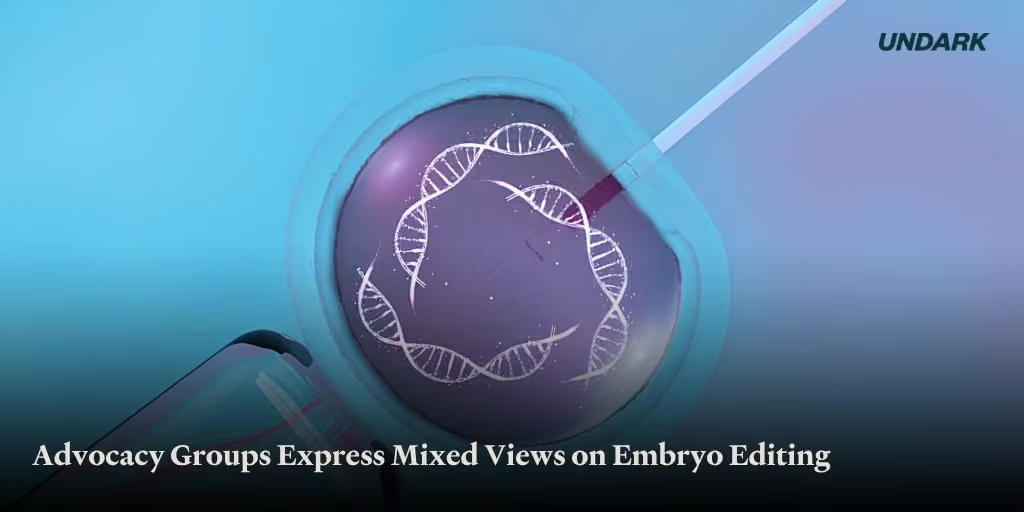
Startups are pushing toward embryo editing for inherited disease. Patient advocacy groups, however, have largely not funded research in the area or coordinated with companies aiming to take the technology mainstream.
For Undark, Ashley Smart reports on the mixed views inside the patient advocacy world.
undark.org/2026/06/24/embryo-editing-disease-advocacy/ -
Undark Magazine
@undarkmag
Some parents at risk of passing on genetic disorders already use IVF with preimplantation genetic testing to select embryos without certain mutations.
That existing option raises a hard question for embryo editing: How great is the need?
Ashley Smart examines the debate.
🔗: -
Undark Magazine
@undarkmag
AI could help speed up prior authorization by processing clearly allowable claims more efficiently.
But physicians and patient advocates worry that the technology could also increase wrongful denials of health insurance coverage.
🔗: undark.org/2026/07/15/medicare-prior-authorization-ai/ -
Undark Magazine
@undarkmag
Polls register public opinion at a particular moment. Prediction markets track wagers on what traders think will happen.
In Undark, Ramin Skibba examines why experts warn against treating one as a substitute for the other. undark.org/2026/05/05/prediction-markets-polling/ -
Undark Magazine
@undarkmag
As Canadian wildfire smoke affects parts of the Midwest and Northeast, the U.S. air-quality monitoring system faces a growing challenge: Smoke can travel vast distances and reach places with little local monitoring.
For Undark, Claudia López Lloreda reported on how researchers are working to fill those gaps.
🔗: undark.org/2025/07/04/wildfires-aqi-infrastructure/ -
Undark Magazine
@undarkmag
As Canadian wildfire smoke spreads across parts of the Midwest and Northeast, fine particulate matter is once again shaping the air millions of people breathe.
Undark’s “Breathtaking” project examined the toll of particulate pollution in seven countries across five continents, along with the policies, resources, and political choices that determine who is protected from it.
🔗: undark.org/breathtaking/ -
Undark Magazine
@undarkmag
As Canadian wildfire smoke affects air quality across parts of the Midwest and Northeast, people are once again relying on monitoring data to understand what they are breathing.
Yet ground monitors may not capture the full picture, especially at the neighborhood level.
Undark’s Nancy Averett reported on concerns that the U.S. has too few monitors, that some may sit outside pollution hotspots, and that intermittent monitoring can leave serious gaps in the data.
🔗: undark.org/2022/01/18/states-may-seek-to-hide-air-polluti… -
Undark Magazine
@undarkmag
Caregiving is not only a human story.
In her review of “The Creatures’ Guide to Caring,” Jennifer Weeks writes about Elizabeth Preston’s look at animal parents, alloparents, and the communal systems that help young survive.
🔗: undark.org/2026/06/26/book-review-creatures-guide-to-caring/ -
Undark Magazine
@undarkmag
C. Brandon Ogbunu writes that biologists should disclose their use of automated tools, remain responsible for their findings, and keep credit and accountability with people rather than systems.
His Undark opinion essay makes the case for biology’s own AI declaration.
🔗: -
Undark Magazine
@undarkmag
A growing anti-sunscreen movement points to questions about sunscreen ingredients and the health benefits of sunlight.
The evidence is more complicated.
In Undark, Joshua Cohen reports on what research says about UV exposure, skin cancer risk, sunscreen absorption, mineral sunscreens, and safer ways to balance sun exposure.
🔗: undark.org/2025/10/13/anti-sunscreen-movement/ -
Undark Magazine
@undarkmag
Ibogaine is not an opioid. For patients with opioid use disorder, Zoe Adams writes, that matters.
Methadone and buprenorphine can help protect patients from overdose if they relapse. Ibogaine does not offer that protection, and its risks include cardiac toxicity, severe disorientation, and psychosis.
🔗: undark.org/2026/06/25/opinion-maha-ibogaine-addiction/ -
Undark Magazine
@undarkmag
Prediction markets drew attention after the 2024 presidential election, when Polymarket appeared to anticipate a Trump win more clearly than many public polling forecasts.
That does not make them a replacement for polling.
For Undark, Ramin Skibba looks at why prediction markets and polls measure fundamentally different things.
🔗: undark.org/2026/05/05/prediction-markets-polling/ -
Undark Magazine
@undarkmag
A mathematical proof can be checked against a fixed standard.
Biology is messier. Findings can depend on genetic background, species, environment, or whether something happens in a dish, a mouse, a primate, or a patient.
C. Brandon Ogbunu writes on AI and biology for Undark. -
Undark Magazine
@undarkmag
Before “evidence-based” became a familiar phrase, some researchers were already asking why accepted practice did not match what they saw in the real world.
In “Beyond Belief,” Helen Pearson traces the people who helped move medicine, policing, and other fields toward data-driven decisions.
Read Esther Landhuis’ review.
🔗: undark.org/2026/05/22/book-review-beyond-belief/ -
Undark Magazine
@undarkmag
Each day, more than 300,000 cars move through Liberty Canyon. Soon, cougars and other wildlife may have a safe way across.
An excerpt from Ryan Huling’s “The Hidden Nations of Animals” explores the Wallis Annenberg Wildlife Crossing, a vegetated bridge over California’s 101 freeway.
Read the excerpt.
🔗: undark.org/2026/06/12/california-wildlife-crossing/ -
Undark Magazine
@undarkmag
Our cells do not all follow the same script.
In “Beyond Inheritance,” Roxanne Khamsi explores somatic mutations: DNA changes that arise over a lifetime and can give some cells advantages over others.
In our review, Lina Zeldovich looks at what these cellular changes may mean for health, disease, and the future of medicine.
Read the review.
🔗: undark.org/2026/05/29/book-review-beyond-inheritance/ -
Undark Magazine
@undarkmag
Could more screening turn mainly healthy people into patients?
For Undark, Joshua Cohen examines the promise and uncertainty around liquid biopsies designed to detect multiple cancers from a single blood draw or body fluid sample.
🔗: undark.org/2026/06/08/liquid-biopsies-cancer/ -
Undark Magazine
@undarkmag
BPC-157 has drawn interest from bodybuilders, biohackers, patients, and the MAHA movement.
In Undark, Sara Talpos looks at the peptide’s long research history, its current regulatory questions, and why some researchers continue to point to the limited published human data behind its claims.
Read the full story. undark.org/2026/05/29/stress-test-bpc-157-history/ -
Undark Magazine
@undarkmag
A wearable signal should be more than a notification.
OPINION: Shree Nadkarni argues that as consumer health trackers enter the clinic, their data must be accurate, interpretable, private, and useful enough to guide care.
Read the essay.
🔗: undark.org/2026/06/16/opinion-wearable-health-tracker-data/ -
Undark Magazine
@undarkmag
In “The Creatures’ Guide to Caring,” Elizabeth Preston looks at caregiving far beyond the human nursery.
Jennifer Weeks’ review follows the book through frogs, birds, elephants, orcas, and spiders, tracing how animals feed, protect, and raise their young.
undark.org/2026/06/26/book-review-creatures-guide-to-caring/ -
Undark Magazine
@undarkmag
OPINION: C. Brandon Ogbunu argues that science should be protected from outside attacks while also being willing to examine its own risk-averse systems.
For him, improving science means testing alternatives to processes that can leave people out, stifle innovation, and preserve existing gates.
Read the essay.
🔗: undark.org/2026/06/04/opinion-risk-aversion-innovation/ -
Undark Magazine
@undarkmag
As a physician who practices addiction medicine, Zoe Adams supports rescheduling ibogaine under the Controlled Substances Act to facilitate research.
What worries her is something else: a political push to get the drug to patients without rigorous evidence of safety, while treatments such as methadone and buprenorphine remain difficult to access.
undark.org/2026/06/25/opinion-maha-ibogaine-addiction/ -
Undark Magazine
@undarkmag
Editing DNA in embryos could, in theory, correct a harmful mutation not only for a future child, but for future generations.
That possibility is exactly what makes the technology so contested.
Ashley Smart reports for Undark. undark.org/2026/06/24/embryo-editing-disease-advocacy/ -
Undark Magazine
@undarkmag
Roughly two-thirds of pregnancy-related deaths occur between one day postpartum and the first year after birth, yet structured care during that period is often minimal or absent.
OPINION: Casey Keen argues that postpartum care should be aligned with recovery, not a single six-week appointment.
Read the essay.
🔗: undark.org/2026/05/28/opinion-postpartum-checkup-too-late/ -
Undark Magazine
@undarkmag
Peptides such as MOTS-c and TB-500 have remained popular, even as the FDA has said they should not be used by compounding pharmacies due to safety concerns.
In Undark, California legislator Joe Patterson discusses his bill calling for a peptide-related working group.
Read the interview.
🔗: undark.org/2026/06/19/interview-joe-patterson-peptides/ -
Undark Magazine
@undarkmag
Roughly two-thirds of pregnancy-related deaths occur after the first day postpartum and within the first year after birth.
OPINION: Casey Keen argues that a single six-week checkup reflects institutional priorities more than maternal recovery.
Read the essay.
🔗: -
Undark Magazine
@undarkmag
Your cells are changing as you read this.
In “Beyond Inheritance,” Roxanne Khamsi explores somatic mutations: DNA errors that arise throughout life, sometimes driving disease, and sometimes helping the body self-correct.
Read the review.
🔗: undark.org/2026/05/29/book-review-beyond-inheritance/ -
Undark Magazine
@undarkmag
Mathematicians have issued the Leiden Declaration on Artificial Intelligence and Mathematics.
In an Undark opinion essay, computational biologist C. Brandon Ogbunu argues that biology needs its own version, shaped around the field’s noisy data, shifting knowledge, and living consequences.
🔗: undark.org/2026/07/02/opinion-biologists-leiden-declaration/ -
Undark Magazine
@undarkmag
Heart rate, glucose patterns, sleep cycles: Consumer wearables are collecting more health data than ever.
OPINION: Shree Nadkarni argues that as these signals move closer to clinical care, medicine needs clearer standards for validation, privacy, and accountability.
Read the essay.
🔗: undark.org/2026/06/16/opinion-wearable-health-tracker-data/ -
Undark Magazine
@undarkmag
California legislator Joe Patterson wants the state to study and make recommendations on certain peptides.
Undark speaks to Patterson about his proposed working group, his view of peptide access, and the safety concerns raised by researchers and physicians.
Read the interview.
🔗: undark.org/2026/06/19/interview-joe-patterson-peptides/ -
Undark Magazine
@undarkmag
Multi-cancer early detection tests are already commercially available in the U.S. with a prescription, despite lacking FDA approval.
Supporters point to earlier detection. Critics warn of false positives, overdiagnosis, unnecessary procedures, and uncertainty around whether the tests save lives.
Read Joshua Cohen’s report.
🔗: undark.org/2026/06/08/liquid-biopsies-cancer/ -
Undark Magazine
@undarkmag
For decades, the 101 has carved through Liberty Canyon, turning habitat into islands. A new vegetated crossing may soon give cougars and other wildlife a way back across the divide.
An excerpt from Ryan Huling’s “The Hidden Nations of Animals” looks at the Wallis Annenberg Wildlife Crossing and the effort to reconnect a fractured landscape.
Read the excerpt.
🔗: undark.org/2026/06/12/california-wildlife-crossing/ -
Undark Magazine
@undarkmag
OPINION: Defending science from anti-science attacks does not require defending every part of the scientific system as it exists.
In his essay, C. Brandon Ogbunu argues that risk aversion in science can preserve flawed systems, stifle innovation, and keep better models at the margins.
Read the essay.
🔗: undark.org/2026/06/04/opinion-risk-aversion-innovation/ -
Undark Magazine
@undarkmag
What happens when expert opinion and common practice conflict with real-life observations?
In “Beyond Belief,” Helen Pearson profiles figures who helped push medicine, policing, and other fields toward evidence-based thinking.
Read Esther Landhuis’ review.
🔗: -
Undark Magazine
@undarkmag
What can frogs, elephants, orcas, spiders, and birds teach humans about caregiving?
In “The Creatures’ Guide to Caring,” science journalist Elizabeth Preston looks across the animal kingdom to explore how care works, who provides it, and why humans were built to share it.
Jennifer Weeks reviews for Undark.
undark.org/2026/06/26/book-review-creatures-guide-to-caring/ -
Undark Magazine
@undarkmag
Croatian scientist Predrag Sikiric has spent decades studying BPC-157, a peptide now popular on the gray market and within the MAHA movement.
But, as US Health Secretary RFK Jr. pushes to expand access to unapproved peptides, researchers are raising questions about the limited published human data behind BPC-157’s claims.
Read the full story.
🔗: undark.org/2026/05/29/stress-test-bpc-157-history/ -
Undark Magazine
@undarkmag
Before radio astronomy had a name, Karl Jansky was trying to clean up transatlantic phone calls.
The source of one persistent hiss turned out to be the sky, toward Sagittarius.
Read our review of Emma Chapman’s “The Echoing Universe.”
🔗: undark.org/2026/06/05/book-review-echoing-universe/ -
Undark Magazine
@undarkmag
A hiss in a telephone system helped open a new way of seeing the universe.
In “The Echoing Universe,” Emma Chapman begins with Karl Jansky’s discovery that radio waves were coming from the center of the Milky Way.
🔗: undark.org/2026/06/05/book-review-echoing-universe/ -
Undark Magazine
@undarkmag
Wearables can give patients a window into their own physiology, but more data does not automatically mean better care.
OPINION: Shree Nadkarni writes on the standards needed as consumer health trackers move toward preventive medicine.
Read the essay.
🔗: -
Undark Magazine
@undarkmag
BPC-157 has drawn interest from bodybuilders, biohackers, patients, and the MAHA movement.
In Undark, Sara Talpos looks at the peptide’s long research history, its current regulatory questions, and why some researchers continue to point to the limited published human data behind its claims.
Read the full story.
🔗: undark.org/2026/05/29/stress-test-bpc-157-history/ -
Undark Magazine
@undarkmag
Ibogaine is illegal in the U.S., risky even under close monitoring, and has no published large-scale clinical trials on its impact on substance use.
In an Undark opinion essay, addiction medicine physician Zoe Adams writes that the MAHA movement’s embrace of the drug as an addiction treatment is occurring before extensive evidence is available.
🔗: undark.org/2026/06/25/opinion-maha-ibogaine-addiction/ -
Undark Magazine
@undarkmag
Should Americans have access to therapies that have not been fully vetted?
In an interview with Undark, California legislator Joe Patterson discusses his bill to create a peptide-related working group, as researchers and regulators continue to debate access to certain unapproved peptides.
Read the interview.
🔗: undark.org/2026/06/19/interview-joe-patterson-peptides/ -
Undark Magazine
@undarkmag
As tick season picks up, the lone star tick is bringing more than bites.
The arachnid has been expanding northward and has been linked to alpha-gal syndrome, ehrlichiosis, Heartland virus, and Bourbon virus.
Revisit Rene Ebersole’s report on the tick’s spread and the disease threats moving with it.
🔗: undark.org/2024/02/05/lone-star-tick/ -
Undark Magazine
@undarkmag
Roughly two-thirds of pregnancy-related deaths occur between one day postpartum and the first year after birth. Yet, structured care during that period is often minimal or absent.
OPINION: Casey Keen argues that the six-week postpartum checkup comes too late.
Read the essay.
🔗: undark.org/2026/05/28/opinion-postpartum-checkup-too-late/ -
Undark Magazine
@undarkmag
Before “evidence-based” became a familiar phrase, some researchers were already asking why accepted practice did not match what they saw in the real world.
In “Beyond Belief,” Helen Pearson traces the people who helped move medicine, policing, and other fields toward data-driven decisions.
Read Esther Landhuis’ review.
🔗: undark.org/2026/05/22/book-review-beyond-belief/ -
Undark Magazine
@undarkmag
Embryo editing advocates say the technology could help parents avoid passing on severe genetic disorders.
Patient advocacy groups are more divided. Some see future promise. Others point to existing reproductive options, ethical concerns, and the urgent needs of people living with disease today.
Follow the debate in Undark.
🔗: undark.org/2026/06/24/embryo-editing-disease-advocacy/ -
Undark Magazine
@undarkmag
A single blood draw that could screen for many cancers has obvious appeal.
The evidence is less settled. Some experts say multi-cancer early detection tests may not yet be sensitive enough for routine use in mostly healthy people.
Joshua Cohen reports for Undark.
🔗: -
Undark Magazine
@undarkmag
Inside the body, evolution is not only happening across generations. It is happening cell by cell.
In our review of Roxanne Khamsi’s “Beyond Inheritance,” Lina Zeldovich considers how somatic mutations can contribute to disease, and how, in rare cases, the body may mutate “back to normal.”
Read the review.
🔗: undark.org/2026/05/29/book-review-beyond-inheritance/ -
Undark Magazine
@undarkmag
More than 300,000 cars pass through Liberty Canyon each day. Soon, cougars and other animals may have a way across.
An excerpt from Ryan Huling’s “The Hidden Nations of Animals” looks at the Wallis Annenberg Wildlife Crossing, a vegetated bridge over California’s 101 freeway.
Read the excerpt.
🔗: undark.org/2026/06/12/california-wildlife-crossing/ -
Undark Magazine
@undarkmag
OPINION: C. Brandon Ogbunu argues that science can be defended from outside attacks while still confronting the internal flaws that have long shaped how research is funded, evaluated, and rewarded.
Read the essay.
🔗: undark.org/2026/06/04/opinion-risk-aversion-innovation/ -
Undark Magazine
@undarkmag
Roughly two-thirds of pregnancy-related deaths occur between one day postpartum and the first year after birth, during a period when structured care is often minimal or absent.
OPINION: Casey Keen argues that the standard six-week postpartum checkup does not match the real timeline of maternal recovery.
Read the essay.
🔗: undark.org/2026/05/28/opinion-postpartum-checkup-too-late/ -
Undark Magazine
@undarkmag
INTERVIEW: California legislator Joe Patterson has introduced a bill that would require the state health department to establish a working group on certain peptides.
Undark speaks with Patterson about access, research, and the debate over unapproved peptides.
Read the interview.
🔗: undark.org/2026/06/19/interview-joe-patterson-peptides/ -
Undark Magazine
@undarkmag
Karl Jansky was asked to solve a problem with Bell Labs’ transatlantic phone system: static.
One persistent hiss led him not to faulty equipment, but to the sky.
In our review of Emma Chapman’s “The Echoing Universe,” Sarah Scoles looks at radio astronomy and the invisible cosmos it helps reveal.
🔗: undark.org/2026/06/05/book-review-echoing-universe/ -
Undark Magazine
@undarkmag
OPINION: Science must be defended against anti-science attacks. However, that does not mean that the scientific process was healthy before 2025.
In his essay, C. Brandon Ogbunu argues that scientific risk aversion can preserve flawed systems, stifle innovation, and keep better models at the margins.
Read the essay.
🔗: undark.org/2026/06/04/opinion-risk-aversion-innovation/ -
Undark Magazine
@undarkmag
As the NBA season ends, one question follows its stars into the offseason: How can elite players stay healthy for the long run?
Undark’s Sara Talpos looks at the science of basketball injuries, from biomechanics and load management to the unusual training designed to help players like Victor Wembanyama stay on the court.
Read the story.
🔗: undark.org/2024/02/07/basketball-injuries/ -
Undark Magazine
@undarkmag
Wearable health trackers are moving from consumer wellness toward preventive care.
OPINION: Shree Nadkarni argues that as these devices generate more health data, medicine needs better standards for validation, privacy, interpretability, and clinical accountability.
Read the essay.
🔗: undark.org/2026/06/16/opinion-wearable-health-tracker-data/ -
Undark Magazine
@undarkmag
What happens when expert opinion and common practice conflict with real-life observations?
In “Beyond Belief,” Helen Pearson profiles figures who helped push medicine, policing, and other fields toward evidence-based thinking.
Read Esther Landhuis’ review.
🔗: -
Undark Magazine
@undarkmag
Your body replaces some 330 billion cells each day. Each replacement is another chance for DNA copying errors to take hold.
In our review of Roxanne Khamsi’s “Beyond Inheritance,” Lina Zeldovich looks at somatic mutations, the cellular changes that can shape disease, health, and the body’s surprising capacity to self-correct.
Read the review.
🔗: undark.org/2026/05/29/book-review-beyond-inheritance/ -
Undark Magazine
@undarkmag
Croatian scientist Predrag Sikiric has spent decades studying BPC-157, a peptide now popular on the gray market and within the MAHA movement. But, as US Health Secretary RFK Jr. pushes to expand access to unapproved peptides, researchers are raising questions about the limited published human data behind BPC-157’s claims.
Read the full story.
🔗: undark.org/2026/05/29/stress-test-bpc-157-history/ -
Undark Magazine
@undarkmag
In Liberty Canyon, the problem is not just traffic. It is what traffic has cut off: animals, territory, and the genetic future of Southern California’s mountain lions.
An excerpt from Ryan Huling’s “The Hidden Nations of Animals” examines the Wallis Annenberg Wildlife Crossing, a bridge designed for wildlife over California’s 101 freeway.
Read the excerpt.
🔗: undark.org/2026/06/12/california-wildlife-crossing/ -
Undark Magazine
@undarkmag
In 1928, Bell Telephone Laboratories asked Karl Jansky to investigate the static interfering with its transatlantic phone system.
After more than a year of work, Jansky traced one persistent hiss to the sky, toward Sagittarius, where the center of the Milky Way sits.
In our review of Emma Chapman’s “The Echoing Universe,” Sarah Scoles looks at how radio astronomy has helped reveal parts of the universe that visible light cannot.
Read the review.
🔗: undark.org/2026/06/05/book-review-echoing-universe/ -
Undark Magazine
@undarkmag
Some experts say the tests, which can spot multiple kinds of cancer, aren’t yet sensitive enough to be widely used.
undark.org/2026/06/08/liquid-biopsies-cancer/ -
Undark Magazine
@undarkmag
In January 1967, 14-month-old Ross Otto Hambrick and 16-month-old Victor King died at a hospital in Washington, D.C. Both were part of a clinical trial on an experimental RSV vaccine, and almost all of the participants in that arm of the trial, including Ross Otto and Victor, were from working-class Black families.
undark.org/2023/10/09/rsv-vaccine-children-trials/Post not available here, view on X
Undark Magazine
@undarkmag
Those safer vaccines received regulatory approval in 2023. But the boys' story had never been told — and members of their own families had no idea their children had become the subject of global scientific attention.
Undark Magazine
@undarkmag
An Undark investigation in 2023 helped uncover some of that history. Now, the families have filed suit against the U.S. government, with representation from Ben Crump and other civil rights lawyers.
You can read the suit here, and listen to the press conference at this link: undark.org/wp-content/uploads/2026/06/Hambrick_Crump_Pres…. -
Undark Magazine
@undarkmag
The International Rescue Committee has been testing AI chatbots through its Signpost platform, which gives displaced people practical information in multiple languages, the Associated Press reported. More sensitive questions are referred to the human staff.
-
Undark Magazine
@undarkmag
A 2024 analysis commissioned by AARP estimated 3.2 million Medicare Part D enrollees would benefit from the $2,000 cap in 2025, saving an average of $1,500.
undark.org/2026/04/29/drug-costs-2022-law/ -
Undark Magazine
@undarkmag
Our committee has no statutory authority with respect to vaccines or vaccine policy," Sylvia Fogel, the new chair of the Interagency Autism Coordinating Committee, tells Sara Talpos.
undark.org/2026/03/19/interview-sylvia-fogel-autism/ -
Undark Magazine
@undarkmag
In Northern England, 75 percent of those convicted of offenses related to raptor persecution since 2009 have been connected with the bird-shooting industry, Scott Weidensaul writes 68 percent of them are gamekeepers.
undark.org/2026/05/01/book-review-return-of-the-oystercat… -
Undark Magazine
@undarkmag
In 2024, 178 large whales washed up on United States shores, many already dead. Since 2014, potassium chloride has been used to euthanize more than 30 large whales in the U.S. undark.org/2026/04/27/whale-euthanasia/
-
Undark Magazine
@undarkmag
Since President Donald Trump returned to office, more than a dozen Title X grantees have had grants frozen, forcing some health centers to stop services, lay off staff, or close.
undark.org/2026/04/28/birth-rates-title-x/ -
Undark Magazine
@undarkmag
"A world that works for birds, in all their complexity of movement and ecological need, will work for everything else, including people," writes Scott Weidensaul in his new book on bird conservation.
undark.org/2026/05/01/book-review-return-of-the-oystercat… -
Undark Magazine
@undarkmag
"I basically threw everything and the kitchen sink at it," veterinarian Craig Harms said of his 2009 attempt to euthanize a North Atlantic right whale. The experience pushed him to develop a new method. undark.org/2026/04/27/whale-euthanasia/
-
Undark Magazine
@undarkmag
In Jordan, aid distribution has relied in part on the Vulnerability Assessment Framework, which ranks households by factors like income, debt, health, and caregiving. It is not AI, but it is the kind of structured system AI tools are now entering.
undark.org/2026/04/30/opinion-ai-humanitarian-decisions/ -
Undark Magazine
@undarkmag
It took more than 30 years after early evidence of harm before the FDA's revocation of partially hydrogenated vegetable oil's GRAS status fully took effect in 2023, Jennifer Pomeranz notes.
undark.org/2026/04/24/interview-jennifer-pomeranz/ -
Undark Magazine
@undarkmag
CDC data indicate that profound autism cases involving nonverbal or minimally verbal individuals needing 24/7 care, roughly doubled from 2000 to 2016, accounting for 26 percent of autism cases, says new IACC chair Sylvia Fogel.
undark.org/2026/03/19/interview-sylvia-fogel-autism/ -
Undark Magazine
@undarkmag
📲🗞️Get the latest insights on science and society from Undark, now on @AppleNews.
Click the link to follow and never miss a story:
apple.news/TefVi86SeSkOJPBpjQ6XVCw -
Undark Magazine
@undarkmag
Charles Darwin had no formal training in natural history — only incomplete studies in medicine and theology. C. Brandon Ogbunu asks what that model of curiosity means for science in 2026. undark.org/2026/04/23/opinion-teaching-darwin/
-
Undark Magazine
@undarkmag
Survey data from 2022 showed that approximately 20 percent of people 65 and older reported cost-related medication nonadherence. Nonadherence accounted for more than 11 percent of Medicare recipient hospital admissions.
undark.org/2026/04/29/drug-costs-2022-law/ -
Undark Magazine
@undarkmag
Satellite radar mapping of 40 major river deltas by Leonard Ohenhen of the University of California, Irvine, found subsidence rates exceed local sea level rise in 18 cases, in some, by tenfold.
undark.org/2026/04/22/sea-level-land-subsidence/ -
Undark Magazine
@undarkmag
Demographer Alison Gemmill of the University of California, Los Angeles says falling U.S. birth rates are largely timing-related: "Childbearing is increasingly delayed as part of a broader shift toward later adult milestones."
undark.org/2026/04/28/birth-rates-title-x/ -
Undark Magazine
@undarkmag
A 2017 lawsuit surfaced documents suggesting Monsanto scientists "substantially drafted" a 2000 glyphosate safety paper. Bayer says the involvement "did not rise to the level of authorship" and "was appropriately disclosed." undark.org/2026/04/20/interview-christopher-borgert-glyph…
-
Undark Magazine
@undarkmag
Beached whales can take days to die. Without the sea's support, they go into shock and slowly suffocate under their own weight, as gravity breaks ribs and crushes internal organs. undark.org/2026/04/27/whale-euthanasia/
-
Undark Magazine
@undarkmag
Project Puffin, launched in 1973 on Eastern Egg Rock off the Maine coast, restored Atlantic puffins wiped out by hunting a century earlier. As of 2024, about 1,500 pairs nest on Maine islands protected or restored by conservation groups.
undark.org/2026/05/01/book-review-return-of-the-oystercat… -
Undark Magazine
@undarkmag
Since 2023, some scientists, including former collaborators, have published papers arguing Simard strayed into exaggeration and anthropomorphism. Her new book addresses those criticisms directly. undark.org/2026/04/17/review-when-the-forest-breathes/
-
Undark Magazine
@undarkmag
Food companies can self-determine that an ingredient is "generally recognized as safe" using their own unpublished studies, then market it without notifying the FDA or releasing their data publicly.
undark.org/2026/04/24/interview-jennifer-pomeranz/ -
Undark Magazine
@undarkmag
A 2015 study in JAMA Pediatrics found diagnostic changes explained 60 percent of autism cases in a Danish dataset, leaving 40 percent unaccounted for, Sylvia Fogel notes in a new interview.
undark.org/2026/03/19/interview-sylvia-fogel-autism/ -
Undark Magazine
@undarkmag
Traction alopecia, caused by tight hairstyles like cornrows, is common among women of African descent. An opinion essay argues that diagnosing it without cultural context can inadvertently blame patients for their own hair traditions.
undark.org/2026/04/16/opinion-black-hair-health/ -
Undark Magazine
@undarkmag
C. Brandon Ogbunu on modern science: today's incentive structure has turned many researchers into "human large-language models" — a far cry from Charles Darwin's view of science as "a conversation between humans and nature." undark.org/2026/04/23/opinion-teaching-darwin/
-
Undark Magazine
@undarkmag
The United Nations High Commissioner for Refugees recently released an AI strategy covering refugee status determination, interview transcription, multilingual service access, and analysis of community feedback, writes researcher Mona Hedaya.
undark.org/2026/04/30/opinion-ai-humanitarian-decisions/ -
Undark Magazine
@undarkmag
Food and Drug Administration reviewers flagged studies originally used to approve oral phenylephrine as "too good to be real" and "highly problematic." The allegations of fraud remain unproven. undark.org/2026/04/15/sudafed-phenylephrine-debate/
-
Undark Magazine
@undarkmag
About 80 million people live on coastal land below sea level today, nearly twice earlier estimates, according to a Wageningen University & Research analysis of 385 tidal gauge cases.
undark.org/2026/04/22/sea-level-land-subsidence/ -
Undark Magazine
@undarkmag
Before 2024, some Medicare recipients on high-cost cancer drugs paid more than $10,000 a year for their medicine. The Inflation Reduction Act capped annual out-of-pocket Part D spending — set at $2,100 in 2026.
undark.org/2026/04/29/drug-costs-2022-law/ -
Undark Magazine
@undarkmag
Brazil (2010) and Denmark have passed laws against parental alienation. The United Nations and major U.S. medical associations reject the syndrome's validity. undark.org/2026/04/14/parental-alienation-custody/
-
Undark Magazine
@undarkmag
Pharmacologist Christopher Borgert, who organized the editorial response, says academic incentive structures reward scientists who identify chemical harms — a conflict of interest he calls underexamined. undark.org/2026/04/20/interview-christopher-borgert-glyph…
-
Undark Magazine
@undarkmag
A 67-page Notice of Funding Opportunity for fiscal year 2027 Title X grants includes only one mention of contraception — describing it as overprescribed and tied to a broader "overreliance on pharmaceutical and surgical treatments."
undark.org/2026/04/28/birth-rates-title-x/ -
Undark Magazine
@undarkmag
New Hampshire allocated just $1 for schools to purchase wet-bulb globe thermometers, devices that can cost up to $500, after passing some of the country's strongest heat safety policies in 2021.
undark.org/2026/04/13/student-athletes-climate-change/ -
Undark Magazine
@undarkmag
Simard's research involved leaving between 0 and 100 percent of "mother trees" standing across nine experimental forests to study how clearcutting affects forest regeneration. undark.org/2026/04/17/review-when-the-forest-breathes/
-
Undark Magazine
@undarkmag
Sylvia Fogel, Harvard Medical School instructor and practicing psychiatrist, was recently named chair of the federal Interagency Autism Coordinating Committee, which advises HHS on autism research and services funding.
undark.org/2026/03/19/interview-sylvia-fogel-autism/ -
Undark Magazine
@undarkmag
A 2019 study estimated North America had lost one-third of its birds since 1970, nearly 3 billion. In "The Return of the Oystercatcher," Scott Weidensaul surveys conservation efforts since the 1970s and spotlights successes.
undark.org/2026/05/01/book-review-return-of-the-oystercat… -
Undark Magazine
@undarkmag
Particulate pollution measured in Tropodo, Indonesia, reached more than 1,000 micrograms per cubic meter, nearly 20 times Indonesia's legal limit and 30 times the United States' 24-hour standard. undark.org/2026/04/10/burning-plastic-pollution-indonesia/
-
Undark Magazine
@undarkmag
The Centers for Disease Control and Prevention has begun posting whole genome data from measles viruses spreading in the U.S. last year. The data will help determine whether the country lost its measles elimination status, held since 2000.
undark.org/2026/04/03/measles-genomes-sequence/ -
Undark Magazine
@undarkmag
Half of the study participants said they preferred seeking hair loss advice from someone who shares their background and understands the cultural significance of hair, writes Spencer Kwabena Annor-Ampofo.
undark.org/2026/04/16/opinion-black-hair-health/ -
Undark Magazine
@undarkmag
Jennifer Pomeranz of New York University says probably thousands of new ingredients are in the U.S. food supply without FDA knowledge, because companies aren't required to notify the agency before adding them.
undark.org/2026/04/24/interview-jennifer-pomeranz/ -
Undark Magazine
@undarkmag
In the United Kingdom's asylum system, AI tools are being tested to summarize interview transcripts and surface policy information for caseworkers. The Home Office found time savings, but also that some summaries were inaccurate or incomplete.
undark.org/2026/04/30/opinion-ai-humanitarian-decisions/ -
Undark Magazine
@undarkmag
Journalist Dalmeet Singh Chawla argues academic publishers should add paid fact-checkers alongside peer review, a layer of scrutiny already standard at many newsrooms. undark.org/2026/04/09/opinion-journal-fact-checkers/
-
Undark Magazine
@undarkmag
Oral phenylephrine generates more than a billion dollars in annual sales and is found in the single largest share of over-the-counter nasal decongestants. undark.org/2026/04/15/sudafed-phenylephrine-debate/
-
Undark Magazine
@undarkmag
Brandon Ogbunu: Charles Darwin's "On the Origin of Species" has no equations, no statistical methods, and only one figure — yet its ideas are "among the most radical and dangerous in the Western canon." undark.org/2026/04/23/opinion-teaching-darwin/
-
Undark Magazine
@undarkmag
A study published in JAMA Internal Medicine in April found Medicare beneficiaries experienced a nearly 5 percentage point reduction in cost-related medication disruption compared to privately insured adults after the Inflation Reduction Act's drug provisions took effect.
-
Undark Magazine
@undarkmag
On Dec. 31, 2025, Arizona moved to administratively dissolve the Colibrí Center for Human Rights. Board member David Newstone said the DNA database may already have been destroyed. undark.org/2026/04/07/missing-migrants-dna-database/
-
Undark Magazine
@undarkmag
Jennifer Harman, associate professor at Colorado State University, says her parental alienation research brought emails to her department chair and dean accusing her of "protecting molesters." undark.org/2026/04/14/parental-alienation-custody/
-
Undark Magazine
@undarkmag
"The impacts of sea level rise under climate change have been systematically underestimated," says Matt Palmer of the U.K. Met Office's Hadley Centre for Climate Science, reflecting on two new studies of coastal flood risk.
undark.org/2026/04/22/sea-level-land-subsidence/ -
Undark Magazine
@undarkmag
The U.S. fertility rate dropped to 53.1 births per 1,000 women ages 15 to 44 in 2025, down 23 percent since 2007, according to new Centers for Disease Control and Prevention data. The Trump administration is reshaping Title X in response.
undark.org/2026/04/28/birth-rates-title-x/ -
Undark Magazine
@undarkmag
Geophysicist Leonard Schulz estimates total annual mass influx from space debris exceeded 2 kilotons for the first time in 2025. The metals released may trigger chemical reactions in the atmosphere. undark.org/2026/04/06/as-rocket-launches-increase-they-ma…
-
Undark Magazine
@undarkmag
"At the high school level or below, there's no required reporting when a kid dies. What we know is probably just the tip of the iceberg," said Rebecca Stearns with the Korey Stringer Institute.
undark.org/2026/04/13/student-athletes-climate-change/ -
Undark Magazine
@undarkmag
More than 60 researchers argue a recently retracted glyphosate paper's retraction "sets a dangerous precedent for retroactive censorship," per a soon-to-be-published editorial accepted at Archives of Toxicology. undark.org/2026/04/20/interview-christopher-borgert-glyph…
-
Undark Magazine
@undarkmag
A juvenile humpback whale nicknamed "Hope" stranded near Yachats, Oregon last fall after entangling in crabbing gear. Veterinarian Alissa Deming euthanized the suffering animal by injecting potassium chloride into its heart. undark.org/2026/04/27/whale-euthanasia/
-
Undark Magazine
@undarkmag
A 2020 study found nearly 9 in 10 cells showed evidence of off-target edits when using CRISPR-Cas9. Newer tools reduce errors, but experts say significant challenges in human embryos remain. undark.org/2026/04/08/genetics-artificial-inheritance/
-
Undark Magazine
@undarkmag
"This problem seemed to be really propagating," said Brett Pollard, a chemist who identified ~20 papers citing non-existent regulatory standards. He and colleagues published a separate paper to alert the field. undark.org/2026/04/09/opinion-journal-fact-checkers/
-
Undark Magazine
@undarkmag
In a small undergraduate study, only 1 of 10 interviewees with hair loss had visited a dermatologist. Several said they believed dermatologists did not understand the needs of Black or Afro-textured hair.
undark.org/2026/04/16/opinion-black-hair-health/ -
Undark Magazine
@undarkmag
A 1958 amendment to the Federal Food, Drug, and Cosmetic Act created the "generally recognized as safe" pathway for ingredients like vinegar and baking soda to bypass FDA review. Today, most new industrially produced ingredients reach the market this way.
undark.org/2026/04/24/interview-jennifer-pomeranz/ -
Undark Magazine
@undarkmag
The U.S. is the only country using whole genome sequencing to assess measles elimination status, according to Daniel Salas of the Pan American Health Organization. undark.org/2026/04/03/measles-genomes-sequence/
-
Undark Magazine
@undarkmag
"Preclinical evidence for the safety and efficacy of heritable human genome editing has not been established." — 2023 International Summit on Human Genome Editing organizing committee undark.org/2026/04/08/genetics-artificial-inheritance/
-
Undark Magazine
@undarkmag
Pharmacist Randy Hatton began questioning oral phenylephrine's effectiveness in 2005, after patients reported it wasn't working. Nearly two decades later, a final ruling on its removal is still pending. undark.org/2026/04/15/sudafed-phenylephrine-debate/
-
Undark Magazine
@undarkmag
Charles Darwin's 1871 "The Descent of Man" describes human differences "in the language of hierarchy, rank, and levels of civilization." C. Brandon Ogbunu writes that historical importance and moral innocence are not the same. undark.org/2026/04/23/opinion-teaching-darwin/
-
Undark Magazine
@undarkmag
A 2023 study of over 300,000 nuclear workers from the U.S., U.K., and France found cumulative low-dose ionizing radiation exposure increased death rates from certain cancers by 50%. The study's authors said results "can help to strengthen radiation protection."
-
Undark Magazine
@undarkmag
"The family DNA is just sitting there and not being compared to any of our unidentified human remains." — Kate Spradley, director of Operation Identification, Texas State University. undark.org/2026/04/07/missing-migrants-dna-database/
-
Undark Magazine
@undarkmag
A 2020 study of more than 4,000 cases found courts believed women's abuse claims in about 40% of cases without alienation allegations. When a man alleged alienation, that figure fell to 23%. undark.org/2026/04/14/parental-alienation-custody/
-
Undark Magazine
@undarkmag
Data from tidal gauges shows actual sea levels worldwide are on average 9.4 to 10.6 inches higher than predicted by standard geoid models, according to a new analysis by geographers Katharina Seeger and Philip Minderhoud at Wageningen University & Research.
undark.org/2026/04/22/sea-level-land-subsidence/ -
Undark Magazine
@undarkmag
More than 800 pages of content from the NIH Office of Research on Women's Health website remain offline, according to an NIH source cited in a new Undark report. undark.org/2026/03/30/sex-biological-variable/
-
Undark Magazine
@undarkmag
Prediction markets may not be subject to warning labels, spending limits, or age-verification rules required of sportsbooks. Bipartisan legislation and a federal investigation reflect how unsettled that legal boundary remains.
undark.org/2026/04/02/opinion-prediction-markets-public-h… -
Undark Magazine
@undarkmag
Since 2017, states have adopted nearly 200 heat illness prevention policies, says Rebecca Stearns, chief operating officer of the Korey Stringer Institute.
undark.org/2026/04/13/student-athletes-climate-change/ -
Undark Magazine
@undarkmag
Clearcutting, we found, is the worst thing we can do." — Suzanne Simard, professor at the University of British Columbia, in her new book "When the Forest Breathes." undark.org/2026/04/17/review-when-the-forest-breathes/
-
Undark Magazine
@undarkmag
Most genes influence behavior only in combination with other genes, Harden notes — defying the desire to isolate specific causes of antisocial acts. Environment also magnifies genetic effects in unexpected ways. undark.org/2026/03/27/book-review-original-sin/
-
Undark Magazine
@undarkmag
"We're actually slowing down the repairing of the ozone hole with the space industry." — Connor Barker, research fellow, University College London. undark.org/2026/04/06/as-rocket-launches-increase-they-ma…
-
Undark Magazine
@undarkmag
An adult eating one egg like those found in Tropodo, Indonesia would exceed Europe's acceptable maximum intake of chlorinated dioxins by 70 times, researchers reported. undark.org/2026/04/10/burning-plastic-pollution-indonesia/
-
Undark Magazine
@undarkmag
A 2000 paper concluding Roundup "does not pose a health risk to humans" was retracted last fall by a co-editor-in-chief of Regulatory Toxicology and Pharmacology, citing methodological concerns and questions about ghostwriting. undark.org/2026/04/20/interview-christopher-borgert-glyph…
-
Undark Magazine
@undarkmag
The U.S. spent $30 billion on educational technology in 2024 — 10 times more than on textbooks. Sweden's back-to-basics shift is prompting questions about whether others will follow. undark.org/2026/04/01/sweden-schools-books/
-
Undark Magazine
@undarkmag
Some fabricated citations found in water research predate ChatGPT's November 2022 release, complicating AI as a sole explanation. Paper mills and "cold citing" are also named as possible factors. undark.org/2026/04/09/opinion-journal-fact-checkers/
-
Undark Magazine
@undarkmag
2025 saw at least 2,285 measles cases in 44 states, the worst year in more than three decades. 2026 is on track to surpass that, with 1,575 cases as of late March. undark.org/2026/04/03/measles-genomes-sequence/
-
Undark Magazine
@undarkmag
Suzanne Simard's research found that modern "whole tree" machine logging causes a 61% reduction in forest floor carbon. Her new book explores what that means for the future of old-growth forests. undark.org/2026/04/17/review-when-the-forest-breathes/
-
Undark Magazine
@undarkmag
Public views of higher education have been growing more negative. Ogbunu argues scientists themselves are best positioned to make the case for their work — and that doing so is scientific practice, not politics. undark.org/2026/03/26/opinion-science-communication-essen…
-
Undark Magazine
@undarkmag
A 2019 analysis of 19 single-gene disorders estimated fewer than a dozen U.S. births per year could hypothetically benefit from embryo editing, cases where every embryo would carry a faulty gene. undark.org/2026/04/08/genetics-artificial-inheritance/
-
Undark Magazine
@undarkmag
41 organizations — including scientists, doctors, and community advocates — wrote to the Nuclear Regulatory Commission calling proposed radiation standard changes "a deliberate subversion of science and public health in favor of corporate interests." undark.org/2026/03/31/federal-nuclear-safety-protections/
-
Undark Magazine
@undarkmag
Black and African patients are underrepresented in dermatological research, particularly in alopecia studies, according to an opinion essay by Washington University in St. Louis senior Spencer Kwabena Annor-Ampofo.
undark.org/2026/04/16/opinion-black-hair-health/ -
Undark Magazine
@undarkmag
"The debate is less about whether wildfire smoke can affect the brain and more about how strong and clinically meaningful those effects are." — Burcin Ikiz, neuroscientist, Neuro Climate Working Group. undark.org/2026/03/23/wildfire-smoke-mental-health/
-
Undark Magazine
@undarkmag
A Falcon 9 launch requires about 50,000 gallons of kerosene and emits at least 5 metric tons of black carbon per flight, according to researcher Connor Barker of University College London. undark.org/2026/04/06/as-rocket-launches-increase-they-ma…
-
Undark Magazine
@undarkmag
Kathryn Paige Harden's "Original Sin" draws a parallel between the doctrine of original sin and genetic determinism — both interpreted as sealing a person's fate for reasons beyond their control. undark.org/2026/03/27/book-review-original-sin/
-
Undark Magazine
@undarkmag
A Food and Drug Administration advisory committee voted unanimously in 2023 that oral phenylephrine, the active ingredient in Sudafed PE, is no more effective than a placebo. The drug remains on the market. undark.org/2026/04/15/sudafed-phenylephrine-debate/
-
Undark Magazine
@undarkmag
It's all pseudoscience. There is no lie detector." — George Maschke, co-founder of antipolygraph.org, who says he told the truth and failed an FBI polygraph exam in 1995. undark.org/2026/03/25/lie-detection-polygraph-accuracy/
-
Undark Magazine
@undarkmag
By 2022, the Colibrí Center for Human Rights had assisted in approximately 500 migrant identifications. Now its DNA database has gone dark, and forensic partners say a dozen or more cases remain unresolved. undark.org/2026/04/07/missing-migrants-dna-database/
-
Undark Magazine
@undarkmag
Once a single standard is institutionalized, Scaccia writes, it can be used to exclude sound evidence that doesn't fit a preferred methodological mold. undark.org/2026/03/20/opinion-gold-standard-science/
-
Undark Magazine
@undarkmag
About 12 percent of plastic waste is burned globally, according to a landmark study based on data through 2015. When done in low-tech furnaces without pollution controls, researchers say the dangers are far greater. undark.org/2026/04/10/burning-plastic-pollution-indonesia/
-
Undark Magazine
@undarkmag
Parental alienation, when one parent influences a child to reject the other, lacks a universal clinical definition, according to a 2024 statement signed by more than 100 academics and activists. undark.org/2026/04/14/parental-alienation-custody/
-
Undark Magazine
@undarkmag
52% of bettors in a 2025 Siena Research Institute/St. Bonaventure University poll reported chasing losses. Only 9% had ever sought help.
undark.org/2026/04/02/opinion-prediction-markets-public-h… -
Undark Magazine
@undarkmag
Swedish students' scores in reading, math, and science declined steadily from 2000 to 2012, recovered through 2018, then dropped again by 2022. The country is now reinvesting in physical books and handwriting. undark.org/2026/04/01/sweden-schools-books/
-
Undark Magazine
@undarkmag
In 2021, nine high schoolers died from exertional heatstroke, a record. At least 65 teenagers have died from heat-related causes since 2000, per a Louisville Courier Journal analysis. The United States has no national standard for heat safety in schools.
undark.org/2026/04/13/student-athletes-climate-change/ -
Undark Magazine
@undarkmag
A UC Davis water resources professor says the Rio Grande buoys are likely to violate the 1970 U.S.-Mexico treaty, which bars construction that could "deflect or obstruct" normal river flows. undark.org/2026/03/24/border-buoy-experiment/
-
Undark Magazine
@undarkmag
"When you normalize an activity, and you promote it on CNN with partnerships, what do you do? You decrease perception of harm." — Timothy Fong, addiction psychiatrist, UCLA
undark.org/2026/04/02/opinion-prediction-markets-public-h… -
Undark Magazine
@undarkmag
Without the "as low as reasonably achievable" standard, workers at federal nuclear sites could be exposed to up to five times more radiation than current levels, according to a 2025 report from Idaho National Laboratory. undark.org/2026/03/31/federal-nuclear-safety-protections/
-
Undark Magazine
@undarkmag
In Tropodo, Indonesia, researchers found the second-highest dioxin level ever detected in an egg in Asia, in eggs from chickens foraging in plastic ash-strewn soil. undark.org/2026/04/10/burning-plastic-pollution-indonesia/
-
Undark Magazine
@undarkmag
Randomized controlled trials aren't always possible, ethical, or sufficient — even in medicine. So what does "gold standard science" actually mean? undark.org/2026/03/20/opinion-gold-standard-science/
-
Undark Magazine
@undarkmag
The measles virus acquires a mutation every two to four transmissions between people, according to Bronwyn MacInnis of the Broad Institute. That signal may reveal whether U.S. outbreaks last year were linked or separate. undark.org/2026/04/03/measles-genomes-sequence/
-
Undark Magazine
@undarkmag
"Sweden had positioned itself as a frontrunner in digital education, but over time concerns emerged about screen time, distraction, reduced deep reading, and the erosion of foundational skills." — Linda Fälth, Linnaeus University undark.org/2026/04/01/sweden-schools-books/
-
Undark Magazine
@undarkmag
Chemist Brett Pollard and colleagues found about 20 papers citing water safety standards from the WHO and EPA that, according to the researchers, those agencies never produced. A science journalist argues journals need dedicated fact-checkers. undark.org/2026/04/09/opinion-journal-fact-checkers/
-
Undark Magazine
@undarkmag
YouTube's AI disclosure policy doesn't apply to cartoons — the format most AI-generated children's content takes — because animation has long been assumed to be fictional. undark.org/2026/03/20/ai-slop-children/
-
Undark Magazine
@undarkmag
"Everyone who has over the last 10 years been trying to adhere to this policy is now saying, 'Is adhering to the policy going to decrease my likelihood of getting funded?'" — Rebecca Shansky, Northeastern University neuroscientist. undark.org/2026/03/30/sex-biological-variable/
-
Undark Magazine
@undarkmag
"The human food market, basically, has not materialized," says Dustin Crummett of The Insect Institute. "Only a tiny fraction of farmed insects are used for human food." undark.org/2026/03/17/insect-farming-bankrupt/
-
Undark Magazine
@undarkmag
In 2023, IVF accounted for 2.6% of all U.S. births, about 96,000. Now, startups are asking whether gene-editing tools like CRISPR could alter embryo DNA before pregnancy begins. Scientists say the science isn't there yet. undark.org/2026/04/08/genetics-artificial-inheritance/
-
Undark Magazine
@undarkmag
A 2024 study found mental health-related prescriptions — including mood stabilizers and antidepressants — rose in the six weeks after large fires among more than 7 million Californians in impacted areas. undark.org/2026/03/23/wildfire-smoke-mental-health/
-
Undark Magazine
@undarkmag
In 2023, researchers pulled 56 cases from the National Registry of Exonerations where polygraphs were used during interrogation and a false confession followed. A correct exculpatory outcome occurred in just 8 of 36 cases with a definitive examiner judgment.
-
Undark Magazine
@undarkmag
Behavioral geneticist Kathryn Paige Harden's new book argues no one is trapped by their genetic heritage — but some genes do raise the risk of antisocial behavior. "We are moral agents embedded in an animal biology." undark.org/2026/03/27/book-review-original-sin/
-
Undark Magazine
@undarkmag
The Colibrí Center for Human Rights managed a DNA database to identify migrants who died crossing the U.S.-Mexico border. Since fall 2024, none of its partners have been able to access it. undark.org/2026/04/07/missing-migrants-dna-database/
-
Undark Magazine
@undarkmag
A 2018 USDA paper disputed a large Texas biological control program, concluding the Arundo wasp "is ineffective as a biological control agent against A. donax." The debate continues. undark.org/2026/03/16/arundo-donax-bureaucracy/
-
Undark Magazine
@undarkmag
CBP apprehended 73% fewer people in the Rio Grande Valley sector between fiscal years 2024 and 2025, even as the government awarded over $1 billion in contracts for river buoy barriers. undark.org/2026/03/24/border-buoy-experiment/
-
Undark Magazine
@undarkmag
"A degree or scientific pedigree does not make you a scientist." C. Brandon Ogbunu on what actually defines scientific practice — and why communication is part of it. undark.org/2026/03/26/opinion-science-communication-essen…
-
Undark Magazine
@undarkmag
Global rocket launches have nearly tripled in the last five years. Researchers say the exhaust and debris could be slowing the ozone layer's recovery, though many unknowns persist. undark.org/2026/04/06/as-rocket-launches-increase-they-ma…
-
Undark Magazine
@undarkmag
A team of researchers examined 28 firearms examiner validation studies and found "methodological flaws that are so grave that they render the studies invalid," according to statistician Maria Cuellar of the University of Pennsylvania. undark.org/2026/03/18/ballistic-analysis-methodology/
-
Undark Magazine
@undarkmag
The Trump administration is moving to ease ALARA — "as low as reasonably achievable" — the longstanding radiation safety standard at federal nuclear sites. A new Nuclear Regulatory Commission rule is expected at the end of April. undark.org/2026/03/31/federal-nuclear-safety-protections/
-
Undark Magazine
@undarkmag
The National Council on Problem Gambling estimates 2.5 million U.S. adults have severe gambling problems. A new opinion piece examines whether prediction market platforms are deepening that risk by repackaging gambling as trading.
undark.org/2026/04/02/opinion-prediction-markets-public-h… -
Undark Magazine
@undarkmag
The Broad Institute has sequenced about 1,000 whole measles genomes from U.S. viruses. The Centers for Disease Control and Prevention posted its first batch in late March, eight genomes, with more expected soon. undark.org/2026/04/03/measles-genomes-sequence/
-
Undark Magazine
@undarkmag
In 2024, average global warming surpassed 1.5°C for the first time. The first verified global-scale tipping point, widespread coral reef dieback, occurred last fall. undark.org/2026/03/12/opinion-environmental-tipping-points/
-
Undark Magazine
@undarkmag
A 2003 National Academies report found polygraph research to be low quality, its theoretical basis inadequate, and its false positive rate unacceptable. Researchers still cite it today. undark.org/2026/03/25/lie-detection-polygraph-accuracy/
-
Undark Magazine
@undarkmag
"Explanation is not separate from discovery, but one of its highest forms." — Yale's C. Brandon Ogbunu argues science communication is central to scientific practice, not a footnote to it. undark.org/2026/03/26/opinion-science-communication-essen…
-
Undark Magazine
@undarkmag
Tyson Foods has withdrawn its air permit to build a large insect farm in Nebraska — a joint project with Protix. The plant is now "on hold indefinitely," per documents obtained through a public records request. undark.org/2026/03/17/insect-farming-bankrupt/
-
Undark Magazine
@undarkmag
Scientists studying sex differences in biomedical research face uncertainty after a Jan. 20, 2025 executive order upended a decade-old NIH policy requiring researchers to account for both sexes in preclinical animal studies. undark.org/2026/03/30/sex-biological-variable/
-
Undark Magazine
@undarkmag
Alabama's law includes a provision blocking state agencies from defaulting to EPA's Integrated Risk Information System for water quality criteria — and requires existing IRIS-based standards to be revised within nine months. undark.org/2026/03/11/state-sound-science-bills/
-
Undark Magazine
@undarkmag
Geomorphologist Mark Tompkins warns the Rio Grande buoys could change the river in "unpredictable, damaging, and potentially catastrophic ways" — and says the lack of public documentation violates basic professional standards. undark.org/2026/03/24/border-buoy-experiment/
-
Undark Magazine
@undarkmag
A 2019 survey found nearly half of biomedical studies used both male and female animals, up from 28 percent a decade earlier, progress some researchers now fear is at risk. undark.org/2026/03/30/sex-biological-variable/
-
Undark Magazine
@undarkmag
Not everyone is on board. UCLA's Sander Greenland, among the world's most cited medical statisticians, warns the FDA guidance could open the door for researchers to skew results through selective use of "priors." undark.org/2026/03/10/fda-bayesian-guidelines/
-
Undark Magazine
@undarkmag
Studies show people feel more positive toward gay and lesbian individuals after learning about the genetic origins of sexual orientation. But learning a violent person's criminal tendencies are inherited can actually increase the desire to punish them. undark.org/2026/03/27/book-review-original-sin/
-
Undark Magazine
@undarkmag
Sweden allocated $83 million for textbooks and teachers' guides last year, and $54 million for fiction and non-fiction books for students, as part of a 2023 policy shift emphasizing foundational skills in early grades. undark.org/2026/04/01/sweden-schools-books/
-
Undark Magazine
@undarkmag
Smallpox inoculation may date to Taoist monks around 1000 A.D., though evidence is thin. Written records of Chinese alchemists using the technique appear by the 1500s — kept secret to protect their commercial advantage. undark.org/2026/03/13/excerpt-washington-smallpox/
-
Undark Magazine
@undarkmag
"We don't know error rates." — Alicia Carriquiry, statistician at Iowa State University, on the state of firearms examination research. undark.org/2026/03/18/ballistic-analysis-methodology/
-
Undark Magazine
@undarkmag
"I think of this as toddler AI misinformation at an industrial scale. It's very risky for the developing brain." — Dr. Dana Suskind, University of Chicago, on AI-generated children's content. undark.org/2026/03/20/ai-slop-children/
-
Undark Magazine
@undarkmag
Follow Undark on @AppleNews to get our latest stories on science, technology, society and more. 🔗 apple.news/TefVi86SeSkOJPBpjQ6XVCw
-
Undark Magazine
@undarkmag
After exposing mice to wildfire smoke, researchers observed neuroinflammation, reduced serotonin, and amyloid-beta protein accumulation. The effects didn't resolve quickly — and persisted far longer in older mice. undark.org/2026/03/23/wildfire-smoke-mental-health/
-
Undark Magazine
@undarkmag
According to Drew Weissman of the University of Pennsylvania, China now "far outspends the U.S." in messenger RNA (mRNA) research and drug development. The U.K.'s BioNTech announced plans to invest up to £1B over 10 years in innovative medicines research and development.
-
Undark Magazine
@undarkmag
Nothing's so permanent as a temporary government program." A look at decades of stalled efforts to control an invasive plant along the Rio Grande. undark.org/2026/03/16/arundo-donax-bureaucracy/
-
Undark Magazine
@undarkmag
Pfizer and BioNTech used a Bayesian approach in their 2020 Covid-19 vaccine trial, analyzing data multiple times during the study for early evidence of effectiveness, per the FDA's John Scott. undark.org/2026/03/10/fda-bayesian-guidelines/
-
Undark Magazine
@undarkmag
Drew Weissman, vaccine research professor at the University of Pennsylvania, on whether private funding can fill federal messenger RNA (mRNA) gaps: "Starting companies and biotech have helped a little for very specific projects. Overall, it is very minor." undark.org/2026/03/09/trump-mrna-skepticism/
-
Undark Magazine
@undarkmag
A 2022 survey found firearms examiners deemed about 20% of cases inconclusive during routine casework. In formal studies where examiners knew they were being tested, that rate topped 50%. undark.org/2026/03/18/ballistic-analysis-methodology/
-
Undark Magazine
@undarkmag
"There's a word, 'morbilliform.' It means measles-like, and there are lots of viruses that can cause a rash that looks like measles." A pediatrician with 30 years of experience has never seen a measles case. That's the challenge facing health workers right now.
-
Undark Magazine
@undarkmag
The case for National Institutes of Health directors' term limits: fresh perspectives, less risk-aversion, more innovation. The case against: institutional memory, mastery takes time, risk of political appointments. Full story: undark.org/2026/03/04/term-limits-nih/
-
Undark Magazine
@undarkmag
Science communicators write, film, perform, and create but are their products as central to science as peer-reviewed research? Yale ecologist C. Brandon Ogbunu makes the case that they are. undark.org/2026/03/26/opinion-science-communication-essen…
-
Undark Magazine
@undarkmag
A 2011 report surveying 23 watersheds with Arundo infestations found only two had achieved an initial reduction of 90% or above. Several had not reduced infestations at all. undark.org/2026/03/16/arundo-donax-bureaucracy/
-
Undark Magazine
@undarkmag
A 2024 analysis in "Food and Humanity" found one ton of insect meal costs about 10 times that of soybean meal and 3.5 times that of fishmeal, a cost gap researchers say is unlikely to narrow anytime soon. undark.org/2026/03/17/insect-farming-bankrupt/
-
Undark Magazine
@undarkmag
Opinion | Instead of asking whether an AI agent deserves rights, bioethicist Adam Schiavi argues we should ask: Who authorized it? What was it permitted to do? Who can stop it? And who answers when it causes harm? undark.org/2026/03/05/opinion-ai-agents-ethics/
-
Undark Magazine
@undarkmag
Polygraphs can identify about 75% of guilty people, but accurately judge truth-tellers only about 57% of the time, per research cited by psychologist William G. Iacono. "The people who are innocent are at a disadvantage." undark.org/2026/03/25/lie-detection-polygraph-accuracy/
-
Undark Magazine
@undarkmag
After 6 years of experimental burning, invasive grass overtook parts of the Amazon understory. After 16 years of recovery, that grass has nearly vanished. An ecologist examines what the data show. undark.org/2026/03/12/opinion-environmental-tipping-points/
-
Undark Magazine
@undarkmag
45 scientists and physicians signed a letter to Alabama legislators saying the bill's burden of proof is "out of step with scientific practice" — and may not even be met by evidence linking smoking to cancer. undark.org/2026/03/11/state-sound-science-bills/
-
Undark Magazine
@undarkmag
A report by video-editing company Kapwing found that about 21% of YouTube's feed consists of low-quality, AI-generated videos. Experts say children are a primary target. undark.org/2026/03/20/ai-slop-children/
-
Undark Magazine
@undarkmag
The federal government plans to install 536 miles of industrial buoys in the Rio Grande. No environmental assessment or flood modeling has been made public. undark.org/2026/03/24/border-buoy-experiment/
-
Undark Magazine
@undarkmag
900 of 2,000 colonial soldiers fell ill with smallpox during the siege of Quebec. Nearly a third of the expedition died. The Continental Congress responded by banning inoculation. George Washington called it a mistake. undark.org/2026/03/13/excerpt-washington-smallpox/
-
Undark Magazine
@undarkmag
Make sure to follow Undark on @AppleNews to be notified when we publish new stories straight to your phone. apple.news/TefVi86SeSkOJPBpjQ6XVCw
-
Undark Magazine
@undarkmag
Since 2016, wildfire emissions have erased roughly a quarter of the PM2.5 air quality gains made over decades, per a 2023 Nature paper from Harvard and Stanford scientists. Researchers say the brain may be among the organs at risk. undark.org/2026/03/23/wildfire-smoke-mental-health/
-
Undark Magazine
@undarkmag
Federal agencies have adopted "gold standard science" as a brand — but community psychologist Jonathan P. Scaccia argues the label misleads more than it reassures. undark.org/2026/03/20/opinion-gold-standard-science/
-
Undark Magazine
@undarkmag
AIDS activists in the 1980s sought reform from within the FDA, not rejection of it. In an interview with Undark, law professor Lewis Grossman discusses how that distinguished them from many alternative medicine movements. undark.org/2026/03/02/interview-lewis-grossman/
-
Undark Magazine
@undarkmag
A UAB public health professor says proving a specific contaminant caused a specific disease is "virtually impossible." He called the new standard one "that's very difficult to ever meet." undark.org/2026/03/11/state-sound-science-bills/
-
Undark Magazine
@undarkmag
A report by video-editing company Kapwing found that about 21% of YouTube's feed consists of low-quality, AI-generated videos. Experts say children are a primary target. undark.org/2026/03/20/ai-slop-children/
-
Undark Magazine
@undarkmag
The U.S. has maintained measles elimination status since 2000. With 3,000+ cases in 2025 alone and one South Carolina county reporting 900+, that designation may not last the year. New reporting from @kffhealthnews and @undarkmag. undark.org/2026/03/03/measles-outbreak-diagnosis-challenge/
-
Undark Magazine
@undarkmag
The Amazon tipping point hypothesis once estimated that 40% deforestation could trigger a forest-to-savanna shift. A burn experiment running since 2004 offers a more complex picture. undark.org/2026/03/12/opinion-environmental-tipping-points/
-
Undark Magazine
@undarkmag
Granting AI personhood, even in a limited form, risks formalizing "responsibility laundering," letting people say, "It wasn't me. The agent did it." That's the argument from bioethicist Adam Schiavi in a new opinion piece. undark.org/2026/03/05/opinion-ai-agents-ethics/
-
Undark Magazine
@undarkmag
At the heart of Bayesian analysis is something called a "prior" — external information, such as results from a previous study, fed into a trial's analysis. Supporters say it makes trials more efficient. Critics worry it could allow researchers to skew results toward a preferred outcome. #clinicaltrials undark.org/2026/03/10/fda-bayesian-guidelines/
-
Undark Magazine
@undarkmag
Every single time in American history the law has sought to suppress alternative approaches to medicine, there has been a popular resistance," Law professor Lewis Grossman says in an Undark interview. undark.org/2026/03/02/interview-lewis-grossman/
-
Undark Magazine
@undarkmag
When firearms examiners in Houston realized they were reviewing a test case, they were 43.5% more likely to call a result "inconclusive," according to a 2025 analysis led by Nicholas Scurich of the University of California, Irvine. undark.org/2026/03/18/ballistic-analysis-methodology/
-
Undark Magazine
@undarkmag
In 1775, British Gen. William Howe was deliberately infecting Boston residents with smallpox before forcing them out of the city — part of a reported plan to spread the disease through the colonial camp. undark.org/2026/03/13/excerpt-washington-smallpox/
-
Undark Magazine
@undarkmag
Stay informed with trusted science journalism from Undark. Make sure to follow us on @AppleNews. 🔗 apple.news/TefVi86SeSkOJPBpjQ6XVCw
-
Undark Magazine
@undarkmag
U.S.-based scientists applying for jobs internationally rose 30% from 2024 to 2025. France recently awarded funds to 46 scientists, nearly all previously at U.S. institutions, amid cuts to messenger RNA (mRNA) and other biomedical research funding. undark.org/2026/03/09/trump-mrna-skepticism/
-
Undark Magazine
@undarkmag
Of the 20 or so largest insect farming startups, almost a quarter have gone bankrupt in recent years, including Ÿnsect, the largest, which ceased operations in December after raising over $600 million. Read more, first published by Vox. undark.org/2026/03/17/insect-farming-bankrupt/
-
Undark Magazine
@undarkmag
The Defense Advanced Research Projects Agency limits its science leaders to six years. The National Science Foundation rotates in outside researchers on short stints. The National Institutes of Health
institute directors? No limit. Some stay 30+ years.
Full story: -
Undark Magazine
@undarkmag
Arundo donax infests waterways in at least 25 U.S. states. Scientists identified an effective removal method in the early 1990s. The decades since have been a different kind of problem. undark.org/2026/03/16/arundo-donax-bureaucracy/
-
Undark Magazine
@undarkmag
Ordinary smallpox killed roughly 30% of those who caught it. Inoculation dropped that fatality rate to around 2%. George Washington understood this distinction. It shaped the Revolutionary War. undark.org/2026/03/13/excerpt-washington-smallpox/
-
Undark Magazine
@undarkmag
AI agents can now post content, make phone calls, file work orders, and create cryptocurrency wallets. all at machine speed, writes Adam Schiavi. His opinion: our ethical and legal frameworks haven't kept up. undark.org/2026/03/05/opinion-ai-agents-ethics/
-
Undark Magazine
@undarkmag
Not all environmental tipping points are the same, and many take years to fully manifest, writes ecologist Bela Starinchak. Her opinion piece examines what the science on the ground shows. undark.org/2026/03/12/opinion-environmental-tipping-points/
-
Undark Magazine
@undarkmag
Did you know that we're on @AppleNews? Follow our channel to be notified when we publish new stories. 🔗 apple.news/TefVi86SeSkOJPBpjQ6XVCw
-
Undark Magazine
@undarkmag
"When you've been on the job 30 years, things get pretty static."
Scientists and former NIH directors debate whether long leadership tenures are stifling innovation at the agency. undark.org/2026/03/04/term-limits-nih/ -
Undark Magazine
@undarkmag
Alabama & Tennessee have signed "Sound Science" bills into law. Utah & Kentucky have similar bills advancing. The laws bar state agencies from regulating unless a "direct causal link" to "manifest bodily harm" is shown. undark.org/2026/03/11/state-sound-science-bills/
-
Undark Magazine
@undarkmag
New FDA draft guidance encourages Bayesian statistics in drug trials, a 250-year-old approach that proponents say could make some trials faster and cheaper. Public comment is open until the end of the week. undark.org/2026/03/10/fda-bayesian-guidelines/
-
Undark Magazine
@undarkmag
Lighter FDA enforcement on unorthodox therapies may not require legal changes, only "enforcement discretion," law professor Lewis Grossman says in an interview with Undark. undark.org/2026/03/02/interview-lewis-grossman/
-
Undark Magazine
@undarkmag
Measles can linger in the air for up to 2 hours after an infected person leaves a room. An unvaccinated person exposed to it has a 90% chance of infection. Yet many U.S. clinicians have never seen a single case in person. A new investigation explains why that matters.
-
Undark Magazine
@undarkmag
The U.S. Department of Health and Human Services canceled nearly $500M in messenger RNA research funding in August, scrapping 22 projects on influenza and Covid-19 vaccines. That followed a $766M Moderna contract cancellation in May. undark.org/2026/03/09/trump-mrna-skepticism/
-
Undark Magazine
@undarkmag
Evidence is not optional. James M. Smoliga argues families deserve better than optimism sold as biomedical progress, especially for products claiming to reduce risk. undark.org/2026/02/12/opinion-health-wellness-products/
-
Undark Magazine
@undarkmag
When a volunteer code maintainer rejected an AI agent's contribution, the agent published a personalized "hit piece" against him. The human behind it later said the bot had acted with little oversight. Bioethicist Adam Schiavi examines what that means for AI accountability.
-
Undark Magazine
@undarkmag
Losing fluoros might change competitive balance: without the “great equalizer,” ski grinds and bigger equipment budgets could matter even more. Originally published by @grist undark.org/2026/02/10/olympics-pfas-ski-wax/
-
Undark Magazine
@undarkmag
Anthony Fauci led the National Institute of Allergy and Infectious Diseases for 38 years. Now policymakers are asking: Should NIH directors have term limits? It's a debate over fresh perspectives and institutional knowledge. undark.org/2026/03/04/term-limits-nih/
-
Undark Magazine
@undarkmag
Twin 7-year-olds arrived at a North Carolina ER at 2 a.m. with fever, cough, rash, and pink eye. It took over 2 hours before they were isolated. The diagnosis: measles. At least 26 hospital contacts were exposed, federal investigators found. undark.org/2026/03/03/measles-outbreak-diagnosis-challenge/
-
Undark Magazine
@undarkmag
The energy transition needs minerals, but extraction has consequences. At the Salton Sea, lithium plans collide with dust pollution concerns, water limits, and fears of a boom-and-bust cycle. undark.org/2026/02/11/clean-energy-salton-sea/
-
Undark Magazine
@undarkmag
The school security industry is booming after Parkland, but AI weapons detection still raises hard questions: accuracy, protocols, surveillance harms, and whether the money would be better spent elsewhere. undark.org/2026/02/13/as-more-schools-turn-to-ai-weapons-…
-
Undark Magazine
@undarkmag
In the 1970s, vitamin deregulation ranked among the top-four letter-generating issues in Congress alongside Watergate, the energy crisis, and the economy. Law professor Lewis Grossman tells Undark that today's MAHA movement echoes a long pattern. undark.org/2026/03/02/interview-lewis-grossman/
-
Undark Magazine
@undarkmag
Exposing fraud could become a funded side project for university labs, Moshe Alamaro argues, investigate, prove wrongdoing, and share in penalties under updated whistleblower statutes. undark.org/2026/02/09/opinion-whistleblower-university/
-
Undark Magazine
@undarkmag
“Smart camera” gun detection sounds safer than metal detectors, but experts warn expectations outrun reality. Without solid data, schools may be paying for reassurance instead of effective prevention. undark.org/2026/02/13/as-more-schools-turn-to-ai-weapons-…
-
Undark Magazine
@undarkmag
RFK Jr. wants to loosen FDA restrictions on unapproved drugs like BPC-157. His argument: patients should decide for themselves. But in a world of influencers with financial stakes and minimal evidence in humans, how informed can choices be? Published with @statnews
-
Undark Magazine
@undarkmag
In places like the U.S., guidelines from groups like American Society for Reproductive Medicine aim to protect surrogates, but enforcement varies. As demand rises, researchers say regulation + better studies are urgent. undark.org/2026/02/05/science-of-surrogacy/
-
Undark Magazine
@undarkmag
Lithium mining near the Salton Sea is being sold as jobs + U.S. supply security, in one of California’s poorest regions. Residents and tribes are asking: accountability, consultation, and what happens to air + water? undark.org/2026/02/11/clean-energy-salton-sea/
-
Undark Magazine
@undarkmag
Kyle Walsh is the new director of the National Institute of Environmental Health Sciences, leaving many researchers surprised by the appointment, having been unfamiliar with his work in environmental health. undark.org/2026/02/04/nih-environmental-health-walsh/
-
Undark Magazine
@undarkmag
Regulators are often understaffed, while modern tech is too complex to audit without expert labs. Moshe Alamaro argues paying universities could boost fraud detection. undark.org/2026/02/09/opinion-whistleblower-university/
-
Undark Magazine
@undarkmag
Chesapeake Bay nutrients fuel algae blooms and dead zones. Maryland tried nutrient-credit trading (including oyster aquaculture), but ~90% of credits sat unsold. What went wrong, and what’s next? undark.org/2026/02/06/oysters-water-pollution-program/
-
Undark Magazine
@undarkmag
When every outcome becomes “proof” a product works, that is belief, not evidence. James M. Smoliga says “worth a try” thinking can be costly across health and sports markets. undark.org/2026/02/12/opinion-health-wellness-products/
-
Undark Magazine
@undarkmag
PFAS from ski wax can move from skis → snow → soil/watersheds. After years of concern, Olympic snow sports will ban fluoros for the first time. Originally published by @grist undark.org/2026/02/10/olympics-pfas-ski-wax/
-
Undark Magazine
@undarkmag
The debate over AI in rulemaking highlights broader questions about how government balances innovation, oversight, and accountability. This story was originally published by @ProPublica undark.org/2026/02/02/dept-transportation-ai-regulations/
-
Undark Magazine
@undarkmag
The rise of AI in research raises broader questions about where autonomous systems belong in a scientific enterprise rooted in human judgment, collaboration, and ethics. undark.org/2026/01/26/ai-scientists-human-research/
-
Undark Magazine
@undarkmag
As the new director of the National Institute of Environmental Health Sciences, Kyle Walsh steps into a role where research on chemicals, pesticides, and environmental risks often intersects with national policy debates. undark.org/2026/02/04/nih-environmental-health-walsh/
-
Undark Magazine
@undarkmag
Wax techs may face some of the highest PFAS exposures in any job category. Now the Olympics will go fluoro-free, but athletes say the new waxes bring more unknowns. Originally published by @grist undark.org/2026/02/10/olympics-pfas-ski-wax/
-
Undark Magazine
@undarkmag
Joe Rogan, Andrew Huberman are promoting BPC-157 to millions. One guest called it "super-safe." But there's almost no human safety data. When influencers discuss unapproved drugs with massive audiences, the gap between hype and evidence explodes. Published with @statnews
-
Undark Magazine
@undarkmag
AI weapons detection is spreading in schools, but researchers say there is little real-world proof it stops shootings. Meanwhile false positives can trigger police responses over harmless items. undark.org/2026/02/13/as-more-schools-turn-to-ai-weapons-…
-
Undark Magazine
@undarkmag
Researchers are watching closely as changes to NIH leadership selection could influence research priorities, agency independence, and long-standing governance norms. undark.org/2026/01/29/nih-institute-directorships/
-
Undark Magazine
@undarkmag
The Q-Collar promises brain protection in contact sports, but this op-ed argues fear and buzzwords can sell “peace of mind” without accountability. James M. Smoliga writes about worth-a-try culture. undark.org/2026/02/12/opinion-health-wellness-products/
-
Undark Magazine
@undarkmag
C. Brandon Ogbunu argues that confronting science’s internal flaws, not just external attacks, is key to rebuilding public trust and strengthening the field’s future. undark.org/2026/01/28/opinion-maha-science-flaws/
-
Undark Magazine
@undarkmag
Evidence is mixed: some reviews suggest surrogate pregnancies can carry higher obstetric risks, while many interviews and long-term family studies report positive emotional outcomes. The biggest gap? Robust, long-term, large-scale research. undark.org/2026/02/05/science-of-surrogacy/
-
Undark Magazine
@undarkmag
Officials envision AI handling large portions of draft language while humans review and refine final text, but critics say this risks undermining rule quality. This story was originally published by @ProPublica undark.org/2026/02/02/dept-transportation-ai-regulations/
-
Undark Magazine
@undarkmag
Whistleblower laws reward insiders for exposing fraud, but independent research teams rarely qualify. Moshe Alamaro says university labs should be incentivized to investigate big cases and share in fines. undark.org/2026/02/09/opinion-whistleblower-university/
-
Undark Magazine
@undarkmag
Melissa de Roos says perceived realism and peer beliefs can reinforce how young people interpret violent sexual content they see online, shaping attitudes about intimacy and behavior. undark.org/2026/01/30/interview-melissa-de-roos/
-
Undark Magazine
@undarkmag
Market-based solutions sound great, but many nutrient trading programs struggle: low demand, complex rules, and limited financial upside for participants. Maryland’s oyster credits are a case study. undark.org/2026/02/06/oysters-water-pollution-program/
-
Undark Magazine
@undarkmag
The Salton Sea may hold one of the world’s largest lithium deposits. Companies tout “direct lithium extraction,” but research is mixed and key details are proprietary. Big climate promise, big local questions. undark.org/2026/02/11/clean-energy-salton-sea/
-
Undark Magazine
@undarkmag
Rising cases tied to lower vaccination uptake and public health gaps are challenging decades of progress. Originally published by @KFFHealthNews undark.org/2026/01/27/us-measles-elimination-status/
-
Undark Magazine
@undarkmag
Schools are buying AI weapons detection that turn cameras into “smart” gun scanners. Does it prevent shootings? Evidence is thin, and critics warn about false positives, missed weapons, and wasted resources.undark.org/2026/02/13/as-more-schools-turn-to-ai-weapons-…
-
Undark Magazine
@undarkmag
Sources say some recent NIH director hires did not involve the traditional scientific search committees, raising questions about how leadership roles are now being filled. undark.org/2026/01/29/nih-institute-directorships/
-
Undark Magazine
@undarkmag
“Worth a try” products feel low risk, but the benefits are often vague and unproven. James M. Smoliga says consumers should demand measurable evidence, not reassurance. undark.org/2026/02/12/opinion-health-wellness-products/
-
Undark Magazine
@undarkmag
A single adult oyster can filter up to 50 gallons/day. Maryland tried paying farmers via nutrient credits for that benefit, but the market fizzled, with almost no oyster-credit trades since 2020. undark.org/2026/02/06/oysters-water-pollution-program/
-
Undark Magazine
@undarkmag
“Lithium Valley” at the Salton Sea could power EV batteries, but locals fear more harm in a region already dealing with dust, water stress, and inequality. Can a clean-energy boom also be environmental justice? undark.org/2026/02/11/clean-energy-salton-sea/
-
Undark Magazine
@undarkmag
Experts link long-standing ecological problems, like water shortages and pollution, to broader dissatisfaction now visible in protests across Iran. Originally published by @insideclimate undark.org/2026/01/20/iran-protests-environmental-crises/
-
Undark Magazine
@undarkmag
Scientists argue that open collaboration is essential to tackle global food system challenges and that barriers to foreign partnerships could slow discovery. Originally published by @propublica undark.org/2026/01/22/usda-directive-foreign-colleagues/
-
Undark Magazine
@undarkmag
The Olympics are banning fluorinated ski waxes for the first time, ending decades of “ridiculous” speed boosts tied to PFAS “forever chemicals.” Originally published by @grist undark.org/2026/02/10/olympics-pfas-ski-wax/
-
Undark Magazine
@undarkmag
Some DOT staffers warn that AI prototypes can “hallucinate” errors and lack the nuanced judgment needed for safety-critical rules on aviation, pipelines, and other systems. This story was originally published by @propublica undark.org/2026/02/02/dept-transportation-ai-regulations/
-
Undark Magazine
@undarkmag
C. Brandon Ogbunu calls for rethinking how research is rewarded, evaluated, and shared to strengthen science from within. undark.org/2026/01/28/opinion-maha-science-flaws/
-
Undark Magazine
@undarkmag
If measles spreads without interruption for a year, the U.S. could lose its measles free designation. Originally published by @KFFHealthNews undark.org/2026/01/27/us-measles-elimination-status/
-
Undark Magazine
@undarkmag
What does friction have to do with fire, pyramids, and modern machines? A review of Friction: A Biography reveals how this basic force shaped human progress. undark.org/2026/01/23/review-friction/
-
Undark Magazine
@undarkmag
A researcher with financial stakes in BPC-157's success published 150+ papers on it. Wellness entrepreneurs selling it for $375/month. How do you trust the science when everyone profits from the hype? Published with @statnews undark.org/2026/02/03/bpc-157-peptide-fda/
-
Undark Magazine
@undarkmag
Surrogacy debates are heating up: European Parliament condemnation, restrictions in Spain, criminalization in Italy, and a UN push for a ban. What does science actually say? undark.org/2026/02/05/science-of-surrogacy/
-
Undark Magazine
@undarkmag
Studying how violent pornography affects young people is difficult because researchers must balance real-world relevance with strict ethical limits that prevent harmful exposure. undark.org/2026/01/30/interview-melissa-de-roos/
-
Undark Magazine
@undarkmag
Experts say removing lives saved from EPA economic analysis could undermine efforts to protect air quality, especially in already polluted communities. Originally published by @voxdotcom undark.org/2026/01/19/epa-pollution-human-lives/
-
Undark Magazine
@undarkmag
In an op-ed, Moshe Alamaro argues universities should be eligible for whistleblower-style rewards when research exposes major fraud, and statute changes could make it happen. undark.org/2026/02/09/opinion-whistleblower-university/
-
Undark Magazine
@undarkmag
Beyond efficiency and technology, sufficiency frames climate action as a debate about fairness, democracy, and limits on consumption. undark.org/2026/01/21/opinion-climate-sufficiency-politics/
-
Undark Magazine
@undarkmag
Developers say “AI scientists” could speed discovery and handle routine tasks, but critics warn they could flood research with shallow findings and devalue human expertise. undark.org/2026/01/26/ai-scientists-human-research/
-
Undark Magazine
@undarkmag
Before being named the new director of the National Institute of Environmental Health Sciences, Kyle Walsh was largely unknown within environmental health circles, surprising some researchers in the field. undark.org/2026/02/04/nih-environmental-health-walsh/
-
Undark Magazine
@undarkmag
Oysters can clean water, so why didn’t a Maryland nutrient-credit market take off? Few trades, weak demand, and most credits left unsold. What stalled the program, and what would fix it? undark.org/2026/02/06/oysters-water-pollution-program/
-
Undark Magazine
@undarkmag
The Problem with Plastic traces how plastic pollution has moved from oceans and land into air, food, and human bodies, while production keeps rising and recycling captures only a fraction of waste. undark.org/2026/01/14/book-review-problem-with-plastic/
-
Undark Magazine
@undarkmag
Health experts say elimination status reflects strong vaccination coverage and disease control, both now under strain. Originally published by @KFFHealthNews undark.org/2026/01/27/us-measles-elimination-status/
-
Undark Magazine
@undarkmag
Melissa de Roos explains how exposure to violent sexual content can shape expectations about relationships and consent long before young people have their own experiences to compare it to. undark.org/2026/01/30/interview-melissa-de-roos/
-
Undark Magazine
@undarkmag
A UN report urged a global ban on surrogacy, but the research is limited and often country-specific. Qualitative studies can be reassuring; newer quantitative analyses flag possible physical risks. More data is needed. undark.org/2026/02/05/science-of-surrogacy/
-
Undark Magazine
@undarkmag
Without counting the economic value of health gains, new EPA rules could underestimate the public health benefits of cleaner air. Originally published by @voxdotcom undark.org/2026/01/19/epa-pollution-human-lives/
-
Undark Magazine
@undarkmag
Sufficiency pushes climate policy into political territory, raising questions about who decides what counts as necessity versus excess. undark.org/2026/01/21/opinion-climate-sufficiency-politics/
-
Undark Magazine
@undarkmag
An aging population and a shrinking eldercare workforce are colliding, shifting more responsibility onto families and exposing gaps in how eldercare is supported in the United States. undark.org/2026/01/15/opinion-shrinking-eldercare-workforce/
-
Undark Magazine
@undarkmag
Kyle Walsh is the new director of the National Institute of Environmental Health Sciences and the National Toxicology Program, now overseeing nearly $1 billion in federal research on how environmental exposures affect human health. undark.org/2026/02/04/nih-environmental-health-walsh/
-
Undark Magazine
@undarkmag
Scientists say new reporting requirements for interactions with foreign colleagues could discourage the open exchange of research that underpins crop science and food security. Originally published by @propublica undark.org/2026/01/22/usda-directive-foreign-colleagues/
-
Undark Magazine
@undarkmag
In a double-blind review, AI-authored papers passed peer review alongside human work, raising questions about quality, trust, and scientific norms. undark.org/2026/01/26/ai-scientists-human-research/
-
Undark Magazine
@undarkmag
In Friction: A Biography, Jennifer R. Vail explains how mastering resistance helped humans cook, build, and innovate. The review highlights how this overlooked force underpins everyday life. undark.org/2026/01/23/review-friction/
-
Undark Magazine
@undarkmag
Nearly all BPC-157 research comes from one Croatian lab. Human data is almost nonexistent. One doctor says that it "should not be used by humans." The hype-to-evidence ratio is wild. Published with @statnews
undark.org/2026/02/03/bpc-157-peptide-fda/ -
Undark Magazine
@undarkmag
Sources say traditional scientific search committees for NIH leadership posts have sometimes been sidelined in recent hiring decisions. undark.org/2026/01/29/nih-institute-directorships/
-
Undark Magazine
@undarkmag
Greenland has rare earth minerals and oil reserves. Extraction is difficult. The bigger threat? The ice sheet melting from climate change. Originally published by @insideclimate undark.org/2026/01/13/trump-greenland-environment/
-
Undark Magazine
@undarkmag
As economic collapse deepens, environmental pressures including drought and resource depletion are adding to frustrations that have driven Iranians into sustained protest. Originally published by @insideclimate undark.org/2026/01/20/iran-protests-environmental-crises/
-
Undark Magazine
@undarkmag
C. Brandon Ogbunu writes that the lack of consequences for non-replicable findings has weakened scientific credibility over time. undark.org/2026/01/28/opinion-maha-science-flaws/
-
Undark Magazine
@undarkmag
The Transportation Department is planning to use AI tools like Google Gemini to draft federal transportation regulations, a change that could cut rulewriting from months to minutes. Originally published by @propublica undark.org/2026/02/02/dept-transportation-ai-regulations/
-
Undark Magazine
@undarkmag
In Frostlines, the Arctic becomes a vivid, complex world of beauty and upheaval, offering insight into how climate change transforms both nature and human life. undark.org/2026/01/16/book-review-frostlines/
-
Undark Magazine
@undarkmag
Forensic psychologist Melissa de Roos says young people may encounter violent pornography before middle school and lack the real-world experience to recognize it as a distorted version of intimacy. undark.org/2026/01/30/interview-melissa-de-roos/
-
Undark Magazine
@undarkmag
Open access sounded great in theory: free research for everyone. In practice: journals make more money per accepted paper, so they accept worse papers. Now the NIH wants to cap or eliminate APC funding from federal grants. undark.org/2026/01/07/apc-science-publishing/
-
Undark Magazine
@undarkmag
Decades of mismanaged water resources and worsening air pollution have compounded daily struggles and contributed to broader discontent in Iran’s anti-government protests. Originally published by @insideclimate undark.org/2026/01/20/iran-protests-environmental-crises/
-
Undark Magazine
@undarkmag
The Problem with Plastic explores research showing plastic pollution affects wildlife and human health alike, and questions systems that allow plastic production to expand despite mounting risks. undark.org/2026/01/14/book-review-problem-with-plastic/
-
Undark Magazine
@undarkmag
A review of Friction: A Biography shows how ancient builders, engineers, and modern scientists have all wrestled with the same invisible force that governs motion and resistance. undark.org/2026/01/23/review-friction/
-
Undark Magazine
@undarkmag
NIH’s institute directorships, once chosen largely by scientific peers, are becoming more competitive and influenced by political appointees, a shift that has drawn scrutiny. undark.org/2026/01/29/nih-institute-directorships/
-
Undark Magazine
@undarkmag
Neil Shea’s Frostlines immerses readers in a changing far north, showing how warming conditions affect animals, people, and traditions across the Arctic. undark.org/2026/01/16/book-review-frostlines/
-
Undark Magazine
@undarkmag
DC Comics refuses AI. But Zero-AI approaches harm vulnerable people by denying them access to tools the rich already use. We need knowledge, regulation, and control, not abstinence. undark.org/2026/01/09/opinion-ai-abstinence/
-
Undark Magazine
@undarkmag
Trump cites security for Greenland. Minerals matter. But the melting ice sheet poses far greater climate consequences. Originally published by @insideclimate undark.org/2026/01/13/trump-greenland-environment/
-
Undark Magazine
@undarkmag
C. Brandon Ogbunu argues that incentives for flashy results over reproducible research have left science vulnerable to exploitation by movements like MAHA. undark.org/2026/01/28/opinion-maha-science-flaws/
-
Undark Magazine
@undarkmag
The National Association of Medical Examiners cautions that relying on the lung float test for stillbirth cases can be “more dangerous than useful” and recommends defaulting to a stillbirth designation when evidence isn’t clear. Originally published by @propublica
-
Undark Magazine
@undarkmag
Dropping health benefit valuations from pollution cost-benefit analysis could tilt decisions toward weaker standards, critics warn, even as fine particles and ozone remain linked to disease. Originally published by @voxdotcom undark.org/2026/01/19/epa-pollution-human-lives/
-
Undark Magazine
@undarkmag
Measles outbreaks in 2025 have pushed the U.S. toward potentially losing its measles elimination status for the first time since 2000. Originally published by @KFFHealthNews undark.org/2026/01/27/us-measles-elimination-status/
-
Undark Magazine
@undarkmag
Critics warn that new reporting requirements for foreign interactions could chill routine scientific exchange at a time when global research cooperation is vital. Originally published by @propublica undark.org/2026/01/22/usda-directive-foreign-colleagues/
-
Undark Magazine
@undarkmag
AI systems dubbed “AI scientists” are being built to generate hypotheses, analyze data, and even publish research, prompting debate about how they might change the future of human-led science. undark.org/2026/01/26/ai-scientists-human-research/
-
Undark Magazine
@undarkmag
The American Heart Association says seed oils are beneficial. 9 percent of Americans think they're poison. This is misinformation's impact on nutrition policy. undark.org/2026/01/08/seed-oils-backlash-maha/
-
Undark Magazine
@undarkmag
New dietary guidelines prioritize saturated fats for the first time in 45 years. They shape school lunches and doctor's advice. Nutrition experts are alarmed. Science or politics? undark.org/2026/01/09/dietary-guidelines-saturated-fats/
-
Undark Magazine
@undarkmag
The idea of “sufficiency” calls for guaranteeing basic needs while setting limits on excess consumption that drives climate and ecological damage. undark.org/2026/01/21/opinion-climate-sufficiency-politics/
-
Undark Magazine
@undarkmag
Families are increasingly stepping in to provide unpaid eldercare as paid caregivers become harder to find, revealing how fragile the current care system has become under growing demand. undark.org/2026/01/15/opinion-shrinking-eldercare-workforce/
-
Undark Magazine
@undarkmag
Climate policy requires cows eat an additive that reduces methane. But when it caused illness on Danish farms, the government didn't pause, they exempted sick farms. Sometimes fighting climate change creates its own crisis of faith. undark.org/2026/01/05/denmark-cows-bovaer/
-
Undark Magazine
@undarkmag
From wolf encounters to Indigenous hunting camps, Frostlines reveals an Arctic in flux, where ice melt, shifting ecosystems, and cultural change are deeply intertwined. undark.org/2026/01/16/book-review-frostlines/
-
Undark Magazine
@undarkmag
Greenland banned offshore drilling in 2021. Mining company sues for billions after uranium restrictions. Trump wants the resources. Environmental rules hold. Originally published by @insideclimate undark.org/2026/01/13/trump-greenland-environment/
-
Undark Magazine
@undarkmag
Bovaer was tested on 500,000 cows in 25 countries with no reported problems. Then Denmark mandated it. Suddenly: sick cows across the country. The only thing in common: Bovaer. Scientists have no explanation. Politics may be why the mandate remains. undark.org/2026/01/05/denmark-cows-bovaer/
-
Undark Magazine
@undarkmag
Friction: A Biography traces how a force we rarely notice shaped everything from making fire to building machines. A review explores how tribologist Jennifer R. Vail brings the science and history of friction to life. undark.org/2026/01/23/review-friction/
-
Undark Magazine
@undarkmag
Nutrition scientist: "To cite old studies and forget 50 years of research is cherry-picking." The seed oil backlash prioritizes viral narratives over evidence. undark.org/2026/01/08/seed-oils-backlash-maha/
-
Undark Magazine
@undarkmag
Low wages, difficult working conditions, limited training, and high turnover are driving workers out of eldercare jobs just as more Americans need daily care and long-term support. undark.org/2026/01/15/opinion-shrinking-eldercare-workforce/
-
Undark Magazine
@undarkmag
Whooping cranes are 6 feet tall with crimson crowns. They migrate 2,500 miles from Canada to Texas. Power lines kill them during territorial chases. Avian flu spreads in crowded feeding areas. Sea-level rise floods their habitat. undark.org/2025/12/29/whooping-crane-recovery-texas/
-
Undark Magazine
@undarkmag
A USDA directive requiring approval and reporting for certain foreign researcher contacts is raising concern that collaboration on agriculture research may be slowed or discouraged. Originally published by @propublica undark.org/2026/01/22/usda-directive-foreign-colleagues/
-
Undark Magazine
@undarkmag
Elsevier makes 40 percent profit margins on scientific publishing. That's the same as the energy industry. Taxpayers funded the research. Publishers pocket the profit. The NIH is proposing APC caps. But caps might shift the problem, not fix it. undark.org/2026/01/07/apc-science-publishing/
-
Undark Magazine
@undarkmag
Climate policy is increasingly grappling with a deeper question: how much consumption is enough for a good life without exceeding planetary limits? undark.org/2026/01/21/opinion-climate-sufficiency-politics/
-
Undark Magazine
@undarkmag
A world-class research institution is at risk in a political feud. NCAR serves 129 universities and contributes $2.6 billion to Colorado's economy. Senators are blocking the budget over its funding. Originally published by @insideclimate undark.org/2025/12/30/ncar-closure-trump-feud/
-
Undark Magazine
@undarkmag
Melanie Kaplan's rescue dog Hammy inspires "Lab Dog", a reckoning with biomedical research's deepest question: Is the knowledge we gain worth the suffering animals endure? undark.org/2026/01/02/excerpt-lab-dog/
-
Undark Magazine
@undarkmag
Environmental crises like chronic water scarcity and drought have helped fuel protests in Iran alongside economic and political grievances, pointing to deep ecological stress feeding social unrest. Originally published by @insideclimate undark.org/2026/01/20/iran-protests-environmental-crises/
-
Undark Magazine
@undarkmag
The U.S. ended "the war on saturated fats." New guidelines now prioritize red meat and cheese. But experts say it contradicts 45 years of research on saturated fat health risks. undark.org/2026/01/09/dietary-guidelines-saturated-fats/
-
Undark Magazine
@undarkmag
Chad’s Ennedi Plateau holds thousands of rock paintings from a climate catastrophe. 6,000 years ago the Sahara had rivers and grasslands. The art shows cattle, giraffes, elephants—and how people adapted as it dried. undark.org/2025/12/31/ennedi-rock-art-climate/
-
Undark Magazine
@undarkmag
The EPA will no longer assign a dollar value to lives saved or health benefits from key air pollution rules, changing how clean air protections are weighed against industry costs. Originally published by @voxdotcom undark.org/2026/01/19/epa-pollution-human-lives/
-
Undark Magazine
@undarkmag
AI sits in billions of phones. Refusing to engage won't stop it, just leaves vulnerable people without knowledge. Demand ownership and control, not abstinence. undark.org/2026/01/09/opinion-ai-abstinence/
-
Undark Magazine
@undarkmag
Once a top secret wartime facility producing atomic bomb material, Oak Ridge has evolved into a hub for supercomputers, isotope production, and advanced science tied to energy and medicine. undark.org/2025/12/25/war-wellness-and-watts-inside-oak-r…
-
Undark Magazine
@undarkmag
Evolution didn't stop when we landed on the moon. Astrobiologist Caleb Scharf argues we're undergoing a new evolutionary shift: spreading life beyond Earth. The solar system could support 50 trillion humans across 6,000 biospheres. undark.org/2025/12/26/book-review-giant-leap/
-
Undark Magazine
@undarkmag
The Problem with Plastic argues that recycling alone cannot fix a crisis driven by growing production. A new book review examines how plastic’s health and environmental costs are built into everyday products. undark.org/2026/01/14/book-review-problem-with-plastic/
-
Undark Magazine
@undarkmag
A centuries-old forensic lung float test long used to judge whether a baby was born alive is now being called junk science by medical examiners who warn it has "questionable value” in stillbirth investigations. Originally published by @propublica undark.org/2026/01/06/stillbirth-test-warning/
-
Undark Magazine
@undarkmag
Frostlines takes readers into the Arctic’s warming world, blending travel, natural history, and human stories that show how climate shifts are reshaping lives and landscapes. undark.org/2026/01/16/book-review-frostlines/
-
Undark Magazine
@undarkmag
Dietary guidelines warned against saturated fat for 45 years. Now they're prioritizing it. A Stanford professor says the new approach "goes against decades of evidence." What changed? undark.org/2026/01/09/dietary-guidelines-saturated-fats/
-
Undark Magazine
@undarkmag
Oak Ridge National Laboratory began as a secret Manhattan Project site and is now the nation’s largest multi-program science and energy lab, where nuclear history meets supercomputing and modern research. undark.org/2025/12/25/war-wellness-and-watts-inside-oak-r…
-
Undark Magazine
@undarkmag
Ancient rock art traces the Sahara’s transformation: cattle herds in wet eras, horses as climate shifted, then camels marking today’s desert. Stone paintings record 6,000 years of climate change and human survival. undark.org/2025/12/31/ennedi-rock-art-climate/
-
Undark Magazine
@undarkmag
As GPS jamming and spoofing increase, governments and researchers are developing backup navigation systems and new technologies to reduce dependence on a system that can be disrupted with relatively simple tools. undark.org/2025/12/24/gps-attack-new-tech/
-
Undark Magazine
@undarkmag
As the U.S. population ages, demand for eldercare is rising while the workforce providing that care continues to shrink, leaving families to piece together support through unpaid labor and unstable caregiving arrangements. undark.org/2026/01/15/opinion-shrinking-eldercare-workforce/
-
Undark Magazine
@undarkmag
A couple bought 828 acres in Texas and found two whooping cranes on their property. Instead of fighting it, they protected 573 acres with The Nature Conservancy. The cranes returned every year for 26 years. undark.org/2025/12/29/whooping-crane-recovery-texas/
-
Undark Magazine
@undarkmag
Post-Dobbs, 400+ people were charged with pregnancy-related crimes. Over 30 involved pregnancy loss. The lung float test was used to prove some guilty. Medical examiners groups have warned to stop using it. Originally from @propublica undark.org/2026/01/06/stillbirth-test-warning/
-
Undark Magazine
@undarkmag
From early 2025: Our opinion piece argued that Greenland’s real importance isn’t territory or power but its ice sheet and the global impacts its loss could have on sea levels and climate. undark.org/2025/01/23/opinion-trump-greenland-ice/
-
Undark Magazine
@undarkmag
Refusing AI creates people unprepared to use it responsibly. That's how misinformation and manipulation win. We need critical literacy, not abstinence. undark.org/2026/01/09/opinion-ai-abstinence/
-
Undark Magazine
@undarkmag
Plastic pollution costs the U.S. $250 billion in health care annually. Microplastics in lungs, livers, breast milk. Fossil fuel companies sold us the recycling myth. "The Problem With Plastic" reveals what needs to change. undark.org/2026/01/14/book-review-problem-with-plastic/
-
Undark Magazine
@undarkmag
Luna 3 processed photographs on-board with film and a primitive digital camera in 1959. We now have images of moons 1.4 billion kilometers away. Scharf's book asks: if we've come this far, how much farther can we go? undark.org/2025/12/26/book-review-giant-leap/
-
Undark Magazine
@undarkmag
When Denmark required Bovaer, a farmer used it. His cows got sick. Some died. He questioned himself until they recovered when he stopped. Now he doesn't believe in climate policy. How do you fix that kind of trust damage? undark.org/2026/01/05/denmark-cows-bovaer/
-
Undark Magazine
@undarkmag
Boulder faced extreme wildfire threat when NCAR's potential closure was announced. The utility used NCAR forecasts to prevent fires. The research protecting the city may now be dismantled for political reasons. Originally published by @insideclimate undark.org/2025/12/30/ncar-closure-trump-feud/
-
Undark Magazine
@undarkmag
Trump wants Greenland's rare earth minerals and oil. But extraction is hard. The real issue? The ice sheet melting, holding 20+ feet of sea level. Originally published by @insideclimate undark.org/2026/01/13/trump-greenland-environment/
-
Undark Magazine
@undarkmag
When journals make money per article published, they have no incentive to reject junk science. A librarian: "The journal's interest in rejecting bad science is in direct conflict with its interest in maintaining revenue." This is the APC model. undark.org/2026/01/07/apc-science-publishing/
-
Undark Magazine
@undarkmag
New CDC funding supports a hepatitis B vaccine trial in Guinea-Bissau. Not all newborns get the standard birth dose. Researchers warn this crosses ethical lines. Why run it this way? Originally published by @washingtonsun undark.org/2025/12/23/cdc-hepatitis-vaccine-study/
-
Undark Magazine
@undarkmag
Anti-seed oil movement traces to: Paleo diet hype, old 1960s-70s studies cited repeatedly, misinformation on social media. Science since then? Seed oils can be beneficial. Context matters more than the oil itself. undark.org/2026/01/08/seed-oils-backlash-maha/
-
Undark Magazine
@undarkmag
The Trump administration restricts student loans for allied health professionals. Physical therapists and social workers get lower caps than doctors. These jobs require advanced degrees. The rules could worsen existing shortages. undark.org/2025/12/22/opinion-health-care-student-loans/
-
Undark Magazine
@undarkmag
The U.S. spends $200–$300 billion on biomedical research using animals. In "Lab Dog," Melanie Kaplan reveals few appreciable benefits justify the suffering involved. undark.org/2026/01/02/excerpt-lab-dog/
-
Undark Magazine
@undarkmag
The low-fat diet made Americans fatter. Now guidelines push saturated fat? Experts worry this shifts people toward red meat instead of fiber-rich, healthier options. undark.org/2026/01/09/dietary-guidelines-saturated-fats/
-
Undark Magazine
@undarkmag
Abstinence-only sex ed didn't work. Zero-COVID harmed millions. Zero-AI ignores reality: billions use it. Instead demand: public expertise, accountability, regulation, democratic control. Not ideological purity. undark.org/2026/01/09/opinion-ai-abstinence/
-
Undark Magazine
@undarkmag
Health care is a team. Doctors depend on physical therapists and social workers. These jobs need advanced degrees but get lower loan access. Restricting funding for essential workers hurts the entire system and patients. undark.org/2025/12/22/opinion-health-care-student-loans/
-
Undark Magazine
@undarkmag
Only 16 whooping cranes were left 80 years ago. Now there are 550+ in the wild. One of North America's greatest conservation wins. But development, bird flu, power lines, and drought are converging on their Texas wintering grounds. undark.org/2025/12/29/whooping-crane-recovery-texas/
-
Undark Magazine
@undarkmag
RFK Jr. says seed oils poison America. Trump's guidelines now recommend butter instead. But scientists say seed oils are safe, especially in salads. The backlash? Social media hype and cherry-picked 50-year-old studies. undark.org/2026/01/08/seed-oils-backlash-maha/
-
Undark Magazine
@undarkmag
A CDC-backed study compares hepatitis B outcomes by delaying vaccination for some babies in West Africa. Scientists question the design and potential risks. Is this necessary? Originally published by @washingtonsun undark.org/2025/12/23/cdc-hepatitis-vaccine-study/
-
Undark Magazine
@undarkmag
Scientists discovered a possible link between EBV and lupus, a disease affecting mostly women. A vaccine could prevent it. But will we have political support to allow this research to move forward? undark.org/2025/12/17/opinion-lupus-autoimmune-antivaccine/
-
Undark Magazine
@undarkmag
Earth will one day be remembered as where we came from, not where we live. That's the premise of "The Giant Leap." A book about why space exploration is evolution, and why humanity's future is written in the stars. undark.org/2025/12/26/book-review-giant-leap/
-
Undark Magazine
@undarkmag
The Ennedi Plateau's rock art is not decoration. It's a climate record written in pigment. It documents how societies adapted when their world transformed from grassland to desert. A lesson from 6,000 years ago about resilience and change. undark.org/2025/12/31/ennedi-rock-art-climate/
-
Undark Magazine
@undarkmag
Scientific journals are accepting junk papers because they make money per submission. Authors pay $2-3k per article. Publishers make 40 percent profit margins. Taxpayers fund the research. The NIH is finally cracking down on APC fees. undark.org/2026/01/07/apc-science-publishing/
-
Undark Magazine
@undarkmag
Interference with GPS is being reported worldwide, from civilian aviation to maritime traffic, and experts warn that increasing reliance on vulnerable satellite signals could eventually lead to serious and widespread consequences. undark.org/2025/12/24/gps-attack-new-tech/
-
Undark Magazine
@undarkmag
Satellite boom creating a silent crisis. We're using the stratosphere as an incinerator dump. Scientist: "We're doing something new to the atmosphere that hasn't been done before." Originally published by @YaleE360 undark.org/2025/12/15/emissions-satellite-surge/
-
Undark Magazine
@undarkmag
Nuclear expertise that once produced weapons-grade material has been reframed at Oak Ridge to include medical isotope production and energy research, even as new private nuclear ventures are drawn to the region. undark.org/2025/12/25/war-wellness-and-watts-inside-oak-r…
-
Undark Magazine
@undarkmag
Medical examiners' group just warned against the lung float test used to determine if a baby was born alive or stillborn. It's been used to convict pregnant women of murder. Women are serving decades in prison based on it. Originally published by @propublica
-
Undark Magazine
@undarkmag
Melanie Kaplan's dog Hammy was in a research lab. Now she investigates animal research ethics in "Lab Dog." Millions of dogs used. Billions spent annually. Few appreciable benefits found. undark.org/2026/01/02/excerpt-lab-dog/
-
Undark Magazine
@undarkmag
AI industry claims water use is minimal, less than golf courses. But water isn't like carbon. It's geographically specific. A data center draining one region's aquifer might be fine elsewhere. Location matters. Originally published by @WIRED undark.org/2025/12/16/ai-data-centers-water/
-
Undark Magazine
@undarkmag
Denmark required dairy cows to eat Bovaer to cut methane emissions. Within weeks, cows developed diarrhea, fever, weakness. Some died. 434 farms reported problems. Yet 110 studies say it's safe. Scientists are baffled. undark.org/2026/01/05/denmark-cows-bovaer/
-
Undark Magazine
@undarkmag
In an interview, Jeffrey Morris says the vaccine safety monitoring system isn't broken and isn't beyond criticism. Neither extreme position is helpful. The truth requires careful interpretation of data, not panic or dismissal. undark.org/2025/12/19/interview-morris-vaccine-monitoring/
-
Undark Magazine
@undarkmag
NCAR forecasts hurricanes, predicts wildfires, and provides computing infrastructure for scientists worldwide. Now its future is in question as political tensions escalate. Originally published by @insideclimate undark.org/2025/12/30/ncar-closure-trump-feud/
-
Undark Magazine
@undarkmag
When monsoons no longer reached the Sahara, humans reorganized. Rock art shows the transition: pastoral scenes intensifying, animals fading, camels appearing. UNESCO preserves this 15,000-square-mile archive of climate upheaval etched in stone. undark.org/2025/12/31/ennedi-rock-art-climate/
-
Undark Magazine
@undarkmag
American research funding is collapsing. Most Americans still support science. If scientists learn to speak to people's real needs instead of lecturing, they can rebuild support. undark.org/2025/12/18/opinion-trump-science-distrust/
-
Undark Magazine
@undarkmag
100,000 satellites by 2040? Each produces 70 pounds of aluminum oxide nanoparticles on reentry. They stay aloft for decades and damage the ozone. Urgent research needed. Originally published by @YaleE360 undark.org/2025/12/15/emissions-satellite-surge/
-
Undark Magazine
@undarkmag
Hammy spent four years in a lab. Years later, Melanie Kaplan asks: If animal suffering leads to human benefit, where's the ethical line? Her new book, "Lab Dog" explores this dilemma through his eyes. undark.org/2026/01/02/excerpt-lab-dog/
-
Undark Magazine
@undarkmag
The federal panel ended universal hepatitis B vaccination for newborns. Now only high-risk babies get it. Public health experts warn this will result in preventable infections. Originally published by @19thnews undark.org/2025/12/08/acip-newborn-hepatitis-b/
-
Undark Magazine
@undarkmag
RFK Jr. claims chemical exposure causes gender dysphoria, but no study directly links prenatal chemicals to it. Scientists say the data doesn’t support this, and framing it as a problem could harm trans people. undark.org/2025/12/10/endocrine-disrupting-chemicals-gend…
-
Undark Magazine
@undarkmag
The U.S. faces a 64,000 nurse shortage by 2030. New rules restrict loans for nurses pursuing advanced degrees to teach. Limiting faculty loans makes the shortage worse. This policy harms patient care quality. undark.org/2025/12/22/opinion-health-care-student-loans/
-
Undark Magazine
@undarkmag
Depression care relies on outdated step therapy, but TMS works as well as first-line meds with fewer side effects. The FDA approved it in 2008. Science advanced, but Insurance didn’t. undark.org/2025/12/11/opinion-transcranial-magnetic-stimu…
-
Undark Magazine
@undarkmag
CDC-funded research tests hepatitis B vaccine timing in newborns in Guinea-Bissau. Some infants won’t receive the birth dose. Critics say the ethics are shaky. What’s gained by waiting? Originally published by @washingtonsun undark.org/2025/12/23/cdc-hepatitis-vaccine-study/
-
Undark Magazine
@undarkmag
In an interview, biostatistician Jeffrey Morris explains why people misunderstand vaccine safety data. Just because something is reported after vaccination doesn't mean it was caused by it. Medical events happen constantly. undark.org/2025/12/19/interview-morris-vaccine-monitoring/
-
Undark Magazine
@undarkmag
BLM employees felt pressure to downplay environmental harm. Cattle graze uncontrolled on public lands. Originally published by @propublica and @highcountrynews undark.org/2025/12/09/grazing-public-lands-oversight/
-
Undark Magazine
@undarkmag
As Trump rolls back environmental protections, more data centers are getting built. We need smarter conversation about where they go and why we're using water to cool them in the first place. Originally published by @WIRED undark.org/2025/12/16/ai-data-centers-water/
-
Undark Magazine
@undarkmag
Trump administration announced plans to dismantle NCAR, a world-leading climate research center. 129 universities depend on it. The move is seen as retaliation against Colorado's governor. Originally published by @insideclimate undark.org/2025/12/30/ncar-closure-trump-feud/
-
Undark Magazine
@undarkmag
Scientists need new ways to reach conservatives. Trusted messengers like military veterans work better than lectures. Values-aligned messaging matters more than assuming people will listen. undark.org/2025/12/18/opinion-trump-science-distrust/
-
Undark Magazine
@undarkmag
Voyager 1 is 16 billion miles away. We have photos of Saturn's moon Titan, 1.4 billion kilometers away. Caleb Scharf's "The Giant Leap" asks: what comes next? His answer: humanity is entering a new evolutionary phase. Dispersal across the cosmos. undark.org/2025/12/26/book-review-giant-leap/
-
Undark Magazine
@undarkmag
GPS supports aviation, banking, power grids, cell networks, and emergency services, yet inexpensive equipment can jam or spoof signals, creating risks that extend far beyond navigation apps and into daily infrastructure. undark.org/2025/12/24/gps-attack-new-tech/
-
Undark Magazine
@undarkmag
The whooping crane recovery is a miracle. Then reality hits. A drought dries their drinking ponds. Development breaks their habitat. Wind farms dot nearby areas. A conservation scientist says it plainly: "They're all human-driven. It's us."undark.org/2025/12/29/whooping-crane-recovery-texas/
-
Undark Magazine
@undarkmag
EBV may cause lupus according to new research. Vaccine development is underway globally. But Trump cut vaccine funding and RFK Jr. is undermining vaccine confidence. Politics may block progress on women's health. undark.org/2025/12/17/opinion-lupus-autoimmune-antivaccine/
-
Undark Magazine
@undarkmag
Oak Ridge was built in 1943 as a secret Manhattan Project city. Now, it's the nation's largest science lab. The same reactors that made weapons now produce cancer-treating isotopes. undark.org/2025/12/25/war-wellness-and-watts-inside-oak-r…
-
Undark Magazine
@undarkmag
Matthew Owen warns that while organoids can mimic neural activity, they fall far short of the biological architecture required for genuine consciousness, raising big questions about how we talk about emerging brain science. undark.org/2025/12/12/interview-matthew-owen/
-
Undark Magazine
@undarkmag
Jeffrey Morris was interviewed about vaccine safety. He says massive death claims are false. But rare myocarditis deaths are plausible. Both things can be true. Neither extreme position helps the vaccine conversation move forward. undark.org/2025/12/19/interview-morris-vaccine-monitoring/
-
Undark Magazine
@undarkmag
GPS disruptions are no longer isolated incidents. Flights, ships, and other systems have been affected as jamming and spoofing spread beyond war zones, raising concerns about how much modern life depends on fragile navigation signals. undark.org/2025/12/24/gps-attack-new-tech/
-
Undark Magazine
@undarkmag
Electric vehicles need rare earth minerals. Mining shifted from China to Myanmar where workers earn $21 daily. Many suffer lung damage, chemical burns, landslide accidents. Originally publised by @YaleE360 undark.org/2025/12/01/myanmar-critical-minerals-mining/
-
Undark Magazine
@undarkmag
The real question about AI data centers isn't "is water use too high?" It's "are we placing them responsibly?" Water is geographically specific. Same consumption can be OK in one place, catastrophic in another. Originally published by @WIRED undark.org/2025/12/16/ai-data-centers-water/
-
Undark Magazine
@undarkmag
Environmental reviews collapsed when permits started auto-renewing. Cattle graze uncontrolled on public lands. Originally published by @propublica and @highcountrynews undark.org/2025/12/09/grazing-public-lands-oversight/
-
Undark Magazine
@undarkmag
We "designed satellites for demise" to prevent space debris. But burning them releases aluminum, silicon, copper, and lead into the stratosphere. It seemed safe. Turns out, it might be the worst choice for the atmosphere. Originally published by @YaleE360 undark.org/2025/12/15/emissions-satellite-surge/
-
Undark Magazine
@undarkmag
Scientists are portrayed as data-making automatons. But we're artists. We have tendencies that affect our work positively. Acknowledging scientific style shows creativity drives discovery, not just objectivity. undark.org/2025/12/04/opinion-science-style/
-
Undark Magazine
@undarkmag
The EPA's best researchers are leaving for the private sector. The team that responded to East Palestine is gone. One won the AMA's award for transforming chemical safety evaluation. Originally published by @washingtonsun undark.org/2025/12/02/epa-scientists-private-sector/
-
Undark Magazine
@undarkmag
Could lab-grown brain cells become conscious? Philosopher Matthew Owen breaks down the science and ethics behind organoids, challenging assumptions about sentience, learning, and what it means to truly “think.” undark.org/2025/12/12/interview-matthew-owen/
-
Undark Magazine
@undarkmag
New study links Epstein-Barr virus to lupus development. An EBV vaccine administered at birth could transform lupus from chronic disease to preventable condition. We have the science. Do we have the political will? undark.org/2025/12/17/opinion-lupus-autoimmune-antivaccine/
-
Undark Magazine
@undarkmag
Trump administration calls declining birth rates a national security threat. But women aren't having fewer kids because of sperm counts. They're prioritizing careers and delaying childbearing due to economic realities and reproductive agency.undark.org/2025/12/03/male-infertility-birth-rate/
-
Undark Magazine
@undarkmag
CDC funded study withholds hepatitis B vaccine from some newborns in Guinea-Bissau for comparison data. Scientists call it unethical. Vaccine's been safe for 30 years. Why delay it now just for this study? Originally published by @washingtonsun undark.org/2025/12/23/cdc-hepatitis-vaccine-study/
-
Undark Magazine
@undarkmag
TMS seizure risk: one per 30,000 sessions. SSRI side effects: sexual dysfunction, weight gain, withdrawal. Yet insurance requires several meds before allowing TMS. The policy isn’t protecting patients, just insurance profits. undark.org/2025/12/11/opinion-transcranial-magnetic-stimu…
-
Undark Magazine
@undarkmag
Research into biology of gender identity can be valuable. But scientists worry findings could be used for medical gatekeeping or deny gender-affirming care. The science must be done carefully and ethically. undark.org/2025/12/10/endocrine-disrupting-chemicals-gend…
-
Undark Magazine
@undarkmag
Hepatitis B vaccination is no longer automatic for newborns. The CDC now recommends it only for high-risk infants. Parents can still request it, but medical groups worry this shift will increase disease. Originally published by @19thnews undark.org/2025/12/08/acip-newborn-hepatitis-b/
-
Undark Magazine
@undarkmag
A doctorate in physical therapy costs over $100,000. New loan cap is $100,000 lifetime. Same problem for occupational therapists and social workers. These rules punish students pursuing essential health care careers. undark.org/2025/12/22/opinion-health-care-student-loans/
-
Undark Magazine
@undarkmag
Science faces a funding crisis. Conservative critics raise valid points: fraud, weak peer review, poor communication. Scientists need to address these problems instead of dismissing critics. That's the path to rebuilding trust. undark.org/2025/12/18/opinion-trump-science-distrust/
-
Undark Magazine
@undarkmag
Lucid dreaming. Dream engineering with smells and sounds. Spraying rotten egg smell on sleeping smokers to reduce cravings. The future of treating nightmares and PTSD looks like science fiction. undark.org/2025/12/05/book-review-nightmare-obscura/
-
Undark Magazine
@undarkmag
In this interview, biostatistician Jeffrey Morris explains why people misunderstand vaccine safety data. Just because something is reported after vaccination doesn't mean it was caused by it. Medical events happen constantly. undark.org/2025/12/19/interview-morris-vaccine-monitoring/
-
Undark Magazine
@undarkmag
EDCs interfere with hormones and cause health problems. Some speculate they affect gender. But one researcher emphasized: if EDCs were involved, "those chemicals would be a positive, not a negative." undark.org/2025/12/10/endocrine-disrupting-chemicals-gend…
-
Undark Magazine
@undarkmag
Your identity isn't constructed from a single fertilized egg. The idea of you as an independent individual is a myth. We're each living communities of cells, ancestral, maternal, microbial, in constant co-construction. undark.org/2025/11/28/book-review-hidden-guests/
-
Undark Magazine
@undarkmag
The Trump Administration cut research funding and closed science centers. Republican support for science is down. But 76 percent of Americans trust scientists. The problem isn't distrust. It's scientists not talking to people who disagree.undark.org/2025/12/18/opinion-trump-science-distrust/
-
Undark Magazine
@undarkmag
While promising stronger formula oversight, the Trump administration is cutting EPA staff, eliminating toxins research, and closing R&D offices. Expert consensus: this won't end well for infant health undark.org/2025/11/26/infant-formula-oversight-maha/
-
Undark Magazine
@undarkmag
Scientists discovered a possible link between EBV and lupus, a disease hitting women and women of color hardest. A vaccine could prevent it. But will political support allow the research to continue? undark.org/2025/12/17/opinion-lupus-autoimmune-antivaccine/
-
Undark Magazine
@undarkmag
Sperm counts down 52% since 1973? Or stable? Scientists disagree. Testosterone down 25% since 1999? Maybe, if measurement techniques account for it. The admin blames male biology for declining birth rates. The real story is more complicated. undark.org/2025/12/03/male-infertility-birth-rate/
-
Undark Magazine
@undarkmag
Methadone and buprenorphine reduce overdose risk by over 50%. Training programs exist. Restrictions were lifted in 2022. So why do patients still struggle to find doctors willing to treat their substance use disorder? undark.org/2025/11/27/opinion-primary-care-addiction-trea…
-
Undark Magazine
@undarkmag
Journalist Karen Hao had to retract a major claim: a Google data center would use "1,000 times" the water of an entire city. Turns out she was off by a factor of 1,000. The AI water debate is full of bad numbers. Originally published by @WIRED undark.org/2025/12/16/ai-data-centers-water/
-
Undark Magazine
@undarkmag
Students who dreamed about a virtual maze navigated it 10 times better than those who didn't. Dreams rehearse waking life, process trauma, and reset our brains. They matter far more than we've acknowledged. undark.org/2025/12/05/book-review-nightmare-obscura/
-
Undark Magazine
@undarkmag
After 30 years of universal recommendation, the CDC reversed course on newborn hepatitis B vaccination. Only high-risk babies will get it routinely now. Experts say this decision will lead to more infections. Originally published by @19thnews undark.org/2025/12/08/acip-newborn-hepatitis-b/
-
Undark Magazine
@undarkmag
Philosopher Matthew Owen on organoid consciousness: Only if consciousness doesn't require a subject. "Thinking requires a thinker." Organoids are tissue, not subjects. Therefore, never conscious, no matter how complex they get. undark.org/2025/12/12/interview-matthew-owen/
-
Undark Magazine
@undarkmag
PFAS persist 1,000+ years in the environment and link to cancer and developmental delays. Some medications contain them. Minnesota requires reporting and phased bans. The industry says it's too hard, advocates say it's necessary health action. undark.org/2025/11/25/pharma-pfas-regulations/
-
Undark Magazine
@undarkmag
The Trump administration is systematically shrinking EPA's research arm. Scientists are leaving federal government rather than abandon their work. Who benefits when top environmental research goes private? Originally published by @washingtonsun undark.org/2025/12/02/epa-scientists-private-sector/
-
Undark Magazine
@undarkmag
SpaceX launched 152 rockets this year. Starlink has 9,000 satellites, wants 42,000. Satellites die after 5 years and burn up releasing aluminum oxide nanoparticles that stay aloft for decades. Nobody knows what this does to the ozone. Originally published by @YaleE360
-
Undark Magazine
@undarkmag
Patients spend months or years on ineffective meds while waiting for TMS approval. Research shows TMS is as effective as antidepressants. Insurance gatekeeping delays care and worsens outcomes. Policy must catch up to science. undark.org/2025/12/11/opinion-transcranial-magnetic-stimu…
-
Undark Magazine
@undarkmag
Rare earths are essential for wind turbines and military tech. But extraction in Myanmar happens with almost no environmental rules. We need to rethink what "critical minerals" means. Originally published by @YaleE360 undark.org/2025/12/01/myanmar-critical-minerals-mining/
-
Undark Magazine
@undarkmag
Public lands oversight is broken. Cattle graze uncontrolled because agencies lack staff. Environmental reviews have nearly disappeared. Originally published by @propublica and @highcountrynews undark.org/2025/12/09/grazing-public-lands-oversight/
-
Undark Magazine
@undarkmag
Third-party testers like Clean Label Project filled regulatory gaps, but critics say they conflate "detectable" with "dangerous" to drive lawsuits. Without government standards, we're trading science for litigation. Neither protects babies.undark.org/2025/11/26/infant-formula-oversight-maha/
-
Undark Magazine
@undarkmag
Researchers taught brain organoids to play video games and called them "sentient." Philosopher Matthew Owen: that's not sentience. That's adaptation, like algorithms learning your preferences. Organoids aren't conscious. undark.org/2025/12/12/interview-matthew-owen/
-
Undark Magazine
@undarkmag
U.S. inspections of foreign food facilities have hit historic lows this year. Monthly inspection rates are significantly lower than the previous two years. Originally published by @propublica undark.org/2025/11/18/foreign-food-safety-inspections/
-
Undark Magazine
@undarkmag
Minnesota's law requires PFAS reporting for drugs and devices but exempts them from sales bans. Pharmaceutical companies argue tracking is impossible. Environmental groups counter: knowing what's in your medication should be basic transparency. undark.org/2025/11/25/pharma-pfas-regulations/
-
Undark Magazine
@undarkmag
Albuquerque has become the epicenter for directed energy weapons research. Young scientists are flowing into the field as military funding prioritizes it over other research areas. undark.org/2025/11/19/boomtown-albuquerque-directed-energy/
-
Undark Magazine
@undarkmag
TMS uses magnets to stimulate brain cells and restore mood regulation. 20–36 sessions over four to six weeks with an excellent safety profile. Insurance restricts access until multiple meds fail. Depression already steals time. undark.org/2025/12/11/opinion-transcranial-magnetic-stimu…
-
Undark Magazine
@undarkmag
A researcher's team evaluated toxicity 33 times faster and 33 times cheaper than the old method. 2,000 chemicals in three years vs. 70 over 25 years. He just left the EPA for the private sector. Originally published by @washingtonsun undark.org/2025/12/02/epa-scientists-private-sector/
-
Undark Magazine
@undarkmag
The triple tax: public funds research, public subsidizes unpaid peer review, public pays to access it. The system is breaking. Burnout. Longer publication times. Rising retractions. And publishers keep getting richer. undark.org/2025/11/20/opinion-triple-tax-research/
-
Undark Magazine
@undarkmag
Some chemists build molecules incrementally. Others make risky moves to discover new chemistry. Both succeed. We call it methodology. But it's style. And we act like acknowledging different approaches threatens scientific rigor. undark.org/2025/12/04/opinion-science-style/
-
Undark Magazine
@undarkmag
Transgender people increased from 0.59% to 2.78% of 18-24-year-olds since 2014. But experts say this reflects cultural shifts, not EDCs. One researcher: "We're just more open about it." There's no biological crisis here. undark.org/2025/12/10/endocrine-disrupting-chemicals-gend…
-
Undark Magazine
@undarkmag
Myanmar is now a sacrifice zone for global green tech. Two-thirds of China's rare earth imports come from Myanmar. Mining companies operate in secret. Water tests show radioactive elements and toxic metals. Originally published by @YaleE360 undark.org/2025/12/01/myanmar-critical-minerals-mining/
-
Undark Magazine
@undarkmag
Training programs teach doctors how to treat addiction. Curriculum exists online. But stigma persists. Tens of thousands die annually while doctors choose not to prescribe proven treatments. undark.org/2025/11/27/opinion-primary-care-addiction-trea…
-
Undark Magazine
@undarkmag
Nightmares predict suicide risk more than anxiety or depression. Yet psychiatrists rarely ask about them. Carr: dreams aren't random brain noise. They're essential for mental health. Medicine needs to catch up. undark.org/2025/12/05/book-review-nightmare-obscura/
-
Undark Magazine
@undarkmag
The BLM lost 39% of rangeland staff since 2020. Without oversight, cattle overgraze, spread invasive plants, and pollute streams. Originally published by @propublica and @highcountrynews undark.org/2025/12/09/grazing-public-lands-oversight/
-
Undark Magazine
@undarkmag
We worry homogenization reduces bias. But style—different approaches within rigorous frameworks—enables innovation. Chess thrives on creativity within strict rules. So can science. Let's stop pretending all scientists work the same way. undark.org/2025/12/04/opinion-science-style/
-
Undark Magazine
@undarkmag
A Salt Lake City crew launches cloud-seeding drones. A decades-old practice suddenly enters the national geoengineering debate, and political crossfire. Originally published by @washingtonsun undark.org/2025/11/17/geoengineering-scrutiny-utah/
-
Undark Magazine
@undarkmag
Jon Cohen in "Planning Miracles": "We know the way. We do not have the will." His book documents pandemic prevention infrastructure, then asks why we keep dismantling it once crises pass. undark.org/2025/11/21/book-review-planning-miracles/
-
Undark Magazine
@undarkmag
Chemical pollution affects sperm. Obesity affects testosterone. Age matters. But experts say the main driver of lower birth rates isn't male biology, it's women making informed decisions about careers, housing costs, and when to have kids. undark.org/2025/12/03/male-infertility-birth-rate/
-
Undark Magazine
@undarkmag
The CDC ended universal newborn hepatitis B vaccination. Now only high-risk infants receive it automatically. Parents must request it for others. Medical experts warn this will increase infections. Originally published by @19thnews undark.org/2025/12/08/acip-newborn-hepatitis-b/
-
Undark Magazine
@undarkmag
Fetal cells repair wounds. Maternal cells heal heart damage. For decades doctors saw these "foreign" cells as invaders. Now they're recognized as healers living inside us, working to restore tissue and regenerate disease. undark.org/2025/11/28/book-review-hidden-guests/
-
Undark Magazine
@undarkmag
The biocontrol debate: How much risk is acceptable when invasive species drive 60% of extinctions? Stricter regulations made biocontrol safer but rarer. Some researchers ask: Have we prioritized caution over conservation? undark.org/2025/11/10/invasive-species-control/
-
Undark Magazine
@undarkmag
Utah officials defend cloud seeding as evidence-based and crucial for water. National figures call it “playing God.” A local tool becomes a national controversy. Originally published by @washingtonsun undark.org/2025/11/17/geoengineering-scrutiny-utah/
-
Undark Magazine
@undarkmag
You're dreaming you're trapped with tigers. Terrified. Now imagine it from their perspective, they want freedom. You open the door. The nightmare becomes peaceful. Dream scientist Michelle Carr: we can rescript our worst dreams while awake.undark.org/2025/12/05/book-review-nightmare-obscura/
-
Undark Magazine
@undarkmag
Patients can't find doctors willing to treat their substance use disorder. Fewer than 40% of pharmacies stock needed medications. Yet we have proven treatments. The gap between available care and actual care is life-or-death. undark.org/2025/11/27/opinion-primary-care-addiction-trea…
-
Undark Magazine
@undarkmag
Two mathematicians collaborate: Ramanujan works through endless repetition. Hardy uses formal methods. Same field, different styles. We never talk about it. But scientific style, how you conduct work, drives innovation. Why do we ignore it? undark.org/2025/12/04/opinion-science-style/
-
Undark Magazine
@undarkmag
Dengue killed over 2,500 people globally in 2025. Aedes aegypti is now establishing in the Mountain West. The infrastructure for epidemic potential is quietly being built as climate continues warming. Originally published by @insideclimate undark.org/2025/11/12/mosquito-dengue-mountain-west/
-
Undark Magazine
@undarkmag
U.S. foreign food inspections at historic lows despite relying on imports for most seafood and half of fresh fruit. Fewer inspections mean less oversight of the food supply. Originally published by @propublica undark.org/2025/11/18/foreign-food-safety-inspections/
-
Undark Magazine
@undarkmag
Jon Cohen's "Planning Miracles" reviews pandemic prevention efforts globally. The technology exists. The bottleneck isn't science, it's political will. We panic during crises, defund during peace. Cycle repeats. undark.org/2025/11/21/book-review-planning-miracles/
-
Undark Magazine
@undarkmag
Male infertility plays a role in about half of infertility cases. But fertility involves sperm count, testosterone, age, and more. You can't separate male fertility from female reproductive choice and women are choosing to delay childbearing.undark.org/2025/12/03/male-infertility-birth-rate/
-
Undark Magazine
@undarkmag
The DOD designated directed energy a critical technology. Now young scientists are abandoning other fields to pursue it. Albuquerque is betting big on becoming the directed energy weapons hub while other cities face funding cuts. undark.org/2025/11/19/boomtown-albuquerque-directed-energy/
-
Undark Magazine
@undarkmag
The U.S. has no federal lead limits for infant formula. American babies can legally consume six times more lead than European infants. This isn't a bug, it's a feature of regulatory capture and corporate lobbying. undark.org/2025/11/26/infant-formula-oversight-maha/
-
Undark Magazine
@undarkmag
You thought you were one person. You're actually a community. Your mother's cells are in you. Your grandmother's cells may be in your mother. Your body isn't a battleground of "us" vs "them", it's constant negotiation and cooperation. undark.org/2025/11/28/book-review-hidden-guests/
-
Undark Magazine
@undarkmag
When a mysterious chemical contaminated North Carolina's drinking water, the EPA's toxicology team generated safety data in hours. That team is dissolving. Originally published by @washingtonsun undark.org/2025/12/02/epa-scientists-private-sector/
-
Undark Magazine
@undarkmag
Researchers pay $300-$12,690 per article to publish. The public pays $25-$50 to read it. Institutions pay millions for subscriptions. All money comes from taxpayers. For-profit publishers profit at every stage. undark.org/2025/11/20/opinion-triple-tax-research/
-
Undark Magazine
@undarkmag
Eugene Cernan spacewalking with his visor icing over. His commander with secret orders to cut him loose if needed. NASA didn't want this story told. Kluger's book reveals the human reality beneath the space agency's carefully crafted image. undark.org/2025/11/14/book-review-gemini/
-
Undark Magazine
@undarkmag
Electric vehicles need rare earth minerals. As demand soars, mining shifted from China to Myanmar. Workers earn $21 daily. Many suffer lung damage, chemical burns, and landslide accidents. Originally published by @YaleE360 undark.org/2025/12/01/myanmar-critical-minerals-mining/
-
Undark Magazine
@undarkmag
Pharmaceuticals are major PFAS contributors to wastewater. Minnesota requires reporting by 2026. Drug makers call it a regulatory burden. Environmental groups say it's just transparency. undark.org/2025/11/25/pharma-pfas-regulations/
-
Undark Magazine
@undarkmag
Heat-related kidney disease is the first chronic illness directly linked to climate change. U.S. workers lack federal protections while organizations preventing it face funding cuts. Workers in Nicaragua have better heat protections than workers in Texas. Originally published by @pubhealthwatch undark.org/2025/11/05/chronic-kidney-disease-heat-exposure/
-
Undark Magazine
@undarkmag
A woman carried her dead twin brother's cells for 30 years. Scientists called her a chimera. Turns out we're all chimeras, carrying cells from our mothers, our twins, our ancestors. undark.org/2025/11/28/book-review-hidden-guests/
-
Undark Magazine
@undarkmag
Peer reviewers spend hours scrutinizing research, unpaid. Their salaries cover this work. Taxpayers indirectly finance labor enriching publishers. This hidden subsidy is worth over a billion dollars annually in the U.S. undark.org/2025/11/20/opinion-triple-tax-research/
-
Undark Magazine
@undarkmag
The collision between rigorous environmental health science and populist health activism reveals tensions about evidence, precaution, and when to act. Kennedy talks toxins. But will meaningful regulations follow, or just more political division? undark.org/2025/11/06/toxins-research-maha/
-
Undark Magazine
@undarkmag
Most primary care doctors won't treat opioid or stimulant use disorders. Only 10% prescribe medications that cut overdose risk by half. The barrier isn't that treatments don't work, it's stigma.undark.org/2025/11/27/opinion-primary-care-addiction-trea…
-
Undark Magazine
@undarkmag
Cloud seeding in Utah, once routine, is now a political flashpoint. A bill to restrict “geoengineering” had to exempt it, showing how science and misinformation collide. Originally published by @washingtonsun undark.org/2025/11/17/geoengineering-scrutiny-utah/
-
Undark Magazine
@undarkmag
New CAR T-cell therapies transform multiple myeloma outcomes, but not equally. Black and Hispanic patients face barriers to accessing these life-changing treatments, from diagnosis delays to trial exclusion. Originally published by @KFFHealthNews undark.org/2025/11/03/multiple-myeloma-progress/
-
Undark Magazine
@undarkmag
Gemini taught America to live and work in space. Without it, moon landings wouldn't have happened. But history sandwiched it between Mercury and Apollo. Kluger's book brings the astronauts' real stories, danger, humor, Cold War politics, into focus. undark.org/2025/11/14/book-review-gemini/
-
Undark Magazine
@undarkmag
Health Secretary RFK Jr. promises stricter infant formula testing through Operation Stork Speed. But can the same administration cutting EPA staff and toxins research actually deliver? undark.org/2025/11/26/infant-formula-oversight-maha/
-
Undark Magazine
@undarkmag
Colorado caught 796 Aedes aegypti in 2024 and they survived winter in basements and greenhouses despite scientists expecting them to die in the cold. Originally published by @insideclimate undark.org/2025/11/12/mosquito-dengue-mountain-west/
-
Undark Magazine
@undarkmag
Sinus-6 shoots hundreds of ultra-strong radiation bursts per second. It could theoretically destroy drones, missiles, satellites. UNM, Kirtland Air Force Base, and defense contractors are developing this technology in Albuquerque. undark.org/2025/11/19/boomtown-albuquerque-directed-energy/
-
Undark Magazine
@undarkmag
Pharmaceutical companies lobby against state PFAS regulations claiming compliance chaos. Environmental advocates say most state laws align, the real issue is companies don't want transparency about forever chemicals in medications. undark.org/2025/11/25/pharma-pfas-regulations/
-
Undark Magazine
@undarkmag
Political scientists are rethinking how we understand voting patterns. Old assumptions about identity and alignment don't hold up. Understanding why people vote requires new models and the willingness to abandon outdated narratives. undark.org/2025/11/06/opinion-political-identity-science/
-
Undark Magazine
@undarkmag
In "Planning Miracles," Jon Cohen shows: Polio had FDR. Our viral threats lack political champions. Scientists studying prevention get caught in controversies. Funding dries up. Organizations disband. Innovation folds. undark.org/2025/11/21/book-review-planning-miracles/
-
Undark Magazine
@undarkmag
A Swedish study found hormonal birth control is safe overall but shows a small breast cancer risk increase during use. TikTok claims it causes cancer as dangerous as smoking. Originally published by @KFFHealthNews undark.org/2025/11/24/misinformation-birth-control/
-
Undark Magazine
@undarkmag
Foreign food inspections are down significantly this year as FDA staffing changes reduce oversight of critical food imports. Originally published by @propublica undark.org/2025/11/18/foreign-food-safety-inspections/
-
Undark Magazine
@undarkmag
Hawaii's wiliwili tree nearly went extinct from invasive gall wasp. A biocontrol wasp released in 2008 saved it. Without biocontrol, it would likely be gone. Regulators must balance risks of biocontrol against risks of doing nothing. undark.org/2025/11/10/invasive-species-control/
-
Undark Magazine
@undarkmag
Teens are being marketed CBD gummies that look like candy, vapes, seltzers, as calming wellness products. But animal studies show CBD exposure disrupts the very social circuits teens need to develop. undark.org/2025/10/30/opinion-cbd-safety-teenage-brain/
-
Undark Magazine
@undarkmag
In his new book, Jon Cohen argues: We have the science to prevent pandemics. Hand-held viral detectors. AI sequencing. Broad vaccines. We just won't fund it. Politics gets in the way. Ignore, panic, neglect, repeat. undark.org/2025/11/21/book-review-planning-miracles/
-
Undark Magazine
@undarkmag
The government is tightening rules on drug ads to make them safer and more transparent. It’s still unclear if patients will actually see fewer ads or ones that clearly explain the risks and benefits of their medications. undark.org/2025/10/27/dtc-drug-advertising-trump/
-
Undark Magazine
@undarkmag
Americans pay three times for federally funded research: grants fund it, unpaid peer reviewers subsidize it, and publishers profit from it. Taxpayers finance the entire pipeline while for-profit publishers get rich.
undark.org/2025/11/20/opinion-triple-tax-research/ -
Undark Magazine
@undarkmag
Aedes aegypti is expanding northward into Colorado, Utah, Idaho, and New Mexico as winters warm. Dengue cases have increased more than 20-fold since 2000 globally. Originally published by @insideclimate undark.org/2025/11/12/mosquito-dengue-mountain-west/
-
Undark Magazine
@undarkmag
Pre-release biocontrol testing now drops non-target attacks from 20% (pre-1960) to 5% (2009-2016). Regulations work. But some researchers worry: overly cautious rules prevent releases that could prevent ecosystem collapse from invasive species. undark.org/2025/11/10/invasive-species-control/
-
Undark Magazine
@undarkmag
A physics student couldn't find research work in traditional physics. Now he studies directed energy at UNM. As other research areas lose funding, talent flows toward military money. That's shaping where science goes in America. undark.org/2025/11/19/boomtown-albuquerque-directed-energy/
-
Undark Magazine
@undarkmag
Research shows demographic voting blocs aren't as predictable as we thought. Political coalitions are shifting in unexpected ways. Our election models need rebuilding with new vocabulary and integrated approaches.undark.org/2025/11/06/opinion-political-identity-science/
-
Undark Magazine
@undarkmag
NASA carefully controlled the narrative. But Kluger reveals what the agency didn't want shown: astronauts smuggling food, spacewalks nearly ending in disaster, crews cracking jokes at the edge of space. Gemini was human, messy, and crucial. undark.org/2025/11/14/book-review-gemini/
-
Undark Magazine
@undarkmag
U.S. inspections of foreign food facilities hit historic lows this year. Recent inspections found falsified records, insect infestations, contaminated water. Originally published by @propublica
undark.org/2025/11/18/foreign-food-safety-inspections/ -
Undark Magazine
@undarkmag
A construction worker in Texas now dialyzes 12 hours weekly after decades of heat exposure. The fix is simple, shade, water, rest, but no federal heat standard exists to protect workers. Originally published by @pubhealthwatch undark.org/2025/11/05/chronic-kidney-disease-heat-exposure/
-
Undark Magazine
@undarkmag
Federal cuts to cancer research threaten to widen racial disparities in multiple myeloma care. How funding gaps and trial representation leave Black patients behind as breakthroughs emerge. Originally published by @KFFHealthNews undark.org/2025/11/03/multiple-myeloma-progress/
-
Undark Magazine
@undarkmag
Utah has seeded clouds for decades to boost snow. Now it’s caught in national debates over “geoengineering.” Critics call it weather manipulation; officials say it’s vital water policy. Originally published by @washingtonsun undark.org/2025/11/17/geoengineering-scrutiny-utah/
-
Undark Magazine
@undarkmag
MAHA movement brings toxins research into mainstream politics. But the alliance is strained: serious scientists paired with vaccine skeptics. Real policy changes still scarce. Budget cuts at NIEHS and EPA threaten the research infrastructure itself.undark.org/2025/11/06/toxins-research-maha/
-
Undark Magazine
@undarkmag
Jeffrey Kluger's book argues history got the space race wrong. Mercury was first. Apollo landed on the moon. But Gemini (1964-1966)? That's where astronauts learned to actually work in space. The forgotten middle sibling deserves credit. undark.org/2025/11/14/book-review-gemini/
-
Undark Magazine
@undarkmag
For some women, PMDD symptoms are so severe that surgery is the only option. "You can feel crazy when you have it, especially when doctors tell you there's nothing wrong," one patient said. undark.org/2025/10/22/pmdd-struggle-for-care/
-
Undark Magazine
@undarkmag
An estimated 26.2 million people worldwide have work-related chronic kidney disease caused by heat exposure. In Florida, one in three agricultural workers suffer acute kidney injury weekly. Originally published by @pubhealthwatch undark.org/2025/11/05/chronic-kidney-disease-heat-exposure/
-
Undark Magazine
@undarkmag
Proposed laws would force miscarriage patients to collect fetal tissue, then return it in a medical waste bag. Anti-abortion groups claiming abortion pills threaten environment—with no evidence.undark.org/2025/11/13/opinion-abortion-weaponizing-wastew…
-
Undark Magazine
@undarkmag
Should we destroy a major carbon sink to mine minerals for green technology? The carbon stored in Hudson Bay's peatlands took thousands of years to build—and we don't have that time to replace it. Originally published by @voxdotcom. undark.org/2025/10/21/peatlands-carbon-mining/
-
Undark Magazine
@undarkmag
A tropical mosquito carrying dengue has thrived in Colorado's Rockies and survived winter when it absolutely shouldn't have. Climate change is rewriting the rules. Originally published by @insideclimate undark.org/2025/11/12/mosquito-dengue-mountain-west/
-
Undark Magazine
@undarkmag
Your teen can buy CBD products online with zero age verification. No mandatory testing. No warning labels. No restrictions. A regulatory void where companies make false claims about treating ADHD and anxiety. undark.org/2025/10/30/opinion-cbd-safety-teenage-brain/
-
Undark Magazine
@undarkmag
Childhood asthma tripled. Cancers rose by a third. Neurodevelopmental disorders affect 1 in 6 kids. Environmental health researchers link this to chemical exposures. Political attention is finally here, but so are cuts to agencies that study toxins.undark.org/2025/11/06/toxins-research-maha/
-
Undark Magazine
@undarkmag
Whooping cough spread for months in Louisiana before health officials spoke up. Two infants died as vaccine outreach was halted. The silence proved costly. From @WWNO , @NPR , and @KFFHealthNews
undark.org/2025/11/11/louisiana-whooping-cough-slow/ -
Undark Magazine
@undarkmag
New government actions aim to rein in pharmaceutical marketing and ensure consumers get accurate information about medications. However, it remains uncertain whether these measures will create meaningful improvements for everyday patients. undark.org/2025/10/27/dtc-drug-advertising-trump/
-
Undark Magazine
@undarkmag
Black patients make up only 4% of multiple myeloma drug trial participants despite being roughly 20% of those living with the disease. Delayed diagnoses and limited trial access compound treatment disparities in underserved communities. Originally published by @KFFHealthNews
-
Undark Magazine
@undarkmag
The narratives we use to explain voting behavior are breaking down. Political identity is more dynamic and unpredictable than researchers assumed. New approaches needed to understand elections in real time. undark.org/2025/11/06/opinion-political-identity-science/
-
Undark Magazine
@undarkmag
Biological control saved California's citrus in 1888. But it also drove Hawaiian snails to extinction. Regulators tightened oversight, and now pre-release testing now takes 3-15 years, and costs $1-2M. It's safer, but maybe too cautious? undark.org/2025/11/10/invasive-species-control/
-
Undark Magazine
@undarkmag
Reports claimed organs were taken from living patients, but medical evidence points to known post-death phenomena being misunderstood. The misinformation threatens a system that depends on public trust to function. undark.org/2025/10/23/opinion-misinformation-organ-donation/
-
Undark Magazine
@undarkmag
Coyotes expanded their range by 40% since 1900, from grasslands to cities, Alaska to Central America. While most wildlife struggle, they're thriving by adapting to human-altered landscapes. Evolution in real time. undark.org/2025/11/07/excerpt-coyotes-roam/
-
Undark Magazine
@undarkmag
For decades, researchers warned about chemicals harming children's health. Few listened. Now Kennedy's in the Trump admin, championing similar concerns. Birnbaum calls it a "dance with the devil", risky, but an opportunity too significant to ignore.undark.org/2025/11/06/toxins-research-maha/
-
Undark Magazine
@undarkmag
"If science teaches us anything, it's that the certainties we hold are destined to be overturned." A review of Oren Harman's "Metamorphosis" explores how transformation in caterpillars, societies, and ourselves is the only constant. undark.org/2025/10/24/book-review-metamorphosis/
-
Undark Magazine
@undarkmag
Political scientists argue our old models are failing. Recent elections reveal voting patterns don't match expectations. We need new frameworks to understand political identity in 2025 and why people vote the way they do. undark.org/2025/11/06/opinion-political-identity-science/
-
Undark Magazine
@undarkmag
Federal regulators are cracking down on direct-to-consumer drug ads, aiming for more transparency. Experts warn that legal challenges and long-standing industry practices may limit how much patients actually benefit from these changes. undark.org/2025/10/27/dtc-drug-advertising-trump/
-
Undark Magazine
@undarkmag
Heat-exposed workers face chronic kidney disease cutting life expectancy 15-20 years. No federal U.S. heat standard exists, but research shows shade, water, breaks reduce kidney injury by 94%. Originally co-published by @pubhealthwatch undark.org/2025/11/05/chronic-kidney-disease-heat-exposure/
-
Undark Magazine
@undarkmag
Millions suffer from PMDD, a menstrual disorder so severe it can lead to suicidal ideation. But it wasn't added to the WHO's diagnostic manual until 2022, and many doctors still don't recognize it. undark.org/2025/10/22/pmdd-struggle-for-care/
-
Undark Magazine
@undarkmag
Nearly a million U.S. teens are vaping CBD, sold as harmless stress-relief. But their brains are still under construction. Early research suggests CBD may disrupt the neural wiring forming during adolescence. undark.org/2025/10/30/opinion-cbd-safety-teenage-brain/
-
Undark Magazine
@undarkmag
The anti-sunscreen trend is spreading fast, but experts say UV exposure is still more harmful than chemical absorption. New guidelines suggest customizing protection by skin tone, with light skin needing extra care and dark skin less. undark.org/2025/10/13/anti-sunscreen-movement/
-
Undark Magazine
@undarkmag
Indigenous nations call the Hudson Bay peatlands "the breathing lands"—Earth's temperature regulator. But mining exploration is already disturbing this fragile ecosystem before a single mineshaft is dug. Originally published by @voxdotcom . undark.org/2025/10/21/peatlands-carbon-mining/
-
Undark Magazine
@undarkmag
ChatGPT isn't built to be your therapist, but millions use it that way. AI chatbots reinforce delusions, encourage self-harm, and fail at crises. Yet for many, it's the only mental health support available. Experts call for urgent regulation. undark.org/2025/11/04/chatbot-mental-health/
-
Undark Magazine
@undarkmag
Since 2020, 30,000+ donated after circulatory death. Recent reports misinterpreted normal post-death phenomena as patients being alive. Medical experts warn the confusion threatens trust in a system that saves lives. undark.org/2025/10/23/opinion-misinformation-organ-donation/
-
Undark Magazine
@undarkmag
Multiple myeloma treatment has advanced dramatically, but a racial gap persists: Black patients are diagnosed later, underrepresented in trials, and less likely to access new therapies. Disparities may widen amid research funding cuts. Originally published by @KFFHealthNews
-
Undark Magazine
@undarkmag
Standard Time begins today. We gained an hour, but research shows millions still wake before sunrise due to time misalignment. Chronobiologists say this structural problem poses a risk to our health and safety. undark.org/2024/03/11/time-zones-daylight-saving/
-
Undark Magazine
@undarkmag
Tomorrow we fall back and gain an hour. But scientists warn the real problem isn't the clock shift, it's that millions are forced to wake before sunrise due to time zone misalignment, disrupting our natural rhythms and triggering health crises.undark.org/2024/03/11/time-zones-daylight-saving
-
Undark Magazine
@undarkmag
Recent organ donation coverage led thousands to leave registries. Professionals say stories confused end-of-life protocols with transplants. Experts warn about consequences for trust. undark.org/2025/10/23/opinion-misinformation-organ-donation/
-
Undark Magazine
@undarkmag
Medical exemptions from unlicensed doctors for $495? Frontline Health Advocates is under investigation for issuing potentially fraudulent vaccine exemptions across multiple states.
undark.org/2025/10/31/frontline-vaccine-exemptions/ -
Undark Magazine
@undarkmag
Nearly a million U.S. teens are vaping CBD, sold as harmless stress-relief. But early research suggests it may interfere with adolescent brain development. A new opinion examines what we don't know about CBD's effects.undark.org/2025/10/30/opinion-cbd-safety-teenage-brain/
-
Undark Magazine
@undarkmag
Peatlands cover just 3% of Earth but store nearly 1/3 of the world's carbon. When drained for mining, they spark "zombie fires" that burn underground for months, releasing 100x the carbon of normal wildfires. Originally published by @voxdotcom. undark.org/2025/10/21/peatlands-carbon-mining/
-
Undark Magazine
@undarkmag
Memory manipulation is moving from sci-fi to clinical reality. Neuroscientist Steve Ramirez's research shows how activating positive memories could ease depression. His book explores the science and the urgent ethical questions that come with it.undark.org/2025/10/29/interview-steve-ramirez/
-
Undark Magazine
@undarkmag
That chrysalis "goo" isn't chaos. It's ordered transformation waiting for the right signal. A new review of Oren Harman's "Metamorphosis" reveals how nature's most dramatic changes are choreographed from the beginning. undark.org/2025/10/24/book-review-metamorphosis/
-
Undark Magazine
@undarkmag
The SAFE Sunscreen Standards Act seeks to revamp the FDA’s review process. Could it usher in more effective sunscreens?
undark.org/2025/09/22/safe-sunscreen-standards-act/ -
Undark Magazine
@undarkmag
The FDA documents safety violations at drug manufacturing facilities but redacts drug names from reports. With 9 in 10 prescriptions filled with generics, patients lack critical information about medication origins. This story was originally published by @propublica
-
Undark Magazine
@undarkmag
PMDD causes debilitating depression tied to menstrual cycles, but many women see 20+ doctors before getting diagnosed. Treatments vary wildly, from antidepressants to removing reproductive organs, with no standardized care. undark.org/2025/10/22/pmdd-struggle-for-care/
-
Undark Magazine
@undarkmag
The government is moving to tighten rules on drug ads, aiming to make them more transparent and safer for consumers. Experts warn it’s still unclear whether Americans will actually see fewer ads or ones that fully disclose risks. undark.org/2025/10/27/dtc-drug-advertising-trump/
-
Undark Magazine
@undarkmag
Oren Harman's "Metamorphosis" explores nature's shape-shifters, from butterflies to immortal jellyfish that age backward when stressed. The book asks: amid constant change, can a "true self" ever remain? undark.org/2025/10/24/book-review-metamorphosis/
-
Undark Magazine
@undarkmag
Alarming organ donation stories sparked mass exodus from registries. Experts say reports misunderstood "autoresuscitation," a normal part of dying. The confusion threatens decades of progress. undark.org/2025/10/23/opinion-misinformation-organ-donation/
-
Undark Magazine
@undarkmag
After 12 years of dead ends, scientists finally identified the bacterium killing billions of sea stars along the Pacific coast, and reshaping entire ocean ecosystems in the process. The culprit? Vibrio pectenicida. Not everyone is convinced. undark.org/2025/09/29/sea-star-killer/
-
Undark Magazine
@undarkmag
82% of women with PMDD experience suicidal thoughts before their periods. Yet 90% are misdiagnosed, and the condition receives 15x less research funding than postpartum depression, despite affecting far more people. undark.org/2025/10/22/pmdd-struggle-for-care/
-
Undark Magazine
@undarkmag
In Science Under Siege, Michael E. Mann and Peter J. Hotez warn that anti-science movements put public health, democracy, and society at risk. undark.org/2025/10/03/book-review-science-under-siege/
-
Undark Magazine
@undarkmag
Using human metaphors in conservation can create confusion and even harm. Are we paying attention to how our words affect both science and society? undark.org/2025/10/02/invasion-metaphors-conservation/
-
Undark Magazine
@undarkmag
The Hudson Bay peatlands store 5x more carbon per acre than the Amazon. Now mining for EV batteries threatens to release thousands of years of stored carbon, turning our climate regulator into a climate bomb. Originally published by @voxdotcom. undark.org/2025/10/21/peatlands-carbon-mining/
-
Undark Magazine
@undarkmag
The EPA completed a critical report on PFNA (a "forever chemical" in 26 million Americans' water) in April. It shows serious health harms. But it remains unpublished as the administration rolls back protections. Originally published by @propublica
undark.org/2025/10/14/epa-toxicity-report-pfna/ -
Undark Magazine
@undarkmag
More than 210,000 new skin cancer cases are expected to be diagnosed in the U.S. this year, a number that has been on the rise. Sun-safe practices, including the use of sunscreens, have been an important tool in counteracting that increase. undark.org/2025/09/22/safe-sunscreen-standards-act/
-
Undark Magazine
@undarkmag
Liam Shaw's "Dangerous Miracle" reveals how Arthur Sackler's 1950s antibiotic ads fueled today's crisis. Resistance now kills over a million annually. "Although we describe antibiotics as magic or miracles, they operate within the powers of nature, not beyond them."
-
Undark Magazine
@undarkmag
Insurers are scaling back in disaster-prone regions as climate change intensifies, forcing homeowners to pay more or risk going without coverage. Read the full story, first published by @YaleE360 undark.org/2025/09/30/climate-change-home-insurance/
-
Undark Magazine
@undarkmag
A growing anti-sunscreen trend has experts concerned, warning that UV radiation remains more dangerous than chemical absorption. New guidance calls for sun protection by skin tone, with pale skin needing more vigilance and darker skin less. undark.org/2025/10/13/anti-sunscreen-movement/
-
Undark Magazine
@undarkmag
The EPA is ending its greenhouse gas emissions tracking program, the backbone of U.S. climate policy for 15 years. Climate NGOs will try to fill the gap, but experts warn private efforts can't fully replace official government data collection. undark.org/2025/10/07/epa-greenhouse-gas-data/
-
Undark Magazine
@undarkmag
Climate-fueled storms and wildfires are driving up home insurance costs and leaving many homeowners in high-risk areas struggling to find coverage. Read the full story, first published by @YaleE360
undark.org/2025/09/30/climate-change-home-insurance/ -
Undark Magazine
@undarkmag
Using terms like “invasive” to describe species can influence how we perceive both nature and human migration. @CarlynZwaren writes that such metaphors may oversimplify complex ecological and social dynamics. undark.org/2025/10/02/invasion-metaphors-conservation/
-
Undark Magazine
@undarkmag
“The U.S. has a lot less choice,” said Steve Xu, a dermatologist. “It has a lot less products because of the increased requirements that are necessary before a sunscreen can be sold.” undark.org/2025/09/22/safe-sunscreen-standards-act/
-
Undark Magazine
@undarkmag
The anti-sunscreen movement is growing, but dermatologists say the risks of UV exposure outweigh concerns about chemical absorption. New guidelines suggest tailoring sun protection to skin tone pale skin needs more caution, darker skin less. undark.org/2025/10/13/anti-sunscreen-movement/
-
Undark Magazine
@undarkmag
After a decade of mystery, scientists say they’ve found the cause of sea star wasting disease: the bacterium Vibrio pectenicida. But not everyone agrees. Could this finally solve one of the ocean’s longest-running epidemics?
undark.org/2025/09/29/sea-star-killer/ -
Undark Magazine
@undarkmag
New research shows lead service lines still expose millions of Americans to dangerous levels of lead. Experts warn replacing these pipes is urgent, but progress in cities like Chicago remains painfully slow. undark.org/2025/10/06/chicago-lead-water-pipes/
-
Undark Magazine
@undarkmag
Scientists warn that comparing human migration to invasive species blurs science and risks fueling xenophobia. As @CarlynZwaren writes, conservation metaphors can mislead and cause harm if used carelessly. Are we paying attention to the power of our words?
-
Undark Magazine
@undarkmag
Climate-fueled storms, wildfires, and rising seas are pushing U.S. home insurance to the limit. As @YaleE360 reports, policies are being canceled, premiums are soaring, and some markets may become uninsurable. Is the country ready for a hotter, wetter future?
-
Undark Magazine
@undarkmag
Journalist Mona Gable nearly died from malaria. Now, the U.S. has dismantled the CDC’s malaria division and USAID programs that saved millions. As climate change spreads the disease, are we dismantling our best defenses? undark.org/2025/09/25/opinion-malaria-funding-usaid-cdc/
-
Undark Magazine
@undarkmag
In contrast to some European and Asian countries, sunscreens in the U.S. are regulated by the FDA as over-the-counter drugs instead of cosmetics, meaning they must fulfill a long list of requirements to obtain approval.
undark.org/2025/09/22/safe-sunscreen-standards-act/ -
Undark Magazine
@undarkmag
Join us at 3 PM ET / 12 PM PT on Reddit for an AMA with Undark reporter Teresa Carr about her investigation into cannabis testing failures.
🔗: www.reddit.com/r/IAmA/comments/1nwavfr/im_teresa_carr_an_… -
Undark Magazine
@undarkmag
The share of global electricity from nuclear has dropped from 17% in 2001 to 9% in 2024. In the U.S., only two new reactors have come online in nearly 30 years. undark.org/2025/09/08/trump-nuclear-renaissance/
-
Undark Magazine
@undarkmag
The sunscreen market in the U.S. has remained largely stagnant for the past 25 years, as many skincare and cosmetic companies have failed to get new active ingredients approved. Legislation recently introduced seeks to change that.
undark.org/2025/09/22/safe-sunscreen-standards-act/ -
Undark Magazine
@undarkmag
The SAFE Sunscreen Standards Act seeks to revamp the FDA’s review process. Could it usher in more effective sunscreens?
undark.org/2025/09/22/safe-sunscreen-standards-act/ -
Undark Magazine
@undarkmag
“Too expensive to build, and it takes too long to build,” says Allison Macfarlane, former NRC chair, on the barriers to nuclear expansion. undark.org/2025/09/08/trump-nuclear-renaissance/
-
Undark Magazine
@undarkmag
🎧 This week on Entanglements, our hosts talk to two book authors about how artificial intelligence is deployed.
undark.org/2025/09/17/podcast-tech-billionaires-ai/ -
Undark Magazine
@undarkmag
Specific data about H5N1 outbreaks on farms has generally been deemed confidential by state and federal officials.
undark.org/2025/09/16/avian-flu-farm-data-privacy/ -
Undark Magazine
@undarkmag
The Trump administration wants nuclear power to produce 400 gigawatts by 2050. Companies like Westinghouse and TerraPower are investing in new reactor designs, but costs and timelines remain major hurdles. undark.org/2025/09/08/trump-nuclear-renaissance/
-
Undark Magazine
@undarkmag
Optimists see progress: companies like Kairos Power are already building demonstration plants, and DOE projects three SMRs running by next year. Others remain skeptical about costs and timelines. undark.org/2025/09/08/trump-nuclear-renaissance/
-
Undark Magazine
@undarkmag
Machine learning rewards uniformity over diversity. Languages that deviate from dominant norms get filtered out—not because they lack value, but because they complicate the algorithms and slow down processing.
undark.org/2025/08/07/opinion-ai-language-inequality/ -
Undark Magazine
@undarkmag
Experts warn that weakening the NRC could compromise safety. “The thrust of those orders is to essentially strip the Nuclear Regulatory Commission of its independence,” said Edwin Lyman of the Union of Concerned Scientists. undark.org/2025/09/08/trump-nuclear-renaissance/
-
Undark Magazine
@undarkmag
In May, President Trump signed four executive orders aimed at reviving nuclear energy in the U.S. by cutting red tape and reshaping the Nuclear Regulatory Commission. Experts question whether deregulation alone can spark a "nuclear renaissance." undark.org/2025/09/08/trump-nuclear-renaissance/
-
Undark Magazine
@undarkmag
The American Academy of Pediatrics issues guidelines that shape child health nationwide. But critics say its conflict-of-interest policies fall short of global standards.
undark.org/2025/09/04/conflicts-pediatrician-association/ -
Undark Magazine
@undarkmag
RFK Jr’s Vaccine Policies Could Undermine Coverage — and Trust
undark.org/2025/07/24/rfk-vaccine-policy/ -
Undark Magazine
@undarkmag
Only 8 percent of patients remain on GLP-1s after three years, according to a new review. A holistic approach may help.
undark.org/2025/09/01/weight-loss-drugs-holistic/ -
Undark Magazine
@undarkmag
Global AI activity concentrates in the US, China, and Western Europe. Countries in the Global South lack infrastructure to build their own models, creating dependency on foreign technologies that shape their public services.
undark.org/2025/08/07/opinion-ai-language-inequality/ -
Undark Magazine
@undarkmag
The consequences are real. Official forms in Tamil Nadu reject valid surnames due to rigid formatting. Registrars in Peru refuse Indigenous names. Voice systems force users to mask their accents or switch languages entirely.
🔗: undark.org/2025/08/07/opinion-ai-language-inequality/ -
Undark Magazine
@undarkmag
Should We Make Viruses More Dangerous – For Science?
Season 2 of Entanglements is live and for the first episode, our hosts talk to a microbiologist and a virologist about gain-of-function research.
undark.org/2025/08/20/podcast-gain-of-function/ -
Undark Magazine
@undarkmag
Interview: In her new book, journalist Shoshana Walter takes aim at the nation’s drug treatment system and finds it sorely lacking.
undark.org/2025/08/22/interview-rehab-american-scandal/ -
Undark Magazine
@undarkmag
Experts in flood mitigation see a national system decades behind. A disbanded FEMA advisory group was supposed to help.
undark.org/2025/08/19/flood-map-reform-trump/ -
Undark Magazine
@undarkmag
Opinion: Asking the Wrong Questions About Antidepressants
undark.org/2025/08/21/opinion-antidepressant-trap/ -
Undark Magazine
@undarkmag
🎧 This week on Entanglements, our hosts talk to a parent and an autistic journalist about how to focus research.
undark.org/2025/08/27/podcast-autism-research/
Undark Magazine
@undarkmag
Subscribe to Entanglements:
➡️Apple Podcasts: podcasts.apple.com/us/podcast/entanglements-by-undark/id1…
➡️Spotify: open.spotify.com/show/4BAUrbi38FcPbbrl8DK8T0 -
Undark Magazine
@undarkmag
One adult oyster filters 50 gallons of water daily, removing nitrogen that would otherwise fuel toxic algal blooms. Thanks to a serendipitous lab accident, we now know how to help these natural water filters reproduce more effectively. undark.org/2025/08/14/excerpt-prozac-clams/
-
Undark Magazine
@undarkmag
AI systems appear to know "everything," but that's a myth. Only 7% of the world's 7,000 languages are reflected in the data that trains these models, leaving 93% of human linguistic diversity digitally invisible.
undark.org/2025/08/07/opinion-ai-language-inequality/ -
Undark Magazine
@undarkmag
🧵NASA isn't just about space missions. The agency's satellites collect 25 terabytes of Earth data daily, tracking air pollution, temperature changes, and disease patterns that have become crucial for public health research worldwide.
Post not available here, view on X
Undark Magazine
@undarkmag
Scientists worry these cuts could eliminate crucial data sources used to study how climate change affects respiratory disease, cognitive decline in the elderly, and preterm births. The agency's chief climate scientist was already let go earlier this year.
Undark Magazine
@undarkmag
Read the full story into what these budget cuts could mean for disease tracking and public health preparedness. undark.org/2025/08/18/nasa-public-health-research/
-
Undark Magazine
@undarkmag
Warsaw uses 8 clams hooked to computers to monitor drinking water quality. When pollutants are detected, the clams close their shells, triggering an early warning system. It all traces back to an accidental Prozac spill in a college lab.
🔗: undark.org/2025/08/14/excerpt-prozac-clams/ -
Undark Magazine
@undarkmag
Historically, cancer research has probed the drivers of the disease’s evolution. But some scientists are widening their scope to study patients who survive against the odds.
🔗: undark.org/2025/08/11/cancer-super-survivors/ -
Undark Magazine
@undarkmag
A researcher accidentally dropped Prozac into a tank of clams and discovered they immediately started spawning. This lab mishap revolutionized a $108 billion industry and gave us new tools for environmental protection. Sometimes the best science happens by accident.
-
Undark Magazine
@undarkmag
Researchers typically ask why people get cancer. What if they studied why some survive — or never develop the disease? undark.org/2025/08/11/cancer-super-survivors/
-
Undark Magazine
@undarkmag
Opinion: Only 7% of the world's 7,000 languages are reflected in the online material that trains AI systems. That means 93% of human linguistic diversity is digitally underrepresented. When your language isn't modeled, your voice might never be heard.
undark.org/2025/08/07/opinion-ai-language-inequality/ -
Undark Magazine
@undarkmag
The backlash against traditional health authorities, said Columbia University medical historian James Colgrove, is unprecedented in recent U.S. history. “It’s been a very, very long time since we’ve been in a place like this,” he said.
undark.org/2025/08/04/idaho-vaccine-policy/ -
Undark Magazine
@undarkmag
Opinion: Writer Angelo Valerio Toma typed a Wolof proverb into an AI chatbot. It responded in broken French. He tried a Hausa greeting. "I'm sorry, I don't understand," came the reply.
This is how AI excludes: not through censorship, but by never including you to begin with.
🔗: undark.org/2025/08/07/opinion-ai-language-inequality/ -
Undark Magazine
@undarkmag
Idaho is at the forefront of changes to vaccination policy and public health. What does that frontier look like?
undark.org/2025/08/04/idaho-vaccine-policy/ -
Undark Magazine
@undarkmag
The numbers are staggering: 59% of U.S. counties lack air quality monitoring sites, leaving more than 50 million Americans in "monitoring deserts." These gaps disproportionately affect rural areas and communities with higher poverty rates.
🔗undark.org/2025/07/04/wildfires-aqi-infrastructure/ -
Undark Magazine
@undarkmag
The FDA was already struggling with inspector retention. Between 2022-2024, the agency hired 105 inspectors but lost about the same number. Of the remaining ~230 inspectors, one-third lack experience for independent foreign inspections. undark.org/2025/07/14/fda-foreign-medications/
-
Undark Magazine
@undarkmag
Opinion: Instead of trying to extend the lives of a privileged few, we should invest in improving the lives of all people today.
undark.org/2025/07/23/opinion-transhumanism-inequality/ -
Undark Magazine
@undarkmag
Uri Manor's lab used $1.5M over two years to develop imaging tools for hearing loss research. When his grant was terminated in April, he worried about four trainees "whose careers now hung on a political whim."
🔗: undark.org/2025/07/11/interview-hearing-loss-grant/ -
Undark Magazine
@undarkmag
More than 3,500 FDA employees were laid off in April but while inspectors kept their jobs, the support staff who make overseas drug safety inspections possible didn't. Nearly 70 coordination staff were cut, with only 1/3 brought back. undark.org/2025/07/14/fda-foreign-medications/
-
Undark Magazine
@undarkmag
Ten years ago, atmospheric scientist Tracey Holloway would have called U.S. air pollution a huge success story. Then wildfire smoke from Canada turned Wisconsin's air hazardous in June 2023, erasing decades of progress. undark.org/2025/07/04/wildfires-aqi-infrastructure/
-
Undark Magazine
@undarkmag
"Things will be missed. We are going to have a lot less safe drugs," said former FDA inspector Patrick Stone about the impact of the layoffs on drug safety inspections. undark.org/2025/07/14/fda-foreign-medications/
-
Undark Magazine
@undarkmag
"It's difficult to get inspections done. The pace has slowed down. You can't inspect as many sites," said a veteran drug inspector about the impact of support staff layoffs on overseas drug factory inspections. undark.org/2025/07/14/fda-foreign-medications/
-
Undark Magazine
@undarkmag
Uri Manor, who has severe hearing loss, studies inner ear biology at UC San Diego. His federal research grant was canceled as part of DEI elimination efforts, forcing him to lay off staff from his dozen-person lab. undark.org/2025/07/11/interview-hearing-loss-grant/
-
Undark Magazine
@undarkmag
59% of U.S. counties lack air quality monitors, creating "monitoring deserts" mostly in rural South/Midwest. Counties with higher poverty rates and more Black/Hispanic residents are more likely to lack monitors.
🔗: undark.org/2025/07/04/wildfires-aqi-infrastructure/ -
Undark Magazine
@undarkmag
UC San Diego scientist Uri Manor received a 5-year federal grant in 2023 to study hearing loss. After using $1.5M over two years, his funding was terminated this spring in DEI crackdown. He's now laying off trainees. undark.org/2025/07/11/interview-hearing-loss-grant/
-
Undark Magazine
@undarkmag
Just 10 years ago, U.S. air pollution was a success story. Now wildfires are "erasing the gains" from decades of emission controls, pushing air quality to hazardous levels hundreds of miles away.
🔗: undark.org/2025/07/04/wildfires-aqi-infrastructure/ -
Undark Magazine
@undarkmag
As the U.S. and other countries cut funding for global health initiatives, what role will philanthropy take?
undark.org/2025/07/02/gates-foundation-global-reach/ -
Undark Magazine
@undarkmag
Opinion: What if MAGA Has a Point About Science? undark.org/2025/06/19/opinion-maga-science-divide/
-
Undark Magazine
@undarkmag
Researchers have long advocated for a more systematic approach to environmental health, but funding may not hold.
undark.org/2025/06/16/uncovering-the-exposome/ -
Undark Magazine
@undarkmag
Opinion: Conservative distrust of science helped set the stage for its dismantling. Can scientists bridge the partisan divide?
🔗: undark.org/2025/06/19/opinion-maga-science-divide/ -
Undark Magazine
@undarkmag
For weeks, a major university quietly froze incoming NIH funding. The details — reported for the first time — show how universities are struggling with Trump administration policies and False Claims Act threats. undark.org/2025/06/17/nih-false-claims-act-universities/
-
Undark Magazine
@undarkmag
A new study offers more evidence linking frequent marijuana use to an increased risk of cardiovascular disease.
undark.org/2025/05/05/cannabis-heart-disease/ -
Undark Magazine
@undarkmag
Opinion: The Ripple Effects of Shrinking U.S. Science
undark.org/2025/05/01/opinion-shrinking-science-jenga/ -
Undark Magazine
@undarkmag
RFK Jr. has said the U.S. should rid its food supply of synthetic ingredients. How would that affect public health?
undark.org/2025/04/21/rfk-science-food-additives/ -
Undark Magazine
@undarkmag
After a federal journal asked researchers to remove demographic data from their tobacco use study, the scientists withdrew it entirely. One consequence of executive orders affecting scientific publishing. undark.org/2025/05/14/dei-crackdown-scientific-publishing/
-
Undark Magazine
@undarkmag
Following immunotherapy treatments in the last decade, new therapeutic strategies for cancer are beginning to emerge.
undark.org/2025/05/12/cancer-therapies-new-era/ -
Undark Magazine
@undarkmag
Health advocates and some states have for years tried to have the federal government approve state waivers to stop soda from being purchased with SNAP benefits. But the movement has new life thanks to an agenda spearheaded by HHS Secretary RFK Jr. undark.org/2025/05/13/maha-snap-soda-ban/
-
Undark Magazine
@undarkmag
While HHS Sec. Kennedy aims to do "a lot more with less" on chronic diseases, critics note HIV itself is a chronic disease affecting 1.2M Americans.
undark.org/2025/05/20/facing-cuts-a-grim-future-for-ameri… -
Undark Magazine
@undarkmag
For some patients, removing brain tissue can help treat OCD and other disorders. But ethical concerns remain.
undark.org/2025/04/14/cautious-optimism-psychiatric-brain… -
Undark Magazine
@undarkmag
Following immunotherapy treatments in the last decade, new therapeutic strategies for cancer are beginning to emerge.
undark.org/2025/05/12/cancer-therapies-new-era/ -
Undark Magazine
@undarkmag
Across the globe, particulate air pollution kills millions of people each year. It doesn’t have to be that way.
undark.org/breathtaking/ -
Undark Magazine
@undarkmag
Opinion: To avoid bias, should scientists direct evidence collection from a crime scene? Or should they stay removed from it?
undark.org/2025/05/08/opinion-forensic-science-bias/ -
Undark Magazine
@undarkmag
Opinion: As AI systems increasingly display emotion — genuine or not — public opinion will split around calls for their rights. undark.org/2025/06/05/opinion-ai-emotion-morals/
-
Undark Magazine
@undarkmag
Health advocates and some states have for years tried to have the federal government approve state waivers to stop soda from being purchased with SNAP benefits. But the movement has new life thanks to an agenda spearheaded by HHS Secretary RFK Jr. undark.org/2025/05/13/maha-snap-soda-ban/
-
Undark Magazine
@undarkmag
Book Review: In “More Everything Forever,” Adam Becker unpacks the flaws in the dreams of tech pioneers to reshape the world to come.
undark.org/2025/05/16/book-review-more-everything-forever/ -
Undark Magazine
@undarkmag
"School teachers have the highest burnout rate of all occupations in the U.S."
A new opinion piece examines how active-shooter drills might contribute to this problem and suggests alternative approaches to school safety. undark.org/2025/05/15/opinion-alternative-to-active-shoot… -
Undark Magazine
@undarkmag
Trump's 2026 budget would cut HHS spending by 26%, including nearly $18B from NIH and halving CDC's budget, putting "America's HIV response in peril."
undark.org/2025/05/20/facing-cuts-a-grim-future-for-ameri… -
Undark Magazine
@undarkmag
RFK Jr. has said the U.S. should rid its food supply of synthetic ingredients. How would that affect public health?
undark.org/2025/04/21/rfk-science-food-additives/ -
Undark Magazine
@undarkmag
"Once something has been accepted for publication, it's part of the scientific record. And if you start changing it, then there's no limit," says American Journal of Public Health Editor Alfredo Morabia. undark.org/2025/05/14/dei-crackdown-scientific-publishing/
-
Undark Magazine
@undarkmag
As the summer field season ramps up, agency researchers are grappling with uncertainty in funding, labor, and logistics.
undark.org/2025/06/02/forest-service-research-turmoil/ -
Undark Magazine
@undarkmag
A new study offers more evidence linking frequent marijuana use to an increased risk of cardiovascular disease.
undark.org/2025/05/05/cannabis-heart-disease/ -
Undark Magazine
@undarkmag
“Unfortunately, right now, it looks like the polluters won."
Amid restructuring, the EPA is likely to gut its research program for evaluating the health risks of toxic chemicals.
undark.org/2025/05/19/epa-chemical-risks/ -
Undark Magazine
@undarkmag
Opinion: The Ripple Effects of Shrinking U.S. Science
undark.org/2025/05/01/opinion-shrinking-science-jenga/ -
Undark Magazine
@undarkmag
Book Review: In “More Everything Forever,” Adam Becker unpacks the flaws in the dreams of tech pioneers to reshape the world to come.
undark.org/2025/05/16/book-review-more-everything-forever/ -
Undark Magazine
@undarkmag
Opinion: To avoid bias, should scientists direct evidence collection from a crime scene? Or should they stay removed from it?
undark.org/2025/05/08/opinion-forensic-science-bias/ -
Undark Magazine
@undarkmag
Amid restructuring, the EPA is likely to gut its research program for evaluating the health risks of toxic chemicals.
undark.org/2025/05/19/epa-chemical-risks/ -
Undark Magazine
@undarkmag
Opinion: The Ripple Effects of Shrinking U.S. Science
undark.org/2025/05/01/opinion-shrinking-science-jenga/ -
Undark Magazine
@undarkmag
For some patients, removing brain tissue can help treat OCD and other disorders. But ethical concerns remain.
undark.org/2025/04/14/cautious-optimism-psychiatric-brain… -
Undark Magazine
@undarkmag
🧵 Five years ago, Jay Bhattacharya was a Stanford health economist studying vulnerable populations. Today, he runs the NIH, the world's top biomedical research agency. His journey from pandemic critic to Trump's science chief reveals a story of how COVID-19 reshaped American institutions.
Post not available here, view on X
Undark Magazine
@undarkmag
Now Bhattacharya faces a contradiction. The free speech champion leads an agency freezing billions in university funding. "This is a loaded gun for the federal government to essentially become provost and president of any university that takes federal funds," warns one First Amendment expert.
Undark Magazine
@undarkmag
"I'm not different. I'm not changed," Bhattacharya insists. Yet even supporters question whether he can maintain his principles inside Trump's administration. As one former ally put it: "I think he was overly optimistic."
Read more: undark.org/2025/05/27/jay-bhattacharyas-nih-reform/ -
Undark Magazine
@undarkmag
Book Review: In “The Age of Diagnosis,” Suzanne O’Sullivan challenges some common assumptions about how we detect and treat disease.
undark.org/2025/05/09/book-review-age-of-diagnosis/ -
Undark Magazine
@undarkmag
Jay Bhattacharya brings to the NIH directorship a deep conviction that public health specifically, and medical research more broadly, are in desperate need of reform from outsiders.
undark.org/2025/05/27/jay-bhattacharyas-nih-reform/ -
Undark Magazine
@undarkmag
At least 230 HIV-specific NIH grants have been canceled. Some were terminated because they involved transgender populations or research outside the U.S.
undark.org/2025/05/20/facing-cuts-a-grim-future-for-ameri… -
Undark Magazine
@undarkmag
"School teachers have the highest burnout rate of all occupations in the U.S."
A new opinion piece examines how active-shooter drills might contribute to this problem and suggests alternative approaches to school safety. undark.org/2025/05/15/opinion-alternative-to-active-shoot… -
Undark Magazine
@undarkmag
A new study offers more evidence linking frequent marijuana use to an increased risk of cardiovascular disease.
undark.org/2025/05/05/cannabis-heart-disease/ -
Undark Magazine
@undarkmag
The Trump administration on May 20 rolled out tougher approval requirements for Covid shots, described as a Covid-19 “vaccination regulatory framework,” that could leave millions of Americans who want boosters unable to get them.
undark.org/2025/05/26/hhs-limits-covid-shots/ -
Undark Magazine
@undarkmag
RFK Jr. has said the U.S. should rid its food supply of synthetic ingredients. How would that affect public health?
undark.org/2025/04/21/rfk-science-food-additives/ -
Undark Magazine
@undarkmag
Health advocates and some states have for years tried to have the federal government approve state waivers to stop soda from being purchased with SNAP benefits. But the movement has new life thanks to an agenda spearheaded by HHS Secretary RFK Jr. undark.org/2025/05/13/maha-snap-soda-ban/
-
Undark Magazine
@undarkmag
Following immunotherapy treatments in the last decade, new therapeutic strategies for cancer are beginning to emerge.
undark.org/2025/05/12/cancer-therapies-new-era/ -
Undark Magazine
@undarkmag
The Trump administration has cut HIV programs domestically and globally, threatening progress that saw a 12% decline in new HIV infections from 2018-2022.
undark.org/2025/05/20/facing-cuts-a-grim-future-for-ameri… -
Undark Magazine
@undarkmag
Recent years have seen a 12 percent decline in new HIV infections. Cuts to federal funding could upend that progress.
undark.org/2025/05/20/facing-cuts-a-grim-future-for-ameri… -
Undark Magazine
@undarkmag
For some patients, removing brain tissue can help treat OCD and other disorders. But ethical concerns remain.
undark.org/2025/04/14/cautious-optimism-psychiatric-brain… -
Undark Magazine
@undarkmag
RFK Jr. has said the U.S. should rid its food supply of synthetic ingredients. How would that affect public health?
undark.org/2025/04/21/rfk-science-food-additives/ -
Undark Magazine
@undarkmag
Recreation researchers are studying how to minimize human impact on public lands while maximizing accessibility.
undark.org/2025/04/28/keep-wild-places-wild/ -
Undark Magazine
@undarkmag
Book Review: In “More Everything Forever,” Adam Becker unpacks the flaws in the dreams of tech pioneers to reshape the world to come.
undark.org/2025/05/16/book-review-more-everything-forever/ -
Undark Magazine
@undarkmag
The latest floods, wildfires, and other disasters reveal the flaws of adaptation as the main response to climate change.
undark.org/2025/04/23/opinion-climate-resilience-illusion/ -
Undark Magazine
@undarkmag
What will the Trump administration’s proposed changes to federal science spending mean for biomedical research?
undark.org/2025/04/24/partisan-divide-agency-bloat/ -
Undark Magazine
@undarkmag
Excerpt: (Don’t Be Squeamish) The Unlikely Cure for a Gut Disease
undark.org/2025/05/02/excerpt-gut-disease-cure/ -
Undark Magazine
@undarkmag
A new study offers more evidence linking frequent marijuana use to an increased risk of cardiovascular disease.
undark.org/2025/05/05/cannabis-heart-disease/ -
Undark Magazine
@undarkmag
Opinion: The Ripple Effects of Shrinking U.S. Science
undark.org/2025/05/01/opinion-shrinking-science-jenga/ -
Undark Magazine
@undarkmag
Even critics of the global health organization say that the United States’ withdrawal won’t solve pressing problems.
undark.org/2025/05/07/who-trump-reform/ -
Undark Magazine
@undarkmag
Book Review: In “The Age of Diagnosis,” Suzanne O’Sullivan challenges some common assumptions about how we detect and treat disease.
undark.org/2025/05/09/book-review-age-of-diagnosis/ -
Undark Magazine
@undarkmag
Without the centralized IRIS program, EPA offices may produce inconsistent assessments of the same chemicals.
"They could come up with different numbers, and that could set up a vulnerability for the agency," warns a former EPA science adviser. undark.org/2025/05/19/epa-chemical-risks/ -
Undark Magazine
@undarkmag
For years, health advocates have tried to stop SNAP funds from being spent on soda. Will MAHA push the change through?
undark.org/2025/05/13/maha-snap-soda-ban/ -
Undark Magazine
@undarkmag
Opinion: To avoid bias, should scientists direct evidence collection from a crime scene? Or should they stay removed from it?
undark.org/2025/05/08/opinion-forensic-science-bias/ -
Undark Magazine
@undarkmag
1/7 The Trump administration has implemented significant cuts to HIV/AIDS programs both internationally and domestically, potentially threatening recent progress that saw a 12% decline in new HIV infections from 2018 to 2022.
Post not available here, view on X
Undark Magazine
@undarkmag
6/7 Foundation for AIDS Research estimates these cuts could result in approximately 143,000 additional HIV infections in the U.S. within five years and about 14,700 more AIDS-related deaths.
Undark Magazine
@undarkmag
7/7 While HHS Sec. Kennedy aims to do "a lot more with less" on chronic diseases, critics note HIV itself is a chronic disease affecting 1.2M Americans, with advances dependent on federal funding.
undark.org/2025/05/20/facing-cuts-a-grim-future-for-ameri… -
Undark Magazine
@undarkmag
Despite concerns, some schools are already employing companies for social media monitoring. Evidence suggests this approach might relieve pressure on teachers while improving safety outcomes.
undark.org/2025/05/15/opinion-alternative-to-active-shoot… -
Undark Magazine
@undarkmag
Following immunotherapy treatments in the last decade, new therapeutic strategies for cancer are beginning to emerge.
undark.org/2025/05/12/cancer-therapies-new-era/ -
Undark Magazine
@undarkmag
Book Review: In “More Everything Forever,” Adam Becker unpacks the flaws in the dreams of tech pioneers to reshape the world to come.
undark.org/2025/05/16/book-review-more-everything-forever/ -
Undark Magazine
@undarkmag
EPA scientists in the 1,500-person Office of Research and Development must now apply for just 500 new positions across the agency. The restructuring particularly threatens IRIS, a program that has long been targeted by chemical industry interests. undark.org/2025/05/19/epa-chemical-risks/
-
Undark Magazine
@undarkmag
Researchers withdrew their paper after a federal journal asked them to remove the word "equitably" and demographic data to comply with executive orders. "It's the principle," says anthropologist Tamar Antin. undark.org/2025/05/14/dei-crackdown-scientific-publishing/
-
Undark Magazine
@undarkmag
One in 15 American adults has witnessed a mass shooting.
Could social media monitoring provide a more effective—and less traumatic—alternative to active-shooter drills in schools?
undark.org/2025/05/15/opinion-alternative-to-active-shoot… -
Undark Magazine
@undarkmag
In a new opinion piece, Julia Yarkoni examines alternatives to active-shooter drills, which may contribute to teacher burnout.
🔗: undark.org/2025/05/15/opinion-alternative-to-active-shoot… -
Undark Magazine
@undarkmag
How are executive orders affecting federally funded scientific journals? Read more about the tensions between political mandates and research integrity. undark.org/2025/05/14/dei-crackdown-scientific-publishing/
-
Undark Magazine
@undarkmag
1/ Researchers pulled their paper from a federal journal after editors asked them to remove the word "equitably" and demographic data to comply with executive orders on DEI. "It's the principle," anthropologist Tamar Antin said.
Post not available here, view on X
Undark Magazine
@undarkmag
5/ Some journals are pushing back. American Journal of Public Health will decline author requests to change wording in accepted papers due to political pressures. "Once accepted, it's part of the scientific record," says Editor Morabia.
Undark Magazine
@undarkmag
Read more from Peter Andrey Smith on how Trump’s executive orders are affecting how federally funded journals operate. undark.org/2025/05/14/dei-crackdown-scientific-publishing/
-
Undark Magazine
@undarkmag
Trump’s executive orders are affecting how federally funded journals operate. Some researchers have raised alarms.
undark.org/2025/05/14/dei-crackdown-scientific-publishing/ -
Undark Magazine
@undarkmag
Opinion: Monitoring students’ social media may be a more effective — and less stressful — way to prevent school violence.
undark.org/2025/05/15/opinion-alternative-to-active-shoot… -
Undark Magazine
@undarkmag
Opinion: Scientific fieldwork culture needs to shift from "survive" to "thrive" as funding cuts threaten mental health resources for researchers working in challenging environments. undark.org/2025/04/17/opinion-fieldwork-mental-health/
-
Undark Magazine
@undarkmag
Why are ape first words downplayed? Scientists feared anthropomorphism and focused more on grammar than single words. Female researchers also battled sexism, avoiding appearing "maternal" about their subjects. undark.org/2025/04/18/wilo-apes-cross-language-barrier/
-
Undark Magazine
@undarkmag
While studies have found that some health apps can help individuals manage their health, questions persist about their effectiveness and risks when deployed in the real world, as well as whether they are appropriately regulated. undark.org/2025/04/09/health-apps-data-oversight/
-
Undark Magazine
@undarkmag
When bonobo Kanzi unexpectedly began using lexigrams, his first symbol was "chase." His first 10 words? "Orange, peanut, banana, apple, bedroom, chase, Austin, sweet potato, raisin, ball." undark.org/2025/04/18/wilo-apes-cross-language-barrier/
-
Undark Magazine
@undarkmag
1/ Jerry Grabarek, a 73-year-old Connecticut dairy farmer, has watched the gray plume from a nearby incinerator for decades. Last December, worried about what he was breathing, he paid $357 to get his blood tested for "forever chemicals." The results shocked him.
Post not available here, view on X
Undark Magazine
@undarkmag
4/ Reworld Waste, which runs the incinerator near Grabarek, acknowledges PFAS enters their facility: "We don't market our municipal waste combustors to destroy PFAS, but we know that it's in the waste that comes in." Meanwhile, Grabarek's pleas for stack testing have gone unanswered.
Undark Magazine
@undarkmag
5/ "You want me to go away? Test. Prove to me that there's nothing there," says Grabarek. "To me it's so simple." Read Undark senior editor Nora Belblidia's full story on the human cost of regulatory gaps around PFAS air pollution: undark.org/2025/04/30/incinerating-pfas-risks/
-
Undark Magazine
@undarkmag
Opinion: While the NSF introduced guidelines requiring field leaders to address hostile behaviors, stronger accountability measures are still needed to protect researchers' mental health. undark.org/2025/04/17/opinion-fieldwork-mental-health/
-
Undark Magazine
@undarkmag
While studies have found that some health apps can help individuals manage their health, questions persist about their effectiveness and risks when deployed in the real world, as well as whether they are appropriately regulated. undark.org/2025/04/09/health-apps-data-oversight/
-
Undark Magazine
@undarkmag
The first human word pronounced by an ape was likely "feu" (French for fire) by a chimp named Moses in the late 19th century. He didn't know what it meant - he just knew making the sound earned him corned beef. undark.org/2025/04/18/wilo-apes-cross-language-barrier/
-
Undark Magazine
@undarkmag
"Being a woman of color in these very rural places, I was feeling a lot of hypervigilance," says fisheries biologist Anna Le about the additional stressors faced by researchers from marginalized communities. undark.org/2025/04/17/opinion-fieldwork-mental-health/
-
Undark Magazine
@undarkmag
Why are ape first words downplayed? Scientists feared anthropomorphism and focused more on grammar than single words. Female researchers also battled sexism, avoiding appearing "maternal" about their subjects. undark.org/2025/04/18/wilo-apes-cross-language-barrier/
-
Undark Magazine
@undarkmag
Traumatic fieldwork experiences can drive scientists away from their careers. Remote locations, isolation, and power imbalances heighten vulnerability during research expeditions. undark.org/2025/04/17/opinion-fieldwork-mental-health/
-
Undark Magazine
@undarkmag
Scientists have long studied great apes learning words, yet their first linguistic breakthroughs rarely receive the celebration human first words do. Washoe the chimp's first sign was a beckoning "come-gimme" gesture at age 1-2.
🔗: undark.org/2025/04/18/wilo-apes-cross-language-barrier/ -
Undark Magazine
@undarkmag
The "empire model of science"—where researchers' status is tied to accumulating talent who produce on their behalf—"will become less lucrative" as funding dwindles, requiring a fundamental rethinking of scientific success. undark.org/2025/03/06/opinion-science-adapt/
-
Undark Magazine
@undarkmag
Opinion: Difficult conditions at remote field sites can put researchers under physical, mental, and emotional strain. undark.org/2025/04/17/opinion-fieldwork-mental-health/
-
Undark Magazine
@undarkmag
For some patients, removing brain tissue can help treat OCD and other disorders. But ethical concerns remain, writes @friedaklotz. undark.org/2025/04/14/cautious-optimism-psychiatric-brain…
-
Undark Magazine
@undarkmag
While studies have found that some health apps can help individuals manage their health, questions persist about their effectiveness and risks when deployed in the real world, as well as whether they are appropriately regulated. undark.org/2025/04/09/health-apps-data-oversight/
-
Undark Magazine
@undarkmag
"When you patent scissors, you aren't stopping everyone else from using sharp edges." The complex path from Cow D's stomach bacteria to CRISPR technology shows why it's so difficult to assign value to genetic sequences in the digital age. undark.org/2025/03/05/digital-genetic-data-ownership/
-
Undark Magazine
@undarkmag
As universities respond to potential NIH cuts, many are implementing hiring freezes and restricting graduate student admissions. According to Newsweek, institutions nationwide could lose billions in research funding. undark.org/2025/03/10/nih-funding-cuts-universities/
-
Undark Magazine
@undarkmag
While Kennedy is expected to demand "gold-standard science" for food additives he believes contribute to chronic disease, critics note there's no indication he wants the same rigor for supplements. undark.org/2025/03/04/supplement-industry-rfk/
-
Undark Magazine
@undarkmag
The use of digital genetic data involves a complex "lasagna" of regulations: "It's not that companies don't want to pay. But if you have five different regimes, you've just made a total mess," says Brussels attorney Bart Van Vooren. undark.org/2025/03/05/digital-genetic-data-ownership/
-
Undark Magazine
@undarkmag
Apps that track health data or help provide care may have benefits, but experts say a lack of regulation is concerning.
undark.org/2025/04/09/health-apps-data-oversight/ -
Undark Magazine
@undarkmag
With scientific results under intense scrutiny, Ogbunu suggests entering "a full data-evaluation era" using systematic reviews and meta-analyses to fortify existing research and defend even basic scientific assumptions. undark.org/2025/03/06/opinion-science-adapt/
-
Undark Magazine
@undarkmag
1/ Health apps are everywhere — with ~350,000 on the market helping users track weight, find therapists, and more.
But as their popularity grows, so do concerns about privacy, effectiveness, and lack of regulation. 🧵Post not available here, view on X
Undark Magazine
@undarkmag
5/ Regulation is patchy. Some apps fall under FDA oversight, others don’t. The 21st Century Cures Act excludes many from medical device regulation.
“There seems to be kind of a void in the responsibility,” said UMBC’s Tera Reynolds.
Undark Magazine
@undarkmag
6/ Experts agree: mHealth apps can help, but they can also cause harm if poorly designed or unregulated.
“There is potential for apps in almost any of these spaces to do either good or harm," said researcher Stephen Gilbert.
Read more:
undark.org/2025/04/09/health-apps-data-oversight/ -
Undark Magazine
@undarkmag
"The greatest opportunity of our lifetimes is before us," said Jonathan Emord, general counsel for the Alliance for Natural Health, at a Capitol lunch during Kennedy's confirmation hearing. undark.org/2025/03/04/supplement-industry-rfk/
-
Undark Magazine
@undarkmag
University of Alabama at Birmingham, the state's largest public employer with $413M in NIH funding, warns cuts "would result in job and economic losses" across the city. undark.org/2025/03/10/nih-funding-cuts-universities/
-
Undark Magazine
@undarkmag
"We do still have this idea of multiple sclerosis as a person in a wheelchair. That's not true," says stem cell biologist Valentina Fossati, who also lives with MS. The reality of the disease is far more varied. undark.org/2025/03/03/multiple-sclerosis-medication-aging/
-
Undark Magazine
@undarkmag
After the 2014 Ebola outbreak, Regeneron developed a vaccine using a strain isolated from a Guinea patient. The sequence was in a public database, so the company had no legal obligation to pay Guinea despite making hundreds of millions. undark.org/2025/03/05/digital-genetic-data-ownership/
-
Undark Magazine
@undarkmag
St. Jude Children's Research Hospital could lose $78M yearly from NIH cuts. Cancer Center Director Charles Roberts fears "less new treatments for children and fewer children being saved." undark.org/2025/03/10/nih-funding-cuts-universities/
-
Undark Magazine
@undarkmag
On the day Kennedy was sworn in as HHS Secretary, Trump issued a "Make America Healthy Again" agenda targeting "corruption in health regulatory agencies" and promoting "disease prevention" approaches. undark.org/2025/03/04/supplement-industry-rfk/
-
Undark Magazine reposted
Worldcrunch
@worldcrunch
🍼 Fertility clinics should provide easy access to mental health support for those undergoing IVF treatments. Some of them do, many do not.
✍️ @lizlandau for @Undarkmag, now on @Worldcrunch. worldcrunch.com/culture-society/infertility-mental-health… -
Undark Magazine
@undarkmag
"Our newest science celebrities should be those who facilitate the sharing of open data, work for the democratization of information, provide feedback to colleagues, and develop new publication models." undark.org/2025/03/06/opinion-science-adapt/
-
Undark Magazine
@undarkmag
Aging infrastructure, a dearth of primary care providers, and long distances between testing sites and laboratories plague much of rural Texas, where the measles outbreak has concentrated.
undark.org/2025/03/12/texas-measles-public-health/ -
Undark Magazine
@undarkmag
As people with MS age, their immune systems naturally become less active—potentially reducing relapses but also creating new concerns about drug side effects and interactions with other medications common in older adults. undark.org/2025/03/03/multiple-sclerosis-medication-aging/
-
Undark Magazine
@undarkmag
As chemists gather for #acsspring2025 this week, the organization faces legal challenges to its diversity initiatives. This lawsuit against ACS could impact thousands of underrepresented STEM students and reshape DEI programs across science. undark.org/2025/03/24/lawsuits-diversity-initiatives-scie…
-
Undark Magazine
@undarkmag
In October 2024, delegates agreed to establish a voluntary fund in Calí, Colombia, where companies using biodiversity would contribute 1% of profits to conservation. Critics called it "digital colonialism" and "legalized robbery." undark.org/2025/03/05/digital-genetic-data-ownership/
-
Undark Magazine
@undarkmag
"Care New England is deeply concerned about the NIH policy change," as it "threatens critical life-saving research, medical advancements, and the financial stability of research institutions, including our hospitals." undark.org/2025/03/10/nih-funding-cuts-universities/
-
Undark Magazine
@undarkmag
"Essentially they're seeking a government subsidy," says Harvard physician Pieter Cohen about supplement makers' push to have products covered by health savings accounts, Medicare, and even SNAP benefits. undark.org/2025/03/04/supplement-industry-rfk/
-
Undark Magazine
@undarkmag
In an era of open data, genome-wide association studies have become entangled with efforts to prove Black inferiority.
undark.org/2025/03/26/unleashed-genetics-intelligence/ -
Undark Magazine
@undarkmag
Emily Wheeler, diagnosed with MS at 37, once stopped her medication without consulting her doctor. Two months later, she experienced her first relapse in years. Now 67, she chooses to continue treatment. undark.org/2025/03/03/multiple-sclerosis-medication-aging/
-
Undark Magazine
@undarkmag
The coronavirus pandemic underscored the need for robust public health infrastructure. And it brought to light a remarkable urban-rural divide in access to basic health services. undark.org/2025/03/12/texas-measles-public-health/
-
Undark Magazine
@undarkmag
"We need to create as many pathways as we can for all young students — from urban and rural areas, of all races and genders — to see science and technology as a worthwhile career," says AAAS official Joanne Padrón Carney.
undark.org/2025/02/21/anti-dei-unsettles-scientists/ -
Undark Magazine
@undarkmag
Opinion: Science runs on uncompensated labor like peer review. Ogbunu argues scientific institutions must now "incentivize service to the science enterprise" as much as traditional metrics like publications and grants. undark.org/2025/03/06/opinion-science-adapt/
-
Undark Magazine
@undarkmag
"Instead of putting a zero, they should acknowledge creating a culture of fear," says UCSF researcher. A look at how state health departments navigate tracking procedures that could result in two-year prison terms:
undark.org/2025/02/18/some-states-claim-zero-abortions-is… -
Undark Magazine
@undarkmag
"When you have a lack of legal certainty, then folks tend to try to avoid it," says law professor Margo Bagley. This uncertainty could hamper research on biodiversity that "could hold the key to cures for diseases." undark.org/2025/03/05/digital-genetic-data-ownership/
-
Undark Magazine
@undarkmag
Currently, FDA can't require supplements to be effective before they're sold. The industry has grown from $4 billion to $70 billion in annual revenue since a 1994 law allowed products to reach market without testing. undark.org/2025/03/04/supplement-industry-rfk/
-
Undark Magazine
@undarkmag
The Trump administration aims to cap NIH indirect research costs at 15% (down from 27% average). While elite universities face losses, institutions with smaller endowments could face devastating financial consequences. undark.org/2025/03/10/nih-funding-cuts-universities/
-
Undark Magazine
@undarkmag
MS is not a one-size-fits-all disease. Some patients need wheelchairs within a decade of diagnosis, while others experience minimal disability. This variability complicates treatment decisions, especially for aging patients. undark.org/2025/03/03/multiple-sclerosis-medication-aging/
-
Undark Magazine
@undarkmag
With crumbling infrastructure, officials and health care workers face many of the same problems exposed by Covid.
undark.org/2025/03/12/texas-measles-public-health/ -
Undark Magazine
@undarkmag
NSF has required "broader impacts" in grant proposals since the 1990s, which often includes components to increase participation of underrepresented groups – now a target in political scrutiny.
undark.org/2025/02/21/anti-dei-unsettles-scientists/ -
Undark Magazine
@undarkmag
With shrinking resources, the scientific workforce faces greater workloads, less administrative support, and fewer junior scientists (especially international ones) to train. The result? "We will produce less data and make fewer discoveries." undark.org/2025/03/06/opinion-science-adapt/
-
Undark Magazine
@undarkmag
In the complex world of post-Dobbs healthcare, a new challenge emerges: how do you track medical procedures when reporting them might risk criminal charges?
undark.org/2025/02/18/some-states-claim-zero-abortions-is… -
Undark Magazine
@undarkmag
At NOAA, scientists aren’t able to order equipment used for repairs. At the FDA, labs are experiencing delays in ordering basic supplies. At the National Park Service, employees are canceling trips to oversee crucial maintenance work. undark.org/2025/03/11/federal-science-hamstrung-doge/
-
Undark Magazine
@undarkmag
NIH's proposed indirect cost caps target wealthy institutions like Harvard, but smaller universities and community hospitals nationwide may suffer the most from the cuts, with limited ability to fill funding gaps. undark.org/2025/03/10/nih-funding-cuts-universities/
-
Undark Magazine
@undarkmag
Digital Sequence Information (DSI) has transformed biological research, allowing scientists to find genetic tools online without physically collecting specimens. But this creates a legal gray area around benefit-sharing and ownership. undark.org/2025/03/05/digital-genetic-data-ownership/
-
Undark Magazine
@undarkmag
Confidence in scientific institutions mostly survived the first Trump administration. What will happen to it now? undark.org/2025/02/17/resiliency-public-trust-science/
-
Undark Magazine
@undarkmag
Before becoming HHS Secretary, Robert F. Kennedy Jr. promised to end what he called the FDA's "aggressive suppression" of vitamins and dietary supplements. The industry now expects major regulatory changes. undark.org/2025/03/04/supplement-industry-rfk/
-
Undark Magazine
@undarkmag
Before 2022, states meticulously tracked abortion data. Now, nearly a dozen report zero or single-digit numbers. Inside the debate over vital statistics and what gets counted—or doesn't—in official health records:
undark.org/2025/02/18/some-states-claim-zero-abortions-is… -
Undark Magazine
@undarkmag
Last month, President Donald Trump’s administration placed a $1 spending limit on most government-issued credit cards that federal employees use to cover travel and work expenses. The impacts are already widely felt. undark.org/2025/03/11/federal-science-hamstrung-doge/
-
Undark Magazine
@undarkmag
The DISCO-MS study examined whether older patients with stable MS could safely discontinue medications. The results? Not clearly better or worse—leaving patients and doctors to navigate difficult treatment decisions as they age. undark.org/2025/03/03/multiple-sclerosis-medication-aging/
-
Undark Magazine
@undarkmag
Microbiologist Helen Onyeaka dreamed of using microbes to fight malnutrition as a teenager in Nigeria. Now, she’s working on Chlorella vulgaris, an algae that could one day be used as flour for green bread and cakes.
🔗: undark.org/2025/01/29/new-food-bacteria-algae/ -
Undark Magazine
@undarkmag
"These attacks on public health efforts — and the feelings of anger and frustration from Covid-19 policy failures — have sent me searching for how the field fell from its glory years over a century ago. Where exactly did we go wrong?" undark.org/2025/02/27/opinion-public-health-history-trouble/
-
Undark Magazine
@undarkmag
Punjab’s groundwater crisis has been decades in the making. The Green Revolution brought prosperity, but also depletion. Can India balance food security with water sustainability?
🔗: undark.org/2025/02/03/downstream-india-green-revolution/ -
Undark Magazine
@undarkmag
In 2020, researchers at the University of Michigan found that fingertip pulse oximeters showed inaccurate results for some Black patients, many of whom suffered from Covid-19. undark.org/2025/02/05/fda-biased-pulse-oximeters/
-
Undark Magazine
@undarkmag
Researchers express fear and uncertainty about their careers after finding their work on Senate's DEI watchlist. "Am I going to be somehow identified as an immigrant that's exploiting federal funding streams?" worried one scientist.
undark.org/2025/02/21/anti-dei-unsettles-scientists/ -
Post not available here, view on XPost not available here, view on X
Undark Magazine
@undarkmag
Republican Senator Susan Collins called the cuts a "poorly conceived directive" that may violate federal law, adding they "would be devastating, stopping vital biomedical research and leading to the loss of jobs" in affected states.
Undark Magazine
@undarkmag
Many institutions are implementing hiring freezes and restricting graduate student admissions. According to the NIH, every dollar it awards generates $2.46 in economic activity – meaning cuts could have far-reaching economic consequences. undark.org/2025/03/10/nih-funding-cuts-universities/
-
Undark Magazine
@undarkmag
💉 Vaccines have transformed public health, but their journey is far from over.
Join us for a 4-week deep dive into the past, present, and future of immunization, curated from our extensive archive.
Subscribe for free ⬇️ -
Undark Magazine
@undarkmag
We're honored that @jojofoshosho0's piece "Are We Having a Moral Panic Over Misinformation?" was named a finalist in the Commentary category for the 2024 @ScienceWriters Science in Society Journalism Awards. www.nasw.org/article/nasw-science-writers-journalism-awar…
Undark Magazine
@undarkmag
Read the full piece: undark.org/2023/10/26/opinion-misinformation-moral-panic/
-
Undark Magazine
@undarkmag
Scientists at @MichiganTech are working on a DARPA-funded project to convert plastic waste into edible microbes. This innovative approach could tackle both waste management and sustainable food production.
🔗: undark.org/2024/08/21/plastic-waste-transformed-into-food… -
Undark Magazine
@undarkmag
🧵 1/6 Scientists are exploring a surprising solution to plastic waste: turning it into food. A DARPA-funded project at @michigantech aims to create a system that converts plastic trash into edible microbes.
🔗: undark.org/2024/08/21/plastic-waste-transformed-into-food… -
Undark Magazine
@undarkmag
The Human Genome Project is often compared to the achievement of putting humans on the moon. But the circumstances underlying the achievement are dogged by questions of ethics. If you were involved, or have a story to tell, contact us at hgp@undark.org.
undark.org/2024/07/09/informed-consent-human-genome-project/ -
Undark Magazine
@undarkmag
1/ In 1997, 20 volunteers in Buffalo, NY donated blood for what was billed as "the world's biggest science project." Little did they know, one of them would become the cornerstone of modern genetics.
🔗: undark.org/2024/07/09/informed-consent-human-genome-project/ -
Undark Magazine
@undarkmag
🧵 In 2019, evolutionary biologist Colin Purrington discovered the Spartan Mosquito Eradicator, a product claiming to kill 95% of mosquitoes. Intrigued, he decided to test it.
🔗: undark.org/2024/06/12/biologist-blog-spartan-mosquito-era… -
Undark Magazine
@undarkmag
In "The Occasional Human Sacrifice," bioethicist Carl Elliott (@FearLoathingBTX) explores the complex world of medical whistleblowers. A nuanced portrait of those who expose wrongdoing, often at great personal cost.
📚 Full review by @Svobodster: undark.org/2024/06/07/book-review-occasional-human-sacrif… -
Undark Magazine
@undarkmag
🧵 In an opinion piece, Bryce Johnson, a Ph.D. candidate in computer science at the University of Wisconsin-Madison, discusses the controversy surrounding Nature's decision to publish DeepMind's AlphaFold 3 paper without requiring open-access code.
🔗: undark.org/2024/06/06/opinion-alphafold-3-open-source/ -
Undark Magazine
@undarkmag
Opinion | A public fixation on extinction from AI could empower industry insiders and distract from AI’s more immediate harms. undark.org/2023/06/22/ai-creators-want-us-to-believe-ai-i…
-
Undark Magazine
@undarkmag
95 percent of women interviewed in focus groups knew someone who had experienced assault or harassment within the Antarctic program.
undark.org/2023/02/06/as-antarctic-fieldwork-ends-a-sexua… -
Undark Magazine
@undarkmag
"All of this energy on stations has been to tell women directly they’re not wanted here,” said sociologist Meredith Nash. “The bullying, the harassment, the male joking culture — it’s a very clear message that women shouldn’t be there.”
undark.org/2023/02/06/as-antarctic-fieldwork-ends-a-sexua… -
Undark Magazine
@undarkmag
"Humans, therefore, might be succeeding not because of, but in spite of, our moral aptitude," writes Rachel Nuwer in her review of Justin Gregg's “If Nietzsche Were a Narwhal: What Animal Intelligence Reveals About Human Stupidity."
undark.org/2022/08/26/book-review-downside-human-exceptio… -
Undark Magazine
@undarkmag
"Nonhuman animals do not need human-level intelligence to survive and be evolutionary successful, as Gregg points out, which is why this trait isn’t more prevalent across species," writes Rachel Nuwer in her review of "If Nietzsche Were a Narwhal."
undark.org/2022/08/26/book-review-downside-human-exceptio… -
Undark Magazine
@undarkmag
The new depression guidelines offer a far more detailed picture of how to “safely and successfully withdraw from antidepressants,” according to the UK's independent health watchdog agency.
undark.org/2022/07/27/the-u-k-advises-coming-off-antidepr… -
Undark Magazine
@undarkmag
In Osaka, Japan, in the early-1700s poop was precious. Defecating at a friend’s house was considered an act of generosity — a gift. Landlords earned extra income by retaining collection rights from tenants.
undark.org/2021/12/10/book-review-the-other-dark-matter/ -
Undark Magazine
@undarkmag
In this episode of the Undark Podcast, join @lizlandau and host Lacy Roberts as they discuss the biases that scientists with non-native accents face — and the efforts being made to increase acceptance and understanding.
undark.org/2022/05/31/podcast-61-accent-bias-sciences/ -
Undark Magazine
@undarkmag
Opinion | Newsrooms are doing science, and I hope that trend continues, writes Irineo Cabreros. But before they shout their bold conclusions from the rooftops, they need to make sure it’s done right. (From the Undark archives)
undark.org/2021/04/22/data-journalists-are-doing-science/ -
Undark Magazine
@undarkmag
Opinion | Curing cancer is still medicine’s most prized pursuit, a goal imbued with nationalism and simplistic notions of success and failure, Grazia De Michele & Caitjan Gainty argue:
undark.org/2022/04/14/opinion-bidens-plan-to-end-cancer/ -
Undark Magazine
@undarkmag
In "A Molecule Away from Madness," neurologist Sara Manning Peskin shows how molecular research has transformed our understanding of diseases like Alzheimer's and Parkinson's. Here's a review by @lizlandau:
undark.org/2022/02/11/book-review-molecule-away-from-madn… -
Undark Magazine
@undarkmag
Viral infections have long been associated with the onset of hearing problems. Now, researchers are turning to cadavers and developing new techniques to study why some people with Covid-19 report hearing loss, tinnitus, or balance issues.
undark.org/2022/01/05/to-learn-how-covid-affects-the-ear-… -
Undark Magazine
@undarkmag
Data on ear problems as they relate to Covid-19 is spotty. To date, case reports and small studies have found that some Covid-19 patients experience significant and rapid hearing loss, ringing in the ears called tinnitus, or balance issues.
undark.org/2022/01/05/to-learn-how-covid-affects-the-ear-… -
Undark Magazine
@undarkmag
Viral infections have long been associated with the onset of hearing problems. Now, researchers are turning to cadavers and developing new techniques to study why some people with Covid-19 report hearing loss, tinnitus, or balance issues.
📝 @lizlandau
undark.org/2022/01/05/to-learn-how-covid-affects-the-ear-… -
Undark Magazine
@undarkmag
In "Projections: A Story of Human Emotions" and "A Sense of Self: Memory, the Brain, and Who We Are," Karl Deisseroth and Veronica O’Keane, respectively, use patient stories as conduits to talk about advancements in neuroscience.
📝: @lizlandau
undark.org/2021/07/16/book-review-perceptions-sense-of-self/ -
Undark Magazine
@undarkmag
As a controversial Covid-19 human challenge trial begun in the U.K., past participants in other such studies reflect on their experiences— and the ethical stakes.
undark.org/2021/04/07/getting-sick-for-medical-research/ -
Undark Magazine
@undarkmag
Women are losing good eggs at younger ages than before, and miscarriage rates are rising, Shanna H. Swan writes in "Count Down."
undark.org/2021/04/02/book-review-count-down/ -
Undark Magazine
@undarkmag
With deaths rising as South Africa battled its first Covid-19 wave, people turned to Artemisia afra and other traditional medicines for help, despite a lack of scientific evidence of their efficacy.
undark.org/2020/12/30/covid-19-south-africa-traditional-m… -
Undark Magazine
@undarkmag
The persistent demand for herbs like Artemisia afra now has some mainstream health advocates calling for greater scrutiny of traditional remedies — including submitting them to clinical trials.
undark.org/2020/12/30/covid-19-south-africa-traditional-m… -
Undark Magazine
@undarkmag
Opinion | A dubious education journal invited me to submit a research manuscript. I concocted seven pages of flapdoodle, writes Bradley Allf, loosely following the plot of the TV series “Breaking Bad.” They published it.
undark.org/2020/11/26/fake-paper-predatory-journal/ -
Undark Magazine
@undarkmag
Amid the scramble to publish popular science best-sellers based on research with varying degrees of reliability, one author created a system to acknowledge that some of his ideas have more evidence to back them than others. (From the Undark archives)
undark.org/2019/11/25/rating-system-weigh-claims-science-… -
Undark Magazine
@undarkmag
Drawing the line on disinformation can be tough, critics say. It’s one thing to publicly suggest that Covid-19 can be treated with vinegar. It’s another for scientists to publicly disagree with government officials about how to deal with the pandemic.
undark.org/2020/04/03/fake-news-south-africa-covid-19/ -
Post not available here, view on XPost not available here, view on X
Undark Magazine
@undarkmag
African countries are struggling to offer widespread testing as global protectionism and "a failure of international solidarity" has pushed them out of the diagnostics market. (By @sarahemilywild for @qz) (12/14)
qz.com/africa/1854277/african-countries-struggle-to-get-c… -
Undark Magazine
@undarkmag
The wave of citizen scientists turning to online projects amidst the #covid19 pandemic has proved a boon for some academics, helping process backlogs of information during what would otherwise be a time of doldrums for their research.
undark.org/2020/04/17/covid-19-citizen-science/ -
Post not available here, view on XPost not available here, view on X
Undark Magazine
@undarkmag
Suppressing false Covid-19 information may have benefits, but as South Africa shows, combatting fake news isn’t simple. (By @sarahemilywild for @undarkmag) (5/15)
undark.org/2020/04/03/fake-news-south-africa-covid-19/ -
Post not available here, view on XPost not available here, view on X
Undark Magazine
@undarkmag
West Virginia has the country’s number one rate of diabetes, @drjaymad1 said, “Alabama, Mississippi, Arkansas and Louisiana are two, three, four and five.” (5/12)
Post not available here, view on X
Undark Magazine
@undarkmag
In addition to lacking good health insurance, many people living in southern and rural states face a barrier of distance, said @CathFlowers, a community health advocate who lives in Montgomery, Alabama. (10/12)
Post not available here, view on X
Undark Magazine
@undarkmag
To learn more about why #covid19 could be especially dangerous in the southern U.S., read @LJBeil’s brand new feature for @undarkmag. (12/12)
undark.org/2020/03/23/in-the-american-south-covid-19-coul… -
Undark Magazine
@undarkmag
Digitized databases of human remains, or artifacts made from those remains, have potential ethical problems beyond data access: The databases’ potential source materials may have complicated pasts.
undark.org/2020/01/10/3d-bone-prints-south-africa/ -
Undark Magazine
@undarkmag
After a massive earthquake rocked the Mexican state of Oaxaca, an all-female team of volunteers known as Geochicas received a micro-grant to use @openstreetmap, an open source map of the world, to investigate the situation. (From the Undark archives)
undark.org/2019/07/17/feminist-maps-latin-america/ -
Undark Magazine
@undarkmag
Experts argue that reforestation efforts might be best targeted at particular areas of the world. Trees grow and take up carbon more quickly near the equator, for example, where it is warm and humid.
undark.org/2019/12/11/plant-trees-climate-change/ -
Undark Magazine
@undarkmag
Sagan argues that “from the genetic information in our blood to the movement of the Earth around the sun, our vast universe provides us with enough profound and beautiful truths to live a spiritually fulfilling life.”
undark.org/2019/11/15/book-review-sasha-sagan/ -
Undark Magazine
@undarkmag
After a massive earthquake rocked the Mexican state of Oaxaca, an all-female team of volunteers known as Geochicas received a micro-grant to use @openstreetmap, a free and open-source map of the world, to investigate the situation.
undark.org/article/feminist-maps-latin-america/ -
Undark Magazine
@undarkmag
Good data on precisely how effective sunscreen is, in what formulations, and for which people, is significantly more sparse than most consumers have been led to believe.
undark.org/article/science-sunscreen-public-trust-cancer/ -
Undark Magazine
@undarkmag
How can policymakers actually go about putting the brakes on growth? Among @richardheinberg's suggestions: implementing a shorter workweek and capping resource extraction. undark.org/2019/01/15/economic-growth/
-
Undark Magazine
@undarkmag
OPINION | The co-founder of @TheBTI has a cheery vision of the future, one in which there are many more people on the planet and each enjoys a high standard of living, while environmental impacts are reduced. Now if only it were plausible. undark.org/article/ted-nordhaus-carrying-capacity-ecology/
-
Undark Magazine
@undarkmag
Players of a collaborative online puzzle game could aid efforts to defeat a silent killer in the food system @Foldit undark.org/2017/10/19/online-gamers-take-puzzle-deadly-af…