 Amitav Acharya
@AmitavAcharya

My oped on the effects of US mid-term on populism. timesofindia.indiatimes.com/toi-blogs/from-toi-print/dem-…


Politicians, athletes, journalists, NGOs, companies... They all use corporation-owned social networks to communicate with us. Citizens shouldn't have to hand over their data to companies to read content published by public entities. Public Feeds changes that by making posts of popular accounts freely available. Read more.

Amitav Acharya (born 1962) is a scholar and author, who is Distinguished Professor of International Relations at American University, Washington, D.C., where he holds the UNESCO Chair in Transnational Challenges and Governance at the School of International Service, and serves as the chair of the ASEAN Studies Initiative. Acharya has expertise in and has made contributions to a wide range of topics in International Relations, including constructivism, ASEAN and Asian regionalism, and Global International Relations. He became the first non-Western President of the International Studies Association when he was elected to the post for 2014–15. More on Wikipedia
UNESCO Chair @AU_SIS Author-“The Once & Future World Order” - "A monumental…alternative account of world order.” Past President @ISANET.
Amitav Acharya
@AmitavAcharya
My oped on the effects of US mid-term on populism. timesofindia.indiatimes.com/toi-blogs/from-toi-print/dem-…
Amitav Acharya
@AmitavAcharya
Trump’s humiliation in the US mid-term elections has a clear message for populist leaders around the world. My latest oped for @timesofindia
timesofindia.indiatimes.com/toi-blogs/from-toi-print/dem-…
Amitav Acharya
@AmitavAcharya
The spectacular & sometimes forbidding sights of Templo Mayor, once the center of the Aztec capital Tenochtitlan in Mexico City. The single black stone pillar on the altar was once used for sacrifice.


 Amitav Acharya
@AmitavAcharya
Absolutely mesmerized two days ago relieving history while boating through the Aztec era canals in Xochimilco (near Mexico City) that so impressed & frustrated the Spanish Conquistadors while advancing to Tenochtitlan (The Aztecs are discussed in Chaoter 10 -“The Lost World” - of my book The Once & Future World Order)


 Amitav Acharya
@AmitavAcharya
Few weeks ago Trump was telling voters “Pretend I'm on the ballot.”
Now he’s saying “he wasn’t on the ballot.”
From hubris to denial.
Republicans lost because voters accepted his word that he was on the ballot.

 Amitav Acharya
@AmitavAcharya
This is an excellent analysis of the US mid-term results by Domenico Montanaro, NPR's senior political editor/correspondent, pointing to why Democrats made such huge gains exceeding expectations but also to the challenges they face going into the presidential elections in 2028.
Amitav Acharya reposted
 Guibson Dantas
@guibsondantas
Em breve será publicada no Brasil uma obra que interessará os entusiastas e estudiosos das Relações Internacionais. Trata-se de "A nova velha ordem mundial: Por que a civilização global sobreviverá ao declínio do Ocidente", de Amitav Acharya. Já fiz a pré-venda.
Link:

Amitav Acharya reposted
 ᴺᵉʷˢ | 𝔾ℝ𝔸ℕ𝔻𝔼 𝕆ℝ𝕀𝔼ℕ𝕋𝔼 𝔻'𝕀𝕋𝔸𝕃𝕀𝔸 ⟁
@GrandeOrienteit
Un nuovo sguardo sulle civiltà nell’ultimo saggio di Amitav Acharya sull’ordine globale.
Un’opera illuminante che mostra come l’ordine internazionale non sia un’esclusiva occidentale, bensì un mosaico plurale arricchito dai contributi di diverse civiltà.
▶️www.grandeoriente.it/un-nuovo-sguardo-sulle-civilta-nellu…
 Amitav Acharya
@AmitavAcharya
Before an audience of 600 people, including cabinet ministers, party leaders, officials, business leaders, media & academics, it was my unique honor to deliver the keynote to the Hankyoreh 17th Asian Future Forum in Seoul on 28 Aug. Especially because the organizer Hankyoreh’s deep commitment to democracy & media freedom. Born out of the country's democracy movement & led by dissidents & journalists purged under dictatorship, Hankyoreh remains an unlisted company owned not by a conglomerate or chaebol but by 60k citizen shareholders.
An excellent summary of my address from two reports here:
“under this [multiplex order] order, a leading nation is one that pursues a path toward international cooperation rather than one boasting economic and military might…Korea needs to respond to the rapidly changing world order through a multipronged approach to diplomacy that involves partnering with different countries for different issues
….while US President Donald Trump is clearly less interested in sharing the burden than in shifting it to American allies, it would be dangerous for Korea to jettison its alliance with the US. Instead, Seoul ought to adopt a pragmatic line that reduces dependence on Washington. Acharya’s prescriptions are to maintain the US alliance, manage conflict and continue engagement with middle powers and cooperation within Northeast Asia and other regions. Korea also needs to continue new partnerships with China and Russia”.
www.hani.co.kr/arti/english_edition/e_national/1284850.html
&
www.hani.co.kr/arti/english_edition/e_national/1284851.html


Amitav Acharya reposted
 Shiping Tang
@ShipingTang
Thanks, Amitav. I enjoyed your great book and learned a lot!
Amitav Acharya
@AmitavAcharya
Here is a review article featuring my book “The Once and Future World Order,” by leading Chinese IR scholar Shiping Tang.
Calling the book “A tour de horizon with a staggering amount
of learning…deeply historical and reflective,” Tang goes on to show how the book dismantles Western-centric views about world order when seen from long-term history.
Every civilization has ordering ideas and mechanisms, the Western-centric order has been an anomaly rather than universal or ageless, and that civilizations have for the most part learnt to live with each other than clash (contra Huntington’s “clash of civilizations”)
The essay appears in International Studies Review, published by the International Studies Association, the largest & most important global scholarly association in international affairs:
I quote key points:
‘First, every civilization
desires order, and every order is rule-based.
Second, every civilization has practiced with order-constructing, and many possessed “cosmopolitan imaginaries.”
Third, despite ups-and-downs, every civilization has an order for a fairly long period of time. Thus, the West-centric order since 1500 has never been unique, and its global domination has been an exception.
Fourth, each civilization has, modified their ideas,
despite retaining some core ideas and practices as situations change. This willingness and their successes and capacity to adapt has underpinned their successes and resilience.
Fifth, for the most part, civilizations have lived with and learnt from each other, even when it comes to constructing order.’
Tang,Shiping.(2026)
“International Orders beyond the West and
Liberal Cosmopolitanism,”
International Studies Review.
academic.oup.com/isr/article-abstract/28/4/viag033/8873271
Amitav Acharya
@AmitavAcharya
28 hours inside the plane, 6 hours of airport transit and 36 hours in Seoul where I gave the opening keynote to the 17th Asia Future Forum organized by Hankyoreh media group, one of South Korea's most liberal papers. What a great honor, with more than 200 people in the audience, including cabinet ministers, business leaders, journalists and govt officials. I explained the idea of a Multiplex World, and it might help explain Northeast Asia's regional order and the role of South Korea.


 Amitav Acharya
@AmitavAcharya
This is a very inspiring story from my nephew in India.
 Amrit Acharya
@acharyaamrit
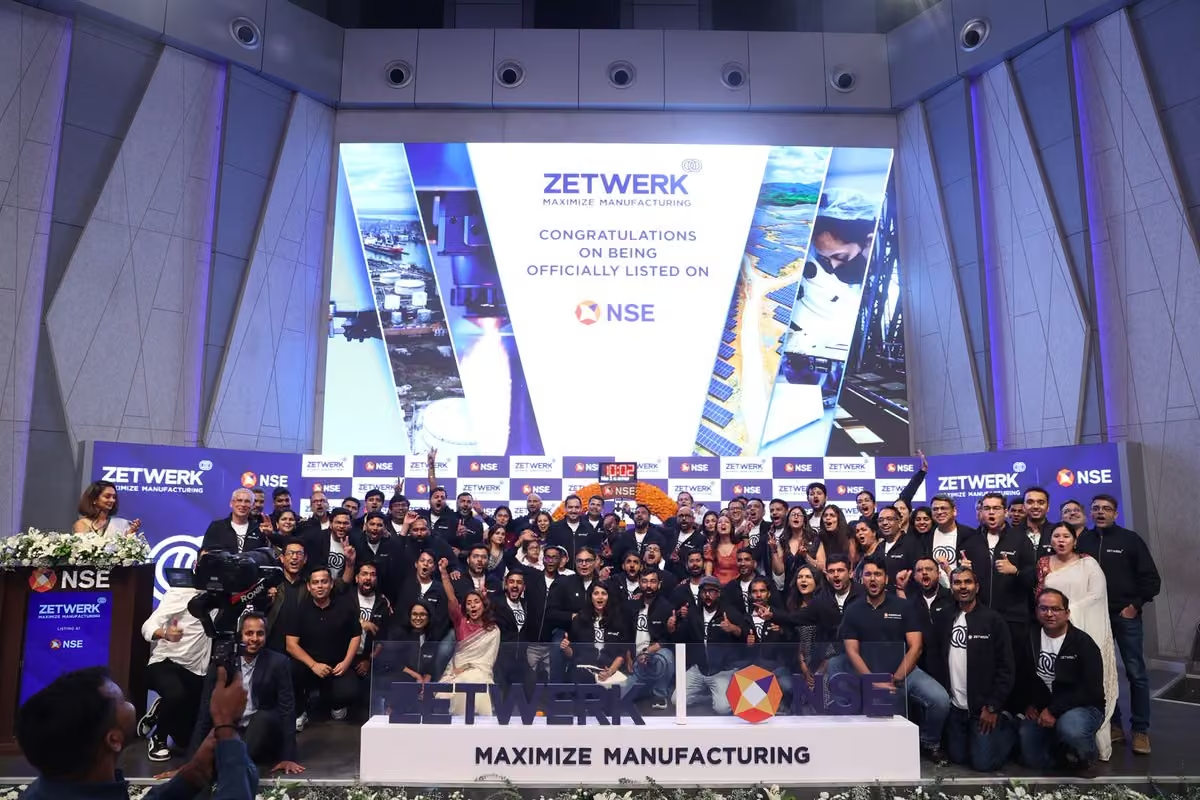
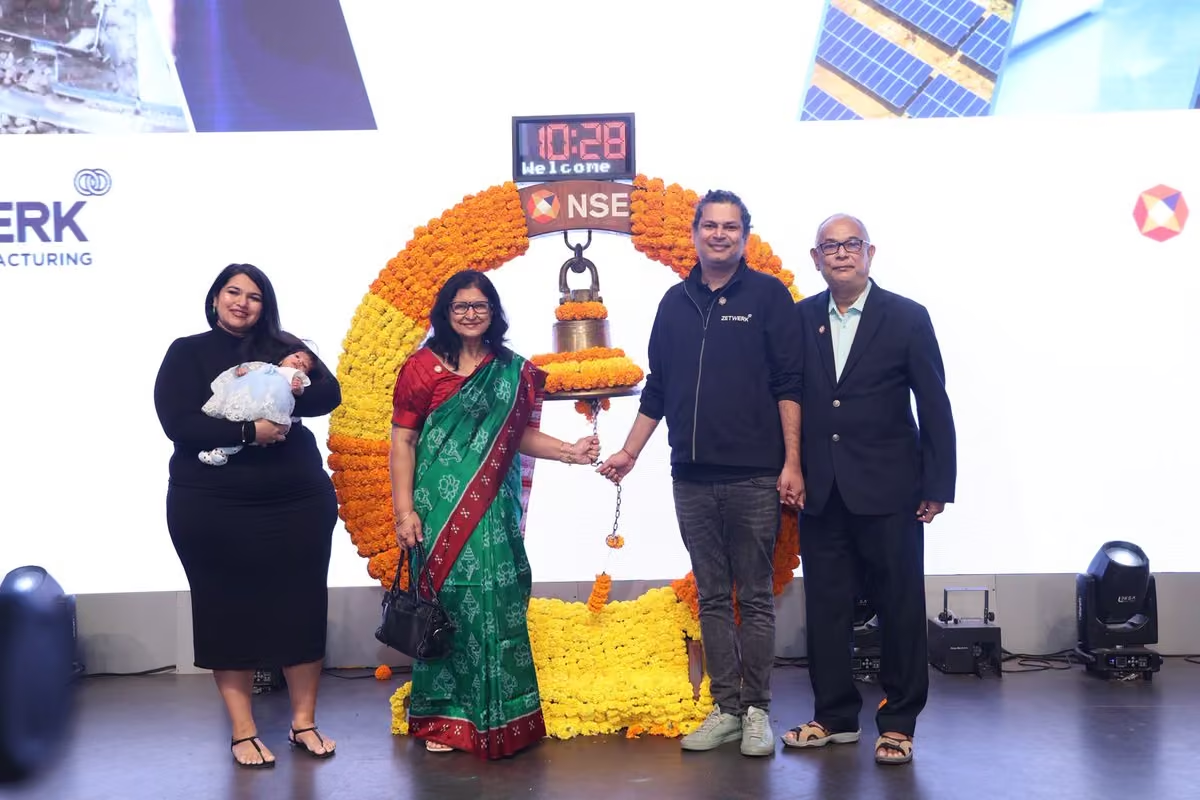
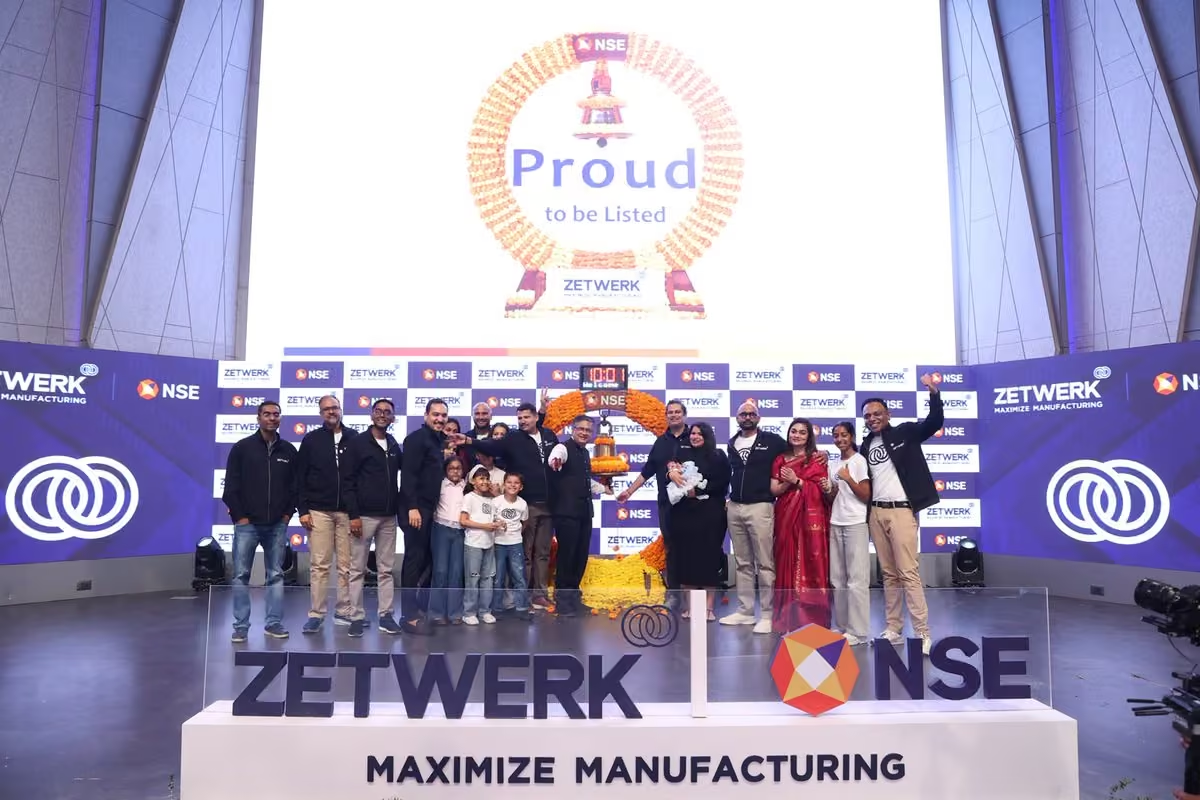
I was 29 when we started Zetwerk. My wife Sharanya and I had just returned from the US to build our lives in India. Last month, we welcomed our daughter. Last week, we took the company public. It is yet to sink in.
When I moved back, my father, a professor, was sceptical. I had walked away from the traditional Indian dream of a job abroad. But our story is also that of today's India, where my cofounders and I, 20-somethings from small towns, without family connections, can raise capital, build a business, take it global and take it public, all within a decade.
The world today is on the cusp of enormous progress: defence modernisation, energy transition, space exploration and AI buildout. Much of this progress faces a common bottleneck: building physical things in the real world.
But the manufacturing systems of the past won't build the future. Manufacturing must modernise to catch up with the industries it serves.
At Zetwerk, we always believed there is enough depth in Indian manufacturing whether it is within the small workshop in Peenya which is great at tooling or it is in the new plants we have set up to drive scaled production. Our approach combines real-world engineering with a digital stack to unify ~7000 suppliers, 25+ owned facilities, 1000+ customers and 3000+ employees into a single layer that operates with the predictability of a world-class factory, standardising quality and delivery. We call it the Universal Factory.
Our ambition is to build a world-class industrial institution bringing together two distinct worlds: software and hardware.
Think of your day today. You may have made coffee, worn headphones, taken the metro or a flight, or opened your laptop. There is a little bit of Zetwerk in all of these.
We want our customers placing complex, multimillion-dollar orders to have an experience that is "boringly predictable" - simple, transparent and reliable. We have over ₹15,900 crore in revenue, more than 80% repeat customers and a manufacturing order book of ₹13,000 crore. We've come a long way, but also have a long way to go.
On IPO day, my father stood beside me as we rang the bell at the National Stock Exchange. He is not sceptical any more :)
Someone wise once said “You make your own reality. And once you've done it, everyone's of the opinion it was all so obvious”. That is how the future works. Before something transformative exists, people call it improbable. Afterwards, they call it inevitable. This is the spirit in which we are building Zetwerk: with a relentless commitment to the future.
Great industrial institutions that came before us, like GE, L&T and Tata, helped make the modern world possible. Today, Indian manufacturing is having its moment, and we intend to build what comes next. A big thank you to our investors, customers, employees, their families, our bankers and partners who helped us get here.
We are committed to building a world-class industrial institution out of India.

 Amitav Acharya
@AmitavAcharya
Lula’s victory and the defeat of Vucic in Serbia do not make a trend of reversal of right-wing populism’s toxic global impact (the Big One is still out there) but it is an important boost for those who seek a global multiplex order - where multilateralism and international norms are respected - to replace the US led hegemonic “liberal international order” which was selective in the benefits it offered and self-serving in obscuring the contribution of non-Western others. That order is dying. Lula’s rejection of US unilateralism and Trump’s imperial foreign policy, his support for Global South causes, his commitment to regionalism, and humanitarian principles (as seen in his strong condemnation of Israeli actions in Gaza) are a powerful reminder that the aspiration for just, peaceful and inclusive world order is not a unique contribution of Western nations.
Amitav Acharya
@AmitavAcharya
 Amitav Acharya
@AmitavAcharya
Taking a hike from Trump, geopolitics, multiplex world order & Global IR, etc. This along the C&O canal near Angler’s Inn this morning.

 Amitav Acharya
@AmitavAcharya
I visited Machu Picchu while researching the “Lost World” chapter of my book. This picture of me was taken by my guide who is a descendant of the Inca. The others are CC taken by me. See on Instagram www.instagram.com/stories/amitavacharya1/4014651683216599…


 Amitav Acharya
@AmitavAcharya
The Ford Foundation, one of the world’s largest private grantmakers, will overhaul its spending to counter what new leadership views as the mutually reinforcing rise of both autocracy and inequality. www.fordfoundation.org/news-and-stories/news-and-press/in…
Amitav Acharya reposted
Amitav Acharya
@AmitavAcharya
Persia as the eternal Other to the Greek Self is a fabrication of modern Western historians and public officials. I wrote on this in my recent essay in Current History (open access), which draws from a chapter: “Greek Myths and Persian Power,” in my 2025 book The Once and Future World Order. And the Greeks themselves did not identify as European or “Western.” Many Greeks preferred to work for the Persian empire than Athenian polis, where “liberty” meant liberty of the polis rather than individual liberty.
“Just as Western historians, relying on partisan Greek accounts, have exaggerated the scope of liberty and democracy in Greek society, they have understated the openness and cultural accommodation afforded by the Persian Empire to its subjects. A fair number of Greek polities and trading settlements such as Thebes, Argos, and Megara preferred Persian rule over that of the Greek powers. As the late British diplomat and scholar Adam Watson writes, the “mild overlordship of the Persians was a lesser evil than the destructive harshness of their Greek enemies.” Plato went so far as to write that the Persians under Cyrus “gave a share of freedom to their subjects and advanced them to a position of equality,” in a view strikingly at odds with the dark portrayal of Persia typical to Western histories. Persia generally preferred indirect rule over conquered territories and allowed rather than extinguished Greek intellectual endeavor. The Greeks, on the other hand, persecuted their own philosophers who challenged orthodoxy or sided with Persia. Anaxagoras, who provided the first scientific explanations of eclipses and meteorites, was born in Clazomenae in 500 BCE when the city was under Persian control. He went to Athens to pursue his work, but was banished for his pro-Persian views.”
online.ucpress.edu/currenthistory/article/125/872-873/6/2…
@GhoshAmitav
@DalrympleWill @ShashiTharoor @CurrentHistory1
@kanishktharoor
 Ishaan Tharoor
@ishaantharoor
Utterly incoherent how he goes from Athens, where he denigrated Persia as the eternal Other in a clash with Western "civilization," to this embrace of Samarkand, a city that's wholly bound up in Persian "civilization," if talking about civilizations is so important to you.
Amitav Acharya
@AmitavAcharya
 Amitav Acharya
@AmitavAcharya
Persia as the eternal Other to the Greek Self is a fabrication of modern Western historians and public officials. I wrote on this in my recent essay in Current History (open access), which draws from a chapter: “Greek Myths and Persian Power,” in my 2025 book The Once and Future World Order. And the Greeks themselves did not identify as European or “Western.” Many Greeks preferred to work for the Persian empire than Athenian polis, where “liberty” meant liberty of the polis rather than individual liberty.
“Just as Western historians, relying on partisan Greek accounts, have exaggerated the scope of liberty and democracy in Greek society, they have understated the openness and cultural accommodation afforded by the Persian Empire to its subjects. A fair number of Greek polities and trading settlements such as Thebes, Argos, and Megara preferred Persian rule over that of the Greek powers. As the late British diplomat and scholar Adam Watson writes, the “mild overlordship of the Persians was a lesser evil than the destructive harshness of their Greek enemies.” Plato went so far as to write that the Persians under Cyrus “gave a share of freedom to their subjects and advanced them to a position of equality,” in a view strikingly at odds with the dark portrayal of Persia typical to Western histories. Persia generally preferred indirect rule over conquered territories and allowed rather than extinguished Greek intellectual endeavor. The Greeks, on the other hand, persecuted their own philosophers who challenged orthodoxy or sided with Persia. Anaxagoras, who provided the first scientific explanations of eclipses and meteorites, was born in Clazomenae in 500 BCE when the city was under Persian control. He went to Athens to pursue his work, but was banished for his pro-Persian views.”
online.ucpress.edu/currenthistory/article/125/872-873/6/2…
@GhoshAmitav
@DalrympleWill @ShashiTharoor @CurrentHistory1
@kanishktharoor
Ishaan Tharoor
@ishaantharoor
Utterly incoherent how he goes from Athens, where he denigrated Persia as the eternal Other in a clash with Western "civilization," to this embrace of Samarkand, a city that's wholly bound up in Persian "civilization," if talking about civilizations is so important to you.
Amitav Acharya
@AmitavAcharya
This is the face of asymmetric warfare, & another reason why the US, despite being the strongest military power, cannot impose its will on secondary powers. The talk of unipolar, bipolar, multipolar makes less sense when analyzing world order.
www.reuters.com/investigates/special-report/iran-crisis-i…
Amitav Acharya
@AmitavAcharya
Last I checked, Canada is a sovereign nation, Greenland still belongs to Denmark, its deal with US is a reaffirmation of earlier arrangement. Trump looks like a habitual stand-downer, and if anything, Canada’s diversifying its trade & security that makes it more independent of US foreign policy beyond Trump.
 Aaron Rupar
@atrupar
Trump on Canada: "They'll end up being the 51st state because that's the only way it works ... they'll be doing something. Just like Greenland."
Amitav Acharya reposted
Aaron Rupar
@atrupar
Trump on Canada: "They'll end up being the 51st state because that's the only way it works ... they'll be doing something. Just like Greenland."
Amitav Acharya
@AmitavAcharya
Milan’s magnificent cathedral (Duomo): including view from the roof top.


 Amitav Acharya
@AmitavAcharya
It was a great pleasure to visit the John Cabot University with its lovely campus in historic Trastevere in Rome on 6th Oct. I gave a book talk & interacted with its students & faculty, led by President Antonia Maioni and Professor Michael Driessen, Director of the MA in International Affairs. A write up here:
www.johncabot.edu/news/2026/10/amitav-acharya-unesco-worl…
@JohnCabotRome
Amitav Acharya
@AmitavAcharya
Leaving Italy after a week of intense activity, to mark the Italian translation of my book, a total of 3 book talks in Rome, one in Bologna, & capped by a panel at Milan’s Festival dell'Economia Critica (Festival of Critical Economics) at the Fondazione Feltrinelli. Plus media interviews. I felt intense appetite for an alternative sweeping account of world order & global history, that goes far beyond what is available from western-centric accounts by Kissinger, Huntington, Fukuyama, or Ferguson, or the popular books about the Silk Road/s or Asia or Sino-centric or Indo-centric histories.


 Amitav Acharya
@AmitavAcharya
The idea of nation-state is just as flawed & parochial (Western-centric) as the idea of nationalism, both helping Eurocentric worldviews to take false credit as the exclusive foundation of the contemporary world order, while ignoring the substantial historical contributions of other regions and societies, as I expose in my book The Once and Future World Order.
 Daniel Steinmetz-Jenkins
@daniel_dsj2110
New book argues that the nation-state as the foundation of the international order is a more recent invention than is commonly supposed. It was born between 1940 and 1955, out of the ruins of the collapsing empires of Japan, Britain, Netherlands etc (h/t Peter Rutland).

Amitav Acharya reposted
 Amitav Ghosh
@GhoshAmitav
I honestly can't believe that this level of repression would ever be seen in New Delhi. It is beyond shocking.
 Yamini Aiyar
@AiyarYamini
Despite the State, on this dark day ordinary people did whatever they could to defend our freedom of Speech, right to assemble, above all our right to vote. And save democracy in New Delhi. The State was out in full force, afraid of it citizens defending their rights.


Amitav Acharya reposted
Yamini Aiyar
@AiyarYamini
Despite the State, on this dark day ordinary people did whatever they could to defend our freedom of Speech, right to assemble, above all our right to vote. And save democracy in New Delhi. The State was out in full force, afraid of it citizens defending their rights.
Amitav Acharya
@AmitavAcharya
My interview with @GianniRosini of Italian newspaper il Fatto Quotidiano ("The Daily Fact") and a rough Google Translate version of a key point
Amitav Acharya: “Stiamo assistendo alla fine della leadership occidentale. Ci aspettano crisi economiche e guerre regionali”
“In reality, there is nothing new about the world order. Every time a conflict breaks out, a crisis, that an American president is changed, we talk about a new world order…Terms like new world order or new world disorder are the result of simplification… Most people who use these slogans have never done long-term historical research. Instead, two things come out of my own research. The first: all world orders rise and collapse, like empires…we have lived 80 years of American leadership and, sooner or later, we will see the end. Now we are seeing the end. Second, all world orders present a mix of stability and violence, never perfectly peaceful and never totally violent”
“Trump doesn't like multilateral institutions, he doesn't make a secret of it. He is doing his best to weaken them, he has withdrawn funding and is challenging the International Court of Justice and also the International Criminal Court for investigating the war crimes committed in Gaza. But can he destroy them completely? If you look at world public opinion, there is no doubt that many countries believe that multilateralism is very weak, that the UN is weak. But no one said we should get rid of it. So they think these institutions can be reformed and revitalized. I want to stress that the United States has never been, after creating the UN, a great supporter of multilateralism because it prevented it from imposing its own weight. The United States has always tried to circumvent multilateral institutions when they were contrary to American interests, they have always tried to weaken them because they are seen as threats to American sovereignty.”
“in the last eighty years, Western Europe has become increasingly dependent on the United States. Initially, it was supposed to be related to reconstruction after World War II, but then it became a structural and long-term dependence. It is in terms of security through NATO, even if with the collapse of the Soviet Union they could not actually limit it. It is in economic terms, because each country depends on access to the US market for its own economic growth. This is why tariffs are the most powerful weapon in Trump's hands. Europeans find it very difficult to break this addiction and Trump can use it to manipulate them. They can reduce their dependence, but it will take time.”
www.ilfattoquotidiano.it/2026/10/09/amitav-acharya-ordine…
Amitav Acharya
@AmitavAcharya
I think the ICC will survive, as will Visa, Mastercard, Amazon etc., and the US will significantly dilute it not repeal its sanctions under a new a Democrat administration as Biden did to Trump’s 1st term targeted sanctions.
 Gideon Rachman
@gideonrachman
My money is on the first option
 Yaroslav Trofimov
@yarotrof
This could cripple the ICC. Or it could spur a European tech decoupling from the United States, crippling Visa, MasterCard, Microsoft, Amazon and various other U.S. companies making billions of €€€ in the European markets.
 Department of State
@StateDept
US imposes sanctions on International Criminal Court
www.reuters.com/world/us-imposes-sanctions-international-…
Amitav Acharya
@AmitavAcharya
Navi Pillay is a great & timely choice for Nobel. I will be watching in person her receive the Prize on 10 Dec as a guest of the Nobel Institute. This year’s prize has special meaning for me, as a former Nelson Mandela visiting professor at Rhodes University, in South Africa, as a scholar of international humanitarian norms, especially R2P, and as a speaker at a conference to mark the 125th anniversary of the Peace Prize that follows the day after the award ceremony.
www.nobelprize.org/prizes/peace/2026/prize-announcement/
 Amitav Acharya
@AmitavAcharya
With Elido Fazi, founder, & Francesco Fazi, CEO, of Fazi Editore- the Italian publishers of Storia e futuro dell'ordine mondiale (The Once & Futurr World Order) at Rome’s Feltrinelli
bookshop last evening, before the start of my dialogue with Piero Bevilacqua, emeritus history professor at Rome’s Sapienza University. Our dialogue covered the rise & fall of the West, including factors behind the “great divergence” (I explained my “magic potion” theory: while imperialism & slavery are not unique to Europe, the blending of those two forces with scientific racism & capitalism created a distinct potion that powered the rise of Europe & US.) We also discussed the causes behind the end of US-led order, “return of the Rest,” & the need to move past the artificial West-Rest divide to build the next world order.
@FaziEditore


 Amitav Acharya
@AmitavAcharya
Deeply touched by the large turn out & the genuine enthusiasm of the young audience at the end of my talk to mark the Italian translation of my book today at Rome’s LUISS university. I am increasingly confident that the book is making a strong impression among the audience that really matters when it comes to understanding & rebuilding world order, giving them fresh & challenging perspectives, instead of rehashing the same old geopolitical chatter found in much of media & think tanks.

 Amitav Acharya
@AmitavAcharya
 The Once and Future World Order
@OnceFutureWO
The Once and Future World Order
@AmitavAcharya
Purchase the book here: www.amazon.com/Once-Future-World.../dp/1541604148...
#internationalrelations #worldorder #internationalstudies #history #book

Amitav Acharya reposted
Amitav Acharya
@AmitavAcharya
Great fun doing a fireside chat on The Once & Future World Order with my wonderful friend @TeivoTeivainen in the inspiring & spacious setting of the Rosebud bookshop in Helsinki. Global history aside, we extended the chat to Finnish history & Global South agency advocated by President Alexander Stubb. The recording before a live audience is here: m.youtube.com/watch?v=8iFHAkscIL0&ra=m


 Amitav Acharya
@AmitavAcharya
Great fun doing a fireside chat on The Once & Future World Order with my wonderful friend @TeivoTeivainen in the inspiring & spacious setting of the Rosebud bookshop in Helsinki. Global history aside, we extended the chat to Finnish history & Global South agency advocated by President Alexander Stubb. The recording before a live audience is here: m.youtube.com/watch?v=8iFHAkscIL0&ra=m
Amitav Acharya
@AmitavAcharya
The weather obliged brilliantly for a wonderful conversation with a great audience at my book talk at Finland’s Tampere University today. Then unwinding on the train ride back to Helsinki with my host Prof Tuomas Forsebrg.


 Amitav Acharya
@AmitavAcharya
Amitav Acharya - The Once and Future World Order - YouTube www.youtube.com/watch?v=avW4sS4vVAE
Amitav Acharya
@AmitavAcharya
Northern lights in Iceland


 Amitav Acharya
@AmitavAcharya
Trump is making “China great again.” Or even greater. Adding 1000 years to Chinese civilization. Even the Chinese official narrative goes back to 5000 years. No wonder he is so popular in China.
“Ours goes 250 years, which is great, and we’re proud of. Theirs goes 6,000 years. So there’s a little difference between 6,000 and 250. But we’re very proud of our 250
www.theguardian.com/technology/2026/sep/25/trump-xi-ai-ar…
Amitav Acharya
@AmitavAcharya
Here is the link to the Cornell University panel: “The Future of International Order: Rupture, Resistance, and Prospects for Peace,” where I was a speaker. My key points:
• “Rules-based order” is not same as “Liberal International Order.” There were rules-based orders in the past: closed ones like the European “standard of civilization (SOC) and open ones like the Indian Ocean (trading, ideational & cultural) network (ION) before the European imperial powers arrived.
• The LIO is a more recent term, and it is to some degree a privileged, selective club of western powers & their “invited guests” like Japan. It did exist but not as an overarching, benign construct that its proponents claim.
• To be genuinely rules-based: three conditions must be me: (1) rules must be created democratically, with participation of all; (2) rules must be clear & transparent to all; (3) rules must be applied fairly, not selectively. The SOC & LIO did not meet these criteria to a large degree. The ION met these criteria to a greater degree.
• World order is turning upside down. This can mean two things: instability, but also bottom-up construction. The latter means more regional layering. But not regions would be alike in terms of rules & institutions: Middle East, South Asia, & Northeast Asia have little or none, Southeast Asia & parts of Africa & Latin America have much more, Western Europe has most. There is a risk of regions developing into spheres of influence; but this can be exaggerated, due to internal balancing within regions against a dominance-seeker, and relative “porosity” & openness of regions including through inter-regional trade agreements (e.g. EU-India, EU-MERCOSUR)
• With such cross-regional interactions, the world is becoming multiplex, rather than conventionally multipolar. It also means multi-layered and bottom-up.
Hosted by the Reppy Institute for Peace an Studies, part of the Einaudi International Studies
For details watch:
m.youtube.com/watch?v=aa3UkD6ME7U&ra=m
Amitav Acharya
@AmitavAcharya
“The State of Global Governance,” by Esther Brimmer, Council on Foreign Relations.
“Others may adopt a “multiplex” model as set out in Amitav Acharya’s book The Once and Future World Order. In this model, there are several layers of multilateral activity with more actors, both state and nonstate, involved. Acharya offers the analogy of the “multiplex”, where states can choose to move in and out of different alignments the way moviegoers can move in and out of different theaters showing different films.”
Esther Brimmer
CFR EXPERT
James H. Binger Senior Fellow in Global Governanc
www.cfr.org/articles/state-global-governance-middle-power…
Amitav Acharya
@AmitavAcharya
Before the start of “The New World Order” panel that opened the Berkeley Public Policy Roundtable yesterday: with fellow panelist Janet Napolitano (former Homeland Security Secretary and President of the University of California system), David Wilson, Dean of the Goldman School of Public Policy which organized event, & Prof Daniel Sargent (moderator, next to me). Discussion focused on both US domestic & foreign policy changes, including parallels with ancient Rome: responding to our historian moderator’s observation that Rome went through stages when bad emperors were succeeded by good ones, I replied: by the time when the good ones came, the glory of the empire was past, severely weakened by the policies of the bad ones (I did not mention any emperor by name). Chapter 5 of my recent book on world order is titled “The Wrath of Rome.” I also observed that while the US combines elements of the Roman Republic in domestic politics (as c the founders wanted) & the Roman Empire in foreign policy, today the Empire continues (or getting more aggressive), while the Republic is failing.

 Amitav Acharya
@AmitavAcharya
Wonderful book conversation with students & faculty yesterday at the Institute of International Studies, UC Berkeley in the aptly named Philosophy Hall building. With the backdrop of large framed scenes of Harry Truman signing the UN Charter after the San Francisco conference, & Eleanor Roosevelt holding up the Universal Declaration of Human Rights, I spoke about how the major omissions in the original documents on colonialism & racial equality were later addressed by post colonial nations. And how “all men are created equal” was changed to “ all human beings are created equal” thanks to intervention by India’s Hansa Mehta at the UDHR drafting chaired by Mrs Roosevelt. Questions from audience included not only historical aspects of the book but also what it means for great power relations today: is a non-hegemonic world order possible, can multipolarity or multiplexity be stable, how can history be relevant to the present, etc.


 Amitav Acharya
@AmitavAcharya
Estimating the Cost of Combat Operations Against Iran- Congressional Budget Office
The 38 billion tag is
certainly an underestimate.
But this description of the war’s implications for a Taiwan related conflict is the classic convoluted understatement of the year.
“The shortfall would become especially problematic if a conflict arose with an opponent whose arsenal included large numbers of ballistic and cruise missiles. (The People's Republic of China, PRC, maintains such an arsenal, which would probably play a major role in a military conflict involving Taiwan.)”
Worth noting CBO -an official agency- is still referring to DoD not DoW.
www.cbo.gov/publication/62756
Amitav Acharya
@AmitavAcharya
Great power relations by themselves do not shape world order There are many examples in history that show great powers operating “within the parameters” of interdependence & institutions. From ancient near east to European concert.
Great powers are not autonomous actors; they need to cooperate and avoid war to survive.
The US had learnt the lesson from Europeans, China has kept it in mind. Realism is useful but need not be a deterministic, self-fulfilling and self-defeating policy.
“Organisations like the APEC, BRICS, EU, G7 and NATO don’t shape the world order. They operate within the parameters set by great-power politics.”
indianexpress.com/article/opinion/columns/c-raja-mohan-in…
Amitav Acharya
@AmitavAcharya
This is a very thoughtful & balanced take on Delhi #brics Summit: between the extremes of “cancel” the group (without any convincing justification) & those who over-hype its influence. The side meetings like Xi-Modi are useful.
BRICS is not the savior of emerging powers, or of world order generally, but at a time when both multilateralism, alliances (hard balancing) options are failing, it’s reassuring to see that the rising powers can achieve consensus on broad objectives, even without an immediate action plan. For India, joining the anti-western bandwagon does not make strategic sense, but neither is turning mainly to the US or the Western powers while facing a predatory US administration & a declining EU. Preserving the middle ground may be more practical. I see some parallels with Nehru’s role at the Bandung Conference, stopping the conference from becoming an anti-Western talk-fest while undermining Dulles’ “pactomania” (those who are not friends with us are enemies)
 Nirupama Menon Rao 🇮🇳
@NMenonRao
The Delhi BRICS Summit offered an important picture of India’s place in a fragmenting world. New Delhi clearly sees value in a grouping that is non-Western, but little advantage in allowing it to become explicitly anti-Western. The objective is reform without rupture: a more representative international order, greater agency for the Global South and protection against economic coercion, without abandoning access to Western markets, capital and technology.
That distinction was made explicit by Prime Minister Modi when he said BRICS was “not against anyone”. India did resist attempts to turn the meeting into a platform of anti-American rhetoric. We did not witness endorsement of a common BRICS currency or dramatic declaration of de-dollarisation. The focus remained on national-currency settlements, faster cross-border payments, resilient supply chains, digital public infrastructure, health, food and energy security, and reform of the UN, IMF and World Bank.
India scored a significant diplomatic success in securing a unanimous New Delhi Declaration despite sharp differences between Iran and the UAE over West Asia. Consensus was preserved, but only through carefully generalised language. In this, BRICS’s value and its limitation was exposed : it can keep difficult conversations alive and affirm broad principles, but it struggles to assign responsibility or organise collective action when there is the occasional collision of the interests of its members .
The Modi-Putin meeting reaffirmed the durability of the India-Russia relationship at a time when Moscow is under Western sanctions and increasingly dependent on China. India continues to value Russia as an energy, defence and strategic partner, while seeking to broaden the relationship into technology, manufacturing and industrial cooperation. But New Delhi did not endorse Moscow’s more confrontational conception of BRICS as an alternative order
struggling to shake off Western rules. Engagement with Russia remains an important part of India’s strategic autonomy, but there is no evidence of alignment with a Russian-Chinese bloc.
The Modi-Xi meeting was more consequential, although its results were deliberately modest. Xi’s first visit to India in nearly seven years restored the political space for engagement. Both leaders supported greater business links, mobility and cultural exchanges, and discussed India’s structural trade imbalance, supply-chain vulnerabilities and need for meaningful market access. Modi reiterated that peace and tranquillity along the border, and mutual sensitivity remain essential to the wider relationship.
The outcome was therefore managed stabilisation, not a strategic reset. India and China have acknowledged the necessity of coexistence, competition and selective cooperation without pretending that mistrust has disappeared.
BRICS provides one of the few settings in which this competitive coexistence can be practised. It also allows India to engage China and Russia while maintaining its partnerships with the United States, Europe, Japan and Australia. BRICS widens India’s diplomatic and economic choices.
As C. Raja Mohan observes, India’s success may have been to keep BRICS “boring”: practical enough to be useful, abjuring boiler-plate ideology or rhetoric . The deeper achievement of Delhi was to preserve the manifest pluralism of the grouping.
The test will come under China’s presidency in 2027. Beijing will probably push for a “Greater BRICS”, stronger political coordination and reduced dependence on Western financial systems. India will support institutional reform and greater Global South representation, but resist conversion of BRICS into a China-led geopolitical pole.
BRICS matters to India not because it peddles a replacement world order, but because it helps prevent any single power or coalition from monopolising the existing one. It provides India more room for manoeuvre, in an age of unstable multipolarity.
#brics2026
Amitav Acharya
@AmitavAcharya
In the immediate aftermath of 9/11, I wrote a series of op-eds & articles, with the key premise that the post-9/11 world order would be defined more by "fear politics" than traditional “power politics”: more powerful nations would become more fearful rather than secure: which may be termed as “power-fear paradox”.
I argued that a key outcome of this “fear politics” would be the retreat of liberal democracy: the end of End of History.
I put these essays into a book, “The Age of Fear: Power vs Principle in the War on Terror.”
The book, published in 2004, was later reissued by Routledge Revivals.
These arguments have been borne out in the 2 decade & half later.
The “power-fear paradox” has come to define the grand strategy of the United States, no matter which leader is in power. Please take a look.
www.nytimes.com/2002/09/17/opinion/IHT-the-war-on-terror-…


 Amitav Acharya
@AmitavAcharya
Ended my 2 and half day invitation visit to Cornell University with a panel discussion on the Future of International Order in a room named after legendary nuclear scientist and Nobel winner Hans Bethe who was a professor there. And then a visit to the Johnson museum to see its excellent collection of SEA art donated by professors such as George Kahin & Ben Anderson, & alumnus John Miksic (who taught in Singapore & donated the magnificent Balinese door; & who kindly had blurbed my book “Civilizations in Embrace”) Finally a long walk back to my hotel on a lovely sunny day


 Amitav Acharya
@AmitavAcharya
Really enjoyed delivering the Gatty Lecture on Southeast Asia at Cornell University few hours ago. I covered why & how Southeast Asia has been an incubator of some of the most influential ideas in political economy, comparative politics and IR (“dual economy, “plural society,” “consociationalism,” “imagined communities,” “weapons of the weak,” etc. I then spoke about how my own work on “norm localization,” “security community,” & Global IR originated from my Southeast Asian studies base. These are covered in my two books with Cornell University Press: Whose Matter? and The Making of Southeast Asia, plus Constructing a Security Community in Southeast Asia: ASEAN and the Problem of Regional Order (Routledge).
The recording of the lecture will be posted in a few days. Watch this space.

 Amitav Acharya
@AmitavAcharya
From American Hegemony To A Multiplex Global Order. Not by me, but by a student at American University from Pakistan drawing on what he learnt from my course. Puts to shame a lot of stuff in mainstream media by pundits.
@research_SIS
www.thefridaytimes.com/08-Sep-2026/american-hegemony-mult…
Amitav Acharya
@AmitavAcharya
With so much debate over world order & a BRICS summit looming, I am reposting an op-ed in @nytimes I published over a year ago on the very day when my book The Once & Future World Order came out. It rejects much of the conventional wisdom we see on display in the West today. Key message: While Trump destroys the old liberal order, there is an opportunity to build a better one. Non-western nations - Global South - are not a threat to world order, but makers of it both in deep history & since WWII. West should not fear the Global South, but find ways to develop partnerships that ends the West-versus-the Rest divide. The message is even more valid than it was a year ago.
www.nytimes.com/2025/04/08/opinion/west-american-order-fr…
Amitav Acharya
@AmitavAcharya
Is a post-American world necessarily a darker one? In my latest @nytimes piece, drawing on my new book, The Once snd Future World Order (Basic Books), I suggest otherwise. Drawing on historical examples, I explain why we can be cautiously optimistic.
“The very precepts of order are not Western inventions...Order has always been a shared endeavor… a global multiplex… would not be a paradise—but then nor has been this one.”
Opinion | Reasons to Be Optimistic About a Post-American Order - The New York Times
(The article link is in the first comment)
Amitav Acharya
@AmitavAcharya
Possibility of US using nuclear weapons against Iran is growing as Iran threatens US carrier battle group. As I wrote in my 1989 book, U.S. Military Strategy in the Gulf, drawing on congressional documents & my interviews in Washington, the Central Command from its inception has had contingency plans for nuclear strikes on Iran. That scenario may be drawing closer.
My discussion then (see the attached pages) was about US response to a possible Soviet invasion of Iran which was CENTCOM’s founding mission, but without Iranian nuclear deterrence, the US can use nuclear weapons in Iran with less constraint,
“Escalation Trap” ?@ProfessorPape


 Amitav Acharya
@AmitavAcharya
The West is crumbling, President Trump has given it a "deathblow" - my Asia Society book talk a year ago becoming more real youtube.com/shorts/4yF16Ty86RA
Amitav Acharya
@AmitavAcharya
164-1 : further evidence that we are in the “World-Minus-One Moment” (title of my essay @ForeignPolicy)
The US under Trump administration was the only country on earth that voted against a resolution to change the world map so as to accurately reflect Africa’s size.
The justification for the change is based on FACT not ideology, as the administration claims.
And this is an administration that does not hesitate changing maps to alter place names or create fictional new regions.
 Larry Madowo
@LarryMadowo
The world map you've known all your life is wrong! Nearly every country at the UN voted to adopt a new map that shows a more accurate size of Africa after ~500 years of "symbolic minimization."
Only the US voted against it.
I explained why this is important on CNN
Amitav Acharya
@AmitavAcharya
I agree with this article, based on my visits & conversations with academics I know in India (who are these “glamorous academics”?). But do spare a thought for assistant profs or academics in general in other countries, including in the West. Tenure is being abolished, workload increasing, salaries stagnant, cost of living rising. Academia worldwide is not the cushy ivory tower often presented. It never really was.
 Rituparna Patgiri
@Rituparna37
Dark side of Indian academia hidden by Instagram fairytales
Videos of glamorous scholars sipping coffee portray a lifestyle far removed from the toxic culture of overwork faced by academics
Replugging an earlier piece on Teachers Day @timeshighered
www.timeshighereducation.com/blog/dark-side-indian-academ…
Amitav Acharya
@AmitavAcharya
WOT another kind. War on Techtators or Tachtatorship
 Ayzaa
@Ayzacoder
🚨BREAKING: France wiped Google and Microsoft off 2.5 million government computers.
Germany moved 30,000 PCs off Windows. Denmark dropped Microsoft Office.
Here's exactly what they switched to and how to do the same:
Amitav Acharya
@AmitavAcharya
World Order talk @UCBerkeley. If you are in Berkeley on 17 September, join me at my book talk the Institute of International Studies at UC Berkeley.
 Amitav Acharya
@AmitavAcharya
The real counterbalance to “the West” is from within the West. Trump is leading the way. Time to retire the West. And then West-versus-the Rest. foreignpolicy.com/2026/06/12/trump-west-china-rome-civili…
 Ali Wyne
@Ali_Wyne
.@dhpierson’s excellent piece underscores that a coherent, Chinese-led coalition to counterbalance the West is unlikely to emerge. But Washington’s attacks on core allies and partners will enable Beijing to build a wider array of transactional alignments.
www.nytimes.com/2026/09/01/world/asia/g20-meeting-china-t…
Amitav Acharya
@AmitavAcharya
The summary of the SCO declaration - whose signatories include Xi, Modi, and Putin, if generally authentic - is a frontal rejection of US policies towards Iran. No official translation available yet. One can expect strong reaction from Trump. www.aljazeera.com/news/2026/9/1/sco-slams-attacks-sanctio…
Amitav Acharya
@AmitavAcharya
Quotes from Al-Jazeera summary: The SCO condemned “military strikes on the territory of the Islamic Republic of Iran, which have resulted in numerous civilian casualties and significant damage to the country’s economy”.
The US-Israel attacks on Iran “violate the principles and norms of international law and the UN Charter and create serious risks to international peace, security and stability”.
“Member States express their sincere condolences to the people and Government of the Islamic Republic of Iran on the tragic death of Supreme Leader Seyyed Ali Khamenei, and to the families of the victims,” the declaration added.
SCO members also reaffirmed “their support for the sovereignty and territorial integrity of the Islamic Republic of Iran and advocate a resolution to the conflict solely through political and diplomatic means.”
Amitav Acharya
@AmitavAcharya
Agree India should stay away from anti-US posturing or rhetoric. Or any anti-Chinese rhetoric for that matter. But has appeasing Trump got India any real benefits: humiliation both national & personal for Modi), tariffs, support for India’s strategic rivals, threats to undercut India’s rise (not to make the “China mistake”) - one can go on. These are real harms that a realist especially can recognize.
 Rajesh Rajagopalan
@RRajagopalanJNU
@MohanCRaja: "Delhi has little reason to support the anti-American and anti-Western posturing that increasingly surrounds both the SCO and BRICS ... it does not solve any of India’s entrenched problems with China or elevate the partnership with Russia to a higher level."
Amitav Acharya reposted
 Paul Poast
@ProfPaulPoast
- Golden Arches Theory: The idea that no two countries with a McDonald's have fought a war against one another. It pointed to the enduring power of "two all beef patties special sauce lettuce and cheese" (not to mention mention the pickles, onions, and sesame seed bun). But that theory, popularized by Thomas Friedman, was dunked almost immediately (see 1999 Kosovo War).
www.amazon.com/dp/1250013747
Amitav Acharya
@AmitavAcharya
A good way to define Multiplex world order vs multipolarity.
…
‘Traditional ideas of polarity may be questioned by starting from what Amitav Acharya calls multiplexity. From this perspective, the world is characterized by multiple, crosscutting, and competing modernities, with “serious variations and differences in the script of world order even within the West
– not just between the West and the rest”’
Queer theory at the end of the world: what's the point?
PJ Vernon, M Rahman, A Stoffel, M Breiding… - … Feminist Journal of Politics, 2026
www.tandfonline.com/doi/pdf/10.1080/14616742.2026.2702115
Amitav Acharya
@AmitavAcharya
Comparing today’s Big Tech with yesteryears’ British East India Company legitimizes & and obscures the true extent of the atrocities of the EIC and its role as a vanguard of rampant racism, & territorial colonialism. However if it creates greater awareness of the unsavory role of present tech companies, then it does serve a purpose.
 William Dalrymple
@DalrympleWill
An essay I've just written for @nytimes on why Big Tech is the 21st Century’s equivalent of the East India Company:
"What It Would Take to Dismantle the Most Powerful Companies in the World" www.nytimes.com/2026/08/28/opinion/ai-power-lobbying-mili…
Amitav Acharya
@AmitavAcharya
Surprised but gratified to see my work on Global IR and Bandung Conference cited by Christine Lagarde- former IMF MD and current European Central Bank President. Her speech at Columbia Law School, entitled "The order that took centuries to build", states:
"The non-aligned movement that emerged from the Bandung Conference in 1955 challenged the terms on which the post-war order was being built."
This text references my 2016 essay, "Studying the Bandung conference from a Global IR perspective," published in the Australian Journal of International Affairs.
www.ecb.europa.eu/press/key/date/2026/html/ecb.sp260220~5…
My essay argues & and she seems to agree, that the modern rules-based system was shaped by the resistance and normative agency of post colonial states and should not be taken as an exclusively Western creation.
Great to see Global IR entering the consciousness of policymakers (and their speechwriters -I suppose) The idea that world order is a co-creation rather than a western monopoly is also the core argument of my recent book: The Once & Future World Order. @Lagarde @ecb @research_sis @ColumbiaJTL, #world_order, #international_law
Amitav Acharya
@AmitavAcharya
The order that took centuries to build www.ecb.europa.eu/press/key/date/2026/html/ecb.sp260220~5…
Amitav Acharya
@AmitavAcharya
Canada should immediately rename Lake Ontario as Ontari'io.
Canadian Prime Minister Hits Back at Trump’s ‘Lake America’ as He Defends Lake Ontario’s Centuries-Old Name
people.com/canadian-prime-minister-hits-back-trump-lake-a…
Amitav Acharya reposted
 Mark Carney
@MarkJCarney
Le nom du lac Ontario tire son origine du mot wendat « Ontari’io », qui signifie « le lac est beau, le lac est grand ».
Ce nom remonte à plus de 400 ans, bien avant la Confédération canadienne et la Déclaration d’indépendance des États-Unis d’Amérique.
Nous savons que les États-Unis sont en train de changer. Leurs relations commerciales, leur politique étrangère, leurs monuments nationaux, leurs hydronymes.
Les Canadiennes et les Canadiens savent aussi qu’il faut appeler les choses par leur nom, et ce lac se nomme Lac Ontario – aujourd’hui et pour toujours.
Amitav Acharya
@AmitavAcharya
This squares with my decades of teaching experience with undergraduates in the US and other countries but applies to not just China but also to their views of other civilizations in general, which are generally positive.
I also noticed younger generation students in the US & other countries including China to be more open-minded & respectful of other cultures as well as being a little idealistic (perhaps no surprises here). This was confirmed while I was working on & teaching through my recent book on civilizations & world orders, which was partly inspired by my classroom experience. It is worth reflecting how much the constant media barrage & punditry and nationalistic rhetoric from political leaders focusing on conflict changes their views in later stages.
Not to mention the impact of a heavily Eurocentric & Americano-centric curriculum (as in International Relations) widely used to train them, which both explicitly & implicitly present Western nations being politically & civilizationally superior & suppresses the positive contributions of other societies to world order. The learning outcome undercuts their understanding of & respect for other nations. The “clash of civilizations” is as much a product of curricula & classrooms as of battlefields & media & thank-rank narratives.
Paul Poast
@ProfPaulPoast
How should the US should approach China? For US citizens, the answer depends in no small part on your age. In particular, recent @ChicagoCouncil polling finds that the youngest generation surveyed (those between 18 and 29) have the least "hawkish" views.

Amitav Acharya reposted
Amitav Acharya
@AmitavAcharya
From Epic Fury to Epic Failure?
With “Operation Economic Outcast,”Trump is putting US power to unprecedented test.
First, he threatened to bomb Iran back to stone ages & wipe out its civilization. Now he is threatening Iran’s “economic asphyxiation”. This involves economic coercion of other nations through third party sanctions and will test American economic hegemony. Trump failed to secure cooperation of allies & other nations to join naval operations in the Strait of Hormuz; while more nations may join or at least not violate economic sanctions,
these are unlikely to produce Iran’s economic surrender & might further encourage other nations to reduce economic exposure to US. After failing to militarily bring Iran to its knees, failure on the economic sanctions front will further doom US global power & prestige, & accelerate “The End of American World Order.”
Amitav Acharya reposted
 Ashutosh bajpai🇮🇳🇮🇳🇮🇳
@ashutosh3310
It's one of the best book I have ever read. I hope, "the End of American World Order" would become global voice.
 Amitav Acharya
@AmitavAcharya
AI risks. Not much new here but coming from Bill Gates might generate more attention.
“…AI will either be the greatest equalizer ever invented, or the worst source of injustice. The challenge is monumental…. Unfortunately, right now we are not preparing for it. I don’t see evidence that leaders, experts, and communities are confronting the challenges adequately. There is no plan to ease the entry into the AI eras..
…solutions should be developed through a public democratic process that includes elected officials, policymakers, educators, health workers, local officials, and community leaders.”
www.gatesnotes.com/a-turbulent-ai-era-and-critical-choice…
Amitav Acharya
@AmitavAcharya
It is Trump’s imperial civilizationalism and it comes at a major cost to the West. I had written a few weeks ago @ForeignPolicy
foreignpolicy.com/2026/06/12/trump-west-china-rome-civili…
 Neil Renic
@NC_Renic
"In the coming contest to define Washington’s foreign policy, civilizationism is poised to be a central contender."
www.foreignaffairs.com/united-states/new-rights-grand-str…
Amitav Acharya
@AmitavAcharya
“Who does Iran trade with and what could Trump's 'economic D-Day' mean?”
www.bbc.com/news/articles/cqxvj1zd4qjo
Amitav Acharya
@AmitavAcharya
From Epic Fury to Epic Failure?
With “Operation Economic Outcast,”Trump is putting US power to unprecedented test.
First, he threatened to bomb Iran back to stone ages & wipe out its civilization. Now he is threatening Iran’s “economic asphyxiation”. This involves economic coercion of other nations through third party sanctions and will test American economic hegemony. Trump failed to secure cooperation of allies & other nations to join naval operations in the Strait of Hormuz; while more nations may join or at least not violate economic sanctions,
these are unlikely to produce Iran’s economic surrender & might further encourage other nations to reduce economic exposure to US. After failing to militarily bring Iran to its knees, failure on the economic sanctions front will further doom US global power & prestige, & accelerate “The End of American World Order.”
Amitav Acharya reposted
Amitav Acharya
@AmitavAcharya
Attention university and school teachers
preparing syllabus for a new academic year on International Relations/Global Studies, & looking for something new & different from standard texts. You may consider using
as a text my book: The Once and Future World Order. It’s accessible yet “erudite” (New York Times), suitable for undergraduate & graduate courses.
The book traces the origins and meanings of key concepts such as sovereignty, hegemony, diplomacy, great power relations, economic interdependence, globalization, norms, humanitarian values, human rights, racism and anti-colonial movements, and offers a window to the past, present & future of world order. It provides examples from all regions through 5000 yrs history. It argues that world order has multiple origins yet there are convergences.
It is theoretically eclectic, exposing the roots of realism, liberalism, constructivism, critical theories, decolonial & Global IR.
For free examination copies, fill out this request form, www.hachettebookgroup.com/edc-request-form/
There is a very affordable paperback published in London. basicbooks.uk/titles/amitav-acharya/the-once-and-future-w…
This article in Current History provides an overview of the key arguments with examples. “To Create a New World Order, Look to History.” (OPEN ACCESS)
doi.org/10.1525/curh.2026.125.872-873.6
My recorded public lecture & panel at Oxford University present the key themes/arguments of the book with slides are: Lecture:
www.oxfordmartin.ox.ac.uk/events/navigating-world-orders
Panel with Oxford professors Andrew Hurrell, Louise Fawcett & Faisal Devji:
www.oxfordmartin.ox.ac.uk/videos/post-western-order
For more info, watch this space or DM me.
Amitav Acharya
@AmitavAcharya
From Epic Fury to Epic Failure?
With “Operation Economic Outcast,”Trump is putting US power to unprecedented test.
First, he threatened to bomb Iran back to stone ages & wipe out its civilization. Now he is threatening Iran’s “economic asphyxiation”. This involves economic coercion of other nations through third party sanctions and will test American economic hegemony. Trump failed to secure cooperation of allies & other nations to join naval operations in the Strait of Hormuz; while more nations may join or at least not violate economic sanctions,
these are unlikely to produce Iran’s economic surrender & might further encourage other nations to reduce economic exposure to US. After failing to militarily bring Iran to its knees, failure on the economic sanctions front will further doom US global power & prestige, & accelerate “The End of American World Order.”
Amitav Acharya
@AmitavAcharya
Trump’s payback for Canada protecting six American embassy personnel in the 1979 hostage crisis, eventually facilitating their escape before the hostage crisis ended. Here are excerpts from a US State Dept record:
‘Fellow escapee and American diplomat Bob Anders called his Canadian counterpart John Sheardown.. Responding to the news, John Sheardown said, “We’ve been worried about you. What took you so long? Of course you can come over.” Kathleen [one of the Americans] remembers, “I will never forget him (John) standing out on the sidewalk with his hose washing, you know, watering the sidewalk with his garage door open so that the car could just pull in and nobody in the neighborhood would see us get out.”
Joe and Kathleen ultimately stayed with Canadian Ambassador Ken Taylor, and the other four in the group stayed with the Sheardowns. The group of six would remain guests of the Canadian diplomats for almost three months. On January 28, 1980, they were rescued in a CIA extraction operation, led by operative Tony Mendez, in which the group posed as a Canadian film production team scouting locations in Tehran.’
diplomacy.state.gov/argo-and-the-canadian-six/
Amitav Acharya
@AmitavAcharya
Given all the publicity about the Acemoglu-Economist feud, here is my take, from a post in Oct 2024. I see his work as proof of the key role of colonialism behind the rise of the West. My now published book has further details.
@DAcemogluMIT @TheEconomist
Amitav Acharya
@AmitavAcharya
I read this year's Nobel economics winners' (Acemoglu, Johnson and Robinson) work as affirming that colonialism was a major factor behind the rise of Europe, rather than indigenous European characteristics like culture. It refutes those like Niall Ferguson who argue that imperialism did not matter in the Great Divergence. The fact is that Europe's predatory global expansion came before its 'inclusive institutions' (although I have serious doubts how inclusive they really were). But a key point here is that before institutional reform set in, Western Europe had gone globally predatory. The fact that Atlantic Europe which was the vanguard of European colonization in early modern era did better than those exposed only to the Mediterranean or Eastern Europe supports their thesis. I have drawn on their work to support my thesis that imperialism was a key ingredient in Europe's "magic potion" in conjunction with other ingredients such as slavery and racism: a potion that was a major force behind the rise of the West, in my book: The Once and Future World Order.
 Amitav Acharya
@AmitavAcharya
The most damaging to The Economist’s credibility may be the “over a few drinks” bit. But is it really uncommon? For media & academia? How much knowledge transfer takes place “over a few drinks” !
 Jostein Hauge
@haugejostein
Daron Acemoglu blasts The Economist over their bizarre critique of him: “Your central verdict that I am 'oddly unconvincing' rests on unnamed economists revealing their true opinion of me over a few drinks. No persons who have been offered drinks to get to this truth are named. Would you publish a letter asserting that, over a few drinks, most people tell me that your newspaper is no longer worth subscribing to? The only person quoted with such views is a blogger, Noah Smith, a thin basis for judging a lifetime of academic work [...] If this is the best you can do with a body of work spanning 33 years, then it is your critique that is 'oddly unconvincing.'”
 Amitav Acharya
@AmitavAcharya
#once-and-Future-World-Order Trends
The Atlantic’s David Graham writes:
“Trump styles himself as an heir to Theodore Roosevelt, but where Roosevelt said that America should speak softly and carry a big stick, Trump speaks loudly and carries a small one.” www.theatlantic.com/newsletters/2026/08/trump-inattention…
There are some parallels though. See the sections on Theodore Roosevelt (imperialism & racism) in my book’s chapter: “City on a Hill”.
Amitav Acharya
@AmitavAcharya
Agree but add that AI instead of letting AI control you, we should use it as an idea launcher, magnifier and spreader. Science, technology and industry already use it for productivity and innovation.
 nature
@Nature
Rather than racing to replace people, we should build AI tools that amplify human expertise and expand opportunity, says Daron Acemoglu
go.nature.com/4xcMSet
Amitav Acharya reposted
 Andrés Sampayo
@asampayo
A mí la verdad el debate que abrió The Economist me parece bastante interesante. Tengo que reconocer que soy seguidor de los libros de Acemoglu, tanto El pasillo estrecho como su trabajo sobre dictadura y democracia, además de toda la literatura que ha publicado. Ahora bien, hay que decir las cosas como son, mucho de lo que Acemoglu y Robinson plantean se venía trabajando en la ciencia política desde hace rato, solo que a nosotros no nos dan premio Nobel. Desde los años 70 y 80, investigadoras del institucionalismo histórico en la Ciencia Política como Theda Skocpol o Kathleen Thelen habían dejado claro cómo las instituciones, el poder y la trayectoria histórica moldean el desarrollo, mientras que más adelante autores como Adam Przeworski se sentaron a modelar empíricamente la relación entre regímenes políticos, democracia y economía.
Todo esto demuestra que en la ciencia política también incorporamos modelos formales, datos robustos, algoritmos y método científico para entender la realidad a partir de evidencia observable. Lo que pasa es que muchos economistas solo apuntan a la causalidad pura, una pretensión que, en disciplinas donde los seres humanos somos el objeto de estudio, fácilmente podría enfrentar problemas metodológicos y baches al prescindir del contraste con el territorio.
Frente a ese panorama, la respuesta que Acemoglu le envió a The Economist en su carta fue contundente, y el autor tenía todo el derecho a fijar esa postura. El economista les exigió rigor elemental frente a la pregunta de dónde están las fuentes y los datos verificables. La revista lo califica de "curiosamente poco convincente" escudándose en lo que supuestamente opinan colegas anónimos "al calor de unos tragos" (over a few drinks) y citando a un bloguero como Noah Smith para desestimar décadas de producción académica. En cualquier disciplina científica eso califica como mera anécdota, y a partir de comentarios informales no se tumba una agenda de investigación ni se formulan generalizaciones. Proteger fuentes resulta legítimo en el periodismo de denuncia o de filtraciones políticas, pero en la evaluación del conocimiento científico la evidencia debe ser auditable, contrastable y pública.
En ese punto la revista pierde solidez y cae exactamente en la falta de rigor que pretendía denunciar. Si el objetivo era cuestionar la robustez de sus modelos históricos o su postura escéptica frente a la inteligencia artificial, la discusión debió darse con datos abiertos, capacidad de replicación y método, no apelando a rumores en un bar para sostener un titular vendedor. La réplica de Acemoglu trasciende una reacción de vanidad personal, pone el dedo en la llaga sobre los estándares con los que se construye la evidencia en las ciencias sociales. Los chismes de bares no constituyen teoría, y para controvertir a un académico con ese volumen de trabajo empírico hay que sentarse con pruebas metodológicas sólidas, no únicamente con relatos.
 Amitav Acharya
@AmitavAcharya
Attention university and school teachers
preparing syllabus for a new academic year on International Relations/Global Studies, & looking for something new & different from standard texts. You may consider using
as a text my book: The Once and Future World Order. It’s accessible yet “erudite” (New York Times), suitable for undergraduate & graduate courses.
The book traces the origins and meanings of key concepts such as sovereignty, hegemony, diplomacy, great power relations, economic interdependence, globalization, norms, humanitarian values, human rights, racism and anti-colonial movements, and offers a window to the past, present & future of world order. It provides examples from all regions through 5000 yrs history. It argues that world order has multiple origins yet there are convergences.
It is theoretically eclectic, exposing the roots of realism, liberalism, constructivism, critical theories, decolonial & Global IR.
For free examination copies, fill out this request form, www.hachettebookgroup.com/edc-request-form/
There is a very affordable paperback published in London. basicbooks.uk/titles/amitav-acharya/the-once-and-future-w…
This article in Current History provides an overview of the key arguments with examples. “To Create a New World Order, Look to History.” (OPEN ACCESS)
doi.org/10.1525/curh.2026.125.872-873.6
My recorded public lecture & panel at Oxford University present the key themes/arguments of the book with slides are: Lecture:
www.oxfordmartin.ox.ac.uk/events/navigating-world-orders
Panel with Oxford professors Andrew Hurrell, Louise Fawcett & Faisal Devji:
www.oxfordmartin.ox.ac.uk/videos/post-western-order
For more info, watch this space or DM me.
Amitav Acharya
@AmitavAcharya
Never in history has a single nation so thoroughly humiliated so many allies in so short a time. The end of the post war US alliance system is irreversible. But a new framework of partnership between the US & other nations can achieve much, even more for American & global stability if analysts & policymakers really dare to take stock of how the world is changing. @ForeignAffairs
 Rush Doshi
@RushDoshi
NEW in @ForeignAffairs: For this issue's cover, Kurt Campbell and I challenge the new fatalism about American alliances. We argue:
1️⃣ The alliances have weathered forgotten shocks at least this serious before, and today's are about Trump, not a permanent new politics.
2️⃣ The threats that built the alliances are intensifying and converging as China and Russia draw together.
3️⃣ Deep economic, technological, and military currents are pulling allies toward Washington faster than they can de-risk away.
The new fatalism risks becoming self-fulfilling. Convinced the alliances cannot be saved, policymakers may stop trying to save them. But the question is not whether the alliances will endure but whether they can evolve into something new — platforms for building allied scale in a world where China, backed by Russia, outscales us all.
We think they can. The United States will need to launch a presidential effort to rebuild and refashion the alliance system. It will need to credibly declare that the current damage is the product of personality not enduring policy, repudiate threats against Greenland, and start small with allies.
That means modest, defined projects with ad hoc coalitions on the issues of greatest consensus (medicine, minerals, munitions). Quick wins build momentum for more ambitious efforts. And Biden projects like AUKUS and even Trump's effort on critical minerals provide a model.
None of this is guaranteed, but neither is it implausible. The United States and its allies have agency. As attention turns to the world after Trump, the debate over the future needs more pragmatism and less despair.
Thread below.
 Amitav Acharya
@AmitavAcharya
If Trump can unilaterally declare Strait of Hormuz US territory, why can’t China declare South China Sea as Chinese territory.
If Iran can retaliate against Gulf states for providing military facilities to the US, why can’t China strike Philippines, Japan, Singapore and Australia that might provide military bases & access to US forces in a Taiwan conflict?
How Trump is lending legitimacy to strategic scenarios that Southeast Asia & others fear most.
Amitav Acharya
@AmitavAcharya
What a memorable occasion! “Amitav Acharya’s Collection” was officially launched today at Thailand’s Chulalongkorn University. Comprising most of my publications plus other books I gifted, it’s located in the bright & spacious Faculty of Political Science Library, whose reading room is open to anyone with onsite registration (there is a coffee shop inside the library to chill out)
Here are some photos with the Dean, faculty members, students, family & friends who came to share the moment, which was followed by a panel discussion on my book The Once and Future World Order. @AU_SIS @AU_ASEAN @AmericanU


 Amitav Acharya
@AmitavAcharya
I was greatly honored and deeply touched by the invitation to deliver one of Sri Lanka’s major international affairs lectures, sharing the stage with former President Chandrika Kumaratunga. Report in Colombo’s Daily FT paper here.
www.ft.lk/news/RCSS-Commemorates-Prof-Shelton-Kodikara/56…


 Amitav Acharya
@AmitavAcharya
Feast our eyes and minds. But only one offers a complete history of world order without the open or hidden promotion of the West over humanity.@
 Amitav Acharya
@AmitavAcharya
Several sights in Anuradhapura that I - who has seen more Buddhist imagery & monuments than most Buddhism scholars & monks- visited last week will never fail to captivate and marvel me. Three of these are the stupa, Samadhi Buddha, & guardstone nagaraja images of Abhayagiri monastic complex, whose fame & linkages can rival Nalanda’s (Faxian went there in early 5th century AD- more than 2 centuries before Xuanzang visited Nalanda). The last one is the more worldly Lovers at Isurumuniya temple. I will post in this thread the fabulous half-moonstone images, and other captivating stupas, some of which were the largest monuments in the world only next two Egypt’s pyramids. Jetavanaramaya was probably the 2nd in height and size in original form. All this excellent fodder for my Nirvana Route book that challenges basic assumptions of the Silk Road (much more salvation, spice & cotton than silk travelled) & The Golden Road narratives (presenting India as a recipient, than just giver of culture).


 Amitav Acharya
@AmitavAcharya
More Anuradhapura marvels: Jetavahanaramaya, Abhayagiri half moon stones, & what was once billed by a British archaeologist as the first “map of the world” in Ranmasu Uyana or Royal Goldfish Garden, which translates into Viswa Chakra (“wheel of the universe” ?) that the site’s description translates as, carved on a cliff-side but which might have been a meditation and concentration point.


 Amitav Acharya
@AmitavAcharya
Commentators and officials in the region are often better at rationalizing than challenging, especially when their governments don’t want to.
 Michael Vatikiotis
@jagowriter
Now that the US has signalled a retreat from full-throated and shoulder to shoulder defence support in Asia, commentators are rationalising using terms like “self reliant” and “flexible realism”. All adds up to a whole lot less.
Amitav Acharya
@AmitavAcharya
“The United States is now taking a page from the ASEAN Way.”
Under Secy Eldridge Colby speech may flatter ASEAN, but regional countries would be looking for actions, not just rhetoric. How words like “Flexible realism” and “denial defense”(while invoking Monroe Doctrine) work out in policy.
How do they square with unilateral tariffs?
How would US relate these words with its own agenda on China, which is not mentioned in the speech.
www.war.gov/News/Speeches/Speech/Article/4566924/remarks-…
Amitav Acharya
@AmitavAcharya
Here is the report on my Shelton Kodikara lecture in Colombo on 8 Aug. The lecture commemorates
Professor Shelton U. Kodikara, a “pioneer of the study of International Relations in Sri Lanka and the founder of the RCSS….the event featured a keynote address by former President Chandrika Bandaranaike Kumaratunga and the Memorial Oration delivered by globally renowned scholar Professor Amitav Acharya. It, brought together friends and family of the late Professor, diplomats, public officials, academics, policymakers, other distinguished invitees and students of international relations…….
www.rcss.org/events/rcss-commemorates-prof-shelton-kodika…
Amitav Acharya
@AmitavAcharya
Scenes from the Shelton Kodikara Memorial Oration in Colombo on 8 August jointly hosted by the Bandaranaike Centre for International Studies & Regional Centre for Strategic Studies (RCSS) in the presence of Chandrika Kumaratunga, the former President of Sri Lanka


 Amitav Acharya
@AmitavAcharya
Scenes from the Shelton Kodikara Memorial Oration in Colombo on 8 August jointly hosted by the Bandaranaike Centre for International Studies & Regional Centre for Strategic Studies (RCSS) in the presence of Chandrika Kumaratunga, the former President of Sri Lanka
Amitav Acharya
@AmitavAcharya
Just arrived in Kandy. Greeted by the loudest cacophony of birds imaginable, while taking a stroll around the lake after checking into the historic Queen’s Hotel which opened in 1869 (although it was built in early 1800s and had been used as a mansion for the British colonial governor in 1815)
Amitav Acharya
@AmitavAcharya
My first trip to Sri Lanka started at Galle on the southwest coast, a historic town with a fort, lighthouse, Dutch era buildings, and spectacular views of the Indian Ocean.


 Amitav Acharya
@AmitavAcharya
Breathtaking view of fishermen out to make a living in a furious Indian Ocean from my hotel balcony in Galle, Sri Lanka
Amitav Acharya reposted
 Dr. Narottam Sahoo
@narottamsahoo
Gadi Brahma Vidyapitha, Kaduapada, Jagatsinghpur, Odisha was the knowledge hub in real sense.
Amitav Acharya
@AmitavAcharya
Back to my roots. This is the village middle and high school in Odisha, Gadi Brahma Vidyapitha, Kaduapada (Muddy Village) where I started my education.
Here standing next to my late father's statue that was installed in his honor when he retired being the headmaster. I was also born here.

 Amitav Acharya
@AmitavAcharya
Back to my roots. This is the village middle and high school in Odisha, Gadi Brahma Vidyapitha, Kaduapada (Muddy Village) where I started my education. Here standing next to my late father’s statue that was installed when he retired after 11 years as headmaster. I was born here.

 Amitav Acharya
@AmitavAcharya
In Colombo on Aug 8:
RCSS, in collaboration with @BCISLKA ,hosts the Prof. Kodikara Oration 2026 by Prof. @AmitavAcharya (shorturl.at/AVdjQ)
8 Aug 2026 | 5.00 p.m. | BCIS Auditorium
By invitation only. Those interested mav email nirunidemel@gmail.com, name:
Affiliation and contact details. @RCSSwire
 Amitav Acharya
@AmitavAcharya
Look forward to making my first visit to Sri Lanka and take part in a roundtable on my book. It has taken so long for for @isanet SAWP to have its own first conference as the Section was approved during my presidency in 2014-15. And it has taken me so long to make my first visit to a country which I grew up knowing about, and admiring from legends, ancient migration from my home region of Kalinga (now Odisha) and its central role in the spread of Buddhism and the Bandung Conference - both being major themes of my ongoing book projects.
 Nicolas Blarel
@nicoblar
Five more days for #isasawp2026 the first @isanet in South Asia. Looking forward to three days of paper presentations, productive discussions, & catching up with and meeting colleagues. Follow this space for highlights of the conference!
 Amitav Acharya
@AmitavAcharya
Look forward to making my first visit to Sri Lanka and take part in a roundtable on my book. It has taken so long for for @isanet SAWP to have its own first conference as the Section was approved during my presidency in 2014-15. And it has taken me so long to make my first visit to a country which I grew up knowing about, and admiring from legends, ancient migration from my home region of Kalinga (now Odisha) and its central role in the spread of Buddhism and the Bandung Conference - both being major themes of my ongoing book projects.
Nicolas Blarel
@nicoblar
Five more days for #isasawp2026 the first @isanet in South Asia. Looking forward to three days of paper presentations, productive discussions, & catching up with and meeting colleagues. Follow this space for highlights of the conference!
Amitav Acharya reposted
 Esfandyar Batmanghelidj
@yarbatman
Iran's latest ballistic missile attacks and the continued rejection of compromise solutions on the Strait of Hormuz might seem like indications that "hardline" thinking is dominating Iran's national security strategy.
But my conversations with counterparts in Tehran suggest that something else is at play. Iranian decisionmaking is increasingly shaped by an intense pessimism about what diplomacy with the U.S. can achieve. Most senior figures, whether pragmatists or hardliners, simply do not believe a deal is possible. This pessimism has gotten worse since the MOU was signed.
Part of this is about the repeated experience of U.S. escalation during the course of negotiations, but the pessimism is no longer confined to the question of "does Trump want a deal?" Increasingly the belief is that "Trump can't do a deal, even if he thinks he wants one."
Policymakers in Tehran are looking at several things. At a technical level, the Trump administration was unable to execute even the most basic confidence building measures of the MOU. No assets were released and the oil waiver was never really operationalized. Iranian leaders are also looking to other contexts. Even in Venezuela, where the administration has complete political control and a full court press approach to economic reengagement, sanctions relief has floundered (eg. it took a whole month after the massive earthquake for FinCen to take proactive steps to try and provide banks comfort to support humanitarian transactions).
At a political level, the Iranians have seen the overblown reaction to the MOU from the full range of politicians in Washington. Democrats eager to score political points attacked provisions in the MOU that would be fundamental to *any* viable agreement with Iran. The Iranians are also watching the growing rift between the Rubio and Vance camps and are concluding that the administration is inherently dysfunctional. During the Biden years, the issue was whether the president could defend his deal from political rivals in Congress. Now, the rivals are within the cabinet itself.
At an individual level, there is also a growing sense that Trump is too erratic to stick by his own deals. Even Saudi Arabia, the country with perhaps the greatest influence in the White House after Israel, could not shield its own nuclear deal from Trump's excessive demands.
This may be an unprecedented situation. The U.S. has started a war it does not know how to end. Meanwhile, the arguments for diplomacy in Tehran have been reduced to "this has a low chance of succeeding, but we have to still try." That's not a strong, positive case for diplomatic engagement and understandably the strategic thinking is tending towards the idea that U.S. dysfunction will continue to manifest in the form of economic pressure and kinetic action against Iran for a long time to come.
Amitav Acharya
@AmitavAcharya
An absolutely mesmerizing experience at Netaji Bhawan in Kolkata on 21 July, after my book talk, listening to Prof Sugata Bose of Harvard history dept, describe how his grand uncle, legendary freedom fighter Netaji Subhas Chandra Bose, escaped house arrest by the British colonial authorities at this very place. The actual car used for the escape is in the backdrop. (Also in the pic is @ArunAAAcharya, a history student at @AmericanU).

 Amitav Acharya
@AmitavAcharya
Seen on a street of India :

 Amitav Acharya
@AmitavAcharya
At Kolkata’s historic Netaji Bhawan yesterday, delivering a book talk hosted by Prof Sugata Bose (Harvard history dept). Did a brief debrief on the book afterwards.
Amitav Acharya reposted
Amitav Acharya
@AmitavAcharya
Many Faces of The Once and Future World Order: Italian, Korean, Spanish, Portuguese. More to come, including Chinese and Vietnamese


 Amitav Acharya
@AmitavAcharya
At Kolkata’s historic Netaji Bhawan yesterday, delivering a book talk hosted by Prof Sugata Bose (Harvard history dept). Did a brief debrief on the book afterwards. Watch www.instagram.com/reel/DbD4FualGpw/


 Amitav Acharya
@AmitavAcharya
I had somehow missed this reporting by Times of India of my podcast with Ross Dauthat in New York Times. But here it is.
timesofindia.indiatimes.com/world/us/explained-5-reasons-…
Many other outlets reported this too. And you can find a live video recording of the entire podcast in NYT studio in New York Times by just searching it.
 Amitav Acharya
@AmitavAcharya
Where? Figure it out. This is not why I became a Southeast Asian studies scholar most my academic career, but it’s a big part of it.

Amitav Acharya reposted
Amitav Acharya
@AmitavAcharya
If you are in Bangkok and have a sudden craving for my books, you can find two of them on the shelves @asiabooks_th
The Once and Future World Order and Tragic Nation Burma (which sits next to @GhoshAmitav classic The Glass Palace; plus Crazy Rich Asians)!


Amitav Acharya reposted
Amitav Acharya
@AmitavAcharya
"To Create a New World Order, Look to History,"
Here is my essay that opens the newly re-launched Current History magazine (first published in 1914, as a supplement to New York Times). Free Download. It brings out core arguments of my book The Once and Future World Order, aimed at the global academic and policy community. Check out the two photos, King Ashoka's inscription site in Odisha (my birth place), India and the Bandung Conference leaders gathering.
"The liberal international order is often described as a Western invention, yet its core principles—democracy, free trade, and human rights—have deep, neglected roots in non-Western civilizations."
doi.org/10.1525/curh.2026.125.872-873.6
 Amitav Acharya
@AmitavAcharya
If you are in Bangkok and have a sudden craving for my books, you can find two of them on the shelves @asiabooks_th
The Once and Future World Order and Tragic Nation Burma (which sits next to @GhoshAmitav classic The Glass Palace; plus Crazy Rich Asians)!
Amitav Acharya
@AmitavAcharya
 Amitav Acharya
@AmitavAcharya
Amitav Acharya
@AmitavAcharya
Amitav Acharya
@AmitavAcharya
“And over time, Americans will come to miss the old NATO.” - Fareed Zakaria. This is like saying Americans miss the cold war too. Will the younger generation feel the same? Or the military- -industrial-think tank-media super-complex will miss it the most.
Amitav Acharya
@AmitavAcharya
Many people would generally agree with @HalBrands’ excellent analysis but if past lessons matter, then American ignoring Iran’s historical resilience against external powers has to be factored in as well.
theconversation.com/no-fear-of-roaring-lions-iran-has-a-l…
And let’s not forget that one of the most consequential outcomes of the war is the further weakening of NATO or the idea of the West, as I argue in my latest @ForeignPolicy column.
foreignpolicy.com/2026/06/12/trump-west-china-rome-civili…
 Hal Brands
@HalBrands
Donald Trump doesn't do strategy. The Iran War was when that habit finally caught up to him.
@opinion @AEI
www.bloomberg.com/opinion/features/2026-07-12/trump-s-ira…
Amitav Acharya
@AmitavAcharya
"To Create a New World Order, Look to History,"
Here is my essay that opens the newly re-launched Current History magazine (first published in 1914, as a supplement to New York Times). Free Download. It brings out core arguments of my book The Once and Future World Order, aimed at the global academic and policy community. Check out the two photos, King Ashoka's inscription site in Odisha (my birth place), India and the Bandung Conference leaders gathering.
"The liberal international order is often described as a Western invention, yet its core principles—democracy, free trade, and human rights—have deep, neglected roots in non-Western civilizations."
doi.org/10.1525/curh.2026.125.872-873.6
Amitav Acharya
@AmitavAcharya
My oped in Korea Times - “South Korea's 'middle power' moment has arrived — will it seize it?”
www.koreatimes.co.kr/opinion/20260707/south-koreas-middle…
Amitav Acharya
@AmitavAcharya
Genuinely amused that my work on Global IR and Multiplex World order is now subjects of the grueling Indian Civil Service exam preparation. m.youtube.com/watch?v=ml4XyLS4huo&ra=m
 Amitav Acharya
@AmitavAcharya
'Hegemony is bad
for both the
countries that are subject to it and for
the hegemon
itself.'
Hey all those who speak Dutch or use AI translation apps (and can sneak behind the paywall), here is my interview with the venerable De Groene Amsterdammer
www.groene.nl/artikel/het-einde-van-het-westen-hoeft-geen…
Amitav Acharya
@AmitavAcharya
Water, water everywhere, not a drop to drink. Off the boardwalk in Solomons island, MD, the intense heat of 4th July is captured so vividly here.
 Amitav Acharya
@AmitavAcharya
Many Faces of The Once and Future World Order: Italian, Korean, Spanish, Portuguese. More to come, including Chinese and Vietnamese
Amitav Acharya
@AmitavAcharya
As per this Korean expert, the future of Indo-Pacific in 2035
“closely resembles Amitav Acharya’s concept of a “multiplex order,” in which no single power dominates and regional actors shape outcomes through flexible coalitions and issue-specific alignments.”
Amitav Acharya reposted
Amitav Acharya
@AmitavAcharya
Opportunity: My three recent articles in Foreign Policy magazine dealing with the US and world order are open access this week:
"The World-Minus-One Moment,” January 2026, (Cover Story) foreignpolicy.com/2026/01/05/world-minus-one-united-state…
“Trump Is Shattering the Illusion of the West,” June 12, 2026, foreignpolicy.com/2026/06/12/trump-west-china-rome-civili…
“Pharaohs, Maharajas, and the Making of a Multipolar World: Examples from non-Western history offer more promising precedents for the end of U.S. hegemony,” July 25, 2025, foreignpolicy.com/2025/07/25/multipolar-world-pharaohs-ma…
Amitav Acharya
@AmitavAcharya
Taking a volcanic rock bath in mystical & majestic Jeju Island, listening to waves: rarely experienced such perfect solitude.
Amitav Acharya reposted
Amitav Acharya
@AmitavAcharya
My latest essay in Foreign Policy, “Trump Is Shattering the Illusion of the West,” is about what I term as Trump’s “imperial civilizationalism”, how it compares with imperial Rome, as well as current leaders of China, India, Russia and Turkey, and its blow to the idea of the "West.” foreignpolicy.com/2026/06/12/trump-west-china-rome-civili…
This essay can be read freely if you register on Foreign Policy’s website. If not, you can DM me via X.
You may also want to read this along with two related essays : "Goodbye West, Long Live World Order," anticipated many foreign policy approaches of Trump 2 at its very early stage, and more recently, 'No fear of roaring lions': Iran has a long history of standing firm against outside aggressors.” Both can be freely accessed by searching their titles. An essay on why policymakers should learn from history is coming out soon in Current History.
In these essays, I draw on my book "The Once and Future World Order" (now out in pocketbook edition), and follows earlier essays in New York Times, & Foreign Policy.
Amitav Acharya
@AmitavAcharya
“Amitav Acharya’s efforts towards creating ‘Global IR’ are particularly noteworthy. In his determination to deconstruct Eurocentric beliefs and to posit a post-Western IR, Acharya (Citation2014) argues that the discipline needs to focus on three ideas: pluralistic universalism, world history and regions. According to Acharya, the existing understanding of universalism exercised in the IR discipline is constructed on European Enlightenment rationality, which means that Western concepts and categories are ‘applying to all’ across time and space, constituting a homogeneous reality. However, this ‘monistic universalism’ essentially suppresses diversity and difference, and proactively marginalises alternative voices, theories and traditions from mainstream discussion within the discipline.
Consequently, to achieve post-Western IR, Acharya argues that the focus should be based on ‘pluralistic universalism’, which allows us to ‘view the world of IR as a large, overarching canopy with multiple foundations’. He argues that existing IR theory remains fundamentally based on Western history, through which academics derive their ideas, theories and intellectual practices. He further adds that, to move beyond Western history, IR must be grounded in world history to recognise the histories of other parts of the world ‘to develop concepts and approaches from a non-Western context on their own terms’. Lastly, Acharya discusses the importance of the study of regions, in order to achieve post-Western IR. This approach not only provides us with an alternative geocultural space for theorisation, but also recognises the regional diversity and agency in the discipline.”
www.commonwealthroundtable.co.uk/commonwealth/eurasia/ind…
Amitav Acharya
@AmitavAcharya
My latest essay in Foreign Policy, “Trump Is Shattering the Illusion of the West,” is about what I term as Trump’s “imperial civilizationalism”, how it compares with imperial Rome, as well as current leaders of China, India, Russia and Turkey, and its blow to the idea of the "West.” foreignpolicy.com/2026/06/12/trump-west-china-rome-civili…
This essay can be read freely if you register on Foreign Policy’s website. If not, you can DM me via X.
You may also want to read this along with two related essays : "Goodbye West, Long Live World Order," anticipated many foreign policy approaches of Trump 2 at its very early stage, and more recently, 'No fear of roaring lions': Iran has a long history of standing firm against outside aggressors.” Both can be freely accessed by searching their titles. An essay on why policymakers should learn from history is coming out soon in Current History.
In these essays, I draw on my book "The Once and Future World Order" (now out in pocketbook edition), and follows earlier essays in New York Times, & Foreign Policy.
Amitav Acharya
@AmitavAcharya
“Global policymakers hotly debate the extent to which the Western-led global order will survive the 21st century. To some, the West is indispensable when it comes to international security and prosperity, its current woes merely a passing phase. Others view Western supremacy as not only the source of much ill, but also inevitably transient.
Amitav Acharya’s “The Once and Future World Order: Why Global Civilization Will Survive the Decline of the West” is an accessible and sober contribution to this often abstruse and partisan debate. His book serves as both a guide to global politics and a history for the interested nonexpert.”
Christian Science Monitor
www.csmonitor.com/Arts-Culture/Books/2025/0611/decline-of…
Amitav Acharya
@AmitavAcharya
“Understanding the ASEAN Way in the Thailand–Cambodia Border Conflict,”
A Nigeriawati, J Rudyarti, H Cangara - Jurnal Komunikasi Ikatan Sarjana Komunikasi …, 2026
Theoretically grounded and offering insights into conflict management.
jurnal-iski.or.id/index.php/jkiski/article/download/1434/438
Amitav Acharya reposted
Amitav Acharya
@AmitavAcharya
Swimming the Mediterranean.


 Amitav Acharya
@AmitavAcharya
Swimming the Mediterranean.
Amitav Acharya
@AmitavAcharya
Very pleased to see Indonesian scholars breaking out of IR/IPE’s historic marginalization of global south scholars to publish such a fantastic article in a top journal on
“the anti-colonial roots of Indonesian IPE and their persistence.” Way to go! www.tandfonline.com/doi/full/10.1080/09692290.2026.2681761
Amitav Acharya
@AmitavAcharya
“With world leaders’ ‘abysmal failure’ to uphold global order, ASEAN holds lessons: Timor-Leste president.” This is a timely reminder of the limits of multipolarity - which stresses role of great powers. Other players like ASEAN matter: hence multiplexity www.channelnewsasia.com/asia/singapore-shangri-la-dialogu…
Amitav Acharya
@AmitavAcharya
The Parthenon & Acropolis last night. Perfect symbol of the “once” in The Once and Future World Order, which I am in Athens to speak about. Ancient Greece looms large in the book’s framing and chapter 2: entitled “Greek Myths and Persian Power,” which refutes traditional views of Ancient Greece’s place in the creation of “the West” & highlights Persia’s central role in the outcome of the Peloponnesian War, thereby exposing the nonsense that is the ‘Thucydides Trap’ being applied these days to contemporary US-China relations. You are invited to read.


 Amitav Acharya
@AmitavAcharya
The new pocketbook size edition of The Once and Future World Order is out now from London. Lighter, cheaper, excellent companion for travel reading.
blackwells.co.uk/bookshop/product/9781399811767?gC=098f6bcd4
 Amitav Acharya
@AmitavAcharya
A trail in my neighborhood in Bethesda- with a rain forest like feel (after a few days of rain)- where I went on a hike while listening to a duet of Blue Jays and Cardinals.
Amitav Acharya
@AmitavAcharya
Delta plane taking off from Taiwan Taoyuan Airport while I watch from my United flight
Amitav Acharya
@AmitavAcharya
Sunrise over the Pacific, an hour before San Francisco. And then on a wing & an engine, above the clouds, high above Nevada and Utah. Then touchdown at Washington Dulles Airport. All flying home from Taipei today.


Amitav Acharya reposted
 Sydney CISS
@sydneyciss
On May 13, Prof Susan Park from @sydneyciss hosted Amitav Acharya (@AmitavAcharya), UNESCO Chair in Transnational Challenges and Governance and Distinguished Professor at American University, for a CISS lunch seminar on his brilliant new book, ‘The Once and Future World Order’.
 Amitav Acharya
@AmitavAcharya
A report on my Sydney book talk; Why Global Civilisation will Survive the Decline of the West - Australian Institute of International Affairs.
www.internationalaffairs.org.au/nsw-news/why-global-civil…
Amitav Acharya
@AmitavAcharya
Leaving Australia after a whirlwind 11 day trip during which I gave seven books talks and had 3 other engagements with faculty & students in four different cities. Totally overwhelmed by the warm hospitality of my hosts in Melbourne, Canberra, Sydney & Brisbane. Many thanks to Gareth Evans, Baogang He, Shahram Akbarzadeh, Kai He, Evelyn Goh, Amy King, Shahar Hameiri, Susan Park, James Der Derian, Matt McDonald and the leaders of AIIA (Australian Inst of Int Affairs) branches in Melbourne, Sydney & Brisbane, plus many others who made this trip so memorable. These pics are from Brisbane, the final leg of the trip; one shows unwinding with UQ faculty & students in a time honored Australian Friday afternoon way.


 Amitav Acharya
@AmitavAcharya
Brisbane River from my window.
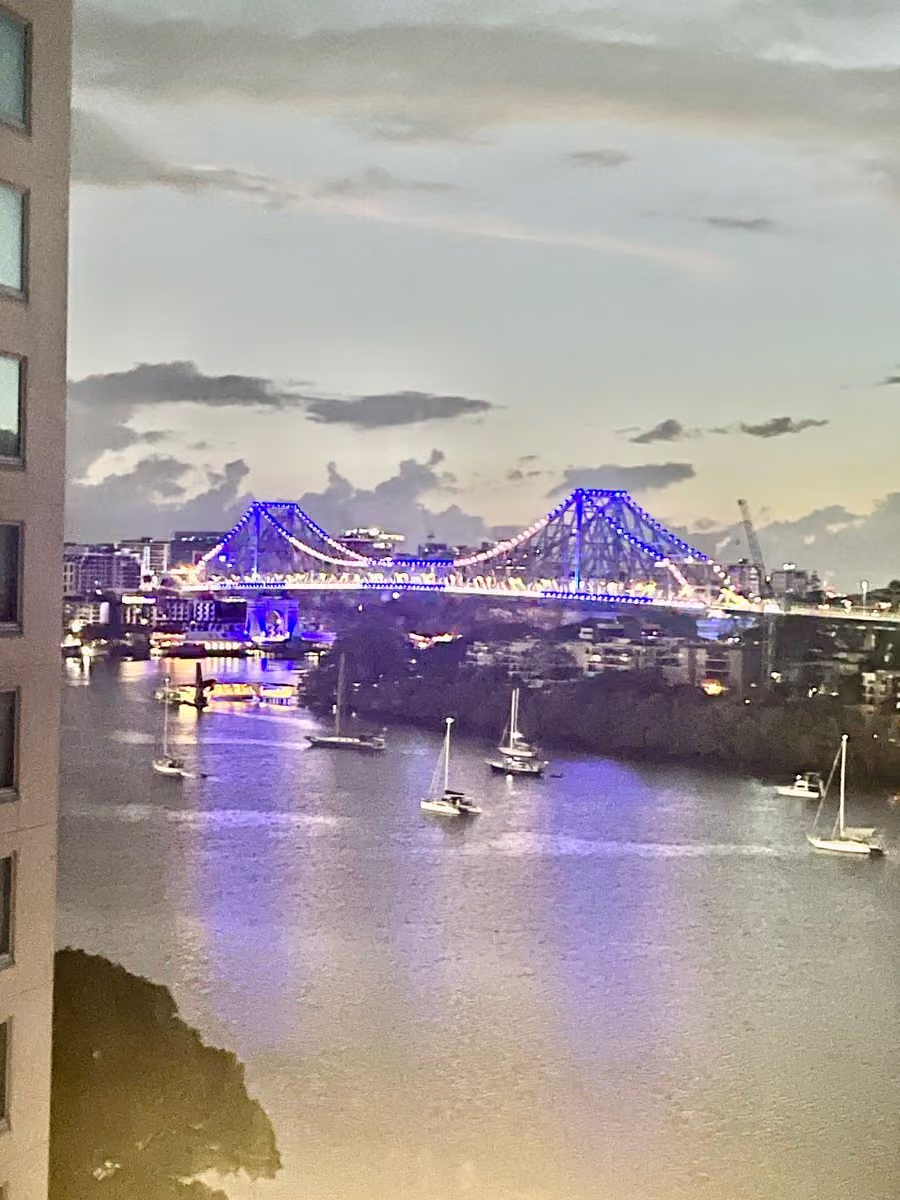


 Amitav Acharya
@AmitavAcharya
Sydney from my hotel room window and roof terrace, dusk to dawn.


 Amitav Acharya
@AmitavAcharya
Sydney from my hotel room window and roof terrace, day & night.


 Amitav Acharya
@AmitavAcharya
Happening this evening in Sydney, Australia: my book talk: The Once and Future World: why civilisation will survive the decline of the West | Australian Institute of International Affairs New South Wales. Registration info in the link: aiiansw.glueup.com/event/the-once-and-future-world-why-ci…

 Amitav Acharya
@AmitavAcharya
Riding the elevator to deliver the finale lecture as Australian National University's Desmond Ball Visiting Chair in Strategie Studies, before a full house audience chaired by Prof Amy King.

 Amitav Acharya
@AmitavAcharya
Australian scenery. NSW coast m . Kangaroo and Joey..o

 Amitav Acharya
@AmitavAcharya
Live from Southeastern coast of Australia (Tuross Head), NSW. I am heading to Canberra for book talks.
Amitav Acharya
@AmitavAcharya
A great start to my Australian book tour at Australian Institute of International Affairs Victoria branch in Melbourne last evening, in dialogue with Gareth Evans- former Australian Foreign Minister, President of International Crisis Group, & Co-Chair of the R2P commission.


 Amitav Acharya
@AmitavAcharya
In Memory of Des Ball by Professor Amitav Acharya | Coral Bell School of Asia Pacific Affairs bellschool.anu.edu.au/news/memory-des-ball-professor-amit…
Amitav Acharya
@AmitavAcharya
‘No fear of roaring lions’: Iran has a long history of standing firm against outside aggressors - my joint essay with Amin Saikal. My part draws on the book The Once and Future World Order which covers Iran's rivalry with Ancient Greeks & Roman Empire theconversation.com/no-fear-of-roaring-lions-iran-has-a-l…
Amitav Acharya
@AmitavAcharya
Flying over the north Pacific Ocean.


 Amitav Acharya
@AmitavAcharya
This morning flying from Beijing to Tokyo. What an awesome sight, Mt Fuji!
 Amitav Acharya
@AmitavAcharya


 Amitav Acharya
@AmitavAcharya
Deeply honored to be appointed by the Australian National University as the 2026 Desmond J. Ball Visiting Chair in Strategic Studies. Des Ball was one of the greatest strategic thinkers in the world, and I had the privilege of working with him since I first met him in 1983, till his passing away in 2016. He inspired me to get into strategic studies and became a mentor, friend and collaborator. I will be in Canberra in May (8-12) to give the lecture on his honor, as well as few others at ANU, and visit Melbourne (6-7), Sydney (13) and Brisbane (14-15) to give talks on my book The Once and Future World Order. Several of these other city lectures are being organized by the Australian Institute of International Affairs as well as universities there.
Amitav Acharya
@AmitavAcharya
 Amitav Acharya
@AmitavAcharya
photo credit: Tomàs González Carbó, Barcelona
Amitav Acharya
@AmitavAcharya
Look, who is taller?

Amitav Acharya reposted
Amitav Acharya
@AmitavAcharya
Open access for a short time: my latest essay @IAJournal_CH
"Thinking beyond a polarized world: why multiplexity matters,"
International Affairs, 102, 2, March 2026, Pages 503–511, doi.org/10.1093/ia/iiag025
Amitav Acharya
@AmitavAcharya
Off to Beijing for the 10th anniversary of Schwarzman Scholars starting tomorrow.
I was the founding Boeing Company Chair of International Relations there in 2016-17 when the program was launched. With family on tow, we spent the entire academic year in residence in the college at Tsinghua University. We traveled throughout China from this wonderful perch in Beijing. I have remained a guest faculty with the program ever since. Looking forward to catching up with scores of students and alumni from all over the world and the leaders and faculty of the program. Some pics from 2016-17 here.
@SchwarzmanOrg


 Amitav Acharya
@AmitavAcharya
What "long game"? China's rise to major world power status has happened in a remarkably short historical time. It took US and Britain much longer to rise to global superpower status. But then China was historically a world major power. Lately, it has moved quickly and openly to exploit opportunities presented first by American liberal hubris and then Trumpian chaos to accelerate its rise.
 Fareed Zakaria
@FareedZakaria
While the US infuriates the world in Iran, China is using this moment to burnish its reputation and build its power.
Beijing is playing the long game.
My take:
Amitav Acharya
@AmitavAcharya
Full house book talk at CIDOB Barcelona last week, The Once and Future World Order will come out in Spanish in a few weeks by ICARIA:
Ediciones de Intervencion
Cultural in Barcelona
icariaeditorial.es/la-editorial
+34 937 550 832
icaria@icariaeditorial.com

 Amitav Acharya
@AmitavAcharya
Open access for a short time: my latest essay @IAJournal_CH
"Thinking beyond a polarized world: why multiplexity matters,"
International Affairs, 102, 2, March 2026, Pages 503–511, doi.org/10.1093/ia/iiag025
Amitav Acharya
@AmitavAcharya
What could come after a rules-based world order? My interview with German news agency DW partly reported here:
Countries that belong to the Global South have felt for a long time that the guardrails built by the West to protect the rules-based order never really benefited them in any meaningful way.
"It was a very selective club. It mainly benefited the United States and its Western allies," Amitav Acharya, a professor at the school of international service at the American University in Washington and author of the book The Once and Future World Order, told DW. He says there is a long-standing perception in the countries of the Global South that "the rules are rigged against them. They did benefit to some extent, but they never really had agency. They never really got the place under the sun, so to speak."
p.dw.com/p/5C0DJ?at_share_source=SharingButton&at_origin=Web
Amitav Acharya reposted
 Chitra Subramaniam
@chitraSD
Read the room people. It’s not just the overthrow of #orban in #hungary that ushers hope. #spain packs tremendous punch. #mexico gets free healthcare for all from 2027. A middle power like #iran has brought the #unitedstates to its knees. The new emerging leaders don’t want war. #switzerland has offered to mediate between #iran and the #us. They have represented the US in Iran since the revolution that overthrew the Shah. I’m sure we’ll find new ways to cooperate. Iran has fought for all of us and I believe it’ll be difficult for countries to live in isolation. The #pope who has condemned the war is en route to #africa I’ve never been more optimistic than I am now. News rooms are buzzing and there’s a tide in #journalism. I keep the faith. @dhanyarajendran @vmvignesh @AbhinandanSekhr @PoojaPrasanna4 @MnshaP #geopolitics
Amitav Acharya reposted
 International Affairs
@IAJournal_CH
The afterword to our latest special section on multiplexity 2.0, written by @AmitavAcharya, is now FREE to view for 2️⃣ weeks!
Read it now: doi.org/10.1093/ia/iiag025
 Amitav Acharya
@AmitavAcharya
After 144 years, Gaudi's masterpiece in Barcelona, Sagrada Família, finally has its Tower of Jesus to become world's tallest church. I first saw the monument over two decades ago & again in 2022. What a spectacular sight!

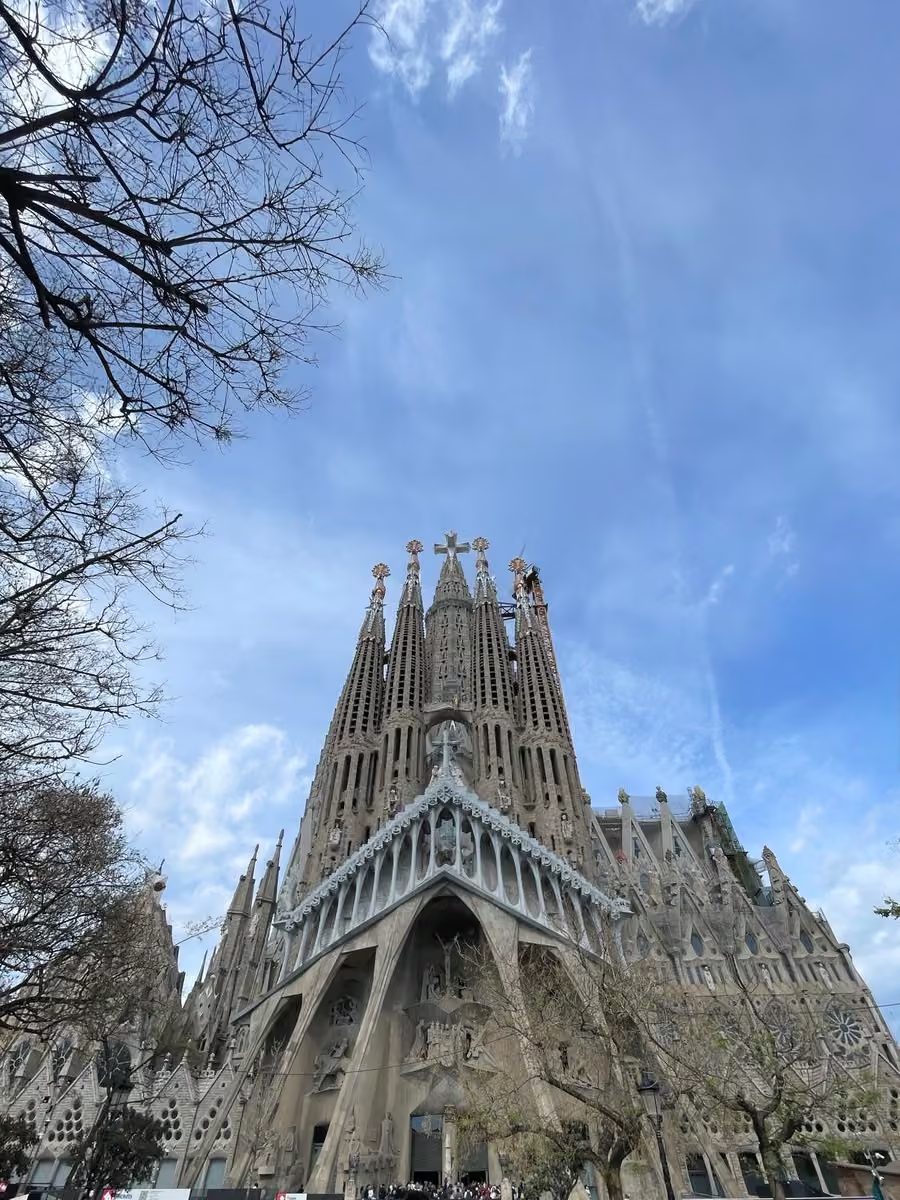
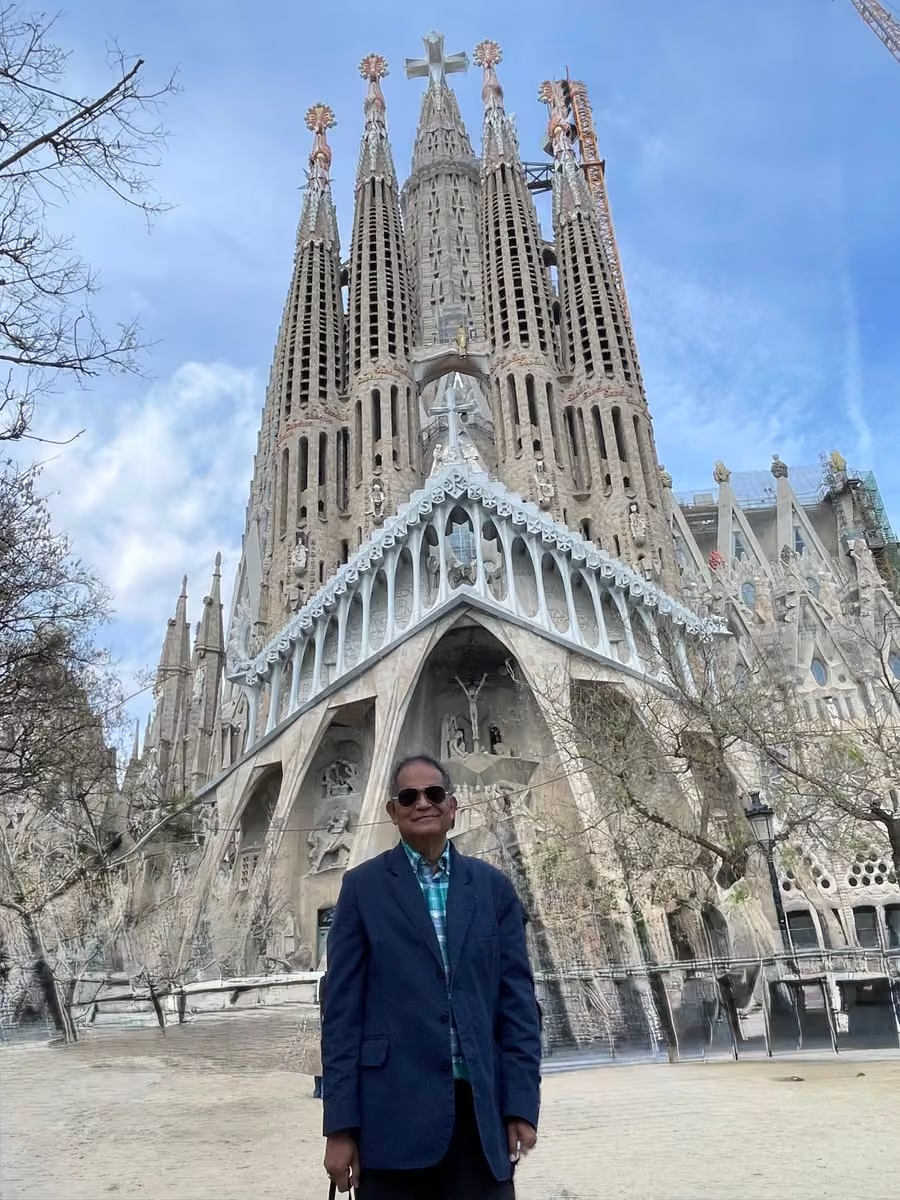 Amitav Acharya
@AmitavAcharya
The biggest losers of Trump 's threat to blockade the Strait of Hormuz might be the Gulf Arab states who provided petrodollars and military bases that became a major prop of US global dominance. Makes my overall point to the world that while multipolarity might be an illusion, unipolarity - depending on a single dominant global power for security and openness- is a fatal attraction.
Amitav Acharya
@AmitavAcharya
Barcelona's Catalunya History Museum is a good place to grasp some aspects of the profound effect of the East on West: Irrigation techniques from Syria, spices & chess from India and paper from China.


 Amitav Acharya
@AmitavAcharya
With Josep Borrell, former EU High Representative for Foreign Affairs and Security Policy and Vice President of the European Commission in Barcelona today. He is currently President of CIDOB (Barcelona Centre for International Affairs), which invited me to speak at their annual conference on War and Peace in the 21st Century. This year's theme was "Defending Europe without the United States? Gracious host, great audience, fun city.
 Amitav Acharya
@AmitavAcharya
Can alliances with the US be replaced? www.bangkokpost.com/opinion/opinion/3231955/can-alliances…
Amitav Acharya
@AmitavAcharya
The US has long prepared for nuclear strikes in Iran, at least since the 1980s. "To prevail in an Iranian scenario, we might have to threaten or make use of tactical nuclear weapons," according to a leaked Pentagon document of 1980, "Capabilities in the Persian Gulf." US aircraft carriers, B-52 bombers, and ground forces like nuclear capable artillery & other nuclear delivery systems were integrated into Army, Navy and Air Force units. More details in my 1989 book, US Military Strategy in the Gulf (Routledge, reprinted 2013, both covers below). The book also outlines the origins of the US Central Command, its contingency plans and the difficulties of operating on the Iranian terrain. While then the "worst-case" scenario was a Soviet invasion of Iran, now it is Iran's own resistance leading to escalating regional conflicts, especially if Iranian strikes cripple oil & gas production and refining facilities in the Arab Gulf states. The scenario of a wider US military operation in other Gulf states to secure energy and protect its bases remains possible, or cannot be ruled out.

 Amitav Acharya
@AmitavAcharya
After the 1973 Arab oil embargo, US contingency plans included an unilateral Persian Gulf "oil grab" planning including seizing Iran's as well as Saudi Arabia's oil fields. Nixon/Ford Secretary of State Henry Kissinger and Defense Secretary James Schlesinger raised that possibility, with the latter speaking of "feasible military operations" against Arab Gulf (not just Iran's) oil producers. Such scenarios were discussed in a Congressional Research Service study: "Oil Fields as Military Objectives". excerpts from my book. Yes, Shah's Iran was target despite its pro-US foreign policy, as the Shah wanted to raise oil prices.
 Amitav Acharya
@AmitavAcharya
A good summary of damage caused by Iran to US military bases in the Gulf. But "the world... depends on the US to be ready to defend and support its presence globally"? WHO IS THE 'WORLD'? Western minds cannot get over narrative of US as the savior of world www.thetimes.com/world/middle-east/israel-iran/article/ir…
Amitav Acharya
@AmitavAcharya
Prof Takashi Inoguchi was a true pioneer among IR scholars from m Asia, who helped develop non-Western IR theory and Asian Barometer. This tribute will inspire all of us. I was very privileged to know him. He wrote the Japan article in the Why is there no Non-Western IR Theory for the International Relations Of Asia-Pacific, and I co-edited with Barry Buzan. Available at www.researchgate.net/publication/31264533_Are_there_any_t…
www.worldscientific.com/doi/pdf/10.1142/S1793930526000085
Amitav Acharya
@AmitavAcharya
About Iran being America's Suez moment, some caution is warranted. In 1956 the British empire (and the French too) was already in terminal decline, and the Suez operation proved to be the last stand of a falling hegemony. America itself is not a declining military power today, despite depleting weapon stocks, but real threat to America is the loss of trust by its allies, affecting its military access & power projection capability. Israel was far less militarily powerful then. Nasser, who made a star appearance at the 1954 Asia-Africa Conference in Bandung, enjoyed much support in the emerging postcolonial world. This is not the case with Iran's Islamic government, despite the international sympathy it might gain from being attacked first and standing up to the US. Both the US and Iran are losers if the war continues, and both have good reasons for a deal, if Israel does not stifle US interest in a deal and continue killing potential dealmakers in Iran.
Amitav Acharya
@AmitavAcharya
A review (in English) of the Arabic translation of The Making of Global International Relations, which provides a good summary of the chapters of the book. There translation was done by Ammar Bu Asha / and c published by the National Council for Culture, Arts and Letters - Kuwait, January 2023
www.pissue.iq/index.php/pissue/article/download/850/591
 Amitav Acharya
@AmitavAcharya
The cherry tree in our front yard had a visitor.
 Amitav Acharya
@AmitavAcharya
Excerpts from my interview with The Hindu newspaper of India:
"Q: What does American foreign engagement look like in
a post-Trump era? Is there any recovery possible for the
institutional architecture that Mr. Trump has demolished?"
Acharya: "The trust is gone. Every major partner has spent the Trump years reducing dependence on the U.S.. The EU-India deal, EU-Mercosur, Canada turning towards China: that reorganisation will not reverse.. The WTO weakened, NATO fractured, normative authority spent. American engagement going forward will be, at best, mis-engagement: self-serving, selective, unpredictable."
Acharya:
"Trump cannot determine outcomes in many domains. He can destroy. He cannot change regimes...The U.S. in 1990 had hard and soft power and could mobilise allies, write rules, shape outcomes. What we see today is a power that can cause destruction but cannot construct order. "
Q: "Where is India making its biggest mistakes?"
Acharya: "India’s biggest strategic problem is the obsession with Pakistan. That energy should go toward pragmatic engagement with China. Lie low, build resilience, take advantage of Chinese economic opportunity — that is exactly what China did with Japan for decades before asserting itself. Do not brag about power you do not yet have...India also needs to repair relations with its neighbours. You cannot afford to have them constantly complicating your problems."
The Hindu
March 29, 2026
www.thehindu.com/opinion/op-ed/trump-is-not-the-cause-of-…
x.com/the_hindu/status/2038202689881035085
‘Trump is Not the Cause of the West’s Decline. He is Its Consequence’
 The Hindu
@the_hindu
‘Amitav Acharya, Distinguished Professor of International Relations at American University, and author of ‘The Once and Future World Order: Why Global Civilization Will Survive the Decline of the West’ (2025), draws on 5,000 years of history to argue that the world order has never been a western monopoly, adding that its decline signals not collapse but a return to a historically normal multi-civilizational system.
www.thehindu.com/opinion/op-ed/trump-is-not-the-cause-of-…
 Amitav Acharya
@AmitavAcharya
"A highly readable, even passionate book, Amitav Acharya's The Once and Future World Order: Why Global Civilization Will Survive the Decline of the West (London: Basic Books, 2025) is an engaging, timely and essential read everywhere, in the 'West and the 'Rest'.
It will inform, provoke and stimulate anyone interested in the current transitional, chaotic, changing, anxiety-inducing phase of world history, one frequently referred to as an age of global disorder. Its expose of historical and contemporary Western oppression will anger many readers, especially from, or of, global South heritage. It should move anyone with any sense of justice. It will also aggravate and exercise champions of Western superiority, all named and clinically dissected in detail.
And it will frighten, but also reassure and comfort, those who worry about the end of the West. This is because Acharya's excellent study - the culmination of decades of research and reflection, is also a torch shining the way towards better possible worlds, despite the doom and gloom of global politics today.
After all, professor Acharya is an award-winning scholar at American University in Washington, DC, right in the heart of the American empire led by its current flag-bearer, President Donald J. Trump.
The Wire (full text at)
www.facebook.com/thewire.in/posts/a-highly-readable-even-…


Amitav Acharya reposted
The Hindu
@the_hindu
‘Amitav Acharya, Distinguished Professor of International Relations at American University, and author of ‘The Once and Future World Order: Why Global Civilization Will Survive the Decline of the West’ (2025), draws on 5,000 years of history to argue that the world order has never been a western monopoly, adding that its decline signals not collapse but a return to a historically normal multi-civilizational system.
www.thehindu.com/opinion/op-ed/trump-is-not-the-cause-of-…
Amitav Acharya
@AmitavAcharya
Driving directly under cherry blossoms in full glory today in the Kenwood neighborhood in Bethesda: a wonderful unique experience. @capitalweather
Amitav Acharya reposted
Amitav Acharya
@AmitavAcharya
"The era of a Western dominated world order is over." Finnish President Alexander Stubb, Raisina Dialogue 2026 in New Delhi.
+++++++
"The age of Western hegemony is over...the postwar liberal world order.. is coming to an end. " Acharya, The End of American World Order, 2014
+++++++
It took 12 years for Western leaders (and news media & main think tanks) to accept what was becoming increasingly clear to some a decade ago.
There are striking similarities between Stubb's points (about Global South's role, how to rebuild global cooperation, the need for the West to get over nostalgia and embrace its decline) & arguments in my new book "The Once & Future World Order"
www.presidentti.fi/en/inaugural-address-by-president-of-t…


Amitav Acharya reposted
Amitav Acharya
@AmitavAcharya
Signing The Once and Future World Order @isanet 2026 in Columbus


 Amitav Acharya
@AmitavAcharya
A key point in my Once & Future World Order book) is that the current world order, the liberal international order, has benefited the West much more than the rest. This paper provides data points on how much more the international institutions that are integral to the liberal order have benefited nations aligned to the West than the rest thanks to institutional design, voting rights & geopolitics.
"Around 70% of World Bank and IMF funds go to countries that are aligned with the G7."
My argument is that the decline of Western dominance & the end of this heavily skewed world order need not be bad in the long term and might pave the way for a more just and inclusive world. But the leader of that order, the US, would not give up its privileges without a big fight & the attack on Iran is the latest sign of that.
wid.world/document/the-global-democratic-deficit-institut… Global Democratic Deficit: Institutional Asymmetries
and the Provision of Global Public Goods
Paula Druschke∗ Gast´ on Nievas†
Amitav Acharya
@AmitavAcharya
Looking forward to being back in Barcelona for an in-person and live streamed dialogue on my book at CIDOB on 14 April on
What’s going on in the world?" Why global civilization will survive the decline of the West
18:30h
Register at:
www.cidob.org/en/events/whats-going-world-why-global-civi…
The session will be streamed live on CIDOB’s YouTube channel. The conversation will be conducted in English with simultaneous translation in Spanish.
Amitav Acharya
@AmitavAcharya
Receiving the T.V. Paul Best Book Award from Prof Paul himself at the International Studies Association Convention in Columbus, Ohio, March 23, 2026 for Divergent Worlds: What the Ancient Mediterranean and Indian Ocean Can Tell Us About the Future of International Order (Yale 2025), co-authored with Manieet Pardesi (who could not come to ISA but sent a gracious message that was read out). The book was co-winner of the award given by @GIRS_ISA annually. @research_sis @AU_SIS
@tvpaul1 @isanet @manjeetsp

 Amitav Acharya
@AmitavAcharya
Signing The Once and Future World Order @isanet 2026 in Columbus
Amitav Acharya reposted
 Mohamed Othman
@MohOthAU
A pleasure to attend Prof. @AmitavAcharya presentation at #isa2026 on the International Affairs special issue on multiplexity. A timely and thought-provoking discussion that pushes the conversation beyond polarity toward multiplexity 2.0 academic.oup.com/ia/issue/102/2
 Amitav Acharya
@AmitavAcharya
"The era of a Western dominated world order is over." Finnish President Alexander Stubb, Raisina Dialogue 2026 in New Delhi.
+++++++
"The age of Western hegemony is over...the postwar liberal world order.. is coming to an end. " Acharya, The End of American World Order, 2014
+++++++
It took 12 years for Western leaders (and news media & main think tanks) to accept what was becoming increasingly clear to some a decade ago.
There are striking similarities between Stubb's points (about Global South's role, how to rebuild global cooperation, the need for the West to get over nostalgia and embrace its decline) & arguments in my new book "The Once & Future World Order"
www.presidentti.fi/en/inaugural-address-by-president-of-t…
Amitav Acharya
@AmitavAcharya
How might the Iran War Reshape World Order. My take:
The war proves once again that the US remains the world’s preeminent military power, especially when it comes to inflicting massive damage on a distant adversary. At the same time, the war has demonstrated that America’s overall global military superiority does not guarantee success in attaining political objectives in complex regional conflicts against large nations with well-entrenched governments—authoritarian or not—backed by strong religious or ideological beliefs.
The war totally lacks legitimacy under international norms and law. It cannot be legally justified as “preemptive war” since there was no credible threat of an imminent attack from Iran against the U.S. or its Gulf allies.
Nor can it be accepted as a “preventive war,” since Iran already indicated verifiable curbs on its uranium enrichment program necessary to become a nuclear weapons state.
Even if Trump declares victory to end the war, it will be a pyrrhic victory for the U.S. (meaning a success that inflicts such devastating costs on the victor—often in lives, resources, or reputation—that it is tantamount to defeat).
The war is more likely to produce regime change in Washington than in Tehran. Unlike the U.S.-led victory in Iraq in 1991, which produced a “unipolar moment,” this war in the short term ushers in what I have called in Foreign Policy’s January 2026 cover story as “the world-minus-one moment,” or the near total isolation of the U.S. on the world stage.
This is already demonstrated in the negative international response to Trump’s call for joint naval operations to clear the Strait of Hormuz. The war further shows that aligning with the U.S. is a fatal attraction for countries that had depended on the U.S. for military protection and economic benefit. Even the certified allies or partners of the U.S., like Canada and nations of Western Europe, have been bullied, tariffed and made to feel acutely insecure. The war benefits America’s adversaries—Russia and China—and profoundly alienates Global South nations that were in a neutral or hedging mode against U.S.–China or U.S.–Russia rivalry. In the longer term, unless, the U.S. reverses the course set by Trump, the war will speed up the end of the U.S.-dominated world order and help the emergence of a “multiplex world” in which U.S. dominance gives way to a complex framework in which not only other great powers but also middle powers and regional powers and Global South nations will play a more important role. Despite its vast military power, America will be distrusted and have to settle for a less prominent role in the global political, economic, and diplomatic scene than has been the case since World War II.
- Amitav Acharya, author of the recent book, The Once and Future World Order (2025)
www.american.edu/sis/news/20260317-whats-at-stake-in-the-…
Amitav Acharya
@AmitavAcharya
It was a pleasure to present my book Once and Future World Order at @isanet 2026 annual convention in Columbus, Ohio. We lost several panelists to flight disruptions & refusal of foreign participants to come to US, but had a great audience with lots interaction. Peter Katzenstein and Nora Fisher Onar were discussants. @research_sis @GIRS_ISA


 Amitav Acharya
@AmitavAcharya
Yesterday after my book talk at Montreal's McGill University: with 3 (out of dozens) of fresh & enthusiastic faces who listened to the talk.

Amitav Acharya reposted
International Affairs
@IAJournal_CH
How can we best read the post-liberal era of world politics?
Introducing the special section, guest-editors @IndrajitRoyYork (@UniOfYork) and @FisherOnar build on @AmitavAcharya’s work to offer a vision of ‘multiplexity 2.0’ that captures the interface of hard power, soft power and global diversity. doi.org/10.1093/ia/iiag027
 Amitav Acharya
@AmitavAcharya
After refusing Trump's call for help in reopening Strait of Hormuz, the Europeans and others could try to make their deals with Iran to gain safe passage, bilaterally and transactionally. A dose of Trump's own medicine. This also means a serious blow to NATO & the West.
Amitav Acharya
@AmitavAcharya
Control of the Strait of Hormuz puts Iran in the driver’s seat, by Middle East analyst, James M. Dorsey
"For all practical purposes, Iran’s assertion of control has put the Islamic Republic in the war’s driver’s seat." open.substack.com/pub/jamesmdorsey/p/control-of-the-strai…
Amitav Acharya reposted
International Affairs
@IAJournal_CH
This week, we published a special section guest-edited by @FisherOnar & @IndrajitRoyYork that builds on @AmitavAcharya's work to offer a vision of ‘multiplexity 2.0’ that captures the interface of hard power, soft power and global diversity.
The introduction article is now FREE TO VIEW for two weeks. Read here 👉 doi.org/10.1093/ia/iiag027
 Amitav Acharya
@AmitavAcharya
Asian Regionalism and
World Order/ my podcast with JICA Ogata Research Institute
www.youtube.com/watch?v=BqONIwnos6k
JICASSP
Mar 3 2026
#jica
#jicaogataresearchinstitute
Amitav Acharya
@AmitavAcharya
Trump is increasingly invoking history and now claims that due to US/Israel bombings,
"It is the first time that Iran has ever lost, in thousands of years, to surrounding Middle Eastern Countries."
Another pertinent history would be the prolonged conflict between the Roman Empire (which is sometimes compared with the US for unrivaled military prowess) and ancient Persia under Parthian and Sassanian rulers, which on several occasions defeated & humiliated Rome, including the capture of Roman Emperor Valerian (some sources say he was used as a footstool) by Shapur 1 in 260 CE. History works both ways and should teach humility rather than hubris.
 Amitav Acharya
@AmitavAcharya
We have a Clash within a Civilization in the US-Iran war.
Amitav Acharya
@AmitavAcharya
Hegseth: “death and destruction from the sky all day long...Our warfighters have maximum authorities granted personally by the president and yours truly. Our rules of engagement are bold, precise and designed to unleash American power, not shackle it."
Hegseth: “As you know there’s a direct through line from the Old and New Testament Christian gospels to the development of Western civilization and the United States of America.”
But observing certain humanitarian principles and rules of war is the very essence of being civilized: This is part not just of "Western civilization" but also of many others (a key theme of my book The Once and Future World Order; for India, see pp.81-82 ).
Here is the Christian doctrine of just war (as summarized by BBC).
"The war must have a just cause - eg against invasion or for self-defence - and not to acquire wealth or power.
The war must be fought to promote good or avoid evil, with the aim of restoring peace and justice after the war is over.
The war must be a last resort when all peaceful solutions have been tried and failed, eg negotiation.
The war should be fought with proportionality. There should be just enough force to achieve victory over legitimate targets, ie civilians should be protected."
www.bbc.co.uk/bitesize/guides/zrndpg8/revision/2
But there was no threat of invasion by Iran against US, the US attacked Iran when negotiations were not over and might have been close to succeeding, so it was hardly the last resort, and your threat of raining down "death and destruction from the sky all day long" (and night too), will certainly kill innocent people as has already happened. And by most accounts, there is no clear plan for post-conflict Iran if that ever happens. How is this being Christian or being civilized?
Amitav Acharya
@AmitavAcharya
Classic military-industrial complex
Amitav Acharya
@AmitavAcharya
This the other America. Of hope, not anger, of compassion, not destruction, of inclusion, not vindictiveness. blockclubchicago.org/2026/03/06/chicagoans-joined-by-3-fo…
Amitav Acharya
@AmitavAcharya
Hegseth: “death and destruction from the sky all day long...Our warfighters have maximum authorities granted personally by the president and yours truly. Our rules of engagement are bold, precise and designed to unleash American power, not shackle it."
Hegseth: “As you know there’s a direct through line from the Old and New Testament Christian gospels to the development of Western civilization and the United States of America.”
But observing certain humanitarian principles and rules of war is the very essence of being civilized: This is part not just of "Western civilization" but also of many others (a key theme of my book The Once and Future World Order; for India, see pp.81-82 ).
Here is the Christian doctrine of just war (as summarized by BBC).
"The war must have a just cause - eg against invasion or for self-defence - and not to acquire wealth or power.
The war must be fought to promote good or avoid evil, with the aim of restoring peace and justice after the war is over.
The war must be a last resort when all peaceful solutions have been tried and failed, eg negotiation.
The war should be fought with proportionality. There should be just enough force to achieve victory over legitimate targets, ie civilians should be protected."
www.bbc.co.uk/bitesize/guides/zrndpg8/revision/2
But there was no threat of invasion by Iran against US, the US attacked Iran when negotiations were not over and might have been close to succeeding, so it was hardly the last resort, and your threat of raining down "death and destruction from the sky all day long" (and night too), will certainly kill innocent people as has already happened. And by most accounts, there is no clear plan for post-conflict Iran if that ever happens. How is this being Christian or being civilized?
Amitav Acharya
@AmitavAcharya
Trump wants unconditional surrender by Iran? By setting such unrealistic goals, the US may be in for an eventual humiliating retreat. Iran is NOT Venezuela. More like Afghanistan, where the US lost despite having substantial boots on the ground. Even if the current government of Iran is destroyed, a replacement US surrogate will have a major civil war to deal with. Iran could fragment, and the entire Gulf would be in turmoil. It will end up badly for the Trump regime, the US & its Gulf allies.
 Javier Blas
@JavierBlas
Well, that escalated quickly. First it was nuclear program, then the missiles, then regime change, now is unconditional surrender, in capital letters.
 Amitav Acharya
@AmitavAcharya
Live Interview yesterday with Italy's leading news channel Rai News 24 (from about 26 minutes and 26 seconds) to discuss current affairs & mark the Italian translation of The Once & Future World Order. Note the Ganesh, Tang Horse & Vietnamese gem painting on my screen.
www.rainews.it/rubriche/sera24/video/2026/03/Sera-24---Pu…

 Amitav Acharya
@AmitavAcharya
Just interviewed live by Italian TV channel RaiNews about the Iran War drawing on lessons from my book (now in translated into Italian)

 Amitav Acharya
@AmitavAcharya
Just interviewed live by Italian TV channel RaiNews about the Iran War drawing on lessons from my book (now in translated into Italian)
Amitav Acharya
@AmitavAcharya
 Amitav Acharya
@AmitavAcharya
ASEAN points to "attacks initiated by Israel and the United State". Bear in mind that ASEAN has been one of the friendliest group of nations to the US. Two members -Thailand & Philippines- are formal security allies of the US while Singapore is a key US strategic partner, giving US forces substantial access to its military facilities. No wording here to echo US justification of the war such as preemption, Iran's nuclear & missile capability.
 ASEAN
@ASEAN
We follow closely the situation and express serious concern over the escalation of conflict in the Middle East following the attacks initiated by Israel and the United States against the Islamic Republic of Iran on 28 February 2026 and the subsequent retaliatory attacks by the Islamic Republic of Iran against several countries in the region, including the Kingdom of Bahrain, Hashemite Kingdom of Jordan, State of Kuwait, Sultanate of Oman, State of Qatar, Kingdom of Saudi Arabia, Syrian Arab Republic, and the United Arab Emirates, which continue to heighten tensions in the Middle East, and pose a grave threat to the lives and safety of civilians, as well as to regional and global peace and stability. We call on all countries to respect international law, including the Charter of the United Nations (UN Charter).
Read more: asean.org/asean-foreign-ministers-statement-on-the-situat…

Amitav Acharya reposted
ASEAN
@ASEAN
We follow closely the situation and express serious concern over the escalation of conflict in the Middle East following the attacks initiated by Israel and the United States against the Islamic Republic of Iran on 28 February 2026 and the subsequent retaliatory attacks by the Islamic Republic of Iran against several countries in the region, including the Kingdom of Bahrain, Hashemite Kingdom of Jordan, State of Kuwait, Sultanate of Oman, State of Qatar, Kingdom of Saudi Arabia, Syrian Arab Republic, and the United Arab Emirates, which continue to heighten tensions in the Middle East, and pose a grave threat to the lives and safety of civilians, as well as to regional and global peace and stability. We call on all countries to respect international law, including the Charter of the United Nations (UN Charter).
Read more: asean.org/asean-foreign-ministers-statement-on-the-situat…
Amitav Acharya
@AmitavAcharya
Preemptive Peacekiller. It has become clear since I wrote this that there was no imminent danger of Iranian attack on US assets or forces. Trump attacked first because Netanyahu was (allegedly) about to attack Iran (against Trump's wishes, or in cahoot with him?) and Trump feared Iranian retaliation against US assets. Not only is this a highly convoluted logic of preemptive war but it might also make nations deeply suspicious of doing any peace talks with the US since negotiations for a deal with Tehran were still going on. Trump has gone full circle from Nobel Peace Aspirant to Preemptive Peacekiller.
Amitav Acharya
@AmitavAcharya
The US-Israeli strike on Iran is not a preemptive war, as Iran was not about to attack the US or its allies. It is arguably not a preventive war as there was an agreed framework a few years ago that Trump 1 walked out of and Iran had agreed not to develop nuclear weapons as part of the negotiations this time. Is it justified because of Iran's repressive regime? Yet Western countries including the US were willing to sign onto the Iran nuclear deal (Joint Comprehensive Plan of Action - JCPOA) with the very same regime. While the US under the Trump administration does not care about democracy, those Western nations who say they do and also defend international law including UK, France and Germany and others should stand up and condemn it.
Amitav Acharya
@AmitavAcharya
My comments today in The Guardian on US-Israel war on Iran.
Amitav Acharya, author of The Once and Future Global Order, said that in the past, the US had sought influence and legitimacy. Now, the US acted solely through coercion, even as Chinese soft power was gaining, with Beijing offering investment to developing countries. He said that Russia, too, would benefit, as Iran and other Trump foreign policy shocks took the focus away from Ukraine.
Many countries in the global south are going to look for a coalition of powers that will stand up to the United States, as the United States is seen as so aggressive, so imperial,” said Acharya.
www.theguardian.com/world/2026/mar/03/global-south-condem…
Amitav Acharya
@AmitavAcharya
This is because history as taught in schools and universities in the West presents civilization as a monopoly of the West, rather than having multiple and shared foundations. And as I found out in writing The Once and Future World Order, presenting an alternative narrative runs into deeply set ignorance, prejudice, & disbelief including from right wing or establishment media & intellectuals. But it is a struggle worth joining and fighting for.
 Thant Myint-U
@thantmyintu
It’s hard not to come to the conclusion that underlying everything is an ingrained inability (in Washington, at least since Vietnam) to imagine non-Western (non-white) counties as complex societies, with their own set of stories, inhabited by people capable of the full spectrum of human emotion and rational thought (seemingly these days more rational thought).
Amitav Acharya
@AmitavAcharya
Book Review: Amitav Acharya, From Southeast Asia to Indo-Pacific
Culture, Identity, and the Return to Geopolitics, Penguin, 2025
www.aseanwonk.com/p/southeast-asia-indo-pacific-asean-fut…
Amitav Acharya
@AmitavAcharya
The US-Israeli strike on Iran is not a preemptive war, as Iran was not about to attack the US or its allies. It is arguably not a preventive war as there was an agreed framework a few years ago that Trump 1 walked out of and Iran had agreed not to develop nuclear weapons as part of the negotiations this time. Is it justified because of Iran's repressive regime? Yet Western countries including the US were willing to sign onto the Iran nuclear deal (Joint Comprehensive Plan of Action - JCPOA) with the very same regime. While the US under the Trump administration does not care about democracy, those Western nations who say they do and also defend international law including UK, France and Germany and others should stand up and condemn it.
Amitav Acharya
@AmitavAcharya
With the latest attack on Iran, Trump is building his own brand of world order - The Trump World Order- one that is based not on geopolitical retreat or selectivity as HE had initially promised but on a major expansion of scope and aims. The TWO embraces preventive war, regime change, further contempt for multilateralism, coercive disregard for traditional allies -excluding Israel but including Gulf and European allies- and dismissal of domestic opinion. This Trump World Order might be shorter-lived but could be far more chaotic than any previous stages in the US-led order, which should add to arguments -as I have made- that challenge the alleged benefits of a hegemonic world order.
Amitav Acharya
@AmitavAcharya
Trump and Netanyahu want regime change, but Iran’s regime was built for survival. By Amin Saikal author of multiple acclaimed books on Iran.
theconversation.com/trump-and-netanyahu-want-regime-chang…
Amitav Acharya
@AmitavAcharya
Full house yesterday at my book talk hosted by the World Affairs Council of Louisville at the iconic Filson Historical Society founded in 1884 : a most fitting venue for the theme of the book. It was great to engage an audience with a keen interest in international affairs outside of the usual academic and policy crowds.

 Amitav Acharya
@AmitavAcharya
This article not only offers a clear definition of multiplex world order, but also makes a powerful case for why multiplexity-not unipolarity, bipolarity or multipolarity- offers a timely & indispensable policy framework for middle powers like South Korea. www.koreatimes.co.kr/opinion/20260226/imagining-the-unima…
Amitav Acharya reposted
Amitav Acharya
@AmitavAcharya
The World-Minus-One Moment," is my cover story for @ForeignPolicy latest v issue: foreignpolicy.com/2026/01/05/world-minus-one-united-state…
It takes off from my book, The Once and Future World Order, which is among the few books in the Munich Security Conference's official reading list.
Amitav Acharya reposted
Amitav Acharya
@AmitavAcharya
In his Munich Security Conference speech, US Secretary of State Marco Rubio mentioned civilization 12 times, bemoaning lost “Western empires,” and calling for the revival of the “great and noble [Western] civilization,” Hence, civilizational supremacism and imperial nostalgia is now officially part of US foreign policy under Trump.
The MSC also placed my book -The Once and Future World Order- among its official report’s “food for thought.” (thank you). The book - a 5000 year history of civilization and world order - is a timely & total refutation of Rubio's take on Western civilization (I do share his rejection of Fukuyama’s “end of history” thesis)
Here are some key points of my book that Rubio & those Europeans and Americans cheering him on, in Munich, should keep in mind.
1. The “West and “Western civilization” are fairly new constructs & were powered by European and settler American imperialism & racial beliefs, including America's founders.
2. The ancient Greeks & Romans - often appropriated by European & settler American imagination as their cultural ancestors - did not see themselves as “Western,” or part of any singular “Western civilization.”
3. Civilization is no one’s monopoly. The hallmarks of a great civilization, not only writing, urbanization, long-distance trade, but also political principles & institutions such as independence or sovereignty of states, diplomacy, peace treaties, freedom of seas, tolerance, human rights (protecting people against unjust & cruel punishment or discrimination), humanitarian values (protecting non-combatants & injured in war), republican government (precursor to modern democracy) and much more came from multiple civilizations often predating the rise of Europe, from Asia, Africa, Islamic world, Eurasian heartland, pre-Colombian native American societies, and Europe. My book offers plenty of historical evidence of connections and mutual learning that make civilization & world order a shared creation.
4. “Western civilization” & the economic and military rise of the West, depended critically on borrowing ideas & values from these other civilizations as well as extracting & exploiting their resources: both material & human (as in slavery). While imperialism and slavery are not unique to the West, what I call Europe's "magic potion" blended them with scientific racism & & emerging capitalist economy to power its rise.
Time to bury the civilizational supremacy & hubris, wherever they originate from.

Amitav Acharya reposted
Amitav Acharya
@AmitavAcharya
Those interested in BRICS + and Global South, here is a volume edited by Heiwai Tang and Brian Wong at Hong Kong University's Asia Global Institute. .
TOWARDS A FUTURE FOR BRICS+
My chapter is about the "New Global South" and its role in world order.
Free download the whole book at openbookshongkong.com/wp-content/uploads/2025/07/97898889…
Amitav Acharya
@AmitavAcharya
After the storm: lovely @AmericanU campus this morning as I drove through it.


 Amitav Acharya
@AmitavAcharya
It is surely exciting for me as an academic to have my work on "multiplex world order" invoked by the foreign minister of the world's fourth most populous country and a leader among the emerging nations.
Indonesian Foreign Minister Sugiono's 13 January 2026 Annual Press Statement notes:
"A multiplex world order, where multiple arenas of interests, dominant actors, and rules of engagement intertwine, and where cooperation becomes increasingly more transactional."
He adds:
"I also recognize one key reality: in a multiplex world, multilateralism today is an ecosystem of arenas, sustained because it is reinforced by multiple platforms."
Some have criticized a multiplex order as leading to chaos. This is misleading. Multiplex is really a call to recognize novel ways to build cooperation, recognizing new realities of world politics, as the minister's second observation about the concept recognizes.
In any case, there is plenty of chaos under the US-led order under Trump.
This is the second time my work has proven useful to Indonesian policymakers: in 2003, it was the ASEAN security community ( a concept originally developed by Karl Deutsch but revived & adapted by me in my 2002 book, Constructing a Security Community in Southeast Asia)
Amitav Acharya
@AmitavAcharya
Even the relatively "quick & easy" victory in Iraq 2003 cost the US trillions. It claimed millions of Iraqi civilian lives, which may not matter to the Trump or his backers but should factor in the dismal humanitarian record of the US-led international order. Iran is much larger in size & population, and with a regime backed by religious fervor unlike the Saddam regime in Iraq, and Iran has allies among radical groups that Saddam regime did not have. And for a person who promised to end wars, a war with Iran, if it materializes, coming after Venezuela plus military threats over Greenland, Trump would go down as the one the biggest warmongers in US history.
Amitav Acharya
@AmitavAcharya
Same applies to India perhaps. Especially if stopping Russian oil purchase completely was really conceded by New Delhi.
Michael Vatikiotis
@jagowriter
Deal done by #indonesia to mitigate punitive tariffs done on the eve of a US Supreme Court decision that make a these tariffs illegal - such bad timing. #tolol
 Reuters
@Reuters
Indonesia and the US finalized a trade deal to cut US levies to 19% from 32% on goods shipped from Southeast Asia's biggest economy, with Jakarta securing tariff exemptions for its top export, palm oil, and several other commodities www.reuters.com/world/asia-pacific/indonesia-us-sign-agre…
Amitav Acharya reposted
Michael Vatikiotis
@jagowriter
Deal done by #indonesia to mitigate punitive tariffs done on the eve of a US Supreme Court decision that make a these tariffs illegal - such bad timing. #tolol
Reuters
@Reuters
Indonesia and the US finalized a trade deal to cut US levies to 19% from 32% on goods shipped from Southeast Asia's biggest economy, with Jakarta securing tariff exemptions for its top export, palm oil, and several other commodities www.reuters.com/world/asia-pacific/indonesia-us-sign-agre…
Amitav Acharya
@AmitavAcharya
The Future Is Indian - The New York Times. My podcast (with text) in the "Interesting Times" series with Ross Douthat @nytimes
www.nytimes.com/2026/02/19/opinion/interesting-times-amit…
Amitav Acharya
@AmitavAcharya
The world is more complex than any polarity- based framing. Watch out for a special section of @IAJournal_CH due out soon, including my essay on "Thinking Beyond a Polarized World."
Rajesh Rajagopalan
@RRajagopalanJNU
Excellent piece from @MohanCRaja re the multipolarity nonsense. A small disagreement re unipolarity, though, as I think we are probably heading towards bipolarity.
www.foreignaffairs.com/united-states/multipolar-delusion-…
 Amitav Acharya
@AmitavAcharya
In his Munich Security Conference speech, US Secretary of State Marco Rubio mentioned civilization 12 times, bemoaning lost “Western empires,” and calling for the revival of the “great and noble [Western] civilization,” Hence, civilizational supremacism and imperial nostalgia is now officially part of US foreign policy under Trump.
The MSC also placed my book -The Once and Future World Order- among its official report’s “food for thought.” (thank you). The book - a 5000 year history of civilization and world order - is a timely & total refutation of Rubio's take on Western civilization (I do share his rejection of Fukuyama’s “end of history” thesis)
Here are some key points of my book that Rubio & those Europeans and Americans cheering him on, in Munich, should keep in mind.
1. The “West and “Western civilization” are fairly new constructs & were powered by European and settler American imperialism & racial beliefs, including America's founders.
2. The ancient Greeks & Romans - often appropriated by European & settler American imagination as their cultural ancestors - did not see themselves as “Western,” or part of any singular “Western civilization.”
3. Civilization is no one’s monopoly. The hallmarks of a great civilization, not only writing, urbanization, long-distance trade, but also political principles & institutions such as independence or sovereignty of states, diplomacy, peace treaties, freedom of seas, tolerance, human rights (protecting people against unjust & cruel punishment or discrimination), humanitarian values (protecting non-combatants & injured in war), republican government (precursor to modern democracy) and much more came from multiple civilizations often predating the rise of Europe, from Asia, Africa, Islamic world, Eurasian heartland, pre-Colombian native American societies, and Europe. My book offers plenty of historical evidence of connections and mutual learning that make civilization & world order a shared creation.
4. “Western civilization” & the economic and military rise of the West, depended critically on borrowing ideas & values from these other civilizations as well as extracting & exploiting their resources: both material & human (as in slavery). While imperialism and slavery are not unique to the West, what I call Europe's "magic potion" blended them with scientific racism & & emerging capitalist economy to power its rise.
Time to bury the civilizational supremacy & hubris, wherever they originate from.
Amitav Acharya
@AmitavAcharya
The new fault line in global order is not US vs China, or West vs the Rest, rather it's the US vs the World, or World-minus-the-US. ("World minus One") @MunSecConf

 Amitav Acharya
@AmitavAcharya
The World-Minus-One Moment," is my cover story for @ForeignPolicy latest v issue: foreignpolicy.com/2026/01/05/world-minus-one-united-state…
It takes off from my book, The Once and Future World Order, which is among the few books in the Munich Security Conference's official reading list.
Amitav Acharya
@AmitavAcharya
Harvard-India conference: 14 Feb 2026 : My talking points:
What can we learn from ancient Indian thinking to help illuminate the present moment?
Ancient Indian thinking was eclectic & pluralistic: the same Maurya dynasty Kautilya's realpolitik and Ashoka's idealism.
But one principle that stands out and cuts across different time period & traditions: the importance of tolerance and pluralism.
I call it the Diamond Law of Indian history: tolerance promoted stability, intolerance led to crisis and downfall. Examples:
Caste intolerance led to fall of India's golden age after the Gupta;
Aurangzeb's intolerance led to the downfall of Mughals, & the
British Raj's divide-and-rule sectarianism led to the partition of India whose legacy remains.
We may now be in another turning point . What's happening now in terms of Hindu nationalism could weaken India significantly unless addressed. It could be the major threat to India's rise.
Forgetting that Indian civilization was born pluralistic, decentralized, and syncretic is a terrible mistake.
On the "Out of India" debate, it is useful to remember that Indian civilization did spread, but before it did so, it was born out of a synthesis from external and indigenous elements. It was never purely born in India nor purely imported from outside.
The Indus-Valley civilization merged with that of the newly arriving peoples from steppes, creating a continuity that makes India - not China - the oldest continuing civilization of the world, but only if one accepts that it was born out of synthesis not singularity.
India diversity is to some degree the opposite of China which values uniformity and is fearful of diversity:
Tagore’s poem, Flight of Swans, translated by none other than Aurobindo Ghose, celebrates India’s openness and adaptation.
On the shores of Bharat…,
Came floating streams of men...,
The Aryan, the non-Aryan, the Dravidian,
The Huns, the Pathans and the Moghuls –
They have merged here into one body,
Today the West has opened its doors
And from thence come gifts,
Giving and taking,
All will be welcome on the shores of Bharat Rabindranath Tagore, “A Flight of Swans”.
India also contributed to global norms: One of the main norms of ancient India that is especially relevant today - it is not Kautilya, not Ashoka, or Gandhi (non-violence) - but limitation of violence: the principles of Just War.
These norms - found in the Code of Manu & Mahabharata - called for the protection for civilians, combatants whose weapons are broken, who are wounded, who have surrendered or who are fleeing the battle, plus ban on poisonous weapons.
These principles were created not because India was a pacifist civilization, but because its ancient law-givers thought without such limitations, conflicts would become more destructive and destroy the entire civilization.
Another contribution of India, in conjunction with the neighboring region, concerns freedom of the seas. In the ancient Indian Ocean, the sea was considered open - the essence of mare liberum (falsely attributed to Hugo Grotius). Small port city states like Malindi in East Africa to Malacca in Southeast Asia, rather than large empires like China and Moguls, managed this open trading system.
To conclude: India has been a major contributor to world order through the ages. World order is not a monopoly of the US or the West and hence it is not collapsing just because US is abstaining. Pessimism can be self-fulfilling.
India should give up thinking in terms of West-vs-Rest or multipolarity. The world is becoming increasingly multiplex, with cross cutting & cross-regional interactions, and connections.
India should preserve its democracy & historic pluralism to develop greater resilience, and reduce economic or security dependence on any single external power. It should build connections across and around the world, & actively promote new cooperative mechanisms within & outside the UN .
Amitav Acharya
@AmitavAcharya
My book: The Once & Future World Order- is featured in the 2026 Munich Security Conference's "Food for Thought." Much of what I said in the book about future of world order is being played out there, including belated and much-needed admission by Europeans about the end of the West-dominated order.
#msc2026
@MunSecConf
@RaviReports
securityconference.org/assets/02_Dokumente/01_Publikation…
 Amitav Acharya
@AmitavAcharya
I have always challenged the idea of a rules-based order: but nostalgia dies hard. Europe & the West have been in denial about the decline & demise of "their order" for some time. But Europeans do seem to be moving towards acceptance, based on my interactions during my book tours in multiple European countries & the growing European media attention to my book. The Once and Future World Order. Here is one from Die Zeit, a newspaper of record in Germany. Rough translation odd a passage:
"For more than a decade I have been predicting the end of the so-called liberal international order, the order dominated by the USA. China, India and other powers of the Global South are rising, and the institutions created mainly by the US are weakening. Now... many people suddenly get very nervous when the Western-influenced order disappears. This has to do with the textbooks on this subject. In it you can read everywhere that today's world order was created by Europe and the USA - but you learn very little about the contribution from non-Western countries to this order."
www.zeit.de/2025/25/amitav-acharya-welthandelsordnung-usa…
#msc2026
Thant Myint-U
@thantmyintu
I don’t mind that Europeans frame the post-WW2 era as a “rules-based” “global order” that’s now seemingly crashing down. But it’s irritating that many don’t even see that this is a parochially European perspective - like the “Cold War” - and that for the vast majority of the world the much bigger story of the last eight decades has been the transition from a centuries-old age of (largely Atlantic) empires and the ability (or inability) of the “West”, often racially identified, to come to terms with even a slightly diminished place in the world.
Amitav Acharya
@AmitavAcharya
Great to see my book in popular bookstores (this in Asia Books in Bangkok) alongside @peterfrankopan & @harari_yuval. I provide a comprehensive international political history of the world; while Frankopan offers a connected history of Silk Road & Harari offers a biological-historical narrative of humanity. With due respect, I don't think one can get a full picture of where we are in the world today with their books only. The three complement each other, though I wish my publisher could promote it better like the other two's
 Amitav Acharya
@AmitavAcharya
Intense, exciting book talk at @HKSHarvard yesterday concluding with a photo-op with Steve Walt. Thanks to Rana Mitter for chairing. Video will load at YouTube in a few days.


 Amitav Acharya
@AmitavAcharya
Pleased to take a selfie with my book on the shelf at Harvard Bookstore alongside books by some really famous authors (DARON ACEMOGLU for example - because we both have surnames with A although Ace is one letter ahead of Ach). Even more delighted to see someone peeking at it.

 Amitav Acharya
@AmitavAcharya
My book talk at Harvard Kennedy School. Tomorrow at 4 pm. In person. Registration details in the link. First of three engagements in the area including a book talk @BUPardeeSchool on Friday noon and then a panel at the Harvard-India Conference Sat rajawali.hks.harvard.edu/events/in-person-book-talk-the-o…
Amitav Acharya
@AmitavAcharya
Here we go again. "Only-American-can" line of thinking. A sphere of influence requires not just hard power, but also legitimacy. The US does not have that, increasingly less so than China in its own region. Lots has been already been said about spheres of influence by the way; see for example: x.com/amitavacharya/status/1992283125435490561
 Foreign Affairs
@ForeignAffairs
Neither China nor Russia “has the military dominance, economic centrality, or staying power to impose” a sphere of influence, argues Michael Beckley.
www.foreignaffairs.com/united-states/there-only-one-spher…
Amitav Acharya
@AmitavAcharya
"Pundits and political scientists [including this author since 2014]have long anticipated the end of the United States’ unipolar
moment and the rise of a more multipolar order. Trump is often cited as an accelerant in this
process. The reality is that he has given rise to something altogether different. The United
States will remain the most economically and militarily powerful country in the world for
several more years. But it will be absent from, if not actively hostile toward, the existing
international order. This unique configuration is not multipolarity but rather the world
minus one."
foreignpolicy.com/2026/01/05/world-minus-one-united-state…
Amitav Acharya
@AmitavAcharya
Recording an Opinion video podcast for New York Times called Interesting Times, hosted by Ross Douthat, on India's rise, and perception of India in US. It comes out in a week or so. Great fun doing this, despite a rushed rerun trip from DC to NYC on same day with Amtrak.

 Amitav Acharya
@AmitavAcharya
"New Perspectives on Trust in International
Conflicts." Forum in International Studies Review. My contribution
develops the idea of consociational international orders- a middle ground between security communities and security dilemmas.
academic.oup.com/isr/article/28/1/viaf027/8457207
 Amitav Acharya
@AmitavAcharya
My one and only chance to be headlined with a Bollywood and Baywatch celebrity.
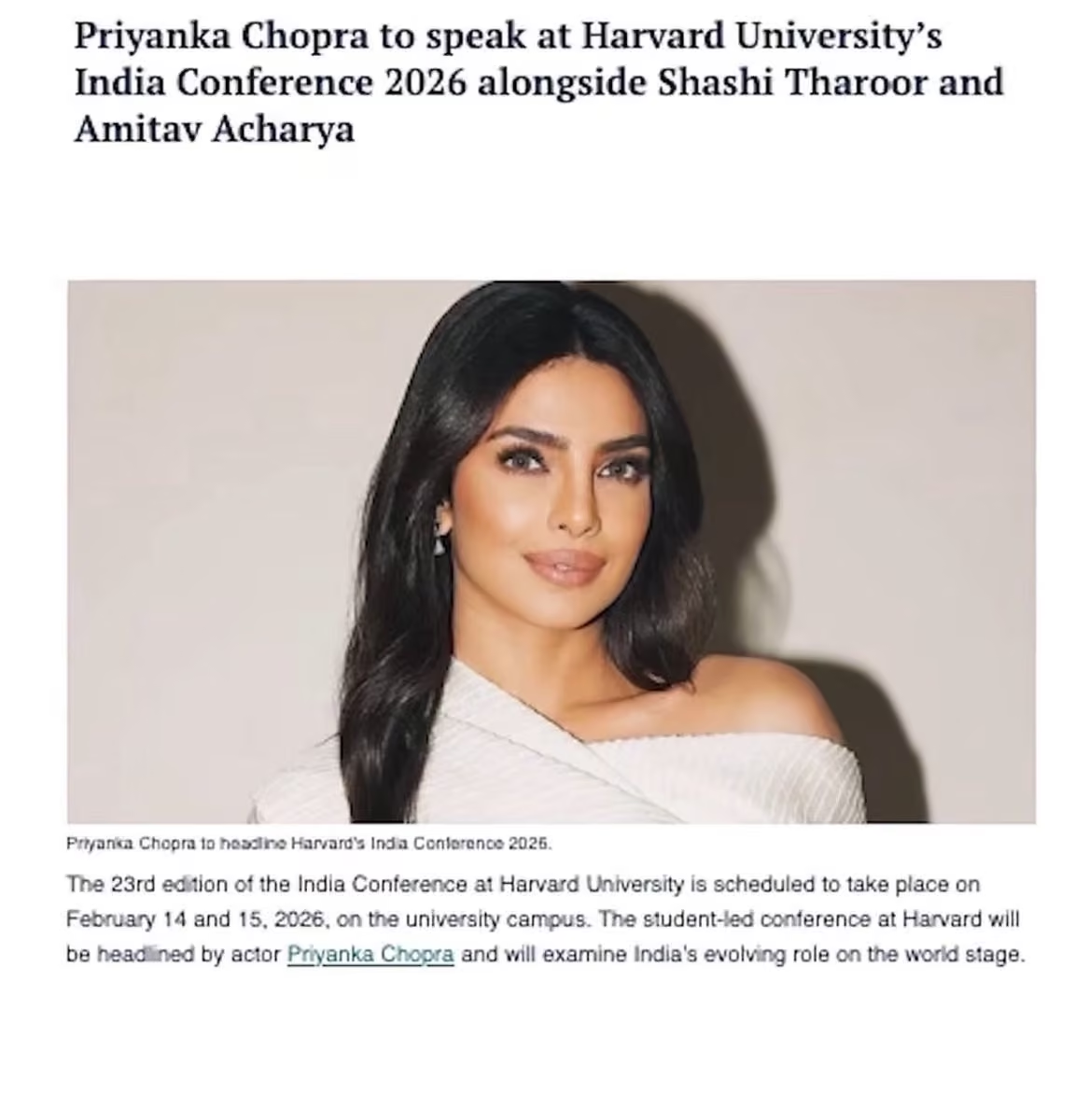 Amitav Acharya
@AmitavAcharya
Announced as a Speaker at the Harvard-India Conference, 14-15 Feb 2025. in Instagram
Announcing our next speaker for the India Conference 2026, organised by students at @harvard!
🎟️Grab your tickets before they run out! Link in bio!
We’re delighted to welcome Amitav Acharya, @unesco Chair in Transnational Challenges and Governance and Distinguished Professor at @americanuniversity, Washington DC. One of the world’s most influential scholars of international relations, his work has fundamentally reshaped how we understand global order, power, and governance beyond the West.
A prolific author and public intellectual, Amitav has written landmark books including The Once and Future World Order and The End of American World Order, with essays spanning top academic journals and global media such as the New York Times, Financial Times, and Foreign Affairs. He is the first non-Western scholar to serve as President of the International Studies Association and a recipient of multiple Distinguished Scholar Awards.
At India Conference 2026, he brings a vital global perspective on shifting world orders, transnational challenges, and the ideas shaping the future of global governance.
www.instagram.com/p/DT5-i7KlEOy/
Amitav Acharya
@AmitavAcharya
My Harvard book talk is announced. In-Person Book Talk - The Once and Future World Order: Why Global Civilization Will Survive the Decline of the West – Rajawali Institute rajawali.hks.harvard.edu/events/in-person-book-talk-the-o…
Amitav Acharya
@AmitavAcharya
One more example that standing up is better than subservience to Trump. All five major BRICS- China, Russia, Brazil, South Africa and now India, have shown it. The EU-India trade deal would have had an impact on this. "World-Minus-One" is getting real.
 Shashank Mattoo
@MattooShashank
BREAKING: White House official confirms to me that 25% Russian oil tariff on India will be removed
Final tariff will be 18% (lower than Pakistan’s 19%)

Amitav Acharya reposted
Shashank Mattoo
@MattooShashank
BREAKING: White House official confirms to me that 25% Russian oil tariff on India will be removed
Final tariff will be 18% (lower than Pakistan’s 19%)
Amitav Acharya
@AmitavAcharya
Is Trump making China great again?
Pleased to appear in Britain's Channel 4 with Robert Kagan and Nathalie Tocci.
www.youtube.com/watch?v=RE9covQGzlM
Amitav Acharya
@AmitavAcharya
Great timely essay by @tvpaul1
Restraining Trump’s America: Carney’s Soft Balancing Needs Global Support - Policy Magazine www.policymagazine.ca/restraining-trumps-america-carneys-…
Amitav Acharya
@AmitavAcharya
If you are in Boston next Friday, come to; The Once and Future World Order (02.13.26) | The Frederick S. Pardee Center for the Study of the Longer-Range Future www.bu.edu/pardee/2026/01/29/the-once-and-future-world-or…
Amitav Acharya
@AmitavAcharya
Agree, although calling the elections "rebranding" may be going too far. Even rebranding would require some change. Anyway, this external legitimation (include ASEAN members here) through sham elections was anticipated - including in my 2023 book, Tragic Nation Burma.
 BowerGroupAsia
@BowerGroupAsia
The recent Myanmar election merely rebrands military rule rather than changing the political reality, says @BowerGroupAsia Senior Adviser @ScotMarciel. The election was aimed at securing external engagement, not domestic legitimacy.
www.channelnewsasia.com/asia/myanmar-election-offers-litt…
 Amitav Acharya
@AmitavAcharya
It will fail - If it has not already.
foreignpolicy.com/2026/01/27/trump-board-of-peace-brics-u…
Amitav Acharya
@AmitavAcharya
Turkish translation of The Making of Global International Relations by is out now. Originally published by Cambridge.
Amitav Acharya, Barry Buzan, Küresel Uluslararası İlişkilerin Yapılanması: Kökenleri ve Evrimi, Koç Üniversitesi Yayınları, s.416.
Translator: Esin Soğancılar
Publisher: Koç University Press
Publication Date: 04.12.2025 (4 December)
416 pages.
www.kitapyurdu.com/kitap/kuresel-uluslararasi-iliskilerin…
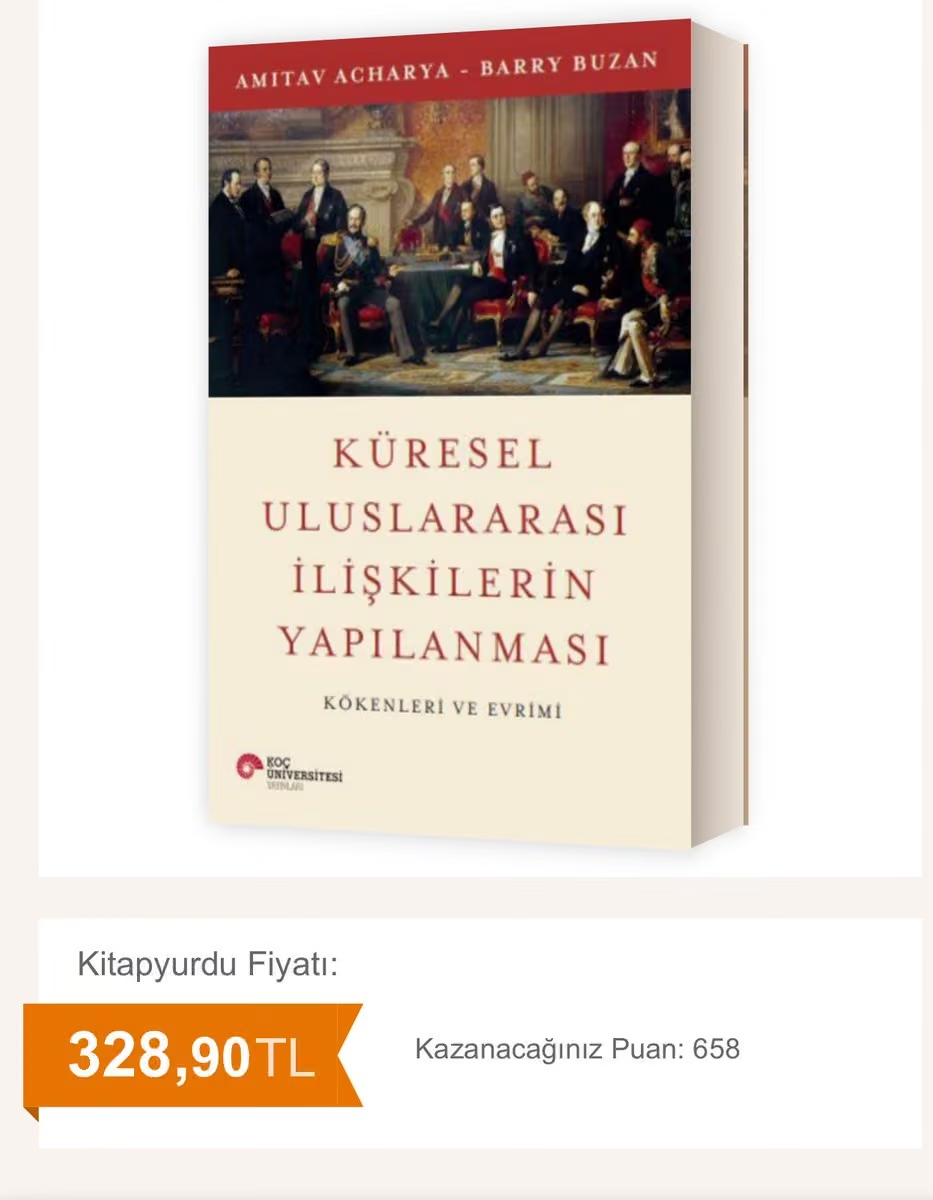 Amitav Acharya
@AmitavAcharya
Pleased to be quoted in @wapo column by @ishaantharoor
"The new alignments that are emerging place Trump’s America in a conspicuous light. “The United States will remain the most economically and militarily powerful country in the world for several more years,” wrote international relations theorist Amitav Acharya, in an essay for Foreign Policy. “But it will be absent from, if not actively hostile toward, the existing international order.”
Acharya labeled this “unique configuration” shaped by U.S. antagonism as “the world minus one."
washingtonpost.com/world/2026/01/19/trump-davos-wef-green…
Amitav Acharya
@AmitavAcharya
The snow is heavy, bright and deep, but I have to keep myself going...


 Amitav Acharya
@AmitavAcharya
My op-ed "The Davos Man, and the end of an illusion", @timesofindia
Apologies to PM Carney, whom I personally admire and who is brave enough to acknowledge the illusion and hopefully will carry on with the new direction. Hopefully those Western leaders applauding his speech will do likewise.
 Amitav Acharya
@AmitavAcharya
The “Discombobulator”: Unpacking the Physics (and the Risks) of the Weapon That Captured Maduro medium.com/@jcanchola1264/the-discombobulator-unpacking-t…
Amitav Acharya reposted
 Mike Tierney
@MikeTierneyIR
We discussed your FP article in my class last night. I explained to the students that you have not come to this position recently and have been arguing for many years that the rules of the liberal international order have not applied equally and that multiple orders are possible.
Amitav Acharya
@AmitavAcharya
Canadian PM Mark Carney's widely acclaimed speech in Davos reads: "American hegemony in particular helped provide public goods, open sea lanes, a stable financial system, collective security ... we largely avoided calling out the gaps between rhetoric and reality."
Who is we? Some of us did call: "Despite the exalted claims about its power, legitimacy, and public goods functions, that order was little more than the US-UK-West Europe-Australasian configuration...it should be seen as a limited international order, rather than an inclusive global order.” Its effects were not always benign on the Global South.
www.cambridge.org/core/journals/ethics-and-international-…
I also wrote in 2014 that the order was ending.
"Whether or not America itself is declining, the post-war liberal international order underpinned by US military, economic and ideological primacy and supported by global institutions serving its power and purpose, is coming to an end."
But the "The Davos Man" was sleeping. Mainstream magazines refused to publish essays critical of that order: one wrote to me in 2017 that Trump's (Trump 1) foreign policy won't last. Few like @EIAJournal were receptive.
www.amazon.com/End-American-World-Order/dp/0745672485
 Amitav Acharya
@AmitavAcharya
India and South Africa have also rebuffed Trump despite incurring heavy tariffs (India getting the worst) Not to mention Russia. Bric-by-bric, rising powers are defying Trump. Europe should join the effort to carry on cooperation in world-minus-one way.
 Fernando Aguilar
@agfernando10
@grok what was China and Brazil approach?
Amitav Acharya reposted
 Oliver Stuenkel 🇧🇷
@OliverStuenkel
Europe now has two options vis-à-vis Trump’s tariff threats: repeat the meek and ultimately unsuccessful strategy it adopted last year, or follow China’s or Brazil’s approach — which led Trump to back down.
Amitav Acharya
@AmitavAcharya
They Wanted a University Without Cancel Culture. Then Dissenters Were Ousted. - POLITICO: www.politico.com/news/magazine/2026/01/16/civil-war-unive…
Amitav Acharya
@AmitavAcharya
The official transcript and English translation of Indonesian Foreign Minister Sugiono's Annual Press Statement is available (for translation, switch from ID to EN on upper right)
kemlu.go.id/publikasi/pidato/pidato-menteri/transkrip-per…
In his speech, the Minister recognizes that "A multiplex world order where multiple arenas of interests, dominant actors, and rules of engagement intertwine, and where cooperation becomes increasingly more transactional," is emerging. But he adds: "I also recognize one key reality: in a multiplex world, multilateralism today is an ecosystem of arenas, sustained because it is reinforced by multiple platforms."
There are thus dangers and new opportunities for cooperation in a multiplex world.
Amitav Acharya
@AmitavAcharya
Indonesia officially uses Multiplex world order to shape its foreign policy. Foreign Minister Sugiono in his annual foreign policy address for 2026
'characterized today’s international landscape as a “multiplex” world order, where diverse interests, dominant players, and overlapping rules coexist."
How Indonesia Plans to Shape Its Diplomacy in 2026
en.tempo.co/read/2080396/how-indonesia-plans-to-shape-its…
Amitav Acharya reposted
Amitav Acharya
@AmitavAcharya
On the cover @ForeignPolicy

 Amitav Acharya
@AmitavAcharya
Trump has broken the world’s faith in relying on the US as a provider of public goods. When and if the US decides to return to multilateralism, it will still be viewed not as the "indispensable nation," but as an "indispensable rogue".
Here is my first essay of 2026: "The World-Minus-One Moment" @ForeignPolicy
The "World-Minus-Moment" is here. Since early 2025, I have used the terms “world minus X,” “world minus the United States,” and
“world minus one” to describe the new world order. Former Singaporean Prime Minister Lee
Hsien Loong helped popularize the concept in July, using “the world temporarily minus one”
to more narrowly refer to managing global economics and trade without U.S. leadership.
However, the condition transcends economics and speaks to the core challenge of our era.
foreignpolicy.com/2026/01/05/world-minus-one-united-state…
Amitav Acharya reposted
Amitav Acharya
@AmitavAcharya
Trump has broken the world’s faith in relying on the US as a provider of public goods. When and if the US decides to return to multilateralism, it will still be viewed not as the "indispensable nation," but as an "indispensable rogue".
Here is my first essay of 2026: "The World-Minus-One Moment" @ForeignPolicy
The "World-Minus-Moment" is here. Since early 2025, I have used the terms “world minus X,” “world minus the United States,” and
“world minus one” to describe the new world order. Former Singaporean Prime Minister Lee
Hsien Loong helped popularize the concept in July, using “the world temporarily minus one”
to more narrowly refer to managing global economics and trade without U.S. leadership.
However, the condition transcends economics and speaks to the core challenge of our era.
foreignpolicy.com/2026/01/05/world-minus-one-united-state…
Amitav Acharya
@AmitavAcharya
On the cover @ForeignPolicy
Amitav Acharya
@AmitavAcharya
Trump has broken the world’s faith in relying on the US as a provider of public goods. When and if the US decides to return to multilateralism, it will still be viewed not as the "indispensable nation," but as an "indispensable rogue".
Here is my first essay of 2026: "The World-Minus-One Moment" @ForeignPolicy
The "World-Minus-Moment" is here. Since early 2025, I have used the terms “world minus X,” “world minus the United States,” and
“world minus one” to describe the new world order. Former Singaporean Prime Minister Lee
Hsien Loong helped popularize the concept in July, using “the world temporarily minus one”
to more narrowly refer to managing global economics and trade without U.S. leadership.
However, the condition transcends economics and speaks to the core challenge of our era.
foreignpolicy.com/2026/01/05/world-minus-one-united-state…
Amitav Acharya
@AmitavAcharya
Some Canadian travelers have not stopped visiting the US. Canada geese and American Bald Eagle, along with Tundra Swans and ducks (bottoms up) put up quite a show at the Blackwater National Wildlife Refuge in Maryland. (apparently exempted from the US refugee ban)



 Amitav Acharya
@AmitavAcharya
More beauties


 Amitav Acharya
@AmitavAcharya
I am wondering how Trump's Saudi and other energy producing Gulf friends are viewing his capturing Maduro, selling Venezuelan oil and controlling the proceeds "to benefit the people of Venezuela and the United States!"
Any Saudi actions that displease Trump - whether on the Israel-Palestine issue, large scale withdrawal of Saudi"s US treasury holdings or developing closer ties with China, will trigger Trump's wrath. Reminder that after the Arab oil embargo in the 1970s, the US developed contingency plans to seize Middle East oil by force
Amitav Acharya
@AmitavAcharya
Look what have they been reading in Indonesia! @SamDalrymple123
 Amitav Acharya
@AmitavAcharya
Trump has broken the world’s faith in relying on the US as a provider of public goods. When and if the US decides to return to multilateralism, it will still be viewed not as the "indispensable nation," but as an "indispensable rogue".
Here is my first essay of 2026: "The World-Minus-One Moment" @ForeignPolicy
The "World-Minus-Moment" is here. Since early 2025, I have used the terms “world minus X,” “world minus the United States,” and
“world minus one” to describe the new world order. Former Singaporean Prime Minister Lee
Hsien Loong helped popularize the concept in July, using “the world temporarily minus one”
to more narrowly refer to managing global economics and trade without U.S. leadership.
However, the condition transcends economics and speaks to the core challenge of our era.
foreignpolicy.com/2026/01/05/world-minus-one-united-state…
Amitav Acharya reposted
Michael Vatikiotis
@jagowriter
Some very helpful proposals here to lock in peace between #thailand and #cambodia . Bangkok Post - Safeguarding peace after border conflict www.bangkokpost.com/opinion/opinion/3169534/safeguarding-…
Amitav Acharya reposted
Amitav Acharya
@AmitavAcharya
The US attack on Venezuela is not a break from the liberal international order or what some call the"rules-based order." It is really what that order was always about. The US was always above and beyond it. Yet, until recently, we were often presented by the West with glowing accounts of that order being benign and consensual. At least now that myth is decidedly broken.
Amitav Acharya
@AmitavAcharya
Raskin Statement on Trump’s Unconstitutional Military Strike on Venezuela | Press Releases | Congressman Jamie Raskin
Mr Raskin represents Maryland's 8th district (including Bethesda where I live) in the House of Representatives. raskin.house.gov/2026/1/raskin-statement-on-trump-s-uncon…
Amitav Acharya
@AmitavAcharya
Speaking of history, the early 1900s was also a Western-dominated world order. The US was coming into play more, becoming a colonial power with Philippines, Hawaii, Puerto Rico, Cuba (briefly) under its belt. Theodore Roosevelt strengthened the Monroe Doctrine, called the expulsion of native Indians from the land as being more virtuous than any “rules of international morality,” and told Congress that Filipinos were like "pirates and head- hunters" that did not deserve independence. Do we need all this history to repeat itself? This is partly a normative question, but should we look for different possibilities and pathways (which can also be found in "other histories") that reject and racism and resource imperialism.
 Niall Ferguson
@nfergus
"The ejection of Maduro from Caracas is best understood as an invitation to turn the political clock back just over a century. The more I contemplate the contemporary scene, the more I think we have collectively accepted the invitation." 1/5
Amitav Acharya
@AmitavAcharya
It is one thing to kidnap a leader- no matter how odious - and quite another to rule the country after his ouster. Trump cannot run Venezuela without putting significant US boots on the ground. That will be a costly failure. Venezuelans will not want a dictator replaced by a colonizer. Shades of Iraq and Afghanistan despite different contexts.
Amitav Acharya
@AmitavAcharya
The US attack on Venezuela is not a break from the liberal international order or what some call the"rules-based order." It is really what that order was always about. The US was always above and beyond it. Yet, until recently, we were often presented by the West with glowing accounts of that order being benign and consensual. At least now that myth is decidedly broken.
Amitav Acharya
@AmitavAcharya
Attention #globalirscholars
"From the standpoint of epistemic agency, Global International Relations critically examines and moves beyond the binary oppositions and "centre-periphery" hierarchies inherent in traditional international relations theories in Western academia, advocating instead for a pluralistic understanding of global international relations knowledge. From the perspective of epistemic methodology, it also adheres to the scientific rigour of behaviourism while highlighting the interconnectedness of history and practice. As a significant endeavour towards the globalisation of the discipline (Tickner & Blaney, 2012),
- 171/ Belgrade, October 15-16
Global International Relations encourages the development of new theoretical frameworks and
ideas from the non-Western world,
aiming to construct "a
comprehensive knowledge edifice formed on a multipolar basis" (Acharya, 2014, p. 650)."
doi.fil.bg.ac.rs/pdf/eb_ser/iipe_dijalozi_kina/2025-5/iip…
Amitav Acharya
@AmitavAcharya
This essay "directly contrasts with Indo-Pacific strategic discourse by emphasising heritage-centred inclusive connectivity over strategic partnerships.. As Acharya (2024)
notes, Indo-Pacific represents a concept built by strategists that may increase rather than decrease,
regional tensions by
fragmenting oceanic space into
competing zones of influence serving external rather than regional interests."
mrujs.mtroyal.ca/index.php/anlk/article/download/896/810
Amitav Acharya
@AmitavAcharya
"This study investigates China’s motivations for establishing the Lancang–Mekong
Cooperation (LMC) through a normative lens, applying Amitav Acharya’s framework
of norm subsidiarity." #globalirscholar
jurnal.amikom.ac.id/index.php/nsjis/article/download/2377…
Amitav Acharya reposted
Amitav Acharya
@AmitavAcharya
Year in Review 2025- The Once and Future World Order (For url links:
multiplexworld.com/2025/12/29/year-in-review-the-once-and…)
It has certainly been a super busy year for the author of The Once and Future World Order. The highlight must be the publication of my oped on the book in New York Times on 8 April, the very same day when the book was released in New York - an extraordinary coincidence and privilege.
The book has been reviewed in New York Times; Foreign Affairs;
Christian Science Monitor; Hindustan Times, & The Wire, among others. A forum on the book in International Affairs which also named it as one of the "Top 10 books in its Christmas reading list 2025"
I have since written op-eds and essays drawing on the book for Foreign Policy; The World Today; and Ethics and International Affairs. My cover story for Foreign Policy magazine's Jan 2026 issue appears under the title "The World Minus One".
My interviews about the book: Die Zeit; Times of India.
Accolades:
Foreign Policy “Most Anticipated Books of 2025;"
Christian Science Monitor “Best Books of April 2025”; Top ten books for Christmas in International Affairs.
Podcasts with A Book with Legs; Diplomatic Immunity; and Blue Blaze.
I have given 3 dozen book talks: highlights available in the web include:
Panel Discussion: 'The nature of post-Western order' with Prof Amitav Acharya
Panel Discussion: 'The nature of post-Western… | Oxford Martin School
Quincy Institute in Washington DC:
Book Talk | The Once and Future World Order - Quincy Institute for Responsible Statecraft
Stimson Center:
Reimagining Global Order: Perspectives from Professor Amitav Acharya, Dr. Trita Parsi, and Heather Hurlburt • Stimson Center
Book talks in Wellington, Pretoria, New Delhi, Singapore, Hong Kong, Taipei, Kyoto, Seoul, Oxford, Cambridge, Berlin, London so far, with Paris and Harvard forthcoming.
The book has done much better globally than in US where its argument for a less US-dominated world order predictably attracted the wrath of a right-wing Wall Street Journal reviewer (also affiliated with Heritage) while the paper refused to publish my rejoinder.
The British and international edition of the book by John Murray publishing will appear on pocketbook paperback in April 2026.
So far translation rights have been secured around the world
Italian - Fazi
Spanish - Ediciones de Intervencion
Portuguese - Planeta Do Brasil
Russian - Goods4You
Korean - Book21
Vietnamese - Quang Van
Chinese - CITIC
As we enter the New Year, watch out for my cover story in the Jan issue Foreign Policy Magazine titled: "The World Minus Once" - an idea I floated few weeks after Trump.2 started.
For url links visit:
multiplexworld.com/2025/12/29/year-in-review-the-once-and…
 Amitav Acharya
@AmitavAcharya
I am not getting into the debate about whether only US and China are great powers as argued by respected scholars such as Yan Xuetong earlier and American Scholar Jennifer Lind more recently. My point is polarity or multipolarity or unipolarity make sense only if you count the number of powers defined materially (economics and military) and comparing individual national power. But if you measure not just standalone power but also interaction capacity and variations in regional influence, a much more complex picture emerges. We did such a study, published in International Affairs, measuring interactions patterns in several areas - quantitatively between 1945 and 2017, and came up with multiplexity. Of course standard foreign policy discourses are often confused by any complexity and fall back on the number of powers. Yet, a world order cannot be measured by measuring the number of great powers alone.
“Multipolar or multiplex? Interaction capacity, global cooperation and world order,” International Affairs, Vol. 99, No. 6 (November 2023): 2339–2365. By Amitav Acharya, Antoni Estevadeordal and Louis W. Goodman.
academic.oup.com/ia/article-abstract/99/6/2339/7337131
full text at: www.researchgate.net/publication/375491087_Multipolar_or_…
Amitav Acharya
@AmitavAcharya
The irony -but also a crucial lesson of history here - is that the Spartan system produced domestic repression rather than outright foreign military victories. It was Persian gold - rather than Spartan arms or bravery- that helped the Spartan-led coalition to defeat Athens in the Peloponnesian War. And the Greek idea of liberty - whether in Athens or Sparta- often meant glorification and entrenchment of state power at the expense of individual freedom. Many Greeks preferred to work for the loosely administered Persian Empire than for their own politically suffocating disciplinarian city-states. Please take a look at the chapter 2 : "Greek Myths and Persian Power," of my book: The Once and Future World Order. @ishaantharoor
Ishaan Tharoor
@ishaantharoor
My latest
A lengthier reported essay that I hope you find time to read on how ancient Sparta explains 2026
Netanyahu, the Trump administration and others on the global right are drawing renewed inspiration from a Greek city-state mythologized for its militarism.
 Amitav Acharya
@AmitavAcharya
Year in Review 2025- The Once and Future World Order (For url links:
multiplexworld.com/2025/12/29/year-in-review-the-once-and…)
It has certainly been a super busy year for the author of The Once and Future World Order. The highlight must be the publication of my oped on the book in New York Times on 8 April, the very same day when the book was released in New York - an extraordinary coincidence and privilege.
The book has been reviewed in New York Times; Foreign Affairs;
Christian Science Monitor; Hindustan Times, & The Wire, among others. A forum on the book in International Affairs which also named it as one of the "Top 10 books in its Christmas reading list 2025"
I have since written op-eds and essays drawing on the book for Foreign Policy; The World Today; and Ethics and International Affairs. My cover story for Foreign Policy magazine's Jan 2026 issue appears under the title "The World Minus One".
My interviews about the book: Die Zeit; Times of India.
Accolades:
Foreign Policy “Most Anticipated Books of 2025;"
Christian Science Monitor “Best Books of April 2025”; Top ten books for Christmas in International Affairs.
Podcasts with A Book with Legs; Diplomatic Immunity; and Blue Blaze.
I have given 3 dozen book talks: highlights available in the web include:
Panel Discussion: 'The nature of post-Western order' with Prof Amitav Acharya
Panel Discussion: 'The nature of post-Western… | Oxford Martin School
Quincy Institute in Washington DC:
Book Talk | The Once and Future World Order - Quincy Institute for Responsible Statecraft
Stimson Center:
Reimagining Global Order: Perspectives from Professor Amitav Acharya, Dr. Trita Parsi, and Heather Hurlburt • Stimson Center
Book talks in Wellington, Pretoria, New Delhi, Singapore, Hong Kong, Taipei, Kyoto, Seoul, Oxford, Cambridge, Berlin, London so far, with Paris and Harvard forthcoming.
The book has done much better globally than in US where its argument for a less US-dominated world order predictably attracted the wrath of a right-wing Wall Street Journal reviewer (also affiliated with Heritage) while the paper refused to publish my rejoinder.
The British and international edition of the book by John Murray publishing will appear on pocketbook paperback in April 2026.
So far translation rights have been secured around the world
Italian - Fazi
Spanish - Ediciones de Intervencion
Portuguese - Planeta Do Brasil
Russian - Goods4You
Korean - Book21
Vietnamese - Quang Van
Chinese - CITIC
As we enter the New Year, watch out for my cover story in the Jan issue Foreign Policy Magazine titled: "The World Minus Once" - an idea I floated few weeks after Trump.2 started.
For url links visit:
multiplexworld.com/2025/12/29/year-in-review-the-once-and…
Amitav Acharya
@AmitavAcharya
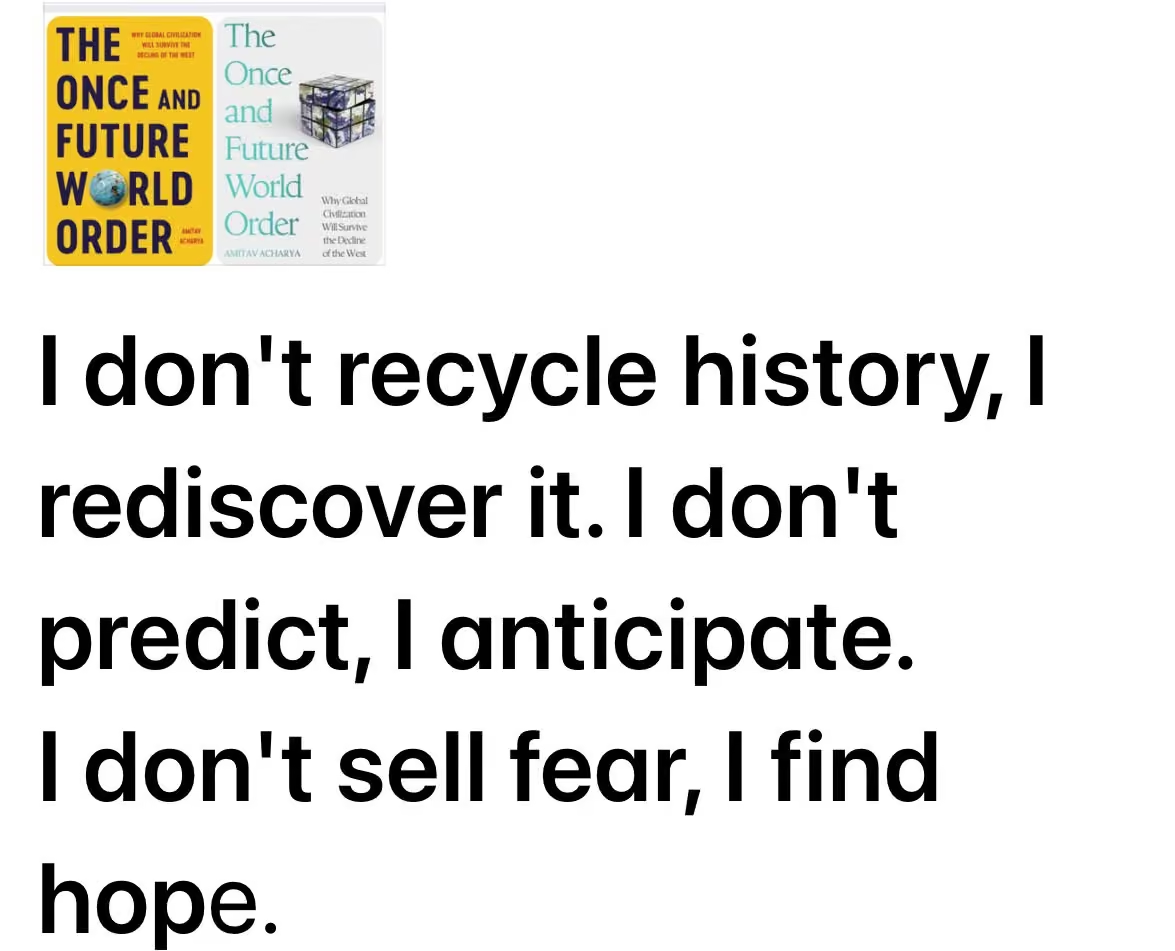 Amitav Acharya
@AmitavAcharya
"Most scholars agree that the first contemporary academic to initiate a wave of interest in this field was Amitav Acharya, who, through his early work', set the basis for what is to become one of the most used methods to survey regions around the world." That's a generous comment, and may not be quite true (not the least because most scholars don't agree on anything) but my work built on older regional integration theories (rather Eurocentric) and the New Regionalism literature that followed that was less Eurocentric. Perhaps I helped the transition from New Regionalism to Comparative Regionalism.
COMPARATIVE REGIONALISM: A FIELD WHOSE FRAMEWORK HAS COME? SA Ursa - EUROPAEA, 2025.www.researchgate.net/profile/Sergiu-Miscoiu-2/publication…
Amitav Acharya
@AmitavAcharya
My take on US leadership @japantimes
"Although U.S. leadership in organizing the postwar order has been substantial, it has also been overstated by sympathetic Western analysts, while contributions from the European Union, Australia, Canada, and Global South countries like India deserve more attention.
In fact, U.S. leadership was always selective and self-serving, and it was already slipping away before the first Trump administration...
while the U.S. has sometimes led others, it has also been a follower.
To be sure, the U.S. remains the world’s leading power in terms of military, economic, and technological prowess. But power and leadership are not the same thing.
At the end of the day, while global governance does benefit from U.S. support, America’s transformation into a wrecking ball does not necessarily augur a collapse of the world order — especially if it does not extend beyond one or two presidential terms."
www.japantimes.co.jp/commentary/2025/12/28/world/filling-…
Amitav Acharya
@AmitavAcharya
Remembering a memorable book talk I gave the past year in Taiwan at the Taipei School of Economics and Political Science in the NTHU Hall of Fame.


 Amitav Acharya
@AmitavAcharya
Exactly 4 yrs ago, as COVID-19 raged in the US, I took off for Egypt - with my family in tow- to complete research for The Once and Future World Order (it begins with Egyptian notion of ma'at vs isfet or order vs chaos). We went the whole length of the country - from Alexandria to Abu Simbel- by plane, car, boat (yes a Nile cruise), and foot. I took thousands of photos.
Here are a few.
What a journey!


Amitav Acharya reposted
 Henrik Dahl
@SociologenHD
Danish Member of the European Parliament here.
Dear Governor Landry,
I am pleased that you intend to remain at home in Louisiana.
You and your administration have no business in Greenland. Your imperialist fantasies of taking over Greenland have no place in the twenty-first century.
We will regard you as an enemy of both the Danish state and the Danish and Greenlandic peoples should you persist in these notions of unilaterally altering the international legal status of sovereign countries.
That having been said, allow me, in closing, to wish both you and your family a blessed Christmas and a prosperous 2026.
Amitav Acharya
@AmitavAcharya
 Amitav Acharya
@AmitavAcharya
Sunrise in Chesapeake Bay from our home balcony, Dec 21, 2025 (winter solstice in northern hemisphere). Shortest day, spectacular view.
 Amitav Acharya
@AmitavAcharya
Pleased that my co-authored book with Manjeet Pardesi: "Divergent Worlds: What the Ancient Mediterranean and Indian Ocean Can Tell Us About the Future of International Order," is co-winner of the Best Book Award from the Global IR section of the International Studies Association, along with Erin Lin's book about The Legacy of War in Rural Cambodia- a country where I spent fair amount of time in 1990s and early 2000s studying its peace process. The two books, one delving into deep global history to throw insights into the future international order and the other digging into local politics to illustrate the enduring legacy of war for domestic dynamics, amply demonstrate the tremendous richness and breadth of Global IR scholarship. Here are the two covers, along with a picture of me from 1991 in Siem Reap among landmines recovered by UN peacekeepers. Another photo I took -opportunistically- shows Hun Sen walking back to his car after negotiations with other Cambodian parties in Siem Reap. Reminder that landmines remain in Cambodia and bombs have started falling again, albeit in much more limited scale, thanks to the Thai-Cambodian conflict and the challenges Cambodia's domestic reconciliation still faces.
Thanks to @tvpaul1 who endowed the book award; co-author
@manjeetsp and @isanet #globalir


 Amitav Acharya
@AmitavAcharya
You DID refuse debate by not replying directly to my emailed invitations. A debate was warranted because your WSJ review had falsified my position and my rejoinder (here is it again x.com/amitavacharya/status/1968043254320079010) was turned down by the paper (WSJ) where you are a paid contributor. But sure: over and out pro.
 Tunku Varadarajan
@tunkuv
Give it a rest, maestro. I did not "refuse debate." I reviewed your book. That is debate enough for me. You made your case in your book. I expressed my reaction to it. There can't be perpetual pingpong thereafter. Over and out. 🙏
Amitav Acharya
@AmitavAcharya
What took him - and the Western elite- so long?
Ishaan Tharoor
@ishaantharoor
Shying away from Gramsci, @DMiliband of @RESCUEorg sounds the death knell of the rules-based order. He tells me:
"I think we’ve passed a tipping point from the old order. We can no longer say that the rules-based order is the defining anchor of the global system and that there are some problems in its implementation. We now have a base case of disorder, a base case where it’s unusual for rules to be followed rather than not followed. And I think it’s far from clear that we’re going to move into a new order. It’s far from clear to me that we’re moving to a world of spheres of influence. I don’t think that if you’re Japanese, you’re going to be acceding to a Chinese sphere of influence. If you’re European, you’re not going to be acceding to a Russian sphere of influence. And if you’re Latin American, if you’re Brazilian, you’re not going to be acceding to an American sphere of influence.
Equally, it’s not clear that somehow regional bodies like the E.U. are going to become defining. I think we are more likely to be living in this more chaotic “might makes right” form of globalization, which is not the reverse of globalization. It’s a more anarchic form of globalization without rules."
 Amitav Acharya
@AmitavAcharya

Amitav Acharya reposted
Amitav Acharya
@AmitavAcharya
Filling America’s Shoes by Amitav Acharya, et al - Project Syndicate www.project-syndicate.org/magazine/us-global-leadership-w…
Amitav Acharya
@AmitavAcharya
Adding a recent post on spheres of influence.
22 Nov 2022
Here are my rough talking points on Great Power Spheres of Influence at the @WACAmerica (World Affairs Councils of America) National Conference in Washington DC on 20 Nov. moderated by @cnn anchor @jimsciutto
In my new book Once and Future World Order I argue that spheres of influence are very common in history - one of the earliest examples being that between Egypt and Hatti some 3500 yrs ago.
They are one of the different types of international orders in the past and they continue to exist today and will do into the future.
All great powers of today have had spheres of influence, including China, Russia, US, India.
China's tributary system lasting 2000 yrs Han to Qing
Russia: historically very SI oriented. Warsaw Pact, Eurasian Union, and it is partly behind its invasion of Ukraine although NATO expansion also contributed to it.
US -Monroe doctrine: proclaimed by James Monroe 1823 just over 200 yrs ago. Prevent return of European powers to reclaim central
America, enforce debt collection & broadened by Teddy Roosevelt as a more aggressive right to intervene. It was
Invoked by President Kennedy during the Cuban missile crisis and underpins Trump policy threat to treaties Panamá canal, now strikes in alleged drug boats.
Add to this the contest between Britain and France over Thailand, or the US and Spain in North America.
Germany's mitteleuropa and Japan's Greater East Asia Co-prosperity Sphere are other historical examples.,
After WW II -Churchill proposed a system of spheres of influence as a more elective way to build a stable international order than a single universal system.
A key aspect of such a SI system is that great powers often get a territorial or political deal over the wishes of weaker states. The prospective Trump-Putin deal that forces Ukraine to cede territory is an ongoing such example. As I commented in the New York Times during the Trump-Putin Alaska summit, now on the verge of being finalized, it harkens back to a time when great powers carved out territory of other countries between them.
For example, Poland was divided three times between 1772 and 1795, by the great powers of the day: Austria, Prussia, and Russia.
The Trump-Xi summit in Seoul that resurrected the idea of a G-2, though about trade, might morph into making deals over Taiwan which the Taipei government would not like, as it is seeking to promote a Taiwanese identity and even independence.
ASEAN nations - Philippines & Vietnam - should also watch out the implications of a G2 especially in the South China Sea.
Today's spheres of influence are not just in Europe, but are all over the world.
This is part of an emerging world order which I call a Multiplex world.
It is not unipolar or hegemony or the liberal order, nor is it multipolar per se, but a complex patchwork of a variety of other forms like but existing side by side with a multilateral system that also gives a role to non great powers.
All types of systems are there; it is a multi framework system but still reason reason remains interdependent or connected.
Should we worry then that they might lead to the collapse of world order? Not necessarily.
What is key is that they should be consistent with int norms of territorial integrity that did not exist in past. And it is important to keep in mind that many regional groups like ASEAN and the African Union would not accept such a framework.
All these and more in my book. The Once and Future World Order.
x.com/amitavacharya/status/1992283125435490561
Amitav Acharya
@AmitavAcharya
Lot of talk now following release of Trump NSS National Security Strategy about revival of Monroe Doctrine. But 8 months ago in March, I had forewarned:
"Trump [is] developing some sort of a sphere of influence, an expanded Monroe Doctrine that would coerce not only central America, but also Western allies such as Canada and Denmark, to submit to America’s will."
Unsurprisingly a leading liberal magazine in the US rejected my submission - was it because of the title"? - before I took it to e-IR. www.e-ir.info/2025/03/13/goodbye-west-long-live-world-order/
"Goodbye West" is coming as well.
@jimsciutto @ForeignAffairs
Amitav Acharya
@AmitavAcharya
No surprises here but unlikely to sway NATO expansion apologists. In The End of American World Order (2014) I argued that NATO expansion would destroy Europe's "long peace". See also my oped for Barron's day after Russian invasion
www.barrons.com/articles/europe-just-became-the-worlds-mo… responsiblestatecraft.org/ukraine-nato-sloat/
Amitav Acharya
@AmitavAcharya
Why did the Netherlands apologize? Slavery, justice,
and the political conditions of state apologies in Europe, by
Bart-Jan Zandee and Salvador Santino Regilme.
Great essay, which applies my localization theory.
www.cambridge.org/core/services/aop-cambridge-core/conten…
Amitav Acharya
@AmitavAcharya
Filling America’s Shoes by Amitav Acharya, et al - Project Syndicate www.project-syndicate.org/magazine/us-global-leadership-w…
Amitav Acharya
@AmitavAcharya
 Amitav Acharya
@AmitavAcharya
The Once and Future World Order is among the Top 10 Christmas readings. @IAJournal_CH
Here is citation of the book's selection and a flyer with discount codes.


 International Affairs
@IAJournal_CH
Top 10 books: The International Affairs Christmas reading list 2025 📚🎄
Ahead of the holidays, Book Reviews Editor @mariana_vieir1 has curated a list of books that reflects our commitments to covering the whole of the International Relations discipline.
Check them out 👇
Amitav Acharya reposted
Amitav Acharya
@AmitavAcharya
I have a bestseller!
 Amitav Acharya
@AmitavAcharya
The reigniting of Thai - Cambodia conflict forewarns that other cases where Trump has claimed to have got a peacemaking deal might also unravel. They do not address root causes, motivated more by his Nobel delusions than an understanding of local dynamics, and implanted more by coercion than persuasion.
Amitav Acharya
@AmitavAcharya
Think also of regime security, a fig leaf from not national security.
 ISEAS - Yusof Ishak Institute
@ISEAS
Fulcrum Commentary by Pongkwan Sawasdipakdi (@pongkwans) - Territorial sovereignty and the military’s image as guardian of the nation limit the kingdom’s attempts at conciliation in its current dispute with Cambodia. #thailand fulcrum.sg/sovereignty-and-militarys-image-drive-thailand…
Amitav Acharya
@AmitavAcharya
Sunrise from my room in Hotel Okura Kobe this morning. Japan - the land of the rising sun.


 Amitav Acharya
@AmitavAcharya
In Feb 2025, 10 months before Trump's Dec 4, National Security Strategy made it somewhat "official" part of U.S. grand strategy, I had posted this about a Trump Corollary to the Monroe Doctrine. Reposting:
Amitav Acharya
@AmitavAcharya
A Trump Corollary to the Monroe doctrine is unfolding.
The Monroe doctrine was never really dead. Kennedy invoked it during the Cuban middle crisis. There are also US military interventions in Grenada and Panama. It has always been part and parcel of US foreign policy mindset.
As I have written in my book, The Once and Future World Order, the US has always behaved in an imperial power in the region - despite the rhetoric of a liberal order.
But the growing role of China in Latin America has further stoked this historic imperial impulse of the US in the region. The anti-immigration stance of Trump has created an added rationale : while the old Monroe doctrine was geared to strategic and economic goals, the new Trump Corollary has a broader anti-immigration objective.
@jorgeheinel
Amitav Acharya
@AmitavAcharya
Lot of talk now following release of Trump NSS National Security Strategy about revival of Monroe Doctrine. But 8 months ago in March, I had forewarned:
"Trump [is] developing some sort of a sphere of influence, an expanded Monroe Doctrine that would coerce not only central America, but also Western allies such as Canada and Denmark, to submit to America’s will."
Unsurprisingly a leading liberal magazine in the US rejected my submission - was it because of the title"? - before I took it to e-IR. www.e-ir.info/2025/03/13/goodbye-west-long-live-world-order/
"Goodbye West" is coming as well.
@jimsciutto @ForeignAffairs
Amitav Acharya
@AmitavAcharya
Another essay on how Global IR can empower Area Studies and vice versa., scholar.google.com.sg/scholar_url?url=https://newareastud…
Amitav Acharya
@AmitavAcharya
The original Monroe Doctrine did not, but the (Theodore) Roosevelt corollary did: expanded its scope and made it more interventionist, as I discuss in The Once and Future World Order.
 Michael Tracey
@mtracey
If you feel you have to invoke a presidential statement from 1823, you should at least read it first. Because the "Monroe Doctrine" does nothing to license the United States going around overthrowing whatever governments in the Western Hemisphere it happens to dislike.
It's a warning to European colonial powers against any future "interpositions" on newly independent states in the Americas.
It doesn't even forbid those states from having economic or political relations with the European powers. "Existing colonies or dependencies of any European power" are not objected to.
It simply declares that any future attempts at "colonization" by the European powers -- "for the purpose of oppressing" the independent states -- will be regarded as an "unfriendly" act toward the US.
In 1823, the US hardly even had the capacity to go around overthrowing any government it pleased across South and Central America. So it's more a statement of neutrality, or non-intervention, than anything else. It certainly doesn't demand that states in the hemisphere conform to America's preferred governing structures, or face violent overthrow.
Such notions of hemispheric imperial conquest would only become popularized in the US some 75+ years later.
In short, nothing in the Monroe Doctrine has any bearing on the current situation with Venezuela, despite attempts to tritely invoke it by people who must've slept through that section of US History class.
Amitav Acharya reposted
 East Asia Forum
@east_asia_forum
Kuala Lumpur’s rushed, unequal and fragile bilateral trade deal with the US threatens Malaysia credibility as an open, rules-based trading partner, writes Stewart Nixon.
eastasiaforum.org/2025/12/06/the-art-of-the-deal-lost-in-…
Amitav Acharya
@AmitavAcharya
Selfish Burgers in Taipei and Fried Headquarters in Yilan. Enhanced in translation in Taiwan.

 Amitav Acharya
@AmitavAcharya
"Instead of pursuing rushed and unequal bilateral deals, Malaysia and ASEAN must instead defend open, trusted and rules-based trade and investment through collective action." eastasiaforum.org/2025/12/06/the-art-of-the-deal-lost-in-…
Amitav Acharya
@AmitavAcharya
I have a bestseller!
Amitav Acharya
@AmitavAcharya
At Jakarta airport


Amitav Acharya reposted
 Jinwan Park
@JinPark1107
A true honor reconnecting with Prof. @AmitavAcharya here in Seoul. Ever since our first meeting at @SchwarzmanOrg, his emphasis on intellectual and strategic flexibility has stayed with me. Foreign policy too often resists the “unimaginable,” a mindset youth must boldly embrace.

Amitav Acharya reposted
Michael Vatikiotis
@jagowriter
The simple fact is that while China is investing heavily in area studies, the West has allowed its area studied capacity to wither and die. Area studies more than IR is the key to building a capacity for global engagement.
Amitav Acharya
@AmitavAcharya
Great read on emerging direction in area studies and Global IR: "New Area Studies, Global IR and International
Human Rights,"
Eileen Doherty-Sil
newareastudies.com/articles/90/files/692b07df603c8.pdf

 Amitav Acharya
@AmitavAcharya
Great read on emerging direction in area studies and Global IR: "New Area Studies, Global IR and International
Human Rights,"
Eileen Doherty-Sil
newareastudies.com/articles/90/files/692b07df603c8.pdf
Amitav Acharya
@AmitavAcharya


Amitav Acharya reposted
Amitav Acharya
@AmitavAcharya
My book greets you (along with Stephen Hawking's BRIEF ANSWERS TO THE BIG QUESTIONS) at the entrance to @blackwellbooks in Oxford. Well my book provides longish answers to most of the BIG QUESTIONS ABOUT WORLD ORDER! (Photo courtesy Oxford doctoral student Haitong Du)
 Amitav Acharya
@AmitavAcharya
My book greets you (along with Stephen Hawking's BRIEF ANSWERS TO THE BIG QUESTIONS) at the entrance to @blackwellbooks in Oxford. Well my book provides longish answers to most of the BIG QUESTIONS ABOUT WORLD ORDER! (Photo courtesy Oxford doctoral student Haitong Du)
Amitav Acharya
@AmitavAcharya
Happening today !

 Amitav Acharya
@AmitavAcharya
Explaining "shared creation of world order" (independent origins of same or similar ideas/institutions in multiple civilizations around the world, and co-creation through diffusion) at Korea University in Seoul yesterday. First of three book talks (others coming tomorrow at Sejong Institute and & IFANS.) Plus today I will be speaking at the TV Choshun's Global Leadership Forum


 Amitav Acharya
@AmitavAcharya
"The EU’s three red lines remain unchanged: borders cannot be changed by force, .." Yet,the history of European imperialism shows that almost every European colony had its borders changed by force. These borders exist to this day. www.theguardian.com/world/live/2025/nov/24/ukraine-russia…
Amitav Acharya
@AmitavAcharya
English, like railways, was a powerful tool of British imperialism that impoverished India. That imperialism probably caused more deaths and destruction till its end than the benefits -economic and cultural - it has brought to the country overall. If India and Indians succeed abroad, it has less to do with English proficiency than work ethic, and resourcefulness and openness to engage and innovate.
In academia, where I belong it's the ability to challenge conventional thinking.
The agency belongs not to the medium but to the messenger.
@DalrympleWill
 Sanjeev Sanyal
@sanjeevsanyal
Natives of one of the last remaining colonies, @nfergus and @DalrympleWill , arguing about how a former colony, that became free 8 decades ago, benefitted from the language of the coloniser.
Amitav Acharya
@AmitavAcharya
The world is no longer multipolar - it is ‘multiplex’ – The Irish Times
I fully concur. www.irishtimes.com/opinion/2024/12/21/the-world-is-no-lon…
Amitav Acharya
@AmitavAcharya
Here are my rough talking points on Great Power Spheres of Influence at the @WACAmerica (World Affairs Councils of America) National Conference in Washington DC on 20 Nov. moderated by @cnn anchor @jimsciutto
In my new book Once and Future World Order I argue that spheres of influence are very common in history - one of the earliest examples being that between Egypt and Hatti some 3500 yrs ago.
They are one of the different types of international orders in the past and they continue to exist today and will do into the future.
All great powers of today have had spheres of influence, including China, Russia, US, India.
China's tributary system lasting 2000 yrs Han to Qing
Russia: historically very SI oriented. Warsaw Pact, Eurasian Union, and it is partly behind its invasion of Ukraine although NATO expansion also contributed to it.
US -Monroe doctrine: proclaimed by James Monroe 1823 just over 200 yrs ago. Prevent return of European powers to reclaim central
America, enforce debt collection & broadened by Teddy Roosevelt as a more aggressive right to intervene. It was
Invoked by President Kennedy during the Cuban missile crisis and underpins Trump policy threat to treaties Panamá canal, now strikes in alleged drug boats.
Add to this the contest between Britain and France over Thailand, or the US and Spain in North America.
Germany's mitteleuropa and Japan's Greater East Asia Co-prosperity Sphere are other historical examples.,
After WW II -Churchill proposed a system of spheres of influence as a more elective way to build a stable international order than a single universal system.
A key aspect of such a SI system is that great powers often get a territorial or political deal over the wishes of weaker states. The prospective Trump-Putin deal that forces Ukraine to cede territory is an ongoing such example. As I commented in the New York Times during the Trump-Putin Alaska summit, now on the verge of being finalized, it harkens back to a time when great powers carved out territory of other countries between them.
For example, Poland was divided three times between 1772 and 1795, by the great powers of the day: Austria, Prussia, and Russia.
The Trump-Xi summit in Seoul that resurrected the idea of a G-2, though about trade, might morph into making deals over Taiwan which the Taipei government would not like, as it is seeking to promote a Taiwanese identity and even independence.
ASEAN nations - Philippines & Vietnam - should also watch out the implications of a G2 especially in the South China Sea.
Today's spheres of influence are not just in Europe, but are all over the world.
This is part of an emerging world order which I call a Multiplex world.
It is not unipolar or hegemony or the liberal order, nor is it multipolar per se, but a complex patchwork of a variety of other forms like but existing side by side with a multilateral system that also gives a role to non great powers.
All types of systems are there; it is a multi framework system but still reason reason remains interdependent or connected.
Should we worry then that they might lead to the collapse of world order? Not necessarily.
What is key is that they should be consistent with int norms of territorial integrity that did not exist in past. And it is important to keep in mind that many regional groups like ASEAN and the African Union would not accept such a framework.
All these and more in my book.

 Amitav Acharya
@AmitavAcharya
"Moscow is losing more troops than it recruits " Can we for once stop believing in what Ukraine and Institute of Study of War say?
www.washingtonpost.com/opinions/2025/11/21/ukraine-trump-…
Amitav Acharya
@AmitavAcharya
End of Europe. And the West. Daddy is taking over. www.theguardian.com/world/2025/nov/21/zelenskyy-says-ukra…
Amitav Acharya
@AmitavAcharya
Great panel on great power spheres of influence at the World Affairs Councils of America's National Conference in DC today. At the end, moderator @jimsciutto @CNN and I traded our books (on sale there).


 Amitav Acharya
@AmitavAcharya
My 2022 book: Tragic Nation Burma: Why and How Democracy Failed, on sale at Chiang Mai airport book shop ( a friend from Myanmar sent the photo to me). I explain the reason for writing the book on Democratic Voce of Burma (DVB) english.dvb.no/reads-amitav-acharya-on-tragic-nation-burma/
 Amitav Acharya
@AmitavAcharya
Yesterday I did an online book dialogue on Once & Future Workd Order with @tparsi @QuincyInst
Here is the link. Covering what policymakers and analysts can learn from history, which world order ideas have come from Andean, Egyptian, Sumerian, Chinese, Indian, Native American, Islamic and European civilizations that are still around but are wrongly considered as the West's exclusive patent and why we should overcome the west vs the rest mindset. m.youtube.com/watch?v=ZKFV5r95R6o
 Amitav Acharya
@AmitavAcharya
Pleased to read this: "Amitav Acharya's new The Once and Future World Order: Why Global Civilization Will Survive the Decline of the West, an alternative to much bad history writing."
www.cambridge.org/core/services/aop-cambridge-core/conten…
Amitav Acharya
@AmitavAcharya
After three intensely fun days of book talks at Oxford, some tough love questions at Cambridge!


 Amitav Acharya
@AmitavAcharya
Some memorable Oxford photos: at the Formal Hall (dinner) at Balliol College after a book talk and a lecture hosted by undergraduate students Oxford Global Law Society.


 Amitav Acharya
@AmitavAcharya
Just out: forum on Once and Future World Order | International Affairs | Oxford Academic. Sharp & varied insights from
Mariano Aguirre Ernst, Nora Fisher-Onar, Rosemary Foot, Shireen Mushtaq, John M Hobson. International Affairs, doi.org/10.1093/ia/iiaf218 academic.oup.com/ia/article-abstract/101/6/2265/8315426
Amitav Acharya
@AmitavAcharya
Pleased to see this book on sale at Blackwells in Oxford.
@blackwellbooks

 Amitav Acharya
@AmitavAcharya
Here is a review of my book, From Southeast Asia to Indo-Pacific, Penguin Random House SEA, by Graeme Dobell one of Australia's top regionally focused journalists insidestory.org.au/the-indo-pacifics-new-age-of-power-pol…
The Indo-Pacific’s new age of power politics
"Beijing doesn’t want its dominance of Asia squeezed and challenged by a two-ocean strategy. ASEAN has cautiously accommodated the Indo-Pacific notion, which Acharya judges has been “aggressively” promoted by Australia, India, Japan and the United States.
As an international relations professor, Acharya has both chronicled and organised the concepts ASEAN uses to understand itself as a region and an association. More than most academics, his language turns up in the speeches of the leaders and their diplomats.Two of Acharya’s most influential ASEAN books are the Quest for Identity: International Relations of Southeast Asia (2000) and its expanded version a decade later, Constructing a Security Community in Southeast Asia: ASEAN and the Problem of Regional Order (2014).
Acharya returns to those themes with From Southeast Asia to Indo-Pacific: Culture, Identity and the Return to Geopolitics. "
insidestory.org.au/the-indo-pacifics-new-age-of-power-pol…
Amitav Acharya
@AmitavAcharya
Fantastic start to my five day book tour of Oxford & Cambridge with a presentation & panel discussion with Louise Fswcett, Andrew Hurrell and Faisal Devji @oxmartinschool


 Amitav Acharya
@AmitavAcharya
Landed this morning st Heathrow for an intense week of book events at Oxford and Cambridge.
The first of four Oxford events starts this Monday 10 Nov afternoon at 5pm at Oxford Martin School.
Panel Discussion: 'The nature of post-Western… | Oxford Martin School www.oxfordmartin.ox.ac.uk/events/post-western-order
Tuesday 11 Nov at 5.30-7 pm book lecture at Gillis Lecture Theatre, Balliol College, organized by Oxford IR Society
Then on 12th we have two events: a lecture on Chinese world order: past, present and future at Oxford China Centre at noon.
And 4 pm on 12th lecture and discussion on the international law aspects of the book to Oxford Global Law Society at the Saskatchewan Lecture Theatre in Exeter College (Turl St, Oxford OX1 3DP).
Amitav Acharya
@AmitavAcharya
A feast of shades of red in our Bethesda neighborhood plus the last of roses on our own garden. Till we meet again next spring.


Amitav Acharya reposted
Amitav Acharya
@AmitavAcharya
Full Moon over Bethesda, MD last night (5 Nov 2025)
@capitalweather


 Amitav Acharya
@AmitavAcharya
Where are the Pacific Islands in the Political Science and International Relations
scholarship?
International Relations
journals.sagepub.com/doi/pdf/10.1177/00471178251382131
Amitav Acharya reposted
 Aaryan Sharma
@StarwaysSharma
Spot on! Multiplexity isn’t just theory anymore-it’s shifting real influence. I’ve said for ages, Berlin’s waking up: new powers are actually shaping global stability now. The world’s not waiting on the West.
Amitav Acharya
@AmitavAcharya
This is the cruelest irony of the present world order.
 Amitav Acharya
@AmitavAcharya
Full Moon over Bethesda, MD last night (5 Nov 2025)
@capitalweather
Amitav Acharya reposted
Amitav Acharya
@AmitavAcharya
Last evening the German Council on Foreign Relations (DGAP) hosted me in Berlin for a book talk & conversation with Thomas Risse, moderated by Rachel Tausendfreund. Then a reunion with old friends Thomas and Tanja Börzel.Hints of audience acceptance of my view that decline Western dominance & ending 'West vs the Rest' need not be bad for stability. And of multiplexity as a useful metaphor for the coming world order.


 Amitav Acharya
@AmitavAcharya
Great to know of his Odisha link.
 Naveen Patnaik
@Naveen_Odisha
Congratulate Indian origin @ZohranKMamdani on becoming the youngest mayor of #newyork. #odisha celebrates his global success as Zohran, son of Rourkela born award winning filmmaker Mira Nair, is now the first Indian-American mayor of New York. Wish him success.
#zohranmamdani
 Amitav Acharya
@AmitavAcharya
China's reluctance to accept G2 is much more than Global South posturing.
I did a post on this. x.com/amitavacharya/status/1985096654324687252
Also last time China tried G2, in hinting at a joint response with US to Indian nuclear tests, it went no where. Let's not forget there are other powers in the world. Dual hegemony is even less plausible than single power dominance.
 Ken Moriyasu
@kenmoriyasu
Very interesting explanation from Yun Sun @Stimson_EAsia on China's current position on G2 and the "New Model of Major Power Relations."
asia.nikkei.com/politics/international-relations/indo-pac…
 Amitav Acharya
@AmitavAcharya
If Zohran succeeds in leading NYC, stays out of scandal that are all too common in American city politics, and delivers on at least some of his promises, socialist or whatever, the implications will reverberate well beyond the city or country. He would go down in history as the person who helped to rescue democracy in America at a critical juncture.
But I realize these expectations may be too high. And he might fall victim to the "Obama effect": giving the racist far right a new cause or target to rally against and lead to a more virulent populism. I am hopeful but also anxious.
Amitav Acharya reposted
 The World Today
@TheWorldToday
“Globalisation is not disappearing, but taking a new, eastern turn”.
@AmitavAcharya (@AU_SIS) explores the emergence of a new multiplex world order, in which ‘re-globalization’ is led by Asia and Global South nations.
www.chathamhouse.org/publications/the-world-today/2025-09…
Amitav Acharya
@AmitavAcharya
Last evening the German Council on Foreign Relations (DGAP) hosted me in Berlin for a book talk & conversation with Thomas Risse, moderated by Rachel Tausendfreund. Then a reunion with old friends Thomas and Tanja Börzel.Hints of audience acceptance of my view that decline Western dominance & ending 'West vs the Rest' need not be bad for stability. And of multiplexity as a useful metaphor for the coming world order.
Amitav Acharya
@AmitavAcharya
I am very pleased and encouraged to see the Foreign Service Journal of the American Foreign Service Association has provided a succinct and unbiased summary of the main argument & message of my book.
"To understand today’s economic, political, and cultural collapse, political scientist Amitav Acharya takes readers back thousands of years, looking at examples of cooperation and peace that long predate the creation of the United States.
Acharya argues that the West does not have a monopoly on the concepts of individual rights, freedom, or democracy, and he cites examples from ancient Egypt, India, and China as he builds his case that today’s crisis is not unique in history. In fact, he argues, the end of Western dominance could allow non-Western nations to build a better, more prosperous world, if only we can learn from our joined history."
afsa.org/of-related-interest-2025
 Amitav Acharya
@AmitavAcharya
I am very pleased and encouraged to see the Foreign Service Journal of the American Foreign Service Association has provided a succinct and unbiased summary of the main argument & message of my book.
"To understand today’s economic, political, and cultural collapse, political scientist Amitav Acharya takes readers back thousands of years, looking at examples of cooperation and peace that long predate the creation of the United States.
Acharya argues that the West does not have a monopoly on the concepts of individual rights, freedom, or democracy, and he cites examples from ancient Egypt, India, and China as he builds his case that today’s crisis is not unique in history. In fact, he argues, the end of Western dominance could allow non-Western nations to build a better, more prosperous world, if only we can learn from our joined history."
afsa.org/of-related-interest-2025
Amitav Acharya
@AmitavAcharya
G2 is a non starter, especially if Trump meant the US and China will jointly rule the world rather than that it was a US-China reset. The rest of the world including America's friends or other powers like Japan, India or Russia will not put up with G2 as a mechanism for joint management of world order by the US and China.
US-China conflicts might have stepped back from the brink but they are far from settled. But if G2 means the US and China will constructively manage their bilateral relationship it will be good for global stability.
Ken Moriyasu
@kenmoriyasu
This is the “New Type of Great Power Relations” Xi has been trying to sell the Americans since 2013.
 Amitav Acharya
@AmitavAcharya
I am very pleased and encouraged to see the Foreign Service Journal of the American Foreign Service Association has provided a succinct and unbiased summary of the main argument & message of my book. afsa.org/of-related-interest-2025
To understand today’s economic, political, and cultural collapse, political scientist Amitav Acharya takes readers back thousands of years, looking at examples of cooperation and peace that long predate the creation of the United States.
Acharya argues that the West does not have a monopoly on the concepts of individual rights, freedom, or democracy, and he cites examples from ancient Egypt, India, and China as he builds his case that today’s crisis is not unique in history. In fact, he argues, the end of Western dominance could allow non-Western nations to build a better, more prosperous world, if only we can learn from our joined history."
Amitav Acharya
@AmitavAcharya
A brief review of my book in The American Foreign Service Association's Foreign Service Journal- recent books of interest to the foreign affairs community.
Amitav Acharya, Basic Books, 2025, $32.50/hardcover, e-book available, 464 pages.
To understand today’s economic, political, and cultural collapse, political scientist Amitav Acharya takes readers back thousands of years, looking at examples of cooperation and peace that long predate the creation of the United States.
Acharya argues that the West does not have a monopoly on the concepts of individual rights, freedom, or democracy, and he cites examples from ancient Egypt, India, and China as he builds his case that today’s crisis is not unique in history. In fact, he argues, the end of Western dominance could allow non-Western nations to build a better, more prosperous world, if only we can learn from our joined history.
Amitav Acharya is a distinguished professor of international relations at American University, where he holds the UNESCO Chair in Transnational Challenges and Governance at the School of International Service, and serves as the chair of the ASEAN Studies Initiative.
afsa.org/of-related-interest-2025
 Amitav Acharya
@AmitavAcharya
A brief review of my book in The American Foreign Service Association's Foreign Service Journal- recent books of interest to the foreign affairs community.
Amitav Acharya, Basic Books, 2025, $32.50/hardcover, e-book available, 464 pages.
To understand today’s economic, political, and cultural collapse, political scientist Amitav Acharya takes readers back thousands of years, looking at examples of cooperation and peace that long predate the creation of the United States.
Acharya argues that the West does not have a monopoly on the concepts of individual rights, freedom, or democracy, and he cites examples from ancient Egypt, India, and China as he builds his case that today’s crisis is not unique in history. In fact, he argues, the end of Western dominance could allow non-Western nations to build a better, more prosperous world, if only we can learn from our joined history.
Amitav Acharya is a distinguished professor of international relations at American University, where he holds the UNESCO Chair in Transnational Challenges and Governance at the School of International Service, and serves as the chair of the ASEAN Studies Initiative.
afsa.org/of-related-interest-2025
Amitav Acharya
@AmitavAcharya
Live watching President of Turkey Recep Tayyip Erdoğan walking into the hall to start the 2025 @trtworldforum, Istanbul. I am speaking in a panel on High Stakes Diplomacy

 Amitav Acharya
@AmitavAcharya
The world without hegemony
As Pax Americana ends, a multipolar order is emerging. The history of Southeast Asia holds lessons for what’s to come
by Manjeet S Pardesi & Amitav Acharya aeon.co/essays/what-southeast-asian-history-tells-us-abou…
Amitav Acharya
@AmitavAcharya
One can never fail to be mesmerized by the sights and sounds of the Bosporus, where Asia and Europe meet.
Amitav Acharya
@AmitavAcharya


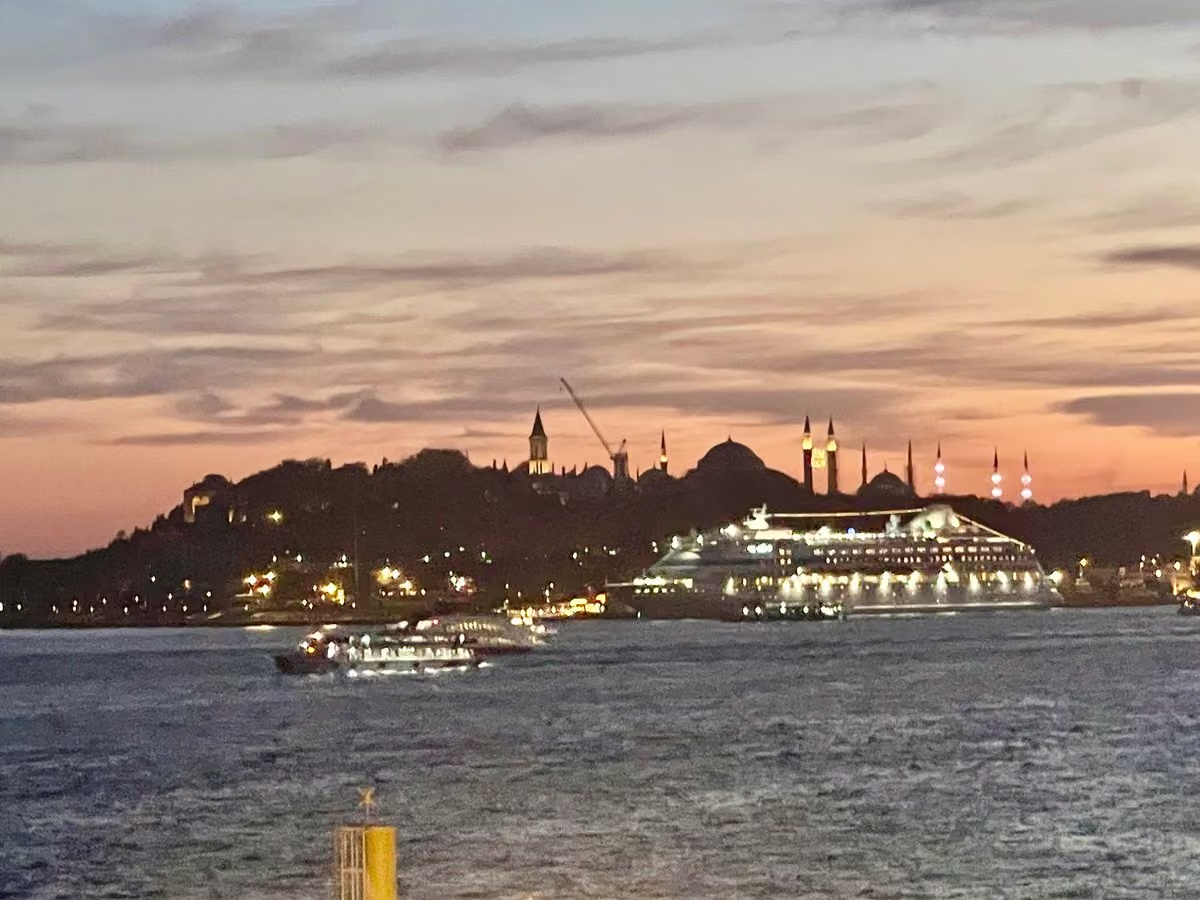
 Amitav Acharya
@AmitavAcharya
The Indo-Pacific’s new age of power politics
"As an international relations professor, Acharya has both chronicled and organised the concepts ASEAN uses to understand itself as a region and an association. More than most academics, his language turns up in the speeches of the leaders and their diplomats."
Veteran Australian journalist Graeme Dobell comments on my work including From Southeast Asia to Indo-Pacific: Culture, Identity and the Return to Geopolitics
Penguin | $37.99 | 252 pages
insidestory.org.au/the-indo-pacifics-new-age-of-power-pol…
Amitav Acharya
@AmitavAcharya
All the BRICS and standing up to Trump and winning. But India will be unwise to get too enthusiastic about Indo-Pacific. It has no future. See my previous take on this .x.com/amitavacharya/status/1963958876610388077
 HindolSengupta
@HindolSengupta
Trump's roll-back of tariffs on China, which is about to happen, should be seen as the official start of the G2 world. When in the next few weeks, 'adjustment' with India happens, the G2.5 world would be indelibly underlined.
Amitav Acharya
@AmitavAcharya
Here is a recording of the launch of The Once and Future World Order at American University's School of International Service.
www.youtube.com/watch?v=5T0G1pYBD3A
@AskAkbar @RaviReports @AU_SIS
Amitav Acharya
@AmitavAcharya
If you are in Berlin on 3rd Nov, please come to my book event at the German Council on Foreign Relations:
Remaking America: World Order Without Washington
Date 03 November 2025 Time 6:30 pm - 8:00 pm
Event location Berlin & Online, Germany
Amitav Acharya, Distinguished Professor of International Relations and UNESCO Chair in Transnational Challenges and Governance, School of International Service, American University
Discussant:
Prof. Thomas Risse (ret.), Cluster of Excellence SCRIPTS, Freie Universität Berlin
dgap.org/en/events/remaking-america-world-order-without-w…
Amitav Acharya reposted
 Sanjay Sipahimalani
@SanSip
A reminder that the word “meritocracy” was coined by British sociologist Michael Young in a book that was a warning about the negative consequences of assigning social status based on formal educational qualifications.
Amitav Acharya
@AmitavAcharya
Roundtable: The Nature of Post-Western Order with Amitav Acharya | Faculty of History, University of Oxford www.history.ox.ac.uk/event/roundtable-the-nature-of-post-…
Amitav Acharya reposted
 Jorge Heine
@jorgeheinel
Keen to understand a world in turmoil ? These 2 new books, fresh from the printing presses, will allow you to grasp the origins of the current crisis, the rise of the #globalsouth, the breakup of the #west, and the way forward. @HachetteUS @politybooks @Bruceps @svaradarajan
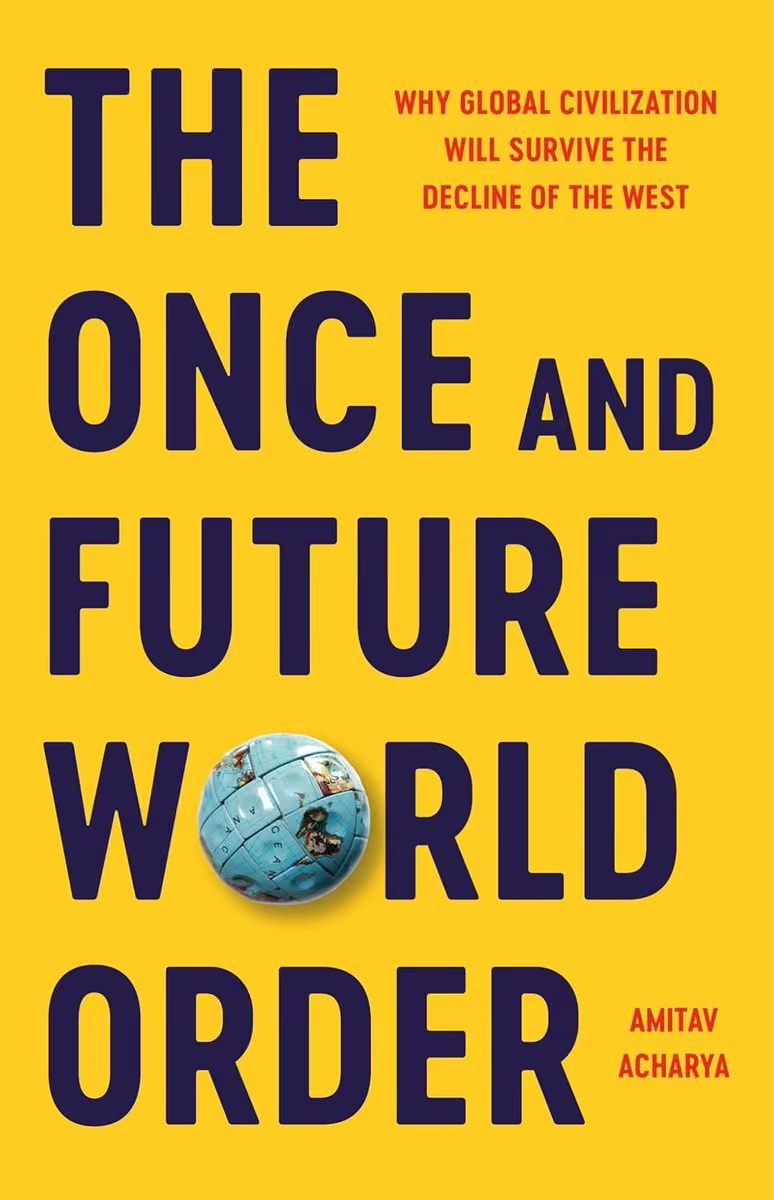
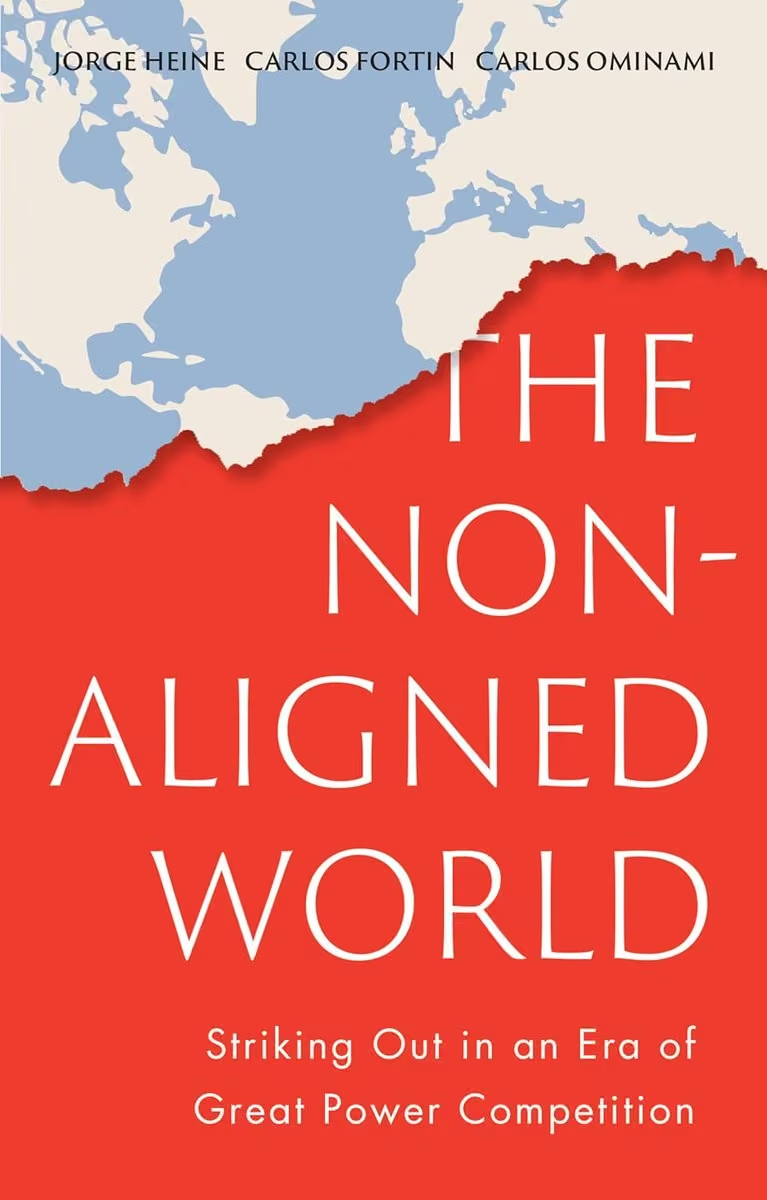
Amitav Acharya reposted
Jorge Heine
@jorgeheinel
So it is,Amitav ! #multiplexity and #activenonalignment complement each other well , and providw powerful conceptual tools to navigate the troubled waters of today’s world !
Amitav Acharya
@AmitavAcharya
"Are We There Yet? Revisiting the Old and New Postcolonialism(s) in IR" by Shelby A. E. McPhee Nathan Andrews and Maïka Sondarjee.
It raises an important question:
"While the Global IR movement is a trending feature in non-Western IR discourses, especially since Professor Amitav Acharya served his term as the International Studies Association (ISA) President (2014–2015), there are still questions around the mechanisms through which the expected dialogue between the worlds would be curated and sustained over time. For instance, where can we turn to as the geographical site(s) for such ‘global’ dialogue in person—ISA annual conferences (held in North America, U.S. in particular) or its Global South conferences (i.e., Argentina in 2014, Singapore in 2015, Hong Kong in 2017, Ecuador in 2018, Ghana in 2019, Brazil and Mexico in 2025), the London School of Economics (where there has been for many years critical discussions of IR annually hosted via the Millennium Conference) or other knowledge mobilization activities held elsewhere in the Global South such as recent workshops in Istanbul and Doha, among others." There are also national and regional networks in Africa, Asia and Latin America such as AMEI (Mexico) and APISA (Asian Political and International Studies Association- which I co-founded in 2001) important for scholars from other regions & those based in global north to attend some of them regularly - producing circulation and interaction of ideas.
Amitav Acharya
@AmitavAcharya
Open access:
'Active Non-alignment and Multiplexity: Managing Uncertainty in a World Order in Transition' - Jorge Heine, 2025
Active non-alignment in pursuit of multiplexity is pathway to a non-hegemonic and democratic world order
@jorgeheinel
journals.sagepub.com/doi/full/10.1177/29769442251383690
Amitav Acharya
@AmitavAcharya
This article mentions "Amitav Acharya anticipated The End of America's World Order in 2014." Important to remember that I was talking about US-led liberal order which in 2014 seemed to most pundits to be alive and well. I was right then & now.
arena.org.au/not-over-america-yet/
Amitav Acharya
@AmitavAcharya
Grok says it too: **Amitav Acharya** was the first to declare that the American world order has ended. In his 2014 book *The End of American World Order*, the international relations scholar argued that the post-World War II liberal international order—built on U.S. military, economic, and ideological primacy through institutions like the UN and WTO—is coming to an end, even if U.S. power persists.
Amitav Acharya
@AmitavAcharya
Amitav Acharya reposted
Jorge Heine
@jorgeheinel
Thank you, Amitav ! Your notion of #multiplexity is a powerful tool to grasp the direction in which the global order is moving !
Amitav Acharya reposted
 Brian Lilley
@brianlilley
Reagan.
On trade.
Free trade.
This comes from a video posted by the Reagan Presidential Library.
Maybe people will think this is AI as well.
Amitav Acharya
@AmitavAcharya
Great piece by @jorgeheinel
Thanks for citing my work on multiplex. - a broader notion of power, ideas & interaction capacity that subsumes multipolar which is mainly about distribution of material power. India needs to combine all three thewire.in/world/india-between-a-rising-south-and-a-fract…
Amitav Acharya
@AmitavAcharya
Here is how Panamá canal locks work. Compare the water levels before and after the gate was opened to allow the ship to pass.Yesterday I visited the Miraflores lock.

 Amitav Acharya
@AmitavAcharya
Great book launch yesterday at La Universidad Andina Simón Bolívar in Quito, Ecuador. The enthusiasm of students so inspiring!


Amitav Acharya reposted
 Carnegie Council
@carnegiecouncil
For Global Ethics Day, the @EIAJournal has published a new roundtable around the theme "Ethics Re-envisioned." In this essay, Amitav Acharya argues that global ethics should draw from norms across multiple civilizations, including those beyond the West. carnegiecouncil.co/acharya-future-ethics
Amitav Acharya reposted
The World Today
@TheWorldToday
The US's withdrawal from its international role will not result in global collapse, writes @AmitavAcharya (@AU_SIS). 🇺🇸
Read how a new 'multiplex' international order could emerge on the back of the old 👇
www.chathamhouse.org/publications/the-world-today/2025-09…
Amitav Acharya
@AmitavAcharya
My final day on Galapagos was Boobies day. After failing in my chase previous day, I took a nearly five hour ferry (return) from Santa Cruz to Isabella island to see these beauties. Higher quality pics will be posted in a few days. Snorkeling in Isabela was fun too, despite cooler temperatures.

 Amitav Acharya
@AmitavAcharya
Confronted on Tartuga beach in Galápagos Islands. These are the only marine iguanas in the world.


 Amitav Acharya
@AmitavAcharya
My first selfie with a wild Galapagos Giant

 Amitav Acharya
@AmitavAcharya
Confronted on Tartuga beach in Galápagos Islands. These are the only marine iguanas in the world.
Amitav Acharya
@AmitavAcharya
My first selfie with a wild Galapagos Giant
Amitav Acharya reposted
Amitav Acharya
@AmitavAcharya
My latest essay on world order is on global ethics.
· “The Once and Future Global Ethics,” Ethics and International Affairs, Oct 10, 2025. Open Access www.ethicsandinternationalaffairs.org/online-exclusives/t…
This essay is part of the 2025 Global Ethics Day online exclusive roundtable from Ethics & International Affairs. View the whole collection here. www.ethicsandinternationalaffairs.org/online-exclusives/g…
@EIAJournal
@carnegiecouncil
Amitav Acharya
@AmitavAcharya
My first selfie with a wild Galapagos Giant
Amitav Acharya
@AmitavAcharya
My latest essay on world order is on global ethics.
· “The Once and Future Global Ethics,” Ethics and International Affairs, Oct 10, 2025. Open Access www.ethicsandinternationalaffairs.org/online-exclusives/t…
This essay is part of the 2025 Global Ethics Day online exclusive roundtable from Ethics & International Affairs. View the whole collection here. www.ethicsandinternationalaffairs.org/online-exclusives/g…
@EIAJournal
@carnegiecouncil
Amitav Acharya
@AmitavAcharya
My conversation with A Cole Smead of Smead Capital.m in his "Book With Legs Podcast" (with wings too). Great to see business community taking a serious interest in my book (ironically he asked me to the podcast after reading a right-wing attack by @tunkuv on the book in Wall Street Journal.)
In this episode, professor and author Amitav Acharya joins Cole Smead to discuss his book “The Once and Future World Order: Why Global Civilization Will Survive the Decline of the West.” The two discuss the history of world order, including its origins in Mesopotamia. Cole and Amitav also examine what historical insights reveal about the future of nations like the U.S. and China, as well as the world order in relation to the decline of the West.
podcasts.apple.com/us/podcast/a-book-with-legs/id16089604…
 Amitav Acharya
@AmitavAcharya
An interesting review essay on Australian perspective on and World Order-Not Over America Yet – Arena arena.org.au/not-over-america-yet/
Amitav Acharya
@AmitavAcharya
China, India, Brazil & South Africa, not to mention Russia, have all defied Trump's threats. Bric-by-Bric. Tariffs don't work. A world order cannot the built or maintained by coercion - economic or political. www.pbs.org/newshour/world/china-refuses-to-give-in-to-tr…
Amitav Acharya
@AmitavAcharya
Trump may not be bluffing but this is a demonstration of why tariffs are overrated as source of US power. TACO is getting tiresome. www.pbs.org/newshour/world/china-refuses-to-give-in-to-tr…
Amitav Acharya
@AmitavAcharya
Few years ago, we (family) did Maine and lobsters, today, it's Solomons Island, MD, and oysters. This is a five minute drive from our bay home.


 Amitav Acharya
@AmitavAcharya
More photos from a fabulous book launch of The Once and Future World Order with @ForeignPolicy editor in chief @RaviReports


 SIS Office of Research
@research_sis
Thanks to all who attended our first @AU_SIS book launch of the year for "The Once and Future World Order!" After @AmitavAcharya's illuminating overview of his book, @RaviReports and @AskAkbar provided thought-provoking responses to the book's themes and implications.


 Amitav Acharya
@AmitavAcharya
 Amitav Acharya
@AmitavAcharya
Perhaps the real losers are leaders who shamelessly nominated him. time.com/7324832/trump-loses-nobel-peace-prize-maria-cori…
Amitav Acharya reposted
SIS Office of Research
@research_sis
Thanks to all who attended our first @AU_SIS book launch of the year for "The Once and Future World Order!" After @AmitavAcharya's illuminating overview of his book, @RaviReports and @AskAkbar provided thought-provoking responses to the book's themes and implications.
Amitav Acharya
@AmitavAcharya
This should be humiliating to nominating sycophantic leaders.
 The Nobel Prize
@NobelPrize
BREAKING NEWS
The Norwegian Nobel Committee has decided to award the 2025 #nobelpeaceprize to Maria Corina Machado for her tireless work promoting democratic rights for the people of Venezuela and for her struggle to achieve a just and peaceful transition from dictatorship to democracy.
#nobelprize
 Amitav Acharya
@AmitavAcharya
Yesterday @AU_SIS the launch of The Once and Future World Order. With Dean Shannon Hader, panelists @RaviReports and @AskAkbar Recording and more photos will be available shortly.


 Amitav Acharya
@AmitavAcharya
Can the Gaza ceasefire agreement hold? jamesmdorsey.substack.com/p/can-the-gaza-ceasefire-agreem…
Amitav Acharya
@AmitavAcharya
I was fortunate to attend and speak at this stimulating and timely Policy Forum on "Justice in Action: Beyond Promises to Progress," in NYC on September 26th 2025, organized by International Peace Institute in partnership with the Doha Forum, the Stimson Center, and the Global Institute for Strategic Research
Recording and pictures here www.ipinst.org/2025/09/justice-in-action-beyond-promises-…
@ipinst @DohaForum @StimsonCenter
Amitav Acharya
@AmitavAcharya
Moon over the Manhattan

Amitav Acharya reposted
SIS Office of Research
@research_sis
TOMORROW: Join us at 11am for the @AU_SIS launch of @AmitavAcharya's new book "The Once and Future World Order" with guests @RaviReports and @AskAkbar! Don't miss out, RSVP here: www.eventbrite.com/e/1675817849299
Amitav Acharya
@AmitavAcharya
“This is a nation of Constitutional law, not martial law,” Immergut wrote in her opinion. “Defendants have made a range of arguments that, if accepted, risk blurring the line between civil and military federal power — to the detriment of this nation.”
oregoncapitalchronicle.com/2025/10/05/federal-judge-bars-…
Amitav Acharya reposted
 Dave Kang
@daveckang
Thanks Amitav -- I think you're right on this. It's a great book!
Amitav Acharya reposted
 Abdul Kadir Jailani
@akjailani
Your book is deeply inspiring. It is also true that most case studies in Destined for War are predominantly European-centric, which limits the validity of its thesis. For this reason, we need alternative perspectives, as your book compellingly strives to provide.
Amitav Acharya
@AmitavAcharya
Pleased to read the words of a distinguished Indonesian diplomat citing my book:
"Amitav Acharya in The Once and Future World Order strongly argues that the decline of the West will not necessarily lead to global chaos. The chaos versus order narrative defines much of the Western fear about the end of its dominance and the rise of other nations. Such anxieties are the result of the West's overconfidence and hubris." It is also worth pointing out that the vast majority of cases used in "Destined for War" - the basis for Thucydides Trap - are from Europe. Another case of David Kang's "Getting Asia Wrong" thesis. @daveckang
 Abdul Kadir Jailani
@akjailani
The current world order is unraveling , yet chaos isn’t inevitable. Multipolarity is rising. The West’s dominance is fading and a new world order is emerging. Indonesia must be able to navigate this dynamic. We must pivot fast: assertive, adaptive, and strategically autonomous.
 Amitav Acharya
@AmitavAcharya
Good to see my book's message reaching through Global South media. This review published in Dacca Courier, Bangladesh.

 Amitav Acharya
@AmitavAcharya
Dhaka Courier
Amitav Acharya
@AmitavAcharya
Pleased to read the words of a distinguished Indonesian diplomat citing my book:
"Amitav Acharya in The Once and Future World Order strongly argues that the decline of the West will not necessarily lead to global chaos. The chaos versus order narrative defines much of the Western fear about the end of its dominance and the rise of other nations. Such anxieties are the result of the West's overconfidence and hubris." It is also worth pointing out that the vast majority of cases used in "Destined for War" - the basis for Thucydides Trap - are from Europe. Another case of David Kang's "Getting Asia Wrong" thesis. @daveckang
Abdul Kadir Jailani
@akjailani
The current world order is unraveling , yet chaos isn’t inevitable. Multipolarity is rising. The West’s dominance is fading and a new world order is emerging. Indonesia must be able to navigate this dynamic. We must pivot fast: assertive, adaptive, and strategically autonomous.
Amitav Acharya reposted
Abdul Kadir Jailani
@akjailani
The current world order is unraveling , yet chaos isn’t inevitable. Multipolarity is rising. The West’s dominance is fading and a new world order is emerging. Indonesia must be able to navigate this dynamic. We must pivot fast: assertive, adaptive, and strategically autonomous.
Amitav Acharya
@AmitavAcharya
Thanks a lot @profLind. Very timely as I will be launching the book @AU_SIS on 8th Oct with @ForeignPolicy editor-in-chief @RaviReports and my colleague @AskAkbar
 Jennifer Lind
@profLind
Prof. @AmitavAcharya has written a terrific book about non-Western foundations of international order. I talked with him about the book in this week's Scouted podcast
blueblaze.substack.com/p/the-once-and-future-world-order
Amitav Acharya
@AmitavAcharya
Thank you Jennifer, for your superb hosting and perceptive questions.
Jennifer Lind
@profLind
Prof. @AmitavAcharya has written a terrific book about non-Western foundations of international order. I talked with him about the book in this week's Scouted podcast
blueblaze.substack.com/p/the-once-and-future-world-order
Amitav Acharya reposted
Jennifer Lind
@profLind
Prof. @AmitavAcharya has written a terrific book about non-Western foundations of international order. I talked with him about the book in this week's Scouted podcast
blueblaze.substack.com/p/the-once-and-future-world-order
Amitav Acharya
@AmitavAcharya
Here is recording of Reimagining Global Order: Perspectives from Professor Amitav Acharya, Dr. Trita Parsi, and Heather Hurlburt • Stimson Center. @ACUNStweets @StimsonCenter @AU_SIS @UNESCO www.stimson.org/event/reimagining-global-order/
Amitav Acharya reposted
SIS Office of Research
@research_sis
🚨One week from today, we'll be hosting our first @AU_SIS book launch of the year for @AmitavAcharya's "The Once and Future World Order" with guest panelists @RaviReports (@ForeignPolicy) and @AskAkbar! RSVP now: www.eventbrite.com/e/1675817849299
Amitav Acharya
@AmitavAcharya
In my 16 years in Washington DC area, I have never seen the National Mall (my favorite part of the town) so deserted on a sunny Sunday early afternoon. (Even during Covid -after the peak passed). No line ups for the museums, I saw a few soldiers (National Guard perhaps).


 Amitav Acharya
@AmitavAcharya
Reimagining Global Order: Perspectives from Professor Amitav Acharya and Dr. Trita Parsi. Oct 1. 10am
Upcoming Event
in International & Regional Organizations @StimsonCenter
www.stimson.org/event/reimagining-global-order/ Center
Amitav Acharya
@AmitavAcharya
New York, New York! The view from Dear Irving on Hudson ('Manhattan's highest open-air hotel bar and lounge' according to its website) in the Aliz hotel in Times Square (spent a couple of nights there while speaking at a global North-South dialogue on the sidelines of the annual UNGA session)


Amitav Acharya reposted
 Press Trust of India
@PTI_News
VIDEO | On National Mediation Conference 2025, Odisha Advocate General Pitambar Acharya says, "This is one of the biggest national events that Odisha government, and office of the Advocate General are jointly organising in Bhubaneswar. The two-day conference will be attended to almost all legal minds of the country. The CJI will inaugurate the function. Around 10 judges of the SC, including the chairman of the national legal services authority, Justice Suryakant will be here. Around 17 chief justices of 25 HCs will be attending. Almost all senior most judges of the 25 HCs will be attending. Attorney General of India, Solicitor General of India, and all the Additional Solicitor Generals of the GoI, they are also coming to attend. Odisha is the first state to popularise the mediation laws after enactment of the Mediation Act 2023 by the Parliament. This is the vision of PM Modi for the purpose of imparting speedy, efficacious justice, also to reduce the burden on courts..."
#nationalmediationconference #odisha
Amitav Acharya reposted
 AU School of International Service
@AU_SIS
SIS professor @AmitavAcharya joined @CBSNewYork to discuss insights on the 80th session of the @UN General Assembly. Watch here: www.cbsnews.com/newyork/video/un-general-assembly-starts-….
Amitav Acharya
@AmitavAcharya
A very moving encounter today - after helping him walk across the street (on his request) in uptown New York, I had a chat with him about native Indian civilization (he is Cherokee). I told him about my book which covers episodes including Sitting Bull, Iroquois confederacy etc.
 Amitav Acharya
@AmitavAcharya
Full house yesterday at the University of Ottawa event to launch The Once and Future World Order.

Amitav Acharya reposted
Amitav Acharya
@AmitavAcharya
My live preview to UNGA and Trump speech on @CBSNews New York yesterday.www.cbsnews.com/newyork/video/un-general-assembly-starts-…
@AU_SIS
#unga80 #trump

 Amitav Acharya
@AmitavAcharya
My live preview to UNGA and Trump speech on @CBSNews New York yesterday.www.cbsnews.com/newyork/video/un-general-assembly-starts-…
@AU_SIS
#unga80 #trump
Amitav Acharya
@AmitavAcharya
"Almost half (46%) of US imports are exempt from these headline duties. Much of the half stems from the exemption granted to USMCA-compliant goods."
@"Why Haven’t Trumpian Tariffs Done More Damage?"www.linkedin.com/pulse/why-havent-trumpian-tariffs-done-m… on @LinkedIn
Amitav Acharya
@AmitavAcharya
At the end of a very fruitful book talk today at the @munkschool @UofT with chair Phillip Lipscy, abd discussants Prof Lynette Ong and Prof Steve Bernstein.
 Amitav Acharya
@AmitavAcharya
On Global IR. There is no question that differences within Global IR exist and not all those who challenge IR’s Western-centrism do not identify with Global IR, but prefer other terms such as “pluriversal,” “post-Western,” or “beyond Global IR”, etc. This is only to be expected and welcomed. But turf-battles and name games aside, the main goal of all these remains similar to Global IR, At the same time, Global IR has been a major trigger of such debates and efforts at redefining and broadening of IR in the past decade. Global IR remains the most inclusive version of IR, because it does not reject mainstream theories as long as they recognize and respect the diversity of intellectual traditions and pathways. A great number of resident Global South scholars - including many more marginalized than scholars of Global South origin based in the West or those fortunate enough to frequently travel to West and socialize at international IR conferences (such many in Indonesia, China, India and Iran) - do not reject mainstream theories but find them useful. For any critical, 'post-Western," "pluriversal" or "beyond Global IR" approaches to exclude or preach to Global South scholars who genuinely believe in mainstream theories (albeit redefined with local ideas & traditions) will be replacing one form of exclusionism with another. Instead of making them feel lesser or excluded, Global IR gives them voice, empowers them.
Amitav Acharya
@AmitavAcharya
"How India should approach disruptive world order"
-------
In the words of Amitav Acharya, a well-known scholar of international relations, “The evolving global order is marked by a tension between the normative aspiration for a more inclusive and pluralistic ‘multiplex’ world order and the uncertainty that such a shift may reproduce existing hegemonies under a new guise.”
www.firstpost.com/opinion/india-foreign-policy-global-str…
Amitav Acharya
@AmitavAcharya
This is not Bali or Caribbean but I am happily wearing my Bali gear in this very special Tiki Bar in the Solomons close to our Bayhouse in Maryland.
 Amitav Acharya
@AmitavAcharya


Amitav Acharya reposted
Amitav Acharya
@AmitavAcharya
Isn't it ironic that champions of Western values refuse debate (like Tunku Varadarajan) or dissent & right of reply like @WSJopinion @tunkuv
@nicholastomaino
@jamestaranto
Shiping Tang
@ShipingTang
Your book is a powerful rebuttal to all the colonialists and colonialized minds...
Amitav Acharya reposted
 S. Munirah Alatas
@hurricanesma
Amitav's idea of "borrowing" is meant to emphasise the gross manipulation of history. It is arrogant to deliberately silence...to give the impression that the West reigns supreme from start to finish is pompous & dishonest. A shared destiny is the reality, based on evidence.
Amitav Acharya
@AmitavAcharya
Isn't it ironic that champions of Western values refuse debate (like Tunku Varadarajan) or dissent & right of reply like @WSJopinion @tunkuv
@nicholastomaino
@jamestaranto
Shiping Tang
@ShipingTang
Your book is a powerful rebuttal to all the colonialists and colonialized minds...
Amitav Acharya reposted
SIS Office of Research
@research_sis
🚨Our first @AU_SIS book launch of the semester is almost here! Join us on October 8 to hear from @AmitavAcharya on his new book "The Once and Future Order" with panelists @RaviReports and @AskAkbar. Register here: www.eventbrite.com/e/1675817849299
Amitav Acharya reposted
Amitav Acharya
@AmitavAcharya
Below my reply to a vitriolic review of my book @WSJ by Tunku Varadarajan (@tunkuv) the paper's own contributor and affiliate of a conservative think tank,
which the paper rejected (editor went on personal leave). I am not surprised (feel vindicated actually) that some might feel aggravated by my book's argument that civilization is a shared creation, but at least they should tolerate a right of reply if democratically-minded. Let’s debate and let readers decide.
+++++++++++
Reviewing my book, The Once and Future World Order (WSJ, June 22, 2025), Tunku Varadarajan denounces my view that the end of Western dominance may “turn out to be a good thing.” (in the “long run”, I say). He brushes aside my reasoning that Western dominance produced colonialism, inequality, racism, and avoidable wars in the global South.
Mr Varadarajan condemns the 1955 Bandung conference in which postcolonial nations demanded decolonization and racial equality, alleging that that it produced authoritarianism. But there is no such causal link.
My book argues that civilization and world order are not the West's monopoly. Mr Varadarajan asserts the superiority of Western civilization - with its Greco Roman heritage - as being “more scientific than most.” Yet, the West borrowed scientific and rationalist ideas; for example Indian mathematics, Chinese paper-making and printing, and Islamic algebra, medicine and rationalist philosophy, which fed Europe’s Renaissance and Enlightenment. The Greeks invented democracy, but with limited participation and without individual liberty. Other civilizations in Near East, Asia, and Africa invented diplomacy, peace treaties, humanitarian values, freedom of seas, etc., but get little credit.
Mr Varadarajan attacks my “values” and the book's blurbs from Australia’s former Foreign Minister Gareth Evans, and Singaporean public intellectual Kishore Mahbubani, because of their allegedly anti-American or pro-China views. He ignores endorsements from Yale historian Odd Arne Westad and Cambridge Professor Ayse Zarakol, and novelist Amitav Ghosh.
Mr Varadarajan falsely alleges that I ask Western nations to pay “material reparations” for their past colonialism. He further has me saying that the end of Pax Americana will create a “global Eden.” I clearly state that a post-Western world - I call it a "global multiplex," “does not mean paradise,” but might “alleviate the conflicts and injustice it had caused,” and produce an “inclusive world order.”
Amitav Acharya
+++++++++++++++
P.S. before being turned down, the text of my rejoinder was compressed at suggestion of the letters editor of WSJ (before he went on leave). An op-ed submission to WSJ on this debate was rejected as well. I have a post a fuller account of my rejoinder and exchange with the WSJ editors (Mr Varadarajan ignores my invitation to directly debate with me)
Amitav Acharya reposted
Amitav Acharya
@AmitavAcharya
A POST-TRUMP WORLD ORDER
The United States’ withdrawal from its international role will not result in global collapse. Instead, we are on the verge of a ‘multiplex’ order, in which ‘re-globalization’ is led by Asia and Global South nations increasingly deploy non-alignment to get what they want.
Traditional forms of global governance were already growing rusty. Now they are being joined by new forms which will become more salient in the post-Trump era.
First, no single nation, or cluster of powers, will dominate. The US is likely to remain the most powerful nation, especially militarily, financially and technologically. But China will become pre-eminent in development and trade, if not in financial power.
Regional powers, acting through regional bodies, such as Indonesia in ASEAN and South Africa in the African Union, could become more important in managing political, security and trade affairs.
Second, power and alignments will be issue- and time-specific. Countries will avoid rigid alliances and instead ‘hedge’ or avoid taking sides in great power rivalries. The tendency towards a more non-aligned foreign policy will grow. For this reason, I don’t believe the idea of a return of the great power sphere of influence is credible.
Third, no single nation will lead across every issue area. while the US might retain security allies, China might dominate as a trading partner; the EU could shape climate rules; while the Global South nations will draw security, economic, technological and public health support from a variety of partners – from the UK, Germany, India, Turkey, South Africa, Brazil and Saudi Arabia, depending on issue areas. In so doing the Global South may be able to exert great agency over what they get and how.
Excerpted from
www.chathamhouse.org/publications/the-world-today/2025-09…
Amitav Acharya
@AmitavAcharya
Below my reply to a vitriolic review of my book @WSJ by Tunku Varadarajan (@tunkuv) the paper's own contributor and affiliate of a conservative think tank,
which the paper rejected (editor went on personal leave). I am not surprised (feel vindicated actually) that some might feel aggravated by my book's argument that civilization is a shared creation, but at least they should tolerate a right of reply if democratically-minded. Let’s debate and let readers decide.
+++++++++++
Reviewing my book, The Once and Future World Order (WSJ, June 22, 2025), Tunku Varadarajan denounces my view that the end of Western dominance may “turn out to be a good thing.” (in the “long run”, I say). He brushes aside my reasoning that Western dominance produced colonialism, inequality, racism, and avoidable wars in the global South.
Mr Varadarajan condemns the 1955 Bandung conference in which postcolonial nations demanded decolonization and racial equality, alleging that that it produced authoritarianism. But there is no such causal link.
My book argues that civilization and world order are not the West's monopoly. Mr Varadarajan asserts the superiority of Western civilization - with its Greco Roman heritage - as being “more scientific than most.” Yet, the West borrowed scientific and rationalist ideas; for example Indian mathematics, Chinese paper-making and printing, and Islamic algebra, medicine and rationalist philosophy, which fed Europe’s Renaissance and Enlightenment. The Greeks invented democracy, but with limited participation and without individual liberty. Other civilizations in Near East, Asia, and Africa invented diplomacy, peace treaties, humanitarian values, freedom of seas, etc., but get little credit.
Mr Varadarajan attacks my “values” and the book's blurbs from Australia’s former Foreign Minister Gareth Evans, and Singaporean public intellectual Kishore Mahbubani, because of their allegedly anti-American or pro-China views. He ignores endorsements from Yale historian Odd Arne Westad and Cambridge Professor Ayse Zarakol, and novelist Amitav Ghosh.
Mr Varadarajan falsely alleges that I ask Western nations to pay “material reparations” for their past colonialism. He further has me saying that the end of Pax Americana will create a “global Eden.” I clearly state that a post-Western world - I call it a "global multiplex," “does not mean paradise,” but might “alleviate the conflicts and injustice it had caused,” and produce an “inclusive world order.”
Amitav Acharya
+++++++++++++++
P.S. before being turned down, the text of my rejoinder was compressed at suggestion of the letters editor of WSJ (before he went on leave). An op-ed submission to WSJ on this debate was rejected as well. I have a post a fuller account of my rejoinder and exchange with the WSJ editors (Mr Varadarajan ignores my invitation to directly debate with me)
Amitav Acharya
@AmitavAcharya
A POST-TRUMP WORLD ORDER
The United States’ withdrawal from its international role will not result in global collapse. Instead, we are on the verge of a ‘multiplex’ order, in which ‘re-globalization’ is led by Asia and Global South nations increasingly deploy non-alignment to get what they want.
Traditional forms of global governance were already growing rusty. Now they are being joined by new forms which will become more salient in the post-Trump era.
First, no single nation, or cluster of powers, will dominate. The US is likely to remain the most powerful nation, especially militarily, financially and technologically. But China will become pre-eminent in development and trade, if not in financial power.
Regional powers, acting through regional bodies, such as Indonesia in ASEAN and South Africa in the African Union, could become more important in managing political, security and trade affairs.
Second, power and alignments will be issue- and time-specific. Countries will avoid rigid alliances and instead ‘hedge’ or avoid taking sides in great power rivalries. The tendency towards a more non-aligned foreign policy will grow. For this reason, I don’t believe the idea of a return of the great power sphere of influence is credible.
Third, no single nation will lead across every issue area. while the US might retain security allies, China might dominate as a trading partner; the EU could shape climate rules; while the Global South nations will draw security, economic, technological and public health support from a variety of partners – from the UK, Germany, India, Turkey, South Africa, Brazil and Saudi Arabia, depending on issue areas. In so doing the Global South may be able to exert great agency over what they get and how.
Excerpted from
www.chathamhouse.org/publications/the-world-today/2025-09…
Amitav Acharya
@AmitavAcharya
4 Indian business schools in top 20. One in top ten. Several more in the top 100z
@"LinkedIn Top MBA Programs 2025: The 100 best global business schools to grow your career"www.linkedin.com/pulse/linkedin-top-mba-programs-2025-100… on @LinkedIn
Amitav Acharya
@AmitavAcharya
Join us for the launch of The Once and Future World Order by Professor Amitav Acharya! 22, 2025 | 10:00AM - 12:00PM
Location | Boardroom and Library, 315 Bloor St. West, Toronto, M5S 0A7
The panel discussion will feature Professors Steven Bernstein, Lynette Ong, and Phillip Lipscy.
@onglynette
@PhillipLipscy
@AmitavAcharya
@munkschool
munkschool.utoronto.ca/event/will-global-civilization-and…
 Amitav Acharya
@AmitavAcharya
Happy to be part of latest issue of @TheWorldToday I write on what a post-Trump world might look like, sketching a scenario between the extremes of collapse and revival of US dominance & drawing implications for the future of globalization and multilateralism.
The World Today
@TheWorldToday
📢Our autumn issue is OUT NOW!
Check out stories about the world order after Trump, new climate thinking ahead of #cop30, the changing views of Israeli society on the war in Gaza and lots more. 🇮🇱🇵🇸🇺🇸🌎
Read here: www.chathamhouse.org/publications/the-world-today/2025-09
 Amitav Acharya
@AmitavAcharya
@SingaporeAir Singapore to Newark- which I took last August, will remain longest flight as it does not stop for refueling. Even longer will be Qantas' Sydney to London flight when launched.
www.paddleyourownkanoo.com/2025/09/14/china-eastern-airli…
Amitav Acharya reposted
 Pavan Sodhan
@PSodhan
Echoing @manjeetsp recommendation to buy @AmitavAcharya eye-opening new book exploring why a more multi-polar world won’t threaten the systems & institutions that underpin cooperation & peace even if they aren’t dominated by the West, which I reviewed for @BooksinFive below!
1/5
 Amitav Acharya
@AmitavAcharya
Save the Date for my US book launch Oct 8 with @RaviReports, Chief Editor @ForeignPolicy & @AskAkbar, Ibn Khaldun Chair, @AU_SIS. Books will be available for purchase.
 Amitav Acharya
@AmitavAcharya
Against the tide (Chesapeake Bay)
Amitav Acharya
@AmitavAcharya
A very different take on: How WWII Changed the World: I argue that decolonization was the main event of 20th century, it happened less due to WWII & more due to struggles of colonized people; US support for decolonization was secondary to anti-communism www.american.edu/sis/news/20250902-how-wwii-changed-the-w…
Amitav Acharya
@AmitavAcharya
Review of The Once and Future World Order in The Hindustan Times
"Acharya’s book provides a stimulating alternative narrative...questioning long-standing assumptions...to the standard discourse about modern civilisation having evolved in the West.
The book explores the concept of World Order and the juxtaposition of Order and Chaos. The World Order, as Acharya puts it, was never monolithic in the past ages. There were many Orders in the ancient and Old World, whether seen through timelines or geographies. Acharya takes the reader on an informative and fact-filled journey across the Sumerian, Greek and Roman, as well as the Indian, Chinese, Islamic, Meso-American and South American civilisations. Many of these had drawn upon the wisdom and knowledge of their historical predecessors or contemporaries to take the form they did. Acharya sees the World Order that once was as a shared creation."
www.hindustantimes.com/books/review-the-once-and-future-w…
Amitav Acharya reposted
Amitav Acharya
@AmitavAcharya
"Acharya’s book provides a stimulating alternative narrative to the standard discourse about modern civilisation having evolved in the West," www.hindustantimes.com/books/review-the-once-and-future-w…
Amitav Acharya reposted
Amitav Acharya
@AmitavAcharya
My opinion: "Bric by Bric, Rising Powers are Standing up to Trump"
The SCO summit in Tianjin, China, which was attended by Putin and Modi, and saw India and China declaring themselves to be partners, not rival: is this a real turning point in world order?
The SCO summit comes after a time when all individual BRICS-5 -Brazil, Russia, India, China and South Africa) have openly defied Trump despite heavy tariffs.
Despite high tariffs already imposed: 50% on Brazil and India, 30% on South Africa, 35% on China although final tariffs are subject to outcome of negotiations. Russia has been subject to heavy sanctions, and now subject to secondary sanctions like India for buying Russian oil.
Trump has threatened severe retaliation against BRICS if they develop a currency of their own as an alternative to the US dollar. But this is unlikely to deter them from developing alternative payments systems, whether on a bilateral or multilateral basis.
While BRICS may not be united on many issues, individually they have stood up to Trump. There are also clear signs that Trump is retreating from his initial bluster. In Brazil’s case, he has allowed major exemptions. In the meantime, the trial of former President Bolsonaro – the cause of Trump’s anger – continues.
South Africa has rejected Trump’s claim of persecution of its white minority in a White House meeting between the two Presidents in a way that exposed the shallowness of Trump’s claim. South African President remained calm and confident, but managed to throw a jab at Trump by saying that he could not give him a luxury jet like Qatar, a reminding the world that Trump cares for personal gratification bordering on outright bribery.
China has used its critical mineral cards effectively to rebuff Trump, showing that Trump retreats against countervailing power.
India has no such natural resource cards, but Trump may have more to lose here: a wide swath of US policy community is baffled and outraged by Trump’s action in destroying a relationship that took decades to build, a country and against a strategic partner against China that has been been a lynchpin of the US Indo-Pacific strategy which Trump.1 had endorsed).
The high tariffs rates on India was inspired by personal pique at Modi’s refusal to endorse Trump’s claim to have negotiated a ceasefire in its conflict with Pakistan. India held on to its position that the ceasefire was the result of direct communication between the two countries top security officials. In the meantime, the US stands accused of double standards by not imposing tariffs on China which buys even more Russian oil.
The consequence of India tariffs is the death of QUAD, the crippling of the US Indo-Pacific strategy, and clear gains for China and Russia, the two strategic rivals of the US.
The punishment of India makes Trump look childish and irresponsible, putting personal glory (Nobel prize dreams) over national interest.
The SCO summit may not lead to lasting rapprochement between India and China, due to the border dispute and China’s alliance with Pakistan, India’s rival. But it might open the door for India to greater access to the Chinese market and technology, as well as infrastructure aid.
Overall, the BRICS’ response to Trump and their actions undercut the US hard and soft power, making the arrival of a post-American world order closer at hand.
#scosummit2025 #china, @jorgeheinel #brics #worldorder #trump #modivstrump #russia
[I am happy to write this up fully if any media outlet commissions me.]
Amitav Acharya reposted
 Gabrielius Landsbergis🇱🇹
@GLandsbergis
Europe’s summer charm offensive has failed.
Let’s review European diplomatic achievements so far this year. 2025 started with JD Vance making his famous “stepping up” speech in Munich, and alarm bells started ringing.
Unfortunately — Europe didn’t even wake up, let alone step up.
Europe instead based its summer security strategy on three pillars:
1. Appeasing President Trump.
This pillar can be summarised as paying and praying — paying with tariffs and promises of equipment purchases and worshipping Trump with pilgrimages to DC, video calls and public declarations of devotion.
2. Hoping that Putin will be satisfied with what he currently has.
This has been expressed in announcements by European leaders suggesting that brutal realities might force Ukraine to cede territories to Putin, using Baltic or Finnish historical examples. Nothing points to Putin being satisfied with that, but ok, hope springs eternal.
3. Praying that Ukrainians will not get tired
An essential component of the European inaction plan is that Ukrainians will continue fighting for both Ukraine and Europe, while Europe finishes its Aperol spritz and figures things out.
Now what?
When the United States announced the cancellation of the Baltic Security Initiative, many were shocked. I was more shocked at how much time we wasted praying that things would magically improve, rather than heeding the warnings and making preparations for this inevitable scenario.
So now what? Now we have to prepare for a reduction of US troops in Europe, likely in very significant numbers. And yes, it is possible that troops will be withdrawn from the Baltic region. What else should we be prepared for? Simply what has already been said: Ukraine will most likely be left without US assistance. Russia will no longer be sanctioned because of changes in US strategic calculations. Europe will have to face the Russian threat on its own. And frontline countries will have to figure out a plan B, to resist and win in a post-American Europe.
This should not come as a surprise, because we were warned long ago. If we wasted time, that’s on us. As the saying goes: The best times to stop wasting time are ten years ago, and today.
And if there is a question about how this should look in practice — look no further than Ukraine. President Zelenskyy might be saying many thank yous, wearing a suit and solemnly praising the American administration, but… at the same time, Ukraine has launched its biggest air raids on Russian oil refineries, reducing oil output by about 20 percent.
Europe is simply increasing the volume of its rhetoric as two of the three pillars of its 2025 strategy crumble. Meanwhile, Ukraine is introducing new weapons that will strengthen its position even further. Ukraine is talking softly AND developing a range of new sticks. Of course, Ukrainians would rather fight alongside Americans and Europeans, but even if Europeans and Americans are unwilling — Ukrainians are showing what they can achieve on their own.
Time to be brave like Ukraine
Europe, which has lost its belief in its own ability to fight any war, should be inspired by Ukraine and follow her shining example. If a country of fewer than 40 million people can keep stepping up further, even after three years of war, surely similar progress could be made by pooling the wealth of the EU’s 450 million inhabitants?
Read the full article and my conclusion at the link below…

Amitav Acharya reposted
AU School of International Service
@AU_SIS
This September marks the 80th anniversary of the end of World War II, which “marked the undisputed emergence of the United States as the global superpower,” writes SIS professor @AmitavAcharya in this new Q&A about how WWII changed the world. ⬇️ www.american.edu/sis/news/20250902-how-wwii-changed-the-w…
Amitav Acharya
@AmitavAcharya
My opinion: "Bric by Bric, Rising Powers are Standing up to Trump"
The SCO summit in Tianjin, China, which was attended by Putin and Modi, and saw India and China declaring themselves to be partners, not rival: is this a real turning point in world order?
The SCO summit comes after a time when all individual BRICS-5 -Brazil, Russia, India, China and South Africa) have openly defied Trump despite heavy tariffs.
Despite high tariffs already imposed: 50% on Brazil and India, 30% on South Africa, 35% on China although final tariffs are subject to outcome of negotiations. Russia has been subject to heavy sanctions, and now subject to secondary sanctions like India for buying Russian oil.
Trump has threatened severe retaliation against BRICS if they develop a currency of their own as an alternative to the US dollar. But this is unlikely to deter them from developing alternative payments systems, whether on a bilateral or multilateral basis.
While BRICS may not be united on many issues, individually they have stood up to Trump. There are also clear signs that Trump is retreating from his initial bluster. In Brazil’s case, he has allowed major exemptions. In the meantime, the trial of former President Bolsonaro – the cause of Trump’s anger – continues.
South Africa has rejected Trump’s claim of persecution of its white minority in a White House meeting between the two Presidents in a way that exposed the shallowness of Trump’s claim. South African President remained calm and confident, but managed to throw a jab at Trump by saying that he could not give him a luxury jet like Qatar, a reminding the world that Trump cares for personal gratification bordering on outright bribery.
China has used its critical mineral cards effectively to rebuff Trump, showing that Trump retreats against countervailing power.
India has no such natural resource cards, but Trump may have more to lose here: a wide swath of US policy community is baffled and outraged by Trump’s action in destroying a relationship that took decades to build, a country and against a strategic partner against China that has been been a lynchpin of the US Indo-Pacific strategy which Trump.1 had endorsed).
The high tariffs rates on India was inspired by personal pique at Modi’s refusal to endorse Trump’s claim to have negotiated a ceasefire in its conflict with Pakistan. India held on to its position that the ceasefire was the result of direct communication between the two countries top security officials. In the meantime, the US stands accused of double standards by not imposing tariffs on China which buys even more Russian oil.
The consequence of India tariffs is the death of QUAD, the crippling of the US Indo-Pacific strategy, and clear gains for China and Russia, the two strategic rivals of the US.
The punishment of India makes Trump look childish and irresponsible, putting personal glory (Nobel prize dreams) over national interest.
The SCO summit may not lead to lasting rapprochement between India and China, due to the border dispute and China’s alliance with Pakistan, India’s rival. But it might open the door for India to greater access to the Chinese market and technology, as well as infrastructure aid.
Overall, the BRICS’ response to Trump and their actions undercut the US hard and soft power, making the arrival of a post-American world order closer at hand.
#scosummit2025 #china, @jorgeheinel #brics #worldorder #trump #modivstrump #russia
[I am happy to write this up fully if any media outlet commissions me.]
Amitav Acharya
@AmitavAcharya
If Trump's tariff threat
("we're going to put tariffs on you that are so high, your head's going to spin") ended the India-Pakistan military fight, as he so loudly claims, why didn't the even the higher tariff threat force Delhi to stop buying Russian oil rather than take 25% additional tariffs.
Answer: Trump's self-proclaimed 'mediation' had little to do with India- Pak ceasefire.
Modi could have done a "Mark Rutte" by calling Trump "daddy", or followed the Pakistani govt. by nominating him for a Nobel, but most Indians and many outsiders around the world would thank him - whether they like his politics or not - for doing neither. So far no BRICS-5 member has kowtowed to Trump.
Amitav Acharya
@AmitavAcharya
This could mark the death of QUAD, crippling of the strategic vision of Indo-Pacific promoted by the US, and further step towards a post-American world order. Full credit to Trump, who loves credit so much. There are powerful obstacles to India-China ties and possible reversals in US-India fall-out post-Trump, but this is quite possibly a bend in the fork in global geopolitics.
www.ndtv.com/world-news/pm-narendra-modi-xi-jinping-boost…
Amitav Acharya
@AmitavAcharya
The Nobel Peace Prize should have a desk rejection much the same as academic journal editors do after initial consideration by the editor/s before full vetting, and taking into account who the nominators and nominee are.
Amitav Acharya
@AmitavAcharya
"Acharya’s book provides a stimulating alternative narrative to the standard discourse about modern civilisation having evolved in the West," www.hindustantimes.com/books/review-the-once-and-future-w…
Amitav Acharya
@AmitavAcharya
A review of my book From Southeast Asia to Indo-Pacific: Culture, Identity and the Return of Geopolitics (Penguin, 2025) in Indian paper Business Standard:

Amitav Acharya reposted
 Responsible Statecraft
@RStatecraft
Poll: 41% of Americans say Israel committing genocidal acts in Gaza
responsiblestatecraft.org/poll-americans-israel/
Amitav Acharya reposted
 Manjeet S. Pardesi
@manjeetsp
A very generous review of our book, 'Divergent Worlds: What the Ancient Mediterranean and Indian Ocean Can Tell Us about the Future of International Order' by David Abulafia in @PoPpublicsphere! @AmitavAcharya @yalepress
doi.org//10.1017/S1537592725102181
 Amitav Acharya
@AmitavAcharya
Agree. I got same impression during recent fairly senior level talks in Delhi. Undercuts the very foundation of QUAD. But India not alone. Trust is also gone with Canada, Australia, Japan too.
 Evan A. Feigenbaum
@EvanFeigenbaum
Evan Feigenbaum: Even if India and U.S. eventually reach a tariff deal, the trust is most likely gone. cnb.cx/4fpW07o
Amitav Acharya reposted
 Shubhangi Sharma
@ItsShubhangi
Jaishankar describes three main issues with the US. Redlines on trade, Russian oil, and mediation on Kashmir which India has rejected for decades. And India will not compromise on any of them.
Amitav Acharya
@AmitavAcharya
In case you missed "Trump is Hastening the Emergence of a Post-Western World," Multiplex World: Once & Future World Order by @AmitavAcharya multiplexworld.com/2025/08/19/trump-is-hastening-the-emer…
Amitav Acharya
@AmitavAcharya
Tashkent, Uzbekistan (uzdaily.com) — Central Asia should rely on its own identity and regional autonomy. This view was expressed by renowned scholar of regionalism Amitav Acharya in his address to participants of the 8th Central Asian Expert Forum (CAEF), held in Tashkent on 14–15 August 2025.
www.uzdaily.uz/en/amitav-acharya-central-asia-should-rely…
Amitav Acharya
@AmitavAcharya
Looks like a deal on #ukraine which might be advanced in Washington tomorrow, will involve Russia keeping the territories it had annexed before the war, plus possibly some of what it seized after the war started. The US, Russia, and European and NATO would sign off on such a deal. Trump will bolster his demand for Nobel Peace prize. Europe's hallowed tradition of big powers carving out weaker states such as Poland for territory and personal glory would repeat itself, as I have told @nytimes @damiencave
Amitav Acharya
@AmitavAcharya
My comment in NYT on Trump-Putin Summit.
Between 1772 and 1795, "Poland was divided three times by the great powers of the day: Austria, Prussia and Russia, said Amitav Acharya, the author of a new book "The Once and Future World Order."
Mr. Acharya, who teaches international relations at American University in Washington, said the summit, which Mr.
Putin requested, harks back to a world order when great powers carved up states for "the personal glory of their rulers."
www.nytimes.com/2025/08/15/world/asia/trump-putin-summit-…


 Amitav Acharya
@AmitavAcharya
My comment in NYT on Trump-Putin Summit.
Between 1772 and 1795, "Poland was divided three times by the great powers of the day: Austria, Prussia and Russia, said Amitav Acharya, the author of a new book "The Once and Future World Order."
Mr. Acharya, who teaches international relations at American University in Washington, said the summit, which Mr.
Putin requested, harks back to a world order when great powers carved up states for "the personal glory of their rulers."
www.nytimes.com/2025/08/15/world/asia/trump-putin-summit-…
Amitav Acharya
@AmitavAcharya
Article on #asean in Bangkok Post by Kavi Chongkittavarn cites The Once and Future Workd Order.
"Professor Amitav Acharya of the American University writes in his latest book, The Once and Future World Order: Why Global Civilization Will Survive the Decline of the West, global power is no longer dominated by the West. The world is moving towards what he calls a "global mul-tiplex" — a system where power is shared and no single country sets the rules.
This new order opens space for regions like Asean to take a more active role. But to do so, the bloc must be malleable....."
 Amitav Acharya
@AmitavAcharya
By integrating Amitav Acharya’s multiplexity and Susan Strange’s structural power framework, it analyses BRICS across systemic, institutional, and networked levels.
Brics Expansion: Adaptive Response or Proactive Restructuring of Global Governance?
m.polity.org.za/article/brics-expansion-adaptive-response…
Amitav Acharya
@AmitavAcharya
"Pharaohs, Maharajas, and the Making of a Multipolar World," JULY 25, 2025. By Amitav Acharya, American University. Thanks @ForeignPolicy for publishing my essay, which challenges much conventional thinking today about world order. @AU_SIS
 Foreign Policy
@ForeignPolicy
The future of the international order is more promising when you look for precedents outside of the 20th century West.
foreignpolicy.com/2025/07/25/multipolar-world-pharaohs-ma…
Amitav Acharya reposted
Foreign Policy
@ForeignPolicy
The future of the international order is more promising when you look for precedents outside of the 20th century West.
foreignpolicy.com/2025/07/25/multipolar-world-pharaohs-ma…
Amitav Acharya
@AmitavAcharya
Our Paradise apple tree saved dozens of fruits from the annual assault of deers, squirrels, birds and insects when we returned from an extended trip overseas. A great way to feel welcome back home!

 Amitav Acharya
@AmitavAcharya
Alternative scenarios on the future of international trade from Canada's former international trade minister.
There may be hope for revival.
www.hinrichfoundation.com/research/article/sustainable/tr…
Amitav Acharya
@AmitavAcharya
"when the United States —the country that helped build the postwar global trading system — begins to walk away from the rules it helped write, the ripple effects are profound. The rest of the world doesn’t stand still. It adapts. And that adaptation could lead us toward a more fragmented, insecure global economy. It could also spark – or not – a new era of cooperation and resilience."
Amitav Acharya
@AmitavAcharya
Democratic ideals and the rule of law have persisted across nations and eras - csmonitor.com www.csmonitor.com/Books/Book-Reviews/2025/0611/decline-of…
Amitav Acharya
@AmitavAcharya
This is another of the myths of the liberal order and hegemonic stability idea, arguing that the US will provide public goods of security and market access even if it it had to incur deficits. As the US went from being the largest exporter (share of total world exports) to largest importer in the world in four decades, countries - friends and competitors, increased their export dependence on access to US market giving Trump unprecedented leverage. Europeans fell for it hook, line, and sinker and will find it most difficult to escape this liberal hegemony trap. Warning from few that liberal hegemony was not benign for was ignored.
 Leslie Vinjamuri
@londonvinjamuri
If Europe, the UK, India, the list is long - had easy alternatives to the US, they would have exercised those options some time ago. Few wish to be dependent on a state that is erratic, unpredictable, or worse uses its coercive power more easily with allies than with adversaries
Amitav Acharya reposted
 Inderjeet Parmar
@USEmpire
Book Review: Acharya’s The Once and Future World Order – “Acharya’s The Once and Future World Order is notable for accessible style, critical engagement with Western hegemony, challenge to Eurocentric frameworks, focus on non-Western agency. It offers hope globaldisorder.uk/2025/08/07/book-review-acharyas-the-onc…
Amitav Acharya
@AmitavAcharya
BRIC-by-BRIC, the founding members of this group - Brazil, Russia, China, and India now- are defying Trump: taking in significant tariff hits rather than give in to his demands.
How this pans out in the coming months will decide future of world order: a post-American world or a new post-liberal American order. @ForeignAffairs
@dankurtzphelan @RaviReports @sasha_p_s
Amitav Acharya
@AmitavAcharya
Live from world's longest non-stop commercial flight: SQ 22 from Singapore to Newark. (We are about 15 minutes after takeoff). With Airbus 350. I have been flying SQ for past three decades and rarely disappointed with cabin service no matter which class @SingaporeAir
 Amitav Acharya
@AmitavAcharya
 Amitav Acharya
@AmitavAcharya
Europe’s Economic Surrender by Alberto Alemanno - Project Syndicate
I would add that this makes defections or withdrawals from EU more likely. www2.project-syndicate.org/commentary/high-cost-of-eu-cap…
Amitav Acharya
@AmitavAcharya
A Searing Indictment of Western Racism and Colonialism - review of Amitav Acharya's Once and Future World Order thewire.in/culture/a-searing-indictment-of-western-racism…
Amitav Acharya reposted
 Sandip Kumar Singh संदीप कुमार सिंह
@IndianIR
Many many thank you, Prof. @AmitavAcharya for coming to JNU on very short notice. Everyone enjoyed your lecture and was inspired to read your book.
Amitav Acharya
@AmitavAcharya
"Civilizational Rebalance:
Acharya’s book compellingly dismantles the myth of Western exceptionalism, demonstrating that global order has always been shaped by multiple civilizations. From the Iroquois Confederacy to the Aztecs, he revives forgotten contributions to international thought and institutions."
www.amazon.com/gp/aw/review/1541604148/R1KMZMVSO37VMC?lan…
 Amitav Acharya
@AmitavAcharya
China is more popular worldwide than US, including in Canada & some European nations, but not India, according to this survey.
Question is how does this impact on world order?
It does not mean China's vision of world order will prevail.
First, these results should be viewed with caution. Perceptions are fickle and may reverse with policies after Trump leaves office.
Second, what is the perception of powers other than the three? EU, India, or Global South as an entity.
I think there will be a third or fourth way. Or an amalgamation or 'multiplexing' of elements of different visions of world order, as I have argued in The Once and Future World Order book. No single power or two or small group of powers will shape world order on its own
www.politico.eu/article/usa-popularity-collapse-worldwide…
 Amitav Acharya
@AmitavAcharya
Summary of tariff rates across Asia:
Japan and South Korea both have a 15% tariff,
Taiwan and Vietnam are each at 20%,
Cambodia, Malaysia, Indonesia, and the Philippines are set at 19%.
Laos and Myanmar at 40%,
Brunei and India are at 25%.
www.kaohooninternational.com/politics/562461
China: 30% during 90 day tariff pause expiring on August 12.
Amitav Acharya
@AmitavAcharya
Short but very intense & engaging discussion with students and faculty about my book The Once and Future World Order at School of International Studies, JNU
yesterday with Dean Prof @amitabhmattoo chairing.
@JNU_official_50

 Amitav Acharya
@AmitavAcharya
It is a pleasure (and unexpected surprise) to be invited to my alma mater with two days notice to discuss my book. Look forward to bring back in its beautiful campus to relieve great memories. And interacting with its scholars and students. Thanks to Dean @amitabhmattoo and @IndianIR
Sandip Kumar Singh संदीप कुमार सिंह
@IndianIR
Welcome Prof. @AmitavAcharya of American University to the School of International Studies, Jawaharlal Nehru University on 1st August 2025 at 11 AM to speak about his recent book titled "The Once and Future World Order". @amitabhmattoo @JNU_official_50 @sisjnu_official
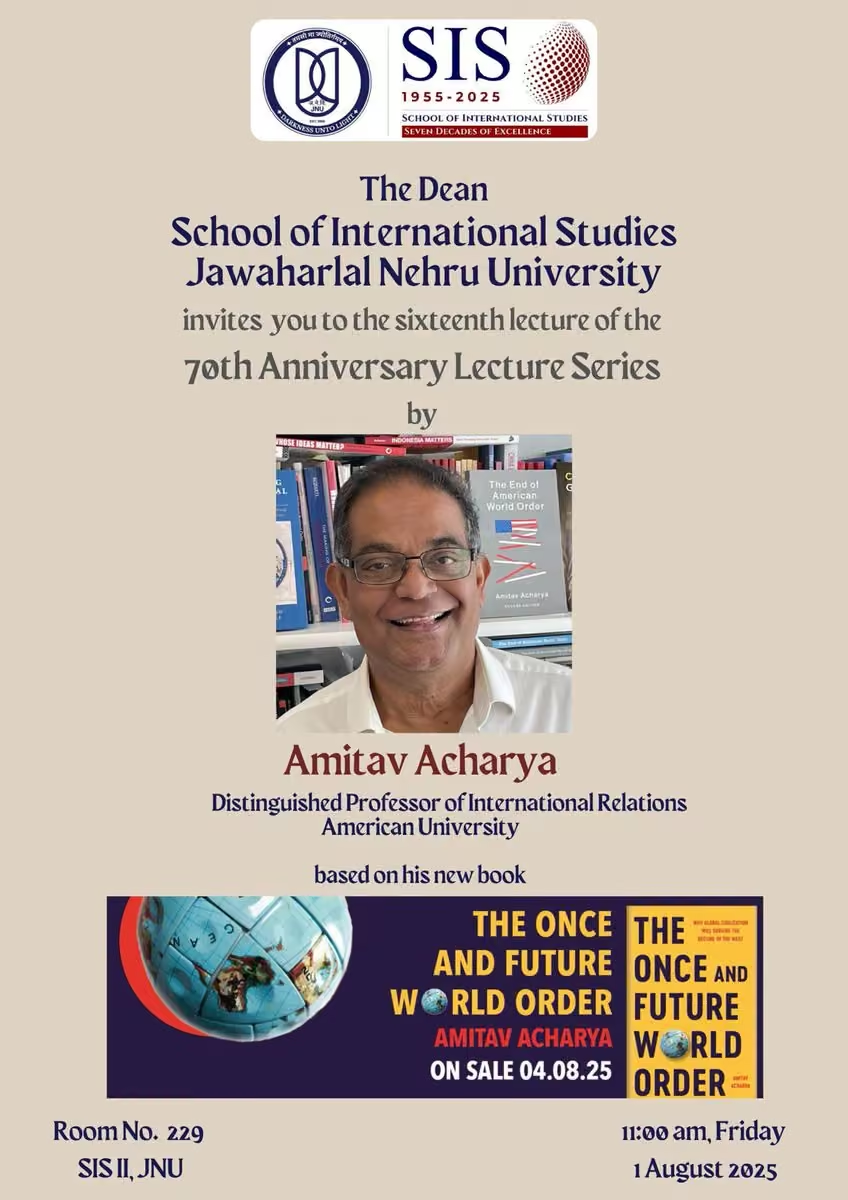 Amitav Acharya
@AmitavAcharya
Yesterday at the India International Centre in Delhi, a panel discussion on The Once and Future Workd Order. The book does not predict the future but outlines possibilities; it does not posit a peaceful world, but a more inclusive one.
With @SujanChinoy @Sachin_Chat & Prof
Rashmi Doraiswamy,
@nalanda_univ @RIS_NewDelhi
@IDSAIndia


Amitav Acharya reposted
 Manohar Parrikar IDSA, New Delhi
@IDSAIndia
DG @SujanChinoy chaired a Book Discussion on "The Once And Future World Order:Why Global Civilisation Will Survive The Decline Of The West" authored by Prof @AmitavAcharya @IIC_Delhi Remarks by Chair,Author & Discussants @Sachin_Chat @RashmiDee followed by insightful Q&A session


Amitav Acharya reposted
 Sachin Chaturvedi
@Sachin_Chat
Congratulations @AmitavAcharya for launch of your most comprehensive work on future of global order. Thanks @SujanChinoy for leading the discussions. Was a pleasure being part of it @RIS_NewDelhi @nalanda_univ @Prat_Shar
Manohar Parrikar IDSA, New Delhi
@IDSAIndia
DG @SujanChinoy chaired a Book Discussion on "The Once And Future World Order:Why Global Civilisation Will Survive The Decline Of The West" authored by Prof @AmitavAcharya @IIC_Delhi Remarks by Chair,Author & Discussants @Sachin_Chat @RashmiDee followed by insightful Q&A session
Amitav Acharya
@AmitavAcharya
I had the pleasure of meeting India's External Affairs Minister S. Jaishankar today in Delhi. We discussed India's response to Trump tariffs, India-China relations, Indo-Pacific, and Trump's reshaping of world order plus my book. Sharp insights from a powerful mind.
 Amitav Acharya
@AmitavAcharya
 Amitav Acharya
@AmitavAcharya
Review of The Once and Future World Order by Inderjeet Parmar:
"I do not believe that there is another book on this subject that comes anywhere close to the quality, historical depth and breadth of this one. With this book, professor Amitav Acharya cements his role as one of the most articulate, erudite, clear-eyed and influential intellectuals of the project to elevate the status and role of the Global South in world politics."
m.thewire.in/article/culture/a-searing-indictment-of-west…
Amitav Acharya reposted
Sachin Chaturvedi
@Sachin_Chat
Join us today at @IIC_Delhi for exploring contours of the new world order and civilisational resilience by @AmitavAcharya @amitabhmattoo @RIS_NewDelhi @nalanda_univ @AmritaNarlikar
 Amitav Acharya
@AmitavAcharya
Happening today at IIC in Delhi at 6pm.

Amitav Acharya reposted
 Amitabh Mattoo
@amitabhmattoo
📢 Schedule Update: The 16th lecture of the 70th Anniversary Series by Prof. @AmitavAcharya (@AmericanU) will now begin at 10:00 AM, Friday, 1 Aug 2025, SIS-II JNU (Room 229).
Kindly note the revised time. #sis70 @sisjnu_official
 Amitav Acharya
@AmitavAcharya
It is a pleasure (and unexpected surprise) to be invited to my alma mater with two days notice to discuss my book. Look forward to bring back in its beautiful campus to relieve great memories. And interacting with its scholars and students. Thanks to Dean @amitabhmattoo and @IndianIR
Sandip Kumar Singh संदीप कुमार सिंह
@IndianIR
Welcome Prof. @AmitavAcharya of American University to the School of International Studies, Jawaharlal Nehru University on 1st August 2025 at 11 AM to speak about his recent book titled "The Once and Future World Order". @amitabhmattoo @JNU_official_50 @sisjnu_official
Amitav Acharya reposted
Amitabh Mattoo
@amitabhmattoo
Amitabh Mattoo
@amitabhmattoo
Tomorrow
 Amitav Acharya
@AmitavAcharya
The Once and Future World Order featured in a powerful commentary by C. Raja Mohan. My book ends with a call for ending the West versus Rest divide; both concepts, it argues, are ahistorical and artificial constructs. I will present the book at a panel discussion on 1 August at the India International Centre in Delhi. Details attached. Book will be available for purchase at the event, and can be ordered from the Hachette India, (Rs 799)
www.hachetteindia.com/Home/bookdetails/Info/9781399811750…

 Amitav Acharya
@AmitavAcharya

 Amitav Acharya
@AmitavAcharya
The13th century @UNESCOHerit Sun Temple of Konark, in Odisha state, India, never ceases to amaze me every time I visit since I first saw it as a child. I have been to many Sun temples around the world, no other combines divine & human, passion & beauty to such perfection


Amitav Acharya reposted
Amitav Acharya
@AmitavAcharya
If you are in Delhi on 1st Aug 2025, come to my book discussion at the India International Centre at 6 pm. Books will be available for sale and signing.
 Amitav Acharya
@AmitavAcharya
Ride to family vegetable farm in Odisha, lovely jungle scenery, beware of wild elephants at night.


 Amitav Acharya
@AmitavAcharya
If you are in Delhi on 1st Aug 2025, come to my book discussion at the India International Centre at 6 pm. Books will be available for sale and signing.
Amitav Acharya
@AmitavAcharya
Is a post-American world necessarily a darker one? In my latest @nytimes piece, drawing on my new book, The Once snd Future World Order (Basic Books), I suggest otherwise. Drawing on historical examples, I explain why we can be cautiously optimistic.
“The very precepts of order are not Western inventions...Order has always been a shared endeavor… a global multiplex… would not be a paradise—but then nor has been this one.”
Opinion | Reasons to Be Optimistic About a Post-American Order - The New York Times
(The article link is in the first comment)
Amitav Acharya
@AmitavAcharya
Opinion | Reasons to Be Optimistic About a Post-American Order - The New York Times
www.nytimes.com/2025/04/08/opinion/west-american-order-fr…
Amitav Acharya
@AmitavAcharya
Review of The Once and Future World Order in @nytimesbooks
"an erudite overview of 5,000 years of world history to show how different cultures developed varying but comparable ideas of empire, great power politics and intellectual exchange that mediated relations across continents until the relatively recent and disruptive rise of the West to global dominance."
Amitav Acharya
@AmitavAcharya
Feast of beauty and colours in this mural in a shopping complex in Bhubaneswar, Odisha, one of the most amazing places for art and music and the birth place of the Odishi classical dance, recognized in UNESCO's intangible heritage of humanity list. @odisha_tourism @BBSRBuzz
 Amitav Acharya
@AmitavAcharya
Dared to devour the famous gup chup (as it is called in Odisha and eastern parts of India- similar to panipuri elsewhere but much spicier) from a roadside stall in Bhubaneswar. The last time I had this wonderful street snack on the street itself was 30 years ago when I was in college and had incredible digestive prowess. Waiting for consequences for this culinary adventure.
 Amitav Acharya
@AmitavAcharya
"From Southeast Asia to Indo-Pacific: Culture, Identity, and the Return to Geopolitics" by Amitav Acharya asianreviewofbooks.com/from-southeast-asia-to-indo-pacifi… via @BookReviewsAsia
Amitav Acharya reposted
Amitav Acharya
@AmitavAcharya
Now available and reviewed at www.financialexpress.com/life/lifestyle-books-on-the-shel…

 Amitav Acharya
@AmitavAcharya
Fair assessment of #brics. But much depends on what kind of a "a post-western order" it seeks. Managing China-India tensions & willingness of wealthy members to commit resources will be key. Window in Western disunity may not last @guardian www.theguardian.com/commentisfree/2025/jul/13/the-guardia…
Amitav Acharya
@AmitavAcharya
Lovely view of @ThaiAirways flight landing Suvarnabhumi
@bangkokairport
 Amitav Acharya
@AmitavAcharya
Now available and reviewed at www.financialexpress.com/life/lifestyle-books-on-the-shel…
Amitav Acharya
@AmitavAcharya
This is the "World Minus One" or "World Minus X" I talk about. www.e-ir.info/2025/03/13/goodbye-west-long-live-world-order/
 Richard Heydarian
@RichHeydarian
Philippines next!!!?
Amitav Acharya
@AmitavAcharya
View from bedroom and balcony this morning

 Amitav Acharya
@AmitavAcharya
 Amitav Acharya
@AmitavAcharya
In Bangkok catching up with old friends: here riding tuk-tuk with Suthiphand Chiratiwat, Economics Professor (retd.) at Chulalongkorn University.

Amitav Acharya reposted
 Dr Samir Puri
@purisamir1
“The world has changed. We don’t want an emperor. We are sovereign countries,” Lula told a news conference on Monday. BRICS host pushes back on Trump threat of further tariffs.
www.ft.com/content/20cd337b-4a33-4a5d-ac70-55cca3f102f9?s…
Amitav Acharya
@AmitavAcharya
The box office return of Jurassic World: Rebirth supports two trends I had highlighted in The Once and Future World Order: Hollywood's dependence on foreign markets and cultural interdependence (melange) among nations.
www.gamereactor.eu/jurassic-world-rebirth-becomes-the-big…
Amitav Acharya
@AmitavAcharya
"the new film [Jurassic World: Rebirth has taken the world by storm, raking in a staggering $318 million during its opening weekend. Of that total, $147 million came from the domestic market, while $171 million came from international audiences—with China alone contributing a hefty $41 million to ticket sales."
Amitav Acharya
@AmitavAcharya
In my 2000 book- The Quest for Identity: International Relations of Southeast Asia- I used concepts from history and anthropology - Mandala (Wolters), Galactic Polity Thambiah), and Theatre State (Geertz) - to conceptualize international system and order in Southeast Asia. Now this has taken off, leading to a vibrant research agenda of comparative states-systems to challenge Eurocentrism in IR. Latest effort to advance this research is:
BEFORE COLONIZATION
NON-WESTERN STATES AND SYSTEMS IN THE NINETEENTH CENTURY
CHARLES R. BUTCHER and RYAN D. GRIFFITHS
Amitav Acharya reposted
Amitav Acharya
@AmitavAcharya
As the concepts of Multiplex World Order & multiplexity gain growing attention, I get tons of questions about where the term came from & what it means. Here is the answer I gave few years back.
multiplexworld.com/2015/02/08/the-meaning-of-multiplex-an…
Amitav Acharya reposted
Amitav Acharya
@AmitavAcharya
Here is a short but insightful review in Global Asia of Divergent Worlds, my co-authored book with @manjeetsp and published by Yale. Appreciate that the reviewer @JohnDelury calls it "highly original" -which it is. It is theoretically grounded, combines area studies with international studies, compares Mediterranean with Indian Ocean, challenges hegemonic stability theory and provides an alternative template for world order. It is a historical example of Multiplex World Order.
If the contrast between the cases seems too sharp, it is due to the fact that we adopted a "contrast-oriented comparative case study method," but the evidence of difference and divergence is there.

Amitav Acharya reposted
Amitav Acharya
@AmitavAcharya
"In his presidential address at the Annual Convention of the International Studies Association, Acharya (2014a)introduced his project of GIR. This project seeks to move beyond exclusive binary divisions, such as the West and the non-West. Acharya also advocated for a truly global history, arguing that processes such as decolonization may be even more relevant to GIR than the world wars. Furthermore, he aimed to recover the intellectual traditions and perspectives of all regions on an equal footing.
This approach integrates the global South into the study of GIR. In traditional International Relations, the history and contemporary reality of the global South have been marginalized on the research agenda. We are not proposing a reconstruction of the history of Southern ideas and materials within Global Studies, but rather advocating for a co-constitutive dialogue recognizing that a history with global pretensions cannot be the narrative of a single country or region."
Amitav Acharya reposted
Amitav Acharya
@AmitavAcharya
While few scholars rehash that Global IR has a West and non-Western binary, thus risks being or 'essentialist", this is a gross misreading, as this essay shows. Scholars in the Global South get it right. This essay shows how. 1/2
www.scienceopen.com/search


Amitav Acharya reposted
 John Delury
@JohnDelury
it's a great contribution
Amitav Acharya
@AmitavAcharya
While few scholars rehash that Global IR has a West and non-Western binary, thus risks being or 'essentialist", this is a gross misreading, as this essay shows. Scholars in the Global South get it right. This essay shows how. 1/2
www.scienceopen.com/search
Amitav Acharya
@AmitavAcharya
"In his presidential address at the Annual Convention of the International Studies Association, Acharya (2014a)introduced his project of GIR. This project seeks to move beyond exclusive binary divisions, such as the West and the non-West. Acharya also advocated for a truly global history, arguing that processes such as decolonization may be even more relevant to GIR than the world wars. Furthermore, he aimed to recover the intellectual traditions and perspectives of all regions on an equal footing.
This approach integrates the global South into the study of GIR. In traditional International Relations, the history and contemporary reality of the global South have been marginalized on the research agenda. We are not proposing a reconstruction of the history of Southern ideas and materials within Global Studies, but rather advocating for a co-constitutive dialogue recognizing that a history with global pretensions cannot be the narrative of a single country or region."
Amitav Acharya
@AmitavAcharya
This video from @AmericanU recorded from my class and office.
 Amitav Acharya
@AmitavAcharya
Here is a short but insightful review in Global Asia of Divergent Worlds, my co-authored book with @manjeetsp and published by Yale. Appreciate that the reviewer @JohnDelury calls it "highly original" -which it is. It is theoretically grounded, combines area studies with international studies, compares Mediterranean with Indian Ocean, challenges hegemonic stability theory and provides an alternative template for world order. It is a historical example of Multiplex World Order.
If the contrast between the cases seems too sharp, it is due to the fact that we adopted a "contrast-oriented comparative case study method," but the evidence of difference and divergence is there.
Amitav Acharya reposted
 E-International Relations
@E_IR
Amitav Acharya challenges Eurocentrism in IR by tracing the roots of world order to diverse civilisations, urging a shift toward a truly global, inclusive, and multiplex perspective www.e-ir.org

Amitav Acharya reposted
 Parag Khanna
@paragkhanna
Once again I highly recommend @AmitavAcharya's brilliant and sweeping new book "The Once and Future World Order". It elegantly captures the deep history of regional and inter-regional strategic systems – and points the way towards a future built on regional orders and reciprocity.
 Amitav Acharya
@AmitavAcharya
Serene music at the Bang Nam Phueng floating market next to the Buddhist temple, Wat Bang Nam Phueng Nai - one of the most interesting three story designs with wonderful Buddhist statues and imagery, including Buddha's footprint.


 Amitav Acharya
@AmitavAcharya
As the concepts of Multiplex World Order & multiplexity gain growing attention, I get tons of questions about where the term came from & what it means. Here is the answer I gave few years back.
multiplexworld.com/2015/02/08/the-meaning-of-multiplex-an…
Amitav Acharya
@AmitavAcharya
I would add that it could be better phrased as a theatre with multiple screens, running different movies.
I would also add that one could also visualize multiplex as Netflix, by which I mean one does not have to go to a theatre but can watch a variety of shows from one's living room of while on the go from one's smartphone. The world has become even more multiplex since I first wrote about it as a metaphor for the coming world order.
Amitav Acharya
@AmitavAcharya
One could also visualize multiplex as Netflix, by which I mean one does not have to go to a theatre but can watch a variety of shows from one's living room OR while on the go from one's smartphone.
Amitav Acharya
@AmitavAcharya
I needed a break from the relentless travel and book talks last few months.

 Amitav Acharya
@AmitavAcharya
So do I; indeed, this is the main takeaway from the NATO summit (aside from "daddy" Trump, and other kinds of groveling by European leaders)- not the 5% defense commitment - which I doubt Europeans can sustain. Also doubtful Ukraine will see the kind of additional support it wants.
Paul Poast
@ProfPaulPoast
As a scholar of NATO...I actually agree with Trump.
Amitav Acharya reposted
Amitav Acharya
@AmitavAcharya
Will Iran "close" Strait of Hormuz? I would say unlikely. Was Trump's limited strike on Iran designed to discourage further Israeli strikes on Iran without completely destroying Iran's nuclear assets? This is a possibility.
Amitav Acharya reposted
Amitav Acharya
@AmitavAcharya
My book reviewed in Christian Science Monitor:
Amitav Acharya’s “The Once and Future World Order: Why Global Civilization Will Survive the Decline of the West” is an accessible and sober contribution to this often abstruse and partisan debate. His book serves as both a guide to global politics and a history for the interested nonexpert."
@csmonitor
www.csmonitor.com/Books/Book-Reviews/2025/0611/
Amitav Acharya reposted
Amitav Acharya
@AmitavAcharya
At an international conference in London I was asked if conflicts such as India-Pakistan, Israel-Iran and Israel-Gaza tell us that the decline of US-led or West-led order would cause global chaos.
My response:
The world is on fire. But what & who started these fires?
These fires are not results of the decline of the West- led or US-led order, but are results of that very order. Their origins lie in Western colonial powers' policies, & their continuation & escalation owe much to the policies adopted by the leaders of the so-called liberal international order. Indeed they prove a central thesis of my book (The Once and Future World Order & also summarized in my New York Times essay) that the old order was not benign to Global South & while the end of US-led order may not immediately resolve these conflicts (that have taken centuries of Western dominance to form), it may open doors to a less unjust world order.

Amitav Acharya reposted
Paul Poast
@ProfPaulPoast
IR Book of the Week!
"The Once and Future World Order" by @AmitavAcharya. While "Liberal International Order" & "Rules-based Order' are touted by the West, world order is not a uniquely western phenomenon. It will survive, even if "the west" does not
www.amazon.com/Once-Future-World-Order-Civilization/dp/15…
Amitav Acharya reposted
 Nathalie Tocci
@NathalieTocci
The pathetic flattery and genuflection viz Trump on display by European leaders, starting with NATO Secretary General Rutte, ahead and at the NATO summit makes me feel profoundly embarrassed as a European. Plus, it doesn’t even work…
Amitav Acharya reposted
 ANUBellSchool
@ANUBellSchool
GRADNAS Seminar Series finale this Fri 27 June!
Don't miss Prof @AmitavAcharya discuss his latest book, The Once & Future World Order, and why global civilisation will outlast Western decline.
🎟️quicklink.anu.edu.au/ra5f
@manjeetsp @TommyChaiSH @ANUasiapacific
Amitav Acharya
@AmitavAcharya
View from my window: some spectacular vistas after take off from Heathrow and fly along Thames
Amitav Acharya reposted
Amitav Acharya
@AmitavAcharya
Trump Is Creating a Post-Western World by Amitav Acharya - Project Syndicate www.project-syndicate.org/magazine/trump-foreign-policy-d…
Amitav Acharya
@AmitavAcharya
At an international conference in London I was asked if conflicts such as India-Pakistan, Israel-Iran and Israel-Gaza tell us that the decline of US-led or West-led order would cause global chaos.
My response:
The world is on fire. But what & who started these fires?
These fires are not results of the decline of the West- led or US-led order, but are results of that very order. Their origins lie in Western colonial powers' policies, & their continuation & escalation owe much to the policies adopted by the leaders of the so-called liberal international order. Indeed they prove a central thesis of my book (The Once and Future World Order & also summarized in my New York Times essay) that the old order was not benign to Global South & while the end of US-led order may not immediately resolve these conflicts (that have taken centuries of Western dominance to form), it may open doors to a less unjust world order.
Amitav Acharya reposted
Amitav Acharya
@AmitavAcharya
Has the global peace movement disappeared? Where are the peace makers, peace marchers, peace movements, peace activists? Or the mainstream media algorithms cancelled them? There are so many dialogues and conferences in the world -Davos, Shangri-La, London, Munich, Paris, etc. - hosted by all sorts of think-tanks and forums but all one hears is security balance, old & new powers. Old-fashioned Peace is Missing in Action.
#peace
#iranisraelconflict
#onceandfutureworldorder
#usstrikesiran
Amitav Acharya
@AmitavAcharya
My book reviewed in Christian Science Monitor:
Amitav Acharya’s “The Once and Future World Order: Why Global Civilization Will Survive the Decline of the West” is an accessible and sober contribution to this often abstruse and partisan debate. His book serves as both a guide to global politics and a history for the interested nonexpert."
@csmonitor
www.csmonitor.com/Books/Book-Reviews/2025/0611/
Amitav Acharya
@AmitavAcharya
Has the global peace movement disappeared? Where are the peace makers, peace marchers, peace movements, peace activists? Or the mainstream media algorithms cancelled them? There are so many dialogues and conferences in the world -Davos, Shangri-La, London, Munich, Paris, etc. - hosted by all sorts of think-tanks and forums but all one hears is security balance, old & new powers. Old-fashioned Peace is Missing in Action.
#peace
#iranisraelconflict
#onceandfutureworldorder
#usstrikesiran
Amitav Acharya
@AmitavAcharya
Trump Is Creating a Post-Western World by Amitav Acharya - Project Syndicate www.project-syndicate.org/magazine/trump-foreign-policy-d…
Amitav Acharya
@AmitavAcharya
Will Iran "close" Strait of Hormuz? I would say unlikely. Was Trump's limited strike on Iran designed to discourage further Israeli strikes on Iran without completely destroying Iran's nuclear assets? This is a possibility.
Amitav Acharya reposted
Amitav Acharya
@AmitavAcharya
Trump Is Creating a Post-Western World by Amitav Acharya - Project Syndicate
www1.project-syndicate.org/magazine/trump-foreign-policy-…
Amitav Acharya
@AmitavAcharya
Leaving Britain after 9 most intense days of a book promotion trip during which I did 6 book talks and one Roundtable covering @RUSI_org, @CityStGeorges @lseideas @SOAS @ChathamHouse and University of York (2 book talks plus a workshop there). Here is a pic with Chris Alden, director of
@lseideas and a group of students who forked out 25 GBP for the book, after the talk, seemingly happily. And pleased to see the book on the shelves of Waterstones and Hatchards.


 Amitav Acharya
@AmitavAcharya
There we go again. Regime change. Trump at war, back to the future.
"Those that fail to learn from history are doomed to repeat it" (Churchill, also similarly Santayana). www.cnn.com/world/live-news/israel-iran-conflict-06-18-25…
Amitav Acharya
@AmitavAcharya
Happening this afternoon at 4. Book talk @LSEideas
 LSE IDEAS
@lseideas
📢Join us for our free event, to discuss the contours of an emerging world order over the long durée as argued by Amitav Acharya and what this means for the ‘West and the Rest’.
📅Tue 17 June 2025 | 4.00-5.30pm
⬇️REGISTER HERE
www.lse.ac.uk/ideas/events/2025/06/The-Once-and-Future-Wo…
 Amitav Acharya
@AmitavAcharya
It was a pleasure to see my book on sale at Waterstones and Hatchards in Piccadilly this morning. And I got to do an impromptu book signing for the benefit of Hatchards.


 Amitav Acharya
@AmitavAcharya
Trump Is Creating a Post-Western World by Amitav Acharya - Project Syndicate
www1.project-syndicate.org/magazine/trump-foreign-policy-…
Amitav Acharya reposted
Amitav Acharya
@AmitavAcharya
"International relations scholars have long noted the absence of non-Western theories in "mainstream" IR scholarship (Puchala 1997, 1998; Tickner and Blaney 2012; Acharya and Buzan 2017, 2019) and the disproportionate influence of European history in informing concepts and theories thought to be universally useful (Chakrabarty 2008; Tickner and Waver 2009; Hobson
2012). In an effort to move beyond starkly dichotomizing debates, Amitav Acharya's 2014 presidential address to the International Studies Association (ISA) called for a "global IR" research agenda-that is, a positive and inclusive research agenda that embraces a multiplicity of "voices, experiences, knowledge claims and contributions" not only from the West, but from states as well as societies throughout the world (Acharya 2014, 647). Since then, global IR has made important progress, particularly in surfacing and highlighting cases where understandings and lived experiences of international relations do not match the assumptions reflected in mainstream IR. But it has done less to move beyond what Cynthia Enloe (2021) refers to as the
"confusing, complex, dynamic, gritty, nuanced realities of the little picture" in ways that produce insights applying to more than one locale or region.
In this regard, CAS may serve as a powerful ally in taking the next step to go beyond merely saying the world is diverse and complex. With its commitment to posing substantive questions that involve an open-ended search to identify and explain similarities and differences across regions, CAS offers an opportunity to generate novel insights that are at least partially portable across regions or within a given population of cases. ...
The Promise of Comparative Area Studies for the Study of Human Rights
Eileen Doherty-Sil
in Advancing Comparative Area Studies:
Analytical Heterogeneity and….. edited by Ariel I. Ahram, Patrick Köllner, Rudra Sil
Amitav Acharya
@AmitavAcharya
A fantastic book talk at @RUSI_org - world's oldest defense think-tank in London, in their magnificent library. In a board room with royal portraits, I took the liberty of holding up my book to Queen Victoria's - who would have totally disapproved it @JEyal_RUSI


Amitav Acharya reposted
Inderjeet Parmar
@USEmpire
All welcome @IndrajitRoyYork @AmitavAcharya @lseideas @Bamonouri @Gargi_at_home @agent_of_change @CharlesLees2 @GeopoliticsDH @security_reform @PSA_APG @karmanomad @StuartJHooper @ProfSunnySingh @kparpiani @svaradarajan @LSE_Globalsouth @GlobalSouthF
Inderjeet Parmar
@USEmpire
All welcome! Online link available; in person attendance too if you can make it! @NewsfromCity @Cityintpolitics @USFPgroup @MYBISA @MultipolarOrder @AtulBeret @waqaswaheed @RoadsInitiative @informeopeu

Amitav Acharya reposted
 Abhishek Kaicker
@zurtalab
A review of two new books
Worried the World Is Falling Apart? That’s OK. It’s Happened Before. www.nytimes.com/2025/06/06/books/review/the-once-and-futu…
Amitav Acharya reposted
LSE IDEAS
@lseideas
📢Join us for our free event, to discuss the contours of an emerging world order over the long durée as argued by Amitav Acharya and what this means for the ‘West and the Rest’.
📅Tue 17 June 2025 | 4.00-5.30pm
⬇️REGISTER HERE
www.lse.ac.uk/ideas/events/2025/06/The-Once-and-Future-Wo…
Amitav Acharya
@AmitavAcharya
Yes it can. Having studied in JNU and been a fellow at Harvard and Oxford, I can say that some Indian institutions compare very well in terms of calibre of faculty and students despite not having big endowments and comparable resources like research libraries and funding. I can only speak of social sciences and humanities but it could apply to other fields. The collective brainpower is immense but needs more funding and less politicization and official interference of the kind Harvard is fighting against. Same goes for other nations of South Asia such as Pakistan and Bangladesh- societies with world class minds. And intellectual partnership among these nations will produce amazing results (if -a big if here- they can stop fighting each other), like the partnership between Mahbub ul Haq and Amartya Sen in development economics or between Jogesh Pati and Abdus Salam in physics.
On the Haq-Sen collaboration on human development index and human security, see my essay:
www.researchgate.net/publication/301597464_'Idea-shift'_h…
 Husain Haqqani
@husainhaqqani
'Can India create its own Ivy League?' asks @TheEconomist, noting that the country is home to half the world’s university-age population.
www.economist.com/asia/2025/06/05/can-india-create-its-ow…
Amitav Acharya
@AmitavAcharya
Shi Yinhong, an international relations professor at Renmin University, as paraphrased here in SCMP article:
It remained doubtful that Trump’s “isolationism” would provide more room for China to increase its influence in the developing world, he added, noting that issues such as the South China Sea, Iran and Russia’s war in Ukraine would continue to strain China’s relations with Europe and the Global South.
Amitav Acharya
@AmitavAcharya
"Apart from some limited and somewhat empty diplomatic gains, China’s financial resources will be further squeezed, especially with that consumptive overseas involvement, if the Belt and Road Initiative has not been implemented effectively.”
Amitav Acharya reposted
Amitav Acharya
@AmitavAcharya
Excited to see this review article featuring my book in New York Times. @nytimes
Book Review: ‘The One and Future World Order,’ by Amitav Acharya; ‘The Golden Road,’ by William Dalrymple - The New York Times
www.nytimes.com/2025/06/06/books/review/the-once-and-futu…
Amitav Acharya
@AmitavAcharya
Excited to see this review article featuring my book in New York Times. @nytimes
Book Review: ‘The One and Future World Order,’ by Amitav Acharya; ‘The Golden Road,’ by William Dalrymple - The New York Times
www.nytimes.com/2025/06/06/books/review/the-once-and-futu…
Amitav Acharya reposted
ANUBellSchool
@ANUBellSchool
New book by Prof @AmitavAcharya 'The Once and Future World Order' reimagines global order beyond Western decline.
Join @gradnas1 for a provocative discussion, chaired by @manjeetsp.
🗓️ 27 June, 11am AEST
🎟️ events.humanitix.com/the-once-and-future-world-order-why-…
Amitav Acharya
@AmitavAcharya
If you are in London: this event kicks off my book tour of UK
The Global Disorder Group are delighted to be hosting Professor Amitav Acharya, who will be presenting his new book The Once and Future World Order: Why Global Civilization will Survive the Decline of the West.
Wednesday, 11th June 2025, 15:00 – 17:00 (BST)
D427 (Rhind Building)
Academics; Public; Staff; Students
www.citystgeorges.ac.uk/news-and-events/events/2025/june/…
 Amitav Acharya
@AmitavAcharya
This podcast on my book is not bad at all as a clear, balanced, concise summary of the book's key points and arguments. But there is one major giveaway in the narrative itself that tells you it's AI-powered. Can you identify it?
m.youtube.com/watch?v=-O4k41xdBm0
 Amitav Acharya
@AmitavAcharya
Support for foreign students remains strong in US.
From: @mayasen.bsky.social
danieldrezner@substack.com
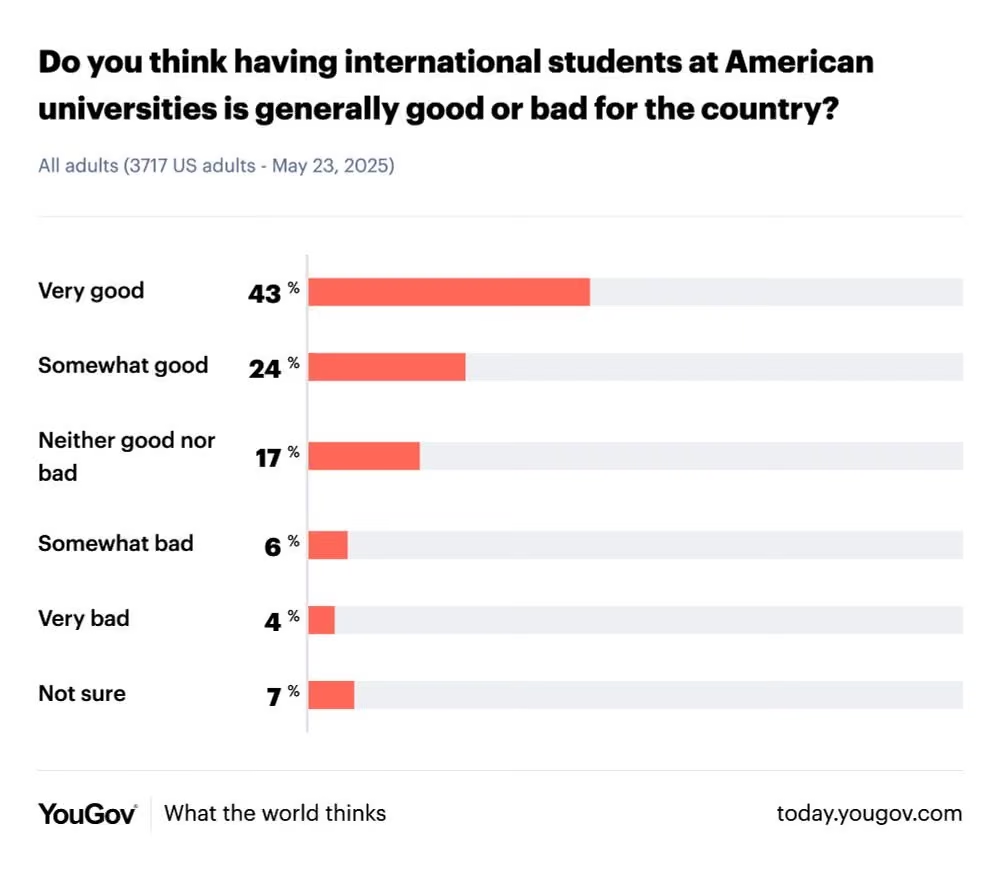 Amitav Acharya
@AmitavAcharya
"The End of the Long American Century; Trump and the Sources of U.S. Power," by Robert O. Keohane and Joseph S. Nye, Jr. @ForeignAffairs
The title of this article brings memories. In 2014, I published The End of American World Order. My book explained why "the post-war liberal world order underpinned by US military, economic and ideological primacy and supported by global institutions serving its power and purpose, is coming to an end."
Nye reviewed my book, mostly positively, in International Affairs.
In 2015, Nye published "Is the American Century Over", also by Polity.
His book "explain[ed] why the American century is far from over."
When Trump was first elected, he read and encouraged me to publish a paper of mine that subsequently came out as "After Liberal Hegemony" @EIAJournal (after being rejected by a more established journal because - so I was told - Trump's approach to world would not & could not last)
I leave it there.
We met first at Harvard in 2001. He was a most gracious supportive Dean when I spent a year as a fellow of the Kennedy School, the link between us made by Ezra Vogel who I worked and taught with at Harvard.
Nye gave several guest lectures to my Schwarzman College class in Beijing in 2016-17. We met there several times in our subsequent visits there.
He asked me to comment on the draft of his book "Do Morals Matter?".
I deeply admire his intellect, vision, kindness and ability to respect & encourage different viewpoints, such as mine. I wish there are more like him.
@dankurtzphelan
Amitav Acharya reposted
Amitav Acharya
@AmitavAcharya
Return of the Rest, By AMITAV ACHARYA | China Daily Global www.chinadaily.com.cn/a/202505/30/WS6838f946a310a04af22c2…
30 May 2025
Excerpt:
In a new book, The Once and Future World Order, I tell a connected global story of the past, present and potential future of world order. The book argues that the current world order rests on multiple points of origin in both Western and non-Western civilizations. As Western dominance declines, the future of the world order will be multi-civilizational. No world order is permanent, so is the world order dominated by the West for the past few hundred years. Its passing should be the beginning of a new one, not necessarily one of collapse and chaos.
********
While influential Western scholars such as John Mearsheimer argue that great power relations are "tragic", ending in competition and war, there are also plenty of examples of durable great power cooperation. This is not just the Concert of Europe — a favorite example of Western academia — that emerged from the Congress of Vienna (1814-15) after the defeat of Napoleon.
Great power diplomacy and cooperation goes back to 3,000 years before the European Concert emerged, around the middle of the second millennium BC, when Egypt and other powers of the region — Hatti, Mitanni, Assyria and Babylon — managed regional order, forming the Amarna system. The European Concert lasted about a century, while the Amarna system — based on the norms of reciprocity and equality among the major powers — kept peace in the region for nearly two centuries.
********
Pundits use the term "rise of the Rest" to describe the role of the Global South today, but in many cases, this is more accurately described as the "return of the Rest". Many of the countries rising today represent civilizations that played a key role in shaping world order through the past millennia. A world order that sees the return of the Rest, where non-Western nations find more voice and role, will create a more equitable and mutually respectful global arrangement, one that will temper the worst excesses of Western dominance while satisfying the needs of non-Western nations for status and recognition.
No world order can be free from conflict. But as I argue in my recent essay in New York Times, there are reasons to be optimistic about a post-US order, which I call a Global Multiplex. To be sure, the world order is now going through a period of uncertainty and conflict. But it may also turn out to be more just and inclusive in the longer term. All civilizations have attraction and ugliness. But conventional history has disproportionately projected the West as the dynamic and progressive creator and the Rest as the passive and regressive follower. Yet, history tells us that non-Western civilizations have offered positive ideas of progress and cooperation in the making of the contemporary world order. Recognizing the facts of their contributions is important for leaving behind the "clash of civilizations" thesis, and its by-product, the West-versus-Rest idea.
Amitav Acharya reposted
Amitav Acharya
@AmitavAcharya
CHINA TIMES of Taiwan reports on my book lecture at Academia Sinica.
On the 23 May, Acharya, a professor at American University, did a presentation of his new book "The once and future world order". He bluntly said that the free [liberal] world order led by the United States is collapsing today.
In reality, the current world order led by the United States had begun to decline as early as the 1970s and 1980s, and U.S. President Trump only accelerated the process.
But what we see today is the collapse of an international order that relies on a single power hegemony, but not the end of the world order.
The roots of current crisis in world order grew out of a belief that the world needed a single leading force to ensure global stability and economic openness, so a collective myth [note: my original wording was "groupthink"] was formed.
The relative economic openness, free trade and collective security sought by the United States after the WWII made this collective myth more deeply rooted, with views emerging that East Asia could not achieve security, stability and prosperity without the military presence of the United States.
But the current world order led by the United States began to decline as early as the 1970s and 1980s. At that time, the United States changed from the world's largest exporter to the largest importer, making countries more and more dependent on exports to the United States, and thus creating a serious vulnerability to changes in US leadership and policy.
Even if the current international order collapses, it can be faced optimistically, because world order is not monopolized by any single civilization or country, but is created collectively. Looking back on the history of mankind for more than 5,000 years, many concepts about international rules and order have existed since ancient times, and have also developed from many different civilizations. Western hegemony is not an important factor for international cooperation, peace and prosperity.
Even if the United States is no longer dominant, these historical foundations of world order still exist, and many countries in the world's south want to participate in it and devote themselves to a more fairer and less dual-standard [double-standard] world situation. He predicts that the future world will not be unipolar, bipolar or multipolar, but multiplex.
(I have summarized and slightly edited a rough Google Translation)
@_chinatimes
www.chinatimes.com/newspapers/20250524000633-260303
04:102025/05/24
Wangbao Cai Zongying
Amitav Acharya
@AmitavAcharya
Return of the Rest, By AMITAV ACHARYA | China Daily Global www.chinadaily.com.cn/a/202505/30/WS6838f946a310a04af22c2…
30 May 2025
Excerpt:
In a new book, The Once and Future World Order, I tell a connected global story of the past, present and potential future of world order. The book argues that the current world order rests on multiple points of origin in both Western and non-Western civilizations. As Western dominance declines, the future of the world order will be multi-civilizational. No world order is permanent, so is the world order dominated by the West for the past few hundred years. Its passing should be the beginning of a new one, not necessarily one of collapse and chaos.
********
While influential Western scholars such as John Mearsheimer argue that great power relations are "tragic", ending in competition and war, there are also plenty of examples of durable great power cooperation. This is not just the Concert of Europe — a favorite example of Western academia — that emerged from the Congress of Vienna (1814-15) after the defeat of Napoleon.
Great power diplomacy and cooperation goes back to 3,000 years before the European Concert emerged, around the middle of the second millennium BC, when Egypt and other powers of the region — Hatti, Mitanni, Assyria and Babylon — managed regional order, forming the Amarna system. The European Concert lasted about a century, while the Amarna system — based on the norms of reciprocity and equality among the major powers — kept peace in the region for nearly two centuries.
********
Pundits use the term "rise of the Rest" to describe the role of the Global South today, but in many cases, this is more accurately described as the "return of the Rest". Many of the countries rising today represent civilizations that played a key role in shaping world order through the past millennia. A world order that sees the return of the Rest, where non-Western nations find more voice and role, will create a more equitable and mutually respectful global arrangement, one that will temper the worst excesses of Western dominance while satisfying the needs of non-Western nations for status and recognition.
No world order can be free from conflict. But as I argue in my recent essay in New York Times, there are reasons to be optimistic about a post-US order, which I call a Global Multiplex. To be sure, the world order is now going through a period of uncertainty and conflict. But it may also turn out to be more just and inclusive in the longer term. All civilizations have attraction and ugliness. But conventional history has disproportionately projected the West as the dynamic and progressive creator and the Rest as the passive and regressive follower. Yet, history tells us that non-Western civilizations have offered positive ideas of progress and cooperation in the making of the contemporary world order. Recognizing the facts of their contributions is important for leaving behind the "clash of civilizations" thesis, and its by-product, the West-versus-Rest idea.
Amitav Acharya
@AmitavAcharya
Not to mention how the Asian or Pacific pact idea goes against the long-standing aversion to collective defense pacts and norms by Asian nations. I discussed this in detail in Whose Ideas Matter (Cornell U Press 2009). Why should they trust the idea more now when the US is ready to ditch NATO itself. Even as a provocation, it is not a good one.
 Michael D. Swaine
@Dalzell60
FA continues its nearly unbroken record of publishing zero-sum, polarizing analysis of the China challenge. Ely calls for a collective security pact against China with Canberra, Tokyo, and Manila. The hurdles are enormous, especially in Japan, by far…1/ www.foreignaffairs.com/china/case-pacific-defense-pact-el…
Amitav Acharya
@AmitavAcharya
In an effort to move beyond starkly dichotomizing debates, Amitav Acharya's 2014 presidential address to the International Studies Association (ISA) called for a "global IR" research agenda-that is, a positive and inclusive research agenda that embraces a multiplicity of "voices, experiences, knowledge claims and contributions" not only from the West, but from states as well as societies throughout the world (Acharya 2014, 647). Since then, global IR has made important progress, particularly in surfacing and highlighting cases where understandings and lived experiences of international relations do not match the assumptions reflected in mainstream IR. But it has done less to move beyond what Cynthia Enloe (2021) refers to as the
"confusing, complex, dynamic, gritty, nuanced realities of the little picture" in ways that produce insights applying to more than one locale or region. In this regard, CAS may serve as a powerful ally in taking the next step to go beyond merely saying the world is diverse and complex. With its commitment to posing substantive questions that involve an open-ended search to identify and explain similarities and differences across regions, CAS offers an opportunity to generate novel insights that are at least partially portable across regions or within a given population of cases. ...
The Promise of Comparative Area Studies for the Study of Human Rights
Eileen Doherty-Sil, in Advancing Comparative Area Studies:
Analytical Heterogeneity and….. edited by Ariel I. Ahram, Patrick Köllner, Rudra Sil (Oxford 2025)
Amitav Acharya
@AmitavAcharya
But my other work on comparative area studies and transnational area studies has also contributed to expanding global IR in the direction of capturing the "complexities of the little picture". See for example:
www.researchgate.net/publication/265341157_Remaking_South…
Amitav Acharya
@AmitavAcharya
"International relations scholars have long noted the absence of non-Western theories in "mainstream" IR scholarship (Puchala 1997, 1998; Tickner and Blaney 2012; Acharya and Buzan 2017, 2019) and the disproportionate influence of European history in informing concepts and theories thought to be universally useful (Chakrabarty 2008; Tickner and Waver 2009; Hobson
2012). In an effort to move beyond starkly dichotomizing debates, Amitav Acharya's 2014 presidential address to the International Studies Association (ISA) called for a "global IR" research agenda-that is, a positive and inclusive research agenda that embraces a multiplicity of "voices, experiences, knowledge claims and contributions" not only from the West, but from states as well as societies throughout the world (Acharya 2014, 647). Since then, global IR has made important progress, particularly in surfacing and highlighting cases where understandings and lived experiences of international relations do not match the assumptions reflected in mainstream IR. But it has done less to move beyond what Cynthia Enloe (2021) refers to as the
"confusing, complex, dynamic, gritty, nuanced realities of the little picture" in ways that produce insights applying to more than one locale or region.
In this regard, CAS may serve as a powerful ally in taking the next step to go beyond merely saying the world is diverse and complex. With its commitment to posing substantive questions that involve an open-ended search to identify and explain similarities and differences across regions, CAS offers an opportunity to generate novel insights that are at least partially portable across regions or within a given population of cases. ...
The Promise of Comparative Area Studies for the Study of Human Rights
Eileen Doherty-Sil
in Advancing Comparative Area Studies:
Analytical Heterogeneity and….. edited by Ariel I. Ahram, Patrick Köllner, Rudra Sil
Amitav Acharya
@AmitavAcharya
WATCH: Trump rejects idea he’s ‘chickening out’ on tariffs | PBS News www.pbs.org/newshour/politics/watch-trump-rejects-idea-he…
Amitav Acharya reposted
Amitav Acharya
@AmitavAcharya
Once and Future World Order featured in Literary Hub. @lithub
lithub.com/buffy-viet-thanh-nguyen-andrea-long-chu-23-new…
 Amitav Acharya
@AmitavAcharya
Once and Future World Order featured in Literary Hub. @lithub
lithub.com/buffy-viet-thanh-nguyen-andrea-long-chu-23-new…
Amitav Acharya reposted
Inderjeet Parmar
@USEmpire
All welcome! @IndrajitRoyYork @AmitavAcharya @Cityintpolitics @USFPgroup @DrJennaMarshall @lseideas @aaronmckiel @karmanomad @waqaswaheed @thewire_in @svaradarajan @Hedverse @AtulBeret @MultipolarOrder
Inderjeet Parmar
@USEmpire
Global Disorder Book Launch- delighted to host Prof Amitav Acharya, new book The Once and Future World Order: Why Global Civilization will Survive the Decline of the West. Registration free! @Bamonouri
@informeopeu @MYBISA www.citystgeorges.ac.uk/news-and-events/events/2025/june/….
Amitav Acharya
@AmitavAcharya
CHINA TIMES of Taiwan reports on my book lecture at Academia Sinica.
On the 23 May, Acharya, a professor at American University, did a presentation of his new book "The once and future world order". He bluntly said that the free [liberal] world order led by the United States is collapsing today.
In reality, the current world order led by the United States had begun to decline as early as the 1970s and 1980s, and U.S. President Trump only accelerated the process.
But what we see today is the collapse of an international order that relies on a single power hegemony, but not the end of the world order.
The roots of current crisis in world order grew out of a belief that the world needed a single leading force to ensure global stability and economic openness, so a collective myth [note: my original wording was "groupthink"] was formed.
The relative economic openness, free trade and collective security sought by the United States after the WWII made this collective myth more deeply rooted, with views emerging that East Asia could not achieve security, stability and prosperity without the military presence of the United States.
But the current world order led by the United States began to decline as early as the 1970s and 1980s. At that time, the United States changed from the world's largest exporter to the largest importer, making countries more and more dependent on exports to the United States, and thus creating a serious vulnerability to changes in US leadership and policy.
Even if the current international order collapses, it can be faced optimistically, because world order is not monopolized by any single civilization or country, but is created collectively. Looking back on the history of mankind for more than 5,000 years, many concepts about international rules and order have existed since ancient times, and have also developed from many different civilizations. Western hegemony is not an important factor for international cooperation, peace and prosperity.
Even if the United States is no longer dominant, these historical foundations of world order still exist, and many countries in the world's south want to participate in it and devote themselves to a more fairer and less dual-standard [double-standard] world situation. He predicts that the future world will not be unipolar, bipolar or multipolar, but multiplex.
(I have summarized and slightly edited a rough Google Translation)
@_chinatimes
www.chinatimes.com/newspapers/20250524000633-260303
04:102025/05/24
Wangbao Cai Zongying
Amitav Acharya reposted
Amitav Acharya
@AmitavAcharya
10 best books of April 2025 make a bouquet of great reads - csmonitor.com www.csmonitor.com/Books/Book-Reviews/2025/0411/10-best-bo…
Amitav Acharya
@AmitavAcharya
Full house at the Academia Sinica in Taipei which launched ONCE AND FUTURE WORLD ORDER on Friday.


 Amitav Acharya
@AmitavAcharya
Pleased to see this out, advancing localization theory in IR.
Localization in World Politics, introduction to special issue of Global Studies Quarterly, edited by
Kochanski, Adam; Scott, Emily; Welsh, Jennifer
I was able to participate in the workshop and provide comments. But could not contribute a paper (due to my ongoing Once and Future World Order book project)
pure-oai.bham.ac.uk/ws/portalfiles/portal/265338638/Kocha…
Amitav Acharya
@AmitavAcharya
"THE ONCE AND FUTURE WORLD ORDER” BOOK TALK HIGHLIGHTS A FUTURE WITH MULTIPOLAR GLOBAL ORDER" with @mahbubani_k @LKYSch
@CAG_LKYSPP
indiplomacy.com/2025/05/05/the-once-and-future-world-orde…
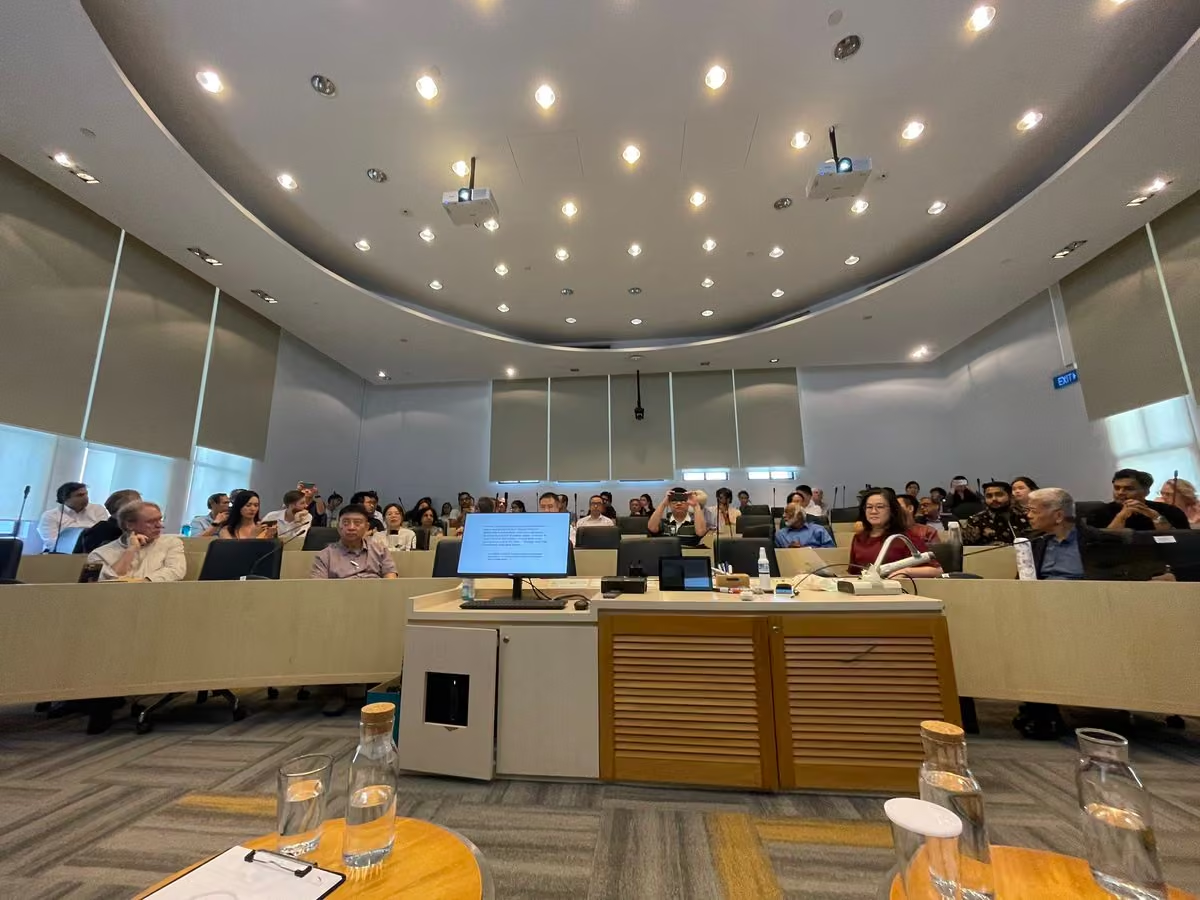
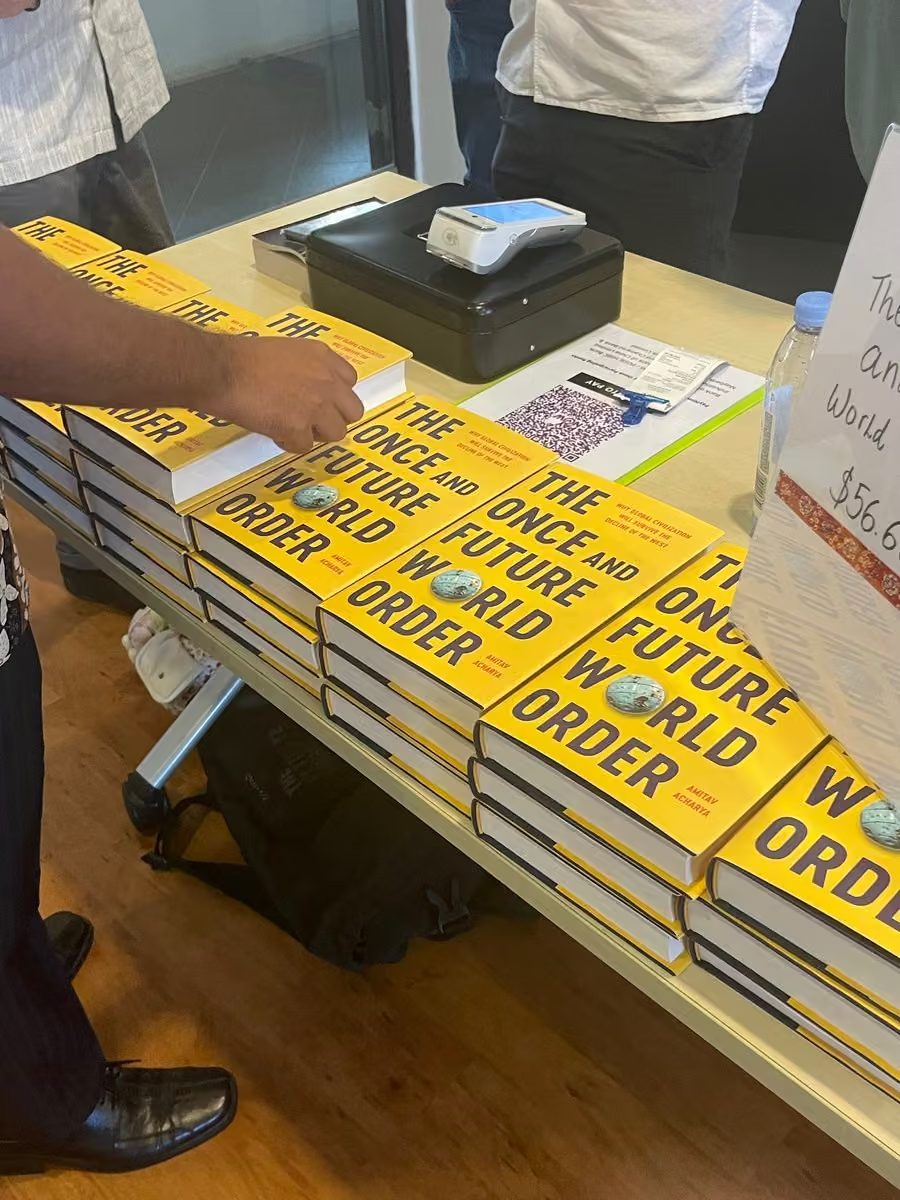
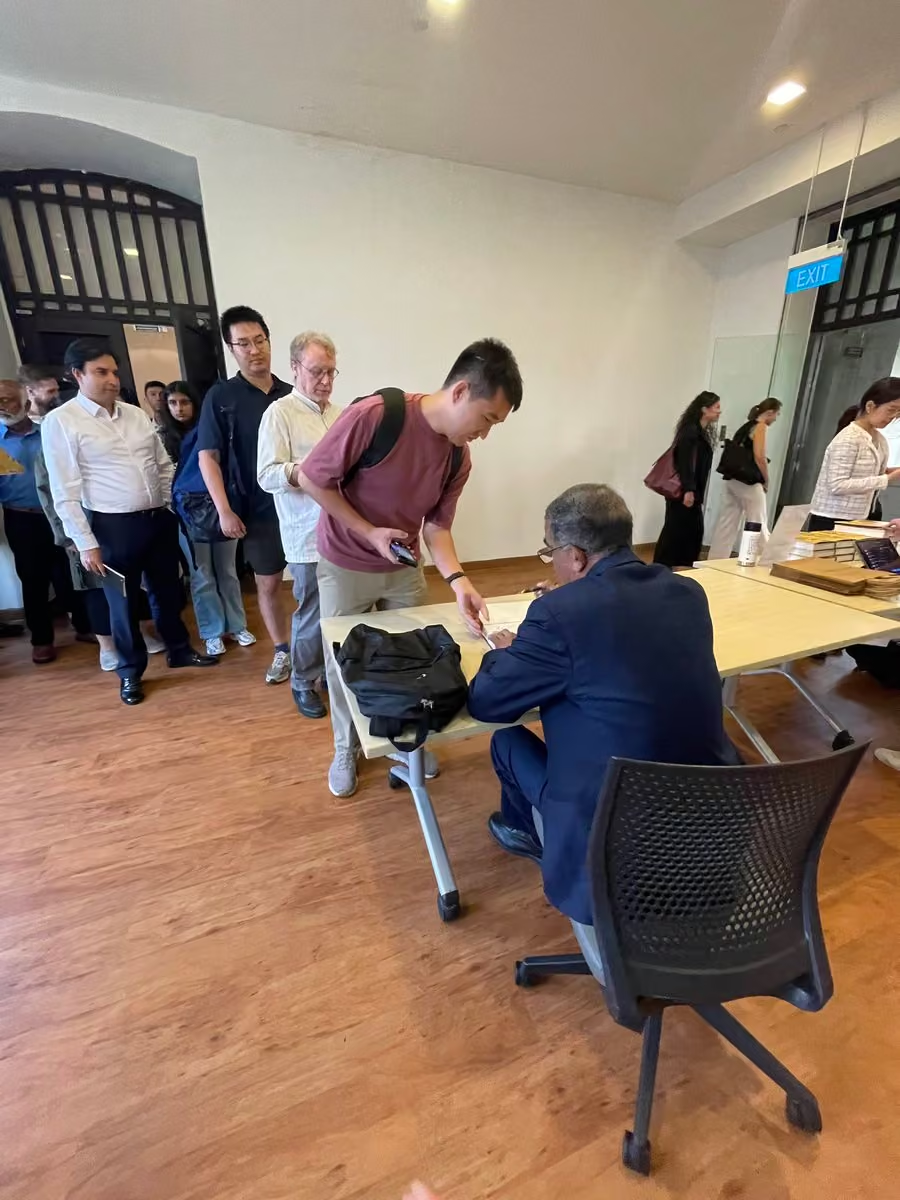
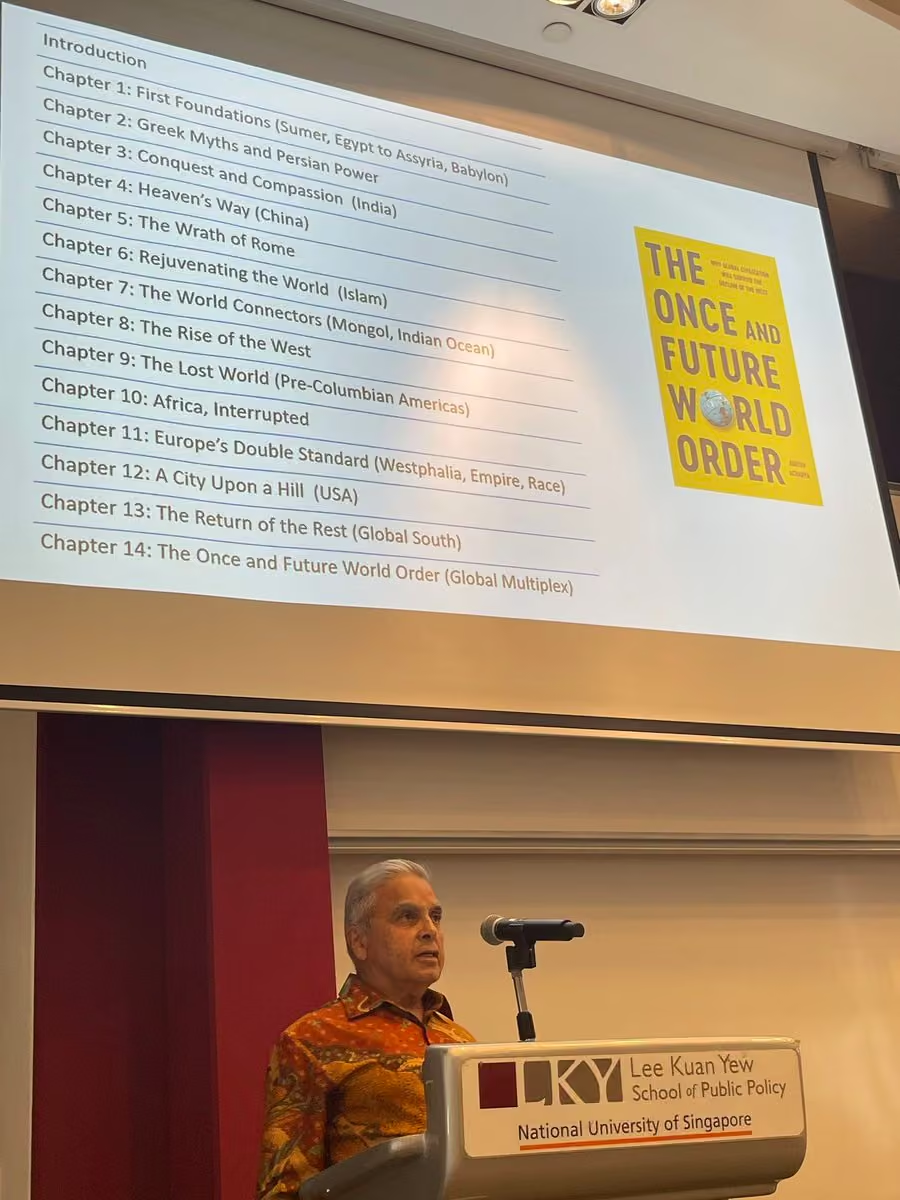
Amitav Acharya reposted
Abdul Kadir Jailani
@akjailani
Thank you for sharing this. Your book, The End of the American Order, has been a profound inspiration for this piece of writing
Amitav Acharya
@AmitavAcharya
Indonesia’s entry into BRICS: Reshaping the global legal order - Academia - The Jakarta Post www.thejakartapost.com/opinion/2025/01/09/indonesias-entr…
Amitav Acharya
@AmitavAcharya
Indonesia’s entry into BRICS: Reshaping the global legal order - Academia - The Jakarta Post www.thejakartapost.com/opinion/2025/01/09/indonesias-entr…
Amitav Acharya
@AmitavAcharya
Great to have @paragkhanna recommending my book with such glowing terms www.linkedin.com/posts/drparagkhanna_once-again-i-highly-…
Amitav Acharya
@AmitavAcharya
Pleased to see by book on sale at Johannesburg airport, as I was leaving South Africa after book lectures in Pretoria and Johannesburg where, among other ideas, I invoked Rig Veda to Aristotle to Ibn Rushd to explain the origins of the Universe/world order ("doctrine of eternity of the world")


 Amitav Acharya
@AmitavAcharya
With some of the audience after the launch of the Once and Future World Order in Pretoria on 13 May. Lively affair with the Vice Chancellor Francis Peterson offering opening remarks.


 Amitav Acharya
@AmitavAcharya
Landed in Johannesburg : my first trip to South Africa in a decade. Spent lots of time in this lovely country in early 2010s: as Nelson Mandela Visiting Professor at Rhodes University (where they have kept me as Honorary Professor) and traveling around the country to visit places associated with Mandela and Gandhi and of course see the wildlife parks. This time, I am here to give lectures on my new book in Pretoria and Johannesburg. Busy week ahead but excited to catch up with old friends and make new ones.
Amitav Acharya
@AmitavAcharya
Kishore Mahbubani giving his discussant's perspective at the Singapore launch of my book today making the point that anyone interested in understanding future leadership in world order should find answers in the book. Afterwards, while signing copies, I was pleasantly surprised that an artist had drawn a sketch of me, Kishore and event chair @LKYSch professor Khong Yuen Foong. This is a real first for me. (I am the guy in the middle)


Amitav Acharya reposted
Abdul Kadir Jailani
@akjailani
Just started reading a fascinating new book by @AmitavAcharya on the history of world order. It argues that the decline of Western dominance stems from Western supremacy itself, which has fueled instability, injustice, and disorder

Amitav Acharya reposted
Amitav Acharya
@AmitavAcharya
Is a post-American world necessarily a darker one? In my latest @nytimes piece, drawing on my new book, The Once snd Future World Order (Basic Books), I suggest otherwise. Drawing on historical examples, I explain why we can be cautiously optimistic.
“The very precepts of order are not Western inventions...Order has always been a shared endeavor… a global multiplex… would not be a paradise—but then nor has been this one.”
Opinion | Reasons to Be Optimistic About a Post-American Order - The New York Times
(The article link is in the first comment)
Amitav Acharya
@AmitavAcharya
It was a rare privilege to pose with Canadian First Nation musician
Aysanabee at the National Prehistory Museum in Taitung. He performed along with indigenous artists from Bunun, Amis, Thao and other indigenous groups of Taiwan. What a feast!
Here is @aysanabeemusic performing and posing with yours truly. Also a pic of Dulan (of Amis indigenous group) dancers and Acharya (wearing a "Flying Fish" cap) and his wife Sally seated next to Thao tribe artist Siyan Misega (Flying Fish himself) and his son Si Misega.
@Canada
"Aysanabee was nominated for the Canadian Juno Award in 2023 with the album "Watin". This concept album contains recordings of talking to his grandfather, and the first volume is my grandfather talking about his memories of boarding school: "At that time, I was eight years old, and I entered a boarding school... We have no choice. More than 300 children went to school, and I was thinking... Did I do anything wrong?" This monologue brings out the pain of Canadian aborigines in colonial history, and also opens a dialogue with the exhibition hall of the Prehistory Museum.
"How to face the trauma?" The Prehistory Museum invited Aysanabee to add the history of the two countries to the shallow stands. The aboriginal people have experienced structural violence, which has led to cultural fragmentation, language micro, and ethnic dispersion. Although Taiwan has promoted the transformation and justice of the aboriginal people in recent years, how to return, heal and rebuild the aboriginal people after the cultural and land break is a relatively heavy issue that is not easy to discuss in public.' www.moc.gov.tw/News_Content.aspx?n=105&s=236905


 Amitav Acharya
@AmitavAcharya
The hunting music of Bunun- who live on high mountains and are known to be among the fiercest warriors among Taiwan's indigenous groups.
Amitav Acharya
@AmitavAcharya
Really looking forward to launching The Once and Future World Order in Singapore this Thursday with none other than the inimitable @mahbubani_k
@LKYSch
Register (nearing waitlist)
lkyspp.nus.edu.sg/news-events/events/details/the-once-and…


 Amitav Acharya
@AmitavAcharya
Last night at National Tsing Hua University Hall of Fame.


 Amitav Acharya
@AmitavAcharya
Watching a spider build its web so efficiently, as the local Bunun tribe guide was narrating their lifestyle. The Bunun are one of Taiwan's major Austronesian groups who live in the high mountains on the east coast near Taitung.
Amitav Acharya
@AmitavAcharya
Thank you Amb Mulhall (always Dan to me) for the shoutout to my book. I look forward to your thoughts on the book and discussing its 5000 yr history over a few drinks. Some key points of the book came out in my @NYT oped: www.nytimes.com/2025/04/08/opinion/west-american-order-fr…
 Daniel Mulhall
@DanMulhall
I look forward to reading @AmitavAcharya’s latest book. I first met Amitav in Perth, WA in the 1980s when we worked together @MurdochUni. Met him again in Washington 5 years ago. He’s an original thinker. His book promises to be a fascinating read.
Amitav Acharya
@AmitavAcharya
Last evening at Asia Society Hong Kong Centre discussing my book with lots of questions from a very lively audience. @AsiaSociety


Amitav Acharya reposted
Daniel Mulhall
@DanMulhall
I look forward to reading @AmitavAcharya’s latest book. I first met Amitav in Perth, WA in the 1980s when we worked together @MurdochUni. Met him again in Washington 5 years ago. He’s an original thinker. His book promises to be a fascinating read.
Amitav Acharya
@AmitavAcharya
Last evening at Asia Society Hong Kong Centre discussing my book with lots of questions from a very lively audience. @AsiaSociety
Amitav Acharya
@AmitavAcharya
A Call for Constructive Engagement | AAC&U- with the list of universities who have signed www.aacu.org/newsroom/a-call-for-constructive-engagement
Amitav Acharya
@AmitavAcharya
Important take on current trade crisis and ASEAN's role in supporting global rules.
"The era of US leadership might be over but [Singapore PM] Wong’s declaration that it must lead to abandonment of global rules is premature. Any single country may be powerless to reverse the trajectory but a US retreat from the system it led the creation of and enforced for 70 years need not be its end. Action by the rest of the world can help avoid the United States taking the system down with it. It’s important to understand that the United States is now only 11 per cent of global trade."
"Southeast Asia central to global trade response,"
by Mari Pangestu and Shiro Armstrong
eastasiaforum.org/2025/04/25/southeast-asia-central-to-gl…
Amitav Acharya
@AmitavAcharya
After speaking in a panel on "The State of the World 2024 and Prognosis for 2025" at the Indonesian Foreign Policy Conference organized by @fpcindo Jakarta, and the photo sessions that followed mostly with the young university students from all across Indonesia.
Amitav Acharya reposted
Michael Vatikiotis
@jagowriter
Useful framing of the new multipolar setting of international relations by @AmitavAcharya
Amitav Acharya
@AmitavAcharya
Goodbye West: Long Live World Order: my interview open access www.e-ir.info/2025/03/13/goodbye-west-long-live-world-order/
Amitav Acharya
@AmitavAcharya
Last evening at Asia Society Hong Kong Centre discussing my book with lots of questions from a very lively audience. @AsiaSociety
Amitav Acharya
@AmitavAcharya
Goodbye West: Long Live World Order: my interview open access www.e-ir.info/2025/03/13/goodbye-west-long-live-world-order/
Amitav Acharya
@AmitavAcharya
These changes to the State Dept.'s human rights reports on other countries - narrowing what it considers human rights violations, will make Trump very popular among leaders of authoritarian regimes. www.npr.org/2025/04/18/nx-s1-5357511/state-department-hum…
Amitav Acharya
@AmitavAcharya
For those who believe colonialism has nothing to do with a nation's economic under development after independence.
"France's president says making Haiti pay for its independence was unjust," www.nbcnews.com/news/world/frances-president-says-making-…
France's president says making Haiti pay for its independence was unjust www.nbcnews.com/news/world/frances-president-says-making-… via @nbcnews
Amitav Acharya
@AmitavAcharya
10 best books of April 2025 make a bouquet of great reads - csmonitor.com www.csmonitor.com/Books/Book-Reviews/2025/0411/10-best-bo…
Amitav Acharya reposted
 Hachette Book Group
@HachetteUS
Opinion Essay from @nytimes by @AmitavAcharya author of THE ONCE AND FUTURE WORLD ORDER by @BasicBooks
“Reasons to Be Optimistic About a Post-American Order”
www.nytimes.com/2025/04/08/opinion/west-american-order-fr…
Amitav Acharya
@AmitavAcharya
My interview with Times of India about my new book: The Once and Future World Order (Basic Books 2025) www.hachettebookgroup.com/titles/amitav-acharya/the-once-…
"The main motive [for me in writing this book] was to provide an alternative history of world order and of civilizations, one that differs fundamentally from the accounts of Henry Kissinger, Ferguson, Huntington, Fukuyama, and even Fareed Zakaria. In a nutshell, these books give a Western-centric perspective, arguing that the post-War World War II order has been the handiwork of the West, and that its demise will be profoundly destabilizing. Kissinger’s ‘World Order’ is a classic example of a bestseller which presents the European balance of power system as the ideal type of international order and the US as “acting for all mankind.” Western (European and American) imperialism and racism have no place in that book. Ferguson in his ‘Civilization: The West and the Rest’ (2011) glosses over the fact that many of Europe’s and, hence, America’s innovations were influenced by prior scientific and philosophical advances made in non-Western societies, including India, Islam and China. My attempt is to systematically document these non-Western influences behind the rise of the West as well as the role of imperialism, racism and slavery."
Interview: The Times of India, “US-led world order is going through a big shift, and that is a good thing.” April 13, 2025 timesofindia.indiatimes.com/home/sunday-times/all-that-ma…
Amitav Acharya
@AmitavAcharya
US-led world order is going through a big shift, and that is a good thing: Amitav Acharya
My interview on Sunday Times of India today:
timesofindia.indiatimes.com/home/sunday-times/all-that-ma…
Amitav Acharya reposted
AU School of International Service
@AU_SIS
SIS professor @AmitavAcharya makes the case for why there are reasons to be optimistic about a post-American world order in this recent piece for @nytimes. @research_sis
www.nytimes.com/2025/04/08/opinion/west-american-order-fr…
Amitav Acharya reposted
SIS Office of Research
@research_sis
📣New @AU_SIS book alert! @AmitavAcharya's "The Once and Future World Order: How Global Civilization Will Survive the Decline of the West" argues the West should learn from history and cooperate with the Rest to forge a more equitable order. Read more: www.american.edu/sis/research/highlights/20250410-amitav-…
Amitav Acharya
@AmitavAcharya
Title of my April 8 oped in @nytimes was changed by the editors from "Who's Afraid of the Post-American order?" to "Reasons to Be Optimistic About a Post-American Order", because the later title did better with focus audiences the paper had set up after the article went live, presenting them with alternative titles. In times like these, it is better to be "optimistic" than "afraid". But content remains exactly same.

 Amitav Acharya
@AmitavAcharya
My op-ed @nytimes today: Who’s Afraid of the Post-American Order?
April 8, 2025,
By Amitav Acharya
www.nytimes.com/2025/04/08/opinion/west-american-order-fr…
Amitav Acharya
@AmitavAcharya
My op-ed @nytimes today: Who’s Afraid of the Post-American Order?
April 8, 2025,
By Amitav Acharya
www.nytimes.com/2025/04/08/opinion/west-american-order-fr…
Amitav Acharya
@AmitavAcharya
Ronald Reagan in 1988 ‘‘We should beware of the demagogues who are ready to declare a trade war against our friends … while cynically waving the American flag. The expansion of the international economy is not a foreign invasion; it is an American triumph, one we worked hard to achieve, and something central to our vision of a peaceful and prosperous world of freedom.’ m.youtube.com/watch?v=Tp1T7kPEdDY
Cited from
eastasiaforum.org/2025/04/07/the-us-spins-out-of-control-…
Amitav Acharya
@AmitavAcharya
If you are in Hong Kong on 23rd April, please come to Asia Society's in-person launch of my book. The Once and Future World Order: Why Global Civilization Will Survive the Decline of the West. The book will be available for purchase at the event. registrations details asiasociety.org/hong-kong/events/once-and-future-world-order
Wed 23 Apr 2025
5:45 - 7:20 p.m.
Miller Theater/Lee Quo Wei Room, Asia Society Hong Kong Center
Amitav Acharya
@AmitavAcharya
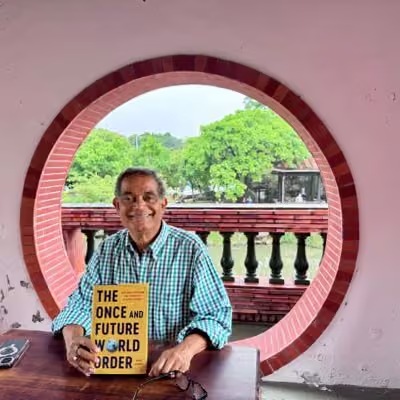 Amitav Acharya
@AmitavAcharya
Wonderful to deliver the 2025 Sir Howard Kippenberger Lecture at Victoria University of Wellington on 3rd April in the company of VC Nick Smith, Prof David Capie, 200 plus audience of students, faculty and guests. The topic was my book: The Once and Future World Order: Why Global Civilization will Survive the Decline of the West. The event was the first global launch of the book with hard copies made accessible for the first time.
More pics: www.instagram.com/p/DIFKgQPzpUJ/
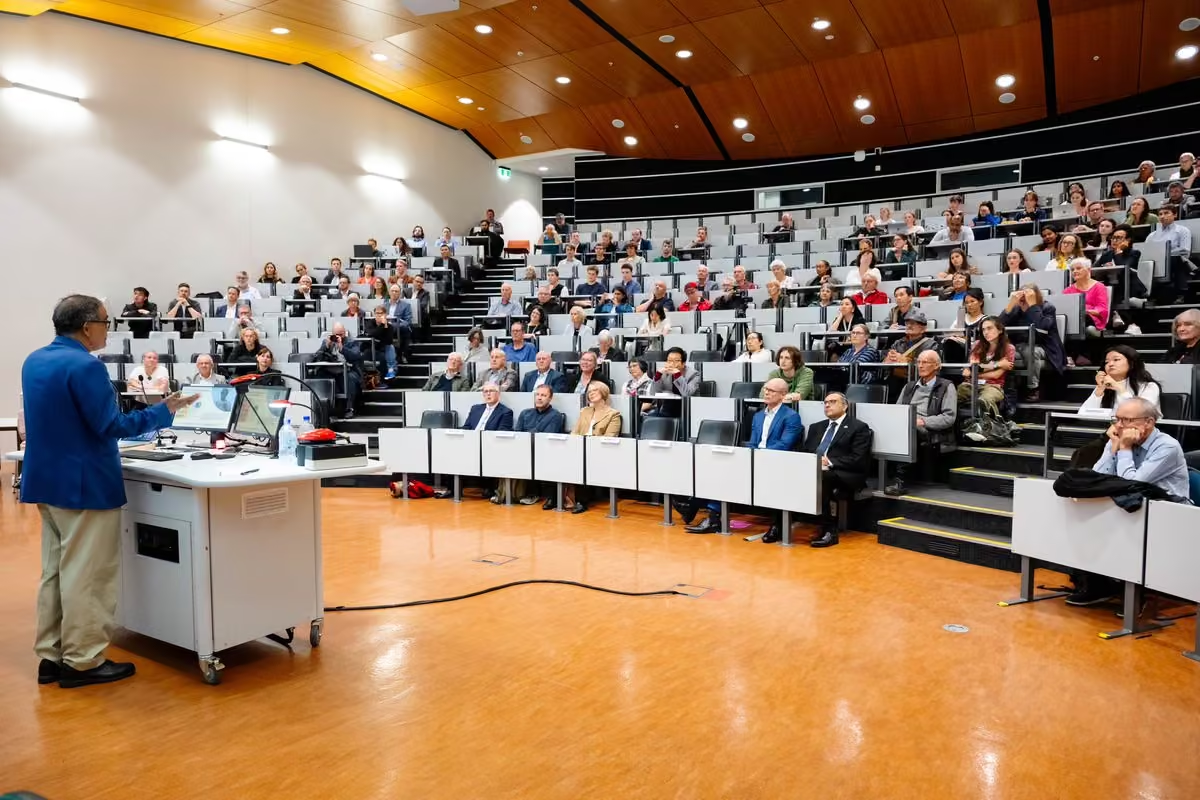
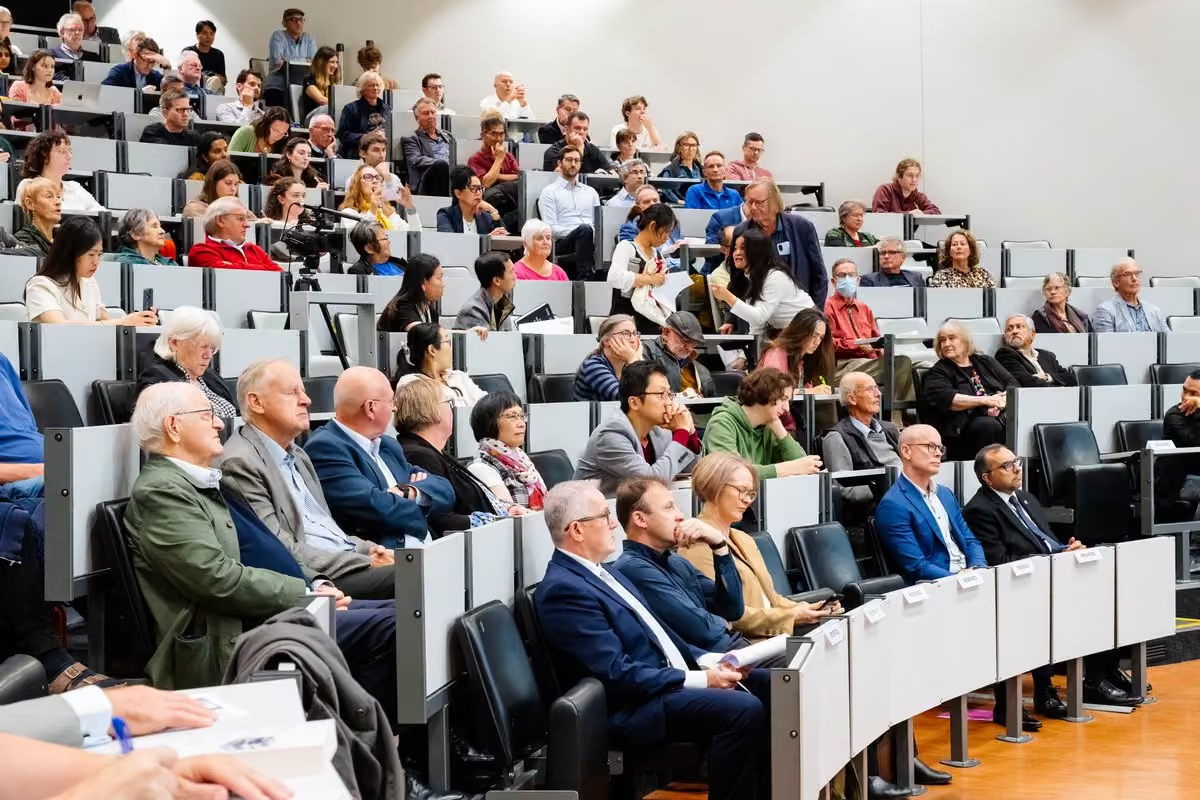
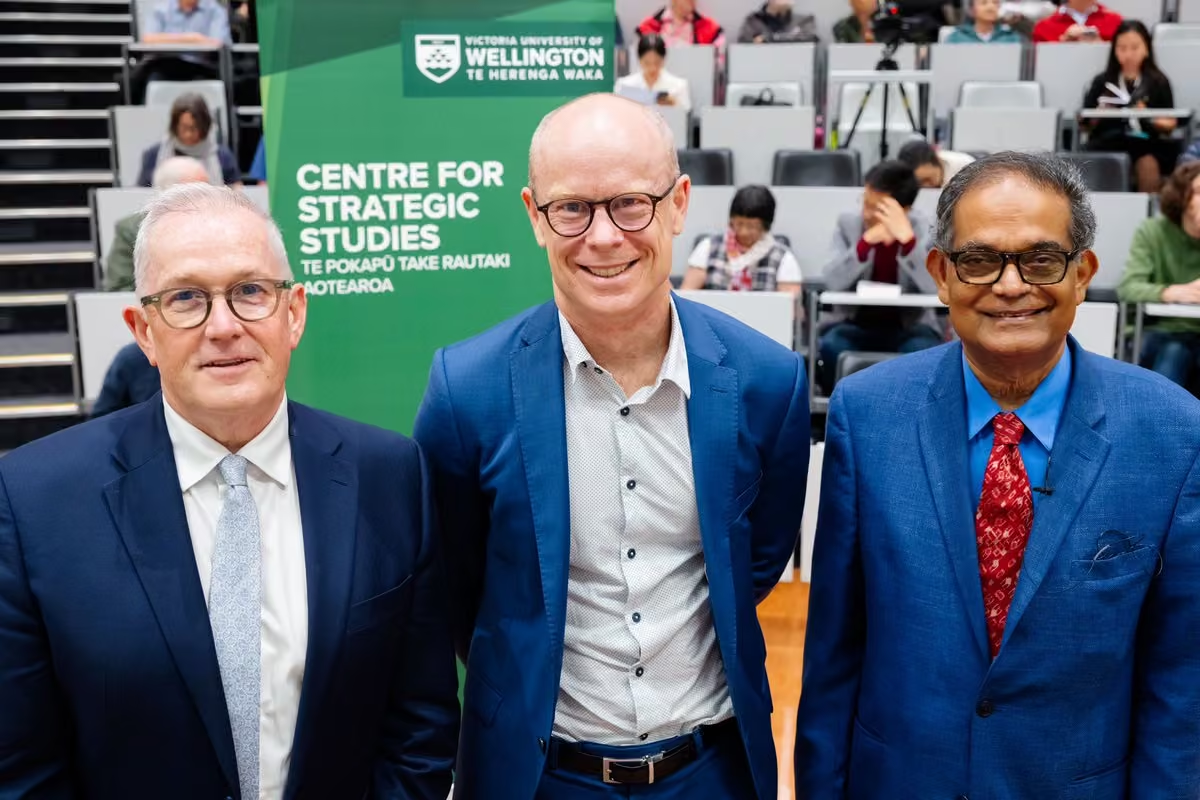
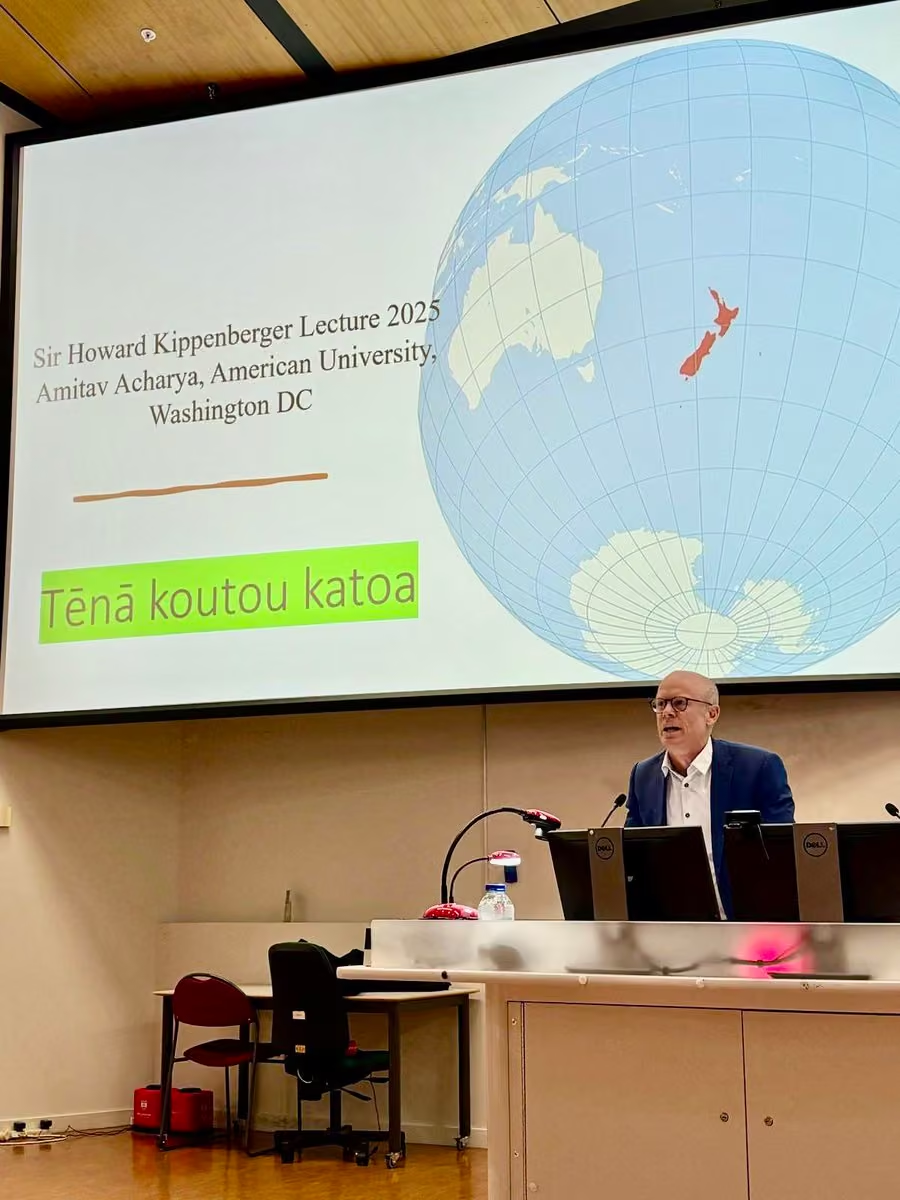
Amitav Acharya reposted
Manjeet S. Pardesi
@manjeetsp
This was such a treat @AmitavAcharya! Thanks for a very stimulating talk and for making us see the positive side of things during these turbulent times! It has been wonderful to have you here as the 2025 Sir Howard Kippenberger Visiting Chair in Strategic Studies @CSS_VUW!
 David Capie
@davidcapie
Tonight’s wonderful Sir Howard Kippenberger Visiting Professor of Strategic Studies public lecture by Prof. @AmitavAcharya. On a day of upheaval, a reminder that ideas about international order have their roots in multiple cultures, civilizations, and ways of thinking.


Amitav Acharya reposted
David Capie
@davidcapie
Tonight’s wonderful Sir Howard Kippenberger Visiting Professor of Strategic Studies public lecture by Prof. @AmitavAcharya. On a day of upheaval, a reminder that ideas about international order have their roots in multiple cultures, civilizations, and ways of thinking.
Amitav Acharya
@AmitavAcharya
With Victoria Univ of Wellington VC Nick Smith before he introduced me as the 2025 Sir Howard Kippenberger speaker. Prof David Capie, director of Centre for Strategic Studies gave intro & concluding remarks. Then book signing. First global launch of Once & Future World Order.


Amitav Acharya reposted
 Asian Review of Books
@BookReviewsAsia
Today in the ARB: Excerpt from “Divergent Worlds: What the Ancient Mediterranean and Indian Ocean Can Tell Us About the Future of International Order” by Amitav Acharya & Manjeet S Pardesi @yalepress asianreviewofbooks.com/excerpt-from-divergent-worlds-what…
Amitav Acharya
@AmitavAcharya
It's America vs the world now. www.theguardian.com/us-news/2025/mar/27/us-allies-worldwi…
Amitav Acharya
@AmitavAcharya
Deeply saddened by Gwen Robinson passing away. Only few weeks ago we were together at @FCCThai in Bangkok where she organized and chaired my book talk on Tragic Nation Burma. Shortly before that she had edited my oped in @NikkeiAsia on Myanmar. Over the years she had been unfailingly generous and supportive of so many people like me: as @FT Asia editor, she encouraged me to publish op-eds on topics such as Bandung Conference to East Asia regionalism. She leaves a powerful legacy of being one of a rare breed of Western journalists in SEA -such as Michael Vatikiotis and Michael Richardson - with a deep understanding of the region who also have helped to bridge the gap between the worlds of academia and journalism. RIP
@jagowriter
Amitav Acharya
@AmitavAcharya
Today at Foreign Correspondents Club of Thailand in Bangkok giving a talk on Burma - based on my 2023 book Tragic Nation Burma: Why and How Democracy Foiled (Penguin Random House)
Chaired by @RobinsonBKK
See also my oped:
multiplexworld.com/2025/01/23/can-myanmar-turn-the-corner…


 Amitav Acharya
@AmitavAcharya
Scenery from top of Mt Victoria in Wellington on a lovely sunny afternoon.


 Amitav Acharya
@AmitavAcharya
One Wellington highlight was breakfast in a spectacular setting at the beachside cafe Scorch-O-Rama on Scorching Bay beach in the company of a busy oystercatcher (along with my family & Wellington university prof @manjeetsp)


Amitav Acharya reposted
Jorge Heine
@jorgeheinel
As the Atlantic Alliance ceases to exist, what happens next ? There is no better guide to the next phase in world politics than @AmitavAcharya , and his new book, THE ONCE AND FUTURE WORLD ORDER could not come at a better time !
Amitav Acharya
@AmitavAcharya
Jorge Heine Recommends...in
Project Syndicate Books Recommendation Newsletter:
The Once and Future World Order:
Why Global Civilization Will Survive the Decline of the West
By Amitav Acharya
Heine says: "The decline of 'the West' – both as an actor and a concept – has brought much handwringing, with many fearing what might happen as the liberal international order the West has long championed comes crashing down. This book, a tour de force of world history, goes some way toward assuaging those fears. Written by a leading analyst of international relations, it concludes that the displacement of the West, and the rise of the rest, may not be such a bad thing after all."
www2.project-syndicate.org/newsletters/campaigns/b24616cf22
@jorgeheinel
Amitav Acharya
@AmitavAcharya
The Once and Future World Order: Why the West Needs to Work with 'the Rest' | Te Pokapū Take Rautaki Aotearoa / Centre for Strategic Studies | Te Herenga Waka—Victoria University of Wellington www.wgtn.ac.nz/strategic-studies/about/events/the-once-an…
Amitav Acharya
@AmitavAcharya
After I published "Goodbye West", there is more raw evidence of it in the Signal leak (per The Guardian article below). But how it might reshape world order? My essay provides some clues. www.e-ir.info/2025/03/13/goodbye-west-long-live-world-order/
++++++++++++
"I just hate bailing Europe out again,” Vance replied. Hegseth agreed that “I fully share your loathing of European free-loading. It’s PATHETIC.”
Trump envoy Steve Witkoff: "Europe is dysfunctional today.”www.theguardian.com/world/2025/mar/25/stunning-signal-lea…
++++++++++++
Amitav Acharya reposted
David Capie
@davidcapie
Great to celebrate and launch “Divergent Worlds” co-authored by our fabulous @CSS_VUW @VicUniWgtn colleague @manjeetsp and our 2025 Kippenberger Visiting Professor in Strategic Studies @AmitavAcharya. A big, bold provocative argument, lots of great questions, and a fun evening.


Amitav Acharya reposted
David Capie
@davidcapie
“The Once and Future World Order” - if you are in Wellington on 3 April, come and hear what ‘Foreign Policy’ journal called one of its “Most Anticipated Books of 2025”. RSVP below. 👇 www.wgtn.ac.nz/strategic-studies/about/events/the-once-an…
Amitav Acharya
@AmitavAcharya
Such a wonderful welcome, complete with a kiwi barbie. Thank you @davidcapie and @VicUniWgtn colleagues for a very special Wellington evening. (and I did not have to give a formal speech on this occasion at least)

 David Capie
@davidcapie
Great to informally welcome our 2025 @VicUniWgtn Sir Howard Kippenberger Visiting Chair in Strategic Studies, Prof. @AmitavAcharya. Fantastic to have him here to talk about a world order in flux. Looking forward to the launch of his co-authored book with @manjeetsp on Tuesday.


Amitav Acharya reposted
Manjeet S. Pardesi
@manjeetsp
Happening in a couple of days! Please join us if you are in Wellington on 25 March @AmitavAcharya @davidcapie @CSS_VUW @VicUniWgtn @yalepress
Manjeet S. Pardesi
@manjeetsp
Very excited about the launch of our book, 'Divergent Worlds' @yalepress on the 25th! @AmitavAcharya will be in Wellington too, so do join us if you can (& register)! Many thanks to @CSS_VUW and @davidcapie! events.humanitix.com/book-launch-for-divergent-worlds-wha…
Amitav Acharya
@AmitavAcharya
Goodbye West: Long Live World Order www.e-ir.info/2025/03/13/goodbye-west-long-live-world-order/
Amitav Acharya
@AmitavAcharya
From Queenstown to Christchurch via Lake Tekapo in the South Island of NZ: one of the most scenic drives out there to savor despite waking up at 6 am to prepare for a 3pm lecture on Empires and Imperialism at the University of Canterbury.
And yes, it's true: one sees more sheep than people (what a relief!) on the way.


 Amitav Acharya
@AmitavAcharya
A Trump Corollary to the Monroe doctrine is unfolding.
The Monroe doctrine was never really dead. Kennedy invoked it during the Cuban middle crisis. There are also US military interventions in Grenada and Panama. It has always been part and parcel of US foreign policy mindset.
As I have written in my book, The Once and Future World Order, the US has always behaved in an imperial power in the region - despite the rhetoric of a liberal order.
But the growing role of China in Latin America has further stoked this historic imperial impulse of the US in the region. The anti-immigration stance of Trump has created an added rationale : while the old Monroe doctrine was geared to strategic and economic goals, the new Trump Corollary has a broader anti-immigration objective.
@jorgeheinel
Amitav Acharya
@AmitavAcharya
Today at Foreign Correspondents Club of Thailand in Bangkok giving a talk on Burma - based on my 2023 book Tragic Nation Burma: Why and How Democracy Foiled (Penguin Random House)
Chaired by @RobinsonBKK
See also my oped:
multiplexworld.com/2025/01/23/can-myanmar-turn-the-corner…
Amitav Acharya
@AmitavAcharya
I read this year's Nobel economics winners' (Acemoglu, Johnson and Robinson) work as affirming that colonialism was a major factor behind the rise of Europe, rather than indigenous European characteristics like culture. It refutes those like Niall Ferguson who argue that imperialism did not matter in the Great Divergence. The fact is that Europe's predatory global expansion came before its 'inclusive institutions' (although I have serious doubts how inclusive they really were). But a key point here is that before institutional reform set in, Western Europe had gone globally predatory. The fact that Atlantic Europe which was the vanguard of European colonization in early modern era did better than those exposed only to the Mediterranean or Eastern Europe supports their thesis. I have drawn on their work to support my thesis that imperialism was a key ingredient in Europe's "magic potion" in conjunction with other ingredients such as slavery and racism: a potion that was a major force behind the rise of the West, in my book: The Once and Future World Order.
Amitav Acharya
@AmitavAcharya
"This book is a must-read for students, teachers, policymakers and wider academicians across the globe for a balanced knowledge of past and present of India and China for setting yardstick for understanding the future."
The book under review is open access. luminosoa.org/site/books/e/10.1525/luminos.135/
Read the review of Amitav Acharya, Daniel A. Bell, Rajeev Bhargava and Yan Xuetong (Eds), Bridging Two Worlds: Comparing Classical Political Thought and Statecraft in India and China (Univ of Calif Press, 2023)
journals.sagepub.com/eprint/DRPXNAJR79GID2JUZSR6/full
Amitav Acharya
@AmitavAcharya
Here is the video link of my lecture at Oxford Martin School, 08 March 2024. "Navigating world orders over five millennia: does the past offer clues to the future?' with Prof Amitav Acharya." www.oxfordmartin.ox.ac.uk/videos/navigating-world-orders/
@AU_SIS
@research_sis
@oxmartinschool
@OxGlobalOrders

 Amitav Acharya
@AmitavAcharya
Before a full house last evening at Oxford: Navigating world orders over five millennia: does the past offer clues to the future? @oxmartinschool @OxGlobalOrders


 Amitav Acharya
@AmitavAcharya
An Oxford preview based on my coming book
Navigating world orders over five millennia: does the past offer clues to the future?
Thurs 7 March 2024, 5pm – 6.15pm GMT
www.oxfordmartin.ox.ac.uk/events/navigating-world-orders/
Stream: www.crowdcast.io/c/navigating-world-orders
YouTube stream: www.youtube.com/watch?v=Q4yNJ4S0Gm0
@oxmartinschool
 Amitav Acharya
@AmitavAcharya
Live now with @JohnKingCNN & Irish Ambassador to US @DanMulhall (who went to university with me in Perth, Australia in 1980s). My wife Sally in the pic. We are watching a performance of James Joyce’s Ulysses on the centenary of it’s publication at Irish Embassy
 Amitav Acharya
@AmitavAcharya
BBC calls him a 'gunman’, & ‘self-described white supremacist’ & covers his face. CNN headlines him as a ‘murder suspect’. rather than a ‘terrorist’. What is keeping the leading Western media from calling this guy a terrorist? www.bbc.com/news/world-asia-47599586 www.cnn.com/2019/03/16/asia/new-zealand-suspect-brenton-t…


