Comment on CNN reporting of Iranian contingency pIans involving attacks on US individuals with chemical weapons or radiological dispersal devices: Iranian threats and actual plans to target individuals in the US and also in Europe are not new and include past assassination plots against President Donald Trump and former National Security Advisor John Bolton. Thinking about using a so-called dirty bomb or chemical weapon against individuals as reported by CNN is a new twist. CNN is correct in pointing out that whether Iran would actually do it or be capable of doing it is unclear. North Korea executed a targeted assassination in Malaysia in 2017 using a chemical nerve agent, but Kim Jong Un's half brother was not protected by a protective detail and attackers were able to put the nerve agent onto his face.
To execute a dirty bomb plot in the US, Iran would likely have to find someone in the US to find a radioactive source and build the explosive device around it. Radiological sources are fairly well protected and monitored in the US although thefts could happen. It would be highly dangerous for the Iranian agent to handle the radioactive material without proper protection and equipment as the radiation dose is much higher the closer you are to the source, the longer you are close to it, and while it is not dispersed; after explosion and dispersal, the area would have to be evacuated and cleaned up, so it would cause damage and likely panic, but using it for a targeted assassination would be very hard.
The chemical weapons on the other hand that Iran has been working on include weaponizing pharmaceutical opioids like fentanyl and the sedative medetomidine. Fentanyl is far easier to obtain than radioactive material and an attacker could use Iranian technology that appears to have already been developed to aerosolize it and deliver it, such as by drone. We have been reporting on Iran's efforts to produce these so called pharmaceutical based agents. There is great concern Iran would use them in the region against U.S., Israeli, or allied troops or even civilian targets. We also reported on an Iranian plant that was involved in producing fentanyl that was targeted by Israel in the war. Using such agents would be an escalation, invite additional attacks on Iranian facilities, and would further isolate Iran, which is a state party to the Chemical Weapons Convention (and member of its Executive Council for 2026 - 2028).
Institute for Science and International Security
The Institute for Science and International Security (ISIS) is a nonprofit, non-governmental institution to inform the public about "science and policy issues affecting international security". More on Wikipedia
-
Inst for Science
@TheGoodISIS
-
Inst for Science
@TheGoodISIS
IAEA Repeats Longstanding Concern About Isfahan Enrichment Plant Without Disclosing New Technical Evidence
November 13, 2026
The International Atomic Energy Agency's latest quarterly report again expresses increasing concern about Iran's failure to provide access and design information concerning the Isfahan Fuel Enrichment Plant (IFEP), which Iran declared on June 12, 2025. However, the agency's reported findings do not appear to represent a new technical discovery. The IAEA had already expressed similar concerns in March 2026, and its June 2026 report explicitly stated that it did not know the precise location of IFEP, whether nuclear material was present, or whether enrichment had occurred there.
We at the Institute for Science and International Security have extensively examined the Isfahan underground complex, where IFEP is widely believed to be located and where substantial quantities of Iran's 60-percent enriched uranium are also believed to be stored. We documented the backfilling of all three known tunnel entrances as well as the associated utilities alcove entrance in February 2026, the installation of additional access barriers in April, and the absence of visible efforts to reopen the tunnels when viewed on the most recent available imagery of 10 November 2026.
Our June 2026 assessment found no evidence of resumed uranium enrichment and concluded that Iran's centrifuge enrichment program remained disabled.
The IAEA's inability to inspect IFEP and account for Iran's enriched uranium remains a serious safeguards concern. Nevertheless, that concern should be distinguished from evidence that the plant is operating or that Iran has recovered the enriched uranium believed to be stored inside the complex. The publicly reported November findings do not establish either development. The key unresolved questions are whether the IAEA has obtained new information about the plant's physical condition or accessibility and whether Iran has taken any steps to recover equipment or nuclear material from the underground complex. -
Inst for Science
@TheGoodISIS
Syria, Al Kibar update:
Recent @Satellogic imagery from October 10, 2026, shows disturbed earth where the reactor components were buried at the Al Kibar reactor at the secret Dair Alzour site in Syria where the IAEA had been conducting excavation of the site beginning in mid-August (likely now complete). @laurnorman reported an "Oct. 1 IAEA visit to the former nuclear site where they saw excavated pipes, structural remains and remnants of reinforced concrete, all of which 'consistent with the past presence of a nuclear reactor.'" The original reactor building was targeted and destroyed by the Israeli Air Force in September 2007. Syria and the International Atomic Energy Agency (IAEA) achieved a major breakthrough this summer in bringing Syria back into compliance with its safeguards obligations at least as far as its undeclared nuclear reactor, a fuel fabrication plant, and stored uranium metal fuel and scrap are concerned. The reactor was excavated as part of that verification effort. We are unable at this time to determine whether or not the disturbed earth is simply the result of post-assessment backfilling. -
Inst for Science
@TheGoodISIS
Available Now: The Peddling Peril Index for 2025/2026 - the fifth edition of our in-house ranking of strategic trade control systems - is out! Get your paperback on Amazon here: a.co/d/03IH7cmh Explore the interactive PPI map and get your free PDF here: isis-online.org/peddling-peril-index
The PPI is a biennial project, using over 100 indicators across five super criteria areas to evaluate national strategic trade controls in 200 countries & entities. The PPI is the product of thousands of hours of work that draws from a collective decades of in-house expertise and an intensive effort to collect, compile, and review information from numerous sources. It remains the only public, comprehensive evaluation of the state of global implementation of export controls and it continues to paint a dire picture. As in the previous PPI editions, countries could receive a total of 1300 points. Scores ranged from -232 to 1,129, meaning that no country received more than 87 percent of the possible points, and a few countries had very low scores. Around 50 percent of countries evaluated scored below half of the maximum points in the PPI, with the areas of enforcement and proliferation financing most in need of global improvements. Additionally, over half of all countries lack relevant, comprehensive export control legislation.
The PPI book contains over 300 pages of in-depth methodology, analysis, recommendations, and applications chapters in addition to the full rankings. By identifying countries that are both leading and lagging behind in controls, the PPI aims to provide a key starting point for discussions in government, industry, academia, and the NGO community to improve the global implementation of strategic trade controls.
Curious how your country performed? View its 2025/2026 rank, tier of supply potential, performance cluster, overall score, and subscores, here: isis-online.org/peddling-peril-index -
Inst for Science reposted
David Albright
@DAVIDHALBRIGHT1
The U.S. State Department’s Rewards for Justice program is offering up to $20 million and possible relocation for information about Iran’s nuclear program. If you have firsthand knowledge of undeclared nuclear facilities, hidden nuclear material, or work related to developing a nuclear weapon, consider coming forward if you can do so safely. Your information could help uncover covert activities and prevent the regime from building nuclear weapons.
Coming forward takes courage. Helping protect Iran and its people from the dangers of the regime’s nuclear weapons efforts is an act of patriotism.
Rewards for Justice
@RFJ_USA
The U.S. government remains committed to countering any attempt by Iran to develop a nuclear weapons program.
If you have information on Iran’s nuclear personnel or technologies, send us a tip. -
Inst for Science
@TheGoodISIS
Pickaxe Mountain Elevation Profile: Where are the tunnel site’s key features?
We used Google Earth terrain data to derive the elevation profile of the mountain, showing the elevation levels of four key points: the eastern and western primary tunnel entrances, the probable ventilation port/shaft north of the ridge, and the possible ventilation shaft south of the ridge. We previously reported on the elevation difference between the two pairs of tunnel entrances, which could mean that there are two separate tunnels; the facility has multiple levels; or the western tunnel progresses downwards to meet the other tunnel under the ridge. In our early 2022 reporting, we considered various options which remain plausible. We newly discuss the elevation of the probable ventilation port/shaft, first identified by the Institute in 2024, and situated north of the mountain ridge, closer to the Eastern tunnel entrances. Interestingly, it sits at the same elevation as the Western entrances, indicating it is able to service either tunnel, both tunnels, or a combined tunnel. It might also provide an opening for a horizontal tunnel into the western tunnel accessible operations area, i.e., an additional point for ingress and egress, such as for personnel. It should be noted that it is serviced by electricity, in addition to the primary eastern and the primary western tunnel portals. The attached ground photo from 2005 shows its future location on the north side of the mountain. Note: We confirmed the relative accuracy of the Google Earth elevation profile with high resolution elevation data.
Read the full report here:
isis-online.org/isis-reports/pickaxe-mountain-elevation-p… -
Inst for Science
@TheGoodISIS
IAEA DG Grossi’s summary on the status of Iran’s *declared* nuclear program is largely aligned with our observations in satellite imagery; post June 2025 there have been some repairs at the Natanz PFEP and the above ground Esfahan facility but we also assessed them to be unlikely for actual reconstruction and more likely for shielding from overhead observation. The key declared sites where enriched uranium storage and/or enrichment took place at Fordow, Natanz, and Esfahan remain non-operational. We do have concerns about sites associated with Iran’s UNDECLARED program however, past and present. DG Grossi does not explain which sites the IAEA is monitoring when referring to "locations associated with [Iran's] past undeclared nuclear programme." But it should include Taleghan 2, which is actively undergoing reconstruction, and Minzadayi, which sees high levels of activity around the site. The former was part of Iran’s crash nuclear weapons program codenamed Amad and investigated but never visited by the IAEA. The IAEA did find uranium particles at the building next door (Taleghan 1), despite intensive sanitization efforts, that were never adequately explained. Taleghan 2 was linked to nuclear weapons relevant work as recently as 2024. Minzadayi was targeted by the IDF in March 2026 for its role in Iran’s most recent nuclear weapons capabilities and was linked in public reporting to metallurgy and to the Turquz Abad site, which is part of an ongoing IAEA investigation. Also not mentioned explicitly by DG Grossi is the status of surviving centrifuges and Pickaxe Mountain, where centrifuges and components were moved according to @WSJ reporting on Israeli intelligence. Together with the enriched uranium, these are critical elements of Iran's nuclear program that could provide Iran a path to reconstitute its capabilities outside of declared facilities.
Quote from DG Grossi today: "As stated in my reports to the Board of Governors, the IAEA continues to monitor activities at Iran’s declared nuclear facilities and locations associated with its past undeclared nuclear programme. Also, and since June 2025, we have not identified any activity to repair or reconstruct any of the facilities damaged in the military attacks of 2025 and 2026."
Rafael Mariano Grossi
@rafaelmgrossi
Just briefed the @UN Security Council in New York today on current nuclear non-proliferation issues, with a focus on Iran.
Gradual, technical steps could allow @IAEAorg inspectors to return and pave the way to normal safeguards implementation while contributing to a confidence-building atmosphere conducive to a wider agreement.
Only diplomacy, underpinned by IAEA verification, can prevent nuclear proliferation in the long-term, in Iran and around the world.
My full statement to the #unsc: www.iaea.org/newscenter/statements/director-general-state… -
Inst for Science
@TheGoodISIS
NEW imagery update: Various levels of cleanup activities were observed at the three sites related to Mojdeh / Lavizan 2 following the March 2026 attacks: The main Mojdeh site was previously attacked in June 2025 and was undergoing rapid cleanup efforts, which the follow-on strikes in March 2026 appear to have effectively ended. After several months of little activity, the attacked, large engineering-type building just north of the main Mojdeh site is currently in the process of being fully dismantled and cleared. In the process, six containers that were stationed alongside the building before the attack were removed. The remnants of the destroyed large building cluster at Malek Ashtar University have been fully cleaned up and the space was turned into a large parking lot accommodating the many personnel vehicles on site. See the figures for an overview of the area after the June 2025 war but before the attacks in the March 2026; the various levels of cleanup activity around the area as of mid-September; and close-ups of the Mojdeh site, the engineering-type building, and the cleaned up area at Malek Ashtar University.
Read the full report here: isis-online.org/isis-reports/various-levels-of-cleanup-at… -
Inst for Science
@TheGoodISIS
Pickaxe Mountain Imagery Update:
Vantor Technologies imagery from October 7, 2026, shows that the Eastern tunnel entrances remain blocked by earth. The earthen mound roadblocks leading to the Western tunnel portals also remain in place. See Figures 1 and 2. The two-month-long restricted access reinforces the assessment that the facility is currently neither operational nor continuing major construction. It supports public reporting that the facility contains valuable equipment and/or materials, such as centrifuges and centrifuge components, believed by Israeli intelligence to have been moved into the tunnel facility following the 12-Day War, as reported by the Wall Street Journal in July 2026.
Regarding an attack on the site, a combination of what was done at Natanz and Fordow in June 2025 and at Shahid Boroujerdi in Spring 2026 appears to make the most sense — using a series of bunker busters to target vulnerabilities in the mountain, such as ventilation shafts, coupled with collapsing entrances and destroying utilities and other support infrastructure outside of the tunnel. We have identified both a probable and a possible ventilation shaft location at Pickaxe mountain using satellite imagery. That said, it is possible that the U.S. government decides, based on the information it has on the tunnel site, that the MOAB, which is not a bunker buster but creates the most powerful non-nuclear shockwave, is best to inflict damage on the site. According to CNN reporting this is being considered. While Iran has a lot of experience building military tunnels and commonly adds blast traps by the entrances to prevent shockwaves from traveling down into the facility, these methods are designed to protect against much smaller shockwaves compared to the massive one created by the MOAB. Such an attack could place Pickaxe mountain in the same category that Natanz and Esfahan have been in for more than a year now: Forced, monitored closure, with lack of information about extent of damage inside. -
Inst for Science
@TheGoodISIS
Recent @vantortech satellite imagery from October 2026 of the second reconstruction effort at the Taleghan 2 nuclear weapons related R&D facility shows that this effort is progressing rapidly. The facility was first bombed by Israel in October 2024. Despite Iran having expanded and hardened the facility after the first bombing (REF 1), Israel used bunker buster bombs to again attack the facility as well as destroy additional structures around the site (REF 2). Since March 2026, Iran has repaired the roof covering, most recently adding three concrete pads directly over the penetration holes, possibly to serve as hatchways or vents. Whatever their function, associated construction activity was concealed by temporary tarp coverings in September (REF 3). Other work included reinforcing the structure with two stepped concrete side walls, and completing a new hardened entrance way that was damaged in the last bombing. This effort has been an intensive undertaking by Iran to reconstruct the facility, but when it could become operational is unclear. The reasoning why Iran is reconstructing a well known and well characterized facility is perplexing, but, at a minimum, it shows that Iran wants to reestablish its lost capabilities there. Below are several images showing the current state of construction since the facility was destroyed by an airstrike in March 2026.
REF 1: isis-online.org/isis-reports/satellite-imagery-shows-poss…
REF 2: isis-online.org/isis-reports/post-attack-assessment-of-pr…
REF 3: isis-online.org/isis-reports/iran-is-rapidly-reconstructi… -
Inst for Science
@TheGoodISIS
Over the last few months, we have seen high levels of activity at certain nuclear weaponization sites pointing to reconstruction efforts specifically at Taleghan 2 (starting in June 2026), notable vehicle activity at Minzadayi (September/October 2026) and significant cleanup including the removal of containers at Mojdeh / Malek Ashtar University (August/September 2026). Hardly any activity has been observed at known sites tied to uranium enrichment where the main entrances remain destroyed / blocked by earthen materials and on which the media and public at large tend to focus: Pickaxe Mountain (as of October 7), the Natanz Nuclear Complex (as of October 7), Fordow (as of October 11), and Esfahan (October 12).
Barak Ravid
@BarakRavid
🇮🇱🇺🇸🇮🇷Israeli Prime Minister Benjamin Netanyahu and President Trump last week discussed the possibility of launching a new operation against Iran before the Israeli and U.S. elections, according to two U.S. officials, one Israeli official and a fourth source with knowledge of the matter.
🇮🇱🇺🇸🇮🇷The Israeli leader's call with Trump about the possible attack took place before Trump said he would not strike Iran ahead of the midterms
🇮🇱🇺🇸🇮🇷Netanyahu said during the call that he was concerned about Israeli intelligence indicating Iran was taking troubling steps to reconstitute its nuclear program, according to an Israeli official
Barak Ravid
@BarakRavid
Inside Trump, Netanyahu's dilemma: Strike Iran before elections or wait. @MarcACaputo and I write for @axios
www.axios.com/2026/10/13/netanyahu-trump-iran-war-elections -
Inst for Science
@TheGoodISIS
In addition to the earlier reported high levels of vehicle activity, we noticed the repair of a probable water tank and the addition of a new, small building nearby in the northern part of the Minzadayi site. This again points to Iran's efforts to not just clean up the site, which was attacked by Israel in March 2026 for its nuclear weapons connection, but to resume regular activities. See our earlier report here: isis-online.org/isis-reports/significant-activity-identif…
-
Inst for Science
@TheGoodISIS
NEW Report: Significant Activity Identified at Minzadayi, an Iranian Nuclear Weapons Development Site
High resolution @vantortech satellite imagery from September and October 2026 shows significant renewed activity at Minzadayi, a nuclear weapons development compound northeast of Tehran revealed by Israel during the 2026 war. The compound was attacked by Israel on March 3rd, 2026, destroying several buildings and likely underground structures. The recent satellite imagery indicates a return to regular vehicle activity around the site post extensive cleanup operation that included the clearing of rubble and debris and repair of damage on the hillside. One area attacked in March 2026 shows ongoing earth moving activity. The earth moving activity is occurring at a surface made to look like a courtyard where multiple craters could be seen following the attacks on the site in March 2026. Significant vehicle presence can be seen throughout the site between early September and early October 2026. Cars are parked outside the security perimeter in the parking lot, and many passenger vehicles and trucks can be seen inside the perimeter. Given what is known about this compound, this activity may be indicative of an effort by Iran to reestablish a nuclear weapons development capability and to reconstitute what was lost in the attack on the compound.
Based on public reporting and statements released by the IDF, the nuclear weapons work carried out here likely involved research and development on nuclear warheads. The IDF originally stated, that a “group of nuclear scientists operated covertly to develop a key component in the nuclear weapons system,” adding that “the complex is designed to enable the restoration of the required technology and the advancement of capabilities for the development of nuclear weapons.”
@IntelliTimes, released additional information on the compound. In a post from September 24, 2026, it states that the nuclear weapons related infrastructure was established in 2022 and “absorbed part of the means from the nuclear warehouse,” a common reference to the Turquz Abad site revealed by Israeli Prime Minister Benjamin Netanyahu in September 2018. Netanyahu revealed the site following Iran’s removal of more than a dozen shipping containers from the site that were assessed to hold nuclear material and equipment relevant to Iran’s nuclear weapons capabilities.[4] When the IAEA visited Turquz Abad in March 2019, it found evidence that nuclear material or contaminated equipment had been present at the site and the IAEA Board has since been pressing Iran to answer the IAEA’s questions about the current whereabouts of said material and/or equipment. @IntelliTimes indicates Iran did not simply move the material and/or equipment to a new long term storage site but used the new site in northeast Tehran, aka Minzadayi, to establish an” industrial nuclear headquarters for the reconstruction of research, development, and adaptation infrastructure for nuclear warheads,” including the means to “produce cores of enriched uranium and the explosive material required to cast into them the detonation chain.”[5] The current renewed effort underway at this highly secure compound suggests that the work being conducted here is of top priority.
Read the report here: isis-online.org/isis-reports/significant-activity-identif… -
Inst for Science
@TheGoodISIS
Podcast on the latest developments on Iran with @DAVIDHALBRIGHT1 👇
The Telegraph
@Telegraph
On today's episode of Iran: the Latest, @venetiarainey looks at apparent growing momentum towards a deal as world leaders from across the Middle East gather in New York.
After Trump vowed once again to stop Iran from getting nuclear weapons, former nuclear weapons inspector @DAVIDHALBRIGHT1 breaks down how Tehran is using the lull in fighting to rebuild and fortify key capabilities at Parchin and Pickaxe Mountain.
Listen to Iran The Latest via the link below ⤵️
linktr.ee/IranTheLatest -
Inst for Science
@TheGoodISIS
A close review of @vantortech satellite imagery from September 11 and 19, 2026, has revealed cables strung between defensive towers constructed at the Alabuga Special Economic Zone surrounding the Shahed/Geran production facilities. The cables strung between towers serve as a passive defense against incoming cruise missiles or long-range strike drones seeking to target the drone production facilities. Drones or cruise missiles will strike the cables, causing them to detonate in the air instead of striking the production facilities directly or force aircraft to come in high and make them more vulnerable to anti aircraft defenses. More towers are still being constructed.
The Iraqis used this same tactic to protect Al Tuwaitha Nuclear Research Center during the Iran/Iraq war up until the 1981 bombing of the Osirak reactor by Israel.
The Institute first identified these passive defensive towers in our last update, which can be read here: isis-online.org/isis-reports/new-passive-defensive-constr…
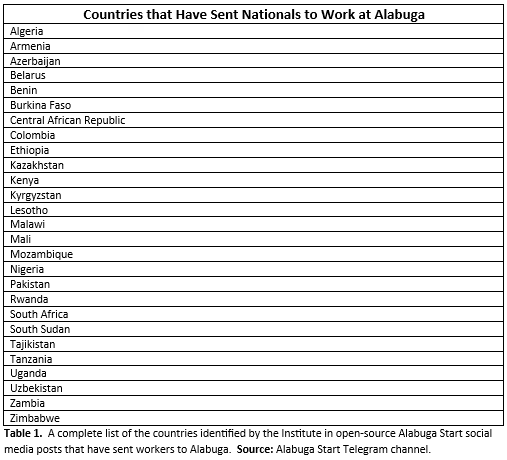
Alabuga is also working hard to construct new facilities just south of the main production complex, identified by Dnipro Osint (t.me/DniproOfficial/8178). The facilities cover a large area, consisting of half a dozen or more buildings, with more actively under construction. This would constitute a large expansion of the Alabuga Special Economic Zone. Some of the buildings are in the process of being buried under multiple layers of dirt and reinforced concrete in order to harden them from potential attacks. -
Inst for Science
@TheGoodISIS
Trump's statement on not seeing a lot of activity at Pickaxe mountain is fully in line with our satellite imagery observations. Access to all four tunnel entrances has been severely restricted since the beginning of August. Iran apparently figured better to block the entrances voluntarily than have them blocked by force. The last several weeks show virtually no movement of equipment and little vehicle movement. Pickaxe Mtn effectively joined the list of nuclear related sites that are not currently operational, not easily accessible, and where resumption of activity would be easily detected. Media outlets and other reporting that recently highlighted high activity at Pickaxe Mountain should also take note of this significant slowdown.
Iran International English
@IranIntl_En
US President Donald Trump said Washington could strike Iran’s Pickaxe Mountain nuclear site if it detects renewed activity there.
“We may have to blow up another one, Pickaxe Mountain. We’re not seeing a lot of activity there, but if we do, we’ll blow it up immediately,” he said during a meeting with GCC leaders in New York.This media couldn't be displayed. See it on the original post. -
Inst for Science
@TheGoodISIS
New Imagery Update: Iran is Rapidly Reconstructing Taleghan 2
@vantortech satellite imagery from September 13, 2026, shows that Iran is rapidly moving forward with the reconstruction of the Taleghan 2 facility located at the Parchin military complex. Iran has erected a tarp above the destroyed hardened buried facility, hiding the reconstruction activity that is occurring underneath from satellite view or aerial reconnaissance. Significant activity can be seen throughout the construction site. Construction vehicles, including dump trucks, bulldozers, concrete pump trucks and concrete mixers, and cranes, are actively working to rebuild the facility. Repair and rehabilitation work began in June 2026, first with Iran repairing and placing concrete caps over the penetration holes caused by the multiple bunker buster weapons dropped on the facility. Iran has also built a new concrete apron reinforcement on the right side of the facility, the one on the left side that we noted in our July 2026 update now appears complete. This will provide additional blast protection from an aerial attack.
Link to our full report here: isis-online.org/isis-reports/iran-is-rapidly-reconstructi… -
Inst for Science
@TheGoodISIS
Update on passive defense measures at the nearby Natanz Nuclear Complex: we noticed in an August 21, 2026, image by @vantortech the presence of several passive defensive structures. Throughout 2026, Iran placed makeshift dirt mounds in several locations at the above ground complex, in key areas that could be used by U.S. or Israeli forces to land vertical takeoff or landing (VTOL) aircraft. Chicane barriers made from dirt can also be seen placed along the road just outside of the security perimeter. These passive defense structures are likely intended to complicate any sort of ground forces raid conducted against the complex.
-
Inst for Science
@TheGoodISIS
Update on passive defense measures at Pickaxe Mountain: @vantortech imagery from September 11, 2026, shows that the earthen mound roadblocks are still in place, blocking ground vehicle access to the Western tunnel portals. The week-long restricted access reinforces the assessment that the facility is not currently used for operations, but that it does contain valuable equipment and/or materials. The clearly visible roadblocks mean a return to regular access and activity at the Western tunnel entrances should easily be detected by U.S. intelligence and visible on commercially available imagery. Together with the previously blocked Eastern tunnel entrances, the new roadblocks effectively established a status quo inside the facility starting in early August.
Earthen mounds were also placed over one western tunnel portal and over a nearby cluster of portals first built in 2007 that have been expanded and rebuilt in recent years. The added soil increases overburden and helps harden the entrances against aerial bombardment. -
Inst for Science
@TheGoodISIS
NEW: Report on August 2026 Russian drone launches reveals new trends, namely dramatic increases of daylight attacks and the use of jet powered drones.
According to @anokhin_i estimates, based on Ukrainian Air Force reporting and supplementary monitoring data, Russia used at least 5,166 Shahed-type UAVs, including decoys. Of these, an estimated 4,288 UAVs were shot down or suppressed.
August 2026 marked a transition from the more concentrated overnight pattern observed earlier in the year toward sustained day-and-night pressure.
Newly, up to 57 to 62 percent of Shahed/Geran drones launched are assessed as jet-powered, compared to just about 10 percent in June.
Faster jet-powered UAVs compress engagement windows for mobile fire groups and many interceptor drones, forcing reliance on faster and more expensive defensive systems.
For sanctions and export-control analysis, the central question is whether Russia can sustain this transition. Turbojet engines, flight-control electronics, anti-jamming, inertial navigation, communications hardware, components, materials, and production equipment remain priorities. Chinese substitution, remaining Western dependencies, intermediaries, and sanctions-evasion routes require continued investigation.
We’d like to note that since July, the analysis of monthly drone launches has become increasingly difficult because the Ukrainian Air Force is publishing progressively less detailed daily information. In particular, daytime UAV attacks are now often substantial, but separate daytime totals are not always reported; the Air Force no longer regularly states how many of the total UAVs were specifically Shahed/Geran; and, beginning in August, it also increasingly stopped reporting the number of UAV hits, instead giving only the number of affected locations. We would urge the @KpsZSU to return to its original format of reporting and define specific timeframes for daytime and night time launch reporting.
See the key graphics below and read the full report here: isis-online.org/isis-reports/monthly-analysis-of-russian-… -
Inst for Science
@TheGoodISIS
NEW: Following President Trump's public comments on attacks on the Pickaxe mountain facility, Iran moved to limit ground access to the tunnel site. In August 2026, it added a series of earthen piles across the roads leading to the Western tunnel entrances. They can be seen in imagery dated August 9, 2026 and are still there as of August 21, 2026. This follows an earlier move to partially backfill the Eastern tunnel entrances to prevent rapid ingress and egress of vehicles and ongoing hardening efforts of all the portals. Whatever internal construction had been underway would have ground to a halt while the road blockades are in place.
-
Inst for Science
@TheGoodISIS
The recent CSIS report on Pickaxe mountain missed an important finding in the August 2026 image that contradicts one of its central conclusions. And the lack of citation to our work borders on the comical.
The report by Joseph Rodgers @NonproJoe and Douglas Comstock states that activity at Pickaxe Mountain has “shifted from active excavation toward probable internal construction and continued exterior reinforcement.” That may be true and we pointed out both for more than a year.
But the contradiction is that their image shows, apparently without noticing it, that Iran has more recently moved to limit access to all entrances to the tunnel facility as if the site is preparing against attack. The authors appear to have missed the multiple new earthen piles blocking the road leading to the main western tunnel portal and one pile blocking the road to the auxiliary western portal. Given that the eastern tunnel portals were already partially backfilled in April 2026, this severely limits ground access to the site.
The CSIS report has a serious lack of citation. Readers will be surprised to see that there is not a single direct reference to any ISIS report on the facility, which we have been monitoring since 2020 when construction began. But there is a link to a X post that reposted one of our key findings from a report. We asked for citations to be added last week but have not heard back.
Some examples which should be cited so the reader can understand the publication chronology and public analytical record include the identification of the security perimeter; the hardening of tunnel portal entrances; the blocking of the eastern tunnel portal entrances; the hardening and burial of the nearby 2007 tunnel complex; the operational status of the facility; start of internal construction; identification of potential vulnerabilities; and the possible purposes of the facility. See table below.
We have a much deeper analysis of the lack of citation in this and earlier CSIS reports which we hope is not necessary to publish. Claiming that they did not know about our published reports or use any of our published reports to produce their report would lead to a more serious charge than we are currently making. -
Inst for Science
@TheGoodISIS
Reaction to the IAEA's Board resolution on Syria: Politicizing the process
The new resolution missed an important opportunity to call on Syria to provide a correct and complete nuclear declaration and adopt the Additional Protocol to facilitate the IAEA in drawing a conclusion that its nuclear program is exclusively peaceful. While everyone wants to celebrate and reward the Syrian regime's change of heart and newfound cooperation, the verification task is far from complete and claims that the case is closed are false.
The 2011 resolution specifically called upon Syria to provide a complete declaration. Paragraph 4 of the resolution reads "4. Calls upon Syria to sign and promptly bring into force and implement in full the Additional Protocol and, pending that, to act in accordance with the Additional Protocol so that the Director General can provide the necessary assurances regarding both the correctness and completeness of Syria’s declarations pursuant to its safeguards agreement; "
The new resolution passed a few days ago, in its own paragraph 4, calls the provisions of the 2011 resolution "terminated".
The 2026 resolution cannot exempt Syria from having to provide a correct and complete declaration, which is, as is stated in 2011, a NPT safeguards requirement. And this should be done without delay.
Syria's current declaration is incomplete. Based on reading the most recent IAEA Syria safeguards report, there remain questions over the total amount of uranium received from North Korea, the accomplishments of Syria to build a reprocessing program and the identification of its locations, and the progress and locations of efforts to make the nuclear weapon itself when the reactor was bombed in 2007. In addition, the role of a chief nuclear supplier of undeclared nuclear technology, materials, and components, namely North Korea, is being ignored, a practice that was unacceptable in the case of Iran and Iraq.
As a result, the IAEA has not closed the circle on the nuclear weapons activities of the old regime and lost momentum to get to a better place.
www.iaea.org/sites/default/files/documents/gov2011-41.pdf ; www.iaea.org/sites/default/files/gov2026-59.pdf -
Inst for Science
@TheGoodISIS
NEW ANALYSIS: U.S.-Saudi Arabia Cooperation on Enrichment: Framework for a Black Box
There is lots to digest in the U.S.-Saudi Arabia nuclear cooperation package of agreements, minute, and unclassified Nonproliferation Assessment. We started with trying to understand how and under what provisions the United States could provide Saudi Arabia with an enrichment facility. Key findings below:
- The language appears deliberately structured so that a U.S. designed, built, and operated enrichment facility can be deployed in Saudi Arabia without automatically transferring the centrifuge technology embodied in that facility. Details were not provided, but in such an arrangement the U.S. would be expected to retain control of centrifuge design, production, assembly, maintenance, and physical access.
- This is in line with what The Wall Street Journal earlier reported as a secretive “black box” facility, “avoiding the transfer of sensitive enrichment technology” to Saudi Arabia.
- The agreement creates the framework to establish a black box centrifuge plant but establishing that facility will require many future agreements between the United States and Saudi Arabia, not just the two-year Joint Enrichment and Conversion Study (JECS).
- In terms of proliferation implications, several things need to happen independently, namely restricting access to the centrifuges and centrifuge technology. The public agreement does not yet clearly establish physical access restrictions to the former. It does provide mechanisms to restrict access to much of the latter. Most notably, it categorically excludes the transfer of Restricted Data (RD) and classified information, which covers many areas related to centrifuge design, specification, production, and operation.
- A potential loophole is that the agreement explicitly permits transfers of centrifuge sensitive nuclear technology (SNT) under certain circumstances. The agreement allows SNT transfer to support the Joint Enrichment and Conversion Study (JECS) or upon written agreement of the parties. Therefore, the legal architecture of the agreement is not a categorical prohibition on ever transferring or teaching information on enrichment facilities.
- The public package is silent on the question of whether Saudi Arabia could pursue its own centrifuge research and development programs while also receiving a U.S.-supplied enrichment plant, including SNT, from the United States. It does say that there is an “understanding that any SNT transferred for purposes of the JECS could not be used by the Kingdom of Saudi Arabia for other purposes,” but this still needs to be put in writing in a yet-to-be negotiated “exchange of diplomatic notes” and raises questions on verification.
- Based on our past research and current AI-assisted searches of open sources, we found little evidence in the publicly visible scientific literature of significant or sustained Saudi Arabian indigenous research on the specialized technologies required for gas-centrifuge enrichment.
- This suggests that if Saudi Arabia wants to independently acquire gas centrifuge enrichment capabilities in the near-to-medium term, it will need to launch a major domestic program to do so or obtain such a capability via foreign technology and training. The latter could involve covert assistance from centrifuge suppliers, such as Pakistan, or exploitation of opportunities presented by cooperation with the United States.
- Overall, the idea of a black box enrichment plant is attractive. To determine whether this package of agreements and subsequent ones will achieve a secure black box, many questions need to be answered on the extent of Saudi Arabia’s involvement in building, maintaining, and operating the enrichment facility and the risk of proliferation. A list of 21 questions that should be asked by Congress is included in our report: isis-online.org/isis-reports/saudi-u-s-nuclear-cooperatio… -
Inst for Science
@TheGoodISIS
We now have a clearer understanding of the timeline and circumstances of IAEA DG Rafael Grossi’s visits to key nuclear related sites in Syria. Footage of his visit to Marj as Sultan appears to be from 2025. At the time, the IAEA reported finding uranium particles pointing to uranium conversion at an unnamed site, which we suspected to be Marj as Sultan. The IAEA ground images, which can be correlated to satellite imagery, confirm this. The 2026 safeguards report makes clear that not only initial uranium conversion activities took place there; it states the full fuel manufacturing process also took place at this site.
Footage from Grossi’s visit to the Al Kibar reactor site (Deir el-Zour) is from 2026, when Grossi wrote on X that he was in Syria to visit the site. It can be correlated with excavation activities visible in satellite imagery.
Whether footage of the third site, the previously undeclared storage site of uranium metal fuel and scrap, as well as graphite, was included, is unclear. It is listed as a site visited in Grossi’s August 2026 X post. At yesterday’s press conference and as reported by @AP , Grossi described using “difficult and narrow passages” to reach the nuclear material, including having to “tear down walls.” He stated the site had “boxes scattered all over the place.” He confirmed a question on whether the site had been attacked by an airstrike and access involved clearing of rubble with a head nod and a quiet, but distinct “yes.”
The confirmation of air strikes narrows the suspect sites to those targeted by Israel after the fall of Assad. A key suspect site is the Tal Qartal "Project 99/CERS" underground missile complex. A “Site 99” was reported by @axios as holding the nuclear material and as having witnessed Israeli bombing of the entrances to prevent access to the material. The area publicly associated with Site 99 is large, but we identified a specific site near Tal Qartal as having been heavily damaged in an Israeli airstrike carried out in September 2023, targeting buildings at the site, and again in a second attack in December 2024, which destroyed four probable underground tunnel entrance buildings. As of July 17, 2026, the debris from the destroyed underground tunnel entrance building appears untouched. Rubble from the other building had been partially cleared. No changes at the site can be identified during August; If this is the site where uranium metal fuel is held, no large scale recovery efforts were being made as yet. We will continue to monitor the site for any observable changes.
Another possibility is the Al Qusayr tunnel site, identified as a 3 km long cross-border smuggling tunnel for Hezbollah, which was attacked in the second half of 2024. Even if this is not the site where the uranium was found, it may be one of the additional sites visited by the IAEA to take environmental samples, as it was tied to the Al Kibar site in public reporting.
See also: isis-online.org/isis-reports/iaea-makes-progress-on-syria…; isis-online.org/isis-reports/iaea-report-presents-major-n…; x.com/TheGoodISIS/status/2088372229398573531; and isis-online.org/isis-reports/al-qusayr-destroyed
Thanks to @StLiechtenstein for asking Grossi important questions and @MilOpsUpdate for posting additional images of Grossi's 2025 visit.
Inst for Science
@TheGoodISIS
As per the recent news concerning "hidden nuclear stocks in Syria at Site 99 that are leftover from Al Kibar reactor project," (@DAVIDHALBRIGHT1) the Institute has identified a possible contender for the location of where the nuclear material may be held. Available evidence points towards the Tal Qartal "Project 99/CERS" underground missile complex, which was heavily damaged in an Israeli airstrike carried out in September 2023 (with four probable underground tunnel entrance buildings destroyed in a second attack in December 2024). The latest imagery of the site, from July 17, 2026, only shows that the debris from the destroyed buildings had been removed, with no other activity visible at that time. We will be waiting for further information from the IAEA to confirm that this is the location and that nuclear material was successfully removed from Syria.
-
Inst for Science
@TheGoodISIS
NEW: Video footage from the IAEA visits in Syria shown on The World is One News in August 2026 confirms that Director General Rafael Grossi visited the Marj as Sultan compound in addition to the buried Al Kibar reactor site. The image of him inside a building can be correlated with a secondary building at the compound. The IAEA video narration appears to point to the Marj as Sultan site as the “second location that was previously undeclared," which lines up with the IAEA report identifying the second undeclared location as “a fuel fabrication plant where the nuclear fuel for the reactor at Dair Alzour [aka Al Kibar reactor] was manufactured.”
The Institute published a photo in 2013 of the same chemical processing hall that Grossi visited. The image the Institute acquired in 2013 shows the hall as it appeared in about 2005, before operation, and it shows equipment being installed. Prominent is a large metal column with windows described by the source as equipment for the cleaning or purification of solutions, i.e., a scrubber or solvent extraction column. This, and other equipment in other images, is likely part of an integrated chemical processing system to convert yellowcake into uranium tetrafluoride.
In last year’s NPT safeguards report, the IAEA had reported on taking environmental samples at a location where many uranium particles were present, and where analysis specifically pointed to the conversion of uranium ore concentrate to uranium oxide. In the most recent safeguards report, the IAEA concluded that the entire fuel manufacturing process took place in Syria. Given that no new site for this was identified by the IAEA, this strongly indicates that the entire multi-step process from uranium ore concentrate to UO3, the reduction to UO2, the fluorination to UF4, and the reduction to uranium metal, as well as the alloying, melting, extruding into fuel rods and cladding with magnesium alloy took place in the various buildings at the Marj as Sultan site.
The images from the IAEA visit show that the interior has been completely stripped. It is the responsibility of Syria to explain where the critical and contaminated nuclear fuel production equipment now resides. -
Inst for Science
@TheGoodISIS
NEW 🚨: The IAEA and Syria have achieved major breakthroughs this summer in bringing Syria back into compliance with its safeguards obligations over its undeclared nuclear reactor, a fuel fabrication plant, and stored uranium metal fuel and scrap. The secret Al Kibar reactor at the Dair Alzour site was nearing completion when bombed by Israel in 2007, bringing to an end a major nuclear weapons effort based on plutonium that Syria was steadily advancing with the assistance of North Korea. Yet, despite the significant progress on Syria coming into compliance, which is to be commended, Syria has not yet come clean about its nuclear weapons ambitions under the old regime.
The recent breakthroughs follow years of denials by the previous Syrian government that the site contained a nuclear reactor. With a new government, these breakthroughs became possible. The IAEA stated in its September 1, 2026, NPT Safeguards Implementation report on Syria that it has been able to clarify and resolve the Agency’s questions concerning the outstanding safeguards issues previously reported to the Board.
However, the report does not state that the IAEA has received from Syria a complete nuclear declaration or that verification activities are finished. Information absent in the report includes:
The planned scope, location, and schedule of the facility to separate plutonium from fuel that was to be irradiated in the reactor. This activity is referred to as “reprocessing” in the IAEA report;
North Korea’s cooperation in building the reactor and providing associated technologies and facilities needed to operate the reactor, make the fuel, and separate plutonium;
Any discussion about nuclear weaponization Syria may have conducted, with or without North Korean assistance.
Moreover, the new information reflects what has been reported by the IAEA and others, such as the U.S. and Israeli governments, Süddeutsche Zeitung (on uranium conversion), and the Institute, about Syria’s undeclared nuclear activities. The new revelations provide confirmation and new details of certain activities and facilities, but they do not provide any surprises or fill in the missing information about the entire scope of the reactor and reprocessing project and Syria’s cooperation with North Korea.
As such, the recent breakthroughs should be celebrated, but they do not yet achieve the transparency achieved in prior such cases, such as in South Africa, Taiwan, and Iraq in the 1990s. The IAEA should seek additional information from Syria with the aim to ensure the Agency has received and verified a complete declaration of Syria’s previously undeclared nuclear efforts.
The report contains several bulleted findings of the new information on the ongoing issue of Syria’s NPT safeguards compliance contained in IAEA report on Syria and provides context for this information.
Our report also contains several recommendations:
The IAEA Board should adopt a resolution commending Syria’s new government’s effort but require the IAEA to ensure Syria’s nuclear declaration is complete.
Syria should resolve additional questions on the context and framework under which the secret plutonium production reactor was built, i.e., on its role within a secret nuclear weapons program and other nuclear weapons relevant activities that took place.
The uranium metal fuel should be removed for safety and security reasons. Key, single-use equipment related to uranium conversion and fuel manufacturing, as well as plutonium separation, should be located and rendered unusable or removed as well.
The report can be found here: isis-online.org/isis-reports/iaea-report-presents-major-n… -
Inst for Science
@TheGoodISIS
Recent high resolution Vantor and Airbus satellite imagery from July and August 2026 shows the establishment and ongoing construction of dozens of large lattice towers surrounding the Shahed (Geran) production facilities and other buildings involved in supplying drone production. The defensive system consists of two layers of towers: an inner perimeter consisting of shorter towers directly surrounding the key production facilities, and an outer perimeter consisting of taller towers surrounding the wider area.
The tall red-and-white towers are evenly spaced and surround the buildings, suggesting that they are part of a passive defensive structure, possibly to hold a metal wire mesh of cables to enclose the facilities. This will make it more difficult for cruise missiles and explosive laden drones to target the production complex.
Alabuga began erecting the towers sometime after May 18, 2026, based on available satellite imagery. Imagery from early July 2026 shows the inner perimeter surrounding the main production facilities completed. By late July, Alabuga had made significant progress also on the outer security perimeter consisting of larger towers. This outer security perimeter includes the Alabuga-Fiber production facilities, an important source of carbon fiber used in Shahed drone production. An image from early August showed that several additional towers were also constructed then. Cranes and staging areas assembling the towers can be seen around the site.
This likely passive defensive measure adds additional layers of security to the Alabuga SEZ. Surrounding Alabuga are several air-defense positions, each consisting of a position for a self-propelled anti-aircraft vehicle and manned lattice towers where weapons and electronic warfare systems can be stationed. The construction of the new passive defensive structures comes at a time when Ukraine is increasingly targeting facilities across Russia using large swarms of long-range strike drones and domestically produced FP-5 cruise missiles. This effort further highlights the importance of the Shahed drone production facilities at Alabuga to Russia’s war effort.
link: isis-online.org/isis-reports/new-passive-defensive-constr…
Author: @SFnuclear and the Good ISIS Team -
Inst for Science reposted
David Albright
@DAVIDHALBRIGHT1
Another tangible sign that Iran was putting in place, in line with the JCPOA, a capacity to enrich large amounts of enriched uranium in 2030, at which point it would’ve achieved a WGU breakout timeline shorter than existed in June 2025, already a breakout time short enough to be a major cause of the ensuing 12-Day war.
The bunkered structure at Natanz was constructed between 2010 and 2017, with the bulk of construction occurring between 2015 and 2017, while the JPA and the JCPOA were in force.
It is worth noting, despite the difficulty today of achieving it, that a nuclear deal should end enrichment, with the destruction of enrichment capabilities and a ban on any construction or activity that would facilitate the restart of enrichment.
Inst for Science
@TheGoodISIS
NEW: Probable Uranium Storage Facility Identified at the Natanz Nuclear Complex
The Institute has identified a separately enclosed, partially below-ground, bunkered building at the Natanz Nuclear Complex that was likely intended to serve as uranium hexafluoride (UF6) storage facility to support large-scale uranium enrichment at the Natanz Fuel Enrichment Plant. The bunkered structure was constructed between 2010 and 2017, with the bulk of construction occurring between 2015 and 2017.
Given Iran’s focus on enriching its low enriched uranium to highly enriched uranium and decision to store large amounts of the HEU at locations other than Natanz, it is unclear how the building was used before the June 2025 war. It is also unclear what role it has had since.
The building has ample room to store a significant number of UF6 30B, 48 X, and 48 Y cylinders, far more storage than is required for the amount of UF6 Iran produced.
The floor space is more than enough to house Iran’s pre-June 2025 inventory of uranium enriched to less than 5 percent, as well as depleted uranium that has resulted from pre-JCPOA and post-2018 enrichment. The building has ample room to store a significant number of UF6 30B, 48 X, and 48 Y cylinders, far more storage than is required for the amount of UF6 Iran produced. At 1500 square meters, with a conservative half to two-thirds of the amount used for storage and the other half to one-third for clearance, operations, and handling, the facility could dedicate 750 - 1000 square meters to the storage of UF6 cylinders.
To put this into perspective, the storage of current enriched uranium stocks and depleted uranium tails is estimated to take up at most about 150 square meters. This represents about 10 percent of the total estimated floor space, or up to 20 percent of the total available storage floor space. The floor space lines up better with planned enrichment scenarios. For example, the available space matches the storage requirement for the annual product plus accumulated tails for 10 years of operation at 100,000 kgU swu/yr, if cylinders are stored in a single layer.
There has not been any observable activity at this facility in imagery dating back to June 2025.
Read the full report linked below for a full understanding and breakdown of the possible storage capabilities of this bunkered facility.
Link: isis-online.org/isis-reports/probable-uranium-storage-fac… -
Inst for Science reposted
David Albright
@DAVIDHALBRIGHT1
“He has 57 very powerful nuclear weapons,” Trump said, referring to North Korea’s nuclear arsenal.
I never expected to hear a President give such a precise estimate. And I have not heard of any President since the collapse of the Agreed Framework giving an estimate of the size of North Korea’s nuclear arsenal.
My estimate quoted by VOA this summer was a bit higher: “The median number of nuclear weapons is estimated at about 60 to 70 as of the end of 2025 with a mix of types of nuclear weapons, including pure fission, thermonuclear, and composite core nuclear weapons.” -
Inst for Science reposted
David Albright
@DAVIDHALBRIGHT1
Part 3 of images on IAEA visit to Al Kibar, aka Deir Ez-Zor. The IAEA has released a great set of images, unfortunately without any annotations or captions.
iaea.wistia.com/folders/j9m7q3cbde -
Inst for Science reposted
David Albright
@DAVIDHALBRIGHT1
Part 2 of images of the IAEA visit to the Al Kibar reactor site, aka Deir Ez-Zor site.
The images show different perspectives of ongoing excavation of the destroyed and buried reactor. One shows both the water pumping station and excavation together. Another shows the inside of the gutted water pumping station.
They also how the reactor was built into a hollow to shield it from view from the adjacent areas, including the Euphrates River. -
Inst for Science reposted
David Albright
@DAVIDHALBRIGHT1
A member of the Good ISIS team put together some slides geolocating DG Rafael Grossi and his team on his recent visit to the destroyed and subsequently buried Al Kibar reactor, aka Deir Ez-Zor site. The site is being excavated as part of Syria accounting for formerly secret, undeclared nuclear activities, (If only the Iranian regime would show such good sense and courage.) The Al Kibar reactor was secretly built with assistance of North Korea and destroyed in 2007 by Israel before it could operate.
While the excavation has several purposes, one is to follow up on an earlier IAEA finding of many natural uranium particles detected onsite. This suggests that the reactor might have either had a full or partial initial loading of natural uranium fuel or fuel sitting somewhere in the building during the attack, resulting in some ending up in the plume. Israel reportedly did not use bunker busters in the attack, so the core may be partially intact.
Note: The pump house identified in one of the images was located adjacent to the reactor.
All the images, except on Google Earth image, are from the video DG Grossi posted today on X and LinkedIn or from a video that the Free Syrian Army posted several years ago. -
Inst for Science
@TheGoodISIS
As per the recent news concerning "hidden nuclear stocks in Syria at Site 99 that are leftover from Al Kibar reactor project," (@DAVIDHALBRIGHT1) the Institute has identified a possible contender for the location of where the nuclear material may be held. Available evidence points towards the Tal Qartal "Project 99/CERS" underground missile complex, which was heavily damaged in an Israeli airstrike carried out in September 2023 (with four probable underground tunnel entrance buildings destroyed in a second attack in December 2024). The latest imagery of the site, from July 17, 2026, only shows that the debris from the destroyed buildings had been removed, with no other activity visible at that time. We will be waiting for further information from the IAEA to confirm that this is the location and that nuclear material was successfully removed from Syria.
-
Inst for Science reposted
David Albright
@DAVIDHALBRIGHT1
Fascinating, important development reported by Axios about hidden nuclear stocks in Syria at Site 99 that are leftover from Al Kibar reactor project.
One big historical issue is where is all the natural uranium needed to fuel this reactor that Israel bombed in 2007. This reactor’s core would have needed up to 50 tonnes of uranium in the form of metal.
Hopefully, the IAEA will soon report on this and other developments surrounding the Assad regime’s nuclear reactor project, built with North Korean assistance. Besides the uranium, there are questions about Syrian uranium conversion facilities and equipment and plutonium separation equipment.
www.axios.com/2026/08/10/syria-nuclear-israel-turkey-iaea -
Inst for Science reposted
David Albright
@DAVIDHALBRIGHT1
Had a great conversation with a thoughtful journalist—worth a listen.
Josefin Herrmann
@JosefinHer
"Iran is the driver for regional proliferation. So if we don't settle Iran, then we do have to worry more about Saudi Arabia – and Turkey."
New Fokus Nahost podcast episode: Iran's Nuclear Program – What Can We Verify? With @DAVIDHALBRIGHT1 (@TheGoodISIS)
open.spotify.com/episode/2jv2dvG2FNe1T6YwhCFXQ8 -
Inst for Science reposted
David Albright
@DAVIDHALBRIGHT1
I noticed a few paragraphs in Julian Barnes’s NYT article on Iran’s nuclear weapons program that deserve comment. Link below.
The supreme leader may today want nuclear weapons more, but his means of making them have been drastically lessened and the risks of trying have gone up, both in terms of the risk of detection and technological failure.
Barnes wrote:
“At the end of the Biden administration, U.S. officials said Iran was looking at ways to develop a cruder nuclear weapon, potentially like the Hiroshima-style bombs, that would be difficult to deliver but would provide something of a deterrent.”
Reaction: Iran never worked on a Hiroshima style, e.g. gun-type, bomb. Its design was far more sophisticated and based on a fission design, but was not finished for delivery by missiles by June 2025. By the way, Iran’s design is more sophisticated than the Nagasaki design, combining late 40s innovations with 60s developments. The part after “Hiroshima-style bombs” is accurate.
Barnes:
“The new supreme leader, according to U.S. officials, sees less utility in that type of weapon [Hiroshima-style] but appears to support developing the kind of thermonuclear warhead that could eventually be miniaturized and placed on a long-range missile.”
Reaction: Good luck researching, developing, and building thermonuclear weapons, especially ones able to fit on ballistic missiles. This implies the new supreme leader is an idiot. I am not sure he is.
Before the June 2025 war, he may have been arguing for a fully functioning SPND to start undertaking such post-fission weapon development, and there were indications of such work being considered, but this is not what he would argue today with his nuclear weaponization program in shambles due to the attacks on about ten nuclear weaponization-related sites. There is much more to building credible nuclear weapons than possessing HEU.
www.nytimes.com/2026/07/24/us/politics/iran-nuclear-weapo… -
Inst for Science
@TheGoodISIS
NEW: Is the U.S./Kingdom of Saudi Arabia Peaceful Nuclear Cooperation Agreement a new approach to stop proliferation or is it a proliferation-prone mistake?
We are on the cusp of a potential era of increased nuclear proliferation. We have been assessing “Who’s Next” and looking for innovative ways to stop further proliferation. It is clear that traditional approaches are not adequate.
Saudi Arabia has long been viewed as a potential proliferator. Its leaders have made clear that if Iran gets nuclear weapons, it will follow suit. It added a chilling dimension to that threat with its recent military cooperation deal with Pakistan which has widely reported, albeit unknown, nuclear components. It is feared that one of those nuclear components could include the supply of an enrichment plant.
It is too early to fully judge the merits of the U.S./Saudi nuclear cooperation agreement until it is released and its secret side deals understood. But based on public reporting, some observations can be made that can be checked against the actual agreement when it becomes public. These observations can also serve to help create a framework to judge the agreement’s
adequacy against additional nuclear proliferation in the Middle East and elsewhere.
Read our report here: isis-online.org/isis-reports/what-to-make-of-the-new-prop… -
Inst for Science
@TheGoodISIS
A review of Airbus satellite imagery from March 21, 2026, and April 1, 2026, of Malek Ashtar University and its surrounding area, including the Mojdeh Site, revealed additional extensive damage not previously published or identified. The precise date of the attack(s) is unclear based on available satellite imagery. The April 1, 2026, image shows extensive damage to a large section of Malek Ashtar University, where several connected buildings were completely bombed out. Nearby at the Mojdeh site (aka Lavisan 2), three additional structures were destroyed. By June 18, 2026, imagery showed that the destroyed clusters of buildings at Malek Ashtar University were demolished and cleared of debris.
No official confirmation from the United States or Israel could be found claiming responsibility for the additional destruction. The area had been attacked several times during the 2026 phase of the war. First, imagery from March 3, 2026, showed the complete destruction of a large engineering laboratory-type building adjacent to the Mojdeh Site and connectect to Malek Ashtar University via a walking bridge. Then, later in March, Israel claimed responsibility for an attack on a workshop-type building at Malek Ashtar University, which was observed in imagery taken on March 16, 2026. Israel stated that the building targeted was a "strategic research and development site in Tehran that was being used by the Iranian terrorist regime to develop components for nuclear weapons production".
We previously wrote about these attacks here: isis-online.org/isis-reports/comprehensive-analysis-of-nu… -
Inst for Science reposted
David Albright
@DAVIDHALBRIGHT1
WSJ reporting of another reason why Pickaxe Mtn with its two tunnel complexes cannot remain a nuclear-related site.
“Israeli intelligence believes Iran moved thousands of uranium-enrichment centrifuges into tunnels deep inside a mountain last fall, Israeli and U.S. officials say, a development that would heighten concerns that Tehran could reconstitute its nuclear program,” according to the WSJ (link below).
IAEA inspections of this site are not enough, given Iran’s long history of cheating on its nuclear commitments and its all too frequent reversals, allowing inspections one month and not allowing them the next.
The WSJ reporting indicates that the US and Israel do not have evidence that Iran is enriching uranium in Pickaxe Mtn, as of the date of the Israeli transmittal of the information about the centrifuges to the US. But the US and Israel need to shutdown the entire site, whether through diplomacy or strikes.
www.wsj.com/world/middle-east/israel-believes-iran-moved-… -
Inst for Science
@TheGoodISIS
A July 20, 2026, Airbus imagery of the construction site of the planned Darkhovin Nuclear Power Plant, aka IR-360 or Karun nuclear power reactor, shows no sign of damage and evidence of an attack. Iranian state media claimed the site was attacked by the United States, the available evidence does not support such a claim. The IAEA stated it would investigate such claims, but has not yet released any new information confirming an attack.
The nuclear power plant is in the very early stages of construction. No nuclear material or nuclear related equipment/infrastructure is present at the site.
However, the Darkhovin reactor has crystalized as another safeguards anomaly and standoff with the IAEA. This reactor poses export control challenges, both as to Iran’s illicit acquisition of equipment and technology abroad and its potential spread of these goods to other countries.
For more on the safeguards and export control problems posed by this reactor project, see our earlier report on this reactor here: isis-online.org/isis-reports/darkhovin-nuclear-power-reac… -
Inst for Science
@TheGoodISIS
NEW High resolution imagery of Iran’s Bushehr Nuclear Power Plant shows no signs of a strike on an operational support building close to the reactor. A review of Airbus satellite imagery from July 20, 2026, shows no visible damage to the Bushehr NPP. Many posts on X claimed that the site was attacked by the United States, as seen by a Sentinel-2 image dated July 12, identifying a building adjacent to the reactor dome as being targeted. The available imagery does not support that claim. The reactor appears to be operating, as evidenced by the visible water discharge identified in the image.
Neither IAEA nor Rosatom announced a strike, but the strike rumors circulated widely. Strike rumors on the building stem from apparent dark pixelation over the building in very low resolution imagery circulating on social media. -
Inst for Science reposted
David Albright
@DAVIDHALBRIGHT1
The Darkhovin nuclear reactor construction site reportedly attacked:
Not such a squeaky clean reactor project
From an analysis we did in 2024:
“The Darkhovin nuclear power reactor, aka IR-360 or Karun nuclear power reactor, has crystalized as another safeguards anomaly and standoff with the International Atomic Energy Agency (IAEA). This reactor and planned ones pose export control challenges, both as to Iran’s illicit acquisition of equipment and technology abroad and its potential spread of these goods to other countries.”
We are seeking satellite imagery to see if any damage and, if so, its extent.
isis-online.org/isis-reports/darkhovin-nuclear-power-reac… -
Inst for Science
@TheGoodISIS
As per President Trump’s recent statement regarding Pickaxe Mountain, we published a report “What to Know About Pickaxe Mountain”.
The report details key information regarding the Pickaxe Mountain facility under construction just south of the Natanz Nuclear Complex. The report contains June 30, 2026, satellite imagery provided to the Institute by @Vantortech. We identified several possible vulnerabilities in the facility, including the location(s) of possible ventilation shafts.
Read the full report here: isis-online.org/isis-reports/what-to-know-about-pickaxe-m… -
Inst for Science reposted
David Albright
@DAVIDHALBRIGHT1
Pickaxe Mtn to be attacked?
We have often written about Pickaxe mountain on our website over the last five years. A recurring question over the last year has been why was it not attacked. Trump’s announcement a few hours ago means an attack could happen soon.
Pickaxe Mtn is a deeply buried nuclear-related site under construction at the broadly defined Natanz enrichment site. It remains unclear when it could be operational, based on assessing satellite imagery. But Iran said several years ago that the deeply buried halls were slated to hold a large-scale centrifuge assembly facility, estimated to be able to assemble several thousand centrifuges per year. With the destruction of Iran’s centrifuge program, it is unclear if Iran still plans that large-scale assembly facility.
Pickaxe Mtn is large enough to also hold a centrifuge enrichment plant and likely large enough to also hold certain nuclear weaponization activities such as making weapon-grade uranium metal and shaping it into nuclear weapon components.
Recently, we were told that the site was not attacked in the two previous wars because nothing of sufficient value was inside it. Perhaps that assessment has changed. But just as likely, Trump does not want to leave Iran with a deeply buried nuclear-related site as the regime appears to be sending signals it is starting to rebuild its nuclear weapons capabilities aimed at making nuclear weapons.
Stay tuned! -
Inst for Science reposted
David Albright
@DAVIDHALBRIGHT1
We just released a report on June 10 showing significant, new attempted reconstruction activity at Taleghan 2, based on new imagery. Links are in a separate post.
High resolution Airbus satellite imagery obtained by the Institute and @vantortech imagery provided to the Institute by @CNN from June and early July of the Taleghan 2 site, located within the Parchin Military Complex, shows significant activities indicative of an Iranian commitment to repair and reconstruct the site. The Vantor imagery were shared with the Institute by CNN and are part of a CNN video report that aired on June 10.
While imagery from early June indicates damage assessment and clean-up, including the removal of debris and temporary covering of the three impact holes of the buried facility, the newer imagery shows renewed activity at the impact holes for more permanent sealing as well as additional concrete hardening of the site.
This would be the second attempt of reconstruction at the site. The facility at Taleghan 2 was first destroyed in an Israeli airstrike in October 2024, razed, and subsequently rebuilt with visible construction efforts starting in May 2025. The construction site was not attacked in June 2025, and it is not clear whether the facility had reached operational status by the time Israel destroyed it again in March 2026. At that time, Iran was still working on hardening the site further, following the encasement in concrete and coverage by earth. When the IDF attacked the site, it described the site as one “used by the Iranian regime to advance nuclear weapons capabilities,” and “used in recent years to develop advanced explosives.”
These advanced explosives are needed in Iran’s nuclear weapon initiation system called the shock wave generator, an innovative system that allowed for a miniaturized implosion design. The shock wave generator was fully developed in the Amad Plan in the early 2000s with help of at least one former Soviet nuclear weapons compression expert. The high purity high explosives used in the shock wave generator degrade and must be replaced periodically, necessitating ongoing manufacturing. -
Inst for Science
@TheGoodISIS
Significant Activity at Taleghan 2 Identified in New Imagery
High resolution Airbus satellite imagery obtained by the Institute and @vantortech imagery provided to the Institute by @CNN from June and early July of the Taleghan 2 site, located within the Parchin Military Complex, shows significant activities indicative of an Iranian commitment to repair and reconstruct the site. The Vantor imagery were shared with the Institute by CNN and are part of a CNN video report that aired today: www.cnn.com/2026/07/10/world/video/investigates-polglase-…
While imagery from early June indicates damage assessment and clean-up, including the removal of debris and temporary covering of the three impact holes of the buried facility, the newer imagery shows renewed activity at the impact holes for more permanent sealing as well as additional concrete hardening of the site.
This would be the second attempt of reconstruction at the site. The facility at Taleghan 2 was first destroyed in an Israeli airstrike in October 2024, razed, and subsequently rebuilt with visible construction efforts starting in May 2025. The construction site was not attacked in June 2025, and it is not clear whether the facility had reached operational status by the time Israel destroyed it again in March 2026. At that time, Iran was still working on hardening the site further, following the encasement in concrete and coverage by earth. When the IDF attacked the site, it described the site as one “used by the Iranian regime to advance nuclear weapons capabilities,” and “used in recent years to develop advanced explosives.”
Read the full report here: isis-online.org/isis-reports/repair-and-rehabilitation-ac… -
Inst for Science
@TheGoodISIS
Recent satellite imagery from late June 2026, of the Natanz Nuclear Complex and the nearby Pickaxe Mountain facility, Fordow, and Esfahan, were provided to the Institute by @vantortech.
At Natanz, little activity can be seen. The access points to the below ground enrichment halls have not been repaired. The personnel entrances remain destroyed and vehicle entrances remain severely damaged. A single vehicle can be seen on the road outside of the Pilot Fuel Enrichment Plant (PFEP), which was destroyed in June 2025, but was covered by Iran after. The HVAC chillers remain displaced throughout the complex and the primary and backup power systems remain destroyed.
At Pickaxe Mountain, vehicle activity can be seen on the roads leading to the open set of Western tunnel portals, indicating that construction inside the tunnel complex, as well hardening of the tunnel entrance, are ongoing. The MOU signed between the United States and Iran requires that Iran maintain the status quo which should prohibit construction at any nuclear related facility, including Pickaxe Mountain. As first reported by the Institute in early May (see: x.com/TheGoodISIS/status/2052111114259911117 ), the Eastern set of tunnel portals remain partially backfilled with dirt, making them inaccessible to ground vehicles. This was likely done to prevent rapid ingress and egress to the tunnel entrances.
At Fordow, as earlier reported by the Institute, between May 10 and May 18th, Iran added passive defensive measures in the form of earthen/rocky mounds and other objects on the roads leading to the tunnel entrances. The alternate placings of the piles/objects are very precise, which creates a series of chicanes, indicating they are not intended as obstructions, but rather to prevent rapid ingress and egress by any vehicle towards the tunnels. The June 21 Vantor image shows that the objects along the road remain there. The tunnel portals also remain backfilled with dirt.
As of June 29, 2026, there is no observed activity at Esfahan. The tunnel portals remain backfilled with dirt.
The Institute will continue to monitor these sites for any developments.
Read more about the recent activity at the sites here: isis-online.org/isis-reports/comprehensive-imagery-report…, and here: isis-online.org/isis-reports/response-to-cnn-reporting-on…
Analysis by @DAVIDHALBRIGHT1, @SarahBurkhard, and @SFnuclear
Inst for Science
@TheGoodISIS
IRAN NUCLEAR UPDATE: Possible NEW Passive Defensive Measures Noted at Pickaxe Mountain
Based upon newly available satellite imagery of the Pickaxe Mountain underground complex, just south of the Natanz Nuclear Complex, it appears that as early as April 22nd, the two eastern tunnel portals have been partially blocked by grey earthen material used to prevent vehicle access to both portals. On April 1, 2026, the portal entrances were clear and unobstructed. Unlike the situation at both the Fordow and Esfahan tunnel entrances, this material does not provide complete tunnel entrance obscuration at either portal. Nonetheless, this material would appear to be sufficient to significantly hinder rapid ingress/egress by vehicles and would require the use of heavy earth moving equipment to gain such access and clear an unobstructed path inside. At present, we do not yet see evidence of such a blockage having been undertaken at the two western tunnel portals. This activity raises significant questions as this is a deeply buried tunnel complex that could be used to protect valuable equipment or materials. To note, earlier in the year, we observed how the old tunnel portals to a complex dating back to 2007 at Pickaxe mountain were buried and hardened with concrete, which suggests that something may have been moved into those tunnels. -
Inst for Science reposted
Hugh Hewitt
@hughhewitt
Today’s guests: Ohio’s next governor @VivekGRamaswamy, @mkhammer, @sarahcbedford, @jpodhoretz, David Marin, CEO of PCMA, @JimTalent, @DavidAlbright1 founder and president of @TheGoodISIS (the Institute for Science and International Security), and @NoahCRothman. Tune in or @WatchSalemNews
-
Inst for Science
@TheGoodISIS
New Washington Post opinion piece by @marcthiessen , asking @DAVIDHALBRIGHT1 about the outcome of the war with Iran: www.washingtonpost.com/opinions/2026/06/25/is-iran-strong…
-
Inst for Science
@TheGoodISIS
NEW one-pager on the priority nuclear outcomes of the MOU with Iran
The type and sequencing of Memorandum of Understanding (MOU) outcomes is important as Iran may only feel pressured to cooperate for so long:
1) The first priority is to establish Iran's compliance with the Nuclear Non-Proliferation Treaty (NPT), both in terms of declared and undeclared nuclear materials and activities. This entails Iran providing the IAEA with a complete declaration of its nuclear program and adequate access to verify its accuracy and completeness.
● Iran would provide an updated sub-declaration of previously declared nuclear material and activities - this includes enrichment related sites inspected before June and stocks of enriched uranium. In addition to location, Iran should provide the state of enriched material at each location (in canisters or dispersed (“nuclear dust”)).
● Description, locations, and explanation of the undeclared nuclear materials and activities at the heart of the Board of Governors resolutions in this issue.
● History of Iran’s nuclear weapons program. This includes weaponization related sites attacked over the last year and never inspected.
● Provide sufficient access to sites and people to verify the declaration and its subcomponents-- this includes a completeness exercise for the declaration.
● Account for other uranium stocks, such as enriched uranium oxides, yellowcake, natural and depleted uranium hexafluoride stocks.
2) Officially end the enrichment program and dismantle its remnants. Dismantle all enrichment plants, centrifuge research, development, testing, production and assembly facilities.
3) End the nuclear weapons program; dismantle and repurpose its research, testing, development, production, facilities and capabilities. Dismantle or repurpose equipment.
4) Remove recoverable enriched uranium stocks, starting with 60 percent enriched uranium, and exempting TRR and Bushehr reactor fuel. Dispersed enriched uranium should be evaluated for recovery or containment. If downblending is considered, the down blending should be to natural uranium, not low enriched uranium.
Any US compromise must not compromise on all areas simultaneously because we will end up with a partial declaration, partial verification, a small enrichment program, and a small stock (in size or in enrichment level), an on-going nuclear weaponization program, which is all Iran needs to reestablish its capability to build nuclear weapons on a relatively short timeframe.
isis-online.org/uploads/isis-reports/documents/Priority-N… -
Inst for Science reposted
Andrea Stricker
@StrickerNonpro
“Grossi said there will be inspections. He added, ‘We think that the sooner the better, especially since this agreement has a time frame of 60 days, so we will have to be working without losing much time.’
He said the top priority is confirming the location of highly enriched uranium. He noted the IAEA has an idea of where the material could be, but that it is important for Iran to tell the agency the location.
Grossi added that as some storage facilities were attacked and partially destroyed, the agency may need to study how to get to the material.
He indicated the IAEA will soon talk with the Iranian side to decide on the dates and other details of inspections.
Grossi also said the IAEA is an independent organization and will carry out the inspections on its own. But he said that ‘if Iran wishes to invite the United States or other observers, this is another matter,’ adding that ‘we do not foresee that somebody needs to help us or control us.’” www3.nhk.or.jp/nhkworld/en/news/20260623_14/ -
Inst for Science reposted
Yana Lukeman🎗️
@YanaLukeman
Worth listening to.
Inst for Science
@TheGoodISIS
-
Inst for Science
@TheGoodISIS
-
Inst for Science
@TheGoodISIS
JOIN us today at noon 👇
Inst for Science
@TheGoodISIS
Set a reminder for our upcoming Space! We will discuss the current nuclear negotiations with Iran, what the 14 point MOU aims for with respect to nuclear, and what is needed from Iran to reach a final deal that effectively addresses the main nuclear issues of enriched uranium stocks, enrichment halt or better end, and fully declaring its nuclear program to the IAEA, something that should be a test early in the negotiations.
twitter.com/i/spaces/1wGWjjEPLBwKQ -
Inst for Science reposted
David Albright
@DAVIDHALBRIGHT1
@AP’s @jongambrellAP has committed irresponsible, misleading journalism in his article “Netanyahu’s claims about Iran’s nuclear program run counter to public evidence”. The title itself is misleading, and the article has serious mistakes. The article needs serious correction by AP reporters able to check the facts.
The article ignores IAEA reporting from earlier periods. It ignores earlier reporting by the AP reporter George Jahn, now retired. Gambrell seems to have missed, or chooses to ignore, what the IDF reported on sites it struck during both wars and our and other media reporting on those sites. In fact, he seems oblivious of our writings on the subject of Iran’s nuclear weapons program.
Gambrell confuses a decision to build a nuclear weapon with a nuclear weapons program dedicated to shortening timelines to build one once a decision is made to do so. By June 2025, those timelines were getting very short. In fact, it was hard to tell whether the Iranian leadership was continuing to shorten timelines to building a non-missile deliverable nuclear weapon or planning to move to build them. Netanyahu is offering his judgement that Iran was moving to build them, a judgement Gambrel does not refute. He does not appear to even understand the debate.
His assertion that “there is no public evidence of Iran having an active nuclear weapons program since 2003”is false, at best a word game over what “active” means. How could Iran have gotten a few months from building nuclear weapons, as he states, if it had not worked on the process of building them since 2003.
AP needs to correct Gambrell’s false facts or take the article down. -
Inst for Science
@TheGoodISIS
Set a reminder for our upcoming Space! We will discuss the current nuclear negotiations with Iran, what the 14 point MOU aims for with respect to nuclear, and what is needed from Iran to reach a final deal that effectively addresses the main nuclear issues of enriched uranium stocks, enrichment halt or better end, and fully declaring its nuclear program to the IAEA, something that should be a test early in the negotiations.
twitter.com/i/spaces/1wGWjjEPLBwKQ -
Inst for Science reposted
David Albright
@DAVIDHALBRIGHT1
Downblending Discussion (continued):
At a glance: Considering breakout and uncertainties in Iran’s centrifuge stocks, if shipment of uranium stocks outside the country is eliminated from consideration under this MOU, it is more necessary to downblend all of Iran’s enriched uranium stocks to natural uranium. Otherwise, we risk a destabilizing oscillating cycle of downblending followed by relatively rapid re-enrichment, some of which could happen in a clandestine enrichment plant, if Iran rebuilds even a small centrifuge capability.
In a previous X post, I discussed downblending or “diluting” in general, focused in part on deciding what level of enrichment to end up with. I would now like to provide some calculations that show some of the breakout implications of various end states of downblending.
Downblending an enriched uranium product with depleted uranium can reduce the product to any level, from natural uranium upwards, where natural uranium contains 0.7 percent uranium 235 while 60 percent enriched uranium contains 60 percent uranium 235 (the rest being virtually all uranium 238). Downblending enriched uranium in hexafluoride form is straightforward to do but it must be done in a small facility with adequate equipment to heat and mix the contents of containers containing enriched uranium and depleted uranium, mix the two gases, deposit the mixture into a container, and do so safely and with proper criticality measures.
Let’s consider some possible enrichment levels after downblending, namely natural uranium, and 3.67 percent (JCPOA level) and 20 percent enriched uranium.
Breaking out would require operating centrifuges, which are in short supply in Iran. What number of centrifuges could Iran operate, given the immense destruction of its centrifuge program. It is possible that Iran has a supply of intact and deployable advanced centrifuges, including IR-6 centrifuges, its most advanced production-level one. Moreover, negotiations may result in an agreement that allows Iran to finish and deploy this many or more centrifuges. In addition, the MOU or a deal may fall apart, and Iran may move to re-establish an enrichment facility.
I will settle on the operation of six cascades of IR-6 centrifuges (1044 centrifuges) that do not operate optimally, due to inefficiencies.
I will also look at the time to produce 25 kilograms of weapon-grade uranium (90 percent uranium 235), more than enough for many types of nuclear weapons, certainly of the type Iran developed.
1) Six cascades of IR-6 centrifuges, starting with 3.67 percent enriched uranium, could make 25 kg of weapon-grade uranium in four to five months, where centrifuges are not operating optimally. For comparison, 12 cascades (2088 centrifuges) could do so in two to three months.
2) If one starts with 20 percent enriched uranium, with the same setup, it will take about a month to produce 25 kg weapon-grade uranium.
3) If one starts with natural uranium, with the same setup, it will take 15 months to produce 25 kg of weapon-grade uranium.
If one wanted to produce an equivalent amount of 60 percent enriched uranium instead of weapon-grade uranium, then timeframes are similar as above. The equivalent amount is about 42 kg of 60 percent. Remember, 60 percent enriched uranium is 99 percent of the way to weapon-grade uranium.
For completeness, and to remind us of the acute danger posed by 60 percent enriched uranium and a relatively small number of centrifuges, if one starts with 60 percent, with the same setup, it will take less than two weeks to produce 25 kg weapon-grade uranium.
This calculation should also remind us that since 2021 Iran managed to accumulate a large amount of 60 percent enriched uranium, 441 kg, enough for about ten nuclear weapons. Downblending this material to 3.67 percent or 20 percent or even natural uranium does not make this inherent capability go away, it just takes longer to get back to that level again, particularly if more centrifuges come into operation. To then get to weapon-grade, very little additional time is needed.
If uranium stocks cannot be removed from Iran, admittedly a bad outcome, the necessary outcome is downblending to natural uranium. -
Inst for Science reposted
David Albright
@DAVIDHALBRIGHT1
More on nuclear in the newly available transcript of the MOU, but not better.
The production ban on nuclear weapons in an unofficial MOU released by Bloomberg and CNN earlier has become in the new more official MOU a ban to develop or procure nuclear weapons. But the production ban phrase should not be dropped. Development and production are different, and procure here is at best ambiguous (Trump referred to buying), and a good case can be made that Iran has fully developed a nuclear weapon, so also banning production, manufacturing, testing, otherwise acquiring nuclear weapons is needed to close loopholes that Iran has exploited in the past or could in the future. At a minimum, a ban on production should be added back.
The new MOU makes no mention of verification. The older one’s language could have made the IAEA’s verification harder or impossible to do, but silence may not be better. President Trump has stated orally that a tough IAEA verification regime is going to be applied; hopefully that is true, but why not state it in the MOU? Did Iran refuse to allow such language after failing to convince the US to accept the old language in the MOU?
Even worse than previously thought, the new one shows all nuclear issues are pushed to the final agreement, including dealing with the enriched uranium, whereas key US leverage is given up immediately in the shape of making frozen funds available, removing naval blockade and waiving oil sanctions and related sanctions on banking and transportation.
And why was the older MOU published by Bloomberg and CNN as the final version? We did an AI analysis last night that assessed that that MOU was a translation into English and should be approached with caution. It could have been an earlier version in Farsi.
Hopefully, the final version of the MOU will be further improved than the most recent one. -
Inst for Science reposted
Squawk Box
@SquawkCNBC
Former nuclear inspector @DAVIDHALBRIGHT1 says the emerging Memorandum of Understanding between the U.S. and Iran has "leaky language" when it comes to weapons. cnb.cx/4eNX6uN
-
Inst for Science
@TheGoodISIS
Only one main paragraph on nuclear in the MOU text that is circulating and has been published by both Bloomberg and CNN. These versions agree on a very dangerous, leaky opening sentence, “Iran reiterates that it will never produce nuclear weapons.” This commitment is incomplete from normal standards and experience, since it has giant loopholes that could allow an ever devious Iranian regime to continue working on developing nuclear weapons and building components, while insisting it is not producing nuclear weapons.
Perhaps, there is more, either in a newer version or a secret side deal. But at face value, this sentence needs serious amendment. It should immediately be changed to “never develop, test, produce, manufacture, otherwise acquire, possess nuclear weapons.“
This language would also include a ban on buying a nuclear weapon, something which Trump reportedly has pushed for, and as reported to be there in some German media.
The rest of the paragraph does not provide confidence that robust IAEA inspections will be established that allow the inspectors to verify the end of Iran’s nuclear weapon program, albeit greatly reduced in size and scope by the two wars. Iran has never agreed to the level of needed access to military sites and personnel. That is why the IAEA Board has found Iran in non-compliance with its obligations. So, does the phraseology of the rest of the paragraph, promising to address “all other mutually agreed nuclear-related issues” exclude this highly contentious issue from further negotiations?
As a result, “mutually agreed” should be dropped from the paragraph, since the issues are well defined by UN Security Council Resolutions, IAEA Board of Governors resolutions, and IAEA safeguards reports.
Full paragraph in MOU we have:
“The Islamic Republic of Iran reiterates that it will never produce nuclear weapons. The Islamic Republic of Iran and the United States have agreed that the fate of enriched material and the fate of all other mutually agreed nuclear-related issues, including Iran’s nuclear needs, will be adequately addressed in a final agreement; the final agreement will confirm the provisions of this Article.”
A second paragraph of the MOU mentions nuclear. Reportedly, "The Islamic Republic of Iran and the United States agree that, pending a final agreement, they will maintain the status quo: Iran will maintain the status quo on its nuclear program, and the United States will not impose new sanctions on Iran or strengthen its forces in the region." What is the status quo of Iran's program, given it has undeclared nuclear material it refuses to admit to and has worked on nuclear weapons? Moreover, who will verify it? -
Inst for Science
@TheGoodISIS
It may be surprising to many if Iran turned out to be willing to verifiably destroy or downblend their entire stock of enriched uranium. However, from an Iranian perspective this would make sense if, in return, they were able to protect 1) the remnants and the promise of rebuilding their uranium enrichment capability over time, ie its remaining centrifuges and the underlying program, and 2) the reason to produce HEU in the first place. The best long term strategy for the US would be to remove Iran’s reason to produce it, ie force Iran to come into compliance with the NPT and associated safeguards and have Iran declare all nuclear material and related activities, past and present, to ensure their activities going forward would be exclusively peaceful and not serving a nuclear weapons agenda. Once considered solely from a commercial perspective, Iran would sell its enriched uranium and end its enrichment program quickly and voluntarily.
Making rewards conditional on Iranian compliance is good, but step by step processes, where Iran gets rewarded for steps that are reversible with time and money, are not good.
isis-online.org/isis-reports/the-nuclear-deal-the-world-d… -
Inst for Science
@TheGoodISIS
Over the weekend, CNN reported that, “in recent weeks,” according to five “sources familiar with US intelligence”, “Iran has dramatically escalated efforts to seal off its cache of near bomb-grade uranium, deliberately collapsing tunnels and booby-trapping entrances with explosive mines.”
We have been monitoring the sites believed to house enriched uranium – the Esfahan tunnel site, the underground Fordow enrichment plant, and the underground Natanz enrichment plant and associated tunnels. We reported on the US and Israeli attacks on the facilities and their entrances, specifically the Esfahan and Fordow tunnel entrances in June 2025, and Natanz enrichment plant entrances in March/April 2026, all of which were seen as logical denial of access attacks. Which additional tunnels Iran would have collapsed, and why the US would be concerned about this, is not included in the CNN report. We have also been reporting on measures that we assessed would facilitate or complicate retrieval of assets post June 2025, such as Iranian efforts during its rebuilding of entrances, activity near the entrances or weapon impact points, efforts to seal off entrances, and additions of earthen berms and chicanes along the roads. We also reported on events that would make ground offenses easier such as the destruction of defense establishments at the Fordow and Esfahan nuclear sites, or more difficult such as new Iranian revetments for military equipment along the road at Esfahan. The attacks on defensive sites did not surprise anyone and efforts by Iran to protect their assets should not either – they have been going on for months. In fact, following the June war, Iran quietly sealed a small tunnel complex just south of the Natanz enrichment plant. It also accessed two out of three Esfahan tunnel entrances in the fall of 2025, giving it ample opportunity to booby trap the entrances or even the inside of the northern tunnel portion, before it fully buried all entrances in February 2026.
Largely overlooked is the immediate benefit of Iran having increased the difficulty of accessing any material, such as enriched uranium, on short notice, making it less valuable in negotiations, less dangerous in the short term, and solidifying the assessments that Iran has no immediate use for the HEU, i.e. nothing resembling an enrichment plant. As a reminder, before June 2025, Iran also had 60 percent HEU in multiple locations, but together with the HEU, three fully functioning enrichment plants ready to produce weapons grade uranium within days and no guarantee of immediate detection (the IAEA was able to visit the enrichment plants once every few days but had no remote or real-time detection mechanism of diversion of HEU or changes in enrichment).
Figure 1 is a June 7 image of the Fordow enrichment plant, which shows the previously reported chicanes in larger numbers. It also shows small earthen piles near two of the tunnel entrances, which were added between May 3 and May 22. These earthen piles could be indicative of mines having been placed nearby but given the small size of even anti-tank mines, only very high-resolution imagery could show this. Figure 2 is a June 12 image of the Esfahan tunnel complex, and figure 3 is a May 29 image of the Natanz enrichment plant entrances. Figure 4 is a May 29 image of the Pickaxe mountain tunnel facility and nearby 2007 tunnel entrances. The 2007 tunnel entrances remain sealed. The eastern set of tunnel entrances for the pickaxe mountain facility has remained half buried since April 2026–as of now, this is the most likely “deliberately collapsed” tunnel, but it is not believed to hold HEU and we previously reported the burial. For more information, see: isis-online.org/isis-reports/comprehensive-imagery-report… -
Inst for Science reposted
David Albright
@DAVIDHALBRIGHT1
When comparing a possible Trump Iran nuclear deal with the JCPOA, keep in mind the symbolic image below (generated by AI). The JCPOA was about limiting operations at a functioning enrichment industry with spring-back to greatly expanded production and operation at the deal’s key endpoint. The current situation involves a destroyed enrichment industry, unable to make centrifuges or enrich uranium, with debates on what can be salvaged and rebuilt. Trump rightfully believes the destroyed enrichment industry is a blight on international security and should be cleared and razed, and the recovered remnants sent abroad.
If Iran rejects that and seeks to rebuild its enrichment factory, it should remember another important distinction. The JCPOA negotiations cut off the possibility of military strikes. Today, nuclear negotiations would be part of a ceasefire that could end. -
Inst for Science reposted
David Albright
@DAVIDHALBRIGHT1
Downblend Recoverable Enriched Uranium to What? Better Just Ship It Out
The public discussion about downblending Iran's recoverable enriched uranium always leaves out the biggest factor: Downblending to what? Then what? The logical choice is natural uranium hexafluoride and then ship it out.* Other choices, such as downblending the 20 and 60 percent to 4 to 5 percent enriched uranium, would still leave Iran with a tremendous breakout capability. This material would be over 70 percent of the way to weapon-grade uranium and require the material to be shipped out. Proposals to downblend only the 60% to 20% enriched uranium are laughable, unless it and all other enriched uranium hexafluoride were rapidly shipped out to another country. If that is the case, why bother downblending at all; just ship out any recoverable enriched uranium in its present form.
The relatively small amount of 20% enriched uranium fuel already in or made for the Tehran Research Reactor (TRR) fuel could remain in Iran. Moreover, we showed recently that Iran has enough TRR fuel in hand, in pieces, or in Russia (under JCPOA) in pieces for many years of TRR operation. There is no need to make more; and Iran can’t make any more in any case due to damage from the war. Thus, there is no need for Iran to keep any 20 percent enriched uranium hexafluoride or any 20 percent enriched uranium oxide outside existing TRR fuel rods or elements.
* In theory, because of mass conservation, Iran has enough depleted uranium hexafluoride to down blend all its enriched uranium hexafluoride to natural uranium hexafluoride. If for practical reasons, it cannot recover enough depleted uranium hexafluoride from the wreckage, there are zillions of tons of depleted uranium in many countries, including Russia, that could be sent to Iran for use in downblending enriched uranium down to natural uranium. -
Inst for Science
@TheGoodISIS
NEW ANALYSIS on Countries with Rare Earth Element Reserves: A Peddling Peril Index 2025/2026 Teaser
The PPI 2025/2026 is the forthcoming, fifth edition in a biennial series collecting qualitative and quantitative data in five areas of strategic trade controls. The underlying data contain information on 200 countries across 106 indicators, and different methods of presenting and analyzing the data are discussed, including statistical analysis and case studies. In addition to a final ranking of the 200 countries, territories and entities evaluated in the PPI, examples of evaluating the countries in groups are included, such as grouping countries by supply potential of WMD-related items and technology, to acknowledge and draw out different needs for—and challenges posed to—strategic trade control systems across countries. A subset of evaluated countries is presented here, namely those that have rare earth element deposits or reserves.
The PPI team evaluated 16 countries that have the largest rare earth elements (REEs or rare earths) deposits. Rare earth elements are a group of 17 metallic elements recognized for their importance in the modern production of advanced technologies, military weapon systems, and industrial goods; they are therefore dual-use goods. The 16 countries are (listed alphabetically): Australia, Brazil, Canada, China, Greenland*, India, Madagascar, Malaysia, Myanmar, Nigeria, Russia, South Africa, Tanzania, Thailand, United States, and Vietnam. These countries should prioritize their ability to control the entire REE process, from separation, refining, to alloying and end-product manufacturing.
China’s control of the REE supply chain poses unique challenges. Countries effectively need to build their own domestic industries to insulate themselves from coercive trade practices, but this is difficult in a market dominated by price pressures and dictated by supply and demand. For new supply chains to be profitable and sustainable, governments can help by providing financing to alleviate concerns and provide incentives to develop the projects in the first place. But as the PPI demonstrates, simply funding new supply chain elements alone is not enough to prevent China’s aggressive expansion. Countries will need to leverage export controls and inbound foreign direct investment controls to prevent the exploitation of their domestic resources. This can be done by strictly monitoring and evaluating the companies seeking access to domestic natural resources, and determining the level of ownership these companies would have, and who are the true beneficial owners of the companies themselves.
Applying the results of the PPI to the group of 15 countries (no PPI results are available for Greenland, see footnote 1) with the largest deposits of REE’s can reveal some interesting insights into the strengths and vulnerabilities facing these countries as they develop their domestic resources.
As a group, the countries on average scored 735 points, or 56 percent of the total 1,300 points available in the PPI. The points varied widely from some of the best scoring countries, including the United States, to some of the worst scoring countries, including Myanmar (see Figure 1).
Inbound Foreign direct investment (FDI) controls play a vital role in how countries can protect investments in their domestic REE resources. Countries with poor inbound FDI controls are less able to assess and vet the risks posed by foreign companies or governments making investments into domestic REE operations, increasing the possibility that domestic resources can be fully purchased and owned by a foreign entity. Nine of the 15 countries received full points in the FDI sub-criterion, meaning these countries have a dedicated mechanism to screen inbound investments which allows screening for national security purposes (see Figure 6). Six of the countries have neither dedicated FDI screening mechanisms nor screen FDI in sectors relevant to national security and did not earn any points. These six countries are highly vulnerable to foreign exploitation.
Internal stability and corruption are major considerations in how well a country can manage and protect its REE resources. Poor internal stability limits the ability of the government to effectively govern its territory and maintain stable long-term policies that enable businesses to form long-term plans and investments. Of the 15 countries assessed here, eight of them are listed in the bottom half of the Global Corruption Index (GCI) for 2023, ranking them amongst some of the most corrupt countries in the world. This includes Myanmar, Madagascar, Nigeria, Viet Nam, Tanzania, Russia, China, and Thailand. As seen above, four of those countries, Myanmar, Madagascar Tanzania, and Nigeria, lack inbound FDI controls, meaning they are especially vulnerable to exploitation.
Read the full report with additional findings and recommendations here: isis-online.org/isis-reports/a-peddling-peril-index-2025-… and read more about the Peddling Peril Index series here: isis-online.org/peddling-peril-index -
Inst for Science
@TheGoodISIS
NEW: Comprehensive Imagery Report on Nuclear Enrichment Related Sites, Post-April Ceasefire
Following the ceasefire between Iran, the United States and Israel established in early April 2026, we have continued to monitor key sites related to Iran’s nuclear program. In this report, we take a close look at key sites related to uranium enrichment, which include Esfahan, Fordow, and Natanz, the two separate mountain tunnel facilities south of the Natanz site, as well as centrifuge production sites. Several of these sites have shown signs of activity. While the activity visible in imagery is not conclusive, collectively, they indicate the following:
- There is no evidence of any uranium enrichment, and the centrifuge program remains destroyed. Nonetheless, the need remains to verifiably dismantle or further disable Iran’s remaining enrichment facilities, close Pickaxe mountain and other underground sites, and remove or downblend the ten tonnes of enriched uranium, including about 440 kilograms of 60 percent enriched uranium.
- Iran has not given up on its enrichment program altogether;
- The underground Natanz Fuel Enrichment Plant (FEP) is believed to hold enriched uranium, and may hold intact centrifuges, components, and equipment, but is currently inaccessible due to March 2026 strikes on the entrances.
-Stocks of enriched uranium, including the 60 percent highly enriched uranium, appear to remain bottled up in underground facilities at Esfahan, Natanz, and Fordow. All tunnel entrances at Esfahan, Fordow, and Natanz that were sealed prior to March 2026 remain sealed. The latter tunnel was built in 2007 and was sealed early in the months following the June strikes, raising concern about its current content.
-The large tunnel complex known as Pickaxe mountain remains largely accessible and open and under ongoing construction; it is not assessed to hold facilities ready to operate. It is not believed to hold enriched uranium stocks.
-Above-ground centrifuge production sites remain destroyed with no evidence of reconstruction.
-Other enrichment-related assets may be more accessible; the limited damage inflicted on the Fordow support site appears disproportionate to its importance and current activity around the support site seems high. The status remains unclear of a planned enrichment building at the site estimated to hold two cascades, albeit one planned to separate mainly iridium or tellurium. But if iridium hexafluoride and tellurium hexafluoride have not yet been introduced into the centrifuge cascades, the cascades could be used for uranium enrichment.
- Given Iran’s ongoing refusal to provide required information on its enriched uranium stocks or allow the International Atomic Energy Agency (IAEA) access to enrichment related sites, including the location of enriched uranium, centrifuge inventory, and related equipment, the IAEA relies heavily on satellite imagery. However, with respect to Iran, unlike with North Korea, the IAEA rarely reports on its assessments from imagery, as evidenced in the short NPT safeguards and JCPOA Verification reports presented to the Board this week. Our recommendation is that the Board of Governors instruct the IAEA to report more information to its member states regarding Iranian activities observed at nuclear sites, especially with regard to the recovery of equipment and enriched uranium from the destroyed sites, the possible current locations of enriched uranium or diversion of that material, and the status of nuclear weaponization sites and other key assets. Here, it should be remembered that the benchmark set for Iran by current UN Security Council sanctions resolutions is a suspension of all enrichment activities, including research and development.
It is important to remember that an enrichment capability requires significantly more than the existence of UF6 and centrifuges or centrifuge parts. Thus, the existence of the enriched uranium or centrifuge-related items should not be confused with Iran’s ability to enrich uranium, a capability not now existing in Iran. Another common misinterpretation is to confuse the HEU stock with building nuclear weapons, a process that has been significantly lengthened by the damage wrought by the two wars. Removing or downblending the HEU may be necessary for a nuclear deal, but the HEU’s presence in Iran does not mean that Iran is enriching uranium or building nuclear weapons. This HEU was there before the June war, coupled with a nuclear weapons program that could produce a weapon in months. Today, that timeline is at least a year. Moreover, moving technically to build that weapon is now fraught with risks and potential technical hurdles that could result in failure.
Read the full analysis here: isis-online.org/isis-reports/comprehensive-imagery-report… -
Inst for Science reposted
laurence norman
@laurnorman
21 votes in favour, 3 against, ten abstentions.
Iran International English
@IranIntl_En
The UN nuclear watchdog’s 35-nation Board of Governors passed a US-backed resolution requiring Iran to declare its remaining enriched uranium stocks and allow inspectors to verify them, Reuters reported on Wednesday, citing diplomats.
The resolution, submitted by the United States, Britain, France and Germany, passed with 21 votes in favor, three against and 10 abstentions, diplomats at the closed-door meeting said.
Russia, China and Niger voted against the resolution, while Venezuela was not allowed to take part, the diplomats said.
iranintl.com/en/202606107755 -
Inst for Science reposted
David Albright
@DAVIDHALBRIGHT1
Undisclosed Small Centrifuge Facility at Fordow Support Site?
We recently learned from a trusted colleague about reporting about enrichment related reconstruction activities at the Fordow enrichment site, information we were unable to confirm. This led us to look more broadly at the site, which includes the well-known underground enrichment plant (bombed by the United States in June 2025) and the less-known above-ground support area north of the underground site (see first image below). As of mid-May 2026, available satellite imagery does not provide evidence of renewed access to, or reconstruction activity at, the underground Fordow enrichment plant itself. However, Iran appears to have recently increased passive defense measures at the site (see second image below). Perhaps, there is some secret human intelligence-based information showing secret activity immune from satellite surveillance, but if it is occurring, it may be small-scale activity, perhaps tied to recovering HEU still inside the plant, which is reported to be about 80 kgs, or two significant quantities.
While we did not find any concerning activity at the main site, we did identify something worrisome at the support site. This site was barely damaged in attacks during either 2025 or 2026 attacks. Our results are described in a report we published on Monday on our website, titled "Recent Activity at the Fordow Enrichment Plant and its Associated Support Site."
We were drawn to a lightly damaged building next to and connected to the Vacuum Technology Center, which several years ago we could determine was involved in manufacturing difficult-to-make equipment needed to operate centrifuge cascades. (See images below of the attacked but lightly damaged building) The activities at this building were not secret. Open-source information suggests that it may house a relatively small hall containing up to two-cascades of gas centrifuges, installed for stable isotope enrichment, which Iran was pursuing under the JCPOA in cooperation with Russia. However, if Iran installed the centrifuges, as planned, and did not use them for stable isotope separation, they would be usable for uranium enrichment.
The IAEA quarterly reports have been silent on the issue of stable isotope separation for quite a while, despite Iran announcing in early 2025 its intention to install centrifuges in this hall. In particular, the IAEA has not discussed this building or its contents. Likewise, Israel has been silent on why it attacked this building.
We are actively seeking answers to (1) why was the building attacked; (2) whether Iran installed a few hundred centrifuges at the support site before the June 2025; and if so, (3) were the centrifuges contaminated by iridium or tellurium hexafluoride, making them practically unusable for uranium enrichment.
This is another reason for the Board of Governors to pass a resolution supporting the IAEA to resume inspections in Iran and to be able to report on the status of centrifuges in Iran.
Our results on Fordow will also be repeated in our report, "Comprehensive Imagery Report on Nuclear Enrichment Related Sites, Post-April Ceasefire” that we will publish today. -
Inst for Science
@TheGoodISIS
OUT NOW: Analysis of IAEA Iran Verification and Monitoring and NPT Safeguards Reports — June 2026
Findings At a Glance 👇
● In its latest safeguards report, the IAEA continues to declare Iran in violation of its Nuclear Non-Proliferation Treaty (NPT) safeguards agreement.
● The IAEA is unable to verify the suspension of Iran’s uranium enrichment, plutonium reprocessing, and heavy water production programs, as required under UN Security Council (UNSC) resolutions reimposed in October 2025, and Iran is denying the IAEA access, information, and cooperation.
● The IAEA is unable to report on Iran’s stocks of enriched uranium and their size, location and chemical composition, and the status of centrifuges and related equipment.
● The IAEA clearly identifies the Esfahan, aka Isfahan, tunnel complex as a storage location for 20 and 60 percent enriched uranium and reports its concern about activity at the site in early February 2026.
● According to the Verification report, after February 28, 2026, the IAEA “stopped conducting verification activities in Iran in accordance with the NPT safeguards agreement.
● Overall, the report lacks sufficient information. It provides much less detail on the location of enriched uranium than Director General Rafael Grossi has reported in media interviews, and no information on the other candidate sites where the material may be entombed, including Fordow, a tunnel site built in 2007 at Natanz, and Pickaxe Mountain near Natanz.
● The report does not address Iranian nuclear weapons related sites that were struck by the United States and Israel during the June 2025 and February to April 2026 conflicts, despite publicly available information on the nuclear weapons relevance of the sites and the fact that some of them had capabilities the IAEA was mandated to monitor under Section T of the Joint Comprehensive Plan of Action (JCPOA).
● Despite publicly available information on the extent of damage inflicted on nuclear sites, the IAEA continues to report nothing more than a list of declared sites "affected by the attacks."
● The IAEA does not report its observations of the status of known centrifuge manufacturing sites, such as TESA Karaj and Kalaye Electric; both were attacked in June 2025. The IAEA does report an additional attack on the former in the recent phase of the conflict. The IAEA Verification report states in a footnote that the Karaj site was struck again during the 2026 phase.
● The Verification report does list the Heavy Water Production Plant and the Ardakan Yellowcake Production Plant as attacked in phase two of the conflict.
● The Board of Governors should instruct the IAEA to increase reporting to the member states in its safeguards report regarding Iranian activities observed at nuclear sites, especially with regard to the recovery of equipment and enriched uranium from the destroyed sites, the possible current locations of enriched uranium or diversion of that material, and the status of nuclear weaponization sites and other key assets.
● A draft resolution reportedly sponsored by the United States and the European Union, demands Iran provide the IAEA with "precise information on nuclear material accountancy and safeguarded nuclear facilities" and grant inspectors full access to verify that information "without delay."
Our full analysis, written jointly with @StrickerNonpro, is available here: isis-online.org/isis-reports/analysis-of-iaea-iran-verifi… -
Inst for Science reposted
David Albright
@DAVIDHALBRIGHT1
The just released quarterly IAEA safeguards report on Iran reminds us that under UNSC resolutions, Iran is required to suspend all its enrichment activities. Enrichment and reprocessing suspension is the IAEA’s new benchmark, not JCPOA limits, that is verified in this safeguards report. The report makes clear that without Iran allowing any meaningful access, it cannot verify that suspension.
The report also reiterates that Iran continues to refuse to address its undeclared nuclear material and activities, in violation of its comprehensive safeguards agreement.
The report shows that Iran has no legal right to deny the IAEA access or to fail to cooperate.
Discussions about a right to enrich by those in Iran and elsewhere are merely a dishonest diversion from the issues of Iran’s violations of internationally binding UNSC resolutions and the NPT. These binding obligations are not reduced or eliminated by the wars. In fact, the war can be seen in part as a bilateral step to enforce these obligations.
We will release a longer analysis of the report next week. -
Inst for Science reposted
David Albright
@DAVIDHALBRIGHT1
That was last seriously considered in 1994, by the Clinton administration, but Jimmy Carter’s private visit quickly shifted the effort to diplomacy, resulting in the Agreed Framework. Relevant to today, major nuclear incentives in the Agreed Framework, nuclear components of a LWR, were conditional on North Korea satisfying the IAEA, a condition absent in the JCPOA and one absolutely necessary in a new nuclear deal with Iran.
-
Inst for Science reposted
David Albright
@DAVIDHALBRIGHT1
New North Korean Enrichment Plant: Initial Look
Kim Jong Un toured a new uranium enrichment plant on June 3, 2026. KCNA released a statement claiming that the plant had "new production lines based on more sophisticated technology," along with nine images (see two of the KCNA images below).
The centrifuges in the images look similar in shape and size to the ones installed in Kangsong and the Yongbyon centrifuge plants, the latter first revealed in 2010. The cascades shown appear to be for making low enriched uranium. The ones for enriching in stages to weapon-grade uranium (WGU) could be in other parts of the building.
At first glance the ceilings in these cascade halls appear different from available images of those in Kangsong and the 2010 Yongbyon enrichment plants. The relatively low, quite different ceilings could imply that this new centrifuge plant has two floors, each containing centrifuges.
The plant’s purpose appears to be to make weapon-grade uranium or at least contribute low enriched uranium to its production elsewhere. It represents a significant increase in North Korea’s ability to make WGU. An initial crude estimate, to be refined later, is that the site could produce 100 to 200 kilograms of WGU per year. Assuming 20 kilograms per weapon, that is enough for 5-10 nuclear weapons per year.
The site may be the multi-storied one recently completed at the Yongbyon site near the Radiochemical Laboratory that is suspected to be an enrichment site (see satellite images below from May 31st and June 1). These two images do not show any activity.
More analysis and imagery will follow -
Inst for Science
@TheGoodISIS
NEW: May 2026 Updated Analysis of Russian Shahed-type Drones Deployed Against Ukraine
May 2026 marked a new peak in the scale of Russian Shahed-type UAV operations against Ukraine. According to Ukrainian Air Force reporting, over the course of the month, Russia launched a total of 8,161 Shahed-type UAVs (including decoys), of which an estimated 5,181 were Shahed/Geran strike UAVs produced at the Alabuga facility. The average launch rate reached 263 total UAVs (167 Shahed/Geran) daily, exceeding the previous records established in March and April 2026.
The most significant development was not simply the increase in launch volume. Despite record numbers of UAVs being employed, the effectiveness of the attacks continued to decline. The overall hit rate fell to approximately 6.65 percent of total Shahed-type launches and roughly 10.48 percent of estimated Shahed/Geran launches. These were among the lowest effectiveness levels observed since the large-scale expansion of Russian UAV operations began.
The growing role of interceptor UAVs helps explain the declining effectiveness of Russian attacks despite increasing launch volumes. The emergence of this capability represents one of the most important defensive adaptations of 2026. Ukrainian military observers reported that interceptor drones accounted for more than 40 percent of Shahed-type UAVs destroyed during some of the largest attacks late in the month.
The data suggest that Russia is increasingly compensating for declining strike efficiency through larger attack packages. This trend indicates that the campaign is designed not only to damage specific targets but also to impose sustained psychological pressure on the civilian population, disrupt economic activity, exhaust Ukrainian air-defense resources, and create favorable conditions for missile strikes.
Read the full analysis by @anokhin_i here: isis-online.org/isis-reports/monthly-analysis-of-russian-… -
Inst for Science
@TheGoodISIS
NEW passive defense measures taken at Fordow: Between May 10 and May 18th, Iran added passive defensive measures in the shape of earthen/rocky mounds and other objects on the roads leading to the tunnel entrances of the destroyed Fordow underground enrichment plant. The alternate placings of the piles/objects are very precise, which creates a series of chicanes, indicating they are not intended as obstruction, but a means to prevent rapid ingress and egress by any vehicles (i.e. hindering offensive forces once onsite). The placement indicates that Iranians still want access onsite for themselves, otherwise we would likely see berms all the way across the roads, as previously seen on the roads leading to the Esfahan tunnel entrances. The chicanes leading to the single eastern tunnel entrance may have only been temporary and removed again by May 26, although this needs to be confirmed with higher resolution imagery. This entrance was backfilled by Iran and hit by Israel in June 2025, with a crater, but no penetration hole visible above the tunnel entrance. All tunnel entrances appear to remain buried as of May 26.
-
Inst for Science reposted
Network 20/20
@Network2020
Thank you @DAVIDHALBRIGHT1 (@TheGoodISIS), Alexandra Bell (@BulletinAtomic) & @StaciePettyjohn (@CNASdc) for a conversation on the implications of the #newstart expiration and the state of rising global #proliferation☢️
📺Watch the full discussion: youtu.be/fjdgFrwpACI -
Inst for Science reposted
David Albright
@DAVIDHALBRIGHT1
I wanted to share Igor Anokhin’s answers to questions from Business Insider about Russia’s Shahed drone attacks against Ukraine that point to the need for more work to defend against Shahded drones not only in Ukraine but the Gulf States as well.
The Business Insider report is here www.businessinsider.com/russia-daytime-drone-strikes-nigh…
Igor‘s latest monthly Shahed drone tabulation is here isis-online.org/isis-reports/monthly-analysis-of-russian-…
1) What does the Shahed drone (UAV) data say about how Russia is changing the cadence of its drone strikes?
The main change is that Russia no longer relies exclusively on evening and nighttime waves of “Shahed”/“Gheran” drone attacks.
Since March–April 2026, Russia has increasingly employed repeated waves of attacks during nighttime, morning, daytime, and evening periods. This means the window for attacks is expanding from a few hours at night to prolonged cycles lasting about 24 hours or more.
The massive Shahed attack on May 13–14 is a prime example: Ukraine recorded 753 UAVs during the daytime attack on May 13 (over 892 UAVs in the previous 24 hours), followed by another combined nighttime strike involving 675 UAVs and 56 missiles on the night of May 14.
2) How many times has Russia engaged in prolonged windows for long-range drone strikes?
Based on my observations, all massive attacks typically include strikes over long distances. The most significant sustained periods of strikes in 2026 include:
March 24 — nearly 1,000 UAVs over 24 hours, including a nighttime combined strike and a large daytime wave of UAVs.
April 1 — over 700 UAVs over a 24-hour night-day cycle.
April 15–16 — an approximately 32-hour sustained cycle of combined attacks.
May 1–2 — repeated night and day waves of UAVs.
May 13–14 — the very large-scale example, when, according to reports, approximately 1,570 UAVs were deployed over two days, with the first attack cycle targeting exclusively western regions of Ukraine, and the main nighttime cycle targeting exclusively Kyiv and Kremenchuk.
Therefore, I would identify at least five major sustained windows for strikes in 2026.
3) What do you think is the purpose behind this shift?
The main goal is psychological pressure and economic terror: keeping Ukrainian cities on high alert for many hours, disrupting civilian life, and targeting energy and critical infrastructure.
To achieve this goal, Russia is attempting to overwhelm Ukraine’s multi-layered defense by combining strike UAVs of the “Shahed”/“Geran” type with UAVs of the “Gerbera,” “Italmas,” and “Harpy” types, as well as decoys.
It is also testing the coverage of Ukraine’s electronic warfare systems, the tactics of interceptor drones, and the response times of mobile fire groups.
Sustained pressure from UAVs, in turn, sets the stage for missile strikes, forcing Ukraine to expose its air defense positions or expend its interceptors.
4) Do you think we are going to see such prolonged windows become a more permanent fixture in the war? How can or should Ukraine respond?
I wouldn’t call this a fully established pattern yet, but it is clearly becoming a new operational model. At the same time, Russia’s expansion of Shahed/Geran drone production in Alabuga, combined with the wider use of decoys and other Shahed-type drones, makes such sustained attacks increasingly likely.
Ukraine must respond by further developing a multi-layered, cost-effective air defense system. This means more interceptor drones (Currently, about 45% of all downed UAVs are accounted for by interceptors. Today, for example, over 300 UAVs were shot down by STING interceptors.This is 20% of the total number of UAVs launched, excluding other companies (P1SUN, Merops, etc.).), more mobile fire teams, distributed electronic warfare systems, acoustic and visual detection networks, as well as faster data exchange between monitoring units, air defense units, and local response units.
Ukraine should reserve expensive missile interceptors for missiles and the most dangerous aerial threats, while using cheaper systems against “Shahed”-type drones and decoys. -
Inst for Science
@TheGoodISIS
AVAILABLE NOW - Our analysis of the Fast 16 Malware: Fast 16 Malware Aimed at Undermining Proliferant State Nuclear Weapons Programs, Iran was a Credible Target
We performed this analysis in collaboration with Symantec’s Threat Hunter Team and Kim Zetter, with whom we had collaborated years ago on the Stuxnet malware.
Our collaboration with @symantec and @KimZetter
developed after Sentinel One publicly revealed the Fast16 malware, which is dated to about 2005 and was a multi-year sustained operation. The malware looks to be targeting a nuclear weapon program’s hydrodynamic calculation group working on implosion systems using weapon-grade uranium as the nuclear explosive material.
Fast 16 targets the LS DYNA and AUTODYN software and specifically manipulates the values during simulations of explosively driven compressions of very dense materials. These software packages are very useful and capable to model the whole hydrodynamic process starting with the detonation of the high explosives, the development of a shock wave accelerating a high density metal flyer plate that strikes the core with tremendous force, causing compression of a central dense core to very high pressures and temperatures, exactly the hydrodynamic process in an implosion-type, solid core, levitated design, common to many early nuclear weapons programs. The software packages enable the solution and characterization of a very difficult problem involving full transient physics of matter under extreme compression. It turns an extremely fast, and opaque physical process into a fully resolved, designable system, with an exact geometry, driver, and timing that produces the pressure, density, and uniformity desired.
Although the malware looks first for specific high explosive equation of state (EOS) packages in either LS DYNA or AUTODYN, that seems just to be a first step in locating a worthwhile target, or a way to narrow its search. The ultimate target is a material being compressed that is far denser than the high explosive materials and far denser than the metals commonly studied in commercial applications of LS DYNA and AUTODYN.
The target metal appears to be uranium. The software lists a value of 19, where 19 g/cc is the density of solid uranium at atmospheric pressure. The manipulation of the simulation output was to start when the density of the compressed material would reach 30, which again indicates uranium. The density of 30 g/cc is the point at which the lattice structure of solid uranium is soon to collapse, and the material starts to liquify under shock. A density of 30 g/cc is further assessed to be a compression within reach of an early nuclear implosion weapons program. This indicates that a core of uranium is the target and shows the malware starting to act in a particularly important region where the uranium is starting to undergo a phase change from solid to liquid. This region is particularly important to a nuclear weapons team that wants to understand how to increase the uranium’s density, and ultimately help achieve a higher explosive yield, but also a region that is very difficult to study experimentally. The accuracy of predicted pressures, densities, and phase states becomes increasingly uncertain at high compression because of limitations in available uranium equation-of-state data and the complexity of its phase behavior, leaving the designer more dependent on the model rather than experimental data.
Target Iran?
While we cannot exclude other target countries working on nuclear weapons in the early 2000s, such as North Korea or possibly Syria, the timing, the access required for creating the faulty driver memory, and the focus on uranium point to Iran’s nuclear weapons efforts being the target. It is also known from a variety of academic publications that both LS DYNA and AUTODYN were being used in Iran in this time period.
In the period of 2003 to 2005, Western intelligence agencies believed that Iran had an active nuclear weapons program concentrated on building warheads for ballistic missile delivery, with active calculation and simulation teams modeling the nuclear explosion. Although Western intelligence was unaware in 2005 that Iran had ended the program, codenamed the Amad Plan, dedicated to building five nuclear weapons as fast as possible, Iran instituted a new nuclear weapons program on a reduced scale which was likely more dependent on computer calculations and simulations. In either case, malware targeting the results of these complex calculations characterizing a region of high pressure and density posed a serious threat to the program.
Despite missing Amad’s shutdown, Western intelligence in 2005 had penetrated Iran’s nuclear weapons program in multiple ways, and within a few years afterwards learned that the Amad Plan had shut down. The penetration could have been sufficient that someone could have inserted the malware into the internal computer networks used by the nuclear weapons teams, a requirement since the malware does not transit via the internet.
Iran’s nuclear weapons program in 2003, at the end of Amad, was suffering problems in its nuclear weapons design. The 2018 seizure by Israel of the Nuclear Archive, a detailed library of the Amad Plan, contains discussions about the state of the nuclear weapons effort as of late 2003. In summing up the challenges that remained when the Amad Plan was ending, the leaders of the program met and noted difficulties in the design section, defined as calculations and analysis, production, and test. They cited the lack of scientific knowledge of design, where the main problem is the reduction in the scientific studies of the project. The head of the program concluded that the design team had to specify a set of questions so that these questions become the instructions for other teams such as production and test. These problems likely persisted into the time when the malware was active, and the reorganized nuclear weapons team was running computer codes.
One further indication of Iran’s on-going multi-year efforts to conduct satisfactory hydrodynamic simulations is that the IAEA reported that Iran in 2008 and 2009 was modeling spherical geometries consisting of a weapon-grade uranium core subject to shock compression.
If Iran was the target, Iran’s nuclear weapons program would have had a hard time doubling the core density in 2005, likely also today. Achieving such high densities in uranium poses several challenges in a single HE-flyer plate-solid core system. Moreover, in 2003, Iran was looking to achieve only an explosive yield of 10 kilotons, further suggesting that the nuclear weapons team was not working to achieve such high densities. This would suggest that the actual densities being achieved were less than double and closer to 31 or 33 grams per cc, close to the activation density of the malware and after the solid would undergo a phase change to a liquid.
Action of the Malware
The Symantec threat hunter team identified multiple mechanisms, called by them as A, B, and C, in the malware sample that was detected and analyzed. Mechanism A was judged as naive and not further assessed. B appears to target LS DYNA, and C targets AUTODYN.
Beyond the malware authors’ apparent confidence in the worthiness of the effort, thus far, it is not possible to fully establish the malware’s impact on a nuclear weapons program. Simply put, both mechanisms B and C manipulated Equation of State results for the compressed weapon-grade uranium, or its stand-in natural uranium, metal, and specifically lowered the calculated pressure experienced by the uranium by a factor determined by the actual pressure being calculated by the EOS program.
If this or these values are lowered too much, the inconsistencies in the resulting physics should be noticeable or discoverable by the user. But if the change is less, lowering the results artificially, it may not be noticed by the user of the software. If pressure is the output value lowered, the manipulated results would indicate to the user that the uranium is “softer” and more easily compressed than it is in reality. However, it would also indicate the shock wave propagating through the material, intended to sustain super criticality throughout the core as well as initiating the neutron source at the center, is weaker than expected and the phase change to melting may appear to onset earlier or later or the dense-fluid region look broader or narrower. The accuracy of predicted pressures, densities, and phase states becomes increasingly uncertain at high compression because of limitations in available uranium equation-of-state data and the complexity of its phase behavior. Thus, a misperceived result of this region may be more believed because of these uncertainties, particularly because of the difficulty of testing experimentally in this density region.
The impact of a malware’s change in the pressure in the region above 30 grams per cc can complicate efforts to improve the design and even send programs down wrong paths. The calculational team may recommend more force on the core or more efficient transfer of force to increase the compression. This may put pressure on manufacturing teams to make and test new components to enable these changes. This could complicate miniaturization efforts, a critical concern to ensure the warhead fits into a ballistic missile re-entry vehicle. The effect could be to waste time, resources, and lower the overall morale of the program. If “fixes” are made and the program runs again, unsatisfactory values will be generated anew.
If the results are accepted as valid and no further work is done, then the nuclear weapons program ends with a mistaken view of the performance of the imploding core, leading to potential distortions when the code is combined with neutronic codes. The sum total may result in a system that will not work, or will underperform, when detonated.
Thus, the results would undermine confidence in the overall workability of a simulated design, and if the scaling in the pressure went unnoticed, could potentially lead to structural design changes in the components of the weapon to rectify the perceived problems. In any case, the malware appears intended to disrupt the development and construction of a nuclear weapon.
Links to the analysis on our website, Symantec, and Kim Zetter's report here: isis-online.org/isis-reports/fast-16-malware-aimed-at-und…; www.security.com/blog-post/fast16-nuclear-sabotage; www.zetter-zeroday.com/experts-confirm-the-fast16-malware… -

Inst for Science reposted
David Albright
@DAVIDHALBRIGHT1
I want to post our analysis first on X (later on our website) on the Fast 16 malware that was done in parallel to analysis by @KimZetter and @symantec
“Fast 16 Malware Aimed at Undermining Proliferant State Nuclear Weapons Programs, Iran was a Credible Target” by the Institute for Science and International Security
Highly interesting analysis that Kim Zetter and the Symantec’s Threat Hunter Team were able to develop after Sentinel One publicly revealed the Fast16 malware, which is dated to about 2005 and was a multi-year sustained operation. The malware looks to be targeting a nuclear weapon program’s hydrodynamic calculation group working on implosion systems using weapon-grade uranium as the nuclear explosive material.
Fast 16 targets the LS DYNA and AUTODYN software and specifically manipulates the values during simulations of explosively driven compressions of very dense materials. These software packages are very useful and capable to model the whole hydrodynamic process starting with the detonation of the high explosives, the development of a shock wave accelerating a high density metal flyer plate that strikes the core with tremendous force, causing compression of a central dense core to very high pressures and temperatures, exactly the hydrodynamic process in an implosion-type, solid core, levitated design, common to many early nuclear weapons programs. The software packages enable the solution and characterization of a very difficult problem involving full transient physics of matter under extreme compression. It turns an extremely fast, and opaque physical process into a fully resolved, designable system, with an exact geometry, driver, and timing that produces the pressure, density, and uniformity desired.
Although the malware looks first for specific high explosive equation of state (EOS) packages in either LS DYNA or AUTODYN, that seems just to be a first step in locating a worthwhile target, or a way to narrow its search. The ultimate target is a material being compressed that is far denser than the high explosive materials and far denser than the metals commonly studied in commercial applications of LS DYNA and AUTODYN.
The target metal appears to be uranium. The software lists a value of 19, where 19 g/cc is the density of solid uranium at atmospheric pressure. The manipulation of the simulation output was to start when the density of the compressed material would reach 30, which again indicates uranium. The density of 30 g/cc is the point at which the lattice structure of solid uranium is soon to collapse, and the material starts to liquify under shock. A density of 30 g/cc is further assessed to be a compression within reach of an early nuclear implosion weapons program. This indicates that a core of uranium is the target and shows the malware starting to act in a particularly important region where the uranium is starting to undergo a phase change from solid to liquid. This region is particularly important to a nuclear weapons team that wants to understand how to increase the uranium’s density, and ultimately help achieve a higher explosive yield, but also a region that is very difficult to study experimentally. The accuracy of predicted pressures, densities, and phase states becomes increasingly uncertain at high compression because of limitations in available uranium equation-of-state data and the complexity of its phase behavior, leaving the designer more dependent on the model rather than experimental data.
Target Iran?
While we cannot exclude other target countries working on nuclear weapons in the early 2000s, such as North Korea or possibly Syria, the timing, the access required for creating the faulty driver memory, and the focus on uranium point to Iran’s nuclear weapons efforts being the target. It is also known from a variety of academic publications that both LS DYNA and AUTODYN were being used in Iran in this time period.
In the period of 2003 to 2005, Western intelligence agencies believed that Iran had an active nuclear weapons program concentrated on building warheads for ballistic missile delivery, with active calculation and simulation teams modeling the nuclear explosion. Although Western intelligence was unaware in 2005 that Iran had ended the program, codenamed the Amad Plan, dedicated to building five nuclear weapons as fast as possible, Iran instituted a new nuclear weapons program on a reduced scale which was likely more dependent on computer calculations and simulations. In either case, malware targeting the results of these complex calculations characterizing a region of high pressure and density posed a serious threat to the program.
Despite missing Amad’s shutdown, Western intelligence in 2005 had penetrated Iran’s nuclear weapons program in multiple ways, and within a few years afterwards learned that the Amad Plan had shut down. The penetration could have been sufficient that someone could have inserted the malware into the internal computer networks used by the nuclear weapons teams, a requirement since the malware does not transit via the internet.
Iran’s nuclear weapons program in 2003, at the end of Amad, was suffering problems in its nuclear weapons design. The 2018 seizure by Israel of the Nuclear Archive, a detailed library of the Amad Plan, contains discussions about the state of the nuclear weapons effort as of late 2003. In summing up the challenges that remained when the Amad Plan was ending, the leaders of the program met and noted difficulties in the design section, defined as calculations and analysis, production, and test. They cited the lack of scientific knowledge of design, where the main problem is the reduction in the scientific studies of the project. The head of the program concluded that the design team had to specify a set of questions so that these questions become the instructions for other teams such as production and test. These problems likely persisted into the time when the malware was active, and the reorganized nuclear weapons team was running computer codes.
One further indication of Iran’s on-going multi-year efforts to conduct satisfactory hydrodynamic simulations is that the IAEA reported that Iran in 2008 and 2009 was modeling spherical geometries consisting of a weapon-grade uranium core subject to shock compression.
If Iran was the target, Iran’s nuclear weapons program would have had a hard time doubling the core density in 2005, likely also today. Achieving such high densities in uranium poses several challenges in a single HE-flyer plate-solid core system. Moreover, in 2003, Iran was looking to achieve only an explosive yield of 10 kilotons, further suggesting that the nuclear weapons team was not working to achieve such high densities. This would suggest that the actual densities being achieved were less than double and closer to 31 or 33 grams per cc, close to the activation density of the malware and after the solid would undergo a phase change to a liquid.
Action of the Malware
The Symantec threat hunter team identified multiple mechanisms, called by them as A, B, and C, in the malware sample that was detected and analyzed. Mechanism A was judged as naive and not further assessed. B appears to target LS DYNA, and C targets AUTODYN.
Beyond the malware authors’ apparent confidence in the worthiness of the effort, thus far, it is not possible to fully establish the malware’s impact on a nuclear weapons program. Simply put, both mechanisms B and C manipulated Equation of State results for the compressed weapon-grade uranium, or its stand-in natural uranium, metal, and specifically lowered the calculated pressure experienced by the uranium by a factor determined by the actual pressure being calculated by the EOS program.
If this or these values are lowered too much, the inconsistencies in the resulting physics should be noticeable or discoverable by the user. But if the change is less, lowering the results artificially, it may not be noticed by the user of the software. If pressure is the output value lowered, the manipulated results would indicate to the user that the uranium is “softer” and more easily compressed than it is in reality. However, it would also indicate the shock wave propagating through the material, intended to sustain super criticality throughout the core as well as initiating the neutron source at the center, is weaker than expected and the phase change to melting may appear to onset earlier or later or the dense-fluid region look broader or narrower. The accuracy of predicted pressures, densities, and phase states becomes increasingly uncertain at high compression because of limitations in available uranium equation-of-state data and the complexity of its phase behavior. Thus, a misperceived result of this region may be more believed because of these uncertainties, particularly because of the difficulty of testing experimentally in this density region.
The impact of a malware’s change in the pressure in the region above 30 grams per cc can complicate efforts to improve the design and even send programs down wrong paths. The calculational team may recommend more force on the core or more efficient transfer of force to increase the compression. This may put pressure on manufacturing teams to make and test new components to enable these changes. This could complicate miniaturization efforts, a critical concern to ensure the warhead fits into a ballistic missile re-entry vehicle. The effect could be to waste time, resources, and lower the overall morale of the program. If “fixes” are made and the program runs again, unsatisfactory values will be generated anew.
If the results are accepted as valid and no further work is done, then the nuclear weapons program ends with a mistaken view of the performance of the imploding core, leading to potential distortions when the code is combined with neutronic codes. The sum total may result in a system that will not work, or will underperform, when detonated.
Thus, the results would undermine confidence in the overall workability of a simulated design, and if the scaling in the pressure went unnoticed, could potentially lead to structural design changes in the components of the weapon to rectify the perceived problems. In any case, the malware appears intended to disrupt the development and construction of a nuclear weapon. -
Inst for Science
@TheGoodISIS
Satellite imagery shows that the Shahid Meysami (or Meisami) research center, located west of Tehran, near Karaj, was attacked twice in March 2026. The site was already heavily attacked in June 2025, tied by Israel to Iran’s chemical and biological weapons development, but also described as holding nuclear weapons related equipment. Imagery from March 14, 2026, shows that several operational support buildings and nearby high-level personnel housing were targeted in the first March 2026 attack. Then, on or before March 24, 2026, imagery shows that a second attack occurred, targeting and destroying a probable chemical production facility in the southern quadrant of the complex as well as several more personnel housing buildings.
No new information on why the site was attacked was released by the IDF, however, recent activity at the site could be one reason. Following the June attacks, we identified significant cleanup and clearing operations at several of the destroyed or damaged buildings, constituting salvaging as a possible prelude to reconstruction. Indeed, a small building that was destroyed in March 2026 was only constructed in recent months, after November 2025, at a location of a building destroyed in June.
In a September 2025 report to the UN Security Council, Israel stated, “The site contained a large amount of metallurgical equipment that served the Advanced Materials Centre, under the Shahid Meithami group, the chemistry group of SPND. This equipment can be used, with modifications, for the metallurgy process for fissile core fabrication.” Additionally, the report states, that the Shahid Meysami site "was one of the central sites in the Iranian Chemical and Biological Weapons program, used for the research and development of chemical materials based on pharmaceuticals."
Link to report: isis-online.org/isis-reports/imagery-shows-new-damage-to-… -
Inst for Science
@TheGoodISIS
NEW Policy Brief: The Iran Nuclear Deal the World Deserves Takes Us Back to the Basics
The current nuclear negotiations on Iran need to reflect Iran’s requirement to demonstrate it does not have a nuclear weapons program and secondarily on eliminating the means to enrich uranium and the existing stocks of enriched uranium. The goal should be reestablishing the norms and obligations of nuclear nonproliferation on Iran, not further perpetuating additional exemptions to them or creating new ones.
Too often, nuclear negotiations with Iran have become too bogged down and, in essence, lose the forest for the trees. That focus on individual details overwhelmingly favors Iran. Detailed proposals about nuclear limits and step by step plans are intended to wear U.S. negotiators down and have them get lost in the details of what sanctions are removed when and what nuclear capability limits are sufficient. Reinventing the wheel of nonproliferation limits and monitoring and carving a special, unusual nonproliferation status for Iran is what led us here in the first place. Focusing on limits on nuclear capabilities, while largely deemphasizing the main cause of concern, has got us into the present debacle.
Instead, the United States should focus first on obtaining and verifying Iranian commitments not to build nuclear weapons. That includes Iran providing the IAEA an accurate and complete nuclear declaration and allowing full access to all relevant sites and persons. Iran has never taken the steps necessary to determine compliance with its obligations under the Nuclear Non-Proliferation Treaty (NPT). This effort was essentially abandoned in the Joint Comprehensive Plan of Action (JCPOA). Iran must acknowledge and end upfront its work on nuclear weapons prior to any sanction’s relief. Both Iraq and South Africa did so, the former through a tough cease fire agreement in 1991 and the latter voluntarily. Iran should choose the latter to avoid the former. And that should be the choice offered to Iran.
The status quo favors the United States, with Iran’s ability to make nuclear weapons severely degraded by the war, and its stocks of enriched uranium bottled up in sealed tunnel complexes, easy to monitor from above.
This process will also satisfy current UN Security Council demands and IAEA Board of Governors resolutions on Iran, opening the door for sanctions relief, conditional on the final outcome rather than negotiated to be a step-for-step reward to keep Iran engaged in the process. After all, the Islamic regime is still in power, and it neither wants nor needs all sanctions removed, it needs a lifeline, and it otherwise could decide it got enough at any point. Preserving its nuclear weaponization infrastructure and personnel and its ability to make gas centrifuges has been key to that strategy. The stocks of enriched uranium have taken on special meaning in the present context but in the end, Iran will move to protect the former capabilities rather than the mere products of those capabilities.
To start, Iran would have to provide a complete declaration and access, and dismantle, destroy or render harmless key nuclear weaponization equipment and materials, followed by the IAEA conducting an initial verification of the declaration and dismantlement. The initial verification can be accomplished relatively quickly, and the following verification would be more thorough to ensure the absence of undeclared materials or activities.
The first phase can occur in a matter of months, if Iran cooperates, as South Africa showed. If Iran refuses to cooperate or only partially cooperates, an infinite amount of time is not enough, and no rewards would be given.
The targets Israel and the United States destroyed demonstrate considerable knowledge about Iran’s nuclear weaponization program, which if shared can help the IAEA’s effort and speed it up. In the two wars, Israel attacked and destroyed nine to twelve sites involved in developing and building nuclear weapons. Many of these sites contained elements added only in recent months or years. At least one site held a post-June reconstituted nuclear weaponization capability that Israel somehow discovered. In addition, Israel killed over 20 “oppenheimers” and “groves” essential to a functioning nuclear weaponization effort, eliminating important know-how in the process.
The initial phase of coming into compliance with the NPT would include a full declaration of the locations of the stocks of enriched uranium and go further, mandating their removal or down blending. Stocks of natural uranium should be sold internationally, as unneeded.
In parallel, specific limits on the fuel cycle should be negotiated. The soundest position is that Iran commits to a pledge of no enrichment and no reprocessing for an extended period of time. Iran has no reason beyond building nuclear weapons to do either. Iran has not adhered to the NPT and thus cannot claim NPT privileges. Since Iran has not met the basic demands of the NPT, it does not deserve enrichment or reprocessing. Iranian enrichment and its means of production have been destroyed. The war ended enrichment in Iran, something that no nuclear agreement had accomplished. The end to enrichment is therefore a given, and its continuation does not deserve sanctions relief. It has no ability to reprocess and all its plutonium is in irradiated fuel under international monitoring at the Bushehr nuclear power reactor and unlikely to be diverted.
A compromise on enrichment is possible, if Iran demonstrates, concretely and verifiably, it has exclusively a peaceful nuclear program. But that compromise needs to contain a suspension long enough to matter, and any restart of Iran’s centrifuge program would require the satisfaction of a set of criteria. The most fundamental one is a determination that the program would be economically and commercially viable.
How long is enough? A 20-year time period is often discussed. It is critical that a 20-year suspension does not mean a 20-year preparation for rebuilding; the condition of a spring back was a deep flaw at the heart of the JCPOA. There must be a halt to the current centrifuge program for its entire duration. It must mean, at the beginning of the 20 years, redirecting all employees in the centrifuge program to other areas of work, and dismantling key components and equipment of the centrifuge program under international supervision. This is critical because without any halt, it would likely take Iran more than a decade to rebuild its enrichment capacity anyway, if not longer, given the current sanctions regime and the immense amount of imported, sensitive equipment and materials at the heart of its enrichment industry. A new agreement should not legitimize the reconstruction of a centrifuge program during this suspension, one making no economic sense while posing a grave proliferation risk. When the risk is gone and the economics makes sense, then Iran can recreate a centrifuge program.
Significant sanctions relief would follow the successful completion of the initial verification of the end of Iran’s nuclear weaponization program, the verified dismantlement of its centrifuge program, and removal or downblending of enriched uranium stocks to natural uranium. More sanctions relief would follow the successful completion of the second, more thorough IAEA verification.
Unfortunately, many are willing to make Iran’s case. U.S. negotiators unable and unwilling to discuss details are dismissed as incompetent, although they are correct to hold the line on the latter, and the former helps them with it. Many others continue to say that asking Iran to give up enrichment is a lot, and asking for a lot means the war will continue, when in fact, the war has destroyed so much. What used to be a lot is now a little.
And if Iran moves to rebuild a small enrichment plant sufficient to further enrich its 60 percent to 90 percent enriched uranium, then it is clearly moving to build nuclear weapons and inviting a resumption of military conflict, while likely still needing well over a year to build a nuclear weapon out of the weapon-grade uranium.
So, there is time to accomplish a more fundamental and pressing goal, a simple and straightforward one, with no complicated sequencing, establishing verifiably that Iran is committed to a peaceful nuclear program and, in parallel, to establish a cooling off period of at least 20 years where Iran continues its halt across its entire enrichment program. This approach, focused fundamentally on NPT compliance, is more amenable to gathering international support and justifying further U.S. actions.
isis-online.org/isis-reports/the-nuclear-deal-the-world-d… -
Inst for Science
@TheGoodISIS
NEW: Comprehensive Analysis of Iranian Nuclear Facilities Targeted During the Recent War, the Second Phase of the Iran War
Today we released a comprehensive report detailing and providing high-resolution satellite imagery of the nuclear related facilities that Israel and the United States targeted and destroyed during the Iran war that lasted from February 28 to a ceasefire on April 7/8, 2026. The Institute could identify at least six nuclear sites that were attacked. Three other sites that were attacked could be nuclear-related, but there is not enough information to be certain. In total, six to nine sites were recently attacked that were nuclear related.
The Israeli priority in the second phase of the war appears to have been more on further degrading Iran’s ability to make the nuclear weapon itself, a process called nuclear weaponization. Some of these targeted weaponization sites were revealed publicly for the first time, shedding new light onto the extent of Iran's nuclear weapons related work. Of the six to nine sites mentioned above, four to seven of them, or almost all of them, were directly related to making the nuclear weapon itself or possibly related in that way. A total of five nuclear weaponization-related sites were attacked in June 2025. In both phases of the war, a grand total of nine to twelve sites involved in developing and building nuclear weapons were targeted.
Attacks in phase two have further set back Iran’s ability to make nuclear weapons. Recent media reports of the U.S. intelligence community finding that the second phase of the war did not set back timelines for Iran to build nuclear weapons do not accord with the visible damage of nuclear weaponization facilities and require both more explanation and scrutiny.
The attacks deserve credit for significantly increasing both the time needed to finish a nuclear weapon and the chance of failure if tried. While the new Iranian regime is widely perceived as more motivated to decide to make nuclear weapons, its means to do so are severely degraded as is its confidence in trying. While before the June 2025 war Iran could have broken out and built a non-missile deliverable nuclear weapon with almost 100 percent certainty in less than six months, it will face a much more difficult struggle towards success if it tries in the coming months, and the probability of succeeding, whether it be in nine months, one year, or two years, is now much less technically certain, and significantly less than 100 percent. That real risk of failing to successfully build a nuclear weapon may be a deterrent against deciding to try.
Read the full imagery report here: isis-online.org/isis-reports/comprehensive-analysis-of-nu… -
Inst for Science reposted
Adnan Belushi
@adnanbelushi
Clip: How Difficult It Is To Develop Nuclear Weapons?
Taken from The Nuclear Show #011 w/ @DAVIDHALBRIGHT1This media couldn't be displayed. See it on the original post. -
Inst for Science
@TheGoodISIS
IRAN NUCLEAR UPDATE: Possible NEW Passive Defensive Measures Noted at Pickaxe Mountain
Based upon newly available satellite imagery of the Pickaxe Mountain underground complex, just south of the Natanz Nuclear Complex, it appears that as early as April 22nd, the two eastern tunnel portals have been partially blocked by grey earthen material used to prevent vehicle access to both portals. On April 1, 2026, the portal entrances were clear and unobstructed. Unlike the situation at both the Fordow and Esfahan tunnel entrances, this material does not provide complete tunnel entrance obscuration at either portal. Nonetheless, this material would appear to be sufficient to significantly hinder rapid ingress/egress by vehicles and would require the use of heavy earth moving equipment to gain such access and clear an unobstructed path inside. At present, we do not yet see evidence of such a blockage having been undertaken at the two western tunnel portals. This activity raises significant questions as this is a deeply buried tunnel complex that could be used to protect valuable equipment or materials. To note, earlier in the year, we observed how the old tunnel portals to a complex dating back to 2007 at Pickaxe mountain were buried and hardened with concrete, which suggests that something may have been moved into those tunnels. -
Inst for Science
@TheGoodISIS
Airbus imagery from today shows evidence of the Ukrainian attack on VNIIR Progress in Cheboksary, Russia. The strike, which reportedly involved a Ukrainian FP-5 Flamingo, did not destroy the facility, but rather, only damaged it. Burn char from fires caused by the explosion can be seen in the front entrance to the building, which may contain small workstations suitable for assembling electronic components. The front of the building will likely need to be repaired. It is unclear how much damage was caused to the internal structure, making it difficult to assess how much of an impact this strike will have on operations there. Additionally, reportedly two AN-196 “Lyuty” UAVs struck the building and caused damage. Structural damage and char from the blasts can also be seen in the imagery. Repair operations are already underway. A crane, presumably being used to clear debris, is parked in front of the building, and reportedly, ground photos show scaffolding being installed in other areas of the damaged structure (t.me/kiber_boroshno/12954).
VNIIR Progress is an important supplier of Kometa-M anti-jamming modules used in the Shahed 136 (Geran-2) drones produced at the Alabuga Special Economic Zone. Below we have a chart detailing how the vast majority of the electronics in the Kometa-M anti-jamming module depends on Western origin technology and companies. (Note: ST Microelectronics is in the Netherlands, not in Switzerland). A kometa-M anti-jamming module was recently discovered inside a Shahed-136 drone downed in Cyprus. -
Inst for Science reposted
David Albright
@DAVIDHALBRIGHT1
Listening to this debate on the JCPOA, it also strikes me as an old feud but with a twist to use it to bash Trump and support an anti-war agenda. But more fundamentally, the JCPOA model itself has little relevance today to get a new deal. Others models are needed.
It makes no sense to accept the JCPOA premise that would allow Iran to build up a destroyed enrichment program it has no civilian need of. Pressure and war succeeded in ending Iran enriching and in destroying its centrifuge program. The remaining enriched uranium stocks need to be addressed, but it has to be acknowledged that eliminating the means of their production is a positive. Moreover, removing the stocks, blending them down, or IAEA safeguarding them was not invented by the JCPOA.
The JCPOA verification mechanisms, despite all their positives, failed to get Iran to cooperate with the IAEA on the most fundamental verification issue: does Iran have a peaceful nuclear program and has it fully declared its nuclear program. In fact, the JCPOA inadvertently tolerated Iran not cooperating and then getting away with it. That issue has been mitigated somewhat by the wars seriously damaging Iran’s capabilities to make the nuclear weapon itself. But this issue needs to be addressed by Iran providing a complete declaration, and the JCPOA model would undermine achieving that goal.
I recommend dropping the JCPOA as a model and working on a new one. The JCPOA carries too much baggage and doesn’t have the answers, or offer the modalities, we need today to ensure Iran does not build nuclear weapons, a task that, thank the Lord, is far harder today for Iran to accomplish due to the destruction from the wars than it was just before them.
I accept that many Dems and other Trump haters will resist moving on. They will push to use Trump leaving the JCPOA as the basis to make all kinds of attacks, some legitimate, but most outlandish and ideologically motivated. And some of these people are unlikely to be interested in developing a new model, fearful it could help Trump get a win. But we should ignore what increasing looks like carping and focus on a new type of deal, one more suited to the world today.
Phil Gordon
@PhilGordonDC
It would be wrong to see the JCPOA debate as merely an old feud. It's the closest thing we have to a test case for how to deal with Iran. The failure of the assumption that maximum pressure would lead to a "better deal" or regime collapse is highly relevant to your questions about what should come next.
For example, should we now accept a ceasefire and degree of sanctions relief in exchange for a verifiable agreement to curb Iran's capacity to produce a bomb--for example with a suspension of enrichment for x number of years, prohibitions on HEU production, and limits on a LEU stockpile, even if it doesn't include everything we might want?
Or should we expect that a continued blockade and renewed airstrikes will lead to a better deal, in which the regime agrees to end enrichment forever, give up its HEU, open the Strait without tolling, forego ballistic missile development and support for proxies, or possibly even collapse?
Do we think Iran will respond to continued pressure by agreeing to all those demands, or is it more likely to counter-escalate, at extraordinary human and financial costs and in the absence of any nuclear constraints?
These are hard questions but they should at least be informed by the lessons of recent experience rather than wishful thinking or ideology.
That's why continued debate about the JCPOA remains essential. Critics argued for years that more pressure on Iran would produce a "better deal" and we wouldn't have to go to war to get it. So far they've been proven catastrophically wrong and we are now struggling at great cost to end Iran's stranglehold on the world economy--that it didn't have before--let alone get a comprehensive nuclear deal or change the regime. Continuing to act on their flawed assumptions would be to make policy based on hope rather than experience. -
Inst for Science reposted
David Albright
@DAVIDHALBRIGHT1
This comment defies the facts. As of February 2021, Iran had sufficient LEU enriched below five percent to produce enough weapon-grade uranium (WGU) for up to two nuclear weapons. It had almost no 20% enriched uranium.
That February 2021 stockpile is not the reason Iran was able to produce so much less than 5%, 20%, and 60 percent enriched uranium over the years. It was the increase in the number of the advanced centrifuges, clearly shown in the graphs.
As of June 2025, it had enough enriched uranium to make sufficient weapon-grade uranium for 22 nuclear weapons.
We went from 2 to 22.
(((James Acton)))
@james_acton32
Fact: FDD’s graphs on “enriched uranium” omit the large build-up in low enriched uranium during the first Trump admin.
This build-up enabled the highly enriched uranium production shown in the graphs. -
Inst for Science reposted
Squawk Box
@SquawkCNBC
“The uranium existed before the war, and now Iran would face almost insurmountable problems to turn that into nuclear weapons,” says @DavidHAlbright1:
cnb.cx/4vLo5xs -
Inst for Science reposted
David Albright
@DAVIDHALBRIGHT1
Iran’s stocks of enriched uranium are more than just the 60 percent stocks. Iran also has enriched uranium of up to 5 percent and 20 percent enriched uranium, totaling 9000 kilograms in the chemical form of uranium hexafluoride (UF6) (see table) and another approximately 1000 kilograms of enriched uranium in other chemical forms (not in table)
If only 60 percent removed, and Iran can enrich, it can simply enrich other stocks back to 60 percent. Really need to end enrichment program to end Iran building nuclear weapons. -
Inst for Science
@TheGoodISIS
We have acquired high resolution Airbus satellite imagery from April 10, 2026, of the airfield evidently used by the United States near Esfahan in the rescue of the F-15E weapons systems officer. The airfield is located roughly 40km from the Esfahan Nuclear Complex. Coordinates: 32°13'17.3"N 51°54'02.9"E. The imagery shows evidence of destroyed US aircraft. The right side of the airfield shows debris/ground char from reportedly two destroyed C-130 Hercules aircraft and possibly two MH-6 little bird helicopters. The US reportedly destroyed several of its own aircraft to prevent their capture by Iranian forces after the aircraft became stuck on the ground and could not take off. Since then, Iran has established a makeshift dirt security perimeter around the destroyed aircraft that also serves to block any ground view of the cleanup and salvaging operations underway. Iran has also added piles of dirt across the airfield that would prevent aircraft from being able to land on the airstrip, denying its use in any future operation. This is notable given its relatively close proximity to the Esfahan Nuclear Complex, adding further complications to any potential ground operation to seize the highly enriched uranium believed to be stored in the underground tunnel complex there.
-
Inst for Science
@TheGoodISIS
Airbus high resolution satellite imagery from April 8, 2026, shows projectile impact points on an anti-aircraft artillery (AAA) defensive site about 70 to 110 meters from the perimeter fence of the Bushehr nuclear power plant complex and about 1.5 kilometers away from the still operating Bushehr nuclear reactor. The projectiles appear to have destroyed two anti-aircraft artillery weapons and caused a nearby structure to collapse. Debris patterns can be seen around both impact sites. The findings match with the IAEA’s statements on Iranian reports of an attack that occurred on April 4, 2026. The IAEA states that Iran reported “that a projectile struck close to the premises of the Bushehr NPP… [and] that one of the site’s physical protection staff members was killed by a projectile fragment and that a building on site was affected by shockwaves and fragments.” It raises the question whether the "physical protection staff” was manning the anti-aircraft gun. On balance, the Bushehr nuclear power plant was not the target of the attack, rather a military installation immediately next to the complex was the intended target. The Bushehr nuclear power plant complex is surrounded by multiple AAA positions. Iran should dismantle these AAA positions near Bushehr, creating a demilitarized zone extending a greater distance from the site perimeter, reducing the chance of an accidental strike against the reactor site. Both Israel and the United States have made it clear to both Iran and Russia that the Bushehr reactor is not a target, but AAA that has or could fire at their planes is another matter.
A previous impact on an unidentified structure within the nuclear reactor perimeter, about 350 meters away from the nuclear reactor, was cleaned up as of March 31, 2026. While additional incidents were reported by the IAEA, no other damage was identified in imagery dated March 31 or April 8, 2026. -
Inst for Science reposted
Squawk Box
@SquawkCNBC
Institute for Science and International Security President @DavidHalbright1 discusses Iran’s nuclear capability and U.S. demands for Iran to turn over its stockpile of highly-enriched uranium.
cnb.cx/4cFqDov -
Inst for Science
@TheGoodISIS
NEW Imagery Update: Makeshift Roadblocks Installed in Front of the Esfahan Underground Complex Tunnel Entrances
The roadblocks add physical barriers to accessing the three tunnel entrances, which remain buried. See our analysis of yesterday’s high resolution images: -
Inst for Science
@TheGoodISIS
“Though this be madness, yet there is method in’t.”
-Hamlet
Obtuse comments made by special envoy Steve Witkoff in early March 2026 motivated us to take a closer look at Iran’s 20 percent uranium stock and its use in the Tehran Research Reactor (TRR). In the end, we cannot confirm or endorse Steve Witkoff’s exact characterization of the 20 percent enriched uranium stock or of the purpose of the TRR, but the overall thrust of his comments is true. Iran’s production of 20 percent enriched uranium was mostly to get closer to weapon-grade uranium or to prepare to make it. The TRR, the prime rationale Iran gives for making 20 percent enriched uranium, is not a major user of the 20 percent material, makes few medical radioisotopes, and possesses years’ worth of fresh fuel. Witkoff is right to state that further enrichment of 20 percent material is unjustified.
Over a roughly fifteen year period, interrupted for several years by the 2013 Joint Plan of Action (JPA) and 2015 Joint Comprehensive Plan of Action (JCPOA), based on IAEA quarterly reporting, Iran produced a total of 1235 kilograms (U mass) of 20 percent enriched uranium, of which 302 kilograms were produced from 2010 to 2014 and 933 kilograms were produced from 2021 to June 2025, when enrichment ended as a result of damage incurred during the June 2025 war, aka the 12 Day War.
The stock produced starting in early 2021 has been largely used to further enrich to make 60 percent enriched uranium. Of the 933 kilograms, 731 kilograms, or 78 percent, were further enriched between December 2024 and June 2025 to 60 percent. This act belies any declaration by Iran that 20 percent enriched uranium was being produced for civil purposes.
The stock of 20 percent enriched uranium provided Iran a surge capacity to make 60 percent enriched uranium, aka highly enriched uranium (HEU), 99 percent of the way to weapon-grade uranium. Iran exercised this option starting in late 2024. From April 2021 until December 2024, a three and half year period, Iran made about 230 kilograms of 60 percent enriched uranium. From December 2024 to June 2025, a half year period, Iran almost doubled its stock of 60 percent enriched uranium to 440 kilograms. This action dramatically increased suspicion that Iran was moving toward a decision to build nuclear weapons, significantly shortening timelines to be able to create a nuclear arsenal with up to ten nuclear weapons.
A close look at IAEA reporting shows Iran did not need to restart the production of 20 percent enriched uranium in 2021 for civil purposes, i.e. use in the TRR, its only civil use of the 20 percent enriched uranium. Iran loaded minimal amounts of fuel into the TRR in the four years between May 2021 and June 2025.
Given the minimal use of the TRR, which after Witkoff’s revelation was also confirmed by IAEA DG Grossi, there was plenty of 20 percent enriched uranium returned from or remaining in Russia, placed there by the JCPOA, to make the needed fuel assemblies. Moreover, the amounts stored in Russia were in forms far easier to turn into finished TRR fuel assemblies than starting with enriched uranium hexafluoride fresh from Iran’s enrichment plants.
In the end, only about eight percent of Iran’s total stockpile of 20 percent enriched uranium ended up in TRR fuel assemblies. This number again shows that the civilian justification for producing 20 percent enriched uranium never materialized and could not have in any case, likely due to the age of the reactor and other priorities for the 20 percent enriched uranium.
For years, Iran has publicly and diplomatically used the TRR as its main rationale for on-going production of 20 percent enriched uranium, material needed, it claimed, to fuel the TRR. But that rationale has been shown to be vastly overstated, a task made far more difficult because of the secrecy hiding Iran’s actual minimal use of the TRR. Steve Witkoff deserves credit for at long last blowing off the cover of that deception.
Read the full paper here: isis-online.org/isis-reports/how-much-20-percent-enriched… -
Inst for Science reposted
Spencer Faragasso
@SFnuclear
Looks like Iran established makeshift roadblocks outside the three tunnel entrances to the underground facility at the Esfahan Nuclear Complex. This provides an additional obstacle for any potential ground operation to seize the enriched uranium. Essentially an effort to limit freedom of movement and slow down any incursion. The roadblocks can be cleared, it would just be an additional consideration. Good catch, @SarahBurkhard! Stay tuned for more analysis.
-
Inst for Science
@TheGoodISIS
NEW: High resolution satellite imagery taken by Airbus shows a former, likely repurposed, Amad site was attacked between March 24 and April 1, 2026, with bunker busters and other armaments. The site was built under a mountain within the Parchin military complex and features two tunnel entrances and above-ground support buildings. The strike targeted the tunnel facility by destroying a ventilation structure, a weak point, and by penetrating the ground mid-way up the mountain ridge, above a main hall of the tunnel complex. It also destroyed the utilities services building outside the tunnel entrance.
During the Amad Plan in the early 2000s, the site called “Shahid Boroujerdi” was being built to be a production-scale facility to make weapon-grade uranium cores of nuclear weapons. At the end of the Amad Plan, the tunnel was largely finished but equipment had not yet been installed. With the closure of the Amad Plan and its replacement by a smaller, more camouflaged nuclear weapons program, the Shahid Boroujerdi project is believed to have been shut down. Nonetheless, after 2003/2004, additional construction was visible right outside the main tunnel entrance, but its purpose could not be ascertained. The layout of the tunnel facility does not appear to have changed significantly after the Amad Plan. Schematics of the original Amad facility and numerous other Shahid Boroujerdi blueprints and documents were found in Iran’s Nuclear Archive. A schematic is overlaid with Google Earth imagery, showing that the earth penetrating munitions targeted the area above a main hall in the facility, labelled as “laboratory, shops, and security” in the Shahid Boroujerdi documents.
We were not able to find information posted by the IDF on this site and so the current purpose of the site and whether the US or Israel struck it remain unclear. The IDF may be including the strike on the site in an infographic released about strikes on Wednesday, March 26, 2026, without providing details on the Boroujerdi site.
The attack shows that as in the case of the Fordow centrifuge plant, despite being deeply buried, this mountain complex had vulnerabilities. Likely, all of them do; it just takes some careful investigating and planning. It does not take a nuclear weapon, as some have recently been suggesting using against the Esfahan mountain tunnel complex, where over half the highly enriched uranium is reportedly stored.
Read the full report here: isis-online.org/isis-reports/shahid-boroujerdi-a-former-a… -
Inst for Science
@TheGoodISIS
NEW: As of April 8, high resolution imagery shows no signs of activity at the Esfahan tunnel complex: neither additional damage inflicted by US or Israel, nor effort by Iran to retrieve the HEU stored inside the complex. Removing the enriched uranium stocks from this tunnel should be priority for the US and a litmus test for Iran’s willingness to come to a long term peace agreement. This tunnel was not attacked by B2 bombers and while the Tomahawks may have damaged the tunnel more than we think, the material is unlikely “nuclear dust”.
Inst for Science
@TheGoodISIS
According to IAEA DG there is also HEU at Natanz, possibly in one of the tunnel complexes within the common Pickaxe Mountain perimeter. There must also be HEU entombed in the Fordow site, which remains inaccessible.
-
Inst for Science reposted
David Albright
@DAVIDHALBRIGHT1
Iran’s first of its 10 point plan in English: A binding guarantee that the U.S. and allies will not strike Iran again
But in Iran’s Farsi version, a key phrase is tacked onto its first point namely the acceptance of Iran’s uranium enrichment.
So, Iran’s English version of its 10 point plan makes no mention of nuclear, but its Farsi version, likely approved by the leadership, reiterates the same unacceptable enrichment condition.
On the other hand, US first four points
1. Dismantle all major nuclear facilities
2. End all uranium enrichment on Iranian soil
3. Transfer enriched uranium stockpiles out of Iran
4. Accept intrusive international inspections everywhere
These will be tough negotiations, made even harder by Iran’s other non-starter demands. The ceasefire may only be a brief interlude between military conflicts. -
Inst for Science
@TheGoodISIS
We will follow up with imagery when it becomes available.
IAEA - International Atomic Energy Agency ⚛️
@iaeaorg
The IAEA has been informed by Iran that a projectile struck close to the premises of the Bushehr NPP this morning, the fourth such incident in recent weeks. Iran also informed the IAEA that one of the site’s physical protection staff members was killed by a projectile fragment and that a building on site was affected by shockwaves and fragments. No increase in radiation levels was reported.
IAEA DG @rafaelmgrossi expresses deep concern about the reported incident and says NPP sites or nearby areas must never be attacked, noting that auxiliary site buildings may contain vital safety equipment. Reiterating call for maximum military restraint to avoid risk of a nuclear accident, DG Grossi again stresses the paramount importance of adhering to the 7 pillars for ensuring nuclear safety and security during a conflict. -
Inst for Science
@TheGoodISIS
NEW satellite imagery taken by Airbus today confirms strike and extensive damage inflicted on a building described by the IDF as producing fentanyl for SPND's research and development of pharmaceutical based agents. PBAs are a form of chemical weapons that misuse chemicals with medical applications. We have reported on evidence that emerged that Iran was working on weaponizing incapacitating and lethal pharmaceuticals like fentanyl, for example by studying their aerosolization, which has no medical purpose whatsoever. See: See: isis-online.org/isis-reports/the-islamic-republics-work-o… ; isis-online.org/isis-reports/update-on-iranian-pharmaceut…
-
Inst for Science
@TheGoodISIS
The IDF announced yesterday that it struck a "research and development factory" producing fentanyl for Iran's pharmaceutical based agents (PBA) chemical weapons program. We published two studies in 2024 on Iran's efforts to weaponize fentanyl. See: isis-online.org/isis-reports/the-islamic-republics-work-o… ; isis-online.org/isis-reports/update-on-iranian-pharmaceut…
The IDF stated in its post (automated translation from Hebrew):
"Terror through a civilian company: IDF attacked a factory that systematically transferred chemical materials to the Iranian terror regime
The IDF attacked earlier today a research and development factory that systematically transferred chemical materials to the Iranian terror regime.
The factory, owned by Tufik Daru Company, served as a key supplier of fentanyls to SPND Organization, which is responsible for developing chemical weapons for the Iranian terror regime.
The factory, which presented itself as a civilian company, actually transferred chemical materials, including fentanyl, to the Iranian terror regime, which used them for research and development of chemical warfare agents.
Fentanyl is an anesthetic substance which, in high doses, is considered one of the deadliest materials. Tufik Daru Company knowingly and systematically supplied the deadly substance to the SPND Organization, which used it to conduct research and development of chemical warfare agents.
The attack constitutes a blow to the Iranian terror regime's chemical weapons production capabilities.
Prior to the attack, precautions were taken to minimize potential damage to civilians as much as possible."
צבא ההגנה לישראל
@idfonline
טרור באמצעות חברה אזרחית: צה״ל תקף מפעל שהעביר באופן שיטתי חומרים כימיים למשטר הטרור האיראני
צה״ל תקף מוקדם יותר היום, מפעל למחקר ופיתוח שהעביר באופן שיטתי חומרים כימיים למשטר הטרור האיראני.
המפעל בבעלות חברת תופיק דארו, שימש ספק מרכזי של פנטנילים לארגון ספ׳נד, האמון על פיתוח נשק כימי עבור משטר הטרור האיראני.
המפעל, שהציג את עצמו כחברה אזרחית, העביר בפועל חומרים כימיים, כולל פנטניל, למשטר הטרור האיראני ששימשו למחקר ופיתוח של אמצעי לחימה כימיים.
פנטניל הוא חומר הרדמה אשר, במינון גבוה, נחשב לחומר קטלני ביותר. חברת תופיק דארו סיפקה באופן מודע ושיטתי את החומר הקטלני לארגון ספ׳נד, אשר השתמשו בו על מנת לבצע מחקר ופיתוח של אמצעי לחימה כימיים.
התקיפה מהווה פגיעה ביכולות ייצור הנשק הכימי של משטר הטרור האיראני.
טרם התקיפה, ננקטו אמצעי זהירות על מנת לצמצם ככל הניתן נזק אפשרי לאזרחים -
Inst for Science reposted
Spencer Faragasso
@SFnuclear
Lots of very bad information out there regarding a supposed attack against the Esfahan Nuclear Complex. Right now there is no evidence that the nuclear site has been targeted; we are waiting for satellite imagery to become available (if someone has some that shows damage, post it!) For example one news source (spectrumlocalnews.com/mo/kansas-city/international/2026/0…) claims that the NASA FIRMS fire database shows intense fires near Esfahan, claiming it is related to the nuclear complex. This is false, NASA FIRMS shows no fires at the nuclear complex. Let’s try to focus on the facts and not get distracted by bad reporting.
-
Inst for Science
@TheGoodISIS
NEW IMAGERY UPDATE: Damaged Identified at the Arak Heavy Water Production Plant
Airbus satellite imagery from March 29, 2026, shows extensive destruction to the heavy water production plant at the Arak nuclear complex, which also hosts Iran's IR-40 heavy water research reactor. The site was targeted in an Israeli airstrike on March 27th. The three heavy water production stages are now all destroyed. Several other support buildings were also destroyed in the attack. The attack has rendered the heavy water production plant completely inoperable. This site was attacked in June 2025, but only one stage was destroyed. -
Inst for Science
@TheGoodISIS
NEW: High resolution Airbus satellite imagery taken on March 28, 2026, shows that the main processing building at Iran's uranium mill, the Ardakan Yellowcake Production Plant (YPP) was destroyed along with its auxiliary processing building. Ardakan was receiving uranium ore from the Saghand uranium mine but could have also processed ore from other mines Iran was planning and building. Producing yellowcake, or U3O8, is the first step to convert the uranium into a form usable for enrichment. The IDF announced the strike on March 27, and reported, "The strikes were aimed at the central infrastructure used for the unique production processes at the site." Some ground photos are available from an AEOI video made for Iran's Nuclear Technology Day 2013.
-
Inst for Science
@TheGoodISIS
Today @lemondefr published a report on a June 9, 2025, image, “Revealed: Satellite image shows mysterious cargo at Iranian nuclear site in 2025” by Asia Balluffier, @AsiaBalluff. She had brought the remarkably interesting image to our attention almost two weeks ago and cited several of the observations we subsequently provided. Our detailed observations are described in this report: isis-online.org/isis-reports/assessment-of-blue-barrels-m…
The image shows a large flatbed truck carrying 18 blue, slightly over one-meter-wide barrels or casks toward the southern tunnel entrance of the underground Esfahan tunnel facility (see images below). The truck is followed by a truck-mounted crane. Three vehicles accompany the trucks, which could be for security and nuclear personnel.
Our overall conclusion is that based on a single satellite image, it is not possible to make a definitive assessment about the contents of the barrels or casks, or to eliminate the remote possibility of Iran spoofing Western intelligence. However, given the overall appearance of the activity in the image (the timing and location, the presence of a security detail with possible accompanying scientific personnel, and the accompanying truck-mounted crane for offloading), it appears to us that, of the many options we considered and detail in our report, the best match is that the blue barrels or casks contain 60 percent enriched uranium enroute to protective storage within the tunnel complex.
Iran may have wanted the shipment to be seen. As of June 9, Iran was in compliance with IAEA monitoring of enriched uranium stocks. Perhaps, Iran wanted to ensure that the IAEA saw the movement of the items, particularly if the shipment contained highly enriched uranium.
www.lemonde.fr/en/international/article/2026/03/28/reveal… -
Inst for Science
@TheGoodISIS
NEW IMAGERY UPDATE: Damage Identified at the Natanz Nuclear Complex; Onsite Road Access Infrastructure Destroyed.
Recent satellite imagery taken on March 27, 2026, shows damage to the Natanz Nuclear Complex. The complex was reportedly attacked last weekend on March 21, 2026, by the United States, as reported by the Times of Israel. The Airbus satellite imagery shows damage to an onsite security checkpoint and the main entrance. An additional northern access point into the facility was also targeted, destroying a fence and leaving a crater in the road. These attacks were likely done in order to limit access to the complex and prevent freedom of movement on its paved roads. Pickaxe Mountain, just south of Natanz, was not targeted in the attack. We will continue to monitor the site for any future developments. -
Inst for Science reposted
צבא ההגנה לישראל
@idfonline
כחלק מהפגיעה המתמשכת בתוכנית הגרעין של משטר הטרור האיראני: צה"ל תקף מפעל יחיד מסוגו באיראן ששימש לייצור חומרי המוצא הנדרשים לתהליך העשרת אורניום
חיל האוויר בהכוונה מדויקת של אמ"ן, תקף לפני זמן קצר מפעל למיצוי אורניום ממחצבים הממוקם ביזד שבמרכז איראן.
המפעל הינו היחיד מסוגו באיראן, בו חומרי גלם שנחצבים מהאדמה עוברים תהליכי עיבוד מכניים וכימיים על מנת שבהמשך ישמשו כחומרי מוצא להעשרת האורניום.
מדובר בתהליך חשוב ביותר לתוכנית הנשק הגרעיני שמקודמת על ידי המשטר, ומהווה את תחילת שרשרת הערך הנדרשת עבור ייצור נשק גרעיני.
התקיפות כוונו לעבר התשתיות המרכזיות המשמשות את תהליכי הייצור הייחודיים באתר.
אורניום מועשר מהווה רכיב מרכזי וקריטי בתהליכי פיתוח נשק גרעיני - תקיפת האתר גורעת מיכולתו של משטר הטרור האיראני להשיג את חומר הגלם הדרוש לתהליכים אלה ומעמיקה את הפגיעה בתכנית הנשק הגרעיני של המשטר.
צה"ל לא יאפשר למשטר הטרור האיראני להמשיך בנסיונותיו לקדם את תוכנית הנשק הגרעיני המהווה איום קיומי על מדינת ישראל והעולם כולו -
Inst for Science reposted
ارتش دفاعی اسرائیل | IDF Farsi
@IDFFarsi
❌ پس از شناسایی تلاشها برای بازسازی: نیروی هوایی کارخانه آب سنگین اراک را هدف قرار داد؛ زیرساختی کلیدی برای تولید پلوتونیوم جهت سلاح هستهای
⭕️ آب سنگین مادهای منحصربهفرد است که برای راهاندازی راکتورهای هستهای مانند راکتور غیرفعال اراک استفاده میشود؛ راکتوری که در ابتدا برای داشتن قابلیت تولید پلوتونیوم در سطح نظامی طراحی شده بود. این مواد همچنین بهعنوان منبع تولید نوترون برای سلاح هستهای به کار میروند.
⭕️ این کارخانه یک دارایی اقتصادی مهم برای رژیم تروریستی محسوب میشد و بهعنوان منبع درآمدی برای سازمان انرژی اتمی ایران عمل میکرد. فعالیت آن هر سال دهها میلیون دلار درآمد برای رژیم ایجاد میکرد.
⭕️ با وجود تعهدات صریح بینالمللی، بهویژه توافق هستهای، رژیم تروریستی ایران بهطور سیستماتیک از تغییر کاربری این راکتور بهگونهای که امکان تولید پلوتونیوم در سطح نظامی نداشته باشد، خودداری کرده و حتی عمداً دستور داده بود که این تغییر تکمیل نشود.
⭕️ این کارخانه در جریان عملیات «طلوع شیران» هدف قرار گرفت و پس از آن، تلاشهای مکرر رژیم تروریستی ایران برای بازسازی این سایت شناسایی شد. از این رو، نیروهای دفاعی اسرائیل اکنون بار دیگر این تأسیسات را هدف قرار دادند.
⭕️ نیروهای دفاعی اسرائیل اجازه نخواهند داد که رژیم تروریستی ایران به تلاشهای خود برای پیشبرد برنامه سلاح هستهای که تهدیدی وجودی برای کشور اسرائیل و سراسر جهان است، ادامه دهد. -
Inst for Science reposted
David Albright
@DAVIDHALBRIGHT1
With another attack near the Bushehr nuclear reactor, it is important to understand the potential radiological impacts of an attack on the Bushehr nuclear reactor and consider the possible trajectory of the radioactive plume as it crosses the Persian Gulf. An idea of the trajectory and speed of a radioactive plume following a major accident at Bushehr is charted in graphic below. The radiation would reach the UAE within 24 hours. The chart is from an internal Bushehr emergency planning exercise, not an actual release, prepared by the Russians for Bushehr. It is not the only possible trajectory, and other exercises show different trajectories, although they usually head across the Persian Gulf.
For background on the graphic and some idea of historical safety problems at Bushehr, see
www.congress.gov/118/meeting/house/116830/witnesses/HHRG-… -
Inst for Science
@TheGoodISIS
Watch David Albright live on Iran 👇
Hudson Institute
@HudsonInstitute
Operation Epic Fury marks a decisive shift in the Middle East.
Today, Hudson is convening leading experts and policymakers to examine why the conflict began, the current state of play, and explore competing theories of victory.
x.com/i/broadcasts/1mGPaLjgbjXJN -
Inst for Science reposted
Hudson Institute
@HudsonInstitute
Operation Epic Fury marks a decisive shift in the Middle East.
Today, Hudson is convening leading experts and policymakers to examine why the conflict began, the current state of play, and explore competing theories of victory.
x.com/i/broadcasts/1mGPaLjgbjXJN -
Inst for Science
@TheGoodISIS
NEW: High resolution satellite imagery taken by Airbus confirms the strike reported by the IDF on a large building at Malek Ashtar University. See before and after images of the most recent strike.
In its announcement of the recent strike, the IDF described the attacked site as, "a strategic research and development site used by the Iranian terror regime to develop components for nuclear weapons production." Further, it stated (translated from Hebrew), "The 'Malek Ashtar' University site served the Iranian terror regime's military industries and ballistic missile array for developing components for nuclear weapons and combat means. 'Malek Ashtar' University is subordinate to the Iranian Ministry of Defense and has been under international sanctions for decades of activity to advance the nuclear program and develop ballistic missiles."
The broader area includes the Mojdeh/Lavizan 2 site housing multiple SPND entities and was previously targeted in this current conflict as well as in June 2025. The facility is also across the street from an unidentified building connected to the Mojdeh site that was destroyed in an airstrike on March 3rd. -
Inst for Science reposted
Israel Defense Forces
@IDF
🎯STRUCK: A strategic research and development facility belonging to the Iranian military industries and the ballistic missiles array.
The ‘Malek-ashtar’ University facility was utilized by the Iranian terror regime’s military industries and ballistic missiles array to develop nuclear weapon components and weapons.
It was subordinate to the Iranian Defense Ministry, and is sanctioned internationally due to its activities and efforts over the years to advance the Iranian nuclear program and to develop ballistic missiles. -
Inst for Science reposted
IAEA - International Atomic Energy Agency ⚛️
@iaeaorg
The IAEA has been informed by Iran that the Natanz nuclear site was attacked today. No increase in off-site radiation levels reported. IAEA is looking into the report.
IAEA Director General @rafaelmgrossi reiterates call for military restraint to avoid any risk of a nuclear accident. -
Inst for Science
@TheGoodISIS
NEW ANALYSIS; DAMAGE NEAR ESFAHAN NUCLEAR COMPLEX IDENTIFIED:
Satellite imagery shows damage at a site near the Esfahan nuclear complex that occurred between February 28 and March 6 (32°34'3.07"N, 51°48'59.77"E). The site is likely involved in the defense of the Esfahan nuclear complex and the main building attacked could have been the command and control center for physical protection of the above ground nuclear complex roughly 1.2km away (2.1km away from the underground complex). This site includes a small tunnel complex built around 2007. The recent strikes hit both tunnel entrances, one of which could have served mainly as utilities support in recent years and featured what may have been a cooling unit protected by a concrete defensive barrier. Both features appear to have been destroyed in the strike. A probable command and control bunkered facility was also struck in a second attack between the 6th and 18th of March 2026, a connected underground portion appears to have collapsed. Wikimapia identified the site as Army Defense Unit Esfahan. The residential area next to it is labeled as Thamari Town (AEOI Housing) and it appears not to have been attacked. The images show the site before and after the attack, as well as the tunnel and bunker under construction in 2007 and the site’s location relative to the main Esfahan nuclear complex. -
Inst for Science
@TheGoodISIS
A recording of our Zoom Webinar is now available. David Albright talked about Iran's nuclear program and the impact and implications of the war on that program, using satellite images and other open sources.
Among others, Albright discussed the following questions:
What was the status of Iran's nuclear program prior to the war?
What was known about Iran's inventories of enriched uranium and gas centrifuges?
What can be said about the chance of Iran building nuclear weapons before the war? Today?
Which nuclear sites have been attacked in this war, and why, to the extent that the purpose can be determined?
Find the recording on Youtube here: youtu.be/T7p0ktm-ft4
Find the raw file with Q/A on Dropbox here: www.dropbox.com/scl/fi/da7tob9q8k2zfmz4943in/David-Albrig… -
Inst for Science reposted
David Albright
@DAVIDHALBRIGHT1
More comments on DG Grossi interview: The puzzle mentioned in the Grossi interview transcript below refers to a nuclear weapon and the officials were Iranian.
It should be noted that Iran had already done considerable work on advanced centrifuges by 2015. Its plans to develop and deploy its advanced centrifuges were well known as part of the 2015 nuclear deal, and there were agreed upon plans (see our website) about how many Iran would be deploying now and through 2030 (a lot) under those 2015 rules. And inspectors conversant in centrifuges judged in 2025 that the IR-6 was its likely best model based on work Iran had already accomplished. So, the difference between 2015 and now is a matter of degree, not some quantum jump.
If the JCPOA had continued, Iran would have had today a fully functioning advanced centrifuge manufacturing complex primed to make thousands of them a year. I feel far more secure knowing that thousands of gas centrifuges are now a gleam in Iran’s eye rather than watching them being deployed legitimately, protected by the JCPOA. While knowledge cannot be eliminated, its use can be thwarted, and Israel and the United States have done so with regard to Iran’s centrifuges. So, the task before us now is simpler, ensuring that Iran does not start over.
Margaret Brennan
@margbrennan
"...you cannot unlearn what you've learned..." IAEA's @rafaelmgrossi explains the UN's view on the sophisticated state of Iran's nuclear capabilities now v 2015 JCPOA-era program, & his view that bombing alone won't destroy nuclear capabilities. @FaceTheNation
-
Inst for Science reposted
David Albright
@DAVIDHALBRIGHT1
A reaction to DG Grossi’s interview with @CBSNews @margbrennan that Iran’s knowledge about centrifuges cannot be destroyed. Valid point, but Iran’s centrifuge knowledge can be lived with in the short to medium term, the enriched uranium can’t be. It poses too much of an immediate threat.
Each centrifuge, even Iran’s most advanced, enriches very little. Therefore, if Iran has to start with natural uranium, it would need to build and install thousands of centrifuges and need additional time to produce enough weapon-grade uranium for a nuclear weapon. For example, with 3000 IR-6 centrifuges, probably now needing a few years to make and get up and running, starting with natural uranium and factoring in the traditional inefficiencies Iran has faced, the plant would need four months to produce enough weapon-grade uranium for a nuclear weapon. 1000 IR-6’s would need 12 months.
On the other hand, the existing stock of HEU allows Iran, with far less effort, to get enough for one nuclear weapon in a few weeks with about 350 centrifuges, or two cascades, and enough for 10 in four months. Therefore, enriched uranium stocks are the crown jewels of Iran’s enrichment and nuclear weaponization programs. The knowledge can be lived with in the short to medium term, the enriched uranium cannot.
PS: a gentle nudge about a mistake by the DG in the interview, who said, “Now Iran has the most sophisticated, fast and efficient machine [centrifuge] that exists.” That is not true, several countries have more sophisticated centrifuges, spinning faster and more efficiently. In terms of enrichment output, these others far surpass Iran’s. Interesting, Steve Witkoff made the same mistake. -
Inst for Science
@TheGoodISIS
NEW REPORT
Update to Bushehr strike analysis: We annotated the image to show the debris pattern is fan shaped away from an apparent crater towards the south, which is more suggestive of an incoming projectile from the north and not from the Gulf. See the impact point and Bushehr's location on the coast below. This adds Iran to the suspect list, along with Israel and the United States. The IAEA provides no details about the "structure" that was "hit and destroyed," but satellite imagery taken a week before the strikes shows an unidentified object in an open field, measuring about 5 meters in length.
We join IAEA DG Grossi in condemning any attacks in the vicinity of the reactor or of any electrical lines coming into the plant that may be needed to provide power to run reactor emergency systems.
Israel and the United States must make sure that the communication channels with Russia remain open and functioning, and all US and Israeli operational personnel are fully aware of the risks.
Link to the full report: isis-online.org/isis-reports/impact-site-identified-near-… -
Inst for Science
@TheGoodISIS
We have a few comments about Richard Nephew's interpretation of the 2007 NIE in his recent article in the Bulletin of Atomic Scientists, titled, "Revisionism at Fordow: Why the WSJ is wrong about the history—and future—of Iran’s nuclear program."
Nephew's article is in summary an attack on Trump, a statement against the war, and a defense of the 2007 NIE. We think that the unclassified 2007 NIE should be renounced, not reinterpreted to say something it did not state. It has been misused and misunderstood long enough, now by people claiming there was no reason to attack Iran because Iran's secret nuclear weapons program largely stopped in late 2003 (according to Matt Bunn) or that it was simply a nuclear weapons "option" (according to Nephew).
Hanging his reinterpretation on the line in the NIE that Iran was "keeping the option open to build nuclear weapons" can more logically in the paragraph's context be interpreted as applying only to a decision to do so a later time, not construct a sophisticated alternative type of nuclear weapons program that better prepares Iran to build nuclear weapons, if a decision were made to do so.
Think of the people who looked at the unclassified 2007 NIE and took it literally, Iran’s nuclear weapons program ended and had not restarted, citing the NIE, repeating that mantra whether it was 2007, 2009, 2015, or 2026. Iran has no nuclear weapons program, they bleated. If nothing else, the unclassified NIE was unbelievably misleading and led many people to falsely characterize Iran’s post Amad nuclear weapons program as an off/on switch rather than a different type of nuclear weapons program, focused on shortening timelines, being prepared, once the order came to build from the leadership. The methodological flaw was thinking that there is only one type of nuclear weapons program, one that starts only when the order is given to build them.
Before the June war, Iran had whittled down breakout time to a few days, timeline to build the bomb to months. Iran was racing to shorten timelines and preparation timelines, to allow nuclear weapons to be built quickly, once the order came. Israel stated a reason for striking in June was the timeframes were getting too short to tell whether Iran was further whittling down the time or building the weapons. Think of Mojdeh, Shahid Meysami, Sanjarian, Taleghan, Golab Dareh, Shahid Shariarti, or Min-Zadayi. All of these many sites were working on aspects of developing nuclear weapons. It is a nuclear weapons program. -
Inst for Science
@TheGoodISIS
NEW: High resolution Airbus imagery taken today confirms a projectile impact 350 m away from the Bushehr power reactor. See before image for comparison.
IAEA - International Atomic Energy Agency ⚛️
@iaeaorg
Following information from Iran of a projectile incident on Tuesday evening, the IAEA can confirm that a structure 350 metres from the Bushehr NPP reactor was hit and destroyed.
“Although there was no damage to the reactor itself nor injuries to staff, any attack at or near nuclear power plants violates the seven indispensable pillars related to ensuring nuclear safety and security during an armed conflict and should never take place,” DG @Rafaelmgrossi said. -
Inst for Science
@TheGoodISIS
IAEA Director General @rafaelmgrossi states the new enrichment plant at Esfahan is underground, saying, “It is underground, but we haven’t visited it yet." This statement strengthens our assessment that it is inside the Esfahan mountain tunnel complex, based on Iranian statements that the facility was affected by June strikes but well protected, and satellite imagery analysis of construction around the tunnel entrances in recent years.
Before panicking about HEU and unknown stages of an enrichment plant being co-located, a few facts to consider:
Following the June attacks, only one out of three entrances appears to have been accessed by vehicles.
All vehicle entrances to the Esfahan mountain tunnel were blocked in early February, strongly indicating no ongoing operations.
No evidence of alternative tunnel entrance, whether makeshift or by design.
Damage inside the tunnels is unknown but could be more significant than widely believed, depending on the specific warheads on the Tomahawks.
Some external ventilation structures were clearly targeted and destroyed. Unclear to what extent power supply, water, and communications were disrupted, but all are needed to run an enrichment plant.
Lastly, Iran was planning an IAEA visit. If the IAEA had come back and reported a fully equipped centrifuge enrichment plant that Iran had built in secret, this would have provided additional cause for military attacks.
However, the Esfahan tunnel facility needs to be dealt with one way or another, and there are multiple options, the most straightforward being the entombment as was done to Fordow. -
Inst for Science
@TheGoodISIS
FREE PDF VERSION OF OUR BOOK: Iran's Perilous Pursuit of Nuclear Weapons
In light of the current events and debates surrounding Iran's nuclear weapons ambitions, we want to make a free PDF of our book, Iran's Perilous Pursuit of Nuclear Weapons, available. The Wall Street Journal in its opinion piece this weekend, The Real Nuclear History of Iran, clearly identified the need to set the record straight on Iran's ambitions, and it provided a great summary of what everyone should know. Our 500 page book is for those who seek more: It richly illustrates Iran's nuclear weapons program from its beginning in the 1980s, to the crash program of the early 2000s, to the preparedness program of the modern days. It provides ample reference and context for sites, names, and capabilities attacked by Israel in June 2025 and again in February/March this year.
Find the PDF here: isis-online.org/books/irans-perilous-pursuit-of-nuclear-w…
A few reviews: “The most comprehensive unclassified recounting of Iran's nuclear aspirations ever written...careful, meticulous recitation of the full reality of Iran's efforts."-Wall Street Journal
"Most complete account of Iran's nuclear programme available to the general public. Albright and company have taken a deep dive into the archives and come up with many gems."-Survival -
Inst for Science reposted
David Albright
@DAVIDHALBRIGHT1
Reading articles this morning about the failed US/Iran nuclear negotiations and disappointments among some in DC and UK about their end. But they lament not continuing with an Iranian effort to end up, after a long negotiation (enabling a build up of its threatening missile and proxy forces), with another, likely weaker JCPOA. They dismiss Trump’s goals of verified denuclearization, including a permanent end to enrichment, as “maximalist.” Yet, Iran is not enriching and its centrifuge program is essentially destroyed. Rather than building on making that permanent, they want to facilitate rebuilding Iran’s centrifuge program, while likely willing in the end to accept a nuclear deal that would not have sufficient verification to be an “effective bulwark against weaponization.” It is not surprising that the Trump administration did not want to continue down that path.
From @ArmsControlNow:
“The Iranian proposal, as presented on Feb. 26, did not meet the maximalist terms that the White House demanded, including no enrichment, dismantlement of Iran's nuclear facilities, and removal of enriched uranium gas from Iran. Nor did it appear to be sufficiently restrictive from a nonproliferation perspective to be an effective bulwark against weaponization.” -
Inst for Science reposted
David Albright
@DAVIDHALBRIGHT1
NYT statement below expresses a concern about nuclear criticality with regard to Iranian HEU but the criticality concern with regards to handling or recovering HEUF6 in Iranian facilities is exaggerated. The HEU is in hexafluoride form in thick steel canisters, each holding no more than 25 kg of HEUF6, well below the amount needed to go critical. The Iranians are well aware of criticality concerns, so canisters would be spaced accordingly. Anyone from US or Iran recovering canisters would be well aware of proper, safe criticality and safety procedures. They would not just toss them together in the back of a wagon, as the NYT statement would appear to suggest.
If canisters were pierced, the HEUF6 would react violently with moisture in the air. The atmosphere and surfaces would be highly toxic from the fluorine byproducts, requiring great care in approaching. The radioactive risk would be very manageable. But because of the risk from fluorine, it would best to leave any dispersed HEUF6 in place. It would be very hard to recover and use in any case. Moreover, it would be very difficult for the reacted material to form a critical mass in the tunnels. With adequate hazmat suits, non-ruptured canisters could be recovered in such an environment.
HEUF6 is already entombed in the destroyed Fordow enrichment plant. The amount is unclear publicly, but it could be over 100 kgs. This material is very hard to get at in this destroyed, deeply buried facility. Entombing the HEU in the Esfahan tunnels may be safest option overall. If recovery is undertaken, however, the US is well able to do so safely and to determine the risks of doing so.
From NYT today: “There is little room for error: If the canisters were pierced and moisture entered them, the result would be both highly toxic and radioactive. If they were kept too close together, there would be risk of triggering a critical nuclear reaction.” -
Inst for Science
@TheGoodISIS
Join us now:
isis-online.org/uploads/isis-reports/documents/Webinar-In…
Inst for Science
@TheGoodISIS
JOIN our webinar tomorrow at noon: David Albright on Iran's Nuclear Program: Battlefield Damage and Implications
Friday, March 13, 2026 12 PM - 1.30 PM EST
isis-online.org/uploads/isis-reports/documents/Webinar-In… -
Inst for Science
@TheGoodISIS
JOIN our webinar tomorrow at noon: David Albright on Iran's Nuclear Program: Battlefield Damage and Implications
Friday, March 13, 2026 12 PM - 1.30 PM EST
isis-online.org/uploads/isis-reports/documents/Webinar-In… -
Inst for Science
@TheGoodISIS
NEW: Detailed assessment of the Israeli strike on Taleghan 2, a site "used by the Iranian regime to advance nuclear weapons capabilities," according to the IDF. We detail the damage done to the newly constructed, bunkered facility, and nearby structures. Below is a composite image created by transparently overlaying the post-strike satellite photograph taken by @vantortech on 11 March 2026 onto earlier pre-strike imagery.
The overlays are designed to demonstrate the high precision of the bombing campaign, accurately targeting the facility despite its recent reinforcement — including full concrete encasement and a thick overlying layer of earth. They show that the bunker buster bombs were not only precisely on target along the length of the main suspected high explosive test chamber hall, but it is clear that the bombs successfully penetrated the encasing concrete sarcophagus into the interior given the evidence that the main blast(s) traveled outward from the interior to cause significant collateral damage in knocking down a protective defensive wall just outside the northern entrance. A small building southeast of the facility appears to have been partially destroyed by the concussion from the main bunker buster blasts.
Construction of the new facility only started in May 2025, following Israel's October 2024 strike on the previous facility. During construction, satellite imagery showed the front cylindrical portion of what may have been a high explosive containment vessel (see below). We also provide background on the broader Taleghan site, which includes a location known as Taleghan 1 rooted in Iran's Amad Plan and which we have been monitoring for almost 15 years.
isis-online.org/isis-reports/post-attack-assessment-of-pr… -
Inst for Science
@TheGoodISIS
Satellite imagery from March 11, 2026, provided to the Institute by image @VantorTech shows that Taleghan 2 was attacked. Imagery shows three large bunker buster penetration holes entering the top of the facility, directly into the area where a suspected high explosive containment vessel suitable for nuclear weapons development related testing may have been. The overlay shows that the bunker buster bombs were not only precisely on target along the length of the main HE test chamber hall, but it is clear that the interior was destroyed as well given that the main blast(s) traveled outward from the interior to cause significant collateral damage, showing that it knocked down a protective defensive wall and destroyed a small building southeast of the facility by concussion from the main bunker buster blasts. The fire control and instrumentation building at Taleghan-1 was also fully destroyed. This site has been under construction since before the June 2025 war and continued unabated until now. Iran made significant efforts to harden and protect the site, but clearly those efforts weren’t enough. The penetration holes indicate that the internal facility is likely bombed out, destroying anything that was inside. See the images below.
-
Inst for Science
@TheGoodISIS
RT @DAVIDHALBRIGHT1: Taleghan 2 has been attacked, likely destroyed internally. Three holes can be seen in the soil covering its roof. More…
-
Inst for Science
@TheGoodISIS
🚨 Event: David Albright on Iran's Nuclear Program: Battlefield Damage and Implications
Friday, March 13, 2026
12 PM - 1.30 PM EST
Join us on Friday for a live Zoom Webinar. David Albright will talk about Iran's nuclear program and the impact and implications of the war on that program, using satellite images and other open sources. We will leave plenty of time for questions.
Albright will discuss the following questions:
What was the status of Iran's nuclear program prior to the war?
What was known about Iran's inventories of enriched uranium and gas centrifuges?
What can be said about the chance of Iran building nuclear weapons before the war? Today?
Which nuclear sites have been attacked in this war, and why, to the extent that the purpose can be determined?
What can be said about the risk of diversion of dangerous nuclear assets, faced with the growing Iranian loss of national, regional and local C&C?
What about the safety of the Bushehr reactor?
myemail.constantcontact.com/subject.html?soid=11206688104… -
Inst for Science reposted
David Albright
@DAVIDHALBRIGHT1
Interesting Interview with Witkoff, Despite Technical Mistakes
I finally listened to @SteveWitkoff’s interview on the March 4th @marklevinshow Show. As a technical nuclear expert, I must say it was painful listening to Steve’s mangling of several nuclear facts. He really needs to attend our introductory course on the technical basis of nuclear nonproliferation; a course designed for someone without technical background. That being said, he revealed some interesting information and insights about the Iranian negotiating positions and Iran’s total stockpile of 20 percent enriched uranium, not just the amount publicly released by the IAEA under JCPOA rules that does not include exempted, or “ghost,” 20 percent enriched material at the Tehran Research Reactor (TRR). The last topic needs a technical note to understand, which I am preparing for release on our web site.
Witkoff made clear to the Iranians that Iran’s entire stock of enriched uranium, including all the HEU, would need to leave Iran for a deal to be done. The Iranian reaction startled him and left him more suspicious about Iran’s sincerity to negotiate. He said that the Iranians stated at their first meeting, paraphrasing a tiny bit: “We will not give you at the negotiating table that which you could not win militarily.”
At a later session, the Iranians provided a seven-page document about their nuclear plans and proposals, which Witkoff could read but not take back for analysis by U.S. technical experts, as he requested. In that document, it was clear to him that Iran wanted to fuel the Tehran Research Reactor (TRR) and additional research reactors with 20 percent fuel. He was convinced that the Iranians wanted to make sure they could enrich to this level for both the TRR and these additional research reactors. But he concluded that this meant that the Iranians would not even be willing to accept a limit on enrichment of 3.67 as was the case in the JCPOA but instead insist on a limit at 20 percent. Given his suspicions of the Iranians, he saw the offer as a cover to maintain a nuclear weapons capability or worse. With a clearly articulated administration goal of zero enrichment, that was a non-starter.
For well over a year, we have been tracking the construction of a 10 MWt research reactor under construction at Esfahan, aka Isfahan, which, according to the Iranians, is slated to use 20 percent enriched uranium as fuel. See: isis-online.org/uploads/isis-reports/documents/New_Nuclea…
This is undoubtedly one of the new reactors referenced in the 7-page document. I have attached several ground and satellite images of the reactor construction project from last year and one taken late last week on March 6, 2026. It has not been attacked as of March 9th.
Listening to the interview and the contradictory statements by Iranians after the negotiations ended, the Iranians misplayed their hand with two US negotiators highly suspicious of Iranian intentions and motives, with the result that the negotiations were doomed to fail. But the blame rests on Iran, given that it did not even have the sense to allow the non-technical Witkoff to take the 7-page document back to DC for study and that Iran insisted on positions that it knew were non-starters to the Trump administration. Those same positions would have been non-starters to the Obama administration as well.
There is other interesting information about the negotiations in the interview, and I would encourage a listen, remembering that there are technical mistakes. One of the most quoted ones is that the Tehran Research Reactor enriches uranium, which it cannot do; it uses 20 percent enriched uranium as fuel. No one who has attended our course would make such a mistake. -
Inst for Science
@TheGoodISIS
Satellite imagery showing vehicle activity within the secured perimeter around Pickaxe mountain serves as a reminder that dealing with Pickaxe includes dealing with a pre-existing tunnel facility nearby. The tunnel facility was built in 2007 but extensively modified in 2024/2025 and significantly hardened following the June war. Between August - November 2025 the entrances to the tunnel and adjacent alcoves were backfilled. This raised our concern that Iran may have moved assets from the Natanz enrichment plant into these tunnels.
-
Inst for Science
@TheGoodISIS
Before and after comparison of the damage at the Jay Industrial Zone:
Inst for Science
@TheGoodISIS
NEW: Satellite imagery shows two sites attacked at Iran's Jay (Jey) Industrial Zone north of the Esfahan nuclear complex. While we do not know if these are the buildings referenced by the IAEA, we have not yet seen other newly damaged buildings in the vicinity. OFAC sanctions information tied the Jay Industrial Zone to UAV manufacturing; the IDF had an evacuation order out for the zone. The destroyed building further north was constructed in 2014 but shows modifications in 2024. The attacked building cluster further south was largely constructed before 2006 but modified in 2014/2015. From fall 2020 throughout spring 2021, large tarps were covering the entrance areas. Further modification took place in 2022, before anti-drone grids were added on the roofs of three buildings within the cluster. As of March 6, 2026, two of these buildings show the grids and roofs penetrated. The attacked building without grid structure on the roof shows damage with the roof dispersed. Neither site was attacked in June 2025.
-
Inst for Science
@TheGoodISIS
NEW: Satellite imagery shows two sites attacked at Iran's Jay (Jey) Industrial Zone north of the Esfahan nuclear complex. While we do not know if these are the buildings referenced by the IAEA, we have not yet seen other newly damaged buildings in the vicinity. OFAC sanctions information tied the Jay Industrial Zone to UAV manufacturing; the IDF had an evacuation order out for the zone. The destroyed building further north was constructed in 2014 but shows modifications in 2024. The attacked building cluster further south was largely constructed before 2006 but modified in 2014/2015. From fall 2020 throughout spring 2021, large tarps were covering the entrance areas. Further modification took place in 2022, before anti-drone grids were added on the roofs of three buildings within the cluster. As of March 6, 2026, two of these buildings show the grids and roofs penetrated. The attacked building without grid structure on the roof shows damage with the roof dispersed. Neither site was attacked in June 2025.
-
Inst for Science reposted
David Albright
@DAVIDHALBRIGHT1
DG Grossi reportedly said half of HEU is in Esfahan mountain. That is about 220 kg of HEU. Stored in at least nine canisters, which can be moved, the IAEA nonetheless assumes the HEU remains inside the mountain. US intelligence officials back up this assumption.
220 kg is lower than expected. What could be going on? Where is the other 220 kg of HEU?
The remainder tracks with six months of HEU production at Fordow and the pilot plant at Natanz, where almost 200 kg were produced at Fordow between Dec 5, 2024 and mid-June 2025 and almost 25 kg at the Natanz pilot plant in the same period. (This six month period was when Fordow started enriching 20% to 60%, greatly increasing its production rate).
The HEU in Fordow is likely buried under rubble. Iran abandoned Fordow, based on months of satellite imagery post-June war.
The HEU at the pilot plant could have been recovered, based on satellite imagery, if the canister(s) holding it had survived the massive bombing. If the canister, which can hold up to 25 kg of HEU, had been connected to the cascade and still being filled, the canister would have been particularly vulnerable to destruction.
It would be appropriate now for the @iaeaorg to fill in the holes about the inventories pre-June war at Fordow and the pilot plant. -
Inst for Science
@TheGoodISIS
For perspective, here is a google earth image from 2025 that provides an overview of Min-Zadayi compound that was targeted by the IDF on March 3, 2026. According to the IDF, the site was involved in nuclear weapons development.
-
Inst for Science
@TheGoodISIS
High resolution Airbus satellite imagery of the Natanz Pickaxe Mountain from March 6, 2026, shows an unidentified destroyed vehicle that was evidently the target of an aerial attack. We cannot specifically identify the vehicle, but it may possibly be related to air defense for the Natanz/Pickaxe Mountain Complex.
-
Inst for Science
@TheGoodISIS
High resolution imagery provided to the Institute by image @VantorTech shows significant damage to the solid rocket propellant motor production facilities at Parchin. These production plants have been destroyed multiple times, first during Israeli airstrikes in October 2024, and again during the June 2025 war. Iran rebuilt these important facilities after each attack. Solid rocket propellant motors are a very important part of ballistic missile production and represent a bottleneck for Iran. Destroying Iran's ability to produce additional components for ballistic missiles prevents Iran from fielding further weapons. Also notably, Taleghan 2, a suspected nuclear site that the Institute has been tracking has not yet been targeted by airstrikes and shows no damage.
-
Inst for Science
@TheGoodISIS
NEW IRAN WAR UPDATE
An alleged nuclear weapons development compound at Minzadehei northeast of Tehran was struck by the @IDF on March 3, 2026. Imagery from March 4, 2026, shows notable destruction within a heavily secured area. Multiple videos have been released by the IDF describing the compound as related to nuclear weapons development.
A March 4th Airbus image shows significant destruction of several above ground buildings within the site and a crater on the nearby hillside, suggesting a miss or a target extending underneath the hillside.
IDF stated that “The complex is designed to enable the restoration of the required technology and the advancement of capabilities for the development of nuclear weapons.” The IDF did not identify the component.
One IDF video, in Hebrew, identified a building partially buried into the hillside just down the road from the targeted hillside, just south of one of the attacked above-ground complexes. The hillside building is connected to the above ground complex by a walled walkway as well as by trenching. It is unclear how far this facility extends under the hillside. The building was constructed in 2021. Available imagery, going back to 2005, does not allow a confirmation of a large underground facility or a characterization of the type of below ground facilities or their interconnection with the attacked buildings or other buildings built into the hillside.
We are continuing to look into this development; more updates will follow. Stay tuned.
Read the full report here: isis-online.org/isis-reports/alleged-minzadehei-nuclear-w… -
Inst for Science
@TheGoodISIS
Satellite imagery from today, March 3, 2026, and available ground footage posted to X by (@Vahid), confirms the destruction of what is suspected to be an engineering laboratory-type building in an area north of the main Mojdeh site, which was heavily attacked durng the June 2025 war. This northern area features a shared security border as well as access to the pedestrian bridge to Malek Ashtar University and can be reasonably described as part of the broader Mojdeh site, making the attacked building a likely SPND building.
We have geolocated the video showing the airstrike on the building, which occurred Monday, and can confirm it was recorded just outside the Mojdeh compound. The Mojdeh site housed multiple SPND groups that were conducting nuclear weapons development-related activities prior to the June war. Israel destroyed multiple buildings at the Mojdeh site during the war, and Iran subsequently razed several of them. The building targeted in this recent strike was more recently constructed, externally complete around early 2025. Israel has not stated the purpose for attacking this building. The fact that it was selected for destruction suggests its activities may have been SPND-related, perhaps even related to on-going nuclear weapons development. -
Inst for Science
@TheGoodISIS
NEW: Satellite imagery and a ground video shared with us show that a large, engineering laboratory type building just north of the Lavizan 2/Mojdeh site was severely damaged. The Mojdeh site housed multiple SPND groups continuing nuclear weapons development-related efforts. Multiple buildings at the Mojdeh site were destroyed in June 2025 and subsequently razed. The building targeted in this recent strike was only recently constructed, externally complete around early 2025.
The Mojdeh Site is a site never visited by the IAEA and located near Malek Ashtar University, viewed as a follow-on organization to the AMAD Plan, which had been shut down in 2003 and followed by a smaller, more camouflaged nuclear weapons program initially headquartered in Lavisan 2, headed by the now deceased Mohsen Fakhrizadeh, also the leader of the AMAD Plan. Two of Fakrizadeh's successors at SPND were killed in this most recent military campaign. -
Inst for Science
@TheGoodISIS
We have prepared an overview slide summarizing the visible damage at the Natanz uranium enrichment site from the recent attack, pulling together multiple images showing before and after satellite images of the two personnel entrances and the sole vehicle entrance with comparable ground images to enhance visualization.
For more, see our posts from yesterday x.com/thegoodisis/status/2028598239180550478
And Reuters, “Satellite imagery shows apparent attack on Iranian nuclear site, report says” - reuters.com/world/middle-east/no-sign-irans-nuclear-sites…
Inst for Science
@TheGoodISIS
NEW HIGH RESOLUTION IMAGERY taken by @vantortech today clearly shows the damage from two separate strikes to the access points to the underground Natanz enrichment plant, which although not operational post-June 2025 strikes may still contain enriched uranium cylinders, enrichment related equipment, and possibly recoverable centrifuges.
Three buildings are visibly destroyed at the site. Two of them are personnel entrances to the underground halls and the other is a building that covers the only vehicle access ramp to the underground site. Activity spotted outside the vehicle access on Feb 27 and 28 may explain why blocking access to the underground plant was a priority in the strikes.
No damage can be seen at the Pickaxe Mountain facility just south of Natanz. -
Inst for Science reposted
Danielle Pletka 🇺🇸 🇮🇱 🇺🇦
@dpletka
NEW🎙️ #wth 🚨 on Iran. The path to war, what it means, and a dive into Iraq analogies, Iran’s nuclear weapons program, and much more. We talk with @TheGoodISIS’ David Albright. podcasts.apple.com/us/podcast/what-the-hell-is-going-on/i…
-
Inst for Science reposted
IAEA - International Atomic Energy Agency ⚛️
@iaeaorg
Based on the latest available satellite imagery, IAEA can now confirm some recent damage to entrance buildings of Iran’s underground Natanz Fuel Enrichment Plant (FEP). No radiological consequence expected and no additional impact detected at FEP itself, which was severely damaged in the June conflict.
-
Inst for Science
@TheGoodISIS
NEW HIGH RESOLUTION IMAGERY taken by @vantortech today clearly shows the damage from two separate strikes to the access points to the underground Natanz enrichment plant, which although not operational post-June 2025 strikes may still contain enriched uranium cylinders, enrichment related equipment, and possibly recoverable centrifuges.
Three buildings are visibly destroyed at the site. Two of them are personnel entrances to the underground halls and the other is a building that covers the only vehicle access ramp to the underground site. Activity spotted outside the vehicle access on Feb 27 and 28 may explain why blocking access to the underground plant was a priority in the strikes.
No damage can be seen at the Pickaxe Mountain facility just south of Natanz. -
Inst for Science
@TheGoodISIS
In this February 28 Airbus image of the area in front of the sole vehicle access to the non-operational, underground Fuel Enrichment Plant, temporary roadblocks have been moved out of the way to allow vehicle access. A vehicle can also be seen outside the tunnel entrance. In mid-January, the roadblocks are not visible, but a vehicle is seen outside the entrance. So, Iran may have accessed the underground site with vehicles, which could allow Iran to recover centrifuge items and possibly enriched uranium cylinders. This could explain the urgency of attacking to close the vehicle entrance and personnel entrances.
It should be noted that in June 2025, bunker busters severely damaged the underground enrichment halls and other bombings destroyed all the electrical supply systems for the site. Subsequently, Iran dispersed the HVAC equipment around the above ground site, which is still the situation as of February 28th, further indicating the facility has not operated since the June war.
Inst for Science
@TheGoodISIS
-
Inst for Science
@TheGoodISIS
In this February 28 Airbus image of the area in front of the sole vehicle access to the non-operational, underground Fuel Enrichment Plant, temporary roadblocks have been moved out of the way to allow vehicle access. A vehicle can also be seen outside the tunnel entrance. In mid-January, the roadblocks are not visible, but a vehicle is seen outside the entrance. So, Iran may have accessed the underground site with vehicles, which could allow Iran to recover centrifuge items and possibly enriched uranium cylinders. This could explain the urgency of attacking to close the vehicle entrance and personnel entrances.
It should be noted that in June 2025, bunker busters severely damaged the underground enrichment halls and other bombings destroyed all the electrical supply systems for the site. Subsequently, Iran dispersed the HVAC equipment around the above ground site, which is still the situation as of February 28th, further indicating the facility has not operated since the June war. -
Inst for Science
@TheGoodISIS
The buildings visibly destroyed in the low resolution imagery taken by Copernicus on March 2, 2026 ( published by @BenTzionMacales ) at Natanz Fuel Enrichment Plant are the personnel entrances and a dummy building covering the only vehicle entrance to the underground site. Iran reports the site was attacked on March 1. This is further blocking Iran's access to any enriched uranium present at the underground site, which has been put out of operation in June 2025. The attached image shows the entrances under construction in 2003 and a ground image from inside the vehicle entrance building. We are working on acquiring high-resolution imagery. More to come.
-
Inst for Science reposted
David Albright
@DAVIDHALBRIGHT1
We reached as of Sunday morning via satellite imagery the same assessment as DG Grossi, who said today at IAEA: “Up to now, we have no indication that any of the nuclear installations including the Bushehr reactor, the Tehran Research Reactor, or other fuel cycle facilities have been damaged or hit.”
I assume that the US and Israel, like in the June war, have assured Russia that the Bushehr reactor will not be hit. Certainly, all research reactors in Tehran and Esfahan should also not be hit
We will continue monitoring the status of nuclear sites, where we are prioritizing Esfahan and Pickaxe Mtn. We are also closely monitoring the Taleghan 2 site. Our results will continue to be posted on X.
Rafael Mariano Grossi
@rafaelmgrossi
My statement to the special session of the @IAEAorg Board on Governors this morning on the situation in the Middle East.
www.iaea.org/newscenter/statements/iaea-director-generals…This media couldn't be displayed. See it on the original post. -
Inst for Science
@TheGoodISIS
Strikes reported near the Atomic Energy Organization of Iran (AEOI) headquarters, location of the Tehran Nuclear Research Center and a small, operating research reactor. The research reactor is not expected to be a target for Israel or the US. As of today, March 1, 10.30 AM local time in Iran, the complex does not show signs of an attack. In June, Israel targeted Iran's internal security forces in the surrounding area and centrifuge manufacturing capabilities, location unknown.
-
Inst for Science reposted
David Albright
@DAVIDHALBRIGHT1
Two officials from SPND, including its chairman, killed today. SPND is responsible for developing and building nuclear weapons. Another key former, maybe recent, nuclear weapons leader killed is Ali Shamkhani. He was on the late 1990s, early 2000s interagency Supreme Council for Advanced Technologies that was responsible for overseeing the decision to launch a crash nuclear weapons program, codenamed the Amad Plan. After Amad Plan ended in 2003/2004, it morphed into a smaller, more camouflaged nuclear weapon program that morphed into the SPND in about 2011. For more info, see our book, Iran’s Perilous Pursuit of Nuclear Weapons.
Israel Defense Forces
@IDF
🔴ELIMINATED:
IAF fighter jets precisely struck military targets across Iran, eliminating 7 senior officials of the Iranian Defense Leadership:
Ali Shamkhani, Mohammad Pakpour, Saleh Asadi, Mohammad Shirazi, Aziz Nasirzadeh, Hossein Jabal Amelian, Reza Mozaffari-Nia.
The world is a better place without them. -
Inst for Science reposted
David Albright
@DAVIDHALBRIGHT1
When will we hear US briefings on what is happening with these strikes? There is far too much over classification going on inside the US government.
Israel Defense Forces
@IDF
Here’s what happened in the last 12 hours:
This media couldn't be displayed. See it on the original post. -
Inst for Science
@TheGoodISIS
The IDF are closing in on Esfahan. Current evacuation order in effect for Jey Industrial Zone, just north of the Esfahan nuclear complex. Imagery taken at 11 AM local time showed two tunnel entrances remained backfilled with no visible damage. Third tunnel entrance was cut off from image. We continue to monitor.
Inst for Science
@TheGoodISIS
Jey industrial zone is tied to UAV production per OFAC sanctions listings. A sanctioned company's address is listed as Jay Industrial Town. "As recently as early 2025, Iran-based KIPAS subsidiary Iranian Baspar Puya Company (PARPO) has produced and repaired components for KIPAS-manufactured UAVs and provided manufacturing services in support of KIPAS’s UAV assembly line."
home.treasury.gov/news/press-releases/sb0313 -
Inst for Science reposted
Barak Ravid
@BarakRavid
🚨ISRAEL SAYS IRAN SUPREME LEADER KHAMENEI IS DEAD. My report on @axios
www.axios.com/2026/02/28/iran-khamenei-killed-israel -
Inst for Science
@TheGoodISIS
The latest imagery of Taleghan 2 shows the installation of a new passive defensive fence structure. This would likely provide a future screen over the bunkered facility to stop drones and pre-initiate bombs prior to direct ground contact.
Inst for Science
@TheGoodISIS
RE Jey industrial zone, it is tied to UAV production per OFAC sanctions listings. A sanctioned company's address is listed as Jay Industrial Town. "As recently as early 2025, Iran-based KIPAS subsidiary Iranian Baspar Puya Company (PARPO) has produced and repaired components for KIPAS-manufactured UAVs and provided manufacturing services in support of KIPAS’s UAV assembly line."
-
Inst for Science
@TheGoodISIS
We have reviewed Airbus satellite imagery from today, February 28, 2026, of the Iranian nuclear facilities at the Natanz Pickaxe Mountain complex, Esfahan, and Taleghan 2. So far no evidence of airstrikes against these facilities. The tunnel entrances to Pickaxe Mountain remain open and accessible. Only two of the three Esfahan entrances are visible in the Esfahan image and show no damage. We will continue to monitor these sites for any new developments and update on Esfahan soon.
-
Inst for Science reposted
Barak Ravid
@BarakRavid
🚨🚨🚨IDF official: "Three sites where gatherings of the Iranian regime were taking place were struck simultaneously, and several senior figures essential to the management of the campaign and the regime’s governance were eliminated"
-
Inst for Science reposted
Israel Defense Forces
@IDF
⭕️The IDF completed a broad strike on strategic defense systems of the Iranian regime.
The IDF struck multiple strategic aerial defense systems, including an advanced SA-65 system in the Kermanshah area of western Iran.This media couldn't be displayed. See it on the original post. -
Inst for Science reposted
David Albright
@DAVIDHALBRIGHT1
While I would not expect nuclear sites to be initial targets, they should be as the war progresses. There are other immediate priorities, such as short and long range missile launchers. But later the US and Israel should seek to destroy the two underground sites near the Natanz enrichment site, often referred to as Pickaxe Mtn, and the Esfahan tunnel complex along with Taleghan 2 and some other SPND sites associated with making the nuclear weapon itself. We will be watching.
-
Inst for Science
@TheGoodISIS
New Imagery Update: SPND HQ, aka Nour Site, is Demolished; a New Building is Rising
Satellite imagery from February 1, 2026, of the SPND Headquarters, aka Nour Site, in Tehran, shows that the HQ building and two other buildings in the immediate area have been demolished and the excavation of a basement for a new building is underway. Excavation on the new basement appears to have begun in early January 2026. As of February 18, 2026, the basement of the new building under construction had grown.
It is reported by Israel that the SPND HQ held a copy of the Iran Nuclear Archive when it was struck during the 12-Day War. In its report to the UN on its attacks on Iran under Operation Rising Lion, Israel provided additional details on the site. The report described the SPND headquarters as containing “an advanced modelling and calculation infrastructure relevant to nuclear weapons.”
Read the full imagery report here: isis-online.org/isis-reports/imagery-update-spnd-hq-aka-n… -
Inst for Science
@TheGoodISIS
Is Iran going to decide to build nuclear weapons? What is the chance it will succeed in the next months? We have developed a new way to understand these questions, employing Game Theory and Fault Tree Analysis and reflecting Iran’s remaining nuclear weapons capabilities post-June 2025 war.
For the first time in years, the June war led to a situation in which Iran cannot rapidly break out and make weapon-grade uranium. Over the last eight months, uncertainties accumulated about regime stability, accessibility of stocks of enriched uranium and centrifuges, and possible recovery of nuclear weaponization capabilities, worsened by a complete absence of any IAEA reporting on the ground.
A new approach was necessary to gauge the threat posed by a weakened regime in possession of the remnants of its enrichment and nuclear weaponization programs.
Our Iran Threat Geiger Counter has evolved into a probabilistic assessment, calculating the
probability of Iran succeeding in building a non-missile deliverable nuclear weapon. In the short term, within a 2 - 3 months effort, Iran’s chance of success is below 30 percent. However, with time, the chance of success grows dramatically; if Iran has five to six months, the probability of success grows to 84 percent.
However, the overall probability needs to include the probability that Iran will make the decision to build a nuclear weapon. This is far from 100 percent, due to significant international disincentives, overall lowering the probability of Iran building a nuclear weapon to less than 15 percent in a short time frame, and 42 percent in a longer timeframe.
But how much risk is tolerable? Would an average person get on an airplane if they were told the chance of a crash is 30 percent, or even two percent? What risk from Iran’s nuclear program is a neighboring country supposed to tolerate?
Overall, Iran's pursuit of its enrichment program and other nuclear weapon capabilities is a self-defeating pursuit. The decision to pursue a nuclear weapon may seem like a path to deterrence that would help insulate the regime from outside pressure (like North Korea), but this pursuit is exactly what invites another round of pre-emptive strikes.
Israel, and by implication, the United States, perceive a future where the situation will worsen for them, namely Iran will more likely build a nuclear weapon over time, indicating it is in Israel's (and United States’) best interest to end this cycle with a decisive military intervention.
Thus, absent mitigating, meaningful actions by Iran, the risk of war will remain high.
A necessary solution is for Iran to end its enrichment program verifiably and export all its stocks of enriched uranium, particularly any in hexafluoride form, making building nuclear weapons far more difficult and time-consuming.
But more is needed. The only way to reduce the risk of war further is an Iranian willingness to also significantly limit its ballistic missile program and stop supporting proxy forces.
READ our full analysis here: isis-online.org/isis-reports/iran-threat-geiger-counter-a… -
Inst for Science
@TheGoodISIS
NEW REPORT: Iran Threat Geiger Counter: A Probabilistic Approach - What is the probability that Iran will build nuclear weapons?
Since the release of the last Iran Threat Geiger Counter in April 2025, much has changed, necessitating a different approach to estimating the risk posed by Iran’s nuclear weapons capabilities and the likelihood of the Iranian regime succeeding in building nuclear weapons. The war in June 2025 severely damaged Iran’s nuclear weapons-related infrastructure and its ability to make nuclear weapons. Today, there are much greater uncertainties about the post-war residual nuclear program and almost no monitoring by the International Atomic Energy Agency (IAEA). As a result, the Institute has chosen to develop a probabilistic approach to the question of whether Iran will build nuclear weapons. See what you think:
isis-online.org/isis-reports/iran-threat-geiger-counter-a… -
Inst for Science
@TheGoodISIS
Over the last two to three weeks, Iran has been busy burying the new Taleghan 2 facility at the Parchin military complex with soil. Once the concrete sarcophagus around the facility was hardened, Iran did not hesitate to move soil over large parts of the new facility. More soil is available and the facility may soon become a fully unrecognizable bunker, providing significant protection from aerial strikes.
For context and comparison, see the before images and our earlier report: isis-online.org/isis-reports/imagery-update-concrete-sarc… -
Inst for Science
@TheGoodISIS
NEW IMAGERY UPDATE
High-resolution satellite imagery of the large tunnel complex at Kolang-Gaz La Mountain, aka Pickaxe Mountain, from February 10 shows ongoing efforts to harden and defensively strengthen two of the tunnel entrances into the facility. Imagery shows ongoing activity throughout the complex related to this effort, involving the movement of numerous vehicles, including dump trucks, cement mixers, and other heavy equipment like backhoes and truck mounted cranes. As of February 10, concrete is being poured on top of the Western tunnel entrance extension. At one of the Eastern tunnel entrances, rock and soil can be seen pushed back and leveled on top of the tunnel portal. Additionally, over the last month, a concrete-reinforced headworks for the tunnel entrance extension was added. This allows for additional overburden in the form of additional rock, soil, or concrete. These efforts strengthen the tunnel portals and provide additional protection against an airstrike.
The facility is likely not yet ready for operations, however, over the last two months, smaller vehicles and closed-roof vehicles have also been observed near the entrances, indicating that Iran may be in the process of outfitting the interior of the tunnel complex. In the past, Iran has tied the construction to rebuilding an advanced centrifuge assembly plant, but the size of the facility, as well as the protection provided by the tall mountain, raised immediate concern whether additional sensitive activities are planned, such as uranium enrichment.
Read the full imagery report here: isis-online.org/isis-reports/imagery-update-new-developme… -
Inst for Science
@TheGoodISIS
NEW: January 2026 monthly updated analysis of Shahed-type UAV launches against Ukraine
In January, the trend toward saturation and even a gradual decrease in the number of launches of Shahed-type UAVs, which had been observed since the beginning of autumn, continued. Specifically, 4442 Shahed-type drones were launched in January, of which 2915 were designated as Shahed/Geran strike drones, and the remaining drones were categorized as decoy drones.
A notable feature of January 2026 was the reports of the use of Russian-made strike drones BM-35, also known as Italmas.
The second notable feature of January 2026 was the use of Starlink for manual control of BM-35 strike UAVs, and then of Shahed drones. For example, at the end of January, a guided BM-35 was recorded flying to Dnipro, and on January 26, it flew unhindered over Kyiv for almost four hours. However, in early February 2026, Elon Musk said his Starlink had stopped “unauthorized use” of satellite internet terminals by Russian drones, after Ukraine appealed for help disabling the communication technology that it said was proving a dangerous tool assisting Russian drone attacks.
The third notable development in January was that Russia began launching strike UAVs and decoy drones not only at night, but also during the day.
Since September 8, official sources have begun to publish the approximate number of Shahed/Geran strike drones in the total number of launches. The average number of Shahed-type strike drones in January 2026 is approximately 66% of the total number of drones launched, which is the highest figure for the entire observation period.
For more details on the strikes see, as well as recommendations, see: isis-online.org/isis-reports/monthly-analysis-of-russian-… by Igor Anokhin -
Inst for Science
@TheGoodISIS
NEW: High resolution satellite imagery taken yesterday shows the extent to which Iran has covered the tunnel entrances at the Esfahan nuclear complex with soil. The middle and southern entrances are unrecognizable and fully covered in soil. The northernmost tunnel entrance which features additional passive defense measures is backfilled with soil. No more vehicle activity is seen around the three entrances.
It appears clear that the Iranians are seriously concerned about a US/Israeli aerial attack and/or raid against this particularly hardened nuclear facility. Backfilling the tunnel entrances would help dampen any potential airstrike and also make ground access in a special forces raid to seize or destroy any highly enriched uranium that may be housed inside difficult. It is also possible that Iran could have moved equipment or material into the tunnels to protect them, although this cannot be confirmed. Preparations like these were last observed in the days before Operation Midnight Hammer struck facilities at Fordow, Natanz, and Esfahan.
Read here: isis-online.org/isis-reports/imagery-update-all-entrances… -
Inst for Science
@TheGoodISIS
This morning's New York Times @nytimes piece on Iranian Missile and Nuclear sites cites David Albright @DAVIDHALBRIGHT1 and the Institute's reports on activity at the Esfahan nuclear complex, the pilot fuel enrichment plant at Natanz, and development at Taleghan 2 at Parchin:
-
Inst for Science
@TheGoodISIS
Listen now: David Albright is on the @batchelorshow show, warning of "loose nukes" and dangerous materials in Iran, urging planning for a "day after" scenario to secure nuclear assets during potential regime instability: audioboom.com/posts/8856630-guest-david-albright-albright…
-
Inst for Science reposted
David Albright
@DAVIDHALBRIGHT1
Some obvious flaws in what is reportedly being offered by Iran as a nuclear deal:
1) Temporary, short term deal is not enough anymore; enrichment must end
2) Removing HEU stock is not enough; leaves 20 percent and less than 5 percent stocks (can still breakout)
3) Need a ban on centrifuge manufacturing and an accounting of existing centrifuges and their removal to a third country
4) Need Iran to allow full IAEA inspections and monitoring, including addressing inspectors’ well-established concerns
5) Need to verifiably dismantle Iran’s nuclear weapons program
6) need concrete limits on missile manufacturing and ranges
More to follow.
There is a deeper question for me. This regime just ruthlessly slaughtered a huge number of protesters. It must be held accountable, and the regime has to make concrete democratic reforms that accompany any nuclear deal. While we at the Institute do not participate in debates about regime change, I personally increasingly view this regime as similar to Nazi Germany in 1943/1944. (Exaggerated, for sure. Perhaps, spending too much time in Germany.). Nonetheless, if there is to be a nuclear deal, there must be domestic changes as well. Otherwise, we will just repeat the cycle and not stop this regime building nuclear weapons down the road.
More to follow
www.aljazeera.com/news/2026/2/4/mediators-propose-framewo… -
Inst for Science
@TheGoodISIS
New Report: North Korean Probable High Explosive Test Sites
We conducted satellite imagery analysis analyzing two probable North Korean high explosive test sites, Yongdok-dong and Kumchang-ri. This type of site is necessary in nuclear weapons programs developing fission implosion weapons. They allow for the multiple testing of subcomponents of a fission design containing high explosives and of a complete nuclear device with a surrogate non-fissile nuclear core, often natural or depleted uranium, instead of plutonium or weapon-grade uranium.
While Yongdok-dong appears to be operating as of late 2025, Kumchang-ni appears to have stopped operation recently.
Read the full report here: isis-online.org/isis-reports/north-korean-probable-high-e… -
Inst for Science reposted
Wall Street Journal Opinion
@WSJopinion
Should Trump opt to destabilize—or help topple—Iran’s repressive regime, the country’s stockpiles of highly enriched uranium and operating nuclear reactors could become dangerously unsecured, write David Albright and Andrea Stricker
www.wsj.com/opinion/the-nuclear-threat-after-tehran-falls… -
Inst for Science reposted
David Albright
@DAVIDHALBRIGHT1
If the regime collapses in Tehran or Iran becomes unstable, the United States and its allies must prevent Iran’s nuclear legacy from becoming the world’s next proliferation nightmare, @StrickerNonpro and I write for @WSJopinion:
www.wsj.com/opinion/the-nuclear-threat-after-tehran-falls… -
Inst for Science
@TheGoodISIS
NEW: Satellite imagery of the Esfahan nuclear site taken today shows new activity at the tunnel entrances. As of today, Iran has re-buried the middle entrance with soil and is adding more fresh soil to the southernmost entrance. The northernmost entrance, which was reworked after the June 2025 strike and hardened in recent months, appears to remain open but vehicles are present nearby. The road leading to the middle and northern tunnel entrances shows additional dump trucks filled with soil moving in their direction, presumably at this time to add more soil to the middle entrance. Iran is likely reburying the entrances in an effort to protect them from possible near-future military strikes. It last did so just before America struck during the 12 Day War.
We also discuss recent construction observed at a destroyed above-ground building. While unconfirmed, there are indications that this building was involved in centrifuge manufacturing at Esfahan. If this area was fully or largely dedicated to centrifuge manufacturing, the activity at this site, in combination with activities as the Esfahan mountain complex and the Pilot Fuel Enrichment Plant (PFEP) at Natanz, would indicate that Iran has placed a priority on recovering and preserving assets related to uranium enrichment rather than uranium conversion. Absent clarity, this activity inevitably raises worrisome questions about Iran reconstituting its gas centrifuge program.
Read the full imagery report here: isis-online.org/uploads/isis-reports/documents/New-Activi… -
Inst for Science
@TheGoodISIS
New Report: Imagery Update: Concrete Sarcophagus at Taleghan 2 Nears Completion
This report follows our continued monitoring of the construction at Taleghan 2, a former Iranian AMAD plan nuclear weapons development site.
The latest satellite imagery of Taleghan 2 shows that the concrete sarcophagus is nearing completion. The facility is nearly entirely encased in concrete, making it ready to be buried and providing it with extra hardened protection from an airstrike. A new building or structure is under construction in front of the facility that would provide it with additional passive protection.
Iran has also taken steps to enhance the site's security and has reactivated a nearby dormant air defense site and installed two additional new ones.
The Institute considers the construction of this relatively large, highly fortified facility significant, located where key nuclear weapons component testing and development occurred in the Amad Plan up to at least 2004 and nuclear weapons component production more recently. Although the new facility's intended purpose could not be determined from the imagery, the new construction indicates its strategic significance.
This specific construction project should also be put in the context of Iran’s history of using the Parchin military site for many of its nuclear weapon’s activities during the Amad Plan, including neutron initiator development work, multipoint initiation work, and the construction of a deeply buried weapon-grade uranium core production facility.
Please stay tuned for further updates on the site.
LINK: isis-online.org/isis-reports/imagery-update-concrete-sarc… -
Inst for Science
@TheGoodISIS
NEW: Comprehensive Analytical Review of Russian Shahed-type UAVs Deployment against Ukraine in 2025
→ The total number of Shahed-type UAVs launched by Russia in 2025 amounted to 54,538, including approximately 32,200 Shahed-type strike UAVs. While there appears to be a trend toward saturation in the number of Shahed drone launches since the beginning of autumn, the percentage of successful hits has been increasing.
The most salient factor is the constant use of large numbers of Shahed-type drones, which rapidly exhaust air defense resources. As stated in numerous official Ukrainian statements, by the conclusion of 2025, Ukraine's air defense capabilities had been significantly depleted.
To address this challenge, it is imperative to fortify countermeasures and foster the advancement of Ukraine's capacity to counter these threats, particularly through the deployment of interceptor drones. Furthermore, supply of Western air defense systems to Ukraine needs to be augmented.
Additional key findings below:
Throughout the year, there were virtually no days without nighttime and large-scale air attacks by Russian forces using hundreds of Shahed-type UAVs, combined with ballistic and cruise missile strikes launched from various regions of Russia and occupied territories such as Crimea and Donetsk.
The number of UAVs launched in individual attacks ranged from dozens to over 800. Notable large-scale attacks include the following: the strike on December 6, 2025, which involved 653 Shahed-type UAVs (including more than 300 Shahed and Gerber strike UAVs); the attack on October 30, 2025, which also involved 653 Shahed-type UAVs; the strike on July 9, 2025, using 728 Shahed UAVs; and the largest attack on September 7, 2025, using 823 air attack vehicles, including 810 Shahed-type UAVs (see Figure 1).
After the peak launch rate of Shahed-type UAVs in July (6,297) and a subsequent decrease in attacks during the first 20 days of August, the average number of Shahed-type UAV launches has remained constant at approximately 176 per day, or 5,380 per month, since fall 2025. This suggests either production saturation or supply constraints of necessary components.
Figure 1 demonstrates the Russian alterations in their attack tactics throughout the year, transitioning from daily "produce-launch" attacks during January to May of 2025 to cumulative mass attacks with a duration of 5 to 8 days. This transition occurred in conjunction with a persistent attack utilizing an average of approximately 180 UAVs per day, commencing in June of 2025.
Enemy attacks are widespread, targeting eastern, northern, southern, and central Ukraine, with frequent strikes reported in Kyiv, Kharkiv, Sumy, Donetsk, Odesa, Dnipropetrovsk, Zaporizhzhia, Cherkasy, Poltava, Mykolaiv, and other regions. In some cases, enemy UAVs have crossed into neighboring countries such as Moldova, Romania, Poland, and Belarus, indicating the broad trajectory of the conflict.
Enemy strikes targeted critical infrastructure, including energy facilities (thermal and hydroelectric power plants, gas infrastructure), residential buildings, industrial facilities, and logistics centers.
Since September 8, official sources have initiated the publication of the approximate number of Shahed/Geran strike drones in the total number of launches. As demonstrated in Table 1, the mean number of Shahed/Geran strike drones in the final quarter of 2025 approximates 60 percent of the aggregate number (58 percent in October, 62 percent in November, and 60 percent in December) of drones launched.
The average percentage of hits relative to the total number of Shahed UAV launches (both strike and decoy) increased significantly from 2-3 percent in January–February to 9 percent in March. Since April 2025, this figure has increased even more, ranging from 11.5 percent to 18.7 percent overall and from 19.5 percent to 32.3 percent for strike UAVs. In December, these figures were 17.27 percent and 28.21 percent, respectively.
For more details and graphics see: isis-online.org/isis-reports/a-comprehensive-analytical-r… by Igor Anokhin -
Inst for Science
@TheGoodISIS
ISIS' @DAVIDHALBRIGHT1 talked to @STLiechtenstein @AP on the key Iranian nuclear assets that need to be secured and protected if chaos ensues and the government loses control over certain factions or regions: Iran’s highly enriched uranium stockpile, where theft is a key risk, and the operating nuclear power reactor at Bushehr in the south of Iran. “Two people can easily carry it,” he said of a container of 60 percent highly enriched uranium. Iran’s reactor in Bushehr could get sabotaged or targeted with the aim of causing havoc or making a political point, Albright said. He indicates that the responsibility to secure the reactor lies not only with Iran: Russia provides the fuel for Bushehr, and in the case of an accident, winds could carry the fallout to neighboring states United Arab Emirates, Saudi Arabia and Oman, within 12 to 15 hours. Read the full story here: apnews.com/article/iran-nuclear-material-theft-sabotage-1… and listen to our X space on the same topic here:
Inst for Science
@TheGoodISIS
In our most recent X space talk, David Albright @DAVIDHALBRIGHT1, Sarah Burkhard @SarahBurkhard, and Spencer Faragasso @SFnuclear discuss the ongoing protests in Iran at the start of 2026. The conversation revolves around the aftermath of public demonstrations, support from President Trump, potential U.S. military intervention, and the critical state of Iran's nuclear assets. The team analyzes possible outcomes including a shift to a democratic government, continuation of the current regime, or a military dictatorship. They also compare similar historical situations in South Africa, Iraq, and post-Soviet Union Russia to provide context. The importance of international collaboration, particularly with the IAEA, in monitoring and securing Iran’s nuclear facilities is emphasized. Lastly, the need for swift U.S. and European action to support Iranian protesters and to prevent negative outcomes is underscored.
Listen to the recording on X: x.com/i/spaces/1djxXWqDoEBJZ
Listen to the recording via mp3 file here: www.dropbox.com/scl/fi/rvcd2kg1xvczn0rm6a0qs/Twitter-Spac…
Read the transcript here: isis-online.org/audio-video -
Inst for Science
@TheGoodISIS
-
Inst for Science
@TheGoodISIS
Join us now! 👇
x.com/i/spaces/1djxXWqDoEBJZ -
Inst for Science
@TheGoodISIS
Join us tomorrow at noon to discuss the current events in Iran and the implications of a revolution for the nuclear program. Are we looking towards a South Africa, with denuclearization and democratization, or an Iraq in 2003, with nuclear assets in danger? Will it just cause another North Korea? Will Trump deliver the final blow to the regime or extend it a lifeline? With @DAVIDHALBRIGHT1, @SarahBurkhard, and @SFnuclear
twitter.com/i/spaces/1djxXWqDoEBJZ -
Inst for Science
@TheGoodISIS
NEW: Annotated satellite image shows in detail the hardening of a new facility at Taleghan 2, a former Iranian nuclear weapons development site.
Based on the most recent Airbus OneAtlas imagery available of the Taleghan 2 site taken on December 25, 2025, the Iranians appear to be about mid-way through in the construction of a concrete sarcophagus to encase the metal arched roof that covers the central main facility.
Construction of the new facility has been ongoing at the Taleghan 2 site since at least mid-May 2025, following the destruction of the existing building in an Israeli airstrike in October 2024. Imagery ranging from September to November 2025 showed the presence of a large and long cylindrical metal object measuring 36 meters long and at least 12 meters wide inside a central metal-arched roof building. This object resembles a high explosive containment vessel, possibly for the purpose of internally containing high explosives experiments that could be applicable to nuclear weapons development.
Read the full report here: isis-online.org/isis-reports/recent-satellite-imagery-sho… -
Inst for Science reposted
David Albright
@DAVIDHALBRIGHT1
Based on the most recent imagery available of the Taleghan 2 site (One Atlas, 25 December 2025), the Iranians appear to be about mid-way through constructing a concrete sarcophagus to encase the metal arched roofed facility that we have been tracking. This work is likely in preparation for subsequent burial with earthen material. Previous observations suggest that the main arch-roofed portion of the facility contains a large cylindrical chamber, possibly for the purpose of internally containing high explosives experiments that could be applicable to nuclear weapons development. Such activity would be consistent with what previously occurred at this site as part of the AMAD program. The ongoing construction effort is clearly intended to thwart destruction of this probable test facility from aerial bombardment, such as occurred most recently in October 2024. An Institute report will follow shortly.
Background at
isis-online.org/isis-reports/satellite-imagery-shows-poss… -
Inst for Science
@TheGoodISIS
NEW monthly updated analysis of Shahed-type UAV launches against Ukraine. 5,131 Shahed-type drones were launched in December, of which 3,065 were designated as strike drones, and the remaining drones were categorized as decoy drones.
The mean frequency of Shahed drone launches in December was approximately 166 per day. This figure approximates the mean number of Shahed drone launches during the summer and fall of 2025, which was 175 UAVs per day, with a peak in July, when the mean was 203 drones per day (see Fig. 1)
Since the onset of summer 2025, the quantity of Shahed drones has remained approximately constant at 5,340 per month, with a maximum of 6,297 in July. This suggests the potential for production saturation or constrained supplies of essential components.
Since September 8, official sources have initiated the publication of the approximate number of Shahed/Geran strike drones (vs decoys) in the total number of launches. The mean number of Shahed/Geran strike drones in the final quarter of 2025 approximates 60% of the aggregate number (58% in October, 62% in November, and 60% in December) of drones launched.
This finding is consistent with our earlier estimates and facilitates the calculation of the number of Shahed/Geran strike drones produced in Alabuga.
Concurrently, it is noteworthy that in mass attacks, the proportion of strike UAVs in the total number of launches typically diminishes, while in targeted attacks with a limited number of UAVs, the percentage of strike UAVs can reach 80% (see Figure 2).
While a decrease in the total number of Shahed drone launches was observed in December (5,131) compared to November (5,447), the absolute number of successful hits in December (886) is higher than in November (826) and ranks second after October (989) for all periods (see Fig. 3). The efficacy of strikes in December was 17.27%, which is the third highest monthly figure for all of 2025.
For more details on the strikes and the possible reasons for the increased effectiveness see: isis-online.org/isis-reports/monthly-analysis-of-russian-… by Igor Anokhin -
Inst for Science
@TheGoodISIS
In his November 2025 statement to the Board of Governors, the International Atomic Energy Agency’s (IAEA) Director General included new information about nuclear activities at the Yongbyon nuclear center. While the IAEA did not issue a formal report, his statement is worth incorporating into recent satellite imagery analysis.
According to Grossi’s statement, the Experimental Light Water Reactor, with a nominal power of 100 Megawatt-thermal, “continued in stable operation until early-August 2025 but has likely been shut down since then.” This is consistent with the lack of water discharge from the secondary cooling system observed in available satellite imagery. The last day where water outflow is visible is August 8. Water outflow is visible again in imagery dated to November 13 but stops again for several days. Starting on November 24, water outflow is consistently visible again. Figure 1 shows water discharge from the reactor’s secondary cooling system on December 5. Importantly, this image also shows snowmelt around the discharge point and light snowmelt on the roof of the reactor’s turbine building, indicating the reactor is producing heat, consistent with operation.
When the ELWR was shut down in August, the reactor was about two months short of two years of operation. The power of the reactor during this period is unavailable and is unlikely to have reached full power. Nonetheless, the ELWR has likely been generating plutonium in its fuel. The amount cannot be determined, without knowing more about its power during this year, but the reactor may have produced several kilograms of plutonium in its fuel. As North Korea learns to operate this reactor and avoids accidents, this reactor could produce as much as approximately 20 kilograms of weapon-grade plutonium per year.
The length of this most recent reactor shut down raises the issue that North Korea has or will at some point discharge irradiated fuel and refuel the core of the reactor. If so, the discharged, irradiated fuel is expected to sit in a spent fuel pond for several months. Whether North Korea has put in place the capabilities to separate plutonium from the irradiated fuel, which is likely a low enriched uranium oxide fuel, is unknown.
According to the IAEA, the 5 MWe reactor was likely shut down in August 2024 for refueling, began a new cycle of operation in mid-October 2024, and as of November 2025 “continues to operate in its seventh cycle.” Satellite imagery with snow cover from December 5 shows hot water being discharged from the 5MWe reactor's secondary cooling system and steam rising from the nearby turbine building, indicating the reactor is operating.
The IAEA assesses that North Korea conducted a reprocessing campaign from fuel irradiated in the 5MWe reactor at the plutonium separation plant, aka Radiochemical Laboratory, this year, starting in late January,[4] with signs of ongoing reprocessing activities until September 2025. The amount of plutonium separated in this campaign is uncertain, but values of four to six kilograms of weapon-grade plutonium are reasonable estimates for this aged reactor.
Interestingly, recent imagery continues to show activity at the spent fuel reception building. As of November 24, a truck or container appears outside the spent fuel receipt building (see Figure 2). Imagery dated to December 8 also shows the door to the spent fuel reception building’s door open with a truck entering or exiting.
On North Korea’s ongoing construction of a suspected new enrichment plant at Yongbyon: As of mid-November, construction around the main building also appears externally complete and North Korea has likely begun constructing the interior of the building.
The secure power supply, high physical security, and addition of cooling units (pointed out earlier by @38NorthNK ) are increasing the likelihood that this new construction is indeed an enrichment plant. It is not clear why the level of visible security measures are higher than those for the existing enrichment plant at Yongbyon, but it could be an indication that this facility is primarily built to produce weapon-grade uranium. The existing enrichment plant at Yongbyon may also be used to produce WGU, but perhaps only in certain parts of the plant, with other parts of the plant likely producing low enriched uranium for the ELWR.
Read the report by @SarahBurkhard, Jocelyn Bridges and the Good ISIS Team here: isis-online.org/isis-reports/imagery-update-of-activities… -
Inst for Science
@TheGoodISIS
Activity has been spotted at the Pilot Fuel Enrichment Plant (PFEP) at the Natanz Nuclear Complex. Satellite imagery from December 13, 2025, shows that Iran placed panels on top of the remaining anti-drone structure, providing cover for the destroyed facility, although a large hole remains in the middle where the drone cage was penetrated and damaged. This indicates Iran wants to explore the rubble out of sight of prying eyes. The PFEP likely held several kilograms of highly enriched uranium, small amounts in comparison to Iran's overall stock, but not negligible. No other activity has been observed at Natanz or even Fordow. We will continue to monitor the site for any new developments.
#natanz -
Inst for Science reposted
David Albright
@DAVIDHALBRIGHT1
I watched the Frontline piece, Strike on Iran (link below). Highly disappointing. The first twenty or so minutes were a macabre, human-interest story about assassinated Iranian scientists, with false narratives from Iranian regime propaganda. The show barely reported on the available understanding of these scientists’ ties to SPND and nuclear weapons or add to the understanding of their role in SPND, a name like Voldemort, unmentionable in the documentary.
Throughout the video, Iranian viewpoints are given airtime without scrutiny. Nowhere in the video is anyone pondering why such access was given to these journalists. I saw no effort to seriously describe the Iranian scientists’ activities or scrutinize the information the Iranians were giving. A main purpose of the initial half of the documentary was to confirm the locations of the killings and discover the reported special weapon used by Israel in the attack of them. The former was not new, and the latter was not learned.
There were brief statements by Trump and Netanyahu and one interview with an Israeli intelligence official stating the number of scientists they considered, and the final number picked to be killed. But this side of the story received extraordinarily little time compared to the time spent dedicated to unchallenged Iranian distortions.
The part on the three main nuclear sites was more of a travelogue repeating information published by us and other groups. I certainly see our work in the video piece, easy to pick out given our past willingness to provide satellite imagery, documents, and technical nuclear analysis to the WP. Of course, no credit was given, since the documentary had to look “original,” in a documentary style that I find off-putting, even arrogant with the narrator self-absorbed in the show’s importance and “originality.”
Bottom line: The Frontline narrative is a lightweight, human-interest narrative carrying a lot of water for the Iranian regime with analysis repeating, without credit, way too much of other’s work, way too much to warrant the show being seen as original. Nonetheless, the leftwing portion of Frontline’s audience will enjoy the usual anti-Trump and anti-Israel insinuations. And the show does contain ground photos of Iran which are widespread in Iranian media but rarely shown in the Western mainstream media. (One exception was a distant shot of Pickaxe mountain, although no geospatial analysis was conducted on the image.) But overall, the show provides an incomplete and inaccurate view of the actual situation.
Admission: We did not want to cooperate with the journalists on this show, mostly reflecting my fear that the final piece would carry too much Iranian regime propaganda and be the usual tiresome attack on Trump’s obliteration comment. In addition, we could no longer trust the WP to do accurate reporting on Iran’s nuclear program. When I was told by one of the Frontline team that a centerpiece would be Sebastian Walker’s trip to Iran to visit the buildings where the scientists had been killed, I was suspicious that our work would be misused, as had recently happened with the WP. Nonetheless, following several requests and with great hesitation, I did at one point agree to be interviewed by Sebastian back in late September. But fortunately, in my view, he did not call at the agreed upon time, and he did not follow up. I did not either. When we received a subsequent WP request for help on satellite imagery analysis for the documentary, I turned it down, given I had little faith in the fair use of our material and analysis. My initial suspicions were confirmed when I saw the video just now.
I would encourage readers to look at our website for far more original and credible information about the Iranian nuclear situation.
The link to the Frontline documentary: www.pbs.org/wgbh/frontline/documentary/strike-on-iran-the… -
Inst for Science reposted
David Albright
@DAVIDHALBRIGHT1
This assessment and graphic took a lot of work, all coordinated by the very able, determined Andrea Stricker, a master at herding cats
Post-Strike Assessment: Major Bottlenecks Exist in Iran's Nuclear Weapons Supply Chain
New @FDD visual by @DAVIDHALBRIGHT1 @SarahBurkhard @TheGoodISIS, @OlliHeinonen @StimsonCenter & @StrickerNonpro:
www.fdd.org/iran-strike-assessment/ -
Inst for Science
@TheGoodISIS
In addition to the X recording of our December 2025 X/Twitter space on Iran, a summary and AI-generated transcript are now available. 👇
In this space, the Institute's @DAVIDHALBRIGHT1, @SarahBurkhard, and @SFnuclear discussed the significant events that transpired in 2025 concerning Iran's nuclear program, focusing on the escalation that led to the 12-Day War involving Israel and the United States. The conversation delves into Iran's nuclear advancements, the strategic military strikes that targeted key Iranian nuclear facilities, and the broader implications for regional stability. The analysts highlight the destruction of centrifuges, the impact on Iran's capability to enrich uranium, and the challenges in rebuilding its nuclear infrastructure. They also discuss the geopolitical ramifications, including the roles of other nations like China, Russia, and North Korea, and emphasize the need for the US to capitalize on this moment to push for a lasting resolution.
00:00 Introduction and Overview of 2025
00:12 Iran's Nuclear Program in Early 2025
00:54 The 12 Day War: Key Events and Outcomes
01:51 Detailed Analysis of Israel's Attack
05:01 Impact on Iran's Nuclear Capabilities
08:27 Current Status of Key Iranian Sites
12:46 Esfahan Nuclear Site: Recent Developments
17:08 Potential Future Scenarios and Risks
21:43 International Reactions and Cooperation
35:19 Concluding Thoughts and Final Remarks
Listen to the recording on X: twitter.com/i/spaces/1djxXWdnMvNJZ
Listen to the recording via mp3 file here: www.dropbox.com/scl/fi/w4zm24iwuqr7br4zvzgzs/X-space-on-I…
Read the transcript here: isis-online.org/audio-video
Inst for Science
@TheGoodISIS
-
Inst for Science
@TheGoodISIS
Satellite imagery taken by Airbus of North Korea's Yongbyon nuclear complex just this morning shows the site covered in snow -- and clearly shows hot water being discharged from the 5MWe reactor's secondary cooling system and steam rising from the nearby turbine building, indicating the reactor is operating. It also shows water discharge from the Experimental Light Water reactor, which the IAEA assessed in November to have "continued in stable operation until early August 2025 but has likely been shut down since then." The snow melt around the water discharge as well as on the roof of the turbine building does indicate the reactor is producing heat. Compare the scene to another winter scene from December two years ago and stay tuned for a more comprehensive report.
-
Inst for Science
@TheGoodISIS
Inst for Science
@TheGoodISIS
Read our comprehensive report here: isis-online.org/isis-reports/comprehensive-updated-assess…
-
Inst for Science
@TheGoodISIS
Today at noon 👇
Inst for Science
@TheGoodISIS
JOIN us on Thursday at 12 PM EST for a discussion on the status of Iran’s nuclear program five months after Israel and the US struck many nuclear and nuclear related sites across the country. We will discuss what Iranian activities we have seen in satellite imagery over the months and what the consequences may be. Set a reminder and post any questions below
twitter.com/i/spaces/1djxXWdnMvNJZ
With @DAVIDHALBRIGHT1 , @SFnuclear and @SarahBurkhard -
Inst for Science
@TheGoodISIS
NEW CASE STUDY: Millions of Dollars’ Worth of Tier One Common High Priority Items Exported from China to Russia
This case study is an assessment of roughly one month of trade data scrutinizing Chinese exports to Russia of Tier 1 goods valued at roughly $40 millions of dollars. This adds to the growing body of work that China not only has emerged as a critical source of Tier 1 items, cementing its role as a key backer of Russia’s military industrial complex, but it does not take any meaningful steps to block these transfers.
The study identified hundreds of Russian companies importing Tier 1 items, which are not made in Russia, from Chinese companies containing a mix of illegal Western products and Chinese-manufactured products. The trade data in this case study supports that Chinese companies are providing their own domestically produced Tier 1 goods to Russia, giving Russia a substitute for Western goods.
This report examined 5243 trade records, almost all during January 2024, accounting for nearly $40 million worth of Tier 1 items being exported by Chinese companies to Russia and found that Russia received from China over $14.4 million worth of Tier 1 items produced by non-Western manufacturers. Many of those Tier 1 goods were produced by Chinese companies.
This case study highlights 15 Chinese manufacturers producing and supplying Tier 1 goods to Russian companies, some of which are connected to the Russian military industrial complex. Six of those companies have been sanctioned by the United States, but the remainder are non-sanctioned entities, despite their supply potential and the Tier 1 items that were shipped to Russia, according to the trade data.
Furthermore, an analysis of the trade data shows that 33 of the Russian importers had been sanctioned by the United States as of the writing of this report, representing a total cargo value shipped from China of $12.6 million worth of Tier 1 items produced by both Western and non-Western manufacturers. Of those sanctioned Russian importers, thirteen were sanctioned before the period of the trade data; 12 were sanctioned during the period of the trade data; and eight were sanctioned after the period of the trade data.
Read the full case study here: isis-online.org/isis-reports/case-study-millions-of-dolla… -
Inst for Science
@TheGoodISIS
Good news: Global Affairs Canada published comprehensive guidance for industry on sanctions requirements and their enforcement, including lists of red flags and best practices. Much needed in wake of the reimposition of UN sanctions on Iran. We also noted the need for better industry outreach in our case study on Canada-based Luminultra's illicit exports to Iran. www.international.gc.ca/world-monde/international_relatio… ; isis-online.org/isis-reports/canadian-based-company-fined…
-
Inst for Science
@TheGoodISIS
JOIN us on Thursday at 12 PM EST for a discussion on the status of Iran’s nuclear program five months after Israel and the US struck many nuclear and nuclear related sites across the country. We will discuss what Iranian activities we have seen in satellite imagery over the months and what the consequences may be. Set a reminder and post any questions below
twitter.com/i/spaces/1djxXWdnMvNJZ
With @DAVIDHALBRIGHT1 , @SFnuclear and @SarahBurkhard -
Inst for Science
@TheGoodISIS
Iran-Russia Laser Collaboration Discussed in Financial Times More likely for Laser Weaponry than Nuclear Weapons Development
Several days ago, on November 19, 2025, the Financial Times published a report on a second visit by a team of Iranian scientists to Russia that was reportedly part of an elaborate SPND procurement network seeking sensitive, including nuclear, technologies and goods, from entities affiliated closely with the Russian state. The Financial Times made clear that it did not know the exact purpose of this second trip organized by DamavandTec.*
We looked at the second Iranian delegation visit and concluded that the purpose was unlikely to be for acquiring lasers or laser systems for validating a nuclear weapon design. Iran already has the equipment, knowledge, and experience to do such a validation test, assuming we are talking about explosive-driven shock compression, without resorting to more advanced and difficult to build or deploy laser-based diagnostic systems. Moreover, the expertise of the people involved on the trip does not indicate this purpose.
Instead, we think that the Iranians were seeking help on advancing their work on laser weaponry, for example anti-drone/ballistic missile systems or other military systems. This is based on the published research of Andrey Savin and the laser interests and research of two of the Iranians on the delegation. Laser weaponry is an area of great interest to Iran and the SPND. Without more information, we can never be 100 percent sure, but this possibility looks more likely than work related to nuclear weapons testing and development.
While this specific delegation may not have sought nuclear weapons related technology or goods, this effort is dangerous enough, showing again the danger posed by SPND and its international procurement efforts, in this case again uncovered by first-rate reporting by @MilesMJohnson and @maxseddon
of the Financial Times.
Note: We have not found a connection to laser enrichment of uranium, which was pursued by SPND’s precursor the Amad Plan in the early 2000s. This program, which built a facility at Lashkar Ab’ad, benefited importantly from key Russian help from a Rosatom subsidiary, the Saint Petersburg Yefremov Institute (NIIEFA), (for details of this aid, see isis-online.org/uploads/isis-reports/documents/Lashkar_Ab…)
* The first trip of DamavandTec is discussed in a Financial Times report of August 5, 2024, and the purpose of the trip is clearer, involving items that can be linked to nuclear weapons testing and development, such as components of a flash x-ray, or an item, namely nickel 63, that is used in Krytrons which can be part of a multi-point initiation system of a nuclear weapon. -
Inst for Science
@TheGoodISIS
Two sites covered in our comprehensive report on post-War activities at Iran’s nuclear and weaponization facilities show ongoing work, namely a tunnel entrance to the Esfahan mountain complex and tunnel facilities at Pickaxe Mountain.
Iran’s purpose for the ongoing work is difficult to determine, but our overall assessment does not support politically-driven worst-case scenarios, i.e. a rush to recover stored HEU, enrich it to weapon-grade in a secret enrichment plant, and build a nuclear weapon. Iran would have to avoid discovery by Western intelligence, while still trying to determine ongoing infiltration by intelligence services, recover assets from a highly damaged enrichment program as well as recover a highly damaged nuclear weaponization complex to produce a nuclear weapon, particularly a missile deliverable nuclear weapon. However, Iran would be wise to cease activities at these two sites and provide transparency about them immediately. Absent any IAEA inspections of these sites, Iran is sending a dangerous signal that is inviting the resumption of military strikes.
The tunnel entrances to the underground complex at Esfahan have been particularly active recently. This underground complex is assessed by many to hold much of Iran’s stock of 60 percent HEU. The Institute also assessed that the Esfahan tunnel complex is (or was) to be the location of a new enrichment plant Iran was secretly building.
Two of the three tunnel portals have been cleared of backfilled dirt, while a third southern tunnel portal remains blocked. Satellite imagery from November 20 shows that the doors to the Northernmost tunnel portal have been opened, enabling Iran to enter the tunnel, although the extent of internal damage is unclear. Vehicles are frequently seen nearby. Outside that tunnel portal, Iran has installed two “Cruise Missile Chicane Barriers,” designed to block a cruise missile from directly hitting the tunnel portal entrance. Ultimately, these barriers will only have a limited passive defense capability against future missile attacks and will not be able to prevent an incoming missile attack at a steeper trajectory.
The Pickaxe Mountain facility has been steadily under construction since 2020, and recent satellite imagery shows that construction activity has been ongoing. Pickaxe Mountain is declared to hold an advanced centrifuge assembly facility that can produce several thousand centrifuges a year, if Iran can reconstitute a capability to make centrifuge components. In addition, based on the estimated size of the underground halls, several years ago the Institute assessed that the site is large enough to also hold a centrifuge enrichment facility. But this assessment was never confirmed.
The latest imagery indicates that the site has now entered a late stage of construction. Several new developments have occurred in recent months, including the completion of a security perimeter around the entire complex and efforts to harden and strengthen several tunnel entrances by covering them with greater amounts of earth.
With the widescale destruction of Iran’s other centrifuge related facilities, the Pickaxe Mountain complex is a potential candidate site for any Iranian reconstitution of its centrifuge program, from centrifuge component production to centrifuge assembly to even uranium enrichment.
More perplexing are activities at the nearby pre-existing 2007 tunnel facility, where efforts to harden the tunnel entrances are continuing, but at a level which may result in inaccessibility, perhaps more indicative of securely locking–or burying–stored assets in place. It appears that the tunnel entrances to the 2007 facility have been completely buried, raising questions as to whether Iran has stored anything inside the tunnels to protect them. A June 18, 2025 satellite image shows a truck leaving the 2007 tunnel facility area.
Read the full report here: isis-online.org/isis-reports/comprehensive-updated-assess… -
Inst for Science
@TheGoodISIS
NEW: November 2025 Updated Analysis of Russian Shahed-type UAVs Deployment Against Ukraine
Contrary to predictions by some experts and officials of a substantial increase in production and attacks using large numbers of Shahed-type drones in the fall, 5,447 Shahed-type drones were launched in November, of which 3,355 were designated as strike drones. The average frequency of Shahed-type drone launches was approximately 182 per day. This figure approximates the mean number of Shahed-type drone launches during the summer and fall of 2025, which was 176 UAVs per day, with a peak in July, averaging 203 drones per day (see Fig. 1). Consequently, since the onset of summer 2025, the number of Shahed-type drones has remained approximately constant at 5,375 per month, which may suggest production saturation or constrained supplies of essential components.
A recent and significant increase has been observed in the number of Shahed-type drones equipped with online video cameras and radio modems in the skies over Ukraine. This may also be a contributing factor to the observed limitation in the growth of the total number of launches.
Since September 8, official sources have begun to publish the approximate number of Shahed/Geran strike drones in the total number of launches. The mean number of Shahed/Geran strike drones in the fall of 2025 approximates 59 percent of the total number (58 percent in September-October, 62 percent in November) launched. This finding aligns with our prior estimations and facilitates the calculation of the number of Shahed/Geran drones produced in Alabuga.
Notwithstanding the rise in the aggregate number of Shahed-type drone launches in November (5447) relative to October (5298), the absolute number of successful attacks in November ranks second (826) after October (989).
Read the full paper with graphs here: isis-online.org/isis-reports/monthly-analysis-of-russian-… -
Inst for Science
@TheGoodISIS
Certainly satellite imagery will never replace ground access. Unfortunately it does not look like Iran will let IAEA inspectors to the attacked sites any time soon. It also does not make sense to look at Natanz, Fordow and Esfahan in a vacuum. These sites have a reasonable chance of being visited by the IAEA at some point, although when is far from certain. But even when inspectors were in Iran and the JCPOA was in effect, Iran was not providing the IAEA with access to nuclear weaponization sites. That's why we look more comprehensively at activity and describe what we see: isis-online.org/isis-reports/comprehensive-updated-assess…
Nicole Grajewski
@NicoleGrajewski
Satellite imagery of Iranian nuclear facilities has been used to support various claims about the state of the program. Really appreciate the work being done here but I’m still very skeptical that we can make sweeping conclusions without the IAEA on the ground.
-
Inst for Science
@TheGoodISIS
Salvaging Items from the Destroyed SPND Headquarters
Satellite imagery in our comprehensive report on post-war Iranian nuclear and nuclear weaponization activities shows ongoing cleanup activities at the “new” SPND Headquarters on Fakhrizadeh Street in Tehran. SPND, which is responsible for nuclear weaponization, moved its headquarters to this building in 2013, while continuing important activities at the Lavisan 2 campus. The bombing destroyed a copy of the Iran Nuclear Archive, a collection of important nuclear related documents and files detailing past nuclear weapons development work, and likely other, more recent key nuclear weapons development, testing, and production data and documents. A key question is do duplicates exist? This building was never visited by the IAEA. The new HQ was targeted several times during the 12 Day War by Israeli airstrikes but never collapsed. The airstrikes likely caused severe internal damage to the building and rendered it unusable. The latest imagery shows that Iran is demolishing the large building while also salvaging equipment and other items of value.
Read the full report here: isis-online.org/isis-reports/comprehensive-updated-assess… -
Inst for Science
@TheGoodISIS
Hiding or reconstituting? Among the more worrisome activities we noted in our comprehensive assessment on current Iranian activities were notable cleanup, salvaging, and possible sanitization activities at select nuclear weaponization sites, including the Lavisan-2 (aka the Mojdeh site) and the Shahid Meysami Research Center.
The Institute has been monitoring cleanup and possible sanitization activities at Lavisan-2 for several months now. Recent satellite imagery of the site shows that this effort has continued. Imagery from October 23, 2025, shows that several more destroyed buildings have been demolished and cleared, most notably the Institute for Applied Physics building.
Shahid Meysami Research Center, a site believed to have housed “plastic explosives and advanced materials used in nuclear detonation testing,” has also seen significant cleanup activities. The Institute published a detailed assessment of the site in July 2025. Many of the buildings targeted by Israel that were severely damaged or destroyed have since been cleaned up and cleared, with several buildings being entirely razed, and one location of a former building newly paved. Iran also appears to be salvaging as much equipment and material from the destroyed buildings.
Read the full report here: isis-online.org/isis-reports/comprehensive-updated-assess… -
Inst for Science
@TheGoodISIS
Five months after the strikes on Fordow, it still looks like Iran gave up on the site for the time being, indicating the Fordow enrichment halls were more damaged than many expected.
Compared to other sites in our comprehensive assessment of the current status of Iran’s nuclear enrichment and weaponization sites, no activities stood out at Fordow. No new significant activities can be seen in the latest satellite imagery and the site remains dormant. After the war, Iran quickly moved to cap the penetration holes at the ventilation shafts caused by the GBU-57 MOP’s and backfilled them. This was likely part of their limited damage assessment of the site. The tunnel portal entrances remain backfilled and no evidence shows that Iran has entered the facility.
Read the full report here: isis-online.org/isis-reports/comprehensive-updated-assess… -
Inst for Science
@TheGoodISIS
State of Natanz Enrichment Site implies no imminent operation.
We want to highlight findings from our comprehensive report on post-War activities at Iran’s nuclear and weaponization facilities, starting with the main Natanz enrichment site.👇
Satellite imagery taken over the last five months of the enrichment facilities at Natanz shows little, if any, significant activities related to cleanup or the reconstitution. The above-ground Pilot Fuel Enrichment Plant (PFEP) and the onsite utilities infrastructure remain destroyed. Iran quickly backfilled and covered the penetration holes above the buried enrichment halls of the Fuel Enrichment Plant (FEP), likely part of its damage assessment of the site. One surprise was Iran’s dispersal of chillers used in the HVAC system all around the site. This appears aimed at making them harder to target in the event of a future attack. But who would have thought chillers are so valuable, leading to such a drastic step. This may highlight just how much Iran would need to import to rebuild its enrichment facilities. Since these chillers are an essential part of the HVAC system used to cool the enrichment halls, the dispersion of them also is an additional, tangible sign that the facilities at Natanz are not operating.
Read the full report here: isis-online.org/isis-reports/comprehensive-updated-assess… -
Inst for Science
@TheGoodISIS
NEW IMAGERY REPORT: Five months after the 12 Day War’s conclusion, it is useful to take stock of the status of Iran's nuclear enrichment and nuclear weaponization sites that were attacked. Are the sites being rebuilt, sanitized, or left as they were on the day they were bombed? What is the status of sites that held enriched uranium, particularly 60 percent highly enriched uranium but also stocks of 20 percent and up to five percent enriched uranium? In addition, what is the status of two key sites not attacked in June, the Pickaxe Mountain complex near Natanz and Taleghan 2 at Parchin, the former slated for centrifuge-related activities or potentially possessing stocks of enriched uranium and the latter posing a risk of having a link to nuclear weapons development?
Our comprehensive report provides an update on the activity seen over the last months and the current status of 11 Iranian nuclear enrichment- and weaponization-related sites.
While Iran has announced publicly that it is going to rebuild its “peaceful” nuclear program, it will need to spend significant time, resources, and money to rebuild and reconstitute what was destroyed or damaged during the 12-Day War. To do so will require the importation of a great variety and quantity of sanctioned items from abroad, while facing reduced chances of successfully importing many of these vital goods due to the snapback of UN Security Council sanctions and the reinstatement of the international law banning Iran’s enrichment program.
After five months, Iran appears to have made minimal progress on reconstituting its destroyed capabilities, but certain activities and facilities stand out.
Read the full report by @DAVIDHALBRIGHT1, @SarahBurkhard, @SFnuclear, and the Good ISIS Team here: isis-online.org/isis-reports/comprehensive-updated-assess… -
Inst for Science reposted
David Albright
@DAVIDHALBRIGHT1
The November 20th IAEA board resolution on Iran mandates continuing quarterly reporting, in line with reporting prior to the JCPOA.
In part, the resolution states:
1. Requests the Director General to report before each regular quarterly Board meeting on the implementation of Iran’s NPT Safeguards Agreement, and implement and report on the provisions of all relevant UNSC resolutions, including 1696 (2006), 1737 (2006), 1747 (2007), 1803 (2008), 1835
(2008), and 1929 (2010), consistent with past practice;
2. Requests the Director General to ensure that the report requested in OP1 includes information on the verification of Iran’s uranium stockpile, including the locations, quantities, chemical forms, and enrichment levels, and the inventories of centrifuges and related equipment;
www.iaea.org/sites/default/files/gov2025-71.pdf -
Inst for Science
@TheGoodISIS
NEW: Recent satellite imagery of Taleghan 2, a former nuclear weapons development site established under the AMAD Plan and destroyed by Israel in 2024, shows ongoing work and the presence of what appears to resemble a long, cylindrical chamber, maybe a high-explosives containment vessel, approximately 36 meters long and 12 meters in diameter, placed inside a building measuring roughly 40 meters long and 17 meters wide. High-explosive containment vessels are critical to the development of nuclear weapons but can also be used in many other conventional weapons development processes. There is no unequivocal evidence that the new site will be used in nuclear weaponization, however, its location and the site's history raise significant questions.
Find the full report here: isis-online.org/isis-reports/satellite-imagery-shows-poss… -
Inst for Science reposted
David Albright
@DAVIDHALBRIGHT1
We have been observing (and publishing about) construction at Iran’s Pickaxe Mtn since it began several years ago and are worried about recent claims by @CSIS and others that work has accelerated there. That claim is untrue. There is no recent ramping up of construction at Pickaxe Mtn based on the available imagery. The work at the site is on-going, as it has been for several years before the war.
The facility under Pickaxe Mtn is being built as a declared, replacement advanced centrifuge assembly facility. It is suspected that it will also contain a gas centrifuge plant.
We were the first to raise publicly that Pickax Mtn may also contain a centrifuge plant, but as a real possibility not a fact.
We remain concerned about activities at Pickaxe Mtn, and that is why we regularly focus on it. But hyping up activities there is a disservice that responsible organizations should avoid.
For a more accurate and detailed report on Pickaxe Mtn and the adjacent tunnel complex, see our October 3, 2025 report, isis-online.org/isis-reports/update-on-irans-mountain-fac… -
Inst for Science reposted
David Albright
@DAVIDHALBRIGHT1
Igor Anokhin has just finished his update, “October 2025 Updated Analysis of Russian Shahed-type UAVsDeployment Against Ukraine,” which we will publish on Monday.
I want to share his key findings for October Shahed attacks:
- stabilization of the number of Shahed launches.
- increased efficiency of strikes.
The key findings section from Igor’s report follows, with minor edits for the X post
1) Despite the anticipation of some experts and officials regarding a substantial escalation in Shahed attacks during the fall season, the observed frequency of Shahed drone launches in October amounted to approximately 171 per day. This figure approximates the number of launches recorded in June and September, with an average of 181 and 188 launches per day, respectively. The observed frequency of Shahed drone launches in October exceeded that of August, which averaged 133 per day due to a decline in attacks during the initial 20 days of August, yet fell short of the peak observed in July, with an average of 203 drones per day (see Figure below on the left).
Consequently, since the onset of summer 2025, the number of Shahed drones has remained approximately constant at 5,500 per month, which may indicate either production saturation or limited supplies of key components.
2) Recently, there has been a notable increase in the presence of Shahed-like UAVs equipped with online video cameras and radio modems in the skies over Ukraine. The implementation of such an upgrade necessitates the utilization of specialized equipment and the presence of operators who have undergone the requisite training to effectively manage Shahed-type UAVs. This phenomenon may also be a contributing factor to the observed limitation in the growth of the total number of launches.
3) Since September 8, official sources have begun to publish the approximate number of Shahed/Geran UAVs in the total number launched. The average number of Shahed/Geran strike drones is approximately 58 percent of the total number. This coincides with the estimates we provided earlier and allows us to estimate the number of Shahed/Geran drones produced in Alabuga. If we take the value of 58 percent, then in October, approximately 3,063 Shahed/Geran drones were launched.
At the same time, it should be noted that in the first half of October the number of Strike UAVs was about 55 percent but in the second half of October it became 65 percent.
4) Despite a decline in the aggregate number of Shahed-like launches in October compared to previous periods (June, July, and September), the absolute number of successful attacks in October was higher. The efficacy of strikes in October was 18.7 percent, representing the highest monthly rate observed across all periods (See Figure below on right). -
Inst for Science reposted
David Albright
@DAVIDHALBRIGHT1
In light of recent boasts by Russia about nuclear-armed torpedoes, I want to share this slide set about Operation Crossroads from a course we just taught, as part of our Leadership Development program, which clearly shows the dangerous effects of an underwater nuclear explosion. It also shows the development of a large wave, which tends to reduce in height pretty rapidly over distance. The tsunami effect that both Putin and Kim Jong Un emphasize is likely exaggerated and would likely be overshadowed by the massive radioactive fallout on the coastal city or port. In any case, while all nuclear weapons can have horrible consequences on civilian populations, hyping up underwater nuclear explosions against civilian ports and cities in this day and age is irresponsible and reckless. With Halloween today, these weapons can only be characterized as particularly ghoulish.
isis-online.org/webinars-courses/operation-crossroads -
Inst for Science reposted
Andrea Stricker
@StrickerNonpro
Financial watchdog keeps Iran on blacklist citing insufficient cooperation www.iranintl.com/en/202510249231
-
Inst for Science
@TheGoodISIS
Satellite imagery taken by Maxar, now Vantor, and Airbus at the end of September and early October shows activity at the Esfahan tunnel entrances. As of September 26, the second of three entrances (the middle entrance) which was previously blocked by earth and rubble has been cleared leaving the tunnel portal’s door visible. Heavy machinery visible in front of this entrance as well as the northernmost entrance on September 30th indicates that rather than rushing to get inside the tunnels, Iran is preparing controlled and secure access to two of the three tunnel entrances, and possibly hardening the entrances and utilities against future strikes. The southernmost tunnel entrance remains blocked by earth and rubble.
While two of three tunnel entrances have now been largely cleared, and no visible damage remains to their doors, the extent of damage to the tunnels remains unclear. A question is whether more damaging Joint Multiple Effects Warhead System (JMEWS) warheads were included on the Tomahawk cruise missiles that struck Esfahan.
Read the full report here: isis-online.org/isis-reports/imagery-update-on-the-esfaha… -
Inst for Science
@TheGoodISIS
🇨🇳NEW in-depth report on China’s plutonium production for nuclear weapons: While it remains unclear if China needs new plutonium, China does have the means to make more plutonium for nuclear weapons, a type of plutonium typically referred to as “weapon-grade.” We evaluated two of the most likely potential sources of weapon-grade plutonium: the twin civilian China Fast Reactors (CFR-600), and the old 821 Plant reactor that was built several decades ago as part of China’s military plutonium complex.
China claims that the CFR-600s are strictly civilian reactors, and Russia has imposed explicitly peaceful use constraints on the first reactor, referred to as a demonstration reactor in the China/Russia agreement for cooperation. However, China’s lack of nuclear transparency and the less-than-watertight agreement with Russia on the first and especially the second CFR-600 reactor create significant doubt that China would currently refrain from secretly using one or both of these reactors to make weapon-grade plutonium for nuclear weapons.
The military use of the weapon-grade plutonium produced in the CFR-600s would be an economical, efficient method to produce enough plutonium for hundreds of nuclear weapons. This plutonium is produced in the reactor’s “blanket,” a region surrounding the reactor core, as a byproduct of reactor operation. The blanket fuel is composed of uranium oxide, composed of almost exclusively uranium 238, of which a fraction becomes the desired plutonium 239 upon irradiation in the reactor. The blanket can be removed from the reactor core when it is lightly irradiated, making it relatively easy to chemically process and separate plutonium. Making this option even more attractive for China, the bulk of the blanket can not only be processed at a new Chinese reprocessing plant under construction in Gansu, but also at already existing reprocessing plant(s), designed to separate “reactor-grade” plutonium from highly irradiated enriched uranium oxide fuel discharged from pressurized water reactors (PWRs).
Another potential source of plutonium for weapons is the 821 Plant reactor. While it is widely accepted that the 821 reactor at Guangyuan stopped producing plutonium for weapons by 1990, there are indications that the reactor was shut down but could be restarted. Contradicting this statement partially, some knowledgeable Western officials assessed that the reactor could have continued operating after 1990. Activity at the reactor site observed in optical and thermal imagery over the years indicates on-going maintenance activities to allow a restart, or even recent operation. Thermal activity indicates reactor operation, or another unexplained, nearly continuous heat source emanating from or near the reactor building, the former perhaps related to the irradiated graphite moderator.
DOD projections assess that China is aiming for an arsenal of 1500 nuclear weapons. We tested whether China has enough weapon-grade plutonium in its existing stock, all produced prior to the early 1990s, when it ended such production, to make 1500 nuclear weapons. The calculations are complicated by several uncertainties, such as how much weapon-grade plutonium did China produce for nuclear weapons purposes, and how much plutonium on average is in Chinese nuclear weapons? Although our analysis shows that it is difficult to determine how far existing Chinese weapon-grade plutonium stocks can go in meeting China’s longer term needs to build a total of 1000 or 1500 nuclear weapons, it is likely that — if China wants to build more than 1000 nuclear weapons — it will need a new source of plutonium. The alternative for China is to revert to weapon-grade uranium instead, or better, to rely only on its current plutonium stock and limit the size of its nuclear arsenal.
A CFR-600 can produce weapon-grade plutonium, estimated as 130 to 165 kilograms per year; the 821 Plant reactor could make 160 to 200 kilograms of weapon-grade plutonium per year.
Just one of these new sources of plutonium would be enough to satisfy China’s projected plutonium requirements. One or two CFR-600s would be a better long-term (longer than a decade) source of plutonium for weapons from technical, economic, and convenience perspectives, and in fact allow an arsenal far greater than 1500 weapons. The challenges of operating the 821 reactor are assessed as more severe than harvesting weapon-grade plutonium from the blankets of the CFR-600.
Nonetheless, China should be discouraged from misusing the CFR-600s for military purposes. China should be reminded that it is both a recipient and provider of civilian nuclear technology, with ambitions to export nuclear reactors all around the world. If it does not take its own peaceful constraints seriously; how can China expect countries that receive Chinese civil nuclear assistance to take them seriously?
China’s use of a CFR-600 reactor for military purposes may fundamentally depend on whether Russia enforces the peaceful use restrictions in its nuclear cooperation agreements with China. But the Russian government, bogged down in its war in Ukraine and highly dependent on China for vital dual-use goods and oil sales, is currently unlikely to do so, although pressing them to do so would be advisable. A potential ally could be Russia’s nuclear industry, which is unlikely to have an interest in seeing breeder reactors militarized. It should be asked to use its leverage to dissuade China from doing so with the CFR-600 reactors.
France and the United States may further be able to request that China provide assurances that it will not militarize a CFR-600 on the basis that the plutonium used to fuel the reactor in the future could have been produced in French-supplied pressurized water reactors (PWRs) or Chinese-built reactors containing French reactor technology. Westinghouse also provided China with PWRs, and the United States should seek assurance that any plutonium produced in these reactors, or reactors subsequently built containing Westinghouse reactor or fuel technologies, will not be used to fuel a CFR-600 with military purpose.
Read the full report here: isis-online.org/isis-reports/chinas-plutonium-production-… -
Inst for Science
@TheGoodISIS
IMAGERY UPDATE: The ongoing construction activities at the Natanz “Pickaxe” mountain, or Mt Kolang Gaz-La, visible in satellite imagery over the last three months, are in line with activity at the site prior to the June war. As of September 2025, Iran’s visible activities point towards late stages of construction, including improving security, but represent neither an expansion of the site nor an acceleration of activity. They do not indicate an ability to quickly rebuild destroyed parts of its nuclear program.
The Institute has monitored the Pickaxe mountain site since the beginning of its construction in late 2020, describing the depth and potential size of the tunnel facility, hardened entrances, and additional security measures, including the construction of a wall and fence surrounding the entire mountain base. This analysis raises questions about the nuclear activities Iran has planned for the site, specifically whether it includes plans for an enrichment plant.
As of June 2025, the facility was not assessed as operational, and the current construction activities support that view. This could be a key reason why the site was not attacked by airstrikes in the June war, although a different kind of attack on the site cannot be excluded, and there have been rumors of such an attack.
However, the mountain area south of Natanz includes another tunnel facility, built years earlier and associated with the Natanz enrichment site. This facility also shows ongoing activity, specifically hardening the tunnel entrances. An important question for this tunnel facility is whether Iran was able to move high value assets into it. At least one satellite image taken during the 12-Day War shows a truck leaving the tunnel facility area.
The first figure shows an overview of the mountainous area south of Natanz FEP and the locations of the two tunnel facilities that show recent activity. The second figure shows a close-up of the multi-level security perimeter under construction at Pickaxe Mountain. The third figure shows construction materials near the eastern tunnel entrances. Figure 4 shows the older, nearby tunnel facility and the recent addition of concrete slabs.
Read the full imagery report here: isis-online.org/isis-reports/update-on-irans-mountain-fac… -
Inst for Science
@TheGoodISIS
NEW: September 2025 Analysis of Russian Shahed-type Drones Deployed Against Ukraine
Key findings and charts 👇
- After a decline in the number of attacks in the first 20 days of August, the number of attacks increased in September (see Figure 1) and now stands at approximately 188 Shahed-type drones per day, close to the figures for June (an average of 181 drones per day) and July (an average of 203 drones per day).
-The average monthly number of drones for the period June through September does not show any increase, amounting to about 5400 drones per month, possibly indicating either production saturation or limited supplies of key components.
-Since September 8, official Ukrainian sources have begun to publish the approximate number of Shahed/Gerber drones in the total number launched (except for cases of mass attacks of 400-600 drones per day). (Gerber is also called the Gerbera decoy drone.) Figure 2 shows that the average number of Shahed/Gerber strike drones is approximately 58 percent of the total number. This coincides with the estimates the Institute provided in earlier reports and allows an estimate of the number of Shahed/Gerber drones produced at Alabuga. If the value of 58 percent is taken, then in September, approximately 3,250 Shahed/Gerber drones were launched.
-Despite the decrease in the total number of Shahed launches in August compared to previous periods, the relative number of successful hits was higher in August. In September, the effectiveness of the strikes was close to that of June (the number of drones launched was also similar in these two months). -
Inst for Science
@TheGoodISIS
We don't know the exact type and function of the drones that have been invading Danish and Polish airspace and where they were launched from, but Russia has a large and sophisticated drone program, and the threat from these programs will not go away. Russia can heavily exploit countries' inabilities to identify these incursions, cause chaos, and evade consequences, which would naturally include more military aid to Ukraine and sanctions, but also new steps. While limited in range, the drones can reach many European countries, especially if launched from Belarus, occupied territory in Ukraine, and the sea. European countries need to focus on increasing their technical capabilities and lean on their cooperation with Ukraine. These drones can be shot down by anti-aircraft guns over empty fields and bodies of water, if they can be detected early enough. They are susceptible to electronic interference. Ukraine has lots of experience with this. Russia should also understand these incursions are making Russian drone producers even more attractive long-range missile targets.
-
Inst for Science reposted
David Albright
@DAVIDHALBRIGHT1
HEU still buried underground, consensus of many, says Rafael Grossi to PBS Newshour. Insightful interview. But it is hard to get a warm feeling that inspections of that HEU and other enriched uranium are going to happen soon
From interview:
Nick Schifrin:
Right. So this is the nearly 1,000 pounds of highly enriched uranium. Do you have any new information to suggest that it was destroyed or was not destroyed?
Rafael Mariano Grossi:
No, there is no information as to the status of the material. We think that most of the material is still there and…
Nick Schifrin:
Meaning buried underground.
Rafael Mariano Grossi:
Yes, yes. And this is the general consensus of many, including in Iran, that the material is still there.
www.pbs.org/newshour/show/we-cannot-afford-another-crisis… -
Inst for Science
@TheGoodISIS
NEW: The International Atomic Energy Agency (IAEA) reported in its latest safeguards report on Syria’s past undeclared nuclear program that environmental sampling at one of three sites “functionally related” to the undeclared nuclear reactor at Dair Alzour site, aka Al Kibar reactor, showed the strong presence of uranium particles, produced as a result of chemical processing. This is consistent with the long-standing view that the site, Marj as Sultan, was an important, undeclared uranium conversion and fuel fabrication site. Director General Rafael Grossi in a June 2025 press conference confirmed these earlier findings when he stated that this site was “where uranium conversion, processing, and fuel fabrication for the reactor at Dair Alzour was taking place.”
This IAEA finding follows a reversal of years of stonewalling on the part of Syria. However, Syria has so far not admitted to the undeclared nuclear reactor program.
Nonetheless, the new al-Sharaa government has decided to continue cooperating with the IAEA. In June 2025, the IAEA reported that the government agreed to cooperate “through full transparency, to address Syria’s past nuclear activities.” The IAEA also requested the government’s assistance in “returning to the Dair Alzour site [Al Kibar reactor site] in the next few months in order to conduct further analysis, access relevant documentation and to talk to those involved in Syria’s past nuclear activities.”
Due to Syria’s long-standing secrecy and the failure of its plans, there remain many outstanding issues about its efforts to build and operate a reactor at Dair Alzour, produce plutonium in the reactor, and separate that plutonium from irradiated fuel. The last step would be necessary if the plutonium were to be used in nuclear weapons but also because this type of fuel cannot be stored long term without causing severe radiation leakage due to the instability of the irradiated fuel, worsened when stored in water. Some outstanding issues involve the production of fuel, such as activities at Marj as Sultan. Others involve plans, equipment, and materials associated with the planned facility that would separate plutonium from irradiated fuel. Another more pressing outstanding issue concerns the location of natural uranium slated for the Dair Alzour reactor, which was a graphite-moderated, natural uranium metal fueled reactor, supplied by North Korea, which is suspected to have also provided the natural uranium. The uranium’s fate and its location has not been declared by Syria or evidently discovered by the IAEA.
As of early September 2025, the IAEA had not visited the Dair Alzour reactor site but planned to do so in the coming weeks. The IAEA expressed a hope to finish up this investigation in the coming months. Success will depend on the al-Sharaa government fulfilling its promise to be fully transparent.
Read the report, “IAEA Makes Progress on Syria’s Undeclared Past Nuclear Program,” by @DAVIDHALBRIGHT1 , @SarahBurkhard , @SFnuclear here: isis-online.org/isis-reports/iaea-makes-progress-on-syria…
The two figures show 1) a close-up view of the two main process buildings at Marj as Sultan as they appeared in late August 2025; and 2) an image made available to the Institute several years ago of alleged natural uranium rods for the Dair Alzour reactor’s fuel. The rough surface indicates the lack of cladding. For more information, see: isis-online.org/uploads/isis-reports/documents/Marj_as_Su… -
Inst for Science
@TheGoodISIS
NEW Case Study: Iranian national Bahram Ostovari, a U.S. permanent resident since 2020, is charged with orchestrating a scheme to illicitly export U.S. electronics and electrical components to Iran. Ostovari utilized two front companies, both based in the United Arab Emirates (UAE), to conceal the identities of Iranian end-users and acquire export-controlled electronics and other items from U.S. suppliers. From at least 2018 to 2024, Ostovari oversaw the procurement and transshipment of at least nine categories of electronics and electrical components, including high-performance microcontrollers, RF amplifiers, train driver panels, CPU modules, and fanless touch-screen panel PCs.
This case study serves as a sobering reminder of the challenges that prevent Western electronics, many of which are controlled only by destination, from reaching Iran. Under this scheme, the complaint indicates that the primary end-user of these electronics and electrical components was the Iranian railway entity. With that said, given the success of this operation, Iranian military entities could have easily taken advantage of this or a similar scheme, outfitting programs like the Shahed drone program, which extensively rely on Western electronics.
Read the case study by @jessicaakiim12 , @SarahBurkhard, and @DAVIDHALBRIGHT1 here:
isis-online.org/isis-reports/iranian-engineering-company-… -
Inst for Science
@TheGoodISIS
NEW IMAGERY ANALYSIS: Unnoticed publicly until now, Israel attacked during the 12-Day one of Iran’s most important advanced centrifuge research and development sites located on Damavand Road in eastern Tehran. The main operations hall, a smaller workshop, and the corner of a brand-new, three-story building were destroyed. The site was known publicly as the “Kalaye Electric” workshops and in more recent times had been subject to International Atomic Energy Agency (IAEA) monitoring under the Joint Comprehensive Plan of Action (JCPOA) and Additional Protocol from 2016 to about 2021. Under the JCPOA, the IAEA conducted extensive monitoring of Kalaye Electric’s testing of advanced centrifuge rotor assemblies, specifically IR-8 rotor assemblies. In the late 1990s and early 2000s, the Kalaye Electric site was the center of undeclared Iranian centrifuge research and development activities, which were uncovered by the IAEA. Following its reveal, the site was at first repurposed but later remodeled to serve its current purposes, i.e., the research, development, and testing of advanced centrifuges. Changes and additions at the site have been visible in satellite imagery over the years. Prior to the war, this site was a key cog in Iran’s research and development of centrifuges, working in tandem with other sites, in particular the Natanz pilot enrichment facility, also destroyed, and the Tehran Nuclear Research Center, where a key facility was destroyed.
Read the full report by @DAVIDHALBRIGHT1 , @SarahBurkhard, and The Good ISIS Team here: isis-online.org/isis-reports/irans-kalaye-electric-centri… -
Inst for Science
@TheGoodISIS
The Institute is monitoring the situation of Russia sending drones into Poland, in particular last night’s episode of Russia deliberately sending at least 19 drones into Poland’s airspace. We rate last night’s development as extremely serious, requiring a strong U.S. response.
Currently, OSINT researchers, including @InformNapalm and our staff, have established the following facts:
· The Russian Federation sent drones to Poland along specific routes. They appear to be Gerbera dummy drones. The latest Gerbera models can carry video cameras for the collection and transfer of reconnaissance data.
· @InformNapalm reports that the Russians have practiced an operation with decoy drones to identify the chain of decision-making and air defense actions in such a situation. Adding, Russia evidently predicts that these incursions will not lead to serious sanctions, will possibly gradually accustom Poland to such actions, while harming civil aviation and businesses.
· Media earlier reported that Polish and Lithuanian SIM cards were installed on Russian drones found in Ukraine.
The United States needs to step up significantly its pressure on Russia and provide Ukraine with much more direct military support, in particular weapons, air defenses, logistics and intelligence.
Poland and NATO need to be better prepared. -
Inst for Science reposted
David Albright
@DAVIDHALBRIGHT1
Question to cruise missile experts or others with relevant expertise or information: In assessing damage to Esfahan tunnel complex by Tomahawk cruise missiles, we are wondering what was the destructive effect of any leftover fuel via, for example, the ignition of a fuel vapor cloud. This fuel has a large energy content and under right conditions can cause immense destruction. What was the likelihood of a significant fuel explosion that travelled more deeply into the tunnel complex, causing more damage than expected by the detonation of a conventional warhead?
We ask in part since there remains very little activity at the tunnel complex. -
Inst for Science
@TheGoodISIS
JUST PUBLISHED our analysis of the quarterly IAEA Iran reports. The reports are the first since the 12-Day War in June, when Israel and the United States attacked Iran’s nuclear facilities, causing substantial damage and destruction to Iran’s sensitive nuclear sites. For the first time in over 15 years, no breakout estimate to weapon-grade uranium (WGU) is included in the Institute reporting on the IAEA reports. Iran has no identifiable route to produce weapon-grade uranium (WGU) in its centrifuge plants.
Calculating a breakout time would require unsubstantiated speculation about the existence and operability of centrifuges that were not destroyed in the war, such as centrifuges already made but not yet deployed, as well as about the availability of enriched uranium stocks, whether near five percent, near 20 percent, or 60 percent enriched uranium.
The IAEA reports that since June 13, the day the bombing began, it has little to no information about Iran’s nuclear material stockpiles or nuclear sites. Iran’s enriched uranium stockpiles in the form of uranium hexafluoride on the eve of the war included 440.9 kg (U mass) of uranium enriched up to 60 percent U-235, 184.1 kg (U mass) of uranium enriched up to 20 percent U-235, 6024.4 kg (U mass) of uranium enriched up to 5 percent U-235 and 2391.1 kg (U mass) of uranium enriched up to 2 percent U-235.
An IAEA priority is knowing the location and status of the 60 percent enriched uranium, which is highly enriched uranium (HEU) and directly usable in a nuclear explosive. The IAEA states that under the comprehensive safeguards agreement, HEU stockpiles need to be verified at least once a month, or every 30 days, yet the IAEA. has not had access to verify this specific nuclear material in Iran for over two and a half months.
Practically, 40 kg of Iran’s 60 percent enriched uranium are sufficient for an implosion-type nuclear weapon, and double that amount, or 80 kg, is sufficient for a gun-type nuclear explosive device. However, Iran’s ability to develop and make nuclear explosives, whether implosion- or gun-type, has been severely degraded by the war. Thus, estimates of the time it would take Iran to turn the HEU into a nuclear explosive are fraught with uncertainty.
Iran held enriched uranium at all three main nuclear sites: Natanz, Fordow, and Esfahan. There are no indications that Iran moved stocks outside of these three sites, but the exact location and amounts of enriched uranium within facilities at the sites is unknown.
Iran likely stored most of its lower enriched uranium stocks at Natanz. Fordow and Natanz also made HEU and held stocks of HEU there, with Fordow holding the far larger amount. However, it is well known that Iran had moved significant portions of its 20 and 60 percent stockpiles to the Esfahan site, and portions of these stocks, along with lower enriched uranium stocks, were in buildings subsequently destroyed or damaged. Fearing an attack, Iran likely moved portions of its enriched uranium stocks, particularly its HEU stock at Esfahan, into the Esfahan tunnel complex associated with the nuclear site.
The IAEA further reports that Iran intended to establish a new enrichment plant, named the “Isfahan Fuel Enrichment Plant” (IFEP) at the Nuclear Reactors Fuel Company (NRFC) site, although the IAEA reports do not provide its location. We assess that it is in the mountain complex at the main Esfahan nuclear site. The IAEA language implies that portions of the facility had already been built, although centrifuges were unlikely to have been installed. U.S. attacks destroyed the three tunnel entrances to this site, which included ventilation equipment servicing the tunnel complex. Iran subsequently gained access to at least one of three tunnel entrances, but visible damage remains, and the plant does not appear to be ready for operations.
Read the full analysis by @DAVIDHALBRIGHT, @SarahBurkhard, and @StrickerNonpro here: isis-online.org/isis-reports/analysis-of-iaea-iran-verifi… -
Inst for Science reposted
David Albright
@DAVIDHALBRIGHT1
Unnoticed publicly until now, Iran‘s key centrifuge R&D facility known as Kalaye Electric on Damavand Street in Tehran was destroyed between June 16 and June 17 in the 12-Day War. This important site housed centrifuge design teams who developed new centrifuge types and modified existing ones. During the JCPOA period it also conducted QC and mechanical testing of the IR-8 centrifuge. Such testing of other centrifuges likely picked up in recent years. The satellite images are before and after images, from Google Earth and SpyMeSat (Maxar), respectively. The post-bombing image, from August 29, compared to earlier post-attack imagery, shows that Iran has not done any cleanup since the attack.
An Institute report will follow. -
Inst for Science
@TheGoodISIS
Key Findings on Russian Shahed 136 Deployment Against Ukraine After the Alaska Summit:
- The first 20 days in August 2025 saw a decrease in the number of Shahed-type drone launches and the absence of large-scale attacks against Ukraine. However, the number of attacks increased sharply a few days after the August 15th summit between Presidents Donald Trump and Vladimir Putin.
- After the large number of Shahed-type drone attacks in June (181 drones daily average) and especially in July (203 drones daily average), the daily average number during August 1-20 was 88 but by the end of August the daily average had risen to 133.
- Compared to the large peak attacks in July (539, 728, and 597 drones per day), the most massive attack in early August involved only 162 drones but in the last 10 days of August the massive attacks resumed (574, 598 and 537 drones per day).
Read the report by @anokhin_i here: isis-online.org/isis-reports/august-2025-updated-analysis… -
Inst for Science
@TheGoodISIS
High resolution satellite imagery shows that between August 24 and September 3, 2025, Iran removed and dispersed 23 of a total of 24 chillers previously connected to two above-ground HVAC buildings at the Natanz enrichment site that serviced the underground enrichment plant. The removal and dispersal of the chillers to various locations around the site indicates the following: 1) Iran acknowledged the vulnerability of above-ground utilities servicing the underground facility as easy targets for future airstrikes, and dispersed the individual chillers around the site to make future targeting significantly more difficult, and 2) there is no use for the chillers in the near future as the Natanz site remains disconnected from the power grid and the enrichment plant sustained significant damage from bombing during the 12-Day War.
Read the full imagery report by @DAVIDHALBRIGHT1 , @SarahBurkhard, and The Good ISIS Team here: isis-online.org/isis-reports/iran-prioritizes-removal-and… -
Inst for Science reposted
David Albright
@DAVIDHALBRIGHT1
New satellite imagery of the Natanz enrichment plant shows that Iran has in last week removed and dispersed nearly all of the "chillers" from the two HVAC buildings at the Fuel Enrichment Plant at Natanz. The 24 chillers in total are being dispersed throughout the inside of the secured area of Natanz. The purpose of this removal and dispersal being that they are of high value, and since there is no electric power due to the Israeli bombings, and the centrifuges are currently inoperable, this is a tactic to make the chillers less vulnerable to future aerial bombardment in the interim.
Some of the chillers are on helicopter pads, others are near water treatment facilities, and some elsewhere. Imagery will follow.
A close but not exact exemplar of a chiller can be seen at: www.trane.com/commercial/north-america/us/en/services/ren… -
Inst for Science
@TheGoodISIS
High-resolution satellite imagery of the Mojdeh (also known as Lavisan 2) site, attacked twice by Israel during the 12-Day war, shows a significant effort by Iran to rapidly demolish damaged or destroyed buildings, likely to sanitize any incriminating nuclear weapons research and development activities. This activity is in stark contrast to the slow clean-up activities at other attacked sites.
The IAEA established a direct connection between Iran’s Amad Plan and the Mojdeh site but was never able to visit the site or interview key associated personnel. This is but one reason why Iran’s threats that snapping back UN sanctions will “gravely undermine” its “ongoing cooperation” with the IAEA ring hollow. The IAEA must go back to Iran and be able to visit all sites and interview all personnel it deems necessary to establish that Iran’s program is exclusively peaceful. With no such Iranian cooperation expected and in fact with ongoing, virtually daily dissembling by Iran about its nuclear activities, UN sanctions should be snapped back as quickly as possible.
isis-online.org/isis-reports/imagery-shows-sanitization-e… -
Inst for Science reposted
Andrea Stricker
@StrickerNonpro
.@TheGoodISIS has new imagery of Iran's destroyed Mojdeh/Lavisan 2 buildings, the former HQ of the nuclear weapons program known as SADAT, before it evolved into SPND.
Imagery shows destruction and possible sanitization of the Institute of Applied Physics, SPND’s Shahid Karimi Group, and security buildings. isis-online.org/isis-reports/imagery-shows-sanitization-e… -
Inst for Science
@TheGoodISIS
NEW Case Study: During and shortly after his employment at a large U.S. defense contractor, Chengguang Gong, a Chinese-US dual citizen, downloaded thousands of export-controlled and proprietary files from the company’s secure server onto multiple hard drives, some of which remain at large. The files included manufacturing specifications and test results for two sophisticated sensors used for space-based detection and tracking of threats, including ballistic and hypersonic missiles. The files included assembly designs and engineering specifications for a specialized vacuum-sealed, cooling enclosure to further protect the radiation-hardened sensors in space. While it is not explicitly stated that he acted at the direction of the Chinese government, it appears likely that Gong intended to utilize the information he stole to benefit the Chinese military. Gong’s sentencing is scheduled for September 29, 2025, at which point he will face a statutory maximum penalty of 10 years in prison.
Read the full study here: isis-online.org/isis-reports/u-s-and-chinese-dual-citizen…
By @jessicaakiim12 , with @SarahBurkhard -
Inst for Science
@TheGoodISIS
Iran’s Nuclear Weapons Program After the 12-Day War: A Diagram of the Destruction
It quickly became clear after the 12-Day War that attacks on facilities and persons were so comprehensive that Iran’s capabilities—in terms of facilities, equipment, and expertise to make nuclear weapons—were destroyed. Iran’s ability to reconstitute a nuclear weapons program is severely constrained. This diagram shows key capabilities and known facilities and assets that were once part of Iran’s program to develop nuclear weapons but are now destroyed or severely damaged.
Most analysts have assessed that instead of months to field nuclear weapons, Iran will now need at least one to two years to build a deliverable nuclear weapon. Fielding a nuclear arsenal armed with nuclear-tipped ballistic missiles will likely take even longer. Moreover, the Iranian regime knows that any effort to enrich uranium or build a nuclear weapon risks detection and the triggering of fresh, potentially more destructive attacks by Israel and the United States.
Remnants of that program exist — most notably enriched uranium stocks and possibly undeployed centrifuges. There are also other, second-tier scientists who could resume the work of those that were killed. However, Iran’s challenges in producing nuclear weapons are far greater today. Iran possesses far less information and fewer experienced scientists, while facing a shortage of necessary equipment. Moreover, any personnel who choose to work on nuclear weapons will face increased personal risks, with success far from certain even in an effort to build a crude nuclear weapon.
By @DAVIDHALBRIGHT1 , @SarahBurkhard , and @StrickerNonpro -
Inst for Science reposted
David Albright
@DAVIDHALBRIGHT1
From our colleague Igor Anokhin, who carefully monitors and evaluates the Shahed launches against Ukraine:
There were fewer launches with no big attacks in August.
After the big attacks in June (181 drones a day on average) and especially in July (203 drones a day), the average number in August was 75 drones a day.
It should also be noted that compared to the very peak attacks (539, 728, and 597 drones per day) in July, the most massive attack in early August involved 162 drones.
This may be due to many factors, such as Ukraine's attacks on component manufacturing in Russia (especially navigation equipment), problems with the supply chain for components, and preparations for some kind of super-strike. However, many experts also believe that Putin has decided to reduce the intensity of attacks ahead of the summit with Trump, while at the same time building up forces for strikes after the meeting. -
Inst for Science reposted
Andrea Stricker
@StrickerNonpro
Read the E3’s letter to the UN Security Council laying out the justification for snapback of UN sanctions on Iran:
GermanForeignOffice
@GermanyDiplo
Iran has the opportunity to return to diplomacy and resume full cooperation with the IAEA. Most recently, the E3 offered Iran a time-limited extension of the snapback option under specific conditions - the ball is now in Iran’s court. - @AussenMinDE Wadephul 2/2
-
Inst for Science
@TheGoodISIS
NEW: This high resolution image taken by Maxar on August 9 shows the three impact holes in the roof of the Deng Xiaoping Logistics Terminal in Yelabuga, Tatarstan. Ukraine announced it struck this key logistics terminal in Russia on Saturday, adding that “ready-to-use Shahed drones and foreign components for them were stored” at the hub. Ukraine’s Security Services further announced that it struck the site again yesterday, on August 12. The distance from Ukraine to the strike site is about 1,300 kilometers.
-
Inst for Science
@TheGoodISIS
On Saturday, Ukraine announced it struck a key logistics hub in Russia, adding that “ready-to-use Shahed drones and foreign components for them were stored” at the hub and that “a fire broke out after the explosion.” Satellite imagery confirms that the site Ukraine struck was the Deng Xiaoping Logistics Terminal in Yelabuga, Tatarstan. High resolution satellite imagery shows three impact holes on the roof, with one of them harder to see in lower resolution images due to the writing on the roof. While we cannot confirm whether Shahed drones were stored at the site, the terminal, reportedly also built and operated by Alabuga, to allow far greater shipments from China to Russia, playing a significant role in increasing and accelerating the supply of vital goods between China and Alabuga and other Russian industries.
-
Inst for Science
@TheGoodISIS
Important investigation and skillful graphics by @FinancialTimes on an Iranian visit to Russia as part of an effort to acquire nuclear weapons relevant dual-use items, materials, and information. We were happy to help with their technical analysis of the items these Iranians sought and appreciate the many quotes by @DAVIDHALBRIGHT1 on the potential use of the goods and information Iran was seeking and the broader context of the Iranian effort.
We concluded that the scientists Iran sent and the offerings by Russia suggest the delegation was pursuing items and information relevant to diagnostic tools for developing nuclear weapons, among other things. Another topic we assessed that got left on the cutting room floor concerned the Iranians seeking nickel-63, which is a usual component of Krytron tubes, useful in the initiation of the high explosive in nuclear weapons.
FT's @maxseddon and @MilesMJohnson importantly explain that Iran was advancing "the sort of knowhow that would be useful if Tehran ever decided to go for a bomb" and that this effort was "one example of the sort of activity that has raised concerns in western intelligence agencies."
Read: www.ft.com/content/00f6f94c-d584-430c-b6d7-cc85933fc3e6?a… -
Inst for Science
@TheGoodISIS
NEW Case Study: A Chinese national residing in the U.S., Shenghua Wen, pleaded guilty in 2024 to conspiring with North Korea to export restricted items without a license. At the direction of the North Korean government, Wen acted from his private U.S. residences in Texas and California, buying military goods domestically and providing false end-user and shipping information to send the items to Hong Kong, and then to North Korea. Read the full case study by @jessicaakiim12 and @SarahBurkhard here: isis-online.org/isis-reports/case-study-on-conspiracy-to-…
-
Inst for Science
@TheGoodISIS
Alabuga appears to have big plans to expand production of drones, both increasing the number of Shahed 136 drones it produces each year and the type of drones it makes, including possibly jet-powered Shahed and FPV drones. High-resolution satellite imagery in mid-July 2025 reveals a vast expansion comprising hundreds of new residential buildings and a dozen new production facilities, including workshops, warehouses, and office buildings.
The hundreds of new residential buildings, when finished, could hold up to 41,000 workers, more than doubling its current workforce. The twelve new workspaces under construction could provide additional workspace to produce drones.
Children under the age of 18 continue to form the backbone of Alabuga’s operations. To meet its needs for construction personnel, Alabuga has expanded its exploitation of youth, while simultaneously broadening its appeal throughout Russia to lure more workers to make drones. It is hosting summer youth camps in cooperation with the main national youth and student organization, in a scheme that harkens back to the Soviet days of “student brigades.” The programs this summer involve more than 3000 youth housed in a tent camp and Alabuga Polytech dormitories, most helping with finishing housing construction projects. They are in effect a continuation of the Soviet-era practice of involving schoolchildren and students in low-skilled work for low pay during the summer holidays.
The use of youth at a site dedicated primarily to making drones for warfare is irresponsible and risks the lives of the youth, many, if not all, under the age of 18. Russia's incessant use of Shahed drones has made Alabuga a priority target for Ukraine, which has already launched attacks on the site, in one case striking worker housing. The youth are unlikely to understand the risks they face, and Alabuga never mentions those risks in its promotional videos. Nonetheless, Alabuga is well aware of the risk posed by Ukrainian drones, as evidenced by the construction of air defense installations and printed detailed guidance or instructions to the Alabuga population in the event of a drone attack.
Read the full report by @DAVIDHALBRIGHT1 and @SFNUCLEAR here:
isis-online.org/isis-reports/major-developments-at-alabug… -
Inst for Science
@TheGoodISIS
We found new activity at the Esfahan tunnel entrances that occurred during the last few days. The northernmost tunnel entrance shows vehicles present and that access to the tunnel portal, which was previously blocked by backfilled dirt, has been gained within the last week. The middle tunnel entrance shows activity in mid-July, including heavy machinery present, but no significant progress appears to have been made towards establishing tunnel portal access as of the end of July. The roadblocks on the road to the southernmost tunnel entrance remain; no activity is visible there.
Also at the main Esfahan site, minimal activity is visible around the destroyed buildings at the aboveground sites. Some roads have been cleared of debris but there is minimal vehicle presence. Several of the roads around the facilities remain uncleared from debris, with roadblocks installed.
At Fordow, the latest imagery of Fordow shows a new road being constructed towards the top of the lower hills on the east side of the Fordow site, away from the mountain containing the enrichment plant, but still within the outer security perimeters.
The earthworks in the area of the two ventilation shafts appear to have ceased. There is also no observable activity at the primary tunnel entrances leading into the enrichment facility.
We will continue to monitor the situation and provide updates as available. -
Inst for Science
@TheGoodISIS
In our review and analysis of the potentially nuclear weapons related sites in Iran that were bombed by Israel in the recent military conflict, the Institute came across a missile related munitions production complex that witnessed severe damage to two key facilities between the 17th and 18th of June 2025. One of the targeted facilities was only about a year old, with construction completed in 2024. This site sparked our interest as it is clearly able to handle high explosives. It also contains an outdoor high-explosive test site and newly built facilities with multiple layers of security. In addition, there was almost no public information about a missile-related site near Vandar; before the strike, the only publicly available information on the site may have stemmed from NCRI, which in 2010 alleged that there was a Ya Mahdi/Aerospace Industries Organization of Iran-associated site called “Ansar Al-Mehdi base” near Vandar.
Following our publication, we were able to locate some additional information from the Israeli Air Force which confirmed our assessment that "this new production portion of the complex could be for any number of new weapons of concern to the IDF, such as those being provided to Iranian surrogates (e.g., Hamas, Hezbollah, or the Houthis) possibly including drones or some other unknown missile related warhead or warheads." According to the IAF, this site was in fact built "for the production of anti-tank missiles, which were transferred by the Iranian regime to its proxies through foreign countries for the purpose of terrorist activities against the State of Israel."
The site includes several high explosives munitions handling/production/storage/and test facilities, and two high explosives test areas, of which one can be identified as for conventional munitions (e.g. Anti-Tank Guided Missile (ATGM) warheads). Figure 1 provides an overview of the site.
The overall site is over twenty years old, as it is visible in satellite imagery dated to 2004, but underwent expansion after 2015 which continued into 2024. The newest portion of the site appears to have been designed to produce a newer design munition(s), involving the handling of high explosives/propellants within two facilities that are separately triple-fence secured. Figure 2 shows that area pre-strike.
These two separately-secured facilities were severely damaged, evidently by bombing by Israel between the 17th and 18th of June 2025. Figure 3 is a screenshot from the IAF video clip, where the two facilities are marked in red. Figure 4 shows post-strike images of the two facilities.
Read the full report here: New Probable Missile Related Munitions Production Complex Targeted by Israel During 12-Day War, isis-online.org/isis-reports/new-probable-missile-related….
The IAF video clip, which provides a detailed visualization of one of the facilities, including showing anti-tank missiles being assembled in the main hall, can be found here:
Israeli Air Force
@IAFsite
במהלך הלילה, מטוסי קרב של חיל-האוויר תקפו בהכוונת אגף המודיעין, אתר לייצור טילי נ״ט באיראן, אשר הועברו על-ידי המשטר האיראני לשלוחיו דרך מדינות זרות לטובת פעילות טרור נגד מדינת ישראל.
-
Inst for Science
@TheGoodISIS
The Zvezda video also shows visual confirmation that Alabuga Start foreign female workers, primarily from Africa, are building Shahed 136 airframes. Building the airframe is a labor intensive job that can expose workers to hazardous chemicals and materials. This is particularly striking because Alabuga Start promotional materials fail to disclose any work involving weapons and only highlight other potential roles of employment, like hospitality or construction jobs. Alabuga is actively deceiving these women and their families and exploiting them to build weapons of war.
-
Inst for Science
@TheGoodISIS
Another detail in the Zvezda video is a ready discussion of using child laborers to make Shahed 136 drones. According to a translation of the video: “No matter where you look, there are young people all around. Boys and girls work here and study here. In the college [Polytechnic] created by the same people who organized the production of [Shahed 136 drones], they invite schoolchildren here right after the ninth grade.” Several clips from the video show these children working on various parts of the Shahed 136. Thus, Alabuga is exploiting children to make weapons of war. Despite this service, the boys are still eligible to be drafted into the army at eighteen. Some bloggers have speculated that Alabuga management is also trying to use these children as a shield to protect against Ukrainian strikes.
-
Inst for Science
@TheGoodISIS
A key detail in the new Zvezda video is that Alabuga now claims to be producing nine-times more drones than it planned “at one time,” which can reasonably be interpreted as the first years of its franchise agreement with Iran to build Shahed 136 drones. During its contract with Iran, Alabuga stated it would produce 2060 Shahed 136 drones per year in what was called stage two of the contract and about 2675 per year in stage three. If this is the figure Alabuga is referring to as “at one time,” then Alabuga is now producing between 18,540 to 24,075 drones per year. These numbers probably exceed actual current production, although the lower bound may be more consistent from data originating from Ukraine.
Nonetheless, these numbers can be used to provide an estimate of the number of dummy drones fired at Ukraine. These numbers translate into an average of about 1545 to 2005 Shahed drones per month. With an average rate so far in 2025 of about 4000 Shahed-type attacks per month (or over 4800 during May to July), which includes both actual and dummy drones, over half of the drones fired at Ukraine are not Shahed 136 drones and most of those are dummies. -
Inst for Science
@TheGoodISIS
Impossible to make sense out of these pieces of “new” information. The headline is hyped up and the report is muddled. The only valuable information provided is perhaps the fact that Fordow was destroyed— not new information per se but helpful nonetheless given earlier confusing DTRA statements. That neither the Natanz mountain complex nor the Esfahan tunnel complex sustained major bomb damage was known. Other major parts were however completely wiped out, not just the enriched uranium metal production line at Esfahan. The Natanz underground enrichment site was hit by two GBU-57; the impact crater is well visible. For our roundup of damage to the sites and setbacks to Iran’s overall nuclear weapons capabilities, listen to our recent X Space here: x.com/thegoodisis/status/1943354454108999739
NBC News
@NBCNews
New U.S. assessment finds American strikes destroyed only one of three Iranian nuclear sites, five current and former U.S. officials familiar with the assessment tell @NBCNews. www.nbcnews.com/politics/national-security/new-us-assessm…
-
Inst for Science reposted
David Albright
@DAVIDHALBRIGHT1
Whoever wrote or leaked this is muddled, and the @NBCNews headline is hyped up nonsense. Esfahan is not an enrichment site. Two GBU-57’s were dropped on the Natanz underground enrichment plant. Could be that the original muddler is actually talking about the mountain complex at Esfahan, whose tunnel entrances are blocked, and the Natanz Mtn complex, which the US did not target. Neither reportedly can be destroyed by GBU-57’s. Interesting that assessment is that strike on Fordow was successful.
www.nbcnews.com/news/amp/rcna218761 -
Inst for Science reposted
David Albright
@DAVIDHALBRIGHT1
Iran is apparently offering to enrich its large depleted uranium stocks back toward natural uranium while keeping its centrifuge numbers intact. Enriched uranium stocks can go up and down like a yo-yo, if centrifuges continue to operate. The offer is a non-starter
-
Inst for Science
@TheGoodISIS
NEW RESEARCH MEMO: Significance of the Targeted Nuclear Scientists in the 12-Day War
The June 2025 war between Israel and Iran, called the 12-Day War, saw the death of many Iranian nuclear scientists who participated in or are linked to Iran’s nuclear weapons program. Overall, the elimination of these nuclear scientists deprived Iran’s nuclear weapons program of its most capable and experienced personnel. This act weakened Iran’s base for building nuclear weapons, eliminating needed expertise and hard-to-get management experience. Those Iranians who choose to work on producing nuclear weapons in the future will possess less information and expertise, while facing increased personal risks, resulting in an overall notably greater challenge in building the weapon itself. Combined with widespread damage to nuclear weaponization infrastructure, future work on nuclear weapons will be much more likely to be detected and prevented.
The Israel Defense Forces (IDF) has listed the names of eleven nuclear scientists that were eliminated during a series of attacks on the opening night of the war and afterwards. Media reporting has identified several other scientists who died during the war, bringing the total to almost 20 scientists. In addition, many family members were killed in the attacks.
Considerable information exists about the eleven on the IDF list but very little is available about the eight other individuals.
Of the eleven on the IDF list, nine could be identified as ex-Amad scientists or engineers. All eleven were affiliated with or had worked at SPND; six could be identified as senior managers there. Many were also top academics overseeing important programs at universities. Their average age was 60 years old.
They possessed a variety of nuclear weapons expertise:
● Six of the eleven scientists had expertise in explosives or multipoint initiation of explosives.
● At least three were experts in nuclear coding or simulation relevant to nuclear weapons development.
● Four were experts in neutron initiators.
● Four had expertise in the diagnostics associated with testing components of nuclear weapons.
● Two could be linked to foreign procurements for SPND or Iran’s nuclear weapons program.
● Three had experience working on ballistic missiles.
This is not the first time Israel has targeted scientists associated with Iran’s nuclear weapons program. In total, six were killed prior to the 12-Day War, mostly in the period 2010-2012 and in 2020. But the killings in the 12-Day War were on a much larger scale than any previous, and part of a broader Israeli program. In an apparent effort to pre-empt recovery and recruitments, Israel threatened a far larger group of scientists during the war via social media, an effort that may continue, warning them explicitly that death awaits them if they work on nuclear weapons. They reached out throughout Iran offering rewards and safety to informants who provide information about secret nuclear activities.
In addition, Israel also targeted the detailed nuclear weapons information, designs, and data needed to develop and build nuclear weapons. It destroyed a copy of the Nuclear Archive located in the basement of the project’s headquarters in Tehran, apparently in the Organization of Defensive Innovation and Research (SPND) headquarters.
Read the full report for bios on the eleven IDF-listed scientists and our collected information on the eight additional persons here: isis-online.org/isis-reports/significance-of-the-targeted… -
Inst for Science
@TheGoodISIS
Recent satellite imagery taken on July 9 shows only minimal activity at the Esfahan Nuclear Complex. At the three tunnel entrances to the mountain facility, which are believed to house at least some of the remaining enriched uranium stocks, the Iranians would have to dig through and clear about 20 meters of rubble or backfill to reach any of the tunnel entrances and begin excavation or repair activities. The July 9 image shows no earth moving equipment or other heavy machinery present at any tunnel entrance. However, it appears that roadblocks were established on the street leading to the southernmost tunnel entrance.
Of note, there are no visible activities within the main complex housing the now destroyed uranium conversion facilities and uranium metal production plant. To gain access to the complex, Iran will first need to conduct a survey using drones or radiological HAZMAT teams to assess the danger of the site and distribution of radiological and chemical material dispersed by the bombings. Debris and rubble will then need to be removed before any repair or rebuild activities commence. This is a lengthy and complicated process that will take the Iranians some time to complete. Iran may also be holding off on any such activities as they are easily spotted via overhead imagery as a reconstitution effort, which may be met with further Israeli or American attacks.
At Natanz, as of July 8, the only operations we've observed have been at the penetration hole above the buried enrichment hall caused by the GBU-57 MOP. The hole has been filled in and a cap has been placed over it.
Analysis by: @DAVIDHALBRIGHT1, @SarahBurkhard, @SFnuclear, and the Good ISIS Team.
#natanz #iran -
Inst for Science
@TheGoodISIS
NEW REPORT: Post-Attack Assessment of Shahid Meysami Research Center
The Shahid Meysami (or Meisami) research center is located west of Tehran, near Karaj, at coordinates 35.764667, 51.03245 and is part of Iran’s nuclear weaponization complex, according to the Israel Defense Forces (IDF).
This site is part of the Shahid Meysami group, a known subordinate of SPND (officially known as the Organization of Defensive Innovation and Research). The group was sanctioned by the U.S. Treasury Department in 2020 for undertaking projects that include testing and producing chemical agents and optimizing them for effectiveness and toxicity for use as incapacitation agents. The IDF identified the Shahid Meysami site as being “used to produce raw materials for the development of nuclear weapons.” See Figure 1.
The @TimesofIsrael reported that the site was believed to house “plastic explosives and advanced materials used in nuclear detonation testing." Iran’s detonation system, or multi-point initiators (shock wave generators) require highly purified plastic explosives in its channels.
Satellite imagery taken by Airbus shows multiple buildings at the research center were destroyed during Israel’s bombing campaign between the 15th and 16th of June. The site was bombed again between the 17th and 18th of June. The buildings destroyed during the first attack included a large hangar-type building constructed in 2021-2024, which may have been the one referenced in the Times of Israel report. Figure 2 shows this and the other buildings destroyed at the site during the first bombing.
During the second bombing, one building in the southernmost corner of the complex was damaged (see Figure 3). The building appears to have been the main building of a small Administration/Laboratory complex built between 2001 and 2008, with a red roof top cover added by September 2009. Ducting on the roof visible before the roof cover was added indicates that the probable laboratory section of the building received most damage.
Despite being part of the broader Shahid Meysami complex, this facility was physically separated by a perimeter fence and a wall that served as visual security shielding. Low levels of activity can be observed in satellite imagery at the site over the years, with levels of activity increasing notably in the spring of 2020. In mid-2020, construction efforts for a new facility started, completed by April 2024 (see Figure 4).
isis-online.org/isis-reports/post-attack-assessment-of-sh…
Analysis by @DAVIDHALBRIGHT1 , @SarahBurkhard and the GoodISIS Team -
Inst for Science
@TheGoodISIS
-
Inst for Science
@TheGoodISIS
Join us at 1 pm!
Inst for Science
@TheGoodISIS
Join us tomorrow! 👇
x.com/i/spaces/1vOxwXEjvzWKB
With @DAVIDHALBRIGHT1, @SarahBurkhard, and @SFnuclear -
Inst for Science reposted
Inst for Science
@TheGoodISIS
Join us tomorrow! 👇
x.com/i/spaces/1vOxwXEjvzWKB
With @DAVIDHALBRIGHT1, @SarahBurkhard, and @SFnuclear -
Inst for Science
@TheGoodISIS
Join us tomorrow! 👇
x.com/i/spaces/1vOxwXEjvzWKB
With @DAVIDHALBRIGHT1, @SarahBurkhard, and @SFnuclear -
Inst for Science
@TheGoodISIS
Last night, Russia attacked Ukraine with a record-breaking 728 Shahed-type drones from multiple directions. The launched drones include dummy drones meant to overwhelm Ukraine’s air defense, making it more likely for the Shaheds to reach their target.
-
Inst for Science
@TheGoodISIS
Satellite imagery taken by Airbus shows multiple buildings at Iran’s Shahid Meysami research center were destroyed during Israel’s bombing campaign between the 15th and 16th of June, including a large hangar-type building constructed in 2021-2024, which reportedly housed “plastic explosives and advanced materials used in nuclear detonation testing." @TimesofIsrael
Images taken during the construction of the hangar-type building reveal that it contains a concrete pit in the building floor, measuring 7.5 meters x 4.5 meters, which could have a role in casting plastic explosives.
It is uncertain but possible that the nuclear weapons capabilities at this facility extended beyond producing and storing plastic explosives and other components for multi-point initiators (shock wave generators) in implosion systems. The facility may have also been involved in developing or producing hemispherical implosion systems, based on information about the general targets destroyed by Israel and the number and types of buildings destroyed at the site.
Coordinates: 35.764667, 51.03245 -
Inst for Science
@TheGoodISIS
An overview of activity at the Fordow Enrichment Plant, showing Iran's efforts to establish safe access to the multiple impact points at the underground plant for damage assessment, primarily the MOP impact points at the ventilation shafts, which appear temporarily covered as of July 1, but also tunnel portal 3. Trucks are also present near tunnel portal 4. Still no activity at the main tunnel entrances #1 and #2 (per DOD schematic) as of yesterday.
-
Inst for Science reposted
Hudson Institute
@HudsonInstitute
Watch live: @Doranimated and @DAVIDHALBRIGHT1 discuss Operations Rising Lion and Midnight Hammer and how the US and Israel can promote long-term peace in the Middle East.
@TheGoodISIS
x.com/i/broadcasts/1OdJrDWZbMwKX -
Inst for Science
@TheGoodISIS
Tune it at noon for a live discussion on Iran with @DAVIDHALBRIGHT1 and @Doranimated
www.hudson.org/events/after-midnight-hammer-state-irans-n…
Hudson Institute
@HudsonInstitute
Tomorrow: @Doranimated will host @DAVIDHALBRIGHT1 for a conversation on the state of Iran's nuclear ambitions and how the US and Israel can capitalize on Tehran's weaknesses to promote long-term peace.
Watch live at 12:00 p.m. here: www.hudson.org/events/after-midnight-hammer-state-irans-n… -
Inst for Science
@TheGoodISIS
Satellite imagery taken by @Maxar today show ongoing work at the MOP impact points of the Fordow Enrichment Plant and progress in clearing access to the eastern tunnel entrance portal.
As of July 1, Iran has sufficiently cleared the surroundings of the eastern tunnel portal to gain vehicle access to the entrance portal, although the extent of access inside the tunnel is unclear. At this eastern tunnel entrance portal, the entrance building had been destroyed and a bomb crater was previously visible above the tunnel entrance. Dump trucks likely used for hauling away debris were still visible yesterday.
At ventilation shaft #2 (per DOD schematic), Iran has used the large crane to offload the materials necessary to provide temporary cover over the shafts and erect a safety barrier (the crane boom is up, with a clear shadow visible, and various materials are scattered around the shaft area).
Iran also created a new makeshift access road to ventilation shaft site #1 from the south perimeter road where various vehicles, including one possible transporter, are present. Newly as of today, the ventilation shaft #1 is also covered, however, it looks like this is a temporary fix. It appears that the bulldozer has pushed earthen material down over the edge of the large encompassing crater lip into the ventilation shaft holes previously created by the bombing. Given the lack of mechanized equipment tracking next to the holes and all of the other unidentified activity near the holes, it is possible that they just have temporarily covered the holes such that earthworks can be conducted around the shaft openings without material and personnel falling into the shafts in the hope that the shafts can be reworked at some point in the future. Another, albeit less likely possibility given the depth of the shafts, is that the holes have been backfilled.
Overall, ventilation is critical to any future underground operations, so if Iran were ever to try to renew operations they would have to rebuild the shafts and associated infrastructure along with any other repairs required post attack. The shafts could be rebuilt in their current positions, or new ventilation shafts could be constructed in a different configuration, although this may take significantly more time to accomplish.
Right now the site is likely just undergoing damage assessment, which will soon be followed by recovery operations to access any salvageable equipment and materials and depending on the extent of damage, possibly also cleanup and repair. We will continue to monitor the situation and gain more insights as time goes on.
Analysis by @DAVIDHALBRIGHT1 , @SarahBurkhard , @SFnuclear , and the Good ISIS Team. -
Inst for Science reposted
David Albright
@DAVIDHALBRIGHT1
Esfahan today June 30 2023
June 30, 2025 Maxar satellite imagery of the Esfahan, aka Isfahan, nuclear complex shows little sign of activity, including any construction or other movement. Iran does not appear to have yet commenced recovery operations, let alone begun to repair any of the destroyed or damaged facilities at the main site, including such significant facilities as those used in the conversion of natural uranium to uranium hexafluoride and the conversion to enriched uranium metal. There is also no apparent recovery work happening at the underground site suspected by many to hold enriched uranium.
All of the tunnel entrances at the underground site are still backfilled with dirt. The June 30th image shows more clearly that a probable ventilation duct was destroyed coming out of the southernmost tunnel entrance; it is all blackened along with the destroyed framework. There is a single truck parked outside one of the northern portal entrances, possibly there to survey the site. Imagery on June 29th (not included) also showed passenger vehicles at this northern portal.
We will continue to monitor the site for any recovery activities or or attempts to repair or rebuild these important facilities, or access the underground complex.
Analysis by @DAVIDALBRIGHT1, @SARAHBURKHARD, @SFnuclear, and the Good ISIS Team. -
Inst for Science
@TheGoodISIS
Iranian activity at the MOP impact points of the underground Fordow Enrichment Plant observed in satellite imagery taken by @Maxar yesterday and today indicate preparations for downhole damage assessment and possible downhole entry of cameras and/or personnel. Imagery from today shows a large mobile crane at one impact site, near the main ventilation shaft impact hole where preparations are still being made by a mobile excavator/backhoe. At the other impact site a bulldozer is preparing a staging pad. We assess that at a minimum, Iran would lower cameras first, and then personnel if it were deemed to be feasible and safe, starting with the site where the crane is already present.
Of note, the Iranians have an easier time getting to the ventilation shafts #2 (per DOD schematic) than getting to ventilation shafts #1 because #2 is on more stable rock, while the geology surrounding the surface area of #1 is highly unstable as indicated by the broad oval shaped crater resulting from the combined effects of the impacts by the GBU-57 MOP bombs. The encompassing crater's slope is very steep and situated on very loose, and therefore unstable, earth, such that it is not possible to gain close access via a normal mobile crane. As of June 30, all three of the ventilation shaft holes are still open at site #1, while two of the auxiliary shafts at #2 have evidently been covered such that downhole access is likely to occur at site #2 first. For site #1, the Iranians will likely use the pad identified in imagery to establish a platform to erect a much larger crane that can reach the ventilation shaft #1 from beyond the lip of the larger encompassing crater.
Further, we observe many trucks near the east access portal, and no visible activity at backfilled tunnel entrances. Several of the trucks appear to be dump trucks used to haul away debris.
Analysis by @DAVIDHALBRIGHT1, @SarahBurkhard, @SFnuclear and the Good ISIS Team -
Inst for Science reposted
David Albright
@DAVIDHALBRIGHT1
Here is the graphic provided last week by the Pentagon of the Fordow attack, compared to a June 27th post-attack Maxar image of the Fordow site and an Amad Plan overlay of the enrichment plant schematic.
-
Inst for Science reposted
David Albright
@DAVIDHALBRIGHT1
Maxar imagery taken yesterday (June 28) shows that the Iranians are actively working at the two MOP impact sites penetrating the ventilation shafts of the Fordow Enrichment Plant with heavy earth moving equipment including one excavator at each location. The purpose of this activity may include backfilling the craters, as well as conducting engineering damage assessments and likely radiological sampling. The craters above the main shafts remain open. Two of the six MOP impact points appear to have been covered by square slabs. In other areas, we have observed that the Iranians have also rapidly repaired the bomb cratering damage on the main entrance road from only a few days prior. However, there are yet no indications of any efforts to reopen any of the tunnel entrances.
There is a crane near one of the new access roads to the area of the MOP impact points that could be used in recovery. Could this crane be used to get something in or out of the facility via the shafts?
We note that the visual evidence is a long stretch from suggesting repair of the enrichment site. -
Inst for Science
@TheGoodISIS
Iran has built two small uranium mines and associated mills. One mine is at Saghand, which showed no bomb damage as of June 27, 2025. However, this combined open-pit and shaft mining operation is the largest in the country (albeit small by international standards) and serves as the primary domestic source of uranium ore for the Ardakan mill. The Ardakan mill concentrates the raw uranium ore into yellowcake for subsequent conversion to uranium hexafluoride, which had been undertaken at the Esfahan uranium conversion facility up until the recent bombings by Israel and the United States. As of June 26, the Ardakan site appeared unscathed. (However, the conversion facility was destroyed)
Another combined uranium mine and mill is located at Gchine. That yellowcake mill, originally established as part of the Amad Plan, later became known as the Bandar Abbas Uranium Production Plant when it was turned over to the AEOI in 2003/2004. The Gchine mill had limited success for various reasons and was closed in 2016. Given Iran’s shortage of established, domestic uranium resources, Iran has been seeking new uranium sources domestically and abroad. Israel simply may not have felt the urgency to attack Gchine, Saghand, or Ardakan; unlike the other nuclear sites that were targeted.
For more on Iran's uranium resource see: isis-online.org/isis-reports/new-indications-for-irans-la… -
Inst for Science
@TheGoodISIS
NEW Release: Post-Attack Assessment of the First 12 Days of Israeli Strikes on Iranian Nuclear Facilities
By @DAVIDHALBRIGHT1 and @SFnuclear
This report covers our damage assessment of several nuclear sites, including Natanz, Fordow, and Esfahan, that have been struck since Israel began its air campaign against Iran. The damage revealed through satellite imagery is extensive at many facilities. For Iran to reconstitute its nuclear program, it will require vast amounts of investment, time, and energy to recover what it has lost in the last 12 days.
Please read the report for our full assessment.
Link to the report:
isis-online.org/isis-reports/post-attack-assessment-of-th… -
Inst for Science reposted
David Albright
@DAVIDHALBRIGHT1
We saw the reports on the leaked DIA report, and have a few comments. The aspects raised are addressing a narrow question, albeit an important one, namely how quickly could Iran make a nuclear weapon in a worst case assessment post-attack. With residual stocks of 60 percent and hidden centrifuges, Iran retains an ability to breakout and produce weapon-grade uranium. We agree, but this is an on-going process, where it is necessary to continue hunting down these items or make a deal where Iran has to give them up.
But the situation is dynamic and not static. One change today, after the completion of the DIA report, is intelligence evidence that more enriched uranium stocks are in the rubble than believed just yesterday.
Considering the damage to Iran's three known enrichment facilities, the destruction of Iran's centrifuge manufacturing capabilities, its uranium conversion facility, uranium metal production plant, and other facilities involved in its nuclear weaponization process, reconstituting these capabilities will take significant time, investment, and energy to return to its previous state before the war or build nuclear weapons. Iran has likely lost close to 20,000 centrifuges at Natanz and Fordow, creating a major bottleneck in any reconstitution effort. Moreover, there has been considerable damage to Iran’s ability to build the nuclear weapon itself.
Further complicating matters for Iran, the country is under intense scrutiny and observation from the United States and Israel. Any major effort to reconstitute its capabilities may well be met with further strikes.
More analysis and information will be required to completely ascertain the true state of Iran's enrichment and other nuclear capabilities. But to reduce what has happened to a worst case assessment, while it has value, is misleading to say the least. -
Inst for Science
@TheGoodISIS
The American strike on Fordow enrichment plant was astoundingly accurate.
The U.S. military successfully precision-hit the two weakest points in the mountain over the underground Fordow halls. They happened to be perpendicular to each other at two ends of underground halls, channeling the blasts down the halls at depth. The video below shows the location of the MOP holes relative to the underground facility. One set overlays well with the ventilation shaft work being performed in 2009 and another with service related structures that lay above the cascade hall.
A full battle-damage assessment report will come soon!
#fordow #iranisraelconflict #iran #israel -
Inst for Science
@TheGoodISIS
We have high-resolution satellite imagery of the Fordow Fuel Enrichment Plant (FFEP). The imagery shows six penetration holes from GBU-57's. This set of holes are near the ventilation shaft of the underground complex, enabling an easier pathway for the MOPS to the deeply buried halls.
It is highly likely that the enrichment halls were severely damaged or even destroyed in the attack. Debris from the explosions can be seen on the side of the mountain.
Of note, the tunnel entrances were backfilled by the Iranians with soil in preparation of an attack.
#fordownuclearsite #fordow #iran -
Inst for Science
@TheGoodISIS
Here is our assessment of the US strike on the Esfahan Nuclear Complex. The site is heavily damaged.
A significant finding is that the main uranium conversion facility that converts natural uranium into uranium hexafluoride was severely damaged. Uranium hexafluoride is the form of uranium entered into gas centrifuges.
We have also observed damage to the tunnel entrances leading into the underground complex just North of Esfahan. At least three of the four tunnel entrances are collapsed. The status of the fourth one is unclear. There may be significant damage to the underground complex. We have satellite imagery from June 20 showing the Iranians backfilling these tunnel entrances. This is likely a precautionary measure to contain an explosion or prevent the dispersion of hazardous material from exiting the facility.
See our high-resolution satellite imagery below.
#iran #esfahan #nuclear #israeliranwar -
Inst for Science reposted
Spencer Faragasso
@SFnuclear
At the Esfahan (Isfahan) nuclear complex, it appears that Iran began backfilling the tunnel entrances to the underground facility. High resolution satellite imagery from June 20, 2025, shows trucks backfilling the tunnel entrances with soil.
Backfilling the entrances could likely be a precautionary measure to contain the blast from any attack or prevent the spread of materials from inside the facility.
#iranisraelconflict #esfahan #trump #iranunderattack #israeliranwar #nuclear -
Inst for Science
@TheGoodISIS
We are currently assessing the damage caused by American strikes on the Natanz Nuclear Complex and Esfahan Nuclear Complex.
We can report a large amount of damage to the Esfahan Nuclear Complex, most notably the Uranium Conversion Facility was severely damaged by tomahawk cruise missiles.
At Natanz, a clear impact penetration hole reportedly caused by a GBU-57 (MOP) can be seen just above the buried enrichment halls. This explosion likely destroyed the facility.
Stay tuned for more analysis as we acquire and analyze satellite imagery.
#iran #iranisraelconflict #natanz -
Inst for Science reposted
David Albright
@DAVIDHALBRIGHT1
Per post-attack imagery of the Fordow enrichment plant released by Maxar, it appears the likely penetration point was indeed the probable ventilation shaft, which is visible in a facility schematic included in Iran's Nuclear Archive. Satellite imagery dating back to 2009 shows excavation at the surface above the probable ventilation structure, including the construction of a conduit, which is later covered and backfilled.
See isis-online.org/isis-reports/t… -
Inst for Science reposted
David Albright
@DAVIDHALBRIGHT1
Reportedly, US attacked the Esfahan tunnel complex, trying to damage any enriched uranium stocks and any sensitive equipment stored there. No post-attack imagery yet, but below is an image from one of our earlier studies that shows the location of the three tunnel entrances
-
Inst for Science reposted
David Albright
@DAVIDHALBRIGHT1
As we await a damage assessment of last night’s US attack, we want to report that Israel’s bombing of Esfahan on the previous night of June 20/21 also further damaged buildings attacked earlier.
The Reactor Fuel Manufacturing building is more severely damaged (only partially damaged before).
The building just east of what we called the shipping receiving building was apparently also destroyed, but its purpose is unclear.
The H-shaped Central Chemical Laboratory building" was also hit again.
In a new hit, one building in the Zirconium Production Plant was also destroyed -
Inst for Science reposted
David Albright
@DAVIDHALBRIGHT1
While enrichment facilities often receive the most media coverage, Israel is carrying out a concerted campaign to lengthen the time Iran would need to build the nuclear weapon itself.
To help accomplish this goal, Israel is targeting the SPND, the military organization that incorporated all the elements of the Amad Plan and has continued to work on advancing Iran’s ability to build nuclear weapons. We will be providing follow-up imagery analyses soon, but we want to report the following:
1) An Israeli Defense Forces released video showed that the SPND headquarters in north Tehran has been bombed. Available imagery confirms the building did not collapse, but rubble is visible at the rear of the building and several trucks were present in the parking area near the entrance to the headquarters, suggesting that materials such as documentation and related equipment were in the process of being removed from the still standing building. Interestingly, the building is located on a street that was formerly known as Sanyae(h) street, but following the killing in late 2020 of Mohsen Fakhrizadeh, the head of SPND and Iran’s nuclear weapons efforts, the street was renamed “Fakhrizadeh Street".
2) Based on imagery, three buildings were struck inside a long-time SPND complex facility in north Tehran, known as Lavizan 2, which previously served as the SPND headquarters and is now involved in supporting SPND’s missions. This facility is located on Mojdeh street near Malek Ashtar university. According to imagery and open source reporting the buildings that were struck, but with varying degrees of damage, include a laboratory annex, an unidentified laboratory/workshop-type building (identified in open source as the Shahid Karimi Specialized Group), and a security related building -
Inst for Science reposted
David Albright
@DAVIDHALBRIGHT1
Since our last report on the Israeli bombing of Natanz and the destruction of the electrical service infrastructure, we continued our analysis of high-resolution imagery, concluding that there may have been at least three explosive impacts in the area above the buried uranium enrichment halls at Natanz. We concur with the IAEA reporting below.
IAEA - International Atomic Energy Agency ⚛️
@iaeaorg
Iran: Based on continued analysis of high resolution satellite imagery collected after Friday’s attacks, the IAEA has identified additional elements that indicate direct impacts on the underground enrichment halls at Natanz.
No change to report at Esfahan and Fordow. -
Inst for Science reposted
David Albright
@DAVIDHALBRIGHT1
Israel attacked four buildings at Esfahan nuclear site on June 13th. A June 14th image shows the damage to these four buildings. The targets included a uranium metal conversion line suitable to process highly enriched uranium, possibly stocks of 5%, 20%, and 60% enriched uranium, and other uranium conversion activities. Spencer Faragasso and I prepared this slide and will incorporate it into an Institute report in the coming days.
-
Inst for Science reposted
David Albright
@DAVIDHALBRIGHT1
In analyzing June 14th imagery on Natanz, I found a small crater above the main hall of the underground enrichment plant (see blowup image below). This corresponds to one of the craters identified by @gbrumfiel today that is being filled in (see his image below of area above underground halls). I asked one of our satellite analysts about the crater I found:
He responded: “That definitely is a crater, not sure if I can make out others yet... but here is how it works. A penetrator bunker buster is used first, which can then be followed up later with additional targeting on the same location. The Iranians are trying to mitigate against further follow-up penetrator bombs by backfilling the crater(s).
Having watched the construction of the underground bunkers for the FEP it is amazing that they would even try to go directly against those fortifications which include various levels of different earthen materials which include an intervening concrete burster slab designed to thwart just such a penetration effort.
It is always possible that the shock could have caused damage below even considering that the centrifuges are located on shock isolation pads for the very purpose of mitigating shock damage to the centrifuges, but only the Iranians know for sure at this point.“
So thanks @gbrumfiel. This helps explain earlier reporting by WSJ, Times of Israel, and others about destruction underground. But the filling in of the craters also suggests that Iran thinks there is something to protect against further attacks. -
Inst for Science reposted
David Albright
@DAVIDHALBRIGHT1
Mark is pointing out an important aspect of Israel’s offensive to make sure Iran cannot build nuclear weapons.
Mark Dubowitz
@mdubowitz
🚨 🚨 🚨The damage to Iran’s nuclear weapons program is much more extensive than I believed.
☢️ In Isfahan, Iran had a key facility responsible for converting 90% enriched uranium gas to 90% enriched uranium metal — a critical step towards developing a warhead. That site has been destroyed. Without it and sufficient quantities of this uranium metal, there’s no bomb — unless Iran has another site or can rebuild it quickly. I don’t think they do or can.
🚨 Israel has eliminated 14 nuclear weapons scientists. This is almost all of the weapons scientists they had on their strike list. This is like eliminating Oppenheimer and his top team before the Trinity Test in June 1945.
Can the site be rebuilt? Can the weapons scientists be replaced?
Yes — but this is a serious blow to the nuclear weaponization program of the regime. -
Inst for Science reposted
David Albright
@DAVIDHALBRIGHT1
DG Grossi outlined damage to four buildings at Esfahan site. One was a
building under construction that had an operating line for the conversion of enriched uranium (EU) tetrafluoride to enriched uranium metal. Earlier, Iran tested the site with 20% EU, which suitably stands in for weapon-grade uranium (WGU). This line is viewed as a critical step relevant to a nuclear weapons program that wants to make WGU metal cores for nuclear weapons. Other steps are necessary.
The attacks on the other three buildings appear aimed at degrading uranium conversion capabilities and destroying EU stocks, including 20% stocks
IAEA - International Atomic Energy Agency ⚛️
@iaeaorg
IAEA Director General @RafaelMGrossi addressed the Board of Governors this morning regarding the situation in Iran. (Part 1/2)
This media couldn't be displayed. See it on the original post. -
Inst for Science reposted
David Albright
@DAVIDHALBRIGHT1
If Fordow and 60% Stock Survive
Performing a worst-case breakout assessment results in Iran being able at Fordow to produce enough WGU for 9 nuclear weapons by the end of the first month, 13 by the end of the second month and 15 nuclear weapons by the end of the fifth month. The amount in the first month is due to further enriching the pre-attack stock of 60 percent enriched uranium, a worst-case estimate (see below). The increase in the second month reflects enriching the 20 percent stock, followed by a slow increase in WGU reflecting Iran's much reduced centrifuge capacity absent Natanz. For Israel to succeed, it needs to make Fordow inoperative and neutralize the enriched uranium stocks
The calculation considers Fordow only, since Natanz is inoperative, and it assumes the pre-attack enriched uranium stocks. The latter overestimates these stocks since some 20 and 60 percent enriched uranium stocks were dispersed when the Natanz pilot plant was destroyed and possibly when the Esfahan plant was attacked.
The graph will be updated as new information becomes available and incorporated into an Institute report -
Inst for Science reposted
David Albright
@DAVIDHALBRIGHT1
Israel is also degrading Iran’s ability to make the nuclear weapon itself, lengthening the amount of time Iran would need to finish a nuclear weapon. This graphic is a crude attempt to show where Iran’s capabilities have so far been degraded or complicated by Israel. Later, we will produce a report.
-
Inst for Science reposted
Andrea Stricker
@StrickerNonpro
IAEA Director General @rafaelmgrossi reports possible damage to the main Natanz underground enrichment site too at UNSC meeting:
“There is no indication of a physical attack on the underground cascade hall containing part of the Pilot Fuel Enrichment Plant and the main Fuel Enrichment Plant. However, the loss of power to the cascade hall may have damaged the centrifuges there.” -
Inst for Science
@TheGoodISIS
NEW: Post-Attack Analysis of Israel’s June 12/13 Military Attack on Iran’s Nuclear Program
Here is the Institute’s full analysis of Israel's June 12/13 first day attack on Iran's nuclear program. The attack caused a large amount of damage to the Natanz nuclear complex, destroying the Pilot Fuel Enrichment Plant (PFEP) and the electrical infrastructure powering the site, likely knocking the enrichment facilities out of operation and serving as a prelude to future attacks by Israel. See the full report in the link below for our detailed analysis and satellite imagery.
Read the full report by @DAVIDHALBRIGHT1, @SarahBurkhard, and @SFnuclear
Link: isis-online.org/isis-reports/detail/post-attack-analysis-…
#iran #israel #natanz #israeliranwar -
Inst for Science
@TheGoodISIS
The Institute has obtained high-resolution satellite imagery of Natanz taken at 11:06 AM local time after the strikes were carried out by Israel. The imagery shows damage and destruction to several buildings around the complex, most notably the Pilot Fuel Enrichment Plant (PFEP), and the onsite electrical substation that provides power to the facility. There is no visible damage to the below ground enrichment facility (FEP), nor to the new complex being constructed under Mt. Kolang Gaz La, just south of Natanz. The complete destruction of the PFEP is significant given that the facility holds over 1700 advanced centrifuges, including hundreds of IR-6, IR-4, IR-2m centrifuges, and research and development for new types of advanced centrifuges. Iran is also producing 60 percent highly enriched uranium at the PFEP.
The Institute will release a full detailed analysis of the Israeli strikes soon.
Analysis by @DAVIDHALBRIGHT1, @SarahBurkhard, and @SFnuclear
#natanz #israel #iran -
Inst for Science
@TheGoodISIS
High resolution, post-attack images of Natanz released by Airbus shows the Pilot Fuel Enrichment Plant, where Iran was producing near 60 percent highly enriched uranium, fully destroyed. The site’s power supply was also targeted. Further damage is visible but requires additional imagery.
-
Inst for Science reposted
David Albright
@DAVIDHALBRIGHT1
Tasmin reporting below:
Ahmadreza Zolfaghari was involved with computer modeling associated with nuclear explosives. We ran across him when we were looking at Iran’s violations of Section T of the JCPOA.
“6 Nuclear Scientists Martyred in Israeli Terrorist Attack
🔹 According to initial reports, in today's terrorist attacks by the Zionist regime on our country, Abdulhamid Minouchehr, Ahmadreza Zolfaghari, Seyyed Amirhossein Faqhi, Motlabizadeh, Mohammad Mehdi Tehranchi, and Fereydoun Abbasi, nuclear scientists of the Islamic Republic of Iran, were assassinated and martyred.” -
Inst for Science reposted
David Albright
@DAVIDHALBRIGHT1
No info on nuclear sites struck but Iranian media (Tasmin News) put out a list of those killed. We know that Tehranchi and Abbasi were senior leaders in Amad Plan. They are discussed in our book, Iran’s Perilous Pursuit of Nuclear Weapons. I will try to post some pages later.
Tasmin: “Chief of Staff of the Iranian Armed Forces Major General Mohammad Hossein Baqeri, IRGC Commander Major General Hossein Salami, Commander of Iran’s Khatam al-Anbia Central Headquarters Major General Gholam Ali Rashid, and two major nuclear scientists, Mohammad Mahdi Tehranchi and Fereydoon Abbasi, have been martyred in the Israeli strikes.” -
Inst for Science reposted
David Albright
@DAVIDHALBRIGHT1
Iran’s announced escalation following the #iaea board resolution is not unexpected, but increases the chance of military strikes. In any case, Iran’s actions appear in line with its pre-existing plans. It announced the replacement of IR-1s by IR-6s at Fordow a while ago. And the mountain complex at Natanz is nearing completion and could hold a small enrichment plant, which we have been watching for several years. Moreover, Iran deployed thousands of centrifuges in the last year and likely has a few thousand more it could deploy in the near-term at the Natanz Mtn complex or elsewhere.
But Iran’s escalation today comes at a dangerous moment. Iran has just been ruled a cheater by the IAEA Board. Its threats make it look to be a cheater that digs its heels in, threatening another violation of Code 3.1 to startup a centrifuge plant. And Iran is not doing what Trump wants, and Israel is itching to strike
For more info on Mtn complex, see:
isis-online.org/isis-reports/detail/new-security-perimete… -
Inst for Science
@TheGoodISIS
NEW: Is North Korea Building a New, Kangsong-Like Building at Yongbyon?
As promised, here is the full analysis of the new building at Yongbyon. While the similarities to Kangsong are striking, ultimately we require more information to make an absolute determination on the function of this new building. See the full report for our detailed analysis and satellite imagery.
Read the report by @DAVIDHALBRIGHT1, @SarahBurkhard, and @SFnuclear
Link to the full report: isis-online.org/isis-reports/detail/is-north-korea-buildi…
#northkorea #kangson #yongbyon -
Inst for Science reposted
David Albright
@DAVIDHALBRIGHT1
From our brave employee in Kyiv. I am one day late, due to focusing on Iran, but I wanted to share anyway, especially his graph
⚡️ NEW RECORD
➖➖➖➖➖➖➖➖➖➖
On the night of June 9 (starting at 8 p.m. on June 8), Russia attacked Ukraine with 499 air strike weapons:
- 479 Shahed-type strike UAVs and various types of drone simulators from the directions of Kursk, Shatalovo, Orel, Millerovo, Primorsko-Akhtarsk, russia;
- 4 Kh-47 M2 “Kinzhal” aeroballistic missiles from the Tambov region, russia;
- 10 Kh-101 cruise missiles from the Saratov region, russia;
- 3 Kh-22 cruise missiles from the airspace over the Black Sea;
- 2 Kh-31P anti-radar missiles from the airspace over the Black Sea;
- 1 Kh-35 cruise missile from the Crimean Autonomous Republic. -
Inst for Science
@TheGoodISIS
Overview tweet
NEW: Our analysis of the May 31, 2025, IAEA verification and monitoring on Iran report is out now.
Read the report by @DAVIDHALBRIGHT1, @SarahBurkhard, and @SFnuclear
Read Here:
isis-online.org/isis-reports/detail/analysis-of-iaea-iran…
#iran #jcpoa #nuclearthreat
Inst for Science
@TheGoodISIS
In front of the inspectors’ eyes, Iran is undertaking the near-final step of breaking out, now converting its 20 percent stock of enriched uranium into 60 percent enriched uranium at a greatly expanded rate. The image shows the sharp drop in this 20 percent stock. One has to conclude that Iran’s real intent is to be prepared to produce large quantities of WGU as quickly as possible, in as few centrifuges as possible.
Iran has no civilian use or justification for its production of 60 percent enriched uranium, particularly at the level of hundreds of kilograms. Its rush to make much more, quickly depleting its stock of near 20 percent enriched uranium, which has a civilian use in research reactors, raises more questions. Even if one believed the production of 60 percent is to create bargaining leverage in a nuclear negotiation, Iran has gone way beyond what would be needed. Not surprisingly, and in its understated style, the IAEA reiterated in this most recent report: “The significantly increased production and accumulation of highly enriched uranium by Iran, the only non-nuclear-weapon State to produce such nuclear material, is of serious concern.”
Inst for Science
@TheGoodISIS
Iran can convert its current stock of 60 percent enriched uranium in three weeks at the Fordow Fuel Enrichment Plant (FFEP) into enough weapon-grade uranium for 9 nuclear weapons, taken as 25 kg of weapon-grade uranium (WGU) per weapon. Iran could produce its first quantity of 25 kg of WGU in Fordow in as little as two to three days.
Breaking out in both Fordow and the Natanz Fuel Enrichment Plant (FEP), the two facilities together could produce enough WGU for 11 nuclear weapons in the first month, enough for 15 nuclear weapons by the end of the second month, 19 by the end of the third month, 21 by the end of the fourth month, and 22 by the end of the fifth month.
Inst for Science
@TheGoodISIS
Iran now has nearly 14,689 advanced centrifuges installed at Natanz and Fordow, where most are deployed at the Natanz Fuel Enrichment Plant (FEP). Including the installed IR-1 centrifuges at the FEP, PFEP, and FFEP brings the total number of installed centrifuges to roughly 21,900. Over the last year alone, Iran has doubled the number of advanced centrifuges, from 7380 to 14,700.
-
Inst for Science
@TheGoodISIS
DG Rafael Grossi said today at a press conference the IAEA is monitoring the construction of a new building at Yongbyon which he said has dimensions similar to the Kangson, aka Kangsong, enrichment plant. But he did not state its purpose, or that it is an enrichment plant.
Below is a June 5, 2025, image of what we found and believe he meant, a new building in a small complex between the Radiochemical Laboratory and the abandoned 50 MWe reactor (see wide view image below), located at 39°47'6.14"N , 125°45'31.61"E. The construction of the building first appeared in February/March 2025 (see March 5, 2025 image). The main building has dimensions of 117 meters by 45 meters, compared to the main building of Kangson being 115 meters by 48 meters. The new building has two levels of windows but given the rapid speed of construction, it may be a single-story high bay building. A tall opening on the north side also suggests a high-bay building. Unlike Kangson, the new building’s roof does not have skylights. Its purpose could not be determined from the image. We will publish a more detailed analysis in the next few days.
#yongbyon #northkorea #kangson -
Inst for Science reposted
David Albright
@DAVIDHALBRIGHT1
DG Grossi mentioned in his press conference today progress on understanding Syria’s former secret nuclear program, mentioning the secret Marj as Sultan site. Here are links to three of our earlier studies on this secret site, formerly involved in undeclared uranium conversion and fuel fabrication for the Al Kibar reactor
isis-online.org/isis-reports/detail/satellite-image-shows…
isis-online.org/uploads/isis-reports/documents/Marj_as_Su…
isis-online.org/uploads/isis-reports/documents/Syria_June…
Grossi said the site was formerly involved in making fuel for the secret Al Kibar reactor, which Israel destroyed in 2007. The Assad government denied the reactor and fuel fabrication facilities existed and stonewalled the IAEA’s investigation. Grossi said that the new Syrian government is cooperating, and the IAEA was finally able to visit the Marj as Sultan site and complete a thorough process of sample taking at the site. He said that he hopes to finish this previously “frozen” case by the end of this year or early next year. -
Inst for Science reposted
David Albright
@DAVIDHALBRIGHT1
I am sharing a paper several of us produced in 2012 (link and image below) that debunks several of the on-going legal attacks on the new IAEA comprehensive report by the Iranian regime and its supporters. While the paper focuses on another Iranian undeclared nuclear-weapon-related site, the paper is still directly relevant if Lavisan-Shian, Marivan, Varamin, or Turquz-Abad are substituted for Parchin and Joyner is replaced by a current Iranian official.
Too little attention has been paid to the various legal-sounding arguments used by Iran and a few academics to call into
question the mandate of the IAEA to investigate and make determinations about actual or suspected violations of Iran’s legal obligations. Although arguments used by Iran and these academics to undermine the legitimacy of IAEA activities regarding Iran are patently false, they are nevertheless dangerous to both current and future nonproliferation efforts.
Over the last several days, I witnessed a duplicitous campaign by Iranian regime officials and its supporters against the great work done by the IAEA and its DG, using the same false arguments used many times before by Iran. Some even attacked Grossi personally.
Put simply, the IAEA has been fully within its legal rights under the comprehensive safeguards agreement in its work to collect a range of information (including from member states), inspect facilities and activities, and take environmental samples in order to verify whether Iran has provided a complete declaration. After many years of work, the IAEA reports in its comprehensive report that Iran has not done so.
Now it is the turn of the Board to pass a resolution that Iran is in violation of its safeguards obligations. It should also refer the matter to the Security Council. The IAEA and the DG should be congratulated for doing a thorough and excellent job, while exhibiting remarkable patience and perseverance.
isis-online.org/uploads/isis-reports/documents/Misinterpr… -
Inst for Science
@TheGoodISIS
NEW: Our analysis of the May 31, 2025, Comprehensive Iran NPT Safeguards Report report is out now. The IAEA reports its detailed findings on Iran’s non-compliance with its Nuclear Non-Proliferation Treaty (NPT) safeguards obligations.
The IAEA report presents new details from its assessments about Iran’s activities involving undeclared nuclear materials, related equipment, as well as their nuclear weapons relevance, at four sites in Iran under agency investigation since 2019: Lavisan-Shian, Marivan, Varamin, and Turquz-Abad.
The IAEA concludes that Lavisan-Shian, Marivan, and Varamin, as well as “other possible related locations” were part of a nuclear weapons program, usually known by its codename, the Amad Plan, and that Iran retained nuclear material or related equipment from this program at Turquz-Abad from 2009 to 2018, with current whereabouts unknown.
The Amad Plan formally ended in 2003, but Iran’s nuclear weapons efforts continued afterwards in a reduced, more camouflaged manner.
The IAEA report falls short on integrating its latest findings into a true comprehensive assessment of all Iran’s nuclear weapons work, both during Amad and afterwards. Such an assessment could integrate the four sites with findings about the other roughly 15 Amad Plan major sites and facilities, discussed in Iran’s Nuclear Archive, which the IAEA possesses in its entirety.
The United States and E3 will reportedly work to pass an IAEA Board of Governors resolution at the board meeting that begins on June 9. In addition to clearly stating that Iran is in non-compliance with its safeguards commitments in its comprehensive safeguards agreement and in Article III of the NPT, the resolution should refer Iran’s case to the UN Security Council for action.
Whether or not the resolution contains an explicit referral to the UN Security Council, the E3 should trigger the reimposition of UN Iran sanctions via the snapback procedure outlined in the Joint Comprehensive Plan of Action and associated UN Resolution 2231. This action would also cause the return of the UN Security Council demand that Iran end its uranium enrichment program.
Read the report by @DAVIDHALBRIGHT1, @SarahBurkhard, and @StrickerNonpro
isis-online.org/isis-reports/detail/analysis-of-the-iaeas… -
Inst for Science reposted
David Albright
@DAVIDHALBRIGHT1
Utilizing both the Fordow and Natanz enrichment facilities, Iran could produce enough WGU for 11 nuclear weapons in the first month, enough for 14 nuclear weapons by the end of the second month, 17 by the end of the third month, 20 by the end of the fourth month, and 21 by the end of the fifth month. Fordow could produce enough for one in less than a week. Of the 11 in the first month, 9 would be from Fordow. The potential WGU amounts and its speed of production have gone up since last reporting period.
There are multiple ways Iran could breakout, although they have similar results. Here, Fordow enriches the 60 percent to WGU, and Natanz enriches the up to 5 and near 20 percent enriched uranium to WGU, -
Inst for Science
@TheGoodISIS
The Institute has obtained high-resolution satellite imagery of several airbases attacked by Ukraine in Operation Spider’s Web.
The images from the Belaya, Olenya, and Ivanovo airbases show clear evidence of destroyed and damaged aircraft, while an image of the Dyagilevo airbase shows only minor burns throughout the complex. In total, the images show at least 16 aircraft that are clearly damaged or destroyed, including at least 7 Tu-95, 6 Tu-22, and three additional aircraft at Ivanovo airbase.
#ukraine #operationspiderweb #tu95 #tu22 #russia
Inst for Science
@TheGoodISIS
Additional images of Ivanovo and Dyagilevo airbases.
-
Inst for Science reposted
David Albright
@DAVIDHALBRIGHT1
We will have much more to say about IAEA’s reports but here are three initial reactions
1) Today, Saturday, the IAEA published its comprehensive Iran report, laying out Iran’s noncompliance with its NPT safeguards commitments. The IAEA details Iran’s attempts to deceive the world about its past secret nuclear weapons efforts, efforts which the IAEA cannot conclude have ended. The IAEA report lays out the evidence that Iran hid its nuclear weapons program, including undeclared nuclear materials and nuclear-related activities, and that Iran retains parts of this undeclared program today. The report references NPT articles II and III. It adds important details on the activities conducted at three undeclared sites, their nuclear weapons relevance, the related materials and equipment that are assessed to remain in Iran today, and the lengths of Iranian deception and sanitization attempts. In four of the secret tests at Marivan in 2003, for example, the IAEA revealed for the first time that Iran tested full-scale hemispherical implosion systems, diagnosed by using at least one high-speed camera. These tests left Iran on the doorstep of certifying that its implosion system would work. This testing information and experience remains in Iran today. Plenty of evidence for a new IAEA Board Resolution condemning Iran for violating its safeguards commitments and referring the matter to the UNSC.
2) The second IAEA report shows that Iran continues to enrich its existing inventory of 20% enriched uranium up to 60%, accounting for most of the 134 kg of newly produced 60% enriched uranium (since the last IAEA report). Iran now has 408.6 kg of uranium enriched up to 60%. This is enough for more than 10 nuclear weapons if further enriched to 90%. Iran has no civil reason to make this 60% material, let alone accelerate its production of 60% by using its 20% stock as the starting material.
3) The two IAEA reports together show an Iranian regime that incessantly cheats on its safeguards obligations and consistently lies about its nuclear weapons efforts, even in the face of overwhelming evidence to the contrary, while it continues accumulating 60% enriched uranium that has no other purpose than someday be further enriched to weapon-grade uranium for rapid nuclear weapons production. Together, these reports highlight the danger posed by the existence of Iran’s enrichment program and show a level of cheating on the NPT that invalidates any Iranian claim that it has a right to enrich. -
Inst for Science
@TheGoodISIS
Today, Saturday, the IAEA published its comprehensive Iran report, laying out Iran’s noncompliance with its NPT safeguards commitments. The IAEA details Iran’s attempts to deceive the world about its past secret nuclear weapons efforts, efforts which the IAEA cannot conclude have ended. The IAEA report lays out the evidence that Iran hid its nuclear weapons program, including undeclared nuclear materials and nuclear-related activities, and that Iran retains parts of this undeclared program today. The report references NPT articles II and III. It adds important details on the activities conducted at three undeclared sites, their nuclear weapons relevance, the related materials and equipment that are assessed to remain in Iran today, and the lengths of Iranian deception and sanitization attempts. In four of the secret tests at Marivan in 2003, for example, the IAEA revealed for the first time that Iran tested full-scale hemispherical implosion systems, diagnosed by using at least one high-speed camera. These tests left Iran on the doorstep of certifying that its implosion system would work. This testing information and experience remains in Iran today. Plenty of evidence for a new IAEA Board Resolution condemning Iran for violating its safeguards commitments and referring the matter to the UNSC.
-
Inst for Science
@TheGoodISIS
Here is a link to the first report from the Multilateral Sanctions Monitoring Team (MSMT). It addresses the monitoring gap arising from the disbandment of the UNSC’s 1718 Committee Panel of Experts in April 2024. The MSMT involves Australia, Canada, France, Germany, Italy, Japan, the Netherlands, New Zealand, ROK, UK, and the US.
The first MSMT report covers DPRK-Russia military cooperation, including the recent illicit activities between Russia and NK.
msmt.info/Publications/Reports -
Inst for Science reposted
laurence norman
@laurnorman
Grossi says the comprehensive report on Iran's safeguards non-cooperation will come "soon." Pressed by @francoismurphy on the likely content, he says, "It's going to be comprehensive and it's going to be a report!" Reminder that comp report is next step to possible snapback.
-
Inst for Science reposted
David Albright
@DAVIDHALBRIGHT1
A new record 355 Shahed-type in a night:
From our Ukraine staff member: On the night of May 26 (starting at 8:15 p.m. on May 25), the enemy launched a combined strike on Ukraine using 364 enemy air attack weapons:
- 9 Kh-101 air-launched cruise missiles from Tu-95MS strategic aircraft (launch area – Saratov region);
- 355 Shahed-type strike UAVs and various types of drone simulators from the following directions: Bryansk, Millerovo, Kursk, Orel, Shatalovo, Primorsko-Akhtarsk – Russian Federation, Chauda – TOT AR Crimea. -
Inst for Science reposted
David Albright
@DAVIDHALBRIGHT1
He should know, although any role in building a nuclear bomb today is unclear. An advisor undoubtedly. He also indicates that preparing to build nuclear weapons has been the operative word for the last few decades not possibly resuming its 2003 Amad program, as said by US IC.
The Middle Eastern
@TMiddleEastern
Fereydoon Abbasi, former head of the Atomic Energy Organization of #iran (#aeoi), in an interview:
“We have the capability to produce a nuclear bomb, but so far we have not received any such order.”
“If they tell me to build a bomb – I will build it.”
You're invited to watch this part of the interview: 👇 -
Inst for Science
@TheGoodISIS
Better late than let this outrageous, dishonest comment by Iran’s Foreign Minister Araghchi slip by:
“Framing Iran as a responsible actor under the Non-Proliferation Treaty (NPT), Araghchi rejected claims of weapons ambitions. ‘Our track record reflects transparency and consistent compliance—we’ve never pursued weapons of mass destruction,’ he stated at the Tehran International Dialogue Forum."
Iran is mocking the NPT and the IAEA with statements like these. NPT signatory countries and IAEA member states around the world should be outraged. Good time for the IAEA inspectors to present their comprehensive report on Iran’s safeguards issues to the Board, and for the Board to label Iran‘s safeguards violations as such. Then refer the Iran nuclear file once again to the Security Council. -
Inst for Science reposted
David Albright
@DAVIDHALBRIGHT1
From our staff: last night’s rate that Shahed drones hit their target is way up, at 39%. This is compared to earlier typical rates of 10-15%.
In related news, Russians claim to have improved their Shahed drones, making them harder to shoot down.
They say the drones are faster, fly higher, and are more resistant to electronic warfare.
Source: t.me/air_alert_telegram/86608 -
Inst for Science reposted
David Albright
@DAVIDHALBRIGHT1
What #shamkhani said to #nbc is a counterproductive offer. Shamkhani wants the world to focus on HEU stocks and ignore the danger of LEU stocks, centrifuges, and meaningful inspections. If Iran keeps only its stock of less than 5 percent LEU stock of Feb. 8, then breakout time to enough WGU for a nuclear weapon is 25 days (including set up time); it could produce enough WGU for four weapons in 2 months. These breakout timelines are unacceptable and result from Iran keeping a limited LEU stock and all its installed centrifuges.
NBC: Shamkhani said “Iran would commit to never making nuclear weapons, getting rid of its stockpiles of highly enriched uranium which can be weaponized, agree to enrich uranium only to the lower levels needed for civilian use, and allow international inspectors to supervise the process, in exchange for the immediate lifting of all economic sanctions.” -
Inst for Science reposted
David Albright
@DAVIDHALBRIGHT1
I read the NYT piece on a regional enrichment plant in Iran with interest. I was involved in discussions about proposals of an Iranian regional/international enrichment plant in the second half of the 2000s. I must say these proposals were largely rejected. There are just too many questions about them. Those objections have not disappeared. For example, under the current manifestation, Iran would be maintaining its centrifuge R&D capabilities and would be making tens of thousands of advanced centrifuges for the plant. It would also control, or could seize, huge stocks of enriched uranium produced in the regional plant At any time it could breakout and within weeks make weapon-grade uranium. Or it could divert to a secret enrichment plant a small fraction, a few thousand centrifuges, of the centrifuges it would be making routinely, along with enriched uranium. Historically, these types of regional schemes don’t come together. The only way such a regional/international enrichment plant could possibly work today is if the regional plant is in a Gulf state (preferably UAE but not Saudi Arabia), uses Urenco or Russian centrifuges (although the latter is not possible today), and Iran gives up its enrichment program. Iran would suffer no economic penalty for giving up its centrifuge program (likely save money), alleviate otherwise intractable proliferation concerns, and have an alternative to Russia for its supply of enriched uranium for its planned nuclear electricity generating power plants.
www.nytimes.com/2025/05/13/world/middleeast/iran-us-nucle… -
Inst for Science reposted
David Albright
@DAVIDHALBRIGHT1
Here is some background on two of the recently sanctioned Iranians under State Department sanction. They were earlier sanctioned by Treasury. The images are pages from our 2021 book, Iran’s Perilous Pursuit of Nuclear Weapons.
-
Inst for Science
@TheGoodISIS
With negotiations between Putin and Zelensky slated to start on May 15, it is useful to see how Russia treats even limited ceasefires. The United States needs to demand that Putin stop cheating on his commitments or face intensified U.S. and EU sanctions. Despite earlier negotiated ceasefires, recorded drone strikes over the last two and half months show Russia continued its near daily bombardment of Ukraine with Shahed 136 drones, causing immense destruction. Russia announced a limited one-month ceasefire, starting on March 18, 2025 meant to exempt attacks of Ukrainian energy infrastructure, a common target. While the number of drones launched during this timeframe dropped, Ukraine still witnessed near-daily attacks. Ukrainian officials have presented evidence that Russia disregarded this ceasefire and continued to attack Ukraine's power plants and electrical grid with Shahed 136 drones. After another, albeit brief, ceasefire from May 8th to the 10th, coinciding with Victory in Europe Day, Russia resumed attacks on Ukraine using Shahed drones. While the majority of the drones are being downed, 12.5 percent on average across the assessed reporting period are hitting their targets. In a worsening development, May has so far experienced a much greater hit rate of 18 percent, suggesting that Russia is learning new ways to prevent Ukraine downing Shahed 136 drones.
READ OUR NEW RELEASE: May 2025 Updated Analysis of Russian Shahed 136 Deployment Against Ukraine
By Igor Anokhin and @SFnuclear
isis-online.org/isis-reports/detail/may-2025-updated-anal… -
Inst for Science
@TheGoodISIS
Recent public discussions have emphasized a return to JCPOA-type nuclear limitations but doing so would create breakout timelines that are unacceptable. The JCPOA limits were designed to lengthen the time it would take Iran to produce enough weapon-grade uranium (WGU) for a nuclear weapon to one year; re-imposing those same limits today could only achieve about a four-to-five-month timeline. Worse, in subsequent months, Iran could more rapidly accumulate significant quantities of WGU than under the original deal. See @DAVIDHALBRIGHT1's new report: “Iranian Breakout Timelines Under JCPOA-Type Limits” isis-online.org/isis-reports/detail/iranian-breakout-time…
The situation has changed so fundamentally that new limits are needed, the most important of which is that Iran destroys centrifuges and related equipment, rather than store them. A focus on only limiting enriched uranium stocks will not provide sufficient breakout timelines. Even proposals that essentially eliminate all stocks of enriched uranium would lead to breakout timelines that are just too short to provide a worthwhile agreement. A proposal only eliminating Iran’s 20 and 60 percent uranium stocks is essentially worthless.
If Iran’s enriched uranium stocks and installed enrichment capacity are capped to the amount allowed under the JCPOA but Iran is again allowed to store excess advanced centrifuges, Iran would be able to quickly reconstitute its enrichment capacity, resulting in the following timelines:
· 4.5 months to produce 25 kilograms of WGU, defined as enough for one nuclear weapon
· 7 months to produce enough WGU for two nuclear weapons
· 10 months to enough WGU for almost four nuclear weapons
· 13 months to produce enough WGU for six nuclear weapons
· 15 months to produce enough for almost eight nuclear weapons.
If instead, Iran decided to build back its inventory of 60 percent enriched uranium, which was 275 kilograms in early February 2025, it would have half of its stock back in 9.5 months, producing it at a rate of 26 kilograms per month. It would reach 275 kilograms of 60 percent enriched uranium early in month 15, producing 60 percent enriched uranium at a rate of 34 kilograms per month.
These breakout timelines, as well as others discussed in the new report, are unacceptable. Building pressure on the Iranian regime is a far better strategy today, as one seeks a deal that either eliminates Iran’s enrichment program or includes the destruction of almost all centrifuges and related equipment as well as enriched uranium stocks. -
Inst for Science reposted
David Albright
@DAVIDHALBRIGHT1
In AEOI head Eslami’s recent statement defying dismantlement, the operative phrase is “national power,” code for nuclear weapons capacity. Iran’s enrichment program will never be a commercial one able to produce enriched uranium (EU) at a competitive price. Eslami knows that, since he continues to buy vast amounts of EU from Russia for his nuclear power reactors. “Industrial phase” is just a duplicitous code word for failing to build a commercial enrichment program
From @IranNuances:
Responding to US calls for #iran to dismantle #nuclear program, Chief of Iran's atomic organization stated that "enrichment, as a foundational core & key achievement, is the symbol of Iran's independence & its national power. Iran has now entered industrial phase in enrichment." -
Inst for Science
@TheGoodISIS
NEW RELEASE: Alabuga Special Economic Zone Post-Attack Analysis and Air Defense Site Identification by @SFnuclear with the Good ISIS Team.
Link: isis-online.org/isis-reports/detail/alabuga-special-econo…
High resolution satellite images show the aftermath of an attack on the Alabuga Special Economic Zone, where Russia has been producing thousands of Shahed 136 type drones for attacks on Ukraine. The site was attacked on April 23rd by armed Ukrainian drones and remote controlled aircraft. Although the attack failed to destroy the main production facilities, a large 15 meter wide blast crater can be seen nearby. We also identified a nearby anti-aircraft defense site used to protect the Alabuga complex. This site contains a self-propelled anti-aircraft vehicle and two lattice towers likely used for observations, aircraft detection and tracking, and possibly shoulder-launched surface-to-air missiles or machine guns. The Russians are clearly interested in protecting Alabuga and have gone to great lengths to provide adequate security for the complex. Read the full report for additional images and details. -
Inst for Science reposted
Rob Hastings
@robhastings
🇮🇷 A former UN weapons inspector warns that Iran could build a nuclear bomb in just six months, if talks with the US fail and the regime believes it needs a deterrent to survive
🔥 My interview with @DAVIDHALBRIGHT1 of @TheGoodISIS for @theipaper:
inews.co.uk/news/world/nuclear-weapons-inspector-iran-bom… -
Inst for Science reposted
David Albright
@DAVIDHALBRIGHT1
We are not publishing commercial satellite images of the explosion at a port at Bandar Abbas, but today’s images show two warehouses totally destroyed with numerous containers destroyed by blast and fire. And the fire is still smoldering. What a disaster!
-
Inst for Science
@TheGoodISIS
“I don’t think you can have a deal if Iran is not willing to cooperate with the IAEA and tell it what is going on,” @DAVIDHALBRIGHT1 tells The New York Sun
www.nysun.com/article/irans-negative-response-to-nuclear-… -
Inst for Science reposted
David Albright
@DAVIDHALBRIGHT1
NEW RELEASE: “North Korea’s Uranium Enrichment Facilities: What We Learned from KCNA’s Recent Images,” by @DAVIDALBRIGHT1 and @SFnuclear, with @SarahBurkhard
isis-online.org/isis-reports/d…
We have produced a comprehensive report analyzing two sets of images released by KCNA of North Korea’s gas centrifuge uranium enrichment facilities dedicated to making weapon-grade uranium (WGU) for nuclear weapons. One set, likely of the Kangsong, aka Kangson, enrichment plant, was released in September 2024; the second set, likely of the Yongbyon enrichment plant, was released in January 2025.
Analysis of both sets of pictures affords a much better understanding of North Korea’s enrichment plants than has been available before, particularly important as the images indicate that North Korea has expanded the capacity of these sites.
In terms of centrifuges, the images allow for the first time to make a more informed estimate of the total number of centrifuges in the two facilities. In total, Kangsong is estimated to contain nominally 7542 P2-type centrifuges, with about 2000 of them being added now, and Yongbyon contains nominally 6614 centrifuges, for a grand total of 14,156 centrifuges, rounded to 14,000 centrifuges.
In terms of current WGU production potential, assuming the centrifuges are P2-types with typical enrichment outputs and inefficiencies, starting with natural uranium, Kangsong could make nominally about 100 kilograms WGU per year in the main building and another 35 to 50 kilograms in the annex, when the latter is finished. Yongbyon could nominally make about 80 kilograms of WGU in its two main halls.
Combined, Kangsong and Yongbyon are estimated to nominally be able to make 180 kilograms of WGU per year, increasing to 215 to 230 kilograms of WGU per year when the Kangsong annex is operational, an increase of 20 to 30 percent.
These estimates are higher-end estimates, although they allocate sufficient enrichment capacity at Yongbyon to make LEU for the 100 MWth LWR. Lower end WGU production estimates are given as the annual WGU output of Kangsong.
This higher end estimate of WGU production in the main halls of the two enrichment plants, minus recent additions, is only somewhat higher than an earlier Institute estimate. In 2023 and 2024, prior to the publication of the images, the Institute calculated North Korea’s WGU stocks, assuming the existence of two enrichment plants. The calculations result in a range of values, with a median of 150 kilograms of WGU per year.
North Korea claims that it is deploying or will deploy more advanced centrifuges with greater enrichment output, although this assertion cannot be ascertained in any quantitative manner from the images. But taller centrifuges were not apparent, except possibly one centrifuge, and improvements in centrifuge output seem to be driven mostly by increasing the speed of the rotor assembly.
The next Institute task is to estimate historical WGU production through 2024. The images indicate that the plant may have experienced significant centrifuge breakage, reducing overall output of WGU. A challenge will be to model the increase in the capacity of the P2-type centrifuge. -
Inst for Science
@TheGoodISIS
NEW RELEASE: “North Korea’s Uranium Enrichment Facilities: What We Learned from KCNA’s Recent Images,” by @DAVIDALBRIGHT1 and @SFnuclear, with @SarahBurkhard
isis-online.org/isis-reports/detail/north-koreas-uranium-…
We have produced a comprehensive report analyzing two sets of images released by KCNA of North Korea’s gas centrifuge uranium enrichment facilities dedicated to making weapon-grade uranium (WGU) for nuclear weapons. One set, likely of the Kangsong, aka Kangson, enrichment plant, was released in September 2024; the second set, likely of the Yongbyon enrichment plant, was released in January 2025.
Analysis of both sets of pictures affords a much better understanding of North Korea’s enrichment plants than has been available before, particularly important as the images indicate that North Korea has expanded the capacity of these sites.
In terms of centrifuges, the images allow for the first time to make a more informed estimate of the total number of centrifuges in the two facilities. In total, Kangsong is estimated to contain nominally 7542 P2-type centrifuges, with about 2000 of them being added now, and Yongbyon contains nominally 6614 centrifuges, for a grand total of 14,156 centrifuges, rounded to 14,000 centrifuges.
In terms of current WGU production potential, assuming the centrifuges are P2-types with typical enrichment outputs and inefficiencies, starting with natural uranium, Kangsong could make nominally about 100 kilograms WGU per year in the main building and another 35 to 50 kilograms in the annex, when the latter is finished. Yongbyon could nominally make about 80 kilograms of WGU in its two main halls.
Combined, Kangsong and Yongbyon are estimated to nominally be able to make 180 kilograms of WGU per year, increasing to 215 to 230 kilograms of WGU per year when the Kangsong annex is operational, an increase of 20 to 30 percent.
These estimates are higher-end estimates, although they allocate sufficient enrichment capacity at Yongbyon to make LEU for the 100 MWth LWR. Lower end WGU production estimates are given as the annual WGU output of Kangsong.
This higher end estimate of WGU production in the main halls of the two enrichment plants, minus recent additions, is only somewhat higher than an earlier Institute estimate. In 2023 and 2024, prior to the publication of the images, the Institute calculated North Korea’s WGU stocks, assuming the existence of two enrichment plants. The calculations result in a range of values, with a median of 150 kilograms of WGU per year.
North Korea claims that it is deploying or will deploy more advanced centrifuges with greater enrichment output, although this assertion cannot be ascertained in any quantitative manner from the images. But taller centrifuges were not apparent, except possibly one centrifuge, and improvements in centrifuge output seem to be driven mostly by increasing the speed of the rotor assembly.
The next Institute task is to estimate historical WGU production through 2024. The images indicate that the plant may have experienced significant centrifuge breakage, reducing overall output of WGU. A challenge will be to model the increase in the capacity of the P2-type centrifuge. -
Inst for Science
@TheGoodISIS
NEW SATELLITE IMAGERY shows Iran is constructing a new, large security perimeter around the base of Mt. Kolang Gaz La, an area housing a new, large tunnel complex, and a smaller one dating to 2007, located south of the Natanz enrichment complex. This increases the concern that a) the site is nearly ready for operation and b) the new tunnel complex is not * just * for centrifuge assembly, as Iran stated many years ago, and that Iran is preparing to move additional sensitive activities under the mountain; most worrisome, that Iran is building a new, highly fortified gas centrifuge enrichment plant.
The security perimeter also suggests that Iran is increasingly worried about an individual or group seeking to enter the tunnel complexes undetected. Whether this type of protective barrier would be effective against a well-armed and resourced adversary is unclear.
Read the Reuters coverage and our report here:
www.reuters.com/world/iran-fortifying-buried-nuclear-site…
isis-online.org/isis-reports/detail/new-security-perimete… -
Inst for Science reposted
Andrea Stricker
@StrickerNonpro
Great to join @JonathanHessen @M_S_Billingslea @DAVIDHALBRIGHT1 this morning to discuss the Iran nuclear negotiations.
@tv7israelnews – Deep Dive Featuring @HudsonInstitute – Israel At War Update: youtu.be/AQ7QhjE3-MQ -
Inst for Science
@TheGoodISIS
“Would strikes on Iran’s nuclear facilities lead to radioactive fallout?” - @DAVIDHALBRIGHT1 answers 👇
David Albright
@DAVIDHALBRIGHT1
The enrichment plants use uranium hexafluoride. The fluorine is quite dangerous and chemically reactive, but in uranium hexafluoride or in its reaction components, it does not travel far. Uranium is not very radioactive, compared to fission products or plutonium. So, even if released following an attack, the effects from uranium hexafluoride would be local and mostly from the fluorine. If Fordow was destroyed, the uranium hexafluoride would be trapped underground, with little chance of escape.
No one is talking about attacking operational nuclear reactors, in particular the large Bushehr nuclear power reactor or the small Tehran research reactor. The reason is because if one were attacked, a massive and dangerous amount of radioactive fallout could result from fission products, such as cesium 137 and iodine 131 -
Inst for Science reposted
David Albright
@DAVIDHALBRIGHT1
Iran’s enrichment is highly uneconomic and unjustified commercially. Even if in the future Iran makes only LEU for nuclear power reactors, such as Bushehr 1 or Darkhovin, these reactors pose a much higher risk of major accidents, with Gulf states downwind.
Bushehr 1 nuclear power reactor has had serious safety deficiencies, as secretly documented by WANO and IAEA.
The figure, from a set of internal Iranian nuclear power documents, evaluates transboundary transport following a hypothetical nuclear reactor accident at Bushehr 1 that releases 1 Becquerel of cesium 137. Wind directions and plumes are realistic for day of hypothetical release. -
Inst for Science
@TheGoodISIS
“Iran needs to start cooperating more fully with the IAEA in order to develop confidence that any deal is water-tight,” @DAVIDHALBRIGHT1 told @laurnorman
www.wsj.com/world/middle-east/big-gaps-in-intelligence-on… -
Inst for Science
@TheGoodISIS
Good news: Ukraine reveals an interceptor drone specifically designed to intercept Shahed drones. Much needed in light of significant drone launches from Russia in recent months. @CBSNews cites our recent report on drone launches, which shows about 15,000 Shahed type drones launched from August 1, 2024, to March 1, 2025, with 3900 in February alone. Unclear how many of these are dummies, but a significant number are not.
See: isis-online.org/isis-reports/detail/updated-analysis-of-r…
www.cbsnews.com/news/ukraine-russia-war-domestic-drone-in… -
Inst for Science reposted
David Albright
@DAVIDHALBRIGHT1
A huge fallacy is breakout time is far too short. If Iran keeps only <5% EU stock of Feb. 8, then breakout time to enough WGU for a nuclear weapon is 25 days (including set up time); produce enough WGU for four in 2 months. If no LEU, breakout time increases to only 1.9 months. These breakout timelines are unacceptable and result from Iran keeping all its installed centrifuges. Iran wants world to focus on stocks and ignore centrifuges.
David Albright
@DAVIDHALBRIGHT1
If true, Witkoff should not have welcomed this silly Iranian offer but laughed out loud at it. It shows the regime is up to its usual tricks—offer nothing of significance and demand an end to all sanctions. Anybody who supports Iran’s offer below is either working on the regime’s behalf or is one of its useful idiots.
-
Inst for Science
@TheGoodISIS
“Without concessions that go beyond JCPOA (Joint Comprehensive Plan of Action), it is better to keep increasing pressure,” @DAVIDHALBRIGHT1 told @Jerusalem_Post
m.jpost.com/middle-east/article-850223 -
Inst for Science reposted
Fox News
@FoxNews
Fox News senior strategic analyst @gen_jackkeane joins @foxandfriends to break down a new report warning that Iran’s pursuit of nuclear weapons has reached an ‘extreme danger’ level as the Trump administration prepares for high-stakes talks.
This media couldn't be displayed. See it on the original post. -
Inst for Science reposted
David Albright
@DAVIDHALBRIGHT1
Witkoff is confusing at best and should be replaced. Below, he uses “ultimately” when referring to the most important issue of ensuring that Iran’s nuclear weapon program has verifiably stopped. That should be the first concession from Iran. He mentions the JCPOA enrichment limit of 3.67 percent without knowing he is opening the door to the slippery slope of protracted negotiations he will lose. He says no 20 or 60% enriched uranium, fine, that is what the JCPOA had. Later, he walked back this statement, but what will he say next. Replacing Witkoff would be a strong signal to Iran that the US is not revisiting the JCPOA and allows for the administration to put forth a coherent position.
-
Inst for Science
@TheGoodISIS
-
Inst for Science
@TheGoodISIS
Join us today at 1 PM 👇
Inst for Science
@TheGoodISIS
Set a reminder for our upcoming Space with @DAVIDHALBRIGHT1 , @SarahBurkhard, and @SFnuclear
x.com/i/spaces/1zqKVjpRbdWKB -
Inst for Science
@TheGoodISIS
Set a reminder for our upcoming Space with @DAVIDHALBRIGHT1 , @SarahBurkhard, and @SFnuclear
x.com/i/spaces/1zqKVjpRbdWKB -
Inst for Science
@TheGoodISIS
The new edition of the Institute’s Iran Threat Geiger Counter raises the overall threat score to 157 out of 180, up from 151 in February 2024, and assesses the Iran nuclear threat as Extreme Danger. The threat results from Iran installing greater nuclear weapon capabilities, its shorter time frames to build nuclear weapons, and the growing normalization of internal Iranian discussions favoring building nuclear weapons. Notably, the overall threat increase would have been significantly greater if Iran’s ability to conduct hostile actions hadn’t been drastically reduced by major Israeli victories against Hamas and Hezbollah in the last year. Read: isis-online.org/isis-reports/detail/the-iran-threat-geige…
-
Inst for Science
@TheGoodISIS
A seriously dishonest combination of old and new information in the recent DNI Annual Threat Assessmenton Iran, stating Iran has not restarted its nuclear weapons program but pressure to do so increased. The current threat does NOT stem from increased pressure alone but increased capability. Fully ignores the immense nuclear weapons capabilities Iran has established since 2003, not by accident but in a systematic way that should be widely interpreted as an ongoing nuclear weapons program.
“We continue to assess Iran is not building a nuclear weapon and that [supreme leader Ali] Khamenei has not reauthorised the nuclear weapons programme he suspended in 2003, though pressure has probably built on him to do so." www.dni.gov/files/ODNI/documents/assessments/ATA-2025-Unc… -
Inst for Science reposted
Norman Roule
@Norman_Roule
Reminder: For those looking for a useful overview of Iran's nuclear program: @TheGoodISIS:
Inst for Science
@TheGoodISIS
OUT NOW: Our analysis of the IAEA Iran reports is available now. Findings on uranium stocks, enrichment capacity, breakout, etc. below 👇
Read the full report here: isis-online.org/isis-reports/detail/analysis-of-iaea-iran… 1/ -
Inst for Science
@TheGoodISIS
NEW RELEASE: NEGOTIATING A NEW IRAN NUCLEAR DEAL --
We produced this study in 2019 at the request of the administration for an internal discussion on sketching out its position. It is not the current administration’s or the Institute’s position, although the Institute supports the general thrust, especially the need to go beyond JCPOA limits and for Iran to provide the IAEA a verified complete nuclear declaration. We have not updated the study since then, but we believe that it is useful today in a public discussion. Read it here: isis-online.org/isis-reports/detail/negotiating-a-new-ira… -
Inst for Science reposted
Mark Dubowitz
@mdubowitz
NOW AVAILABLE: THE IRAN BREAKDOWN
There is no one better to discuss the future of Iran than the son of the last Shah, @PahlaviReza, for the inaugural episode of The #iran Breakdown.
APPLE: podcasts.apple.com/us/podcast/the-iran-breakdown-with-mar…
SPOTIFY: open.spotify.com/episode/1cPPhJn9bPKVEr53PqXrFY -
Inst for Science reposted
David Albright
@DAVIDHALBRIGHT1
On reported 4.8 magnitude #earthquake, one of our experts weighs in:
It was 40 kilometers southeast of #natanz and according to the USGS it was at a depth of 10 kilometers.
earthquake.usgs.gov/earthquakes/eventpage/us7000plip/exec…
1) it was not a nuclear test (too deep in a populated area and in an area of known faulting)
iitk.ac.in/nicee/wcee/article/WCEE2012_3018.pdf. (akso www.researchgate.net/figure/Map-of-Iran-and-environs-with…)

2) it was not a nuclear attack
3) it would have been felt at Natanz, but the centrifuges were installed with shock isolation.
4) If the IAEA still has access to Natanz then there may be an incident report soon. -
Inst for Science reposted
David Albright
@DAVIDHALBRIGHT1
Qatar should worry more about a serious nuclear reactor accident at Bushehr, which has had many serious safety problems as documented by WANO and IAEA safety teams. And no one is planning to attack the Bushehr reactor, so the PM’s concern is misplaced www.newarab.com/news/attack-iran-nuclear-plant-would-leav…
-
Inst for Science reposted
David Albright
@DAVIDHALBRIGHT1
An interpretation of the Nuclear Non-Proliferation Treaty accepted as part of late 1960s US ratification documents and not challenged internationally allow for a European entity to be recognized as a nuclear weapons state if a state within has nuclear weapon status. So, there is a legal way for #germany to join a European entity with nuclear weapons status, independent of #nato.
Germany's #merz wants European nuclear weapons to boost US shield - www.reuters.com/world/europe/germanys-merz-wants-european… -
Inst for Science
@TheGoodISIS
-
Inst for Science
@TheGoodISIS
Join us today at noon 👇
Inst for Science
@TheGoodISIS
Set a reminder for our upcoming Space! With @DAVIDHALBRIGHT1, @SarahBurkhard, and @SFnuclear x.com/i/spaces/1yNxaLDjpmbJj
-
Inst for Science
@TheGoodISIS
OUT NOW: Updated Analysis of Russian Shahed 136 Deployment Against Ukraine
By @SFnuclear and Dr. Igor Anokhin
Russia continues to launch large numbers of Shahed 136 drones at Ukrainian military and civilian targets on a near daily basis. This report assesses data covering the period of August 1, 2024, to March 1, 2025, on the use of Shahed 136 drones by the Russian military, building upon a previous assessment released in September.
isis-online.org/isis-reports/detail/updated-analysis-of-r…
#ukraine #shahed136 #ukrainewar #ukrainerussiawar #dronesPost not available here, view on X
Inst for Science
@TheGoodISIS
Russia has been using the Gerbera and Parody decoy drones to accompany Shahed 136 strikes since at least late July 2024. The decoy drones are produced in very large quantities. The decoys are designed to overwhelm Ukrainian defenses and allow the more effective Shahed 136 drones to hit their targets. Ukraine therefore requires more anti-aircraft defenses to fully defeat these incoming waves of drones. 4/4
Inst for Science
@TheGoodISIS
While the drone launches against Ukraine are very large, it must be kept in mind that most of these drones are dummies. This diminishes the threat, but it does not diminish the need for more robust Ukrainian defenses and allied assistance to down the destructive Shahed 136 drones.
-
Inst for Science
@TheGoodISIS
Set a reminder for our upcoming Space! With @DAVIDHALBRIGHT1, @SarahBurkhard, and @SFnuclear x.com/i/spaces/1yNxaLDjpmbJj
-
Inst for Science
@TheGoodISIS
OUT NOW: Our analysis of the IAEA Iran reports is available now. Findings on uranium stocks, enrichment capacity, breakout, etc. below 👇
Read the full report here: isis-online.org/isis-reports/detail/analysis-of-iaea-iran… 1/
Inst for Science
@TheGoodISIS
Upfront note: Although these reports highlight Iran’s increased capabilities to make weapon-grade uranium and non-compliance with NPT safeguards on specific issues, there is the even greater concern of Iran’s nuclear weaponization program steadily making progress, out of sight of the inspectors and the world. The urgent need is to place IAEA inspections at the heart of relations with Iran and reaffirm that Iran will never be allowed to get a nuclear weapon. 2/
Inst for Science
@TheGoodISIS
Iran can convert its current stock of 60 percent enriched uranium into 174 kg of WGU in three weeks at the Fordow Fuel Enrichment Plant (FFEP), enough for 7 nuclear weapons (taken as 25 kg of weapon-grade uranium (WGU) per weapon). 3/
Inst for Science
@TheGoodISIS
In front of the inspectors’ eyes, Iran is undertaking the near-final step of breaking out, now converting its 20 percent stock of enriched uranium into 60 percent enriched uranium but at a currently unsustainable rate, burning through its 20 percent stock. 4/
Inst for Science
@TheGoodISIS
Iran can now produce its first quantity of 25 kg of WGU in Fordow in less than one week. 5/
Inst for Science
@TheGoodISIS
Because of the greatly expanded production of 60 percent enriched uranium, the IAEA requested and received permission for strengthened safeguards at Fordow. 6/
Post not available here, view on X
Inst for Science
@TheGoodISIS
In its investigation into nuclear material or activities at four undeclared locations, the IAEA concluded that Iran’s nuclear declaration is incomplete, in essence stating that Iran has violated its NPT-mandated comprehensive safeguards agreement. 14/
Inst for Science
@TheGoodISIS
Combined with Iran’s refusal to resolve outstanding safeguards violations and the program’s unresolved nuclear weapons dimensions, the IAEA has a significantly reduced ability to monitor Iran’s complex and growing nuclear program. 15/
Inst for Science
@TheGoodISIS
Iran’s lack of transparency and cooperation is happening at the time of increased concern that Iran is secretly reducing timeframes for key nuclear weaponization steps and is considering building nuclear weapons.16/16
-
Inst for Science
@TheGoodISIS
OUT NOW: Our analysis of the IAEA Iran reports. Read the full report here: isis-online.org/isis-reports/detail/analysis-of-iaea-iran…
-
Inst for Science
@TheGoodISIS
🚨 Based on reported numbers from today’s IAEA Iran Monitoring and Verification report, average 60 percent HEU production at the Fordow enrichment plant is preliminarily estimated to have increased SEVEN-fold since early December 2024. 1/
Post not available here, view on X
Inst for Science
@TheGoodISIS
BUT this rate of production means that Iran is burning through its stock of 20 percent enriched uranium, over 100 kg of 20 percent enriched uranium per month. 3/
Inst for Science
@TheGoodISIS
To sustain an average production rate of 35 kg of 60 percent HEU beyond about 6 months from now, Iran will need to significantly boost its production of 20 percent enriched uranium. 4/4
-
Inst for Science
@TheGoodISIS
NEW: Satellite imagery shows that construction of Iran’s new 10 megawatt-thermal (MWth) research reactor at Esfahan, aka IR-10 reactor, has visibly progressed over the last two years. While construction is far from completion, Iran’s emphasis on building reactors indigenously raises nuclear proliferation concerns. 1/ isis-online.org/isis-reports/detail/the-new-nuclear-resea…
Post not available here, view on X
Inst for Science
@TheGoodISIS
Iran is far away from any kind of implementation of a national export control regime that is compatible with Nuclear Supplier Group rules. (It ranks 198 out of 200 in our export control ranking, the Peddling Peril Index for 2023/2024). Moreover, it has not demonstrated any willingness to support international efforts for the non-proliferation of WMD. With its lax controls, Iran may not be able to contain the inadvertent transfer of sensitive nuclear technology or the uncontrolled spread of dual-use items. 8/
Inst for Science
@TheGoodISIS
Coupled with its intense drive to acquire the wherewithal to build nuclear reactors, Iran may become a locus for the spread of nuclear power reactor technology, equipment, and materials, both deliberately and inadvertently, to actors, sanctioned or otherwise, seeking unsafeguarded nuclear capabilities or aiming to build nuclear weapons. 9/9
-
Inst for Science reposted
David Albright
@DAVIDHALBRIGHT1
Reckless to say the least. Good chance it was deliberate. Russian military drones are pretty accurate, thanks to US and other Western electronics in their navigation, flight control, and anti-jamming modules.
IAEA - International Atomic Energy Agency ⚛️
@iaeaorg
During the night of 13-14 Feb, at around 01:50, IAEA team at the Chornobyl site heard an explosion coming from the New Safe Confinement, which protects the remains of reactor 4 of the former Chornobyl NPP, causing a fire. They were informed that a UAV had struck the NSC roof.
-
Inst for Science
@TheGoodISIS
The question right now is whether the Trump administration will support an Israeli strike. Anyone reading the article would react with “Why would he?” Thus, the selective attack scenarios and outcomes presented seem to be an attempt to affect that decision in the negative.
Inst for Science
@TheGoodISIS
The reporters should have asked themselves: What is the intent and potential consequence of selectively disclosing parts of intelligence assessments that do not highlight Iran’s dangerous nuclear weapons capabilities but play down our ally’s capability and credibility to counter them? www.washingtonpost.com/national-security/2025/02/12/israe…
-
Inst for Science
@TheGoodISIS
Iran has not been twiddling its thumbs over the past 22 years as the article would seem to suggest. Our reports speak for themselves.
www.nytimes.com/2025/02/03/us/politics/iran-nuclear-weapo… -
Inst for Science
@TheGoodISIS
Some media reports and popular accounts on social media have claimed that Israel detonated a low-yield tactical nuclear weapon in the region of Tartus, Syria, on the night of December 16th. This claim can be disproved in several ways. There is no evidence that indicates nuclear weapon use, and many points of evidence speak directly against it. Read: isis-online.org/isis-reports/detail/no-israel-did-not-use… 1/
Post not available here, view on X
Inst for Science
@TheGoodISIS
At the same time, seismic stations registered a small seismic event indicative of an explosion. Later, social media posts falsely linked some routinely elevated background radiation readings in Cyprus to this event. 5/
Inst for Science
@TheGoodISIS
The reported “spike” in radiation readings turned out to be sheer misinformation. At the reported roughly 60 nanosieverts per hour (nSv/hr), the levels were well within normal radiation background levels and consistent with normal variations in daily measurements. 6/
Post not available here, view on X
Inst for Science
@TheGoodISIS
In the case of Tartus, the most likely cause was a combined explosion of conventional Israeli weapons and munitions stored at the attacked site. 11/
Inst for Science
@TheGoodISIS
Post-strike imagery and other available information indicate that the origin was most likely a strike on an ammunition depot in a hilly area a few miles north-east of the coastal city of Tartus, Syria. Long before the strike, it was known as a Syrian military storage site. The coordinates are 34°55'30"N, 35°59'30"E. 12/12
-
Inst for Science
@TheGoodISIS
We reported that this work by ex-Amad personnel could be bridging technical gaps in Iran’s nuclear weapons program and shortening the timeframe to build nuclear weapons, if the regime decides to build them, in line with the adage, Be Prepared.
Inst for Science
@TheGoodISIS
Last September, we provided more details related to a recent @TheEconomist article on Iran's nuclear weapons threat, which states: “Some units in Iran’s programme are thought to be conducting research without telling policymakers.” We revealed that former AMAD personnel (now SPND, responsible for any nuclear weapons work) are conducting high explosive tests and technical R&D of a sensitive nature at former Amad sites Sanjarian and Golab Dareh without approval of their superiors. Read here: isis-online.org/isis-reports/detail/renewed-activity-at-t… 1/
-
Inst for Science
@TheGoodISIS
Last September, we provided more details related to a recent @TheEconomist article on Iran's nuclear weapons threat, which states: “Some units in Iran’s programme are thought to be conducting research without telling policymakers.” We revealed that former AMAD personnel (now SPND, responsible for any nuclear weapons work) are conducting high explosive tests and technical R&D of a sensitive nature at former Amad sites Sanjarian and Golab Dareh without approval of their superiors. Read here: isis-online.org/isis-reports/detail/renewed-activity-at-t… 1/
Inst for Science
@TheGoodISIS
The Economist article can be found here: www.economist.com/middle-east-and-africa/2025/01/28/irans… 2/2
-
Inst for Science
@TheGoodISIS
On January 22, the Bulletin of the Atomic Scientists (BAS) @BulletinAtomic published an article titled “How quickly could Iran build its first nuclear weapon? Look at China.” Upon reading the article, we felt the need to respond publicly. isis-online.org/isis-reports/detail/response-to-bulletin-…
-
Inst for Science
@TheGoodISIS
David Albright discusses a case study showing a duplicitous North Korean scheme to falsify shipper information and use multiple transshipment points to obtain a vacuum furnace suitable for nuclear weapons production. See report at isis-online.org/isis-reports/detail/shipment-of-a-control…
-
Inst for Science
@TheGoodISIS
Institute report covered in @thetimes
www.thetimes.com/article/7d20e0b3-b099-4715-8b79-abe7c6de… -
Inst for Science
@TheGoodISIS
-
Inst for Science
@TheGoodISIS
Join us today at noon with @DAVIDHALBRIGHT1 , @SarahBurkhard and @SFnuclear
Inst for Science
@TheGoodISIS
Set a reminder for our upcoming Space! x.com/i/spaces/1OwGWNYQwZVKQ
-
Inst for Science
@TheGoodISIS
Set a reminder for our upcoming Space! x.com/i/spaces/1OwGWNYQwZVKQ
-
Inst for Science
@TheGoodISIS
New Institute Report:
Update on Shenyang Machine Tool Company’s Illicit Sales to North Korea and Russia
By @DAVIDHALBRIGHT1 and @SFnuclear
Read Here: isis-online.org/isis-reports/detail/new-information-on-sh…
#northkoreaPost not available here, view on X
Inst for Science
@TheGoodISIS
This case serves as another of the many cases highlighting China as a long-time irresponsible trading partner that responsible companies should avoid when sensitive dual-use goods are involved, lest they be complicit in outfitting North Korea’s, Iran’s, or Russia’s military programs. /4
Inst for Science
@TheGoodISIS
Today, responsible suppliers are inadvertently facilitating Russia’s prosecution of an illegal war against Ukraine. Given Shenyang Machine Tools Company’s recent exports of goods to Russia with Harmonized Shipments (HS) codes found on the Bureau of Industry and Security (BIS) Common High Priority List (CHPL), this company should be considered for sanctions. 5/5
-
Inst for Science
@TheGoodISIS
New Institute Report Released:
A case study shows another North Korea duplicitous scheme to falsify shipper information and multiple transshipment points to obtain a vacuum furnace suitable for uranium melting.
"Shipment of a Controlled Vacuum Furnace to North Korea via Multiple States: An HS Code Case Study"
By @DAVIDHALBRIGHT1
Read Here: isis-online.org/isis-reports/detail/shipment-of-a-control…
#northkorea #wmdPost not available here, view on X
Inst for Science
@TheGoodISIS
This case highlights the need for not only checking the end user but also verifying the actual end use, at least for critical dual-use goods. Such a check by Spain could have uncovered this scheme and even prevented it. /5
Inst for Science
@TheGoodISIS
Checking cargo in transit, using risk-based systems, is another way to help thwart such falsifications. Given China’s poor record of preventing controlled or UNSC-banned exports from ending up in North Korea, Russia, and other sanctioned countries, any export to China should be presumed suspicious and receive additional scrutiny. 6/6
-
Inst for Science
@TheGoodISIS
Noteworthy by Abbasi-Davani, former head of Iran’s AEOI and former key leader of Iran's nuclear weapons program: ”Possessing key nuclear materials such as enriched uranium and heavy water is intended for deterrence, not for building nuclear weapons. We moved past building nuclear weapons long ago---it’s been 15-20 years since we crossed that threshold and the Western countries who are our enemies know that." 1/
Post not available here, view on X
Inst for Science
@TheGoodISIS
Of note, Abbasi-Davani was not only the former head of the AEOI, but he was also a key leader in the AMAD plan and was linked to subsequent nuclear weapons work. As such, he would certainly know when they crossed that threshold. Confirming his importance to a post-Amad nuclear weapons effort, he was targeted for assasination in 2010, an attack he narrowly escaped. Highly unlikely he would forget that that was 15 years ago, so the timeframe he mentioned, 2005-2010, should be taken seriously and not seen as referring to the Amad Plan. 3/
Inst for Science
@TheGoodISIS
Also, officially, Iran *never* worked on nuclear weapons. vista.ir/n/khatesalamat-x13s2 4/4
-
Inst for Science reposted
David Albright
@DAVIDHALBRIGHT1
Excellent CNN article and video below, accurately reflecting the reality of Alabuga, its destructive production of kamikaze and decoy drones, and exploitation of workers.
edition.cnn.com/2024/12/27/world/video/russia-drone-facto…
www.cnn.com/2024/12/27/europe/russia-ukraine-war-drones-a… -
Inst for Science reposted
David Albright
@DAVIDHALBRIGHT1
New Institute Opinion Piece: “Putin’s Achilles’ Heel Exposed: Now is Not the Time to Weaken Resolve,” by Andrew Stoltz
isis-online.org/isis-reports/detail/putins-achilles-heel-… -
Inst for Science reposted
David Albright
@DAVIDHALBRIGHT1
Alabuga’s desperation to start up its production of kamikaze Shahed 136 drones has led it to exploit young African women, while internally referring to them in racist and sexist ways. VOA has an excellent report on the Alabuga Start women. www.voanews.com/a/7906719.html
-
Inst for Science
@TheGoodISIS
NEW: Russian Decoy Drones that Depend on Western Parts Pose a Great Challenge to Ukrainian Defenses
| By @anokhin_1 and @SFnuclear
isis-online.org/isis-reports/detail/russian-decoy-drones-…Post not available here, view on X
Inst for Science
@TheGoodISIS
An analysis of the electronic sub-components identified by Ukraine shows that the vast majority of them are designed and produced by Western firms. 7/
Inst for Science
@TheGoodISIS
The Gerbera drone contained electronics from companies whose electronics show up over and over again in downed drones, suggesting inadequate due diligence. They include prominent Western companies such as Texas Instruments, Analog Devices, Xilinx, U-Blox, and STMicroelectronics. 8/
Post not available here, view on X
Inst for Science
@TheGoodISIS
These two drones highlight, once again, that Western companies need to do more to reduce the supply and availability of key Western components from flowing into Russia via China or any other trade route, including through countries that have close trade ties with Russia, such as India, Kazakhstan, Kyrgyzstan, Turkey, and the United Arab Emirates, and others. 13/
Inst for Science
@TheGoodISIS
Without dramatic action by Western companies to halt the flow of the high priority goods to China and China strictly enforcing its domestic and international export control laws, Russia will continue to have access to the commodities it requires. 14/14
-
Inst for Science
@TheGoodISIS
NEW: Update on Iranian Pharmaceutical Based Agents and the OPCW
isis-online.org/isis-reports/detail/update-on-iranian-pha…
Following the Institute’s report on Iran’s work on pharmaceutical-based agents (PBAs), Iran made a point to deny the allegations. While not surprising, Iran’s continued dissembling about its undeclared chemical weapons efforts demands actions taken by the OPCW, the enforcing body of the Chemical Weapons Convention. 1/
Inst for Science
@TheGoodISIS
Shortly after the Institute published its report detailing Iran’s work on weaponizing fentanyl and medetomidine-based agents, the Islamic Republic’s mission to the United Nations published this on X, which according to various state-controlled Iranian media that statement is related to the report published by the Institute: “The current unfounded reports are merely an outgrowth of psychological warfare propagated by the Zionist regime […].” 2/
Inst for Science
@TheGoodISIS
The Institute’s report compiles evidence based on publicly available relevant academic work conducted by IRGC-affiliated personnel and a secret document drafted by the IRGC’s Imam Hussain University (IHU) Department of Chemistry, leaked by an opposition hacker group.
The authenticity of the leaked document can be verified through cross-reference content, technical and contextual markers, and corroborating evidence. 3/
Inst for Science
@TheGoodISIS
The image forensic analysis of the leaked pictures show consistent patterns of noise across different images, indication that all images have been produced by one device, and artifacts that accrue from digital scanning of a physical document. The information and language used in the document is formal and concise with a consistent terminology and pattern, fitting well the profile of IRGC chemistry engineers. 4/
Inst for Science
@TheGoodISIS
There is compelling evidence suggesting that the OPCW’s oversight of Iran’s chemical weapons program requires significant reinforcement. The CWC allows use of toxic chemicals for “law enforcement including domestic riot control purposes” but both fentanyl and medetomidine fail the CWC defined condition of riot control agents that the irritation or disabling physical effects should “disappear within a short time following termination of exposure.” 5/
Inst for Science
@TheGoodISIS
Further, the Twenty-Sixth Session of the Conference of the States Parties to the CWC in November 2021 adopted a decision clarifying that “the aerosolized use of central nervous system acting chemicals is understood to be inconsistent with law enforcement purposes as a ‘purpose not prohibited’ under the Convention.” 6/
Inst for Science
@TheGoodISIS
Hence, fentanyl- and medetomidine-based ammunition qualify as chemical weapons according to the CWC and Iran’s activities are an example of development and production of chemical weapons, violating the general obligations of the CWC. 7/
Inst for Science
@TheGoodISIS
Given that Iran has not declared its stockpile and facilities related to production of medetomidine and potentially fentanyl-based ammunition, Member States should ask for this issue to be added to the agenda of the next OPCW Executive Council in March 2025. 8/
Inst for Science
@TheGoodISIS
The OPCW Executive Council should require the Iranian delegation to provide a comprehensive declaration of any stockpiles, production facilities, or research activities related to Central Nervous System (CNS)-acting chemicals. This should include, but not be limited to, medetomidine and fentanyl-based compounds. 9/
Inst for Science
@TheGoodISIS
The United States, United Kingdom, and other allies should request from the Director-General the initiation of a Fact-Finding Mission looking into Iran’s work on PBAs based on the credible evidence publicly available and potential classified intelligence on this matter. Furthermore, given the novelty of using sedative compounds as incapacitation and lethal agents, the Executive Council should consider developing better guidelines for this type of substances within the CWC framework. 10/10
-
Inst for Science reposted
EU Non-Proliferation and Disarmament
@EU_NonProlif
#podcast 🔵New Episode by @IISS_org: Assessing the possibility of Iran going nuclear with @fab_hinz and @DAVIDHALBRIGHT1
➡️soundcloud.com/the-arms-control-poseur/assessing-the-poss… -
Inst for Science
@TheGoodISIS
NEW DEEP DIVE: Taleghan 2: Pre- and Post Strike Assessment – Everything there is to know about the building Israel attacked and its nuclear weapons connection, with plenty of imagery analysis
isis-online.org/isis-reports/detail/taleghan-2-pre-and-po…
1/Post not available here, view on X
Inst for Science
@TheGoodISIS
Based on Taleghan 2’s use during the Amad Plan, additional equipment, including a high explosive test chamber and a flash x-ray were once inside the building, however, it is judged as unlikely that this equipment remained inside the building following extensive, multi-year cleanup efforts at Parchin starting in 2011. 8/
Inst for Science
@TheGoodISIS
To this day, Iran has not addressed the questions the IAEA raised about this site at Parchin, which includes the co-located Taleghan 1 building. With the recent strike, there are now new questions about Iran’s ongoing work on nuclear weapons. The number of questions have also likely multiplied with the many new revelations in the nuclear archive concerning Taleghan 1 and 2’s former nuclear weapons activities. It is long past time for the IAEA to reopen its discussions with Iran on this particular site. 9/9
-
Inst for Science
@TheGoodISIS
NEW Analysis of the IAEA's December 6th Update on Iran: The @iaeaorg's two-page report sounded an alarm about a dangerous increase in Iran’s enrichment activities at the Fordow enrichment plant. 👇
isis-online.org/isis-reports/detail/iaeas-december-6th-up… 1/Post not available here, view on X
Inst for Science
@TheGoodISIS
The latter gives an annual rate of 120 to 130 kg WGU per year, enough for about five nuclear weapons. Iran could supplement this at any point by using its existing stock of 60 percent HEU in a few other cascades to produce sufficient WGU for four to five nuclear weapons in a month, providing a surge capacity on top of a steady state production of WGU. 9/
Inst for Science
@TheGoodISIS
The IAEA warned that without urgent adjustments with regards to the frequency and intensity of its safeguards measures, it cannot provide assurances that "the facility is not being misused to produce uranium of an enrichment level higher than that declared by Iran, and that there is no diversion of declared nuclear material.” 10/10
-
Inst for Science
@TheGoodISIS
Institute assessment on Iran's recent nuclear escalations cited in:
www.wsj.com/opinion/after-the-fall-of-syrias-assad-middle… via @WSJopinion -
Inst for Science
@TheGoodISIS
From today's IAEA update on Iran, it is clear that Iran is instituting a capacity to make weapon grade uranium, under the guise of making 60 percent, at the Fordow underground enrichment plant. It could start producing WGU quickly without even using its existing stocks of 60 percent HEU. 1/
Inst for Science
@TheGoodISIS
It looks like Iran is setting up a three stage, interconnected enrichment process at Fordow, going from natural uranium to up to 5% enriched uranium in up to 8 IR-6 cascades in unit 1, from 5 to 20 percent in six current IR-1 cascades in unit 2, and 20 to 60 percent in the two interconnected IR-6 cascades in unit 2. 2/
Inst for Science
@TheGoodISIS
The two interconnected IR-6 cascades would reportedly be able to make 34 kg of 60% HEU per month. Based on our own conservative assessments, we are working with roughly 25 kg of 60 % HEU per month. If Iran decided to make weapon grade uranium instead, it could make about half of that, or about 12.5 kg of WGU. 3/
Inst for Science
@TheGoodISIS
Overall, it is very alarming that Iran could make 12 - 13 kg WGU per month, not even using its existing stock of 60 percent HEU, which in other cascades could produce enough for four more nuclear weapons at the same time. The IAEA now has to wrestle with making sure it can detect any such move in a timely manner. 4/4
-
Inst for Science
@TheGoodISIS
The public portion of the recent ODNI assessment on Iran's nuclear weapons capabilities is significantly lagging behind the public knowledge and debate. Now what is the US going to do about it? That would be an interesting assessment. Or is it just a sign of more timidity in the face of Iran's on-going actions and threats? 1/
Inst for Science
@TheGoodISIS
This superficial assessment on what Iran may do in response to U.S., IAEA, or E3 actions is irresponsible given that Biden's timid approach left us in this situation and a Trump administration is starting soon. 2/2
-
Inst for Science
@TheGoodISIS
Watch David Albright's interview on Iran's nuclear proliferation with @tv7israelnews @JonathanHessen -Jerusalem Studio 903
www.youtube.com/watch?v=FXKJZVDIqQY&t=11s -
Inst for Science
@TheGoodISIS
NEW IMAGERY UPDATE: Rapid cleanup underway at Iran’s attacked site at Parchin Military Complex, including Taleghan 2 site, former Amad site but also associated with nuclear-related equipment and/or activities recently. Within ten days after the attack, Iran covered the demolished building with a makeshift structure and erected a visual security screen to shield the immediate area from outside views. 1/
Post not available here, view on X
Inst for Science
@TheGoodISIS
More recent Maxar satellite imagery dated November 24, 2024 shows the visual security screen removed. The makeshift structure over the demolished building and the debris piles remain. 4/
Inst for Science
@TheGoodISIS
In the nearby solid rocket motor production complex, all three of the previously destroyed propellant mixing buildings have undergone rapid cleanup. Here, Iran’s immediate focus was notably on repairing some of the building structural members (via mobile construction cranes adjacent to two of them) rather than sorting the debris and obstructing views of the inside. At least four small passenger vehicles were present in the immediate vicinity of those buildings. Later, Iran also covered the final mixing building with a blue cover. 5/5
-
Inst for Science reposted
David Albright
@DAVIDHALBRIGHT1
What are they trying to hide this time? The screening implies something was inside the facility that the Iranian government or military did not want seen, despite the immense destruction done to the building and its contents.
Inst for Science
@TheGoodISIS
NEW IMAGERY UPDATE: Rapid cleanup underway at Iran’s attacked site at Parchin Military Complex, including Taleghan 2 site, former Amad site but also associated with nuclear-related equipment and/or activities recently. Within ten days after the attack, Iran covered the demolished building with a makeshift structure and erected a visual security screen to shield the immediate area from outside views. 1/
-
Inst for Science
@TheGoodISIS
NEW OP-ED: The Islamic Republic and its Axis of Resistance’s Chemical Weapons Threat
This week, the members of the @OPCW need to put more focus on the legitimate concern that Iran could weaponize pharmaceutical-based agents (PBAs) and is non-compliant with the Chemical Weapons Convention.
By @mgiveh and @DAVIDHALBRIGHT1
isis-online.org/isis-reports/detail/the-islamic-republic-… 1/Post not available here, view on X
Inst for Science
@TheGoodISIS
In addition to concern about casualties among civilians and military personnel, the use of cannisters of pharmaceutical-based agents in areas already tense from war and attacks would create instability and panic and risk harsh military responses. 4/
Inst for Science
@TheGoodISIS
Members of the Organization for the Prohibition of Chemical Weapons (OPCW), which oversees the Chemical Weapons Convention, are having their annual meeting this week at The Hague. By expanding their focus on PBAs this week, they can help deter their use and help prevent another trigger that can significantly worsen military conflict in the Middle East. #csp29 5/5
-
Inst for Science
@TheGoodISIS
The Institute published an extensive study with high resolution satellite imagery on the strike.
Read here: isis-online.org/isis-reports/detail/al-qusayr-destroyed/
Israel War Room
@IsraelWarRoom
The IDF reveals a series of strikes against Iran’s covert weapons smuggling operation.
The Iranian regime has spent decades establishing covert routes through Syria into Lebanon to arm its terror proxies.
Since the beginning of the war, the IDF has conducted extensive intelligence-based operations to degrade Hezbollah’s dedicated arms smuggling division, Unit 4400, and various weapons smuggling routes.This media couldn't be displayed. See it on the original post. -
Inst for Science
@TheGoodISIS
NEW INSTITUTE REPORT: The Islamic Republic’s Work on Pharmaceutical Based Agents
(Just in time for this week’s @OPCW meeting, #csp29)
isis-online.org/isis-reports/detail/the-islamic-republics… 1/Post not available here, view on X
Inst for Science
@TheGoodISIS
Multiple Iranian security complexes have been preparing production of fentanyl and medetomidine based incapacitating and lethal agents. This figure shows a schematic of the hand grenades used to disperse medetomidine. 5/
Inst for Science
@TheGoodISIS
These complexes have been working on pillars of producing PBA chemical weapons: large-scale cost-efficient synthesis of the compounds with maximum potency, evaluating a stable chemical mixture based on those agents that can be aerosolized using a propellant, and developing the delivery of the agents through grenades, bullets, or drones. 6/
Inst for Science
@TheGoodISIS
The organs of the Organization for the Prohibition of Chemical Weapons (OPCW) need to put more focus on the legitimate concern of Iran weaponizing PBAs and being non-compliant with the Chemical Weapons Convention. 7/7
-
Inst for Science reposted
Iran International English
@IranIntl_En
The diplomatic impasse over Iran's disputed program could end in a "path of increased military action," including escalation either by Iran or Israel, former UN weapons inspector @DAVIDHALBRIGHT1 told @IranIntl_En on this week's "Eye for Iran" podcast.
www.iranintl.com/en/202411226455 -
Inst for Science
@TheGoodISIS
-
Inst for Science
@TheGoodISIS
OUT NOW: Analysis of IAEA Iran Verification and Monitoring Report — November 2024
isis-online.org/isis-reports/detail/analysis-of-iaea-iran… 1/
@DAVIDHALBRIGHT1 @SarahBurkhard @SFnuclearPost not available here, view on X
Inst for Science
@TheGoodISIS
On enrichment capacity: Iran now has nearly 11,700 advanced centrifuges installed at Natanz and Fordow, where most are deployed at the Natanz Fuel Enrichment Plant (FEP). It still has plans for more. 17/
Inst for Science
@TheGoodISIS
Including the installed IR-1 centrifuges at the FEP, PFEP, and FFEP brings the total number of installed centrifuges to about 19,000. Note: Many advanced centrifuges are deployed but not enriching uranium, and the IR-1 centrifuges have a reduced ability to enrich uranium. 18/
Post not available here, view on X
Inst for Science
@TheGoodISIS
Overall: Combined with Iran’s refusal to resolve outstanding safeguards violations and the program’s unresolved nuclear weapons dimensions, the IAEA has a significantly reduced ability to monitor Iran’s complex and growing nuclear program. 29/
Inst for Science
@TheGoodISIS
The IAEA’s ability to detect diversion of nuclear materials, equipment, and other capabilities to undeclared facilities remains greatly diminished.
Full analysis: isis-online.org/isis-reports/detail/analysis-of-iaea-iran…
30/30 -
Inst for Science
@TheGoodISIS
Join @DAVIDHALBRIGHT1, @SarahBurkhard and @HFRasmussenUSA today at 4:30pm ET. x.com/i/spaces/1OwGWNWrrEQKQ
-
Inst for Science reposted
David Albright
@DAVIDHALBRIGHT1
Based on the new IAEA quarterly report, Iran’s breakout timelines to make WGU are now shorter than in August. It can now make enough WGU, taken as 25 kg per weapon, for almost ten nuclear weapons in one month, 13 in two months, 14 in three months, 15 in four months, and 16 in five months.
-
Inst for Science
@TheGoodISIS
Another of many last-ditch, meaningless concessions proposed by Iran designed to head off a board resolution. The proposed cap on 60 % HEU production is easily reversible, and the proposed 185 kg uranium mass is a huge amount, enough to produce sufficient weapon grade uranium (WGU) for four to five nuclear weapons. Iran could make the first quantity of WGU within a week at Fordow alone. 1/
www.reuters.com/world/middle-east/iran-offers-cap-sensiti…
Inst for Science
@TheGoodISIS
If Iran makes more 60%, it changes almost nothing in a breakout to WGU, adding slightly to the number of WGU quantities it can make within a month, but that number would continue to increase in any case if Iran continues making more 20 percent enriched uranium. 2/
Inst for Science
@TheGoodISIS
Allowing a few inspectors to return is also not a concession that warrants a reward. It was outrageous that Iran denied access to many experienced inspectors. Allowing a few back in is mandatory and by no means enough to spark anything but criticism. 3/3
-
Inst for Science
@TheGoodISIS
The following satellite images show evidence of unidentified destroyed equipment in the Taleghan 2 building at Parchin, a building destroyed by Israel in a late October.
The building reportedly stored nuclear weapons-related equipment or hosted nuclear-weapons-related activities. A candidate set of equipment is that used to make plastic explosives for use in the shock wave generator, a type of multipoint initiation system of the main high explosive charge.
Two of these images contain overlays of equipment used in Taleghan 2 during the Amad Plan, which we think was removed prior to 2015 in Iran’s site-wide sanitization effort. An IAEA visit of Taleghan 1 in the late 2015 found that the high explosive chamber there had been removed. For reasons unknown, the IAEA did not visit Taleghan 2. -
Inst for Science reposted
David Albright
@DAVIDHALBRIGHT1
Here are some belated responses and additional information on the very interesting Axios’ articles yesterday on the Israeli strike on Taleghan 2. I did confirm that activities at Taleghan 2, whatever they were recently, were nuclear weapons related. www.axios.com/2024/11/15/iran-israel-destroyed-active-nuc… and
-
Inst for Science
@TheGoodISIS
NEW IMAGERY shows construction at Golab Dareh, a former Iranian Amad Plan nuclear weapons site.
Authors: @DAVIDHALBRIGHT1 and @SFnuclear
Satellite imagery taken from October 8 through 27 shows trenching at Golab Dareh, a site housing a large bunker associated with explosive testing of nuclear weapons components and the development of associated, high-speed diagnostic equipment under the Amad Plan.
Read the full report here: isis-online.org/isis-reports/detail/imagery-update-new-co…
#iran #jcpoa #golabdareh #amadplan #nuclearweapon #wmd #israel #iaea #tehranPost not available here, view on X
Inst for Science
@TheGoodISIS
Of note, Golab Dareh is situated within the southern part of the Parchin Military Complex. On October 26, Israel attacked and destroyed multiple buildings at the Parchin Military Complex, including Taleghan 2, a building used by Iran during the Amad Plan for nuclear weapons development purposes. 8/
Inst for Science
@TheGoodISIS
The October 27, 2024, image of Golab Dareh shows that the site was not attacked. This 2004 image shows the location of Golab Dareh vis a vis Taleghan 2, and another Amad Plan site at Parchin.
For more information, read
isis-online.org/isis-reports/detail/renewed-activity-at-t…
isis-online.org/isis-reports/detail/the-fourth-nuclear-we…
9/9 -
Inst for Science
@TheGoodISIS
NEW CHART: Historical Breakout Timelines for Iran, 2009 - 2024
-
Inst for Science
@TheGoodISIS
New Institute Reports Released:
Iran Going for the Bomb: Part I and Part II, Pathways and Tasks to Make a Nuclear Weapon. @DAVIDHALBRIGHT1
The reports show how Iran has multiple pathways to a nuclear weapon and summarize the weaponization tasks Iran has already accomplished or those remaining to do for a crash nuclear weapons program, which could be done in less than six months.
Part I: isis-online.org/isis-reports/detail/going-for-the-bomb-pa…
Part II: isis-online.org/isis-reports/detail/going-for-the-bomb-pa…Post not available here, view on X
Inst for Science
@TheGoodISIS
A new, credible pathway, given events in the Middle East, is Iran producing weapon-grade uranium under IAEA safeguards, slowly accumulating enough for a nuclear weapons. 3/
Inst for Science
@TheGoodISIS
A crash program may occur under two potential scenarios:
1.) Breakout to 25 kilograms of WGU as soon as a decision occurs to build nuclear weapons, using safeguarded stocks of enriched uranium.
2.) Delay breakout of 25 kilograms of WGU using safeguarded stocks of enriched uranium until late in the timeline for weaponization. This could have the benefit of delaying tipping off the IAEA inspectors, who monitor the enriched uranium. For example, Iran could wait until two months before the end of the timeline before diverting its enriched uranium from IAEA safeguards to produce weapon-grade uranium, steps likely to be detected by inspectors.
4/4 -
Inst for Science
@TheGoodISIS
At Parchin, the old Taleghan 2 building was attacked for more than one reason, according to an Israeli government source. But the one he would confirm was to send a signal. Remember the Iranians claimed they never had any nuclear activity at this site, so Iran (or others) cannot complain that Israel attacked nuclear assets.
#parchin #taleghan2 #iran #jcpoa #israel #nuclearweapon #wmd -
Inst for Science
@TheGoodISIS
The Institute has acquired high-resolution satellite imagery of the Israeli missile strikes on the Parchin Military Complex in Iran. Four buildings were destroyed, including Taleghan 2, a facility formerly involved in nuclear weapons development during Iran's Amad Plan in the early 2000s. The other three buildings are related to Iranian missile production involving the mixing of propellants for solid rocket motors.
Read more about Taleghan 2 here: isis-online.org/isis-reports/mobile/new-information-about…
#iran #parchin #israelimissilestrike #taleghan2 #jcpoa #nuclearweapons #amadplan -
Inst for Science
@TheGoodISIS
Based on information in the Iranian Nuclear Archive, and discussed in the Institute book available on Amazon, Iran’s Perilous Pursuit of Nuclear Weapons, Taleghan 2 may have hosted an important nuclear weapons test in 2003 involving a scaled-down version of key elements of the nuclear explosive device. Although, the reason why Israel attacked the Taleghan 2 building is still not known publicly. 1/
Amazon Listing: www.amazon.com/Irans-Perilous-Pursuit-Nuclear-Weapons/dp/…
#iran #israel #parchin #missilestrike #jcpoa #taleghan2Post not available here, view on X
Inst for Science
@TheGoodISIS
It was thought that Iran had emptied this building in the ensuing years, but IAEA inspectors never visited it to verify this. 7/
Inst for Science
@TheGoodISIS
If this set up remained in the Taleghan 2 building, it would make for an inviting attack. Even if the building had been emptied of this equipment, an attack would deny Iran use of this building for other purposes, perhaps missile-related, and send a signal to Iran that refusing IAEA inspectors access to a nuclear weaponization building creates a deserving target. 8/8
-
Inst for Science
@TheGoodISIS
While we are working to establish the damage done at Parchin, a few facts about Taleghan 2: The building served as nuclear weapons development test location during Iran’s Amad Plan. 1/
Post not available here, view on X
Inst for Science
@TheGoodISIS
Even if no equipment remained inside, the building provided intrinsic value — the orientation of the long axis of the building backstopped into the hillside is advantageous for activities involving high explosives or projectile impact studies. 10/
Inst for Science
@TheGoodISIS
Read more at: isis-online.org/isis-reports/mobile/new-information-about… 11/11
-
Inst for Science
@TheGoodISIS
Taleghan 2 appears to have been destroyed, as were the other three buildings associated with rocket motor production nearby and secured separately. 1/
Aurora Intel
@AuroraIntel
Gif’ing together. @obretix your BDA (as always) checks out.
Post not available here, view on X
Inst for Science
@TheGoodISIS
Taleghan 1 appears to be intact. It was emptied prior to the IAEA "visit" by then-Director General Amano. Taleghan 2 was not visited by the IAEA. See separate thread for more on Taleghan 2. 3/
Inst for Science
@TheGoodISIS
We will be able to confirm the extent of damage once higher resolution imagery becomes available. 4/4
-
Inst for Science
@TheGoodISIS
NEW Institute Report Released!
Karl Lee Network Procures Controlled Materials for Iran’s Ballistic Missile Program
isis-online.org/isis-reports/detail/karl-lee-network-proc…
#china #jcpoa #karllee #leefangwei #illicittrade #iranianmissiles #iran #middleeastcrisisPost not available here, view on X
Inst for Science
@TheGoodISIS
Qiao used front companies and exploited the U.S. financial system to bypass sanctions against Sinotech Dalian, a company where Qiao was an employee, to acquire the materials as part of Iranian missile procurement efforts. 2/
Inst for Science
@TheGoodISIS
This scheme is part of a larger procurement network, led by Karl Lee, involved in obtaining equipment and technology for Iran’s missile program. 3/3
-
Inst for Science reposted
David Albright
@DAVIDHALBRIGHT1
No nuclear power plant in Karaj. Looks more like a conventional power plant. Could it be Montazer Ghaem Power Plant? It has three large cooling towers like the one in video but it does not line up on other characteristics in the Google Earth image below from March 29, 2024
-
Inst for Science reposted
David Albright
@DAVIDHALBRIGHT1
Looks to be a conventional power plant, likely Montazer Ghaem power plant. Is this an Israeli action or an industrial accident? See below Google Earth satellite image and ground image on Google Earth
Ubi pus, ibi evacua! 🇺🇸
@SyriaReport
A fire broke out at Iran’s Karaj nuclear power plant, according to reports by regime opposition activists cited in Israeli media on Thursday.
x.com/N12News/status/1849343553610055976/video/1 -
Inst for Science
@TheGoodISIS
NEW Institute Report Released:
SPND Legal and Budget Analysis
isis-online.org/isis-reports/detail/spnd-legal-and-budget…
Author: @mgiveh
#iran #amadplan #jcpoa #iraniannuke #nuclearweapons #middleeastPost not available here, view on X
Inst for Science
@TheGoodISIS
To provide civilian cover for their activities and to train and recruit talent, SPND delegates its work to a network of civilian institutions that includes universities and front companies. 4/
Inst for Science
@TheGoodISIS
This is to give the organization greater versatility and access to unmonitored resources, allowing greater freedom to act upon the regime’s leadership orders with a minimized risk of detection. 5/
-
Inst for Science
@TheGoodISIS
With more concern about Iran deciding to build nuclear weapons, it is useful to revisit Iran's past work on building an underground nuclear test site. Although such a nulear test would not be required for Iran to build its first few nuclear weapons, Iran may want to demonstrate that it is a nuclear power. Other nations have followed this path. The Institute has published extensively on Iran's preliminary plans in the early 2000s to conduct an underground nuclear weapons test under the name Project Midan, which included the identification of 5 potential test site locations (see map), along with initial experiments using buried high explosives east of Semnan. See below for additional information.
Project Midan: Developing and Building an Underground Nuclear Test Site in Iran:
isis-online.org/isis-reports/detail/project-midan-develop…
Project Midan: New Information from the Archive:
isis-online.org/isis-reports/detail/project-midan-new-inf…
#iran #nuclearweapon #iraniannuke #jcpoa #projectmidan -
Inst for Science
@TheGoodISIS
-
Inst for Science reposted
Jason Brodsky
@JasonMBrodsky
Looking forward to speaking to @TheGoodISIS and @DAVIDHALBRIGHT1 to talk all things #iran as we await #israel's anticipated retaliation against the Islamic Republic. Tune into our Twitter Space below at noon.
Inst for Science
@TheGoodISIS
Join @DAVIDHALBRIGHT1, @HFRasmussenUSA and special guest @JasonMBrodsky Tuesday at 12pm ET. x.com/i/spaces/1ypJdpARzMQJW
-
Inst for Science
@TheGoodISIS
NEW Institute Report: Al Qusayr Destroyed isis-online.org/isis-reports/detail/al-qusayr-destroyed…
@DAVIDHALBRIGHT1 @SFnuclear
On Oct 4, the Israelis bombed the Qusayr site in Syria and another site just across the border in Lebanon, connected by a 3 km tunnel. A MAXAR October 5th satellite image shows their destruction. Hezbollah reportedly used these sites to smuggle Iranian weapons into Lebanon. #hezbollah #iran #israel #syria #october7th #alqusayr -
Inst for Science
@TheGoodISIS
Join @DAVIDHALBRIGHT1, @HFRasmussenUSA and special guest @JasonMBrodsky Tuesday at 12pm ET. x.com/i/spaces/1ypJdpARzMQJW
-
Inst for Science
@TheGoodISIS
A belated shout-out to @Reuters for great reporting on Russia seeking to have drones made in China for use against Ukraine. This deal would push the envelope, and needs to be stopped, but it is a marginal change in what has been occurring.
"Exclusive: Russia has secret war drones project in China, intel sources say"
www.reuters.com/world/russia-has-secret-war-drones-projec…
1/7
@DAVIDHALBRIGHT1
#china #warinukraine #russianukrainianwar #russiandrone #garpiyaPost not available here, view on X
Inst for Science
@TheGoodISIS
Given all the demarches, and media and NGO reporting, the Chinese government knows full well what is going on and refuses to stop its dangerous exports to Russia. They act as if they can simply outlast the current level of Western sanctions, actions, and resolve. 6/
Inst for Science
@TheGoodISIS
A harsher set of sanctions and actions is called for. The Chinese regime is immune to naming and shaming; its officials just increase their denials, obfuscation, and dissembling. 7/7
-
Inst for Science
@TheGoodISIS
NEW Institute Report:
Update: Alabuga’s Production Rate of Shahed 136 Drones
@DAVIDHALBRIGHT1 @SFnuclear
isis-online.org/isis-reports/detail/update-alabugas-produ…
New estimates from the Institute show that a cumulative 7550 Shahed drones have been launched at Ukraine as of the end of August 2024.
#ukrainerussianwar #shahed136 #iran #russia #alabuga
Inst for Science
@TheGoodISIS
Data on Russian launches of Shahed drones collected by the Ukrainian military indicate that JSC Alabuga is one-year ahead in its production schedule of Shahed 136 drones and has already supplied approximately all of the promised 6000 drones as of August 2024. 1/
Post not available here, view on X
Inst for Science
@TheGoodISIS
A downside of Russia’s barrage strategy, but a success for Ukraine and the West, is that Russia needs to launch 100 Shahed 136 drones in order to succeed on average of 14 hitting their targets, requiring extensive overseas procurement of electronics and other components. 10/
Inst for Science
@TheGoodISIS
Intensified efforts to block the exports of the many items needed in the Shahed, combined with increased attention to drone downing could bring the absolute number of successful drone attacks down. 11/11
-
Inst for Science
@TheGoodISIS
NEW Institute Report Released
Imagery Update: New Construction Identified at the Alabuga Shahed 136 Production Facilities
isis-online.org/isis-reports/detail/imagery-update-new-co…
Production facilities appear to be very active and are expanding. Stay tuned for more information.
#shahed136 #ukraine #russiaPost not available here, view on X
Inst for Science
@TheGoodISIS
An August 6, 2024, image shows that Synergy 13.1 is very active, its parking lot filled with over 200 passenger vehicles. There were far more vehicles present in the August 6 images than in the June 1 image. This suggests that engine production has commenced. 6/
Inst for Science
@TheGoodISIS
Satellite imagery from June 1, 2024, to September 13, 2024, shows a single building of unknown purpose under construction adjacent to Synergy 13.1. The new building is being constructed inside the security perimeter of Synergy 13.1. 7/7
-
Post not available here, view on XPost not available here, view on X
Inst for Science
@TheGoodISIS
The attack on April 2, 2024, against dormitories of Alabuga Polytechnic students influenced JSC Alabuga to use fewer students in airframe production, particularly those under 18 years old. An image from September 13, 2024, shows that the dormitories have been fully repaired. /4
Inst for Science
@TheGoodISIS
Synergy 13.1 was identified early in Institute analysis as related to the manufacturing of Shahed drones. Recent information, based on internal Alabuga documents, identifies this building as being commissioned to make the Shahed 136 gas-driven piston engine in April 2024. 5/
-
Inst for Science
@TheGoodISIS
TWO NEW Institute Reports Released
Action from Semiconductor Companies is Long Overdue
isis-online.org/isis-reports/detail/action-from-semicondu…
AND
Chinese Export of Restricted High Priority Battlefield Items to Russia
isis-online.org/isis-reports/detail/chinese-export-of-res…
#ukraine #china #sanctions #russiaukrainewarPost not available here, view on X
Inst for Science
@TheGoodISIS
Without more countermeasures and enforcement, it would be unsurprising to find Russia continuing to acquire large quantities of restricted Western microelectronics needed for its war production. 6/
Inst for Science
@TheGoodISIS
One major reason for Russia’s success is that the supply chains of major microelectronic manufacturers contain too many distributors and resellers, many of which are indifferent, if not irresponsible, and willing to sell to any buyer without exercising adequate due diligence. 7/
Post not available here, view on X
Inst for Science
@TheGoodISIS
All one has to do is to look at downed drones in Ukraine to show the companies’ failure to control their exports and to justify the imposition of fines for inadvertent exports. 11/
Inst for Science
@TheGoodISIS
The unfortunate reality is that Western semiconductor companies, particularly those based in the U.S., have not done enough. They can legitimately be accused of helping to arm Russia in its bloody attacks on Ukraine. 12/12
-
Inst for Science
@TheGoodISIS
New Institute Report:
Renewed Activity at the Sanjarian and Golab Dareh Amad Sites
Two Iranian Nuclear Weapon Sites Reportedly Show Signs of Activity!
isis-online.org/isis-reports/detail/renewed-activity-at-t…
#iran #iraniannuclearweapon #nuclearweapon #wmd #jcpoa #sanjarian #golabdarehPost not available here, view on X
Inst for Science
@TheGoodISIS
The suspicious activities may have included high explosive tests and technical research and development of a sensitive nature. A concern is that the activities could be bridging technical gaps in Iran’s nuclear weapons program. 6/
Inst for Science
@TheGoodISIS
The work at the two sites could be a violation of Section T of the Joint Comprehensive Plan of Action (JCPOA). This JCPOA section addresses concerns about activities relevant to potential nuclear weaponization. 7/7
-
Inst for Science
@TheGoodISIS
The Institute is tracking the estimated number of Shahed drones launched at Ukraine and intercepted as per publicly released numbers by the Ukrainian Air Force. An interception rate of 94% was recorded. August 2024 saw more launches than any other month on record. #shahed #iran
-
Inst for Science
@TheGoodISIS
-
Inst for Science
@TheGoodISIS
Join @DAVIDHALBRIGHT1 and @HFRasmussenUSA Wednesday at 12:00pm ET. x.com/i/spaces/1OwGWNDwYQNKQ
-
Inst for Science
@TheGoodISIS
New Institute Report Released!
Iran’s Likely Violations of Section T: Computer Modeling Relevant to Nuclear Weapons Development
@mgiveh @DAVIDHALBRIGHT1
Read Here:
isis-online.org/isis-reports/detail/irans-likely-violatio…
#jcpoa #sectiont #iran #nuclearweaponsPost not available here, view on X
Inst for Science
@TheGoodISIS
Iran’s work on supercomputers, as seen in these studies, opens a way to port existing codes into a supercomputing environment, a step leading to even further advances in nuclear weapons design. 14/
Inst for Science
@TheGoodISIS
The regime's network in universities is growing. While a portion of the known weapons work has been conducted at facilities and by people involved with the weapons program, new facilities and departments are participating, possibly to scatter the work and obstruct visibility.15/
Inst for Science
@TheGoodISIS
It is long overdue for much greater international scrutiny of Iran’s Section T-related activities. 16/16
-
Inst for Science
@TheGoodISIS
NEW Institute Report:
Analysis of IAEA Iran Verification and Monitoring Report — August 2024
@StrickerNonpro @DAVIDHALBRIGHT1 @SFnuclear
Read Here:
isis-online.org/isis-reports/detail/analysis-of-iaea-iran…
#iran #nuclearweapons #iraniannuke #iaea #uraniumenrichment #jcpoaPost not available here, view on X
Inst for Science
@TheGoodISIS
IAEA:“more than three and a half years since Iran stopped provisionally applying its Additional Protocol... throughout this period, Iran has not provided updated declarations and the Agency has not been able to conduct complementary access to any sites and other locations.” 14/
Inst for Science
@TheGoodISIS
Contrary to a demand in the board’s June 2024 resolution that Iran implement the IAEA/Iran Joint Statement from March 2023, the IAEA reports no progress on installing new surveillance cameras at Iran’s facilities, including centrifuge manufacturing and assembly sites. 15/
Post not available here, view on X
Inst for Science
@TheGoodISIS
Concern Iran may install advanced centrifuges at an undeclared site continues. A hybrid breakout strategy involves diverting safeguarded HEU and enriching the material to weapon-grade using three or four secretly manufactured and deployed cascades of advanced centrifuges. 18/
Inst for Science
@TheGoodISIS
The IAEA’s report adds weight to the finding that it is no longer possible to assess with any confidence that Iran is not advancing its work on nuclear weapons. 19/19
-
Inst for Science reposted
David Albright
@DAVIDHALBRIGHT1
If true, in addition to harsh sanctions on Russia and Iran, including snapback on Iran, the West should provide Ukraine with the same number of missiles, with the same range as the Iranian ones, and with permission to use them at full range. www.wsj.com/world/u-s-tells-allies-iran-has-sent-ballisti…
-
Inst for Science
@TheGoodISIS
NEW Institute report:
Analysis of the IAEA’s Iran NPT Safeguards Report - August 2024
Read the full analysis by @DAVIDHALBRIGHT1 & @StrickerNonpro here:
isis-online.org/isis-reports/detail/analysis-of-the-iaeas…
#iran #iraniannuclearweapon #nuclearweapon #iaea #wmd #middleeast #jcpoa
Inst for Science
@TheGoodISIS
IAEA notes “outstanding safeguards issues” pertaining to agency’s multi-year investigation of Iran’s possible nuclear weapons work “remain unresolved 21 months after the Board of Governors decided..." 1/
Inst for Science
@TheGoodISIS
...that it was ‘essential and urgent in order to ensure verification of the non-diversion of [Iran's] nuclear material.’” Director general also underscores Iran has failed to comply with demands of the most recent June 2024 board resolution. 2/
Inst for Science
@TheGoodISIS
Director general expresses “hope” that an initial exchange with Iran’s new president will result in an “early” IAEA visit to Iran “and the establishment of a fluid, constructive dialogue that swiftly leads to concrete results.” 3/
Post not available here, view on X
Inst for Science
@TheGoodISIS
Yet, @WSJ reported on Aug. 29 that the United States and its European partners will decline to pursue follow-on censure or authorize @iaeaorg to issue a comprehensive report on Iran’s safeguards non-compliance. 13/
Inst for Science
@TheGoodISIS
Board’s failure to follow-up on the June resolution’s demands, with which Iran has completely failed to comply, will allow Iran to continue progressing its nuclear program, particularly its ability to rapidly make large quantities of weapon-grade uranium. 14/
Post not available here, view on X
Inst for Science
@TheGoodISIS
If the board fails to act, best-case scenario is Iran will succeed in maintaining secrecy over past and potentially ongoing nuclear weapons activities indefinitely, weakening the IAEA in the process. 16/
Inst for Science
@TheGoodISIS
At worst, Iran will succeed in building a nuclear weapon more quickly than Western powers could detect and stop. This will cause regional nuclear proliferation and irreparable damage to the IAEA and the NPT. 17/17
-
Inst for Science
@TheGoodISIS
With new IAEA JCPOA verification report, we have new breakout estimates. Iran can produce more weapon-grade uranium (WGU) since the IAEA’s last report in May 2024 due to increased stocks of 20 and 60 percent enriched uranium and a greatly enlarged advanced centrifuge capacity 1/
Post not available here, view on X
Inst for Science
@TheGoodISIS
The Fordow enrichment plant now poses a significant breakout risk by itself, with 10 IR-6 cascades installed. With good practice and planning, Fordow could first be operated with all 10 cascades enriching 60% to 90% and then using all ten to enrich 20% to 90%.4/
Inst for Science
@TheGoodISIS
Fordow continued: The result is that under such a well planned breakout scenario, Fordow alone could produce enough WGU for 4 nuclear weapons in slightly less than two weeks and enough for a total of 6 in month. Iran has certainly made more real the danger of breakout.5/5
-
Inst for Science
@TheGoodISIS
NEW Institute report released.
Unsealed Indictment Shows Iranian Agents Acquired Controlled Camera with Nuclear Weapons Application from United States
READ NOW:
isis-online.org/isis-reports/detail/unsealed-indictment-s…
#iran #nuclearweapons #wmd #exportcontrols #illicittrade #russia
Inst for Science
@TheGoodISIS
The U.S. Justice Department unsealed an indictment from 2012, showing that from 2006-2009, five agents residing in Iran, Azerbaijan, United Arab Emirates, and Canada colluded to purchase a controlled high-speed camera with nuclear weapons development applications 1/
Post not available here, view on X
Inst for Science
@TheGoodISIS
The case thus also stresses the importance of two-way industry-government cooperation: sharing information on illicit procurement trends and entities among governments, followed by targeted outreach to warn the affected national industry. 5/
Inst for Science
@TheGoodISIS
Lastly, the case emphasizes the importance of individual companies’ internal compliance systems, including small and medium-sized enterprises that only sell a handful of specified equipment, to detect and thwart illicit procurement attempts. 6/6
-
Inst for Science
@TheGoodISIS
NEW Institute report released.
New Indications for Iran’s Lack of Domestic Uranium Resources for Nuclear Power Purposes; Plenty for Nuclear Weapons
READ NOW:
isis-online.org/isis-reports/detail/new-indications-for-i…
#iran #nuclearweapons #iaea #uraniumPost not available here, view on X
Inst for Science
@TheGoodISIS
Earlier this year, it was reported that Iran was planning to purchase 300 tonnes of concentrated uranium ore from Niger. Iran is searching for mining rights to the country’s uranium deposits as many have become available following an expulsion of Western corporations. 6/
Inst for Science
@TheGoodISIS
Iran International reported that Iran planned to import 800,000 tonnes of phosphate from a controlled mine in Syria with the purpose of extracting uranium. The mineral is typically used for fertilizers and is not regulated in the way as other uranium sources. 7/7
-
Inst for Science
@TheGoodISIS
An E-Book for the Peddling Peril Index 2023/2024 is now available on Amazon.
Read it now! Link:
www.amazon.com/dp/B0DDCSW88P
#exportcontrols #nuclearweapons #wmd #armscontrol -
Inst for Science
@TheGoodISIS
NEW Institute report released.
Case Study on smuggling sensitive U.S.-origin items through Chinese front companies to Iranian military entities
READ NOW:
isis-online.org/isis-reports/detail/case-study-on-smuggli…
#iran #exportcontrols #china
Inst for Science
@TheGoodISIS
From May 2007 until at least July 2020, four Chinese nationals were involved in an illicit procurement scheme designed to funnel dual-use goods of U.S. origin to Iran for use in its ballistic missile and drone programs. 1/
Post not available here, view on X
Inst for Science
@TheGoodISIS
Western manufacturers should be wary of selling dual-use goods to obscure or little-known companies. Unknown new customers seeking dual-use goods should be properly audited by Western manufacturers to verify their identity and potential end use. 4/
Inst for Science
@TheGoodISIS
Companies should ban the sale of the most sensitive dual-use goods used in Iranian and Russian drones and missiles to Chinese companies. Western companies should move supply chains and manufacturing out of China to prevent any transfer of dual-use commodities. 5/5
-
Inst for Science
@TheGoodISIS
1/ Check out today’s WSJ editorial, quoting @DAVIDHALBRIGHT1 and @SarahBurkhard www.wsj.com/opinion/iran-nuclear-bomb-report-institute-fo…
Inst for Science
@TheGoodISIS
2/ The WSJ editorial follows great reporting by @laurnorman and @mgordonwsj last week, also quoting Albright and Burkhard www.wsj.com/world/middle-east/iran-is-better-positioned-t…
Inst for Science
@TheGoodISIS
3/ Read the entire piece by Albright and Burkhard here: isis-online.org/isis-reports/mobile/we-need-a-new-discuss…
Inst for Science
@TheGoodISIS
4/ Key point: “We need a new, honest public discussion on Iran’s nuclear-weapons capabilities and the technical and diplomatic structure Tehran has put in place that would allow it to quickly build nuclear weapons while the U.S. is paralyzed in its attempts to avoid a crisis.”
-
Inst for Science
@TheGoodISIS
🚨Available Now: The Peddling Peril Index for 2023/2024 –the fourth edition of our in-house ranking of strategic trade control systems– is out! Get your copy on Amazon here: a.co/d/7HS1SrF 1/
Post not available here, view on X
Inst for Science
@TheGoodISIS
To aid this effort, the full PPI report contains almost 300 pages of in-depth methodology, analysis, recommendations, and applications chapters in addition to the full rankings. 11/
Inst for Science
@TheGoodISIS
Read more about the Peddling Peril Index and get your paperback or pdf here: isis-online.org/ppi/detail/available-now-the-peddling-per…
Listen to today's Twitter space here: x.com/thegoodisis/status/1821577065147011351
An e-book will also be available on Amazon in the coming days. 12/12
Inst for Science
@TheGoodISIS
-
Inst for Science
@TheGoodISIS
Inst for Science
@TheGoodISIS
Please submit your questions here.
-
Inst for Science
@TheGoodISIS
Join us today at noon 👇
Inst for Science
@TheGoodISIS
Join us tomorrow for the launch of the Peddling Peril Index for 2023/2024: What countries rank best and worst in export controls, and how can we improve globally? x.com/i/spaces/1MYxNMRjZXnJw
-
Inst for Science
@TheGoodISIS
Join us tomorrow for the launch of the Peddling Peril Index for 2023/2024: What countries rank best and worst in export controls, and how can we improve globally? x.com/i/spaces/1MYxNMRjZXnJw
-
Inst for Science
@TheGoodISIS
Thoughts on the US intelligence update on Iran's nuclear weapons capabilities: We need a new discussion about Iran’s nuclear weapons work rather than hiding updates behind public Iranian statements & old news on capabilities to make weapon grade uranium
isis-online.org/isis-reports/detail/we-need-a-new-discuss… -
Inst for Science
@TheGoodISIS
NEW IMAGERY ANALYSIS: Newly detected activity at the Natanz Mt. Kolang Gaz La tunnel complex could be related to the construction of critical ventilation infrastructure for the underground facilities 1/
isis-online.org/isis-reports/detail/quick-update-on-the-n…
Inst for Science
@TheGoodISIS
A ventilation shaft is a crucial feature of any tunnel site where significant human activity is to take place, along with operational machinery and support equipment, particularly for work environments sensitive to dirt and dust, such as centrifuge assembly. 2/
Inst for Science
@TheGoodISIS
Activity was first detected at the beginning of March 2024. As of mid-July, small unidentified structures remain at the site, including a possible mobile piece of equipment connected to cabling leading down to the tunnel entrances, probably electrical cabling. 3/
Post not available here, view on X
Inst for Science
@TheGoodISIS
The auxiliary Eastern Tunnel entrance remains the only entrance that has not seen construction activity such as widening or hardening over the past years, further indicating that Iran encountered construction challenges there (in addition to water outflow). 6/
Inst for Science
@TheGoodISIS
We will continue to monitor for activities indicative of the site's operational status & purpose, specifically if it will house a centrifuge assembly or other nuclear-related activities yet undeclared; the most worrisome possibility is a small gas centrifuge enrichment plant. 7/7
-
Inst for Science reposted
David Albright
@DAVIDHALBRIGHT1
Reuters is reporting that Russia has begun using new, cheaply-made, Shahed-like drones to try to identify air defenses and act as decoys. JSC Alabuga, which makes the Shahed drones, laid plans in late 2022 to build or buy such decoys. More later www.reuters.com/world/europe/russia-deploys-cheap-drones-…
-
Inst for Science
@TheGoodISIS
Good reporting by @nytimes, much of which we have also reported, but far less pessimistically. Much can be done.
See for example “Russian Company Elmak Procures ‘High Priority’ Items for Russia’s War Efforts via China” at isis-online.org/isis-reports/mobile/russian-company-elmak… 1/
www.nytimes.com/2024/07/25/technology/russia-sanctions-ch…
Inst for Science
@TheGoodISIS
Trade data also show Drake LLC, aka Dreik LLC, a critical procurement arm of Alabuga Development involved in Shahed 136 production acquires restricted Western electronics via China and supplied by Chinese companies: isis-online.org/isis-reports/mobile/russian-company-drake… 2/
Inst for Science
@TheGoodISIS
This supply chain shows that China is ultimately complicit in Russia’s ability to produce Shahed 136 drones and the terror it causes to the Ukrainian people. 3/
Post not available here, view on X
Inst for Science
@TheGoodISIS
It's certainly in the best interest of companies to act before regulators are forced to take drastic steps to tighten export controls further. 11/
Inst for Science
@TheGoodISIS
This could include requiring licenses for whole categories of goods going to all kinds of countries considered potential sanctions evasions destinations or imposing very high fines for any items found in Ukraine, prosecuted as inadvertent exports. 12/12
-
Inst for Science
@TheGoodISIS
🧵One of JSC Alabuga’s important international procurement agents has been Drake LLC, aka Dreik LLC, which is a subsidiary of Alabuga located in the Special Economic Zone. Drake has acquired drones made by Autel for military use and Western electronic components. 1/
Inst for Science
@TheGoodISIS
NEW REPORT: Russian Company Drake LLC’s Procurements for JSC Alabuga’s Military Drone Projects - JSC Alabuga’s Weaponization of Commercial Drones for Military Use in Ukraine
isis-online.org/isis-reports/detail/russian-company-drake…Post not available here, view on X
Inst for Science
@TheGoodISIS
Autel and DRONE. kz should be investigated to clarify that no additional sales took place and Autel and DRONE. kz ended all relations with Russia. 11/
Inst for Science
@TheGoodISIS
Read our full report at isis-online.org/isis-reports/detail/russian-company-drake… 12/12
-
Inst for Science
@TheGoodISIS
NEW REPORT: Russian Company Drake LLC’s Procurements for JSC Alabuga’s Military Drone Projects - JSC Alabuga’s Weaponization of Commercial Drones for Military Use in Ukraine
isis-online.org/isis-reports/detail/russian-company-drake… -
Inst for Science
@TheGoodISIS
The obscure Russian trading company Elmak LLC, aka Kometa LLC, has imported about $5 million of banned Western electronic goods, almost entirely via China. 1/
Inst for Science
@TheGoodISIS
NEW ANALYSIS: Russian Company Elmak Procures "High Priority" Items for Russia's War Efforts via China
isis-online.org/isis-reports/detail/russian-company-elmak…
@DAVIDHALBRIGHT1 @SFnuclearPost not available here, view on X
Inst for Science
@TheGoodISIS
More focus needs to be put on China as a whole, and specific items. 7/
Inst for Science
@TheGoodISIS
China’s actions call for more sanctions against its companies and shippers sending U.S. goods to Russia, as well as a host of Chinese banks facilitating payments of sales to Russia of banned goods. 8/
Post not available here, view on X
Inst for Science
@TheGoodISIS
With more U.S electronics found in Russian weapons in Ukraine after causing casualties and destruction, these manufacturers look increasingly insensitive and powerless against their own complicity in Russia’s illegal war. 11/
Inst for Science
@TheGoodISIS
Read the full report or listen to the recording of today’s Twitter Space here:
isis-online.org/isis-reports/detail/russian-company-elmak…
x.com/TheGoodISIS/status/1811430257041498388 12/12
Inst for Science
@TheGoodISIS
-
Inst for Science
@TheGoodISIS
NEW ANALYSIS: Russian Company Elmak Procures "High Priority" Items for Russia's War Efforts via China
isis-online.org/isis-reports/detail/russian-company-elmak…
@DAVIDHALBRIGHT1 @SFnuclear -
Inst for Science
@TheGoodISIS
Inst for Science
@TheGoodISIS
Read the Elmak study we discussed here: isis-online.org/isis-reports/detail/russian-company-elmak…
-
Inst for Science
@TheGoodISIS
We will discuss China’s unique role in enabling Russia’s war efforts and what to do about it, today at noon with @DAVIDHALBRIGHT1, @SFnuclear and @HFRasmussenUSA
x.com/i/spaces/1eaJbabXvOaGX -
Inst for Science
@TheGoodISIS
Our latest report on Alabuga contains sinister details of Russia's use of migrant and child labor to build Shahed-136 drones. Read it here or listen to our talk:
isis-online.org/isis-reports/detail/foreign-youth-exploit…
x.com/TheGoodISIS/status/1808168746768363610 1/
Inst for Science
@TheGoodISIS
Post not available here, view on X
Inst for Science
@TheGoodISIS
Twenty-seven countries are documented to have sent nationals to Alabuga through Alabuga Start. The nationals, usually low-skilled young women hungry for opportunities, have often been deceived and manipulated to join the program. 4/
Inst for Science
@TheGoodISIS
JSC Alabuga has made rosy offers of educational and professional work opportunities; however, underneath is a dark and sinister program that is exploiting young Russians and underaged migrants for labor to mass produce Shahed 136 drones for use in Ukraine. 5/
Inst for Science
@TheGoodISIS
JSC Alabuga began exploiting youth in these two programs in early 2023 to address its acute labor shortage to build Shahed 136 drones. 6/
Inst for Science
@TheGoodISIS
In the first half of 2023, it even sent about 100 Alabuga Polytechnic students to Iran to receive training from Iranian experts on making the Shahed 136 airframe. 7/
Inst for Science
@TheGoodISIS
Based on JSC Alabuga plans in early 2023, the design, planning, support, and production of Shahed drones would entail over 1000 personnel per daytime shift, of whom at least 70 percent would be from Alabuga Polytechnic and Alabuga Start. 8/
Post not available here, view on X
Inst for Science
@TheGoodISIS
In general, the use of teenagers in the production of military drones used against Ukraine, including against civilian targets, should be viewed as a crime. 12/
Inst for Science
@TheGoodISIS
Parents should withdraw their children from the programs, and foreign countries should call their nationals home. 13/13
-
Inst for Science
@TheGoodISIS
NEW REPORT: Strikes on Russia’s Shahed Launch Capabilities -- Commercially available high resolution satellite imagery of two sites show significant damage. isis-online.org/isis-reports/detail/strikes-on-russias-sh… 1/
Post not available here, view on X
Inst for Science
@TheGoodISIS
Although Shahed launches continue from other sites, Ukrainian official sources have not yet reported any launches from Yeysk or Cape Fiolent following the corresponding Ukrainian strikes on those sites. 11/
Inst for Science
@TheGoodISIS
Even if Russia can recover its lost launch capabilities quickly, to avoid a repeat, it will likely move them further inward, requiring longer flight paths and decreasing the overall efficiency of their drone operations. 12/12
-
Inst for Science reposted
David Albright
@DAVIDHALBRIGHT1
Some closeups of pre- and post-attack images at Cape Fiolent, Crimea and a site in Yeysk.
-
Inst for Science
@TheGoodISIS
NEW HIGH RESOLUTION IMAGE taken on July 2, 2024, shows damage at an alleged storage site of Shahed-136 drones in Cape Fiolent, Crimea. 1/
Inst for Science
@TheGoodISIS
On July 2, the Ukrainian Air Force reported a strike on an “ammunition depot” in Sevastopol, Crimea. The popular Telegram channel @dosye_shpiona posted an alleged ground photo of the site & reported that the target was a Shahed-136 storage site, storing about 90 Shahed drones. 2/
Inst for Science
@TheGoodISIS
In comparison, a site in Yeysk struck last week and identified by the Ukrainian Air Force as Shahed storage and launch preparation site. This site also experienced significant damage, with damage from fire and explosion more notable than in Crimea. 3/3
-
Inst for Science
@TheGoodISIS
-
Inst for Science
@TheGoodISIS
Join our live discussion with @DAVIDHALBRIGHT1 , @SFnuclear and @HFRasmussenUSA at noon today. We will also discuss a leaked document showing Iran’s interest in acquiring Russian military goods and technology 👇
Inst for Science
@TheGoodISIS
Join us tomorrow at noon:
x.com/i/spaces/1OwxWYXVBamGQ -
Inst for Science reposted
David Albright
@DAVIDHALBRIGHT1
Join us as we discuss JSC Alabuga’s decision to exploit youth and children to build Shahed 136 drones for use against Ukraine. We will also discuss a leaked document showing Iran’s interest in acquiring Russian military goods and technology. x.com/i/spaces/1OwxWYXVBamGQ
-
Inst for Science
@TheGoodISIS
Join us tomorrow at noon:
x.com/i/spaces/1OwxWYXVBamGQ -
Inst for Science
@TheGoodISIS
NEW ANALYSIS: Youth Exploited for Military Drone Production at the Alabuga Special Economic Zone
isis-online.org/isis-reports/detail/foreign-youth-exploit… -
Inst for Science
@TheGoodISIS
Destruction of Shahed-136 "storage and preparation facilities, training buildings, control and communication points" in Yeysk, Russia, is good news. Together w/ Kursk region & Crimea, this region is a main direction from which Russia has been launching massive drone strikes. 1/
Post not available here, view on X
Inst for Science
@TheGoodISIS
Have similar capabilities in Kursk or Crimea also been targeted? 5/
Inst for Science
@TheGoodISIS
Even if Russia is able to recover its lost launch capabilities quickly, to avoid a repeat, it'll likely move them further inward, requiring longer flight paths and decreasing the overall efficiency of their drone operations. 6/6
-
Inst for Science
@TheGoodISIS
The latest UN report on the implementation of Resolution 2231 reveals interesting findings on Iran's compliance with the resolution * Thread * www.undocs.org/en/S/2018/1089
-
Inst for Science
@TheGoodISIS
US. Confirms Purchase of Iranian Nuke Materials for $8.6 Million l Wash Free Beacon freebeacon.com/national-security/u-s-buys-iranian-nuke-ma…