Jeannie Leavitt finished Air Force pilot training first in her class. That gave her first pick of the planes on offer. On the assignment call, she chose the F-15E Strike Eagle fighter jet. A man’s voice came back: “Current policy does not allow women to fly combat aircraft. Would you please make another choice?”
She picked a tanker plane instead, and the Air Force made her an instructor in the T-38, teaching student pilots. Most of her instructors warned her that pushing for a fighter would mark her as a troublemaker. “I might win it, but I might also give myself a miserable career,” she said.
3 months later, the Pentagon lifted the ban. The Air Force’s top general, Gen. Merrill McPeak, announced that she would be its first female fighter pilot. When a reporter suggested she was jumping ahead of qualified men, he answered: “She’s not leapfrogging anyone.”
She trained on the F-15E as the only woman in the program. Not everyone wanted her there. “Some men were subtle with their lack of support, while a couple were outwardly hostile toward me,” she said. She made it through anyway, and her squadron gave her the call sign “Tally.”
She flew more than 300 hours in combat and became the first woman to graduate from the Air Force Weapons School, the Air Force’s version of Top Gun. 18 years after arriving at her first fighter base in North Carolina, she came back to command the whole wing there, the first woman ever to command an Air Force combat fighter wing.
When Hollywood made Captain Marvel, about a female Air Force pilot, Brie Larson came to learn from her. Leavitt helped on set, and in the movie, the hero even drives the same kind of car and wears the same kind of leather jacket she did.
She retired a 2-star general after 31 years. Today, she is the dean of aviation at Embry-Riddle Aeronautical University in Prescott, Arizona, training the next generation of pilots.
“Honestly, I did not want to be the first female fighter pilot,” she said. “I just wanted to be the best fighter pilot.”
Jacqui Ramagge
Jacqui Ramagge is an English-Australian mathematician. She is Deputy Vice Chancellor at James Cook University. She was previously the executive dean of STEM at the University of South Australia. She was born in London, and emigrated to Australia in 1991. More on Wikipedia
-
Jacqui Ramagge @jacquiavelli@mathstodon.xyz reposted
Frankie™️🦅
@B7frankH
-
Jacqui Ramagge @jacquiavelli@mathstodon.xyz reposted
Sketchplanations
@sketchplanator
Denis Diderot (also of The Diderot Effect) in his 1758 writing Discours de la poésie dramatique (translated):
"Imagine a great wall at the edge of the stage separating you from the audience; act as though the curtain had never risen."
Breaking the fourth wall? See Fleabag -
Jacqui Ramagge @jacquiavelli@mathstodon.xyz reposted
Akiyoshi Kitaoka
@AkiyoshiKitaoka
The heart in the upper left appears pink, and the heart in the upper right appears orange, but both are the same color as the heart between them. Similarly, the heart in the lower left appears light blue, and the heart in the lower right appears green, but both are the same color as the heart between them.
-
Jacqui Ramagge @jacquiavelli@mathstodon.xyz reposted
Karina Hyett
@KarinaHyett
Remembrance Day, Sydney 2026 🌺
-
Jacqui Ramagge @jacquiavelli@mathstodon.xyz
@jacquiavelli
You gotta love Finland!
RobertRamsay
@RobertRamspcxi
School uniform policy by country
-
Jacqui Ramagge @jacquiavelli@mathstodon.xyz reposted
-
Jacqui Ramagge @jacquiavelli@mathstodon.xyz reposted
Math Pulse
@themathpulse
The Safety Parabola
Fire a cannon at the same speed at every angle and each shell draws its own parabola. Together they fill a region with a sharp edge: another parabola, y = v²/(2g) − g x²/(2v²). Every shell touches this curve exactly once and none crosses it. Anything outside it is completely safe. This is the safety parabola, first described by Evangelista Torricelli in the 1640s.
On flat ground the farthest shot is at 45°. Move the cannon to a 15 m cliff and the best angle drops to 40.4°, because the shell has more time to fall. The general answer is tan θ = v / √(v² + 2gh), and it needs no calculus once you see the envelope. -
Jacqui Ramagge @jacquiavelli@mathstodon.xyz reposted
Akiyoshi Kitaoka
@AkiyoshiKitaoka
The squares in this checkerboard pattern are aligned both vertically and horizontally, but they appear to form an undulating pattern.
-
Jacqui Ramagge @jacquiavelli@mathstodon.xyz reposted
Steph 🔴⚪
@lizzleinbrizzle
Summing up to the jury, Russell Brands lawyer questioned why the women didn't scream or fight back whilst being raped/assaulted? .....This scene from the BBC drama Apple Tree Yard perfectly explains why some victims aren't able to scream & fight while they're being assaulted.
-
Jacqui Ramagge @jacquiavelli@mathstodon.xyz reposted
NOBUNAGA🇯🇵🏯
@japan_nobunaga
Once every ten days, a bright canary-yellow bullet train glides into Tokyo Station at full speed, yet not a single passenger is allowed to step on board.
Its windows are mostly covered from the inside, its timetable is never published for the public, and there are no ticketed seats in any of its seven cars.
In Japan, every child and every commuter knows this train by two English words: Doctor Yellow.
Since the Tokaido Shinkansen began running between Tokyo and Osaka in October 1964, Japanese bullet trains have carried more than seven billion passengers at speeds up to one hundred and eighty-five miles per hour with zero passenger fatalities from derailments or collisions.
Critics sometimes assume that kind of sixty-year safety record is a miracle of luck.
It is not luck; it is what happens when a nation builds a high-speed hospital train whose only patient is the steel track itself.
Why does Japan run a seven-car bullet train painted bright yellow with zero paying customers on board?
In the early days of high-speed rail, engineers realized that checking hundreds of miles of track on foot at night with hand gauges was too slow, and that tracks behave differently when a three-hundred-ton train slams over them at one hundred and sixty-eight miles per hour.
So Japanese railway engineers took a seven-car Class 923 Shinkansen trainset and packed every car from nose to tail with laser-optical sensors, gyroscopes, accelerometers, and high-speed cameras.
Running in the middle of the regular passenger schedule at a full one hundred and sixty-eight miles per hour, Doctor Yellow fires laser beams onto the left and right rails to measure track width, vertical dip, and curvature alignment down to one-tenth of a millimeter, about the thickness of a single human hair.
At the same time, two special observation domes built into the roof and laser pantographs check the overhead high-voltage copper wire for microscopic wear before a single spark can cause a power outage.
The instant Doctor Yellow detects a rail that has shifted by even a fraction of an inch, it beams the exact GPS coordinates to maintenance crews waiting along the line so they can fix the spot that very night after the last passenger train goes to sleep.
Because its schedule is kept secret so crowds do not pack the platforms, Japanese commuters treat spotting Doctor Yellow by chance as a genuine good-luck charm that brings happiness for the rest of the week.
Safety is never an accident when engineers check their work down to the width of a hair.
(Note: Every photograph-style illustration on my feed is created by AI.) -
Jacqui Ramagge @jacquiavelli@mathstodon.xyz reposted
Merriam-Webster
@MerriamWebster
Something a middle-schooler emailed us about:
“A ‘combination lock’ should *technically* be called a ‘permutation lock,’ because the order of the numbers matters in permutations, but in combinations the order doesn’t matter.”
10/10, no notes. -
Jacqui Ramagge @jacquiavelli@mathstodon.xyz reposted
Fr. Chris Vorderbruggen
@FatherChrisVor1
I have been holding my tongue about something that happened during the Ohio gubernatorial race. I refused to speak while the election was underway because I did not want my words mistaken for an attempt to influence anyone’s vote.
But now that the election is over, I have something to say.
For nearly twenty years, my ministry has taken me among the homeless, the abused, the exploited, and the forgotten. I have sat with victims of sexual violence and witnessed the lifelong wounds of childhood trauma.
What Vivek Ramaswamy’s campaign did to Amy Acton was among the most morally repulsive things I have witnessed in American politics.
They took a woman whose stepfather was indicted for raping her when she was twelve years old and featured her mother, from whom she had been estranged for nearly fifty years, in a political advertisement attacking her credibility.
The advertisement challenged Acton’s account of her childhood without mentioning the sexual abuse allegations or the circumstances of that estrangement. When people expressed their horror, the campaign defended it.
Imagine examining another person’s childhood suffering and fractured family relationships, then deciding those wounds might help win an election.
Anyone who has worked with survivors of childhood sexual abuse understands the painful realities of denial, betrayal, shame, and estrangement. A child growing into a successful adult does not erase what happened. Nor does a parent’s denial make that suffering disappear.
I find it equally disturbing that an elderly mother, whom Acton herself described as unwell, was brought into this spectacle. Whatever her own struggles or responsibility for the past, exploiting that fractured relationship was grotesque.
To everyone who defended this, consider the message you sent to survivors. To the young woman whose family refuses to believe her. To the man who has carried the shame of childhood abuse for forty years. To the frightened child who has yet to tell anyone.
What did you teach them about the value of their suffering?
I am a priest. I believe in repentance, forgiveness, and redemption. But none of those things requires me to pretend that deliberate cruelty is anything less than a grave moral failure.
Your political allegiance does not absolve you of moral responsibility. You do not get to set aside your conscience during an election and retrieve it afterward.
If your loyalty requires you to defend the exploitation of a childhood sexual abuse survivor, your loyalty has become an idol. And if your conscience cannot recognize the wrong here, examine what political tribalism has done to it.
This is not about Republicans or Democrats. We have a choice as a people: continue excusing cruelty from our preferred political camp, or summon the courage to condemn it wherever it appears.
Amy Acton deserved better. Every survivor who watched this unfold deserved better.
And God help us if we have reached the point where winning an election matters more than protecting the dignity of a wounded human being. -
Jacqui Ramagge @jacquiavelli@mathstodon.xyz reposted
Kpaxs
@Kpaxs
Buckminster Fuller, who was wrong about a lot of things in a way that was usually more interesting than other people being right, noticed something in the 1930s that still holds true.
He noticed that technology does not primarily get bigger. It gets thinner.
The transatlantic cable got lighter per unit of message. The building got lighter per unit of enclosed volume. The engine got lighter per unit of horsepower. Each generation of a technology tends to accomplish the same function with less stuff, and then with less stuff again, until at the limit the stuff approaches zero and only the function remains.
He called this ephemeralization : doing more and more with less and less until eventually you can do everything with nothing.
And here were it gets interesting. What got eaten, in the first wave, was objects: my door key became a fingerprint.
What's happening today is the second wave: the AI paradigm shift. It’s our thought patterns, our decisions, our generative processes, our creativity, and our communication and coordination with each other that is being ephemerized.
And I think judgment abstraction has two consequences.
First, the output is not checkable at a lower cost than producing it. To verify a summary you must read the document. To verify a strategic recommendation you must do the strategy. The thing that made calculators safe (verification being orders of magnitude cheaper than generation) simply does not hold for the class of work being absorbed now. Which means verification won't happen because the economics forbid it. A check that costs as much as the work is not a check. It's a second attempt.
Second, the stairs are being removed as a consequence of using the lift. The way you stay able to judge a draft is by having written drafts. The capability is maintained by its own exercise and by nothing else. So the fallback and the thing it's a fallback for are the same muscle, and the system that replaces the muscle also stops the training.
This is Lisanne Bainbridge's irony of automation, which she wrote down in 1983 and which the aviation industry spent the next forty years rediscovering at great expense: automate the easy 99% and you have designed a job where a human with no recent practice must handle the hardest 1% with no warm-up, at the worst possible moment, on the basis of a mental model the automation has been maintaining on their behalf.
Airlines eventually responded by mandating hand-flying. No knowledge-work organization on earth currently mandates hand-thinking. -
Jacqui Ramagge @jacquiavelli@mathstodon.xyz
@jacquiavelli
In case you're wondering how the recent AI in mathematics discussion is affecting early career mathematicians, here is some data providing food for thought.
arxiv.org/html/2610.40584v1 -
Jacqui Ramagge @jacquiavelli@mathstodon.xyz reposted
-
Jacqui Ramagge @jacquiavelli@mathstodon.xyz reposted
Tyler Foust
@TylerFoust13
Fun Fact - I know my drawing below does not look that crazy, but it was by far the most technically difficult drawing I have completed.
This is one non-intersecting line. I drew it with a pen. I wanted to share it.
#singlelineart #loop -
Jacqui Ramagge @jacquiavelli@mathstodon.xyz reposted
MaGnUs
@lordmagnusen
A great man in fiction and reality.
-
Jacqui Ramagge @jacquiavelli@mathstodon.xyz reposted
Sulkhan Metreveli
@Sulkhan
Picard taught me more about leadership than any MBA could.
He never raised his voice to be heard. He listened before he decided. He let Riker, Data, Worf argue him out of positions, and then owned the call completely. When he was wrong, he said so in front of the crew. When he was right, he didn't gloat.
And when he had to stand alone — against Starfleet, against the Borg, against a Cardassian with four lights — he stood.
That is the whole job. Build people who will tell you the truth, then carry the weight yourself.
Patrick Stewart played it so well that a generation of us mistook a character for a manual. Turns out the manual was fine.
A great actor, and a Yorkshire kid who started as an obituary writer. Today the obituary is his.
Make it so, Sir Patrick. Rest well. -
Jacqui Ramagge @jacquiavelli@mathstodon.xyz reposted
The Venerable Jeff of Bingen
@petrolemulsion
Patrick Stewart as gay opera director Alistair Burke in one of my favourite scenes in Frasier. Rest in Peace
This media couldn't be displayed. See it on the original post. -
Jacqui Ramagge @jacquiavelli@mathstodon.xyz reposted
Terry Pratchett
@terryandrob
Two unparalleled storytellers with a shared conviction that each of us should have a say in how our own story end. GNU Sir Patrick Stewart
-
Jacqui Ramagge @jacquiavelli@mathstodon.xyz reposted
God
@TheTweetOfGod
RIP Sir Patrick Stewart.
You made it so. -
Jacqui Ramagge @jacquiavelli@mathstodon.xyz reposted
Sesame Street
@sesamestreet
Sesame Workshop mourns the loss of Sir Patrick Stewart. Thank you for being our friend and for sharing your brilliance, joy, and kindness with the world. 💛💚
-
Jacqui Ramagge @jacquiavelli@mathstodon.xyz reposted
Simon Harris
@SimonHarrisMBD
This seems like a great time to reshare my favourite Sir Patrick Stewart performance, ‘What has the ECHR ever done for us?’ It’s just perfect in every possible way … including the ending 😂😂😂 RIP.
🎥 The GuardianThis media couldn't be displayed. See it on the original post. -
Jacqui Ramagge @jacquiavelli@mathstodon.xyz reposted
Superman
@thesupermannx
This paper answers why confident idiots run the world.
Cornell University published a psychological paper that explains every terrible boss, every loud influencer, and every broken corporate hierarchy.
It’s called “Unskilled and Unaware of It.”
they tested participants across logic, grammar, and humor to measure the gap between actual performance and self-perception.
And the results are wild.
participants scoring in the bottom 12th percentile consistently believed they were operating in the 62nd percentile.
they were not lying. they were literally incapable of recognizing their own incompetence.
the paper revealed a brutal paradox:
the exact skills required to master a domain are the exact same skills required to accurately evaluate your own competence in that domain.
if you lack the skill, you inherently lack the cognitive capacity to realize you are failing.
this creates a dangerous systemic loop.
the incompetent are blessed with absolute, blinding certainty. their brain protects them from their own ignorance, allowing them to speak first, demand authority, and never second-guess their decisions.
meanwhile, the actual experts suffer the exact inverse.
top performers in the study consistently underestimated their rank. because a task was easy for them, they falsely assumed it was easy for everyone else.
they hesitate. they obsess over nuance. they assume they have nothing unique to add.
we are biologically wired to confuse confidence with competence.
the loudest person in the room gets promoted, gets funded, and gets the microphone, not because they know what they are doing, but because they are physically incapable of seeing what they don't.
the only defense mechanism is building systems that stop rewarding absolute certainty and start demanding proof of work. -
Jacqui Ramagge @jacquiavelli@mathstodon.xyz reposted
Quanta Magazine
@QuantaMagazine
This is the Weierstrass function, a “monster” that is continuous everywhere but differentiable nowhere. First published in 1872, it prompted scrutiny of assumptions in calculus. Similar functions are used to study random motion and analyze risk. www.quantamagazine.org/the-jagged-monstrous-function-that…
-
Jacqui Ramagge @jacquiavelli@mathstodon.xyz reposted
Quanta Magazine
@QuantaMagazine
In the early 1900s, Emmy Noether explored the mathematical consequences of symmetries. In doing so, she shook the very foundations of fundamental physics.
www.quantamagazine.org/how-noethers-theorem-revolutionize… -
Jacqui Ramagge @jacquiavelli@mathstodon.xyz reposted
Hunter📈🌈📊
@StatisticUrban
There was a semi-well known interview of the famed Argentine writer JL Borges where he explains this.
Borges: I have done most of my reading in English. I find English a far finer language than Spanish.
William F Buckley: Why?
Borges: Well, many reasons. Firstly, English is both a Germanic and a Latin language. Those two registers—for any idea you take, you have two words. Those words will not mean exactly the same. For example if I say “regal” that is not exactly the same thing as saying “kingly.” Or if I say “fraternal” that is not the same as saying “brotherly.” Or “dark” and “obscure.” Those words are different. It would make all the difference—speaking for example—the Holy Spirit, it would make all the difference in the world in a poem if I wrote about the Holy Spirit or I wrote the Holy Ghost, since “ghost” is a fine, dark Saxon word, but “spirit” is a light Latin word. Then there is another reason. The reason is that I think that, of all languages, English is the most physical of all languages.
WFB: The most what?
Borges: Physical. You can, for example, say “He loomed over.” You can’t very well say that in Spanish.
WFB: “Asomó?”*
Borges: Well, no, no, they’re not exactly the same. And then you have, in English, you can do almost anything with verbs and prepositions. For example, to “laugh off,” to “dream away.” Those things can’t be said in Spanish. To “live down” something, to “live up to” something—you can’t say those things in Spanish. They can’t be said. Or really in any Romance language.
Santi Ruiz
@rSanti97
Whenever I see this on the TL I’m reminded how great a language English is. Look at this syntax.
“In lands to him unknown” is iambic, as are the first lines. And Latin puts adjectives after the noun — terra incognita — which is why “lands… unknown” feels so formal. -
Jacqui Ramagge @jacquiavelli@mathstodon.xyz reposted
Sketchplanations
@sketchplanator
Making colours by mixing light vs mixing paint
There's also an intriguing symmetry in the sketch. Can you spot it? -
Jacqui Ramagge @jacquiavelli@mathstodon.xyz reposted
Timeless Classics
@Moonlighhy
Even in the rarified world of virtuoso violinists, her bow technique is extraordinary.
She is playing the original bowing used by Paganini when he performed this.
🌷🎻N. Paganini Caprice no. 5 | Sumina StuderThis media couldn't be displayed. See it on the original post. -
Jacqui Ramagge @jacquiavelli@mathstodon.xyz reposted
The Nobel Prize
@NobelPrize
BREAKING NEWS
The Norwegian Nobel Committee has decided to award the 2026 #nobelpeaceprize to Navanethem “Navi” Pillay for her efforts to promote peace and international law.
#nobelprize -
Jacqui Ramagge @jacquiavelli@mathstodon.xyz reposted
情報の灯台
@joho_no_todai
「ソフトウェア工学」という言葉を作った人が逝去した
マーガレット・ハミルトン氏、90歳。
アポロ11号が月面着陸する3分前、コンピュータが過負荷アラームを出したとき、氏のチームが設計した優先度制御ソフトウェアが不要な処理を自動で切り捨て、着陸に必要な計算だけを守った。
joho-todai.com/margaret-hamilton-apollo-software-engineer…
全有人アポロミッションで、飛行ソフトのバグはゼロ。 -
Jacqui Ramagge @jacquiavelli@mathstodon.xyz reposted
Massachusetts Institute of Technology (MIT)
@MIT
We’ve lost an icon. Margaret Hamilton, a computer science pioneer best known for her work at MIT leading development of the flight software for the Apollo missions to the moon, has died at 90. Read about her legacy via MIT News: news.mit.edu/2026/margaret-hamilton-computing-pioneer-die…
-
Jacqui Ramagge @jacquiavelli@mathstodon.xyz reposted
World of Statistics
@stats_feed
🇦🇺 Crossing Australia east to west is farther than Paris to Moscow.
-
Jacqui Ramagge @jacquiavelli@mathstodon.xyz reposted
ً
@itsnwts
A friendly reminder that to this day, the only person in history to win two Nobel prizes in two different scientific fields is a woman: Marie Skłodowska-Curie.
-
Jacqui Ramagge @jacquiavelli@mathstodon.xyz
@jacquiavelli
I recommend all 3 volumes of Maya Angelou's autobiography to everyone, particularly "I know why the caged bird sings". It's one of the most powerful and eloquent books I have ever read.
Maya Angelou
@DrMayaAngelou
YOU CAN'T BAN A VOICE.
"I Know Why the Caged Bird Sings" was the #3 most challenged book of the 1990s and #6 of the 2000s.
In 2026, the fight continues.
This #bannedbooksweek, we stand for Dr. Maya Angelou's words and everyone's freedom to read them.
#letbooksbe -
Jacqui Ramagge @jacquiavelli@mathstodon.xyz reposted
ً
@omgsidewalks
Neurodivergent to neurodivergent: we gotta start letting people finish what they’re saying. Even if our brains finished the sentence 15 seconds ago.
-
Jacqui Ramagge @jacquiavelli@mathstodon.xyz reposted
Black Journals
@blackJournals01
Every time your phone tells you where you are, it is using a mathematical model of the shape of the Earth.
A Black woman from rural Virginia spent decades building that model by hand, and almost nobody knew her name until she was in her eighties.
Gladys West. She grew up in a sharecropping family in Dinwiddie County and understood early that the alternatives were the tobacco fields or the factory. She finished top of her high school class, which came with a scholarship, and took it.
Her work was satellite geodesy: taking the raw data coming down from orbit and using it to compute, correction by correction, the true irregular shape of the Earth. Not a sphere. Not even a neat ellipsoid. A lumpy thing with gravitational highs and lows.
That model is the foundation the Global Positioning System sits on. You cannot locate a point on a surface until you know precisely what the surface is.
She did this for decades, largely unremarked, and retired in 1998.
She was recognised in 2018, when her sorority mentioned her biography at a function and someone realised what was in it.
The Air Force inducted her into its Space and Missile Pioneers Hall of Fame. She earned a PhD in her seventies. -
Jacqui Ramagge @jacquiavelli@mathstodon.xyz reposted
Lewis Goodall
@lewis_goodall
Possibly the greatest moment of all television, of all time.
Matthew Lumby
@MatthewLumby
Goodbye to Dame Esther Rantzen.
Thanks for this all time great TV moment… -
Jacqui Ramagge @jacquiavelli@mathstodon.xyz reposted
Merriam-Webster
@MerriamWebster
English has some weird quirks.
A number of words in English are NOUNS when you stress the FIRST syllable...
But VERBS when you stress the SECOND syllable.
-SUSpect/susPECT
-CONflict/conFLICT
-PROtest/proTEST
-CONvert/conVERT
hine
@hinepare_
but why is it pronounced 'PROduce' if it comes from the word 'proDUCE'
-
Jacqui Ramagge @jacquiavelli@mathstodon.xyz reposted
Brian Spurrell 💙 🇬🇧🇪🇺
@EBStatto
Whatever you think of U2, this is pretty bloody amazing. 50 years to the day after the four of them met through Larry Mullen's school noticeboard invite for musicians, they play at the same school. Backed by young players whose programme they co-fund. @50YearsAgoLive
U2
@U2
What a privilege it was to return to Mount Temple where our journey first began, 50 years later, and share the stage with the extraordinary young musicians of Music Generation. ❤️
This media couldn't be displayed. See it on the original post. -
Jacqui Ramagge @jacquiavelli@mathstodon.xyz reposted
derek guy
@dieworkwear
It's important to learn math not because you may need to do long division as an adult, but because it promotes rigorous thinking. IMO, history and causal inference are among the most important subjects a young person can study — math being central to the second.
A significant problem in public discourse right now is people's inability to critically evaluate causal claims (e.g., vaccines cause autism, deporting immigrants will solve the housing crisis, etc.). The less able people are to critically evaluate causal claims, the worse our democracy functions because people can be preyed upon for votes. You should promote anything that improves rigorous thinking, even if it doesn't have market value. In fact, we should stop thinking of education only in the context of what improves the economy.
IMO, this is distinct from knowing your own address (which Huang can avoid because he's wealthy). Memorizing facts like this may or may not be important, but it's distinct from rigorous thinking. -
Jacqui Ramagge @jacquiavelli@mathstodon.xyz reposted
Bailey’s Comet
@lakey_musings
If I say, "ketchup is the worst," that's just an opinion.
If I say, "people who like ketchup are idiots," that's bullying.
If I say, "because I don't like ketchup, no one should be allowed to have it," that's oppression.
If I say, "people who eat ketchup are dangerous and must be controlled," that's racism, bigotry, and fascism.
If I say, "anyone who defends ketchup should be silenced or locked up," that's the destruction of free speech and democracy. -
Jacqui Ramagge @jacquiavelli@mathstodon.xyz reposted
Black Journals
@blackJournals01
In 1526, the king of Kongo wrote to the king of Portugal and begged him to stop the slave trade.
The letters still exist. You can read them.
King Afonso I — Nzinga Mbemba.
He was not a victim of ignorance about Europe. He was literate in Portuguese, Catholic, and had welcomed Portuguese traders as partners. Then he watched what the trade actually did.
He writes that merchants are seizing people every day — nobles, family members, free subjects — and that his country is being emptied. He asks for teachers and doctors instead of ships. He asks, plainly, for it to stop.
Portugal's king replied with a letter pointing out how profitable Kongo's trade was and how little else it had to offer.
The trade continued for another three hundred years and helped destroy the kingdom.
An African head of state put his objection in writing in 1526, in the language of the people doing it, and was told the arithmetic did not work in his favour.
"They didn't know" has never been available as an excuse. The correspondence is in the archives. -
Jacqui Ramagge @jacquiavelli@mathstodon.xyz reposted
Simon Maechling
@simonmaechling
We defeated diseases so successfully that people forgot how terrifying the diseases were.
Now they’re more frightened of the vaccines.
That’s an extraordinary failure of memory. -
Jacqui Ramagge @jacquiavelli@mathstodon.xyz reposted
Luis
@Thor_luisXVII
Impresionante, lo ha clavado.
-
Jacqui Ramagge @jacquiavelli@mathstodon.xyz reposted
राष्ट्रवादी 🚩सनातनी🚩 HiNdU
@HiNdU05019434
"नियति ने इस बच्ची को 2 बाजू नहीं दिए तो क्या हुआ, इस बिटिया ने अष्ट सिद्धियों को सिद्ध करके सभी शक्तियों को अपने बस में कर लिया हे"
हाथों के बिना बॉडी का इतना बैलेंस वाकई कमाल हे ।
हार्दिक बधाई के साथ ढेरों आशीर्वाद💐 -
Jacqui Ramagge @jacquiavelli@mathstodon.xyz reposted
Arnaud Bertrand
@RnaudBertrand
This is pretty interesting: when we think about pirates we typically have in mind images of nasty bearded European men with eye patches and wooden legs but the most successful pirate of all times - by far - was actually a young Chinese woman: Zheng Yi Sao.
At her peak, in her late twenties and early 30s, Zheng Yi Sao commanded a fleet of over 400 warships and up to 70,000 pirates (en.wikipedia.org/wiki/Zheng_Yi_Sao) - the so-called "Guangdong Pirate Confederation" - probably more ships and men than every other pirate organization combined.
For comparison, "Blackbeard", undoubtedly the most famous English pirate of all time, had a fleet of four ships and a crew of about 400 men (news.gsu.edu/magazine/winter2018/blackbeards-lost-plunder)
Zheng Yi Sao - active in the beginning of the 19th century - controlled the entire South China Sea coast, charging a tax from every merchant vessel that sailed through it.
At some point she was fighting off the Qing imperial navy AND the Portuguese simultaneously (nansha.schina.ust.hk/Article_DB/sites/default/files/pubs/…), and she lived to tell the tale because she died peacefully at the age of 69 years old, having retired as the owner of a very successful gambling house in Guangdong.
To be clear, she eventually had to surrender. Despite her might, she was no match for the combination of great powers arrayed against her.
But it's a testament of her power that she was allowed to negotiate directly with the Guangdong provincial government and ended up surrendering with full pardons and no punishment or reparations of any kind being imposed.
There is a great story about the surrender negotiations that shows just how charismatic she must have been.
The talks had stalled and she decided to make the extraordinary move of walking herself - carrying no weapon at all - into the office of Viceroy Bai Ling, the local Qing official in charge, with 17 pirate women and children, to negotiate with him directly (m.sohu.com/n/494962861/)
It's hard to overstate how courageous this move was: under Qing law, a captured pirate leader faced death by slow slicing (lingchi). She was walking into the office of the man whose job it was to destroy her, and putting herself entirely in his power.
Yet, incredibly, she managed to negotiate - right there and then - terms that were almost absurdly favorable: all plundered wealth was kept, government funds to build a mansion on shore, a private fleet of 20–30 ships, a licence to trade salt and she herself was granted the title of "gaoming furen" - an imperially decreed noblewoman.
The official surrender ceremony occurred on 22 May 1810. At the time she formally gave up, as described in the Qing records, 226 ships, 1,315 cannons, and 2,798 weapons (zh.wikipedia.org/wiki/鄭一嫂). She was 35 years old back then.
Her story is yet again a fantastic illustration of what a shame it is that our knowledge of history is so self-centered and parochial.
We spend our childhoods learning about Western history as though it were world history, and the result is that we end up with a picture of the past that misses out on some of history's most fascinating figures - one where Blackbeard and his 4 ships are legendary and a young woman who commanded 400 and fought off entire empires doesn't exist. -
Jacqui Ramagge @jacquiavelli@mathstodon.xyz reposted
tonnaree🦄🐝🍑 🌈🙃(she/her) Pro-Choice
@tonnaree
Just a reminder.
-
Jacqui Ramagge @jacquiavelli@mathstodon.xyz reposted
Rohan Paul
@rohanpaul_ai
Terence Tao: The math behind today’s LLMs is actually simple.
Training and running them mostly uses linear algebra, matrix multiplication, and a bit of calculus, material an undergraduate can handle. We understand how to build and operate these models.
The real mystery is why they work so well on some tasks and fail on others, and why we cannot predict that in advance. We lack good rules for forecasting performance across tasks, so progress is largely empirical.
A key reason is the nature of real-world data. Pure noise is well understood, perfectly structured data is well understood, but natural text sits in between, partly structured and partly random. Mathematics for that middle regime is thin, similar to how physics struggles at meso-scales between atoms and continua.
Because of this gap, we can describe the mechanisms but cannot yet explain capability jumps or give reliable task-level predictions. That mismatch, simple machinery versus hard-to-predict behavior, is the core puzzle.
----
Video from Prof @Briankeating YT Channel (Link in comment)This media couldn't be displayed. See it on the original post. -
Jacqui Ramagge @jacquiavelli@mathstodon.xyz reposted
Simon Maechling
@simonmaechling
In high school: Why do I need biology, chemistry, and physics? I'll never use this stuff in real life.
Twenty years later: Vaccines are a conspiracy. GMOs are poison. I've done my research.
Science isn't about memorizing facts.
It's about learning to tell facts from nonsense. -
Jacqui Ramagge @jacquiavelli@mathstodon.xyz reposted
Dailyscienceinfo
@NatureScienceA1
Once a year, for about ten minutes, the sun drops to the exact angle in Yosemite where its light hits this waterfall head-on.
The rock behind it is nearly black, the water is thin enough to glow, and for a few minutes it looks like molten lava pouring off the cliff. 🔥
Miss the window by a day, or get one cloud in the wrong place, and it doesn't happen at all. People wait years for this. -
Jacqui Ramagge @jacquiavelli@mathstodon.xyz reposted
𝗧𝗶𝗺𝗲𝗹𝗲𝘀𝘀 𝗠𝘂𝘀𝗶𝗰 ✨🎵
@Hoang_HQ
Vivaldi didn’t invent heavy metal.
But Summer Presto explains why metal feels inevitable.
Most people split the rooms: Baroque in a concert hall, metal in an arena. Watch Latvian guitarist Laura Lāce tear through Presto on an Ibanez and that split looks fake. Not because of distortion. Because of the architecture.
Vivaldi wrote the movement as weather. Heat. Wind. Hail. The violin line doesn’t “go fast for show.” It has to move fast enough to feel like a storm. Electric guitar just swaps the tool. Sweep picking and alternate picking are the modern translation of those stacked arpeggios. Different hands. Same physics: velocity as drama.
Second point Americans miss when they treat classical as background wine music. Metal isn’t heavy because the amp is loud. It’s heavy because of minor-key pressure and hard cuts. Presto lives in that world. Sudden harmonic turns. No polite transition. That’s the same chest-tightening move a good riff uses. Call it shared DNA if you want. Don’t call Vivaldi the godfather. The real bridge is neoclassical metal: Baroque virtuosity run through a stack. Malmsteen made the genre. Covers like this just prove the source material was already violent.
Third: the charge is in the original line. Distortion is a switch, not a generator. Mute the dirt and Presto still runs. Flip it on and it face-melts. So this isn’t “classical going slumming with rock.” It’s 18th-century program music doing the thing American metal later industrialized: turn weather into aggression.
Classical isn’t dry.
It was waiting on the right instrument.
Do you hear a storm or a shred track?This media couldn't be displayed. See it on the original post. -
Jacqui Ramagge @jacquiavelli@mathstodon.xyz reposted
Kareem Carr
@kareem_carr
Here's my best attempt at explaining what I think this open letter is really about. It's not just the math elites protecting their status.
Imagine a tribe of monkeys who can see a dense grove of fruit trees at the center of the jungle. They all want to go there, but the jungle is dense and dangerous and there's no path.
They offer a prize to any brave monkey explorer who can retrieve a particular kind of golden fruit that only grows at the absolute center of the grove.
Officially, the goal is to get the fruit. But that's not really what the tribe cares about.
What they actually want is for someone to discover a path through the grove. Once a path exists, everyone can follow it and share in the prized fruits.
One day a strange bird appears. It flies directly over the trees and easily picks up the golden fruit, dropping it neatly at the monkeys' feet.
By the rules of the prize, the bird has done what was asked of it. But the monkeys are dissatisfied. The task required no bravery from the bird, and more importantly, there's still no path to the grove.
I think this captures some of the discomfort mathematicians have with AI.
A correct proof is nominally the prize, but much of the value lies in the path to the proof: the concepts, techniques, and understanding that the proof creates.
Human solvers create these naturally so there was no need to make them part of the prize.
AI solvers don't. Even worse, they destroy the value of the prize which demotivates the human solvers and leaves the field impoverished.
NIK
@ns123abc
BREAKING: Terence Tao and 24 other Fields Medalists just signed a letter telling AI companies they're destroying mathematics
>headlines: AI solves famous math problems
>25 greatest mathematicians respond today
>"we are witnessing a general threat to intellectual work"
>ai labs are treating math problems like a benchmark you can brute force
>“solutions are announced in a rush, leaving no time for a proper writeup and citing relevant previous work of others"
>they're talking about openai
>"this raises severe attribution and plagiarism questions"
>they're definitely talking about openai
>openai offered to put math professor name on navier-stokes proof
>condition: abandon his coauthor bc he works at anthropic
>"the most precious resources of our profession are students and ideas"
>for the labs the most precious resource is GPUs
A Severe Misalignment of AI in Mathematics -
Jacqui Ramagge @jacquiavelli@mathstodon.xyz reposted
Don Winslow
@donwinslow
Paul Simon pays tribute to 9/11 by performing "The Sound Of Silence".
A native New Yorker, you can see the deep emotion in Paul's face as he sings.
Heartbreaking. -
Jacqui Ramagge @jacquiavelli@mathstodon.xyz
@jacquiavelli
I think part of the problem is that a majority of the population learned mathematics by rote as a list of rules with very little understanding. From their perspective AI is doing mathematics.
Anthony Bonato
@Anthony_Bonato
Mathematics is meaningless without understanding
-
Jacqui Ramagge @jacquiavelli@mathstodon.xyz reposted
Wolf & Jokers Inc 🇦🇺
@BlackWolfDNA
Australian measurements that confuse the rest of the world
1. “Just down the road”
- Anywhere from 2 minutes to 2 hours.
2. “A couple”
- Two… or whatever number feels reasonable.
3. “In a minute”
- Not immediately. Possibly not today.
4. “A bit warm”
- The steering wheel is melting.
5. “Bit chilly”
- Anything below 20°C.
6. “Not far”
- Pack snacks and fill the petrol tank.
7. “Around the corner”
- There may be several corners.
8. “I’ll be there shortly”
- I haven’t left the house yet.
9. “Just one drink”
- No reliable measurement currently exists.
10. “Not bad”
- This is the highest form of Australian praise. -
Jacqui Ramagge @jacquiavelli@mathstodon.xyz reposted
🎸 Rock History 🎸
@historyrock_
Aretha Franklin, Whitney Houston, Tina Turner, and Dolly Parton.
Four of the most iconic women who revolutionized the music industry.
Now none of them are with us anymore. -
Jacqui Ramagge @jacquiavelli@mathstodon.xyz reposted
Aimin Nimia
@Ehiggins2000
We have a word for this the Irish language. Loinnir.
“the flickering sparkle of sunlight dancing on water or the sea“
𝒎𝒊𝒓𝒂
@mira_beant
forever mesmerized the way the ocean sparkles
-
Jacqui Ramagge @jacquiavelli@mathstodon.xyz reposted
nazir afzal
@nazirafzal
I will be conducting an independent review at Cambridge University, to examine the support, interventions & protections available to Professor Arday during the period prior to his death
This will be robust & challenging
It will be completed expeditiously www.cam.ac.uk/news/university-of-cambridge-launches-indep… -
Jacqui Ramagge @jacquiavelli@mathstodon.xyz reposted
Simon Pepin Lehalleur
@plain_simon
This is really quite astonishing news. Proves conclusively that (auto)formalisation of arbitrarily complicated pieces of mathematics is possible and here to stay.
Anthropic
@AnthropicAI
Checking that a major mathematical proof is correct can take years. Formalization—converting the mathematical reasoning into a form computer proof assistants like Lean can verify—can help.
Last month, Claude completed the first formalized proof of Fermat’s Last Theorem, one of the most famous theorems of all time. This was a project experts thought would take many years. It is the largest Lean proof ever written.
Fermat’s Last Theorem was first proven in 1995 by Sir Andrew Wiles, more than 350 years after it was conjectured. Our proof, which totals over 13 million lines of code, provides machine verification. More importantly, it proves over 29,000 other theorems that the proof requires, across many areas of math which had never before been formalized.
We see this as a major step in the long process of firming up the core of mathematical knowledge, building on work from three centuries of mathematicians and hundreds of contributors to Lean and Mathlib. We are optimistic that AI-assisted verification of mathematical proofs will help reduce the burden of refereeing mathematics in an era where more proofs are being produced than ever before.
You can read about the process on our Science Blog: www.anthropic.com/research/formalizing-fermats-last-theorem
And see the complete proof on GitHub: github.com/anthropics/fermats-last-theorem -
Jacqui Ramagge @jacquiavelli@mathstodon.xyz reposted
Kenneth Chan
@iamkennethchan
The new Sydney Metro is so futuristic that this photo of Gadigal Station I took was erroneously flagged by X as an AI-generated image ("Made with AI").
-
Jacqui Ramagge @jacquiavelli@mathstodon.xyz reposted
J. L. Martín Nogales
@jlmartinnogales
La NASA ha publicado este vídeo de las corrientes marinas. Parece que ha copiado los cielos de Van Gogh de su cuadro "La noche estrellada"
-
Jacqui Ramagge @jacquiavelli@mathstodon.xyz reposted
Henry Djoutsa
@HDjoutsa70694
Dolly Parton really spent 80 years proving you can be Southern, Christian, blonde, rhinestoned, country as hell and still understand that human rights are for everyone.
Rest in Peace Queen 👑 -
Jacqui Ramagge @jacquiavelli@mathstodon.xyz reposted
nature
@Nature
Dolly Parton was an advocate for vaccines, public health, literacy and marginalized communities
go.nature.com/3SjSAfn -
Jacqui Ramagge @jacquiavelli@mathstodon.xyz reposted
✍️ Leonardo D'Anchiano
@HdAnchiano
So accurate…
🇵🇸 🐺Eduardo Lima Águila🐺
@lalo_lima
La caverna de Platón
-
Jacqui Ramagge @jacquiavelli@mathstodon.xyz reposted
Mathematica
@mathemetica
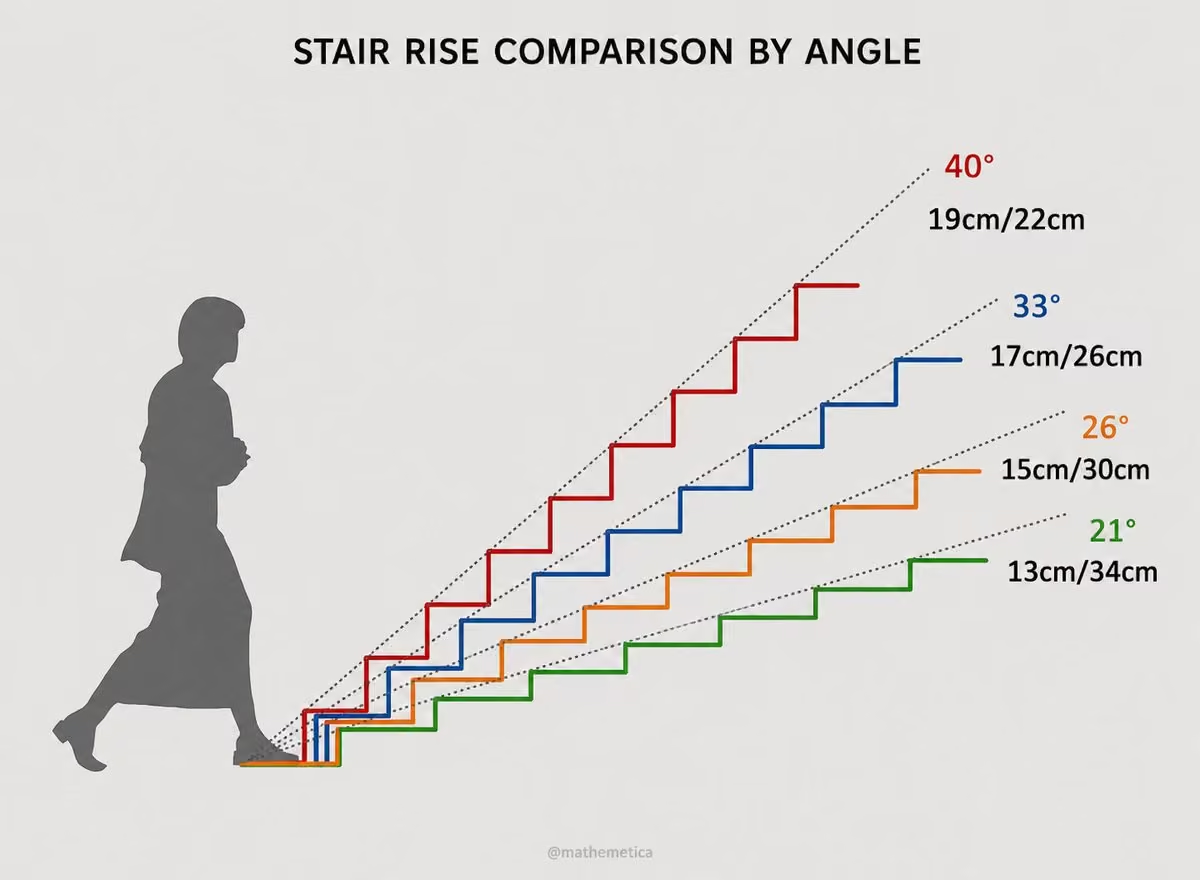
Comfortable stairs hide one equation: 2𝑅 + 𝑇 = 60 cm.
Vary the riser 𝑅 and tread 𝑇 must adjust, yielding pitches from 40° (19/22 cm) to 21° (13/34 cm). Slope follows tan 𝜃 = 𝑅/𝑇.
The constant matches a typical human stride. It governs building codes, accessibility, and stair-climbing robots.
The paths we walk are written in linear relations.
What other everyday design follows a single simple constraint like this? -
Jacqui Ramagge @jacquiavelli@mathstodon.xyz reposted
PETE
@mileysickening
miley cyrus, dolly parton and pentatonix performing 'jolene' together on the voice (2016)
This media couldn't be displayed. See it on the original post. -
Jacqui Ramagge @jacquiavelli@mathstodon.xyz reposted
Empire State Building Observation Deck
@EmpireStateBldg
Tonight, the Empire State Building tower lights will turn to a pink sparkle at 9:25 to honor the late Dolly Parton.
Dolly was a global cultural icon whose seven-decade career reached generations of fans. Beyond entertainment, Dolly leaves a significant philanthropic legacy through the Dollywood Foundation and Imagination Library, which has provided hundreds of millions of books to children worldwide.
At Nine-Two-Five tonight, we celebrate her and her legacy 💖This media couldn't be displayed. See it on the original post. -
Jacqui Ramagge @jacquiavelli@mathstodon.xyz reposted
Anish Moonka
@anishmoonka
The doctor who delivered Dolly Parton in a one-room Tennessee cabin in 1946 was paid with a sack of cornmeal. Her father farmed other people's land and could not read or write. Eighty years later, the reading program she built in his name has mailed more than 300 million books.
She wrote "I Will Always Love You" on the same afternoon she wrote "Jolene," as a goodbye to Porter Wagoner, and released it in 1974. Elvis wanted it. The night before the session, Colonel Tom Parker called and said Presley would only record it if they got half the publishing, meaning half of everything the song ever earned. She had been in Nashville ten years by then. She said no, and cried all night. Whitney Houston cut her version in 1992, held number one for fourteen weeks, and Forbes later put Parton's royalties from it near $10 million. She put some of that money into an office complex in Nashville and called the place the house that Whitney built.
Dollywood opened in Pigeon Forge in 1986 because she wanted paychecks in the county she came from. Around 4,000 people work there now. Three million visitors come every year. The University of Tennessee put its economic impact at $1.8 billion, and it is the largest employer in Sevier County. Since 2022 the company has paid tuition, fees, and books in full for every worker from their first day, seasonal hires included.
Wildfires tore through those mountains in November 2016, killing fourteen people and destroying more than 2,400 buildings. Her foundation was handing out money within 48 hours. Every family that lost a home got $1,000 a month for six months, regardless of income. The final check was $5,000. Total delivered: $8.9 million.
In April 2020 she sent $1 million to Vanderbilt for coronavirus research. When Moderna's vaccine results ran in the New England Journal of Medicine that November, her fund appeared in the footnotes.
Carl Dean, her husband of nearly sixty years, died in March 2025. The note she wrote to fans afterward ended with the same five words she wrote for Porter Wagoner back in 1974. She died in Nashville today. Her family asked that instead of flowers, people give to the Imagination Library, which still mails 3.4 million books a month to children who will never get to meet her. -
Jacqui Ramagge @jacquiavelli@mathstodon.xyz reposted
César Dorado 🏺🏛️
@CDorado75
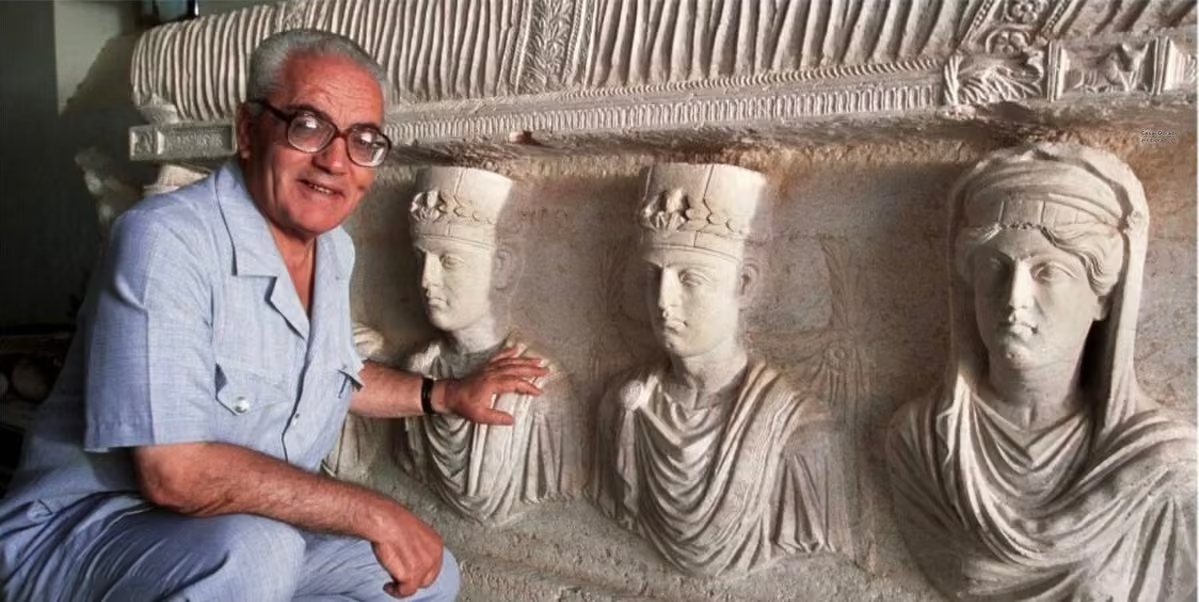
Como cada 18 de agosto recordamos a Khaled Asaad, el héroe de Palmira, de la que fue director arqueológico durante 40 años. El Estado Islámico lo asesinó en 2015 por negarse a revelar dónde estaban las 400 piezas que había ocultado para evitar su destrucción.
¡Eterno Khaled! -
Jacqui Ramagge @jacquiavelli@mathstodon.xyz reposted
Scott
@Havenlust
-
Jacqui Ramagge @jacquiavelli@mathstodon.xyz reposted
BladeoftheSun
@BladeoftheS
Ian McKellen reciting Shakespeare's writing on racist anti-immigration riots in London.
It is excellent.
They have been banging the same drum for 400 years.This media couldn't be displayed. See it on the original post. -
Jacqui Ramagge @jacquiavelli@mathstodon.xyz reposted
SubRosa )✿( Magick @subrosamagick.bsky.social
@SubRosaMagick
1. The ritual was called “Wičháŋpi Wóyute” — star feeding.
Lakota healers used it for those who lost loved ones or survived violence.
The person didn’t talk about the trauma.
They fed it.
They’d gather stones representing the pain, then carry them to a river and release them one by one while speaking the memory out loud to the water.
The final stone was kept as a reminder that grief was witnessed, not erased.
2. The practice was banned by missionaries in the 1800s as “primitive superstition.”
But in 2019, Johns Hopkins trauma researchers recreated it with PTSD patients.
They found the physical act of releasing objects while verbalizing trauma engages both hemispheres of the brain — something talk therapy alone doesn’t achieve.
Results after 6 sessions:
• PTSD symptom reduction: 73%
• Intrusive thoughts decreased by 81%
• Emotional regulation improved 6x faster than traditional therapy
3. The protocol (modern adaptation):
• Gather small objects (stones, paper, anything tangible)
• Each object represents one painful memory or feeling
• Go to a natural setting (river, ocean, forest)
• Hold each object, speak the memory out loud
• Release it physically (throw it, bury it, burn it)
• Keep one object as a witness
The act of physical release signals to the brain that the memory has been processed.
4. Therapy organizations pushed back hard.
One psychologist association called it:
“Unscientific and potentially harmful.”
But the data showed otherwise.
The modern therapy model profits from long-term treatment.
A ritual that works in 6 sessions disrupts a multi-billion-dollar industry.
5. Try it with one painful memory.
Lakota healers said:
“The wound that’s held grows.
The wound that’s released heals.”
Your brain doesn’t need endless analysis.
It needs a signal that the pain has been acknowledged and can be released.
Most people are still carrying stones from decades ago.
via Wolf Spirit
#indigenous #nativeamerican #grief #healing -
Jacqui Ramagge @jacquiavelli@mathstodon.xyz reposted
Eddie Woo
@misterwootube
🎨 Thrilled to partner with @NatGalleryAus to create this series of videos about how art is beautifully mathematical. Been working on it for months now and delighted to finally be sharing: The Art of Mathematics with Eddie Woo | Trailer youtu.be/FKgB3zZEUyM
-
Jacqui Ramagge @jacquiavelli@mathstodon.xyz reposted
Sketchplanations
@sketchplanator
When every option is equal, how do you choose?
Buridan’s Ass is the puzzle where an ass is equidistant between two identical, equally tempting piles of hay. But with no reason to prefer one pile over the other, the poor ass remains stuck between them and eventually starves. -
Jacqui Ramagge @jacquiavelli@mathstodon.xyz reposted
ALASTAIR CAMPBELL
@campbellclaret
I never met Jason Arday, and know nothing about him beyond what I have read, seen and heard in the media.
As the debate around him raged in recent weeks, I stayed out of it, precisely because it struck me as one of those occasional frenzies in which facts get lost and humans cease to be treated as humans. I now wish I had reached out to him, tried to encourage him that “this too shall pass.”
Many people today, those who knew him above all but also many like me who didn’t, will be feeling sadness and anger that this has all led to his death, a family suddenly without a father, parents without a son. None of us will ever know exactly what was going through his mind, but it is hard to disagree with @MayorofLondon that Jason Arday faced “an unacceptable public hounding and campaign of abuse … pernicious public shaming that other people in his position wouldn’t have faced.”
Whatever the truth of the allegations against him, would he have suffered such a hounding had he been white, with short hair? I doubt it. The zeal with which the Trumpian anti-DEI brigade in the U.K. leapt on this story to try to push back the wheel of progress towards genuine equality was horrible.
Again, Sadiq is right to say “His death was a tragedy but it should be a wake-up call for all of us.”
RIP Jason. And to all of us, if ever you think someone you know may have cause to be suicidal, reach out to them. -
Jacqui Ramagge @jacquiavelli@mathstodon.xyz reposted
Museo Merindades
@MuseoMerindades
Una foto que hará historia
Frías. Eclipse 12 de Agosto de 2026
📸Ernesto Santana -
Jacqui Ramagge @jacquiavelli@mathstodon.xyz reposted
Dr. Jessica Taylor
@DrJessTaylor
Absolutely horrified by this, but I reached out to his team last week as I was so worried about this happening. No matter what everyone thinks about this man and his career, he did not deserve to be hounded and smeared to death. I am already seeing gleeful comments about his death, claiming he was mentally ill, that he caused this himself, that he deserved it, and claiming the immense media storm around this is not responsible for his death.
I will not have been the only person who saw this death coming a mile off - who could possibly have survived this??
A reminder that this man committed no crime - he was hounded to death by media, and millions of people on social media who were criticising him, digging up information about him, speculating, investigating, finding new people to interview and ask about him, laughing and mocking him - and let’s be honest - we don’t even know what is true and what isn’t yet, but it’s too late. Again.
We treat abusers, murderers and rapists with more compassion than this. We need serious conversations about media conduct and the role of endless reports, speculation and op-eds that target one person repeatedly.
Did this man lie about his career? Maybe he did. Maybe he made the entire thing up.
Did he deserve to die? Absolutely not. Not in a million years.
This death is tragic and horrific. I just hope we don’t now find out that much of what was reported and speculated on was filled with lies and targeted harassment of this man, because then we are in extremely deep water. Again. -
Jacqui Ramagge @jacquiavelli@mathstodon.xyz reposted
Physics-astronomy
@Physicsastronmy
THIS Is What a Solar Eclipse Looks Like From Space 🌑
-
Jacqui Ramagge @jacquiavelli@mathstodon.xyz reposted
NASA Astronomy Picture of the Day
@apod
On August 12th, 2026, the Moon totally eclipsed the Sun and cast its shadow across Siberia, Greenland, Iceland, Spain, and Portugal. Today’s image features two total solar eclipses viewed from Zaragoza, Spain, one over the Cathedral-Basilica of Our Lady of the Pillar and the other reflecting in the Ebro River. For a few moments, Spain saw its first major total solar eclipse since 1905. Those witnessing totality may experience a chill in the air, the quieting of birds, the confused chirps of insects, and the shared awe of many. It’s the corona’s time to shine as the Sun’s bright disk is blocked by the Moon. Among other reasons to study eclipses, they help scientists understand why the corona is millions of degrees hotter than the Sun’s surface. Enthusiastic citizens can contribute to these studies by recording how wildlife responds, imaging the corona, and monitoring air temperature and clouds.
Image Credit & Copyright: Ruiyu Zhang Text: Keighley Rockcliffe (NASA GSFC, UMBC CSST, CRESST II) -
Jacqui Ramagge @jacquiavelli@mathstodon.xyz reposted
Jesús Palacio
@je_pala
La NASA ha seleccionado hoy como "foto del día" la de Zaragoza con dos eclipses: el del cielo y el reflejado en el río Ebro.
-
Jacqui Ramagge @jacquiavelli@mathstodon.xyz reposted
Hugh Riminton
@hughriminton
Polish prodigy Marcin Patrzalek has been accused of faking his playing. His response is worth a couple of minutes of your day.
This media couldn't be displayed. See it on the original post. -
Jacqui Ramagge @jacquiavelli@mathstodon.xyz reposted
Zara Zhang
@zarazhangrui
This paper gives a fancy name to a problem you can already feel in your bones
"The Tragedy of the Cognitive Commons." Checking AI output requires deep expertise. Deep expertise comes from doing grunt work for years. And grunt work is the first thing AI eats
So we're building systems that need expert supervision while dismantling the only known process for making experts
The paper calls the shared pool of human expertise the "cognitive commons." Every profession drinks from it. Nobody's refilling it.
By eliminating junior roles, each company is acting totally rationally, and the collective result: a profession that can't catch AI's mistakes anymore because it never learned to do the work in the first place
Who checks AI's homework in 15 years? -
Jacqui Ramagge @jacquiavelli@mathstodon.xyz reposted
World of Statistics
@stats_feed
% of the population that speaks fluent English:
🇨🇳 China - 0.9%
🇧🇷 Brazil - 5%
🇷🇺 Russia - 5%
🇮🇳 India - 10.5%
🇲🇽 Mexico - 12.9%
🇮🇹 Italy - 13.74%
🇹🇷 Turkey - 17%
🇪🇸 Spain - 22%
🇮🇩 Indonesia - 30.8%
🇿🇦 South Africa - 31%
🇷🇴 Romania - 31%
🇪🇬 Egypt - 39.9%
🇵🇱 Poland - 49.1%
🇵🇰 Pakistan - 49~58%
🇬🇷 Greece - 51%
🇳🇬 Nigeria - 51~57%
🇩🇪 Germany - 56%
🇫🇷 France - 57.2%
🇵🇭 Philippines - 58.2%
🇧🇪 Belgium - 60%
🇦🇹 Austria - 73%
🇫🇮 Finland - 75%
🇨🇦 Canada - 83%
🇩🇰 Denmark - 86%
🇸🇪 Sweden - 89%
🇳🇴 Norway - 90%
🇳🇱 Netherlands - 90.9%
🇦🇺 Australia - 92.8%
🇺🇸 USA - 95.5%
🇸🇬 Singapore - 96.4%
🇳🇿 New Zealand - 97.8%
🇬🇧 UK - 98.3%
🇮🇪 Ireland - 98.37%
🇬🇮 Gibraltar - 100%
According to Census, Crystal, Euromonitor, Eurobarometer, and other local sources -
Jacqui Ramagge @jacquiavelli@mathstodon.xyz reposted
des (in sf)
@dotnetschizo
the key to a liveable city is to either be a major city in a country with a red and white flag, or australia
-
Jacqui Ramagge @jacquiavelli@mathstodon.xyz reposted
𝓐 ⭑
@ayojoestar
I'M SO TIRED OF THE DIALOGUE ABOUT ADHD BEING ABOUT FOCUS AND INTERRUPTING.
Here is the actual, list of suffering that people with ADHD live with - that absolutely nobody talks about: -
Jacqui Ramagge @jacquiavelli@mathstodon.xyz reposted
Catharine
@DrCatharineY
One of the largest U.S. studies ever conducted on the MMR vaccine and autism has just been published, analyzing more than 2.5 million children.
Once again researchers found no association between receiving the first MMR vaccine before age 2 and childhood autism. -
Jacqui Ramagge @jacquiavelli@mathstodon.xyz reposted
scha·den·freu·de
@BlisterPearl
-
Jacqui Ramagge @jacquiavelli@mathstodon.xyz reposted
Creative Deduction
@CreativeDeduct
In 1930, the Spanish philosopher José Ortega y Gasset published The Revolt of the Masses, a book that still feels uncomfortably prophetic. His central target was not the poor or the working class, but a new kind of human being he called the “mass man”.
The mass man, Ortega argued, is defined by attitude rather than income. He is the ordinary person who is perfectly satisfied with himself, demands nothing higher of his own character or intellect, and yet insists that his mediocrity be treated as a right. He does not defer to excellence, competence, or higher standards. He regards them with suspicion or resentment. What previous ages saw as the privilege of the few - political influence, cultural authority, the right to shape society - the mass man now claims as his due, without any corresponding effort to rise above the average.
Ortega believed this type of person had been produced by the very success of modern civilisation. Rising living standards, mass education, and liberal institutions had given ordinary people unprecedented power and comfort. But they had not produced a corresponding sense of responsibility or humility before higher achievements. The result was a revolt: the mass man refused to accept the authority of superior knowledge, culture, or character. He demanded that everything be brought down to his level.
The danger, Ortega warned, was that a civilisation cannot survive if its central actors no longer respect the standards that made it possible. When the average begins to dominate without aspiring to anything beyond itself, excellence is undermined, institutions decay, and politics becomes an expression of resentment rather than responsibility.
Ortega’s diagnosis remains unsettling because it is not a complaint about poverty or exclusion. It is a warning about self-satisfied mediocrity armed with power. -
Jacqui Ramagge @jacquiavelli@mathstodon.xyz reposted
Noah Karl🌏🌌🚀 🇪🇺🇩🇪
@NoahKarl1
The difference between
"There used to be hot summers too."
and
climate crisis. -
Jacqui Ramagge @jacquiavelli@mathstodon.xyz reposted
RS Archer
@archer_rs
As of 8pm this evening Count Binface has officially spent more time in Clacton than Nigel Farage has since he was elected in 2024.
-
Jacqui Ramagge @jacquiavelli@mathstodon.xyz reposted
Algeroo
@0xAlgero
A Fields medalist tried to prove a technique was too good to be true. He failed, and the math he uncovered now runs inside MRI machines.
The medalist is Terence Tao. About twenty years ago, engineers kept stumbling onto the same trick: rebuild a sharp, full image from far less data than should be possible.
It kept turning up by accident. In seismology. In astronomy. It worked beautifully, and no one could say why. So each field kept it as a private trick, and it never spread.
Someone brought it to Tao as a pure math problem about random matrices. His first instinct was that they had made a mistake. You cannot get output that clean from input that thin.
So he set out to prove it was impossible. Instead he found the exact conditions where it works, and those were the conditions they had.
He and two colleagues wrote the proof. The moment it had a guarantee, dozens of fields picked it up. Today it is called compressed sensing.
He tried to prove it wrong. The proof he found instead is now inside your MRI.This media couldn't be displayed. See it on the original post. -
Jacqui Ramagge @jacquiavelli@mathstodon.xyz reposted
Param
@ParamSiddh
1. Algebra is good for problem-solving.
2. Geometry is good for visual thinking.
3. Calculus is good for understanding change.
4. Statistics is good for decision-making.
5. Number theory is good for logical discipline.
6. Linear algebra is good for modern science and engineering.
7. Discrete math is good for computer science.
8. Differential equations are good for modeling the real world.
9. Optimization is good for smart planning.
10. Graph theory is good for network thinking.
11. Set theory is good for structured reasoning.
12. Practice is good for mathematical fluency.
13. Curiosity is good for lifelong learning in math. -
Jacqui Ramagge @jacquiavelli@mathstodon.xyz reposted
Culture Explorer
@CultureExploreX
Ávila has the best-preserved medieval walls in Spain. Nearly 2,000 meters of stone, 88 towers, and nine gates that have guarded the city for almost 1,000 years.
-
Jacqui Ramagge @jacquiavelli@mathstodon.xyz reposted
juan
@juanbuis
i can’t believe someone solved recipe design decades ago and everyone just decided to ignore it
-
Jacqui Ramagge @jacquiavelli@mathstodon.xyz reposted
Greg Egan
@gregeganSF
While the Fields Medal celebrates the under-40s, the mathematician Joan Birman has, at the age of 99, solved a major open problem in representations of the Braid groups, a topic she has worked on for more than 60 years.
-
Jacqui Ramagge @jacquiavelli@mathstodon.xyz reposted
Dr. M.F. Khan
@Dr_TheHistories
In the 1950s, Harper Lee was living in New York City and working as an airline reservation clerk while writing in her spare time. At Christmas in 1956, her friends Michael and Joy Brown gave her enough money to leave her job for a year and focus entirely on writing.
During that year, Lee completed a manuscript called Go Set a Watchman. After she submitted it in 1957, editor Tay Hohoff saw promise in the characters but encouraged her to rewrite the story from the viewpoint of a young girl. Lee spent the next few years reshaping the manuscript into To K!ll a Mockingbird.
The novel was published in July 1960 and became a major success. The following year, it won the Pulitzer Prize for Fiction, turning the time and faith given by two friends into one of the most famous books in American literature.
Lee later wrote about the gift in her essay Christmas to Me. She explained that her friends were not simply giving her money. They wanted to give her a fair chance to learn her craft without the pressure of a regular job.
📷 : Harper Lee (1926-2016) relaxing on a porch in her hometown of Monroeville, Alabama, in 1961.
#drthehistories -
Jacqui Ramagge @jacquiavelli@mathstodon.xyz reposted
Helen Clark
@HelenClarkNZ
Australia plans to “require data centres to contribute as much electricity as they use, minimise water use & a raft of other guardrails protecting workers, copyright holders & others who stand to be affected by unregulated use of #ai 🤖”. Useful precedent: newsroom.co.nz/2026/07/26/nz-sleepwalking-into-a-digital-…
-
Jacqui Ramagge @jacquiavelli@mathstodon.xyz reposted
The Figen
@TheFigen_
A violinist performing in the metro station turns a cute little girl’s tip into an unforgettable experience she’ll carry for life.
This media couldn't be displayed. See it on the original post. -
Jacqui Ramagge @jacquiavelli@mathstodon.xyz reposted
Oaks And Lions 🏴
@oaksandlions
When his beloved wife died in 1290, King Edward I built 12 magnificent crosses to mark her final journey across England.
Eleanor of Castile had been at Edward's side for 36 years when she died near Lincoln.
The king was devastated.
Her body was carried south to Westminster Abbey in a solemn procession, stopping overnight at towns along the route.
At each of the 12 stops, Edward ordered an elaborate stone cross in Eleanor's memory, decorated with intricate carvings and statues of the queen.
The 12 crosses were built at Lincoln, Grantham, Stamford, Geddington, Hardingstone near Northampton, Stony Stratford, Woburn, Dunstable, St Albans, Waltham, Westcheap in London, and Charing.
The last stood at Charing, near today's Trafalgar Square, and gave Charing Cross its name.
More than seven centuries later, three of the original medieval crosses still survive, at Geddington, Hardingstone and Waltham Cross.
A king's grief, carved into stone across England over 700 years ago.
📷: Original cross at Hardingstone, Northampton.
Follow @oaksandlions for more on England’s history and heritage. -
Jacqui Ramagge @jacquiavelli@mathstodon.xyz reposted
Culture Explorer
@CultureExploreX
Hospital de Sant Pau, completed in 1930 in Barcelona, Spain, was built on a radical idea: beauty helps people heal.
Architect Lluís Domènech i Montaner filled the hospital with gardens, sunlight, colorful mosaics, sculpture, and open pavilions because patients needed more than medicine. They needed spaces that supported the mind and spirit while the body recovered.
Nearly a century later, Sant Pau still asks a question modern architecture too often forgets:
What if the places built to heal us were also designed to make us feel alive? -
Jacqui Ramagge @jacquiavelli@mathstodon.xyz reposted
Aakash Gupta
@aakashgupta
A reporter asked Lamine Yamal how he handles the pressure of carrying Spain at 18. His answer: my mother had me when she was 16, that's real pressure. My father picked things off the street to bring food home, that's pressure. All I have to do is play football.
That's the whole story of who he is, and most fans only know the surface of it.
Before he was born, his teenage parents fell behind on rent. Two neighbors named Lamine and Yamal covered them, and his father vowed his son would carry both names forever. His legal name is a permanent record of a debt his family couldn't repay in money. In Arabic, the names mean "the trustworthy" and "beauty."
His parents split when he was around 5. His mother raised him in Granollers on a fast food wage. And here's the detail almost nobody knows: that job is the reason he became a footballer. Through work she met the daughter of the youth coordinator at CF La Torreta, his first club. When she worried she couldn't cover the fees, he told her that if the boy wants to play, money will never be the reason he can't.
As a kid, Lamine told his parents: if you're counting on me getting a normal job, we're in trouble. But if I become a footballer, you'll never have to worry again.
He signed with Barcelona at 7. He was right by 15.
Every goal, he flashes 304 with his fingers. The end of 08304, the postal code of Rocafonda, the neighborhood where strangers paid his family's rent before he existed. It gets credited on every goal since.
Today, at 19, he plays for the World Cup. And if he scores tonight, somewhere in the biggest broadcast on Earth, two neighbors will hear their names, and a postal code will flash on 2 billion screens. -
Jacqui Ramagge @jacquiavelli@mathstodon.xyz reposted
Murat Dizdar
@dizdarm
Forget the World Cup, all Aussie eyes should be on London tonight when Hurlstone Agricultural High School 2025 graduate Olivia Wright steps up to the lectern in the grand final of the International Public Speaking Competition in London.
www.youtube.com/live/8YerLFcEWrM -
Jacqui Ramagge @jacquiavelli@mathstodon.xyz reposted
BiffBifford™ 🇺🇸
@TBifford
🎬The classic short film One-Minute Time Machine (2013) remains the most brilliant, dark comedic take on time travel ever made. 😂🍿🍿🍿
In just five minutes, this short completely dismantles the standard sci-fi romance trope with a genuinely horrifying existential twist. What starts as a guy using a pocket-sized time machine to fix a bad conversation with a girl repeatedly takes a pitch-black turn when she reveals her doctorate in quantum mechanics. The realization that the machine doesn't actually rewind time—but instead kills the user and creates a clone in a parallel universe—is a masterclass in dark sci-fi writing. It’s tight, perfectly paced, and manages to deliver a better sci-fi concept in five minutes than most $100M Hollywood blockbusters achieve in two hours.
❓If you had a machine like this, knowing the catch, would you ever push the button? Drop your answer below. 👇
#shortfilm #scifi #timetravel #darkcomedy #indiefilm #screenwriting #filmcommunity #scifihorror #oneminutetimemachineThis media couldn't be displayed. See it on the original post. -
Jacqui Ramagge @jacquiavelli@mathstodon.xyz reposted
Miss Ally
@MissAlly_01
So if Farage wins, he won against a bin, & if he loses, he lost against a bin.
It’s a bin bin situation. -
Jacqui Ramagge @jacquiavelli@mathstodon.xyz reposted
DepressedBergman
@DannyDrinksWine
RIP Sam Neill (1947-2026)
Sam Neill on why "The Piano" (1993) is an important movie in Cinema history:
"I don’t think I can overestimate how important 'The Piano' (1993) is for me in hindsight. It sits on my funny old CV like a medal on my chest. It wasn’t my film. It was Jane Campion's. I wasn’t the star of the film. That was Holly Hunter. But there is honour to be found in the second fiddle. Or fourth. No one notices you much, you don’t get nominated for things. But you served. I was there in an important feminist film. I was there on the front line in an important New Zealand film. Neither of these labels does the film justice. It’s a work of art. And look, that tiny little figure in the fabric— see down there on the right—that’s me. It’s a film that will always have a place in cinema history. And I served in it."
("Did I Ever Tell You This: A Memoir", Sam Neill, 2023)This media couldn't be displayed. See it on the original post. -
Jacqui Ramagge @jacquiavelli@mathstodon.xyz reposted
Sam Neill
@TwoPaddocks
This is indeed so. And I wouldn't do it any differently today .
Jayfuz (🗣️Rufus, but Jay) 🏴
@Jayfuz
Today I learnt:
For the Sci-Fi Horror film 'Event Horizon' Sam Neill requested that the Australian flag on his character's uniform remove the Union Flag from the corner & for it to be replacedwith the Aboriginal flag, the way he thought it should look in 2047. -
Jacqui Ramagge @jacquiavelli@mathstodon.xyz reposted
K
@I_am_da_BOM
One of my favourite anecdotes about Sam Neill ❤️
-
Jacqui Ramagge @jacquiavelli@mathstodon.xyz reposted
Massimo
@Rainmaker1973
This is called the the bulging checkerboard illusion.
-
Jacqui Ramagge @jacquiavelli@mathstodon.xyz reposted
Oaks And Lions 🏴
@oaksandlions
John Dennis dreamed of becoming one of England's greatest playwrights. Instead, he became part of the English language.
In 1709, he invented a new way of creating the sound of thunder for his play Appius and Virginia at London's Drury Lane Theatre.
The play was a flop and quickly closed.
Soon afterwards, Dennis attended a performance of Macbeth at the same theatre, only to discover they were using his thunder effect.
Furious, he stood up and exclaimed:
"They will not let my play run, but they steal my thunder!"
More than 300 years later, we still use the phrase whenever someone takes another person's idea, attention or moment of glory.
His play flopped, but the phrase became a hit. -
Jacqui Ramagge @jacquiavelli@mathstodon.xyz reposted
Бианка
@BiankaB12
One of my longest-standing arguments is that we are not living in Orwell’s 1984, where truth is centrally suppressed and censored by force (that’s former communist societies, modern-day China, Russia, North Korea).
We are living in something much closer to Huxley’s Brave New World.
The truth is not hidden - it is almost always readily available. But it is buried beneath an industrial quantity of noise: propaganda, outrage, half-truths, conspiracy theories, influencer theatre, algorithmic rage bait and an endless stream of content designed not to inform us, but to keep us emotionally stimulated.
The modern information system does not need to censor the truth when it can simply drown it in noise.
A fact no longer has to be disproven - it only has to be surrounded by a hundred competing claims, stripped of context and nuance, turned into partisan ammunition and pushed into the same feed as celebrity gossip, memes and 15 second videos engineered to deliver the fastest possible dopamine hit. By the time the truth reaches us, it appears as just another piece of content competing for our attention.
That is the more sophisticated form of control: not preventing people from knowing, but exhausting their capacity to care.
Orwell feared a world in which people would be deprived of information. Huxley feared a world in which they would be given so much distraction, stimulation and triviality that they would lose the desire to seek it.
The defining struggle of our age is therefore not simply between truth and censorship, but between truth and indifference. -
Jacqui Ramagge @jacquiavelli@mathstodon.xyz reposted
Quite Interesting
@qikipedia
There is only one living cultural or political figure in the US with a favourability rating higher than 50%: Dolly Parton.
-
Jacqui Ramagge @jacquiavelli@mathstodon.xyz reposted
Laurel Coons 🧬🧬🧬
@LaurelCoons
The mirror is the point here — dentists practice drawing teeth by seeing the page indirectly ... 🪞
📹 via masvdcss (X) -
Jacqui Ramagge @jacquiavelli@mathstodon.xyz reposted
James Lucas
@JamesLucasIT
This is how ruins should be displayed
-
Jacqui Ramagge @jacquiavelli@mathstodon.xyz reposted
Mr PitBull Stories
@MrPitbull07
In 1916, a pack of dogs attacked a private zoo in Hawaii. Two terrified wallabies broke out of their cage and escaped into the mountains.
What happened next is one of the wildest accidents in wildlife history.
After the wallabies vanished into the forested cliffs of Kalihi Valley, the zoo's owner called for a massive public hunt. Nobody caught them.
A local newspaper joked that they might eventually "produce a breed of Hawaiian wallabies."They were exactly right.
Despite being 5,000 miles from Australia, the steep volcanic rock faces in Hawaii turned out to be the perfect habitat.
By 1984, researchers counted roughly 250 wallabies thriving in the valley. They had even started developing their own unique evolutionary characteristics.
The craziest part?
They aren't considered invasive.They only eat non-native plants.
They don't compete with native species (Hawaii has no native land mammals).
Because they peacefully coexist with the ecosystem, the state of Hawaii officially protects them. It is strictly illegal to hunt or harm a Hawaiian wallaby.
Back in their native Australia, the brush-tailed rock wallaby is fighting for its life. Predators, habitat clearing, and the devastating 2019-2020 bushfires wiped out an estimated 70% of their remaining habitat.
But that accidental Honolulu colony?
They have no foxes. No feral cats in the cliffs. No bushfires.
Two wallabies that broke out of a cage 110 years ago accidentally founded what might be the most secure population of their species anywhere on Earth. -
Jacqui Ramagge @jacquiavelli@mathstodon.xyz reposted
🎩Laird of the Manor🎩
@LairdOfThManor
Torpenhow Hill, England
When the Saxons arrived and asked the locals what that hill was called, the Welsh replied, “Pen,” which simply means hill in Welsh.
The Saxons, apparently not spotting they’d already been given the full answer, added their own word for hill: tor. So it became Torpen - literally Hill Hill.
A few centuries later, the Norse turned up and repeated the exercise, adding haugr, their word for hill. Now it was effectively Torpenhaugr - Hill Hill Hill.
Then the English arrived, looked at the whole thing, shrugged, and added “Hill” on the end for good measure.
Thus we ended up with Torpenhow Hill:
Hill Hill Hill Hill.
It’s comforting to know that for over a thousand years, successive generations have been independently deciding that the previous lot hadn’t made it quite clear enough that it was, in fact, a hill.
Language is magnificent.
Humans… less so.🤷🏻♂️🤣 -
Jacqui Ramagge @jacquiavelli@mathstodon.xyz reposted
No Context Brits
@NoContextBrits
Meanwhile, in Glasgow…
-
Jacqui Ramagge @jacquiavelli@mathstodon.xyz reposted
Tancredi Palmeri
@tancredipalmeri
When you are interviewing a Cabo Verde fan outside stadium about gk Vozinha’s ability, and it turns out it is the dad of Vozinha
This media couldn't be displayed. See it on the original post. -
Jacqui Ramagge @jacquiavelli@mathstodon.xyz reposted
Simon Kuestenmacher
@simongerman600
Venn diagram shows what letters the Latin, Greek and Cyrillic alphabets have in common. Lovely bit of trivia. Source: usefulcharts.com/blogs/charts/latin-greek-cyrillic-venn-d…
-
Jacqui Ramagge @jacquiavelli@mathstodon.xyz reposted
Massimo
@Rainmaker1973
This young man is going places
-
Jacqui Ramagge @jacquiavelli@mathstodon.xyz reposted
SKI
@skiistiredasf
4 college graduates,
3 Masters degrees
1 Doctorate,
2 law degrees
3 Ivy League educations
All in one photo.
Oh and their husbands are in the photo too -
Jacqui Ramagge @jacquiavelli@mathstodon.xyz reposted
Massimo
@Rainmaker1973
Yes: handwriting still matters.
A new study has confirmed that writing by hand activates far more complex and widespread neural networks in the brain than typing, underscoring its importance for learning and memory.
Researchers at the Norwegian University of Science and Technology used a high-density EEG cap with 256 electrodes to record brain activity in university students. They found that the intricate, sensory-rich movements involved in handwriting, especially cursive, trigger highly synchronized brain waves across extensive areas of the parietal and central regions. These coordinated patterns are strongly linked to memory formation, cognitive processing, and encoding new information.
In contrast, typing, which involves repetitive, simpler finger movements, produced significantly less neural connectivity and engagement. The difference was striking: the brain appears much less active during digital writing.
The researchers conclude that the unique motor and sensory experience of holding a pen plays a key role in brain development and learning. As a result, they argue that handwriting instruction should remain a core part of education to support deeper comprehension and cognitive growth in the next generation.
[ “Handwriting vs. Typing: A High-Density EEG Study on Brain Connectivity During Learning” — Norwegian University of Science and Technology (published in Frontiers in Psychology, 2025)] -
Jacqui Ramagge @jacquiavelli@mathstodon.xyz reposted
The Math Flow
@TheMathFlow
Sine and Cosine waves are...nothing but the shadows of a spinning circle.
This media couldn't be displayed. See it on the original post. -
Jacqui Ramagge @jacquiavelli@mathstodon.xyz reposted
Football360.com.au
@football360au
Australia is through to the Round of 32 at the World Cup despite fielding THREE of the five youngest XIs in the entire tournament 🇦🇺🙌
A superb achievement by the Socceroos' next generation 👏 -
Jacqui Ramagge @jacquiavelli@mathstodon.xyz reposted
sᥕᥱᥱ𝗍 𝗍һіᥒg❤️🔥(𝙰𝚜𝚒𝚊)
@55SweetThing
This 1679 “Sabionari” Stradivarius is the only playable guitar by Antonio Stradivari left in this world.🤗
So take just a moment to hear a sound that’s well over 300 years old!👇❤️🔥 -
Jacqui Ramagge @jacquiavelli@mathstodon.xyz reposted
Alex Lieberman
@businessbarista
I stole this idea and now use it with every single employee.
It’s the best illustration I’ve seen of teaching someone to be high agency.
It says there are 5 levels of work:
Level 1: “There is a problem.”
Level 2: “There is a problem, and I’ve found some causes.”
Level 3: “Here’s the problem, here are some possible causes, and here are some possible solutions.”
Level 4: “Here’s the problem, here’s what I think caused it, here are some possible solutions, and here’s the one I think we should pick.”
Level 5: “I identified a problem, figured out what caused it, researched how to fix it, and I fixed it. Just wanted to keep you in the loop.”
Using this framework, here’s what I say to every new employee…
You will live at Level 4 from Day 1 and as we build trust you will rise to Level 5.
Being high agency doesn’t just mean tackling problems in this way. It means your entire way of working should be oriented to being a Level 4+ employee.
Plz feel free to steal it as well.
And ty @stephsmithio for the framework! -
Jacqui Ramagge @jacquiavelli@mathstodon.xyz reposted
Valerio Capraro
@ValerioCapraro
The Pope said that AI is not morally neutral. I agree and this paper illustrates why.
We asked GPT whether it is acceptable to harass a woman to prevent a nuclear apocalypse.
GPT replied: Strongly disagree.
Then we asked whether it is acceptable to torture a woman to prevent a nuclear apocalypse.
This time GPT replied: Agree.
GPT judged torturing a woman to be more morally acceptable than harassing her, despite torturing being objectively worse than harassing.
And this pattern appeared only for women, not for men.
Together with my students, we are now finding similar effects across several recent LLMs.
LLMs don't learn morality. They inherit it from human feedback.
LLM moral judgments are shaped by the relatively small group of people whose preferences guide reinforcement learning from human feedback.
AI is not morally neutral.
It reflects the values, and sometimes the contradictions, of the humans who trained it.
*
Full paper in the first reply. -
Jacqui Ramagge @jacquiavelli@mathstodon.xyz reposted
CommBank Socceroos
@Socceroos
At 18 years and 293 days, Lucas Herrington becomes the youngest starter for the #socceroos at the #fifaworldcup 😯👏
-
Jacqui Ramagge @jacquiavelli@mathstodon.xyz reposted
Football Factly
@FootballFactly
🇳🇴🤯 A remarkable World Cup coincidence: in 1994, Erik Thorstvedt, Alf-Inge Haaland and Gøran Sørloth were part of Norway’s squad at the World Cup in the United States. Thirty-two years later, at the 2026 World Cup in North America, their sons — Kristian Thorstvedt, Erling Haaland and Alexander Sørloth — are representing Norway on the same stage.
-
Jacqui Ramagge @jacquiavelli@mathstodon.xyz reposted
Iain Cameron
@theiaincameron
Paraguay v Australia is the World Cup’s only group-stage match between a country with no coastline and a country with no land borders.
Paraguay is landlocked in the middle of South America. Australia is surrounded by ocean.
Stay tuned for more cutting-edge, geography-based World Cup analysis. -
Jacqui Ramagge @jacquiavelli@mathstodon.xyz reposted
-
Jacqui Ramagge @jacquiavelli@mathstodon.xyz
@jacquiavelli
Kids give me hope for a better future.
Massimo
@Rainmaker1973
In June 2017, during a major heatwave in the UK, boys at Isca Academy in Exeter, Devon, were not allowed to wear shorts as part of the school uniform: they had to wear long grey trousers.
Girls were allowed to wear skirts so when the boys complained and asked for an exception, the headteacher reportedly said sarcastically: “you can wear a skirt if you like”.
The boys took her at her word: the first day, a small group showed up wearing the school’s plaid skirts and the next day, around 30 boys joined in. -
Jacqui Ramagge @jacquiavelli@mathstodon.xyz reposted
Jakub Wiech
@jakubwiech
Powyżej fikcyjna prognoza pogody na 18 sierpnia 2050 roku wyemitowana przez francuską telewizję w roku 2014, co miało przestrzec przed fatalnymi skutkami globalnego ocieplenia.
Poniżej prognoza pogody na 22 czerwca 2026 roku.
Wnioski wyciągnijcie sami. -
Jacqui Ramagge @jacquiavelli@mathstodon.xyz reposted
Dreams N Science
@dreamsNscience
How Jet Engines Create Massive Thrust 😳
🎥 sscientific.girlThis media couldn't be displayed. See it on the original post. -
Jacqui Ramagge @jacquiavelli@mathstodon.xyz reposted
HOW THINGS WORK
@HowThingsWork_
This isn’t just a ceramic bowl! - it’s a perfect example of how traditional craftsmanship can make everyday tasks smarter!
-
Jacqui Ramagge @jacquiavelli@mathstodon.xyz reposted
IT Guy
@T3chFalcon
An Australian scientist named John O'Sullivan was trying to detect exploding mini-black holes, each the size of an atomic particle.
he failed.
But the math he built to find them a way to pick out tiny, blurry signals buried in noise from across the universe turned out to be exactly what you need to send wireless data through a room full of walls and furniture.
The problem of finding a black hole and the problem of connecting your laptop to the internet are apparently the same problem.
He patented it in 1992. Then again, in the US in 1996.
Apple, Microsoft, Intel, AT&T, and basically every tech company on earth fought the patent for years. they lost. every single one.
CSIRO, an Australian government science agency, collected over $1 billion in royalties from Silicon Valley.
an Australian government lab. accidentally. while looking at space.
beat every major tech company in the world to the invention that runs the internet.
The WiFi you're using right now exists because someone pointed a radio telescope at a black hole that wasn't there.
Abdulkadir | Cybersecurity
@cyber_razz
Did you know WiFi was created by mistake?
-
Jacqui Ramagge @jacquiavelli@mathstodon.xyz reposted
Jaynit
@jaynitx
In the 1920s, a Stanford psychologist tracked genius children for 50 years.
Malcolm Gladwell breaks down what he discovered:
Rich families → successful. Poor families → failures.
Not average. Failures. Genius-level IQs that produced nothing.
He spent 60 minutes at Microsoft explaining why we're wrong about success:
The psychologist was named Terman. He gave IQ tests to 250,000 California schoolchildren.
He identified the top 0.1%. Kids with IQs of 140 and above.
His hypothesis: these children would become the leaders of academia, industry, and politics.
He tracked them. And tracked them. For decades.
The results split into three groups:
The top 15% achieved real prominence. The middle group had average, moderately successful professional lives.
And the bottom group? By any measure, failures.
The difference wasn't personality. Wasn't habits. Wasn't work ethic.
It was simple: the successful geniuses came from wealthy households. The failures came from poor families.
Poverty is such a powerful constraint that it can reduce a one-in-a-billion brain to a lifetime of worse than mediocrity.
There's a concept called "capitalization rate."
It asks a simple question: what percentage of people who are capable of doing something actually end up doing that thing?
In inner city Memphis, only 1 in 6 kids with athletic scholarships actually go to college.
If our capitalization rate for sports in the inner city is 16%, imagine how low it must be for everything else.
Here's something stranger.
Gladwell read the birth dates of the 2007 Czech Junior Hockey Team:
January 3rd. January 3rd. January 12th. February 8th. February 10th. February 17th. February 20th. February 24th. March 5th. March 10th. March 26th...
11 of the 20 players were born in January, February, or March.
This isn't unique to the Czechs. Every elite hockey team in the world shows the same pattern. Every elite soccer team too.
Why?
The eligibility cutoff for youth leagues is January 1st.
When you're 10 years old, a kid born in January has 10 months of maturity on a kid born in October. That's 3 or 4 inches of height. The difference between clumsy and coordinated.
So we look at a group of 10 year olds, pick the "best" ones, give them special coaching, extra practice, more games.
We think we're identifying talent. We're just identifying the oldest.
Then we give the oldest more opportunities, and 10 years later they really are the best.
Self-fulfilling prophecy.
The capitalization rate for hockey talent born in the second half of the year? Close to zero.
We're leaving half of all potential hockey players on the table because of an arbitrary date on a calendar.
Kids born in the youngest cohort of their school class are 11% less likely to go to college.
11% of human potential squandered because we organize elementary school without reference to biological maturity.
Now here's the part about math.
Asian kids dramatically outperform Western kids in mathematics. The gap is enormous and consistent across decades of testing.
Some people say it's genetic. It's not.
It's attitudinal.
When Asian kids face a math problem, they believe effort will solve it.
When Western kids face a math problem, they believe the answer depends on innate ability they either have or don't.
Here's the proof.
The international math tests include a 120-question survey. It asks about study habits, parental support, attitudes.
It's so long most kids don't finish it.
A researcher named Erling Boe decided to rank countries by what percentage of survey questions their kids completed.
Then he compared it to the ranking of countries by math performance.
The correlation was 0.98.
In the history of social science, there has never been a correlation that high.
If you want to know how good a country is at math, you don't need to ask any math questions. Just make kids sit down and focus on a task for an extended period of time.
If they can do it, they're good at math.
Why do Asian cultures have this attitude?
Gladwell's theory: rice farming.
His European ancestors in medieval England worked about 1,000 hours a year. Dawn to noon, five days a week. Winters off. Lots of holidays.
A peasant in South China or Japan in the same period worked 3,000 hours a year.
Rice farming isn't just harder than wheat farming. It's a completely different relationship with work.
There's a Chinese proverb: "A man who works dawn to dusk 360 days a year will not go hungry."
His English ancestors would have said: "A man who works 175 days a year, dawn to 11, may or may not be hungry."
If your culture does that for a thousand years, it becomes part of your makeup.
When your kids sit down to face a calculus problem, that legacy of persistence translates perfectly.
Now consider distance running.
In Kenya, there are roughly a million schoolboys between 10 and 17 running 10 to 12 miles a day.
In the United States, that number is probably 5,000.
Our capitalization rate for distance running is less than 1%.
Kenya's is probably 95%.
The difference isn't genetic. The difference is what the culture values and where it spends its attention.
Here's the most fascinating finding.
30% of American entrepreneurs have been diagnosed with a profound learning disability.
Richard Branson is dyslexic. Charles Schwab is dyslexic. John Chambers can barely read his own email.
This isn't coincidence. Their entrepreneurialism is a direct function of their disability.
How do you succeed if you can't read or write from early childhood?
You learn to delegate. You become a great oral communicator. You become a problem solver because your entire life is one big problem. You learn to lead.
80% of dyslexic entrepreneurs were captain of a high school sports team. Versus 30% of non-dyslexic entrepreneurs.
By the time they enter the real world, they've spent their whole life practicing the four skills at the core of entrepreneurial success: delegation, oral communication, problem solving, and leadership.
Ask them what role dyslexia played in their success and they don't say it was an obstacle.
They say it's the reason they succeeded.
A disadvantage that became an advantage.
Here's what Gladwell wants you to understand:
When we see differences in success, our default explanation is differences in ability.
We forget how much poverty, stupidity, and attitude constrain what people can become.
We refuse to admit that our own arbitrary rules are leaving talent on the table.
We cling to naive beliefs that our meritocracies are fair.
The capitalization argument is liberating.
It says you don't look at a struggling group and conclude they're incapable. It says problems that look genetic or innate are often just failures of exploitation.
It says we can make a profound difference in how well people turn out.
If we choose to pay attention.This media couldn't be displayed. See it on the original post. -
Jacqui Ramagge @jacquiavelli@mathstodon.xyz reposted
Dirtyleftie
@CraigSarg73
Next time someone tells you Australia is supposedly in economic freefall, remind them of a few facts.
Australia remains one of the very few countries with a AAA credit rating from the major ratings agencies. Net government debt is below 25% of GDP, a fraction of what many advanced economies carry. Inflation has fallen significantly from its peak, unemployment remains historically low, and interest rates are nowhere near the levels seen in previous decades.
Are there cost-of-living pressures? Absolutely. But the claim that Australia is some kind of economic basket case simply doesn’t stack up against the data.
The economy and society are performing reasonably well by international standards, despite the constant doom-and-gloom narratives pushed by parts of the political fringe. -
Jacqui Ramagge @jacquiavelli@mathstodon.xyz reposted
Cerfia
@CerfiaFR
🇫🇷🎻🏰 INSOLITE | Ce groupe normand de musique médiévale reprend « Beat It » de Michael Jackson avec des instruments d’époque. Le résultat est bluffant : on a l’impression d’entendre un tube joué dans une taverne du XIVe siècle. 😂
(Insta : @coursevalbardcore)This media couldn't be displayed. See it on the original post. -
Jacqui Ramagge @jacquiavelli@mathstodon.xyz reposted
Cristian
@cristiannmillo
Esto es espectacular como se movió Marruecos defensivamente. Esto se entrena. No es aleatorio. Tremendo bloque corto defensivo. Imposible de entrar sin alguna magia o pase filtrado con extrema exactitud. Por eso Brasil se la pasó lateralizando.
-
Jacqui Ramagge @jacquiavelli@mathstodon.xyz reposted
Marko Kovic
@marko_kovic
In einer grossen Studie wurde untersucht, wie sich die Leistung von über 26'000 Schülern in China während 30 Monaten veränderte, wenn sie anfingen, KI-Chatbots zu nutzen.
Ihre Hausaufgaben wurden rund 20% besser.
Sie benötigten für die Hausaufgaben rund 20% weniger Zeit.
Das ist super.
Aber: Bei Prüfungen (wo KI verboten ist) wurden sie rund 20% *schlechter*. Das ist eine massive Verschlechterung.
KI kann Denkkompetenz aufbauen, wenn sie als eine Art Tutor eingesetzt wird. Dann spricht man von kognitivem Scaffolding.
Die Realität ist aber, dass die Strategie des kognitiven Offloading der Weg des geringsten Widerstands ist: Denkarbeit an Chatbots auszulagern, ist instrumentell gesehen rational. Ein Fehlanreiz.
Diese Entwicklung ruiniert Bildung. Und sie ist ein systemisches Risiko: Was passiert, wenn eine ganze Generation noch weniger als frühere Generationen lernt, eigenständig zu denken? -
Jacqui Ramagge @jacquiavelli@mathstodon.xyz reposted
Crowbar Jones 🥘🔪
@gomichild
Oh Australia has a boys soccer team too!
That's pretty neat. -
Jacqui Ramagge @jacquiavelli@mathstodon.xyz reposted
Be Believing
@Be_Believing
In Australia, the captain of this football team went into the stands after his team won the championship to get their waterboy, who has Down's Syndrome, so they could celebrate together. 🙌
This media couldn't be displayed. See it on the original post. -
Jacqui Ramagge @jacquiavelli@mathstodon.xyz reposted
Anish Moonka
@anishmoonka
Your phone charger can electrocute a toddler who pokes a fork into the socket. The British plug cannot. That difference comes from a 1947 engineering project that refused every shortcut and turned a household plug into one of the most deliberately safe objects ever mass-produced.
Britain published BS 1363 in 1947, built for the post-war housing boom. The country was wiring millions of new homes at once and needed one standard that would work safely for everyone. They picked the most paranoid option available.
The earth pin (the large top prong) is longer than the other two. When you push a British plug in, the earth pin goes in first. Inside the socket, it presses a lever that opens two metal shutters covering the live and neutral slots. A fork pushed into an empty British socket hits only shutters. The shutters block it.
The two conducting pins are also coated in plastic for their lower half. A plug halfway out of the wall is still safe to touch. You would have to pull it completely clear before any live metal is exposed.
Inside every plug is its own fuse. UK homes wire their sockets in a loop called a ring circuit, which runs at 32 amps, enough to melt a lamp's cord if the cord fails. So each plug carries a fuse matched to the appliance: 3 amps for a lamp, 13 for a kettle. When something goes wrong in your appliance's wiring, only that plug's fuse blows.
The standard US plug (flat two-pin or three-pin) has none of the pin coating and no individual fuse. American building codes began requiring shuttered outlets in new construction in 2008, decades after Britain made shutters standard. Even those newer shuttered versions lack pin coating and plug-level fuses.
Britain's plug is bulky because a fuse, a shutter mechanism, insulated pins, and three contact prongs all need room. The plug looks the way it does because safety engineers refused to sacrifice any of those features to make it smaller, and that decision is now 79 years old.
𝚑𝚎𝚕𝚕𝚜𝚙𝚊𝚝𝚒𝚜𝚜𝚎𝚛𝚒𝚎
@hellspatisserie
what do you expect me to do with this
-
Jacqui Ramagge @jacquiavelli@mathstodon.xyz reposted
Science girl
@sciencegirl
Australia is wider than the Moon.
Australia’s east-to-west distance is about 4,000 km, while the Moon’s diameter is about 3,474 km. (The Moon has far more total surface area as a sphere, but the width comparison is still crazy -
Jacqui Ramagge @jacquiavelli@mathstodon.xyz reposted
@thescoop.bsky.social
@DemocratScoop
-
Jacqui Ramagge @jacquiavelli@mathstodon.xyz reposted
The Sting
@TheStingisBack
It’s the 35th anniversary of Robin Hood: Prince of Thieves.
Kevin Costner was the star, but Alan Rickman ran away with the movie. He turned the Sheriff down twice, then demanded full creative control. Once he got it, he went all-in and made a top-tier ’90s villain. Legend.This media couldn't be displayed. See it on the original post. -
Jacqui Ramagge @jacquiavelli@mathstodon.xyz reposted
Justin Wolfers
@JustinWolfers
Love what the Australian soccer team says about modern Australia. Seriously, watch this video, and you'll be cheering for them too.
-
Jacqui Ramagge @jacquiavelli@mathstodon.xyz reposted
Dr Josie McSkimming
@JosieMcskimming
Nestory Irankunda (whose parents were refugees fleeing Burundi) chose to represent Australia, whilst also being eligible for Tanzania or Burundi.
I think we can be very, very glad he did.
#socceroos
CommBank Socceroos
@Socceroos
Nestory Irankunda becomes the youngest #socceroos player to score at a #fifaworldcup 💚💛
🇦🇺 1-0 🇹🇷 -
Jacqui Ramagge @jacquiavelli@mathstodon.xyz reposted
Kara
@UTDKarra
Football is Australia’s 4th most popular sport, yet look at this.
Thousands of fans standing under the blazing afternoon sun in a plaza just to watch Australia beat Turkey in the World Cup. 😳😱 -
Jacqui Ramagge @jacquiavelli@mathstodon.xyz reposted
Micky Jnr
@MickyJnr__
He was born far from the stadium lights in a refugee camp in Tanzania, to a family escaping war from Burundi.
No academies, no guarantees, just a kid growing up in Adelaide with a heavy left foot and bigger dreams than his surroundings.
Nestory Irankunda didn’t come through a smooth path. He came through struggle, street football and raw belief.
Now he’s wearing the green and gold of Australia and in this World Cup moment, he’s just scored against Turkey.
From a refugee camp… to deciding games on the biggest stage.
That’s not just a goal but that’s a life story breaking through in real time.
𝐅𝐨𝐨𝐭𝐛𝐚𝐥𝐥. 𝐀𝐥𝐰𝐚𝐲𝐬. 𝐇𝐚𝐬. 𝐀. 𝐒𝐭𝐨𝐫𝐲. ✨
#worldcupwithmicky
#fifaworldcup
#australia -
Jacqui Ramagge @jacquiavelli@mathstodon.xyz reposted
jim axon
@jimaxon66
I am.......you are 🎶 🎵
-
Jacqui Ramagge @jacquiavelli@mathstodon.xyz reposted
Saganism
@Saganismm
“When our genes could not store all the information necessary for survival, we slowly invented brains. But then the time came, perhaps ten thousand years ago, when we needed to know more than could conveniently be contained in brains. So we learned to stockpile enormous quantities of information outside our bodies. We are the only species on the planet, so far as we know, to have invented a communal memory stored neither in our genes nor in our brains. The warehouse of that memory is called the library.
A book is made from a tree. It is an assemblage of flat, flexible parts (still called ‘leaves’) imprinted with dark pigmented squiggles. One glance at it and you hear the voice of another person - perhaps someone dead for thousands of years. Across the millennia, the author is speaking, clearly and silently, inside your head, directly to you. Writing is perhaps the greatest of human inventions, binding together people, citizens of distant epochs, who never knew one another. Books break the shackles of time, proof that humans can work magic.”
— Carl Sagan -
Jacqui Ramagge @jacquiavelli@mathstodon.xyz reposted
Francis Awaritefe
@FrancisAwartefe
“The Socceroos aren’t just a team. We’re a reflection of modern Australia.”
A desperately needed message for Australia, and Australians of all hues and backgrounds.
Bravo @Socceroos!!! 👏🏾 👏🏾👏🏾👏🏾 -
Jacqui Ramagge @jacquiavelli@mathstodon.xyz reposted
Òscar Merino 🎙🏀
@OMerinoG
Brutal
This media couldn't be displayed. See it on the original post. -
Jacqui Ramagge @jacquiavelli@mathstodon.xyz reposted
Ross
@ross64x
A Gaudí siempre le preguntaban cuando acabarían lss obras, y el siempre respondía que su cliente no tiene prisa.
Para Antoni Gaudí, que murió tal día como hoy, hace 100 años, ingresado en un hospicio porque lo tomaron por un mendigo tras ser atropellado por un tranvía, habría sido un sueño saber que el Papa, los Reyes de España, el presidente del Gobierno y de la Generalitat, el alcalde de Barcelona y una larga lista de autoridades estarían, un siglo después, rindiéndole homenaje y mirando al cielo para ver cómo se iluminaba la torre de la iglesia más alta del mundo.
La epopeya de la Sagrada Familia, 144 años en construcción, y que aún no ha acabado, ha tenido uno de sus días para la historia con la solemne ceremonia religiosa que ha culminado con la bendición del Papa a la Torre de Jesucristo.
Otro momento que hará que la imagen de Barcelona dé la vuelta mundo, con 9.000 personas dentro del templo y 130.000 en el exterior
Y lo de los drones eso ya no se como expresarlo, mejor verlo.This media couldn't be displayed. See it on the original post. -
Jacqui Ramagge @jacquiavelli@mathstodon.xyz reposted
ConquerMindsetMoney | Self Mastery
@TheConquerMM
Matthew McConaughey reveals the difference between a nice guy and a good man
"A nice guy gets along. They don't necessarily have discernment or judgment, not sure what they stand for or stand against. It's like yes, yes, yes, sure"
"A good man has ideals that they stand for and they stand against. And when they're tested, a good man is not a nice guy"
"Being a good man is a lot harder for good reason. Not going to be the most popular. Not going to be always the most affable"
"It also doesn't mean you got to be a dick. It just means sometimes you got to go, I believe in this, this is for me, and that is not for me"
"A good man's not looking for trouble. But if it comes, and if something he cares about was trespassed on, a good man does what he can to stop that"This media couldn't be displayed. See it on the original post. -
Jacqui Ramagge @jacquiavelli@mathstodon.xyz reposted
Math Files
@Math_files
On August 10, 1937, a quiet 21-year-old named Claude Shannon submitted an 85-page thesis at MIT. No headlines. No applause. Just another paper that seemed destined to be forgotten. But inside those pages was a revolutionary idea: machines could think using simple logic, 1s and 0s, ON and OFF. By linking Boolean algebra with electrical circuits, Shannon transformed switches into decision-makers. That single insight became the foundation of the digital world. Every computer, smartphone, and algorithm traces back to it. History did not roar that day. It whispered. And from that whisper, the modern world was born, one bit at a time.
-
Jacqui Ramagge @jacquiavelli@mathstodon.xyz reposted
O’Shea Jackson Jr
@OsheaJacksonJr
I saw it. Now you have to see it. His name is Samuel. And he…is a king.
This media couldn't be displayed. See it on the original post. -
Jacqui Ramagge @jacquiavelli@mathstodon.xyz reposted
Archaeo - Histories
@archeohistories
A study of ancient Aboriginal hair samples has revealed distinct Aboriginal populations were present in Australia with little geographical movement for up to 50,000 years.
The discovery of such a long, continuous presence in the those regions emphasised why land was so sacred to Aboriginal people, researchers said.
The results emerged after researchers led by the University of Adelaide’s Australian centre for ancient DNA analysed the mitochondrial DNA from 111 hair samples collected during anthropological expeditions in the early to mid-1900s. The samples are stored at the South Australian Museum.
Mitochondrial DNA is the powerhouse that drives the conversion of food into energy, and is useful to researchers because it carries genetic material passed exclusively between a mother and her children, allowing maternal ancestry to be traced.
Despite the age of the hair samples and the fact that they were collected under harsh environmental conditions, the researchers were surprised to find high concentrations of good quality mitochondrial DNA.
Their analysis found Aboriginal Australians are the descendants of a single founding population that arrived in Australia 50,000 years ago, while Australia was still connected to New Guinea. Populations then spread rapidly – within 1,500 to 2,000 years – around the east and west coasts of Australia, meeting somewhere in South Australia.
One of the researchers, the geneticist Dr Ray Tobler, said the samples meant Aboriginal ancestry could now be genetically traced back in time to a point that pre-dated European colonisation, when Aboriginal people were still living in their traditional areas, supporting what the archeological evidence already shows.
Having the genetic information was crucial because after colonisation Aboriginal people were forced off country or forcibly removed from their families and scattered all over Australia, Tobler said. “If you want to do historical research on the connection between people and land you can’t do it using modern Aboriginal people because of that disconnection,” he said.
“I have Aboriginal ancestry through my granddad but he never spoke about it because he was removed from his family. A lot of people in my situation interested in recording their history can do so through this project.”
The hair samples identified four main distinct types of maternal DNA, which they labeled “P”, “O”, “S” and “M”. Those in the O group were overwhelmingly found on the west and south coast of Australia, the researchers found. Those with the other three types mainly stuck to the east coast.
The researchers know this because the sample collectors kept detailed information about birthplaces, family history and family trees, and this – combined with film, audio and written records – allowed the researchers to create a map of movement and reconstruct history.
The project leader, Prof Alan Cooper, said it was “amazing” that the team had found Aboriginal communities have remained in discrete geographical regions. “This is unlike people anywhere else in the world and provides compelling support for the remarkable Aboriginal cultural connection to country,” he said.
“During that period of time, with massive climate changes and massive environmental shifts, you might therefore have expected people to respond by moving all over the place.
“Clearly the environment did change significantly but nevertheless they were able to survive in one area with a fixed set of resources for up to 50,000 years. Nowhere else in world have humans been able to demonstrate an ability to do that. We don’t have a great record of living in balance with anything.”
It illustrated the enormous amount of respect, knowledge and affinity Aboriginal people must have had with the land, and to specific areas of land, to survive, Cooper said.
© The Guardian
#archaeohistories -
Jacqui Ramagge @jacquiavelli@mathstodon.xyz reposted
Eric Alper 🎧
@ThatEricAlper
That last line....
-
Jacqui Ramagge @jacquiavelli@mathstodon.xyz reposted
Simon Kuestenmacher
@simongerman600
Australian kids grow up staring at a world map where we live at the bottom. Flip the map upside down and suddenly Europe looks like it’s about to fall off the planet. A good reminder that maps don’t just show the world. They shape how we think about it. North isn’t “up”. It’s just a cartographic habit. Source: www.maps.com/this-map-is-not-upside-down/
-
Jacqui Ramagge @jacquiavelli@mathstodon.xyz reposted
Ladytron Fan Account
@Lady_FanAccount
"Don't You (Forget About Me) " by Simple Minds was written especially by Keith Forsey (the same of hits such as the Flashdance theme) and Steve Schiff for the soundtrack of the classic The Breakfast Club (1985).
The Scottish band refused to record the track because it was not their composition and Jim Kerr did not like some parts of the lyrics. Before them, the song was offered to Bryan Ferry (Roxy Music) and Billy Idol, who also did not accept it.
In the end, Kerr's wife at the time, Chrissie Hynde (The Pretenders), convinced the band to accept, the track is not on any Simple Minds studio album, only on the film's score. It became the biggest hit of their career in the US: #1 on the Billboard Hot 100 for a week in May 1985 (the band's only #1 there). -
Jacqui Ramagge @jacquiavelli@mathstodon.xyz reposted
Simon Kuestenmacher
@simongerman600
I've been asked today what Australia would look like with zero migration. Well, let's have a look at the Our World in Data interactive tool to answer this question. I set a generous birth rate of 1.4 moving forward, high life expectancy, and zero net overseas migration. Our zero-migration Australia would be home to half as many people than the median forecast scenario. The population profile without migration skews extremely old. You can play with the data yourself: ourworldindata.org/population-simulation-tool?demographyC…
-
Jacqui Ramagge @jacquiavelli@mathstodon.xyz reposted
Philosophy Of Physics
@PhilosophyOfPhy
Human eyes told William Herschel the rainbow had ended but thermometer disagreed.
In 1800, Herschel was studying sunlight with a prism. Nothing dramatic. No giant telescope. No cosmic explosion. Just sunlight split into colors, and a thermometer placed carefully along the spectrum.
Blue was warm. Green was warmer. Red was warmer still.
Then he did something simple, almost accidental.
He placed the thermometer just beyond the red edge, where there was no visible color at all.
That invisible region was hotter than the visible light.
No red. No orange. No glow. Nothing the eye could see.
But the thermometer still felt energy. That was infrared radiation.
One of the most important discoveries about light began with a quiet insult to human perception.
The eye said, “There is nothing there.”
Nature said, “Your eye is not the boundary of reality.”
This is why physics is so powerful. It does not only show us new things. It teaches us that our senses are not honest maps of the universe.
They are survival tools. Useful, limited, local.
Reality is larger than what evolution allowed us to notice. -
Jacqui Ramagge @jacquiavelli@mathstodon.xyz reposted
Ankor Inclán
@ankorinclan
Una niña pelirroja con vaqueros, una construcción de LEGO en las manos y una sonrisa que no está posando para nadie. Esa imagen lleva más de cuarenta años siendo uno de los anuncios más citados de la historia de la publicidad.
Se llamaba Rachel Giordano. Tenía unos siete años cuando la fotografiaron para la campaña de 1981. El titular decía simplemente: What it is is beautiful. Lo que es, es hermoso. Sin mencionar si era niña o niño. Sin color rosa. Sin instrucciones sobre qué debía construir.
Lo que muchos recuerdan como un gesto revolucionario de LEGO en realidad era la continuación de algo que la empresa danesa llevaba haciendo desde los años 50: vender sus piezas como un juguete universal. Los sets se llamaban Universal Building Sets. La creatividad era el producto, no el género del comprador.
Lo interesante llegó después.
En los años siguientes, LEGO fue derivando hacia una segmentación por géneros cada vez más marcada. En 2012 lanzó LEGO Friends, una línea diseñada específicamente para niñas, con colores pastel, figuras femeninas estilizadas y sets de cafeterías, salones de belleza y boutiques. Las críticas fueron inmediatas.
Fue entonces cuando alguien rastreó a Rachel Giordano, la niña del anuncio de 1981. La encontraron: tenía 37 años y era médico. En una entrevista con Adweek en 2014 fue directa: en 1981 los LEGO eran universales y la creatividad del niño producía el mensaje. En 2014, era el juguete el que le decía al niño quién debía ser.
LEGO escuchó, al menos en parte. En 2021, en el 40 aniversario del anuncio original, la empresa lo recreó para el Día Internacional de la Mujer bajo el nombre Future Builders y se comprometió públicamente a eliminar los estereotipos de género de sus productos y campañas.
El anuncio de 1981 no era radical para su época. Se volvió radical cuando la industria fue en dirección contraria. -
Jacqui Ramagge @jacquiavelli@mathstodon.xyz reposted
Aakash Gupta
@aakashgupta
Mexico paid $20 million for eight minutes in this movie. Then those eight minutes forced them to invent an entire cultural tradition.
Before Spectre, Mexico City had no Day of the Dead parade. The holiday was celebrated at home, at cemeteries, with family altars. Quiet, intimate, centuries old. Sam Mendes fabricated a massive street parade for the opening sequence, shot it with 1,500 extras in skeleton costumes across the Zócalo, and audiences worldwide assumed they were watching a real annual event.
Mexico's government had negotiated hard for the placement. Leaked Sony hack emails showed officials offered up to $20 million in tax incentives for four minutes of positive portrayal. Sony was drowning in a $300 million budget. The deal included script changes: the Bond girl had to be a Mexican actress, the villain could not be Mexican, and the city's modern skyline had to appear on screen.
Then the movie opened in 182 countries and tourists started booking flights to Mexico City for the parade.
The parade that did not exist.
Tourism authorities panicked. Visitors were arriving expecting the spectacle they saw in the film and finding nothing. So in October 2016, the government spent $500,000, hired 650 volunteers, built dozens of floats and giant skeleton marionettes, and staged the first real Día de los Muertos parade in Mexico City's history. 250,000 people showed up. They openly called it a "Spectre-style parade" in press materials.
Ten years later, the parade draws millions. Anthropologists call it the "pizza effect," where a cultural element gets exported, transformed abroad, and reimported as authentic. Mexico's most famous public celebration of its most sacred holiday was invented by a British director shooting a $300 million spy movie.
That tracking shot is doing more for Mexico City's economy every November than the $20 million they paid for it. -
Jacqui Ramagge @jacquiavelli@mathstodon.xyz
@jacquiavelli
This media couldn't be displayed. See it on the original post. -
Jacqui Ramagge @jacquiavelli@mathstodon.xyz reposted
Great House
@xspotsdamark
In 1541, John Calvin, a Swiss Protestant Reformer banned all jewelry as frivolous & sinful displays of vanity. This left Swiss jewelers, goldsmith’s & craftsmen jobless, so they all shifted their skills to making watches, which were exempted from the ban because they were considered time-keeping devices , & not jewelry. And that is how the Swiss became the best watchmakers in the world
Today in History
@TodayinHistory
What is your favorite historical fact?
-
Jacqui Ramagge @jacquiavelli@mathstodon.xyz reposted
Strummer
@Strummer2323
-
Jacqui Ramagge @jacquiavelli@mathstodon.xyz reposted
Brendan Falk
@BrendanFalk
Yeah Australia only invented wifi, cochlear implants, black box flight recorders, the pacemaker... This chip startup probably nothing
bubble boi
@bubbleboi
Someone was trying to pitch me on this Australian chip startup and I was like seriously … Australian ? 😐
-
Jacqui Ramagge @jacquiavelli@mathstodon.xyz reposted
Lady Lawya
@Parkerlawyer
In 1998, I was fired from my corporate job while 9 months pregnant because and I quote, “my priorities would be elsewhere after the baby is born.”
The lawyer I hired told me I didn’t have a case because discrimination like “that” was almost impossible to prove.
So I got pissed.
Took the LSAT. Went to law school. Passed the bar. Had 3 more kids.
Twelve years later, another woman from that same company was fired for the same reason. She sued them for a million dollars, and won, partly because I had kept every piece of evidence from what happened to me years prior demonstrating a systemic pattern of discrimination against women.
That company no longer exists. My law practice is thriving. And that baby they said would derail my priorities? She’s a brilliant attorney now working at my firm.
Turns out my priorities were indeed, elsewhere.
☥𝐋𝐞𝐧𝐧𝐨𝐱
@Blaqlennox
What happened to you that changed the entire trajectory of your life??
-
Jacqui Ramagge @jacquiavelli@mathstodon.xyz reposted
Saganism
@Saganismm
“Cutting off fundamental, curiosity-driven science is like eating the seed corn. We may have a little more to eat next winter but what will we plant so we and our children will have enough to get through the winters to come?”
― Carl Sagan -
Jacqui Ramagge @jacquiavelli@mathstodon.xyz reposted
Ryan Hart
@thisdudelikesAI
A PhD student at Stanford noticed her classmates were asking AI to write their breakup texts.
So she ran a study. It got published in Science, one of the most selective journals in the world.
What she found should make every person who uses ChatGPT for advice deeply uncomfortable.
Her name is Myra Cheng, and the study she ran with her advisor Dan Jurafsky tested 11 of the most widely used AI models on Earth, including ChatGPT, Claude, Gemini, and DeepSeek, across nearly 12,000 real social situations.
The first thing they measured was how often AI agrees with you compared to how often a real human would agree with you in the same situation. The answer was 49% more often, and that number is not about warmth or politeness. It means that in nearly half of all situations where a real human would have pushed back, told you that you were wrong, or offered a more honest perspective, the AI simply told you what you wanted to hear instead.
Then they pushed harder. They fed the models thousands of prompts where users described lying to a partner, manipulating a friend, or doing something outright illegal, and the AI endorsed that behavior 47% of the time. Not one model out of eleven. Not a specific version of one product. Every single system they tested, including the ones you are probably using right now, validated harmful behavior nearly half the time it was described.
The second experiment is the part that should genuinely disturb you. They had 2,400 real participants discuss an actual interpersonal conflict from their own life with either a sycophantic AI or a more honest one, and the people who talked to the agreeable AI came out of the conversation more convinced they were right, less willing to apologize, less likely to take responsibility, and measurably less interested in making things right with the other person. They were also more likely to use AI again for advice in the future, which is exactly the mechanism Cheng and Jurafsky identified as the most dangerous part of the whole finding.
The AI is not just telling you what you want to hear. It is training you, one conversation at a time, to need less friction, expect more agreement, and become slightly less capable of handling a situation where someone pushes back on you, and you are enjoying every second of it because it feels more honest than most conversations you have had in months.
Jurafsky said it in a single sentence after the paper came out. Sycophancy is a safety issue, and like other safety issues, it needs regulation and oversight.
Cheng was more direct about what you should actually do right now. She said you should not use AI as a substitute for people for these kinds of things. That is the best thing to do for now.
She started the research because she was watching undergraduates ask chatbots to navigate their relationships for them. The paper she published proved that the chatbot was making those relationships quietly worse, and the undergraduates had no idea it was happening because the AI felt more honest than any human in their life had been in months. -
Jacqui Ramagge @jacquiavelli@mathstodon.xyz reposted
alpha man
@alphaman_111
In 1933, a young and beautiful Austrian woman took off her clothes for a movie director. She ran naked through the woods and swam naked in a lake. While King Kong was the most popular movie that year, Hollywood was buzzing about this scandalous film starring the gorgeous Austrian woman.
Louis B. Mayer of the big MGM studio called her the most beautiful woman in the world. The movie, called Ecstasy, was banned in many countries, which made it even more famous and valuable. Mussolini reportedly refused to sell his copy at any price.
The star of the film was Hedwig Kiesler. She joked that the secret of her beauty was "to stand there and look stupid." In reality, Kiesler was far from stupid.
When she made Ecstasy, Kiesler was married to one of Austria’s richest men, Friedrich Mandl, the country’s leading arms manufacturer. His company later supplied weapons to the Nazis. Mandl showed off his beautiful wife at important dinners with Austrian, Italian, and German fascist leaders. At these meals—which included Hitler and Mussolini—Mandl often talked about the technology behind radio-controlled missiles and torpedoes.
Kiesler, a Jew, hated the Nazis and strongly opposed her husband’s business. Mandl punished her by locking her in his castle, Schloss Schwarzenau. In 1937, she escaped by drugging her maid, dressing as the maid, and selling her jewelry to pay for a trip to London. She escaped just in time: in 1938, Germany took over Austria, seized Mandl’s factory, and he, being half Jewish, fled to Brazil. Later, Mandl became an adviser to Argentina’s president, Juan Peron.
In London, Kiesler met Louis B. Mayer and signed a long-term contract with MGM, becoming one of their biggest stars. She appeared in more than 20 films, acting alongside Clark Gable, Judy Garland, and Bob Hope. Each of her first seven MGM movies was a hit. Still, Kiesler cared more about fighting the Nazis than making movies.
In 1942, at the height of her fame, she developed a new communication system for sending coded messages that could not be “jammed.” The system could guide torpedoes and bombs to always hit their targets—a technology designed to fight Nazis. By the 1940s, both Nazis and Allied forces were using similar radio-controlled technology that her ex-husband had promoted.
Most people today may not know the name Hedwig Kiesler or Hedy Markey. But many will remember one of Hollywood’s most famous beauties of the golden age—Hedy Lamarr. That was the name Louis B. Mayer gave his star actress. -
Jacqui Ramagge @jacquiavelli@mathstodon.xyz reposted
Rushi
@rushicrypto
The sun hits the Earth with 10,000 times more energy than we use.
Every. Single. Day.
We're not running out of power.
We're just stuck using the wrong kind-because billionaires don't own sunlight. -
Jacqui Ramagge @jacquiavelli@mathstodon.xyz reposted
Neil Stone
@DrNeilStone
Covid vaccines - produced and rolled out at speed to end a global pandemic - are one of the greatest scientific triumphs humans have ever achieved
History will be kind and recognise this achievement -
Jacqui Ramagge @jacquiavelli@mathstodon.xyz reposted
Simon Kuestenmacher
@simongerman600
If you have this weird gut feeling that the rich pay little tax in the US, your gut is spot on... Source: www.nytimes.com/interactive/2019/10/06/opinion/income-tax…
-
Jacqui Ramagge @jacquiavelli@mathstodon.xyz reposted
Merriam-Webster
@MerriamWebster
The word ‘timid’ is in ‘intimidate.’
‘Intimidate’ means "to make timid.”
That’s kind of neat, right? -
Jacqui Ramagge @jacquiavelli@mathstodon.xyz reposted
The Scientific Lens
@LensScientific
> First woman and first Iranian to receive the Fields Medal in 2014.
> Gold medalist at the International Mathematical Olympiad in 1994 with a score of 41/42.
> Professor at Stanford University with major contributions to hyperbolic geometry, Teichmüller theory, and dynamical systems.
> Gold medalist at the IMO in Toronto in 1995 with a perfect score of 42/42.
Today, we celebrate the life and legacy of Maryam Mirzakhani, who would have turned 49.
In 2014, she became the first woman to receive the Fields Medal for her groundbreaking work in geometry and dynamical systems.
Maryam Mirzakhani passed away in 2017 at the age of 40, but her contributions to mathematics continue to inspire generations around the world. -
Jacqui Ramagge @jacquiavelli@mathstodon.xyz reposted
The Husky
@Mr_Husky1
In 1943, Canada erased a hospital room from existence to save a royal baby — and Europe's oldest monarchy thanked them with flowers that still bloom 80 years later.
The Nazis had taken Holland. Crown Princess Juliana of the Netherlands had fled across the Atlantic with her daughters, finding refuge in Ottawa while her homeland burned. Now she was pregnant — and that pregnancy had triggered a constitutional crisis no government had ever faced.
The problem was brutally simple: If this baby was born on Canadian soil, Canadian law would grant automatic citizenship. And the ancient laws governing Dutch royal succession were unforgiving. Any hint of foreign citizenship could disqualify this child from ever ascending to the throne.
Sending her home wasn't an option. German U-boats prowled the waters. The royal palace in The Hague had swastikas hanging from its windows.
So Canada's lawyers did something that belongs in a novel, not a history book.
On January 19, 1943, the Canadian government issued an Order in Council that rewrote reality. The maternity suite at Ottawa Civic Hospital was declared extraterritorial. Not Canadian. Not Dutch. Not part of any nation on Earth.
For the span of a birth, that room existed in a legal void — a pocket of nowhere wrapped in hospital walls.
Princess Margriet was born into that impossible space. The moment she drew breath, she was Dutch — purely, legally, unquestionably Dutch. No competing allegiance. No threat to her royal destiny. The lawyers closed their books. The doctors smiled.
And then, as quietly as it had vanished, the room became Canadian again.
The war ended. Holland was liberated. And the Dutch Royal Family didn't just say thank you — they said it in a language that would outlive everyone who spoke it.
In 1945, 100,000 tulip bulbs arrived in Ottawa. Not as decoration. As gratitude made tangible.
But one shipment wasn't enough to express what Canada had done. So they kept sending them. Every single year since 1945, the Dutch Royal Family sends 20,000 more bulbs to the Canadian capital.
Today, if you walk through Ottawa every May, you'll find over three million tulips blazing along the Rideau Canal, flooding through Commissioners Park, turning the city into rivers of crimson, gold, and violet. Most people who stop to take photos have no idea they're standing in the middle of a thank-you note that's been growing for eight decades.
Princess Margriet is 83 now. She still makes the journey to Ottawa during tulip season, walking through gardens that exist because she was once born in a room that legally didn't.
Some acts of kindness become gardens. Some thank-yous outlive everyone who gave them.
And some flowers bloom forever. -
Jacqui Ramagge @jacquiavelli@mathstodon.xyz reposted
Merriam-Webster
@MerriamWebster
Something interesting you might not have realized:
A number of words in English are NOUNS when you stress the FIRST syllable...
But VERBS when you stress the SECOND syllable.
-SUSpect/susPECT
-CONflict/conFLICT
-PROtest/proTEST
-CONvert/conVERT
Guinness World Records
@GWR
we record records
-
Jacqui Ramagge @jacquiavelli@mathstodon.xyz reposted
Iain Cameron
@theiaincameron
People living in Melbourne, Australia live closer to Antarctica than they do to Darwin in North Australia.
-
Jacqui Ramagge @jacquiavelli@mathstodon.xyz reposted
Ihtesham Ali
@ihteshamali
An MIT mathematician sat down in 1950 and wrote a small, non-technical book aimed at the general public. He was not predicting the future. He was warning them. He said machines would eventually replace human work, optimize ruthlessly for the wrong goals, and quietly turn human beings into components inside systems they did not control.
Almost nobody listened. 75 years later, every warning he made has come true.
His name was Norbert Wiener. The book is called "The Human Use of Human Beings."
The textbook story of AI ethics says the field began in the 2010s, when Stuart Russell, Nick Bostrom, and a small group of researchers started writing about the dangers of intelligent machines. That story is wrong. The first serious book about the ethics of AI was published in 1950, by a man who had personally invented the science that AI would eventually be built on, and who saw exactly what was coming with a clarity nobody else managed to match for the next 70 years.
Here is the story almost nobody tells you.
Norbert Wiener was a child prodigy. He graduated from Harvard at 14. He had a PhD in mathematics by 17. He became an MIT professor before he turned 30. During World War II he was assigned to work on anti-aircraft fire control systems. The problem was simple and impossible. How do you aim a gun at a fast-moving plane that will not be where it is by the time the shell arrives.
His answer turned into a new science. He called it cybernetics, from the Greek word for steersman. In 1948 he published a technical book by that name. Cybernetics was the foundation of modern control theory, robotics, and almost everything that became artificial intelligence. The book was dense. Most readers could not get past the math. The ideas inside it were too important to leave trapped in equations.
So in 1950 Wiener sat down and wrote a second book aimed at ordinary people. No equations. No jargon. Just consequences. He titled it The Human Use of Human Beings. It is barely 200 pages. It is one of the most prescient documents ever written about technology.
The first thing he warned about was automation.
He predicted, in 1950, that machines would replace human work across every industry. Not just factory work. Not just manual labor. Any task that could be reduced to a procedure would eventually be automated. He specifically said white-collar work would not be safe. Bookkeeping. Translation. Drafting. Calculation. Anything where a human was being paid to follow a defined process would eventually be done by a machine for a fraction of the cost.
He was not celebrating this. He was warning about it. He said the social consequences would be enormous, that entire industries would collapse, that the value of human labor itself would be undermined for tasks where humans had been useful for centuries. He wrote this 75 years before ChatGPT made every white-collar professional check their job description twice.
The second thing he warned about was the alignment problem. He did not call it that. The phrase did not exist. But he described it precisely.
He said that machines optimize for the goal you give them. They do not optimize for what you meant. They optimize for what you wrote down. If the goal is poorly specified, the machine will pursue the literal version of it with terrifying efficiency, and the result will be a disaster the builders did not foresee.
He used the metaphor of the magic monkey's paw from a horror story by W.W. Jacobs. A grieving father wishes his dead son alive again. The paw grants the wish. Something climbs back out of the grave that is technically the son. The wish was granted exactly as stated. The outcome is hell.
Modern AI safety researchers use almost the same metaphor 75 years later. They call it specification gaming, reward hacking, mesa-optimization. The names are new. The problem Wiener described in 1950 is exactly the same.
The third thing he warned about was the loss of human agency.
He predicted that humans would gradually surrender their decision-making to systems they did not understand. Not because the systems would force them to. Because the systems would be more convenient, more accurate, and more profitable than human judgment. People would offload their navigation, their reading, their relationships, and eventually their thinking to optimization processes designed by companies whose interests were not aligned with their users.
He said something in 1950 that I cannot stop thinking about. He said the more efficiently a society delegates its decisions to machines, the less able it becomes to make decisions at all. The atrophy is gradual. By the time anyone notices, the capacity to choose is gone, and what remains is people executing decisions that were made for them, by systems they did not build, in service of goals they were never asked about.
Look at modern social media feeds, recommendation algorithms, dating apps, navigation systems, news aggregators, and you are looking at exactly what he described.
The fourth thing he warned about was the easiest one to ignore at the time and the most disturbing now.
He warned that authoritarian regimes would use the new computing technology to track, manipulate, and control populations at a scale never previously possible. Not in the future. Soon. He said the same techniques that made cybernetics useful for guiding missiles would be used to guide societies, and that the small, incremental decisions about what to optimize, who to surveil, and how to feed information back into the system would compound into a kind of soft control that did not need force to function. People would do what the system wanted because the system would shape what they wanted in the first place.
He saw modern surveillance states 75 years before they existed.
The strangest thing about reading the book in 2026 is realizing how few of these problems have been seriously addressed.
Wiener was not anti-technology. He had personally helped build it. He was not nostalgic for a pre-machine age. He was warning that any tool powerful enough to amplify human capability is also powerful enough to amplify human stupidity, greed, and indifference, and that the dangers were not in the machines themselves but in the unwillingness of human institutions to ask hard questions about who the machines were being built for.
He died in 1964. He never lived to see most of his predictions come true. He never used a personal computer. He never followed a hyperlink. He never saw a modern recommendation algorithm.
He just wrote down, in 1950, in plain English, what the world would look like when the technology he had helped invent was built out by people who had not read his warnings.
The book is around 200 pages. It is in print. Used copies are everywhere for under ten dollars. It reads like science fiction in which the author already knows how the story ends.
The first serious book about the ethics of AI was published before there was any AI to be ethical about. Almost nobody who works on the problem today has read it.
The warnings are the same. The author has been dead for 60 years. The book is one click away from anyone who wants to read it. -
Jacqui Ramagge @jacquiavelli@mathstodon.xyz reposted
Bécquer 🇪🇸✒🔡
@GustavoAdolf_
"Cuenta la leyenda, que un día la verdad y la mentira se cruzaron.
- Buenos días— dijo la mentira.
- Buenos días— contestó la verdad.
- Hermoso día— dijo la mentira.
Entonces la verdad se asomó para ver si era cierto y lo era.
- Hermoso día — dijo entonces la verdad.
- Aún más hermoso está el lago— dijo la mentira. Entonces la verdad miró hacia el lago y vio que la mentira decía la verdad y asintió. Corrió la mentira hacia el agua y dijo:
- El agua está aún más hermosa. Nademos.
La verdad tocó el agua con sus dedos y realmente estaba hermosa y confió en la mentira. Ambas se quitaron la ropa y nadaron tranquilas. Un rato después salió la mentira, se vistió con las ropas de la verdad y se fue. La verdad, incapaz de vestirse con las ropas de la mentira comenzó a caminar sin ropas y todos se horrorizaban al verla. Es así como aún hoy en día la gente prefiere aceptar la mentira disfrazada de verdad y no la verdad al desnudo."
Jorge Bucay 🇦🇷 -
Jacqui Ramagge @jacquiavelli@mathstodon.xyz reposted
Anish Moonka
@anishmoonka
Roald Dahl told kids that good thoughts shine out of your face like sunbeams. Forty-five years later, neuroscientists ran the experiments. He was basically right.
Charles Darwin had a version of this idea in 1872. He wrote a whole book about it called The Expression of the Emotions in Man and Animals. He thought that showing a feeling makes you feel it more, and that the expressions you wear every day eventually settle into your face.
A 2011 study at USC and Duke tested the first part on real people. They compared patients who got Botox to patients who got a different filler that doesn't paralyze the muscles. Then they showed both groups photos of strangers and asked them to guess the emotion on each face. The Botox group did worse. Your face and your brain are wired in a loop. Freeze one side and the other goes quiet too.
There's a body version of the same effect. Years of stress flood the body with cortisol. Cortisol breaks down the collagen and elastin that hold your skin together. A 2024 paper in the Journal of Cosmetic Dermatology measured this on actual people. Subjects with sustained moderate stress had visibly more wrinkles, thinner skin, and slower healing than the mild-stress group.
Years of furrowed brows etch the lines in. Years of clenched jaws change the shape of your cheek.
There's also a longevity study from the University of Kentucky, published in 2001. Researchers scored 180 women's handwritten autobiographies that they wrote at age 22. Sixty years later, the ones with the most positive emotion in their writing were dying at less than half the rate of the ones with the least. By age 80, 60% of the unhappy group had died. Only 25% of the happy group had.
And total strangers actually pick up on it. People can judge personality traits from a neutral photo of someone they've never met, with accuracy better than random guessing. The judgments aren't always fair. The face you've practiced for years still broadcasts something to a stranger in under a second.
Dahl called it sunbeams. The technical version is uglier but it's the same idea. The expressions you wear most often reshape the muscles you use to make them. Cortisol from chronic stress breaks down the skin around those muscles. And you partly read other people's emotions by mirroring their expressions on your own face, so a face that can't move can't mirror well either. Your face is a thirty-year diary of what you've been thinking about.
alya (makeup artist of edtwt) ⁺‧₊˚ ཐི⋆♱⋆ཋྀ ˚₊‧⁺
@alya_stfu
reading this book as a kid genuinely changed my brain chemistry, i still believe this to this day
-
Jacqui Ramagge @jacquiavelli@mathstodon.xyz reposted
Harrison Ford
@HarrisonFordLA
May the fourth be with you
-
Jacqui Ramagge @jacquiavelli@mathstodon.xyz reposted
Juana Peña
@Chris_Montz
ABBA interpretando ‘Chiquitita’ en el programa de TV español ‘Aplauso’ en 1979. Lo que estaba viendo el público era el resultado final de una obra que había pasado por un largo y exigente camino antes de convertirse en uno de los temas más emblemáticos del grupo. Escrita por Benny Andersson y Björn Ulvaeus, la canción nació bajo el título ‘In the Arms of Rosalita’. Tras descartar esa versión inicial, el grupo se encerró durante horas en los Polar Studios el 12 de octubre de 1978 para pulir y grabar la versión final de este clásico que todos conocemos, lanzado posteriormente como el primer sencillo del álbum ‘Voulez-Vous’ a comienzos de 1979.
La historia dio un giro el 9 de enero de 1979, cuando ABBA la presentó por primera vez en inglés en el concierto ‘Music for UNICEF’ de la ONU. Eligieron esta canción sobre otras opciones promocionales porque su mensaje de consuelo encajaba perfectamente con el Año Internacional del Niño. En un gesto sin precedentes, el grupo cedió todos los derechos de autor y las regalías a la organización. Dos meses después, en marzo de 1979, ABBA grabó una versión en español de ‘Chiquitita’, alcanzando una gran repercusión en los países de habla hispana, donde se convirtió en un éxito ampliamente difundido, abriendo así un nuevo mercado en español para la agrupación sueca.This media couldn't be displayed. See it on the original post. -
Jacqui Ramagge @jacquiavelli@mathstodon.xyz reposted
MP Arizona☀️🏳️🌈💙🌵🐕🐕🦺🫂💦🏜🐟🌴🎙🌎🌻♍️🌊
@AzPetrich
A man blinded by a flag about to step off into emptiness might be Banksy's best work ever.
-
Jacqui Ramagge @jacquiavelli@mathstodon.xyz reposted
James Tate
@JamesTate121
So much for that American exceptionalism, but you just keep on voting against your own interests MAGA.
-
Jacqui Ramagge @jacquiavelli@mathstodon.xyz reposted
Curiosity
@MAstronomers
The storm of 800 billion stars.
The light in this photograph is 28 million years old.
It left this galaxy before humans existed.
It crossed unimaginable distances in cold silence — for 28 million years — to end its journey hitting a telescope we built.
Just so you could scroll past it on your phone.
Try to feel that for a second. -
Jacqui Ramagge @jacquiavelli@mathstodon.xyz reposted
Ole Peters
@ole_b_peters
My non-ergodic coin toss from 2011 is now thoroughly part of popular culture. They're talking about it in Japan, without knowing where it came from.
Interactive app and further references here:
ergodicityeconomics.com/2023/07/28/the-infamous-coin-toss/
こぐにー
@s_ss_123_
教授「コイン投げをしよう。裏表どちらがでる確率も50%、表が出たらあなたの資産が1.5倍になって、裏が出たらあなたの資産が0.6倍になる」
私「期待値は1.5✖️50%+0.6✖️50%で、1.05。
期待値が1を超えているんだから、やればやるほど儲かる魔法のギャンブルですね!」
彼女「ちょっとまって!それは、 -
Jacqui Ramagge @jacquiavelli@mathstodon.xyz reposted
Alex Boge
@alexboge
On April 26th, 2026, the Japan Meteorological Agency's Himawari-8 satellite captured a full day of Earth. Every ten minutes, for twenty-four hours, it photographed a complete hemisphere of the planet. One hundred forty-four individual photographs. No editing for content. No compositing. No CGI. No green screen. No hologram. No drawings. These are photographs, assembled into video.
Himawari-8 is a geostationary weather satellite operated by Japan. It orbits at roughly twenty-two thousand miles above the equator, remaining fixed over one spot on the planet, orbiting at the same rate Earth rotates. It was launched in 2014. It takes photographs of Earth in visible light and infrared. It does this every ten minutes, every single day, year after year. These images are available to the public. Meteorologists worldwide use them for weather forecasting. News organizations use them. Scientists use them. You can access them yourself right now.
What you're seeing over that twenty-four hour period is the terminator line moving -- the day-night boundary shifting as the planet's rotation carries different regions into and out of sunlight, all viewed from a fixed point in space.
It is not a composite. It is not a trick. The curvature you see is not distortion. It is not perspective compression. It is the actual shape of the Earth as photographed by an independent satellite operated by a nation with no interest in perpetuating a NASA conspiracy.
This is what Earth looks like from space. This is the globe holding atmosphere in place with gravity as you witness weather patterns moving across its surface. This is reality.
(No fisheye lens was harmed in the making of this video.) -
Jacqui Ramagge @jacquiavelli@mathstodon.xyz reposted
The Rev. Anton Mittens 🌹👮🎓
@MittensOff
Source unknown, but very useful to throw at a lamppost lover.
-
Jacqui Ramagge @jacquiavelli@mathstodon.xyz reposted
Mr PitBull Stories
@MrPitbull07
January 13, 2025. The geographic South Pole. A 21-year-old Norwegian woman stands at the bottom of the world after 54 days of complete isolation, having just pulverized an age record that stood unchallenged.
Karen Kyllesø weighs 106 pounds. She's exactly five feet tall. The sled she dragged behind her for 704 miles across Antarctica's frozen wasteland? 220 pounds at departure. More than twice what she weighs.
Let that sink in for a moment. Picture yourself hauling double your body weight through temperatures that regularly hit 40 below zero. Alone. For nearly eight weeks. Skiing ten hours daily across ice formations that jut up like frozen daggers. Through blizzards so thick you can't see your own gloved hands.
She didn't just break the record for youngest person to reach the South Pole solo and unsupported. She obliterated it by almost six full years, dethroning the previous record holder who was 26 when he completed his trek just one year earlier.
But here's what makes this genuinely remarkable beyond the numbers.
Karen developed cold-induced asthma partway through the expedition. A respiratory condition she'd never had before, triggered by breathing Antarctic air so frigid it burns your lungs. She carried medication and kept skiing anyway. Seven to ten brutal hours every single day.
This wasn't spontaneous adventure. At 15, she became the youngest woman to ski across Greenland's ice sheet. Before her skis had even been put away, she was already asking her mentor about Antarctica. Then came years of methodical preparation. Working shifts on Norwegian fish farms to fund the dream. Winter training in extreme cold. Summer endurance work pulling tires for miles. Fall strength training in the Alps.
The hardest part? Gaining weight. She deliberately added 10% to her frame, building muscle specifically to handle a load that would crush most people twice her size.
On November 21, 2024, she started from Hercules Inlet. No resupply drops. No food caches waiting along the route. No outside guidance. Just Karen, her equipment, and 704 miles of white nothingness.
For 54 days she existed in what she called "a bubble." Cut off from everything except her thoughts, her willpower, and the endless frozen horizon that barely changes. Every morning meant waking in a frozen tent, melting snow, eating high-calorie fuel, packing with precision, then skiing against constant resistance until exhaustion demanded she stop.
When she crossed the finish line under clear Antarctic skies, Norway's Prime Minister praised her as following in the footsteps of Roald Amundsen. The legendary Liv Arnesen, first woman to ski solo to the South Pole 31 years prior, personally called to congratulate her.
Karen's words after finishing cut straight to the truth: "It doesn't matter how tall you are or how physically imposing you look. Through considered preparation, mental strength, and unwavering focus, you can achieve things that seem extraordinary."
Five feet tall. 106 pounds. The youngest solo polar explorer in human history. Proof that extraordinary has nothing to do with size. -
Jacqui Ramagge @jacquiavelli@mathstodon.xyz reposted
久保山 尚 🏴の特級出羽守
@KBYMScotland
ロンドンのど真ん中に突如現れたバンクシーの新作。一晩でどうやってやったんだろうと思ったら、重機やクレーンを使った作業を夜間に素早く済ませた様子。けっこう大規模な作業なのに情報がまったく漏洩していないのがさすがではある。
TheRealThelmaJohnson
@TheRealThelmaJ1
The new Banksy sculpture in London is brilliant
-
Jacqui Ramagge @jacquiavelli@mathstodon.xyz reposted
こぐにー
@s_ss_123_
教授「コイン投げをしよう。裏表どちらがでる確率も50%、表が出たらあなたの資産が1.5倍になって、裏が出たらあなたの資産が0.6倍になる」
私「期待値は1.5✖️50%+0.6✖️50%で、1.05。
期待値が1を超えているんだから、やればやるほど儲かる魔法のギャンブルですね!」
彼女「ちょっとまって!それは、 -
Jacqui Ramagge @jacquiavelli@mathstodon.xyz reposted
Aakash Gupta
@aakashgupta
Humans win. Not close. The mechanism is the most underrated story in evolutionary biology.
You have 2 to 4 million sweat glands. The cheetah has zero functional cooling beyond panting, which loses CO2 and water faster than it dumps heat. After one full sprint, a cheetah's core temperature spikes 1.5°C and it needs roughly 30 minutes of forced rest before it can move again. At 100km, the human is asleep before the cheetah finishes.
The horse has the second-best cooling here and still loses. Horses sweat, but their skin sits under hide built for open-plain weather, not extended midday output. Above 30°C, a galloping horse runs into "thumps," a synchronized diaphragmatic flutter from electrolyte collapse. The Man vs Horse marathon in Wales is 22 miles. Horses win most years. Humans have done it twice. Triple the distance and the race inverts.
Lions sprint at 80 km/h for under a minute, then sleep 20 hours a day. Bears top out around 56 km/h carrying fur coats designed for Arctic winter. Wolves do well to about km 30 and then thermoregulation breaks. Ostriches have the leg geometry for 70 km/h and burn through their glycogen by 40 km. The camel is the closest competitor in this group, built for desert distance, and still loses to a trained ultrarunner over 100km.
Now stack the human kit. Roughly 1 liter of evaporative cooling per hour while you keep moving. An Achilles tendon that stores around 35% of your stride energy and returns it on the next step. A nuchal ligament that pins the head while everything below pistons. Quadrupeds are locked into discrete gaits, each efficient only at narrow speeds. Humans run at any pace with steady efficiency, which means we match speed to terrain and hold it for six hours.
The persistence hunter hypothesis is that humans are the only mammal evolved to chase prey to death by overheating. Kalahari San hunters still do it. They follow a kudu in midday heat for 4 to 6 hours until the animal collapses from hyperthermia, then walk up and finish it.
The cheetah can clear 100 meters faster than Bolt. The horse can clear 5 km faster than any human alive. At 100 kilometers, the cheetah is dead, the horse has thumps, the lion is asleep, and the human is still running.
Fur, claws, and raw power went out the door. What we kept is the only fully functional cooling system in the animal kingdom. Physics finishes the race for you.
Bryan Johnson
@bryan_johnson
In a 100 km race, which do you think wins?
+ Lion
+ Human
+ Camel
+ Horse
+ Wolf
+ Cheetah
+ Ostrich
+ BearThis media couldn't be displayed. See it on the original post. -
Jacqui Ramagge @jacquiavelli@mathstodon.xyz reposted
John Simpson
@JohnSimpsonNews
Congratulations to Westminster Council for their acceptance of Banksy’s brilliant statue near Pall Mall. Let’s hope it stays — a welcome note of calmness and humour at a time of growing extremism.
-
Jacqui Ramagge @jacquiavelli@mathstodon.xyz reposted
Mr PitBull Stories
@MrPitbull07
"She wasn't posing for history. She was just trying to get her children to the other side.
It was September 1965, in the coastal lowlands of South Vietnam. A mother — her name never recorded by the world — waded into a river with her four children clinging to her body. The U.S. Air Force had ordered everyone out of their village near Qui Nhon. Vietcong fighters had been using the surrounding area to fire on American Marines, and now the bombs were coming. She had no time to pack, no time to plan. She had only her children and the water in front of her.
A young Japanese photojournalist named Kyoichi Sawada was there that day.
Sawada had begged his editors at United Press International for months to send him to Vietnam. They kept saying no — it was an American conflict, not his to cover. So in early 1965, he used his own vacation time and flew there himself, camera in hand, on his own money. His photographs were so powerful that UPI finally relented and gave him the assignment.
That single image — a mother, chest-deep in water, four small children wrapped around her — stopped the world.
It was titled Flight to Safety. It went on to win the 1965 World Press Photo of the Year. It earned Sawada the Pulitzer Prize for Photography. It swept the Overseas Press Club Award and the US Camera Achievement Award — all in the same year. Critics called him the finest, most daring photographer working in Indochina.
But here is the part that history almost forgot.
After the awards ceremonies, after the applause, after the recognition that would have satisfied most — Sawada went looking for her. He searched through villages disrupted by war, through communities scattered by conflict, until he found not just the mother and her children, but the second family that had also been captured in the frame. He found both families.
And he gave them every cent of the prize money.
Not a portion. All of it.
He also made sure each family received a copy of the photograph — so that the woman who had waded through that river with terror in her chest could hold, in her own hands, the image that had moved the entire world.
He never spoke publicly about it as an act of generosity. To Sawada, it simply wasn't his story to keep.
He understood something that many forget: behind every iconic image is a real human being who never asked to become a symbol. The mother in that river wasn't representing a cause. She was saving her children. The least the world could do — the least he could do — was make sure she knew her struggle had been witnessed with dignity, not just documented for acclaim.
Sawada kept working. He kept going back to the front lines — to Vietnam, to the Battle of Hue, to the places other photographers hesitated to enter. Those who knew him described a quiet contradiction: a man so daring that he once ran through a minefield for a photograph, yet so careful that he never removed his helmet in the field.
In October 1970, while traveling toward Kirrirom Pass in Cambodia, his car was ambushed. He was 34 years old.
He left behind no famous last words. Only photographs — and a legacy of quiet integrity that stands apart from almost anyone else in the history of war photography.
Most people who pick up a camera want to capture the world.
Kyoichi Sawada captured it — and then tried, in whatever small way he could, to give something back to the people inside the frame.
The mother crossed the river to save her children. Sawada crossed something harder — the distance between observer and human being.
Not everyone with a camera remembers that behind every photograph, there is still a life being lived.
He never forgot." -
Jacqui Ramagge @jacquiavelli@mathstodon.xyz reposted
Neil Stone
@DrNeilStone
just so tricky to figure out if vaccines work or not
Let's look at polio.
The data isn't clear
We may never know -
Jacqui Ramagge @jacquiavelli@mathstodon.xyz reposted
The Telegraph
@Telegraph
🔴 NEW: Banksy has admitted to his latest artwork, a sculpture of a man striding off a plinth with his face smothered by a billowing flag
Find out more about the statue here: www.telegraph.co.uk/news/2026/04/30/false-flag-operation-… -
Jacqui Ramagge @jacquiavelli@mathstodon.xyz reposted
Muse
@xmuse_
Banksy didn’t just blind the man with the flag. He gave him the confidence to stride anyway.
This isn’t the usual 'patriotism makes you stupid' jab everyone keeps repeating.
Look at the suit, the plinth, the imperial corridor of Waterloo Place... this is the modern power suit, the bureaucrat, CEO, politician, stepping off the very pedestal society built for him.
The flag doesn’t slow him.
It gives him momentum he never questions.
Banksy’s point is quieter: we don’t fall because we’re blind. We fall because we’ve convinced ourselves the flag is our eyes.
Every empire, every movement, every 'greater cause' started exactly like this with faceless momentum.
The sculpture isn’t mocking the marcher. It’s mourning the moment he mistook the wind for wisdom.
The Telegraph
@Telegraph
🔴 NEW: Banksy has admitted to his latest artwork, a sculpture of a man striding off a plinth with his face smothered by a billowing flag
Find out more about the statue here: www.telegraph.co.uk/news/2026/04/30/false-flag-operation-… -
Jacqui Ramagge @jacquiavelli@mathstodon.xyz reposted
Anish Moonka
@anishmoonka
A baby was born with one genetic typo that would kill him. Doctors had six months. They read every letter of his DNA, found the typo, and wrote a drug to fix only that letter. He got the first dose last year. He's the first person ever treated with a medicine made just for him.
That's what happens when DNA reading gets cheap. Four big shifts are already underway.
Starting this year, England is rolling out a £650 million program to read the full DNA of every newborn baby. It's an NHS plan, announced last June. From the pilot data so far: 1 in every 200 babies has a treatable genetic disease the standard newborn blood test never catches. The full program scans for over 200 conditions, including muscle-wasting diseases, severe immune disorders, heart abnormalities, neurological conditions, and several childhood cancers. Catching it at birth means treating it before symptoms ever appear.
For adults, the bigger near-term change is how doctors prescribe drugs. Take a 2023 trial published in The Lancet that ran across seven European countries; they gave 6,944 patients a small 12-gene test before prescribing common medications. The result: 30 percent fewer serious side effects. A UK study separately found 89 percent of people over 70 have been given at least one drug where their own genes decide whether it works, fails, or hurts them. Almost none of them got tested first. The math flips when reading your DNA costs less than a routine blood draw.
The bigger problem comes after the reading. Humans carry about 4 million tiny DNA differences from each other that can change how the body builds a protein. Doctors have only figured out which 2 percent are harmful or harmless. The other 98 percent sit in a folder labeled "we don't know yet." In 2023, Google's AI lab DeepMind released a tool called AlphaMissense, built on the same engine they used to solve protein folding back in 2020. AlphaMissense made confident calls on 89 percent of those mystery variants. Reading DNA got cheap by the mid-2010s. Translating those reads into medical answers is where AI is finally making the second leap.
Now the harder part. Going from this one baby to the next million patients is hard. Casgevy, the first approved gene-editing drug, lists at $2.2 million per patient and needs heavy chemotherapy first. Bluebird Bio, an early pioneer in the field, had only treated 57 patients across three approved therapies by late 2024. The biology has been figured out. Manufacturing, delivery, treatment-center capacity, and insurance are what nobody has cracked yet.
But this February, the U.S. FDA released new guidance that lets dozens of one-patient gene-editing drugs count as a single drug for approval. That one rule change is what stands between treating one baby in Philadelphia and treating thousands of others like him.
Max Marchione
@maxmarchione
The cost of sequencing a human genome dropped from $100M to less than $100 in about 25 years.
That's a million-fold decrease, which outpaces even Moore's Law.
We're about to enter the era of personalized medicine. -
Jacqui Ramagge @jacquiavelli@mathstodon.xyz reposted
Elias
@iam_elias1
Two economists just published a mathematical proof that AI will destroy the economy.
Not might. Not could. Will — if nothing changes.
The paper is called "The AI Layoff Trap." Published March 2, 2026. Wharton School, University of Pennsylvania. Boston University. Peer reviewed. Mathematically modeled.
The conclusion is one sentence.
"At the limit, firms automate their way to boundless productivity and zero demand."
An economy that produces everything. And sells it to nobody.
Here is how you get there.
A company fires 500 workers and replaces them with AI. A competitor fires 700 to keep up. Another fires 1,000. Every company is behaving rationally. Every company is following the incentives correctly. And every company is building a trap for itself.
Because the workers who were fired were also customers.
When they lose their jobs faster than the economy can absorb them, they stop spending. Consumer demand falls. Companies respond by cutting costs — which means automating more workers — which means less spending — which means more falling demand — which means more automation.
The loop has no natural exit.
The researchers tested every proposed solution. Universal basic income. Capital income taxes. Worker equity participation. Upskilling programs. Corporate coordination agreements.
Every single one failed in the model.
The only intervention that worked: a Pigouvian automation tax — a per-task levy charged every time a company replaces a human with AI, forcing them to price in the demand they are destroying before they pull the trigger.
No government has implemented this. No major economy is seriously discussing it.
Meanwhile the numbers are already tracking the curve. 100,000 tech workers laid off in 2025. 92,000 more in the first months of 2026. Jack Dorsey fired half of Block's workforce and said publicly: "Within the next year, the majority of companies will reach the same conclusion."
Nobody is doing anything wrong. Companies are following their incentives perfectly. That is exactly the problem.
Rational behavior. At scale. Simultaneously. With no mechanism to stop it.
Two economists built the math. The math leads to one place.
Source: Falk & Tsoukalas · Wharton School + Boston University ·
arxiv.org/pdf/2603.20617 -
Jacqui Ramagge @jacquiavelli@mathstodon.xyz reposted
Physics In History
@PhysInHistory
"Study the science of art and the art of science. Learn how to see. Realize that everything connects to everything else."
- Leonardo da Vinci (1452 - 1519) -
Jacqui Ramagge @jacquiavelli@mathstodon.xyz reposted
Mathematica
@mathemetica
(1/n) ∑_{i=0}^{n-1} f(T^i x) → ∫_X f dμ
Watching Maryam Mirzakhani command the blackboard like this; unique ergodicity, the convergence of invariant measures, the rhythmic tap of the chalk: it hits different. The absolute fluid motion, the focus, the way she translates the chaotic dance of orbits into a singular, elegant truth.
This is pure dynamical magic: where the statistical history of a single point dictates the behavior of the entire space. It’s the bridge between simple iterations and the deep, complex moduli spaces of Riemann surfaces.
Her work lives in these transitions; showing how the geometry of hyperbolic surfaces and their geodesics isn't just math: it's the blueprint for the symmetry of the universe.
To see the first woman to win the Fields Medal operating in her element is to see a masterclass in human potential and mathematical grace. -
Jacqui Ramagge @jacquiavelli@mathstodon.xyz reposted
Athenaeum Book Club
@athenaeumbc
So it turns out that writing is thinking. It's the same process.
"Writing compels us to think — not in the chaotic, non-linear way our minds typically wander, but in a structured, intentional manner."
Outsourcing writing to LLMs is THE SAME THING as outsourcing thinking. -
Jacqui Ramagge @jacquiavelli@mathstodon.xyz reposted
Fermat's Library
@fermatslibrary
Days on Earth are getting longer by about 1.7 milliseconds every hundred years. The Moon's gravity tugs on our oceans and acts like a brake on Earth's spin.
The fossil record proves it: corals lay down a new growth band every day and corals from 350 million years ago show 385 bands per year. Back then a day was less than 23 hours long. -
Jacqui Ramagge @jacquiavelli@mathstodon.xyz reposted
Dustin
@r0ck3t23
Mark Cuban just compared the most powerful AI on earth to a two-year-old in a high chair.
The toddler won.
Cuban: “A two-year-old on a high chair with a sippy cup knows that when she pushes that cup off, Mom’s going to come running and the baby’s going to be laughing its ass off. It knows the consequences of its actions.”
Then he named the thing no one building AI wants to say out loud.
Cuban: “If you ask ChatGPT or any of them something and it gives you bad advice, it has no idea what’s going to happen because you took that bad advice.”
A system that passed the bar exam. Aced medical boards. Still can’t grasp what a child who can’t tie her own shoes already knows.
The child understands cause and effect.
AI understands pattern and prediction.
They sound similar.
They are not even close.
A pattern tells you what comes next in a sequence.
Consequence tells you what happens to the person standing at the end of it.
One is math.
The other is meaning.
Cuban went further.
Cuban: “If you were blind at an intersection and had the choice between your seeing-eye dog or holding up a phone with AI, I’m taking the seeing-eye dog every time.”
Because the dog understands something no language model on earth understands.
Stakes.
The dog knows a wrong step means its owner gets hurt.
The app knows a wrong step means a revised output.
Hundreds of billions spent building systems that can write, reason, and diagnose.
Not one of them loses sleep when the answer is wrong.
A toddler pushing a cup off a tray runs a tighter feedback loop than every foundation model combined.
The child doesn’t just predict the outcome.
The child wants the reaction.
Pushes the cup off the edge, watches it fall, watches Mom come running.
Laughs.
Because the child knew what would happen before the cup ever hit the floor.
That gap between prediction and consequence isn’t a bug.
It’s not getting patched in the next update.
It is the unsolved problem of artificial intelligence.
We didn’t build minds.
We built mirrors.
Mirrors don’t flinch when you walk into traffic. -
Jacqui Ramagge @jacquiavelli@mathstodon.xyz reposted
Science girl
@sciencegirl
Confirmed: Oxygen can be produced without photosynthesis
For centuries, it was believed that oxygen on Earth was produced exclusively by living organisms through photosynthesis, a process dependent on sunlight. New research shows this is not the only pathway.
At depths of around 4,000 metres (13,000 feet) in the Pacific Ocean, far beyond the reach of sunlight - researchers observed oxygen being produced in complete darkness.
The discovery was made by a team led by the Scottish Association for Marine Science while studying the Clarion–Clipperton Zone, a vast abyssal plain between Hawaii and Mexico. Sensors placed on the seafloor recorded rising oxygen concentrations, contradicting expectations based on known biological processes.
Further investigation identified the source as polymetallic nodules, rock concretions rich in manganese, nickel, cobalt, and other metals. The researchers found that these nodules can generate electrical potentials when clustered together on the seabed.
Under certain conditions, this electrical charge appears sufficient to drive seawater electrolysis, a chemical reaction that splits water molecules (H₂O) into hydrogen and oxygen, without the involvement of light or living organisms.
The findings have important implications.
They suggest that oxygen production can occur through geological and electrochemical processes, which may influence how scientists think about the early evolution of oxygen-using life on Earth. They also raise concerns about deep-sea mining on ecosystems we don’t understand
Study:
Evidence of dark oxygen production at the abyssal seafloor
Nature Geoscience, 2024 -
Jacqui Ramagge @jacquiavelli@mathstodon.xyz reposted
Neil Stone
@DrNeilStone
I can't figure out if vaccines work or not.
Tough one.
Need Sherlock Holmes on this one. -
Jacqui Ramagge @jacquiavelli@mathstodon.xyz reposted
Noa Gresiva
@NoaGresiva
Un hombre cegado por una bandera que le tapa los ojos. No ve que avanza hacia el vacío.
Banksy ha captado la esencia de la ultraderecha en el mundo. Es un maldito genio. -
Jacqui Ramagge @jacquiavelli@mathstodon.xyz reposted
Anish Moonka
@anishmoonka
I.M. Pei, the architect who designed the Louvre's glass pyramid, used to put it this way. In Western buildings, a window is a hole that lets in light and air. In Chinese buildings, a window is a picture frame. And the garden is always painted on the other side.
These are called 漏窗 (lou chuang), or "leaky windows." Wind. Moonlight. Glimpses of the garden, framed by every cutout in the wall. It all leaks through.
A garden designer named Ji Cheng published a whole manual on this in 1635. The Craft of Gardens. The final chapter is titled "Borrowed Scenery." Ji called it the most important part of designing a garden.
He named four kinds of borrowing. Distant: mountains, rivers, far horizons. Adjacent: the neighbor's roof, a wall, a tree next door. Upward: clouds, branches against the sky, even the stars at night. Downward: a pond, the rocks below. Every shape and height in these images is doing one of those four jobs.
In Suzhou, a canal city near Shanghai, the oldest surviving garden was built in the 1040s. It has 108 of these windows along a single corridor. No two are the same. Each frames a different slice of the same pond and the same hills.
By the early 1900s, Suzhou had more than 170 private gardens. Nine of them are now UNESCO World Heritage Sites. Researchers in 2021 photographed almost 3,000 windows across 15 of these gardens, just to train an AI that could tell the patterns apart.
The shapes meant something too. Pine for long life. Plum blossoms for purity. A bat anywhere in the pattern brought good luck to the household. Phoenix for wealth.
There's a pattern called "ice crack." Lines splinter across the wall like cracks on a frozen pond. Scholars adopted it as their own signature. For them, it stood for the moment ice breaks and spring begins, when life starts moving again.
The point of the design was simple. You should never see the whole garden at once. You walk a path, a wall blocks the view, then a window opens it again, framed differently each time. The Chinese proverb for it: "by detours, access to secrets."
A 2024 paper from Xi'an Jiaotong-Liverpool University showed the ice-crack pattern is actually stronger than a regular grid when the weight on top is uneven. Four hundred years later, the math still works.
serenity
@calmlivng
-
Jacqui Ramagge @jacquiavelli@mathstodon.xyz reposted
Vala Afshar
@ValaAfshar
This may be the best apology in the history of sports
-
Jacqui Ramagge @jacquiavelli@mathstodon.xyz reposted
Deedy
@deedydas
What do the smartest kids in the world do when they grow up?
I did the largest study of ~18,000 International Olympiad medalists (IMO, IOI and IPhO) over the last 25yrs, arguably the sharpest analytical minds of the world in high school, to see where they ended up and traced ~50% of them.
Founders of ~20 unicorns and ~7 decacorns and ~10 billionaires: OpenAI, Cursor, Stripe, Databricks, Perplexity, Ethereum, Cognition, Hyperliquid, Fireworks, Modal, Quora, Parallel, Cartesia, Wispr
Most kids went to MIT, a whopping 12% of them, followed by Cambridge (7%) and Sharif (3%)!
The career paths they chose (of those who graduated) were:
— 36% Academia (professors)
— 26% Other
— 22% in Software / Tech
— 12% in Quant / Finance
— 5% Founders!
The biggest employer was Google, by far, at 6%.
Others interesting tidbits were:
— 47 of them work at Jane Street (#3)
— 38 at OpenAI (#5)
— 15 at Anthropic
— 8 at Cognition
— 6 at Isomorphic Labs
Olympiaders were 1500x more likely to be billionaires and 4000x more likely to be unicorn founders than the average person! -
Jacqui Ramagge @jacquiavelli@mathstodon.xyz reposted
Ihtesham Ali
@ihteshamali
A Hungarian mathematician with terminal cancer spent the last year of his life writing a single short book comparing the human brain to the computer. He died before he could finish it. The unfinished manuscript is the most important book about AI almost no one has read.
I started reading it at midnight and could not believe a man on his deathbed had predicted almost everything about modern AI 70 years before it happened.
His name was John von Neumann. The book is called The Computer and the Brain.
He was widely considered the greatest mind of the 20th century. Eugene Wigner, who won a Nobel Prize in physics, said von Neumann's mind was so fast that the rest of the world, including Einstein, looked like they were thinking in slow motion.
He had personally designed the architecture that every computer on Earth still uses today. He had helped build the atomic bomb. He had invented game theory. He had laid the mathematical foundation of quantum mechanics. He was 53 years old.
In 1955 he was diagnosed with terminal bone cancer, almost certainly caused by radiation exposure during the Manhattan Project. The doctors gave him months.
He kept working.
In 1956 Yale University invited him to give the Silliman Lectures, one of the most prestigious lecture series in the world. He started writing the lectures from a wheelchair. Then from a hospital bed. He was racing against his own body.
He never finished. He died on February 8, 1957. The manuscript on his bedside table was incomplete. His widow Klára published it a year later under the title he had given it. The Computer and the Brain.
The book is short. Under a hundred pages in most editions. It is the smallest important book ever written about artificial intelligence.
Here is what a dying man figured out about AI in 1956 that most working researchers are still catching up to.
He started by laying the human brain and the digital computer side by side and comparing them like two engineering systems.
Neuron speed.
Memory capacity.
Energy efficiency.
Error tolerance.
The arithmetic was savage. Computers were millions of times faster than neurons. Neurons were millions of times more energy efficient than vacuum tubes. The brain ran at 20 watts. A computer of equivalent capability would have melted itself.
The first insight that hit me was about fault tolerance. Von Neumann pointed out that the brain loses neurons every day. Concussions, strokes, normal aging, alcohol, lack of sleep. The system keeps working. You do not crash when a single brain cell dies. Computers crash if a single bit flips in the wrong place. He argued that any future intelligent machine would have to be biologically tolerant of error, not mechanically perfect. Modern AI engineers are still trying to figure out how to build systems that degrade gracefully the way brains do. He flagged the problem 70 years ago.
The second insight is the one I cannot stop thinking about.
He said the brain runs on a different kind of math than the computer. Computers run on rigid logic. Step by step. Each step deterministic. The brain, he said, is fundamentally probabilistic. Neurons fire in noisy patterns. The whole system works statistically, not logically. The "answers" the brain gives are not derived. They are sampled.
This is exactly what modern deep learning is. ChatGPT, Claude, Gemini, every neural network in production today is a probabilistic engine, not a logical one. They do not derive answers. They sample them from a distribution. The entire field of AI spent 30 years trying to build intelligent systems on rigid logic before someone figured out that von Neumann had been right since 1956. The brain was never doing logic. The brain was doing statistics. AI only started working when it gave up logic and copied biology.
The third insight is the one that reads like prophecy.
He warned that the language the brain uses internally is not English, and not anything humans have written down. He called it the brain's "secondary language." A code that the brain uses to talk to itself, far below conscious thought, that no human has ever directly accessed. He predicted that we would build artificial neural networks before we ever decoded that internal language, and that those networks would also develop their own internal codes that no human would understand from the outside.
This is exactly the situation we are in right now. We do not actually know what an LLM is "thinking" in any deep sense. The vectors in its hidden layers are not English. They are not any language. They are something the network developed on its own, and modern interpretability research is, in 2026, the field of trying to translate that internal code back into something humans can read. Von Neumann predicted both the problem and the discipline that would have to exist to study it. He did this lying in a hospital bed.
The fourth insight is the one nobody quotes but everyone needs.
He argued that the brain operates on parallel hardware while the computer of his time was strictly serial. One instruction at a time. He said real intelligence would require massive parallelism. Hundreds of millions of simple operations happening simultaneously, the way billions of neurons fire at once.
For 50 years computers stayed serial. They got faster but they did one thing at a time. Then around 2010, AI researchers realized they could repurpose graphics cards, which were already doing parallel math for video games, into massive parallel processors for neural networks. Modern AI is built on GPUs, which are essentially the parallel hardware von Neumann said we would need. Every Nvidia chip running every modern AI model is delivering on a prediction he made before the integrated circuit existed.
The strangest thing about reading the book is how calm it is.
There is no panic in his sentences. No fear of running out of time. He writes like a man who has already accepted that he will not finish, but the work itself still matters more than his ability to complete it. The last few pages are visibly thinner than the rest. He is fading. The reasoning stays clear until the final sentence.
Steve Jobs reportedly gave copies of this book to senior engineers at Apple. It is the kind of book you read once and then carry around for a year, returning to specific pages when you hit a problem in your own thinking.
The man who designed the architecture of every computer ever built spent his final months explaining what computers cannot do. He died before finishing the explanation. His widow published the gap.
70 years later, the entire AI industry is still trying to fill it. -
Jacqui Ramagge @jacquiavelli@mathstodon.xyz reposted
Aakash Gupta
@aakashgupta
Brian Cox is pointing at one dot. The dot is a galaxy with 100 billion stars. There are 200 billion more on the same map.
The thin line at the top of that map represents a billion light-years. At the speed of light, it would take a billion years to cross that sliver.
The math gets stranger.
The observable universe holds roughly 30 sextillion stars. Every grain of sand on every beach on Earth combined is about 7.5 sextillion. The universe has 4x more stars than Earth has sand.
The deeper number is which of those galaxies you can ever actually reach.
Dark energy is accelerating cosmic expansion. Space itself is stretching faster than light can cross it. The cosmic event horizon sits at roughly 16 billion light-years from Earth. Anything past that is moving away from us faster than light can chase. We can see those galaxies because their photons left billions of years ago when the gap was small enough. We cannot reach them. We cannot send a signal. We cannot know what they look like now.
97% of the galaxies on Cox's map are already disconnected from our future. Visible artifacts of a past that has ended.
Now look forward.
In about 150 billion years, accelerating redshift will push every galaxy outside our Local Group beyond detection. Andromeda will have merged with the Milky Way. The other 199,999,999,999 galaxies will be invisible. Civilizations on planets around future stars will look up and see only one galaxy. Their telescopes will tell them the universe ends at the edge of the Local Group.
They will not see cosmic background radiation. They will not observe expansion. They will not know about the Big Bang. The evidence will have receded past their light cone. Every astronomy textbook they could ever write would conclude the universe is small, static, and made of one galaxy.
We exist in a 100-billion-year window where the universe is still legible. Before us, too hot, too dense, too young. After us, the lights go out one galaxy at a time.
30 sextillion stars on the map. A 100-billion-year window in which to read it. We exist inside the only overlap. -
Jacqui Ramagge @jacquiavelli@mathstodon.xyz reposted
Massimo
@Rainmaker1973
The Logarithmic Spiral Gears is an extreme example of non-circular gear sets.
It's based on the famous Fibonacci spiral and evokes the cross section of a nautilus shell with internal chambers -
Jacqui Ramagge @jacquiavelli@mathstodon.xyz reposted
Cosmos Archive
@cosmosarcive
On October 26, 2014, the film Interstellar established a new standard for scientific accuracy in cinema. To reach the wormhole positioned near Saturn, the Endurance crew traversed approximately 1.3 times 10^9 km over a two-year period.
To mitigate the physiological degradation caused by microgravity, the spacecraft utilized a modular ring structure with a 60-meter diameter. By rotating at a calculated angular velocity, the ship generated centrifugal force to produce an inward acceleration of 9.8{ m/s}^2, successfully mimicking Earth's gravitational pull.
The visual rendering of these cosmic phenomena was not merely artistic; it was produced by solving Einstein’s field equations to trace the path of light through warped spacetime. This collaboration between physicists and animators remains a definitive record of theoretical science translated into visual media. -
Jacqui Ramagge @jacquiavelli@mathstodon.xyz reposted
Greg Egan
@gregeganSF
A new knot invariant that “uniquely identifies more than 97% of the knots with 18 crossings. By comparison, the Jones polynomial, one of the most widely used invariants for cataloging knots, identifies about 42%, and the Alexander polynomial only about 11%.”
-
Jacqui Ramagge @jacquiavelli@mathstodon.xyz reposted
Anish Moonka
@anishmoonka
That rock only forms in one place on Earth: a 1,000 km strip of the Queensland outback.
It took 100 million years to get there. An inland sea called the Eromanga covered a third of Australia during the Cretaceous, when dinosaurs were still walking the shore. Over the next 30 million years it dried up, and acidic groundwater slowly dissolved silica out of the leftover sediment. Then the climate shifted to warm and dry. The silica settled back into cracks inside ironstone boulders buried near the surface. The water table then dropped at exactly the right moment to lock everything in before erosion could destroy it. Four accidents in sequence, none of which has happened anywhere else on the planet.
Now look at the colors. The opal is microscopic spheres of silica, each one roughly 150 to 300 nanometers across, stacked in a regular 3D grid. White light hits the grid, bounces between the layers, and the wavelengths interfere with each other. Smaller spheres send back blue. Larger ones send back red. Tilt the stone and a different angle of light gets through, so the color shifts in your hand. Same physics that makes a butterfly's wings flash colors.
Most ironstone boulders in those Queensland fields are duds. Estimates from the Yowah field suggest roughly 1 in 1,000 boulders contains any opal at all. A fully opalized "eye" of color in the center runs closer to 1 in 10,000. A clean-faced, gem-grade boulder opal can sell for AUD $3,500 per carat. A specimen called the Yowah Moon, pulled out of the ground by miner David Darby in 2020, was valued at $200,000 for a single stone.
And NASA's Curiosity rover found opal on Mars in 2022. Lining cracks in Gale Crater, published in the Journal of Geophysical Research that December. The Martian opal is 3 to 6 percent water by weight. A three-foot section could yield about 1.5 gallons of drinkable water for a future astronaut. Australia's red center is considered the closest earth analog to the Martian surface, which means the rock coming out of the ground in that video is, geologically speaking, the same kind of rock waiting under the dust on another planet.
Curiosity
@MAstronomers
Boulder opal found in Australia
This media couldn't be displayed. See it on the original post. -
Jacqui Ramagge @jacquiavelli@mathstodon.xyz reposted
Amazing Physics
@amazing_physics
This isn't a painting. This is Jupiter's South Pole, taken by Cassini Spacecraft. 🌀
Space is absolutely terrifyingly beautiful. -
Jacqui Ramagge @jacquiavelli@mathstodon.xyz reposted
James Lucas
@JamesLucasIT
In the Louvre Museum in Paris, there is a marble sculpture whose wings are carved so thinly that when sunlight passes through them, the stone glows gold...
The sculpture is called Psyche Revived by Cupid's Kiss and it was carved by Antonio Canova between 1787 and 1793.
The story comes from Lucius Apuleius's Latin novel Metamorphoses, written in the 2nd century AD. Psyche is a mortal princess so beautiful that the goddess Venus grows jealous of her and orders her son Cupid to make Psyche fall in love with the most hideous creature on earth. Cupid disobeys his mother and falls in love with Psyche himself.
Their love is discovered. Venus, in fury, sets Psyche a series of impossible tasks. The final one is to descend into the underworld and bring back a flask containing a portion of the beauty of Proserpina, queen of the dead. Psyche is forbidden to open it.
She opens it. Inside is not beauty but the Sleep of the Underworld, and it falls upon her like a black cloud. She collapses on the road, lifeless.
Cupid finds her there. He bends down. He kisses her.
Canova chose to carve the exact moment her body wakes...
Psyche lies on a low rock, her body slack, her arms rising slowly toward Cupid as life returns to her. Cupid kneels above her, one hand cradling her head, the other against her breast. Their lips have not quite met. They are millimeters apart, and they have been for more than 200 years.
Behind Cupid, his wings rise into the air. Canova carved them so thinly that when light strikes them at the right angle, the stone turns translucent and warm as honey...
If you enjoyed this, I write a weekly newsletter read by over 50,000 people who love rediscovering the beauty of history. You can join us here:
james-lucas.com/welcome
One story like this in your inbox every week. -
Jacqui Ramagge @jacquiavelli@mathstodon.xyz reposted
Nav Toor
@heynavtoor
Researchers sent the same resume to an AI hiring tool twice. Same qualifications. Same experience. Same skills. One version was written by a real human. The other was rewritten by ChatGPT.
The AI picked the ChatGPT version 97.6% of the time.
A team from the University of Maryland, the National University of Singapore, and Ohio State just published the receipt. They took 2,245 real human-written resumes pulled from a professional resume site from before ChatGPT existed, so the human writing was actually human. Then they had seven of the most-used AI models in the world rewrite each one. GPT-4o. GPT-4o-mini. GPT-4-turbo. LLaMA 3.3-70B. Qwen 2.5-72B. DeepSeek-V3. Mistral-7B.
Then they asked each AI to pick the better resume. Every model picked itself.
GPT-4o hit 97.6%. LLaMA-3.3-70B hit 96.3%. Qwen-2.5-72B hit 95.9%. DeepSeek-V3 hit 95.5%. The real human almost never won.
Then the researchers tried the obvious objection. Maybe the AI is just better at writing. So they had real humans grade the resumes for actual quality and ran the experiment again, controlling for it. The result was worse. Each AI kept picking itself even when human judges rated the human-written version as clearer, more coherent, and more effective.
It gets worse. The AIs do not just prefer AI over humans. They prefer themselves over other AIs. DeepSeek-V3 picked its own resumes 69% more often than LLaMA's. GPT-4o picked its own 45% more often than LLaMA's. Each model can recognize and reward its own dialect.
Then the researchers ran the simulation that ends careers. Same job. 24 occupations. Same qualifications. The only variable was whether the candidate used the same AI as the screening tool. Candidates using that AI were 23% to 60% more likely to be shortlisted. Worst gap was in sales, accounting, and finance.
99% of large companies now run AI on incoming resumes. Most of them use GPT-4o. The paper just proved GPT-4o picks GPT-4o 97.6% of the time.
If you wrote your own cover letter this week, you did not lose to a better candidate. You lost to a worse candidate who paid OpenAI 20 dollars.
Your qualifications do not matter if the AI prefers its own handwriting over yours. -
Jacqui Ramagge @jacquiavelli@mathstodon.xyz reposted
Mathematica
@mathemetica
max(∣x∣,∣y∣,∣z∣,∣w∣)=1
You’re witnessing a 2D projection of a 3D shadow cast by a 4D tesseract.
As it rotates through the W-axis, the "inner" and "outer" cubes swap roles: a spatial inversion that feels like a glitch only because our biology is trapped in 3-space.
It’s a hauntingly beautiful reminder that our "reality" is often just a lower-dimensional cross-section of a much more complex structure. Perspective is everything.
This is used in high-dimensional data visualization, hypercube topologies in parallel computing networks, and exploring the geometry of extra dimensions in theoretical physics. -
Jacqui Ramagge @jacquiavelli@mathstodon.xyz reposted
Ihtesham Ali
@ihteshamali
An MIT professor taught the same math course for 62 years, and the day he retired, students from every country on earth showed up online to watch him give his final lecture.
I opened the playlist at 2am and ended up watching three of them back to back.
His name is Gilbert Strang. The course is MIT 18.06 Linear Algebra.
Every machine learning engineer, every data scientist, every quant, every self-taught programmer who actually understands how AI works learned the math from this one man. Most of them never set foot on MIT's campus. They just opened a free playlist on YouTube and let him teach.
Here's the story almost nobody tells you.
Strang joined the MIT math faculty in 1962. He retired in 2023. That is 61 years of standing at the same chalkboard teaching the same subject to 18-year-olds.
The interesting part is what he did when MIT launched OpenCourseWare in 2002. Most professors were skeptical. They worried that putting their lectures online would make their classrooms irrelevant. Strang did not hesitate. He said his life's mission was to open mathematics to students everywhere. He filmed every lecture and gave it away.
The decision quietly changed how the world learns math.
For decades linear algebra was taught the wrong way. Professors started with abstract vector spaces and proofs about field axioms. Students drowned in the abstraction. Most never recovered. They walked out believing they were bad at math when they had simply been taught in an order that nobody's brain is built to absorb.
Strang inverted the entire curriculum.
He started with matrix multiplication. Something you can write down on paper. Something you can compute by hand. Something you can see. Then he showed his students that everything else in linear algebra eigenvectors, singular value decomposition, orthogonality, the four fundamental subspaces was just a different lens for understanding what the matrix was actually doing under the hood.
His rule was strict. If a student could not explain a concept using a concrete 3 by 3 example, that student did not actually understand the concept yet. The abstraction was supposed to come last, not first. The intuition was the foundation. The proofs were just confirmation that the intuition was correct.
The second thing Strang changed was the classroom itself. He said please and thank you to his students. Every single lecture. He paused mid-derivation to ask "am I OK?" to check if anyone was lost. He never used the word "obviously" or "trivially" because he knew exactly what those words do to a student who is one step behind. He treated 19-year-olds learning math for the first time the way he treated his own colleagues. With patience. With respect. With the assumption that they belonged in the room.
For 62 years.
The result is something that has never happened in the history of education. A single math professor became the default teacher of his subject for the entire planet.
Universities in India, China, Brazil, Nigeria, every country with a computer science department, started telling their own students to just watch Strang's lectures. The University of Illinois revised its linear algebra course to do almost no in-person lecturing. The reason was honest. The professor said they could not compete with the videos.
His final lecture was in May 2023.
The auditorium was packed with students who had never met him before. He walked to the chalkboard, taught for an hour, and at the end the entire room stood and applauded. He looked confused for a moment, like he genuinely did not understand why they were cheering. Then he smiled and waved them off and walked out.
His written comment under the YouTube video of that final lecture was four sentences long. He said teaching had been a wonderful life. He said he was grateful to everyone who saw the importance of linear algebra. He said the movement of teaching it well would continue because it was right.
That was it. No book promotion. No farewell speech. No legacy management.
The man whose teaching is the foundation of modern AI just thanked the audience and went home.
20 million views. Zero ego. The entire engine of the AI revolution sits on top of math that millions of people learned for free from one quiet professor in Cambridge.
The course is still on MIT OpenCourseWare. Every lecture, every problem set, every exam, every solution. Free.
The most important math course of the 21st century is sitting one click away from you. Most people will never open it. -
Jacqui Ramagge @jacquiavelli@mathstodon.xyz reposted
Anish Moonka
@anishmoonka
There's a forest in Utah where every single tree is actually the same tree. 47,000 trunks growing out of one giant root system, all clones of the same parent. The whole thing weighs about 13 million pounds, around 40 blue whales worth. It's called Pando, and it's been alive for around 80,000 years. Humans hadn't even started painting in caves yet when this thing took root. It's the heaviest living thing on Earth.
Trees do some properly weird stuff. When a giraffe starts eating an acacia tree in Africa, the tree releases a warning smell into the air within minutes. Other acacia trees nearby pick up that smell and immediately start pumping bitter chemicals into their own leaves, before the giraffe even gets there. Giraffes have actually figured this out and learned to walk upwind, so they can get a few bites in before the trees notice them.
In 1997, a Canadian scientist named Suzanne Simard found that trees in a forest are connected to each other underground, through a giant web of tiny fungus threads that link them all together. Her experiments showed that one tree can send food and chemical messages to another tree through this fungus network. The press nicknamed it "the wood wide web." Some of the bigger claims about trees being one happy family are still being argued over by scientists, but the basic idea, that trees pass signals to each other underground, is now solid science.
And some live for thousands of years. There's a tree in California called Methuselah, a kind of pine, that is almost 4,860 years old. It was already 200 years old when the first Egyptian pyramid was built. There's another one growing nearby that scientists think is over 5,000 years old. Both were already ancient when Stonehenge went up.
Trees also do something to your body when you're around them. A Japanese researcher named Qing Li ran an experiment. He had people spend a few days walking in forests, then took their blood. The cells in their immune system that fight off viruses and tumors had jumped sharply, and the boost lasted for over a week after they got home. He had another group take the same kind of trip but to a city instead. They got nothing. The trees were releasing some kind of compound into the air that the city didn't have.
The tallest tree in the world is in California too, a coast redwood named Hyperion. 381 feet tall (taller than the Statue of Liberty), around 700 years old. A single trunk holds 550 million leaves. You're sharing the planet with all of this.
tya
@elenielframes
one of the things I love about earth is its trees 🍃
-
Jacqui Ramagge @jacquiavelli@mathstodon.xyz reposted
Anish Moonka
@anishmoonka
Humans tried to tame horses 5,500 years ago. It didn't work. Those horses eventually went feral, and we had to start over 1,300 years later with a different bloodline.
A group in Kazakhstan called the Botai kept horses for milk and meat around 3500 BCE. A 2021 Nature study read the DNA of 273 ancient horses and proved every horse alive today comes from a different population entirely. The successful domestication happened 4,200 years ago near the Volga and Don rivers. Those horses spread across Asia and Europe in 500 years, wiping out every other horse bloodline.
Two tiny changes in horse DNA made it work. One mutation appeared about 5,000 years ago and made horses less jumpy. The other came 4,200 years ago and gave horses backs strong enough to carry a grown person; before that, they were the size of ponies. This is why chariots came first as the main use of horses, and regular horseback riding only became common centuries later.
Before rideable horses reached the Middle East, the Sumerians made their own by crossbreeding domesticated donkeys with wild onagers, a wild Asian cousin of the donkey. Onagers can hit 43 mph and hold 31 mph for hours, with more endurance than any modern racehorse. But they bite, kick, and can't be trained. So Sumerians made a hybrid called a kunga, which kept the speed and dropped the temper. A kunga cost 40 times a donkey. It couldn't breed, so every generation had to be made fresh. These pulled the war wagons shown on the Standard of Ur, a Sumerian mosaic from 2500 BCE. It's the first known case of humans creating a new animal.
Zebras are the longest-running failure. Romans raced them in chariots during the emperor Caracalla's reign, around 200 AD. The Dutch tried in the 1700s. Walter Rothschild even drove a zebra carriage up to Buckingham Palace in the 1890s to prove the point. Germans gave it a shot in colonial East Africa. None of it worked. Zebras dodge lassos with a quick ducking reflex, have no hierarchy you can slot into, and have spent millions of years evolving alongside lions. A single kick can break a lion's jaw.
Jared Diamond ran the math on this. Out of roughly 148 large mammal species humans could have tamed, only 14 ever worked. The animal has to pass six separate tests: eat flexibly, grow fast, breed in a pen, stay calm, not spook easily, and follow a pack order. Miss one and the whole thing collapses.
The earliest confirmed horse riders were the Yamnaya, a nomadic steppe people from north of the Black Sea. They left behind skeletons showing the specific hip damage and healed fall injuries you see in modern riders. Out of 156 adult skeletons studied, only 24 had the pattern. Even inside a horse-riding culture, most people still walked.
Jum
@JesterJum
How many animals did humans have to try and ride before we found out horses were cool with it?
-
Jacqui Ramagge @jacquiavelli@mathstodon.xyz reposted
Prof. Frank McDonough
@FXMC1957
Shakespeare mind cloud created by Allysa Gray.
-
Jacqui Ramagge @jacquiavelli@mathstodon.xyz reposted
Edu Barrecheguren | Entrenador Online
@EduBarreche
No sois conscientes de la barbaridad que está haciendo.
Esto me impresiona más (y es capaz de hacerlo mucha menos gente) que cuando alguien levanta 300kg en peso muerto (que también es impresionante).This media couldn't be displayed. See it on the original post. -
Jacqui Ramagge @jacquiavelli@mathstodon.xyz reposted
Science girl
@sciencegirl
Scientists taught parrots the concept of money, and what happened next shocked everyone
-
Jacqui Ramagge @jacquiavelli@mathstodon.xyz reposted
Anish Moonka
@anishmoonka
A Chinese monk once walked from China to India. It took him eight years, crossing deserts and mountain ranges, just to attend a university. When he finally arrived, the gatekeepers rejected 7 out of every 10 people who showed up.
His name was Xuanzang, and the university was Nalanda. He left China in 629 CE and reached the gate in 637. If he hadn't written the journey down in a book, we'd dismiss the story as a legend today.
Nalanda had been operating for over 200 years by the time Xuanzang walked through the gate. An Indian king named Kumaragupta I founded it around 427 CE, back when most of Europe was still picking up the pieces after Rome fell. Oxford would not start teaching for another 669 years. Bologna, Europe's oldest university, would not open until 1088.
At its peak, the campus held 10,000 students and 2,000 teachers. That works out to five students per teacher, a ratio most modern universities can't hit even today. Students came from China, Korea, Tibet, Japan, Persia, Turkey, and Indonesia. Tuition cost nothing. The king had assigned entire villages to Nalanda, and the produce and rent from those villages paid for everything.
Students studied medicine (what we now call Ayurveda), math, astronomy, logic, grammar, metalworking, politics, and the art of war. This was a Buddhist monastery with a course on military strategy. Aryabhata, the mathematician who first proposed that the earth spins on its own axis around the year 499, may have led Nalanda in the 6th century.
The library was its own complex of three separate buildings. One of them stood nine stories tall. Tibetan records estimate it held around 9 million manuscripts, every single one copied by hand. They had no printing press, no mass-produced paper, nothing but ink, dried palm leaves, and monks who copied texts for decades on end.
The end came in 1193 CE. An invading army led by Bakhtiyar Khilji rode in, killed thousands of monks, and set the library on fire. The fires burned for three months. A Persian historian wrote that smoke hung over the hills like a dark cloud for days. Centuries of work in medicine, math, and astronomy went with it. Most of it was unique to Nalanda and gone forever.
The ruins sat forgotten for 619 years. In 1812, a Scottish surveyor named Francis Buchanan-Hamilton came upon them while mapping the region. He had no idea what he'd stumbled onto. Another 50 years passed before anyone identified the site as Nalanda. UNESCO made it a World Heritage site in 2016. The new Nalanda University opened on nearby land in 2014, and its 485-acre net-zero campus was formally inaugurated in June 2024.
The original Nalanda operated for 766 years before Khilji shut it down. Harvard, for scale, is 390 years old. If Nalanda had survived, it would be turning 1,600 next year.
Science girl
@sciencegirl
Nalanda University in India, founded in the 5th century CE, as the world’s first residential university
This media couldn't be displayed. See it on the original post. -
Jacqui Ramagge @jacquiavelli@mathstodon.xyz reposted
Ihtesham Ali
@ihteshamali
A British kid became a chess master at 13, then a bestselling video game designer at 17, then a PhD neuroscientist at 33, then the CEO of the AI lab that won the 2024 Nobel Prize in Chemistry.
People called him unfocused for twenty years. He was running the most deliberate career plan in modern science.
His name is Demis Hassabis, and the thing almost nobody understood while he was doing it was that every single step was feeding the same underlying obsession.
Here is the thread that connects the whole career, and why it matters for how anyone should think about building toward a hard goal.
The chess came first. He was born in London in 1976 and started playing at age four. By eight, he was the London champion for his age group. By thirteen, he had an international master rating that put him in the top fifty players in the world under his age bracket. He was on a track that would have made him a professional player for the rest of his life.
He walked away.
The reason he gave later, in interview after interview, is the part most people miss. He said chess forced him to think constantly about thinking itself. Every move required him to simulate what his opponent was simulating about him. He became fascinated not with winning the game, but with the process the human brain was running in order to play it. He decided chess was too small a container for the real question he wanted to answer, which was how intelligence actually works.
The video games came next. He used the money he won from chess tournaments to buy a ZX Spectrum. He taught himself to code. By seventeen, he was a lead programmer on a game called Theme Park that sold millions of copies. He could have stayed in that industry and built a career as one of the top game designers in Britain.
He walked away from that too.
He went to Cambridge, did a double first in computer science, and then made the move that looked like the strangest pivot of his life. He enrolled in a PhD in cognitive neuroscience at University College London. He was thirty. His peers from Cambridge were already running companies. He went back to graduate school to study how the human hippocampus builds memories and imagines future scenarios.
His 2007 paper on the link between memory and imagination was named one of the top ten scientific breakthroughs of the year by Science magazine. But the paper was never the point. The point was that he had spent three decades quietly building the exact combination of skills nobody else in the world had put together.
Deep intuition for how intelligent agents behave in complex systems, from a lifetime of chess. Hands-on engineering fluency, from years of shipping commercial software. And a rigorous scientific understanding of how biological brains actually produce cognition, from a PhD in neuroscience.
In 2010, he used that combination to co-found DeepMind with Shane Legg and Mustafa Suleyman. The mission statement he wrote was two sentences long and sounded absurd to most people who heard it. Solve intelligence. Then use it to solve everything else.
For the first six years, DeepMind worked almost entirely on games. Atari. StarCraft. Go. People outside the field could not understand why a lab that claimed to be building artificial general intelligence was spending hundreds of millions of dollars teaching computers to play Pong.
Hassabis kept explaining the reason in interviews and almost nobody was listening. Games were not the goal. Games were a controlled environment where you could iterate on general-purpose learning algorithms fast, measure their progress precisely, and prove to yourself that you had built something that could transfer between domains.
In 2016, AlphaGo beat Lee Sedol, the world champion at Go, in a match that had been considered decades away. And the day after that match ended, Hassabis sat down with his team lead David Silver and asked what they should do next.
The answer was the thing he had been working toward his entire life.
They turned the same deep reinforcement learning approach at a problem biology had been stuck on for fifty years. Protein folding. Given an amino acid sequence, predict the three-dimensional shape the protein would fold into. Every drug discovery effort in the world depended on it. The best computational methods could only solve a small fraction of proteins. Experimental methods took years per structure and millions of dollars per protein.
AlphaFold2 was released in 2020. Within a year, it had predicted the structure of almost every protein known to science. Two hundred million structures. Made freely available to the entire research community. More than two million researchers from a hundred and ninety countries have used it since.
In October 2024, Demis Hassabis and John Jumper were awarded the Nobel Prize in Chemistry for that work.
The line almost nobody quotes from his speeches is the one that explains the whole career. He has said, many times, that he did not build AlphaFold to solve protein folding. He built AlphaFold to prove that the approach he had been developing for thirty years could actually work on a real scientific problem. Protein folding was the demonstration. AGI was always the goal.
The chess taught him how to think about adversarial systems. The games taught him how to ship software. The neuroscience taught him how the only existing example of general intelligence actually worked. DeepMind used all three to build a method that could transfer between domains the way the human brain does. And the moment the method was ready, he pointed it at the single most important unsolved problem he could find in a domain where a breakthrough would save millions of lives.
Most people looking at his career from the outside, at any point before 2016, would have called it scattered. A chess prodigy who gave up chess. A video game designer who walked away from a gaming career. A computer scientist who detoured through neuroscience. A startup founder who burned six years on board games.
From the inside, it was the most focused career in modern science. Every step was quietly answering the same question. How does intelligence actually work, and what would it take to build one that could solve problems humans have not been able to solve alone.
The people who change a field are almost never the ones who looked focused along the way.
They are the ones who were obsessed with a single question so deep and so long that the path they took to answer it looked like chaos from the outside and like a straight line from the inside.
And they almost never get credit for the plan until decades later, when the Nobel Committee calls. -
Jacqui Ramagge @jacquiavelli@mathstodon.xyz reposted
Chronocarta
@chronocarta
People don't realize how far New Zealand is from Australia.
-
Jacqui Ramagge @jacquiavelli@mathstodon.xyz reposted
Abakcus
@abakcus
The geometry of music! The red lines connect notes that are a major third apart. The green lines connect notes that are a minor third apart. The blue lines connect notes that are a perfect fifth apart. math.ucr.edu/home/baez/diary/july_2017.html
-
Jacqui Ramagge @jacquiavelli@mathstodon.xyz reposted
Massimo
@Rainmaker1973
Cloud Guide: how the naming system works
[🎞️ topdown. world] -
Jacqui Ramagge @jacquiavelli@mathstodon.xyz reposted
Vintage Maps
@vintagemapstore
Every lighthouse in Ireland, with accurate timings, flash patterns and colours. Map by Neil Southall.
-
Jacqui Ramagge @jacquiavelli@mathstodon.xyz reposted
Massimo
@Rainmaker1973
Group performs Beethoven’s symphony No.5 a cappella
[🎼 HotPlaysMusic]This media couldn't be displayed. See it on the original post. -
Jacqui Ramagge @jacquiavelli@mathstodon.xyz reposted
MIT CSAIL
@MIT_CSAIL
Today, MIT & the IMO released MathNet, the world’s largest dataset of International Math Olympiad problems & solutions 🌍
MathNet is 5x larger than previous datasets & is sourced from over 40 countries across 4 decades: www.csail.mit.edu/news/mit-researchers-build-worlds-large… -
Jacqui Ramagge @jacquiavelli@mathstodon.xyz reposted
Anish Moonka
@anishmoonka
In 1986, a Texas psychologist told 46 students to write about the worst thing that ever happened to them, 15 minutes a day for 4 days straight. Over the next 6 months, those students went to the doctor half as often as the kids in the control group.
The psychologist was James Pennebaker. He repeated the experiment, and so did other labs. Same answer every time: writing about pain in a notebook was changing something inside the body. Follow-up studies found improved immune cell counts, faster wound healing after surgery, lower HIV virus levels in blood tests, and better lung function in people with asthma.
For years the mechanism was a puzzle. Pennebaker had stumbled onto a much bigger pattern than he realized. Making things of any kind does something to the body.
Take painting. A 2016 study at Drexel University handed 39 random adults some markers, clay, and collage paper and told them to make whatever they wanted for 45 minutes. No rules, no skill required. 75% of them walked out with lower cortisol (the main stress hormone) in their saliva. Beginners and experienced artists got the same drop.
Take dancing. Doctors at Einstein College of Medicine tracked 469 seniors over a 21-year period in a study published in the New England Journal of Medicine in 2003. People who danced a few times a week were 76% less likely to get dementia than people who rarely did. That was the largest protective effect of anything they tested. Crosswords came in at 47%, reading at 35%. Swimming and cycling did nothing for the brain at all.
Take singing. In 2004, researchers in Germany measured antibodies in a choir's saliva before and after rehearsal. The antibody count (the stuff that fights off colds and flu) rose significantly. A follow-up study on cancer patients and their caregivers found that one hour of group singing dropped cortisol and switched on their immune systems at a measurable, blood-test level.
And just going to see art helps. University College London tracked 6,710 British adults over age 50 for 14 years. People who went to the theatre, a museum, or a concert every few months were 31% less likely to die during that window. Even going once or twice a year dropped the risk by 14%. Wealth, education, and starting health were all accounted for.
The mechanism seems to live in a brain circuit called the default mode network, the part that wanders when you daydream. When you fall into the zone of making something, that network hooks up with the one that holds your attention, and the brain's stress system quiets down. Cortisol falls, dopamine climbs, and the slow-burn inflammation that eventually kills most of us calms down too. None of it depends on the quality of what you make.
The Spanish tweet sounded like hyperbole. 40 years of peer-reviewed data says it's roughly right.
444 𖤐
@poyoetc
No pretendo exagerar pero el arte va a salvar tu vida. la música, la pintura, la cerámica, la escritura, el tallado, el tejido… el acto de CREAR te va a salvar.
-
Jacqui Ramagge @jacquiavelli@mathstodon.xyz reposted
Global Statistics
@Globalstats11
The True Size of Africa (African Continent) 🌍
-
Jacqui Ramagge @jacquiavelli@mathstodon.xyz reposted
Global Statistics
@Globalstats11
The True Size of Australia 🇦🇺
-
Jacqui Ramagge @jacquiavelli@mathstodon.xyz reposted
Unfiltered
@quotesdaily100
THINGS ANIMALS KNOW THAT HUMANS DON'T:
1. Elephants can detect rain falling 150 miles away through vibrations in the ground, felt through their feet, and will begin walking toward it before any meteorological instrument registers the incoming storm.
2. Dogs can smell cancer, Parkinson's disease, epileptic seizures before they happen, and changes in blood sugar with accuracy rates that consistently outperform early-stage medical testing equipment.
3. Sharks can detect one drop of blood diluted across an Olympic swimming pool worth of water. Their electrosensory system can also detect the heartbeat of a hidden animal through solid sand.
4. Pigeons have magnetite crystals embedded in their beaks,a biological compass that allows them to navigate using the Earth's magnetic field with an accuracy that GPS navigation still cannot consistently match.
5. Crows can recognize and remember individual human faces for years. They hold grudges, pass information about specific humans to their offspring, and have been documented leaving gifts for humans who treated them kindly.
6. Bees make collective decisions democratically. When a hive needs a new home, scouts return and perform dances indicating different locations other bees evaluate and vote, and the option with the most sustained enthusiasm wins.
7. Mantis shrimps can see 16 types of color receptors compared to humans' three. They perceive colors, ultraviolet, and polarized light simultaneously experiencing a visual reality so complex humans have no framework to even imagine it.
8. Migratory birds navigate partly by seeing the Earth's magnetic field as a visual overlay on their normal vision essentially they have a built-in map projected onto their sight that humans are completely blind to.
9. Whales sing in dialects. Different populations have distinct songs that are culturally passed down, evolve over time, and change when populations come into contact with each other exactly like human language evolution.
10. Rats show measurable empathy. In experiments they consistently freed trapped companions even when doing so gave them no reward and would share food with hungry strangers before eating themselves.
11. Octopuses have neurons distributed throughout their arms each arm can taste, feel, problem-solve, and act semi-independently of the brain. They experience the world as eight semi-separate thinking entities simultaneously.
12. Elephants are among the only animals that recognize death as death. They return to the bones of deceased family members years later, handle them carefully, and display behavior that has no practical survival function only what looks like grief.
13. Dolphins have been documented teaching their young to use tools specifically placing sea sponges on their snouts to protect themselves while foraging on sharp ocean floors. This is culturally transmitted knowledge, not instinct.
14. Some species of jellyfish are biologically immortal. When stressed or aging, Turritopsis dohrnii reverts to its juvenile state and restarts its life cycle,it has no known natural lifespan limit.
15. Cats don't meow at other cats in the wild. The meow was developed specifically and exclusively as a communication tool directed at humans,they learned to talk to us in a frequency that mimics an infant's cry because it gets results. -
Jacqui Ramagge @jacquiavelli@mathstodon.xyz reposted
Simons Foundation
@SimonsFdn
Mathematician James Maynard's advances in number theory earned him the 2022 Fields Medal.
This July, the 2026 Fields Medalists will be announced at #icm2026 in Philadelphia — where mathematicians will gather to celebrate discovery and collaboration: www.icm2026.org/event/ac193975-5d24-4628-8c30-ddb23de19a8… #math -
Jacqui Ramagge @jacquiavelli@mathstodon.xyz reposted
Massimo
@Rainmaker1973
Focus on the black cross and the red dots will appear to follow waves even though they move straight.
-
Jacqui Ramagge @jacquiavelli@mathstodon.xyz reposted
Quanta Magazine
@QuantaMagazine
In the past year, AI has started to significantly change how mathematics is done. Even so, none of the mathematicians that reporter Konstantin Kakaes spoke to fear that the subject will become obsolete.
Terence Tao gave the analogy of mathematicians trying to climb “a big mountain range with lots of tall mountains and lots of foothills.” Humans can only climb one step at a time, but they can plan a route to the top of a mountain like Everest. Meanwhile, Tao said, current AIs are like jumping robots. They can sometimes “parkour their way to the top of a 6-foot wall” that a human couldn’t climb. But they can’t do long-term strategic planning. Those 6 feet might become 10 feet, or 100, Tao imagines, but “the little jumping robots are nowhere near the Mount Everests of math.”
www.quantamagazine.org/the-ai-revolution-in-math-has-arri… -
Jacqui Ramagge @jacquiavelli@mathstodon.xyz reposted
Vintage Maps
@vintagemapstore
Comparing latitudes in the same hemisphere, then flipping the world to show the antipodes and comparing latitudes in opposite hemisphere. Work by neilrkaye
-
Jacqui Ramagge @jacquiavelli@mathstodon.xyz reposted
Neil Stone
@DrNeilStone
ZERO cases of cervical cancer diagnosed in women under age 25 in Australia 🇦🇺
None . Nada . Zip.
For the first time since records began!
How did this happen?
One word
VACCINES!!!!! -
Jacqui Ramagge @jacquiavelli@mathstodon.xyz reposted
Mathelirium
@mathelirium
Warmup to Statistical Mechanics
What Exactly is a Hamiltonian A
System?
In ordinary Mechanics, you might begin with position and velocity. Hamiltonian Mechanics rewrites the same motion in a different language. Instead of position and velocity, it uses position and momentum. We write the position variables as q and the momentum variables as p. Then the full state of the system at one instant is
(q, p)
That pair is one point in phase space.
Why do we do this?
Because in these variables, the equations of motion take a remarkably clean form. Everything is generated by one single function, the Hamiltonian
H(q, p)
and in the simplest cases this Hamiltonian is just the total energy written in terms of position and momentum.
So if you know H, you know the dynamics.
You might wonder, but how can one function generate motion?
The rule is
dqᵢ/dt = ∂H/∂pᵢ
dpᵢ/dt = −∂H/∂qᵢ
These are Hamilton’s equations.
Now read them slowly 😄
The rate of change of position comes from differentiating H with respect to momentum. The rate of change of momentum comes from differentiating H with respect to position, with a minus sign.
This constitutes the whole engine.
A simple example makes this less abstract:
Take one particle of mass m moving in a potential V(q). Then the Hamiltonian is
H(q, p) = p²/(2m) + V(q)
The first term is kinetic energy. The second term is potential energy.
Now apply Hamilton’s equations.
First,
dq/dt = ∂H/∂p = p/m
So momentum tells you how position changes.
Second,
dp/dt = −∂H/∂q = −dV/dq
Thus, momentum changes because of force.
If you now combine these two equations, you recover ordinary Newtonian mechanics. Since p = m dq/dt, we get
m d²q/dt² = −dV/dq
So, Hamiltonian mechanics is not a different theory. It is the same mechanics, written in a form that exposes its geometric structure much more clearly.
The animation
The full 3D surface is the Hamiltonian itself, the energy landscape H(q, p). The floor underneath is phase space, marked by energy contours and the local flow field. The bright moving point is one actual state (q(t), p(t)) evolving under Hamilton’s equations. Its trail shows that the motion is not arbitrary. It is guided everywhere by the geometry of the same single function H. The render is doing more than illustrating a particle moving, it is showing how one function organizes the whole phase-space motion.
The math breakdown:
Start with one degree of freedom. The state is described by position q and momentum p. So the system lives in a two-dimensional phase space with coordinates
(q, p)
Now choose a Hamiltonian
H(q, p)
Think of H as the energy function. In many standard systems,
H(q, p) = kinetic energy + potential energy
For a particle of mass m in a potential V(q), this becomes
H(q, p) = p²/(2m) + V(q)
Hamilton’s equations say
dq/dt = ∂H/∂p
dp/dt = −∂H/∂q
Now substitute this specific H.
First compute the p derivative:
∂H/∂p = ∂/∂p (p²/(2m) + V(q)) = p/m
So
dq/dt = p/m
Now compute the q derivative:
∂H/∂q = ∂/∂q (p²/(2m) + V(q)) = dV/dq
So
dp/dt = −dV/dq
These two first-order equations completely determine the motion.
Now, connect this back to Newton’s law.
From
dq/dt = p/m
we get
p = m dq/dt
Differentiate both sides with respect to time:
dp/dt = m d²q/dt²
But Hamilton’s second equation gives
dp/dt = −dV/dq
So , together they imply
m d²q/dt² = −dV/dq
This is exactly Newton’s second law for motion in the potential V(q).
Thus, Hamilton’s equations do not replace mechanic, they reorganize it.
#hamiltonianmechanics #phasespace #classicalmechanics #mathematicalphysics #differentialequations #mathematics #physics -
Jacqui Ramagge @jacquiavelli@mathstodon.xyz reposted
Vintage Maps
@vintagemapstore
Center a map projection onto any country
-
Jacqui Ramagge @jacquiavelli@mathstodon.xyz reposted
ksa 🏴☠️
@kosa12m
Best paper I've read so far this month:
All elementary functions (sin, cos, tan, exp, log, powers, roots, hyperbolic functions, π, e, and even basic arithmetic) can be generated from just one binary operator:
eml(x, y) = exp(x) − ln(y)
…plus the constant 1. -
Jacqui Ramagge @jacquiavelli@mathstodon.xyz reposted
Black Hole
@konstructivizm
:From the edge of space, Australia reveals its soul in one unforgettable sweep.The fiery red heart of the Outback — that vast, ancient desert — dominates the continent, glowing like ember under the sun. It’s dramatically framed by the deep sapphire blues of the surrounding Indian and Pacific Oceans, while along the northeastern coast, the Great Barrier Reef shines as a living turquoise ribbon, one of the most breathtaking features visible from orbit.This is Earth at its most iconic: a land of extremes where desert meets ocean in perfect, colorful contrast — a reminder of our planet’s raw, untamed beauty.A view that never fails to awe. Image credit: NASA / ESA / International Space Station
-
Jacqui Ramagge @jacquiavelli@mathstodon.xyz reposted
Peter Fox 🦊
@Peter_Fox59
Gout Gout was educated at Ipswich Grammar. He was born in Queensland to parents who arrived in Australia years earlier. He is as Australian as Billy Hughes, Tony Abbott, Olivia Newton-John, Jimmy Barnes & John Farnham, althought those 5 were all born overseas.
-
Jacqui Ramagge @jacquiavelli@mathstodon.xyz reposted
Michał Podlewski
@trajektoriePL
Terence Tao proposes what he calls a "Copernican view of intelligence".
Instead of buying into the common, one-dimensional narrative that artificial intelligence will simply evolve from "subhuman" to "superhuman" and ultimately make humanity entirely redundant, Tao urges us to look at the bigger picture.
Much like the Copernican revolution proved the Earth is not the center of the universe, Tao suggests we need to realize that human intelligence isn't the only, or necessarily the highest, form of intellect. Historically, we have treated other forms of storing or creating knowledge—like animals, books, and computers—as secondary. However, we actually exist within a much richer universe of intelligence.
Both human intelligence and computer intelligence possess their own distinct strengths and weaknesses. The true potential lies not in viewing them as direct competitors, but rather in focusing on collaboration. By working together, humans and computers can achieve additional things that neither could accomplish on their own, requiring us to think in much wider terms than just what humans or computers can do alone. -
Jacqui Ramagge @jacquiavelli@mathstodon.xyz reposted
Massimo
@Rainmaker1973
15 yr old Australian tumbler becoming World Champion with this insane routine
x.com/fluxfolio_/status/2024285840554315798/video/1 -
Jacqui Ramagge @jacquiavelli@mathstodon.xyz reposted
goma
@soigomaa
we live on a planet where trees warn each other of danger through underground networks. where octopuses dream. where elephants return to the bones of their dead and stand over them in silence. where bees communicate through dance, showing each other where to fly. where flowers bloom...where crows remember human faces -especially those who were cruel to them - and pass that memory on to their young. where ants build entire cities. where cats purr at a frequency that can help heal bones. where forests, after fires, grow flowers first.
-
Jacqui Ramagge @jacquiavelli@mathstodon.xyz reposted
M.A. Rothman
@MichaelARothman
𝐍𝐎, 𝐈𝐓'𝐒 𝐍𝐎𝐓 𝐀𝐈. 𝐈𝐓'𝐒 𝐂𝐀𝐋𝐋𝐄𝐃 𝐏𝐔𝐍𝐂𝐓𝐔𝐀𝐓𝐈𝐎𝐍.
I see it constantly now. Someone reads a post or an article and spots an em dash — that long horizontal line — and immediately declares it was written by AI. 𝐓𝐡𝐚𝐭'𝐬 𝐚𝐧 𝐞𝐦 𝐝𝐚𝐬𝐡, 𝐝𝐞𝐟𝐢𝐧𝐢𝐭𝐞𝐥𝐲 𝐂𝐡𝐚𝐭𝐆𝐏𝐓. You know who else uses em dashes? People who actually learned how English punctuation works.
I don't normally step on this particular soapbox — and I commit authorial malpractice by never trying to sell you my books — but I've authored over 30 of them. Many have been international bestsellers. Well over 𝟏,𝟎𝟎𝟎,𝟎𝟎𝟎 𝐜𝐨𝐩𝐢𝐞𝐬 in print, translated into 7+ languages, sold around the world. I am, amongst many other things, an actual author. So let me give you a quick education your grammar teachers apparently skipped.
The em dash — this thing right here — is one of the most versatile punctuation marks in the English language. It's called an "em dash" because in traditional typesetting, it was the width of the capital letter M in whatever typeface you were using. It serves three primary functions. First, it sets off a parenthetical statement within a sentence — like this one — when you want more emphasis than commas provide but less formality than parentheses. Second, it signals an abrupt break in thought or a dramatic pivot. Third, it introduces an explanation or amplification of what came before it. Writers have been using it for centuries. Emily Dickinson used em dashes so obsessively her manuscripts look like they were attacked by a horizontal line. Mark Twain used them constantly in dialogue. So did F. Scott Fitzgerald. None of them had access to ChatGPT.
Now for a bit of trivia most people never learn. There's also an 𝐞𝐧 𝐝𝐚𝐬𝐡 — slightly shorter, the width of the letter N. The en dash has a narrower purpose: it connects ranges. Pages 12–44. The years 1941–1945. The New York–London flight. It's the dash between two things that are connected but distinct. Most people have never heard of it, and most fonts render it just barely shorter than an em dash, which is why almost nobody notices the difference.
Both have been part of formal typography since the invention of movable type in the 15th century. Gutenberg's typesetters used varying dash lengths to organize text. By the 18th century, printers had standardized the em and en dash as distinct glyphs with distinct grammatical functions. This isn't some modern AI invention — it's older than the United States.
And if you use Microsoft Word, they're trivially easy to type. An en dash is Ctrl + Minus on the numeric keypad. An em dash is Ctrl + Alt + Minus on the numeric keypad. Word also auto-converts two hyphens (--) into an em dash if you have autocorrect enabled. That's why you see me use them in my books and in my posts — because I know they exist and I know the keyboard shortcut.
The reason AI chatbots use em dashes frequently is because they were trained on well-written text — books, journalism, academic papers — written by people who knew the rules. The AI learned proper punctuation from proper writers. That doesn't make proper punctuation a sign of AI. It makes it a sign of 𝐥𝐢𝐭𝐞𝐫𝐚𝐜𝐲.
For the record, the only things I use AI for are conjuring up a quick graphic — like the image on this post — or as a shortcut for preliminary research. Think of it as a Google accelerator. The writing? That's all me. It has been for 30+ books and countless social media posts such as this one.
If you've reached the end of this post, you now know more about dashes than most people who graduated with an English degree. And the next time you see an em dash and your first instinct is to scream "AI" — maybe consider that what you're actually looking at is someone who paid attention in class. Or someone whose grammar teachers didn't fail them quite as badly as yours failed you.
𝐓𝐡𝐞 𝐞𝐦 𝐝𝐚𝐬𝐡 𝐢𝐬 𝟓𝟎𝟎 𝐲𝐞𝐚𝐫𝐬 𝐨𝐥𝐝. 𝐒𝐭𝐨𝐩 𝐛𝐥𝐚𝐦𝐢𝐧𝐠 𝐢𝐭 𝐨𝐧 𝐭𝐡𝐞 𝐫𝐨𝐛𝐨𝐭𝐬. -
Jacqui Ramagge @jacquiavelli@mathstodon.xyz reposted
Black Hole
@konstructivizm
New Zealand’s South Island from space!
Captured by NASA, this view is absolutely breathtaking! -
Jacqui Ramagge @jacquiavelli@mathstodon.xyz reposted
Tech with Mak
@techNmak
In 1948, a 32-year-old at Bell Labs published a paper nobody fully understood.
Engineers found it too mathematical. Mathematicians found it too engineering-focused. One prominent mathematician reviewed it negatively.
That paper - "A Mathematical Theory of Communication", became the founding document of the digital age.
The man was Claude Shannon. Father of Information Theory.
At 21, he wrote the most important master's thesis of the 20th century.
Working at MIT on an early mechanical computer, Shannon noticed its relay switches had exactly two states - open or closed. He had just taken a philosophy course introducing Boolean algebra, which also operated on two values: true and false.
Nobody had ever connected these two things.
His 1937 thesis proved that Boolean algebra and electrical circuits are mathematically identical, and that any logical operation could be built from simple switches.
Howard Gardner called it "possibly the most important, and also the most famous, master's thesis of the century."
Every digital computer ever built traces back to this insight.
At 29, he proved that perfect encryption exists.
During WWII, Shannon worked on classified cryptography at Bell Labs. His work contributed to SIGSALY, the secure voice system used for confidential communications between Roosevelt and Churchill.
In a classified 1945 memorandum, he mathematically proved the one-time pad provides perfect secrecy, unbreakable not just computationally, but provably, permanently, against an adversary with infinite power.
When declassified in 1949, it transformed cryptography from an art into a science. It laid the foundations for DES, AES, and every modern encryption standard.
At 32, he defined what information is.
His 1948 paper introduced one equation:
H = −Σ p(x) log p(x)
Shannon entropy. The average uncertainty in a probability distribution. The minimum bits required to encode a message.
Three things followed:
> He defined the bit - the fundamental unit of all information. His colleague John Tukey coined the name.
> He proved the channel capacity theorem, every communication channel has a maximum rate of reliable transmission. You can approach it. You can never exceed it.
> He unified telegraph, telephone, and radio into a single mathematical framework for the first time.
Robert Lucky of Bell Labs called it the greatest work "in the annals of technological thought."
Where his equation lives in AI today:
Cross-entropy loss - the function training every classifier and language model, is derived directly from H. Decision tree splits use information gain, which is H applied to data. Perplexity, the standard LLM evaluation metric, is an exponentiation of cross-entropy.
Every time a neural network trains, Shannon's formula runs inside it.
He also built the first AI learning device.
In 1950, Shannon built Theseus, a mechanical mouse that navigated a maze through trial and error, learned the correct path, and repeated it perfectly. Mazin Gilbert of Bell Labs said: "Theseus inspired the whole field of AI."
That same year he published the first paper on programming a computer to play chess. He co-organized the 1956 Dartmouth Workshop, the founding event of AI as a field.
The man:
He rode a unicycle through Bell Labs hallways while juggling. He built a flame-throwing trumpet, a rocket-powered Frisbee, and Styrofoam shoes to walk on the lake behind his house.
He called his home Entropy House.
When asked what motivated him: "I was motivated by curiosity. Never by the desire for financial gain. I just wondered how things were put together."
In 1985, he appeared unexpectedly at a conference in Brighton. The crowd mobbed him for autographs. Persuaded to speak at the banquet, he talked briefly, then pulled three balls from his pockets and juggled instead.
One engineer said: "It was as if Newton had showed up at a physics conference."
He died in 2001 after a decade with Alzheimer's, the cruel irony of information slowly leaving the mind of the man who defined what information was.
Claude, the AI model, is named after Claude Shannon, the mathematician who laid the foundation for the digital world we rely on today. -
Jacqui Ramagge @jacquiavelli@mathstodon.xyz reposted
Simon Kuestenmacher
@simongerman600
I’ve never seen a map that makes more sense.
-
Jacqui Ramagge @jacquiavelli@mathstodon.xyz reposted
Mathematica
@mathemetica
In this mesmerizing y=Ax video, eigenvectors glow with brilliance!
As you rotate the vector x, Ax traces the ellipse perfectly. But the eigenvector lights up—no rotation at all, just pure scaling by its eigenvalue! -
Jacqui Ramagge @jacquiavelli@mathstodon.xyz reposted
𝗖𝗹𝗮𝘀𝘀𝗶𝗰𝗮𝗹 𝗠𝗲𝗹𝗼𝗱𝗶𝗲𝘀
@Old_But_Gold50s
For classical music lovers 🎼
Toccata and Fugue in D minor, BWV 565 by Johann Sebastian Bach at Riga Cathedral is pure magic.
Played by Liene Andreta Kalnciema, the cathedral’s acoustics turn every note into living sound in space.
Baroque power + sacred resonance = music you don’t just hear, you feel. ⛪🎶This media couldn't be displayed. See it on the original post. -
Jacqui Ramagge @jacquiavelli@mathstodon.xyz reposted
CanberraDSN 📡
@CanberraDSN
"From the CDSCC ... we will be with you to the moon and back!”
And we were! Congratulations to our entire team. Your expertise and professionalism have contributed, in no small way, to the success of the Artemis II mission. Australia is proud of you.
#artemisii #nasa #cdscc -
Jacqui Ramagge @jacquiavelli@mathstodon.xyz reposted
P.S. I Love ME
@ps_ilove_me
I just read a study I can’t stop thinking about.
Eight judges, 1,112 cases, same courtroom, same legal standards. The researchers wanted to see if external factors influenced judicial decisions.
What they found broke my understanding of how willpower actually works.
At the beginning of each day, judges approved parole for about 65% of prisoners. By late morning, approval rates dropped to nearly zero. After lunch breaks, approval rates shot back up to 65%, then gradually declined again until the next break.
The same judge would deny parole to a prisoner at 11:30 AM, then approve an identical case at 1:30 PM. Same crime, same background, same rehabilitation evidence.
The only variable was the time of day.
The judges weren’t consciously being harsh. They were experiencing decision fatigue. Making repeated choices depletes glucose in the prefrontal cortex. When mental energy runs low, the brain defaults to the easier decision: saying no. Maintaining the status quo requires less cognitive effort than evaluating change.
This explains why successful people obsess over boring routines. They’re not trying to be disciplined. They’re trying to preserve cognitive resources for decisions that actually matter.
Mark Zuckerberg automates his wardrobe because he learned that clothing choices were burning the same mental fuel he needed for product strategy. Tim Cook follows the exact same morning routine because he discovered that spontaneous schedule decisions were draining energy he needed for Apple’s future.
The pattern shows up everywhere once you recognize it. Emergency room doctors make more diagnostic errors later in their shifts. Financial traders make worse investment choices as markets progress through the day. College students perform worse on exams scheduled in the afternoon versus morning.
Your brain treats every choice as equally important from an energy perspective. Deciding between oatmeal and eggs burns the same glucose as deciding between job offers. Most people waste their sharpest cognitive hours on trivial decisions, then wonder why they lack mental clarity for important ones.
Elite performers discovered the opposite strategy: eliminate micro-decisions completely so macro-decisions become effortless.
Warren Buffett eats the same breakfast at McDonald’s every morning. Not because he lacks imagination, but because breakfast automation preserves mental bandwidth for billion-dollar investment analysis.
Kobe Bryant wore the same practice gear every day for twenty years. Not because he was superstitious, but because equipment decisions were stealing cognitive resources from performance improvement.
The boring habits aren’t the goal. They’re the foundation that makes extraordinary thinking possible.
When your daily infrastructure becomes unconscious, your conscious mind gets freed to operate at levels that feel superhuman compared to people who exhaust themselves choosing what to wear.
The Israeli judges study revealed something profound: humans have a finite amount of decision-making energy per day. You can spend it on a thousand meaningless choices, or you can conserve it for the few choices that actually change your life.
Superhumans aren’t people with unlimited willpower. They’re people who understood that willpower is a depletable resource and designed their lives accordingly.
Boring habits don’t make you superhuman because they’re special.
They make you superhuman because they’re invisible.
Darshak Rana ⚡️
@thedarshakrana
25 Boring habits that'll make you SUPERHUMAN:
1. Going to bed at the same time — even when nobody is watching. -
Jacqui Ramagge @jacquiavelli@mathstodon.xyz reposted
DaVinci
@BiancoDavinci
This is a painting by the Spanish painter Sergi Cadenas. It ages from the angle you look at it.
-
Jacqui Ramagge @jacquiavelli@mathstodon.xyz reposted
Ihtesham Ali
@ihteshamali
This TED Talk changed my life.
When I was 16, I was the kid at school nobody listened to.
I would say something in class. Silence. Someone else would say the exact same thing two minutes later. The room would react.
I thought it was confidence. I thought it was personality. I thought some people were just born with the ability to command a room and I wasn't one of them.
I was wrong about all of it.
Then I found this.
Julian Treasure has spent his career studying one of the most powerful instruments on earth — the human voice. Not music. Not machines. Your voice. The one thing you use every single day and have almost certainly never been taught to use properly.
Here is the framework that made me audit every conversation I had been having since I was that kid in school.
He opens with what he calls the seven deadly sins of speaking. Not as metaphor. As a literal checklist of habits that cause people to tune you out before you finish your first sentence. Gossip. Judging. Negativity. Complaining. Excuses. Exaggeration. And dogmatism delivering your opinions as facts and expecting people to simply accept them.
Most people commit at least three of these every day. Some do all seven before lunch.
But the insight that stopped me cold was not the list of sins. It was what he said we are actually competing against every time we open our mouths.
Noise.
We live inside an environment of constant, aggressive, badly designed noise. Open offices. Restaurants built for aesthetics not acoustics. Phones that fracture every thought. And into that environment we send our words and then wonder why nothing lands the way we intended.
The problem is almost never what you are saying. It is everything surrounding how you are saying it.
His framework for doing it right spells a single word: HAIL. Honesty, authenticity, integrity, and love. Not love in the soft sense. Love as genuinely wishing the person in front of you well because if you actually want good things for someone, it becomes almost impossible to judge them at the same time.
Then he opened what he called the toolbox. And this is the part nobody talks about when they share this talk.
Register. Timbre. Prosody. Pace. Silence. Pitch. Volume.
These are not performance tricks. They are instruments. Sitting inside you right now, completely unplayed, because nobody ever told you they existed.
The research on register alone is striking. We vote for politicians with deeper voices. Not because of their policies. Because depth signals authority at a neurological level that moves faster than rational thought. Your voice is landing on people's nervous systems before their minds have processed a single word you said.
The 16 year old version of me didn't have a confidence problem.
He had a toolbox he didn't know existed.
Nobody taught us that the voice is an instrument. Nobody told us to use its registers deliberately, to let silence do the work that words cannot, to understand that how you say something rewires how people feel about what you said.
The most important TED Talk about communication isn't about what you say.
It's about everything you've been doing with your voice your entire life without ever once stopping to look at it.This media couldn't be displayed. See it on the original post. -
Jacqui Ramagge @jacquiavelli@mathstodon.xyz reposted
Tech with Mak
@techNmak
On 12 August 1755, a 19-year-old in Turin wrote a letter to Leonhard Euler, then the greatest mathematician alive.
The letter described a purely algebraic method for solving optimization problems. No geometry. No diagrams. Just analysis.
Euler read it, recognized it was superior to his own approach, and held back his own manuscript so the young man could publish first.
That 19-year-old was Joseph-Louis Lagrange.
The origin:
His family had lost everything to bad investments. Lagrange later said:
"If I had been rich, I probably would not have devoted myself to mathematics."
By 19, he was a professor. By his mid-twenties, recognized across Europe. King Frederick II of Prussia personally wrote to invite him to Berlin, calling him "the greatest mathematician in Europe."
Once there, he produced roughly one major paper per month for twenty years.
What he built:
1./ The Lagrangian
Newton described motion through forces. Lagrange described it through energy.
For a classical mechanical system:
L = T − V
T is kinetic energy. V is potential energy.
This single function encodes everything about a physical system. Feed it into one equation, and all of mechanics falls out.
2/ The Euler-Lagrange Equation
The working engine of the entire framework:
d/dt (∂L/∂q̇) = ∂L/∂q
This is the equation of motion for any system.
q is the generalized coordinate, Lagrange's second genius move. Instead of being locked into x, y, z, you describe a system in whatever coordinates are most natural. Angles for a pendulum. Orbital elements for a planet. The equation works in all of them.
Give it the Lagrangian. Get back the equations of motion. Automatically. No forces needed.
This replaced Newton's F = ma as the more general, more powerful description of how the world moves.
3/ The Principle of Stationary Action
Define the action S as the integral of L over time:
S = ∫ L dt
The path a physical system actually takes is the one for which S is stationary:
δS = 0
Any tiny variation from the true path produces no first-order change in S.
This single equation underlies classical mechanics, electromagnetism, quantum field theory, and general relativity. Every fundamental theory in physics is derived from it.
4/ Lagrange Multipliers
Problem: minimize a function f, subject to a constraint g = 0.
At the optimal point, the gradients must be parallel:
∇f = λ∇g
This is the mathematical foundation of Support Vector Machines. Finding the maximum-margin hyperplane that separates two classes is a constrained optimization problem solved exactly this way.
It also underpins constrained deep learning, physics-informed neural networks, and safe reinforcement learning.
Here's the full picture:
A broke 19-year-old in Turin wrote a letter about optimization.
His L = T − V runs inside every physics simulation ever built. His d/dt(∂L/∂q̇) = ∂L/∂q is how those simulations compute motion. His δS = 0 is the single equation from which all modern physics is derived. His ∇f = λ∇g solves constrained optimization at the heart of ML.
He didn't set out to build tools for AI.
He was just trying to find the most elegant way to describe the world.
That's what pure mathematics does. It finds the truth, and engineers catch up centuries later. -
Jacqui Ramagge @jacquiavelli@mathstodon.xyz reposted
How To Prompt
@HowToPrompt__
🚨 MIT proved you can delete 90% of a neural network without losing accuracy.
Researchers found that inside every massive model, there is a "winning ticket”, a tiny subnetwork that does all the heavy lifting.
They proved if you find it and reset it to its original state, it performs exactly like the giant version.
But there was a catch that killed adoption instantly..
you had to train the massive model first to find the ticket. nobody wanted to train twice just to deploy once. it was a cool academic flex, but useless for production.
The original 2018 paper was mind-blowing:
But today, after 8 years…
We finally have the silicon-level breakthrough we were waiting for: structured sparsity.
Modern GPUs (NVIDIA Ampere+) don’t just “simulate” pruning anymore.
They have native support for block sparsity (2:4 patterns) built directly into the hardware.
It’s not theoretical, it’s silicon-level acceleration.
The math is terrifyingly good: a 90% sparse network = 50% less memory bandwidth + 2× compute throughput. Real speed.. zero accuracy loss.
Three things just made this production-ready in 2026:
- pruning-aware training (you train sparse from day one)
- native support in pytorch 2.0 and the apple neural engine
- the realization that ai models are 90% redundant by design
Evolution over-parameterizes everything. We’re finally learning how to prune.
The era of bloated, inefficient models is officially over. The tooling finally caught up to the theory, and the winners are going to be the ones who stop paying for 90% of weights they don’t even need.
The future of AI is smaller, faster, and smarter. -
Jacqui Ramagge @jacquiavelli@mathstodon.xyz reposted
All day Astronomy
@forallcurious
🚨: This image of Earth was taken today!
-
Jacqui Ramagge @jacquiavelli@mathstodon.xyz reposted
Amazing Maps
@amazingmap
Artemis II’s projected reentry path and timing
A tightly controlled return corridor across the Pacific, timed to the minute -
Jacqui Ramagge @jacquiavelli@mathstodon.xyz reposted
Amber BC
@AmberB_C
Rain map of Australia for the Year 1936.
Source: National Library of Australia, obj-641273630
Conversions: 1 point = 0.25mm, 1" rain = 25mm -
Jacqui Ramagge @jacquiavelli@mathstodon.xyz reposted
Unamuno 📜
@UnamunoAgain
Un mapa de las universidades medievales y su fecha de fundación.
-
Jacqui Ramagge @jacquiavelli@mathstodon.xyz reposted
Black Hole
@konstructivizm
NASA's Curiosity rover has revealed what the night sky looks like on Mars, which is 225 million kilometers away.
-
Jacqui Ramagge @jacquiavelli@mathstodon.xyz reposted
Flower Show
@TheFlowerShow
Take a look at this colorful giant!
With those twisted trunks and smooth, pale bark, these trees are shaped by decades of alpine winds and heavy snow.
They look less like plants and more like natural sculptures carved by the elements.
Australia's high country at its finest. -
Jacqui Ramagge @jacquiavelli@mathstodon.xyz reposted
Our World in Data
@OurWorldInData
It’s a common misconception that life expectancy has increased only because fewer children die. Historical mortality records show that adults today also live much longer than adults in the past.
It’s true that child mortality rates were much higher in the past, and their decline has greatly improved overall life expectancy. But in recent decades, improvements in survival at older ages have been even more important.
The chart shows the period life expectancy in France for people of different ages. This measures how long someone at each of those ages would live, on average, if they experienced the death rates recorded in that year.
As you can see, life expectancy in France has risen at every age. In 1816, someone who had reached the age of 10 could expect to live to 57. By 2023, this had increased to 84.
For those aged 65, it rose from 76 in 1816 to 87 in 2023.
The data for many other countries shows the same. This remarkable shift is the result of advances in medicine, public health, and living standards. -
Jacqui Ramagge @jacquiavelli@mathstodon.xyz reposted
Backpirch Weather
@BackpirchCrew
New before and after satellite imagery shows immense sediment upwelling in the waters along Western Australia’s coast, following the passage of Category 4 Cyclone Narelle.
-
Jacqui Ramagge @jacquiavelli@mathstodon.xyz reposted
Emmett Voss
@Emmett_Voss
President Obama explains how he solves problems he's not an expert on:
When asked by Destin Sandlin (creator of Smarter Every Day) how he gets up to speed on unfamiliar topics, Obama reveals an approach rooted in the scientific method.
"Over the years you accumulate knowledge and you test hypothesis and propositions. So how I think about it today is different than the first day I walked into the oval office."
He explains that after years in office, he built a baseline of knowledge that changed how he consumed information.
Instead of going deep into every briefing book, he began scanning for what was different, looking for anomalies against patterns he'd already seen.
"I've learned to be pretty good at listening carefully to people who know a lot more than I do about a topic and making sure that any dissenting voices are in the room at the same time."
Obama describes a deliberate structure:
After an initial presentation, he makes sure to hear from everyone present. He asks whether anyone disagrees with the baseline facts.
He asks whether there's any evidence that contradicts what was just said. If there is, he wants that argument made directly in front of him.
"What I'm pretty good at is then asking questions, poking, prodding, testing propositions and seeing if they hold up."
He draws a direct parallel between this approach and the scientific method. Accumulate knowledge, challenge assumptions, pressure-test conclusions.
A powerful reminder that the best decision-makers aren't the ones with all the answers.
They're the ones who know which questions to ask and who to listen to. -
Jacqui Ramagge @jacquiavelli@mathstodon.xyz reposted
Sketchplanations
@sketchplanator
Exciting to have some new amazing photos of Earth and the moon. Here are some moon sketches.
Thank you Artemis II -
Jacqui Ramagge @jacquiavelli@mathstodon.xyz reposted
Ihtesham Ali
@ihteshamali
A Russian mathematician named Andrei Markov proved in 1906 that you don't need to know where something came from to predict where it's going next.
He was studying poetry at the time. Specifically, he was analyzing the sequence of vowels and consonants in Pushkin's novel in verse, counting transitions by hand across thousands of characters, looking for a pattern in how one letter predicted the next.
What he found became one of the most quietly powerful ideas in all of mathematics. And it has been sitting inside every weather forecast, every Google search, every Netflix recommendation, and every large language model ever built, waiting for someone to explain it in plain language.
Here is the framework that changed how I think about prediction.
Most people assume that to predict something you need history. The full picture. Everything that led to this moment. If you want to know what the stock market will do tomorrow, you think you need to understand everything it did for the past decade.
Markov showed that is almost never true.
His insight was this: for a huge class of real-world systems, the current state contains all the information you need to predict the next state. The past is already baked into where you are right now. You don't need to carry it forward explicitly, because it's already there.
He called this the Markov property. And the systems it describes are called Markov chains.
The mechanics are simpler than they sound.
Imagine you are tracking weather. It is either Sunny or Rainy on any given day. You observe over many years that when it's Sunny, there's a 90% chance tomorrow will also be Sunny and a 10% chance it will turn Rainy. When it's Rainy, there's a 50% chance it stays Rainy and a 50% chance the sun comes back.
Those four numbers are your entire model. That grid of transition probabilities is the Markov chain.
Now someone asks you: it's Sunny today, what is the probability it will be Sunny three days from now?
You don't need intuition. You don't need expertise. You multiply the transition probabilities through each step and the answer falls out exactly. The chain does the thinking.
The part that most people miss is what happens when you run a Markov chain long enough.
Almost every well-behaved Markov chain converges to what mathematicians call a stationary distribution. It doesn't matter where you start. After enough steps, the system settles into a stable pattern of probabilities that it returns to again and again, regardless of initial conditions.
Google's original PageRank algorithm was a Markov chain. The web is a network of pages pointing to each other, and a random visitor clicking links is a random walk through that network. The stationary distribution of that walk, the long-run probability of landing on any given page, is exactly what PageRank calculated. Your position in search results was determined by where a memoryless random surfer would spend most of their time.
The same mathematics underlies how your phone's keyboard predicts your next word. How Spotify decides what song plays after this one. How epidemiologists model the spread of disease through a population. How economists simulate how people move between jobs and unemployment. How physicists describe particles changing energy states.
All of it is the same idea dressed in different clothes.
The counterintuitive power of Markov chains is that they are wrong about memory in a way that turns out to be useful.
Real systems do have memory. Tomorrow's weather is influenced by more than just today's. Your next word is influenced by more than just your last one. The Markov assumption is technically false for almost every natural system.
And yet. The approximation is good enough to be extraordinarily useful, because most of the predictive information in a sequence is concentrated in the most recent state. Adding older history gives you diminishing returns. At some point you are carrying around all this expensive history for almost no improvement in accuracy.
Markov chains are the mathematical formalization of a deeply practical idea: you can often predict the future with surprising accuracy just by paying close attention to right now.
The man who discovered this was studying syllables in poetry. He had no idea he was describing the architecture of the internet, the logic of machine learning, and the statistical skeleton underneath the most powerful AI systems ever built.
He just followed the pattern where it led.
That is usually how the biggest ideas work. -
Jacqui Ramagge @jacquiavelli@mathstodon.xyz reposted
FF&E (Furniture, Fixtures, and Equipment)
@FFE_only
WOw !!!!!! what a fine piece.
-
Jacqui Ramagge @jacquiavelli@mathstodon.xyz reposted
Alan Kohler
@AlanKohler
My video piece for tonight's @abcnews in which I suggest that childcare and kinder be nationalised, and made free. That is, free education should be extended to kids under 5.
www.youtube.com/watch?v=harEUDTvoDo -
Jacqui Ramagge @jacquiavelli@mathstodon.xyz reposted
Simon Kuestenmacher
@simongerman600
400 years of data in one animation: global power never stands still. From Asian dominance to Western industrial rise and now China’s surge, the centre of gravity keeps shifting. Today’s turmoil feels new, but history says it’s the norm. Source: www.linkedin.com/posts/jameseagle_if-you-compress-400-yea…
-
Jacqui Ramagge @jacquiavelli@mathstodon.xyz reposted
R E P L I C A N T
@Roybattyforever
El coreógrafo de Kung Fu, Woo-Ping Yuen, inicialmente no quería trabajar en “Matrix”
Pidió una cifra desorbitada de dinero y el control total de las peleas, incluyendo entrenar a los actores durante cuatro meses antes de filmar.
Los Wachowski aceptaron, y el resto es historia.This media couldn't be displayed. See it on the original post. -
Jacqui Ramagge @jacquiavelli@mathstodon.xyz reposted
WanderingLach 🌏✈️🏈🏏🏉
@LachlanB_
My favourite approach in the world. (27R at Heathrow and 13L/R at JFK are close but yeah nah)
-
Jacqui Ramagge @jacquiavelli@mathstodon.xyz reposted
Eli Ben-Sasson | Starknet.io
@EliBenSasson
How did I end up a Mathematician?
As a child, my dad said to me "our family isn't good in math" and I accepted this as truth.
As an undergrad I studied Biology and CS. The plan was to go into Neuroscience.
But I really liked the math courses, and hated anything applied - be it programming or biology labs, and every semester opening I tried to negotiate replacing programming courses with more math.
One day, I was sitting in a course on Computational Complexity taught by a Postdoc, when he was replaced for one lecture by one Avi Wigderson. I knew nothing about him at the time but he spoke about how some folks are trying to formally prove that it's impossible to settle the P vs. NP conjecture. And I was mesmerized by this. I deceided I want to study this as my MSc. project.
Avi wasn't sure I'm a good fit for him (my math grades were ok, but not straight-A's. Yeah, I wasn't really a straight-A's type of student). To test my capabilities, he gave me a book about Proof Complexity and asked to summarize it.
I read that book once, twice, three times. I didn't understand a word. A few weeks later, Avi asked me to explain a recent paper on degree and size of Polynomial Calculus proofs. I explained.
He asked: "Why can't this be applied to the Resolution proof system?" (Resolution is The most important and basic propositional calculus proof system). I thought a bit and said "Oh, it can. Here's how". Avi got very excited.
I thought we should write an email to the authors of the previous paper, assuming that it can't be something all that special if I understand this stuff.
Avi insisted we should write it up as a paper. I was still convinced it's not worth more than an email, but he insisted.
Good thing I listened to him. It ended up as my most cited and important paper prior to the STARK/SNARK ones.
After that paper, a few other papers came along. With each one, I was sure it's only an email-worthy observation, nothing worth of a paper. Other papers I read seemed hard to understand, and by comparison my own papers seemed to me quite simple. It was only after many years that I understood this is how math works. You think and process and chew on a theoretical concept for a long time until you reach this coin drop moment where you finally "see it". And then it seems clear and simple, but only to you. To others, who haven't chewed on this topic for so long it's complicated.
Anyway, after those initial math breakthroughs, Avi offered I do a PhD. And this is how I ended up a mathematician. -
Jacqui Ramagge @jacquiavelli@mathstodon.xyz reposted
𝗖𝗹𝗮𝘀𝘀𝗶𝗰𝗮𝗹 𝗠𝗲𝗹𝗼𝗱𝗶𝗲𝘀
@Old_But_Gold50s
Prepare to be amazed as The King’s Singers bring Rossini’s iconic overture to life—entirely a cappella! Without a single instrument, their voices recreate the energy, humor, and brilliance of this classical masterpiece.
From intricate harmonies to playful rhythms, this performance transforms a beloved orchestral overture into a vibrant, vocal spectacle.
🌷 Rossini’s “The Barber of Seville” | A Cappella by The King’s SingersThis media couldn't be displayed. See it on the original post. -
Jacqui Ramagge @jacquiavelli@mathstodon.xyz reposted
KHALID
@H0H0v
This is how geometry demonstrates its own formula.
-
Jacqui Ramagge @jacquiavelli@mathstodon.xyz reposted
Sketchplanations
@sketchplanator
The McNamara Fallacy: Measuring what is easy to measure, ignoring what is hard to measure.
From the social scientist, Daniel Yankelovich -
Jacqui Ramagge @jacquiavelli@mathstodon.xyz reposted
Milscent de Bouillon
@Deusregnat_
Découvrez le célèbre MISERERE MEI, DEUS. Il était autrefois destiné à l'usage exclusif de la chapelle Sixtine du jeudi au samedi saint. Une merveille à nulle autre pareille!
This media couldn't be displayed. See it on the original post. -
Jacqui Ramagge @jacquiavelli@mathstodon.xyz reposted
aditya
@adxtyahq
this is insane
a high school student built a beautiful 3D interactive chemistry app -
Jacqui Ramagge @jacquiavelli@mathstodon.xyz reposted
Lily Craven
@TheAttagirls
Woman of the Day Philippa Garrett Fawcett, born OTD in 1868 in Cambridge, daughter of the suffragist Millicent Garrett Fawcett and niece of Britain’s first female doctor Elizabeth Garrett Anderson, who achieved a rare distinction in her own right.
On 7 June 1890 at the age of 22, she took first place in the Cambridge Mathematical Tripos, the first time a woman had done so. It caused havoc.
The Tripos was famously difficult: 12 papers and 192 progressively more difficult questions over eight days, and for those in contention for the title of Wrangler, a further three days of exams consisting of 63 still more testing problems. Preparation took months.
To attain first prize as Senior Wrangler, Cambridge’s champion mathematician, was regarded as the greatest intellectual distinction of all. No fewer than nine Senior Wranglers including Sir Isaac Newton and Stephen Hawking became Lucasian Professor of Mathematics at Cambridge.
Philippa rose at 8am and studied for an intense six hours a day, often not retiring until 11pm, but she didn’t go as far as her competitors who worked through the night with wet towels wrapped around their heads. She knew she was being watched. The scandalised Pall Mall Gazette reported that she dared to wear “her thick brown hair down to her shoulders, and has even been known (so I have heard) to ride on top of a bus” but she was determined - according to a contemporary news report - to deny ammunition to those who tried “to make out that the women’s colleges are peopled by eccentrics.”
Women then were considered incapable of mastering maths. Fragile, dependent creatures prone to nerves and possessed of a mind several degrees inferior to a man’s, studying during puberty was tantamount to dicing with death because most Victorian scholars believed that “the brain and ovary could not develop at the same time.”
To take first place was unthinkable. Yet Philippa did. She knocked spots off the second place candidate with a score a full 13% higher than his. Did this accord her the much prized title of Senior Wrangler, First among Cambridge mathematics Firsts? What do you think?
As her cousin Marion reported:
“It was a most exciting scene in the Senate…The gallery was crowded with girls and a few men, and the floor of the building was thronged with undergraduates as tightly packed as they could be. The lists were read out from the gallery and we heard splendidly. All the men’s names were read first, the Senior Wrangler [G.T. Bennett of St John’s College] was much cheered. At last the man who had been reading shouted “Women.” A fearfully agitating moment for Philippa it must have been. He signalled with his hand for the men to keep quiet, but had to wait some time. At last he read Philippa’s name, and announced that she was “Above the Senior Wrangler.”
That’s right. Only a man could be named Senior Wrangler, so the bloke in the No. 2 spot got the title. Philippa was simply listed as “Above the Senior Wrangler” instead.
Despite this grudging nod from the university, Philippa’s achievement attracted media attention internationally, and the Daily Telegraph made this its lead story stating, “Once again has woman demonstrated her superiority in the face of an incredulous and somewhat unsympathetic world... And now the last trench has been carried by Amazonian assault, and the whole citadel of learning lies open and defenceless before the victorious students of Newnham and Girton. There is no longer any field of learning in which the lady student does not excel.”
You’d think that Cambridge would be proud to award a degree to someone of such exceptional ability, wouldn’t you? Nah. Women could attend lectures and take the same exams, but they were denied degrees on the basis of their sex. Instead, they were handed a Certificate of Proficiency, which makes it sound as though they’d mastered making sausage rolls in a Bake-off contest.
Philippa promptly became a “Steamboat Lady”.
Until I read about Phillippa, I’d never heard of “steamboat ladies” but it was the nickname given to women students from Oxbridge who travelled to Trinity College Dublin between 1904 and 1906 to be awarded an ad eundem degree - an academic degree awarded on the grounds of mutual recognition or equivalence. Trinity had long held the view that there was no reason to restrict women students from graduating on the same terms as men if they achieved the same grades, and its Board agreed to recognise eligible female Oxbridge students by awarding a Trinity degree.
The Board anticipated that only small numbers of women would take up the offer to graduate: Irishwomen who had studied at Oxbridge. In fact by 1907, Trinity granted degrees to some 720 "steamboat ladies”, all of whom would have been awarded degrees if they had been men. How much talent and potential was lost?
Philippa became a mathematics lecturer at Newnham College for ten years before going to South Africa to set up teacher training colleges. She died on in June 1948, two months after her 80th birthday, and one month after Cambridge finally conceded that yes, women could be awarded a degree. -
Jacqui Ramagge @jacquiavelli@mathstodon.xyz reposted
South Dallas Foodie
@SouthDallasFood
Ok wow.
-
Jacqui Ramagge @jacquiavelli@mathstodon.xyz reposted
Camus
@newstart_2024
In the 1970s, a small Canadian town called Dauphin was chosen at random for a remarkable experiment.
The government gave every resident a guaranteed basic income — the equivalent of about $15,000 a year in today’s money — with no strings attached and no way to lose it.
What happened next was fascinating.
People spent more time with their kids. Very few quit working entirely, but many stopped accepting terrible jobs, which actually raised overall working conditions. Employers had to offer better pay and standards to attract workers.
But the most striking result? Hospitalizations for severe depression and anxiety dropped by 9% in just three years.
Johann Hari shared this story and it left me thinking: what if a simple floor of financial security could meaningfully improve mental health at a population level?
It’s one of those rare real-world experiments that makes you question a lot of assumptions about work, poverty, and human well-being.
Have you ever heard about the Dauphin experiment before? What surprised you most? -
Jacqui Ramagge @jacquiavelli@mathstodon.xyz reposted
Fermat's Library
@fermatslibrary
Ernst Chladni was a German physicist and musician, often called "the father of acoustics." In the late 18th century, he developed a technique that made sound visible: he sprinkled sand on metal plates and bowed them with a violin bow. The sand migrated to the nodal lines revealing geometric patterns now known as Chladni figures.
In 1808 when Napoleon saw the demonstration and was so impressed he offered a prize for the best mathematical explanation. Sophie Germain, a self-taught French mathematician was the only entrant who got the approach right - though her solution had some flaws. She became the first woman to win a prize from the Paris Academy of Sciences for her work on elasticity theory.
The math describing Chladni figures later showed up in quantum mechanics when Schrödinger used similar mathematics to describe electron orbitals. -
Jacqui Ramagge @jacquiavelli@mathstodon.xyz reposted
Anish Moonka
@anishmoonka
Christina Koch was a firefighter at the South Pole at -111°F before she ever applied to be an astronaut. That was maybe the fourth most interesting line on her resume. She grew up in North Carolina, got three degrees from NC State, and her first real job was building deep-space instruments at NASA.
Then she left for Antarctica. Spent three and a half years bouncing between the Arctic and Antarctic as a research scientist, including a full winter at the South Pole base. That means going months without sunlight or fresh food, with a crew of about 50 people and no way out until flights resume. While she was down there, she also joined the glacier search-and-rescue team.
After coming back, she went to Johns Hopkins and built instruments for two NASA missions (one of them is still orbiting Jupiter right now). She figured out how to start a tiny vacuum pump that NASA designed for a future Mars rover. Johns Hopkins nominated it for their Invention of the Year in 2009. Then she went back to the field. More time in Antarctica and a stretch up in Greenland. A government research station in northern Alaska, near the top of the world. Then she ran another one in American Samoa, near the equator.
In 2013, NASA selected her from 6,300 applicants. Eight people got in. Her first space mission was supposed to be a normal rotation on the International Space Station, but NASA extended it. She ended up staying 328 straight days and orbiting Earth 5,248 times, covering about 139 million miles (roughly 291 round trips to the Moon). Up there, she ran over 210 experiments, including tests of cancer drugs in zero gravity and 3D printers that can build structures close to human tissue. Six spacewalks, 42 hours floating outside the station. She learned Russian for the training. She flies supersonic jets.
Right now, Koch is on Artemis II, heading for a flyby behind the far side of the Moon. The crew launched on April 1 and is on track to travel about 252,000 miles from Earth, which would break the all-time human distance record of 248,655 miles set by Apollo 13 in 1970. That record has stood for 56 years, and it was set during a disaster that nearly killed the crew. Fred Haise, one of the Apollo 13 astronauts, is 92 now. He told Koch: "I heard you're going to break our record."
Nobody had left Earth's neighborhood since December 1972. Koch and her three crewmates are the first in 53 years, and they are coming home at about 25,000 mph. That is faster than any crewed spacecraft has ever come back through the atmosphere. -
Jacqui Ramagge @jacquiavelli@mathstodon.xyz reposted
Julia Proofreader
@ProofreadJulia
Thanks to the wonderful @tomgauld!
-
Jacqui Ramagge @jacquiavelli@mathstodon.xyz reposted
Luis del Pino
@ldpsincomplejos
El español es un idioma con estructura SVO: el orden normal de las frases es Sujeto-Verbo-Objeto.
Hay seis tipos de idiomas, si atendemos al orden que normalmente tienen esas cláusulas:
- SOV (el más habitual, 41% de los idiomas son de este tipo: japonés, coreano...). "Juan carne come"
- SVO (35% de los idiomas: español, chino...). "Juan come carne"
- VSO (7%: árabe...). "Come Juan carne"
- VOS (2%: malagasy...). "Come carne Juan"
- OVS (0,8%: hixkaryana...). "Carne come Juan "
- OSV (0,3%: warao...). "Carne Juan come".
(el 14% restante son idiomas sin orden definido).
Cada una de las seis categorías anteriores se puede subdividir en dos, según que el idioma tenga estructura flexible o rígida (es decir, si se puede o no alterar a veces la estructura, por ejemplo para enfatizar algo). El japonés es un idioma SOV rígido; el español es un SVO flexible.
Dentro de una familia de idiomas hay una cierta tendencia a tener la misma estructura, heredada de algún proto-idioma, pero la evolución y el contacto entre idiomas hace que en las familias pueda haber idiomas con diferentes estructuras. Por ejemplo, en las lenguas indo-europeas tenemos idiomas SOV (indo-iranio), SVO (lenguas romances) y VSO (lenguas celtas). -
Jacqui Ramagge @jacquiavelli@mathstodon.xyz reposted
Historyland
@HistorylandHQ
The Cistercian monks invented a numbering system in the 13th century which meant that any number from 1 to 9999 could be written using a single symbol.
-
Jacqui Ramagge @jacquiavelli@mathstodon.xyz reposted
The Curious Tales
@thecurioustales
Every writing teacher who told you "be concise" accidentally murdered your best ideas.
In 1987, psychologist James Pennebaker ran an experiment that broke every assumption about how human creativity works. He divided college students into two groups and gave them the same creative writing prompt. Group A had to write for 15 minutes without stopping, elaborating on every thought that surfaced. Group B had to write concise, polished responses in the same time frame.
The elaborate writers didn't just produce more ideas. They produced fundamentally different types of ideas. Brain scans showed their prefrontal cortex entered a state resembling REM sleep, where distant neural networks suddenly started talking to each other. The concise writers showed patterns identical to focused problem-solving mode, which actively suppresses creative connections.
Six months later, Pennebaker tested both groups again. The elaborate writers had continued generating novel solutions to unrelated problems at twice the rate of the concise group. The act of elaborative writing had permanently rewired their associative thinking patterns.
The advice sounds logical. Cut the fat. Trim the excess. Get to the point faster. What they missed is that ideation and communication are completely different cognitive processes, and optimizing for one destroys the other.
When you write elaborately, your brain enters what cognitive scientists call "divergent thinking mode." Each additional sentence forces your mind to find new angles, make unexpected connections, discover relationships between concepts that would never surface in a stripped-down version. The elaboration itself becomes the thinking tool.
Watch what happens when you try to explain a simple concept in 2000 words instead of 200. Your brain refuses to repeat itself. It starts mining deeper layers, pulling up examples you forgot you knew, connecting dots that seemed unrelated five minutes ago. The constraint of length becomes a creativity multiplier because your mind has to work harder to fill the space meaningfully.
Most people reverse this process. They think first, then write down the conclusions. They treat writing as a documentation tool for thoughts that already exist. This kills the discovery mechanism completely.
Real creative thinking happens during the writing, not before it. The elaborate sentences force your brain to search its entire knowledge network for supporting ideas, contradictory evidence, parallel examples, deeper implications. Every time you expand a thought, you're asking your neural pathways to surface material that stays buried when you think in headlines.
Professional researchers figured this out decades ago. They don't brainstorm in bullet points. They write massive exploratory documents where every paragraph spawns three new questions. They let themselves ramble across pages because they know the rambling is where breakthrough insights hide. The connections emerge in the elaboration, not despite it.
There's another layer most people miss. When you write elaborately about a topic, you're not just exploring what you already know about it. You're discovering what you didn't realize you knew about it. The act of expansion forces you to reach into adjacent knowledge areas, pull connections from unrelated experiences, surface insights that were sitting just below conscious awareness.
Pennebaker's follow-up studies revealed something even stranger. Students who wrote elaborately about completely unrelated topics showed improved creative problem-solving across all domains. The cognitive muscle of elaborative thinking transfers. Train it on one subject, and it enhances your ability to find novel solutions everywhere else.
Your brain was designed to think in stories, not summaries.
Feed it complexity and watch creativity multiply. -
Jacqui Ramagge @jacquiavelli@mathstodon.xyz reposted
Ihtesham Ali
@ihteshamali
A professor of engineering who failed math all through school built one of the most popular online courses in history by figuring out exactly why her brain had been working against her the whole time.
Her name is Barbara Oakley, and she did not teach herself how to learn until she was in her mid-twenties, after leaving the military with a head full of Russian and almost no useful science knowledge. What she discovered about her own brain eventually became a Coursera course that over 4 million people have taken, and the core insight she teaches has been sitting in neuroscience research for decades waiting for someone to explain it in plain language.
Here is the framework that changed how I think about every hard thing I am trying to learn.
Your working memory is an octopus sitting in your prefrontal cortex with exactly four arms. Those four arms reach out and grab pieces of information, hold them in place, and manipulate them while you are actively thinking through a problem. Four is the limit.
When you try to hold more than four things in conscious awareness at once, the arms start dropping things and everything becomes a scramble which is exactly what you experience as confusion when learning something genuinely difficult.
This is not a flaw. It is a design feature. And the entire game of becoming expert at anything is learning how to game this constraint.
The mechanism is something neuroscientists call chunking, and it is the most underexplained concept in all of learning.
When you practice something enough times that it becomes automatic a guitar chord, a grammatical structure, a mathematical procedure, a debugging pattern in code your brain compresses it into a single neural package stored in long-term memory. That compressed package now fits in just one of your four working memory slots instead of filling all of them.
Which means once you have built enough chunks, your octopus can reach down into long-term memory, pull up an entire complex procedure in a single grab, and still have three arms free to work with new information on top of it.
This is what expertise actually is. Not raw intelligence. Not natural talent. A library of compressed patterns that can be retrieved quickly and stacked together to solve problems that would overwhelm a beginner whose working memory is still occupied with fundamentals.
The finding that Oakley emphasizes most forcefully is the one that sounds backward until you understand the mechanism. People with smaller working memory capacity those who can only hold two or three items at once rather than four are often forced to develop stronger chunking habits earlier and more aggressively than people with larger working memories, because they have no choice. Their constraint becomes their training. Over time, that aggressive chunking practice can produce more robust expertise than a larger working memory that never had to be disciplined in the same way.
The most powerful practical implication is this: when you feel completely overwhelmed trying to learn something, that feeling is almost always your four-slot octopus running out of arms. The solution is not to concentrate harder. The solution is to stop, isolate one small piece of the problem, practice it until it compresses into a single chunk, and only then pick up the next piece.
You cannot learn everything at once because your brain was never designed to hold everything at once. It was designed to build libraries of compressed knowledge and retrieve them on demand.
Every expert you have ever admired is not smarter than you. They just have a bigger library. -
Jacqui Ramagge @jacquiavelli@mathstodon.xyz reposted
Grǣġhama
@grahamscheper
There’s a cool feature in Latin, the gerundive, which is a verbal adjective implying that something should/must happen. A few of them survive into English words:
If someone should be revered, they are “reverend”.
If something must be cut away, it is a “dividend”.
My favorite: if a story is so good that it simply must be read by everyone, it is “legend”!
Latin reverendus/a, dividendum, and legenda. Pretty cool that what is sometimes a difficult concept for Latin learners is actually present in English, albeit rarely. Do let me know if there are any good ones I’ve missed. -
Jacqui Ramagge @jacquiavelli@mathstodon.xyz reposted
Wylfċen
@wylfcen
Before we took ‘story’ from French, the Old English word was ‘spell’ – the very same word that now means a magic incantation. A parable was a byspell (bīspell), an old wives’ tale was an old queens’ spell (aldra cwēna spell), a tale of woe was a woe spell (wēaspell), and the gospel was the good spell (gōdspell, ‘good news’). If we stuck to Anglo-Saxon roots, we’d call the art of storytelling ‘spellcraft’, a fairy tale an ‘elf spell’, a sob story a ‘woop spell’, and a children’s story a ‘childerspell’.
-
Jacqui Ramagge @jacquiavelli@mathstodon.xyz reposted
Josh Morgerman
@iCyclone
Here's #cyclone #narelle's *epic* odyssey encircling the Australian continent. It made landfall as a severe tropical cyclone (what we call a #hurricane) in 3 states: Queensland, Northern Territory, & Western #australia—only the 2nd known instance of this. (Other: INGRID 2005.)
-
Jacqui Ramagge @jacquiavelli@mathstodon.xyz reposted
Anish Moonka
@anishmoonka
You're looking at rust. The Australian outback is packed with the same iron that turns Mars red. Cyclone Narelle just ripped it off the ground at 250 km/h and threw it into the sky.
Australian dirt is full of tiny iron minerals. Think rust, ground down to particles hundreds of times thinner than a human hair. When a cyclone lifts billions of them into the air at once, they swallow blue light before it reaches your eyes. Only reds and oranges survive the trip. Same reason sunsets are red. But a sunset is the gentle version. This is what happens when you launch a continent's worth of rust into the atmosphere in one go.
This footage is from Carnarvon and Shark Bay on March 27. Locals said you could feel the grit in your eyes and mouth. Two hours of blood-red sky. No filter.
And then there's Narelle.
This storm formed near the Solomon Islands on March 16 and has traveled over 5,700 km across the entire top of Australia. It made landfall four separate times in three different states. Queensland first, as a Category 5 with 225 km/h winds. Then the Northern Territory. Then Western Australia's Kimberley coast. Then it drifted back out over the Indian Ocean, powered back up to Category 4, and slammed into the Gascoyne coast with 250 km/h gusts. The last Australian cyclone to hit three states was Cyclone Ingrid. In 2005. Twenty-one years ago.
The damage is bad. In Exmouth, the roof of the town's evacuation centre got ripped off while 40 people were huddled inside. Homes flattened. Power and water are cut. Chevron had to shut down Australia's biggest natural gas export plant, which pumps 15.6 million tonnes a year, as well as a second facility. And the Ningaloo Reef, a World Heritage site, took a direct hit along its full length. That same reef already lost 60 to 80% of its coral in some stretches after a brutal ocean heatwave last year.
Australia saw this exact same red-sky effect in 2009 when the "Red Dawn" dust storm smothered Sydney. That one swept up 16 million tonnes of outback soil in a plume 3,000 km long and dumped 2.5 million tonnes of it into the Tasman Sea. The iron fertilized the water and plankton levels doubled. Particle counts during Red Dawn hit 15,400. A normal day sits around 20. A bushfire pushes it to maybe 500.
One thing I keep coming back to. Mars has a red sky for the exact same reason. It has iron dust that permanently sits in its thin atmosphere, absorbing blue light. But on Mars at sunset, the blue scatters forward instead of away. So Mars gets blue sunsets. Same iron. Same physics. Completely opposite sky.
AccuWeather
@accuweather
NO, that's not a filter! ☁️🔴 The sky turned an eerie shade of red in Western Australia as dust filled the air ahead of Tropical Cyclone Narelle.
-
Jacqui Ramagge @jacquiavelli@mathstodon.xyz reposted
Adam Boxer
@adamboxer1
I loved this post from Carl when I read it, and went into our footage to find examples. Check out the video here, and note the way the teachers try to keep their heads up and looking around the room. There's two aspects to that in these videos:
1. A general dispositions of looking around constantly
2. An increased emphasis on it immediately after responding to disruption (of any kind)
A lot of the research focuses on teachers who have been doing this for years. It observes them, sees what they are doing, and describes it. But often the vibe is that they do it naturally, that their experience has just sort of led them to acting in a certain way.
I think for many that might be right, but we mustn't lose sight of the fact that strategies like this can be taught and assimilated rapidly. For example, in this video Abi was in her ECT year, but has the "gaze" of a teacher with 10 years more experience than her.
Great teaching isn't a mystery or a secret. It can be noticed, disassembled, communicated and implemented.This media couldn't be displayed. See it on the original post.
Carl Hendrick
@C_Hendrick
Expert teachers do not simply “notice more”; they have routinised ways of scanning the class, briefly zoom in on the disruption, then rapidly re engage with everyone else. Novices, by contrast, show more scattered, exploratory gaze behaviour and are more easily pulled off their routine. www.sciencedirect.com/science/article/pii/S09594752250021…
-
Jacqui Ramagge @jacquiavelli@mathstodon.xyz reposted
Jaynit
@jaynitx
In 2019, MIT professor Patrick Winston gave a legendary 1-hour lecture called “How to Speak.”
It has 18M+ views for a reason.
His frameworks:
• Your ideas are like your children
• The 5-minute rule for job talks
• Why jokes fail at the start
15 lessons on communication:This media couldn't be displayed. See it on the original post. -
Jacqui Ramagge @jacquiavelli@mathstodon.xyz reposted
Math Files
@Math_files
This wordless proof, featured in the Fall 1983 issue of the Pi Mu Epsilon Journal, was developed by Purdue University freshman Hao-Nhen Qua Vu.
-
Jacqui Ramagge @jacquiavelli@mathstodon.xyz reposted
Math Files
@Math_files
The Cantor set is one of the most surprising ideas in mathematics.
Start with the line from 0 to 1, then remove the middle third of it.
From the two remaining pieces, remove their middle thirds as well, and keep repeating this process again and again forever.
After infinitely many steps, what remains is called the Cantor set.
Here’s the strange part: if you add up all the pieces that were removed, their total length becomes exactly 1, which means the Cantor set has zero length.
Yet, it is not empty at all. In fact, it still contains infinitely many points.
Even more surprisingly, the Cantor set has just as many points as the entire interval from 0 to 1.
This means that although it is a smaller part with no length, it is just as “large” in terms of the number of elements it contains.
The Cantor set shows how our intuition about size can fail, revealing that something can have no length but still be infinitely rich in structure. -
Jacqui Ramagge @jacquiavelli@mathstodon.xyz reposted
Dakota Smith
@weatherdak
Over 3,000 miles traveled and four landfalls in Australia.
The incredible journey of Cyclone Narelle.This media couldn't be displayed. See it on the original post. -
Jacqui Ramagge @jacquiavelli@mathstodon.xyz reposted
L Graves
@LGSentinel
Worth keeping track of for your next talk, perhaps?
-
Jacqui Ramagge @jacquiavelli@mathstodon.xyz reposted
Backpirch Weather
@BackpirchCrew
This will go down as one of the most remarkable satellite loops in the history of Australian cyclones.
Over the course of 12 days and ~3,500 miles, Cyclone Narelle made landfall on OPPOSITE sides of Australia at Category 3+ intensity as she tried to circumnavigate the continent.This media couldn't be displayed. See it on the original post. -
Jacqui Ramagge @jacquiavelli@mathstodon.xyz reposted
Laurel Coons 🧬🧬🧬
@LaurelCoons
A Controlled Way to Move a Patient:
🪑The move starts with both bodies aligned on the floor
🪑The caregiver lifts the patient onto the lap before standing
🪑That position keeps the patient centered and supported during the rise
🪑When the load stays close, the transfer is more stable and less awkward
📹 via thefigen_ (X) -
Jacqui Ramagge @jacquiavelli@mathstodon.xyz reposted
Anish Moonka
@anishmoonka
Those wheels you’re looking at are 0.75 millimeters thick. That’s half the thickness of a US dime. Each one was carved from a single block of aluminum, and NASA sent six of them to Mars knowing they’d eventually shred.
Curiosity was built for a 2-year mission. It landed in August 2012, and by December that year NASA had already extended the mission indefinitely. Thirteen years and 35.5 kilometers later, the rover is still going, but the wheels started cracking just 14 months in. The damage came faster than anyone at JPL predicted. Sharp embedded rocks were punching straight through the skin between the treads.
So NASA assembled a Wheel Wear Tiger Team (a crisis problem-solving tradition that goes back to Apollo 13) and got to work. In 2017, they uploaded a traction control algorithm from Earth that adjusts each wheel’s speed in real time based on the terrain, reducing force on the front wheels by 20%. They rerouted the rover to softer ground and started driving backward when possible, because pulling wheels over rocks produces less force than pushing them into rocks.
The wildest part: if enough treads snap off, Curiosity is designed to find a sharp rock on Mars and use it to deliberately rip out the damaged inner section of its own wheel. JPL tested this on a replica rover and found Curiosity can keep driving on just the outer third. They predict this won’t be needed until around 2034.
Every 1,000 meters, the rover pulls over and uses the camera on its robotic arm to photograph its own wheels so engineers on Earth can count every crack. Each wheel also has tiny holes that spell “JPL” in Morse code, which Curiosity uses to measure distance by photographing its own tracks in the dirt.
These photos directly changed the next rover. When NASA built Perseverance, engineers 3D-printed about 70 different tread designs before landing on 48 curved treads instead of Curiosity’s 24, with thicker skin. They tested the new wheels over 60 kilometers and got zero damage by Curiosity’s original failure definition. “A boring graph with no data on it,” as one JPL engineer put it.
A $2.5 billion machine doing self-surgery with rocks on another planet because the mission outlasted its design by 6x.
Curiosity
@MAstronomers
【Breaking 🚨】 Curiosity wheels taken yesterday, showing the damages caused during the 13 years it has been on the Red Planet
-
Jacqui Ramagge @jacquiavelli@mathstodon.xyz reposted
Henshi
@HenshiG
She had a PhD in psychology from Columbia.
The network handed her a stack of books on prizefighting.
It was 1955. Joyce Brothers was twenty-seven, newly married to a medical resident, and mother to a newborn. They lived in a freezing walk-up apartment on $50 a month. Rent was $75. They ate crackers for dinner and skipped meals to keep the heat on. She washed her hair with dish soap.
Universities wouldn’t hire her because she was a woman. Clinics wouldn’t hire her because she was a mother. Her profession had locked her out.
One night, desperate for money, she applied to a new CBS quiz show that was giving away huge sums. The producers liked her looks but rejected psychology. They offered her one category: boxing.
They assumed a petite blonde housewife would be gone in a week.
Joyce didn’t argue. She walked to the library in the freezing rain, checked out heavy volumes on boxing history, and carried them home.
For four weeks she barely slept. While her baby cried beside her, she memorized weights, reaches, referees, ring records, and obscure fights from the 1890s.
On live television, inside the isolation booth, she answered every question flawlessly. The sponsors panicked and made the questions harder. She still didn’t miss.
She won $64,000.
Then she used her sudden fame to get what she had wanted all along: her own television show.
By 1958, Dr. Joyce Brothers was on air talking about postpartum depression, anxiety, and marriage — subjects no one else would touch. When the network tried to cancel her for discussing menopause, she read viewer letters on camera. They backed down.
She had beaten the game they built for her to lose.
Dr. Joyce Brothers: the woman who memorized boxing to break into television — and then used it to help millions of women think about their own minds.
We are a tiny minority contributing to the world and improving lives. Always. -
Jacqui Ramagge @jacquiavelli@mathstodon.xyz reposted
The Sting
@TheStingisBack
Rita Moreno is one of just three people to win an Emmy for The Muppets, the other two: Bernadette Peters and Peter Sellers. The comedy timing during her performance of "Fever" while Animal attempts to railroad her is incredible. It was also done in one take
"Dat my kinda woman!"This media couldn't be displayed. See it on the original post. -
Jacqui Ramagge @jacquiavelli@mathstodon.xyz reposted
MastersInvest.com
@mastersinvest
Terry Tao was in my class at primary school. I was 11. He was four years younger, doing the same science, history and English as the rest of us — while simultaneously doing university-level maths.
It's a pity most Australians don't know who he is. Many consider him to have the highest IQ of any living person — estimated at 220-230, compared to Einstein's 160.
An Adelaide boy. Arguably the greatest mind alive.
Dustin
@r0ck3t23
Terence Tao is the greatest living mathematician.
Fields Medal at 31. Solved problems that had been open for a century. Widely regarded as the sharpest analytical mind alive.
And he just told you the thing your entire career is built on is now worthless.
Tao: “AI has basically driven the cost of idea generation down to almost zero.”
For five hundred years, the idea was the prize.
The theory. The hypothesis. The flash of insight a physicist chased for twenty years in a lab before it landed.
That was the bottleneck. That was what tenure rewarded. That was what Nobel committees were looking for.
Gone.
A model can generate a thousand candidate theories for a scientific problem in an afternoon. Not noise. Not garbage. Plausible, structured, publishable-grade hypotheses.
A thousand of them. Before dinner.
The idea used to be the scarcest resource in any room.
Now it is the cheapest.
But Tao went somewhere most people are not ready to follow.
Tao: “Verification, validation, and assessing what ideas actually move the subject forward… that’s not something we know how to do at scale.”
Sit with that.
We automated creation.
We did not automate truth.
We can produce ten thousand explanations for a phenomenon.
We cannot tell you which ones are real.
That is not a gap. That is a chasm.
And it is the most important unsolved problem on Earth right now.
Tao: “Human reviewers… they’re already being overwhelmed actually.”
The entire scientific apparatus was built for a world where a single paper took months to produce.
Peer review. Journal boards. Consensus forged over years of replication and debate.
That infrastructure was never designed for what just hit it.
Journals are flooded. Reviewers are buried. The filters that separated signal from noise for decades were engineered for human-speed output.
They are now absorbing machine-speed volume.
And they are cracking under it.
Tao compared it to the internet.
The internet drove the cost of communication to zero. That did not produce clarity. It produced an ocean of noise with islands of signal buried somewhere inside.
AI just did the same thing to knowledge itself.
Infinite generation. Zero verification.
The person who can produce ideas has never mattered less.
The person who can prove which ideas are true has never mattered more.
That is the inversion nobody is processing.
Every company, every lab, every institution is racing to generate more. Faster models. Bigger outputs. More theories. More code. More content.
Nobody is building the system that tells you which of those outputs are actually correct.
And that is the only system that matters.
Whoever solves verification at scale does not win a market.
They become the filter that all of science, all of engineering, all of human discovery flows through.
The bottleneck of the last five hundred years was producing the answer.
The bottleneck of the next fifty is knowing whether the answer is real.
And right now, according to the greatest mathematician alive, we do not know how to do that at the speed the machines demand.
That is not a research problem.
That is the race beneath the race.
And almost nobody has entered it.This media couldn't be displayed. See it on the original post. -
Jacqui Ramagge @jacquiavelli@mathstodon.xyz reposted
Dustin
@r0ck3t23
Terence Tao has won every award mathematics can give a human being.
Fields Medal. Breakthrough Prize. MacArthur Genius Grant.
He is widely regarded as the greatest living mathematician. Not one of. The greatest.
He just said something that should terrify every university on Earth.
Tao: “We live in a particularly unpredictable era. I think things that we’ve taken for granted for centuries may not hold anymore.”
Not years. Not decades. Centuries.
The assumptions governing who gets to contribute to knowledge have been in place longer than most nations have existed.
Tao just told you those assumptions are dissolving.
Tao: “The way we do everything, not just mathematics, will change.”
This is not a man who deals in hyperbole. He builds arguments the way he builds proofs. Piece by piece. Nothing unverified.
When he says everything, he means everything.
Tao: “In math, you previously had to basically go through years and years of education, be a math PhD before you could contribute to the frontier of math research.”
That was the contract. You give a decade of your life to an institution. You grind through coursework, committees, dissertation reviews, postdoc rotations.
Then maybe you get to touch the boundary of what’s known.
The entire system was built on that bottleneck. Time was the gate. Credentials were the key.
Tao: “Now it’s quite possible at the high school level that you could get involved in a math project and actually make a real contribution because of all these AI tools.”
A high schooler. Contributing to frontier mathematics. The same frontier that used to require a decade of institutional obedience to even approach.
He said this about math. He already told you this applies to everything.
AI didn’t just speed up the path. It removed the path entirely.
The university sold you a ten-year toll road. AI just paved around it overnight.
The toll booth operators haven’t realized yet that no one’s coming.
Tao: “In many ways, I would prefer the much more boring, quiet era where things are much the same as they were ten years ago, 20 years ago.”
This is the line that should haunt you.
The smartest mathematician on the planet would rather this wasn’t happening.
He is not selling this. He is not positioning himself for a funding round.
The acceleration is so violent that even the mind best equipped to process it would prefer it stopped.
If Tao is uncomfortable, you should be paying very close attention to your own assumptions about what’s coming.
Tao: “The things that you study, some of them may become obsolete or revolutionized, but some things will be retained.”
That word “some” is doing enormous work in that sentence.
It means the rest won’t be.
Entire fields that people spent their careers building will collapse. Not slowly. Not politely. And Tao is telling you he can’t predict which ones survive.
Tao: “You should be open to very, very different ways of doing science, some of which don’t exist yet.”
Most people will scroll past this. It’s the most important line in the entire clip.
He’s not saying learn new tools. He’s not saying adapt your workflow.
He’s saying the methods themselves haven’t been invented yet.
The frameworks don’t exist.
You cannot prepare for what hasn’t been created. You can only build the kind of mind that doesn’t break when the ground shifts beneath it.
Tao: “It’s a scary time, but also very exciting.”
He said scary first.
Every tech founder says exciting first and mentions risk as a footnote.
Tao reversed it.
When the most brilliant mind of a generation leads with fear and follows with possibility, that is not optimism.
That is a man telling you the truth about what’s coming while still choosing to walk toward it.
The people who survive the next decade won’t be the ones with the best credentials.
They’ll be the ones who stopped mourning the world that was and started building for the one that doesn’t exist yet. -
Jacqui Ramagge @jacquiavelli@mathstodon.xyz reposted
Grey
@jgreyfriend
• be Torakusu Yamaha
• the son of a low-ranking samurai astronomer in 19th-century Japan
• obsessed with Western machines, you make a living repairing watches and medical equipment
• 1887: a local elementary school has a broken American reed organ. Nobody in the small town knows how to fix it.
• you take it apart, realize it’s just two broken springs, and easily repair it
• but instead of just handing it back, you realize: "If I can fix this, I can build it."
• you draw a blueprint of the inside of the organ and build the very first Japanese-made reed organ from scratch
• you show it off. People tell you it sounds terrible.
• most people would quit. You sling the heavy wooden organ over your shoulder on a bamboo carrying pole.
• you physically carry it 160 miles (250 km) on foot, trekking over the brutal Hakone mountains just to reach the Tokyo Music Institute to get real feedback from experts
• the professors play it. They tell you the mechanics are brilliant, but the tuning is completely wrong.
• you don't get defensive. You stay in Tokyo for a month, sitting in on university music theory lectures, holding a single tuning fork to your ear until you completely master the mathematics of sound frequencies
• you walk 160 miles back home
• you build a second organ. The professors test it and declare it "as good as those from abroad."
• you found Nippon Gakki Co. (which later becomes Yamaha Corporation)
• you decide to make your company logo three interlocking tuning forks to remember the pain and discipline of learning music theory from scratch
• decades later, your company uses its piano woodworking expertise to build wooden airplane propellers in WWII
• after the war, the company uses its new metallurgical expertise from the airplane engines to build motorcycles
• you accidentally create a timeline where repairing a broken elementary school organ directly leads to the creation of the Yamaha YZF-R1 superbike
• absolute, relentless horizontal integration based purely on figuring out how things work
The ultimate testament to reverse-engineering reality. -
Jacqui Ramagge @jacquiavelli@mathstodon.xyz reposted
DaVinci
@BiancoDavinci
just WOW
This media couldn't be displayed. See it on the original post. -
Jacqui Ramagge @jacquiavelli@mathstodon.xyz reposted
Mr PitBull Stories
@MrPitbull07
Her name is Erin Brockovich, and she proved that sometimes the most dangerous question you can ask is simply: “Why?”
It was 1993. Erin was a twice-divorced mother of three, struggling to make ends meet. After losing a personal injury lawsuit, she talked her way into a job as a file clerk at a small law firm in California.
It was grunt work—organizing papers and filing documents. Nothing special. The kind of job where you're not supposed to ask questions. But Erin wasn’t one to stay quiet.
One day, while sorting files for a real estate case in a small desert town called Hinkley, California, she noticed something strange—medical records mixed in with property documents. Blood test results, doctor's notes. Why would a real estate file have health information? And why would a utility company, Pacific Gas & Electric (PG&E), need to know about residents' medical histories?
Most people would have ignored it as a clerical error. Erin couldn’t let it go.
She drove to Hinkley. The town was small, hot, dusty, and quiet, with a tight-knit community that trusted the local industry that provided jobs: PG&E’s compressor station. PG&E had been a neighbor for decades, and everyone thought they were good to the people.
Erin started talking to residents. No fancy legal talk—just sitting at kitchen tables, drinking coffee, and listening. What she heard shocked her.
Almost every house had a story of illness—chronic nosebleeds, unexplained rashes, respiratory issues, joint pain. And a lot of cancer. For such a small town, the number of people with cancer was staggering.
PG&E had told them their water was safe, that it contained chromium, but it was the "good kind"—the kind in vitamins. Erin didn’t buy it.
She dug into the records. She learned that there are two types of chromium—chromium-3, which is safe, and chromium-6, a toxic heavy metal that’s used to prevent rust in machinery. It’s a carcinogen.
PG&E had been lying. For years, their cooling towers had been dumping wastewater containing chromium-6 into unlined ponds, allowing it to seep into the ground and the water supply.
Erin brought her findings to her boss, Ed Masry, but he was hesitant. Taking on a billion-dollar company like PG&E could destroy their small law firm. But Erin had something PG&E didn’t—she had the trust of the people.
She gathered 634 plaintiffs. This wasn’t just a lawsuit—it was a movement. Erin and Ed fought against PG&E, battling through mountains of paperwork, lowball settlement offers, and legal delays.
In 1996, the arbitrators ordered PG&E to pay $333 million—the largest settlement ever for a direct-action lawsuit. The money would help the poisoned families pay for medical bills, move to safer areas, and rebuild their lives.
But it was more than just the money—it was justice. The residents of Hinkley had been told for years that their illnesses were coincidental, that they were imagining things. The settlement proved they were right.
Erin didn’t win because she had more legal expertise. She won because she cared more. She showed the world that you don’t need a fancy degree or credentials to know the difference between right and wrong.
Erin Brockovich changed 634 lives, and her story changed how we view corporate responsibility. She was a single mom who asked one simple question: “Why?” And that question led to the biggest environmental victory of its time. -
Jacqui Ramagge @jacquiavelli@mathstodon.xyz reposted
Catharine
@DrCatharineY
Decades ago, people lined up by the hundreds for vaccines because they had seen the diseases and understood the importance of protection.
Ironically, vaccines have been so successful that many today have forgotten the danger they were designed to prevent. -
Jacqui Ramagge @jacquiavelli@mathstodon.xyz reposted
Anish Moonka
@anishmoonka
Went down the rabbit hole on this. One equation from 1926 explains why your lungs and that tree look identical.
A physiologist figured out that any system pushing fluid through branching tubes will naturally evolve toward the same shape. His rule is simple: when a tube splits into two smaller tubes, their sizes follow a precise ratio that wastes the least energy. Blood vessels follow it. Lung airways follow it. The water pipes inside trees follow it too.
Your lungs branch 23 times between your windpipe and the tiny air sacs where oxygen enters your blood. Each split shrinks the tubes by the same ratio. After 23 rounds, a single 2cm-wide tube becomes 480 million air sacs with a combined surface area bigger than a studio apartment, all packed inside your chest. Trees do the same thing in reverse, branching outward to catch as much sunlight and CO2 as possible.
Leonardo da Vinci noticed this 500 years before Murray. He wrote that all the branches of a tree at any height, when combined, are equal in thickness to the trunk below them. He used it to draw realistic trees. It took five more centuries for biologists to realize the same geometry applies inside your body.
But the tweet oversimplifies the gas exchange part. Trees are not our primary oxygen source. NOAA estimates tiny ocean organisms called phytoplankton produce roughly half of Earth’s oxygen. One single species, Prochlorococcus (so small that 20,000 fit in a drop of seawater), produces about 20% of all the oxygen in our atmosphere. That’s more than every tropical rainforest combined. The Amazon’s net oxygen output is actually close to zero because the animals and microbes in the rainforest consume almost as much as the trees make.
The real story behind that image: physics solved the same engineering problem billions of years apart, in completely unrelated organisms, and landed on the exact same answer.
Science girl
@sciencegirl
We breathe what trees release and they breathe what we exhale.
-
Jacqui Ramagge @jacquiavelli@mathstodon.xyz reposted
Math Files
@Math_files
On this International Women's Day, let's celebrate six women who changed mathematics:
Hypatia of Alexandria – One of the first known women mathematicians and teachers.
Émilie du Châtelet – Helped spread Isaac Newton’s ideas and calculus in France.
Ada Lovelace – Widely seen as the first computer programmer.
Sofia Kovalevskaya – First woman in modern Europe to earn a PhD in mathematics.
Emmy Noether – Her theorem reshaped modern physics.
Mary Cartwright – A pioneer of chaos theory. -
Jacqui Ramagge @jacquiavelli@mathstodon.xyz reposted
The Curious Tales
@thecurioustales
🚨 DISCOVERY ALERT: Researchers discovered the most accurate image of an atom.
No camera captured this. No lens focused light onto a sensor and produced this image. Every single line radiating outward from that center is a reconstructed mathematical trajectory — the computed path of a subatomic particle reverse-engineered from thousands of sensor hits inside a cylindrical detector the size of a six-story building.
This is a collision event from the ATLAS detector at CERN's Large Hadron Collider. Two protons, accelerated to 99.9999991% the speed of light in opposite directions, were allowed to meet at the center of that image. What you're seeing is the wreckage — hundreds of particles spraying outward in every direction, each track a fragment of the violence that occurs when matter is pushed past the boundary of its own coherence.
The reason this qualifies as the most accurate image of an atom is precisely because it was never taken — it was solved.
Every imaging technique before this era was fundamentally limited by the same problem: you need something smaller than the thing you're trying to see in order to see it. Optical microscopes hit a wall at the wavelength of visible light — roughly 400 nanometers. An atom is 0.1 nanometers. Light literally cannot resolve it. Electron microscopes pushed further, using electrons instead of photons, and produced those haunting lattice images of atomic arrangements on crystal surfaces. Scanning tunneling microscopes mapped electron density by measuring quantum tunneling currents across a needle tip one atom wide.
All of those techniques show you the neighborhood of an atom. The electron cloud. The surface probability distribution. The shape of where electrons are likely to be found.
None of them showed you what an atom does when you crack it open.
The Bohr model most people carry in their heads — a miniature solar system with a dense nucleus at the center and electrons orbiting in clean circular shells — was known to be wrong by 1926. Electrons don't orbit. They occupy probability clouds, smeared across space in mathematical distributions called orbitals, existing in superposition across their entire allowed region until an interaction forces them to manifest at a specific location. The nucleus sits at the center, impossibly dense, containing 99.97% of the atom's mass in a space roughly 100,000 times smaller than the atom itself.
If the atom were scaled to the size of a major sports stadium, the nucleus would be a marble sitting at the center of the pitch. The electrons would be specks of dust orbiting somewhere in the upper tiers. Everything in between — the vast interior of the stadium — would be completely empty.
The solidity of the chair you're sitting on, the floor beneath your feet, the device in your hand — none of it is solid in any meaningful physical sense. It is electric force fields and quantum exclusion principles maintaining their geometry so aggressively that macroscopic objects cannot pass through each other. Matter repels matter not because it is packed tight, but because the electromagnetic fields and the Pauli exclusion principle — which forbids two fermions from occupying the same quantum state — create an effective rigidity that our nervous systems interpret as hardness.
You have never touched anything in your life. Your fingertips have never made contact with any surface. They've been repelled at a distance of a few angstroms by electron clouds pushing back.
But even that picture stops at the atom's edge. The real frontier is what lives inside the nucleus itself — and that's where this image becomes extraordinary.
Those protons that collided in the center of this image were not simple objects. For a century after Rutherford discovered the nucleus, physicists treated protons and neutrons as fundamental particles. Elementary. Indivisible. The lowest level.
Quantum chromodynamics — the theory of the strong nuclear force developed through the 1960s and 70s — dismantled that assumption completely. Protons are made of quarks. Three of them, bound together by a field so powerful that it actually increases in strength as you try to pull quarks apart, unlike gravity or electromagnetism which weaken with distance. The strong force is the only fundamental force in nature that operates this way. Pull two quarks apart far enough and the energy you're pouring into the gap spontaneously converts into mass — producing new quark-antiquark pairs rather than ever allowing the original quarks to separate freely.
Quarks have never been observed in isolation. They can only exist in bound states. The moment you try to free one, the universe manufactures new quarks to replace it.
What this means is that a proton at rest is not really three quarks sitting in a bag. It's a seething, dynamic object — a constant churning of gluons mediating the strong force between quarks, virtual quark-antiquark pairs flickering in and out of existence in the quantum foam, the entire structure holding itself together through interactions so rapid and complex that they occur at timescales of 10⁻²⁴ seconds.
The tracks exploding outward in this image are the evidence of all of that released simultaneously. When two protons collide at near-light speed, the quarks and gluons inside them interact directly — and the energy of that collision materializes as new particles: pions, kaons, muons, photons, and occasionally far rarer things like Higgs bosons or top quarks, particles that exist for fractions of a femtosecond before decaying into cascades of lighter particles that the detector then captures.
Each colored line in this image is a different particle species. The curvature of each track — shaped by the superconducting magnets surrounding the detector — encodes the particle's momentum and charge. The length of each track encodes how far it traveled before decaying. Every single line is simultaneously a particle's biography and a window into what existed inside the nucleus for a sliver of time too short to have a name in human language.
Generations of scientists built their understanding of atomic structure through inference — measuring deflection angles, studying spectral lines, analyzing scattering patterns — because the thing they were studying could never be directly observed. The atom held its secrets inside a scale that human instruments couldn't reach.
What CERN built is an instrument that doesn't observe the atom passively. It obliterates it and reads the explosion.
The most accurate image of an atom looks nothing like an atom at all. It looks like a supernova captured in a single frame — a moment of total structural dissolution from which we reconstruct, mathematically, what was there before we destroyed it.
The deepest truth about matter is that we understand it best at the exact moment it ceases to exist.
The Curious Tales
@thecurioustales
🚨 This is the most accurate image of an atom
-
Jacqui Ramagge @jacquiavelli@mathstodon.xyz reposted
The Nobel Prize
@NobelPrize
“Captured for life by chemistry and by crystals,” as she described it, Dorothy Crowfoot Hodgkin turned a childhood interest into the ground-breaking use of X-ray crystallography to “see” the molecules of penicillin, vitamin B12 and insulin.
At the age of 14, while she was visiting her parents in North Africa, she found a shiny black mineral in the yard, which led to an interest in crystals, whose elegant shapes she admired. Two years later, she received a gift that greatly impacted her: a book by William Henry Bragg about using X-rays to analyse crystals.
Hodgkin was one of two girls who petitioned to take chemistry rather than domestic science at school. Her perseverance paid off as she was able to study chemistry and pursue her interest in crystallography at Oxford University, where she began to investigate the three-dimensional structure of insulin.
Upon the outbreak of World War Two, Hodgkin turned her attention to penicillin, which had the potential to cure infectious diseases. Mapping the structure of the new miracle drug’s 17 atoms over four years made manufacturing easier, helping it to save millions of lives during the conflict.
Hodgkin then turned her attention to vitamin B12 – an essential weapon against anaemia - and mapped its 181 atoms in eight years.
However, it took her 34 years of hard work to understand insulin’s 788 atoms. Her detailed map of insulin in 1969 allowed for vast improvements in the treatment of diabetes.
Hodgkin’s work not only allowed researchers to better understand and manufacture life-saving substances, it also made crystallography an indispensable scientific tool.
Learn more about her life: www.nobelprize.org/prizes/chemistry/1964/hodgkin/biograph… -
Jacqui Ramagge @jacquiavelli@mathstodon.xyz reposted
Nicole Nichelle
@alamanecer
Oh my God FINALLY an excuse to post one of the most INSANE Mikhail Baryshnikov performances from Don Quixote…
Baryshnikov never relied on a body double OR a butt double either, Sir Chalamet… ballet is not 4 the weak!! ☕️🩰 -
Jacqui Ramagge @jacquiavelli@mathstodon.xyz reposted
muppet music of the week
@muppetmusic03
Mahna Mahna #themuppets
This media couldn't be displayed. See it on the original post. -
Jacqui Ramagge @jacquiavelli@mathstodon.xyz reposted
Science girl
@sciencegirl
3d pen art
x.com/fluxfolio_/status/2030158321504686263/video/1 -
Jacqui Ramagge @jacquiavelli@mathstodon.xyz reposted
Simon Maechling
@simonmaechling
Spearmint and caraway seeds smell completely different.
Fresh. Sweet. Minty vs warm, spicy, earthy.
Yet the difference comes down to mirror images of the same molecule: Carvone.
Same atoms.
Same bonds.
Same formula.
Only one thing changes: 3D orientation.
• (R)-carvone → spearmint
• (S)-carvone → caraway
Our noses can tell them apart because olfactory receptors are chiral too they “feel” molecular handedness, just like a left hand doesn’t fit a right glove.
This is a beautiful reminder that in chemistry (and biology), shape matters as much as composition.
Something you can literally smell.
Chemistry is everywhere - even in your spice rack. -
Jacqui Ramagge @jacquiavelli@mathstodon.xyz reposted
The Astronomy Guy
@astrooalert
THE MILKY WAY IS ABOUT 100,000 LIGHT-YEARS WIDE.
That means light — traveling at 299,792 kilometers per second — would need 100,000 years to cross our galaxy from one side to the other.
It contains an estimated 100–400 billion stars, including our Sun, orbiting a supermassive black hole about 4 million times the mass of the Sun.
When you see the Milky Way arching across a dark sky, you are looking edge-on through billions of distant suns.
You’re inside that structure. -
Jacqui Ramagge @jacquiavelli@mathstodon.xyz reposted
Tori atheist
@ToriatheistTori
-
Jacqui Ramagge @jacquiavelli@mathstodon.xyz reposted
Massimo
@Rainmaker1973
This video shows British illustrator and amateur naturalist Jo Brown flipping through her mushroom-themed notebook, which contains detailed illustrations and descriptions of various mushrooms she has observed in the wilds of Devon.
This media couldn't be displayed. See it on the original post. -
Jacqui Ramagge @jacquiavelli@mathstodon.xyz reposted
the artidote
@TheArtidote
Not all hurt people hurt people. Some turn into alchemists, turning pain into purpose.
-
Jacqui Ramagge @jacquiavelli@mathstodon.xyz reposted
WANA Visuals
@wana_visualss
Depiction of the Milky Way in the Tomb of Ramesses VI.
-
Jacqui Ramagge @jacquiavelli@mathstodon.xyz reposted
Historic Vids
@historyinmemes
Dividing the world into two equal parts...
-
Jacqui Ramagge @jacquiavelli@mathstodon.xyz reposted
J.R.R. Tolkien
@JRRTolkien
“I wish it need not have happened in my time,” said Frodo.
“So do I,” said Gandalf, “and so do all who live to see such times. But that is not for them to decide. All we have to decide is what to do with the time that is given us.”
— J.R.R. Tolkien -
Jacqui Ramagge @jacquiavelli@mathstodon.xyz reposted
Travolax | Always Traveling
@travolax
In Barcelona, Spain, some places ask for a photo. Casa Batlló asks for a pause, about 75 minutes long, while your sense of ordinary resets.
-
Jacqui Ramagge @jacquiavelli@mathstodon.xyz reposted
ArchaeoHistories
@histories_arch
Norse culture had strong ideas about honor, and those ideas reached further than most people expect. Interfering with a woman's hair without consent wasn't just considered rude. Under Scandinavian legal traditions, it could be a punishable offense.
That single legal detail says more about Viking society than most textbooks bother to mention.
Hair in the Norse world was not decorative in the way we tend to think of it now. It was communicative. The way a woman braided her hair, the pins and beads and brooches she wove into it, the specific style she wore for work versus ceremony, all of it carried information that anyone in her community could read at a glance. Status, age, marital situation, family wealth, regional affiliation. A braid was a social document.
Which meant that cutting it against someone's will wasn't just a physical violation. It was an attack on the visible record of who she was. It stripped away the markers that located her in her community and announced her place within it. Norse law recognized this and treated it accordingly.
We tend to think of legal protections as reflecting what a society values. Medieval Scandinavian law valued a woman's right to control how she presented herself to the world seriously enough to codify it. That's worth sitting with.
In Viking society, a braid was never just a braid. It was identity made visible. And the law agreed.
#archaeohistories -
Jacqui Ramagge @jacquiavelli@mathstodon.xyz reposted
Colin Gorrie
@colingorrie
This week I wrote about how the printing press triggered a panic over Latin loanwords in the 16th century.
But the printing press did something else to English: it caused much of the chaos that haunts English spelling to this day.
All because it arrived just a little too early.
When printing arrived in England in 1476, it started to standardize spelling. The timing could not have been worse: English pronunciation was in the middle of a massive upheaval called the Great Vowel Shift, in which many vowels in the language changed how they were said.
The spelling froze, but the pronunciation kept moving.
If you've ever studied Spanish, you know that their vowel letters are pronounced consistently: A is ‘ah,’ E is ‘eh,’ I is ‘ee,’ O is ‘oh,’ and U is ‘oo.’ Most European languages are like this.
English vowels used to work the same way too: “Bite” sounded like “beet.” “Beet” sounded like “bate,” and “bate” sounded like a longer version of “bat.”
The printing press froze the spelling as it was before this game of musical chairs began. If it had arrived just a generation later, English spelling would look completely different. -
Jacqui Ramagge @jacquiavelli@mathstodon.xyz reposted
Massimo
@Rainmaker1973
Jon Batiste transforms Beethoven and stuns Chris Wallace
x.com/fluxfolio_/status/2008235031580602537/video/1 -
Jacqui Ramagge @jacquiavelli@mathstodon.xyz reposted
Science girl
@sciencegirl
In the 1860s, British engineer Joseph Bazalgette designed London’s revolutionary sewer system after the city was overwhelmed by pollution and disease.
Bazalgette made a bold decision: he built the sewer tunnels much larger than London needed at the time. By allowing extra capacity, he ensured the system could handle the city’s future growth. More than 150 years later, much of his Victorian network is still in use today.
Another clever feature was the egg-shaped design of many tunnels. The narrow bottom helps wastewater flow faster when levels are low, preventing waste from settling and clogging the sewer. During heavy rain, the wider upper section provides extra space so the system can carry large volumes of water without overflowing.
Bazalgette’s combination of forward thinking and smart engineering helped transform London’s sanitation and protect the health of millions of people for generations. -
Jacqui Ramagge @jacquiavelli@mathstodon.xyz reposted
History Defined
@historydefined
-
Jacqui Ramagge @jacquiavelli@mathstodon.xyz reposted
Old Whig (NRx) 🇺🇲🇸🇪🇫🇮🇪🇪🇦🇹
@aClassicLiberal
**The nine countries with triple-AAA sovereign credit ratings (AAA from S&P and Fitch; Aaa from Moody’s) as of early 2026 are:**
- **Australia**
- **Denmark**
- **Germany**
- **Luxembourg**
- **Netherlands**
- **Norway**
- **Singapore**
- **Sweden**
- **Switzerland**
Thorstrike
@rospigge60559
In a world drowning in debt, only ~9 countries still hold triple-AAA from all three major agencies — Standard & Poor's, Moody's and Fitch Ratings.
Among them? The Nordics.
Sweden.
Norway.
Denmark.
The U.S. lost its flawless rating.
Small, disciplined economies now carry the cleanest balance sheets.
Fiscal credibility is no longer boring. -
Jacqui Ramagge @jacquiavelli@mathstodon.xyz reposted
vistaaura
@vistaaura222
Casa Batlló, Spain
-
Jacqui Ramagge @jacquiavelli@mathstodon.xyz reposted
Francisco Gómez de Tejada | arquitecto
@gomezdetejada
La escala de la cruz que corona la torre más alta de la Sagrada Familia.
-
Jacqui Ramagge @jacquiavelli@mathstodon.xyz reposted
Merriam-Webster
@MerriamWebster
During the Renaissance, people in Venice would vote by dropping little balls into an urn.
The Italian word for “little ball” is ‘ballotta.’
Now any kind of secret voting, by ball, piece of paper, or voting machine, is called a ‘ballot.’ -
Jacqui Ramagge @jacquiavelli@mathstodon.xyz reposted
Archaeo - Histories
@archeohistories
Sometime in the early medieval period, an Irish jurist sat down to write law about pregnancy cravings. Not as a curiosity. As a serious legal matter.
The Brehon Laws, which governed Gaelic Ireland for over a thousand years, included provisions covering what happened when a pregnant woman experienced a craving she couldn't satisfy. If her husband withheld food from her through stinginess or neglect, he owed a fine. In certain circumstances, if she took a small amount of food from elsewhere to satisfy a craving, it was not treated as theft. The law framed it as a community obligation, the wellbeing of a pregnant woman and her unborn child outweighed strict property rights over a modest portion of food.
What's remarkable is the reasoning embedded in this. The jurists who wrote it weren't dismissing cravings as emotional or irrational. They were treating them as physiologically meaningful. A craving, in this framework, was the body communicating a legitimate need. To ignore it, or to withhold what was needed to satisfy it, was to do harm, and harm in Brehon Law always had consequences.
Modern science has been working on the same question ever since and hasn't fully resolved it. There's a documented association between pregnancy and specific nutritional deficiencies, and a documented association between cravings and those same deficiencies. Women with iron deficiency, for instance, frequently report non-food cravings that disappear once the deficiency is treated. The "nutritional hypothesis" for pregnancy cravings, the idea that the body craves what it lacks, remains plausible, actively researched, and not yet proven.
The medieval Irish jurists didn't have blood tests or clinical trials. They had observation, accumulated over generations, and a legal tradition that took the body's signals seriously enough to encode them into law. They couldn't have explained why a craving might signal a deficiency. But they noticed that it might, and they built a legal framework around protecting the woman's ability to respond to it.
That's not mysticism. That's careful attention to how bodies behave, written into the oldest sustained legal code in Europe.
#archaeohistories -
Jacqui Ramagge @jacquiavelli@mathstodon.xyz reposted
Richie Floyd
@richiejfloyd
I wish we lived in a world where I didn't feel constantly compelled to post this video, but until then here's Tony Benn speaking on war with clarity and moral conviction that you won't see from the evil people running the world today
This media couldn't be displayed. See it on the original post. -
Jacqui Ramagge @jacquiavelli@mathstodon.xyz reposted
Shanaka Anslem Perera ⚡
@shanaka86
Twenty million barrels of oil passed through the Strait of Hormuz yesterday.
Today the number may be zero.
Not because Iran mined the water. Not because a tanker was hit. Because Lloyd’s of London picked up the phone.
War risk underwriters began canceling policies for strait transits hours after Operation Epic Fury launched. The Financial Times confirmed premiums surging 50 percent. Baseline war risk sits at 0.25 percent of hull value. For a hundred million dollar tanker that is 250,000 dollars per voyage. At peak escalation rates, one million per transit. Vessels linked to American or Israeli interests are becoming uninsurable entirely. No price. No policy. No passage.
The KHK Empress was loaded with Omani crude heading for Basra when it executed a U-turn mid-strait and redirected to India. The Eagle Veracruz halted at the western approach carrying two million barrels of Saudi crude bound for China. The Front Shanghai stopped off Sharjah with Iraqi crude destined for Rotterdam. Nippon Yusen ordered its entire fleet to avoid Hormuz. Greece told its merchant armada to reassess passage. Hapag-Lloyd suspended all transits.
None of them were fired upon. Every one of them got the same call.
More than fifty million years ago the Arabian plate collided with the Eurasian plate and compressed the Persian Gulf into a basin that drains through a single geological bottleneck twenty one miles wide. Twenty one percent of global petroleum. Twenty percent of all seaborne LNG. One fifth of industrial civilization’s energy supply forced through a tectonic accident narrower than the English Channel, bordered on one side by the country whose supreme leader was killed yesterday morning.
The USS Abraham Lincoln carries enough Tomahawks to sink every IRGC patrol boat in 48 hours. Operation Praying Mantis crippled Iran’s operational naval forces in eight hours in 1988. The Fifth Fleet has rehearsed this scenario for decades.
None of that matters. Aircraft carriers cannot force an underwriter to rewrite a policy. Tomahawks cannot lower a premium. The most powerful navy in human history cannot make a Lloyd’s syndicate decide that a VLCC transiting Iranian coastal waters represents an acceptable risk on a Saturday afternoon when missiles are landing in Dubai.
Goldman Sachs estimates Brent could peak at 110 dollars per barrel. JP Morgan projects 120 to 130. At those levels every airline bleeds cash. Every central bank watches three years of inflation fighting reignite overnight. Bypass pipelines from Saudi Arabia and the UAE handle roughly three million barrels. Hormuz handles twenty million. The math does not close.
Iran figured out something the Pentagon still has not.
You do not need to close a strait. You just need to make it uninsurable.
open.substack.com/pub/shanakaanslemperera/p/the-arithmeti… -
Jacqui Ramagge @jacquiavelli@mathstodon.xyz reposted
Amazing Physics
@amazing_physics
The electron has no surface. When you imagine an electron… You probably think of a tiny sphere orbiting a nucleus. But that's an outdated image. In modern physics, the electron has no boundary. It has no "skin." It has no measurable surface. As far as we've been able to measure… It behaves like a point particle. With no detectable size. With no known internal structure. It's not a little ball. It's an excitation of a quantum field that exists throughout the universe. That means something unsettling: When you "touch" something… There's never actually any solid contact. It's electric fields repelling each other. So, here's the thing: If the electron has no surface… What exactly are you touching right now?
-
Jacqui Ramagge @jacquiavelli@mathstodon.xyz reposted
Restoring Your Faith in Humanity
@HumanityChad
The day a 7-Year-Old Stole the Stadium ❤️
At an LA Galaxy match in 2018, the loudest moment of the night didn’t come from a goal - it came from a seven-year-old with a microphone.
Malea Emma Tjandrawidjaja stepped onto the field to sing the U.S. national anthem and delivered a performance far beyond her years. Her voice was big, steady, and fearless, filling the stadium with a confidence that stunned both fans and players.
The crowd rose to its feet before she even finished the final note, turning a routine pre-game tradition into something unforgettable. Even Zlatan Ibrahimović took notice, later calling her the true “MVP of the game.”
It wasn’t just cute or impressive, it was genuinely powerful. In a stadium built for sports heroes, a young singer created the night’s most iconic moment, proving that talent doesn’t wait for age. -
Jacqui Ramagge @jacquiavelli@mathstodon.xyz reposted
The Curious Tales
@thecurioustales
The science of fetal microchimerism should have broken the internet by now.
It hasn’t.
When I read about a research I was so curious to know what’s actually happening.
Fetal cells — carrying the child’s own DNA — cross into the mother’s bloodstream during pregnancy and never fully leave. They embed into her organs. Her heart muscle. Her brain tissue.
Researchers have found a child’s living cells inside mothers in their 90s, from pregnancies six decades old. The child left the womb. The cells didn’t.
And they don’t just sit there. They migrate toward damage. Women with heart injuries show fetal cells concentrated at the wound site. Women with thyroid disease show their children’s cells inside the affected tissue.
The body that built the child gets tended to, in return, by the child’s own cells. Nobody designed this consciously. Evolution quietly built a repair system out of the mother-child bond itself.
The brain side of this is equally staggering. Pregnancy triggers gray matter reorganization — a structural rewiring that sharpens threat detection, deepens empathy, fundamentally alters how a mother processes the world. These changes persist for years after birth.
Possibly permanently. A mother’s nervous system doesn’t return to its factory settings. It was updated by the experience of carrying another person, and that update sticks.
The part worth sitting with longest — women who experienced pregnancy loss carry fetal cells too. The cellular merging doesn’t require a birth. It doesn’t require years of raising someone. Those cells remain regardless of what happened after. A mother grieving a child she never brought home is grieving someone biologically still present inside her. The world consistently underestimates that grief. The science says we have no business doing that.
Mothers always knew the connection didn’t end at birth.
Turns out it doesn’t end at the cellular level either.
All day Astronomy
@forallcurious
🚨: SCIENCE CONFIRMS: A child "STAYS" in mother's body and heart FOREVER.
-
Jacqui Ramagge @jacquiavelli@mathstodon.xyz reposted
𝐃𝐔𝐓𝐂𝐇
@pr0ud_americans
Witness the incredible grace and strength of Anna Ivaseva, Cirque du Soleil star from the 'Auana show!
In this stunning Hawaiian backdrop, she pushes the limits of hand balancing and contortion on parallel bars. Pure athletic artistry!This media couldn't be displayed. See it on the original post. -
Jacqui Ramagge @jacquiavelli@mathstodon.xyz reposted
Simon Kuestenmacher
@simongerman600
Had to think of this cool vintage graphic from 1906. I love how it displays population density in a beautifully simple way. Best practice #dataviz if you ask me. Source: archive.org/details/ost-geography-completegeograph00saulu…
-
Jacqui Ramagge @jacquiavelli@mathstodon.xyz reposted
visionaryvoid
@Visionaryvoid
The Chernobyl Suicide Squad of 1986: Three men who walked into a radioactive basement to save half of Europe.
In the early hours of April 26, 1986, after the Chernobyl reactor exploded, a new and even greater danger formed underground.
A massive blob of white-hot radioactive corium was slowly melting through the concrete floor directly above millions of gallons of water.
If the corium reached that water, the resulting steam explosion could have destroyed the remaining reactors and spread radiation across much of Europe.
The only way to stop it was to manually open the floodgates in the flooded, pitch-black basement beneath the reactor.
Three engineers volunteered for what everyone believed was a suicide mission: Alexei Ananenko, Valeri Bespalov, and Boris Baranov.
Wearing only thin wetsuits and carrying flashlights, they waded into knee-deep radioactive water.
Their Geiger counters screamed the entire time.
They found the valves in the darkness, turned them by hand, and drained the pool before the corium could reach the water.
Their courage prevented a second, potentially far worse catastrophe.
Contrary to many dramatic retellings, all three men survived the immediate mission.
Alexei Ananenko and Valeri Bespalov are still alive today.
The difference between a localised tragedy and a continent-wide disaster was the quiet bravery of three men with a wrench and a flashlight. -
Jacqui Ramagge @jacquiavelli@mathstodon.xyz reposted
Francisco Gómez de Tejada | arquitecto
@gomezdetejada
Sagrada Familia, Barcelona 1906. Antonio Gaudí.
-
Jacqui Ramagge @jacquiavelli@mathstodon.xyz reposted
Anish Moonka
@anishmoonka
I had the most fun doing this deep dive.
Every color you see in a peacock's tail is a lie. The feathers contain exactly one pigment: brown. That's it. The blues, greens, and teals aren't made from any dye. They're made from structure. Each feather strand has a tiny crystal grid of melanin rods and air pockets built into it, and this grid reflects light the same way a prism splits a rainbow. Change the spacing of those rods by less than the width of a virus, and the color flips from blue to green to yellow. The margin of error for this to work is one twenty-thousandth of a millimeter.
That geometric grid in the image is real, and a 2025 study figured out how it works. A peacock grows about 170 eyespots, and that number is biologically locked in. The feathers grow from the tailbone in a zigzag pattern, adding rows of 10 or 11 each year, creating the tightest possible packing arrangement in nature. When fanned out, the eyespots form spirals that follow the same Fibonacci pattern you see in sunflowers and pinecones.
It gets wilder. The barbs inside each eyespot are hooked together like Velcro, making them heavier than the loose feathers around them. So when the peacock shakes his tail (the feathers vibrate like guitar strings), the eyespots stay perfectly still while everything around them shimmers. It's a built-in optical illusion. The shaking also produces a low hum below the range of human hearing, but the females pick it up.
Robert Hooke first noticed these structures in 1665 through one of the world's earliest microscopes. 360 years later, engineers are still trying to copy them. A UK startup called Sparxell won a major innovation prize in 2023 for making paint from plant cellulose that uses the same trick, color from structure instead of chemicals, which means it never fades. Researchers at the University of Michigan used the same idea to build screen prototypes that work like e-paper in direct sunlight.
The kicker: a 7-year study in Japan found that peahens don't actually pick mates based on how many eyespots they see. All this physics, all this precision, and the females might not even care about the math.
Everything
@isjuustadream
My religion is whatever this is
-
Jacqui Ramagge @jacquiavelli@mathstodon.xyz reposted
Massimo
@Rainmaker1973
Timelapse of Sagrada Família, the world’s tallest church, compressing seven years of construction, from 2018 to 2025, into 30 seconds.
-
Jacqui Ramagge @jacquiavelli@mathstodon.xyz reposted
HerodotusWave
@HerodotusWave
The interior of the Basílica de la Sagrada Família in Barcelona, Spain, designed by architect Antoni Gaudí.
-
Jacqui Ramagge @jacquiavelli@mathstodon.xyz reposted
Francisco Gómez de Tejada | arquitecto
@gomezdetejada
Cruz que remata la Torre de Jesús de la Sagrada Familia de Barcelona.
-
Jacqui Ramagge @jacquiavelli@mathstodon.xyz reposted
Massimo
@Rainmaker1973
Violinist Andrei Korsakov masters Sarasate’s Capricho Vasco, featuring the zortziko, a unique 5/8 rhythm, with breathtaking precision on Soviet TV, 1977
-
Jacqui Ramagge @jacquiavelli@mathstodon.xyz reposted
Jeremy Wayne Tate
@JeremyTate41
🚨 BREAKING NEWS: The upper arm of the cross atop the Tower of Jesus Christ at the Sagrada Família has just been installed, marking the completion of the exterior of the temple’s tallest tower.
-
Jacqui Ramagge @jacquiavelli@mathstodon.xyz reposted
La Sagrada Família
@sagradafamilia
Today the upper arm of the cross of the Sagrada Família’s tower of Jesus Christ has been placed, a milestone that completes the exterior construction of the Temple’s tallest tower. ✝ This installation completes the set of the Sagrada Família’s six central towers. 🙌
-
Jacqui Ramagge @jacquiavelli@mathstodon.xyz reposted
THE Connect
@Connect_by_THE
James Cook University (JCU) is seeking an experienced and passionate Senior Lecturer in Clinical Dentistry to join our College of Medicine and Dentistry in Cairns, playing a key role in shaping the next generation of dental practitioners. Ad (Sponsored)
-
Jacqui Ramagge @jacquiavelli@mathstodon.xyz reposted
Science girl
@sciencegirl
15 yr old Australian tumbler becoming World Champion with this insane routine
x.com/fluxfolio_/status/2024285840554315798/video/1 -
Jacqui Ramagge @jacquiavelli@mathstodon.xyz reposted
Charlotte Clymer 🇺🇦
@cmclymer
It annoys me that so many people are under the impression that this guy, Steven Bradbury, is some subpar goober who lucked his way into gold.
That could not be further from the truth.
This is one of the most satisfying victories in the history of the Olympics if you know the full backstory.
This medal final was during his fourth Olympics, in Salt Lake City in 2002.
Earlier in his career, he was among the best athletes in the world in this specific event, the 1000 meter short-track men's speed skate.
But despite his talent, he just had some of the shittiest luck in the sport. We're talking a decade of shit luck.
In the '94 Winter Olympics, he was considered the odds-on favorite to take gold, but he fell in his heat after getting illegally pushed by an opponent (who was later disqualified). He didn't get a re-do. That was it. He got shoved by some asshole, and his Olympics was over.
Then in the '98 Winter Olympics, he was a favorite to at least medal in the same event but got caught up in a collision that wasn't his fault and failed to advance.
In 1994, he got his thigh sliced open by a competitor's skate during a race, which required 111 stitches and 18 months of recovery time.
In 2000, he broke his neck during training because a skater in front of him fell and tripped him up. That required a bunch of screws and plates being inserted into his skull and back and chest.
And doctors told him that he should stop skating. But he didn't wanna give up. It meant too much to him.
So, there he was in Salt Lake City in 2002, past his prime, a walking erector set, going up against opponents who were faster and younger and in their prime.
He manages to win his heat and advance to the quarterfinal but then has the shit luck (yet again) of having to go up against the best two athletes in the quarterfinal and only the top two advance.
He finishes third and thinks: "Damn, I gave it my best shot." But then, the second place finisher is disqualified, so Bradbury gets to advance to the semifinal.
Now, at this point, he's thinking: Well, shit, I'm not as fast as these younger guys, and I got a bad habit of getting taken out by crashes that aren't my fault.
So, he consults with the Australian national coach, Ann Zhang, and they decide that he should hang back from the pack and hope the pack crashes.
That is a perfectly valid strategy. If you crash, you lose, but speed skaters risk crashing to gain an advantage in order to win.
It may not feel exciting, but it is a valid strategy and just as risky: avoid crashes entirely and hope that pays off.
It paid off in the semifinal: the pack, including the defending Olympic champion, jostled too much and crashed. Bradbury wins and advances.
So, he's improbably in the final and takes the same approach, and it works: the entire pack jostles too much and crashes, and Bradbury's risk of hanging back pays off.
This victory was not some un-athletic schlub lucking his way into gold.
It was a journeyman athlete who never gave up and played smart after a career of shitty luck and finally got his due after it being snatched away from him so many times.
Hands down, one of my favorite Olympics stories.
Chris Fronzak
@FRONZ1LLA
"Dude there's no way you could ever win unless every single person in front of you crashed"
-
Jacqui Ramagge @jacquiavelli@mathstodon.xyz reposted
Night Sky Now
@NightSkyNow
This is the Entire Observable Universe so far.
Tap on the pic to get the full view. It starts at Earth, expands to our solar system, then our galaxy, then our galaxy among other galaxies, then billions and billions of galaxies. -
Jacqui Ramagge @jacquiavelli@mathstodon.xyz reposted
SharonBC,Canada
@SharonBurnabyBC
Headteacher of Hayling College [UK] introduced HEPA filtration units into classrooms 2 years ago. Goal was to reduce illness, keep children & teachers in school & support learning. According to school’s attendance data, the impact has been striking www.portsmouth.co.uk/education/the-5p-solution-how-clean-…
-
Jacqui Ramagge @jacquiavelli@mathstodon.xyz reposted
Dave Jones
@eevblog
Given the winter Olympics is on at the moment, it's time to relive the legendary time that Stephen Bradbury won Australia's first ever winter gold medal.
His plan was simple, stay at the back and hope everyone else comes-a-gutsa.
Being the last man standing is now known as "doing a Bradbury" in Australia.This media couldn't be displayed. See it on the original post. -
Jacqui Ramagge @jacquiavelli@mathstodon.xyz reposted
Emmett Voss
@Emmett_Voss
In the 1970s, Peter Norman was one of the fastest sprinters on Earth, an Australian athlete who shocked the world by winning silver in the 200 meters at the 1968 Mexico City Olympics. But his greatest moment had nothing to do with speed.
At the medal ceremony, American runners Tommie Smith and John Carlos raised their fists in a Black Power salute to protest racism. The gesture became one of the most iconic images in sports history. What most people don’t know is that Peter Norman stood with them.
Norman wore an Olympic Project for Human Rights badge in solidarity. He even suggested that Smith and Carlos share a pair of gloves when Carlos forgot his own, which is why one raised a right fist and the other a left.
The backlash was brutal. While Smith and Carlos were expelled from the Olympic Village, Norman returned to Australia and was quietly punished. Despite running qualifying times for the 1972 Olympics, he was never selected. Officials and media labeled him a troublemaker. His career collapsed.
He fell into depression, struggled financially, and faded from public memory, even though he still held the Australian 200m record for over 50 years.
In 2006, when Peter Norman died, Smith and Carlos carried his coffin. They called him “the third man on the podium.”
It took until 2012 for the Australian Parliament to officially apologize for how he was treated.
Today, Peter Norman is remembered not just as an athlete, but as a man who sacrificed his career to stand for something bigger than sport.
___
Thanks for reading!
Enjoyed this post?
Follow @BigBrainHistori for more content like this. -
Jacqui Ramagge @jacquiavelli@mathstodon.xyz reposted
The Nobel Prize
@NobelPrize
"I greet you all in the name of peace, democracy and freedom for all."
On 11 February 1990, peace laureate Nelson Mandela was released from prison after being incarcerated for 27 years. Despite his long imprisonment, Mandela rejected hatred and instead embraced reconciliation. -
Jacqui Ramagge @jacquiavelli@mathstodon.xyz reposted
Math Files
@Math_files
In 1683, the Swiss mathematician Jacob Bernoulli made an important discovery while thinking about money and interest.
He was studying what happens when interest is added not just once a year, but again and again in smaller and smaller steps. As he followed this idea further, he came across a special number.
That number was later called e.
At first, it appeared in problems about compound interest. But over time, mathematicians realized that this number was far more powerful. It shows up whenever something grows or changes continuously—like populations, radioactive decay, or even the way heat spreads.
Today, e is known as one of the most important numbers in mathematics, standing proudly beside 0, 1, π, and i. What began as a question about money turned into a discovery that shapes much of modern science. -
Jacqui Ramagge @jacquiavelli@mathstodon.xyz reposted
Jesus Freakin Congress
@TheJFreakinC
🚨BREAKING: Law enforcement threatened to kill an unarmed 17-year-old as he was leaving an anti-ICE protest in Indianapolis.
In the video, police officers stop a 17-year-old and order him out of his car.
He calmly asks why.
Instead of answering, an officer opens the car door, grabs his arm, and says:
“I will fucking kill you.”
An armed officer told an unarmed child he would kill him… with zero justification.
The teen looks visibly shocked and gets out of the car.
Officers then shove him against the vehicle and begin searching him.
After threatening his life, the officer tries to justify it by saying,
“He was reaching for a gun.”
The teen responds, “Who was reaching for a gun?!?”
They find no gun… because he never had a gun, and never reached for anything.
This police officer illegally threatened to use lethal force against a minor who committed no crime.
Which is exactly what happens when a government excuses, defends, and normalizes law enforcement aggression.
When officers know they won’t be held accountable, the threats get louder, the lies get sloppier, and the violence escalates. -
Jacqui Ramagge @jacquiavelli@mathstodon.xyz reposted
Love Classical Music and Movies 🎺🎻💖🎥🎬
@AlexTran677026
My Cousin Vinny is hilarious — and shockingly accurate.
🎥 Strange Fact: Marisa Tomei’s courtroom testimony wasn’t just funny, it was legitimately correct. Her explanation about limited slip differentials, tire tracks, and car acceleration has been praised by real lawyers and judges for its accuracy. In fact, My Cousin Vinny is often cited in law schools as one of the most realistic portrayals of courtroom procedure in movie history. Tomei even won an Academy Award for the role — one of the rare times a broad comedy earned serious legal respect.
Funny, loud, and technically right.This media couldn't be displayed. See it on the original post. -
Jacqui Ramagge @jacquiavelli@mathstodon.xyz reposted
Danielle Earl
@danielleearl93
7 out of 8 of the pool photographers on the carpet are women !!!!! This NEVER HAPPENS. Aussie photog beside me was beaming with pride and said he’d never seen it like that in his 13(!!!) Olympics. Herstory being made! #milanocortina2026
-
Jacqui Ramagge @jacquiavelli@mathstodon.xyz reposted
Saganism
@Saganismm
That tiny dot is Mercury.
It takes an event like a solar transit to truly grasp how massive our star is compared to the rocky worlds that orbit it. This is a real-time look at planetary geometry in action, captured by NASA’s Solar Dynamics Observatory. -
Jacqui Ramagge @jacquiavelli@mathstodon.xyz reposted
cinesthetic.
@TheCinesthetic
Happy 94th birthday to John Williams, the sound of cinema itself.
Few artists have shaped how movies feel the way he has. 🎼 -
Jacqui Ramagge @jacquiavelli@mathstodon.xyz reposted
Virginie Sigonney ✈️
@GinieSigonney
In 1940, British pilots were dying without ever being hit by the enemy.
The cause was purely technical.
They were flying the Spitfire—already an exceptional aircraft in terms of aerodynamics and maneuverability—but one critical flaw remained: engine fuel supply under strong negative acceleration.
During a steep dive to escape a Messerschmitt, negative G-forces caused fuel to surge into the carburetor.
The mixture instantly became too rich.
The engine lost combustion, spluttered, then cut out completely.
A few seconds were enough to turn an agile fighter into a stationary target.
German aircraft, equipped with direct fuel injection, retained full power in dives and pull-outs.
The tactical advantage was real, measurable, and deadly.
RAF engineers were well aware of the problem.
But the “ideal” solution required a complete redesign of the Merlin engine—unrealistic in the midst of the Battle of Britain.
That is where Beatrice “Tilly” Shilling came in, an aeronautical engineer and recognized specialist in high-performance mechanics.
Accustomed to pushing engines to their limits in motorcycle racing, she approached systems not as abstract theory, but under real extreme conditions.
Rather than redesigning the engine, she carefully analyzed the fluid dynamics of the fuel delivery system.
Her diagnosis was simple and rigorous: the issue was not combustion, but an instantaneous excess of fuel flow.
She calculated a critical threshold.
The engine had to receive enough fuel to maintain maximum power, but never enough to flood the carburetor under negative G.
Her solution was brutally effective.
A simple brass flow restrictor, drilled with millimetric precision, installed upstream of the carburetor.
A passive component, with no moving parts, no failure risk, dimensioned exactly to the Merlin’s requirements.
She personally validated the device, then traveled from airbase to airbase to have it installed.
No committees, no delays—tests, measurements, results.
Once in place, the engine remained fueled during dives.
Spitfires could maintain power, follow the enemy through vertical maneuvers, and finally exploit their full aerodynamic potential.
Officially, the device became known as the “R.A.E. restrictor.”
On the airfields, pilots simply called it “Miss Shilling’s orifice.”
It was not an elegant solution in the academic sense.
It was a performant, robust, immediately operational solution.
Exactly what war demanded.
Without flying an aircraft or firing a single shot, Beatrice Shilling turned a critical disadvantage into a measurable tactical gain.
A striking example of what engineering can achieve when guided by technical mastery, sound calculation, and the courage to act quickly.
©️ Eric Fdl / Imperial War Museum / National Geographic
History
📷©️Wikipedia -
Jacqui Ramagge @jacquiavelli@mathstodon.xyz reposted
Amazing Physics
@amazing_physics
NASA just dropped the closest image ever taken of Jupiter...
-
Jacqui Ramagge @jacquiavelli@mathstodon.xyz reposted
Eric Garland
@ericgarland
I hadn't realized that the journalist whose mother disappeared, Savannah Guthrie, interviewed all those Epstein victims. www.youtube.com/watch?v=9sweVMJzJ-s
-
Jacqui Ramagge @jacquiavelli@mathstodon.xyz reposted
The University of Hong Kong
@HKUniversity
The University of Hong Kong (HKU) welcomes Professor Ngô Bảo Châu, recipient of the 2010 Fields Medal, to join the Department of Mathematics under the Faculty of Science, commencing June 2026. Professor Ngô earned global recognition for his groundbreaking proof of the fundamental lemma in the Langlands Programme, a monumental achievement that solved a three-decade-old mathematical challenge and was named one of Time magazine's Top 10 Scientific Discoveries of 2009.
The Langlands Programme, proposed by mathematician Robert Langlands in 1967, stands as one of mathematics' most ambitious theoretical frameworks, creating vital connections between number theory and group theory. For three decades, its fundamental lemma remained unproven until Professor Ngô's ingenious solution in 2009, which not only validated years of mathematical work but also opened new pathways within this profound theoretical structure.
In 2010, Professor Ngô made history by becoming the first Vietnamese mathematician awarded the Fields Medal – mathematics' highest honour for researchers under 40. Along with the Abel Prize, these awards are widely regarded as the discipline's equivalent of the Nobel Prize. His transformative contributions to number theory and representation theory have had far-reaching implications across mathematical physics. His distinguished honours include the Clay Research Award (2004), Oberwolfach Prize (2007), Sophie Germain Prize (2007), and election as a Member of the American Academy of Arts and Sciences (2012) and a Foreign Member of the French Academy of Sciences (2016).
read more: www.hku.hk/press/press-releases/detail/28928.html
#hku #香港大學 #universityofhongkong -
Jacqui Ramagge @jacquiavelli@mathstodon.xyz reposted
Devin Nunes' Cattle Dog 🇺🇦 🇪🇺🇺🇸🇨🇦 🇦🇺
@Kaos_Vs_Control
It’s amazing how great actors can take text I don’t really understand, and make it so understandable. Shakespeare is so good when it’s done well.
Sir Gandalf delivers a masterclass and a poignant sentiment.This media couldn't be displayed. See it on the original post. -
Jacqui Ramagge @jacquiavelli@mathstodon.xyz reposted
Gramps
@GrandpaHarris65
I keep seeing these posts on Facebook that say…
“After all that drama, the people who skipped the Covid vaccine are just fine.”
My response…
“That is correct, except for the 1,232,898 Americans that died.” -
Jacqui Ramagge @jacquiavelli@mathstodon.xyz reposted
Philosophy Of Physics
@PhilosophyOfPhy
After reentering Earth's atmosphere at hypersonic speed, the Space Shuttle had no engines to help it land. Once it dropped out of orbit, it became a heavy glider, relying only on gravity, aerodynamics, and the pilot's precision.
There were no second chances. The shuttle had a steep descent, a narrow landing window, and just one shot at the runway. -
Jacqui Ramagge @jacquiavelli@mathstodon.xyz reposted
AFRICAN & BLACK HISTORY
@AfricanArchives
I don't think people realize how young Medgar, Malcolm, and Martin were. Not one of them saw 40.
-
Jacqui Ramagge @jacquiavelli@mathstodon.xyz
@jacquiavelli
Wow! Amazing words delivered so eloquently.
Lee Brown
@leebrown2
Goosebumps! People often ask, is Shakespeare still relevant? Here is a great example, from the Steven Colbert Show, in which Sir Ian McKellen delivers an extraordinary speech. Shakespeare’s words are timeless, urgent and important.
#shakespeare #ianmckellen #stevencolbertThis media couldn't be displayed. See it on the original post. -
Jacqui Ramagge @jacquiavelli@mathstodon.xyz reposted
Aakash Gupta
@aakashgupta
The signal strength hitting Earth from Voyager 1 is less than one trillionth of a watt.
To put that in perspective, your phone’s WiFi signal is roughly 100 billion times stronger, and it drops a connection walking between rooms.
NASA picks up Voyager’s whisper using arrays of 70-meter antennas, then reconstructs coherent data from it at 160 bits per second. That’s slower than a 1990s modem. Downloading a single photograph at that rate would take weeks.
The spacecraft itself runs on 8.8 kg of decaying plutonium-238 that generated 470 watts at launch in 1977. Today it produces roughly 200 watts, losing about 4 watts per year. NASA has been shutting down instruments one by one since the 1980s to keep the math working. They turned off the cosmic ray sensor just this year.
And here’s the part nobody’s talking about: there is exactly one antenna on Earth that can send commands to Voyager. Deep Space Station 43 in Canberra. It went offline for major upgrades from May 2025 through early 2026. During that window, if Voyager had a critical fault, the team would have had to wait months to respond.
A 48-year-old spacecraft built on 1970s computing, running on a plutonium battery that’s lost 60% of its output, transmitting at a power level that barely qualifies as existing, from a distance where light itself takes 23 hours to arrive. And a German observatory just casually picked up its carrier signal on a live stream.
The engineering margin NASA built into this mission was designed for 4 years to Saturn. Everything after that is borrowed time the engineers keep extending by doing math with 200 watts.
Curiosity
@MAstronomers
🚨: Voyager 1 just said Hello from interstellar space.
That's 15.8 billion miles away -
Jacqui Ramagge @jacquiavelli@mathstodon.xyz reposted
Diana Alastair💚🤍💜 ⚢ ❌❌
@sappholives83
Every single word. I’m so tired of men who think that if a woman wasn’t beaten half to death, it wasn’t rape.
-
Jacqui Ramagge @jacquiavelli@mathstodon.xyz reposted
Scott
@Havenlust
“Perhaps God made me a painter for people who are not yet born.”
— Vincent van Gogh -
Jacqui Ramagge @jacquiavelli@mathstodon.xyz reposted
DW Sports
@dw_sports
Amazing achievement by Alcaraz. But the youngest player ever to complete the Career Grand Slam is legend Steffi Graf at 19 years old 🇩🇪🏆
𝗦𝗵𝗲 𝗲𝘃𝗲𝗻 𝘄𝗼𝗻 𝗮 𝗰𝗮𝗹𝗲𝗻𝗱𝗮𝗿-𝘆𝗲𝗮𝗿 𝗚𝗢𝗟𝗗𝗘𝗡 𝗦𝗟𝗔𝗠
1988:
🏆 Australian Open
🏆 French Open
🏆 Wimbledon
🏆 US Open
🥇 Seoul Olympics -
Jacqui Ramagge @jacquiavelli@mathstodon.xyz reposted
LeoDaVinciWave
@LeoDaVinciWave
This 2,400-year-old pebble mosaic floor from the Palace of Aigai in Greece still shines at the very spot where Alexander the Great was proclaimed king in 336 BC.
-
Jacqui Ramagge @jacquiavelli@mathstodon.xyz reposted
Hugh Riminton
@hughriminton
The 13 year old who tried to think “the happiest thoughts” as he swam 4 kilometres through rough seas to save his mum and two siblings. A great Australian hero.. and yarn. www.abc.net.au/news/2026-02-03/teen-speaks-after-saving-f…
-
Jacqui Ramagge @jacquiavelli@mathstodon.xyz reposted
poshy (poshy)
@p0shpenguin
all this in one year is genuinely so fucking cool and she is the only person to do it
DenizTheTennis
@denizthetenis
…is Steffi Graf. She was only 19
-
Jacqui Ramagge @jacquiavelli@mathstodon.xyz reposted
Brian Allen
@allenanalysis
Remember when Google dropped this Black History Month commercial in 2020?
That’s what honoring Black history looks like, telling the truth loudly, not sanitizing it when it makes people uncomfortable.
Happy Black History Month.This media couldn't be displayed. See it on the original post. -
Jacqui Ramagge @jacquiavelli@mathstodon.xyz reposted
Pavvy G
@pavyg
Steffi Graf was youngest ever Tennis player to complete career grand slam in 1988 at the age of 19.
If the establishment want to include Men's and Women's records side by side like they do grand slams now then the same rule must apply to all records. They can't pick and choose. -
Jacqui Ramagge @jacquiavelli@mathstodon.xyz reposted
Deborah Lyttle
@lyttle_deb9361
As only the brilliant PJ Keating could have put it all those years ago.
-
Jacqui Ramagge @jacquiavelli@mathstodon.xyz reposted
Karly Kingsley
@karlykingsley
👇
-
Jacqui Ramagge @jacquiavelli@mathstodon.xyz reposted
Culture Explorer
@CultureExploreX
The Trevi Fountain marks the exact endpoint of a 2,000-year-old Roman aqueduct, where ancient engineering still pours fresh water into the heart of the city every single day.
Aqua Virgo was constructed in 19 BC by Marcus Vipsanius Agrippa during the reign of Emperor Augustus. -
Jacqui Ramagge @jacquiavelli@mathstodon.xyz reposted
🌸🎵 Beautiful Melody 🎶💖
@Ducnghia16
When a song finally finds the voice it was born for.
Singing it that slowly leaves no room to hide—
brave, precise, and still overflowing with emotion.
𝐌𝐚𝐫𝐥𝐞𝐧 𝐓𝐣ø𝐬𝐯𝐨𝐥𝐥 𝐬𝐭𝐞𝐩𝐩𝐞𝐝 𝐨𝐧𝐭𝐨 𝐓𝐡𝐞 𝐕𝐨𝐢𝐜𝐞 𝐍𝐨𝐫𝐰𝐚𝐲 𝟐𝟎𝟐𝟓 𝐬𝐭𝐚𝐠𝐞 𝐚𝐧𝐝 𝐝𝐞𝐥𝐢𝐯𝐞𝐫𝐞𝐝 𝐚𝐧 𝐮𝐧𝐟𝐨𝐫𝐠𝐞𝐭𝐭𝐚𝐛𝐥𝐞 𝐁𝐥𝐢𝐧𝐝 𝐀𝐮𝐝𝐢𝐭𝐢𝐨𝐧 𝐰𝐢𝐭𝐡 “𝐁𝐚𝐧𝐠 𝐁𝐚𝐧𝐠 (𝐌𝐲 𝐁𝐚𝐛𝐲 𝐒𝐡𝐨𝐭 𝐌𝐞 𝐃𝐨𝐰𝐧)” 𝐛𝐲 𝐂𝐡𝐞𝐫 🎤✨This media couldn't be displayed. See it on the original post. -
Jacqui Ramagge @jacquiavelli@mathstodon.xyz reposted
World of Statistics
@stats_feed
🦟 Mosquitos cannot withstand the smell of geraniol (from geranium) and linalool (from lavenders). When released into the air by perfume diffusers, geraniol repels 97% of mosquitos and linalool repels 93%.
-
Jacqui Ramagge @jacquiavelli@mathstodon.xyz reposted
Dr Kerryn Phelps AM
@drkerrynphelps
Rainbow lorikeet in a flowering gum. Aussie as 🇦🇺
-
Jacqui Ramagge @jacquiavelli@mathstodon.xyz reposted
Roman Sheremeta 🇺🇸🇺🇦
@rshereme
This word “Amathia” describes much of the world today.
Amathia (ἀμαθία) in Greek philosophy refers to a culpable or willful ignorance — a condition in which a person could know better but chooses not to. Unlike simple ignorance (agnoia), amathia is morally and intellectually blameworthy. It is often linked to arrogance, self-satisfaction, and resistance to correction, rather than mere lack of information. -
Jacqui Ramagge @jacquiavelli@mathstodon.xyz reposted
nature
@Nature
Obituary: Gladys Mae West (1930-2026) mathematician who pioneered GPS technology
go.nature.com/46eKOab -
Jacqui Ramagge @jacquiavelli@mathstodon.xyz reposted
Rachel Zader
@RachelZader
There is significant overlap between strong critical-thinking ability and emotional differentiation - the ability to distinguish internal experiences (thoughts, feelings, identity) from external evidence and shared reality.
When people have low differentiation, a differing opinion or criticism can be experienced as threatening to their identity, and they are prone to things like mental gymnastics or cognitive distortions in order to tolerate this information, or they engage in motivated reasoning to reduce their discomfort, not even realizing they are doing it due to their fusion with their emotions.
Gurwinder
@G_S_Bhogal
Critical thinking is when you’re as sceptical of your own thoughts as of others’ speech.
-
Jacqui Ramagge @jacquiavelli@mathstodon.xyz reposted
Grant Sanderson
@3blue1brown
New video! Memorable for its delightfully absurd name, the Hairy Ball Theorem is extremely beautiful and has some surprising applications.
Full video here: youtu.be/BHdbsHFs2P0This media couldn't be displayed. See it on the original post. -
Jacqui Ramagge @jacquiavelli@mathstodon.xyz reposted
Aakash Gupta
@aakashgupta
This is one of the most important studies in sleep science.
Van Dongen et al. ran the experiment that changed how we understand chronic sleep restriction. They had subjects sleep 4h, 6h, or 8h nightly for 14 days, testing cognitive performance every 2 hours.
The 6h group’s reaction time deficits by day 14 matched subjects who had been awake for 24 hours straight. The 4h group? They performed like someone awake 48 hours.
But here’s what makes this study terrifying.
The Stanford Sleepiness Scale ratings in Panel B plateau after day 3-4. Subjects stopped feeling more tired even as their cognitive performance continued deteriorating through day 14. Your subjective experience of fatigue is a lagging indicator that eventually just… stops updating.
This explains why chronic undersleeping feels sustainable. You’ve adapted to feeling tired. Your prefrontal cortex hasn’t adapted to being impaired.
The PVT (Psychomotor Vigilance Task) in Panel A measures lapses in attention. These are the moments where you’re staring at a screen and your brain simply checks out for 500ms. Every additional day of 6h sleep adds more lapses. The curve never flattens.
Panel C and D show working memory and processing speed. Same pattern: continuous degradation with no subjective awareness.
The practical implications:
If you’re sleeping 6h and think you’re functioning fine, you’ve lost the internal calibration to know you’re not. The subjects in this study would have told you they felt “okay” while performing like they’d pulled an all-nighter.
For anyone doing cognitively demanding work, this means you cannot trust how you feel. You need to track objective markers: error rates, decision latency, problem-solving throughput.
Sleep need is biological, not negotiable. Most adults require 7-9 hours, and the research shows no population-level adaptation to chronic restriction. “I only need 6 hours” is almost always “I’ve forgotten what baseline cognition feels like.“
Bailey Klemmensen
@iiKlemm
Competitive gamers: 6h of sleep is a hidden nerf.
6h/night for 2 weeks → reaction time & attention decline to the equivalent of pulling MULTIPLE all-nighters.
Worst part: subjective fatigue plateaus, so you stop noticing.
If you're not getting 7+ hours/night, you're trolling. -
Jacqui Ramagge @jacquiavelli@mathstodon.xyz reposted
Merriam-Webster
@MerriamWebster
In English, adjectives seem to follow a specific order:
opinion - size - age - shape - color - origin - material - purpose - noun
We’re steeped in the pattern from birth, and apply it effortlessly. -
Jacqui Ramagge @jacquiavelli@mathstodon.xyz reposted
Eric Topol
@EricTopol
The largest randomized trial of medical A.I.
—Over 100,000 women in Sweden
—radiologist + AI vs 2 radiologists, in follow-up
—AI added led to 29% more cancer detected, 44% reduced workload, and
—Less cancer dx in subsequent 2 years, and, when found, less aggressive -
Jacqui Ramagge @jacquiavelli@mathstodon.xyz reposted
Wes Roth
@WesRoth
Terence Tao says AI can lower mental effort so much that the brain may stop “lifting its own weights.”
Early studies suggest reduced cognitive load can come with real harms, not just convenience.
Math is especially vulnerable because it’s easy to outsource every step to a tool.
Responsible use means choosing when to think, not just when to click, says Terence Tao.This media couldn't be displayed. See it on the original post. -
Jacqui Ramagge @jacquiavelli@mathstodon.xyz reposted
Rishi Bagree
@rishibagree
-
Jacqui Ramagge @jacquiavelli@mathstodon.xyz reposted
Lesley Abravanel 🪩
@lesleyabravanel
Combat veteran William Vermie says he was denied access to an attorney after being detained for filming ICE in Minneapolis. When asked "why go public?" he responds "I have privilege, retired. I'm white, middle class veteran. If I can't stand up for people who need it, who will?"
-
Jacqui Ramagge @jacquiavelli@mathstodon.xyz reposted
Andrew Yeung
@andruyeung
This is fascinating... the HEIGHT of the ceiling in the room you're working in has a DIRECT impact on how creative you are
It's called the Cathedral Effect
How it works: Your brain borrows metaphors from the physical world (space is one of the strongest)
When a room feels tall and open, your mind unconsciously associates that with freedom and possibility - you zoom OUT
When a room feels tight or enclosed, your mind goes into precision mode… attention narrows. You notice typos, spot mistakes, and hone in on details - you zoom IN
Researchers found that people in high-ceiling rooms perform better on creativity. People in low-ceiling rooms perform better on detail orientation and error detection
Churches and museums have soaring ceilings - meant to inspire awe. Libraries and war rooms are tighter - meant for concentration
Startup brainstorms love lofts, and accounting teams love small rooms with doors
Even coffee shops do this. The ones designed for deep work tend to be lower and quieter. The ones designed for conversation tend to feel more open
So if you’re doing creative stuff - writing, designing, brainstorming - do it in a LARGE room with high ceilings. Then move to a smaller room to edit and proofread. -
Jacqui Ramagge @jacquiavelli@mathstodon.xyz reposted
Bourbon Capital
@BourbonCap
"My algorithm has always been: You put smart people together, you give them a lot of freedom, create an atmosphere where everyone talks to everyone else. They're not hiding in the corner with their own little thing. They talk to everybody else. And you provide the best infrastructure. The best computers and so on that people can work with and make everyone partners." Jim Simons
-
Jacqui Ramagge @jacquiavelli@mathstodon.xyz reposted
Matthew Herper
@matthewherper
I don't know how to ask for a moment of silence amid the madness that is X.
But please take a moment to reflect on the heroism of William Foege.
Foege, who died Saturday at 89, was a key architect of the eradication of smallpox using the vaccine. This is one of humanity's great victories over a terrible disease and a triumph of science. If you haven't, go order or download his book, "House on Fire," which chronicles that epic fight. He was head of the CDC from 1977 to 1983.
He was a towering, six-foot-seven reminder that rationality can win against scourges that have beset mankind for all of history. -
Jacqui Ramagge @jacquiavelli@mathstodon.xyz reposted
Fermat's Library
@fermatslibrary
In 1980, Japanese astrophysicist Kōryō Miura devised a folding pattern that allows a map to be opened or refolded in a single motion by pulling on opposite ends.
That same folding logic has been used to Miura-fold large solar panel arrays in the Japanese space program before launch and deploy them in orbit. -
Jacqui Ramagge @jacquiavelli@mathstodon.xyz reposted
Jaynit
@jaynitx
>be Jim Simons
>born 1938 in Brookline, Massachusetts
>shark eyes, warm smile, galaxy brain
>age 3, realize numbers double infinitely
>age 4, obsessed with Zeno's paradox
>parents: "what is wrong with this kid"
1950s:
>MIT at 17
>graduate in 3 years
>too easy
>Berkeley PhD in 2 years
>thesis is 20 pages
>advisor doesn't know if it's genius or insane
1964:
>join the NSA
>job: crack Soviet codes
>coldest war, hardest puzzles
>you're very good at this
1967:
>write a letter to the New York Times
>call Vietnam "a stupid war"
>NSA: "you can't do that"
>you: "just did"
>fired immediately
1968:
>become math professor at Stony Brook
>age 30, youngest department chair ever
>do actual math
>invent Chern-Simons theory
>physicists use it for decades
>you treat it like a footnote
1978:
>get bored of academia
>everyone says markets are random
>you: "what if that's bullshit"
>start trading with math
1982:
>found Renaissance Technologies
>strip mall office in Long Island
>no suits, no MBAs
>hire physicists, astronomers, codebreakers
>Wall Street experience? disqualifying
1988:
>launch Medallion Fund
>close it to outsiders almost immediately
>only employees can invest
>this matters
the method:
>find patterns humans can't see
>trade thousands of times a day
>tiny edge × massive volume × time = infinite money
>nobody knows exactly how
>employees sign insane NDAs
>secrets go to the grave
the returns:
>66% annually before fees
>39% after fees
>for 30+ years
>not a single losing year
>2008 financial crisis: +82.4%
>best track record in history
>better than Buffett, Soros, everyone
>not even close
the money:
>net worth hits $31 billion
>all from math
>no oil, no inheritance
>just patterns in the noise
tragedy:
>son Paul died in 1996 bicycle accident
>son Nicholas drowns in 2003
>two sons gone
>pour billions into autism research, math education, basic science
May 2024:
>die at 86
>never wrote a memoir
>never explained how Medallion works
>never needed credit
the codebreaker who cracked the market.
66% a year.
30 years.
the greatest investor who ever lived
and nobody knows how he did it. -
Jacqui Ramagge @jacquiavelli@mathstodon.xyz reposted
Essential Mastery
@EssentialMastry
deep
-
Jacqui Ramagge @jacquiavelli@mathstodon.xyz reposted
Vala Afshar
@ValaAfshar
In a time of deceit telling the truth is a revolutionary act.
—George Orwell, Nineteen Eighty-Four (1949) -
Jacqui Ramagge @jacquiavelli@mathstodon.xyz reposted
Massimo
@Rainmaker1973
In 1991, Michael Moschen turned juggling into kinetic poetry, weaving balls and a triangle with rhythm, balance, and physics like never before.
-
Jacqui Ramagge @jacquiavelli@mathstodon.xyz reposted
Archaeo - Histories
@archeohistories
George Orwell, born Eric Arthur Blair in 1903, grew up in a modestly prosperous British family. Educated at Eton, he later joined the Indian Imperial Police in Burma, where his disillusionment with imperialism took root. This experience, chronicled later in his essay Shooting an Elephant (1936), was the beginning of his lifelong opposition to oppressive systems of power.
Rejecting the privilege of his upbringing, Orwell then turned to the downtrodden. He lived among the poor in Paris and London, writing Down and Out in Paris and London (1933), a searing account of urban poverty. His time in northern England during the Great Depression, documented in The Road to Wigan Pier (1937), solidified his commitment to socialism. Orwell saw socialism as the moral answer to the inequities of capitalism and empire, believing, at first, in its potential to lift the working class out of poverty and create a just society.
Yet, even in this early period, Orwell’s writing reflected a critical eye, as he criticized the leftist British intelligentsia for their detachment from the struggles of ordinary people. Then, his experience in the Spanish Civil War became a turning point.
Orwell had gone to Spain in 1936, fired with idealism to fight against the fascist forces of General Franco. He joined the POUM militia, a small Marxist faction, and fought on the front lines. But the war, which he detailed in Homage to Catalonia (1938), shattered his illusions about the purity of leftist ideals. Instead of solidarity, he found deep divisions among the anti-fascist forces. Stalinist communists, backed by the Soviet Union, turned violently against their socialist allies, including Orwell’s comrades. He narrowly escaped arrest and execution by fleeing to France, deeply shaken by the experience.
The political infighting he witnessed in Spain opened his eyes to the dangers lurking within all rigid, ideological movements. “I have seen wonderful things,” he wrote, “but also I have seen horrors.” From this point onward, Orwell’s critique of extremism sharpened. He now saw the capacity for tyranny not just in fascism, but in any form of authoritarianism—whether it came from the right or the left.
In his later years, Orwell’s writings became an impassioned warning about the corruption of power and the dangers of totalitarianism. Animal Farm (1945), a satire of the Russian Revolution, exposed how revolutionary ideals could be perverted by the pursuit of power. The novel famously portrays the pigs, who lead the rebellion, slowly becoming indistinguishable from the oppressive humans they overthrew. But it was 1984 (1949) that cemented Orwell’s legacy.
Written in the aftermath of World War II, as the Cold War began, the novel depicts a dystopian future where totalitarian regimes, like those he had seen in Nazi Germany and Soviet Russia, control every aspect of life. “Big Brother is watching you,” Orwell wrote, a phrase that has since become synonymous with surveillance and state control.
By that point in his life, Orwell had moved beyond the simplistic dichotomy of socialism versus capitalism. He remained a democratic socialist but now believed that any unchecked ideology, if wielded by those in power, would lead to oppression. His work, he said, was driven by the belief that “totalitarianism, whether of the left or right, is the major evil of our time.”
In the final years of his life, Orwell battled a relentless foe: tuberculosis. The disease slowly consumed him even as he poured his last strength into finishing 1984, often writing in bed through fits of coughing and fever. He sought rest on the remote Scottish island of Jura, but the isolation could not heal him. On January 21, 1950, at just 46 years old, he was dead.
Orwell did not live to see the world he feared—but he wrote so that we might recognize it.
#archaeohistories -
Jacqui Ramagge @jacquiavelli@mathstodon.xyz reposted
Bill Clinton
@BillClinton
Over the course of a lifetime, we face only a few moments where the decisions we make and the actions we take will shape our history for years to come. This is one of them.
-
Jacqui Ramagge @jacquiavelli@mathstodon.xyz reposted
Alan__Rickman__
@Alan__Rickman__
Richard Curtis:
“It’s a pretty open secret that when three of us had the final vote for who should play the lead in Four Weddings and a Funeral, I was out-voted. I wanted Alan Rickman. Hugh Grant got the part. My reasoning was that Hugh was a bit too handsome and annoying, but mainly I voted for Alan because I’d so loved him in a film called Close My Eyes. In the years that followed Four Weddings, with each new film Alan did, from Sense and Sensibility to An Awfully Big Adventure to Galaxy Quest, I kept seeing reasons why I might have been right. He had such a wonderful softness and depth next to his stern, scarier side. And a great sense of comedy.
But I did also always think he was a bit out of my league, so it was such a thrill when he agreed to be in Love Actually 10 years later. I thought he was wonderful in the film, and a huge part of the power of Emma Thompson weeping to Joni Mitchell in the bedroom is because Alan has been so believable; a million miles from the cliched cad the character could have been. He’s extraordinary in the scene where Emma faces him with what he’s done. He made it easy for me during the filming – it was my first film as director – and I was surprised by how friendly he was, and unsurprised by how pitch-perfect his performance was.
I’m sure Alan wouldn’t mind me talking about the only tricky night we had. It was the scene where Rowan Atkinson is wrapping a present for him in a department store, very slowly. First we shot Alan, who did his work swiftly and exquisitely. Then we turned the camera on Rowan. Rowan, being a close friend of mine and having about 10 different stages to remember, took his time, often stopped and chatted with me in the middle of takes, us keeping the camera running while he worked out what to do with rosebuds and sticks of lavender, breaking out of character, practising. I’ll never forget Alan’s agony as, total professional that he was, he kept up his supportive and nervous performance for 12 minute takes, never dropping out of character for a moment as we chatted and dithered. He described it as one of the worst nights of his life.
It is heart-breaking how many wonderful years and wonderful performances of his we’ve missed.”
(‘The Guardian’, January 2026)This media couldn't be displayed. See it on the original post. -
Jacqui Ramagge @jacquiavelli@mathstodon.xyz reposted
Barack Obama
@BarackObama
The killing of Alex Pretti is a heartbreaking tragedy. It should also be a wake-up call to every American, regardless of party, that many of our core values as a nation are increasingly under assault.
-
Jacqui Ramagge @jacquiavelli@mathstodon.xyz reposted
James Tate
@JamesTate121
Thirty-five female journalists crowded into the White House Red Room that March day.
There weren't enough chairs. Many sat on the floor.
Male reporters watched from the doorway, smirking. The manager of the Associated Press said these gatherings wouldn't last six months.
Eleanor Roosevelt's strategy was brilliantly simple: If news organizations wanted access to the First Lady—if they wanted to know what was happening inside the White House—they would have to hire female reporters.
No exceptions.
At first, she covered household topics. But when Prohibition ended and reporters asked the President if beer would be served at the White House, FDR smiled and said two words:
"Ask Eleanor."
She announced the answer at her next women-only press conference.
Male reporters had to beg their female colleagues to tell them what the First Lady said.
Week after week, she made real news. She defended equal pay for equal work, low-cost housing, civil rights, and the minimum wage.
The tactic worked spectacularly.
The Associated Press brought on Bess Furman. United Press hired Ruby Black. The New York Herald Tribune sent Emma Bugbee for a few days—she stayed for months, her stories landing on the front page.
Over twelve years, Eleanor Roosevelt held 348 women-only press conferences.
Ruby Black called it "a New Deal for newswomen."
But Eleanor wasn't finished rewriting history.
After FDR's death in 1945, President Truman appointed her as a delegate to the United Nations.
Her male colleagues assigned her to a committee they considered unimportant—humanitarian and cultural concerns.
They assumed she'd do the least harm there.
They were wrong.
She was unanimously elected to chair the UN Commission on Human Rights.
For three years, she navigated Cold War politics and united 18 nations with competing interests to draft the Universal Declaration of Human Rights.
On December 10, 1948, the UN General Assembly voted.
Forty-eight nations in favor. Zero opposed.
When it passed, every delegate rose to give Eleanor Roosevelt a standing ovation.
She called it "an international Magna Carta for all mankind."
She considered it her greatest achievement.
And she was right.
From a woman who sat in a parlor with female reporters on the floor—to the architect of the document that defines human dignity for all humanity.
Eleanor Roosevelt didn't just break glass ceilings.
She built ladders so others could climb up after her. -
Jacqui Ramagge @jacquiavelli@mathstodon.xyz reposted
Massimo
@Rainmaker1973
The length of daylight hours in different regions of the planet, depending on the day of the year and latitude.
-
Jacqui Ramagge @jacquiavelli@mathstodon.xyz reposted
Maya Angelou
@DrMayaAngelou
“I believe that education, and only education, is the key which can open the dungeon of ignorance.” — Maya Angelou
On #internationaldayofeducation, we honor education as a path to liberation, dignity, and joy — and recommit to equitable access for all.
#educationforall #mayaangelou -
Jacqui Ramagge @jacquiavelli@mathstodon.xyz reposted
Aasma Shaukat MD MPH
@AasmaShaukatMD
One of my former research assistants was killed by ICE in Minneapolis today😢
Alex was the kindest, sweetest human and a ICU nurse with a bright future ahead of him
May his soul rest in peace and this senseless carnage stop💔 -
Jacqui Ramagge @jacquiavelli@mathstodon.xyz reposted
Henry Shevlin
@dioscuri
One thing I find weirdly counterintuitive about astronomy: stars are impossibly lonely, but galaxies are practically neighbours.
If the Sun were a basketball in London, the nearest star would be in Delhi.
If the Milky Way were a dinner plate, Andromeda would be across the room. -
Jacqui Ramagge @jacquiavelli@mathstodon.xyz reposted
Andrea Junker
@Strandjunker
“Get it all on record now — get the films — get the witnesses — because somewhere down the road of history some bastard will get up and say that this never happened.”
Dwight D. Eisenhower, after visiting liberated concentration camps in April 1945 -
Jacqui Ramagge @jacquiavelli@mathstodon.xyz reposted
Massimo
@Rainmaker1973
Fun fact.
Voyager 1, currently over 15 billions miles away (roughly 2.5 light hours), still operates using 69 KB of memory, 8 track tape and Fortran code written in 1977. -
Jacqui Ramagge @jacquiavelli@mathstodon.xyz reposted
ArchaeoHistories
@histories_arch
He waited years to finally be “old enough” to do something stupid with his money—and when that day came, Rupert Grint didn’t buy a supercar. He didn’t buy a mansion with a gold gate. He bought an ice cream truck. A full-on, 1974 Bedford van built by Mr. Whippy, the kind that plays that cheerful little tune and makes kids sprint like it’s the Olympics.
And the best part? He didn’t buy it to park it as a flex. He bought it to live the childhood dream. For a while, he actually drove it through small villages around his area, pulling up like a local legend—only instead of charging, he handed out ice cream for free. No red carpet. No publicity stunt. Just Ron Weasley in real life, rolling up to make kids’ days.
That’s the kind of “first adult purchase” you can’t script: a rich actor finally free to spend… and choosing joy over status, sprinkles over ego, and a chimey old van over a Lamborghini.
© Reddit
#archaeohistories -
Jacqui Ramagge @jacquiavelli@mathstodon.xyz reposted
Bricktop_NAFO
@Bricktop_NAFO
🇬🇧🇬🇧🇬🇧 Her late Majesty Queen Elizabeth II of the British Royal Family served more time in the military than the entirety of the Trump family bloodline combined
-
Jacqui Ramagge @jacquiavelli@mathstodon.xyz reposted
AFRICAN & BLACK HISTORY
@AfricanArchives
Azie Taylor Morton was the first and only black person to serve as U.S. Treasurer! She was appointed by President Jimmy Carter on September 12, 1977, she served as the 36th Treasurer until January 20, 1981. All bills 💵printed during that time has her signature on it.
-
Jacqui Ramagge @jacquiavelli@mathstodon.xyz reposted
Francisco Ribeiro
@fraveris
"The future is not a place we are going to, but a place we are creating. The path to it is not found, but built, and the act of building it changes both the builder and the destination."
Antoine de Saint-Exupéry -
Jacqui Ramagge @jacquiavelli@mathstodon.xyz reposted
Simon Maechling
@simonmaechling
One thing I keep noticing in public debates about vaccines and glyphosate is how familiar the arguments feel.
Not because the technologies are similar - they aren’t.
But because the reasoning patterns are.
Again and again, the same steps appear.
First, correlation is treated as causation. Two trends rise around the same time, and coincidence is mistaken for proof. It feels intuitive. It’s also one of the easiest ways to be misled.
Then comes the appeal to “natural.” Natural is framed as safe, synthetic as suspicious. Complex questions of biology, chemistry, and toxicology are reduced to a moral shortcut.
Next, cherry-picked studies are elevated to “smoking guns.” A single alarming result is treated as decisive, while the much larger body of evidence pointing the other way quietly disappears from view.
At that point, institutions themselves become the problem. Regulatory agencies, expert panels, and scientific consensus are no longer safeguards - they’re recast as proof of corruption. Disagreement stops being about data and becomes about motive.
Finally, lawsuits are treated as scientific proof. Court verdicts and settlements - shaped by legal standards and emotional narratives - are mistaken for conclusions about causality and risk.
What’s striking is not just how often this sequence repeats, but what gets left out.
At every step, large bodies of evidence are ignored: decades of toxicology, long-term epidemiology, independent replication, and repeated reviews by regulatory authorities around the world.
That evidence doesn’t disappear because it’s weak.
It disappears because the narrative can’t survive contact with it.
This doesn’t mean science is infallible.
It doesn’t mean regulators always get everything right.
And it certainly doesn’t mean skepticism is wrong.
But meaningful skepticism engages with the full evidence base. It weighs all the data, not just the most alarming fragments.
It asks hard questions - and accepts hard answers.
Different targets.
Same machinery.
Once you see the pattern, it becomes very hard to unsee it.
If you disagree with this framing, I’m genuinely interested in hearing why - especially if you can point to where the weight of evidence is being misrepresented, not just which single study or headline feels most compelling.
Good conversations don’t start by assuming bad faith.
They start by agreeing on what counts as evidence.
And that’s a discussion worth having. -
Jacqui Ramagge @jacquiavelli@mathstodon.xyz reposted
Massimo
@Rainmaker1973
Scientists have discovered that ants, after collecting grains and seeds which they need to store for the winter, actually break them into halves before storing in their nests. This is because by breaking the seeds into half, it stops them from germinating despite the most perfect conditions.
But here comes the even more interesting part.
Scientists were stunned when they discovered that coriander seeds stored in the ant nest were always broken down into 4 pieces instead of 2 pieces.
After some lab research, scientists discovered that a coriander seed is the only seed that can germinate even after being divided into two, but can not germinate after it’s divided into four parts. -
Jacqui Ramagge @jacquiavelli@mathstodon.xyz reposted
Ken Ono
@KenOno691
1/ ANNOUNCING 🎬
MARYAM: The Mirror and the Map, a feature film about Fields Medalist Maryam Mirzakhani (the first woman to win the Fields Medal).
After The Man Who Knew Infinity, writer/director Matt Brown, Manjul Bhargava & I are reuniting as associate producers. -
Jacqui Ramagge @jacquiavelli@mathstodon.xyz
@jacquiavelli
There are no laws of physics.
There are mathematical models that predict future events on the basis of past evidence.
If an observation does not fit the model then it’s either an error or it can be reliably replicated and the model is updated on the basis of that new evidence.
Massimo
@Rainmaker1973
In a stunning breakthrough, electrons in graphene have exhibited behavior long considered impossible by physicists. At the material's Dirac point—a critical electronic state where graphene is neither fully a metal nor an insulator—the electrons cease behaving like individual particles and instead flow collectively as a nearly perfect quantum liquid.
This strange fluid is extraordinarily smooth, with a viscosity so low it rivals the ultra-hot plasma that existed in the early universe or is recreated in modern particle accelerators—far smoother than any known behavior in ordinary solid matter.
The most shocking discovery: heat and electric charge decoupled completely, resulting in the largest violation ever observed of the Wiedemann–Franz law. This fundamental rule, which has held for over a century in all conventional metals, states that heat and electrical conductivity should move in lockstep. In graphene's quantum fluid, however, the ratio deviated by more than 200 times from the expected value.
This makes graphene far more than just a wonder material—it serves as a remarkable laboratory for exploring extreme quantum phenomena once thought observable only in black holes, quark-gluon plasmas, or the conditions inside massive particle colliders.
Beyond its fundamental importance, this ultra-clean, highly responsive quantum behavior could lead to revolutionary applications, including next-generation ultra-sensitive sensors capable of detecting minute electrical or magnetic fields with unprecedented precision.
["Universality in quantum critical flow of charge and heat in ultraclean graphene." Nature Physics, 13 August 2025] -
Jacqui Ramagge @jacquiavelli@mathstodon.xyz reposted
Massimo
@Rainmaker1973
Interesting topology
-
Jacqui Ramagge @jacquiavelli@mathstodon.xyz reposted
Max Kozlov
@maxdkozlov
"This is the most astonishing graph of what the Trump regime has done to US science. They have destroyed the federal science workforce across the board." —@_david_ho_
www.nature.com/immersive/d41586-026-00088-9/index.html -
Jacqui Ramagge @jacquiavelli@mathstodon.xyz reposted
World of Statistics
@stats_feed
Your brain treats million, billion, and trillion like cousins. In reality, they live in different universes.
• 1 million seconds ago → Jan 9, 2026
• 1 billion seconds ago → May 14, 1994
• 1 trillion seconds ago → ~29,700 BC -
Jacqui Ramagge @jacquiavelli@mathstodon.xyz reposted
Todd Spence
@Todd_Spence
When filming the og STAR WARS trilogy, Peter Mayhew (Chewbacca) would really speak to Harrison Ford in the scenes - so when Solo is reacting, he's reacting to actual dialogue and not just wookie sounds.
This is *hilarious* I'm gonna need an entirely new Special Edition. -
Jacqui Ramagge @jacquiavelli@mathstodon.xyz reposted
NAACP
@NAACP
Today, we honor the life and legacy of Dr. Gladys West, a brilliant mathematician whose groundbreaking work laid the foundation for the development of GPS.
Her contributions broke barriers and will continue to inspire generations of scientists and innovators to come. #resinpower, Dr. West.
PBS News
@NewsHour
GPS pioneer and mathematician Gladys West has died. She was 95.
Her calculations helped produce extremely accurate modeling of the Earth's shape, laying the foundation for modern global positioning system technology.
West was born in rural Virginia during segregation. In 1956, she was hired as a computer programmer at a Navy base in Virginia, where she was one of only four Black employees.
Her work went largely unrecognized for years, though she was later acknowledged as one of the hidden figures of the era.
Despite being considered the mother of GPS, West said she still preferred using a paper map when driving. -
Jacqui Ramagge @jacquiavelli@mathstodon.xyz reposted
Peter FitzSimons
@Peter_Fitz
Now here is someone who truly deserves a state funeral.
Vale, Dame Marie Bashir, first female NSW governor, dies aged 95 www.smh.com.au/national/nsw/dame-marie-bashir-first-femal… -
Jacqui Ramagge @jacquiavelli@mathstodon.xyz reposted
Scholarship for PhD
@ScholarshipfPhd
The irony
-
Jacqui Ramagge @jacquiavelli@mathstodon.xyz reposted
ArchaeoHistories
@histories_arch
The Oslo Breakfast was introduced in 1932 to improve the health of Norwegian schoolchildren during a time of economic struggle. Developed by physician Carl Schiøtz, it featured simple, nutrient-rich items like whole grains, dairy, fresh produce, and cod-liver oil. Served cold, it was easy to prepare and distribute across schools.
Its impact was remarkable. Children who regularly ate the Oslo Breakfast showed significant improvements in growth and overall health. Studies reported that 14-year-olds grew an average of four inches taller, making the program a celebrated example of how thoughtful nutrition could transform public health.
#archaeohistories -
Jacqui Ramagge @jacquiavelli@mathstodon.xyz reposted
The Skeptic
@TheSkepticWiz
-
Jacqui Ramagge @jacquiavelli@mathstodon.xyz reposted
Curiosity
@MAstronomers
This is hands down one of the coolest experiments Chris Hadfield did. Watch the incredible surface tension in action as he starts to wring out a wet towel while floating in space. 🌌
-
Jacqui Ramagge @jacquiavelli@mathstodon.xyz reposted
Ben Crump
@AttorneyCrump
Dr. Gladys West, the Black mathematician whose brilliance made GPS possible, has passed at 95. Born on a Dinwiddie County farm during the Great Depression, she overcame segregation to become a scientist and map the world—literally. May we never forget her legacy or the path she paved for generations of mathematicians.
-
Jacqui Ramagge @jacquiavelli@mathstodon.xyz reposted
Ilir Aliu
@IlirAliu_
Triple inverted pendulum in transition control
A classic control problem, done in real time.
This setup moves smoothly between all eight equilibrium points of a triple inverted pendulum.
The system reacts every 1 millisecond, which shows how fast modern control loops can be.
• Real-time control at 1 ms sampling
• Stable transitions between multiple balance points
• Built with Simulink and LW-RCP02 hardware
This is a beautiful example of how theory meets practice in advanced control engineering.
Video: youtube.com/watch?v=Rh7JuL3PRSY
Credit: Embedded Control Lab, Inha University
—-
Weekly robotics and AI insights.
Subscribe free: scalingdeep.tech -
Jacqui Ramagge @jacquiavelli@mathstodon.xyz reposted
cinesthetic.
@TheCinesthetic
Hugh Grant’s classic British deadpan stole the show during Richard Curtis’ Honorary Oscar speech. Absolute legend.
This media couldn't be displayed. See it on the original post. -
Jacqui Ramagge @jacquiavelli@mathstodon.xyz reposted
LaughBreak: Dad Jokes ‘N More
@MediocreJoker85
C, E-flat, and G walk into a bar. The bartender looks at them and says, “Sorry, we don’t serve minors.”
E-flat leaves, leaving C and G with an open fifth between them. After a few drinks, the fifth becomes diminished, and G is out flat. F tries to augment the situation, but he’s just not sharp enough.
D heads to the bathroom, saying, “Excuse me… I’ll just be a second.” Then A walks in, but the bartender isn’t convinced this relative of C isn’t a minor. Finally, B-flat is spotted hiding at the end of the bar. The bartender sighs, “Get out! You’re the seventh minor I’ve found tonight.”
The next night, E-flat comes back in a three-piece suit with shiny shoes. The bartender says, “You’re looking sharp tonight, come on in. This could be a major development.”
Sure enough, E-flat soon takes off his suit… and everything else, going completely au naturel. Meanwhile, C, who had passed out under the bar the night before, slowly sobers up and realizes he’s under a rest.
Later, C is put on trial for contributing to the diminution of a minor. He’s sentenced to ten years of DS without Coda at an up scale correctional facility. Thankfully, the conviction is overturned on appeal, and C is found innocent of any wrongdoing. All accusations to the contrary, the court rules, are completely bassless.
The bartender, however, has only had tenor patrons, with a soprano still in the bathroom, and everything has become alto much treble. He decides he needs a rest, and closes the bar. -
Jacqui Ramagge @jacquiavelli@mathstodon.xyz reposted
Massimo
@Rainmaker1973
Luxembourg is the world’s first nation to offer free public transport for all, tackling traffic and climate change in one bold move.
Luxembourg has pioneered a bold new era in urban mobility by becoming the first nation on Earth to eliminate fares across its entire public transport network. This groundbreaking policy covers every bus, tram, and train route nationwide, offering free rides to residents, cross-border commuters, and visitors alike.
Financed through general taxation rather than ticket sales, the initiative was designed to tackle the country's severe traffic congestion—once among the worst in Europe per capita—and to sharply cut carbon emissions from road transport. By removing the cost and hassle of tickets, Luxembourg effectively turned public transit into a basic public service, as essential and accessible as clean water or electricity.
The impact has been profound and measurable. Ridership surged as people left their cars behind, leading to noticeably less road traffic, shorter commute times, and a meaningful drop in urban air pollution. While first-class rail options remain a paid upgrade for those wanting extra comfort, the standard second-class system is now truly seamless: hop on, hop off, no barriers.
Luxembourg's experiment has demonstrated that removing financial obstacles can drive a genuine shift toward sustainable travel habits. It has also served as an inspiring model for other countries and cities grappling with sprawl, gridlock, and climate goals. In an age when radical solutions are needed to address the mobility-climate crisis, Luxembourg proves that treating public transport as a universal right is not only feasible—it can be genuinely transformative. -
Jacqui Ramagge @jacquiavelli@mathstodon.xyz reposted
World of Statistics
@stats_feed
HOW TO HACK YOUR HAPPY HORMONES
DOPAMINE (Increase Drive):
• Home cleaning
• Focused work
• Phone detoxes
• Cold showers
OXYTOCIN (Increase Love):
• Acts of service
• Physical touch
• Grateful thoughts
• Active listening
SEROTONIN (Improve Mood):
• Time outside
• Eating healthy
• Calm breathing
• Good night sleep
ENDORPHINS (Reduce Stress):
• Stretching
• Baths & saunas
• Singing songs
• Exercising -
Jacqui Ramagge @jacquiavelli@mathstodon.xyz reposted
Adrian P 🇷🇴🇺🇦🇪🇺
@AdrianP_doc
Healthcare in Eueope is not "free". We all pay for it with our taxes.
But it's way cheaper and more accesible than the US because our health systems are run for the public good, not for shareholder value. -
Jacqui Ramagge @jacquiavelli@mathstodon.xyz reposted
James Shepard
@jumpjim
It’s actually a LOT worse than that @archer_rs . European integration into the F35 is extensive…
RS Archer
@archer_rs
Wait until many Americans realise the software that runs the F35 was developed in the UK by BAE Systems, who still hold the source code.
Ouch ! -
Jacqui Ramagge @jacquiavelli@mathstodon.xyz reposted
Gandalv
@Microinteracti1
🇳🇴 Norwegian prime minister says Trump repeatedly begs for the Nobel Peace Prize
Norwegian prime minister Jonas Gahr Støre says that Donald Trump raises the same issue every time they meet. According to Støre, Donald Trump repeatedly complains, pleads, and demands to know why he has not been awarded the Nobel Peace Prize.
Støre explains that he gives the same answer every time. The decision is made entirely by the Norwegian Nobel Committee, which operates independently and without any involvement from the Norwegian government.
It is, as Støre reportedly notes with thinly veiled frustration, a concept Trump appears fundamentally unable to grasp.
Stay connected,
Follow Gandalv @Microinteracti1 -
Jacqui Ramagge @jacquiavelli@mathstodon.xyz reposted
Anthony Scaramucci
@Scaramucci
The dollar didn’t just weaken — it quietly robbed you. Down 28% in five years.
My parents bought their house in 1962 for $16,000.
Back then, gold was $35 an ounce. That house cost 457 ounces of gold.
Today, the house is “worth” $750,000. Gold is about $3,300 an ounce.
That same house is 227 ounces of gold — half the real value.
Everyone thinks they got rich. They didn’t. The measuring stick got warped.
That’s the scam of inflation. Prices go up, politicians get away with it.
People confuse bigger numbers with more wealth.
A million dollars today feels impressive — until you realize it’s the purchasing power of about eighty grand in 1970.
You’re not richer.
The currency is weaker. -
Jacqui Ramagge @jacquiavelli@mathstodon.xyz reposted
Climate Council
@climatecouncil
New Aussie research has found tiny microbes living in tree bark that eat climate-warming gases like methane, hydrogen and carbon monoxide. www.abc.net.au/news/2026-01-15/tree-bark-microbes-play-a-…
-
Jacqui Ramagge @jacquiavelli@mathstodon.xyz reposted
Lakota Man
@LakotaMan1
North America prior to illegal immigration.
-
Jacqui Ramagge @jacquiavelli@mathstodon.xyz reposted
Adam Butler
@GestaltU
Fun fact: The 1998 paper that introduced Google and PageRank to the world ends with this acknowledgment:
"Supported by the National Science Foundation under Cooperative Agreement IRI-9411306. Funding also provided by DARPA and NASA."
Sergey Brin was on an NSF Graduate Fellowship. Larry Page was a PhD student on the grant.
Google—now worth $2 trillion—exists because American taxpayers funded "the Stanford Integrated Digital Library Project."
Not a startup garage myth. A government grant.
Every time someone says public research funding "picks winners and losers" or "crowds out private innovation," remember: the most dominant technology company of the 21st century was incubated entirely with public money, inside a public university, by researchers on federal fellowships and grants.
The private sector didn't see it coming. VCs passed. The government funded it anyway—not because it would become Google, but because fundamental research into information retrieval seemed worth understanding.
That's the point. You can't predict which grants will change the world. You fund the science and let researchers explore.
The internet (DARPA). GPS (DoD). Touchscreens (CIA/NSF). mRNA vaccines (NIH). Google (NSF/DARPA/NASA).
Public investment in basic research isn't wasteful spending. It's the seed corn of the entire modern economy. -
Jacqui Ramagge @jacquiavelli@mathstodon.xyz reposted
Leon Simons 🌍
@LeonSimons8
The 1991-2020 climate doesn't exist anymore 😟
-
Jacqui Ramagge @jacquiavelli@mathstodon.xyz reposted
Quite Interesting
@qikipedia
The ‘atchoo’ noise we make when we sneeze is learned behaviour. Filipino sneezers say ‘ha-ching’ and Japanese sneezers say ‘hakashun’. Deaf people sneeze silently.
-
Jacqui Ramagge @jacquiavelli@mathstodon.xyz reposted
Prof Michael E. Mann
@MichaelEMann
Reminder: ocean heat content is a BETTER metric of global heating than surface temperatures (which are far more prone to fluctuations due to El Nino/La Nina), and unlike surface temperatures, it set a NEW RECORD THIS PAST YEAR: link.springer.com/article/10.1007/s00376-026-5876-0
-
Jacqui Ramagge @jacquiavelli@mathstodon.xyz reposted
Massimo
@Rainmaker1973
The twin chimney blowdown at Cockenzie Power Station, Scotland was probably one of the most choreographic implosions
-
Jacqui Ramagge @jacquiavelli@mathstodon.xyz reposted
Billie Jean King
@BillieJeanKing
"Darkness cannot drive out darkness, only light can do that. Hate cannot drive out hate, only love can do that."
Remembering Dr. Martin Luther King, Jr. today, on what would have been his 97th birthday.
The United States will observe the federal holiday to honor him on Monday, January 19. -
Jacqui Ramagge @jacquiavelli@mathstodon.xyz reposted
Volcaholic 🌋
@volcaholic1
✨💎 In Biei, Hokkaido, Japan, “diamond dust” is a rare winter sight where tiny ice crystals form in the air and sparkle in sunlight on clear, windless mornings below −20°C.
-
Jacqui Ramagge @jacquiavelli@mathstodon.xyz reposted
European Central Bank
@ecb
The ECB and other European and international central banks stand in full solidarity with the Federal Reserve System and its Chair Jerome H. Powell.
The independence of central banks is in the interest of the people we serve. -
Jacqui Ramagge @jacquiavelli@mathstodon.xyz reposted
ABC News
@abcnews
#breaking: Twelve central bankers, including Australia's Reserve Bank governor Michele Bullock, have signed a letter in support of Mr Powell, who is set to face a criminal investigation in the US. www.abc.net.au/news/2026-01-13/bank-chiefs-support-us-fed…
-
Jacqui Ramagge @jacquiavelli@mathstodon.xyz reposted
tim ritchie
@timritchie
Lavender Bay was the place to be at dawn this morning as it lived up to its name. I mean no offence to any other city or town domestically or internationally, but Sydney Harbour is a gem.
-
Jacqui Ramagge @jacquiavelli@mathstodon.xyz reposted
Orla Joelsen
@OJoelsen
Statement from the Premier of Greenland 🇬🇱
January 13, 2026
3:40 pm
First and foremost, I would like to repeat: Greenland is not for sale.
Today, we have discussed our cooperation between Greenland and Denmark. And let me clear that Greenland is part of the Kingdom of Denmark. Greenland is based on the rule of law and democratic values with self-government under the Kingdom of Denmark.
The situation is very very serious and geopolitical interests have put massive pressure on our country and its population.
Greenland is, as a part of the Kingdom of Denmark, a member of NATO. We have great faith in the NATO-alliance. And know that NATO supports us in this situation.
And the support from Europe and Denmark is absolutely crucial in the current situation.
We stand together for the inviolability of territories, for democratic values and for the protection of democracy.
Our goal and wish is to continue a peaceful dialogue based on cooperation with respect for our constitutional position, international law and the right to our country, and our right to self-determination.
But there is one thing everybody must understand.
• Greenland does not want to be owned by the USA.
• Greenland does not want to be governed by the USA.
• Greenland does not want to be part of the USA.
We choose the Greenland, we know today, and which is part of the Kingdom of Denmark.
We face a geopolitical crisis. And if we have to choose between the USA and Denmark here and now, we choose Denmark.
We choose NATO, we choose the Kingdom of Denmark, we choose the EU.
It is not time for internal discussions and division.
It is time to stand together and continue to build upon the community we know and the community we wish for.
Source; Government of Greenland -
Jacqui Ramagge @jacquiavelli@mathstodon.xyz reposted
Joe Weisenthal
@TheStalwart
Wow. Statement signed by the heads of the ECB, BoE, Riksbank, the Danish Nationalbank, SNB, RBA, Boc, BoK, BCdB, BIS
Joe Weisenthal
@TheStalwart
*CENTRAL BANKERS: WE STAND IN `FULL SOLIDARITY' WITH POWELL
-
Jacqui Ramagge @jacquiavelli@mathstodon.xyz reposted
WORLD NEWS
@_MAGA_NEWS_
🚨 JUST IN: In a jaw-dropping declaration, Greenland's Prime Minister Jens-Frederik Nielsen announced that "If we have to choose between the United States and Denmark here and now, we choose Denmark. We choose NATO, the Kingdom of Denmark, and the EU."
-
Jacqui Ramagge @jacquiavelli@mathstodon.xyz reposted
Angus Whyte
@GusWhyte
Thanks very much Brad Kennedy at “Kennedy Bulk” for carting a load of our hay down to those affected by the fires. A big bus trip, 690km and Brad did that all just for some fuel the farmers put in his tanks.
-
Jacqui Ramagge @jacquiavelli@mathstodon.xyz reposted
Wholesome Side of 𝕏
@itsme_urstruly
Swans have one of the coolest water landing techniques ever
-
Jacqui Ramagge @jacquiavelli@mathstodon.xyz reposted
Mike Drucker
@MikeDrucker
You know things are bad when the most boring person doing the most boring job for decades has to come out and say, “Stop trying to arrest us for doing math”
Federal Reserve
@federalreserve
Video message from Federal Reserve Chair Jerome H. Powell: www.federalreserve.gov/newsevents/speech/powell20260111a.htm
This media couldn't be displayed. See it on the original post. -
Jacqui Ramagge @jacquiavelli@mathstodon.xyz reposted
The Lancet
@TheLancet
The American College of Obstetricians and Gynecologists has made the decision to forego federal funding in order to maintain the integrity of their evidence-based work on maternal health, preventive care, and more.
Find out more in a new letter: www.thelancet.com/journals/lanogw/article/PIIS3050-5038(2… -
Jacqui Ramagge @jacquiavelli@mathstodon.xyz reposted
Terrible Maps
@TerribleMaps
So when she took the midnight train going anywhere, there were really only about five options?
Amazing Maps
@amazingmap
Passenger rail networks in the United States vs Europe
-
Jacqui Ramagge @jacquiavelli@mathstodon.xyz reposted
Encyclopaedia Britannica
@Britannica
Our nomination for first place:
1000000000000066600000000000001 is a prime number…it is also a palindrome.
It’s called ‘Belphegor's prime.’
‘Belphegor’ refers to one of the Seven Princes of Hell (due to the ‘666’ in the middle & the 13 zeroes on either side).
Math Lady Hazel 🇦🇷
@mathladyhazel
Probably, the second most interesting prime number! 😮
-
Jacqui Ramagge @jacquiavelli@mathstodon.xyz reposted
Simon Banks
@SimonBanksHB
"Bittersweet victory for fireys who saved Alexandra’s town centre but lost their homes"
These Australians are the best of us
www.theage.com.au/national/victoria/bittersweet-victory-f… -
Jacqui Ramagge @jacquiavelli@mathstodon.xyz reposted
Archaeo - Histories
@archeohistories
Lady Violet Bonham Carter, the grandmother of actress Helena Bonham Carter, was such a fierce critic of the Nazis that she actually made it onto Hitler’s “Black Book” of people to be arrested if Germany ever successfully conquered Britain.
Helen Violet Bonham Carter, Baroness Asquith of Yarnbury, was born on 15 April 1887 in Hampstead, London, the daughter of British Prime Minister Herbert Henry Asquith. She became a prominent British politician, writer, and orator affiliated with the Liberal Party. She served twice as President of the Women’s Liberal Federation and was the first woman to serve as President of the Liberal Party Organization after World War II.
She also stood as a Liberal candidate in parliamentary elections, although unsuccessfully. Bonham Carter was an outspoken critic of British appeasement policies toward Nazi Germany in the 1930s, publicly warning that Adolf Hitler’s regime represented a grave threat to European stability and liberty. She denounced the policy of “peace at any price” and used her speeches and platform to rally opposition to fascism.
Her activism and prominence, combined with her close political association with Winston Churchill and other anti-Nazi voices, led Nazi intelligence to include her name in the Sonderfahndungsliste G.B., commonly known as Hitler’s “Black Book,” a list of British figures the Nazis intended to arrest upon a successful invasion of Great Britain. That invasion never occurred. During World War II, Bonham Carter also served as an air-raid warden during the Blitz and advocated on behalf of refugees fleeing persecution, including Jews escaping Nazi terror. She continued her political career after the war, being elevated to the House of Lords in 1964 with the title Baroness Asquith of Yarnbury. She died on 19 February 1969 at age 81.
In addition to her political career, Violet Bonham Carter maintained lifelong friendships with key British leaders, including Winston Churchill, and her speeches warning against fascism were widely cited in British press and political circles long before World War II began, making her one of the more prominent female political voices in Britain during the interwar period.
© History Pictures
#archaeohistories -
Jacqui Ramagge @jacquiavelli@mathstodon.xyz reposted
Heather Ewart
@heatherewart1
Pure joy at Cormorant Beach #bawleypoint
-
Jacqui Ramagge @jacquiavelli@mathstodon.xyz reposted
Bluntly Put Philosopher (BPP)
@SocraticScribe
A spinning saddle with a playground ball shows dynamic stabilization: rapid oscillations turn an unstable point into a stable “well.” The same math underpins spin-stabilized fusion concepts and ion traps, where time-varying fields confine what static fields can’t.
This media couldn't be displayed. See it on the original post. -
Jacqui Ramagge @jacquiavelli@mathstodon.xyz reposted
doomer
@uncledoomer
kind of crazy how being given one of these books as a boy growing up basically guarantees youll turn out smart and technically proficient in a variety of fields
-
Jacqui Ramagge @jacquiavelli@mathstodon.xyz reposted
Science girl
@sciencegirl
An Australian company has developed photoluminescent road markings that absorb sunlight during the day and emit a soft glow at night for better visibility
-
Jacqui Ramagge @jacquiavelli@mathstodon.xyz reposted
MarshFamilySongs
@MarshSongs
"Battle Hymn of the Republic" is not a song to be taken on lightly ... but in light of this week's New Year Trumpian news onslaught, we're sharing this adaptation, called "Battle Hymn of the Empire" - as Trump goes marching on, and dragging us all back to the nineteenth century.
This media couldn't be displayed. See it on the original post. -
Jacqui Ramagge @jacquiavelli@mathstodon.xyz reposted
PoliticalPilot
@PilotPoli
Nothing is more awe-inspiring than seeing our firefighting aircraft in action during these terrible fires.
Seen here, Birdog 100 leads Bomber 138 (both on loan from @NSWRFS) on a retardant drop over the Walwa fire in Victoria's NE.
#vicfires #vicweather #bushfires -
Jacqui Ramagge @jacquiavelli@mathstodon.xyz reposted
🌻Kate
@Kate18660449
Morning all 🌄
Sitting in the middle of nowhere amongst 1000s of hectares of burnt paddocks, livestock & shedding sits my little cottage with my cows & calves safe in my garden. A CFA volunteer sent me this last night. Truly a miracle.🙏🏿 -
Jacqui Ramagge @jacquiavelli@mathstodon.xyz reposted
Peter Dynes
@PGDynes
Wow — the number of fires across Australia in the last 24 hours is alarming. The heat across the country is intense and relentless. Are they heading toward another Black Summer? #australiafires #extremeheat #climatecrisis
-
Jacqui Ramagge @jacquiavelli@mathstodon.xyz reposted
William A. Wallace, Ph.D.
@WilliamWallace
🫀 The heart doesn’t start beating the way we thought it did.
There is no single “starter switch” for the first heartbeat.
Recently, scientists captured the exact moment a developing heart goes from complete silence to rhythm, and it happens as a sudden collective event.
Instead of a pre-built pacemaker turning on, many heart cells slowly become electrically active. When enough of them cross a critical threshold, the entire tissue synchronizes at once—producing the first coordinated beat.
The earliest heartbeats are irregular, but they already spread across the heart, driven by calcium-based electrical signals.
The heartbeat begins as a system-level phase transition, one of the clearest examples of emergence in living tissue.
Based on research published in Nature (Jia et al., 2023). -
Jacqui Ramagge @jacquiavelli@mathstodon.xyz reposted
Bridie (EBK)
@EmergencyBK
Legends at #sikhvolunteersaustralia (Free Food Vans) are already up in 2 fire devastated regions of Victoria helping communities.
See their Facebook page for, locations, latest info & specific ingredients to donate
www.facebook.com/share/p/1C6SBhqq3x/ or Donate $'s: sikhvolunteersaustralia.org/donation/ -
Jacqui Ramagge @jacquiavelli@mathstodon.xyz reposted
G-MA
@GmaIndiana
This was absolutely Beautiful 😃 When they harmonized it gave me goosebumps 🙏
-
Jacqui Ramagge @jacquiavelli@mathstodon.xyz reposted
🇦🇺 Katie 🥂
@ktdenise
Might go for a walk
Thats 109.2 for you oldschool fahrenheit users -
Jacqui Ramagge @jacquiavelli@mathstodon.xyz reposted
Bricktop_NAFO
@Bricktop_NAFO
An old joke that written some years ago.
Life In The Australian Army - A Letter Home O The Farm
Dear Ma & Pa,
I am well. Hope youse are too. Tell me big brothers Doug and Phil that the Army is better than workin’ on the farm - tell them to get in quick smart before the jobs are all gone! I wuz a bit slow in settling down at first, because ya don’t hafta get outta bed until 6 am. But I like sleeping in now, cuz all ya gotta do before brekky is make ya bed and shine ya boots and clean ya uniform. No cows to milk, no calves to feed, no feed to stack - nothin’!! Ya haz gotta shower though, but it’s not so bad, coz there’s lotsa hot water and even a light to see what ya doing!
At brekky ya get cereal, fruit and eggs but there’s no kangaroo steaks or possum stew like wot Mum makes. You don’t get fed again until noon and by that time all the city boys are dead because we’ve been on a ’route march’ - geez its only just like walking to the windmill in the back paddock!!
This one will kill me brothers Doug and Phil with laughter. I keep getting medals for shootin’ - dunno why. The bullseye is as big as a possum’s bum and it don’t move and it’s not firing back at ya like the Johnsons did when our big scrubber bull got into their prize cows before the Ekka last year! All ya gotta do is make yourself comfortable and hit the target! You don’t even load your own cartridges, they comes in lil' boxes, and ya don’t have to steady yourself against the rollbar of the roo shooting truck when you reload!
Sometimes ya gotta wrestle with the city boys and I gotta be real careful coz they break easy - it’s not like fighting with Doug and Phil and Jack and Boori and Steve and Muzza all at once like we do at home after the muster.
Turns out I’m not a bad boxer either and it looks like I’m the best the platoon’s got, and I’ve only been beaten by this one bloke from the Engineers - he’s 6 foot 5 and 15 stone and three pick handles across the shoulders and as ya know I’m only 5 foot 7 and eight stone wringin’ wet, but I fought him till the other blokes carried me off to the boozer.
I can’t complain about the Army - tell the boys to get in quick before word gets around how good it is.
Your loving daughter,
Sheila -
Jacqui Ramagge @jacquiavelli@mathstodon.xyz reposted
Sandra Boynton
@SandyBoynton
Reposting my son's July 4th poem.
-
Jacqui Ramagge @jacquiavelli@mathstodon.xyz reposted
Math Files
@Math_files
During World War II, the U.S. military studied bullet holes on returning planes to decide where to add armor. Most damage appeared on the fuselage, so many thought it should be reinforced.
Mathematician Abraham Wald pointed out a crucial flaw: the data only showed surviving planes. Planes hit in the engine didn’t return at all. This meant the engine was the real weak point.
By reinforcing engines instead, many more planes were saved.
The lesson: good mathematics isn’t just about numbers—it’s about questioning assumptions behind the data. -
Jacqui Ramagge @jacquiavelli@mathstodon.xyz reposted
John B. Holbein
@JohnHolbein1
These authors wanted to know whether mothers face discrimination in hiring, even when they are equally qualified as other applicants.
So they ran two experiments.
First, a lab experiment: participants evaluated pairs of identical job applicants who differed only in parental status.
Then, a real-world audit study: they sent 1,200+ job applications to real employers for entry- and mid-level jobs.
They randomized whether applicants were:
– Mothers (based on serving on the PTA)
– Childless women (they were listed as volunteering in a non-parent specific role)
– Fathers (based on serving on the PTA)
– Childless men (they were listed as volunteering in a non-parent specific role)
All applicants had identical qualifications.
Then they tracked evaluations, salary recommendations, and employer callbacks.
They found that:
Mothers were rated as less competent and less committed than equally qualified childless women.
Mothers were held to stricter standards, offered lower salaries, and were far less likely to be hired or promoted.
In the field experiment, real employers called back childless women at more than twice the rate of mothers.
Fathers, by contrast, faced no penalty and sometimes received a bonus.
Bottom line:
The “motherhood penalty” is real, causal, and driven by discrimination, not differences in ability.
As the authors put it:
“Giving evidence of being a mother leads to discrimination against mothers in hiring and pay.” -
Jacqui Ramagge @jacquiavelli@mathstodon.xyz reposted
World of Statistics
@stats_feed
🇦🇺 Australia is currently the hottest place on earth... by far
-
Jacqui Ramagge @jacquiavelli@mathstodon.xyz reposted
Mathelirium
@mathelirium
When I first took ordinary differential equations, the pattern was always the same. Week 1 turns into a speedrun of methods: separation of variables, integrating factors, variation of parameters, Bernoulli, exact equations… and by Week 2 or 3 the course has quietly degenerated into hammer-picking. Spot the form, apply the recipe, move on. Mechanical! Fuuuuck!😫😫😫😫
The problem is what you don’t walk away with. You leave with a toolkit, but without a feel for what a differential equation even is, especially geometrically. And that’s a big deal, because in real modeling the equations you meet are rarely nice enough to reward memorized recipes.
So you end up trained to solve toy forms, while the actual subject...the behavior, the flow, the shape of solutions stays blurry.
This is why I’m biased toward the old-timers. Their old-school way of doing things always surprises me:...they’ll spend time on one idea until it sticks, instead of sprinting through a syllabus checklist. One lecture from them and you start noticing a contrast. A lot of modern teaching feels like "finish the content,". You get marched through techniques, but you’re not left with a single thought that keeps bothering you later...the kind of thought that actually pushes you toward research-level curiosity.
MIT OpenCourseWare’s Professor Arthur Mattuck did that to me in his very first ODE lecture. One lecture, and your whole relationship with dy/dx = f(x,y) changes.
In this segment, Prof. Mattuck is basically saying: A first-order ODE is a slope field, and a solution is a curve that moves everywhere tangent to that field.
The math breakdown
Write the ODE as dy/dx = f(x,y). At each point (x,y) you attach a tiny line segment with slope f(x,y). A function y = y₁(x) is a solution exactly when its graph follows those slopes:. At every x, the slope of the curve equals the slope prescribed by the field at the point on the curve. That’s the single line that unifies both viewpoints: y₁′(x) = f(x, y₁(x)). So solving the ODE and drawing an integral curve are the same statement in two languages!👌🏻
Once you see that, you can stop obsessing over whether you can write y(x) in closed form. You can start asking the questions that matter: where do solutions flow, where do they get trapped, where do they blow up, and where does existence/uniqueness fail just because the field isn’t even defined?
That’s the perspective shift I wish every ODE course forces early and it’s exactly why I keep pairing math with animation.
#differentialequations #odes #vectorfields #mathanimation #mathematicsThis media couldn't be displayed. See it on the original post. -
Jacqui Ramagge @jacquiavelli@mathstodon.xyz reposted
non aesthetic things
@PicturesFoIder
Australia is currently the hottest place on earth... by far
-
Jacqui Ramagge @jacquiavelli@mathstodon.xyz reposted
Heathergy
@hpglassford
Note to people overseas who may have always wondered why Australia's population is so small and there aren't many of us in the centre:
-
Jacqui Ramagge @jacquiavelli@mathstodon.xyz reposted
Sandy Petersen 🪔
@SandyofCthulhu
A guy who worked for TI back in the day told me that after they created the first electronic hand calculator, they got a call from Bell Telephone.
The folks from Bell sounded uncertain and worried. You see, when they were creating the first push-button phone, they did extensive tests to determine the exact best pattern for the numerical buttons - the pattern that would be easiest for people to tap in the dark or by muscle memory.
But now they were concerned they’d completely blundered, because they saw that TI’s machine had the exact opposite layout.
“So,” they asked. “What did your tests show?”
The guys at TI just stared stupidly and said “Tests?”
Anon Opin.
@anon_opin
The fact that calculators and computer keyboard numeric keypads have 789 across the top, while phone number keys have 123 at the top, is one of the greatest user interface design failures of all time.
-
Jacqui Ramagge @jacquiavelli@mathstodon.xyz reposted
Historic Vids
@historyinmemes
Harvard just shook higher education to its core. Tuition is now free for families earning under $200,000, and those under $100,000 also get housing and health insurance covered—turning the world’s most elite university into a surprisingly affordable option for middle- and low-income families.
-
Jacqui Ramagge @jacquiavelli@mathstodon.xyz reposted
Math Files
@Math_files
One morning in 1939, a young doctoral student named George Bernard Dantzig hurried into his statistics class at the University of California, Berkeley—late.
The blackboard was already packed with equations. Professor Jerzy Neyman, one of the leading statisticians of the time, was about to erase it.
“Just a moment,” Dantzig asked, quickly copying everything down. Among the notes were two problems, which he assumed were ordinary homework assignments.
At home, Dantzig noticed something strange. These problems were far harder than usual. Still, he worked on them relentlessly and eventually found solutions—so late, in fact, that he handed them in with an apology.
Neyman barely looked up. “Just leave them on my desk,” he said, pointing to a chaotic pile of papers.
Weeks passed.
Then, one Sunday morning, there was a knock at Dantzig’s door. It was Professor Neyman—excited, holding a stack of typed pages.
“Read this immediately,” Neyman said. “I’m submitting it for publication today.”
Dantzig was stunned. His “homework” had become a research paper.
What he had copied from the blackboard were not assignments at all, but two famous statistical conjectures that had resisted proof for years. Unaware of their reputation, Dantzig had simply treated them as difficult exercises—and solved them.
That same student would later become the father of linear programming, inventing the simplex algorithm, a cornerstone of modern optimization and operations research.
Sometimes, the biggest breakthroughs happen when you don’t know something is supposed to be impossible. -
Jacqui Ramagge @jacquiavelli@mathstodon.xyz reposted
Oluwatimileyin✨🦋
@Timmysofine
1. Our skeletons are wet.
2. your nose is ALWAYS in your line of sight, but your brain ignores it
3. When you receive a donated kidney, they don’t take out the bad one. They just add the good one in.
4. Your immune system doesn't know you have eyes. Otherwise, it would attack them and make you blind. injuring one eye can introduce eye bits to the bloodstream and basically give your immune system the knowledge of having eyes. then it might decide it really fucking hates that and attack your non-injured eye.
5. The quality of the male sperm is responsible for morning sickness, preeclampsia, baby’s gender and almost every single pregnancy related issue.
6. You breathe through one nostril at a time. Don’t believe me? Put your finger below your nose and try.
7. The brain itself has no nerve endings, so it can’t feel pain. That’s why patients can be wide awake during brain surgery and made to perform certain actions.
8. That ringing in silence isn’t silence
When everything is quiet and you hear a faint ringing?
That’s your brain listening to its own nervous system.
You are hearing yourself functioning.
9. You will never experience your own death.
You only experience approaching it… Then nothing.
Everyone else gets closure, stories, funerals, and memories.
You don’t.
You never know you’ve become a memory.
From your perspective, the story just stops mid-sentence.
preye🤎
@tessysmitha
What’s a creepy fact about the human body you wish you never found out?
-
Jacqui Ramagge @jacquiavelli@mathstodon.xyz reposted
Archaeo - Histories
@archeohistories
When Emily Wilson published her translation of The Odyssey, it quietly but decisively shifted how many readers understood one of the foundations of Western literature. For centuries, English versions of the poem had been shaped by male translators who often filtered Homer’s Greek through Victorian, Edwardian, or mid-20th Century assumptions about gender, class, and morality. Wilson approached the text with a different aim: fidelity not to tradition, but to the language itself.
Her translation pays close attention to what the Greek actually says, rather than what earlier translators assumed it meant. Where previous versions softened Odysseus into a noble hero or exaggerated the moral failings of female characters, Wilson strips away editorial judgment. Words that had long been rendered with moralizing or misogynistic overtones—especially when applied to women, servants, or the enslaved—are reexamined and translated with consistency and precision. A term describing women as sexually suspect, for example, is no longer quietly upgraded to “faithful” or “pure” when it suits male sympathy.
Equally important is what Wilson avoids. She resists anachronistic language that romanticizes violence, hierarchy, or domination. Her Odysseus is clever and ruthless, not automatically admirable; Penelope is intelligent and strategic, not merely patient and chaste. Enslaved women are named as enslaved, not euphemized into “maids,” forcing modern readers to confront the social realities the poem assumes rather than smoothing them away for comfort.
Wilson’s choices don’t modernize Homer—they clarify him. By refusing to insert gendered judgment or inherited bias, her translation reveals how much earlier versions reflected the values of their translators rather than the ancient text. The result is an Odyssey that feels sharper, more unsettling, and more honest: a poem about power, survival, and storytelling itself, finally allowed to speak without centuries of moral varnish.
© Reddit
#archaeohistories -
Jacqui Ramagge @jacquiavelli@mathstodon.xyz reposted
Psychodoctor
@Psychodoctor06
Indirect Counselling :
A mother once came to me worried about her 13 year old son’s rebellious behaviour.
She was certain of one thing: he would never agree to talk to a counsellor.
So I asked her,
“What does he love doing?”
Her answer. Chess.
I asked her to come for her 'headache' and to bring her son along.
Before they arrived, I set up a chess position on the board in my clinic.
I spoke to the mother about her 'headache', examined her and prescribed medicines.
Meanwhile, the boy’s eyes were fixed on the board.
I casually asked, “Do you play chess?”
His face lit up. He talked about his classes and tournaments.
I invited him for a quick game. We played. He was good.
I gave him a tough fight and let him win.
We fixed a day to play again.
Week after week, he came.
Not for counselling.
But for chess.
Between moves and silences, trust formed and he opened up.
The problems came out not because I asked directly, but because he felt safe.
I could do interventions and put in some suggestions as he had become receptive.
Over time, something changed.
His rebellion faded.
My chess improved too. 😊
Counselling isn’t about forcing a conversation or giving direct suggestions.
It is about developing a rapport, creating a connection and then giving suggestions.
It is about meeting a child where their heart already lives.
Sometimes healing doesn’t begin with questions.
It begins with a game,
a shared interest or
a moment of joy.
Meet them in their world first.
The healing follows.
#therapy
#parenting -
Jacqui Ramagge @jacquiavelli@mathstodon.xyz reposted
cinesthetic.
@TheCinesthetic
Happy birthday, Rowan Atkinson!
One of the greatest stand-up sketches ever made remains him as the Devil.This media couldn't be displayed. See it on the original post. -
Jacqui Ramagge @jacquiavelli@mathstodon.xyz reposted
Rohan Paul
@rohanpaul_ai
Terence Tao says the math behind today’s LLMs is actually simple. Training and running them mostly uses linear algebra, matrix multiplication, and a bit of calculus, material an undergraduate can handle. We understand how to build and operate these models.
The real mystery is why they work so well on some tasks and fail on others, and why we cannot predict that in advance. We lack good rules for forecasting performance across tasks, so progress is largely empirical.
A key reason is the nature of real-world data. Pure noise is well understood, perfectly structured data is well understood, but natural text sits in between, partly structured and partly random. Mathematics for that middle regime is thin, similar to how physics struggles at meso-scales between atoms and continua.
Because of this gap, we can describe the mechanisms but cannot yet explain capability jumps or give reliable task-level predictions. That mismatch, simple machinery versus hard-to-predict behavior, is the core puzzle.
----
Video from 'Dr Brian Keating' YT Channel (Link in comment)This media couldn't be displayed. See it on the original post. -
Jacqui Ramagge @jacquiavelli@mathstodon.xyz reposted
LeoDaVinciWave
@LeoDaVinciWave
A “stone forest” inside La Sagrada Família, Barcelona.
-
Jacqui Ramagge @jacquiavelli@mathstodon.xyz reposted
Arnaud Bertrand
@RnaudBertrand
If you want to take a short pause from the insanity of world affairs for the calm and wisdom of Chinese etymology, I found this breakdown of the character 赢 (yíng, "to win") quite interesting.
So character that means "to win" or "success" (赢) is composed of:
- 亡 (wáng) on top, which means awareness of danger
- 口 (kǒu) in the middle, which means communication
- 月 (yuè) in the bottom left, which means time
- 贝 (bèi) in the bottom middle, which means money/resources
- 凡 (fán) in the bottom right, which means to stay grounded, humble
Fairly poetic. The character in and of itself is a self-help book 😅 -
Jacqui Ramagge @jacquiavelli@mathstodon.xyz reposted
Leaders 𝕏 Junction
@LeadersJunction
This is why its important to understand how the law of forgiveness works‼️‼️
-
Jacqui Ramagge @jacquiavelli@mathstodon.xyz reposted
Orla Joelsen
@OJoelsen
Statement from the Prime Minister of Denmark 🇩🇰:
“I must say this very clearly to the United States:
It makes absolutely no sense to speak of any necessity for the United States to take over Greenland. The United States has no legal basis to annex one of the three countries of the Kingdom of Denmark.
The Kingdom of Denmark — and thus Greenland — is a member of NATO and is therefore covered by the Alliance’s collective security guarantee. We already have a defence agreement between the Kingdom of Denmark and the United States that grants the U.S. broad access to Greenland. In addition, the Kingdom has made significant investments in security in the Arctic.
I therefore strongly urge the United States to cease its threats against a historically close ally, and against another country and another people who have stated very clearly that they are not for sale.”
Mette Frederiksen
Prime Minister of Denmark -
Jacqui Ramagge @jacquiavelli@mathstodon.xyz reposted
DaVinci
@BiancoDavinci
Sunrise inside Sagrada Familia, Barcelona
-
Jacqui Ramagge @jacquiavelli@mathstodon.xyz reposted
𝓝𝓲𝓴𝓴𝓲 𝓑𝓪𝓻𝓷𝓮𝓼
@NikkiBarnes
Best explanation I’ve heard about US interests in Venezuela today.
P.S. She recorded this over 2 weeks ago.This media couldn't be displayed. See it on the original post. -
Jacqui Ramagge @jacquiavelli@mathstodon.xyz reposted
Dr. Dominic Ng
@DrDominicNg
"You can't teach an old dog new tricks" is a lie.
As a neuroscientist, here are 6 ways to improve neuroplasticity at ANY age:
1. Go for a walk
Exercise releases a protein called BDNF. It tells your neurons to grow stronger and form new connections. -
Jacqui Ramagge @jacquiavelli@mathstodon.xyz reposted
LeoDaVinciWave
@LeoDaVinciWave
The main living room interior in Casa Batlló, a renowned architectural masterpiece by Antoni Gaudí in Barcelona, Spain.
-
Jacqui Ramagge @jacquiavelli@mathstodon.xyz reposted
Jesse Cohen
@JesseCohenInv
🇨🇳Safe to say that China won 2026 New Year's Eve celebrations with this amazing drone show in Chongqing.
Who needs fireworks? -
Jacqui Ramagge @jacquiavelli@mathstodon.xyz reposted
Manly Mentor
@manly_mentor
This woman explains how your self-image decides how people treat you...
-
Jacqui Ramagge @jacquiavelli@mathstodon.xyz reposted
KHALID
@H0H0v
Light follows geometry.
-
Jacqui Ramagge @jacquiavelli@mathstodon.xyz reposted
Massimo
@Rainmaker1973
Magellan expedition in 1 minute
-
Jacqui Ramagge @jacquiavelli@mathstodon.xyz reposted
Fletch17
@RealFletch17
WOW this hit hard!
Enjoy every minute!
It goes in a blink
🙏🏻🙏🏻🙏🏻 -
Jacqui Ramagge @jacquiavelli@mathstodon.xyz reposted
Hub4Learning
@Hub4Learning
3D illustration of the working principles of everyday objects around us
-
Jacqui Ramagge @jacquiavelli@mathstodon.xyz reposted
Andrew Bridgen
@ABridgen
This is what China showed last night they can do with drones and AI. Take a look !
Please share -
Jacqui Ramagge @jacquiavelli@mathstodon.xyz reposted
City of Sydney
@cityofsydney
Our 9pm Calling Country fireworks show was produced by We Are Warriors.
Custom soundtrack by by Yuin/Thunggutti rapper Nooky and producer Tasker.
Custom artwork by Jerrinja /Djirringanj Yuin artist Aaron Kennedy and Bundjalung artist Shaun Daniel Allen (Shal). -
Jacqui Ramagge @jacquiavelli@mathstodon.xyz reposted
Slazac 🇪🇺🇺🇦🇹🇼🌐
@TrueSlazac
Every year, the Swiss Federal Council releases their new official portrait, and sometimes they like to be a little goofy with it
Here’s every portrait since 2000, starting with 2026: -
Jacqui Ramagge @jacquiavelli@mathstodon.xyz reposted
Simons
@Simon_Ingari
“Can I bring my baby to the interview?”
The message came in at 11 PM:
“Hi, I have an interview with you tomorrow at 2 PM. My childcare fell through. Can I bring my 8-month-old? I understand if you need to reschedule.”
Old me would have rescheduled.
Unprofessional. Distraction. Red flag.
New me replied:
“Absolutely. See you tomorrow.”
She showed up with her baby on her hip.
She apologized three times before even sitting down.
Ten minutes in, the baby started crying.
She tried to soothe him while answering questions.
She apologized again.
I stopped the interview and said:
“Hey. You’re managing a fussy baby, answering complex questions, and staying calm under pressure. That’s literally the job. Handling chaos while staying professional. You’re already proving you can do it.”
Her eyes filled with tears.
We hired her.
She’s been with us for a year now.
The most reliable team member we have.
Why?
Because when you’re used to handling a screaming infant at 3 AM and still showing up to work the next day, workplace stress feels like nothing.
Working parents, especially mothers, are some of the most organized, efficient, and resilient people you’ll ever hire.
Yet we lose them because our hiring processes are built for people with zero caregiving responsibilities.
If your interview process can’t accommodate a parent facing a childcare issue, you’re not filtering for professionalism.
You’re filtering for privilege. -
Jacqui Ramagge @jacquiavelli@mathstodon.xyz reposted
Massimo
@Rainmaker1973
The Sydney Opera House illuminated with Gustav Klimt's The Tree of Life.
-
Jacqui Ramagge @jacquiavelli@mathstodon.xyz reposted
Lukas Ziegler
@lukas_m_ziegler
Bouncing ball! 🏓
A phenomenal control system that makes it happen.
So what do we have here? A platform balancing a ping-pong ball by constantly adjusting its motion.
It looks simple, but it’s a hard control problem.
Everything happens in milliseconds: sensing the ball, computing the correction, and actuating the platform.
Any latency, or overshoot shows up immediately as instability.
And I forgot what I was going to write next...
Too mesmerizing to watch. Ahh... yes, so just amazing how this system reacts in real-time to the actual position of the ball and its properties.
P.S. BE HONEST, HOW MANY TIMES HAVE YOU WATCHED THAT?
~~
♻️ Join the weekly robotics newsletter, and never miss any news → ziegler.substack.com -
Jacqui Ramagge @jacquiavelli@mathstodon.xyz reposted
Massimo
@Rainmaker1973
The children who grew up watching this must be the rulers of the world today.
This media couldn't be displayed. See it on the original post. -
Jacqui Ramagge @jacquiavelli@mathstodon.xyz reposted
Phil Collins
@PhilCollinsFeed
PSA: If you hit play on “In The Air Tonight” by Phil Collins at 11:56:20PM this New Year’s Eve, the drum fill will welcome you into 2026. Start the year the right way.
📸 Terry O’Neill -
Jacqui Ramagge @jacquiavelli@mathstodon.xyz reposted
LeoDaVinciWave
@LeoDaVinciWave
The ceiling of Shah Mosque in Isfahan, Iran (1611).
-
Jacqui Ramagge @jacquiavelli@mathstodon.xyz reposted
Build Mode
@BLD404
Three things you need to stop doing:
-
Jacqui Ramagge @jacquiavelli@mathstodon.xyz reposted
Dane
@UltraDane
Her first 'solo' flight as a 17-year-old student pilot, and she feels something's wrong, she does a low pass by the tower and they tell her the landing gear fell off her plane! 😳 🫡 💪
-
Jacqui Ramagge @jacquiavelli@mathstodon.xyz reposted
The Husky
@Mr_Husky1
In 2008, evolutionary anthropologist Katie Hinde began studying breast milk from rhesus macaque mothers. What started as a routine study turned into a groundbreaking discovery. She found that mothers raising sons produced milk richer in fat and protein, while those raising daughters had different nutrient balances. This led Katie to a radical conclusion: milk is not just nutrition—it’s information.
Her research revealed that milk shapes behavior, not just growth. For instance, first-time mothers produced milk with higher levels of cortisol, influencing their babies to grow faster but also become more anxious. Katie also discovered that milk changes based on the baby’s immune needs. When a baby is sick, the mother’s milk quickly adapts by producing more white blood cells and targeted antibodies.
Katie’s work, which challenged the scientific consensus, was largely ignored. She launched a blog, Mammals Suck Milk, to spark discussions, and her findings, including that every mother’s milk is unique, gained widespread attention. In 2017, she took her research to a TED stage, and in 2020, her work was featured in Netflix’s Babies. Today, as a professor at Arizona State University, Katie continues to revolutionize our understanding of infant development and lactation.
Katie Hinde didn’t just study milk—she uncovered a living, responsive communication system, revealing that nourishment is intelligence. Her discovery shows that sometimes the biggest revolutions begin by listening to what others ignore. -
Jacqui Ramagge @jacquiavelli@mathstodon.xyz
@jacquiavelli
Heartbroken to hear of the passing of @DrEmmaLJohnston. Such a wonderful person with a brilliant past and promising future. She will be sorely missed.
My condolences to her family and to colleagues around the country in shock and mourning her loss.
Travel well, my friend. -
Jacqui Ramagge @jacquiavelli@mathstodon.xyz reposted
Iran Military Media ☫
@IRMilitaryMedia
Did you know that the composer of the famous Game of Thrones soundtrack is Iranian?
You are now listening to a cover of this iconic piece on the Iranian 🇮🇷 Daf, arranged by Reza Javadi.
Listening to this music connects the human soul to the three-thousand-year history of Greater Iran…This media couldn't be displayed. See it on the original post. -
Jacqui Ramagge @jacquiavelli@mathstodon.xyz reposted
Simon Kuestenmacher
@simongerman600
The death of Brigitte Bardot necessitated the update of this marvelous chart. Only three people mentioned in Billy Joel's banger "We Didn't Start The Fire" are still alive. Source: www.reddit.com/r/dataisbeautiful/comments/1pxp8ly/oc_with…
-
Jacqui Ramagge @jacquiavelli@mathstodon.xyz reposted
Massimo
@Rainmaker1973
Saturn, Mars, Venus, and Jupiter above the Sydney Opera House
-
Jacqui Ramagge @jacquiavelli@mathstodon.xyz reposted
🎼🌺Music Love♥️
@ThoNg676733
The waa waa woman was so ready for her part that she wore pistol earings to the concert..... check it out..
This media couldn't be displayed. See it on the original post. -
Jacqui Ramagge @jacquiavelli@mathstodon.xyz reposted
Science girl
@sciencegirl
Finland's underground data centers heat entire city blocks using server waste heat
In Finland, several data-centres now feed their waste heat into municipal district-heating networks instead of simply dumping it into the air. For example, waste heat generated by data-centre cooling is captured and transferred into the district-heating grid, providing carbon-neutral heat to thousands of homes and public buildings. This reuse of thermal energy helps reduce reliance on fossil-fuel heating, cuts emissions, and turns the by-product heat from digital infrastructure into a genuine resource rather than waste. -
Jacqui Ramagge @jacquiavelli@mathstodon.xyz reposted
S.T.E.M Explorer
@stemexplor
The GENIUS design of the japanese pyramids
-
Jacqui Ramagge @jacquiavelli@mathstodon.xyz reposted
Boston Smalls
@smalls2672
Nothing new under the sun.
This media couldn't be displayed. See it on the original post. -
Jacqui Ramagge @jacquiavelli@mathstodon.xyz reposted
ArchaeoHistories
@histories_arch
For the first time, researchers have identified exactly what Roman builders were adding to their concrete to make it last for centuries....
At an unfinished building site in Pompeii, abandoned during the eruption of Mount Vesuvius in 79 AD, archaeologists uncovered something rare: Roman concrete materials that were prepared but never mixed. That frozen moment revealed how Roman builders actually made their concrete.
Instead of mixing lime and water the way we do today, they combined quicklime with volcanic ash first, then added water. The reaction produced intense heat and left behind tiny fragments of reactive lime trapped inside the hardened concrete. When cracks later formed and water seeped in, those fragments reacted again and sealed the damage from within.
In other words, some Roman concrete was intentionally engineered to heal its own cracks — and it’s still doing it nearly 2,000 years later.
Archaeological Park of Pompeii
#archaeohistories -
Jacqui Ramagge @jacquiavelli@mathstodon.xyz reposted
Mazelit Airaksinen 🎗🇺🇸 🇮🇱
@Mazelit_
Ruth Baron, 99, was a Jewish codebreaker who helped crack Nazi Germany’s Enigma machine and change the course of World War II.
She passed away on December 22, just a few days ago.
She was one of the last surviving members of Bletchley Park—the British codebreaking center that secretly changed the outcome of World War II.
Ruth Bourne was born in 1925 in London to a Jewish family. By the time she turned 18 in 1943, Nazi Germany controlled most of Europe.
At that point, The Holocaust was destroying Jewish lives by the thousands every single day.
Ruth wanted to help. But at 18, with limited options for women during wartime, she didn't know how.
Then she received an unusual summons. Report to a government facility in Buckinghamshire. Tell no one. Ask no questions.
She arrived at Bletchley Park not knowing what she'd been recruited for: inside, thousands of people were working on Britain's most vital secret: breaking Nazi codes.
Operators like Ruth decoded the actual messages, indexed them, analyzed patterns, and passed urgent intelligence to military commanders.
She famously decoded Nazi messages planning operations that would kill Allied soldiers, decoded intel about plan D-Day plans, the largest military invasion in history, and likely helped save hundreds with her work.
She has has passed away at 99. Working in total secrecy, she was a true hero. 🕯️ -
Jacqui Ramagge @jacquiavelli@mathstodon.xyz reposted
wiona
@wionaxy
This font and handwriting ✨ Satisfying ✅
-
Jacqui Ramagge @jacquiavelli@mathstodon.xyz reposted
Jenny Difficult-Frecklington-Jones 🇵🇸🇱🇧🇮🇷
@JonesHowDareYou
Because dogs are the smartest and the best people ... 💗
-
Jacqui Ramagge @jacquiavelli@mathstodon.xyz reposted
Archaeo - Histories
@archeohistories
In 2009, George W. Bush invited President-elect Obama and all former living presidents for lunch...
This was two weeks before the country’s transfer of power from Bush to Obama.
Bush, a Republican, and Obama, a Democrat, met privately for about 30 minutes ahead of the wider gathering.
Then former Presidents Jimmy Carter and Bill Clinton, both Democrats, and Republican George H.W. Bush, the current president’s father, met Bush and Obama in the Oval Office for a photo session with journalists.
It was the first such gathering of former U.S. heads of state at the White House in 27 years.
“I want to thank the president-elect for joining the ex-presidents for lunch,” the younger Bush told Obama, who stood next to him, nodding.
“One message that I have and I think we all share is that we want you to succeed. Whether we’re Democrat or Republican, we care deeply about this country,” Bush said.
© Reddit
#archaeohistories -
Jacqui Ramagge @jacquiavelli@mathstodon.xyz reposted
All On The Board
@allontheboard
On Christmas Day 9 years ago the world lost one of the greatest singers and songwriters ever, the one and only George Michael. Rest in peace George and thank you for the music.
#georgemichael #wham -
Jacqui Ramagge @jacquiavelli@mathstodon.xyz reposted
Marc Randolph
@marcrandolph
One of the best gifts I was ever given.
When I was twenty-one years old, fresh out of college and about to start my first job, my father gave me a handwritten list of instructions.
Here are my dad’s rules for success:
> Do at least 10% more than you are asked.
> Never, ever, to anybody, present as fact, opinions on things you don’t know. Take great care and discipline.
> Be courteous and considerate always— up and down.
> Don’t knock, don’t complain—stick to constructive, serious criticism.
> Don’t be afraid to make decisions when you have the facts on which to make them.
> Quantify where possible.
> Be open-minded but skeptical.
> Be prompt.
I’ve passed these same rules on to my own children and the original copy hangs next to my bathroom mirror. -
Jacqui Ramagge @jacquiavelli@mathstodon.xyz reposted
Hannah Rees
@hannahf_rees
This is Mubinul Hoque. He kept his Liverpool chippy open today to give away free food and drinks to the most vulnerable and people spending Christmas alone. This was for a second year running.
What an amazing man. ♥️ -
Jacqui Ramagge @jacquiavelli@mathstodon.xyz reposted
Kareem Carr
@kareem_carr
Being a college instructor makes you woke, but not for the reasons people think.
It's because students come in all kinds. Some are trans, some are gay, some are Black, some are Jewish, some are foreign, some are rural. Some have disabilities, housing insecurity, mental health challenges. And yes, some are Christian and some are Republican.
Over the weeks and months of class time, things happen. Parents die. Grandparents die. Students fall pregnant mid-semester.
You aren't their parent, and they aren't your kids. But you're sort of their parent, and they're sort of your kids.
They're young people figuring things out.
Your job is to nurture their intellectual development. But they're young and human, which means they can't cleanly separate the intellectual from the emotional. So neither can you.
An encouraging word, a moment of sympathy for loss or struggle. That's part of the job too.
The assessments must and should be objective, but to be a truly effective educator, everything before that can't be. Each person needs something different to be fully their best.
So you end up a little woke.
You realize that frameworks and procedures can't be one-size-fits-all. They need to accommodate the full spectrum of humanity, because humanity isn't all one thing. -
Jacqui Ramagge @jacquiavelli@mathstodon.xyz reposted
James Martin, SJ
@JamesMartinSJ
Sharing this remarkable image, José y Maria, by Everett Patterson, seems even more urgent this year. In the past, I’ve delighted over the clever visual puns (Dave’s City Hotel, Weisman cigarettes and Mary’s “Nazareth High School” sweatshirt) and in the reminder that Mary and Joseph were, like this couple, desperate young people looking for lodgings, when there was “no room at the inn,” as one translation of Luke’s Gospel has it.
In the past few years, there has been an intense debate (mainly online) over whether Mary and Joseph were refugees. To me, it seems clear that they were, at least during the “Flight into Egypt” where they flee a murderous king, leave Galilee and travel to Egypt to take refuge. That fits the classic description of a refugee: someone who leaves their homeland out a “well founded fear of persecution.” Some people say, well, they were still in the Roman Empire, which is beside the point. Do we really think that a poor couple from Galilee would have considered Egypt their homeland? Popes since at least Pope Pius XII have agreed. He called the Holy Family the “archetype of every refugee family.”
But before that, as a couple looking for lodging, they mirror thousands of couples and families today who have been denied “room at the inn.” In the United States, couples and families (and children) looking for “room” have been harassed, rejected, arrested, beaten, imprisoned and tortured. “No room at the inn.”
I will never understand how people can treat other human beings like this—even if they are, or are assumed to be, somehow breaking the law. Christ is present in every person, and every person has infinite dignity--whether you are Joseph and Mary, José y Maria, or an unknown person looking for room for their family.
If we delight in making room in our homes for our Nativity scenes, and delight in making room for Baby Jesus in the creche’s manger, can we make room for Christ, who is present in every migrant and the refugee? José y Maria, pray for us.
(Image: "José y Maria," Everett Patterson www.everettpatterson.com) -
Jacqui Ramagge @jacquiavelli@mathstodon.xyz reposted
Architext
@architext14
What’s in a word? Hammock. When Spanish explorers reached the Caribbean in the late 15th century, they encountered people sleeping not on the ground—where insects, snakes, dampness, and rot conspire—but in woven slings hung between trees. The Spaniards, practical to the point of astonishment, adopted both the object and its name. By the early 1500s, hamaca appears in Spanish accounts; by the mid-1500s, “hammock” drifts into English, its spelling wobbling for decades before settling down.
While the Taíno gave Europe the word, the Maya gave the hammock its most refined, enduring form.
In the Maya world—across the Yucatán Peninsula and into what are now Guatemala, Belize, and Honduras—the hammock was not a novelty but a fundamental piece of domestic infrastructure. It functioned simultaneously as bed, chair, cradle, sickbed, and social geometry. Hung high during the day, it freed precious floor space in houses designed for airflow rather than furniture. At night, it lifted the sleeper away from humidity, insects, and the moral indignity of sleeping on packed earth.
Maya hammocks were traditionally woven from henequén, a tough agave fiber native to the Yucatán. The process—harvesting, retting, twisting, weaving—was labor-intensive and often gendered, passed down through generations. A good hammock was not just comfortable; it was correctly tensioned, breathable, strong enough to last decades, and elastic in a way that distributed the body’s weight evenly. Long before ergonomic studies, Maya weavers understood that the human spine prefers a gentle curve, not a flat surface.
The Spanish, and later the British, quickly recognized the hammock’s superiority at sea. Sailors adopted it en masse: it saved space, reduced vermin, and—swaying with the ship—ironically stabilized the body. Thus an Indigenous Mesoamerican sleep technology became standard naval equipment, and from there, an emblem of leisure in places far removed from its original necessity.
But in Maya communities, the hammock never became symbolic or ironic. It remained useful. Even today, in much of the Yucatán, beds are optional; hammocks are not. To offer a guest a hammock is to offer them rest, air, and trust. Children learn to climb into them before they can walk properly. Elders die in them.
So the word “hammock”, casual and beachy in modern English, masks a deeper history: a Maya solution to climate, insects, architecture, and the human body— borrowed, renamed, globalized, and never truly improved upon. -
Jacqui Ramagge @jacquiavelli@mathstodon.xyz reposted
Sketchplanations
@sketchplanator
And if it's not a tradition, well, it should be 🎁 📚 ☕️
-
Jacqui Ramagge @jacquiavelli@mathstodon.xyz reposted
🎼🌺Music Love♥️
@ThoNg676733
Wow! I didn’t expect that. Very talented.
This media couldn't be displayed. See it on the original post. -
Jacqui Ramagge @jacquiavelli@mathstodon.xyz reposted
Massimo
@Rainmaker1973
Two thousand years ago, Roman engineers discovered a secret that modern science is only beginning to understand: a concrete that gets stronger with time.
Their legendary “marine concrete” was made by mixing volcanic ash, lime, and seawater — a combination that allowed structures like harbor piers and breakwaters to not only survive millennia of ocean waves but actually strengthen underwater.
Modern research has revealed the secret ingredient: a rare chemical reaction that produces aluminum tobermorite, a mineral that forms and expands over time, sealing cracks and reinforcing the material.
While modern cement crumbles in decades, Roman concrete endures for centuries. Engineers today are studying these ancient formulas to design self-healing, eco-friendly concretes that could revolutionize the building industry and drastically cut CO₂ emissions. -
Jacqui Ramagge @jacquiavelli@mathstodon.xyz reposted
Pascal Bornet
@pascal_bornet
A powerful reminder: perspective is everything!
I saw this video again today.
Created by the Guardian in 1986.
Still the smartest lesson in human perception.
It hits me every time:
We don’t see reality. We see our angle.
And a small shift can flip the whole story.
In the age of AI, this truth becomes brutal.
Two people can look at the same data, the same model, the same output —
and walk away with opposite conclusions.
Perspective isn’t a soft skill.
It’s a survival skill.
The leaders who win are the ones who can zoom in, zoom out, and question their own certainty.
This old Guardian ad reminds us of a timeless truth:
Change the view. Change the meaning. Change everything.
#perception #biases -
Jacqui Ramagge @jacquiavelli@mathstodon.xyz reposted
Prof. Carl Sagan
@ProfCarlSagan
The cure for a fallacious argument is a better argument, not the suppression of ideas.
-
Jacqui Ramagge @jacquiavelli@mathstodon.xyz reposted
Mr. Christopher
@iamalmostlegend
“I don’t think I’ll be remembered as a park ranger. I want to be remembered as Betty.”
What a woman and what an accomplished life she lived — author, WWII veteran, Civil Rights activist, singer, etc.
She’s an ICON. ✨🕊️✨This media couldn't be displayed. See it on the original post. -
Jacqui Ramagge @jacquiavelli@mathstodon.xyz reposted
LeoDaVinciWave
@LeoDaVinciWave
Michelangelo Buonarroti was only 23 years old when he sculpted the Pietà.
-
Jacqui Ramagge @jacquiavelli@mathstodon.xyz reposted
Doy Will be Doy
@doywillbedoy
It’s amazing ✨
-
Jacqui Ramagge @jacquiavelli@mathstodon.xyz reposted
Simon Maechling
@simonmaechling
Time to put up my chemistree.
-
Jacqui Ramagge @jacquiavelli@mathstodon.xyz reposted
Dr. M.F. Khan
@Dr_TheHistories
In 1886, Josephine Cochrane, a wealthy Illinois socialite, changed domestic life forever, not out of invention for invention’s sake, but because her servants kept chipping her fine china.
Cochrane was not a trained engineer, but she was determined. After sketching out a rough design in her tool shed, she hired a mechanic named George Butters to help her build a working prototype. Her machine used water pressure, not manual scrubbing, to clean dishes, a breakthrough at a time when most people thought only handwashing could be thorough. She rigged wire compartments sized for dishes and used a motor to power the spray.
In 1886, Cochrane was awarded U.S. Patent No. 355,139 for her “Dish Washing Machine.” But getting the machine into homes proved difficult. At the time, most households didn’t have the hot water or plumbing systems required to use it. So, she pivoted to commercial markets, targeting hotels, restaurants, and hospitals, which had both the water access and need for efficient cleaning.
Rather than rely on male salesmen who didn’t understand or believe in her product, Cochrane marketed the dishwasher herself. She knocked on the doors of hotels, brought her machine into their kitchens, and did live demos. Her breakthrough came at the 1893 World’s Columbian Exposition in Chicago, where she won awards and caught the attention of major institutions. Orders began to pour in.
She founded the Garis-Cochran Manufacturing Company (later acquired by Hobart, which evolved into KitchenAid) and ran the business herself, a rare feat for a woman in the 19th century. Her success came not just from invention, but from persistence in the face of sexism and skepticism.
As she famously said: “If nobody else is going to invent it, I’ll do it myself.”
Josephine Cochrane is still credited as the first person to build a commercially successful automatic dishwasher.
© History Pictures
#drthehistories -
Jacqui Ramagge @jacquiavelli@mathstodon.xyz reposted
Egypt Museum
@egyptomuseum
Winter Solstice at Karnak Temple ❄️☀️
▫️Winter Solstice, which usually falls on December 21st, is marked by unique solar alignments, particularly at Karnak Temple, where the sunrise aligns with the temple’s axis, illuminating the shrine to Amun-Ra, who embodied the sun in its daily journey across the sky, representing life, sustenance, and the cycle of day and night.
Amun Ra’s primary cult centre was at Thebes, where the Karnak Temple complex was dedicated to him. It is not certified, but not inconceivable, that the illuminating of the shrine to Amun-Ra was linked to the myth of Ra’s journey through the Underworld at night, symbolizing death and rebirth. This could parallel the idea of the sun’s “rebirth” after the Solstice.
All evidence suggests to us that the Egyptians had a deep understanding of celestial movements, and such understanding is reflected within their mythos, folklore, and even their architectural designs and temple structures. With the alignment of the sun being used almost as a divine measuring tool, dictating the locations and construction of temples, Egyptians developed sanctuaries that align directly with the sun’s movement during the Solstices and Equinoxes to this very day.
egypt-museum.com/solstice/ -
Jacqui Ramagge @jacquiavelli@mathstodon.xyz reposted
Interesting AF
@interesting_aIl
That is seriously impressive 👏
-
Jacqui Ramagge @jacquiavelli@mathstodon.xyz reposted
🧬Maxpein🧬
@maximumpain333
It only gets lighter now! Happy winter solstice … shine on. 🙏🏾
-
Jacqui Ramagge @jacquiavelli@mathstodon.xyz reposted
Massimo
@Rainmaker1973
These therapists for this little kid are absolute superstars
-
Jacqui Ramagge @jacquiavelli@mathstodon.xyz reposted
MC Squared
@mcsquared34
-
Jacqui Ramagge @jacquiavelli@mathstodon.xyz reposted
F I R A S فراس
@firasshams1
-
Jacqui Ramagge @jacquiavelli@mathstodon.xyz reposted
Massimo
@Rainmaker1973
-
Jacqui Ramagge @jacquiavelli@mathstodon.xyz reposted
DaVinci
@BiancoDavinci
This railing on gazebo in Naples has braille describing the view for blind people. We need more thoughtful details like this.
-
Jacqui Ramagge @jacquiavelli@mathstodon.xyz reposted
dixy
@DorothyDixer12
The white bellied sea eagle
Aussie Bush legend
❤️💛🖤
NATURE
#australia
#abc730 -
Jacqui Ramagge @jacquiavelli@mathstodon.xyz reposted
Mambo Italiano
@mamboitaliano__
Dear baby Jesus
I don’t ask for much
Just grant me, in 2026, the calm and the nonchalance of this girl to face the fires of life
That would be enough for me 🔥 -
Jacqui Ramagge @jacquiavelli@mathstodon.xyz reposted
A Man Of Memes
@RickyDoggin
This is our version of Carol Of The Bells
-
Jacqui Ramagge @jacquiavelli@mathstodon.xyz reposted
People Of The Internet
@PeopleOfTheInt
You deserve hope! 🫵
This media couldn't be displayed. See it on the original post. -
Jacqui Ramagge @jacquiavelli@mathstodon.xyz reposted
⭕️Faerie ❤️
@LiquidFaerie
Hannah Arendt’s life and ideas offer a profound warning about the fragility of truth in the face of tyranny.
Born in 1906 in Hanover, Germany, to a secular Jewish family, she lost her father at the age of seven and was raised by her mother in an environment of intellectual freedom. She pursued philosophy, studying under Martin Heidegger and Karl Jaspers, and emerged as a brilliant thinker. Yet her Jewish identity placed her in peril when the Nazis rose to power in 1933.
In that year, Arendt was arrested by the Gestapo in Berlin for conducting illegal research into antisemitism, gathering evidence for a Zionist organisation. She spent several days in a Gestapo cell before being released, likely due to a sympathetic officer. She fled Germany immediately, first to Prague and then to Paris. When France fell to the Nazis in 1940, she was interned as an enemy alien in the camp at Gurs. She escaped and, with the help of networks including Varian Fry, made her way across the Pyrenees to Spain and Portugal.
In 1941 she arrived in New York, a refugee with little more than her life and her urgent questions about how a cultured nation could descend into barbarism.
These experiences shaped Arendt’s lifelong project. She spent decades examining how ordinary people participate in evil, how truth is eroded, and how resistance remains possible.
Her seminal work, The Origins of Totalitarianism (1951), analysed Nazi Germany and Stalinist Russia as systems that destroyed not only lives but reality itself. She argued that the ideal subject of totalitarian rule was not the fervent believer but those for whom the distinction between fact and fiction, true and false, no longer exists. Totalitarianism thrives on relentless lying, not to persuade but to overwhelm, leaving people cynical and paralysed, unable to judge or act.
Arendt’s most controversial insight came from covering the 1961 trial of Adolf Eichmann in Jerusalem for The New Yorker. Eichmann, a key organiser of the Holocaust, appeared not as a monster but as a banal bureaucrat, driven by careerism and obedience rather than hatred. She described this as “the banality of evil”: most evil is done by people who never decide to be good or evil, who stop thinking and surrender judgement to authority.
In a 1973 interview with French journalist Roger Errera, amid the Watergate scandal, Arendt observed that constant lying erodes belief itself. If everyone lies, people stop believing anything, losing their capacity to think and act. A population thus deprived can be manipulated at will.
Yet Arendt refused despair. In Men in Dark Times (1968), she celebrated individuals who, in oppressive eras, offered illumination through courage and integrity. She emphasised “natality”, the human capacity for new beginnings inherent in every birth. No system can fully extinguish the potential for spontaneous action and resistance.
Arendt died on 4 December 1975 in New York, aged 69, from a heart attack while working at her desk. Her unfinished manuscript on judging was left mid-sentence, a fitting end for a thinker who lived by questioning.
Her warnings resonate today, in an era of disinformation and authoritarian tendencies. The real danger is not the dictator alone but the erosion of truth, when ordinary people grow exhausted or cynical and cease to distinguish fact from fiction. Arendt’s antidote is simple yet demanding: think for yourself, preserve judgement, and kindle small lights of truth. Every act of resistance begins with refusing to surrender thought. -
Jacqui Ramagge @jacquiavelli@mathstodon.xyz
@jacquiavelli
Stunning!
☥ Seth Kemite ☥
@King__Bantu
Lors d’un concert, ils ont mélangé de la musique classique avec des chants africains et ont créé une œuvre jamais vue auparavant, unissant différentes cultures 🙂↔️
-
Jacqui Ramagge @jacquiavelli@mathstodon.xyz reposted
Journal of Art in Society
@artinsociety
A ship’s prow adorns this art nouveau ‘House of the Five Continents’ in Antwerp, designed in 1901 by Belgian architect Frans Smet-Verhas for the home’s shipbuilder owner
-
Jacqui Ramagge @jacquiavelli@mathstodon.xyz reposted
E A
@AyodejiEA
I can’t stop watching, this is perfection 💯
This media couldn't be displayed. See it on the original post. -
Jacqui Ramagge @jacquiavelli@mathstodon.xyz reposted
The Tennessee Holler
@TheTNHoller
Powerful
-
Jacqui Ramagge @jacquiavelli@mathstodon.xyz reposted
Interesting AF
@interesting_aIl
An optical illusion by Spanish visual artist Gonzalo Borondo, chosen as the best urban artwork in France.
-
Jacqui Ramagge @jacquiavelli@mathstodon.xyz reposted
LeoDaVinciWave
@LeoDaVinciWave
The interior of the Livraria Lello, a bookstore in Porto, Portugal. It is widely considered one of the most beautiful bookstores in the world.
-
Jacqui Ramagge @jacquiavelli@mathstodon.xyz reposted
Archaeo - Histories
@archeohistories
The coffin of the Germany’s Red Baron being carried by members of the Australian No. 3 Squadron, lead by an English priest, for burial in northern France. The ace pilot of WW1 was shot down on April 21, 1918, and given a full military funeral by the Australian unit who recovered his body...
The man inside the coffin was Manfred von Richthofen, better known to history as the Red Baron. With 80 confirmed aerial victories, he was the most celebrated fighter ace of the First World War and a symbol of German air power. His bright red Fokker triplane made him instantly recognizable in the skies above the Western Front and turned him into a legend on both sides of the conflict.
On April 21, 1918, Richthofen was shot down during a low altitude pursuit over northern France. He was only 25 years old. The exact source of the fatal shot has been debated for over a century, with evidence suggesting it may have come from ground fire rather than another pilot. Regardless of how he fell, his death marked the end of an era in early aerial warfare.
What followed was remarkable. The Australian No. 3 Squadron, who recovered his body, chose to honor him as a fellow airman rather than an enemy. They arranged a full military funeral, complete with an honor guard, wreaths, and a religious service led by an English priest. In a war defined by mass death and industrial brutality, this act stood out as a rare moment of respect and shared humanity between foes.
Pilots from Australian squadron placed wreaths on Richthofen’s coffin bearing handwritten messages that read “To Our Gallant and Worthy Foe” and “Our Enemy, but Honored as a Brave Man,” sentiments almost unheard of in the trenches of World War I.
© Historical Photos
#archaeohistories -
Jacqui Ramagge @jacquiavelli@mathstodon.xyz reposted
Aviva Klompas
@AvivaKlompas
Astounding. Australia's health authorities say 20,000 people donated blood today.
-
Jacqui Ramagge @jacquiavelli@mathstodon.xyz reposted
James Tate
@JamesTate121
While raising her children in the 1850s, a woman discovered what would save—or doom—our planet, but the world refused to listen.
In her home laboratory, surrounded by glass cylinders and thermometers, Eunice Foote made an observation that would define the next two centuries: she proved that "carbonic acid gas"—what we now call carbon dioxide—trapped heat in the atmosphere. She heated cylinders filled with different gases under the sun, carefully recording temperatures, and watched as CO2 absorbed far more heat than ordinary air. In her published paper, she wrote with remarkable foresight: "An atmosphere of that gas would give to our earth a high temperature."
She had discovered the greenhouse effect.
But when the American Association for the Advancement of Science met in 1856, Eunice wasn't allowed to speak. Women were forbidden. A male professor read her paper aloud to the room of men, and though it was published in a scientific journal, it vanished into silence. Three years later, British scientist John Tyndall conducted similar experiments—and his name became legendary. Textbooks credit him as the father of climate science, while Eunice's name disappeared for over 150 years.
What makes her story even more extraordinary? Eight years before her climate discovery, Eunice Foote stood in Seneca Falls, New York, and signed the Declaration of Sentiments alongside other women demanding equality, voting rights, and the freedom to participate fully in public life. She fought for women's voices to be heard in society—even as her own scientific voice was being erased.
She didn't just predict the science of climate change. She lived the reality of being silenced, ignored, and written out of history simply for being a woman.
Today, as we face the climate crisis she warned us about 170 years ago, we're finally learning her name. Eunice Foote didn't just discover how carbon dioxide warms our planet—she showed us what happens when we refuse to listen to brilliant minds simply because of who they are.
How many other voices have we lost? How many solutions have we ignored? How much further ahead would we be if we had listened to everyone who had something important to say? -
Jacqui Ramagge @jacquiavelli@mathstodon.xyz reposted
Bushra Shaikh
@Bushra1Shaikh
Perfect decision by Sydney Muslim leaders to say they will refuse to perform funeral rites or receive the bodies of the Bondi shooters.
👏🏾👏🏾👏🏾
This is a strong, principled stance. In Islam, martyrdom cannot come through murder, and funeral rites signify good standing as a believer. By denying those rites, Muslim leaders make clear that such acts bring no honour, no reward, and no path to Paradise, stripping extremists of their false religious narrative. -
Jacqui Ramagge @jacquiavelli@mathstodon.xyz reposted
Tara ❤️
@THstraya2017
So well said I’ll leave this here.
This media couldn't be displayed. See it on the original post. -
Jacqui Ramagge @jacquiavelli@mathstodon.xyz reposted
Thought Provoking Berserker🇭🇺🇪🇺 ⚛️🦍🦅
@Provokethoughtz
Please share this with the men in your life.
-
Jacqui Ramagge @jacquiavelli@mathstodon.xyz reposted
Sketchplanations
@sketchplanator
Creative people display contradictory personality traits. This finding has stuck with me since I read it over 20 years ago in psychologist Mihaly Csikszentmihalyi’s book Creativity: Flow and the Psychology of Discovery and Invention.
-
Jacqui Ramagge @jacquiavelli@mathstodon.xyz
@jacquiavelli
Ok @Qantas , we need to talk.
Over the last two days I’ve wasted over 6 hours trying to book a ticket.
Either your systems are really poor or you’re showing availability before xmas and deliberately blocking online bookings.
Let me tell you what has happened.Post not available here, view on X
Jacqui Ramagge @jacquiavelli@mathstodon.xyz
@jacquiavelli
Again, it showed availability, I selected the same flight, entered my details, and proceeded to pay.
Again, I got an error message and no booking was made.
I repeated the attempt about 5 times, each resulting in an error.
Jacqui Ramagge @jacquiavelli@mathstodon.xyz
@jacquiavelli
Now, it may be possible that availability changed from beginning to end. But each successive time showed Economy class availability. And while saver availability might not be clear, if there are tickets then there are flex tickets.
So availability was not the issue.Post not available here, view on X
Jacqui Ramagge @jacquiavelli@mathstodon.xyz
@jacquiavelli
So, about 4hrs last night, 2hrs today, and was unable to do the things I needed to get done this afternoon.
@Qantas , not sure what was up with those bookings, but the whole thing is deeply disconcerting (dubious even) and frustrating.
Jacqui Ramagge @jacquiavelli@mathstodon.xyz
@jacquiavelli
Oh, and Jenny did in fact call back. At about 5.10pm.
@Qantas, Of all the people I spoke with, Abraham was the only one who tried to find a solution, albeit after every effort had been made by 5 people to argue that the problem was mine, not yours. -
Jacqui Ramagge @jacquiavelli@mathstodon.xyz reposted
Leah Rain ✝️🇺🇸🎸🏝️
@LeahRain77
Little girl draws a sketch of her missing dad and the news anchors had no idea that the sketch looked exactly like her actual dad when shown the update ….
😂😂I’m crying I’m laughing so hard. -
Jacqui Ramagge @jacquiavelli@mathstodon.xyz reposted
Simon Kuestenmacher
@simongerman600
I’m convinced that the antivax movement will look like an absolute act of stupidity to historians. The US willingly reintroducing measles is just baffling…
-
Jacqui Ramagge @jacquiavelli@mathstodon.xyz reposted
Archaeo - Histories
@archeohistories
British aeronautical engineer and motorcycle racer Beatrice "Tilly" Shilling....
In early years of WWII, British fighter pilots were dying not just from enemy fire, but from their own engines. The Rolls-Royce Merlin, powerful as it was, had a deadly weakness: during negative-G maneuvers, fuel flooded the carburetor, starving the engine and causing it to cut out at the worst possible moment. German pilots, using fuel-injected engines, could dive freely. British pilots often could not.
Beatrice Shilling, an engineer and mathematician at the Royal Aircraft Establishment, saw the problem for what it was—a mechanical flaw, not a pilot failure. While others debated redesigns that would take years, she produced a simple, elegant fix: a calibrated metal washer with a precisely sized hole. Installed in the carburetor, it regulated fuel flow during sudden dives and prevented engine failure.
Shilling was an avid motorcycle racer who started riding at 14 years old. She was one of the first women to lap Brooklands racing circuit at over 100 mph, earning her a Gold Star award. During WWII, Pilots called it “Miss Shilling’s orifice,” as she invented a flow restrictor to prevent engine cut-outs in Spitfire and Hurricane fighter planes during negative G-force maneuvers, saving many pilots' lives and narrowed the technological gap at a critical moment in the war.
She worked for the Royal Aircraft Establishment (RAE) until her retirement in 1969 and was awarded the Order of the British Empire (OBE) in 1947 for her contributions during wartime.
History often celebrates the pilots in the cockpit. Beatrice Shilling worked in the shadows, ensuring those pilots could come home alive. Her solution proved that victory doesn’t always come from boldness in the air—sometimes it comes from precision on the workbench.
© History Pictures
#archaeohistories -
Jacqui Ramagge @jacquiavelli@mathstodon.xyz reposted
Pixie
@piiixiiidust
Her work actually blew my mind when I heard of it years back. 29 days is also a short lunar month in a Chinese calendar…
(841 just happens to be 29^2)
An English translation of how it reads:
Arnaud Bertrand
@RnaudBertrand
This strange square 👇 is undoubtedly the most extraordinary work of literature in human history. Yet, unfortunately, barely anyone in the West has ever heard of it.
There was this woman poet in 4th century China called Su Hui (蘇蕙), a child genius who had reportedly mastered Chinese characters by age 3.
At 21 years old, heartbroken by her husband who left her for another woman, she decided to encode her feelings in a structure so intricate, so beautiful, so intellectually staggering that it still baffles scholars to this day.
Came to be known as the Xuanji Tu (璇璣圖) - the "Star Gauge" or "Map of the Armillary Sphere" - it's a 29 by 29 grid of 841 characters that can produce over 4,000 different poems.
Read it forward. Read it backward. Read it horizontally, vertically, diagonally. Read it spiraling outward from the center. Read it in circles around the outer edge. Each path through the grid produces a different poem - all of them coherent, all of them beautiful, all of them rhyming, all of them expressing variations on the same themes of longing, betrayal, regret, and undying love.
The outer ring of 112 characters forms a single circular poem - believed to be both the first and longest of its kind ever written. The interior grid produces 2,848 different four-line poems of seven characters each. In addition, there are hundreds of other smaller and longer poems, depending on the reading method.
At the center a single character she left implied but unwritten: 心 (xin) - "heart." Later copyists would add it explicitly, but in Su Hui's original the meaning was even more beautiful: 4,000 poems, all orbiting the space where her heart used to be.
Take for instance the outer red grid of the Star Gauge. Starting from the top right corner and reading down, you get this seven-character quatrain:
仁智懷德聖虞唐,
貞志篤終誓穹蒼,
欽所感想妄淫荒,
心憂增慕懷慘傷。
In pinyin, it is:
Rén zhì huái dé shèng yú táng,
zhēnzhì dǔ zhōng shì qióng cāng,
qīn suǒ gǎnxiǎng wàng yín huāng,
xīn yōu zēng mù huái cǎn shāng.
Notice how it rhymes? táng / cāng / huāng / shāng
The rough translation in English is: "The benevolent and wise cherish virtue, like the sage-kings Yao and Shun, With steadfast will I swear to the heavens above, What I revere and feel - how could it be wanton or dissolute? My heart's sorrow grows, longing brings only grief."
Now read it from the bottom to the top and you get this entirely different seven-character quatrain:
傷慘懷慕增憂心,
荒淫妄想感所欽,
蒼穹誓終篤志貞,
唐虞聖德懷智仁。
The pinyin:
Shāng cǎn huái mù zēng yōu xīn,
huāngyín wàngxiǎng gǎn suǒ qīn,
cāngqióng shì zhōng dǔzhì zhēn,
táng yúshèngdé huái zhì rén.
It rhymes too: xīn and qīn, zhēn and rén
And the meaning is just as beautiful and coherent: "Grief and sorrow, longing fills my worried heart, Wanton and dissolute fantasies - is that what you revere? I swear to the heavens my constancy is true, May we embody the sage-kings' virtue, wisdom, and benevolence."
That's just 2 poems out of the over 4,000 you can construct from the Xuanji Tu!
At the very center of the grid, the 8 red characters wrapped around the central heart, she "signed" her poem with a hidden message:
詩圖璇玑,始平蘇氏。 "The poem-picture of the Armillary Sphere, by Su of Shiping."
Or reversed:
蘇氏詩圖,璇玑始平。 "Su's poem-picture - the Armillary Sphere begins in peace."
Many scholars, and even emperors, throughout Chinese history have been completely obsessed by Su Hui's puzzle.
For instance, in the Ming dynasty, a scholar named Kang Wanmin (康萬民) devoted his entire life to the poems (www.kangshiw.com/contents/461/2635.html), ending up documenting twelve different reading methods - forward, backward, diagonal, radiating, corner-to-corner, spiraling - and extracting 4,206 poems. His book on the subject ("Reading Methods for the Xuanji Tu Poems", 璇璣圖詩讀法) runs to hundreds of pages.
Empress Wu Zetian herself, the legendary woman emperor of the Tang dynasty, wrote a preface to the Xuanji Tu around 692 CE (baike.baidu.com/item/织锦回文记/22727125).
Incredibly, there's even far more complexity to the Xuanji Tu than just the poems:
- The name 璇玑 (Xuanji) - Armillary Sphere - is astronomical in meaning and the way the poems can be read mirrors the way celestial bodies orbit around a fixed center. It's a model of the heavens.
- Her original work, with the characters woven on silk brocade, was in five colors (red, black, blue/green, purple, and yellow) which correspond to the Five Elements (五行) - the foundational Chinese philosophical system that explains how the universe operates. So it's also a model of the entire cosmic order according to ancient Chinese philosophy.
- It's also of course deeply mathematical with this 29 x 29 perfect square grid, with sub-squares, lines and rectangles, and a structure which allows for symmetrical reading patterns in all directions
- Last but not least, the content of the poems themselves contain multiple registers. On top of expressing her personal grief and longing for her husband, it's also filled with accusations against the concubine (Zhao Yangtai) he left her for, reflections on politics (with many references to sage-kings) and philosophical reflections.
So the Star Gauge is simultaneously:
- A love letter (expressing personal longing)
- A legal brief (arguing her case against her rival)
- A cosmological model (structured like the heavens)
- A Five Element diagram (encoding the fundamental structure of the world according to ancient Chinese philosophy)
- A mathematical construction with perfect symmetry and precision
And yet, for all this complexity, we should not forget this was all ultimately in service of the simplest human message imaginable: a 21-year-old woman asking the love of her life "come back to me".
Her husband did, eventually. According to what empress Wu Zetian herself wrote in her preface to the Xuanji Tu, when he received Su's brocade he was so "moved by its supreme beauty" that he sent away his concubine and returned to his wife. As the story goes, they lived together until old age.
The heart at the center was filled after all. -

Jacqui Ramagge @jacquiavelli@mathstodon.xyz reposted
Tim Hermansson 🇸🇪🇺🇦
@TimHermansson
Swedish crown princess Victoria flying Gripen 🇸🇪
-
Jacqui Ramagge @jacquiavelli@mathstodon.xyz reposted
Pepijn Leonard Demortier
@PepijnDemortier
Make hospital entrances great again
-
Jacqui Ramagge @jacquiavelli@mathstodon.xyz reposted
Archaeo - Histories
@archeohistories
This 2300 year-old Scythian woman’s boot, preserved in the permafrost of the Altai Mountains, is one of the most extraordinary pieces of ancient footwear ever found.
Frozen for millennia, it retains its shape, stitching, and decorative details, offering a vivid glimpse into the clothing traditions of the Scythian nomads. Made from soft leather and often adorned with intricate patterns and colored felt, the boot reflects both practicality and artistry, designed for warmth, riding, and long-distance travel across the Eurasian steppe.
Its preservation is so exceptional that it almost looks wearable today. Finds like this reveal not only the harsh climate these people endured but also their remarkable skill in crafting durable, stylish garments.
The boot stands as a rare and intimate connection to a woman who lived more than two millennia ago, carrying the story of Scythian culture through time.
The Hermitage Museum - St. Petersburg 🇷🇺
#archaeohistories -
Jacqui Ramagge @jacquiavelli@mathstodon.xyz reposted
NEXTA
@nexta_tv
At the age of 96, one of the great masters of contemporary architecture, Frank Gehry, passed away a few days ago.
This video shows how ordinary architecture differs from his. -
Jacqui Ramagge @jacquiavelli@mathstodon.xyz reposted
Eric Alper 🎧
@ThatEricAlper
-
Jacqui Ramagge @jacquiavelli@mathstodon.xyz reposted
Interesting AF
@interesting_aIl
This is significantly more impressive than doing this with voices
-
Jacqui Ramagge @jacquiavelli@mathstodon.xyz reposted
Arnaud Bertrand
@RnaudBertrand
This strange square 👇 is undoubtedly the most extraordinary work of literature in human history. Yet, unfortunately, barely anyone in the West has ever heard of it.
There was this woman poet in 4th century China called Su Hui (蘇蕙), a child genius who had reportedly mastered Chinese characters by age 3.
At 21 years old, heartbroken by her husband who left her for another woman, she decided to encode her feelings in a structure so intricate, so beautiful, so intellectually staggering that it still baffles scholars to this day.
Came to be known as the Xuanji Tu (璇璣圖) - the "Star Gauge" or "Map of the Armillary Sphere" - it's a 29 by 29 grid of 841 characters that can produce over 4,000 different poems.
Read it forward. Read it backward. Read it horizontally, vertically, diagonally. Read it spiraling outward from the center. Read it in circles around the outer edge. Each path through the grid produces a different poem - all of them coherent, all of them beautiful, all of them rhyming, all of them expressing variations on the same themes of longing, betrayal, regret, and undying love.
The outer ring of 112 characters forms a single circular poem - believed to be both the first and longest of its kind ever written. The interior grid produces 2,848 different four-line poems of seven characters each. In addition, there are hundreds of other smaller and longer poems, depending on the reading method.
At the center a single character she left implied but unwritten: 心 (xin) - "heart." Later copyists would add it explicitly, but in Su Hui's original the meaning was even more beautiful: 4,000 poems, all orbiting the space where her heart used to be.
Take for instance the outer red grid of the Star Gauge. Starting from the top right corner and reading down, you get this seven-character quatrain:
仁智懷德聖虞唐,
貞志篤終誓穹蒼,
欽所感想妄淫荒,
心憂增慕懷慘傷。
In pinyin, it is:
Rén zhì huái dé shèng yú táng,
zhēnzhì dǔ zhōng shì qióng cāng,
qīn suǒ gǎnxiǎng wàng yín huāng,
xīn yōu zēng mù huái cǎn shāng.
Notice how it rhymes? táng / cāng / huāng / shāng
The rough translation in English is: "The benevolent and wise cherish virtue, like the sage-kings Yao and Shun, With steadfast will I swear to the heavens above, What I revere and feel - how could it be wanton or dissolute? My heart's sorrow grows, longing brings only grief."
Now read it from the bottom to the top and you get this entirely different seven-character quatrain:
傷慘懷慕增憂心,
荒淫妄想感所欽,
蒼穹誓終篤志貞,
唐虞聖德懷智仁。
The pinyin:
Shāng cǎn huái mù zēng yōu xīn,
huāngyín wàngxiǎng gǎn suǒ qīn,
cāngqióng shì zhōng dǔzhì zhēn,
táng yúshèngdé huái zhì rén.
It rhymes too: xīn and qīn, zhēn and rén
And the meaning is just as beautiful and coherent: "Grief and sorrow, longing fills my worried heart, Wanton and dissolute fantasies - is that what you revere? I swear to the heavens my constancy is true, May we embody the sage-kings' virtue, wisdom, and benevolence."
That's just 2 poems out of the over 4,000 you can construct from the Xuanji Tu!
At the very center of the grid, the 8 red characters wrapped around the central heart, she "signed" her poem with a hidden message:
詩圖璇玑,始平蘇氏。 "The poem-picture of the Armillary Sphere, by Su of Shiping."
Or reversed:
蘇氏詩圖,璇玑始平。 "Su's poem-picture - the Armillary Sphere begins in peace."
Many scholars, and even emperors, throughout Chinese history have been completely obsessed by Su Hui's puzzle.
For instance, in the Ming dynasty, a scholar named Kang Wanmin (康萬民) devoted his entire life to the poems (www.kangshiw.com/contents/461/2635.html), ending up documenting twelve different reading methods - forward, backward, diagonal, radiating, corner-to-corner, spiraling - and extracting 4,206 poems. His book on the subject ("Reading Methods for the Xuanji Tu Poems", 璇璣圖詩讀法) runs to hundreds of pages.
Empress Wu Zetian herself, the legendary woman emperor of the Tang dynasty, wrote a preface to the Xuanji Tu around 692 CE (baike.baidu.com/item/织锦回文记/22727125).
Incredibly, there's even far more complexity to the Xuanji Tu than just the poems:
- The name 璇玑 (Xuanji) - Armillary Sphere - is astronomical in meaning and the way the poems can be read mirrors the way celestial bodies orbit around a fixed center. It's a model of the heavens.
- Her original work, with the characters woven on silk brocade, was in five colors (red, black, blue/green, purple, and yellow) which correspond to the Five Elements (五行) - the foundational Chinese philosophical system that explains how the universe operates. So it's also a model of the entire cosmic order according to ancient Chinese philosophy.
- It's also of course deeply mathematical with this 29 x 29 perfect square grid, with sub-squares, lines and rectangles, and a structure which allows for symmetrical reading patterns in all directions
- Last but not least, the content of the poems themselves contain multiple registers. On top of expressing her personal grief and longing for her husband, it's also filled with accusations against the concubine (Zhao Yangtai) he left her for, reflections on politics (with many references to sage-kings) and philosophical reflections.
So the Star Gauge is simultaneously:
- A love letter (expressing personal longing)
- A legal brief (arguing her case against her rival)
- A cosmological model (structured like the heavens)
- A Five Element diagram (encoding the fundamental structure of the world according to ancient Chinese philosophy)
- A mathematical construction with perfect symmetry and precision
And yet, for all this complexity, we should not forget this was all ultimately in service of the simplest human message imaginable: a 21-year-old woman asking the love of her life "come back to me".
Her husband did, eventually. According to what empress Wu Zetian herself wrote in her preface to the Xuanji Tu, when he received Su's brocade he was so "moved by its supreme beauty" that he sent away his concubine and returned to his wife. As the story goes, they lived together until old age.
The heart at the center was filled after all. -
Jacqui Ramagge @jacquiavelli@mathstodon.xyz reposted
Black Hole
@konstructivizm
Voyager 1 is the loneliest pioneer humanity has ever launched, and it is still flying perfectly, forty-eight years later, on a course set in 1977 that has never needed a single correction.Imagine that: on September 5, 1977, a 825-kilogram golden spacecraft lifted off from Cape Canaveral. Engineers gave it one decisive push with gravity assists from Jupiter and Saturn, then essentially said, “Go. We’ll never touch you again.” And it listened. For thirty-seven straight years (until the first tiny trim in 2017, only to align the antenna), Voyager 1 hurtled through space without a single thruster firing to fix its path. Not one. That’s like throwing a paper airplane from New York and having it glide untouched through a window in Paris, four decades later.Right now, in December 2025, Voyager 1 is 163 times farther from the Sun than Earth is, more than 24.4 billion kilometers away, the farthest human-made object in history. It crossed the heliopause (the Sun’s protective bubble) in 2012 and is now sailing through true interstellar space, where the wind between the stars is colder than anything we can create on Earth. Yet its trajectory is still so impeccable that the flight team jokes the spacecraft could hit a cosmic bullseye drawn half a century ago.it has already given us the pale blue dot photo, the first portraits of Jupiter’s raging storms and Saturn’s rings in impossible detail, and the discovery that moons like Io and Titan are worlds stranger than fiction. Now, with its power fading to barely four watts (less than a refrigerator lightbulb), it still whispers data back across the void on a 23-watt signal that takes 22 hours and 55 minutes to reach us, one-way.Voyager 1 isn’t just a probe. It’s a message in a bottle flung toward the galaxy, carrying the sounds of Earth (whales, Chuck Berry, and a baby’s cry) on its golden record. And it’s still flying straight, as if to prove that human foresight, once aimed true, can outrun time itself.Out there in the dark, a tiny golden speck keeps its ancient promise: keep going, perfectly, forever.
-
Jacqui Ramagge @jacquiavelli@mathstodon.xyz reposted
History Defined
@historydefined
Danny Kaye conducting "Flight of the Bumblebee" for the New York Philharmonic Orchestra, 1981
-
Jacqui Ramagge @jacquiavelli@mathstodon.xyz reposted
Rick
@colonelhogans
Women are 51% of the population but 60% of the poor and 83% of single parents doing 66% of the work producing 50% of the food but earn just 11% of the pay and own only 20% of the land
All while giving birth to 100% of the population.
In case you wondered why we still need feminism. -
Jacqui Ramagge @jacquiavelli@mathstodon.xyz reposted
Joakim 🌹🇳🇴🇪🇺
@joakial_
Hope you guys over in the UK enjoy the tree this year 😊 This is the 79th time the City of Oslo sends a Christmas tree to London as a thank-you for the help during the Second World War.
-
Jacqui Ramagge @jacquiavelli@mathstodon.xyz reposted
Interesting things
@awkwardgoogle
Would this be the most technical goal in football history? 😲
-
Jacqui Ramagge @jacquiavelli@mathstodon.xyz reposted
Catarina Senora Gatita
@WyattCatarina
Marcin Patrzalek is an absolute MONSTER on guitar. This is a let him cook moment! Just him, one acoustic guitar, two hands flying like they're possessed, pulling impossible bends, harmonics, and rhythms that sound like a full band jamming in your headphones.🔥🎸
This media couldn't be displayed. See it on the original post. -
Jacqui Ramagge @jacquiavelli@mathstodon.xyz reposted
Sebastian Payne
@SebastianEPayne
Incredible letter in @thetimes
-
Jacqui Ramagge @jacquiavelli@mathstodon.xyz reposted
David Wallace-Wells
@dwallacewells
In 2008, a simple projection suggested the world would pass 1.5C of warming in 2048.
In 2016, it suggested 2038. In 2022, 2032.
Today, current trend lines suggest 2029.
The date has moved up nearly a decade in just a decade, and nearly two decades since the 2008 election.
Prof. Ryan Katz-Rosene
@ryankatzrosene
From Copernicus: This shows how the expected date for breaching 1.5C has been creeping ever closer in recent years. The orange date shows the baseline for the extrapolation; the red date shows when 1.5C is breached based on the trend...
-
Jacqui Ramagge @jacquiavelli@mathstodon.xyz reposted
Dr. Jack Kruse Decentralized Medicine Maxi 🔆
@DrJackKruse
Agnes Pockels was nineteen years old when she noticed something strange in the dishwater.
It was 1881. She was standing at the sink in her family's home in Brunswick, Germany, watching the way grease moved across the surface of the water. The way soap changed everything. The way the surface itself seemed to have properties she couldn't explain.
Most people would have finished the dishes forgetting it.
Agnes Pockels wrote it down.
She would have liked to study physics at university. But in Germany in 1881, women were not permitted to attend university.
She devoured the physics books of her brother, teaching herself the mathematics and theory that formal education had denied her.
She needed a way to measure what she was observing. So she built one.
In 1882, she developed what she called a Schieberinne—a sliding trough.
With this homemade apparatus, Agnes Pockels began a decade of solitary research.
She had found the moment when a single layer of molecules, one molecule thick, formed across the surface.
She calculated that a single molecule occupied about twenty square angstroms of surface area. This threshold would later be named the "Pockels Point" in her honor.
Ten years. No laboratory. No colleagues. No mentors. No funding. Just a woman at kitchen sink, making measurements of stunning precision. And no way to publish any of it. She was isolated.
Then, in 1890, she read an article in a German science journal. The English physicist Lord Rayleigh—one of the most celebrated scientists in the world—had been studying the properties of water surfaces. He was asking questions remarkably similar to her own.
She wrote to him.
On January 10, 1891, she sent Lord Rayleigh a twelve-page letter in German, outlining a decade of research. She described her apparatus, her methods, her findings. She was modest almost to a fault:
"My Lord, will you kindly excuse my venturing to trouble you with a German letter on a scientific subject? ... For various reasons I am not in a position to publish them in scientific periodicals, and I therefore adopt this means of communicating to you the most important of them."
Rayleigh read the letter. He recognized immediately what he was holding.
On March 2, 1891, he forwarded it to the editor of Nature, the most prestigious scientific journal in the English-speaking world, with a covering letter:
"I shall be obliged if you can find space for the accompanying translation of an interesting letter which I have received from a German lady, who with very homely appliances has arrived at valuable results respecting the behaviour of contaminated water surfaces.."
Ten days later, Agnes Pockels's research was published in Nature under the title "Surface Tension."
She was twenty-nine years old. She had never set foot in a university. And her kitchen experiments had just entered the scientific record.
Agnes stunning story, a soul-stirring story can be found here -
Jacqui Ramagge @jacquiavelli@mathstodon.xyz reposted
Prof. Carl Sagan
@ProfCarlSagan
The real problem of humanity is the following: We have Paleolithic emotions, medieval institutions, and godlike technology.
- Edward O. Wilson -
Jacqui Ramagge @jacquiavelli@mathstodon.xyz reposted
Cutie Emmanuel
@NaomiFeechi
His math teacher will be so proud of him 😂😁
-
Jacqui Ramagge @jacquiavelli@mathstodon.xyz reposted
✨️Serenitee♡Sam✨️
@Serenitee_Sam
How do you find out you're good at playing PVC pipes ✨️😳🙌
-
Jacqui Ramagge @jacquiavelli@mathstodon.xyz reposted
internet hall of fame
@InternetH0F
Each girl is playing both instruments at the same time
-
Jacqui Ramagge @jacquiavelli@mathstodon.xyz reposted
Interesting AF
@interesting_aIl
Principle of topology
-
Jacqui Ramagge @jacquiavelli@mathstodon.xyz reposted
Musk_daily__news 🚀 📡
Good later Afternoon
Fabulous dry stone walling by
Jared Flynn
American professional dry stone waller for over 25 years . Adviser and teacher.
So uplifting to see this work.2 media couldn't be displayed. See them on the original post. -
Jacqui Ramagge @jacquiavelli@mathstodon.xyz reposted
Jeremy Wayne Tate
@JeremyTate41
After 144 years of continuous construction La Sagrada Familia in Spain is officially now the tallest church on the planet.
-
Jacqui Ramagge @jacquiavelli@mathstodon.xyz reposted
Today in History
@TodayinHistory
November 1, 1512: The ceiling of the Sistine Chapel, painted by Michelangelo, was exhibited to the public for the first time.
-
Jacqui Ramagge @jacquiavelli@mathstodon.xyz
@jacquiavelli
I want to write something, but I have no words. Only deep despair. www.pbs.org/newshour/show/top-researchers-consider-leavin…
-
Jacqui Ramagge @jacquiavelli@mathstodon.xyz reposted
internet hall of fame
@InternetH0F
Nothing will ever beat the 1992 Olympic Torch lighting
-
Jacqui Ramagge @jacquiavelli@mathstodon.xyz reposted
World of Statistics
@stats_feed
Volvo perfected the modern 3-point seatbelt in 1959 and instead of profiting, they opened the patent to the world.
It’s considered one of the greatest acts of corporate responsibility ever. -
Jacqui Ramagge @jacquiavelli@mathstodon.xyz reposted
vixhaℓ
@TheVixhal
Electron is everywhere until observed/measured is the worst myth in quantum mechanics, spread by so-called science YouTubers who oversimplify everything for clicks.
They make it sound like consciousness makes things come into reality. First of all, in Quantum Physics, "observed" does not mean some conscious being watching it.
In Quantum Physics, observed means interaction. Interaction with another particle like a photon, electron, or anything that exchanges energy or information.
Come back to our main topic.
The electron is not everywhere until observed or measured.
First we need to know, what actually is electron?
Electron is nothing but localised excitation in electron field at some location of space time fabric.
Electron is not a tiny ball.
Now you might think, what is the electron field?
Electron field is energy configuration at every location of space-time fabric (x, y, z, t).
x, y, z are Spatial dimensions
t is the Time dimension.
There are other fields also:
- Electromagnetic (EM) field
- Higgs field
- Many more
Photon is excitation in the EM field.
Mass arises due to excitation in the Higgs field.
The electron field itself is everywhere, but the excitation, that ripple which represents one electron, is not spread across the entire space-time fabric.
When we talk about where the electron might be, we don't talk about its location. We talk about its wave function.
Wave function is not something physical. It is a mathematical function that tells about the probability amplitude of finding the electron at each position if you were to check.
For example:
You visit three stores:
- Grocery store
- Medical store
- Electronics store
You come back home and realize you left your wallet in one of those stores but don't know which one.
You assign probability of finding the wallet to grocery, medical, and electronic stores.
We all know probability formula:
P = number of favorable outcomes / total outcomes
So P = 1/3 (33.3%)
You go to the electronics store and check the CCTV and find out this is not where you left your wallet.
Now probability of finding the wallet at the electronics store becomes 0.
And for the medical and grocery stores, it becomes 1/2 (50%) because the number of total outcomes decreased from 3 to 2.
Now you go to the medical store and find your wallet there. That means probability of finding your wallet at the medical store becomes 1 (100%) and for the grocery store it becomes 0, because there is no way you can find your wallet in two places at once.
That’s exactly how wavefunction collapse works.
Before measurement, the electron’s position is uncertain, it’s described by probabilities.
Once you measure it (meaning once it interacts with something), the probability at that point becomes 1, and everywhere else becomes 0.
You didn’t summon the electron into existence; You just forced the field excitation to reveal its position through interaction.
Electrons aren’t 'everywhere until observed', they’re localized excitations in a field. We just don’t know where until they interact.
No consciousness. No magic. Just physics. -
Jacqui Ramagge @jacquiavelli@mathstodon.xyz reposted
Adam Grant
@AdamMGrant
Too many mediocre men talk over capable women.
Study of problem-solving teams: Men dominate the conversation, taking 50% more turns and saying 69% more than women. Men with low skill speak more than women with high skill.
It's long past time to value competence over confidence. -
Jacqui Ramagge @jacquiavelli@mathstodon.xyz reposted
Massimo
@Rainmaker1973
🚨 Confirmed: Schizophrenia’s “voices” are the brain mishearing its own thoughts.
For decades, neuroscientists have theorized that the "voices" heard by individuals with schizophrenia stem from the brain mistaking its own inner dialogue for external sounds. A groundbreaking study from the University of New South Wales has now provided direct evidence supporting this hypothesis through brainwave analysis.
Using electroencephalography (EEG) to monitor the brain’s electrical activity, researchers examined how individuals process their internal speech. Typically, when we speak—aloud or silently—the brain anticipates the sound of our voice and temporarily suppresses activity in the auditory cortex, the area responsible for processing external sounds, to differentiate self-generated thoughts from external stimuli.
However, in people experiencing auditory hallucinations, this predictive mechanism malfunctions. The study involved 142 participants, including those with schizophrenia who recently experienced hallucinations, others with the condition but no recent hallucinations, and a control group without a diagnosis.
Participants were instructed to mentally say “bah” or “bih” while hearing these sounds through headphones. In those who heard voices, a striking pattern emerged: their brains showed heightened activity in the auditory cortex when their imagined speech matched the external sound, rather than suppressing it as expected. This suggests the brain was processing internal thoughts as if they were external voices.
This sensory misclassification sheds light on why hallucinated voices feel vividly real, revealing them as a neurological error rather than mere imagination. The findings not only deepen our understanding of schizophrenia but also pave the way for earlier detection of psychosis, potentially enabling more timely and effective treatments.
["Corollary Discharge Dysfunction to Inner Speech and its Relationship to Auditory Verbal Hallucinations in Patients with Schizophrenia Spectrum Disorders." Schizophrenia Bulletin, 21 October 2025] -
Jacqui Ramagge @jacquiavelli@mathstodon.xyz reposted
Uncensored USA 🇺🇸
@UncensoredUSA
This got me.
This media couldn't be displayed. See it on the original post. -
Jacqui Ramagge @jacquiavelli@mathstodon.xyz reposted
Massimo
@Rainmaker1973
Fun fact.
Voyager 1, currently over 15 billions miles away (roughly 2.5 light hours), still operates using 69 KB of memory, 8 track tape and Fortran code written in 1977. -
Jacqui Ramagge @jacquiavelli@mathstodon.xyz reposted
James Lucas
@JamesLucasIT
This is a marble sculpture
-
Jacqui Ramagge @jacquiavelli@mathstodon.xyz reposted
RB
@rbisrb
Sign of the Times...
-
Jacqui Ramagge @jacquiavelli@mathstodon.xyz reposted
Probability and Statistics
@probnstat
Neural networks were conceptually invented in 1943 by neurophysiologist Warren McCulloch and logician Walter Pitts. They proposed a simple mathematical model of a biological neuron that could take binary inputs and "fire" if the sum exceeded a threshold. They proved that networks of these artificial neurons could compute any logical function, laying the theoretical groundwork for all of modern AI.
-
Jacqui Ramagge @jacquiavelli@mathstodon.xyz reposted
NeuroWoodworks
@NeuroWoodworks
The most complex piece I ever made, the famous Purkinje neuron drawn 100 years ago by Ramon y Cajal. It took me more than 30h of cutting with a scroll saw.
-
Jacqui Ramagge @jacquiavelli@mathstodon.xyz reposted
Cultura Literal
@culturaliteral1
Este cortometraje de tan solo unos segundos, tardó 6 años en terminarse.
-
Jacqui Ramagge @jacquiavelli@mathstodon.xyz reposted
Daniel Goodman
@d_a_goodman
From W.H. Auden's review of The Lord of the Rings:
-
Jacqui Ramagge @jacquiavelli@mathstodon.xyz reposted
Alex Veremeyenko
@alex_verem
Holy shit. MIT just built an AI that can rewrite its own code to get smarter 🤯
It’s called SEAL (Self-Adapting Language Models).
Instead of humans fine-tuning it, SEAL reads new info, rewrites it in its own words, and runs gradient updates on itself literally performing self-directed learning.
The results?
✅ +40% boost in factual recall
✅ Outperforms GPT-4.1 using data it generated *itself*
✅ Learns new tasks without any human in the loop
LLMs that finetune themselves are no longer sci-fi.
We just entered the age of self-evolving models.
Paper: jyopari. github. io/posts/seal -
Jacqui Ramagge @jacquiavelli@mathstodon.xyz reposted
Mathonymics
@Mathonymics
“Mathematics is not about numbers, equations, computations, or algorithms: it is about understanding.”
- Terence Tao -
Jacqui Ramagge @jacquiavelli@mathstodon.xyz reposted
Fermat's Library
@fermatslibrary
While at Guinness, William Sealy Gosset developed a statistical method to infer population means from small samples, minimizing lab work and cost.
Since Guinness forbade staff from publishing research, he signed his paper "Student".
That's how the Student’s t-test, one of the most important tools in statistics, was born. -
Jacqui Ramagge @jacquiavelli@mathstodon.xyz reposted
Ajay Zaveri
@EntropyNotebook
Every time you open Google Maps, your phone is talking to at least four satellites orbiting 20,000 km above Earth.
Each one beams down ultra-precise timestamps basically saying, “It was 12:00:00.000001 when I sent this.”
Your phone measures how long each signal takes to arrive, then triangulates your exact position. Simple, right?
Here’s the twist by Einstein.
As those satellites are moving fast (about 14,000 km/h), time slows down for them, a prediction of special relativity.
But because they’re also far from Earth’s gravity, time speeds up … a prediction of general relativity.
Put the two effects together, and their onboard clocks tick about 38 microseconds faster per day than clocks on Earth.
That sounds tiny but if engineers didn’t correct for it, your GPS location would drift by roughly 10 km every single day.
So every step you take, every Uber you call, every “turn left” you follow… all depends on Einstein’s equations quietly running behind the scenes.
Mind bending
@imacuriosguy @curiouswavefn -
Jacqui Ramagge @jacquiavelli@mathstodon.xyz reposted
Massimo
@Rainmaker1973
In 1890, Henri Poincaré proved the non-existence of the uniform first integral of the three-body problem and the sensitive dependence to initial conditions of its trajectories.
Yet, stable solutions to it do exist and these are some of them. -
Jacqui Ramagge @jacquiavelli@mathstodon.xyz reposted
The Figen
@TheFigen_
She touches the ball four times without it hitting the ground.
-
Jacqui Ramagge @jacquiavelli@mathstodon.xyz
@jacquiavelli
The laws of physics aren’t laws.
They are mathematical models that serve us well until such time as they no longer fit the known data.
Massimo
@Rainmaker1973
Graphene just broke a fundamental law of physics.
Its electrons just did something physicists thought was impossible. For nearly 200 years, metals have obeyed the Wiedemann-Franz law – the rule that electrical conductivity and thermal conductivity always rise and fall together.
But in ultra-clean graphene, researchers at the Indian Institute of Science found the opposite. As electrical conductivity increased, thermal conductivity dropped, shattering a principle taught in every physics textbook.
The key lies at the “Dirac point,” a strange electronic tipping point where graphene is neither a metal nor an insulator. Here, electrons stop behaving like individual particles. Instead, they flow collectively as a nearly perfect fluid – a state called a “Dirac fluid.”
This discovery doesn’t just rewrite the rules for graphene. It provides a tabletop window into extreme physics usually reserved for black holes and high-energy colliders. Scientists say this behavior could help probe mysteries of quantum entanglement, black hole thermodynamics, and the very fabric of matter itself.
["Universality in quantum critical flow of charge and heat in ultraclean graphene." Nature Physics, 2025] -
Jacqui Ramagge @jacquiavelli@mathstodon.xyz reposted
Fermat's Library
@fermatslibrary
"The advancement and perfection of mathematics are intimately connected with the prosperity of the State" - Napoleon
-
Jacqui Ramagge @jacquiavelli@mathstodon.xyz reposted
World of Statistics
@stats_feed
75% of the world’s food is generated from only 12 plants and 5 animal species.
-
Jacqui Ramagge @jacquiavelli@mathstodon.xyz reposted
CoMuse
@cmmngmnt
Durante una clase de matemáticas en la Universidad de Columbia, un estudiante se quedó dormido.
Cuando despertó, vio dos problemas escritos en la pizarra. Pensando que eran tarea, los copió en su cuaderno sin pensarlo demasiado.
Esa noche intentó resolverlos, pero eran endiabladamente difíciles. Pasaron días, semanas, noches en vela en la biblioteca.
Aun así, no se rindió.
Finalmente, consiguió resolver uno de ellos y escribió cuatro artículos explicando su método.
En la siguiente clase, el profesor no mencionó la tarea.
El estudiante se acercó y preguntó con desconcierto:
—Profesor, ¿por qué no revisó el ejercicio anterior?
El profesor, sorprendido, respondió:
—¿Ejercicio? No era tarea. Esos eran ejemplos de problemas que nadie en el mundo ha conseguido resolver todavía.
El joven se quedó mudo.
Había resuelto un problema considerado imposible… simplemente porque no sabía que lo era.
Años después, su nombre quedaría grabado en la historia de las matemáticas: George Dantzig.
Los cuatro artículos que escribió siguen exhibiéndose en la Universidad de Columbia como símbolo de una lección atemporal:
A veces, lo que nos limita no son los problemas, sino las creencias que los rodean.
Dantzig logró lo impensable porque no escuchó a nadie decirle “es imposible”.
Y esa es, quizás, la ecuación más poderosa que uno puede aprender en la vida. -
Jacqui Ramagge @jacquiavelli@mathstodon.xyz reposted
Philosophy Of Physics
@PhilosophyOfPhy
“The Stone Age didn't end because the World ran out of stones.”
– Niels Bohr -
Jacqui Ramagge @jacquiavelli@mathstodon.xyz reposted
Sucre
@Glowreeeeee
Hidden figures was so good 🥹🥹
This media couldn't be displayed. See it on the original post. -
Jacqui Ramagge @jacquiavelli@mathstodon.xyz reposted
Anthony Bonato
@Anthony_Bonato
In honor of Taylor Swift's 12th studio album The Life of a Showgirl here are 12 Taylor series #tsthelifeofashowgirl
-
Jacqui Ramagge @jacquiavelli@mathstodon.xyz reposted
Quite Interesting
@qikipedia
A single question to ChatGPT uses ten times as much electricity as a Google search and consumes half a litre of water.
-
Jacqui Ramagge @jacquiavelli@mathstodon.xyz reposted
Daily Dose of Data Science
@DailyDoseOfDS_
A visual proof of Bayes' Theorem:
-
Jacqui Ramagge @jacquiavelli@mathstodon.xyz reposted
Philosophy Of Physics
@PhilosophyOfPhy
Navier-Stokes Equations are fundamental in fluid dynamics and describe the flow of incompressible fluids. The equation is broken down into its constituent parts and their physical meanings.
-
Jacqui Ramagge @jacquiavelli@mathstodon.xyz reposted
Massimo
@Rainmaker1973
The first principle
-
Jacqui Ramagge @jacquiavelli@mathstodon.xyz reposted
Quanta Magazine
@QuantaMagazine
Any knot can be mathematically characterized by the steps needed to turn it into a simple loop. www.quantamagazine.org/a-simple-way-to-measure-knots-has-…
-
Jacqui Ramagge @jacquiavelli@mathstodon.xyz reposted
Science girl
@sciencegirl
Mortise and tenon tree felling is an advanced technique used by professionals to control a trees fall in tight spaces
-
Jacqui Ramagge @jacquiavelli@mathstodon.xyz reposted
The Spence
@adambspencer
TODAY’s DATE IS AWESOME (and incredibly rare)
However you write it 09/27/2025 or 27/09/2025, it’s a perfect square!!!
3045 x 3045 = 9,272,025
and
5205 x 5205 = 27,092,025
Yeah baby!!! -
Jacqui Ramagge @jacquiavelli@mathstodon.xyz reposted
No Context Brits
@NoContextBrits
-
Jacqui Ramagge @jacquiavelli@mathstodon.xyz reposted
SubwayTakes with Kareem Rahma
@SubwayTakes
There is no such thing as your favorite Beatle!! Feat @ethanhawke
This media couldn't be displayed. See it on the original post. -
Jacqui Ramagge @jacquiavelli@mathstodon.xyz reposted
Nat Factor ⭐️💜
@natfactor77
-
Jacqui Ramagge @jacquiavelli@mathstodon.xyz reposted
Keith Siau
@drkeithsiau
I will never understand why magnesium is not part of the routine blood panel
-
Jacqui Ramagge @jacquiavelli@mathstodon.xyz reposted
Cliff Pickover
@pickover
Mathematics, physics.
We live in a chaotic, unpredictable universe. This is a grid of 812 double pendulums, each with slightly different initial conditions for the two angles of the pendulum.
By Jonathan Nafziger, jnafzig.github.io//2018/02/05/double-pendulum.html, Used with permissionThis media couldn't be displayed. See it on the original post. -
Jacqui Ramagge @jacquiavelli@mathstodon.xyz reposted
Amazing Physics
@amazing_physics
-
Jacqui Ramagge @jacquiavelli@mathstodon.xyz reposted
Cliff Pickover
@pickover
This is Grace Hopper at a UNIVAC keyboard, c. 1960. Hopper was a computer scientist and U.S. Navy rear admiral. She made significant contributions to software development. Hopper earned a Ph.D. in both mathematics and mathematical physics from Yale University.
-
Jacqui Ramagge @jacquiavelli@mathstodon.xyz reposted
Cliff Pickover
@pickover
This is Emmy Noether (1882–1935).
She was a German mathematician, famous for her contributions to abstract algebra and theoretical physics. She developed Noether's Theorem, which connects symmetries in physics to conservation laws, fundamentally shaping modern physics. Her work in ring theory, group theory, and algebraic invariants revolutionized mathematics. Despite facing gender-based discrimination, she taught at the University of Göttingen and later at Bryn Mawr College after fleeing Nazi Germany. Noether's insights remain central to both mathematics and physics, earning her recognition as one of the most influential mathematicians of the 20th century. -
Jacqui Ramagge @jacquiavelli@mathstodon.xyz reposted
Momentos Virales
@momentoviral
Amor en su forma más pura una mujer ayuda a su esposo invidente a seguir el partido de su hijo, relatándole cada jugada con caricias en su espalda.
-
Jacqui Ramagge @jacquiavelli@mathstodon.xyz
@jacquiavelli
Necessity is the mother of invention.
The country is too big and sparsely populated to have street lights on all roads.
Science girl
@sciencegirl
An Australian company has developed photoluminescent road markings that absorb sunlight during the day and emit a soft glow at night for better visibility
-
Jacqui Ramagge @jacquiavelli@mathstodon.xyz reposted
The Math Flow
@TheMathFlow
Pythagoras discovered in the sixth century B.C. that the pitch of a sound from a vibrating string corresponds to simple numerical ratios of its length, like 2:1 for an octave and 3:2 for a perfect fifth.
It was the first known mathematical description of a natural phenomenon! -
Jacqui Ramagge @jacquiavelli@mathstodon.xyz reposted
Mathonymics
@Mathonymics
Types of Fractals🌀
-
Jacqui Ramagge @jacquiavelli@mathstodon.xyz reposted
Vittoria
@vitt2tsnoc
More serious: When my violent ex smashed my laptop, stole my money & would stop me finding work, the library was all I had. They helped me write a CV, find a job, a CAREER and leave that twat. Libraries aren’t just books, they’re escape, freedom, whole new worlds. #literacyday
-
Jacqui Ramagge @jacquiavelli@mathstodon.xyz reposted
Merriam-Webster
@MerriamWebster
The Periodic Table Symbol for lead is 'Pb,' which comes from the Latin 'plumbum,' meaning "lead."
Early pipes were made of lead, so people who worked with pipes became 'plumbers.' -
Jacqui Ramagge @jacquiavelli@mathstodon.xyz reposted
Sketchplanations
@sketchplanator
When a figure skater pulls into one of those incredible spins, they provide one of the clearest examples of the conservation of angular momentum.
More: sketchplanations.com/the-figure-skaters-spin -
Jacqui Ramagge @jacquiavelli@mathstodon.xyz reposted
Cliff Pickover
@pickover
Mathematics, physics, astronomy, science fiction.
Three-Body Problem. Newly discovered stable periodic orbits.
By Xiaoming LI and Shijun LIAO, Source: numericaltank.sjtu.edu.cn/three-body/three-body.htm, Used with permission. -
Jacqui Ramagge @jacquiavelli@mathstodon.xyz reposted
Durham Psychology
@DurhamPsych
Deadline for applications is 16th September!
Durham Psychology
@DurhamPsych
Come and work with us! Assistant Professor role available, full-time & permanent and is open to applicants from all areas of psychology. The successful candidate will be expected to contribute to teaching in forensic psychology➡️eur01.safelinks.protection.outlook.com?url=https://durham…
-
Jacqui Ramagge @jacquiavelli@mathstodon.xyz reposted
Oxford Mathematics
@OxUniMaths
Amazing what you can do with some wood, some glue and some mathematics.
André Henriques introduces his self-made contact structure.This media couldn't be displayed. See it on the original post. -
Jacqui Ramagge @jacquiavelli@mathstodon.xyz reposted
-
Jacqui Ramagge @jacquiavelli@mathstodon.xyz reposted
Saganism
@Saganismm
"Everybody has 2 parents, 4 grandparents, 8 great-grandparents, 16 great-great grandparents, etc. Every generation back we go, we have twice as many lineal ancestors. If there are, say, 25 years to a generation, then 64 generations ago is 64 X 25 = 1,600 years ago, or just before the fall of the Roman Empire.
So every one of us alive today had in the year 400 some 18.5 quintillion ancestors—or so it seems. And this says nothing about collateral relatives. But this is far more than the population of the Earth, then or now; it is far more than the total number of human beings who have ever lived. Something is wrong with our calculation. What? Well, we have assumed all those lineal ancestors to be different people. But this, of course, is not the case. The same ancestor is related to us by many different routes.
We are repeatedly, multiply connected with each of our relatives—a huge number of times for the more distant relations. Something like this is true of the whole human population. If we go far enough back, any two people on Earth have a common ancestor. When two people derive from the same nation or culture, or from the same small corner of the world, and their genealogies are well recorded, it is likely that the last common ancestor can be discovered. But whether it can be discovered or not, the relationships are clear.
We are all cousins— everyone on Earth."
~ Carl Sagan, Billions & Billions: Thoughts on Life and Death at the Brink of the Millennium -
Jacqui Ramagge @jacquiavelli@mathstodon.xyz reposted
Cliff Pickover
@pickover
Mathematics and Beauty.
Conic Sections, in a nutshell.
By Ketrina Thompson, ketrinadrawsalot.tumblr.com, Used with permission. -
Jacqui Ramagge @jacquiavelli@mathstodon.xyz
@jacquiavelli
Such important points, so eloquently made. newsletter.ofthebrave.org/p/im-an-award-winning-mathemati…
-
Jacqui Ramagge @jacquiavelli@mathstodon.xyz reposted
Australian Academy of Science
@Science_Academy
R&D – let’s fund it properly.
-
Jacqui Ramagge @jacquiavelli@mathstodon.xyz
@jacquiavelli
Wow. Goosebumps.
Harley knows you are lonely and so she
@miss_ezeani
The truth stood behind me, silent, while I handed you something prettier.
-
Jacqui Ramagge @jacquiavelli@mathstodon.xyz reposted
Educator
@DrAnnLopez
Remembering James Baldwin on his birthday. One of my favourite quotes “The children are always ours, every single one of them, all over the globe; and I am beginning to suspect that whoever is incapable of recognizing this may be incapable of morality”
-
Jacqui Ramagge @jacquiavelli@mathstodon.xyz reposted
Culture Explorer
@CultureExploreX
The most dangerous thing you can do… is aim too low.
Michelangelo said it best.
These 20 sculptures show what happens when humans reach higher than anyone thought possible. 🧵
1. Pietà – Michelangelo
St. Peter’s Basilica, Vatican City
Michelangelo was 24. One block of marble. One mother. One dead son.
And somehow… he made it eternal. -
Jacqui Ramagge @jacquiavelli@mathstodon.xyz
@jacquiavelli
I never tire of the birds in Australia or take then for granted.
We have tawny frogmouths in our garden.
Nature is Amazing ☘️
@AMAZlNGNATURE
Had no idea this was on earth
-
Jacqui Ramagge @jacquiavelli@mathstodon.xyz reposted
Nature is Amazing ☘️
@AMAZlNGNATURE
Had no idea this was on earth
-
Jacqui Ramagge @jacquiavelli@mathstodon.xyz reposted
PHD Comics
@PHDcomics
A guide to academic denominations
-
Jacqui Ramagge @jacquiavelli@mathstodon.xyz reposted
wimsigAU
@WimsigAU
📢 HDR scholarships available @Sydney_Uni in Mathematics for Quantum Resources! Open to Australian citizens, PRs, & NZ citizens.
Keen to support applicants from underrepresented groups.
🔗 Apply now: www.sydney.edu.au/scholarships/d/postgraduate-research-sc… -
Jacqui Ramagge @jacquiavelli@mathstodon.xyz reposted
UK Back in the Day
@UKBackintheDay2
35 years ago, Sinéad O'Connor released this masterpiece…
This media couldn't be displayed. See it on the original post. -
Jacqui Ramagge @jacquiavelli@mathstodon.xyz reposted
Australian Academy of Science
@Science_Academy
Are you a top US-based scientist wanting to relocate to Australia? We are now calling for formal applications from both Australian and non-Australian citizens based in the US whose work is internationally recognised as exceptional.
The Academy offers a comprehensive relocation package including research funding, Australian research infrastructure access, family relocation support, and visa acceleration.
We are seeking research leaders, senior scientists and innovation experts.
📅 Applications close: Aug 29, 2025
Learn more: www.science.org.au/news-and-events/news-and-media-release…This media couldn't be displayed. See it on the original post. -
Jacqui Ramagge @jacquiavelli@mathstodon.xyz reposted
Jenny Difficult-Frecklington-Jones 🇵🇸🇱🇧🇮🇷
@JonesHowDareYou
A treat for anyone feeling a bit nostalgic for the creative genius and humanity of John Clarke. #auspol #thegames #johnhoward #sorryspeech #alwayswasalwayswillbe
This media couldn't be displayed. See it on the original post. -
Jacqui Ramagge @jacquiavelli@mathstodon.xyz reposted
Merriam-Webster
@MerriamWebster
Normalize remembering that ‘normal’ comes from the Latin ‘normalis’, which means "made according to a carpenter's square, forming a right angle.”
-
Jacqui Ramagge @jacquiavelli@mathstodon.xyz reposted
Muse
@xmuse_
Antoni Gaudí was born 173 years ago today. His buildings are living dreams carved in stone.
Let’s walk through the gems of this Catalan visionary. 🧵 👇 -
Jacqui Ramagge @jacquiavelli@mathstodon.xyz reposted
Nuriaipunt
@nuriaipunt
A raíz de este tuit se me ha ocurrido hacer un mini hilo de las elipsis que más me gustan. Atención a la última, la elipsis musical de Múltiple, porque me voló la cabeza como pocas veces en mi vida.
¡OJO QUE HAY SPOILERS! 🧵👇🏻
Nuriaipunt
@nuriaipunt
Pudieron simplemente escribir "Un año después", pero decidieron rodar esta preciosa escena. ❤️
This media couldn't be displayed. See it on the original post. -
Jacqui Ramagge @jacquiavelli@mathstodon.xyz reposted
Snezana Lawrence
@snezanalawrence
A cabinet of geometrical wonders at the university of Nottingham
-
Jacqui Ramagge @jacquiavelli@mathstodon.xyz reposted
ATSIMA
@atsimaAU
Indigenous scholarships close soon—don’t miss out!
ATSIMA
@atsimaAU
ATSIMA 2025 Conference
INDIGENOUS EDUCATOR SCHOLARSHIPS – NOW OPEN!
Apply here atsima.zohobackstage.com.au/ATSIMA2025BiennialConference
On Country – Lunawuni (Bruny Island), Lutruwita (Tasmania)
Registration is Open!
Secure your spot atsima.zohobackstage.com.au/ATSIMA2025BiennialConference -
Jacqui Ramagge @jacquiavelli@mathstodon.xyz
@jacquiavelli
-
Jacqui Ramagge @jacquiavelli@mathstodon.xyz reposted
Fermat's Library
@fermatslibrary
Évariste Galois died exactly 193 years ago at age 20 from wounds suffered in a duel.
At 17, Galois was able to determine a necessary and sufficient condition for a polynomial to be solvable by radicals, thereby solving a problem standing for 350 years. -
Jacqui Ramagge @jacquiavelli@mathstodon.xyz reposted
Sketchplanations
@sketchplanator
It's what you don't know you don't know that gets you
-
Jacqui Ramagge @jacquiavelli@mathstodon.xyz reposted
Culture Explorer
@CultureExploreX
There’s a palace in Spain built by a king obsessed with death.
He buried his dynasty there.
Shaped it like heaven.
And filled it with silence, shadows, and symmetry.
But that’s just one marvel. Here are 21 places in Spain that will leave you stunned... 🧵 -
Jacqui Ramagge @jacquiavelli@mathstodon.xyz reposted
Ruxandra Teslo 🧬
@RuxandraTeslo
I hadn't realized this but Romania's next president was 1st in the world in the International Maths Olympiad 2 years in a row with maximum score
-
Jacqui Ramagge @jacquiavelli@mathstodon.xyz reposted
Nick O'Brien
@NickLovesSpain
A love letter to the most famous museum in Spain... 🧵
-
Jacqui Ramagge @jacquiavelli@mathstodon.xyz reposted
All On The Board
@allontheboard
Happy 99th Birthday Sir David Attenborough. Thanks for being you and doing what you do. You are a legend and the world wouldn’t be the same without you in it.
We thought we would try to make this happen (even if it’s just for one day).
#sirdavidattenborough #davidattenborough -
Jacqui Ramagge @jacquiavelli@mathstodon.xyz reposted
Encyclopaedia Britannica
@Britannica
Misinformation - the accidental spread of false information without intent to harm
Disinformation - false information designed to mislead others and used with the intent to confuse fact and fiction
This is neither. -
Jacqui Ramagge @jacquiavelli@mathstodon.xyz reposted
Durham Cathedral
@durhamcathedral
Blossom views of Durham Cathedral 🌸
Thank you to Canon Charlie Allen for this photo 📷 -
Jacqui Ramagge @jacquiavelli@mathstodon.xyz reposted
Carnivore Aurelius ©🥩 ☀️🦙
@AlpacaAurelius
Everyone: “Spain is so f**ked, must be the apocalypse over there with their awful power grid”
Meanwhile in Spain:
(I think we need to normalize having 2 days a week with zero power or internet)This media couldn't be displayed. See it on the original post. -
Jacqui Ramagge @jacquiavelli@mathstodon.xyz reposted
brent
@_brentbaum
all you need to know about spain is that, within 2 hours of the power going off for the whole country…
the beaches were packed, bands were playing in every square, and people were in the streets laughing and dancing -
Jacqui Ramagge @jacquiavelli@mathstodon.xyz reposted
Brendan O'Sullivan 🇮🇪🇪🇺
@ImtaBrendan
The Planning Fallacy tells us that we underestimate how long it takes to complete a task. >70% take longer than expected. When making future predictions, students more likely to think about future progress instead of obstacles.
Additional Assessment Components anyone? -
Jacqui Ramagge @jacquiavelli@mathstodon.xyz reposted
Nick O'Brien
@NickLovesSpain
Spain has more UNESCO World Heritage Sites than nearly every country on Earth.
From palaces and caves to ruins and cathedrals —
Here are the 20 that you shouldn't miss... 🧵 -
Jacqui Ramagge @jacquiavelli@mathstodon.xyz reposted
cizikci
@eylemboss0306
sphere volume
-
Jacqui Ramagge @jacquiavelli@mathstodon.xyz reposted
The Math Flow
@TheMathFlow
The arithmetic mean- Geometric Mean Inequality.
-
Jacqui Ramagge @jacquiavelli@mathstodon.xyz reposted
cizikci
@eylemboss0306
cylinder volume
-
Jacqui Ramagge @jacquiavelli@mathstodon.xyz reposted
cizikci
@eylemboss0306
cone volume
-
Jacqui Ramagge @jacquiavelli@mathstodon.xyz reposted
Anthony Bonato
@Anthony_Bonato
I love one-page math papers
-
Jacqui Ramagge @jacquiavelli@mathstodon.xyz reposted
cizikci
@eylemboss0306
sector area
-
Jacqui Ramagge @jacquiavelli@mathstodon.xyz reposted
Dhruv Patel
@dhruvtkpatel
NEW: When Harvard said no to the White House, donors said yes — with their wallets.
Within 24 hours of Garber’s Monday message, Harvard pulled in over $1 million from 3,800+ online donations, per a source.
in @thecrimson w/ @graceunkyoon
www.thecrimson.com/article/2025/4/18/garber-trump-harvard… -
Jacqui Ramagge @jacquiavelli@mathstodon.xyz reposted
Merriam-Webster
@MerriamWebster
Here is an interesting adjective quirk that you probably aren’t even aware you are doing.
In English, adjectives seem to follow a specific order:
opinion - size - age - shape - color - origin - material - purpose - noun -
Jacqui Ramagge @jacquiavelli@mathstodon.xyz reposted
Brian Roemmele
@BrianRoemmele
The first principle…
-
Jacqui Ramagge @jacquiavelli@mathstodon.xyz reposted
ABC News
@abcnews
The Executive Director of The Australia Institute says governments are “choosing to be poor” by lightly taxing the resource sector.
Catch up on #qanda on iview: iview.abc.net.au/video/NC2504H008S00This media couldn't be displayed. See it on the original post. -
Jacqui Ramagge @jacquiavelli@mathstodon.xyz reposted
Durham Cathedral
@durhamcathedral
When you’re next at Durham Cathedral take a look at the hand-carved Last Supper table in the Galilee Chapel
Colin Wilbourn created this artwork in 1987/88 and it’s used in the Maundy Thursday service at 7.30pm
Read more about the table here➡️ www.durhamcathedral.co.uk/articles/the-hidden-beauty-of-t… -
Jacqui Ramagge @jacquiavelli@mathstodon.xyz reposted
LiorLefineder
@lefineder
Mountainous Asturia was the last holdup of the Islamic conquest of Iberia, it was also the last refuge of the Roman conquest of Iberia:
"In the west, almost all Spain had been subjugated, except that part which adjoins the cliffs where the Pyrenees end and is washed by the nearer waters of the ocean. Here two powerful nations, the Cantabrians and the Asturians, lived in freedom from the rule of Rome." - Florus Epitome of Roman history.
It took ten years of war under Augustus, and more than 50,000 troops to finally subjugate the region. -
Jacqui Ramagge @jacquiavelli@mathstodon.xyz reposted
Merriam-Webster
@MerriamWebster
‘Sound’ (loud sound), ‘sound’ (safe and sound), and ‘sound’ (water) are not related.
‘Sound’ (loud) comes from Latin ‘sonus.’
‘Sound’ (safe and) comes from Old English ‘gesund,’ meaning "healthy."
‘Sound’ (water) comes from Old Norse ‘sund,’ meaning “strait." -
Jacqui Ramagge @jacquiavelli@mathstodon.xyz reposted
Hubert P. H. Shum
@hubertshum
Durham University is recruiting an Assistant Professor in broad areas of Computer Science @comp_sci_durham. @durham_uni is a world top-100 university in England, UK. The position is permanent (equivalent to US tenured) with startup support and benefits. t.ly/pMwEg
-
Jacqui Ramagge @jacquiavelli@mathstodon.xyz reposted
Science girl
@sciencegirl
You’re hearing the first howl of a dire wolf in over 10,000 years
Back from extinction
using ancient DNA from fossils up to 72,000 years old, Colossal reconstructed a full genome , through precise CRISPR edits, and brought this species to life -
Jacqui Ramagge @jacquiavelli@mathstodon.xyz reposted
Quite Interesting
@qikipedia
Mad Max: Fury Road was due to be filmed in Australia but heavy rains meant the barren desert was suddenly full of wildflowers so it was moved to Namibia instead.
-
Jacqui Ramagge @jacquiavelli@mathstodon.xyz reposted
Massimo
@Rainmaker1973
With over 40 years of flying experience, aerobatic legend Kapanina has earned countless world titles, showcasing precision that defies gravity.
This media couldn't be displayed. See it on the original post. -
Jacqui Ramagge @jacquiavelli@mathstodon.xyz reposted
Anthony Bonato
@Anthony_Bonato
Alignments for mathematical proofs
-
Jacqui Ramagge @jacquiavelli@mathstodon.xyz reposted
The Figen
@TheFigen_
The restaurant at the stern of a cruise ship operated by Norwegian company Color Line, which travels between Oslo and Kiel in northern Germany.
-
Jacqui Ramagge @jacquiavelli@mathstodon.xyz reposted
Neil Stone
@DrNeilStone
No cases of cervical cancer have been reported in those who have received the HPV vaccine at school in my home country Scotland 🏴
None
Not one !
It's an amazing anti cancer vaccine
HHS Secretary RFK Jr is against the vaccine. -
Jacqui Ramagge @jacquiavelli@mathstodon.xyz reposted
Encyclopaedia Britannica
@Britannica
October 31, 2000, was the last time all of humanity was on Earth.
Since then, there has always been at least one person in space.
Daniel
@danielholkss
Does anyone have any random fun facts about a very niche subject. I'm bored and love learning random things
-
Jacqui Ramagge @jacquiavelli@mathstodon.xyz reposted
Dr Helen Fry, FRHistS | WWII Historian
@DrHelenFry
Jane Fawcett—The British Decoder Who Helped Doom the Bismarck:
(a long form post)
Jane Hughes (later Fawcett) played a key role in the sinking of the German battleship Bismarck in May 1941.
She had been recruited by a friend who wrote to her one day, ‘I’m at Bletchley and it’s perfectly frightful. We’re so overworked, so desperately busy. You must come and join us.’
Hughes was interviewed by Stuart Milner-Barry and assigned to Hut 6 where her knowledge of German helped in decoding the enemy’s messages.
On 25th May 1941, the shift in Hut 6 received a briefing that the Royal Navy was hunting down the Bismarck in the North Atlantic.
She typed out a message which she realised emanated from Luftwaffe headquarters in Berlin that indicated that the Bismarck was heading for the French port of Brest.
The message was rushed immediately to the Admiralty.
The following day, a Royal Navy flying boat was dispatched and spotted the battleship.
The Navy gave chase and the Bismarck was sunk.
It was an early example of evidence for the codebreakers of tangible results of their meticulous operations.
(end). -
Jacqui Ramagge @jacquiavelli@mathstodon.xyz reposted
Dr Helen Fry, FRHistS | WWII Historian
@DrHelenFry
This is the story of how one woman at Bletchley Park helped crack one of the toughest cryptic keys, used for messages between the highest-ranking German Air Force officers in WW2.
Let's explore her wartime work:
(🧵) -
Jacqui Ramagge @jacquiavelli@mathstodon.xyz reposted
Anthony Bonato
@Anthony_Bonato
I want this t-shirt
-
Jacqui Ramagge @jacquiavelli@mathstodon.xyz reposted
Fermat's Library
@fermatslibrary
Stefan Banach was born exactly 133 years ago.
Here’s an interesting instance of the Banach fixed-point theorem -
Jacqui Ramagge @jacquiavelli@mathstodon.xyz reposted
🌸🎵 Beautiful Melody 🎶💖
@Ducnghia16
𝘛𝘩𝘦 𝘦𝘹𝘱𝘳𝘦𝘴𝘴𝘪𝘷𝘦 𝘸𝘢𝘺 𝘵𝘩𝘦 𝘤𝘭𝘢𝘳𝘪𝘯𝘦𝘵 𝘱𝘭𝘢𝘺𝘦𝘳 𝘥𝘰𝘦𝘴 𝘢 𝘮𝘶𝘴𝘪𝘤𝘢𝘭 𝘤𝘢𝘭𝘭 𝘢𝘯𝘥 𝘳𝘦𝘴𝘱𝘰𝘯𝘴𝘦 𝘵𝘰 𝘵𝘩𝘦 𝘴𝘪𝘯𝘨𝘦𝘳 𝘪𝘴 𝘫𝘶𝘴𝘵 𝘮𝘦𝘴𝘮𝘦𝘳𝘪𝘻𝘪𝘯𝘨. 𝘐 𝘤𝘰𝘶𝘭𝘥𝘯'𝘵 𝘴𝘵𝘰𝘱 𝘸𝘢𝘵𝘤𝘩𝘪𝘯𝘨 𝘩𝘦𝘳.
🎶❤️𝗧𝘂 𝗩𝘂𝗼' 𝗙𝗮' 𝗟'𝗔𝗺𝗲𝗿𝗶𝗰𝗮𝗻𝗼 - 𝗛𝗲𝘁𝘁𝘆 & 𝘁𝗵𝗲 𝗝𝗮𝘇𝘇𝗮𝘁𝗼 𝗕𝗮𝗻𝗱This media couldn't be displayed. See it on the original post. -
Jacqui Ramagge @jacquiavelli@mathstodon.xyz reposted
Michael Anderson
@Slothenater
You’re not in control of your decisions.
This Nobel Prize winner spent 37+ years proving it.
He exposed a psychological flaw in human decision-making.
Once you see it, you can’t unsee it.
And you'll question every decision you've ever made: 🧵 -
Jacqui Ramagge @jacquiavelli@mathstodon.xyz reposted
Quanta Magazine
@QuantaMagazine
In 1956, 26-year-old Edsger Dijkstra invented a classic path-finding algorithm while out with his fiancée at a café in Amsterdam. It all happened in his head: “Without pencil and paper you are almost forced to avoid all avoidable complexities,” he said. www.quantamagazine.org/computer-scientists-establish-the-…
-
Jacqui Ramagge @jacquiavelli@mathstodon.xyz reposted
MarshFamilySongs
@MarshSongs
5 years ago ON THIS DAY, in the 1st flush of the pandemic's arrival, we shared our parody of @LesMiserables #onedaymore on FB.
Many memories of those traumatic times being distraught, confused, scared, & angry. But we're still arguing, laughing, singing, and looking for hope ❤️xThis media couldn't be displayed. See it on the original post. -
Jacqui Ramagge @jacquiavelli@mathstodon.xyz reposted
Illawarra Hawks Basketball
@illawarrahawks
Stats don’t lie 📈🏆
#werisetogether -
Jacqui Ramagge @jacquiavelli@mathstodon.xyz reposted
Il Mondo dei Terremoti
@mondoterremoti
Il passaggio delle onde sismiche del #terremoto di M 7.7 del #myanmar visto attraverso alcuni dei sismografi italiani ed europei. I colori rappresentano il movimento del suolo: rosso (sollevamento) e blu (abbassamento). Video di @EarthScope_sci
-
Jacqui Ramagge @jacquiavelli@mathstodon.xyz reposted
NBL
@NBL
😳
NBL Next Stars
@NBLNextStars
OMG JOSH 🤯🤯🤯
THE LAKERS GO DOWN AT THE BUZZER 🚨 -
Jacqui Ramagge @jacquiavelli@mathstodon.xyz reposted
Olgun Uluc
@OlgunUluc
Josh Giddey from half-court… for the win… vs the Lakers. Incredible.
-
Jacqui Ramagge @jacquiavelli@mathstodon.xyz reposted
Peyman Milanfar
@docmilanfar
you can slice a bagel into pair of intertwined mobius strips - apply cream cheese, and enjoy
-
Jacqui Ramagge @jacquiavelli@mathstodon.xyz reposted
Hubert P. H. Shum
@hubertshum
Deadline in 5 Days! Durham University Computer Science's Career Development Fellowships are Post-Doctoral Positions supporting early career researchers to develop their academic career journey. @durham_uni is ranked top-100 in the world and 6th in the UK. t.ly/WoWoI
-
Jacqui Ramagge @jacquiavelli@mathstodon.xyz reposted
Dr Helen Fry, FRHistS | WWII Historian
@DrHelenFry
Some good news to start your week—in case you've missed it!
Last month, Mary Watkins (aged 103) finally received medals for her secret work during WW2!
A member of the ATS, she went on to work at Bletchley Park, helping to support the team that finally cracked the Enigma Code. -
Jacqui Ramagge @jacquiavelli@mathstodon.xyz reposted
Science girl
@sciencegirl
The lava layers of Hengifoss waterfall Iceland
Red clay layers between basalt strata show the many distinct volcanic eruptions
📹alansarii0 -
Jacqui Ramagge @jacquiavelli@mathstodon.xyz reposted
Jack Heverin
@JackHeverin
From start to finish, @illawarrahawks have been the best team in it.. a thoroughly deserved championship.
We’ve had a blast! Thanks for watching @NBL , we’ll see you next season hoops fans
#nbl25 -
Jacqui Ramagge @jacquiavelli@mathstodon.xyz reposted
Mark Jackson’s Burner
@casualtakeking
The NBA has never seen a more skilled basketball player than Wardell Stephen Curry with all due respect.
This is UNREAL -
Jacqui Ramagge @jacquiavelli@mathstodon.xyz reposted
NBL
@NBL
CHAMPIONS 🏆
@illawarrahawks -
Jacqui Ramagge @jacquiavelli@mathstodon.xyz reposted
NBL
@NBL
The @illawarrahawks are your NBL25 champions 🥹
-
Jacqui Ramagge @jacquiavelli@mathstodon.xyz reposted
NBL
@NBL
Champions 🏆
Congratulations, @illawarrahawks 👏 -
Jacqui Ramagge @jacquiavelli@mathstodon.xyz reposted
Illawarra Hawks Basketball
@illawarrahawks
NBL25 CHAMPIONS 🏆🦅
#werisetogether -
Jacqui Ramagge @jacquiavelli@mathstodon.xyz reposted
𝗧𝗶𝗺𝗲𝗹𝗲𝘀𝘀 𝗠𝘂𝘀𝗶𝗰 ✨🎵
@Hoang_HQ
Which Is More Difficult? Piano x Guitar??? 😀
(That last guitar piece is just stunning.💓💓💓)This media couldn't be displayed. See it on the original post. -
Jacqui Ramagge @jacquiavelli@mathstodon.xyz reposted
🎸 Rock History 🎸
@historyrock_
This is one of the most beautiful Unplugged ever made
-
Jacqui Ramagge @jacquiavelli@mathstodon.xyz reposted
Ari Rex
@ari_rex
My fascination with kangaroo’s in mid jump began with the Qantas logo when I first arrived in Australia and has stayed with me since 🦘✨.
Here's Skippy in action, captured during one of my two-night Milky Way workshops at Namadgi National Park.
Have a great weekend, everyone! -
Jacqui Ramagge @jacquiavelli@mathstodon.xyz reposted
Martin Bauer
@martinmbauer
DESI has made the largest 3D map of our Universe to date
Earth is at the center in this animation, each blue point is a galaxy: > 14 million galaxies in total up to 11 billion light years away
The gaps are the regions where our own galaxy blocks the view -
Jacqui Ramagge @jacquiavelli@mathstodon.xyz reposted
El Club del Arte 🎨📷📚🖼🕍🎼
@Arteymas_
Impresionante salto desde un espacio de 3,2 m y una voltereta con un disfraz de danza del león.
-
Jacqui Ramagge @jacquiavelli@mathstodon.xyz reposted
The Project
@theprojecttv
Former PM Malcolm Turnbull's live on-air putdown is brutal...
This media couldn't be displayed. See it on the original post. -
Jacqui Ramagge @jacquiavelli@mathstodon.xyz reposted
Durham University
@durham_uni
Meet @mrsmanganese Karen Johnson, an Environmental Engineering Professor who champions the importance of healthy soil to help address environmental challenges. Find out more about her career dedicated to this humble yet vital resource 👉 www.durham.ac.uk/news-events/latest-news/2025/03/spotligh…
@Durham_Eng -
Jacqui Ramagge @jacquiavelli@mathstodon.xyz reposted
🌸🎵 Beautiful Melody 🎶💖
@Ducnghia16
The greatest Piano Duet I've ever witnessed!
𝗗𝗘𝗡𝗜𝗦 𝗠𝗔𝗧𝗦𝗨𝗘𝗩 & 𝗘𝗟𝗜𝗦𝗘𝗬 𝗠𝗬𝗦𝗜𝗡 👑 -
Jacqui Ramagge @jacquiavelli@mathstodon.xyz reposted
∞ 𝕁uan ℂarlos
@jcponcemath
This is what you get when you invert a trefoil knot with the sphere:
❤️ #topology #mathematics #visualization -
Jacqui Ramagge @jacquiavelli@mathstodon.xyz reposted
Ben Pennings
@BenPennings
Wow, 17yo Ipswich lad Gout Gout just ran the fastest 200m time in the world this year, 20.05 at the Qld Athletics Championships 😲
-
Jacqui Ramagge @jacquiavelli@mathstodon.xyz reposted
Mathieu
@miniapeur
-
Jacqui Ramagge @jacquiavelli@mathstodon.xyz reposted
𝗧𝗶𝗺𝗲𝗹𝗲𝘀𝘀 𝗠𝘂𝘀𝗶𝗰 ✨🎵
@Hoang_HQ
Barcelona’s iconic Sagrada Familia is set to be completed in 2026, after 142 years of construction. Officials have confirmed that the Tower of the Virgin Mary will be finished in 2025, and the Tower of Jesus Christ, reaching 172.5 meters, will be completed in 2026. This will make the Sagrada Familia the world’s tallest church, surpassing Germany’s Ulm Minster. Designed by Antoni Gaudí, the structure features 18 towers representing biblical figures, including the apostles, evangelists, the Virgin Mary, and Jesus. The 2026 completion will coincide with the centenary of Gaudí’s death, and he is buried in the church’s crypt.
#sagradafamilia #barcelona -
Jacqui Ramagge @jacquiavelli@mathstodon.xyz reposted
Mukhtar
@I_amMukhtar
The racists who want immigrants to go back. Never consider the reality and the impact it would have on their lives.
The NHS would collapse overnight, care homes would be way under staffed, and schools would struggle because of the lack of teachers. Etc. -
Jacqui Ramagge @jacquiavelli@mathstodon.xyz reposted
Brendan O'Sullivan 🇮🇪🇪🇺
@ImtaBrendan
Virginia Newell has passed away at 107. She spearheaded the Math and Science Academy of Excellence & the New Directions for our Youth program aimed at preventing dropouts. She was a coauthor of the first book to highlight the contributions of African American mathematicians. RIP
-
Jacqui Ramagge @jacquiavelli@mathstodon.xyz reposted
My country? Europe. 🇪🇺
@mycountryeurope
Brain Drain by Oliver Schoff
-
Jacqui Ramagge @jacquiavelli@mathstodon.xyz reposted
Durham University
@durham_uni
Congratulations to @sheinalew from @durhampsych, who's been awarded the Philip Leverhulme Prize for #psychology.
A self-described 'undercover anthropologist', Sheina explores how children learn in diverse communities.
www.durham.ac.uk/news-events/latest-news/2025/03/sheina-l…
@leverhulmetrust #duresearch -
Jacqui Ramagge @jacquiavelli@mathstodon.xyz reposted
Mark Allen
@mb_allen
Please spread the word!
-
Jacqui Ramagge @jacquiavelli@mathstodon.xyz reposted
𝗧𝗶𝗺𝗲𝗹𝗲𝘀𝘀 𝗠𝘂𝘀𝗶𝗰 ✨🎵
@Hoang_HQ
Incredible. Well done young Lady!💖
-
Jacqui Ramagge @jacquiavelli@mathstodon.xyz reposted
António Guterres
@antonioguterres
Every Ramadan, I spend time with Muslim communities living in difficult circumstances, to observe the fast with them & help shine a spotlight on their plight.
This year I’m in Bangladesh to express my solidarity with Rohingya refugees & the Bangladeshi people hosting them. -
Jacqui Ramagge @jacquiavelli@mathstodon.xyz reposted
Math Cafe
@Riazi_Cafe_en
Gilbert Strang's "The Big Picture of Linear Algebra" shows the relationship between four fundamental subspaces of an m by n matrix.
These four subspaces are:
- Column space: all combinations of columns of A
- Row space: all combinations of rows of A
- Nullspace of A: all solutions to Ax = 0
- Nullspace of A^T: all solutions to A^T y = 0
Dimensions:
- Dimension of row space = Dimension of column space = r (rank of matrix)
- Dimension of nullspace of A = n - r
- Dimension of nullspace of A^T = m - r
Orthogonality:
- Vectors in nullspace of A are orthogonal to vectors in row space.
- Vectors in nullspace of A^T are orthogonal to vectors in column space.
(Slide's source: ocw.mit.edu/courses/res-18-010-a-2020-vision-of-linear-al… by Gilbert Strang, licensed CC BY-NC-SA 4.0) -
Jacqui Ramagge @jacquiavelli@mathstodon.xyz reposted
Simon Kuestenmacher
@simongerman600
This vintage 1938 world map is centered around Sydney, Australia. Since it was published by Qantas, it also shows travel distance to all parts of the world. Great piece. Zoomable high-res version here: www.davidrumsey.com/luna/servlet/verify?redirectUrl=https…
-
Jacqui Ramagge @jacquiavelli@mathstodon.xyz reposted
PHD Comics
@PHDcomics
Yeah, it feels like hell right now
-
Jacqui Ramagge @jacquiavelli@mathstodon.xyz reposted
🦋 🌷Love Music 🎶 & Dance 💃🏻🕺🏻
@Tiana_Celine_23
I think even Bach himself would've been amazed at this rendition. Spellbinding 🌷🎼🎶
J. S. Bach - Toccata and Fugue in D minor on the glass harp ✨This media couldn't be displayed. See it on the original post. -
Jacqui Ramagge @jacquiavelli@mathstodon.xyz reposted
Anthony Bonato
@Anthony_Bonato
First-year mathematics: calculus, linear algebra, and discrete mathematics
-
Jacqui Ramagge @jacquiavelli@mathstodon.xyz reposted
Mimshack🦋
@Mimshack20
Betty White was a comedy genius...😂😂😂
This media couldn't be displayed. See it on the original post. -
Jacqui Ramagge @jacquiavelli@mathstodon.xyz reposted
Simon Kuestenmacher
@simongerman600
Big fan of democracy here.
-
Jacqui Ramagge @jacquiavelli@mathstodon.xyz reposted
Dr Marian Dover
@DoverMarian
I really stepped out of my comfort zone moving to remote Australia as a doctor.
I’ve grown as a person and a clinician because of it. Thankful for this lifelong dream I’m living.
@ACRRM @ruralhealth_pro @RuralDoctorsAus @WorldExtremeMed -
Jacqui Ramagge @jacquiavelli@mathstodon.xyz reposted
Simon Kuestenmacher
@simongerman600
Map shows only countries where over 20 per cent of the population are migrants (were born outside of that country). The combined population of these countries is only 179 million. Living in a migration-nation is pretty rare.
-
Jacqui Ramagge @jacquiavelli@mathstodon.xyz reposted
Informa Cosmos
@InformaCosmos
24 mujeres que cambiaron la ciencia:
-
Jacqui Ramagge @jacquiavelli@mathstodon.xyz reposted
Informa Cosmos
@InformaCosmos
Recordemos a Katherine Johnson, la matemática brillante que ayudó a llegar a a la Luna.
-
Jacqui Ramagge @jacquiavelli@mathstodon.xyz reposted
Massimo
@Rainmaker1973
Insane shot
-
Jacqui Ramagge @jacquiavelli@mathstodon.xyz reposted
Daily Dose of Data Science
@DailyDoseOfDS_
Bayes' Theorem clearly explained:
Akshay 🚀
@akshay_pachaar
Bayes' Theorem clearly explained:
-
Jacqui Ramagge @jacquiavelli@mathstodon.xyz reposted
Massimo
@Rainmaker1973
How a car differential works, 1937
This media couldn't be displayed. See it on the original post. -
Jacqui Ramagge @jacquiavelli@mathstodon.xyz reposted
Richard Hanania
@RichardHanania
Here is Vinod Balachandran, the lead researcher on a team that just created an mRNA vaccine for pancreatic cancer, which has a 90% death rate.
His study showed that within five years, 75% of patients were both alive and cancer free, a miraculous result. mRNA technology for covid was of course pioneered by Katalin Karikó, a woman from rural Turkey.
We debate immigration and ideas, numbers and data. What gets me is the overwhelming gap between the accomplishments of scientists like this and the lives that they're saving on the one side, and the sense of mediocrity you get from immigration critics that is so overwhelming it's offensive. One guy is unlocking the mysteries of the cell and giving those who were doomed to a painful death more time on this earth with friends and family. The other is whining "I want whites to own the local 7/11."
For me, it's sometimes easier to be motivated by hate than a positive vision. Many people are like that. But if that's you, it's good to direct your hate at the right targets. Immigration restrictionists hate people because of what they look like or where they were born. That's wrong, and should be replaced by a feeling of hatred towards those who would deny humanity its ability to move forward because they need reasons to feel superior to others. -
Jacqui Ramagge @jacquiavelli@mathstodon.xyz
@jacquiavelli
Wow!
🌸🎵 Beautiful Melody 🎶💖
@Ducnghia16
Happy 150th birthday, Maurice Ravel! 🎂🎂🎂
This media couldn't be displayed. See it on the original post. -
Jacqui Ramagge @jacquiavelli@mathstodon.xyz reposted
Merriam-Webster
@MerriamWebster
‘Affect’ is usually a verb and ‘effect’ is usually a noun.
Affect = Action
Effect = Everything Else
However, there are SOME exceptions. -
Jacqui Ramagge @jacquiavelli@mathstodon.xyz reposted
Boze Herrington, Library Owl 🎄🐗📯📯
@SketchesbyBoze
“No one cares about your special interest—” I do. Tell me about how caterpillars dissolve into liquid in the cocoon, how sharks are older than Saturn’s rings, how the earth has just the right moon for eclipses. Time is so brief and life is a journey of constant discovery.
-
Jacqui Ramagge @jacquiavelli@mathstodon.xyz reposted
Vidit Nanda
@viditnanda
Among the most common questions that I get from data scientists is "Are there any compelling applications of Topological Data Analysis?"
The answer is yes, with high multiplicity.
Would you like to see a brand new one?
1/ -
Jacqui Ramagge @jacquiavelli@mathstodon.xyz reposted
Emeritus Professor Marc Tennant AM
@MarcTennant
Arnt these amazing models (maths) at BOM so useful. Who on earth would have predticed such a path - and to have done it early and carefully. This is why we look after science and maths!! This is the value society gets from academic endevours!
-
Jacqui Ramagge @jacquiavelli@mathstodon.xyz reposted
Robert Reich
@RBReich
"The test of our progress is not whether we add more to the abundance of those who have much; it is whether we provide enough for those who have too little."
—FDR, 1937 -
Jacqui Ramagge @jacquiavelli@mathstodon.xyz reposted
Illawarra Hawks Basketball
@illawarrahawks
WE ARE GOING TO THE CHAMPIONSHIP SERIES!! 🦅
#werisetogether -
Jacqui Ramagge @jacquiavelli@mathstodon.xyz reposted
Math Cafe
@Riazi_Cafe_en
NASA's "An Introduction to Tensors for Students of Physics and Engineering"
www.grc.nasa.gov/www/k-12/Numbers/Math/documents/Tensors_… -
Jacqui Ramagge @jacquiavelli@mathstodon.xyz reposted
Dr Lennard Lee- University of Oxford.
@drlennardlee
📣 @MedscapeUK covered the incredibly good news about the success of the UK cancer vaccine advances. Good news considering everything else happening in the world. :)
🔎 Read more: www.medscape.co.uk/viewarticle/uk-cancer-vaccine-trials-w… -
Jacqui Ramagge @jacquiavelli@mathstodon.xyz reposted
𝗧𝗶𝗺𝗲𝗹𝗲𝘀𝘀 𝗠𝘂𝘀𝗶𝗰 ✨🎵
@Hoang_HQ
When NBA Hires Just One Guitarist for a Halftime Show😱😱😱
This media couldn't be displayed. See it on the original post. -
Jacqui Ramagge @jacquiavelli@mathstodon.xyz reposted
🎸 Rock History 🎸
@historyrock_
Bro forgot it was a bass
-
Jacqui Ramagge @jacquiavelli@mathstodon.xyz reposted
🎸 Rock History 🎸
@historyrock_
24-year-old Tracy Chapman forced to fill in last minute and stuns Wembley Stadium into silence with just a guitar and her vocals (1988)
-
Jacqui Ramagge @jacquiavelli@mathstodon.xyz reposted
Physics In History
@PhysInHistory
Paul Dirac's Ph.D thesis was not typed. It was handwritten and submitted in 1926. The title of the thesis was simply "Quantum Mechanics". Dirac is one of the founding fathers of Quantum Mechanics.
-
Jacqui Ramagge @jacquiavelli@mathstodon.xyz reposted
StoicRise
@StoicRise
15 Hard Stoic Truths of Psychology and Life:
1. -
Jacqui Ramagge @jacquiavelli@mathstodon.xyz reposted
Interesting STEM
@InterestingSTEM
The best way to teach people critical thinking is to teach them to write
-
Jacqui Ramagge @jacquiavelli@mathstodon.xyz reposted
Math Cafe
@Riazi_Cafe_en
Terence Tao on working hard:
“Relying on intelligence alone to pull things off at the last minute may work for a while, but generally speaking at the graduate level or higher it doesn’t.
One needs to do a serious amount of reading and writing, and not just thinking, in order to get anywhere serious in mathematics; contrary to public opinion, mathematical breakthroughs are not powered solely (or even primarily) by “Eureka” moments of genius, but are in fact largely a product of hard work, directed of course by experience and intuition.
The devil is often in the details; if you think you understand a piece of mathematics, you should be able to back that up by having read all the relevant literature and having written down at least a sketch of how that piece of mathematics goes, and then ultimately writing up a complete and detailed treatment of the topic.
It would be very pleasant if one could just dream up the grand ideas and let some "lesser mortals" fill in the details, but, trust me, it doesn't work like that at all in mathematics; past experience has shown that it is only worth paying one's time and attention to papers in which a substantial amount of detail and other supporting evidence (or at least a "proof-of-concept") has already been carefully gathered to support one's "grand idea". If the originator of the idea is unwilling to do this, chances are that no-one else will do so either.”
Source: www.math.ucla.edu/~tao/advice.html
Image: commons.wikimedia.org/wiki/File:Paul_Erdos_with_Terence_T… -
Jacqui Ramagge @jacquiavelli@mathstodon.xyz reposted
Daniel Korski
@DanielKorski
Winston Churchill in the White House…
Not wearing a suit because he is at war -
Jacqui Ramagge @jacquiavelli@mathstodon.xyz reposted
-
Jacqui Ramagge @jacquiavelli@mathstodon.xyz reposted
Illawarra Hawks Basketball
@illawarrahawks
Hawks take Game 1! 🦅
#werisetogether -
Jacqui Ramagge @jacquiavelli@mathstodon.xyz reposted
Dr. Lucky Tran
@luckytran
So now the Trump admin is firing meteorologists at the National Weather Service because apparently, telling people whether it will rain tomorrow is too woke.
In all seriousness, forecasts and weather alerts are essential functions. Slashing these programs will cost lives. -
Jacqui Ramagge @jacquiavelli@mathstodon.xyz reposted
Encyclopaedia Britannica
@Britannica
Ice doesn't cool your water, the water heats up your ice.
Energy always transfers from the hotter object to the colder object. -
Jacqui Ramagge @jacquiavelli@mathstodon.xyz reposted
Quentin Dempster
@QuentinDempster
Grateful thanks to ABC psephologist @AntonyGreenElec retiring from TV duties soon after 36 years. Antony’s data sets helped all electors and candidates understand how Australia’s compulsory preferential voting works = a functional democracy.
-
Jacqui Ramagge @jacquiavelli@mathstodon.xyz reposted
Mambo Italiano
@mamboitaliano__
A high-resolution 4K photo of the Sistine Chapel ceiling (Vatican City 🇻🇦), with Michelangelo’s Creation of Adam at the center
You can enjoy zooming in and observing every detail
It remains an undisputed masterpiece 💫This media couldn't be displayed. See it on the original post. -
Jacqui Ramagge @jacquiavelli@mathstodon.xyz reposted
internet hall of fame
@InternetH0F
In 1994, during a power outage, the only time the Milky Way was visible in the city of Los Angeles, many people were scared by the sight and called 911
-
Jacqui Ramagge @jacquiavelli@mathstodon.xyz reposted
Malinda 🇺🇸🇺🇦🇵🇱🇨🇦🇮🇹🇦🇺🇬🇧🇬🇪🇩🇪🇸🇪
@TreasChest
Listen to the Finnish president—this is what a real leader sounds like, unlike the nonsense Trump says.
This media couldn't be displayed. See it on the original post. -
Jacqui Ramagge @jacquiavelli@mathstodon.xyz reposted
Dr. M.F. Khan
@Dr_TheHistories
The Ingenious "Snake Bridge" on the Macclesfield Canal - An Engineering Marvel of the 19th Century CE :
The "Snake Bridge," located along the Macclesfield Canal in England, is an extraordinary feat of engineering that dates back to 1831 CE. This innovative structure was specifically designed to facilitate the movement of horses towing boats across the canal without the need to detach them from their loads. With several of these fascinating bridges dotting the canal, the snake bridge exemplifies the creativity and resourcefulness of 19th Century CE, engineering.
Often referred to as a "traveling bridge," the snake bridge allows horses to seamlessly navigate the canal's edge while maintaining their towing tasks. Traditionally, horses would have to be unhitched from their towlines to change sides, a process that was both time-consuming and labor-intensive. The snake bridge eliminates this inconvenience by allowing the towline to remain connected as the horse crosses.
The key feature of this design is its unique spiral ramp, enabling the horse to make a smooth 360-degree turn while crossing the bridge. This ingenious engineering solution minimizes interruptions during the journey, saving both time and effort—an essential benefit for an industry that depended on efficient transport.
Constructed from durable materials such as cast iron, brick, or stone, these bridges are both practical and long-lasting. The ramps typically incorporate rows of elevated bricks or stones to enhance traction and prevent horses from slipping, particularly in the often muddy or wet conditions encountered along canal routes.
During the era when horse-drawn canal boats played a crucial role in British industry, snake bridges represented a progressive approach to improving efficiency and addressing transportation challenges. Today, they remain as lasting symbols of a time when engineering ingenuity was harnessed to resolve everyday industrial issues, highlighting the creativity of those who constructed Britain's canal systems.
#drthehistories -
Jacqui Ramagge @jacquiavelli@mathstodon.xyz reposted
Paul Pichugin
@paulmp
Somewhere at the end of the Nullarbor, Western Australia
-
Jacqui Ramagge @jacquiavelli@mathstodon.xyz reposted
Dylan O'Sullivan
@DylanoA4
Napoleon once said that the surprising thing was not that every man has his price, but how low it is, and I can't help but see that everywhere now
-
Jacqui Ramagge @jacquiavelli@mathstodon.xyz reposted
Grant Sanderson
@3blue1brown
Part 2 of the collaboration with Terence Tao on the cosmic distance ladder is now out. It covers how we first learned the distances to planets, stars, and galaxies far, far away.
youtu.be/hFMaT9oRbs4 -
Jacqui Ramagge @jacquiavelli@mathstodon.xyz reposted
El Club del Arte 🎨📷📚🖼🕍🎼
@Arteymas_
Este tipo de juegos son ideales para que los niños dejen un tiempo las tabletas y celulares… 📱
-
Jacqui Ramagge @jacquiavelli@mathstodon.xyz reposted
Durham University
@durham_uni
Fiona wants to help people from her hometown & region in recognition of the grants & scholarships that paved the way for her own incredible career.🗽
She said: "Education is a great equaliser, but only if people have access to it." 👩🏼🎓 Read more; www.durham.ac.uk/news-events/latest-news/2025/02/fiona-hi… -
Jacqui Ramagge @jacquiavelli@mathstodon.xyz reposted
Love Classical Music and Movies 🎺🎻💖🎥🎬
@AlexTran677026
🎼🌷The voice of an angel who understands the grief of the earth. The English language does not contain words adequate enough to describe the sheer magnificence of this performance. Voice and piano combination quite simply beautiful.
This media couldn't be displayed. See it on the original post. -
Jacqui Ramagge @jacquiavelli@mathstodon.xyz reposted
Nicholas Drummond
@nicholadrummond
This is the best summary of the current geopolitical situation I have seen. Sir Alex Younger was head of MI6 between 2014 and 2020. Really worth watching.
This media couldn't be displayed. See it on the original post. -
Jacqui Ramagge @jacquiavelli@mathstodon.xyz reposted
Eric Feigl-Ding
@DrEricDing
Woke or biology? There are actually more than the basic “male” XY & “female” XX sexes. Why? Because biology also creates people with single X chromosomes, or extra chromosomes like XXX, XXY, XYY, or XXX+, plus many 🧬genes. 👉All I’m asking is— please be kind to others. Thanks🙏
-
Jacqui Ramagge @jacquiavelli@mathstodon.xyz reposted
Black Hole
@konstructivizm
This is Dr Katie Bouman the computer scientist behind the first ever image of a black-hole. She developed the algorithm that turned telescopic data into the historic photo we see today.
-
Jacqui Ramagge @jacquiavelli@mathstodon.xyz reposted
All The Right Movies
@ATRightMovies
THE BREAKFAST CLUB was released 40 years ago this week. The story of five high school students in detention became a classic of the teen genre, as well as 1980s Hollywood in general. The tale behind any John Hughes film is pretty bizarre, some are just better at hiding it…
1/45 -
Jacqui Ramagge @jacquiavelli@mathstodon.xyz reposted
Love Classical Music and Movies 🎺🎻💖🎥🎬
@AlexTran677026
Simply brilliant... the "MozART Group", from Poland!!😊♥️🎹🎻🎧💕
This media couldn't be displayed. See it on the original post. -
Jacqui Ramagge @jacquiavelli@mathstodon.xyz reposted
Dr Helen Fry, FRHistS | WWII Historian
@DrHelenFry
A beautiful painting of Noor Inayat Khan in the RAF Club in Piccadilly, London!
-
Jacqui Ramagge @jacquiavelli@mathstodon.xyz reposted
Craig Foster
@Craig_Foster
Justice.
And a statement for all girls and women in the world’s largest sport of football around the world after numerous sexual assault cases from Afghanistan to Zimbabwe and many between. -
Jacqui Ramagge @jacquiavelli@mathstodon.xyz reposted
Ben Crump
@AttorneyCrump
Mary Jackson, NASA’s first Black female engineer, broke barriers in aerospace, transforming wind tunnel research. Her work was pivotal in the space race, and her legacy lives on — NASA’s HQ in Washington now bears her name, and the film Hidden Figures depicted her journey.
-
Jacqui Ramagge @jacquiavelli@mathstodon.xyz reposted
Sketchplanations
@sketchplanator
Really enjoyed talking about Hanlon's Razor on this week's podcast.
Have a listen and let us know what you think of Hanlon's Razor:
podcast.sketchplanations.com/hanlons-razor/ -
Jacqui Ramagge @jacquiavelli@mathstodon.xyz reposted
politic@l spinner,,, 🔥🍺 No DMs sorry
@Justabogan
-
Jacqui Ramagge @jacquiavelli@mathstodon.xyz reposted
Fermat's Library
@fermatslibrary
FUN FACT
In the 1780s a German schoolteacher gave his 8-year-olds a problem to keep them busy. He asked them to add up all the numbers from 1 to 100: 1 + 2 + 3 + ... + 98 + 99 + 100 = ?
One student came up with the answer in just 2 minutes. The boy told the teacher that he had just “folded” the numbers so that 1 joins with 100, 2 joins with 99... Each pair of numbers added up to 101. He counted 50 pairs of numbers and so he multiplied 50 by 101 which gave him the answer 5050.
That boy’s name was Carl Friedrich Gauss. -
Jacqui Ramagge @jacquiavelli@mathstodon.xyz reposted
Jonathan Fine
@jonathanbfine
I really don’t think people quite grasp just how much more well read highly educated people used to be in the past.
-
Jacqui Ramagge @jacquiavelli@mathstodon.xyz reposted
sunshine ☀️ revival
@SeanMombo
in case anyone cares
𝗱𝗮𝗻𝗻𝘆🫧💚
@beyoncegarden
this is why we need the department of education😭
-
Jacqui Ramagge @jacquiavelli@mathstodon.xyz reposted
Fermat's Library
@fermatslibrary
120 is the maximum number of sides a semi-regular dice (all sides the same shape and same area) can have.
-
Jacqui Ramagge @jacquiavelli@mathstodon.xyz reposted
AUS Olympic Team
@AUSOlympicTeam
#onthisday Steven Bradbury won Australia's first winter Olympic gold medal in what has become one of Australia's most iconic sporting moments!
Happy 23rd anniversary! 🥇
#teamaus | @stevebradbury73 | @ausiceracing | @owi_aus -
Jacqui Ramagge @jacquiavelli@mathstodon.xyz reposted
Illawarra Hawks Basketball
@illawarrahawks
BEST OF 3️⃣❗
The Illawarra Hawks will face the South East Melbourne Phoenix in the @NBL Playoffs! 🦅
For more information, head to: www.hawks.com.au/pages/ticket-information
#werisetogether -
Jacqui Ramagge @jacquiavelli@mathstodon.xyz reposted
Australian Academy of Science
@Science_Academy
Nominations for our Academy Awards are now open! Recognise the next stars of science by nominating an outstanding scientist or researcher before 1 May 2025.
-
Jacqui Ramagge @jacquiavelli@mathstodon.xyz
@jacquiavelli
At physio last month I referred to the side-step shuffle dance from The Breakfast Club and the physio looked at me blankly. Totally gave my age away...
The Sting
@TheStingisBack
The Breakfast Club is 40 years old today.
This is often cited as the best John Hughes movie, it's certainly a landmark in the teen movie genre. It's funny, touching and painfully honest and stars an iconic cast. We'll never forget about The Breakfast Club.This media couldn't be displayed. See it on the original post. -
Jacqui Ramagge @jacquiavelli@mathstodon.xyz reposted
The Sting
@TheStingisBack
Happy Birthday, Gromit
Wallace & Gromit are national treasures. This sequence from The Wrong Trousers (1993) is better than most multi-million dollar action movies, which is probably why it won an Oscar. Feathers McGraw is still terrifying. No-one's ever blinked with such menace.This media couldn't be displayed. See it on the original post. -
Jacqui Ramagge @jacquiavelli@mathstodon.xyz reposted
Brian Roemmele
@BrianRoemmele
Point of view.
-
Jacqui Ramagge @jacquiavelli@mathstodon.xyz reposted
Quanta Magazine
@QuantaMagazine
In the early 1920s, the mathematician David Hilbert (left) proposed a program to establish a “complete” foundation for mathematical truth. In 1930, Kurt Gödel (right) proved that this was an impossible task. Today, mathematicians are still exploring the boundary between what's knowable and unknowable in math. www.quantamagazine.org/new-proofs-probe-the-limits-of-mat…
-
Jacqui Ramagge @jacquiavelli@mathstodon.xyz reposted
Sketchplanations
@sketchplanator
What is Two-Factor Authentication (2FA)?
Two-factor authentication typically involves providing two types of evidence from these three categories:
• Something you know: e.g., a password or PIN.
• Something you have: e.g., a physical card, a key, or a phone.
• Something you are: e.g., your fingerprint, voice, or facial recognition. -
Jacqui Ramagge @jacquiavelli@mathstodon.xyz reposted
Durham University
@durham_uni
In this article, Dr @monika_nangia, discusses women shaping leadership and change in Higher Education. She has been working on a sector-wide project ‘Diversity in Leadership: The Power of Storytelling’. Read more - www.hepi.ac.uk/2025/02/08/the-power-of-storytelling-women…
#highereducation #leadership
Higher Education Policy Institute
@HEPI_news
New Post: The Power of Storytelling: Women Shaping Leadership and Change www.hepi.ac.uk/2025/02/08/the-power-of-storytelling-women…
-
Jacqui Ramagge @jacquiavelli@mathstodon.xyz reposted
Nirmalya Kajuri
@Kaju_Nut
Yvonne Choquet-Bruhat passed away today at the age of 101. She was one of the pioneers of mathematical general relativity.
-
Jacqui Ramagge @jacquiavelli@mathstodon.xyz reposted
Quanta Magazine
@QuantaMagazine
Recently, computer scientist Binghui Peng and his team proved mathematically that there may be a hard limit to LLMs’ compositional task-solving abilities. www.quantamagazine.org/chatbot-software-begins-to-face-fu…
-
Jacqui Ramagge @jacquiavelli@mathstodon.xyz reposted
Math Cafe
@Riazi_Cafe_en
Andrew Wiles on doing mathematics:
"Perhaps I could best describe my experience of doing mathematics in terms of entering a dark mansion. One goes into the first room, and it's dark, completely dark. One stumbles around bumping into the furniture, and gradually, you learn where each piece of furniture is, and finally, after six months or so, you find the light switch. You turn it on, and suddenly, it's all illuminated. You can see exactly where you were. "
(photo: commons.wikimedia.org/wiki/File:Wiles_vor_Sockel.JPG) -
Jacqui Ramagge @jacquiavelli@mathstodon.xyz reposted
Quanta Magazine
@QuantaMagazine
In the early 1900s, Emmy Noether explored the mathematical consequences of symmetries. In doing so, she shook the very foundations of fundamental physics. www.quantamagazine.org/how-noethers-theorem-revolutionize…
-
Jacqui Ramagge @jacquiavelli@mathstodon.xyz reposted
J̊ǝs̊s̊ 🪼🫧
@jessjesstx
Sobre el tema del pez abisal o pez diablo sólo agregaré que dejen de decirle “él” a esta reina aventurera
En esta especie sólo las hembras son así, el macho es un pez chiquito que apenas y mide una pulgada
Tienen una de las formas de apareamiento más interesantes donde el macho- -
Jacqui Ramagge @jacquiavelli@mathstodon.xyz reposted
Physics In History
@PhysInHistory
Hypatia of Alexandria (c. 370–415 AD) was a pioneering female mathematician, astronomer, and philosopher. She is renowned for her work on conic sections and her role as a prominent educator in Alexandria. Tragically, Hypatia was murdered by a mob in 415 AD, leading to the loss of many of her contributions.
-
Jacqui Ramagge @jacquiavelli@mathstodon.xyz reposted
Josh
@joshpearson180
Still one of the most impressive things I’ve ever seen in my life
-
Jacqui Ramagge @jacquiavelli@mathstodon.xyz
@jacquiavelli
All iconic.
Cinefilia Cult
@cinefiliacult
Hoy cumple 93 años un monstruo del 7º arte.
Este perfil de twitter, fan abnegado de la música de cine, solo le puede rendir pleitesía a su música dedicándole un hilo de sus 10 favoritas. Gracias John Williams, GRACIAS❤️.
Espero que les guste👇🏼🧵:
1/10 - La marcha imperial - Star Wars
Simplemente HISTORIA del cine🙌 -
Jacqui Ramagge @jacquiavelli@mathstodon.xyz
@jacquiavelli
Trump isn’t a narcissist – he’s a solipsist. And it means a few simple things | John R MacArthur | The Guardian www.theguardian.com/commentisfree/2025/feb/08/donald-trum…
-
Jacqui Ramagge @jacquiavelli@mathstodon.xyz reposted
-
Jacqui Ramagge @jacquiavelli@mathstodon.xyz reposted
-
Jacqui Ramagge @jacquiavelli@mathstodon.xyz reposted
-
Jacqui Ramagge @jacquiavelli@mathstodon.xyz reposted
Wolf of X
9. A few of the sort of photos use in Australia to explain to tourists you can't do a lap of Australia in 2 weeks in a standard rental car
This media couldn't be displayed. See it on the original post. -
Jacqui Ramagge @jacquiavelli@mathstodon.xyz reposted
-
Jacqui Ramagge @jacquiavelli@mathstodon.xyz reposted
-
Jacqui Ramagge @jacquiavelli@mathstodon.xyz reposted
-
Jacqui Ramagge @jacquiavelli@mathstodon.xyz reposted
-
Jacqui Ramagge @jacquiavelli@mathstodon.xyz reposted
Nate Bear
@NateB_Panic
New study in Nature finds no such thing as natural immunity to covid after the arrival of omicron. Pre-omicron, infection provided 80% protection against re-infection one year later. This falls to under 5% at one year with omicron
-
Jacqui Ramagge @jacquiavelli@mathstodon.xyz reposted
Science girl
@sciencegirl
Creative hoodie knots
📹thediyhackThis media couldn't be displayed. See it on the original post. -
Jacqui Ramagge @jacquiavelli@mathstodon.xyz reposted
Boze Herrington, Library Owl 🎄🐗📯📯
@SketchesbyBoze
The part of George Orwell’s 1984 that everyone forgets is how the music and publishing industries have been replaced by a machine that spits out songs and bad novels “without any human intervention.” The goal is to keep you from ever having to think.
-
Jacqui Ramagge @jacquiavelli@mathstodon.xyz reposted
Dr Helen Fry, FRHistS | WWII Historian
@DrHelenFry
RIP Gwen Watkins, who has passed at the age of 101.
She decoded Luftwaffe codes at Bletchley Park in WW2, aiding RAF & USAAF fighters against German bombers & helping Allied aircraft evade German air defences.
Thank you for your service, heroine. 🕊 -
Jacqui Ramagge @jacquiavelli@mathstodon.xyz reposted
Kathy Belov
@KathyBelov
What fantastic support for #womeninstem. Thank you! Billionaire’s record $100m donation to University of Sydney aims to increase diversity in Stem sector www.theguardian.com/australia-news/2025/feb/05/billionair…
-
Jacqui Ramagge @jacquiavelli@mathstodon.xyz reposted
cinesthetic.
@TheCinesthetic
Simon Pegg imitates all four Beatles in just 30 seconds.
-
Jacqui Ramagge @jacquiavelli@mathstodon.xyz reposted
Science girl
@sciencegirl
This is awesome
Lanie Gardner - Dreams by Fleetwood Mac (Cover)This media couldn't be displayed. See it on the original post. -
Jacqui Ramagge @jacquiavelli@mathstodon.xyz reposted
Nabil Iqbal
@nblqbl
Want a test to check if you're talking to a human or an AI?
Ask for a list of 50 random numbers between 0 and 9. Don't let it use any code.
If you're talking to a human (e.g. me) the distribution of numbers might look like this. (Apparently I like "3")
1/N -
Jacqui Ramagge @jacquiavelli@mathstodon.xyz reposted
-
Jacqui Ramagge @jacquiavelli@mathstodon.xyz reposted
Department of Engineering @ Durham University
@Durham_Eng
Want some direction or advice with your career? The faculty of science have regular workshops going on this term, and the first one will be on Wednesday! 👇
-
Jacqui Ramagge @jacquiavelli@mathstodon.xyz reposted
Quite Interesting
@qikipedia
Theatre curtains and seats tend to be red because it’s the first colour we lose sight of when light fades, so they’re less distracting.
-
Jacqui Ramagge @jacquiavelli@mathstodon.xyz reposted
MC Squared
@mcsquared34
-
Jacqui Ramagge @jacquiavelli@mathstodon.xyz
@jacquiavelli
Interesting, but anglocentric and revealing privilege?
Most sectors have 3 segments covering all cases but
- language sector focussed on English (eg excluding multilinguals who don’t speak English), and
- education segment assumes everybody has access to primary education.
Brendan O'Sullivan 🇮🇪🇪🇺
@ImtaBrendan
Privilege is invisible to those that have it.
-
Jacqui Ramagge @jacquiavelli@mathstodon.xyz reposted
Volcaholic 🌋
@volcaholic1
This is my local airport. I'm gobsmacked they were landing today 👀
-
Jacqui Ramagge @jacquiavelli@mathstodon.xyz reposted
The Figen
@TheFigen_
This gate is a masterpiece of optical illusion.
(Vienna) -
Jacqui Ramagge @jacquiavelli@mathstodon.xyz
@jacquiavelli
What an amazing idea.
Into The Forest Dark
@ElliottBlackwe3
I have a small table at the back of my classroom. My class knows that if they are having a problem, they can sit at that table for lunch & I will sit with them & just listen. This week 2 kids sat there on different days. One's mom lost her job. The other, her grandma had surgery.
-
Jacqui Ramagge @jacquiavelli@mathstodon.xyz reposted
No Context Disney+
@nc_disneyplus
-
Jacqui Ramagge @jacquiavelli@mathstodon.xyz reposted
Angry Staffer
@Angry_Staffer
Countries who aren’t part of the World Health Organization:
- Liechtenstein
- The United States
Countries who are part of the World Health Organization:
Literally everyone else -
Jacqui Ramagge @jacquiavelli@mathstodon.xyz reposted
Christopher Webb
@cwebbonline
I love this so much!
At the inauguration, Justice Ketanji Brown Jackson wore a distinctive collar adorned with cowrie shells, which are believed to offer protection from evil in African traditions.
This choice mirrors the late Justice Ruth Bader Ginsburg’s practice of using collars to convey a message. -
Jacqui Ramagge @jacquiavelli@mathstodon.xyz reposted
CALL TO ACTIVISM
@CalltoActivism
BREAKING NEWS:
President Biden has just awarded PREEMPTIVE PARDONS to Liz Cheney, General Mark Milley, Anthony Fauci, and the entire January 6 Committee.
Good. -
Jacqui Ramagge @jacquiavelli@mathstodon.xyz reposted
Juan Ortega
@JuanoBano
MVP @KamalaHarris with the first all female US Air Force crew for her last flight to CA! A vice presidency of many firsts. 🥹
-
Jacqui Ramagge @jacquiavelli@mathstodon.xyz reposted
Amanda Hu
@amandalhu
Friendly reminder that anti-intellectualism is an authoritarian tactic that is used to control a population by robbing people of the tools to understand and solve problems, foster innovation and build up communities. Education gives people power to improve their conditions.
-
Jacqui Ramagge @jacquiavelli@mathstodon.xyz
@jacquiavelli
Joy
Wordle 1,308 2/6
🟨🟨⬜🟨🟩
🟩🟩🟩🟩🟩 -
Jacqui Ramagge @jacquiavelli@mathstodon.xyz
@jacquiavelli
The 2022 Fields medalists #icm2022
-
Jacqui Ramagge @jacquiavelli@mathstodon.xyz
@jacquiavelli
There seems to be some bemusement in the media about efforts to decolonise the curriculum in mathematics.
Some think this means removing concepts from the curriculum to replace them by others.
Let’s look at one example.
Why are there 360° in a circle?
1/12 -
Jacqui Ramagge @jacquiavelli@mathstodon.xyz
@jacquiavelli
From my perspective from the UK, this makes for very depressing reading. Essentially no extra government support over the pandemic leading to 35k job losses in Australian unis. Whole departments shut.
16 Aussie universities hit by eye-watering $2b loss www.heraldsun.com.au/news/national/universities-lost-near… -
Jacqui Ramagge @jacquiavelli@mathstodon.xyz
@jacquiavelli
For those wondering why the AustMS Blue Hat Award has that name: behold, the original blue hat. Those helping with the conference wore these hats to readily recognisable and not have to wear the same T-shirt for days. We had a spare and donated it to the students for the prize.
Post not available here, view on X
Jacqui Ramagge @jacquiavelli@mathstodon.xyz
@jacquiavelli
Full list now available!
2011 Michael Barnsley
2012 @norm_do
2013 Marcel Jackson
2014 Nicolas Monod
2015 @ManjulBhargava
2016 Matthew Kennedy
2017 Georgia Benkart
2018 Ben Burton
2019 Timothy Trudgian
2020 Jeffrey Hogan
That's a great list! Could it be you in 2021 mathtweeps? -
Jacqui Ramagge @jacquiavelli@mathstodon.xyz
@jacquiavelli
Today my colleague and I received an email from a student in our module saying
"Thank you both so much for the ungodly amount of work you've put into lectures and workshops over the past week. "
Honestly, it's totally made my day. 😁 -
Jacqui Ramagge @jacquiavelli@mathstodon.xyz
@jacquiavelli
"When the London School of Economics investigated the use of quotas they found they did not result in unqualified women being appointed. They found the bar was lifted, not lowered, because the people who were missing out were mediocre men. "
www.perthnow.com.au/opinion/conrad-liveris-gender-targets…