New at JIE: "Human capital accumulation across space" by Klaus Desmet, Dávid Krisztián Nagy, Esteban Rossi-Hansberg
doi.org/10.1016/j.jinteco.2026.104341
Journal of International Economics
The Journal of International Economics is a peer-reviewed academic journal in the field of economics. The journal publishes articles on both theoretical and empirical aspects of international economics. Various topics covered include trade patterns, commercial policy, international institutions, exchange rates, open economy macroeconomics, international finance, and international factor mobility. More on Wikipedia
-
Journal of International Economics
@JIntlEcon

-
Journal of International Economics
@JIntlEcon
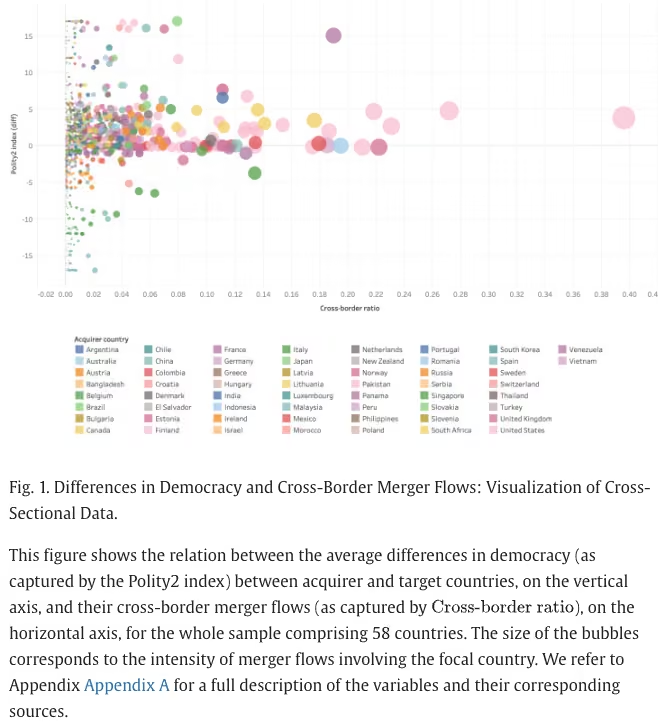
New at JIE: "Input sourcing, trade liberalization, and diversifying mergers" by Qing Liu, Larry D. Qiu, Stephen Teng Sun, Chaoqun Zhan (@ChaoqunZHAN)
doi.org/10.1016/j.jinteco.2026.104347
Journal of International Economics
@JIntlEcon
Using China’s 2001 WTO accession as a natural experiment, authors find that a reduction in tariffs on common inputs of two industries significantly increases the likelihood of a diversifying merger between these two industries.
-
Journal of International Economics
@JIntlEcon
New at JIE: "Emerging markets, household heterogeneity, and exchange rate policy" by Gabriela Cugat (@gmcugat)
doi.org/10.1016/j.jinteco.2026.104340
Journal of International Economics
@JIntlEcon
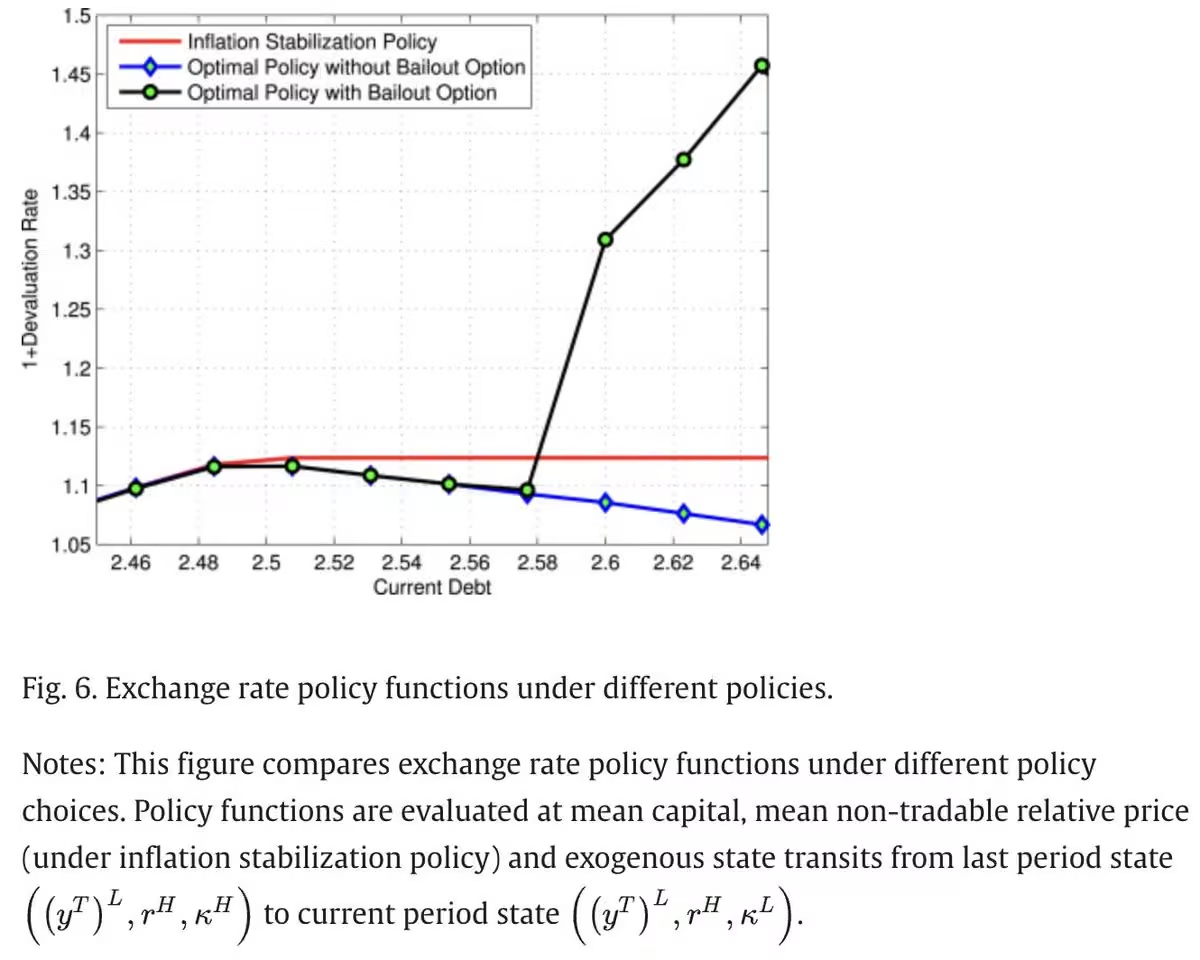
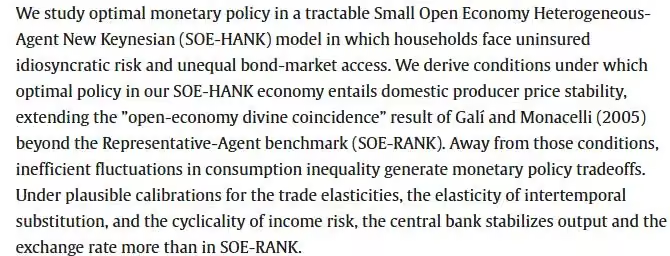
Household data from Mexico’s 1995 crisis show larger income and consumption losses in the non-tradable sector. A model with uninsurable sectoral income and limited financial-market participation amplifies the shock and fits the data better than a representative-agent model.
-
Journal of International Economics
@JIntlEcon
New at JIE: "Spillover effects of foreign currency loans: The role of the bank lending channel" by Palma Filep-Mosberger, Lorant Kaszab, Zhou Ren
doi.org/10.1016/j.jinteco.2026.104342 -
Journal of International Economics
@JIntlEcon
New at JIE: "Keeping up with the Joneses: FDI, supply chain linkages, and industrial emissions" by Jiawei Mo (@PKU1898), Ye Yuan, Zhe Zhang
doi.org/10.1016/j.jinteco.2026.104343
Journal of International Economics
@JIntlEcon
Can foreign investment make local firms greener? Evidence from China shows that nearby FDI entry cuts domestic firms’ SO₂ emission intensity by 6%. Supply-chain linkages drive these spillovers, especially as foreign customers push local suppliers toward cleaner production.
-
Journal of International Economics
@JIntlEcon
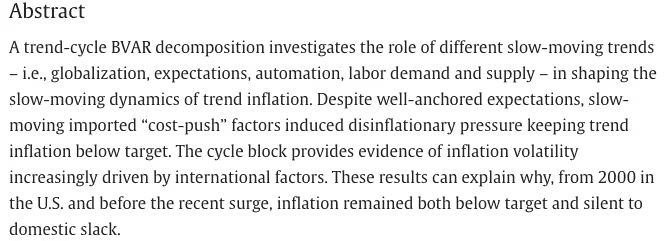
New at JIE: "Geopolitical risk and inflation: The role of energy markets" by Marco Pinchetti (@marco_pinchetti)
doi.org/10.1016/j.jinteco.2026.104336
Journal of International Economics
@JIntlEcon
Geopolitical shocks are not all alike – they have heterogeneous effects on inflation and output. The paper exploits the comovement between geopolitical risk indices and global oil prices to identify different classes of geopoltiical shocks.
-
Journal of International Economics
@JIntlEcon
New at JIE: "Can time-varying currency risk hedging explain exchange rates?" by Leonie Bräuer, Harald Hau
doi.org/10.1016/j.jinteco.2026.104333 -
Journal of International Economics
@JIntlEcon
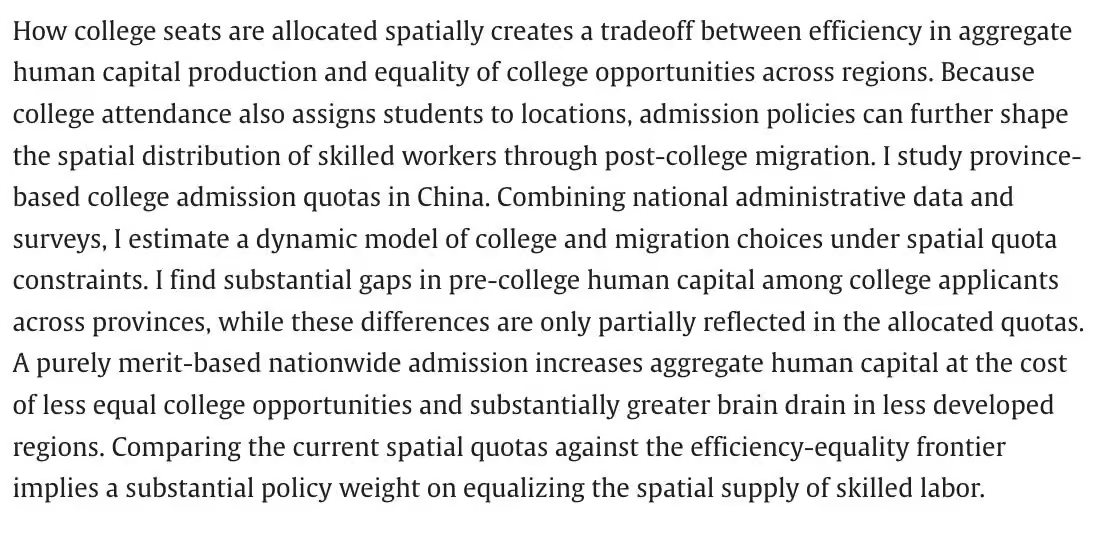
New at JIE: "On the spatial allocation of college seats: Human capital production and the distribution of skilled labor" by Yu (Alan) Yang
doi.org/10.1016/j.jinteco.2026.104338
Journal of International Economics
@JIntlEcon
How should college seats be allocated across regions? Using China’s province based admission quotas, this paper shows that nationwide merit based admission raises aggregate human capital but widens regional opportunity gaps and intensifies brain drain from less developed regions.
-
Journal of International Economics
@JIntlEcon
New at JIE: "Global Finacial Spillovers of Chinese Macroeconomic Surprises" by Camila Gutierrez (@camigutir), Javier Turen (@javier_turen), Alejandro Vicondoa (@ale_vicondoa)
doi.org/10.1016/j.jinteco.2026.104335
Journal of International Economics
@JIntlEcon
We show that a positive 1,2% Chinese industrial production surprise induces a synchronized increase of around 12 basis points in stock returns across most economies. This effect is stronger in emerging markets even after controlling for other characteristics.
-
Journal of International Economics
@JIntlEcon
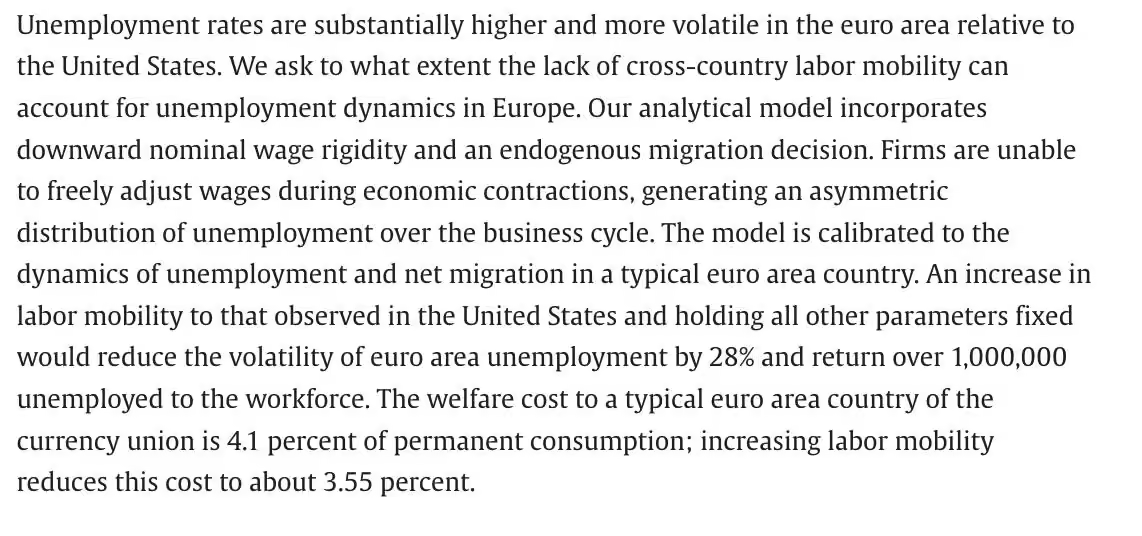
New at JIE: "Labor mobility and the level of unemployment in a currency union" by Erin P. Gibson, Christopher L. House, Christian Proebsting, Linda L. Tesar
doi.org/10.1016/j.jinteco.2026.104332 -
Journal of International Economics
@JIntlEcon
New at JIE: "Trade shocks and human capital: Evidence from Brazil’s trade liberalization" by Marcos Y. Nakaguma, Arthur A. Viaro
doi.org/10.1016/j.jinteco.2026.104334
Journal of International Economics
@JIntlEcon
Brazil’s 1990s trade liberalization had lasting effects on human capital. Tariff cuts in sectors employing children reduced child labor and increased schooling; adult-specific cuts did the opposite. Cohorts exposed in childhood show persistent effects on educational attainment.
-
Journal of International Economics reposted
CEPR
@cepr_org
📢#callforpapers - International Seminar on Trade (ISoT) – 3rd Edition
📅20-21 May 2027 | 📍ifo Institute, Munich, Germany
⏳Deadline: 10 Jan 2027
Event partners: @JIntlEcon @LMU_Muenchen @ifo_Institut @CESifoNetwork @WorldBankGroup
Organisers: Costas Arkolakis, @CarstenEckel, @LisandraFlach, Gianmarco Ottaviano, @ClaudiaSteinwen, Daria Taglioni
cepr.org/events/international-seminar-trade-isot-3rd-edition -
Journal of International Economics
@JIntlEcon
New at JIE: "Tapping into excess capacity: Chinese machinery exports and African industrialization" by Pak Hung Lam (@PakHungLAM), Yatang Lin, Fangyuan Peng, Jin Wang
doi.org/10.1016/j.jinteco.2026.104329 -
Journal of International Economics
@JIntlEcon
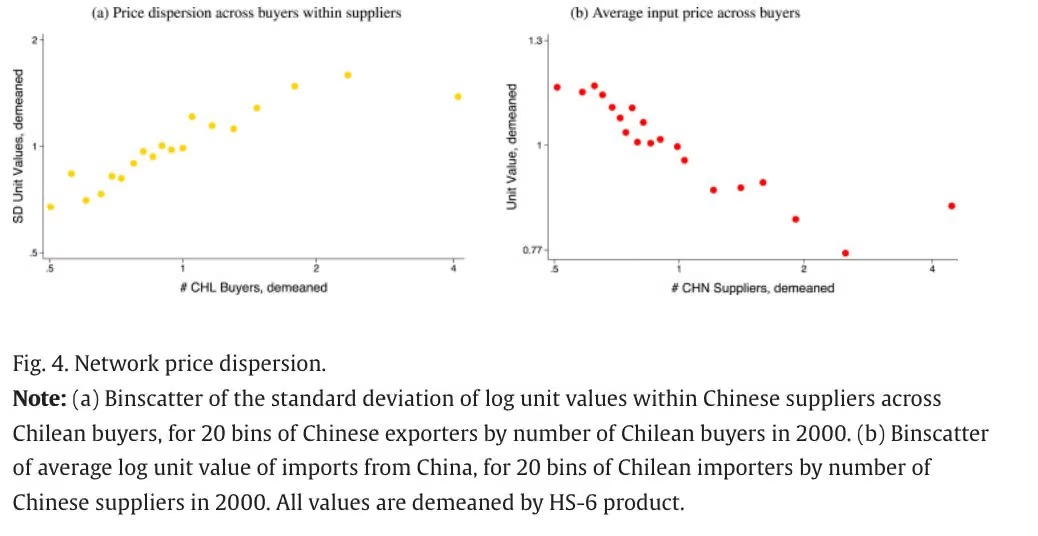
New at JIE: "Global production networks and imperfect competition" by Hanwei Huang (@HanweiHuangEcon), Kalina Manova (@EconUCL), Oscar Perelló (@oiperello) and Frank Pisch (@FrankPisch)
doi.org/10.1016/j.jinteco.2026.104315
Journal of International Economics
@JIntlEcon
The interaction of endogenous networks and markups significantly amplifies the gains from policies that facilitate supplier entry or firm matching, and from deep trade agreements that combine tariff cuts with such policies.
-
Journal of International Economics
@JIntlEcon
New at JIE: "The impact of AI and cross-border data regulation on international trade in digital services" by Ruiqi Sun, Daniel Trefler
doi.org/10.1016/j.jinteco.2026.104328 -
Journal of International Economics
@JIntlEcon
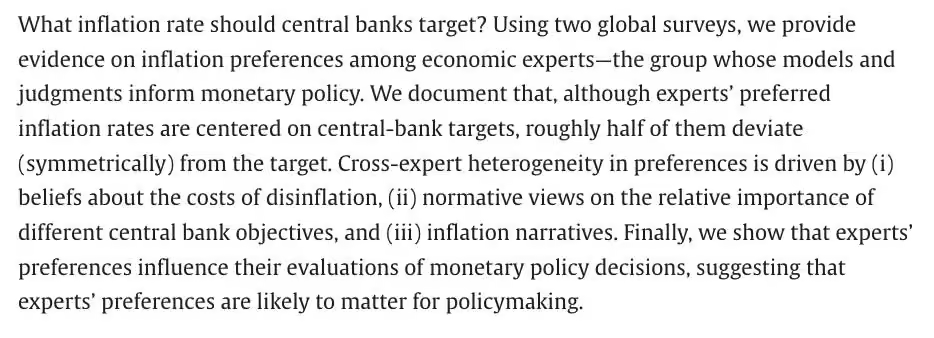
New at JIE: "Expert inflation preferences and the evaluation of monetary policy" by Timo Wochner (@TimoWochner), Lukas Hack (@LukasHack_) and Niklas Potrafke (@ifo_Institut)
doi.org/10.1016/j.jinteco.2026.104317
Journal of International Economics
@JIntlEcon
What inflation rate should central banks target? Using two global surveys, authors provide evidence on inflation preferences among economic experts
-
Journal of International Economics
@JIntlEcon
New at JIE: "Climate policies as a catalyst for green FDI" by Samuel Pienknagura (@spienk80)
doi.org/10.1016/j.jinteco.2026.104331
Journal of International Economics
@JIntlEcon
Leveraging cross-border project-level information, the paper identifies “green” FDI and finds that a larger number of active climate policies is associated with higher green FDI inflows.
-
Journal of International Economics
@JIntlEcon
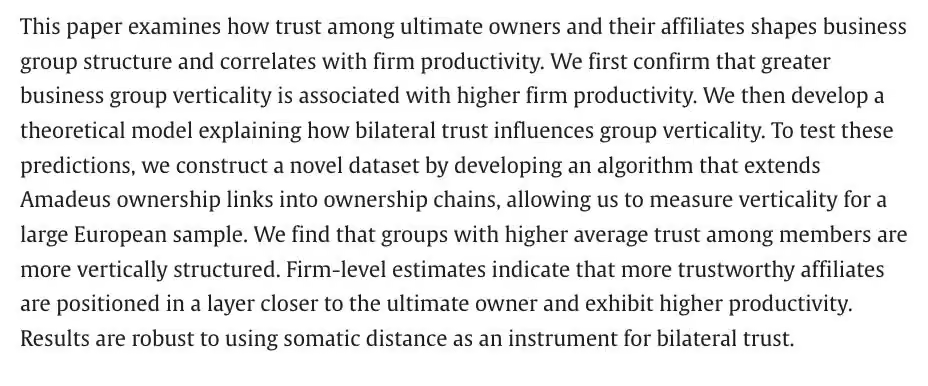
New at JIE: "Trust, business group verticality, and firm productivity" by Christian Fons-Rosen, Miriam Manchin, Katalin Szemeredi
doi.org/10.1016/j.jinteco.2026.104307 -
Journal of International Economics
@JIntlEcon
📢 The International Seminar on Trade (ISoT) returns for its 3rd edition!
📍 ifo Institute, Munich 🗓️ 20–21 May 2027 📅 Deadline: 10 Jan 2027
Co-organised by @JIntlEcon, @LMU_Muenchen, @CESifoNetwork, @ifo_Institut, @WorldBankGroup & @cepr_org
🔗 www.sciencedirect.com/journal/journal-of-international-ec… -
Journal of International Economics
@JIntlEcon
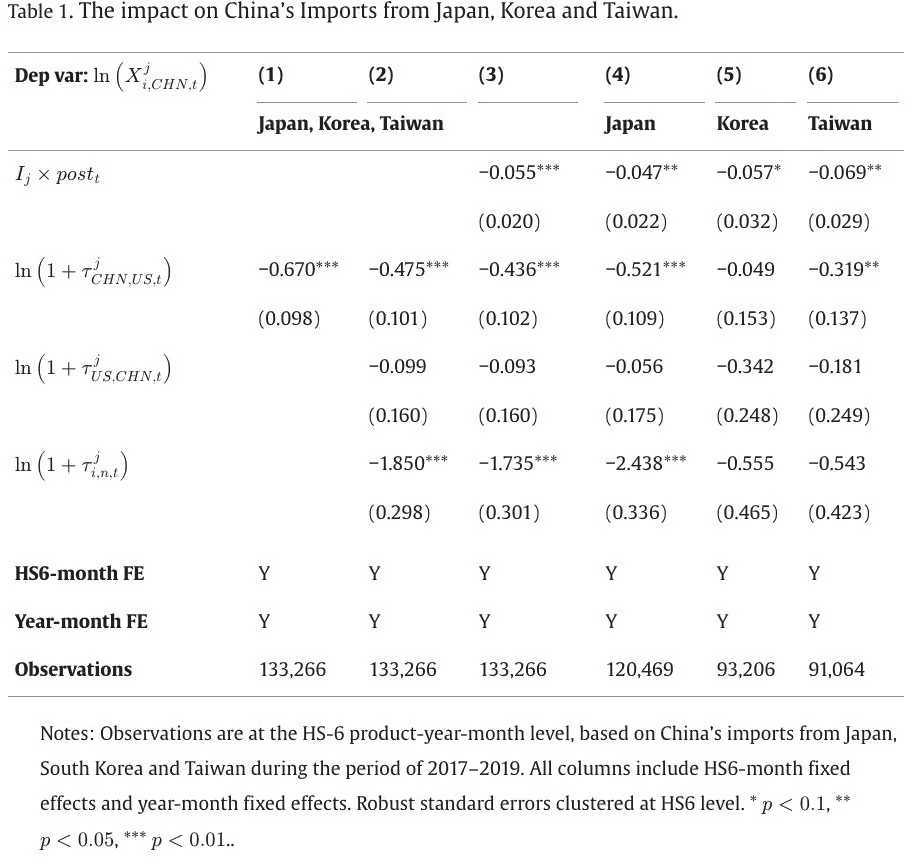
New at JIE: "Reshaping factory Asia: How did the US-China trade war affect the Asian-Pacific supply chain?" by Hong Ma (@HongMa_Tsinghua), Jingxin Ning, Yuan Xu
doi.org/10.1016/j.jinteco.2026.104327
Journal of International Economics
@JIntlEcon
US–China tariffs reshaped Factory Asia, not just bilateral trade. Product-level IO links show shocks cut China’s imports from upstream Japan Korea Taiwan suppliers, redirected trade toward ASEAN/Mexico/India, and shifted welfare across countries.
-
Journal of International Economics
@JIntlEcon
New at JIE: "The extensive margin of restructuring: Adoption of new work in a global economy" by Gueyon Kim (@Gueyon_Kim)
doi.org/10.1016/j.jinteco.2026.104326
Journal of International Economics
@JIntlEcon
How did U.S. manufacturers respond to the China shock? Using a new job-title-based measure, I show that import competition spurred persistent adoption of new work, largely through offshoring and shifts toward non-production activities—while widening local wage inequality.
-
Journal of International Economics
@JIntlEcon
New at JIE: "Exporter survival with uncertainty and experimentation" by Sebastián Fanelli (@Seb_Fanelli), Juan Carlos Hallak (@juancahallak), Yongkun Yin
doi.org/10.1016/j.jinteco.2026.104311 -
Journal of International Economics
@JIntlEcon
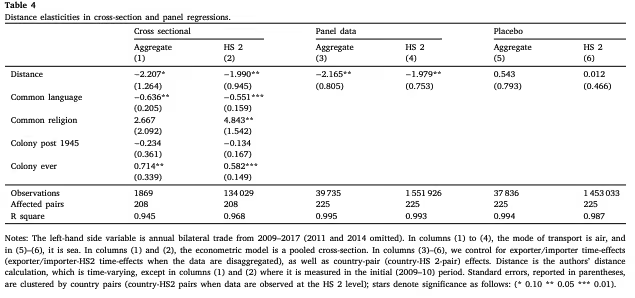
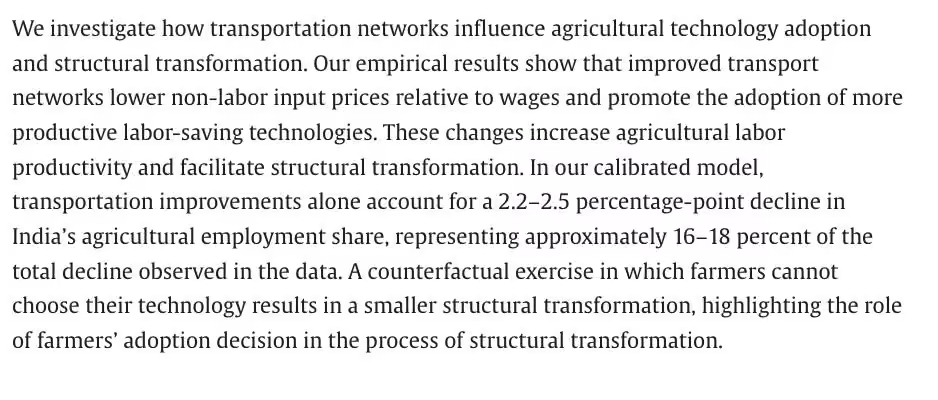
New at JIE: "Transportation networks, technology adoption, and structural transformation" by T. Terry Cheung, Han Yang (@Han_Yang_Econ)
doi.org/10.1016/j.jinteco.2026.104325
Journal of International Economics
@JIntlEcon
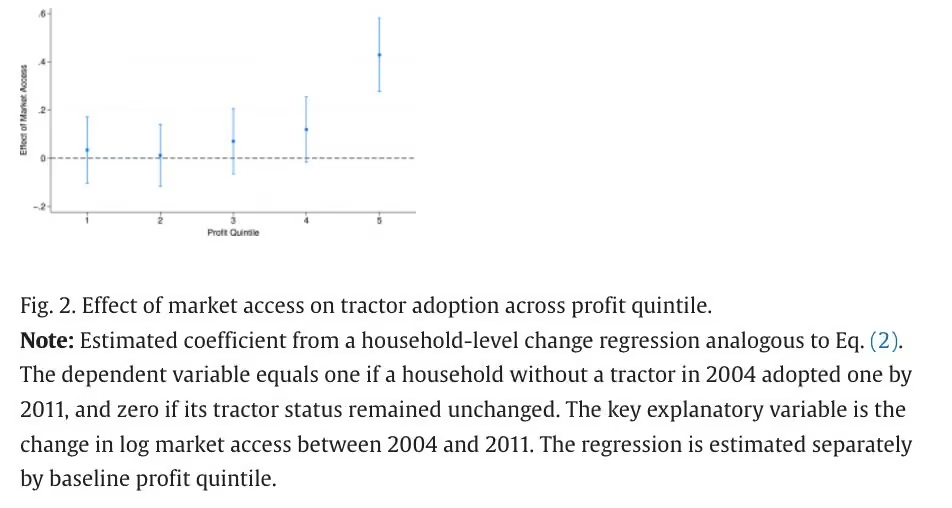
How do transport networks drive structural transformation? Improved market access raises farm productivity, reduces agricultural employment, and promotes labor-saving tech adoption. Such adoption is concentrated among high-profit farmers, consistent with fixed adoption costs.
-
Journal of International Economics
@JIntlEcon
New at JIE: "Industrial composition of syndicated loans and banks’ climate commitments" by Galina Hale (@galinahale_ucsc), Brigid Meisenbacher, Rami Najjar, Fernanda Nechio (@fernandanechio)
doi.org/10.1016/j.jinteco.2026.104314
Journal of International Economics
@JIntlEcon
Authors find that on average banks have reduced the emissions exposure of their syndicated loans portfolio, but there are no differences between banks that did and those that did not subscribe to climate commitments.
-
Journal of International Economics
@JIntlEcon
New at JIE: "Offshore dollar funding shocks and the dollar exchange rate" by Philippe Bacchetta, J. Scott Davis, Eric van Wincoop
doi.org/10.1016/j.jinteco.2026.104308 -
Journal of International Economics
@JIntlEcon
New at JIE: "Different no more: Country spreads in advanced and emerging economies". by Benjamin Born (@bornecon), Gernot J. Müller (@uni_tue), Johannes Pfeifer (@PfeiferEcon), Susanne Wellmann
doi.org/10.1016/j.jinteco.2026.104316
Journal of International Economics
@JIntlEcon
Since 2008, advanced economies have become more like emerging markets: higher, more volatile spreads, more volatile consumption, and less persistent trade balances. AME–EME cycles have also become more synchronized. Our model links spreads to debt and volatility to global shocks.
-
Journal of International Economics
@JIntlEcon
New at JIE: "Melitz meets Lewis: The impacts of roads on structural transformation and businesses" by Joseph P. Kaboski, Will Jianyu Lu, Wei Qian, Lixia Ren
doi.org/10.1016/j.jinteco.2026.104310 -
Journal of International Economics
@JIntlEcon
New at JIE: "Horizontal regulatory barriers in international trade: Evidence from electric plugs" by Yuan Mei (@yuanmei10), Mingzhi (Jimmy) Xu (@sgSMU)
doi.org/10.1016/j.jinteco.2026.104312
Journal of International Economics
@JIntlEcon
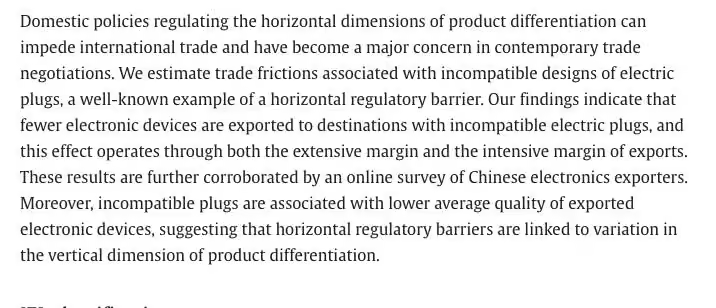
Using multiple datasets and an online survey, we find that incompatible electric plugs reduce electronics exports through both intensive and extensive margins. They are also associated with lower average quality among affected products.
-
Journal of International Economics
@JIntlEcon
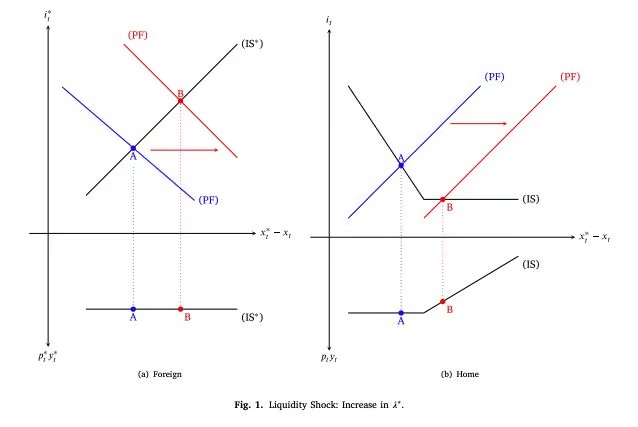
New at JIE: "U.S. Government Liquid Liabilities and Emerging Market Capital Flows" by Annie Soyean Lee (@anniesoyeanlee), Charles Engel (@UWMadison)
doi.org/10.1016/j.jinteco.2026.104299
Journal of International Economics
@JIntlEcon
We identify the liquidity channel through which Fed QE and QT affect capital flows to emerging markets. QE lowers the convenience yield on short-term Treasuries, QT raises it, and those changes drive the capital flows.
-
Journal of International Economics
@JIntlEcon
New at JIE: "A two-pronged approach to currency internationalization" by Qing Liu, Wenlan Luo, Jiatong Niu
doi.org/10.1016/j.jinteco.2026.104309 -
Journal of International Economics
@JIntlEcon
New at JIE: "Persistent global growth differences and euro area adjustment: Real activity, trade and the real exchange rate" by Adrian Ifrim (@ifrim_a), Robert Kollmann (@ULBruxelles), Philipp Pfeiffer (@EU_Commission), Marco Ratto, Werner Roeger
doi.org/10.1016/j.jinteco.2026.104313
Journal of International Economics
@JIntlEcon
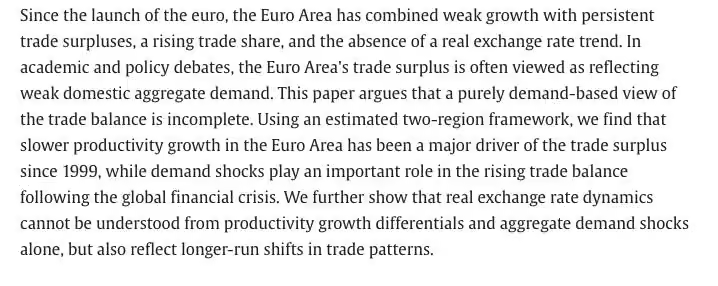
Since 1999, the euro area has combined weak growth, trade surpluses, rising openness, and no real exchange rate trend. We find that slower productivity growth has been a major driver of the trade surplus, while exchange rate dynamics reflect longer-run shifts in trade patterns.
-
Journal of International Economics
@JIntlEcon
New at JIE: "Endogenous mobility in pandemics: Theory and evidence from the United States" by Xiao Chen, Hanwei Huang, Jiandong Ju, Ruoyan Sun, Jialiang Zhang
doi.org/10.1016/j.jinteco.2026.104298 -
Journal of International Economics
@JIntlEcon
The Journal of International Economics is delighted to welcome Andrés Drenik (@DrenikAndres, UT Austin) as a new Co-Editor, together with new Associate Editors Lorena Keller (Texas A&M), Juan Herreño (UC San Diego), and Rafael Guntin (@rafaguntin, University of Rochester).
Journal of International Economics
@JIntlEcon
The Journal of International Economics thanks departing Co-Editor Jesse Schreger (@JSchreger) and Associate Editors Zhengyang Jiang (@ProfJiang) , Rohan Kekre, and Liliana Varela (@liliana_vvarela) for their excellent service to the journal.
-
Journal of International Economics
@JIntlEcon
New at JIE: "Multinational network restructuring, geopolitical exposure, and home country effects – Evidence for European MNEs" by Bruno Merlevede (@BMerleve), Bernhard Michel
doi.org/10.1016/j.jinteco.2026.104300
Journal of International Economics
@JIntlEcon
Using a unique micro-level dataset on European MNE affiliate networks, we show that foreign restructuring shifted toward contraction in the late 2010s, with growing friend- and nearshoring. Foreign contractions did not systematically boost home-country activity.
-
Journal of International Economics
@JIntlEcon
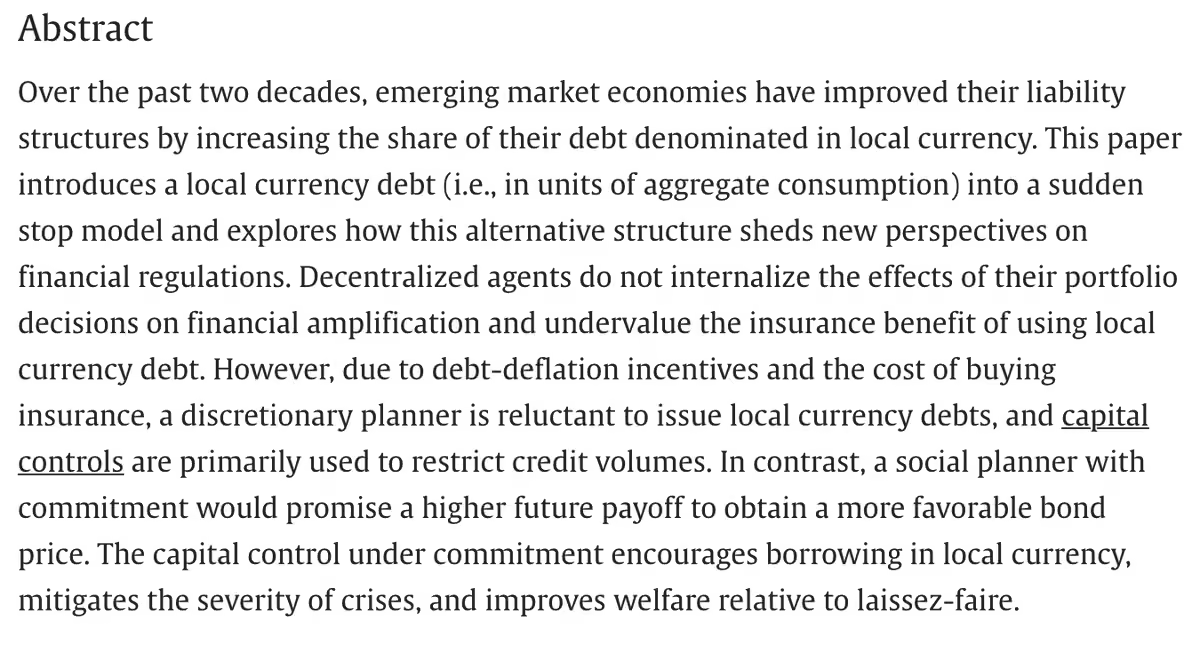
New at JIE: "Financial frictions, FX reserves, and exchange rate management with local-currency debt" by Sauhard Srivastava
doi.org/10.1016/j.jinteco.2026.104282 -
Journal of International Economics
@JIntlEcon
New at JIE: "International trade finance and learning dynamics" by David Kohn, Emiliano Luttini, Michal Szkup, Shengxing Zhang
doi.org/10.1016/j.jinteco.2026.104286 -
Journal of International Economics
@JIntlEcon
New at JIE: "U.S. monetary spillovers to emerging markets: Both policy drivers and vulnerabilities matter" by Shaghil Ahmed, Ozge Akinci, Albert Queralto
doi.org/10.1016/j.jinteco.2026.104288 -
Journal of International Economics
@JIntlEcon
New at JIE: "Global banks and natural disasters" by Francisco E. Ilabaca, Robert Mann, Philip Mulder (@philipcheesy1)
doi.org/10.1016/j.jinteco.2026.104289
Journal of International Economics
@JIntlEcon
Do global banks lend more to countries hit by natural disasters? On average, no—but that masks a split. Banks with strong pre-disaster ties to an affected country raise lending ~10%, while those with weak ties cut it. Relationships help banks navigate uncertainty.
-
Journal of International Economics
@JIntlEcon
New at JIE: "Governments’ home bias and efficiency losses: Evidence from national and subnational governments" by Manuel García-Santana, Marta Santamaría
doi.org/10.1016/j.jinteco.2026.104285 -
Journal of International Economics
@JIntlEcon
New at JIE: "Liability dollarization and exchange rate pass-through to domestic prices" by Junhyong Kim (@SAISHopkins), Annie Soyean Lee (@anniesoyeanlee)
doi.org/10.1016/j.jinteco.2026.104294
Journal of International Economics
@JIntlEcon
Liability dollarization shapes how depreciation passes through to domestic prices. After Korea's 1997 depreciation, firms with more foreign currency debt saw declining net worth, sales, and markups, pushing up sectoral prices. A model ties 10–44% of price changes to this channel.
-
Journal of International Economics
@JIntlEcon
New at JIE: "Familiar strangers: The role of diaspora networks in foreign investment and long-run development" by Fanghao Chen, Ruichi Xiong, Xiaobo Zhang
doi.org/10.1016/j.jinteco.2026.104293
Journal of International Economics
@JIntlEcon
This paper shows that diaspora networks played a pivotal role in directing early foreign investment to Chinese locations with weaker institutions and in catalyzing long-run industrial development.
-
Journal of International Economics
@JIntlEcon
New at JIE: "Fiscal policy and inflation in the Euro Area" by Guido Ascari, Dennis Bonam, Lorenzo Mori, Andra Smadu
doi.org/10.1016/j.jinteco.2026.104281 -
Journal of International Economics
@JIntlEcon
New at JIE: "The price of delay: Supply chain disruptions and pricing dynamics" by Salomé Baslandze (@BaslandzeSalome), Simon Fuchs (@SimonFuchs4)
doi.org/10.1016/j.jinteco.2026.104265
Journal of International Economics
@JIntlEcon
Shipment data linked to a consumer panel show supply-chain delays and import-cost shocks raise affected firms’ own prices by lowering availability/raising costs. Rivals then also raise prices, so strategic spillovers amplify the direct effect.
-
Journal of International Economics
@JIntlEcon
New at JIE: "Exports and intergenerational mobility" by Devashish Mitra (@DevashishMitra_), Hoang Pham (@shockmath), and Beyza Ural Marchand (@BeyzaMarchand)
doi.org/10.1016/j.jinteco.2026.104239
Journal of International Economics
@JIntlEcon
The US-Vietnam Bilateral Trade Agreement (December 2001) has, on average, led to greater upward absolute occupational mobility (through greater human capital investment) but lower relative occupational mobility in Vietnam. Effects vary across age groups and genders.
-
Journal of International Economics
@JIntlEcon
New at JIE: "From local to global: How foreign acquisitions reshape job mobility" by Carl Davidson, Fredrik Heyman, Steven Matusz, Fredrik Sjöholm, Susan Chun Zhu
doi.org/10.1016/j.jinteco.2026.104278 -
Journal of International Economics
@JIntlEcon
New at JIE: "Equity financing and exports: Evidence from IPO approvals in China" by Robin Kaiji Gong (@robin_kgong), Yao Amber Li (@yaoamber), Stephen Teng Sun (@CityUHongKong), Shang-Jin Wei (@Columbia)
doi.org/10.1016/j.jinteco.2026.104292
Journal of International Economics
@JIntlEcon
This paper shows that IPO approval in China boosts firm exports by over 6% annually, mainly by helping firms enter more destination-product markets. Equity financing appears to fund intangible investment and risk-taking, rather than physical capital or trade credit.
-
Journal of International Economics
@JIntlEcon
📢 The JIE Co-Editors Conference comes to @Unibocconi on July 9–10!
Speakers: Costas Arkolakis, Gianmarco Ottaviano, Pablo Ottonello, @JavierBianchi7, Eduardo Morales, Paola Conconi, Zhen Huo, @monacelt & @YANBAI25157736
🔗 Program and registration: economics.unibocconi.eu/jie-co-editors-conference-july-9-… -
Journal of International Economics
@JIntlEcon
New at JIE: "Is the information channel of monetary policy alive in emerging markets?" by Mariana García-Schmidt (@garcia_nane)
doi.org/10.1016/j.jinteco.2026.104297
Journal of International Economics
@JIntlEcon
Central bank policy decisions affect expectations driven by monetary and information shocks. In emerging markets, unexpected rate hikes raise inflation and output forecasts in the short run— consistent with New Keynesian models only when the information channel is active.
-
Journal of International Economics
@JIntlEcon
New at JIE: "Air access to foreign markets and export-biased growth: Evidence from business entries" by Yangming Bao, Jie Li
doi.org/10.1016/j.jinteco.2026.104270 -
Journal of International Economics
@JIntlEcon
New at JIE: "Reducing trade with Russia: Sanctions vs. firms’ voluntary suspension of activities" by Juan de Lucio (@Juan_de_Lucio), Raúl Mínguez, Asier Minondo, Francisco Requena
doi.org/10.1016/j.jinteco.2026.104284
Journal of International Economics
@JIntlEcon
Sanctions cut trade with Russia, but firms’ voluntary exits mattered too. Using Spanish firm-level data, we find voluntary suspensions reduced exports/imports by 20%/24%, while sanctions cut them by 10%/34%. Together, they hit trade harder than sanctions alone.
-
Journal of International Economics
@JIntlEcon
New at JIE: "How to grow an invoicing currency: Micro evidence from Argentina" by Felipe Benguria (@universityofky), Dennis Novy (@DennisNovy)
doi.org/10.1016/j.jinteco.2026.104290
Journal of International Economics
@JIntlEcon
How could de-dollarization happen? Argentine firms rapidly starting invoicing international trade transactions in Chinese currency (RMB) in 2023, amid a dollar shortage. This paper studies why.
-
Journal of International Economics
@JIntlEcon
New at JIE: "Tariffs and goods-market search frictions" by Pawel M. Krolikowski, Andrew H. McCallum
doi.org/10.1016/j.jinteco.2026.104266 -
Journal of International Economics
@JIntlEcon
New at JIE: "Spatial linkages and the uneven effects of a commodity boom" by Felipe Benguria (@UKGattonCollege), Felipe Saffie (@DardenMBA), Shihangyin Zhang (@ShihangyinZhang)
doi.org/10.1016/j.jinteco.2026.104287
Journal of International Economics
@JIntlEcon
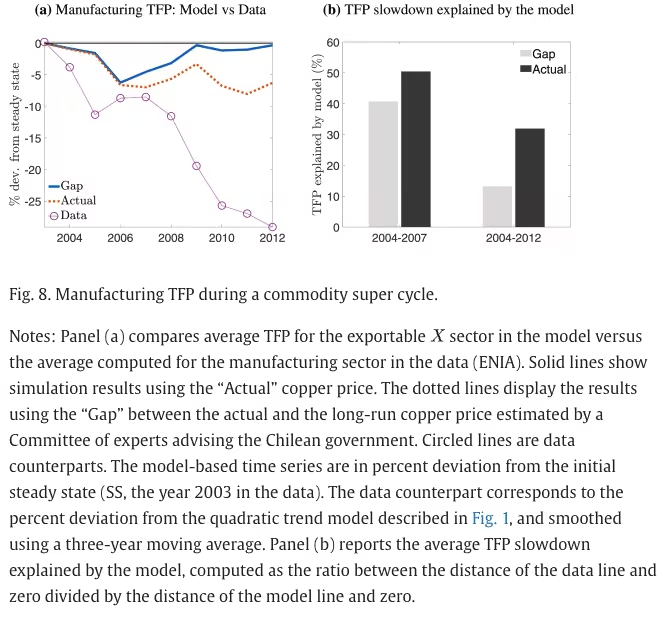
The commodity boom and bust in Brazil during the 2000s and 2010s had an uneven impact on workers based on their skill and location. We develop a dynamic, quantitative, multi-region model to show how spatial linkages and downward wage rigidity shape this impact.
-
Journal of International Economics
@JIntlEcon
New at JIE: "Burn now or never? Climate policy exposure and investment of fossil fuel firms" by Jakob Feveile Adolfsen (@FeveileJakob), Malte Heissel, Ana-Simona Manu, Francesca Vinci (@franvinci27)
doi.org/10.1016/j.jinteco.2026.104267
Journal of International Economics
@JIntlEcon
The Paris Agreement may have triggered a “burn now or never” response among fossil fuel firms. In our paper, we show that firms more exposed to climate policy increased investment after 2015, especially in fossil extraction—evidence consistent with Green Paradox dynamics.
-
Journal of International Economics
@JIntlEcon
New at JIE: "Trade liberalization, wage rigidity, and labor market dynamics with heterogeneous firms" by Ekaterina Gurkova (@e_gurkova), Elhanan Helpman, Oleg Itskhoki (@Itskhoki)
doi.org/10.1016/j.jinteco.2026.104260 -
Journal of International Economics reposted
Journal of International Economics
@JIntlEcon
The JIE is pleased to announce that the Calvo Prize for the best paper in Open Economy Macroeconomics has been awarded to “Changing Global Linkages: A New Cold War?,” by @GitaGopinath, @pogourinchas, @a_presbitero and @PetiaTopalova. Congratulations!
doi.org/10.1016/j.jinteco.2024.104042 -
Journal of International Economics reposted
Journal of International Economics
@JIntlEcon
The Journal of International Economics is pleased to announce that the Bhagwati Prize for the best paper in International Trade has been awarded to “Robots, Tasks, and Trade,” by Paulo Bastos, Bob Rijkers, and Erhan Artuc. Congratulations!
doi.org/10.1016/j.jinteco.2023.103828 -
Journal of International Economics
@JIntlEcon
New at JIE: "Complements or substitutes? Labor market effects of foreign inputs in developing economies" by Leonardo Bonilla-Mejía (@leonardoBM_dev), Juan Muñoz-Morales (@juansebastmunoz), Román David Zárate (@romandzarate)
doi.org/10.1016/j.jinteco.2026.104263
Journal of International Economics
@JIntlEcon
This paper studies how import liberalization affects labor markets when labor and intermediates are complements or substitutes. Using Colombian tariff cuts, authors show imports reduce wage bills via competition/cheaper inputs in agr./manufacturing, but raise them in services.
-
Journal of International Economics
@JIntlEcon
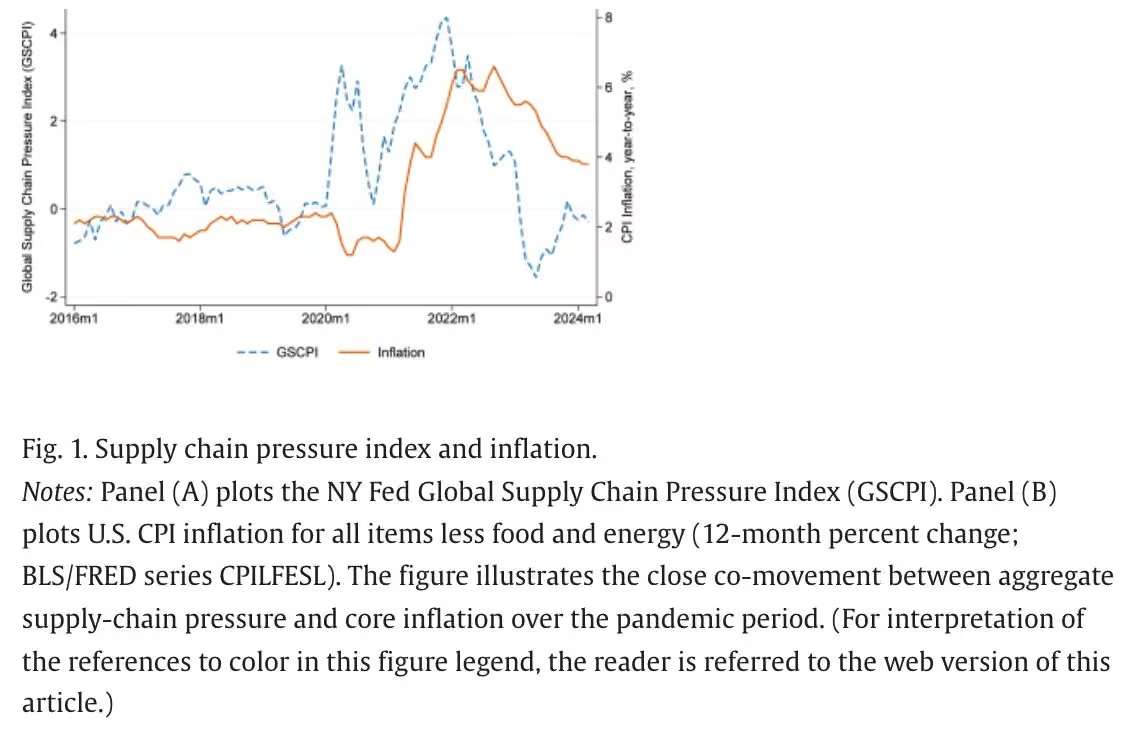
New at JIE: "Global value chains and inflation dynamics" by Vu Chau, Marina Conesa-Martinez, Taehoon Kim, John Spray
doi.org/10.1016/j.jinteco.2026.104261 -
Journal of International Economics
@JIntlEcon
New at JIE: "The local-area incidence of exporting" by Christoph E. Boehm, Aaron Flaaen, Nitya Pandalai-Nayar, Jan Schlupp
doi.org/10.1016/j.jinteco.2026.104257 -
Journal of International Economics
@JIntlEcon
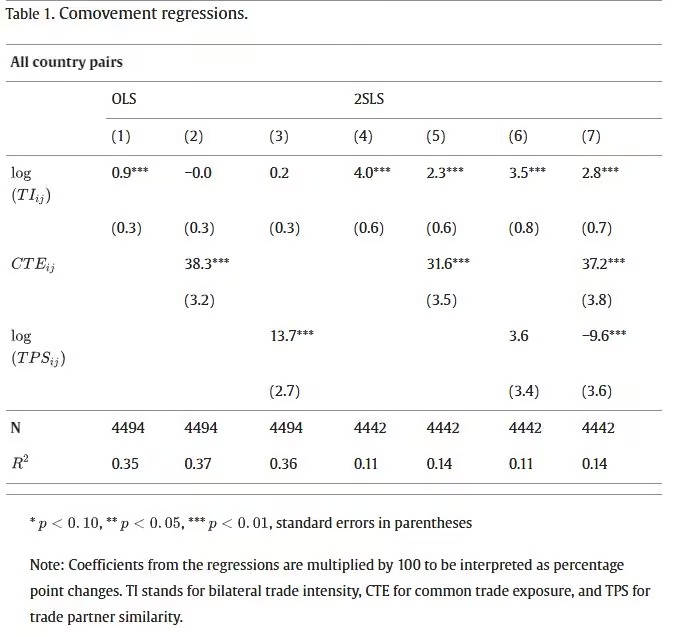
New at JIE: "Cross-border trade competition and international stock return comovement" by Sungjune Pyun, Johan Sulaeman
doi.org/10.1016/j.jinteco.2025.104174 -
Journal of International Economics
@JIntlEcon
New at JIE: "Europe falling behind: Structural transformation and labor productivity growth differences between Europe and the U.S" by Cesare Buiatti, Joao B. Duarte (@JoaoBDuart3), Luis Felipe Sáenz
doi.org/10.1016/j.jinteco.2026.104262
Journal of International Economics
@JIntlEcon
Europe caught up to U.S. labor productivity by 1995, then fell back to 86% by 2019. Authors' GE model with Baumol cost disease + non-homothetic preferences shows labor reallocation into low-productivity services drives the reversal — a 5× bigger drag than in the U.S.
-
Journal of International Economics reposted
Andrea Presbitero
@a_presbitero
Truly honored to receive the Calvo Prize. This reflects a fantastic collaboration with @GitaGopinath, @pogourinchas, and @PetiaTopalova—I've learned a great deal from them. @IMFNews
Journal of International Economics
@JIntlEcon
The JIE is pleased to announce that the Calvo Prize for the best paper in Open Economy Macroeconomics has been awarded to “Changing Global Linkages: A New Cold War?,” by @GitaGopinath, @pogourinchas, @a_presbitero and @PetiaTopalova. Congratulations!
doi.org/10.1016/j.jinteco.2024.104042 -
Journal of International Economics reposted
Gita Gopinath
@GitaGopinath
It is such an honor to receive any prize with Calvo’s name in it. Thanks to the JIE, and to my wonderful co-authors.
Journal of International Economics
@JIntlEcon
The JIE is pleased to announce that the Calvo Prize for the best paper in Open Economy Macroeconomics has been awarded to “Changing Global Linkages: A New Cold War?,” by @GitaGopinath, @pogourinchas, @a_presbitero and @PetiaTopalova. Congratulations!
doi.org/10.1016/j.jinteco.2024.104042 -
Journal of International Economics
@JIntlEcon
The Journal of International Economics is pleased to announce that the Bhagwati Prize for the best paper in International Trade has been awarded to “Robots, Tasks, and Trade,” by Paulo Bastos, Bob Rijkers, and Erhan Artuc. Congratulations!
doi.org/10.1016/j.jinteco.2023.103828 -
Journal of International Economics
@JIntlEcon
The JIE is pleased to announce that the Calvo Prize for the best paper in Open Economy Macroeconomics has been awarded to “Changing Global Linkages: A New Cold War?,” by @GitaGopinath, @pogourinchas, @a_presbitero and @PetiaTopalova. Congratulations!
doi.org/10.1016/j.jinteco.2024.104042 -
Journal of International Economics
@JIntlEcon
New at JIE: "Real exchange rate dynamics beyond business cycles" by Dan Cao, Martin D.D. Evans, Wenlan Luo
doi.org/10.1016/j.jinteco.2026.104258 -
Journal of International Economics
@JIntlEcon
New at JIE: "The global transmission of U.S. monetary policy" by Riccardo Degasperi (@@RicDegasperi), Seokki Simon Hong (@SimonHon49), Giovanni Ricco (@ricco_giovanni)
doi.org/10.1016/j.jinteco.2026.104259
Journal of International Economics
@JIntlEcon
Using a dataset covering 30 economies, authors show that commodity and oil prices play a critical role in propagating US monetary policy to global headline inflation, generating predominantly deflationary effects.
-
Journal of International Economics
@JIntlEcon
New at JIE: "Agricultural imports, labor mobility, and welfare" by Guanzu Ding, Haichao Fan, Rui Li, Huanhuan Wang, Xican Xi
doi.org/10.1016/j.jinteco.2026.104256 -
Journal of International Economics
@JIntlEcon
New at JIE: "The global network of liquidity lines" by Saleem Bahaj, Marie Fuchs (@FuchsMarie_), Ricardo Reis (@R2Rsquared)
doi.org/10.1016/j.jinteco.2026.104255
Journal of International Economics
@JIntlEcon
This paper provides a historical account of central bank cross-border liquidity lines. It shows that a country can indirectly access foreign liquidity even without a direct line to the source. These indirect connections have a large impact on CIP deviations and FX reserves.
-
Journal of International Economics
@JIntlEcon
New at JIE: "Estimating export-productivity cutoff contours with profit data: A novel threshold estimation approach" by Peter H. Egger, Yulong Wang
doi.org/10.1016/j.jinteco.2026.104254 -
Journal of International Economics
@JIntlEcon
New at JIE: "Globalisation and the gender gap in mental well-being" by Björn Thor Arnarson (@bjorci), Asker Nygaard David (@AskerNygaard), Beata S. Javorcik (@BJavorcik), Jakob R. Munch (@jrmunch)
doi.org/10.1016/j.jinteco.2026.104253
Journal of International Economics
@JIntlEcon
We show that globalization widens the gender gap in mental health: when Danish firms trade across time zones, female workers become more likely to take antidepressants relative to men, particularly when college educated and younger. Effects are 3-4x larger for single mothers.
-
Journal of International Economics
@JIntlEcon
New at JIE: "Domestic wedges and the (in)sensitivity of CPI to exchange rates" by Marco Errico
doi.org/10.1016/j.jinteco.2026.104237 -
Journal of International Economics
@JIntlEcon
New at JIE: "Multinational investment activity under policy uncertainty in host and competing countries" by Daisoon Kim (@DaisoonKim), Sunhyung Lee
doi.org/10.1016/j.jinteco.2026.104252
Journal of International Economics
@JIntlEcon
The paper examines how economic policy uncertainty (EPU) in host and competing countries reshapes U.S. multinationals’ greenfield foreign direct investment (FDI).
-
Journal of International Economics
@JIntlEcon
New at JIE: "Firm networks and global technology diffusion" by Paulo Bastos, Katherine Stapleton, Daria Taglioni, Hannah Yi Wei
doi.org/10.1016/j.jinteco.2026.104240 -
Journal of International Economics reposted
David Kohn
@DavidKohn_16
Our paper “International Trade Finance and Learning Dynamics” (with co-authors @EmilianoLuttini, @MichalSzkup, and @oo7zsx) has just been accepted at the Journal of International Economics @JIntlEcon 🎉
🧵 👇 -
Journal of International Economics
@JIntlEcon
New at JIE: "Structural change in sub-Saharan Africa: An open economy perspective". by Gaaitzen de Vries, Hagen Kruse, Emmanuel Mensah, Yabo Vidogbena, Kei-Mu Yi
doi.org/10.1016/j.jinteco.2026.104248
Journal of International Economics
@JIntlEcon
Leveraging new input-output tables in an open economy model of structural change, we find that domestic and foreign TFP growth matter greatly for manufacturing share in value-added in sub-Saharan Africa (SSA). International trade transmits foreign TFP growth to the SSA economy
-
Journal of International Economics
@JIntlEcon
New at JIE: "Preferential credit policy with sectoral markup heterogeneity" by Kaiji Chen, Yuxuan Huang, Xuewen Liu, Zhikun Lu, Yong Wang
doi.org/10.1016/j.jinteco.2026.104238
Journal of International Economics
@JIntlEcon
This paper develops a framework to analyze how preferential credit policies affect firm markups, sectoral resource allocation, and ultimately aggregate productivity and welfare. The analysis sheds light on how such policies may have supported rise of emerging industries in China.
-
Journal of International Economics reposted
Journal of International Economics
@JIntlEcon
New at JIE: "Firm and labor adjustments to FDI liberalization" by Ming-Jen Lin (@ming_jen), Yi-Ting Wang (@WIeconomics), Sung-Ju Wu (@SungJuWu)
doi.org/10.1016/j.jinteco.2026.104227 -
Journal of International Economics reposted
Journal of International Economics
@JIntlEcon
New at JIE: "Globalization and structural transformation: The role of tradable services" by Sang Min Lee (@SangMinLee1227)
doi.org/10.1016/j.jinteco.2026.104220 -
Journal of International Economics
@JIntlEcon
New at JIE: "The US-China trade war creates jobs (elsewhere)" by Tiago Cavalcanti (@TiagoCavalcan), Pedro Ogeda (@OgedaPedro), Emanuel Ornelas (@EmanuelOrnelas_)
doi.org/10.1016/j.jinteco.2026.104249
Journal of International Economics
@JIntlEcon
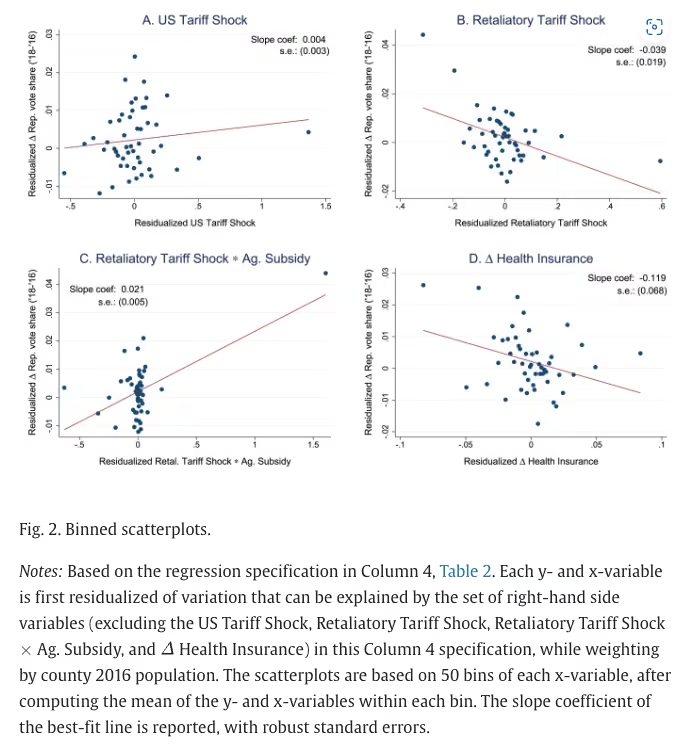
The 2018-2019 US-China trade war created jobs -- in Brazil. In line with Brazil’s pattern of comparative advantage, employment and wages rose in the regions more exposed to Chinese tariffs on US exports, but U.S. tariffs on Chinese exports did not affect Brazil’s labor markets.
-
Journal of International Economics
@JIntlEcon
New at JIE: "Preferred habitats and timing in the world’s safe asset" by Alexandra Tabova, Francis E. Warnock
doi.org/10.1016/j.jinteco.2026.104233 -
Journal of International Economics
@JIntlEcon
New at JIE: "The international transmission of asset market shocks in liquidity traps" by Philippe Bacchetta (@phbacche), Kenza Benhima (@KenzaBenhima), Yannick Kalantzis (@kalantzis), Maxime Phillot (@M_Phillot)
doi.org/10.1016/j.jinteco.2026.104235
Journal of International Economics
@JIntlEcon
Monetary policy is key to shaping international spillovers of asset market shocks. Outside the ELB, foreign shocks — such as a drop in investment opportunities — can boost domestic growth. At the ELB, the same shocks lead to currency appreciation, disinflation, and even recession
-
Journal of International Economics
@JIntlEcon
New at JIE: "Price discrimination and competition in international transportation" by Anna Ignatenko
doi.org/10.1016/j.jinteco.2026.104234 -
Journal of International Economics
@JIntlEcon
New at JIE: "Covered interest parity in emerging markets: Measurement and drivers" by Mai Chi Dao (@MaiChiDao1), Pierre-Olivier Gourinchas (@pogourinchas)
doi.org/10.1016/j.jinteco.2026.104231 -
Journal of International Economics
@JIntlEcon
New at JIE: "The distributional effects of carbon pricing across countries" by Mathilde Le Moigne, Simon Lepot, Marcos Ritel, Dora Simon
doi.org/10.1016/j.jinteco.2026.104228 -
Journal of International Economics
@JIntlEcon
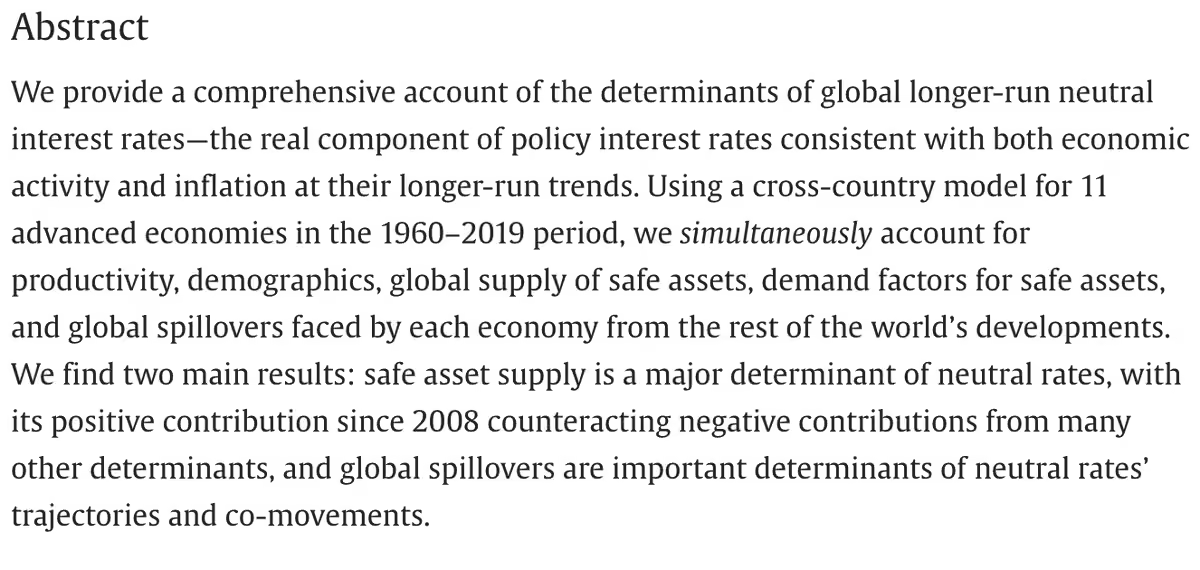
New at JIE: "Demand for safe assets and spillovers from the global dollar cycle" by Cían Allen, Rudolfs Bems, Lukas Boer, Racha Moussa
doi.org/10.1016/j.jinteco.2026.104223 -
Journal of International Economics
@JIntlEcon
New at JIE: "A nascent international financial channel of China’s monetary policy transmission" by Chang Ma (@machang_china), Alessandro Rebucci (@arebucci1), Sili Zhou (@SiliZHOU)
doi.org/10.1016/j.jinteco.2026.104230
Journal of International Economics
@JIntlEcon
Chinese private equity outflows have surged. We uncover a new international transmission channel of Chinese monetary policy via these flows, using matched stock–fund data from the Qualified Domestic Institutional Investor program and event studies around policy announcements.
-
Journal of International Economics
@JIntlEcon
New at JIE: "Globalization and structural transformation: The role of tradable services" by Sang Min Lee (@SangMinLee1227)
doi.org/10.1016/j.jinteco.2026.104220
Journal of International Economics
@JIntlEcon
This paper builds a 66-country model and estimates bilateral trade costs for goods and services from 1995 to 2018. It finds that globalization outweighs productivity growth in driving structural transformation and that globalization's impact is heterogeneous across countries.
-
Journal of International Economics
@JIntlEcon
New at JIE: "Trade wars and rumors of trade wars: The dynamic effects of the U.S.–China tariff hikes" by Trang Hoang, Carter Mix
doi.org/10.1016/j.jinteco.2026.104229
Journal of International Economics
@JIntlEcon
Firms initially treated 2018 tariffs as temporary, delaying their exit from the markets. This "rumor of peace" stalled the trade response for years before reality set in.
-
Journal of International Economics
@JIntlEcon
Mary Amiti will step down as Co-Editor on June 30, 2026, after seven years of outstanding service. We are deeply grateful for her leadership and many contributions to the journal.
Journal of International Economics
@JIntlEcon
Reka Juhász (@juhreka13, University of British Columbia), previously an Associate Editor, will succeed her as Co-Editor. Agostina Brinatti (University of Chicago) will join the editorial team as Associate Editor starting July 1.
-
Journal of International Economics
@JIntlEcon
New at JIE: "Firm and labor adjustments to FDI liberalization" by Ming-Jen Lin (@ming_jen), Yi-Ting Wang (@WIeconomics), Sung-Ju Wu (@SungJuWu)
doi.org/10.1016/j.jinteco.2026.104227
Journal of International Economics
@JIntlEcon
Using Taiwan’s 2001 outward-FDI liberalization as a natural experiment, we show affected electronics firms were 10% more likely to invest in China. Linked employer-employee data reveal higher job turnover and wage losses for domestic incumbents, strongest for mid-wage workers.
-
Journal of International Economics
@JIntlEcon
New at JIE: "Intersectoral demand linkages: Good shocks, bad outcomes?" by Kristian Behrens, Sergei Kichko, Philip Ushchev
doi.org/10.1016/j.jinteco.2026.104226
Journal of International Economics
@JIntlEcon
When are sector-specific price shocks magnified in GE with multiple industries/distorsions? Authors develop a framework with homothetic sectoral preferences and derive a sufficient statistic for the share of the direct effect of the shock that materializes in the aggregate.
-
Journal of International Economics reposted
Global Capital Allocation Project
@GCAProject
It was a great weekend at the JIE-GCAP-GSB Conference on Geoeconomics (globalcapitalallocation.com/jiegcapbgs), and we thank the presenters and discussants for joining us.
We are grateful to @StanfordGSB and @JIntlEcon for making this event possible. -
Journal of International Economics
@JIntlEcon
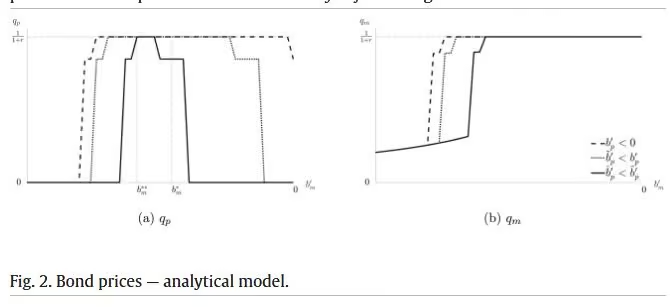
New at JIE: "Insufficient or excessive investment under sovereign default risk" by Ilhwan Song (@uos_official_), Gabriel Mihalache (@ohiostate)
doi.org/10.1016/j.jinteco.2026.104232
Journal of International Economics
@JIntlEcon
Agents do not internalize the impact of investment on sovereign bond prices, investment is insufficient, and a subsidy improves welfare. Yet, if the sovereign is impatient, due to political economy factors, it finds private capital accumulation excessive and prefers to tax it.
-
Journal of International Economics
@JIntlEcon
New at JIE: "Historical military conflict, current trade tensions, and global supply chains" by Yichuan Hu, Chang Li, Shu Lin (@ShuLin58005151)
doi.org/10.1016/j.jinteco.2026.104221
Journal of International Economics
@JIntlEcon
Authors study how two significant conflicts between China and the U.S.—the Korean War and the current trade war—affect global supply chains, and find that the death toll from the Korean War in a chairperson’s city of origin influences Chinese firms’ selection of suppliers today.
-
Journal of International Economics
@JIntlEcon
New at JIE: "Labor market polarization and the great urban divergence" Donald R. Davis (@Columbia), Eric Mengus (@EricMengus), Tomasz Michalski (@TomKMichalski)
doi.org/10.1016/j.jinteco.2026.104224
Journal of International Economics
@JIntlEcon
We document and model four key facts: the universality of labor market polarization in cities; a city-size difference in the shock magnitudes; a skew in the types of middle-paid jobs lost; and the role of polarization in the great urban divergence of high vs. low-paid jobs.
-
Journal of International Economics
@JIntlEcon
New at JIE: "Protection for sale without aggregation bias" by Jean-Marc Solleder (@UNIGEnews), Fulvio Silvy (@UNIGEnews), Marcelo Olarreaga (@molarreaga)
doi.org/10.1016/j.jinteco.2026.104222
Journal of International Economics
@JIntlEcon
Why do estimates of the classic Protection for Sale model imply that governments mostly maximize social welfare—despite widespread trade protection that hurts welfare? This paper argues that the answer is aggregation bias.
-
Journal of International Economics
@JIntlEcon
New at JIE: "Trade fragmentation, inflationary pressures and monetary policy" by Ludovica Ambrosino (@MariaLudovicaSA), Jenny Chan (@CJenGo88), Silvana Tenreyro (@LSEEcon)
doi.org/10.1016/j.jinteco.2026.104219
Journal of International Economics
@JIntlEcon
What is the impact of trade fragmentation on inflationary pressures? It depends not only on effect of higher import prices or lower productivity on supply, but also on how demand adjusts to lower real incomes. In turn, this depends on the pace of fragmentation.
-
Journal of International Economics reposted
Eric Mengus
@EricMengus
🎉 Very happy that my paper with Don Davis and
@TomKMichalski is now out in the
@JIntlEcon!
Link to the paper: authors.elsevier.com/c/1mWQs5330qcSC
With this project, I learned a lot about France and its evolution over the past 30 years. 1/4 -
Journal of International Economics
@JIntlEcon
New at JIE: "Seizing central bank assets?" by Massimo Ferrari Minesso, Tobias Krahnke, Arnaud Mehl, Isabel Vansteenkiste
doi.org/10.1016/j.jinteco.2025.104207 -
Journal of International Economics
@JIntlEcon
New at JIE: "Services trade and the choice of online versus in-person delivery" by Sarah Oliver
doi.org/10.1016/j.jinteco.2026.104211 -
Journal of International Economics
@JIntlEcon
New at JIE: "Nickell bias in panel local projection: Financial crises are worse than you think" by Ziwei Mei, Liugang Sheng, Zhentao Shi
doi.org/10.1016/j.jinteco.2025.104210 -
Journal of International Economics
@JIntlEcon
New at JIE: "Export agriculture and rural poverty: Evidence from Indonesian palm oil" by Ryan B. Edwards (@ryanbedwards)
doi.org/10.1016/j.jinteco.2025.104209
Journal of International Economics
@JIntlEcon
This paper measures the impacts of Indonesia’s palm oil export expansion on district poverty and household expenditure from 2002 to 2015.
-
Journal of International Economics
@JIntlEcon
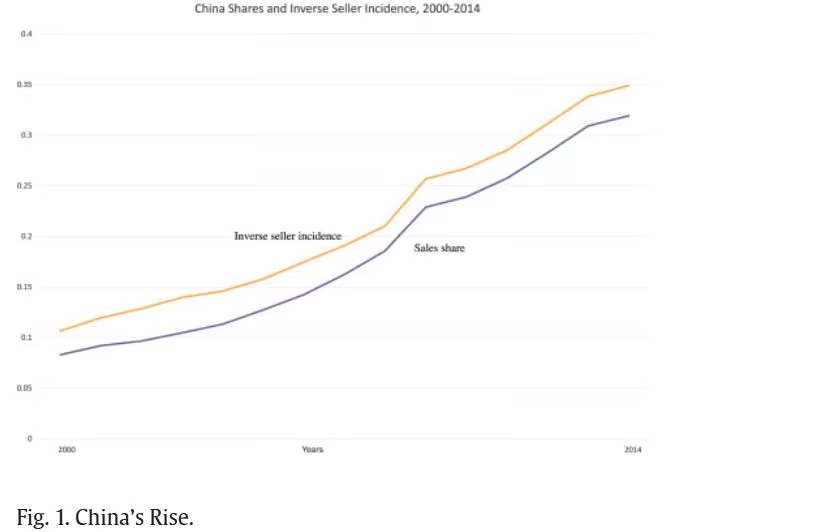
New at JIE: "Commercial rivalry as seller incidence shifting: Non-parametric accounting of the China shock" by James E. Anderson (@bostoncollege)
doi.org/10.1016/j.jinteco.2025.104208
Journal of International Economics
@JIntlEcon
US-China commercial rivalry is quantified with novel non-parametric sufficient statistics. China's manufacturing seller incidence falls (seller price rises) 8.2\% yearly as its sales share quadruples, 2000-14. US seller incidence rises 6.3\% yearly as US sales share halves.
-
Journal of International Economics
@JIntlEcon
New at JIE: "Playing with blocs: Quantifying decoupling" by Barthélémy Bonadio, Zhen Huo, Elliot Kang, Andrei A. Levchenko, Nitya Pandalai-Nayar, Hiroshi Toma, Petia Topalova
doi.org/10.1016/j.jinteco.2025.104204 -
Journal of International Economics
@JIntlEcon
New at JIE: "Cross-product and cross-market adjustments within multiproduct firms: Evidence from antidumping actions" by Xiaohua Bao, Bruce A. Blonigen (@uobusiness), Zhi Yu
doi.org/10.1016/j.jinteco.2025.104206
Journal of International Economics
@JIntlEcon
This paper uses detailed firm-product-country-level export data to examine how an anti-dumping action affects a multiproduct firm’s price and quantity decisions across its other products and export destinations.
-
Journal of International Economics
@JIntlEcon
New at JIE: "Foreign direct investment, prices and efficiency: Evidence from India", by Nesma Ali, Joel Stiebale
doi.org/10.1016/j.jinteco.2025.104202 -
Journal of International Economics
@JIntlEcon
New at JIE: "Using satellite imagery to measure the impacts of new highways: An application to India" by Kathryn Baragwanath (@KathrynBaragwa), Gordon H. Hanson (@gordon_h_hanson), Amit K. Khandelwal (@akhandelwal8), Chen Liu, Hogeun Park
doi.org/10.1016/j.jinteco.2025.104201
Journal of International Economics
@JIntlEcon
This paper integrates daytime and nighttime satellite imagery into a spatial general-equilibrium model to evaluate the returns to investments in new motorways, using publicly available imagery to evaluate India’s road construction projects in the early 2000s.
-
Journal of International Economics reposted
Journal of International Economics
@JIntlEcon
🎓 Call for Applications | JIE Summer School 2026
📍 Milan (Bocconi University) | 🗓 July 6–8, 2026
Lectures by Cécile Gaubert, Christoph Trebesch, David Hémous, Federica Romei, Christopher Clayton & Natalia Ramondo.
🗓 Deadline: Jan 25, 2026
👉 www.sciencedirect.com/journal/journal-of-international-ec… -
Journal of International Economics reposted
Javier Bianchi
@JavierBianchi7
The 4th edition of the Summer School in International Economics will take place at Bocconi. Ample opportunities to discuss ongoing research.
Apply by January 25!
Journal of International Economics
@JIntlEcon
🎓 Call for Applications | JIE Summer School 2026
📍 Milan (Bocconi University) | 🗓 July 6–8, 2026
Lectures by Cécile Gaubert, Christoph Trebesch, David Hémous, Federica Romei, Christopher Clayton & Natalia Ramondo.
🗓 Deadline: Jan 25, 2026
👉 www.sciencedirect.com/journal/journal-of-international-ec… -
Journal of International Economics reposted
CEPR
@cepr_org
📢Final reminder! #callforpapers - International Seminar on Trade (ISoT) Second Edition
CEPR, @JIntlEcon, @GSEM_UNIGE, and @WorldBank invite submissions for the 2nd edition of the International Seminar on Trade.
Deadline: 11 January 2026
cepr.org/events/international-seminar-trade-isot-2nd-edition #econtwitter -
Journal of International Economics reposted
Tommaso Monacelli
@monacelt
It was such a honor and pleasure to work at the @JIntlEcon as Co-editor. I honestly didn’t expect to learn so much.
I am the one being grateful.
Journal of International Economics
@JIntlEcon
We are grateful to outgoing Co-Editor Tommaso Monacelli (@monacelt) and outgoing Associate Editors Andrea Ferrero (@APFerrero) and Federica Romei (@Federomei1) for their years of service.
-
Journal of International Economics
@JIntlEcon
The Journal of International Economics welcomes new Co-Editor Ryan Chahrour (@CornellEcon) and Associate Editors Chris Clayton (@chris_d_clayton), Özge Akinci (@NYFedResearch), Pierre De Leo (@pierredeleo), and Wataru Miyamoto (@HKUFBE)!
Journal of International Economics
@JIntlEcon
We are grateful to outgoing Co-Editor Tommaso Monacelli (@monacelt) and outgoing Associate Editors Andrea Ferrero (@APFerrero) and Federica Romei (@Federomei1) for their years of service.
-
Journal of International Economics
@JIntlEcon
New at JIE: "The causal effects of commodity shocks" by Alisson Curatola-Melo (@acuratola), Bernardo Guimaraes (@BernardoGmrs)
doi.org/10.1016/j.jinteco.2025.104200
Journal of International Economics
@JIntlEcon
We estimate the causal impact of grain price shocks on emerging markets using USDA reports and identification through heteroskedasticity. Effects on default risk, stocks, and exchange rates are real but typically less than half of unadjusted estimates.
-
Journal of International Economics
@JIntlEcon
New at JIE: "Do geopolitical risks raise or lower inflation?" by Dario Caldara, Sarah Conlisk, Matteo Iacoviello, Maddie Penn
doi.org/10.1016/j.jinteco.2025.104188 -
Journal of International Economics
@JIntlEcon
New at JIE: "Sanctions, sales, and stigma: Intermediary online firms’ market role in sustaining trade" by Alexandra Avdeenko, Maximilian Kaiser, Krisztina Kis-Katos, Leonie Reher
doi.org/10.1016/j.jinteco.2025.104197 -
Journal of International Economics
@JIntlEcon
New at JIE: "A swing-state theorem with evidence" by Xiangjun Ma, John McLaren, Karim Chalak
doi.org/10.1016/j.jinteco.2025.104189 -
Journal of International Economics
@JIntlEcon
New at JIE: "Dominant drivers of current account dynamics" by Lukas Boer (@Boer_Lukas), Jaewoo Lee (@IMFNews), Mingzuo Sun (@EMsun2747287)
doi.org/10.1016/j.jinteco.2025.104199
Journal of International Economics
@JIntlEcon
Rather than traditional aggregate shocks to supply and demand or recently emphasized financial shocks, shocks to the relative demand between home and foreign goods are found to play a pivotal role in current account dynamics.
-
Journal of International Economics
@JIntlEcon
🎓 Call for Applications | JIE Summer School 2026
📍 Milan (Bocconi University) | 🗓 July 6–8, 2026
Lectures by Cécile Gaubert, Christoph Trebesch, David Hémous, Federica Romei, Christopher Clayton & Natalia Ramondo.
🗓 Deadline: Jan 25, 2026
👉 www.sciencedirect.com/journal/journal-of-international-ec…
Journal of International Economics
@JIntlEcon
-
Journal of International Economics
@JIntlEcon
New at JIE: "Economic diversity and the resilience of cities" by François de Soyres, Simon Fuchs, Illenin O. Kondo, Helene Maghin
doi.org/10.1016/j.jinteco.2025.104184 -
Journal of International Economics
@JIntlEcon
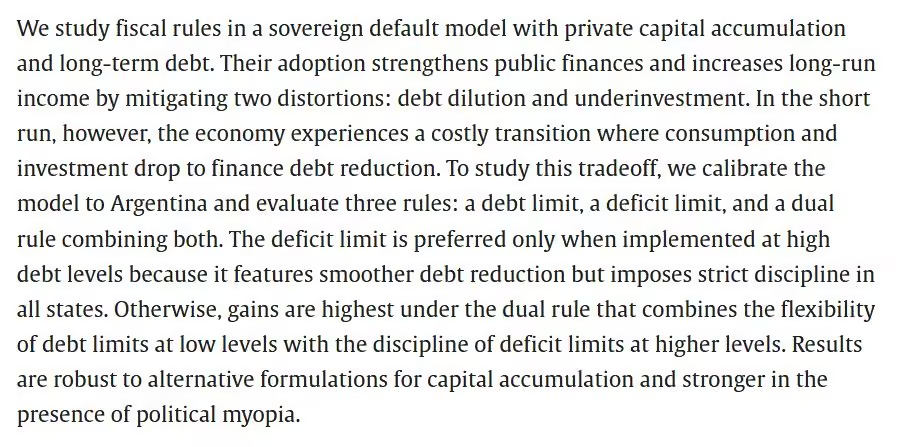
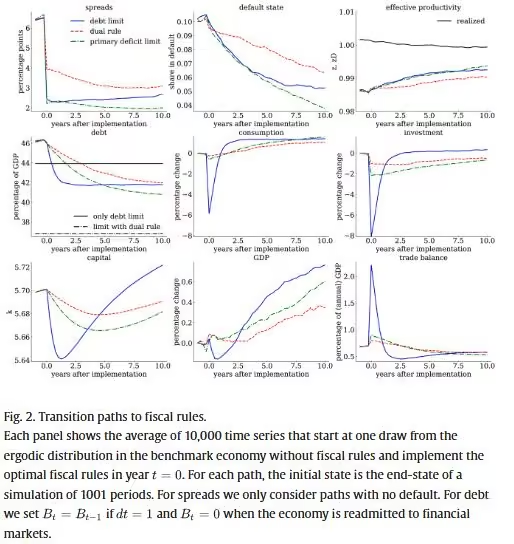
New at JIE: "Expansionary fiscal rules under sovereign risk" by Carlos Esquivel (@cesquivea), Agustin Samano (@gutysamano)
doi.org/10.1016/j.jinteco.2025.104198
Journal of International Economics
@JIntlEcon
Our paper shows that fiscal rules can be expansionary in emerging economies. By curbing debt dilution, they reduce underinvestment and enable a transition to a new steady state with lower debt and higher investment, output, and consumption.
-
Journal of International Economics
@JIntlEcon
New at JIE: "Unilateral environmental policy and offshoring" by Simon J. Bolz (@simon_bolz), Fabrice Naumann (@FabriceNaumann), Philipp M. Richter
doi.org/10.1016/j.jinteco.2025.104185
Journal of International Economics
@JIntlEcon
When firms offshore, a unilateral emissions tax can backfire. In our GE model, >100% leakage can arise via a global technique effect. The cleanest domestic firms start offshoring; offshored production gets dirtier. BCAs stop leakage – but risk raising inequality.
-
Journal of International Economics
@JIntlEcon
New at JIE: "Inflated concerns: Exposure to past inflationary episodes and preferences for price stability" by Nicolás E. Magud, Samuel Pienknagura
doi.org/10.1016/j.jinteco.2025.104181 -
Journal of International Economics
@JIntlEcon
New at JIE: "What Drives Exporters’ Market Dynamics? A New Framework for Disentangling Micro Shocks" by Lu Han (@LuHanEcon)
doi.org/10.1016/j.jinteco.2025.104186
Journal of International Economics
@JIntlEcon
Exporters frequently change their destination markets. Using a new framework that links price–quantity patterns in continuing markets to underlying shocks, this study finds that most market changes are demand-driven (~87%), and about a quarter reflect global or correlated shocks.
-
Journal of International Economics
@JIntlEcon
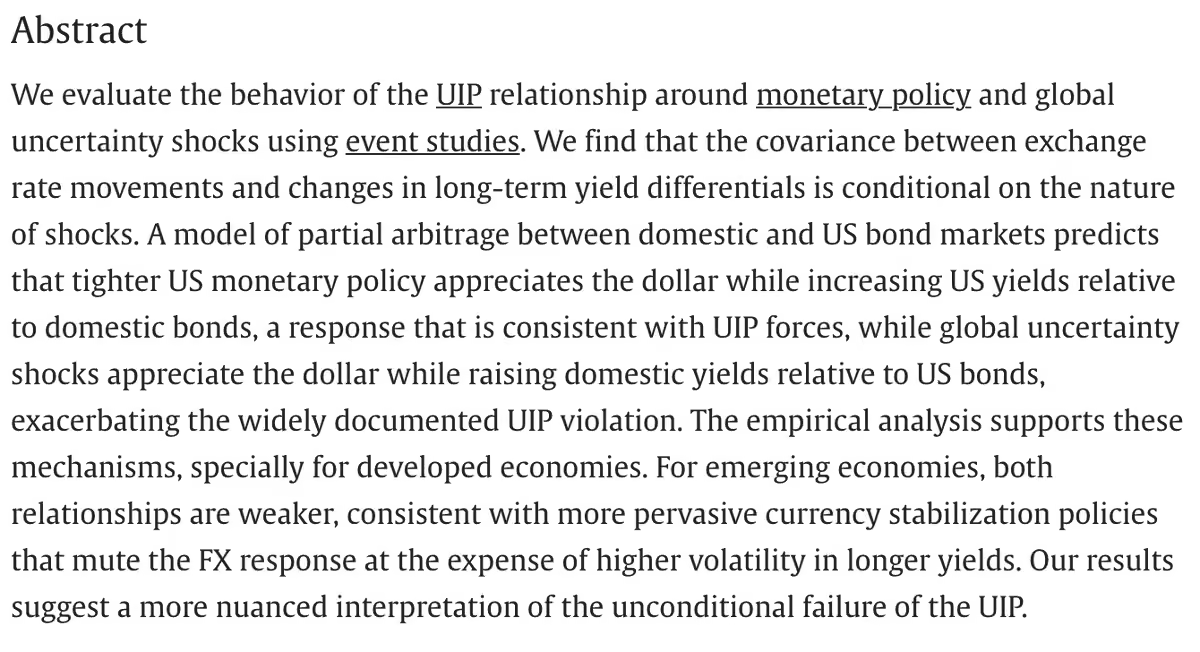
New at JIE: "Expectations and the UIP puzzles when foresight is limited", by Seunghoon Na, Yinxi Xie (@IUImpact)
doi.org/10.1016/j.jinteco.2025.104183
Journal of International Economics
@JIntlEcon
What if decision-makers don’t see far ahead? The paper's open-economy model with limited foresight captures exchange rate dynamics and excess currency returns, offering a new take on UIP puzzles.
-
Journal of International Economics
@JIntlEcon
Here is the agenda for the JIE-GCAP-GSB Conference on Geoeconomics from February 27-28
Organized by @jafrieden, @juhreka13, @CarolinPflueger, @JSchreger and @Ch_Trebesch and hosted by @JIntlEcon, @GCAProject , and @StanfordGSB
Get it here: globalcapitalallocation.s3.us-east-2.amazonaws.com/JIE-GC… -
Journal of International Economics reposted
Global Capital Allocation Project
@GCAProject
The agenda for the JIE-GCAP-GSB Conference on Geoeconomics from February 27-28 is now available.
View it here: globalcapitalallocation.s3.us-east-2.amazonaws.com/JIE-GC…
Organized by @jafrieden, @juhreka13, @CarolinPflueger, @JSchreger, and @Ch_Trebesch and hosted by @JIntlEcon, @GCAProject, and @StanfordGSB -
Journal of International Economics
@JIntlEcon
New at JIE: "The business cycle volatility puzzle: Emerging vs developed economies" by Lucía Casal (@luchi_casal), Rafael Guntin (@rafaguntin)
doi.org/10.1016/j.jinteco.2025.104182
Journal of International Economics
@JIntlEcon
Authors study why business-cycle volatility (BCV) is higher in emerging than developed economies. Their model splits BCV into four channels: sectoral composition, firm distribution, intl prices, and aggregate. They find sectoral composition explains up to 77% of excess BCV in EME
-
Journal of International Economics
@JIntlEcon
New at JIE: "Tickets to the Global Market: First US Patent Award and Chinese Firm Exports" by Robin Kaiji Gong (@robin_kgong), Yao Amber Li, Kalina Manova, Stephen Teng Sun
doi.org/10.1016/j.jinteco.2025.104124
Journal of International Economics
@JIntlEcon
The study utilizes the quasi-random assignment of patent examiners to identify the causal effect of a successful first US patent application on the export performance of Chinese firms.Successful first-time patent applicants experience significantly higher export growth.
-
Journal of International Economics
@JIntlEcon
New at JIE: "Single and Attractive: Uniqueness and Stability of Economic Equilibria under Monotonicity Assumptions" by Patrizio Bifulco, Jochen Glück, Oliver Krebs, Bohdan Kukharskyy
doi.org/10.1016/j.jinteco.2025.104187
Journal of International Economics
@JIntlEcon
The authors develop a novel theorem that provides sufficient conditions for uniqueness, attractivity, and stability of solutions in a broad class of economic models that allow multiple heterogeneous agents to interact in heterogeneous ways across several markets.
-
Journal of International Economics
@JIntlEcon
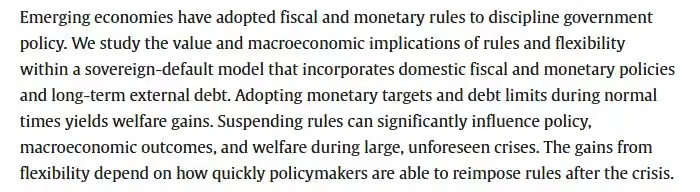
New at JIE: "Policy rules and large crises in emerging markets" by Emilio César Espino (@EmilioEspino15), Julian Kozlowski (@kozjuli), Fernando M. Martin (@martinbcra), Juan M. Sánchez (@vediense)
doi.org/10.1016/j.jinteco.2025.104179
Journal of International Economics
@JIntlEcon
In emerging economies, fiscal and monetary rules enhance welfare. Nonetheless, suspending these rules during large, unexpected crises can help stabilize GDP, employment and external trade. Flexible monetary policy proved particularly valuable during the COVID-19 crisis.
-
Journal of International Economics
@JIntlEcon
New at JIE: "Knockin’ on H(e)aven’s door. Financial crises and offshore wealth", by Silvia Marchesi (@SilviaMarches12), Giovanna Marcolongo
doi.org/10.1016/j.jinteco.2025.104175
Journal of International Economics
@JIntlEcon
Authors show that financial crises in developing countries trigger a surge in offshore deposits: three years after a crisis, tax-haven bank deposits rise by almost 30%. The effect is strongest where institutions are weak, revealing how havens drain resources when most needed.
-
Journal of International Economics
@JIntlEcon
New at JIE: "Export shocks and banks’ domestic credit: Balancing liquidity provision and risk mitigation" by Stefano Federico, Giuseppe Marinelli, Francesco Palazzo
doi.org/10.1016/j.jinteco.2025.104173 -
Journal of International Economics
@JIntlEcon
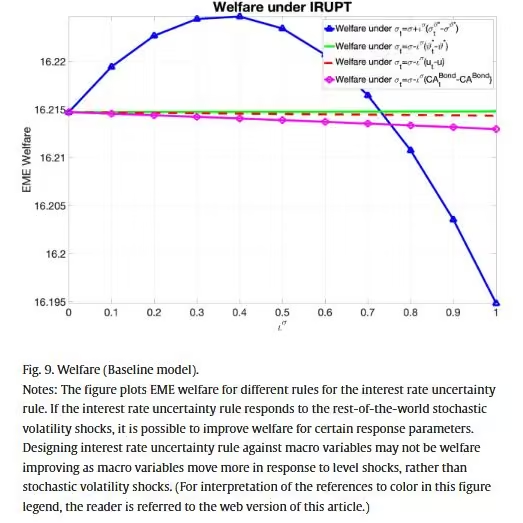
New at JIE: "Interest rate uncertainty as a policy tool?" by Fabio Ghironi (@FabioGhironi), Galip Kemal Ozhan (@galipkemal)
doi.org/10.1016/j.jinteco.2025.104180
Journal of International Economics
@JIntlEcon
An interest rate uncertainty rule discourages short-term bond inflows, tilts flows toward FDI, and can improve welfare when inflows are driven by foreign uncertainty shocks—but if inflows come from level shocks, IRUPT worsens domestic vs. external policy trade-offs.
-
Journal of International Economics
@JIntlEcon
New at JIE: "Service Trade, regional specialization, and welfare" by Yuancheng Han (@H72844Han), Jorge Miranda-Pinto (@JorgeMirandaPi5), Satoshi Tanaka (@econtanaka)
doi.org/10.1016/j.jinteco.2025.104178
Journal of International Economics
@JIntlEcon
Domestic service trade drives regional specialization and heterogeneous welfare gains, reducing disparities, while international service trade yields more uniform benefits. Using Canadian data and a spatial model, the paper quantifies sizable welfare impacts.
-
Journal of International Economics
@JIntlEcon
New at JIE: "Foreign direct investment as a long-term capital flow channel: Evidence from Japan" by Naohisa Hirakata, Mitsuru Katagiri
doi.org/10.1016/j.jinteco.2025.104158 -
Journal of International Economics
@JIntlEcon
New at JIE: "Argentina: The Honor Student—By Merit and By Mistake. A Natural Experiment on "Information Effects"", by Oscar Meneses (@os_meneses), Lorenzo Menna (@LorenzoMenna1), Martin Tobal (@MMartintobal)
doi.org/10.1016/j.jinteco.2025.104177
Journal of International Economics
@JIntlEcon
On Jan 7, 2025, a technical error cut Argentina’s EMBI spread by 114 bps, creating a rare natural experiment. Using DiD, IV & intraday data, we show Argentine stocks jumped as investors updated beliefs based on a mispriced signal.
-
Journal of International Economics
@JIntlEcon
New at JIE: "Fiscal policy design in collateral-constraint economies: The role of commitment", by Paolo Varraso (@PaoloVarraso)
doi.org/10.1016/j.jinteco.2025.104176
Journal of International Economics
@JIntlEcon
Endogenous borrowing constraints create a prudential motive for fiscal policy. Under the Ramsey-optimal plan, the government limits fiscal easing during crises, curbing overborrowing ex-ante and enhancing financial stability.
-
Journal of International Economics
@JIntlEcon
New at JIE: "Housing demand, inequality, and spatial sorting" by John Finlay, Trevor C. Williams
doi.org/10.1016/j.jinteco.2025.104171 -
Journal of International Economics
@JIntlEcon
New at JIE: "Credit and firms’ organization" by Alessandro Sforza (@alesforza87), Edoardo Maria Acabbi (@eacabbi )
doi.org/10.1016/j.jinteco.2025.104172
Journal of International Economics
@JIntlEcon
Authors investigate how credit availability affects the organization of firms’ labor. They construct an instrument for firm’s credit supply based on firm-bank credit linkages and conduct an event study on the decision to reorganize the labor force using Portugal data.
-
Journal of International Economics reposted
Journal of International Economics
@JIntlEcon
🌍📊 Call for Papers
Joint BIS–BoE–ECB–IMF & JIE Spillover Conference
📍 Washington, DC | 🗓️ Apr 28–29, 2026
✍️ Deadline: Nov 30, 2025
📖 Selected papers → JIE special issue
🔗 More info: www.sciencedirect.com/journal/journal-of-international-ec…
@BIS_org @BankofEngland @ECB @IMFNews -
Journal of International Economics
@JIntlEcon
New at JIE: "Trade policy uncertainty and innovation: Evidence from China" by Federica Coelli (@federicacoelli)
doi.org/10.1016/j.jinteco.2025.104170
Journal of International Economics
@JIntlEcon
"This paper analyzes the effect of resolving trade policy uncertainty on innovation
in China from 1990 to 2007. Reducing tariff uncertainty is show to have generated economically and statistically significant increases in innovation. -
Journal of International Economics
@JIntlEcon
New at JIE: "The macroeconomic cost of temperature risk" by Piergiorgio Alessandri, Haroon Mumtaz
doi.org/10.1016/j.jinteco.2025.104157 -
Journal of International Economics
@JIntlEcon
New at JIE: "Liquidity as competitive advantage: The role of intangibles" by Carlo Altomonte (@Altomonte_C), Monica Morlacco (@mmorl89), Tommaso Sonno (@TSonno), Domenico Favoino (@DomenicoFavoino)
doi.org/10.1016/j.jinteco.2025.104168
Journal of International Economics
@JIntlEcon
Authors show that short-term liquidity is a source of competitive advantage, enabling investment in intangibles. Exploiting a French reform capping payment delays, they find that higher liquidity boosted intangibles, raising markups and market shares.
-
Journal of International Economics
@JIntlEcon
New at JIE: "Global spillovers from multi-dimensional US monetary policy" by Georgios Georgiadis, Marek Jarociński
doi.org/10.1016/j.jinteco.2025.104169
Journal of International Economics
@JIntlEcon
Authors estimate international spillovers from both conventional and unconventional US monetary policy, using exogenous variation in conventional policy, forward guidance and large-scale asset purchases, based on high-frequency asset price surprises around Fed communications
-
Journal of International Economics
@JIntlEcon
New at JIE: "Did the 2018 trade war improve job opportunities for US Workers?" by Beata Javorcik, Benjamin Kett, Katherine Stapleton, Layla O’Kane
doi.org/10.1016/j.jinteco.2025.104125 -
Journal of International Economics
@JIntlEcon
New at JIE: "Can trade policy change gender equality? Evidence from Chile" by Utsa Banerjee, Luis Castro Peñarrieta, Pavel Chakraborty
doi.org/10.1016/j.jinteco.2025.104143
Journal of International Economics
@JIntlEcon
Authors argue that trade policy or new trade agreements can lead firms to adopt more technology, spent higher amount on research, invest in more high-cognitive non-production related tasks and this can lead to hiring of more white-collared female skilled workers.
-
Journal of International Economics
@JIntlEcon
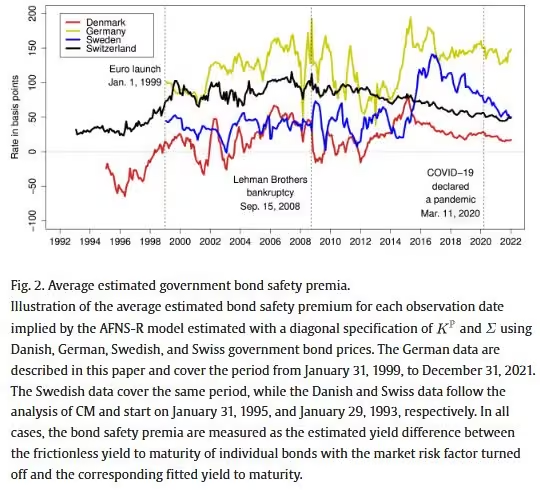
New at JIE: "Quantitative easing and the supply of safe assets: Evidence from international bond safety premia" by Jens H.E. Christensen, Nikola N. Mirkov (@nikomirkov), Xin Zhang
doi.org/10.1016/j.jinteco.2025.104146
Journal of International Economics
@JIntlEcon
Authors examine pricing effects of ECB bond purchases in the 2015–2021 period on an international panel of bond safety premia from four highly rated countries: Denmark, Germany, Sweden, and Switzerland and find statistically significant negative effects for all four countries.
-
Journal of International Economics
@JIntlEcon
New at JIE: "A search and learning model of export dynamics" by Jonathan Eaton, Marcela Eslava, David Jinkins, C.J. Krizan, James Tybout
doi.org/10.1016/j.jinteco.2025.104155 -
Journal of International Economics
@JIntlEcon
New at JIE: "Climate change-related regulatory risks and bank lending" by Isabella Mueller (@ib_mueller), Eleonora Sfrappini (@Esfrappini)
doi.org/10.1016/j.jinteco.2025.104156
Journal of International Economics
@JIntlEcon
After the Paris Agreement, firms that benefit from regulation receive more credit only if located in more stringent regulatory environments. Conversely, firms hurt by regulation receive more credit if located in less stringent environments.
-
Journal of International Economics
@JIntlEcon
New at JIE: "Skill-biased imports, skill acquisition, and migration" by Jingting Fan, Lei Li (@LeiLi_economics)
doi.org/10.1016/j.jinteco.2025.104128
Journal of International Economics
@JIntlEcon
Imported capital goods raised skill demand in China (2000–2010), leading to increased college attainment and skilled migration. This response accounted for 3.1–7.3 million more graduates—4.4–10.4% of the national increase—with gains concentrated in coastal regions.
-
Journal of International Economics
@JIntlEcon
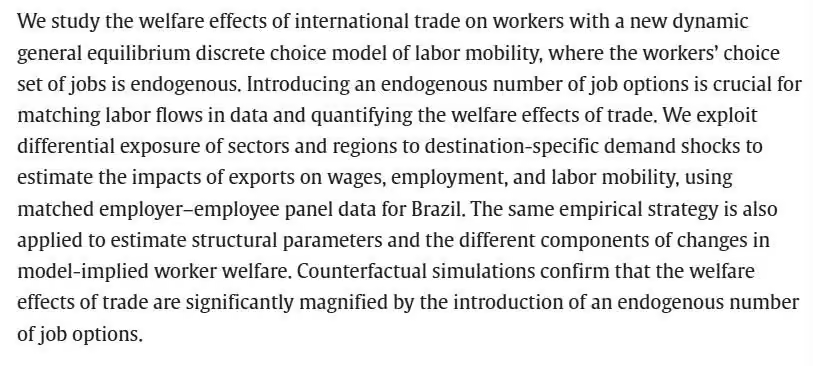
New at JIE: "Trade, Jobs, and Worker welfare" by Erhan Artuc, Paulo Bastos, Eunhee Lee
doi.org/10.1016/j.jinteco.2025.104154 -
Journal of International Economics
@JIntlEcon
New at JIE: "Household responses to trade shocks" by Aitor Irastorza-Fadrique (@Aitor_IrastFadr), Peter Levell (@levell_peter), Matthias Parey (@matthiasparey)
doi.org/10.1016/j.jinteco.2025.104144
Journal of International Economics
@JIntlEcon
This paper studies gender differences in responses to import competition by both individuals and their partners. Men increase labour force participation at older ages and move into self-employment. Male labour supply also increases if their partners are exposed to trade shocks.
-
Journal of International Economics
@JIntlEcon
New at JIE: "Real exchange rate and net trade dynamics: Financial and trade shocks" by Marcos Mac Mullen (@MarcosMacMullen), Soo Kyung Woo (@SKWooEcon)
doi.org/10.1016/j.jinteco.2025.104141
Journal of International Economics
@JIntlEcon
Authors develop an international business cycle model that explains the joint behavior of real exchange rates and net trade flows across all frequencies and addresses key exchange rate puzzles.
-
Journal of International Economics
@JIntlEcon
New at JIE: "Why global and local solutions of open-economy models with incomplete markets differ and why it matters" by Oliver de Groot, C. Bora Durdu, Enrique G. Mendoza
doi.org/10.1016/j.jinteco.2025.104142 -
Journal of International Economics
@JIntlEcon
New at JIE: "The tails of gravity: Using expectiles to quantify the trade-margins effects of economic integration agreements" by Jeffrey H. Bergstrand (@nd_econ), Matthew W. Clance (@matthew_clance), J.M.C. Santos Silva (@economicssurrey)
doi.org/10.1016/j.jinteco.2025.104145
Journal of International Economics
@JIntlEcon
Using Poisson-based expectile regressions, we find that economic integration agreements have much stronger effects at the bottom of the conditional distribution of trade flows. We then investigate why this is the case, finding that the extensive margin may play an important role.
-
Journal of International Economics reposted
Journal of International Economics
@JIntlEcon
New at JIE: "Monetary Unions with Heterogeneous Fiscal Space", by Marco Bellifemine (@m_bellifemine), Adrien Couturier (@AdriCouturier), Rustam Jamilov (@RustamJamilov)
doi.org/10.1016/j.jinteco.2025.104092 -
Journal of International Economics reposted
Journal of International Economics
@JIntlEcon
New at JIE: "The bank-lending channel of macroprudential policy: Evidence from cross-border bank flows" by Josefina Fabiani (@josefinafabiani), Kyriakos C. Neanidis (@KNeanidis)
doi.org/10.1016/j.jinteco.2025.104135 -
Journal of International Economics
@JIntlEcon
New at JIE: "Commitment in the canonical sovereign default model" by Xavier Mateos-Planas, Sean McCrary, José-Víctor Ríos-Rull, Adrien Wicht
doi.org/10.1016/j.jinteco.2025.104120 -
Journal of International Economics
@JIntlEcon
New at JIE: "Chinese roads in India: The effect of transport infrastructure on economic development" by Simon Alder (@SimonA38625)
doi.org/10.1016/j.jinteco.2025.104140
Journal of International Economics
@JIntlEcon
India’s Golden Quadrilateral national highway network targeted major cities, yielding aggregate gains but unequal effects across regions. A counterfactual network would have yielded larger gains and benefited lagging regions.
-
Journal of International Economics
@JIntlEcon
New at JIE: "Has globalization changed the international transmission of U.S. monetary policy?" by Maximilian Boeck (@maxiboeck), Lorenzo Mori (@dSEA_Unipd)
doi.org/10.1016/j.jinteco.2025.104139
Journal of International Economics
@JIntlEcon
Authors estimate a TVP‑VAR to examine the evolution of international spillovers of US mon. pol. in light of increasing globalization. Adverse spillovers rose over past three decades, peaking in 2008–09, driven by trade integration, while financial integration contributed modestly
-
Journal of International Economics reposted
Jesse Schreger
@JSchreger
🚨 Last day to submit to the JIE-GCAP-BGS Conference on Geoeconomics! 🚨
Journal of International Economics
@JIntlEcon
🚨 Call for Papers: JIE–GCAP–BGS Conference on Geoeconomics
📍 Stanford GSB | 📅 Feb 27–28, 2026
📝 Submit papers by Sept 15, 2025
🔗 Call for papers: www.sciencedirect.com/journal/journal-of-international-ec…
@GCAProject, @StanfordGSB -
Journal of International Economics reposted
Journal of International Economics
@JIntlEcon
🌍📊 Call for Papers
49th Annual NBER International Seminar on Macroeconomics (ISoM)
📍 Hosted by Sveriges Riksbank, Stockholm, Sweden
🗓 June 24–25, 2026
✍️ Deadline: November 12, 2025
📖 Selected papers → JIE special issue
🔗 More info: www.sciencedirect.com/journal/journal-of-international-ec…
@nberpubs -
Journal of International Economics
@JIntlEcon
New at JIE: "Making America great again? The economic impacts of liberation day tariffs" by Anna Ignatenko, Ahmad Lashkaripour (@ALashkaripour), Luca Macedoni, Ina Simonovska (@InaSimonovska)
doi.org/10.1016/j.jinteco.2025.104138
Journal of International Economics
@JIntlEcon
The paper analyzes long-term economic impacts of "Liberation Day" tariffs. If partners do not retaliate, the tariffs could decrease the US trade deficit and improve its terms of trade, yielding modest welfare gains. However, reciprocal retaliation results in net welfare losses.
-
Journal of International Economics
@JIntlEcon
🌍📊 Call for Papers
49th Annual NBER International Seminar on Macroeconomics (ISoM)
📍 Hosted by Sveriges Riksbank, Stockholm, Sweden
🗓 June 24–25, 2026
✍️ Deadline: November 12, 2025
📖 Selected papers → JIE special issue
🔗 More info: www.sciencedirect.com/journal/journal-of-international-ec…
@nberpubs -
Journal of International Economics reposted
Jesse Schreger
@JSchreger
One week left to submit to this! Excited for conference and the @JIntlEcon special issue.
Feel free to reach out directly if you're considering submitting and have any questions on process etc.
Journal of International Economics
@JIntlEcon
🚨 Call for Papers: JIE–GCAP–BGS Conference on Geoeconomics
📍 Stanford GSB | 📅 Feb 27–28, 2026
📝 Submit papers by Sept 15, 2025
🔗 Call for papers: shorturl.at/r26Do
@GCAProject, @StanfordGSB -
Journal of International Economics
@JIntlEcon
🌍📊 Call for Papers
Joint BIS–BoE–ECB–IMF & JIE Spillover Conference
📍 Washington, DC | 🗓️ Apr 28–29, 2026
✍️ Deadline: Nov 30, 2025
📖 Selected papers → JIE special issue
🔗 More info: www.sciencedirect.com/journal/journal-of-international-ec…
@BIS_org @BankofEngland @ECB @IMFNews -
Journal of International Economics reposted
Journal of International Economics
@JIntlEcon
🚨 Call for Papers: JIE–GCAP–BGS Conference on Geoeconomics
📍 Stanford GSB | 📅 Feb 27–28, 2026
📝 Submit papers by Sept 15, 2025
🔗 Call for papers: shorturl.at/r26Do
@GCAProject, @StanfordGSB -
Journal of International Economics
@JIntlEcon
New at JIE: "The bank-lending channel of macroprudential policy: Evidence from cross-border bank flows" by Josefina Fabiani (@josefinafabiani), Kyriakos C. Neanidis (@KNeanidis)
doi.org/10.1016/j.jinteco.2025.104135
Journal of International Economics
@JIntlEcon
The paper studies the transmission of foreign macroprudential policy to domestic bank loan issuance in EMs via cross-border bank flows. A tightening of macroprudential policy in source reduces the positive impact of cross-border flows on credit supply of banks in the destination.
-
Journal of International Economics
@JIntlEcon
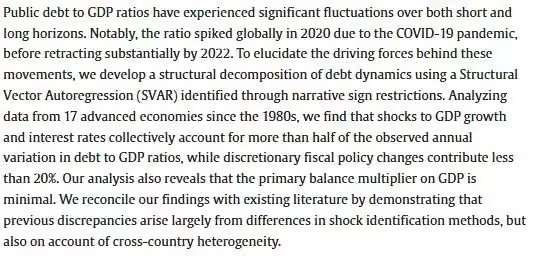
New at JIE: "High public debts: Are shocks or discretionary fiscal policy to blame?" by Nikhil Patel, Adrian Peralta-Alva (@IMFNews)
doi.org/10.1016/j.jinteco.2025.104130 -
Journal of International Economics
@JIntlEcon
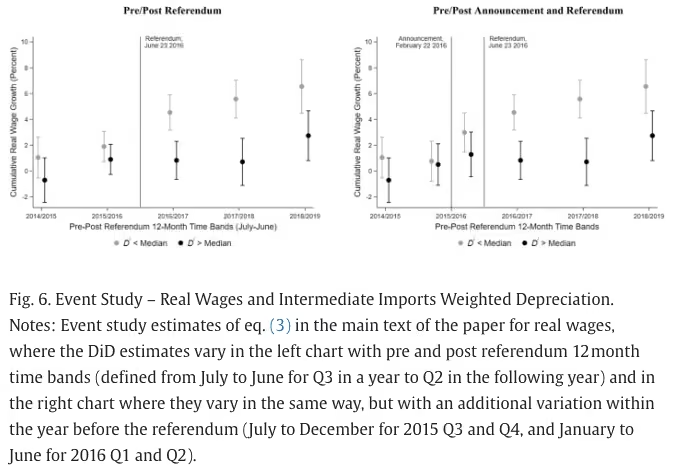
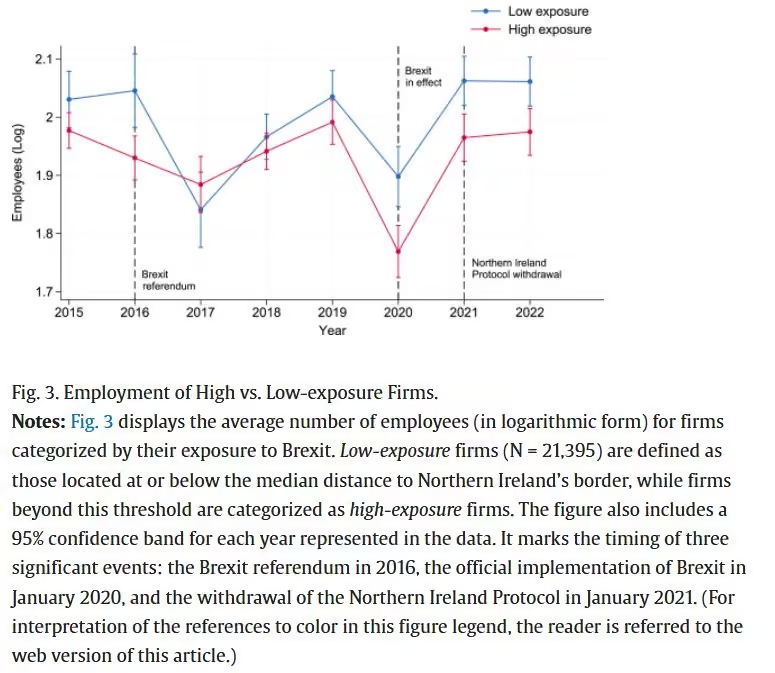
New at JIE: "The Real effects of Brexit on labor demand: Evidence from firm-level data" by Hang Do (@unisouthampton), Kiet Tuan Duong (@KietTuanDuong), Luu Duc Toan Huynh (@toanldhuynh), Nam T. Vu (@Miami_Econ)
doi.org/10.1016/j.jinteco.2025.104129
Journal of International Economics
@JIntlEcon
Using distance to the Irish border of UK firms that have not changed their location since 2016 Referendum to isolate the effects of Brexit at the firm level, authors find that Brexit caused exposed firms to cut workforce by up to 15.7% on average relative to non-exposed firms.
-
Journal of International Economics reposted
Journal of International Economics
@JIntlEcon
New at JIE: "Sticky Capital Controls", by Miguel Acosta-Henao (@miguelacostah), Laura Alfaro, Andrés Fernández (@andresfernanm)
doi.org/10.1016/j.jinteco.2025.104104 -
Journal of International Economics reposted
Journal of International Economics
@JIntlEcon
New at JIE: "Global banking and macroeconomic stability. Liquidity, control, and monitoring", by Elton Beqiraj, Qingqing Cao, Ralph De Haas, Raoul Minetti
doi.org/10.1016/j.jinteco.2025.104133 -
Journal of International Economics
@JIntlEcon
📢 Call for Papers
Global Spillovers Amid Shifting Policies
Joint BIS • BoE • ECB • IMF • JIE Conference
📍 Washington, D.C. | 🗓 April 28–29, 2026
📝 Submit by Nov 30, 2025
@BIS_org @BankofEngland @ECB @IMFNews -
Journal of International Economics
@JIntlEcon
New at JIE: "Measuring foreign exposure" by Jean Imbs, Laurent Pauwels
doi.org/10.1016/j.jinteco.2025.104126 -
Journal of International Economics
@JIntlEcon
New at JIE: "Multinational production, technology diffusion, and economic growth" by Sheng Cai (@sheng_c_cai), Wei Xiang (@weiecon1)
doi.org/10.1016/j.jinteco.2025.104137
Journal of International Economics
@JIntlEcon
The paper develops a growth model to study the dynamic macroeconomic effects of multinational production (MP). In this framework, MP serves as the channel of international idea diffusion: when firms operate in a foreign country, contributing to the local stock of knowledge.
-
Journal of International Economics
@JIntlEcon
New at JIE: "Sovereign Debt Disclosure" by Bulent Guler, Yasin Kürşat Önder, Temel Taskin
doi.org/10.1016/j.jinteco.2025.104118 -
Journal of International Economics
@JIntlEcon
📢 Call for Papers: The 2026 International Seminar on Macroeconomics (ISoM) will be held June 24–25 in Stockholm, hosted by Sveriges Riksbank
We invite submissions in quantitative macro w/ an international dimension. Deadline: Nov 12, 2025.
Submit here 👉conference.nber.org/confsubmit/backend/cfp?id=ISOM26 -
Journal of International Economics
@JIntlEcon
New at JIE: "Beyond the spike at zero: Understanding nominal wage rigidity through empirical and model-based approaches" by Yoon Joo Jo
doi.org/10.1016/j.jinteco.2025.104117 -
Journal of International Economics
@JIntlEcon
New at JIE: "Global banking and macroeconomic stability. Liquidity, control, and monitoring", by Elton Beqiraj, Qingqing Cao, Ralph De Haas, Raoul Minetti
doi.org/10.1016/j.jinteco.2025.104133
Journal of International Economics
@JIntlEcon
Global banks with a centralized business model (with loan officers hired centrally by the parent and an intense use of internal capital markets) help mitigate the impact of financial shocks on the host economy. However, they may become a destabilizing factor following real shocks
-
Journal of International Economics
@JIntlEcon
New at JIE: "Fear of appreciation and current account adjustment" by Paul R. Bergin, Kyunghun Kim, Ju H. Pyun
doi.org/10.1016/j.jinteco.2025.104121 -
Journal of International Economics
@JIntlEcon
New at JIE: "Do investor differences impact monetary policy spillovers to emerging markets?" by Ester Faia, Karen K. Lewis, Haonan Zhou (@Haonan_Zhou)
doi.org/10.1016/j.jinteco.2025.104100
Journal of International Economics
@JIntlEcon
The paper revisits the financial channel of monetary policy spillovers from center to periphery with disaggregated capital flows holdings, finding little evidence of cap.flow reversals from long term institutional investors, while inv. funds’ holding exhibit stronger sensitivity
-
Journal of International Economics
@JIntlEcon
New at JIE: "Local global watchdogs: Trade, sourcing and the internationalization of social activism" by Pamina Koenig, Sebastian Krautheim, Claudius Löhnert, Thierry Verdier
doi.org/10.1016/j.jinteco.2025.104116 -
Journal of International Economics
@JIntlEcon
New at JIE: "Sticky Capital Controls", by Miguel Acosta-Henao (@miguelacostah), Laura Alfaro, Andrés Fernández (@andresfernanm)
doi.org/10.1016/j.jinteco.2025.104104
Journal of International Economics
@JIntlEcon
With a new dataset on the intensive margin of capital controls, we document that they are “sticky”. A model of capital controls relying on pecuniary externalities with an $(S,s)$ cost of implementing such policies goes a long way toward bringing the model closer to the data.
-
Journal of International Economics
@JIntlEcon
New at JIE: "Asset price changes, external wealth and global welfare" by Timothy Meyer (@TimothyAMeyer)
doi.org/10.1016/j.jinteco.2025.104122
Journal of International Economics
@JIntlEcon
This paper introduces a new dataset tracking valuation gains on the U.S. foreign asset position across countries and derives a sufficient statistic that translates those gains into welfare effects.
-
Journal of International Economics
@JIntlEcon
New at JIE: "Demographics and real interest rates across countries and over time", by Carlos Carvalho (@Cvianac), Andrea Ferrero (@APFerrero), Felipe Mazin (@MazinFelipe), Fernanda Nechio (@fernandanechio)
doi.org/10.1016/j.jinteco.2025.104127
Journal of International Economics
@JIntlEcon
The paper explores the implications of demographic trends for real interest rates across countries and over time. Both model and empirical results suggest demographic trends explain a meaningful share of the global decline in real rates.
-
Journal of International Economics
@JIntlEcon
New at JIE: "Commodity prices and the US dollar" by Daniel M. Rees
doi.org/10.1016/j.jinteco.2025.104114 -
Journal of International Economics
@JIntlEcon
New at JIE: "Paper tiger? Chinese science and home bias in citations" Shumin Qiu (@shumin_qiu), Claudia Steinwender (@ClaudiaSteinwen), Pierre Azoulay (@pierre_azoulay)
doi.org/10.1016/j.jinteco.2025.104123
Journal of International Economics
@JIntlEcon
China has by far the strongest home bias in scientific citations—Chinese researchers cite domestic work more than any other country. This inflates China’s rise in science: using a de-biased metric, China drops from #2 to #4, behind the US, UK, and Germany.
-
Journal of International Economics
@JIntlEcon
New at JIE: "Industrial development and trade policy uncertainty: Evidence from China’s WTO accession" by Weidi Yuan, Difei Ouyang
doi.org/10.1016/j.jinteco.2025.104106 -
Journal of International Economics reposted
Journal of International Economics
@JIntlEcon
New at JIE: "Sovereign vs. corporate debt and default: More similar than you think", by Gita Gopinath (@GitaGopinath), Josefin Meyer, Carmen Reinhart (@carmenreinhart), Christoph Trebesch (@Ch_Trebesch)
doi.org/10.1016/j.jinteco.2025.104082 -
Journal of International Economics
@JIntlEcon
New at JIE: "Bank lending and firm internal capital markets following a deglobalization shock", by Björn Imbierowicz (@BjornImbie), Arne Nagengast (@ArneNagengast), Esteban Prieto and Ursula Vogel
doi.org/10.1016/j.jinteco.2025.104119
Journal of International Economics
@JIntlEcon
The Brexit referendum constituted a deglobalization shock that reduced bank lending to UK firms. However, UK subsidiaries of multinational corporations mitigated these effects by relying on internal capital markets.
-
Journal of International Economics
@JIntlEcon
New at JIE: "Whatever it takes to understand a central banker - Embedding their words using neural networks" by Martin Baumgärtner and Johannes Zahner (@goetheuni)
doi.org/10.1016/j.jinteco.2025.104101
Journal of International Economics
@JIntlEcon
Authors develop a central bank-specific large language model (LLM) from 22,000 central bank texts. The LLM is able to predict monetary policy shocks and reveal regime shifts in the Fed’s inflation-targeting stance.
-
Journal of International Economics reposted
Journal of International Economics
@JIntlEcon
🚨 Call for Papers 🚨
Conference on Spatial Dynamics | @ @YaleCowles
📅 Conference: Nov 14, 2025 (New Haven)
📝 Submit by: Sept 21, 2025 (for conf.)
📚 Special Issue in @JIntlEcon
👉 www.sciencedirect.com/special-issue/320139/spatial-dynamics -
Journal of International Economics
@JIntlEcon
New at JIE: "Output divergence in fixed exchange rate regimes" by Yao Chen (@YChen_ks) and Felix Ward (@econfward)
doi.org/10.1016/j.jinteco.2025.104115
Journal of International Economics
@JIntlEcon
This paper presents empirical evidence for the violation of nominal exchange regime neutrality. Authors find that fixing the exchange rate is associated with real output losses among countries with a high pre-peg inflation rate.
-
Journal of International Economics
@JIntlEcon
New at JIE: "Networks in trade - Evidence from the legacy of the hanseatic league", by Max Marczinek, Stephan Maurer (@maurer_se) and Ferdinand Rauch
doi.org/10.1016/j.jinteco.2025.104102
Journal of International Economics
@JIntlEcon
A 190-year study of novel Northern European trade data shows former trade networks still shape trade long after their demise—but who facilitates trade persists more than how much is traded.
-
Journal of International Economics
@JIntlEcon
New at JIE: "The role of currencies in external balance sheets" by Cían Allen (@allen_c4), Luciana Juvenal (@luccitweeting)
doi.org/10.1016/j.jinteco.2025.104105
Journal of International Economics
@JIntlEcon
New dataset for 50 countries (1990–2020) tracks the currency mix of cross-border assets & liabilities. The U.S. dollar and euro still dominate, but many emerging economies have flipped from net short to net long FX--reshaping crisis-time wealth transfers.
-
Journal of International Economics
@JIntlEcon
🚨 Call for Papers 🚨
Conference on Spatial Dynamics | @ @YaleCowles
📅 Conference: Nov 14, 2025 (New Haven)
📝 Submit by: Sept 21, 2025 (for conf.)
📚 Special Issue in @JIntlEcon
👉 www.sciencedirect.com/special-issue/320139/spatial-dynamics -
Journal of International Economics
@JIntlEcon
New at JIE: "Regional content requirements and market power: Lessons from CUSFTA", by Wanyu Chung (@econ_ub), Carlo Perroni (@warwickecon)
doi.org/10.1016/j.jinteco.2025.104097
Journal of International Economics
@JIntlEcon
We study the 1989 CUSFTA and show that content requirements in FTAs can reduce competition more than tariffs. Using US and Canadian data, we find stricter rules raise prices and firm entry, highlighting their impact on market power and trade policy design.
-
Journal of International Economics reposted
Cowles Foundation
@YaleCowles
Call For Papers! 📢
Papers selected for presentation at our Conference on Spatial Dynamics will have a discussant and will be considered for inclusion in a special issue of the Journal of International Economics (JIE).
More info: cowles.yale.edu/events/2025/spatial-dynamics -
Journal of International Economics
@JIntlEcon
New at JIE: "Banks’ market capital and the international risk taking channel of US monetary policy", by Stefan Avdjiev (@StefanAvdjiev), Jose Maria Serena
doi.org/10.1016/j.jinteco.2025.104099
Journal of International Economics
@JIntlEcon
Banks’ market capital is a key determinant of the strength of the international risk-taking channel of US monetary policy. This channel is most powerful for banks that have a combination of high regulatory capital and low market capital.
-
Journal of International Economics
@JIntlEcon
New at JIE: "Low interest rates, capital misallocation and welfare", by Anastasios Dosis (@TasosDosis)
doi.org/10.1016/j.jinteco.2025.104096
Journal of International Economics
@JIntlEcon
The paper shows that low interest rates can negatively impact capital allocation and overall welfare. These findings help reconcile recent empirical evidence from Southern Europe and other countries, shedding light on unintended consequences of monetary policy.
-
Journal of International Economics
@JIntlEcon
New at JIE: "Heterogeneous trade elasticity and managerial skills", by Maria Bas, Lionel Fontagné, Irene Iodice, Gianluca Orefice
doi.org/10.1016/j.jinteco.2025.104093 -
Journal of International Economics
@JIntlEcon
New at JIE: "Monetary Unions with Heterogeneous Fiscal Space", by Marco Bellifemine (@m_bellifemine), Adrien Couturier (@AdriCouturier), Rustam Jamilov (@RustamJamilov)
doi.org/10.1016/j.jinteco.2025.104092
Journal of International Economics
@JIntlEcon
In a multi-country HANK model of a monetary union, the central bank faces a trade-off between cross-country synchronization and macroeconomic stabilization. Deficit caps, fiscal and political unions, and augmented interest rate rules are explored to manage this trade-off.
-
Journal of International Economics
@JIntlEcon
New at JIE: "Drivers of the global financial cycle", by John Rogers, Bo Sun, Wenbin Wu
doi.org/10.1016/j.jinteco.2025.104088 -
Journal of International Economics
@JIntlEcon
New at JIE: "Monetary policy and exchange rate dynamics in a behavioral open economy model", by Marcin Kolasa, Sahil Ravgotra (@sahil_ravgotra), Pawel Zabczyk
doi.org/10.1016/j.jinteco.2025.104087 -
Journal of International Economics
@JIntlEcon
🚨 Call for Papers: JIE–GCAP–BGS Conference on Geoeconomics
📍 Stanford GSB | 📅 Feb 27–28, 2026
📝 Submit papers by Sept 15, 2025
🔗 Call for papers: www.sciencedirect.com/journal/journal-of-international-ec…
@GCAProject, @StanfordGSB -
Journal of International Economics
@JIntlEcon
New at JIE: "Seniority and Sovereign Default: The Role of Official Multilateral Lenders", by Adrien Wicht (@AdrienWicht)
doi.org/10.1016/j.jinteco.2025.104098
Journal of International Economics
@JIntlEcon
The effect of multilateral debt on the private bond price addresses the catalytic function of the multilateral lender. While small amounts of multilateral debt enhance the terms of private borrowing, large amounts have the opposite effect
-
Journal of International Economics
@JIntlEcon
New at JIE: "The impact of NAFTA on prices and competition: Evidence from Mexican manufacturing plants", by Felipe Brugués, Ayumu Ken Kikkawa, Yuan Mei (@yuanmei10), Pablo Robles
doi.org/10.1016/j.jinteco.2025.104085 -
Journal of International Economics
@JIntlEcon
🚨 Call for Papers: JIE–GCAP–BGS Conference on Geoeconomics
📍 Stanford GSB | 📅 Feb 27–28, 2026
📝 Submit papers by Sept 15, 2025
🔗 Call for papers: shorturl.at/r26Do
@GCAProject, @StanfordGSB -
Journal of International Economics reposted
Global Capital Allocation Project
@GCAProject
GCAP and BGS will hold a JIE-GCAP-BGS Conference on Geoeconomics at @StanfordGSB on February 27-28, 2026. Call for papers: shorturl.at/r26Do
Organized by @JSchreger, @jafrieden, @juhreka13, @CarolinPflueger, and @Ch_Trebesch -
Journal of International Economics
@JIntlEcon
New at JIE: "How infrastructure shapes comparative advantage", by Luis Baldomero-Quintana
doi.org/10.1016/j.jinteco.2025.104083 -
Journal of International Economics
@JIntlEcon
New at JIE: "Should governments promote or restrain urbanization?", by Wenbin Wu, Wei You
doi.org/10.1016/j.jinteco.2025.104084 -
Journal of International Economics reposted
Yale Department of Economics
@YaleEconomics
📣📣 Call for Papers on Spatial Dynamics 📣📣
Join us for a special @YaleCowles research conference (Nov 14, 2025) & @JIntlEcon special issue.
Deadline: June 30. More info + submissions here: cowles.yale.edu/form/spatial-dynamics-submission-form -
Journal of International Economics
@JIntlEcon
New at JIE: "Sovereign vs. corporate debt and default: More similar than you think", by Gita Gopinath (@GitaGopinath), Josefin Meyer, Carmen Reinhart (@carmenreinhart), Christoph Trebesch (@Ch_Trebesch)
doi.org/10.1016/j.jinteco.2025.104082 -
Journal of International Economics
@JIntlEcon
New at JIE: "Reshoring, automation, and labor markets under trade uncertainty", by Hamid Firooz (@firooz_hamid), Sylvain Leduc and Zheng Liu (@zliu001)
doi.org/10.1016/j.jinteco.2025.104091
Journal of International Economics
@JIntlEcon
Reshoring does not necessarily bring jobs back to the home country or boost domestic wages, especially when firms have access to labor-substituting technologies such as automation
-
Journal of International Economics
@JIntlEcon
New at JIE: "Lobbying, trade, and misallocation", by Jaedo Choi (@JaedoChoi)
doi.org/10.1016/j.jinteco.2025.104086
Journal of International Economics
@JIntlEcon
This paper studies how firms' lobbying affects welfare gains from trade. With lobbying, gains are 4% higher and deviate from standard sufficient statistics, implying that firms' micro-level adjustments matter for gains from trade.
-
Journal of International Economics
@JIntlEcon
New at JIE: "Pains or gains: Trade war, trade deficit, and tariff evasion", by Yi Che, Donglin Lin and Yan Zhang
doi.org/10.1016/j.jinteco.2025.104090
Journal of International Economics
@JIntlEcon
The reduction in the US-China trade deficit during the trade war obscured reporting discrepancies in US imports of Chinese products due to tariff evasion
-
Journal of International Economics
@JIntlEcon
New at JIE: "Default and Development" by Lei Li (@SBUeconomics) and Gabriel Mihalache (@gp_mihalache)
doi.org/10.1016/j.jinteco.2025.104089
Journal of International Economics
@JIntlEcon
The sectoral composition of the economy and thus its level of development are determinants of its average level of default risk. This explains why default is a relatively poor countries' problem and why some country get in trouble at debt-to-GDP ratios at which others are safe.
-
Journal of International Economics
@JIntlEcon
New at JIE: "Global Value Chains in a World of Uncertainty and Automation" by Marius Faber (@SNB_BNS), Kemal Kilic (@TU_Muenchen), Gleb Kozliakov (@TU_Muenchen) and Dalia Marin (@UCDavisEcon)
doi.org/10.1016/j.jinteco.2025.104079
Journal of International Economics
@JIntlEcon
The openness of the world economy has stagnated since 2008, largely owing to a halt in intermediate goods trade between developed and developing countries. Increased uncertainty, coupled with ever more capable automation technologies, has likely contributed to this trend break
-
Journal of International Economics
@JIntlEcon
New at JIE: "Got milk? The effect of export price shocks on exchange rates", by Hillary Stein (@SteinHillary)
doi.org/10.1016/j.jinteco.2025.104080
Journal of International Economics
@JIntlEcon
On auction days with negative whole milk powder (WMP) price surprises, the New Zealand dollar tends to depreciate immediately following the announcement, while on auction days with positive WMP price surprises, the New Zealand dollar tends to immediately appreciate
-
Journal of International Economics
@JIntlEcon
New at JIE: "US Monetary Policy Spillovers To Emerging Markets: The Role of Trade Credit" by Mélina London (@melina_london), Maéva Silvestrini
doi.org/10.1016/j.jinteco.2025.104064
Journal of International Economics
@JIntlEcon
How do emerging markets weather US monetary tightening? This research shows that trade credit serves as a buffer against induced adverse financial effects. An unexpected spike in Fed policy stance increases reliance on trade credit as an alternative financing source.
-
Journal of International Economics
@JIntlEcon
New at JIE: "Spillovers of US Interest Rates: Monetary Policy & Information Effects" by Santiago Camara (@econsanti)
doi.org/10.1016/j.jinteco.2025.104059
Journal of International Economics
@JIntlEcon
"U.S. interest rate hikes spill over globally, but why matters:
🔹 Pure policy hikes → global recession, tighter financial conditions 📉
🔹 Response to News-driven hikes → economic expansion, looser conditions 📈
Ignoring this distinction leads to biased estimates." -
Journal of International Economics
@JIntlEcon
New at JIE: "Trade war and peace: U.S.-China trade and tariff risk from 2015–2050", by George Alessandria, Shafaat Yar Khan (@ShafaatYKhan), Armen Khederlarian, Kim J. Ruhl, Joseph B. Steinberg (@jbsteinberg)
doi.org/10.1016/j.jinteco.2025.104066 -
Journal of International Economics
@JIntlEcon
New at JIE: "Global banking and macroeconomic stability. Liquidity, control, and monitoring", by Elton Beqiraj, Qingqing Cao, Ralph De Haas, Raoul Minetti (@raoul_minetti)
doi.org/10.1016/j.jinteco.2025.104077
Journal of International Economics
@JIntlEcon
Global banks with a centralized business model (with loan officers hired centrally by the parent and an intense use of internal capital markets) help mitigate the impact of financial shocks on the host economy. However, they may become a destabilizing factor following real shocks
-
Journal of International Economics
@JIntlEcon
New at JIE: "Capital flows: The role of investment fund portfolio managers", by Georgia Bush, Carlos Cañón
doi.org/10.1016/j.jinteco.2025.104062 -
Journal of International Economics
@JIntlEcon
📢 We are excited to share the agenda for the inaugural International Seminar on Trade (ISoT)! 📄
📍 World Bank, Washington D.C.
🗓️ 5-6 May 2025
Co-organized by @JIntlEcon, @BanquedeFrance, @CEPR_org, @WorldBank, @UniOfSurrey -
Journal of International Economics
@JIntlEcon
New at JIE: "Unintended consequences of environmental regulation of maritime shipping: Carbon leakage to air shipping", by Volodymyr Lugovskyy (@lugovskyy), Alexandre Skiba, David Terner
doi.org/10.1016/j.jinteco.2025.104081
Journal of International Economics
@JIntlEcon
We analyze the impact of the IMO’s upcoming CO2 cap on global shipping. Using U.S. import data, we show that the cap will shift freight to more carbon-intensive air and land transport, increasing overall CO2 emissions and causing welfare losses
-
Journal of International Economics
@JIntlEcon
New at JIE: "Inequality and optimal monetary policy in the open economy", by Sushant Acharya (@UniMelb), Edouard Challe (@PSEinfo)
doi.org/10.1016/j.jinteco.2025.104076
Journal of International Economics
@JIntlEcon
Conditions are derived under which optimal policy in a SOE-HANK economy entails domestic producer price stability, extending the ”open-economy divine coincidence” result beyond the Representative-Agent benchmark
-
Journal of International Economics
@JIntlEcon
New at JIE: "The leisure gains from international trade", by Agustín Velásquez (@agustin_velasq)
doi.org/10.1016/j.jinteco.2025.104061 -
Journal of International Economics
@JIntlEcon
New at JIE: "Solving the longitude puzzle: A story of clocks, ships and cities", by Martina Miotto (@Martina_Miotto), Luigi Pascali (@PascaliLuigi)
doi.org/10.1016/j.jinteco.2025.104067
Journal of International Economics
@JIntlEcon
The marine chronometer, allowing for precise longitude measurements at sea, reshaped global trade routes, guided British imperial expansion, and fundamentally altered the geographical distribution of the urban population in the 19th century.
-
Journal of International Economics
@JIntlEcon
New at JIE: "Revealed comparative disadvantage of infants: Exposure to NAFTA and birth outcomes", by Hamid Noghanibehambari (@HNoghani)
doi.org/10.1016/j.jinteco.2025.104075
Journal of International Economics
@JIntlEcon
This paper examines the impact of NAFTA-induced trade shocks on U.S. infant health. It finds that import competition reduced birth weight & gestational age, especially for low-birth-weight infants, while export-driven job opportunities led to modest improvements.
-
Journal of International Economics
@JIntlEcon
New at JIE: "Two illustrations of the quantity theory of money reloaded", by Han Gao, Mariano Kulish (@MarianoKulish), Juan Pablo Nicolini (@MinneapolisFed)
doi.org/10.1016/j.jinteco.2025.104058 -
Journal of International Economics
@JIntlEcon
New at JIE: "Mask wars: Sourcing a critical medical product from China in times of COVID-19", by Andreas Fuchs (@fuchs_andreas), Lennart Kaplan (@LennartKap), Krisztina Kis-Katos, Sebastian Leue (@sbsmdt), Felix Turbanisch, Feicheng Wang (@FeichengWang)
doi.org/10.1016/j.jinteco.2025.104068
Journal of International Economics
@JIntlEcon
How did political factors shape China’s face mask exports during COVID-19?
-China’s mask exports surged due to global pandemic demand.
-National & subnational political ties drove exports—outweighing past trade, FDI, and gravity factors. -
Journal of International Economics
@JIntlEcon
New at JIE: "Import processing and trade costs", by Jeronimo Carballo (@CarballoEcon), Alejandro Graziano (@AGGraziano), Georg Schaur, Christian Volpe Martincus (@christianvolpem)
doi.org/10.1016/j.jinteco.2025.104060 -
Journal of International Economics
@JIntlEcon
🚨 Call for Papers: Spatial Dynamics 🚨
@YaleCowles research conference (Nov 14, 2025) & @JIntlEcon special issue! 📍📊
🔹 Submission deadline: June 30, 2025
📢 More info: sciencedirect.com/special-issue/320139/spatial-dynamics -
Journal of International Economics
@JIntlEcon
New at JIE: "Technical change, jobs, and wages in the global economy", by Richard Baldwin (@BaldwinRB), Jan I. Haaland, Anthony J. Venables
doi.org/10.1016/j.jinteco.2025.104065 -
Journal of International Economics
@JIntlEcon
New at JIE: "A many-location home market effect and a home biased geography", by Jordan J. Norris (@JordanJNorris)
doi.org/10.1016/j.jinteco.2025.104057
Journal of International Economics
@JIntlEcon
The Home Market Effect predicts net exports in industries with large domestic demand. Yet theoretically this relation has been mostly confined to two-location/symmetric models. The paper generalizes this to arbitrary geographies and reveal a connection with a homebiased geography
-
Journal of International Economics
@JIntlEcon
New at JIE: "Avoiding sovereign default contagion: A normative analysis" by Sergio de Ferra (@sergiodieffe), Enrico Mallucci (@Enrico83956241)
doi.org/10.1016/j.jinteco.2024.104040 -
Journal of International Economics
@JIntlEcon
New at JIE: "Trade flows and exchange rates: Importers, exporters and products", by Michael B. Devereux, Wei Dong, Ben Tomlin
doi.org/10.1016/j.jinteco.2024.104044 -
Journal of International Economics
@JIntlEcon
New at JIE: "Optimal trade policy with international technology diffusion", by Yan Bai (@YANBAI25157736), Keyu Jin (@KeyuJin ), Dan Lu, Hanxi Wang
doi.org/10.1016/j.jinteco.2024.104038
Journal of International Economics
@JIntlEcon
The paper provides explicit formulas showing that a country should subsidize imports that raise domestic learning quality and reduce export taxes when higher foreign productivity benefits the home country and increased exports improve foreign learning.
-
Journal of International Economics
@JIntlEcon
New at JIE: "Term premia and credit risk in emerging markets: The role of U.S. monetary policy" by Pavel Solís (@PavelSolis)
doi.org/10.1016/j.jinteco.2025.104045
Journal of International Economics
@JIntlEcon
This paper studies how U.S. monetary policy transmits to the sovereign yields of EMs without ignoring credit risk. The paper finds that surprises in U.S. monetary policy lead to a reassessment of policy rate expectations and a repricing of interest rate and credit risks in EMs
-
Journal of International Economics reposted
Journal of International Economics
@JIntlEcon
New at JIE: "Navigating trade uncertainty: The role of trade financing and the spillover effects" by Mauricio Calani (@mauricio_calani), Paula Margaretic (@MargareticPaula), David Moreno (@bcentralchile)
doi.org/10.1016/j.jinteco.2024.104043 -
Journal of International Economics reposted
Journal of International Economics
@JIntlEcon
Recently at JIE: "Global natural rates in the long run: Postwar macro trends and the market-implied r* in 10 advanced economies" by Josh Davis, Cristian Fuenzalida, Leon Huetsch, Benjamin Mills, Alan M. Taylor
doi.org/10.1016/j.jinteco.2024.103919 -
Journal of International Economics reposted
Journal of International Economics
@JIntlEcon
New at JIE: "The pro-competitive consequences of trade in frictional labor markets" by Hamid Firooz (@firooz_hamid)
doi.org/10.1016/j.jinteco.2024.104028 -
Journal of International Economics
@JIntlEcon
New at JIE: "The Empire project: Trade policy in interwar Canada" by Markus Lampe, Kevin Hjortshøj O’Rourke, Lorenz Reiter, Yoto V. Yotov (@YotovG)
doi.org/10.1016/j.jinteco.2024.104024 -
Journal of International Economics
@JIntlEcon
New at JIE: "Political shocks and inflation expectations: Evidence from the 2022 Russian invasion of Ukraine" by Lena Dräger, Klaus Gründler, Niklas Potrafke
doi.org/10.1016/j.jinteco.2024.104029 -
Journal of International Economics
@JIntlEcon
New at JIE: "The Percolation of Knowledge across Space" by Pierre Cotterlaz (@PierreCotterlaz), Arthur Guillouzouic (@ArthurGzouic)
doi.org/10.1016/j.jinteco.2024.104026 -
Journal of International Economics
@JIntlEcon
New at JIE: "Banking complexity in the global economy" by Raoul Minetti (@raoul_minetti), Giacomo Romanini (@RomaniniGiacomo), Oren Ziv (@zivoren)
doi.org/10.1016/j.jinteco.2025.104055
Journal of International Economics
@JIntlEcon
The paper develops a DSGE model where global banks choose the path of direct/indirect lending through partner institutions in multiple countries. The analysis reveals that banking complexity can exacerbate credit instability when countries feature heterogeneous banking efficiency
-
Journal of International Economics
@JIntlEcon
We congratulate departing @JIntlEcon Co-Editor Kim Ruhl for his service and for his appointment as member of President Trump's Council of Economic Advisers. We also welcome Zhen Huo (@YaleEconomics) as new Co-Editor for the JIE.
-
Journal of International Economics
@JIntlEcon
New at JIE: "An import(ant) price of Brexit uncertainty" by Alejandro G. Graziano (@AGGraziano), Kyle Handley (@KyleLHandley), Nuno Limão
doi.org/10.1016/j.jinteco.2024.104012 -
Journal of International Economics
@JIntlEcon
New at JIE: "Early 20th century American exceptionalism: Production, trade and diffusion of the automobile" by Dong Cheng, Mario J. Crucini, Hyunseung Oh, Hakan Yilmazkuday (@yilmazkuday)
doi.org/10.1016/j.jinteco.2024.104025 -
Journal of International Economics reposted
Journal of International Economics
@JIntlEcon
Recently at JIE: "Worker reallocation, firm innovation, and Chinese import competition" by Grace Gu, Samreen Malik, Dario Pozzoli (@gillinat79), Vera Rocha
doi.org/10.1016/j.jinteco.2024.103951 -
Journal of International Economics
@JIntlEcon
New at JIE: "Navigating trade uncertainty: The role of trade financing and the spillover effects" by Mauricio Calani (@mauricio_calani), Paula Margaretic (@MargareticPaula), David Moreno (@bcentralchile)
doi.org/10.1016/j.jinteco.2024.104043
Journal of International Economics
@JIntlEcon
This paper exploits the exogenous changes of destination/origin-specific trade uncertainty (TU) to investigate its effects on firms’ foreign-trade operations and credit. The paper shows that increasing TU dampens export growth through a deterioration of firms’ working capital
-
Journal of International Economics reposted
Journal of International Economics
@JIntlEcon
Recently at JIE: "Inflation expectations and risk premia in emerging bondmarkets: Evidence from Mexico" by Remy Beauregard (@beauregard_remy), Jens H.E. Christensen, Eric Fischer, Simon Zhu
doi.org/10.1016/j.jinteco.2024.103961 -
Journal of International Economics reposted
Journal of International Economics
@JIntlEcon
Recently at JIE: "A theory of capital flow retrenchment" by J. Scott Davis (@DallasFed), Eric van Wincoop (@UVAEcon)
doi.org/10.1016/j.jinteco.2024.103952 -
Journal of International Economics
@JIntlEcon
New at JIE: "Good connections : Bank specialization and the tariff elasticity of exports" by Antoine Berthou (@AntoineBerthou), Thierry Mayer (@Thierry__Mayer), Jean-Stéphane Mésonnier
doi.org/10.1016/j.jinteco.2024.104021 -
Journal of International Economics
@JIntlEcon
New at JIE: "Changing global linkages: A new Cold War?" by Gita Gopinath (@GitaGopinath), Pierre-Olivier Gourinchas (@pogourinchas), Andrea F. Presbitero (@a_presbitero), Petia Topalova (@PetiaTopalova)
doi.org/10.1016/j.jinteco.2024.104042
Journal of International Economics
@JIntlEcon
Since the onset of the Ukraine war, trade, FDI, and portfolio flows between geopolitically distant blocs declined more than flows within the same bloc. Different from the early years of the Cold War, a set of nonaligned ‘connector’ countries are serving as a bridge between blocs
-
Journal of International Economics
@JIntlEcon
New at JIE: "The effect of import competition across occupations" by Sergi Basco (@BascoEconomics), Maxime Liégey, Martí Mestieri, Gabriel Smagghue
doi.org/10.1016/j.jinteco.2024.104001 -
Journal of International Economics
@JIntlEcon
New at JIE: "Costs of sovereign debt crises: Restructuring strategies and bank intermediation" by Tamon Asonuma, Marcos Chamon, Aitor Erce, Akira Sasahara (@Akira__Sasahara)
doi.org/10.1016/j.jinteco.2024.104002 -
Journal of International Economics
@JIntlEcon
New at JIE: "International production networks and the propagation of financial shocks" by Sihao Chen (@Sihao_Chen)
doi.org/10.1016/j.jinteco.2024.104039
Journal of International Economics
@JIntlEcon
International interest rate shocks matter for the emerging market economies. The literature emphasizes the propagation of these shocks through financial markets. This paper explores the international production networks as an alternative mechanism of international fin. shocks
-
Journal of International Economics
@JIntlEcon
Recently at JIE: "Using equity market reactions to infer exposure to trade liberalization" by Andrew Greenland (@AndrewG_PhD), Mihai Ion, John Lopresti, Peter K. Schott
doi.org/10.1016/j.jinteco.2024.104000 -
Journal of International Economics
@JIntlEcon
Recently at JIE: "Global natural rates in the long run: Postwar macro trends and the market-implied r* in 10 advanced economies" by Josh Davis, Cristian Fuenzalida, Leon Huetsch, Benjamin Mills, Alan M. Taylor
doi.org/10.1016/j.jinteco.2024.103919 -
Journal of International Economics
@JIntlEcon
New at JIE: "The pro-competitive consequences of trade in frictional labor markets" by Hamid Firooz (@firooz_hamid)
doi.org/10.1016/j.jinteco.2024.104028
Journal of International Economics
@JIntlEcon
This paper develops and estimates a dynamic general equilibrium trade model to show that the interplay between endogenously variable markups in product markets and frictions in labor markets has important implications for aggregate as well as distributional consequences
-
Journal of International Economics reposted
Journal of International Economics
@JIntlEcon
📢 Excited to announce the inaugural International Seminar on Trade (ISoT)! 📄
📍 World Bank, Washington D.C.
🗓️ 5-6 May 2025
📅 Submission Deadline: 24 Jan 2025
Co-organized by @JIntlEcon, @BanquedeFrance , @CEPR_org, @WorldBank, @UniOfSurrey
🔗Link: www.sciencedirect.com/journal/journal-of-international-ec… -
Journal of International Economics reposted
Journal of International Economics
@JIntlEcon
Announcing the third Summer School in International Economics.
Hosted by @CESifoNetwork on July 16-18, 2025.
Lectures by @TrebAllen, @luigi_bocola, Alessandro Dovis, @IsabelleMejean, @liliana_vvarela and @DanielYiXu.
PhD students, apply by January 21: www.cesifo.org/en/event/2025-07-16/journal-international-… -
Journal of International Economics reposted
Journal of International Economics
@JIntlEcon
Recently at JIE: "Sovereign risk and bank lending: Evidence from 1999 Turkish Earthquake" by Yusuf Soner Baṣkaya (@BaskayaSoner), Bryan Hardy (@BryanHardyEcon), Ṣebnem Kalemli-Özcan (@Skalemliozcan), Vivian Yue (@vyue_twitt)
doi.org/10.1016/j.jinteco.2024.103918 -
Journal of International Economics
@JIntlEcon
Recently at JIE: "Common trade exposure and business cycle comovement" by Oscar Avila-Montealegre, Carter Mix
doi.org/10.1016/j.jinteco.2024.103998
Journal of International Economics
@JIntlEcon
The link between bilateral trade and bus.-cycle comovement may be weaker than reported due to omitted variable bias. Bilateral trade is positively correlated with the common trade exposure of a country pair to similar foreign bus. cyc, which is a robust predictor of comovement.
-
Journal of International Economics
@JIntlEcon
Recently at JIE: "Dollar and government Bond liquidity : evidence from Korea" by Jieun Lee (@BIS_org)
doi.org/10.1016/j.jinteco.2024.103992 -
Journal of International Economics
@JIntlEcon
Recently at JIE: "Inflation expectations and risk premia in emerging bondmarkets: Evidence from Mexico" by Remy Beauregard (@beauregard_remy), Jens H.E. Christensen, Eric Fischer, Simon Zhu
doi.org/10.1016/j.jinteco.2024.103961 -
Journal of International Economics
@JIntlEcon
Recently at JIE: "A theory of capital flow retrenchment" by J. Scott Davis (@DallasFed), Eric van Wincoop (@UVAEcon)
doi.org/10.1016/j.jinteco.2024.103952 -
Journal of International Economics reposted
Journal of International Economics
@JIntlEcon
Recently at JIE: "Learning by exporting: Evidence from patent citations in China" by Yousha Liang, Kang Shi, Hanyi Tao, Juanyi Xu
doi.org/10.1016/j.jinteco.2024.103933 -
Journal of International Economics reposted
Journal of International Economics
@JIntlEcon
Recently at JIE: "Foreign competition and innovation" by Elhanan Helpman (@ElhananHelpman)
doi.org/10.1016/j.jinteco.2024.104007 -
Journal of International Economics
@JIntlEcon
Recently at JIE: "Worker reallocation, firm innovation, and Chinese import competition" by Grace Gu, Samreen Malik, Dario Pozzoli (@gillinat79), Vera Rocha
doi.org/10.1016/j.jinteco.2024.103951 -
Journal of International Economics reposted
Journal of International Economics
@JIntlEcon
Recently at JIE: "Trade under lockdown" by Antoine Berthou (@AntoineBerthou) and Sebastian Stumpner (@SStumpner)
doi.org/10.1016/j.jinteco.2024.104013 1/2 -
Journal of International Economics reposted
Journal of International Economics
@JIntlEcon
New at JIE: "From macro to micro: Large exporters coping with global crises" by Jean-Charles Bricongne (@JCBricongne), Juan Carluccio, Lionel Fontagné, Guillaume Gaulier (@ggaulier), Sebastian Stumpner (@SStumpner)
doi.org/10.1016/j.jinteco.2024.104037 -
Journal of International Economics
@JIntlEcon
Recently at JIE: "Unmitigated disasters? Risk sharing and macroeconomic recovery in a large international panel" by Goetz von Peter, Sebastian von Dahlen Sweta Saxena
doi.org/10.1016/j.jinteco.2024.103920 -
Journal of International Economics
@JIntlEcon
Recently at JIE: "Foreign competition and innovation" by Elhanan Helpman (@ElhananHelpman)
doi.org/10.1016/j.jinteco.2024.104007 -
Journal of International Economics
@JIntlEcon
Recently at JIE: "International joint ventures and internal technology transfer vs. external technology spillovers: Evidence from China" by Kun Jiang, Wolfgang Keller, Larry D. Qiu, William Ridley
doi.org/10.1016/j.jinteco.2024.103939 -
Journal of International Economics
@JIntlEcon
You can now follow the Journal of International Economics on Bluesky at jintlecon.bsky.social. We will continue to post information about recently published papers, as well as events related to the JIE. You can also continue to follow and share our content on X!
-
Journal of International Economics
@JIntlEcon
Recently at JIE: "Sovereign risk and bank lending: Evidence from 1999 Turkish Earthquake" by Yusuf Soner Baṣkaya (@BaskayaSoner), Bryan Hardy (@BryanHardyEcon), Ṣebnem Kalemli-Özcan (@Skalemliozcan), Vivian Yue (@vyue_twitt)
doi.org/10.1016/j.jinteco.2024.103918 -
Journal of International Economics reposted
Journal of International Economics
@JIntlEcon
📢 The draft program for the @EU_Commission -@cepr_org -@JIntlEcon conference on "Global Shocks, Macroeconomic Spillovers, and Geopolitical Risks: Policy Challenges" is available!
📍 European Commission, Brussels
🗓️ 7-8 April 2025
Check it here! 🔗 www.sciencedirect.com/journal/journal-of-international-ec… -
Journal of International Economics
@JIntlEcon
New at JIE: "From macro to micro: Large exporters coping with global crises" by Jean-Charles Bricongne (@JCBricongne), Juan Carluccio, Lionel Fontagné, Guillaume Gaulier (@ggaulier), Sebastian Stumpner (@SStumpner)
doi.org/10.1016/j.jinteco.2024.104037
Journal of International Economics
@JIntlEcon
Large exporters account for a large proportion of overall trade shifts. Large firms are more responsive to common shocks, which amplified the collapse in exports during the GFC and COVID-19; greater sensitivity to demand shocks, rather than supply chain exposure, explains this.
-
Journal of International Economics
@JIntlEcon
Recently at JIE: "Learning by exporting: Evidence from patent citations in China" by Yousha Liang, Kang Shi, Hanyi Tao, Juanyi Xu
doi.org/10.1016/j.jinteco.2024.103933 -
Journal of International Economics
@JIntlEcon
You can also find us at now at @jintlecon.bsky.social !
-
Journal of International Economics
@JIntlEcon
Recently at JIE: "On regional borrowing, default, and migration" by Grey Gordon (@RichFedResearch) and Pablo Guerron-Quintana (@pablo_guerron)
doi.org/10.1016/j.jinteco.2024.103916 -
Journal of International Economics
@JIntlEcon
Recently at JIE: "Trade under lockdown" by Antoine Berthou (@AntoineBerthou) and Sebastian Stumpner (@SStumpner)
doi.org/10.1016/j.jinteco.2024.104013 1/2
Journal of International Economics
@JIntlEcon
Covid-related lockdowns in 2020 reduced international trade beyond their impact through economic activity, suggesting an important increase in trade costs. This paper shows that World trade in 2020 was reduced by 8%–11%. Welfare losses vary between 0.2%–3% across countries. 2/2
-
Journal of International Economics
@JIntlEcon
📢 The draft program for the @EU_Commission -@cepr_org -@JIntlEcon conference on "Global Shocks, Macroeconomic Spillovers, and Geopolitical Risks: Policy Challenges" is available!
📍 European Commission, Brussels
🗓️ 7-8 April 2025
Check it here! 🔗 www.sciencedirect.com/journal/journal-of-international-ec… -
Journal of International Economics
@JIntlEcon
📢 Excited to announce the inaugural International Seminar on Trade (ISoT)! 📄
📍 World Bank, Washington D.C.
🗓️ 5-6 May 2025
📅 Submission Deadline: 24 Jan 2025
Co-organized by @JIntlEcon, @BanquedeFrance , @CEPR_org, @WorldBank, @UniOfSurrey
🔗Link: www.sciencedirect.com/journal/journal-of-international-ec… -
Journal of International Economics
@JIntlEcon
Announcing the third Summer School in International Economics.
Hosted by @CESifoNetwork on July 16-18, 2025.
Lectures by @TrebAllen, @luigi_bocola, Alessandro Dovis, @IsabelleMejean, @liliana_vvarela and @DanielYiXu.
PhD students, apply by January 21: www.cesifo.org/en/event/2025-07-16/journal-international-… -
Journal of International Economics
@JIntlEcon
New: "International trade and the allocation of capital within firms" by Sebastian Doerr (@BIS_org), Dalia Marin (@TU_Muenchen), Davide Suverato (@DavideSuverato) and Thierry Verdier (@PSEinfo).
doi.org/10.1016/j.jinteco.2024.104023 1/2
Journal of International Economics
@JIntlEcon
This article shows how trade improves capital allocation within firms. It disciplines managers, reallocates capital to efficient segments, and lowers survival costs. Using the China shock, it finds increased capital in top US segments and reduced conglomerate discount. 2/2
-
Journal of International Economics
@JIntlEcon
New: "The standard errors of persistence" by Timothy Conley (@westernuEcon) and Morgan Kelly (@EconomicsUCD). Should historical persistence studies take spatial trends and autocorrelation into account?
doi.org/10.1016/j.jinteco.2024.104027 1/2
Journal of International Economics
@JIntlEcon
This article shows that taking these two factors into account lead to most results in the historical persistence literature losing statistical significance. 2/2
-
Journal of International Economics
@JIntlEcon
JIE is pleased to announce that the 'Dynamic Quantitative Trade' Conference successfully took place in @WIeconomics on November 21-22. We are thankful to organizers George Alessandria and Kim Ruhl. Please look out for the special issue edited by Doireann Fitzgerald!
-
Journal of International Economics
@JIntlEcon
Recently at JIE: "Banking regulation with risk of sovereign default" by Pablo D'Erasmo (@PabloDerasmo), Igor Livshits (@PhilFedResearch) and Koen Schoors (@KoenSchoors).
doi.org/10.1016/j.jinteco.2024.103917 1/2
Journal of International Economics
@JIntlEcon
This article uses a model to show that the failure of baking regulation to recognize the riskiness of government debt induces bank to take excessive risk. This behavior, however, lowers government borrowing costs, introducing a policy trade-off. 2/2
-
Journal of International Economics
@JIntlEcon
Recently at JIE: "Heteroskedastic supply and demand estimation: Analysis and testing" by Matthew Grant (@DartmouthEcon) and Anson Soderbery (@PurdueBusiness).
doi.org/10.1016/j.jinteco.2023.103817 1/2
Journal of International Economics
@JIntlEcon
This article shows that the elasticity estimator developed by Feenstra (1994) is effectively an IV estimator. Using this insight, it finds that assumptions are not satisfied in many cases. 2/2
-
Journal of International Economics
@JIntlEcon
New: "Sovereign debt and economic growth when government is myopic and self-interested" by Viral Acharya (@NYUSternEcon), Raghuram Rajan and Jack Shim.
doi.org/10.1016/j.jinteco.2024.103906 1/2
Journal of International Economics
@JIntlEcon
This article shows that access to foreign borrowing has different outcomes for different economies: In a high-saving country, it can lead it to lower taxation, resulting in a "growth boost". For low-saving economies, it can lead to a "growth trap". 2/2
-
Journal of International Economics
@JIntlEcon
Recently at JIE: "Nonbank lenders as global shock absorbers: Evidence from US monetary policy spillovers" by David Elliott (@BoE_Research), Ralf R. Meisenzahl and José-Luis Peydró (@persistdebt).
doi.org/10.1016/j.jinteco.2024.103908 1/2
Journal of International Economics
@JIntlEcon
This article uses monetary policy surprises to show that nonbank lenders increase their credit supply relative to banks when US policy tightens. Firms with better access to nonbank credit relatively increase total corporate debt, investment, and employment. 2/2
-
Journal of International Economics
@JIntlEcon
New: "A macroeconomic perspective on taxing multinational enterprises" by Sebastian Dyrda (@econuoft), Guangbin Hong (@guanbinhong) and Joseph B. Steinberg (@jbsteinberg).
doi.org/10.1016/j.jinteco.2024.104022 1/2
Journal of International Economics
@JIntlEcon
This article develops a general equilibrium model to study the consequences of profit shifting. A minimum global corporate income tax would reduce profit shifting with little macroeconomic impact but would redistribute income from low to high-tax countries. 2/2
-
Journal of International Economics
@JIntlEcon
Recently at JIE: "Opening up in the 21st century: A quantitative accounting of Chinese export growth" by Loren Brandt (@econuof) and Kevin Lim.
doi.org/10.1016/j.jinteco.2024.103895 1/2
Journal of International Economics
@JIntlEcon
This article identifies three key drivers of Chinese export growth: Rising foreign demand, improvements in access to imported intermediates, and factor productivity growth within China. 2/2
-
Journal of International Economics
@JIntlEcon
Recently at JIE: "New dawn fades: Trade, labour and the Brexit exchange rate depreciation" by Rui Costa (@CEP_LSE), Swati Dhingra (@swatdhingraLSE) and Stephen Machin (@s_machin_).
doi.org/10.1016/j.jinteco.2024.103993 1/2
Journal of International Economics
@JIntlEcon
Following the exchange rate depreciation in 2016 due to the UK’s vote to leave the EU, workers’ relative real wage declined in the UK by 3 to 3.6% and wage growth stagnated in industries that faced larger import costs from depreciations. 2/2
-
Journal of International Economics
@JIntlEcon
New: "Spatial Equilibria: The Case of Two Regions" by Konstantin Kucheryavyy (@BaruchCollege), Gary Lyn and Andrés Rodríguez-Clare (@berkeleyecon).
doi.org/10.1016/j.jinteco.2024.104008
Journal of International Economics
@JIntlEcon
This article characterizes the set of equilibria in a generalized economic geography model with two countries, highlighting the role of three factors: trade elasticity, trade costs, and the importance of agriculture. 2/2
-
Journal of International Economics
@JIntlEcon
New: "The rise of the walking dead: Zombie firms around the world" by Bruno Albuquerque (@Brunoalb19) and Roshan Iyer. How prevalent are unproductive and inviable, AKA Zombies, firms?
doi.org/10.1016/j.jinteco.2024.104019 1/2
Journal of International Economics
@JIntlEcon
This article builds a comprehensive dataset spanning listed and private zombie firms across Advanced and Emerging Economies over the past two decades. The prevalence of zombies has increased globally, particularly since the Global Financial Crisis and the Covid-19 pandemic. 2/2
-
Journal of International Economics
@JIntlEcon
New: "Triangle inequalities in international trade: The neglected dimension" by Reto Föllmi (@RFollmi), Christian Hepenstrick (@SNB_BNS) and David Torun (@torun_david).
doi.org/10.1016/j.jinteco.2024.104018 1/2
Journal of International Economics
@JIntlEcon
Standard approaches to calculating gains from trade liberalization typically ignore the triangle inequality (TI) of trade costs. Accounting for re-routing opportunities via the TI after trade cost shocks yields substantial changes in trade flows and welfare. 2/2
-
Journal of International Economics
@JIntlEcon
New: "The foreign firm wage premium in the Israeli tech sector" by Noam Gruber (@noam_gruber). By how much do foreign multinationals pay more for comparable talent?
doi.org/10.1016/j.jinteco.2024.104017 1/2
Journal of International Economics
@JIntlEcon
Using an extensive micro-level education data and exploiting worker movement and firm shutdowns/downsizing as an unbiased alternative to AKM methodology, this article finds the foreign firm wage premium to be in the 3%-4% range, much less than previously estimated. 2/2
-
Journal of International Economics
@JIntlEcon
New: "Cross-border shopping: Evidence and welfare implications for Switzerland" by Ariel Burstein (@arielburst), Sarah Lein (@LeinSarahMarit) and Jonathan Vogel (@JonathanVogel1).
doi.org/10.1016/j.jinteco.2024.104015 1/2
Journal of International Economics
@JIntlEcon
Using Switzerland as a case study, the article shows that international price changes create cost-of-living differences between households near the border and those farther away, due to cross-border shopping. 2/2
-
Journal of International Economics
@JIntlEcon
New: "Russian counter-sanctions and smuggling: Forensics with structural gravity estimation" by Vladimir Tyazhelnikov (@VTyazhelnikov) and John Romalis (@Macquarie_Uni).
doi.org/10.1016/j.jinteco.2024.104014 1/2
Journal of International Economics
@JIntlEcon
This article develops statistical methods to study smuggling after trade embargoes and apply it to an embargo imposed after Russia’s annexation of Crimea. It finds over $1 billion of suspicious trade flows including sanctions evasion using third countries. 2/2
-
Journal of International Economics
@JIntlEcon
Call for Papers: JIE,@banquedefrance, World Bank, @cepr_org and @economicssurrey will host the inaugural "International Seminar on Trade" (ISoT) conference, focusing on recent advances in trade, in Washington DC on May 5-6 2025. Deadline: January 24, 2025.
www.sciencedirect.com/journal/journal-of-international-ec…
Journal of International Economics
@JIntlEcon
Accepted papers will be considered for publication in a special issue of the JIE with guest editors Laura Alfaro and Stephen Redding (@ReddingEcon).
-
Journal of International Economics
@JIntlEcon
New: "Immigrants, legal status, and illegal trade" by Brett McCully (@BrettMcCully).
doi.org/10.1016/j.jinteco.2024.104016 1/2
Journal of International Economics
@JIntlEcon
This article uses novel data on illegal drug confiscations in which country of origin is observed. Evidence from IV regressions + an event study indicate that irregular immigrants raise illicit imports and exports, but granting immigrants legal status reduces drug imports. 2/2
-
Journal of International Economics
@JIntlEcon
New: "Is US trade policy reshaping global supply chains?" by Caroline Freund (@CarolineFreund), Aaditya Mattoo, Alen Mulabdic (@AlenMulabdic) and Michele Ruta.
doi.org/10.1016/j.jinteco.2024.104011 1/2
Journal of International Economics
@JIntlEcon
Large, developing countries are replacing China in US imports. In strategic industries, countries replacing China are deeply integrated in China’s supply chains and experiencing faster import growth from China. Displacing China requires embracing China’s supply chains. 2/2
-
Journal of International Economics
@JIntlEcon
New: "Sovereign risk and intangible investment" by Minjie Deng (@MinjieDeng) and Chang Liu (@ChangLiuUofR).
doi.org/10.1016/j.jinteco.2024.104009 1/2
Journal of International Economics
@JIntlEcon
During the 2011-2012 Italian debt crisis, firms prioritized tangible over intangible investments. This article builds a sovereign default model, incorporating both, finding that sovereign risk explains 45% of output losses and 31% of TFP losses in Italy from 2011 to 2016. 2/2
-
Journal of International Economics
@JIntlEcon
New: "The network origins of trade comovement" by Justas Dainauskas (@DainauskasJ). Why are output fluctuations synchronized across trading partner
doi.org/10.1016/j.jinteco.2024.104010 1/2
Journal of International Economics
@JIntlEcon
Translog aggregators introduce heterogeneous substitution elasticities into IRBC models, which helps resolve the "trade comovement puzzle". Elasticities are inversely related to trade shares, which leads to increased transmission of shocks. 2/2
-
Journal of International Economics
@JIntlEcon
New: "Trade liberalization and labor monopsony: Evidence from Chinese firms" by Illenin O. Kondo (@oiginstitute), Yao Amber Li and Wei Qian
doi.org/10.1016/j.jinteco.2024.104006 1/2
Journal of International Economics
@JIntlEcon
After China joined the WTO, labor markdowns fell more in markets exposed to larger input tariff declines, and especially for skill-intensive firms in regions with large college expansions. These lower markdowns modestly offset China’s labor share decline in the early 2000s. 2/2
-
Journal of International Economics
@JIntlEcon
Call for Papers: The 2025 meeting of the International Seminar on Macroeconomics (ISOM) will be hosted by the Croatian National Bank (@HNB_HR) in Split on June 20-22.
Deadline for submissions is November 8th.
Please see www.nber.org/calls-papers-and-proposals/48th-annual-inter… for more information.
Journal of International Economics
@JIntlEcon
Submitted papers will be considered by the JIE for inclusion in a special issue. The guest editor will be Vivian Yue (@vyue_twitt).
Please see www.sciencedirect.com/journal/journal-of-international-ec… for more information. -
Journal of International Economics
@JIntlEcon
New: "Geopolitical risk perceptions" by Yevheniia Bondarenko (@YevheniiaBond), Vivien Lewis (@bundesbank), Matthias Rottner (@MatthiasRottner) and Yves Schüler (@SchuelerYves).
doi.org/10.1016/j.jinteco.2024.104005 1/2
Journal of International Economics
@JIntlEcon
This article develops new geopolitical risk indicators based on local newspaper coverage and study the transmission of geopolitical risk shocks using Russia as a case study. Shocks identified using local news sources have significant adverse effects on the Russian economy. 2/2
-
Journal of International Economics
@JIntlEcon
New: "Public debt and household inflation expectations" by Francesco Grigoli (@Grigoli82) and Damiano Sandri (@DamianoSandri).
doi.org/10.1016/j.jinteco.2024.104003 1/2
Journal of International Economics
@JIntlEcon
This article uses RCTs in 4 countries to show that households underestimate public debt levels and revise inflation expectations upward once informed. Individuals with more confidence in the central bank revise less, underscoring the importance of central bank credibility. 2/2
-
Journal of International Economics
@JIntlEcon
New: "Imports and the CO2 emissions of firms" by Anders Akerman (@AndersAkerman1), Rikard Forslid (@RikardForslid) and Ossian Prane (@handels_sse).
doi.org/10.1016/j.jinteco.2024.104004 1/2
Journal of International Economics
@JIntlEcon
This article shows that importing intermediate goods reduces carbon intensity in Swedish manufacturing. A 10% increase in imports reduces carbon intensity by 5.6%. From 2004-2016, carbon intensity dropped 50%, with imports accounting for a third.
-
Journal of International Economics
@JIntlEcon
New: "The small open economy in a generalized gravity model" by Svetlana Demidova (@McMasterU), Konstantin Kucheryavyy (@BaruchCollege), Takumi Naito (@TakumiNaito) and Andrés Rodríguez-Clare (@@Montrose1000).
doi.org/10.1016/j.jinteco.2024.103997 1/2
Journal of International Economics
@JIntlEcon
This article proposes a method to obtain a small open economy (SOE) as the limit of a generalized gravity model. The SOE’s optimal tariff in the single-sector case, and its optimal trade and industrial policy in the multi-sector case, can be derived as closed-form solutions. 2/2
-
Journal of International Economics
@JIntlEcon
New: "Does democracy shape international merger activity?" by Farooq Ahmad (@FarooqAhmad_Ch), Thomas Lambert (@lambert_thom), José Martin-Flores (@JoseMMartinFlor) and Arthur Romec (@ArthurESCP).
doi.org/10.1016/j.jinteco.2024.103995 1/2
Journal of International Economics
@JIntlEcon
Merger flows involve acquirers from more advanced democracies than their targets mainly because democracy is conducive to better corporate governance. The findings imply that democracy is a fundamental, yet previously overlooked, determinant of international merger activity. 2/2
-
Journal of International Economics
@JIntlEcon
New: "Clustered sovereign defaults" by Anurah Singh (@ITAM_mx).
doi.org/10.1016/j.jinteco.2024.103999 1/2
Journal of International Economics
@JIntlEcon
This article studies how global shocks affect clustered defaults using multi-country estimation and a sovereign default model. While global shocks impact defaults, the 1980s Latin American crisis wasn't solely driven by the Volcker rate hike. 2/2
-
Journal of International Economics
@JIntlEcon
New: "Cross-country price dispersion: Retail network or national border?" by Teresa Messner (@Messnerin1), Fabio Rumler (@FabioRumler) and Georg Strasser (@ECB_Research).
doi.org/10.1016/j.jinteco.2024.103996 1/2
Journal of International Economics
@JIntlEcon
This article examines cross-border price differences of identical grocery products. Despite strong regional integration, prices differ considerably. The border effect exists even within multinational retailers. 2/2
-
Journal of International Economics
@JIntlEcon
New: "The political economy of currency unions" by Kai Arvai (@KaiArvai). Can a central bank sustain a currency union on its own?
doi.org/10.1016/j.jinteco.2024.103991 1/2
Journal of International Economics
@JIntlEcon
This article derives a monetary rule that prevents member states from exiting and discusses which features of a currency union determine the effectiveness of such a rule. Absent fiscal policy, monetary policy is not very effective in sustaining a currency union. 2/2
-
Journal of International Economics
@JIntlEcon
New: "Fly the unfriendly skies: The role of transport costs in gravity models of trade" by Tibor Besedeš (@TBesedes - @GATechEcon), Jing Chu (@WIeconomics) and Antu Panini Murshid.
doi.org/10.1016/j.jinteco.2024.103994 1/2
Journal of International Economics
@JIntlEcon
This article uses a natural experiment from conflicted airspaces over Ukraine and other countries to identify the role of transport costs in gravity models. Distance has a negative effect on airborne trade, mostly through the extensive margin. 2/2
-
Journal of International Economics
@JIntlEcon
New: "How important are trend shocks? The role of the debt elasticity of interest rate" by Yin Germaschewski (@UofNH), Jaroslav Horvath (@jaymacroecon) and Loris Rubini (@lorisrubini).
doi.org/10.1016/j.jinteco.2024.103990 1/2
Journal of International Economics
@JIntlEcon
This article studies how financial frictions affect measuring the contribution of trend productivity shocks to economic fluctuations. Using a debt-elastic interest rate as the key friction, the article finds that ignoring it doubles the contribution of trend shocks. 2/2
-
Journal of International Economics
@JIntlEcon
New: "A Tale of Tier 3 Cities" by Kenneth Rogoff (@krogoff) and Yuanchen Yang (@Yuanchen_Yang). Is China's real estate sector running into diminishing returns?
doi.org/10.1016/j.jinteco.2024.103989 1/2
Journal of International Economics
@JIntlEcon
This articles suggests so using a new database that includes city level estimates of China’s housing stock. The real estate sector is a significant driver of local government debt, with both effects being driven mainly by China’s smaller and less prosperous tier 3 cities. 2/2
-
Journal of International Economics
@JIntlEcon
New: "From carry trades to trade credit: Financial intermediation by non-financial corporations" by Bryan Hardy (@BryanHardyEcon) and Felipe Saffie (@DardenMBA).
doi.org/10.1016/j.jinteco.2024.103988 1/2
Journal of International Economics
@JIntlEcon
Non-financial firms in Mexico engage in carry trades by borrowing in foreign currency and lending in local currency, largely through trade credit. This expands when the carry trade is more attractive. These firms insulate their trading partners from this exchange rate risk. 2/2
-
Journal of International Economics
@JIntlEcon
New: "Financial crises and the global supply network: Evidence from multinational enterprises" by Sergi Basco (@BascoEconomics), Giulia Felice, Bruno Merlevede (@BMerleve) and Martí Mestieri. How do Financial frictions shape multinational activity?
doi.org/10.1016/j.jinteco.2024.103983 1/2
Journal of International Economics
@JIntlEcon
How do financial frictions shape multinational activity? This article computes multinational-specific shocks based on their network's financial crisis depth. Multinationals facing larger shocks have lower growth in affiliates, especially for initially leveraged parents. 2/2
-
Journal of International Economics
@JIntlEcon
New: "Preparing for export opportunities" by Claudio Labanca (@ClaudioLaba), Danielken Molina and Marc-Andreas Muendler (@UCSDEcon).
doi.org/10.1016/j.jinteco.2024.103968 1/2
Journal of International Economics
@JIntlEcon
This article uses Brazilian data to show that firms act on export opportunities by hiring workers with prior export experience. Firms concentrate this hiring in skilled blue-collar occupations and separate from the hired experts when the opportunity fails to materialize. 2/2
-
Journal of International Economics
@JIntlEcon
New: "Escaping the trade war: Finance and relational supply chains in the adjustment to trade policy shocks" by Felipe Benguria (@UKGattonCollege) and Felipe Saffie (@DardenMBA).
doi.org/10.1016/j.jinteco.2024.103987 1/2
Journal of International Economics
@JIntlEcon
This article studies the effect of retaliatory tariffs on US exports considering both their direct effect and the reallocation of exports to other countries. Guided by a model, it shows that financial constraints and relationship stickiness shape the response to tariffs. 2/2
-
Journal of International Economics
@JIntlEcon
New: "The widening of cross-currency basis: When increased FX swap demand meets limits of arbitrage" by Nadav Ben Zeev and Daniel Nathan (@danielrnathan).
doi.org/10.1016/j.jinteco.2024.103984 1/2
Journal of International Economics
@JIntlEcon
This article studies how demand can affect deviations from covered interest rate parity (CIP). Increases in swap demand widen deviations when capital is scarce but have no significant effect when capital is abundant. 2/2
-
Journal of International Economics
@JIntlEcon
New: "Corporate foreign bond issuance and interfirm loans in China" by Yi Huang (@Yi_HEID), Ugo Panizza (@upanizza) and Richard Portes.
doi.org/10.1016/j.jinteco.2024.103975 1/2
Journal of International Economics
@JIntlEcon
Chinese non-financial that issue foreign bonds and belong to risky sectors use the proceeds
to do more interfirm lending than firms in non-risky sectors. This activity rose after the authorities sought to restrict the financial activities of risky sectors. 2/2 -
Journal of International Economics
@JIntlEcon
New: "Dollar reserves and U.S. yields: Identifying the price impact of official flows" by Rashad Ahmed (@VARshad_) and Alessandro Rebucci (@arebucci1).
doi.org/10.1016/j.jinteco.2024.103974 1/2
Journal of International Economics
@JIntlEcon
This article presents new estimates of the impact of foreign official (FO) purchases/sales of US Treasuries on UST yields within a VAR framework identified via heteroskedasticity. The estimates suggest long-term yields move by roughly 100 basis points per $100B in FO flows. 2/2
-
Journal of International Economics
@JIntlEcon
New: "When are tariff cuts not enough? Heterogeneous effects of trade preferences for the least developed countries" by Fabien Forge (@uOttawa), Jason Garred, Kyae Lim Kwon.
doi.org/10.1016/j.jinteco.2024.103971 1/2
Journal of International Economics
@JIntlEcon
This article studies tariff cuts offered by OECD members to the least developed countries, who export a very narrow range of products. Lower tariffs led to a marginal extension of existing trade patterns, rather than wider export diversification. 2/2
-
Journal of International Economics
@JIntlEcon
New: "US trade policy and the US dollar" by Makram Khalil and Felix Strobel. How does the US dollar respond to trade policy uncertainty (TPU)
doi.org/10.1016/j.jinteco.2024.103970 1/2
Journal of International Economics
@JIntlEcon
This article shows that this is response is key to assesing the impact of US trade policy. TPU shocks supported a USD appreciation during 2018-2019, which counteracted attempts to raise US competitiveness. 2/2
-
Journal of International Economics
@JIntlEcon
We are happy to share that the second #jiesummerschool took place at @OxfordEconDept on July 01-03. Over a hundred students participated in the lectures by @YANBAI25157736, @swatdhingraLSE, @akhandelwal8, @MukhinDA, Pablo Ottonello and @ReddingEcon.
Journal of International Economics
@JIntlEcon
There was also a poster session where students presented their work. Students and Professors also had the opportunity to share a dinner at Nuffield College. We are grateful for everyone that took part, and we are looking forward to the next #jiesummerschool
-
Journal of International Economics
@JIntlEcon
New: "Bond convenience curves and funding costs" by Juuso Nissinen (@JuusoNissinen1) and Markus Sihvonen. Why does a German bond have a lower yield than an Italian bond combined with a credit default swap (CDS)?
doi.org/10.1016/j.jinteco.2024.103969 1/2
Journal of International Economics
@JIntlEcon
This article finds causal evidence that funding costs affect sovereign bond convenience yields in the Eurozone. Synthethic bonds (Bond + CDS) are costlier to finance and thus require a higher yield. 2/2
-
Journal of International Economics
@JIntlEcon
New: "Dynamic trade, education and intergenerational inequality" by Han Yang (@Han_Yang_Econ).
doi.org/10.1016/j.jinteco.2024.103967 1/2
Journal of International Economics
@JIntlEcon
This article studies the dynamics of inequality following a shift from autarky to trade. Inequality is higher in the short-run, driven by factor adjustments. In the long run, education reduces 50\% of the induced inequality. 2/2
-
Journal of International Economics
@JIntlEcon
New: "Trade agreements when profits matter" by Monika Mrázová (@unige_en). Why does GATT/WTO ban export subsidies but allow import tariffs?
doi.org/10.1016/j.jinteco.2024.103966 1/2
Journal of International Economics
@JIntlEcon
This article shows that in a linear Cournot profit-shifting model in which countries need to invest in a policy infrastructure before imposing trade policy, banning export subsidies tends to be more self-enforcing than one banning tariffs. 2/2
-
Journal of International Economics
@JIntlEcon
New: "Capital controls and trade policy" by Simon Lloyd (@splloyd_econ) and Emile Marin (@UCDavisEcon). How does optimal capital-flow management change with prevailing trade policies?
doi.org/10.1016/j.jinteco.2024.103965 1/2
Journal of International Economics
@JIntlEcon
This article studies the joint optimal determination of capital controls and trade. Time-variying tariffs distort the cost of borrowing, motivating capital controls. If trade policy is constrained by a Free-Trade Agreement, capital controls will be generally smaller. 2/2
-
Journal of International Economics
@JIntlEcon
New: "Consumption, exchange rate, and external adjustment during a crisis" by Wenbo Yu (@bob_ywb).
doi.org/10.1016/j.jinteco.2024.103964 1/2
Journal of International Economics
@JIntlEcon
This article presents a two-country open economy model featuring asymmetric financial frictions to explain two puzzling facts during the 2008 GFC: (1) real consumption growth declined more in foreign countries than in the US, and (2) the US dollar appreciated. 2/2
-
Journal of International Economics
@JIntlEcon
We are pleased to announce that Laura Castillo-Martinez (@lcastillomart-@DukeEcon), Matias Moretti (@MatiasMoretti1-@UofR), Aleksei Oskolkov (@aioskolkov -@PrincetonEcon) and Federica Romei (@Federomei1 -@OxfordEconDept) will serve as Associate Editors effective July 1, 2024.
-
Journal of International Economics
@JIntlEcon
We are pleased to announce that Pablo Ottonello, from the University of Maryland, will serve as co-editor effective July 1, 2024. We wish to thank Robert Kollman for his excellent service.
-
Journal of International Economics
@JIntlEcon
Call for Papers: @ecfin, @cepr_org and JIE will host a conference on “Global Shocks, Macroeconomic Spillovers and Geopolitical Risks: Policy Challenges” in Brussels on April 7-8, 2024.
Deadline for submission is October 8, 2024.
For more information, see mailchi.mp/cepr/global-shocks-macroeconomic-spillovers-an…
Journal of International Economics
@JIntlEcon
Erratum: The conference will take place on April 7-8, *2025*
-
Journal of International Economics
@JIntlEcon
New: "Sovereign debt crises and low interest rates" by Gaetano Bloise (@DEF_TorVergata) and Yiannis Vailakis (@UofGAsbs). How is sovereign default affected by low interest rates (r<g)
doi.org/10.1016/j.jinteco.2024.103893 1/2
Journal of International Economics
@JIntlEcon
This article studies sovereign default when interest rates are lower than growth. When r < g, a reduction in debt tightens the budget constraint of the government, which might lead to fears of insolvency. This mechanism leads to equilibrium indeterminacy. 2/2
-
Journal of International Economics
@JIntlEcon
Reminder: Deadline for submission is June 23.
Journal of International Economics
@JIntlEcon
Call for Papers: @WIeconomics and the University of Rochester will host a conference to discuss advances in dynamic, quantitative trade models in Madison, Wisconsin on November 21-22, 2024. Submit by midnight ET on June 23, 2024, to: forms.gle/iScN9WiY3fwZ6n2E9 1/3
-
Journal of International Economics
@JIntlEcon
New: "Global knowledge and trade flows: Theory and measurement" by Nelson Lind (@nelslind) and Natalia Ramondo (@bu_economics). Can trade flows identify the flow of ideas?
doi.org/10.1016/j.jinteco.2024.103960 1/2
Journal of International Economics
@JIntlEcon
This article presents a model of trade, global innovation, and diffusion, inspired by Eaton-Kortum (1999), which allows the use of trade data to estimate innovation and diffusion rates across countries and time. Many advanced economies primarily produce using diffused ideas. 2/2
-
Journal of International Economics
@JIntlEcon
New: "Financial crises, bailouts and monetary policy in open economies" by Yang Jiao (@YangJiao19).
doi.org/10.1016/j.jinteco.2024.103962 1/2
Journal of International Economics
@JIntlEcon
This article studies optimal bailouts to the private sector in a small open economy with nominal rigidities. Bailouts alleviate financial constraints but devaluate the currency, which constrains borrowing. A quantitative model shows that bailouts are welfare improving. 2/2
-
Journal of International Economics
@JIntlEcon
New: "Are trade wars class wars? The importance of trade-induced horizontal inequality" by Kirill Borusyak (@borusyak) and Xavier Jaravel (@XJaravel).
doi.org/10.1016/j.jinteco.2024.103935 1/2
Journal of International Economics
@JIntlEcon
This article highlights the importance of heterogenous effects of trade on workers with the same ex-ante level of wages. This horizontal inequality generates winners and losers of trade at all income levels, thus undermining the argument that "trade wars are class wars". 2/2
-
Journal of International Economics
@JIntlEcon
New: "Taking stock of trade policy uncertainty: Evidence from China’s pre-WTO accession" by George Alessandria, Shafaat Yar Khan (@ShafaatYKhan) and Armen Khederlarian. How do firms respond to trade policy uncertainty?
doi.org/10.1016/j.jinteco.2024.103938 1/2
Journal of International Economics
@JIntlEcon
This article studies the within-year nature of trade policy uncertainty (TPU) vis-a-vis US renewal of China's MFN status in 1990s. Trade rises during increased TPU, as firms increase inventories. This costly stockpiling dampens incentives to enter during TPU years. 2/2
-
Journal of International Economics
@JIntlEcon
New: "Specialization, market access and real income" by Dominick Bartelme, Ting Lan (@ting_lan24) and Andrei Levchenko (@umichECON). Are welfare effects of foreign market access larger in some sectors?
doi.org/10.1016/j.jinteco.2024.103923 1/2
Journal of International Economics
@JIntlEcon
This article studies the response of different sectors to foreign demand shocks in a wide class of small open economy models. Increased demand for complex intermediate and capital goods benefits real income, with negligible effects in other sectors. 2/2
-
Journal of International Economics
@JIntlEcon
New: "Trade and technology adoption in distorted economies" by Farid Farrokhi (@Farid__Farrokhi), Ahmad Lashkaripour (@ALashkaripour) and Heitor Pellegrina (@HPellegrina). Can labor market distortions explain reduced technology adoption?
doi.org/10.1016/j.jinteco.2024.103922 1/2
Journal of International Economics
@JIntlEcon
Labor market distortions explain the inefficiently low adoption of modern technologies in low-income countries and erode one-third of the aggregate labor productivity gains from trade liberalization. 2/2
-
Journal of International Economics
@JIntlEcon
New: "The Laffer curve for rules of origin" by Keith Head (@ckhead), Thierry Mayer (@Thierry__Mayer) and Marc Melitz. Do rules of origin increase regional sourcing?
doi.org/10.1016/j.jinteco.2024.103911 1/2
Journal of International Economics
@JIntlEcon
The stricter content requirements enacted in the 2020 USMCA (the new trade agreement for North America) for motor vehicles parts induces employment losses in the long-run for the combined parts and vehicle assembly sectors of the region. 2/2
-
Journal of International Economics
@JIntlEcon
The JIE is pleased to announce that the winner of the Calvo Award for International Macroeconomics is “China's overseas lending" by Sebastian Horn, @carmenmreinhart, and @Ch_Trebesch (@kielinstitute).
doi.org/10.1016/j.jinteco.2021.103539 1/2
Journal of International Economics
@JIntlEcon
Little is known about China's role as an international lender. This article provides the most comprehensive analysis of Chinese overseas lending available to date, spanning more than six decades. As of 2017, China was the largest official creditor in the world. 2/2
-
Journal of International Economics
@JIntlEcon
The JIE is pleased to announce that the winner of the Calvo Award for International Macroeconomics is “China's overseas lending" by Sebastian Horn, @carmenmreinhart, and Christoph Trebesch (@kielinstitute).
doi.org/10.1016/j.jinteco.2021.103534 1/2
Journal of International Economics
@JIntlEcon
Little is known about China's role as an international lender. This article provides the most comprehensive analysis of Chinese overseas lending available to date, spanning more than six decades. As of 2017, China was the largest official creditor in the world. 2/2
-
Journal of International Economics
@JIntlEcon
The JIE is pleased to announce that the winner of the 2021-2022 Bhagwati Award for International Trade is “Global supply chains in the pandemic,” by @b_bonadio, Zhen Huo (@YaleEconomics), Andrei Levchenko (@umichECON) and @nityanayar (@UTAustinEcon).
doi.org/10.1016/j.jinteco.2021.103534 1/2
Journal of International Economics
@JIntlEcon
The article quantifies the role of global supply chains in the impact of the Covid-19 pandemic.
Importantly, “renationalization” of global supply chains does not in general make countries more resilient to pandemic-induced contractions in labor supply. 2/2 -
Journal of International Economics
@JIntlEcon
New: "Institutional specialization" by Bernardo Guimaraes (@BernardoGmrs) and Kevin Sheedy (@LSEEcon).
doi.org/10.1016/j.jinteco.2024.103924 1/2
Journal of International Economics
@JIntlEcon
This article presents a theory of institutional specialization: some countries uphold the rule of law while others choose extractive institutions. The transition from sail to steam-powered vessels in 19th-century trade provides suggestive evidence for the theory. 2/2
-
Journal of International Economics
@JIntlEcon
New: "Sovereign debt and credit default swaps" by Gaston Chaumont (@gaston_chaumont), Grey Gordon (@RichFedResearch), Bruno Sultanum (@BSultanum) and Elliot Tobin (@eTobin64).
doi.org/10.1016/j.jinteco.2024.103921 1/2
Journal of International Economics
@JIntlEcon
This article studies the effect of Credit Default Swap (CDS) on sovereign debt markets. The effect on prices is highly dependent on the underlying level of frictions in the market. Calibrated to Argentina, the model predicts small price effects of a CDS ban. 2/2
-
Journal of International Economics
@JIntlEcon
New: "Imported intermediate goods and product innovation" by Murat Şeker, Mehmet Fatih Ulu (@kocuniversity) and Jose Daniel Rodriguez-Delgado (@danrdzdelgado).
doi.org/10.1016/j.jinteco.2024.103927 1/2
Journal of International Economics
@JIntlEcon
Access to imported intermediate goods sparks innovation & growth, with the introduction of new varieties playing a crucial role. Insights from India's firms highlight trade's pivotal impact beyond cost savings. 2/2
-
Journal of International Economics
@JIntlEcon
New: "Illuminating the effects of the US-China tariff war on China’s economy" by Davin Chor (@TuckSchool) and Bingjing Li (@HKUFBE).
doi.org/10.1016/j.jinteco.2024.103926 1/2
Journal of International Economics
@JIntlEcon
This article uses high-frequency night lights data and a shift-share identification strategy to study whether the US-China tariff war affect economic outcomes in China. The answer is yes, but the effect was highly skewed across grid locations. 2/2
-
Journal of International Economics
@JIntlEcon
New: "From dominant to producer currency pricing: Dynamics of Chilean exports" by José De Gregorio (@fenuchile), Pablo García (@NegociosUAI), Emiliano Luttini (@EmilianoLuttini) and Marcos Rojas (@EmilianoLuttini).
doi.org/10.1016/j.jinteco.2024.103934 1/2
Journal of International Economics
@JIntlEcon
This article uses Chile's export data to analyze how exchange rate shocks' effects vary by invoicing currency. Over the medium term, the bilateral exchange rate is the key driver of prices and quantities, regardless of the currency used. 2/2
-
Journal of International Economics
@JIntlEcon
New: "The pro-competitive effects of trade agreements" by Meredith Crowley (@MeredithCrowle1), Lu Han (@LuHanEcon) and Thomas Prayer (@ThomasPrayer).
doi.org/10.1016/j.jinteco.2024.103936 1/2
Journal of International Economics
@JIntlEcon
This article shows that preferential tariff reductions have strong pro-competitive effects, reducing markups of exporting firms from low and middle-income countries. These facts can be rationalized by a model with different degrees of competition within and across origins. 2/2
-
Journal of International Economics
@JIntlEcon
New: "Trade invoicing currencies and exchange rate pass-through: The introduction of the euro as a natural experiment" by Felipe Benguria (@UKGattonCollege) and Rodrigo Wagner (@RodrigoWagnerB).
doi.org/10.1016/j.jinteco.2024.103937 1/2
Journal of International Economics
@JIntlEcon
This article uses the introduction of the euro as an ideal experiment to test theories of invoice currency choice and its effect on exchange rate pass-through. Using data from Chile, it finds substantial changes in currency invoicing and the export price pass-through. 2/2
-
Journal of International Economics
@JIntlEcon
New: "Did Trump’s trade war impact the 2018 election?" by Emily Blanchard (@emilyjblanchard), Chad P. Bown (@ChadBown) and Davin Chor (@TuckSchool).
doi.org/10.1016/j.jinteco.2024.103891 1/2
Journal of International Economics
@JIntlEcon
This article studies how exposure to the US-China trade war affected electoral outcomes in the 2018 midterm election. This effect was asymmetric, as Republican candidates lost ground in regions negatively affected but had no gains in counties that received protection. 2/2
-
Journal of International Economics
@JIntlEcon
Recently at JIE: "A rising tide? The local incidence of the second wave of globalization" by Rowena Gray (@RowenaGray6) and Greg Wright.
doi.org/10.1016/j.jinteco.2023.103819 1/2
Journal of International Economics
@JIntlEcon
This article uses the sequential opening of shipping container ports in the US to estimate the labor market impacts of trade. Increases in exports lead to increases in employment and in-migration, while imports decrease employment but have a limited effect on out-migration. 2/2
-
Journal of International Economics
@JIntlEcon
Recently at JIE: "International migration and illegal costs: Evidence from Africa-to-Europe smuggling routes" by Guido Friebel (@GuidoFriebel), Miriam Manchin, Mariapia Mendola (@MariapiaMendola) and Giovanni Prarolo (@GPrarolo).
doi.org/10.1016/j.jinteco.2024.103878 1/2
Journal of International Economics
@JIntlEcon
This article uses variation in smuggling distances caused by the Arab Spring to estimate elasticities of illegal inmigration to distance. This elasticity exceeds -3 and is higher for youth, skilled individuals that have informational advantages. 2/2
-
Journal of International Economics
@JIntlEcon
New: "Foundation of the small open economy model with product differentiation" by Lorenzo Caliendo (@YaleSOM) and Robert Feenstra (@UCDavisEcon).
doi.org/10.1016/j.jinteco.2023.103820 1/2
Journal of International Economics
@JIntlEcon
This article derives derive a small open economy (SOE) as the limit of an economy as the number or size of its trading partners goes to infinity and trade costs also go to infinity. This limit can be obtained in the Armington, Eaton-Kortum, Krugman, and Melitz models. 2/2
-
Journal of International Economics
@JIntlEcon
New: "The politics of redistribution and sovereign default" by Almuth Scholl (@EXCInequality). How do distributional and electoral concerns shape sovereign default incentives?
doi.org/10.1016/j.jinteco.2023.103876 1/2
Journal of International Economics
@JIntlEcon
This article studies an economy where two political parties have different preferences on redistribution. Political uncertainty increases sovereign risk, as there's a positive probability a more default prone party will come into power the following period. 2/2
-
Journal of International Economics
@JIntlEcon
New: "How firms accumulate inputs: Evidence from import switching" by Dan Lu, Asier Mariscal and Luis-Fernando Mejía (@LuisFerMejia).
doi.org/10.1016/j.jinteco.2023.103847 1/2
Journal of International Economics
@JIntlEcon
This article studies the choice of imported inputs by Colombian firms. Firms change inputs frequently, and this varies with age, size and sales growth. Adding a dynamic input choice into a static model of input choice delivers larger welfare gains of trade liberalization. 2/2
-
Journal of International Economics
@JIntlEcon
Recently at the JIE: "You can’t always get what you want (where you want it): Cross-border effects of the US money market fund reform" by Daniel Fricke (@bundesbank), Stefan Greppmair and Karol Paludkiewicz.
doi.org/10.1016/j.jinteco.2023.103846 1/2
Journal of International Economics
@JIntlEcon
This article documents significant cross-border effects of the 2014 US money market fund (MMF) reform. Euro area MMFs received substantial inflows and decreased risk-taking as competitive pressure eased. 2/2
-
Journal of International Economics
@JIntlEcon
New: "Whatever-it-takes policymaking during the pandemic" by Kathryn Dominguez (@fordschool) and Andrea Foschi (@umichEcon).
doi.org/10.1016/j.jinteco.2024.103915 1/2
Journal of International Economics
@JIntlEcon
This article examines whether whatever-it-takes announcements had larger effects than announcements with explicit limits on scale. A central bank's first whatever-it-takes announcement lowers 10-year bond yields by 47 basis points relative to size-limited announcements. 2/2
-
Journal of International Economics
@JIntlEcon
New: "Firm input choice under trade policy uncertainty" by Kyle Handley (@KyleLHandley), Nuno Limão (@georgetownsfs), Rodney Ludema and Zhi Yu (@BNU_official).
doi.org/10.1016/j.jinteco.2024.103909 1/2
Journal of International Economics
@JIntlEcon
This article studies China's WTO accession as a credible commitment to bind previous tariff reductions. This reduced trade policy uncertainty and boosted imports by encouraging firms to adopt new inputs & expand supply chains. 2/2
-
Journal of International Economics
@JIntlEcon
New: "Accounting for trade patterns" by Stephen Redding (@ReddingEcon) and David Weinstein (@deweinstein). How much variation in trade do prices explain?
doi.org/10.1016/j.jinteco.2024.103910 1/2
Journal of International Economics
@JIntlEcon
This article develops a quantitative framework for decomposing trade patterns and finds that 90 percent of the time-series variation is accounted for by variety and average appeal, with less than 10 percent attributed to average prices. 2/2
-
Journal of International Economics
@JIntlEcon
New: "Preemptive austerity with rollover risk" by Juan Carlos Conesa (@jcconesaSBU) and Timothy Kehoe (@TimTkehoe). Why do countries engage in austerity in the presence of low interest rates?
doi.org/10.1016/j.jinteco.2024.103914 1/2
Journal of International Economics
@JIntlEcon
This article studies preemptive austerity, a policy that increases taxes to deter potential rollover crises. This theoretical framework proves useful to study the different exposure and policy reactions to the 2010-12 European debt crisis. 2/2
-
Journal of International Economics
@JIntlEcon
New: "Unveiling the dance of commodity prices and the global financial cycle" by Luciana Juvenal (@luccitweeting) and Ivan Petrella (@WarwickBSchool).
doi.org/10.1016/j.jinteco.2024.103913 1/2
Journal of International Economics
@JIntlEcon
This article studies the impact of commodity price changes on emerging economies, distinguishing between their role as a source or a transmission mechanism of other shocks. The response of commodity prices greatly amplifies the impact of U.S Monetary policy. 2/2
-
Journal of International Economics
@JIntlEcon
New: "The unequal effects of trade and automation across local labor markets" by Simon Galle (@Simon__Galle) and Linnea Lorentzen (@Linnea_Lor). How does the China shock compare to automation of labor, in its GE impact across commuting zones?
doi.org/10.1016/j.jinteco.2024.103912 1/2
Journal of International Economics
@JIntlEcon
This article shows that the China shock has stronger distributional effects, but its impact on aggregate gains is less than 1/3 of automation’s impact. The combined shock fits the data best. 2/2
-
Journal of International Economics
@JIntlEcon
Recently at JIE: "Reallocation and productivity in resource-rich economies" by Rodrigo Heresi.
doi.org/10.1016/j.jinteco.2023.103843 1/2
Journal of International Economics
@JIntlEcon
This article studies the response of a small open economy to a commodity boom. A heterogenous-firms model generates a productivity slowdown through reallocation towards less productive firms. It provides empirical evidence for these channels using microdata from Chile. 2/2
-
Journal of International Economics
@JIntlEcon
New: "Quantifying the Germany shock: Structural labor-market reforms and spillovers in a currency union" by Harald Fadinger (@HFadinger), Philipp Herkenhoff and Jan Schymik (@janschymik).
doi.org/10.1016/j.jinteco.2024.103905 1/2
Journal of International Economics
@JIntlEcon
This article provides evidence that German labor-market reforms led to a crowding-out of manufacturing employment in other Eurozone economies. Using a quantitative multi-sector trade model, it shows that the fixed exchange-rate is key in explaining the employment effects. 2/2
-
Journal of International Economics
@JIntlEcon
Recently at the JIE: "Endogenous production networks with fixed costs" by Emmanuel Dhyne, Ayumu Ken Kikkawa (@UBCSauderSchool), Xianglong Kong (@seankongxl), Magne Mogstad (@UChi_Economics) and Felix Tintelnot (@FelixTintelnot).
doi.org/10.1016/j.jinteco.2023.103841 1/2
Journal of International Economics
@JIntlEcon
This article develops a model of endogenous production networks with fixed costs in the formation of links. Using data on firm-to-firm transactions from Belgium it finds that endogenous linkages play a moderate role in the response to aggregate risks. 2/2
-
Journal of International Economics
@JIntlEcon
Recently at the JIE: "Making sovereign debt safe with a financial stability fund" by Yan Liu, Ramon Marimon (@econ_empresaUPF) and Adrien Wicht (@AdrienWicht).
doi.org/10.1016/j.jinteco.2023.103834 1/2
Journal of International Economics
@JIntlEcon
This article develops the optimal design of a Financial Stability Fund. The Fund does not absorb all sovereign debt but provides insurance. Calibrated to the case of Italy, the model predicts substantial welfare gains. 2/2
-
Journal of International Economics
@JIntlEcon
New: "International transmission of the U.S. dollar liquidity shock: The channel of FX borrowing and lending" by Youngju Kim (@wyzay73), Hyunjoon Lim and Youngjin Yun (@prudentyun).
doi.org/10.1016/j.jinteco.2024.103907 1/2
Journal of International Economics
@JIntlEcon
This article shows how US dollar liquidity shocks impacts a non-dollarized economy. Reduced FX credit supply causes firms to cut investments. Despite FX risk, these firms rely heavily on FX loans since they are cheaper than local currency loans due to UIP deviations. 2/2
-
Journal of International Economics
@JIntlEcon
New: "Capital Controls and Firm Performance" by Eugenia Andreasen (@decon_uchile), Sofía Bauducco (@CBChileresearch) and Evangelina Dardati (@faeudp).
doi.org/10.1016/j.jinteco.2024.103897 1/2
Journal of International Economics
@JIntlEcon
This article examines firms’ heterogenous responses to the Chilean encaje from 1991 to 1998. Increased financing costs, real exchange rate depreciation and compositional shifts explain the responses. Exporters in capital-intensive sectors are the most negatively affected CCs. 2/2
-
Journal of International Economics
@JIntlEcon
New: "The boom of corporate debt in emerging markets: Carry trade or save to invest?" by José De Gregorio (@fenuchile) and Mauricio Jara (@decon_uchile).
doi.org/10.1016/j.jinteco.2023.103844 1/2
Journal of International Economics
@JIntlEcon
This article uses a sample of nonfinancial listed firms from 15 emerging market economies to show that firms accumulate cash when carry trade is favorable. The increased cash holdings, however, revert in the following two periods, consistent with a "save to invest" motive. 2/2
-
Journal of International Economics
@JIntlEcon
New: "A theory of economic sanctions as terms-of-trade manipulation" by John Sturm Beck (@JohnSturmBecko). How can a country design cost-effective trade sanctions?
doi.org/10.1016/j.jinteco.2024.103898 1/2
Journal of International Economics
@JIntlEcon
This article uses trade theory to answer: Proportionally increase the tariffs prescribed by standard terms-of-trade manipulation. Domestic elasticities don't directly affect optimal sanctions. 2/2
-
Journal of International Economics
@JIntlEcon
New: "The international dimension of trend inflation" by Guido Ascari (@DNB_NL) and Luca Fosso (@FossoLuca).
doi.org/10.1016/j.jinteco.2024.103896 1/2
Journal of International Economics
@JIntlEcon
This article studies the role that domestic and international secular trends had in shaping post-war US trend inflation dynamics. Slow-moving imported "cost-push’’ factors induced disinflationary pressures keeping trend inflation below target until the pandemic. 2/2
-
Journal of International Economics
@JIntlEcon
Call for Papers: @WIeconomics and the University of Rochester will host a conference to discuss advances in dynamic, quantitative trade models in Madison, Wisconsin on November 21-22, 2024. Submit by midnight ET on June 23, 2024, to: forms.gle/iScN9WiY3fwZ6n2E9 1/3
Journal of International Economics
@JIntlEcon
The conference is organized by George Alessandria and Kim Ruhl and the selection committee is composed of @YANBAI25157736, @KyleLHandley and @MeredithCrowle1. Accepted papers will be considered for inclusion in a special issue of the JIE with guest editor Doireann Fitzgerald. 2/3
Journal of International Economics
@JIntlEcon
For more details, please see www.sciencedirect.com/journal/journal-of-international-ec…. 3/3
-
Journal of International Economics
@JIntlEcon
New: "Sudden Stops and optimal policy in a two-agent economy" by Nina Biljanovska (@NinaBiljanovska) and Alexandros Vardoulakis (@alexvardoulakis).
doi.org/10.1016/j.jinteco.2024.103894 1/2
Journal of International Economics
@JIntlEcon
Introducing heterogeneity between workers and entrepreneurs in a Fisherian model creates a redistributive motive favoring entrepreneurs to counter Fisherian deflation--insights relevant for shaping ex ante and ex post policies to address Sudden Stops. 2/2
-
Journal of International Economics
@JIntlEcon
New: "Offshoring and job polarisation between firms" by Hartmut Egger (@unibt), Udo Kreickemeier (@uniGoettingen), Christoph Moser (@UniFAU, @FAUWiSo) and Jens Wrona (@unidue).
doi.org/10.1016/j.jinteco.2024.103892 1/2
Journal of International Economics
@JIntlEcon
This article uses German linked employer-employee data to provide evidence for job polarisation
between firms and identify offshoring as an important determinant of job losses in the middle and job gains at the bottom and the top of the firm-wage distribution. 2/2 -
Journal of International Economics
@JIntlEcon
New: "The internal geography of firms" by Dominick Bartelme and Oren Ziv (@zivoren).
doi.org/10.1016/j.jinteco.2024.103889 1/2
Journal of International Economics
@JIntlEcon
This article documents that plants belonging to small and mid-sized firms are geographically concentrated, while large firms are much more dispersed. Moreover, plants that are farther from the firm's HQ employ less workers and this relationship is attenuated in large firms. 2/2
-
Journal of International Economics
@JIntlEcon
New: "Sudden stop with local currency debt" by Siming Liu (@siml98023103), Chang Ma and Hewei Shen (@hewei_shen). How does local currency debt affect macroprudential policy?
doi.org/10.1016/j.jinteco.2024.103888 1/2
Journal of International Economics
@JIntlEcon
This article studies an economy vulnerable to sudden stops that can issue local currency debt. A planner with commitment encourages borrowing in local currency, improving welfare. A discretionary planner has incentives to deflate debt and must resort to capital controls. 2/2
-
Journal of International Economics
@JIntlEcon
New: "Financial spillovers of foreign direct investment: Evidence from China" by Haoyuan Ding (@SHUFE_China), Shu Lin (@CUHKofficial), Shujie Wu (@ZJU_China) and Haichun Ye (@cuhksz).
doi.org/10.1016/j.jinteco.2024.103890 1/2
Journal of International Economics
@JIntlEcon
This article studies the financial spillovers of foreign direct investment on local suppliers. Evidence from China suggests that FDI concentration in downstream industries significantly reduces domestic suppliers’ trade credit provision and improves their access to loans. 2/2
-
Journal of International Economics
@JIntlEcon
New: "Exchange rate pass-through in small, open, commodity-exporting economies: Lessons from Canada" by Marco Flaccadoro (@MarcoFlaccadoro).
doi.org/10.1016/j.jinteco.2024.103885 1/2
Journal of International Economics
@JIntlEcon
This article analyses the exchange rate pass-through in small, open, commodity-exporting economies. Conditional on commodity shocks, an exchange rate appreciation leads to an increase in prices, while an unconditional pass-through has the opposite sign. 2/2
-
Journal of International Economics
@JIntlEcon
New: "UIP deviations: Insights from event studies" by Elias Albagli (@CBChileresearch), Luis Ceballos, Sebastian Claro and Damian Romero (@dcromeroc). Does Uncovered Interest Rate Parity (UIP) validity depend on the nature of the shocks?
doi.org/10.1016/j.jinteco.2024.103877 1/2
Journal of International Economics
@JIntlEcon
Using an event study methodology, this article shows that the covariance between FX and yield differences varies in response to monetary and uncertainty events, as well as the policy response of central banks. 2/2
-
Journal of International Economics
@JIntlEcon
New: "The costs and benefits of rules of origin in modern free trade agreements" by Emanuel Ornelas (@EmanuelOrnelas_) and John L. Turner (@TerryCollege). Can rules of origin improve welfare?
doi.org/10.1016/j.jinteco.2023.103874 1/2
Journal of International Economics
@JIntlEcon
This article studies the welfare effects of rules of origin (ROOs). Rules of origin lead to over-sourcing local inputs but can also generate more investment. ROOs will be welfare improving when they are sufficiently strict that they only target high productivity producers. 2/2
-
Journal of International Economics
@JIntlEcon
We are also pleased to welcome Nitya Pandalai-Nayar - @nityanayar (@UTAustinEcon), Zheng (Michael) Song (@CUHKofficial), Lin Tian - @LinTianEcon (@INSEAD), Diana Van Patten - @DianaVanPatten (@YaleSOM), and Liliana Varela - @liliana_vvarela (@LSEEcon), as Associate-Editors.
-
Journal of International Economics
@JIntlEcon
We are pleased to announce that Fabian Eckert - @fpeckert (@UCSDecon), Dan LU (@CUHKofficial), Isabela Manelici - @imanelici (@LSEEcon), Dmitry Mukhin - @MukhinDA (LSE), and Ishan Nath - @Ishan_Nath (@sffed) have joined our editorial board as Associate-Editors.
-
Journal of International Economics
@JIntlEcon
We are pleased to announce that Yan Bai (@YANBAI25157736), from the University of Rochester, and Gianmarco Ottaviano, from Bocconi University have joined our editorial board as co-editors. We wish to thank Vivian Yue and Treb Allen (@TrebAllen) for their excellent service.
-
Journal of International Economics reposted
Department of Economics, Oxford
@OxfordEconDept
Only a few days left to apply to the @JIntlEcon Summer School! Make sure you're sending postcards from Oxford this July, with top academics on the frontier of international economics. Applications close on the 21 January... sites.google.com/view/jiesummerschooloxford
-
Journal of International Economics
@JIntlEcon
New: "The dark side of the boom: Dutch disease, competition with China, and technological upgrading in Colombian manufacturing" by Lee Branstetter (@Carnegie Mellon) and Ricardo Laverde-Cubillos (@rlaverdec).
doi.org/10.1016/j.jinteco.2023.103818 1/2
Journal of International Economics
@JIntlEcon
This article examines the impact of a natural resource boom on Colombian manufacturing firms. Currency appreciation led to a decline in R&D spending and technological investment, persisting after prices decreased. This suggests a lasting effect on technological development. 2/2
-
Journal of International Economics
@JIntlEcon
Announcement: 50% Discount on Submission Fees for Students.
The JIE is pleased to announce that submissions where all authors are students will pay a reduced fee of 95 USD. For more details, please see www.sciencedirect.com/journal/journal-of-international-ec… -
Journal of International Economics reposted
Department of Economics, Oxford
@OxfordEconDept
Only 1 week left to apply to the Journal of International Economics Summer School! Apply today to spend 3 days with top academics on the frontier of international economics. Apply before the 21 Jan! sites.google.com/view/jiesummerschooloxford
@JIntlEcon -
Journal of International Economics
@JIntlEcon
New: "Who leads and who follows? The cross-border peer effect in investment by Chinese and US firms" by Warren Bailey, Xiaping Cao, Zhenyi Yang and Sili Zhou. How do investment decisions by US and Chinese firms affect each other?
doi.org/10.1016/j.jinteco.2023.103875 1/2
Journal of International Economics
@JIntlEcon
This article finds that investment by individual Chinese firms lags US peers without feedback in the other direction. These findings illustrate how peer competition induced by foreign trade and international institutions affects corporate decision-making in China’s economy. 2/2
-
Journal of International Economics
@JIntlEcon
New: "The distributional impacts of transportation networks in China" by Lin Ma (@sgSMU) and Yang Tang (@NTUsg).
doi.org/10.1016/j.jinteco.2023.103873 1/2
Journal of International Economics
@JIntlEcon
This article constructs a new panel of roads and railroads in China that includes its quality. Using a model, it finds that disregarding quality differences leads to a non-random median bias of approximately 31% in estimating real wage growth rates at the prefecture level. 2/2
-
Journal of International Economics
@JIntlEcon
New: "International input–output linkages and changing business cycle volatility" by Wataru Miyamoto (@HKUFBE) and Thuy Lan Nguyen (@ThuyLanNguyen1).
doi.org/10.1016/j.jinteco.2023.103869 1/2
Journal of International Economics
@JIntlEcon
In a multi-country two-sector model, this article finds that changes in the international input-output linkages between 1970 and 2007 explain up to a half of the drop in output volatility in a median country observed in the data. 2/2
-
Journal of International Economics
@JIntlEcon
New: "Permanent and temporary monetary policy shocks and the dynamics of exchange rates" by Alexandre Carvalho (@bancodeportugal), João Valle e Azevedo (@JValle_eAzevedo) and Pedro Pires Ribeiro.
doi.org/10.1016/j.jinteco.2023.103871 1/2
Journal of International Economics
@JIntlEcon
This article shows that a temporary increase in U.S. nominal interest rates leads to a temporary appreciation of the USD against other currencies whereas a permanent increase results in a depreciation of the USD, in the short as well as over the long run. 2/2
-
Journal of International Economics
@JIntlEcon
New: "Global impacts of US monetary policy uncertainty shocks" by Povilas Lastauskas (@sbmqmul) and Anh Dinh Minh Nguyen.
doi.org/10.1016/j.jinteco.2023.103830 1/2
Journal of International Economics
@JIntlEcon
This article builds a new empirical model that allows for interactions between the endogenous variables and time-varying volatility. US interest rate uncertainty causes declines in global output, inflation, and the interest rate with significant spillback effects. 2/2
-
Journal of International Economics
@JIntlEcon
New: "Supply chain risk: Changes in supplier composition and vertical integration" by Nuri Ersahin,(@nuriersahin), Mariassunta Giannetti (@ProfMariassunta) and Ruidi Huang (@SMUCox). How do firms manage supply chain risk?
doi.org/10.1016/j.jinteco.2023.103854 1/2
Journal of International Economics
@JIntlEcon
This article builds a firm level proxy of supply chain risk using textual analysis and show that firms manage this risk by working with closer and domestic suppliers, industry leaders and by vertically integrating, but they continue to work with suppliers in other continents. 2/2
-
Journal of International Economics
@JIntlEcon
New: "Bound by ancestors: Immigration, credit frictions, and global supply chain formation" by Jaerim Choi (@choi_jaerim), Jay Hyun (@JayHyunEcon) and Ziho Park (@ZihoParkZiho).
doi.org/10.1016/j.jinteco.2023.103855 1/2
Journal of International Economics
@JIntlEcon
This article identifies a causal linkage between immigration and global supply chain formation. Co-ethnic networks formed by immigration serve as social collateral to overcome credit constraints, which facilitate international firm-to-firm transactions. 2/2
-
Journal of International Economics
@JIntlEcon
New: "Internal migration, remittances and economic development" by Xiameng Pan (@xmpan_2335) and Chang Sun (@chang_sun_econ).
How do remittances and migration affect each other?
doi.org/10.1016/j.jinteco.2023.103845 1/2
Journal of International Economics
@JIntlEcon
This article first shows that most migrants in China sent remittances. It then develops a quantitative model where members of households can migrate and conduct transfers. Remittances increase migration and welfare, reduce regional inequality and facilitate structural change. 2/2
-
Journal of International Economics
@JIntlEcon
Announcing the second Summer School in International Economics.
Hosted by @OxfordEconDept July 01-03, 2024.
Lectures by Yan Bai, @swatdhingraLSE, @akhandelwal8, Dmitry Mukhin, Pablo Ottonello and @ReddingEcon
PhD students, apply by January 19: sites.google.com/view/jiesummerschooloxford -
Journal of International Economics
@JIntlEcon
New: "Longevity and the value of trade relationships" by Ryan Monarch (@ryan_monarch) and Tim Schmidt-Eisenlohr (@eisenlohr_tim). How do firm-to-firm relationships affect trade adjustments?
doi.org/10.1016/j.jinteco.2023.103842 1/2
Journal of International Economics
@JIntlEcon
Long-term relationships are central to U.S. imports, with wide variation across sources. Within relationships, trade flows and survival rates increase with age. A model shows how relationships slow trade adjustments and quantify the value of relationships to countries. 2/2
-
Journal of International Economics
@JIntlEcon
New: "Regulatory arbitrage and loan location decisions by multinational banks" by Asli Demirgüç-Kunt (@ademirguckunt), Bálint Horváth (@horvathb1) and Harry Huizinga. How does capital regulation affect banks’ loan origination location choice?
doi.org/10.1016/j.jinteco.2023.103840 1/2
Journal of International Economics
@JIntlEcon
This article finds that banks are less likely to originate a loan in a country with more stringent regulations. Regulatory arbitrage increases with borrower transparency, suggesting a trade-off between more efficient information acquisition and weaker regulation. 2/2
-
Journal of International Economics
@JIntlEcon
New: "Dollar invoicing, global value chains, and the business cycle dynamics of international trade" by David Cook and Nikhil Patel (@IMFNews).
doi.org/10.1016/j.jinteco.2023.103839 1/2
Journal of International Economics
@JIntlEcon
This article highlights a new margin of adjustment where value added trade flows react significantly to shocks, even as gross trade flows that are typically measured in the data remain relatively flat. 2/2
-
Journal of International Economics
@JIntlEcon
New: "Escaping import competition in China" by Ana Cecília Fieler (@YaleEconomics) and Ann E. Harrison (@BerkeleyHaas). How do firms respond to increased import competition?
doi.org/10.1016/j.jinteco.2023.103835 1/2
Journal of International Economics
@JIntlEcon
Tariff cuts are associated with increases in revenue productivity during China’s WTO accession. A model where firms may move to a market segment with less competition can explain the results. This model suggests higher welfare gains from trade. 2/2
-
Journal of International Economics
@JIntlEcon
The JIE is pleased to announce that it now allows Short Paper submissions.
Manuscripts should be under 6,000 words, with at most 5 exhibits (tables or figures).
The first decision will be accept, accept conditional on expositional changes, reject, or desk reject.
Journal of International Economics
@JIntlEcon
For more details, please see www.sciencedirect.com/journal/journal-of-international-ec…
-
Journal of International Economics
@JIntlEcon
New: "Robots, tasks, and trade" by Erhan Artuc (@wb_research), Paulo Bastos and Bob Rijkers (@BobRijkers). How does robotization affect North-South trade?
doi.org/10.1016/j.jinteco.2023.103828 1/2
Journal of International Economics
@JIntlEcon
This article finds that an increase in robots increases imports from less developed countries. A Ricardian model with intermediate inputs can explain this finding: Robotization increases production in the North, which increases demand for inputs produced in the South. 2/2
-
Journal of International Economics
@JIntlEcon
New: "Unilateral tax policy in the open economy" by Miriam Kohl and Philipp Richter (@EconUniMannheim).
doi.org/10.1016/j.jinteco.2023.103829 1/2
Journal of International Economics
@JIntlEcon
This article examines the effects of a unilateral reform of a redistributive tax-transfer system in an open economy. Optimal tax rates are positive and higher than under autarky. The key mechanism is a firm selection effect towards exporting. 2/2
-
Journal of International Economics
@JIntlEcon
New: "The global minimum tax raises more revenues than you think, or much less" by Eckhard Janeba (@EckhardJaneba) and Guttorm Schjelderup (@NHHnor).
doi.org/10.1016/j.jinteco.2023.103837 1/2
Journal of International Economics
@JIntlEcon
This article studies the strategic tax setting incentives of the OECD Global Minimum Tax. While less profit shifting increases revenues in high-tax countries, the value of attracting real investment increases, which intensifies tax competition. 2/2
-
Journal of International Economics
@JIntlEcon
Call for Papers: The World Bank (@wb_research) and the editorial team from JIE will host a conference to discuss the role of international trade on development outcomes in Washington, DC on Sept 12-13, 2024.
Submission Deadline: April 15, 2024
www.worldbank.org/en/events/2024/09/12/tradeconf
Journal of International Economics
@JIntlEcon
Papers selected for the conference will be considered for inclusion in a special issue of the JIE with guest editor Ben Faber (@berkeleyecon).
The scientific selection committee comprises Davin Chor (@TuckSchool), Kerem Cosar (@a_kerem_cosar), Tatjana Kleineberg and Bob Rijkers. -
Journal of International Economics
@JIntlEcon
New: "The international transmission of local economic shocks through migrant networks" by María Esther Caballero (@mecaballero14), Brian Cadena (@briancadenaecon) and Brian Kovak (@HeinzCollege).
doi.org/10.1016/j.jinteco.2023.103832 1/2
Journal of International Economics
@JIntlEcon
The large decline in US employment during the Great Recession affected demographic and economic outcomes in Mexican communities that were highly connected to the most affected markets in the US. Return migration increased, emigration decreased, and remittance receipt declined.2/2
-
Journal of International Economics
@JIntlEcon
New: "Mitigating information frictions in trade: Evidence from export credit guarantees" by Natasha Agarwal (@Agarwal_Natasha), Jackie Chan (@aarhus_bss), Magnus Lodefalk (@Magnus_Lodefalk), Aili Tang, Sofia Tano and Zheng Wang (@dmuleicester).
doi.org/10.1016/j.jinteco.2023.103831 1/2
Journal of International Economics
@JIntlEcon
Information frictions make trade risky, which is why countries offer export credit guarantees. A quasi-natural experiment shows large and heterogeneous positive causal effects on exports, suggesting that guarantees alleviate default risk and ease liquidity constraints. 2/2
-
Journal of International Economics
@JIntlEcon
New: "Determinants of global neutral interest rates" by Thiago Ferreira (@ThiagoRTFerreira) and Samer Shousha.
doi.org/10.1016/j.jinteco.2023.103833 1/2
Journal of International Economics
@JIntlEcon
This article builds a cross-country model with 7 determinants of global longer-run neutral interest rates of 11 advanced economies. Safe asset supply (i.e., US Treasuries) and global spillovers are important determinants of neutral rates’ trajectories and co-movements. 2/2
-
Journal of International Economics
@JIntlEcon
New: "Testing classic theories of migration in the lab" by Catia Batista (@cbatista_econ) and David McKenzie (@dmckenzie001).
doi.org/10.1016/j.jinteco.2023.103826 1/2
Journal of International Economics
@JIntlEcon
Lab experiments are used to see how potential migrants make decisions. Adding risk and incomplete information lowers migration rates, makes selection less negative, and causes violations of IIA. The results show the need to move beyond classic theories to explain migration. 2/2
-
Journal of International Economics
@JIntlEcon
New: "The effects of countercyclical interest rates: Evidence from the classical gold standard" by Kris James Mitchener and Gonçalo Pina (@alvespina).
doi.org/10.1016/j.jinteco.2023.103827 1/2
Journal of International Economics
@JIntlEcon
What‘s the impact of countercyclical interest rates? Using new data from 40 economies between 1870 and 1913, this article shows that countercyclical rates stabilized real GDP and domestic prices following trade shocks. 2/2
-
Journal of International Economics
@JIntlEcon
New: "COVID-19 and emerging markets: A SIR model, demand shocks and capital flows" by Çakmaklı (@Cem_Cakmakli), Demiralp (@SelvaDemiralp), Kalemli Özcan (@skalemliozcan ), Yeşiltaş (@SevcanYesiltas) and Yıldırım (@kocuniversity-@HarvardGrwthLab).
doi.org/10.1016/j.jinteco.2023.103825 1/2
Journal of International Economics
@JIntlEcon
This artice quantities the macroeconomic effects of COVID-19 for a small open economy. The model is calibrated to Turkey and results show that the optimal policy is an early and globally coordinated full lockdown of 39 days. 2/2
-
Journal of International Economics
@JIntlEcon
New: "Original sin and the great depression" by Michael D. Bordo and Christopher M. Meissner (@cmicmeissner). How does foreign currency debt influence economic policy?
doi.org/10.1016/j.jinteco.2023.103814 1/2
Journal of International Economics
@JIntlEcon
This article uses high frequency data from the Great Depression to show that devaluations were associated with higher risk premia on foreign currency debt. Guided by a model, the article shows that the share of foreign currency debt was a determinant of economic policy. 2/2
-
Journal of International Economics
@JIntlEcon
New: "Differential treatment in the bond market: Sovereign risk and mutual fund portfolios" by
Nathan Converse (@london_econ) and Enrico Mallucci (@Enrico83956241).
doi.org/10.1016/j.jinteco.2023.103823 1/2
Journal of International Economics
@JIntlEcon
This article studies how investors adjust their portfolios in response to sovereign risk. Bond funds cut their country exposure when sovereign risk rises. Portfolio weights of high-risk countries are more sensitive, while core developed markets enjoy preferential treatment. 2/2
-
Journal of International Economics
@JIntlEcon
New: "A generalization of the Symmetric Translog functional form" by W. Erwin Diewert (@ubcVSE).
doi.org/10.1016/j.jinteco.2023.103821 1/2
Journal of International Economics
@JIntlEcon
Feenstra and Weinstein introduced the Symmetric Translog (ST) Cost Function, which replaced all of the second order parameters in the Translog functional form by a single positive parameter. This article generalizes the ST function by adding N second order parameters. 2/2
-
Journal of International Economics
@JIntlEcon
New: "Gold as international reserves: A barbarous relic no more?" by Serkan Arslanalp (@IMFNews), Barry Eichengreen (@B_Eichengreen) and Chima Simpson-Bell. Why do countries accumulate gold?
doi.org/10.1016/j.jinteco.2023.103822 1/2
Journal of International Economics
@JIntlEcon
Central bank gold holdings have risen since the Global Financial Crisis. Two factors contribute to this trend: Gold as a safe haven in times of volatility and financial sanctions by reserve-issuing countries. 2/2
-
Journal of International Economics
@JIntlEcon
New: "Trade networks and firm value: Evidence from the U.S.-China trade war" by Yi Huang (@Yi_HEID), Chen Lin (@HKUFBE), Sibo Liu and Heiwai Tang.
Who are the winners and losers of a trade war?
doi.org/10.1016/j.jinteco.2023.103811 1/2
Journal of International Economics
@JIntlEcon
This article estimates the impact of the 2018-2019 US-China trade war on firms. U.S. firms that depend more on exports to and imports from China experience larger declines in market value, with the effect spilling over to suppliers and customers through production networks. 2/2
-
Journal of International Economics
@JIntlEcon
New: "International effects of quantitative easing and foreign exchange intervention" by Duhyeong Kim
(@duhyeongkim).
doi.org/10.1016/j.jinteco.2023.103815 1/2
Journal of International Economics
@JIntlEcon
This article finds that QE can relax global financial constraints by improving the quality of collateral. It can also show why the Swiss National Bank’s FX intervention can have distinct global effects compared to typical FX interventions in emerging market economies. 2/2
-
Journal of International Economics
@JIntlEcon
New: "Immigration and occupational comparative advantage" by Gordon Hanson (@gordon_h_hanson) and Chen Liu. Why is job selection by high-skilled foreign-born workers strongly correlated with country of origin?
doi.org/10.1016/j.jinteco.2023.103809 1/2
Journal of International Economics
@JIntlEcon
This article uses a Fréchet-Roy model to evaluate the causes of immigrant sorting. Comparative advantage in the US is stronger for workers from countries with higher education quality in occupations that are more intensive in cognitive reasoning. 2/2
-
Journal of International Economics
@JIntlEcon
New: "No country is an island. International cooperation and climate change" by Massimo Ferrari Minesso (@ECB_Research) and Maria Sole Pagliari (@MSPagliari). How should countries cooperate towards lower emissions? doi.org/10.1016/j.jinteco.2023.103816 1/2
Journal of International Economics
@JIntlEcon
This article sets up and estimates a three-country, two-sector (brown vs green) DSGE model. In the optimal policy mix fiscal policy focuses on emissions, countries cooperate to reduce losses and monetary policy adapts its objectives as the transition takes place. 2/2
-
Journal of International Economics
@JIntlEcon
New: "The economic costs of trade sanctions: Evidence from North Korea" by Jihee Kim (@thejiheekim), Kyoochul Kim (@nkecon), Sangyoon Park (@sangyoonpar) and Chang Sun (@chang_sun_econ).
doi.org/10.1016/j.jinteco.2023.103813 1/2
Journal of International Economics
@JIntlEcon
This article uses the geographic distribution of North Korean firms to estimate the economic impact of UN trade sanctions. Using nighttime luminosity data, the article finds that sanctions led to a 12.9% decrease in manufacturing and a 15.3% fall in real income. 2/2
-
Journal of International Economics
@JIntlEcon
Call for Papers: The 2024 meeting of the International Seminar on Macroeconomics (ISOM) will be hosted by @BIS_org in Basel on June 4-5. Deadline for submissions is October 15. Please see www.nber.org/calls-papers-and-proposals/47th-annual-inter… for more details.
-
Journal of International Economics
@JIntlEcon
New: "The importance of business travel for trade: Evidence from the liberalization of the Soviet airspace" by Bengt Söderlund (@bengt_soderlund). Why is there a strong negative relationship between geographical distance and trade?
doi.org/10.1016/j.jinteco.2023.103812 1/2
Journal of International Economics
@JIntlEcon
This article uses the liberalization of the Soviet airspace to estimate the causal impact of business travel cost on trade. The liberalization radically reduced travel time between Europe and East Asia and was followed by a significant increase in trade. 2/2
-
Journal of International Economics
@JIntlEcon
New: "International Trade and Job Polarization: Evidence at the Worker Level" by Wolfgang Keller and Hale Utar (@HaleUtar). Which workers are most affected by increases in imports?
doi.org/10.1016/j.jinteco.2023.103810 1/2
Journal of International Economics
@JIntlEcon
Import competition with China has led to reduced employment in mid-wage jobs compensated by an increased likelihood of employment in both low-wage and high-wage jobs. Workers performing manual tasks are the ones most independently of the routine-task intensity of jobs. 2/2
-
Journal of International Economics
@JIntlEcon
New: "Carbon taxes and the geography of fossil lending" by Luc Laeven (@ECB_Research) and Alexander Popov. How does lending react to carbon taxes?
doi.org/10.1016/j.jinteco.2023.103797 1/2
Journal of International Economics
@JIntlEcon
Using syndicated loan data this article finds that the introduction of a carbon tax is associated with a decline in bank lending to coal, oil, and gas companies in domestic markets and an increase in lending to these sectors in foreign markets. 2/2
-
Journal of International Economics
@JIntlEcon
New: "GVCs and trade elasticities with multistage production" by Robert Johnson (@nd_econ) and Andreas Moxnes (@m0xnes). How do global value chains shape trade?
doi.org/10.1016/j.jinteco.2023.103796 1/2
Journal of International Economics
@JIntlEcon
This article builds a quantitative model of trade with multistage manufacturing value chains. As the level of trade costs falls, value chains become more fragmented and the gravity elasticity of bilateral trade to trade costs increases. 2/2
-
Journal of International Economics
@JIntlEcon
We are pleased to announce that Isabela Manelici (LSE - @LSEEcon), Dmitry Mukhin (LSE), Nitya Pandalai-Nayar - @nityanayar (UT Austin - @UTAustinEcon) and Liliana Varela - @liliana_vvarela (LSE) and have joined our editorial board as Associate-Editors.
-
Journal of International Economics
@JIntlEcon
New: "Global banking and the international transmission of shocks: A quantitative analysis" by José Fillat (@BostonFed), Stefania Garetto (@StefaniaGaretto - @bu_economics) and Arthur Corea-Smith. How should large banks be regulated?
doi.org/10.1016/j.jinteco.2023.103808 1/2
Journal of International Economics
@JIntlEcon
This article proposes a model of global banking to study policies and perform counterfactual analysis. The model replicates the response of the US banking sector to the EU debt crisis and correctly predicts that policy interventions can eliminate the negative spillovers. 2/2
-
Post not available here, view on X
Journal of International Economics
@JIntlEcon
This article proposes a model of global banking to study policies and perform counterfactual analysis. The model replicates the response of the US banking sector to the EU debt crisis and correctly predicts that policy interventions can eliminate the negative spillovers. 2/2
-
Journal of International Economics
@JIntlEcon
We are pleased to announce that Juanma Castro-Vincenzi - @castrovincenzi (Harvard - @HarvardEcon), Manuel Garcia-Santana (World Bank), Rohan Kekre (Chicago Booth) and Zhengyang Jiang (Northwestern) have joined our editorial board as Associate-Editors.
-
Journal of International Economics
@JIntlEcon
New: "Bilateral international investments: The big sur?" by Fernando Broner (@fabroner - @CREIResearch), Tatiana Didier (@wb_research), Sergio Schmukler and Goetz von Peter.
doi.org/10.1016/j.jinteco.2023.103795 1/2
Journal of International Economics
@JIntlEcon
This article compiles a novel dataset of bilateral financial flows. Investments involving the South grew faster than those involving the North, driven by portfolio investments and reserves. By 2018, investments involving the South accounted for 34% of the total. 2/2
-
Journal of International Economics
@JIntlEcon
We are pleased to announce that Jesse Schreger (@JSchreger), from CBS-@Columbia_Biz and Eduardo Morales, from Princeton-@PrincetonEcon, have joined our editorial board as co-editors. We wish to thank Matilde Bombardini (@m_bombardini) and Alan Taylor for their excellent service.
-
Journal of International Economics
@JIntlEcon
New: "Export Market Penetration Dynamics" by Joseph Steinberg (@jbsteinberg).
doi.org/10.1016/j.jinteco.2023.103807 1/2
Journal of International Economics
@JIntlEcon
This article develops a trade theory that synthesizes static and dynamic approaches. The theory can explain two established empirical findings: (i) larger markets attract exports from more firms: and (ii) new exporters are generally smaller and more likely to exit. 2/2
-
Journal of International Economics
@JIntlEcon
New: "Export-led takeoff in a Schumpeterian economy" by Angus Chu, Pietro Peretto (@DukeEcon) and Rongxin Xu (@Rongxin_Xu). Do exports accelerate growth?
doi.org/10.1016/j.jinteco.2023.103798 1/2
Journal of International Economics
@JIntlEcon
In a Schumpeterian model, higher exports increases market size, boosting innovation-driven growth. Calibrating the model to data in China shows that the export share rising from 1978 to 2006 causes a growth acceleration but its subsequent fall causes a growth deceleration. 2/2
-
Journal of International Economics
@JIntlEcon
New: "Capacity building as a route to export market expansion: A six-country experiment in the Western Balkans" by Ana Cusolito (@worldbank), Ornella Darova (@DarovaOrnella) and David McKenzie (@dmckenzie001). How can firms expand into new markets?
doi.org/10.1016/j.jinteco.2023.103794 1/2
Journal of International Economics
@JIntlEcon
A 6-country experiment in the Western Balkans provided firms with training and mentoring to help them expand into new markets. Treated firms used digital tools to expand their customer base, and expand exports at the intensive margin. 2/2
-
Journal of International Economics
@JIntlEcon
New: "Standing in international investment and trade disputes" by Ralph Ossa (@econ_uzh), Robert Steiger and Alan Sykes. Unlike trade agreements, most international investment treaties afford legal standing to private parties.
doi.org/10.1016/j.jinteco.2023.103791 1/2
Journal of International Economics
@JIntlEcon
This article offers a formal exploration of the rationale for this distinction. It finds that investor-state-dispute settlement in investment agreements can be justified based on the government-to-investor nature of investment agreements. 2/2
-
Journal of International Economics
@JIntlEcon
We are happy to share that in 2021 and 2022, the time to first decision has decreased to under 10 weeks (9.7 & 9.8). Our impact factor the last three years has increased to an average of 3.45.
Journal of International Economics
@JIntlEcon
A reminder of the submission process for the JIE can be found on www.elsevier.com/journals/journal-of-international-econom…. Special guidelines for papers with previous reports can be found on www.elsevier.com/journals/journal-of-international-econom….
-
Journal of International Economics
@JIntlEcon
New: "The role of immigrants in the United States labor market and Chinese import competition" by Chan Yu (@chanyu_econ). What is the effect of trade on immigration?
doi.org/10.1016/j.jinteco.2023.103792 1/2
Journal of International Economics
@JIntlEcon
This article finds that immigration decreases in labor markets facing trade shocks. Areas with a higher percent of immigrant population experience smaller declines in employment relative to areas with fewer immigrants. 2/2
-
Journal of International Economics
@JIntlEcon
We are happy to share that the first #jiesummerschool took place at the University of Crete on Jun 14-16. Over 90 students participated in the lectures by A. Costinot, J. Eaton, @LucaFornaro3, @skalemliozcan, E. Mendoza, and V. Rappoport.
Journal of International Economics
@JIntlEcon
There was also a poster session where students presented their work. Students and Professors also sampled the local cuisine and took a trip around the island. We are grateful for everyone that took part, and we are looking forward to the next #jiesummerschool
-
Journal of International Economics
@JIntlEcon
New: "Within firm supply chains: Evidence from India" by Shresth Garg (@ShresthGarg17), Pulak Ghosh (@iimb_official) and Brandon Joel Tan (@brandonjoeltan). What drives vertical integration?
doi.org/10.1016/j.jinteco.2023.103793 1/2
Journal of International Economics
@JIntlEcon
Using administrative data from India, this article finds that vertically integrated establishments rely on within-firm suppliers to source inputs. The level of within-firm sourcing is associated with determinants of transaction costs. 2/2
-
Journal of International Economics
@JIntlEcon
New: "Trade reform, oligopsony, and labor market distortion: Theory and evidence" by Hoang Pham (@CLAOSU). What is the effect of trade policy on local labor markets?
doi.org/10.1016/j.jinteco.2023.103787 1/2
Journal of International Economics
@JIntlEcon
Using a panel dataset of Chinese manufacturing firms from 1998 to 2007, this article measure local labor market distortion. It finds that trade policy reform has led to a reduction of the distortion, with a larger effect working through the liberalization of input tariffs. 2/2
-
Journal of International Economics
@JIntlEcon
New: "Sectoral fiscal multipliers and technology in open economy" by Olivier Cardi (@LancasterManage) and Romain Restout (@beta_economics). Does government spending have an effect on productivity?
doi.org/10.1016/j.jinteco.2023.103789 1/2
Journal of International Economics
@JIntlEcon
This article finds that government spending increases TFP in traded industries which leads the real GDP multiplier to be symmetrically distributed. In contrast, labor growth is concentrated in the non-traded sector where technological change is biased toward labor. 2/2
-
Journal of International Economics
@JIntlEcon
New: "The local technology spillovers of multinational firms" by Robin Kaiji Gong (@robin_kgong). Do multinational firms generate positive spillovers for local firms?
doi.org/10.1016/j.jinteco.2023.103790 1/2
Journal of International Economics
@JIntlEcon
This article finds that innovation by U.S. multinational firms improves the productivity of domestic Chinese firms in the same location. Domestic firms with high-wage workers, high innovation capacity, and private ownership are better equipped to absorb these spillovers. 2/2
-
Journal of International Economics
@JIntlEcon
New: "Exchange rate misalignment and external imbalances: What is the optimal monetary policy response?" by Giancarlo Corsetti, Luca Dedola (@ECB_Research) and Sylvain Leduc. How should monetary policy respond to excessive capital inflows ?
doi.org/10.1016/j.jinteco.2023.103771 1/2
Journal of International Economics
@JIntlEcon
This article uses the work-horse open-macro model to solve for the optimal targeting rules under cooperation.The optimal monetary stance is expansionary if the exchange rate pass-through (ERPT) on import prices is complete, contractionary if nominal rigidities attenuate ERPT. 2/2
-
Journal of International Economics
@JIntlEcon
New: "Optimal redistributive policy in debt constrained economies" by Monica Tran-Xuan (@monicatranxuan). How should governments with a preference for redistribution design tax policies when facing limited borrowing?
doi.org/10.1016/j.jinteco.2023.103785 1/2
Journal of International Economics
@JIntlEcon
This paper studies optimal taxation in a small open economy with heterogeneous agents and endogenous debt constraints arising from the government's limited commitment. The optimal capital tax is positive in the limit, deviating from the standard Ramsey tax results. 2/2
-
Journal of International Economics
@JIntlEcon
New: "Capital flows and income inequality" by Zheng Liu (@zliu001), Mark Spiegel (@MarkEcob) and Jingyi Zhang.
doi.org/10.1016/j.jinteco.2023.103776 1/2
Journal of International Economics
@JIntlEcon
Cross-country evidence suggests that surges in capital inflows raise income inequality. The linkage between capital flows and income distribution can be explained by a small open economy model with heterogeneous agents and financial frictions. 2/2
-
Journal of International Economics
@JIntlEcon
New: "Credit growth, the yield curve and financial crisis prediction: Evidence from a machine learning approach" by Kristina Bluwstein (@BoE_Research), Marcus Buckmann, Andreas Joseph (@andijocb), Sujit Kapadia (@ECB_Research) and Özgür Şimşek.
doi.org/10.1016/j.jinteco.2023.103773 1/2
Journal of International Economics
@JIntlEcon
This article develops machine learning models to predict financial crises. The most important predictors are credit growth and the slope of the yield curve. A flat or inverted yield curve is of most concern when nominal interest rates are low and credit growth is high. 2/2
-
Journal of International Economics
@JIntlEcon
New: "Carbon pricing, border adjustment and climate clubs: Options for international cooperation" by Anne Ernst (@bundesbank), Natascha Hinterlang (@HinterlangN), Alexander Mahle and Nikolai Stähler.
doi.org/10.1016/j.jinteco.2023.103772 1/2
Journal of International Economics
@JIntlEcon
This article uses a dynamic, environmental multi-sector general equilibrium model to find that carbon pricing generates a long-lasting downturn as production costs rise. Dirty production is shifted towards countries with laxer climate policies, known as carbon leakage. 2/2
-
Journal of International Economics
@JIntlEcon
New: "Export side effects of wars on organized crime: The case of Mexico" by Jesús Gorrín (@jesusgorrin), José Morales-Arilla (@josemoralesa) and Bernardo Ricca (@bernardo_ricca).
doi.org/10.1016/j.jinteco.2023.103775 1/2
Journal of International Economics
@JIntlEcon
The Mexican Drug War eroded export growth in areas exogenously exposed to the ensuing violence. Drug enforcement interventions inadvertently induced a drop in capital investments, limiting productivity gains in capital-intensive activities. 2/2
-
Journal of International Economics
@JIntlEcon
New: "Quantum prices" by Diego Aparicio and Roberto Rigobon (@RobertoRigobon). Why does Uniqlo, a business with $20+ billion in sales, selling 1500 different products use 13 prices?
doi.org/10.1016/j.jinteco.2023.103770 1/2
Journal of International Economics
@JIntlEcon
This paper introduces a new form of discrete pricing defined as "quantum prices": prices that are sparse, clustered, and sticky across a large portfolio of distinct products. Collecting over 93 online retailers (400,000+ products) the paper finds evidence of quantum pricing. 2/2
-
Journal of International Economics
@JIntlEcon
New: "What can stockouts tell us about inflation? Evidence from online micro data" by Alberto Cavallo (@albertocavallo) and Oleksiy Kryvtsov.
doi.org/10.1016/j.jinteco.2023.103769 1/2
Journal of International Economics
@JIntlEcon
This article provides a high-frequency measure of consumer product shortages. Stockouts were associated with rising prices in most sectors and countries. A model suggests these effects are due to elevated replacement costs and higher exposure to trade. 2/2
-
Journal of International Economics
@JIntlEcon
New: "On the effects of income heterogeneity in monopolistically competitive markets" by Sergei Kichko and Pierre Picard (@uni_lu_FDEF).
doi.org/10.1016/j.jinteco.2023.103759 1/2
Journal of International Economics
@JIntlEcon
This article studies the effects of income heterogeneity in monopolistically competitive markets in the context of nonhomothetic preferences. A reduction in inequality entices firms to charge higher markups, reduce output, and fosters creation of new varieties. 2/2
-
Journal of International Economics
@JIntlEcon
New: "Productivity slowdown and tax havens: Where is measured value creation?" by Jean-Charles Bricongne, Samuel Delpeuch (@Samuel_Delpeuch) and Margarita Lopez Forero (@Mlopezforero).
doi.org/10.1016/j.jinteco.2023.103757 1/2
Journal of International Economics
@JIntlEcon
This article assesses the micro-level profit-shifting effect on French aggregate productivity. Tax haven presence leads to a mean 3.5% decline in measured firm labor productivity . This represents a 5.7% loss in terms of the aggregate annual labor productivity growth. 2/2
-
Journal of International Economics
@JIntlEcon
New: "Exploring European regional trade" by Marta Santamaría (@m_saintmary), Jaume Ventura (@jaumeventura0) and Uğur Yeşilbayraktar (@uguryesil_).
doi.org/10.1016/j.jinteco.2023.103747 What are the determinants of regional trade? 1/2
Journal of International Economics
@JIntlEcon
This article leverages a recent database of European regional trade to study the determinants of trade between 269 regions in 24 countries. It finds prevalent evidence of home and country bias. The home bias seems to be heterogeneous and dependent on political borders. 2/2
-
Journal of International Economics
@JIntlEcon
New: "The macroeconomic stabilization of tariff shocks: What is the optimal monetary response?" by Paul Bergin (@UCDavisEcon) and Giancarlo Corsetti. How should central banks respond to trade tariff hikes?
doi.org/10.1016/j.jinteco.2023.103758 1/2
Journal of International Economics
@JIntlEcon
This article, using a New Keynesian model augmented with global value chains and firm dynamics, shows that the optimal response to a tariff hike is expansionary. This response, opposite to that to supply shocks, is driven by the need to realign relative prices. 2/2
-
Journal of International Economics
@JIntlEcon
New: "Gains from trade liberalization with flexible extensive margin adjustment" by Chang-Tai Hsieh (@ChicagoBooth), Nicholas Li (@TorontoMet), Ralph Ossa (@econ_uzh), and Mu-Jeung Yang (@OUeconomics).
doi.org/10.1016/j.jinteco.2023.103756 1/2.
Journal of International Economics
@JIntlEcon
This article proposes a sufficient statistic to measure the ex-post welfare gains from trade. Applied to measure Canada's gains from the Canada-US FTA, it find that gains can substantially deviate from estimates that assume a constant extensive margin trade elasticity. 2/2
-
Journal of International Economics
@JIntlEcon
New: "Utilization-adjusted TFP across countries: Measurement and implications for international comovement" by Zhen Huo, Andrei Levchenko (@umichECON) and Nitya Pandalai-Nayar (@nityanayar). How does factor utilization affect TFP estimates?
doi.org/10.1016/j.jinteco.2023.103753 1/2
Journal of International Economics
@JIntlEcon
This article develops utilization-adjusted TFP series for a sample of 29 countries and 30 sectors over 37 years. TFP shocks cannot generate much GDP correlation when fed into a general equilibrium model. Utilization shocks generate about one-third of observed GDP comovement. 2/2
-
Journal of International Economics
@JIntlEcon
New: "Sovereign debt responses to the COVID-19 pandemic" by Huanhuan Zheng
(@LKYSch). Which countries can borrow more in time of need?
doi.org/10.1016/j.jinteco.2023.103766 1/2
Journal of International Economics
@JIntlEcon
This article shows that credible fiscal rules enhance sovereign borrowing capacity, while high debt-to-GDP ratio, rollover risk, and sovereign default risk weaken it. Emerging economies faced greater challenges as their sovereign spreads increased more despite borrowing less. 2/2
-
Journal of International Economics
@JIntlEcon
New: "Growth and risk: A view from international trade" by Pravin Krishna (@krishna_pravin), Andrei Levchenko (@umichECON), Lin Ma (@sgSMU) and William Maloney (@WilliamFMaloney).
doi.org/10.1016/j.jinteco.2023.103755 1/2
Journal of International Economics
@JIntlEcon
There is a mean-variance trade-off in product quality improvements. In US import data, the mean and the variance of product quality growth are strongly correlated. Countries with greater financial depth exhibit a higher mean and variance in the growth of product quality. 2/2
-
Journal of International Economics
@JIntlEcon
New: "The globalization of corporate control" by Luís Fonseca (@luispfonseca), Katerina Nikalexi (@KNikalexi) and Elias Papaioannou (@EliasPapaioann2). What is the geography of corporate control?
doi.org/10.1016/j.jinteco.2023.103754 1/2
Journal of International Economics
@JIntlEcon
This article identifies controlling shareholders for 22,000 listed firms. The network of international control appears sparse, with strong home bias. A baseline gravity structure works well, as bilateral links are stronger for populous, affluent, and proximate countries. 2/2
-
Journal of International Economics
@JIntlEcon
New: "International capital flow pressures and global factors" by Linda Goldberg
(@NYFedResearch) and Signe Krogstrup .
doi.org/10.1016/j.jinteco.2023.103749 1/2
Journal of International Economics
@JIntlEcon
This article develops a new Exchange Market Pressure index that combines pressures observed in exchange rate adjustments with model-based estimates of incipient pressures that are masked by foreign exchange interventions and policy rate adjustments
-
Journal of International Economics
@JIntlEcon
New: "Banking across borders with heterogeneous banks" by Friederike Niepmann. What is the effect of Banking Globalization on welfare?
doi.org/10.1016/j.jinteco.2023.103748 1/2
Journal of International Economics
@JIntlEcon
This article develops a model where more efficient banks are more likely to operate abroad with larger foreign operations. Banking globalization increases welfare because these banks improve the allocation of capital by channeling capital across borders. 2/2
-
Journal of International Economics
@JIntlEcon
New: "Global financial cycle and liquidity management" by Olivier Jeanne and Damiano Sandri. How can emerging markets protect themselves from the global financial cycle (GFC)?
doi.org/10.1016/j.jinteco.2023.103736 1/2
Journal of International Economics
@JIntlEcon
This article builds a model where the answer is expanding (rather than restricting) capital flows. This involves accumulating foreign liquid assets when liquidity is high to then buy back domestic assets when financial conditions tighten. 2/2
-
Journal of International Economics
@JIntlEcon
New: "Selection effects, inequality, and aggregate gains from trade" by Sergey Nigai (@CU_Economics). What are the inequality consequences of opening up to trade?
doi.org/10.1016/j.jinteco.2023.103752 1/2
Journal of International Economics
@JIntlEcon
Using a general equilibrium model, this article finds that at low levels of trade openness an increase in income that results from higher trade is associated with increases in inequality. This effect, however, vanishes as the country opens up more. 2/2
-
Journal of International Economics
@JIntlEcon
New: "Bailout Dynamics in a Monetary Union" by Michal Kobielarz (@LeuvenEconomics). What was the objective of Eurozone bailouts?
doi.org/10.1016/j.jinteco.2023.103751 1/2
Journal of International Economics
@JIntlEcon
This paper analyzes Eurozone bailouts in a model where sovereign default and exit from the union are separate decisions. It replicates the Greek bailouts as meant to prevent a Grexit. 2/2
-
Journal of International Economics
@JIntlEcon
New: "Real interest rates and productivity in small open economies" by Tommaso Monacelli (@monacelt), Luca Sala and Daniele Siena (@DanieleSiena_). What is the effect of real interest rates on productivity?
doi.org/10.1016/j.jinteco.2023.103746 1/2
Journal of International Economics
@JIntlEcon
The article estimates the effect of changes in the real interest rate on total factor productivity (TFP). It finds that a decrease in the real interest rate increases TFP for emerging economies. It leads, however, to a decline in TFP in advanced economies. 2/2
-
Journal of International Economics
@JIntlEcon
New: "Exchange rate policy and heterogeneity in small open economies" by Aleksei Oskolkov (@aioskolkov). How do exchange rate regimes shape the distributional effects of external shocks? doi.org/10.1016/j.jinteco.2023.103750 1/2.
Journal of International Economics
@JIntlEcon
Using a small open economy heterogenous agent model, the article finds that exchange rate flexibility distributes consumption gains to the poorer agents. Stabilizing the exchange rate requires a domestic tightening that reduces wages, specially in the non-tradable sector. 2/2
-
Journal of International Economics
@JIntlEcon
New: "China's dazzling transport-infrastructure growth: Measurement and effects" by Peter Egger (@d_mtec), Gabriel Loumeau and Nicole Loumeau. What are the consequences of China's transport infrastructure expansion?
doi.org/10.1016/j.jinteco.2023.103734 1/2
Journal of International Economics
@JIntlEcon
The article documents and summarizes changes in the size and the quality of China's transport-infrastructure network between 2000 and 2013. Using a quantitative model, it finds that this induced regional convergence in terms of population density and real per-capita income. 2/2
-
Journal of International Economics
@JIntlEcon
New: "Fickle emerging market flows, stable euros, and the dollar risk factor" by Martijn Boermans (@DNB_NL) and John D. Burger (@LoyolaSellinger). What's the impact of different currency investors on emerging bond markets?
doi.org/10.1016/j.jinteco.2023.103730 1/2
Journal of International Economics
@JIntlEcon
This article uses granular data to discern investors by currency and issuer-level risk factors. Investment in Euro denominated bonds is more stable than USD and local currency denominated bonds. The latter two are more related to global risk factors. 2/2
-
Journal of International Economics
@JIntlEcon
New: "Sudden stops and reserve accumulation in the presence of international liquidity risk" by Flora Lutz and Leopold Zessner-Spitzenberg. Can reserve accumulation be an optimal macroprudential tool?
doi.org/10.1016/j.jinteco.2023.103729 1/2
Journal of International Economics
@JIntlEcon
This article proposes a small open economy model where private agents overborrow and the economy can suffer liquidity shocks. It is optimal for the central bank to accumulate reserves to stabilize trade and the real exchange rate during sudden stops. 2/2
-
Journal of International Economics
@JIntlEcon
New: "Sudden stops and optimal foreign exchange intervention" by Scott Davis, Michael Devereux (@ubcVSE) and Changhua Yu .
doi.org/10.1016/j.jinteco.2023.103728 1/2
Journal of International Economics
@JIntlEcon
The central bank can use foreign exchange intervention to prevent the sudden stop. If reserves cannot be borrowed, optimal policy is to “lean against the wind”, buying foreign reserves ex-ante when private borrowing is high and selling them after an interest rate shock. 2/2
-
Journal of International Economics
@JIntlEcon
New: "Asset purchase bailouts and endogenous implicit guarantees" by Eric Mengus (@EricMengus).
doi.org/10.1016/j.jinteco.2023.103737 1/2
Journal of International Economics
@JIntlEcon
The article builds a theory of implicit guarantees on risky assets, in which a government finds optimal to purchase assets in order to alleviate asymmetric information on private liquidity needs. It uses this theory to shed light on the buildup of the euro area’s debt crisis. 2/2
-
Journal of International Economics
@JIntlEcon
New: "Sequentially exporting products across countries" by Facundo Albornoz (@Falbornozcrespo), Héctor Calvo Pardo (@hfcp_BU), Gregory Corcos (@XDepEco) and Emanuel Ornelas (@EmanuelOrnelas_). How do firms expand to international markets?
doi.org/10.1016/j.jinteco.2023.103735 1/2
Journal of International Economics
@JIntlEcon
This article exploits disaggregated data on French exporters and finds that they expand their product scope and geographical presence sequentially. Typically, they widen product scope within a destination before entering new markets. 2/2
-
Journal of International Economics
@JIntlEcon
New: "Climate risks and FDI" by Grace Weishi Gu (@GraceWGu) and Galina Hale (@galinahale_ucsc). Is foreign direct investment (FDI) affected by climate risk?
doi.org/10.1016/j.jinteco.2023.103731 1/2
Journal of International Economics
@JIntlEcon
In an extensive empirical analysis the article does not find consistent evidence for statistically significant effects of physical and transition risks on FDI. The article also shows the importance of accounting for heterogeneity in emissions across firms. 2/2
-
Journal of International Economics
@JIntlEcon
New: "Liquidity risk, market power and the informational effects of policy" by Grégory Claeys (@gregclaeys), Chara Papioti (@UPFBarcelona) and Andreas Tryphonides (@TryphonidesA).
doi.org/10.1016/j.jinteco.2023.103732 1/2
Journal of International Economics
@JIntlEcon
Combining data on banks' bids in open market operations with macro data, the article recovers the distribution of liquidity risk in Chile. It finds evidence of an informational effect of monetary and foreign reserve policy. Market power matters in identifying this effect. 2/2
-
Journal of International Economics
@JIntlEcon
New: "The macro-financial effects of international bank lending on emerging markets" by Iñaki Aldasoro (@i_aldasoro), Paula Beltrán (@paulabeltrans), Federico Grinberg (@fgrinberg) and Tommasso Mancini-Griffoli.
doi.org/10.1016/j.jinteco.2023.103733 1/3
Journal of International Economics
@JIntlEcon
A new granular instrument shows that cross-border bank credit to emerging markets causes higher domestic activity, looser financial conditions, exchange rates’ appreciation, narrowing of sovereign and corporate spreads narrow, and rising domestic credit and housing prices. 2/3
Journal of International Economics
@JIntlEcon
Commonly used instruments that correlate with global financial conditions can yield biased estimates. We find empirical evidence of an amplification bias, consistent with a prominent role for global risk perceptions and international risk spillovers. 3/3
-
Journal of International Economics
@JIntlEcon
Recent: "Judgment day: Algorithmic trading around the Swiss franc cap removal" by Francis Breedon (@qmuleconomics), Louisa Chen (@SussexUBusiness), Angelo Ranaldo and Nicholas Vause (@BoE_Research). How do FX markets respond to extreme situations?
doi.org/10.1016/j.jinteco.2022.103713 1/2
Journal of International Economics
@JIntlEcon
This article studies how human trading and computer trading had different effects during the 'Swiss Franc Event', when the Swiss National Bank announced it would stop capping the CHF. Computer trading decreased liquidity and increased volatility compared to human traders. 2/2
-
Journal of International Economics
@JIntlEcon
New: "Exchange rate risk, banks' currency mismatches, and credit supply" by Puriya Abbassi (@bundesbank) and Falk Bräuning (@BostonFed). How do exchange rate movements transmit to the real economy?
doi.org/10.1016/j.jinteco.2023.103725 1/2
Journal of International Economics
@JIntlEcon
The article exploits the post-Brexit depreciation of the GBP to show how exchange rate shocks transmit to the German real economy through the banking sector. German banks with net exposure to the GBP cut their credit supply by 73 basis point for every 1% loss in equity. 2/2
-
Journal of International Economics
@JIntlEcon
New: "Risk sharing and the adoption of the Euro" by Alessandro Ferrari (@aferrari0) and Anna Rogantini(@AnnaRogantiniPi). Has the Euro affected the consumption smoothing of countries that adopted it? doi.org/10.1016/j.jinteco.2023.103727 1/2
Journal of International Economics
@JIntlEcon
The article answers this question by building a counterfactual dataset via synthetic control, finding that the euro has reduced consumption smoothing. This is driven by the periphery countries that have experienced a decrease in risk sharing through private credit.
-
Journal of International Economics
@JIntlEcon
New: Special Issue on Financial Frictions: Macroeconomic Implications and Policy Options for Emerging Economies. This volume collects some of the papers presented at the conference held (virtually) at the Central Bank of Chile in May 2021. doi.org/10.1016/j.jinteco.2022.103697 1/3
Post not available here, view on X
Journal of International Economics
@JIntlEcon
"The macroeconomic effects of macroprudential policy: Evidence from a narrative approach" by Diego Rojas (@wb_research), Carlos Vegh (@SAISHopkins) and Guillermo Vuletin @WorldBank.
Journal of International Economics
@JIntlEcon
New: "The macroeconomic effects of macroprudential policy: Evidence from a narrative approach" by Diego Rojas @wb_research, Carlos Vegh @SAISHopkins & Guillermo Vuletin @WorldBank. Exogenous increases in legal reserve requirements reduce output. doi.org/10.1016/j.jinteco.2022.103644 1/3
Journal of International Economics
@JIntlEcon
"International Reserves and Central Bank Independence" by Agustin Samano (@gutysamano).
Journal of International Economics
@JIntlEcon
New: "International Reserves and Central Bank Independence" by @gutysamano. Why do economies paying significant sovereign spreads accumulate international reserves instead of paying back public debt? What is the social welfare effect? doi.org/10.1016/j.jinteco.2022.103674 1/3
-
Journal of International Economics
@JIntlEcon
PhD students don't miss this opportunity, apply by January 30th!
Journal of International Economics
@JIntlEcon
Announcing the first Summer School in International Economics.
Hosted by University of Crete (Rethymnon, Greece) June 14-16, 2023.
Lectures by @LucaFornaro3, @skalemliozcan, Mendoza, Costinot, Eaton & Rappoport.
PhD students, apply by January 30: jie.soc.uoc.gr -
Journal of International Economics
@JIntlEcon
New: "Trade barriers and CO2" by Richard Klotz and Rishi Sharma (@ColgateECON). The use and transportation of intermediate inputs play a critical role determining the CO2 consequences of changes in trade barriers.
doi.org/10.1016/j.jinteco.2023.103726 1/2
Journal of International Economics
@JIntlEcon
Using a general equilibrium model, the article shows that lower trade barriers lead to increases in transportation emissions and in production emissions because wages increase relative to the price of intermediate inputs, which increases the share of intermediates used. 2/2
-
Journal of International Economics
@JIntlEcon
New: "Forecasting the U.S. Dollar in the 21st Century" by Charles Engel (@WIeconomics) and Steve Wu (@SteveWuEcon). Can exchange rates be predicted?
doi.org/10.1016/j.jinteco.2023.103715 1/2
Journal of International Economics
@JIntlEcon
The article casts doubt on the recent evidence of forecastability of exchange rates and finds evidence of a strong small sample bias issue. It proposes replacing the random walk standard with a new standard and a simple universal procedure for simulations. 2/2
-
Journal of International Economics
@JIntlEcon
New: "Robust optimal macroprudential policy" by Federico Bennet(@frbennett13), Giselle Montamat and Francisco Roch(@francisco_roch). How is macroprudential policy affected by fears of model misspecification?
doi.org/10.1016/j.jinteco.2022.103714 1/2
Journal of International Economics
@JIntlEcon
When agents and the social planner differ in their models, optimal macroprudential policy could have ambigous effects in welfare. The article finds that this channel, paternalistic imposition, is not quantitively strong enough to make macroprudential policy unadvisable. 2/2
-
Journal of International Economics
@JIntlEcon
New: "The rise in foreign currency bonds: The role of US monetary policy and capital controls" by Philippe Bacchetta(@phbacche), Rachel Cordonier and Ouarda Merrouche(@OuardaMerrouche). The paper studies bond issuance by firms in Emerging Markets (EM).
doi.org/10.1016/j.jinteco.2022.103709 1/2
Journal of International Economics
@JIntlEcon
The article finds that EM firms are more likely to issue bonds in foreign currency when US interest rates are low. Capital controls on bond inflows decrease the likelihood of issuing in foreign currency and can even eliminate the adverse impact of low US interest rates. 2/2
-
Journal of International Economics
@JIntlEcon
New: "MPCs in an emerging economy: Evidence from Peru" by Seungki Hong (@PurdueKrannert). This paper estimates the marginal propensity to consume (MPC) for Peru.
doi.org/10.1016/j.jinteco.2022.103712. 1/2
Journal of International Economics
@JIntlEcon
Compared to U.S. MPCs, Peruvian MPCs are substantially greater on average and more heterogeneous across income deciles. Precautionary saving behavior drives both the higher mean and stronger heterogeneity.
-
Journal of International Economics
@JIntlEcon
New: "Does it matter how central banks accumulate reserves? Evidence from sovereign spreads" by César Sosa-Padilla (@cesarspa1) and Federico Sturzenegger (@fedesturze - @EconUdesa).
doi.org/10.1016/j.jinteco.2022.103711 1/2
Journal of International Economics
@JIntlEcon
This article shows that reserve accumulation through the issuance of debt contingent on local output reduces spreads while foreign borrowing does not. The paper confirms this model prediction in the data. Attention should be placed on the way reserves are accumulated.
-
Journal of International Economics
@JIntlEcon
New: "Low pass-through and international synchronization in general equilibrium: Reassessing vertical integration" by Gregory de Walque (@GregdeWalque), Thomas Lejeune, Ansgar Rannenberger and Raf Wouters (@NBB_BNB_NL).
doi.org/10.1016/j.jinteco.2022.103710 1/2
Journal of International Economics
@JIntlEcon
This article shows that introducing foreign intermediate inputs in production to a standard open economy macro-model can solve the exchange rate pass-through (PT) disconnect puzzle: The PT is strong and rapid for import prices and weaker and slower for consumer prices. 2/2
-
Journal of International Economics
@JIntlEcon
New: "Monetary policy shocks and consumer expectations in the euro area" by Martin Geiger (@LieInstitut), Daniel Gründler and Johann Scharler (@econstatUIBK). Consumers update their expectations broadly in line with empirical and theoretical models.
doi.org/10.1016/j.jinteco.2022.103708 1/2
Journal of International Economics
@JIntlEcon
Although the euro area countries are characterized by institutional heterogeneity, consumers' interpretations of the macroeconomic effects of monetary policy are relatively homogenous. Monetary policy is particularly effective in coordinating consumer price expectations. 2/2
-
Journal of International Economics
@JIntlEcon
New: "Capital flows in an aging world" by Zsofia Barani (@ceu), Nicolas Coeurdacier (@ScPoResearch) and Stephane Guibaud (@ScPoEcon). An aging global population has important implications for the international flow of capital.
doi.org/10.1016/j.jinteco.2022.103707 1/2
Journal of International Economics
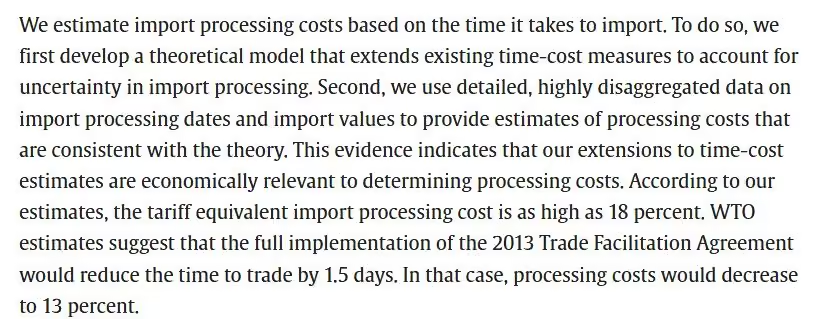
@JIntlEcon
Cross-country differences in demographic aging and its interaction with cross-country differences in social security and access to credit explain a large fraction of long-term capital flows across advanced and emerging countries. 2/2
-
Journal of International Economics
@JIntlEcon
New: "Endogenous product adjustment and exchange rate pass-through" by Andreas Freitag (@UniBasel_en) and Sarah Lein (@LeinSarahMarit). Firms respond to an exchange rate appreciation by increasing product quality.
doi.org/10.1016/j.jinteco.2022.103706 1/2
Journal of International Economics
@JIntlEcon
Swiss exporting firms upgrade the quality of their products after the sudden appreciation of the Swiss franc in 2015 and remove lower-quality products from their product ranges. This accounts for a substantial share of the total pass-through one year after the appreciation. 2/2
-
Journal of International Economics reposted
Journal of International Economics
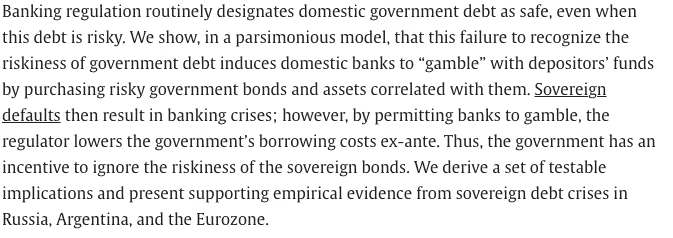
@JIntlEcon
Announcing the first Summer School in International Economics.
Hosted by University of Crete (Rethymnon, Greece) June 14-16, 2023.
Lectures by @LucaFornaro3, @skalemliozcan, Mendoza, Costinot, Eaton & Rappoport.
PhD students, apply by January 30: jie.soc.uoc.gr -
Journal of International Economics
@JIntlEcon
Recent: "Trade intermediation by producers" by Aksel Erbahar @ErasmusESE and Vincent Rebeyrol @TSEinfo.
Manufacturing exporters act as trade intermediaries by exporting goods they do not produce.
doi.org/10.1016/j.jinteco.2022.103693 1/2
Journal of International Economics
@JIntlEcon
This article uses Turkish export transactions data to identify purely intermediated (PI) trade, in which sourced goods are exported without produced goods. PI accounts for half of intermediation, is important for top exporters, and affects export-participation decisions. 2/2
-
Journal of International Economics
@JIntlEcon
Recent: "Migration, tariffs, and China's export surge" by Chen Liu (@NUSingapore) and Xiao Ma (@xiaomaucsd).
doi.org/10.1016/j.jinteco.2022.103696 1/2
Journal of International Economics
@JIntlEcon
What caused China's export surge between 1990 and 2005? This article analyzes several sources jointly and quantifies their relative contributions to China's export surge. It finds that trade and migration policies jointly accounted for almost 30% of China's export growth. 2/2
-
Journal of International Economics
@JIntlEcon
New: "The open-economy ELB: Contractionary monetary easing and the trilemma" by Paolo Cavallino (@paolocavallino) and Damiano Sandri (@damianosandri) of @BIS_org.
How an effective lower bound (ELB) changes the monetary trilemma.
doi.org/10.1016/j.jinteco.2022.103691 1/2
Journal of International Economics
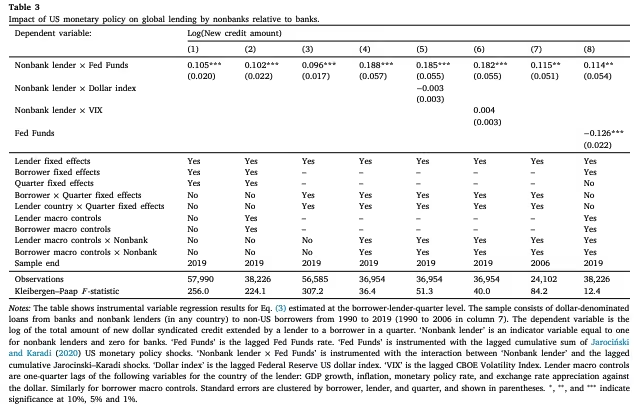
@JIntlEcon
Contra Mundell’s trilemma, free capital mobility may hurt #monetarypolicy independence even under flexible exchange rates because of an ELB. A global financial tightening raises the ELB & calls for capital controls & macroprudential policies to restore monetary transmission. 2/2
-
Journal of International Economics reposted
Linnea Lorentzen
@Linnea_Lor
I am so happy to share the news that our paper is accepted for publication in the Journal of International Economics.
Thank you, Simon Galle, for a great journey. I’ve learned so much. 🙏
See our paper below👇🏼
Linnea Lorentzen
@Linnea_Lor
What is the joint impact of the China shock and automation of labor, across US commuting zones?
Simon Galle (@Simon__Galle) and I have updated our paper "The Unequal Effects of Trade and Automation across Local Labor Markets".
drive.google.com/file/d/1Dt4Ts-2POJH4DoqSdz3jexDWiAnHIath… -
Journal of International Economics reposted
Cesar Sosa Padilla
@cesarspa1
Our paper w/ @fedesturze just got accepted at the @JIntlEcon. Thanks to the editor and referees!
-
Journal of International Economics
@JIntlEcon
Recent: "Responses of exporters to trade protectionism: Inferences from the US-China trade war" by Lingduo Jiang @UibeChina, Yi Lu @SEM_Tsinghua, Hong Song, and Guofeng Zhang. Several waves of US tariffs yield estimates of short-run responses. doi.org/10.1016/j.jinteco.2022.103687 1/4
Post not available here, view on X
Journal of International Economics
@JIntlEcon
Trade liberalization and trade protection have different short-term effects on exports. This article's IV estimate of the trade elasticity for applied tariffs is 1.99 within a year. Boehm, Levchenko, and @nityanayar estimated 0.7 for liberalization of applied MFN tariffs. 3/4
Journal of International Economics
@JIntlEcon
While US tariffs significantly reduced Chinese exports to the US, they barely affected Chinese total exports to the world. China is more likely to divert its exports to countries that are closer and have larger economies. 4/4
-
Journal of International Economics
@JIntlEcon
New: "Sovereign bond prices, haircuts and maturity" by Tamon Asonuma @IMFNews, @DirkNiepelt, and Romain Ranciere @USC_Econ. In practice, do unsecured debt instruments rank equally among themselves and with other external debt obligations? doi.org/10.1016/j.jinteco.2022.103689 1/4
Post not available here, view on X
Journal of International Economics
@JIntlEcon
Haircuts are larger for short- than long-term bonds. This finding holds in both external and domestic restructuring episodes; when restructurings occur preemptively or post default; independently of the exchange method; and in all subsamples considered. 3/4
Journal of International Economics
@JIntlEcon
A standard asset pricing model rationalizes these findings under two assumptions, both of which are satisfied in the data: increasing short-run restructuring risk in the run-up to a restructuring, and high exit yields. 4/4
-
Journal of International Economics
@JIntlEcon
Recent: “Import substitution in illicit methamphetamine markets” by @pscottorr & @l_freylejer. This paper estimates the “balloon effect” in illicit methamphetamine markets using a US policy that reduced domestic production. doi.org/10.1016/j.jinteco.2022.103690 1/7
Post not available here, view on X
Journal of International Economics
@JIntlEcon
While consistent with increased importing, how to quantify balloon effect? Authors show that data on regional lab seizures and average undercover drug prices can be used to estimate the meth market's trade elasticity, as well how much policies increased domestic costs. 6/7
Journal of International Economics
@JIntlEcon
Use “exact hat algebra” to quantify balloon effect: compare how much prices rise if import substitution impossible, to how much prices rise when suppliers can import → The balloon effect decreases effectiveness of these policies by as much as 80%. 7/7
-
Journal of International Economics
@JIntlEcon
Recent: "Foreign workers, product quality, and trade: Evidence from a natural experiment" by @andreaariu. This article exploits staggered opening of the Swiss labor market to European workers to study how immigration affects production and trade. doi.org/10.1016/j.jinteco.2022.103686 1/3
Journal of International Economics
@JIntlEcon
The Swiss-EU Agreement on the Free Movement of Persons was implemented at different times across Swiss regions and most of the labor increase resulted from foreign residents who commute daily to a Swiss employer. High-skilled workers spurred higher quality imported inputs. 2/3
Journal of International Economics
@JIntlEcon
Better inputs raised export quality and export growth to extra-EU destinations. Export growth was not tilted towards the workers' origin countries. Foreign workers spurred exports through quality upgrading. 3/3
-
Journal of International Economics
@JIntlEcon
New: "International Reserves and Central Bank Independence" by @gutysamano. Why do economies paying significant sovereign spreads accumulate international reserves instead of paying back public debt? What is the social welfare effect? doi.org/10.1016/j.jinteco.2022.103674 1/3
-
Journal of International Economics
@JIntlEcon
New: "The macroeconomic effects of macroprudential policy: Evidence from a narrative approach" by Diego Rojas @wb_research, Carlos Vegh @SAISHopkins & Guillermo Vuletin @WorldBank. Exogenous increases in legal reserve requirements reduce output. doi.org/10.1016/j.jinteco.2022.103644 1/3
-
Journal of International Economics
@JIntlEcon
Call for papers: Conference on "International Fragmentation, Supply Chains, and Financial Frictions" in Santiago, Chile, on March 1-2,2023.
Papers that are selected for presentation will be considered for inclusion in a special issue of the JIE.
www.nber.org/international-fragmentation-supply-chains-an… -
Journal of International Economics
@JIntlEcon
New: "Invoicing and the Dynamics of Pricing-to-Market" by @gc422, @MeredithCrowle1 & @LuHanEcon. This article estimates, by invoicing currency, the speed of export price & relative markup adjustment around the 2016 Brexit-related sterling depreciation. doi.org/10.1016/j.jinteco.2022.103570 1/4
-
Journal of International Economics
@JIntlEcon
New: "Self-enforcing trade policy and exchange rate adjustment" by Stéphane Auray (@Ensai35), Michael Devereux (@ubcVSE), Aurélien @EYQUEM2. How does trade protection vary with the business cycle? A New Keynesian model emphasizes exchange rates. doi.org/10.1016/j.jinteco.2021.103552 1/4
-
Journal of International Economics
@JIntlEcon
New: "Financial Shocks, Credit Spreads, and the International Credit Channel" by @AmbrogioCB & Andrej Sokol (@ecb). Does the international credit channel transmit US financial shocks? A comparison to monetary-policy and central-bank information shocks. doi.org/10.1016/j.jinteco.2021.103543 1/4