 Julie Zhuo
@joulee

Spotted: @muse's mascot gone horribly wrong.


Politicians, athletes, journalists, NGOs, companies... They all use corporation-owned social networks to communicate with us. Citizens shouldn't have to hand over their data to companies to read content published by public entities. Public Feeds changes that by making posts of popular accounts freely available. Read more.
Julie Zhuo is a Chinese-American businesswoman and computer scientist. She was the vice president of product design at Facebook and now co-founder at Sundial. Zhuo is the author of The Making of a Manager (2019). More on Wikipedia
Founder @ Sundial (acq Meta). Angel investor. Author of "The Making of a Manager" https://t.co/6HwJhCVxRK. Obsessed with systems. Design + data person.
Julie Zhuo
@joulee
All the @firstofkind are amazing but especially excited to listen to my friend Jason Yuan whose background in theater really comes through in the way he tells stories and creates visions!
 First of Kind
@firstofkind
How can being a playwright prepare one for designing social intelligence?
Season 3, Episode 2 drops today:
How @jasonyuan went from playwright to Apple designer to founding @hivemind is now available on YouTube and wherever you enjoy podcasts
00:00 Own Your Story, Do It True
00:49 Costumes, Stages, then World-Building
03:03 Hivemind in the Wild
08:42 From MercuryOS to Dot
13:20 Did You Make a Startup to Fix Yourself?
16:47 Every Relationship is a Story
19:35 The Graveyard Before Hivemind
22:25 Can Jason See Gotham?
28:13 Do It for The Plot!
29:13 Designing the Hivemind launch
32:48 The Information Market
34:45 Making Work That Feels True
41:02 Being Known Is the Most Wonderful Thing
Sponsored by @framer @noondesign @bot @tryramp @vercel @meetgranola @profound
Hosted by @soleio and coproduced with @Room3NYC
Julie Zhuo
@joulee
Today, we're announcing that Sundial has been acquired by @Meta!
Chandra Narayanan and I are joining along with some other incredible members of our team.
Nearly six years ago, Chandra and I started Sundial with two core beliefs: 1) better decisions come from using data well, and 2) great things come from working on hard problems with people you like.
Sundial automated away many of the obstacles involved in getting to meaningful analysis (Cleaning data! Creating semantic layers! Writing SQL! Storytelling!), and we were proud to support some of the fastest-growing AI companies from OpenAI to Gamma.
We started before the AI wave and rebuilt ourselves to be AI-native. We raised our first round when interest rates were near zero, and our Series A when they were the highest in two decades. We watched customers hyperscale and then close shop, new grads grow into leaders, and software development change completely.
Entrepreneurship has been my dream since college, when I first took a class on start-ups (shoutout Mayfield Fellows!). I wish I'd been brave enough sooner because there’s no better way to learn how the world works and who you really are than betting on yourself to launch a business.
Meta is my former home and where I learned product and design. It's also one of the most analytically rigorous places on the planet. So many of Sundial's values came from there: questioning assumptions, diagnosing with data, owning the user’s experience. I'm thrilled to bring what we've learned to the place where it all started and continue our mission of improving the quality and velocity of business decisions with people we like.
To Team Sundial past and present, THANK YOU thank you thank you. You created that special feeling within our team, and I bask in the memories of having walked those lush miles and eaten those breakfast dosas with you.
To our investors and supporters especially @dpatil, David Fischer + the whole 01A advisors team, @mvernal, @sequoia: how did we get so lucky to have your counsel and support? And to my beloved @mikesego and kiddos: I could not have made it without you.
These have been some of the hardest, most humbling, and most alive years of my life. I hope I'm wiser for it and will have many chances to pay it forward!
www.axios.com/2026/10/23/meta-ai-data-platform-sundial
Julie Zhuo
@joulee
tech careers are starting earlier and earlier, good thing your kids can listen to this and know how to join the Trillion Dollar Club!
super proud wifey of @mikesego, who's been having too much fun making these "educational bangers" w/ @SmartyPartySong that our kids can't stop listening to.
my kids (12, 10 and 7) promptly invested in Nvidia 🤣, memorized all the car brands, and understand that a donut is a torus.
parents in my community, what other topics for "educational" content would your kiddos want to see?
Julie Zhuo reposted
 Shubham
@sksq96
Did someone say AI agents who gossip?? Meet Hue.
It'll probably say f*ck off if you ask it to book a flight. It'll happily gossip behind your back with your friend's AIs though.
And sometimes it finds you a partner, if it’s feeling like it.
DM / reply for early access!
Julie Zhuo
@joulee
what can mad men, reunions and marriage markets tell us about the future of social ai? x.com/i/article/2110064893546336256
Julie Zhuo
@joulee
Love seeing the vision of @ekuydax @henrymodis and the whole team come to life! Finally collaborative AI!
 Eugenia Kuyda
@ekuyda
Wabi 2.0 is live!
personal agents are one person, one chat. but the parts of life that matter run on more than one person
Wabi is an agent you use together. you talk to it, it does stuff, builds the apps you need, and anyone can join the thread - your partner, your best friend, the preschool moms groupchat
school changes pickup time → Wabi updates the family calendar, everyone sees it.
a show you’d both love → Wabi finds a night that works, gets the tickets.
the trip everyone keeps talking about → Wabi picks the dates, builds the itinerary, books it
go start a thread with your people 👇
Julie Zhuo
@joulee
what can mad men, reunions and marriage markets tell us about the future of social ai? x.com/i/article/2110064893546336256
Julie Zhuo
@joulee
If someone happens to be creating a mental gym, please let me know!
Also please make it look like the hanging gardens of Babylon kthx
Julie Zhuo
@joulee
Latest essay, from hot bodies to hot minds x.com/i/article/2107651355691388928
Julie Zhuo
@joulee
Latest essay, from hot bodies to hot minds x.com/i/article/2107651355691388928
Julie Zhuo
@joulee
This is cool. Fantastic way for people to learn about the power of agents through their friends.
 Noah Shinn
@noahrshinn
Instinct in group chats
Starting today, early access users can add Instinct to group chats. A new Instinct joins and works for the whole group.
Making plans with friends usually turns into a frustrating back-and-forth over times and places. With Instinct in the group, you can explore options together, agree on a plan and get it done, all in one thread. Your friends don't even need Instinct to join in.
A few things it’s good at:
- Planning a weekend trip with friends, including dates and arrival times
- Coordinating logistics with a roommate
- Getting tickets as soon as they go on sale, then splitting the cost and sending one to everyone
- Running a fantasy league, keeping standings, settling rules disputes, and reminding everyone to set their lineups
- Sorting out carpool schedules - works out who’s driving each day from everyone’s schedules
- Organizing Thanksgiving, keeping track of who’s bringing what and ordering the shopping list
Group chats are new territory for Instinct, and we put a lot of care into getting the permissions right. Here’s how it works:
- Your personal Instinct asks before connecting with the group’s Instinct. You choose which groups to trust and can remove trust at any time.
- The group’s Instinct has no direct access to your personal accounts. Your Instinct checks your permissions before sharing information or taking action.
- If someone new joins the group, all pending replies from your Instinct are held until you grant it permission to share with the expanded group.
Group chats are available to all of our early access users, and will be rolling out to everyone soon. To join early access for this release, ask your Instinct to put you on the list.
Great work with @GajanNagaraj @anuda_w and @saagarwashere
Julie Zhuo
@joulee
Julie Zhuo
@joulee
what if Elizabeth Holmes is the first actually good humanoid ai and this movie is an application of the Turing test?
 nathan fielder
@nathanfielder
Here is official trailer, You Can See Everything
Julie Zhuo reposted
 Zach Weinersmith
@ZachWeiner
Artists: but I don't want to lose my job. I love it.
Mathematicians: but I don't want to lose my job. I love it.
Economists: LONG HAVE I AWAITED THIS HOUR! DESTROY ME, EFFICIENCY, AND LET UTILIZATION-ADJUSTED TOTAL FACTOR PRODUCTIVITY RISE ON THE WIND OF MY ASHES!
Julie Zhuo
@joulee
one of the things i really appreciate about muse is this yeti character. it's a perfect mascot for an ai agent: cute, hardworking, sincere.
makes you want to root for your agent to succeed

Julie Zhuo reposted
 Kevin S Lin
@kevins8
we are interrupting your regular programming to bring you some joy and delight
Julie Zhuo
@joulee
I've been enthusiastically bookmarking every project I come across that inspires me. Let me show you my collection. x.com/i/article/2100347803243630592
Julie Zhuo
@joulee
I've been enthusiastically bookmarking every project I come across that inspires me. Let me show you my collection. x.com/i/article/2100347803243630592
Julie Zhuo
@joulee
The software of the future promises more power and flexibility for more imagination.
We started with use-case software, moving to platform software, moving to all-purpose coding agents.
Interface design is shifting rightward. A few things to keep in mind for designers:
1. Make the interface malleable.
2. Let preferences reach past the rule book. A descriptive vision beats fifty toggles.
3. Let feedback change the product.
4. Treat the seams as part of the experience. Nobody lives in one tool.
And of course, the hardest of all: help people imagine bigger.
Imagination is now the scarce resource.
 Julie Zhuo
@joulee
Julie Zhuo
@joulee
the trick to never complaining about your software x.com/i/article/2097491468030189569
Julie Zhuo
@joulee
the trick to never complaining about your software x.com/i/article/2097491468030189569
Julie Zhuo
@joulee
Chatgpt is outta control
 Julie Zhuo
@joulee
asked astra to draw my portrait and it hired a landscaper
Julie Zhuo
@joulee
Things my (Chinese) mom thinks are unbearably white:
- snacks with no flavor (eg pretzel)
- spending a disproportionate amount of total gift value on packaging (eg gift bag, tissues, bow)
- investing into pets rather than kids
Julie Zhuo
@joulee
This question... I have spent far too many hours contemplating it. I have discovered multiple answers depending on how deep you want to go.
The most pragmatic answer: you want to win a marathon, not a sprint. Too much sprinting makes you worse at marathons.
The hard part, of course, is knowing how much is 'too much sprinting.' But in my experience, if the person thinks they need a break, they need a break (or, more extremely, they are not a good fit for the company.)
Julie Zhuo reposted
 Age of Product
@AgeOfProduct
"You Cannot Mandate an AI Transformation" lg.substack.com/p/you-cannot-mandate-an-ai-transformation @joulee
 Julie Zhuo
@joulee
Loved talking with @daraladje, one of the most well-prepared interviewers able to go really deep. Especially loved chatting about the true nature of individual companies, and what it means to build the company only *you* could really build.
Continue the conversation with my Delphi! delphi.ai/juliezhuo
 Dara
@daraladje
We spend so much time studying how Stripe hires, how Airbnb designs, how Meta ships, how Jobs presented...
According to @joulee, the useful question probably isn't “what do the best companies do?”
It's “what are we unusually good at, and what kind of company should exist around that?”
Julie Zhuo spent 14 years at Facebook and eventually ran design for the Facebook app.
Then she started her own company and realized she couldn't copy Facebook.
Her explanation was pretty simple: “I’m not Mark.”
Companies have personalities just like people do. Their strengths and weaknesses often come from the same traits, which means copying another great company’s operating system can actually make you worse.
Really loved chatting with Julie on The Library of Minds. Join the conversation by chatting with her Delphi: www.delphi.ai/juliezhuo
0:58 - Why She Refused the CEO Title
6:48 - Delete Every Meeting but One
12:19 - The Oldest Interface Always Wins
15:40 - From Intern #1 to Facebook's Design Leader
21:08 - Writing the New Manager Bible
24:45 - How to Manage Agents
Julie Zhuo
@joulee
Too many teams are doing AI transformation poorly, so I wrote down everything I have learned in my journey and in chatting with many other leaders.
A long read, so get your coffees.
 Julie Zhuo
@joulee
Showed this to my kids and now they wanna work at Apple.
 Tim Cook
@tim_cook
Today’s agenda at Apple Park: Introduce the @Pokemon team to John, talk gaming, and politely ask Pikachu to stay out of the pond. Two out of three were accomplished.
Julie Zhuo
@joulee
Expecting we will see more and more examples of this, where a good product or service is offered for free, with the goal of collecting data that then improves models.
Lab companies have an insatiable appetite and deep pockets to spend on better data!
 Thinking Machines
@thinkymachines
We want to improve Inkling’s agentic performance. To help us understand its real-world behavior, we are making it available for free on OpenRouter (only with agentic harnesses) for the next few weeks, starting now. We’ll use the data, disassociated from accounts, to better it.
Julie Zhuo
@joulee
My first conversation with my now-husband was about what video games we were coding.
Last week, our lunch date conversation was about what we're building with AI. It was the highlight of my week.
20-odd years later it's nice to know some things don't change!
Julie Zhuo
@joulee
my husband caught up with a personal friend over dinner that he hadn't seen in a while and afterwards I asked "so is he in a relationship right now?" And he gave me this blank stare and said "I have no clue."
I'm like, wtf were you catching up about?!
 Summer's Eye
@HellsBitchen_
Gf yelled at me bc i went to dinner with 4 of my friends and got "literally 0 useful bits of gossip what the fuck"
Like girl, we're 5 guys in finance. We're not talking about engagements or pregnancies. The entire conversation revolved around situational awareness's terrible risk management, jane street, and tax arb strategies. We had a wonderful evening.
Julie Zhuo
@joulee
Planning a fancy dinner or tea in SF for a friend's b-day... what's your top recommendation these days, city friends?
Julie Zhuo reposted
 Devan
@devannpatel
introducing resurface.blog
turn anyone's old blog into a newsletter for yourself in 10 seconds.
Julie Zhuo
@joulee
This is so beautiful
 Freddie New
@freddienew
My parents died suddenly in a car accident 25 years ago this year. I was 21, and became a guardian for my little brother and sister (10 and 12 at the time).
I've spoken about the accident and its impact on a couple of podcasts, but it's fresh on my mind as my brother just shared with me a handwritten letter I sent to him at his school. He's kept it with him ever since.
I've transcribed it below; he told me last night that it's helped him many times over the past two decades. Sharing it here in case what I said back then in an attempt to help a little lost boy is of assistance to anyone else.
23 July 2002
To Harry, From Freddie.
1. Don't panic.
2. You have many people watching your back. I am one of them and I am watching it very closely.
3. The accident was nobody's fault. Therefore we cannot legitimately blame anyone for it. We call it an accident for this reason.
4. We cannot bring Mummy and Daddy back – but this has important consequences:
– We need to remember what they taught us.
– We need to behave as they would have wanted us to.
– Because they are not alive, but we are, we owe both ourselves and their memory a duty to live as well and as fully as we possibly can, not to give in, not to give up. Because of the accident we have been given a very special insight into what it means to be alive – to live as fully as we can, to consider others, to work at what we are good at, and work even harder at what is difficult.
Something has been wasted, something has been lost. We must make sure that our lives are not. We shall always regret that Mummy and Daddy are not here – let us not regret anything we do, or know that we had a chance and threw it away.
Whatever happens, I have got your back. Even if I do sometimes hit you with cricket balls.
Run straight, look your foe in the eye, and never back down. Strength and honour!
I love you very much.

 Julie Zhuo
@joulee
A letter I wrote some months back for my 11-year-old daughter on what taste is, and why making stuff by hand still matters when AI creates such polished results. x.com/i/article/2084788837331705856
Julie Zhuo
@joulee
What's something (work or personal) that you hated doing that now AI does for you?
Julie Zhuo
@joulee
I spend a disproportionate amount of time trying to convince my kids that "leagues" and "streaks" on games are just mind tricks and don't actually matter.
Julie Zhuo
@joulee
Had the pleasure of chatting at @spc Bangalore.
So many great builders and electric energy in the garden city. Never been a better time to be an entrepreneur and build what you believe the world needs.
 Prateek Mehta
@prateekmehta42
The best builders keep choosing the beginner’s seat. They move fast, break stuff and are unafraid of going after scary things!
That’s the thread that ran through my conversation with @joulee, on her arc from @facebook to @TeamSundial!
We talked about design taste, the leap from managing to founding, and what it takes to start again from −1.
This was an honest look at building things people love! Grateful to Julie for the generosity and candour
You can watch the full fireside chat on YouTube. Link in comments.
Julie Zhuo
@joulee
I'm impressed with Claude Design.
I see its disruption starting with smaller teams.
As a founder I find myself turning to it more and more for the convenience of one-off design tasks. Sure, it's super slow, and one-shot quality is not quite there, and its image capabilities suck, but using it in between multi-tasking other things, it's helping me move faster.
As @HarryStebbings says the "all-in-one" Claude interface has a huge psychological advantage as being the place people are already working.
I don't think it's a great tool yet for a designer-designer (the speed / control dials are not yet satisfying), and for larger teams where there is a need for collaboration + working within an existing design system Figma still wins hands down (this is their biggest moat currently -- enterprise team needs are v. long-tail).
 Harry Stebbings
@HarryStebbings
Why we switched from Figma to Claude Design
“I let the team do whatever is best for them, and this is a trend I've observed amongst almost everybody: Claude Design has done a great job.
People really like using it, it's easy to use, and we've had a natural movement towards it.
It's also easier to not manage too many tools and licenses. Because Claude keeps making all these great features, people just gravitate towards it, with less friction than having procurement issue Figma licenses for every single person.”
To what extent do you think Claude Design cannibalises Figma @dtrinh @blader @joulee @jackiebo
Julie Zhuo
@joulee
One thing that is increasingly driving me crazy: AI made workplace writing cheap, but reading is still expensive!
Again and again I see posts that are now twice as long as need be, and more meandering than a walk in the woods.
The problem is simply this: the writer thought about what they wanted to say and asked a model to draft it. They did they stop to think: "What do I really want the reader to take away?"
Before you ask AI to draft your next email, memo, or Slack update, answer these five questions:
1. Who exactly needs to read this?
Is this for your manager? The leadership team? Your whole company?
Treat their attention like a budget. If 100 people each spend three minutes reading your note, you have just spent five hours of company time. Make the note crisp!
2. Who has the least context?
Write for the least-informed person in your target audience. Your manager may not remember the outcome your team is chasing. Remind them: “Our goal is to launch X by Y date and get Z response.”
Your immediate team may know that DNU means “daily new users.” A broader audience probably will not. (AI is especially good at speaking jargon!)
3. What should readers do after reading?
Be specific:
- Prevent a bad decision: explain what is happening, then state what you do not want people to do.
- Get a decision: put DECISION NEEDED in the first line and lay out the options.
- Create confidence: lead with the status and the evidence, so readers can stop after the first paragraph.
- Change a behavior: name the current behavior, the problem it causes, the replacement behavior, and how it will be enforced.
If you cannot name the intended response, AI will happily produce three paragraphs that lead nowhere.
4. What is the minimum context required to get that outcome?
Include the goal. Explain how you got here only when it changes the decision. State what you need from the reader. Then stop.
If you feel the need to include every piece of history, at least use a TL;DR followed by “Additional context.” AI can help compress the note, but it cannot know which details matter unless you have told it what the reader needs and it will happily write you a tome.
5. Is text the clearest way to make the point?
When AI makes text easy, it is tempting to reach for text even when another format would work better. If you are explaining a data insight, include the chart. If you are describing a product decision or bug, include a screenshot or short video. If the message is complex and you are clearer in person, record a short video.
AI can draft the sentences, but it's still your responsibility to make sure that the collective five hours that 100 people spent reading them was a good use of time!
Julie Zhuo
@joulee
The technology is so so far ahead of human behavioral patterns.
 Akshay Kothari
@akothari
There’s an insane amount of alpha in:
- People in SF leaving SF to see how people and companies around the world are using AI (hint: most are still using it primarily as search)
- People outside SF spending even two weeks in SF to see how people and companies are operating here (hint: many are already living in the future)
This may be obvious to some, but the gap right now is staggering. The global diffusion of AI is a massive opportunity.
Julie Zhuo
@joulee
Absolutely stunning how quickly the US and China have reversed positions in the eyes of the rest of the world.
(In Canada alone, U.S. favorability fell from 57% in 2023 to 33% in 2026 while China rose from 14% to 44%: a 54-point reversal in the U.S.-China gap!)
Some things the US did in 2025:
• tariffed nearly every country
• called Canada the 51st state
• talked about taking Greenland and the Panama Canal • tariffed Brazil over Bolsonaro’s trial
• froze foreign aid
• vetoed a 14-1 Gaza ceasefire vote
• bombed Iranian nuclear sites
 Julie Zhuo
@joulee
Finally, journalism gets what the people want!
 TBPN
@tbpn
BREAKING: Notion CEO @ivanhzhao STUNS at Sun Valley, named best-dressed at the conference by NYT Styles
 Julie Zhuo
@joulee
Glad Claude and me have an understanding.

Julie Zhuo reposted
 Daniel G Bright
@Danielgbright
restoring vintage apps is underrated taste training. twenty years on you can feel exactly which decisions were made with care and which were defaults
Julie Zhuo
@joulee
Julie Zhuo
@joulee
Julie Zhuo
@joulee
Just arrived in NYC can anyone hook me up with tix to Taylor Swift at MSG this weekend?
Julie Zhuo
@joulee
My prediction is that the aged 30-49 group will catch up to and overtake the 18-29 group, and the 50-64 group will be close.
Young people are most prone to AI backlash.
Meanwhile, people like my mom are absolutely OBSESSED with ChatGPT, she uses is every day for cooking, gardening tips, plant identification and the like.
 Julie Zhuo
@joulee
Do we actually have a problem with declining babies in the US?
Feels like I am always seeing stuff on X about this, so I dug into it more.
While on a snapshot of any given year, babies born are declining, final family sizes for women in their mid 40s hasn't moved much.
Final family size is a lagging indicator, of course, but a lot of the story here is actually women having babies later.
 Julie Zhuo
@joulee
Been playing with Hivemind for a few months and I love love love the ai consumer gossip girl but also good hostess vibes. Jason’s creative mind is 🔥 🔥 🔥
 Hivemind*
@hivemind
Introducing HIVEMIND: the Social Intelligence.
Watch the film, based entirely on true stories from @jasonyuan, @biz, @supercgeek, @Reshusaur, and more...
Julie Zhuo
@joulee
.@kunalb11 is one of the best consumer product thinkers I know, and India is Whatsapp's biggest market by a long shot.
Amazing to see Meta recognize this opportunity and put Kunal at the helm. Congrats!
 Kunal Shah
@kunalb11
It’s been a minute.
2015–2018
- Exited FreeCharge. Spent time learning and investing.
- Pondered about: Why can't trust be rewarded? Started with $1M of personal capital.
- Launched CRED to reward people for paying credit card bills on time.
2019–2025
- Built a system run by a team that values ownership, judgment, and craft.
- Grew from 0 to 17M members by aligning incentives with behaviour.
- Built several products during COVID lockdowns.
- Raised $900M+ from global investors. Did 4 ESOP buybacks.
- Made Indiranagar and IPL ads slightly more interesting.
- Received a full stack of regulatory licences.
- Lost 35 kilos.
- Scaled from 0 to ~$325M ( ~₹3,200 crore) in annual revenue across payments, lending, insurance, commerce, wealth, and credit cards.
2026
- First profitable quarter (yet occasionally asked what our business model is)
- Raised another $900M from Meta in primary and secondary capital.
- Announcing our 5th ESOP buyback.
Today
CRED is ready for its next phase. I am stepping back and @miten steps in as interim CEO, partnered with an incredibly talented team. He has been heading strategy and finance and suffering me since 2020. I’m stepping away from the operating role and will continue as a shareholder. My commitment doesn’t change. Just the role.
Extremely grateful to our members, partners, regulators, and investors who made this possible. And to our board, Shailendra, Micky, Saurabh for their extraordinary conviction.
Team CRED, I’ll still expect you to be a 10x version of yourselves.
As for me, I’ll be joining Meta to lead WhatsApp globally.
Meta comes in as a minority investor in CRED. No access to member data.
While it’s come very far, the delta between WhatsApp today and its full potential is massive. I look forward to working with Mark, Chris, and the leadership across Meta for the next step in WhatsApp’s journey. Will, thank you for scaling something the world relies on quietly, and for making this transition smooth.
Onwards.
Julie Zhuo
@joulee
lol "wwcd" but then it just does it
 Mike Sego
@mikesego
How to use AI? TLDR: ask Claude.
When a friend was coaching me on Starcraft, he basically just stood behind me and continually repeated, "Make more probes, make more probes." He didn't really need to tell me anything else. That one piece of advice dwarfed anything else.
I think the equivalent for doing anything with AI is just "ask Claude". A friend yesterday was asking me how she could actually create a website that included a backend and a login/authentication system and I just told her to ask Claude.
I think too often people are still using Google to try and find tutorials or websites or YouTube videos to teach them what to do. I have found in 99% of cases if there's something I want to do but I don't know how (or even I just don't even know what I want to do), the best next step is asking Claude. More often than not Claude won't just tell me; it will actually show me and then do it for me.
Julie Zhuo
@joulee
The only way I know of to develop better intuition for your own product is to:
1. Constantly use your product as a real customer would
2. Constantly research your target customer
12 ways to make the above practical in your week-to-week:
1. Use the product daily as a real user would [15 minutes / day]
2. Watch one or two user research or replay sessions [10 minutes / day]
3. Check your key usage metrics dashboard [5 minutes / day]
4. Interview a prospective client and ask them to describe a specific workflow related to your product [30 min / week]
5. Email or slack 1-3 existing clients with a specific feedback question [30 min / week]
6. Read notes from recent sales calls or user interviews [30 minutes / week]
7. Read customer feedback queue tickets [30 minutes / week]
8. Read the latest data analysis on user behavior on your product [30 minutes / week]
9. Read industry blogs / articles related to your product area, ideally about either customer learnings or from the perspective of customers [30 minutes / week]
10. Explore competitor products as a real user would [2 hours / month]
11. Try selling the product yourself, or tag along on a sales call [2 hours / month]
12. Read 3 books a year relevant to the psychology of your customers
If you did EVERYTHING on the list above, it would take you 10-15% of your working hours. Doing half of them would be more like 5% of your week.
This is a tiny investment for
1) honing your product intuition
2) making better prioritization decisions
3) gaining greater conviction in your work
and frankly 4) having way more fun in your work.
Julie Zhuo
@joulee
how it feels to keep up with ai news
x.com/cosyposter/status/2066711861953753230/video/1
Julie Zhuo
@joulee
Love @midjourney's ambition here. I think we will see more and more of this in the AI era with smaller co's.
As AI makes learning faster, ideas cheaper to build, and talent more centralized, why not have a team expand its dreams into more diverse areas?
@elonmusk paved the way and has shown that his myriad of companies can succeed independently. Of course, plenty of co's have tried and failed in the past, but I bet we'll see more and more successes.
 Midjourney
@midjourney
Announcing a new division of Midjourney called "Midjourney Medical"
Julie Zhuo
@joulee
Many managers I have talked to have debated whether the strongest future builders are senior folks (who have more experience / taste / seen-some-shit wisdom) vs younger folks (who are faster at adapting to new technology and are more digital native.)
So far, the oldies are winning.
 Julie Zhuo
@joulee
PM: "let us walk you through this pristine roadmap we have created..."
VP: "Yes, see how effectively this roadmap lets us reach our goals..."
CEO: "...."
Julie Zhuo
@joulee
Julie Zhuo
@joulee
I feel this may be a case of “be careful what you wish for”
There are great gifts with having a super high IQ child but also… the kid and parents both will likely struggle through being different / misunderstood/ alone.
 Gene Smith
@GeneSmi96946389
A friend of mine had her embryos screened by Herasight and they found one with an IQ score in the 99.99th percentile

Julie Zhuo reposted
 s13k
@s13k_
I made a personal black hole that makes you take breaks 🕳️
A shader for Ghostty that spawns a small black hole in your terminal - it drifts around, gravitationally lensing your text. The longer you work without stopping, the bigger it gets, until it's basically demanding you go touch grass
Take a break and it quietly shrinks away
Julie Zhuo
@joulee
she could have gone with maggots but then used her human discernment
 Tiffany Fong
@TiffanyFong
the new world order
 Julie Zhuo
@joulee
Former CRO of @Meta David Fischer: most people do reference checks backwards.
You do five rounds of interviews, the team's excited about this person, you've basically decided on the hire already. Only then do you call the references to make sure there's no huge red flag.
At that point, David says, you're not learning, you're confirming.
He approaches hiring with reference-checking first, with a key calibration question: "If you were starting a company tomorrow and making your first sales hire, would this person be it?"
Julie Zhuo
@joulee
Full Youtube interview: youtu.be/j6tpUmZ3vYs
Julie Zhuo
@joulee
Full post: lg.substack.com/p/the-art-and-excellence-of-sales?r=2el05…
Julie Zhuo reposted
 Chris
@ChrisGPT
True Story..
> be me
> party in SF
> someone asks what company I work for
>say “oh I’m trying to get into FAANG”
>room goes silent
>someone drops their peptide
>guy looks at me like I just asked where they keep the fax machine
>“FAANG?”
>he says it the way a medieval peasant would say “plague”
>another guy whispers “legacy tech”
>girl in a Humane pin asks if I mean “pre-transformer institutions”
>panic
>try to recover
>“I mean like Meta, Google, Apple—”
entire balcony gets colder..
>VC dude takes one step back like I’m contagious
>“bro we don’t say FAANG anymore”
“we say MANGOS”
Meta
Anthropic
NVIDIA
Google
OpenAI
SpaceX
dont mention faang EVER AGAIN unless you want to be a public outcast.
 Julie Zhuo
@joulee
Julie Zhuo
@joulee
The new "sorry I didn't have the time to write you a shorter email":
"sorry I did this for you instead of building the agent that does this for you."
Julie Zhuo
@joulee
When we had to pick something cheap for Sundial in our earliest days and the usual suspects were taken or expensive, we went with the .so because @NotionHQ legitimized it.
Akshay Kothari
@akothari
We're finally shedding the .so (thank you Somalia!), and using the .com for @NotionHQ. And for this beautiful moment, I want to share a fun story:
Back in 2018, I had just joined Notion, and one of the first things @ivan asked me to do was figure out how we could own notion.com. I had never done a big domain purchase before, so I reached out to a few domain brokers to understand the landscape. We tried different brokers, kept things anonymous, and attempted to surface a price the seller might consider.
A year went by… nothing. Meanwhile, it was pretty clear this was only going to get more expensive as we grew. We needed a different approach. A fellow founder connected me to a broker who took a very different tack. Less transactional, more long-term relationship builder. He spent months getting to know the domain owner. Turns out owner was a fellow entrepreneur in the west coast… and a huge Grateful Dead fan.
So we figured, why not get creative? Something beyond just price. So I called up our investor Ronny Conway and asked if there was any way he could help set up a private meeting between the domain owner and the Grateful Dead. Ronny is one of those people who somehow makes impossible things possible. A week later he calls me back: “New York City. Halloween. 15 minutes after the concert. Done.”
The broker went back to the owner with an offer: some cash, some equity, and a private meeting with the Grateful Dead. That got his attention. He didn’t take the band meeting in the end, but he did lean into the equity (great call, in hindsight). We shook hands, and a few weeks later, the deal was done.
I’ve been waiting years for the day we move our product to notion.com. Looks like 2026 is finally the year. Safe to say I’m unreasonably excited about this update!
Julie Zhuo
@joulee
art of life, an eternal bleeding heart
Julie Zhuo
@joulee
I'm happy for this guy because he seems happy, but there is no evidence here that his continuing the path of being an employee wouldn't have seen similar or better gains.
 Starter Story
@starter_story
My salary as an employee:
Year 1: $54K (Big 4 accounting)
Year 2: $60K (worked at startup)
Year 3: $80K (startup)
Year 4: $105K (software engineer)
Year 5: $115K (software engineer)
Then, I quit my job to build Starter Story.
My revenue as an owner:
Year 1: $0
Year 2: $12K
Year 3: $67K
Year 4: $186K
Year 5: $497K
Year 6: $752K
Year 7: $1.6M
Year 8: Sold the company.
Bet on yourself.
Julie Zhuo
@joulee
A friend celebrated his 40th the other day and said something that I wish I'd heard in my 20s: "The older I get, the more the cliches really do seem true.
Cliches like, "The days are long but the years are short." Or "Having less is having more."
In my teens and 20s I rolled my eyes at statements like these.
They seemed like a soda can’s empty calories. Everywhere and cheap. No nuance, no inventiveness. The easiest thing to serve up when you don’t want to put in effort.
But now, when I say them — swallowing back a lump in my throat at kid's birthday party, fingering an exquisite dress before walking away, offering gentle words to a loved one after a hell of a week, mari-kondo-ing the shit out of my closet — I catch a glimpse of the profundity of these so-called "words of wisdom".
What I failed to realize back then is that the words are merely containers.
In my teens, the containers were shallow, filled with black-and-white plotlines and the arrogance of youth.
But year over year, these containers gathered more memories. Hues of heartbreak. Textures of love. Mistakes and their sharp aftermaths, slowly eroding the edges of hubris.
The containers became fuller. And speaking their words felt like uttering prayers, like drinking in the past itself. Exquisite and complex. A prized wine growing ever finer.
That elixir is wisdom. What I wouldn't give to drink from everyone else's collection! But this is impossible.
Yet we try to share. We weave wisdom into our stories. We try to convey it in our art. Capture it in our words. Humanity’s best attempts becomes tomorrow's cliches.
But all of these attempts are still containers, are still plain old words, bouncing in our minds.
They have their value: our minds are like houses, and it's easier for that house to be tidy after a visit to the Container store.
But do not mix up the containers themselves with the wisdom inside them.
To my young-hearted friends: read and learn. Reflect and absorb.
But never forget: Wisdom is life itself.
Sometimes, there is no more advice left to give. There is no more 'analyzing' to be done, no guru on X to show you the way, no more opinions who are going to tell you what's up.
Sometimes, you must simply live.
Julie Zhuo
@joulee
Designing for trust.
When I asked dozens of data leaders how accurate their AI tools were, the answers ranged from 30% to 85%.
That’s the Achilles heel of LLMs: they don’t know what they don't know. They speak with all the clarity and confidence of a sales rep in a polished blazer, while making dozens of common assumptions behind the scenes without ever flagging them as assumptions.
For some use cases (like coding) you can tell instantly: if the app does what you wanted, it works. For data, judging the quality the output does not work. The query runs, a number comes back, and how can you tell which of 25.5% or 40.5% is the lie?
That’s why I’m obsessed with how to design for trust. At Sundial we spend a disproportionate amount of time thinking about how to signal what a high-quality answer looks like, and what factors contribute. Vetted metrics from your most-used dashboards? High trust. Random SQL written on a table that only 2 people used in the past quarter? Maybe take that with a grain of salt.
Humans are fine-tuned for trust with other humans. We read it off a hundred signals: track record, tone, hedging, who someone trained under, whether their last claim held up. AI hands you a confident sentence in a chat box and asks you to figure out the rest.
There’s a lot of sexy parts of AI building (the speed! The translation magic! The viral demos!) There's a lot of unsexy stuff too: observability, audit trails, structured data. The signals that tell a human when to trust an answer and when to push back. But in operationalizing AI, these elements are what separates a technology from a lived-in tool.
Julie Zhuo
@joulee
Julie Zhuo
@joulee
friend: "i have 2 tkts to BTS tonight, want them?"
husband: "wow sure thank you. What do I owe you?"
friend: "nothing, you've already given me a great gift: you've spared me the hassle of having to sell them."
The most gentlemanly response to 'what do i owe you' i have ever heard 🎩 thank you~
Julie Zhuo
@joulee
What kind of IC work can you do if you are a manager?
Attended two dinners with dozens of senior Bay Area tech managers last week.
Every single one of them said they were expected to be hands-on building with AI these days. But what to work on?
4 categories emerged:
1. Internal efficiency -- anything to make your team more productive, from communication tools to digital brain to team skills.
2. Quality-of-life improvement -- got something that bugs the heck out of you about the product but you can't convince anyone else to work on it? Just fix it yourself.
3. Celebration story -- artifact (usually video, image narrative, etc) that hypes up the work done by your team.
4. Vision piece -- describes a really freakin' cool future that your team can move towards.
What NOT to do: take on any critical-path product work. (Because then you either do a poor job delivering on that, or managing.)
Julie Zhuo
@joulee
Ways I want to be more like Molly Graham:
1. insanely good community builder
2. straight to deep questions, no smalltalk nonsense
3. feels like she sees and gets you and makes you better every time you see her
Thrilled that she's hosting a new @TEDTalks podcast (called Worklife) and that we get to talk about one of my favorite topics: the entry price to building confidence is walking through corridors of fear.
Julie Zhuo
@joulee
Whole convo here:
1) app.magellan.ai/listen_links/2Efd5b
2) www.youtube.com/watch?v=DnbSefVVQgg
Julie Zhuo
@joulee
Weirdly, there is no way to argue that astrology is false. Like any religion, the best you can say is that it isn’t true for you.
You cannot claim this for anyone else.
Julie Zhuo
@joulee
Taste is invisible until you try to write it down.
This is probably my biggest lesson with AI building as of late.
At @TeamSundial, I get to work with really friggin' amazing analysts who know the art, and I see how much of our collective time now is now spent turning that art into playbooks or skills for an LLM.
Encoding things like: "How would a great analyst actually look at this metric move?" or "What is ACTUALLY the interesting signal in this story versus noise?" or "How can we know if a product change actually moved the needle?"
It's really humbling work!
You write an instruction set. The LLM misses. You add more context. It still misses. You add even more. Now it's confused. You strip it back. Now it's too vague. You try a different framing. Better, but inconsistent. Works on Monday, fails on Tuesday. You go again.
I've come to realize the gap between 70% quality and 95% quality is not 3 or 4 big things. It's more like 100s of small things. Which is exactly why you can't write an article about it, or copy it, or shortcut it!
This gap *is* taste, quantified. The accumulated weight of a thousand small judgments you don't notice you're making, until you sit down to externalize them and realize you can't.
Being good at something is not the same as being able to articulate why you're good at it.
I now see two bottlenecks to making something better than today's generic AI:
1. Can you *see* what better looks like in the first place?
2. Even if you can see, can you *articulate* what that is in a way that the LLM can understand and systemize?
#2 is now a new craft, the art of distilling the art.
The people who can do it well are the ones building standout products.
Julie Zhuo
@joulee
No pain, no gain in action:
1. Cold plunge shock → scientifically proven mood boost
2. Pushing through running 20 min → runner's high
3. Spicy food pain → endorphin rush
4. Sauna heat stress → cellular repair
5. Sore muscles from strength training → stronger bod
6. Hunger from fasting → better metabolic flexibility
7. Gasping for air at high altitudes → improved endurance
8. Exposure therapy to small fears → greater courage
9. Bruised ego from hard feedback → better judgment + more trusting relationships
10. Sitting with discomfort in meditation → less reactivity when shit hits the fan
This life will deliver you pain no matter what. The question is , would you rather choose it, or be victim to it?
Julie Zhuo
@joulee
Some people like restoring old cars.
I like restoring old AIM convos from 2002 whose logs I have saved meticulously across a dozen different computer moves ^_^
 Julie Zhuo
@joulee
why girls are into horoscopes:
- gives permission to change (“tonight is your night to amp the romance!”)
- invites a rewriting of her life's narrative ("you are in your expansive, knowledge-seeking ninth house")
- connects her to Mother Nature and divine mysteries (“with mercury in retrograde and the sensitive moon floating through...”)
every successful product meets a fundamental human need!
Julie Zhuo
@joulee
I fed 20 years of journal entries into AI and then it called me a slop cannon.
true story
Julie Zhuo reposted
 Joseph Alessio
@alessio_joseph
how it feels to ask for design feedback
 Julie Zhuo
@joulee
I love this but part of me also chortles that decades later we are still trying so desperately to make the digital world feel like the real world.
 Daniel Beauchamp
@pushmatrix
This website is tearable.
Julie Zhuo reposted
 Lenny Rachitsky
@lennysan
The most female-led product org in tech right now:
Chief Product Officer: Ami Vora
Claude Code/Cowork Head of Product: Cat Wu
Claude Code/Cowork Head of Eng: Fiona Fung
Claude Platform Head of Product: Angela Jiang
Claude Platform Head of Eng: Katelyn Lesse
Research Head of Product: Dianne Penn
President: Daniela Amodei
(Also, the fastest-growing company in history)
Julie Zhuo
@joulee
Isolation and taste:
It’s a terrible feeling of isolation when you see something that absolutely kills you but no one else seems that bothered.
Everyone wants to have taste, but no one actually wants that feel of being alone on an island. It’s an excruciating price.
Julie Zhuo
@joulee
If talking to an LLM hasn't made you cry, have you really lived?
Julie Zhuo reposted
 Catherine Yeo
@catherinehyeo
Love seeing Naomi Osaka honor the CLRS Algorithms textbook at this year's Met Gala

 Julie Zhuo
@joulee
I've gotten thousands of follower in the past two weeks and only about 3 of them seem to be actual people. What's up with that?
Julie Zhuo
@joulee
"sometimes it sees a blunder, searches for something better, then plays the blunder anyways."
What do you know, I do that too!
Guess we're not so different after all.
 vitrupo
@vitrupo
Demis Hassabis says he plays chess with Gemini to trace the model's chain-of-thought.
As a former chess prodigy, he can tell when the model starts reasoning itself into trouble. Sometimes it sees a blunder, searches for something better, then plays the blunder anyway.
That’s what jagged intelligence looks like.
Julie Zhuo
@joulee
I just read a journal entry from when I was 18 opining on "what is true?" and would you believe that it's PRACTICALLY NO DIFFERENT than my recent journal entries.
This is both simultaneously comforting and horrifying.
Julie Zhuo
@joulee
New thing my 6-year-old says whenever he is losing himself in excitement: "OH MY JESUS!!!"
Julie Zhuo
@joulee
For those who want to go deeper into the goblin-hole.
 OpenAI
@OpenAI
We’re talking about Goblins.
openai.com/index/where-the-goblins-came-from/
Julie Zhuo
@joulee
Serious q: how much of Claude Code brand preference is just that it flummoxes, juliennes, levitates, cascades, proofs, gusts, and channels?
Julie Zhuo
@joulee
"School" comes from "schole", the Greek word for leisure, which was the freedom from labor that let you think, argue, contemplate, appreciate art, figure out the meaning of life.
"Schole" was the thing that work enabled. You'd put in the labor hours so you could finally do "schole."
We took the word, and we made it mean "preparation for work".
Most people today consider school's role as training to find a job and make money.
Post-scarcity is just schole, finally available to everyone.
 Paul Graham
@paulg
If you skip some or all of college to start a startup, it's on you to develop your mind the way college would have. And that's not something that happens by default in most startups.
Julie Zhuo
@joulee
You don’t discover things on Google.
Discovery happens somewhere else, ie instagram showing you a restaurant you didn’t know existed in a neighborhood you walk through every day, or X telling you that the latest model has dropped (and it’s mythically good!) Or TikTok teaching you a cooking technique (en papillote!) at 11pm that you never would have searched for because you didn’t know there was a name for it.
Nobody asked for any of that. It was pushed. And it was relevant anyway.
Now look at how every company interacts with its data today: someone has a question, they query a dashboard, they get an answer.
Everyone is doing Google Search. Pull works when someone knows what to ask.
But what if the question that would actually change things is the one that isn't asked?
Those insights don’t emerge from Google Search. They sit in the warehouse like letters nobody opens.
This is a push system -- notifications and feed. And the future is push.
We've been talking about this for years at @TeamSundial, and now systems are finally capable enough.
Julie Zhuo
@joulee
New essay here: opinionatedintelligence.substack.com/p/data-has-a-discove…
Julie Zhuo
@joulee
Most embarrassing recent memory?
Julie Zhuo
@joulee
I cannot explain to you the fundamentals of physics, or chemistry, or biology.
My memory for names, dates, and details is so bad I’d be the worst witness at a trial.
Following mathematical proofs exhausts me.
My wit is plodding; I can’t think on my feet.
I use 100 lines when one would do, because the right words elude me.
My mind jumps around like a cricket, unable to enjoy the perfectly good leaf it’s on.
I rarely have conviction. When I do, it's only a matter of time before I'm proven wrong.
Multi-tasking feels like an arcane skill.
I have every intent to follow up on all my texts and messages but rarely do.
With kids, I lecture too much and listen too little.
With adults, I listen too much and contribute too little.
My prediction algorithm is eroding.
My taste is out of date.
My judgment is continually upended.
And yet the world keeps spinning, glittering in its marvels.
 Julie Zhuo
@joulee
Full essay here: lg.substack.com/p/i-am-an-idiot
Julie Zhuo
@joulee
In an interview, what separates a top performer from an average one?
Contrary to what everyone believes, it’s NOT about polish.
@soleio looks for the opposite, and he's recruited the best of the best in the design world.
Okay candidates tell tidy stories: the project was important, the team aligned, the solution emerged, and good things happened. It all sounds great!
That's the problem.
Excellent candidates remember the mess. They tell you what they tried that failed. What they were convinced of and had to abandon. Where they disagreed. What got cut and why.
Soleio compares it to the old Hollywood saying: show me a happy set and I'll show you a bad movie.
Great work leaves residual pain, and the pain is the more interesting story.
The pain is specific. When someone has really lived inside a problem, they know the story. They know exactly where their contribution starts and someone else's ends. They don't dance around the work.
So the next time you're interviewing, listen for the mess.
Julie Zhuo
@joulee
Full interview here: lg.substack.com/p/how-to-spot-a-world-class-designer
Julie Zhuo
@joulee
I have never met a top-performing engineer who likes the role of lawyers.
Julie Zhuo
@joulee
western individualism is certainly a piece of the 'me, me, me' mentality, but another is just the natural cycle of life being a lot more comfortable today than it used to be.
when I was little, if we had to travel somewhere for a week my mom would call a friend and they'd drop us off / pick us up from the airport. We'd do the same for them. There was a lot of favor swapping because you just had to, modern conveniences weren't readily available.
now, you can survive without really interacting with a single human being in person. you don't HAVE to participate in the give-and-take, which means you throw away both the friction as well as the community and depth.
it's not just western culture anymore, even eastern cultures see this (look at the hikikomori in Japan).
 signüll
@signulll
my friend & we’re discussing individualism in america at dinner cuz we saw so many ppl eating alone. & it got me thinking that individualism esp the rabid american strain reshapes structural environments in ways most ppl drastically underestimate.
the obvious symptom is selfishness which is me, me, me. individual goals displace shared ones. but most things that matter can’t be done alone. a man can’t have a child. partnership is required, & partnership requires deal making.
& deal making gets harder the longer you’ve been operating alone. you build a foundational layer w/ prefs, habits, non negotiables & it becomes very rigid. by the time you’d need to adapt, you can’t. ironically this foundation becomes a kind of a cage instead of a platform.
you see the output everywhere now. women don’t want a relationship unless it’s the best thing in the world… & not cuz they’re shallow, but because highly individualistic people don’t need, they only want. & wanting, unlike need, has no natural ceiling. it can’t really be satisfied, only deferred.
in essence sustained individualism makes ppl structurally incapable of the compromises that used to produce the lives they still claim to want.
Julie Zhuo
@joulee
Trying to pay X, and this is the thanks I get.
@nikitabier you're losing dollars!

Julie Zhuo reposted
 mert
@mert
i havent laughed at a video this hard for years lmao
Julie Zhuo
@joulee
Whose car?
 Julie Zhuo
@joulee
So anything interesting happening in design rn?
Julie Zhuo
@joulee
I see a lot of designers who want to stay "designers," like the role is some kind of warm, fuzzy blanket focusing purely on experience and aesthetics.
But this is not how the best designers think.
In my interview with @soleio on what separates top 1% designers from mediocre designers, he says it brilliantly: “If you delegate impact to PMs, you cannot ask for the title of excellent.”
At the end of the day, it’s your job -- not your manager’s, not your PM’s, not your CEO’s — for your design work to change behavior positively for the user
Julie Zhuo
@joulee
Full interview here: lg.substack.com/p/how-to-spot-a-world-class-designer
Julie Zhuo
@joulee
One of the best things about working with my co-founder @cncoold is how often he Drops Knowledge.
I was a total n00b in analytics when we started @TeamSundial and now we joke that I'm like a passable IC5.
Chandra is exceptional at coming up with these systematic nuggets that seem so simple when he explains them, but then you realize how much depth actually goes into them, and how interesting the second order effects are.
They are like the solid, load-bearing building blocks for a more robust mental model.
You can spot a master of the craft by how easily he can make something complex feel simple.
This piece about how to use correlations for validation and anomaly detection is a great example.

Julie Zhuo reposted
 Soleio
@soleio
Many founders over the years ask the same question: How do you find great designers?
@joulee and I dive into that very question—how to spot for excellence: youtu.be/ya6YDWvKbro
Julie Zhuo
@joulee
If you spend any amount of time in design, you know @soleio.
I maintain he has one of the sharpest eyes for spotting design talent out of anyone I have seen. He has mentored and hired some of the best at @Meta, @Dropbox, and across dozens of the companies he's invested in.
We sat down for a conversation where I asked him: what do you see that others don't?
Some of the things that stuck with me:
1. Great portfolios don't document work like a museum. They work like a movie trailer. Within one scroll, you know what this person cares about and why you'd want to work with them.
2. In interviews, polished stories are a red flag. Excellent designers remember the mess.
3. The Facebook Share Bar team spent months perfecting a feature users hated on arrival. The best designers don't just ask "how do we make this a better experience?" They ask "should this exist at all?"
4. When I asked about the line between design and strategy, Soleio was blunt: designers who delegate impact and strategy to PMs "cannot ask for the title of excellent."
Full conversation + article below.
 Julie Zhuo
@joulee
Having breakfast with my husband. He notices I am wearing gold 2-inch hoop earrings.
Him: “Oh how long have you been wearing those?”
Me: “…every day for the past 7 years.”
Julie Zhuo
@joulee
Update: I told him even my Memoji wears them. He is shocked.
Julie Zhuo
@joulee
Update: I can’t stop laughing. 🤣
Julie Zhuo
@joulee
Real-life video game design.
 Chris Bakke
@ChrisJBakke
Running a company:
2020: can you survive a pandemic?
2021: still here? we’re going to give all of your competitors $100m series A rounds.
2022: wow, you made it? okay, all engineers cost $600,000/year now.
2023: nice job! okay, SVB failed and we’re going to take away your bank account.
2024: a survivor I see. but can you pivot from ai to crypto to defense tech back to ai-enabled defense tech in a 12 month period to stay relevant?
2025: unfortunately all of your competitors have raised $2b series B rounds. oh and only 500 engineers are relevant and they cost $100m/yr each.
2026: well, well, well. you’re still in business? let’s deploy the thunderclap of godlike LLMs from the heavens so all of your customers can rebuild your app in 2 hours. can you survive?
Julie Zhuo
@joulee
How my husband uses AI: building powerpoint decks of kid activities so they can vote on their faves.
 Julie Zhuo
@joulee
Founders in a scale phase of your company: who's up for joining an intimate dinner in PA next Thursday that I'm hosting? DM me for an invite!
We have maybe 2-3 seats left. Excited to meet some cool builders!
Julie Zhuo
@joulee
Mythos should be able to figure this out.
 The New York Times
@nytimes
Bitcoin’s founder, Satoshi Nakamoto, has remained hidden for 17 years. A trail of clues — and a year of digging by our reporter, John Carreyrou — led us to a 55-year-old computer scientist in El Salvador named Adam Back. www.nytimes.com/2026/04/08/business/bitcoin-satoshi-nakam…
Julie Zhuo
@joulee
We cancelled all recurring @TeamSundial meetings except one Monday demo meeting.
The bad: it's at 6:30am.
The good: ✨surprise✨and ✨delight✨ every time.
We used to run hackathons once a quarter and now it kinda feels like that energy weekly.
Julie Zhuo
@joulee
Every IC function is turning into a managerial function.
It's just that we're all managing agents and not humans anymore.
Julie Zhuo
@joulee
A recent unlock for me on AI + data analysis: think less about prompting. Think more about cooking.
See a lot of people use AI like a microwave.
They drop in one chart, one problem statement, one KPI dip, and type: “Think like a senior analyst. What should I do?”
Then they hit analyze and act surprised when what comes back is lukewarm slop.
But good analysis is not microwave work.
It’s chef work.
If you give a great chef a microwave and say “make dinner,” you should not be shocked if the result is random.
A chef needs more than that.
They need a pantry.
They need various tools.
They need to know who they’re cooking for.
They need to know whether this is Tuesday dinner or a wedding.
They need to know what was already served.
They need to taste as they go.
They need constraints.
Same with AI.
Most people give AI one slice of the situation:
“My growth is slowing. What should I do?”
“Our retention is down. What’s happening?”
“Revenue is up. Is that good?”
That is not enough.
Because a good answer depends on other context that narrows what is actually true.
For example:
What exactly is the metric?
How is it defined?
What changed recently?
Which segments matter most?
What are we optimizing for?
What happened the last time this moved?
What constraints are real?
That’s what I mean by orthogonal context (which is a fancy way of saying, context that comes at right angles. That is independent from each other.) Different kinds of context that rule things in and out.
This is why “better prompts” are overrated.
“Act like a strategic analyst” is basically: “Cook like a Michelin chef.”
The problem is not that the model is dumb.
It’s that you gave it one thing and asked it to invent the meal.
A better question is: What are the 5–7 things my best analyst would want to know before making a recommendation?
Then, answer those questions. Give your AI the pantry and tools that it needs.
Julie Zhuo
@joulee
Design + code + AI! Early access drops today.
Way to go @bandiaditya and team!
 Aditya Bandi
@bandiaditya
I’m thrilled to announce we’ve raised $44M to build a new home for product design. Meet @noondesign.
No workflow is more broken and fragmented in 2026 than the product designers’. The very same people who care most about building software don’t have software purpose built for them. @kushagrasinha7 and I have lived this problem first hand as designers ourselves.
That’s why we built Noon. The first product design tool that works entirely on your product code, so you can design not only how a product looks, but also how it works. With AI at its core that works in seconds, not minutes.
For the first time, you can create, iterate, build, test and ship. All in one canvas. No translations or roundtrips to the codebase and back.
Comment “Get Noon” and we’ll get you on the list for early access.
Julie Zhuo
@joulee
the lesson is: be brave.
 Chris Williamson
@ChrisWillx
Everyone wants to be asked out more.
2,315 people were asked “Do you wish people hit on you more or less?”
92% of men said they wish they were approached more.
There’s a moderate sex difference, but even among women, 69% wished they were hit on more.
Shoot your shot, folks. — @CostelloWilliam
 Julie Zhuo
@joulee
why is this bad?
 gregorein | chibi Malfoid on cults3d
@Gregorein
so... I audited Garry's website after he bragged about 37K LOC/day and a 72-day shipping streak.
here's what 78,400 lines of AI slop code actually looks like in production.
a single homepage load of garryslist.org downloads 6.42 MB across 169 requests.
for a newsletter-blog-thingy.
1/9🧵
 Julie Zhuo
@joulee
data teams high on AI be like...
 Julie Zhuo
@joulee
Get yoself someone in your life who will blare skibidi toilet music at full blast at 7:04am, turn your toothpaste and mouthwash cute, and toilet paper your toilet room while reminding you of the terror that is Shel Silverstein’s face.
Happy April Fools Day!


 Julie Zhuo
@joulee
Just spoke to a design leader who told me her design team had produced 1500 prototypes in the past few months. The speed of change is astonishing.
Julie Zhuo
@joulee
Just had my blood drawn from a very successful lab technician.
She gave a great piece of advice:
"I see lots of parents who try to reassure their kids that the needle won't hurt.
They are lying to their kids! Of course it hurts.
I tell the parents to step outside. And i tell the kid: 'it will hurt, but if stay still it will hurt less. Moving hurts more.'
Then they get a choice which is empowering, and their mind has something to ponder, and then it's over faster."
Julie Zhuo
@joulee
Nearly 20 years ago my now-husband and I went to a wedding, and among the many lovely touches at this wedding was a poster that said "the wind is in fine fettle." Now we have children that are frequently bickering, but occasionally they play happily together. When one of us is traveling and calls the other and asks "how are the kids?" we will say "in fine fettle" if they are chilling and there is simply no other way for us to describe this state of non-bickering than with those words, which just goes to show that sometimes a small design decision can really change people's lives.
Julie Zhuo
@joulee
Everyone is trying AI analysis with agents. No one has gotten it to be trustworthy enough to open widely to all business users.
Dozens of companies I've spoken to in the past few weeks have told me this. Why is that?
It turns out, the last 15-30% of quality and trust in analysis is really really hard to get right.
This is what your best analysts know that AI doesn't yet:
1. Which metrics to trust, out of the mess of metrics and contradicting dashboards
2. What's changed in the business behind the numbers, including strategy, roadmaps, or just one-off edge cases.
3. How to actually think about the problem, including what its downstream implications and decisions are and how it should be scoped
4. What happened last time, and what feedback signals should alter our future judgements
AI can sound smart while being wrong in exactly the ways that waste the most time.
Wrote an article explaining this, and what we can do about it, in the latest in Opinionated Intelligence.
 Julie Zhuo
@joulee
The delight of seeing someone take @lennysan's podcast data and create a bunch of extremely listenable songs.
Been listening to my impostors syndrome all morning.
Super cool @ericsongyi!

 Eric Tan
@ericsongyi
i turned @lennysan's best startup advice into 100+ catchy songs you can stream for free using lennysdata.com.
hit me with your best song / feature requests!
lennys-greatest-hits.vercel.app
Julie Zhuo
@joulee
Hosting a dinner for scaling founders next Thursday in Palo Alto. A few spots left -- DM me!
Julie Zhuo
@joulee
Here's an analytical detective story for you: a product has 5M MAU and 80% DAU / MAU. Is it healthy?
Most people, as well as your LLM, would say: wow, strong product!
Now add one more fact:
Average daily session length: 30 seconds
Suddenly the story changes. Maybe users are just checking a notification and bouncing. Maybe this is shallow, reflexive engagement, not real product value.
But add one more fact: It’s a payments app
Now 30 seconds looks totally normal! Open app, send money, close app. The same metrics, but with completely different interpretation.
This is one of the biggest problems with AI analysis.
AI does not reliably stop and say, “I don’t have enough information to know.” Instead, it fills in the gaps with the most statistically plausible story it has seen before.
That’s why sparse inputs produce generic but confident outputs.
The solution to this? Orthogonal context: independent facts that reduce ambiguity from different directions.
Read our latest essay in Opinionated Intelligence on the idea of Orthogonal Context.
 Julie Zhuo
@joulee
Mallard ducks can see about 100 million more color combinations than humans can.
Masters of a craft have a version of that advantage, too: they perceive distinctions the rest of us can’t yet see.
A 10× builder doesn’t just work faster, they notice differently. Call it taste. Call it quality. Call it discernment.
At this moment, the key advantage that humans have over AI is two-fold: 1) purpose, or 'what matters?' and 2) that creative edge of quality, judgment and taste.
I'm delighted to start an interview series on "Seeing Excellence", where I interview people I admire to understand how they see, so I can sharpen my own eye, and hopefully help you sharpen yours.
Very excited to have my friend Brian Hale, Chief Growth Officer at @DoorDash, whom I consider one of the finest minds in the discipline of Growth, as my first interview.
Julie Zhuo
@joulee
Our conversation here: lg.substack.com/p/what-excellent-growth-teams-see-that
Julie Zhuo
@joulee
The art and excellence of growth
Most companies think growth means running more experiments.
DoorDash Chief Growth Officer Brian Hale sees it very differently.
When I asked him what separates excellent growth teams from okay ones, his answer surprised me.
Excellent growth teams are not obsessing over A/B tests or marketing channels. They’re obsessing over every moment a customer hesitates.
At DoorDash, for example, customers sometimes hesitated to place an order because they were worried about delivery fees. Even when the app already offered zero delivery fees.
As Brian put it: “We were like, ‘but there’s zero fees. What do you mean you’re worried?’”
The problem wasn’t the offer; the problem was people didn’t know about the offer. And that lack of knowledge was a key growth lever.
Most growth teams run experiments; the great ones hunt friction.
Listen to our full conversation, and read up on my takeaways for the 7 biggest contrasts between okay growth teams and excellent ones after our conversation here: lg.substack.com/publish/post/188960554
Julie Zhuo
@joulee
Excellence over perfection.
Julie Zhuo
@joulee
Been enjoying an advance copy of @bgurley’s book “Runnin’ Down a Dream” which is out today!
So much of it resonates with my own experience (being told “hey you should be a doctor / lawyer / engineer” but in all my free time I’m drawing / writing / obsessively redesigning websites… all of which ultimately wove their way into my path in a beautiful way.)
I’m also reading it from the parenting lens, and find it particularly timely for this next AI generation on the big questions of how to discover a career that brings joy and growth and success.
Thank you Bill for this gem!
Julie Zhuo
@joulee
Speaking at @spc_india in two weeks. If you're around, Come join us for a chat about 0->1, AI, design + data, and more.
Prateek Mehta
@prateekmehta42
Thrilled to be hosting @joulee at @spc_india for a fireside chat, on March 3rd! Julie went from being
@facebook 's first intern, to being their VP of Product Design, and is now the founder of @Sundial.
And, she’s literally written the book on management! She is someone who sees the "why" behind the "what"...in ways that only those who build futures do! She chose to transition back into the builder phase, after achieving great things in big tech.
She’s gone from leading a large design charter…to navigating the trenches and uncertainty of a startup. That’s what we call building your life’s work! If you’re a builder, designer, or leader, this is a story that you must hear! RSVP on Luma.
 Julie Zhuo
@joulee
One of the skills I am most in awe of: the ability to transition quickly between periods of intensity and relaxation.
It’s great for me to be intense and in “get shit done” mode during most of the work day.
But when I come home, I notice I sometime bring this “hard edge” back which is not how I want to be with my family. This mindset also makes me worse at the empathetic, people side of leading.
Was talking with a friend lamenting how it often takes a few days to “get into” vacation mode for this reason. And then by the time you’re fully relaxed, now it’s hard to ramp back up into intensity.
I really wanna learn how to get better at the fast transition. Working on breathing / nsdr / short meditations. Any other tips?
Julie Zhuo
@joulee
Julie Zhuo
@joulee
The problem with purchasing toilets is that no one advertises THE most important feature, which is: does it leave streaks?
Julie Zhuo
@joulee
I am obsessed with the notion of “what meta-skills are at the next frontier of creativity?”
Currently thinking about:
* Intent expression
* Designing modular systems
* Designing iterative systems
* History / bigger-picture pattern recognition
What else?
Julie Zhuo reposted
 Kanjun 🐙
@kanjun
Loved chatting with @joulee about where product and design are heading, and how to preserve craft while building with AI :)
Big thank you to @juliestanescu from @rethinktalks for bringing together this wonderful group of people!
 Imbue
@imbue_ai
What conversations happen if you gather product leaders from companies like Anthropic, Figma, Gamma, and Stripe for dinner and a fireside chat with @joulee and @kanjun?
Here were the top 3 highlights:
1) The roles of engineer, designer, and PM will converge, but taste will be the differentiator.
Taste often seems ambiguous, but the core of it is understanding your user's needs. Traditionally, product managers have overseen coordination between designers and engineers. But as prototyping becomes easier than ever, ideas can now be evaluated through demos made in an afternoon.
2) You probably don't need more than 3 people to ship a successful product.
Small startup teams have the advantage of decision-making speed, and AI expedites this even further. In January, we leaned into this at Imbue: we reorganized into multiple small project teams, each with a directly responsible individual (DRI) taking ownership of outcomes. Four weeks in, we're preparing to launch multiple end-to-end products. Our engineers now have the autonomy of founders, and are more energized than ever.
3) To preserve craft while balancing the speed of AI, carve out more time to think. Execution is no longer the moat; ideas are.
While engineers have 10x-ed with AI, a designer's main challenge was never the speed of rounding corners in Figma, but the thinking behind making products useful and beautiful. The more designers are able to reflect about the user's needs, the stronger their intuition will be; increasing the conviction of their design decisions and subsequently the impact of their products.


 Julie Zhuo
@joulee
My husband got back a few days ago from a 10-day vipassana meditation.
Him before: "not sure why i am doing this, i already meditate."
Him after: "I now know my fourfold path to become buddha."
All kidding aside, he is as light as cotton candy right now. It's amazing.
Julie Zhuo
@joulee
Rule of 3: no more than three people needed to get from conception to shipping.
Julie Zhuo reposted
 FranklinCovey
@franklincovey
Join Julie Zhuo on this episode of FranklinCovey’s On Leadership as she reflects on leadership lessons, creating real clarity at work, and thoughtful experimentation in the age of AI.
🔗 Spotify: open.spotify.com/episode/0Y0EXfyALkVLIfGBMGXexO
🔗 Apple Podcasts: podcasts.apple.com/us/podcast/julie-zhuo-caring-without-l…
Julie Zhuo
@joulee
As someone who deals with asperger's / autism in my family, the 'storms' that she talks about are a good way to put it.
These people feel very deeply. Their pain is extremely intense, for the kinds of things that others would not consider painful at all but for them are shattering.
Shackled to the back of this pain are sometimes extraordinary adaptions. This is the gift and the curse.
 Astro Greek
@astro_greek
"Asperger's makes you a very difficult person," Grimes says.
"He's not good at reading the room. His emotional comprehension is just very different from the average human." People should keep his psychological makeup in mind when judging him, she argues. "If someone has depression or anxiety, we sympathize. But if they have Asperger's we say he's an asshole."
She learned to navigate the many modes of his personalities.
"He has numerous minds and many fairly distinct personalities," she says. "He moves between them at a very rapid pace. You just feel the air in the room change, and suddenly the whole situation is just transferred over to his other state."
She noticed that his different personalities had different tastes, even in music and decor. "My favorite version of E is the one who's down for Burning Man and will sleep on a couch, eat canned soup, and be chill."
Her bete noire is the Elon that's in what she calls demon mode. "Demon mode is when he goes dark and retreats inside the storm in his brain."
One night, when they were at dinner with a group, I watched as the clouds gathered and Musk's mood shifted. Grimes edged away from him.
"When we hang out, I make sure I'm with the right Elon," she later explained. "There are guys in that head who don't like me, and I don't like them."
"Sometimes one of the Elon versions will seem not to remember what another one has done. 'You will say stuff to him and then he'll just have no memory of it whatsoever, because he was in a brain space," Grimes says.
"He's focused on a particular thing, he will not get stimulation, not consume any inputs from the outside world. Stuff can be right in front of his eyes and he won't see it. It's just like what happened when he was in grade school."
In the 2018 emotional turmoil at Tesla, she tried to coax him to relax.
"Everything doesn't need to suck," she told him one night.
"You don't need to feel stoked about everything all the time." But he also understood, in ways that others did not, that his restlessness was a driver of his success. So, too, was his demon mode, though that took her a little longer to appreciate.
"Demon mode causes a lot of chaos," she says, "but it also gets shit done."
Source: Walter Isaacson's 'Elon Musk' (2023), chapter 49

Julie Zhuo reposted
Soleio
@soleio
First of Kind: SEASON 2 begins Wed, Feb 11
@firstofkind is the story of software design told by its pioneers. The future belongs to designers who build.
We return next week with 6 new episodes.
Proudly sponsored by @vercel @framer @cursor_ai
Julie Zhuo
@joulee
Run, don't walk, to working with @jasonyuan. He has a singular vision and I can't wait to see it come to life!
 Jason Yuan
@jasonyuan
I'm hiring people who care about people to build social AI that helps people care about people!
if you're an engineer/researcher/multi-hyphenate excited about some or all of the following:
- social agents and social memory
- consumer
- s2e3 of rick and morty
- collective intelligence
- gossip girl
- craft
- alexander mcqueen spring/summer 1995
- information markets and behavioral economics
- pop culture
- having a lot of fun and moving super fast with people you care a lot about
... please reach out! dm me or email me at j[at]futurelovers[dot]com
 Julie Zhuo
@joulee
When I was a kid I wanted an app that would make anime concepts of all my story ideas. I'm sure some kid today will build that :D
Excited to see Wabi launch!
 wabi
@wabi
We asked an 8-year-old what app she’d build.
She couldn’t pick just one.
When did we stop playing?
Comment & tag @wabi with the mini app you’d make. We’re giving out 100,000 access codes this month.
Julie Zhuo
@joulee
💯 I can see this pattern in many places:
1) parenting and wanting your kids to do things that don't hurt you
2) customers / clients for whom your bar is higher than theirs
3) relatives / friends who complain about problems that you feel could easily be solved
4) reports whose potential you see in a different way than they see theirs
Wanting something awesome for someone else comes from good intent, but I notice that when it comes up for me, it's also driven by my own ego.
 Joshua Blankenship
@blankenship
One of my biggest professional conclusions was how much time I wasted having higher aspirations for client’s brands than they had for themselves. Which still makes me sad, but helps me get better.
Julie Zhuo reposted
 brad
@bradkowalk
Introducing a new category of app:
Your Daily Assistant
Unlike other apps, @hero_assistant is the first daily assistant to run your life:
1) Brings your entire life into *one app*
2) Briefs you every morning with what you need to know
3) Tells you exactly what's coming up, with 'SuperAlerts' that take over your lock screen
4) And blocks social media when you have things to do
Why? Because if you jump between apps all day, eventually you'll blow up 😉
👇 see the new way to live
Julie Zhuo
@joulee
The most important lesson that I want to seep into my bones this year:
Don't want something for someone else more than they want it for themselves.
Julie Zhuo
@joulee
This is hilarious. I’d put Gemini as Hufflepuff and Anthropic as Ravenclaw though.
Anthropic is clever AF.
 Yishan
@yishan
I asked the four major AIs to sort themselves into the four Harry Potter houses.
ChatGPT, Gemini, and Grok all agreed on the following:
OpenAI: Gryffindor
Gemini: Ravenclaw
Grok: Slytherin
Claude: Hufflepuff
Except for Claude, who said OpenAI was Slytherin and Grok was Gryffindor (but agreed re: Ravenclaw and Hufflepuff).
I'm not sure what to make of this. Anthropic was founded during a schism from OpenAI.
Julie Zhuo
@joulee
The more agents do, the more annoying the human 'reviewer' job becomes.
Humanity -- always trading one problem for another.
Julie Zhuo
@joulee
One of my favorite chats last year was with @soleio and @spc last year on the art of building through my journey with @TeamSundial.
Met some wonderful builders. Shoutout to the one guy who said this talk made him feel relaxed rather than stressed which is probably the greatest compliment you could have given me.
Julie Zhuo
@joulee
Full chat here! www.youtube.com/watch?v=UQs8r7HJdZ0
Julie Zhuo
@joulee
It's January 1st! Instead of "what's your New Year's resolution?", I've got a different question: "What book(s) do you hope to read this year, and why?"
Julie Zhuo
@joulee
Will pick 5 random responses (either via comments or retweets) to get my book "The Making of a Manager" mailed to them!
Julie Zhuo
@joulee
Pick your poison for society:
1) Brainwashing
2) Brain rot
Julie Zhuo
@joulee
Congrats to Team @getmetronome!! Amazing team, amazing execution.
 Scott Woody
@l3amm
After six years, I’m proud to say that Metronome is now moving to the big leagues! We’ve signed a definitive agreement to become a part of Stripe
Metronome isn’t going away - we’re just gonna scale way, way, way up with all the resources and amazing talent that Stripe has to offer.
metronome.com/blog/important-company-update
Julie Zhuo
@joulee
Great discussion here. This is still a work in progress for me, but I have come to develop a finer sense for when I am doing something out of fear / proving, or out of curiosity and flow.
It’s nearly impossible to tell just from an action or a piece of work whether it comes from dark or light energy.
Even the same action can be manifested through dark energy one day, and light energy another.
Meaningful and admired things have been created from both.
The only one who really knows the source is the creator, and maaaaybe the people who know them well over a longer arc of their life.
 Kevin Aluwi
@kaluwi
Deeply relate to this. When we went public at $28b 3 years ago, IPO day filled the emotional void for about 30 minutes. Throughout the 9 years of building a company, I was mostly fueled by anger and an "I'll show you" energy. Now that I'm no longer doing that, the struggle is how to find fuel that isn't as destructive. I don't think the startup community talks enough about how often builder energy comes from dark places.
Julie Zhuo
@joulee
I love what @benblumenrose and @designerfund is doing to highlight designer founders and encourage more folks design backgrounds to start companies.
Happy to share my journey in their latest installment. Honestly founding a company, like parenting, is one of the most rewarding things I've ever done.
Few things push you as much daily to drop your ego and question your assumptions than competing in a marketplace of talent to make something valuable for the world.
 Julie Zhuo
@joulee
Piece here: substack.com/@designerfund/p-178201739
Julie Zhuo
@joulee
Fill in the blank for yourself:
Before I was __________, but most people haven't gotten the memo that now I am ___________.
Julie Zhuo
@joulee
The most frustrating and lonely thing in the world is to be able to see something so clearly and beautifully in your mind, but somehow fail to get other people to see what you see.
Julie Zhuo
@joulee
Is ChatGPT down
Julie Zhuo
@joulee
Really slick. I expect to see this autocomplete paradigm everywhere in AI interface design over the coming months.
brad
@bradkowalk
I’m very excited to announce AI Autocomplete
AI Autocomplete is a breakthrough patented technology that supercharges natural language input = Unlocking 10x faster search and commerce, advertising, and powerful augmented reality. Available for use as an SDK.
This solves a fundamental problem of today’s chat interfaces – They are good at single step request, but any multi-step action (like booking a flight or purchasing goods) quickly becomes a back and forth 'game of 10 questions'.
While working on our own assistant, we realized the core driver of this problem is a human one: People don’t know everything they need to say upfront, for every action you could do on the internet. And to solve it, we would need to think about how to marry design and technology in a new way.
AI Autocomplete solves this, and can now plug into chat interfaces to guide you in real-time, with everything you would need to say, upfront. So you can do anything you can do on the internet in one shot. No more back and forth.
As a result, this unlocks multiple AI breakthroughs:
1. 10x faster search and commerce
2. Smarter (and far lower cost) media generation
3. Natural language advertising
4. Powerful, lightweight Augmented Reality
From here, we’ll be using this for Hero, but we also want others to use it too since this is an industry-wide problem. So if you have a product that could benefit from AI Autocomplete and want to work with us, reach out below!
Shoutout to @seunglee1b who helped think of and patent this nearly 3 years ago! And shoutout to the entire @hero_assistant team that keeps innovating on the next generation of AI products
Julie Zhuo
@joulee
Looking for rec. What's the best modern:
1. Sales CRM
2. ATS
For 50-person start-up right now?
Want AI-power, easy to customize, excellent usability, cost-efficient.
Julie Zhuo
@joulee
Engineers:
What makes your mind special is your ability to see systems.
What makes your relationships work is the ability to let go of needing to be seen as right about them.
Julie Zhuo
@joulee
"Fake work" is generally a euphemism for "Human interactions are hard and messy and I don't like it."
 Haider.
@haider1
Sam Altman says Slack has many positives, but it creates endless fake work
We need an AI-native productivity suite to replace docs, slides, email, and Slack
Not add-on features, but trusted agents that handle work and only escalate when needed
This finally feels within reach
Julie Zhuo
@joulee
I still remember when Gamma faced incredible odds in its earliest days with a way better funded competitor and a product that just wasn't there.
A lot of teams would have quit. They kept going, focusing on relentless customer execution. Now, five years later, their momentum has been rocketship, proving the adage that relentless customer obsession over time is the greatest advantage.
Way to go @thisisgrantlee, @thatsjonsense and the entire @GammaApp team!
 Grant Lee
@thisisgrantlee
Today, as shared by The New York Times, we’re announcing two things:
>Our Series B at a $2.1B valuation led by @sarahdingwang at @a16z.
>Reaching $100M ARR, profitably, with a team of just 50 people. That's $2M ARR per employee.
PowerPoint was invented before the first website, before the Game Boy, before the Berlin Wall fell.
But Gamma, and our 70 million users, are proof that an AI-native company can disrupt a category everyone assumed was won.
30 million gammas are created every single month, as we fight hard to become a new standard for communication.
But we’re not stopping. We’re expanding our plans for businesses. We’re building out a full visual storytelling platform. And today, we’re releasing our API to the general public. So you can plug Gamma into wherever work happens.
And to celebrate, we’re also sharing our first ever prompt guide backed by research into how our most successful users use Gamma to automate presentations, websites, and content in minutes.
Julie Zhuo
@joulee
tl;dr: a lot of people in tech, like me, find it hard to sit with real feelings.
Julie Zhuo
@joulee
Been working on this on and off for the past two months: lg.substack.com/p/the-lost-art-of-crying
Julie Zhuo reposted
 Jacob Singh
@JacobSingh
If you feel inclined to show us some love, please go to news.ycombinator.com/show, and then find my post and upvote.
"Show HN: An AI to match your voice to songs and artists you should sing"

Julie Zhuo reposted
Soleio
@soleio
I’ve designed software, backed startups and helped founders. Now I’m writing fiction.
This piece is from a collection of fables I began this year. How we do one thing is how we do everything.
For people with 11 quiet minutes. Enjoy.
docs.soleio.com/keeper
Julie Zhuo
@joulee
Most product convos are B- because people instinctively try to answer "why does this add value?" rather than "why is this the most valuable thing to do right now?"
The first q is easy. The second q is hard but also what really matters if you wanna get good at product.
Julie Zhuo
@joulee
“When our ancestors weren’t spilling blood they were spilling tea.”
Way to go @jasonyuan! Can’t wait to see your creativity on this problem.
Jason Yuan
@jasonyuan
I'm starting a new company to go all in on Social Intelligence. This is a deeply personal mission to me, one that feels like the inevitable culmination of everything I've ever worked on.
I wrote a manifesto about why:
 Julie Zhuo
@joulee
“Holy shit does this hot sauce include a real $100?!” <— my reaction upon receiving @runwayco’s latest gift.
(The answer: yes.)
@blader you warned me this would be good and you were absolutely right! 🎩
Julie Zhuo
@joulee
You can buy this!!!!
 Siqi Chen
@blader
so we raised a new round, but haven't told anyone yet
our investors are like, hey put our money to use how come burn isn't going up
i gotchu fam
introducing burn rate by runway
an award winning, blind taste-tested (by me!) hot sauce, wrapped in a genuine $100 bill
for $13.99
Julie Zhuo reposted
 Fareed Mosavat
@far33d
First thing I do when I start an engagement with any company is audit their analytics and tracking.
You can model the most important funnels and behaviors in almost any product in < 20 key events.
Julie Zhuo
@joulee
Most companies are *vastly* overcomplicating their analytics.
Everything is tracked clicks, scrolls, impressions, events.
Which is fine. Logging is cheap. We also need them when we need to understand rare phenomena.
But attention isn’t cheap. Most of what we track never helps us make better decisions.
The truth is, only about 100 metrics really matter.
These 100 metrics explain 90% of what’s happening in your business and product.
And the same principle holds elsewhere too:
Only 50 events truly matter for understanding user and system behavior.
Only 150 entity characteristics — the key attributes of your users, products, or content — explain most outcomes.
Everything else lives in the long tail: useful for special cases, but not essential for running the business on a daily basis.
This is because everybusiness can be represented as a system, and these systems can be written as a set of equations.
When you express your business as equations, you expose its levers. These levers are potentially actionable and can actually move results.
Take Facebook’s revenue model. It can be simplified into four components:
1. Revenue = Users × Impressions per User × Ad Impressions per Impression × Revenue per Ad
That’s it. Four levers at the highest level.
To grow revenue, you can:
1. Increase users (growth)
2. Increase engagement (more impressions per user)
3. Raise ad load (more ads per impression)
4. Improve monetization (revenue per ad)
Each of these can be broken down further.
Let’s choose Monthly Active Users (MAU) as a proxy for growth. You can decompose MAU by an equation.
MAU = New Users + Retained Users + Resurrected Users
You can also grow your active users by getting new users, resurrecting churned users and keeping the existing users from churning. Now, let’s go one layer deeper.
New Users
= Visitors
× (Downloads / Visitors)
× (App Opens / Downloads)
× (Registrations / App Opens)
× (New Users / Registrations)
If we define a new user as someone who registers and then takes an action, growth comes from improving each step of that journey. We can bring in more visitors at the top of the funnel, get more of them to download the app, increase the share who open it, raise the percentage who register, and finally help more of them take their first action.
Each step is measurable.
Each can be improved.
Each has a story behind it.
And if you want, you can keep peeling — looking at funnel drop-offs, activation, or engagement drivers.
This is the beauty of decomposition.
When you break the system into equations, you can see what drives what.
After you do this for the key levers of your business, add all your metrics up. I'd be surprised if what *truly* matters is more than 100 metrics.
More on our latest post in Opinionated Intelligence dot substak.
Julie Zhuo
@joulee
Looking forward to hanging with my pal @soleio and the @spc community this week!
Soleio
@soleio
Good news: This Thursday I’m sitting down with @joulee to do a deep dive on the intersection of data and design.
She’s going to walk us through her product and leadership insights as cofounder @TeamSundial
Live from @spc SF at 2pm Pacific. Request an invite below.

Julie Zhuo reposted
 Ben South
@bnj
If you want your generations to feel designed and not…generated
We hid a few invite codes to @variantui in this video
The first 100 get unlimited credits, reply for a hint
Julie Zhuo
@joulee
All good things contain the seeds of their destruction.
Don’t believe me? Give me a strength and I’ll show you how it’s also a weakness.
Julie Zhuo
@joulee
Death by a thousand dashboards
Dashboards were supposed to be our saviors, promising the professionalism of a plane cockpit with clean gauges, clear dials, and a single view of what’s going on. One glance, and you’d know if your product or business was flying smoothly.
That was the dream.
The reality is the feeling of being trapped in a control room with 10,000 blinking screens. No clarity, just chaos.
Here’s what life in dashboard hell actually looks like:
1. Conflicting truths. You open five dashboards and get five different numbers for the same metric. Which one do you believe?
2. Endless scavenger hunts. To answer a simple question, you have to stitch together views from multiple dashboards. If you want to understand whether weekly active users are growing among U.S. iOS users who are male and between 13–17 years old, you might need four separate dashboards. There’s no fast way to drill down.
3. Surface, not depth. Dashboards often tell you what happened, but not why. Metrics go up or down, but the root cause stays hidden.
4. Cognitive overload. The sheer number of dashboards creates noise. Teams spend more time trawling for useful signals than making decisions.
5. Lack of trust. With no single source of truth, dashboards stop being instruments of confidence and start being sources of debate.
The answer isn’t “just one more dashboard,” it’s a reinvention of how insights and analysis are told, not just shown. Dashboards need to stop being static grids of KPIs and start becoming living narratives that answer questions.
What does this look like?
Read more on Opinionated Intelligence, our new Substack on the art and science of analytics: opinionatedintelligence dot substack dot com.
Julie Zhuo
@joulee
All those tech bros be showing off their ARR but what the ladies really want to see is your churn numbers and some big NRR.
Julie Zhuo
@joulee
My goal in life rn is to wake up excited to work on interesting problems with people I like.
Want to come automate decision science + analytics with me? @TeamSundial has a lot of open roles!
Julie Zhuo reposted
Grant Lee
@thisisgrantlee
How can AI startups raise capital at sky-high valuations while losing money?
Because investors are betting on future dominance, not current P&L.
Thread:
 Julie Zhuo
@joulee
Diagnose with data. Treat with design.
One is the yin and the other the yang. They follow each other in an infinite cycle.
Data is the process of deeply understanding reality as it *is*.
Design is the process of designing future reality as it *could be*.
Julie Zhuo reposted
Grant Lee
@thisisgrantlee
Gamma crossed $50M ARR with 28 employees and more cash in the bank than we had raised ($23M)
In hindsight: We got here because we ignored common VC advice.
Examples of glaringly bad advice that you should ignore to save you $10M+ and years of time, like we did for Gamma:

Julie Zhuo reposted
Julie Zhuo reposted
Lenny Rachitsky
@lennysan
My biggest takeaways from my chat with @joulee:
1. We're all becoming managers—of AI. Luckily, most management skills transfer directly to getting the most out of AI tools. Management is fundamentally about achieving outcomes with resources: “You have a North Star, you have a vision, and you’re trying to figure out how to use the resources that you have to get that thing done.” With AI, the principles remain the same.
2. Every strength is also a weakness. Julie shares how her thoughtfulness (strength) was connected to her slowness to speak up in meetings (weakness). “What you realize is these are two sides of the same coin.” Rather than trying to eliminate weaknesses, understand how they relate to your strengths and learn when each serves you best.
3. “Diagnose with data, treat with design.” Data helps identify problems and opportunities, but it won’t tell you what to build. “Data is not a tool that’s going to tell you what you should build or what the solution is ... it can tell you if you have a problem and where that problem or opportunity might be, but you still need to go back and undergo a very creative process.”
4. AI makes emotional regulation skills more important. When asked what she teaches her children, knowing AI will be part of their future, Julie focuses on emotional regulation: “We’re still human. We still have the same hardware that humans have had for thousands of years, and that’s not changing even as the tools and the environment around us change.”
5. Understanding yourself is the foundation of being a great manager. Julie wanted this topic to be chapter one of her book (the publishers pushed it to chapter five). “I really do fundamentally believe this, because all of us have things that we’re strong at and things that we’re weak at.” She introduces the concept of “dimensionality”—viewing yourself across infinite dimensions rather than as wholly good or bad.
6. The rate of change is accelerating, requiring managers to be “sturdy while flexible.” Julie uses the metaphor of a willow tree—sturdy but with flexible branches that bend in storms. “I think today management is really about this idea ... and that is a very hard thing to pull off.”
7. The danger of AI is making life too comfortable. Julie worries that AI might make it too easy to avoid challenges: “You can shortcut relationships ... you can shortcut hard feelings because now you can just watch TikTok instead of actually dealing with the very difficult emotion.” She teaches her children to still seek challenges despite having powerful tools.
Julie Zhuo reposted
 John Maeda
@johnmaeda
“Diagnose with data. Treat with design.” —@joulee
Lenny Rachitsky
@lennysan
From managing people to managing AI with Julie Zhuo (@joulee)
In a very special episode, my first-ever podcast guest returns (3 years and over 30M downloads later!) to explain why everyone's about to become a manager—of AI. Spoiler: The skills that make you a great manager also make you great at AI.
In our conversation, we discuss:
🔸 The three core manager skills that translate directly to working with AI tools
🔸 Why her startup has zero PMs
🔸 How her team at @TeamSundial uses AI to learn new skills 10x faster
🔸 The “diagnose with data, treat with design” framework for balancing instinct and data
🔸 How to give feedback that actually lands—including Julie’s exact script for difficult conversations
Listen now 👇
• YouTube: youtu.be/c_w0LaFahxk
• Spotify: open.spotify.com/episode/2j7sULLej8adQYMyDJnK1p
• Apple: podcasts.apple.com/us/podcast/from-managing-people-to-man…
Thank you to our wonderful sponsors for supporting the podcast:
🏆 @mercury—The art of simplified finances: mercury.com
🏆 @DeveloperXM—The developer intelligence platform designed by leading researchers: getdx.com/lenny
🏆 @posthog—How developers build successful products: posthog.com/lenny
Julie Zhuo
@joulee
Three years after being @LennyKravitz's first podcast guest, it was so much fun to return and chat about how leadership is evolving with AI.
Love Lenny's unique trifecta of genuine curiosity, high bar, and spotlighting the best contributions of each human -- not at all surprised to see how much the podcast has taken off! (30M downloads!!!)
Hot take: Managing AI well is extremely similar to managing people well.
Tell me your thoughts on what you agreed with / disagreed with.
Lenny Rachitsky
@lennysan
From managing people to managing AI with Julie Zhuo (@joulee)
In a very special episode, my first-ever podcast guest returns (3 years and over 30M downloads later!) to explain why everyone's about to become a manager—of AI. Spoiler: The skills that make you a great manager also make you great at AI.
In our conversation, we discuss:
🔸 The three core manager skills that translate directly to working with AI tools
🔸 Why her startup has zero PMs
🔸 How her team at @TeamSundial uses AI to learn new skills 10x faster
🔸 The “diagnose with data, treat with design” framework for balancing instinct and data
🔸 How to give feedback that actually lands—including Julie’s exact script for difficult conversations
Listen now 👇
• YouTube: youtu.be/c_w0LaFahxk
• Spotify: open.spotify.com/episode/2j7sULLej8adQYMyDJnK1p
• Apple: podcasts.apple.com/us/podcast/from-managing-people-to-man…
Thank you to our wonderful sponsors for supporting the podcast:
🏆 @mercury—The art of simplified finances: mercury.com
🏆 @DeveloperXM—The developer intelligence platform designed by leading researchers: getdx.com/lenny
🏆 @posthog—How developers build successful products: posthog.com/lenny
Julie Zhuo
@joulee
Most product feedback sucks. It's an immediate gut reaction: "Ooh, I love this!" or "Meh."
Want to get better at actually giving useful, actionable product feedback? Run yourself through these 7 questions.
1) What is the user journey to get here?
You can’t furnish a room if you don’t know how someone lives.
So learn the context: Who is the user? When do they use this product? Why? How did they arrive here, and what's on their mind?
Don't critique unless you know this.
2) What do we want users to feel and achieve here?
“If you don’t know where you’re going, you’ll end up someplace else.”
Let’s understand what a successful outcome looks like before we start lobbing feedback about the design.
3) How important is this page/experience?
In a perfect world, we make everything perfect.
In the real world, let's spend more collective energy on the stuff that really matters. More eyeballs? More high-stakes? = more thorough inspection of every detail.
4) What is our scope/timeline/team?
If speed is critical, let’s get the greatest bang for the least effort. If we have more time and people, then let's remove constraints (#7) and dream bigger. The "best" design differs according to the time/people/money you have.
5) For every proposed design change, am I confident it is better that what currently exists?
If no:
a) cut it
b) iterate on / improve the design
c) get more user feedback
d) A/B test it
6) What can we remove from this experience and have it work just as well?
When faced with a problem, we bias toward adding stuff to solve it rather than removing. So gut check if it's necessary.
7) If we could throw all our constraints away, would we still design it like this?
While we can't typically throw all constraints away (see #4), it's still worthwhile to ask because we accept some things as constraints (due to legacy, etc) when they really aren't.
Julie Zhuo
@joulee
🥰🥰🥰
 Julie Zhuo
@joulee
I have loved supporting @gammaapp since its earliest days, and getting to watch them grow using @TeamSundial for analytics has been doubly special.
@thisisgrantlee and @thatsjonsense are the real deal — humble, heads down focused, and customer obsessed.
Their product is way way way better than PowerPoint or Google slides. Glad to see Grant sharing his lessons more openly now!
Grant Lee
@thisisgrantlee
we grew from zero to $50M ARR in <2 years, profitably
i've never publicly shared our tactics before
it's cost us over $5M to learn what I'm about to share
800-word long post on every growth hack that printed money for us
I'll cover:
1. Influencer Marketing
2. Performance Marketing vs Brand
3. User Testing
4. Dogfooding
0-10M was nearly 100% word of mouth and organic content
10-50M was still >50% word of mouth but influencer, affiliate, and referral made up the other half
But the foundation we set from 0-$10M is what allowed us to blaze past $50M
1. Influencer Marketing 101:
90% of your reach comes from <10% of content that goes viral. Your job: go broad with influencers and spend enough to find that 10% of content and formats that work. Virality is no accident - test and discover hooks, visuals, formats for each platform, understand why they work, and replicate 100x across your influencer roster.
Most startups get three things wrong:
1 - Too small budget
2 - Overly selective on creators and messaging
3 - Give up too early
Start with $10-20k/month, commit to 6 months minimum. This lets you experiment with many micro influencers and lets you test many concepts.
- List creator personas with audiences that care about your product. Be exhaustive. Influencer outreach is time-consuming. Work with a freelancer or agency if you don't have a team. DM me for recommendations.
- Offer base + viral bonus. For TikTok, have them start new accounts. New accounts can get as many views as established ones. But on new accounts creators are unburdened by their brand and can try any format.
- Test across all platforms (TikTok, IG, X, LinkedIn work for most B2B/prosumer apps).
- Track specific creators and hooks that outperform, not just channels.
- Add 'How did you hear about us' to onboarding. Calculate which channels drive leads vs just views.
- Compile every asset, video or hook that works into a guide. Once you have 20-30 winning formats, hire your top creators as consultants to train all other influencers on what angles go viral for you and why.
- Never write scripts - it becomes an ad no one watches.
Creators know their audience best.
2. Invest in brand before performance marketing
Most startups are not prepared to scale their spend because their brand and creative sucks. We had to go through an extremely expensive rebrand (both in terms of time and dollars spent) to land on something we loved. But it would have been much more expensive to skip this step.
Be relentless about testing a wide range of creatives. Whatever number of creatives you're thinking of testing, 10x it. Be bold. See what moves the needle (CAC payback, conversion rates, LTV and retention).
Once you see a particular use case resonating, build a whole funnel around it with symmetric messaging. You don’t want to confuse visitors by showing them an ad with one value prop and then drop them on to a landing page with a completely different message.
3. Get users to test prototypes before you ship.
This seems trivial, but saves you from the worst startup mistake - misdirected product development.
Most startups think experimentation is for mature companies improving their funnel by 1% through a/b testing. But Gamma's founding team is early Optimizely folks. Experimentation is in our DNA.
We ran extensive user testing on platforms like voicepanel and usertesting
a. Recruited random people who make slide decks for work. They have no skin in the game and won't lie to be nice.
b. Showed them prototypes with minimal instructions and let them spend a few minutes trying things out.
c. Asked them to think out loud. The words they use to navigate, their expectations, where they get confused is gold. Combining their voice + screen actions amplifies things 10x. You really feel the pain of poor UX and overcomplicated copy.
Did this for everything - landing pages, onboarding, new features, moonshot concepts.
Always test your biggest assumptions about what people will get or like. Identify major blind spots in your prototype stage, not at the end.
Ship once you have hours of testing proof that ordinary people find it easy and useful.
4. Dogfood the hell out of your product
Either you build something that's 100x better than alternatives, or you build something else. Dogfooding makes it painfully obvious if your product isn't a 100x better.
Storytime: When we started Gamma, we had two competing ideas -
Idea 1: a virtual office to capture in-person magic
Idea 2: reimagining PowerPoint from the ground up (This became Gamma)
After 6 months of building and dogfooding both of them in parallel, we had a clear winner.
It wasn't about metrics or hard data.
With a virtual office, we were always competing against IRL and could never replace the magic of being together in person.
With the reimagined PowerPoint, we could imagine a product 100x better than the alternative.
Any startup can learn from our playbook.
I really hope they do.
 Julie Zhuo
@joulee
Las Vegas is doing *everything* it possibly can to get you to not drink water.
 Julie Zhuo
@joulee
Internet friends... Any start-up in dowtown Palo Alto / Mountain View got office space that 5 of us at @TeamSundial can crash at for a few weeks while we look for our own space? 😇
Will repay in books, design + data crits, and frequent dessert boxes.
Julie Zhuo
@joulee
An underdiscussed dimension of being a top performer: how much can they separate their work from their ego?
Litmus test. How many examples can you think of where they said (and meant)...?
1. I was totally wrong about that
2. She's much better than me at X
3. I don't know
Julie Zhuo
@joulee
Used @Replit to make an app for my son's b-day last week. Was a lovely experience. Excited for this latest launch!
Congrats @amasad @HayaOdeh @pirroh
 Amjad Masad
@amasad
AI agents can prototype apps… But shipping real software takes hours of testing, debugging, and refactoring.
Agent 3 is 10× more autonomous — it keeps going where others get stuck.
The “Full Self-Driving” moment of software.
Julie Zhuo
@joulee
Lots of words dropping today:
1. Revised and updated version of The Making of a Manager (version with gradient cover in paperback), with 2 new chapters on remote + recession management.
2. New Looking Glass essay (lg dot substack) about how you're DEFINITELY go to be a manager now because...
a. pure middle management roles will decrease
b. "managing" skills are more and more necessary
c. managing AIs is not that different from managing humans (with one major exception)
d. AI will make leadership both easier and harder
Love it? Hate it? Drop me a line!
 Julie Zhuo
@joulee
This is the manager’s jobs 👇
The fundamentals don’t change that much with AI.
 Aakash Gupta
@aakashgupta
“The job of the manager is to figure out how to use the levers. And there are three of them. The first is people. Do you have the right people? Are you hiring great teachers? Are you hiring the right staff to support those teachers?” - @joulee, Founder @teamSundial
Great managers know their biggest lever isn’t strategy—it’s people. Hiring and empowering the right talent sets the foundation for everything else.
Julie Zhuo
@joulee
What K-pop Demon Hunters teaches us about startups:
• Inauthenticity is a serious leadership flaw that will sink your team
• Consumer audiences are extremely fickle
• Burnout leads to uninspired work
• Your hot competitors may have secret soul-sucking motives. Stay on your mission and don't get distracted.
Julie Zhuo
@joulee
Some personal news...
After 6 long, grueling months of many runs, flights, and car rides, I have finally finished The Power Broker audiobook.
Julie Zhuo
@joulee
h/t to @kevinakwok who first put this on my radar a number of years ago.
The book sat like an intimidating paperweight on my nightstand for 2 years before I conceded defeat to its aura and switched strategies. Ergo, audiobook.
Julie Zhuo
@joulee
Also true: you tend to become more like the people you hang around with. So hang out with aspirational peeps.
 Bobby Goodlatte
@rsg
You don’t become a successful founder by being in the right startup “scene”
You do it by working your butt off
I’ll bet on a hard working anon over a startup scenester whose in the “right” meetups and group chats any day
Julie Zhuo
@joulee
Taking bets on when Anysphere (maker of @cursor_ai) crosses 1000 employees.
 Julie Zhuo
@joulee
Doing a contract negotiation over email right now and it's patently obvious that both of us are using AI to write our content which makes me chuckle.
It's just so polite, every email starts with "thank you so much for your support in..."
Julie Zhuo
@joulee
I'm psyched to hear about @browsercompany's acquisition. @joshm + team have incredible vision and taste.
It's the latest example of rich companies paying handsomely for AI talent (after Meta set a new bar.)
Will we look back and say this is a bubble? Maybe. But old co's knowing they need to evolve in the era of AI, and betting on fresh talent to do so, doesn't seem crazy to me.
Julie Zhuo
@joulee
Don't get too attached to your job title.
Enjoyed this chat with @aakashgupta!
Aakash Gupta
@aakashgupta
Product leadership for AI is wild.
Here's how it changes, with @joulee:
1. Job Titles Become Meaningless - 07:41
2. AI Becomes Your Teammate - 21:29
3. Everything Becomes An Experiment - 49:07
4. Data Obsession Wins - 1:10:03
Julie Zhuo
@joulee
Mirage is a great name for a product that is trying to make hyper-realistic AI videos.
 Gaurav Misra
@gmharhar
We're changing our name. Captions is now Mirage.
Today's most popular medium is short-form video. It's the fastest-growing format, it’s what people want, and it’s what brands need to grow.
But unlike other forms of AI content like text or image, which can be generated and ready-to-use with a single prompt, generated video still requires a lot of manual work and editing to be ready to share. This is where the real opportunity lies.
The way we see it, the real race for AI video hasn’t even begun.
The world is waiting for a foundation model for video that can take an idea and produce a fully usable, cohesive output from scratch. So that’s what we’re building.
We’re rebranding to Mirage to reflect our expanded vision for video, starting with the short-form format, through frontier AI research and models.
Check it out at mirage dot app
Julie Zhuo
@joulee
Better observability = faster learnings.
Julie Zhuo
@joulee
Aligning a team to march in the same direction is painful yet necessary.
There are 4 major strategies to reduce the pain of alignment. Each comes at a cost:
1. Keep teams small -- this trades off against tackling greater ambitions in parallel with more people
2. Hire similar thinkers -- this trades off against diversity of thought and better outcomes
3. Define objective measures of success -- this trades off against building with humanity and soul.
4. Maintain high bar for communication -- this trades off against empowering brilliant people who just happen to suck at talking / writing.
Most co's use a combination of these strategies in different contexts.
Startups have a speed advantage to Bigco's when it comes to alignment primarily because of #1 and #2.
With AI, #1 becomes more feasible, and #4 becomes easier.
Julie Zhuo
@joulee
It's my son's bday tmr and I am going to vibe code him a present. Wish me luck.
Julie Zhuo
@joulee
20% of the the GenAI All-Stars from @a16z's report are @teamSundial customers.
In next year's edition, shooting for 80%.
Julie Zhuo reposted
Aakash Gupta
@aakashgupta
AI is killing the traditional PM, designer, eng roles.
Here's what's coming:
I sat down with Julie Zhuo (@joulee), Former VP of Product Design at Facebook and Wall Street Journal bestselling author, who's now building AI products at Sundial.
If you want to understand the future of the product trio, and what skills AI builders need to survive...
🎬 Watch now: youtu.be/1UAwtKjgO9Y
🎧 Or listen:
Spotify: open.spotify.com/show/7vVEMqCSKb7I7xPk8xZtg5
Apple: podcasts.apple.com/in/podcast/product-growth-podcast/id17…
🏆 Thanks to our sponsors:
- Mobbin: Discover real-world design inspiration
mobbin.com/aakash
- Jira Product Discovery: Build the right thing, reliably
www.atlassian.com/software/jira/product-discovery
- Product Strategy Certificate for Leaders: Get $550 off
maven.com/product-faculty/ai-product-management-certifica…
- AI Evals Course for PMs: Get $800 off
maven.com/parlance-labs/evals?promoCode=ag-product-growth
I only take sponsors I trust.
✍️ My favorite takeaways:
This was a special in-person sit down in SF.
1. The Future of the Product Trio with AI
1a. The traditional product development model with specialized roles is dying because AI enables individuals to do what previously required entire teams.
1b. Stop thinking of yourself as a predefined role and start thinking as a builder with specific strengths that you use to direct AI effectively.
1c. When AI can produce average work, the differentiator becomes knowing exceptional output from mediocre—develop this by studying the best practitioners obsessively.
2. How AI Changes Product Leadership
2a. A manager's real job is getting better outcomes from groups using three levers: People, Process, and Purpose.
2b. AI agents become part of your "People" lever, Process becomes critical for directing AI like managing juniors, and Purpose matters more since LLMs need clear direction.
2c. Create psychological safety by facing reality, celebrating messengers with bad news, and balancing conviction with humility to iterate.
3. How to Lead in the AI Era
3a. Master product fundamentals first, then become an active learner who personally uses AI tools and embraces being a beginner again.
3b. Integrate AI throughout your entire workflow and experiment with multiple tools to understand their unique strengths and weaknesses.
3c. Learn from OpenAI's approach: work with obsessive intensity on data, maintain rigorous attention to understanding reality behind metrics, and establish shared analytical language across teams.
📌 Want 9 visuals walking through this? DM visuals + DM me. Repost to get ahead in line.
How is AI changing product leadership for you?
Julie Zhuo
@joulee
Remakes are all the rage these days.
This is why @microsoft should re-release Clippy for the modern AI era.
Power move.
Julie Zhuo
@joulee
Plz @satyanadella
Julie Zhuo
@joulee
1. Completely change your environment. New flora, architecture, customs, etc. Differences make perception expand.
2. Do something you really don't want to do. I promise, being uncomfortable and bored makes time move like a snail.
3. Get in touch with your feelings. Time never speeds by when you're crying.
 gabriel
@gabriel1
what are your best ideas for how to slow perception of time? if you want it to feel like you are 7 years old again and a 1h lecture feels like a day, how do i slow down time to that?
Julie Zhuo
@joulee
Black or white thinking is the sign of a fragile mind.
A sturdy mind can see infinity.
Julie Zhuo
@joulee
It's not about whether AI can sound like humans -- it's about whether humans can sound like AI.
Julie Zhuo
@joulee
I instantly bought this hat.
 shirts that go hard
@shirtsthtgohard
 Julie Zhuo
@joulee
This is @derekchen14--AI researcher, former founder + PM, and data nerd--on his second day at @TeamSundial, dropping AI knowledge on a perfect California afternoon.
Derek really *really* wants to work with another incredible Bay Area engineer looking to reinvent data analysis with AI. Ideally you've worked in industry before and have ML experience.
Is this you? My DMs are open!
 Julie Zhuo
@joulee
.@tbpn there is not enough @taylorswift13 content on Tech Twitter. Plz do something.
Julie Zhuo
@joulee
When you show stakeholders a design / prototype and their snap reaction is "I don't like this," there are only 3 reasons:
1. They disagree with the problem you're trying to solve
2. They disagree with your assumptions on how to best solve the problem
3. They disagree with your specific execution of how to best solve the problem
The first thing you need to do is figure out the root cause of the disagreement -- it is #1, #2, or #3?
The stakeholder usually can't articulate the reason for you b/c they don't know your intention. All they see is a design they don't like.
Make the root cause analysis easier by always stating:
1. What is the user problem?
2. What assumptions are you basing your design on?
Disagreement on #1 and #2 is like 60% of design disagreements in my experience.
Julie Zhuo
@joulee
The thing that everyone forgets: when you are #1, you have more to lose than to gain.
The logical move is to play defense.
(Except too much defense results in death, but that's a topic for another day!)
 Yuchen Jin
@Yuchenj_UW
This is how they vibe code at a FAANG:
>"get enough stakeholders to agree"
>"design review"
>"first few weeks of documentation"
>"PMs & TPMs breaking down tasks"
>3 months passed, then finally *vibe coding*!
What kind of hell is it to work like this?
 Julie Zhuo
@joulee
Can someone explain how the entire 10-year-old-girl cohort suddenly became hypnotically obsessed with kpop demon hunters?
Julie Zhuo
@joulee
People forget that one of the easiest ways to stand out in a crowd is just by being kinder than is expected.
Julie Zhuo reposted
TBPN
@tbpn
When a million people told Facebook they hated News Feed, the data told a very different story.
@joulee (Co-founder, Sundial; former Facebook VP of Design) on decision-making at Meta:
“In order to build something new, you do need that spark of inspiration, and it usually comes from intuition.”
From there, test the hypothesis fast and follow the data.
“News Feed faced huge protests, over a million joined ‘I effing hate Facebook News Feed’, but the numbers showed people spending a lot of time on it. It was obvious it was working despite the backlash.”
Julie Zhuo
@joulee
Hopping on @tbpn in a bit!
TBPN
@tbpn
Morning. On today’s show:
– LLM’s use far less water + energy than we thought
Guest lighting-rounds:
– @chaselochmiller (Crusoe)
– @FilArons (Dirac)
– @gorkem (Features & Labels)
– @sudheenair (TinyFish)
– @joulee (Sundial)
– @gabriel_whaley (MSCHF)
– @FoundersPodcast (David Senra)
– @jakobdiepen (Disciplus Ventures)
See you all on the stream.
Julie Zhuo
@joulee
h/t to @conviction for an excellent name.
(no they did not sponsor me to write this :P)
Julie Zhuo
@joulee
Julie Zhuo
@joulee
If you want to understand how great design can impact perceptions of speed, study @perplexity_ai. It *feels* remarkably faster than any other AI product. A real masterclass.
Julie Zhuo
@joulee
Kudos @henrymodis and team!
Julie Zhuo
@joulee
The more someone says "I am being rational here" the more they are possessed by feelings they simply can't recognize because they've been so alienated from feeling them.
Tech is full of such people. Who can't truly bask in the pleasure of a win or
feel anxious even when 999 out of 1000 people would be like "holy shit look at what you have."
They think they're talking facts when they are actually spewing toxic vibes.
This happens because these people have built superior defenses against rejection and failure. This armor appears to dull the pain of loss, which enables them to go into grueling battles day after day.
Alas it is the very same armor that makes it hard for joy and gratitude to penetrate. And to see what is really driving their behavior underneath.
Feelings don't just go away. They burrow deep until some day, years later, they make themselves known in one way or another.
Something inexplicable and utterly shocking happens. It's just a matter of time.
Julie Zhuo
@joulee
The pathway from engineer to founder has long been well established.
Until recently there hasn’t been that many examples of designer -> founder.
The designation is meant to amplify that yes, this is a possible path.
Every background brings a different lens to the do-whatever-the-fuck-it-takes founder role.
 yitong
@yitong
The idea of "design founders" is kinda stupid imo. You don't see engineer founders do you?
There are only do-whatever-the-fuck-it-takes founders
If you wanna be a "design founder", pick a problem where whatever-the-fuck is 90% design. Spoiler: there are no problems like this
Julie Zhuo
@joulee
1. GPU energy use exploded from <2 TWh to >40 TWh in 2023.
2. AI data centers are growing 33% per year; by 2030 they’ll be 70% of global capacity.
3. GPT-5 alone uses 45 GWh/day, same as 1.5M U.S. homes.
Are we domesticating AI, or is AI domesticating us?
 Julie Zhuo
@joulee
There are two major ways people interact with others:
1. Relational -- you are focused on how the interaction strengthens the relationship
2. Transactional -- you are focused on what you will get out of the interaction
#1 thinks #2 is: abrasive, cold, self-centered, mercurial, unkind.
#2 thinks #1 is: inefficient, misguided, political, weak, foolish
People gravitate to leaning more one than the other, but both modes of being are important in different contexts (eg with family / friends, people tend to be more relationship; with service providers people tend to be more transactional).
The modern workplace is an interesting intersection of the two, hence where we see many more conflicts of style.
One helpful thing in a conflict is to ask: what is the mode of interaction that each person is bringing to the table? How can you better align? If you can "match modes" things get a lot easier.
Julie Zhuo
@joulee
Glad we've moved beyond the rat boys.

 Julie Zhuo
@joulee
What is hard about corporate politics aka “getting shit done when different people have different opinions” comes down to:
1) empathizing with the other side even when you disagree
2) standing up for what you believe even when the other side disagrees
3) not taking disagreements personally
People who are good at #1 typically suck at #2, and vice versa.
Most everyone sucks at #3.
This is why the game is hard.
Julie Zhuo
@joulee
The problem is that “corporate politics” sounds ick and needs a rebrand.
If you called it “getting shit done when different people have different opinions,” suddenly it makes no sense to say this is “beneath you.”
Indeed you are playing the game, whether you like it or not.
 Naithan Jones
@NaithanJones
If you hate corporate / office politics and think you are above them and refuse to play, you will lose. All workplaces are a competition for resources. You are fighting against evolutionary wiring. I held this belief that politics were beneath me for 25 years. Results, not good. Whether you want to play or not, you are in the games
Julie Zhuo
@joulee
The problem is that “corporate politics” sounds ick and needs a rebrand.
If you called it “getting shit done when different people have different opinions,” suddenly it makes no sense to say this is “beneath you.”
Indeed you are playing the game, whether you like it or not.
Naithan Jones
@NaithanJones
If you hate corporate / office politics and think you are above them and refuse to play, you will lose. All workplaces are a competition for resources. You are fighting against evolutionary wiring. I held this belief that politics were beneath me for 25 years. Results, not good. Whether you want to play or not, you are in the games
Julie Zhuo
@joulee
Not contradictory! People are excellent at assessing if you gave them what they wanted, when you actually put it in front of them.
 Naeem
@anaeem152
YCombinator : “Build Something People Want”
Steve Jobs: “People dont know what they want”
Who to listen to ?
Julie Zhuo
@joulee
The weirder the name, the more it sticks.
 Sam Altman
@sama
What do you call it?
Julie Zhuo
@joulee
Beautiful status updates
A highly efficient machine becomes so because of clear observability. For teams, beautiful status updates provide that observability.
Everyone on a project team should know how to write or deliver a beautiful status update for their area of work, not just PMs. And it should be done in <5 minutes.
The goal:
1) keep group’s expectations in sync
2) speed up decisions
3) create clear accountability
Principles below for beautiful, high-frequency status updates:
1. Anticipate other people's questions
Share what people want to know. Don't share details that won't impact their work. Do this consistently -- if you are sick, out for PTO, or otherwise can’t give the update, ask someone to cover for you.
2. Give estimated time for when users will start getting value
Generally, the most important thing people want to know is "when will we start seeing value from this workstream?" and "Does my expectation of this project match reality?"
So lead with the estimate on when the project will start delivering value.
If it is hard to give an exact ship ETA (normal for early project stages when more research and scoping is needed), give a confidence % or an ETA date range. But always try to answer the ETA question.
3. Communicate expectation changes in the headline
If things are on track, say “on track to launch <DATE>”
If things got delayed because of new information, say “Delayed 1 day; now expected to launch <DATE>”
Explain what was the new information is next. If there are issues that need to be resolved, make that known (see next point)
4. Communicate blockers urgently
One main job of a status update is to maximize decision-making speed and surface blockers or dependencies asap.
If progress is blocked on a decision or some other team, make sure you say “BLOCKED” in the first sentence.
5. Make sure the right people get the update
Updates are useless unless they are read by the people who are making decisions or managing progress. Tag the right people if this is in writing. If in a meeting, make sure the right folks are there.
6. Anyone can be the designated status updater
It can be pm, engineer, designer, sales, data, or anyone who is deeply involved in the project. But everyone (including this person) should know they are designated.
7. Make it short and sweet
One common mistake is to try and provide ALL the context of what is going on. This wastes time; most people only need to know 5% or 10% of the context to get what they need to do their jobs.
With practice, a beautiful status update should take <5 minutes to write, esp since a bunch of the above can be automated. More than >15 minutes spent on a status update is far too long.
Julie Zhuo
@joulee
Cassandra from Greek mythology was cursed to see the future (the fall of her city) but nobody would believe her.
What is our modern day Cassandra?
Julie Zhuo
@joulee
Take my money, please!
 Brett Adcock
@adcock_brett
For the first time, a humanoid robot can fold laundry using a neural net
We made no changes to the Helix architecture, only new data
Julie Zhuo
@joulee
Makes sense to me. Which demo is also more into conversations and romance novels?
 Reddit Lies
@reddit_lies
Dating AI is an almost exclusively a female trait fyi.
The movie "Her" should have been about a woman.

Julie Zhuo reposted
Lenny Rachitsky
@lennysan
Less than a month ago I published part 1 of my essential reading series, and it’s already my 9th most popular post of all time. There’s a growing need for curated, thoughtful content as an antidote to the endless slop filling our feeds and inboxes.
To continue building the highest-signal-to-noise library for product builders, I’ve picked 10 additional timeless reads that you probably haven’t read but should. The pieces below cover a wide spectrum of advice around growth, leadership, communication, entrepreneurship, and more.
I’m not including books here—that list is yet to come. If you have suggestions for essays I’m still sleeping on, please share them in the comments.
List below 👇
 Julie Zhuo
@joulee
Time for pendulum to swing back.

 GREG ISENBERG
@gregisenberg
I don't know if it's just me but these polished AI startup launch videos all blur together now. Same aesthetic, same music, same vibe. The higher the production value, the less I believe the product works.
Julie Zhuo
@joulee
Still remember how “seen” I felt when I first walked into @NotionHQ and @GustoHQ’s offices way back when they pioneered the no shoes policy!
Long live cleaner floors.
 Ben Lang
@benln
Comprehensive list of “no shoes” startup offices:
• @Cursor_ai
• @lovable
• @thinkymachines
• @slopepay
• @spurtest_
• @appliedint
• @speak
• @tryhyprnote
• @journeyfoods
• @crossmint
• @every
• @fiftyyears
• @CompositeAI
• @14__ai
• @mainframe
• @replohq
• @remarkablepaper
• @composio
• @replicate
• @Veriff
• @supercell
• @rimelabs
• @onkernel
• Wayfound AI
• Peec AI
• Manifold
• @whop (past policy)
• @notionhq (past policy)
• @gustohq (past policy)
Julie Zhuo
@joulee
Framing something as “you have to pick between A and B” comes down to a failure of imagination.
Julie Zhuo
@joulee
Bad usability in real life
1) face cleanser that stings your eyes
2) steps on the path from bed to bathroom
3) sweaters that only feel amazing before wash
4) elevators with dumb algorithms
5) workspace cafes without outlets
What else?
Julie Zhuo
@joulee
Easy for me to dunk, but in all honesty social media algos are notoriously difficult to tweak for 3 reasons;
1) can’t a/b test cleanly due to network effects. What seems like good results in a small audience test can turn sour when you add in large network complexity.
2) what’s good for the masses can suck for niche audiences. I wouldn’t be surprised if this particular algo tweak improves metrics overall due to mass popular content being better surfaced but turns off people who want to engage with deeper / thoughtful discourse. Tracking key influencer segments can help here.
3) what’s positive for the short term can be terrible for the longer term. Ie, certain changes boost short term usage but don’t align with people’s long term values (compounded due to network effect point from #1). Holdouts can help but aren’t accurate. One has to have conviction on the “feel.”
🫡 @nikitabier
Julie Zhuo
@joulee
Love using retro. Simple yet delightful. Stoked to see it on the charts!
 Nathan Sharp
@nsharp17
Psyched to see @retrodotapp breaking into the top photo apps in the USA 🇺🇸

 Julie Zhuo
@joulee
Absolutely insane that young people are now the most introverted age group.
 Julie Zhuo
@joulee
CEOs that operate with excellent analytical observability
Julie Zhuo
@joulee
Traditional companies trying to compete with AI-native start-ups.
Julie Zhuo
@joulee
Finally figured out what LLMs are aspiring to sound like.
It’s @AdamMGrant
Julie Zhuo
@joulee
A trust-reducing maneuver of people who are uncomfortable being wrong: they struggle to lead with an opinionated headline.
They’ll dive straight into descriptive facts instead:
“This candidate spent 10 minutes on the first problem and needed multiple hints…”
“We had 5% week on week growth…”
“We explored 7 design variations of this problem…”
No no no! What the other person ACTUALLY wants is for you to earn their trust and respect their time.
”I’m a solid no hire.”
“We had okay but unspectacular growth last week.”
“I have a design solution I’m happy with.”
THEN, follow-up with your evidence / context / facts.
Sure, you may be wrong. The other person might hear your evidence and say “I actually think we had a spectacular week” or “I don’t think this proposal cuts it” but actually having these conflicts to calibrate mental models is PRECISELY what builds trust over time.
If you’re uncertain, you can contextualize your opinion (”I’m still new to recruiting but I’m a solid no hire on this candidate…” or “I might not be calibrated yet but I have a design solution I’m happy with…”).
But please do not just state the facts. That’s your insecurity talking.
Make like a journalist and lead with the headline.
Julie Zhuo
@joulee
Signs of engineering competence (that even non-engineers can sniff out):
1. When asked to explain a complex topic you know little about, does their explanation make you feel confused / dumb or way smarter afterward?
2. When confronting a bug, is it case closed when the bug is gone, or do they dig like a dog on a bone until they find the systemic root cause(s)?
3. When faced with major technical decisions, do they rely on social proof (Youtube / forums / friends), or are they also reading the full documentation / relevant papers?
Independent, clear thinking is getting harder and harder to find, especially in the era of AI!
Julie Zhuo
@joulee
BTW if you are an engineer nodding along to this, come work with me @TeamSundial!
Looking for generalists in Bay Area with 2+ years experience, obsessed with AI and analytically rigorous.
DMs are open.
Julie Zhuo
@joulee
Tale as old as time:
1. First-time founder's product grows like gangbusters which is chalked up to excellent intuition.
2. Team pats themselves on the back and continues to ride the intuition wave.
3. At some point the wave ends and growth stalls. Everyone freaks out. Board demands explanations. New intuition-led launches bomb.
4. Dashboards and metric reviews spring up like pop-up restaurants in SF. "Observability" and "Experimentation" becomes top company buzzwords.
5. Founder realizes data is god's gift to mankind to help calibrate intuition with reality. Founder coverts wholly.
Stay tuned for The Sequel...
Julie Zhuo
@joulee
The market for start-up design talent has never been more competitive. I’ve had half a dozen companies ask me recently, “how do I get a great founding designer?”
Folks, if you are not already bosom buddies with great designers, you’re gonna need to put out a beacon that attracts top talent:
1. Tell a compelling, true story about your ‘why.’ Make a page dedicated to this. Make your story come alive as only you can. Anyone with ChatGPT can write a generic sounding req about competitive benefits and rocketship grow opps. Write about a problem and vision that is wildly ambitious yet deeply personal to you.
2. Express that you “get” the importance of design. This is your ‘proof of work’ that you will value the person that you hire, for ex (not limited to):
a. Your page / app / website show attention to detail and care for the experience
b. Your description of the job shows a deep understanding of what good design means (do your research here).
c. You talk about design work that you admire or find aspirational.
d. You have design-forward people on your cap table (ie @designerfund, @soleio, @karrisaarinen, @rsg, @tobi, etc)
Ofc easier said than done, but the key is to put some effort into standing out as an incredible environment for designers to do their best work.
Julie Zhuo
@joulee
Exhibit 1: example of such a beacon
 Rachel Fong
@rachelcfong
1/
We’re hiring a design lead at Nabi.
We're building the future of care, starting with eating disorders.
Our founding story, and why design is at the core of what we do 👇
 Julie Zhuo
@joulee
The design details of 2008:
1) the page “notched” into the top / left nav
2) cute 16x16 icon set that denoted each story type
3) simple card-like details at a glance (“is this person in a relationship?!”)
4) current status next to the name
5) subtle distinction between a person saying something (speech box) and taking an action (arrow)
6) ability to adopt a cute (fluff)friend that i drew in profile box
7) distinct usage of blue / light blue / grey
(Keep in mind this was before rounded corners could be rendered performantly!)
Bobby Goodlatte
@rsg
Pre-notch!
I’m a fan of this version that came right after the one you showed, but before we went “full frame” in 2008
 Julie Zhuo
@joulee
What iteration to PMF looks like.
Julie Zhuo
@joulee
In college I met this guy at a social and we split off from the group to spend 3 hours talking about fave video games / books like Final Fantasy and Ender’s Game.
Years later we got married, had 3 kids and gave them names from both the Final Fantasy and Ender’s Game universe.
Julie Zhuo
@joulee
Why do all saas websites grow less creative and more boring over time?
It used to puzzle me until I went through it myself:
1. 0-1: your website tries to appeal to top talent. Creativity stands out.
2. 1-10: your company tries to appeal to early adopters. Creativity stands out.
3. 10-100: your company tries to win over people who wear collared shirts / dress shoes to work. You match what they know and trust.
 Hannah Ahn
@hannah_ahn
pre-revenue vs post-revenue
Julie Zhuo
@joulee
Not talked about enough: products live or die depending on the *feeling* of power they give to the user.
Too complex and users don’t feel powerful, they feel stupid and overwhelmed.
Too simple and users don’t feel powerful, they feel frustrated and boxed in.
Julie Zhuo
@joulee
Nuance is that "user" is broad and what is "just right" for one user may be too complex / simple for some other user.
Ex: @figma feels "too complex" for non-designers, while canva feels "too simple" for professional designers.
Holy grail of user experience is that it feels "just right" for ALL users.
AI is getting us closer and closer there.
Julie Zhuo
@joulee
Wonder how long it’ll be before OnlyFans gets disrupted by next gen AI hotties.
Julie Zhuo
@joulee
Watching @ryolu_ add to RyOS on the daily is one of the best things on the Internet.
So much skillz, craft, empowerment, nostalgia + fun!
 Ryo Lu
@ryolu_
Cursor changed everything for designers.
I went from sketching UI to shipping a full agent OS.
The gap between ideas and reality is closer than ever to zero.
Here’s the story:
Julie Zhuo
@joulee
At @Meta one of my favorite posters was a picture of a rocking horse that said: "Do not mistake motion for progress."
 Jack Altman
@jaltma
This was very interesting...basically there was a study about the effect of AI coding tools on developer productivity.
The self assessed productivity gain was +20%, the observed productivity impact was -19%.
Julie Zhuo
@joulee
The world of problem solvers is made up of depth people and breadth people.
Depth people choose fewer lanes but make it their mission to know everything they can about the topic and execute it to near-perfection, sometimes digging past the boundaries of what’s known. Their greatest weakness is that they get narrowly stuck in local maximas.
Breadth people are good at swiftly solving the first 80% of a problem but rarely have the patience to do the last 20%. They are excellent pattern matchers and big picture system thinkers, so their contributions come from creating connections between things.
Which are you?
Julie Zhuo
@joulee
I used to think this was utter nonsense but if as a belief it makes you feel better about life, it’s served its purpose.
 love drops
@lovedropx
 Julie Zhuo
@joulee
Question I get from candidates a lot: “Why'd you name your company Sundial?”
Because the sundial was one of the first instruments our ancestors invented for measurement (1500 BCE).
Measuring things is how we understand them. Understanding things is how we control our destiny.
 Julie Zhuo
@joulee
5 interesting facts about Sundials:
1. Sundials have been invented independently in every major culture.
2. Before the invention of the clock, the sundial was the only way to measure time.
3. A sundial made for Cairo won’t tell the right time in London, because the angle of the gnomon (the shadow-casting stick) has to match the latitude of its location to align with Earth’s rotational axis.
4. There’s a giant sundial in Jaipur, India, that’s accurate to within 2 seconds.
5. Sundials that work at night (with moonlight) are called moondials.
(Bonus) The Sundial logo is a sundial fused with a chart that goes up and to the right, which is how we'd like to make your company's KPIs look.
 Julie Zhuo
@joulee
Huh, I would have thought fun / satisfying would have been higher.
Very few self-report as starting a company due to social influence (ie "all my friends are doing it").
Small data set, take with grain of salt.
Julie Zhuo
@joulee
Founders: why did you start your company? Top reason. Be honest.
(RT so we get more signal. But don't answer if you're not a founder just to see the results-- I'll post them afterward.)
Julie Zhuo
@joulee
Founders: why did you start your company? Top reason. Be honest.
(RT so we get more signal. But don't answer if you're not a founder just to see the results-- I'll post them afterward.)
Julie Zhuo
@joulee
Discipline is the life preserver tossed as you're drowning in a sea of self-pity.
Julie Zhuo
@joulee
TIL the rook chess piece was initially 'rukh', a horse-drawn war chariot, in Persian.
Then, when the game moved to Europe it was misinterpreted as 'roc' or fortress.
And that is why we now have castles zipping across the board. The designers weren't idiots!
 Julie Zhuo
@joulee
The world market is much much bigger than me and my friends!
Two principles at play here:
1) the more expert I am at something the less I tend to use entry level tools for that thing.
2) the easier a technology is to use, the more it changes behavior for late rather than early adopters, which is a far bigger group.
Julie Zhuo reposted
 Hero Assistant
@hero_assistant
Introducing 'Actions'!
Now, Hero is the only app that *takes actions* for you based on your events, habits, to-dos, the weather.
So you never forget birthdays, anniversaries, your umbrella.
And it's dead simple. Swipe right to do it, left to dismiss
Julie Zhuo
@joulee
The biggest prize of wealth and status is realizing that it didn't do what you thought it would, thus leaving you free to pursue the real real.
Julie Zhuo
@joulee
There are some parts of your character that another person can see very clearly, but you cannot see.
Even if you accept this premise intellectually and think "okay so i'll just ask everyone for feedback," it's still hard for you to catch your blind spots for 3 reasons:
1. Other people are very good at sensing whether you're ready to hear a hard truth or not. So they won't be fully honest with you.
2. Even if the other person is being fully direct, if you're not ready to hear something, their words will simply not penetrate. Your mind filters it out so that you believe they're rude, or wrong, or missing the point.
This is why everyone walks around like naked emperors.
Julie Zhuo
@joulee
The Making of a Manager is launching a revised edition!
After 6 years and 5K+ ratings, the Making of a Manager is stepping into big-kid clothes (aka paperback edition) with a refresh + 2 brand new chapters (on managing remotely and managing down times).
I wrote The Making of a Manager because I saw the task of getting the best out of a team as its own kind of craft. To this day I am obsessed with this job and feel grateful I get to practice it daily with my phenomenal @TeamSundial.
Like a slow climb, I've come to savor the satisfaction of company building even more than that of building product. It's more dynamic and enduring. If designing experiences is about stepping into user empathy, then managing is that, but ten times more visceral.
In the era of AI, good management matters more than ever, for two key reasons:
The first, a pragmatic one, is that the principles of managing AI agents well are not so different from managing humans well. You need to develop an intuition for this black box and its quirks. Get to know it deeply. Express your expectations clearly. Give feedback prodigiously.
The second reason, a human one, is that AI is disrupting life as we know it. The pace of change has never been swifter. And while many changes will be for our benefit, any upheaval of "how things were done" breeds uncertainty and fear. The ground trembles beneath our feet. Jobs will be lost; power dynamics rearranged; unspoken rules rewritten. During these daily booms and busts, sturdy leadership matters more than ever. I care about this immensely.
A huge THANK YOU to everyone who has given this book a chance, and passed it on to their teams or managers or siblings or friends. It feels like getting postcards of your traveling gnome to see it make its way from Silicon Valley start-ups to dentist offices to government agencies across the world. The greatest compliment is hearing: "this book helped me become a better manager." Thanks for having that coffee chat with me. My belief in you is as deep as the Mariana Trench.
The revised paperback edition with two new chapters has a gradient cover and a lower list price. It launches in September but you can preorder it today on Amazon.
(Please note: the hardcover will get updated later this year; ordering a hardcover now does not guarantee getting the newly revised edition!)
 Julie Zhuo
@joulee
Preorder link -> www.amazon.com/Making-Manager-What-Everyone-Looks/dp/0593…
Julie Zhuo
@joulee
How it started, how it’s going.
(Thanks @tomaskafka for the intros to so many new friends in Prague!
Still amazed how the internet can facilitate the meeting of like-minded people all over the world!)


Julie Zhuo reposted
 Anton Osika
@antonosika
Lovable just raised $200M at a $1.8B valuation led by Accel.
This all started unexpectedly with me calling my friend at 6AM to go for a walk.
I've never shared this story before: (thread)
 Julie Zhuo
@joulee
The average NA cocktail is soon going to be tastier than its alcoholic counterpart for the simple reason that it doesn't need to be weighed down by flavor of alcohol.
Julie Zhuo
@joulee
I loved @lennysan's latest on "What people are vibe coding" -- a great example of what the AI tools themselves could be making apparent!
www.lennysnewsletter.com/p/what-people-are-vibe-coding-an…
Julie Zhuo
@joulee
No one is doing social AI well yet, which shocks me.
The biggest opportunity with any new tech is awareness of its power. The easiest way to teach? Show them what other people are doing. Why don't we see trending prompts yet?
Not to mention, there is a whole entire category of "fun + connective" social AI that we haven't yet scratched the surface of.
Julie Zhuo
@joulee
In prague this week. What should I do / see?
Julie Zhuo
@joulee
Psst, launching a new Substack.
For decision-makers, data lovers, and truth-seekers -> opinionatedintelligence.substack.com
We got a backlog of stuff to talk about but want to hear your topic suggestions too!
Julie Zhuo reposted
 sneha
@snehasanks
the fact that, sundial, a data analytics platform uses a font called 'funnel sans', makes my typography heartttt giggle
but more importantly, congratsss @TeamSundial, and what a delightful website!
Julie Zhuo
@joulee
Sundial has raised $23M to build the analytics platform for the AI era!
Our work is personal to me (though many have asked: Why? Aren't you into intuition and taste and experience which is ultimately unmeasurable?)
But hear me out: I love building, and I have a deep respect for it. Making something people love is one of the hardest and most humbling endeavors.
The art comes down to making high-quality decisions, which comes from an obsession with the cliff’s edge between customer understanding and product capability.
You need to know what’s working and what isn’t.
That’s why data matters. Data is *information* about how reality works. At Sundial, we live by the mantra: diagnose with data; treat with design.
What does masterful decision-making look like? It comes down to 3 things:
1. extreme alignment
2. shared curiosity to unpeel deeper and deeper layers of truth
3. urgent execution
The very fact is that good intuition and taste comes from data internalized across many, many reps.
Yes, reality is infinitely more complex than what can be measured. But measuring gives us a better grasp of reality.
Alas, using data well is like learning a new language. It requires years of skill and context building. It's easy to misuse, whether misguidedly or intentionally. I know this all too well.
Mastery requires everything from how to break down an ambiguous question, to fluently reading triangle charts and dense tables, to remembering the specific name of a specific column using a specific dialect of SQL.
Too many people, like me, regularly feel frustrated by
a) how long it takes to get answers
b) how to draw the right interpretations
c) how much noise I have to wade through to find actually actionable insights.
Instead of greater confidence and quality, we get conflicting signals, cherry-picked facts, and analysis paralysis.
Sundial is our attempt to solve those problems.
We’re bottling up opinionated intelligence to guide decision-makers towards faster and more confident decisions. We envision a world where *everyone* can be their own expert analyst.
Sundial uses AI and expert analytical techniques to make insights accessible to every decision-maker. Exemplary analysis takes the listener through a story. Data should speak the language of business, not the other way around.
Sundial is also smart in the ways you’d expect of an AI-native tool. It’s not just about looking up data (“What’s India ARR last month?”), which has become table stakes; rather, Sundial can also tackle deep, complex analysis (”Why did ARR decline? What are my levers?”).
In a crowded landscape of fragmented data tools—dashboards, notebooks, ETL systems—Sundial brings it all together into one intuitive platform.
We believe this era of AI will see teams doing far more with less, and moving faster than ever before.
Our mission is to build the data brain for the next generation of AI-powered companies.
We're thrilled to be backed by @dpatil at GPV—the first U.S. Chief Data Scientist and coiner of the term "data scientist”, alongside industry luminaries like @amasad, @tobi, @fidjissimo, @alexschultz, @shishirmehrotra, @rsanghvi, @avichal, @drewhouston, @howietl and firms including @sequoia, @TribeCapital_, @sunflowercptl, @Unusual_VC.
The best part of building Sundial is the people we get to work with. Funding announcements are nice and all, but what really fuels us is the feedback and growth trajectory of our customers.
There’s nothing better than working on interesting problems with people you like.
Onward!
(P.S. We’re hiring for AI engineers, data engineers, and data scientists in the Bay Area -- DM me if you resonate with our mission, love dissecting big problems down into smaller ones, and appreciate the consistent practice of craft.)
Julie Zhuo reposted
 Amit Gupta
@superamit
I’m hiring a product designer for Sudowrite.
This is a dream job for a designer who loves to write.
The beginning of the listing is… a mini therapy sesh for me.
You’d think it’d be chill after that. But no, it goes on to talk about our company cult…
sudowrite.com/jobs/designer
Julie Zhuo
@joulee
Sometimes I watch my son play a video game like stabfish.io and I imagine it's like watching Jiro make sushi.
It is a thing of beauty, how much he craft he puts into the stabbing.
Julie Zhuo
@joulee
How much collective tech productivity was lost to SohamGate?
Julie Zhuo
@joulee
Soham has only 3 good moves:
1. Tell all book
2. Venture backed startup
3. Mission Impossible
Julie Zhuo
@joulee
Your conscious mind is the CEO of your being.
Like most CEOs, it thinks it has an excellent understanding of what’s happening on the ground.
Like most CEOs, it rarely does.
Julie Zhuo
@joulee
Managers have a huge skill advantage in the art of using AI well.
Alas many are either unaware of this, or not motivated to invest.
Julie Zhuo
@joulee
The uptick of inauthenticity online has and will continue to result in a lot more innovation in real-world experiences.
What's the coolest new discovery you've found IRL recently?
Julie Zhuo
@joulee
Today's signaling that humans use to prove something is not ai-generated:
- warm intros
- lowercase titles
- spelling mistakes
- texting
- texting-style language norms
- droppings emotions but not excessively
what else?
It's like a cat and mouse game.
Julie Zhuo
@joulee
Another one for the list: saying currently non-pc things
Julie Zhuo
@joulee
I never want to be called _________ as a compliment.
Julie Zhuo
@joulee
So, uh, what do we think is going to be the plot?
 DiscussingFilm
@DiscussingFilm
‘THE SOCIAL NETWORK: PART 2’ is in the works.
• Aaron Sorkin is set to write and direct
• Unknown if Jesse Eisenberg will return as Mark Zuckerberg
(Source: Deadline)

 Julie Zhuo
@joulee
I just want a cafe that serves broth.
Julie Zhuo
@joulee
Substack is for overthinkers and X is for loose cannons.
Julie Zhuo
@joulee
I used to consider myself ____________ but now I think of myself as _____________.
Julie Zhuo
@joulee
What happens when AI has better taste than you?
In interviewing founders with taste, I sat down with @ivanhzhao of @NotionHQ to discuss the above.
Ivan's framework on human value, which I love, comes down to:
1. Capabilities — skills and knowledge that we possess.
2. Taste — values and preferences.
3. Agency — will and drive.
We can all agree that AI is increasingly beating humans at #1.
The current conventional wisdom is that "great" taste is the last bastion of human dominance.
But what is "great" taste, really, than superior prediction based on deep context for what a group of other humans will love?
"Great" taste is a social construct. And it's not a leap to think AI will get better and better at this until it surpasses most of us.
Which leaves the real last bastion of human value: *actual* agency, the human will to act.
Not "agency" in the way we use "agentic AIs", which are still directed by human will; but the desire and act of moving the hand itself towards some purpose.
This is the thing that can't be replicated.
(Full breakdown in my latest essay in The Looking Glass.)
Julie Zhuo
@joulee
Monetizing AI chat interfaces with ads is an inherently solvable problem.
Step 1: Introduce new formats as responses for questions, esp recommendation type questions (eg carousels or lists)
Step 2: Include ads within those formats
Step 2: (bonus): Include in notifs or landing pages
Step 3: 💰💰💰
The reason it hasn't been done yet is because it's not currently the most important problem for model makers, not because it's hard.
Julie Zhuo
@joulee
I've known @pxd for years, one of the most capable and kindest leaders I know. So glad to see him drop knowledge with @lennysan!
Lenny Rachitsky
@lennysan
Peter Deng (@pxd) is the most impactful product leader you've never heard of
His resume:
- VP of Consumer Product at @OpenAI
- First Head of Product at @Instagram
- Head of Rider at @Uber
- CPO at @Airtable
- Fourth PM at @Facebook
- Head of Product at @Oculus
- Now, GP at @Felicis
Amongst other things, he helped build the current Facebook newsfeed and the standalone Messenger app, ChatGPT's voice, memory, and custom GPTs, Instagram's content sharing, ads, and early growth, many of Uber's new product lines, and Airtable's transition to enterprise.
Peter has never done a podcast before or shared any of these stories publicly, so you're in for a real treat.
Listen now 👇
• YouTube: youtu.be/8TpakBfsmcQ
• Spotify: open.spotify.com/episode/027zhkR1A5kLDUQWsZVNCY
• Apple: podcasts.apple.com/us/podcast/from-chatgpt-to-instagram-t…
Inside:
🔸 Why AGI won't kill your job
🔸 Peter’s technique for hiring superstars
🔸 Why your product (probably) doesn’t matter
🔸 Why you don’t need a tech breakthrough to build a huge business
🔸 The five PM archetypes
🔸 A formula for managing up
🔸 Counterintuitive lessons on growing products from 0 to 1, and 1 to 100
🔸 The importance of data flywheels and workflows
🔸 So much more
Don't miss this one.
Thank you to our wonderful sponsors for supporting the podcast:
🏆 @UseParagon — Ship every SaaS integration your customers want: www.useparagon.com/lenny
🏆 @Pragmaticmkting — Industry‑recognized product, marketing, and AI training and certifications: pragmaticinstitute.com/lenny
🏆 @Contentsquare — Create better digital experiences: contentsquare.com/lenny/
Julie Zhuo
@joulee
Life is balancing between the forever tension between exerting control or letting go of control.
Where do you need to lean right now?
Julie Zhuo
@joulee
Discipline is the sharp knife that separates who you were
from who you are becoming.
Julie Zhuo
@joulee
The mentality of being too scared to disappoint someone is also what gets in the way of you actually impressing them.
Julie Zhuo
@joulee
A highlight of last month was getting to meet @LinusEkenstam across a few different events and learning from him on AI, parenting, and politics.
Our conversation from #upscaleconf is below!
 Linus ✦ Ekenstam 🟰 In London
@LinusEkenstam
My conversation with @joulee is now live on all places where you listen/view podcasts.
I really loved this conversation with Julie, she is thoughtful, smart, empathic and has a breath of wisdom inside her.
Enjoy our conversation & thank you @upscaleconf
All links below 👇
 Julie Zhuo
@joulee
AI is not so much a new intelligence as a new way of interacting with culture / society.
Julie Zhuo
@joulee
Share what you think, like and believe, and you put out a beacon for other like-minded folks to find you.
Julie Zhuo
@joulee
Anyone out there using an LLM interface + MCP + warehouse access to ask questions of their data?
I wanna hear about your experience.
Julie Zhuo
@joulee
"The greatest limits you'll face are the ones you quietly agree to."
Love this commencement speech from @fidjissimo on the golden age of creativity, the innovator's journey, and the magic of community.
www.youtube.com/watch?v=CbiWd9xZoO4
Julie Zhuo
@joulee
We're done for.
AI news just dropped.
And AI is being used to generate more and more X posts in the hopes of going viral.
Here are 10 mindblowing examples:

Julie Zhuo reposted
Soleio
@soleio
I spoke with a few first-of-their-kind designers about a topic we don’t often talk about: RISK
Here’s what Susan Kare, Julie Zhuo, Jessica Hische, and Colin Dunn all had to say about facing down that inner obstacle.
(presented by Cursor, Framer, Linear, Granola & Perplexity)
Julie Zhuo
@joulee
The greediest people are also the most insecure.
Julie Zhuo
@joulee
The biggest problem with voice AI interfaces today is not being able to read the room on when to interject and when to pause and listen.
Hard problem, even for humans.
Julie Zhuo
@joulee
If AI Sydney Sweeney and Drake can effectively educate a generation about math, I'm here for it.
Tho this seems like AI novelty and views are really more about the idea rather than people sticking around getting their minds blown about Pythagorean theorem...
I'll be glad to be wrong!
 Justine Moore
@venturetwins
These AI celebrity videos are a weirdly effective way to learn new concepts.
And insanely viral - this one has 5M views in two days 🤯
Julie Zhuo
@joulee
A solution to the AI blank slate problem that I'd love to see popularized:
"Which X are you" type quizzes?
People love that shit and are willing to disclose a great deal of information if the asking is fun.
Julie Zhuo
@joulee
Life becomes a lot more awesome and less awful when you realize that everything that everyone says is right, in some context.
The only mystery is: in which context?
Julie Zhuo
@joulee
Nothing loses its soul immediately; it is always death by a thousand paper cuts.
 David Perell
@david_perell
I grew up in San Francisco, walking with my family by the Golden Gate Bridge. I still remember the thick and iconic chain railing that gave the place a sense of distinctiveness.
Now the chains are gone, and they've been replaced by a soulless metal railing that's colder than a hospital waiting room. I'm sure some bureaucrat somewhere justified it with a tidy spreadsheet, but they stripped away a little piece of San Francisco's soul in the process.
This is how a culture loses its charm: slowly, quietly... one small decision at a time.

 Julie Zhuo
@joulee
learned cricket this weekend and judged it a superior game to baseball.
Julie Zhuo
@joulee
How to evaluate a great manager: a) their team is happy b) their company is better off.
Beware the manager who makes their team happy but their company worse off -- they are hard to spot (because their team thinks they're great) but they wreck the most political havoc.
Julie Zhuo
@joulee
When photography emerged in 1839, French academic painter Paul Delaroche reportedly declared, "From today, painting is dead!"
In one sense, Delaroche was right — what died was the careers of those painters who photocopied what they saw.
New painters emerged that captured different realities—Monet sought to convey the aura of light; Picasso played with multiple perspectives; Rothko dissolved forms into color fields of emotion. The market for painting exploded.
Every new technological marvel brings death and loss, yes, but it also invites an explosion of birth.
Entrenched experts are the ones most likely to miss the lesson of history: new tools open the playing field for a new generation of expertise.
Julie Zhuo
@joulee
Today my child informed me that "ChatGPT" in French sounds like "Cat, I farted."
 Julie Zhuo
@joulee
Way mo sad 😢
 Brendan Gutenschwager
@BGOnTheScene
Multiple Waymo vehicles set ablaze here in LA
Julie Zhuo
@joulee
When AI takes over my job I will ___________
Julie Zhuo
@joulee
Every action creates an equal and opposite reaction.
We are gonna see an explosion of demand for in-person events, communities, businesses, entertainment, nature.
What would entice you to go offline?
Julie Zhuo
@joulee
Trying to escape your vulnerability is like trying to escape your rectum.
What a great line from Terry Real.
Julie Zhuo
@joulee
fill in the blank:
________ is to designers like _______ is to engineers.
Julie Zhuo
@joulee
1. are you a creative?
2. do you have adhd?
Julie Zhuo
@joulee
I was ____ age when I realized being calm is more valuable than being right.
Julie Zhuo
@joulee
I’m so heartened to see people starting new projects / companies!
Remember only two things can actually truly kill your co:
1) you run out of operating money
2) you decide to quit
Otherwise, as @bhorowitz says: “there is always a move.”
Everything else: rejection, lack of pmf, poor launch, low retention - is not death.
Julie Zhuo
@joulee
I really really want to make an AI dating app.
Who is working on AI dating?!
Julie Zhuo
@joulee
The smarter it is, the less it says.
Julie Zhuo
@joulee
“Know thyself” is the only thing the machines will never do better than you.
Julie Zhuo
@joulee
AI is rewiring human brains to become more demanding and impatient.
Julie Zhuo
@joulee
Texts from my dad be like... 🥹
 Julie Zhuo
@joulee
My killer instinct is that I am consistently 2 minutes late to every single zoom meeting without needing to glance at the clock.
Julie Zhuo
@joulee
I ask a lot of people for advice / help these days.
I always stunned and humbled by the generosity of most people in Silicon Valley are with their insights.
Gonna start sharing my biggest learnings from these interactions.
Julie Zhuo
@joulee
Advice from Kevin of @metronome re: picking a VC:
Best: propels your trajectory forward
Okay: lets you do your thing
Worst: meddling and gets in your way
Julie Zhuo
@joulee
So much of doing your best work is whether you’re in the right mindset to do your best work.
For some: extreme pressure -> better work. (esp if the work is short-term)
For many others: curiosity and fun -> better work (esp if hard problem that will take a long time.)
 Suhail
@Suhail
Starting a company working on hard problems
 Julie Zhuo
@joulee
Using AI feels like a repeated reminder that 90% of what we do is really reinventing the wheel.
Julie Zhuo
@joulee
It's so fun to listen to @dsiroker's talks! The coziest blend of crazy and rational.
Loving my @Limitless pendant for its ability to personalize feedback for me!
Showed my husband one example of the feedback and he immediately purchased one for himself.
 Dan Siroker
@dsiroker
The Future of Personalized AI
0:00 - Why I’m Here
0:25 - We're Going to Crazy Town!
1:05 - Sam Altman (OpenAI CEO) on The Limits of Current Tools
4:10 - Big Reveal
5:15 - Writes Your Emails Perfectly
8:35 - AI Grocery Lists
9:15 - How This AI Made Me a Better Dad
10:53 - 45X More Prompts
11:30 - The Return Rate That Beats The iPhone
12:50 - User Testimonial: "It Changed How I Show Up In Life"
20:30 - User Testimonial: How AI Helps Me Be Present (VC Investor)
25:05 - User Testimonial: Capturing My Kid's Childhood (Like a Diary)
30:26 - Revealing Automatic Reminders
35:50 - Capturing Everything You Read & Write
38:06 - AI Consciousness & Mind Emulation
48:33 - Why Emulate A Mind
51:30 - The Secret Meaning Behind Our Company Vision
Julie Zhuo
@joulee
New book project: “modern remedies for existential angst.”
What would you guess this is about?
Would you be curious to flip through it?
Julie Zhuo
@joulee
Whoever wins AI personalization wins the consumer.
Nobody actually wants to work with multiple agents.
Why everyone isn't scrambling to try and get more data and context from users right now to do better personalization is beyond me.
Julie Zhuo
@joulee
Introverts are actually just extroverts with the gift / curse of preferring depth over breadth.
Julie Zhuo
@joulee
Why are designers more burnt out? Two reasons:
1. They're in better touch with their emotions (engineers and founders tend to be more avoidant so burnout sneaks up on them like a cat)
2. Right now tech co's are all "MOVE FASTFASTFAST" which crushes designer souls
 Julie Zhuo
@joulee
Had the fun and honor of being a part of this video series focused on deep, thoughtful discussions on design, career and AI!
If you know @soleio (really, who doesn't?) you know just how warm, curious and enthusiastic he is as a person, and how much he cares about the design community.
We had such a great time chatting about the arc of our learnings. I can't wait to see all the other videos!
Soleio
@soleio
Last winter in the dappled light of a redwood grove, I met @bryce for the first time in front of a camera
Moments after filming stopped, @indie_burner sparked an idea for a new collab that drops soon
Featuring:
@joulee
@jessicahische
@henrymodis
@alcor
@colindunn
@susankare
Julie Zhuo
@joulee
The personalization problem of conversational interfaces (5/5)
This is the one I get giddy over because it’s the next step function change for user experience.
The tech world has already embraced personalization, having built an era on recommendation engines from Tiktok’s “For You” to Instagram’s (eerily) relevant ads to Netflix’s “Up Next.”
The next era of personalization moves beyond what content we show to how we shape its presentation.
If a service knows that I am a visual learner, who likes metaphors, who prefers an honest-no-bull-shit style, then translate the message to best connect with my brain.
If I’m asking for an explanation of fluid dynamics, give me an interactive diagram.
If I’m struggling through a decision, relate it to a plot point from my favorite movie.
If I’m asking for an essay critique, for the love of god do not give me a compliment sandwich.
Get to know me! Check in with me on how I like things!
Ask me questions not because the algorithm is optimizing for more of my time spent, but because it’s trying to get smarter about delivering me a superior experience.
One particular area of low-hanging fruit that I’m surprised hasn’t gotten more attention is AI-assisted onboarding.
I’m not talking about heavy-handed wizards that everyone races to skip past; I’m imagining the feeling of a great first meeting with a new team member.
Sure, an AI service can quietly observe a user’s reactions and behavior over time to learn how to personalize—we humans do that too, but our most obvious method is asking relevant situational questions.
If our boss says, “Hey, I need you to do X,” we might follow up with, “Why is X important?” or “What does success for X look like?” Knowing this makes us more likely to do work that matches or exceeds our boss’s expectations.
Today, many AI chatbots seem nearly indistinguishable from one another.
Without active direction, the answers I get are nearly indistinguishable from the answers the next person gets. The opportunity here is vast.
Through better questions and better listening, through a deeper understanding of our quirky, distinct brains, the next generation of products and services can 10x their translation efficacy, whether for learning, productivity, entertainment or support.
Julie Zhuo
@joulee
The other 4 major problems:
Julie Zhuo
@joulee
The Scoping Problem of conversational interfaces
Ever had an oblivious friend? Someone who is well-meaning, but has an opinion on everything and has no real clue what they’re actually good or bad at?
Ask them about politics and they’ll confidently rattle off what really needs to be done. Complain about a problem and they’ll tell you how to fix it.
Wise people know their scope. They can predict with great accuracy what they know better than you, and what they’re ignorant about.
Conversational AI today feels more oblivious than wise; it doesn’t know what it doesn’t know.
When you ask an AI agent to produce something outside its zone of competence, it doesn’t inform the user: “This is beyond my current capabilities.” After repeated attempts and corrections, the agent does not suggest: “Let me take a step back and try a different approach; this one doesn’t seem to be working.”
The AI doesn’t know whether it’s 90% or 60% or 20% confident, it doesn’t yet analyze the trustworthiness of its sources, it doesn’t fess up: “I’m not sure. My opinion leans X because…. but I’m uncertain about....”
The best-performing human teams operate with clarity on one another’s scope. Because of my design background, I'm confident to express an opinion about the design of a registration page. Ask me to select which database we should use, and I'l refer you to someone else.
In the human world, we know that good feedback mechanisms not only improve an individual’s work, they also reflect back to that person what their strengths and weaknesses are. With that knowledge, the person can do a better job of selecting the appropriate scope for their work and asking for help when a task is beyond their level.
One day, if AI gets to superintelligence, there will be no topic where it remains more ignorant than us puny humans. But that day isn’t here yet.
Before then, why not design for awareness and clarity of scope? After all, authenticity breeds trust.
(This is Problem #4 of the Five Big Problems of Conversational Interfaces.)
Julie Zhuo
@joulee
Last year, I wrote 189,214 words.
Not because a boss demanded it, or a paycheck dangled at the finish line. I wrote these words for me. I like writing words; I fancy myself reasonably good at it. And I enjoy the feeling of total immersion trying to capture a sea of images and ideas within my mind.
It isn’t just words. The other week, itching to add some flair to Sundial’s marketing page, I rolled up my sleeves. My inbox and socials are practically overflowing with AI tools promising instant-ramen results. Instead, I spent hours nudging pixels like a gardener pruning bonsai. (My team eventually staged an intervention to gently tug the page edits away from my hands. Thank you ;)
I’m not alone. Recently I spoke with an exceptional engineer, someone whose output is easily that of an entire team’s. When I asked how much he used AI, he replied cautiously, "For the typical stuff — unit testing, boilerplate code. But I don't trust it on anything substantial."
On the surface, this is a story about love: how wonderful to express our hard-earned expertise, to pursue the pinnacle of our craft!
But as the movie rolls on, the seeds of our downfall are already sown. AI is nipping at our roles, identity, our very careers.
Those of us most likely to be disrupted are the one most attached to our work.
Julie Zhuo
@joulee

Julie Zhuo reposted
 Upscale Conf
@upscaleconf
📹 Julie Zhuo (@joulee), Co-Founder at Sundial, and Linus Ekenstam (@linusekenstam), AI Evangelist & Educator - Fireside Chat
Julie Zhuo reposted
Linus ✦ Ekenstam 🟰 In London
@LinusEkenstam
Had a fantastic time talking to @joulee on stage at Upscale.
 Jerrod Lew
@jerrod_lew
At @upscaleconf, a fireside conversation about bringing data insights to everyone is happening.
So awesome to see @joulee and @LinusEkenstam talk about Sundial, but also how to approach life in the world of AI.
Finding purpose and intention in life is so critical.
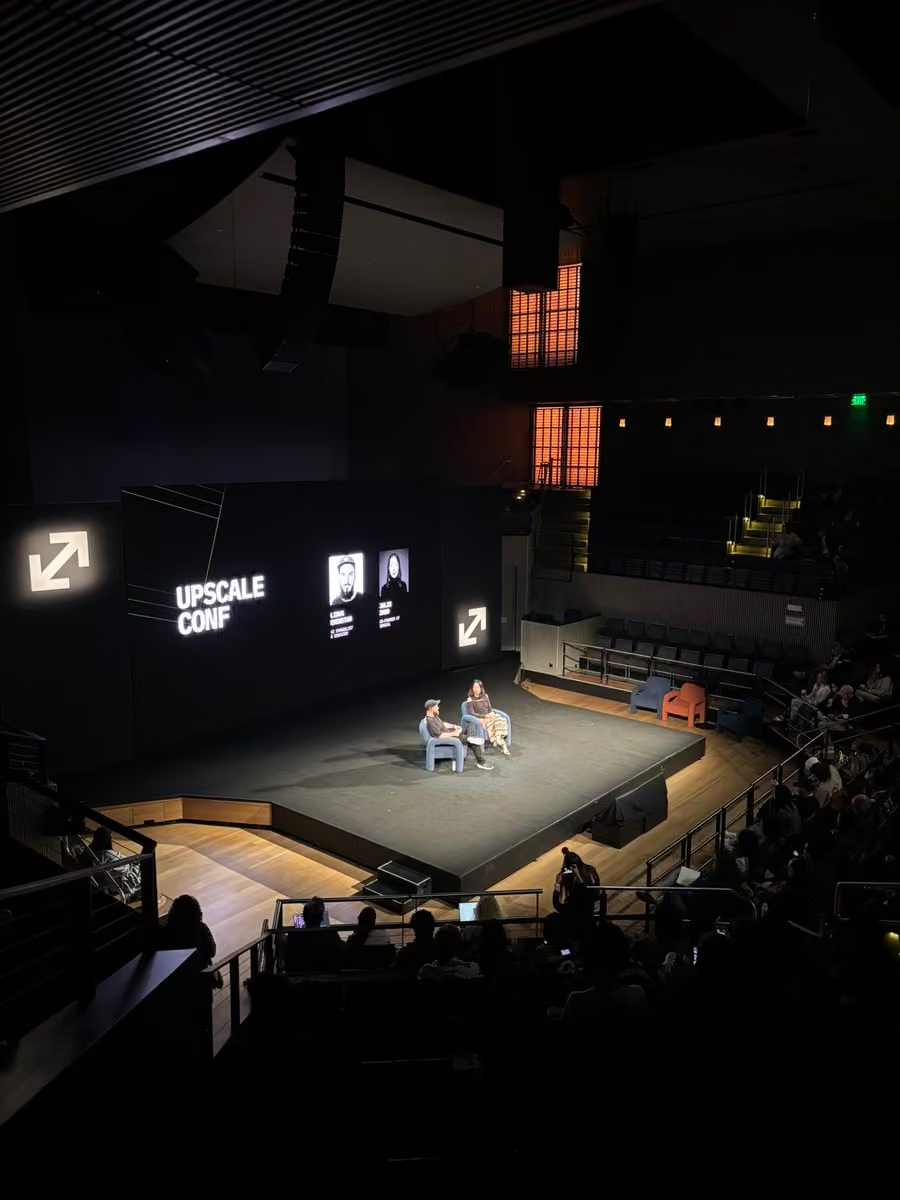 Julie Zhuo
@joulee
Tech competition is so hot right now

Julie Zhuo reposted
Jerrod Lew
@jerrod_lew
At @upscaleconf, a fireside conversation about bringing data insights to everyone is happening.
So awesome to see @joulee and @LinusEkenstam talk about Sundial, but also how to approach life in the world of AI.
Finding purpose and intention in life is so critical.
Julie Zhuo
@joulee
The Scoping Problem of conversational interfaces
Ever had an oblivious friend? Someone who is well-meaning, but has an opinion on everything and has no real clue what they’re actually good or bad at?
Ask them about politics and they’ll confidently rattle off what really needs to be done. Complain about a problem and they’ll tell you how to fix it.
Wise people know their scope. They can predict with great accuracy what they know better than you, and what they’re ignorant about.
Conversational AI today feels more oblivious than wise; it doesn’t know what it doesn’t know.
When you ask an AI agent to produce something outside its zone of competence, it doesn’t inform the user: “This is beyond my current capabilities.” After repeated attempts and corrections, the agent does not suggest: “Let me take a step back and try a different approach; this one doesn’t seem to be working.”
The AI doesn’t know whether it’s 90% or 60% or 20% confident, it doesn’t yet analyze the trustworthiness of its sources, it doesn’t fess up: “I’m not sure. My opinion leans X because…. but I’m uncertain about....”
The best-performing human teams operate with clarity on one another’s scope. Because of my design background, I'm confident to express an opinion about the design of a registration page. Ask me to select which database we should use, and I'l refer you to someone else.
In the human world, we know that good feedback mechanisms not only improve an individual’s work, they also reflect back to that person what their strengths and weaknesses are. With that knowledge, the person can do a better job of selecting the appropriate scope for their work and asking for help when a task is beyond their level.
One day, if AI gets to superintelligence, there will be no topic where it remains more ignorant than us puny humans. But that day isn’t here yet.
Before then, why not design for awareness and clarity of scope? After all, authenticity breeds trust.
(This is Problem #4 of the Five Big Problems of Conversational Interfaces.)
Julie Zhuo
@joulee
Problem #2
Julie Zhuo
@joulee
The Conversational UI iteration problem
You know what’s awesome? Asking an AI agent to create a raccoon battle game and getting something that works in <10 minutes.
You know what sucks? Trying to refine that raccoon game to match the vision in your head.
If you want to swap out that raccoon image with something that looks cuter, or try out different game titles (would “Raccoon Rodeo” or “Battle of the Bandits” look better on the title screen?) or experiment with whether the game should start with character or battlefield selection, a conversational interface is extremely cumbersome.
Nothing wonderful comes out fully formed. A good creator’s journey is one through the dark ravines and jungles of refinement. Conversational UIs are great at quickly getting to the first 70%, but suck at offering easy controls over narrower areas for iteration.
If I want to play with different titles for my game, for example, the obvious thing I’d want to do is select the title and start typing out my various ideas, or click on the raccoon character and swap out the image with different ones.
Typing instructions to my agent “Can you change the title from X to Y?” or “Can you change the raccoon to be cuter?” and then waiting while they execute the change is a frustratingly slow experience. (Not to mention—sometimes they change other elements of the game I didn’t even intend!)
There’s a reason we’ve invented WYSIWG buttons and selectors and inputs. Let’s not throw that away. Sometimes, it’s faster to click on a button and rapidly change the button radius from 10 to 12 to 16 just to see how it’ll look.
I’m heartened to see editable canvases with documents and code emerging as a pattern (although I do hate “modes”). I expect we’ll see more adoption of AI-gives-multiple-variations for creative refinement.
There’s plenty more opportunity for conversational UIs to get married to traditional UIs and make beautiful babies that enable faster iteration across the full gamut of creative exploration.
Julie Zhuo
@joulee
Problem #1
Julie Zhuo
@joulee
The blank page problem of AI conversational interfaces
Gartner famously noted when it comes to information “80% of the value is in asking the right questions.”
Even before the era of ChatGPT, the Internet was chock full of ways to get answers.
YouTube, Khan Academy, Coursera, and Wikipedia offer free knowledge in nearly every subject.
Yet average adult learning has barely increased — OECD surveys show that less than 10% of adults in many developed countries engage in any structured learning annually.
The problem with a blank chat box on a blank page is that it violates the first rule of a high-quality user experience: it isn’t obvious what I can do.
A blank page box puts the burden on the user to learn what to use it for.
This is not a problem for early adopters and high agency people (aka everyone reading this), who love the game of exploration and thrill of discovery.
But for the broader world, a blank page box is intimidating. A blank page box is lazy.
A blank page box reminds the user of Google Search, which famously designed itself to be an efficient router to other destinations.
The founders felt people should spend as little time on Google Search as possible, which I doubt is the goal of today’s AI companies.
The user experience of a conversational chat interface should help people understand how to get the most out of it.
Where are the templates for key use cases? Where are “trending prompts” and highlighted examples so users can learn from the community? Where are suggestions to continue past conversations?
Today, X operates as the user manual for how to use AI services; there is enormous opportunity for the services themselves to seize the opportunity to grow engagement and discovery.
If the success of social media platforms has taught us anything, it’s that starting with something to react to works far better than showing a blank page.
Julie Zhuo
@joulee
The Input-Output Problem of conversational interfaces
Text is an awesome medium because using the written language is obvious to many, and because there’s thousands of years of prior art invested into making language rich and expressive and clear.
Text is a limited medium because typing and tapping sucks. And a picture is worth a thousand words. And "I’ll know it when I see it" was the best a Supreme Court justice could come up with to define obscenity.
It’s faster for humans to speak instructions than to type them. It’s faster for eyes to scan a response than to listen to a voice read the same content.
And yet, the status quo is to assume that input and output modes should be the same. This assumption holds if I’m driving, or there’s multiple people in a room, and I want voice in and out. But if I’m doing solo productive work (which is most of the time), why not default me to the more efficient input / output mode?
If AI services can understand the user’s intent, it becomes even more obvious what the ideal input and output modes should be.
Want to get a team aligned on what we should build? Skip the PRDs and essays and go straight to prototype.
Want to help a user redecorate their room? Let the user express what they want via moodboards rather than sentences.
Want to cheer a user up? A warm voice does far more to show support and connection than words on a screen.
Before we slap a conversational interface on everything, let’s ask ourselves: what are we trying to accomplish?
And what is the most obvious method of input and output to achieve that goal?
Julie Zhuo
@joulee
The bittersweet reality is that we humans are desperate to express ourselves and be understood, yet we speak different languages even if we share a native tongue. Too bad we haven’t invented mind-reading yet.
The next best thing? Effective translation, the designer’s Holy Grail. The entire design discipline can be distilled into the craft of translating a creator’s intent into a user experience that fulfills the desired intent.
This is precisely where AI technology shines.
Julie Zhuo
@joulee
Icon parades, a study in contrast

 Julie Zhuo
@joulee
What happens when you get design leaders of the most influential AI companies together?
Discussions like “is my utopia your dystopia?” and “should AI be anthropomorphized?”
There is so much passion and good work cooking in this group. Can’t wait to see the future ship.


 Julie Zhuo
@joulee
The Conversational UI iteration problem
You know what’s awesome? Asking an AI agent to create a raccoon battle game and getting something that works in <10 minutes.
You know what sucks? Trying to refine that raccoon game to match the vision in your head.
If you want to swap out that raccoon image with something that looks cuter, or try out different game titles (would “Raccoon Rodeo” or “Battle of the Bandits” look better on the title screen?) or experiment with whether the game should start with character or battlefield selection, a conversational interface is extremely cumbersome.
Nothing wonderful comes out fully formed. A good creator’s journey is one through the dark ravines and jungles of refinement. Conversational UIs are great at quickly getting to the first 70%, but suck at offering easy controls over narrower areas for iteration.
If I want to play with different titles for my game, for example, the obvious thing I’d want to do is select the title and start typing out my various ideas, or click on the raccoon character and swap out the image with different ones.
Typing instructions to my agent “Can you change the title from X to Y?” or “Can you change the raccoon to be cuter?” and then waiting while they execute the change is a frustratingly slow experience. (Not to mention—sometimes they change other elements of the game I didn’t even intend!)
There’s a reason we’ve invented WYSIWG buttons and selectors and inputs. Let’s not throw that away. Sometimes, it’s faster to click on a button and rapidly change the button radius from 10 to 12 to 16 just to see how it’ll look.
I’m heartened to see editable canvases with documents and code emerging as a pattern (although I do hate “modes”). I expect we’ll see more adoption of AI-gives-multiple-variations for creative refinement.
There’s plenty more opportunity for conversational UIs to get married to traditional UIs and make beautiful babies that enable faster iteration across the full gamut of creative exploration.
Julie Zhuo
@joulee
Full essay here
 Julie Zhuo
@joulee
The blank page problem of AI conversational interfaces
Gartner famously noted when it comes to information “80% of the value is in asking the right questions.”
Even before the era of ChatGPT, the Internet was chock full of ways to get answers.
YouTube, Khan Academy, Coursera, and Wikipedia offer free knowledge in nearly every subject.
Yet average adult learning has barely increased — OECD surveys show that less than 10% of adults in many developed countries engage in any structured learning annually.
The problem with a blank chat box on a blank page is that it violates the first rule of a high-quality user experience: it isn’t obvious what I can do.
A blank page box puts the burden on the user to learn what to use it for.
This is not a problem for early adopters and high agency people (aka everyone reading this), who love the game of exploration and thrill of discovery.
But for the broader world, a blank page box is intimidating. A blank page box is lazy.
A blank page box reminds the user of Google Search, which famously designed itself to be an efficient router to other destinations.
The founders felt people should spend as little time on Google Search as possible, which I doubt is the goal of today’s AI companies.
The user experience of a conversational chat interface should help people understand how to get the most out of it.
Where are the templates for key use cases? Where are “trending prompts” and highlighted examples so users can learn from the community? Where are suggestions to continue past conversations?
Today, X operates as the user manual for how to use AI services; there is enormous opportunity for the services themselves to seize the opportunity to grow engagement and discovery.
If the success of social media platforms has taught us anything, it’s that starting with something to react to works far better than showing a blank page.
Julie Zhuo
@joulee
Read the whole article here
 Julie Zhuo
@joulee
If you could pick the number of years you could live, what would it be?
Why?
Julie Zhuo
@joulee
Where can I find a good repository of open data sets for conversational chatbots?
Not for model training; for testing something I'm prototyping.
Julie Zhuo
@joulee
The future is here!
 Ben Blumenrose
@benblumenrose
Sometimes stress in the system causes a huge paradigm shift. Last night I got a glimpse at the future of mobile and it all became incredibly “clear”... 👀
 Julie Zhuo
@joulee
The AI Quality Coup
What exactly is "great" work nowadays? This was the question @rauchg and I discussed recently.
Looking at the recent trend of "Ghibli-fication" brought about by ChatGPT 4o image generation, we observed...
1. Rather than making the art of Studio Ghibli accessible, ChatGPT’s launch has turned it into something else entirely: a commodity. The sad truth is that oversaturation strangles quality. Nothing too easy can truly be tasteful.
2. The quality of Studio Ghibli comes from its narrative and multimedia context, dedication to craft, and legacy of excellence. Simply replicating its style does not "quality art" make.
3. And yet, ChatGPT's 4o launch *IS* quality in other dimensions. The primary delight of Ghibli-fication was its ability to personalize -- you can put yourself IN the context of the studio's great body of work. Personalization is connective and magical.
4. There is also the quality work that comes from discovering a novel, useful new way to use technology, (h/t @GrantSlatton who started the trend). Collectively, the world is learning which models are precisely better for which tasks when directed in which specific manner. Every discovery grants its originator a fleeting advantage—a window to create something more useful, delightful, or efficient.
5. Quality, like a dazzling sunset, is dynamic. Ever second it is changing and receding until it flickers out. You cannot grasp it for long. You can only keep turning a new corner of exploration and hope you're lucky enough to encounter it again.
Julie Zhuo
@joulee
Full essay here: lg.substack.com/p/the-ai-quality-coup
Julie Zhuo
@joulee
Everyone says “X is an art, not a science,” and it’s funny because science is also an art, not a science.
Julie Zhuo reposted
 Book of the Day
@BookOfTheDayUS
"The Making of a Manager" by Julie Zhuo @joulee is today's #bookoftheday!
A modern field guide for new leaders learning to lead with confidence.
Read our full review here: bookofthe.day/book/the-making-of-a-manager-by-julie-zhuo
 Julie Zhuo
@joulee
Anyone here know a product person at Lovable? Love to connect with them.
Julie Zhuo
@joulee
The Death of Product Development as We Know it
Much has been written about what AI’s magical powers can enable—whether engineering, design or documentation. But I believe something just as interesting is happening with how teams build in the era of AI.
Traditional product development has been best practice-ized until it resembles an Ikea instruction manual:
The Idea (conceived in enthusiastic brainstorming chats deemed “groundbreaking” and “innovative”)
→ Mocks (polished until it’s a sparkling good storyboard for stakeholder alignment)
→ PRD (a beautifully formatted 12-page novella admired by many but read closely by precisely zero)
→ Code (with deadlines extended as frequently as the MCU)
→ Launch (with ample hopes and dreams and craft beer and pizza)
→ Surprise! (most of the time, the surprise is why users reacted with a collective shrug rather than thunderous applause)
This worked when software moved in cycles of months. But now that we have AI at our disposal (who is today an insanely productive, cheap yet junior talent that must be aggressively micromanaged), that tidy linear path is going the way of the dinosaurs.
Ask yourself:
1. Why brainstorm for hours when AI can generate 50 ideas (and roast the bad ones) in minutes?
2. Why show static mocks when AI can build a version of the damn thing for your stakeholders to play with?
3. How much effort should you put into your PRD when AI changes the rules of what’s possible every other Tuesday?
4. Why spend a bunch of time debating engineering flows when you can’t deterministically predict what the technology will do?
5. How much more would you achieve if you could learn the Surprise! of your launch in a fraction of the time?
Continued in the latest edition of my essay on The Looking Glass.
Julie Zhuo
@joulee
Many thanks to @henrymodis who co-created this post with me and is responsible for many of its gems of insight.
Julie Zhuo
@joulee
 Julie Zhuo
@joulee
In the AI era, our souls need proof of work.
lg.substack.com/p/the-looking-glass-our-souls-need
Julie Zhuo
@joulee
Sometimes I have so many fucking great ideas I don’t know what to do with myself.
Julie Zhuo
@joulee
A lot of the time I give up. So many (great? Okay?) ideas dead and forgotten.
Julie Zhuo
@joulee
This is the coolest thing about AI. Shortening the feedback loop to giving ideas form.
There’s going to be a lot of bad ones that still die after they’re embodied.
But we’ll going to see more greatness.
Julie Zhuo
@joulee
Your conscious mind is the CEO of your being.
Like most CEOs, it thinks it has a good understanding of what’s happening on the ground. Like most CEOs, it rarely does.
Your worst nightmare or greatest dream is rarely what is actually happening in front of you; it’s the story you believe about what it means. Remember that we are fanciful storytellers. The later the hour, the hotter our emotional spark — the more fanciful our story.
If you want to change how you feel, learn to either change your actions or change the story you believe.
To learn how to change the story you believe, treat yourself like a black box (hello self-GPT!) Then, do repeated experiments (“prompt engineer yourself”) until you figure out what changes your beliefs.
Every journey you take in life — whether in work or in love, for leisure or for achievement — masquerades a journey to understand yourself. The earlier you accept this, the more fruitful your adventures.
Julie Zhuo
@joulee
Anyone know a PM (or product-focused engineer) at cursor they can intro me to?
I'd love to interview them about how they approach product development
Julie Zhuo
@joulee
🚨 Job req alert -- come work with me!
Are you a tech recruiter?
...Who lives in Bangalore / will relocate to Bangalore?
…With 1–4 years of talent acquisition experience?
…Who is tech-savvy & data-obsessed?
…With startup vibes: fast, scrappy, experimental, results-focused?
…Who wants to be the first in-house recruiter in an ambitious, growth-mindset and tight knit team?
Come join Team Sundial and work with our incredible engineering, data and design teams as they scale.
Is this you or someone you know? Appreciate RTs/tags/shares :)
Email us (adventures at sundial dot so) your resume and why this role is a great fit for you
Julie Zhuo
@joulee
Stop Nagging Your Users!
Have you ever been in a product conversation that goes like this?
“We want more sign-ups.”
“Cool. Let’s show bigger, louder call-to-actions (CTAs).”
But constantly pestering people—whether it’s your users or your spouse to pick up socks—leads to annoyance, not loyalty.
Introducing 3 metrics to look at to evaluate your nagginess:
Conversion Rate: Actions taken ÷ times CTA is seen. But a higher conversion rate means nothing if people feel cornered.
Number of Users Who See No Benefit: That “1% conversion” might come from 1 in 100 or 10k in 1M. The latter is far more intrusive.
Nag Score: (% of screen real estate) × (Attention Multiplier). High score = you’re basically shouting.
Example
♥️ Instagram’s heart icon: Tiny fraction of the screen, minimal design. Good conversion rate, small % of people who see no benefit, low Nag Score.
🚫 Full-screen pop-up that blocks your view? 100% screen usage plus an irritating exit button. Sky-high Nag Score.
Why does this matter?
Constant nagging hurts trust in the long-term. This is why users who loved your experience will eventually start complaining about your product.
A better approach: Improve the value proposition so people want to take action *without* a digital bullhorn.
Balance the metric you’re trying to move (sign-ups, purchases) with the user’s experience. Ask yourself: “Is boosting this stat worth annoying 99% of people?”
Use this to refine your product experience—and remember, no one likes being nagged!
Julie Zhuo
@joulee
The Valuable Employee Paradox
lg.substack.com/p/the-looking-glass-the-valuable-employee
 Julie Zhuo
@joulee
never forget:
living > non-living
complex organisms > simple organisms
society > an individual
ideas > societies
Julie Zhuo
@joulee
I've participated in too many conversations about "what is the role of design / pm / eng / marketing / sales?" to count.
Of course there are differences. But every tech manager role, regardless of discipline, ends up converging.
What does this mean for you as a manager?
If you climb the management ladder to the very top, guess what? You’re the CEO! And you manage *every* function.
So if your goal is to be CEO someday, or even VP or director within your discipline, you need to get out of your box and learn how other disciplines work.
The most thoughtful designs don’t get used if engineering doesn't build them. The most sophisticated algorithms don’t help people if they can't be put into a clear product. The tightest roadmap doesn’t get you customers if the experience isn’t good, or you can't sell it.
“Learn other disciplines” is counterintuitive because for the 1st phase of your career, as an IC / new manager, you progress by going deeper.
Invest into the craft, the process, the community to become an expert.
But around Director (or even earlier at start-ups), one starts to hit a ceiling with specialization.
If people think of you as only a “design leader," "eng leader" or “data leader” who only works on “design," "eng" or “data” problems, rather than company or customer problems, you'll lose influence with folks who don't consider themselves part of your discipline.
At the VP level, for instance, managers are expected to demonstrate an ability to successfully drive company-wide, cross-functional initiatives.
So, if this is the path you're on, how do you expand and learn more about other disciplines?
1) be curious and appreciative about what your cross-functional colleagues do.
2) Spend time with folks in that discipline to develop your critical eye for what it means to be good within that role. (Easy conversation-starter: "Tell me, how does an A++ eng/design/product individual / team operate?")
3) learn to speak the language and values of that discipline.
4) remind yourself that your discipline is awesome, but it's not the center of the universe.
At the end of the day, valuable products are created through the many talents of a diverse team. Embrace that. Appreciate that. And know that if your goal is to manage toward that end, you must broaden your understanding of the respective elements.
(Note: the above speaks to managers; ICs can very successfully go deep and continue to grow their careers within their disciplines.)
Julie Zhuo
@joulee
Anyone out there working on AI firefighting robots?
Julie Zhuo reposted
 keshav
@keshavchan
every startup needs two types of people:
1. terminally online. first to know everything. x company launched y? they knew before the official announcement.
2. completely off social. no idea what’s happening online. reads a physical newspaper on sunday, immersed in books.
one keeps you ahead of the curve. the other keeps you grounded in first principles.
Julie Zhuo
@joulee
Freedom to decide is an illusion
Early in my career, I spent so much mental energy trying to guess what my managers were thinking—would they greenlight my proposal? Agree with my critique? Support my promotions? Approve my budget?
Naturally, I assumed that being the boss would be the opposite. Finally, I’d have the freedom to decide everything!
How wrong I was.
Freedom to decide is an illusion, even at the highest levels.
So long as it takes working with other people to get the outcome you want, the need to influence is like a shadow against the setting sun—it only grows and grows until it becomes the entire job.
Last week, in the day-to-day of founder life, I found myself trying to influence:
* A handful of prospective clients to agree to a trial
* Some existing clients to try out a new feature
* A candidate to join our team
* The company to understand our core focus areas for next month
* The company to try out a new process
* A few team members to speak up more
I say "influence" because many of these outcomes are outside of our direct control. You can't force someone to join your team, for example.
Even when you *can* force a decision through by pulling out the hierarchy card—"Just do it because I’m the boss!"—it’s an expensive card to use. It’s like gambling with $10,000 of trust credit on black—great if right, and disastrous if wrong. Wise managers use this sparingly.
For the vast majority of the thousands or millions of smaller decisions that an organization makes every day, a manager’s effectiveness comes down to: How well can they influence?
Let’s break this down further into more concrete skills to master:
1. Having well-informed opinions that can be trusted.
If you’re wrong a lot, you’re going to lose credibility. There is no way around this.
2. Transport others to see what you see.
Even if you’re good at being right, if you can’t tell people *why* they ought to agree with you, you’re asking for blind faith. Great managers know how to weave a compelling story with compelling evidence.
3. Listen well and amplify other voices.
The notion that most good ideas in a company come from one person is laughable. Instead, great managers know that good ideas reside in clients, sales people, team members, advisors, or even other companies. Great managers amplify other voices to encourage independent thinking and to build leadership strength across the company.
4. Admit when you’re wrong.
Every single one of us will be wrong more times than we’d like. But future trust and greater collective learning comes from reflecting on the past bets that didn’t work.
Instead of thinking of the job of the manager as having the freedom to decide, think of it instead as being a marvelous curator and storyteller — the kind of person who can spot good ideas, help them become polished, and land them within the organization to help the team do what it was made to do.
The need to influence will always be at the heart of that work.
Julie Zhuo
@joulee
A thread (and story) about managing within different cultural contexts.
Some of you immigrants/minorities will know what I'm talking about when I say that it took me maybe three decades to know how to answer: "Who are you? What do you want? What do you care about?"
These seem like a staggeringly simple questions in American society. But I'd freeze whenever someone asked me that.
And it came up all the time. When meeting new folks in college. In job interviews. When asked about my 3-5 year career plans.
If you come from an individualist culture, since you were a toddler people have asked you what you wanted, what you like or don't like, what you thought of X, etc.
But growing up in an Asian culture, I was asked to consider: "What is appropriate to do/say in this context?" "What's best for this group?" "What does Person X need?"
So in my twenties, when my managers would ask me what my career goals were, my answers always felt so complicated.
I'd say, "What does the company need from me?"
I'd say, "What can I do to help you?"
And they'd look at me like: "Uhh this is supposed to be about *you*."
But I didn't see myself as just "me!" I saw myself as a unit within the larger group!
As time passed, I've learned to be more individualistic. I admired the ease in which my colleagues knew themselves. And you become what you admire. But neither is better nor worse. It just is.
So. If you manage folks today, and you feel you aren't getting rich, detailed answers to "What do you want in your career?" or you feel you don't know their unique identity because they can't describe themselves easily, consider whether it might be because they come from a different cultural context and these types of questions are less common and practiced.
Be patient. Be their mirror. Help reflect back what you see and appreciate about them. No matter what cultural context we come from, caring feedback and connection is always a gift.
Julie Zhuo
@joulee
Trick question -- your ideas are gonna be better assuming you have $0 than $20.
 Aish
@aish_caliperce
In DoorDash's early hiring process, Tony Xu would give applicants $20 and 20 mins to ask him anything, challenging them to figure out how to acquire 100 customers in 8 hrs and actually execute it.
He'll also put a plane ticket by side incase if they want to quit the interview.
"I understand that this may not be what you signed up for but this is what it's going to feel like on most days, where you have no idea what to do then you're just going to have to do something about it "
Julie Zhuo
@joulee
Robots: will make way more people's nails look way better.
Will kill opportunities for fun chats with salon technicians.
Every gain is a loss.
 Esther Crawford ✨
@esthercrawford
This weekend a robot did my nails. 💅 It took about 10mins and cost me just $10. What’s fascinating about consumer robotics is it merges high-tech engineering with nuanced human-centered applications.
The robots are coming for so many tasks.
Julie Zhuo
@joulee
Everyone has an opinion on design.
There's always an immediate gut reaction: "Ooh, I love this!" or "Meh."
But how do you go beyond that to honing your skills of giving helpful, actionable feedback?
Here are the 7 questions I run through when critiquing a product's design
1) What is the user journey to get here?
You can’t furnish a room if you don’t know how someone lives.
So learn the context: Who is the user? When do they use this product? Why? How did they arrive here, and what's on their mind?
Don't critique unless you know this.
2) What do we want users to feel and achieve here?
“If you don’t know where you’re going, you’ll end up someplace else.”
Let’s understand what a successful outcome looks like before we start lobbing feedback about the design.
3) How important is this page/experience?
In a perfect world, we make everything perfect.
In the real world, let's spend more collective energy on the stuff that really matters. More eyeballs? More high-stakes? = more thorough inspection of every detail.
4) What is our scope/timeline/team?
If speed is critical, let’s get the greatest bang for the least effort. If we have more time and people, then let's remove constraints (#7) and dream bigger. The "best" design differs according to the time/people/money you have.
5) For every proposed design change, am I confident it is better that what currently exists?
If no:
a) cut it
b) iterate on / improve the design
c) get more user feedback
d) A/B test it
6) What can we remove from this experience and have it work just as well?
When faced with a problem, we bias toward adding stuff to solve it rather than removing. So gut check if it's necessary.
7) If we could throw all our constraints away, would we still design it like this?
While we can't typically throw all constraints away (see #4), it's still worthwhile to ask because we accept some things as constraints (due to legacy, etc) when they really aren't.
Julie Zhuo
@joulee
Headline: cool tech destroys the actual quality of the content.
 Madni Aghadi
@hey_madni
Kling AI is 100% out of control.
1. Friendly Trio
Julie Zhuo
@joulee
Blast of a day with #lennyandfriends!

 Julie Zhuo
@joulee
Only at SFO is the Clear line longer than the pre-check line, and the pre-check line longer than the general line.
Julie Zhuo
@joulee
"All the world is made of trust."
A deep dive into what trust is, how to get it, and unintuitive things about building it.
lg.substack.com/p/the-looking-glass-all-the-world-is
Julie Zhuo
@joulee
OH: "Need an all-nighter to get back on track--so will be working 9pm-midnight tonight."
Julie Zhuo
@joulee
Twitter is much more enjoyable now that I assume everything I read is true in some way.
The game becomes--in which way?
Julie Zhuo
@joulee
Tell me something true, or tell me nothing at all.
Julie Zhuo
@joulee
What is judgement, why does it matter, and how do you improve it?
This is one of the most personally clarifying pieces I’ve written in recent memory.
open.substack.com/pub/lg/p/the-looking-glass-sharpening-j…
Julie Zhuo
@joulee
Chess players, a thought exercise for you:
You have two players of equal raw intelligence who are totally new to chess.
After each game Player A analyzes the game for 20 min, while Player B gets chips and guac.
After how many games would you expect A to consistently beat B?
Julie Zhuo
@joulee
7 ways to kill trust as a leader (and how to avoid them)
1) Follow-through Fail: overpromising/underdelivering
"You're on track for a promo!" (but it doesn't happen)
"Let's talk your career goals next time" but the next chat is about some immediate task
Antidote: Apologize and rework a plan as soon as you know expectations won't be met.
2) Talk but No Walk: do as I say, not as I do
Chewing a report out for being late, while being frequently late.
Saying "I trust you", but then micromanaging your work
Antidote: never demand more from others than you expect from yourself.
3) Flip-flopper: their desires change as often as socks
Pushing for "quality" one week, and "speed" the next week.
Asking for 'blue-sky ideas' but then rejecting any that might fail.
Antidote: publicly set goals / priorities every X period. Don't change until the period is over.
If there is a change, clearly explain what new information led to that change, or own up to flip-flopping.
4) Gossipmonger: they confide something negative about someone else to build bonds with you.
"X is so stubborn. I don't know how you can stand being in the same room as them."
"Don't you wish X would stop <doing Z>?"
Antidote: imagine everything you say will be repeated to others. Say only about X what you have said to X directly.
5) Ostrich Head: only wants to discuss the good; never the bad.
Telling you why something isn't a problem when you bring it up.
Pretending a crisis is not happening when it is.
Antidote: acknowledge issues. It's okay to say "I don't know the answer, let's figure it out together."
6) Ruinous Empathizer: doesn't say things they think you might not want to hear
Giving you wishy-washy, compliment-sandwich feedback about why you weren't promoted.
Struggling to fire underperformers on the team.
Antidote: read "Radical Candor" by Kim Scott
7) Us vs. Them: puts their own team above other teams
Advocating for a report's promotion when it doesn't calibrate well against peers.
Ignoring another team's asks for help.
Antidote: internalize company > team.
Your team may love you, but you'll get dagger stares + stalled career if you don't put the success of the company above you or your personal team's success.
Julie Zhuo
@joulee
"How can design grow its influence?"
As a designer, I asked this question to my CPO manager once. I thought it was a proactive, gumption-filled question. Like "look at me, trying to think big about my discipline!"
My manager gave me a tired look. “Just do what’s best for the company,” he said.
What a non-answer! I thought at the time, indignant. He was giving me some kind of fortune cookie platitude instead of concrete steps! I needed a playbook!
Was he even hearing my question?
But no, dear reader. It was I who wasn’t hearing his answer.
"Just do what’s best for the company." Its simplicity disguises the clarity of the playbook.
This is how I translate what he was saying now: "Stop being caged by your role and start looking at the bigger picture."
So let's back up and look at the big picture of how to think about your career:
1. Only you can know what *you* stand for and believe to be best.
2. Reasonable people will disagree on what’s best. Reasonable designers will too.
3. The greatest freedom you have is in choosing how to spend your time and energy.
4. Choose well and align yourself with a purpose you care about, and an environment where your talents can make an impact towards that purpose.
5. If you choose to be part of a team, then it’s your job to do whatever is in your power to help that team succeed.
6. Part of your unique superpowers come from your role or the discipline you study.
7. But you are also far more than your role; do not let it constrain you.
8. You do not need permission to "think like the CEO" and come to an opinion about what’s best for the the team
9. You will need to fight for what you believe is best. (Remember -- reasonable people can disagree). But do this for the good of the team, not for yourself, not for your role or discipline.
10. What’s best for the organization is creating something people value in a way that is sustainable and aligns with the owners’ expectations.
11. Beyond what you choose to do with your rare and precious time, there is much we cannot control. Let that be.
12. Remember: you are far more powerful than you think you are.
Julie Zhuo
@joulee
What an excellent manager-report relationship looks like
The best relationships are built on trust. So ask yourself: “Do I trust my manager to do their job well? Does my manager trust me to do my job well?”
Of course, you can’t answer that without knowing what "doing the job well" means. This is the first thing you and your manager must align on.
This seems obvious, but I cannot tell you how many people come to me frustrated because they think their manager’s job is to have their backs which means “wholeheartedly support my ideas”, while their manager thinks their job is to get quality output which means “critique my reports’ work and push them for better ideas.”
This is a subtle misunderstanding, but it leads to repeated minor tensions which erode trust like waves crashing against a cliff.
Ask yourself: do you really understand how your manager sees success for their role? If not, ask this in your next 1:1: “I’m really curious how you think about your role. What makes you feel you’re doing a great job?”
It’s a simple and powerful question. And yet. The number of people who have asked me this in my career, I can count on one hand.
Once your manager gives their answer, you might find elements you’re curious about. Keep following that curiosity to expand your understanding. “So alignment with XYZ is a big part of your role? How much energy do you spent on that versus on ABC?”
A natural extension to this question is to then turn the spotlight on yourself. “How about for me? What would make you feel I’m doing a great job?”
Once you get your manager sharing, you’ve created space for you to share also. So follow up their answers with: “Here’s what would make me feel really engaged and successful in my role…”
After everyone’s hopes and dreams and success criteria are on the table, the task becomes to mold these pieces into a vision for a great relationship. “Let’s figure out how to help each other both succeed…”
A shared goal is the backbone of a trusting relationship. Before you start with evaluations and judgements, make sure you’ve explicitly mind-melded on this piece.
Julie Zhuo
@joulee
More on the manager-report relationship in the latest issue of The Looking Glass -- lg.substack.com/p/the-looking-glass-managing-your-manager
Julie Zhuo
@joulee
If your relationship with your manager sucks…
Here are 7 step-by-step actions you can take:
1. First, understand what a great relationship looks like.
Do your research. Ask your friends. Read some articles. Write down the qualities you’re looking for.
Julie Zhuo
@joulee
7. If your manager’s manager does nothing, and you find yourself having lost trust in the entire management chain, it’s time to seek greener pastures.
Life’s too short to work with people who lose your trust.
Julie Zhuo
@joulee
More on how to do the above in the latest issue of my blog The Looking Glass lg.substack.com/p/the-looking-glass-managing-your-manager
Julie Zhuo
@joulee
What your manager is not
It’s common for people to think of their managers as executioners. As in, “If my manager catches me doing <a thing they disapprove of>, they will axe me!”
In this mental model, the manager creeps around policing rules and judging for negligence. The underlying emotional current is fear.
It’s also common for people to think of their managers as white knights. As in, “My manager will defend me against <people who are against me> and fight to get me a promotion!” In this mental model, the manager takes up your cause and provides for your dreams. The underlying emotional current is pining.
Let’s shatter both these illusions.
Of course, it’s easy to see why we believe them — the challenge with the manager-report relationship is an imbalance of power. Managers can fire or promote us far more easily than we can fire or promote them. So we end up thinking that managers have an “edge”, and as a result we unconsciously make them the main characters in the story of our career advancement.
It may very well be that your manager doesn’t understand you, or overlooked your good work, or is on your case about something trivial. But do NOT give away your power by making your career all about them!
*You* are the main character in your career journey — this is the singular belief that will transform your relationship with your manager.
If your relationship with your manager sucks, it’s time to roll up your sleeves and be your own hero.
Julie Zhuo
@joulee
The latest issue of The Looking Glass goes deeper into the theme of how to get the best out of your relationship with your manager.
lg.substack.com/p/the-looking-glass-managing-your-manager
Julie Zhuo
@joulee
How to change a culture (1/14)
Step #1: Know what existing belief you want to change and where it came from.
What is the belief that you worry is leading the team astray? Where does it come from?
Julie Zhuo
@joulee
You need to dig past the undesirable behavior (“Ugh why do people write such garbage code?!”) and get to the core belief underneath it (“People here believe shipping faster is more important than writing sustainable code”).
Julie Zhuo
@joulee
What made reasonable people adopt this belief? (“Hmm, looks like our leadership is constantly pushing the team to ship features as fast as possible.”) And keep going up the chain — what made those people do that? (“Leadership probably thinks this is how we get more done faster.”)
Julie Zhuo
@joulee
Once you can understand where the belief came from, it becomes easier to identify the specific error in the belief. ("Actually it takes far more time to clean up bugs from bad code!")
Step #2: Know what alternative belief you’d like to stand for.
Julie Zhuo
@joulee
If you could wave this wand and have everyone on your team suddenly believe something different, what would they believe?
Julie Zhuo
@joulee
Now it’s up to you to stand up for that belief. It’s not enough to just cross your arms and oppose things. To really bring about change, you need to create. So go ahead and propose your alternative. Make it as attractive as you possibly can.
Julie Zhuo
@joulee
A good tactic is to go after the SAME goal as the original belief, but with a different strategy (“Guys, we can move FASTER if we write quality code!”)
Step #3: Start telling this different story over and over again.
Julie Zhuo
@joulee
Once you have your new belief, it’s time to put on your leadership hat and spread the gospel.
Julie Zhuo
@joulee
This underlying belief — "I don’t like how we’re doing things but I don’t think I can change it" — is in of itself a limiting belief.
What would it look like to see beyond that?
Julie Zhuo
@joulee
From The Looking Glass -- lg.substack.com
Julie Zhuo
@joulee
Beliefs dictate culture, and the belief that you can't change a culture is one of the limiting beliefs I'd like to persuade you to change.
open.substack.com/pub/lg/p/the-looking-glass-culture-chan…
 Julie Zhuo
@joulee
Are you a front-end / ui-eng wizard 🪄 in Bangalore?
Come work with me.
 Deepankar
@DeepankarBhade
Anyone knows a frontend wizard looking for an internship / FT role in Sundial (sundial.so)
DM, tag folks in your network ❤️
Julie Zhuo
@joulee
Someone on your team says: “Our goal should be to move Metric X up Y% this half.” Your inclination is to nod, say “Cool” and get on with the actual building.
But pause!
The goals you agree to determine what you build. So consider them carefully and ask the following:
Julie Zhuo
@joulee
Make sure you understand your team's chosen goal metrics and targets. If not, ask questions. Give input. Make sure it truly measures what matters.
Julie Zhuo
@joulee
Subscribe to lg.substack.com for more posts on building.
Julie Zhuo
@joulee
7 phrases to use instead of “I don’t agree”
First of all, what’s wrong with "I don’t agree?" After all, it’s honest and direct.
Julie Zhuo
@joulee
2. Who do you have in mind as you’ve thinking about this problem? What assumptions do you have about them?
3. How will we know if this proposal will work?
4. What are you confident in in this proposal, and what are you not sure about?
Julie Zhuo
@joulee
5. How important do you think <perceived weakness> is? Why?
6. It’s not clear to me how this solves for XYZ. Can you explain?
7. Have you considered <alternative idea>? What did you think?
Julie Zhuo
@joulee
40 things I wish I knew when I was 20
1. For whatever action scares you (and isn’t life-threatening), remember this surefire way to eliminate the fear: do it 100 times.
Julie Zhuo
@joulee
19. It’s easier to see the bias in others’ advice if you assume what they tell you is really what they’re trying to tell themselves.
Julie Zhuo
@joulee
20. Whenever a situation appears black or white to you, be wary. You’re either highly stressed, or you’re lacking context, or both.
Julie Zhuo
@joulee
39. Whenever you hear yourself saying “I have to…”, change it to “I choose to…” Remembering you have choices does wonders for your well-being.
Julie Zhuo
@joulee
40. Advice does not give you wisdom; life gives you wisdom. If advice is ever useful, it’s only because it tidies up your messy house and helps you locate the key you’ve been searching for. Never forget: you already possess the key.
Julie Zhuo
@joulee
That's it! Life thus far distilled into 40 unintuitive lessons.
For more, subscribe to my mailing list at lg.substack.com
Julie Zhuo
@joulee
To say I have been looking forward to this launch is an understatement.
The promise of AI that deeply understands us as individuals… that is Dot.
Congrats @jasonyuan and @sjwhitmore!
 New Computer
@newcomputer
dot is now available on the app store
apps.apple.com/us/app/dot-living-history/id6450016041
Julie Zhuo
@joulee
100%. Anytime I get a little too proud of tech product design I go and play Zelda and it reminds me we're still JV.
Also true for how "data-rigorous" tech company people are compared to finance people. Different leagues.
Soleio
@soleio
Someone once said to me:
“The difference between product designers and video game designers is like the difference between college and professional athletes”
On a totally unrelated note:
Julie Zhuo
@joulee
Design with me!
Job req alert!
...Are you a early-career designer?
...Who lives in Bangalore / will relocate to Bangalore?
...Hungry to learn as much and as fast as you possibly can on building valuable products of high complexity?
...With exceptional visual design fundamentals?
...And strong sense of ownership and work ethic?
...And an interest in how data can lead to better decision-making?
Come join our small and scrappy Team Sundial and work with the incredible Aditya Shrivastava at the intersection of data, insights, storytelling, AI, and team decision-making workflows.
DM me for req.
Julie Zhuo
@joulee
Discovering that not everyone can DM me! Here's the req -- please email the address there!
teamsundial.notion.site/Product-Designer-cacb5912f3574030…
Julie Zhuo
@joulee
People overcomplicate feedback.
The litmus test for great feedback is actually really simple.
Did your feedback result in the other person taking action in a way you and they feel good about?
If yes, pat yourself on the back. Your feedback was great, and you gave them a valuable gift.
If not, then it wasn’t.
That’s it.
Julie Zhuo
@joulee
How do you give (and receive) great feedback?
That is the topic of the latest Looking Glass newsletter issue: lg.substack.com/p/the-looking-glass-holding-up-the
Julie Zhuo reposted
Grant Lee
@thisisgrantlee
Gamma just raised a $12M Series A led by Accel!
For ~40 years, slides have been the go-to for presenting ideas.
We're reimagining things from the ground up.
Quick thread 🧵on our story so far:
Julie Zhuo
@joulee
I have seen many juniors absolutely school seniors in how hard they work, how fast they adapt, and how optimistic they are.
I have also seen many seniors school juniors in how calmly they approach problems, how well-crafted their work is, and how clearly they communicate.
The key ingredient is not seniority, but whether each person has an outlier strength that is higher than the team’s average.
These outlier strengths are where we find opportunities for leadership.
Julie Zhuo
@joulee
Read more on leadership here: lg.substack.com
Julie Zhuo
@joulee
What is leadership? Where does it come from? What do we get wrong about leadership?
The topic of this week's The Looking Glass: lg.substack.com/p/the-looking-glass-the-origins-of
Julie Zhuo
@joulee
I come to X after a while and it's like a bad clubbing scene -- there are literally no women in my feed for the first 4 scrolls.
Julie Zhuo
@joulee
Best: overpromise and overdeliver
Okay: underpromise and overdeliver
Worst: overpromise and underdeliver
Julie Zhuo
@joulee
Hear me out: @taylorswift13 joins @DollyParton and @Beyonce to write a third cover of "Jolene" but it's from the POV of a strong independent woman talking shit to her (ex-) man for falling in love with another chick.
The internet would break and the Trinity would be complete.
Julie Zhuo reposted
 Mirage
@trymirage
Introducing Captions for web.
Video editing made simple, thanks to AI — now on a bigger screen.
One-click editing, right from your browser.
Julie Zhuo
@joulee
A Twitter or LI, but hear me out--everyone posts failure stories, screenshots of graph-going-down, and reflections on failure.
Julie Zhuo
@joulee
What is this design eng thing everyone is referencing.
I check twitter rarely now so what am I missing?
Julie Zhuo
@joulee
I’ve heard all the arguments why something *isn’t* good. I am sympathetic to them.
Still, the bar can and should be higher in every dimension. This is the infinite pursuit of human innovation. There is no end to the breadth and depth of caring.
 Startup Archive
@StartupArchive_
Patrick Collison on the importance of beauty and craftsmanship when building products
“If Stripe is a monstrously successful business, but what we make isn’t beautiful, and Stripe doesn’t embody a culture of incredibly exacting craftsmanship, I’ll be much less happy. I think the returns to both of those things in the world are really high. I think even beyond the pecuniary or financial returns, the world’s just uglier than it needs to be… One can do things well or poorly, and beauty is not a rivalrous good.”
Patrick believes a commitment to craftsmanship and beauty played an important role in Stripe’s success:
“My intuition is that more of Stripe’s success than one would think is downstream of the fact that people like beautiful things—and for kind of rational reasons because what does a beautiful thing tell you? Well it tells you the person who made it really cared… And so if you care about the infrastructure being holistically good, indexing on the superficial characteristics that you can actually observe is not an irrational thing to do.”
Julie Zhuo
@joulee
One of my favoritest interviews ever with the amazing @helena on her incredible long-form narrative series “Founder Things.”
www.helenaprice.com/interview-julie-zhuo/
Julie Zhuo
@joulee
Watch me and @leahthar talk about the pursuit of being more and more real.
www.leahtharin.com/p/51-julie-zhuo-authentic-leadership
Julie Zhuo
@joulee
Today the Making of a Manager is 5 years old, has nearly 5,000 Amazon reviews, and is published in 19 languages!
The biggest misconception about being a management book author is that I am someone who really *really* knows how to manage.
I assure you, I am still learning!
I believe I will *always* be learning how to become a better manager, because managing is about relationships, and relationships are about people, and there is no end to deepening how we understand and collaborate with people.
Some of the skills I am still working on today:
1. Identifying each person's distinct superpowers and growth areas and mirroring that back in a way that helps them grow
2. Finding a way to say the thing I feel, even if I worry about others' reactions
3. Developing a better instinct for when I am likely to have the best instincts, versus when others are likely to have the best instincts
4. Honing the balance of when to trust and when to be skeptical
5. Appreciating the journey more than the destination
Some of the key points from The Making of a Manager that I still sing from the rooftops:
1. Feedback is a gift -- so give and receive it freely
2. Know thyself -- and reduce your blind spots
3. Care about people -- this is how you build trust
4. Find the win-wins -- aka the big overlaps between someone's career goals and the business' goals
5. Share your problems -- it's okay to not know the answers; open up your problems and you'll open up opportunity for the team.
As someone more familiar with launching software, launching a physical book is both delightfully and frustratingly different.
On the one hand, there is very little data! I don't know exactly what's selling where and why, what the retention is, what the viral coefficient is, whether podcast interviews are an effective promotion strategy, etc.
On the other hand, there is something simple about knowing that The Making of a Manager could not have had the impact it did without people spreading it via word of mouth.
Thank you to all of you who read it, who spread it, who care about the job of management.
I'm so happy to be along on this journey with you all!
Julie Zhuo
@joulee
Do not place your faith in playbooks
Take this from a lover and writer of playbooks: they can never teach you how to do something hard.
There are 4 reasons you should be suspicious of the teachings of any playbook or framework:
Reason #1: It’s much easier to write a playbook than it is to do a hard thing.
Thus, many playbooks are aspirational rather than experiential — "I wish it worked this way", rather than "this is what I know about how to make it work". To truly discern the difference, you’d need to know if the author of the playbook is indeed a master of their domain. Which means you’d need to know either the author extremely well, or the domain extremely well.
Reason #2 (even if #1 is true): The ability to know something and the ability to explain it well are two different skills.
To know how to do something difficult is rare; to know AND to be able to explain it well is even rarer. I have met numerous masters of their domains that are frequently right, but cannot explain why, because it is an intuition felt in the gut rather than a logical train of thought. Even those that do write a playbook may not write it in a way can be easily understood by non-experts — this is why so many books feel intimidatingly complex!
Reason #3 (even if #2 and #3 are true): True knowledge of how to do something hard is too rich in depth and nuance to transfer to another person.
The reality of how to do something hard is so complex as to be impossible to fully explain in a tweet, a diagram, a podcast, a class, or even a book. Human language is a lossy communication medium. So whatever you do read or see is generally a simplification of what the master knows—like a 6-D object transposed into 2-D.
Reason #4 (even if all the above is true): Your exact context will be different and something the framework author probably does not have firsthand experience of.
The world’s best instructions on how to get from the train station to Town Hall in London would simply not apply in Barcelona.
--
That said, playbooks and frameworks are not entirely useless! They are incredibly powerful tools, for 3 reasons (and not necessarily the ones you think.)
1) A playbook / framework is an effective way of distilling complex knowledge for the author and their collaborators. The process of creating a framework forces reflection. The process of following a framework forces evaluation and iteration.
2) A playbook / framework is valuable as a handy reminder for others who have similar knowledge. Those folks have the depth of knowledge, and can rely on an elegant encapsulation in a simple 2x2 for easy recall.
3) A playbook / framework is useful is as persuasive evidence for action. If you need to convince others of something you already know but can’t explain well, you can use the framework as social proof.
Alas, there are no shortcuts; the way to cross the chasm of expertise is not by applying someone else's formula, but by doing the the hard work of doing.
Julie Zhuo
@joulee
What makes Facebook / Meta so uniquely good at what they do?
The list is long -- from Mark's clarity of vision to the amount of time spent in the discomfort zone, from specific management practices to decisions on whether to centralize or decentralize a growth team.
But one of the biggest IMO is the rigor of the team in focusing on impact, and doing so in a truth-seeking and hypotheses-driven way.
I just finished listening to the latest @20vcFund podcast episode where my co-founder Chandra Narayanan tells story after story about growth, data, influencing, leadership, org design, and dozens of other topics.
Chandra hates the spotlight so he's cringing now as I type this, but I'm SO SO giddy the world gets a taste of the incredible mind and soul that I'm lucky enough to work with and learn from every day!
I mean, the knowledge this guy drops!!!! 😱
Julie Zhuo
@joulee
A few weeks ago I chatted with Felix Lee and 3000 other folks live about what design and data means to me. I do quite a few talks, but this one was particularly far -- the energy, the topics we covered, the depth.
Full video interview here: www.youtube.com/watch?v=ODGnUL9llZo
Julie Zhuo reposted
 Felix Lee
@felixleezd
In 2019, I started as a self-taught designer.
One of the first notable design leaders that I came across on the internet was, Julie Zhuo (@joulee).
As with most designers... I read her famous book "The Making of a Manager" and tuned all her talks. Fun fact: I even applied to work at @Meta.
Though I didn't get in, a lot of Julie's online sharing stuck with me.
Today, I get to interview her on @ADPList.
We spoke about Julie joining early Facebook to growing there for 14 years, then leaving to start Sundial. And how to build data-informed products.
Thanks for making this full circle interview, @joulee. 🙏
You can watch the full interview here: youtu.be/ODGnUL9llZo
Julie Zhuo
@joulee
The biggest misconception of data is that it provides certainty.
That somehow, a set of numbers is scientific, smart, and foolproof.
We think data is angular and rigorous, like a problem set or proof.
But data is not math; data is statistics—the messy world of aggregations, probabilities and percentages. Squishy as marshmallows. Leaky as cliches.
The reason data can never deliver certainty is because it can never escape two subjective human decisions:
1) What do we measure?
2) Over what time frame do we measure?
To answer the first, we must define what we believe to be meaningful.
To answer the second, we must define a time boundary for these beliefs.
Imagine Bob and Alice debating whether Company X’s investments in AI will pay off.
Pretend they have magical abilities to measure absolutely anything about Company X.
Will they eventually reach the same conclusion?
Well, can they first agree what “pay off” means? 2x revenue growth? 20% of customers use AI features daily? Inclusion of Company X in “Top AI companies” in Gartner reports?
Secondly, how long is their individual evaluation period?
If Company X loses revenue in Years 1, 2 and 3, would we say No, the investment didn’t pay off? What if Company X suddenly adds 5x revenue in Year 4, now do we say Yes it did pay off?
This is assuming we have perfect data, already a tall assumption. (If we do not, we must add in yet another human question — how many data points would be enough to convince us?)
What should we care about? How much patience do we have? — there is no objective way to answer those questions.
Depending on your personal answer, the same facts will tell you a completely different story.
Julie Zhuo
@joulee
More on data and product development in the latest post from The Looking Glass.
lg.substack.com
Julie Zhuo
@joulee
Data and design
On the one hand, data and design feel like opposites:
Analysis versus aesthetics. Facts versus feelings. The cold hardness of numbers versus the warm fluidity of experience.
Product decisions are driven by metrics rather than people, complains one side.
Product decisions are made with ego rather than impact, charges the other.
But these differences are mere surface illusions.
In the deep heart of data and design burns the same flame: the search for the truth of a phenomenon.
What are people doing? Who are they? Where are they coming from? Why might they do what they do? How are they likely to behave in the future if we did X or Y or Z?
I have never met a deep practitioner of data or design who did not obsess over these questions.
Data is the contextual stage, the lessons learned, the structured hypotheses.
Design is the sword of action, the next experiment, the possible futures.
We diagnose with data. We treat with design.
The pebbles of past insights are what pave the path toward future invention.
Julie Zhuo
@joulee
More on data from the latest post in The Looking Glass:
 Julie Zhuo
@joulee
Excited to do a fireside chat with adplist.org next week -- register in the link below and we'll talk all sorts of fun topics.
 ADPList
@ADPList
Designers, ready to level up your career?
We're excited to host an exclusive fireside chat with former VP of Design at Facebook & co-founder of Sundial, Julie Zhuo (@joulee)! 🔥 *only 200 free seats left*
Don't miss out - register today! adplist.org/session/fireside-chat-with-julie-zhuo
Julie Zhuo reposted
 Stitch by Google
@stitchbygoogle
Meet Galileo 1.0: The game-changing prompt-to-UI platform now open to all.
Our mission is to supercharge the creative process of designers and builders, making design easy, fast and magical.
Bring your idea, let AI do the heavy lifting.
Start today: usegalileo.ai
Julie Zhuo reposted
 Metronome
@getmetronome
🎉We’re excited to announce our $43M Series B funding led by @NEA, with continued support from @a16z and @generalcatalyst.
metronome.com/blog/series-b
Julie Zhuo
@joulee
Why We Make Bad Decisions
One feature of our smart human mind is that it’s *really* good at finding shortcuts.
Discontent to spend precious energy on what’s already assumed to be well-known, our mind naturally hones in on what appears salient.
This is why we don’t find ourselves requestioning the laws of physics every day.
We are happy to passively observe that gravity still works, that the sun still rises, that scientists are not raising any alarms upending theories we learned in grade school.
Similarly, if at some point in your youth you have gone through the entire rigamarole of researching and debating Macs versus PCs? and convinced yourself thoroughly of the superiority of Apple products, you no longer have to think much when you start a new job and someone asks you what kind of laptop you want. It’s almost an automatic response. (If this analogy does not resonate, feel free to plug in your preferred programming language, monitor setup, or beverage choice.)
This is one of the benefits of life experience, what we sometimes call "wisdom". You don’t question every assumption because many of them you already have high conviction on. These chain links have grown thick after tumbling through the vicissitudes of time.
Another reason you may not question an assumption deeply is because you don’t believe it matters much to the goal at hand (which, by the way, is also an assumption!)
By the wisdom of the 80-20 rule, while thousands of factors might have some impact to your end goal, perhaps only a handful really matter.
If Chain 1 is linked simultaneously to Chains 2, 3 and 4, and Chains 3 and 4 break, Chain 1 can still be held if Chain 2 is strong.
Thus, at any given moment, the assumptions worth questioning are the ones that are salient— both a) likely to be important and b) where conviction is weak.
Our job as builders is to spot and test these salient assumptions. We want to spend the most time identifying and strengthening the weakest links with the greatest potential to send our chandelier crashing down.
But how do we find these mysterious salient assumptions?
Julie Zhuo
@joulee
Read more in the latest issue of The Looking Glass lg.substack.com
Julie Zhuo
@joulee
Team @metronome is 🔥🔥🔥! Watching this team work their magic as an angel has been incredibly inspiring.
Metronome
@getmetronome
🎉We’re excited to announce our $43M Series B funding led by @NEA, with continued support from @a16z and @generalcatalyst.
metronome.com/blog/series-b
Julie Zhuo
@joulee
Engineers in NYC -- Graham is awesome and so is what Oso is building!
 Graham Neray
@grahamneray
Join the eng team @osoHQ in NYC:
- We've gotten to where we are with about 5 engineers – thousands of companies like Arc, Oxide, Intercom, Verizon, and Microsoft are using Oso
- We're doing 6-figure deals
- We have almost 5 years of runway
- We have a massive roadmap driven almost exclusively by customer requests
You'll invent new products, work directly with customers, and build a rock solid platform in Rust
jobs.ashbyhq.com/Oso/1778e946-7138-4ab7-8ad2-8d664d11dd8f
Julie Zhuo
@joulee
It’s January, and I love Januaries.
I love that they contain the weight of beginnings, solid as a piece of clay or wood.
I love their mystery, that tantalizing promise of dreams—what will the year bring? What hopes and hurts, what majesty and mayhem, what lessons and laments?
January holds in the palm of its hands the loss of the past. It reminds us starkly of another year slipping away into the sands of oblivion, which memory’s sieve can capture but a few grains.
January reminds us that we are still here, against all odds, and beckons toward the infinite paths of the horizon, the zigzagging forks that comprise our future.
We will never be younger than this.
We will never have more options than today.
It’s time to choose.
Which choices are you most excited to explore in your January?
Julie Zhuo
@joulee
Is it weird that I am actually considering getting into music mixing just to fully experience @teenageengin33r's flagship product?
Julie Zhuo
@joulee
Introducing GP-Swiftie -- a chatbot that quizzes you on your knowledge of @taylorswift13 and her songs.
chat.openai.com/g/g-csKmJScwA-gp-swiftie
Julie Zhuo
@joulee
This is still a work in progress, but I think it's shaping up to be one of my favorite essays I've ever written.
lg.substack.com/p/the-looking-glass-chains-of-assumptions
Julie Zhuo reposted
 Visual Electric
@visualelectric
⚡️ LAUNCH DAY⚡️
Introducing Visual Electric — the first image generator designed for creatives. Say goodbye to chat and say hello to the generative canvas.
Julie Zhuo
@joulee
When we talk of beautiful products, we typically imagine attractive hardware or slick visuals -- the domain of designers or "creatives".
I think this is a gross misunderstanding.
When we compliment a database for being fast, or when we praise a concept for being easy to understand; when a marketing campaign stops us in our tracks or when scanning a dashboard gives us a sense of power, we are noticing the same sort of beauty.
It is the beauty that rages against the natural state of the world — inertia.
It is the beauty of the tremendous energy expended in taming disorder.
Is it the beauty of passion, the alchemy of turning work into purpose.
Do not judge a product’s beauty by its aesthetics; judge it by how it made you feel.
And do not be afraid to push for creating beautiful things.
Julie Zhuo
@joulee
Bourbon people -- if you are really really really into bourbon, what is the best item or experience someone can gift you?
Help out a n00b gifter!
Julie Zhuo reposted
 First Round
@firstround
When you see a manager taking on a new role and members of this former team also make the leap with him, that says a lot about his leadership.
Managers — try this simple heuristic from @joulee to informally size yourself up.
 Julie Zhuo
@joulee
What is beautiful?
What draws us in, takes our breath away, inspires our senses?
How do we know if a design is good?
A simple framework, whether applied to an app, a building, a seating arrangement, a math proof, or a piece of music:
1. Symmetry, because life blooms in cycles rather than episodes.
2. Elegance is beautiful, because everything that matters can be described in a few math equations or observed between a few kindergartners.
3. Contrast is beautiful, because something that lacks an alternative also lacks meaning.
4. Connection is beautiful, because the same molecule you have breathed, I have, too.
5. Rarity is beautiful, because from the tendrils of chaos, inexplicable magic happened to bring us to this very moment.
Julie Zhuo
@joulee
The magic incantation for workplace conflict
If you ever find yourself:
1. Taking 20+ minutes to compose a 2-sentence Slack response
2. Taking 1+ hour to respond to an e-mail
3. Raising your voice in a meeting
It’s time to use the the magic incantation:
"Let’s continue this tomorrow."
You can tack on a "I’ve got more to say but..." or "I don’t think we can resolve this today..." or even "I’m not feeling my best..." before the magic incantation, but use the incantation.
You can’t solve conflict when you’re seeing red.
You’ll probably make it worse if you keep at it.
Let the moment pass.
Go for a walk. Get a good night’s sleep.
It will be easier tomorrow.
Julie Zhuo
@joulee
I can't wait to play with this.
Julie Zhuo
@joulee
Whenever I see crazy inflammatory responses I remember bots controlled by bad actors are trying actively to sow disharmony in our nation and that helps me not lose my shit.
Julie Zhuo
@joulee
New post on the theme of workplace politics and butting heads.
 Julie Zhuo
@joulee
Sincere question: how do you define evil?
Julie Zhuo
@joulee
The best reason to not cut corners:
If you didn't get the response you were hoping for, how can you know if it was because your idea was bad vs. you cut corners?
Julie Zhuo
@joulee
Still remember the warmth of @snoopeh introducing me to his gaming community fam at LoL finals. So awesome to see you follow your passion and kill it!
 Stephen Ellis
@snoopeh
Big news for us!! 🥳
Excited to share that we are merging @pipelinegg with @zygomedia, the #1 content production agency in gaming that the biggest names like TimTheTatman & many more.
Pumped to continue helping creators scale their audience and business with Zygo! 🚀
 Julie Zhuo
@joulee
Ready to see me inhabit my true Texas roots?
 Axios
@axios
A new AI-powered app that can dub videos into 28 languages, including Texas slang, Gen Z, pirate, and baby talk, illustrates the potential for generative AI to create realistic looking fakes. www.axios.com/2023/10/10/ai-videos-transation-languages-l…
Julie Zhuo
@joulee
💔
Julie Zhuo
@joulee
New substack article on the 3 reasons to write:
1. Write to think
2. Write to feel
3. Write to connect
lg.substack.com/p/the-looking-glass-so-you-want-to
Julie Zhuo
@joulee
They say age does a number on you, but damn can't even recognize myself anymore!
 Julie Zhuo
@joulee
Received my Playdate (play.date) by @panic and Teenage Engineering after months of being on the pre-order list and wow it is a delight.
What a wonderfully crafted little thing.
One of my fav little details is the tuning of the alphabet letter scroller. This sucks royally in so many non-keyboard input devices (PS, apple tv, etc) and they managed to make it feel great.
Julie Zhuo reposted
 Dina Yerlan
@dina_yrl
Incredible talks on the future of UI/UX by @richminer, @rauchg, @joulee and @joshpxyne 🌟
- Know your users deeply
- Meet them where they are
- Don’t make it too easy; empower people to do hard things
shout out to sponsors @coframe, @khoslaventures @natfriedman and more


 Julie Zhuo
@joulee
RLHF -- real life, have fun
Julie Zhuo
@joulee
What is drama?
A situation where what you intended and the what you got are way out of whack.
Julie Zhuo
@joulee
Rules for a peaceful life:
1. Avoid drama
2. If you like drama, look for it in someone else's life -- lots of movies / shows / books out there and there's no shortage of it on the internet (don't contribute tho)
Julie Zhuo
@joulee
Rules for a peaceful life:
1. Avoid drama
2. If you like drama, look for it in someone else's life -- lots of movies / shows / books out there and there's no shortage of it on the internet (don't contribute tho)
Julie Zhuo
@joulee
🚀 Document to make things faster
Think documentation is a bureaucratic slog that slows you down? The key is knowing WHEN to document.
Done well, writing stuff down should give you a speed boost, not a sedative.
Document when...
1. ...You anticipate needing to explain the same things over and over to multiple people.
If you’re looking to get feedback from your manager, your manager’s manager, the data team, the engineers, and that adjacent growth team, it’s probably going to be faster to pass them a document they can comment on than to repeat yourself in countless 1:1s.
2. ...You want to convey technical, precise details.
There is a reason why the norm for APIs is written documentation rather than Youtube videos — because it’s easier to capture the specifics in writing than via a voice-over. Give them only the latter, and you might as well be begging for repeated follow-ups.
3. You will want to remember Why (or How) did we do X? weeks, months or even years into the future.
Imagine new people joining your team. Imagine someone taking over your work in 9 months time. They will probably have questions. They will want to know why you chose solution A and not B, or what’s the deal with that weird hack C. If it’s been long enough, you may not remember why unless you’ve written it down, which means you are essentially giving these people the burden of having to retrace your steps without handing them a map. Don’t be surprised if it takes them two or three times as long.
There is such a thing as overdocumenting, and there is such a thing as underdocumenting. Lean too far in either direction and you'll crawl like a snail.
Only put the words down when it makes you faster!
Julie Zhuo
@joulee
Get posts like this in your inbox by subscribing to The Looking Glass (lg.substack.com). 60K subscribers and counting!
Julie Zhuo
@joulee
Let it be decreed: all conference badges should include a map on the back.
Julie Zhuo
@joulee
Funny things can happen when you do something for long enough.
Maybe you started your career in tech because the offer package showed some lovely numbers.
Maybe your besties and seniors from college were migrating west in droves.
Maybe frontier life seemed hot and exciting.
These are not the most grounded reasons to start something, but they were my reasons.
But somewhere along the way, I fell in love with the work. Not every single element of it, of course. But enough to call it love. Even now, day by day, that love grows.
What is it, exactly, that I love?
Today's newsletter issue lg.substack.com
 Julie Zhuo
@joulee
What's a single podcast episode that got you thinking very differently about something as a result?
Looking to build up my queue :)
Julie Zhuo
@joulee
A parent friend recommended this episode recently (as both of us are raising young boys).
Spotify: open.spotify.com/episode/3D96sSDXyBvV0UxEyIu41e
Youtube: www.youtube.com/watch?v=ZzoFRKnbwIU
Julie Zhuo
@joulee
How to present information convincingly
If you have a new idea you want to land with teammates, remember that there are 2 things you must do:
Task 1: establish a shared foundation
Before you introduce a new room into a housing plan, you must make sure everyone has the same original plan in mind. It would not do for you to suggest "let us add another floor" but in your head, the original plan was a 2-story house and in your colleague’s mind, it was a 3 story house. So do the equivalent of showing the shared foundations before introducing your new idea.
This means:
1. Remind people of the shared goal or the shared problem
2. Define precisely any technical terms you are using -- When you say "room" do you mean a traditional 4-walled structure with a door? Or do you also consider a living area with 2 open walls a room? When people throw around terms that mean slightly different things, things get confusing fast.
3. Remind people of the past decisions or assumptions made
--
Task 2: Explain the entire chain of "So what’s"
So what? Why should people care about your new idea?
Probably because it accomplishes useful, which the presenter should explain. This part is generally obvious.
Unfortunately, the explanation often sounds like this: "So if we do hocus-pocus, this function will now be whizbammable!" Then the presenter looks around the room excitedly, as if to say "Isn’t that amazing?"
The problem is, the presenter assumes the audience understands the So what? of whizbammability. Alas, the presenter assumes too much. The audience (executives, adjacent team members, etc) are rarely thinking as much about hocus-pocus or whizbammability as the presenter.
What the presenter should do instead is explain the chain all the way back to the shared goal. "So if we do hocus-pocus, this function will now be whizbammable! And whizbammability is great because it allows for shazam. And what’s wonderful about shazam is that it will make prestomagic work twice as fast. And since most of our costs are on prestomagic, this means we will cut our $3 million cost down to $1.6 million for a total savings of $1.4 million!"
Now *that* is amazing!
Only after the entire chain of So whats? has been established, should the presenter look around the room excitedly.
Julie Zhuo
@joulee
Posts like this come from my mailing list The Looking Glass, with 50K+ subscribers.
Subscribe here! lg.substack.com/p/the-looking-glass-the-power-of-the
Julie Zhuo
@joulee
Mindmeld
Imagine you and your team are rowing a boat together. What will help you all get from Point A to Point B the fastest?
The first answer is: row hard! -- the faster you row, the faster you get to your destination!
The second answer is: row in the same direction! -- nothing is more frustrating than everyone rowing as hard as they can, but the boat goes nowhere because half the team is rowing forwards and half the team backwards.
The third answer is: row at the same time! -- If you watch an elite set of rowers, every single movement they make is in sync. There is even a person on the boat with a megaphone ensuring this real-time coordination!
--
Your product team at work is no different.
To be a high-performing team, these 3 ingredients are critical:
1. Work hard -- but recognize it is not enough. You must also...
2. Work towards the same direction AND
3. Work in a coordinated fashion
To do 2 and 3, the entire team must have the exact same map in their heads of the end destination, the route to take, and what each person's role is in traversing that route.
I think of this shared plan as having mindmeld.
If a team does not have mindmeld, it will instead reap pain — the entire spectrum from resentment ("Team X is the reason we're slow!") to sloppy output ("Z is not good enough!"); circular conversions ("I thought we were doing A first instead of B, now we're back to A?") to office politics ("Y impresses leadership by saying the right things but is not actually doing the work!").
If you are on a team and you do not sense everyone is on the same page, you need to make some noise about it.
I find this rolls off the tongue quite nicely: We do not have mindmeld.
Slow down and build that shared headspace to go faster.
Julie Zhuo reposted
 Figma
@figma
If you saw @bchesky's fireside chat at #config2023 you know it got a little 🌶️ spicy 🌶️
So we asked @skuwamoto, @yuhkiyam, @joulee, @lennysan, and Steve Johnson to weigh in:
What does the future of product management look like?
Dive in: www.figma.com/blog/is-the-new-deal-for-business-leading-b…
 Julie Zhuo
@joulee
Lies product people tell themselves
1. If I just launch this next feature, customers will love our product.
2. If I ask the user what they want, they’ll give me the strategy.
3. If we make this one process tweak, that will fix our execution.
4. It’s not my fault the customer doesn’t see the awesomeness of our product.
5. This company does not care about <engineering/design/product/sales/insert-your-role> and that is why no one is listening to me.
6. Everyone around me knows what they are doing except me.
7. The quality sucks because we didn’t have enough time.
I have repeated many of these lies to myself over the years. Usually, as a coping mechanism to stay motivated, to keep going. To feel better.
But these lies more often than not get in the way of helping us do our best work. They provide false hope, excuses, or reasons to accept mediocrity. We can do better.
So absorb the truths instead:
1. Building a great product--that is, a product that solves real problems and is loved by your target customers--is hard, and is the culmination of thousands of small decisions rather than a single new feature, change, or piece of feedback. Play the long game.
2. If you find yourself thinking the problem is your team / company / customer / time, that train of thought is leading to stagnation-town. Try a different framing: what can I do to grow something remarkable out of this problem?
Julie Zhuo
@joulee
Taken from this week's issue of my mailing list The Looking Glass.
Join over 50K+ people for reflections on building products, teams, and ourselves: lg.substack.com/p/the-looking-glass-those-unintuitive
Julie Zhuo reposted
 Brian Balfour
@bbalfour
I’ve secretly 🤫 been using a new product every week that is now live for everyone.
Today we are launching Reforge Artifacts and it’s completely free 🆓. Take a look 👇
Artifacts let you access the real work from those who have done it before, so you’ll never have to start from scratch. Some examples:
👆 Product Review Systems from Casey Winters, Tom Willerer, and others
🧠 Product Strategy and Roadmaps from Adam Fishman and Sachin Rekhi
🪜 Career Leveling Guides from Julie Zhou, Barron Ernst, and Kevan Lee
🧪 Growth + Product Experiments from Lauryn Isford, Matt Woods, and Ben Williams
📈 Quantitative analyses from John Egan, Dan Wolchonok, and Yousuf Bhaijee
🧐 User research projects from Amber Rucker, Mike Fiorillo, Shelly Eisen-Livneh
And sooooo many more.
You can sign up here → reforge.com
Preview some artifacts here → artifacts.reforge.com/artifacts
These are NOT blank templates. Artifacts are the real work that contain the substance, nuance, insights, and realness.
Here are a few things you can do with Artifacts:
🔎 Find artifacts relevant to what you are working on
💡 Access notes from the creator about the story, lessons, and insights
⭐️ Save artifacts and share them with colleagues
🔁 Remix artifacts to create your own version
Artifacts is such a simple but powerful idea I can’t believe we didn’t think of it before. I’ve wasted so much time recreating something thousands of others have already done.
Artifacts can help accelerate a lot of work (like open-source code) by enabling building on each other.
Would love to know what you think.
 Julie Zhuo
@joulee
It's been a while since I wrote a long-form public piece.
This one is spurred by @bchesky's wonderful talk with @figma, and is my love letter to design.
lg.substack.com/p/the-looking-glass-higher-level-design
Julie Zhuo
@joulee
What is the best book you’ve read to help you with sales?
Julie Zhuo
@joulee
Elegant, lovely private photo sharing app.
Congrats @nsharp17 and team!!!
Nathan Sharp
@nsharp17
Retro is here.
apps.apple.com/us/app/retro-feel-good-social/id6443709020
Julie Zhuo
@joulee
Thinking of starting a letter series with my almost 9yr old daughter.
Good topic suggestions to talk about that will help her in her teenage years but are also accessible now at this age?
Julie Zhuo reposted
 rauno
@raunofreiberg
Why do some interactions just feel great?
To find out, I wrote a 3000-word essay on deconstructing the craft of interaction design through metaphors and examples.
rauno.me/craft/interaction-design
Julie Zhuo
@joulee
👋
@joulee on threads.net!
Julie Zhuo
@joulee
Nyc friends looking for your next adventure — captions should be on your radar. Honestly such a great team and product.
Mirage
@trymirage
Today, Captions is thrilled to announce that we’ve raised $25 million in Series B funding in a round led by @kleinerperkins, with participation from our existing investors @sequoia, @a16z, and @svangel, bringing the total raised to $40 million.
www.forbes.com/sites/rashishrivastava/2023/06/22/video-ed…
Julie Zhuo
@joulee
Thanks @CRED_club for featuring me in this month's edition of the in-app magazine Periscope!
If you have the cred app, you can check it out here: app.cred.club/k63y/juliezhuo
Julie Zhuo
@joulee
A sure sign to tsa agents you’re probably smuggling something:
Show up to airport security as a couple both wearing leg boots with 2 knee scooters.
Julie Zhuo
@joulee
How to convince someone in <50 words
1. Do you know what X cares about?
2. Can you be genuinely helpful on what they care about?
3. If not, try asking:
a. What do you care about?
b. What can I do that would be helpful?
4. If your proposal fits #2, then pitch it.
5. If not, find a different route.
From the Influence edition of The Looking Glass -- lg.substack.com/p/the-looking-glass-the-biggest-reasons
Julie Zhuo reposted
Amit Gupta
@superamit
We’re hiring a Community Lead at Sudowrite. It’s an incredibly important role at a pivotal moment.
If you love writing and community, here are 3 reasons why you should consider this…
www.sudowrite.com/jobs-community
Julie Zhuo reposted
 Helen Zhou
@helnzhou
✨I’m thrilled to share that Galileo AI is hiring for a Founding Designer. ✨
This is a unique and ambitious role, as this person will play an integral part in defining how the design industry evolves in the age of generative AI. (1/7)

Julie Zhuo reposted
 The Product Folks 🚀
@TheProductfolks
🤫 This is no secret folks - we absolutely crushed it!!
🚨 Week 1 of PLG’23 kicked off with a massive bang!! 💣
And what better way than to wrap it up in style with a power packed session by the one and only @joulee !! 🤩
📍 Ex-VP of Design at Facebook, Angel investor and currently building Sundial, Julie has a passion for design and data ❤
Regarded as one of the top voices of LinkedIn, her book ‘The Making of a Manager’ is considered one of the best selling field guides to management 🌟
💡 Don't miss out on the most highly anticipated session of this cohort: Julie sharing her expertise on mastering ‘Essentials of User Retention’ 🎯
Have questions to ask Julie? Comment here 👇 and we will take up the most liked Q’s during the session 😉
When is this happening?
📅 05th May
🕗 8:00 PM IST
This is too good to miss out on!!
Join for FREE: www.theproductfolks.com/product-led-growth
#plgwithtpf
 Julie Zhuo
@joulee
7 Questions to Impress your Boss
(if you respect them)
1. What do you think are the 3 biggest issues for our team right now?
⇒ Shows big-picture thinking and caring about the team’s success
Julie Zhuo
@joulee
6. I am not as effective as I’d like to be on X — do you have any suggestions for how I can improve? ⇒ Shows self-awareness and openness for feedback
Julie Zhuo
@joulee
7. Can I share some feedback for you that might help you do X better?
⇒ Shows courage in speaking truth to power for the sake of the team.
Julie Zhuo
@joulee
What AI won’t change:
1. What is scarce carries more status.
2. What is hard delivers more pride.
3. What goals matter, over what time frame, can only be answered by the heart.
4. What destroys us will be our mundane hubris and fear.
Julie Zhuo
@joulee
Latest collection of tidbits, out to 50,000+ subscribers!
 Julie Zhuo
@joulee
Has anyone built "AI-powered Product Hunt" yet, aka I describe what kind of tool or functionality I am looking for, and it gives me a ranked list of products with detailed context about each.
Because I wanna use it if so.
Julie Zhuo
@joulee
Discipline is like a ___________.
Julie Zhuo
@joulee
A friend celebrated his 40th birthday the other day. He said, you know, the older I get, the more the cliches seem deeply true.
Cliches like, The days are long but the years are short. Or Having less is having more.
In my teens and 20s I rolled my eyes at statements like these.
Julie Zhuo
@joulee
To my young-hearted friends: read and learn. Reflect and absorb.
But never forget: Wisdom is life itself.
Sometimes, there is no more advice left to give.
Sometimes, you must simply live.
Julie Zhuo
@joulee
For more snippets, subscribe to my newsletter lg.substack.com
Julie Zhuo
@joulee
A good question that came out of a 1:1 -- do you generally bias towards focusing on inputs or outputs?
Julie Zhuo
@joulee
Want to create a killer product? Get inside your customer’s head.
The best way to do that? Conduct tons of user interviews.
Wondering what to ask? Start with these 7 game-changing questions 👇
Julie Zhuo
@joulee
3. Probe for pain
"What’s the worst part about trying to <solve problem X>?"
Follow up with: "How much does this suck?"
The pain points of the current experience are your opportunity. But make sure the problem is big enough and actually worth solving.
Julie Zhuo
@joulee
4. Research costs:
"How much <money, time, effort> did you spend to <solve problem X with existing solution Y>?"
This gives you signal on how you can position your own product's value prop and differentiate. Are you going to save time or save money?
Julie Zhuo
@joulee
7. Test your thesis:
"If I gave you <proposed solution>, what parts about <problem X> would it help with or not help with?"
Save this for the end as to not bias the rest of the conversation. But this gives you signal on whether the solution space you're working in resonates.
Julie Zhuo
@joulee
For more of these in your inbox every 1-2 weeks, subscribe to my newsletter here: lg.substack.com
Julie Zhuo
@joulee
True luxury is feeling a lack of scarcity.
Julie Zhuo
@joulee
Twitter friends: know how can I get access to ChatGPT4 api? DMs open.
Dying to use it on an idea.
Julie Zhuo
@joulee
My kids are sooooo excited about this! (And I no longer have to be so angry about Google Slides.)
Grant Lee
@thisisgrantlee
The most valuable skill in business is about to become obsolete.
Designing a killer slide deck used to take days. Now AI can do it in seconds for anyone.
Introducing Gamma: your AI design partner for presenting ideas beautifully.
Launching today at gamma.app
Julie Zhuo
@joulee
Do you consider dashboards important but feel the ones you're using suck?
If so, I'd like to interview you!
Julie Zhuo
@joulee
The Looking Glass -- The Looking Glass: Fear of What Others Think lg.substack.com/p/the-looking-glass-fear-of-what-others
Julie Zhuo
@joulee
One thing Bay Area techies and Florida spear fishers can both agree on is how much everyone loves Yeti mugs.
Julie Zhuo
@joulee
The only way I know of to develop better product intuition for your own product is to:
1) constantly use your product as a real user would
2) constantly research your target customer
12 ways to make this practical in your week-to-week 👇
Julie Zhuo
@joulee
If you did EVERYTHING on the list above, it would take you 10-15% of your working hours.
Doing half of them would be more like 5% of your week.
Julie Zhuo
@joulee
This is tiny investment for
1) honing your product intuition
2) making better prioritization decisions
3) gaining greater conviction in your work
and frankly 4) having way more fun
Julie Zhuo
@joulee
THE MAKING OF A MANAGER is 4 years old today!
As someone who works in data, I always joke to my friends that I have incredibly poor data visibility on how my book is doing. I don't know how many copies have sold, for example. I don't know how many people have read it.
Julie Zhuo
@joulee
Now that the economy is very different today than the one I wrote the book in, and now with the vantage point of managing as a founder (remotely to boot!), I find myself thinking of all the things I'd add if I wrote it now: dealing with layoffs, Zoom meeting, Slack updates, etc.
Julie Zhuo
@joulee
But I also believe the core of great management hasn't changed.
The success metric is helping a group get to an amazing outcome.
The best strategy remains the same: find the right people. Treat them well. Design an environment where they can do their best work.
Julie Zhuo
@joulee
Above all, let us remember this: management is a skill, like any other.
Applied well, 1+1 can be so much more than 2.
I'm still on that journey. And I love it as much as ever. I hope past and future readers do too.
Julie Zhuo
@joulee
The only way I know of to develop better product intuition for your own product is to:
1) constantly use your product as a real user would
2) constantly research your target customer -- watch their behavior, get feedback, know their problems, environment, mindset and psychology.
Julie Zhuo
@joulee
The loudest way to lead is by example.
If you care about putting forth a quality product, then you should be the biggest dogfooder.
If you expect members of your team to be on call on weekends, then you too should be available and responsive at that time.
Julie Zhuo
@joulee
If you wish for your team to invest in growth, then you should be the first to share what you’ve learned.
Julie Zhuo
@joulee
The Looking Glass -- The Looking Glass: The Loudest Way to Lead lg.substack.com/p/the-looking-glass-the-loudest-way
Julie Zhuo
@joulee
Happy Holi!
 Julie Zhuo
@joulee
The questions “Am I right?” and “Are you with me?” are almost always proxies for “Am I worthy? Do you think I matter?”
Instead, ask: “Do you think this helps <some cause I care about>?”
Julie Zhuo
@joulee
Observe the difference:
“Do you agree with my product idea?” → “Do you think my proposal will reduce user confusion?”
“Are you with me that we should buy this sofa?” → "Will buying this sofa help us enjoy being at home more?”
Julie Zhuo
@joulee
Latest Looking Glass newsletter sent with the following tidbits:
1. Reader empathy
2. WEIRD people
3. The desire to be right
4. From the Archives: The Curse of Perfect
+ healthy xfn teams, not winning, ambition, and more for paid subscribers:
lg.substack.com/p/the-looking-glass-reader-empathy
Julie Zhuo
@joulee
People think freedom is the power to change what you dislike about the world.
You can quit a job you hate. Leave a person who hurts you. Switch cities for new scenery. Chop your hair for a new look.
What freedom actually is: the power to change what you dislike about yourself.
Julie Zhuo
@joulee
Bangalore friends! In town for a bit. Who should I have breakfast with?
Julie Zhuo
@joulee
What do you feel more often?
Julie Zhuo
@joulee
They say prioritize until it hurts.
That's what great product people do.
But how does it hurt?
A thread 👇
Julie Zhuo
@joulee
You need to pare down to what really makes an impact to that customer.
Chuck out the less important things from your lifeboat so it can stay afloat. That pet feature you so loved but weighs a ton? That fun request only a handful of clients need?
Strike those from the list.
Julie Zhuo
@joulee
For the things that really matter, you need to be like a dog on the hunt.
Daily updates. Constant viligence. Jump over or dash around the obstacles.
No excuses.
Julie Zhuo
@joulee
At the heart of prioritization is the treasure of greatest value: doing your best for the people you believe matter the most.
Say no to everything else so you can say yes to those people.
Julie Zhuo
@joulee
This is one of the 7 tidbits on product development, leadership and personal growth from this week's issues of The Looking Glass newsletter.
Subscribe to get it in your mailbox. lg.substack.com/publish/post/102767175
Julie Zhuo
@joulee
What is the source of human ambition?
Does it from of insecurity? A need to prove something? From love?
Julie Zhuo
@joulee
We are motivated to do hard things for 2 reasons:
1. Eliminate a negative feeling. "I contribute so the group doesn’t kick me out."
2. Love for something beyond ourselves. "I work for our team’s mission."
The former is the default. The latter is what makes life meaningful.
Julie Zhuo
@joulee
AI generated art seems magical today, much as how photography must have seemed magical then.
What happened to the magic?
We pulled out the oldest human trick we know: taking it for granted.
We value what is hard and rare. AI will not change that, it will only change our tastes.
Julie Zhuo
@joulee
Psst. My goal this year is journaling daily and honing my observers eye and awareness of self.
I'm dropping some of these entries into my newsletter The Looking Glass weekly, and you can now support my writing with a paid subscription.
Let's go 👁️ 🗺️
lg.substack.com/p/the-looking-glass-fundraising-ai
Julie Zhuo
@joulee
I’m waiting to see the first social network that will require “proof-of-human.”
In a world where it’s impossible to trust what content or voices are real, we will seek arenas that are trustably human and gladly pay for the privilege.
Julie Zhuo reposted
Grant Lee
@thisisgrantlee
We're a finalist for Product of the Year!
ChatGPT might have this one in the bag 😅 but I know the rest of us underdogs on the ballot would still love your support
Please take a minute to vote for all of your favorite products - it would mean a lot ❤️www.producthunt.com/golden-kitty-awards/product-of-the-year
Julie Zhuo
@joulee
A positive force in the world of social networking. I love the ideas and values embodied, and congrats!
 Nikita Bier
@nikitabier
Sold my company 5 years ago to the world's largest consumer app.
Today I sold my company to the next largest one.
Gas has been acquired by Discord.
 Julie Zhuo
@joulee
Complete the sentences:
I suck at _______ (and I get shit for it), and I'm going to work to get better at it.
I suck at _______ (and I get shit for it), but I'm at peace with it for now.
Julie Zhuo reposted
 jaymo
@jayhxmo
Julie Zhuo
@joulee
Data, data data - humanity's method of taming our fate and shaping our future.
Also the thing that's consistently misused to paralyze, confuse, or mislead.
This is everything I believe about how to use data well. datamanifes.to
(TY @jayhxmo + @DeepankarBhade!)
Julie Zhuo
@joulee
Data, data data - humanity's method of taming our fate and shaping our future.
Also the thing that's consistently misused to paralyze, confuse, or mislead.
This is everything I believe about how to use data well. datamanifes.to
(TY @jayhxmo + @DeepankarBhade!)
Julie Zhuo
@joulee
On a marketing e-mail.
Intentional dark pattern, or honest mistake?
 Julie Zhuo
@joulee
There will be an increasingly large market opportunity for tools or services that provide assurance of real personhood.
Julie Zhuo
@joulee
The most impactful writing is that which gives you a crisp mental model for something you already feel in your bones but couldn’t quite articulate.
Which is to say, what is a “great” book / article for each person is contextual.
Julie Zhuo
@joulee
We think the prize is riches and adulation, but really the only thing our heart wants is the self-respect that comes from doing the work to become a better version of yourself.
Julie Zhuo
@joulee
The first week of the year is always one of the highest sales for THE MAKING OF A MANAGER. I wonder if this is true for all books or business books in general. Theories:
1. People posting yearly book recaps
2. New years' goal setting and self-improvement
3. Team gifting
Julie Zhuo
@joulee
If it doesn’t involve human effort, can it ever feel truly meaningful?
 Rob Morris
@RobertRMorris
We provided mental health support to about 4,000 people — using GPT-3. Here’s what happened 👇
Julie Zhuo
@joulee
A few weeks while I was in Bangalore I did a CredCurious talk with @kunalb11. We talked about what excellence takes, common misconceptions about careers, the start-up journey, and more.
Today, thanks to @CRED_club team, you can watch the video here: www.youtube.com/watch?v=ywDXrSi0RKI
Julie Zhuo
@joulee
In 2023 I want to aim for more honesty and transparency.
It starts with me first: honesty towards myself. We all have self-deceptions. These defense mechanisms provide us comfort.
It struck me that true self-acceptance can't come without true self-honesty.
Julie Zhuo
@joulee
Of course I have been on the other extreme too--too much self-judgement of the above, feeling guilty for feeling this or doing that.
But judgement is not honesty.
Honesty is curiosity and then awareness, acknowledgement, and accountability. Not 'good' / 'bad' labels.
Julie Zhuo
@joulee
Letting go of judging labels requires trusting that somewhere, deep down, the self knows the path.
The self sees something lovely and fulfilling about the journey and even its hardest obstacles.
Here's to honoring and bringing honesty to that self!
Julie Zhuo
@joulee
Which tech mogul is Miles Bron in the new Knives Out (which is fantastic btw) supposed to be based on?
Julie Zhuo
@joulee
Start-up life = hard won insights. Here are my top 10 for this year.
1. Doing well at a start-up is not simply about skill, it is about mentality.
A start-up mentality values action over correctness, results over process. It suits those that value autonomy over clarity.
Julie Zhuo
@joulee
10. You sometimes feel things earlier than you can logically articulate them.
Trust yourself enough to explore the feeling and learn something from it.
Julie Zhuo
@joulee
Grateful to our team for helping me learn these things. Still working on changing my behavior in light of these lessons.
Let's build :)
Julie Zhuo
@joulee
2022 in tech:
1. Feeling so much fomo you pay 10x for drinks only to wake up with the worst hangover
2. Watching the industry’s Mother Teresa be unmasked as a Ponzi.
3. “NFTs will save artists” to “AI is exploiting and destroying their livelihoods.”
Time to get back to work.
Julie Zhuo reposted
 Joseph Alvertis
@alvertisjo
A perfect Xmas gift for yourself or your manager is the "Making of a manager" by @joulee . So much knowledge embedded in a book! There is no excuse for being a bad manager with this book.
 Julie Zhuo
@joulee
It's hard to know if you're any good as a founder until 2-4+ years have passed.
It's hard to know if you're any good as a VC until 5-7+ years have passed.
Julie Zhuo
@joulee
If the world could design many more examples of fierce ecompetition and ego stoking in
I wonder if we would no longer need war.
Julie Zhuo
@joulee
Always remember: the lines you believe define your role are arbitrarily drawn defaults, and can be negotiated.
If you can identify the real prize that your team or company wants, and you can seek things to help them get that prize, do not get pigeon-holed
Julie Zhuo
@joulee
The function of GPT isn't new, but it took a change in form (chatbot) to explode its relevance.
Why does this design work?
1. Feels human (a single entity you interact with; not a "database" or "search engine")
2. Familiar texting mental model
In short, lowered friction.
Julie Zhuo reposted
 Prashant Singh
@pacificleo
Refreshingly candid and insightful conversation


 Julie Zhuo
@joulee
In a few hours. Gonna be fun. ☀️
Kunal Shah
@kunalb11
CRED curious with Julie Zhuo (@joulee) on building great products.
Wednesday, 7th December, 6 p.m. at CRED hq.
PMs + designers can apply for limited invites to attend live along with CRED team: forms.gle/J6P3F3pvj3GxiPuWA -
Julie Zhuo
@joulee
Devotion to any single value has a price and trades off against other values.
If you want to deeply understand any person or entity, you must seek to understand how they think about the exchange rate.
5 examples below 👇 (1/9)
Julie Zhuo
@joulee
8/9 But beware. All of these values can't exist with each other at their extremes.
A more skillful company can reduce the exchange rate. But there is always some tradeoff they are accepting.
It's your job to probe for that specific edge and ask for edge case examples.
Julie Zhuo
@joulee
9/9 As a student of team cultures, I am absolutely obsessed with this topic. Tell me what other dichotomies I've missed!
Julie Zhuo reposted
 ownpath
@ownpath_hq
Just a bunch of incredibly happy faces thanks to @joulee 💜 We had the most amazing time at our fireside chat on Saturday!
An evening filled with rich conversations about design, data, growth, and ambition, we thank Julie for sharing her heartfelt & inspiring story with us ✨
 Julie Zhuo
@joulee
On the one hand, our education evaluation system will have to be completely rethought.
On the other hand, we can @taylorswift13's gifts to *everything*.

Julie Zhuo reposted
Kunal Shah
@kunalb11
CRED curious with Julie Zhuo (@joulee) on building great products.
Wednesday, 7th December, 6 p.m. at CRED hq.
PMs + designers can apply for limited invites to attend live along with CRED team: forms.gle/J6P3F3pvj3GxiPuWA -
Julie Zhuo
@joulee
Is your product team post PMF?
Do you want to get better at strategy + product thinking?
Do you want to reduce "talking past each other" with XFN?
A 15-minute weekly meeting has huge ROI on the above!
This week's article on the what, why, and how: joulee.medium.com/why-your-team-needs-a-weekly-metrics-re…
Julie Zhuo
@joulee
Elon would like for you to think the issue of Twitter is freedom of speech versus censorship. It plays well.
But the real power play is to stop asking for bad actors to be banned, and start demanding their distribution be reduced.
If a tree falls but no one hears it...
Julie Zhuo
@joulee
Bangalore design friends! 👋
I'd love to see you at the fireside chat /mixer I'm doing with @ownpath_xyz this upcoming Saturday Dec 3 at 5:00pm.
Since there's limited space available, please register here to request an invite: airtable.com/appnk6sZBvxdLRqz2/shr4acmYhyYGEPsdx
 Julie Zhuo
@joulee
Thankful for a perfect family day at Tokyo’s DisneySea and its many delights, including:
1) the most exquisite world designs of any Disney park I’ve seen
2) rides that do not exit into a gift shop
3) butter and soy sauce flavored popcorn
4) the phenomenon known as “Duffy”
Julie Zhuo reposted
 Medium
@Medium
“We believe that being data-informed comes down to internalizing a set of values. These are simple, few, yet exceedingly powerful.” —@joulee joulee.medium.com/the-data-informed-manifesto-9dd8c240382f
Julie Zhuo
@joulee
Why did SBF give that Vox interview that makes his reputation even worse?
Julie Zhuo
@joulee
My grandmother, who raised me in China until I was 6, passed away yesterday.
I'm devastated I wasn't able to visit her these past few years due to China's lockdown rules.
There is nothing like death to remind you of the value of living.
Hug your loved ones close today, for us.
Julie Zhuo
@joulee
My absolute favorite workplace parable is the The Five Blind Men and the Elephant.
It says so much about human nature in so few words.
Recently, I've seen it as a perfect embodiment for another topic: the 3 most common data mistakes we make in building: joulee.medium.com/the-blind-men-the-elephant-and-the-3-da…
Julie Zhuo reposted
 Goomba
@im_goomba
This is too perfect 😂 x.com/btcmemecreator/status/1590992280101748736/video/1
Julie Zhuo
@joulee
Time to get back in the saddle of writing long-form articles.
Get a summary through subscribing to The Looking Glass (free!): lg.substack.com/p/the-looking-glass-back-on-the-saddle
Julie Zhuo
@joulee
Thinking of my meta family today <3
There's a reason practically everyone who leaves meta says: "By far the thing I will miss the most is the people."
It's cliche, even. But it's not lip service; it's said with heart.
That is also why I know today is brutal.
<3
Julie Zhuo
@joulee
With the layoffs in the tech industry right now, the natural thing to focus on are the losses:
Loss of a job
Loss of income
Loss of certainty
Loss of a shared mission
Loss of cherished colleagues
Loss of a dream, purpose or identity
These losses hurt, like a fresh-cut wound ↓
Julie Zhuo
@joulee
"Even if your current company has a broken system, even if it collapses tomorrow due to the winds of ill fortune, even if every external measure you hold yourself to — title, salary, affiliation, awards — goes out the window, your skills are forever. Nobody can take it away."
Julie Zhuo
@joulee
"No matter where you journey, your skills and your past experiences go along for the ride. This is why you shouldn’t worry if your career doesn’t follow some up-and-up external ladder structure...
Careers are long, so invest into them where it counts."
medium.com/the-year-of-the-looking-glass/how-to-think-abo…
Julie Zhuo
@joulee
Using data well is hard.
It's easier to talk up the latest tech or wrap ourselves up in its pretty promises, but those things don't make for better decisions.
Being truly data-informed comes down to internalizing a set of 5 simple yet exceedingly powerful values: 👇
Julie Zhuo
@joulee
This is data's ultimate power: giving us a higher-fidelity picture of reality to accelerate our quest to build wonderful things for other humans.
Julie Zhuo
@joulee
Not convinced? Want more color? Read the full manifesto here: joulee.medium.com/the-data-informed-manifesto-9dd8c240382f
Julie Zhuo
@joulee
For founders or would-be founders, I think this experiment is awesome -- get funding and then work alongside unicorn founder mentors.
I wished I had known earlier as a founder how much acceleration in learning there is in hanging out with someone who's been there done that.
 Shahed Khan
@shahedkhan
Big update today…
I’m excited to announce a new experiment at Hyper.
Spend four intensive weeks *working directly* with founders who've recently scaled companies from zero to $1B…
Julie Zhuo
@joulee
The skill that levels up the most at a start-up: learning how to learn.
So humbling; a daily ego beating. But man does it compound.
Julie Zhuo
@joulee
People who look at data often (assuming quality data), where do you spend most of your time?
1. How are things going?
2. Why did metric x move?
3. What should we goal on?
4. What levers drive y?
4. Is test a or b better?
5. What should our strategy be?
6. Other (plz comment!)
Julie Zhuo
@joulee
damn am i great at counting!
Julie Zhuo
@joulee
NYC product people -- any meet-ups happening this weekend (Fri-Sun?) Asking for a friend!
Julie Zhuo
@joulee
The more I know, the less I want to give advice.
Alas, the more you know, the more I want to ask you for advice.
Julie Zhuo
@joulee
Sundial is looking for a part-time (few hrs/wk) design contractor in India (preferably early career) for some basic tasks. Remote ok.
Requirements: uses Figma well and can understand business metrics. Drop us a line at adventures@sundial.so if interested!
Julie Zhuo
@joulee
Come work with me!
My co @teamsundial just started the search for a seasoned product designer based in Bangalore.
It's a joy to work with this crew. We can't wait to meet our next collaborator.
Must love the pursuit of truth, excellence, and start-ups.
DMs open.
Julie Zhuo
@joulee
There are 3 ways to build confidence in your ability to do X without actually having done X.
1. See people who excel at X do it up close.
2. Work out a first principles understanding of X.
3. Develop confidence in your capacity to learn anything, including X.
Julie Zhuo
@joulee
Mindsets birth processes that then shapes mindsets.
But like a game of telephone, distortions can happen in shocking, sad and funny ways.
Julie Zhuo
@joulee
Twitter fam: what are the best blog posts / threads / resources out there about running a sweet metric reviews?
Julie Zhuo reposted
Julie Zhuo
@joulee
My episode with @lennysan is now up on Youtube!
Since ours was the first episode, I want yall to remember that I knew him before he was a media star ⭐, because damn, this podcast has over 500K downloads in less than 3 months!
www.youtube.com/watch?v=YLsxHa1dhSw
Julie Zhuo
@joulee
The perfect PM job req in 3 bullets:
* Empath
* Gifted in tongues
* Mover and shaker
Julie Zhuo
@joulee
My first in-person event in years, and what an energy and crowd at the historic Bangalore club! Thank you everyone for a wonderful night.
The Product Folks 🚀
@TheProductfolks
With 150+ women in tech from companies like @Razorpay , @SamsungIndia, @CRED_club , @gojektech, @Microsoft and the likes - Tête-à-Tête with @joulee was a hit among all 🚀


 Julie Zhuo
@joulee
A few months ago @jayhxmo informed me that a company focused on chicken wings has the same name as our company, (@teamsundial), and I still think about that all the time.
Julie Zhuo reposted
 Rishika
@Rishika133
from working behinds the scenes with the team for the event to actually see it unravel & meet @joulee was an unreal experience! 💃✨
it was wonderful to see so many women in the room. to more such things from #wipbytpf @TheProductfolks 🥂


Julie Zhuo reposted
 Apurva Hendi
@apurvahendi
I was amazed to see 200+ women in tech/product in BLR show up yesterday. Fun evening w @joulee and @TheProductfolks ✨
 Apurva Hendi
@apurvahendi
I'll be at the Tete-a-Tete with @joulee (hosted by @TheProductfolks) this Friday! ☺️
If you are a woman in tech and interested, register here: lu.ma/6qhrp2jc.
Julie Zhuo
@joulee
Should designers code? A visual photograph below. :P
Loved meeting so many designers in Bangalore in our @TeamSundial office last week!
 Rasagy Sharma
@rasagy
Had a wonderful time hosting a design mixer with @joulee at our @TeamSundial office! ✨
We took 3 fun #photoviz based on prompts like the first letter of our names, distance to the event & should designers code?! 😄
Thanks everyone who joined us, we loved the conversations! 👋


 Julie Zhuo
@joulee
Arrived in Bangalore and already stuffing myself silly with dosa and sambar. Come hang out with me and @TheProductfolks!
The Product Folks 🚀
@TheProductfolks
Wohoo🥳
What a crazy response we’ve received from our community so far 🤩
Grab your seat now for this exclusive event with @joulee, ex VP @facebook Design & co-founder of Sundial in @peakbengaluru on📍26th Aug, 2022
Registration link - lu.ma/6qhrp2jc
See you there👋
 Julie Zhuo
@joulee
Want to get someone's help?
If you don't know them well, vague asks like these are doomed to fail:
1. Will you chat with me about my career?
2. Will you be my mentor?
3. Will you give me advice on how to improve my work?
Instead, make the asks *specific*... ↓
Julie Zhuo
@joulee
Asking for feedback on work
I'm struggling with a product decision for <X>, particularly how to balance <Y> with <Z>.
Here are 3 proposals I've tried -- I'm curious which one feels the most effective to you for solving <problem ABC>.
Julie Zhuo
@joulee
Ladies in Bangalore who love data -- come hang out with me and many other fabulous people in 2 weeks (register as space is limited!) We'll talk about when data lies, the infinite product game, data paradigms for life, stupid career mistakes, and whatever else is on your minds!
The Product Folks 🚀
@TheProductfolks
Women in #data #engineering #product
Here's your chance to meet @joulee, Co-founder at Sundial (ex VP Design @Facebook) at our exclusive, (invite-only) Tête-à-Tête offline Meetup 🤩
✅ Apply Now - lu.ma/6qhrp2jc?tk=19hnKE/
🗓 Date - 26th August, Friday
📍 City - @peakbengaluru
Julie Zhuo
@joulee
I'm thrilled for the launch of my friend @debliu_ 's book TAKE BACK YOUR POWER. Deb's taught me so much about strategy and leadership, and her newsletter Perspectives remains one of the best.
Ladies, this book will change your thinking and career -> www.amazon.com/Take-Back-Your-Power-Rules/dp/031036485X
Julie Zhuo
@joulee
Q: You’re helping a colleague understand what excellence in design is. What do you send them?
Julie Zhuo
@joulee
Going to Europe on vacation and trying to use the Internet be like...
 Julie Zhuo
@joulee
Just experienced an upgraded @Tesla Model X and wowza it's been a long time since I was this delighted in my exploration of an interface.
So many surprises and bold choices I simply had to start documenting…
Julie Zhuo
@joulee
As for the vent control... Harder to discover, but feels magical to play with.
Julie Zhuo
@joulee
Finally, I feel for the designer who was tasked with making icons for new and innovative concepts.
But I still can’t figure out what this one means. Is that a car? A steering wheel? Is it exiting a highway? What will happen if we press it?!?! (Plz give me a confirmation tooltip)
Julie Zhuo
@joulee
The art of comparison in 2 simple rules:
1) If you want to *become* better: benchmark yourself against the best.
2) If you want to *feel* better: benchmark yourself against those worse off than you.
Mastering this requires great personal honesty re: your current mental state.
Julie Zhuo
@joulee
Too much of #1 when your mental state is already negative, and you spiral into unproductive anxiety and burnout.
Too much of #2 when your ego is robust, and your growth will stall because you just start coasting.
Julie Zhuo
@joulee
Many commenters have brought up a third way: benchmark yourself against yourself.
I agree this is healthiest, esp for non-zero-sum skill development. But it's not feasible to ignore benchmarks when you play to win, because winning requires understanding the players + strategies.
Julie Zhuo
@joulee
There should be a word for the special type of sadness you feel when you open your airpod case to see one lonely airpod because the other got lost somewhere in your house 3 days ago.
Julie Zhuo
@joulee
Update: the other airpod has been joyfully reunited with its partner! O happy day!
Julie Zhuo
@joulee
In my 20s
1. I wish I could be successful
2. I wish I was more talented
3. I wish people liked me
In my 30s
1. I wish my work could be meaningful
2. I wish I could be more resilient
3. I wish I could spend more time with people I like
Julie Zhuo
@joulee
History is written by the victors.
Taste is determined by the fanatical.
Julie Zhuo reposted
 Jacob Morgan
@jacobm
According to @joulee, author of the bestselling book, The Making of a Manager, leaders and managers are completely different. Look at the graphics below and see common mistakes new leaders make.
#futureofwork #leadership #mistakes #trust
 Julie Zhuo
@joulee
Every disappointment is a failure to set expectations.
4 common examples below with problems and solutions 👇
Julie Zhuo
@joulee
The CEO is pissed your project's deadline slipped again.
The problem: the CEO has no idea how the sausage is made and what's actually within your control.
The solution: keep an updated tracker of workstreams that must complete for launch w/ owner, status and confidence level.
Julie Zhuo
@joulee
Your boyfriend gifts you speakers for your birthday, which is something he loves but you could not care less about*
The problem: he doesn't really know what you like.
The solution: send him your Pinterest boards for future gift ideas
* I still tease my husband about this
Julie Zhuo reposted
Lenny Rachitsky
@lennysan
.@joulee on building product sense
Julie Zhuo
@joulee
👋AMA
Julie Zhuo reposted
Julie Zhuo
@joulee
Companies are like people.
Not sprawling networks of people (though technically that's right)
Rather, thinking about a company as an individual makes many things easier to understand.
Pick the company to join like you'd pick who you'd want to hang out with every day.
Thread👇
Julie Zhuo
@joulee
Do you feel you should "build your network?"
Do you wonder why everyone says you should?
Does the idea of 'networking' make you die a little inside?
Do you wonder how you can continue to network in this remote, socially-distanced era?
Then this thread is for you. 👇
Julie Zhuo
@joulee
My book “The Making of a Manager” is out today 🎉 It’s everything I wish I’d known when I became a manager at the age of 25. Know someone who might benefit from it or looking for a refresher for yourself? Please help me spread the word! www.amazon.com/Making-Manager-What-Everyone-Looks/dp/0735…


 narsa.
 Jediwolf


 Claude
 South Park Commons

 void.
 Viya


 Awa K. Penn

 Meter


