Joe Hill went down in history as a martyr of the radical labor movement. But Bo Widerberg’s award-winning 1971 film about him, overlooked for decades, tells a different story. Maria Giménez Cavallo and Jo Ann Cavallo show that Widerberg’s Hill is no simple class-struggle hero. He’s a fiercely independent man who fights for free speech, suffers police brutality, and defends himself at a deeply flawed trial against a state set on killing him. The film’s sharpest critique isn’t aimed at capitalism. It’s aimed at government power, and at union comrades who wonder whether Hill is worth more to them as a martyr.
Read the new commentary here: www.libertarianism.org/article/bo-widerbergs-joe-hill-vie…
Libertarianism.org
-
Libertarianism.org
@libertarianism
-
Libertarianism.org
@libertarianism
In "Elements of Justice," Professor David Schmidtz argues that theories of distributive justice are limited when their focus on dividing outcomes obscures the liberty, productive agency, and cooperation that create wealth and enable mutual benefit, even in the face of historical injustices.
Read the new essay: www.libertarianism.org/article/right-distribute-david-sch… -
Libertarianism.org
@libertarianism
John Locke is one of the most influential classical liberal thinkers. The core of Locke’s classical liberalism is presented in the "Second Treatise of Government."
Here Locke laid out his famous doctrines of natural rights, property rights, the consensual creation of government, and the conditions under which individual and collective resistance to government is justified.
According to Locke, to understand the purpose, justification, and limits of political authority, we should inquire into the condition that people would find themselves in were all political authority absent.
Beyond the rights to life, limb, liberty, and property, individuals in the state of nature also possess rights to enforce the law of nature—to defend against violations of their rights and to enforce reparations and punish.
Libertarianism.org
@libertarianism
Read more here: www.libertarianism.org/encyclopedia/locke-john
-
Libertarianism.org
@libertarianism
The rule of law means that impartial legal frameworks guide behavior and judgements about human action. The rule of law is meant to treat all people as equals, regardless of their status, wealth, power, or membership in select groups.
As the English jurist Albert Venn Dicey wrote, “Every official, from the Prime Minister down to a constable or collector of taxes, is under the same responsibility for every act done without legal justification as any other citizen.”
The rule of law is a necessary condition for a free society. -
Libertarianism.org
@libertarianism
European integration drove prosperity through economic liberalism, but it compromised classical liberal principles of privacy by employing extensive surveillance to control migration. Sarah Thomas reviews Isaac Stanley-Becker’s recent history of the Schengen Agreement, "Europe Without Borders: A History," with an eye to liberal considerations, appreciating his exceptional research while suggesting greater attention to democracy, world order, and the welfare state.
Read the review here: www.libertarianism.org/articles/idea-europe -
Libertarianism.org
@libertarianism
Before November 11 was Veterans Day, it was Armistice Day, a day to commemorate the end of World War I and reflect on the importance of lasting peace.
For classical liberals and libertarians, peace is more than the absence of war. It is a condition that allows liberty, prosperity, trade, and voluntary cooperation to flourish.
Today, we remember the human cost of war and the importance of building a world where peaceful cooperation, not coercion, guides our relationships. -
Libertarianism.org
@libertarianism
Government cannot create wealth. It can only obtain resources from those who produce them—and, as Rose Wilder Lane reminds us, it ultimately relies on force to do so.
In "The Discovery of Freedom" (1943), Lane challenges the assumption that government is the source of prosperity, arguing instead that freedom and individual initiative make prosperity possible.
Libertarianism.org
@libertarianism
Read more about Rose Wilder Lane here: www.libertarianism.org/articles/rose-wilder-lanes-journey…
-
Libertarianism.org
@libertarianism
On November 9, 1989, the Berlin Wall opened. For more than twenty-eight years, it divided East and West Berlin, separated families and friends, and stood as one of the most visible symbols of communist repression and the Cold War. That night, thousands of East Germans crossed into West Berlin, while crowds gathered on both sides of the wall in celebration.
-
Libertarianism.org
@libertarianism
Should taxpayers be responsible for keeping businesses afloat? Economist Milton Friedman said absolutely not.
Friedman warned that government subsidies can shield businesses from the consequences of their decisions, undermining the market forces that encourage competition, innovation, and accountability. -
Libertarianism.org reposted
Cato Institute
@CatoInstitute
What was life really like before economic growth?
Join @chellivia, @emmma_camp_ and @DominicJPino at Cato on November 5 for a book forum on "The Grim Old Days." x.com/i/broadcasts/2gqvvEJNZjqkne -
Libertarianism.org
@libertarianism
Does fairness mean everyone should get an equal share? Philosopher David Schmidtz challenges this idea, arguing that treating people as equals doesn't always mean equal shares. Bill Glod explores what equality really requires in this new essay. Read more: www.libertarianism.org/article/equality-david-schmidtzs-e…
-
Libertarianism.org
@libertarianism
In this new essay, @HarrisonSearles traces how Patriots during the American Revolution used intimidation, disarmament, confiscation, conscription, and even execution against fellow Americans who resisted their cause, arguing that the struggle for liberty was also a civil war. Read more here: www.libertarianism.org/article/americas-first-civil-war
-
Libertarianism.org
@libertarianism
Do you love a good story?
Libertarianism.org
@libertarianism
Did we miss anything?
-
Libertarianism.org
@libertarianism
Adam Smith was a Scottish political philosopher and economist, considered one of the forefathers of classical economics and a pioneer of the study of political economy. "Wealth of Nations" was first published in 1776, the same year as the American Declaration of Independence, and is considered a foundational text in modern economic theory.
Libertarianism.org
@libertarianism
Read more here: www.libertarianism.org/encyclopedia/smith-adam
-
Libertarianism.org
@libertarianism
Who are the greatest social benefactors since the Industrial Revolution?
This clip is from Ayn Rand’s last public lecture—delivered at a 1981 National Committee for Monetary Reform conference in New Orleans. In it, Rand admonishes American businessmen for apologizing for capitalism and, in some cases, directly funding its detractors. “It is a moral crime to give money to support your own destroyers.”
Ayn Rand defected from the U.S.S.R. and came to the United States, where her anti-collectivist writings formed the intellectual basis for the philosophy she called Objectivism. She is the celebrated author of "The Fountainhead" (1943), "Atlas Shrugged" (1957), and "Capitalism: The Unknown Ideal" (1966), among others.This media couldn't be displayed. See it on the original post.
Libertarianism.org
@libertarianism
Watch the entire lecture: youtu.be/7XiBU8geK08
-
Libertarianism.org
@libertarianism
David Schmidtz argues that justice as desert respects human agency by crediting effort and achievement, thereby motivating productive behavior and helping people—including the least advantaged—flourish. Read the new essay: www.libertarianism.org/article/justice-desert-david-schmi…
-
Libertarianism.org
@libertarianism
Socialism is traditionally considered a political-economic system that aspires to replace the institutions of a market capitalist economy with social ownership of the means of production, comprehensive economic planning, and an egalitarian distribution of wealth. In "The Fatal Conceit," F. A. Hayek argues that socialism cannot work, and will create ruin due to the limitations of human knowledge in designing society's rules and institutions.
-
Libertarianism.org reposted
Cato Institute
@CatoInstitute
Before you romanticize the past, read The Grim Old Days by Cato’s @chellivia.
Unthinkable poverty. Bloodletting. Streets turned into open sewers. The preindustrial world was more gruesome than modern minds can fathom.
Order now: www.cato.org/books/grim-old-days -
Libertarianism.org
@libertarianism
What is anarcho-capitalism?
Anarcho-capitalism is a theory of society without the state in which the market provides all public goods and services, such as law and order. Anarcho-capitalists believe that private entities will provide those goods and services necessary for society to function in peace and good order—without a state that coerces individuals into paying for or obeying legal institutions.
Unlike most anarchists, anarcho-capitalists oppose the state but not private actors with significant market power. For evidence that this system is workable, anarcho-capitalists point to the nineteenth-century American West, medieval Iceland, and Anglo-Saxon England. Some libertarians reject anarcho-capitalism and argue instead for a government limited to dispute resolution and preservation of order—but anarcho-capitalism remains one of the most radical and debated expressions of the libertarian tradition.
Read more here: www.libertarianism.org/encyclopedia/anarcho-capitalism -
Libertarianism.org
@libertarianism
James M. Patterson and Thomas D. Howes’s "Why Postliberalism Failed" argues that postliberalism’s rejection of individual agency, liberal democracy, economic freedom, and subsidiarity in favor of centralized Catholic authoritarianism has repeatedly produced repression, poverty, and political failure while contradicting modern Catholic social teaching. Read the new essay here: www.libertarianism.org/article/why-postliberalism-failed
-
Libertarianism.org
@libertarianism
A prominent strand of postliberal thought holds that government exists to advance the common good and that individual rights have been overemphasized, but individual rights are essential common goods, as the Second Amendment shows by protecting individual gun ownership to preserve a free society. Read Matthew Cavedon's new essay here: www.libertarianism.org/article/individual-rights-common-g…
-
Libertarianism.org
@libertarianism
Ray Bradbury wrote the dystopian novel "Fahrenheit 451" (1953) during the repressive McCarthy era, imagining a dystopian regime in which all books are banned and burned.
Libertarianism.org
@libertarianism
Read a commentary on the 1966 film here: www.libertarianism.org/articles/sixty-years-after-truffau…
-
Libertarianism.org
@libertarianism
"Cato’s Letters" were an instant hit and became extremely popular in both England and the American colonies. Five decades later, the views encapsulated in "Cato’s Letters" gave American revolutionaries the intellectual ammunition needed to justify their revolt against their British oppressors.
On November 5, 1720, John Trenchard and Thomas Gordon published a letter titled "Reasons to prove that we are in no Danger of losing Gibraltar," with both men writing under the pseudonym Cato. At first, their work focused on contemporary events such as the South Sea bubble, which exposed rampant corruption in the government. However, these essays quickly evolved from polemics on current events to more fundamental investigations into the nature of liberty and power. Over the next three years, the two men would publish over one hundred letters on a wide range of topics. They discussed the blessings of liberty, how to prevent tyranny, freedom of speech, the separation of church and state, and the right to resist tyrannical governments.
Libertarianism.org
@libertarianism
-
Libertarianism.org
@libertarianism
How do you define socialism?
-
Libertarianism.org
@libertarianism
Maria and Jo Ann Cavallo examine the tension between totalitarian power and the strength of the human spirit in Jiří Menzel’s film "Larks on a String." www.libertarianism.org/article/jiri-menzels-larks-string
-
Libertarianism.org
@libertarianism
In memory of all those who struggle to escape persecution and violence and pursue lives of liberty and self-determination.
-
Libertarianism.org
@libertarianism
French economist and statesman Frédéric Bastiat was one of the nineteenth century’s most influential champions of free trade, private property, and limited government.
Best known for works including "The Law" and “What Is Seen and What Is Not Seen,” Bastiat argued that good economic thinking requires looking beyond a policy’s visible benefits to the costs and opportunities we don’t see. His ideas helped shape classical liberal thought and continue to influence economics today.
Libertarianism.org
@libertarianism
Read more here: www.libertarianism.org/encyclopedia/bastiat-frederic-1801…
-
Libertarianism.org
@libertarianism
Is libertarianism dead?
Libertarianism is much more than a list of policies, such as free markets and legal marijuana. It is a theory of individual liberty and political power, centered on a timeless question: who decides—the individual or the government?
But ideas do not become irrelevant because they succeed. Is free speech no longer relevant because we have the First Amendment? Do the rights to life, liberty, and the pursuit of happiness no longer matter?
These are not relics of a libertarian past. They are contemporary battles over liberty. And today, the size and power of government remain enormous, and many of the basic arguments for individual liberty are yet to be won.
That brings us back to the fundamental libertarian question: who decides—you or the central planners? In a free society, you make the choices about your life. That’s why libertarianism is relevant—and why reports of its death are dead wrong.
This post is based on a republished essay by Michael Chapman. It was originally published by the Cato Institute on the Cato Blog. Read it here:
www.libertarianism.org/article/libertarianism-reports-its… -
Libertarianism.org
@libertarianism
Need some movie recommendations?
Post not available here, view on X
Libertarianism.org
@libertarianism
Braveheart (1995)—A thirteenth century Scottish farmer who only wants to live peacefully on his own land is pushed into leading a rebellion against a king who believes he has the right to rule over other people's lives, property, and families.
Libertarianism.org
@libertarianism
1984 (1984)—Based on George Orwell’s famous novel of the same name, it’s a story of personal sovereignty and the struggle to preserve freedom regardless of the cost.
-
Libertarianism.org
@libertarianism
John Locke is one of the most influential classical liberal thinkers in history, best known for his doctrine of natural rights—that every individual possesses inherent rights to life, liberty, and property that no government can justly take away.
He argued that government is created by the consent of the governed for one purpose: to protect those rights. When a government fails to protect those rights—or actively violates them—citizens are justified in resisting or replacing it. His ideas about property hold that individuals acquire ownership by mixing their labor with the world around them, and that the introduction of money and free exchange expands wealth for everyone. The echoes of Locke's thought in the Declaration of Independence and the US Constitution are unmistakable.
Libertarianism.org
@libertarianism
Learn more about John Locke here: www.libertarianism.org/encyclopedia/locke-john
-
Libertarianism.org
@libertarianism
Mary Wollstonecraft wrote "A Vindication of the Rights of Woman" in 1792 where she examined women’s education, the status of woman's rights, as well as the role of women in private versus public life. She excoriated the educational system for keeping women in “ignorance and slavish dependence” and advocated the identical rights of women and men.
After marrying anarchist William Godwin, she had a baby, who would become author Mary Shelley, and died shortly after.
Libertarianism.org
@libertarianism
Learn more about Mary Wollstonecraft here: www.libertarianism.org/encyclopedia/wollstonecraft-mary
-
Libertarianism.org
@libertarianism
Freedom of speech is not freedom for popular speech.
In this 1986 conference video, Joan Kennedy Taylor, journalist, author, and pioneer of individualist feminism, debates both sides of pornography, obscenity, and censorship under the First Amendment.
Libertarianism.org
@libertarianism
Watch the entire video here: youtu.be/wxrAfzioF6A
-
Libertarianism.org
@libertarianism
J. J. C. Smart’s utilitarianism offers a clear moral framework centered on maximizing happiness, but Bernard Williams’s critique shows that it inadequately accounts for justice, individual rights, and personal integrity. Read Bill Glod's new essay: www.libertarianism.org/article/utilitarianism-challenge-j…
-
Libertarianism.org
@libertarianism
Although many existentialists have expressed libertarian sentiments—as when Nietzsche characterized the state as “the coldest of all cold monsters” that “bites with stolen teeth”—we will look in vain for a systematic libertarian theory from an existentialist perspective, however much the key insights of existentialism cry out for such a development.
Luther J. Binkley points out that every person, according to Kierkegaard, “is subjectively very much an individual and has the inalienable right to be himself.”
In the words of Edward Tiryakian, “existential thought quite early insisted upon the needs peculiar to the individual, and in fact viewed those needs as having primacy over the needs of society.”
The links between existentialism and libertarianism are theoretical and hypothetical, rather than historical and concrete. That is to say, although the emphasis on individuality that we find in existentialism has clear libertarian implications in the field of political theory, few existentialists have explicitly made this extrapolation. -
Libertarianism.org
@libertarianism
Economists talk about increasing people’s ability to consume. Adam Smith also talked about what people should consume. Read the new essay: www.libertarianism.org/article/frivolous-utility-adam-smi…
-
Libertarianism.org
@libertarianism
Thomas Sowell is an economist, a social theorist, and a writer. Born into poverty during the Great Depression and raised in Harlem, Sowell learned the nature of responsibility and hard work firsthand. Although he initially left home before completing high school, Sowell eventually received his bachelor’s degree in economics (magna cum laude) from Harvard in 1958, his master’s degree in economics from Columbia University in 1959, and his PhD in economics from the University of Chicago in 1968. He is the author of several books on economics, including "Basic Economics: A Citizen’s Guide to the Economy."
Libertarianism.org
@libertarianism
Read more about Sowell in this short biography: www.libertarianism.org/encyclopedia/sowell-thomas-1930
-
Libertarianism.org
@libertarianism
In Dostoevsky's novella "Notes from Underground," the narrator, who is commonly referred to as the Underground Man, fails to see that genuine freedom requires self-responsibility, human connection, and independent judgment within a liberal society. www.libertarianism.org/article/underground-man-how-not-be…
-
Libertarianism.org
@libertarianism
What limits should be placed on individual liberty?
For John Stuart Mill, the answer was clear. Mill saw individual liberty as a necessary condition of social well-being. His defense extended to freedom of thought and expression, freedom to choose one’s pursuits and way of life, and freedom of association—so long as those choices did not violate the liberty of others. -
Libertarianism.org
@libertarianism
In light of Constitution Week, Sarah Thomas reflects on the achievement of American constitutionalism by placing the US Constitution in dialogue with the French Declaration of the Rights of Man and of the Citizen. www.libertarianism.org/article/constitutionalism-french-a…
-
Libertarianism.org
@libertarianism
Does the Constitution mean what is says?
Originalism can be summarized in a single sentence: the meaning of the Constitution remains the same until it is properly changed by amendment.
Almost all originalist theories agree on two ideas: the Fixation Thesis—the meaning of the constitutional text is fixed at the time each provision is framed and ratified—and the Constraint Principle—judges and officials ought to be bound by the original meaning of the constitutional text.
Together, these claims stand in opposition to nonoriginalist theories—of which there are several—that assert a "living Constitution" has a meaning that evolves over time.
Libertarianism.org
@libertarianism
Read more here: www.libertarianism.org/encyclopedia/originalism
-
Libertarianism.org
@libertarianism
What is constitutionalism?
Post not available here, view on X
Libertarianism.org
@libertarianism
In addition to predictability, constitutionalism helps to ensure that changes in the scope and nature of state power are subjected to widespread discussion before they are implemented and that such changes are as unambiguous as possible. Where the structure of government can be drastically altered without an orderly, openly discussed, and unequivocal change to the constitution, the legitimacy of such changes are open to doubt, and individual rights are threatened.
Libertarianism.org
@libertarianism
Read more here: www.libertarianism.org/encyclopedia/constitutionalism
-
Libertarianism.org
@libertarianism
These books have shaped debates about government, freedom, markets, and individual rights. Even if you don't agree with every argument, they might make you reconsider your existing ideas about liberty.
-
Libertarianism.org
@libertarianism
Rose Wilder Lane’s personal manifesto, "The Discovery of Freedom: Man’s Struggle against Authority," appeared in 1943. The year was a noteworthy one, as it also heralded the publication of Ayn Rand’s "The Fountainhead" and Isabel Paterson’s "God of the Machine." Together, Lane, Rand, and Paterson formed the first wave of libertarian women writing in the twentieth century.
Libertarianism.org
@libertarianism
Read about Rose Wilder Lane here: www.libertarianism.org/encyclopedia/lane-rose-wilder-1886…
-
Libertarianism.org
@libertarianism
Do you remember 9/11? On the twenty-fifth anniversary, Lilah Kimble considers what happens when younger generations know history without having lived it and inherit a world shaped by events they don’t remember. Read the new essay: www.libertarianism.org/article/world-i-dont-remember
-
Libertarianism.org
@libertarianism
While much has been written in defense of free speech in higher education, Ronald Den Otter argues that free speech should also be defended in public secondary schools for its benefits in cultivating future democratic adult citizens. Read Bill Glod's new book review here:
-
Libertarianism.org
@libertarianism
Spontaneous order is the idea that complex, functioning societies emerge not from central planning, but from the voluntary actions of free individuals.
Libertarianism.org
@libertarianism
Learn more here: www.libertarianism.org/encyclopedia/spontaneous-order
-
Libertarianism.org
@libertarianism
Ludwig von Mises was a leading Austrian economist of his generation. Mises championed laissez-faire and hard money. He showed that misconceived, but perennially popular, economic interventions tend to work against their avowed purposes, creating disorders that seem to call for still further interventions. He warned against excessive government power and imperialistic nationalism.
Libertarianism.org
@libertarianism
Read more here: www.libertarianism.org/encyclopedia/mises-ludwig-von
-
Libertarianism.org
@libertarianism
Why does freedom of speech need private property?
In this 1985 lecture from our archives, Bill Evers speaks at a Libertarian Party of California event about convincing socialists to become libertarians. He talks about dismantling some of the preconceptions socialists have about their own beliefs by using framing devices such as the socialist calculation debate to show adherents how the political dimension in central planning eventually takes over the entire system.This media couldn't be displayed. See it on the original post. -
Libertarianism.org
@libertarianism
Moving from the private sector to the public sector doesn't make you wiser, more virtuous, or more qualified to run other people's lives.
-
Libertarianism.org
@libertarianism
Globalization has promoted lasting gains but also elicited criticism. In this new essay, Sarah Thomas focuses on two achievements of globalization, peace through trade and global constitutionalism, in addition to examining criticisms of globalization. Read it here:
-
Libertarianism.org
@libertarianism
Thank you @PeterSinger for posting our essay by @MaxLaraia on your Substack. Read it here: www.libertarianism.org/article/smith-meets-singer-duties-…
-
Libertarianism.org
@libertarianism
Ayn Rand’s thinking still has profound influence, particularly on those who come to it through her novels, attracted by their core messages of ethical individualism, self-worth, and the right to live your life without others imposing on you.
Libertarianism.org
@libertarianism
Learn more about Ayn Rand in this (free!) book: cdn.cato.org/libertarianismdotorg/books/AynRand_An_Introd…
-
Libertarianism.org
@libertarianism
Did you miss this new essay? Maria and Jo Ann Cavallo examine the individualist and entrepreneurial themes in Mira Nair's 1991 film "Mississippi Masala" while also looking at the film's portrayal of collectivism as violent and adversarial. www.libertarianism.org/article/seeing-individuals-not-cat…
-
Libertarianism.org
@libertarianism
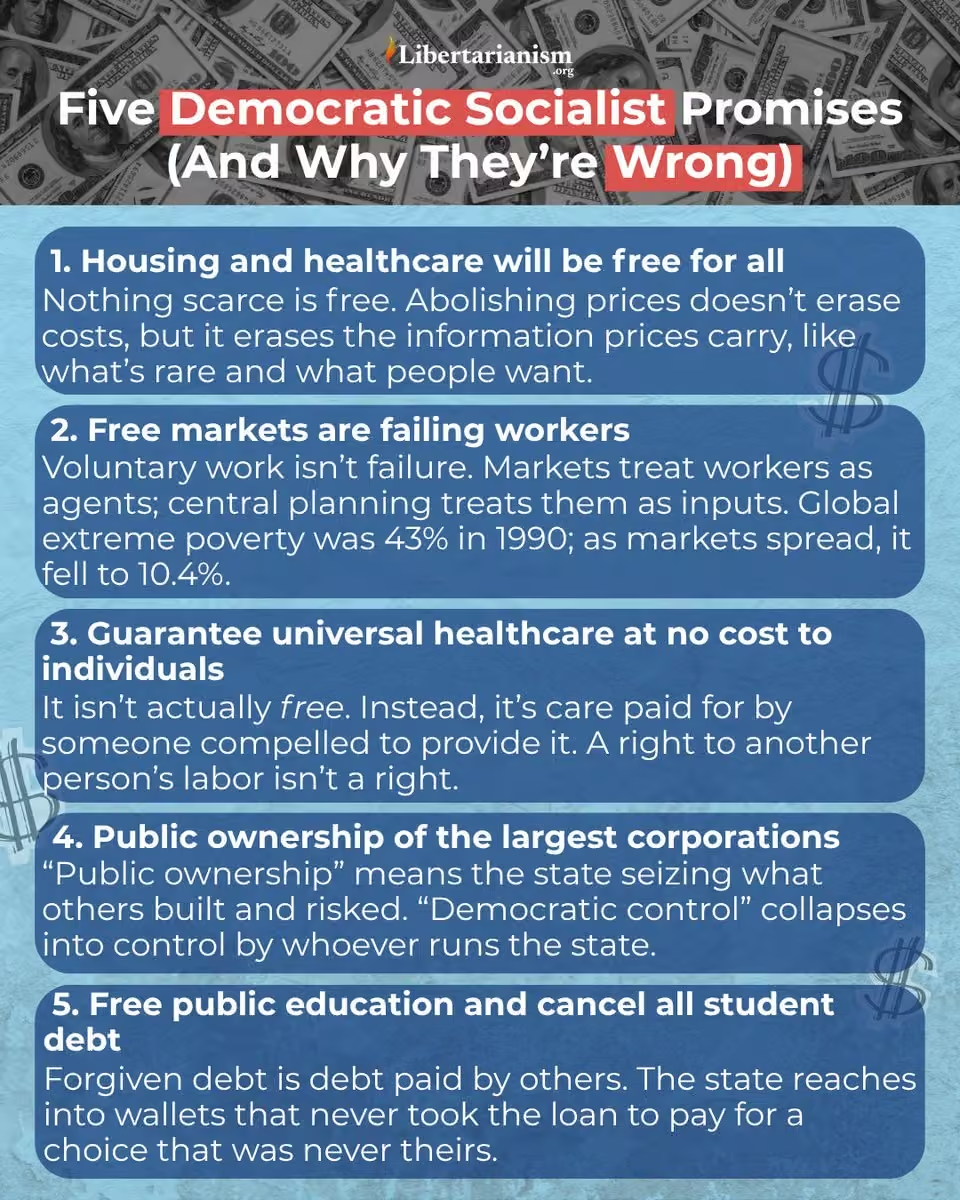
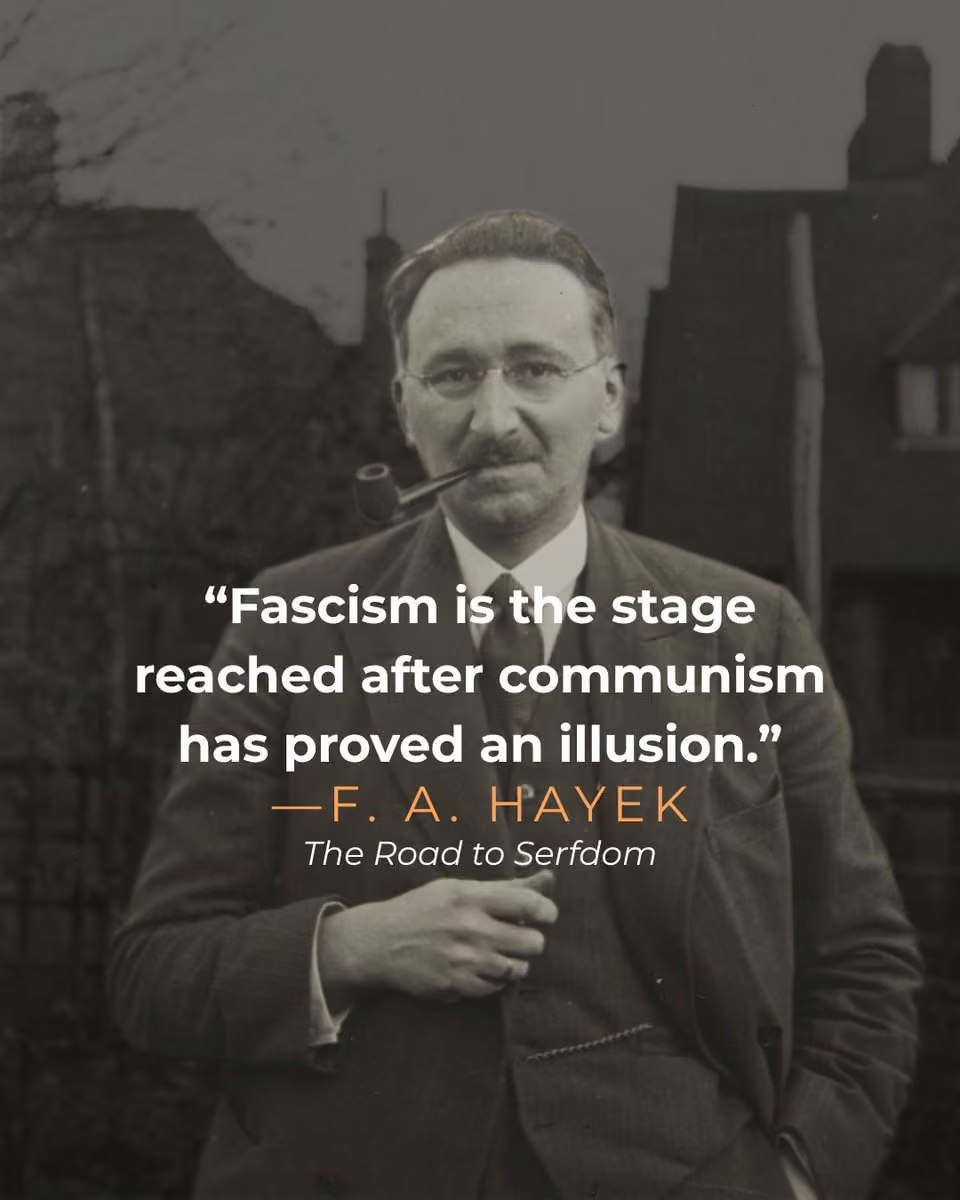
As democratic socialism gains attention, F. A. Hayek's warning is worth revisiting.
Hayek argues that private property secures individual freedom because it makes sure that no single person has absolute power over another. If a government controls ownership, all personal freedoms would be undermined and shrunk to the will of those in power. Private property, then, is not merely an economic arrangement, but a safeguard against control. It is the material foundation of a free society.
By negating the right of private property, socialism undermines the basis for all other democratic freedoms. Hayek feared that the socialist pursuit of economic freedom would destroy true political freedom—which he defined as "freedom from coercion" and "the arbitrary power of other men." -
Libertarianism.org
@libertarianism
Milton Friedman, recipient of the 1976 Nobel Prize for Economic Science, was one of the most recognizable and influential proponents of liberty and markets in the twentieth century.
Libertarianism.org
@libertarianism
This video is from a lecture from a 1987 California Libertarian Party conference, where Friedman attempts to pin down the likely future of freedom—and the future of libertarianism—in America. Watch the entire lecture here: youtu.be/Ub_3x4XDbiE
-
Libertarianism.org
@libertarianism
In Monterrey, Mexico, there is a distinctive spirit that speaks to what is worth pursuing in life, to what a "regiomontano" can and should aspire to become, explains Eugenio Garza. Read the new essay: www.libertarianism.org/article/monterrey-spirit
-
Libertarianism.org reposted
SITC
@EducationSITC
Housing affordability is one of the most debated issues in cities across North America. What's the solution?
This @libertarianism video features economist @bryan_caplan making the case that regulation is what's driving prices up.
There's another side to this debate — one that points to public investment in non-market housing as the fix.
Watch both videos and find discussion questions for your classroom in our Both Sides: Housing Affordability segment: stosselintheclassroom.org/both-sides-housing-affordability/This media couldn't be displayed. See it on the original post. -
Libertarianism.org
@libertarianism
Have you heard of "Cato's Letters"?
"Cato’s Letters" comprise a series of over one hundred letters originally published in the British press between 1720 and 1723 and written under the pseudonym “Cato,” after Cato the Younger, the steadfast opponent of Julius Caesar and defender of Roman liberty.
They offer a vigorous defense of freedom of speech and conscience and are implacable in their attacks on public corruption and unrestrained government.
Libertarianism.org
@libertarianism
Read more about "Cato's Letters" here: www.libertarianism.org/encyclopedia/catos-letters
-
Libertarianism.org
@libertarianism
Libertarianism is a political philosophy built upon one foundational premise: individual liberty is the highest political value.
To be a libertarian is, above all else, to believe that human beings are self-owning individuals who have the right to live their lives as they see fit, so long as they do not infringe upon the equivalent rights of others.
The state, because it holds a monopoly on the legitimate use of force, is uniquely dangerous. Its powers must be carefully enumerated, its officers held to strict account, and its reach confined to those functions—primarily the protection of individual rights and the enforcement of voluntary contracts.
The libertarian tradition is, at its best, an expression of optimism about human nature and human possibility. It holds that people are capable of ordering their own lives, that voluntary cooperation is more powerful than coercion, and that freedom and prosperity are not merely compatible but mutually reinforcing. -
Libertarianism.org
@libertarianism
Are liberal democracies becoming surveillance states?
Post not available here, view on X
Libertarianism.org
@libertarianism
Alexis de Tocqueville called this "soft despotism." When the state's comprehensive power grows—often without citizens' awareness—it violates privacy and transfers even more control to the state while citizens remain unaware. In the "panopticon model," where the government can observe from everywhere, citizens naturally act as though they are being watched at any given time. Sovereign power is exercised without explicit coercion, yet still degrades citizens' freedom—arguably in a more insidious way than overt coercion—because the invasions of privacy necessarily influence behavior. The American surveillance regime does not currently approximate that of East Germany's in the Cold War years—but it still has warning signs of which classical liberals should be vigilant, with the ultimate aim of preserving freedom's vitality.
Libertarianism.org
@libertarianism
This post is based on an essay by Sarah Thomas. Read it here: www.libertarianism.org/articles/mass-surveillance-liberal…
-
Libertarianism.org
@libertarianism
Every one runs into the same wall: markets rest on consent, socialism on compulsion. "Free" always means paid for by someone else.
-
Libertarianism.org
@libertarianism
Maria and Jo Ann Cavallo examine the individualist and entrepreneurial themes in Mira Nair's 1991 film "Mississippi Masala" while also looking at the film's portrayal of collectivism as violent and adversarial. Read here: www.libertarianism.org/article/seeing-individuals-not-cat…
-
Libertarianism.org
@libertarianism
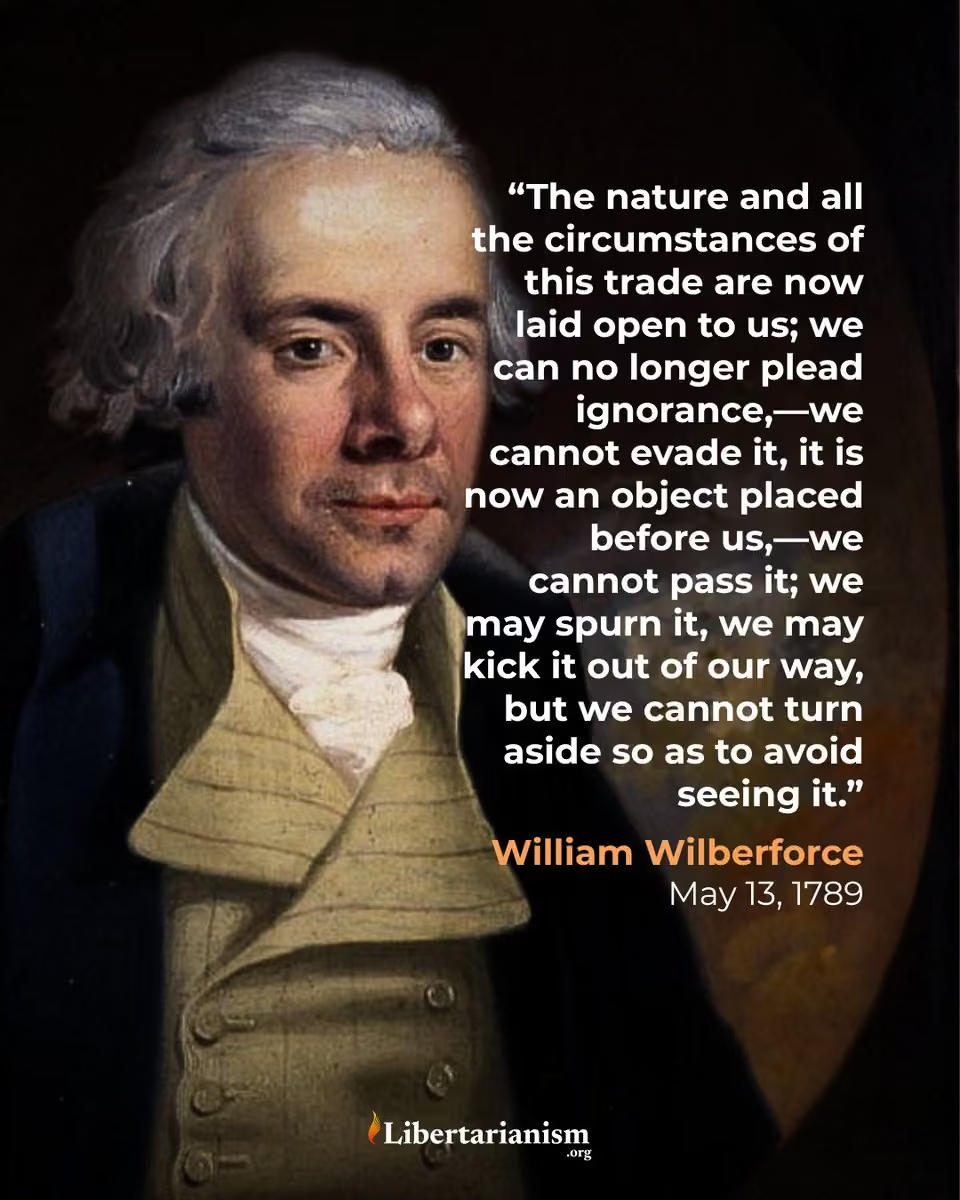
William Wilberforce was a philanthropist, politician, social activist, and the leading figure in the British abolitionist movement. He convinced Parliament to put a stop to the slave trade in 1807 and to end slavery within the British Empire in 1833. His work against slavery clearly raises him to the highest ranks in the annals of libertarianism.
Ending slavery seemed an unlikely prospect in the 1780s. Viewed widely as integral to British naval and commercial success, slavery was a huge business, enjoying broad political support. He endured and overcame just about every obstacle imaginable, including ill health, derision from his colleagues, death threats, and defeats almost too numerous to count. "Our motto must continue to be perseverance," he once told followers.
Abolition of the slave trade finally won Parliament's approval on February 23, 1807. Biographer David J. Vaughan reports that as the attorney general stood and praised the perseverance of Wilberforce, "the House rose to its feet and broke out in cheers. Wilberforce was so overcome with emotion that he sat head in hand, tears streaming down his face." He worked for another 26 years to end slavery itself, finally victorious on July 26, 1833—and died three days later.
But Wilberforce was not uniformly committed to the principle of noninitiation of force. He endorsed public education funded by taxes. He joined leading clergymen in encouraging the government to suppress vice, leading to repressive fines and prison sentences for trifling offenses and even deterring freedoms of speech and assembly. Early labor union advocates saw him as an enemy of worker rights to organize for better pay, hours, and working conditions.
The most lasting legacy of William Wilberforce remains the remarkable change in world opinion and policy toward the institution of slavery. Widespread and commonly accepted throughout the world in the 1780s, slavery was virtually wiped out over the course of a century—an outcome inspired in great measure by Wilberforce, his eloquence, and his allies.
Libertarianism.org
@libertarianism
Want to learn more? www.libertarianism.org/encyclopedia/wilberforce-william
-
Libertarianism.org
@libertarianism
The Declaration of Independence's greatest legacy was not that others copied 1776 word for word, but that it helped transform the way people everywhere understood what made political authority legitimate. Read Paul Meany's new essay here: www.libertarianism.org/articles/how-declaration-independe…
-
Libertarianism.org
@libertarianism
Economists Dambisa Moyo and William Easterly argue that liberal institutions and incentives, beyond foreign aid and capital investment, create the conditions for economic growth. But many Global South states have been reluctant to fully adopt these. Sarah Thomas presents Moyo’s and Easterly’s ideas in this new essay.
www.libertarianism.org/article/liberal-development-econom… -
Libertarianism.org
@libertarianism
Economist Milton Friedman, recipient of the 1976 Nobel Prize for Economic Science, is one of the most recognizable and influential proponents of liberty and markets in the twentieth century. He and his wife, Rose Friedman, coauthored "Free to Choose," where they argue for free-market capitalism, voluntary exchange, and limited government intervention.
-
Libertarianism.org
@libertarianism
John Locke is a major figure within the classical liberal tradition. In his famous "Second Treatise of Government," Locke explains his doctrines of natural rights, property rights, the consensual creation of government, and the conditions under which individual and collective resistance to government is justified.
-
Libertarianism.org
@libertarianism
Frédéric Bastiat, economist, popular writer, and statesman, contributed to the advancement of libertarian principles and policies. His influence has been enormous and is especially evident in the fields of public choice, international trade, and law and economics.
Bastiat argued that law, as a man-made institution, can be perverted by those who use it for purposes other than the defense of liberty and property. Protectionism, special-interest policies established under the mantle of law, disrupts the natural harmony of interests and creates conflicts over privileges. Because the logic of plunder leads all to seek such benefits, once protectionism is accepted as a principle, it sets in motion a process that progressively undermines the harmonious private-property order, the logical end point of which is full-blown socialism.
Bastiat campaigned tirelessly for freedom of trade, respect for property, peace and opposition to imperialism, limited government, and economy in government. He died in Rome on December 24, 1850, while campaigning for free trade -
Libertarianism.org
@libertarianism
People tend to forget that the government is only made up of individuals making decisions. This means that decisions made by the government about your life are ultimately just decisions made by other people about what you can and can't do.
-
Libertarianism.org
@libertarianism
Isabel Paterson was an early and consistent exponent of the ideas that now define radical libertarianism. She advocated for minimal government, laissez-faire capitalism, and absolute individual rights in both the social and economic spheres.
Libertarianism.org
@libertarianism
Learn more about Isabel Paterson's life and influence here: www.libertarianism.org/encyclopedia/paterson-isabel-1886-…
-
Libertarianism.org
@libertarianism
Marxism has never succeeded.
Marxism purports to offer a scientific account of human history based on the economic and material conditions through which societies pass. Its founder, Karl Marx (1818–1883), believed that the final stage of history—industrial communism—was rapidly approaching, and he worked tirelessly to advance both his social theories and the revolution that they entailed.
For Marx, history was fundamentally an economic phenomenon. As he put it: "The hand-mill gives you society with the feudal lord; the steam-mill society with the industrial capitalist."
Capitalism, for Marx, like all stages, contained the seeds of its own destruction. The proletariat would appropriate the means of production, crush the capitalist class, and set up a socialist society that would spread the benefits of industry to all.
Yet just what should follow after the revolution is a mystery that Marx never cared to elucidate. Real-world Marxists who have faced the task of running a state have adopted extensive central planning, including quotas, fixed prices, forced labor, and an astonishing array of directives about the minutiae of economic life.
One fact is incontrovertible: In all historical cases, attempting simply to create a socialist society based on Marxist ideology has proved a horrific failure. -
Libertarianism.org
@libertarianism
At its core, libertarianism is a political philosophy built upon one foundational premise: that individual liberty is the highest political value. To be a libertarian is, above all else, to believe that human beings are self-owning individuals who have the right to live their lives as they see fit, so long as they do not infringe upon the equivalent rights of others.
-
Libertarianism.org
@libertarianism
Custom, conformity, and collective opinion can crush individuality. In "On Liberty," John Stuart Mill reminds us that a free society allows people to pursue their own good in their own way.
-
Libertarianism.org
@libertarianism
Adam Smith’s work explored how markets enable strangers to cooperate for mutual benefit—and his insights help us understand the workings of the modern, hyper-connected world.
Libertarianism.org
@libertarianism
Read more here: www.libertarianism.org/columns/adam-smith-digital-economy…
-
Libertarianism.org
@libertarianism
Where did the @CatoInstitute get its name?
Most people assume it honors Cato the Younger, the Roman statesman who defied Julius Caesar. Close. But not quite. It's named for "Cato's Letters," a series of over one hundred essays published in London in the 1720s.
"Cato," the pen name used by John Trenchard and Thomas Gordon, refers to Cato the Younger. Trenchard and Gordon started "Cato’s Letters" by attacking the corruption exposed by the South Sea Bubble but eventually discuss the deeper nature of liberty and power.
So how do you keep power in check? Cato's answer: constitutional restraints, separation of powers, and free speech. Don't rely on rulers being virtuous. Build a system that assumes they won't be.
Cato called free speech "the great bulwark of liberty" and warned that silencing critics is a would-be tyrant's very first move. Sound familiar?
"Cato's Letters" became a sensation in the American colonies, where Trenchard and Gordon were household names. A young Benjamin Franklin, writing as "Silence Dogood," quoted Cato on free speech; some historians rank the essays alongside John Locke in their influence on the revolutionaries.
Inalienable rights, harnessing self-interest, and preserving liberty through limited government—the themes of "Cato's Letters" are core libertarian ideas three centuries later. -
Libertarianism.org
@libertarianism
Can the law legitimately force you to be a better person—even when your "vices" harm no one but yourself? In this new essay, Bill Glod discusses how natural law theories of morality are in tension with classical liberalism when they are employed to justify coercive laws.
-
Libertarianism.org
@libertarianism
Majority rule doesn't make something right.
Libertarianism.org
@libertarianism
Read more here: www.libertarianism.org/encyclopedia/rothbard-murray
-
Libertarianism.org
@libertarianism
Despite starting out as a communist, Rose Wilder Lane became a staunch advocate of individualism. Lane has rightly been dubbed one of the mothers of the libertarian movement for her tireless efforts to bring about a world in which individuals, and not the state, decide their own fate.
Libertarianism.org
@libertarianism
Read more about Rose Wilder Lane here: www.libertarianism.org/articles/rose-wilder-lanes-journey…
-
Libertarianism.org
@libertarianism
H. L. Mencken, a journalist, satirist, and prevalent critic of American political life, spent decades exposing the gap between the promises of government and the reality of its results.
-
Libertarianism.org
@libertarianism
Adam Smith authorized the pursuit of honest income. But what should we do with that income? Max Laraia explores whether Peter Singer’s moral imperative to reduce suffering is consistent with Smith’s ethical outlook. Read the new essay here: www.libertarianism.org/articles/smith-meets-singer-duties…
-
Libertarianism.org
@libertarianism
Collectivism holds that the state should control or regulate the economy and civil society, favoring the collective over the individual. It stands in direct contrast to individualism, which emphasizes individual action and its consequences as the foundation of social and political life.
-
Libertarianism.org
@libertarianism
Do you have the courage to defend your principles? It’s easy to take for granted the risks the signers of the Declaration faced when they put their names on a document that would become foundational to the nation’s history. If the British won, the signers likely would have faced execution. Their belief in the cause of American liberty outweighed their fear of death.
Post not available here, view on X
Libertarianism.org
@libertarianism
The 250th anniversary of the Declaration of Independence is a good opportunity to consider our own courage in the face of injustice. It’s easy to claim we will stand on principle when called to do it, but it’s more difficult when faced with real ramifications. Even when there are personal costs, living with freedom means carrying the burden of protecting it. It is only by bolstering our courage and standing on principle that freedom can endure.
Libertarianism.org
@libertarianism
Read the entire essay by Lilah Kimble here: www.libertarianism.org/articles/standing-on-principle
-
Libertarianism.org
@libertarianism
F. A. Hayek rightly predicted that imposing a government welfare state in the name of compassion would create more problems than it solved.
-
Libertarianism.org
@libertarianism
What is bureaucracy? And why do libertarians think it's a problem?
Unlike a private business, where success or failure is measured by profit or loss, a bureaucracy's operational principle is compliance with detailed rules and regulations fixed by a hierarchical authority. There's no market check on whether it's actually working.
And without that check, the problems compound. As Gordon Tullock observed, "the inefficiency of the overexpanded bureaucracy leads to still further expansion and still further inefficiency."
Libertarianism.org
@libertarianism
Learn more here: www.libertarianism.org/topics/bureaucracy
-
Libertarianism.org
@libertarianism
When Parisians stormed the Bastille on July 14, 1789, they found only seven prisoners inside. But, as Lord Acton observes, the fortress mattered less for who it held than for what it had long represented.
For generations, the Bastille stood as a symbol of arbitrary power. Under the French monarchy, people could be imprisoned by royal order without the ordinary protections of a public trial. The prison came to embody a system in which liberty depended on the discretion of those who governed, rather than the rule of law.
Acton admired the Revolution's early liberal aspirations while never ignoring where it later led. He regarded the Terror, the widespread descent into violence, as the tragic low point by which the whole Revolution had to be measured.
A free society depends on limits to political power, equal justice under the law, and institutions that protect the liberty of every individual. -
Libertarianism.org
@libertarianism
Most known for "A Vindication of the Rights of Woman," Mary Wollstonecraft embraced the Englightenment ideas of individualism and equality. Wollstonecraft believed that for virtue to exist, so must freedom.
Libertarianism.org
@libertarianism
Want to learn more? Read about Mary's life and work here: www.libertarianism.org/columns/mary-wollstonecraft-indivi…
-
Libertarianism.org reposted
Mustafa Akyol
@AkyolinEnglish
For the original English edition, visit @libertarianism:
"With personal stories, historical anecdotes, theological insights, and a very accessible prose, this is the little big book on the intersection of Islam and liberty."
www.libertarianism.org/books/why-muslim-i-defend-liberty -
Libertarianism.org
@libertarianism
-
Libertarianism.org
@libertarianism
-
Libertarianism.org
@libertarianism
-
Libertarianism.org
@libertarianism
Where did America's founding ideas about liberty actually come from?
Harvard professor and historian Bernard Bailyn traces the ideological origins of America’s founding-era republican thought to the following principal sources: Classical Greco-Roman antiquity; Biblical theology; English common law; Enlightenment rationalism, and the writings of British Whig theorists like Algernon Sidney, John Locke, and Joseph Priestly. -
Libertarianism.org
@libertarianism
The fight for freedom belongs to every generation. Happy Independence Day.
The American Founding was an argument about liberty and power. Two hundred and fifty years later, that argument continues. In 1776, the Declaration of Independence announced a radical claim: all people possess rights no government creates and no government may rightfully destroy.
The American Founding was never a simple story. It was a revolution against imperial rule, a declaration of universal rights, a constitutional experiment, and an argument over how much power any government should be trusted to hold. America's 250th anniversary is an opportunity to return to first principles and ask why the Founding's central questions still matter: What rights belong to individuals by nature? What makes political power legitimate? How can free people restrain government before government restrains them?
Declaring independence may have happened 250 years ago, but maintaining and protecting liberty must happen every day. -
Libertarianism.org
@libertarianism
For the 250th anniversary of the Declaration of Independence, Lilah Kimble reflects on the American Founders’ courage to risk their lives for their commitment to liberty. She asks if, even in less significant moments, we have the courage to protect our principles and live in accordance with our beliefs. Read the new essay here: www.libertarianism.org/articles/standing-on-principle
-
Libertarianism.org
@libertarianism
In this new episode of "The Liberty Exchange" podcast, Jonathan Fortier talks with Brad Birzer about his recent book, "The Declaration of Independence: A Radical Experiment in Liberty."
Drawing heavily on the letters, pamphlets, and political arguments of the era, Birzer’s book traces how a series of imperial crises gradually transformed colonial resistance into a revolutionary movement. Along the way, it reveals how debates about liberty, authority, and the rights of Englishmen shaped the political consciousness of the American colonies. Listen to the episode here: www.libertarianism.org/podcasts/liberty-exchange/radical-… -
Libertarianism.org
@libertarianism
During the 250th anniversary of the United States, it is worth revisiting the lives of three Black Americans who fought for all to claim the promises of the Declaration of Independence: Elizabeth Freeman, Lemuel Haynes, and James Forten. Each individual confronted the paradox of the new American government denying them the same legal and moral rights the founders championed during the Revolution.
By embracing and extending the Revolution’s ideals within the Declaration of Independence, Black Americans revealed both the hypocrisy and the hope of the founding era. Rather than remaining passive victims or silent witnesses, they actively shaped the political, legal, and moral meaning of freedom in the United States.This media couldn't be displayed. See it on the original post.
Libertarianism.org
@libertarianism
This post is based on an essay by Intellectual History Editor Paul Meany. Read it here: www.libertarianism.org/articles/black-american-founders
-
Libertarianism.org
@libertarianism
1. "Two Treatises of Government" by John Locke
Locke taught the Founders how to explain why government is legitimate in the first place—and when it isn't. Natural rights. Consent of the governed. The right to resist tyranny. Sound familiar? The echoes in the Declaration of Independence are obvious.
2. "De Re Publica" by Cicero
The gold standard of eloquence. Thomas Jefferson listed Cicero among the elementary books of public right that shaped the Declaration. Cicero believed political communities were established so that people could hold on to what was theirs.
3. "Lives" by Plutarch
Rather than political theory, Plutarch offers a gallery of the most admirable Greeks and Romans. He showed the Founders what kind of person preserves a republic and what kind destroys one. Plutarch gave the Founders a way to imagine themselves inside a much older republican story. They could see themselves as heirs to men who resisted kings, tyrants, conspirators, and corrupt senates.
4. The Bible
The Bible gave the Founders a public language of justice that ordinary citizens shared and understood. Biblical influence at the founding is often clearest in letters, proclamations, sermons, and public addresses. The Bible was the founding era’s broadest common tongue. -
Libertarianism.org
@libertarianism
By the time Thomas Jefferson wrote the Declaration of Independence, the argument wasn't about English rights anymore. In this video from our archives, David Boaz explains how that shift became the founding argument we know today.
This media couldn't be displayed. See it on the original post. -
Libertarianism.org
@libertarianism
Washington ardently believed in the cause of political liberty. To the American Founders, liberty, in its broad and abstract sense, had a metaphysical quality to it. It was a God-given, inalienable right.
Libertarianism.org
@libertarianism
Want to learn more? www.libertarianism.org/topics/washington-george-1732-1799
-
Libertarianism.org
@libertarianism
In 1993, Milton Friedman delivered a warning that is still relevant today: we are far wealthier than we were—but less free. This video is from Friedman's speech at the grand opening of the headquarters of the @CatoInstitute in Washington, DC.
-
Libertarianism.org
@libertarianism
Sarah Thomas provides an exposition and contemporary contextualization of volume one of Hayek’s "Law, Legislation, and Liberty," focusing on themes of law and order and the relevance of Hayek’s ideas today. Read the new essay here: www.libertarianism.org/articles/law-and-order-review-f-ha…
-
Libertarianism.org
@libertarianism
The federal government was never meant to have unlimited power. All unenumerated powers belong to the states or the people. Trevor Burrus, a constitutional law scholar, makes the case that the Constitution, properly understood, is quite libertarian.
-
Libertarianism.org
@libertarianism
From ancient times, luxury has been used as a signal. Drawing on Adam Smith, Daniel Klein exposits the personal traits, like wealthiness, that luxury might signal. Klein then asks what wealthiness signals. Read the new essay: www.libertarianism.org/articles/things-luxury-might-signal
-
Libertarianism.org
@libertarianism
Why do the words of the Declaration of Independence still inspire people around the world 250 years later?
Libertarianism.org
@libertarianism
@TimothySandefur, author of "Proclaiming Liberty" (2026), speaks to libertarianism.org Senior Producer Barbara Galletti in an exclusive interview about the philosophy underlying the Declaration of Independence. youtu.be/bNYu11WMP8Y
-
Libertarianism.org
@libertarianism
Thomas Sowell is an economist, social theorist, and writer who integrates history and economics to show how the best opportunities for all people—including blacks and women—come through hard work and self-effort in a free and open market.
Libertarianism.org
@libertarianism
Read more about Thomas Sowell here: www.libertarianism.org/topics/sowell-thomas-1930
-
Libertarianism.org
@libertarianism
Libertarianism begins and ends with self-ownership. Today we remember what it costs to secure it.
This media couldn't be displayed. See it on the original post. -
Libertarianism.org
@libertarianism
Most people learn that the American Revolution began over taxes. But the real conflict was much deeper: who has the right to rule?
Listen to our new interview with @TimothySandefur, out now!
youtu.be/bNYu11WMP8Y -
Libertarianism.org
@libertarianism
Timothy Sandefur, author of "Proclaiming Liberty" (2026), reframes how we think about the Declaration of Independence—both as a rejection of British rule and as the moment a new people stepped onto the world stage and claimed responsibility for themselves. @TimothySandefur
Libertarianism.org
@libertarianism
Watch the entire interview: youtu.be/bNYu11WMP8Y
-
Libertarianism.org
@libertarianism
250 years ago, the Founding Fathers declared that government exists to protect individual rights, not grant them. Our full interview with @TimothySandefur premieres on our YouTube channel this Thursday.
This media couldn't be displayed. See it on the original post. -
Libertarianism.org
@libertarianism
Sociology is often treated by libertarians as a hostile discipline: collectivist, ideological, and drawn toward social control. But its origins tell a more complicated story. Listen to the latest "Portraits of Liberty" podcast episode: www.libertarianism.org/podcasts/portraits-liberty/sociolo…
-
Libertarianism.org
@libertarianism
Opposing the government's involvement in something is not the same as opposing the thing itself.
In "The Law," Frédéric Bastiat writes: "Socialism, like the old policy from which it emanates, confounds Government and society. And so, every time we object to a thing being done by Government, it concludes that we object to its being done at all. We disapprove of education by the State—then we are against education altogether. We object to a State religion—then we would have no religion at all. We object to an equality which is brought about by the State then we are against equality, etc., etc. They might as well accuse us of wishing men not to eat, because we object to the cultivation of corn by the State." -
Libertarianism.org reposted
Mustafa Akyol
@AkyolinEnglish
Get the English original of the book here from @libertarianism, courtesy of @CatoInstitute:
www.libertarianism.org/books/why-muslim-i-defend-liberty -
Libertarianism.org
@libertarianism
Our new essay explores chapters three and four of John Stuart Mill’s "On Liberty," which discusses the value of human individuality and the threats it faces from the social dominance of custom and conformity. Read it here: www.libertarianism.org/articles/mill-individuality-and-li…
-
Libertarianism.org
@libertarianism
She was fifteen when the Nazis killed her, but her diary outlived the regime.
Post not available here, view on X
Libertarianism.org
@libertarianism
Before Anne and her family ever went into hiding, the Nazi regime had already stripped their freedoms one by one. Anne was banned from attending non-Jewish schools, forbidden from owning a bicycle, barred from public places, like movie theaters and athletic fields. The state didn't arrive at Auschwitz overnight. It got there step by step, right by right.
Libertarianism.org
@libertarianism
The argument for limited government has many authors. Anne Frank is one of them.
-
Libertarianism.org
@libertarianism
Power given to your allies today will eventually belong to your opponents tomorrow. That's why limited government isn't a left or right issue. It's the foundation of individual liberty and a prosperous society. No matter who's in charge, constraints on power protect everyone.
Libertarianism.org
@libertarianism
Watch our Learning Hub video on limited government here: youtu.be/_7JEdAUiDhQ
-
Libertarianism.org
@libertarianism
Sarah Thomas surveys the recent history of mass surveillance in liberal democracies, highlighting the tension between freedom and security. Read the new essay here: www.libertarianism.org/articles/mass-surveillance-liberal…
-
Libertarianism.org
@libertarianism
Defending freedom isn't always comfortable. It means standing up for rights even when the person whose rights are at stake is someone you'd rather not defend.
H. L. Mencken's political views aligned closely with what we'd call libertarianism today: a deep belief in limiting government power and protecting the inalienable rights of every person. Mencken held that, although some government is necessary to preserve peace and perform a few other duties individuals cannot easily perform for themselves, government beyond that minimum would likely be exploiting citizens, advantaging one group by disadvantaging another. -
Libertarianism.org
@libertarianism
Denmark and Sweden rank high on economic freedom because of low regulations, open markets, and sound monetary policy, says political scientist and economist @Matt_d_Mitchell. The redistribution many associate with their economies is funded by taxes that hit the middle class just as hard as the wealthy.
This media couldn't be displayed. See it on the original post.
Libertarianism.org
@libertarianism
Watch the entire interview here: youtu.be/Q6Tcf1Nxh9A
-
Libertarianism.org
@libertarianism
The American Founding was an argument about liberty and power. Two hundred and fifty years later, that argument continues.
In our new content collection celebrating the 250th anniversary of the signing of the Declaration of Independence, explore essays, podcasts, and videos on the American Revolution and the ideas that still shape America’s experiment in freedom.
www.libertarianism.org/american-founding-250-years-later -
Libertarianism.org
@libertarianism
On this day, many people remember the image of Tank Man—the lone individual standing before a column of tanks in Beijing on June 5, 1989.
But in the days before that famous confrontation, another powerful symbol stood in Tiananmen Square: the Goddess of Democracy.
Built by student protesters, the statue represented aspirations for political reform, free expression, and accountable government. In an exclusive interview with libertarianism.org, @TimothySandefur discusses the deeper intellectual roots of that symbol, including the global influence of the Declaration of Independence. The idea that legitimate government rests on the consent of the governed—and that individuals possess rights that exist prior to the state—has inspired people far beyond America's borders.
The students who built the Goddess of Democracy were drawing on a tradition of liberty that speaks to people in every country: that human beings are not merely subjects of power, but individuals with dignity and rights. The statue's brief existence—and its destruction during the Tiananmen Square crackdown—remains a reminder of how threatening those ideas can be to authoritarian governments.
Symbols matter because they make ideas visible. The Goddess of Democracy transformed abstract principles into something people could see, gather around, and believe in. Decades later, it remains one of the enduring images of the struggle for freedom. -
Libertarianism.org
@libertarianism
On this day, one man stood in the face of authoritarian power.
On June 3 and 4 in 1989, the Chinese Communist Party sent the military to Tiananmen Square to quash the pro-democracy protests. The military ran down or shot those who resisted. As many as 10,000 people died.
On June 5, the man pictured crossed onto Chang'an Avenue. Several tanks stopped in front of him. After a short, rebellious interaction, he disappeared into the crowd.
We still don't know his name. -
Libertarianism.org
@libertarianism
The purpose of limited government is simple: keep power in check and protect individual freedom.
Libertarianism.org
@libertarianism
Watch the entire video here: youtu.be/_7JEdAUiDhQ
-
Libertarianism.org
@libertarianism
If only the right people were in power, could they fix everything? New Learning Hub video on limited government out now!
www.youtube.com/watch?v=_7JEdAUiDhQ -
Libertarianism.org
@libertarianism
Farzin Zonouz explores the moral and practical implications of taxation, and challenges us to imagine a world that operates through voluntarism, without the coercive practice of taxation of any kind. Read the new essay: www.libertarianism.org/articles/toward-zero-tax-state-fis…
-
Libertarianism.org
@libertarianism
-
Libertarianism.org
@libertarianism
Listen to Intellectual History Editor Paul Meany discuss the Declaration of Independence with @TimothySandefur on the @CatoInstitute podcast!
Timothy Sandefur
@TimothySandefur
In today's @CatoInstitute podcast, I talk about what "all men are created equal" actually means--and about a ton of other fun Declaration of Independence stuff. Check it out! shows.acast.com/5e28e0d8963f166217546493/6a1df35d5e7c8b23…
-
Libertarianism.org
@libertarianism
Accepting more power for those you agree with means accepting more power for those you disagree with too. On Thursday, watch our new Learning Hub video on limited government—available on our YouTube channel.
-
Libertarianism.org
@libertarianism
When we talk about "the government" or "the state," it's easy to imagine something abstract and impersonal. Rose Wilder Lane reminds us that political power is always exercised by real people over other people.
For libertarians, this is one reason why limits on power matter. The question isn't whether those in charge have good intentions—it's whether anyone should be trusted with that authority, especially when unchecked, in the first place.
Libertarianism.org
@libertarianism
Read about Rose Wilder Lane here: www.libertarianism.org/articles/rose-wilder-lanes-journey…
-
Libertarianism.org
@libertarianism
Property rights give people control over the resources they own. Without private property, individuals would lack the ability to make long-term plans, invest, trade, or build wealth securely.
Property rights clearly define ownership and responsibility, which help people cooperate peacefully. A society that respects private property also tends to respect individual choice, voluntary exchange, and personal independence. -
Libertarianism.org
@libertarianism
Daniel Klein, a professor at @MasonEconomics, examines key passages of the Declaration of Independence and suggests that “Life, Liberty, and the Pursuit of Happiness” expresses the spirit of the American Founding period. Watch here:
www.libertarianism.org/videos/july41776 -
Libertarianism.org
@libertarianism
Although some people, including those in both major political parties, believe capitalism is a failing system, data shows otherwise.
Libertarianism.org
@libertarianism
Watch our interview, where political scientist and economist @Matt_d_Mitchell explores the definition and consequences of socialism, here: youtu.be/Q6Tcf1Nxh9A
-
Libertarianism.org
@libertarianism
Appealing to F. A. Hayek’s analogy of wings in "The Fatal Conceit," Sarah Katherine Sisk and Daniel Klein reflect on the culture and institutions that have given societies spiritual “lift” and on whether those cultural “wings” are atrophying. Read the new essay here:
-
Libertarianism.org
@libertarianism
-
Libertarianism.org
@libertarianism
Libertarians believe that, in politics, liberty is the most important value. Almost everyone wants freedom for themselves, but a libertarian also seeks to protect and expand the freedom of others. Read more here. www.libertarianism.org/what-is-a-libertarian
-
Libertarianism.org
@libertarianism
A free society should never treat war casually—or forget the human cost paid by ordinary people. Memorial Day is a reminder that, while some wars may be justified to secure liberty, security, and individual rights, war also leaves behind graves, broken families, and freedoms surrendered in the name of emergency and necessity. Today, we honor those who died for higher ideals, while reflecting seriously on the tragedy, destruction, and lasting consequences of war itself.
-
Libertarianism.org
@libertarianism
What is a libertarian?
Post not available here, view on X
Libertarianism.org
@libertarianism
Libertarians are skeptical of concentrated power.
Whether that power comes from governments, bureaucracies, or special interests, libertarians worry that unchecked authority threatens individual freedom.
Libertarianism.org
@libertarianism
Libertarians also tend to oppose censorship, surveillance, and unnecessary government intervention in private life. The default should be liberty—not control.
Post not available here, view on X
Libertarianism.org
@libertarianism
Libertarianism isn’t about creating a perfect society.
It’s about creating a society where people are free to pursue their own version of a good life.
Libertarianism.org
@libertarianism
Learn more about libertarianism here: www.libertarianism.org/what-is-a-libertarian
-
Libertarianism.org
@libertarianism
Many who support socialism today might not be aware of the death toll that enforcing socialist policies have caused. Inevitably, central planning requires an authoritarian state that limits individual rights, and the consequences can be fatal.
Libertarianism.org
@libertarianism
Watch our new interview, where political scientist and economist @Matt_d_Mitchell explores the definition and consequences of socialism: youtu.be/Q6Tcf1Nxh9A
-
Libertarianism.org
@libertarianism
Alexis de Tocqueville never wrote about Japan, but his warnings about democracy, centralization, and soft despotism found an unexpected audience in Meiji reformer Fukuzawa Yukichi. As Japan emerged from feudal hierarchy into modern statehood, Fukuzawa saw that liberty required citizens capable of speaking, associating, and thinking for themselves.
Read our new essay:
www.libertarianism.org/articles/learning-stand-upright-fu… -
Libertarianism.org
@libertarianism
Did We Forget the Cost of Socialism?
Socialist economies have repeatedly struggled with shortages, corruption, black markets, and authoritarianism.
From the Soviet Union and Maoist China to Venezuela and modern Western politics, @barbaragrdv and @Matt_d_Mitchell discuss the historical record of socialism and the flaws behind its failures.
youtu.be/Q6Tcf1Nxh9A -
Libertarianism.org
@libertarianism
Both the Democrat and Republican parties are willing to dabble in socialism on some issues, @Matt_d_Mitchell explains.
Tomorrow, watch our new interview, where Mitchell explores the definition and consequences of socialism, on our YouTube channel. -
Libertarianism.org
@libertarianism
Ayn Rand's contribution to the growth of libertarianism—a term she rejected—was both philosophical and literary. In multiple ways she presented a heroic vision of rational and motivated individuals who were essential to free societies.
Her message was personal no less than political, and she inspired readers not only by her depiction of the benefits of political liberty, but of the nobility of the free individual life.
Libertarianism.org
@libertarianism
Learn more: www.libertarianism.org/publications/essays/ayn-rand
-
Libertarianism.org
@libertarianism
Lysander Spooner, known today as a defender of individualist anarchism, was also a key figure in the voluntary temperance movement. Notably, Spooner regard alcohol (ab)use as a vice but not a crime. He opposed legal prohibition both for its impracticality and as a matter of moral principle.
Libertarianism.org
@libertarianism
Read our new essay about victimless crime! www.libertarianism.org/articles/victimless-crimes
-
Libertarianism.org
@libertarianism
What do libertarians think about Universal Basic Income?
Post not available here, view on X
Libertarianism.org
@libertarianism
While many who advocate for a Universal Basic Income believe that it will simplify access to government benefits, those who understand the history of government programs are skeptical. Most libertarians fear that UBI will simply be added to a long list of other welfare programs, adding complexity and cost.
Libertarianism.org
@libertarianism
This post is based on a book review. Want to read more? www.libertarianism.org/articles/book-review-zwolinski-and…
-
Libertarianism.org
@libertarianism
New essay! Sarah Thomas evaluates Tocqueville’s "Democracy in America" in light of the American Founding’s 250th anniversary, emphasizing two underappreciated themes: democracy as providential and conducive to peace, and American constitutionalism in relation to race.
-
Libertarianism.org
@libertarianism
More housing supply means lower prices, but it also means more people. Economist @bryan_caplan explains how you can't have one without the other. The benefits and problems of living in a densely populated area come hand in hand, and most people prefer to have both.
Do you agree? Comment below.This media couldn't be displayed. See it on the original post.
Libertarianism.org
@libertarianism
Watch the full interview here! youtu.be/-7Nttj28C_E
-
Libertarianism.org
@libertarianism
By the time Helmuth Hübener turned eight years old, Hitler had come to power and eliminated democratic freedoms. Within weeks of taking office, the Nazi regime issued the Decree of the Reich President for the Protection of the German People, suspending civil liberties like freedom of speech and assembly.
Sixteen-year-old Hübener decided to wage his own information war against Hitler’s propaganda machine. He summarized BBC broadcasts and disseminated what he heard alongside his own scathing commentary on the Nazi regime. It was an incredibly dangerous idea; distributing anti-Nazi flyers was a treasonous activity.
For months, the Gestapo investigated the anti-Hitler leaflets, but they had no leads on who was behind them. Unfortunately, as their operation expanded, so did the risk of exposure. In 1942, after a colleague betrayed Hübener, a court sentenced him to death by beheading.
Libertarianism.org
@libertarianism
Want to learn more and have twenty minutes? Listen to the newest episode of our "Portraits of Liberty" podcast: www.libertarianism.org/podcasts/portraits-liberty/martyr-…
-
Libertarianism.org
@libertarianism
Isabel Paterson was an early and consistent voice for the ideas that now define radical libertarianism. She advocated for minimal government, laissez-faire capitalism, and absolute individual rights. Known for "The God of the Machine" (1943), Paterson was an independent discoverer of many economic arguments now commonly used against the welfare state. She also influenced many leaders of the emerging anticollectivist movement, such as her friends Rose Wilder Lane and Ayn Rand.
Libertarianism.org
@libertarianism
Read about Isabel Paterson's life and work here: www.libertarianism.org/publications/essays/isabel-paterson
-
Libertarianism.org
@libertarianism
"Affordability" has been the word of the year for politicians, and housing is one of the biggest items in any American's budget. Why have prices spiked so much in recent years? Economist @bryan_caplan explains... 1/5 ⬇️
Post not available here, view on X
Libertarianism.org
@libertarianism
Is there another way to address housing issues that do not imply over regulating? @bryan_caplan explains the "Law of Nuisance" as a better alternative.
Libertarianism.org
@libertarianism
Want to know more? Watch the full interview here:
youtu.be/-7Nttj28C_E -
Libertarianism.org
@libertarianism
In his Nobel address, F. A. Hayek reminded us that economists and social planners overestimate how much they can actually know and control in a complex society. Hayek believed this false confidence led "experts" to support harmful policies.
Do you agree?
#hayek #nobel #economics
Libertarianism.org
@libertarianism
-
Libertarianism.org reposted
Bryan Caplan
@bryan_caplan
Madrid interview on housing: www.youtube.com/watch?v=-7Nttj28C_E
-
Libertarianism.org
@libertarianism
NEW VIDEO! Why is housing so expensive in the United States? With @bryan_caplan
youtu.be/-7Nttj28C_E -
Libertarianism.org
@libertarianism
How much does regulation affect housing prices?
Listen to economist and author @bryan_caplan on housing regulation in the US. Full interview out tomorrow!
#housing #regulation #affordability #crisis
Libertarianism.org
@libertarianism
Subscribe to our YouTube channel here: www.youtube.com/@LibertarianismDotOrg
-
Libertarianism.org
@libertarianism
Tacitus was one of Ancient Rome’s greatest historians and one of its sharpest critics of power. Writing under the Roman Empire, he chronicled how republican liberty gave way to imperial rule and corruption.
A keen observer of how power corrupts, Tacitus's "Annals" tells the story of Rome after the death of Augustus, covering the reigns of emperors including Tiberius, Claudius, and Nero.
The Founding Fathers, and some of those that influenced them, read many ancient writers, including Tacitus. Thomas Jefferson regarded Tacitus as “the first writer in the world without a single exception,” and declared that his works were “a compound of history and morality of which we have no other example.” -
Libertarianism.org
@libertarianism
Politicians frequently use emotional appeals to justify more government power.
In a recent interview with libertarianism.org, @bryan_caplan, economist and author, discusses this, among other things. Watch out for a longer interview on our YouTube channel this Thursday, May 7.This media couldn't be displayed. See it on the original post. -
Libertarianism.org
@libertarianism
Read our new essay on the "Fahrenheit 451" (1966) movie! Maria and Jo Ann Cavallo revisit François Truffaut’s film adaptation of Ray Bradbury’s classic novel where they examine the depiction of surveillance and other forms of government coercion. www.libertarianism.org/articles/sixty-years-after-truffau…
-
Libertarianism.org
@libertarianism
In 1974, Harvard philosophy professor Robert Nozick published his groundbreaking "Anarchy, State, and Utopia." In part a response to his colleague John Rawls's influential book "A Theory of Justice," Nozick's work envisions a pluralist society of property-owning individuals governed by a state with limited powers.
Nozick was a writer, a philosopher, and, at one time, a leading supporter of libertarian thought. “Anarchy, State, and Utopia” had the unpredictable effect of transforming libertarianism from a political philosophy that had been taken seriously by only a few academics into an obligatory topic of discussion among American philosophers and their students.
Libertarianism.org
@libertarianism
Read this review of "Anarchy, State, and Utopia" to learn more. www.libertarianism.org/publications/essays/nozick-anarchy…
-
Libertarianism.org
@libertarianism
Legal plunder, today, might include special favors, subsidies, bailouts, or regulations that benefit certain groups at everyone else's expense.
Many people cannot see beyond the benefits to those protected by the legislation Bastiat condemns; they cannot appreciate the costs to those who have been plundered.
In this section of "The Law," Bastiat also urges, "Then abolish this law without delay, for it is not only an evil itself, but also it is a fertile source for further evils because it invites reprisals." -
Libertarianism.org
@libertarianism
Read the new book review! Bill Glod surveys Matt Zwolinski and Miranda Perry Fleischer’s defense of a universal basic income that would replace most current welfare programs. www.libertarianism.org/articles/book-review-zwolinski-and…
-
Libertarianism.org
@libertarianism
1. Shenandoah (1965) — “Stewart is a Virginia farmer who wants to stay out of the Civil War. Not our fight, he tells his sons. He refuses to let the state take his sons, or his horses, for war. Inevitably, though, his family is drawn into the war raging around them, and the movie becomes very sad.”
2. Amistad (1997) — “A fascinating story about a ship full of Africans who turned up in New England in 1839. The question: Under American law, are they slaves? A long legal battle ensues, going up to the Supreme Court.”
3. The Castle (1997) — “It’s a very funny film about a character who thinks that living near the airport is just great. He even likes looking up at the massive power lines near his house because they remind him of what man can accomplish. . . . the protagonist is shocked when the airport decides to seize his property to extend its runway.”
4. The Winslow Boy (1999, orig. 1948) — “Mr. Winslow’s teenage son is expelled from the Naval Academy. Convinced his son is innocent, Winslow challenges the expulsion. When the Academy refuses any sort of due process, Winslow exhausts his life savings in a fight through the courts. The theme is the right of every person in a decent society to justice.”
5. So Big (1953) — “[It] stars Jane Wyman as a wealthy young woman suddenly delivered into poverty. She becomes a teacher, marries a farmer, has a son, loses her husband, and must run the farm on her own, at a time when women didn’t do that. It’s an inspiring story of self-reliance.”
6. The Palermo Connection (1990) — “New York city councilman Jim Belushi runs for mayor on a platform to legalize drugs and take the profits out of the drug trade. The Mafia isn’t happy.”
7. Pacific Heights (1990) — “A young couple buys a big house in San Francisco and rents an apartment to a young man. He never pays them, and they can’t get him out, and then things get really scary.”
8. My Beautiful Laundrette (1985) — “What’s interesting about this film is that novelist/screenwriter Hanif Kureishi thought he was making a savage indictment of Thatcherite capitalism. But to me, the good characters in the movie—white and Pakistani, gay and straight—are the ones who work for a living.”
Save this post for your next movie night. -
Libertarianism.org
@libertarianism
Happy birthday to Mary Wollstonecraft! Born into a working-class family in London in 1759, Wollstonecraft would later write, what many consider to be, the first great feminist treatise.
Wollstonecraft ran in the same London circles as several political radicals, including Thomas Paine, William Blake, William Wordsworth, and anarchist William Godwin, who she married.
The primary focus of Wollstonecraft’s literary career was to envision and propose a social and political order in which women were treated as rational, autonomous beings capable of independence and virtue.
For most of history, women were considered by many thinkers to be irrational and intellectually hollow beings who merely existed for the sake of beauty and procreation. The subjection of women was considered justified.
In "A Vindication of the Rights of Woman," Wollstonecraft articulates an account of the natural equality and liberty that all women deserve. Most of the piece is focused on the education of women. For Wollstonecraft, education was the key to women’s liberation. This was because Wollstonecraft adhered to the Lockean idea of people as “blank slates.” John Locke posited that we are born without any prior knowledge and that everything we become is a result of our upbringing and education, both of which Locke believed to be of great importance.
Even if we set aside Wollstonecraft’s massive influence on later thinkers, her works express a unique and compelling perspective on the essence of freedom. Virtue is life’s primary goal, but for virtue to exist, so must freedom.
Libertarianism.org
@libertarianism
Learn more about Mary Wollstonecraft here. www.libertarianism.org/columns/mary-wollstonecraft-indivi…
-
Libertarianism.org
@libertarianism
Michel Foucault was one of the most influential social theorists of the twentieth century. He studied mental health, prison and penal reform, sexuality, and epistemology, and his work enjoys widespread influence. Was he sympathetic to the classical liberal tradition?
According to Mark Pennington, a political economy scholar who recently published "Foucault and Liberal Political Economy" (2025), Foucault believed we should always question our assumptions—so our understanding of ourselves and the world never becomes fixed or unquestioned.
“He thinks that, in that fluidity of understanding, that’s how freedom is excercised. Whereas freedom is threatened when people think they have a fixed and full understanding of the world, and their place within it” Pennington says.
Pennington discusses Foucault with libertarianism.org Director Jonathan Fortier in the most recent episode of "The Liberty Exchange" podcast.
Libertarianism.org
@libertarianism
Listen to the episode here: www.libertarianism.org/podcasts/liberty-exchange/foucault…
-
Libertarianism.org
@libertarianism
Positive rights require others to provide, whereas negative rights only require others to leave you alone. A free society is built on protections for individuals from interference.
Libertarianism.org
@libertarianism
Watch the full video, "Individual Rights: An Introduction," on our YouTube channel to learn more. youtu.be/0Q4mJlHo2Fw
-
Libertarianism.org
@libertarianism
Listen to the new episode of "The Liberty Exchange" podcast! In conversation with Jonathan Fortier, Mark Pennington, author of "Foucault and Liberal Political Economy" (2025), argues that Michel Foucault’s concerns about abusive power and its effects on individual liberty open his work to productive consideration for classical liberals and libertarians. @Kaleidicworld www.libertarianism.org/podcasts/liberty-exchange/foucault…
-
Libertarianism.org
@libertarianism
Elijah Sisk explores the different meanings of jealousy in the work of Adam Smith and George Washington. Read the new essay here. www.libertarianism.org/articles/just-sentiments-and-washi…
-
Libertarianism.org
@libertarianism
Although William Wordsworth isn't considered a traditional libertarian, his ideas reflect something deeply aligned with liberty: humans flourish through free exploration, choice, and discovery.
A central figure of English Romanticism, Wordsworth moved among radical, freedom-minded intellectuals like Samuel Taylor Coleridge, Mary Wollstonecraft, and William Godwin. Early in life, he was influenced by Enlightenment ideas and the French Revolution.
For Wordsworth, the earth is a living world, where even a “wandering cloud” can guide a free spirit onward.
That vision echoes a central libertarian idea: some of the best forms of order, beauty, and meaning arise spontaneously, not from constant direction from above. -
Libertarianism.org
@libertarianism
Henry David Thoreau was both a naturalist and a fierce defender of individual conscience and limited government. When he refused to pay a poll tax in protest of the Mexican-American War, he was jailed for it.
Out of that act came his famous essay "Civil Disobedience" (1849), where he endorses the motto “that government is best which governs least” and urges readers to “withdraw their support, both in person and property” from governments that make and enforce unjust laws.
Libertarianism.org
@libertarianism
Read an excerpt of "Civil Disobedience" here: www.libertarianism.org/publications/essays/civil-disobedi…
-
Libertarianism.org
@libertarianism
Rose Wilder Lane was a journalist, writer, and, eventually, a political activist. She began her political life as a communist but became a tireless opponent of communism, fascism, and the policies of the New Deal. Lane has been dubbed one of the founding mothers of the libertarian movement for her persistent efforts to bring about a world in which individuals, and not the State, decide their own fate.
Libertarianism.org
@libertarianism
Haven't heard of her? Read this essay: www.libertarianism.org/articles/rose-wilder-lanes-journey…
-
Libertarianism.org
@libertarianism
Individual rights provide protection for individuals against interference from individuals and groups, including the government.
Libertarianism.org
@libertarianism
Watch the new Learning Hub video here. youtu.be/0Q4mJlHo2Fw
-
Libertarianism.org
@libertarianism
New Learning Hub episode, out now!
youtu.be/0Q4mJlHo2Fw -
Libertarianism.org
@libertarianism
Taxation represents the replacement of the voluntary exchange in a marketplace with the threat of force as an instrument of governance. Put simply: taxes are how the government gets resources—by requiring people to give up part of what they earn.
Libertarians don't all agree. Some argue that taxation is theft and is both immoral and unnecessary for a thriving society. Others think that some taxation, although unfortunate, is unavoidable to finance certain government activity. Regardless, most libertarians want taxes to be much lower than they are now, and less subject to fraud, waste, and abuse. -
Libertarianism.org
@libertarianism
What are rights? Learn more in our new Learning Hub video—out Thursday.
-
Libertarianism.org
@libertarianism
"Fly Me to the Moon (2024) follows a brilliant marketing strategist, Kelly Jones (Scarlett Johansson), who is blackmailed by a government agent into first promoting the Apollo 11 mission to the American public and then overseeing the production of a staged moon landing. In some respects, the film evokes a distinctly libertarian concern: an individual confronted by a coercive and secretive government apparatus, compelled to comply under threat of force rather than through voluntary consent."
Libertarianism.org
@libertarianism
Read the new film review here.
www.libertarianism.org/articles/fly-me-moon-when-fiction-… -
Libertarianism.org
@libertarianism
Despite Ayn Rand's antipathy toward some aspects of libertarianism, she inspired a generation of individuals to pursue the goals of a libertarian society.
-
Libertarianism.org
@libertarianism
In "The Road to Serfdom," F. A. Hayek hoped to show that central planning, regardless of intention, results in destroying the spontaneously generated order of the market, which in turn leads to even more government planning.
Post not available here, view on X
Libertarianism.org
@libertarianism
Central planners, therefore, cannot efficiently make market-based decisions, leading to shortages and surpluses, lower quality, slower economic growth, and limited consumer choice.
Libertarianism.org
@libertarianism
Read this essay to learn more. www.libertarianism.org/topics/socialist-calculation-debate
-
Libertarianism.org
@libertarianism
Fukuzawa Yukichi’s life is a testament to the power of ideas. Born into the rigidity of feudal Japan, Fukuzawa aided its transformation into a modern society.
Post not available here, view on X
Libertarianism.org
@libertarianism
Fukuzawa remains a reminder that true progress is not in mimicking others, but in cultivating the inner freedom to think, challenge, and improve life.
Libertarianism.org
@libertarianism
Fukuzawa Yukichi rose from a marginal samurai background in a rigid, hierarchical society to become one of the most important minds behind Japan’s transformation in the nineteenth century. Listen to the podcast episode here. www.libertarianism.org/podcasts/liberty-exchange/making-m…
-
Libertarianism.org
@libertarianism
Ayn Rand characterized fascism as “socialism for big business” (The Ayn Rand Letter, Nov. 8, 1971). Both fascism and socialism are variants of statism, in contrast to a free country based on individual rights and laissez-faire capitalism.
The placement of socialism and fascism at opposite ends of a political spectrum serves a nefarious purpose, according to Rand. It serves to support the case that we must avoid “extremism” and choose the sensible middle course of a “mixed economy.”
Contrary to many conservative commentators during the 1960s, Rand maintained that America was drifting toward fascism, not socialism, and that this descent was virtually inevitable in a mixed economy. “A mixed economy is an explosive, untenable mixture of two opposite elements,” freedom and statism, “which cannot remain stable, but must ultimately go one way or the other.”
Libertarianism.org
@libertarianism
Read the essay here: www.libertarianism.org/columns/ayn-rand-fascism
-
Libertarianism.org
@libertarianism
Written amid war and uncertainty, the Declaration of Arbroath insisted that kings exist for their people and may be replaced when they fail in their duties. The Declaration is among the earliest documents to assert that political power is conditional, not absolute.
In the Declaration, freedom is not presented as a privilege granted by a ruler. It is treated as something that cannot morally be surrendered. The nobles affirmed their loyalty to Robert the Bruce—but only conditionally. If he failed in his duty, they would replace him.
They write, "Yet if he should give up what he has begun, seeking to make us or our kingdom subject to the King of England or the English, we would strive at once to drive him out as our enemy … and make some other man who was able to defend us our king."
The king is not sacred; he is a servant of the people.
The Declaration of Arbroath left us with these central ideas:
1. Rulers are not the ultimate source of legitimacy.
2. Bound by their duty to those they govern, a ruler’s authority may be withdrawn when they fail in that duty.
3. Power without accountability is illegitimate.
Libertarianism.org
@libertarianism
Want to read more? Here's a new essay: www.libertarianism.org/articles/freedom-alone-declaration…
-
Libertarianism.org
@libertarianism
Are you for liberty and against oppression?
-
Libertarianism.org
@libertarianism
In times of peace, as well as war, Franklin D. Roosevelt repeatedly pushed opportunities to restrict the individual rights of his opposition.
Libertarianism.org
@libertarianism
Watch the entire video here. youtu.be/ItUtxxXkWIY
-
Libertarianism.org
@libertarianism
A lot can change.
-
Libertarianism.org
@libertarianism
On March 31, 1776, as the American colonies moved toward independence, Abigail Adams wrote a letter to her husband, John Adams, then serving in the Continental Congress in Philadelphia. She urged him to “remember the Ladies” when writing the new laws of the American republic.
Though Abigail belonged to an elite class of women in colonial society, women in the eighteenth century, even at the top of American society, lived under extensive legal and political constraints. The widely held doctrine of coverture meant that married women had no independent legal identity apart from their husbands. Basic political and economic rights, such as private property rights, legal independence, and political participation, were largely denied to women.
Abigail Adams was no passive observer of the Revolution. She acted as John Adams’s eyes and ears in Boston while he was away. In a letter to John on March 31, 1776, she warned that the new American legislators should not replicate the injustices of the old political order. If ignored, she famously warned, women would be “determined to foment a Rebellion.”
Libertarianism.org
@libertarianism
Read the letter (and an introduction by Intellectual History Editor Paul Meany) here: www.libertarianism.org/articles/remember-ladies-letter-ab…
-
Libertarianism.org
@libertarianism
How did Isaac Newton lose his fortune to the government?
Libertarianism.org
@libertarianism
Watch the entire podcast episode here. youtu.be/_93j6uLKCLQ
-
Libertarianism.org
@libertarianism
In "The Discovery of Freedom," Rose Wilder Lane sketches a historical and geographic overview of the cause of liberty from “The Old World” through “the third attempt” at freedom, namely the American experiment after the War of Independence. After indicting the communistic and feudal systems of the past, Lane explores the meaning of constitutionalism and republicanism, often returning to what she viewed as the fundamental right of property.
From the quoted passage, Lane continues: "Average Americans have common sense. They know that there are always enough stupid, ignorant, dishonest voters to carry any election; they know that demagogues, liars, hillbilly bands, popular actors and orators, free picnics and vote buying can always corral enough voters. They know that these extensions of the franchise have broken down the moral standards of American politics, and have so overcome the moral character of American politicians that both parties use these methods of getting votes."
Libertarianism.org
@libertarianism
Learn more here: www.libertarianism.org/topics/lane-rose-wilder-1886-1968
-
Libertarianism.org
@libertarianism
Government-mandated wage and price increases actually harm people more than they help.
Libertarianism.org
@libertarianism
Watch the premiere of our interview with scholar @davidtbeito about his book "FDR: A New Political Life" (2025) here: youtu.be/ItUtxxXkWIY
-
Libertarianism.org reposted
Erik Matson
@erikwmatson
The theologically orthodox John Witherspoon--the only cleric to sign the Declaration of Independence--was a liberal in the original eighteenth century meaning of that term.
He combined Reformed orthodoxy with classically liberal political economy in the spirit of Hutcheson, Hume, and, of course, Adam Smith.
New essay by me @libertarianism
www.libertarianism.org/articles/witherspoon-liberal -
Libertarianism.org
@libertarianism
Harry Truman called Franklin D. Roosevelt "the coldest man [he] ever knew," but he also believed that Roosevelt ushered America into the twentieth century. Watch the premiere of our interview with scholar @davidtbeito tomorrow about his book "FDR: A New Political Life" (2025).
-
Libertarianism.org
@libertarianism
Many people know John Stuart Mill’s "On Liberty," but far fewer know Mill’s wife and intellectual collaborator, Harriet Taylor Mill. Harriet was a pioneering thinker whose influence on Mill’s work was profound. Throughout his life, John Stuart Mill advocated for the recognition of Harriet’s intellectual ability. Mill described "On Liberty" as collaborative, stating it “was more directly and literally our joint production than anything else which bears my name, for there was not a sentence of it that was not several times gone through by us together, turned over in many ways, and carefully weeded of any faults."
Libertarianism.org
@libertarianism
Read more about Harriet Taylor Mill in this essay: www.libertarianism.org/articles/forgotten-legacy-harriet-…
-
Libertarianism.org
@libertarianism
Free speech is part of the foundation of a free society. In this new episode of "The Liberty Exchange" podcast, host and libertarianism.org Director Jonathan Fortier talks with @PardyBruce about the assaults on free speech in Canada, the UK, and Europe. These moves to censor and control speech, especially online content, are ominous indicators of multiple assaults on free expression and political liberty.
Libertarianism.org
@libertarianism
Listen to the entire podcast episode here. www.libertarianism.org/podcasts/liberty-exchange/free-spe…
-
Libertarianism.org
@libertarianism
Before you reject capitalism, read this.
Capitalism is a system that emerged in the late eighteenth and early nineteenth century in opposition to mercantilism. Capitalism emphasized free trade, denounced protectionism, and depended on a set of liberal institutions, including the courts, to protect individuals’ rights to free speech, due process, and, perhaps most importantly, private property. It also broke down old hierarchies and expanded dignity through market activity.
Karl Marx, notably, criticized capitalism in "Das Kapital" (1867). He argued capitalism exploited workers, and he believed that capitalism was only a temporary stage before the bourgeoise would fall to the proletarians. Instead, wages increased and working conditions improved throughout the nineteenth century.
While things are in many ways better than they have ever been, people often don’t recognize the tremendous progress that has been made. We live in the most prosperous time in human history—yet many are dissatisfied.
Young Americans support socialism at higher rates. However, they likely wouldn’t acknowledge Soviet socialism as resembling what they call socialism. After all, democratic socialism is supposed to empower the marginalized, not crush them as Soviet socialism often did.
The desire to fight injustice is laudable, but justice has not been historically achieved by societies that have socialist economies. It would be a shame to abandon free enterprise—the greatest vehicle yet invented for human flourishing.
Libertarianism.org
@libertarianism
Read the entire essay here: www.libertarianism.org/columns/what-we-know-about-sociali…
-
Libertarianism.org
@libertarianism
Some of the central American foundational ideas that Thomas Jefferson writes about in the Declaration of Independence originate with a series of newspaper letters referred to as "Cato's Letters." They offer a vigorous defense of freedom of speech and conscience while attacking public corruption and unrestrained government. The letters bear the unmistakable stamp of John Locke’s political philosophy and constitute a libertarian defense of limited government and individual freedom.
Libertarianism.org
@libertarianism
Watch the entire podcast episode here. youtu.be/_93j6uLKCLQ
-
Libertarianism.org
@libertarianism
We mourn the loss of Brian Doherty (1968–2026) and celebrate his many contributions to libertarian history and thought.
Brian Doherty was a senior editor at Reason magazine, and he authored several books, including "Radicals for Capitalism: A Freewheeling History of the Modern American Libertarian Movement" (2007). Doherty’s reporting and commentary have appeared in dozens of radio and TV programs and in over 100 publications, including the New York Times, the Washington Post, the Wall Street Journal, USA Today, Mother Jones, Wired, and Spin. He also won the Center for Independent Thought’s Thomas S. Szasz Award for Outstanding Contributions to the Cause of Civil Liberties in 2011.
Last year, Doherty published "Modern Libertarianism" (2025) with libertarianism.org and the Cato Institute. In it, Doherty provides a concise, thorough account of the intellectual roots of the American libertarian movement, with helpful summaries of key figures, institutions, and events.
Libertarianism.org
@libertarianism
Comment Brian and we'll send you a copy.
-
Libertarianism.org
@libertarianism
Long before the American Revolution, in the 1720s, a series of newspaper essays known as "Cato’s Letters" warned readers that power corrupts and liberty survives only through constant vigilance.
Libertarianism.org
@libertarianism
If you want to listen to more, watch the entire podcast episode here. youtu.be/_93j6uLKCLQ
-
Libertarianism.org
@libertarianism
H. L. Mencken’s political views were close to what might be called Jeffersonian classical liberalism or, in today’s language, libertarianism, although he had less confidence in the wisdom of the ordinary citizen than Jefferson did.
Post not available here, view on X
Libertarianism.org
@libertarianism
Even in the 1920s, he lamented that government in America had expanded far beyond what was desired by Jefferson. His passion for freedom later put him at odds with Franklin Delano Roosevelt’s rapid expansion of the welfare state and call to self-sacrifice, which Mencken regarded as a plea for governmental tyranny.
Libertarianism.org
@libertarianism
Want to read more? www.libertarianism.org/publications/essays/feisty-free-sp…
-
Libertarianism.org
@libertarianism
Watch our new video! youtu.be/_93j6uLKCLQ
-
Libertarianism.org
@libertarianism
If Congress has explicitly not given the president a power, then the president’s authority is at its “lowest ebb,” as Justice Robert Jackson wrote in his concurring opinion in "Youngstown Sheet & Tube Co. v. Sawyer" (1952). This principle still shapes how courts think about executive power today.
Libertarianism.org
@libertarianism
Watch the entire SCOTUS breakdown with Constitutional lawyer @Thomas_A_Berry. youtu.be/7jnUWS1-GS8
-
Libertarianism.org
@libertarianism
In this video, Ayn Rand asks: why are the people who apply knowledge to improve human life so often criticized instead of celebrated? This clip is from Ayn Rand's final public lecture, given at a 1981 National Committee for Monetary Reform conference in New Orleans. In the lecture, Rand admonishes American businessmen for apologizing for capitalism and for, in some cases, directly funding detractors of the free market.
Libertarianism.org
@libertarianism
Watch the entire video here: youtu.be/7XiBU8geK08
-
Libertarianism.org
@libertarianism
When courts strike down a president’s action, critics often call it “judicial tyranny” or “anti-democratic.” But when judges do their job properly, they’re defending the Constitution, not the whims of whoever holds power.
Libertarianism.org
@libertarianism
Learn about how the highest court in the US shapes the law in our interview with Constitutional lawyer @Thomas_A_Berry. youtu.be/7jnUWS1-GS8
-
Libertarianism.org
@libertarianism
Don't miss our new Portraits of Liberty episode out now!
www.libertarianism.org/podcasts/portraits-liberty/catos-l… -
Libertarianism.org
@libertarianism
Adam Smith published his "An Inquiry into the Nature and Causes of the Wealth of Nations" 250 years ago in 1776, also the year of the American Declaration of Independence. Smith defended free trade, and his critique of mercantilism and imperial trade restrictions resonated deeply with colonial arguments for political autonomy. His analysis of empire and taxation appeared at precisely the moment Britain’s imperial system began fracturing with the onset of the revolutionary crisis in the Atlantic world.
Post not available here, view on X
Libertarianism.org
@libertarianism
Libertarianism.org
@libertarianism
-
Libertarianism.org
@libertarianism
Why should liberals call themselves feminists?
Libertarianism.org
@libertarianism
Learn more about Joan Kennedy Taylor's thoughts on the intersection of libertarianism and feminism here: youtu.be/wLjXMQSssKA
-
Libertarianism.org
@libertarianism
Why do libertarians caution against war?
-
Libertarianism.org
@libertarianism
Legal Decisions Shouldn't Be About Popularity
Libertarianism.org
@libertarianism
Learn about how the highest court in the US shapes the law in our new interview with Constitutional lawyer @Thomas_A_Berry. youtu.be/7jnUWS1-GS8
-
Libertarianism.org
@libertarianism
For the anniversary of the Boston Massacre, Paul Meany examines how ancient and Enlightenment thinkers ultimately influenced the future of the rule of law in the United States during the trials for the infamous confrontation. Read it here: www.libertarianism.org/articles/boston-massacre-and-rule-law
-
Libertarianism.org
@libertarianism
Freedoms, like freedom of speech and freedom of enterprise, are vital for a truly free and prosperous society.
-
Libertarianism.org
@libertarianism
Libertarianism.org
@libertarianism
Read more here: www.libertarianism.org/topics/paternalism
-
Libertarianism.org
@libertarianism
Happy 100th birthday to Murray Rothbard (1926–1995). Murray Rothbard helped shape modern American libertarianism. His radical anarchism, cultural conservatism, and habit of feuding with allies made him both influential and controversial.
Libertarianism.org
@libertarianism
Want to read more? www.libertarianism.org/topics/rothbard-murray-1926-1995
-
Libertarianism.org
@libertarianism
Are you for liberty and against oppression?
-
Libertarianism.org
@libertarianism
Every individual, regardless of livelihood, income, or social status, has the right to direct their own life.
Libertarianism.org
@libertarianism
Watch the new YouTube video here. youtu.be/m_avKxXVzJ4
-
Libertarianism.org reposted
David McGarry
@davidbmcgarry
It is beyond my poor powers to add or detract from the masterwork that is Cicero's On Duties, but I hope I have succeeded in explaining and adding some of my own ornamentation to a few of its timeless lessons.
Thanks to @libertarianism for publishing.
www.libertarianism.org/articles/cicero-virtue-path-well-b… -
Libertarianism.org
@libertarianism
Considered one of the "founding mothers" of libertarianism, Rose Wilder Lane published her testament to individualism and liberty, "The Discovery of Freedom," in 1943—the same year that Ayn Rand published "The Fountainhead" and Isabel Paterson published "The God of the Machine."
-
Libertarianism.org
@libertarianism
If you don't own yourself, who does?
-
Libertarianism.org
@libertarianism
“The Declaration of Independence proclaimed ideals relating to the rights of man and the rule of law. The people applied these lofty principles unevenly, nowhere more tragically than in the treatment of Black Americans.”
—Paul Meany
Libertarianism.org
@libertarianism
During the 250th anniversary of the United States, it is worth revisiting the lives of three Black Americans who fought for all to claim the promises of the Declaration of Independence: Elizabeth Freeman, Lemuel Haynes, and James Forten. Each confronted the paradox of the new American government denying them the same legal and moral rights the founders championed during the Revolution.
Libertarianism.org
@libertarianism
By embracing and extending the Revolution’s ideals within the Declaration of Independence, Black Americans revealed both the hypocrisy and the hope of the founding era.
Libertarianism.org
@libertarianism
Elizabeth Freeman wielded the Massachusetts Constitution as a weapon against her bondage, winning her freedom in court.
Post not available here, view on X
Libertarianism.org
@libertarianism
James Forten, over the course of his life, became a Revolutionary soldier, wealthy sailmaker, and tireless abolitionist. Most of all, he embodied the entrepreneurial spirit of the new republic while demanding that it live up to its egalitarian creed.
Libertarianism.org
@libertarianism
Altogether, their stories demonstrate how freedom and equality can be achieved for all. Read the new essay here: www.libertarianism.org/articles/black-american-founders
-
Libertarianism.org
@libertarianism
The Supreme Court strikes down Trump’s tariffs under IEEPA in a win for checks and balances and limited government. The President shouldn't unilaterally tax Americans (tariffs = import taxes) without Congress. Why does this matter? Because it reminds everyone that Congress, not the President, should control taxes and trade. While this decision affects tariffs implemented at the president's sole discretion under IEEPA, other executive tariff authorities remain on the books. The ruling is a step towards free trade.
Libertarianism.org
@libertarianism
Read about economic freedom and free trade here. www.libertarianism.org/trade-1
-
Libertarianism.org
@libertarianism
National security arguments are often invoked to justify violations to our freedom. When fear trumps the rule of law, it threatens people's liberties and sets a dangerous precedent.
#libertarianism #fdr #japaneseinternment #wwii -
Libertarianism.org
@libertarianism
Listen to historian David Beito discuss President Roosevelt's influence and Beito's recently published book, "FDR: A New Political Life" (2025), in the new Liberty Exchange podcast episode.
Libertarianism.org
@libertarianism
Listen to the new Liberty Exchange podcast episode (featuring David Beito) on Franklin Delano Roosevelt here. www.libertarianism.org/podcasts/liberty-exchange/david-be…
-
Libertarianism.org
@libertarianism
David Boaz was a distinguished senior fellow at the Cato Institute and played a key role in the development of the Cato Institute and the libertarian movement.
Libertarianism.org
@libertarianism
Read this essay from our archives, where Boaz rails against the “cartoonish misrepresentation” of libertarianism in pop culture. www.libertarianism.org/publications/essays/are-you-now-or…
-
Libertarianism.org
@libertarianism
"We mean to change the world." —Murray Rothbard
-
Libertarianism.org
@libertarianism
A number of historians have regarded George Washington as indespensible in securing liberty in America.
-
Libertarianism.org
@libertarianism
This chemistry is unregulated. Here are a few couples who prove that love and liberty make a powerful match. Happy Valentine's Day!
Libertarianism.org
@libertarianism
“I always tell people we work as one; we are one.” —Rose Friedman
Libertarianism.org
@libertarianism
“I very soon felt her to be the most admirable person I had ever known… To her outer circle she was a beauty and a wit, with an air of natural distinction, felt by all who approached her: to the inner, a woman of deep and strong feeling, of penetrating and intuitive intelligence, and of an eminently meditative and poetic nature.” —John Stuart Mill
Libertarianism.org
@libertarianism
“I know from experience we were formed to make each other happy.” —William Godwin
-
Libertarianism.org
@libertarianism
Maria and Jo Ann Cavallo review Amir Naderi’s film "The Runner," which explores themes of self-resilience, innovation, and voluntary exchange through the story of eleven-year-old Iranian orphan Amiro. www.libertarianism.org/articles/market-ethics-and-self-de…
-
Libertarianism.org
@libertarianism
In our new book review, Sarah Thomas reviews Cass Sunstein’s "On Liberalism," finding it worthwhile in articulating the meaning of liberalism in our cultural moment. www.libertarianism.org/articles/freedom-experiments-livin…
-
Libertarianism.org
@libertarianism
William Apess was a soldier, preacher, writer, and the first Native American to publish a full-length autobiography. Born of Pequot descent and raised amid abuse, poverty, and dispossession, his writings forced the early American republic to confront its own hypocrisy.
Libertarianism.org
@libertarianism
Listen to the new twenty-minute episode of Portraits of Liberty here. www.libertarianism.org/podcasts/portraits-liberty/son-for…
-
Libertarianism.org
@libertarianism
New "Portraits of Liberty" episode out now!
www.libertarianism.org/podcasts/portraits-liberty/son-for… -
Libertarianism.org
@libertarianism
Benjamin Banneker stands as one of the most remarkable embodiments of early American individualism, according to Intellectual History Editor Paul Meany. In a society that justified slavery through claims of Black inferiority, Banneker's accomplishments functioned as a living refutation of racial pseudoscience.
Benjamin Banneker showed that the principles articulated in the Declaration of Independence were not abstract notions but claims that could be asserted and defended by those at the margins of the new republic.
Libertarianism.org
@libertarianism
Read Banneker's letter and Paul's introduction here. www.libertarianism.org/articles/letter-thomas-jefferson-b…
-
Libertarianism.org
@libertarianism
Read our new essay. Erik Matson reflects on John Callanan’s new book about Bernard Mandeville, and the controversial theories that he promoted in the late eighteenth century. www.libertarianism.org/articles/man-devil-and-liberal-tra…
-
Libertarianism.org
@libertarianism
One question has always shaped how we live together: who owns what? More importantly, why does a person own anything?
Across centuries, thinkers have offered different justifications for private property. Some see property as a natural right, others as a path to peace, prosperity, or a limit to government power. Together, they reveal why private property became one of the cornerstones of free societies.
Libertarianism.org
@libertarianism
Watch our new Learning Hub video about private property! youtu.be/tAIkKQwTruk
-
Libertarianism.org
@libertarianism
NEW LEARNING HUB EPISODE OUT NOW!
youtu.be/tAIkKQwTruk -
Libertarianism.org
@libertarianism
Freedom of thought is a generic label that includes freedom of religion, speech, press, and artistic creation. In other words, it is the moral right to think freely.
The philosopher Spinoza argued that "freedom is absolutely necessary for progress in science and the liberal arts: for no man follows such pursuits to advantage unless his judgment be entirely free and unhampered."
Or, as Alexis de Tocqueville wrote, “Thought is an invisible power and one almost impossible to lay hands on, which makes sport of all tyranny.”
One of the most influential defenses of freethinking was written by Anthony Collins, a Radical Whig and literary executor of John Locke’s estate.
In "A Discourse of Free-Thinking" (1713), Collins wrote: “By free-thinking I mean the use of the understanding in endeavoring to find out the meaning of any proposition whatsoever, in considering the nature of the evidence for or against it, and in judging of it according to the seeming force of the evidence.” -
Libertarianism.org
@libertarianism
Milton Friedman made the case for private property as the cornerstone of economic prosperity. When individuals control resources, they have both the incentive to use them productively and the knowledge to allocate them where they create the most value.
Libertarianism.org
@libertarianism
On our YouTube channel, pre-save our new Learning Hub video about private property—out Thursday! www.youtube.com/watch?v=tAIkKQwTruk
-
Libertarianism.org
@libertarianism
Happy birthday to Ayn Rand! Ayn Rand was born 121 years ago today. Despite her antipathy to anarchic brands of libertarianism, Rand profoundly inspired a generation of individuals to pursue the goal of a libertarian society.
-
Libertarianism.org
@libertarianism
Happy birthday to a president who drastically expanded executive authority by interning Japanese-American citizens, attempting to rig the Supreme Court, and authorizing sedition trials, among other things.
Libertarianism.org
@libertarianism
Few, if any, presidents in American history did more to undermine the fundamental free speech and privacy protections of the Bill of Rights. In one fell swoop, Franklin D. Roosevelt snatched the First- through Tenth-Amendment rights of 125,284 Japanese Americans, two thirds of them citizens, without even a hint of due process.
Libertarianism.org
@libertarianism
Throughout World War II, Roosevelt constantly probed the limits of his repressive power through such diverse schemes as sedition trials and tax audits. Although Roosevelt gave lip service to the principle of free speech, he rarely prioritized it over executive action in the name of national security.
Libertarianism.org
@libertarianism
In Roosevelt’s most famous oration, he counted freedom of speech as first among his “Four Freedoms.” But his actions pointed very much in the opposite direction. In times of peace as well as war, he repeatedly pushed opportunities to restrict the individual rights of his opposition.
FDR’s war on the rule of law and the Supreme Court culminated in his failed court-packing bill of 1937, which would have allowed him to appoint as many as six new Supreme Court justices.
In the decades that followed, however, historians often forgot or glossed over these civil liberties and civil rights abuses.
Libertarianism.org
@libertarianism
Want to read more? www.libertarianism.org/articles/everything-wrong-franklin…
-
Libertarianism.org
@libertarianism
Mary Wollstonecraft is one of the founders of American and British feminism, whose most famous work, "A Vindication of the Rights of Woman" (1792), is widely viewed as the first great feminist treatise.
Wollstonecraft embraced the Enlightenment, a social revolution that celebrated reason as the core of human identity and which sought to reconstruct social institutions, such as the family, by our rational understanding. Her contributions to this approach included applying the principle of personal liberty to women with the insistence that they are “rational creatures.”
Libertarianism.org
@libertarianism
Haven't heard of her? Read this essay: www.libertarianism.org/columns/mary-wollstonecraft-indivi…
-
Libertarianism.org
@libertarianism
Read our new essay about Adam Smith, David Hume, and evolution! Harrison Searles and Dan Klein explore the extent to which David Hume and Adam Smith were proto-Darwinians. www.libertarianism.org/articles/hume-and-smith-discreet-p…
-
Libertarianism.org
@libertarianism
In general, libertarians regard modern capitalism as an essential or necessary condition of both liberty and a good life.
Libertarianism.org
@libertarianism
Learn more here. www.libertarianism.org/topics/capitalism
-
Libertarianism.org
@libertarianism
What’s the difference between a robber and a government?
1. Scale: A robber might, over a career, victimize dozens or even hundreds. Modern governmental coercion affects millions every day, simultaneously, permeating virtually every aspect of life. The tax collector’s apparatus extends throughout entire societies, and government restrictions pervasively threaten the initiation of coercion.
2. Exclusivity: Many robbers might operate in the same territory, but a government has a monopoly on institutionalized force within its boundaries. As described by Max Weber, “a state is a human community that (successfully) claims the monopoly of the legitimate use of physical force within a given territory.”
3. Overtness: Robbers typically operate furtively, concealing their activities. Governments conduct coercion openly through published codes, uniformed enforcement agencies, public courthouses, and so on. During the COVID-19 pandemic, for example, citizens could go online and view exactly how many people they were permitted to meet with, whether masks were required, and how far apart they had to stand from others. Overtness represents part of rule-of-law aspiration.
4. Regularity: Governmental coercion operates according to documented procedures, established schedules, and publicly proclaimed rules. Robbers, of course, do not. Tax collectors demand specific percentages according to published tables; legal penalties follow codified guidelines. Predictability makes governmental extraction both more palatable and more efficient, as citizens themselves perform much of the compliance work.
5. A pretense and acceptance of beneficialness to the whole: Robbers rarely claim that their actions are beneficial, but a government presents each tax, regulation, and prohibition as beneficial to the whole of the polity. Moreover, for any given instance of governmentalization of social affairs, many citizens do accept it as beneficial for the whole. Victims of robbery, by contrast, recognize their victimization.
6. A pretense and acceptance of consent: Robbers rarely claim that their actions are consensual, but a government presents each tax, regulation, and prohibition as part and parcel of a contract—the so-called social contract. Governments redefine concepts to obscure the coercive nature of their activities. Taxation is not taking individual property, but collecting what, as a matter of contract, citizens owe to the government. Through semantic manipulation, complying with such coercive takings becomes a duty of justice.

Libertarianism.org
@libertarianism

Read the rest of the essay by Brian Mandeville here: www.libertarianism.org/articles/robber-and-government-dif…
-
Libertarianism.org
@libertarianism
“If it were promised that from the hour of his birth no man should ever again stand in his naked skin, who is to produce the clothes? Who is to have such absolute power over every person?” —Isabel Paterson
Happy 140th birthday, Isabel Paterson! Paterson advocated for minimal government, laissez-faire capitalism, and absolute individual rights in both the social and economic spheres.
Collectivist theory attributes the existence of oppressive social classes to the operation of the marketplace; Paterson, a pioneer of libertarian social analysis, traces them to government manipulation. She was an independent discoverer of many economic arguments now commonly used against the welfare state.
To Paterson, it is clear that “a machine economy cannot run on a mechanistic philosophy.” The great example of correct engineering principles is America’s original constitutional system, in which government functions mainly as a brake on invasions of liberty. The constitutional system allowed for the existence of laissez-faire capitalism, which includes its own self-controlling features. -
Libertarianism.org
@libertarianism
"Adopted by Dáil Éireann on January 21, 1919, the Irish Declaration of Independence emerged from a rapidly shifting political and constitutional landscape shaped by rebellion and electoral upheaval," writes Paul Meany. "The 1919 Irish Declaration of Independence, like its American predecessor, grounded political legitimacy in the sovereignty of the people rather than in inherited authority."
Libertarianism.org
@libertarianism
Read the new essay, "Ireland and America's Shared History of Rebellion," here! www.libertarianism.org/articles/ireland-and-americas-shar…
-
Libertarianism.org
@libertarianism
Aquinas and Locke represent opposing poles of natural law theory: traditionalist versus modernist.
Traditional theorists emphasize moral duties and obedience to political authorities. Modernist theorists are generally more libertarian and advocate revolution to protect natural rights.
For Locke, the right to liberty was "the foundation of all the rest."
Libertarianism.org
@libertarianism
Want to learn more? youtu.be/05wQwL8fBdg
-
Libertarianism.org
@libertarianism
Happy Martin Luther King Jr. Day! Inspired by American individualist Henry David Thoreau and Indian nonviolent crusader Mohandas Gandhi, Dr. King established militant nonviolent political action as the principal strategy for attacking segregationist laws. This required considerable courage since he was jailed fourteen times and he was the target of countless death threats and other acts of violence.
Dr. King’s most fundamental principles harked back to the natural law tradition: there are moral standards for judging the legitimacy of laws. They aren’t legitimate just because government officials say they are. -
Libertarianism.org
@libertarianism
Alarmed by the growth of government in the twentieth century, even in nations dedicated to personal liberty and private initiative, Hayek wrote "The Road to Serfdom" in 1944.
The essay was directed primarily at a general audience, and it warned of the dangers inherent in a planned economy, pointing to the similarities between the social and economic systems that had been embraced by National Socialist Germany and Fascist Italy, and by the Allied powers.
Hayek had been alarmed by the prevailing orthodoxy that viewed an immense welfare state and extensive government intervention into the lives of its citizens as a compassionate response to unrestrained capitalism.
Libertarianism.org
@libertarianism
Want to learn more? Watch our twenty-minute documentary! youtu.be/J4T-NvKS_sY
-
Libertarianism.org
@libertarianism
Originally a 1960s feminist anthem, Lesley Gore's "You Don't Own Me" evolved into an iconic song broadly representing self-ownership and autonomy. Listen to host Jonathan Fortier discuss individualism and the arts with "You Don't Own Me: Individualism and the Culture of Liberty" (2025) author @TimothySandefur in this new episode of The Liberty Exchange podcast.
This media couldn't be displayed. See it on the original post.
Libertarianism.org
@libertarianism
Listen to the new podcast episode here! www.libertarianism.org/podcasts/liberty-exchange/you-dont…
-
Libertarianism.org reposted
Timothy Sandefur
@TimothySandefur
In the latest "Liberty Exchange" podcast, I talk with Jonathan Fortier about my new book "You Don’t Own Me: Individualism and the Culture of Liberty": shows.acast.com/6517289528434100119f2cc8/695d55da154465cd…
-
Libertarianism.org
@libertarianism
Is war a threat to liberty?
War augments the size, scope, and power of the warring governments. Hence, war creates, often long after the belligerents have ceased their violence, a heightened threat to individual rights.
War brings higher taxes, greater regimentation of the population (and often conscription), increased public debt, diminished civil liberties, political repression, and other ill effects.
War substitutes a herd mentality and blind obedience for the normal propensity to question authority and to demand good and proper reasons for government actions. Even in democratic nations, war often brings violence against inoffensive dissenters.
The US government, or any government, grows during wartime and very rarely returns those powers to the states and the people when the war ends. -
Libertarianism.org
@libertarianism
“Individual self-sovereignty has not only unleashed unprecedented economic and political progress. It has also given rise to a new kind of culture, one that celebrates autonomy and the freedom to make one’s own choices,” writes @TimothySandefur.
In "You Don’t Own Me: Individualism and the Culture of Liberty," Sandefur examines how people in America and Europe have addressed the unique experience of personal freedom in art.
If you like, share, and comment "culture," you'll be entered to win a copy of the book. On Thursday, watch out for an episode of The Liberty Exchange podcast featuring Sandefur.
Libertarianism.org
@libertarianism
Buy the book here: www.libertarianism.org/books/you-dont-own-me
-
Libertarianism.org
@libertarianism
Locke’s ideas have inspired generations. His right of revolution became a cornerstone of American Revolutionary thought. From seventeenth-century England to the American founding, his writings taught that people never have to submit to tyranny. And even today—in places like Hong Kong, Venezuela, or the recent protests in Iran—we see ordinary people affirming Locke’s universal insight that no government can claim legitimacy when it tramples the natural rights of its citizens. The idea that people have the right to resist tyranny in defense of their liberty is timeless, and Locke’s words continue to rally all who refuse to be ruled by injustice.
-
Libertarianism.org
@libertarianism
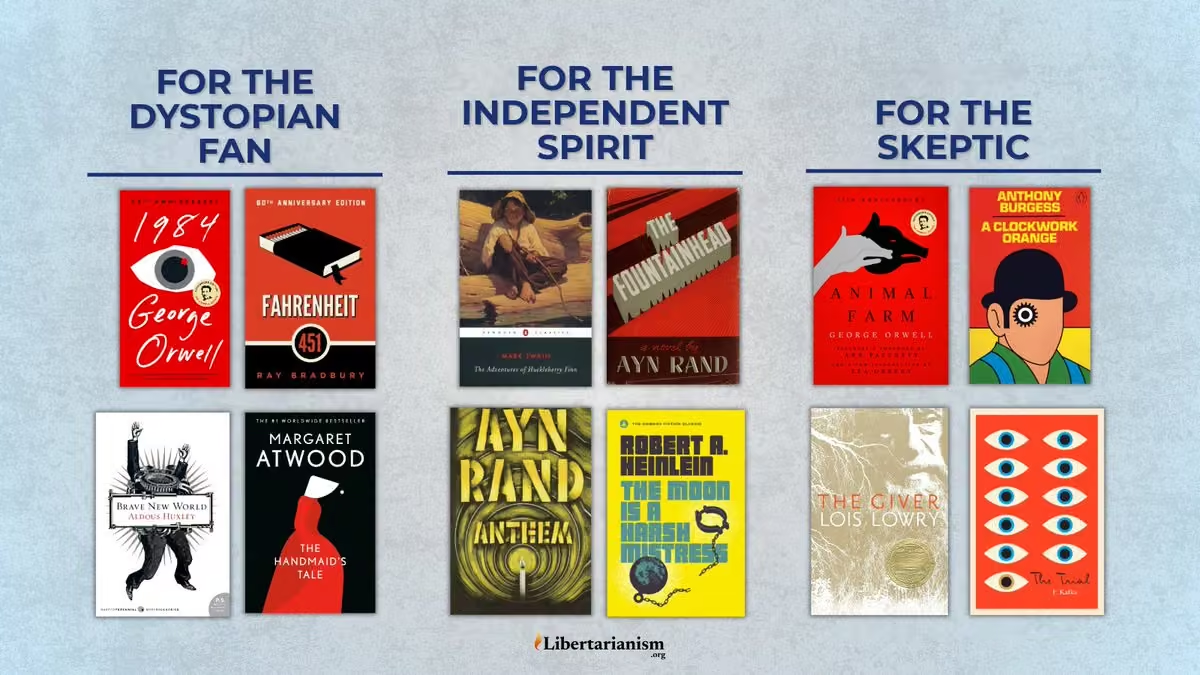
Some thinkers saw natural law as divine command. Others understood it as the freedom for a person to act morally.
Libertarianism.org
@libertarianism
Watch the new video here! youtu.be/05wQwL8fBdg
-
Libertarianism.org
@libertarianism
We’re told the state grants rights like life, speech, and property, but what happens when a government doesn't recognize these liberties?
Watch our new Learning Hub video on natural law to explore whether rights exist without government proclamation.
Libertarianism.org
@libertarianism
Watch the new video here! youtu.be/05wQwL8fBdg
-
Libertarianism.org
@libertarianism
Governments typically respect certain basic rights, like the right to life, free speech, or private property. What happens when a government doesn't recognize these rights? Does that translate into a lawless and violent society? What if the state did not exist at all? Does that mean laws don't exist? Or that people don't have rights?
For hundreds of years, thinkers have tried to answer this problem by attempting to understand the origin of laws and rights that would pre-date not only the state, but also societies themselves. One popular answer is found in the concept of “Natural Law."
Libertarianism.org
@libertarianism
Watch our new Learning Hub video on natural law to learn more! youtu.be/05wQwL8fBdg
-
Libertarianism.org
@libertarianism
Look out for the next Liberty Exchange podcast episode on Tuesday with @TimothySandefur and buy his book "You Don't Own Me" here: www.libertarianism.org/books/you-dont-own-me
John Stossel
@JohnStossel
The Wicked Witch is a victim?
That's the message of the new movie, Wicked.
Attorney @TimothySandefur says he knows why.
"Hollywood very often is trying to propagandize to us about the evils of individualism."
See how they do it:This media couldn't be displayed. See it on the original post. -
Libertarianism.org
@libertarianism
On her birthday, we celebrate Hurston’s fiercely independent spirit and unapologetic love of liberty. Hurston loathed any form of socialism or collectivism, and she challenged the paternal state in defense of personal freedom.
Born in 1891 in Notasulga, Alabama, Hurston lived during a time when many white people believed black people to be of inferior moral and intellectual ability, lacking the capacity for self-governance. But Hurston's childhood contradicted this myth: she saw laws debated, drafted, and enacted by black people.
Zora Neale Hurston celebrated Black culture and defied the left‐right political binary. Unwilling to be pigeonholed by any ideology, she remained throughout her life an individualist first and foremost—even amid the Harlem Renaissance, when many Black intellectuals embraced collectivist ideologies.
She was repulsed by the idea of Black Americans diligently serving the state—to her, that was just a fancy form of slavery. Ever wary of concentrated power, she derided Roosevelt’s New Deal as a paternal state.
A fiercely independent thinker, Hurston refused to see the world through the lens of racial categories or any other collective identity.
She remained firm that races do not dream, aspire, or achieve; only individuals can do such things.
Libertarianism.org
@libertarianism
Read more here: www.libertarianism.org/articles/zora-neale-hurston-champi…
-
Libertarianism.org
@libertarianism
In his Inaugural Address, @NYCMayor said that he would "replace the frigidity of rugged individualism with the warmth of collectivism." But is individualism actually cold?
First of all: Collectivism isn’t as warm as it sounds. It often relies on government force. Early collectivists wanted the state to control or regulate the economy and other aspects of civil society. Such systems treat people as merely the instruments of a larger social agenda. In the process, they sacrifice personal freedom for a supposed greater good.
Individualism isn’t cold at all. It champions personal freedom and authentic community. Far from anti-social, it lays the groundwork for creating communities that are truly responsive to the needs of the individuals involved. When people unite by choice rather than coercion, the result is genuine solidarity—and real warmth.
Individualism doesn’t deny community. In fact, it makes real community possible. It treats people as moral equals, free to cooperate, care, and create meaning by choice, not by force. Collectivism promises warmth, but delivers control—subordinating individuals to abstract goals decided by those in power.
A society built on individualism trusts people to help one another voluntarily. A society built on collectivism assumes they must be managed.
We choose individualism over collectivism. -
Libertarianism.org
@libertarianism
Do you think collectivism is associated with despotism?
-
Libertarianism.org
@libertarianism
Ayn Rand shared with many classical liberals and modern libertarians the commitment to individual rights and the rule of objective law. Because capitalism, in her view, was based on the “trader principle” and on the principle of nonaggression (i.e., that no human being should attain values by initiating the use of force against others), she maintained that it was the only social system in agreement with a genuinely human existence.
-
Libertarianism.org
@libertarianism
What’s a libertarian answer?
Free-market advocates maintain that coercing people to assist others is wrong, both pragmatically and morally, in that coercion is rarely workable and also violates others’ rights.
As Robert Nozick phrased it, no one has “an enforceable right”—that is, a legal claim—to assistance from another.
Although many free-market advocates agree that caring for the needy is both proper and necessary, they hold on pragmatic, ethical, and rights-based grounds that these decisions are ultimately private and must rest with each individual and his or her conscience. -
Libertarianism.org
@libertarianism
How are governments similar to, and different from, robbers? Read the new Just Sentiments essay at the link below.
Libertarianism.org
@libertarianism
-
Libertarianism.org
@libertarianism
We don't think it's too much to ask for...
-
Libertarianism.org
@libertarianism
Murray Rothbard, a libertarian economist, political philosopher, historian, and activist, is of central importance to the American libertarian movement because of both his writing and scholarship and his personal outreach to young libertarians.
He combined in one body of writing most of the intellectual concerns and approaches that defined the modern American libertarian movement: anarchism based in an Aristotelian natural law ethic, an Austrian/Misesian approach to economics, the promotion and extension of the nineteenth-century American anarchist tradition as exemplified in the writings of Lysander Spooner and Benjamin R. Tucker, and the use of historical analysis to demonstrate the damaging effects of state actions.
For his coverage of the full range of libertarian philosophy and application in his writings, and his near ubiquitousness through most institutions of the libertarian movement from the 1960s to the 1980s, he was often thought of as having shaped modern American libertarian thought, although his thoroughgoing anarchism, cultural conservatism, and tendency to feud with former associates made him a controversial figure in the libertarian movement.
Libertarianism.org
@libertarianism
Read more about Rothbard here: www.libertarianism.org/topics/rothbard-murray-1926-1995
-
Libertarianism.org
@libertarianism
What can the past teach about progress? The ancient Athenian mentality of learning from other civilizations is crucial for progress, according to Johan Norberg. Norberg, a senior fellow at the @CatoInstitute, recently sat down with libertarianism.org Director Jonathan Fortier to discuss Norberg's recent book, "Peak Human."
Libertarianism.org
@libertarianism
Watch the entire Liberty Exchange podcast episode (feat. @johanknorberg) here! youtu.be/2wHYuKTajBA
-
Libertarianism.org
@libertarianism
Because of Joseph Stalin, millions of people suffered.
-
Libertarianism.org
@libertarianism
There's a new Liberty Exchange podcast episode out! What can we learn from history's greatest civilizations? Listen to host Jonathan Fortier and guest @johanknorberg, a senior fellow at the @CatoInstitute, discuss Norberg's latest book, "Peak Human."
Libertarianism.org
@libertarianism
Watch here! youtu.be/2wHYuKTajBA
-
Libertarianism.org
@libertarianism
"If you like this golden age, you'd better fight for it." —Johan Norberg
In this new episode of the Liberty Exchange podcast, listen to host Jonathan Fortier and guest @johanknorberg discuss Norberg's new book, "Peak Human" (2025).
Libertarianism.org
@libertarianism
The episode premieres tomorrow—pre-save here. youtu.be/2wHYuKTajBA
-
Libertarianism.org
@libertarianism
On this day in 1773, protesters opposing British authority dumped chests of tea into Boston Harbor in an act now known as the Boston Tea Party. What happened afterward? The British response changed everything.
Beginning in March 1774, in retaliation for the destruction of tea in Boston Harbor, Parliament passed four pieces of legislation known as the Coercive Acts. These measures, which many Americans called the Intolerable Acts, amounted to a declaration of martial law in Boston and left Americans with no plausible course of action between total submission and revolution.
The charter of Massachusetts was severely altered to give the royal governor extensive powers. He could appoint or fire judges, the attorney general, marshals, and justices of the peace. Jurors would no longer be elected. Except for conducting routine business once a year, the Massachusetts Assembly was forbidden to meet without permission from the governor.
The Coercive Acts seemed to provide conclusive proof that the unjust actions of the British government over the past decade were not unrelated events. Many Americans viewed the legislation as the culmination of a plan to extinguish American freedom and establish despotism. As George Washington wrote, the Coercive Acts revealed the British government's pursuit "to overthrow [the colonists'] Constitutional Rights and liberties."
A revolution was not justified unless it could be shown that unjust laws were part of an overall plan to establish despotism.
Libertarianism.org
@libertarianism
Read the article here: www.libertarianism.org/publications/essays/excursions/coe…
-
Libertarianism.org
@libertarianism
On this day in 1791, the United States adopted the Bill of Rights, or the first ten amendments to the US Constitution. These amendments resulted from the clash between those who supported replacing the Articles of Confederation with the Constitution and those who opposed doing so.
Supporters of the Constitution, who called themselves Federalists, argued that a Bill of Rights was both unnecessary and dangerous. It was unnecessary because the general government was one of limited and enumerated powers and was not given the power to violate such rights as the right to freedom of the press.
As Alexander Hamilton wrote, “Why declare that things shall not be done which there is no power to do? Why, for instance, should it be said that the liberty of the press shall not be restrained, when no power is given by which restrictions may be imposed?”
Opponents of the Constitution pointed to the few rights that were already explicitly protected in the text and replied that, even if an incomplete enumeration were dangerous, the danger already existed, and it could only improve matters to lengthen the list. -
Libertarianism.org
@libertarianism
“Nothing is so permanent as a temporary government program.” —Milton Friedman
Friedman was an American economist and leading representative of the Chicago School during the last half of the twentieth century. Friedman’s contributions to economics have been far reaching.
Libertarianism.org
@libertarianism
Learn more about Friedman.
www.libertarianism.org/publications/essays/inflation-defl… -
Libertarianism.org
@libertarianism
Today, María Corina Machado will be awarded the Nobel Peace Prize "for her tireless work promoting democratic rights for the people of Venezuela and for her struggle to achieve a just and peaceful transition from dictatorship to democracy."
Libertarianism.org
@libertarianism
As for the Nobel Prize in Economic Sciences, half will be awarded to Joel Mokyr "for having identified the prerequisites for sustained growth through technological progress." Mokyr has studied how technological progress has led to economic growth. In his book "A Culture of Growth" (2016), Mokyr writes that "nations and their economies grow in large part because they increase their collective knowledge about nature and their environment, and because they are able to direct this knowledge toward productive ends.”
Libertarianism.org
@libertarianism
On this day, we'd also like to acknowledge the work of a different Nobel recipient. Mario Vargas Llosa won the Nobel Prize in Literature in 2010 "for his cartography of structures of power and his trenchant images of the individual's resistance, revolt, and defeat." Vargas Llosa passed away earlier this year in April.
-
Libertarianism.org
@libertarianism
New "Portraits of Liberty" episode out now!
youtu.be/j5TYv0thbuY -
Libertarianism.org
@libertarianism
Long before the American and French Revolutions, a Polish bishop wrote one of Europe’s most radical defenses of limited government and the moral equality of citizens.
Libertarianism.org
@libertarianism
Watch our new Portraits of Liberty episode on our YouTube channel or listen on your favorite podcast platform! youtu.be/j5TYv0thbuY
-
Libertarianism.org
@libertarianism
“It is a legal right,” Lane wrote of property, “absolutely essential to an individual’s exercise of his natural rights.”
Rose Wilder Lane's "The Discovery of Freedom" (1943), appeared the same year as Ayn Rand's "The Fountainhead" and Isabel Paterson's "God of the Machine." Together, Lane, Rand, and Paterson formed the first wave of libertarian women writing in the twentieth century.
Libertarianism.org
@libertarianism
Read more about Rose Wilder Lane here. www.libertarianism.org/articles/rose-wilder-lanes-journey…
-
Libertarianism.org
@libertarianism
Interested in how individualism has influenced culture? Read "You Don't Own Me" by @TimothySandefur to see how the poetry of John Milton, "Star Trek," and the novels of Zora Neale Hurston were influenced by individualism. www.libertarianism.org/books/you-dont-own-me
-
Libertarianism.org
@libertarianism
Friedrich Hayek argued that no single person can ever possess enough knowledge to plan society from the top down. Because knowledge is dispersed across millions of individuals, Hayek believed the free market is the best tool we have for coordinating it.
Libertarianism.org
@libertarianism
Watch our new Learning Hub video on spontaneous order here! youtu.be/2BsMvqFEJ9Y
-
Libertarianism.org
@libertarianism
Many orderly systems in the world weren't designed by anyone. Instead, they emerged from millions of people making their own choices. When individuals have the power to act freely, complex order can emerge without central command.
Libertarianism.org
@libertarianism
Watch out for our third Learning Hub video, which is on spontaneous order, tomorrow. Pre-save here. youtu.be/2BsMvqFEJ9Y
-
Libertarianism.org
@libertarianism
"The more the state ‘plans’ the more difficult planning becomes for the individual."
—F. A. Hayek
What if society works better without a central planner? Let’s look at spontaneous order.Post not available here, view on X
Libertarianism.org
@libertarianism
The theory resolves all social action into individual action: concepts such as society are shorthand for multiple individual actions. Orderly societies emerge from self-interested actions of decentralized individuals who have no direct concern with the common good—yet unintentionally create it.
Libertarianism.org
@libertarianism
Spontaneous order serves as a crucial underpinning to libertarianism because it shows that ordered arrangements and cooperative endeavors do not require an organizer, and attempts to centrally plan society are doomed to failure.
-
Libertarianism.org
@libertarianism
Are you brave enough to call out injustice?
Born in Germany in the first half of the twentieth century, Sophie Scholl witnessed the rise of the Nazi Party and state throughout her childhood. By the time she was a student at the University of Munich, she could not stand idly by as the Nazi war machine raged. Scholl joined the peaceful activist group known as the White Rose and tried to shine a light on Nazi Germany’s evil crimes. For her activism, she paid the ultimate price.
Libertarianism.org
@libertarianism
Want to learn about her resistance? Listen to the Portraits of Liberty podcast episode about her. (It's only twenty-three minutes long.) www.libertarianism.org/podcasts/portraits-liberty/resisti…
-
Libertarianism.org
@libertarianism
You own yourself.
David Boaz explains how abolitionists like Frederick Douglass, William Lloyd Garrison, and Lysander Spooner argued that slavery is the theft of a person’s very self.
Libertarianism.org
@libertarianism
Watch the entire video here! youtu.be/n8c6THAStr4
-
Libertarianism.org
@libertarianism
F. A. Hayek, Ayn Rand, Ludwig von Mises, and Mary Wollstonecraft at Thanksgiving dinner. What do you think they'd discuss?
-
Libertarianism.org
@libertarianism
In our new essay, Nick Wilson compares the political, social, and moral thought of Booker T. Washington and W. E. B. Du Bois.
From the essay:
"Washington’s view of higher things prioritized self-help and a bottom-up view of society; Washington preached the cultivating of individual economic independence rather than reliance on either political power or government support. Du Bois promoted philosophical enlightenment and a more top-down approach to black society, emphasizing collegiate education and political activism."
Libertarianism.org
@libertarianism
Read it here: www.libertarianism.org/articles/booker-t-washington-versu…
-
Libertarianism.org
@libertarianism
Every person has a dignity that no one has the right to take away.
As David Boaz explains, when you strip someone of responsibility, you’re taking away part of their humanity.
Liberty means recognizing every individual as a moral agent worthy of equal respect.
Libertarianism.org
@libertarianism
Watch the entire video here! youtu.be/n8c6THAStr4
-
Libertarianism.org
@libertarianism
“The act of reaching into one’s own pockets to help a fellow man in need is praiseworthy and laudable. Reaching into someone else’s pocket is despicable and worthy of condemnation.” —Walter Williams
Giving shouldn't be coerced. -
Libertarianism.org
@libertarianism
We wouldn't want to live in a communist country. Would you?
Even Google AI, which aggregates and summarizes from thousands of sources, quickly reaches the same conclusion: communism means poverty and control.Post not available here, view on X
Libertarianism.org
@libertarianism
China:
"Life in China is characterized by stringent political control and social controls, alongside significant economic development."
Libertarianism.org
@libertarianism
North Korea:
"Life in North Korea is characterized by a totalitarian government that severely restricts its citizens' freedoms, including speech, movement, and religion, while controlling nearly all aspects of daily life." -
Libertarianism.org
@libertarianism
"Competition is what produces tremendous degrees of cooperation." —Lawrence Reed
New Liberty Exchange podcast episode (feat. @LawrenceWReed1)—out today!
Libertarianism.org
@libertarianism
Watch here!
youtu.be/FlhQY2_dRhk -
Libertarianism.org
@libertarianism
Would you spread liberty during times of oppression? Tomorrow, listen to the entire discussion between @LawrenceWReed1 and Liberty Exchange host Jonathan Fortier.
Libertarianism.org
@libertarianism
Pre-save the new Liberty Exchange podcast episode here!
youtu.be/FlhQY2_dRhk -
Libertarianism.org
@libertarianism
Sloane Frost, a cofounder and former chairman of @sfliberty, discusses the cost of hidden prices in the US health care system. How can individuals shop the marketplace when insurance companies are ultimately the customers? Hidden transactions, not involving actual consumers, ultimately drive prices up.
Libertarianism.org
@libertarianism
Watch the entire video here! www.youtube.com/watch?v=iqCUG_lchEQ
-
Libertarianism.org
@libertarianism
Does the United States have free trade?
Free trade is the exchange of goods and services across international borders, unhindered by government tariffs, quotas, or other restrictions.
From its peak in 1932, the average US tariff fell from about sixty percent to about four percent in 2017. At the end of 2017, Americans were freer to engage in international trade than at any time in US history.
Still, in 2017, US Customs and Border Protection collected $33.1 billion in import duties—the revenue generated by assessing tariffs (which are taxes) on imported goods.
Although the US president and other politicians often invoke the need for trade reciprocity or calls for leveling the proverbial “playing field” as justification for imposing tariffs on goods imported from abroad, the fact is those tariffs are actually taxes imposed on American businesses and consumers.
Today, large swaths of the US economy remain off limits to foreign competition. In other words, the government continues to restrict our freedom on a fairly significant scale.
The US does not have free trade. Is it free enough? -
Libertarianism.org
@libertarianism
Do we rely too much on policy?
In this video from our archives, @Doug_Bandow, senior fellow at the @CatoInstitute, explains the consequences of people depending on politics to fix every problem.
Libertarianism.org
@libertarianism
Watch the entire video here!
youtu.be/nz2JSlxjLZg -
Libertarianism.org
@libertarianism
We need to improve the health care system. The first step? According to Thomas Szasz, we must separate health insurance from employment.
Libertarianism.org
@libertarianism
Watch the entire video here!
youtu.be/FC9r3Gs8XuU -
Libertarianism.org
@libertarianism
“Liberty is not only defended on battlefields or in parliaments but by the choices of individuals who refuse to let their moral sense be legislated away.” —Paul Meany, Editor for Intellectual History
José Castellanos Contreras broke the law to do the right thing. He saved thousands of Jewish people during WWII. His story reminds us that liberty depends on individuals who refuse to obey unjust laws.
Listen to the episode here! www.libertarianism.org/podcasts/portraits-liberty/quiet-r… -
Libertarianism.org
@libertarianism
José Castellanos risked everything to save lives. Would you do the same?
Libertarianism.org
@libertarianism
Listen to the entire podcast here! www.libertarianism.org/podcasts/portraits-liberty/quiet-r…
-
Libertarianism.org
@libertarianism
On Veterans Day, we honor those who’ve stood to protect individuals from tyranny, and we reflect on Jefferson’s reminder that war punishes all participants.
-
Libertarianism.org
@libertarianism
Socialism promises equality, security, and shared prosperity. What happens when theory meets reality?
Libertarianism.org
@libertarianism
Planners have no basis on which to engage in rational economic calculation. In other words, no matter how well-intentioned the central planners are, they do not have access to the information (prices) that shows the value of goods.
Libertarianism.org
@libertarianism
Socialism is an abject failure. Even socialists themselves now acknowledge the necessity of basic market institutions.
-
Libertarianism.org
@libertarianism
Governments can't plan prosperity, but free people can create it. The story of your smartphone proves it.
Libertarianism.org
@libertarianism
Watch the entire video with @LawrenceWReed1 here! youtu.be/H19lPpa9UuY
-
Libertarianism.org
@libertarianism
The largest US city just elected a socialist mayor. At first glance, the socialist vision may sound appealing. But history tells a different story. Central planners can't predict what people want, and socialism destroys the incentives and freedoms that make prosperity possible.
Post not available here, view on X
Libertarianism.org
@libertarianism
Libertarianism.org
@libertarianism
-
Libertarianism.org
@libertarianism
Watch our interview with Lawrence Reed. Just as no single person can make a pencil from start to finish, it would be an even harder task to make a smartphone from scratch. What are the lessons we can derive from these examples? @LawrenceWReed1
youtu.be/H19lPpa9UuY -
Libertarianism.org
@libertarianism
Politicians cannot "fix" the economy, no matter how hard they try. True innovation is the result of free people creating and trading to help improve each other's lives.
Libertarianism.org
@libertarianism
Watch the interview here: youtu.be/H19lPpa9UuY
-
Libertarianism.org
@libertarianism
There are plenty of reasons to support free trade because of economics, but what about the moral reasons?
Libertarianism.org
@libertarianism
Want to read the article? www.libertarianism.org/publications/essays/seven-moral-ar…
-
Libertarianism.org reposted
Ian Vasquez
@VasquezIan
Socialism kills. Reminder from India.
www.cato.org/development-briefing-paper/socialism-kills-h… -
Libertarianism.org
@libertarianism
Prices signal how much customers value specific items, but government intervention distorts them.
In a truly free market, government doesn't influence exchange. At all.
Libertarianism.org
@libertarianism
Read more about free markets and trade here: www.libertarianism.org/trade-1
-
Libertarianism.org
@libertarianism
Free trade helped build the global market and the world as we know it today.
Although many understand the benefits of free trade, governments still coercively “protect” their markets with tariffs and restrictions.
Libertarianism.org
@libertarianism
Watch the entire video here!
www.youtube.com/watch?v=eA2Qgdz1pVE -
Libertarianism.org
@libertarianism
Trade built civilizations.
But every time trade expands, so do efforts to control it.
Watch our entire video on trade on our YouTube channel tomorrow!
Libertarianism.org
@libertarianism
Set a reminder here!
youtu.be/eA2Qgdz1pVE -
Libertarianism.org
@libertarianism
"You Don't Own Me" by @TimothySandefur is out today.
An exploration of how the idea of individual freedom has shaped not only politics and economics but also the arts—from pop music to poetry, from Star Trek to the blues, and from Western novels to architecture.
Buy it here: -
Libertarianism.org reposted
Timothy Sandefur
@TimothySandefur
Its publication day! Grab a copy of my new book “You Don’t Own Me” today!
-
Libertarianism.org
@libertarianism
While international trade is freer today than in the past, government controls still block opportunities for prosperity.
Libertarianism.org
@libertarianism
Later this week, libertarianism.org will release a collection of content related to free trade. Keep an eye out for more information!
-
Libertarianism.org
@libertarianism
New essay! Jordan Ballor outlines Abraham Kuyper’s anti-revolutionary commitments, which appeal to a higher law in defense of liberty. @JordanBallor
Libertarianism.org
@libertarianism
Read it here: www.libertarianism.org/articles/abraham-kuyper-say-no-no-…
-
Libertarianism.org
@libertarianism
How many parts of your life are ruled by people you've never met? New interview with Dr. Jeffrey Singer—out today! @dr4liberty @CatoHealth
Libertarianism.org
@libertarianism
Watch here: youtu.be/wowwIwEcUsU
-
Libertarianism.org
@libertarianism
Freedom doesn't come without risks, but the price of choice is worth it. New interview with Dr. Jeffrey Singer—out tomorrow! @dr4liberty @CatoHealth
Libertarianism.org
@libertarianism
Pre-save here: youtu.be/wowwIwEcUsU
-
Libertarianism.org
@libertarianism
Without free speech, a free society loses its foundation.
Freedom isn't always comfortable.
Some people find it perfectly acceptable to violently accost or threaten those whose words offend them.
Attempts to forbid certain words are quite properly understood as attempts at thought control.
Unpopular speech must be permitted in a truly free society.
Libertarianism.org
@libertarianism
Read the entire article here: www.libertarianism.org/columns/most-liberal-value-free-sp…
Libertarianism.org
@libertarianism
Visit libertarianism.org for our content collection on free speech.
-
Libertarianism.org
@libertarianism
Medieval feminism sounds like an oxymoron, but not for the fifteenth-century writer Christine de Pizan.
In "The City of Ladies" (1405), Pizan argues that men and women are inherently equal. She believed both sexes have a capacity for virtue, and both ought to be educated in the same manner.
Libertarianism.org
@libertarianism
Want to learn more? Listen to the ten-minute Portraits of Liberty podcast episode about Pizan here: www.libertarianism.org/podcasts/portraits-liberty/first-w…
-
Libertarianism.org
@libertarianism
Andō Shōeki was a Japanese philosopher who denounced feudal hierarchies, Confucian dogma, and the samurai class.
Libertarianism.org
@libertarianism
Have fifteen minutes? Listen to the new Portraits of Liberty podcast episode: www.libertarianism.org/podcasts/portraits-liberty/japans-…
-
Libertarianism.org
@libertarianism
Philippe Aghion and Peter Howitt, scholars who modeled how creative destruction causes sustained growth, were recently awarded the Nobel Prize in Economic Sciences. Want to learn about this important concept? We've got a book for you! @JTDDalton @NobelPrize
Libertarianism.org
@libertarianism
If you comment "destruction" and like this post, you'll be entered to win a copy of the book. We will message the winner with the details!
-
Libertarianism.org reposted
Emily Ekins
@emilyekins
Great video from Barbara Galletti Ramírez del Villar providing an introduction about Freedom of Conscience and Freedom of Speech for @libertarianism youtu.be/3AakojQgS3M
-
Libertarianism.org
@libertarianism
Andō Shōeki, a Japanese philosopher who denounced feudal hierarchies, had a vision of a natural, egalitarian society based on voluntary cooperation. While many associate libertarian schools of thought to be uniquely Western, Shōeki shows that these ideas did not form only in the West.
Libertarianism.org
@libertarianism
Have fifteen minutes? Listen to the new Portraits of Liberty podcast episode here: www.libertarianism.org/podcasts/portraits-liberty/japans-…
-
Libertarianism.org
@libertarianism
Surrounded by the religious conflict and censorship of the Puritan Revolution, John Milton wrote “Areopagitica” (1644). In what some consider to be one of the greatest defenses of free speech and free conscience, Milton writes: "Give me the liberty to know, to utter, and to argue freely according to conscience, above all liberties.”
Learn more about the emergence of free conscience and free speech in our new Learning Hub video, now available on our YouTube channel!
Libertarianism.org
@libertarianism
-
Libertarianism.org reposted
John T. Dalton
@JTDDalton
Creative Destruction: An Introduction a.co/d/8eaQEjH #amazon via @Amazon. @libertarianism @NobelPrize
-
Libertarianism.org
@libertarianism
The shocking assassination of Charlie Kirk has jolted America into a reckoning with one of its most fundamental values: freedom of expression.
This is not a time to retreat from freedom but to defend it more fiercely. Civilizations falter when people are silenced.
From Milton’s "Areopagitica" and Mill’s "On Liberty" to the Levellers’ demand that ordinary people could speak truth to power, the liberal tradition affirms dissent as a civic duty.
Free speech is a moral principle rooted in dignity and autonomy. Protecting even unpopular speech affirms every person’s right to persuade and be persuaded. Each generation faces new challenges: Lenny Bruce fought obscenity prosecutions, today’s internet magnifies both opportunities and dangers, and courts continue to test the First Amendment’s boundaries.
Violence against speech is violence against us all. The libertarian case is hopeful: trust liberty over fear.
Libertarianism.org
@libertarianism
Browse the libertarianism.org content collection on free speech here: www.libertarianism.org/freedom-speech-0
-
Libertarianism.org
@libertarianism
In our new Learning Hub series, we've created five introductory videos about the foundational principles of free societies that we will publish once a month. Our first video is out now!
"Freedom of Conscience and Freedom of Speech: An Introduction"
www.youtube.com/watch?v=3AakojQgS3M&t=1s -
Libertarianism.org
@libertarianism
Freedom of speech is essential to a free society, and free expression is a moral principle rooted in individual dignity and autonomy.
Libertarianism.org
@libertarianism
In his address to officers in the army on March 15, 1783, George Washington discusses the significance of free speech for free people.
The quote in its entirety reads:
"For if Men are to be precluded from offering their Sentiments on a matter, which may involve the most serious and alarming consequences, that can invite the consideration of Mankind, reason is of no use to us; the freedom of Speech may be taken away, and, dumb and silent we may be led, like sheep, to the Slaughter." -
Libertarianism.org
@libertarianism
A free market encourages people to cooperate with one another.
Libertarianism.org
@libertarianism
At a @FutureofFreedom event, David Boaz presents the libertarian position as a cooperative effort hinging on a strong set of property rights, respect for the rule of law, and a dedication to keeping the coercive power of government in check.
Watch the entire video here:
www.youtube.com/watch?v=AGGjVsAfILI
@JacobforLiberty -
Libertarianism.org
@libertarianism
Benjamin Franklin's most glorious invention is the American dream.
With less than three years of formal schooling, Franklin taught himself almost everything he knew. When Franklin saw that something needed doing, he did it.
Libertarianism.org
@libertarianism
Listen to our Portraits of Liberty podcast episode on Franklin here: youtu.be/-2DVIi90Lw8
-
Libertarianism.org
@libertarianism
“Few traits of totalitarian regimes are at the same time so confusing to the superficial observer and yet so characteristic of the whole intellectual climate as the complete perversion of language, the change of meaning of the words by which the ideals of the new regimes are expressed.”
The Libertarian Institute
@LibertarianInst
The Most Important Chapter of Hayek's Most Important Book
libertarianinstitute.org/blog/the-most-important-chapter-… -
Libertarianism.org
@libertarianism
Penn Jillette: "I want good things done, but I don't want good things done by force."
-
Libertarianism.org
@libertarianism
Despite starting out as a communist, Rose Wilder Lane became a staunch advocate of individualism.
Lane published "The Discovery of Freedom: Man's Struggle Against Authority" in 1943—the same year that Ayn Rand published "The Fountainhead" and Isabel Paterson published "The God of the Machine."
Lane, Rand, and Paterson are often credited as the founding mothers of the American libertarian movement.
Libertarianism.org
@libertarianism
Read more about Lane's journey to individualism here: www.libertarianism.org/articles/rose-wilder-lanes-journey…
-
Libertarianism.org
@libertarianism
As Milton Friedman points out, some people forget that those with political power can be selfish and greedy.
Libertarianism.org
@libertarianism
Watch more here: youtu.be/59VrsNxsA_o
-
Libertarianism.org
@libertarianism
In this new essay, @jeffreyamiron and @vanessabcalder remind us of the complexity of the abortion debate and offer a nuanced approach to addressing the moral issues at stake. Read it here: www.libertarianism.org/articles/libertarian-perspectives-…
-
Libertarianism.org
@libertarianism
Born on September 29, 1881, Ludwig von Mises was the leading Austrian economist of his generation. He wrote several pieces that have shaped how we understand markets, prices, and freedom.
Post not available here, view on X
Libertarianism.org
@libertarianism
Mises championed free markets and hard money. He showed that misconceived (but sometimes popular) economic intervention creates disorder that calls for more intervention.
Libertarianism.org
@libertarianism
What do you think? Should the government interfere in the economy?
-
Libertarianism.org
@libertarianism
A free polity, F. A. Hayek argues, is one in which people are governed by general, predictable rules, rather than a government led by those with wide, discretionary powers.
Libertarianism.org
@libertarianism
Have you seen our twenty-minute documentary on F. A. Hayek? Watch it here: youtu.be/J4T-NvKS_sY
-
Libertarianism.org
@libertarianism
In our new article for the Just Sentiments collection, David Lewis Schaefer lays out the case that the sixteenth-century libertarian work "On Voluntary Servitude" (1577) was written by Michel de Montaigne, not Étienne de La Boétie.
Libertarianism.org
@libertarianism
Read it here: www.libertarianism.org/articles/montaigne-author-voluntar…
-
Libertarianism.org
@libertarianism
Presidential powers have inflated drastically since the Founding Fathers signed the Constitution, says @DanielJHannan.
Libertarianism.org
@libertarianism
Watch the entire video here: youtu.be/EL5_IVZMZ9U
-
Libertarianism.org
@libertarianism
The Soviet Union, marked by chronic shortages and stagnation, was a failure. While planned economies may begin with noble motives, the path to fiscal "fairness" is usually bloody.
-
Libertarianism.org
@libertarianism
On September 22, 1862, Lincoln issued the preliminary Emancipation Proclamation. Did you know that Lincoln went to war to save the Union, not to abolish slavery?
Abolitionists hoped the conflict would force emancipation.
Lincoln’s Emancipation Proclamation was framed as a “war measure,” not a moral mission.
Lincoln said he acted only because it helped win the war and suppress rebellion—not because the Constitution required it or because slavery was wrong.
Although Lincoln sincerely detested slavery, he was not an abolitionist. In fact, he often criticized abolitionism as a threat to the Union and advocated instead for a scheme of gradualism that included compensation for slaveholders (another policy that abolitionists opposed).
Libertarianism.org
@libertarianism
Read more here: www.libertarianism.org/columns/abraham-lincoln-abolitionists
-
Libertarianism.org
@libertarianism
Benjamin Franklin believed in the power of discussion.
Libertarianism.org
@libertarianism
Watch more here: youtu.be/-2DVIi90Lw8
-
Libertarianism.org
@libertarianism
Is the Constitution working?
-
Libertarianism.org
@libertarianism
Benjamin Franklin was a strong proponent for civil discourse. He tried to remain humble and curious during debates.
Libertarianism.org
@libertarianism
Listen to the Portraits of Liberty podcast episode (feat. @MarkSkousen1) here: www.libertarianism.org/podcasts/portraits-liberty/benjami…
-
Libertarianism.org
@libertarianism
Civilizations flourish when people keep talking to one another—even when we disagree. Open dialogue is the foundation of a free society, and violence must never replace debate. At libertarianism.org, we stand for peaceful disagreement and the protection of free expression.
-
Libertarianism.org
@libertarianism
Today, we remember the lives lost twenty-four years ago from the tragic attacks on the World Trade Center. And we reflect on the invasive policy decisions that have followed.
Post not available here, view on X
Libertarianism.org
@libertarianism
People have grown accustomed to the TSA screenings and travel restrictions that were not in place only twenty-four years ago. An estimated two million people go through TSA screenings every day.
Libertarianism.org
@libertarianism
How much liberty are you willing to sacrifice for the promise of security?
-
Libertarianism.org
@libertarianism
Socialism and fascism are ultimately just forms of statism.
Libertarianism.org
@libertarianism
Ayn Rand maintained that America was drifting toward fascism, not socialism, and that this descent was virtually inevitable in a mixed economy. “A mixed economy is an explosive, untenable mixture of two opposite elements,” freedom and statism, "which cannot remain stable, but must ultimately go one way or the other.”
Libertarianism.org
@libertarianism
Read the essay here: www.libertarianism.org/columns/ayn-rand-fascism
-
Libertarianism.org
@libertarianism
Benjamin Franklin has long been considered by historians to be the most modern of the Founding Fathers.
Libertarianism.org
@libertarianism
Watch the new Portraits of Liberty podcast episode on Franklin (feat. @MarkSkousen1) here: youtu.be/-2DVIi90Lw8
-
Libertarianism.org
@libertarianism
Benjamin Franklin not only played an integral role in the founding of the United States, but he also led an incredibly interesting life. Born into a modest lifestyle, Franklin taught himself almost everything he knew.
Libertarianism.org
@libertarianism
Tomorrow, the next episode of the Portraits of Liberty podcast comes out. Listen to Intellectual History Editor Paul Meany discuss Franklin's life with Mark Skousen, author of "The Greatest American: Benjamin Franklin, The World's Most Versatile Genius" (2025). @MarkSkousen1
Libertarianism.org
@libertarianism
Pre-save the episode here: youtu.be/-2DVIi90Lw8
-
Libertarianism.org
@libertarianism
Do you think restricting immigration is worth it?
According to Jason Brennan, we lose an astonishing amount of wealth yearly because of these restrictions.
Libertarianism.org
@libertarianism
Watch the entire video: www.youtube.com/watch?v=vrXqbJn1ss8&t=58s
-
Libertarianism.org
@libertarianism
"Do what I say."
"Why?"
"Because I said so."
Authoritarian parenting can lead to unhappy, anxious children who grow into dependent, authoritarian adults. A free society depends on autonomous individuals.
Libertarianism.org
@libertarianism
Read the essay here: www.libertarianism.org/columns/psychology-freedom-authori…
-
Libertarianism.org
@libertarianism
Inflation distorts markets. People can't plan their investments when they can't count on stable prices.
Economist @ocampo_emilio discusses unchecked inflation. -
Libertarianism.org reposted
Hamilton School for Classical and Civic Ed
@ufhamilton
In Just Sentiments @libertarianism, Associate Professor @MaxSkjonsberg examines Joseph Priestley's two concepts of liberty.
#ufhamilton
www.libertarianism.org/articles/joseph-priestleys-two-con… -
Libertarianism.org
@libertarianism
Today, we commemorate the births of two formative figures in the libertarian tradition: John Locke and David Boaz.
Libertarianism.org
@libertarianism
John Locke, born August 29, 1632, was perhaps the most influential and exemplary of classical liberal thinkers. The core of Locke’s classical liberalism is presented in the "Second Treatise of Government" (1689). Here Locke laid out his famous doctrines of natural rights, property rights, the consensual creation of government, and the conditions under which individual and collective resistance to government is justified.
Libertarianism.org
@libertarianism
David Boaz, born August 29, 1953, played a key role in the development of the @catoinstitute and the libertarian movement. He was a provocative commentator and a leading authority on domestic issues and the rise of libertarianism.
Boaz wrote a comprehensive overview of the history and influence of libertarian ideas in "The Libertarian Mind" (originally "Libertarianism: A Primer"). He writes,
"Libertarianism is the belief that each person has the right to live his life as he chooses so long as he respects the equal rights of others." -
Libertarianism.org
@libertarianism
New Just Sentiments essay by Max Skjönsberg!
@MaxSkjonsberg reflects on the different understandings of liberty in the eighteenth century and the important relationship between political and civil liberty in the work of Joseph Priestley.
Libertarianism.org
@libertarianism
Read it here: www.libertarianism.org/articles/joseph-priestleys-two-con…
-
Libertarianism.org reposted
Max Skjönsberg
@MaxSkjonsberg
My new essay in "Just Sentiments" @libertarianism "Joseph Priestley's Two Concepts of Liberty." www.libertarianism.org/articles/joseph-priestleys-two-con…
-
Libertarianism.org
@libertarianism
Shouldn’t free people decide who they hire, rent to, and trade with?
Libertarianism.org
@libertarianism
Watch the full video here: youtu.be/vrXqbJn1ss8
-
Libertarianism.org reposted
Daniel Gómez Gaviria
@dgomezco
Para no quedarse con hombres de paja y caricaturas de lo que es y no es el libertarianismo recomiendo explorar @online_liberty, @adamsmithworks @Liberty_Fund y @libertarianism. Otras buenas referencias: sigan a @PeterBoettke y a @mungowitz y vean lo que publican en esa tradición y divulgan en @HayekProgram.
-
Libertarianism.org
@libertarianism
New book review out! Caroline Breashears reviews "Libertarian Literary and Media Criticism: Essays in Memory of Paul A. Cantor." Read here: www.libertarianism.org/articles/literature-film-and-human…
-
Libertarianism.org
@libertarianism
Our new essay collection is out! Read through our first thirteen essays of "Just Sentiments" and discover the works of the philosophers of the eighteenth century.
Click here:
www.libertarianism.org/just-sentiments -
Libertarianism.org
@libertarianism
"Civilization is built on the knowledge and creativity of millions of strangers whom you've never met." —Johan Norberg
@johanknorberg, author of "The Capitalist Manifesto," discusses why capitalism is a system where everyone benefits. Link below.
Libertarianism.org
@libertarianism
Watch the Liberty Exchange podcast episode here: www.youtube.com/watch?v=6b6AL81Pkvk
-
Libertarianism.org
@libertarianism
Happy 90th birthday, Dr. Paul! @RonPaul
In this video, Ron Paul speaks at a meeting of the Economic Club of Detroit in 1988. He warns of a coming economic crisis, which he claims is the end result of the government's fiscal and monetary programs.
Libertarianism.org
@libertarianism
Watch the entire video from our archives here: youtu.be/stgMAwqV3Vs
-
Libertarianism.org
@libertarianism
New article! Steven Farron explores the complexities and contradictions in Ayn Rand’s work, asking how we reconcile her “Sense of Life” with the themes in her writing. Read it here: www.libertarianism.org/articles/ayn-rands-totalitarian-se…
-
Libertarianism.org
@libertarianism
According to James Tooley, the federal government encroached upon the state governments' authority over education.
Libertarianism.org
@libertarianism
Watch the entire interview here: youtu.be/OarzZ8IfQQ4
-
Libertarianism.org
@libertarianism
Have you heard of Wawrzyniec Goślicki?
Goślicki (ca. 1530–1607), also known as Laurentius Grimaldius Goslicius, was a Polish bishop, philosopher, and statesman. Born into a poor, noble family near Goślice, Poland, he rose to prominence through his intellect and dedication.
In his 1568 work, "De Optimo Senatore" ( or "The Accomplished Senator"), Goślicki advocated for constitutional government, the rule of law, and religious liberty. His ideas influenced English liberal thought. Some have argued his ideas also influenced figures like Algernon Sidney and Thomas Jefferson.
Throughout his career, Goślicki defended liberal views at great personal cost. He argued for liberty and tolerance during a time when absolutism and religious strife were growing across Europe. While not a modern libertarian, Goślicki is considered a "proto-libertarian" because he helped lay the groundwork for (classical) liberal ideas.
Goślicki is a reminder that liberty is more than just a Western European construct, that there was “liberty before liberalism,” and that liberty and faith do not have to be in conflict.
Want to read more? Check out the article here: www.libertarianism.org/topics/goslicki-wawrzyniec-g-ca-15… -
Libertarianism.org
@libertarianism
Audience members summed up the Libertarianism vs. Conservatism Debate, hosted by the @catoinstitute, in just one word.
What word would you pick? Let us know in the comments.
Libertarianism.org
@libertarianism
Watch the debate here: www.youtube.com/live/Q28rUDxJibk?t=873
-
Libertarianism.org
@libertarianism
Jeannette Rankin, the first woman elected to Congress, remains one of the most principled pacifists in American political history. She was a vocal opponent of US intervention in European affairs in World War I and was the lone vote against US entry into World War II.
Libertarianism.org
@libertarianism
Want to learn more? Listen to the podcast episode here: www.libertarianism.org/podcasts/portraits-liberty/jeannet…
-
Libertarianism.org reposted
Matt Zwolinski
@Mattzwolinski
JH Levy is one of my favorite figures from
_The Individualists_. It was really lovely to have the chance to talk about him with @PaulMeany2 for Cato’s Portraits of Liberty podcast.
Libertarianism.org
@libertarianism
Have you heard of J.H. Levy? Known for his passionate defense of self-ownership and voluntary social cooperation, Levy was a prominent but now largely forgotten voice in the individualist intellectual circles of Victorian Britain.
-
Libertarianism.org
@libertarianism
Have you heard of J.H. Levy? Known for his passionate defense of self-ownership and voluntary social cooperation, Levy was a prominent but now largely forgotten voice in the individualist intellectual circles of Victorian Britain.
Libertarianism.org
@libertarianism
Listen or watch the Portraits of Liberty podcast (feat. @Mattzwolinski) here! www.youtube.com/watch?v=HJ8f9h8tZ-I
-
Libertarianism.org
@libertarianism
New episode of the Portraits of Liberty podcast—out tomorrow! In this episode, Paul Meany interviews Matt Zwolinski about the life and thought of Joseph Hiam Levy, a late nineteenth-century British philosopher and member of the Personal Rights Association.
Libertarianism.org
@libertarianism
-
Libertarianism.org
@libertarianism
What were the Cato Institute's summer 2025 interns, Saamiya and Ben, thinking before stepping into the Libertarianism vs. Conservatism Debate? Join us backstage.
This media couldn't be displayed. See it on the original post. -
Libertarianism.org
@libertarianism
Three Lessons on Centralized Decision-Making:
1. One size does not fit all. Unique problems require unique solutions.
2. Overconfident experts can cause a lot of harm. Scientific experts who over-rely on models can believe that those models represent the complete picture of social problems.
3. Political power is safer and often more effective in small doses. Concentrating coercive power in a single individual or organization is dangerous.
As F. A. Hayek writes, "The argument for liberty is not an argument against organization . . . but an argument against all exclusive, privileged, monopolistic organization, against the use of coercion to prevent others from trying to do better" ("The Constitution of Liberty," 1960). -
Libertarianism.org
@libertarianism
When the market expanded, the line wrapped around the block.
In 1990, McDonald's opened its first restaurant in the USSR. It broke records for customers per day, even though its food cost twice as much as the state-run cafeterias.
Libertarianism.org
@libertarianism
Read more in a new article by Steve Farron: www.libertarianism.org/articles/defending-capitalism-agai…
-
Libertarianism.org
@libertarianism
Steven Farron offers an unorthodox and challenging interpretation of Ayn Rand’s presentation of capitalism.
Read the new article here: www.libertarianism.org/articles/defending-capitalism-agai… -
Libertarianism.org
@libertarianism
Change can be scary.
Federico Sturzenegger, the minister of deregulation and state transformation in Argentine President Javier Milei's administration, compares freedom's uncertainty to the safety of government control. -
Libertarianism.org
@libertarianism
Republicans and Democrats might argue over what government should do...
but rarely over how much it should do.
Penn Jillette flips the script.
Libertarianism.org
@libertarianism
Watch the entire video here: www.youtube.com/watch?v=v68VprqCzJw
-
Libertarianism.org
@libertarianism
Happy birthday, Milton Friedman! Friedman was born in New York City to immigrants from central Europe who moved to northern New Jersey when he was a child. He graduated from high school just prior to his sixteenth birthday, and he attended Rutgers University on a scholarship. After graduating from Rutgers in 1932, Friedman pursued graduate studies in economics at the University of Chicago, which would become his intellectual home for the most productive period of his career. While at Chicago, he met a fellow graduate student, Rose Director, who would become his wife, lifelong partner, and frequent coauthor. Friedman’s contributions to economics have been enormous and far-reaching.
Libertarianism.org
@libertarianism
Want to explore more? Read this article: www.libertarianism.org/topics/friedman-milton-1912-2006
-
Libertarianism.org
@libertarianism
Isabel Paterson advocated for minimal government, laissez-faire capitalism, and individual rights. Paterson influenced many emerging leaders in the anticollectivist movement, including Rose Wilder Lane and Ayn Rand.
Libertarianism.org
@libertarianism
Want to dive deeper? Read more in the book "Freedom's Furies." www.libertarianism.org/books/freedoms-furies-how-isabel-p…
-
Libertarianism.org
@libertarianism
Really want to help the poor?
David Boaz suggests we shift the conversation from wealth gaps to how people can rise out of poverty. He makes the case for an open system with free markets and no special favors, where everyone has a fair shot. That system, he says, is free market capitalism.
Watch the full clip at the link below.
Libertarianism.org
@libertarianism
-
Libertarianism.org
@libertarianism
Adam Smith’s additions in the final edition of "The Theory of Moral Sentiments" (1759) may have been inspired in part by the six-volume personal apology of a famous actress. Read more in this new article by Caroline Breashears. www.libertarianism.org/articles/philosopher-and-actress-d…
-
Libertarianism.org
@libertarianism
The Libertarianism vs. Conservatism Intern Debate is live in 15 minutes. Follow this thread throughout the evening for live quotes. Tune in at: www.cato.org/events/libertarianism-vs-conservatism-intern…
Libertarianism.org
@libertarianism
Let's welcome the interns to the stage! Good luck to all.
Libertarianism.org
@libertarianism
Libertarian: Individual liberty means the right of every person to live as they choose so long as they don’t harm others.
Libertarianism.org
@libertarianism
Libertarian: Libertarians have long held that war is the greatest destroyer of freedom.
Libertarianism.org
@libertarianism
Libertarian: [Immigrants] are in no way taking jobs away from American citizens.
Libertarianism.org
@libertarianism
Libertarian: Conservative immigration policy does not suggest that [conservatives] support legal immigration.
Libertarianism.org
@libertarianism
Libertarian: Free trade drives prosperity, and protectionism destroys it.
Libertarianism.org
@libertarianism
Libertarian: Free trade powered the American century; today’s protectionism risks shutting it down.
Libertarianism.org
@libertarianism
Libertarian: The state claims order but enforces it through threat because its only tool is coercion.
Libertarianism.org
@libertarianism
Libertarian: Conservatives say that people are self-interested, but the government is made up of people too.
Libertarianism.org
@libertarianism
Libertarian: It's not drug use that's killing people, it's the policies pushing it into the shadows.
Libertarianism.org
@libertarianism
Libertarian: We shouldn’t build our society around whatever moral vision happens to be popular at the time. What’s considered virtuous today can change in a generation, or it can change in an election cycle. That’s why we shouldn’t hand that power to the state. That's why we should build our society around liberty, because liberty endures.
Libertarianism.org
@libertarianism
Congratulations to all of the interns! Thank you to both sides for participating in respectful and thoughtful debate.
-
Libertarianism.org reposted
Cato Institute
@CatoInstitute
Tune into our Intern Debate as @CatoInstitute & @Heritage interns debate liberty, policy, and philosophy. x.com/i/broadcasts/1RDxlzlvgeRGL
-
Libertarianism.org
@libertarianism
Join us today at 6:15 PM ET to watch the 2025 Libertarianism vs. Conservatism Intern Debate. www.cato.org/events/libertarianism-vs-conservatism-intern…
-
Libertarianism.org
@libertarianism
In the spirit of civil discourse, join the @CatoInstitute and the @Heritage Foundation tomorrow at 6:15 PM ET for the 2025 Libertarianism vs. Conservatism Intern Debate. Register now: www.cato.org/events/libertarianism-vs-conservatism-intern…
-
Libertarianism.org
@libertarianism
Every summer, interns from the @CatoInstitute and @Heritage Foundation debate libertarian and conservative positions. Join us online this Thursday at 6:15 PM ET to watch. Register here: www.cato.org/events/libertarianism-vs-conservatism-intern…
-
Libertarianism.org
@libertarianism
Rose Wilder Lane's writing came at a time when liberal ideas were dying. Her passionate vision for a future ushered in by free and energetic individuals set the foundation for the modern libertarian movement. Read about her journey from communism to individualism.
Post not available here, view on X
Libertarianism.org
@libertarianism
Rose left the Soviet Union no longer a communist. She realized Americans enjoyed a degree of freedom no other nation held. Rose understood that the Soviet Union established tyranny "on a new, widely extended and deeper base.”
Libertarianism.org
@libertarianism
To control the economy, the government must control people. Spontaneity, creativity, and drive can only be harnessed by leaving individuals in control. Read more: www.libertarianism.org/articles/rose-wilder-lanes-journey…
-
Libertarianism.org
@libertarianism
More people. More problems. More rules?
@RichardAEpstein challenges that assumption—and makes the case for keeping it simple, especially as society grows more complex.
Libertarianism.org
@libertarianism
-
Libertarianism.org
@libertarianism
According to James Tooley, affordable schools naturally form when the government leaves the education market alone.
Libertarianism.org
@libertarianism
Watch the interview here:
youtu.be/OarzZ8IfQQ4 -
Libertarianism.org
@libertarianism
In "A Vindication of the Rights of Woman" (1792), Mary Wollstonecraft argues for women's equality. For Wollstonecraft, education was the key to women’s liberation. Haven’t heard of Wollstonecraft? Read the article at the link below.
Libertarianism.org
@libertarianism
-
Libertarianism.org
@libertarianism
Governments intervened in education because those in power wanted more control, according to James Tooley. Before public schools, universal private education existed through church, charity, and for-profit institutions. Watch the interview at the link below!
Libertarianism.org
@libertarianism
Libertarianism.org
@libertarianism
-
Libertarianism.org
@libertarianism
There's a new episode of the Liberty Exchange podcast out! In this episode, host Jonathan Fortier chats with Atlas Network CEO Brad Lips. They discuss decentralized knowledge and local efforts as elements in promoting free societies. Listen to the episode at the link below.
@bradlips @AtlasNetwork
Libertarianism.org
@libertarianism
-
Libertarianism.org
@libertarianism
If we remove the government from education, does education go away? In this new exclusive interview with James Tooley, he explores how the world's poorest people educate themselves without the state's help. Out now on our YouTube channel! Watch it at the link below.
Libertarianism.org
@libertarianism
Libertarianism.org
@libertarianism
-
Libertarianism.org
@libertarianism
Elizabeth Freeman challenged her legal status as property—and won. This is her story.🧵👇
Post not available here, view on X
Libertarianism.org
@libertarianism
It was worth it. Ultimately, the jury ruled in favor of Bet. Soon after, Bet left the Ashleys and began working for the Sedgwicks. She changed her name to Elizabeth Freeman to celebrate her victory.
Libertarianism.org
@libertarianism
Elizabeth Freeman died on December 28, 1829, in Stockbridge, Massachusetts. For years of service, she was buried on the Sedgwick family plot with a marble tombstone, a rare memorial for a black woman of the eighteenth century. She was the only servant who ever received this honor from the Sedgwick family. Read the entire story here.
www.libertarianism.org/articles/elizabeth-freemans-legal-… -
Libertarianism.org
@libertarianism
Creative destruction describes economic change or disruption caused by innovations that replace traditional technologies and practices.
Libertarianism.org
@libertarianism
The evolution of the telephone demonstrates how creative destruction, innovation, and economic growth are connected. Want to learn more? Download a free copy of John Dalton and Andrew Logan's book, "Creative Destruction: An Introduction." www.libertarianism.org/books/creative-destruction-introdu…
-
Libertarianism.org
@libertarianism
In this video, Dr. Ron Paul speaks to a crowd in San Francisco in 1990 at an International Society for Individual Liberty @Liberty_ISIL conference. Watch the entire video from our archives at the link in the comments.
Libertarianism.org
@libertarianism
-
Libertarianism.org
@libertarianism
Happy Independence Day! Today, we celebrate the courage the American founders had when they declared independence from Britain to pursue a more limited, representative government.
-
Libertarianism.org
@libertarianism
In honor of the Fourth of July, here are four book recommendations from America's Founding Fathers.
1. "Two Treatises of Government" (1689) by John Locke
Locke dismantles the appeal to power through the divine right of kings and outlines his theory of civil society, focusing on the importance of property rights and consent for a legitimate government. Echoes of Locke can be found in the Declaration of Independence, particularly with the phrase, “life, liberty, and the pursuit of happiness.”
2. "Cato’s Letters" (1720–1723) by John Trenchard and Thomas Gordon
A collection of 144 accessible essays that condemn arbitrary power and outline a political philosophy based on individual freedom, limited government, and free markets. The letters were later republished in newspapers across the Thirteen Colonies.
3. "On Duties" (44 BC) by Cicero
Cicero examines how moral action and duty relate to individual choice. Cicero undeniably influenced several of the founders. John Adams, James Madison, and Alexander Hamilton even translated passages of Cicero and other classical authors for their university entrance exams.
4. "The Histories" by Polybius
John Adams and James Madison both cite Polybius in their writing. Adams even dedicates a chapter to Polybius's theories in "A Defense of the Constitutions of Government of the United States of America." Madison cites Polybius in "Federalist 63" and dedicates "Federalist 47" entirely to the separation of powers. -
Libertarianism.org
@libertarianism
Their stories may not be widely known, but Black Americans helped expand the ideals of the American Revolution. Some even seized the rhetoric of liberty and used it to reshape law, religion, and civil society. In this new Portraits of Liberty episode, we explore the lives of Elizabeth Freeman, Lemuel Haynes, and James Forten, and their contributions to the founding vision of the American Republic. Out now! Listen at the link below.
Libertarianism.org
@libertarianism
-
Libertarianism.org
@libertarianism
George Mason was a Virginia planter and statesman during the American revolutionary era. He was a firm supporter of limited government, and he used his influence as a member of the Virginia House of Burgesses to reduce government overreach.
Post not available here, view on X
Libertarianism.org
@libertarianism
He didn't sign the Constitution. George Mason believed the proposed constitution gave too much power to the president, and he was surprised by the absence of a declaration of rights. Ultimately, Mason opposed the creation of a truly national government.
Libertarianism.org
@libertarianism
Had you heard of George Mason? Let us know in the comments.
-
Libertarianism.org
@libertarianism
According to Milton Friedman, the United States almost went the way of many other countries at the end of a revolution—toward a military-controlled government. Watch the entire video at the link below.
Libertarianism.org
@libertarianism
-
Libertarianism.org
@libertarianism
Benjamin Franklin was a staunch supporter of freedom of speech. In one of his "Silence Dogood" letters, Franklin says that a society must maintain an individual's right to freedom of speech in order to remain free.
-
Libertarianism.org
@libertarianism
Socialism means more than redistributing wealth. It is an ideology of control where the government seeks to plan the economy and people’s lives. In the Soviet Union, the government controlled the economy, media, education, and much more… and always to disastrous ends. Socialist governments do not tolerate dissent.
-
Libertarianism.org
@libertarianism
During a time when enslaved Americans sought freedom through escape, Elizabeth Freeman challenged her legal status as property—and won. Read the entire story at the link below.
Libertarianism.org
@libertarianism
-
Libertarianism.org reposted
Colin Grabow
@cpgrabow
Jones Act defenders sometimes claim that Adam Smith would have supported the law. @CalebDPetitt thoroughly picks that argument apart here.
Libertarianism.org
@libertarianism
Did Adam Smith—celebrated hero of free trade—make a big exception for reasons of national defense? Would he support the Jones Act of today? Caleb Petitt argues that a careful reading of Smith on the Navigation Acts reinforces the general claim that Smith was a staunch supporter of open markets and free trade. Read the new essay at the link below!
www.libertarianism.org/articles/adam-smith-and-navigation… -
Libertarianism.org reposted
Caleb Petitt
@CalebDPetitt
Adam Smith is often said to have supported the Navigation Acts, which were central to British mercantilism. In my recent essay with @libertarianism, I challenge the idea that Adam Smith supported the Navigation Acts, and that he was consistent in his support for free trade.
-
Libertarianism.org
@libertarianism
John Rankin originally wrote his "Letters on American Slavery" to persuade his brother of the moral case against slavery. Rankin accomplished this by giving the first singular, concentrated argument in favor of immediate emancipation, says Caleb Franz, author of "The Conductor: The Story of Rev. John Rankin, Abolitionism’s Essential Founding Father." Listen to the entire episode at the link below.
Libertarianism.org
@libertarianism
-
Libertarianism.org
@libertarianism
What is the proper role for the American military? Many libertarians believe that the U.S. should avoid policing the world, and should instead use its military only to protect American sovereign territory from external attacks. To what extent can libertarians support a military that defends allies and interests abroad without compromising commitments to small and peaceful government?🧵👇
Post not available here, view on X
Libertarianism.org
@libertarianism
Libertarianism.org
@libertarianism
Libertarianism.org
@libertarianism
Read the full article from our archives here: www.libertarianism.org/essays/libertarian-vision-for-fore…
-
Libertarianism.org
@libertarianism
According to Objectivism, reason allows us to see beyond our senses. From reason, people form principles and build the world through thought. While critics argue over Objectivism’s philosophical soundness, its core values—reason, happiness, production, and voluntary exchange—remain central to many who value liberty.🧵👇
Post not available here, view on X
Libertarianism.org
@libertarianism
Libertarianism.org
@libertarianism
What else is needed to live a fulfilling life? Comment below.
-
Libertarianism.org
@libertarianism
In this new Portraits of Liberty podcast episode, Intellectual History Editor Paul Meany discusses the life of the abolitionist minister John Rankin with Caleb Franz, author of "The Conductor: The Story of Rev. John Rankin, Abolitionism’s Essential Founding Father." Over the course of his life, Rankin became one of the most active conductors on the Underground Railroad, helping hundreds of enslaved people escape to freedom. Listen to the entire podcast episode at the link below.
Libertarianism.org
@libertarianism
-
Libertarianism.org
@libertarianism
John Rankin was an American Presbyterian minister and abolitionist who became Ohio's first and most active "conductor" on the Underground Railroad. Rankin rose to national prominence in 1824 when he published "Letters on American Slavery." In honor of Juneteenth, libertarianism.org republished an excerpt from Letter IX where Rankin argues that slavery is incompatible with the American republic.
Read the excerpt at the link below.
Libertarianism.org
@libertarianism
-
Libertarianism.org
@libertarianism
Can freedom exist without individualism? Comment below.🧵👇
Libertarianism.org
@libertarianism
Libertarianism.org
@libertarianism
Libertarianism.org
@libertarianism
-
Libertarianism.org
@libertarianism
F. A. Hayek wrote “The Road to Serfdom” (1944) to warn against central planning. He argued that even well-intentioned government control erodes individual freedom and voluntary exchange. According to Hayek, central planning destroys spontaneous order, which then leads to more government planning. Have you seen libertarianism.org’s twenty-minute documentary on F. A. Hayek? Watch it at the link in the comments.
Libertarianism.org
@libertarianism
-
Libertarianism.org
@libertarianism
Nationalism might be understood as genuine patriotism, inspired by a love of one’s country. But nationalism’s dark side can deliver intolerance and oppression.🧵👇
Post not available here, view on X
Libertarianism.org
@libertarianism
Libertarianism.org
@libertarianism
Do you think American nationalism means more liberty? Comment below.
-
Libertarianism.org
@libertarianism
Henry David Thoreau spent a night in jail because he refused to pay his tax to support the war with Mexico. This prompted a series of reflections that became Thoreau’s famous essay, “Civil Disobedience” (1849), which begins with the memorable line, “That government is best which governs least.” Thoreau’s example of resisting unjust laws inspired Mahatma Gandhi and many others who fought against injustice.
-
Libertarianism.org
@libertarianism
Think you're conservative? Maybe you're more libertarian? While conservatives and libertarians do share some common principles (such as a commitment to the rule of law) there are major differences between the two.🧵👇
Post not available here, view on X
Libertarianism.org
@libertarianism
Libertarianism.org
@libertarianism
Are you a libertarian—why or why not? Comment below.
-
Libertarianism.org
@libertarianism
Bernard Mandeville, a Dutch physician who settled in London shortly after earning his degree in medicine at the University of Leyden, is best known as the controversial author of "The Fable of the Bees: or, Private Vices, Publick Benefits" (1714). This work exhibits a number of themes, such as the role of self-interest in generating a prosperous spontaneous order, that would play a crucial role in later libertarian thought. Mandeville laid the groundwork for understanding society as an evolving system shaped by passions, not perfection.
Have fifteen minutes and want to learn more? Listen to the most recent Portraits of Liberty podcast episode about Bernard Mandeville at the link below.
Libertarianism.org
@libertarianism
-
Libertarianism.org
@libertarianism
Although democracy allows each individual to have a voice, an oppressive majority will still lead to a tyrannical government. John Stuart Mill explains how intolerance can produce this type of subjugation.
Post not available here, view on X
Libertarianism.org
@libertarianism
Libertarianism.org
@libertarianism
Read more about Mill and other philosophers in libertarianism.org's book "Political Philosophy: An Introduction" at the link below.
www.libertarianism.org/books/political-philosophy-introdu… -
Libertarianism.org
@libertarianism
Despite what some say, this is the richest and most peaceful era in human history. Listen to the entire conversation between host Jonathan Fortier and guest Johan Norberg on the latest episode of The Liberty Exchange podcast at the link below.
Libertarianism.org
@libertarianism
-
Libertarianism.org
@libertarianism
Thirty-six years later, we still don't know Tank Man's name. Let's reflect on the courage of one man who stood in the face of authoritarian power. 🧵👇@feeonline
Libertarianism.org
@libertarianism
Libertarianism.org
@libertarianism
On June 5, 1989, the military had control. The outspoken were gone: dead or silenced. Except one. Don't let his story die.
-
Libertarianism.org
@libertarianism
Free market capitalism is the first and only economic system implemented that lets humans decide what to do with their lives, says Johan Norberg. Listen to the entire conversation with host Jonathan Fortier on the next episode of The Liberty Exchange podcast—out tomorrow!
-
Libertarianism.org reposted
John T. Dalton
@JTDDalton
Creative Destruction: An Introduction a.co/d/7TebOIG #amazon via @Amazon is nearly 20% off today. @libertarianism
-
Libertarianism.org
@libertarianism
If the government forces an individual to act a certain way in one area of life, is that individual free at all? Read David Boaz's full article from our archives at the link below.
Libertarianism.org
@libertarianism
-
Libertarianism.org
@libertarianism
Jennifer Huddleston, a senior fellow in technology policy at the @CatoInstitute, recently discussed technology censorship with Deseret News. Huddleston said, "The power won’t just be with an FTC that you might happen to agree with politically, it would also be with an FTC that you might disagree with politically.”
👇Should the government require neutrality in content moderation? Comment your thoughts. -
Libertarianism.org
@libertarianism
"Many libertarians are among those who accentuate equality to a fault. It’s no accident that the English Levellers are sometimes regarded as the first libertarians. Many libertarians are among those who think hierarchy is a dirty word." —Daniel B. Klein
Read the new essay here: -
Libertarianism.org
@libertarianism
Libertarians have traditionally promoted globalization because of its liberating effects.
Post not available here, view on X
Libertarianism.org
@libertarianism
This gives people the freedom to look for alternatives and the dignity to set their own terms for cooperating with others.
Libertarianism.org
@libertarianism
Should government interfere with the global market? 👇Let us know in the comments.
-
Libertarianism.org
@libertarianism
In his newly published essay, Daniel Klein, professor of economics at the Mercatus Center at George Mason University, prompts us to think about the relationship between superiors and inferiors, and how this sheds light on our understanding of hierarchy, equality, and liberty in social and political affairs. Read the essay at the link below!
Libertarianism.org
@libertarianism
-
Libertarianism.org
@libertarianism
Immigration, which is the movement of people from one country to another where they are not native, is a hot button issue in modern politics. Its defenders argue that not only does immigration enhance the freedom and well-being of those who have moved to their adopted country, but it also has benefited its natives by stimulating the economy and enriching the culture. 👇Let us know what you think about immigration in the comments.
Post not available here, view on X
Libertarianism.org
@libertarianism
Libertarianism.org
@libertarianism
-
Libertarianism.org
@libertarianism
Today, we honor those who fought and fell in the name of freedom. Memorial Day reminds us that war is costly and that freedom is not preserved through endless conflict. We must question power and seek peace to uphold liberty.
This quote is from David Boaz’s “Meditations on Memorial Day,” an article from our archives. Read more at the link below.
Libertarianism.org
@libertarianism
-
Libertarianism.org
@libertarianism
Before American women could vote, these feminists challenged religious authority and fought for women’s rights.
Post not available here, view on X
Libertarianism.org
@libertarianism
Libertarianism.org
@libertarianism
Read the full article here!
www.libertarianism.org/columns/neither-gods-nor-masters-1… -
Libertarianism.org
@libertarianism
Although great ancient civilizations can hardly be regarded as consistently libertarian, several did make substantial contributions to freedom's tradition.
Here are some examples. 👇Post not available here, view on X
Libertarianism.org
@libertarianism
4/4
Libertarianism.org
@libertarianism
Want to know more? Read our full "Liberty in the Ancient World" entry here:
www.libertarianism.org/topics/liberty-ancient-world -
Libertarianism.org
@libertarianism
The De La Court brothers were two writers who became precursors to the most radical elements of Enlightenment thought in favor of commerce, toleration, and above all else, liberty. 👇Read more...
Libertarianism.org
@libertarianism
Growing up in the commercial hub of the Western World, they saw not only the value of commerce, but also of leaving commerce free from state interference. 👇
Libertarianism.org
@libertarianism
Libertarianism.org
@libertarianism
-
Libertarianism.org
@libertarianism
For a liberal, history is a cautionary tale of freedom’s fragility. But history also provides records of the experiments and innovations that helped best promote freedom. And we must not ignore it.
Follow us and join www.libertarianism.org, as we explore the theory and history of liberty. -
Libertarianism.org
@libertarianism
Full interview on our YouTube channel, out now!
You don't control your health care, and that's why goods and services are expensive and low quality. That's the gist of Michael Cannon's @mfcannon argument in our latest episode of our "A Conversation with libertarianism.org" series. Who controls your health care, and how can we fix it?
#healthcare #drugprices #forcedspending #healthinsurance #healthpolicy #catohealth
Libertarianism.org
@libertarianism
Watch the full interview here:
www.youtube.com/watch?v=CKNVMYirewg -
Libertarianism.org
@libertarianism
Prices for drugs and health care services can be higher in the United States compared to other developed countries.
Michael Cannon @mfcannon, Director of Health Policy Studies at @CatoHealth, explains why the government's control over health care dollars is the reason behind the excessive prices.
Could a more free market approach bring expenses down for Americans?This media couldn't be displayed. See it on the original post.
Libertarianism.org
@libertarianism
Subscribe to our YouTube channel and turn the notification bell on so you don't miss the premiere of this interview!
www.youtube.com/watch?v=CKNVMYirewg -
Libertarianism.org
@libertarianism
NEW PORTRAITS OF LIBERTY EPISODE: How Self-Interest Built Societies: Bernard Mandeville
Is pursuing our self-interest good for society? Bernard Mandeville argued that everything –from commerce to civilization itself– emerged from self-interest, vanity and competition, not altruism.
Listen to our Editor for Intellectual History, Paul Meany, analyze Mandeville's work: www.libertarianism.org/podcasts/portraits-liberty/how-sel… -
Libertarianism.org
@libertarianism
What is the value of liberating education from the influence and control of the government? 👇
📚 A question that has been posed and answered for centuries, and that now resurfaces in the US as the Secretary of the Department of Education has been tasked with ending the institution.
How can it be done, and what does American education look like without federal involvement?👂Hear directly from Secretary Linda McMahon this Wednesday, at the Cato Institute's event "Ending the US Department of Education as It Turns 45: A Fireside Chat with Secretary Linda McMahon."
Register here: www.cato.org/events/ending-us-department-education-it-tur… -
Libertarianism.org
@libertarianism
"Everybody's most important health care right is the right to make your own decisions."
In his book "Recovery", Michael Cannon @mfcannon, the Cato Institute's director of health policy studies @CatoHealth, explores the ways in which the government infringes on our right to choose when it comes to our health care. Get it now at your favorite online bookstore, or download it for free from Cato at www.cato.org/books/recovery.
Full interview on libertarianism.org's YouTube channel soon!This media couldn't be displayed. See it on the original post. -
Libertarianism.org
@libertarianism
If it is hard for us to know what we want for our own lives, how can we expect a third party to have the answer? That is the assumption we make when we let the government make decisions for us. Regulate our lives for us. Choose what our future looks like for us.
A smaller government, no matter in which area, leaves us more free to determine our own paths.
Libertarianism.org
@libertarianism
If you identify, you can learn more about the history, theory, and practice of liberty by visiting www.libertarianism.org, and don't forget to follow us for more content!
-
Libertarianism.org
@libertarianism
Netflix challenged and displaced Blockbuster. Uber and other ride-sharing companies disrupted traditional taxi services.
Libertarianism.org
@libertarianism
These are just two examples of how "creative destruction" pushes economies, societies, and cultures to change through innovation and experimentation.
Libertarianism.org
@libertarianism
Learn more about this powerful force that has shaped our modern societies by downloading a FREE copy of our book "Creative Destruction" available at www.libertarianism.org/books
-
Libertarianism.org
@libertarianism
We have been letting the economic market starve, while overfeeding the political market. Milton Friedman delivered this speech at the Cato Institute in 1993, but his words hold value decades later. His message: yes, we are wealthier, but we are less free.
Do you agree? Let us know what you think!
Libertarianism.org
@libertarianism
Watch the full video here:
www.youtube.com/watch?v=77fdRWpV_-4 -
Libertarianism.org
@libertarianism
Does the "invisible hand" only apply to markets? Dr. Robert Anton Wilson thinks it applies to everything.
Has the government gotten obnoxious enough to create a strong opposition? Let us know what you think in the comments!This media couldn't be displayed. See it on the original post.
Libertarianism.org
@libertarianism
Watch the full video on our YouTube channel and don't forget to subscribe for more content.
www.youtube.com/watch?v=1VK6p7m2wdQ&lc=UgwN0gSS654FhmGA3h… -
Libertarianism.org
@libertarianism
This year, an important question has been brought back to the forefront: What is the role of the federal government in education (if any)? One aspect to consider involves questioning if the state should fund universities.
Libertarianism.org
@libertarianism
Andrew Gillen, research fellow at the Cato Institute, tackles this important question that, even among libertarians, elicits strong reactions.
Libertarianism.org
@libertarianism
Read the full article at www.libertarianism.org and don't forget to follow us for more content!
www.libertarianism.org/articles/libertarianism-and-federa… -
Post not available here, view on XPost not available here, view on X
Libertarianism.org
@libertarianism
Libertarianism.org
@libertarianism
Read the full article by clicking the link below and don't forget to follow us for more content!
www.libertarianism.org/articles/libertarianism-and-federa… -
Libertarianism.org
@libertarianism
🎥 These aren’t just movies, they’re warnings:
Libertarianism.org
@libertarianism
ONE: The Boy in the Striped Pajamas: Set during the Holocaust, this story shows how a child's innocent friendship exposes the horrors of blind obedience—and the devastating reach of hatred.
Libertarianism.org
@libertarianism
TWO: The Hunger Games: A totalitarian regime that uses fear, surveillance, and forced sacrifice to stay in power. Resistance becomes the only form of survival.
Libertarianism.org
@libertarianism
THREE: V for Vendetta: A haunting vision of censorship and control, and a reminder that even in the darkest times, one voice can ignite a revolution.
Libertarianism.org
@libertarianism
What other movies would you add? Share it in the comments!
#criticalcinema #authoritarianism #tyranny #censorship -
Libertarianism.org
@libertarianism
"Economics as a Moral Science" is the first essay in our new Just Sentiments article series. In it... 1/3
Libertarianism.org
@libertarianism
Erik W. Matson explains what is understood as a moral science, and the implications of the claim that economics qualifies as one. 2/3
Libertarianism.org
@libertarianism
Read the full article clicking the link below, and let us know your thoughts!
www.libertarianism.org/articles/economics-moral-science -
Libertarianism.org
@libertarianism
Today marks Donald Trump's 100th day in office. During this initial period, his administration has made several decisions regarding trade, immigration, and government spending. Following libertarian principles, how can we assess these policies?
Post not available here, view on X
Libertarianism.org
@libertarianism
Libertarianism.org
@libertarianism
What do you think about Donald Trump's first 100 days in office?
-
Libertarianism.org
@libertarianism
Rosa Parks was a seamstress in Montgomery, Alabama, when in 1955 she refused to give up her seat on a segregated bus. She wasn’t trying to be a symbol—but her courage became one.
Her story reminds us: the fight for freedom often begins with a single, ordinary person saying “no” to injustice.
🔁 Share this if you love stories like this!
📌 Save for when you need a reminder that change starts small.
Don't forget to visit www.libertarianism.org -
Libertarianism.org
@libertarianism
Please note: this event has been rescheduled for May 14 at 5:30 PM ET.
Register here:
www.cato.org/events/ending-us-department-education-it-tur…
Libertarianism.org
@libertarianism
US Secretary of Education, Linda McMahon, has been given an unusual mandate: to end the department she has been tasked with overseeing. How can that be done, why it needs to go, what might the alternative look like, and much more will be discussed on Tuesday, April 29th, at the Cato Institute.
Register for the event "Ending the US Department of Education as It Turns 45: A Fireside Chat with Secretary Linda McMahon" now! -
Libertarianism.org
@libertarianism
US Secretary of Education, Linda McMahon, has been given an unusual mandate: to end the department she has been tasked with overseeing. How can that be done, why it needs to go, what might the alternative look like, and much more will be discussed on Tuesday, April 29th, at the Cato Institute.
Register for the event "Ending the US Department of Education as It Turns 45: A Fireside Chat with Secretary Linda McMahon" now!
Libertarianism.org
@libertarianism
Register here:
www.cato.org/events/ending-us-department-education-it-tur… -
Libertarianism.org
@libertarianism
Don't forget to register!
www.cato.org/events/ending-us-department-education-it-tur…
Cato Institute
@CatoInstitute
Please join us in welcoming US Secretary of Education @Linda_McMahon for a deep dive into why and how the Department of Education should be dismantled—and what comes next.
Details and registration: www.cato.org/events/ending-us-department-education-it-tur… -
Libertarianism.org reposted
Erik Matson
@erikwmatson
What is a moral science, and what does it mean to say that economics is a moral science?
www.libertarianism.org/articles/economics-moral-science
New article by me, part of 'Just Sentiments' series, formerly hosted by @adamsmithworks, but now, as of April 2025, hosted by @libertarianism -
Libertarianism.org
@libertarianism
Can Sweatshops Help Economic Development?
In an exclusive interview with libertarianism.org, Benjamin Powell proposed how a seemingly bad alternative, like working in a sweatshop, is not the worst option for some. In fact, their over-regulation might result in seriously detrimental unintended consequences.
Libertarianism.org
@libertarianism
"I know of no country today that is rich, that didn't go through something like a sweatshop-stage of economic development." – Benjamin Powell
#sweatshops #anarchism #libertarianism #economicdevelopment
Libertarianism.org
@libertarianism
Watch the full video on our YouTube channel.
www.youtube.com/watch?v=NqIOvTwxVlI -
Libertarianism.org
@libertarianism
The Berlin Wall didn’t fall because politicians asked nicely. It fell because people were done being prisoners of an ideology.
For 28 years, the socialist regime in East Germany had to build a wall, station guards, and order soldiers to shoot their own people—just to stop them from escaping.
And even that wasn’t enough.
On November 9, 1989, it wasn’t just a wall that came down. It was an idea.
An idea that promised equality, but delivered scarcity, surveillance, and fear.
What happened that day wasn’t just a political shift. It was a liberation. A popular victory.
And a reminder: freedom doesn't need walls to keep people in.
If stories like this speak to you, you can learn more about the history, theory and practice of liberty by visiting www.libertarianism.org
#berlinwall #liberty #socialism #history #capitalism -
Libertarianism.org
@libertarianism
Could ordered anarchy be a better alternative than a failed state?
In an exclusive interview with libertarianism.org, Benjamin Powell questioned the assumption that having a state -no matter how bad at providing governance- will always be better than no government at all.
"You can write whatever you want down on paper, but that's not your real world alternative."
Watch the full video on our YouTube channel
www.youtube.com/watch?v=rSIdwa8PAKc -
Libertarianism.org
@libertarianism
Three things you might not know about Anne Frank. 🧵
Post not available here, view on X
Libertarianism.org
@libertarianism
3. Anne Frank died of typhus in February 1945 at Bergen-Belsen, along with her sister Margot. The camp was liberated by British forces in April 1945, just weeks after their deaths.
Libertarianism.org
@libertarianism
If stories like this speak to you, you can learn more about the history, theory and practice of liberty by visiting www.libertarianism.org
-
Libertarianism.org
@libertarianism
Is anarchism chaos? Here’s the answer:
Libertarianism.org
@libertarianism
Watch the full video: m.youtube.com/watch?v=nMOIBmL7L_A
-
Libertarianism.org
@libertarianism
In an exclusive three-part interview with Libertarianism.org, Daniel Hannan talked about the importance of free trade, the Legislature’s role in checks and balances between State branches, and the necessity for defending the values of liberty to maintain a free society.
Watch it here:
www.libertarianism.org/articles/conversation-daniel-hanna… -
Libertarianism.org
@libertarianism
What is the connection between the rise of capitalism and the decline in global poverty?
-
Libertarianism.org
@libertarianism
“The ultimate ideal envisioned by liberalism is the perfect cooperation of all mankind, taking place peacefully and without friction.” — Ludwig von Mises
-
Libertarianism.org
@libertarianism
Why do dictators start by controlling the economy? 🧵
Post not available here, view on X
Libertarianism.org
@libertarianism
A Reminder by Hayek:
“Economic control is not merely control of a sector of human life which can be separated from the rest, it is the control of the means for all our ends.” - Friedrich Hayek
Libertarianism.org
@libertarianism
If this made you question how power really works… You’ll love what we publish. Visit our website and dig deeper into liberty: www.libertarianism.org
-
Libertarianism.org
@libertarianism
Rand championed capitalism because she saw it as the only social system that truly respects human nature.
-
Libertarianism.org
@libertarianism
The collapse of women's rights in Afghanistan is not only a national tragedy but also a warning: freedom is fragile.
-
Libertarianism.org
@libertarianism
The Legislature exists first and foremost to check the power of the Executive.
Libertarianism.org
@libertarianism
Watch the full video “Daniel Hannan on How to Stop the Government from Doing Things It Is Not Allowed to Do” www.youtube.com/watch?v=EL5_IVZMZ9U&t=1s
-
Libertarianism.org
@libertarianism
“Government has become Big Brother, Santa Claus, and Mary Poppins all rolled into one.” — David Boaz
-
Libertarianism.org
@libertarianism
Shyamji Krishna Varma challenged British rule with the ideas of classical liberalism.
🎧 Listen to the new episode of our podcast “Portraits of Liberty” NOW: www.libertarianism.org/podcasts/portraits-liberty/shyamji… -
Libertarianism.org
@libertarianism
🧵 How a simple visit to an American grocery store helped bring down the Soviet Union.
Libertarianism.org
@libertarianism
In 1989, Boris Yeltsin was a top Soviet official—ambitious, outspoken, and increasingly disillusioned with the system.
Libertarianism.org
@libertarianism
During a trip to the U.S., on his way to the airport in Houston, Yeltsin asked to see an average American grocery store.
Post not available here, view on X
Libertarianism.org
@libertarianism
That grocery store shattered his belief in communism. He left the Party, became the first president of Russia, and helped dissolve the USSR in 1991.
Libertarianism.org
@libertarianism
Yeltsin didn’t just see food. He saw free markets in real life—abundance, choice, and dignity. Not theory. Not propaganda. Just prosperity the Soviet system never delivered.
-
Libertarianism.org
@libertarianism
Tariffs are like a suicide bomb. In this video, we see a truth: some people support protectionism not out of ignorance, but for personal gain—power, influence, or access.
Libertarianism.org
@libertarianism
Full video here:
youtu.be/9sGN4b00EKs -
Libertarianism.org
@libertarianism
This is what Trump’s so-called “Liberation Day” actually means:
www.youtube.com/watch?v=9sGN4b00EKs -
Libertarianism.org reposted
Foundation for Economic Education
@feeonline
📕 In 1944, F.A. Hayek published The Road to Serfdom, warning that central economic planning leads to the loss of political freedom.
His message still matters today. 🧵👇@libertarianism -
Libertarianism.org
@libertarianism
"What's the fastest way to understand economics?"
My brain: -
Libertarianism.org
@libertarianism
3 Government Promises That Sound Like April Fools' Jokes …but aren’t. 👇🧵
Post not available here, view on X
Libertarianism.org
@libertarianism
3. “It's necessary for national security.”
That is: spending $2 trillion on the Iraq War, a war that found no Weapons of Mass Destruction that could threaten the U.S. and cost thousands of lives.
Libertarianism.org
@libertarianism
Can you think of more examples? Reply this thread with them 👇
-
Libertarianism.org
@libertarianism
This is the proper role for government in a free society:
-
Libertarianism.org
@libertarianism
"Competition does a much more effective job than government at protecting consumers." — Thomas Sowell
-
Libertarianism.org
@libertarianism
The government often finds a way to interfere—especially when people are producing, growing, and creating value.
-
Libertarianism.org
@libertarianism
The Hunger Games isn’t just fiction. It’s a lesson in how authoritarianism works—and how people resist control.
Here are 4 things the story gets right about government overreach and the fight for freedom. 🧵
Libertarianism.org
@libertarianism
1. The Government Always Wants Control
The Capitol doesn’t just govern—it creates dependence.
It controls food, media, and health care. When survival depends on the state, freedom is an illusion.Post not available here, view on X
Libertarianism.org
@libertarianism
4. One Person Can Start a Fire
Katniss and Peeta’s nightlock moment wasn’t just defiance. It was a signal. Her refusal to play by the Capitol’s rules gave others the courage to question the system. Change starts when people realize they’re not alone.
Libertarianism.org
@libertarianism
The Hunger Games shows how authoritarianism is built, how it spreads, and how easily it comes back.
Freedom isn’t a gift. It’s inherent. 🏹 -
Libertarianism.org
@libertarianism
Is capitalism MORAL?
💡 This is Ayn Rand’s answer, in 5 key points:Post not available here, view on X
Libertarianism.org
@libertarianism
Bottom line: For Ayn Rand, capitalism is moral because it fully respects individual rights and human freedom.
Libertarianism.org
@libertarianism
Do you agree with Rand’s point of view? 🤔👇
Reply with your thoughts! -
Libertarianism.org
@libertarianism
250 years ago, one man stood up and said: “Give me liberty, or give me death!”
Patrick Henry’s speech helped spark the fight against British rule.
Do you know the story behind it?
🎥 Watch now: -
Libertarianism.org
@libertarianism
“In re-reading The Communist Manifesto, I looked for anything indicating Marx opposed violence. I found otherwise—on page after page.” — Lawrence Reed
-
Libertarianism.org
@libertarianism
🎥 Our new YouTube video dives into the lives of Rose Wilder Lane, Isabel Paterson, and Ayn Rand — and how they shaped the ideas that still inspire modern libertarianism today.
🔗 Watch the full video now: www.youtube.com/watch?v=i_GwiwvLOeQ -
Libertarianism.org
@libertarianism
Does the government give you anything for FREE?
Certainly not. We will explain. 👇
Libertarianism.org
@libertarianism
If the government provides it…
1. Someone else is paying for it – and so are you, through taxes taken from your income, purchases, and even inflation.
2. It often comes with rules, conditions, and bureaucracy.
3. It often leads to shortages, inefficiencies, and lower quality.
Libertarianism.org
@libertarianism
If we believe the state gives us anything for free, we ignore the simple truth: the state produces nothing — public money is just private money taken from individuals like you.
-
Libertarianism.org
@libertarianism
Does the government give you anything for FREE?
Certainly not. We will explain. 👇
Libertarianism.org
@libertarianism
If the government provides it…
1. Someone else is paying for it – and so are you, through taxes taken from your income, purchases, and even inflation.
2. It often comes with rules, conditions, and bureaucracy.
3. It often leads to shortages, inefficiencies, and lower quality. -
Libertarianism.org
@libertarianism
If we want to fight poverty, we need to make it easier for small businesses to start and grow, instead of drowning them in bureaucracy, taxes, and regulations. 👇
-
Libertarianism.org
@libertarianism
She visited the Soviet Union in the early 1920s—this is what she had to say about it. 👇
Libertarianism.org
@libertarianism
“I came out of the Soviet Union no longer a communist, because I believed in personal freedom. Like all Americans, I took for granted the individual liberty to which I had been born. It seemed as necessary and as inevitable as the air I breathed; it seemed the natural element in which human beings lived.”
Libertarianism.org
@libertarianism
Want to dive deeper into the women who shaped libertarianism? "Freedom’s Furies" tells the story of Rose Wilder Lane, Ayn Rand, and Isabel Paterson—together, they laid the groundwork for the modern libertarian movement: www.libertarianism.org/books/freedoms-furies-how-isabel-p…
-
Libertarianism.org
@libertarianism
Tyranny is as old as power itself.
That is why defending liberty is not the mission of a single generation — it is a duty that must be renewed, again and again, so that tyranny does not prevail. -
Libertarianism.org
@libertarianism
In her interview with the American Enterprise Institute, Prof. Deirdre McCloskey shares a thoughtful perspective on why focusing on lifting up the poorest — rather than pursuing equality for its own sake — should be a priority.
Instead of top-down solutions, she argues for freeing the economy to create real opportunities. 👇 -
Libertarianism.org
@libertarianism
“The state is the great fiction through which everyone endeavors to live at the expense of everyone else.” — Frédéric Bastiat
-
Libertarianism.org
@libertarianism
Margaret Thatcher warned: every small expansion of government power makes it harder to reclaim freedom. The state grows, and one day, it serves itself instead of the people.
Is this happening today? Watch and decide. ⬇️ -
Libertarianism.org
@libertarianism
Today, we’re telling the story of a 21-year-old who defied Hitler—and paid the ultimate price for it. 🧵👇
Post not available here, view on X
Libertarianism.org
@libertarianism
This Women's History Month, we honor Sophie Scholl— one of the courageous figures of World War II. As a leader of the non-violent White Rose movement, she defied tyranny and paid the ultimate price for upholding the cause of freedom.
Libertarianism.org
@libertarianism
Want to learn more about Sophie Scholl’s story?
Listen to our episode “Resisting the Nazis: Sophie Scholl” on the “Portraits of Liberty” podcast: www.libertarianism.org/podcasts/portraits-liberty/resisti… -
Libertarianism.org
@libertarianism
The philosophy and political thought of David Hume: www.libertarianism.org/media/free-thoughts/hume-politics-…
-
Libertarianism.org
@libertarianism
-
Libertarianism.org
@libertarianism
-
Libertarianism.org
@libertarianism
Ayn Rand was born 109 years ago today!
-
Libertarianism.org
@libertarianism
Voltaire sums up his thoughts on government:
-
Libertarianism.org
@libertarianism
Martin Luther King, Jr. fought towards ending government-enforced racial segregation in the United States:
-
Libertarianism.org
@libertarianism
-
Libertarianism.org
@libertarianism