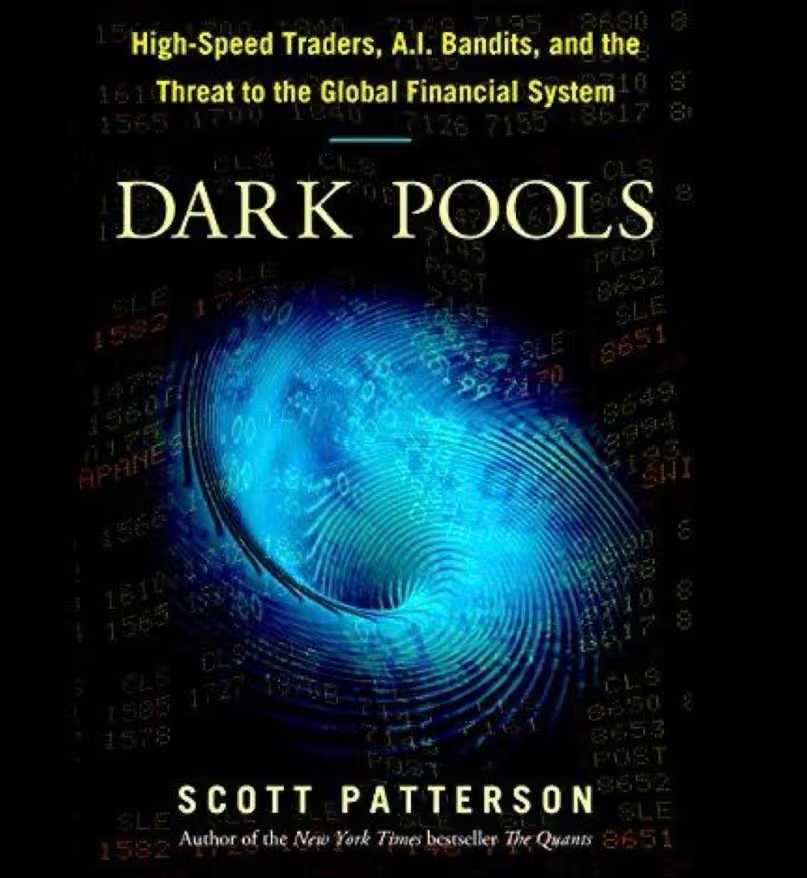
Recently finished reading Dark Pools by @pattersonscott (after several recommendations) while waiting for my pre-order of Chaos Kings to arrive.
It's a truly excellent piece of story-telling about how the stock exchanges moved from manned to digital, specialist to AI-driven, but there's one piece that's absolutely drilled into my brain - mostly because it's an excerpt I fully expect one of us to be echoing word for word on behalf of crypto systems in about five, ten years time.
I'm a DeFi proponent, so I'm generally always looking at things from that angle, but we constantly see claims that crypto trading is nothing more than a giant casino, awash with shitcoins and predators, deserving of regulatory damnation - thing is, back in 2010 that same sentiment was present in TradFi - regulators were completely off the mark and could barely comprehend what was happening, and even those who built the system were at a loss.
I, like others, see the shift of assets (company shares, bonds, repos) to being tokenised and joining the ranks of digital assets as being as natural as the shift from ticker-tapes to HFT that's already taken place - whether that's a good thing for all of us, I don't know: we could be careening towards a disaster zone, but whatever that place looks like, it *is* where we're going, one way or the other.
The traditional markets are still standing, for what it's worth.
I'm going to include the bit that's stayed with me: if not with Scott's permission, than hopefully with his forgiveness (I'll happily delete it if he asks).
Everything that follows comes from Chapter 22 of Dark Pools, excerpting a speech from Thomas Peterffy. See if you can't find where history rhymes:
---
Peterffy had become extremely disillusioned with the market he'd helped create. It wasn't just the deceptive tactics of firms like Trillium, it was the unregulated speed traders who were picking off his own firm's orders, with no firm obligation to stick in the market during tough times. The stock and options markets had been turned into a Wild West of dueling algos - and some firms, it seemed, had special advantages.
Like Haim Bodek at Trading Machines, Peterffy was steamed that his orders were getting clipped time and time again. He wasn't going to take the abuse without fighting back. He cleared his throat, adjusted his glasses, and launched into his speech.
"An exchange used to be a place, yes, a physical place, where people would come together to buy or sell, hoping to achieve the best price for themselves," he said. "The more the exchange was able to attract all of the buy and sell interests in a product, the more the prices on the exchange would reflect the true state of supply and demand."
It was the old mantra: liquidity breeds liquidity. But something had changed.
"In the last twenty years came computers, electronic communications, electronic venues, dark pools, flash orders, multiple exchanges, alternative trading venues, direct access brokers, OTC derivatives, high-frequency traders... Reg NMS in the US - and what we have today is a *complete mess*."
He looked out at the crowd. Dead silence. Peterffy hadn't bothered to warm the audience up with a joke, a humorous anecdote. He got straight to the point - and most of the people in the room didn't like what he was saying.
"It is not so much anymore that the public does not trust their brokers. They do not trust the markets, the exchanges, or the regulators either. And why should they, given our showing the past few years? To the public, the financial markets may increasingly seem like a casino, except the casino is more transparent and simpler to understand."
Visible tension spread through the room. Did Thomas Peterffy just call the market a casino? That was an attack they might have expected from the likes of Arnuk and Saluzzi or Senator Ted Kaufman - but from the founder of Timber Hill and Interactive Brokers, one of the godfathers of electronic trading?
Peterffy, of course, was fully aware that his words seemed to contradict his own history. Like Josh Levine, he had believed that computers would revolutionise markets. And they had. But something had gone wrong.
"I must confess to you that I was an ardent proponent of bringing technology to trading and brokerage. Unfortunately, I only saw the good sides. I saw how electronic trading and record-keeping could be used to force people to be more honest, to make the process more efficient, to lower transaction costs and to bring liquidity to the markets. I did *not* foresee the forces of fragmentation and the opportunity for people to use technology to keep to the letter but avoid the spirit of the rules - creating the current crisis."
He gazed out at his audience. Peterffy wasn't shocked to see the stern faces, the shaking heads and averted eyes. He was certain that he'd become their enemy - and he had little hope that they would listen. The computer-trading elite would never admit that the markets they'd created were deeply flawed. Still, he kept hammering away.
"It is vitally important that we bring an end to this crisis of trust before it spreads any further. That we bring back order, fair dealing, and trust in the marketplace. The financial markets of... the world's developed countries are at a turning point. Technology, market structure, and new products have evolved more quickly than our capacity to understand or control them. The result has been a series of crises over the past few years that have caused many investors to lose confidence or to think that the whole system is a rigged game."
After Peterffy finished speaking, there was silence. Then a scattered handclap. And then the room burst into loud applause.
Everyone realised: Peterffy had actually done it - he'd come out and said what so many were thinking, *what they all knew deep down*. The market was a complete mess. And the old guy was the only one with the balls to stand up there and call a spade a spade. It was a message Dan Mathisson at Credit Suisse would echo a few months later in his speech at the Fontainbleau Hotel in Miami Beach.
Soon after the speech, Peterffy was hobnobbing with the titans of the exchange world. He ran into Sandy Frucher, vice chairman of Nasdaq and longtime chief of the Philadelphia Stock Exchange.
"How are you, Sandy?", Peterffy said.
"I'm well," said Frucher, a gray-haired veteran of the exchange wars. "But I don't wake up in the morning thinking about which windmill to attack."
Peterffy understood exactly what Frucher was saying. In an ideal world, everyone would start behaving himself and stop focusing on the short-term buck, the quick hit.
We all know the truth. You know. I know. This is Wall Street. You're not changing a goddamn thing.

 Scott Patterson
@pattersonscott

 Frank Chaparro
@fintechfrank

 Techmeme
 Ryan Weeks

 Larry Tabb
 Ben Weiss
 Anthony Pompliano 🌪

 Annie Jacobsen
 The Wolf Of All Streets
 Jorge Adrian

 Bill Power

 Commissioner Hester Peirce (Archived)
 Lydia Beyoud
 Yash Roy
 Republicans against Trump
 Carlos Domingo
 Eric Balchunas
 Cristiano Lima-Strong
 Nate Geraci


 Eleanor Terrett
 Brendan Pedersen

 Senate Cloakroom
 Isabelle Lee


 Austin Campbell

 Tom Murphy
 William D. Cohan

 Kieran Goodwin
 ChrisO_wiki

 Spiros Margaris



 Secretary Chris Wright
 John W. Miller

 Nidhi Subbaraman
 Ken Thomas
 Jesse Peltan

 Natalie Andrews


 Yashar Ali 🐘


 Matthew Cappucci


 Sky News Breaking
 Richard Rubin
 Meridith McGraw


 Nick Timiraos


 Amrith Ramkumar


 Joey Garrison
 Brian Schwartz
 Tyler Anderson, MD
 Chip Roy
 Lindsay Wise
 Liz Essley Whyte

 Sadie Gurman
 Ken Dilanian

 amos hochstein
 Timour Azhari
 Carol Massar

 Kevin DeGood

 Interintellect 🧭


 Paul Vigna

 Ben Pershing


 Burak Guler

 lisadimona
 WSJ Podcasts
 Allison Prang

 ransu
 WSJ Communications

 Brody Mullins
 Cara Sloman


 John Raymond Hanger


 James Marsh
 Paul Beckett


 @jessbravin.bsky.social

 Mike Webster



 Justin Wolfers

 MediaREDEF
 TechREDEF


 Sarah Rabil


 Dustin Volz


 Tom Kloza
 Colin McCarthy
 Kristina L. Peterson
 unSILOed Podcast with Greg LaBlanc
 Dror Poleg


 Carlo Buontempo

 Ashlee Vance


 Kevin McPartland

 Jake Sherman
 Simon Moores

 Alwyn Lau


 LeeZ
 Major Richard
 Erin Remblance
 Atman
 Laurent Segalen
 Colin Mckerracher

 TravellingMatti
 Chris 🎸🎵🌍
 Matt Kelly
 Pavan Sodhan


 Dan Breen
 WSJ Business News
 Eleanor Laise



 joshmkim

 Fat Tony's
 Tony Bonanza
 Clay Finck
 Espen Gaarder Haug
 Ronnie Diamonds


 Sahil Bloom
 John Arlidge
 Jaffer Ali
 Chris Boutté

 Markets With Matt

 National Gallery of Art

 Green Investment Partners
 Ron Lagnado

 Bogumil Baranowski

 Digvijoy Chatterjee

 quant


 This Morning
 Carlo

 Digital Citizen DAO
 gabe l. azar
 laurence
 Scribe UK

 Aniyan Nair
 Marcellus Investment Managers
 Matt

 Gergana Koleva

 Juani Villarejo

 JamesVGrimaldi
 Naveen Srinivasan


 Mike Lawler


 Jesse D. Jenkins
 Gráinne McCarthy
 Ben Dummett
 Polya Lesova


 Scribe Publications

 Emma Tucker
 Pomp Podcast
 Waterstones Leadenhall Market

 Sara
 Micah Maidenberg
 Jamie Nolan 🦋


 FT Weekend

 Julia La Roche


 Benoît Delmas

 Michael Covel
 Bunsen TracFone
 Amad Elia

 Victor G. Siu

 Matt Devost
 Science Is Strategic

 Barry Schwartz
 Next Big Idea Club
 Matthew Zeitlin
 Suzan Shagagi
 The Exchange
 Nikki
 joshwa


 Ivan the K™
 Kelly Evans
 Rupert Read 🌍 🔥
 Shreyaansh
 James Hewett
 Tyler Gellasch
 The Investor's Podcast

 Jerry Capital


 Mark Zandi

 Simon & Schuster Audio
 The Compound


 William Green
 jenny strasburg
 Amy Francetic


 Washington Post Live

 Sunnova


 Matthew Rose


 Queens Daily Eagle
 U.S. Fish and Wildlife Service


 PoPville

 Jimmy Rushton
 Eric Niiler


 Elaine Luria
 Tim Hanrahan
 Hannah Muldavin
 Jayce Genco

 Rhiannon Hoyle
 Andrew Restuccia
 Brynne Kelly


 Max Kutner

 Michael Beschloss

 Alistair MacDonald
 TuongVy Le
 Jim Kessler


 Jackie Singh
 philip lewis
 Riho Terras


 Alex Grant

 Gene Berdichevsky


 WSJ+
 Charles Forelle
 michael siconolfi
 J.R. Whalen
 Christopher Leonard
 josh levine

 Pat Kiernan

 Topstep
 W. Brennan Carley

 Robin Hood
 Angus KF
 Ken Brown

 Oliver Darcy
 RAID


 Post Local
 Jason Zweig
 Susanne Craig
 PollingReport.com

 Sarah Krouse

 Rostin Behnam
 Jonathan Randles
 Liam Vaughan


 Magda Romanska

 Bharat Ramamurti
 Roman Parker


 Ross MacDonald
 Patricia Kowsmann


 Tim Quast

 Alexander Osipovich

 Lukas Hensel 🇺🇦
 David Luhnow
 Max de Haldevang


 Alana Abramson

 Gregory Zuckerman
 Mark Dummett


