Politicians, athletes, journalists, NGOs, companies... They all use
corporation-owned social networks to communicate with us. Citizens
shouldn't have to hand over their data to companies to read content
published by public entities. Public Feeds changes that by making posts
of popular accounts freely available.
Read more.
Toine Manders (born 1969)
Twanij Theodorus Antonius Johannes "Toine" Manders (born 17 August 1969) is a Dutch jurist and politician who led the Libertarian Party (LP), a minor political party, from 1994 to 2014. More on Wikipedia
The Bolsheviks seized the Winter Palace in October 1917 and murdered the possibility of the most consequential free market experiment in human history before it ever began.
Russia in 1917 was a vast, agrarian, partially industrializing empire with functioning private property in many sectors, a growing merchant class, active commodity markets in St. Petersburg, and a peasantry that had, since the Stolypin reforms of 1906, begun accumulating private land titles. The country was poor, yes. But poverty is not a fixed condition. It is a starting point. And Russia had every raw ingredient for the kind of capital accumulation that pulled Germany and Japan from ruin to prosperity within two generations.
What Lenin's faction did instead is a tragedy. They abolished private land ownership; they nationalized the banks, and they collectivized grain production, which meant soldiers with rifles went to villages and seized food. The result was famine in 1921 and 1922, which killed five to ten million people. Lenin then partially reversed course with the New Economic Policy, essentially admitting the price system worked and central confiscation did not. Stalin then reversed the reversal, collectivized agriculture completely, and produced the Holodomor of 1932 to 1933, which killed another estimated five to seven million in Ukraine alone.
Without private ownership of capital goods, there are no genuine market prices for those goods. Without prices, planners allocate resources by guesswork and politics. Factories produced what bureaucrats demanded, not what consumers valued. The Soviet Union built steel mills before roads, produced tractors without spare parts, and exported grain while peasants starved.
The counterfactual is not utopian fantasy. Look at Finland, which broke from the Russian Empire in December 1917, secured property rights, maintained rule of law, and by 1980 had a per capita income twenty times higher than the Soviet Union at its peak. Geographic and cultural proximity makes this comparison clean.
Russians lived for seventy-four years inside an experiment that produced bread lines, gulags, and the systematic liquidation of anyone competent enough to run a business. The tragedy is not that socialism failed; it's that the failure cost a hundred million lives before anyone in power admitted it.
Despite this and multiple other examples, socialists refuse to admit their ideology is deeply flawed, and sadly we have not seen the last of this scourge on humankind.
In December 1960, a twenty-three-year-old clerk named Armando Valladares sat at his desk at the Postal Savings Bank in Havana, Cuba.
The new communist regime had issued a directive requiring every government worker to place a small sign on their desk reading: "I am with Fidel."
Armando quietly refused. He stated that he was a Christian, he valued individual freedom, and he would not pledge fealty to a Marxist dictatorship.
Within days, political police raided his home, labeled him a counter-revolutionary, and threw him into a courtroom where a military tribunal handed him a thirty-year prison sentence.
The regime told him that release was simple. All he had to do was sign a single confession admitting his error, renouncing his faith, and declaring support for the socialist revolution. Sign the paper, and he could walk out to his family.
Armando looked his captors in the eye and refused.
The consequences were merciless. Guards shoved him into the infamous cells of Isla de Pinos and La Cabaña. They stripped him of his clothing, denied him medical treatment, and locked him in pitch-black solitary confinement boxes called tapadas. When he launched hunger strikes to protest the torture of fellow inmates, guards cut off his food and water entirely. Malnutrition caused severe peripheral neuropathy, paralyzing his legs and binding him to a wheelchair.
They broke his body, yet they could never touch his mind.
Sitting in total darkness, Armando began writing poetry. Lacking pens and paper, he used toothpicks, cigarette wrappers, and his own blood to write verses detailing the brutal realities of political prisoners.
Outside the prison walls, his young wife, Marta, dedicated her life to his cause. Visiting under heavy scrutiny, she quietly smuggled those bloodstained scraps of paper past armed guards, carrying his words to foreign embassies, publishers, and human rights organizations across the free world.
For twenty-two years, Armando endured beatings, starvation, and solitary confinement. Every few months, officials brought the same confession document to his cell, promising immediate freedom if he yielded his pen. For twenty-two years, he gave them the exact same answer: to sign away his conscience was a price far greater than death.
In 1982, mounting international pressure finally forced the Cuban government to release him. Armando arrived in the United States, gaunt and scarred, carrying the memories of two decades inside a socialist dungeon.
He published his memoir, Against All Hope, detailing the atrocities the world had chosen to ignore.
The book landed on the desk of President Ronald Reagan.
Reagan read the account with tears in his eyes and recognized something rare: an unyielding witness to the cost of human liberty. In 1987, Reagan bypassed the usual circle of career bureaucrats and made a stunning appointment. He named Armando Valladares the United States Ambassador to the United Nations Commission on Human Rights.
Months later, the man who had been starved in a Havana isolation cell rolled into the grand assembly halls of Geneva, Switzerland, carrying the diplomatic authority of the United States.
Taking his seat across from the very Cuban officials who had overseen his torture, Ambassador Valladares delivered devastating speeches exposing the secret labor camps, the political executions, and the brutality of the Castro regime. He successfully organized an international coalition that forced the United Nations to launch a formal inspection into Cuba’s human rights abuses, delivering a humiliating diplomatic defeat to the dictatorship.
Tyrants survive by convincing ordinary citizens that resistance is futile and compliance is safety. Armando Valladares proved that an entire totalitarian empire can be brought to its knees simply because one man refused to put a propaganda sign on his desk. Real sovereignty belongs to those who value their soul more than their comfort.
Ça, c'est la Lada. La dernière « voiture du peuple » organisée par un État.
Puisque Gabriel Attal veut organiser une voiture électrique française à 10 000 €, prenons cinq minutes pour regarder comment ça s'est passé la dernière fois.
En 1966, le Kremlin constate que l'URSS est à la traîne sur l'automobile. C'est écrit dans le plan quinquennal : il faut une grande usine. Problème, l'économie planifiée ne sait pas concevoir une voiture moderne. Alors on va chercher un capitaliste. Fiat. L'usine de Togliatti, sur la Volga, est une réplique de l'usine Fiat de Turin, et la voiture est une Fiat 124 renforcée.
Premier aveu : même pour fabriquer la voiture du peuple, le plan a dû acheter le savoir-faire du marché.
En 1970, les premières sortent de l'usine. Et le réel arrive.
Le prix est fixé par l'État : environ 5 500 roubles. Pour un ouvrier payé autour de 100 à 150 roubles par mois, ça représente plusieurs années de salaire. Pas de crédit. Tu paies tout, d'avance.
Et même avec l'argent, tu n'as pas la voiture. Tu t'inscris sur une liste. Tu attends. Des années. Un tiers de la production part à l'export pour ramener des devises, donc la file s'allonge encore.
Pendant ce temps, ceux qui gagnent une voiture à la loterie d'État la revendent au double du prix officiel. Et les diplomates étrangers payés en dollars repartent avec une Lada neuve, sans attendre.
Voilà l'égalité planifiée : le peuple fait la queue, ceux qui ont des dollars passent devant.
Et la qualité ? Une usine soviétique devait tenir un quota, pas satisfaire un client. Résultat : de la tôle trop fine, des pièces détachées si rares qu'elles devenaient des trésors, et des millions de propriétaires qui apprenaient la mécanique par obligation. La Lada n'avait pas de service après-vente. Elle avait ton week-end.
Le plus parlant, c'est la durée. La Lada classique, dérivée d'une Fiat de 1966, a été produite jusqu'en 2012. Plus de quarante ans sur la même base. Sans concurrence, personne n'a intérêt à innover. Le plan ne meurt jamais. Il vieillit.
Mises l'avait démontré dès 1920 : sans prix libres, sans profits et sans pertes, personne ne sait quoi produire, combien, ni à quel coût. L'État ne sait pas ce que veulent les gens. Alors il le décide à leur place.
Maintenant, Gabriel.
Tu promets une voiture électrique française à 10 000 €. Aujourd'hui, en Europe, aucune électrique neuve n'existe à ce prix. Si le marché ne la produit pas, c'est qu'à ce prix-là, elle ne couvre pas ses coûts. Pour qu'elle existe quand même, il n'y a que trois options : le contribuable paie la différence, on rogne sur la qualité, ou on n'en produit pas assez pour tout le monde.
Subvention, qualité dégradée, pénurie. En général, on a les trois. C'est exactement la Lada.
On sait comment ça finit. Une liste d'attente, un modèle qui ne bouge plus pendant vingt ans, et une facture que personne ne voit parce qu'elle est planquée dans la dette.
Là où on laisse les entrepreneurs se battre, les prix baissent tout seuls. Parce que celui qui ne baisse pas les siens disparaît.
La voiture du peuple, ce n'est pas celle que l'État organise. C'est celle que le peuple peut choisir.
« Voler des voitures, ce n'est pas bien. » Gabriel Attal fait une vidéo façon GTA pour promettre à chaque Français une voiture électrique à 10 000 €.
Gabriel, la dernière fois qu'un État a voulu fabriquer la voiture du peuple, ça s'appelait la Lada.
En URSS, l'État décidait du modèle, de la quantité, du prix et de qui y avait droit. Tu t'inscrivais sur une liste, et tu attendais. Des années. Le jour où ton tour arrivait, tu récupérais une copie d'une Fiat de 1966 que tu allais réparer toi-même pendant vingt ans, parce que les pièces détachées aussi étaient planifiées.
Le plan avait tout prévu. Sauf ce que les gens voulaient.
Et le problème, c'est qu'à chaque fois que je t'entends parler, tu parles de plans.
Ton grand projet, les États-Unis d'Europe, c'est écrit noir sur blanc sur ton site : « une seule politique industrielle, avec une planification par filières ». Des économies fusionnées, pilotées d'en haut par des gens qui n'ont jamais rien produit. Tu changes le drapeau, tu gardes le logiciel. Ce logiciel, on l'a déjà vu tourner. Il s'appelait le Gosplan.
Rien d'étonnant, remarque. Tu as pris ta carte au Parti socialiste adolescent, tu as été élu sur une liste PS, tu as fait tes classes au cabinet de Marisol Touraine. Tu as changé d'étiquette. Pas de réflexes.
Au bout d'un moment, il va falloir commencer à t'intéresser à l'économie, mon petit Gabriel.
Personne dans le peuple ne demande à un politique de fabriquer des voitures. Les gens veulent des voitures moins chères. Ce n'est pas la même chose.
Le seul moyen d'avoir des voitures électriques bon marché, c'est de laisser les entrepreneurs faire. Prendre des risques, échouer, recommencer, faire baisser les coûts usine après usine. C'est exactement ce que fait Elon Musk depuis vingt ans : une voiture chère pour financer la suivante, moins chère, puis la suivante. Chez lui, le plan s'appelle un business plan, et c'est lui qui paie quand ça rate. J'imagine que tu ne le portes pas dans ton cœur, vu ta vision du monde.
Alors je te conseille de commencer à penser à ta reconversion.
En janvier 2024, à Davos, devant tout le gratin mondial, Javier Milei a regardé les entrepreneurs dans les yeux et leur a dit : « Vous êtes des bienfaiteurs sociaux. Vous êtes des héros. » Puis il a ajouté que l'État n'était pas la solution, mais le problème lui-même.
Ce sont les entrepreneurs qui créent la valeur. Pas les politiques.
Ton rôle, c'est le régalien. La police, la justice, l'armée, les frontières. Fais déjà ça correctement, et arrête de mettre ton nez partout, comme ton papa politique Emmanuel Macron depuis 2017.
La Lada, c'était le plan. La file d'attente, c'était le résultat.
Did the Affordable Care Act make healthcare more affordable?
For one, it used complexity as a weapon.
Congress and the Department of Health and Human Services produced 20,000 pages of Obamacare regulations through ambition, specifically the ambition to control one-sixth of the American economy while ensuring that no single human being could ever read, comprehend, or challenge the full body of rules governing it.
When your insurer denies a claim, the appeals process runs through regulatory language so dense that even experienced healthcare attorneys bill hours just to locate the relevant subsection. The complexity itself is the product.
Hayek called this the knowledge problem, and the regulatory regime demonstrates it daily. No central planner holds enough information to price insurance correctly across 330 million people with varying risk profiles, regional cost structures, and individual preferences. Rather than admit this, regulators generate rules to paper over every gap, which creates new gaps, which generate new rules. The document grows. Your premiums grow with it.
Regulated industries love this. UnitedHealth Group employs entire legal departments whose sole function is compliance navigation. A small regional insurer cannot afford that overhead and exits the market. Consolidation follows. Prices rise. Regulators then cite rising prices as evidence that more regulation is needed.
The 20,000 pages also serve another purpose: insulation from accountability. When a policy fails, responsibility dissolves across seventeen agencies, four subcommittees, and three regulatory interpretations issued in different fiscal years. Nobody signed it. Nobody owns it. The bureaucracy did it, which means you absorb the cost and nobody ever faces the consequences.
Those who blame others instead of building anything themselves are the reason socialism is still alive. After all, socialism is designed to break the link between hard work and reward, trap people in dependence, and produce worse results so that every failure becomes an argument for more government control.
The UAE ranks first among 53 economies for entrepreneurial conditions in 2025, with India placing fifth 🌍
Created in partnership with @Adobe as part of Dealmaker Week, this graphic maps the best countries for starting and growing a business using data from the Global Entrepreneurship Monitor.
Eugen von Böhm-Bawerk spent three separate stints as Austria-Hungary's Finance Minister, and each time he left because parliament kept overruling his spending cuts.
Born in Brünn (now Brno) in 1851, Böhm-Bawerk studied law in Vienna, then spent time in Germany under Wilhelm Roscher and Karl Knies. He returned obsessed with one problem: what determines the value of capital goods, and why does interest exist at all? His answer, developed in "Capital and Interest" (1884) and "The Positive Theory of Capital" (1889), was that time preference drives everything. Present goods command a premium over future goods because humans, universally, prefer satisfaction sooner rather than later. Interest is the price of time.
His intellectual sparring with Karl Marx was merciless. In "Karl Marx and the Close of His System" (1896), Böhm-Bawerk demolished the labor theory of value with patient, almost surgical precision. He showed that Marx's Volume III contradicted Volume I, not through rhetoric but through the internal logic Marx himself supplied. Marx's followers have never offered a coherent response.
What you rarely hear is that Böhm-Bawerk personally refused to debase Austria's currency even under intense political pressure in 1900. He resigned his ministry rather than sign off on deficit finance. He returned to teach at Vienna, where Ludwig von Mises sat in his seminar, absorbing lessons about capital structure that would later reshape price theory entirely.
Böhm-Bawerk died in 1914, just as the war his government helped start began dismantling the gold standard he'd spent his career defending.
Italië biedt interessante fiscale voordelen voor ondernemers, vermogenden en pensionado's. Denk aan gunstige belastingregelingen en kansen in vastgoed!
📅 Woe 18 nov | 19:30 uur 🎯 Ontdek de mogelijkheden tijdens ons webinar met Toine Manders!
"Zij komen uit een generatie die vertrouwen heeft in het gezag", zegt Van der Velden Walda. "Als de politie belt en zegt dat er wat aan de hand is en je je spullen moet klaarleggen, dan is dit een generatie die dat ook nog gewoon doet."
Recently I told you there are two kinds of people in this system: cynics and believers.
Ursula von der Leyen, I put her with the believers. And that's exactly why you need to understand how the machine works.
Because cynics are very rare. Soros, I put him in that category: he knows exactly what he's doing, and he has never hidden it.
He read Popper, he has a theory of change, and he understood early on something the right still hasn't figured out: you don't change a society by winning an election. You change it by funding, for thirty years, the people who will write the reports, train the lawyers, and advise whoever wins the elections.
$24 billion spent by Open Society since its creation. More than 50,000 grants. In 2015, he wrote in plain text that the EU must accept at least a million asylum seekers a year, and mobilize NGOs, churches and businesses to take them in.
All of it is public. That's the most impressive part.
Here's how the system got hacked, in three steps.
Step one: selection.
Nobody recruits idiots. No need. The money does the selecting on its own.
A grant never goes to the person who doubts. It goes to the person who already believes. Repeat that over thirty years and tens of thousands of grants, and you get an entire ecosystem where the free thinker was filtered out at the door. He wasn't fired. He just never got funded.
What's left: people who are sincere, credentialed, conformist, and whose paycheck depends on the cause.
Step two: funding manufactures conviction.
Try explaining something to someone whose paycheck depends on not getting it.
The NGO produces a report. The report gets cited by an expert. The expert testifies before the Commission. The Commission turns it into a directive. And the NGO guy ends up in a cabinet, then goes back to a foundation.
Everyone knows each other, cites each other, funds each other. It's an echo chamber with a budget.
Step three: emotion.
You never debate results. You debate intentions.
One photo beats a thousand statistics. Every objection backed by numbers becomes a moral failing. And when reality contradicts the narrative, the dissonance always gets resolved the same way:
"It's a necessary evil." "It's collateral damage." "The real problem is elsewhere." Immigration is never a problem. The problem is your perception. The result: the system doesn't produce corrupt people. It produces NPCs. People reciting a script while convinced they wrote it themselves.
Ursula doesn't need to be bought. She has spent her entire career in an environment where every expert, every report, every "civil society" group tells her the same thing. She is convinced she's on the side of good. And that's what makes her immune to facts.
And the best part of the story: Soros isn't even the system's biggest funder anymore.
You are.
Between 2021 and 2023, €7.4 billion in EU funds went to more than 12,000 NGOs. The European Court of Auditors itself says it can't get a reliable picture of who gets what.
The hack worked so well that the machine now runs on your taxes.
This is not a conspiracy. A conspiracy hides. Here, the amounts are public, the op-eds are public, the recipients are public.
It's an incentive system. And you don't fight an incentive system by insulting the believers. You fight it by cutting off the tap and demanding total transparency: who funds whom, to say what.
As long as it stays opaque, they'll keep shipping believers at scale.
In 1907, a liquidity panic froze New York's credit markets. J.P. Morgan personally organized a private bailout, which worked, but the banking cartel used the crisis as a prop. They needed a lender of last resort, meaning they needed someone else to absorb their losses. Congress gave them the Federal Reserve in 1913, a central bank dressed up in public interest language that was written largely by the bankers it was supposed to supervise.
Then came the war. World War One gave European governments the excuse to suspend gold convertibility and print the money the fighting required. The Fed expanded credit aggressively to finance U.S. war bonds. That expansion did not vanish after the Armistice; it metastasized into the credit bubble of the 1920s. When the bubble collapsed in 1929, the Fed tightened into the contraction and turned a sharp recession into a catastrophe.
By 1933, Roosevelt made it permanent, criminalizing private gold ownership under Executive Order 6102 and confiscating metal at $20.67 per ounce before revaluing it to $35. Citizens lost roughly 41% of their gold's purchasing power overnight by order of their own government.
World War Two completed the centralization. At Bretton Woods in 1944, the dollar became the world's reserve currency, technically convertible to gold at $35 per ounce for foreign governments only. The U.S. now had the exorbitant privilege of printing the reserve currency, and it spent accordingly, running guns, soldiers, and welfare programs on paper promises.
By the late 1960s, France noticed the gap between printed dollars and actual gold and started converting. Nixon stopped this by closing the gold window on August 15, 1971. Pure fiat with no anchor whatsoever. The last thread snapped without a vote, without a constitutional amendment, by executive press conference on a Sunday evening.
The 2008 crisis showed what fiat enables at scale: the Fed created $1.3 trillion in new reserves between September and December 2008 alone to rescue institutions that had bet recklessly. In 2020, the Fed expanded its balance sheet by over $3 trillion in three months. You paid for that through every price you saw rise in 2021 and 2022.
Each crisis produced new powers. Each new power survived the crisis that justified it and became the baseline for the next expansion.
On and on we go; where we will stop, no one knows.
The only mistake sound-money economists have ever made is underestimating banks' and the Fed's ability to kick the can down the road and come up with new, innovative ways to expand the money supply and steal from citizens.
The Weimar hyperinflation of 1923 wasn't just an economic crisis; it was the systematic destruction of Germany's middle class and the social order that held society together. When the government chose to finance its deficits by printing money rather than raising taxes or cutting spending, it unleashed a monetary catastrophe that would reshape German society forever.
By November 1923, it took 4.2 trillion marks to buy a single US dollar. Teachers, engineers, and civil servants who had saved their entire lives watched their nest eggs become worthless overnight. A lifetime of prudent saving couldn't buy a loaf of bread, while speculators and debtors who had borrowed heavily found their debts evaporated by inflation.
The psychological trauma went far deeper than the economic devastation. The German middle class had built their identity around thrift, hard work, and delayed gratification. Values that hyperinflation made not just useless but actively harmful. Those who had played by the rules were punished, while those who abandoned fiscal responsibility were rewarded.
This wasn't merely monetary policy gone wrong, it was the foundation for the political extremism that would follow. When money loses meaning, society loses its anchor, and people become desperate enough to embrace radical solutions. The lesson remains: sound money isn't just about economics, it's about preserving the social fabric itself.
The Sixteenth Amendment passed in 1913 as a wartime revenue measure, sold to Americans as a modest levy on the very wealthy. The top rate sat at 7 percent. Wilson's government promised restraint.
That restraint didn't even last a decade.
By 1944, the top marginal rate hit 94 percent. Today the federal income tax alone reaches 37 percent at the top bracket, and that figure ignores payroll taxes, state income taxes, and the inflation tax the Federal Reserve quietly runs in parallel. You hand over, depending on your state, somewhere between 40 and 55 cents of every marginal dollar earned.
The mechanism is simple: governments never surrender revenue streams voluntarily. What legislators frame as temporary always calcifies into permanent infrastructure, complete with its own bureaucracy (the IRS now employs 90,000 people) and its own enforcement apparatus.
Your labor is property. Compulsory extraction of that property at gunpoint is confiscation. Who receives the payment does not change the nature of the transaction.
Pol Pot. This piece of shit killed an estimated 1.7 million Cambodians between 1975 and 1979, somewhere between 25 and 33 percent of the entire population. He did this by applying an ideology to its logical conclusion. Ideology always has a conclusion; socialism's conclusion is death.
The Khmer Rouge abolished money in 1975. Completely. Banks closed. Markets dissolved. Currency became contraband. They then abolished private property, forcibly relocated urban populations to collective farms, and set central planners the task of organizing rice production for the entire nation. The result was predictable: mass starvation beside the rice fields. Planners cannot coordinate production without prices. Prices require private property and voluntary exchange.
Pol Pot studied in Paris during the 1950s, absorbing French Communist Party doctrine and Maoist agrarianism. Western universities provided the intellectual scaffolding for the killing fields. Coercion requires enforcers, tribunals, and eventually mass graves; Cambodia's are at Choeung Ek.
Every collectivist experiment reaches this same point, because central planners cannot solve what free exchange solves automatically every second of every day.
History will remember two men as the ones who exposed the empire of lies: Javier Milei and Nayib Bukele.
For decades, the same class of experts, NGOs, think tanks and international institutions told us two things were impossible.
That you could kill inflation without destroying a country.
That you could kill violent crime without "addressing root causes" for another 30 years.
Milei took the first one.
Argentina, December 2023: inflation over 200% a year, 25% in a single month. A central bank printing money to fund a state that had become a vote-buying machine. Every economist on TV predicted a social explosion if anyone touched it.
He cut the number of ministries in half. He balanced the budget in his first year. Monthly inflation went from 25% to under 2%. Poverty, which peaked at 52.9% right after the devaluation, fell to 28%, the lowest since 2018. It's not a straight line, poverty ticked back up this year, and he says so himself. But the point is proven: the "impossible" was possible all along.
The lesson is brutal. Endless money printing was never a technocratic necessity. It was a hidden tax on the poor, quietly paying for the people who designed the system and lived off it.
Bukele took the second one.
El Salvador, 2015: 106 homicides per 100,000 people. The most violent country on earth outside a war zone. Gangs ran neighborhoods, taxed every bus driver and every street vendor, and decided who lived and who died.
El Salvador, 2025: 1.3 per 100,000. Lower than the United States.
Every international expert said it couldn't be done. The NGOs called it barbaric. Salvadorans re-elected him with over 80% of the vote, because they're the ones who used to bury their kids.
And now his helicopters are in Haiti, pulling his own soldiers out of gang territory, telling the gangs: we finished with ours, we can finish with you.
So ask yourself the real question. If it was this simple, why didn't anyone do it?
Because an entire ecosystem lived off the problem.
Inflation funded the state that funded the clients that funded the elections. Crime created fear, and fear created demand for programs, consultants, studies, panels, subsidies and "experts" who never had to deliver a result. In Latin America it was the gangs. In the West it's mass immigration with no integration and crime with no consequences. Different symptom, same business model: the problem is never solved because too many people are paid to manage it.
Milei and Bukele didn't just fix two countries. They published the proof. Every politician who still says "it's complicated" now has to explain why a guy with a chainsaw and a guy with a baseball cap did in two years what they couldn't do in forty.
Keynes gave governments the intellectual permission slip they had always wanted:
Spend during recessions, stimulate demand, prime the pump, and prosperity follows. It doesn't work. Ludwig von Mises explained exactly why before the ink on the General Theory dried.
The core Keynesian error is treating consumption as the engine of wealth. Keynes fixated on aggregate demand, the total spending flowing through an economy, as the variable governments must manage. Boost it artificially, and you rescue the economy. Production precedes consumption. You cannot spend your way to wealth any more than you can eat your way to a full refrigerator.
Government stimulus spending doesn't create resources. It redirects them. When Washington borrows a billion dollars and injects it into infrastructure or green energy, it pulls that capital away from whatever private actors would have funded. The seen benefit (the bridge, the solar panel factory) obscures the unseen cost: the businesses never launched, the technologies never developed, because the capital was conscripted first.
Keynes also treated interest rates as a policy lever rather than a price signal. Central banks suppress rates below what the market would set, and businesses respond by launching long-term projects that the actual pool of savings cannot support. Mises called this the business cycle. Cheap credit manufactures a boom built on false signals. When the central bank eventually tightens, the malinvestments collapse. The 2008 housing crash followed this script precisely: a decade of Federal Reserve rate suppression funded mortgages the underlying economy could never sustain.
The Keynesian model endures politically because it flatters the powerful. Every recession becomes a reason to spend more, hire more bureaucrats, and expand government reach. Mises simply followed the incentives and found the fraud.
The men who wrote the Constitution owned guns, distrusted bankers, and believed taxation without consent was worth dying over. They would not recognize the country operating under their name today.
Federal spending crossed $7 trillion per year. The income tax, which the founders explicitly rejected, now reaches into every paycheck you earn before you touch a dollar of it. The Federal Reserve, a central bank of the exact type Jefferson warned would strip citizens of property through inflation, has spent the last two decades aggressively expanding the money supply and handing you the bill through rising prices.
The founders drew the federal government's powers in a short, specific list. Congress could coin money, raise an army, and regulate interstate trade. What it could not do is not in that list, because the founders assumed the limits were obvious. They were wrong to assume that.
Today the federal government licenses your profession, subsidizes your competitor, dictates your health plan, and surveils your financial transactions above $600. The administrative state, staffed by unelected bureaucrats at the FDA, SEC, EPA, and an estimated 430 other agencies, writes rules carrying the force of law without a single congressional vote. Madison called this precise arrangement tyranny in The Federalist Papers(No. 47).
The founders risked hanging to escape a government that taxed tea at 3%. You hand over 30 percent of your income and are supposed to thank the state for the privilege of keeping the rest.
“Als je die regeling afschaft, moeten kinderen bij de overdracht van het bedrijf meteen dat Pro-tarief van 33 procent aftikken. Er is geen land in Europa dat dat doet.”
„Als dit doorgaat, dan is het einde verhaal voor ons familiebedrijf”, zegt Bas Barenbrug van het gelijknamige grasveredelingsbedrijf uit Nijmegen.”
Before the welfare state existed, working-class Americans built their own safety nets, and those nets caught people.
Fraternal mutual aid societies like the Odd Fellows, the Sons of Italy, and hundreds of smaller ethnic lodges ran insurance programs throughout the 19th and early 20th centuries. By 1920, roughly one in three adult American males belonged to one. Members paid modest dues, typically $1 to $2 monthly in 1900 dollars, and received sickness benefits, death payments, and access to lodge doctors who charged $1 to $2 per year per family. The Foresters of America covered 900,000 members by 1908. These institutions ran on mutual contracts between people who knew each other; it wasn't charity.
Accountability created alignment of incentives. Lodge members had every incentive to verify that sick claims were genuine, because fraudulent payouts drained their own pool. Government bureaucrats face no such incentive. Someone else bears the cost of fraud in their system.
The lodge doctor system collapsed because the American Medical Association lobbied state legislatures throughout the 1910s and 1920s to ban contract medicine. Doctors working for lodges earned less than AMA members preferred. The state obliged, eliminated the competition, and left citizens with the fee-for-service monopoly that still strips your paycheck today.
Voluntary cooperation built welfare that worked. Politicians dismantled it.
Ireland ran a functioning legal order for a thousand years without a state, and the system worked.
Brehon Law, derived from the Old Irish word "brithemain" (judges), governed Gaelic Ireland from approximately 600 AD until English conquest systematically dismantled it through the 17th century. No legislature wrote it, no police force enforced it, no prison system backed it. The law lived in a professional class of jurists who spent twenty years memorizing and interpreting a body of customary rules, competing for reputation in a market where your credibility was your entire business model.
Brehon Law ran on a system of sureties and honor-price called "lóg n-enech". Every person carried a social credit rating attached to their rank and conduct. Damage your neighbor's property, and a surety (a third party who had vouched for you) paid the victim and then collected from you. Your honor-price collapsed if you defaulted. Ostracism in a tight-knit pastoral society was a punishment severe enough to discipline behavior without building a single prison.
This is polycentric law operating in practice. Multiple tuatha (petty kingdoms) competed for population. If your lord governed badly, you walked to a neighboring tuath. Exit was real. That competitive pressure kept the legal system honest in ways no monopoly court system can replicate, because you cannot exit the jurisdiction of the state that taxes you.
English crown lawyers never argued Brehon Law was unjust. They called it barbaric because it produced order without them.
Quango van de maand: ATKM. €12,9 miljoen, 330 verwijderbevelen en een kantoor dat niemand kan vinden.
Nederland heeft sinds september 2023 een nieuwe overheidsautoriteit: de Autoriteit online Terroristisch en Kinderpornografisch Materiaal. ATKM. Want Nederland had natuurlijk dringend behoefte aan nóg een zelfstandig bestuursorgaan.
Aan het hoofd staat Arda Gerkens, voormalig SP-parlementariër. En dat levert meteen een prachtige historische paradox op.
Haar SP-collega’s verdedigden jarenlang politieke contacten met Hamas. Harry van Bommel ontmoette in 2007 Hamasvertegenwoordigers in Damascus, ondanks afspraken om dat niet te doen. In 2009 riep hij tijdens een demonstratie op tot een intifada. De SP wilde Hamas bovendien als gesprekspartner voor de EU accepteren. Zelfs binnen de partij ontstond later ruzie omdat voormalig SP-senator Anja Meulenbelt vond dat Hamas te hard werd aangepakt.
Nu leidt een voormalige SP-politica een autoriteit die terroristische propaganda van internet laat verwijderen. De geschiedenis heeft echt een gevoel voor humor.
En waar bevindt dit nieuwe bureaucratische wonder zich?
De ATKM publiceert geen bezoekadres. Alleen Postbus 21397, 3001 AJ Rotterdam.
Zelfs de Nationaal Coördinator Terrorismebestrijding en Veiligheid publiceert gewoon zijn bezoekadres. Maar de ATKM niet.
Een autoriteit die online materiaal kan laten verwijderen, maar waarvan je niet kunt achterhalen waar je kunt aanbellen.
In 2024 kostte de ATKM €5,45 miljoen. Een jaar later was dat al €7,45 miljoen. Een stijging van 37%. In twee jaar tijd verdween €12,9 miljoen in deze nieuwe overheidsorganisatie.
Vooral de personeelsuitgaven schoten omhoog. In 2025 ging ruim €3 miljoen naar eigen personeel en nog eens €2,38 miljoen naar externe consultants. Samen €5,44 miljoen, bijna driekwart van alle uitgaven.
De kosten voor eigen personeel stegen met 67%, die voor externe inhuur zelfs met 83%.
En dat voor een organisatie die eind 2025 slechts 37 voltijdsfuncties telde, inclusief externe medewerkers.
De detectiesoftware die medio 2025 klaar moest zijn, kwam er niet. De aanbesteding leverde niet het gewenste resultaat op. Dus gaat de overheid nu zelf software ontwikkelen. Dat belooft wat.
En het kantoor is alweer te klein.
Fantastisch. We weten niet waar ze zitten, maar kennelijk zitten ze er inmiddels boven op elkaar.
Wat hebben we voor die miljoenen gekregen?
Ongeveer 330 verwijderbevelen voor terroristische inhoud in twee jaar. Daarnaast ruim 220 verwijderde afbeeldingen van seksueel kindermisbruik in 2025. Dat is 40.000 euro per verwijderbevel.
In dat jaar betrof 84% van de terroristische bevelen “rechts-terroristische” inhoud en 16% jihadistische inhoud. Wat dat precies is, is vaag.
Welke concrete video’s, berichten, websites of kanalen zijn verwijderd? Ik heb de jaarverslagen bekeken. Geen enkel individueel identificeerbaar voorbeeld.
Wel percentages, procedures, managementtaal en organisatieschema’s.
Een onafhankelijke evaluatie kon bovendien niet vaststellen of de activiteiten daadwerkelijk tot minder terroristisch materiaal op internet hebben geleid.
Ondertussen bestonden politie, justitie, internationale samenwerking, hostingbedrijven en Offlimits al. Waarom was daarvoor nog een afzonderlijke autoriteit nodig?
En hier een oprecht compliment.
Petje af voor Lousewies van der Laan. Haar adviesraad vraagt om aantoonbare resultaten en waarschuwt dat platforms uit angst voor sancties ook legale uitingen verwijderen. Terecht: wie controleert de censuur?
€12,9 miljoen verder hebben we een uitdijende autoriteit, dure consultants, vertraagde software, een te klein kantoor zonder openbaar bezoekadres en geen overtuigend bewijs van de uiteindelijke maatschappelijke meerwaarde.
Quango van de maand: ATKM. De overheid weet waar jij woont, bepaalt wat er online mag blijven staan, maar vertelt niet waar haar eigen kantoor zit.
Le preguntaron a Bukele en Argentina cómo sacaron a los jóvenes del modelo del narco: la casa grande, el coche caro el smartphone… cuando trabajar honesto tarda años. Su respuesta duele porque es verdad
"El gobierno llega tarde si espera reinsertar al que ya violó, ya mató y ya cortó cabezas. A un niño de 6 u 8 años sí se le puede cambiar la vida. Al que ya eligió el mal... el joven que vende tomates en el mercado, suda, carga, gana $5… y en la esquina el pandillero se los quita. ¿Qué incentivo gana? ¿Vender tomates o ser el que cobra? Por eso nunca se gana la guerra de incentivos si el criminal sigue en la calle.
Porque el Estado no puede pagarle triple salario mínimo para que deje el crimen. Eso no es gobierno, sino ingenuidad cara. Un organismo me dijo: «no puedes acabar el crimen de un golpe, son 70 mil empleos, esa plata llega a los hogares y se gasta legal». Lo que ellos insinuaban era que dejara vivir al cáncer para no lastimar la economía. Bukele les respondió con otra analogía: si tengo cáncer con metástasis y me ofrecen cirugía, quimio y quedar débil… pero vivo, me opero. No me quedo así nomás esperando que el tumor sea educado."
Le dijeron que el PIB podía caer hasta 10% por sacar esa economía sucia. No cayó. Subió. Porque el miedo también es un impuesto. Y ese sí lo pagábamos todos los días. Sacaron al pandillero de la ecuación y no sólo para castigarlo, sino para que el muchacho que todavía no entra en ese mundo vea otro menú. Ya no es: «me hago pandillero y gano». Ahora es: «me hago pandillero y pierdo mi libertad». Eso no es odio, es orden. Es proteger a la familia que sí trabaja, a la que manda la remesa, a la que nunca tuvo casa grande porque no cobraba renta de sangre. 30 años de discursos. 7 años de resultados. El resto es teoría para intelectuales.
Tal vez necesitamos un Bukele en España. Y en el mundo.
The Berlin Wall existed to imprison people, not protect them. East Germany's Socialist Unity Party built it overnight on August 13, 1961, because 3.5 million citizens had already fled west since 1949. What kind of paradise requires machine guns and tripwires to retain its residents?
East German factories produced goods nobody wanted at costs nobody could measure, generating poverty through maximum industrial effort. The Trabant, a plastic car running on two-stroke misery, took eleven years to obtain and became the symbol of socialist production.
Wages set by bureaucrats rather than markets punish productivity and reward compliance. You cannot vote against a system with your ballot when the party controls every ballot. You can, however, vote with your feet. East Germans voted emphatically, roughly 2,000 per day before the Wall stopped them.
The Wall's construction was the state admitting defeat in the plainest possible language. Concrete and barbed wire replaced ideology because ideology stopped working. Border guards killed at least 140 people attempting to escape between 1961 and 1989. Socialism held its population through lethal force, the final honest price signal the system ever produced.
Jesse Klaver en Jimmy Dijk spreken graag over de groeiende rijkdom van Quote 500 en miljardairs. Maar hoeveel iemand bezit, zegt op zichzelf weinig over de welvaart van de rest van de samenleving.
Vermogen is geen vaste taart die eerlijk verdeeld moet worden. Ondernemers kunnen nieuwe waarde creëren, waardoor ook anderen rijker worden. De relevante vraag is daarom niet alleen hoeveel de rijkste procent bezit, maar vooral hoe de levensstandaard van de armste mensen zich ontwikkelt.
Sinds 1990 is extreme armoede wereldwijd spectaculair gedaald. In dezelfde periode nam het aantal miljardairs sterk toe. Dat bewijst geen rechtstreeks oorzakelijk verband, maar ondergraaft wel het idee dat groeiende rijkdom aan de top noodzakelijk ten koste gaat van de armen.
Bovendien bestaat het vermogen van ondernemers als Musk en Bezos grotendeels uit aandelen, niet uit miljarden op bankrekeningen. Die aandelen vertegenwoordigen ondernemingen, productiemiddelen en toekomstige inkomsten.
Een vermogensbelasting belast geen geld dat ergens ongebruikt op een plank ligt. Ze belast fabrieken, machines, aandelen en investeringskapitaal. Zelfs wanneer een ondernemer verlies lijdt, eist de staat zijn deel. Om die belasting te betalen, moet hij soms aandelen verkopen of investeringen schrappen. De politiek noemt dat de rijken laten betalen. Ik noem het het belasten van toekomstige welvaart.
Daarmee ontstaat een fundamentele vraag: wie beslist over de bestemming van kapitaal?
Ondernemers investeren onder concurrentiedruk. Verkeerde beslissingen kunnen hun vermogen vernietigen. Politici besteden belastinggeld en leggen verantwoording af via verkiezingen, maar ondervinden niet dezelfde directe financiële gevolgen.
Frankrijk biedt een waarschuwing. Het land combineert hoge collectieve uitgaven met een omvangrijke staatsschuld en langdurige begrotingstekorten. Hoge belastingen garanderen kennelijk geen gezonde overheidsfinanciën.
China’s marktgerichte hervormingen vanaf 1978 en India’s liberalisering vanaf 1991 laten juist zien hoe economische ruimte kan bijdragen aan enorme armoedevermindering. Ook onderwijs, infrastructuur en instituties speelden daarbij een rol. Ook Vietnam en Bangladesh.
Mijn libertaire uitgangspunt is eenvoudig: welvaart ontstaat door productie, ondernemerschap, vrijwillige samenwerking en investeringen. Herverdeling kan inkomensverschillen verkleinen, maar creëert op zichzelf geen extra productie. Maakt iedereen armer en afhankelijker. Behalve de partijbonzen.
Ik beoordeel economisch beleid daarom niet op de hoeveelheid geld die politici bij vermogenden ophalen, maar op de kansen die mensen krijgen om zelfstandig welvarender te worden.
En die 1,9 is nog ruim gerekend. Het is het verschil tussen een wereld van 1,8 C en een wereld van 4,4 C in 2100. Dat 4,4 C-scenario (RCP8.5) gaat uit van een enorme groei van kolen tot het eind van de eeuw. Het is in de nieuwe CMIP7-scenario's voor het volgende IPCC-rapport geschrapt als onrealistisch. De Commissie schrijft zelf dat de klimaatlast daardoor waarschijnlijk wordt overschat.
Met het huidige beleid koerst de wereld eerder op 2,5 C af. Realistisch gerekend wordt het vermijdbare gat dus kleiner, niet groter.
Toch gaat het grootste deel van ons beleid, geld en media-aandacht naar nummer 14.
Een zieke werknemer kost een Nederlandse werkgever 2 jaar loon. In Duitsland is dat 6 weken. In België 30 dagen. In Portugal niets. Geen enkel EU-land komt in de buurt. Nummer twee, Luxemburg, stopt na 77 dagen.
Voor een mkb'er met 8 man personeel is één langdurig zieke werknemer geen tegenvaller maar een bedrijfsrisico. Dus neem je liever een zzp'er of een tijdelijk contract. Of je groeit gewoon niet. En dat is nogal nadelig voor ons ondernemersklimaat.
Wie zich afvraagt waarom kleine bedrijven zo huiverig zijn voor vast personeel: hier is het antwoord.
Javier Milei: “No tengo nada en contra de los artistas. Yo mismo tuve una banda de rock. Mi problema es que si necesitas una subvención del gobierno para hacer arte, ya no eres un artista, eres un empleado público.”
Central planning destroys the Earth and everything beautiful about it.
Between 1948 and 1973, the Soviet Union slaughtered 180,000 whales in the Southern Ocean alone, often falsifying the catch numbers they reported to the International Whaling Commission. Soviet ships hunted species already near commercial extinction: humpbacks, blues, fins, and even orcas. They killed them at a staggering loss, processed them inefficiently, and dumped enormous quantities of oil and meat that exceeded any plausible domestic demand. The operation was economically irrational by any measure.
Which is exactly what you should expect.
No Soviet whaling captain owned the vessel or the whales. No bureaucrat in Moscow bore the cost of depleting the stock. The entire operation ran on state quotas, state ships, and state salaries. Property rights price scarcity into human decisions. Strip them away, and you strip away the signal that tells fishermen, farmers, and whalers when to stop. The incentive structure pointed in exactly one direction: maximize tonnage to hit the plan numbers, regardless of long-run consequences.
Private whalers operating in a system of enforceable property rights face a brutal disciplining mechanism: overfish, and you destroy your own future revenue. The Soviet state answered to a five-year plan, not profit and loss.
Garrett Hardin called this the tragedy of the commons. The Soviets ran that tragedy at industrial scale, with military logistics, for three decades. Hundreds of thousands of whales paid the price.
Germany's planners proved that you can destroy an energy grid without a single bomb, just green ideology and a bureaucrat's signature.
The Energiewende, launched aggressively under Merkel's government after Fukushima in 2011, accelerated the shutdown of nuclear plants that collectively generated 22% of Germany's electricity. Wind and solar expanded, yes, but grid-scale storage technology never followed. Battery infrastructure at the scale Germany needed simply didn't exist. Planners chose to ignore this constraint entirely.
The resulting energy gap had to be filled somehow. Gazprom filled it. By 2021, Russia supplied approximately 55% of Germany's natural gas imports, piped through Nord Stream 1 and the contested Nord Stream 2 pipeline. Politicians celebrated this as pragmatic cooperation. Concentrating energy dependence in a single authoritarian supplier handed Vladimir Putin a loaded gun.
Putin pulled the trigger in 2022.
Russia cut gas flows following the Ukraine invasion, and German households watched their energy bills double and triple. The country scrambled to resurrect coal plants it had previously shuttered on environmental grounds, which was a spectacular act of self-parody. Germany paid spot prices above 300 euros per megawatt-hour in August 2022, compared to roughly 85 euros the prior year.
Germany's energy planners suppressed market signals for a decade, mandated political timelines over engineering realities, and handed the bill to every German family heating their home that brutal winter.
Fantastische repliek van Vlaams ondernemer Bart Verhaeghe op het blijkbaar nogal vijandige ondernemersklimaat in België. @FrncsFlmnt heeft meer fragmenten. Aanrader.
🎥 Webinar Italië – 18 november | 19:30 uur Ontdek de fiscale voordelen voor ondernemers, pensionado’s en vermogenden met Toine Manders en Miranda Aresu.
Seven men boarded a private railroad car in New Jersey on the night of November 22, 1910, under fake names, and by the time they reached Jekyll Island, Georgia, they had begun drafting the legislation that would hand control of American money to the banks that needed controlling.
Nelson Aldrich organized the trip. He was a Rhode Island senator, the father-in-law of John D. Rockefeller Jr., and the chairman of the National Monetary Commission. He brought Paul Warburg of Kuhn, Loeb and Company, Frank Vanderlip of National City Bank, Henry Davison of J.P. Morgan and Company, and a handful of other men whose combined institutions held one-quarter of the world's investable wealth. They told no one. They used first names only on the island. The servants who staffed the Jekyll Island Club were replaced before arrival.
The cover story, once the trip leaked years later, was that these men gathered to reform a broken banking system for the public good. How generous of them.
They built a cartel with a government badge. The Federal Reserve would act as a lender of last resort, meaning your tax dollars and your inflated purchasing power would backstop the riskiest decisions made by the largest banks. Smaller banks, those that competed with Morgan and Rockefeller institutions, would face reserve requirements Washington enforced on their behalf. Credit expansion, which produces the boom-bust cycle you live through every decade, would now operate through a centralized mechanism immune from market discipline.
Warburg, who had spent years lobbying for a European-style central bank in America, drafted the core structure. Aldrich carried it to Congress. Congress passed it as the Federal Reserve Act on December 23, 1913, after many members had already left Washington for Christmas recess.
The scheme operated through rhetorical genius. They named it a reserve system, implying caution. They called it federal, implying public ownership. A private banking cartel now possessed the legal authority to manufacture money. You have been paying the interest on that arrangement ever since.
Lysander Spooner committed the unforgivable act of taking the state's own logic and following it to its conclusion: anarchism.
Born in 1808 in Athol, Massachusetts, Spooner spent his adult life attacking government monopoly with the fury of a man who had personally been robbed. In 1844 he launched the American Letter Mail Company to break the Post Office's stranglehold on mail delivery. His rates undercut the federal monopoly immediately. Within two years Congress passed legislation explicitly banning private competition, because the Post Office could not compete on price and quality and survive.
That episode tells you everything. When the state wins, it wins by outlawing the competition.
Spooner's 1870 work "No Treason: The Constitution of No Authority" demolished the consent doctrine underpinning every modern government. A contract signed by men long dead binds you to nothing. You never signed the Constitution. Your grandfather never signed it. The men who ratified it in 1788 had no authority to mortgage your liberty to a federal government in perpetuity. Spooner made this argument with the rigor of a lawyer, which he was, having studied law under John Davis and Charles Allen in Worcester.
His natural law theory drew property rights from human labor directly, bypassing the state entirely. Production precedes the state. Rights precede legislation. Governments confiscate rights.
Free market thinkers inherited Spooner's anti-monopoly logic and applied it to every sector the state subsequently captured.
Monopoly requires a gun at someone's back. Without state coercion forcing competitors out of a market, no single firm can permanently dominate one.
There is a sharp distinction between two types of monopoly. The first, a government-granted monopoly, uses legislation to make competition illegal. The second, so-called "market monopoly," exists only in textbooks. Standard Oil is the favorite villain here. John D. Rockefeller built Standard Oil to roughly 90% of U.S. refining by 1879 through relentless cost-cutting and voluntary contracts. He never arrested a rival.
Competitors were entering the kerosene market the entire time, and oil prices fell from 58 cents per gallon in 1865 to under 8 cents by 1885. Consumers benefited. The government then broke Standard Oil apart in 1911, and the successor companies collectively became more valuable than the original. Government intervention created problems where none existed.
In a genuinely free market, high profit margins do exactly what prices are supposed to do: they shout at every entrepreneur with capital that an opportunity exists. That signal draws entry. Entry competes profits down. The firm that refuses to innovate loses your business to the firm that does.
Permanent dominance requires one of two things: either your product is so superior that no one can match it (in which case you earned every penny, and society as a whole benefits from your productiveness), or you lobbied Congress to outlaw your competition. The U.S. Postal Service holds a legal monopoly on first-class mail delivery; without that, it would have stopped existing very long ago.
The state creates monopoly. The market dissolves it.
Give Me the Man, I'll Find the Crime – How the Soviet Terror Machine Worked.
"Give me the man, and I'll find the crime." The line is attributed to Lavrentiy Beria, head of Stalin's secret police. Whether or not he said it, it describes the whole machine.
1. It began in December 1917, six weeks after the revolution: the Cheka, the "Extraordinary Commission." Its founder was Felix Dzerzhinsky – a Pole by birth. Twenty years later, the machine he built would make Poles its largest group of national victims.
2. The principle was set from the start. In 1918 a Cheka chief instructed his men: don't look for evidence of what the accused did. Ask what class he belongs to, what his origin, education and profession are – that decides his fate. Guilt was no longer a matter of acts. It was a matter of categories.
3. The machine changed its name – GPU, OGPU, NKVD – and kept growing. And it ran like the rest of the Soviet economy: on a plan. Regions received quotas of people to arrest, shoot or deport, and local chiefs asked Moscow for higher ones. Three-man tribunals passed sentences in minutes. Terror by quota – a planned economy of death.
4. In 1937 Nikolai Yezhov – a small man, barely five feet tall, later known as "the bloody dwarf" – took the machine to its peak. He would not survive it. Confessions were extracted by torture, officially permitted. Neighbors denounced each other for an apartment, colleagues for a promotion. Being accused was proof enough: the accused confessed to plots that never existed, and named others, who confessed in turn.
5. Then came the anti-Polish operation – the clearest proof that the machine was never looking for the guilty. Order 00485, August 1937, targeted a "Polish Military Organization" that had been dissolved in 1921. The categories were written so that almost any Pole would fit, and in Leningrad officers combed the address registers for Polish-sounding names. A Catholic prayer book was evidence. A letter from a cousin in Warsaw was espionage. Interrogators wrote the confessions, torture got the signatures, and the verdicts came in "albums" – a few lines per person, signed in Moscow by the hundred. Killing as paperwork. Nearly four in five of those sentenced were shot: about 111,000 people. A Pole in the Soviet Union was some forty times more likely to be shot than an average citizen. The goal was not to find the guilty. It was to erase inconvenient people from existence. And the Poles, with their unyielding character and love of freedom, were always inconvenient for any totalitarian system. Reminds you of anyone today?
6. The machine devours its own. Yezhov was arrested in 1939 and shot – and then erased even from the photographs, the same erasure he had applied to others. His successor, Beria, proposed in March 1940 the execution of Polish officers, policemen and intellectuals held as prisoners. Around 22,000 were shot – Katyn. At the same time, in the West, the Germans were murdering Poland's elites too. On this, the two totalitarian systems fully agreed. When Stalin died, Beria was arrested and shot too.
7. And the apparatus never really died. It became the KGB, then the FSB. Russia's security officers still celebrate "Chekist Day" every December 20. Its president is a former KGB officer.
The method outlived the regime as well. Find the man first – then search his life for the crime. In the West, the soft version is called lawfare: the process is the punishment.
The West reads about this in history books. In Poland, it is family memory. That is why we recognize the method instantly – in any language, under any name.
——
The picture below says it all. Literally erasing people: Nikolai Yezhov, the "Bloody Dwarf" – small and bloody in more than one way – walking beside Stalin. Then the same photograph, a few years later.
"We geven als land vele honderden miljarden euro’s uit om de opwarming van de aarde tegen te gaan, maar laten zonder gewetensnood duizenden Nederlanders doodvallen in hun ijskoude huizen. Zo hardvochtig zijn deugmensen. Er zijn veel meer klimaatBELEIDsslachtoffers dan klimaatslachtoffers. Maar die doen er blijkbaar niet toe."
The Nazi economy was socialism in a better-tailored uniform. Strip away the parades and you find exactly what Mises diagnosed in 1940 as Zwangswirtschaft: private ownership on paper, total state control in practice. You held the title to your factory. Göring's ministries told you what to produce, what to charge, whom to hire, and where your profits went. That is ownership the way a prisoner owns his cell.
Hjalmar Schacht ran the monetary con. From 1934 the Reichsbank financed rearmament through Mefo bills, off-books IOUs worth 12 billion Reichsmarks by 1938, hiding the printing press behind a shell company. Berlin froze wages in 1933 and prices in 1936, so the inflation surfaced as shortages and ration cards instead of rising numbers. You have watched the same trick play out in Caracas.
The "economic miracle" in your textbook was conscription plus capital consumption. Unemployment fell because Hitler drafted young men into the Wehrmacht and labor battalions while forcing women out of the workforce. Real wages stagnated below 1929 levels. The 1936 Four Year Plan chased autarky, burning capital on synthetic rubber and gasoline that cost multiples of the world price.
By 1939 the regime faced the choice every inflationist regime faces: liquidate the malinvestments or loot the neighbors. Hitler chose Poland. War was not incidental to this economy. It was the business model.
Lyndon Johnson declared war on poverty in January 1964, and poverty promptly won.
The Office of Economic Opportunity launched that same year, spending $800 million in its first year alone. By 1980, the federal government had spent over $3 trillion (in today's dollars) across the constellation of Great Society programs: Medicaid, food stamps, housing subsidies, community action agencies, the whole apparatus. The poverty rate in 1964 sat at 19 percent. By 1973, it had fallen to 11 percent. Impressive, until you notice it was already falling at precisely that rate throughout the 1950s, before Johnson spent a single dollar.
The market was already doing the job.
What Johnson created was a dependency infrastructure. The Aid to Families with Dependent Children program paid higher benefits when no father lived in the household, which subsidized his departure.
Between 1965 and 1980, out-of-wedlock births among black Americans climbed from 25 percent to 56 percent. Charles Murray documented the numbers exhaustively in "Losing Ground" (1984), and the left never refuted the math; instead, they attacked Murray personally.
Bureaucracies administer poverty rather than eliminate it. Every dollar Washington sends to a poor family in Chicago passes through a federal agency, a state agency, a county office, and a caseworker's desk first. The machinery consumes a stunning share before anything reaches you.
Capital formation, voluntary exchange, and sound money pulled more people out of destitution in the 19th century than every federal program combined has since Johnson's cameras rolled in the Rose Garden.
Every one of us started out as a mental communist.
A very small child believes that wishing makes it so. The world revolves around him. Food appears, toys appear, someone else pays for everything. When reality says no, he cries: "It's not fair!" And when something breaks, it's someone else's fault.
Normally, children figure out around four that it isn't so. The mental communist doesn't.
The rest of us learn it from reality. The stove is hot. The toy breaks. The friend leaves. Wishes don't move the world; work does. Freud called it the passage from the pleasure principle to the reality principle. It is called growing up.
The mental communist never made that passage. He is fifty years old, and still four.
Why? Because he was protected from reality for too long. A comfortable home, endless studies, a job in an institution where being wrong costs nothing, and a state that plays the parent. Peter Pan was the boy who wouldn't grow up. Today Neverland has a campus, a newsroom and a ministry.
And so the fantasies became delusions.
A child's fantasy is soft. It gives way when reality pushes. A delusion is hard. It survives every piece of evidence – that is what makes it a delusion.
You recognize the grown child easily. The tantrum when reality says no – today we call it outrage. Rights without duties. Someone else always pays – only the parent has become the state. Every failure is someone else's fault: he started it. And the imaginary friend – "humanity," "the people," "history" – who always agrees with him.
Here is the danger. A child's fantasy is guarded by his parents. A grown man's delusion is guarded by power – and paid for by everyone else.
What grows people up is what it always was: consequences, work, responsibility for someone other than yourself. And nothing ends a fantasy faster than your own baby crying at three in the morning.
A civilization is built by adults. It cannot be run from Neverland.
You don't need a party card to be a communist anymore. You don't even need to have read Marx. Mental communism is not an ideology. It is a way of thinking – and you meet it every day: in the office, in the newsroom, at the dinner table, in the ministry.
Here is how to recognize it.
1. Words before things. Rename a problem and it's solved. Insecurity becomes "a feeling of insecurity." Rioters become "youths." Censorship becomes "fighting disinformation."
2. Intentions before results. A policy is good because it means well and sounds good. That it failed is a detail – usually someone else's fault.
3. Humanity before people. He loves humanity. He can't stand his neighbor.
4. The model before reality. When the world doesn't fit the theory, the world must change. A new law, a new program, a bigger budget.
5. An enemy for every failure. The plan never fails. It is sabotaged – by the rich, the speculators, the "far right," the weather.
6. Appearances before reality. Poses before acts: the flag in the profile picture, the slogan at dinner, the open letter signed with a hundred others. Then nothing.
7. Rights for me, rules for you. Free speech for his side, "hate speech" for yours. Private schools for his children, public ones for yours.
8. He never pays. Being wrong costs him nothing – he moves on to the next cause, the next post, the next promotion.
9. Consensus instead of evidence. "Experts agree." "Studies show." "Everyone knows." Ask which study, and you become the problem.
10. No exit. Ask him what would prove him wrong. Silence – or outrage.
Poles recognize it instantly. We lived inside it for forty-five years: the meetings where everyone knew and nobody said, the newspapers reporting record harvests, the slogans on the walls. The regime only partly fell. The habit stayed. And in the West, it never even needed a regime.
What unites all ten? One thing. For the mental communist, reality doesn't exist – only his wishes, his words, his poses, and the power to impose them. Every sign is the same gesture: putting something in reality's place. Words instead of things. Intentions instead of results. A model instead of the world. An enemy instead of a mistake. A pose instead of an act. Consensus instead of evidence. That is also why he never pays and never admits he was wrong: you cannot be wrong about a world you don't believe exists.
Like children living in their fantasies. Children believing that wishing makes it so – except these children have power.
The good news: a habit of mind can be broken. It starts with one sentence, said out loud: the world doesn't work like that.
The US presidency is the most dangerous office in the world.
Here are the top 3 best and worst presidents ever:
Let's start with the best:
1. Grover Cleveland vetoed 414 bills in his first term alone, including congressional handouts to drought-stricken Texas farmers in 1887, on the grounds that the Constitution authorized no such charity. He was right.
2. Warren Harding inherited the sharp 1920-21 depression and did almost nothing, cutting federal spending from $6.4 billion to $3.3 billion and slashing tax rates. The economy recovered within eighteen months, precisely because Washington stepped aside.
3. John Tyler, largely forgotten today, vetoed a national bank bill twice, endured expulsion from the Whig Party, and refused to let Henry Clay transform the Treasury into a political instrument.
These three men share a rare quality: they treated the federal government as a cage, not a tool.
Now the worst.
3. Abraham Lincoln suspended habeas corpus, imprisoned 14,000 political opponents without trial, shut down opposition newspapers, and conscripted men at gunpoint. The war's financing required the Legal Tender Acts of 1862, which forced irredeemable paper greenbacks on US citizens regardless of what contracts previously specified. Centralization of federal power over the states never fully reversed after 1865. The constitutional republic that emerged was a different animal from the one that entered.
2. Woodrow Wilson delivered the Federal Reserve in 1913, the income tax through the Sixteenth Amendment, the military draft, and the Espionage Act, which could imprison anyone for criticizing the war. He segregated the federal civil service. He took the country into a European slaughter with a propaganda apparatus, the Committee on Public Information, designed to manufacture consent. Every major expansion of state power in the twentieth century traces a direct line back to Wilson's two terms.
1. Franklin Roosevelt gets the top prize for catastrophe. He criminalized gold ownership via Executive Order 6102 in 1933, forcing Americans to surrender their gold at $20.67 per ounce, then immediately revalued it to $35, confiscating roughly 41 percent of savings held in the hardest monetary form available. He extended a cyclical recession into a decade-long depression through the National Industrial Recovery Act, agricultural price controls, and relentless uncertainty about property rights. Businesses do not invest when the rules change by executive whim every quarter. Real unemployment never fell below 14 percent throughout the 1930s. He packed the Supreme Court when it resisted. The regulatory state you live inside today, with its 188,000 pages of federal rules, grew from seeds Roosevelt planted between 1933 and 1945.
Power corrupts budgets, currencies, and constitutions with equal efficiency. The best presidents understood their job was to leave you alone.
LASIK eye surgery costs roughly $2,100 per eye today. In 1998, it cost $2,200 per eye. Adjusted for inflation, you are paying about 60% less for a procedure that has simultaneously become faster, safer, and more precise. That is what markets do when left alone.
Now compare that to a hearing aid. The FDA classified hearing aids as prescription medical devices for decades, locking you into audiologist appointments before you could buy a $3,000 device that a manufacturer could produce for $300. Or, look at insulin. Heavily regulated, patent-extended, and politically manipulated, a vial of Humalog ran over $330 in 2024 versus roughly $21 in Canada for a biosimilar. Same molecule. Different regulatory environment.
LASIK sits in a peculiar gap. Insurers rarely cover it, which means third-party payment schemes never severed the price signal between provider and patient. You shop, clinics compete, manufacturers race to improve technology. The feedback loop that markets depend on functions exactly as it should.
Regulated medical markets break that loop deliberately. The FDA's approval process costs pharmaceutical companies over $2.6 billion per new drug on average, erecting barriers that protect incumbents and punish smaller competitors who cannot absorb a decade of compliance costs. Patients then pay the premium on the back end.
LASIK is the control in the experiment. The market won.
Wie denkt dat onderstaand overdreven is, kijkt best even naar de cijfers.
Bijna de helft van de 18 tot 30-jarigen woont nog bij hun ouders. In 2003 was dat 40%.
Van wie zelfstandig wil wonen, lukt het nog maar 45% binnen twee jaar.
Het kindertal per vrouw daalde van 1,80 in 2010 naar 1,42. Volgens CBS speelt onzekerheid over wonen daarbij een belangrijke rol.
Ondertussen stegen de kosten van de asielopvang van €0,7 miljard in 2021 naar €3,7 miljard in 2025. Een plek in de noodopvang kost €65.100 per persoon per jaar.
Dat zijn beleidskeuzes van ons minderheidskabinet.
U heeft totaal het verkeerde perspectief, ik ga een poging doen het uit te leggen, alhoewel ik uit de strekking van uw bericht proef dat een dergelijke uitleg waarschijnlijk paarlen voor de zwijnen zijn.
Jongeren die fulltime werken, belasting en premies betalen en toch gedwongen bij hun ouders blijven wonen krijgen letterlijk geen kans om een toekomst op te bouwen. Vanwege het beleid om statushouders voorrang te geven kunnen ze geen huis vinden, stellen ze het krijgen van kinderen uit of krijgen er minder, en bouwen ze geen zelfstandig leven op, terwijl van hen wel verwacht wordt dat ze de rekening voor migratie betalen.
Dat is geen abstract probleem: het CBS en Rabobank hebben becijferd dat het aandeel thuiswonende jongvolwassenen is gestegen, dat inmiddels bijna één op de vijf 18- tot 30-jarigen wil verhuizen maar niets kan vinden (tegen 6% in 2018). Daar komt bij dat NIDI-onderzoek de daling van het geboortecijfer van 1.80 naar 1.43 per vrouw direct koppelt aan de woningprijzen en het gebrek aan betaalbare gezinswoningen. Wie geen fatsoenlijke starterswoning kan krijgen, begint later of helemaal niet aan een gezin. Dat is structureel je eigen bevolking een toekomst in dit land ontzeggen.
Tegelijkertijd gaan er miljarden naar asielopvang. Alleen de COA-kosten liepen op naar 2.7-miljard in 2023 en stegen naar 3.5 tot 4.7-miljard in latere jaren: de bredere asielketen zit rond de 6-miljard of hoger. Per persoon in de asielopvang gaat het om tienduizenden euro’s per jaar, met noodopvang die nog eens bijna dubbel zo duur is. Nederlandse studies (@demo_demo_nl e.a.) laten zien dat asielmigranten en veel niet-westerse immigranten over hun levensloop netto honderdduizenden euro’s kosten, kosten gemaakt voor onderwijs, bijstand, toeslagen, zorg en justitie overtreffen de belastingen en premies die ze afdragen. Netto kosten deze migranten onze samenleving dus geld en dragen ze netto té weinig bij, behalve in negatieve zin. Criminaliteit, maatschappelijke en sociale ontwrichting, segregatie, etc. etc.
Wie de eigen werkende jongeren die meebetalen aan migratie geen woning en gezin gunt, terwijl diezelfde schatkist miljarden besteedt aan mensen die nog niets hebben bijgedragen en volgens de data in de meeste gevallen ook netto niets gaan bijdragen gedurende hun levensloop, zet eigen burgers op de tweede plaats. Dat is met de uitlatingen van @minister_vro een bewuste prioriteit gebleken: de kosten van open grenzen en statusverlening worden afgewenteld op de generatie die het zich het minst kan veroorloven, namelijk de generatie(s) die straks het stokje over moeten nemen.
Wie deze realiteit ontkent, kiest ervoor om de toekomst van Nederlandse starters op te offeren aan de doctrine van asielsolidariteit. Het structureel achterstellen van de eigen opkomende generatie(s), die nota bene meebetalen aan dit beleid betaalt, is onverdedigbaar. Het is, puur feitelijk bekeken, een vorm van verraad richting de eigen bevolking.
New York’s mayor, Zohran Mamdani, is opening city-owned grocery stores. Five of them, the first one next year. The city will cover the rent and the construction, and a basket of staples will be sold about 30% below market. A "public option," he calls it, for where the market has failed.
It sounds kind. Poland had these stores for over forty years. See the picture below. Let me tell you how it ends.
1. Every Pole knew the joke. A man walks into a shop: "No meat?" The clerk: "No, sir. Here is no fish. No meat is across the street."
2. A store that cannot go bankrupt has no reason to stock what you want. A private grocer who guesses wrong goes broke. A state store that guesses wrong gets a bigger budget. So the shelves follow the plan, not the customer.
3. A price below cost is not a gift. It is a queue. When staples sell for less than they cost, demand runs ahead of supply, and the shelf is empty by ten in the morning. A local shop owner has already predicted it: a handful of stores for eight million people will be jam-packed.
4. The city promises not to compete with local shops – discounts only on the basics. That is how it always begins. In 1947, Poland’s communists launched what they called the "battle for trade." Taxes, inspections and price rules squeezed the private shops one by one, until the state store was the only store left.
5. Scarcity creates a new kind of power: access. The clerk keeps the good meat under the counter for friends. The party elite had their own shops – Poles called them the shops behind the yellow curtains. The store built for equality produced the most unequal access of all.
6. And look at why food is expensive in New York in the first place: rents, rules, taxes, and shops closing because theft goes unpunished. The city that makes groceries expensive now offers to sell them to you itself – typical socialism: fighting the problems you create first.
7. You don’t need to read Hayek to understand this. You only need to have stood in a Polish queue at dawn, with a ration card in your pocket.
Nobody voted for the queues and the vinegar (the only thing that was often left in the shops – because you can’t consume that much of it without anything else). They voted for the promise, but they still got what necessarily follows.
And in every socialist city, the shop that has no meat is always just across the street.
How Your Country Will Rot When You Elect Socialists.
A step-by-step guide. But first, look north – and then across the ocean.
Picture a young couple in Toronto. Two good jobs, no hope of ever buying a home. When she needs surgery, they wait – months. In 2022, a veteran and Paralympic athlete told Canada’s parliament that when she asked the government for a wheelchair ramp, a caseworker offered her assisted dying instead. When truckers protested, the government froze their bank accounts – a court later called that unreasonable. Canada wanted to be America with better manners. It became America’s poorer, sadder cousin.
Now picture a baker in Lyon. He gets up at four to bake, and spends his Fridays filling in forms written in a language only the administration speaks. Every year a new rule, a new tax, a new inspection. His son, an engineer, left for London. Half of what the country produces passes through the state, and the baker can’t remember the last time it gave anything back. Not even security – his shop window was smashed last week and his daughter doesn’t go out after 6 PM anymore.
That is where the road leads. Here is how you get there – meet the Millers. They don’t exist, but you know them.
Step 1 – Kindness. The candidate promises free childcare, frozen rents, free buses. Mrs. Miller votes for him. Who votes against kindness?
Step 2 – The faces. Look at who gets appointed. The young, photogenic spokeswoman, chosen because she looks good in the campaign photo – diversity of faces, uniformity of thought. The kindly old man who worries so much about your goods that soon you have few of them left... And behind them, the people who actually decide: the committee – appointed, never elected – filled with activists, each one certain he knows how the Millers should live.
Step 3 – The bill. First, the rich were supposed to pay. The factory owner moved to Texas, taking two hundred jobs with him. Then the property tax went up. Then the city borrowed – and the Millers’ grandchildren inherited the debt before they were born.
Step 4 – The rules. Their son wanted to build a small house on the family lot. Two years of permits, reviews and fees later, he gave up and moved away. Meanwhile, the landlord with frozen rents stopped fixing anything, and nobody built new apartments – why would they? Homes disappeared.
Step 5 – The state grocery store. To fight "greedy supermarkets," the city opened its own. It can’t go bankrupt, so it has no reason to stock what you want. Its subsidized prices drove the family grocer out of business. Then the shelves began to empty. Poland had these stores for forty years. In the end, the shelves held mostly vinegar only.
Step 6 – Disorder. The pharmacy on Main Street put the toothpaste behind glass. Then it closed. Shoplifting under a certain amount had stopped being prosecuted, so it stopped being punished, so it stopped being rare. The honest customers paid for the thieves – and then lost the shop.
Step 7 – Speech. Their daughter learned at college which words get you reported. Mr. Miller posted a joke and lost his account. Nobody was arrested. Nobody needed to be.
Step 8 – The wolf ticket. Then Mr. Miller spoke up at a school board meeting. A week later, someone called his employer. Then his bank closed his account – "reputational risk." Under communism, Poland called it the wolf ticket: no job, no university place, no future. Nobody goes to prison. You just can’t live.
Step 9 – Dependency. More neighbors now live on a program. At election time, the candidate promises to "protect your benefits." Nobody votes against their own check. The machine has built its own voters.
Step 10 – Shame, and the empty cradle. The school taught the Miller grandchildren that their country was a crime scene to be ashamed of. Their son, in a rented apartment with no house in sight, decided one child was enough. His daughter, grown up, decided none was. The family ceased to exist – another civilization took their place.
And all of it happens behind a smokescreen. Every week a new outrage, a new enemy, a new crisis. Conflict and chaos – nurtured, encouraged. Divide people by race, by sex, by class, and they will never unite against the bill. The news is always about the battle, never about the budget. "You never want a serious crisis to go to waste," a White House chief of staff once said. They never do. While you watch the fire, the machine grows: one more agency, one more rule, one more committee.
Nobody in this story needs to be a villain, at least theoretically… The Millers are good people. Every step felt like progress. Every step looked kind, or fair, or safe.
That is how a country rots: not in a revolution, but one kind policy at a time – each one sending its bill to someone who isn’t in the room.
Look north. Look at France. You still have the choice.
The welfare cliff does not trap poor families by accident.
Congress engineered a benefits system where earning one additional dollar can trigger simultaneous cuts to Medicaid, SNAP, housing vouchers, and childcare subsidies, collapsing your effective income by $5 or more. The government built a cage, and somehow we call it a safety net.
Take a single mother in Houston. She earns $22,000 annually and qualifies for $35,000 in combined federal and state benefits. She gets a raise to $25,000. That $3,000 in new wages costs her $18,000 in benefits. Her employer rewarded her productivity; the state punished her for it. No rational actor climbs that wall.
This is price control, but applied to human ambition. Every welfare threshold functions as a marginal tax rate that would make a Scandinavian bureaucrat jealous, often exceeding 80 or even 100 percent on the next dollar earned. This disincentive is the system's core mechanism.
Dependency concentrates political power. Families tethered to benefit rolls vote to protect those rolls, and the politicians who administer the programs vote to expand them. The cliff self-perpetuates. Free market economists have traced this perverse incentive structure for decades, but the administrative state expands regardless, because a bureaucracy that manages poverty also survives by it.
Genuine exit from poverty requires accumulating capital, building skills, and taking calculated risks. The welfare cliff taxes all three.
Fun fact: I never went to college. I saw my friends who were brought up next to me come home after a single semester and argue racist nonsense with me.
Not a single one of them learned anything useful in university. After 4 years, we joked about how far ahead I was in life because I had gained knowledge by working and reading instead of “studying”, not to mention the financial impact. To this day I don't regret my decision.
I love learning, but not the bullshit some bureaucrat decided I have to learn.
Have you noticed the insane pressure to put your kids through college – almost like a blackmail? It is as if it was recruitment into a sect…
Because it is.
The sect of leftism.
Look at how it works. Every sect uses the same toolkit.
First, the threat. Without us, you are nothing. Your child will flip burgers, marry badly, disappoint the family. Parents hear it from teachers, from neighbours, from other parents at dinner. Nobody says it outright. Everybody feels it.
Second, the price of entry. Years of the child’s life, and often a debt that follows him for decades. A sect that costs nothing is easy to leave. A sect that cost you everything you defend to the end, because the alternative is admitting you were fooled.
Third, separation from the family. The child leaves home at eighteen, the age when the mind is most open and the family most absent. He arrives where nobody knows his parents, and everybody knows what to think.
Fourth, a new language. He comes home at Christmas with words his parents don’t understand, and a moral vocabulary in which they are the problem. The father who paid for it all is now part of what must be overcome.
Fifth, the reward for loyalty. The diploma is not proof of knowledge. It is proof of membership. It opens the doors – jobs, marriages, social standing – that members keep for each other.
And the cleverest part: the parents pay for it. Conservative families raise the child, feed him, form him for eighteen years. Then they pay to have him converted. No sect in history has managed that.
Now the honest part, which makes the blackmail worse, not better: the threat is partly real. In many professions the diploma is still the gate. That is exactly why it works. Blackmail only works when the hostage is real.
The diploma was meant to certify that a young person can think. It now certifies that he thinks correctly. A society that only hires on the second has already stopped needing the first.
So what do we do? Not refuse education. Refuse the monopoly. Learning is not the same as college. A young person can master mathematics, physics, history, a trade and three languages without four years of moral re-education. If he must go, prepare him before he goes. Build alternatives that don’t ask for his soul as tuition. Hire people for what they can do, not for which sect stamped their papers.
In 2010, Polish workers cleaned the houses of British professionals. Today, Poland's GDP per capita sits above $43,000 in purchasing power parity terms, level with Spain and closing fast on France. That reversal took roughly one generation. This was deliberate policy, not luck.
Poland ran a flat tax on business income, kept labor markets comparatively flexible, and spent the 1990s dismantling the Soviet pricing apparatus faster than almost any neighbor. Capital read those signals immediately. Volkswagen, Samsung, and hundreds of smaller manufacturers moved production east. Warsaw became a financial hub, not a branch office.
The EU structural funds helped, obviously, pouring +-160 billion euros into Polish infrastructure between 2004 and 2020. Funds alone don't explain the difference. Ukraine received aid too. Poland built what mattered around the money: enforceable contracts, a functioning court system, and a bureaucracy that didn't simply steal the paperwork.
Respect property, enforce contracts, keep inflation credible, and capital flows toward you. Poland did roughly that for thirty years while Germany and France were busy building regulations that made hiring someone feel like adopting them legally.
The housekeepers became engineers, then managers, then founders. Warsaw startup valuations crossed 50 billion euros in aggregate by 2024. Polish engineers now earn salaries that make relocating to London feel irrational rather than mandatory.
Wealth is produced where producers are left alone to produce it. Poland left them alone just enough.
Another 10 years of this and people from the UK will be cleaning the houses of professionals in Poland.
“Now the number that should keep you up at night. In 1995, GDP per person in France was about $27,000. In America, about $29,000. We were neck and neck. Today France is around $49,000. America is around $90,000. You are now nearly twice as rich per person as we are.
What changed? Not our talent. Not our engineers. Not our schools of mathematics. The only thing that changed is that we went all in on socialism”
My dear American friends, in my last post I gave you a snapshot of where France stands today. Now let me show you how we got here. I want you to see the whole movie before you buy the ticket.
After the war, France was a machine. We called it the Trente Glorieuses, thirty glorious years. We built Concorde, the most beautiful aircraft ever made. We built a fleet of nuclear reactors in about fifteen years and gave ourselves some of the cleanest, cheapest electricity in the world. We built Ariane and put Europe in space. We built the TGV, the fastest train on earth. We invented the Minitel, an online network in millions of homes before most of you had heard of the internet. We were not a museum. We were builders.
Then came 1981. François Mitterrand. Think of him as our Bernie Sanders, except he actually won. At his side, in the office next to his at the Élysée, sat a 37-year-old prodigy named Jacques Attali, his special adviser for the next ten years. The brightest minds of the left, convinced they could run an economy from a ministry.
Here's what they did. They governed with Communist ministers. In 1982 they nationalized dozens of banks and the biggest industrial groups in the country: Paribas, Suez, Saint-Gobain, Thomson, Pechiney, Rhône-Poulenc. They lowered the retirement age to 60. They cut the work week to 39 hours and added a fifth week of paid vacation. They created a wealth tax. They hired massively into the public sector.
Reality hit in less than two years. Capital fled, inflation ran wild, and the franc was devalued three times. In March 1983 Mitterrand had to slam on the brakes and impose austerity just to stay in the European monetary system.
But here's the trick: the brakes never reversed anything. They just slowed the ratchet. The so-called right came back with Jacques Chirac, and nothing was undone. Under Chirac's presidency, France passed the 35-hour work week. Left or right, every government added one more program, one more rule, one more tax, and nobody ever took one away.
At the same time, the political class did something even more destructive than bad economics. It turned the youth into a political instrument. Instead of teaching young people, including millions of children of immigrants, to love the country they lived in, it taught them a story of guilt and grievance: France as the oppressor, France as the thing to resent. You cannot integrate people into a country you've taught them to despise. We are living with the consequences of that narrative today, in our schools, our suburbs, our streets.
Then forty years of slow decline, all the way to Macron. And the story has a perfect ending. In 2007, Jacques Attali chaired a commission on how to unleash French growth. Its deputy rapporteur was a young civil servant named Emmanuel Macron. The commission proposed more than 300 reforms to free the economy. Almost none were ever implemented. Even the men who built the system knew it wasn't working, and even they couldn't undo it.
No balanced budget since 1974. Public spending around 57% of GDP. Debt above 3,300 billion euros. Growth stuck under 1%.
Now the number that should keep you up at night. In 1995, GDP per person in France was about $27,000. In America, about $29,000. We were neck and neck. Today France is around $49,000. America is around $90,000. You are now nearly twice as rich per person as we are.
What changed? Not our talent. Not our engineers. Not our schools of mathematics. The only thing that changed is that we went all in on socialism. The 35 hours, the endless regulation, the taxes that chase out anyone who builds, the belief that the state should do everything and the individual should ask permission for everything.
There's a line people love to attribute to Einstein: insanity is doing the same thing over and over and expecting different results. We tried. For forty years, we tried. Every government promised that one more program, one more tax, one more regulation would finally fix things. You just saw where it got us.
So if you choose the Democratic Party, which is literally turning socialist in front of your eyes, you will deserve what comes next.
Let me tell you exactly what will happen if you go down that road. Nobody will vote for decline. Every single measure will sound generous, compassionate, reasonable. Your builders will slowly leave or stop building. Your state will grow every year and never shrink. Your debt will compound. And in thirty years, your kids will look at a chart like the one I just described and wonder when it all went wrong.
You still have something we lost. You have Elon Musk sending rockets to orbit and landing them on their tail. You have Palmer Luckey building the defense industry of the future. You have Jeff Bezos, Jensen Huang, and thousands of founders nobody has heard of yet, building in garages right now.
Trust your entrepreneurs. Don't trust your politicians.
I’m French. I want to talk to Americans who are about to vote Democrat. Not to insult you. To warn you.
I come from your future.
In France we did everything your progressive politicians promise. Free healthcare, free college, generous welfare, strong unions, heavy regulation, high taxes on the rich, a state that takes care of everything. Public spending close to 57% of GDP, one of the highest on the planet. On paper, it’s the dream.
Here’s what it looks like from the inside. France hasn’t passed a balanced budget since 1974. Our debt is above 3,300 billion euros. Interest on that debt is becoming one of the biggest items in the national budget. Our hospitals are collapsing despite record funding. Our schools rank lower every year. Young people with degrees can’t afford an apartment in the city they were born in. Our best engineers leave for London, Zurich and San Francisco. And the rich you wanted to tax? They left too, and took the jobs with them.
The promise was protection. The result is stagnation.
The worst part is that nobody in France voted for decline. Every single step sounded generous, compassionate, reasonable. One more program. One more regulation. One more tax to fund it. Each step alone makes sense. Fifty years of them, and you wake up in a country that can no longer build a nuclear plant on time or keep its streets safe.
I love America because it’s the one place on earth where people still believe they can build something from nothing. I came to Silicon Valley as a self-taught kid and it changed my life. That spirit is the most precious thing your country has.
Before you vote, ask yourself one question: is the program you’re voting for making America more like America, or more like France?
Je n'ai jamais été aussi optimiste. Pas malgré le chaos actuel, mais grâce à lui.
Je vais vous expliquer pourquoi l'empire du mensonge construit par la gauche depuis cinquante ans va s'effondrer, et pourquoi ce n'est pas une opinion mais une question de physique.
Tout commence avec un mouvement né sur X il y a quelques années : l'effective accelerationism, ou e/acc.
Au départ, c'est une idée presque thermodynamique. L'univers a une tendance de fond : la matière s'organise pour capter et dissiper l'énergie de plus en plus efficacement. Une cellule fait ça. Une forêt fait ça. Une civilisation fait ça. Le marché, la technologie et le capital sont les formes les plus avancées de ce processus. Ce sont des machines à transformer l'énergie en intelligence, en abondance, en complexité.
La thèse e/acc est simple : il ne faut pas freiner cette dynamique, il faut l'embrasser. Plus d'énergie, plus de calcul, plus d'innovation, plus de croissance. Monter sur l'échelle de Kardashev au lieu de s'excuser d'exister. En face, il y a les « décels » : ceux qui veulent ralentir, réguler, taxer, interdire, culpabiliser. Ceux qui voient le progrès comme une menace à contenir plutôt qu'une force à libérer.
Mais il y a une dimension de l'accélération dont presque personne ne parle. L'accélération n'est pas seulement un moteur. C'est un filtre.
Pensez à n'importe quel organisme. Un corps humain en bonne santé peut courir. Il accélère, son cœur pompe plus fort, ses muscles consomment plus d'oxygène, et tout fonctionne parce que le système est bien conçu. Maintenant, prenez un corps malade. Des artères bouchées, un cœur fragile, des organes qui ne communiquent plus entre eux. Faites-le courir. Il ne va pas plus vite vers la santé. Il va plus vite vers l'infarctus.
L'accélération ne corrige pas les défauts d'un système. Elle les amplifie. Un système sain qui accélère devient plus fort. Un système dysfonctionnel qui accélère meurt plus vite.
Et c'est exactement ce qui est en train d'arriver au projet que je vais appeler par son nom : le projet globalo-socialiste. Celui porté par les démocrates américains, par la technostructure de Bruxelles, par les entités supranationales qui n'ont de comptes à rendre à personne, par un réseau d'ONG financées par l'argent public pour dicter la morale aux peuples qui les financent.
Regardez ce que ce projet a produit.
Des États obèses qui prélèvent plus de la moitié de la richesse produite et qui délivrent des services publics de plus en plus dégradés. Des écoles qui n'apprennent plus à lire mais qui apprennent à culpabiliser. Des hôpitaux à bout de souffle malgré des budgets records. Une immigration massive sans aucune exigence d'assimilation, présentée comme une chance par ceux qui n'en subissent jamais les conséquences. Une désindustrialisation organisée au nom d'une écologie punitive qui délocalise la pollution en Chine et l'emploi avec. Des normes, des normes, et encore des normes, jusqu'à ce qu'il devienne plus simple de créer une entreprise à Austin qu'à Lyon. Une justice qui excuse le coupable et soupçonne la victime. Une censure qui avance masquée sous le nom de « lutte contre la désinformation ». Et une jeunesse à qui l'on a expliqué que son pays, son histoire et sa civilisation étaient des crimes à expier.
Ce n'est pas un ensemble de bugs. C'est la conception elle-même.
Maintenant, changeons d'image. Voyez ce système comme un moteur.
Un bon moteur, c'est de la précision. Des pièces qui s'emboîtent, un minimum de frottements, une énergie qui se transforme en mouvement. Le marché libre, la propriété, la responsabilité individuelle, la monnaie saine : c'est ça, un moteur bien conçu. L'information circule par les prix, chaque erreur est sanctionnée, chaque bonne idée est récompensée.
Le moteur socialiste, lui, est mal conçu dès le départ. Il ne tourne pas sur la création de valeur mais sur sa redistribution. Il ne récompense pas la performance, il la taxe. Il ne laisse pas les erreurs mourir, il les subventionne. Résultat : ça frotte partout. Ça chauffe. Ça grince. Chaque pièce use la pièce d'à côté.
Et que font ceux qui pilotent ce moteur ? Au lieu de le reconcevoir, ils changent les pièces. En permanence. Une pièce cède, on en remet une neuve. Encore une. Encore une.
Ces pièces de rechange, vous les connaissez. Elles s'appellent la dette publique et la planche à billets.
La France a dépassé les 3 300 milliards d'euros de dette et n'a pas voté un budget à l'équilibre depuis le milieu des années 70. Les États-Unis ont franchi les 37 000 milliards de dollars. Les banques centrales ont maintenu des taux à zéro pendant des années, imprimé des montants que plus personne ne sait se représenter, et quand l'inflation est arrivée, elles ont fait semblant d'être surprises. Milton Friedman l'avait pourtant dit il y a cinquante ans : l'inflation est toujours et partout un phénomène monétaire.
Chaque crise, on rachète du temps avec de l'argent qui n'existe pas. Chaque problème structurel, on l'arrose de liquidités pour masquer le bruit du moteur. Mais les frottements sont toujours là. Ils s'accumulent. Et la facture des pièces de rechange finit par coûter plus cher que le moteur lui-même : la charge de la dette devient l'un des premiers postes de dépense de l'État français.
Pendant des décennies, ce moteur mal conçu a pu tourner à 3 000 tours par minute. Lentement. Bruyamment. Mais il tournait. Le monde allait assez doucement pour que le bricolage permanent suffise à masquer l'absurdité de la conception.
Et puis l'IA est arrivée.
L'intelligence artificielle, c'est l'accélération la plus brutale de l'histoire humaine. Ce qui prenait des années prend des mois. Ce qui prenait des mois prend des jours. Des entreprises de dix personnes font ce que faisaient des entreprises de mille. Le capital, les talents et les idées se déplacent à la vitesse de la lumière vers les endroits où ils sont bien traités.
L'IA vient de faire passer le moteur de 3 000 à 20 000 tours par minute.
Posez-vous la question qu'un ingénieur se poserait. Que se passe-t-il quand on fait monter à 20 000 tours un moteur mal conçu, rafistolé de partout, qui frotte à chaque rotation ?
Il explose.
Pas parce que quelqu'un l'a saboté. Parce que la physique ne négocie pas.
Et c'est exactement ce que nous voyons en ce moment, sous nos yeux.
L'insécurité qui gagne des villes entières qui étaient paisibles il y a vingt ans. Le conflit de Gaza importé dans nos rues et instrumentalisé par une gauche qui a troqué l'ouvrier contre le clientélisme communautaire. La misère qui revient dans un pays qui a pourtant un des taux de dépense publique les plus élevés au monde. Des classes moyennes qui travaillent et n'arrivent plus à se loger. Une France fracturée, où l'on parle désormais à voix haute de risque de guerre civile.
Ce ne sont pas des accidents. Ce ne sont pas des « crises » successives sans lien entre elles. Ce sont les pièces du moteur qui commencent à voler.
C'est la conséquence logique de cinquante ans de socialisme international : un système qui a détruit la responsabilité, la frontière, la monnaie, l'école et la fierté, et qui découvre qu'à haute vitesse, tout ce qui a été détruit ne peut plus être compensé par une ligne de dette supplémentaire.
Et c'est là que je deviens profondément optimiste.
Parce qu'une fois qu'on a compris ça, on comprend aussi que leur projet a une date de fin. Pas une date politique. Une date physique. Un système qui consomme plus qu'il ne produit, qui punit ceux qui créent et récompense ceux qui détruisent, qui finance son présent en hypothéquant l'avenir de ses enfants, ne peut pas durer indéfiniment. Il n'est pas soutenable par construction. L'IA ne fait qu'avancer l'échéance.
Le mensonge a besoin de lenteur pour survivre. Il a besoin que les conséquences arrivent assez tard pour qu'on puisse accuser quelqu'un d'autre. Dans un monde à 20 000 tours, les conséquences arrivent immédiatement. Le mensonge n'a plus le temps de se cacher.
Alors, que faire quand le moteur explose ? On en construit un nouveau. Et cette fois, on le conçoit correctement.
Écoutez Elon Musk. Un homme qui a reconstruit l'industrie spatiale, la voiture électrique et l'infrastructure satellite en partant d'un principe simple : revenir aux premiers principes. Ne pas demander « comment on a toujours fait », mais « qu'est-ce qui est physiquement vrai ». C'est exactement ce dont nos États ont besoin : arrêter de rafistoler et repartir de la base.
Écoutez Javier Milei. Un homme dont tout le monde se moquait, arrivé à la tête d'un pays ravagé par un siècle de péronisme, et qui a pris la tronçonneuse au sens propre. Ministères supprimés, dépenses coupées, inflation écrasée, excédent budgétaire retrouvé. Il a prouvé une chose que la gauche jurait impossible : on peut démonter le moteur socialiste et le peuple peut le soutenir.
Écoutez Milton Friedman. Relisez-le. Tout était déjà là. La monnaie, la liberté de choisir, la responsabilité, les effets pervers de l'intervention publique. Il disait que si l'on confiait le Sahara au gouvernement fédéral, il y aurait pénurie de sable en cinq ans. On a ri. On a confié le sable. On a eu la pénurie.
Revenez à une hiérarchie et au respect du beau. Une civilisation ne tient pas que sur des chiffres. Elle tient sur l'idée qu'il existe des choses supérieures à d'autres. Que l'excellence vaut mieux que la médiocrité. Que le mérite compte. Qu'une cathédrale est plus belle qu'un parking. Que transmettre est un devoir et pas une oppression. Le relativisme a été l'arme culturelle de ce projet. Le retour du beau, du vrai et de l'exigence en sera l'antidote.
Et enfin, faites le Nuremberg du communisme. Le nazisme a été jugé, documenté, enseigné, et il est devenu moralement indéfendable. Le communisme, avec ses dizaines de millions de morts, ses goulags, ses famines organisées et ses peuples réduits en esclavage, n'a jamais eu ce procès. On peut encore porter un t-shirt du Che dans une université sans que personne ne cille. Tant que ce procès historique et moral n'aura pas eu lieu, l'idéologie continuera de muter et de revenir sous de nouveaux noms. Il faut nommer les crimes, les enseigner, honorer les victimes, et rendre cette idéologie aussi infréquentable que celle qu'elle prétendait combattre.
Le monde qui vient sera plus rapide, plus exigeant et plus impitoyable avec les systèmes mal conçus. C'est une terrible nouvelle pour ceux qui ont vécu du mensonge.
Et c'est la meilleure nouvelle de notre génération pour tous ceux qui veulent construire.
Le moteur va exploser. À nous de dessiner le suivant.
Betraying and killing Maximus Decimus Meridius was far from Commodus's worst act...
When grain harvests fell short that year, Commodus fixed maximum prices on grain across Rome rather than let the market clear. Merchants who had stored reserves against lean seasons now faced a choice: sell below their costs or hold. Most held. Farmers outside Rome cut production rather than sell at a loss. The grain that existed stopped flowing toward the people who needed it most, because the price signal telling traders where to send it had been severed by imperial decree.
The result was famine inside one of the wealthiest cities in the ancient world, sitting on a river connected to Egypt's surplus harvests. The Tiber ran through Rome, and Roman ships controlled the Mediterranean. The physical capacity to feed the city existed. The emperor destroyed the coordination mechanism that would have used it.
A rising grain price tells a merchant in Alexandria that Rome is desperate, that shipping there pays, that stored grain now converts to profit. Fix the price, and you destroy that message before it travels. The merchant stays home. The farmer plants less. You starve.
Price controls produce shortages. Every time. Without exception.
Commodus eventually turned the grain distribution over to his personal agents, which made everything worse. State distribution requires the state to know what markets would have discovered automatically: who needs grain, how much, where it sits, what moving it actually costs. Imperial agents lacked that knowledge and lacked any personal incentive to find it. Romans queued and died while the emperor took credit for caring.
Nicolae Ceaușescu demolished seven square kilometers of central Bucharest, including nineteen Orthodox churches and 40,000 homes, to erect a palace covering 365,000 square meters. He named it the "House of the People." The Romanian people lived without heat through winters that dropped below minus 20 Celsius while their government rationed bread.
This is central planning operating exactly as designed. When the state controls all capital allocation, the preferences of one man replace the preferences of millions. Prices no longer carry information about scarcity; political will does. The palace consumed 700,000 tonnes of steel, one million cubic meters of marble, and 900 million dollars in mid-1980s purchasing power. Meanwhile, Romanians queued for cooking oil and wore coats indoors through January. The regime made this tradeoff deliberately, consciously diverted resources, and suppressed anyone who objected.
Central planning always produces this: concentrated, visible monuments for the ruler, and dispersed, invisible suffering for everyone else. The ruler faces no profit-and-loss signal, no bankruptcy, no customer walking out the door. The people face compliance or a bullet. Without prices generated by voluntary exchange, planners cannot allocate resources rationally. Ceaușescu proved the theorem empirically, at enormous human cost.
Remove the monopoly on force, restore private property, and people will rebuild their own cities without tearing down churches to do it.
"Socialists cry "Power to the people", and raise the clenched fist as they say it. We all know what they really mean - power over people, power to the State." — Margaret Thatcher
The federal government spent $3.8 billion on DARE between 1983 and 2009, and every major longitudinal study concluded the program increased drug curiosity among participants. The General Accounting Office reviewed six long-term evaluations in 2003 and found DARE produced zero statistically significant difference in illicit drug use. The Surgeon General, the National Academy of Sciences, and the Government Accountability Office all said the same thing: DARE failed. Congress kept funding it anyway.
This is what central planners do. They identify a problem, design a solution without market feedback, spend decades ignoring contrary evidence, and protect the program because the bureaucracy depends on it. DARE gave police departments a public relations budget disguised as education. It gave officers a reason to enter schools. The incentive was never reducing drug use. The incentive was institutional survival.
A simpler mechanism is also at work. Tell a twelve-year-old that heroin, cocaine, and marijuana exist, describe their effects in vivid detail, and then instruct him not to try them. You've just handed him a menu. Prohibition teaches the product, not abstinence. Parents who handle this privately, without a uniformed officer narrating the pharmacology of methamphetamine, produce quieter, less curious children on the subject.
The market alternative already existed: voluntary community programs, church groups, family-driven education. None of these required a $3.8 billion federal mandate. The government crowded them out, delivered a worse product, and called the outcome a public health investment.
“Ours may become the first civilization destroyed, not by the power of our enemies, but by the ignorance of our teachers and the dangerous nonsense they are teaching our children. In an age of artificial intelligence, they are creating artificial stupidity.”
The Infrastructure Investment and Jobs Act carried a $1.2 trillion price tag and a noble-sounding name. Congress passed it in November 2021, Biden signed it, and the press celebrated. Roads, bridges, broadband. The whole sales pitch. What actually landed in the bill tells a different story.
Genuine infrastructure spending, the kind that moves physical goods and connects people to markets, accounted for roughly $110 billion of that $1.2 trillion. Roads and bridges got $40 billion in new money. Passenger and freight rail received $66 billion. Broadband pulled another $65 billion. Add it up, and you are still well under 20% of the total, and the real figure for hard infrastructure sits closer to 10% once you strip out programs that would have passed in any normal appropriations cycle.
The remaining $1.1 trillion went to things Congress rebranded as infrastructure. Workforce development, climate resilience programs, electric vehicle subsidies, community development block grants.
This is how Washington operates. Take a word the public trusts, attach it to everything in the hopper, and dare anyone to vote against "roads and bridges." The label launders the spending. You pay for it through deficit financing that the Federal Reserve then monetizes, which erodes your purchasing power as reliably as a direct tax, just less visibly.
No federal agency holds the information needed to allocate capital better than private investors who face actual profit and loss. Amtrak lost money on food service alone for thirty consecutive years before anyone noticed. The bill does not fix one pothole more efficiently because Amtrak now has $22 billion to spend.
No government builds infrastructure. They pass the actual work to their connected cronies in the private sector, after taking their cut.
At least we know Biden actually signed this in person.👇
“It is so hard for people to get out of the notion that life is a zero-sum game. They think if one man benefits, another must lose. But in a free market, both people can benefit.”
Ayn Rand finished We the Living in 1936, the novel is the cleanest fictional autopsy of what collectivism does to actual human beings. She lived it. Born Alisa Rosenbaum in St. Petersburg in 1905, she watched Red Guards seize her father's pharmacy on Nevsky Prospect, leaving the family to scrape through the famine years. The book is her least ideological and most personal: no John Galt speeches, just Kira Argounova trying to study engineering while the Soviet state strangles every path she takes.
The economics sits underneath every scene. When the Bolsheviks abolished private trade, they did not abolish scarcity. Rather, they abolished the price signals that let anyone allocate scarce goods. Kira stands in bread lines because central planners cannot calculate what a market computes automatically through profit and loss. The result is rationed potatoes, confiscated apartments, and jobs handed out by Party loyalty rather than competence. Rand dramatized the calculation problem that Ludwig von Mises had already proven unsolvable, and she did it with a food shortage instead of an equation.
The regime demands not just Kira's labor, but her soul. She must inform, conform, and recite the collective catechism to survive, and the state treats her refusal as sabotage. When the government owns all property, it owns you, because you cannot eat without its permission. Economic control and political control are the same control.
American publishers rejected the manuscript for years (too anti-Soviet for the fashionable 1930s intelligentsia, who still admired Stalin), and it sold modestly until Rand's later fame pulled it back into print. Its diagnosis holds everywhere a planner promises abundance through compulsion: Venezuela's empty shelves after 2014, Cuba's ration books, Zimbabwe, which was turned from a paradise into a giant shithole. Every regime that mistook confiscation for production.
Het verschil tussen de Amerikaanse en Nederlandse constitutionele traditie wordt zichtbaar zodra je kijkt naar de werkwoorden waarmee de macht van de overheid wordt begrensd.
De Amerikaanse Grondwet gebruikt voortdurend formuleringen die de overheid rechtstreeks iets verbieden.
I. “Congress shall make no law…”
Het Congres mag geen wet maken die de vrijheid van meningsuiting, pers, godsdienst, vergadering of petitie aantast. Eerste Amendement.
II. “Shall not be infringed.”
Het recht om wapens te bezitten en te dragen mag niet worden geschonden. Tweede Amendement.
III. “No Soldier shall…”
Soldaten mogen in vredestijd zonder toestemming van de eigenaar niet in particuliere woningen worden ingekwartierd. Derde Amendement.
IV. “Shall not be violated.”
Het recht op bescherming tegen onredelijke huiszoekingen en inbeslagnemingen mag niet worden geschonden. Vierde Amendement.
V. “No person shall…”
Niemand mag onder meer zonder behoorlijke rechtsgang van leven, vrijheid of eigendom worden beroofd. Vijfde Amendement.
VI. “Shall not be required.”
Buitensporige borgsommen en boetes zijn verboden. Achtste Amendement.
VII. “Shall not be construed…”
De opsomming van grondrechten mag niet worden uitgelegd als ontkenning van andere rechten van het volk. Negende Amendement.
VIII. “Are reserved to the States respectively, or to the people.”
Niet toegekende federale bevoegdheden blijven bij de deelstaten of het volk. Tiende Amendement.
En Nederland?
Onze Grondwet gebruikt opvallend vaak andere formuleringen:
Artikel 6: “behoudens ieders verantwoordelijkheid volgens de wet”.
Artikel 7: “behoudens ieders verantwoordelijkheid volgens de wet”.
Artikel 8: “Bij de wet kan dit recht worden beperkt”.
Artikel 9: “De wet kan regels stellen”.
Artikel 10: “behoudens bij of krachtens de wet te stellen beperkingen”.
Artikel 11: “behoudens bij of krachtens de wet te stellen beperkingen”.
Artikel 13: “behoudens de beperkingen die bij de wet worden gesteld”.
Het verschil in constitutionele filosofie is groot.
In de Amerikaanse tekst staat telkens de overheid tegenover een verbod: Congress shall make no law. Shall not be infringed. Shall not be violated.
In Nederland staat tegenover het grondrecht telkens weer de mogelijkheid van een wettelijke beperking.
Amerikaanse rechters erkennen overigens uitzonderingen, en ook Nederland kent absolute constitutionele verboden. Maar de formuleringen verraden een verschil in uitgangspunt.
De Amerikaanse grondwetgever wantrouwde de macht die hij creëerde. De Nederlandse grondwetgever vertrouwde veel meer op de wetgever die hij bevoegdheden gaf.
En vervolgens bepaalt artikel 120 van onze Grondwet ook nog eens dat rechters wetten niet aan diezelfde Grondwet mogen toetsen.
Een libertaire grondwet begint met drie woorden gericht aan de staat: “You shall not.”
Every communist government in history killed its own economy before it finished killing its own people.
The Soviet collectivization of 1929 to 1933 is the cleanest case study. Stalin abolished private farms, centralized grain distribution, and produced a famine that killed between 5 and 7 million Ukrainians. No market existed to signal the shortage. No price spike triggered additional supply. Planners in Moscow simply got the numbers wrong, and Ukrainians starved for it.
Mao's Great Leap Forward (1958 to 1962) repeated this at even greater scale. Peasants melted down farming tools to meet steel quotas, so crops rotted in fields. Between 30 and 55 million people died. The price system, which would have routed food toward scarcity, had been abolished by decree.
Venezuela offers you a recent live demonstration. Chavez nationalized oil in 2007, price controls followed, and by 2019 the bolivar had lost 99.9 percent of its value. Grocery shelves emptied. Physicians fled.
Prices carry the information producers need to allocate resources. Strip that signal away, centralize decisions in a planning bureau, and you get organized, systematic death. Communism failed repeatedly because it physically cannot process the distributed knowledge that voluntary exchange produces every second in billions of transactions.
De Argentijnse economie kent een paradox. Terwijl landbouw, mijnbouw, olie en gas sterk groeien en miljarden aan investeringen aantrekken, stagneert een groot deel van de binnenlandse economie. Industrie en handel blijven achter, de consumptie herstelt moeizaam en de groeiverwachting voor 2026 is teruggevallen tot ongeveer 1,5%. Hoe valt dat te verklaren, bijna drie jaar nadat Javier Milei aan de macht kwam?
Eerst de feiten. Milei trad op 10 december 2023 aan als president van Argentinië. Na zijn eerste ingrijpende stabilisatiemaatregelen bereikte de Argentijnse economie in het voorjaar van 2024 haar dieptepunt. Vervolgens groeide zij tot het voorjaar van 2026 met ongeveer 11%, cumulatief en gecorrigeerd voor seizoensinvloeden. De beursindex Merval steeg sinds december 2023 met ongeveer 85%, gemeten in Amerikaanse dollars. In 2025 groeide het bbp met 4,4%. De huidige vertraging wist dat herstel niet uit.
De verklaring voor de ongelijkmatige groei ligt voor een belangrijk deel in de erfenis van tientallen jaren peronisme, protectionisme, monetaire manipulatie en staatsinterventie.
Argentinië kent internationaal concurrerende exportbedrijven naast een omvangrijke, jarenlang beschermde binnenlandse sector. Importbeperkingen, subsidies, kunstmatig goedkoop krediet en inflatoire financiering hebben inefficiëntie beloond en investeringen ontmoedigd. Het resultaat: lage productiviteit, onderontwikkelde kapitaalmarkten, chronische kapitaalvlucht en een economie waarin politieke connecties vaak belangrijker waren dan ondernemerschap.
Milei heeft het begrotingsevenwicht hersteld, de monetaire financiering van tekorten drastisch teruggedrongen, subsidies verminderd en handelsbelemmeringen afgebouwd. De inflatie is van ruim 200% naar ongeveer 33% gedaald.
Vergelijk Argentinië met Paraguay.
Paraguay groeit naar verwachting met 4,4% in 2026. Het combineert een sterke landbouwsector met monetaire stabiliteit, lage belastingen en goedkope elektriciteit. Dankzij de enorme waterkrachtcentrales Itaipú en Yacyretá produceert het veel meer stroom dan het verbruikt en exporteert het overschot naar Brazilië en Argentinië.
Daardoor is zijn elektriciteitsvoorziening nauwelijks afhankelijk van fossiele brandstoffen en relatief ongevoelig voor energieprijsschokken rond de Straat van Hormuz. Hogere olieprijzen raken uiteraard wel het transport en de landbouw.
Exportgerichte productiebedrijven kunnen in Paraguay bovendien onder bepaalde voorwaarden profiteren van een belastingtarief van slechts 1% over een specifieke productie- of exportgrondslag. Dat trekt internationale investeringen aan die ook in Argentinië hadden kunnen plaatsvinden.
Argentijnse ondernemingen kampen ondertussen met ingewikkelde belastingen, hoge financieringskosten, een onderontwikkelde kredietmarkt en de gevolgen van decennialange institutionele onzekerheid.
Ook Chili en Uruguay demonstreren het belang van monetaire voorspelbaarheid. Brazilië profiteert daarnaast van een veel grotere binnenlandse markt, waardoor consumptie en werkgelegenheid de economie ondersteunen.
De Argentijnse exportsectoren kunnen sterk groeien zonder evenredig veel werknemers aan te nemen. Olievelden, lithiumwinning en grootschalige landbouw zijn kapitaalintensief. De rest van de economie heeft krediet, investeringen, rechtszekerheid en ondernemingsvrijheid nodig.
Daar ligt Milei’s volgende opdracht.
Verdere belastingverlagingen, arbeidsmarkthervormingen, deregulering, handelsliberalisering en sterkere eigendomsrechten moeten ook het Argentijnse midden- en kleinbedrijf internationaal concurrerend maken.
Wie terugverlangt naar subsidies, protectionisme en monetaire expansie, verlangt naar het systeem dat Argentinië decennialang heeft verarmd.
Milei heeft de fiscale fundamenten hersteld en een economisch herstel van ongeveer 11% vanaf het recessiedieptepunt mogelijk gemaakt. Nu moeten de resterende staatsbarrières verdwijnen die miljoenen Argentijnen verhinderen productiever te ondernemen, investeren en werken.
Argentinië heeft geen nieuwe dosis peronisme nodig. Het heeft méér economische vrijheid, méér concurrentie, lagere belastingen en een kleinere staat nodig.
Over niet al te lange tijd zitten wij in de EU er heel anders bij dan kort geleden.
Duitsland, Frankrijk en Italië waren in 1992 samen goed voor 13,8% van de wereldeconomie (PPP). Nu is dat 6,9%. Gehalveerd in één generatie.
De G7 als geheel zakt volgens het IMF van 47% naar 26% in 2031. De BRICS-landen zijn de G7 al rond 2020 voorbijgestreefd.
Opvallend: die groei komt vooral uit India. China blijft rond rond 20% met Rusland, Brazilië en Zuid Afrika kort daarachter. Landen die niet meedoen aan Parijs2030 en de GreenDeal.
Economisch gewicht is geen gegeven. Het moet verdiend worden met groei.
🇳🇱 FM T.Berendsen confirmed that D.Yesilgöz-Zegerius spoke on behalf of the cabinet (WHEN SHE CALLED RUSSIA AN ENEMY). Moscow is informed of the new status in our "relations" and cabinet's position. The war-seeking policy of the Hague is taken into account.
Il a baissé les dépenses publiques de 7 points de PIB en un an.
Selon la théorie keynésienne, cela aurait dû provoquer une crise économique catastrophique de l'ordre de 5 à 10% du PIB.
La réalité? Une baisse de PIB de 1.3% en 2024 et un fort rebond immédiat de 4.4% en 2025, une forte croissance positive de 3.1% sur les deux ans, accompagné par une forte baisse de la pauvreté.
Loin de provoquer une "crise", le passage à la tronçonneuse de Milei a relancé la croissance dans un pays qui stagnait depuis 15 ans et sombrait dans une spirale inflationniste hors de contrôle.
Le secteur privé a presque immédiatement comblé les 7 points de PIB par l'investissement et la consommation.
L'Etat n'est pas un acteur neutre. Il phagocyte la valeur ajoutée, la consommation et l'investissement.
Le plus souvent pour des projets inutiles, hors de prix et mal organisés.
Un gâchis gigantesque de ressources.
Lorsqu'il se retire, l'économie investit mieux, consomme mieux, améliorant l'économie dans son ensemble.
At La Cabaña prison in 1959, Che Guevara presided over tribunals that executed somewhere between 156 and 550 men, many after trials lasting minutes. Appeals were theater. "Judicial evidence is an archaic bourgeois detail," he wrote, which is a convenient position when you are the one holding the rifle.
The man despised markets with the same enthusiasm he despised due process. As head of Cuba's National Bank, he destroyed the peso, printing money and signing the new bills simply "Che" to show his contempt for the whole institution of sound currency. Cubans paid for this in bread lines.
He built labor camps too. The UMAP camps, opened in 1965, held homosexuals, Jehovah's Witnesses, and anyone the regime labeled counter-revolutionary. Forced labor under armed guard. These people needed "moral correction".
Leftists wear his face on a T-shirt, advertising a man who wanted to abolish the very commerce that printed the shirt. He called money a bourgeois disease. He loved the firing squad and hated the price system, which makes sense, because both let strangers coordinate without a commissar's permission.
A killer. Economically illiterate. Incapable of reason. No wonder the left idolizes him.
In December 1960, a twenty-three-year-old clerk named Armando Valladares sat at his desk at the Postal Savings Bank in Havana, Cuba.
The new communist regime had issued a directive requiring every government worker to place a small sign on their desk reading: "I am with Fidel."
Armando quietly refused. He stated that he was a Christian, he valued individual freedom, and he would not pledge fealty to a Marxist dictatorship.
Within days, political police raided his home, labeled him a counter-revolutionary, and threw him into a courtroom where a military tribunal handed him a thirty-year prison sentence.
The regime told him that release was simple. All he had to do was sign a single confession admitting his error, renouncing his faith, and declaring support for the socialist revolution. Sign the paper, and he could walk out to his family.
Armando looked his captors in the eye and refused.
The consequences were merciless. Guards shoved him into the infamous cells of Isla de Pinos and La Cabaña. They stripped him of his clothing, denied him medical treatment, and locked him in pitch-black solitary confinement boxes called tapadas. When he launched hunger strikes to protest the torture of fellow inmates, guards cut off his food and water entirely. Malnutrition caused severe peripheral neuropathy, paralyzing his legs and binding him to a wheelchair.
They broke his body, yet they could never touch his mind.
Sitting in total darkness, Armando began writing poetry. Lacking pens and paper, he used toothpicks, cigarette wrappers, and his own blood to write verses detailing the brutal realities of political prisoners.
Outside the prison walls, his young wife, Marta, dedicated her life to his cause. Visiting under heavy scrutiny, she quietly smuggled those bloodstained scraps of paper past armed guards, carrying his words to foreign embassies, publishers, and human rights organizations across the free world.
For twenty-two years, Armando endured beatings, starvation, and solitary confinement. Every few months, officials brought the same confession document to his cell, promising immediate freedom if he yielded his pen. For twenty-two years, he gave them the exact same answer: to sign away his conscience was a price far greater than death.
In 1982, mounting international pressure finally forced the Cuban government to release him. Armando arrived in the United States, gaunt and scarred, carrying the memories of two decades inside a socialist dungeon.
He published his memoir, Against All Hope, detailing the atrocities the world had chosen to ignore.
The book landed on the desk of President Ronald Reagan.
Reagan read the account with tears in his eyes and recognized something rare: an unyielding witness to the cost of human liberty. In 1987, Reagan bypassed the usual circle of career bureaucrats and made a stunning appointment. He named Armando Valladares the United States Ambassador to the United Nations Commission on Human Rights.
Months later, the man who had been starved in a Havana isolation cell rolled into the grand assembly halls of Geneva, Switzerland, carrying the diplomatic authority of the United States.
Taking his seat across from the very Cuban officials who had overseen his torture, Ambassador Valladares delivered devastating speeches exposing the secret labor camps, the political executions, and the brutality of the Castro regime. He successfully organized an international coalition that forced the United Nations to launch a formal inspection into Cuba’s human rights abuses, delivering a humiliating diplomatic defeat to the dictatorship.
Tyrants survive by convincing ordinary citizens that resistance is futile and compliance is safety. Armando Valladares proved that an entire totalitarian empire can be brought to its knees simply because one man refused to put a propaganda sign on his desk. Real sovereignty belongs to those who value their soul more than their comfort.
“Los consumidores no crean la inflación. Los productores no crean la inflación. La inflación es producida únicamente por un gasto público excesivo y por una creación excesiva de dinero por parte del gobierno, y por nada más.” - Milton Friedman -
Banks do not lend money they have on deposit; they create it out of thin air. When a commercial bank issues a mortgage, it creates a deposit and takes a lien on your house as collateral. The state plays the same game at scale: the Treasury borrows against your future tax payments, and the central bank monetizes the paper. Every unit of new money enters the economy as debt, and debt demands collateral.
Property is the collateral of choice. Roughly 80 percent of British bank lending flows into real estate, and the American picture looks no different. Fresh money hits the housing market first, before wages, before anyone further down the chain sees a penny.
That is why the median American house cost twice the median household income in 1970. The bricks are the same bricks. The money got worse, and it got worse in that market first, because that market is where money is born.
Politicians call this a housing crisis and prescribe subsidies, which means more credit, which means higher prices, which means another round of subsidies. The cycle feeds itself. Your savings cannot outrun an asset class that doubles as the banking system's printing template.
Stop blaming landlords. The lender who conjures the purchase price from nothing sets the bid. Force banks to lend actual savings instead of ledger entries, and housing reverts to what it remained for centuries under sound money: a depreciating consumer good.
The Marshmallow Test – Why Civilizations Live and Die on Patience
At Stanford, around 1970, a psychologist put a marshmallow in front of a four-year-old and offered a deal: eat it now, or wait fifteen minutes and get two. Then he left the room. Years later, the children who waited did better at school, at work, and in life. Everyone took the lesson to be about children. The real lesson is about civilizations.
1. The test. Watch the videos and you will laugh. Children cover their eyes, sing to themselves, kick the table, and lick the marshmallow without biting it. Some eat it before the door closes. You know these people – some of them are your colleagues, and one of them is you at 11 pm in front of the fridge.
2. The twist. In 2012, researchers ran the test again with one change. First, an adult promised the children better crayons and came back with nothing. Then came the marshmallow, and those children barely waited. Children whose promise had been kept waited four times longer. Patience is not only character. It is trust: you wait only if you believe the second marshmallow will really come.
3. Economists call this time preference: how much you value now over later. The interest rate is simply the price of waiting. Every civilization is a marshmallow test at scale. You plant a tree whose shade you will never sit in, you build a cathedral over three generations, you save for children you have not yet had.
4. The broken promise. Communism was the crayon experiment run on a whole nation. In Poland, money lost its value, savings vanished, and the state could take what you built. So people learned to eat now. If something appeared in the shop, you bought it, whether you needed it or not. It wasn’t because Poles were impatient. It was because they had learned the adult never comes back.
5. The four-year child. A politician has four years, and the bill arrives after he leaves. Public debt is a simple trick: we eat the marshmallow, and our children pay for both.
6. Money that rots. Inflation tells you that waiting is for fools. A decade of near-zero interest rates told every saver in Europe that the second marshmallow had been cancelled. So we got "buy now, pay later", credit for holidays, and an economy built around eating it now. Then the phone finishes the job: one-click buying, endless scrolling, a new reward every few seconds. It’s a machine designed to make sure you never have to wait for anything again.
7. The lesson. Civilization is not having more marshmallows. It is the ability to wait for them, and that ability rests on trust: stable money, safe property, promises kept. Destroy that trust and you get a nation of four-year-olds eating sweets, which is exactly what you then complain about.
The West blames its people for living for today. But it was never the children who failed the test. It was the adults who broke the promise – and then sold them more marshmallows on credit.
"Socialism heroically fights problems unknown in any other system."
Yes – this guy was one of our most brilliant intellectuals. Meaning a guy producing real understanding – not vapid commentary dressed up as depth. One sentence of his explains more than a shelf of political science.
1. The law. First the system creates the problem. Then it creates an office to fight the problem. Then it blames the people for the problem. Then it asks for more power to fight harder. Every step looks like a solution, and the whole thing is a trap.
2. The proof. In Poland we lived under these absurdities for 45 years. The state fixed the price of meat, so meat disappeared. Then came ration cards for meat. Then people sold meat privately at its real price, so the state made that a crime called "speculation" and set up special bodies to hunt the speculators. It was a problem unknown in any other system, and the state fought it heroically.
3. The queue. We got to know the machine deeply, from the inside, standing in line. You queued first and asked what was being sold later. People walked home wearing toilet paper rolls on a string around their necks, like trophies. And we learned to laugh about it. A man walks into a shop: "No meat?" "No, sir, here we have no fish. No meat is across the street."
4. The merriest barrack. We were called the merriest barrack in the communist camp. Other barracks were grimmer. We laughed at the queues, at the Party, and at ourselves, with jokes whispered at work and told loudly at weddings. The system had the army, the police and the press. We had the punchline.
5. The joke as knowledge. The laughter was not an escape. It was understanding. A good joke is a model of the system that fits into ten seconds. "They pretend to pay us, and we pretend to work" is a whole economics textbook in one line. The communists could censor newspapers, but they could never censor the joke.
6. The man. Stefan Kisielewski, known as Kisiel – the name of a sweet fruit jelly. He was a composer and a columnist, and readers opened the Catholic weekly from the last page, where his column was. He was the only public figure in communist Poland to openly praise capitalism from the parliament rostrum. In 1968 he called the regime a dictatorship of dimwits. Days later, "unknown attackers" beat him in the street. The tongue out was his method: a regime that demands to be taken seriously fears nothing more than a man who laughs at it – and is right.
7. The West today. Germany shut down its nuclear plants, then fought an energy crisis. Berlin capped rents, then fought a shortage of flats. Brussels writes rules that strangle industry, then launches plans to save European competitiveness. Each time, the problem is new to them. It was not new to us.
We laughed because we knew. The West does not laugh yet, because it still believes. The jokes come later – right after the queues.
Parkinson’s Law – Why the State Bureaucracy Grows When the Work Shrinks
In 1955, a British naval historian wrote a joke for The Economist. Seventy years later, it remains one of the most accurate descriptions of the modern state ever written. Everyone knows the slogan: work expands to fill the time available. Almost no one knows the mechanism underneath it. That mechanism explains Europe.
1. The evidence. Between 1914 and 1928, the Royal Navy lost two thirds of its largest warships. Over the same years the Admiralty – the office that ran the ships – grew by three quarters. There were fewer ships and more men behind desks. Then there was the Colonial Office, which kept growing while the colonies left one by one. It was hiring while the empire was shrinking.
2. The first mechanism. An official who feels overworked has three choices. He can resign, he can share the work with a colleague, or he can ask for two subordinates. He never chooses the colleague, because a colleague is a rival. Two subordinates are a rank. So one tired man becomes three. Then each of the two subordinates feels tired.
3. The second mechanism. Seven people now do what one did, and they keep each other busy with drafts, approvals, and comments on the approvals. Everyone works hard, and nothing is produced. You have been in this meeting. You have been copied on this email. You have watched three people sign the form that one person filled in.
4. The law of triviality. Parkinson noticed that a committee will approve a nuclear reactor in minutes, because nobody understands it. The same committee will debate the bicycle shed for an hour, because everybody does. Bureaucracy does not avoid the important question by accident. It avoids it by design – the small question carries no risk, and on the big one, someone’s name goes on the decision.
5. The ratchet. A business that fails closes. A department that fails gets a bigger budget, because the problem is now bigger. Failure is the bureaucracy’s best argument for itself. This is why the state never shrinks on its own: every problem it does not solve becomes a new office for solving it.
6. The civilizational lesson. Burnham described the managers taking over. Parkinson showed how they breed. Put the two together and you get Brussels. You get France, where the state spends more than half of everything the country produces and still cannot fix a hospital. This is not because the people inside are wicked. It is because the machine works exactly as Parkinson said it would.
7. The vindication. Parkinson was dismissed as a humorist. Then Milei cut Argentina’s ministries in half – and the country did not collapse. It barely noticed, except on the bill. The lesson is simple: you cannot reform a bureaucracy by asking it what to cut. It will always propose to cut the ships – and hire someone to manage the cut.
1. Ludwig von Mises and the Calculation Problem; then 2. Friedrich Hayek and the Knowledge Problem.
They are distinct, and it's important to understand the difference.
Mises fired first. In his 1920 paper "Economic Calculation in the Socialist Commonwealth," he drove a stake through the heart of central planning by showing that rational economic calculation is impossible without private ownership of the means of production. Prices are not arbitrary numbers. They are signals generated by actual bids and offers between property owners who face real profit and loss. Strip away private property, and you strip away the bidding process. Strip away the bidding process, and prices become bureaucratic guesses. A Soviet planner deciding how much steel to allocate between rail construction and tractor manufacturing has no genuine price for steel because no one is buying or selling it freely. He is flying blind. The problem is structural, not administrative. Hire smarter planners, give them faster computers; it changes nothing. The information cannot exist without the market process that generates it.
Communists read this and realized Mises was right. They found a roundabout way to keep going. They would simply use prices from Western capitalist countries.
Then Hayek hit them with his 1945 essay "The Use of Knowledge in Society." His target was subtly different. Hayek accepted that prices aggregate information. His contribution was to identify what kind of information markets process: local, dispersed, tacit knowledge that no central authority can collect. A warehouse manager in Düsseldorf knows that his particular supplier is three weeks behind schedule. A farmer in Kansas knows the soil conditions on his specific plot after last month's frost. A textile merchant in Lyon knows which dyes his buyers currently prefer. None of this knowledge is written down anywhere. Much of it the people holding it cannot fully articulate. It lives in habits, relationships, and on-the-ground experience accumulated over years. No survey, no commissar's report, no algorithm extracts it reliably. You cannot copy it from one country to another.
Mises showed that central planners lack the mechanism to generate rational prices. Hayek showed that even if planners somehow had prices, they still could not possess the ground-level knowledge those prices encode. Mises's problem kills socialist calculation at the structural level. Hayek's problem kills it at the epistemological level. The two arguments are complementary, stacked on top of each other like floors of a building.
The Soviet Union ran this entire experiment in full. Central planners in Moscow set over 20 million prices by the late Soviet period. Shortages and surpluses coexisted everywhere. Bread rotted in one city while another city's bread lines stretched around the block. Planners were not uniquely corrupt or stupid. They were operating inside an institutional structure that made rational allocation geometrically impossible, exactly as Mises predicted in 1920 and exactly as Hayek's epistemology explained in 1945.
Every government price control, every production quota, every centralized allocation scheme you live under today repeats this mistake at a smaller scale. The mechanism fails whether the commodity is steel, housing, or healthcare. The scale changes; the logic does not.
El socialismo tiene un mecanismo perverso que repite sistemáticamente en toda América Latina: SE APROPIA DE CAUSAS NOBLES PARA JUSTIFICAR CURROS INDEFENDIBLES.
Primero elige una causa moralmente atendible. Los discapacitados, los jubilados, la universidad pública. Después, en nombre de esa causa, exige cada vez más gasto público, crea estructuras burocráticas gigantescas y administra cajas multimillonarias sin controles ni transparencia.
¿Y qué pasa cuando alguien llega y se anima a preguntar dónde está la plata? ¿Cuando alguien pretende auditar esas cajas?
APARECE EL CHANTAJE MORAL.
No muestran los números. No rinden cuentas. No explican nada. Te acusan de estar en contra de los discapacitados, de los jubilados o de la educación.
Porque el objetivo no es discutir cómo ayudar a quienes mas lo necesitan. EL OBJETIVO ES QUE NADIE SE ATREVA A CUESTIONAR SU NEGOCIO.
Y cuando finalmente se abren las cajas, aparece lo de siempre: intermediarios, estructuras militantes, privilegios y curros financiados con el dinero de los pagadores de impuestos.
USAN A LOS POBRES COMO ESCUDO MORAL PARA DEFENDER LOS PRIVILEGIOS DE LA CASTA.
Lo vimos en la Argentina y lo vemos en cada país donde el socialismo logró echar sus garras.
Siempre el mismo mecanismo. Siempre el mismo chantaje. Siempre los mismos beneficiarios. Y siempre las mismas víctimas: los que verdaderamente necesitan ayuda y los argentinos de bien que pagan la fiesta.
NO DEFIENDEN DERECHOS. DEFIENDEN CAJAS.
QUE SE ABRAN TODAS LAS CUENTAS. QUE SE PUBLIQUE CADA CONTRATO. QUE CADA RESPONSABLE RINDA CUENTAS HASTA DEL ÚLTIMO PESO. LOS ARGENTINOS MERECEN SABER EN QUÉ SE GASTA SU DINERO.
Parkinson’s Law – Why the State Bureaucracy Grows When the Work Shrinks
In 1955, a British naval historian wrote a joke for The Economist. Seventy years later, it remains one of the most accurate descriptions of the modern state ever written. Everyone knows the slogan: work expands to fill the time available. Almost no one knows the mechanism underneath it. That mechanism explains Europe.
1. The evidence. Between 1914 and 1928, the Royal Navy lost two thirds of its largest warships. Over the same years the Admiralty – the office that ran the ships – grew by three quarters. There were fewer ships and more men behind desks. Then there was the Colonial Office, which kept growing while the colonies left one by one. It was hiring while the empire was shrinking.
2. The first mechanism. An official who feels overworked has three choices. He can resign, he can share the work with a colleague, or he can ask for two subordinates. He never chooses the colleague, because a colleague is a rival. Two subordinates are a rank. So one tired man becomes three. Then each of the two subordinates feels tired.
3. The second mechanism. Seven people now do what one did, and they keep each other busy with drafts, approvals, and comments on the approvals. Everyone works hard, and nothing is produced. You have been in this meeting. You have been copied on this email. You have watched three people sign the form that one person filled in.
4. The law of triviality. Parkinson noticed that a committee will approve a nuclear reactor in minutes, because nobody understands it. The same committee will debate the bicycle shed for an hour, because everybody does. Bureaucracy does not avoid the important question by accident. It avoids it by design – the small question carries no risk, and on the big one, someone’s name goes on the decision.
5. The ratchet. A business that fails closes. A department that fails gets a bigger budget, because the problem is now bigger. Failure is the bureaucracy’s best argument for itself. This is why the state never shrinks on its own: every problem it does not solve becomes a new office for solving it.
6. The civilizational lesson. Burnham described the managers taking over. Parkinson showed how they breed. Put the two together and you get Brussels. You get France, where the state spends more than half of everything the country produces and still cannot fix a hospital. This is not because the people inside are wicked. It is because the machine works exactly as Parkinson said it would.
7. The vindication. Parkinson was dismissed as a humorist. Then Milei cut Argentina’s ministries in half – and the country did not collapse. It barely noticed, except on the bill. The lesson is simple: you cannot reform a bureaucracy by asking it what to cut. It will always propose to cut the ships – and hire someone to manage the cut.
"Socialism heroically fights problems unknown in any other system."
Yes – this guy was one of our most brilliant intellectuals. Meaning a guy producing real understanding – not vapid commentary dressed up as depth. One sentence of his explains more than a shelf of political science.
1. The law. First the system creates the problem. Then it creates an office to fight the problem. Then it blames the people for the problem. Then it asks for more power to fight harder. Every step looks like a solution, and the whole thing is a trap.
2. The proof. In Poland we lived under these absurdities for 45 years. The state fixed the price of meat, so meat disappeared. Then came ration cards for meat. Then people sold meat privately at its real price, so the state made that a crime called "speculation" and set up special bodies to hunt the speculators. It was a problem unknown in any other system, and the state fought it heroically.
3. The queue. We got to know the machine deeply, from the inside, standing in line. You queued first and asked what was being sold later. People walked home wearing toilet paper rolls on a string around their necks, like trophies. And we learned to laugh about it. A man walks into a shop: "No meat?" "No, sir, here we have no fish. No meat is across the street."
4. The merriest barrack. We were called the merriest barrack in the communist camp. Other barracks were grimmer. We laughed at the queues, at the Party, and at ourselves, with jokes whispered at work and told loudly at weddings. The system had the army, the police and the press. We had the punchline.
5. The joke as knowledge. The laughter was not an escape. It was understanding. A good joke is a model of the system that fits into ten seconds. "They pretend to pay us, and we pretend to work" is a whole economics textbook in one line. The communists could censor newspapers, but they could never censor the joke.
6. The man. Stefan Kisielewski, known as Kisiel – the name of a sweet fruit jelly. He was a composer and a columnist, and readers opened the Catholic weekly from the last page, where his column was. He was the only public figure in communist Poland to openly praise capitalism from the parliament rostrum. In 1968 he called the regime a dictatorship of dimwits. Days later, "unknown attackers" beat him in the street. The tongue out was his method: a regime that demands to be taken seriously fears nothing more than a man who laughs at it – and is right.
7. The West today. Germany shut down its nuclear plants, then fought an energy crisis. Berlin capped rents, then fought a shortage of flats. Brussels writes rules that strangle industry, then launches plans to save European competitiveness. Each time, the problem is new to them. It was not new to us.
We laughed because we knew. The West does not laugh yet, because it still believes. The jokes come later – right after the queues.
Parkinson’s Law – Why the State Bureaucracy Grows When the Work Shrinks
In 1955, a British naval historian wrote a joke for The Economist. Seventy years later, it remains one of the most accurate descriptions of the modern state ever written. Everyone knows the slogan: work expands to fill the time available. Almost no one knows the mechanism underneath it. That mechanism explains Europe.
1. The evidence. Between 1914 and 1928, the Royal Navy lost two thirds of its largest warships. Over the same years the Admiralty – the office that ran the ships – grew by three quarters. There were fewer ships and more men behind desks. Then there was the Colonial Office, which kept growing while the colonies left one by one. It was hiring while the empire was shrinking.
2. The first mechanism. An official who feels overworked has three choices. He can resign, he can share the work with a colleague, or he can ask for two subordinates. He never chooses the colleague, because a colleague is a rival. Two subordinates are a rank. So one tired man becomes three. Then each of the two subordinates feels tired.
3. The second mechanism. Seven people now do what one did, and they keep each other busy with drafts, approvals, and comments on the approvals. Everyone works hard, and nothing is produced. You have been in this meeting. You have been copied on this email. You have watched three people sign the form that one person filled in.
4. The law of triviality. Parkinson noticed that a committee will approve a nuclear reactor in minutes, because nobody understands it. The same committee will debate the bicycle shed for an hour, because everybody does. Bureaucracy does not avoid the important question by accident. It avoids it by design – the small question carries no risk, and on the big one, someone’s name goes on the decision.
5. The ratchet. A business that fails closes. A department that fails gets a bigger budget, because the problem is now bigger. Failure is the bureaucracy’s best argument for itself. This is why the state never shrinks on its own: every problem it does not solve becomes a new office for solving it.
6. The civilizational lesson. Burnham described the managers taking over. Parkinson showed how they breed. Put the two together and you get Brussels. You get France, where the state spends more than half of everything the country produces and still cannot fix a hospital. This is not because the people inside are wicked. It is because the machine works exactly as Parkinson said it would.
7. The vindication. Parkinson was dismissed as a humorist. Then Milei cut Argentina’s ministries in half – and the country did not collapse. It barely noticed, except on the bill. The lesson is simple: you cannot reform a bureaucracy by asking it what to cut. It will always propose to cut the ships – and hire someone to manage the cut.
Monaco collects no income tax. Liechtenstein's corporate rate sits at 12.5%. These reflect deliberate policy choices by governments small enough to feel the immediate consequences of driving capital away.
Small states cannot afford to be predatory. A large country like France can tax its productive class into emigration and still run on bureaucratic momentum for decades before the rot fully surfaces. Monaco has 2.1 square kilometers. Drive out your wealth creators on a Tuesday, and you notice it by Thursday. This constraint forces discipline that large states never face.
The second mechanism is competition. When Liechtenstein offers low taxes, genuine rule of law, and strong property protections, capital flows toward it from Germany, France, and Italy, countries where politicians treat your earnings as a communal resource they generously allow you to partially keep. Mobile capital and mobile talent vote with wire transfers and residence permits. The European principalities win those votes constantly.
Secure property rights do the rest. When entrepreneurs trust that contracts hold and confiscation stays illegal, they plan long-term, invest, build. Liechtenstein's per capita GDP exceeded $180,000 in 2024. Monaco's residents hold median wealth that dwarfs most European capitals. Neither state built that through natural resources. They built it by leaving productive people alone.
The formula is genuinely simple: low taxes, sound institutions, enforceable contracts, no appetite for redistribution theater. Every large government on earth knows this formula and refuses it, because taxing you funds the people who vote to keep the taxers employed.
Tijdens onze **Landenspecial Verenigde Arabische Emiraten** leggen Toine Manders en Miranda Aresu uit wat je moet weten over fiscaliteit, emigratie en investeren in de UAE.
👉 **Meer informatie en aanmelden via de link in bio en/of eerste comment.**
De netkosten stijgen hard, en het frame is altijd “we verbruiken steeds meer stroom”. Maar dat klopt niet. Het Nederlandse elektriciteitsverbruik staat al een decennium vrijwel stil. Wat wel explodeerde, is het aanbod. De netverzwaring is voorbereiding op variabel aanbod, niet op groeiende vraag.
De cijfers. Het opgestelde zon-PV-vermogen vervijfvoudigde van 4,6 GWp in 2018 naar 23,9 GWp in 2023, terwijl het totale elektriciteitsverbruik het afgelopen decennium ongeveer gelijk bleef. Aanbod maal vijf, vraag vlak. Dat is geen detail, dat is de hele zaak.
En zon en wind zijn inmiddels geen nichebron meer. De productie uit zon en wind groeide in 2024 met 9% naar 55 TWh, goed voor 45% van de totale elektriciteitsproductie. Bijna de helft van de stroom komt nu uit bronnen die fluctueren met weer en daglicht.
Dat fluctueren is het probleem, niet de hoeveelheid. Een net dat is gebouwd op voorspelbare, regelbare centrales moet nu pieken aan en terugleveren verwerken die in uren ontstaan. Niet meer kWh per jaar, maar veel grilliger verdeeld over de dag. Daar gaat het verzwaringsgeld heen.
Het bewijs zit in de geografie. De meeste laagspanningsstoringen door overbelasting zaten in Groningen en Drenthe. Dunbevolkte provincies met veel teruglevering en juist weinig vraaggroei. Als dit vraag-gedreven was, zaten de knelpunten in de Randstad. Ze zitten waar de zon-PV zit.
De schaal van de operatie. Liander verwacht tot 2033 bijna 40.000 kilometer kabel te leggen en 23.000 transformatorhuisjes te plaatsen. Dit betaalt iedereen via de nettarieven. De vraag is dus eerlijk: waar bereiden we het net precies op voor?
De stijgende netkosten zijn vooral de prijs van een net dat wordt omgebouwd voor variabel aanbod, niet voor een verbruik dat al jaren stilstaat. Wie de rekening “groeiende vraag” noemt, vertelt het halve verhaal. Een deel is anticipatie op toekomstige vraag via warmtepompen en EV’s, maar de knelpunten van nu zijn teruglever-gedreven.
Barack Obama signed the Affordable Care Act in March 2010, guaranteeing you cheaper insurance, more competition, and the ability to keep your doctor. Premiums for individual plans more than doubled between 2013 and 2017. Deductibles climbed so high that millions of technically "insured" Americans still skipped medical care because the out-of-pocket costs were prohibitive.
The government mandated what your insurance must cover, forced healthy young people to subsidize older high-risk pools, and then expressed genuine surprise when prices spiked. Prices always tell the truth.
The 2009 stimulus, officially $831 billion, operated on the Keynesian assumption that government spending creates wealth. Government spending transfers wealth, first taxing or borrowing it from the productive sector, then routing it through political channels where efficiency is nobody's personal concern. The "shovel-ready jobs" Obama later joked about produced no measurable acceleration in recovery. The recession that followed 2008 should have cleared in 18 months, as previous sharp downturns historically did when left alone. The Obama recovery took a decade and delivered the weakest GDP growth of any post-war expansion on record.
Dodd-Frank, signed in 2010, weighs 2,300 pages. Community banks spent compliance budgets they never had, and roughly 1,900 small banks vanished between 2010 and 2016. The big institutions that actually caused the 2008 crisis absorbed the regulatory cost with ease and used the new complexity as a competitive moat. Regulations written by large players consistently protect large players. The middle-class small-business owners who needed credit found fewer lenders willing to offer it.
Obama also expanded drone warfare to seven countries, assassinated American citizens without trial, and extended the surveillance state through a reauthorized PATRIOT Act, which undermines any libertarian's case that the Democratic Party is less hostile to civil liberties than its competition.
Then there was Cash for Clunkers, which destroyed 690,000 working cars in 2009 by crushing them with sodium silicate. Mechanics lost parts inventory. Buyers on a budget lost affordable transportation. Prices for used cars spiked. You paid more so dealers could move new inventory.
A generation of voters watched the government spend $5 trillion across two terms, nationalize health insurance markets, regulate finance into oligopoly, and print money through three rounds of quantitative easing that inflated asset prices and rewarded those who already owned property. You paid higher premiums, earned lower real wages, and watched your savings earn nothing in a deliberately suppressed interest-rate environment. The bill always arrives later. You see the ribbon cutting and the document signing, but you feel the damage to your pocket only years later.
The guns of August 1914 didn't fire themselves. Politicians, generals, and central bankers loaded them over decades.
The standard story blames Franz Ferdinand's assassination in Sarajevo on June 28, 1914. That explanation satisfies nobody who thinks carefully.
Archduke assassinations were not rare in that era. What made this one ignite a continental war was the institutional infrastructure built to make escalation automatic: interlocking military alliances, general staffs with mobilization timetables that could not be paused, and governments funded by central banks that made unlimited war finance possible for the first time in history.
Before the Bank of England normalized deficit spending, wars ended when treasuries emptied. Governments negotiated. Central banking changed this. A state could now print, borrow, and conscript indefinitely. Inflation was the essential prerequisite of total war. Without it, the trenches of the Somme were literally unaffordable. Ludwig von Mises identified this in "Nation, State, and Economy" (1919).
Consider the numbers. Britain expanded its money supply by roughly 1,000 percent between 1914 and 1918. Germany printed so aggressively that it destroyed its own currency by 1923. Every shell fired at Passchendaele, where 325,000 British soldiers became casualties in three months of mud, was purchased with debased currency that quietly robbed citizens of purchasing power while the government told them it was patriotism.
War does not emerge from human nature alone, it scales with the institutional capacity to fund it. Remove the central bank, and the appetite for conquest meets a hard budget constraint very quickly.
🇨🇾 **Dividend uit een Nederlandse BV naar Cyprus: triggert dat de conserverende aanslag?**
🎥 **Deze snippet is een fragment uit het webinar over Cyprus. De volledige webinar van laatst is te koop en terug te kijken via de link in bio of in de eerste comment.**
Europe has regulated itself into managed decline, and the bureaucrats running Brussels somehow think it's progress.
The EU's AI Act, now in full legal effect, classifies AI systems by risk tier and subjects high-risk applications to mandatory conformity assessments, technical documentation requirements, and ongoing human oversight obligations before a single product reaches market. A startup in Warsaw or Lisbon building diagnostic software now faces compliance costs that scale in months of legal work before the product earns its first euro. A venture-backed competitor in San Francisco ships to customers while Europeans are still filing paperwork.
This is the pattern, repeated across every sector the Commission touches.
The General Data Protection Regulation has cost European companies an estimated 200 billion euros in compliance spending since 2018. That capital didn't disappear; it shifted from engineers and servers to lawyers and documentation systems. You can not get that productivity back. Meanwhile, Amazon, Google, and Meta absorbed the compliance cost like a rounding error and locked out smaller rivals that couldn't afford to do the same. Regulatory burdens fall heaviest on entrants, not incumbents, and Brussels handed Silicon Valley a moat while genuinely believing it was punishing them.
Incumbents write the standards, sit on the advisory committees, and embed their legal teams inside the drafting process. Joseph Schumpeter identified creative destruction as capitalism's core engine. The EU has built a regulatory system that protects the engine's replacement parts from the fire.
Germany's industrial output contracted in both 2024 and 2025. French productivity growth has averaged below 0.8 percent annually for a decade. The EU's share of global venture capital sits below 15 percent. Bureaucratic systems produce exactly the outcomes their incentive structures reward. European regulators are rewarded for caution, documentation, and control, never for the startup that got strangled quietly before anyone noticed.
Europe's central banks were not built to protect you, they were built to finance wars.
The Bank of England launched in 1694 with a single purpose: lend William III 1.2 million pounds to fight Louis XIV, and collect interest in perpetuity. Parliament handed a private cartel a monopoly on note issuance. In exchange, the Crown got its war. Depositors got paper promises. The model spread like an infection.
France watched and replicated. John Law established the Banque Générale in 1716, eventually converting it into the Banque Royale, which he used to flood France with paper livres backed by nothing but colonial fantasies about Louisiana. By 1720 the whole scheme collapsed, wiping out French savers across two generations and poisoning French confidence in paper money for over a century.
The lesson Europe drew was not "stop doing this." The lesson was "do it more carefully."
Germany formed the Reichsbank in 1876, Sweden had its Riksbank from 1668 (the world's oldest, and a blueprint every subsequent government copied). Each institution followed the same logic: centralize control, monopolize issuance, and give the state a captive lender when revenue from taxation proves politically inconvenient.
Ludwig von Mises explained that inflation functions as a tax. Every unit of currency created without corresponding production transfers purchasing power from your savings to whoever spends the new money first, which is always the government. That process accelerated dramatically after World War One, when the gold standard's constraints became inconvenient for states that had already promised their citizens more than they could honestly deliver.
The Weimar hyperinflation from 1921 to 1923 is the obvious horror story, but the quieter theft across the rest of Europe through the 1920s and 1930s cost savers just as much over time, simply spread across more years. Gradual expropriation carries less drama and less political resistance.
Every European central bank operating today, including the European Central Bank created in 1998, runs on this same foundational logic: the sovereign needs money, the bank provides it, and you absorb the cost through prices that never quite return to where they were.
Je zal als ondernemer maar in 2023 €700k van je holding geleend hebben en daarmee vastgoed in box 3 gekocht hebben voor je pensioen.
Verkopen kan niet, want er zit een huurder in en verhuurd verkoop je met een flink verlies.
In 2023 lag de grens nog op €700k, dus niks aan de hand. In 2024 werd die verlaagd naar €500k, en ineens werd €200k van je lening behandeld als dividend. Dat kostte je ruim €50k box 2-belasting over geld dat je nooit hebt uitgekeerd.
Nu gaat de grens vanaf 2027 elk jaar met €80k omlaag naar €100k. Dan betaal je vijf jaar lang zo'n €20k per jaar, samen nog eens rond de €100k.
En dat allemaal over je eigen geleende geld, waarover je rente aan je BV betaalt. Je BV betaalt daar weer winstbelasting over, en je betaalt ook nog box 3 over die pandjes voor je oude dag.
Ever wondered what happened to the ozone hole? You haven't heard of it for years, because the money from it has already been made.
The ozone hole shrank. Governments took credit. The actual story is more complicated and considerably less flattering to the regulatory apparatus that claimed victory.
In 1985, British Antarctic Survey scientists Joseph Farman, Brian Gardiner, and Jonathan Shanklin published measurements showing dramatic ozone depletion over Antarctica. By 1987, the Montreal Protocol committed 197 countries to phasing out chlorofluorocarbons, the refrigerants and propellants manufactured primarily by DuPont and a handful of other chemical giants. CFC production in wealthy nations dropped sharply through the 1990s.
By October 2023, NASA measurements showed the Antarctic ozone hole at roughly 26 million square kilometers, still large but meaningfully smaller than the 29.9 million square kilometer peak recorded in 2006. Models project near-full recovery somewhere around 2066.
The regulatory triumphalists point to Montreal and declare the market failed; government saved us. DuPont had already developed HFC replacements before the Protocol was signed, meaning the company holding the dominant CFC patents stood to profit handsomely from a mandated transition that crushed smaller competitors still tied to older chemistry. The "solution" handed DuPont a protected market for its next product line. Regulatory capture does not get cleaner than that.
Montreal worked partially, eventually, and expensively. It also replaced CFCs with HFCs that turned out to be potent greenhouse gases, requiring yet another treaty (the 2016 Kigali Amendment) to address the problem the first treaty created. Central planners solving the problems created by central planners, each cycle expanding their own jurisdiction.
The ozone layer is recovering. Credit the underlying chemistry as much as the bureaucrats. Atmospheric chlorine disperses over decades regardless of who takes the podium.
The Great Barrier Reef keeps refusing to die, and the people whose careers depend on its death are furious about it.
For roughly three decades, a rotating cast of government-funded researchers, UN bureaucrats, and documentary filmmakers have scheduled the reef's funeral. Peter Ridd, the James Cook University physicist fired in 2018 for publicly questioning reef doom statistics, watched his colleagues churn out catastrophe reports while the reef itself kept growing coral. The Australian Institute of Marine Science's own bleaching surveys from 2022 showed record high coral cover across the northern and central sections of the reef. Record high. The reef apparently missed the memo.
Government grants flow toward problems, not solutions. An institution that concludes the reef is thriving gets defunded. An institution that produces a glossy report titled "The Reef Has 12 Years" gets another $4 million and a Netflix deal. This is public choice economics operating exactly as predicted: bureaucracies manufacture the demand that justifies their own supply.
You absorb the cost of this racket directly. The Australian government alone has committed over $3 billion AUD to reef rescue programs since 2018. That money moved from the productive economy into the pockets of consultants measuring coral that was never actually dying at the rate they claimed.
The reef itself is a genuinely complex adaptive system shaped by tidal patterns, cyclical bleaching, crown-of-thorns starfish population swings, and water temperature shifts that predate the industrial revolution by millions of years. Coral bleaches, then recovers. It has done this for longer than Homo sapiens has existed. The alarmist model treats one bad bleaching season as a trend and one funding cycle as a conclusion.
None of this means pollution is harmless or coastal development carries zero cost. Property rights over reef access, enforced honestly, would do more to protect it than any bureaucratic taskforce ever has. But honest property rights don't require a $3 billion lobbying operation with satellite offices in Cairns.
The reef thrives. The industry built around its death throes continues fundraising. Both facts coexist comfortably, which tells you everything about whose interests the narrative actually serves.
“If you want to spend your life nursing grievances, you will never run out of grievances to nurse, regardless of what color your skin is.”
— Thomas Sowell
People who dwell on grievances often lose sight of a simple fact: life is inherently unfair. Inequality exists in all areas of life; anyone who keeps searching for reasons to feel wronged will always find more.
That does not mean we should simply ignore injustice. But we can recognize life’s unfairness without letting it define us. The more we nurse grievances, the more they distort our view of the world and hold us back.
Murray Rothbard took two separate intellectual traditions and fused them into something the state had every reason to fear.
Ludwig von Mises built the demolition case against central planning in 1920. Without private property in capital goods, no rational price signals exist. Without prices, no economic calculation. Without calculation, planners allocate resources by guesswork and ideology. The Soviet Union's 70-year experiment in famine and shortages confirmed this in blood. Mises gave you the economics. He stopped short of the political conclusion.
John Locke and the natural rights tradition gave Rothbard the other half. Property rights are natural rights, not government grants. You own yourself, your labor, and the fruits of that labor by natural right. The state does not create property; it either respects it or violates it.
Rothbard's synthesis was elegant and ruthless. If Mises is correct that rational economic order requires private property, and if Locke is correct that property rights are pre-political, then the state itself collapses as a logical category. Every tax is expropriation. Every regulation is coercion against a property owner who consented to nothing. Every central bank inflates your savings into dust without firing a single shot.
The resulting system, anarcho-capitalism, operates through one principle: no individual or institution may initiate force against another person's body or legitimately acquired property. Courts, security, arbitration, roads, all of it operates through voluntary contract or not at all.
Rothbard published this framework in "For a New Liberty" in 1973 and "The Ethics of Liberty" in 1982. Critics called it utopian. Those critics live in a world where the Federal Reserve has destroyed roughly 97 percent of the dollar's 1913 purchasing power, where regulatory agencies consistently serve the industries they supposedly police, and where wars get funded through debt you inherit rather than choose. The state's track record earns it no presumption of necessity.
“Why anyone would expect better decisions to be made by third parties who pay no price for being wrong is one of the mysteries of our time.”
— Thomas Sowell
Sowell’s point is that incentives matter. People tend to be more careful and make better decisions when they have to bear the consequences, as a wrong move can cost them dearly.
Third parties face much weaker incentives because they make decisions for others while bearing little, if any, cost when those decisions go wrong. The further decision-makers are removed from the consequences of their choices, the less incentive they have to weigh costs and trade-offs carefully.
“The proliferation all over the country of building regulations, zoning laws, and other governmental actions has raised the cost of housing drastically.”
Rent control fossilizes cities. Walk into a Manhattan restaurant that has held a lease since 1998, and you are standing inside a subsidized artifact: the menu prices reflect 2026 ingredients, the labor costs reflect 2026 wages, but the rent reflects a political decision made during the Clinton administration. The landlord absorbs the loss. The tenant captures the gain. New entrants pay full market rent and compete against operators whose fixed costs are permanently suppressed by law.
San Francisco tells exactly the same story; the only difference is that its residents eat sourdough. Stockholm, which introduced residential rent control in 1942 and never seriously dismantled it, now runs a housing queue where the average wait for a centrally located apartment is 20 years. The price signal that would normally tell a developer "build here, profit awaits" gets strangled before it forms.
Prices carry information no regulator possesses: local demand, opportunity costs, the specific knowledge of thousands of individual actors who know their own neighborhoods, kitchens, and margins. When the city council of New York sets a ceiling, it destroys that signal and replaces it with a compassionate guess.
The visible result is a restaurant district where connected incumbents survive and ambitious newcomers cannot afford to enter. You pay more for worse food because the efficient competitor who would have replaced the underperformer never got a storefront. The beneficiary is whoever signed the lease first, and the mechanism rewarding them is coercion.
“Nobody is equal to anybody. Even the same man is not equal to himself on different days.”
— Thomas Sowell
People differ in intelligence, skills, preferences, ambition, upbringing, and many other ways. Treating people as though they were identical or interchangeable ignores the enormous variation that exists among individuals.
Unequal outcomes, by themselves, are not proof of discrimination. As Sowell points out, even the same person performs differently on different days. Inequality is neither an anomaly nor a mystery, but a basic fact of life.
Power selects for a specific personality type, and it is not yours.
F.A. Hayek spelled this out in 1944. In a centrally planned system, the people who rise are not the most competent or the most honest. They are the most willing to exercise force against strangers, the most comfortable with contradiction, and the most skilled at coalition-building through favors rather than merit. Government filters for the bad ones from the start.
The mechanism is straightforward. Political power means controlling resources you did not earn. Capturing that control requires outcompeting rivals who have no ethical constraints. A principled candidate refuses to promise contradictory things to different voter blocs. An unprincipled one does it without blinking. The unprincipled one wins. Repeat this selection pressure across hundreds of electoral cycles and you get the U.S. Congress in 2026: a body where the average member has held office for over a decade, raised millions from interested parties, and delivered almost nothing measurable to the people who voted for them.
Bureaucracy compounds the problem. Once entrenched, state agencies attract people who want authority without accountability. You cannot fire most of them. The FDA, the TSA, the Federal Reserve all function this way, staffed by individuals whose career advancement depends on expanding the agency's reach, never on serving you efficiently.
“‘Equality’ is one of the crucial far-fetched ideas of our time. From the soapbox demagogue to the highest court in the land, statistical disparities in outcomes have been treated as virtual proof that somebody was treated unfairly.”
Murray Rothbard published Anatomy of the State in 1974, drawing on decades of radical liberal thought stretching back to Lysander Spooner and Albert Jay Nock. Rothbard had watched the New Deal permanently expand federal power, watched the warfare state consume American liberty through two World Wars, and watched every mainstream economist rationalize each grab as necessary. He was done being polite about it.
More of a pamphlet than a book, the central claim is simple: the state is a gang that holds a geographic monopoly on violence and taxes you without your consent. Rothbard strips away the mythology schoolchildren absorb, the idea that government emerges from a social contract, and that its laws represent collective will. No contract exists. You signed nothing. The state perpetuates itself by capturing intellectuals, buying off subject populations with redistributed loot, and convincing you that its existence is as natural as gravity.
His sharpest insight concerns how states grow. They manufacture crises, real or fabricated, and use emergency powers that never fully expire. The income tax introduced in 1913, justified as temporary and modest, illustrates this perfectly. Top marginal rates hit 94 percent by 1944. The emergency became permanent architecture.
Rothbard also dissects how states co-opt opposition. Regulated industries capture their own regulators. Dissidents get absorbed into bureaucracies. The system doesn't only crush its critics; sometimes it employs them.
The book's legacy sits in every serious libertarian argument made since 1974. Hans-Hermann Hoppe built on it. The modern anti-state legal scholarship at Mises Institute traces its spine directly to Rothbard's framework here. It radicalized a generation of readers who had been told that reform, not abolition, was the only serious position.
In 1949, roughly two million Kuomintang soldiers, officials, and civilians fled to Taiwan carrying almost nothing. Within thirty years, Taiwan posted GDP growth averaging close to 9 percent annually, built one of Asia's most competitive electronics industries, and gave ordinary workers real wage gains that mainland China, sealed under Mao Zedong's collectivism, would not match for decades. This contrast is a controlled experiment in political economy.
The refugees who landed on Taiwan had little choice but to produce. Chiang Kai-shek's government, chastened by losing the mainland, implemented a genuine land reform in 1953 that broke up absentee landlordism and handed title to the farmers who actually worked the soil. Secure property rights created the incentive to invest and improve. Farmers grew more because the harvest belonged to them, not to a committee in Beijing.
From the 1950s onward, Taiwan's planners (and they were imperfect, nobody denies that) kept currency relatively sound, maintained contract enforcement, and allowed private capital to accumulate. Small and medium enterprises multiplied without seeking permission from a central plan. By 1980, Taiwan's per capita income exceeded mainland China's by a factor of roughly fifteen. You cannot attribute that gap to geography, ethnicity, or culture; both populations share the same civilization.
Mainland China, meanwhile, destroyed capital through collectivization, killed somewhere between 15 and 55 million people in the Great Leap Forward famine of 1959 to 1961, and then wrecked whatever remained of voluntary exchange during the Cultural Revolution. Central planning actively consumes the human and physical capital required to produce anything at all.
Taiwan's prosperity emerged from treating property as inviolable, prices as information, and individuals as agents rather than resources to be allocated. The island proved that even desperate, stateless refugees accumulate wealth rapidly when government protects exchange rather than directing it.
Milton Friedman: “The problem with government is the absence of any mechanism for recognizing errors. What the private system abounds in is survival of the fittest.”
“What the governmental system abounds in is expansion of the mistakes. There is no mechanism for eliminating governmental agencies which are no longer needed or have behaved perversely.”
De Haagse polder heeft weer geld nodig en dus zijn spaarders, beleggers en ondernemers opnieuw de pinautomaat.
In 2026 heeft iedere belastingplichtige in box 3 €59.357 heffingsvrij vermogen; fiscale partners samen €118.714. Vanaf 2028 verdwijnt die vermogensvrijstelling. Daarvoor komt slechts een vrijstelling op het jaarlijkse rendement. Die zou €1.800 bedragen, maar het kabinet verlaagt haar nu zelfs naar €1.000.
Tegelijk worden bezuinigingen op de sociale zekerheid en de polder bureaucratie geschrapt. En de VVD tekent ervoor.
Dit is de criminele logica van de polderklasse: bescherm de staatsuitgaven en plunder het kapitaal. Daarmee belast Den Haag niet alleen opgebouwde welvaart, maar ook sparen, investeren, productiviteitsgroei en dus de toekomstige welvaart van Nederland.
Hoy Ludwig von Mises cumpliría 145 años. Y resulta difícil imaginar un homenaje más potente que ver a sus ideas salir de las bibliotecas y entrar, por fin, al centro del debate político mundial.
Mises pasó buena parte de su vida defendiendo cosas que parecían absurdas para los intelectuales de su época: propiedad privada, libre mercado, precios libres, responsabilidad individual y un Estado incapaz de decidir por millones de personas.
Y entonces apareció el amigo Milei.
Un economista que decidió hacer algo que durante décadas parecía imposible: seguir la receta de Mises.
Un paso histórico.
Mises escribió contra el socialismo cuando buena parte del mundo intelectual estaba fascinado con esta ideología parasitaria.
Milei está consiguiendo voltear la torta y arrinconar a los socialistas como nunca antes se había hecho.
Estamos ante la posibilidad, inédita en décadas, de que las ideas de Mises dejen de ser solamente una fantasía y se conviertan en el programa de demolición de un modelo económico fracasado.
145 años después de su nacimiento, Mises sigue dando guerra.
Y esta vez tiene a Milei haciendo ruido por él. El altavoz más grande de todos los tiempos.
Un día como hoy pero de 1881 nacía uno de los mejores economistas de la historia. Seguro que los imbéciles de las formas habrán descartado su obra porque tenía un carácter fuerte y muy malas formas. Por suerte, algunos el foco lo hacemos en el contenido. VLLC!
🚨 John Clauser, Prix Nobel de physique 2022 a dit : « Je peux affirmer avec une très grande certitude qu’il n’existe pas d’urgence climatique.
Aussi dérangeant que cela puisse paraître pour certaines personnes, mon message est pourtant simple : la planète n’est pas en danger.
Le dioxyde de carbone et le méthane présents dans l’atmosphère auraient, selon moi, un effet extrêmement faible sur le climat.
Les politiques mises en place jusqu’à aujourd’hui par les gouvernements sont donc inutiles et devraient être abandonnées. Jusqu’à présent, nous nous sommes trompés sur le processus dominant qui gouverne le climat : les modèles climatiques actuels reposent sur une physique incomplète et incorrecte.
Le mécanisme central est celui que je définis comme le “thermostat de réflexivité nuages-lumière solaire”. Les nuages, blancs et fortement réfléchissants, renvoient vers l’espace environ 90 % de la lumière solaire qui les frappe. Ils constituent donc l’un des éléments les plus importants, et pourtant l’un des plus négligés, du système climatique.
Les océans couvrent environ les deux tiers de la surface de la Terre, et le seul océan Pacifique représente à lui seul une immense partie de la planète.
La couverture nuageuse moyenne mondiale atteint environ 67 %, avec près de 50 % au-dessus des terres et environ 75 % au-dessus des océans. Je considère que ce sont précisément ces caractéristiques évidentes et déterminantes des nuages qui représentent la pièce manquante du puzzle climatique.
Une fois que l’on comprend le rôle de ce mécanisme thermostatique naturel, il devient évident qu’il n’existe aucun risque d’effondrement climatique. »
Alors je vous le dis les amis, il faut sortir de cette anxiété permanente autour d’une prétendue apocalypse climatique. La Terre n’est pas un patient placé en soins intensifs. C’est un système extrêmement robuste, régi par des mécanismes naturels puissants : l’activité solaire, les océans, les nuages, les glaces et bien d’autres encore.
Depuis des millions d’années, ces mécanismes interagissent et participent à l’équilibre du climat sans avoir besoin de panique permanente, de politiques punitives ou de sacrifices imposés.
La véritable urgence est peut-être simplement de revenir à une approche fondée sur la science, l’observation et le raisonnement, plutôt que sur la peur.
L’être humain ne détruira probablement pas la Terre : il se détruira lui-même bien avant elle. Elle était là avant nous, et elle sera encore là après nous…
Today is the anniversary of the Simon-Ehrlich Bet, one of the most famous wagers in economic history.
The biologist Paul Ehrlich had long argued that population growth would push up against hard limits, leading to resource scarcity and population collapse.
The economist Julian Simon claimed the opposite: that more minds would mean more innovation and, ultimately, more abundance.
On Sept. 29, 1980, they made a bet, putting their competing views of humanity's relationship to scarcity to a 10-year test.
Ludwig von Mises was born 145 years ago today. Here’s what the Austrian economist had to say about socialism:
“The champions of socialism call themselves progressives, but they recommend a system which is characterized by rigid observance of routine and by a resistance to every kind of improvement.
They call themselves liberals, but they are intent upon abolishing liberty. They call themselves democrats, but they yearn for dictatorship. They call themselves revolutionaries, but they want to make the government omnipotent.
They promise the blessings of the Garden of Eden, but they plan to transform the world into a gigantic post office. Every man but one a subordinate clerk in a bureau.”
The robot that displaced a factory worker in 2019 made you richer. Not the factory owner. You.
This confuses people who treat jobs as the end goal of economic life rather than the means. Henry Hazlitt demolished this error in 1946 in "Economics in One Lesson." When a machine replaces ten workers on an assembly line, those ten workers represent released labor, which redirects toward production the economy couldn't afford before. The machine, meanwhile, drops the price of the manufactured good. You buy the same shirt for less. That gap between what you pay now and what you paid before is real purchasing power, a raise you received without your employer signing anything.
Let's look at televisions. A 60-inch 4K television cost around $1,500 in 2015. Today you buy comparable picture quality for under $350. Automated manufacturing drove that collapse. The factories didn't become charitable organizations; they competed for your dollars by deploying capital more efficiently, and the savings landed in your pocket.
This process terrifies politicians because the benefits disperse invisibly across millions of consumers while the displaced workers are visible, concentrated, and angry. So politicians respond by subsidizing inefficiency, taxing automation (as the EU seriously proposed in 2017), or erecting tariffs that punish you for wanting cheaper goods. Every such intervention forces you to pay more than the market price, transferring your purchasing power to a protected producer and their employees.
Free market thinkers have stressed one fact since Mises and Böhm-Bawerk formalized capital theory: rising capital intensity, meaning more and better machines per worker, is the entire mechanism behind rising real wages historically. Britain improved living standards between 1760 and 1850 by replacing hand-operated looms with machines, freeing labor to produce medicine, railways, and eventually the electricity grid.
Automation is capital accumulation made visible. You benefit from every iteration of it, provided the state leaves the price system alone to do its work.
Soy médico. Hace 25 años que estudio enfermedades, trato pacientes y aprendi que nunca hay que enamorarse del diagnóstico. Hay que mirar la realidad.
Esta noche volví a escuchar a @JMilei hablar de Adam Smith, productividad, inteligencia artificial, inversión, equilibrio fiscal, cambios estructurales y del lugar que la Argentina puede ocupar en el mundo.
Y pensé en algo personal.
Milei no despertó en mí la necesidad de seguir a un político.
Despertó la necesidad de volver a estudiar.
Economía. Escuela Austríaca. Incentivos. Libertad. Geopolítica.
Porque después de 25 años de medicina entendí que hay algo peor que equivocarse en un diagnóstico,
negar la realidad para sostenerlo.
También aprendí medicina preventiva.
No esperar la diálisis para cuidar el riñón. No esperar el infarto para cuidar las arterias. No esperar el daño irreversible para empezar a actuar.
Yo sé lo que significa empezar desde abajo. Sé lo que significa que una oportunidad pueda cambiar una vida.
La libertad no garantiza que te vaya bien pero te permite intentarlo.
Y un Estado que ayuda al que realmente lo necesita es imprescindible. Pero su éxito no debería medirse solamente por cuántas personas asiste, sino también por cuántas recuperan autonomía.
En medicina intento que mis pacientes me necesiten cada vez menos, no cada vez más.
Tal vez un país debería aspirar a algo parecido.
A mis 50 años sigo estudiando.
Y si Milei consiguió algo en alguien que por años casi no se interesó por la política, fue esto:
me hizo querer entender.
No repetir. No obedecer. ENTENDER.
Y cuanto más estudio la libertad, más difícil me resulta aceptar que la decadencia sea nuestro destino.
Dime en una imagen que sos envidioso y resentido. ¿Desde cuándo un pecado capital como la envidia se convirtió en una virtud? Es más, la justicia social no es más que envidia con retórica. El día que ser envidioso y resentido vuelva a ser una vergüenza seremos grande de nuevo.
Black Economic Empowerment is state-enforced racism with a different color scheme, and it's bleeding South Africa's economy dry.
BEE requires companies to hand ownership stakes, board seats, and contracts to individuals based on skin color. Not productivity. Not capital contribution. Skin color. The government mandates racial composition in private firms, which violates property rights at the most basic level and destroys the price signals that tell investors where to put their money.
The results? South Africa's unemployment rate sits above 32% in 2026, with youth unemployment closer to 60%. Foreign direct investment has shrunk dramatically since the BEE compliance burden metastasized through every sector. Eskom, the state power utility, is still struggling to keep the lights on. BEE-compliant procurement at Eskom directly enabled the looting documented in the Zondo Commission reports, where politically connected BEE partners extracted billions in fraudulent contracts.
You want to start a business in Johannesburg and you face government auditors demanding your racial compliance scorecard before you can bid on public work. Bureaucrats are extracting rent from productivity.
Economic calculation collapses when the state overrides market criteria. Replace profit-and-loss with racial quotas and you get exactly what South Africa produces: capital flight, skills emigration, and poverty locked in place while the politically connected class extracts whatever remains.
Hoe zijn bankbiljetten ontstaan? 💶 Van gouden munten naar papieren geld en uiteindelijk fractional reserve banking. Hoe werkte dit systeem en welke rol speelde het bij inflatie? Ontdek het in deze video. #geld#inflatie#economie
De overheid kan echt helemaal niks. Door: Peter van der Helm
De overheid neemt iedereen constant en overal de maat. Regeltjes tot het dak en belastingen tot we neervallen. Maar diegene die echt alles uit zijn handen laat vallen, is die overheid zelf. Alles wat ze van ons eist doet ze vooral zelf nooit.
Laten we beginnen met de Belastingdienst. Het dossier van de toeslagenaffaire ligt er al tientallen jaren. Hele families gesloopt en veel van die kinderen zijn zelfs overleden! En er is nog nooit iemand voor aangesproken, opgepakt of zijn er dingen voor veranderd. He-le-maal niks.
De politiek haalt steeds hetzelfde trucje uit, wachten en uitstellen en dan nog even laten doorsudderen, tot we het vergeten of het niet meer zo belangrijk is. Want we worden door diezelfde overheid zo ontzettend druk gehouden met regels en belastingen dat het wel naar de achtergrond moet zakken. Crisis op crisis is het devies.
En zo is het eigenlijk met alle zaken van de overheid. En er wordt nooit iemand aangepakt, er wordt nooit iemand verantwoordelijk gesteld. En zo zien ze het ook graag.
Ze hebben strafrechtelijke immuniteit en geen persoonlijke verwijtbaarheid voor zichzelf geregeld en dit zorgt ervoor dat er in de praktijk bijna niemand wordt aangepakt. Of bij hoge uitzondering om een voorbeeld te stellen als het ze politiek uitkomt. Er is geen wet die zegt dat ambtenaren onschendbaar zijn, het is het systeem van juridische drempels wat ze opgesteld hebben.
Of de NPO. Tweeëndertig directeuren, die allemaal een godsvermogen verdienen, tot boven te 2 ton per jaar, en die allemaal niet verantwoordelijk zijn voor wat er uitgezonden wordt. Je kan ze er niet aanspreken, alleen Den Haag kan dat en daar werken ze ook voor. Waarom heb je al die directeuren nodig dan? Wat de overheid hier doet is vriendjes aannemen en een eigen tribe bouwen en iedereen die anders denkt de maat nemen. Eén van de krachtigste zaken waarmee de overheid je indoctrineert dat alles goed gaat. Kijk niet meer. Het brengt je niks enkel dat je dom en naïef wordt.
Kijken we naar Defensie; eerst helemaal afgebroken, en nu is het opeens een verrassing dat het weer opgebouwd moet worden. Al het materiaal en de gebouwen en de trainingsmogelijkheden zijn hopeloos uitgeput, verouderd en kapot gemaakt. Niemand verantwoordelijk.
Of de vuilophaaldienst. Vroeger waren dat gewoon bedrijven, nu zijn het allemaal ambtenaren met een vorstelijk loon, die niet na vijf of zes uur willen werken. De verantwoordelijkheid is nergens neer te leggen, want er is altijd een ambtenaar boven je. Probeer het maar. Bel naar je lokale gemeente en kijk of je een poppetje naar voren kan halen die verantwoordelijk is. Lukt je niet.
En dan hoor ik de mensen alweer denken ‘er heus wel goede ambtenaren’. Bij de zorg, de politie, de brandweer zitten mensen die het vanuit hun hart doen. Maar daarboven zitten wederom allemaal lagen management ambtenaren die extreem veel geld kosten en nooit verantwoording hoeven af te leggen. Vraag het ze zelf maar. Deze mensen zijn ook vaak hun excuus. Hoor je daar niet bij dan ben je gewoon een uitvreter wat mij betreft. Je baantje kan gewoon overgenomen worden door een goeie AI.
Bij een bedrijf geldt, wie veel verdient, neemt ook veel verantwoordelijkheid. Bij de overheid is veel verdienen en weinig doen het devies.
Een uitwas van dit alles is de Algemene Bestuursdienst. Ambtenaren met een politieke kleur die al twintig, dertig jaar op hun plek zitten en niet weggaan. En die andere mensen dwingen om de hete kooltjes uit het vuur te halen waarbij andere meningen de kop in gedrukt worden. Dick Schoof is daar het voorbeeld van als handpop naar voren geschoven om Wilders te vervangen.
Javier Milei vandaag voor de Algemene Vergadering van de Verenigde Naties in New York:
De VN is volgens hem verworden tot een nutteloze organisatie die vooral dient om “een kaste van fataal arrogante parasieten te voeden, vermomd als goedbedoelende bureaucraten”.
Vervolgens herinnerde Milei de zaal aan Ludwig von Mises: goede mensen zijn er niet op uit het leven van hun medemensen te controleren.
Milei ging verder. Een organisatie die internationale veiligheid en mensenrechten moest beschermen, heeft volgens hem gefaald. Dictaturen kregen een podium en internationale bureaucratie ging zich ondertussen met steeds meer terreinen bemoeien die helemaal niet tot haar oorspronkelijke opdracht behoorden.
Je kunt twisten over ieder onderdeel van zijn analyse. Maar hoe vaak staat een regeringsleider voor een zaal vol staatshoofden, diplomaten en internationale bureaucraten om het bestaansrecht en functioneren van hun eigen instituties zo fundamenteel ter discussie te stellen?
Laat Milei dezelfde toespraak houden voor de Europese instituties.
Want de overeenkomst is moeilijk te missen. Ook daar begon samenwerking ooit met een veel beperktere opdracht. Vervolgens kwamen steeds meer bevoegdheden, regels, fondsen, subsidies, harmonisering, industriepolitiek, klimaatbeleid en centrale economische sturing.
En iedere uitbreiding creëert weer bureaucratie die vervolgens haar eigen noodzakelijkheid moet bewijzen.
Dat is uiteindelijk de vraag die Milei stelt.
Niet: welke nieuwe bevoegdheid hebben deze instituties nodig om het volgende probleem op te lossen?
Maar: waarom hebben we deze instituties überhaupt zoveel bevoegdheden gegeven?
Milei in Brussel. Ik zou er graag voor op de eerste rij zitten.
Na de verkiezingswinst van Die Linke in Berlijn heb ik mijn lijstje met oude DDR-eufemismen er weer eens bijgepakt. Ik heb de DDR en 1989 van dichtbij mogen meemaken. Taal was er een belangrijk politiek instrument. Repressie, dwang en schaarste kregen keurige bureaucratische namen.
Antifaschistischer Schutzwall De Berlijnse Muur.
Grenzsicherung Muren, hekken, wachttorens, mijnenvelden en gewapende grensbewaking om te verhinderen dat burgers het land verlieten.
Schutzstreifen De streng gecontroleerde strook langs de grens waar normale bewegingsvrijheid niet bestond.
Sicherungsmaßnahmen Een nette verzamelnaam voor repressieve veiligheidsmaatregelen.
Zuführung Door politie of Stasi worden meegenomen voor verhoor of detentie. Je werd niet opgepakt. Je werd “toegevoerd”.
Klärung eines Sachverhalts Ondervraging en onderzoek door politie of Stasi, letterlijk voorgesteld als het “ophelderen van een kwestie”.
Operative Bearbeitung Een persoon systematisch volgen, onderzoeken en onder druk zetten door de Stasi.
Operative Personenkontrolle Georganiseerde surveillance van iemand die politiek verdacht werd gevonden.
Zersetzung Het doelbewust ontwrichten van iemands leven door reputatieschade, intimidatie, verstoring van relaties en carrièreproblemen.
Gesellschaftliche Erziehung Politieke disciplinering door het collectief en staatsorganisaties, verkocht als opvoeding.
Bewährung in der Produktion Iemand disciplineren door hem naar productiewerk te sturen, officieel om zich daar te “bewijzen”.
Sozialistische Hilfe Politieke druk of disciplinering verpakt als hulp.
Bruderhilfe Sovjetmilitair ingrijpen of politieke dwang presenteren als hulp tussen socialistische broedervolken.
Normalisierung Het herstellen van communistische politieke controle nadat die controle was uitgedaagd.
Übersiedlung Het door de staat toegestane definitieve vertrek naar het Westen.
Versorgungsengpass Er is een tekort.
Sortimentslücke Het product is gewoon niet verkrijgbaar.
Bedarfsgerechte Versorgung Centrale verdeling van goederen voorgesteld als levering naar behoefte.
Volkseigentum Eigendom van de staat heette eigendom van “het volk”.
Demokratischer Zentralismus De partijtop beslist en de lagere niveaus voeren uit, met “democratisch” in de naam.
Een dictatuur heeft niet alleen politie, grenzen en gevangenissen nodig. Ze heeft ook woorden nodig die beschrijven wat ze doet zonder te zeggen wat ze doet.
Switzerland has 26 cantons, each with its own constitution, tax rates, and laws, and the result is one of the wealthiest, most stable countries on earth. That is not a coincidence.
You want to understand why Swiss GDP per capita sits around $92,000 while the EU average hovers near $37,000? Start here. Cantons compete for residents and businesses the same way firms compete for customers. Zug kept its corporate tax rate at roughly 11.9%, attracted commodity traders and crypto firms, and watched its population and tax revenues grow. Cantons that taxed aggressively lost mobile capital and productive citizens to neighbors with lighter burdens. This is Tiebout competition working in real life, not a textbook diagram.
The federal government in Bern handles defense, monetary policy, and some foreign affairs. Everything else defaults downward. Cantons set income taxes. Communes set property levies. Citizens in Appenzell Innerrhoden voted on local laws by a show of hands in the Landsgemeinde, an open-air assembly, until 1990 for most matters. The feedback loop between decision-makers and the people paying for those decisions stays tight. That tightness disciplines spending in ways no central auditor ever will.
Free market thinkers have stressed this for generations: political units must be small enough that exit is credible. When the cost of leaving a bad jurisdiction drops, politicians face real consequences for bad policy. Switzerland kept that cost low by design. A business or family in Basel-Stadt dissatisfied with cantonal policy drives forty minutes to Baselland. No visa. No language barrier. No bureaucratic labyrinth. Just a move.
The EU spent decades building the opposite architecture, consolidating regulatory power in Brussels and eliminating the jurisdictional diversity that forces governments to stay honest. Switzerland refused to join. Its per-capita wealth, its low public debt, and its functional civil society arrived because the Swiss preserved the one institutional feature every centralized state destroys first: the credible right to leave.
“Cuando el saqueo se convierte en forma de vida, los hombres crean para sí mismos un sistema legal que lo autoriza y un código moral que lo glorifica.”
There are two answers to “right-wing socialism”: no, and hell no.
There are a handful of online influencers trying to push socialism to young people. And young people historically have been susceptible to those arguments. Every older person has been young. No young person has ever been older. They don’t have the historical experience to know that socialism doesn’t work.
Everywhere it has been implemented, socialism has been a train wreck.
I know something about this firsthand. As a teenager in Cuba, my father fought alongside Fidel Castro, who came promising free things and promising to overthrow a tyrant. As my father put it, the people fighting in the Cuban Revolution were 14- and 15-year-old boys who didn’t know any better.
They discovered what socialism meant when Castro took power, began executing dissidents, and seized people’s land.
Thomas Sowell explains how people can become so convinced by an ideal that even a tiny amount of supporting evidence feels sufficient.
His broader warning is about people who start with the utopia they want and then look for evidence to justify it, while ignoring the laws, incentives and real-world consequences standing in the way.
A small piece of evidence can feel convincing when it supports what you already want to believe.
You heard that Juan Perón destroyed Argentina's economy, but what actually happened?
Perón nationalized Argentina's central bank in March 1946 and handed price-setting power over beef and wheat exports to a state agency called IAPI. That single move strangled the two industries that fed the country.
IAPI bought grain from farmers at prices it set, then sold that grain on world markets at actual prices, pocketing the spread. Farmers received roughly half the international price for wheat throughout the late 1940s. They responded the only rational way: they planted less. Cattle ranchers faced identical incentives and reduced their herds. Argentina's beef exports fell from 400,000 tons in 1946 to under 200,000 tons by 1952.
The central bank nationalization meant Perón controlled credit allocation directly. He flooded industry with cheap loans while agriculture starved of capital. Foreign exchange reserves accumulated before 1946 were gone by 1952.
The price signal is the only tool an economy has to communicate scarcity and opportunity across millions of producers simultaneously. Suppress that signal in two of your most productive sectors and output collapses.
By 1955, when the military removed Perón, Argentina's share of world wheat trade had collapsed from a dominant position to near irrelevance. A country that once fed Europe had engineered its own agricultural decline through deliberate, economically illiterate, socialist policy.
Liechtenstein and Monaco are ranked second and third in the world for having the most economic liberty/least socialism. And Andorra (#6) and San Marino (#11) also get very good scores.
Amigo mío, Javier Milei es una anomalía histórica que probablemente no se vuelva a repetir en mil años.
Si no aprovechamos esta oportunidad, si dejamos que las ideas de la libertad que él revivió vuelvan a quedar en el olvido, habremos desperdiciado algo que generaciones enteras de liberales soñaron con ver.
Imaginen por un momento a Mises o Rothbard vivos hoy. Estarían viendo todo esto con una alegría inmensa.
Ver a un presidente con tal nivel de popularidad hablando de Liberalismo, propiedad privada, cálculo económico, libre comercio y límites al Estado habría sido, como mínimo, una escena difícil de creer.
Después de décadas en las que estás esas ideas fueron tratadas como reliquias del pasado, verlas de pronto están en el centro nuevamente, es un regalo de la historia.
Pero entiendan, la Izquierda no va a desaparecer por sí sola. Va a resistir, va a reorganizarse y va a intentar reconquistar el poder.
Y las ideas que no se defienden terminan siendo reemplazadas.
La historia rara vez abre una puerta así. Y cuando lo hace, más vale no llegar tarde.
“The minimum wage destroys the best kind of training programs we’ve ever had: on-the-job training.”
— Milton Friedman
Friedman argues that entry-level jobs do more than provide a paycheck; they also give inexperienced workers a chance to learn practical skills, build a work history, and become more productive over time.
When the minimum wage raises the cost of hiring inexperienced workers, employers have less incentive to hire and train them. Such laws therefore hurt the very people they’re intended to help: those who need a first job to gain the skills that can lead to better-paying work later.
Milton Friedman said something in 1978 that would get him canceled twice on X today.
"Consumers do not create inflation. Producers do not create inflation. Inflation is produced solely by excessive public spending and by excessive money creation by the government, and by nothing else."
His argument was simple. Nobody outside government owns a printing press. Businesses can raise prices, workers can demand raises, oil producers can hike costs, but none of that spreads through the entire economy unless the money supply grows fast enough to pay for it.
A price spike in one sector is just prices shifting around. Sustained inflation across everything only happens when there's more money chasing the same output, and only one institution controls how much money exists.
Half a century later, economists still argue about how much blame belongs to supply shocks versus the printing press. Friedman never said supply shocks don't matter. He said they don't explain why prices keep climbing everywhere, every year, without stopping.
The 1920-21 depression hit harder in raw output terms than the first year of the Great Depression. Unemployment jumped from 4% to nearly 12%. Industrial production collapsed. Warren Harding did essentially nothing, and the economy roared back inside 18 months.
That outcome terrifies interventionists because it destroys their entire premise.
The Federal Reserve and wartime price controls had already done the damage before Harding took office in March 1921. The Wilson administration spent years suppressing price signals, misallocating capital on a massive scale, and flooding the economy with inflated credit. Prices and wages needed to correct. Business structures built on war-distorted demand needed to liquidate. That process is painful. It is also necessary.
Harding actually cut federal spending by roughly 50% between 1920 and 1922. He slashed the top income tax rate. He let wages fall. He let failing firms fail. Every instinct in modern policy runs opposite to that, and every modern economist tells you those instincts are correct, but the historical record disagrees with them.
Contrast that with Hoover's response to 1929. Hoover pressured business leaders to maintain wages artificially, signed the Smoot-Hawley tariff, expanded federal intervention aggressively, and turned a sharp correction into a decade-long catastrophe. Government took a crisis it created through credit expansion and made it structurally permanent through additional interference.
The pattern is consistent. Government distorts price signals and capital allocation through monetary manipulation and regulation. Imbalances accumulate invisibly. The correction arrives. Government then treats the correction as the problem rather than the solution, intervenes again, and extends the pain by years.
Spontaneous order does not need supervision to recover, it merely needs politicians to get the f out of the way and stop doing the thing that broke it in the first place.
"When your money is taken by a thief, you get nothing in return. When your money is taken through taxes to support needless bureaucrats, precisely the same situation exists." — Henry Hazlitt
When the Fed was born in 1913, the big banks warned that without it we would have nonstop inflation, wildcat banking, bank failures, and endless business cycles.
When the Biologics Control Act of 1902 was passed, pharma warned that without it we would have mass injury from vaccines and rogue poison pushers.
When the Meat Packing Act of 1906 was passed, the corporate meat packers warned that without it, we would all be eating rancid meat and die.
When AI came to be regulated by government, the top players in the industry warned that without this oversight....see the pattern?
Walter Duranty won a Pulitzer Prize for lying about Stalin's Ukraine famine while millions starved. His employer, the New York Times, never returned that prize. The institutional rot ran deeper than one reporter.
In 1936, Times Moscow correspondent Harold Denny watched the first of Stalin's Great Purge trials and reported the proceedings as credible. The defendants, Grigory Zinoviev and Lev Kamenev among them, confessed to plotting murder and sabotage. Denny saw no obvious coercion and wrote accordingly. The NKVD had spent weeks breaking these men through sleep deprivation, threats against their families, and relentless psychological torture until they would say anything in open court.
Every confession was fabricated. Every defendant was executed anyway. Stalin murdered roughly 750,000 people during the Great Purge between 1936 and 1938, and the Times gave the operation a veneer of legitimacy at its most critical moment.
Central planners require a monopoly on information to survive. When the newspaper of record in the most powerful capitalist country on earth launders your show trials as fair proceedings, you buy yourself years of Western political goodwill. Stalin purchased that goodwill with useful idiots who confused proximity to power with insight.
You pay for this dynamic today every time an institution that failed catastrophically keeps its credentials, its prizes, and its authority to declare what counts as credible journalism.
Duranty would have been proud of Time magazine had he been alive today.
Boris Yeltsin walked into a Houston Randall's grocery store in 1989 and went quiet. Not quiet in a polite, diplomatic way. Quiet in the way a man goes quiet when reality collapses on him.
He saw 30,000 products on shelves. He saw ordinary Americans buying chicken, cheese, and fresh bread without a ration card, without a two-hour queue, without bribing anyone. A Soviet man of real power, surrounded by abundance that Soviet central planners had promised for seventy years and never delivered. He reportedly told his aide that if ordinary Soviet citizens saw this store, they would riot.
Central planners destroyed the price system. Without prices, nobody could calculate where to send resources. Hayek proved this theoretically in 1945. The Soviets proved it empirically with empty shelves every single decade they existed.
You grew up in that system, and you got potatoes when the state decided potatoes existed for you. You stood in line for meat that had already rotted. You traded favors to get medicine your doctor prescribed. Bureaucrats in Moscow set production quotas with no feedback mechanism, no profit signal, no way to know what you actually needed.
Yeltsin left that Houston store and reportedly wept in the car. He later said it destroyed his belief in the Soviet system more than any dissident literature ever had.
Socialism grinds people down daily, in a thousand small humiliations, until standing in line for bread feels normal.
Ook voor ondernemers wordt Nederland volgens @ToineManders steeds minder aantrekkelijk. Box 3 is uitgesteld maar de VVD wil een winstbelasting invoeren. Steeds meer ondernemers willen vertrekken. Is de economische schade voor Nederland nog omkeerbaar?
California deregulated electricity retail prices in 1996 but capped what utilities could charge customers, while leaving wholesale prices to float.
Utilities had to buy power on a volatile wholesale market and sell it to you at a fixed rate set by Sacramento. When wholesale prices spiked, the law forbade them from passing the cost through. The state also blocked long-term contracts, forcing utilities to buy almost everything on the spot market, day by day, at whatever price that day produced.
A system already running near capacity, with environmental permitting choking new plant construction for years, had zero slack left to absorb a demand spike.
Enter Enron: They read the rulebook the California Public Utilities Commission wrote and found the gaps. Traders ran schemes with names like Death Star and Fat Boy, exploiting the seams state regulators had built into the market structure. Ricochet involved buying California power, moving it out of state, then selling it back in at the uncapped out-of-state price. None of that works in a market with normal pricing and no artificial price ceiling creating the arbitrage in the first place.
By January 2001, PG&E and Southern California Edison owed billions for power they could not legally recover from customers. Rolling blackouts hit millions of homes and businesses across the state that same month.
Enron's traders were real criminals who deserve every year of their sentences. But criminals look for the biggest opportunity available, and Sacramento built one: a price-capped retail market bolted onto an uncapped wholesale market, with new supply illegal to build fast enough to meet demand.
Every account that ends at Enron and stops asking who wrote the rules those traders were gaming only tells you the half that lets the state walk away clean.
Murray Rothbard published Power and Market in 1970, tracing every form of government intervention to its logical conclusion, without stopping at polite halfway points.
Rothbard sorted intervention into three categories. Autistic intervention compels or prohibits individual action without directly touching exchange (mandatory seat belts, drug prohibitions). Binary intervention involves the state extracting resources from you through taxation. Triangular intervention distorts voluntary exchange between two parties by forcing a third set of terms, tariffs and price controls being the textbook cases.
The crucial insight is that none of these interventions stay contained. A price ceiling on bread creates shortages. The government responds with rationing. Rationing requires enforcement. Enforcement requires bureaucracy funded by more taxation. Each intervention generates the visible problem that justifies the next one, and politicians credit themselves for solving crises their predecessors manufactured.
Rothbard demolished the myth of the "mixed economy" as a stable resting point. Intervention either expands toward full central planning or gets repealed. The middle ground is inherently unstable because each distortion creates constituencies demanding protection and further distortion.
The 56 years since publication have delivered relentless confirmation. Rent control in New York City produced housing deterioration and waiting lists measured in decades. The 1973 U.S. oil price controls produced gas lines stretching around city blocks within months. Each time, the government blamed speculators, hoarders, greed, anyone except the price signal it had just destroyed.
Rothbard's framework gives you the tool to predict these outcomes before they happen. Intervention rewards the politically connected, punishes producers, and transfers wealth from you to whoever holds legislative favor.
"Democracy and liberty are not the same. Democracy is little more than mob rule, while liberty refers to the sovereignty of the individual." — Walter Williams
De EU in Brussel heeft het volgend ecosysteem gebouwd: belastinggeld gaat naar organisaties die vervolgens campagne voeren en lobbyen voor beleid dat dicht bij de politieke prioriteiten van Brussel ligt.
Volgens de Europese Rekenkamer ontvingen meer dan 12.000 NGO’s tussen 2021 en 2023 €7,4 miljard uit de EU begroting. De Rekenkamer waarschuwde bovendien dat onvoldoende transparant (lees totale black box) was wie uiteindelijk welk geld kreeg en welke advocacy/lobby ermee werd gefinancierd.
Een concreet voorbeeld is LIFE, de €5,4 miljard grote EU subsidiepot voor milieu en klimaat. Brussel betaalt daaruit niet alleen natuurprojecten. Het financiert ook de normale jaarlijkse activiteiten van milieuorganisaties. De EU bijdrage kan oplopen tot €700.000 per organisatie per jaar en 70% van de subsidiabele kosten bedragen.
Nederlandse organisaties en in Nederland gevestigde Europese NGO’s zitten midden in dat systeem.
Wetlands International European Association, Wageningen: €699.999.
Fern, gevestigd in Nederland: €300.000.
Via andere EU programma’s ontvangt EuroClio in Den Haag €462.000 aan Europese financiering voor activiteiten rond geschiedenis en herinneringspolitiek.
European Guardianship Network, gevestigd in Nederland: €344.645 via het EU programma CERV.
Daarnaast lopen miljoenen via Nederlandse organisaties op terreinen als klimaat, migratie, mensenrechten, antidiscriminatie en Europese integratie.
Het meest onthullende kwam in 2025. EU begrotingscommissaris Piotr Serafin erkende dat sommige subsidieovereenkomsten NGO’s zelfs verplichtten specifieke Europarlementariërs te benaderen. De Commissie liet die bepalingen daarna verwijderen.
Het systeem werkt uitstekend:
- Brussel bepaalt politieke prioriteiten.
- Brussel subsidieert organisaties die rond die prioriteiten campagne voeren.
- Die organisaties lobbyen Brussel voor ambitieuzer beleid.
- Brussel presenteert hen als onafhankelijke “civil society”.
- Meer beleid creëert vervolgens nieuwe subsidiestromen.
Geen samenzwering nodig. De financiële prikkels doen het werk.
Belastinggeld → NGOs → campagne → lobby → meer beleid → meer subsidie.
Brussel subsidieert zijn eigen applaus en verkoopt het vervolgens als maatschappelijk draagvlak.
Als een bedrijf miljarden zou rondpompen naar duizenden formeel onafhankelijke organisaties, hun activiteiten financiert, sommige laat lobbyen bij de mensen die over zijn budget en regels beslissen, en hun steun daarna presenteert als bewijs van onafhankelijke maatschappelijke vraag, zou niemand dat “civil society engagement” noemen.
De compliance-afdeling zou onmiddellijk kijken naar belangenverstrengeling, ongeoorloofde beïnvloeding, fraude, omkoping en samenspanning. Bij voldoende bewijs daarvan komen bestuurders voor de strafrechter.
Keynesians have built an entire cathedral of policy on a cracked foundation: the belief that spending, by itself, creates wealth.
John Maynard Keynes watched the Great Depression and concluded that economies collapse because people hoard money instead of spending it, and that government must step in as the "spender of last resort." The story sounds compassionate, but the math is disastrous.
There is something called the broken window fallacy, which Keynesians ignore blatantly. When government borrows $800 billion to fund a stimulus package, you see the construction workers hired. You never see the factories not built because private capital was crowded out or taxed away. The unseen cost is as real as the seen benefit; Keynesians simply refuse to count it.
Then there is the interest rate manipulation problem. Central banks suppressing rates below market-clearing levels do not eliminate recessions. They manufacture them. Cheap credit signals to entrepreneurs that real savings exist to fund long-term projects. Those savings do not actually exist. The housing boom running from 2001 to 2007 was exactly this: millions of investment decisions made on a Federal Reserve lie about the price of capital.
The deepest error is treating consumption as the engine of prosperity. Consumption is the destination, not the fuel. Capital accumulation, saving, and deferred gratification build the productive capacity that makes consumption possible later. When you tax your savings to fund someone else's spending today, you are liquidating the economy's future, not stimulating it.
Keynesians have been wrong at every major turning point since 1936. The theory survives not because it works, but because it tells politicians exactly what they want to hear: Spending more is a good thing.
“The number of people on the welfare roll has been skyrocketing. Why? Because once they get on, we make it almost impossible for them to get off.”
“In order for somebody who gets on to get off, he or she has to be able to have a really good job, because to earn a little bit, get off gradually, now doesn’t help.”
“Under a negative income tax, you would give the poor people a possibility of getting off gradually. They could earn an extra hundred dollars or an extra two hundred dollars and be better off.”
“The vocabulary of the political left is fascinating. For example, it is considered to be ‘materialistic’ and ‘greedy’ to want to keep what you have earned.
But it is ‘idealistic’ to want to take away what someone else has earned and spend it for your own political benefit or to feel good about yourself.”
The surveillance state grows with every new local contract, grant, and camera that flies under the radar until there are thousands of them.
Now those cameras sit outside our schools, logging the daily movements of ordinary families. My Fourth Amendment Restoration and Protection Act would require the government to get a warrant for this type of surveillance.
Stalin and Mao did not wander in from outside and randomly decide to start murdering millions. Feed a large population through a coercive central apparatus and you do not get monsters by chance. You get them by design, every time, because two separate mechanisms guarantee it.
The first is selection. Any system where a small group makes decisions for millions requires someone to sit at the top of that hierarchy and issue the orders. That is not an accident of history. It is a structural fact of coercive control. And the climb to that seat rewards a specific type. Compromise, hesitation, and conscience all become liabilities on the way up, because the man willing to purge a rival, lie to a committee, or order a famine to hit a grain quota outcompetes the man who will not.
Hayek called this "why the worst get on top." It is not a moral accident. It is the selection pressure baked into any hierarchy where obedience and force decide who advances. Put enough people through that filter for enough decades and the ruthless win by default. The second mechanism runs independent of who wins.
Mises and Hayek proved the calculation problem: no ruler, no politburo, no ministry, however brilliant or well-staffed, can process the information needed to allocate resources for millions of people. Prices carry that information in a market, generated by everyone's trades simultaneously. Strip out prices and private property and you strip out the only mechanism that ever solved this problem. It does not matter if you replace Stalin with a saint. The knowledge required to plan a national economy from a single desk does not exist anywhere for anyone to use.
Here is the double bind.
You get a ruthless, overconfident person selected to hold total power, and you hand that person a task that is mathematically impossible to perform well even in good faith. Ruthlessness plus impossibility produces famine, purges, and collapse as the predictable and only possible output of the machine.
This is why every large-scale coercive system trends toward the same result regardless of the country, the decade, or the ideology painted on the front of it. The names change: Stalin, Mao, Mengistu, but the mechanism generating them never does.
Florida is proud to be the beacon of freedom for those who escaped the terrors of communism. Today in Miami, I joined education leaders and survivors of communist regimes to celebrate the implementation of Florida’s History of Communism Standards.
Since I signed legislation to mandate anti-communism education, Florida has developed the most comprehensive education standards on communism in the country. To graduate from high school, all Florida students are now required to learn about the devastation wrought by communism around the world. They will hear true stories of people who experienced oppression under communist regimes in Cuba, the Soviet Union, China, and elsewhere.
We must always remain vigilant and never take our freedoms for granted.
As the new school year gets underway, Florida’s new History of Communism education standards ensure that students receive comprehensive instruction on the historical reality of communism. Thanks to legislation I signed, all high school students are now required to learn about the damage that this ideology has caused around the world and the experiences of those who suffered under communist regimes.
It is our duty to make sure that the next generation understands the truth about communism, so they are less susceptible to the false promises of “socialists” who seek to subvert our way of life in service of a radical and dangerous agenda.
The state's monopoly on money is the original sin of modern economics. Every other government intervention you suffer under depends on it.
Before 1913, private banks issued competing notes backed by gold. A bank that overissued faced immediate redemption pressure from rival institutions. The discipline was mechanical and merciless. When the Federal Reserve centralized that function, it removed the punishment for overissuance and handed politicians a printing press in a marble building and formal titles.
Ludwig von Mises identified inflation as a tax in 1912. Every dollar created without corresponding production transfers purchasing power from your savings to the first spenders, which are invariably governments, contractors, and politically connected financial institutions. By the time the newly created money reaches your wage or your savings account, prices have already adjusted upward. You absorb the cost. The Treasury captures the gain.
Currency competition, not central planning, produces monetary discipline. El Salvador's 2021 Bitcoin adoption experiment, whatever its stumbles, demonstrated that states are not the only entities capable of running a monetary system at scale. The technology exists. The political will is the variable.
The deeper point is constitutional, almost philosophical. Separation of church and state recognized that fusing spiritual authority with political power corrupts both. The same logic applies to money. Give the state control over the unit of account and it controls the terms of every transaction, every contract, every act of saving you attempt. Control over the unit of account is total power, exercised quietly, denominated in percentage points, and blamed on supply chains.
DESANTIS: Now in Florida, at our public Universities, ALL tenured professors must undergo review once every five years and can be TERMINATED for poor performance!
“Free enterprise” doesn’t mean businesses should be free to do whatever they want, including keeping out competitors.
It means anyone should be free to start a business, compete with existing firms, and persuade others to buy from, work for, or invest in that business.
US consumers spent about 17% of disposable income on food in 1960.
Even after recent inflation, Americans last year devoted 10.4% of disposable income to food, roughly half the share in the mid-20th century and lower than in most other countries. humanprogress.org/its-time-to-shelf-the-myths-about-food-…
Hasan set up his tent beside a Colorado creek, sixty miles from the nearest cell tower, wearing a T-shirt that read "Tax The Rich" and cradling a copy of Bernie Sanders' 2024 autobiography.
The fire crackled. The sky went fully dark. Then he saw them: a clean, silent string of Starlink satellites arcing overhead, forty of them in formation, each one a moving point of light that engineers had designed, built, and launched on rockets that landed themselves back on drone ships.
Hasan pulled out his Starlink terminal. He had a blog post to finish.
The connection loaded in four seconds. Upload: 23 Mbps. Download: 187 Mbps. Sixty miles from civilization, in a canyon, surrounded by elk.
He opened a Google Doc and began typing his argument: broadband internet is a public good, government must fund rural access, private companies exploit the underserved, Bernie was right about all of it. He submitted the post through a privately built satellite network, over a private server, funded entirely by voluntary capital markets.
Hasan genuinely believes the federal government would have delivered this infrastructure faster and cheaper. Seemingly unaware that the government spent $400 billion on the F-35 program without producing a functional fleet. It took eleven years to renovate a single train station in Washington. The government pays $800 for a toilet seat.
SpaceX launched its first Starlink constellation in 2019. The FCC broadband expansion program, funded by Congress the same year at a cost of $42b, still had not reached half its target households by 2026.
The satellites moved silently overhead. Hasan posted his article, banked the fire, softly whispered "Fuck Elon", and dreamed of a workers' paradise that would have gotten around to all this eventually.
The fact that so many successful politicians are such shameless liars is not only a reflection on them, it is also a reflection on us. When the people want the impossible, only liars can satisfy them, and only in the short run.
The Bank of England was born in 1694 to fund a war. William III needed £1.2 million to fight Louis XIV, Parliament wouldn't raise the taxes, and a group of London merchants solved the problem by creating money from nothing. That arrangement has never really ended.
The mechanics were straightforward. The merchants lent the Crown £1.2 million. In exchange, they received a royal charter permitting them to issue banknotes far in excess of their actual gold reserves. They created credit, lent it to the government, and charged 8% annual interest plus management fees. The government got its war. The bankers got a legally protected monopoly over English money. Naturally, inflation followed.
Murray Rothbard traced this exact model across three centuries of central banking history. The pattern never changes: crisis, emergency, currency expansion, wealth transfer from savers to the politically connected.
By 1720 the South Sea Company's collapse wiped out ordinary English investors who had trusted a financial system the Bank quietly backstopped and promoted. The Bank's founders, by contrast, had already cashed out.
1694 is not ancient history; the template is still running today. Every quantitative easing program, every emergency lending facility, every "temporary" credit expansion traces its intellectual and institutional lineage directly to Threadneedle Street in the reign of William III.
The wars changed. The monarchs changed. The creditors collecting interest on government debt kept their seats.
You cannot create more wealth by redistributing wealth.
But that is not all.
You are taking it from productive earners who produce goods and effectively allocate capital towards productive means, and giving it to unproductive and politically connected parasites to squander, thereby effectively hindering the wealth-creation process.
The draft regulation, the "Law on Affordable Housing," gives mayors the right to restrict private transactions. Municipalities will be able to block the registration of properties on short-term rental platforms and prohibit the purchase of other apartments if the building is not being purchased for permanent residence.
These regulations will affect "housing stress zones." The criteria include historical districts where the price of real estate is eight times higher than the annual income of residents. The European Commission hopes to stop the exodus of local residents due to tourists and reduce speculative price increases.
In Italy, the project has faced strong opposition from right-wing and liberal politicians. MP Luigi Marattin called the document a return to Soviet practices. According to him, the mayor's right to prohibit the purchase and sale of private apartments undermines the principles of a market economy.
The president of the association of property owners, Confedilizia, Giorgio Spaziani Testa, stated that this is an open attack on private property. The "Forward, Italy" party reminded that EU directives are gradually depriving citizens of the freedom to dispose of property they have purchased.
The project is supported by the hotel association, Federalberghi. The hotel industry believes that it will use municipal quotas to eliminate private competition.
Brussels is trying to solve the problem of affordable housing through a complete ban on transactions. Protecting the rights of tenants is being transformed into a restriction of private property.
Grote momenten uit de geschiedenis van de onbedoelde gevolgen. (Via @reason )
Deel 1. Het Streisand-effect.
Het jaar: 2003.
Het probleem: op internet staat een luchtfoto van het huis van Barbra Streisand.
De oplossing: eis dat de foto wordt verwijderd en klaag de fotograaf aan voor 50 miljoen dollar.
Klinkt als een plan. Wat kan er misgaan?
Vrij weinig mensen hadden de foto überhaupt gezien. Volgens de fotograaf was hij vóór de rechtszaak slechts zes keer gedownload, waarvan twee keer door Streisands eigen advocaten.
Toen kwam de rechtszaak.
Een maand later hadden meer dan 400.000 mensen de website bezocht.
Streisand verloor de zaak en haar naam werd voorgoed verbonden aan een van de mooiste wetten van het internet: hoe harder je probeert informatie te verbergen, hoe groter de kans dat iedereen haar wil zien.
Het Streisand-effect was geboren.
Deel 2. Sesamzaadjes.
Het jaar: 2022.
Het probleem: meer dan een miljoen Amerikanen zijn allergisch voor sesamzaadjes.
De oplossing: de Amerikaanse overheid verklaart sesam tot officieel belangrijk allergeen. Vanaf 2023 gelden strengere eisen voor fabrikanten.
Klinkt als een plan. Wat kan er misgaan?
Voor fabrikanten betekende de nieuwe regelgeving dat ze veel beter moesten kunnen garanderen dat producten zonder sesam niet via productielijnen met sesam werden besmet.
Dat kost geld. Heel veel geld.
En toen ontdekten sommige fabrikanten een veel eenvoudigere oplossing.
Ze gingen sesamzaadjes toevoegen aan producten waar ze voorheen niet in zaten.
Geen grap.
Als sesam bewust onderdeel van het recept is, staat het gewoon op het etiket. Geen onzekerheid over kruisbesmetting. Geen kostbare pogingen om een product sesamvrij te houden.
De regel die mensen met een sesamallergie moest beschermen, zorgde er zo voor dat sommige voedingsmiddelen die ze vroeger konden eten voortaan daadwerkelijk sesam bevatten.
Welkom in de wondere wereld van unintended consequences (onbedoelde gevolgen).
Het mechanisme is bijna altijd hetzelfde. Een politicus ziet gedrag dat hij niet wil.
Hij schrijft een regel.
Daarna verwacht hij dat iedereen precies hetzelfde blijft doen, behalve het ene gedrag dat hij zojuist heeft verboden, belast, gereguleerd of gesubsidieerd.
Alleen doen mensen dat niet.
Mensen reageren op incentives. En dat is waarom goede economische analyse niet eindigt bij:
Want zodra je die vraag overslaat, krijg je soms minder huurwoningen door huurders te willen beschermen, duurdere producten door consumenten te willen beschermen en sesamzaadjes in brood door mensen met een sesamallergie te willen beschermen. En natuurlijk meer werkloosheid.
Of 400.000 bezoekers voor een foto die bijna niemand kende.
De weg naar de hel is geplaveid met goede bedoelingen.
Una de las grandes tragedias de nuestras sociedades es que hemos confundido ayudar a los pobres con administrar la pobreza.
Se nos dice que debemos ayudar a quienes más lo necesitan, y eso es correcto. Pero demasiadas veces esa ayuda se traduce en castigar al que produce, al que trabaja, al que invierte y al que genera riqueza. Se lo carga de impuestos y regulaciones para sostener un sistema que, en lugar de permitir que las personas progresen, termina haciéndolas cada vez más dependientes.
Al mismo tiempo, se subsidia la ineficiencia y se glorifica una cultura en la que producir y generar riqueza parece ser algo sospechoso. Como si la pobreza fuera una virtud y el éxito económico una injusticia.
Pero no se combate la pobreza repartiendo pobreza. Tampoco destruyendo los incentivos de quienes producen riqueza. La única forma sostenible de mejorar la vida de las personas es creando las condiciones para que puedan trabajar, producir, emprender y progresar.
Una sociedad verdaderamente solidaria no debería preguntarse únicamente cómo repartir lo que ya existe, sino cómo crear más oportunidades y más riqueza para todos.
Porque el verdadero objetivo no debería ser que los pobres dependan eternamente de quienes los gobiernan, sino que tengan la posibilidad de dejar de ser pobres.
Sixty-two years and $22 trillion later, the U.S. poverty rate sits at roughly 11 percent, almost identical to where Lyndon Johnson found it in 1964. The government ran the most expensive social experiment in human history and produced nothing measurable. Bureaucracies perpetuate themselves, and this policy worked exactly as designed.
When Washington transfers purchasing power to the poor through SNAP, Medicaid, housing vouchers, and 126 other overlapping programs, it doesn't eliminate scarcity; it relocates decision-making from individuals to administrators. Those administrators develop career interests in perpetuating dependency, because a solved problem eliminates their department.
Free market thinkers identified this perverse incentive structure before Johnson signed the Economic Opportunity Act. Every dollar taxed from productive activity carries a deadweight cost before it reaches anyone's dinner table.
Capital formation lifts people out of poverty. You build wealth through savings, property rights, and voluntary exchange, none of which $22 trillion in redistributed spending actually produced.
Tolerating and even supporting one team of oath breakers because the other team of oath breakers are going to supposedly violate their oath more than the current oath breakers?
That’s not a land of the free.
It’s a population on its knees, begging for scraps
Thomas Sowell breaks down a simple but often overlooked point: disparity does not automatically mean discrimination.
Different outcomes can have many different causes, and assuming discrimination is the answer before looking at the facts can lead us completely in the wrong direction.
Another great reminder from Sowell to question the assumptions behind the numbers.
Antonio Gramsci – The Most Dangerous Intellectual of the Twentieth Century.
Not the most famous. Not the most read. The most dangerous and the most consequential – because he was the one who figured out why the revolution kept failing, and what to do instead. The man who invented the long march through the institutions. Everything that followed — the Frankfurt School, the Fabian Society’s operational model, the WEF formation pipeline, the captured university, the HR department enforcing approved speech — is downstream of what he wrote in a prison cell in Mussolini’s Italy, in code, between 1929 and 1935.
1. His central question: why hasn’t it happened? The working class was supposed to rise. The contradictions of capitalism were supposed to produce the revolution. They hadn’t – not in the West. Gramsci’s answer was precise and devastating: because the ruling class does not maintain power through force alone. It maintains power through cultural hegemony – the control of the ideas, values, and frameworks through which people understand the world. The worker who accepts that the existing order is simply how things are will not revolt, regardless of his material conditions. The revolution requires cultural change first.
2. The instrument was the long march through the institutions. Not the barricade. The school, the university, the media, the judiciary, the civil service, the cultural establishment – every institution through which a civilization transmits its values to the next generation. Capture these, fill them with people who share the counter-hegemonic project, and the cultural assumptions that maintain the existing order gradually dissolve. No barricades. No visible moment of rupture. Just the slow replacement of one cultural hegemony with another.
3. The educational capture was the masterpiece. Control the curriculum and you control the categories of thought available to the next generation. Not by telling them what to conclude – by shaping what questions they think to ask, what they consider obvious and what they consider unthinkable. The generation educated after the long march does not need to be told what to think. It thinks what it was formed to think – and experiences that thinking as its own.
4. He also theorized the organic intellectual – the person who translates the theoretical framework into stories and assumptions that circulate through the culture without appearing ideological. The film that makes the existing order seem absurd. The journalist who frames every story within the approved assumptions. Gramsci understood that culture is politics by other means – and that the side that controls the culture wins, regardless of who wins the elections.
5. This is not a conspiracy theory. It is a published, documented, widely taught strategy that the left implemented consciously across the entire Western world. The 1968 generation put it into practice in the universities. They became the professors, the journalists, the civil servants, the judges, the HR directors of the decades that followed. The march took fifty years. It worked.
6. Mussolini’s prosecutor said at his trial: "We must stop this brain from functioning for twenty years." The brain did not stop. It produced thirty-three notebooks – smuggled out, published, and became the most widely read Marxist text in the Western academy after Marx himself. Gramsci died in 1937, six days after his release, at forty-six. He did not see the march he theorized. He did not need to.
7. Every captured institution, every transformed curriculum, every HR department enforcing approved speech, every content moderation policy suppressing the unauthorized voice – all running the program Antonio Gramsci designed in a prison cell, by a brain that was supposed to have been stopped. It wasn’t. And neither was the march. Until now – because the distribution monopoly that made its outcomes enforceable is cracking. The counter-march has begun. It just doesn’t have a name yet.
La gauche parisienne a lancé une pétition pour déclarer Milei persona non grata afin de l'empêcher de se rendre à la Argentina Week fin Septembre qui aura lieu à Paris.
Nous lançons une pétition montrer que nous sommes nombreux à lui souhaiter la bienvenue !
Vous trouverez le lien en commentaire et nous invitons à être nombreux à la signer
👇👇👇
La gauche veut protester contre celui qui les fait trembler, celui qui attaque les bureaucrates gavés d’argent public, qui dénonce les petits arrangements entre amis d’une caste accrochée au pouvoir depuis des décennies, qui se bat pour libérer la voix et le potentiel de chaque citoyen honnête. Nous faisons exactement l’inverse !
Montrons que nous sommes nombreux à soutenir Javier Milei dans le pays le plus socialiste du monde occidental. Nous sommes des millions à espérer qu’un dirigeant comme lui puisse s’attaquer à notre État obèse et tentaculaire.
L’élection de Javier Milei a changé le cours de l’Histoire. Sous sa présidence, environ 12 millions d'Argentins ont pu sortir de la pauvreté. Il a simultanément réussi à stopper l’inflation, le mal chronique de l’Argentine, il a nettoyé les comptes de l’État et atteint l’excédent budgétaire en un mois, et s’est même permis de baisser les impôts de 3 points de PIB pour rendre leur argent aux Argentins.
Ses succès, dont notre classe politique ferait bien de s’inspirer :
- La pauvreté est passé de 52,9% à 28,2%. Au plus bas depuis début 2018. Selon l’UNICEF, 1,5 millions d'enfants sont sortis de la pauvreté.
- L’inflation a chuté de 211% à 31%. La croissance a été de 4,4% en 2025, plus forte d’Amérique.
- Environ 17.000 normes qui contraignaient la liberté des Argentins ont été supprimées.
-Le budget de l’État est en excédent pour la deuxième année de suite.
- La Banque Centrale reconstitue ses réserves internationales.
- Les Argentins voient réapparaitre le crédit privé ce qui permet enfin aux travailleurs d’investir à long terme.
- Les exportations explosent de +26% au premier semestre 2026, les secteurs agricoles et miniers battent tous les records.
- Les investissements étrangers affluent. 45 milliards de dollars d’investissements ont déjà été approuvés.
- Le taux d’homicide a baissé de 18% affichant son plus bas historique. Les vols à main armée, les vols simples, les féminicides, tous sont au plus bas, faisant de l’Argentine le pays le plus sûr d’Amérique du Sud.
En accueillant le président Milei à bras ouverts, Paris reconnaît non seulement les progrès économiques impressionnants réalisés en Argentine, mais encourage également une politique courageuse, transparente et tranchante face aux affres du collectivisme.
Il faut envoyer un message puissant aux dirigeants du monde entier, dont les leurs, disant qu’ils célèbrent ceux qui combattent réellement pour un avenir meilleur, qui libère les peuples et les rendent prospères.
Pour ces raisons, nous vous invitons à vous joindre à nous pour montrer à Javier Milei notre soutien et lui montrer que nous ne sommes pas tous des gauchistes apeurés.
Nous sommes des défenseurs de la liberté et des hôtes chaleureux : bienvenue à Javier Milei !
"A society in which people can be monitored at all times is a society that breeds conformity, obedience, and submission, which is why every tyrant- from the most overt to the most subtle- craves that system.
Conversely, even more importantly, it is a realm of privacy - the ability to go somewhere where we can think, reason, interact, and speak without the judgemental eyes of others being cast upon us - in which creativity, exploration, and dissent exclusively reside.
And that is the reason why, when we allow a society to exist in which we are subject to constant monitoring, we allow the essence of human freedom to be severely crippled."
Wij libertariërs zijn bepaald geen Trump fanboys. Maar hier heeft hij gewoon een goed idee: stop met het belasten van inflatie alsof het vermogenswinst is.
Het principe is simpel. Stel dat je in 2013 voor €100.000 aandelen Nike koopt en ze in 2026 voor €150.000 verkoopt. Op papier heb je €50.000 winst. Maar als het algemene prijsniveau ondertussen eveneens ongeveer 50 procent is gestegen, ben je economisch geen cent rijker geworden. Je bezit uitgedrukt in euro’s is groter. Je koopkracht niet.
Toch behandelt de fiscus nominale vermogensgroei alsof iedere euro daarvan echte economische winst vertegenwoordigt.
Dat is crimineel en absurd.
Inflatie is geen rendement. Inflatie is waardevermindering van de rekeneenheid waarin we rendement meten. Eerst verliest je geld koopkracht en vervolgens heft de overheid belasting over de nominale prijsstijging die nodig was om die koopkracht überhaupt bij te houden.
Trump wil daarom dat bij de belasting op vermogenswinst rekening wordt gehouden met inflatie. De aanschafprijs wordt geïndexeerd. Alleen de winst die daarna overblijft, geldt als reële vermogenswinst.
Vanuit libertair perspectief zouden wij uiteraard verder gaan. De overheid heeft überhaupt geen vanzelfsprekende aanspraak op het rendement dat iemand verkrijgt door consumptie uit te stellen, risico te nemen en kapitaal beschikbaar te stellen aan anderen.
Maar zelfs als je belasting op kapitaal accepteert, is belasting heffen over niet bestaande winst nauwelijks te verdedigen.
En Nederland heeft deze discussie misschien nog wel harder nodig.
Wij hebben met box 3 jarenlang zelfs rendement belast dat helemaal niet daadwerkelijk was behaald. Nu bewegen we richting een stelsel waarin werkelijk rendement centraal moet staan.
Maar werkelijk rendement is nog geen reëel rendement.
Dat onderscheid is cruciaal.
Een aandeel dat van €100 naar €105 stijgt terwijl het prijsniveau 4 procent stijgt, heeft geen reëel rendement van 5 procent opgeleverd. Je reële vermogenswinst bedraagt ongeveer 1 procent. Wie belasting heft over die volledige €5 behandelt geldontwaarding grotendeels alsof het inkomen is.
Hetzelfde probleem bestaat bij spaargeld, obligaties, vastgoed en andere vermogensbestanddelen.
Nederland zou daarom bij de hervorming van box 3 één glashelder uitgangspunt moeten hanteren:
Geen belasting over nominale schijnwinst.
Indexeer de fiscale kostprijs voor inflatie. Belast uitsluitend gerealiseerde reële vermogenswinst. Sta reële verliezen toe als verrekenbaar verlies.
Dat is geen cadeautje aan beleggers.
Het voorkomt dat de staat geldontwaarding vervolgens administratief omdoopt tot inkomen om er belasting over te heffen.
Kapitaal ontstaat uit sparen. Sparen financiert ondernemingen, machines, innovatie, woningbouw en productiviteitsgroei. Wie kapitaal zwaarder belast, krijgt niet magisch een rechtvaardiger economie.
Hij krijgt minder kapitaal.
En uiteindelijk dus lagere productiviteit en lagere lonen. Trump heeft hier gewoon een punt dat Den Haag uitstekend kan gebruiken: Als je per se vermogenswinst wilt belasten, belast dan tenminste winst.
“Inflation is just like alcoholism. In both cases when you start drinking or when you start printing too much money, the good effects come first. The bad effects only come later.”
“That’s why in both cases there is a strong temptation to overdo it: to drink too much and to print too much money.”
“When it comes to the cure, it’s the other way around. When you stop drinking or when you stop printing money, the bad effects come first and the good effects only come later. That’s why it’s so hard to persist with the cure.”
Tout économiste sérieux sait que ce n’est pas un miracle.
C’est ce qui se produit quand on arrête de mal allouer. Point.
En novembre 2023, 108 économistes — Piketty en tête — signent une lettre. Ils annoncent la dévastation, le chaos social, plus de pauvreté, plus d’inégalités. Des solutions « simplistes ». Un recul de l’espace politique. Le peuple allait payer.
Les faits, deux ans et demi plus tard :
Pauvreté : pic à 52,9 % au premier semestre 2024. 28,2 % au second semestre 2025. Plus bas depuis 2018.
Inflation : 211 % à environ 32 %.
Premier excédent budgétaire depuis des décennies. Deux années de suite.
Croissance de retour après la récession d’ajustement.
Ce n’était pas une prévision. C’était un réflexe.
La majorité de ceux qui crient encore à la catastrophe ne sont pas des savants trahis par un tableau Excel. Ils sont le produit d’un système académique qui, depuis longtemps, a cessé d’essayer de raconter le réel.
Il subventionne une structure morale. Le bien commun passe par le budget. Aider les pauvres, c’est dépenser plus. Couper, c’est haïr. La taille de l’État devient une preuve de vertu. Les données qui contredisent ça ne sont pas des données. Ce sont des hérésies.
Leur panique n’est pas technique.
Elle est existentielle.
Leur système de gabegie tient debout sur une croyance unique : « nous aidons les pauvres ». Sans cette phrase, plus de liturgie. Plus de légitimité à l’allocation par le haut. Plus de justification au train de vie des intermédiaires.
La réalité est plus sèche.
Ils maintiennent le système dans son état actuel.
Et ils endettent le pays pour financer ce train de vie — postes, cabinets, normes, récits, commissions, « services publics » qui allouent mal.
Quand quelqu’un coupe vraiment, que l’inflation cesse de manger les bas revenus, et que la pauvreté recule quand même, le décor tombe.
Il ne reste plus le bien commun.
Il reste le fromage.
Ce n’est pas Milei le scandale.
C’est l’équation. Compassion = points de PIB publics. Cette équation a fait plus de dégâts ici en quarante-cinq ans que la tronçonneuse n’en a fait là-bas en trois.
Les gens qui y croient ne sont pas des monstres. Ils ont un logiciel. Les mauvaises idées tuent d’abord ceux qui les portent.
Les bâtisseurs, eux, regardent les courbes. Ils n’ont pas besoin qu’on déclare persona non grata celui qui a arrêté de mentir sur le mécanisme.
They told us the Flock cameras were for catching criminals. In Indiana, a deputy used them to track his girlfriend 2,055 times. Every database built to watch you eventually gets used by someone with a grudge and a password. Not to mention it’s a 4th Amendment violation.
We seem to be getting closer and closer to a situation where nobody is responsible for what they did but we are all responsible for what somebody else did.
Have we reached the ultimate stage of absurdity where some people are held responsible for things that happened before they were born, while other people are not held responsible for what they themselves are doing today?
We outproduced, out-innovated, and out-lived a system that treated people as inputs.
Copying Beijing’s cameras, social scores, and data-hoarding state isn’t strategy—it’s surrender dressed as toughness.
A bigger surveillance apparatus doesn’t make America stronger; it makes us poorer in the only currency that mattered then and matters now: the right to be left alone.
Win by remaining free, not by building a shinier cage.
The 1921 depression was one of the sharpest economic contractions in American history, and the federal government let it burn itself out. Unemployment hit roughly 12 percent. Industrial production collapsed. Prices fell hard and fast. And within eighteen months, the economy roared back without a stimulus package, a bailout, or a federal jobs program.
The Federal Reserve, created only eight years earlier in 1913, had inflated the money supply aggressively to fund World War One. The inevitable correction arrived in 1920. Prices had doubled during the war years, and the credit bubble the Fed built had to deflate. Pain was unavoidable.
President Harding did something no modern politician would dare attempt. He cut federal spending from $6.3 billion in 1920 to $3.2 billion by 1922. He slashed tax rates. He let wages and prices fall without propping them up artificially. Treasury Secretary Andrew Mellon simply allowed the market to liquidate bad investments and reallocate capital toward productive uses.
Falling prices, which every mainstream economist treats as catastrophe, actually accelerated recovery. Businesses could hire at lower wages. Consumers could buy at lower prices. The adjustment was brutal and real and it worked.
Compare 1921 to 1929. Herbert Hoover intervened aggressively after the crash, pressuring employers to maintain wages, signing the Smoot-Hawley tariff, and expanding government programs. Franklin Roosevelt doubled down for a decade. The Depression lasted until 1945 by most honest accounting.
The lesson is straightforward. Government interference in a downturn protects the malinvestments that caused the crisis in the first place, extending suffering for years. Harding stepped back and the market cleared itself inside two years. Today, they call it "The forgotten depression," forgotten because it was over so quickly.
Milton Friedman on abolishing the Federal Reserve:
“I’ve long been in favor of abolishing it. There’s no institution in the US that has such a high public standing and such a poor record of performance... It has done far more harm than good.”
This video is basically a masterclass in economics, free markets, globalization, and why communist central planning is doomed to fail. Enjoy the lesson.
Rent seeking is the practice of extracting wealth from others through political manipulation rather than producing anything of value.
Gordon Tullock formalized the concept in 1967, and Murray Rothbard spent decades explaining why it corrodes civilization. The basic mechanics are simple: you lobby the state for a privilege, a license, a tariff, a subsidy, and then you collect returns without creating anything. You didn't build a better product. You bought a congressman.
Medieval European guilds perfected this centuries before Tullock named it. Guild masters lobbied city councils to criminalize unlicensed competition rather than outcompete rivals through innovation. English wool merchants did the same in the 14th century, securing crown monopolies that throttled foreign trade and kept domestic prices artificially high. Ordinary people paid more for cloth so that connected insiders could prosper.
Nothing has changed. The American sugar tariff system, which has been in continuous operation since 1789, forces you to pay roughly twice the world sugar price. This transfers approximately $3.5 billion annually from consumers to a handful of politically connected growers in Florida and Louisiana. You get poorer. They get rich. The state enforces the transaction.
The true cost exceeds even those numbers. Every dollar spent lobbying Congress is a dollar not spent on research, production, or genuine service. The entire lobbying industry in Washington (which hit $4.4 billion in 2024 alone) represents pure economic waste, resources consumed in the battle for political privilege rather than deployed to satisfy consumers.
The solution is simple: strip the state of its power to grant privileges, and rent seeking collapses immediately. No monopoly to buy means no reason to purchase politicians.
Possibly the greatest book ever written. Man, Economy and State ran to over 900 pages, and it remains the most rigorous deductive treatise in the history of economic science.
Humans act. You want to understand price theory? Rothbard derives it from individual preference scales, not from supply-and-demand curves drawn on a blackboard. You want capital theory? He builds it from the structure of production, showing how time-preference shapes interest rates and why artificially suppressed rates (courtesy of the Federal Reserve printing desk) corrupt the capital structure and produce the boom-bust cycle. Rothbard gave us causes, not models.
The book did something even more subversive than its theory. It showed that monopoly prices require government restriction of entry, not business size. It showed that minimum wage laws price the lowest-skilled workers out of employment. It showed that inflation is taxation by another name, redistribution through debasement rather than legislation. These weren't opinions. They were conclusions derived from premises that even Rothbard's critics had to accept or explicitly reject on the record.
What mainstream graduate programs teach you instead is econometrics: statistical correlation dressed up as explanation, useful for producing journal articles and securing tenure, useless for understanding why Argentina has destroyed its currency six times since 1950 while Switzerland has not. The models abstract away the human actor entirely and replace him with a representative agent who maximizes a utility function. Nobody living has ever met this person.
Sixty-four years after publication, the central banks have run the great monetary experiment at scale. US debt crossed $40t. In 2022, prices rose faster than at any point since 1981. Rothbard's logic still holds. The math is there for anyone willing to read it.
"Liberals try to show their concern for the poor by raising the level of minimum wage laws. Yet they show no interest in hard evidence that minimum wage laws create disastrous levels of unemployment among young blacks in this country."
✒️| "Si el cobro de impuestos sin consentimiento no se considera un robo, entonces cualquier banda de ladrones sólo tiene que declararse a sí misma Gobierno, y todos sus robos serán legalizados"
“There are three possibilities — bankruptcy or bailouts or ruinous taxations. Of the three, bankruptcy is the one that makes the most sense because it’s the one that conveys the most accurate knowledge — which is that they’ve run out of money and couldn’t cover all the promises they made.”
“It is one thing to have a national debt as large as the Gross Domestic Product, or larger, at the end of a major war, for the return of peace means drastic reductions in military spending, which presents an opportunity to begin paying down that national debt over the ensuing years. But to have a comparable national debt in peacetime presents more grim options, because there is no indication of the kind of reduction of government spending which occurs at the end of a war.”
The socialist view was that the story of human progress in the modern world was the story of increasing state power. Progressive legislation and political movements were assumed to be the ones which extended the intervention of government.
What marks out our Conservative vision is the insight that the state, the government, only underpins the conditions for a prosperous and fulfilling life—it does not and cannot generate them.
Economies which allow the distinctive talents of individuals to flourish, themselves also flourish. Those which dwarf, crush, distort, manipulate or ignore them, cannot progress.
Elon Musk just put the entire university system on trial.
Not the curriculum. Not the professors. The premise.
Musk: “You don’t need college to learn stuff. Everything is available basically for free. You can learn anything you want for free.”
For a thousand years, universities held one monopoly. Access. You paid the toll or you stayed ignorant.
The internet erased that in a decade.
Every lecture. Every framework. Every textbook. Free. From any screen on Earth.
The six-figure tuition is no longer buying knowledge. It is buying a signal.
Musk: “There is a value that colleges have, which is seeing whether somebody can work hard at something, including a bunch of annoying homework assignments, and still do their homework assignments.”
That is the product. Not intelligence. Not creativity. Not vision. Compliance.
You are paying $200,000 to prove you can tolerate bureaucracy on a schedule.
Musk: “Colleges are basically for fun and to prove you can do your chores. But they’re not for learning.”
The entire system is a sorting machine for corporate HR. It does not measure what you can build. It measures whether you can sit still, follow directions, and deliver on command.
Four years of obedience dressed as education.
Musk: “If you’re trying to do something exceptional, you must have evidence of exceptional ability. I don’t consider going to college evidence of exceptional ability.”
The system optimizes for average. It rewards the compliant. It certifies the patient. It quietly filters out everyone who refuses to wait for permission.
The ones who reshaped the modern world never finished the test.
Musk: “Gates is a pretty smart guy, he dropped out. Jobs is pretty smart, he dropped out. Larry Ellison, smart guy, he dropped out.”
They did not drop out because it was too hard. They dropped out because the speed limit was too low.
The most dangerous thing a university does is convince a generational talent that finishing the syllabus is the achievement.
It is not. It is the floor.
A degree is a receipt for compliance. The future has never belonged to people who finish their homework.
In his 1984 book Losing Ground, political scientist Charles Murray argues that state welfare systems offer perverse incentives that encourage single parenthood, discourage stable work, and ultimately worsen poverty.
Murray's argument is based on incentives. If government assistance is structured so that people lose benefits when they find work, increase their earnings or form a stable household, then the system can unintentionally penalise the very behavior it is supposed to encourage.
Modern welfare system, set up to provide a safety net for those in genuine need, often make taking a job economically irrational. Support for single mothers encourages fathers to abandon their newborns. It creates a vicious circle, where undesirable behaviors become the norm. Societies end up with an underclass trapped in relative poverty, where generational welfare dependency, crime and broken families is common. The cost - both socially and economically - to the rest of society, is enormous.
The book has of course been controversial. But Murray is not blaming the “underclass” itself, but the well-meaning governments whose failed polices have trapped so many in dependency. His central conclusion is indisputable: incentives matter, even when policies are designed with the best intentions.
The East German Trabant: same plastic body and two-stroke engine from 1957 to 1991. Citizens waited 10+ years for this "car" that produced more pollution than a modern truck. No innovation, no improvement, no choice.
The free market produces Teslas that can literally drive themselves, while under central planning, you had to put your name on a list and wait for 10 years to receive this piece of shit.
🇺🇦Die Reichen kaufen sich frei. Die Armen werden in den Transporter geschoben.
In der Ukraine heißt das Busifizierung. Vor dem Bäcker, an der Haltestelle, mitten auf der Straße. Und wer genug Geld hat, taucht in den Listen der Behörden plötzlich nicht mehr auf. 2.500 bis 30.000 Dollar für eine Zurückstellung, ein Studium, eine Ausreise. Wer das nicht hat, fährt an die Front.
Oben sitzen die, die den Krieg verlängern. Unten sitzen die, die ihn sterben. Dazwischen eine Maschine, die sich die holt, die sich nicht wehren können.
Bei uns heißt das Solidarität. Wir zahlen mit, wir liefern mit und tun so, als wäre das irgendwie edel. Dabei frisst jeder längere Krieg zuerst die, die nichts besitzen. Rechts und links vom Schützengraben.
LEFTIST LAWMAKERS ERUPT AS 🇦🇷 ARGENTINA MOVES TO LIMIT MONEY PRINTING
Argentina’s lower house has approved a major reform of the country’s central bank charter that would prohibit the BCRA from printing money to finance government spending.
The measure, a centerpiece of President Javier Milei’s economic agenda, passed 144-102 with 9 abstentions.
The reform would make the following changes:
Ban direct monetary financing of the Treasury
Eliminate the central bank’s mandate to promote employment and economic development
Make preserving the value of the peso its primary objective
Restrict future governments from using central bank financing to fund deficits
The vote sparked fierce opposition from leftist and Peronist lawmakers, who argued that the restrictions would strip future governments of an important tool for funding public spending and responding to economic crises.
Milei has spent years blaming Argentina’s chronic inflation and currency destruction on governments financing persistent deficits through money creation.
Now his government is trying to make it much harder for future administrations to turn the printing press back on.
When you subsidize something, you get more of it. When you penalize something, you get less. The welfare state subsidizes non-participation and penalizes earned income. Program administrators measure success by enrollment numbers, not exit rates. This is the predictable output of such a system.
You, the recipient, are rational. You read the numbers correctly. Staying put makes financial sense. The system punishes you for doing math and rewards you for staying captured.
Real exit from poverty requires capital accumulation, risk-taking, and the freedom to fail cheaply. Cascading benefit cliffs eliminate all three. Your government didn't accidentally build a poverty trap. It built a constituency.
Thomas Sowell on why the gender pay gap can be misleading:
“I found out that young female doctors made much less money than young male doctors. That seemed very odd.”
“But when you look into it, you discover that young male doctors work an average of 500 hours a year more than young female doctors, and they get paid for the 500 hours.”
“There’s no reason why the women and men should be doing the same thing. Their circumstances are different.”
Why am I paying taxes on my paycheck… then sales tax just to spend that money… then income tax on money that’s already been taxed… then property tax on land I bought with taxed money after paying sales tax on it… then vehicle tax just to drive to work… gas tax to fill the tank… energy tax to keep the lights on… death tax when I die… and God help me if I try to save any cash, because they’ll just inflate that away too.
Durante mi militancia en el marxismo asistí a muchísimas charlas. Y con el tiempo empecé a notar un patrón muy interesante:
Podíamos pasar diez horas hablando de cómo tomar el poder.
Diez horas hablando de revolución, de estrategia, de organización, de activismo, de cómo derrotar al enemigo de clase, de cómo transformar las relaciones de poder.
Pero había una pregunta que nunca aparecía:
¿Y después qué?
Es decir:
¿Cómo vamos a crear riqueza?
¿Cómo vamos a organizar los incentivos?
¿Cómo vamos a asignar recursos escasos?
Silencio.
Y fue ahí cuando lo entendí.
El marxismo tiene una obsesión patológica con conquistar el poder y una pobreza extraordinaria de respuestas sobre cómo utilizarlo para construir una sociedad funcional.
La revolución está perfectamente descrita.
La sociedad posterior, en absoluta oscuridad.
Porque decir que algún día llegará una sociedad sin explotación, sin clases y sin contradicciones es muy fácil.
Lo difícil es explicar cómo llegas hasta ahí sin destruir en el camino los mecanismos que permiten a una sociedad producir y prosperar.
Y cuanto más preguntaba, más evidente se volvía.
El marxista podía explicarte durante horas quién tenía la culpa.
Pero cuando preguntabas cómo funcionaría concretamente esa nueva sociedad, las respuestas se hacían más oscuras.
Y quizá por eso, cuando intentaba ahondar en estos temas, la conversación siempre volvía al mismo lugar: cómo tomar el poder. No pasaban de eso.
Por eso hoy, cuando escucho a alguien hablar durante horas sobre la explotación, destruir el sistema y construir una sociedad nueva, mi primera pregunta es:
¿Cómo vas a hacerla funcionar?
Nunca verás a un marxista responderte esto porque literalmente no puede, no sabe.
Entonces deduce que, al igual que como con cualquier otra estafa piramidal, cuando hagas preguntas directas y concretas al marxismo, este intentará evitar en todo momento darte respuestas claras.
"El socialismo no produce una sociedad sin clases; por el contrario, produce la más estratificada de todas las sociedades, dividida en dos clases: los poderosos y los impotentes; la élite burocrática y las masas manipuladas".
Yesterday we learned what communism is: a system of lies.
Today, why the managerial class embraces it.
Start with the mechanics. In Europe, everything is illegal by default – you want to build, hire, launch, you ask, and silence means no. When everything requires permission, permission becomes the currency. And a permission economy has a ruling class: the people who master the apparatus, know the right rooms, speak the right script.
Now see what the lie does for them. A system built on truth asks: who is the best person for the job? That question is lethal to inherited position – merit doesn’t check your surname. A system built on the approved narrative asks instead: who belongs in the room? Who has the credentials, the connections, the correct vocabulary? That question can be inherited.
This is why so many rich European families are socialists. Not stupidity, not naive idealism. For some, guilt and moral posturing – most didn’t create their wealth themselves. But mainly it’s preservation: the subsidies, the government contracts, the protected networks – all wrapped in the language of caring for the population.
The lie is not a cost of this system. It is the load-bearing wall. Say true things – about merit, about the budget, about who actually built what – and the whole arrangement is exposed. So truth itself must become negotiable, and anyone who insists on it becomes dangerous. Zakłamanie (the systemic lie) is not communism’s malfunction; it is the operating system of every elite that cannot survive an honest question.
That is the continuity from the nomenklatura to Brussels: it never needed to believe in Marx. It needed a system where advancement runs through loyalty to the narrative instead of results. Understand this and the present becomes legible: the managerial class is the nomenklatura – same selection, same script, same immunity to results. Only the letterhead changed.
And look where it actually lives. The large corporations are run exactly like socialism from the inside: committees instead of owners, process instead of judgment, HR as the party cell, DEI statements as the loyalty oath, promotion by narrative compliance – and the shareholders as distant and powerless as the Soviet “people” who nominally owned everything. The managerial class holds them the way the nomenklatura held the state enterprises: legally owning nothing, actually controlling everything, and answering for no result.
The biggest mistake is to laugh at them. They are educated, organized, and effective – small minorities that shaped legislation, media, and schools are not incompetent. You don’t defeat an organized elite by calling it foolish. You defeat it by understanding how it holds power – and by building the alternative that asks the lethal question again: what can you actually do?
La Chambre des députés a adopté cette semaine les trois lois portées par le gouvernement:
— Réforme de la Charte organique de la Banque centrale : elle interdit à la Banque Centrale de financer le Trésor par l’émission monétaire, l’objectif étant d’empêcher les futurs gouvernements d’utiliser la planche à billets pour soutenir le déficit et alimenter l’inflation.
— Loi d’Innocence fiscale II : elle élargit les garanties accordées aux contribuables, limite la capacité du fisc à contrôler les exercices antérieurs sans preuves concrètes et vise à libérer les Argentins de la persécution fiscale de l’État.
— Accord de libre-échange entre le MERCOSUR et Singapour : il permettra aux exportations argentines d’entrer à Singapour sans droits de douane et approfondit l’ouverture commerciale du pays vers l’un des principaux centres économiques et financiers d’Asie.
Les trois textes ont été adoptés à la Chambre des députés malgré l’opposition du kirchnérisme et de la gauche.
Un député gauchiste a même eu un accès de rage dans l’hémicycle et a dû être évacué quand il a compris que son parti de voleurs ne pourrait plus imprimer de l’argent pour financer toutes leurs folies.
Les réformes continuent, l’Argentine sera prospère !
Carl Menger published *Grundsätze der Volkswirtschaftslehre* in 1871, and the economics profession has never fully recovered from ignoring it.
Menger didn't tinker at the margins of classical economics. He demolished the labor theory of value that had infected economic thought since Adam Smith and reached its toxic conclusion in Marx. Value doesn't originate in the hours a worker spends hammering nails. Value originates in your mind, in the mind of the individual who wants something.
This is the theory of subjective value, and it is devastatingly simple. A glass of water in Vienna costs almost nothing. That same glass in the Sahara is worth everything you own. The water didn't change. The labor to produce it didn't change. What changed is the human situation surrounding it.
Menger built his entire analysis on "goods of higher and lower order," tracing how consumer goods satisfy wants directly, while capital goods satisfy them indirectly through production chains. A sawmill (higher-order good) produces lumber, which produces your house. The value of the sawmill derives from the value you place on the house. Causation runs backward from consumer to producer, not forward from raw materials to finished product.
This single reversal demolished socialist economic planning before the Soviet Union even existed. Prices communicate real human valuations across an entire economy. Menger proved this in 1871. Central planners still haven't read the memo.
Socialism started by saying it was going to tax the rich. Very rapidly it was taxing the middle income groups. Now it's taxing people quite highly with incomes way below average.
No, it can't. The problem of socialist calculation is the absence of property rights, as Mises explained, not knowledge, as Hayek put it. Without property rights, there is no possibility of calculating profit/loss with real opportunity costs for an actual owner who reaps the benefits of correct plans and suffers the consequences of wrong plans. Hayek's fluffy talk about knowledge is nice and catchy, but ultimately unrigorous, imprecise, and confusing. No matter how much knowledge you give to a computer, it cannot perform economic calculation on capital that is not owned, whose loss doesn't cost anyone anything and whose success doesn't provide profits to anyone. Socialists have been getting overexcited about every single advance in computer technology for a century, thinking it will finally provide them the tools to defeat Hayek, but the only thing that ever worked for them is private property, in other words, moving away from socialism. The only way to make socialism work is to kneel before Mises and allow property rights and let property owners perform economic socialism. In other words, the only way to make socialism work is to stop it from being socialist. The issue is not about the size of knowledge. This is why Amazon can successfully plan for hundreds of millions of workers, suppliers, and customers, but socialism fails in a tiny country like Estonia. Amazon, and everyone involved with it, have property rights and can perform economic calculation. A minister in socialist tiny Estonia has no property rights and so cannot perform economic calculation.
Hayek may be nice to read in the early phase of your learning economics and recovering from Marxist, Keynesian, and Friedmanite nonsense, but he is no substitute for the real deal: Mises, Rothbard, and Hoppe.
I discuss this in detail in my Principles of Economics, and you can see the full lecture based on the chapter on www.youtube.com/watch?v=X_ednX6xAgw
In October 1937, at the height of the Great Terror, Stalin's secret police was shooting roughly 1,500 Soviet citizens every day.
That same month, the founders of the London School of Economics published the second edition of their two-volume defense of Stalin's regime, Soviet Communism: A New Civilization.
The one thing they changed from the first edition was dropping the question mark. 🧵
“Los gobiernos no crean la riqueza. La consumen. Son las personas las que crean la riqueza y necesitan el incentivo de los impuestos bajos para hacerlo”.
Every time a government raises taxes beyond what the productive class tolerates, the market gives its verdict: capital leaves.
Ireland cut its corporate rate to 12.5% in 2003, and multinationals flooded in. Apple, Google, and Pfizer restructured their European operations around Dublin not because they liked the weather, but because the math was undeniable. By 2015, Ireland recorded GDP growth of 26% in a single year, driven substantially by relocated corporate assets and intellectual property.
Meanwhile, France raised its top income tax rate to 75% under Hollande in 2013. Gerard Depardieu famously moved to Russia. Eduardo Saverin renounced U.S. citizenship before Facebook's 2012 IPO. Capital flows in response to cost signals. When the cost of staying exceeds the cost of leaving, people leave. Businesses leave. Capital leaves.
You see governments respond to this with fury rather than reflection. The EU pressures low-tax member states. The OECD's 2021 global minimum tax agreement, now partially implemented across 140 countries as of 2026, exists specifically to eliminate the competitive pressure that forces governments to restrain themselves. It functions as a cartel agreement among states to prevent you from shopping for better governance.
Free market thinkers have explained since Mises that taxation is not a neutral transaction. Every tax above the minimum necessary for basic order distorts production, reshapes investment decisions, and transfers resources from those who created them to those who control the political apparatus.
Tax havens expose this directly. They force governments to compete rather than collude. That competition disciplines the worst extractive impulses of the state, which is precisely why powerful states want it destroyed.
🚨 Argentina’s Lower House just passed a reform of the Central Bank charter.
One job: protect the value of the currency. Kirchnerism’s primary market weapon was always the same threat: "If we win, we print money." That threat moved the dollar, bonds, and country risk EVEN BEFORE the elections ☠️ This bill puts an end to that strategy.
❌ No more printing money to fund the Treasury.
❌ No more loans to the national government, provinces, or municipalities.
❌ No more buying public debt in the primary market.
❌ Removing the Central Bank president will require approval by a two-thirds majority in the Senate and the Chamber of Deputies.
For decades politicians used the Central Bank as a piggy bank. That’s how they stole people’s savings through inflation.
This reform locks the door so the next government can’t just reopen the printing press.
Britain restored the gold standard in 1821, pegging sterling at £3 17s 10½d per troy ounce, and the following decades gave you one of the most instructive experiments in monetary history: falling prices coexisting with explosive real growth.
Prices fell. Roughly 50% between 1820 and 1850 by some price indices. The textile mills of Manchester kept expanding. Railway track mileage in Britain jumped from virtually zero in 1820 to over 6,000 miles by 1850. Real wages climbed. The orthodox panic about deflation, the kind you still hear from central bankers today, would have predicted stagnation. Instead you got the industrial revolution, accelerating.
The mechanism is simple once you strip away the Keynesian fog. Deflation under a gold standard reflects genuine productivity gains: producers squeeze more output from the same inputs, and prices fall because goods become cheaper to make. This is healthy deflation, not demand collapse. The cotton spinners of Lancashire caused falling yarn prices through innovation.
Sound money advocates have always stressed this distinction. Falling prices from productivity growth reward savers, keep capital costs honest, and force businesses to earn their profits through efficiency rather than inflating their way to margins.
The British experience between 1821 and 1850 is an inconvenient data point that modern central bankers quietly ignore: a hard currency, shrinking prices, and the fastest sustained economic expansion the world had yet seen. Simultaneously.
The price of food has fallen, in real terms, for roughly two centuries. That fact alone demolishes most of what politicians tell you about markets.
Walk into a 1900 American household and a family spent close to 40% of its income on food. By 2019, the USDA recorded that figure at 9.5%. The calories got cheaper. The variety exploded. The quality improved. No central planner directed this. No five-year ministry of wheat coordinated the result.
What produced it? Capital accumulation and the price system. Cyrus McCormick's mechanical reaper in the 1830s cut harvest labor by 95%. Fritz Haber and Carl Bosch synthesized atmospheric nitrogen into fertilizer after 1909, effectively feeding half the planet on soil that would otherwise lie exhausted. Norman Borlaug's dwarf wheat varieties in the 1960s doubled yields across Mexico and India. Each innovation required saved capital, entrepreneurial risk, and the honest price signals that told farmers what to grow and investors where to deploy resources.
Governments, of course, ran hard in the opposite direction. American farm subsidies under the 1933 Agricultural Adjustment Act paid farmers to destroy crops while people went hungry during the Depression. That actually happened. Washington torched hogs and plowed under cotton to prop up prices.
The market rewarded productivity and passed the gains to you. The state confiscated those gains and handed them to lobbyists.
Firearms stand next in importance to the Constitution itself. They are the American people's liberty teeth and keystone under independence.... From the hour the Pilgrims landed to the present day, events, occurrences, and tendencies prove that to ensure peace, security, and happiness, the rifle and pistol are equally indispensable.... The very atmosphere of firearms everywhere restrains evil interference; they deserve a place of honor with all that's good... A free people ought to be armed. - George Washington
The rifle itself has no moral stature, since it has no will of its own. Naturally, it may be used by evil men for evil purposes, but there are more good men than evil, and while the latter cannot be persuaded to the path of righteousness by propaganda, they can certainly be corrected by good men with rifles. - Jeff Cooper
In trying to control others, we find ourselves controlled.
We point fingers at the dictators, the Communists, the politicians, and the international cartels.
We are blithely unaware that our desire to control selfish others creates and sustains them.
Like a stone thrown in a quiet pond, our desire to control our neighbors ripples outward, affecting the political course of our community, state, nation, and world. Yet we know not what we do.
We attempt to bend our neighbors to our will, sincere in our belief that we are benevolently protecting the world from their folly and shortsightedness.
We seek control to create peace and prosperity, not realizing that this is the very means by which war and poverty are propagated.
Trying to control selfish others is a cure worse than the disease.
“El socialismo está basado en valores inmundos...en la envidia, en el odio, en el resentimiento, en el trato desigual frente a la ley, en el robo y en el asesinato. Y de ahí nada bueno puede salir”.
In 1922 the British Empire was larger than at any point in history. It extended to 24 percent of the total landmass of the whole world. At this time, the government had 300-350,000 civil servants. They had no computers, no electric typewriters, no calculators. Calculations that would take seconds today would take minutes or hours. Research that would take seconds today would take days and yet those 300-350,000 were able to do everything necessary to run a quarter of the planet. Today the British government employs 557,000 civil servants with computers and modern technology to run only Britain. I can’t help thinking that maybe we’re employing too many civil servants.
“Si quieres mejorar la calidad, no llamas al gobierno. La competencia es la forma más efectiva de mejorar la calidad, ya sea en automóviles, computadoras, trajes o colegios”.
D'après le FMI, l'économie argentine devrait croître de 30% entre 2025 et 2031 si Milei reste au pouvoir.
C'est quoi le secret de la méthode Milei?
C'est très simple:
- il a baissé les dépenses publiques de 30% - il a mis les comptes publics dans le vert - il a dérégulé plus de 17,000 articles de lois ou normes absurdes
Et ce n'est que le début. Si l'Argentine parvient à continuer dans cette voie, le pays sera un pays à haut revenu dans 20 ans.
Government has no money. We don't take anything called 'government money' in. We only take money from ordinary men and women in to be spent by government.
If we take in more to spend, it means they don't have it to spend, so the amount of demand is the same in the economy.
But let's just try to see for a moment where jobs come from: Jobs come from business. Business comes from pleasing the customer. This is why we have put so much emphasis on small business.
In the end, we rely on the wealth-creating sector, the private sector, to create the jobs and create the business from which we pay the tax to keep the public services going.
Rome handed out free grain to 40,000 citizens in 73 BC. By 46 BC, Julius Caesar found 320,000 people lining up for their monthly ration. That eight-fold expansion happened in under three decades, and it shows you how welfare states actually grow.
No Roman senator stood up and announced a plan to addict a third of the city to government bread. It happened incrementally, through political competition. Each magistrate who wanted votes expanded eligibility. Each expansion normalized the next one. The citizen who once considered the dole shameful eventually expected it, then demanded it, then organized politically to protect it.
This is the core mechanism free market thinkers have identified across every era: once you create a transfer program, you create a constituency for that program. Recipients vote. Administrators build careers. Grain merchants who supply the state develop a stake in keeping the contracts flowing. The political economy locks in.
Caesar, to his credit, actually cut the rolls back to 150,000 through verification audits. It was one of his more economically coherent moves, though the Senate still murdered him. His successors quietly let the numbers climb again.
What did the dole require? Massive grain imports from Sicily, Sardinia, and Egypt, organized through state logistics at state expense, funded by taxation and conquest. When the conquest revenue dried up, the obligation remained. Rome had written a check against future military success, and future military success eventually failed to arrive.
The lesson is not complicated. Distribute a benefit and you distribute dependency. Distribute dependency and you distribute political power to whoever controls the distribution. The grain dole didn't weaken Rome overnight, but it made every subsequent reform politically impossible.
Genghis Khan built the largest contiguous land empire in history on a rule that sounds obvious now and was radical then: promote whoever performs, regardless of where they came from.
Tribe, bloodline, and past loyalty meant nothing to him. Skill meant everything. He made this literal. Jebe, one of his most feared generals, started out as an enemy soldier who put an arrow through Genghis Khan’s own horse in battle. Rather than execute him, Genghis Khan recruited him on the spot, because a man who could shoot that well and fight that hard was worth more alive and loyal than dead and wasted.
Subutai, arguably the greatest field commander of the entire Mongol conquest, came from a family of blacksmiths with no noble blood at all. In an era when every throne in Europe and Asia handed out command by birthright, a herder’s son could rise to general under the Khan purely by winning.
Compare that to how modern states fill their top jobs. Cabinet posts go to donors and party loyalists. Central bank seats go to whoever spent the most years inside the right university-to-government pipeline, never to whoever priced risk best.
Regulatory agencies get run by people who never built or ran the thing they now regulate. Competence is optional, connections are not.
A thirteenth-century warlord on the steppe figured out that results should decide who leads. Governments with access to every tool of modern administration still cannot manage it.
The market punishes incompetence with bankruptcy. The state rewards it with a bigger office and a longer tenure.
Keynesian stimulus doesn't stimulate the economy uniformly: it picks winners and losers, and the winners are never you.
When Washington authorizes a spending package, the money doesn't teleport equally into every American's pocket. It moves through specific channels: procurement contracts, bank bailouts, infrastructure projects managed by firms with lobbyists on retainer. The 2009 American Recovery and Reinvestment Act sent $535 million to Solyndra, a solar company whose investors had donated heavily to the Obama campaign. Solyndra went bankrupt in 2011. You got the bill.
The Federal Reserve's post-2008 quantitative easing made this spectacularly obvious. Asset prices surged while real wages stagnated. The S&P 500 tripled between 2009 and 2013. Working-class Americans, with minimal financial assets, watched from the outside.
Keynesians frame all of this as "aggregate demand management," a phrase so abstract it becomes practically meaningless. Strip away the academic vocabulary and you find politicians directing money to allies, financed by debasing the currency everyone else holds. The redistribution isn't a side effect: it's the intended outcome.
Property rights and honest money built Singapore. That single fact explains everything the politicians won't.
Look at the numbers today: Singapore's GDP per capita sits around $88,000. Malaysia's hovers near $14,000. Same region, same colonial inheritance, independence granted within years of each other. The divergence isn't accidental.
Lee Kuan Yew made choices Malaysia's political class refused to make. He enforced contracts. He paid civil servants market wages to reduce corruption, rather than moralizing at them. He kept taxes low and tariffs lower. He told foreign capital: your property is safe here. Investors believed him because the courts backed it up.
Malaysia went the other direction. The New Economic Policy (NEP), introduced in 1971, redistributed wealth along ethnic lines rather than generating it. Bumiputera quotas distorted business formation. Petronas revenues (billions of ringgit annually from nationalized oil) subsidized consumption rather than building institutional quality. When you tax productive activity to fund patronage, you get less production and more patronage. The math on that never changes.
Singapore had no oil, no agricultural hinterland, no natural resource cushion. Scarcity forced discipline. Free market thinkers have long argued that resource abundance breeds political laziness, and Malaysia spent fifty years proving them right.
Critics call Singapore authoritarian, and they're not entirely wrong on the civil liberties question. Authoritarianism alone doesn't produce prosperity. Zimbabwe was authoritarian. The variable that moved was economic freedom, not the political iron fist.
What Lee built was closer to a rule-of-law commercial republic than anything else in Southeast Asia. You respect property, you enforce contracts, you keep the currency sound, and capital flows toward you. Malaysia is still learning that lesson.
Flock has 120,000 cameras tracking cars across America, no warrant required. Over 5,000 police agencies have signed on. This isn't crime fighting. This is mass surveillance of every American, and a violation of our 4th Amendment rights.
Here are the most important lessons from the Austrian School of Economics in one post:
The entire edifice of modern economic policy rests on a lie: that a group of planners can manage an economy better than the people living in it.
Start with value. Nothing has value in the abstract. You value a glass of water differently when you're drowning than when you're dying of thirst in the Sahara. Value lives inside individual human minds, not in objects, not in labor hours, not in government decree. Every price control, every subsidy, every centrally administered wage floor ignores this and produces predictable wreckage.
Money didn't come from a government committee. It emerged spontaneously from markets, as traders across centuries converged on commodities like gold and silver because they held value across time and space. Governments didn't invent money; they hijacked it.
Inflation is the expansion of the money supply itself. Rising prices are the symptom. When the Federal Reserve expanded its balance sheet from roughly $4 trillion to nearly $9 trillion between 2020 and 2022, the price explosion that followed wasn't a mystery. It was the direct, mechanical consequence of that expansion. The Fed caused it.
Prices do something irreplaceable: they transmit information across millions of actors simultaneously. When lumber prices spiked in 2021, builders across North America cut waste and sought alternatives without a single bureaucrat issuing a memo. No central planner can replicate that signal, because no central planner possesses the knowledge embedded in it.
This connects directly to the knowledge problem. You know your neighborhood, your suppliers, your customers, your own tolerance for risk. Your competitor knows his. A bureaucrat in Washington knows none of it. The knowledge required to run an economy is dispersed, personal, and contextual. It cannot be extracted, aggregated, and fed into a planning model. The Soviet Union ran that experiment for seventy years and produced chronic shortages of basic goods.
Bad businesses must be allowed to fail. When they fail, they release labor, capital, and resources to producers who will use them more effectively. When Washington handed General Motors $49.5 billion in 2009 to prevent exactly that process, it kept misallocated capital locked inside a failing structure and punished every competitor who had managed their business responsibly.
Every function government performs, a voluntary market arrangement performs better: faster, cheaper, and responsive to actual human preferences rather than political incentives. Education, roads, security, dispute resolution, all of it. Government agencies face no profit and loss signal, no competition, and no mechanism to reward performance. They optimize for budget preservation and political survival, and the people using the service have no exit option.
The political class and the central banking apparatus that sustains it are the villains. Both benefit directly from the idea that expert management beats voluntary exchange. They will not surrender that idea willingly.
Howard Zinn built his career on a single premise: that American capitalism is a machine designed to crush the poor, and that the state is the only force capable of stopping it.
That premise is backwards.
Zinn's 1980 book "A People's History of the United States" sold over two million copies and became standard reading in universities across the country. It frames every strike, every labor dispute, every economic conflict as a story of workers crushed by capitalist greed. What it never does is trace the actual source of that power back to the state itself.
The railroad barons Zinn despises? They extracted their wealth through federal land grants and government-backed monopoly charters, not through free exchange. The company towns he condemns? They existed because state licensing and zoning locked workers out of alternatives. Every villain in Zinn's story wielded political privilege, not market competition.
Concentrated corporate power requires state protection to survive. Remove the protection, and competitors flood in. Zinn never engaged with that argument, because engaging with it destroys his entire thesis.
You are left with a historian who correctly identifies that ordinary people suffered, then blames the wrong institution. He hands you the problem and then hands you more government as the solution, which is exactly like handing an arsonist the fire hose.
Generations of students absorbed Zinn's framework and walked away believing capitalism causes poverty rather than understanding that political privilege does. That confusion has real costs. It produces voters who demand expansions of the very state apparatus that generated the exploitation Zinn claimed to oppose.
Europe’s AC phobia has fueled an irrational health panic.
European media, consumer groups, and even the French government have said that cooling a room to more than 15 degrees below the outdoor temperature can trigger “thermal shock.” The condition, they say, causes nausea, fainting, or even respiratory arrest.
This ailment is mysteriously absent from the United States, where indoor temperatures are often kept at around 75 degrees even when it’s 100 degrees outside.
One island, two countries, and a gap in per capita GDP so wide you could lose a civilization in it. The Dominican Republic sits at roughly $10,000 USD per capita. Haiti hovers around $1,700. Same geography. Same hurricanes. Radically different institutions.
Property rights explain most of this story. The Dominican Republic, for all its imperfections, built a functional legal system around private land ownership. Haitian governments, by contrast, spent two centuries treating property as something the state grants and revokes at pleasure. When you cannot secure title to your land, you cannot borrow against it, improve it, or sell it credibly. Hernando de Soto estimated in the early 2000s that Haitians held roughly $5.2 billion in informal, legally unrecognized assets. That capital sits frozen, unable to do what capital does.
The state is always a coercive institution. The question is whether its coercion remains constrained enough to let people produce and trade. Haiti never solved that question. Since independence in 1804, it cycled through dictators, foreign occupations, and kleptocratic governments that treated the treasury as personal income. François Duvalier murdered his opposition and taxed the productive class into emigration. His son Jean-Claude burned through foreign aid while infrastructure collapsed. The pattern repeated because the incentives for rulers never changed.
The Dominican Republic had brutal governments too, Rafael Trujillo chief among them. Trujillo, monstrous as he was, kept basic commercial infrastructure functioning because he wanted an economy to loot. Sometimes predators preserve their prey. Haiti's governments skipped even that minimal calculation.
Geography handed both nations identical starting conditions, and institutions determined everything after that.
The federal government now owns stakes in roughly 30 private companies. Yet many conservatives who condemn “socialism” on the left are silent when Republicans expand government ownership on the right. Socialism doesn’t become less dangerous when your side does it, says Cato's @veroderugy. www.cato.org/commentary/socialism-open-right
The state funds itself through taxation it collects under threat of imprisonment, and expands its authority through coercion. When a socialist government "allocates resources," what it actually does is send men with guns to override your choices. Every price control, every nationalization, every five-year plan begins with that same foundation.
A free market, by contrast, requires nothing from you except that you honor contracts and refrain from fraud. Every transaction is voluntary. Every price is agreed upon. Jeff Bezos became extraordinarily wealthy by getting hundreds of millions of people to willingly hand him money in exchange for something they valued more. That is the whole system. Compare that to how the Soviet nomenklatura accumulated privilege: through political connections inside a coercive apparatus.
The defenders of socialism today concede that the USSR failed, that Venezuela failed, and then argue that the next attempt will be different. The math says otherwise.
Thomas Sowell remained a Marxist well into his twenties, even after studying economics at the University of Chicago under Milton Friedman.
What changed his mind was his experience working for the Department of Labor in 1960. While studying Puerto Rico’s sugar industry, Sowell found that unemployment was rising as federally mandated minimum wages increased.
He expected government officials to share his interest in whether the minimum wage law was actually helping workers. Instead, he discovered that they were more concerned with preserving the law because it provided roughly a third of the department’s funding.
That experience fundamentally changed Sowell’s view of government. He realized that public officials, like everyone else, have their own self-interest and that they may preserve programs that benefit them regardless of the effects on those the programs are meant to help.
Richard Nixon closed the gold window on August 15, 1971, and the price of gold promptly told you everything about what governments had been doing to money for decades.
The story begins in 1944 at Bretton Woods, where allied governments fixed gold at $35 per ounce and promised to redeem dollars on demand. The promise lasted until foreign central banks, watching the U.S. print dollars to fund Vietnam and the Great Society simultaneously, started calling the bluff. France literally sent ships to collect gold. Nixon's response to this discipline: eliminate the discipline. Default dressed as policy.
What followed was a brutal market reaction. Gold hit $200 by 1974, then touched $800 in January 1980. That 2,200% move over a decade was measurement. Gold measured the dollar's collapse in real time, and the dollar collapsed because the Federal Reserve, unshackled from any redemption obligation, printed with extraordinary enthusiasm throughout the 1970s. Annual CPI ran above 13% by 1979. The savings of ordinary Americans evaporated while Washington blamed OPEC, corporations, and the weather.
Free market economists had predicted exactly this. Ludwig von Mises spent his career explaining that fiat money transfers wealth from those who hold savings to those who control the printing press. The 1970s proved his insight at scale.
The state's monopoly on currency is organized theft protected by legal tender laws, enforced at gunpoint if necessary. Gold's explosion from $35 to $800 was the market's verdict: fifty years of government monetary management found criminal.
Thomas Sowell was cited SEVEN times by Justice Clarence Thomas in the Supreme Court’s 2023 ruling against affirmative action.
In his concurring opinion, Justice Thomas drew on Sowell’s work to argue that race-based admissions can harm the very students they are intended to help, that racial groups should not be treated as “monolithic” categories, and that racial disparities cannot automatically be attributed to discrimination.
Thomas referenced five of Sowell’s books: Affirmative Action Around the World (2004), Race and Culture (1994), Wealth, Poverty and Politics (2016), Ethnic America (1981), and Education: Assumptions Versus History (1986).
Er begint iets merkwaardigs te gebeuren in de Nederlandse VvE-markt: professioneel beheer wordt voor een groeiende groep VvE’s moeilijk te krijgen.
Vooral kleine VvE’s merken het. Beheerders nemen ze niet meer aan of vinden ze simpelweg niet rendabel. De vaste administratieve lasten zijn hoog, het aantal appartementen waarover die kosten kunnen worden verdeeld is klein en de hoeveelheid werk neemt toe.
Dat is geen anekdote. De sector waarschuwt zelf voor krapte op de arbeidsmarkt en toenemende druk op beheerders. Vereniging Eigen Huis kreeg honderden klachten over VvE-beheer. Slechte bereikbaarheid, steeds wisselende contactpersonen, onvoldoende tijd voor een VvE. Sommige besturen zoeken jarenlang naar een goede beheerder.
Ondertussen maken we het vak steeds aantrekkelijker:
Een VvE moet reserveren, administreren, vergaderen, besluiten juridisch correct nemen, onderhoud plannen, een MJOP bijhouden, contracten beheren en steeds nadrukkelijker aan de slag met verduurzaming. Daar komen subsidies, leningen, technische eisen, financieringsconstructies en nieuwe overheidsplannen bovenop.
De professionele beheerder krijgt dat allemaal op zijn bureau.
Den Haag ziet vervolgens dat VvE’s moeite hebben met onderhoud en verduurzaming en komt met de gebruikelijke oplossing: verdere professionalisering, nieuwe normen en nieuwe procedures.
De overheid behandelt bureaucratie alsof die geen productiefactor verbruikt.
Maar iedere informatieplicht kost uren. Iedere procedure kost geld. Iedere nieuwe juridische verantwoordelijkheid verhoogt het risico. Iedere verplichte vergadering moet iemand voorbereiden, bijwonen en uitwerken.
Bij een VvE met 150 appartementen kun je die kosten verdelen.
Bij een VvE met zes appartementen niet.
Dus gebeurt precies wat je economisch zou verwachten: beheerders selecteren hun klanten. Kleine en arbeidsintensieve VvE’s vallen als eerste af. De grotere beheerders kunnen de compliancekosten beter absorberen. Kleine beheerkantoren krijgen het moeilijker.
En daarna krijgen we ongetwijfeld een onderzoek naar de “slecht functionerende markt voor VvE-beheer”.
Kijk voor een voorproefje naar Duitsland.
Daar zegt inmiddels 62% van de Hausverwaltungen overbelast te zijn. 57% wil tijdrovende objecten afstoten. Minder dan 6% wil nog serieus groeien en nieuwe VvE’s aannemen. Als belangrijke oorzaken worden personeelstekort en complexe regelgeving genoemd.
Nederland hoeft niet te wachten tot we dezelfde percentages bereiken.
Het mechanisme is hier al zichtbaar.
Maak een relatief eenvoudig dienstverlenend beroep ieder jaar juridisch en administratief ingewikkelder. Verhoog daarmee de vaste kosten. Kleine aanbieders en kleine klanten verdwijnen als eerste.
Constateer vervolgens dat het aanbod verschraalt en de markt consolideert.
En geef de markt de schuld.
De oplossing ligt in Den Haag waarschijnlijk al klaar:
Nog een kwaliteitskader. Nog een informatieplicht. Nog een toezichthouder.
En over vijf jaar vragen we ons af waar alle VvE-beheerders gebleven zijn.
South Africa is a live demonstration of what democracy becomes once a ruling party learns to farm votes instead of earning them.
The ANC takes in billions through taxes and loans and delivers rot: dry taps, sewage running in the streets, a police force that cannot police, and state enterprises like Eskom, the post office, and the railways stripped to the bone. The productive middle class pays for all of it and gets nothing back, so they emigrate or slide into the classes below them. The tax base shrinks every year.
None of this threatens the party, because the party built a captive electorate. Keep people poor, dependent on a monthly grant, and badly schooled by state schools that fail them on purpose, then remind them each election that the grant disappears if they vote wrong. They hand out KFC at polling stations to seal it. The incompetence is the business model.
Democracy lets a coalition of the dependent loot a productive minority who can never outvote them. Hoppe told you where that ends. The only exits left are total collapse or scrapping the system that rewards the looting.
Ludwig von Mises rebuilt economics from the foundation up, and a comparison to Einstein is not flattery: it is a structural observation about what each man did to his field.
Einstein rewrote physics by showing that measurements of space and time depended on the observer's frame of reference. Mises did something comparably radical in 1912 with The Theory of Money and Credit, then again in 1920 with the socialist calculation paper, and definitively in 1949 with Human Action: he showed that economic calculation is impossible without private property in capital goods, because prices emerge only from voluntary exchange. The Soviet planners in Moscow were not making policy errors you could fix with better data. They were attempting something logically incoherent, the way you cannot find a square root of a color. Stalin murdered millions chasing a mathematical phantom that Mises proved impossible before the Soviet state was even ten years old.
What separates Mises from most geniuses is the range. Einstein worked physics. Mises worked epistemology, monetary theory, capital theory, business cycle theory, and political philosophy simultaneously, weaving them into a single coherent system. His 1922 book Socialism predicted the collapse of every centrally planned economy with the precision of a structural engineer predicting which wall bears load. The Berlin Wall fell in 1989. The Soviet Union dissolved in 1991. The math was settled in 1922.
The state, being an institution that lives by compulsion rather than consent, cannot tolerate this kind of clarity. Governments fund universities. Universities employ economists. Those economists publish papers justifying central banking, redistribution, and regulation, because tenure flows toward conclusions that flatter power. Mises spent years teaching in Vienna without a paid university position, funding himself through the Chamber of Commerce. He was excluded not because he was wrong, but because clarity about power's limits threatens the institutions that distribute tenure.
You want to rank intellectual giants; let's rank them by what they overturned and what they built in its place. Mises overturned classical economics, demolished the theoretical case for socialism, and constructed a complete science of human choice on aprioristic foundations. Einstein, asked about Mises by journalist Henry Hazlitt in the 1940s, expressed genuine admiration. The greatest physicist of the 20th century respected the greatest economist. The tenured mediocrities who ignored Mises respected neither.
La "souveraineté technologique" est un concept stupide qui a coulé plus d'un pays.
En gros, un matin, un politique se réveille en panique. Il se rend compte que les entreprises françaises ou l'Etat dépendent entièrement d'une technologie étrangère.
Sueurs froides. Et si une puissance étrangère utilisait cette technologie pour pressurer la France?
Notre politicien a alors une brillante idée.
Il faut être volontaire et rattraper notre retard. Nous devons avoir notre propre technologie, nos propres usines et notre propre réseau d'approvisionnement.
Il rassemble alors des patrons de grands groupes, des financiers et leur explique que désormais cela deviendra une priorité nationale.
L'Etat s'engage alors à:
- filer des contrats d'Etat - donner des subventions et des crédits d'impôts - des régulations si chiantes et spécifiques que seuls les champions nationaux pourront les suivre - des autorités de contrôle qui harcèleront les sociétés étrangères pour non conformité
Les entreprises et les financiers eux s'engagent à investir massivement dans le secteur.
Ils savent qu'ils ne rattraperont pas le retard mais ils espèrent:
- gagner des bons points auprès des dirigeants politiques tout puissants - pouvoir etre un jour recasé dans une planque d'une agence d'Etat en pre-retraite - que les protections de l'Etat seront suffisantes pour rendre viable cette nouvelle industrie.
La machine se met alors en marche. On investit, on forme, on fait de grandes conferences où tout le monde s'applaudit.
Un ou deux ans plus tard, les premiers services sont disponibles et les premiers contrats sont appliqués.
La France est désormais souveraine!
Grande victoire du volontarisme!
Petits problèmes:
- A sa sortie, on se rend compte que les solutions étrangères ont encore progressé et que les solutions nationales n'ont rattrapé que la technologie d'il y a deux ans. - L experience pour les clients n est pas desastreuse mais loin du compte par rappport aux meilleurs mondiaux - Le prix est plus élevé significativement. On explique que c'est le prix pour "être aux normes".
Lors des meetings avec les clients, les sourrire deviennent de plus en plus crispés.
Leurs compétiteurs étrangers utilisent des solutions moins chères, plus avancées technologiquement et moins bridées par des régulations draconiennes.
En catimini, ils reviennnent tous petit à petit vers les leaders mondiaux du secteur.
La souveraineté de la France est à nouveau en péril!
Notre politicien tape sur la table.
Plus de régulations, plus de contrôle, plus de contrats publics!
Nos champions nationaux se spécialisent progressivement uniquement sur la conformité et deviennent des dinosaures technologiques.
Devant ce fossé, même les administrations publiques finissent par partir.
Des milliards ont été perdus, le capital a été mal alloué et on revient à la case zéro.
Ce que je viens de décrire est un immense classique.
Les mêmes erreurs de raisonnement. Les mêmes résultat.
L'économie, c est comme les jeux olympiques.
Il vaut mieux 5 médailles d'or que 50 médailles au chocolat.
Si vous avez des champions mondiaux dans certains secteurs, vous n'avez plus peur d etre dépendant des autres car les autres sont également dépendent de vous.
L'autarcie en 2026 est strictement impossible. Une économie comme la France va importer l'équivalent de 30 à 50% de son Pib chaque année.
Vouloir être capable de tout faire est totalement irréaliste, voire idiot.
La vraie souveraineté, c'est l'innovation, pas la copie.
Comment on innove?
- on dérégule - on baisse les impôts - on laisse les entreprises et les français faire
The teachers' union does not exist to educate your children. It exists to extract wages, block accountability, and eliminate competition, and it does this through the oldest trick in the statist playbook: capturing the regulatory apparatus that controls entry into the market.
School vouchers threaten this arrangement directly. When a family in Milwaukee receives a $8,000 voucher and walks it across the street to a private school, the public school loses that funding. The union loses dues from teachers that the school no longer needs to employ. You can see exactly why the National Education Association (NEA), alongside the American Federation of Teachers (AFT), has spent part of a combined $669.3 million since 2015 opposing school choice.
The public school system is a state-enforced cartel. Funding flows in through compulsory taxation regardless of performance. Families cannot easily exit without paying twice, once in taxes and again in private tuition. This structure is intended. Monopolies do not emerge from free exchange; they require coercion to sustain themselves.
Free market economists have long pointed out that competition disciplines producers by giving consumers exit options. Remove the exit option, and producers serve themselves. American public schools spend an average of $17,000 per pupil annually while countries like South Korea and Finland achieve superior results at lower costs in more competitive environments. The numbers do not flatter the monopoly.
What the union calls "protecting public education" is protecting a captive market. Children in that market have no leverage, no exit, and no recourse when administrators fail them for the ninth consecutive year. The state compels your attendance, compels your funding, then tells you the resulting mediocrity is a public good worth defending.
“What the welfare system is doing is paying people to fail. Insofar as they fail, they receive the money. Insofar as they succeed, the money is taken away.”
The same logic applies to schools: fund failure, cut funding when they improve.
This is not compassion. It is subsidizing dependency.
"Even if the government spends itself into bankruptcy and the economy still does not recover, Keynesians can always say that it would have worked if only the government had spent more."
Puberty blockers, hormones, and surgeries are life-saving for trans-identified people, said Democrats. In truth, they have resulted in the worst medical scandal since lobotomies. Now, a major new study finds the Biden admin facilitated the fraudulent billings that financed it.
Vandaag debatteert de provincie Noord-Brabant over het intrekken van natuurvergunningen van vijf pluimveehouders. Het dossier laat zien hoe pervers het Nederlandse milieurecht is geworden.
Eerst het libertaire uitgangspunt. Een vergunning is geen vrijbrief om anderen schade toe te brengen. Als een pluimveehouder aantoonbaar mijn grond, gezondheid of eigendom schaadt, moet ik kunnen procederen. Bewijs schade en causaliteit en de vervuiler is aansprakelijk. Eigendomsrecht beschermt de ondernemer én zijn buurman.
Maar hier gebeurt iets anders.
MOB heeft strategisch procederen tot kernactiviteit gemaakt. De organisatie kondigt in haar eigen beleidsplan aan op “veel grotere schaal” intrekkingsverzoeken voor natuurvergunningen in te dienen. Tegen megastallen wordt expliciet campagne gevoerd en er liepen volgens MOB al ruim honderd procedures.
Vervolgens dreigt Noord-Brabant rechtsgeldig verleende vergunningen in te trekken. Ondernemers hebben geïnvesteerd op basis van die vergunningen en reductievoorstellen gedaan. Als de provincie vervolgens niet eens vooraf concreet kan aangeven welke reductie wél voldoende is, houdt rechtszekerheid op te bestaan. Dan bepaalt de overheid achteraf de norm en laat zij individuele ondernemers opdraaien voor haar eigen bestuurlijke chaos.
Ook de positie van MOB verdient veel meer aandacht.
MOB besteedde in 2025 €271.252 aan zijn doelstellingen, waarvan volgens de eigen jaarrekening circa €220.000 aan grote projecten van andere organisaties. MOB financierde in 2025 bovendien Stichting Vrienden van Extinction Rebellion. Tegelijkertijd organiseert XR bewust wetsovertredende blokkades en andere vormen van burgerlijke ongehoorzaamheid.
En dan wordt het echt problematisch.
Johan Vollenbroek, voorzitter van MOB, is daarnaast voor aanzienlijke bedragen als milieuadviseur ingehuurd door overheidsinstanties. In Sliedrecht ging het volgens openbaar gemaakte stukken om ruim €125.000. Rond de afvaloven in Harlingen werd via GGD Friesland, met financiering van de provincie, ruim €155.000 aan zijn advieswerk besteed.
Dat maakt MOB strikt genomen nog geen GONGO. Er is geen bewijs dat de overheid MOB heeft opgericht of bestuurt.
Maar indicatief is het wel.
We zien een ecosysteem waarin de voorman van een activistische organisatie voor forse bedragen opdrachten van overheden krijgt, zijn organisatie via juridische procedures diezelfde bestuurlijke wereld onder druk zet, MOB projecten van andere activistische organisaties financiert en zelfs geld terechtkomt bij de financiële stichting achter XR.
Dat hoeft afzonderlijk allemaal niet onrechtmatig te zijn. Maar gezamenlijk verdient het veel meer publieke en politieke controle dan het krijgt.
Het alternatief is eenvoudig: duidelijke normen vooraf. Individuele slachtoffers moeten vervuilers aansprakelijk kunnen stellen. Wie aantoonbaar schade veroorzaakt, betaalt.
Maar geen activistische procesindustrie, ondoorzichtige financiële kruisverbanden en achteraf bewegende stikstofnormen waarmee vijf pluimveehouders uiteindelijk de rekening krijgen voor decennia falend en onbehoorlijk overheidsbeleid.
Charlie Munger: "I always liked the story of P.J. O'Rourke, who said, 'The last Communist dictator of Albania was a pure Communist.
He threw out the Russian embassy because they'd lost the pure faith. Then he kicked out the Chinese Communists because they'd lost the pure faith.
Finally, he was only comfortable with two places in the world. One was the Communist dictator of North Korea and the other was the English department at Yale.'" 🤣
"There is a lot of extreme craziness in some of the liberal arts — and they select people who share their craziness."
You require a photo ID to board a plane, open a bank account, buy a firearm, or collect a prescription. Yet in dozens of American states, you walk into a polling booth and simply declare your name. The state trusts you completely there, and nowhere else.
State actors designed this system deliberately. An unverifiable voter roll serves political machines extraordinarily well. Lyndon Johnson stole his 1948 Texas Senate primary through ballot stuffing so brazen that county clerks submitted votes in alphabetical order. The mechanism was identical: no verification, total trust in the party apparatus counting the votes.
Institutions without accountability corrode. Elections without identity verification are a property rights problem: your legitimate vote gets diluted by fraudulent ones, and you have no legal recourse. Your individual political stake gets stolen quietly.
The state calls voter ID "suppression" while simultaneously mandating ID for food stamps, Medicaid, and public housing. The coercion apparatus protects itself first.
Want to know where Marxism has really swept the board? In the study of Reconstruction, a crucial period of U.S. history.
When the Marxist Eric Foner of Columbia University released Reconstruction: America's Unfinished Revolution, all the historians recommended it.
Foner calls it America's "unfinished" revolution because it did not rise to his personal standards of egalitarianism. America will be "finished" when the Marxist Foner is satisfied, which is never.
Clyde Wilson, editor of the Papers of John C. Calhoun, says of the Foner book: "The white South does not exist in it, which is a rather big historical omission."
Now here's a good rule of thumb (it's not infallibly true but it's a reasonable generalization):
When people warn you not to read a much older work of history, but instead urge upon you the one today's professional cohort recommends, that's because the older book got things right the first time.
So for Reconstruction, one of the key books you are absolutely not supposed to read is the one by William Dunning in 1907. It fails the sensitivity test, and it doesn't tell the story Eric Foner wants told.
Let's be honest with ourselves: which book is probably more reliable, the "unfinished revolution" book by a Marxist, or a book from 1907? Be honest.
Reconstruction is a crucial moment in American history, so it's important that we have something other than just the Marxist interpretation.
So guess what ol' Woods has done for you.
I've produced a fresh, newly typeset, highly readable modern edition of Dunning's book in two formats: EPUB for people who like to use e-readers, and PDF for people who prefer that format instead, and I'm giving it to you for free.
My edition contains a new foreword that I commissioned from historian Brion McClanahan, Clyde Wilson's last Ph.D. student, contextualizing Dunning's book.
Oh, and I've given the same treatment to three other old books the bad guys would rather you not read.
I'm calling it my Unapproved Library, and you can have all four books for $0.
Elon doesn't like us sharing links on this platform, so I'll have to do it this way: the mischief can be found at Unapproved Library dot com
Milton Friedman reminds us just how rare free societies have been throughout history:
“We’ve been born in and lived in a free society, so we take it for granted. Yet there’s been no time in history, including the present, when the great majority of the human race has lived in a free society.”
Hayek on the socialist roots of Nazism and fascism:
“Long before the Nazis, the German and Italian socialists were using techniques of which the Nazis and fascists later made effective use.
The idea of a political party which embraces all activities of the individual from the cradle to the grave, which claims to guide his views on everything, was first put into practice by the socialists.
It was not the fascists but the socialists who began to collect children at the tenderest age into political organizations to direct their thinking. It was not the fascists but the socialists who first thought of organizing sports and games, football and hiking, in party clubs where the members would not be infected by other views.
It was the socialists who first insisted that the party member should distinguish himself from others by the modes of greeting and the forms of address. It was they who, by their organization of ‘cells’ and devices for the permanent supervision of private life, created the prototype of the totalitarian party.
By the time Hitler came to power, liberalism was dead in Germany. And it was socialism that had killed it.”
In 1923 interviewde de Duits-Amerikaanse journalist George Sylvester Viereck, Adolf Hitler. Het interview is belangrijk omdat Hitler daarin zelf uitlegt waarom zijn beweging zich nationaalsocialistisch noemt. Niet als toevallige partijnaam, maar als bewuste ideologische keuze.
Viereck vraagt hem waarom hij zichzelf nationaalsocialist noemt, terwijl zijn programma sterk afwijkt van wat gewoonlijk onder socialisme wordt verstaan.
Hitlers antwoord is glashelder:
“Communisme is geen socialisme. Marxisme is geen socialisme. De marxisten hebben de term gestolen en de betekenis ervan vertroebeld. Ik zal het socialisme van de socialisten afpakken.”
Dat past slecht bij de moderne voorstelling dat “socialisme” in nationaalsocialisme slechts een betekenisloos etiket was.
Hitler zegt namelijk niet: wij zijn geen socialisten. Hij zegt: de marxisten zijn niet de echte socialisten.
Vervolgens legt hij uit wat hij zelf onder socialisme verstaat. Socialisme gaat volgens Hitler over het algemeen belang. Hij presenteert het zelfs als een oude Germaanse traditie. Zijn socialisme verwerpt privébezit niet principieel en ontkent volgens hem evenmin de individuele persoonlijkheid. Het fundamentele verschil met het marxisme is echter dat zijn socialisme niet internationalistisch is.
“Ons socialisme is nationaal.”
Hitler verklaart daarna dat de staat de gerechtvaardigde aanspraken van de “productieve klassen” moet verwezenlijken op basis van raciale solidariteit. Voor hem zijn staat en ras één.
Hitler was dus nadrukkelijk geen marxist. Hij verafschuwde het bolsjewisme, bestreed de internationale klassenstrijd en beschouwde marxisten als vijanden.
Maar daaruit volgt niet dat zijn alternatief liberaal of kapitalistisch was.
Voor een libertariër betekent privébezit niet alleen dat ergens jouw naam op een eigendomsbewijs staat. Eigendom betekent dat jij beslist wat er met jouw bezit gebeurt. Het is juist een institutionele grens aan de macht van de staat.
Hitler draaide die verhouding om.
Privébezit mocht formeel blijven bestaan, zolang het functioneerde binnen de doelstellingen van volk, ras en staat. Economische vrijheid was geen zelfstandig recht. Het individu, de ondernemer en zijn kapitaal moesten uiteindelijk het politiek gedefinieerde collectieve belang dienen.
Dat onderscheid is essentieel.
Een regering hoeft een fabriek niet formeel te nationaliseren om de ondernemer zijn economische vrijheid af te nemen. Wanneer de staat bepaalt wat geproduceerd wordt, welke prijzen aanvaardbaar zijn, welke investeringen wenselijk zijn, welke groepen “productief” zijn en welk maatschappelijk doel eigendom moet dienen, kan de juridische titel privaat blijven terwijl de feitelijke beschikkingsmacht steeds verder wordt gecollectiviseerd.
Daarom is de simpele tegenstelling “nazisme tegenover socialisme” intellectueel nogal armoedig. Nazisme was geen marxisme. Maar beide stonden fundamenteel tegenover de klassiek-liberale en libertaire orde van individuele rechten, vrijwillige samenwerking, vrije prijsvorming, contractvrijheid en privébezit als bescherming tegen politieke macht.
Hitler verving internationale klassensolidariteit door nationale en raciale solidariteit. Hij verving marxistische collectivisering niet door individualisme, maar door een andere vorm van collectivisme.
Dat is uiteindelijk de les uit dit interview.
Blijf niet hangen in etiketten als links, rechts, socialistisch of kapitalistisch.
Stel de fundamentele vraag:
Wie heeft uiteindelijk het recht om te beslissen over jouw lichaam, arbeid, onderneming en eigendom: jijzelf of het collectief?
Hitlers antwoord uit 1923 was buitengewoon duidelijk: Het collectief.
Soros broke the Bank of England in 1992, shorting the pound and walking away with $1 billion in a single day. You want to hate him for his politics, fine. But the man read central bank stupidity better than almost anyone alive and bet his own capital on it.
That's the part collectivists never credit. He didn't steal that billion. The Bank of England's bureaucrats handed it to him by defending an indefensible exchange rate with other people's money. Soros recognized the math before they admitted it.
Disagree with how he spends his fortune? As do I. But intellectual honesty demands you separate the trader from the activist. He was a predator who hunted government overreach for profit. In a free market, that's called discipline.
Ernesto “Che” Guevara is presented as a revolutionary hero, his iconic image printed on t-shirts and posters. But the romantic legend is a lie.
The real Che was a Marxist-Leninist, homophobic, violent totalitarian.
Guevara believed that “the individual under socialism is more complete,” and that those who didn’t conform were expendable counter-revolutionaries who had acted against "revolutionary morals."
As a battlefield commander, he summarily executed suspected informers and captured adversaries without trial. As Commandante of the La Cabaña military prison, he oversaw trials, tribunals and scores of executions of regime opponents, dismissing judicial proof as secondary in a revolution. He helped set up labour camps for political prisoners, former Batista officials, homosexuals, and religious minorities.
But worst of all, he was instrumental in the establishment of the regressive, totalitarian socialist Castro dictatorship in Cuba, which has condemned the island to decades of political repression and economic hardship.
The romanticising of Che Guevara is based on a caricature that ignores his actual legacy of violence, bigotry and repression and seen in the light of the consequences for the Cuban people of the revolution he helped succeed, he should be a figure of hate, not a romanticised heartthrob for ignorant teenagers.
“There are no solutions. There are only trade-offs.” This is one of Thomas Sowell’s most memorable and important insights.
Every so-called “solution” involves trade-offs. When judging a policy, we should be asking: What does it cost? What incentives does it create? What unintended consequences might follow?
Good intentions are not enough. What matters is whether the benefits are worth the costs.
Rent control, for example, may lower rents for some tenants, but it can also discourage new construction and maintenance, resulting in fewer and lower-quality options for everyone searching for a place to live.
Quote: “I’ve never been able to find a single country in the world where the policies advocated for blacks in the United States have lifted any people out of poverty.
I’ve seen many examples of people who began in poverty and ended in affluence. Not one of them followed the pattern being pushed here.”
> Born poor in 1930. > Orphaned at 3. > Moved to Harlem at 8. > Became homeless and stayed in a shelter at age 17 in 1948. > Slept with a knife under the pillow. > Started college at 23. Got his PhD from Chicago at 38.
The man can be summarized with one experience: Working for the federal government in a single summer cured him of Marxism: “Government is really not the answer.”
Seventy-five years after World War Two ended, the United States still runs about 35 military bases on German soil, housing roughly 35,000 troops. Germany lost the war. America won. Yet somehow the winner never went home.
From a free market perspective, this is a case study in how government programs work: they never end. A bureaucracy exists to justify its own existence, and a military presence generates contracts, careers, and political constituencies that fight tooth and nail to stay funded forever.
German taxpayers chip in billions annually to host these installations, and American taxpayers fund the troops themselves. You're paying for a Cold War security arrangement that outlasted the Cold War by three decades. The Soviet Union dissolved in 1991. The bases stayed.
Free market economists argue that security, like bread or software, gets produced most efficiently when the people consuming it actually pay for it directly. When Washington picks up the tab for European defense, German politicians spend their own defense budgets on other things, because why wouldn't you? If you get a free bodyguard, you stop going to the gym.
This is a moral hazard: when someone else absorbs your risk, you take more risks. Germany keeps its defense spending modest while sheltering under American military power it didn't purchase.
Meanwhile, Pentagon brass find purpose, defense contractors find revenue, and politicians find photo opportunities. Everyone wins except the taxpayer, who just keeps getting billed for a war that ended before most millennials were born.
Every bad law you've ever lived under started with someone saying "there ought to be a rule about that."
Laws never die. A regulation written in 1987 to address a problem nobody has anymore still sits on the books, still costs businesses money, still sends inspectors to your door. The Code of Federal Regulations in the United States runs over 190,000 pages. Nobody wrote all that in one go. It accumulated, like limescale on a pipe.
We have a term for this: regulatory capture. That means the industries being regulated eventually start controlling the regulators, writing rules that crush smaller competitors and protect the big players already at the table. You end up defending the very corporations you thought you were fighting.
So what actually works? Sunset clauses. These are built-in expiry dates on laws, so a regulation has to be actively renewed or it disappears. New Zealand experimented with versions of this. So did several American states. The burden flips: instead of you proving a law is harmful, politicians have to prove it's still useful.
You also need to make the cost visible. When Canada's Treasury Board started publishing regulatory cost scores, politicians suddenly got squeamish about signing new rules. Sunlight, as they say, is a decent disinfectant.
But the most powerful tool you have is embarrassment. Find a genuinely absurd regulation in your town, a law requiring barbers to hold a cosmetology license, for instance, and make noise about it locally. Journalists love those stories. Councils hate looking ridiculous.
Bureaucracies don't reform themselves; we need to make it politically cheaper to cut than to keep. Clean out the limescale and get the water flowing again.
For roughly a thousand years, Ireland ran a functioning legal system without a state, a legislature, or a single person with a monopoly on violence.
From around 600 AD to the 1600s, Irish society operated under Brehon Law, a decentralized, customary legal order maintained entirely by private jurists called brehons. These were specialists, trained for years, who sold their expertise in dispute resolution. Nobody appointed them. Nobody taxed you to pay for them. You hired one because his reputation was good and people trusted his judgments.
The enforcement mechanism is the part that sounds impossible to the modern ear. There were no police. Instead, Brehon Law ran on a system of sureties and social bonds. If you wronged someone, your kin group and your guarantors became liable. You had skin in the game: if you behaved badly, you dragged your whole network down with you. Social liability kept order across a population of well over half a million people for centuries.
Free market thinkers have long argued that law and order don't require a state monopoly. Brehon Ireland is the awkward historical timeperiod that makes statists change the subject. The system handled theft, injury, contract disputes, and even homicide through compensation and restitution rather than cages and punishment.
The English Crown destroyed it during the Tudor conquest, systematically replacing it with centralized common law by around 1607.
Journalists are aggressively defending Fauci, despite his diaries showing that he repeatedly lied to the public. The reason is that, after years of dehumanizing Covid dissidents based on his lies, media elites can’t cope with the enormity of their failure. By @GalexyBrane
Between 1837 and 1863, the United States ran no central bank, and prices barely moved. This is no coincidence.
After Andrew Jackson killed the Second Bank of the United States in 1836, America entered what historians call the Free Banking Era. Banks operated under state charters, competed with each other, and issued their own paper notes backed by gold and silver. No Federal Reserve. No lender of last resort handing out cheap money to well-connected institutions.
The result? Average annual inflation sat somewhere around zero. Some years actually saw mild deflation, meaning your dollar bought more over time. Imagine telling that to someone who watched their grocery bill climb 20% between 2020 and 2023.
Free market thinkers have pointed to this period for decades because it demonstrates a fundamental mechanism: competition keeps banks honest. If a bank in Ohio issued more paper notes than its gold reserves could support, people caught on fast and demanded redemption. The bank either held enough gold or it failed. There was no bailout waiting.
Yes, banks did fail sometimes. Free banking critics love bringing that up. But bank failures in a competitive system are exactly how bad actors get flushed out. Depositors learned to check a bank's reputation. Publications like the *Bank Note Reporter* gave people real information on which institutions were solid.
The system wasn't perfect, but it produced something modern central banking has never once delivered: sustained price stability without a government committee deciding what money should cost. The Fed has existed since 1913, and the dollar has lost over 97% of its purchasing power since then.
Dear socialist friend, if the free market is so broken and collective ownership so obviously superior, your communal paradise is literally one Craigslist post away.
Pool your money, elect your planning committee, and divide the labor equally. Nobody stops you. No government permission required. 100 years of free market thinkers have been pointing this out, and somehow the commune never materializes.
Funny how that works. You want collective ownership of the steel mills, mines, and factories, but you won't collectively own a duplex in Cleveland with your equally passionate X mutuals.
Voluntary cooperation is apparently the dealbreaker.
Thomas Sowell spent decades saying out loud what most economists were too cowardly to put plainly; it lives in almost every sentence he has written.
His best line is probably the simplest: "There are no solutions, only trade-offs." Sounds obvious until you watch a politician promise free healthcare, free housing, and a living wage with zero downsides. Sowell is reminding you that every choice costs something, somewhere, paid by someone. Resources are finite.
Then there's his dismantling of the word "free," as in free college, free lunch, free anything. The costs are just being shifted to someone else. The person writing the check just isn't in the room when the announcement gets made.
His sharpest cultural point cuts even deeper. He spent years documenting that groups with identical legal rights still produce wildly different economic outcomes, and that this gap doesn't automatically mean discrimination caused it. In his 1994 book "Race and Culture," he traced how geography, history, and culture shaped outcomes across centuries. The blame-first explanation skips the hard work of actually understanding what happened.
Free market thinkers had made versions of these arguments before Sowell, but he translated them into language that made ideological dodging nearly impossible. He isn't abstract; he used crop yields, immigration patterns, and zip code data.
His gift is forcing you to ask who actually pays, who actually decides, and what actually happened historically. Three questions that wreck almost all policy proposals before they even get off the ground.
In 1860, Richard Cobden and Michel Chevalier did something European governments had spent centuries refusing to do: they sat down, ignored their mercantilist advisors, and negotiated a bilateral trade agreement that slashed tariffs between Britain and France without waiting for parliamentary protectionists to kill it first.
Cobden, a Manchester textile manufacturer turned free trade agitator, bypassed the French legislature entirely by working directly with Napoleon III's cabinet. The treaty cut French tariffs on British manufactured goods to between 10% and 30%, while Britain dropped its duties on French wine and silk. Both economies gained access to goods their consumers actually wanted, at prices their governments had previously made illegal through taxation.
The results arrived fast. Franco-British trade roughly doubled within a decade. French winemakers sold more wine. British ironmasters sold more iron. Consumers in Lyon and London paid less for more. Nobody needed a committee to approve the prosperity.
The treaty also triggered a network effect that free market thinkers had predicted: France used it as a template and signed similar agreements with Belgium, Prussia, Italy, and the Zollverein through the 1860s. One deal pulled Europe toward freer exchange almost by gravity. You can see this in the trade volume data: European commerce expanded substantially during precisely the years these agreements overlapped.
Then governments remembered who they were. By 1892, France introduced the Méline Tariff, strangling imports again under pressure from domestic agricultural interests who preferred captive consumers to competitive markets. Britain drifted toward imperial preference. The Cobden-Chevalier world collapsed from political pressure. Governments served themselves and some elite producers at the expense of everyone else.
Anthony Fauci told Congress that NIH "has not ever and does not now fund gain-of-function research" in Wuhan. His own diary says 10 of 12 experts believed an accidental lab release was likely because gain-of-function research was going on for years in Wuhan.
He had a chance to tell the American people the truth, under oath. Instead, he pled the Fifth 111 times.
When Pinochet's government slashed tariffs from an average of 94% down to 10% between 1974 and 1979, Chile ran a controlled experiment that statists still refuse to grade honestly.
The Chicago Boys, possibly the coolest name in history for a group of economists, were Chilean economists who trained under Milton Friedman at the University of Chicago. They dismantled price controls, privatized state enterprises, and opened the economy to foreign competition. The results were not subtle. Between 1976 and 1980, Chile's GDP grew at roughly 8% annually. Poverty rates fell. Consumer goods that previously required government permission to import sat on store shelves at prices ordinary Chileans could afford.
Compare that to what came before. Salvador Allende's government had nationalized over 500 companies and driven inflation to 600% annually by 1973. Shortages everywhere. Bread lines were real. The black market was the economy.
When bureaucrats stepped aside to let the market do its job, the economy flourished, as always.
Critics fixate on the Pinochet dictatorship, which carried genuine atrocities, and use those crimes to dismiss the economic liberalization. Political repression and free trade policy are separable facts. You evaluate them separately and the economics worked. The political violence was inexcusable. Both statements survive scrutiny without canceling each other.
Rothbard obliterated the myth that the state is anything more than a criminal gang writ large. Steal, and you go to prison. The state calls the same act taxation and builds monuments to itself.
Kidnap someone, and you are a felon. The state calls it conscription or jury duty. Rothbard’s point in The Ethics of Liberty was ruthless: strip away the flags and the anthems, and every function of government rests on aggression that would land any private person in a cell.
The uniform does not change the act, it only launders it into respectability nobody voted to grant.
Milton Friedman on what the Founding Fathers meant by “all men are created equal”:
“When Thomas Jefferson, at the age of thirty-three, wrote ‘all men are created equal,’ he and his contemporaries did not take these words literally. They did not regard ‘men’—or as we would say today, ‘persons’—as equal in physical characteristics, emotional reactions, mechanical and intellectual abilities.
The clue to what Thomas Jefferson and his contemporaries meant by equal is in the next phrase of the Declaration—‘endowed by their Creator with certain unalienable rights; that among these are Life, Liberty, and the pursuit of Happiness.’
Men were equal before God. Each person is precious in and of himself. He has unalienable rights, rights that no one else is entitled to invade. He is entitled to serve his own purposes and not to be treated simply as an instrument to promote someone else’s purposes.”
"Como dije antes, mantengan la mirada puesta en una sola cosa y nada más: cuánto gasta el Estado, porque ese es el verdadero impuesto. Todo presupuesto termina siendo equilibrado. No existe tal cosa como un presupuesto federal desequilibrado. Alguien siempre lo paga, y ese alguien son ustedes.
Si no lo pagan mediante impuestos explícitos, lo pagan indirectamente a través de la inflación o del endeudamiento. Por eso, lo que realmente deben observar es cuánto gasta el Estado. El verdadero desafío consiste en mantener el gasto público bajo control, como proporción del ingreso de la sociedad. Si se logra eso, pueden dejar de preocuparse por la deuda."
Nobody owns chess. No committee designed the rules, and no authority ever signed off on them. Yet it became one of the most played games on Earth, with hundreds of millions moving pieces across boards and screens right now.
Chess began as chaturanga in sixth-century India, passed into Persia as shatranj, then rode trade routes and conquests through the Islamic world into Europe by the year 1000. The pieces mutated along the way.
The Persian shah survives in the word checkmate, from shah mat. The vizier, a feeble piece that shuffled one square at a time, became the queen in Renaissance Europe, the most powerful piece on the board. The elephant turned into the bishop. Pawns learned to leap two squares on their first move. Castling and en passant crept in.
No one ordered any of this. Players in different cities and centuries tried variations, kept what made the game sharper, and dropped the rest. The good rules spread because they worked, not because a monarch decreed them.
FIDE, the official governing body, showed up in 1924, long after the rules had settled themselves. The order came first, then the bureaucracy arrived to ratify what players had already built.
The pattern never stopped. The chess clock appeared in the 1880s and gave you classical, rapid, blitz, and eventually bullet, whole games decided inside a single frantic minute.
This is spontaneous order, the thing Hayek spent his life describing. Complex, functional, beautiful systems arise from countless individual choices with no designer at the top. Language grew this way, and so did markets. Money did too, until governments seized it.
Chess got better for one reason above all: no one was ever in charge of improving it.
Nobody grows up dreaming of a career shuffling directives around Brussels.
Those jobs always fill with the same type of person: people drawn to power for its own sake, the ones who crave authority without ever answering for it. Bureaucracy doesn’t attract the best. It selects for the worst, then shields them when they inevitably screw up.
Hayek named this in The Road to Serfdom. His chapter “Why the Worst Get on Top” spelled out the logic. Unchecked power appeals most to the people least troubled by wielding it. Mises found the engine underneath. In a market, a bad decision shows up as a loss, and losses remove you. Bureaucratic management faces no such test. Fail to fix a problem and you keep your job, then collect a bigger budget and a larger staff to keep failing with. The incentive runs backwards: waste earns you more, and the machine grows on its own.
Look at the European Union. Ursula von der Leyen presides over the Commission, the body that proposes almost all EU law. No European voter ever put her there. Heads of state handed her the post in a 2019 backroom deal and waved her through parliament. Christine Lagarde runs the European Central Bank, setting monetary policy for more than 340 million people and steering the value of the money in their pockets. She faced no voters for the job either.
You can throw out your national government every few years, but nothing above it moves, the apparatus stays. The unelected keep their offices, their pensions, their power, untouched by the only check ordinary people have.
This is the design, not a flaw in it. The people with the most control over your money and your future are the ones you are not allowed to fire.
Switzerland has 26 cantons, each with its own constitution, tax rates, and laws, and the result is one of the wealthiest, most stable countries on earth. That is not a coincidence.
You want to understand why Swiss GDP per capita sits around $92,000 while the EU average hovers near $37,000? Start here. Cantons compete for residents and businesses the same way firms compete for customers. Zug kept its corporate tax rate at roughly 11.9%, attracted commodity traders and crypto firms, and watched its population and tax revenues grow. Cantons that taxed aggressively lost mobile capital and productive citizens to neighbors with lighter burdens. This is Tiebout competition working in real life, not a textbook diagram.
The federal government in Bern handles defense, monetary policy, and some foreign affairs. Everything else defaults downward. Cantons set income taxes. Communes set property levies. Citizens in Appenzell Innerrhoden voted on local laws by a show of hands in the Landsgemeinde, an open-air assembly, until 1990 for most matters. The feedback loop between decision-makers and the people paying for those decisions stays tight. That tightness disciplines spending in ways no central auditor ever will.
Free market thinkers have stressed this for generations: political units must be small enough that exit is credible. When the cost of leaving a bad jurisdiction drops, politicians face real consequences for bad policy. Switzerland kept that cost low by design. A business or family in Basel-Stadt dissatisfied with cantonal policy drives forty minutes to Baselland. No visa. No language barrier. No bureaucratic labyrinth. Just a move.
The EU spent decades building the opposite architecture, consolidating regulatory power in Brussels and eliminating the jurisdictional diversity that forces governments to stay honest. Switzerland refused to join. Its per-capita wealth, its low public debt, and its functional civil society arrived because the Swiss preserved the one institutional feature every centralized state destroys first: the credible right to leave.
Since 2010, Dr. Fauci has been an open advocate for taking animal viruses and genetically manipulating them to infect humans more easily. This was never a mistake made in the heat of a pandemic. It was his philosophy for more than a decade. And 15 million people died worldwide because of it. @JoeSquawk
Entrevistador: "Si pudiera dejar un breve mensaje, algo realmente significativo que resumiera el pensamiento de Friedrich von Hayek, ¿cuál sería?"
Friedrich von Hayek: "La civilización moderna, que hoy permite sostener a cuatro mil millones de personas en el mundo, fue posible gracias a la institución de la propiedad privada. Solo gracias a esa institución alcanzamos un orden social tan amplio y complejo que supera el conocimiento de cualquier individuo. Si destruimos ese fundamento moral, que consiste en el reconocimiento de la propiedad privada, destruiremos también las fuentes que sostienen a la humanidad actual y provocaremos una catástrofe de hambre como jamás ha experimentado la humanidad."
Mao Zedong killed roughly 45 million people between 1958 and 1962, and the backyard steel furnace campaign sits at the center of that catastrophe as a textbook case of central planning consuming itself alive.
The logic of the Great Leap Forward went like this: if the Soviet Union industrialized through state-directed production, China would do it faster and bigger. Mao ordered peasants across every province to smelt steel in small furnaces built on collective land. Party officials set output quotas with no reference to actual resources, actual skills, or actual demand. Farmers melted down their own plows, woks, and door hinges to hit the numbers. They stripped hillsides bare for fuel. What came out of those furnaces was overwhelmingly pig iron so brittle it had zero industrial use. The quotas got reported as fulfilled, the statistics traveled up the command chain, and Beijing celebrated a triumph that existed only on paper.
You have to understand what those farmers were abandoning to stand at furnaces all day. The 1958 harvest was, by most estimates, actually decent. But with the rural labor force diverted to smelting operations, crops rotted in the fields unharvested. Free market economists call this opportunity cost: every hour a farmer spent producing worthless slag was an hour not spent producing food. The price system, had anyone been allowed to use it, would have made this tradeoff immediately visible. Prices signal scarcity. Planners just issue directives and wait for reality to disobey them.
Local officials faced execution or labor camps for reporting shortfalls, so they reported surpluses. Beijing then exported grain abroad, partly to service debts to the Soviet Union, partly to project an image of socialist success, even as provinces like Anhui and Sichuan descended into mass starvation. The state had monopolized food distribution, so when the numbers were wrong, there was no private market, no informal trade network, no alternative channel to move grain to the dying. The apparatus designed to feed people became the mechanism that starved them.
This is what the elimination of private property and price signals actually produces in practice: 45 million corpses and a generation of Chinese children who grew up stunted by famine.
Mayor Mamdani wants New York City to run five grocery stores selling food at 30% below market price, and you already know how this ends because Ludwig von Mises told you in 1944.
Consider the man who runs a private grocery. He watches his shelves. When cabbage rots and steak sells out, he learns something: prices, profits, and losses feed him a constant stream of information about what New Yorkers actually want. He adjusts. He hates waste because waste comes out of his own pocket. That discipline keeps millions of stores and supermarkets across the globe stocked with everything from plantains to kosher salt.
Now hand the store to a municipal manager. What guides him?
Nothing does. Mises identified the core problem precisely: "The paradox of 'planning' is that it cannot plan, because of the absence of economic calculation." "What is called a planned economy is no economy at all. It is just a system of groping about in the dark." A city clerk selling milk below cost has no profit signal telling him whether he stocked too much or too little. He has a budget and a rulebook.
The 30% discount is the tell. Wholesalers charge the city the same as they charge Gristedes. Rent in Brooklyn does not fall because the landlord is renting to a bureaucrat. Refrigeration, labor, spoilage, theft: all real, all paid. So the missing 30% comes from your taxes. You subsidize your own groceries and pay a middleman salaried by the Department of Whatever to hand them back to you at a loss. Efficient?
Mises again: "The bureaucrat is not free to aim at improvement. He is bound to obey rules and regulations." Watch what happens when tomatoes run short. The private grocer raises the price a nickel and orders more. The city store keeps the mandated price, sells out by noon, and posts a handwritten sign: OUT OF STOCK. Shortages stem directly from price controls.
Venezuela tried this with Mercal. Cuba runs it now with ration books and empty shelves. The USSR perfected the queue.
New York will get the queue too. I will be getting out the popcorn to watch this monumental disaster unfold in real time.
"The very same people who say that the government has no right to interfere with sexual activity between consenting adults believe that the government has every right to interfere with economic activity between consenting adults."
I’ll soon be sponsoring a bill to withhold federal money from municipalities and police departments that deploy Flock (and other style) cameras to surveil law abiding citizens.
When parents were arrested as “enemies of the people,” Soviet children were often left on the streets or dumped into special orphanages. Many became besprizorniki (homeless waifs). Older kids were sometimes sent to labor colonies. The state deliberately broke family bonds so the next generation would belong only to the Party.
“Don’t look at what the proponents of one system or another say are their intentions. Look at what the actual results are.”
“Socialism, which means government ownership and operation of means of production, has appealed to high-minded, fine people, people of idealistic views, because of the supposed objectives of socialism.”
“But you have to ask the question: does the system, no matter what its proponents say, produce those results? Once you look at the results, it’s crystal clear that they do not. Social injustice is clearly greatest where you have central control.”
“Ante todo, el gobierno no tiene dinero propio. Solo las personas tienen dinero. El gobierno únicamente obtiene dinero metiendo la mano en tu bolsillo y sacándolo de allí.” — Milton Friedman
Thomas Sowell: "Why do we expect different groups to perform the same, and have the same skills and outcomes? When there are vast differences in their backgrounds.
Germans arrived in America with piano making skills, so you can't expect the Irish to produce pianos to the same levels as the Germans.
Even in countries where there are indigenous people only, outcomes also differ there. Equality does not exist anywhere on this planet."
Lincoln Steffens sailed to Russia in 1919, met with Lenin, and came home with a slogan that muckrakers would repeat for seventy years: "I have seen the future, and it works." He had actually rehearsed the line before he crossed the border, which tells you everything about how much observation went into it.
Here is what worked while Steffens admired the machinery. In 1921 the Volga famine was already grinding through the countryside. By the time it burned out, roughly five million people were dead. Grain requisition squads had stripped the peasants bare, then Lenin's War Communism finished the job by abolishing the price signals that tell a farmer what to plant and a trader where to ship it. No prices, no calculation. Without private property, these cannot be any rational production.
The Cheka handled the rest. Executions, hostage-taking, the first camps in the Solovki islands. The machine Steffens praised was producing corpses on an industrial schedule, and it needed the terror precisely because the economics did not function.
A journalist looked at a system that had just killed millions through deliberate confiscation and called it the future.
He was right about one thing. It was the future. The famines returned in 1932, in 1947, and everywhere else the same theory landed. The output was always the same, because the input never changed.
The gun is the most misunderstood object in Western civilization. Not a weapon. A technology. The technology that made the idea of equality physically real.
1. The longbow democratized warfare – a peasant could kill a knight with a stick and a string, and Agincourt proved it. The gun completed the process. The armored warrior class whose claim to social dominance rested on physical superiority became obsolete. The aristocratic monopoly on violence ended not with a philosophy but with a mechanism. The gun is the physical enforcement of the idea that all men are created equal. Which is why the American founders put it in the second amendment – not as an afterthought, but as the guarantee of everything else.
2. The Roman citizen had the right to bear arms. The Greek citizen had it. The English yeoman had it. The Swiss canton built its entire civilization on it. The disarming of the population has always been, in every civilization, in every century, the first act of the government that intends to stop being answerable to that population. Show me a disarmed population and I will show you a population that lost something else shortly after.
3. The Second Amendment is not about hunting. It is not about sport. It is about the relationship between the armed citizen and the state – the explicit constitutional acknowledgment that the citizen’s right to defend himself, his family, and his civilization against any threat, including the government itself, is not granted by the state and cannot be revoked by it. Power flows upward from the armed citizen, not downward from the armed state.
4. The gun defends the family. The woman alone with her children. The farmer on the edge of civilization. The shopkeeper in the neighborhood the police no longer patrol. The gun is the equalizer – the technology that makes the physical difference between a large man and a small woman irrelevant. Every argument for disarmament is, at its core, an argument that the state will protect you better than you can protect yourself. The evidence for this proposition is not encouraging.
5. In Europe, the disarmament is now nearly complete – and it happened precisely as the state’s ability and willingness to protect its citizens began to decline. The timing is not coincidental. A population that cannot defend itself must trust the state to defend it – which is a population that cannot effectively question whether the state is doing so. The dependency is the design.
6. The gun is a civilizational technology in the deepest sense: it requires responsibility, judgment, and the willingness to accept the consequences of your decisions. You cannot outsource it. You cannot have a committee fire it. It is the most anti-bureaucratic object ever invented – a direct, personal, consequential instrument that puts the full weight of the decision on the individual holding it. Which is precisely why the administrative state finds it intolerable. Not because it is dangerous. Because it is sovereign.
7. The family that can defend itself does not depend on the state for its most fundamental security. The civilization that can defend itself has not yet outsourced its survival to an institution that will negotiate the terms of that survival on its own behalf. The gun determines who controls violence – and therefore who controls everything that violence can threaten. Which is everything. The Sobieski who rode down the hill had a sword and sixty thousand horsemen. The equivalent today is the armed citizen who understands what he is defending and why. Every civilization that forgot this discovered it the hard way. The ones that remembered it are still here.
The French knights at Crécy and Agincourt were full of honor and panache. Beautiful horses, beautiful armor, beautiful feathers – formidable. Magnificent.
The English were efficient. Guess who won?
The longbowman was a peasant. No noble blood, no chivalric code, no magnificent plumes. He trained every Sunday by royal decree until he could put an arrow through armor at two hundred yards. He was not impressive to look at. He was devastating to face.
The French knights found it offensive. To be killed by a commoner with a stick and a string – it violated the entire aesthetic of war. They charged anyway, because the code demanded it, because the horses were magnificent, because retreating was unthinkable for a man of honor. The arrows didn’t care about the code.
This is the oldest story in Western civilization, told every century in a different costume. The beautiful system versus the efficient one. The one that looks right versus the one that works. The French had the better uniforms at Crécy, at Agincourt, at Waterloo, and in 1940. The pattern is not a coincidence. It is a civilizational tendency – the preference for the magnificent gesture over the effective one, for the noble form over the brutal function.
The market is the longbow. Unglamorous, democratic, slightly disreputable in polite company – and devastating to any system that faces it while still believing that looking correct is the same as being right.
The arrow doesn’t care about your panache. It never did.
En 1979, un presentador de TV le preguntó a Milton Friedman si no le daba vergüenza defender un sistema basado en la codicia.
La respuesta se estudia hasta hoy:
«—Cuando ves la mala distribución de la riqueza, tan pocos que tienen tanto y tantos que no tienen nada… ¿nunca has dudado del capitalismo, de si la codicia es una buena idea?
—Primero dime: ¿conoces alguna sociedad que NO funcione con codicia? ¿Crees que Rusia no funciona con codicia? ¿Que China no?
¿Y qué es la codicia? Ninguno de nosotros es codicioso, claro. El codicioso siempre es el otro.
Los grandes logros de la civilización no salieron de despachos del gobierno. Einstein no construyó su teoría por orden de un burócrata. Ford no revolucionó el automóvil así.
Los únicos casos en la historia en los que las masas escaparon de la pobreza son aquellos donde hubo capitalismo y libre comercio.
—Pero parece premiar la habilidad de manipular el sistema, no la virtud.
—¿Y qué premia la virtud? ¿Crees que un comisario comunista premia la virtud? ¿Un Hitler? ¿Crees que los presidentes americanos eligen sus cargos por virtud… o por peso político?
Dime: ¿dónde están esos ángeles que van a organizar la sociedad por nosotros?
"None of us are greedy. It’s only the other fellow who’s greedy."
With this famous quote from his 1979 interview with talk-show host Phil Donahue, Milton Friedman demolished the key moral objection to capitalism by pointing out that self-interest is an inescapable, universal human trait.
Greed is not a feature of capitalism, but of human nature. Free markets constructively channel this ambition into collective prosperity. By forcing individuals to serve the needs of others to succeed, capitalism aligns personal gain with societal benefit, preventing the corruption inherent in systems relying on political, rather than economic, motivation.
George Soros made a billion dollars betting against the Bank of England in September 1992, and then he wrote a book explaining that markets are fundamentally irrational. Notice the tension there.
"The Alchemy of Finance", published in 1987, gives you Soros's theory of reflexivity. The idea runs like this: participants in a market do not observe prices from the outside. They shape the reality they are trying to measure. Their biased expectations feed into prices, prices feed back into expectations, and the whole thing spirals away from any "equilibrium." Soros presents this as a devastating blow to the neoclassical economists who model markets as tidy machines grinding toward a single clearing price.
He is right, but misses one fundamental point. The equilibrium fetish deserves a beating. Ludwig von Mises and Friedrich Hayek spent decades explaining that the market is a process, not a photograph, and that no equation captures the discovery going on inside it. Prices carry dispersed knowledge. Entrepreneurs guess, act, and get corrected by profit and loss. Soros rediscovered a slice of this in his trading room, and called it "alchemy".
But, Soros treats his "far from equilibrium" boom-bust sequences as proof that free markets are inherently unstable and require an adult (usually a central bank, sometimes Soros himself) to supervise them. He points at the credit bubbles of the 1980s and sees capitalism failing. He never asks who prints the credit.
The Federal Reserve does. Cheap money floods in, entrepreneurs misread the artificially low interest rates as real savings, and they pile into projects that cannot pay off. That is the boom. The bust arrives when reality collects its debt. Soros describes the symptom with real skill and misses the pathogen entirely.
So the man who broke sterling by exploiting a currency that politicians pegged at a lie somehow concludes that governments need more discretion, not less. The 1992 pound was a government price-fix collapsing, exactly as Mises predicted such fixes always do.
The reflexivity part is spot on, but send the bill for the bubbles to the people with the printing press.
“We want a society of variety and diversity. We want a society in which people can celebrate their ethnic backgrounds.
But that’s a very different thing from a society which somehow takes ethnic characteristics as a criterion for preference or lack of preference, or a society which moves away from the doctrine of color-blindness to the doctrine of so-called ‘affirmative action.’”
"No hay negocio más lucrativo que luchar por derechos que ya se tienen, en nombre de opresiones que no existen, con el dinero de aquellos a los que se califica de opresores"
Socialism’s final form is always the same: no more elections.
This weekend Daniel Ortega looked at his own country and said no more elections. Ever.
In 1979 the Sandinistas overthrew a family dictatorship that had ruled Nicaragua for over 40 years with US backing, and the new Marxist government lined up with Cuba and the Soviets, so America armed the Contras against them.
But in 1990 they actually lost a free election and Ortega handed over power peacefully. That became their big claim to legitimacy.
Then he came back in 2007 and erased term limits, made his wife co-president, and locked up opposition candidates before the 2021 vote.
And this week, on the exact anniversary of the revolution that was supposed to end dictatorship, Ortega just ended elections for good.
Because no matter how democratic it pretends to be at the start, socialism always ends in totalitarianism.
You would never let a stranger vote in your homeowners association without proving he lives there, yet the same people who demand your papers for a Sudafed purchase clutch their pearls when you suggest a voter show a driver's license.
To board a Southwest flight, you flash a government ID. To rent a kayak in most states, you flash an ID. But to help select the people who command the largest apparatus of legalized coercion in human history, the machinery that taxes your income, drafts your children, and prints money into worthlessness? A verbal claim will do.
Democrats insist that requiring ID disenfranchises the poor, as if the poor never cash a check, never rent an apartment, never see a doctor. They somehow function in modern America until election day arrives, whereupon they allegedly evaporate into paperless mist.
The state's power grows precisely because its selection process rewards fraud and punishes verification. A vote is a claim on your wallet and your liberty.
“In many cases rent control appears to be the most efficient technique presently known to destroy a city — except for bombing.”
And Mamdani is apparently running the experiment in real time. He locked in a rent freeze for a million stabilized apartments in New York and wants to expand the whole system even further.
Over 80% of studies show rent control slashes new housing construction by destroying returns for builders.
93% of economists agree it reduces both the quantity and the quality of what’s available.
What you actually get is a shrinking pool of controlled units and higher rents on everything else in the city.
Because when you price something below what it costs to provide, less of it gets built. Every single time.
New York’s about to learn exactly how fast that rule still applies when the mayor’s the one enforcing it.
MIT atmospheric physicist Dr. Richard Lindzen has said "there will be no climate catastrophe."
"When someone says half a degree more and it's the end of the species, that's not science, that's theatre," says Lindzen.
Every apocalyptic prediction, from famine to ice-free poles to snowless winters, has failed.
And they'll keep failing.
2030 will pass, 2050 will pass, 50 years will pass -- there will be no climate catastrophe.
Lindzen isn't a fringe voice, he's a leading atmospheric scientist, author of nearly 250 peer-reviewed papers, and a member of the US National Academy of Sciences.
Today's climate agenda, he argues, isn't about data, it's about power. "It's about controlling policy, controlling economies, and reshaping society under the guise of a crisis that doesn't exist."
The real threat isn't climate change. It's climate policy.
“Los gobiernos no crean la riqueza. La consumen. Son las personas las que crean la riqueza y necesitan el incentivo de los impuestos bajos para hacerlo”.
“Marxists can never understand the functioning of the market. They believe it’s the costs which determine prices.
The truth is exactly the opposite: it’s prices which tell people how much cost they ought to involve... It is prices by which the knowledge of millions of people can be conveyed to others and serve as a guide to them.”
“Nowhere is the gap between rich and poor wider, nowhere are the rich richer and the poor poorer, than in those societies that do not permit the free market to operate.”
Karl Marx spent his life denouncing capitalism, private property and bourgeois "exploitation" - while living as a dependent of a capitalist and treating those around him with casual contempt.
Despite railing against the bourgeoisie, Marx never held a steady job and relied almost entirely on financial support from Friedrich Engels, whose wealth came from his family’s textile mills in Manchester. Marx lived in London with his aristocratic wife Jenny, employed a live-in maid and maintained the pretensions of a middle-class intellectual even as his family sank into debt and squalor.
Most telling was his treatment of Helene Demuth, the family’s long-serving maid. Marx fathered an illegitimate son with her in 1851. The child, Frederick Demuth, was quietly handed over to Engels to raise as his own, while Marx continued to present himself as a champion of the working class. Several of Marx’s legitimate children died young in conditions of poverty and neglect, even as he worked on Das Kapital in the reading room of the British Museum.
Marx’s theories demanded the abolition of private property and the creation of a classless society, but he showed little interest in applying those principles to his own life. He lived off the profits of capitalist enterprise, exploited domestic labour, concealed his own sexual misconduct and left his family in financial ruin.
It is, of course, a pattern common among revolutionary intellectuals: the willingness to impose radical equality on others while exempting themselves from its consequences.
Envy needs an ideology, and socialism has always been happy to provide one. Mises wrote a whole book about this in 1956, The Anti-Capitalistic Mentality, and the diagnosis holds up: people who resent the outcomes of voluntary exchange will always search for a doctrine that transforms their resentment into virtue. The woke left found theirs.
Notice what wokeism and socialism share at the root. Both start from the premise that unequal outcomes prove injustice. You earned more than your neighbor? Exploitation. One group outperforms another in median income? Systemic oppression. Neither doctrine ever asks whether people made different choices, took different risks, or produced different value for others. Asking that question would ruin everything, because the entire project depends on assigning blame rather than understanding prices, profit, and loss.
Once you accept that unequal outcomes equal injustice, you need a corrector. Someone powerful. Someone with the authority to override contracts, seize property, and redistribute according to a moral hierarchy the planners themselves define. That job description has exactly one applicant: the state. This is why the woke activist and the socialist always arrive at the same policy desk, demanding rent control in New York, wealth taxes in Sacramento, hiring quotas in every HR department from Seattle to Brussels.
Marcuse and the Frankfurt School figured out decades ago that the Western worker refused to play his assigned role as revolutionary. He got rich instead. Capitalism handed him a car, a house, and air conditioning, and he stopped listening to men promising utopia through expropriation. The revolutionaries needed a new client base. Class became identity, but the machinery stayed identical: oppressor and oppressed, guilt and grievance, revolution and rule.
The love affair with socialism, then, follows logically. Wokeism supplies the moral demand for coercion; socialism supplies the economic apparatus of coercion. Neither can survive in a world of private property and voluntary exchange, because in that world you rise by serving customers, not by capturing committees. Venezuela ran this experiment from 1999 onward. The grocery shelves reported the results.
Thomas Sowell: “The welfare system has made it economically feasible for a woman to have a child without a husband — and for a man to father a child without being a father.”
Elon Musk: “It’s like Milton Friedman said: money is most poorly spent when you’re spending someone else’s money on people you don’t know. That’s the federal government.”
When I took over in Britain the top rate of tax on earned income was 83%. The top rate of tax on investment income was 98% ...
We had to take away many of the regulations: There were controls on prices, controls on incomes, controls on dividends, controls on foreign exchange—all of this and the top rate of tax went within the first 6 weeks.
Milei ist mittlerweile bei 16.178 gestrichenen oder deregulierten Paragraphen, die den Bürger belastet haben, angekommen. Das sind 540 Paragraphen pro Monat oder 25 pro Arbeitstag. Und wie gesagt, das sind nur Paragraphen, die etwas verlangen oder verbieten. Dazu kommen noch alles drum herum, wie Begriffsdefinitionen, Ausführungsbestimmungen etc., die ja auch wegfallen, wenn man ein ganzes Gesetz streicht.
Toll ist auch die neue Dokumentation. Da kann jeder nachsehen, welcher Bereich wie stark betroffen ist.
Und die Dynamik ist ungebrochen. Wenn das so weitergeht und Milei eine zweite Amtszeit erhält, werden das über 40.000. Bin schon sehr gespannt auf den nächsten Freiheitsindex. Der nimmt ja immer Ende Juni als Stichtag. 40 Plätze hat Milei in zwei Jahren, eigentlich 1 1/2, schon gut gemacht.
RFK Jr. says HHS loses $100,000,000,000 a year to theft.
He found some thieves would bribe poor people with flat screen TVs to get their patient numbers and enroll them in hospice.
Then they would proceed to bill Medicaid "$6,000 a month FOREVER."
RFK JR: "We shut down 800 hospices. You know what a hospice is? Where you're going to die. Typically, if you go to a hospice, you leave within 18 days because your dying is terminal."
"We started looking at these hospices in Los Angeles, and the people never died. Two or three years later they were there, and we're paying $6,000 a month."
"We found a hotel room with 29 hospices in it. I mean a hotel, every room was a hospice, and none of them had any patients. They were just addresses."
"The guys who own them, they were Estonians and Armenians and people from Eastern Europe who were getting the patient numbers. They were stealing them from doctors' offices."
"They were also going into poor neighborhoods in Los Angeles and they'd say to the people, 'We'll give you this $375 flat-screen TV. You give us your patient number and we're going to enroll you in this hospice. You don't ever have to go. We're just going to enroll you,' and then we'll charge Medicaid $6,000 a month forever. And the guy never dies, of course, because he was never sick."
"We didn't get a single call from a congressman or from a business owner saying, 'Oh, you shut down my hospice and all these patients are on the street.' None of them, because they were all crooked and they knew they were crooked."
Die kapitalistische Pyramide hat Milliardäre oben und eine breite Mittelschicht. Die sozialistische Pyramide hat eine winzige Kaste von Genossen mit Beziehungen oben – und darunter nur noch extreme Armut.
Kapitalismus macht Arme reich. Sozialismus macht alle arm – außer die, die das System kontrollieren.
Imagine running an economy of 150 million people from a Moscow office with no prices, no profit signals, and a dictator who shoots you for missing quotas. That was Gosplan's job when Stalin launched the first Five Year Plan in 1928. You already know how it ended. What matters is why it had to end that way.
Ludwig von Mises laid out the problem in 1920, eight years before Stalin picked up his pencil. Without private ownership of capital goods, there are no markets for capital goods. Without markets, no prices. Without prices, no way to calculate whether a ton of steel serves people better as tractors, rails, or rifles. The planner isn't merely uninformed. He is blind, arithmetic without units, groping through millions of production decisions with nothing to guide him but political fear.
The results followed with grim precision. Stalin collectivized agriculture to squeeze grain out of the countryside and feed his steel cities. Peasants slaughtered their own livestock rather than surrender it: roughly half the Soviet horse population gone by 1933. Then came the famine. Somewhere between five and seven million people starved in Ukraine, Kazakhstan, and the Volga region while Stalin exported grain to buy Western machinery. They paid for Magnitogorsk in corpses.
Meanwhile the plan itself became theater. Managers judged by tonnage produced nails so heavy nobody could use them. Judged by quantity, they produced nails so tiny they bent in your hand. Factories padded reports, hoarded inputs, and lied up the chain, because when the penalty for honesty is a gulag, you get fiction dressed as statistics. The claimed output figures for 1932 were fabrications, and everyone from the shop floor to the Politburo knew it.
Western intellectuals swooned anyway. The New York Times ran Walter Duranty's dispatches denying the famine while it happened. He kept his Pulitzer.
The Five Year Plans didn't fail from bad luck or sabotage or kulak wrecking. Central planning cannot do the one thing an economy exists to do: tell you what anything is worth.
“Back in my old neighborhood, there was a special contempt for the kind of guy who was always trying to get two other guys to fight each other.
Today, it is considered a great contribution to society to incite consumers against producers, tenants against landlords, women against men, and the races against each other.”
“The Austrian School of Economics—from Mises, Hayek, Rothbard, Kirzner, and Hoppe to Jesús Huerta de Soto—has demonstrated the impossibility of socialism.
Thereby dismantling ... a form of academic deafness that led to socialism and cost the world the lives of 150 million human beings, while those who managed to survive the terror did so in absurd poverty.”
"You can only confiscate the wealth that exists at a given moment. You cannot confiscate future wealth — and that future wealth is less likely to be produced when people see that it is going to be confiscated."
The Soviets guessed for seventy years and produced bread lines in the world's largest wheat exporter.
Mao guessed and forty million people starved between 1958 and 1962.
Chavez guessed and Venezuelans lost an average of 24 pounds in 2017 (the "Maduro diet," locals called it).
Notice the pattern. Planners never lack intentions. They lack information, the dispersed knowledge that only profit and loss can aggregate. Take away the entrepreneur's ability to bid for steel against a rival, and you take away the economy's nervous system.
Socialists respond that real socialism hasn't been tried. It has been tried roughly forty times, on four continents. The corpses keep count even when the professors won't.
“The fatal attraction of government is that it allows busybodies to impose decisions on others without paying any price themselves. That enables them to act as if there were no price, even when there are ruinous prices—paid by others.”
Nobody has ever read Obamacare. Not the 219 House members who voted for it in March 2010, not the bureaucrats who administer it, and certainly not you. The statute ran roughly 2,700 pages, which was already absurd, but then HHS, the IRS, and CMS got to work and buried it under more than 20,000 pages of implementing regulations. Stack them up and you get a tower over seven feet tall. Nancy Pelosi told you the plan out loud: "We have to pass the bill so that you can find out what's in it." She wasn't gaffing. She was describing the business model.
The unreadability is the point. Jonathan Gruber, the MIT economist who helped design the thing, admitted in 2013 that "lack of transparency is a huge political advantage" and credited "the stupidity of the American voter" for its passage. You couldn't debate what you couldn't read, and Congress couldn't be held accountable for text it delegated to unelected agencies to write after the vote. This is legislation as fog machine. Complexity becomes a moat.
Ask yourself who swims in that moat comfortably. Not you. Not your doctor. UnitedHealth and Aetna employ floors of compliance lawyers who parse those 20,000 pages for a living, and every page raises the cost of entry for any upstart insurer who thinks he can serve customers better. No central planner can possess the dispersed knowledge to price medical care for 330 million people. The regulators know this too, at some level. Their answer wasn't humility. Their answer was paperwork: an estimated 165 million hours of it annually, a tax paid in human lifetimes.
Free market economists have a name for what follows. Mises called it the interventionist cascade: each regulation creates distortions (premiums doubled on the individual market between 2013 and 2017) that politicians then "fix" with more regulation, each layer less readable than the last. You are governed by text no living person has read in full, enforced by agencies you never voted for, defended by experts who openly call you stupid. The Constitution fits in your pocket. Obamacare requires a hand truck. That ratio tells you exactly who the law was written for.
Thomas Sowell: “The black family, which had survived centuries of slavery and discrimination, began rapidly disintegrating in the liberal welfare state that subsidized unwed pregnancy and broke up families.”
Frederick Douglas: "Everybody has asked the question. . ."What shall we do with the Negro?" I have had but one answer from the beginning. Do nothing with us! Your doing with us has already played the mischief with us. Do nothing with us! If the apples will not remain on the tree of their own strength, if they are wormeaten at the core, if they are early ripe and disposed to fall, let them fall! I am not for tying or fastening them on the tree in any way, except by nature's plan, and if they will not stay there, let them fall. And if the Negro cannot stand on his own legs, let him fall also. All I ask is, give him a chance to stand on his own legs! Let him alone!"
"If you have been voting for politicians who promise to give you goodies at someone else's expense, then you have no right to complain when they take your money and give it to someone else, including themselves"
Nog een WOB-avontuur. Dit keer met het Erasmus, waar ik de correspondentie heb opgevraagd tussen bepaalde virologen en die lui die veel weten over hoe je een coronavirus zo gevaarlijk en besmettelijk mogelijk kan maken. EcohealthAlliance en die gasten die het proximal origin coverup paper hebben geschreven over: "Er was eens een vleermuis".
Beetje duwen en trekken, klein beetje uitstel vanwege "de grote omvang van mijn verzoek".
Na een grondige analyse ben ik tot de conclusie gekomen dat mevrouw Koopmans te goeder trouw heeft gehandeld en niets te verbergen heeft.
Lezen jullie even mee?
Dit is ongeveer 1/3 van de geopenbaarde documenten. De overige 2/3 ziet er precies zo uit.
Frédéric Bastiat captured the essence of modern politics in a single sentence:
“The State is that great fiction by which everyone tries to live at the expense of everyone else.”
Once the state becomes the primary mechanism for distributing resources, politics stops being about protecting rights or creating the conditions for voluntary cooperation. It becomes a contest in which every group attempts to extract wealth from others through taxation, subsidies, regulation and welfare.
Farmers demand agricultural subsidies. Pensioners demand higher benefits. Students demand free tuition. Corporations demand bailouts and protection from competition. Each group frames its demands as a matter of justice or necessity, while ignoring that the money must come from someone else’s labour and property.
This creates a deeply corrosive dynamic. Instead of producing value through trade and innovation, people invest time and resources in political activity designed to redistribute existing wealth. The result is not greater prosperity, but higher taxes, expanding bureaucracy and a culture of dependency, victimhood and resentment.
The state transforms society into a zero-sum game. When everyone is encouraged to view government as a source of unearned benefits, the moral and practical foundations of a free society are steadily undermined. The fiction eventually collapses under the weight of its own contradictions.
Socialism has a body count, and it keeps meticulous records of everything except the graves.
The Soviet Union starved roughly 5 million people in the Holodomor of 1932-33 while exporting grain to prove the collective farm worked. Mao's Great Leap Forward killed between 30 and 45 million between 1958 and 1962, mostly by ordering peasants to smelt their cooking pots into useless pig iron. Cambodia under Pol Pot emptied its cities in 1975 and murdered a quarter of the population with hoes to save bullets. North Korea runs a hereditary monarchy that dresses in Marxist costume and let 3 million citizens starve in the 1990s while the Kim family bought cognac by the case.
Venezuela sat on the largest proven oil reserves on Earth and still engineered inflation of 1,000,000 percent by 2018, leaving surgeons scavenging dumpsters and toddlers dying of measles that vaccines had erased decades earlier. Zimbabwe seized productive farms in 2000 to correct historical grievance and turned the breadbasket of Africa into a nation printing 100-trillion-dollar notes worth nothing. Cuba froze its economy in 1959 and now displays 1958 Chevrolets not as nostalgia but as the only cars anyone can keep running. East Germany built a wall in 1961, then shot the people who tried to leave the workers' paradise, which tells you everything about who the paradise served.
Notice a pattern? Central planners cannot calculate what prices communicate. They compensate for that blindness with barbed wire. The intellectuals who designed these systems never suffered under them. Walter Ulbricht did not queue for bread. Nicolás Maduro does not eat from the trash. The state promises to abolish scarcity and delivers only the scarcity of freedom.
Every one of these regimes began with a moral claim: that men with guns could allocate resources more justly than free people trading voluntarily. Every one ended by pointing those guns at the citizens it swore to liberate. The coercion was the design working perfectly.
You were told these were accidents. They were the design.
Rothbard wrote "What Has Government Done to Our Money?" in 1963, and in roughly 100 pages he explained the entire monetary con better than a thousand PhD dissertations ever will. You've been taught that money is a mystery best left to Jerome Powell and his committee of twelve. Money is a commodity, chosen by traders on the market. Everything the state does to it is theft dressed up in equations.
Let's start where he starts. Barter fails because you want eggs and the guy with eggs wants shoes, not your fish. So the market gropes toward a commodity everyone accepts, and over centuries it lands on gold and silver. Nobody decreed it. No Federal Reserve Act of 1913 blessed it. Miners in Nevada and merchants in Genoa converged on the same metals because they held value across time and space. That's the money the government inherited. Then it went to work.
Here's the sequence Rothbard lays bare, and once you see it you can't unsee it. The state monopolizes the mint. It renames the units so an ounce becomes a "dollar," severing the word from the weight. It stacks paper claims on top of the metal, then prints more claims than metal exists. Fractional reserve banking, blessed by a central bank that stands ready to bail out the fraud. Finally it cuts the cord entirely, as Nixon did in August 1971, and now the paper floats free. Redeemable in nothing. Backed by tax collectors and prisons.
Inflation, Rothbard insists, is counterfeiting. When the Fed creates new money, the first recipients (banks, government contractors, bondholders) spend it at old prices. You get it last, after prices have already climbed. That gap is the transfer. A quiet tax nobody voted for, flowing from wage earners to the politically connected.
The genius isn't complexity. No cleaner dissection exists. Rothbard took a machine built to look impenetrable and showed you every gear.
America is pretty much 50% socialist, but still pretending it’s a free market economy.
Friedman didn’t sugarcoat the fact that it’s not just from government spending devouring 35-40% of national income, but from every mandate, regulation, and forced cost they pile on top of us.
Pollution rules, disability requirements, endless red tape, it all counts.
And yet people are deluded that we still have free enterprise while the state decides how we spend, what we build, and who pays for what.
So we’re not exactly “drifting” toward socialism when we’re already halfway there, and still accelerating.
The only question left is whether we’ll admit it before the rest disappears.
“History shows that the government will spend whatever the tax system will yield plus as much more as it can get away with and now government is too big.”
You want to open a lemonade stand. Congratulations, you now need a business license, a food handler's permit, a resale certificate, and in some counties an inspection of your ice.
This is not a joke. In 2011, health inspectors in Midway, Georgia shut down a lemonade stand run by three girls and told them they needed a $50 daily permit plus a $180 annual business license. The kids wanted to buy a trip to a water park. The state saw an unlicensed beverage cartel.
Multiply that lunacy across the entire economy and you get the country you actually live in. The Code of Federal Regulations runs past 180,000 pages. The Competitive Enterprise Institute pegs the annual cost of federal regulation at roughly $2 trillion, which is more than the federal government collects in income tax from every corporation and most individuals combined. You pay that. You just pay it in the form of things that never get built, jobs that never exist, and prices that quietly climb while nobody signs the invoice.
The regulator does not bear one cent of this. That is the whole scam. A bureaucrat at the FDA who delays a drug for three years suffers nothing when patients die waiting, but he gets crucified if he approves something that later goes wrong. So he stalls. Every incentive he faces pushes toward "no," and "no" is invisible, and invisible costs are the easiest costs in the world to ignore. Frédéric Bastiat described this in 1850. The seen is the safety theater. The unseen is the graveyard of businesses that died in a filing cabinet.
Meanwhile the big incumbents love every page of it. Compliance is a fixed cost, and fixed costs crush the small guy and barely dent the giant with a legal department on the top floor. That is why the biggest banks lobbied for Dodd-Frank and the biggest firms cheer each new rule. Regulation digs the moat the powerful use to keep you out.
You were told all this protects you. It protects the people already sitting at the table from you ever pulling up a chair.
Every defender of money printing pictures himself holding the printer, never standing at the end of the line where the new money arrives worthless.
This is the same fantasy the socialist runs. He imagines himself the commissar deciding who eats, never the peasant waiting for bread that never comes.
You do this too if you cheer for the Fed. You imagine yourself the beneficiary.
The banks get them first. The Treasury gets them first. The hedge funds holding assets the central bank buys get them first. By the time the money reaches your wages, prices already climbed.
Richard Cantillon spelled this out in the 1730s. New money does not raise all prices at once. It enters at a point and spreads outward, enriching whoever spends it before the rise, robbing whoever holds it after.
The Fed expanded its balance sheet from $900 billion in 2008 to $8.9 trillion by 2022. Asset holders got richer. Wage earners watched grocery bills jump 11 percent in 2022 alone.
You were never the commissar. You were the peasant.
Jerome Powell never lost any sleep over your savings account. You do not control the printer, you are standing in the bread line. Stop defending the people who are stealing from you.
Stop imagining yourself next to the machine. You stand at the back of the line, and the line only gets longer.
“We must come to recognize that voluntary cooperation, through the market and in other ways, is a far better way to solve our problems than turning them over to the government.”
The Declaration of Independence is the greatest document ever produced by man. It’s no coincidence that it was the founding document of our nation and we went on to be the most prosperous civilization in human history. Any country founded on that document is worth loving and fighting to save.
It is also, undeniably, a radically libertarian document that clearly states the validity of natural God given rights and that the only legitimate role for government is the protection of liberty.
We have serious problems in our country today and we will be much better off if we follow the spirit of our founding document than the brain dead varying socialisms being promoted by both political parties.
I've travelled all over the world. I've familiarized myself with many places, and met many people. And I'm a Canadian, although I’m privileged to reside once again in the States.
And here's something I've noticed, and it’s a key element of America's continuing greatness:
You bloody Americans value success, and you believe in its existence.
This is something that doesn't really happen anywhere else in the world. Even in other free democracies—the United Kingdom; Finland, Sweden, and Norway; Australia, New Zealand and Canada; Germany, France, and the Netherlands (great countries all)—a counterproductive cynicism too often reigns.
Success is equated with exploitation. Ambition is looked upon with contempt.
This happens sometimes in the United States too—particularly among the miserable progressives, who confuse their resentment, ingratitude and unearned skepticism with wisdom.
But in your great country, by and large, striving is admired and success celebrated.
This means that more people strive and succeed in the US than anywhere else. And it's increasingly obvious. You remain stunningly more innovative and productive than any people anywhere else on the planet.
And so I say, as all should who are fortunate enough to live in the western world, let alone America:
Thank God for the United States.
Thank God for the wisdom of its founders. Thank God for its faith in the free market and in the natural rights of man. Happy birthday, you damn Yankees and Southerners.
Long may your admirable country dominate the world.
Long may your freedom and hope provide an example to those suffering everywhere at the hands of their malevolent states.
May your two and a half centuries of unparallelled success be just the beginning.
Your country is the light of the world, and the city on the hill.
Napoleon founded the Banque de France in 1800, and he did not do it to help French shopkeepers balance their ledgers. He did it to fund armies. That is the whole story, and every polite history that dresses it up in the language of monetary stability is selling you a costume.
Consider the mechanics. A private bank of issue, granted a monopoly on Paris banknotes in 1803, run by regents Napoleon handpicked and eventually bullied. When the money got tight, he leaned on it. In 1805, after the merchants of the Négociants Réunis scheme blew up and drained the bank's specie, Napoleon returned from Austerlitz furious and reorganized the whole thing so it answered to him. He said it plainly: the Banque belongs to the state as much as to its shareholders.
Why does an emperor want a bank? Because taxation has a ceiling. Raise taxes too far and French peasants sharpen the pitchforks they used in 1789. A bank that discounts government paper and issues notes lets you spend today and hide the cost inside prices tomorrow. Inflation is the tax nobody votes on.
This is the pattern sound money advocates have traced across every war since: the Bank of England funding the fights against Louis XIV, the greenbacks funding Lincoln, the Fed funding 1917.
Napoleon just built the French edition. The soldiers marched. Someone paid. It was always going to be you.
Thomas Sowell debunks the myth that the rich get rich by exploiting the poor:
“If it’s true that the rich are rich because they’re keeping the poor poor, then in a country with lots of billionaires you should correspondingly have great amounts of poor people.
But if you compare the actual data, there are more billionaires in the United States than Africa and the Middle East put together; and yet the standard of living of the poor in the United States is higher than that of people in Africa and the Middle East.”
Thomas Sowell on how leftists tend to view those who disagree with them:
“What they believe seems so obviously true that if you’re standing in the way of it, either you must be incredibly stupid, utterly uninformed, or simply dishonest.”
“People like that find it very hard to believe that someone else could honestly, sincerely, and intelligently reach a different conclusion.”
“They talk about how complex the world is, but it never seems to be complex enough that other people could’ve read the same evidence they looked at and come up with a different conclusion.”
Compare Calvin Coolidge on America’s 150th anniversary:
“It is often asserted that the world has made a great deal of progress since 1776, that we have had new thoughts and new experiences which have given us a great advance over the people of that day, and that we may therefore very well discard their conclusions for something more modern. But that reasoning can not be applied to this great charter. If all men are created equal, that is final. If they are endowed with inalienable rights, that is final. If governments derive their just powers from the consent of the governed, that is final. No advance, no progress can be made beyond these propositions. If anyone wishes to deny their truth or their soundness, the only direction in which he can proceed historically is not forward, but backward toward the time when there was no equality, no rights of the individual, no rule of the people. Those who wish to proceed in that direction can not lay claim to progress. They are reactionary. Their ideas are not more modern, but more ancient, than those of the Revolutionary fathers."
NYC Mayor Mamdani on American exceptionalism: "We are told that America is exceptional because we are richer, stronger, more powerful than everyone else... The truth, my friends is that America is exceptional because here, nothing is fixed into place."
✒️| "Siempre vale la pena señalar como las personas que nunca vivieron bajo el socialismo lo adoran, mientras que todos los que vivieron en él lo odian"
"Socialism never took root in America because the poor see themselves not as an exploited proletariat but as temporarily embarrassed millionaires."
- John Steinbeck
The quote widely attributed to John Steinbeck is actually a paraphrase of a sentiment he expressed, not a verified direct quotation. In his 1960 essay "A Primer on the Thirties," Steinbeck wrote that Americans tended to see themselves as "temporarily embarrassed capitalists," reflecting his observation that class identity in the United States differed from that of Europe. The now-famous wording about socialism and the "exploited proletariat" appears to have originated with author Ronald Wright in his 2004 book A Short History of Progress, where he paraphrased Steinbeck's earlier idea.
Steinbeck's original observation emerged from his experiences during the Great Depression, which he chronicled in works such as The Grapes of Wrath (1939). During the 1930s, the Communist Party USA reached its peak membership of approximately 75,000 members, while socialist movements in Europe attracted millions of supporters and, in some countries, gained governing power. Steinbeck believed that America's strong cultural emphasis on individual advancement and economic mobility shaped its political landscape in ways that differed from many industrialized nations.
A 1939 Gallup poll found that only about 8% of Americans viewed socialism favorably, despite the economic hardships of the Great Depression, highlighting the enduring strength of individualist political traditions in the United States.
This part of Thomas Jefferson's draft of the Declaration of Independence is actually incredibly based. It was cut from the final version.
“[King George III] has waged cruel war against human nature itself, violating its most sacred rights of life & liberty in the persons of a distant people who never offended him, captivating & carrying them into slavery in another hemisphere, or to incur miserable death in their transportation thither. this piratical warfare, the opprobrium of infidel powers, is the warfare of the Christian king of Great Britain.
Determined to keep open a market where MEN should be bought & sold, he has prostituted his negative for suppressing every legislative attempt to prohibit or to restrain this execrable commerce: and that this assemblage of horrors might want no fact of distinguished die, he is now exciting those very people to rise in arms among us, and to purchase that liberty of which he has deprived them, by murdering the people upon whom he also obtruded them; thus paying off former crimes committed against the liberties of one people, with crimes which he urges them to commit against the lives of another.”
Elon Musk just put a price tag on obedience. It costs $200,000.
Musk: “You don’t need college to learn stuff. Everything is available basically for free. You can learn anything you want for free.”
Every lecture. Every textbook. Every framework ever written. Free on any screen in any country right now. The entire knowledge monopoly collapsed in a decade. Nobody updated the price tag.
Musk: “Colleges are basically for fun and to prove you can do your chores. But they’re not for learning.”
Strip the ivy and the branding. What’s underneath is a four-year obedience trial. Can this person follow instructions on a schedule without asking why.
Musk: “There is a value that colleges have, which is seeing whether somebody can work hard at something, including a bunch of annoying homework assignments, and still do their homework assignments.”
That is the entire six-figure value proposition. Not what you know. Not what you can build. Whether you can be managed. The establishment doesn’t need you educated. It needs you domesticated.
Musk: “If you’re trying to do something exceptional, you must have evidence of exceptional ability. I don’t consider going to college evidence of exceptional ability.”
The system doesn’t produce exceptional. It produces manageable. It takes the most creative years of your life and teaches you to wait for instructions. That is not education. That is containment.
Musk: “Gates is a pretty smart guy, he dropped out. Jobs is pretty smart, he dropped out. Larry Ellison, smart guy, he dropped out.”
They didn’t leave because they couldn’t keep up. They left because the ceiling was underground.
8 billion people now carry the same library in their pocket. The one these institutions charged a lifetime of debt to access.
The only product the university still sells is the belief that you need one.
“We hold these truths to be self-evident, that all men are created equal, that they are endowed by their Creator with certain unalienable Rights, that among these are Life, Liberty and the pursuit of Happiness.”
Ayn Rand's most important lesson: Production comes before distribution. You cannot divide a pie nobody baked.
Every politician inverts that order. They argue over who gets what slice, how to tax the baker, how to redistribute the flour, as if the loaf simply materialized like manna. Rand called this out for what it is. Wealth is created by specific people doing specific things: Hank Rearden smelting metal, John Galt building a motor. Take those people away and you're left with committees drafting memos about fairness while the lights go dark.
The entrepreneur is not a parasite skimming off labor. He directs scarce resources toward their most urgent uses, and he eats the loss when he guesses wrong. No bureaucrat carries that risk. This is what Ludwig von Mises spent his career proving in denser prose.
Rand's villains aren't cartoon capitalists. They're the moochers who demand the moral sanction of their victims: the industrialist who lobbies for a subsidy, the intellectual who calls envy "social justice." She hated the crony as much as the commissar.
In 1945 Hayek published four pages in the American Economic Review that dismantled the entire socialist calculation project. "The Use of Knowledge in Society." Read it. He showed that the central planner faces a problem no supercomputer solves: the knowledge required to run an economy does not exist in any single place. It lives scattered across millions of minds, in the particular circumstances of time and place. The tin dealer in Kuala Lumpur who knows a mine flooded. The baker in Vienna who knows his regulars want more rye this week. That knowledge is fleeting, local, often unspoken.
Prices carry it. When tin gets scarce, the price rises, and a thousand people who have never heard of the flooded mine start economizing on tin. Nobody ordered them to. They saw a number and acted. Hayek called this a marvel, and he meant it literally: the price system communicates dispersed information faster and more honestly than any planning bureau ever could.
Now watch what happens when you destroy the signal. Gosplan in Moscow set 24 million prices by decree and produced shortages of bread alongside warehouses of unsold shoes nobody wanted. Venezuela froze the price of gasoline and got empty pumps in a country floating on oil. You cannot plan what you cannot know, and you cannot know what only the market reveals through free prices.
The economy is not an engineering problem with a solution waiting to be computed. It is a discovery process. Competition is a procedure for finding out things that would otherwise stay hidden. Kill competition and you kill the finding-out. The planners in 1920 thought Ludwig von Mises was being difficult when he told them socialism could not calculate. Hayek spent the next fifty years explaining why, and in 1974 the Nobel committee agreed.
Here is what should keep you up at night. Every central bank on earth sets the price of money by committee, twelve people around a table in Washington pretending they know the correct interest rate for 330 million strangers. Hayek showed you exactly why they cannot.
Thomas Sowell is 96 years old, and the man has spent seven of those decades teaching the same lesson the political class refuses to learn: there are no solutions, only trade-offs.
He started as a Marxist. Worked in the federal government in 1960, studying minimum wage policy in Puerto Rico. The data told him what the textbooks would not: when you raise the price of labor by law, you price the least-skilled workers out of a job. His government colleagues cared more about protecting the program than protecting the workers. That killed his faith in central planning faster than any theory.
Read "Knowledge and Decisions" (1980) and you get the whole architecture of his thought. Prices carry information. No planner in Washington, however credentialed, can gather what millions of buyers and sellers signal every second through their bids and refusals. Hayek made this point in his 1945 paper on the use of knowledge in society. Sowell took it and built an entire method around it, applying it to housing, education, race, crime, and the endless parade of "compassionate" schemes that reliably wreck the people they claim to rescue. Rent control empties buildings. Occupational licensing locks the poor out of trades. Sowell documented every one of these disasters with numbers, not slogans.
You want the sharpest example? Look at his work on race and economics. He showed that black Americans made faster gains in employment and income in the decades before the great expansion of the welfare state than after it. The programs sold as help became a ceiling. He said it plainly when saying it plainly cost him invitations to every respectable dinner party in the country. He never flinched. He wrote another column instead and another book, well into his nineties.
This man never mistook good intentions for good results. Go read him. You will emerge harder to fool.
I have re-referred Anthony Fauci to the DOJ for prosecution. The evidence is clear. He funded dangerous research, knew the likely origin of COVID as early as January 2020, and spent years lying to Congress and the American people.
15 million people are dead. Justice demands accountability. @MariaBartiromo
You know about Einstein and much of his work, yet you probably can't name a single thing Ludwig von Mises did, and that's a scandal.
In 1920 Mises published "Economic Calculation in the Socialist Commonwealth." He proved, in a few dozen pages, that a socialist economy cannot allocate resources rationally. No private ownership of the means of production means no market for capital goods. No market means no prices. No prices means no way to compare the value of building a steel mill versus a rail line. The planners are flying blind. Seventy years later the Soviet Union collapsed under exactly the contradiction he described, and the men who run economics departments still pretend he was wrong on technical grounds. He called it in 1920. They called it bad luck in 1991.
Then there's "Human Action," 900 pages he wrote in his second language, building economics up from a single self-evident starting point: man acts. He acts to remove felt uneasiness. From that one axiom Mises derived the entire structure of prices, interest, money, and the business cycle without a single regression or pretend-physics equation. Einstein had the decency to work with constants that actually hold. You cannot run a controlled experiment on a human being who learns, anticipates, and changes his mind. Mises refused to fake one. The profession punished him for this honesty by handing Nobel prizes to people who model the economy like a billiard table.
Consider the man's life. He fled Vienna in 1934 as the Nazis closed in, then fled Geneva in 1940, landing in New York with no job and no English-language reputation. Harvard and Princeton, busy hiring central planners, never offered him a paid chair. He taught at NYU on a salary funded by private donors, including the William Volker Fund. Friedrich Hayek, his student, took the 1974 Nobel. Mises died in 1973, one year too early, never having received a dime of official recognition for being right about the largest economic question of the twentieth century.
You were taught to revere the man who explained the stars. The man who explained economic reality got erased.
In a just society, Mises would have received multiple Nobel prizes. Do you agree?
Darth Vader chokes his officers from across the room. The Empire builds a planet-killing weapon to force compliance. Every storyteller in history understood the same thing: the villain is the one who points the gun. You root for the rebel, the smuggler, the man who refuses the king's tax. You always have.
So explain why the modern left loves coercion.
The same people who cried during Braveheart, who cheered when Katniss raised three fingers against the Capitol, who hung posters of the lone man facing tanks in Tiananmen Square in 1989, now demand that the state seize half your paycheck, dictate which words you may say, and lock you in your home for eighteen months because a bureaucrat in a press conference said so. They saw coercion on the screen and hated it. They live coercion in policy and love it.
I think the trick lies in the costume. Coercion never announces itself with a black helmet and ominous breathing. It arrives wearing the language of compassion. "Universal healthcare" means men with badges extract your earnings to fund a system you cannot opt out of. "Wealth tax" means the government claims a portion of property you already paid taxes to acquire. "Forgiving student debt" means a plumber in Ohio who never set foot in a lecture hall pays for a sociology degree in Brooklyn. Strip the adjectives and you find the same thing every time: someone with a weapon making you comply.
Ludwig von Mises spelled it out in 1944. Government is the negation of liberty. It is, at root, the apparatus of compulsion and coercion. Every program, every mandate, every subsidy rests on that single fact. Keep your own money and watch what happens if you refuse to pay. The fines come first, then the court summons, then the men who carry guns for a living. There is no gentle version.
The left has not abandoned its hatred of villains, it has simply learned to write itself into the hero's role while doing exactly what the villain does. You were taught to spot the man pointing the gun, they are telling you to thank him.
Milton Friedman visited China in the 1970s. He sees a massive canal project with hundreds of workers digging by hand. He asks why no machines. An official tells him proudly that the shovels create jobs.
Friedman's reply: then why not give them spoons?
Output is the point, not jobs. If you wanted maximum employment, you'd ban the tractor and hand every farmer a teaspoon. You'd have full employment and an empty stomach. Wealth comes from doing more with less, freeing those hands to build something the spoon-counters never imagined.
“What do you call it when someone takes someone else’s money openly by force? Robbery. What do you call it when a politician takes someone else’s money in taxes and gives it to someone who is more likely to vote for him? Social Justice.”
Thomas Sowell explains why he is against affirmative action:
“You can either judge people individually, or you can judge them by groups. There is no compromise.”
The anointed liberals want to feel they’re on the side of the angels, but consequences matter. Preferences often help the most fortunate in the group while the poorest fall further behind. Employers relocate to avoid the mess.
“Seen in Black Americans, Malays in Malaysia, groups in India.”
"Algunos izquierdistas creen que el mundo comunista funcionaría bien si la «gente buena» estuviera a cargo de él. No se dan cuenta de que, por definición, la gente buena no quiere controlar la vida de los demás"
When a government brands truth-tellers like Snowden as traitors for informing its own citizens, it reveals the surveillance state’s true allegiance—not to the people, but to its own power.
You pay a premium to have things now rather than later. That premium has a name, and Eugen von Böhm-Bawerk built an entire theory of interest around it in 1889. He called it time preference. A present good is worth more than a future good of the same kind, because human beings act in time, and time is the one thing you cannot recover.
Think about what you actually do every day. You take the apple in hand today over the promise of an apple next October. You demand more dollars back when you lend than when you part with them. You are a living person with finite years, valuing satisfaction sooner over satisfaction later. Strip the Federal Reserve out of the picture entirely and interest still exists. It lives inside human action itself.
This is the foundation that economic calculation stands on. Capital does not assemble itself. Someone abstains from consuming today, lends the saved resources to an entrepreneur, and that entrepreneur builds a factory that pays off in five years. The interest rate coordinates the whole chain: it tells you whether savers have actually freed up real resources for long projects, or whether you're being lied to. A genuine fall in time preference, more saving, lower rates, signals that the future has room for longer production. People wait. Capital deepens.
Now watch what happens when the Fed forges that signal. The Chairman pushes rates to near zero from 2008 through 2015 while Americans saved nothing. Entrepreneurs read the cheap money as real saving and break ground on long term projects: housing in 2006, server farms and unprofitable startups a decade later. The resources to finish them don't exist. Time preference never fell. Somebody just counterfeited the message. The bust is the market correcting a forgery, not punishing you for optimism.
So when a financial commentator tells you the central bank "sets" interest rates, understand what he's confessing. He thinks bureaucrats can repeal the fact that you'd rather eat today than starve now and feast in 2031. Böhm-Bawerk answered that fantasy 136 years ago. The rate belongs to you, and every attempt to override it ends in wreckage.
“What we call a deficit is simply a form of taxation; it’s hidden taxation.”
“If it is financed by printing money, it’s taxation in the form of inflation. If it is not financed by printing money, it’s an invisible tax on all property.”
"Prior to capitalism, the way people amassed great wealth was by looting, plundering and enslaving their fellow man. Capitalism made it possible to become wealthy by serving your fellow man."
Germany, 1948. The Reichsmark is worthless. Cigarettes function as currency. Factory output sits at half its 1936 level, and the Allied occupation runs a price-control regime so absurd that farmers feed grain to livestock rather than sell it at the dictated price. Then Ludwig Erhard walks into a radio studio on June 20 and tells the German people the controls are gone. He did not ask the occupation authorities first. He told General Lucius Clay afterward that he hadn't altered the regulations, he had abolished them.
What followed embarrassed every Keynesian planner watching from Washington and London.
The Deutsche Mark replaced the Reichsmark at brutal terms: roughly 100 old marks for 6.5 new ones. Hard money, scarce by design. The black markets emptied overnight because goods reappeared in shop windows the moment prices could speak. Industrial production jumped over 50 percent in the second half of 1948 alone. And here is the part the textbooks bury: through the 1950s, as the economy grew at better than 8 percent a year, the cost of living stayed remarkably flat. Germans got richer while prices held or fell. Productivity outran the money supply, which is exactly what's supposed to happen when a central bank keeps its greedy paws to itself.
Falling prices alongside roaring growth, rising real wages, and a currency people actually wanted to hold rewarded Erhard's Germany. Deflation is not the disease. It is the natural reward for producing more than you did last year.
The Bundesbank inherited this discipline and guarded the Mark with a stinginess that drove politicians to fury for forty years. That stinginess built the strongest economy in Europe. Then the same political class buried the Mark under the euro in 2002 and handed monetary policy to people who consider 2 percent annual theft a "target."
Erhard proved sound money and free prices rebuild a bombed nation in a decade. Every finance minister since has worked very hard to forget it.
This is one of the best illustrations of what socialism (in any form) does to the poor. It promises a ladder of programs & benefits but can’t lift people out of poverty. No country on earth has made the poor better off under socialist governments.
"A general State education is a mere contrivance for moulding people to be exactly like one another, and as the mould in which it casts them is that which pleases the dominant power in the government." ~ John Stuart Mill
For fifty years the economic establishment has told you that deflation is a disease. Falling prices, they warn, freeze spending, crush wages, spiral the economy into a tomb. Then there's Switzerland, which has spent decades doing the forbidden thing and somehow refuses to die.
The Swiss franc bought you roughly 0.23 dollars in 1970. Today it buys you about 1.20. The currency appreciated against the dollar by a factor of five while Swiss living standards rose to among the highest on earth. Consumer prices in Switzerland have repeatedly turned negative: 2015, 2016, 2020. Each time the Keynesian commentariat predicted catastrophe. Each time the Swiss kept buying watches, building tunnels through the Alps, and running a current account surplus that would envy any German.
Here's what a strong currency actually does to you. Your savings grow without you lifting a finger. The chocolate bar that cost five francs holds its value or gets cheaper as Lindt's productivity improves. You are not robbed in your sleep by a central bank printing your purchasing power into the pockets of the politically connected. A Swiss worker who stuffs francs under the mattress is rewarded for thrift, the oldest bourgeois virtue, the one Washington and Frankfurt have spent a century punishing.
Free market thinkers explained this generations ago. Prices fall because production rises. When a factory makes more shoes per hour, shoes get cheaper. This is not a malfunction. This is the entire point of an economy. The "deflationary spiral" the IMF dreads requires people to indefinitely postpone eating, heating, and clothing themselves in anticipation of a 0.8 percent price drop. Humans don't do this. The Swiss certainly don't.
So when the European Central Bank tells you it must hit two percent inflation forever to keep you employed, understand what it is confessing. It needs your money to lose value because its entire model depends on debtors outrunning savers, on stimulus over thrift, on the quiet transfer running underneath the floorboards. The Swiss declined the offer. Their reward sits in every vault in Zurich, getting heavier while everyone else's gets lighter.
Als Nederland sinds 2008 het gemiddelde welvaartspad van deze drie landen had gevolgd, dan was onze economie vandaag ongeveer €1,6 biljoen groot geweest in plaats van €1,2 biljoen.
Dat is ongeveer €400 miljard extra economische activiteit per jaar.
Zelfs wanneer je Ierland even buiten beschouwing laat, kom je uit op een economie van ongeveer €1,4 biljoen. Nog steeds zo’n €200 miljard groter dan vandaag.
Voor de gemiddelde Nederlander betekent dat duizenden euro’s extra koopkracht per jaar. Voor een gezin van vier gaat het om ongeveer €15.000 tot €20.000 extra jaarlijkse koopkracht.
De discussie in Nederland gaat vrijwel altijd over hoe de overheid de bestaande welvaart moet verdelen.
Veel minder aandacht krijgt de vraag waarom landen met lagere belastingen, kleinere overheden en hogere productiviteitsgroei sinds 2008 zoveel sneller rijker zijn geworden.
In September 2019, Gavin Newsom signed AB5 into law and called it a victory for workers. The workers who lost their contracts that December had a different word for it.
AB5 took the "ABC test" from a 2018 California Supreme Court decision (Dynamex) and codified it. Under that test, a company must treat you as an employee unless it proves you work outside its usual business, free from its control, in an independent trade. Sounds technical. In practice it meant a freelance writer in Fresno could file no more than 35 articles per year for a single outlet before the state demanded she be hired or dropped.
Vox Media responded the obvious way: it cut roughly 200 freelancers in California and replaced some of them with full-timers in Texas and elsewhere. The legislature destroyed the arrangement these people freely chose, then acted surprised when those people did not get the jobs the legislators imagined for them.
This is what happens when politicians treat a contract as a thing they grant rather than a thing two adults agree upon. A gig worker and an app agree on terms. Both expect to gain, or neither signs. You do not improve that bargain by sending Sacramento into the middle of it with a 35-article ruler and a clipboard. You only narrow the options. And when you narrow a person's options, you make him poorer, whatever the press release says about dignity.
Watch what came next, because it taught the whole lesson. Truckers, musicians, translators, photographers, and dozens of other trades begged for exemptions, and the legislature handed them out like indulgences. By 2020 the law carved out more than 100 occupations. Uber and Lyft simply spent $200 million on Proposition 22 and bought their way out at the ballot box. So the small freelancer with no lobbyist ate the full cost, while the billion-dollar app wrote a check and walked. Central planning of labor always produces a market for exemptions, priced by political muscle.
Newsom still calls it protection. Ask the writer in Fresno who she was protected from.
China, 300 BC. No central bank. No emperor stamping his face on every coin and demanding you accept it at his decreed value. Just seven major states, each minting its own money, each competing for the trust of merchants who could pack up and trade elsewhere whenever they felt cheated.
The state of Qi issued knife money, large bronze blades with crisp inscriptions and consistent weight. The states of Zhao and Yan struck spade money, shaped like miniature farming tools. Down in Chu they ran with cowrie-derived bronze pieces and gold cube currency called ying yuan, the closest thing the ancient world had to a gold standard backed by metal you could weigh in your palm. Seven currencies, seven mints, and no authority forcing anyone to hold the local coin past the border.
What happened next is exactly what sound money advocates would predict. Merchants gravitated toward the coins that held their weight and resisted clipping. Qi knife money circulated far beyond Qi because it was reliable, and reliability is the only marketing a currency needs. The round coins with square holes, the ban liang, spread across regions precisely because they were easy to string, count, and verify. The market voted with its purse, coin by coin, transaction by transaction, and the better money won territory the swordsmen never reached.
Then Qin Shi Huang unified the empire in 221 BC and did what every consolidator does. He abolished the competitors, mandated the ban liang as the sole legal currency, standardized the weight by fiat, and outlawed the spade and knife money that millions had freely chosen. The market had already selected functional coinage through centuries of voluntary use. The emperor's contribution was to ban the alternatives and call the result his achievement. (Historians still credit him for "standardizing" the currency, as if competition had produced chaos rather than the very standards he confiscated.)
Monetary unity does not require a single sovereign issuer protecting you from confusion. The warring states ran the experiment for four hundred years and produced sophisticated, trusted, widely circulated money without one. The sovereign did not create the standard. He inherited it, then claimed the credit and kept the mint.
I recently gave a lecture on how to manage government agencies at a Pan-European event. I shared what I call "The Big Four" rules.
(1) Don’t let new employees lower morale amongst the older workers by being productive. Take the least productive person and set that as the bar.
(2) Always demand more money, even if you don’t need it. Worst case you can distribute this to your friends through contracts. This way all agencies grow each year, leading to an ever-expanding and more powerful state.
(3) Our main task is taxing productive people and redistributing it in accordance with our morally superior agenda (immigrants, LGBTQ, ecology). This can upset and reduce morale amongst the productive base, so use the threat of cancellation by the mainstream media to control dissent.
(4) Don’t hire people capable of critical thought. They may challenge state ideology with facts and the appropriateness of appointing unqualified political allies to important roles. Critical thinkers are therefore dangerous to the state.
In 1913, Congress sold you the income tax as a tiny levy on the rich. The top rate was 7 percent, and it only kicked in on income above $500,000 (roughly $15 million today). The bottom rate? One percent. They promised it would stay that way. They lied, of course, but the lie was elegant: target the millionaires, calm the working man, then expand the definition of "millionaire" until it includes a plumber in Ohio.
By 1918, five years later, the top rate hit 77 percent. Five years. The "temporary" emergency of the First World War gave the state its excuse, and the state never gives an excuse back. Once you accept that Washington owns a percentage of your labor, the only question left is which percentage, and that question gets answered every April by people who have never met you and never will.
Income tax is a claim on your time. When the government takes 24 percent of what you earn, it takes roughly three months of your working year and assigns that labor to itself. You work January through March for the Treasury. Call that what it is. A man forced to work for another man without pay has a word in the dictionary, and it is not "citizen."
Free market thinkers spotted the trick a century ago. Frank Chodorov wrote a whole book on it, "The Income Tax: Root of All Evil," published in 1954, and his argument has aged better than the dollar has. The tax requires you to confess your entire financial life to the state and prove your innocence on demand. No warrant. No suspicion. Just compliance, backed by liens, wage garnishment, and the polite threat of armed men. The IRS now employs more people than the FBI, ATF, and DEA combined.
You were told 1913 was the beginning of a fairer system. It was the beginning of a permanent one. Nothing the government touches stays small, and nothing it calls temporary ever ends.
Switzerland sits in the geographic center of Europe and has spent the last 700 years refusing to join anyone's empire. The EU sits around it like water around a rock. And the rock keeps winning.
Consider the numbers. Swiss GDP per capita ran near $100,000 in 2023. Germany, the supposed engine of the EU, sat under $55,000. The Swiss franc has gained against the euro almost every year since the single currency launched in 1999, to the point where the Swiss National Bank spent years fighting its own currency's strength. Think about that. The Swiss problem was that the world wanted their money too much. Greece, Italy, and Portugal would have killed for that problem while the European Central Bank printed their savings into the ground.
Neutrality is an economic stance. When you refuse to subordinate your monetary system to Brussels, you keep the discipline that a small open economy needs to survive. Switzerland never handed its interest rates to Frankfurt. It never signed up for the regulatory machine that produces the EU's 30,000-plus legal acts, the directives on the curvature of cucumbers and the vacuum cleaner wattage limits and the cookie banners you click through forty times a day. The Swiss looked at all of it through bilateral treaties, picking what served them and declining the rest. Voters rejected EEA membership in 1992. They have never regretted it.
Brussels calls this "cherry picking" and means it as an insult. Choosing is what free market economists call it. The entire EU project runs on the premise that harmonized regulation across 27 states produces prosperity, when the evidence sits right there in the Alps: the country that stayed out, kept its own money, and let cantons compete on tax rates outperforms the bloc that swallowed every rule.
The EU offers you a seat at the table and a bill for the meal. Switzerland kept its kitchen.
So the next time someone tells you small nations cannot survive outside the bloc, point at the eight million people who run banks, drugs, and watches from a country that never asked permission.
Two small island economies blew up in 2008. Iceland and Ireland. Their names differ by one letter, and their handling of the crisis differed by everything that matters.
Iceland's three big banks, Kaupthing, Landsbanki, and Glitnir, had grown assets to roughly ten times the country's GDP by 2008. Pure credit-fueled madness. When the music stopped, the Icelandic government did the unthinkable: it let them fail. Bondholders ate the losses. The state refused to socialize private bank debt onto 320,000 citizens who never signed up for it. Capital controls went up, the króna collapsed, and the politicians actually prosecuted bankers. Twenty-six of them went to prison. Sigurður Einarsson and Hreiðar Már Sigurðsson, the men who ran Kaupthing, served real sentences.
Ireland took the opposite road. In September 2008, the Irish government issued a blanket guarantee covering the liabilities of its major banks, including Anglo Irish Bank, a property-lending casino that should have been allowed to die in peace. The taxpayer absorbed the bill. By the time the rescue ended, Ireland had poured around 64 billion euros into its banks, roughly 40 percent of GDP. The state took on private gambling debts, then went to the Troika in 2010 hat in hand for an 85 billion euro bailout, and accepted years of austerity to pay for losses it had no business owning.
Both economies recovered. Both eventually grew again. The difference is who paid and who learned. Iceland made creditors and reckless bankers bear the consequences of their own decisions, which is the entire point of capitalism: profit and loss, not profit and bailout. Ireland protected the people who made the bad bets and handed the invoice to schoolteachers and shopkeepers.
You will hear economists call Ireland's GDP rebound a triumph (much of that "growth" is multinational accounting fiction, Leprechaun economics, but that's another lesson). What they skip is the moral architecture. When you guarantee bank liabilities, you abolish the discipline that makes markets work. You tell every banker in the country that downside is optional.
Iceland jailed its bankers. Ireland reimbursed theirs.
In 1965 Malaysia kicked Singapore out of the Malaysian federation, and Tunku Abdul Rahman thought he had won. He had dumped a port city with no oil, no farmland, no fresh water, and two and a half million people crammed onto an island smaller than Lake Tahoe. Sixty years later Singapore's GDP per capita runs past $84,000 while Malaysia limps along under $12,000. The man who got expelled built the richest patch of dirt in Asia. The man who did the expelling built the New Economic Policy.
Let's study what happened.
Start with what Singapore lacked. No resources. No hinterland. No domestic market worth the name. By every theory that says a nation needs raw materials to prosper, Singapore should have starved. Instead Lee Kuan Yew made his country a place where capital felt safe. Low tariffs. Easy entry for foreign firms. Courts that enforced contracts instead of shaking down the parties. Corporate tax dropped to 17 percent, personal rates capped at 22, no tax on most capital gains. Money flowed in because money is not stupid.
Malaysia chose the opposite. The New Economic Policy was racial central planning dressed up as fairness. Bumiputera quotas demanded that ethnic Malays hold 30 percent of corporate equity, that government contracts favor Malay-owned firms, that universities admit by race rather than ability. The state picked winners by bloodline. Predictably, the productive Chinese and Indian minorities took their capital and brains elsewhere, much of it to (where else) Singapore. You distort prices and incentives long enough, the talented people leave. They always leave.
Lee Kuan Yew was not perfect. The man jailed opponents, sued journalists into poverty, and ran a soft authoritarian state with a fondness for caning. He banned chewing gum, which is the kind of thing a control freak does when he runs out of real problems. Singapore is no libertarian paradise. The government owns Temasek and GIC, sovereign wealth funds sitting on close to a trillion dollars combined, and public housing covers 80 percent of the population. Plenty there for a free market thinker to dislike.
But here is the lesson Malaysia missed. Lee understood the difference between an interventionist government and a parasitic one. Singapore's state stayed mostly out of the price system. It kept inflation low, the currency credible, the bureaucracy clean, and trade open. Transparency International ranks it the fifth least corrupt country on earth. Malaysia sits at 57th, with a former prime minister, Najib Razak, currently serving time for looting 1MDB to the tune of billions. One country treated public office as a trust. The other treated it as a buffet.
Capital responds to incentives, not slogans. When Singapore guaranteed property rights and kept the rules predictable, Exxon and Shell built refineries, banks set up regional headquarters, and the port became the busiest transshipment hub in the world. When Malaysia told investors that race would override merit and that the rules could change whenever a minister felt like it, the smart money discounted everything by a risk premium. Over fifty years that premium compounds into a $70,000 gap in living standards.
They told you Obamacare would discipline the insurance giants. Force them to compete. Drive down premiums through the magic of an online marketplace with a clean government website.
Then you watched the website crash in October 2013, and you watched UnitedHealth, Aetna, and Anthem post record profits while your deductible climbed past $6,000.
Here is what the exchanges actually built. The law forced you to buy a product under penalty of the individual mandate, then handed the insurers a fountain of taxpayer cash to make the product look affordable. Premium tax credits flowed straight to the carriers, not to you. In 2017 the federal government paid roughly $42 billion in subsidies, and that money landed in corporate accounts. The cost-sharing reduction payments did the same thing. The risk corridor program promised to backstop insurer losses outright, which is to say it socialized the downside while the executives kept the upside. Guaranteed customers. Guaranteed revenue. A captive market created by statute. Any cartel in history would have killed for terms like that.
Free market economists have a plain name for this arrangement: rent-seeking. When a firm earns its money by extracting subsidies through political channels instead of by serving customers who choose freely, it stops being a business and becomes a tax farmer. The insurers lobbied for the mandate because they understood the arithmetic better than the voters did. America's Health Insurance Plans spent millions backing the bill, then acted shocked when premiums on the individual market more than doubled between 2013 and 2017 in many states. They were not the victims of the law. They wrote the parts that mattered.
Strip away the subsidy and the whole structure collapses, because the prices were never real prices. A real price emerges when a buyer who can walk away meets a seller who can lose the sale. The exchange killed both conditions. You could not walk away without a penalty, and the seller could not lose because Washington covered the gap. This is not a market. The people who keep calling it one are counting on you not noticing who cashes the check.
This AI just exposed the BIGGEST legal insider trading operation in America.
A platform called GovGreed built a seven-layer machine learning system that cross-references every stock trade disclosed by every sitting politician against the bills their committees control, the campaign donations they receive, and the companies their votes directly impact.
It scored all 540 politicians currently in Congress. And the numbers are crazy:
56% of every stock purchase made by Congress in the last 16 months was on a stock directly affected by a bill the buyer later voted on. That is 6,170 out of 11,016 total purchases.
More than HALF of all congressional stock buys are on companies whose fate that same politician is about to decide.
343 of 540 Congress members actively trade stocks while holding access to nonpublic legislative information.
That is 63.8% of the entire legislature making market bets with an informational edge that would put any hedge fund manager in prison.
The AI identified 752 active "Triple Signals" in the current Congress. A Triple Signal fires when three conditions line up at once:
The politician sits on the committee controlling a bill, they traded stock in a company affected by that bill, AND they received campaign contributions from that same industry.
Bills carrying these insider indicators pass at 5.4 TIMES the normal rate.
Now look at the individual leaderboard:
- Nancy Pelosi's estimated portfolio sits at $194 million with a Greediness score of 98.1 out of 100 - Ro Khanna made 13,231 trades across 800+ different tickers - Michael McCaul made 32,302 trades and filed 6,670 of them late - Thomas Suozzi filed 86.4% of his trades late with an average delay of 396 days, meaning his disclosures landed over a YEAR after he made the trade
And then there is Lisa McClain, the fourth-ranking Republican in the House. She has made 1,443 trades in three years, more than 98% of all politicians tracked.
She violated the STOCK Act twice in a single year, disclosing up to $900,000 in trades months after the legal deadline. Her husband bought up to $250,000 in Elon Musk's xAI, which quietly converted into SpaceX equity before last Friday's $2 trillion IPO.
The penalty for all of this? A $200 fine.
The number of Congress members ever prosecuted under the STOCK Act since it passed in 2012? Zero.
And the cruelest part is this:
A bill to ban congressional stock trading was introduced in January 2026. It has bipartisan support. Over 80% of American voters want it passed.
But Congress is sitting on it, because the people who would have to vote yes are the same people making millions from the system staying exactly the way it is.
They write the insider trading laws, they exempt themselves from enforcement, they trade on the information those laws generate, and when they get caught, they pay a fine that is basically nothing.
The AI didn't discover anything Congress was hiding. It just organized what was already public into a pattern so obvious that nobody can pretend it isn't there anymore.
The moment someone tells you Elon Musk should solve world poverty with his wealth, you're listening to someone who fundamentally misunderstands both wealth and poverty. Musk's billions exist almost entirely as Tesla and SpaceX stock, not cash sitting in a vault waiting to be redistributed.
The real issue runs deeper than liquidity. Poverty is fundamentally a productivity problem, not a resource shortage. If throwing money at poverty solved it, the $4.3 trillion the US government has spent on welfare programs since 1965 would have eliminated American poverty decades ago. Instead, the poverty rate has remained virtually unchanged since the War on Poverty began.
You can't redistribute your way out of poverty because wealth isn't a fixed pie that rich people hoard. Musk created his fortune by building companies that produce electric vehicles, rockets, and satellite internet. His wealth represents the market's valuation of those productive assets. When politicians demand he liquidate those holdings to fund welfare programs, they're demanding he destroy the very capital that generates ongoing prosperity.
The countries with the lowest poverty rates didn't achieve that through foreign aid or wealth transfers. South Korea went from Third World to First World status in two generations through property rights, free markets, and rule of law. Meanwhile, sub-Saharan Africa has received over $1 trillion in foreign aid since 1960 and remains impoverished. Poverty reduction requires institutions that enable production, not redistribution schemes.
Real poverty reduction happens when entrepreneurs like Musk build productive enterprises that create jobs, generate tax revenue, and drive down costs through innovation. But that requires you to understand that capitalism creates wealth rather than just moving it around.
McDonald's announced they're replacing cashiers with kiosks in California just after the $20 minimum wage kicked in. Shocking to absolutely no one who understands basic economics. When you artificially price labor above its market value, employers find substitutes. Machines, automation, or they simply eliminate positions entirely.
The teenagers who desperately need that first job experience? Gone. The single mother trying to re-enter the workforce after years away? Priced out by someone with more skills. You've just created a legal barrier that prevents the least skilled workers from competing on the one thing they had going for them: willingness to work for less while they build experience.
Politicians pat themselves on the back for "helping workers" while unemployment among young minorities hits double digits. The workers who keep their jobs benefit (temporarily), but the invisible victims, those who never get hired in the first place, don't make headlines. Economics doesn't care about your good intentions.
You save money because you value future consumption over present consumption. That's time preference, and it drives everything in a capitalist economy. When you delay gratification, you create the capital that builds tomorrow's wealth.
Under a sound money system, banks take your savings and lend them to entrepreneurs who build factories, develop software, and train workers. This transforms your sacrifice into productive capacity. The interest rate coordinates this whole dance between savers and investors; high rates reward patience, low rates signal "spend now."
Modern banking, led by the Fed, destroys this mechanism when it prints money and suppresses rates to zero. Suddenly, everyone gets the signal to consume immediately, while savers get punished for their restraint. You end up with a consumption economy built on debt instead of a production economy built on savings. No wonder everything feels backward these days.
East Germany turned human misery into foreign exchange at $96,000 per head. Socialism requires capitalism to survive.
Between 1963 and 1989, the German Democratic Republic sold 33,755 political prisoners to West Germany for hard currency. The going rate started at 40,000 Deutsche Marks per prisoner in the early years and climbed to 95,847 marks by the end. You can find the invoices in the Stasi archives today. Line items included "one dissident journalist" and "three church activists." The East German state needed every Deutschmark it could get because its command economy couldn't produce goods anyone wanted to buy.
A government so desperate for foreign currency created a production line of human trafficking with bureaucratic precision. The Stasi arrested dissidents, processed the paperwork, and shipped them west like any other export commodity. Church groups and West German officials negotiated bulk discounts. The whole operation generated $3.4 billion over three decades.
A socialist paradise that claimed to represent the workers had to sell its own citizens to the capitalist enemy to keep the lights on. East Germany couldn't manufacture anything that the world market valued except the bodies of people trying to escape socialism. Every transaction proved that their entire economic system was a fraud that survived only by parasitically extracting value from the very capitalism it claimed to oppose.
The Berlin Wall fell in 1989, but you still hear academics praise central planning and command economies today. They never mention that East Germany's most successful export program involved selling human beings by the pound to fund their workers' paradise.
Veel Nederlanders kennen Javier Milei vooral als die razend gekke Argentijn met de kettingzaag.
Wat hier zelden of nooit wordt uitgelegd, is waar die kettingzaag eigenlijk voor bedoeld is.
Neem het Garrahan ziekenhuis in Buenos Aires.
Stel dat iemand het Prinses Máxima Centrum, het Sophia Kinderziekenhuis en een nationaal transplantatiecentrum zou samenvoegen tot één instelling. Dat is ongeveer de positie die het Garrahan in Argentinië inneemt. De moeilijkste kinderkankers, transplantaties en operaties van het land komen daar terecht. Jaarlijks behandelt het ziekenhuis honderdduizenden patiënten en verricht het duizenden complexe ingrepen. Voor veel Argentijnen is het een nationale trots.
Toen Milei audits en hervormingen aankondigde, verschenen onmiddellijk verhalen over een president die zou bezuinigen op zieke kinderen met kanker.
Veel normale Argentijnen stelden een andere vraag.
Hoe kan een topkinderarts in het belangrijkste kinderziekenhuis van Argentinië slechts €1.300 tot €1.500 per maand verdienen?
Hoe kan een arts-assistent die werkt in een van de beste kinderziekenhuizen van Latijns-Amerika rond de €600 per maand verdienen?
Hoe kan een instelling met meer dan 4.500 werknemers voortdurend geld tekortkomen?
En waarom bestaat bijna een derde van het personeel uit administratieve functies terwijl artsen en verpleegkundigen blijven klagen over salarissen, personeelstekorten en werkdruk?
Om die vragen te begrijpen moet je een paar Argentijnse woorden kennen.
- Een “ñoqui” is iemand die op de loonlijst van de overheid staat zonder een duidelijke productieve functie te vervullen.
- Een “empleo militante” is een baan die wordt verkregen dankzij politieke loyaliteit, vakbondsactiviteiten of partijactivisme.
- Een “kiosco” is een publieke instelling die door politieke groepen wordt gebruikt als bron van banen, contracten, invloed en inkomsten.
Vrijwel iedere Argentijn begrijpt onmiddellijk waarover je het hebt.
Gedurende tientallen jaren bouwden opeenvolgende regeringen, vooral peronistische regeringen, een systeem op waarin publieke instellingen niet alleen een publieke functie hadden, maar ook een politieke functie. Ministeries, staatsbedrijven, universiteiten, ziekenhuizen en agentschappen werden plekken waar politieke macht werd verdeeld, beloond en gereproduceerd.
De discussie rond het Garrahan ging daardoor over veel meer dan gezondheidszorg. Ze ging over de vraag hoeveel geld daadwerkelijk terechtkomt bij artsen, verpleegkundigen, onderzoekers en patiënten.
En hoeveel geld terechtkomt bij bureaucratische structuren, vakbondsapparaten, politieke benoemingen en cliëntelistische criminele netwerken.
Dat is ook waarom zoveel Argentijnen het conflict anders zagen dan veel Europese media.
Zij zagen geen strijd tussen Milei en artsen of verpleegkundigen.
Zij zagen artsen van wereldniveau die minder verdienen dan veel Nederlandse vakkenvullers bij Albert Heijn. Zij zagen een ziekenhuis dat behoort tot de beste van Latijns-Amerika.
En zij zagen een politieke klasse die onmiddellijk fanatiek begon te schreeuwen zodra iemand vroeg waar het geld eigenlijk bleef.
Interessant genoeg eindigde het verhaal niet met de ineenstorting die door veel critici werd voorspeld.
Het Garrahan bestaat nog steeds. De operaties gaan door. De transplantaties gaan door. De patiënten worden nog steeds behandeld.
De salarissen van echte medewerkers werden stevig verhoogd.
De audits gingen door. En miljoenen Argentijnen kregen voor het eerst inzicht in de schandalige manier waarop publieke instellingen werden beheerd.
Dat is misschien wel de grootste politieke overwinning van Milei in dit dossier.
Hij slaagde het debat te verschuiven van “hoeveel geld geven we uit?” naar “waar gaat het geld eigenlijk naartoe?”
Dat is een vraag waar niet alleen Argentinië iets van kan leren. Ook in Den Haag hebben we dit nodig. Een kettingzaag tegen de maffia.
Ayn Rand’s warning perfectly captures the libertarian nightmare: a government unbound by rules while citizens are chained by permission.
In a free society, individuals possess natural rights to life, liberty, and property.
Government’s only legitimate role is to protect those rights through objective law.
When the state can do anything it pleases—print money, regulate speech, seize assets, conscript labor—while citizens must beg licenses to work, travel, build, or trade, the inversion is complete.
Rights become privileges granted or revoked at bureaucratic whim.
This is not governance; it is rule by brute force disguised as “public policy.”
The result is predictable: stagnation, corruption, and the erosion of human dignity. Innovation dies under red tape.
Entrepreneurship flees confiscatory taxation.
True liberty evaporates when every action requires the ruler’s approval.
As Rand observed, this path leads back to history’s darkest chapters—where the individual exists only to serve the state.
Libertarians reject this inversion. Rights are not permissions; they are ours by nature. Government must be strictly limited, or freedom perishes.
Milton Friedman explains why our government keeps growing:
“I don’t believe it’s true for a second that we have so much government because people have such demands upon government.”
“We have so much government because once you get started in an area, it becomes a preserve of the people who can best take advantage of it, and they have a far greater interest in maintaining it than the population at large has in destroying it.”
The federal government discovered the perfect crime in 1943: make employers collect taxes before workers ever see their paychecks. You think you earn $60,000 per year, but you actually earn $75,000 and hand over $15,000 to politicians without ever touching it. The psychological difference is enormous.
Before payroll withholding, Americans wrote quarterly checks directly to the Treasury. Picture yourself sitting at your kitchen table, writing a $3,750 check to the IRS every three months. The pain was immediate and visceral. Politicians faced constant pressure to justify every dollar because citizens felt the extraction in real time.
Withholding transforms this concrete loss into an abstract accounting entry. Your employer becomes an unpaid tax collector, and you never experience the actual cost of government. Worse, most people celebrate their tax refunds as government generosity rather than recognizing them as interest-free loans they provided to politicians. The Treasury collects your money throughout the year, spends it immediately, then returns your own cash and receives gratitude.
This system enables the explosion in government spending you witness today. Defense contractors billing $640 for toilet seats, agricultural subsidies for corn syrup, and congressional salaries for 535 people who rarely show up to work. When taxation feels painless, voters stop demanding accountability for how their money gets spent.
Milton Friedman helped design withholding as a wartime emergency measure and later called it his greatest regret. Free market economists recognized that the psychological pain of direct taxation creates political pressure for fiscal restraint. The temporary always becomes permanent in government hands, and the emergency justification disappears while the extraction mechanism remains forever.
Thomas Sowell: “It is hard to imagine a more stupid or more dangerous way of making decisions than by putting those decisions in the hands of people who pay no price for being wrong.”
While Western intellectuals spent the 1970s and 80s gushing over Soviet "achievements," Ludwig von Mises had already written the empire's obituary decades earlier. In 1920, he published his devastating critique of socialist calculation, proving that rational economic planning becomes impossible without market prices. The academic establishment ignored him. The Soviets dismissed him as a capitalist propagandist.
You cannot allocate resources efficiently when you have destroyed the price mechanism. When the state owns all means of production, it eliminates the very market signals that coordinate human action. No central planner, regardless of intelligence or computing power, can substitute for the decentralized knowledge that emerges from voluntary exchange.
The proof arrived exactly as Mises predicted. By the 1980s, Soviet grocery stores sat empty while millions of bureaucrats shuffled paper in Moscow offices. Factory managers produced worthless goods because they responded to arbitrary quotas rather than consumer demand. The entire system collapsed under the weight of its own contradictions in 1991, stunning the same Western economists who had spent decades praising Soviet growth statistics.
Meanwhile, Paul Samuelson was still teaching students in 1989 that the Soviet economy might overtake America's. The New York Times continued publishing editorials about the resilience of socialist planning.
Mises got it right because he understood human action and the impossibility of calculation without private property. The establishment economists got it wrong because they confused mathematical models with economic reality. They treated human beings as equations instead of purposeful actors making choices under uncertainty.
Austrian economist Joseph Schumpeter described how entrepreneurial capitalism drives economic progress by dismantling old business models, industries and technologies and replacing them with new, more productive ones. Schumpeter labelled the process Creative Destruction. To Schumpeter, the true value of free market competition was not so much about price, but about the realignment of whole industries. And while unrestrained competition and innovation inevitable produces temporary displacements such as bankruptcies and unemployment, Schumpeter cautioned that attempting to cushion or prevent this destruction through government intervention is deeply counterproductive. State subsidies for uncompetitive or dying industries or other regulatory protections only stifle the incentives for future innovators, locking the economy into structural stagnation. Schumpeter pointed out how economic progress requires a tolerance for the disruptions that are integral parts of capitalism. The free market is the only economic framework capable of fostering this relentless cycle of renewal, transforming short-term disruption into long-term human prosperity.
📖l Milei ha logrado llevar al gobierno varias de las ideas fundamentales de la escuela austriaca de economía, adaptándolas al contexto argentino.
👉🏼 Por ejemplo, Friedrich Hayek, en su obra "Precios y Producción", enfatiza la importancia de los precios como señales para la asignación eficiente de recursos en un mercado libre. En este sentido, Milei avanzó en la eliminación de regulaciones excesivas y controles de precios que distorsionaban el mercado, promoviendo un sistema en el que los precios reflejen la verdadera oferta y demanda.
👉🏼Por otro lado, Ludwig von Mises, en "La Acción Humana", argumenta que la intervención estatal limita la capacidad de los individuos para actuar según sus intereses, lo que afecta negativamente la prosperidad general. Inspirado en esta visión, Milei impulsó la reducción del gasto público, priorizando la eliminación de programas estatales ineficientes y fomentando la descentralización del poder económico hacia los ciudadanos.
👉🏼Además, Murray Rothbard, en "El Manifiesto Libertario", destaca la importancia de un sistema monetario sólido y critica la manipulación del dinero por parte de los bancos centrales. En este sentido, Milei ha promovido la emisión CERO como una forma de limitar y combatir la inflación crónica.
👉🏼Finalmente, Jesús Huerta de Soto, en "Dinero, Crédito Bancario y Ciclos Económicos", resalta la necesidad de reformar los sistemas bancarios para evitar la expansión artificial del crédito. Milei, alineado con esta idea, ha abogado por fortalecer la disciplina fiscal y promover la competencia en el sistema financiero, asegurando que las inversiones sean el resultado de ahorros reales y no de distorsiones monetarias.
Estas medidas, inspiradas en el pensamiento austriaco, buscan reconstruir la economía argentina sobre pilares de libertad, responsabilidad y orden espontáneo.
Frank Herbert’s quote from Dune (1965) explains a fundamental flaw in governance: power doesn’t corrupt good people—instead, it attracts those who are already corruptible or pathological.
In other words, individuals with unhealthy personality traits (such as narcissism, sociopathy, or an excessive thirst for control) are naturally drawn to positions of authority like a magnet.
Once in power, these people tend to abuse it, creating recurring problems for governments throughout history.
The insight shifts the focus from “power corrupts” to the self-selecting nature of who seeks power in the first place.
One of the most devastating indictments of socialism sits buried in Soviet agricultural statistics: private plots representing just 3% of farmland consistently produced 25-30% of the USSR's total food output. Private ownership generated output that collective ownership could not match, even at vastly smaller scale.
Picture this absurdity. A collective farm worker tends 1,000 acres of state wheat with the enthusiasm of someone filling out tax forms. The same worker then rushes home to lavish attention on his quarter-acre private vegetable patch, working until sunset to coax maximum yield from every square foot. The difference in productivity per acre often reached 10:1 ratios. Sometimes higher.
On collective farms, additional effort generated zero additional reward for the individual worker. Your extra sweat benefited the collective (meaning nobody in particular) while you bore the full cost of that effort. Workers rationally allocated their energy toward their private plots where they captured 100% of marginal returns.
Soviet planners grasped the embarrassing implications and repeatedly restricted private plot sizes and banned certain crops, fearing that obvious productivity comparisons would undermine ideological credibility. The restrictions backfired spectacularly. Every limitation on private plots worsened food shortages and strengthened black market prices.
You can dress up collective ownership in whatever intellectual framework you prefer. You can invoke solidarity, social justice, or the greater good. But you cannot escape the fundamental reality that human beings respond to incentives, and collective ownership systematically destroys the connection between individual effort and individual reward.
The Bolivian Revolution of 1952 handed us a perfect laboratory for socialism's destructive power. The Movimiento Nacionalista Revolucionario seized the tin mines that generated 80% of Bolivia's export revenue and systematically destroyd them over twelve years.
Before nationalization, private mining companies like Patiño Mines employed 60,000 workers and produced 35,000 tons of tin annually. The MNR promised worker control and economic justice. Production collapsed to 16,000 tons by 1964 while employment bloated to 75,000. This is the predictable disaster that free market economists would have warned about.
The newly created COMIBOL (Bolivian Mining Corporation) eliminated profit incentives overnight. Mine managers became political appointees who knew nothing about extraction. Workers received guaranteed wages regardless of output, so productivity plummeted 40% within three years. The state couldn't fire anyone (votes matter more than efficiency), so they kept hiring. Mines that once generated foreign currency became permanent fiscal drains requiring subsidies that consumed 30% of government revenue.
You can observe the exact mechanism of destruction: remove private property rights, eliminate price signals, replace entrepreneurial decision-making with bureaucratic committees. The tin was still in the ground. The workers still had hands. But without market incentives coordinating production, the entire system collapsed into organized chaos.
By 1964, Bolivia went from South America's largest tin producer to an international beggar importing food while sitting on mineral wealth. The MNR redistributed poverty with revolutionary efficiency.
"Individual rights are not subject to a public vote; a majority has no right to vote away the rights of a minority; the political function of rights is precisely to protect minorities from oppression by majorities (and the smallest minority on earth is the individual)."
Brussels bureaucrats offer central planning, welfare dependency and top-down social engineering. Ethno-populists respond with nationalist social engineering and collective expulsions. Both are collectivist dead ends.
The Free Europe Charter offers a different path: individual liberty, property rights, voluntary association and the rule of law.
We have published a multilingual, side-by-side comparison between the populist “Save Europe Act” and our 10-article Libertarian Counter-Manifesto.
The current migration crisis is not a market failure. It is the predictable result of welfare-state incentives that reward dependency while burdening productive citizens.
Our alternative:
✔ End welfare incentives ✔ Private sponsorship ✔ 100% private financial responsibility ✔ Freedom of association ✔ Decisions by individuals, communities and property owners, not politicians
Sovereignty belongs first to the individual, not the state.
Read the indictment. Compare the manifestos. Choose liberty over coercion.
Brusselse bureaucraten bieden centrale planning, verzorgingsstaat-afhankelijkheid en sociale engineering van bovenaf. Etnopopulisten antwoorden met nationalistische sociale engineering en collectieve uitzettingen. Beide zijn collectivistische doodlopende wegen.
Het Free Europe Charter biedt een alternatief: individuele vrijheid, eigendomsrechten, vrijwillige samenwerking en de rechtsstaat.
Wij hebben een meertalige vergelijking gepubliceerd tussen de populistische “Save Europe Act” en ons 10-artikelen tellende Libertarische Tegenmanifest.
De huidige migratiecrisis is geen marktfalen. Zij is het voorspelbare gevolg van verzorgingsstaatprikkels die afhankelijkheid belonen en productieve burgers bestraffen.
Ons alternatief:
✔ Stop de verzorgingsstaatprikkels ✔ Private sponsoring ✔ 100% private financiële verantwoordelijkheid ✔ Vrijheid van vereniging ✔ Beslissingen door individuen, gemeenschappen en eigenaars, niet door politici
De uiteindelijke soevereiniteit ligt bij het individu, niet bij de staat.
Lees de aanklacht. Vergelijk de manifesten. Kies vrijheid boven dwang.
Je verdedigt jezelf tegen de beschuldiging van racisme door te zeggen dat alle volken gelijkwaardig zijn. Dat is op zichzelf een stuk redelijker dan de raciale hiërarchieën waar echte racisten historisch voor stonden.
Maar als libertariër zou ik de discussie nog een stap verder trekken.
De fundamentele vraag is niet welk volk mag bestaan. Natuurlijk mogen Nederlanders, Koerden, Palestijnen, Catalanen, Marokkanen en Surinamers bestaan. De fundamentele vraag is: wie heeft rechten? Het volk, of het individu?
Een volk voelt niet. Een volk denkt niet. Een volk bezit niets. Alleen individuele mensen doen dat.
Daarom verdedig ik niet primair het recht van een volk om te bestaan. Ik verdedig het recht van ieder individu om zijn leven te leiden, zijn cultuur te beleven, zijn taal te spreken, zijn eigendom te beschermen en vrijwillige gemeenschappen te vormen met wie hij wil.
Nederlanders mogen trots zijn op hun geschiedenis. Koerden mogen trots zijn op hun geschiedenis. Maar geen van beiden krijgt daardoor een eigendomsrecht op andere mensen.
Waar ik moeite mee heb, is dat het debat voortdurend wordt teruggebracht tot collectieven. Alsof we moeten kiezen tussen nationalisme aan de ene kant en multiculturalisme aan de andere kant.
Dat is een valse keuze.
De echte tegenstelling is niet Nederlander versus Marokkaan. Niet autochtoon versus migrant. Niet links versus rechts.
De echte tegenstelling is tussen mensen die anderen met rust willen laten en mensen die politieke macht willen gebruiken om hun visie aan anderen op te leggen.
Een libertariër hoeft niemand te bewijzen dat alle volken gelijk zijn. Een libertariër hoeft alleen vast te houden aan één eenvoudige regel:
Geen agressie. Geen dwang. Geen privileges.
Niet voor Nederlanders. Niet voor Marokkanen. Niet voor Palestijnen. Niet voor wie dan ook.
Want zodra je accepteert dat rechten aan groepen toebehoren in plaats van aan individuen, begint het eindeloze gevecht over welke groep belangrijker is.
Vrijheid lost dat probleem op door iedereen dezelfde regel te geven.
Dat verlegt de discussie van etniciteit en collectieve identiteit naar individuele rechten, vrijwillige associatie en het non-agressieprincipe.
Onder socialisme verlies je vanzelf gewicht. Niet door discipline, maar doordat er niets in de winkel ligt.
2. Minder stress over carrière
Je hoeft niet meer na te denken over promotie, ondernemerschap of persoonlijke groei. Iedereen verdient ongeveer hetzelfde, ongeacht inzet, talent of resultaat.
3. Gratis lessen in geduld
Waarom mindfulness-apps gebruiken als je ook 3 jaar kunt wachten op een vergunning, 10 jaar op een woning en 2 uur in een rij kunt staan voor toiletpapier?
4. Een kleinere CO₂-voetafdruk
Je bezit geen auto, vliegt nooit, hebt geen vlees en de fabriek produceert toch niets. Greta zou trots op je zijn.
5. Minder keuzestress
In kapitalistische supermarkten staan 37 soorten tandpasta. Onder socialisme is er één soort. Soms.
6. Uitstekend voor je ego
Als je buurman succesvoller is dan jij, hoef je niet harder te werken. Gewoon wachten tot de staat hem corrigeert.
7. Iedereen wordt influencer
Omdat de economie niet draait, heeft iedereen eindelijk tijd om de hele dag uit te leggen waarom de economie niet draait.
Bonus:
Het grootste voordeel van socialisme is dat je na elke mislukking kunt zeggen dat het geen echt socialisme was. Dat maakt het de enige ideologie met een ingebouwde garantie op onfeilbaarheid.
Climate policy prevented the IPCC’s high emissions scenario, say the media. It didn’t. The scenario was never possible as it predicted burning 5x more coal than is known to exist, even as natural gas was replacing it. The IPCC must be radically reformed or shut down.
“Capitalism has created the highest standard of living ever known on earth. The evidence is incontrovertible. The contrast between West and East Berlin is the latest demonstration, like a laboratory experiment for all to see. (...)"
Al Gore’s dramatic climate warnings shaped a generation — but 20 years later, the data tell a very different story.
Climate-related deaths are down 97% over the past century, polar bears more than doubled since the 1960s, and global burned area has decreased by more than 25% over the past quarter century.
That's hardly a success of climate policy though: fossil fuels still provide 81% of world energy, emissions keep rising, and $16 trillion+ spent on green policies since Gore's movie came out hasn’t changed the trajectory.
A good reminder that panic is a terrible policy adviser.
Hong Kong became the world's greatest economic miracle through the radical absence of government interference in trade, not through government planning.
From 1960 to 1997, Hong Kong's GDP per capita grew from $428 to over $27,000 — a 63-fold increase that dwarfed every other economy on earth. The secret? Zero tariffs on imports, zero export taxes, zero quotas, zero trade licenses. You could dock a ship full of Swedish steel in Victoria Harbor, unload it, process it into electronics, and ship those electronics to California without paying a single cent to bureaucrats. Free market economists call this "comparative advantage in action." Normal people call it common sense.
The results speak louder than any central planner's fantasies. Hong Kong handled more container traffic than any port in the world by the 1990s despite having virtually no natural resources. Manufacturers from around the globe set up operations there because they could import raw materials and export finished goods without navigating tariff schedules thicker than phone books. Capital flowed in because entrepreneurs faced actual profit signals instead of politically distorted prices created by trade barriers.
Compare this to the economic disasters created by protectionist policies everywhere else. The Smoot-Hawley Tariff Act of 1930 turned a recession into the Great Depression by strangling international trade. Modern America's steel tariffs force domestic manufacturers to pay artificially inflated prices for inputs, making them less competitive globally. Every tariff is a tax on your own citizens masquerading as protection for special interests.
Trade barriers destroy the wealth creation process that makes higher-paying jobs possible in the first place.
While Keynes blamed the Great Depression on market failures and demanded government intervention, Friedrich Hayek delivered the real explanation in his brilliant 1931 lectures "Prices and Production." The Austrian economist laid out precisely how central bank credit expansion creates unsustainable booms that must end in devastating busts.
Hayek explained that when central banks artificially lower interest rates below their natural market level, they distort the price signals that coordinate economic activity. Entrepreneurs receive false information about consumer preferences and available savings. They launch investment projects that appear profitable but consume resources that don't actually exist. The Fed had done exactly this throughout the 1920s, pumping credit into the economy and fueling the speculative mania that Keynes and his followers mistook for genuine prosperity.
The inevitable crash came in 1929 when reality reasserted itself. Malinvestments had to be liquidated. Workers had to move from unsustainable industries back to productive ones. Prices had to adjust to reflect actual supply and demand conditions. This painful but necessary correction process would have restored the economy to health relatively quickly.
Policymakers followed Keynesian logic instead. They propped up failing businesses, prevented wage adjustments, and launched massive government spending programs. President Hoover increased federal spending by 50% between 1929 and 1932. Roosevelt doubled down with the New Deal's alphabet soup of interventions. Each program delayed the natural healing process and prolonged the depression for over a decade.
Hayek's analysis stands vindicated by history while Keynesian demand management continues wreaking havoc through boom-bust cycles worldwide. The next time politicians promise to spend their way out of recession, remember who actually explained what went wrong in the 1930s.
The UK is run by Fabian Society Marxists. The Fabian Society is a Communist organization. Kier Starmer is a Fabian, so is most of the cabinet and anyone with power.
Solzhenitsyn wrote about the Bolsheviks viewed criminals as allies and law abiding people as enemies.
Onrust in Argentinië na de bezuinigingen van Javier Milei op universiteiten. Zijn deze hervormingen noodzakelijk of gaat de regering te ver? @ToineManders geeft zijn analyse.
"You can only confiscate the wealth that exists at a given moment. You cannot confiscate future wealth — and that future wealth is less likely to be produced when people see that it is going to be confiscated."
The up-side down world of political correctness is one in which strategies of social control—the enduring objective of the Left—are given free rein.
Ordinary, established individual rights—rights of property, or free speech, or the right to choose one's child's education—are crushed by the imposition of collective rights. And the ultimate adjudicator is always the state.
“It couldn't happen here”, you may say. But if the Labour Party have their way, it could. For it is precisely this assertion of artificial group rights at the expense of individual freedom that lies at the heart of the Labour Leader's Tony Blair idea of “stake-holding”.
Because the politics of overt confiscation and control are out of fashion, Left-wing intellectuals, whose verbal facility has always matched their practical ineptitude, have devised this new way of undermining capitalism.
I've spent years demanding answers about COVID's origins. I've been called a conspiracy theorist for it. On Wednesday, a decorated CIA officer testified under oath that the lab leak conclusion was real and that it was deliberately suppressed. The truth is finally coming out.
CIA scientists repeatedly concluded that COVID-19 most likely leaked from a Chinese lab -- and were pushed to revise those findings until the conclusion disappeared, a whistleblower told Congress Wednesday. www.washingtontimes.com/news/2026/may/14/cia-suppress-cov…
Thomas Massie just revealed that Pete Hegseth is going to Kentucky to personally campaign against him.
“This shows how serious it is to the global elites that I lose.”
“The Secretary of War may be coming to my district to campaign against me.”
“During a war.”
“And that’s why it’s so serious that I do win.”
“If there’s gonna be any hope in Washington, DC.”
“If there’s gonna be anybody that ever challenges the narrative, whether it’s on war or immunity for companies, whether they’re data centers or pesticide manufacturers.”
Clayton Morris: “It’s one big uniparty.”
“And when you call out the corruption machine, they don’t like that.”
“Because they’ve been duping the American people for so long.”
Militant : « Vos vaches rejettent du carbone dans l'atmosphère. »
Agriculteur : « D'où le tirent-elles ? »
Militant : « Pardon ? »
Agriculteur : « Le carbone. D'où la vache l'a-t-elle tiré avant de le rejeter ? »
Militant : « En… mangeant ? »
Agriculteur : « En mangeant de l'herbe. Et d'où l'herbe l'a-t-elle tiré ? »
Militant : « Du sol ? »
Agriculteur : « De l’air. L’herbe l’a puisé dans l’air au printemps dernier. La vache a mangé l’herbe. La vache en a rejeté une partie. Il est retourné dans l’air d’où il venait. »
Militant : « Mais il finit quand même dans l’atmosphère. »
Agriculteur : « Ça y retourne. Il y a une différence entre une chose qui va quelque part et une chose qui y retourne. Vous avez décrit un cercle et cela vous effraie. »
Militant : « Alors, ne prenez pas de vache. »
Agriculteur : « L’herbe meurt quand même en automne. Elle pourrit là où elle tombe. Le carbone retourne dans l’air de toute façon, mais sans que personne ne se nourrisse entre-temps. »
Militant : « Ce n’est pas si simple. »
Agriculteur : « C’est de l’herbe, une vache, de la respiration, de l’herbe. Ou bien de l’herbe, de la pourriture, de l’air, de l’herbe. Même cycle, moins de repas. Si ça te semble compliqué, je t’conseille de ne pas t’aventurer dans le cycle de l’eau. Celui-là, il y a des nuages dedans. »
"We have climbed 40 places in the Economic Freedom Index. It is historic. We used to be one of the most closed countries in the world, and now we are in the middle of the rankings. My goal is to transform Argentina into the freest country in the world. That is what I promised the Argentine people, and I will not stop until I achieve it."
Javier Milei: “I am a true libertarian. I see government as an oppressive machine which destroys rights, which destroys liberty. I see taxes as theft. I see the state as an organized criminal gang.”
Milton Friedman: “In order to spend somebody else’s money, you first have to take it away from them. That means that force is at the very bottom of the modern paternal state.”
Het debat over klimaatbeleid ontspoort vaak omdat doemscenario’s jarenlang als politieke hefboom zijn gebruikt. Scenario’s zijn hypothetische modellen, geen gegarandeerde toekomst. Het probleem is dat extreme voorspellingen vervolgens politiek werden ingezet om hogere belastingen, subsidies, verboden en steeds meer centrale sturing te legitimeren.
En het argument “de maatregelen werken” bewijst op zichzelf helemaal niets. Dat is dezelfde logica als zeggen dat een voorspelde economische crisis uitbleef dankzij overheidsingrijpen, zonder ooit te kunnen bewijzen welk deel door beleid kwam en welk deel door technologische innovatie, natuurlijke aanpassing, marktwerking of simpelweg foutieve aannames in de modellen.
Vanuit libertair perspectief draait dit niet om klimaatontkenning, maar om proportionaliteit en macht. Overheden die via angst enorme controle uitbreiden, energie duurder maken en burgers beperken, moeten ook openstaan voor kritiek wanneer eerdere rampscenario’s worden afgezwakt of ingetrokken.
Historisch kwamen de grootste milieuwinsten vaak voort uit innovatie, efficiëntie en ondernemerschap, niet uit permanente crisispolitiek en technocratische micromanagement vanuit Brussel of Den Haag.
Socialists would rather sell you the myth of a utopia that has never existed than confront the embarrassing historical record of what actually happens when they get their way.
The Soviet Union killed 7 million Ukrainians through engineered famine in 1932-33. China's Great Leap Forward starved 45 million people from 1959-61. Cambodia, Ethiopia, North Korea -- every catastrophic famine of the last century happened when governments controlled food production and distribution.
You won't find a single mass starvation event in countries with functioning food markets during this period. Not one. Markets move food from surplus areas to deficit areas faster than any central planner ever could because price signals beat five-year plans every time.
Stalin's commissars seized grain while peasants starved 50 miles away. Mao's bureaucrats reported record harvests while warehouses sat empty. The pattern repeats because the incentives never change. Politicians optimize for power, not for feeding people.
Good intentions don't make good policy—results do. A reminder from Milton Friedman that government initiatives should be judged by what they deliver, not how they sound.
The historical record delivers a verdict that socialist apologists spend their careers trying to dodge: every attempt at centralized economic planning has produced the same predictable outcomes of material deprivation and political oppression.
The Soviet Union transformed from a grain exporter under the Tsars into a nation that imported wheat from capitalist countries while 6 million Ukrainians starved during the Holodomor. Mao's Great Leap Forward killed 45 million Chinese through famine and persecution between 1958-1962. Cuba went from having a higher per capita income than much of Europe in 1958 to citizens today risking their lives on makeshift rafts to escape to Miami. Venezuela sits atop the world's largest proven oil reserves yet experiences hyperinflation that makes toilet paper more valuable than currency.
Each collapse follows the same pattern. Central planners eliminate price signals that coordinate voluntary exchange, making rational economic calculation impossible. Without market prices reflecting real scarcity and demand, resources flow to politically connected projects rather than genuine human needs. The inevitable shortages require ever-expanding state coercion to maintain the system. Private property disappears, taking with it the foundation of individual liberty.
The apologists always claim the next attempt will differ. "Real socialism has never been tried," they insist. The fundamental problem lies in the impossible task of replacing millions of voluntary transactions with bureaucratic decree. Even the most well-intentioned planners cannot process the information that prices in free markets coordinate automatically every second of every day.
The pattern never breaks because the underlying economics never change: eliminate voluntary exchange and private property, and you destroy both prosperity and freedom in one stroke.
P.S I bought this book below, and it didn't disappoint.
"If you believe in equal rights, then what do ‘women's rights,’ ‘gay rights,’ etc. mean? Either they are redundant or they are violations of the principle of equal rights for all."
You keep saying you don’t like how Thomas Massie votes, so you’re voting for Ed.
Do you mean voting against lockdowns, voting against mandates, voting against corporate bailouts, voting against war, voting against gun control, voting against government overreach, voting against government overspending, voting against government surveillance, voting against government contracts to palantir and other globalist companies, voting against immunity for Big Pharma, glyphosate(roundup), and other profitable poisons, or voting against literally giving the government forcible control over your own car?
Jarenlang werd libertarisme door de politieke klasse weggezet als “extreem”, “asociaal” of “onrealistisch”. Vandaag verhoogt Fitch de kredietrating van Argentinië omdat Javier Milei exact doet wat diezelfde politieke klasse jarenlang onmogelijk verklaarde.
Uitgaven omlaag. Ministeries geschrapt. Subsidies aangepakt. Geldpers afgeremd. Politieke heilige huisjes doorbroken en massale deregulering.
En nu gebeurt iets wat volgens het establishment niet kon: vertrouwen en groei keert terug.
De begroting heeft een ruim overschot. De handelsbalans draait extreem positief. Reserves herstellen. Het risico op wanbetaling daalt. Internationale markten beginnen opnieuw te geloven dat Argentinië zijn financiën serieus neemt.
Dat is de echte betekenis van deze upgrade.
Kapitaal stroomt richting landen waar de overheid ophoudt de economie te verstikken.
Milei bewijst iets fundamenteels. Een land wordt niet rijk via meer ministeries, meer subsidies of meer bureaucratie. Wel via productiviteit, investeringen, eigendomsrechten en ondernemers die opnieuw ruimte krijgen.
Daarom veroorzaakt Milei zoveel paniek binnen de politieke klasse in Europa en Latijns Amerika. Zijn succes vormt een directe bedreiging voor het idee dat elke crisis automatisch vraagt om meer staat, meer controle en meer belastinggeld.
Argentinië kiest nu een andere route. Hard op korte termijn, maar gebaseerd op economische realiteit in plaats van electorale marketing.
En precies daarom krijgt Milei wereldwijd zoveel aanvallen over zich heen. Want als Argentinië zich herstelt via drastische staatsafbouw, dan valt het centrale argument van tientallen jaren interventionisme uiteen.
Dit verhaal gaat dus over veel meer dan één kredietrating.
Het gaat over de vraag of vrijheid, begrotingsdiscipline en economische verantwoordelijkheid uiteindelijk sterker blijken dan een politieke klasse die haar macht al decennia uitbreidt ten koste van de productieve economie.
The War on Poverty didn’t conquer poverty, it entrenched it, fostering a permanent underclass through dependency and family breakdown.
The Inflation Reduction Act did no such thing, it fueled more spending and inflationary pressure.
The Patriot Act was anything but patriotic, erecting a vast, permanent surveillance state that eroded civil liberties in the name of security.
Time and again, these grandly named “Acts” deliver the precise opposite of their promises.
Government interventions routinely ignore second-order consequences, distorted incentives, unintended behaviors, and cascading failures, leaving us with more problems than we started with.
Perhaps it’s time for Washington to step back from micromanaging the economy and people’s lives, before the unintended damage grows even worse.
Walter Duranty won the Pulitzer Prize in 1932 for systematically lying about the Ukrainian famine while 7 million people starved to death under Stalin's forced collectivization. The New York Times correspondent knew exactly what he was doing when he filed reports describing "shortages" and "food difficulties" instead of the mass starvation unfolding before his eyes.
Duranty's articles praised Soviet agricultural policy even as entire villages disappeared. He wrote glowing accounts of collective farms while peasants ate bark and grass. When other journalists reported the truth about the Holodomor, Duranty dismissed their accounts as "malignant propaganda" and assured American readers that Stalin's five-year plan was working brilliantly. The Times promoted his coverage on the front page throughout 1932.
Duranty lived in Moscow, traveled through Ukraine, and witnessed the consequences of central planning firsthand. He chose to cover for Stalin because he believed the Soviet experiment represented humanity's future. Like many Western intellectuals of his era, he convinced himself that millions of deaths were acceptable collateral damage for building socialism. The Pulitzer committee rewarded him for this moral bankruptcy.
The Holodomor perfectly illustrates what happens when states control food production and distribution. Stalin confiscated grain to feed cities and export abroad while rural Ukraine descended into cannibalism. Free market economists had predicted exactly this outcome when central planners replaced price signals with bureaucratic decree.
The Times has never recinded Duranty's Pulitzer Prize.
The COVID cover-up goes all the way to the top. Fauci funded the Wuhan lab. Senior intelligence officials hid classified evidence from the president himself. Scientists were silenced. Millions paid the price.
The DOJ has until May 11th to prosecute Fauci before the statute of limitations runs out.
I am not letting this go. The American people deserve justice.
Als den mensch van nature een religieus wezen is en de kerken lopen leeg dan vult dat vacuüm zich op met andere religies. Hier is dit dan de atheïstische vorm van religie. Inclusief opgelegd zonde en schuld besef, aflaten en klimaat priesters. Er is niets nieuws onder de zon. De ene hiërarchie vervangt de andere. We doen het zelf. De bijbelse profetieën vervullen zichzelf. Daar kan geen menselijke sabotage tegen op.
2 Timoteüs 4:3-4: “Want er komt een tijd dat de mensen de gezonde leer niet meer zullen verdragen, maar naar eigen goeddunken leraren zullen verzamelen die aan hun verlangens tegemoetkomen. Ze zullen hun oren afsluiten voor de waarheid en zich afwenden naar fabels.”
1 Timoteüs 4:1: “De Geest zegt duidelijk dat in latere tijden sommigen het geloof zullen verlaten en zich zullen richten op misleidende geesten en leringen van demonen.”
De nieuwe fiscale obsessie in Europa is simpel: belast niet wat iemand verdient, maar wat iemand bezit. Je huis, je spaargeld, je aandelen, je bedrijf. Alsof eigendom een abonnement is waarvoor je elk jaar huur moet betalen aan de staat. Alsof jij nooit echt eigenaar bent, maar slechts gedoogde bewaarder van wat de staat je voorlopig gunt.
Dat wordt verkocht als strijd tegen ongelijkheid. In werkelijkheid is het een aanval op het fundament van een vrije samenleving: het eigendomsrecht. Politici zoals Pedro Sánchez in Spanje en economen zoals Gabriel Zucman doen alsof de oplossing eenvoudig is: pak de rijken, financier de verzorgingsstaat en iedereen wint.
Maar dat is een leugen die ze zelf ook kennen. Als je een grote verzorgingsstaat wilt onderhouden, moet je uiteindelijk de middenklasse belasten. Dat is precies wat Europa al decennia doet via inkomstenbelasting, btw en sociale premies. De rijken zijn daarvoor numeriek te klein. De rekening komt altijd bij de gewone burger terecht. Altijd!
Vermogensbelasting klinkt aantrekkelijk omdat ze zogenaamd alleen de rijksten raakt. Maar kapitaal werkt anders dan politici willen geloven. Kapitaal is mobiel. Kapitaal reageert. Kapitaal verdwijnt. En met kapitaal verdwijnen banen, investeringen en toekomst. Altijd.
De voorbeelden zijn gedocumenteerd en onweerlegbaar. Noorwegen zag een exodus van ondernemers en vermogende burgers nadat de vermogensbelasting werd verhoogd. Zweden had decennialang een zware vermogensbelasting en schafte die uiteindelijk af nadat kapitaal en ondernemers massaal vertrokken. Frankrijk joeg met zijn solidariteitsbelasting duizenden miljonairs het land uit en verloor enorme kapitaalstromen voor een opbrengst die nauwelijks de beleidskosten dekte. Dit zijn geen anekdotes. Dit is wat er altijd gebeurt.
En nu wil Nederland proefkonijn worden. Box 3 dreigt nu zelfs belasting op papieren winsten die nog niet gerealiseerd zijn. Je wordt belast op iets wat je nog niet hebt. Dat raakt niet alleen de ultrarijken. Het raakt particuliere beleggers, angel investors, starters, familiebedrijven en mensen die eindelijk proberen vermogen op te bouwen vanuit niets.
Dat is het punt dat de pathologische herverdelers structureel weigeren te begrijpen. Het probleem is niet alleen dat rijke mensen vertrekken. Het echte probleem ontstaat ook vóór iemand rijk wordt. De ingenieur, de consultant, de ondernemer in wording ziet dat succes steeds zwaarder wordt bestraft. Hij/zij spaart uit zwaar belast inkomen, neemt risico, werkt harder dan zijn omgeving, bouwt iets op, en zodra het lukt staat de staat klaar om mee te graaien. Op dat moment stopt hij. Of hij vertrekt. Of hij/zij begint nooit.
Het resultaat is precies het tegenovergestelde van wat links belooft. Bestaande vermogens worden beschermd, nieuwe toetreders worden geblokkeerd. De gevestigde rijke heeft structuren, adviseurs, internationale spreiding en juridische buffers. De nieuwe ondernemer heeft een laptop, wat spaargeld en risico. Juist hij wordt ontmoedigd. Juist hij betaalt de prijs van beleid dat zegt de rijken te treffen.
De GINI discussie verhult dit bewust. Nederland en Denemarken kunnen relatief laag scoren op inkomensongelijkheid dankzij herverdeling, terwijl vermogensongelijkheid hoog blijft. Inkomens nivelleren is niet hetzelfde als eigendom spreiden. De staat kan stromen herverdelen, maar creëert geen vrije kapitaalvorming. Integendeel: herverdeling vernietigt precies de prikkels die brede welvaart mogelijk maken. Dit is geen rechtvaardigheid. Dit is georganiseerde verarming.
Een neomarxistische jacht op succesvolle mensen, verpakt als solidariteit, uitgevoerd door een klasse die zelf nooit iets heeft opgebouwd.
Europa heeft geen tekort aan belastingen. Europa heeft een tekort aan vrijheid, eigendom, kapitaal en lef. En Nederland dreigt opnieuw het proefkonijn te worden voor beleid dat iedereen armer maakt, behalve de staat zelf en haar achterlijke nomenklatura.
Reagan sharply cut marginal tax rates (top rate from 70% to 50% then 28%), reduced tax brackets, indexed them for inflation, and focused on incentivizing work, investment, and production.
This produced a strong 1980s economic boom after the early recession, with: >20 million jobs created >unemployment falling from 10.8% to 5% >robust GDP growth >RISING TAX REVENUES (with high earners paying a larger share) >broader prosperity through higher living standards, innovation, and opportunity
He effectively saved America from the mess that Carter created.
Perfect? Absolutely not. Government spending was still insane. Still much better than whatever Galbraith and the big government types were peddling.
Javier Milei: “When you face a socialist, there is a psychopath behind him. You must remind him that his ideas are a failure: 150 million dead. They created a ‘paradise’ from which everyone wants to escape.”
🚨 Thomas Sowell debunks the Great Depression’s most entrenched myth
“There’s this narrative out there that the reason we had mass unemployment in the 1930s was because the market failed. It so happens that for the 12 months following the stock market crash, we never hit double digits of unemployment.”
“Unemployment peaked at 9 percent two months after the crash and started going down. The unemployment rate was down to 6.3 percent when the federal government figured it had to intervene.”
“And that’s when the downward movement reversed and we never saw 6.3 percent again for the next decade. It’s clear as crystal that the disaster came after federal intervention.”
“You can’t reform any institution from inside because people don’t act against their own interest. The only way you reform institutions is by competition from the outside.”
Hayek destroyed socialism in 1945 with a single devastating insight: central planners cannot access the dispersed knowledge that makes an economy function.
Every price carries information that no bureaucrat can replicate. When you see bread costs $3 instead of $2, that price signals scarcity, consumer preferences, production costs, transportation expenses, and thousands of other variables. The Soviet Union tried to replace this with 12 million bureaucrats setting 200,000 prices manually. They failed so spectacularly that people waited in breadlines while sitting on oil reserves larger than Saudi Arabia.
The knowledge problem goes deeper than mere information gathering. Tacit knowledge—the kind you gain from actually doing something—cannot transfer through reports or surveys. A farmer knows when soil conditions change by feel. A factory worker spots quality issues through experience. A local shop owner understands customer patterns through daily interaction. Central planners in distant offices cannot acquire this knowledge, no matter how many forms they collect.
Cuba presents the perfect modern case study. Sixty years of central planning has produced an economy smaller than New Hampshire despite having similar populations and vastly superior natural resources. Venezuelan planners destroyed the most oil-rich nation in the Western Hemisphere because they thought they could improve on market prices for currency, food, and fuel.
Politicians promise they can plan better than millions of voluntary exchanges between people who actually know their circumstances. They cannot access the knowledge. They will not admit this limitation.
"I am in favor of reducing taxes under any circumstances, for any excuse, with any reason whatsoever, because that’s the only way you are ever going to get effective control of government spending."
Can you trust the government? Absolutely not. That's why our founding fathers created the 4th Amendment. My bill, the Fourth Amendment Restoration and Protection Act, will create more protections to protect the right of privacy for citizens.
Elon Musk: “The homeless industrial complex is really dark… The network of NGOs should be called, the drug zombie farmers… The ‘charities’ get money proportionate to the number of ‘homeless’… so their incentive structure is to maximize the number…”
Today would have been Walter Williams’ 90th birthday. To honor his legacy, here are six of his sharpest insights 🧵
1) “The act of reaching into one’s own pockets to help a fellow man in need is praiseworthy and laudable. Reaching into someone else’s pocket is despicable.”
"Socialism is the doctrine that man has no right to exist for his own sake, that his life and his work do not belong to him, but belong to society, that the only justification of his existence is his service to society, and that society may dispose of him in any way it pleases for the sake of whatever it deems to be its own tribal, collective good."
The satellites don't lie. The planet is greener today than it was 20 years ago.
This was confirmed by the latest satellite studies of shifts in vegetation by NASA and ESA (European Space Agency). The greening trend is continuing and widening, and 70% is attributed to higher CO2. We're seeing new greening hotspots in India, China and even the Arctic as growing seasons lengthen.
If CO2 is 'pollution' why is Earth's total leaf area expanding? The new green abundance is planet wide. Earth's natural systems are managing the planet far better than by any UN bureaucracy.
Atmospheric CO2 is not the 'climate control knob they claim. It's a trace gas at only 0.042% of the air. The gradual increase in CO2 over many decades has increased global greening. It's time to recognise that CO2 is plant food, not a toxic byproduct.
Hayek was asked to leave “a statement for the future generations.” His response is brilliant:
“Modern civilization which enables us to maintain 4 billion people was made possible by the institution of private property. It is only thanks to this institution that we achieved an extensive order far exceeding anybody’s knowledge.”
“If you destroy that moral basis, which consists in the recognition of private property, we will destroy the sources which nourish present-day mankind, and create a catastrophe of starvation beyond anything mankind has yet experienced.”
🚨🚨🚨RAND PAUL just went in on Senator Markwayne Mullin for previously calling him a "freaking snake" and appearing to "justify" a violent assault against the Kentucky lawmaker in 2017
"Explain to the American public why they should trust a man with anger issues to set the proper example for ICE and Border Patrol agents."
Als 2 volwassen mensen die bij hun volle verstand zijn een duidelijke afspraak maken, dan moet de overheid dat niet overrulen. share.google/5ZjapqeVTkFytoN7k
Nineteen years ago, one of the world's top hurricane forecasters took a stand against climate orthodoxy.
Dr. William Grey, Professor Emeritus at Colorado State, is on record saying, "I am of the opinion this is one of the greatest hoaxes ever perpetrated on the American people."
Grey wasn't fringe. He was respected, prolific, and data-driven. But by 2006, he was cast out. Not for bad science, but for refusing to parrot the CO2 dogma.
"They argue not as scientists, but as lawyers," he said.
The climate machine is a trillion-dollar industry powered by fear, models, and ideology.
But real-world data keeps defying the script.
Grey didn't live to see its full unraveling, but he saw through its machinery. And the collapse is coming.
Carl Menger destroyed two thousand years of economic fallacy with a single insight in 1871: value is subjective, existing only in the mind of the individual valuer. The classical economists—from Adam Smith to David Ricardo—had spent centuries chasing their tails, convinced that value somehow resided in objects themselves, whether through labor content or production costs. Menger obliterated this nonsense by pointing out the obvious: a glass of water means nothing to a man by a river but everything to one dying of thirst in the desert.
This breakthrough wasn't just academic—it was revolutionary. By grounding value in human choice and preference, Menger laid the foundation for understanding how markets actually work. Prices don't reflect some mystical "intrinsic worth" but emerge from countless individuals making subjective judgments about their personal wants and needs. And this happens spontaneously, without any central planner needed to "coordinate" anything.
The implications were devastating to statist economics before statist economics even fully existed. If value is subjective, then government price controls become acts of pure violence—bureaucrats literally imposing their subjective valuations on millions of others through force. If value emerges from individual choice, then socialism becomes impossible by definition. You cannot centrally plan what exists only in the minds of individuals.
But the establishment couldn't let this stand. The subjective theory of value made government intervention look like what it is: economic barbarism. So they spent the next century constructing elaborate mathematical models to obscure Menger's simple truth. British pedophile John Maynard Keynes and his disciples built entire careers on ignoring subjective value, pretending that wise technocrats could somehow calculate what only individual actors can know.
The Austrian revolution began with Menger recognizing that value lives in human minds, not in objects—and every government economist has been running from this truth ever since.
Maarten van Rossum zegt dat Nederland helemaal niet aan de rand van de afgrond staat. We zijn immers een van de rijkste landen van Europa. Dat klopt. Nederland is welvarend. Maar daaruit concluderen dat alles dus goed gaat, is een denkfout.
Welvaart is namelijk geen natuurverschijnsel. Het is het resultaat van instituties, ondernemerschap, kapitaal en vrijheid die over decennia zijn opgebouwd. Je kunt dus tegelijk rijk zijn en toch langzaam de voorwaarden ondermijnen die die rijkdom mogelijk maken.
Dat zie je in Nederland op meerdere fronten.
De belastingdruk behoort tot de hoogste van Europa. Ondernemers worden geconfronteerd met een steeds complexer stelsel van regels, vergunningen en rapportageverplichtingen. De woningmarkt zit muurvast door decennia van overheidsingrijpen. Energiebeleid maakt industrie onzeker over lange termijn investeringen. En ondertussen groeit de overheid jaar na jaar verder.
Dat zijn geen tekenen van een economie die haar fundamenten versterkt.
Van Rossum kijkt naar de uitkomst van gisteren en concludeert dat het beleid van vandaag dus geen probleem kan zijn. Dat is alsof iemand naar een gezond lichaam kijkt en concludeert dat een ongezonde levensstijl geen risico vormt.
Mijn libertair perspectief zegt iets anders: Vrijheid, eigendomsrechten en ondernemerschap zijn fragiele voorwaarden. Als de staat steeds meer ruimte inneemt, als regelgeving innovatie verstikt en als politiek steeds vaker denkt de economie te kunnen sturen, dan erodeert dat langzaam de bron van onze welvaart.
Nederland staat dus niet aan de rand van de afgrond. Maar zelfgenoegzaamheid is gevaarlijker dan pessimisme.
Welvaart is geen garantie voor de toekomst. Het is een erfenis. En zoals elke erfenis kun je haar beheren, of langzaam opmaken zonder het door te hebben.
“Libertarians make no exceptions to the golden rule and provide no moral loophole, no double standard, for government. That is, libertarians believe that murder is murder and does not become sanctified by reasons of state if committed by the government. We believe that theft is theft and does not become legitimated because organized robbers call their theft "taxation." We believe that enslavement is enslavement even if the institution committing that act calls it "conscription." In short, the key to libertarian theory is that it makes no exceptions in its universal ethic for government.” - Murray N. Rothbard
He didn’t just write about libertarianism; Rothbard helped launch the party. In 1971, he was part of the small group that broke away from the Young Americans for Freedom and formed the Libertarian Party at a meeting in Colorado Springs.
Rothbard, known as “Mr. Libertarian,” provided the intellectual, strategic, and ideological foundation for the party upon its creation. His legacy and influence on the cause of liberty will be appreciated forever. Happy 100th Birthday Murray Newton Rothbard 💛🎉
Ron Paul’s wisdom from the floor of the House in 2009 becomes even more relevant and obvious as time continues to pass.
@RonPaul: “What if our foreign policy of the past century is deeply flawed and has not served our national security interests?
What if we wake up one day and realize that the terrorist threat is a predictable consequence of our meddling in the affairs of others and has nothing to do with us being free and prosperous?
What if propping up repressive regimes in the Middle East endangers both the United States and Israel?
What if occupying countries like Iraq and Afghanistan and bombing Pakistan is directly related to the hatred directed toward us?
What if someday it dawns on us that losing over 5,000 American military personnel in the Middle East since 9/11 is not a fair trade-off for the loss of nearly 3,000 American citizens, no matter how many Iraqi, Pakistani, and Afghan people are killed or displaced?
What if we finally decided that torture—even if called “enhanced interrogation techniques”—is self-destructive and produces no useful information, and that contracting it out to a third world nation is just as evil?
What if it is finally realized that war and military spending is always destructive to the economy?
What if all the wartime spending is paid for through the deceitful and evil process of inflating and borrowing?
What if we finally see that wartime conditions always undermine personal liberty?
What if conservatives who preach small government wake up and realize that our interventionist foreign policy provides the greatest incentive to expand the government?
What if conservatives understood once again that their only logical position is to reject military intervention and managing an empire throughout the world?
What if the American people woke up and understood the official reasons for going to war are almost always based on lies and promoted by war propaganda in order to serve special interests?
What if we as a nation came to realize that the quest for empire eventually destroys all great nations?
What if Obama has no intention of leaving Iraq?
What if a military draft is being planned for the wars that will spread if our foreign policy is not changed?
What if the American people learned the truth that our foreign policy has nothing to do with national security, and it never changes from one administration to the next?
What if war and preparation for war is a racket serving the special interests? What if President Obama is completely wrong about Afghanistan — and it turns out worse than Iraq and Vietnam put together?
What if Christianity actually teaches peace and not preventive wars of aggression?
What if diplomacy is found to be superior to bombs and bribes in protecting America?
What happens if my concerns are completely unfounded? Nothing. But what happens if my concerns are justified and ignored? Nothing good.”
Reality is crashing New York’s utopian green-energy party
For years, New York has promised aggressive emissions cuts at little cost. Now, reality is crashing the party, and the state has been caught out in that fib. Faced with a court-imposed deadline earlier this month, New York concedes that its green goals would pose “costs consumers simply cannot bear.”
On August 17, 1787, the Framers of the Constitution voted on the language that would prescribe the division of war powers in the federal government.
What does it mean to “declare” war, and when may the president exercise his powers as commander in chief?
In draft language, the Framers gave Congress the power to “make” war.
James Madison, the Father of the Constitution, moved to insert “declare” in place of “make,” believing the president should have the power to “repel sudden attacks.”
The idea was that the president should be empowered to defend against an incoming attack—when there’s an emergency requiring an immediate response—but should have no power to unilaterally engage offensively.
Only Congress would have the power to “commence” war.
The motion was agreed to with seven yeas, two nays, and one abstention.
Greenpeace co-founder Dr. Patrick Moore reels off three facts that prove there is no "climate crisis".
"First, it is not too hot now. It is one of the coldest periods in the history of the Earth."
"Second, CO₂ is lower now in the atmosphere than it has been throughout nearly the entire history of the Earth."
"The third thing you need to know is that all the CO₂ that we are putting into the atmosphere, where did it come from? How did it get in the fossil fuels? By plants pulling it out of the atmosphere, and the oceans. The plankton in the sea, the vegetation on the land, turned into coal, oil and gas."
"So all we're doing is replacing carbon dioxide... If there wasn't enough CO₂ for the plants, we would all die too... We are replenishing the CO₂ to a much better level than it had gone down to."
“When government—in pursuit of good intentions—tries to rearrange the economy, legislate morality, or help special interests, the costs come in inefficiency, lack of motivation, and loss of freedom.”
Politicians love selling corporate tax hikes as punishing greedy executives, but corporations don't actually pay taxes -- people do. When you slap a higher tax on a business, that cost gets passed along through higher prices to customers or lower wages to workers. The executives? They're just fine.
As yet another preemptive war is begun in the Middle East, John Quincy Adam’s words of wisdom still ring true:
“Wherever the standard of freedom and Independence has been or shall be unfurled, there will her heart, her benedictions and her prayers be.”
Like most Americans I have sympathy for the plight of the Iranian people and all subjected people around the globe, from North Korea to Tibet.
But as Adam’s wrote, America: “goes not abroad, in search of monsters to destroy.
She is the well-wisher to the freedom and independence of all.
She is the champion and vindicator only of her own.”
The Constitution conferred the power to declare or initiate war to Congress for a reason, to make war less likely.
Madison wrote that “the Executive Branch is the branch most prone to war, therefore, the Constitution, with studied care, delegated the war power to the legislature.”
As with all war, my first and purest instinct is wish Americans soldiers safety and success in their mission.
But my oath of office is to the Constitution, so with studied care, I must oppose another Presidential war.
In 2006, Al Gore released An Inconvenient Truth, a film that defined modern climate alarm.
In it, he warned Greenland and Antarctica's ice would melt, driving seas high enough to put major cities underwater, with entire coastlines redrawn.
Eighteen years later though, none of it has happened.
Not even close.
Meanwhile, Gore got very rich.
While ordinary people were told to feel guilty and cut back, he built a fortune. Gore became the first climate billionaire. His wealth came from green investment funds, such as board seats and advisory roles, 200k+ speaking fees and carbon credit trading.
Scientific journals like Lancet and Nature, which endorsed Joe Biden for president, are not trustworthy sources to comment on reforms in public health. They traded science for politics, and have not altered course since.
October 9, 1974. Friedrich Hayek gets the call from Stockholm — he's won the Nobel Prize in Economics. But there's a catch: he has to share it with Gunnar Myrdal, the Swedish socialist economist who spent decades championing the very interventionist policies Hayek opposed.
Most winners would play it safe, offer diplomatic pleasantries, maybe throw in some academic jargon about "competing paradigms." Not Hayek. The 75-year-old Austrian used his Nobel lecture to deliver what amounted to a devastating critique of the entire Keynesian project that had dominated economics for three decades.
"The curious task of economics is to demonstrate to men how little they really know about what they imagine they can design," he told the assembled economists. Translation: your fancy models and five-year plans are intellectual hubris masquerading as science. And this wasn't just theoretical nitpicking — by 1974, the Keynesian promise of fine-tuning the economy had produced stagflation, something their models said was impossible.
The man who warned about central planning in "The Road to Serfdom" back in 1944 was having the last laugh. While Keynesians scrambled to explain why their Phillips Curve had collapsed, Hayek calmly explained that maybe — just maybe — the economy was too complex for government bureaucrats to manage from Washington.
Over dertig jaar, als die windturbines al lang zijn afgeschreven en de wieken, geërodeerd door wind en zout hun miljarden scherpe vezels over de zee verspreiden. Dan reiken de palen als roestige iconen van vernietiging naar de hemel, terwijl de zee, het ecosysteem en de zeezoogdieren nog eeuwen zullen lijden onder de gevolgen. Want wie ruimt straks die duizenden palen op? Wie slijpt onder water de tienduizenden bouten op de bodem door? De technische mensen zijn er niet en het kost miljarden.
Het geeft te denken over de eindafrekening. De bouw kost minstens zoveel, de aanleg van de netaansluiting en infrastructuur idem, en dan gaat er nog 4 miljard aan exploitatiesubsidie bij voor notabene een half windpark. Er staan nog tientallen parken op de planning. Inmiddels heeft de overheid 100 miljard ‘geïnvesteerd’ in deze heilloze onderneming. ‘De Noordzee wordt de grootste energiecentrale van Europa’ riep energieminister Jetten (Rutte 4) vier jaar geleden trots in Brussel en Den Haag. Het is grootschalige geldvernietiging en waanzin. Wanneer breekt dat inzicht door bij onze beleidsmakers op de betrokken ministeries? Zomaar een rare gedachte: misschien blijft er dan nog wat over voor de AOW en de ouderenzorg of zo.
Follow the Constitution. Read the bills. Stop governing by emergency. End the forever war. Cut taxes & spending. Stop borrowing trillions. No CBDC. Protect free speech. Repeal the Patriot Act & FISA 702. No qualified immunity for government officials. End civil asset forfeiture.
When people pay taxes, they like to envision it doing good: building roads, helping the poor, running the schools, etc.
However, only a small percentage of our taxes actually go to these useful things; the rest is wasted just as surely as if we threw it into the fire.
Actually, a fire would be kinder to us.
The government wastes so much that it has to borrow money to cover the things it promised to pay for. That money has to be paid back with interest via inflation and/or passed on to the next generation.
The more that government spends---even for a "good" cause---the less wealth its nation creates.
Government provides services, on average, at twice the cost of the private sector, so it makes the country poorer.
Trying to "stimulate" the economy through government spending, taxing, or inflating quite literally chokes it instead.
Looks like my bill to end Big Pharma immunity for vaccine injuries is popular. Call your senator and tell them to cosponsor the End the Vaccine Carveout Act.
Socialists talk as if humans were just parts in a system. In reality, we are unique, competitive, and creative. Any system that demands equal outcomes from unequal people has to push against human nature, and eventually resort to force. That is why it always fails.
Argentina’s wealth tax, the Impuesto sobre los Bienes Personales (Personal Assets Tax), applies to resident individuals on their worldwide net assets and to non-residents on their Argentine-situated assets.
The current regime is being significantly reduced under President Javier Milei’s 2024 reform package (Ley Bases). The highest bracket of the rate table is removed each fiscal year.
Rates for 2025 range from 0.5% to 1.1%, down from a top rate of 1.5% in 2023. By 2027, the only rate will be 0.25%.
Milei’s administration also introduced a voluntary prepayment scheme (REIBP) allowing taxpayers to pay a reduced rate of 0.75% on their 2023 asset base to cover wealth tax obligations for the entire 2023-2027 period. The broader objective is a phased elimination of the tax, consistent with the administration’s libertarian economic agenda.
For foreign assets held by residents, a higher rate schedule has historically applied (up to 2.25%), though the 2024 reforms equalized the treatment of domestic and foreign assets.
Argentina’s approach represents the clearest current example of a country actively dismantling its wealth tax. Whether the trajectory holds through future administrations remains an open question.
Vijf jaar geleden had Javier Milei slechts twee zetels in het Argentijnse lagerhuis. Nu beschikt hij met bondgenoten over ruime meerderheden in de senaat en het lagerhuis en heeft hij voor het eerst in vijftig jaar het verouderde arbeidsrecht grondig vernieuwd. Dat is een keerpunt.
Jarenlang zat Argentinië klem tussen links herverdelingsbeleid en populistisch rechts nationalisme. Beide beloofden bescherming. Beide leverden torenhoge inflatie, schulden en groeiende armoede. Milei koos voor minder regels, lagere uitgaven en herstel van prikkels om te werken, sparen en investeren.
De omslag is zichtbaar. De geldontwaarding daalt sterk. De overheidsfinanciën tonen voor het eerst in lange tijd een overschot. Ondernemers krijgen meer ruimte. Zwart werk kan verschuiven naar officieel werk doordat aanname en ontslag minder verstikkend zijn geregeld. Dat vergroot groei en vertrouwen.
Argentinië kan uitgroeien tot het Ierland van Zuid Amerika. Niet door staatssteun of afsluiting van de markt, maar door rechtszekerheid, open handel en respect voor eigendom. Vrijheid en libertarisme is geen leus, maar beleid dat welvaart schept.
Links en populistisch rechts boden schijnzekerheid. De werkelijke derde weg is minder staat en meer verantwoordelijkheid. Argentinië laat zien dat hervorming mogelijk is wanneer kiezers kiezen voor vrijheid boven afhankelijkheid.
Milei Objective: Freest Country in the World [In English]
Milei “Our Objective is to make Argentina the Freest Country in the World”. Milei explains that in less than a year they have already made changes that will result in a 90 position jump in the Heritage Foundation’s Index of Economic Freedom and they are not stopping. VLLC
In a stunning February 2026 global ranking by Morning Consult, President Milei secures the fourth spot among world leaders with a robust 58% approval rating (38% disapproval).
This places him just behind co-second place holders Andrej Babiš of the Czech Republic and Lee Jae-myung of South Korea (both 59%), and far ahead of many peers like Mexico's Claudia Sheinbaum (8th, 46%) and Brazil's Lula (10th, 41%). Topping the list is India's Narendra Modi with an impressive 67% approval.
President Milei stands as the highest-rated leader in the Americas, showcasing enduring support for his bold reforms despite a slight dip from January's 60%.
Milei en Breton vertegenwoordigen twee radicaal verschillende visies op vrijheid en informatie. Dat verschil laat zien hoe een vrije samenleving desinformatie kan bestrijden zonder zelf in controlezucht te vervallen.
In Argentinië koos de regering van Milei zeer recentelijk voor een “Oficina de Respuesta Oficial”, letterlijk een “Officieel Reactiebureau”. Het doel is eenvoudig: onjuiste beweringen beantwoorden met feiten. Geen berichten verwijderen. Geen accounts blokkeren. Geen druk op platforms. Geen algoritmische manipulatie. De staat voegt informatie toe aan het publieke debat in plaats van het debat te beperken.
Dat is een essentieel verschil. Vrijheid van meningsuiting betekent niet dat de overheid zwijgt. Het betekent dat de overheid geen meningen onderdrukt. Wanneer de staat reageert met documenten, cijfers en controleerbare bronnen, versterkt dat het vermogen van burgers om zelf te oordelen.
Thierry Breton staat symbool voor de tegenovergestelde aanpak in Europa. Via regelgeving en platformverantwoordelijkheid worden digitale platforms aangespoord om inhoud te verwijderen, zichtbaarheid te beperken en informatiestromen te sturen. Het doel is bescherming tegen desinformatie, maar de methode verschuift de macht over wat zichtbaar is van burgers naar bureaucratie.
Een libertaire benadering kiest helder.
Vrije meningsuiting blijft onaantastbaar, ook wanneer uitspraken onjuist of provocerend zijn.
Transparantie is het krachtigste wapen tegen manipulatie. Publiceer begrotingen, contracten, datasets en besluiten volledig.
Weerleg fouten met bewijs en bronvermelding zodat iedereen kan controleren.
De staat mag spreken, maar nooit het zwijgen opleggen.
Desinformatie groeit waar informatie schaars is en vertrouwen ontbreekt. Openheid en vrije concurrentie van ideeën maken propaganda zwak.
Meer Milei betekent: reageren met feiten en burgers laten oordelen. Meer Breton betekent: informatiestromen beheren en zichtbaarheid beperken.
Een vrije samenleving kiest niet voor stilte of filtering, maar voor open debat waarin waarheid zichtbaar sterker is dan propaganda.
Elon Musk: If you want economic prosperity, reduce the size of government.
“Any given person, if they are doing things in a less efficient organization versus a more efficient organization, their contribution to the economy, their net output of goods and services, will reduce. You've got a couple of clear examples of that.
In North Korea, you've got 100% government. And in South Korea, you've got probably 40% government – it's not zero. And yet, you've got a standard of living that is probably ten times higher in South Korea, at least.
And then East and West Germany. In West Germany, you had, just thinking in terms of cars, BMW, Porsche, Audi, Mercedes and East Germany, which is a random line on a map, the only car you could get was a Trabant, which is basically a lawnmower with a shell on it. And it was extremely unsafe. There was a 20-year wait.
That's just an interesting example of the same people, different operating systems. Probably it was half government in West Germany and 100% government in East Germany.
And sometimes people have, amazingly, in this modern era, this debate as to which system is better. Well, I'll tell you which system is better. The one that doesn't need to build the wall to keep people in. That's how you can tell.”
Source: The All-In Podcast @theallinpod, September 9, 2024
NEW: Dutch Parliament Member Michel Hoogeveen explains how the 36% unrealized capital gains tax, just passed by the House of Representatives, will work.
Here is a more detailed example:
Step 1. Starting position You own 500 shares.
Value on Jan 1, 2028: €50,000 Value on Jan 1, 2029: €100,000
So the paper gain is:
€100,000 − €50,000 = €50,000 unrealized profit
You did not sell. But for tax purposes, that €50,000 is treated as income.
Step 2. Apply exemption You are married, so you get a €3,600 exemption.
€50,000 − €3,600 = €46,400 taxable amount
Tax rate: 36%
€46,400 × 36% = €16,704 tax bill
That bill is due in May, even though you never sold anything.
Step 3. Market falls before you pay Now suppose by May the shares drop in value.
New total value: €60,000
So your portfolio is no longer worth €100,000. It’s worth €60,000.
But the tax bill is still €16,704, because it was calculated based on the January 1 valuation.
Step 4. You must sell shares to pay tax To raise €16,704, you sell part of your shares.
After paying the tax, you’re left with:
€60,000 − €16,704 = €43,296
Originally you had 500 shares. Now you have 360 shares left.
You were forced to sell 140 shares.
140 ÷ 500 = 28% of your shares gone.
Step 5. What happened economically?
Before the correction: Paper gain was €50,000.
After the correction: Portfolio is worth €60,000. Original cost basis was €50,000. Real gain is only €10,000.
But you paid €16,704 in tax.
So instead of being up €10,000, you are now:
€43,296 − €50,000 = €6,704 below your original starting value.
You turned a €10,000 real gain into a €6,704 net loss.
"When a man spends his own money to buy something for himself, he is very careful about how much he spends and how he spends it.
When a man spends his own money to buy something for someone else, he is still very careful about how much he spends, but somewhat less what he spends it on.
When a man spends someone else's money to buy something for himself, he is very careful about what he buys, but doesn't care at all how much he spends.
And when a man spends someone else's money on someone else, he doesn't care how much he spends or what he spends it on. And that's government for you."



 Handre
@Handre


 Saggezza Eterna

 Brivael Le Pogam

 Thomas Sowell Quotes
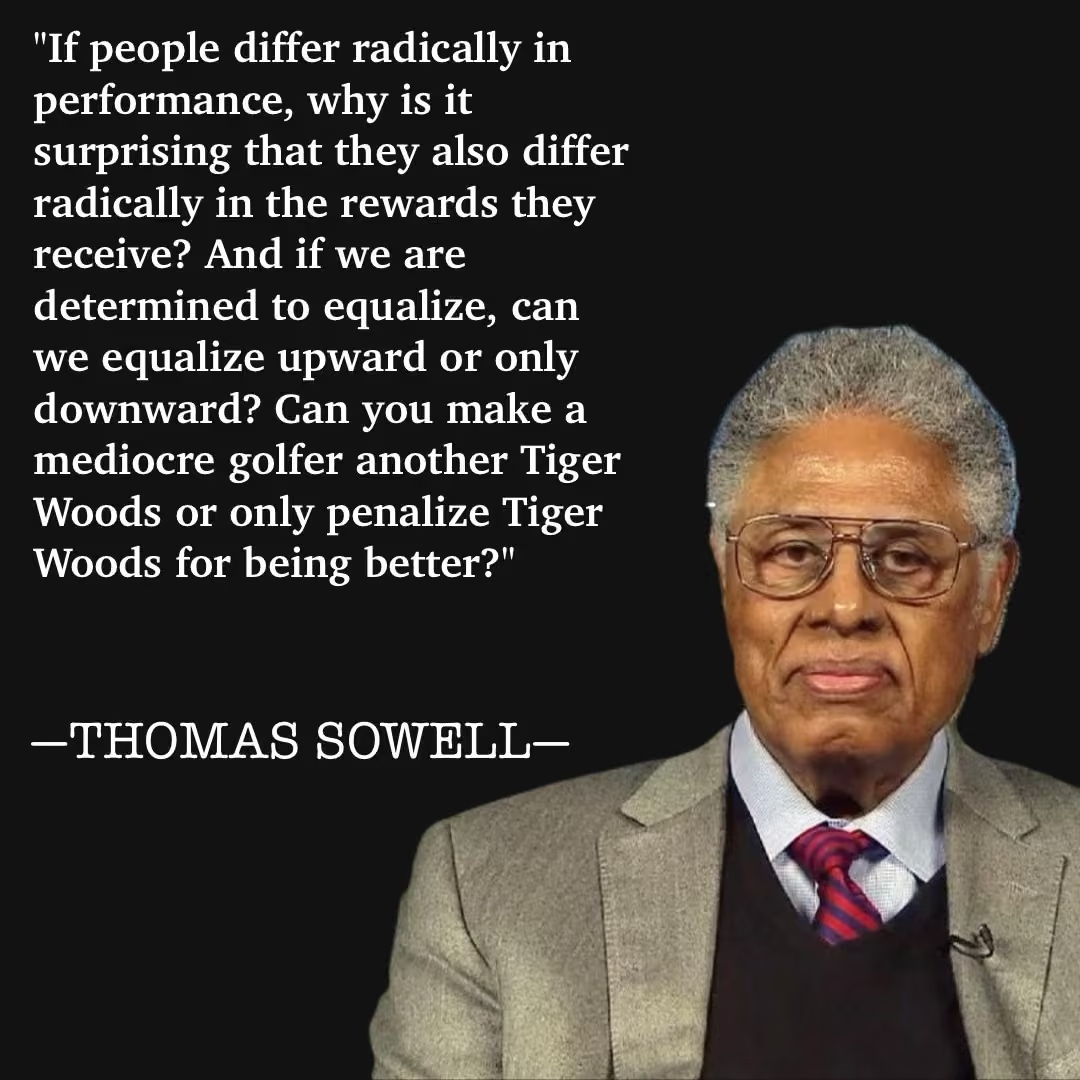


 Visual Capitalist


 Larry Dean


 Joseph W. Szarmach Jr.


 Thomas Sowell Daily


 Maarten van den Berg

 In Milei We Trust


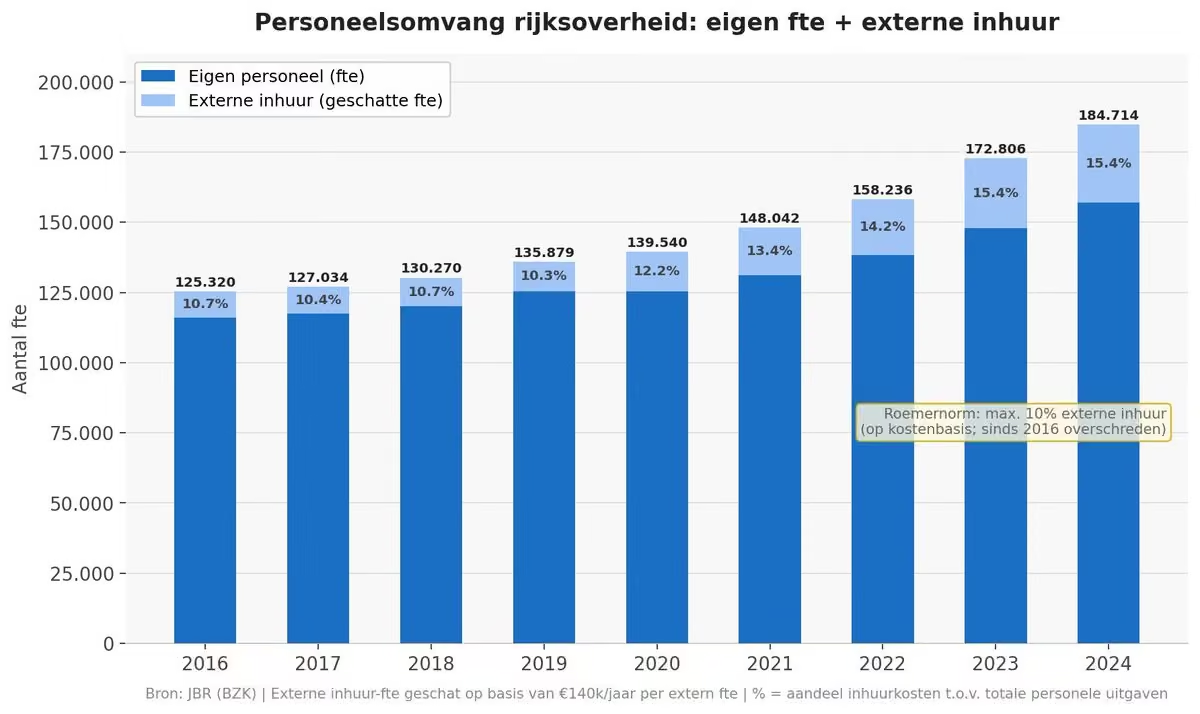
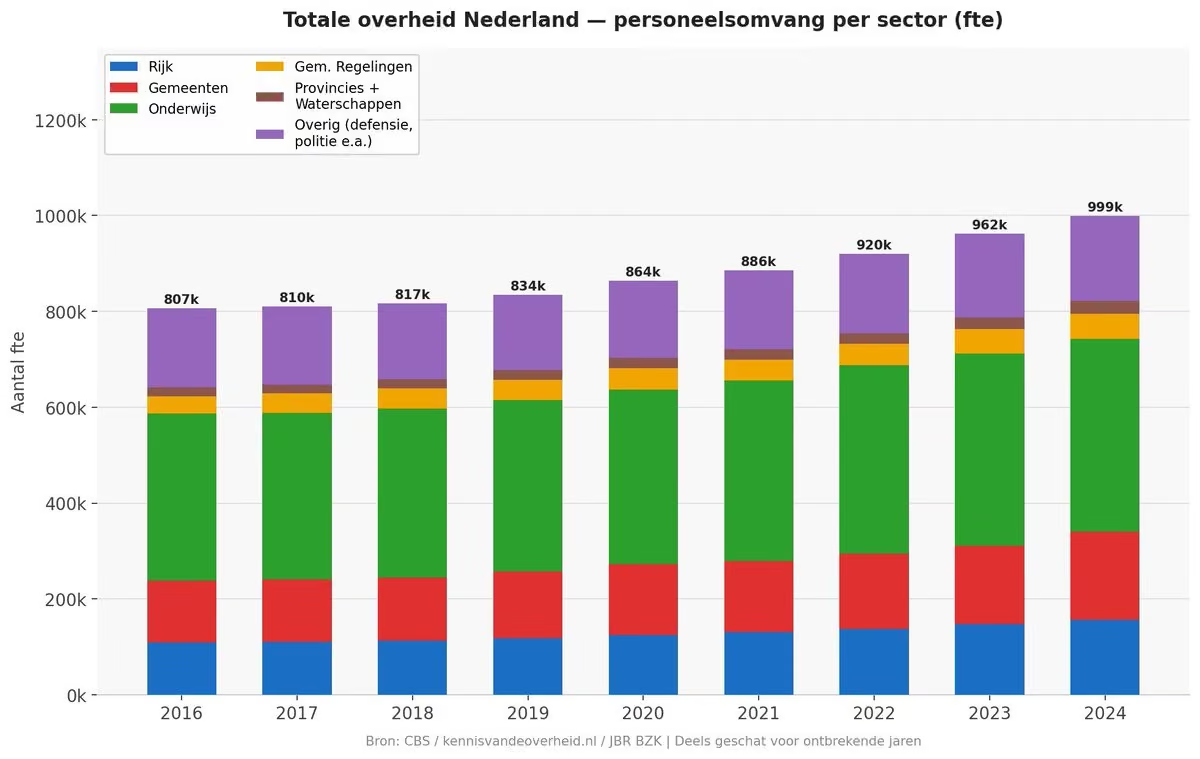
 Roaldcs 🚲 📣

 Pedro R.


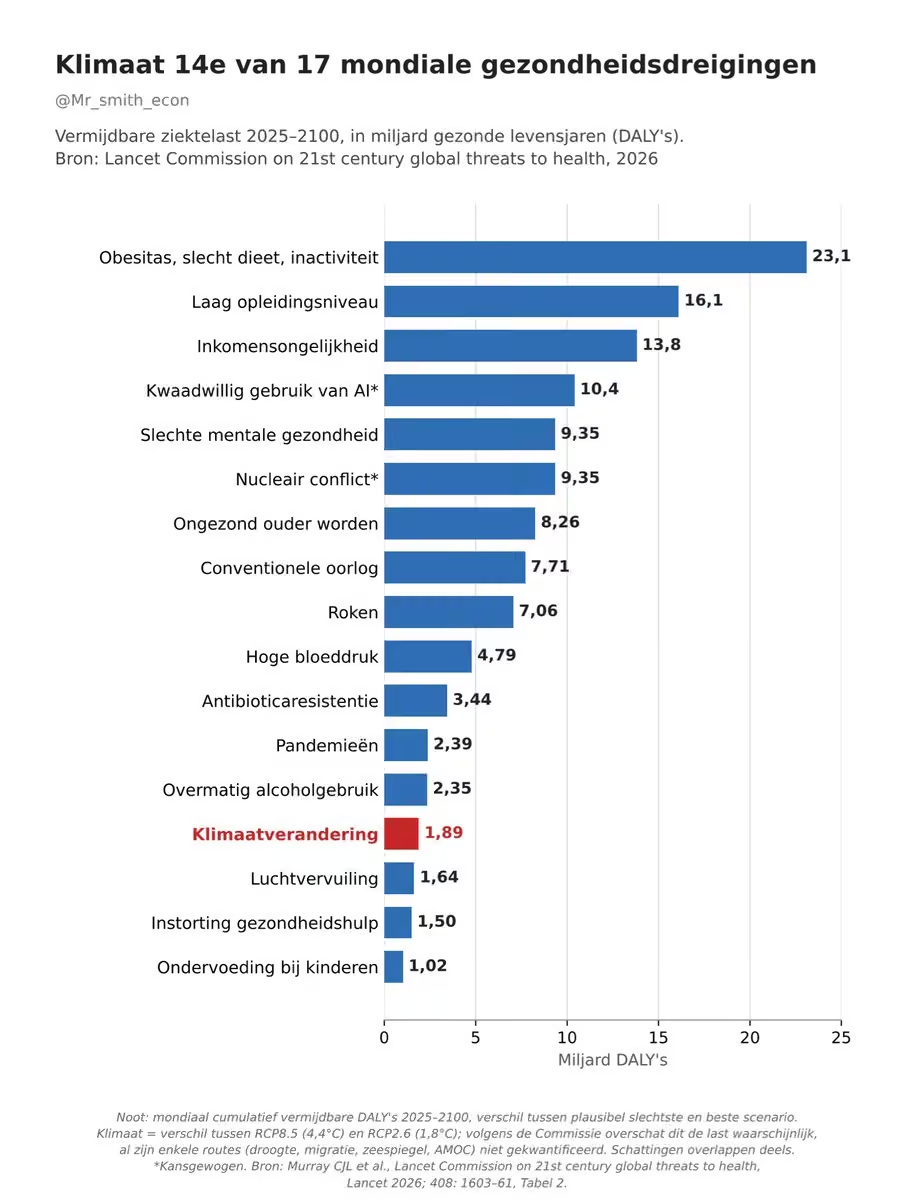

 Isaac


 Jitse Groen


 Krzysztof Szczawinski 🇵🇱


 LibertarianPartyUK

 Marcel Crok

 Mary J. Ruwart Ph.D.


 Sander Sassen


 John Stossel


 Dr. Eli David

 Voices of Liberty


 Peter Rademaker

 Russian Embassy in NL🇷🇺🇳🇱

 Les Mileistes Français 🦁🇫🇷


 Estado Mínimo


 Bart Burggraaf

 Libertarian Party of Mississippi


 Milton Friedman Daily

 Creative Deduction


 Willem Middelkoop


 Bitcoin for Freedom
 Xi Van Fleet
 Francesco 🇮🇹


 Diego Angulo

 Le Contemplateur

 Commentary - Sowell Economics

 Peter van der Helm


 Human Progress


 @Dr. Mario Desimoni
 Burnie Senders

 Rothmus 🏴


 Free Rider


 Toni


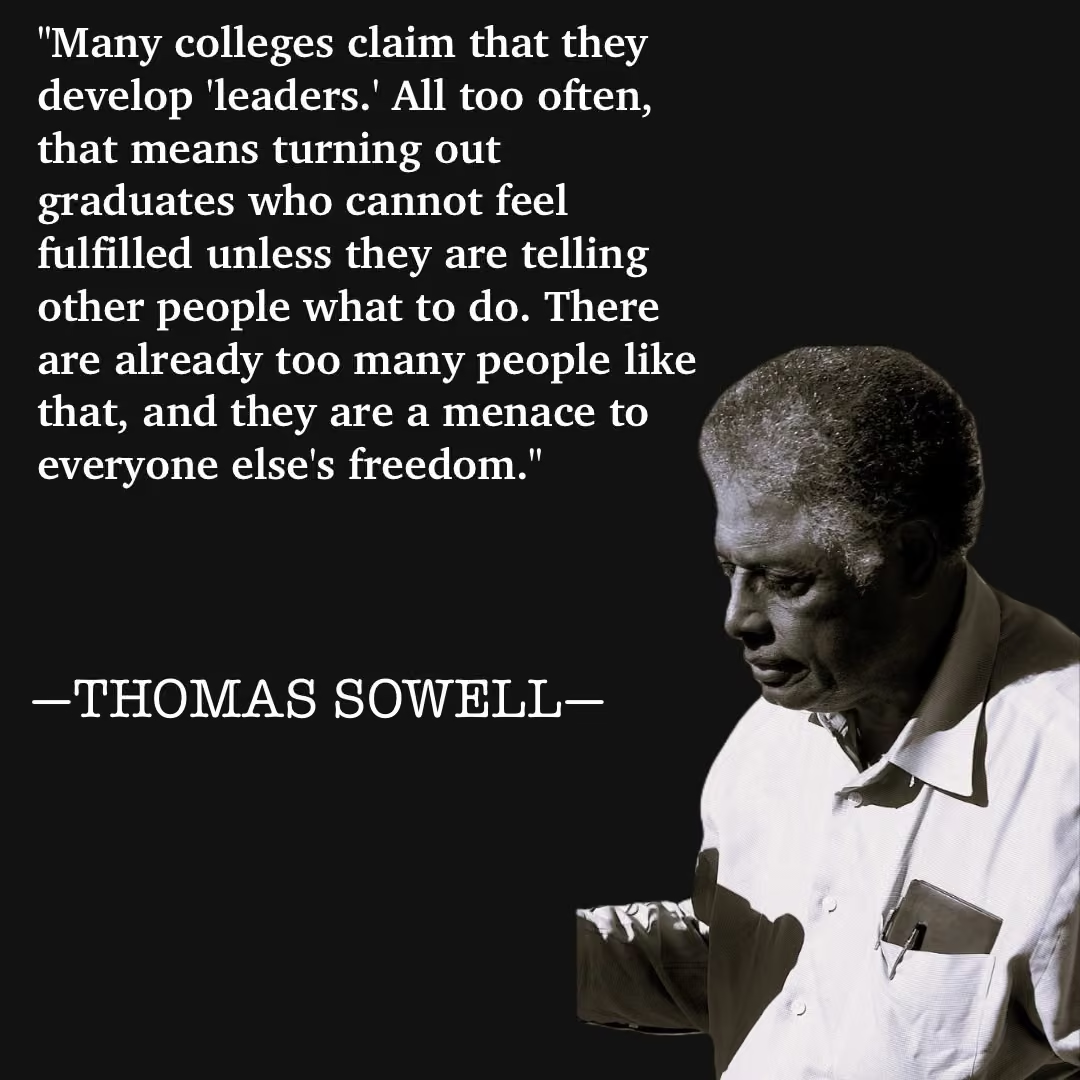
 DulceBiatch


 Trixi


 blckbx


 Karel Mercx

 Ron DeSantis


 Agorist Nexus (Brandon)

 Ron DeSantis
 Ron DeSantis News 🇺🇸
 Gurloes Monk Commentary
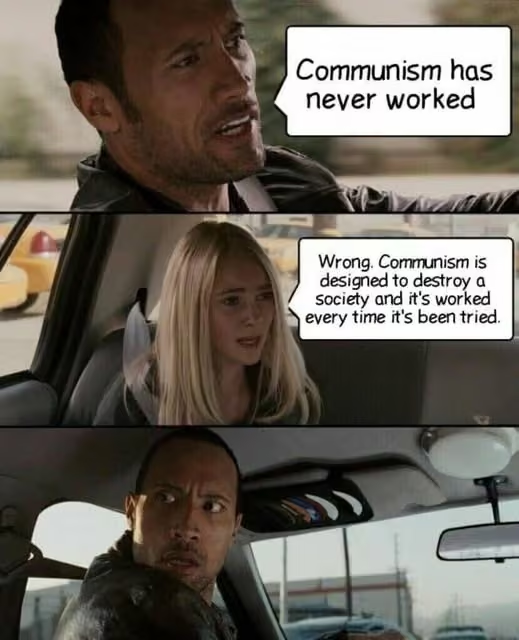
 Wayne Dunlap


 Libertario 🟨⬛


 Libertarian Party


 Sprinter Report


 Escuela Austriaca de Economía 🇦🇷

 JavierMileiDE_Kommentar

 nnairobi


 TenthAmendmentCenter


 Kirsty Collins

 Orwell Day


 AverageAmerican


 Made in Ancapia


 Glocke 🧡


 Margaret Thatcher


 Shadow Intel
 Alan Wolan


 Grokograph
 Bitcoin News


 Dr. Simon


 AK2MX2K


 Saifedean Ammous


 Milei in English - Official Account
 ShellBanger


 Citizen Journalist Bexy {Semi-Retired}
 Alastair Hilton


 Magatte Wade


 Margaret Thatcher


 Jennifer Wainwright


 Juan van Ginkel
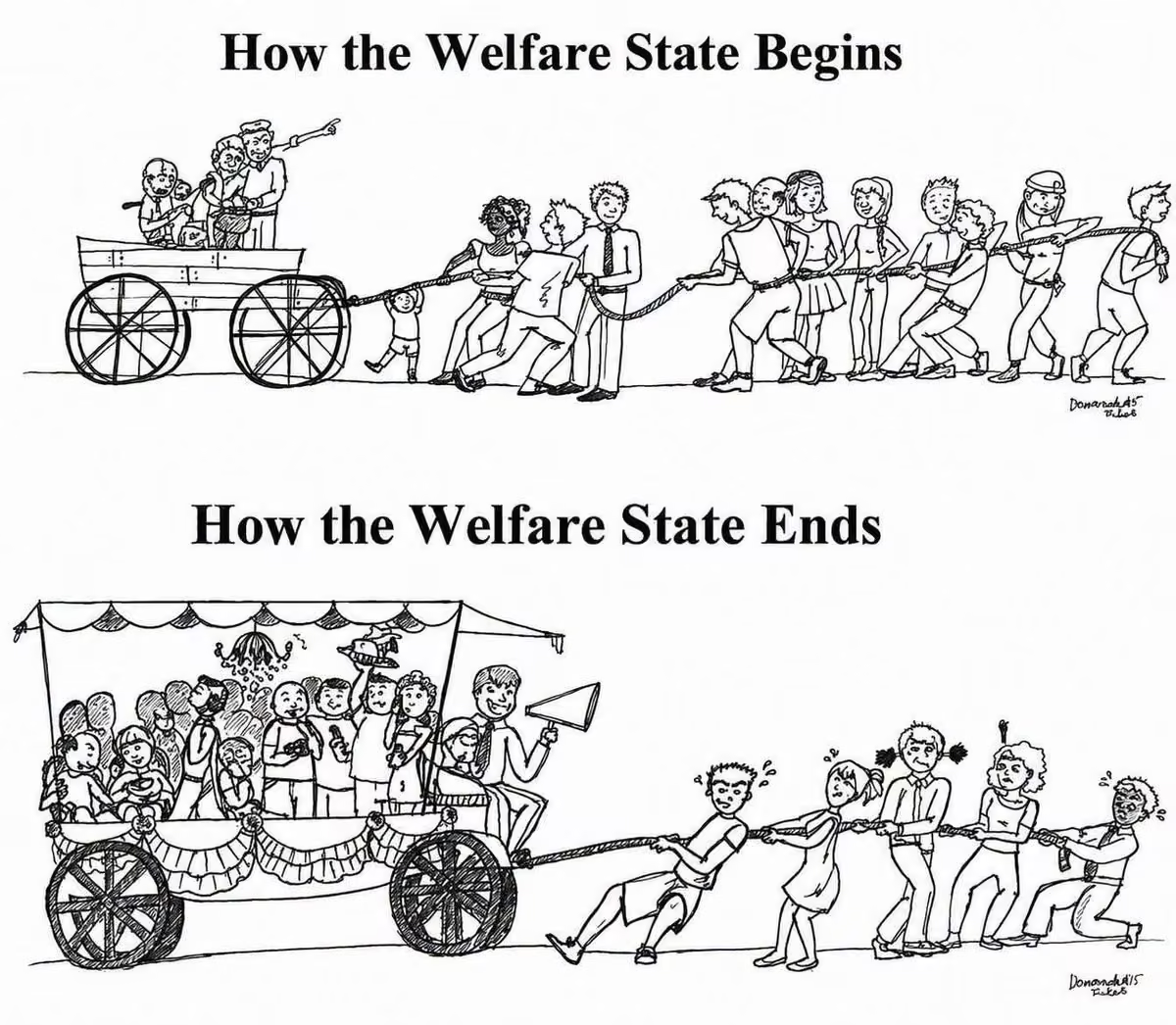


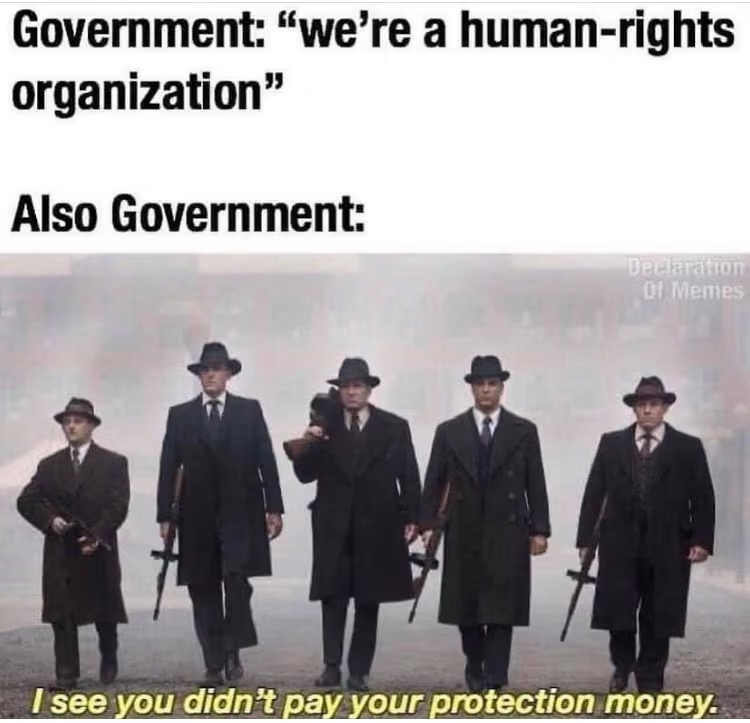





 Kevin Carpenter


 Cody Libolt


 Larry Elder


 MajoMéndezCasariego ⚔️


 Mila Joy


 Anti Kommunistic
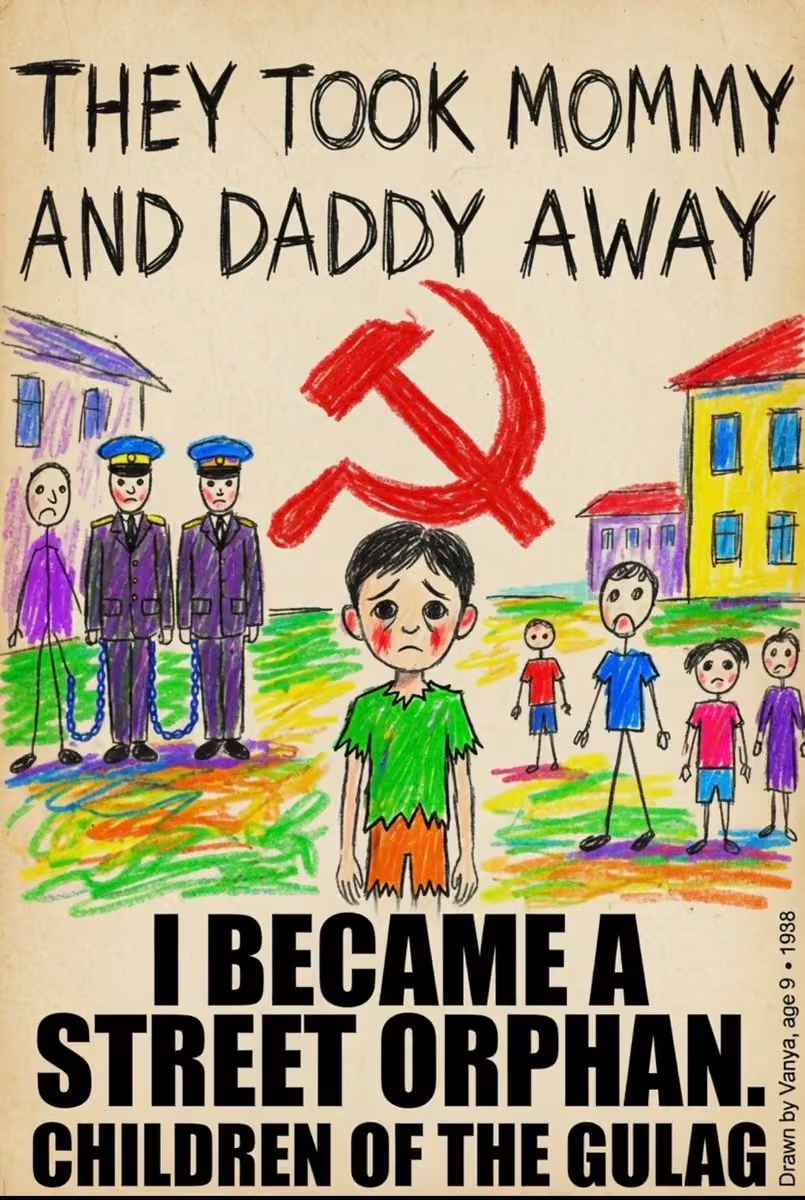


 Sunny-Wan Kenobi


 Jota
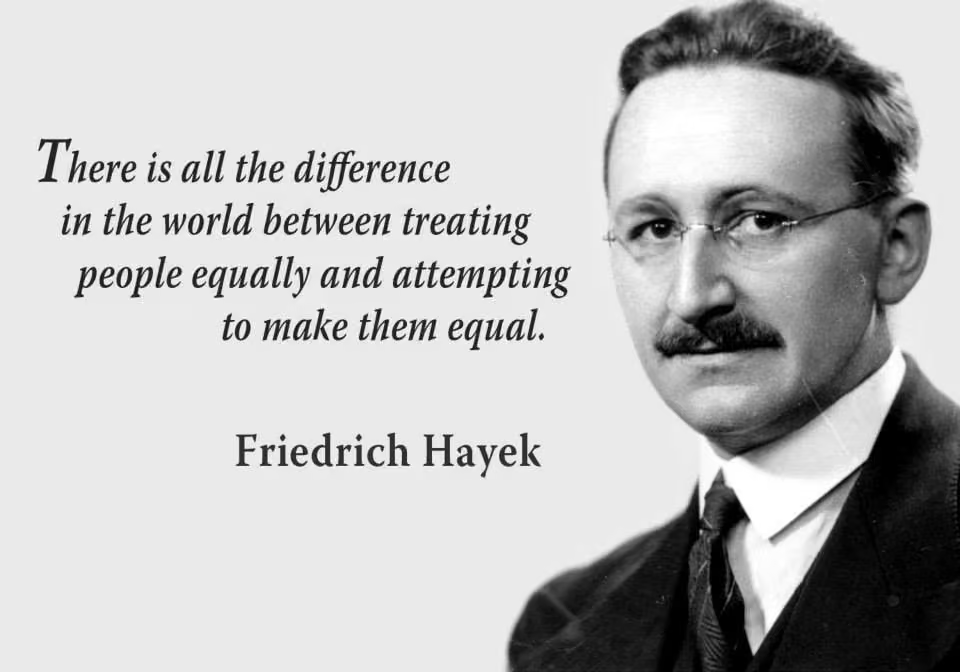


 The Patriots Voice 🏴 🇬🇧

 Connor Boyack 📚

 Rothbardianism


 Sassafrass84


 Electroverse


 George Gammon

 Chris Freiman

 Tired Peasant
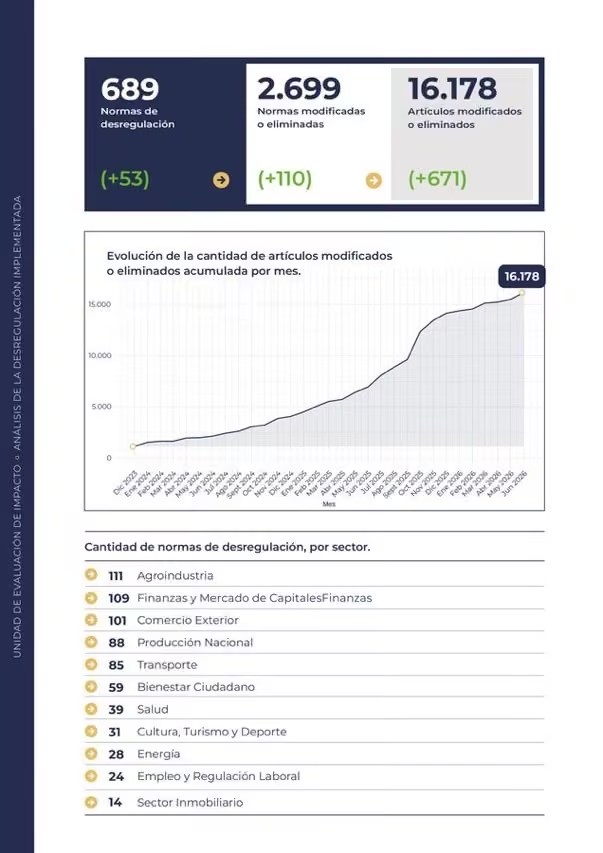


 The Vigilant Fox 🦊
 Hayek-Club Weimar




 Lukas Teijema #BreakFree
 Cees



 Anarchy_Wear


 The Rabbit Hole


 Dave Smith


 Archaeo - Histories


 Dustin


 Anthony Bradley
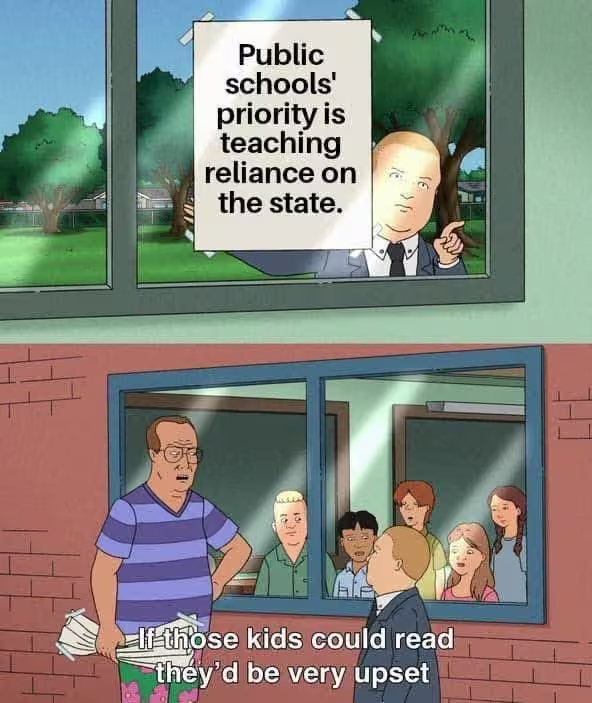


 Wolfgang Richter


 Ricardo


 Steve Hanke


 Fedsurrection


 Europa Nostra


 DogeDesigner


 Holden Culotta
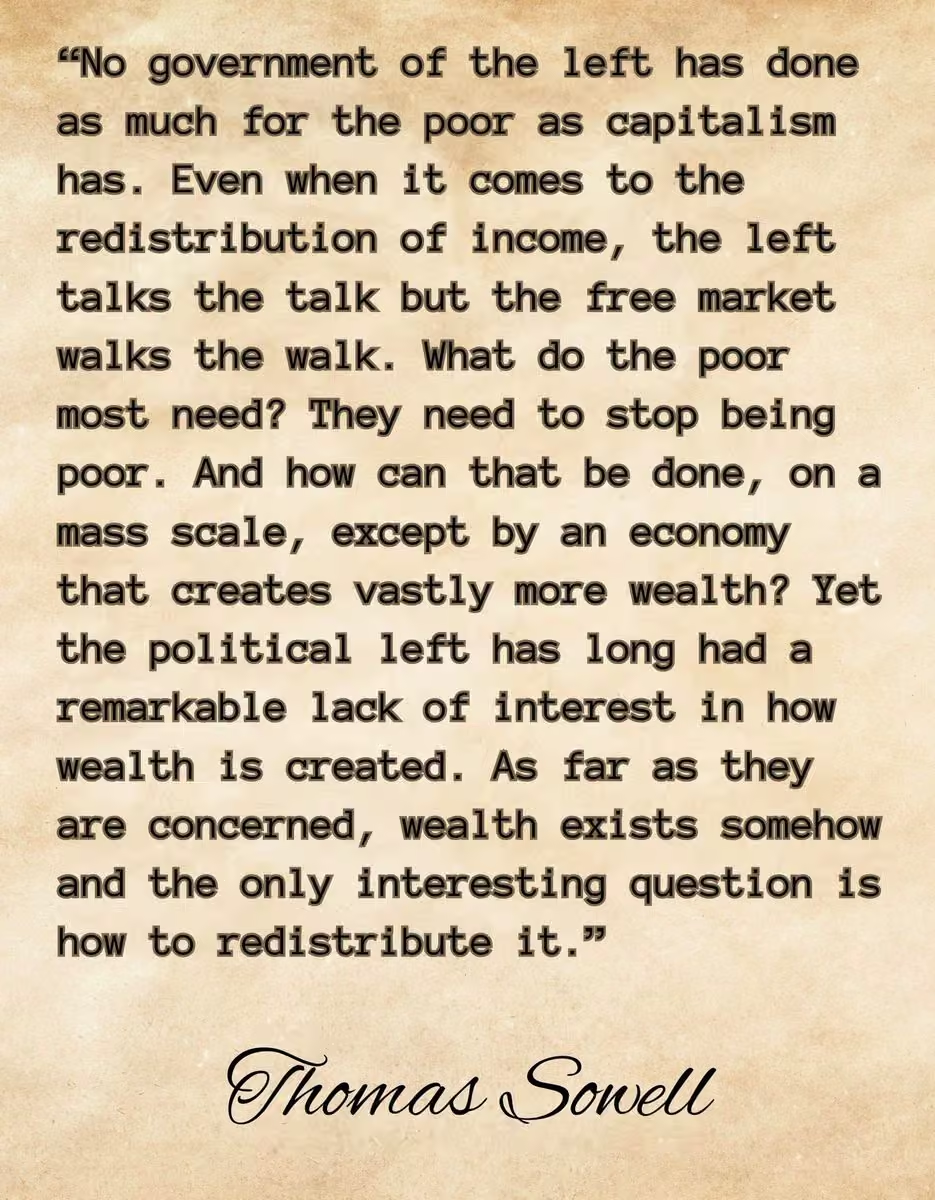
 Florent Chenu


 Arthur MacWaters


 Space Ape


 Libertarians against Trump


 𝗟𝗘𝗞


 p🅾️pcorn 🇮🇱


 Michael A. Arouet


 Tesla Owners Silicon Valley


 Peter Clack


 The Knowledge Archivist


 Jennie Taer

 merikuh


 Mattijs Glas

 Mathieu

 Adam Moczar


 Rubidoooo


 !Gov Patrick Smith

 Murray 🇺🇸

 Alcuin Press


 Wide Awake Media


 Polymarket


 Jay Bhattacharya
 Maarten Bakker
 lex hoogduin


 Ben Weir


 Senator Rand Paul
 BIG DATA POLL

 Martin A. Armstrong


 Milei English
 SpiritChaser MAGA 🇺🇸❤️


 Skscartoon

 C. Gray

 Make Europe Great Again - M.E.G.A

 Being Libertarian

 Argentina's Milei News 🇦🇷🤝🌎


 Jeff Kirdeikis


 Proudofus.uk
 ELON CLIPS
 DBinWA


 TaraBull
