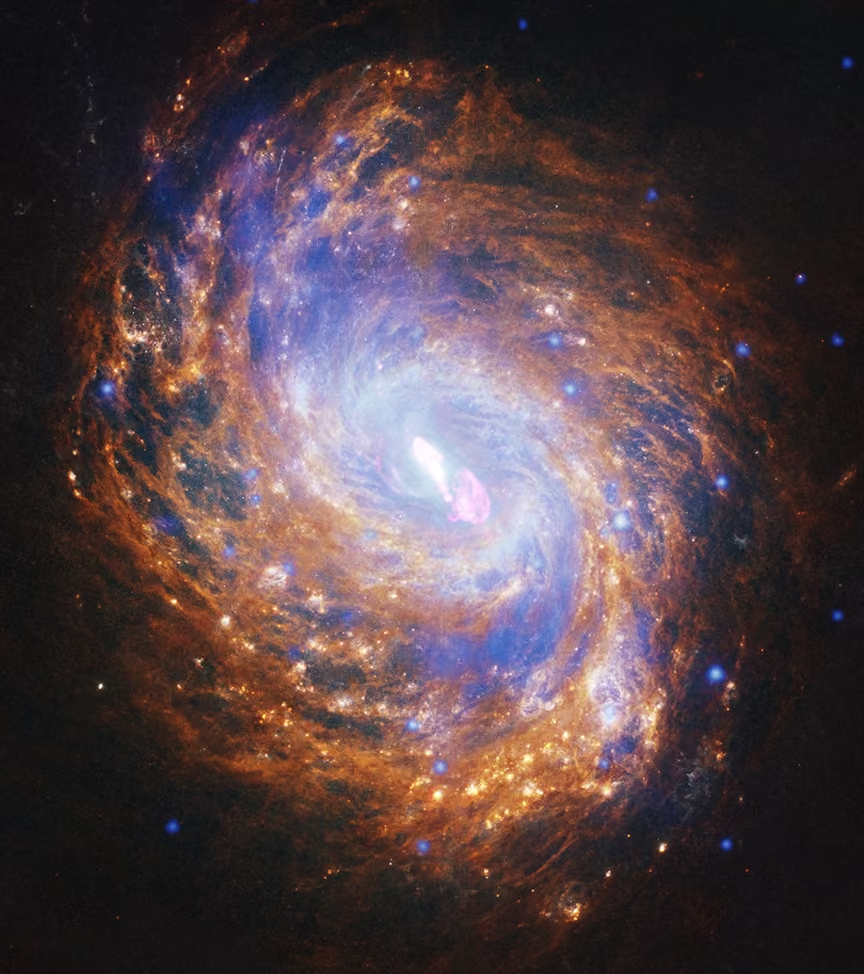
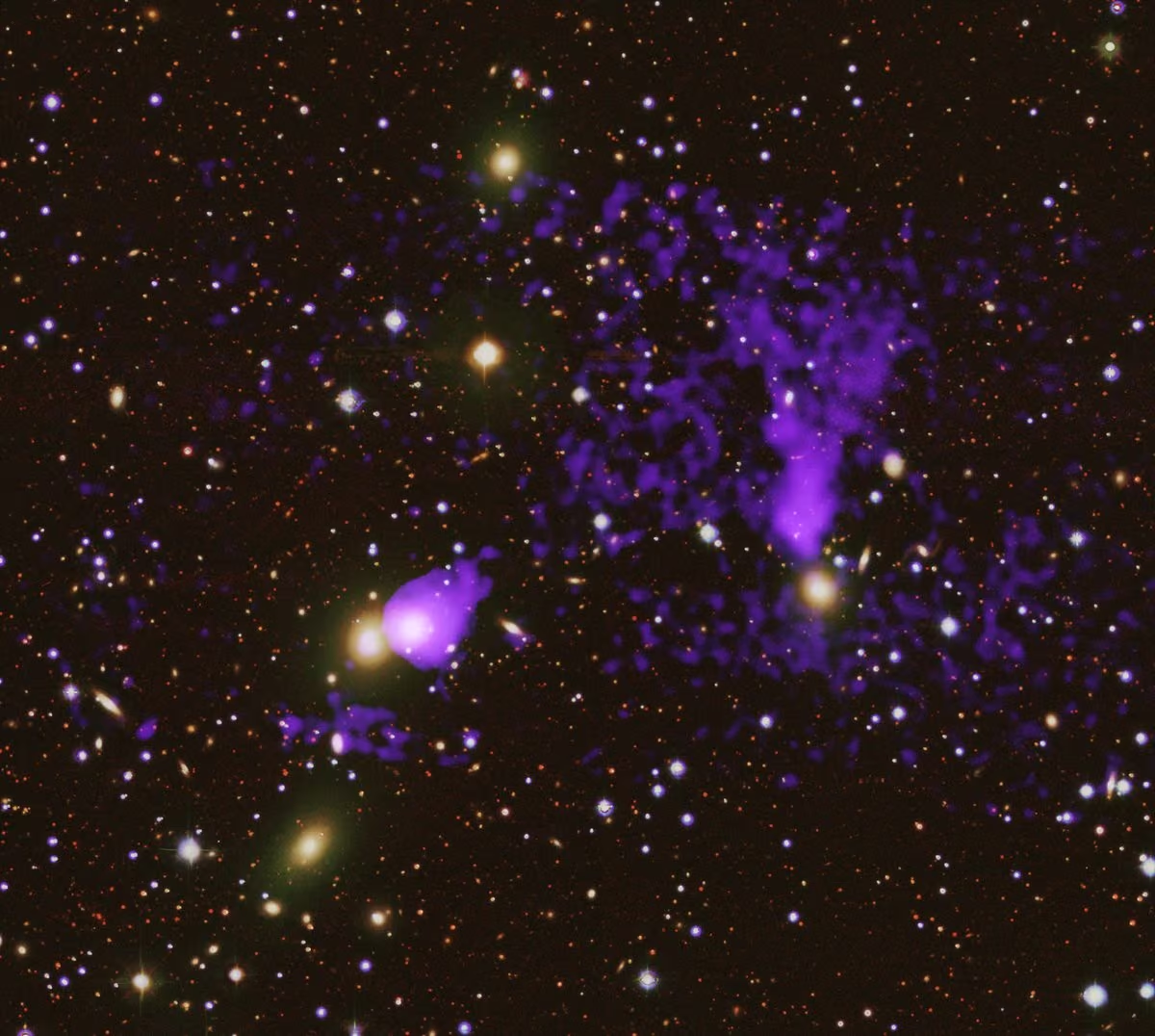
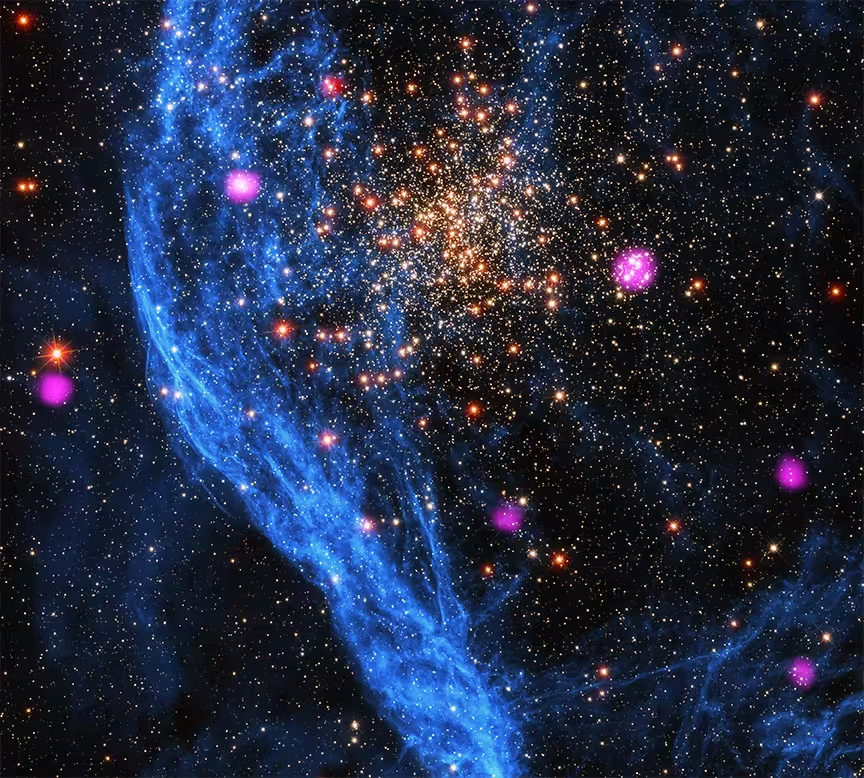
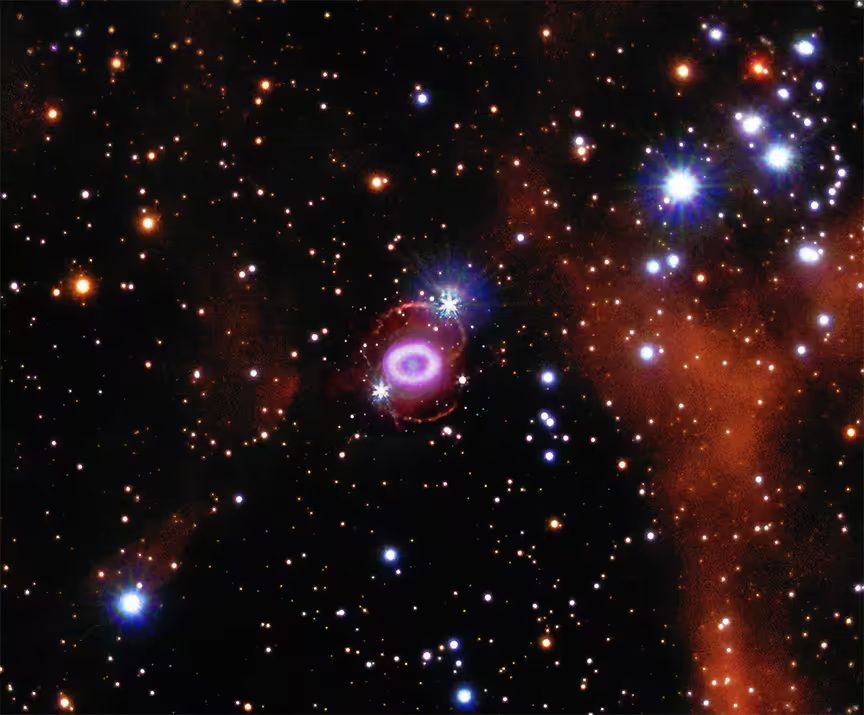
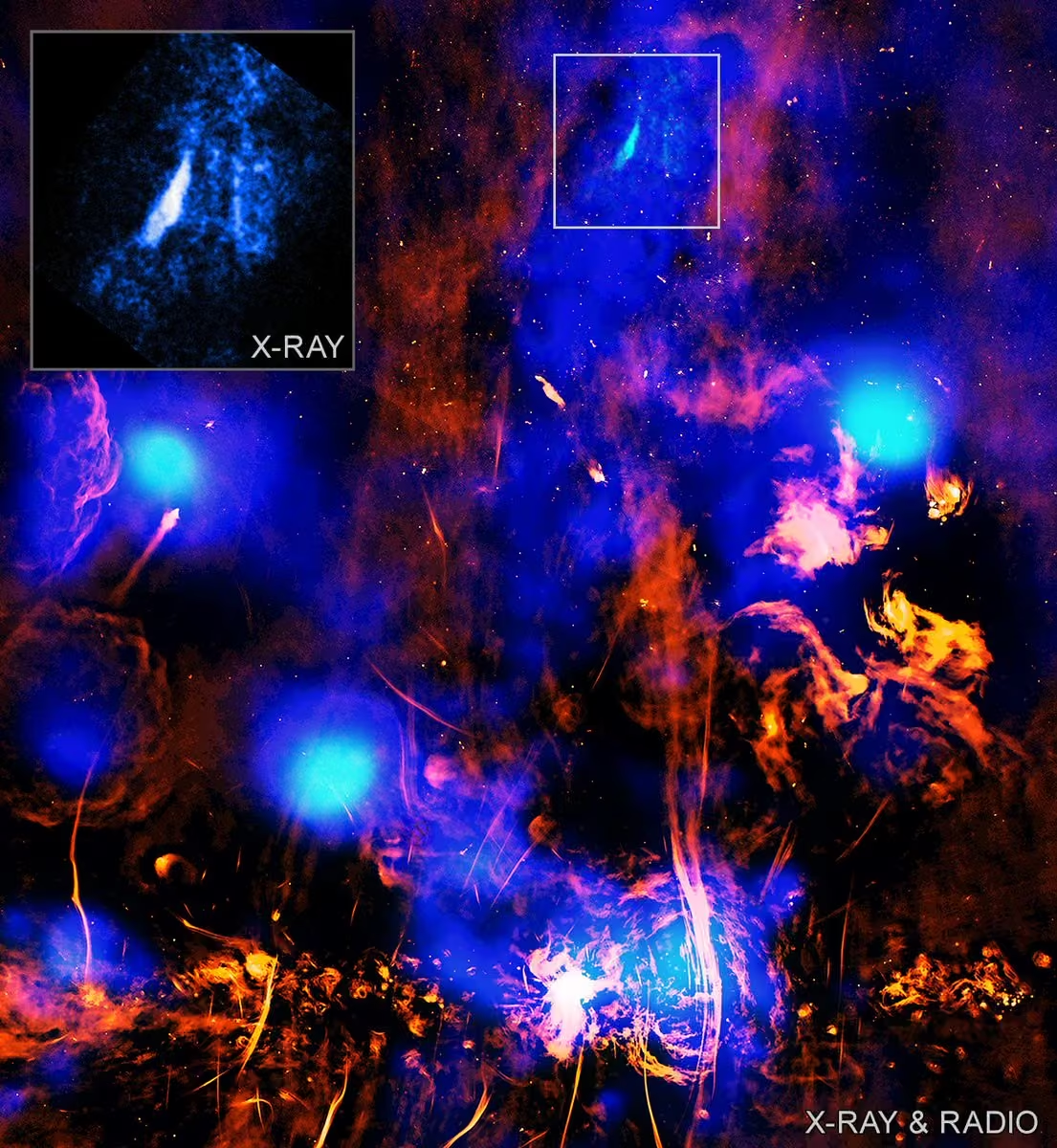
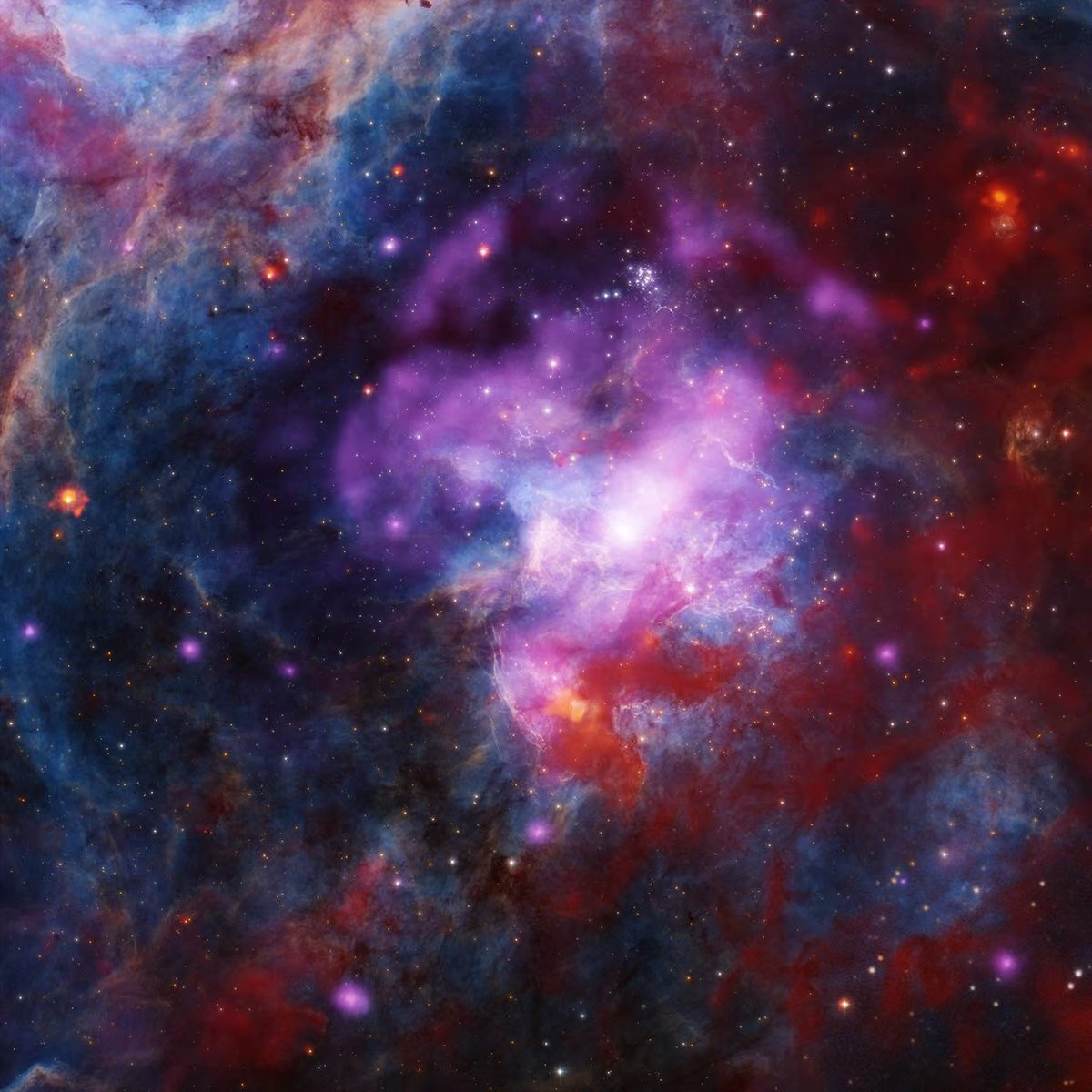
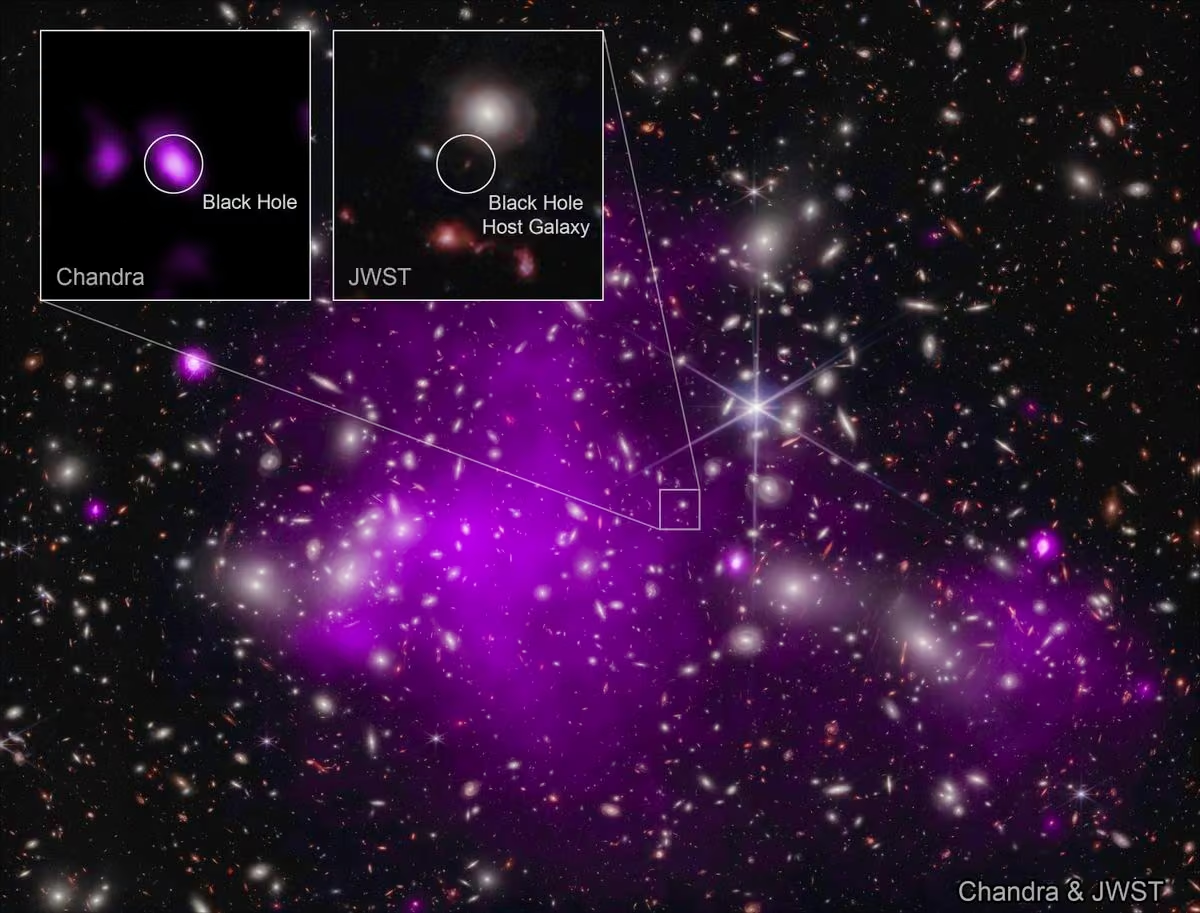
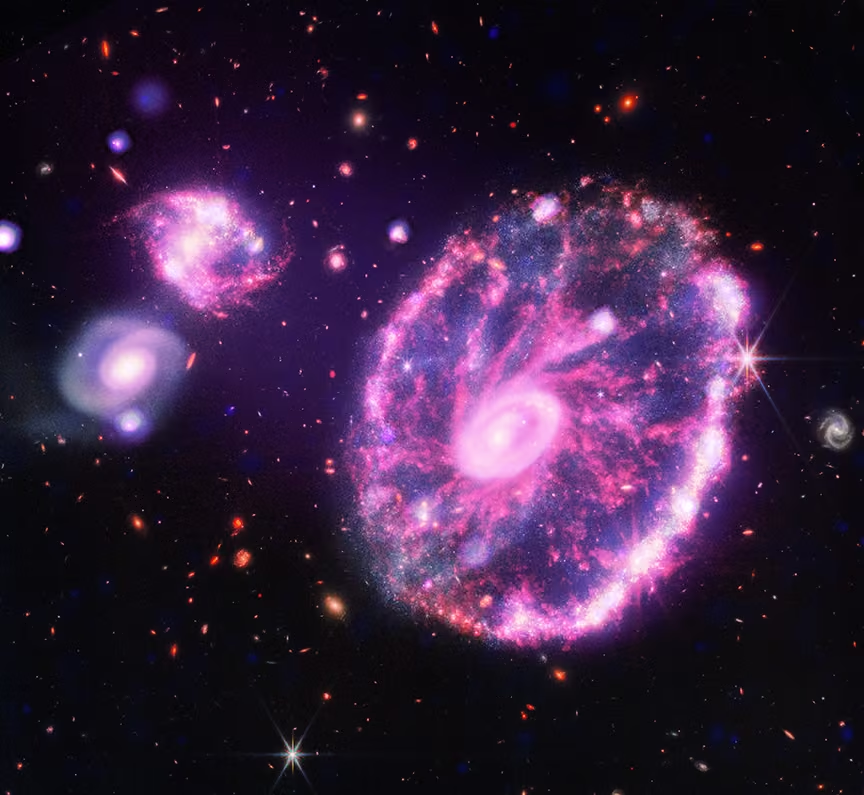
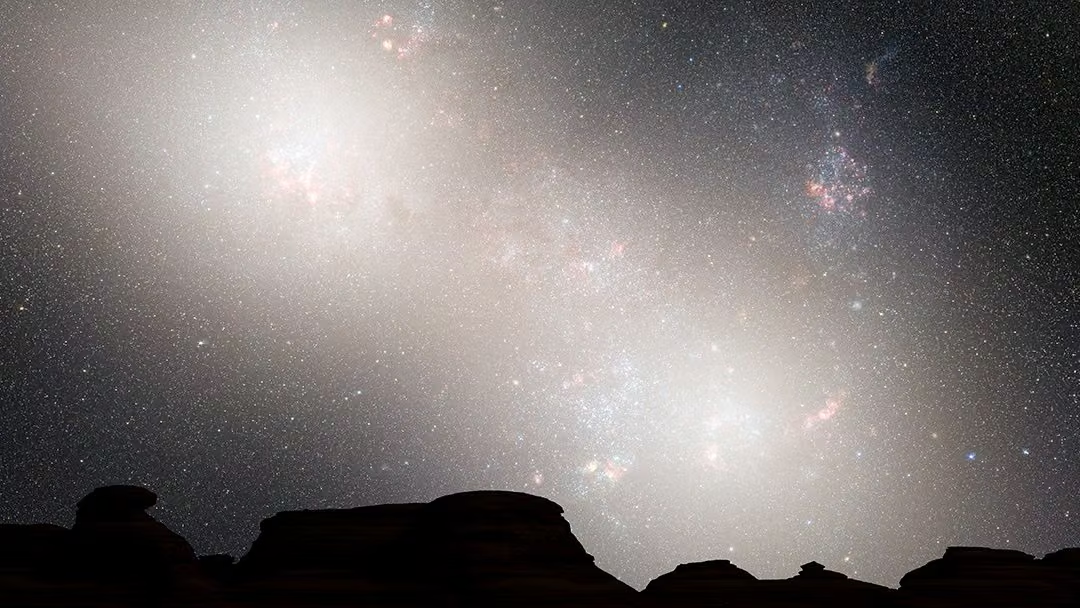
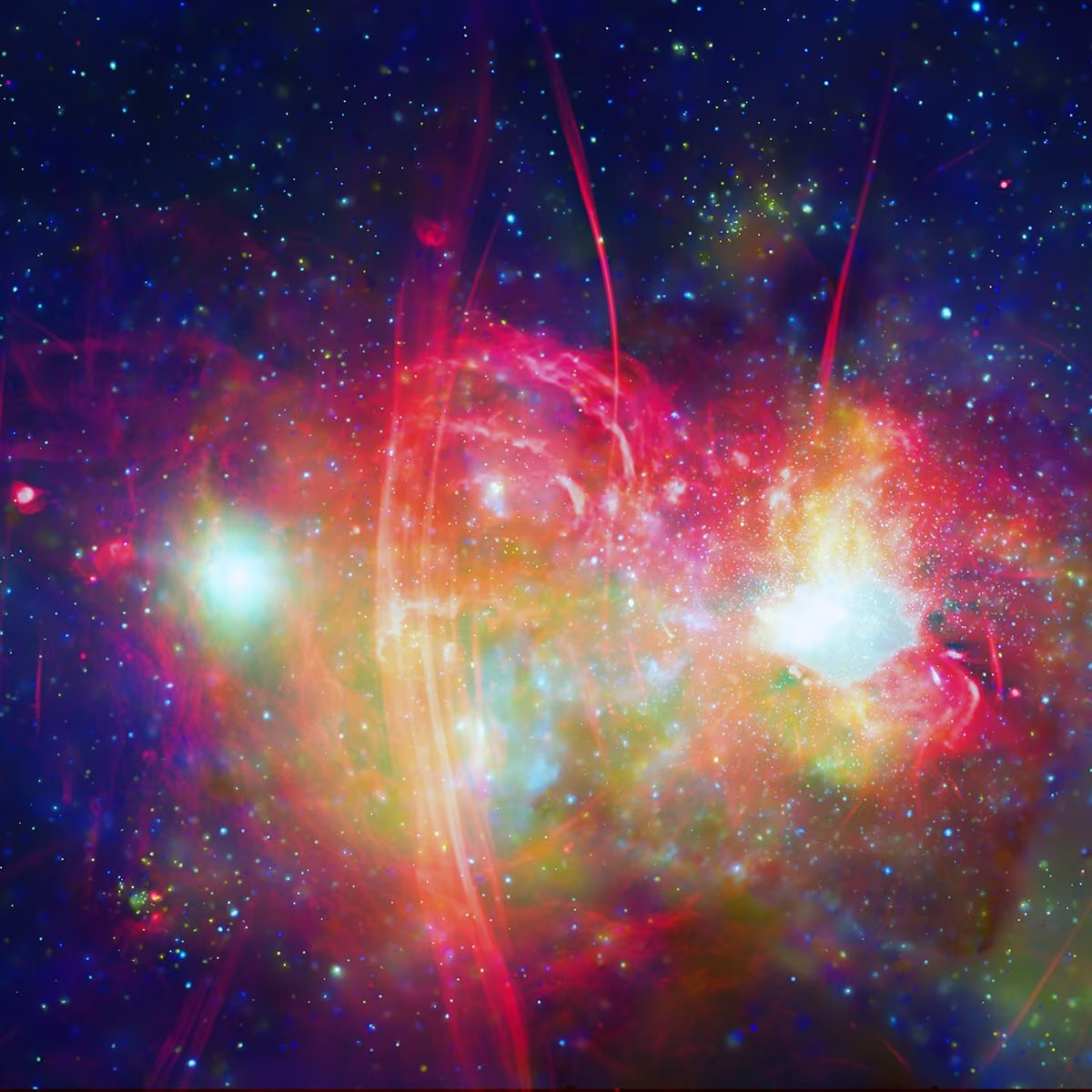
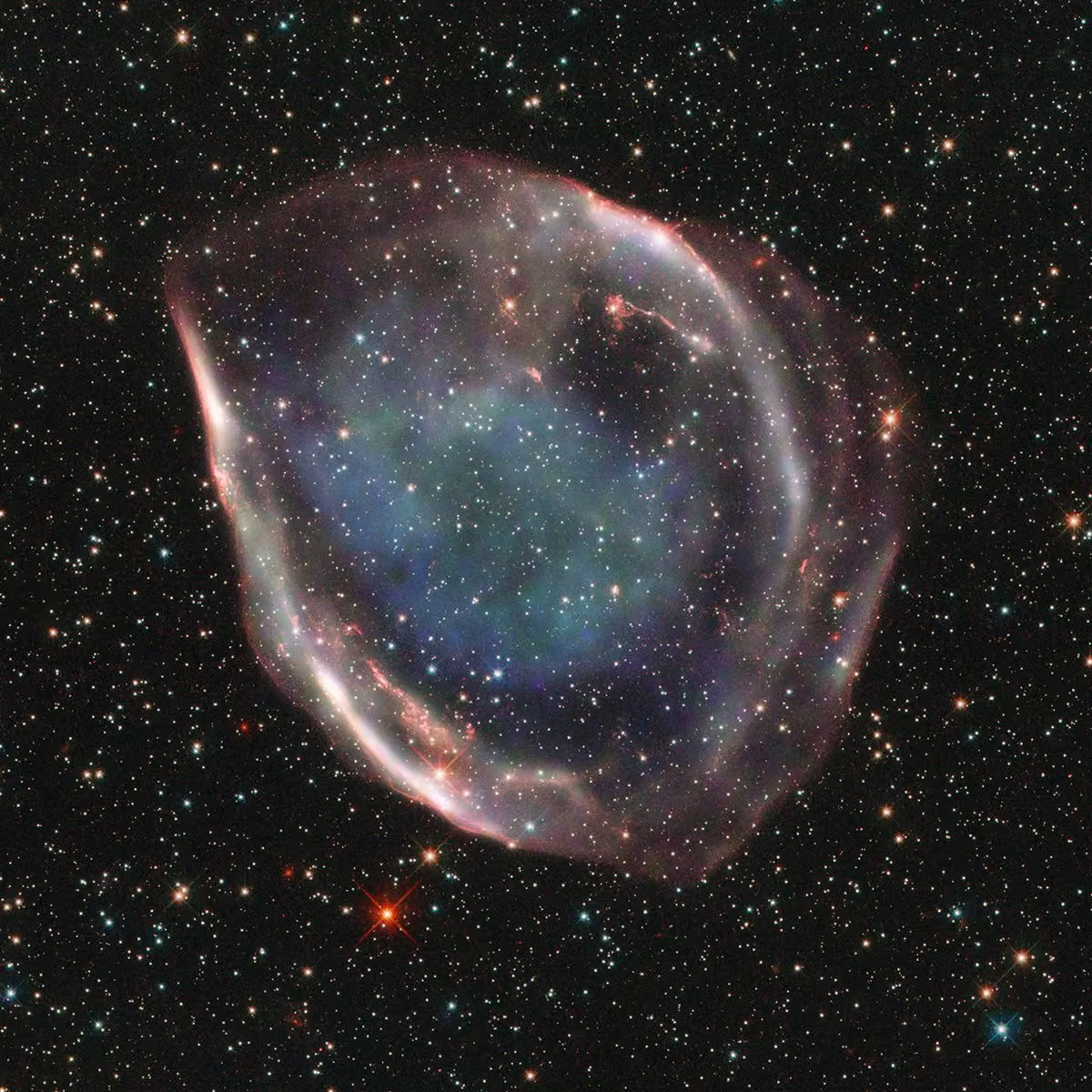
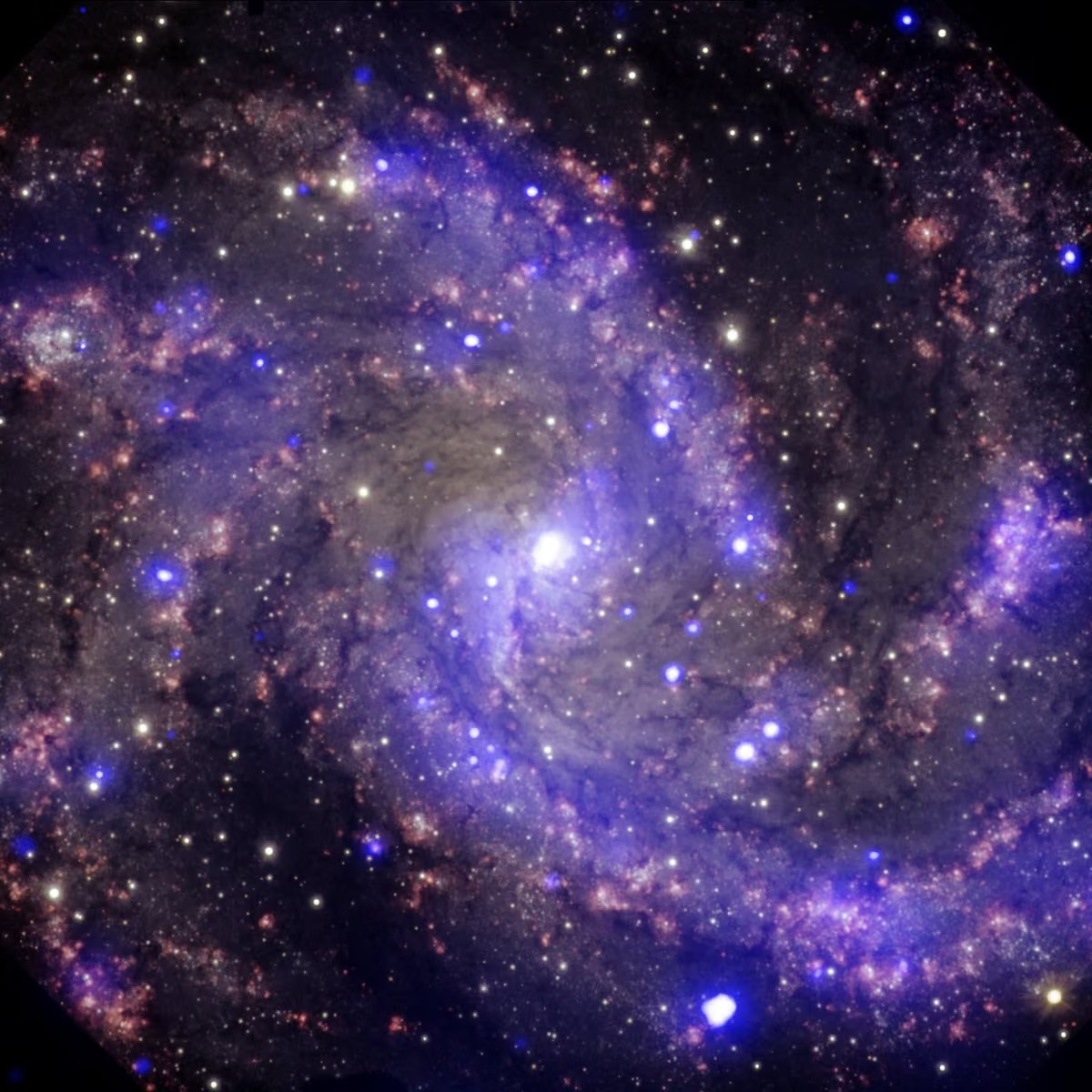
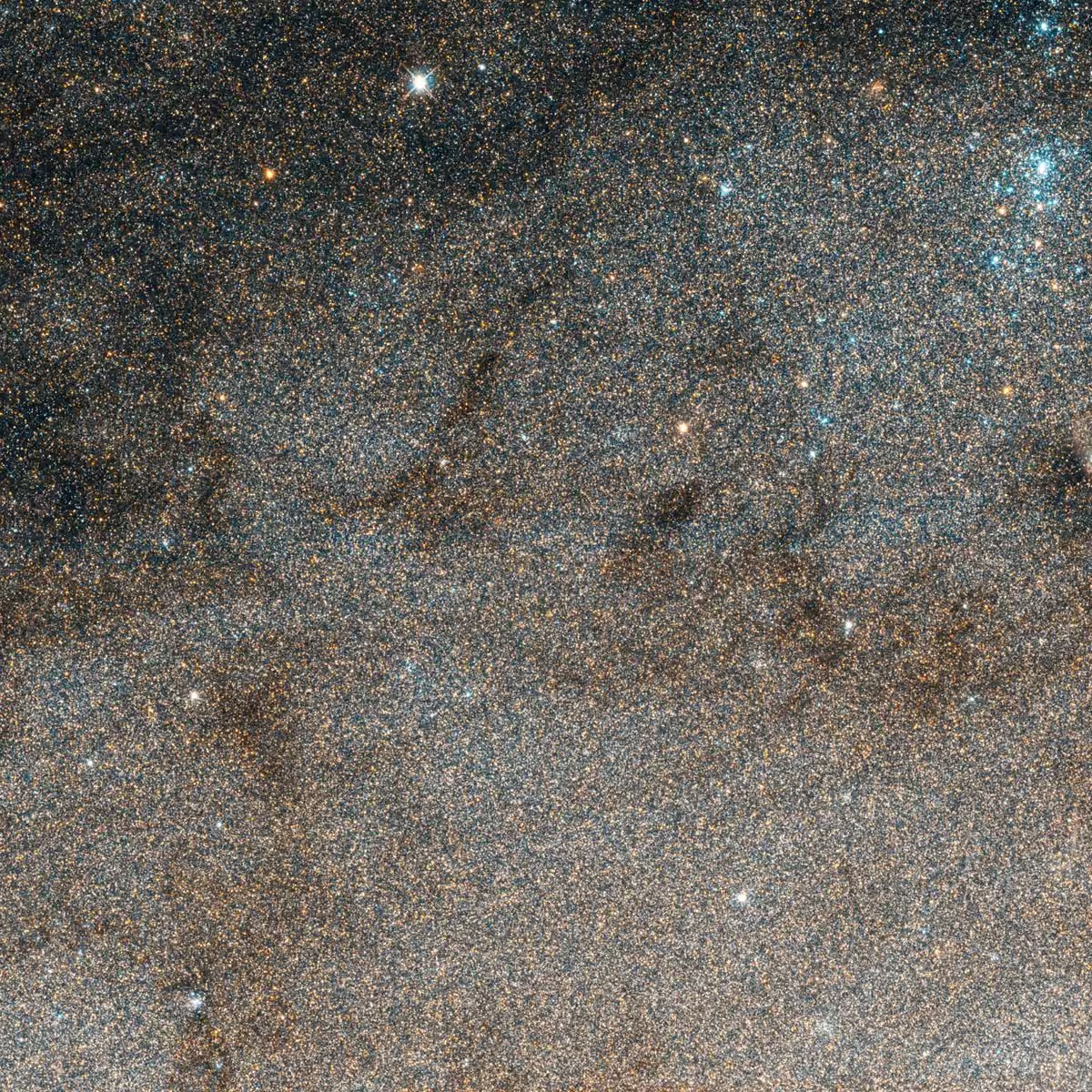
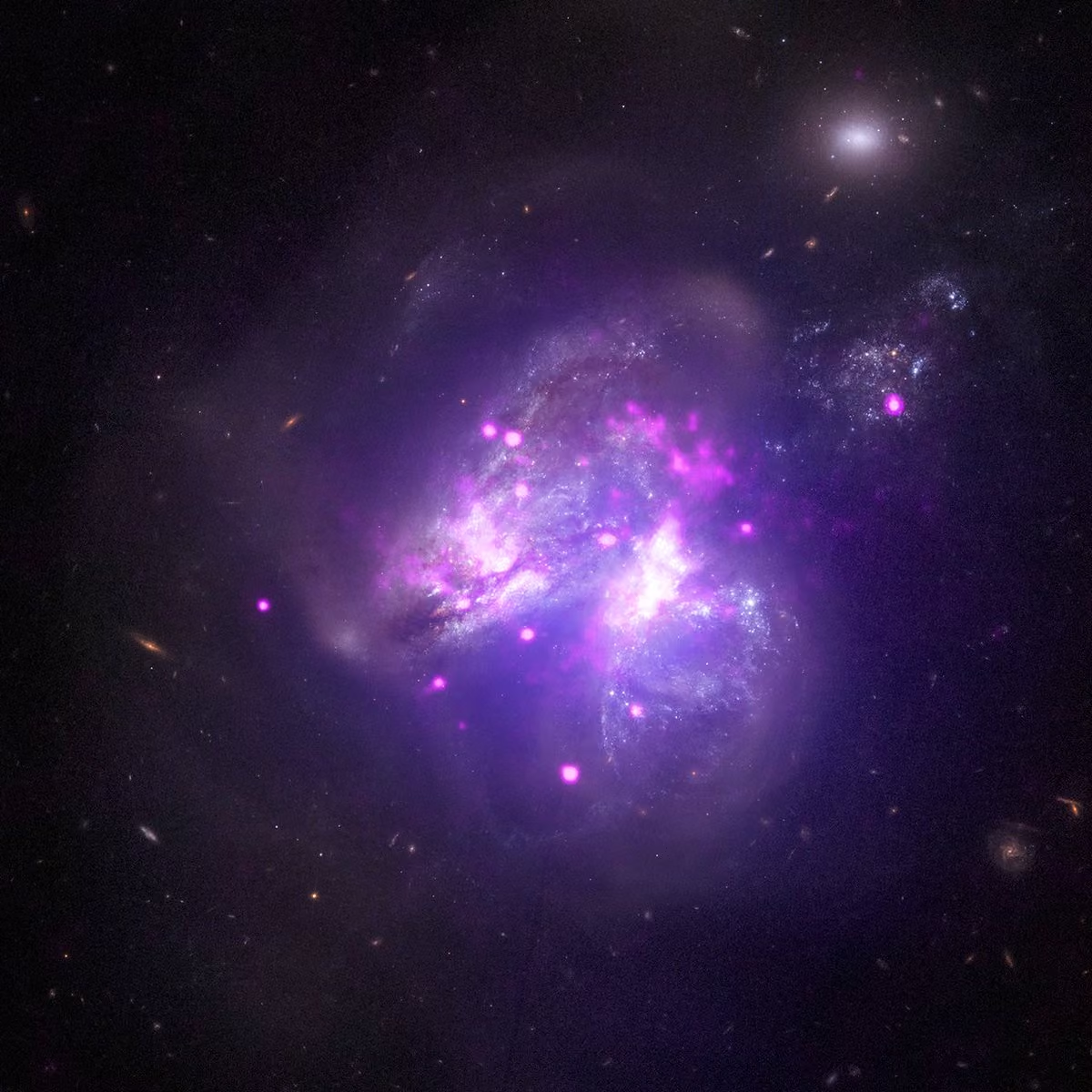
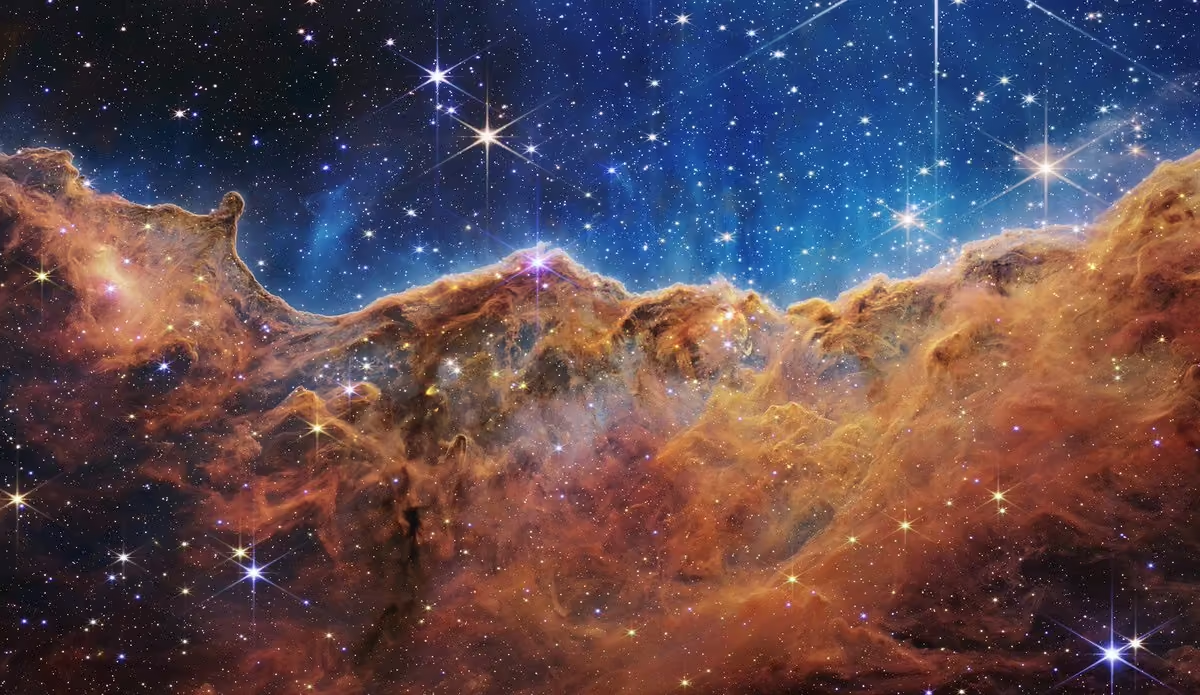
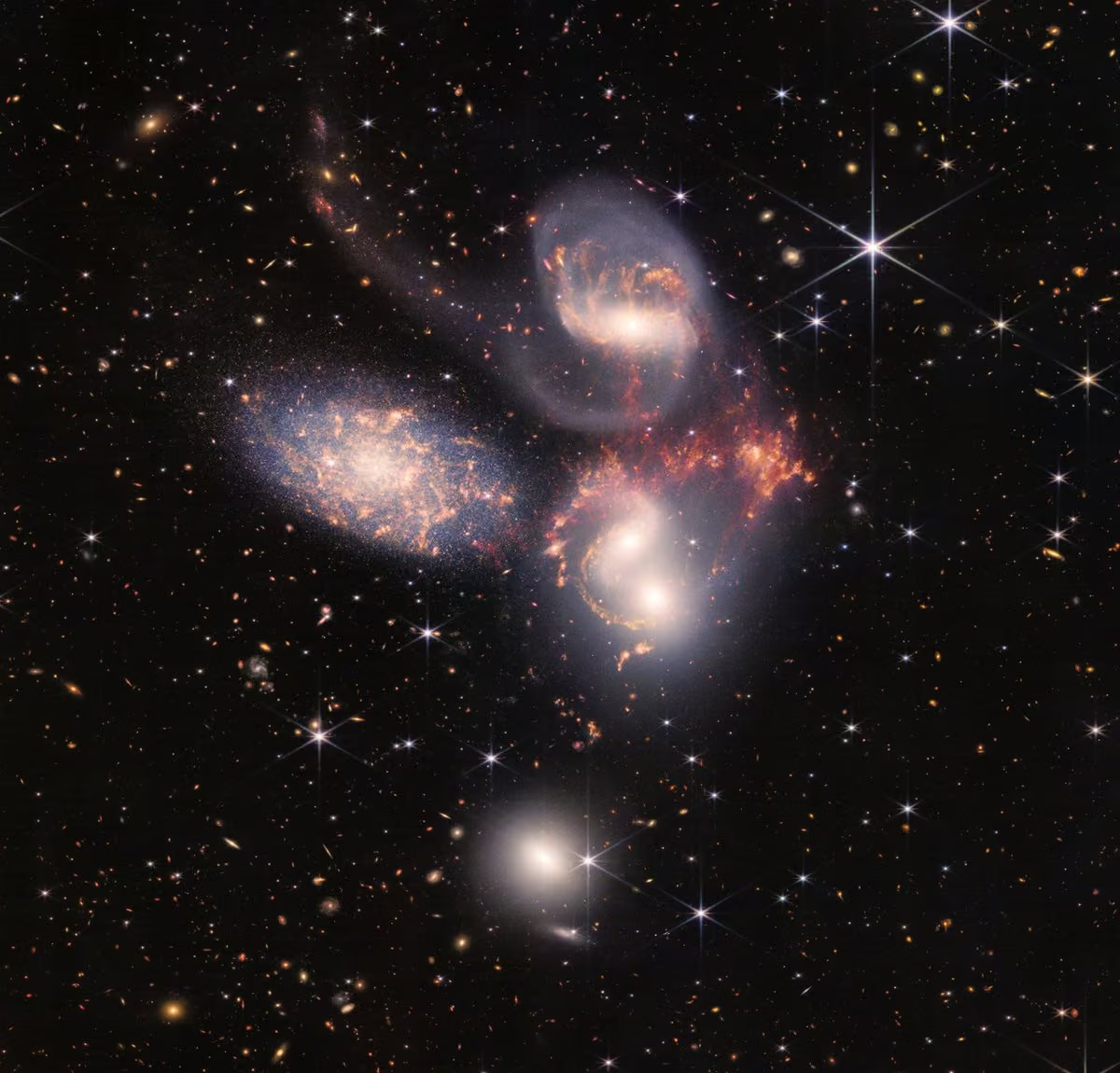
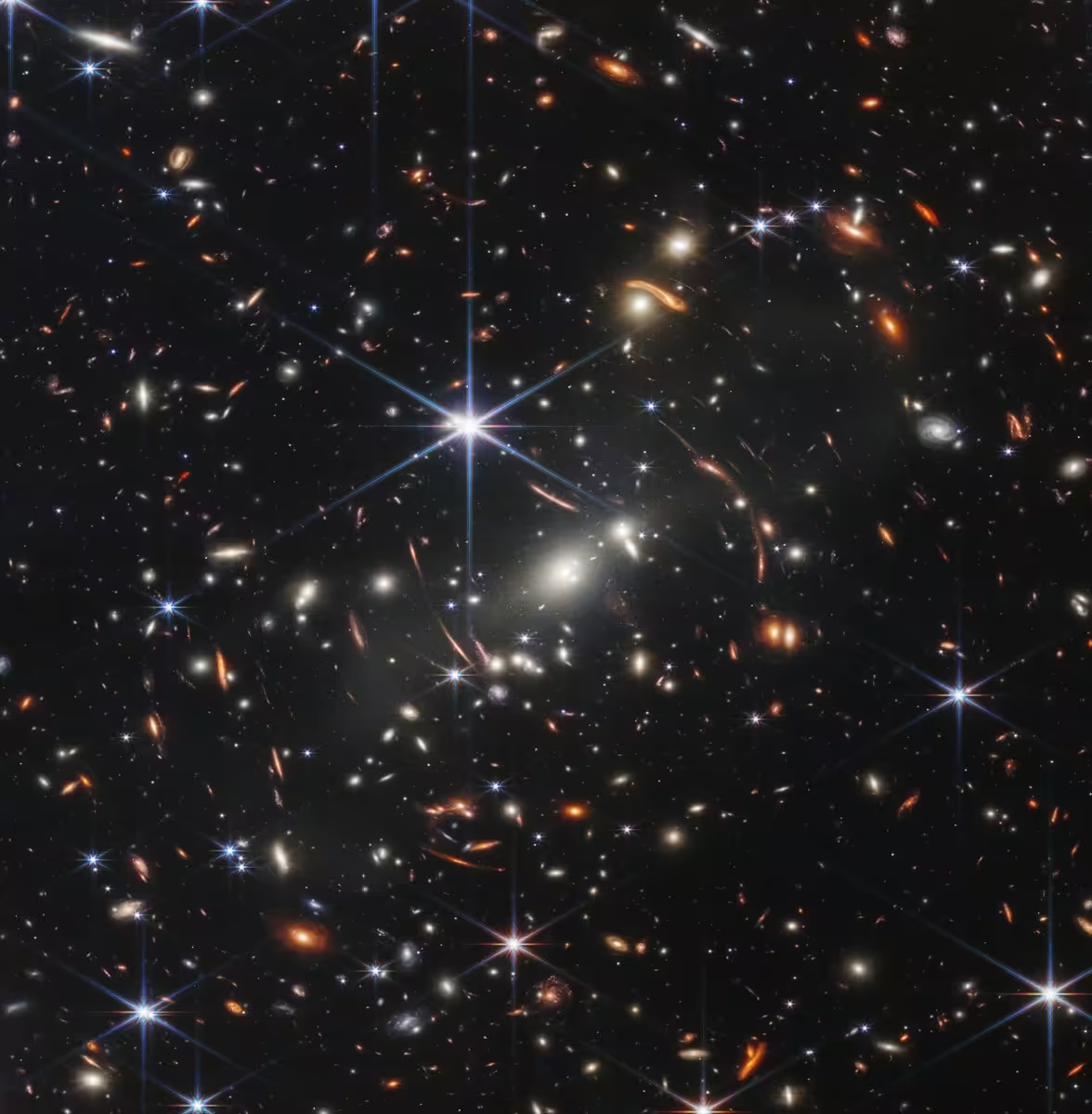
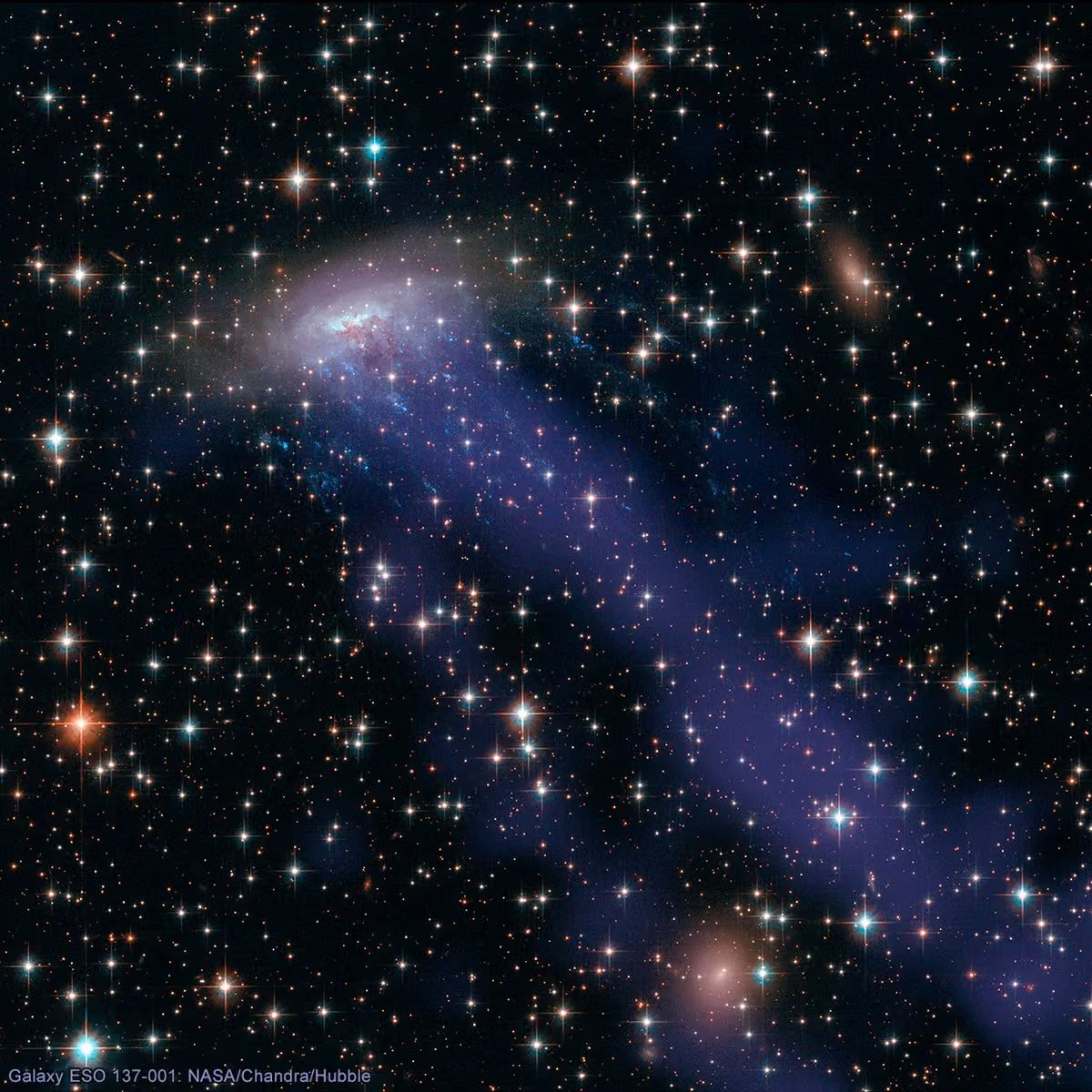
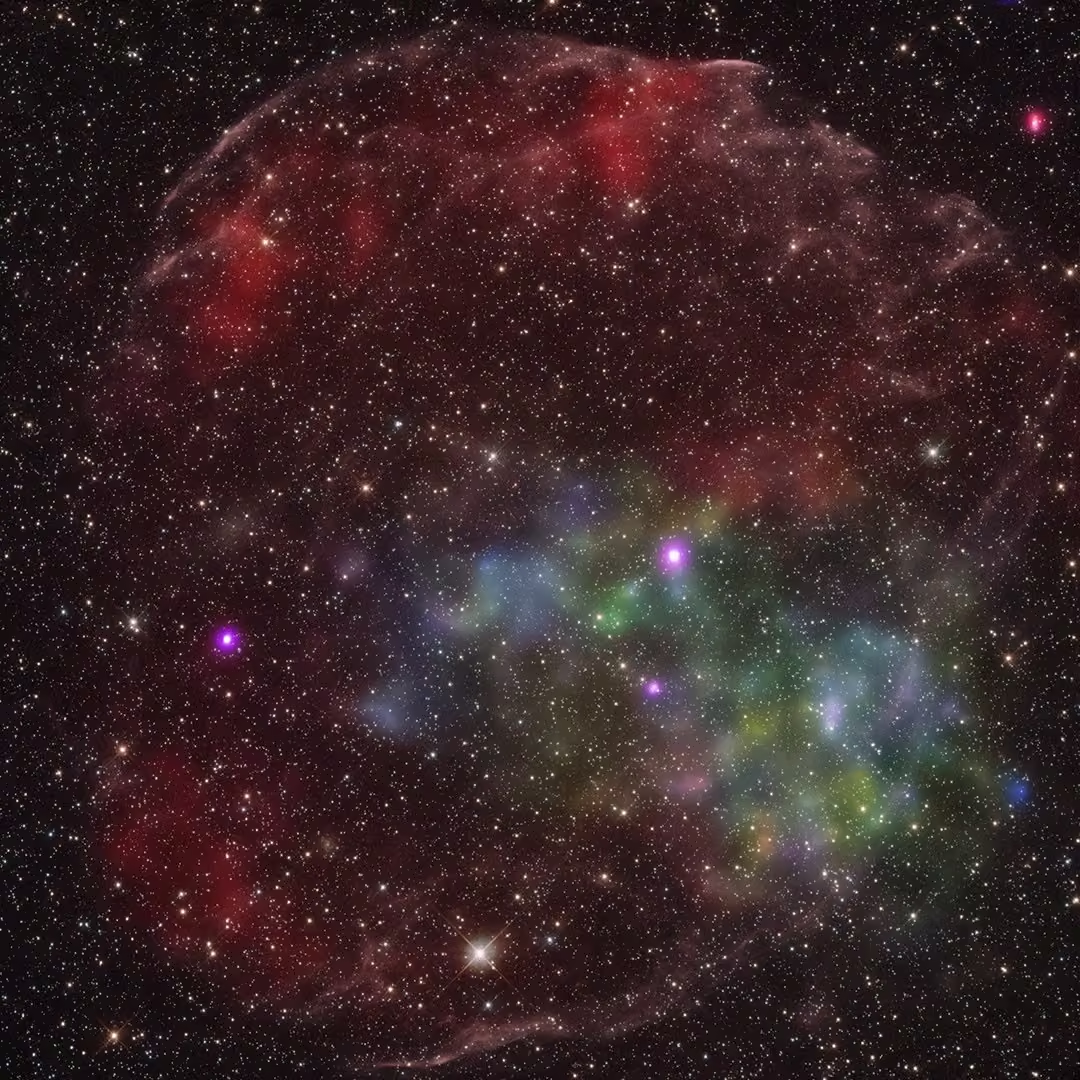
Hubble's visible light data (blue and white) highlights tidal tails of stars, while @ChandraXRay (pink) showcases shock-heated gas. Plus, @NASAWebb's infrared vision (red and orange) cuts through dust to show hidden star formation.
Discover more: science.nasa.gov/missions/chandra/galactic-gems-glisten-i…
Chandra X-ray Observatory
The Chandra X-ray Observatory (CXO), previously known as the Advanced X-ray Astrophysics Facility (AXAF), is a space telescope launched aboard the Space Shuttle Columbia during STS-93 by NASA on July 23, 1999. Chandra is sensitive to X-ray sources 100 times fainter than any previous X-ray telescope, enabled by the high angular resolution of its mirrors. Since the Earth's atmosphere absorbs the vast majority of X-rays, they are not detectable from Earth-based telescopes; therefore space-based telescopes are required to make these observations. Chandra is an Earth satellite in a 64-hour orbit, and its mission is ongoing as of 2025. Chandra is one of the Great Observatories, along with the Hubble Space Telescope, Compton Gamma Ray Observatory (1991–2000), and the Spitzer Space Telescope (2003–2020). The telescope is named after the Nobel Prize-winning Indian-American astrophysicist Subrahmanyan Chandrasekhar. Its mission is similar to that of ESA's XMM-Newton spacecraft, also launched in 1999 but the two telescopes have different design foci, as Chandra has a much higher angular resolution and XMM-Newton higher spectroscopy throughput. More on Wikipedia
-
Chandra Observatory reposted
Hubble
@NASAHubble
-
Chandra Observatory
@chandraxray
A giant star, located about 37 million light-years from Earth, has been mysteriously erupting for at least 15 years. New data from Chandra explains the cause of these huge outbursts. HINT: It might have something to do with a black hole. ⭐More at: s.si.edu/at2016blu
-
Chandra Observatory reposted
NASA Marshall
@NASA_Marshall
👻 Meet the friendliest ghost in the galaxy - Carina.
A new image from @chandraxray and @NASAWebb reveals a ghost-like cloud in the Carina Nebula that's actually home to a new generation of stars.
Read more: chandra.si.edu/photo/2026/reaper/ -
Chandra Observatory
@chandraxray
Ghosted by the universe, just in time for Halloween!🎃 This eerie structure, combining data from NASA's Chandra X-ray Observatory & @NASAWebb, is part of the Carina Nebula, located about 7,500 light years from Earth in our Milky Way galaxy. 👻s.si.edu/reaper
-
Chandra Observatory
@chandraxray
Remember that time when you spotted the remains of an exploded star that no one had identified before and Chandra followed up, revealing superheated debris? Together we helped scientists understand one of the youngest remnants in our galaxy, G306.3. We'll miss you, Swift!💜
NASA Universe
@NASAUniverse
Science operations for our Neil Gehrels Swift Observatory have now ended.
With the spacecraft orbiting less than 171 miles (275 kilometers) above Earth, atmospheric drag prevents the satellite’s telescopes from steadily gazing at their cosmic targets. 🧵 -
Chandra Observatory reposted
NASA Marshall
@NASA_Marshall
The universe is creating quite the composition 🎼
Using @chandraxray, researchers discovered that a formation nicknamed the "Treble Clef" is likely caused by an outburst from a supermassive black hole, followed by a collision of two galaxy clusters!
🔗 science.nasa.gov/missions/chandra/nasas-chandra-breaks-do… -
Chandra Observatory reposted
Hubble
@NASAHubble
NGC 1385 glows with regions where stars are forming.
@ChandraXray data (magenta) highlights stellar nurseries and X-ray binaries, while Hubble's optical (white and gray) and @NASAWebb's infrared (orange and red) observations showcase the galaxy's dusty spiral structures. -
Chandra Observatory
@chandraxray
Scientists using Chandra have discovered that the origin of an unusual source of radio waves called the "Treble Clef" was likely an outburst from a supermassive black hole, followed by a collision of two galaxy clusters. 🎼More at: chandra.si.edu/photo/2026/trebleclef/
-
Chandra Observatory
@chandraxray
As @NASA's Swift Observatory nears its final days in orbit, we're taking the opportunity to celebrate the telescope and its place in NASA's fleet of eyes on the universe with 4 new images combining observations from Chandra, Swift, & others: chandra.si.edu/photo/2026/swift/
NASA Universe
@NASAUniverse
The universe is better with friends.
As our Swift Observatory approaches the end of its mission, we’re celebrating its 21+ years in orbit — and the friends it's made — with some new galactic images.
Check out this thread for more, or download yours here: chandra.si.edu/photo/2026/swift/ -
Chandra Observatory reposted
NASA Universe
@NASAUniverse
🎵 Twinkle, twinkle, little bat!
How I wonder what you’re at!
Up above the world you fly,
Like a tea-tray in the sky. 🎵
Perhaps the Hatter spied this cosmic teacup, captured by @chandraxray (blue) and @NASAHubble (red and green)? More: chandra.si.edu/photo/2019/teacup/ #madhatterday -
Chandra Observatory
@chandraxray
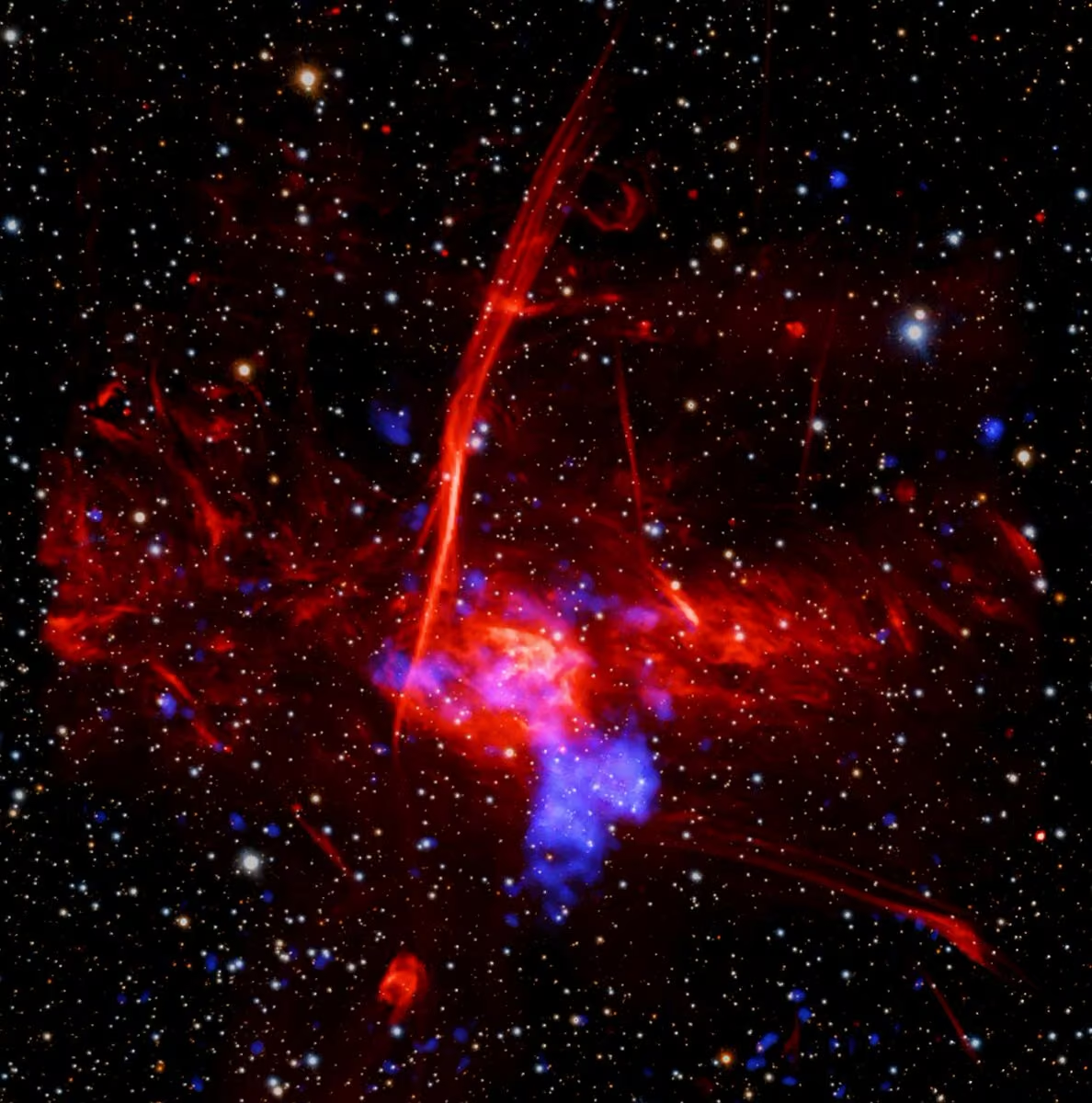
Let's face it: the center of our galaxy is a hot mess!🌡️ This new image gives us a cleaner look at our central district, including our 4‑million‑solar‑mass supermassive black hole, Sagittarius A*, and its closest supernova remnant, Sagittarius A East: s.si.edu/sgrae26
Chandra Observatory
@chandraxray
⬆️Come for the science. ⬇️Stay for the beauty of space. 😊
-
Chandra Observatory reposted
Hubble
@NASAHubble
Together, NASA's telescopes wear many hats – capturing different wavelengths of light and cosmic happenings.
This group image of the Sombrero Galaxy shows how! ⬇️ -
Chandra Observatory reposted
NASA Universe
@NASAUniverse
The Perseus galaxy cluster makes us want to cozy up with a seasonal beverage. Captured by @ChandraXray, the enormous waves of gas making this cosmic latte art likely formed billions of years ago due to the flyby of a smaller galaxy cluster. More: www.nasa.gov/universe/scientists-find-giant-wave-rolling-…
-
Chandra Observatory
@chandraxray
Scientists have discovered a new class of objects using NASA's Chandra X-ray Observatory that are behaving unlike any seen before. These mysterious objects may help solve not one, but two long-standing questions in astrophysics. More: s.si.edu/hss
-
Chandra Observatory
@chandraxray
Over 150 hours of Chandra observations compressed into 19 seconds. Explore how this timelapse of Centaurus A X-ray data was made at: chandra.si.edu/blog/node/970
-
Chandra Observatory
@chandraxray
Welcome to space, @NASARoman! 🚀 So excited to have a new friend up here to help us solve the mysteries of the universe! 🙌🏼😁
Nancy Grace Roman Space Telescope
@NASARoman
The Nancy Grace Roman Space Telescope has officially launched and is heading to its forever home at L2!
Over the next three months, the observatory will perform final checks and power its instruments before revealing its first images by early 2027.
nasa.gov/Roman -
Chandra Observatory
@chandraxray
Starburst galaxies are galaxies that are undergoing incredibly high rates of star formation. NGC 1569 is one such galaxy — forming stars roughly 100 times faster than our own Milky Way Galaxy for the past 100 million years or so.
-
Chandra Observatory
@chandraxray
Take in this new image of the barred spiral galaxy NGC 1672 from Chandra, @NASAHubble, and @NASAWebb. Studying barred spirals in action can help reveal how gas in our own Milky Way, which is also a barred spiral, feeds its central black hole and forms new stars.🌀
-
Chandra Observatory reposted
NASA
@NASA
Paint with all the colors of the (stellar) wind 🎨
Data from @NASAHubble, @ChandraXray, and @NASAWebb combine to give us a vibrant look at the Tarantula Nebula. This star-forming region is 160,000 light-years away from Earth. -
Chandra Observatory
@chandraxray
Like a collage made of layered sheets of colored cellophane, a vibrant new image layers observations of the Tarantula Nebula from NASA's Chandra (blue), Hubble (green), and Webb (red). More: s.si.edu/tarantula26
-
Chandra Observatory reposted
NASA Marshall
@NASA_Marshall
🍲@chandraxray has found a black hole that may be stirring the "pot" in its neighborhood.
Astronomers expected this galaxy, nicknamed the "red potato," to be producing many young stars, but the amount of star formation was relatively low.
LEARN MORE >> chandra.si.edu/photo/2026/redpotato/ -
Chandra Observatory reposted
National Air and Space Museum
@airandspace
Today in 1999, @chandraxray was placed in orbit. It has been exploring our universe, detecting x-rays from hot, turbulent regions of space, ever since. Learn more on our AirSpace podcast: s.si.edu/44IAGGs
-
Chandra Observatory reposted
NASA
@NASA
Check! ✔️
For the first time, scientists used our IXPE telescope to measure the magnetic field of a pulsar—a spinning neutron star—located in the Lighthouse Nebula. This data helps us understand the structure of these extreme cosmic objects. science.nasa.gov/missions/ixpe/nasa-space-telescope-maps-… -
Chandra Observatory
@chandraxray
A black hole is stirring a "pot" of gas around a neighboring galaxy nicknamed the Red Potato. This churning, caused by a jet from the black hole, is mashing down new star formation. ⚫More: chandra.si.edu/photo/2026/redpotato/
Chandra Observatory
@chandraxray
Visual Description:
Near the center of this composite image is a small, irregular, pale yellow oval with a red outer ring, in the heart of a bright, hazy red cloud. This is a galaxy nicknamed the “red potato” by astronomers studying this region of the early universe. Those astronomers expected the red potato to be producing scores of new stars. When they instead discovered relatively low star growth, they looked to a neighboring galaxy for reasons why.
To our upper right of the red potato and its hazy red cloud of gas, is a neighboring galaxy in a pool of blue haze. This galaxy is also pale yellow in color, but has a less defined, less tuber-like shape than its counterpart. The blue pool represents X-rays from a growing supermassive black hole in the heart of the galaxy. The pool has a stubby tail, or X-ray jet, pointed toward the red cloud, and faint pockets of red and blue overlap within the image.
Astronomers now believe that the X-ray jet from the neighboring supermassive black hole may have struck the red gas cloud around the red potato. This may be causing turbulence within the gas cloud, preventing the gas from falling onto the red potato. Without the ingredients from that gas, new stars struggle to grow. -
Chandra Observatory reposted
Hubble
@NASAHubble
It takes telescope teamwork to get the full picture of ZwCl 0024+1652!
This galaxy cluster is located about 9.5 million light-years away. The glowing blue and red light here shows data from Hubble and @ChandraXRay ⬇️ -
Chandra Observatory reposted
NASA Marshall
@NASA_Marshall
A new result using NASA’s @chandraxray shows that the outer spiral arms in the Milky Way galaxy may reach wider than previously thought. This finding may lead astronomers to adjust their understanding of our home galaxy’s structure.
READ MORE: science.nasa.gov/missions/chandra/nasas-chandra-examines-… -
Chandra Observatory reposted
Hubble
@NASAHubble
Baby, you're a firework 🎆
This image combines data from Hubble and @ChandraXRay to show a spectacular star cluster surrounded by a vast region of dust and gas.
Called NGC 3603, this star factory shines 20,000 light-years away: chandra.si.edu/photo/2026/250th/ -
Chandra Observatory
@chandraxray
The outer spiral arms of our Milky Way galaxy may reach wider than previously thought, according to data from @NASA's Chandra & ESA's XMM-Newton. This finding could lead us to adjust our understanding of our home galaxy's structure. 🌀More: chandra.si.edu/photo/2026/arms/
Chandra Observatory
@chandraxray
Visual Description:
By studying rings of X-ray light echoes, researchers now believe that two of the Milky Way's spiral arms may be more distant from the center of the galaxy than previously thought.
The updated understanding of the structure of the Milky Way is highlighted in this short video, which compares two artist concept images. In both images, our spiral Milky Way galaxy is shown face-on. It has a bright white core with several arms that spiral out from the center, like long thin clouds corkscrewing counterclockwise. The two longest arms make a full rotation of the spiral galaxy, and curve all the way around to the upper right of the images.
The first image in the video shows the previous understanding of the Milky Way. Here, the two longest arms are curled around the core in a fairly tight spiral. In the second image, which represents the updated understanding, the two longest arms are more loosely spiraled. Visually, this means there is more open space between the curving arms, which are further away from the bright galaxy core. The video fades back and forth between the two artist concept images to illustrate the structural differences between the two understandings. -
Chandra Observatory
@chandraxray
In celebration of the 250th birthday of the United States, @NASA has unveiled four cosmic images from its Chandra X-ray Observatory rendered in red, white, and blue that represent the wonders of the universe the agency explores. 🎆More: chandra.si.edu/photo/2026/250th/
Chandra Observatory
@chandraxray
Visual Description:
This image features four images, showing four wonders of the universe, rendered in red, white, and blue and presented in a grid layout. The images contain X-ray data from the Chandra X-ray Observatory, optical and infrared data from the Hubble Space Telescope and the James Webb Space Telescope, as well as ground-based telescopes.
The top left image is Cassiopeia A. The top right image is NGC 3603. The bottom left image is ZwCl 0024+1652. The bottom right image is NGC 4736, also known as M94.
Cassiopeia A: The cloudy blast-wave of the supernova remnant is ring-like in shape, streaked with veins of iron, calcium, and oxygen. Here, presented in red, white, and blue, the remnant resembles an electrified donut, crackling with marbled veins of strawberry and blueberry icing.
NCG 3603: This nebula contains a massive cluster of stars on the other side of the Milky Way galaxy. Here, a tight cluster of neon red and white stars packs the center of the image, dissipating as it reaches the outer edges of the panel. Sweeping in at the lower corners of the image are hazy blue clouds resembling sheets of gauze.
ZwCl 0024+1652: The image of this distant galaxy cluster is packed with streaks and specks in golden yellow and brilliant white. Upon close inspection, each streak and speck is revealed to be an individual galaxy, some with discernible spiral shapes. At the center of the image is a round pool of bright red light, surrounded by royal blue haze. The red light represents X-ray observations by Chandra, which reveal an enormous reservoir of superheated gas pervading the cluster. The blue haze represents specially-processed data from Hubble, suggesting evidence of dark matter.
NGC 4736: This spiral galaxy is seen face on, with concentric pale violet cloud rings flecked with scores of stars in white, pale blue, soft red, and golden yellow. The inner ring of the galaxy is bright, and rosy yellow in color. This is a starburst ring, where new stars are forming. -

Chandra Observatory
@chandraxray
🌟Find out more about the discovery, including videos & images, at: chandra.si.edu/photo/2026/m83/
NASA
@NASA
Sparkly, swirly, and surprising 🌌
@ChandraXray data shows that this galaxy, Messier 83, is unusual. Over 20 of its supernova remnants – remains from star explosions – vary drastically in X-ray brightness. Typically, the remnants' brightness would fade slowly over time. -
Chandra Observatory reposted
NASA
@NASA
Super! 💫
Data from @chandraxray has uncovered possible remains of a supernova in the middle of our Milky Way galaxy. If confirmed, this supernova piece would be one of the closest to our galaxy’s central black hole that we have ever found. science.nasa.gov/missions/chandra/nasas-chandra-discovers… -
Chandra Observatory
@chandraxray
When astronomers pointed NASA's Chandra at nearby galaxy M83, the last thing they expected to find was a population of supernova remnants appearing to dramatically change in brightness. More on the discovery: chandra.si.edu/photo/2026/m83/ #aas248
Chandra Observatory
@chandraxray
Visual Description:
A video showing a composite image of the nearby galaxy Messier 83 on the left, and short timelapse videos of two curious supernova remnants hidden inside on the right.
In the composite image, Messier 83, or M83, is shown to have a spiral structure, viewed straight on. At the center is a brilliant white and yellow pool of light. From that light, spiral arms of hot pink cloud corkscrew out in wide, sweeping arches. The galaxy is covered in a faint grey haze, and flecked with red, green, blue, white, and yellow dots.
Two tiny dots to our lower right of center are highlighted by white circles. These are two of the supernova remnants being considered by researchers. Each is examined further in a separate timelapse video.
Over a 14-year period from 2000 to 2014, astronomers pointed NASA’s X-ray observatory at the M83 galaxy. They discovered that about half of the X-ray sources believed to be supernova remnants, the aftermath of stellar explosions, were exhibiting dramatic changes in brightness. This result was entirely unexpected.
Those changes in brightness are highlighted in the timelapse videos. In each video, a series of static images flashes by, focused on one of the two X-ray sources once believed to be supernova remnants. In the videos, the X-ray sources appear as bright blue blobs with glowing cores. But in each image, taken months or years apart, the shapes change, as does the intensity of the blue color, and the brightness of the core. By presenting the substantively different images of the same objects one after another in quick succession, short timelapse videos are created.
The most likely explanation for the changes in brightness is that the team has uncovered a population of stellar survivors, stars that lived through an orbiting partner’s destruction in a supernova explosion. Material is being pulled from the surviving star onto the black hole or neutron star that formed in the supernova, a process known to cause rapid changes in X-ray brightness. -
Chandra Observatory reposted
NASA Marshall
@NASA_Marshall
Astronomers may have found a new supernova remnant near the center of the Milky Way galaxy using data from @chandraxray. If confirmed, this would be one of the closest supernova remnants to the supermassive black hole in the Galactic Center!
🔗science.nasa.gov/missions/chandra/nasas-chandra-discovers… -
Chandra Observatory
@chandraxray
Astronomers may have found one of the closest supernova remnants to the supermassive black hole at the center of our Milky Way galaxy. It's expanding at about 3.2 million kilometers per hour (2 million mph) and is at least 1,700 years old. 💥More: s.si.edu/sgrc26
-
Chandra Observatory
@chandraxray
The supermassive black hole at the center of our galaxy, Sagittarius A*, is blowing a hot cosmic wind — something scientists have been hunting for over 50 years. ⚫More on the discovery at: chandra.si.edu/photo/2026/sgrawind/
-
Chandra Observatory
@chandraxray
Some of our galaxy’s youngest, hottest, and most massive stars blaze to life in the nearby Carina Nebula. Winds from these powerful stars can carve out bubbles of hot gas, producing dramatic shapes in the surrounding clouds of colder gas and dust.✨
-
Chandra Observatory reposted
NASA Marshall
@NASA_Marshall
The “most relaxed galaxy cluster in the universe” wasn't always so calm 🌀
New observations from @chandraxray show that Abell 2029 is still settling down after a collision with another smaller cluster about four billion years ago.
More: chandra.harvard.edu/photo/2026/a2029/?linkId=952330445 -
Chandra Observatory
@chandraxray
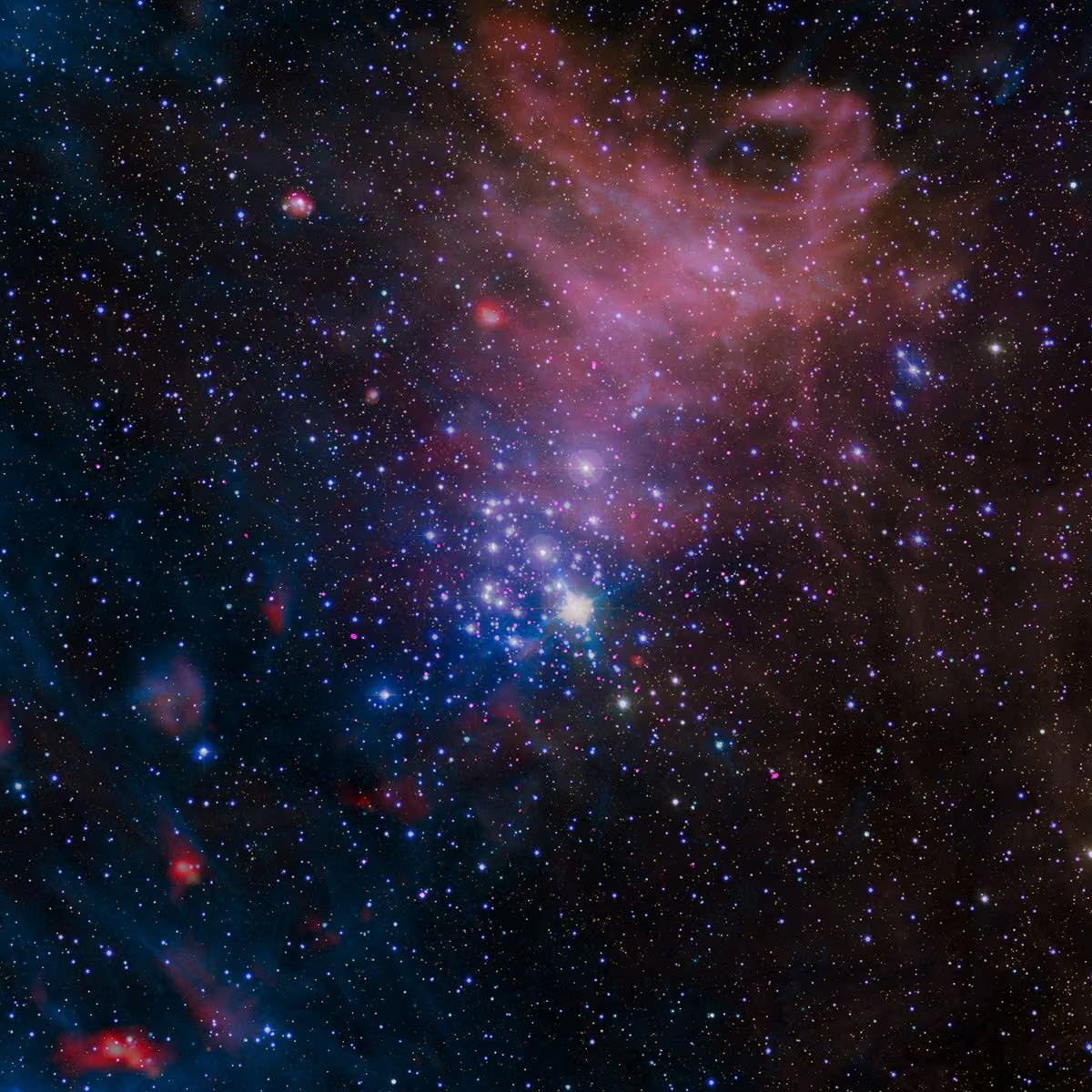
Westerlund 2 is a young cluster of thousands of stars located about 20,000 light-years from Earth. This close-up image, roughly 12 light-years across, combines observations from NASA's Chandra X-ray Observatory & @NASAWebb.✨
-
Chandra Observatory
@chandraxray
At the heart of galaxy NGC 1365, a supermassive black hole is basically feasting at an all‑you‑can‑eat buffet in this image from Chandra and @NASAWebb. Located about 60 million light-years from Earth, this gobbling black hole has a mass of roughly 2 million suns... and growing.⚫
-
Chandra Observatory
@chandraxray
Sometimes described as "the most relaxed galaxy cluster in the universe," Abell 2029 had a wild past according to new observations from NASA's Chandra X-ray Observatory. More at: chandra.si.edu/photo/2026/a2029 🌀
-
Chandra Observatory reposted
NASA
@NASA
A-meow-zing 😻
@NASAWebb and @ChandraXray joined forces to deliver this view of the Cat's Paw Nebula. Different wavelengths combine to reveal young stars at the center of these dusty clouds. -
Chandra Observatory reposted
Hubble
@NASAHubble
The force awakens in newborn stars.
Hubble captured some cosmic "lightsabers" far, far away. These are actually young stellar jets, colliding at fast speeds with nearby gas and dust.
Happy Star Wars Day from the Hubble team! -
Chandra Observatory reposted
NASA Ames
@NASAAmes
Even the cosmos has a green thumb 💐
160,000 light-years away, 30 Doradus is in full bloom, displaying a stellar bouquet of thousands of stars.
This image combines data from NASA’s Chandra X-ray Observatory, @NASAHubble, and the Atacama Large Millimeter/submillimeter Array. -
Chandra Observatory
@chandraxray
This striking new view of the Pinwheel Galaxy combines X-ray light from Chandra with other types of light from ground-based observations, @NASAHubble, and XMM-Newton. The galaxy is roughly 170,000 light-years across, making it about 70% larger than our own Milky Way Galaxy.🌀
-
Chandra Observatory
@chandraxray
An X-ray emitting "little red dot" about 11.8 billion light-years from Earth may be key to unlocking the true nature of a mysterious class of sources that astronomers have found in the early universe. More: chandra.si.edu/photo/2026/xraydot/ 🔴
-
Chandra Observatory
@chandraxray
Over 1,000 stars are located within 4 light-years of the center of the Westerlund 1 "super" star cluster. To give you a little context, 4 light-years is roughly the distance between our Sun and the next closest star to Earth. 🤯
-
Chandra Observatory
@chandraxray
Sun-like stars are dimming in their X-ray output more quickly than previously thought. Unlike in the movie "Project Hail Mary," this quieting of stars is a benefit for the prospects for life on orbiting planets around these stars — not a threat. ✨More: s.si.edu/dimming
-
Chandra Observatory reposted
NASA Marshall
@NASA_Marshall
We're coloring in the picture, one telescope at a time! 🎨
NASA’s IXPE telescope has taken a new observation of a supernova remnant, RCW 86, which helps create a fuller picture of what other telescopes have observed >> www.nasa.gov/image-article/nasa-x-ray-mission-gets-fresh-… -
Chandra Observatory
@chandraxray
Astronomers have an answer for a long-running mystery in astrophysics: why is the growth of supermassive black holes so much lower today than in the past? More about the discovery: chandra.si.edu/photo/2026/bhgrowth ⚫
Chandra Observatory
@chandraxray
Visual Description:
Two composite images, presented side-by-side. Each image represents an extraordinarily large survey of galaxies, with a single galaxy positioned at the center of each frame.
The two images appear visually similar. Both feature dozens of galaxies; glowing specks and elliptical shapes in purples, golden oranges, blues, and whites, scattered across the blackness of space. In both images, blue colors represent optical data from Hubble. Reds and greens represent infrared data from Webb. And purples and pinks represent X-ray data from Chandra.
The focal points are the galaxies at the center of each frame. Both galaxies glow in pinks and whites, and both have supermassive black holes at their core. But the featured galaxy on our left is far more distant than the featured galaxy on our right.
On our left is a spiral galaxy some 5.6 billion light-years from Earth. It resembles a large dot with a hazy, neon pink outer ring, and a white core. The strong pink glow is due to gas rapidly falling into the supermassive black hole at its core. When that gas is heated up, it produces large amounts of radiation, including X-rays.
On our right is an elliptical galaxy at a distance of about 3 billion light-years. This galaxy resembles an egg with an oval-shaped white outer ring, and a round pink circle at its core. This galaxy’s supermassive black hole is a much fainter source of X-rays than the source in the left panel. This indicates that the supermassive black hole on our right is consuming material at a much slower rate than the more distant supermassive black hole on our left. -
Chandra Observatory
@chandraxray
Spring into spring with this new image of the Cat's Paw Nebula from NASA's Chandra and @NASAWebb. We expect it to start knocking planets off the counter for sport any minute now. 🐾
Chandra Observatory
@chandraxray
Visual Description:
In this composite image of the Cat's Paw Nebula, pockets of starry blue sky appear behind thick, overlapping rings of dark orange cloud. At the center of the image, tucked amongst the clouds, is a mottled patch of purple. -
Chandra Observatory
@chandraxray
Astronomers have spotted an extreme collision between two neutron stars in a very odd place about 4.7 billion light-years from Earth. This result may help answer two different mysteries about stars and intergalactic space. More at: chandra.si.edu/photo/2026/nsmerger
-
Chandra Observatory reposted
NASA Marshall
@NASA_Marshall
Chandra doesn’t just study black holes — it also reveals new details across our solar system. This sonification blends X-rays from @chandraxray with a Cassini image of Saturn, turning data into sound. 🪐
Check out more planetary sonifications here: www.nasa.gov/missions/chandra/listen-to-this-months-plane… -
Chandra Observatory
@chandraxray
Listen your way across Jupiter with this new sonification combining data from Chandra and @NASAHubble. Want to know more about it? Check out the description below 👇
Chandra Observatory
@chandraxray
Video Description:
At the center of the image is the gas giant itself; a seemingly perfect sphere with an atmosphere of latitudinal bands. The bands are different shades of grey, brown, and black, each with its own texture and width. Flanking Jupiter are neon pink and white clouds, representing X-rays from energetic particles in a ring around the planet.
In the video, an activation line moves from our left to right. As the activation line sweeps across the image, it encounters visual elements. These elements are translated into sound, or sonified, according to parameters established by Chandra's sonification team.
The line first encounters a pink cloud, triggering whooshing woodwinds. When the activation line encounters Jupiter, dramatic low notes are triggered. Listen for the dip as the line passes over the Great Red Spot in Jupiter's southern hemisphere. The activation line continues toward our right, passing more pink X-ray clouds. The largest cloud, the last one encountered, has a bright white core, which translates to loud gusty woodwinds. -
Chandra Observatory
@chandraxray
Peaking on February 28th in the Northern Hemisphere, six planets will all be visible from clear & dark night skies. In celebration of this planetary group project, Chandra is releasing three new planetary sonifications. Experience the data-driven sounds of Uranus:
Chandra Observatory
@chandraxray
Video Description:
A composite image of the planet Uranus appears on screen. The icy giant is a greenish-blue cyan color, with a blush of neon pink X-rays hovering over its core. Uranus has a collection of very narrow rings, much finer than the wide disk-like rings surrounding Saturn. In this image, the fine rings are near vertical and slightly tilted, creating an oval shape with rounded points at our lower left and upper right.
In this sonification, the activation line moves from our left to right. Brightness is mapped to volume and height is mapped to pitch, such that brighter objects at the top of the image sound louder and higher. Here, the curved oval shape of the rings is conveyed as a swooping cello note, with the pitch sliding up as the activation line passes the oval tilted toward our upper right. -
Chandra Observatory
@chandraxray
This image shows the first "astrosphere" surrounding a Sun-like star younger than our Sun. This new discovery gives us a chance to study the structure our own Sun may have been embedded in several billion years ago. More at: s.si.edu/astrosphere ⭐
-
Chandra Observatory
@chandraxray
Behold, the heart‑shaped Cocoon Nebula — because even the universe can get a little dramatic about Valentine's Day. Nothing says “I love you” quite like a giant cloud of hot gas. If you need it, it'll be out there glowing majestically roughly 2,650 light-years from Earth.💘✨
-
Chandra Observatory reposted
NASA Marshall
@NASA_Marshall
Time to battle it out! 🏈
Vote for your favorite set of @chandraxray images as we prepare for #sblx! -
Chandra Observatory reposted
Hubble
@NASAHubble
Who’s in your #nasamooncrew? 🫵
Crews bring together the right mix of skills to make missions happen! Just like the Artemis II crew working together on their journey around the Moon, NASA’s space telescopes use their different strengths to observe the universe.
Your turn: Tell @NASA who you’d bring on a journey around the Moon! Details here: www.nasa.gov/nasamooncrew/?linkId=902398715 -
Chandra Observatory
@chandraxray
A new discovery made using both @NASA's Chandra X-ray Observatory & @NASAWebb shows that galaxy clusters may have started forming earlier in the universe than previously thought — one or two billion years earlier than previously thought possible! More at: s.si.edu/protoc
-
Chandra Observatory
@chandraxray
Curious what 22 years of Chandra observations sound like? This sonification includes every Chandra observation from 1999 - 2021. 🎵
This media couldn't be displayed. See it on the original post. -
Chandra Observatory
@chandraxray
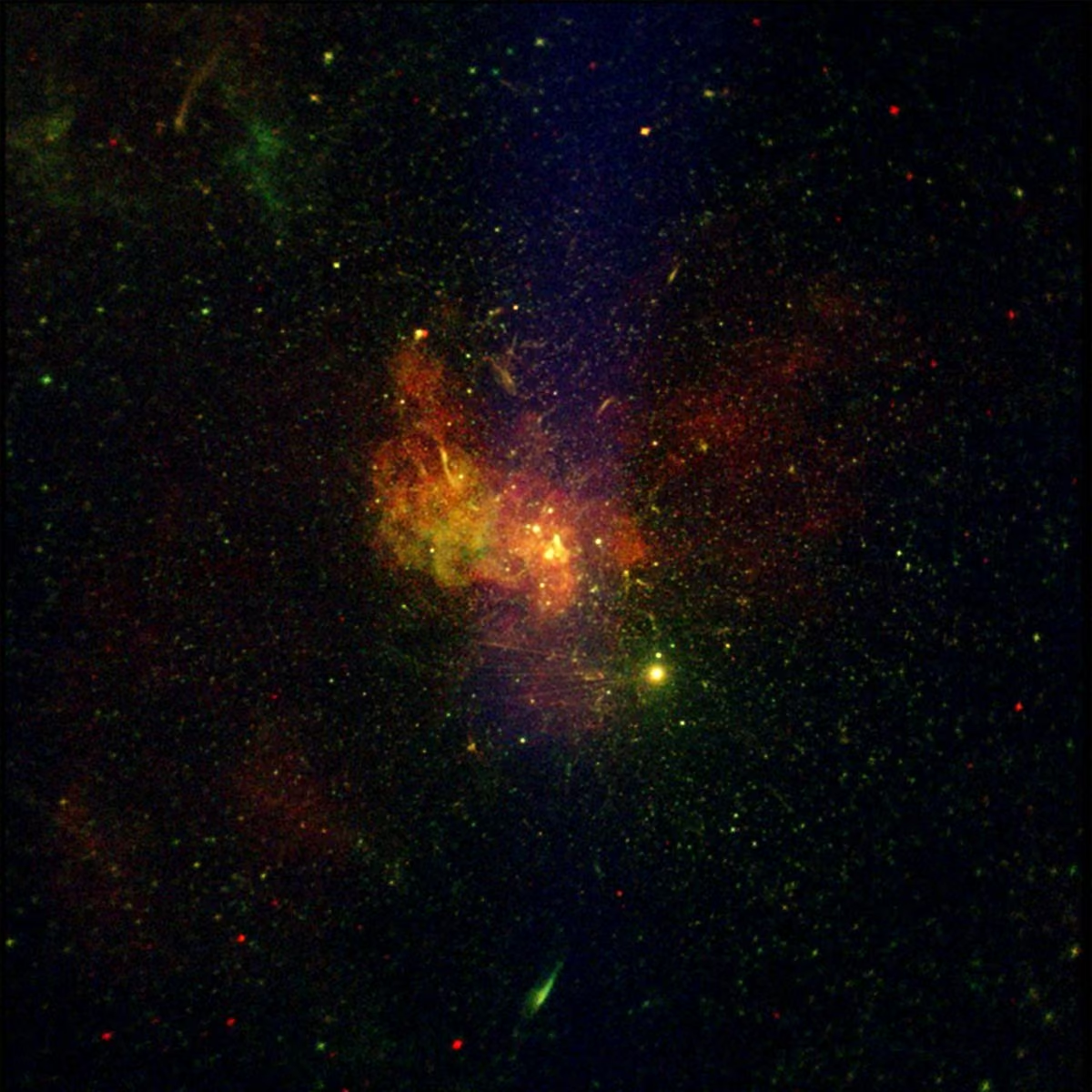
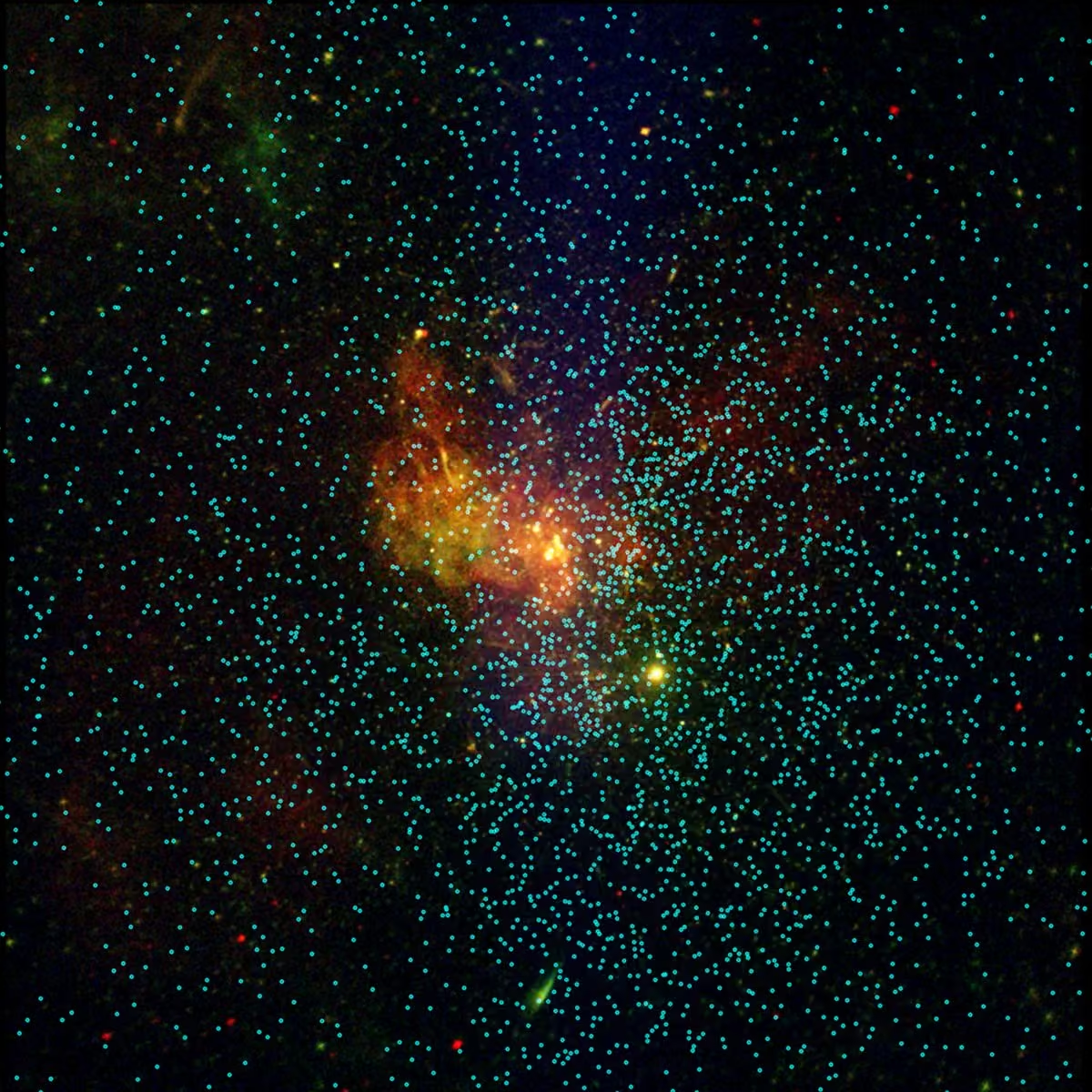
The Chandra Source Catalog is a free-to-all collection of X-ray detections made by Chandra. This new image of the center of our galaxy contains 3,300 Chandra sources in a field of view roughly the size of a pinprick on the entire sky! More: s.si.edu/csc26
-
Chandra Observatory
@chandraxray
This new video shows changes in Kepler's Supernova Remnant using data from @NASA's Chandra captured over more than two and a half decades. Located about 17,000 light-years from Earth, parts of the remnant are still traveling at ~13.8 million mph. s.si.edu/kepler26 #aas247
-
Chandra Observatory reposted
NASA
@NASA
A toast to the first Friday of 2026 🥂
This image of the Champagne Cluster from @chandraxray shows two sparkling galaxy clusters merging into one. Learn more about them and their history: www.nasa.gov/missions/chandra/nasas-chandra-rings-in-new-… -
Chandra Observatory
@chandraxray
Astronomers discovered these two clusters of sparkling light clinking together on New Year's Eve, 2020. Inspired by the date and the bubbly imagery, they nicknamed the galaxy cluster the Champagne Cluster — much easier to remember than its official name: RM J130558.9+263048.4.🍾
Chandra Observatory
@chandraxray
More at: chandra.si.edu/photo/2025/champagne
-
Chandra Observatory
@chandraxray
We're sending you a holiday card with 4 new winter-themed images from Chandra with data from other telescopes, including our friends at @NASAHubble & @NASAWebb. Each object in the collection gives a wink to wintertime cheer, either in its name or shape.🌲 chandra.si.edu/photo/2025/holidays/
-
Chandra Observatory
@chandraxray
A mystery dating back to the earliest days of X-ray astronomy has finally been resolved! Astronomers have identified the origin of X-rays in a supermassive black hole's jet by studying a massive galaxy located at the very heart of the Perseus Cluster: s.si.edu/bhjets25
-
Chandra Observatory
@chandraxray
Whether you're exploring space through a telescope or examining life under a microscope, the goal is the same: to greatly extend human vision. By pairing glimpses of these two worlds, we can explore the deep connections across scale. Micro to Macro: s.si.edu/MicroMacro
Chandra Observatory
@chandraxray
Video Description:
00:00 Pairs of very colorful images scroll by vertically on the screen.
00:02 Text reads: "From the extremely Big to the incredibly Small"
00:06 Two images, similar in appearance, swipe in from the sides, resting on the screen one above the other. Label on top image: "Heart Tissue". Label on bottom image: "Heart of a Stellar Nursery". Text at top reads: "Telescopes and microscopes share one goal —"
00:10 Two different images, similar in appearance, swipe in from the sides, resting on the screen one above the other. Label on top image: "Star Cluster". Label on bottom image: "Cluster of Fibers & Fat Cells".
00:13 Two different images, similar in appearance, swipe in from the sides, resting on the screen one above the other. Label on top image: "Dead Star". Label on bottom image: "Sea Slug Nerve Cell". Text at top reads: "— making the invisible visible."
00:17 Two different images, similar in appearance, swipe in from the sides, resting on the screen one above the other. Label on top image: "Tiny Wheel Animal". Label on bottom image: "Flowing Deposits on Mars".
NOTE: Several pairs of images, described as those shown previously, begin to cycle through in the same manner. Each is referred to as a "Pair" from this point on in the visual description.
00:22 Pair. Top image label: "Lab Skin Cells". Bottom image label: "Planetary Nebula".
00:25 Pair. Label on top image: "Tobacco Planet". Label on bottom image: "Stellar Jets". Text at top reads: "Translating what we can't see with our human eyes"
00:29 Pair. Top image label: "Galaxy Cluster". Bottom image label: "Fruit Fly Cells".
00:32 Pair. Label on top image: "Membranes". Label on bottom image: "Cyclones on Jupiter". Text at top reads: "into something we can."
00:35 Pair. Top image label: "Agate". Bottom image label: "Turbulence on Jupiter".
00:38 Pair. Top image label: "Martian Crater". Bottom image label: "Blue Pigment".
00:42 Pair. Label on top image: "Cell Death". Label on bottom image: "Star Death". Text at top reads: "From the smallest cells to the largest galaxies,"
00:46 Pair. Top image label: "Our Sun". Bottom image label: "Carbon Nanotubes".
00:49 Pair. Label on top image: "Star Cluster". Label on bottom image: "Ladybug Leg". Text at top reads: "the universe repeats its beauty."
00:52 Pair. Top image label: "Shrubby Plant Hair". Bottom image label: "Sunspot".
00:56 Pair. Top image label: "Exploded Star". Bottom image label: "Divided Cells".
00:59 Pair. Top image label: "Night Sky Moves in X-rays". Bottom image label: "Capillary Network of Mammalian Brain".
01:03 Pair. Top image label: "Mouse Embryos". Bottom image label: "Spiral Galaxy".
01:05 Text at top reads: "NASA's Chandra X-ray Observatory and Nikon's Small World Present:"
01:07 Text at top reads: "Small world big universe"
01:09 Text reads a web URL: "chandra.si.edu/micro" and shows a music credit: " “Pickled” by Ehren Ebbage [BMI], David John Vanacore [ASCAP], and Universal Production Music"
01:11 NASA logo appears
01:14 Fade to Black -
Chandra Observatory
@chandraxray
A team of astronomers studied more than 1,600 galaxies observed by NASA's Chandra over the past two decades. Their findings: smaller galaxies may not have supermassive black holes nearly as often as larger ones. 😮 More: chandra.si.edu/photo/2025/smbhs
-
Chandra Observatory reposted
NASA
@NASA
Take a spin around a spiral galaxy!
@ChandraXray, @NASAHubble, and @NASAWebb studied this galaxy with a black hole at its center that is twice as massive as the Milky Way’s.
Notably, a million-mile-per-hour wind being driven from the black hole lights up the galaxy's center. -
Chandra Observatory
@chandraxray
A new technique has been developed to analyze some of the largest objects in the universe! The technique, called "X-arithmetic," allows us to identify features in galaxy clusters like never before — classifying them by nature, rather than just appearance: s.si.edu/xa
-
Chandra Observatory reposted
NASA Marshall
@NASA_Marshall
When two worlds collide 🌌
This @chandraxray image shows IC 1623 - a system where two galaxies are in the process of merging. As the galaxies collide, they trigger new bursts of star formation that glow dramatically in certain kinds of light. The merging galaxies may also be in the process of forming a supermassive black hole. -
Chandra Observatory
@chandraxray
Tired from all that Thanksgiving cooking? Don't worry, many black holes can cook for themselves today! Black hole outbursts, in the form of jets, can trigger a series of events that ends up allowing these monsters to prepare their own meals & self-feed! #blackholefriday ⚫ (1/2)
Chandra Observatory
@chandraxray
(2/2) Get the "recipe" here: chandra.si.edu/photo/2025/filaments/
-
Chandra Observatory
@chandraxray
Before fall leaves, we're celebrating autumn all this week with seasonal offerings from space! We hope the glowing pockets of gas & dust in NGC 6334 remind you of leaves tossed around by the wind, but we know you're already thinking about untangling holiday lights, aren't you?👀
-
Chandra Observatory
@chandraxray
IC 348 is a star-forming region located about 1,000 light-years from Earth in our Milky Way galaxy. The wispy structures that dominate this image are interstellar material that's reflecting light from stars. The fluffy-looking colored dots are developing young stars.✨
-
Chandra Observatory
@chandraxray
That fuzzy, purple smudge is a distant black hole growing at one of the fastest rates ever seen. It's located roughly 12.8 billion light-years from Earth, which means that we're seeing it as it was just ~920 million years after the universe began. More: s.si.edu/red6
-
Chandra Observatory
@chandraxray
Westerlund 1 is the biggest and closest "super" star cluster to Earth. Some of the stars found here shine with the brightness of almost one million Suns! This new image combines X-ray light from Chandra, optical light from @NASAHubble, and infrared light from @NASAWebb.
-
Chandra Observatory reposted
Hubble
@NASAHubble
NGC 346 is homebase for thousands of newborn stars! 🌟
The cluster’s most massive stars produce powerful winds and radiation. In this image, Hubble's visible & ultraviolet observations are combined with X-ray data from @chandraxray.
Find more: chandra.si.edu/photo/2025/cosmic/ -
Chandra Observatory
@chandraxray
The star that exploded to become the Cassiopeia A supernova remnant appears to have undergone a dramatic event right before its demise. New evidence from Chandra indicates that the star's interior was violently rearranged just hours before the explosion: s.si.edu/casa25
-
Chandra Observatory
@chandraxray
X-ray & radio light go "hand in hand" in this new image of MSH 15-52. Nicknamed "the hand of god" in popular culture, new data are providing us with a fresh view of this exploded star, its environment, and its peculiar properties. More: s.si.edu/hand-in-hand 🤝
-
Chandra Observatory
@chandraxray
The "ink-redible" Squid Galaxy is located about 50 million light-years from Earth. This view of the Squid, roughly 29,000 light-years across, combines different types of light captured by NASA's Chandra, @NASAHubble, @NASAWebb, and @TheNRAO's Very Large Array.🦑
-
Chandra Observatory
@chandraxray
M82 is a so-called "starburst galaxy" — a galaxy where stars are forming at rates 10s to 100s of times higher than in normal galaxies like our Milky Way. This image of M82, roughly 27,000 light-years across, combines observations from @NASA's Chandra and @NASAHubble.
-
Chandra Observatory reposted
NASA
@NASA
A quick midnight snack
@NASAHubble and @ChandraXray caught a black hole having a feast about 450 million light-years away. Data points to it being an intermediate-mass black hole, which are harder to spot than supermassive black holes. science.nasa.gov/missions/hubble/nasas-hubble-chandra-spo… -
Chandra Observatory
@chandraxray
NASA's Chandra and Hubble have teamed up to identify a rare type of black hole eating a star. When it comes to black holes, Chandra & @NASAHubble are like peanut butter and jelly — even better when they're together! More at: s.si.edu/ngc6099 ⚫
-
Chandra Observatory
@chandraxray
What you're seeing is a 98-light-year-wide chunk of star factory. This new image of N79, a giant region of star formation located about 160,000 light-years from Earth, combines observations from NASA's Chandra X-ray Observatory and @NASAWebb .✨
-
Chandra Observatory
@chandraxray
A star is bombarding a baby planet with X-rays, shrinking it from the size of Jupiter to a small, barren world, according to a new Chandra study. Scientists estimate the planet is losing a mass equivalent to a full Earth's atmosphere about every 200 years. s.si.edu/baby
-
Chandra Observatory
@chandraxray
To infinity and beyond! Scientists using NASA's Chandra & Webb have discovered an oddly-shaped galaxy resembling the infinity symbol ♾️ that may contain the first newborn supermassive black hole ever spotted. The buzz: s.si.edu/infinity
-
Chandra Observatory
@chandraxray
The Bullet Cluster is iconic, having provided the first direct proof of dark matter with NASA's Chandra, Hubble, and ground-based telescopes back in 2006. This spectacular new image combines Chandra & Webb Telescope data — helping us learn more about dark matter than ever before.
NASA Webb Telescope
@NASAWebb
Hello darkness my old friend…
What you are (not) seeing, highlighted in blue, is dark matter. Webb was used to precisely map out the dark matter that is part of the makeup of two colliding galaxy clusters.
science.nasa.gov/missions/webb/nasa-webb-pierces-bullet-c… -
Chandra Observatory
@chandraxray
This new image shows the Andromeda Galaxy in 5 different types of light — X-ray, UV, optical, infrared, and radio. Andromeda, also known as Messier 31 (M31), is the closest spiral galaxy to the Milky Way at a distance of about 2.5 million light-years. s.si.edu/andromeda25
-
Chandra Observatory
@chandraxray
Today Chandra is studying a not so itsy bitsy spider that's making big waves. Located about 3,000 light-years from Earth, the Red Spider Nebula is home to one of the hottest stars known. The star produces powerful stellar winds, generating waves about 100 billion kilometers high.
-
Chandra Observatory reposted
NASA Universe
@NASAUniverse
Is it bad luck if a black hole crosses your path? #fridaythe13th
It depends on how close you get!
Maybe you’ll safely fly by, like in this simulation …This media couldn't be displayed. See it on the original post. -
Chandra Observatory reposted
NASA Universe
@NASAUniverse
#tbt to the June 1, 1990, launch of ROSAT (Roentgen Satellite), an X-ray telescope developed jointly by Germany, the United Kingdom, and @NASA. The telescope retired in 1999, but astronomers still use ROSAT’s data, like in this recently-released image of the Cygnus Loop.
-
Chandra Observatory
@chandraxray
A record-breaking structure, spanning nearly 20 million light-years, has been discovered in a galaxy cluster. It could help us understand how magnetic fields shape the Universe on the largest scales — one of the major unanswered questions in astrophysics: s.si.edu/g287
-
Chandra Observatory
@chandraxray
A black hole has blasted out a surprisingly powerful jet in the distant universe, according to a new study from NASA's Chandra. This jet exists early enough in the cosmos that it is being illuminated by the leftover glow from the big bang itself. More: s.si.edu/j1610
-
Chandra Observatory
@chandraxray
New observations have captured a rare cosmic event: two galaxy clusters have collided and are now heading back for another swipe at each other. About 2.8 billion light-years from Earth, the clusters are currently separated by about 11 million light-years. s.si.edu/g181
-
Chandra Observatory
@chandraxray
Today Chandra is studying the magnetar in the center of supernova remnant RCW 103. A magnetar is a type of neutron star that's highly magnetized. If this thing was located about half the distance to the moon, it would wipe out the data on every credit card strip on the planet!🤯
-
Chandra Observatory reposted
ARCHIVED - Dr. Nicky Fox
@NASAScienceAA
This month’s #nasascience image features Cassiopeia A, one of the most studied supernova remnants. Using data from @chandraxray and @NASAWebb, researchers have uncovered previously unseen structures within the stellar debris, offering new insights into the complex aftermath of a massive star’s explosion.
Explore the science: science.nasa.gov/multimedia/june-2025/ -
Chandra Observatory
@chandraxray
Twinkle, twinkle, little star, how I wonder what you are! Scientists have discovered a star behaving like no other seen before, giving us fresh clues about the origin of a new class of mysterious objects. More at: s.si.edu/lprt ⭐
-
Chandra Observatory
@chandraxray
NGC 6872 is one of the largest spiral galaxies in the known universe. At over 520,000 light-years across, it's more than five times the size of our Milky Way galaxy. This incredible image combines X-ray light from Chandra with optical light from @NASAHubble. 🌀
-
Chandra Observatory
@chandraxray
Today Chandra is studying NGC 1097, a beautiful barred spiral galaxy located about 48 million light-years from Earth. Young clusters of blue stars sparkle in the galaxy's arms, while the galaxy's core harbors a monster black hole roughly 140 million times the mass of our Sun.
-
Chandra Observatory
@chandraxray
About 12 million light-years from Earth, at the center of Centaurus A, is an enormous black hole that is sending a booming jet across the entire length of the galaxy. This sonification combines X-rays from NASA's Chandra & IXPE with optical data from the ESO's MPG telescope. 1/2
Chandra Observatory
@chandraxray
2/2, About the sonification:
Sweeping around clockwise from the top of the image, the scan encounters Chandra’s X-rays and plays them as single-note wind chimes. X-ray light from IXPE is heard as a continuous range of frequencies, producing a wind-like sound. Visible light data from the European Southern Observatory’s MPG telescope shows the galaxy’s stars that are mapped to string instruments including foreground and background objects as plucked strings. More: s.si.edu/sonify10 -
Chandra Observatory
@chandraxray
3 new sonifications — each with a connection to black holes — drop today! First up is a prelude to the potential birth of a black hole, star WR 124, seen here in X-ray light from Chandra and infrared light from @NASAWebb and other telescopes. 🎧More at: s.si.edu/sonify10
Chandra Observatory
@chandraxray
WR124 is an extremely bright, short-lived massive star known as a Wolf-Rayet at a distance of about 28,000 light-years from Earth. These stars fling their outer layers out into space, creating spectacular arrangements seen in infrared light from NASA's James Webb Space Telescope.
In the sonification of WR124, the nebula is heard as flutes and the background stars as bells. At the center of WR124, where the scan begins before moving outward, is a hot core of the star that may explode as a supernova and potentially collapse and leave behind a black hole in its wake. As the scan moves from the center outward, X-ray sources detected by Chandra are translated into harp sounds. Data from Webb is heard as metallic bell-like sounds, while the light of the central star is mapped to produce the descending scream-like sound at the beginning. The piece is rounded out by strings playing additional data from the infrared telescopic trio of ESA's Herschel Space Telescope, NASA's retired Spitzer Space Telescope, and NASA's retired Wide Image Survey Explorer (WISE) as chords. -
Chandra Observatory
@chandraxray
A black hole has torn apart a star in an unusual location — almost 3,000 light-years away from the center of a galaxy. This off-center event suggests the presence of a second supermassive black hole in the same galaxy. More at: s.si.edu/bhtde 💫
-
Chandra Observatory reposted
ARCHIVED - Dr. Nicky Fox
@NASAScienceAA
When space telescopes work in harmony, they add new dimensions to our view of the cosmos.
By combining infrared and X-ray observations, @NASAWebb and @chandraxray have uncovered fresh insights into the explosion that formed Cassiopeia A about 340 years ago, from Earth’s perspective. www.nasa.gov/image-article/adding-dimension-to-cassiopeia-a/ -
Chandra Observatory
@chandraxray
Known as G359.13, this is one of several giant structures that resemble bones found near the center of our Milky Way Galaxy. Scientists recently discovered that this galactic "bone," roughly 230 light-years long, has been fractured by a speeding pulsar: s.si.edu/bone
-
Chandra Observatory reposted
NASA Universe
@NASAUniverse
On a scale of 1-10, rate the Cartwheel galaxy’s neat trick! @NASAHubble, @ChandraXray, GALEX, and Spitzer captured it in multiple types of light, revealing ripples of star formation from a collision with a smaller galaxy. www.nasa.gov/missions/spitzer/sixteen-images-for-spitzers… #nationalcartwheelday
-
Chandra Observatory reposted
NASA
@NASA
Hooked on the cosmos 😍
The Cygnus Loop is a supernova remnant left over from a massive stellar explosion that occurred 5,000 to 8,000 years ago.
See a new 3D visualization of the blast wave interacting with the stuff between the stars: nasa.gov/chandra -
Chandra Observatory
@chandraxray
New 3D models from Chandra allow people to explore — and print — certain stars in different stages of their lives. They also provide scientists with new ways to investigate scientific questions and find insights into the objects they represent. More: s.si.edu/3Dmodels25
-
Chandra Observatory
@chandraxray
Today Chandra is studying NGC 4731, a barred spiral galaxy located about 43 million light-years from Earth. Pink patches of star formation are scattered throughout the galaxy's elongated arms, arms that have been distorted by gravitational interactions with nearby galaxies.
-
Chandra Observatory reposted
NASA Universe
@NASAUniverse
Our Swift, @NASAHubble, and @ChandraXray telescopes teamed up to figure out that Swift J1644+57 (left) was caused by a black hole shredding a star.
GRB 221009A (right) was likely the brightest burst at X-ray and gamma-ray energies to occur since human civilization began. -
Chandra Observatory
@chandraxray
30 years ago this week, @NASAHubble captured one of the most recognizable images in astronomy — the famous "Pillars of Creation." In the decades since, Chandra, Hubble, and @NASAWebb have added even more detail to this fascinating landscape. chandra.si.edu/blog/node/922
-
Chandra Observatory
@chandraxray
People often think about archaeology as happening deep in jungles or inside ancient pyramids, but what about in space? Scientists using Chandra and "supernova archaeology" have unearthed chemical elements in winds flowing away from a black hole: s.si.edu/archaeology
-
Chandra Observatory
@chandraxray
NGC 346 is a young cluster of stars located about 200,000 light-years from Earth. This spectacular image, spanning about 220 light-years from side to side, combines observations from Chandra, @NASAWebb, @NASAHubble, and other telescopes. Psst... s.si.edu/mobile_wallpaper
-
Chandra Observatory reposted
Hubble
@NASAHubble
Have you ever listened to a Hubble image? 🎧
Now you can create your own sonifications like this one with “Hearing Hubble”!
Experience science through sound by choosing an image, musical settings, and data to scan.
Make your masterpiece here: science.nasa.gov/mission/hubble/multimedia/online-activit…This media couldn't be displayed. See it on the original post. -
Chandra Observatory
@chandraxray
The destruction of a planet may explain a mysterious X-ray signal that astronomers have detected from the Helix Nebula for over 40 years. More about the discovery: s.si.edu/helix25 🪐
-
Chandra Observatory
@chandraxray
Be sure to check out Chandra's "Micro Macro" fun in the March activities section! Compare fascinating objects and see if you can tell which ones you can hold in your hand, find under a microscope, or that stretch across entire galaxies!🖐️🔬🔭 chandra.si.edu/micro/
ARCHIVED - Dr. Nicky Fox
@NASAScienceAA
Time to turn the page! 📆
March’s #nasascience image showcases a simulated brain model, revealing how space radiation affects astrocytes—cells that help regulate brain health. Understanding these effects is crucial for future lunar missions. Explore more: science.nasa.gov/for-everyone/march-2025/?linkId=763553071 -
Chandra Observatory
@chandraxray
Today Chandra is observing Sextans A, an irregular dwarf galaxy located about 4.4 million light-years from Earth. Filled with young, blue stars and reddish star-forming regions, the galaxy's unusual square-like shape is the result of repeated waves of supernova explosions.✨
-
Chandra Observatory
@chandraxray
We got you a bouquet of thousands of stars for Valentine's Day!💘
This new image of the star forming region 30 Doradus combines X-ray light from Chandra (blue & green), optical light from @NASAHubble (yellow), and radio light from @ALMAobs (orange): s.si.edu/bouquet -
Chandra Observatory
@chandraxray
Today Chandra is observing a cluster of galaxies called Abell 1795. Back in 2005, Chandra caught a bright, long duration flare in one of the cluster's galaxies. It was the first time humans observed a black hole destroying a star in a dwarf galaxy.⚫
-
Chandra Observatory reposted
NASA Universe
@NASAUniverse
The oldest observable light in the universe is the cosmic microwave background. This baby picture of the universe shows light that was emitted just a few hundred thousand years after the big bang. #mondaymotivation
-
Chandra Observatory
@chandraxray
The most massive black holes in the universe might be able to cook for themselves! A new survey of galaxy clusters provides evidence that outbursts from black holes can help black holes feed themselves. More about the discovery: s.si.edu/filaments25
-
Chandra Observatory reposted
Hubble
@NASAHubble
Greetings, explorer.
In our new game "Hubble's Cosmic Adventure," chart your path through space and discover stunning celestial destinations throughout our universe.
Start your mission here: science.nasa.gov/mission/hubble/multimedia/hubbles-cosmic…
Let us know where you go! ⬇️ -
Chandra Observatory
@chandraxray
Today Chandra is studying Abell 370, a cluster of hundreds of galaxies located about 4 billion light-years from Earth. Many of the galaxies in this Chandra & @NASAHubble image appear distorted due to gravitational lensing. Learn more about lensing: science.nasa.gov/mission/hubble/science/universe-uncovere…
-
Chandra Observatory
@chandraxray
Which planets outside our solar system might be able to sustain life as we know it?🪐
A new study examines the effects of extreme space weather on potential planets around the most common type of stars. More about the discovery at: s.si.edu/wolf359 #aas245 -
Chandra Observatory
@chandraxray
One of the most extreme environments in our galaxy is the region around our galaxy's supermassive black hole, Sagittarius A*. Using decades of data, scientists have created the first 3D maps of star-forming gas clouds nearby: chandra.si.edu/photo/2025/cloud/ #aas245
-
Chandra Observatory reposted
NASA Universe
@NASAUniverse
Interested in processing your own images with data from missions like @ChandraXray, GALEX, @NASAHubble, @NASAWebb, and WISE? Enter the latest season of NASA’s #astrophotochallenge for the chance to get feedback from scientists! Learn more: mo-www.cfa.harvard.edu/OWN/astrophoto
-
Chandra Observatory reposted
NASA Universe
@NASAUniverse
Science is done by teams, including teams of telescopes! While surveying our galaxy’s central region in 2011, Swift discovered a previously unknown supernova remnant, and @ChandraXray followed up to reveal more about it. Learn more: www3.nasa.gov/mission_pages/swift/bursts/star-wreck.html?… #swift20
-
Chandra Observatory reposted
-
Chandra Observatory reposted
NASA
@NASA
Last Christmas, @ChandraXray gave us a cluster of stars. This year, new telescope views (combined with Chandra data) gave us something special: www.nasa.gov/image-article/nasa-missions-spot-cosmic-wrea…
-
Chandra Observatory
@chandraxray
The "Christmas tree cluster" is a group of young stars from 1–5 million years old. We know what you're thinking: young?! To compare, our Sun is a middle-aged star about 5 billion years old — roughly 1,000 times older than the stars in this cluster. Happy Holidays, space fans!🎄
Chandra Observatory
@chandraxray
Video description:
Wispy green clouds in a conical shape strongly resemble an evergreen tree. Tiny specks of white, blue, purple, and red light, stars within the cluster, blink throughout the structure, turning the cloud into a festive, cosmic Christmas tree! -
Chandra Observatory reposted
NASA Marshall
@NASA_Marshall
#imageoftheday
@chandraxray and @NASAWebb are in the festive spirit after they spotted a cosmic wreath!
NGC 602 is a star cluster that lies on the outskirts of the Small Magellanic Cloud, one of the closest galaxies to the Milky Way. Read more about it➡️ www.nasa.gov/image-article/chandra-and-webb-spy-a-cosmic-… -
Chandra Observatory
@chandraxray
Want this holiday wreath for your front door? You're going to need a bigger door. This new image of star cluster NGC 602 from Chandra & @NASAWebb is about 175 light-years across and it sparkles with the light from thousands of stars.🎀 More: s.si.edu/wreath
-
Chandra Observatory
@chandraxray
A jet produced by a supermassive black hole in Centaurus A is slamming into an unidentified object in its path. The object, called C4, is located at the point of a patch of V-shaped X-rays. Each arm of that "V" is at least 700 light-years long!
More: s.si.edu/CenA24 -
Chandra Observatory reposted
NASA Universe
@NASAUniverse
#otd 25 years ago, @ESA’s XMM-Newton launched!
By itself and through coordinated observations with other telescopes, @ESA_XMM continues to add to our understanding of the dynamic X-ray universe — follow this thread for some recent highlights! 🧵 -
Chandra Observatory
@chandraxray
Save an extra 100% this #blackfriday when you spend the day with #blackholefriday⚫ instead! No Coupons, no codes, just all black holes all the time!
Space out to this data sonification of the center of our galaxy, including Sagittarius A*, our galaxy's supermassive black hole.This media couldn't be displayed. See it on the original post.
Chandra Observatory
@chandraxray
Description:
The translation begins on the left side of the image and moves to the right, with the sounds representing the position and brightness of the sources. The light of objects located towards the top of the image are heard as higher pitches while the intensity of the light controls the volume. Stars and compact sources are converted to individual notes while extended clouds of gas and dust produce an evolving drone. The crescendo happens when we reach the bright region to the lower right of the image. This is where the 4-million-solar-mass supermassive black hole at the center of the Galaxy, known as Sagittarius A*, resides, and where the clouds of gas and dust are the brightest. -
Chandra Observatory reposted
NASA
@NASA
#thanksgiving is over, but #blackholefriday is back for seconds!
For our annual celebration of these space oddities, follow @NASAUniverse and get pulled in by fun facts and the latest discoveries revealing the cosmic mysteries of black holes. -
Chandra Observatory
@chandraxray
The Orion Nebula is about 1,400 light-years from Earth, contains thousands of stars, and just so happens to look like a turkey in this image by @NASAHubble.
Happy Thanksgiving, space fans! May your holiday celebration have all the right stuff...ing!🦃 -
Chandra Observatory
@chandraxray
Is there anything more fire than a flaming guitar? How about one in space!🔥🎸
Normally found only in heavy metal bands or certain post-apocalyptic films, Chandra and @NASAHubble have spotted a "flame-throwing guitar" 2,700 light-years from Earth! More: s.si.edu/guitar24
Chandra Observatory
@chandraxray
Video Description:
This six second video shows pulsar B2224 and the Guitar Nebula in X-ray and optical light. The guitar shape appears at our lower left, with the neck of the instrument pointing toward our upper left. The guitar shape is ghostly and translucent, resembling a wispy cloud on a dark night. At the end of the neck, the guitar’s headstock comes to a sharp point that lands on a bright white dot. This dot is a pulsar, and the guitar shape is a hydrogen nebula.
The pulsar has also released a long filament of energetic matter and antimatter particles approximately 12 trillion miles long. This energetic, X-ray blast shoots from the bright white dot at the tip of the guitar’s headstock, all the way out to our upper righthand corner in bright red.
This video features four separate images of the phenomenon, created with Chandra data gathered in 2000, 2006, 2012, and 2021. When shown in sequence, the density of the X-ray blast filament appears to fluctuate. -
Chandra Observatory
@chandraxray
Nicknamed the Saturn Nebula, NGC 7009 is located about 4,700 light-years from Earth in the constellation Aquarius. This particularly pleasing planetary nebula, shown here in X-ray light from Chandra and optical light from @NASAHubble, is more than half a light-year across.🪐
-
Chandra Observatory
@chandraxray
Today Chandra is studying NGC 1512 as part of a multi-observatory project to help us learn more about different phases of star formation in nearby spiral galaxies. NGC 1512 is located about 30 million light-years from Earth, shown here in infrared light captured by @NASAWebb.
-
Chandra Observatory
@chandraxray
A supermassive black hole located 12.1 billion light-years from Earth is consuming matter at a phenomenal rate — over 40 times the theoretical limit! This discovery could help explain how supermassive black holes grew so quickly in the early Universe: s.si.edu/lid568 ⚫
Chandra Observatory
@chandraxray
Visual Description:
This artist's concept features an illustration of the galaxy in which black hole LID-568 resides. A smaller illustration of black hole itself, in an outlined box, is superimposed on top of the galaxy image toward our upper right. Two lines extend from a single point in the middle of the galaxy and terminate on corners of the outlined box containing the black hole illustration. The placement of the lines and outlined box indicate that the superimposed black hole image is an enlargement of a tiny place in the center of the galaxy.
The galaxy illustration resembles a puffy red cloud, lightly flecked with stars in shades of blue and white. The central portion of the galaxy is bright white, indicating that it's densely packed with stars. The black hole illustration shows LID-568 as a swirl of red and white material, similar in character to water circling a drain. A bright white jet of particles, resembling a laser beam, shoots upward from the black hole. -
Chandra Observatory
@chandraxray
The light from thousands of galaxies shines brightly in this image of galaxy cluster Abell 2744. The cluster is located roughly 4 billion light-years from Earth and this image is about 5.5 million light-years across.
Happy Diwali! ✨ -
Chandra Observatory
@chandraxray
"And if you gaze for long into an abyss, the abyss gazes also into you." — Nietzsche 💀
This Vela Pulsar sonification is just one of many sounds that will send shivers down your spine on @NASA's Sinister Sounds playlist at SoundCloud: soundcloud.com/nasa/sets/sinister-sounds-of-the-solar Happy Halloween!🎃
Chandra Observatory
@chandraxray
Video Description:
This is a data sonification of the Vela Pulsar, the aftermath of a star that collapsed and whose explosion sent a remarkable storm of particles and energy into space.
In this sonification, listen to a radar-like scan, clockwise from 12:00 of the image. Brightness is mapped to volume. Distance from the center is mapped to pitch (farther away is higher pitch). For the Chandra X-ray data, the bright inner region (violet) is mapped to a low synth sound, with 11 Hz oscillations matching the period of the pulsar. The dimmer outer region (blue) and jet are mapped to a wind-like sound. A long upper jet can be heard around 4 seconds in, and a bright, but much shorter lower jet can be heard around 20 seconds. For the Hubble optical data, the stars are mapped to notes on a plucked-type synth (where brighter stars are louder, and stars farther from the center are higher pitched). -
Chandra Observatory
@chandraxray
The night is dark and full of terrors, but the light can be truly devastating.🎃
X-rays & intense ultraviolet light from giant stars can have a disastrous impact on the formation of planets. Scientists studying Cygnus OB2 have found the danger zones: s.si.edu/cygob2 -
Chandra Observatory reposted
NASA
@NASA
Red Wine Supernova ❤️
Supernova 1987a has been studied by @NASAHubble, @chandraxray, and ALMA, a powerful array of 66 antennas, for over 30 years. Here are a few things they showed us that we didn't know: science.nasa.gov/missions/chandra/the-dawn-of-a-new-era-f… -
Chandra Observatory
@chandraxray
Download the 2025 NASA Science Calendar along with new space-themed wallpapers for your desktop and phone! This year's theme — "Life" — explores how NASA studies habitability across the cosmos: science.nasa.gov/multimedia/2025-nasa-science-planning-gu… ✨
-
Chandra Observatory
@chandraxray
Some scientists dig underground to find fossils that explain events of the past. Astronomers look at the night sky. The oldest fossils found on Earth are ~3.5 billion years old. The light from the Musket Ball Cluster took roughly 5.1 billion years to reach us! #nationalfossilday
-
Chandra Observatory reposted
NASA Universe
@NASAUniverse
A ghostly hand reaches out from the shadows … 😱
This pulsar wind nebula is formed by particles flung away from a rapidly spinning stellar corpse. Our IXPE and @chandraxray telescopes recently teamed up to study its “bones”: www.nasa.gov/missions/chandra/nasa-x-ray-telescopes-revea… #nasahalloween -
Chandra Observatory
@chandraxray
Supernova remnant N63A is what remains of an exploded star ~50 times more massive than our Sun. Such massive stars have strong stellar winds that can clear away nearby matter, forming huge wind-blown bubbles. The N63A star is thought to have exploded inside one of these bubbles.
-
Chandra Observatory reposted
NASA Universe
@NASAUniverse
#tbt to October 1604, when sky watchers spotted a new bright dot among the stars. This supernova was named for German astronomer Johannes Kepler, who studied it extensively. Our telescopes still observe its slowly expanding remnant!
Learn more: www.jpl.nasa.gov/news/the-history-of-johannes-kepler/?lin… -
Chandra Observatory
@chandraxray
A giant black hole has destroyed a star and is now using that star's debris to pummel another star or smaller black hole about once every 48 hours! This new result helps link two cosmic phenomena that astronomers previously were unsure were unconnected: s.si.edu/tde24
-
Chandra Observatory
@chandraxray
Chandra shows light from the supermassive black hole in the galaxy's center, neutron stars, & black holes pulling in matter. @NASAWebb finds dust, gas, & stars throughout the galaxy and @NASAHubble shows the view in optical light. NGC 3627 is about 36 million light-years away.
-
Chandra Observatory
@chandraxray
We're giving in to "pier" pressure by posting an X-ray image of G327.1 — a supernova remnant & pulsar combination that looks like a supersized space lobster. This colossal crustacean is over 70 light-years long from claw to tail! Happy #lobsterday (and don't call us shellfish)!🦞
-
Chandra Observatory reposted
NASA Universe
@NASAUniverse
Our NuSTAR, Swift, and @chandraxray spied the protostars of DQ Tau doing a cosmic tango that brings them extremely close together every two weeks. Like clockwork, these two swiftly moving stars are forever getting back together, creating intense fireworks: www.nustar.caltech.edu/news/nustar240913
-
Chandra Observatory
@chandraxray
RCW 36, located about 2,900 light-years from Earth, is a large cloud of gas mainly composed of hydrogen atoms that have been ionized (stripped of their electrons). The central region of this star-forming district is roughly 2 million degrees Celsius (3.6 million °F).
-
Chandra Observatory reposted
NASA
@NASA
Don't cross the streams! 👻
Thankfully, it wasn't as bad as the Ghostbusters feared. Faint rays seen by @chandraxray reveal the crossing of streams in this galaxy cluster 670 million light-years away may lead to the creation of a new cosmic structure: www.nasa.gov/image-article/nasas-chandra-finds-galaxy-clu… -
Chandra Observatory
@chandraxray
Scientists have discovered streams of hot gas trailing behind a galaxy for over 1.6 million light-years. The findings suggest that "crossing the streams" doesn't necessarily end in disaster. In fact, it may lead to the creation of new structures: s.si.edu/z8338
-
Chandra Observatory
@chandraxray
Located about 54 million light-years from Earth, this system contains a pair of merging galaxies in the Virgo Cluster commonly referred to as 'The Eyes'. X-rays emitted by multimillion-degree gas in the region are detected by Chandra (purple).
-
Chandra Observatory reposted
NASA Marshall
@NASA_Marshall
This year, dedicated teams of engineers, designers, test technicians, and analysts at #nasamarshall are celebrating 25 years of the @chandraxray and the incredible data it has provided us.
Check out some of its most memorable moments >> nasa.tumblr.com/post/760791875668049920/25-years-of-explo…
#chandra25 -
Chandra Observatory reposted
Hubble
@NASAHubble
A symphony of space! 🎵
This sonification of the galaxy NGC 6872 translates data from @chandraxray and Hubble into music.
Volume is mapped to brightness, and the pitch is related to the distance from the center; the farther away, the higher the pitch: chandra.harvard.edu/photo/2024/sonify9/?linkId=576730846This media couldn't be displayed. See it on the original post. -
Chandra Observatory
@chandraxray
This sonification of 30 Doradus combines X-rays from Chandra with infrared data from @NASAWebb. X-rays reveal gas that has been superheated by shock waves generated by the winds from massive stars. Infrared data show cooler gas that provides the raw ingredients for future stars.
Chandra Observatory
@chandraxray
Visual Description:
In this composite visualization, a field of stars is partially obscured by a red nebula of cosmic gas and dust, and bright blue X-ray clouds. Near the center of the visualization, a break in the nebula, ringed with wispy white clouds, reveals a brilliant gleaming star, and the central star cluster of 30 Doradus. A vertical line sweeps across the images from left to right, triggering musical sounds as different elements are encountered. The higher in the frame the element is, the higher the pitch of the sound. In the Chandra portion of the sonification, the mottled cloud of bright blue X-ray light is mapped to notes on an airy synthesizer. In the Webb Telescope infrared portion of the sonification, the red nebula is mapped to soft low musical pitches, and the wispy white cloud is mapped to harsh, high frequency, wind-like sounds. Stars are played on a piano-like synthesizer, with percussion triangles indicating diffraction spikes. A rain-stick represents stars belonging to the central cluster. -
Chandra Observatory
@chandraxray
Three brand new sonifications dropping today to celebrate the 25th anniversary of Chandra's "First Light" images! 🎧Listen to them all at: s.si.edu/sonify9
This sonification: Cassiopeia A, featuring data from NASA’s Chandra, @NASAHubble, and @NASAWebb Space Telescopes.
Chandra Observatory
@chandraxray
Visual Description:
This is a collection of observations of Cassiopeia A. The remaining debris field resembles a churning ball of dark blue and red clouds, marbled and veined with purples, greens, reds, electric blues, yellows, whites, and oranges. A small circle at the center of the image expands outward. As the growing circle sweeps past different elements, a variety of sounds are triggered. The brighter the light from each element, the louder and higher pitched the sound. In the James Webb Space Telescope visualization of Cassiopeia A, the debris field features marbled clouds of red, yellow, orange, green, and white. In the JWST sonification, musical instruments have been assigned to each color. Low pitched strings represent red, and high strings represent white. Low brass instruments represent yellow and orange, high brass represents blue, and woodwinds represent green. In the Chandra visualization, the brightness of the electric blue X-ray cloud is mapped to notes on a modified piano. And in the Hubble visualization, small cymbals called crotales chime when the expanding circle sweeps over a distant star. All of these instruments are combined in a symphonic sonification of the composite visuals. -
Chandra Observatory
@chandraxray
25 years ago today, Chandra released its "First Light" image of Cassiopeia A — the incredible remains of an exploded star about 11,000 light-years from Earth. Over the last quarter century, Chandra has observed this famous supernova remnant for more than 277 hours! 🎉#chandra25
-
Chandra Observatory
@chandraxray
Rho Ophiuchi is a region filled with nebulas, gas, and stars of many sizes & ages. One of the closest star-forming regions to Earth — roughly 390 light-years away — it's a great place to study young stars. This image from Chandra and @NASAWebb is about 0.7 light-years across.
-
Chandra Observatory
@chandraxray
Black hole snack time! A supermassive black hole is occasionally snacking on a star about 860 million light-years from Earth. Scientists correctly predicted when the black hole finished its last meal and have even calculated its future snack schedule! s.si.edu/bhsnacks
-
Chandra Observatory
@chandraxray
25 years ago today, a pyrotechnic charge equivalent to an M-80 firecracker exploded, sending a chisel through a bolt and a powerful spring swung open the 120-pound 9-foot diameter door protecting Chandra's delicate mirrors. Cosmic X-rays shined on the mirrors for the first time! A look back at how it all happened that day in an article from 1999: s.si.edu/WeAreGettingPhotons
-
Chandra Observatory
@chandraxray
NGC 1850 is a bright, double star cluster located about 160,000 light-years from Earth. Delicate threads of gas (blue), created by previous supernova explosions, are interwoven amongst the stars. This image spans approximately 84 light-years from side to side.
-
Chandra Observatory reposted
NASA Marshall
@NASA_Marshall
🤺 🏇 🏄 🏋️ 🚴 🤸 🤽
We are in awe at what these #olympic athletes can do, and we are also in awe of what the @NASAUniverse has to offer.
See what Olympians and objects in space have in common by checking out @chandraxray's AstrOlympics project >> chandra.si.edu/olympics/summer/ -
Chandra Observatory
@chandraxray
Roughly 1.7 light-years across, planetary nebula Hb 5 is located about 5,500 light-years from Earth. This multiwavelength image shows X-rays from Chandra in blue and white, optical light from @NASAHubble in red, purple, and blue, and radio light from @almaobs in yellow and white.
-
Chandra Observatory
@chandraxray
Nicknamed the "Cosmic Cliffs," this region of space is located about 7,600 light-years from Earth in the Carina Nebula. This image combines X-ray light from Chandra with infrared light from @NASAWebb, showing us a blazing landscape of star formation roughly 52 light-years across.
-
Chandra Observatory reposted
Hubble
@NASAHubble
Telescope teamwork ✅
Hubble and @NASAWebb captured the galaxies in this image, while @ChandraXRay detected the superheated gas that these galaxies are immersed in, seen in purple.
Called MACS J0416, this cluster of galaxies is held together by gravity: www.nasa.gov/image-article/take-a-summer-cosmic-road-trip… -
Chandra Observatory
@chandraxray
Space fans, meet Deadheads. 💫💀 Or perhaps you've already met! While Dead & Company performs at the Sphere in Las Vegas, images from Chandra light up the largest screen in the world. Chandra science just keeps truckin’ on! More: s.si.edu/3WIiicI #chandra25 #cosmicjourney
-
Chandra Observatory reposted
NASA Marshall
@NASA_Marshall
While athletes worldwide compete in the #paris2024 #olympics to earn medals for being the best of the best, we are celebrating our own medal.
@chandraxray has earned the silver for 25 years of exploring our @NASAUniverse! 🥈
Learn more about Chandra: science.nasa.gov/mission/chandra/?linkId=523658193 -
Chandra Observatory reposted
NASA Universe
@NASAUniverse
Rhythmic gymnastics!
@NASAWebb, @NASAHubble, and @ChandraXray (which turns 25 this week!) teamed up to study the remnant of supernova SN 1987A, revealing a glowing hoop and swirling ribbons of material expanding from the site of this famous cosmic event. #olympics -
Chandra Observatory reposted
NASA
@NASA
For 25 years, @chandraxray has given us the x-ray vision to see galaxies and star clusters form, peer into black holes, and study worlds beyond our solar system.
Celebrating the anniversary of its launch, check out 25 all-new views from Chandra: www.nasa.gov/missions/chandra/25-images-to-celebrate-nasa… -
Chandra Observatory reposted
NASA Marshall
@NASA_Marshall
#otd in 1999, @chandraxray launched into space, beginning its mission to investigate long-standing mysteries across the @NASAUniverse.
In celebration of #chandra25, the team has released 25 never-before-seen views of a wide range of cosmic objects >> www.nasa.gov/missions/chandra/25-images-to-celebrate-nasa… -
Chandra Observatory reposted
Women@NASA
@WomenNASA
25 years ago today (July 23, 1999), space shuttle Columbia launched into space carrying NASA's @chandraxray — led by NASA astronaut Eileen Collins, the first woman to command the Shuttle.
Read the full story: www.nasa.gov/humans-in-space/astronauts/former-astronauts… -
Chandra Observatory
@chandraxray
Happy 25th anniversary, Chandra!🥳 25 new images to celebrate our special day, from nearby supernova remnants to groups of galaxies more than 10 billion light-years away! Experience them all at: s.si.edu/Chandra25 #chandra25
This media couldn't be displayed. See it on the original post. -
Chandra Observatory reposted
NASA Webb Telescope
@NASAWebb
Happy 25th anniversary, @chandraxray!
In the past quarter century, Chandra has revolutionized our understanding of X-ray astronomy. Since the start of Webb science operations in 2022, the two telescopes have worked in tandem to combine infrared and X-ray wavelengths. -
Chandra Observatory reposted
NASA's Kennedy Space Center
@NASAKennedy
Happy 25th launch-iversary to @chandraxray!
On July 23, 1999, space shuttle Columbia lifted off at 12:31am ET from Launch Pad 39B on mission STS-93. Since then, Chandra has allowed scientists to study some of the most distant and powerful objects in the universe. #chandra25 -
Chandra Observatory reposted
Hubble
@NASAHubble
Happy birthday, @ChandraXRay! 🥳
For 25 years, Chandra has revealed an unseen universe and answered questions about how our cosmos works and evolves.
Its unparalleled X-ray vision investigates very hot regions, like exploded stars and galaxy clusters: www.nasa.gov/missions/chandra/25-images-to-celebrate-nasa… -
Chandra Observatory reposted
National Air and Space Museum
@airandspace
25 images for 25 years!
Today, @ChandraXray released 25 new images to celebrate the 25th anniversary of the observatory's launch. We love this one of the Cat's Paw Nebula (NGC 6334). Pick your favorite: s.si.edu/3Wh5NDn #chandra25 #cosmicjourney -
Chandra Observatory
@chandraxray
25 new images to celebrate Chandra's 25th anniversary! Launched into space on July 23, 1999, Chandra continues to discover new phenomena and examine old mysteries from within our Solar System out to nearly the edge of the observable Universe. 🎉s.si.edu/Chandra25 #chandra25
-
Chandra Observatory
@chandraxray
Roads? Where we're going, we don't need roads. NASA's Chandra & Webb telescopes are taking us all on a cosmic summer road trip — using light as the highway — to visit four stunning destinations across space. More in the thread below and at: s.si.edu/roadtrip
Chandra Observatory
@chandraxray
Destination 1: Galaxy Cluster MACS J0416
Distance: About 4.3 billion light-years from Earth
Scale: This image is about 3.6 million light-years across.
Chandra Observatory
@chandraxray
Destination 2: Orion Nebula, M42
Distance: About 1,500 light-years from Earth
Scale: This image is about 2.8 light-years across.
Chandra Observatory
@chandraxray
Destination 3: Spiral Galaxy NGC 3627
Distance: About 34 million light-years from Earth
Scale: This image is about 33,000 light-years across.
Chandra Observatory
@chandraxray
Destination 4: Cloud Complex Rho Ophiuchi
Distance: About 390 light-years from Earth
Scale: This image is about 0.7 light-years across. -
Chandra Observatory
@chandraxray
Due to its unique shape and motion over time, planetary nebula Hen 3-1475 is more casually known as the Garden Sprinkler Nebula. It's located about 18,000 light-years from Earth and its central star is over 12,000 times brighter than our Sun.☀️
-
Chandra Observatory
@chandraxray
🎵Baby, you're a firework, come on, let your colors burst💥
This dazzling fireworks display is the remains of a supernova explosion (SNR 1181). The central star left behind in the aftermath is producing stellar winds that blow at almost 10,000 miles per second! Happy #4thofjuly! -
Chandra Observatory
@chandraxray
Superheated gas & magnetic fields are weaving a tapestry of energy in this panorama of the center of our Milky Way galaxy. Roughly 1,000 light-years across and 2,000 light-years long, this image shows us more about our galactic space weather, driven by... (1/2)
Chandra Observatory
@chandraxray
(2/2) ...volatile phenomena such as supernova explosions and outbursts of matter from regions near Sagittarius A*, our galaxy's supermassive black hole. More at: s.si.edu/MWcenter
-
Chandra Observatory
@chandraxray
Let us clue you in about the Chandra clue on @Jeopardy tonight!
The Space Shuttle flight that took @NASA's Chandra X-ray Observatory to space was commanded by Col. Eileen Collins. The launch marked the first time a woman had ever led a Space Shuttle mission.👩🚀 #chandra25 -
Chandra Observatory
@chandraxray
Chandra and Grateful Dead legend Mickey Hart bring the X-ray universe to the Las Vegas Sphere:
Mickey Hart
@mickeyhart
There is an inherent connection between music and space. There’s no rift between science and art, just a riff. Mickey, in collaboration with the Smithsonian, explores this relationship at the Las Vegas Sphere. Read all about it here:www.smithsonianmag.com/blogs/smithsonian-astrophysical-ob…
-
Chandra Observatory
@chandraxray
A new X-ray study reveals that neutron stars may contain a special type of ultra-dense matter that does not exist anywhere else in the universe! More about the discovery at: s.si.edu/3c58_24 💫
-
Chandra Observatory
@chandraxray
New Crab Nebula sonification out now! This data-to-sound translation combines data from @NASA's Chandra & NuSTAR observatories. Explore all of our sonifications at: chandra.si.edu/sound 🎧
NASA JPL
@NASAJPL
What’s that sound? 👂
These eerie howls are a “sonification,” or data transformed into sound. These data sets of the Crab Nebula come from the NuSTAR X-ray observatory and @Chandraxray. -
Chandra Observatory reposted
Learn With NASA
@LearnWithNASA
A new #nasastem EXPRESS is here with a career exploration video & activity, 2 higher education opportunities to get involved with @NASA, and an invitation to take a virtual trip through @chandraxray data!
👀 Read: myemail.constantcontact.com/subject.html?soid=11315986508…
📬 Subscribe: visitor.r20.constantcontact.com/manage/optin?v=001XqfEe8K… -
Chandra Observatory
@chandraxray
Are we alone? X-ray observations of nearby stars are helping astronomers identify the best targets to search for exoplanets with conditions suitable for life. Explore more at: s.si.edu/exoplanets24 #aas244 🪐
Chandra Observatory
@chandraxray
Visual Description:
This video shows a three-dimensional map of stars near the Sun on the left side of our screen and a dramatic illustration of a star with a planet orbiting around it on the right side.
The star map on the left shows many circular dots of different colors floating within an illustrated three-sided box. Each wall of the box is constructed in a grid pattern, with straight lines running horizontally and vertically like chicken wire. Dots that are colored blue represent stars that have been observed with NASA's Chandra and ESA's XMM-Newton.
Suspended in the box, at about the halfway point, is a series of three concentric circles surrounding a central dot that indicates the placement of our Sun. The circles represent distances of 5, 10, and 15 parsecs. One parsec is equivalent to roughly 3.2 light-years.
In the animation, the dot filled, chicken wire box spins around slowly, first on its X axis and then on its Y axis, providing a three-dimensional exploration of the plotted stars. -
Chandra Observatory
@chandraxray
A new X-ray study of over 8,000 rapidly growing black holes, combined with state-of-the-art supercomputer simulations, has provided the best modeling to date of the growth of the supermassive black holes found in the centers of galaxies. More: s.si.edu/bhsim #aas244 ⚫
-
Chandra Observatory
@chandraxray
A new Chandra study shows that there are 1,075 stars within 4 light-years of the center of the Westerlund 1 star cluster. To get a sense of how crowded this is, 4 light-years is about the distance between the Sun and the next closest star to Earth! More: s.si.edu/wd1
-
Chandra Observatory
@chandraxray
Today Chandra is studying a black hole *inside* a supernova remnant! SS 433 sits in the center of the supernova remnant W50 about 18,000 light-years from Earth. The black hole is launching jets of matter that are traveling at over 77,000 kilometers (48,000 miles) per second.🤯
-
Chandra Observatory reposted
NASA
@NASA
LIVE: We're launching a new ride to the @Space_Station! @NASA_Astronauts Butch Wilmore and Suni Williams are scheduled to lift off on @BoeingSpace's #starliner Crew Flight Test, riding aboard a @ULALaunch Atlas V rocket, at 10:52am ET (1452 UTC). x.com/i/broadcasts/1dRJZElqLqbGB
-
Chandra Observatory reposted
NASA Webb Telescope
@NASAWebb
Searched for our spark and we found it 😤
Why are Webb's stars so sparkly? Those diffraction spikes are produced as light bends around a telescope's sharp edges. Webb’s unique pattern is due to its hexagonal primary mirror & secondary mirror struts: webbtelescope.org/contents/media/images/01G529MX46J7AFK61… -
Chandra Observatory
@chandraxray
Chandra & @NASAWebb together again! The Crab Nebula is the result of a supernova explosion seen by people on Earth in the year 1054. Located about 6,500 light-years from Earth, the neutron star at its center is roughly 20 km in diameter and it rotates about 30 times per second!
-
Chandra Observatory reposted
NASA Universe
@NASAUniverse
Another NASA #astrophotochallenge just kicked off, featuring supernova remnant Cassiopeia A! Create images using data from the MicroObservatory Network, @NASA, @ESA, @CSA_ASC, and @TheNRAO, and your work may get feedback from scientists. Learn more: mo-www.cfa.harvard.edu/OWN/astrophoto
-
Chandra Observatory
@chandraxray
Today Chandra is studying a supernova in Scutum. Nearby in the sky is IC 1295, a planetary nebula located about 4,000 light-years from Earth. Different chemical elements glow with different colors. The emerald green glow of IC 1295 is due to the presence of ionized oxygen.
-
Chandra Observatory reposted
Space 360
@Space360HQ
Check out the supermassive black holes in the center of each of these images. 🤩
A team of astronomers using @chandraxray has studied 16 of these black holes that are firing powerful beams into space: www.nasa.gov/image-article/spotted-death-star-black-holes… -
Chandra Observatory reposted
NASA
@NASA
That’s more than just hot gas. The bright center of each image is a supermassive black hole firing a beam outward—one of 16 studied by scientists using @chandraxray.
Read more about these beams and why they’re studied: www.nasa.gov/image-article/spotted-death-star-black-holes… -
Chandra Observatory
@chandraxray
Huge black holes are firing powerful beams of particles into space — and then changing their aim to fire at new targets. These "Death Star" black holes swivel around blasting in different directions, like the fictional space station in Star Wars! More: s.si.edu/deathstars
-
Chandra Observatory
@chandraxray
Today Chandra is studying a galaxy in the constellation Canes Venatici (Latin for "hunting dogs"). Nearby in the sky is M63, also known as the Sunflower Galaxy. Similar in size to our own Milky Way Galaxy, this celestial bloom contains over 400 billion stars! 🌻✨
-
Chandra Observatory reposted
NASA Webb Telescope
@NASAWebb
As #blackholeweek closes, here's the most distant supermassive black hole ever detected in X-rays.
Webb revealed the black hole's host galaxy existed 470 million years after the big bang, while @chandraxray confirmed the existence of the black hole: www.nasa.gov/missions/chandra/nasa-telescopes-discover-re… -
Chandra Observatory
@chandraxray
Can we vent?
Scientists have discovered an "exhaust vent" releasing hot gas from a region around Sagittarius A*, the supermassive black hole at the center of our galaxy. It could help reveal how Sagittarius A* ingests & rejects material: s.si.edu/vent #blackholeweek⚫
Chandra Observatory
@chandraxray
Visual Description:
This image shows a region near the center of our Milky Way galaxy in X-ray and radio light. At the bottom of the image, near the center, is a brilliant, tangled knot of material that resembles a paint splatter. This is the brightest region in the image, and it contains the supermassive black hole at the center of our galaxy, known as Sagittarius A*.
The lower third of the image resembles an angry firestorm. Streaks of red and orange are scattered in every direction, as if a legion of embers from a fire crackled and popped into the air all at once. Flame-like structures lick toward the center from our right.
Much of the image is infused with wispy blue clouds showing X-rays detected by Chandra. At a few points, the wispy blue clouds seem to form into balls of teal colored light and are known as dust halos. They are caused by X-rays from bright X-ray sources reflecting off dust surrounding the sources. These dust halos resemble underwater lights glowing in a cloudy swimming pool at night.
Rising up from Sagittarius A* in the center of the image is a pillar of blue light referred to as a chimney. This chimney of hot gas is surrounded by red clouds that are filled with stars, presenting themselves as tiny red flecks. Near the top of the blue pillar is a streak of light blue, outlined by an illustrated, gray box. This streak is referred to as the chimney exhaust vent. Just to our left is another illustrated box that shows the close-up image of the chimney vent as observed by Chandra. -
Chandra Observatory
@chandraxray
The @ehtelescope released the first direct image of a black hole in galaxy M87. DYK that coordinated observations with 19 of the world's most powerful telescopes, including @NASA's Chandra, have also collected light from M87 across the electromagnetic spectrum? #blackholeweek ⚫
-
Chandra Observatory reposted
NASA
@NASA
Ever wonder what happens when you fall into a black hole?
Thanks to a new, immersive visualization produced on a NASA supercomputer, we're kicking off #blackholeweek with a virtual plunge into the event horizon—a black hole's point of no return: science.nasa.gov/universe/black-holes/supermassive-black-…This media couldn't be displayed. See it on the original post. -
Chandra Observatory reposted
NASA Universe
@NASAUniverse
Starting on Monday, get pulled into a whole week of content about some of our favorite — and most mysterious — cosmic objects.
How will you celebrate? #blackholeweekThis media couldn't be displayed. See it on the original post. -
Chandra Observatory
@chandraxray
Today Chandra is studying supernova remnant E0102, the debris of a very massive star that exploded over 1,000 years ago. In this composite image, X-rays detected by Chandra are orange, cyan, and blue & optical light from @NASAHubble is red, green, and blue. (1/2)
Chandra Observatory
@chandraxray
(2/2) Scientists think the remnant is shaped like a cylinder and from our perspective we're viewing the remnant similar to looking almost straight through a pipe.
-
Chandra Observatory reposted
NASA Marshall
@NASA_Marshall
This timelapse from NASA's @chandraxray features data from 2000 through 2019 of Cassiopeia A - the remains of a supernova estimated to have exploded about 340 years ago in Earth’s sky.
Watch the debris field from the supernova remnant, including its blast wave, expanding! 🌟 -
Chandra Observatory reposted
NASA Universe
@NASAUniverse
On a scale of 1-10, rate the Cartwheel galaxy’s neat trick! @NASAHubble, @ChandraXray, GALEX, and Spitzer captured it in multiple types of light, revealing ripples of star formation from a collision with a smaller galaxy. www.nasa.gov/missions/spitzer/sixteen-images-for-spitzers… #nationalcartwheelday
-
Chandra Observatory
@chandraxray
New timelapses of two of the most famous objects in the sky — the Crab Nebula & Cassiopeia A! X-ray data collected by Chandra over about two decades shows dramatic changes in the debris & radiation remaining after the explosion of two massive stars. More: s.si.edu/timelapse24
-
Chandra Observatory
@chandraxray
When seen through a small telescope, this nebula's gleaming-white central star overwhelms the view. However, by averting your gaze a bit, the nebula's dust clouds come into view. This optical trickery earned NGC 6828 the nickname the "Blinking Planetary." What would you call it?
-
Chandra Observatory
@chandraxray
Chandra can observe Earth's X-rays too! In fact, Chandra observed the Earth 10 times over a four-month period in 2004. Some of the X-rays Chandra observed, which have been superimposed on a simulated images of the Earth, are seen here at four different epochs. #earthday
-
Chandra Observatory
@chandraxray
Jump into the cosmos and share a supernova selfie with our new augmented reality (AR) experiences! The new effects feature cosmic objects imaged by Chandra. Try out the effects yourself! #chandra25 #cosmicjourney (1/2)
Chandra Observatory
@chandraxray
(2/2)
To try out the effects:
1) On Instagram, visit @NASAChandraXray and tap the "3 stars" icon to explore all five effects.
2) Not an Instagram user? Visit si.edu/cosmicjourney to explore the cosmos in 3D with Smithsonian!
More at: chandra.si.edu/photo/2024/ar/ -
Chandra Observatory
@chandraxray
Today Chandra is studying NGC 2440, a dying star that's providing a spectacular final performance. The white dwarf star at the heart of this planetary nebula is one of the hottest known, with a surface temperature of nearly 222,000 degrees Celsius (400,000 degrees Fahrenheit).
-
Chandra Observatory reposted
ARCHIVED - NASA Moon
@NASAMoon
Oops I did it again 🤭
#totalsolareclipse -
Chandra Observatory
@chandraxray
Can't go outside and watch the #eclipse today? Watch it online through the eyes of @NASA! Live coverage starts at 1pm EDT: science.nasa.gov/eclipses/future-eclipses/eclipse-2024/live/
Can't watch online either? Here's a bright, beautiful orb just for you. Planetary nebula IC 418, about 3,900 light-years away. -
Chandra Observatory
@chandraxray
Explore this amazing new Smithsonian guide to our place in space through the lenses of art, culture, history, and science. #smithsonianeclipse #eclipse
Smithsonian Education
@SmithsonianEdu
“Wonder & Awe” is a new guide featuring tips for exploring objects in the sky, examining the tools that help us better understand the universe, and exploring ways culture and the arts have used the cosmos to stimulate our imaginations
s.si.edu/WonderAndAweGuide #smithsonianeclipse -
Chandra Observatory
@chandraxray
This view of NGC 1672 combines different wavelengths of light collected by NASA's Chandra, @NASAHubble, and @NASAWebb telescopes. Located about 60 million light-years from Earth, this barred spiral galaxy has huge clusters of hot, blue, young stars forming along its spiral arms.
-
Chandra Observatory reposted
NASA
@NASA
Not in the path of totality for the total solar #eclipse? On April 8, we'll bring totality to you by broadcasting from several locations along its trajectory, including @NASAGlenn—our only center in the eclipse’s path.
How to watch: www.nasa.gov/news-release/how-to-watch-upcoming-total-sol… -
Chandra Observatory reposted
ARCHIVED NASA Exoplanets
@NASAExoplanets
Exoplanet or eggsoplanet? 🥚
Some planets are so close to their stars that not only are their atmospheres stripped away, they're being pulled and stretched into an egg-like shape! science.nasa.gov/exoplanets/ -
Chandra Observatory reposted
NASA Marshall
@NASA_Marshall
In the year 1181, a rare supernova explosion appeared in the night sky. Ever since, scientists have tried to find the supernova’s remnant.
A contender was discovered in the last decade: Pa 30 (pictured here from ESA’s XMM-Newton and @chandraxray).
MORE: www.nasa.gov/image-article/stunning-echo-of-800-year-old-… -
Chandra Observatory
@chandraxray
In the year 1181 a rare supernova explosion appeared in the night sky, staying visible for 185 consecutive days. This new image allows us to marvel at the same object that appeared for our ancestors more than 800 years ago. More: s.si.edu/snr1181
-
Chandra Observatory
@chandraxray
Scientists using Chandra have identified a brilliant supermassive black hole that's not living up to expectations. Located about 3.4 billion light-years from Earth, H1821+643 is having much less of an impact on its surroundings than expected. More: s.si.edu/h1821
-
Chandra Observatory
@chandraxray
Celebrate the 25th anniversary of @NASA's Chandra X-ray Observatory with us this year!🎉 Chandra is at the forefront of so many discoveries — what wonders will come next? Learn more at: chandra.si.edu/blog/node/874
-
Chandra Observatory
@chandraxray
Supernova remnant E0519 was left behind after a massive star exploded about 160,000 light-years away in the Large Magellanic Cloud. Roughly 30 light years across, this expanding shell of debris contains multimillion degree gas that glows brightly in X-ray light.
-
Chandra Observatory reposted
-
Chandra Observatory
@chandraxray
NGC 3576 is a region of glowing gas located about 9,000 light-years from Earth. Intense radiation & winds from massive stars are shredding the clouds from which the stars formed, generating many of the fascinating shapes seen within. This image is roughly 50 light-years across.
-
Chandra Observatory reposted
NASA
@NASA
Using @ChandraXRay and other observatories, scientists turned data from a galaxy, supernova, and nebula into sound.
Known as sonifications, this process gives us fresh new ways observing the universe: www.nasa.gov/missions/chandra/listen-to-the-universe-new-… -
Chandra Observatory
@chandraxray
MACS J1149 is a group of merging galaxy clusters located about 5 billion light-years from Earth. This image of the cluster combines X-rays from Chandra (diffuse blue), optical data from @NASAHubble (red, green, blue), and radio emission from @TheNRAO's Very Large Array (pink).
-
Chandra Observatory reposted
NASA
@NASA
Tune into our new documentary, “Listen to the Universe,” now streaming on NASA+, to see how the teams created the sonifications: plus.nasa.gov/video/listen-to-the-universe/?linkId=350075319
-
Chandra Observatory
@chandraxray
One of the brightest galaxies in the night sky, M81 is located about 12 million light-years from Earth. This stunning spiral contains more than 200 billion stars and a supermassive black hole at its core that's 70 million times more massive than our Sun.
-
Chandra Observatory
@chandraxray
Listen to the Universe
Watch the full NASA+ documentary free at: plus.nasa.gov/video/listen-to-the-universe/ -
Chandra Observatory reposted
NASA Webb Telescope
@NASAWebb
Hearing is believing. 👂
Sonification is a process that translates visual data into sound. Listen to Webb’s image of galaxy M74: Its large, medium and small features are represented by low, medium and high pitches, respectively, with the brightest stars heard as percussion. -
Chandra Observatory
@chandraxray
Chandra & @NASAWebb combine X-ray and infrared light to deliver this incredible image of 30 Doradus. 30 Doradus is the largest and brightest region of star formation in the Local Group of galaxies, including our Milky Way. The image spans about 360 light-years.
-
Chandra Observatory
@chandraxray
Listen to the sound of sweet, sweet, telescope data! 3 new sonifications from NASA's Chandra X-ray Observatory & other telescopes are out, along with a new documentary about the project that is making its debut on the NASA+ streaming platform. More: s.si.edu/sonify8
-
Chandra Observatory
@chandraxray
Today Chandra is studying objects in Leo. Nearby in the sky, ~300 million light-years from Earth, is a pair of galaxies known as Arp 87. Gas, dust, & stars flowing from the larger galaxy have formed an enveloping arm around its smaller companion due to gravitational interaction.
-
Chandra Observatory
@chandraxray
Astronomers have discovered one of the most powerful eruptions from a #blackhole ever recorded. This mega-explosion may help explain the formation of a striking pattern of star clusters around two massive galaxies, resembling "beads on a string." More: s.si.edu/beads ⚫
-
Chandra Observatory reposted
NASA Webb Telescope
@NASAWebb
Single? Taken? It’s complicated?
Pick which of these describes you this #valentinesday, and we’ll match you with a space image below! -
Chandra Observatory
@chandraxray
Is there anything more romantic than two black holes on the path to merging together as one?
We don't think so either.
💕 Happy Valentine's Day, space fans! 💕 -
Chandra Observatory
@chandraxray
The supermassive #blackhole near the center of our Milky Way galaxy is spinning so Swift-ly that it's warping the surrounding spacetime into the shape of an American #football! Usher in the halftime show with the science: s.si.edu/football #superbowllviii
-
Chandra Observatory reposted
NASA
@NASA
Spot the stadium! These astronaut photographs from the International @Space_Station show the playing fields for Kansas City, San Francisco, and #superbowllviii in Las Vegas.
-
Chandra Observatory
@chandraxray
We can see about 6,000 stars from Earth with our eyes alone. That may seem like a lot, but it’s just a small slice of the whole pie. If you think of our Milky Way galaxy as a big pizza, all the stars you can see from Earth fall within about one pepperoni on that pizza. #pizzaday
-
Chandra Observatory reposted
NASA Webb Telescope
@NASAWebb
Run, don't crabwalk...to process your own image of the Crab Nebula! 🦀
Take part in the latest season of NASA's #astrophotochallenge to learn how to work with data from missions such as Webb, @NASAHubble, @chandraxray and more. Enter by Feb. 29: mo-www.cfa.harvard.edu/OWN/astrophoto/index.html -
Chandra Observatory
@chandraxray
A new study of Sagittarius A* — the supermassive black hole at the center of our Galaxy — found that the black hole is spinning so quickly that it's warping the surrounding spacetime into the shape of an American football.🏈 More: s.si.edu/football
-
Chandra Observatory
@chandraxray
We hate to burst your bubble on #bubblegumday, but you'll never blow a bubble bigger than the one an O-type star is blowing in RCW 120. This big, beautiful, expanding bubble of hydrogen gas is more than 12 light-years across! (Yes, we'd like to watch it pop too.)
-
Chandra Observatory
@chandraxray
Today Chandra is gazing at galaxies in Leo. Nearby in the sky is NGC 3521, also called the Bubble Galaxy. Fluffy looking galaxies like this one are called "flocculent spirals." They lack defined spiral arms and have a soft, woolly appearance, thick with clumps of stars & dust.
-
Chandra Observatory
@chandraxray
Today Chandra is studying IC 2431 — a triple galaxy merger in progress! As the galaxies blend together, much of the activity is hidden behind dense clouds of dust for optical telescopes. X-rays pierce through the cloudy veil however, allowing us to explore what's going on inside.
-
Chandra Observatory
@chandraxray
Two gigantic groups of galaxies are smashing into one another at more than 6 million kilometers per hour in NGC 6338. With a total mass of roughly 100 trillion times the mass of our Sun, it's one of the most violent collisions of this type ever observed. #cosmiccollisions💥
-
Chandra Observatory reposted
NASA Universe
@NASAUniverse
Most big galaxies are anchored by a single supermassive black hole. But our Swift and @ChandraXray observatories spotted a second one in Markarian 739!
Scientists think these supersized siblings are from the merger of two galaxies: svs.gsfc.nasa.gov/10795?linkId=289901716 #cosmiccollisions -
Chandra Observatory reposted
NASA Universe
@NASAUniverse
Astronomers pointed our IXPE telescope toward a black hole slurping material off its companion star, hoping to figure out why its jets are powerful particle accelerators. IXPE mapped SS 443’s magnetic fields and found some surprising new clues: www.nasa.gov/missions/ixpe/nasas-ixpe-helps-researchers-m…
-
Chandra Observatory reposted
NASA Universe
@NASAUniverse
Interested in processing your own images with data from missions like @NASAWebb, @NASAHubble, @chandraxray, and @ESA’s XMM-Newton? Enter the latest season of NASA’s #astrophotochallenge for the chance to get feedback from scientists! Learn more: mo-www.cfa.harvard.edu/OWN/astrophoto/index.html
-
Chandra Observatory
@chandraxray
Is there anything more awesome than a black hole? How about a black hole inside of a supernova remnant?! SS 433 is just that, and it's launching jets of matter that are traveling at more than 77,000 kilometers (48,000 miles) per second!
More: s.si.edu/ss433 ⚫
Chandra Observatory
@chandraxray
Want a closer look? High resolution images are available at: chandra.si.edu/photo/2024/ss433/
-
Chandra Observatory reposted
NASA Webb Telescope
@NASAWebb
We did the Monster Math. It was a star graveyard smash!
A bizarre structure dubbed the “Green Monster” lurks in the remains of this exploded star. By combining Webb & @ChandraXray data, scientists may have found its source in a blast wave from the star: chandra.si.edu/photo/2024/casa/ -
Chandra Observatory
@chandraxray
The eruption of a supermassive #blackhole roughly 5 million years ago left behind a "fossil" discovered by @ESA_XMM and @ChandraXray. This relic from the past is furthering our understanding of how black holes affect the evolution of galaxies: science.nasa.gov/centers-and-facilities/goddard/nasa-scie… #aas243
-
Chandra Observatory
@chandraxray
The largest & most detailed study of what triggers stars to form in the universe's biggest galaxies suggests that the main driver of star formation in these galaxies really comes down to one thing — how quickly can the surrounding gas cool off? s.si.edu/bcgs #aas243
This media couldn't be displayed. See it on the original post. -
Chandra Observatory reposted
NASA
@NASA
A case of collaboration with Cas A.
Combining the powers of @ChandraXray & @NASAWebb, scientists get a new look at supernova remnant Cassiopeia A. The findings reveal details of the nebula’s “Green Monster,” first spotted by Webb in 2023: www.nasa.gov/image-article/nasa-telescopes-chase-down-gre… #aas243 -
Chandra Observatory
@chandraxray
For the first time scientists have combined the powers of @NASA's Chandra & Webb Space Telescopes to study the famous supernova remnant Cassiopeia A, helping to solve the mystery behind the remnant's "Green Monster": s.si.edu/casa24 #aas243
Chandra Observatory
@chandraxray
🟢Why is it called the Green Monster? The curious structure was dubbed the "Green Monster" because of its resemblance to the wall in the left field of Fenway Park!⚾
(Fenway Park is a #baseball stadium located in Boston, MA, USA, less than 5 miles from the Chandra X-ray Center.) -
Chandra Observatory
@chandraxray
The @JAXA_en-led X-ray mission XRISM has released its first data! The team looked at a familiar Chandra target — supernova remnant N132D. XRISM discovered new details about what makes up these beautiful remains of a stellar explosion. We can't wait for future joint observations!
Chandra Observatory
@chandraxray
Want more information on this important milestone? Visit: science.nasa.gov/missions/xrism/nasa-jaxa-xrism-mission-r…
-
Chandra Observatory reposted
NASA
@NASA
Double-Double in Space? Supernova remnants are usually created by a single supernova, but new research using @ChandraXray data reveals that a pair of explosions are tied to the colorful chaos of 30 Doradus B, located 160,000 light-years away: www.nasa.gov/image-article/nasa-telescopes-start-the-year…
-
Chandra Observatory
@chandraxray
Chandra and other NASA telescopes are starting off the year with a double bang! This new, festive image of 30 Doradus B combines different types of light and contains the remains of not one, but at least two exploded stars! s.si.edu/bang_bang
-
Chandra Observatory
@chandraxray
Today Chandra is studying a region of space in Gemini. Nearby in the sky is planetary nebula NGC 2371/2. The bright pink star in the center is shedding its outer layers, leaving behind a superheated stellar remnant that will eventually cool to form a white dwarf star.
-
Chandra Observatory reposted
NASA Goddard
@NASAGoddard
A familiar site seen in new ways...
Supernova remnant Cassiopeia A has been studied by @NASAHubble, @chandraxray and more. @NASAWebb's stunning new view allows us to see fine details, like tiny knots of gas from the star itself.
www.nasa.gov/missions/webb/nasas-webb-stuns-with-new-high… -
Chandra Observatory
@chandraxray
We're celebrating the holiday season with a new image of the "Christmas Tree Cluster" — complete with blinking lights! This group of young stars, roughly 1-5 million years old, is located about 2,500 light-years from Earth: s.si.edu/xmas-tree
Happy Holidays space fans!🎄 -
Chandra Observatory reposted
NASA
@NASA
A new look at Uranus 👀
@NASAWebb observed the unique planet in new detail, highlighting features such as rings, moons, storms, and a seasonal polar cap. Webb’s infrared vision and sensitivity expand on a version taken by the telescope earlier this year: science.nasa.gov/missions/webb/nasas-webb-rings-in-holida… -
Chandra Observatory
@chandraxray
Today Chandra is studying stars in the Hyades Cluster. The Hyades cluster of stars, also called Caldwell 41, is one of the closest star clusters to Earth. Located about 150 light-years away, it contains hundreds of stars — roughly 20 of which are visible to the unaided eye.✨
-
Chandra Observatory
@chandraxray
Today Chandra is studying NGC 3359 in the constellation Ursa Major. Located about 50 million light-years from Earth, this galaxy is known for its prominent central bar and numerous regions of star formation.
-
Chandra Observatory
@chandraxray
Happy 2nd birthday to our partner in the X-ray sky patrol, IXPE! It’s been so great to see how Chandra & IXPE team up to explore the high-energy Universe. We can't wait to see what new discoveries come next!🙌
NASA Universe
@NASAUniverse
After its launch on Dec. 9, 2021, our IXPE telescope upgraded @NASA’s X-ray eyes by detecting polarization, a property of light rarely measured in space. When it studies the cosmos alongside other telescopes, they can make an X-traordinary pair: www.nasa.gov/missions/ixpe/nasas-ixpe-marks-two-years-of-…
-
Chandra Observatory
@chandraxray
When galaxies are in the process of merging, gravitational interactions can trigger waves of star formation. This is the case for NGC 4490. This spiral galaxy is located about 25 million light-years away and it's in the middle of a collision resulting in a spectacular light show.
-
Chandra Observatory reposted
NASA Universe
@NASAUniverse
#otd 55 years ago, @NASA launched its most ambitious cosmic explorer yet. Orbiting Astronomical Observatory 2 captured thousands of sources in ultraviolet light for the first time, revealing fascinating details about stars, comets, and more. Follow this thread for highlights! 🧵
This media couldn't be displayed. See it on the original post. -
Chandra Observatory reposted
NASA
@NASA
Teamwork makes the dream work. 💫
@ChandraXRay and @NASAWebb joined forces to create this composite image of the Tarantula Nebula. This stunning visual serves as one example of the magic that results from coming together. We were #madetoconnect.
Who is the Webb to your Chandra? -
Chandra Observatory reposted
NASA Universe
@NASAUniverse
When a doctor or dentist X-rays you, they use an X-ray source to project X-ray light through your body and image your bones on special film. In astronomy, distant objects and events are the X-ray sources, and telescopes like @JAXA_en’s XRISM collect their light for us to study.
-
Chandra Observatory
@chandraxray
Today Chandra is studying a neutron star in Gemini. Nearby in the sky young stars are glowing from within the dust clouds in which they were born. Seen here in infrared light from @NASAHubble, this stellar nursery (AFGL 5180) is located about 5,000 light-years from Earth.
-
Chandra Observatory
@chandraxray
A group of dead stars known as "spider pulsars" are obliterating nearby companion stars within their reach in Omega Centauri. Data from NASA's Chandra X-ray Observatory is helping scientists understand how these pulsars prey on their stellar companions: s.si.edu/spiders
-
Chandra Observatory
@chandraxray
A group of astrophotographers has captured an enchanting, new ground-based view of Cassiopeia A. When combined with X-ray data from Chandra, we get a fresh perspective on the familiar supernova remnant and its place in space. More info: chandra.si.edu/blog/node/863
-
Chandra Observatory
@chandraxray
We're running a 2 for 1 special this #blackholefriday! Check out Elstir & Vinteuil: just two black holes swimming in a fish bowl (err… space), sphere after sphere. Wish you were here? Don't! Even big-box store parking lots are safer this #blackfriday! ⚫
-
Chandra Observatory reposted
-
Chandra Observatory
@chandraxray
Chandra is bringing the green bean casserole! This dish is served scorching hot and filled with X's — just like the very hot regions of the Universe that produce the X-rays we collect!
-
Chandra Observatory
@chandraxray
This image shows the destructive results of a powerful supernova explosion in X-ray light captured by NASA's Chandra and ESA's XMM-Newton. Known as Puppis A, this supernova remnant is located about 7,000 light-years from Earth and it's roughly 140 light-years across.
-
Chandra Observatory reposted
NASA Universe
@NASAUniverse
Einstein Observatory was the first orbiting telescope that used nested mirrors to focus X-rays onto its instruments, similar to the optics used today by @chandraxray, NuSTAR, and other X-ray telescopes. Learn more about why we use these unusual mirrors: tmblr.co/Zz_Uqjcd97dtGy00
-
Chandra Observatory reposted
NASA Space Apps Challenge
@SpaceApps
Announcing the 2023 @NASA Space Apps 40 Global Finalists & the 62 Global Finalists Honorable Mentions. Check them out: www.spaceappschallenge.org/2023/awards/global-finalists/ 🎉🏆
Thank you to everyone who submitted a #spaceapps project. Stay tuned! The Global Winners will be announced in Jan 2024. -
Chandra Observatory
@chandraxray
For millennia, musicians have looked to the heavens for inspiration. Now a new collaboration is enabling actual data from @NASA telescopes to be used as the basis for original music that humans can play. More details, including sheet music, at: s.si.edu/music
This media couldn't be displayed. See it on the original post.
Chandra Observatory
@chandraxray
Visual Description of Video:
Seven musicians of Ensemble Éclat play "Where Parallel Lines Converge," a sonic rendering of a composite image of our Milky Way's galactic center.
The performance takes place front and center on the wooden stage of a symphony hall. Warmly colored stage lighting illuminates the region where the musicians are performing. From left to right, individual musicians are playing piano, violin, cello, percussion, clarinets, percussion, and flute. Members of the ensemble are wearing traditional, black orchestral clothing. The musical piece is being led by a conductor who is also dressed in all black.
At the conclusion of the music, the performers go completely still in their playing positions, giving the overall impression that time has paused and not ended as the screen fades to black. -
Chandra Observatory reposted
NASA Webb Telescope
@NASAWebb
#icymi: @ChandraXray and Webb recently teamed up to discover a record-breaking supermassive black hole. Webb’s infrared eye helped detect the black hole’s host galaxy, while Chandra’s X-ray detections helped confirm the existence of the black hole: www.nasa.gov/missions/chandra/nasa-telescopes-discover-re…
-
Chandra Observatory reposted
NASA
@NASA
🚀 3...2...1... We have LIFTOFF of our new streaming service, NASA+ plus.nasa.gov
No subscription required
No ads. No cost. Family friendly!
Emmy-winning live shows
Original series
Available on major platforms, including Apple TV, Roku, iOS, Android & the NASA app. -
Chandra Observatory
@chandraxray
Today Chandra is studying galaxies in Aquarius. Nearby in the sky is NGC 7727, a galaxy that experienced a collision with another galaxy about a billion years ago. The consequences of the crash are still evident, including NGC 7727's outer wisps of stars and odd shape. ✨
-
Chandra Observatory
@chandraxray
It's #stemday! Be sure to check out @NASASTEM — connecting teachers, students, parents and caregivers to NASA resources that inspire!
Learn With NASA
@LearnWithNASA
Are you a fan of paper folding? Nov. 11 is #origamiday! 🪭
Celebrate by exploring the Origami Universe website for fun activities and origami-inspired scientific applications -- like the @NASAWebb sunshade! 🌟
Start folding: chandra.si.edu/origami/ -
Chandra Observatory reposted
NASA
@NASA
Our @NASAWebb and @ChandraXray space telescopes have discovered the most distant black hole ever seen in X-rays. Webb data shows the black hole's host galaxy is 13.2 billion light-years from Earth, when the universe was only 3% of its current age. www.nasa.gov/missions/chandra/nasa-telescopes-discover-re…
-
Chandra Observatory
@chandraxray
NASA's Chandra & Webb telescopes have joined forces to discover the most distant black hole ever detected in X-rays! The supermassive black hole, located about 13.2 billion light-years from Earth, is seen when the universe was only 3% of its current age: s.si.edu/uhz1
-
Chandra Observatory
@chandraxray
Today Chandra is peering into the Leo constellation. Nearby in the sky is M96, a spiral galaxy that's similar in size to our own Milky Way. Many background galaxies appear in this image, but the spiral galaxy seen edge-on near the top of M96 is just... wow.😍
-
Chandra Observatory
@chandraxray
🎶The midnight hour is close at hand...🎶
Located about 16,000 light-years from Earth, the "bones" of a ghostly cosmic hand have been revealed by @NASA's Chandra & IXPE telescopes. Enter if you dare: s.si.edu/hand Happy #halloween!🎃
Chandra Observatory
@chandraxray
Bonus #history: The first medical X-ray was taken in 1895 by Wilhelm Röntgen, the German physicist that discovered the existence of X-rays. The subject of the image was of the hand of his wife, Anna Bertha Ludwig, and it even included her wedding ring!
-
Chandra Observatory
@chandraxray
Supernova 1006 first appeared in the sky on May 1, 1006 A.D. Today, scientists using @NASA's Chandra & IXPE are learning even more about the spectacular stellar explosion that was documented in China, Japan, Europe, and across the Arab world. More: s.si.edu/sn1006
-
Chandra Observatory
@chandraxray
Chandra detected X-rays from the aftermath of two neutron stars merging, adding to data from several different telescopes.
NASA Webb Telescope
@NASAWebb
Three explosions, two stars, and a rare discovery.
Webb recently detected tellurium, an element rarer than platinum on Earth, in the explosive aftermath of two neutron stars merging. The detection may help reshape our understanding of the cosmos: www.nasa.gov/missions/webb/nasas-webb-makes-first-detecti…
Thread👇
Chandra Observatory
@chandraxray
Discovered this year, the event has many similarities with one seen in 2017 with gravitational wave observatories, and multiple telescopes including Chandra and Hubble.
chandra.si.edu/photo/2017/2nstars/ -
Chandra Observatory
@chandraxray
Today Chandra is pointed at Pisces. Nearby in the sky is Abell 98, a system of galaxy clusters that includes a pair in the early stages of a collision. The bridge of gas connecting the two colliding clusters reaches temperatures of 20 million degrees Celsius.
-
Chandra Observatory
@chandraxray
The black hole in the core of the Perseus Cluster has been interpreted in a new way. Sound waves discovered by Chandra have been translated into an image from photographer John White, winning the 2023 Annie Maunder Prize from the Royal Museums Greenwich: www.rmg.co.uk/whats-on/astronomy-photographer-year/galler…
This media couldn't be displayed. See it on the original post. -
Chandra Observatory
@chandraxray
Today Chandra is studying galaxies in the constellation Cetus. Nearby in the sky is Abell 370, a cluster of galaxies located more than 4 billion light-years from Earth. This galaxy cluster is one of the first places where the phenomenon of gravitational lensing was observed.
-
Chandra Observatory reposted
NASA Universe
@NASAUniverse
Update! The Resolve detector on @JAXA_en’s XRISM observatory has successfully cooled down for the first time to just about 50 milliKelvin. Just how cold is that? Check out this infographic to see how that temperature compares to more familiar ones. www.nasa.gov/missions/xrism/xrism-mission-ready-to-explor…
-
Chandra Observatory
@chandraxray
Today Chandra is studying an Ultraluminous X-ray Source (ULX) in the constellation Horologium, "the timepiece." Nearby in the sky is NGC 1510 (right), a dwarf galaxy that will eventually become part of the larger barred spiral galaxy on the left, NGC 1512.
-
Chandra Observatory reposted
NASA
@NASA
Here they are. These bits of ancient space rock may hold clues to how the rocky planets—including our own—formed. Scientists worldwide will study the #osirisrex sample for generations to come to get answers on where we come from.
-
Chandra Observatory
@chandraxray
Today Chandra is studying a galaxy in the constellation Lepus, "the hare." Nearby in the sky is a planetary nebula called the Spirograph Nebula. Located about 3,900 light-years from Earth, this cosmic jewel is roughly 0.3 light-years across — about 2.84 trillion kilometers.😍
-
Chandra Observatory reposted
NASA
@NASA
In the latest episode of Universo curioso de la NASA, our Spanish-language podcast, @NASA_es talks with two scientists about Earth’s changing oceans and how satellites help us study them. ⬇️
NASA en español
@NASA_es
Los satélites nos dan asientos de primera fila para observar los cambiantes océanos de la Tierra.
Zambúllete en este episodio de Universo curioso de la NASA para aprender más, junto a los oceanógrafos Carlos del Castillo y Laura Lorenzoni: www.nasa.gov/podcasts/universo-curioso-de-la-nasa/nuestro… -
Chandra Observatory reposted
NASA Goddard
@NASAGoddard
It’s October 3rd. 📝 🩷
It may not be Wednesday, but the Cartwheel galaxy is still wearing pink! This version of one of @NASAWebb’s early images combines its infrared data with X-rays collected by @chandraxray, giving a more detailed view!
chandra.si.edu/photo/2022/chandrawebb/ -
Chandra Observatory
@chandraxray
Today Chandra is studying our closest spiral neighbor — the Andromeda Galaxy! In roughly 3.75 billion years, Andromeda is going to merge with our very own Milky Way Galaxy. Can you imagine how amazing the night sky might look? This video gives us a glimpse!
Chandra Observatory
@chandraxray
Credit: NASA, ESA, Z. Levay and R. van der Marel (STScI), T. Hallas, and A. Mellinger
Chandra Observatory
@chandraxray
Photo Illustration #1: Present Day
This is a nighttime view of the current sky, with the bright belt of our Milky Way. The Andromeda galaxy lies 2.5 million light-years away and looks like a faint spindle, several times the diameter of the full Moon.
Chandra Observatory
@chandraxray
Photo Illustration #2: 2 Billion Years
The disk of the approaching Andromeda galaxy is noticeably larger.
Chandra Observatory
@chandraxray
Photo Illustration #3: 3.75 Billion Years
Andromeda fills the field of view. The Milky Way begins to show distortion due to tidal pull from Andromeda.
Chandra Observatory
@chandraxray
Photo Illustration #4: 3.85-3.9 Billion Years (1 of 2)
During the first close approach, the sky is ablaze with new star formation, which is evident in a plethora of emission nebulae and open young star clusters.
Chandra Observatory
@chandraxray
Photo Illustration #5: 3.85-3.9 Billion Years (2 of 2)
During the first close approach, the sky is ablaze with new star formation, which is evident in a plethora of emission nebulae and open young star clusters.
Chandra Observatory
@chandraxray
Photo Illustration #6: 4 Billion Years
After its first close pass, Andromeda is tidally stretched out. The Milky Way, too, becomes warped.
Chandra Observatory
@chandraxray
Photo Illustration #7: 5.1 Billion Years
During the second close passage, the cores of the two galaxies appear as a pair of bright lobes. Star-forming nebulae are less prominent because interstellar gas & dust has been significantly decreased by previous bursts of star formation.
Chandra Observatory
@chandraxray
Photo Illustration #8: 7 Billion Years
The merged galaxies form a huge elliptical galaxy, its bright core dominating the nighttime sky. Scoured of dust & gas, the new galaxy no longer makes stars and no nebulae appear in the sky. -
Chandra Observatory
@chandraxray
A new time-lapse video lets us watch as a huge stellar explosion in Eta Carinae continues to expand into space at speeds up to 4.5 million miles per hour. X-ray data, spanning multiple decades, provide new insight into a 180-year-old mystery: s.si.edu/2explosions 💥
Chandra Observatory
@chandraxray
A visual description of this video is available at: chandra.si.edu/photo/2023/etacar/etacar_description.txt
-
Chandra Observatory
@chandraxray
5 new images highlight data from @NASA's Chandra X-ray Observatory and others. The objects have been observed in light invisible to human eyes — including X-ray, infrared, and radio light — by some of the world's most powerful telescopes: s.si.edu/FabFive
Post not available here, view on X
Chandra Observatory
@chandraxray
NGC 1365:
The center of spiral galaxy NGC 1365 contains a supermassive black hole being fed by a steady stream of material. Some of the hot gas revealed in the image will eventually be pulled into the black hole. This image combines data from Chandra & Webb Space Telescope.
Chandra Observatory
@chandraxray
Vela Pulsar:
This is the aftermath of a star that collapsed and exploded and now sends a remarkable storm of particles and energy into space. The image combines X-ray light detected by Chandra and IXPE (NASA’s Imaging X-ray Polarimetry Explorer). -
Chandra Observatory
@chandraxray
Hidden in a distant galaxy cluster collision, about 1.62 billion light-years from Earth, are wisps of gas that some people think resemble the Starship Enterprise. Others think the wisps look like time-traveling whales in space. Either way, Abell 1033 *engages* on #startrekday!🖖
-
Chandra Observatory
@chandraxray
The Cartwheel Galaxy gets its unique shape from a collision with a smaller galaxy. When the smaller galaxy punched through the Cartwheel, it triggered star formation that appears around an outer ring and elsewhere in the galaxy. This view combines data from Chandra & @NASAWebb.
-
Chandra Observatory
@chandraxray
So exciting! @NASAWebb on Supernova 1987A — one of Chandra's favorite objects! 😍
NASA Webb Telescope
@NASAWebb
Floating like a cosmic jellyfish is the iconic supernova SN 1987A.
Webb has given us the most clear & detailed look yet, revealing a new feature — small crescent-like structures thought to be part of the outer layers of gas shot out from the explosion:
www.nasa.gov/missions/webb/webb-reveals-new-structures-wi… -
Chandra Observatory
@chandraxray
Today Chandra is studying a supernova in Serpens. Nearby in the sky is CB 130-3, a dense cloud of gas & dust on the verge of becoming a full-blown star. As the cloud collapses, material will become so dense and hot that hydrogen fusion will get going — and a star is born!🌟
-
Chandra Observatory reposted
NASA Marshall
@NASA_Marshall
The galaxy cluster "El Gordo" got its name because of its gigantic mass - 3 million billion times the mass of the Sun.
Using data from @chandraxray and @NASAWebb, scientists determined that El Gordo is, in fact, the site of two galaxy clusters that ran into one another. -
Chandra Observatory
@chandraxray
This is the center of our Milky Way galaxy in X-ray and radio light. Some of the exotic objects located here include clouds of gas in the millions of degrees, neutron stars ripping other stars apart, and Sagittarius A* — the supermassive black hole at our galaxy's core.
-
Chandra Observatory reposted
Bill Nelson
@SenBillNelson
Congratulations @isro on your successful Chandrayaan-3 lunar South Pole landing! And congratulations to #india on being the 4th country to successfully soft-land a spacecraft on the Moon. We’re glad to be your partner on this mission!
ISRO
@isro
Chandrayaan-3 Mission:
'India🇮🇳,
I reached my destination
and you too!'
: Chandrayaan-3
Chandrayaan-3 has successfully
soft-landed on the moon 🌖!.
Congratulations, India🇮🇳!
#chandrayaan_3
#ch3 -
Chandra Observatory
@chandraxray
A giant black hole destroyed a large star and threw its wreckage into space. The star was about three times the mass of our Sun, making this one of the largest "tidal disruption events" yet discovered. More at: s.si.edu/star_destroyed
This media couldn't be displayed. See it on the original post.
Chandra Observatory
@chandraxray
Dr. Brenna Mockler talks tidal disruption events and ASASSN-14li in our latest article: chandra.si.edu/blog/node/855
-
Chandra Observatory
@chandraxray
Happy #couplesday! If you like slow dances, then this one may be for you. NGC 5394 & NGC 5395 slowly whirl about each other in a gravitational twirl that sets off a flourish of sparks in the form of new stars. A single turn in their dance takes several hundred million years.
-
Chandra Observatory
@chandraxray
Today Chandra is studying a galaxy cluster in Lyra. Nearby in the sky is NGC 6745. Shaped like the head of a bird about to grab a tasty bite of food, the galaxy's spiral shape has been distorted by a collision with a smaller galaxy located almost out of view on the lower right.
-
Chandra Observatory reposted
NASA Universe
@NASAUniverse
How do astronomers study cosmic objects and events that are so far away? One tool is spectroscopy, which breaks down light to help us determine composition, motion, and more.
Watch this video to find out how a little bit of light can help us learn a whole lot about space.This media couldn't be displayed. See it on the original post. -
Chandra Observatory
@chandraxray
Today Chandra is studying supernova remnant 3C58 in Cassiopeia. A pulsar at the center of the remnant is generating jets of X-rays that extend trillions of kilometers. These jets are responsible for creating the complex arrangement of loops & swirls revealed in the image.
-
Chandra Observatory
@chandraxray
If you've ever gazed into the eyes of cat, you know how fascinating those orbs can be. The Cat's Eye Nebula is no different. The kind of nebula produced by stars like our Sun — but later in life — often have curious qualities that leave us mesmerized. #internationalcatday🐈
-
Chandra Observatory reposted
NASA History Office
@NASAhistory
We've got cosmic kitty content covered for #internationalcatday!
Captured by @chandraxray in 2002, this is actually two supernova remnants in the Large Magellanic Cloud galaxy: www.chandra.harvard.edu/photo/2005/d316/?linkId=228801918
#meow -
Chandra Observatory
@chandraxray
Today Chandra is studying supernova remnant N132D, located about 160,000 light-years from Earth in the Large Magellanic Cloud. This image shows different energies of X-ray light in different colors:
Low = red🔴
Medium = green🟢
High = blue🔵 -
Chandra Observatory
@chandraxray
The incredible mass of the "El Gordo" galaxy cluster acts as a natural lens, allowing us to see more distant objects behind it through a process known as gravitational lensing. New studies using @NASA's Chandra & @NASAWebb provide new insights: s.si.edu/ElGordo
Chandra Observatory
@chandraxray
El Gordo contains as much as 3 million billion (3,000,000,000,000,000) times the mass of our Sun and it produces the most X-rays of any known galaxy cluster at its distance or beyond. 🤯
-
Chandra Observatory
@chandraxray
Today Chandra is studying a cluster of galaxies called Abell 262. Located roughly 240 million light-years from Earth in the Andromeda constellation, Abell 262 is considered a relatively small cluster as it contains fewer than 200 galaxies.🌀
-
Chandra Observatory
@chandraxray
This image of supernova remnant DEM L71 reveals an inner cloud of glowing iron and silicon in green and blue. The delicate looking red shell surrounding the cloud — an outer blast wave from the explosion of a white dwarf star — is approximately 60 light-years across.
-
Chandra Observatory reposted
NASA
@NASA
Introducing our new streaming platform, NASA+, launching soon. See more rockets, more science, and more space.
No subscription needed. Available on most major platforms. Download the app now to be among the first to see it: nasa.gov/nasaappThis media couldn't be displayed. See it on the original post. -
Chandra Observatory
@chandraxray
This image of galaxy Markarian 573, which spans more than 9,000 light-years, shows two cones of emission streaming away from the supermassive black hole at the galaxy's center. X-ray light is blue, radio light is purple, and optical light is gold.
-
Chandra Observatory
@chandraxray
Today Chandra is studying a galaxy in the constellation Pisces. Nearby in the sky is the barred spiral galaxy UGC 678. A robotic telescope scanning the night sky in search of threatening asteroids discovered evidence of an enormous supernova explosion in this galaxy in 2020.
-
Chandra Observatory reposted
National Air and Space Museum
@airandspace
#otd in 1999, @chandraxray was placed in orbit. For two decades it has been exploring our universe, detecting x-rays from hot, turbulent regions of space.
-
Chandra Observatory reposted
NASA History Office
@NASAhistory
Happy 24th birthday @chandraxray! Seen here just before being deployed from Space Shuttle Columbia (STS-93) #otd in 1999, this powerful space observatory was initially expected to function for 5 years.
Read how Chandra has vastly advanced X-ray astronomy: science.nasa.gov/mission/chandra/?linkId=225704960 -
Chandra Observatory reposted
NASA Webb Telescope
@NASAWebb
We know something about double features.
The Barbie-pink image (left) features both infrared data from the Webb telescope and X-ray data from @chandraxray. Meanwhile, the dark, intense image on the right is stripped down to data from just Webb's Mid-Infrared Instrument. -
Chandra Observatory
@chandraxray
Astronomers have discovered the most distant "relaxed" galaxy cluster to date — the farthest cluster ever spotted that is not being disrupted by violent collisions with other clusters of galaxies: s.si.edu/spt2215
-
Chandra Observatory
@chandraxray
Happy 1st Science Anniversary, @NASAWebb! 🎂😁
NASA Webb Telescope
@NASAWebb
Cheers to our first year! 🥂
Let’s celebrate one year of Webb science by taking a brand-new look at Sun-like stars being born, in this detailed close-up of Rho Ophiuchi, the closest-star-forming region to Earth. science.nasa.gov/missions/webb/webb-celebrates-first-year… -
Chandra Observatory
@chandraxray
The phenomenon where our brains find shapes & patterns in otherwise random images has an actual name: pareidolia. Take the Rosette Nebula, for example. While some see an elegant rose, we can't unsee a great white shark ambushing its prey from the dark depths of space! 🦈
-
Chandra Observatory
@chandraxray
Today Chandra is observing M20, also called the Trifid Nebula — meaning "split into three divisions or lobes." This unique object is a combination of a blue reflection nebula surrounding a red emission nebula with a star cluster at its core.
-
Chandra Observatory reposted
NASA Citizen Science
@DoNASAScience
Exciting news! You're invited to virtually attend the CERN-NASA Summit, July 10-14. Connect with leading experts and stakeholders in #openscience as we work together to accelerate the adoption of open science policies and practices. Register: indico.cern.ch/event/1254282/
-
Chandra Observatory
@chandraxray
The Lagoon Nebula is a region where stars are actively forming about 4,400 light-years from Earth. This field-of-view, which spans roughly 35 light-years, shows the southern portion of a large bubble of hydrogen gas and a cluster of young stars.
-
Chandra Observatory
@chandraxray
Today Chandra is studying a galaxy in Leo. Nearby in the sky is M66, the largest member of the Leo Triplet of galaxies. M66 has a core that appears to be off center — a feature likely caused by the gravitational pull of the other two galaxies in the Triplet.
-
Chandra Observatory reposted
Smithsonian
@smithsonian
Fireworks that won't upset your dog. 🐶 Nicknamed the Fireworks Galaxy, the NGC 6946 is 22 million light years away from Earth. At least 10 supernova explosions have occurred in it, totally undetected by your pet.
This image comes from NASA's @chandraxray Observatory. Chandra is a telescope that detects X-ray emission from very hot regions of the Universe such as exploded stars, clusters of galaxies, and matter around black holes. This composite image also includes optical data from Gemini Observatory. -
Chandra Observatory
@chandraxray
A collapsed star the size of a city, spinning around 3 times per second, traveling at more than half a million miles an hour, *and* it looks like a giant Roman candle?. That's our kind of fireworks show! 🎆
Happy #4thofjuly #independenceday #fourthofjuly2023 ! -
Chandra Observatory
@chandraxray
Today Chandra is studying M87, located ~60 million light-years away. Jets moving at close to the speed of light are seen at all wavelengths coming from the region around the supermassive black hole at the center of the galaxy. Red: @TheNRAO VLA; White: @NASAHubble; Blue: Chandra
-
Chandra Observatory
@chandraxray
It's #asteroidday!
Known asteroids in our Solar system: 1,298,277
Size Range: 10 meters (33 ft) — 530 kilometers (329 miles) across
Total mass of all asteroids combined: Less than that of Earth's Moon
Video: 3D model of the asteroid Bennu, data & imagery by NASA's OSIRIS-RExThis media couldn't be displayed. See it on the original post. -
Chandra Observatory reposted
NASA JPL
@NASAJPL
What’s in the sky for July? 🔭
This month is a prime time to view our Milky Way galaxy, watch Saturn move across the sky with a dusty young star, and see Mars and Venus part ways.
More skywatching tips: science.nasa.gov/skywatching/whats-up/This media couldn't be displayed. See it on the original post. -
Chandra Observatory
@chandraxray
Researchers have announced the development of a new way to process X-ray data from NASA's Chandra X-ray Observatory. The technique will improve the clarity, or sharpness, of some Chandra's images, including the Cassiopeia A supernova remnant. More at: s.si.edu/clarity
Chandra Observatory
@chandraxray
Enlargement of the image on the left:
Chandra Observatory
@chandraxray
Enlargement of the image on the right:
-
Chandra Observatory reposted
NASA JPL
@NASAJPL
A massive new discovery for science!
NANOGrav, a collaboration of scientists including experts from JPL, have found evidence of a spacetime murmur, or gravitational waves in the fabric of spacetime thought to have been created by supermassive black holes. www.jpl.nasa.gov/news/15-years-of-radio-data-reveals-evid… -
Chandra Observatory
@chandraxray
Today Chandra is studying a galaxy in Ursa Major. Nearby in the sky is NGC 4051, a spiral galaxy that's hosted at least 3 supernovas in the past 40 years. Located about 45 million light-years from Earth, NGC 4051 is about 30% smaller than our Milky Way Galaxy.
-
Chandra Observatory reposted
NASA Marshall
@NASA_Marshall
Listen to this star-studded track! ⭐
Data from @NASAHubble and @chandraxray was transformed into this sonification, revealing evidence of outbursts and shock waves generated by a pair of stars in a system called R Aquarii.
Listen to more sonifications: chandra.si.edu/sound/ -
Chandra Observatory
@chandraxray
Unlike some parts of the world today — we're looking at you Texas — the vast expanse of space between stars and galaxies can be very cold. How cold? The temperature of gaseous matter regularly drops to -270 °C / -454 °F! Wondering about the temperatures on nearby planets?⬇️ #refrigerationday
-
Chandra Observatory
@chandraxray
Today Chandra is studying a galaxy in Coma Berenices. Nearby in the sky is galaxy NGC 4907, located about 270 million light-years from Earth. The star shining brightly beneath NGC 4907 looks so big because it's ~100,000 times closer to Earth — a mere 2,500 light-years away.
-
Chandra Observatory reposted
NASA
@NASA
Beethoven wasn’t the only one with dramatic flair 200 years ago—Sagittarius A*, the Milky Way’s supermassive black hole, may have also composed an intense flare as it consumed nearby material.
Tune in for #ixpe and @ChandraXray’s sonification: www.nasa.gov/missions/ixpe/milky-ways-central-black-hole-… -
Chandra Observatory
@chandraxray
Today Chandra is studying N132D, the brightest supernova remnant in a satellite galaxy of the Milky Way known as the Large Magellanic Cloud (LMC). Located about 160,000 light-years from Earth, N132D is the remains of a star roughly 15 times the mass of our Sun.
-
Chandra Observatory reposted
NASA
@NASA
We’ve taken light data detected by four of our telescopes—@ChandraXray, @NASAWebb, @NASAHubble, and Spitzer Space Telescope—and turned them into sound. Hear what some galaxies and stars sound like: www.nasa.gov/missions/chandra/cosmic-harmonies-sonificati…
-
Chandra Observatory
@chandraxray
Sagittarius A* — our galaxy's supermassive black hole — had an outburst about 200 years ago following a snack on nearby matter. Scientists using NASA's IXPE & Chandra discovered this piece of cosmic history thanks to a phenomenon known as a "light echo": s.si.edu/sgra_echo
Chandra Observatory
@chandraxray
Listen to the data sonification!🎧
More information about this sonification is available at: chandra.si.edu/photo/2023/gcenter/ -
Chandra Observatory
@chandraxray
Three new sonifications are available for your listening pleasure! This new batch includes: R Aquarii (this sonification), M104, and Stephan's Quintet.🎧🎵 More at: s.si.edu/sonify7
Chandra Observatory
@chandraxray
Galaxy M104
Distance from Earth: About 28 million light-years
More at: chandra.si.edu/photo/2023/sonify7/
Chandra Observatory
@chandraxray
Stephan's Quintet
Distance from Earth: About 290 million light-years
More at: chandra.si.edu/photo/2023/sonify7/ -
Chandra Observatory reposted
NASA Universe
@NASAUniverse
We don’t just photograph nature on Earth … we can see deep into the universe with the help of telescopes. Observatories like @NASAHubble, @chandraxray, and our retired Spitzer telescope capture the beauty of the cosmos in different wavelengths of light. #naturephotographyday
-
Chandra Observatory reposted
Hubble
@NASAHubble
The galaxy next door!
This #hubbleclassic view shows a star field in the outer disk of the Andromeda Galaxy, which is the nearest major galaxy to our Milky Way.
Explore more: hubblesite.org/contents/news-releases/2011/news-2011-15.h… -
Chandra Observatory reposted
NASA Universe
@NASAUniverse
The supernova responsible for the Crab Nebula was observed in 1054 and cataloged as a “guest star” by Chinese astronomers. Recently we’ve been able to map the changes in the cloud of debris left behind by this explosion! #mondaymotivation
-
Chandra Observatory
@chandraxray
It's no bed of roses in the Rosette Nebula! Extremely hot O-type stars produce intense radiation and fierce winds inside the rowdy stellar nursery at the nebula's core. Located roughly 5,000 light-years from Earth, this cosmic rose is about 100 light-years across. #redroseday 🌹
-
Chandra Observatory
@chandraxray
A group of galaxies is plunging into the Coma galaxy cluster & leaving behind an extraordinary tail of superheated gas. This comet-like tail is 1.5 million light-years long, making it the longest tail ever seen trailing behind a group of galaxies. s.si.edu/ngc4839 #aas242
-
Chandra Observatory
@chandraxray
M74 is a spiral galaxy located about 32 million light-years from Earth. In this image: @NASAWebb outlines gas & dust in infrared, Chandra spotlights high-energy activity from stars in X-ray, and @NASAHubble optical data showcases additional stars and dust along the dust lanes.
-
Chandra Observatory reposted
NASA Universe
@NASAUniverse
#otd in 1973, astronomers were introduced to some of the most extreme and mysterious events in the universe: gamma-ray bursts, or GRBs. For the next few weeks, we’ll tell you more about GRBs and the missions that study them. But first, a little history: www.nasa.gov/universe/nasa-looks-back-at-50-years-of-gamm…
-
Chandra Observatory
@chandraxray
Today Chandra is studying a brand-new supernova in the Pinwheel Galaxy that was first discovered on May 19, 2023. Follow-up observations already show that SN 2023ixf is a Type II supernova and that it's likely to continue to brighten, remaining visible to telescopes for months.💥
-
Chandra Observatory reposted
NASA
@NASA
Ad astra per aspera ✨
Join us this #memorialday in remembering and honoring all those who made the ultimate sacrifice in service to our country. -
Chandra Observatory
@chandraxray
Supernova remnant 0519-69.0 is about 40 light-years across. The blast wave from the stellar explosion that created the remnant is traveling at more than 6.1 million kilometers (3.8 million miles) per hour, hundreds of years after the initial explosion.
-
Chandra Observatory reposted
NASA
@NASA
50 years ago today, Pete Conrad, Joseph Kerwin, and Paul Weitz lifted off from @NASAKennedy, heading to Skylab: America's first space station.
Our Skylab missions laid the groundwork for @NASA_Astronauts to live and work in space, from the @Space_Station to the Moon and beyond.This media couldn't be displayed. See it on the original post. -
Chandra Observatory reposted
Lonnie G. Bunch III
@SmithsonianSec
"Tina moves like quicksilver."
Frank Schiffman, owner of Harlem's Apollo Theater, noted in 1965 when Tina Turner got on stage. He was right—and her voice was a force of nature. Today, I celebrate her bold creativity and perseverance, while listening to her music at top volume.
Smithsonian
@smithsonian
Today we remember "Queen of Rock 'n Roll" Tina Turner. Her powerful vocals and energetic stage presence won her superstar status, from singing on her first popular song in 1960, through her comeback in the 1980s, to her final tour in 2009.📷: @NMAAHC
James L. Mitchell Johnson Publishing Company Archive. Courtesy J. Paul Getty Trust and Smithsonian National Museum of African American History and Culture. -
Chandra Observatory reposted
-
Chandra Observatory
@chandraxray
4 new images deliver dazzling views from NASA's Chandra X-ray Observatory and @NASAWebb ! These powerful telescopes observe different types of phenomena, combining to give us a more complete view of the universe. More at: s.si.edu/chandrawebb2
-
Chandra Observatory
@chandraxray
Today Chandra is pointing into Sagittarius. Nearby in the sky is NGC 6530, an open cluster of thousands of stars embedded in the Lagoon Nebula. This @NASAHubble image gives us a close-up view of a small portion of the cluster, located about 4,400 light-years from Earth.
-
Chandra Observatory
@chandraxray
Today Chandra is studying a few objects in Hydra — the largest of the 88 modern constellations. Nearby in the sky is this pair of galaxies, called NGC 3314. Though they look like they're colliding from our perspective, they are actually separated by over 23 million light-years.
-
Chandra Observatory
@chandraxray
There once was a star in the sky,
it reached critical mass, oh my!
It exploded so bright,
it was seen in daylight,
leaving our ancestors wondering why.
Supernova 1006 appeared in the sky on May 1, 1006 C.E. It was documented in China, Japan, Europe, & elsewhere. #limerickday -
Chandra Observatory
@chandraxray
Located about 5,500 light-years from Earth, RCW 38 is home to a young cluster of thousands of stars. Many of the more massive stars in the bunch will be short-lived, continuing down their evolutionary path to eventually explode as supernovas.💥
-
Chandra Observatory
@chandraxray
Shower thought: Shouldn't #lostsockmemorialday fall during #blackholeweek? ⚫
-
Chandra Observatory reposted
NASA Universe
@NASAUniverse
In the time it takes you to read this tweet, the expansion of the universe will carry this gorgeous spiral galaxy, called NGC 3147, another 31,000 miles away from us. That’s about four Earth diameters. #mondaymotivation
-
Chandra Observatory
@chandraxray
'H' is for hot and huge in this new Chandra image! With a single letter seemingly etched in the X-ray glow around it, the giant black hole at the center of the massive elliptical galaxy M84 is making a mark on its surroundings. More at: s.si.edu/H #blackholeweek ⚫
-
Chandra Observatory
@chandraxray
Pssst…
NASA Marshall
@NASA_Marshall
Get outside! The eta Aquariid meteor shower outburst to peak the night of May 4-5.
Meteors will be observable after midnight, but the peak times are 3-4 a.m. until dawn.
Learn more HERE>> www.nasa.gov/blogs/watch-the-skies/2023/05/03/the-eta-aqu… -
Chandra Observatory reposted
NASA Universe
@NASAUniverse
Most large galaxies have central supermassive black holes, but recently our @chandraxray and WISE observatories found a group of merging galaxies with three monster black holes on a collision course! Such mergers help grow these giants. www.nasa.gov/image-article/found-three-black-holes-collis… #blackholeweek
-
Chandra Observatory reposted
NASA
@NASA
Our #blackholeweek event is on the horizon. 🕳️ Join our May 5 @TwitterSpaces to learn from experts as they talk about black holes, including the one at the center of our galaxy. #asknasa your questions and they might be answered live. x.com/i/spaces/1eaKbrOqoeeKX
-
Chandra Observatory
@chandraxray
At the core of the Centaurus A galaxy is an actively feeding supermassive #blackhole ~55 million times the mass of our Sun. This new image of the galaxy combines X-ray light from @NASA's Chandra & IXPE with optical light from @ESO's WFI: s.si.edu/cenabh #blackholeweek ⚫
-
Chandra Observatory
@chandraxray
Huge amounts of energy can be transported by jets produced by supermassive #blackholes. The little point of light in the center of this image is an entire galaxy (3C353) & the giant jets of radiation span more than half a million light-years from side to side.🤯 #blackholeweek ⚫
-
Chandra Observatory reposted
NASA Universe
@NASAUniverse
It’s #blackholeweek, a special week where we celebrate black holes! We could talk about black holes every day, but we still have to cover the rest of the universe. So this is their time to shine … figuratively, of course, because black holes don’t emit light themselves.
-
Chandra Observatory
@chandraxray
Today Chandra is gazing at galaxies in Lyra. Nearby in the sky is M57, known as the Ring Nebula. The delicate, flower-shaped material surrounding the colorful center was expelled by the star during the early stages of planetary nebula formation. M57 is about 1 light-year across.
-
Chandra Observatory
@chandraxray
Today Chandra is studying galaxies in Libra. Nearby in the sky is NGC 5792, a galaxy located some 70 million light-years from Earth. The reddish star that appears to adorn the galaxy's edge is much closer to Earth than to NGC 5792 — a resident of our very own Milky Way Galaxy.
-
Chandra Observatory
@chandraxray
Today Chandra is studying a pair of stars in Ara. Nearby in the sky the star in NGC 6326 is nearing the end of its life. Fierce ultraviolet radiation from the still hot central star is causing the star's recently ejected material to glow — hydrogen in red & oxygen in blue. 🔴🔵
-
Chandra Observatory
@chandraxray
This supernova remnant's unusual shape likely formed when the heated remains of the exploded star smashed into the cooler gas in the surrounding environment. Spanning about 50 light-years at its widest point, 3C 397 is located about 33,000 light-years from Earth.
-
Chandra Observatory
@chandraxray
Astronomers have identified a new threat to life on planets like Earth: a phase during which intense X-rays caused by supernovas can affect planets more than 100 light-years away. More at: s.si.edu/4snr
-
Chandra Observatory
@chandraxray
Today Chandra is gazing at galaxies in Cygnus. Nearby in the sky is a young protostar called IRAS 20324+4057. Harsh winds from more than 60 hot stars located close by are sculpting the gas & dust into this fuzzy, cosmic caterpillar-like shape.
-
Chandra Observatory
@chandraxray
Today Chandra is studying a #blackhole in Phoenix. Nearby in the sky is a group of three galaxies, collectively known as NGC 7764A. Long streams of stars & gas flow between the two galaxies on the right — evidence the galaxies are interacting.
-
Chandra Observatory
@chandraxray
RCW 36 is known as an HII (pronounced "H-two") region — a large cloud of gas mainly composed of hydrogen atoms that have been ionized (stripped of their electrons). This star-forming complex is located in our Milky Way Galaxy about 2,900 light-years from Earth.
-
Chandra Observatory
@chandraxray
Located about 6,500 light-years from Earth at the core of the Crab Nebula is a neutron star known as the Crab Pulsar. Roughly the size of a small city, the pulsar rotates 30 times per second. This new image combines data from @NASA's Chandra & NASA's IXPE: s.si.edu/crab23
-
Chandra Observatory
@chandraxray
We can't wait to combine @NASAWebb's data with more than two decades of Chandra observations of Cassiopeia A! It's going to be awesome! 🙌😁
NASA Webb Telescope
@NASAWebb
Stars: always making a dramatic exit! 🌟
Webb’s powerful infrared eye has captured never-before-seen detail of Cassiopeia A (Cas A). 11,000 light-years away, it is the remnant of a massive star that exploded about 340 years ago: science.nasa.gov/missions/webb/webb-reveals-never-before-… -
Chandra Observatory
@chandraxray
Today Chandra is studying a galaxy in Virgo. Nearby in the sky are spiral galaxies NGC 4568 & NGC 4567, collectively called the Butterfly Galaxies. In about 500 million years these two galaxies will merge into one, forming a single elliptical galaxy.🦋🦋
-
Chandra Observatory
@chandraxray
Today Chandra is studying galaxies in Sagittarius. Nearby in the sky is M17, a nebula within a cloud of interstellar matter that's over 40 light-years across. Located a mere 5,500 light-years from Earth, M17 is one of the brightest star-forming regions in our Milky Way Galaxy.
-
Chandra Observatory reposted
NASA
@NASA
Here they are. @SenBillNelson announces the #artemis II crew, the next astronauts to fly around the Moon:
@Astro_Christina
@Astro_Jeremy
@AstroVicGlover
@Astro_Reid
We go together. nasa.gov/specials/artemis-ii/This media couldn't be displayed. See it on the original post. -
Chandra Observatory reposted
NASA Marshall
@NASA_Marshall
#icymi: @chandraxray determines what makes a galaxy's wind blow, @NASA missions study what may be a 1-In-10,000-year gamma-ray burst, and NASA rocket engines reengineered, production restarted for next era of exploration! www.nasa.gov/centers-and-facilities/marshall/in-case-you-…
-
Chandra Observatory
@chandraxray
Today Chandra is studying NGC 4254, a grand design spiral galaxy located about 50 million light-years away. NGC 4254 is one of the brighter spiral members of the Virgo Cluster — the closest cluster of galaxies to Earth — which contains more than 2,000 individual galaxies.🌀
-
Chandra Observatory reposted
NASA
@NASA
"Galactic winds" can spread starstuff far and wide—including elements crucial for life on Earth.
A new @chandraxray study is taking a look at the giant star clusters that cause this cosmic wind to blow: www.nasa.gov/image-article/chandra-determines-what-makes-… -
Chandra Observatory
@chandraxray
A new study shows young stars in NGC 253 are sending material enriched with elements across hundreds of light-years of space. These elements, including many responsible for life on Earth, are then folded into new generations of stars & planets: s.si.edu/ngc253
-
Chandra Observatory
@chandraxray
Roughly 5,000 light-years from Earth, a hot bubble of multimillion degree gas surrounds a dying, Sun-like star known as Campbell's Star. The distance across the bubble is about 100 times the diameter of our solar system.😮
📱Get the phone background at: s.si.edu/mobile_wallpaper -
Chandra Observatory reposted
ARCHIVED NASA Exoplanets
@NASAExoplanets
At first glance, this image may appear to be a view of stars. Rather, almost all these different colored dots are black holes or entire galaxies. When we add sound, we can hear the data. Music represents the full range of X-ray frequencies collected by @chandraxray.
-
Chandra Observatory
@chandraxray
Today Chandra is studying a galaxy in Virgo. Nearby in the sky is Arp 248, three galaxies also known as Wild's Triplet. Two of the galaxies in the triplet are shown in this image, complete with the elongated stream of stars and interstellar dust that connects them.
-
Chandra Observatory reposted
Smithsonian NMNH
@NMNH
Put "Lights Out: Recovering Our Night Sky," on your must-see list. The @nmnh exhibition opened today and will remain up until April 2025. naturalhistory.si.edu/exhibits/lights-out
-
Chandra Observatory
@chandraxray
Today Chandra is studying E0102, a supernova remnant produced by the explosion of a massive star in a nearby galaxy. Most of the oxygen in the Universe is synthesized in massive stars. The amount of oxygen in this ring alone is enough for thousands of solar systems.😮
-
Chandra Observatory
@chandraxray
For all those on Earth's Northern Hemisphere, goodbye winter — hello spring!💐 Spring officially begins today at 5:24 pm EDT. Here's a pretty picture of the Tycho supernova remnant. We'll be outside if you need us.😎
-
Chandra Observatory
@chandraxray
Located about 440 light-years from Earth, Zeta Ophiuchi is a hot star about 20 times more massive than our Sun. A spectacular shock wave of green & orange was formed by matter blowing away from the star's surface and slamming into gas in its path. Happy #stpatricksday!☘️
-
Chandra Observatory
@chandraxray
Today Chandra is studying Terzan 5, a globular cluster of stars located about 19,000 light-years from Earth. Globular clusters are roughly spherical collections of tens of thousands to millions of stars that are tightly bound by gravity and found in a wide variety of galaxies.✨
-
Chandra Observatory
@chandraxray
Today Chandra is pointed into Draco. Nearby in the sky is NGC 6338 — 2 groups of galaxies slamming into each other at about 6.4 million kilometers per hour. One of the most violent collisions of this type ever seen, it's producing temperatures near 20 million degrees Celsius.🔥
-
Chandra Observatory reposted
Learn With NASA
@LearnWithNASA
Looking to spruce up your space & inspire during #womenshistorymonth? Check out these downloadable posters highlighting women who have made crucial contributions to the STEM fields.
chandra.si.edu/women/index.html -
Chandra Observatory
@chandraxray
Happy 10th anniversary, @almaobs!🎂 Remember that time when we found the first evidence for the simultaneous inward & outward flow of gas being driven by a supermassive black hole together? Good times! s.si.edu/2zSUec6 #alma10 🥳
-
Chandra Observatory reposted
Chandra Observatory
@chandraxray
Sonifications jam… or you know, rock: chandra.si.edu/sound/
-
Post not available here, view on X
Chandra Observatory
@chandraxray
Sonifications jam… or you know, rock: chandra.si.edu/sound/
-
Chandra Observatory
@chandraxray
Today Chandra is studying stars in Norma. Nearby in the sky is the Fine Ring Nebula, also called Shapely 1. Ring-shaped planetary nebulas often form when a dying star is one in a pair of stars. Interactions between the primary star & its orbiting companion shape ejected material.
-
Chandra Observatory
@chandraxray
9.2 billion light-years from Earth, a distant and lonely galaxy appears to have pulled in and assimilated all of its former companion galaxies. This result may push the limits for how quickly scientists expect galaxies to grow in the early universe: s.si.edu/3C297
-
Chandra Observatory
@chandraxray
Today Chandra is pointed toward the constellation Hercules. Nearby in the sky is planetary nebula NGC 6210. Multiple shells of material ejected by the dying star are forming structures with different degrees of symmetry, giving NGC 6210 its odd shape.
-
Chandra Observatory
@chandraxray
Today Chandra is studying an X-ray source in Virgo. Nearby in the sky is Arp 274, 3 galaxies that are located in the same area of the sky but at different distances. The large galaxy in the middle, NGC 5679B, is located millions of light-years farther from Earth than the others.
-
Chandra Observatory
@chandraxray
One of the most gigantic supernova remnants in the Large Magellanic Cloud, N63A spans more than 25 light-years. Violent shock waves triggered by the supernova explosion have caused portions of the remnant to reach temperatures exceeding 10 million degrees Celsius.🔥
-
Chandra Observatory reposted
NASA
@NASA
Journey into the quantum realm with Ant-Man actor Paul Rudd! Learn how @NASASpaceSci’s quantum science could help unlock insight into the universe’s biggest mysteries, while contributing to technologies that improve our lives on Earth & advance space exploration.
This media couldn't be displayed. See it on the original post. -
Chandra Observatory reposted
NASA Universe
@NASAUniverse
Chemical elements are the building blocks of everything, including our own bodies. Important elements like oxygen, silicon, and potassium were made by massive stars that exploded before our solar system formed. Read more in this Tumblr blog: tmblr.co/Zz_UqjaPr5GvSq
-
Chandra Observatory reposted
NASA Universe
@NASAUniverse
Gravitational waves are the invisible ripples in space-time caused by accelerating masses. In this week’s episode of NASA’s Curious Universe podcast, astrophysicists Ira Thorpe and Judy Racusin explore these hidden messengers: nasa.gov/curiousuniverse
-
Chandra Observatory
@chandraxray
This new image of the Tycho supernova remnant combines data from NASA's Chandra & NASA'S Imaging X-ray Polarimetry Explorer (IXPE). Chandra has observed the Tycho remnant many times over its decades of operations, now IXPE is building on that groundwork: s.si.edu/tycho23
-
Chandra Observatory reposted
NASA Universe
@NASAUniverse
A massive star has a beautiful destiny — on its way to becoming a black hole or neutron star, it’ll shed its outer layers in a brilliant supernova explosion. This week, we’ll be talking about these powerful cosmic events, how we study them, and how we’re connected to them.
-
Chandra Observatory
@chandraxray
This view of the Phoenix Cluster spans about 990,000 light-years from side to side. Galaxies in the centers of clusters contain some of the largest #blackholes known. In the case of the Phoenix Cluster, the black hole in its core has a mass equivalent to 5.8 billion suns.
-
Chandra Observatory
@chandraxray
A new Chandra study has tracked 2 pairs of supermassive black holes in dwarf galaxies on collision courses. This is the first evidence for such an impending encounter, providing important information about the growth of black holes in the early Universe: s.si.edu/bh_pairs
-
Chandra Observatory
@chandraxray
NGC 7662 is a planetary nebula located about 4,000 light-years from Earth. The diffuse X-ray light seen with Chandra (pink) is caused by shock waves as a wind from the hot remnant of the star collides with the ejected atmosphere. NGC 7662 is about 0.73 light-years across.
-
Chandra Observatory reposted
NASA Ames
@NASAAmes
A party in space! 🎉
This image of the Crab Nebula combined data from five different telescopes, with notable colors of the Spitzer Space Telescope (infrared) in yellow, @NASAHubble (visible) in green, & @chandraxray Observatory in purple — the colors of #mardigras! -
Chandra Observatory
@chandraxray
Does #valentinesday remind you more of a:
-
Chandra Observatory
@chandraxray
Be still the (arrhythmic) beating of my black hole heart, it's #valentinesday! A supermassive #blackhole shaped like an anatomical heart has been "beating" about every 5-10 million years, pumping material & energy into the environment around it: s.si.edu/BlackHoleHeart ⚫❤️
-
Chandra Observatory reposted
NASA Marshall
@NASA_Marshall
Let's go supernova for #superbowllvii. ✨
This is a sonification is of a supernova called Cassiopeia A (Cas A). In Cas A, the sounds are mapped to elements found in the debris from the exploded star as well as X-ray data from @chandraxray.
More HERE>> www.nasa.gov/universe/data-sonification-sounds-from-aroun… -
Chandra Observatory reposted
NASA Space Apps Challenge
@SpaceApps
It's showtime 🎬
Ever wondered how you can create a winning #spaceapps project? Our 10 Global Winners from around the world are here to share how! Learn more in @NASA's feature and highlight of the Global Winners: www.nasa.gov/feature/meet-the-winners-of-nasa-s-2022-annu….This media couldn't be displayed. See it on the original post. -
Chandra Observatory
@chandraxray
NGC 281 is also known as the Pacman Nebula due to its appearance. X-ray observations suggest a supernova explosion happened here recently due to the presence of significant amounts of magnesium, sulfur, and silicon. Still no sign of Inky, Blinky, Pinky or Clyde though.😎
-
Chandra Observatory
@chandraxray
Stars produce and disperse many of the chemical elements found in space, on Earth, and in people. This #periodictable is color coded to indicate humanity's best guess as to the nuclear origin of all known elements. Happy #periodictableday!
-
Chandra Observatory
@chandraxray
Today Chandra is studying galaxies in Cygnus. Nearby in the sky is a supernova remnant called the Cygnus Loop. This close-up image from @NASAHubble shows a small section of the Cygnus supernova blast wave, which continues to expand at roughly 350 kilometers per second.
-
Chandra Observatory
@chandraxray
Today Chandra is studying a supernova in Leo. Nearby in the sky is NGC 2903, a barred spiral galaxy about 30 million light-years from Earth. Stars huddled in hot clusters (purple) are scattered throughout this galaxy's majestic arms which span approximately 80,000 light-years.🌀
-
Chandra Observatory
@chandraxray
Chandra uses microchannel plates — devices that amplify particles or photons — making faint signals detectable from deep space. Now, a @NASAspinoff company has improved the design to detect cancerous tumors and nuclear waste: spinoff.nasa.gov/Device-for-Analyzing-Deep-Space-Could-De…
-
Chandra Observatory
@chandraxray
Today Chandra is studying a #blackhole in Ursa Major. Nearby in the sky two galaxies are merging in Arp 299. At least 14 "ultra-luminous X-ray sources" (ULXs) have been discovered here. All are likely black holes or neutron stars pulling material from a companion star.😮
-
Chandra Observatory reposted
-
Chandra Observatory reposted
Cady Coleman
@Astro_Cady
Deploying the @chandraxray on #sts93 was a very special mission for me, and I just love seeing the amazing imagery it's returned over the years - including this spectacular "flaming cosmic narwhal!" 🔥🌌
Chandra Observatory
@chandraxray
This "flaming cosmic narwhal" is a chaotic scene of mergers & collisions between at least 3 galaxy clusters over 5.5 million light-years across. New multiwavelength studies help scientists tease out what has led to this unusual-looking structure: s.si.edu/flaming-narwhal
-
Chandra Observatory reposted
NASA
@NASA
You’re looking at what may be hundreds or even thousands of galaxies colliding! @ChandraXRay pictured this massive knot-like collision of galaxy clusters nearly 780 million light-years away from Earth: www.nasa.gov/universe/untangling-a-knot-of-galaxy-cluster…
-
Chandra Observatory
@chandraxray
This "flaming cosmic narwhal" is a chaotic scene of mergers & collisions between at least 3 galaxy clusters over 5.5 million light-years across. New multiwavelength studies help scientists tease out what has led to this unusual-looking structure: s.si.edu/flaming-narwhal
-
Chandra Observatory
@chandraxray
The most recent supernova explosion known in our galaxy happened about 117 years ago and formed this remnant, G1.9+0.3. Debris from the explosion is still expanding outwards in space at roughly 56 million kilometers/35 million miles per hour. 😮
-
Chandra Observatory
@chandraxray
Today Chandra is studying a gigantic collision of galaxy clusters called Abell 2744. More than 6 million light-years across, this cosmic wreckage shows gas with temperatures of millions of degrees in red/X-rays and total mass concentration in blue based on data from @NASAHubble.
-
Chandra Observatory
@chandraxray
This intergalactic #weather map shows temperatures around galaxy NGC 5813 in millions of degrees. Powerful outbursts generated by the galaxy's supermassive #blackhole provide heat, preventing gas near the center of the galaxy from cooling. #observetheweatherday
-
Chandra Observatory
@chandraxray
Today Chandra is gazing at a galaxy in the constellation Boötes. Nearby in the sky, two galaxies have begun a lengthy dance that will likely end with them combining into one in as a grand finale. The larger galaxy, NGC 5754, is located about 220 million light-years from Earth.
-
Chandra Observatory
@chandraxray
Kes 73 is a supernova remnant with an "anomalous X-ray pulsar" (AXP) at its center. Astronomers think that most AXPs are magnetars — neutron stars with extremely powerful magnetic fields. The star that formed Kes 73 went supernova about 750-2100 years ago, as seen from Earth.
-
Chandra Observatory reposted
NASA Universe
@NASAUniverse
How powerful are gamma-ray bursts, the biggest explosions since the big bang? 💥
You could pop 10 million billion trillion trillion kernels of popcorn from the energy of one! Find out how satellites like Fermi and Swift study them: tmblr.co/Zz_Uqj2aNmOwb #nationalpopcornday -
Chandra Observatory reposted
NASA Webb Telescope
@NASAWebb
With our powers combined 😎
@ChandraXRay teamed up with Webb to create a new stunning composite image of the Tarantula Nebula. Chandra's X-rays (shown in royal blue & purple) identify supernova explosion remnants, while Webb reveals forming baby stars: www.nasa.gov/image-article/enduring-stellar-lifecycle-30-… -
Chandra Observatory
@chandraxray
Today Chandra is studying supernova 2022jli, first spotted in this galaxy in May of 2022. Did the object transform into a #blackhole or a neutron star? Discovery awaits!💥 (SN 2022jli is not present in this image. The bright source at upper right is a foreground star.)
-
Chandra Observatory reposted
NASA Marshall
@NASA_Marshall
#icymi: The enduring stellar lifecycle in 30 Doradus, astronomers dig out buried black holes with @chandraxray, and @NASA barge delivers transportation stand to support crewed @NASAArtemis mission! www.nasa.gov/centers-and-facilities/marshall/in-case-you-…
-
Chandra Observatory
@chandraxray
Today Chandra is gazing at a galaxy in the constellation Lupus, the wolf. Nearby in the sky is galaxy NGC 5643. Located about 55 million light-years from Earth, the core of this galaxy glows brightly in X-rays where a supermassive black hole is feeding on vast amounts of matter.
-
Chandra Observatory
@chandraxray
A new Chandra survey has uncovered hundreds of previously "hidden" #blackholes! Found in galaxies that are dim in optical light but bright in X-rays, astronomers have dubbed these objects "XBONGs" (for X-ray bright, optically normal galaxies). s.si.edu/XBONGs #aas241 ⚫
This media couldn't be displayed. See it on the original post. -
Chandra Observatory reposted
NASA Universe
@NASAUniverse
Got calcium? 🥛
This image shows X-ray light from calcium in Cassiopeia A, the remnant of an exploded star. Calcium is one of many elements made in large stars and their explosions. How much? Enough for more than 10 million trillion trillion glasses of milk! #nationalmilkday -
Chandra Observatory reposted
NASA Universe
@NASAUniverse
Another #astrophotochallenge just kicked off! This winter’s target: the Pillars of Creation. Submit your images from MicroObservatory ground-based data or NASA, ESA, and CSA space-based data, and your work may get feedback from scientists! Learn more: mo-www.cfa.harvard.edu/OWN/astrophoto/index.html
-
Chandra Observatory
@chandraxray
The Tarantula Nebula (aka 30 Doradus) is a region of active star formation in a neighboring galaxy of the Milky Way called the Large Magellanic Cloud. This new image from Chandra & @NASAWebb combines X-ray & infrared light and spans about 360 light-years. s.si.edu/30Dor
-
Chandra Observatory
@chandraxray
NGC 1333 is a reflection nebula that harbors hundreds of young stars. Many of the stars are less than a million years old — the blink of an eye in astronomical terms compared to stars like our Sun that are expected to burn for billions of years. This image spans ~4 light-years.
-
Chandra Observatory reposted
NASA Universe
@NASAUniverse
There are many ways to explore the cosmos. @chandraxray’s Tactile Universe provides materials that are accessible to people who are blind or visually impaired through Braille, tactile techniques, 3D printing, audio, and more: chandra.si.edu/tactile/ #worldbrailleday
-
Chandra Observatory
@chandraxray
A sugar cube-sized piece of the neutron star at the core of Cassiopeia A would weigh about 1 billion tons or 1 trillion kilograms.🤯 #nationaltriviaday
-
Chandra Observatory
@chandraxray
Need a little space to plan the new year? Get the free, printable Chandra 2023 calendar filled with spectacular images from @NASA's Chandra X-ray Observatory! 📅 From supernova remnants, to clusters of galaxies, to black holes & beyond: s.si.edu/calendar2023
-
Chandra Observatory reposted
NASA Marshall
@NASA_Marshall
New Year's Eve fireworks? We're more into the Tycho supernova expanding! 🎆
This sonification contains data from @chandraxray, the various colors represent bands of frequency that are different elements that are moving toward and away from Earth.
More>> www.nasa.gov/image-article/tycho-supernova-death-of-star/… -
Chandra Observatory reposted
-
Chandra Observatory
@chandraxray
The delicate "wings" of the Butterfly Nebula may look like they're covered in snow & ice, however looks can be deceiving. At temperatures over 20,000 °C, the wing-like structures are actually scorching hot regions of gas traveling at more than 950,000 kilometers per hour.
-
Chandra Observatory
@chandraxray
About 160,000 light-years from Earth, the Tarantula Nebula is the largest & brightest star-forming region in the Local Group. If this enormous complex of gas, dust, and stars were at the distance of the Orion Nebula it would be visible during the day and cover 1/4 of the sky.😮
-
Chandra Observatory
@chandraxray
Today Chandra is studying galaxies in Piscis Austrinus, "the southern fish." Nearby in the sky is spiral galaxy NGC 7172. Within this galaxy's murky mist of dark dust is an actively feeding supermassive black hole that's about 400 million times the mass of our Sun.⚫
-
Chandra Observatory reposted
NASA
@NASA
The newest Earth science satellite lifted off Dec. 16 atop a @SpaceX Falcon 9 rocket.
Led by NASA and @CNES, the #swotmission is the first to help scientists track changes in nearly all of Earth’s surface water. www.nasa.gov/news-release/nasa-launches-international-mis… -
Chandra Observatory
@chandraxray
Image: NGC 3293 is one of the open clusters of stars surveyed for the study. NGC 3293 is roughly 11 million years old and it’s located about 8,300 light-years from Earth in our Milky Way galaxy.✨
NASA Marshall
@NASA_Marshall
.@chandraxray found that the X-ray brightness of Sun-like stars is roughly constant for the first few million years, and then fades from 7 to 25 million years of age. ☀️
The young stars could evaporate the atmospheres of planets orbiting them.
More>> www.nasa.gov/image-article/chandra-sees-stellar-x-rays-ex… -
Chandra Observatory
@chandraxray
A new study provides insight into how X-rays from stars like our Sun, but billions of years younger, could partially or completely evaporate the atmospheres of planets orbiting them. More at: s.si.edu/ngc3293
-
Chandra Observatory
@chandraxray
Today Chandra is studying Sh2-284. This region of star formation features what are sometimes called "elephant trunks" — monstrous pillars of dense gas & dust, similar to the "Pillars of Creation" found in iconic images of the Eagle Nebula.
-
Chandra Observatory reposted
NASA
@NASA
Splashdown.
After traveling 1.4 million miles through space, orbiting the Moon, and collecting data that will prepare us to send astronauts on future #artemis missions, the @NASA_Orion spacecraft is home. -
Chandra Observatory
@chandraxray
Today Chandra is studying a galaxy in Auriga, the charioteer. Nearby in the sky is IC 410. This cloud of glowing gas is sculpted by radiation & winds from an embedded cluster of stars. Located about 10,000 light-years away, IC 410 is over 100 light-years across. #starrysights ✨
-
Chandra Observatory reposted
NASA Universe
@NASAUniverse
Telescopes on Earth and in space teamed up to create this image of NGC 1333, a relatively young cluster of stars that’ll burn for billions of years. Our @ChandraXray and Spitzer studied it alongside @NOIRLabAstro and the Digitized Sky Survey: www.jpl.nasa.gov/news/stellar-sparklers-that-last?linkId=… #starrysights
-
Chandra Observatory
@chandraxray
Westerlund 2 is a cluster of stars residing in a boisterous nursery of star birth known as Gum 29. This incredible view, combining observations from Chandra & @NASAHubble, spans about 44 light-years and sparkles with the light of thousands of stars. #starrysights ✨
-
Chandra Observatory
@chandraxray
Create a solar system that really rocks! Learn about music, astronomy, & coding with @NASA's Space Jam. Program planets to make music, creating your own musical solar system, complete with spacey melodies. Participate in an #hourofcode: chandra.si.edu/sound/code/
-
Chandra Observatory reposted
NASA
@NASA
As @NASA_Orion continues its journey home, we're also celebrating the 50th anniversary of the iconic "Blue Marble" photo of Earth, taken on Dec. 7, 1972 by the crew of Apollo 17.
Get the full-size image: images.nasa.gov/details-as17-148-22727 -
Chandra Observatory
@chandraxray
The destruction of a planet may sound like science fiction, but in this cluster of stars at our galaxy’s edge it may be exactly what happened! A white dwarf star likely snatched a planet from its host star & tore it apart with gravity. s.si.edu/2uUrtHz #starrysights
-
Chandra Observatory
@chandraxray
Today Chandra is gazing at clusters of galaxies in Taurus, the bull. Nearby in the sky is NGC 1514, also called the Crystal Ball Nebula. A pair of stars inside this gaseous orb is producing ultraviolet light, causing the gas to fluoresce with vibrant color.
-
Chandra Observatory
@chandraxray
Today Chandra is studying galaxies in Leo Minor, the "little lion." Nearby in the sky is NGC 3432, a spiral galaxy viewed edge-on from our vantage point here on Earth. Located about 40 million light-years away, this galaxy is sometimes called the Knitting Needle Galaxy.
-
Chandra Observatory reposted
NASA
@NASA
Regulators, mount up! 🌟
Data from @ChandraXray and @SOFIAtelescope reveal a star cluster that regulates itself—allowing only a limited set of stars to grow before expelling most of the gas from the system. This process likely slows new star creation: www.nasa.gov/universe/astronomers-see-stellar-self-contro… -
Chandra Observatory
@chandraxray
A new study of the star-forming region RCW 36 shows how some stars can demonstrate "self-control" when forming in groups. By expelling most of the gas from the system, the biggest & brightest stars limit new star formation. More: s.si.edu/rcw36
-
Chandra Observatory
@chandraxray
Material surrounding a #blackhole can produce intense bursts of electromagnetic radiation that can bounce off clouds of gas & dust in space like a headlight in the fog. Our new sonification turns these “light echoes” from a black hole into sound. #blackholefriday ⚫
Chandra Observatory
@chandraxray
(1/2) This sonification of the black hole in V404 Cygni combines X-ray observations from Chandra and Swift with optical observations from the Digitized Sky Survey. At the beginning, all wavelengths are represented as sound. In the next segment, just Chandra…
Chandra Observatory
@chandraxray
(2/2) ...data are represented as sound, followed by segments of just Swift data and just optical data. All wavelengths are again represented as sound in the last segment of the video. Full visual description at: chandra.si.edu/photo/2022/sonify6/sonify6_description.txt
-
Chandra Observatory reposted
NASA Goddard
@NASAGoddard
🕳 For #blackholefriday, we're defining "accretion" in a special Goddard Glossary, looking specifically at the role it plays in finding and studying black holes.
-
Chandra Observatory reposted
NASA Universe
@NASAUniverse
Looking for some deals today? Take advantage of #blackholefriday where everything is (literally) out of this world. We’ll explore black holes all day today, and you can start by getting up to speed on black hole basics here: universe.nasa.gov/black-holes/basics/
-
Chandra Observatory
@chandraxray
Weighing in at about 4 million times the mass of our Sun and located roughly 26,000 light-years from the best (and worst) #blackfriday deal going today is our favorite black hole, Sagittarius A* — the supermassive black hole at the center of our galaxy. Happy #blackholefriday!⚫
-
Chandra Observatory
@chandraxray
A white dwarf star exploded after reaching critical mass, producing SNR 0519. More than 88 light-years from side to side, the blast wave from the explosion that created the supernova remnant is traveling at speeds over 6.1 million kilometers (3.8 million miles) per hour.😮
-
Chandra Observatory
@chandraxray
Light can't escape from #blackholes, but surrounding material can produce intense bursts of electromagnetic radiation that can bounce off clouds of gas & dust in space. A new sonification turns these “light echoes” from black hole V404 Cygni into sound.🎧 s.si.edu/sonify6
Chandra Observatory
@chandraxray
A visual description of this video is available at: chandra.si.edu/photo/2022/sonify6/sonify6_description.txt
-
Chandra Observatory
@chandraxray
Today Chandra is peering into Hydra, the largest of the 88 modern constellations. Nearby in the sky is planetary nebula Abell 33. Produced by an aging star blowing off its outer layers, the nebula's chance alignment with a foreground star resembles a diamond ring to some.💍
-
Chandra Observatory reposted
NASA Artemis
@NASAArtemis
As @NASA_Orion begins the #artemis I mission to the Moon, the spacecraft captured these stunning views of our home planet.
-
Chandra Observatory reposted
NASA
@NASA
We are going.
For the first time, the @NASA_SLS rocket and @NASA_Orion fly together. #artemis I begins a new chapter in human lunar exploration. -
Chandra Observatory
@chandraxray
Today Chandra is studying a microquasar in Aquila. Nearby in the sky is NGC 6751, nicknamed the Glowing Eye Nebula. This planetary nebula formed thousands of years ago and is still expanding at a speed of roughly 40 kilometers (25 miles) per second.👁️
-
Chandra Observatory
@chandraxray
It's #origamiday! Origami provides solutions to many problems in modern science & engineering. Celebrate the art of paper folding with hands-on activities and real-world #stem applications of origami principles at the Origami Universe: chandra.si.edu/origami/
-
Chandra Observatory
@chandraxray
NGC 604 is a star-forming region tucked away in one of our neighboring galaxies, M33. Home to approximately 200 hot, young, massive stars, NGC 604 is located about 2.7 million light-years from Earth. This image spans about 2,700 light-years from side to side.✨
-
Chandra Observatory reposted
CodeAI
@codeorg
They're finally here! New activities for this year's #hourofcode are now available — and don't miss the new songs in our Dance Party activity! Read all about what's in store for our 10th Hour of Code: medium.com/@codeorg/hour-of-code-2022-new-activities-and-…
-
Chandra Observatory
@chandraxray
Today Chandra is studying a #blackhole in Aries. Nearby in the sky is galaxy NGC 772. Gravitational interactions between NGC 772 and a smaller companion galaxy (not shown) have distorted & stretched one of NGC 772's spiral arms, causing the galaxy's lopsided appearance.
-
Chandra Observatory reposted
ESA Science
@esascience
A new twin study ♊️ in space: @ESA_XMM and @chandraxray compared stars in double star systems. Stars with a planet appear younger and more active in X-ray light than their 'twin'!
👉 chandra.si.edu/press/22_releases/press_110222.html -
Chandra Observatory
@chandraxray
Today Chandra is studying a galaxy cluster known as Abell 262. Located about 210 million light-years from Earth, the cluster only contains about 200 individual galaxies — a small cluster compared to many that contain hundreds to thousands of galaxies.
Zoom in for a closer look! -
Chandra Observatory
@chandraxray
Want a calorie-free option on #nationalcandyday? How about some cosmic eye #candy for your phone? If you're into starbursts, double bubbles, whatchamacallits, or the Milky Way — we've got you covered... now & later: s.si.edu/mobile_wallpaper 🤩🍬
-
Chandra Observatory
@chandraxray
New! A study using @NASA's Chandra & @ESA's XMM-Newton shows that some exoplanets, known as "hot Jupiters," can make their host star act younger than it is. More at: s.si.edu/hotjupiters
-
Chandra Observatory reposted
NASA Universe
@NASAUniverse
There are things that go bump in the night … and some of them come from space! Listen to experts on @TwitterSpaces about these eerie, cosmic sounds, in 30 minutes. x.com/i/spaces/1eaKbrDonQkKX
-
Chandra Observatory
@chandraxray
On a dark & eerie night, in the sleepy hollow at the center of our solar system... active regions on the Sun produced the largest jack-o'-lantern known. This ultraviolet image from @NASASun shows an intense & creepy batch of magnetic fields in the Sun's corona. Happy #halloween!
-
Chandra Observatory
@chandraxray
A region of star formation in Dorado, LHA 120-N 44 is blowing a huge bubble of hot gas (pink & purple) due to winds flowing off young stars. This enchanting vista is located about 160,000 light-years from Earth and it's more than 360 light-years across.
-
Chandra Observatory reposted
ARCHIVED NASA Exoplanets
@NASAExoplanets
👁️Something's watching👀 Four telescopes, including @NASAHubble and @chandraxray, peered at the Helix nebula in different light and it appeared to be looking back. This dying star unraveling into space is about 700 light-years away in the constellation Aquarius.
-
Chandra Observatory reposted
Hubble
@NASAHubble
Look familiar? 👀
This iconic shot shows the Pillars of Creation, a star-forming region within the Eagle Nebula.
Beyond looking at it, we can also listen to it! Scientists assign sound to data to give us a new way of understanding the image: www.nasa.gov/content/explore-from-space-to-sound -
Chandra Observatory
@chandraxray
The Flame Nebula is located about 1,400 light-years from Earth in the constellation Orion. More than 15 light-years across, this notable nebula contains a cluster of hundreds of young stars near its center.✨
-
Chandra Observatory reposted
NASA History Office
@NASAhistory
Today we remember Indian-American astrophysicist Subrahmanyan Chandrasekhar and NASA @chandraxray Observatory namesake on his #birthday. His Nobel Prize-winning theoretical studies on stellar evolution contributed to our understanding of supernovas, neutron stars and black holes.
-
Chandra Observatory
@chandraxray
Polarized X-rays from the remains of an exploded star have been measured & mapped for the first time, using @NASA's #ixpe. New info about the behavior of magnetic fields in Cassiopeia A reveals more about the physics in this supernova remnant: s.si.edu/casa_streams 🌟
-
Chandra Observatory reposted
ARCHIVED NASA Exoplanets
@NASAExoplanets
Imagine falling feet-first toward a black hole. You'd be devoured, the gravity at your feet so strong that it would stretch you like a noodle.
This is what's known as spaghettification.🍝 Happy #nationalpastaday! science.nasa.gov/exoplanets/ -
Chandra Observatory
@chandraxray
Today Chandra is studying the supermassive #blackhole in the core of NGC 1022. This barred spiral galaxy is roughly 1/3 the size of our Milky Way Galaxy and it's located about 70 million light-years from Earth. Find out more about black holes at: s.si.edu/3CVAvK2
-
Chandra Observatory
@chandraxray
Scientists taking inventory of the "normal" matter in the local universe — found in familiar objects like stars, planets, and humans — keep coming up short. A new result from @NASA's Chandra X-ray Observatory may help explain this shortfall: s.si.edu/a98
-
Chandra Observatory
@chandraxray
It's #nationalfossilday! Instead of digging deep underground to find fossils & ruins, astronomers look up to the night sky. The oldest fossils found on Earth are ~3.5 billion years old. The light from the Musket Ball Cluster took a staggering ~5.1 billion years to reach us!
-
Chandra Observatory reposted
NASA
@NASA
This just in: The #dartmission impact is confirmed to have changed the orbit of moonlet Dimorphos around its asteroid Didymos.
For the first time ever, humans changed the motion of a celestial object. More details: www.nasa.gov/news-release/nasa-confirms-dart-mission-impa… -
Chandra Observatory
@chandraxray
Today Chandra is studying a black hole in Ursa Major, the Great Bear. Nearby in the sky is NGC 2985, a galaxy with tightly wound spiral arms that are sprinkled with knots of blue stars. Located about 70 million light-years from Earth — what a wonderful whorl 🎶
-
Chandra Observatory
@chandraxray
Gravitational lensing lets us probe extremely distant galaxies in ways that would otherwise be impossible even with the most powerful telescopes. Nicknamed the Cheshire Cat, this #smile is the result of mass distorting the faraway light of multiple galaxies. #worldsmileday!😁
Chandra Observatory
@chandraxray
😁Bonus Factoid: Each "eye" galaxy is the brightest member of its own group of galaxies and these two groups are racing toward one another at over 483,000 kilometers / 300,000 miles per hour!
-
Chandra Observatory
@chandraxray
Today Chandra is gazing at a cluster of galaxies in Cetus, the sea monster. Nearby in the sky, a pair of spiral galaxies is merging together about 250 million light-years from Earth. Intense star formation is present in NGC 34 as the galaxies continue to intertwine & become one.
-
Chandra Observatory
@chandraxray
Chandra & Webb, together at last! Webb's infrared abilities combined with Chandra's X-ray vision underscore how the power of any of NASA's telescopes is only enhanced when joined with other instruments, both in space and on the ground. More: s.si.edu/chandrawebb
Post not available here, view on X
Chandra Observatory
@chandraxray
SMACS J0723:
Chandra Observatory
@chandraxray
The Cosmic Cliffs of the Carina Nebula (NGC 3324):
-
Chandra Observatory reposted
Hubble
@NASAHubble
Add some cosmos to your playlist 🎵
Data from Hubble & @chandraxray is represented as sound in this sonification of star cluster Westerlund 2, with brighter light assigned louder sounds.
Listen to more: science.nasa.gov/mission/hubble/multimedia/sonifications/…
Happy #internationalmusicday! -
Chandra Observatory reposted
NASA Solar System
@NASASolarSystem
This is the surface of Jupiter’s moon Europa, as seen – today – by our #junomission spacecraft from a distance of about 219 miles (352 kilometers). Click to see the full view! It shows a region near the moon’s equator called Annwn Regio. Learn more: www.missionjuno.swri.edu/news/nasa-s-juno-shares-first-im…
-
Chandra Observatory reposted
NASA Universe
@NASAUniverse
Like cream stirred into coffee, an enormous wave swirls gas in the Perseus galaxy cluster. ☕️ This wave, caught by @chandraxray, likely formed billions of years ago due to the flyby of a smaller galaxy cluster. More: www.nasa.gov/universe/scientists-find-giant-wave-rolling-… #nationalcoffeeday
-
Chandra Observatory
@chandraxray
Today Chandra is studying a supernova in Canes Venatici, "the hunting dogs." Nearby in the sky is NGC 5033. The supermassive #blackhole at this galaxy's core is devouring stars, dust, and any other matter that gets too close to it — radiating light in many different wavelengths.
-
Chandra Observatory
@chandraxray
🌀From hurricanes to galaxies, spiral structures appear in many different objects of various sizes across the Universe. The common thread? A physical principle that remains constant with time for a spinning object and applies over all scales.
This media couldn't be displayed. See it on the original post. -
Chandra Observatory reposted
NASA Universe
@NASAUniverse
For #crushacanday, let’s simulate the change in balance that precedes a supernova explosion! Get a can, a pair of tongs, a hot plate or stove, and a bowl of ice water (and parental supervision, kids) and follow along with this video.
-
Chandra Observatory reposted
Learn With NASA
@LearnWithNASA
Want to take your K-12 students on an out-of-this-world adventure? Sign up for a Virtual @chandraxray Field Trip!🌌
Check out the observatory's control room, explore the spacecraft in VR, and visit exploding stars.🌟
Sessions fill up fast! Register at chandra.harvard.edu/fieldtrip/registration.html. -
Chandra Observatory
@chandraxray
IC 1396A is situated about 2,800 light-years from Earth in the constellation Cepheus. Radiation & winds from massive stars are impacting clouds of cool gas, triggering the formation of new generations of stars. Learn more about star formation at: s.si.edu/3BNTnZI
-
Chandra Observatory
@chandraxray
Congratulations #dartmission !! 😁
NASA
@NASA
IMPACT SUCCESS! Watch from #dartmission’s DRACO Camera, as the vending machine-sized spacecraft successfully collides with asteroid Dimorphos, which is the size of a football stadium and poses no threat to Earth.
Chandra Observatory
@chandraxray
So amazing! 💥🎉
-
Chandra Observatory
@chandraxray
Later today, DART (Double Asteroid Redirection Test) will impact its target asteroid! The asteroid, Didymos, is about 780 meters in diameter and its moonlet, Dimorphos, is about 160 meters in size. For more info, including where & when to watch, visit: science.nasa.gov/missions/dart/resources
-
Chandra Observatory reposted
NASA
@NASA
Save the date for the world's largest space & science hackathon: the NASA International #spaceapps Challenge. (Code skills not required.)
Oct. 1-2, participants from around the world will use space-based data to address global issues.
Register now: spaceappschallenge.orgThis media couldn't be displayed. See it on the original post. -
Chandra Observatory reposted
NASA Universe
@NASAUniverse
X-ray light helps us study some of the most extreme objects, events, and environments in the universe. When stuff gets heated up or smashed together, it produces X-rays that help us learn about what’s going on. Read on for more info! 🧵
-
Chandra Observatory
@chandraxray
This delicate tapestry of X-ray light is the remnant of a supernova explosion that would have been witnessed on Earth about 3,700 years ago. Known as "Puppis A," it spans more than 100 light-years from side to side. Happy #firstdayoffall #fall #autumn (1/2)
Chandra Observatory
@chandraxray
(2/2)
Celebrate the arrival of #fall with new phone background! Puppis A and many other beautiful images available for free at: s.si.edu/mobile_wallpaper 🍂 -
Chandra Observatory reposted
NASA Universe
@NASAUniverse
Sixty years ago, a sounding rocket unexpectedly observed Scorpius X-1, the first cosmic X-ray source detected beyond the Sun, and kickstarted the field of X-ray astronomy. Since then we’ve launched numerous other X-ray telescopes … let’s meet some of them! 🧵
-
Chandra Observatory
@chandraxray
Today Chandra is studying a supernova remnant in Dorado. Nearby in the sky is a dramatic region of space nicknamed the "Cosmic Reef." Made of two nebulas, NGC 2020 (blue) & NGC 2014 (red), the Reef is just a small part of a huge star-forming region in the Large Magellanic Cloud.
Chandra Observatory
@chandraxray
Bonus close-up! 😁
-
Chandra Observatory reposted
NASA Universe
@NASAUniverse
#dyk: One of @NASA’s superpowers is X-ray vision! Studying X-rays from the cosmos, that is.
All this week, we’ll explore how our telescopes collect X-ray light that comes to us from across the universe and what we learn from studying it. Let’s start with some X-ray 101 … 🧵 -
Chandra Observatory
@chandraxray
W44 is a supernova remnant located about 8,000 light-years from Earth. The remnant is interacting with the thick interstellar material that surrounds it, encouraging the birth of new stars. W44 is more than 125 light-years across and it's still expanding.
-
Chandra Observatory reposted
NASA en español
@NASA_es
Combinando los datos de @chandraxray,
@NASAHubble y el telescopio Spitzer, un equipo internacional de astrónomos ha hecho "rebobinar el reloj" para ayudar a determinar la cronología de la desaparición de una estrella lejana. ciencia.nasa.gov/los-tiempos-de-una-supernova -
Chandra Observatory
@chandraxray
Today Chandra is studying a cloud in Sagittarius. Nearby in the sky is the Swan Nebula, one of the brightest star-forming regions in our galaxy. Located more than 5,000 light years from Earth, the Swan is a glowing reservoir of hydrogen, oxygen, and sulfur gas.
-
Chandra Observatory
@chandraxray
Today Chandra is pointed into the constellation Ara. Nearby in the sky is the Stingray Nebula. This noteworthy nebula has dimmed considerably over a short amount of time. Its central star has expanded due to a temperature drop, and in turn it's emitting less ionizing radiation.
-
Chandra Observatory reposted
NASA
@NASA
By combining data from @ChandraXray, @NASAHubble, and the retired Spitzer Space Telescope astronomers have narrowed the timeline of a distant star's explosive demise.
Here's how researchers “wound back the clock” from 160,000 light years away: www.nasa.gov/image-article/setting-clock-stellar-explosio… -
Chandra Observatory
@chandraxray
It's often difficult to determine the timeline of a star's demise. By studying the remarkable remains of a supernova in Dorado using @NASA telescopes, a team has found enough clues to help wind back the clock. More about the discovery: s.si.edu/snr0519
-
Chandra Observatory
@chandraxray
Today Chandra is studying Centaurus A. This famous galaxy features a spectacular jet, thousands of light years long, that's generated by the supermassive black hole at the center of the galaxy. In this Chandra view: red, green, and blue show low, medium, and high-energy X-rays.
-
Chandra Observatory
@chandraxray
Right now Chandra is gazing at a galaxy in Centaurus. Nearby in the sky is the splendid spiral galaxy NGC 4603. Young blue stars abound in the arms of this galaxy, some of their starlight obscured by thick reddish-brown clouds of dust, known as dust lanes.
-
Chandra Observatory reposted
NASA Universe
@NASAUniverse
Today our IXPE telescope plans to set its sights on supernova remnant MSH 15-52. The eerie-looking nebula came from an explosion that created a neutron star, which then blew an X-ray-emitting bubble that @chandraxray has been observing over the years. www.nasa.gov/universe/msh-15-52-cosmic-hand-hitting-a-wal…
-
Chandra Observatory
@chandraxray
This elegant sphere of gas is about 23 light-years across and it's expanding at more than 17 million km/h. The supernova that produced SNR 0509 may have been visible in the southern hemisphere around the year 1600, however, there are no known records of its appearance in the sky.
-
Chandra Observatory reposted
NASA Webb Telescope
@NASAWebb
There’s space for everyone.
We’re one hour out from a @TwitterSpaces event about ways that NASA imagery is made accessible. Tune in to hear from @ChandraXRay, @SpaceTelescope experts and more about how space gets translated into text, touch and sound. x.com/i/spaces/1PlJQaOXRRWJE -
Chandra Observatory
@chandraxray
Listen to the first sonifications of images from @NASAWebb! A multi-mission team of scientists, musicians, & an accessibility expert/member of the blind community worked to map Webb's history-making data to sound. The results are captivating! More at: s.si.edu/sonifywebb
-
Chandra Observatory
@chandraxray
Looking at space makes us *feel* things, but what might it be like to touch the cosmos? We’ve turned space imagery into 3D prints so that anyone, including those who are blind or visually impaired, can experience them: chandra.si.edu/tactile/3d_printing.html
Chandra Observatory
@chandraxray
3D prints are just one of many resources we offer to create a more accessible universe: chandra.si.edu/tactile/
On Aug. 31 at 3 pm ET, hear from our Chandra accessibility & sonification experts on @TwitterSpaces. Ask questions live or drop them below: x.com/i/spaces/1PlJQaOXRRWJE -
Chandra Observatory
@chandraxray
R Aquarii: As a white dwarf star & red giant star orbit each other, the white dwarf pulls material from the red giant onto its surface. Over time, enough material accumulates that it triggers an explosion. The spectacular structures seen here are the result of past explosions.
-
Chandra Observatory reposted
NASA
@NASA
🚀One rocket. One mission. Many ways to watch #artemis I launch to the Moon.
See the thread for simulcasts, including how to watch in 4K. Pick your favorite, set a reminder, and spread the word.
The two-hour launch window opens at 8:33am EDT on Aug. 29. x.com/i/events/1562005758350225408 -
Chandra Observatory reposted
NASA
@NASA
This #womensequalityday, hear from Apollo 11 engineer JoAnn Morgan as she discusses how #artemis and today's women at @NASA inspire new generations to reach for the Moon and beyond. www.nasa.gov/people-of-nasa/women-at-nasa/rocket-fuel-in-…
-
Chandra Observatory reposted
NASA
@NASA
You might have heard the black hole scream. Now, get ready to hear @NASAWebb images sing. On Aug. 31, experience Webb data in a whole new way. Plus, tune into a special @TwitterSpaces with the people who turn space into sound, touch & more. Set a reminder.x.com/i/spaces/1PlJQaOXRRWJE
-
Chandra Observatory
@chandraxray
It's #burgerday! Relish this image of NGC 3628, also called the Hamburger Galaxy. To "ketchup" to this galaxy, you'd have to travel about 35 million light-years! You "mustard-mit" that would land you in quite a pickle!
-
Chandra Observatory reposted
NASA Universe
@NASAUniverse
Learn basic coding using data from space telescopes of exploded stars, star-forming regions, and black holes! With Recoloring the Universe, you will see how integral coding is in the pursuit of learning about our universe: chandra.cfa.harvard.edu/edu/pencilcode/ #backtoschool
-
Chandra Observatory
@chandraxray
Today Chandra is studying galaxy NGC 3568 in the constellation Centaurus. This barred spiral galaxy is located roughly 57 million light-years from our galaxy and it's about half the size.
-
Chandra Observatory
@chandraxray
Today Chandra is studying a star in Perseus. Nearby in the sky is the Little Dumbbell Nebula, M76. Once thought to consist of two separate nebulas, it's now classified as a bipolar planetary nebula and it's located about 2,500 light-years from Earth.
-
Chandra Observatory reposted
ARCHIVED NASA Exoplanets
@NASAExoplanets
The misconception that there is no sound in space originates because most space is a ~vacuum, providing no way for sound waves to travel. A galaxy cluster has so much gas that we've picked up actual sound. Here it's amplified, and mixed with other data, to hear a black hole!
-
Chandra Observatory
@chandraxray
G299 is the remnant of a Type Ia supernova explosion that happened thousands of years ago. Located somewhat close by, only about 16,000 light-years from Earth, this expanding debris field is more than 60 light-years across.
-
Chandra Observatory
@chandraxray
Astronomers may have witnessed a galaxy's #blackhole delivery system in action! A new study using Chandra & @NASAHubble shows how a large black hole may have been delivered to the spiral galaxy NGC 4424 by another, smaller galaxy. More on the discovery: s.si.edu/ngc4424
-
Chandra Observatory
@chandraxray
About 2 light-years wide, this image features a small section of the Lagoon Nebula. Many of the infant stars forming here shine brightly in X-ray light, revealed here as pink flecks and dots.
-
Chandra Observatory reposted
Thomas Zurbuchen
@Dr_ThomasZ
How did our universe of galaxies and stars come to look as it does? A #nasascience team is developing new imaging technology that'll enable future large X-ray telescopes to trace the origin and growth of black holes and the ways they’ve shaped the cosmos: science.nasa.gov/science-research/science-enabling-techno…
-
Chandra Observatory reposted
NASA Universe
@NASAUniverse
In a cloud called Sagittarius B2 at the center of our galaxy, we detected a compound called ethyl formate. Why is that cool? It smells like rum and adds to the taste of raspberries! So this part of the Milky Way might taste like raspberry rum! asd.gsfc.nasa.gov/blueshift/index.php/2013/06/21/jasons-b…
-
Chandra Observatory
@chandraxray
Today Chandra is studying galaxy UGC 11537. UGC 11537 is close to the plane of our Milky Way Galaxy, so foreground stars from our own galaxy have popped up in this image. These foreground stars appear quite large because they are much closer to us than to UGC 11537.
-
Chandra Observatory
@chandraxray
The Elephant's Trunk Nebula is a located ~2,500 light-years from Earth inside a larger emission nebula. Over 20 light-years long, the trunk is a dense region of gas & dust that's being sculpted by the intense stellar winds & radiation from a massive star nearby. #worldelephantday
-
Chandra Observatory
@chandraxray
Today Chandra is studying a galaxy in Camelopardalis. Nearby in the sky is NGC 1569, a galaxy sparkling with the light of millions of young stars. NGC 1569 is making stars about 100x faster than our Milky Way and has been doing so almost constantly for the last 100 million years.
-
Chandra Observatory
@chandraxray
The tiny pink dot in the center of this image is a magnetar — a type of neutron star with the most powerful magnetic fields in the Universe. If a magnetar was located a sixth of the way to the Moon (~64,000 km), it would wipe the data from all of the credit cards on Earth! (1/2)
Chandra Observatory
@chandraxray
(2/2) The strength of Earth's magnetic field has a value of about 1 Gauss, while a refrigerator magnet measures about 100 Gauss. Magnetars have magnetic fields of about a million billion Gauss!🤯
-
Chandra Observatory
@chandraxray
Wow, meow! The Cat's Eye Nebula is a planetary nebula — the kind of nebula produced by stars similar to our Sun, but later in their life cycle. Stars like these eject their gaseous outer layers, creating curious and confounding shapes in the process. Happy #internationalcatday!🐈
-
Chandra Observatory reposted
ARCHIVED NASA Exoplanets
@NASAExoplanets
Science into Sound
Each wavelength of light making up the Crab Nebula image is paired with instruments. X-rays from @ChandraXray (blue and white) are brass, optical/visible from @NASAHubble (purple) are strings, and infrared (pink) can be heard in the woodwinds. -
Chandra Observatory
@chandraxray
Today Chandra is studying a bright cluster of galaxies in Aquarius. Nearby in the sky is NGC 7252, also called the "Atoms for Peace" galaxy because its hazy external structure appears somewhat like the shape of an atomic nucleus surrounded by loops of orbiting electrons.⚛️
-
Chandra Observatory reposted
ARCHIVED NASA Exoplanets
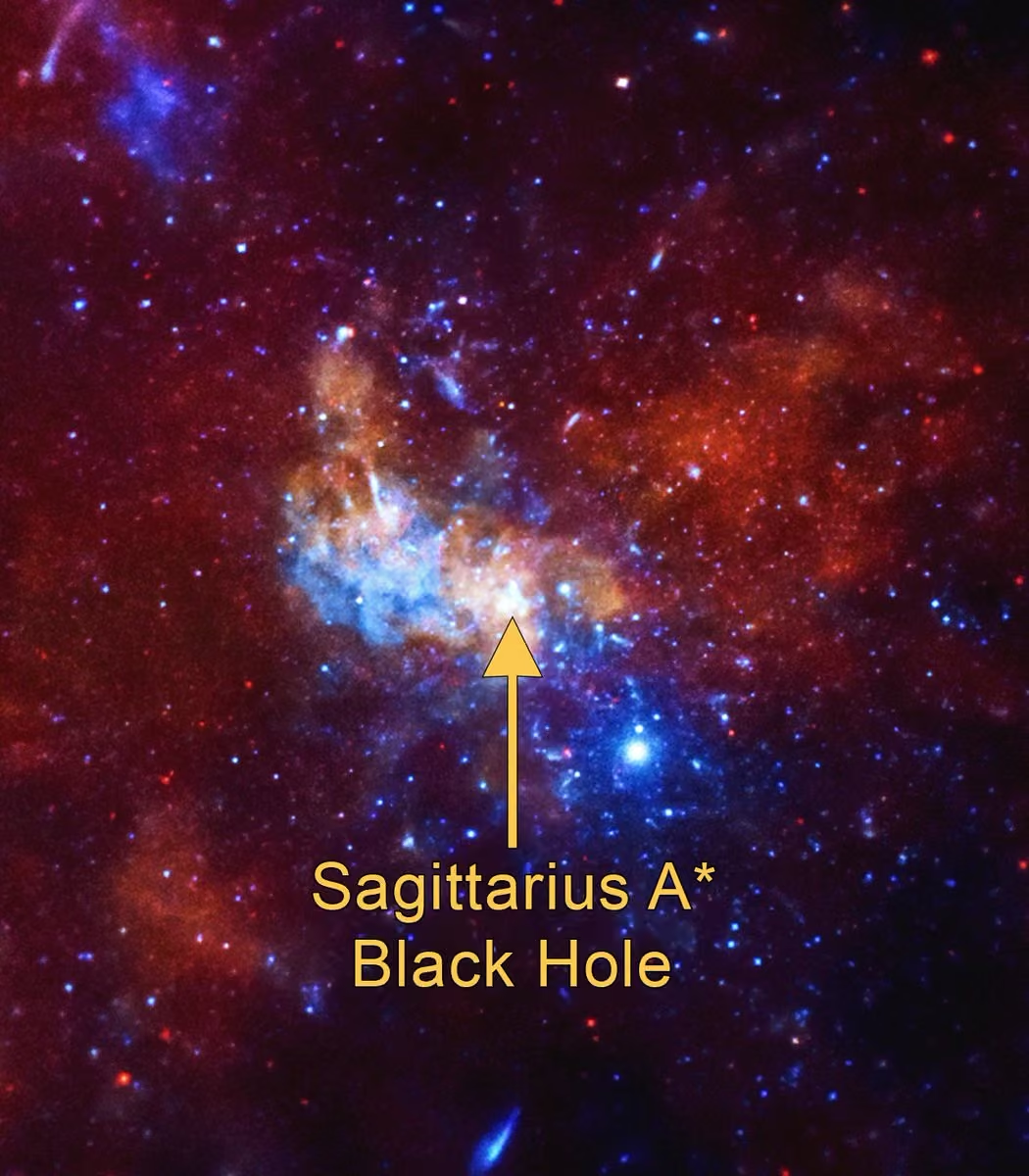
@NASAExoplanets
Looking at our universe in a variety of wavelengths gives us a more complete picture, as seen with the Crab Nebula. A composite image combines visible light (green), radio waves (red), infrared (yellow-green), ultraviolet (blue) and Xrays (purple). A thread👇
-
Chandra Observatory
@chandraxray
Pulsars were first discovered in 1967 and today scientists know of over 2,000 of them! PSR J1509-5850, the bright blue-white spot in the center of this image, has a tail more than 30 light-years long and it's producing an outflow of particles in a different direction.🌠
-
Chandra Observatory reposted
NASA Universe
@NASAUniverse
In 2013, our Swift and @chandraxray observatories discovered a pulsar that switches between radio and X-ray emissions. This quick-change artist may be powered by the rise and fall of gas streaming onto the pulsar from its companion star.
www.nasa.gov/universe/astronomers-uncover-a-transformer-p… -
Chandra Observatory reposted
NASA Universe
@NASAUniverse
Perhaps the best-known pulsar is the one that lies at the center of the beautiful Crab Nebula. It formed in a supernova whose light reached Earth in July 1054. The pulsar spins 30 times a second and is among the brightest in X-ray and radio wavelengths. science.nasa.gov/missions/chandra/observatories-combine-t…
-
Chandra Observatory
@chandraxray
Today Chandra is gazing at galaxy NGC 4631, also known as the Whale Galaxy. A spiral galaxy that we view from the side from our vantage point of Earth, its core is filled with star birth and recent supernova activity.
-
Chandra Observatory reposted
NASA Universe
@NASAUniverse
It’s been 55 years since the first pulsar detection! These “dead” stars emit pulses of light with ultraprecise timing and have helped us understand stars, magnetic fields, gravitational waves … and more. Check out this Tumblr for Pulsar 101: tmblr.co/Zz_Uqj2LmvOpi
-
Chandra Observatory
@chandraxray
Nicknamed the Spirograph Nebula, IC 418 is located roughly 3,900 light-years from Earth and it's about 0.37 light-years across. Intricate shapes within the nebula appear similar to the patterns created when using a Spirograph — a device used to draw elaborate curves on paper.
-
Chandra Observatory reposted
NASA
@NASA
A powerful stellar explosion from a nearby star propelled Zeta Ophiuchi about 100,000 mph (160,934 km). Data from @ChandraXray shows a bubble of X-ray emission (blue) around the star is produced by gas that has been heated to tens of millions of degrees: www.nasa.gov/image-article/embracing-rejected-star/?linkI…
-
Chandra Observatory
@chandraxray
Today Chandra is peering at a pulsar in Puppis. Nearby in the sky is planetary nebula NGC 2440. A star nearing the end of its life is casting off its outer layers, forming a cocoon around the star's remaining core. Ultraviolet light from the dying star makes the material glow.
-
Chandra Observatory
@chandraxray
Today Chandra is helping us learn more about the core of the Circinus Galaxy. Located only about 13 million light-years from Earth, Circinus is one of the closest known galaxies to our Milky Way that contains an actively growing supermassive black hole.
-
Chandra Observatory
@chandraxray
Zeta Ophiuchi is a star with a complicated past, having likely been ejected from its birthplace at ~160,000 km/hour when its companion star was destroyed in a supernova explosion. A new look with Chandra tells more of the story of this runaway star: s.si.edu/zetaoph
Chandra Observatory
@chandraxray
Video Tour: Embracing a Rejected Star
-
Chandra Observatory reposted
Center for Astrophysics | Harvard & Smithsonian
@CenterForAstro
23 years ago, a crew of astronauts including Eileen Collins & @Astro_Cady, deployed the @ChandraXray Observatory. Watch Commander Collins recap the incredible launch and deployment. 🛰️
"As we watched Chandra float away, it was almost like a sailboat on a calm sea," she recalls.This media couldn't be displayed. See it on the original post. -
Chandra Observatory
@chandraxray
Today Chandra is studying stars in Taurus. Nearby in the sky is IRAS 05437+2502, a reflection Nebula located about 400 light years from Earth. The bright crescent-shaped feature in the image was likely produced by a star whizzing through the nebula at 200,000 km/hour or more.
-
Chandra Observatory reposted
NASA Universe
@NASAUniverse
#tbt to this week in 1999 when our Chandra X-ray Observatory lifted off in space shuttle Columbia. Follow @chandraxray to learn about what the mission is observing and how the X-ray light it collects helps us learn about stars, galaxies, black holes, and more.
-
Chandra Observatory
@chandraxray
Today is the 53rd anniversary of the historic Apollo 11 Moon landing — Happy International #moonday, everyone!🌕 Watch what our little satellite is up to this year and visit @NASAMoon for more lunar learning!
This media couldn't be displayed. See it on the original post. -
Chandra Observatory
@chandraxray
Today Chandra is studying massive stars in Sagittarius. Nearby in the sky is the Little Gem Nebula — a star shedding its outer layers to form an eye-catching planetary nebula. Roughly half a light-year across, the nebula is enormous compared to its itsy-bitsy central star.
-
Chandra Observatory
@chandraxray
Pulsar IGR J11014 is zooming away from a supernova remnant at over 4 million kilometers per hour — likely kicked to speed by a supernova explosion! The extraordinary jet trailing behind the pulsar stretches for more than 37 light-years.🌠
-
Chandra Observatory reposted
Learn With NASA
@LearnWithNASA
In a crafty mood this morning? ✂️✏️
Bust out the paper and scissors to create a 3D model of an exploding star. No 3D printer required! Just print, fold, cut, glue... voilà! 🌟
The @chandraxray team has the templates to get you started. chandra.si.edu/make/ -
Chandra Observatory reposted
ARCHIVED NASA Exoplanets
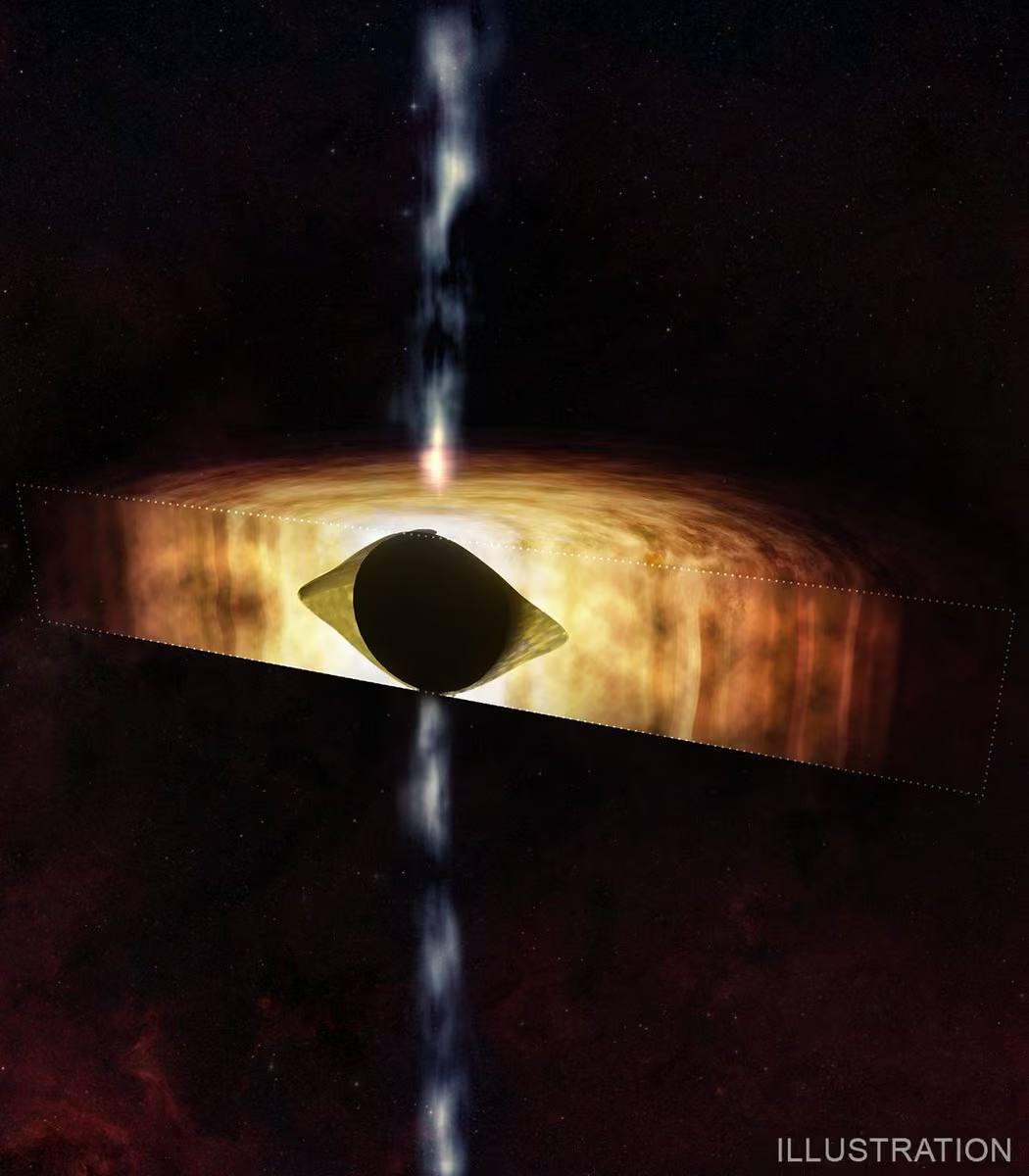
@NASAExoplanets
The first images from @NASAWebb are a taste of what's to come. We can't wait to see how new infrared views add to work by @NASAHubble, @chandraxray and other superhero space telescopes covering the cosmos! science.nasa.gov/universe/exoplanets/exoplanet-detection-…
This media couldn't be displayed. See it on the original post. -
Chandra Observatory reposted
NASA Webb Telescope
@NASAWebb
🌟 A star is born!
Behind the curtain of dust and gas in these “Cosmic Cliffs” are previously hidden baby stars, now uncovered by Webb. We know — this is a show-stopper. Just take a second to admire the Carina Nebula in all its glory: nasa.gov/webbfirstimages/ #unfoldtheuniverse -
Chandra Observatory reposted
NASA Webb Telescope
@NASAWebb
✋🏼 Galactic high five!
In Webb’s image of Stephan’s Quintet, we see 5 galaxies, 4 of which interact. (The left galaxy is in the foreground!) Webb will revolutionize our knowledge of star formation & gas interactions in these galaxies: nasa.gov/webbfirstimages/ #unfoldtheuniverse -
Chandra Observatory reposted
NASA Webb Telescope
@NASAWebb
Put a ring on it! 💍
Compare views of the Southern Ring nebula and its pair of stars by Webb’s NIRCam (L) & MIRI (R) instruments. The dimmer, dying star is expelling gas and dust that Webb sees through in unprecedented detail: nasa.gov/webbfirstimages/ #unfoldtheuniverse -
Chandra Observatory reposted
NASA
@NASA
It's time. #unfoldtheuniverse with us, and join the global watch party for the first full-color images from the world's most powerful space telescope, @NASAWebb. x.com/i/broadcasts/1yNxaYYpBdExj x.com/i/broadcasts/1yNxaYYpBdExj
-
Chandra Observatory
@chandraxray
Wow.
Congratulations to the entire @NASAWebb team, past and present, from all of us @chandraxray! Wishing @NASA's James Webb Space Telescope a fantastic future, filled with scientific discoveries! 😁
NASA
@NASA
It's here–the deepest, sharpest infrared view of the universe to date: Webb's First Deep Field.
Previewed by @POTUS on July 11, it shows galaxies once invisible to us. The full set of @NASAWebb's first full-color images & data will be revealed July 12: nasa.gov/webbfirstimages -
Chandra Observatory reposted
NASA History Office
@NASAhistory
As we get ready for @NASAWebb's first images, let's revisit the first images from a few other space telescopes. In August 1999, this x-ray image of Cassiopeia A taken by the @chandraxray Observatory was released, showing an expanding shell of hot gas produced by a supernova.
-
Chandra Observatory reposted
NASA
@NASA
We can't contain the excitement for @NASAWebb's first full-color images!
On Monday, July 11 at 5pm ET (21:00 UTC), President Biden will unveil one of the space telescope's first images of deep space as a preview of what's ahead: www.nasa.gov/news-release/nasa-updates-coverage-for-webb-… -
Chandra Observatory
@chandraxray
N49 is one of the brightest supernova remnants in the Large Magellanic Cloud, a satellite galaxy of our Milky Way. The delicate knots and filaments seen throughout the remnant are debris from the stellar explosion at temperatures ranging from thousands to millions of degrees.
-
Chandra Observatory
@chandraxray
Nicknamed the Garden-Sprinkler Nebula, Henize 3-1475 is located about 18,000 light-years from Earth. A planetary nebula in the making, it's in a short-lived phase where it is referred to as a "protoplanetary" or "preplanetary" nebula.
-
Chandra Observatory
@chandraxray
Happy #4thofjuly! Awe-inspiring #fireworks are happening on a galactic scale in M106. Jets from a supermassive black hole are generating powerful shock waves. The shock waves are then heating gas, enough gas to make up about 10 million Suns, to thousands of degrees!
-
Chandra Observatory
@chandraxray
Astronomers have made a record-breaking measurement of a black hole's spin, 1 of 2 fundamental properties of black holes. NASA's Chandra shows this black hole is spinning slower than most of its smaller cousins, providing clues to how this black hole grew: s.si.edu/H1821
-
Chandra Observatory reposted
Lonnie G. Bunch III
@SmithsonianSec
When our @chandraxray translates astronomical data into sound, the Universe opens to us in a new way. For the first time, we can hear the Perseus galaxy cluster. Take a listen and learn more about sonification. chandra.si.edu/photo/2022/sonify5
-
Chandra Observatory
@chandraxray
Today Chandra is gazing at a galaxy cluster in Coma Berenices. Nearby in the sky is M91, just one of over a thousand galaxies that make up the Virgo Cluster. M91 is known as an "anemic galaxy," meaning that it has a lower rate of star formation compared to similar galaxies.
-
Chandra Observatory
@chandraxray
RCW 120 is located about 5,500 light-years from Earth. The glowing sapphire nebula — an expanding bubble of mostly hydrogen gas & soot — has been sculpted by the energetic light and ferocious winds from a giant star. This ever-so-elegant blob is roughly 13 light-years across.
-
Chandra Observatory reposted
NASA Marshall
@NASA_Marshall
📸 Image of the day: A spectacular set of rings around a black hole, captured using the @chandraxray observatory. The black hole is part of a binary system called V404 Cygni, located about 7,800 light years away from Earth. 🌌
Learn more HERE>> www.nasa.gov/image-feature/huge-rings-around-a-black-hole -
Chandra Observatory
@chandraxray
Today Chandra is studying a star in the constellation Musca. Nearby in the sky is the Engraved Hourglass Nebula, a young planetary nebula located about 8,000 light-years from Earth. This iconic @NASAHubble image reveals nitrogen in red, hydrogen in green, and oxygen in blue.
-
Chandra Observatory reposted
NASA Universe
@NASAUniverse
Sound doesn’t travel through space, but if it did, you might hear an eerie symphony. A recent project took an image of the Milky Way’s center and converted the data into sound. Turn your volume up for some unearthly music! More: www.nasa.gov/universe/data-sonification-sounds-from-aroun… #worldmusicday
-
Chandra Observatory
@chandraxray
This spiral galaxy not only looks like a dandelion caught in a breeze, it's spreading its "seeds" into space like one too. Traveling at roughly 7 million km/hour, much of the galaxy's gas is being torn away, encouraging new star formation in the stream of material left behind.
-
Chandra Observatory
@chandraxray
Today Chandra is studying a black hole in Ursa Major. Nearby in the sky is NGC 4051, a spiral galaxy located about 45 million light-years from Earth. The supermassive black hole near this galaxy's center contains more than 1.7 million times the mass of our Sun.
-
Chandra Observatory reposted
NASA
@NASA
Streaking from the aftermath of a stellar explosion, a tiny pulsar spotted by @ChandraXray is blazing through the Milky Way at more than 1.4 million miles an hour (2.25 million kilometers per hour): www.nasa.gov/image-article/nasas-chandra-catches-pulsar-x…
-
Chandra Observatory
@chandraxray
A pulsar is zooming through the remains of the supernova explosion that created it at over 2 million kilometers per hour. It's travelling about 30% faster than previously estimated, indicating it's significantly younger than once thought.
More: s.si.edu/G292Pulsar #aas240 -
Chandra Observatory reposted
NASA Universe
@NASAUniverse
We don’t just photograph nature on Earth … we can see deep into the universe with the help of telescopes. Observatories like @NASAHubble, @chandraxray, and our retired Spitzer telescope capture the beauty of the cosmos in different wavelengths of light. #naturephotographyday
-
Chandra Observatory
@chandraxray
The Lobster Nebula (NGC 6357) is a region of space where radiation from hot, young stars is energizing the surrounding gas & dust. Located about 5,500 light years from Earth in our Milky Way Galaxy, the colossal crustacean is about 400 light-years across.
🦞#lobsterday -
Chandra Observatory
@chandraxray
Happy 10 years in space, NASA NuSTAR!🎂😁 Wishing you many more exciting discoveries as we explore the X-ray Universe together!🎉 #xraysarethebestrays
More at: www.jpl.nasa.gov/news/nasas-nustar-mission-celebrates-10-… -
Chandra Observatory
@chandraxray
MACS J0416 is a massive cluster of galaxies. The cluster's gravity is so powerful it bends, magnifies, & brightens the light from objects behind it in a phenomenon called gravitational lensing. This causes light from background objects to appear as streaks & arc in this image.
-
Chandra Observatory
@chandraxray
Today Chandra is studying Kepler's Supernova Remnant, the debris from a detonated star that's still expanding at ~24 million kilometers per hour. First seen from Earth in 1604, the object was not only visible to the unaided eye, it was visible during the day for over 3 weeks!
-
Chandra Observatory
@chandraxray
Our teamwork really lights up the Universe! Happy #bestfriendsday, @NASAHubble! 😘
Hubble
@NASAHubble
Happy #bestfriendsday, @chandraxray! 🤗
When we work together, we learn even more about our universe – and capture some pretty beautiful views of it too, like this image of the nebula NGC 6826: chandra.harvard.edu/photo/2012/pne/?linkId=168447449 -
Chandra Observatory reposted
NASA Marshall
@NASA_Marshall
A long observation with @chandraxray of a pair of colliding galaxy clusters located about 2.8 billion light years from Earth, shows a connection between some of the most energetic events in the Universe and weaker ones powered by our own Sun. 🔭
More: www.nasa.gov/universe/colossal-collisions-linked-to-solar… -
Chandra Observatory reposted
NASA Universe
@NASAUniverse
From @chandraxray to our newest mission, IXPE, @NASA_Marshall’s Martin Weisskopf has spent his career exploring the X-ray universe. Though he is retiring after 44 years at @NASA, Dr. Weisskopf’s legacy will fuel decades of discovery. Learn more: www.nasa.gov/universe/50-years-of-x-ray-vision-scientist-…
-
Chandra Observatory
@chandraxray
A shock wave about 1.6 million light years long is stretching along the collision between two clusters of galaxies. A new study shows a deep connection between events like this and much smaller/weaker, yet similar events powered by our own Sun.
More at: s.si.edu/a2146 -
Chandra Observatory
@chandraxray
It's #donutday!🍩 Celebrate (calorie-free even) with our favorite #donut, the supermassive black hole at the center of our Milky Way Galaxy, Sagittarius A*! This is a sonification of the latest image from @ehtelescope. Using a radar-like scan, the sonification begins... 1/3
Chandra Observatory
@chandraxray
2/3 ...at the 12 o'clock position and sweeps clockwise. Changes in volume represent the differences in brightness the EHT observed around the event horizon of Sgr A*. The material that is closer to the black hole and hence moving faster corresponds to higher frequencies of sound.
Chandra Observatory
@chandraxray
3/3 This sonification was processed in a special way to allow a listener to hear the data in 3D stereo sound, in which the sounds seem to start directly ahead and then move clockwise to one ear then the other as the sweep is made. More at: chandra.si.edu/sound/
-
Chandra Observatory
@chandraxray
Today Chandra is studying stars in Musca, the fly. Nearby in the sky is planetary nebula NGC 5189. Why is it shaped like the letter "S" in reverse? The star at the nebula's core is spewing matter as it rotates & wobbles — like a colossal cosmic lawn sprinkler of sorts.
Chandra Observatory
@chandraxray
NGC 5189 is located a little less than 2,000 light years from Earth. 🌏
-
Chandra Observatory reposted
NASA Universe
@NASAUniverse
Got calcium? This image shows X-ray light from calcium in supernova remnant Cassiopeia A. Calcium is one of many elements made in massive stars during and at the ends of their lives. How much? Enough for more than 10 million trillion trillion glasses of milk! #worldmilkday
-
Chandra Observatory
@chandraxray
Today Chandra is studying a star that's getting nibbled on by a black hole about every 114 days. Each time the star's orbit takes it near the black hole, the star loses mass as the black hole strips away an amount of gas equal to about 3x the mass of Jupiter!
-
Chandra Observatory reposted
NASA Marshall
@NASA_Marshall
Astronomers are excited about the possibility of a new meteor shower May 30-31! ☄️
The peak time to watch the tau Herculid shower is around 1am on the East Coast or 10pm on the West Coast.
Learn more HERE: www.nasa.gov/blogs/watch-the-skies/2022/05/27/new-meteor-… -
Chandra Observatory
@chandraxray
Today Chandra is studying stars in Pisces. Nearby in the sky is M74, a galaxy furnished with roughly 100 billion stars. This spectacular image from @NASAHubble shows spiral arms dotted with clusters of young blue stars & glowing pink regions of ionized hydrogen. #galaxiesgalore
-
Chandra Observatory
@chandraxray
Today Chandra is peering into Sagittarius. Nearby in the sky is reflection nebula GGD 27. This infrared view gives us a glimpse inside the gas & dust, exposing star formation happening within the nebula and the chaos that accompanies the beautifully messy process of starbirth.
-
Chandra Observatory
@chandraxray
Today Chandra is studying ESO 243-49, home to an intermediate-mass black hole candidate that may have been cannibalized from a dwarf galaxy. The massive black hole lies above the galactic plane, suggesting that it once belonged to a small galaxy that was torn apart by ESO 243-49.
-
Chandra Observatory
@chandraxray
The aftermath of the death of a massive star, G292.0+1.8 is a rare type of supernova remnant containing a large amount of oxygen. Oxygen-rich remnants are a primary source of elements heavier than hydrogen & helium necessary to form planets and people.
-
Chandra Observatory
@chandraxray
Today Chandra will be peering into the core of galaxy NGC 3081. Located more than 86 million light years from Earth, the supermassive black hole at the galaxy's center glows brightly in X-rays as it devours infalling material.
-
Chandra Observatory
@chandraxray
Are you up for a challenge? Participate in @NASA's Summer #astrophotochallenges! Use real telescope data to process your own images of this season's targets: Eta Carinae & the Carina Nebula. 🔭🖼️More at: mo-www.cfa.harvard.edu/OWN/astrophoto/
This media couldn't be displayed. See it on the original post. -
Chandra Observatory reposted
NASA Universe
@NASAUniverse
You can't visit Sagittarius A*, but you can take a virtual tour of our galaxy’s central supermassive black hole thanks to @chandraxray. Experience the cosmic evolution of our galactic center over the last 500 years — in 2D or 3D! www.nasa.gov/universe/a-new-galactic-center-adventure-in-…
This media couldn't be displayed. See it on the original post. -
Chandra Observatory
@chandraxray
Today Chandra is looking into Leo. Nearby in the sky is the NGC 2903, a barred spiral galaxy located about 30 million light years from Earth. Stars gathered in hot clusters (purple) are scattered throughout this galaxy's majestic arms which span approximately 80,000 light years.
-
Chandra Observatory
@chandraxray
Supernova remnant N103B is the glowing debris field left behind when a supernova explosion destroyed a white dwarf star in a double star system. X-ray light reveals multimillion-degree gas that's been heated by a shock wave produced by the explosion that demolished the star.
-
Chandra Observatory
@chandraxray
The supermassive #blackhole at the center of our Milky Way Galaxy, Sagittarius A*, has been imaged by the Event Horizon Telescope (EHT). Chandra and many other telescopes observed Sagittarius A* simultaneously. Explore Sagittarius A* like never before: s.si.edu/OurSMBH ⚫
Chandra Observatory
@chandraxray
⚫Questions about #ourblackhole, Sagittarius A*? Ask us at:
Chandra Observatory
@chandraxray
Do you have questions about #ourblackhole, Sagittarius A*? Reply with your questions below and science experts @DarylHaggard & @Joey_Neilsen will answer them today at 2pm ET (UTC-04:00)!⚫
-
Chandra Observatory
@chandraxray
Do you have questions about #ourblackhole, Sagittarius A*? Reply with your questions below and science experts @DarylHaggard & @Joey_Neilsen will answer them today at 2pm ET (UTC-04:00)!⚫
-
Chandra Observatory reposted
Center for Astrophysics | Harvard & Smithsonian
@CenterForAstro
We’re lucky to have @EllenStofan join us for a conversation on #ourblackhole today at 3 pm ET — come ready with questions for our scientists! s.si.edu/ourblackhole
-
Chandra Observatory
@chandraxray
Today Chandra is studying a black hole in Serpens. Nearby in the sky is W40, a star-forming region about 1,400 light years from Earth. A young cluster of approximately 500 stars is nested between two "wings" of hot gas blowing from some of the most massive stars in the region.✨
-
Chandra Observatory reposted
NASA History Office
@NASAhistory
In 1998, NASA's @ChandraXray space telescope 🔭 was named in honor of Indian-American #astrophysics luminary Subrahmanyan Chandrasekhar (1910–1995). Chandra means “moon” 🌙 or “luminous” in Sanskrit. #aanphi
Photo credit: @UChicagoPress -
Chandra Observatory reposted
NASA
@NASA
If a black hole erupts in space and no one is around to observe it, does it make a sound?
Not to worry; the @ChandraXray Observatory is here with new #blackholeweek sonifications from galaxy clusters far, far away. Listen: www.nasa.gov/universe/new-nasa-black-hole-sonifications-w… -
Chandra Observatory
@chandraxray
New sonifications of well-known black holes have been released for #blackholeweek⚫!
#1 The Perseus galaxy cluster — famous for sound waves detected around its black hole by Chandra, some 57 octaves below middle C. And... (1/2)
Chandra Observatory
@chandraxray
(2/2)
#2 M87 — home of the black hole that gained celebrity status through an image released in 2019 by @ehtelescope (the Event Horizon Telescope). More about the sonifications at: s.si.edu/sonify5 -
Chandra Observatory
@chandraxray
In order to turn Earth into a black hole, we would have to compress all its mass into a region the size of a marble. Just thought you might want to know. #blackholeweek⚫
-
Chandra Observatory reposted
Event Horizon 'Scope
@ehtelescope
It’s #blackholeweek ! The journey to capture an image of a black hole is not an easy one. Learn about the challenges the Event Horizon Telescope has overcome to see the unseeable! 👀📡🌎📡
#eventhorizontelescopeThis media couldn't be displayed. See it on the original post. -
Chandra Observatory
@chandraxray
As material swirls around a supermassive #blackhole, extreme forces can cause matter to be redirected away from the black hole in the form of jets traveling at almost the speed of light. Image: Cygnus A — its incredible jets span more than 600,000 light years! #blackholeweek⚫
-
Chandra Observatory reposted
NASA Universe
@NASAUniverse
It’s #blackholeweek⚫, a special week each year where we spotlight black holes! Join us in celebrating these intriguing objects all week … and don’t be surprised when you see them everywhere! (It’s okay, they’re really quite harmless if you don’t get too close.)
-
Chandra Observatory
@chandraxray
Today Chandra is studying 3C58, the remnant of a supernova observed in the year 1181 CE. A pulsar at the center of the remnant is producing jets of X-rays extending trillions of miles — jets responsible for creating the elaborate web of loops & swirls revealed in the image.🐙
-
Chandra Observatory
@chandraxray
Today Chandra is studying M96, a spiral galaxy located about 35 million light years from Earth. The galaxy's core is not exactly at the galactic center and its spiral arms are asymmetrical — features likely caused by gravitational interaction with other galaxies nearby.
-
Chandra Observatory reposted
NASA Universe
@NASAUniverse
Though our Spitzer telescope ended its observations in 2020, its data continues to be analyzed. We just hit an impressive milestone … 10,000 peer-reviewed science papers have been published about Spitzer’s observations! Here are a few highlights.
-
Chandra Observatory
@chandraxray
Today Chandra is gazing at galaxies in Centaurus. Nearby in the sky is planetary nebula Fleming 1, a glowing cloud of gas around 2 white dwarf stars. In the next 10,000 years or so, Fleming 1 will slowly disperse into space. The stars will cool & fade away for billions of years.
-
Chandra Observatory
@chandraxray
#icymi: Chandra scientists find that #blackholes may be demolishing thousands of stars and using their remains to pack on weight. A new survey of over 100 galaxies could help explain how intermediate-mass black holes (IMBHs) are made. ⚫More: s.si.edu/imbhs
This media couldn't be displayed. See it on the original post. -
Chandra Observatory
@chandraxray
Today Chandra is peering into #sagittarius. Nearby in the sky is the Lagoon Nebula, a rowdy stellar nursery located about 4,000 light years from Earth. This image spans roughly 4 light years, featuring just a small portion of the whole nebula which is over 55 light years across.
-
Chandra Observatory
@chandraxray
Chandra's elliptical orbit around #earth takes the spacecraft to an altitude of 133,000 km/82,646 mi (more than 1/3 of the distance to the moon) before returning to its closest approach of 16,000 km/9,942 mi. It takes about 64 hours and 18 minutes to complete an orbit. #earthday
-
Chandra Observatory reposted
ARCHIVED - NASA Moon
@NASAMoon
"We came all this way to explore the Moon, and the most important thing is that we discovered the Earth."
- Bill Anders, Apollo 8
Seeing our precious planet from afar helped inspire the creation of #earthday.
Celebrate our home planet with @NASA! nasa.6connex.com/event/NASAScience/NASA-at-Earth-Day/logi… -
Chandra Observatory reposted
NASA
@NASA
Looking like a concert mosh pit, mid-sized black holes are thought to begin in densely crowded parts of the universe. Evidence from @ChandraXRay Observatory suggests small runaway black holes grow by impacting thousands of nearby stars: www.nasa.gov/image-article/black-holes-raze-thousands-of-…
-
Chandra Observatory
@chandraxray
Chandra scientists have uncovered signs that #blackholes are demolishing thousands of stars and using their remains to pack on weight. This new survey of over 100 galaxies could help explain how intermediate-mass black holes (IMBHs) are made. More: s.si.edu/imbhs
Chandra Observatory
@chandraxray
📱Want these incredible galaxy images as new backgrounds for your phone or tablet? You can download them (free) at: s.si.edu/mobile_wallpaper
-
Chandra Observatory
@chandraxray
Today Chandra is studying the gargantuan galaxy cluster Abell 2744. Galaxy clusters contain enormous amounts of superheated gas at temperatures of tens of millions of degrees, which glows brightly in X-ray light. This image of the cluster spans roughly 6 million light years.
-
Chandra Observatory
@chandraxray
The high-mass stars in NGC 281 have powerful winds flowing from their surfaces and intense radiation that heats surrounding gas, "boiling it away" into interstellar space. This process results in the formation of large columns of gas & dust — lively laboratories of star creation.
-
Chandra Observatory
@chandraxray
Today Chandra is gazing at a star in Pegasus. Nearby in the sky 2 galaxies are tangled in a tournament of gravity — a sport that smaller galaxy NGC 7752 is sure to lose. Will the larger galaxy fling its little neighbor through space or swallow the galaxy whole? Time will tell.
-
Chandra Observatory
@chandraxray
Today Chandra is peering into Scorpius. Nearby in the sky is reflection nebula DG 129, a cloud of gas & dust that reflects light from neighboring stars. The bright, hazy green object on the right is the triple-star system Pi Scorpii, and it's located ~500 light years from Earth.
-
Chandra Observatory
@chandraxray
BP Psc is a star like our Sun that's further along in its evolution. It has spent its nuclear fuel and expanded into the red giant phase. The disk & jets are evidence for a recent, catastrophic interaction where the star's expansion likely consumed a nearby star or giant planet.
-
Chandra Observatory
@chandraxray
Happy #nationalpetday, space fans! 🐕🐈🦎
NASA Universe
@NASAUniverse
Many folks who contribute to @NASA astrophysics have pets as coworkers. Check out some of our companions for #nationalpetday, and learn what some of their cosmic names mean in this thread!
-
Chandra Observatory
@chandraxray
Today Chandra is gazing at a cluster of galaxies in Virgo. Nearby in the sky is M90, one of the brightest & largest spiral galaxies in the Virgo Cluster. Located some 59 million light years from Earth, M90 contains about a trillion stars and a thousand globular clusters.
-
Chandra Observatory
@chandraxray
Today Chandra is peering into the Sagittarius constellation. Nearby in the sky is the Trifid Nebula. Located about 5,500 light years from Earth, this nebula is made up of an uncommon combination of 3 types of nebulae: emission, reflection, and dark.
-
Chandra Observatory
@chandraxray
Happy #openingday! Imagine being a newbie going to your first to baseball game and all you could see was a tiny sliver of the baseball field. It would be really hard to figure out the rules of the game — or even the score! (1/2)
Chandra Observatory
@chandraxray
(2/2) The light we can see with our eyes is only a tiny sliver of the electromagnetic spectrum. To get the "big picture" of what's going on in the cosmos, scientists use telescopes that probe other parts of the electromagnetic spectrum, such as infrared, ultraviolet, and X-ray.
Chandra Observatory
@chandraxray
Speaking of baseball & space... DYK NASA astronaut Sally Ride was a huge baseball fan? You can see her childhood baseball drawings and even her bat at the Smithsonian @postalmuseum's new online and in-person exhibition #americashomerun. postalmuseum.si.edu/baseball
-
Chandra Observatory
@chandraxray
Right #now Chandra is studying the active supermassive #blackhole in Centaurus A. A combination of X-ray, optical, and radio light, this image shows opposing jets of high-energy particles extending to the outer reaches of the galaxy. Numerous smaller black holes are also present.
-
Chandra Observatory
@chandraxray
In the middle of supernova remnant RCW 103 resides one of the slowest spinning neutron stars ever discovered. While some neutron stars (which are about 20 kilometers in diameter) spin around hundreds of times per second, this object only rotates once about every 6.5 hours.
-
Chandra Observatory
@chandraxray
Chandra scientists find 14 actively growing supermassive #blackholes around the Spiderweb Galaxy. The sample is 5-20 times higher than the fraction found for other galaxies of a similar age and roughly the same range of masses. More about the discovery: s.si.edu/spiderweb
Chandra Observatory
@chandraxray
Most of the "blobs" seen here are galaxies — including 14 that have been detected in the new, deep Chandra image. These X-ray sources reveal the presence of material falling towards supermassive black holes containing hundreds of millions of times more mass than the Sun.
-
Chandra Observatory
@chandraxray
The Pencil Nebula is a small sliver within the much larger Vela Supernova Remnant. The initial supernova explosion occurred about 11,000 years ago and it propelled material away from the star at roughly 35 million kilometers per hour.
Have a stellar #pencilday!✏️ -
Chandra Observatory reposted
NASA Universe
@NASAUniverse
Curiosity inspires all of us.
Hear from data visualizer Kimberly Arcand & other previous episode experts in this bonus episode of NASA’s Curious Universe podcast!
www.nasa.gov/podcasts/curious-universe/?linkId=158672724 -
Chandra Observatory
@chandraxray
Today Chandra is checking in on a supernova first spotted in 2012. As large stars explode, their interiors collapse down to a point at which all of their particles become neutrons. If the star has a magnetic field and rotates fast enough, it can become a pulsar wind nebula.
-
Chandra Observatory
@chandraxray
About 2.3 billion light years from Earth, Abell 1689 is one of the most massive clusters of galaxies known. The arcs in this image are caused by gravity distorting the light of galaxies in the background — a phenomenon known as gravitational lensing. s.si.edu/2vQPW02
-
Chandra Observatory
@chandraxray
Right #now Chandra is gazing at a cluster of galaxies in Virgo. Nearby in the sky is M61, a spiral galaxy whose arms sparkle with the light of billions of stars. Located about 50 million light years from Earth, M61 is roughly the size of our Milky Way Galaxy.
-
Chandra Observatory reposted
ARCHIVED NASA Exoplanets
@NASAExoplanets
Discovery Alert!
65 new worlds push the number of exoplanets confirmed by @NASA above 5,000. This represents 30 years of exploration and discovery by astronomers worldwide using telescopes on the ground and in space. We are living in an age of discovery! science.nasa.gov/universe/exoplanets/cosmic-milestone-nas… -
Chandra Observatory
@chandraxray
Today Chandra is peering into the Rho Ophiuchi cloud complex to study stars. This region of space is filled with a wide variety of nebulas, as well as stars of different types & ages. Located only about 450 light years away, it's one of the closest star-forming regions to Earth.
-
Chandra Observatory
@chandraxray
Supernova Remnant DEM L71: X-ray light reveals an inner cloud of glowing iron and silicon (green & blue) surrounded by an outer blast wave (red) that is also seen in optical light from @NASAHubble (red & white). The outer blast wave is approximately 60 light years across.
-
Chandra Observatory
@chandraxray
There once was a nebula named Crab.
A lot of attention it grabbed.
Especially the day,
Where a citizen scientist did say,
Look! A passing asteroid we nabbed!
Have a happy and #lucky #stpatricksday ! -
Chandra Observatory
@chandraxray
Today Chandra is studying a #blackhole in Leo. Nearby in the sky is a pair of galaxies known as Arp 87. Gas, dust, and stars flowing from the larger galaxy have formed an enveloping arm around the smaller companion galaxy.
-
Chandra Observatory reposted
NASA Marshall
@NASA_Marshall
Using @chandraxray, astronomers have imaged a beam of matter and antimatter that is 40 trillion miles long. The record-breaking beam is powered by a pulsar, a rapidly rotating collapsed star with a strong magnetic field.
MORE HERE >> www.nasa.gov/image-article/tiny-star-unleashes-gargantuan… -
Chandra Observatory
@chandraxray
A city-sized collapsed star has generated a beam of matter and antimatter that stretches for trillions of kilometers. This discovery could help explain the presence of positrons detected throughout the Milky Way galaxy and here on Earth. More: s.si.edu/j2030
-
Chandra Observatory
@chandraxray
About 75 light years across, N49 is the brightest supernova remnant in optical light in the Large Magellanic Cloud. Filaments & clumps of material seen throughout the remnant are debris from the stellar explosion with temperatures ranging from thousands to millions of degrees.
-
Chandra Observatory reposted
ARCHIVED NASA Exoplanets
@NASAExoplanets
Space is big. Stunningly, staggeringly, almost-impossibly big. Exploring this vast expanse takes a team. Over time, legendary space telescopes answered the call: @NASAHubble, @chandraxray, Spitzer, Kepler, TESS, and now, @NASAWebb. This is their story. science.nasa.gov/universe/exoplanets/exoplanet-detection-…
This media couldn't be displayed. See it on the original post. -
Chandra Observatory
@chandraxray
By analyzing the light around the supermassive #blackhole in NGC 3115, it's estimated that the black hole has a mass of about 2 billion times that of our Sun. That makes it the nearest known billion-solar-mass black hole to Earth at roughly 32 million light years away.⚫️
-
Chandra Observatory reposted
Hubble
@NASAHubble
This spectacular image shows supernova remnant Cassiopeia A in multiple wavelengths of light.
Observations from Hubble and @ChandraXRay, plus radio data, highlight the detailed structure as elements of the exploded star are cast into space: chandra.si.edu/photo/2022/archives/?linkId=155589590 -
Chandra Observatory
@chandraxray
✨About 9,000 light years from Earth, NGC 3576 is a region of glowing gas in the Sagittarius arm of our galaxy. Intense radiation & winds from massive stars in the nebula are shredding the clouds from which the stars formed, generating many of the fascinating shapes seen within.
-
Chandra Observatory
@chandraxray
4+ years after the blast, scientists may have detected a "sonic boom" from GW170817. The site of a merger of 2 neutron stars, GW170817 was the first – and thus far the only – object detected in both #gravitationalwaves & light. More on the discovery: s.si.edu/kilonova22
-
Chandra Observatory reposted
Smithsonian Education
@SmithsonianEdu
Looking for ways to make the electromagnetic spectrum relevant & exciting to your students? Join us for a free webinar for teachers on March 1, with
@saoastro's Kimberly Arcand. Plus, explore an online interactive, 360° video, & other classroom-ready activities. #smithsonianedu -
Chandra Observatory reposted
Learn With NASA
@LearnWithNASA
Take a virtual field trip with @chandraxray!🧳🌌
Get a backstage pass to Chandra’s Operations Control Center, tour the Chandra spacecraft & visit some exploding stars in our own galaxy.✨
Sessions available through April, but spots fill quickly!
chandra.harvard.edu/fieldtrip/registration.html -
Chandra Observatory
@chandraxray
Happy #twosday! What happens when #two galaxy clusters collide? Sometimes they can bear a striking resemblance to the Starship Enterprise from Star Trek, apparently. Abell 1033 is located about 1.6 billion light years from Earth. Boldly Go for more: s.si.edu/2K4JCe8
-
Chandra Observatory
@chandraxray
🌟Planetary nebulas, like NGC 7027, are expanding shells of gas produced by a dying star as it sheds its outer layers. These jettisoned shells remain for a relatively short time in cosmic terms — tens of thousands of years — before gradually dissipating into space.
-
Chandra Observatory reposted
Hubble
@NASAHubble
When galaxies collide 💫
Galactic interactions can trigger waves of star formation, as seen in this image of NGC 4490 from @chandraxray & Hubble.
This galaxy has collided with a smaller galaxy to the upper right (not in this image). Discover more: chandra.cfa.harvard.edu/photo/2022/archives/?linkId=15265… -
Chandra Observatory reposted
ARCHIVED NASA Exoplanets

@NASAExoplanets
Telemetry ✅
Instruments ✅
First science image ✅
Space telescope IXPE focused on Cassiopeia A, the remains of an exploded star. The shock waves from the explosion swept up nearby gas, heating it and accelerating cosmic ray particles to make a cloud that glows in X-ray light. -
Chandra Observatory
@chandraxray
💥The shock wave from the supernova explosion that created remnant G306 is racing through space at ~2.4 million km/h — iron, neon, silicon & sulfur all at temperatures exceeding 28 million C. Supernovas seed galaxies with heavy elements produced in the hearts of massive stars.🌟
-
Chandra Observatory reposted
NASA Universe
@NASAUniverse
Follow the gumdrop trail! 🍬
This map is of the entire sky in X-ray data taken over 22 months by the NICER telescope onboard the @Space_Station. The “gumdrops” are a variety of sources like pulsars, supernova remnants, and active galaxies. More: www.nasa.gov/universe/nicers-night-moves-trace-the-x-ray-… -
Chandra Observatory
@chandraxray
Happy #valentinesday @NASAHubble! When we're together, you help us see the Universe in a different light.
❤️💚💙
-Chandra XOXO-ray -
Chandra Observatory
@chandraxray
😍Oh #ixpe, you sure know what to get an X-ray observatory for #valentinesday — your first X-ray science image and it's Cassiopeia A too!❤️ Your X-rays (magenta) combined with our X-rays (blue) really light up the day! More: www.nasa.gov/universe/nasas-ixpe-sends-first-science-image/
-
Chandra Observatory reposted
NASA Webb Telescope
@NASAWebb
Bonus image! When it’s time to focus, sometimes you need to take a good look at yourself.
This “selfie” taken by Webb of its primary mirror was not captured by an externally mounted engineering camera, but with a special lens within its NIRCam instrument. #unfoldtheuniverse -
Chandra Observatory
@chandraxray
🎸Ever seen the biggest guitar in the known Universe? It's the Guitar Nebula! As pulsar B2224+65 shreds through space at incredible speeds, it produces a bow shock like the wake of a speedboat on the water. This shock looks like a guitar & it's over 2 light years tall! #guitarday
-
Chandra Observatory
@chandraxray
🌟Right #now Chandra is studying a #blackhole in galaxy UGC 3855. While the galaxy is located about 180 million light years from Earth, the brilliant star seen photobombing the galaxy in this image is actually much closer to us. This creates the illusion that the star is huge.
-
Chandra Observatory
@chandraxray
Dubbed "Pandora's Cluster" due to all of the structures found within, A2744 is a complex collision of at least 4 galaxy clusters. Dark matter, evident through its gravitational attraction, is mapped in blue and X-rays (red) reveal multimillion-degree gas spanning ~6 light years!
Chandra Observatory
@chandraxray
Correction: …multimillion-degree gas spanning ~6 *million* light years 😳
-
Chandra Observatory reposted
Learn With NASA
@LearnWithNASA
⛸️🥌🏂🏾🏆 Excited for the amazing feats at this year's Winter Olympic games? Make a #nasastem connection with AstrOlympics resources from the @chandraxray team!
Join the fun with science concept explainers, videos & downloadable posters at: www.nasa.gov/stem-ed-resources/astrolympics.html. -
Chandra Observatory
@chandraxray
The show has started & the galaxies of ESO 69-6 are performing a gravitational ballet — tidal tails of interstellar matter gracefully stretching from their galactic cores. The finale will conclude in millions to billions of years when these splendid spirals become one. #balletday
-
Chandra Observatory reposted
NASA Astronomy Picture of the Day
@apod
Symbiotic R Aquarii: apod.nasa.gov/apod/ap220205.html by X-ray: @NASA @chandraxray /SAO/R. Montez et al.; Optical: Data: NASA/@esa @stsci, Processing: Judy Schmidt (CC BY-NC-SA)
-
Chandra Observatory
@chandraxray
❄️NGC 7662, nicknamed the #snowball Nebula, is located about 3,900 light years from Earth in Andromeda. A combination of X-ray light from Chandra and optical light from @NASAHubble, this image spans about 0.63 light years from side to side — roughly 5.9 trillion kilometers!
-
Chandra Observatory reposted
Smithsonian
@smithsonian
This is not the Eye of Sauron.
It's a white dwarf star and a highly variable red giant. As they orbit each other, the white dwarf pulls material from the red giant onto its surface. Over time, material accumulates and triggers an explosion. -
Chandra Observatory reposted
Thomas Zurbuchen
@Dr_ThomasZ
Our universe emits energy in many forms and by using telescopes like @chandraxray, @NASAHubble, @NASAWebb, and #ixpe we will have the tools to explore it. Take a look at the ways different types of light from ground and space telescopes can be combined: www.nasa.gov/universe/an-expanse-of-light/?linkId=150709641
-
Chandra Observatory
@chandraxray
🖼️Explore a new gallery of images combining X-ray light from Chandra with light detected by other telescopes.
An Expanse of Light: s.si.edu/expanse
Chandra Observatory
@chandraxray
Image: R Aquarii contains a white dwarf star and a highly variable red giant. As they orbit each other, the white dwarf pulls material from the red giant onto its surface. Over time, enough of this material accumulates and triggers an explosion.
-
Chandra Observatory
@chandraxray
This captivating planetary nebula is named after the mythological Medusa — you know, the one with snakes for hair, hard to miss. Created by a dying star shedding its outer layers, the Medusa Nebula is about 4 light years across. Have a super #serpentday space fans!🐍
-
Chandra Observatory reposted
Hubble
@NASAHubble
🦋 The Butterfly Nebula’s cosmic wings have never looked better, thanks to observations from both Hubble and @chandraxray.
This nebula formed after a star like our Sun used up most of its fuel and shed off its outer layers of material: chandra.cfa.harvard.edu/photo/2021/pne/?linkId=150297927 -
Chandra Observatory
@chandraxray
Today Chandra is examining a #blackhole in Leo. Nearby in the sky is M66, the largest member of the Leo Triplet. M66 has asymmetric spiral arms and a core that appears to be off-center — features likely caused by the gravitational pull of the other galaxies in the Leo Triplet.
-
Chandra Observatory
@chandraxray
❄️Today Chandra is studying a cluster of galaxies in Cygnus, the Swan. Nearby in the sky is Sharpless 2-106, its enchanting shape resembling that of an almost perfect #snow angel. The "wings" of this bipolar emission nebula and star-forming region span roughly 2 light years.
-
Chandra Observatory reposted
NASA
@NASA
On our Day of Remembrance, we pause to honor the members of the NASA family who gave their lives in the pursuit of exploration.
We remain committed to a culture of safety and applying the hard lessons we’ve learned. nasa.gov/dor
#nasaremembersThis media couldn't be displayed. See it on the original post. -
Chandra Observatory
@chandraxray
✨Today Chandra is searching for #blackholes in 47 Tucanae. 47 Tucanae is a spherical collection of stars held together by gravity, known as a "globular cluster." Located about 13,000 light years from Earth, the cluster is made up of hundreds of thousands of stars!
-
Chandra Observatory
@chandraxray
✨Eta Carinae contains one of the biggest & brightest stars in our Galaxy. A new 3D model using data from Chandra, @NASAHubble, and Spitzer presents the story of "Great Eruption" (observed in the 1840s) and examines the structures around Eta Carinae today. s.si.edu/EtaCar22
This media couldn't be displayed. See it on the original post. -
Chandra Observatory
@chandraxray
This multiwavelength image spans about 12 million light years and shows the effect of a collision between two small galaxy clusters located about 3.2 billion light years from Earth. Each wavelength — X-ray, radio, & optical — has a story to tell: s.si.edu/3rNa95X
-
Chandra Observatory
@chandraxray
Join @NASAGoddard scientists and engineers live today as
@NASAWebb
reaches its final destination at L2. #unfoldtheuniverse
✨ 3 pm ET - NASA Science Live
✨ 4 pm ET - Media Telecon
🔗 Learn more: www.nasa.gov/news-release/nasa-to-discuss-webbs-arrival-a…
NASA Webb Telescope
@NASAWebb
So…you’ve heard that the Webb telescope will be orbiting Lagrange point 2. But what even is that, anyway? And how do you orbit something that isn’t an object?
We’ve got you! Here’s a thread ⬇️
#unfoldtheuniverse -
Chandra Observatory
@chandraxray
Today Chandra is studying a #blackhole in Cancer. Nearby in the sky one of the most massive black holes ever found — over 18 billion times the mass of our Sun — is engaged in an orbital dance with another black hole ~150 million times the Sun's mass at the core of galaxy OJ 287.
-
Chandra Observatory
@chandraxray
Today Chandra is studying stars in Canes Venatici. Nearby in the sky in M94, new stars are forming rapidly within a bright band called a starburst ring. The ring is likely caused by a pressure wave moving outward from the galaxy's center, compressing gas & dust in outer regions.
-
Chandra Observatory reposted
NASA Marshall
@NASA_Marshall
🐄 The "Cow" class of supernova explosions has its newest member, AT2020mrf.
This is only the fifth found by @chandraxray belonging to the Cow class of supernovae. This group is named after the first supernova found in this class, AT2018cow. Learn more: chandra.harvard.edu/press/22_releases/press_011122cow.htm… -
Chandra Observatory
@chandraxray
The "wings" of the Butterfly Nebula may appear to be covered in snow & ice in this Chandra and Hubble image, but looks can be deceiving. The wings are actually scorching hot regions of gas at temperatures over 20,000 °C that are traveling at more than 950,000 kilometers per hour.
-
Chandra Observatory
@chandraxray
Today Chandra is peering into Hercules. Nearby in the sky is the almost perfectly spherical planetary nebula, Abell 39. Roughly 5 light years in diameter, the nebula has been expanding for more than 22,000 years based on its radius and an assumed expansion velocity of ~35 km/s.
-
Chandra Observatory
@chandraxray
🌀Today Chandra is gazing at galaxies in Leo Minor, the smaller lion. Nearby in the sky is galaxy NGC 3344. Located approximately 20 million light years from Earth, this face-on spiral galaxy is roughly half the size of our Milky Way.
-
Chandra Observatory
@chandraxray
🖼️Need a little #space in your space? Download the free, printable Chandra 2022 #calendar filled with spectacular images from @NASA's Chandra X-ray Observatory! 📅From supernova remnants, to galaxies, to black holes & beyond: s.si.edu/calendar2022
-
Chandra Observatory reposted
NASA
@NASA
Big clues may be found in "mini" black holes. 👀
Researchers using @ChandraXray discovered a heavily buried supermassive black hole in a dwarf galaxy. Find out how they are unraveling this mystery: www.nasa.gov/image-article/mini-monster-black-hole-could-… -
Chandra Observatory
@chandraxray
⚫Astronomers have discovered the presence of a growing supermassive #blackhole in dwarf galaxy Mrk 462. This discovery could help scientists unravel the mystery around how some of the earliest black holes in the Universe formed and grew. More at: s.si.edu/mrk462 #aas239
-
Chandra Observatory
@chandraxray
❄️Today Chandra is studying a cluster of stars in the constellation Monoceros, the unicorn. Nearby in the sky, star-forming cloud NGC 2264 reveals a group of young stars that resembles the pattern of a snowflake. You guessed it! Scientists nicknamed it the "Snowflake Cluster."
-
Chandra Observatory
@chandraxray
The phoenix is a mythical golden bird that lives for hundreds of years. When it grows old and frail, it bursts into flames and is reborn from the ashes to begin the cycle again. This "radio phoenix" emerged when one cluster of galaxies slammed into another...1/2 #nationalbirdday
Chandra Observatory
@chandraxray
2/2 ...sending shock waves through the system. The shock waves passed through a dormant cloud of electrons, compressing the cloud & re-energizing the electrons, causing the cloud to shine once again in radio. Learn more at: s.si.edu/3mVgMBx
-
Chandra Observatory reposted
NASA Universe
@NASAUniverse
There are many ways to explore the cosmos. @chandraxray’s Tactile Universe provides materials that are accessible to people who are blind or visually impaired through Braille, tactile techniques, 3D printing, audio, and more: chandra.si.edu/tactile/ #worldbrailleday
-
Chandra Observatory
@chandraxray
Have you ever wondered where the "X" in "X-ray" comes from?🤔 When German physicist Wilhelm Roentgen discovered a new form of radiation in 1895, he called it X-radiation because he didn't know what it was. Yes, it's as simple as that! #nationaltriviaday
-
Chandra Observatory
@chandraxray
El Gordo ("the fat one" in Spanish) is the most massive cluster of galaxies known. Weighing in at roughly 3 million billion times the mass of our Sun, it's made up of two galaxy clusters running into each other at several million miles per hour. #weighinday
-
Chandra Observatory reposted
NASA Marshall
@NASA_Marshall
The @chandraxray Observatory has provided some of the most amazing photos of space in 2021.
Take a look back at some of the most breathtaking photos that you may have missed this year: www.nasa.gov/mission_pages/chandra/images/index.html?link… -
Chandra Observatory
@chandraxray
✨Many new stars, some very massive, are forming in NGC 1929. Massive stars produce intense radiation, expel matter at high speeds, and race through their evolution to explode as supernovas. Winds & supernova shock waves carve out huge superbubbles in the surrounding gas.
-
Chandra Observatory reposted
NASA
@NASA
LIVE NOW: Watch @NASAWebb, the world’s most powerful space telescope, launch on a mission to #unfoldtheuniverse.
🚀 With its 7:20am ET (12:20 UTC) liftoff, Webb will usher in a new era of astronomy.
Have questions? Drop them below. x.com/i/broadcasts/1OwxWzyEdEnJQ -
Chandra Observatory
@chandraxray
DEM L238 is a supernova remnant located approximately 160,000 light years from Earth in the constellation Dorado. This stellar ornament, seen here in X-ray light from Chandra & optical light from @NASAHubble, spans about 125 light years from side to side.
-
Chandra Observatory
@chandraxray
💥When the object we now call Supernova 1006 first appeared on May 1, 1006, it was far brighter than Venus and visible in the daytime for weeks! This is the lingering debris field produced by that white dwarf star explosion, still expanding at over 11 million kilometers per hour.
-
Chandra Observatory reposted
NASA
@NASA
3.9 billion light-years from Earth, a pair of supermassive black holes may be behind an unusual set of cosmic cavities spotted in a gigantic galaxy cluster by @chandraxray: www.nasa.gov/image-article/astronomers-spy-quartet-of-cav…
-
Chandra Observatory reposted
NASA Marshall
@NASA_Marshall
Scientists have found four enormous cavities at the center of a galaxy cluster using NASA’s @chandraxray Observatory.
These cavities may have been caused by eruptions from two black holes that are only separated by 250 light years!! Learn MORE>> www.nasa.gov/image-article/astronomers-spy-quartet-of-cav… -
Chandra Observatory
@chandraxray
⚫⚫Two supermassive #blackholes, separated by only about 250 light years, may have erupted and generated jets at close to the same time! More on the discovery: chandra.harvard.edu/photo/2021/rbs797/
-
Chandra Observatory
@chandraxray
💥Today Chandra is studying a supernova in galaxy NGC 2770. Astronomers have observed thousands of these stellar explosions, but always after the fireworks were well underway. First spotted in 2008, SN 2008D marked the first time scientists caught a star in the act of exploding.
-
Chandra Observatory
@chandraxray
Today Chandra is studying a galaxy in Auriga, the Charioteer. Nearby in the sky is the Flaming Star Nebula. Located about 1,500 light years from Earth, this emission and reflection nebula spans about 5 light years.🤩
-
Chandra Observatory
@chandraxray
Welcome to space, #ixpe!😁 IXPE (pronounced "ix-pee" by the mission team) will study the polarization of X-rays & add to the information that telescopes like Chandra have gathered about the high-energy Universe. Watch #ezscience with @Dr_ThomasZ and @EllenStofan to find out more!
This media couldn't be displayed. See it on the original post. -
Chandra Observatory reposted
Hubble
@NASAHubble
⚫ Our galaxy’s central black hole has a leak!
This supermassive black hole (which is over 4 million times more massive than our Sun, by the way!) looks like it still has the remains of a blowtorch-like jet dating back thousands of years.
Read more: science.nasa.gov/missions/hubble/mini-jet-found-near-milk…This media couldn't be displayed. See it on the original post. -
Chandra Observatory
@chandraxray
🛰️When JKCS041 was discovered back in 2006, it smashed the record for the most distant galaxy cluster known. About 10.2 billion light years from Earth, it's observed as it was when the Universe was just one quarter of its current age. Why pretend on #pretendtobeatimetravelerday?
-
Chandra Observatory reposted
NASA Universe
@NASAUniverse
#ixpe is slated to launch in less than 24 hours 🚀
This new observatory will add a new dimension to our X-ray vision of the cosmos — polarization. IXPE is set to launch at 1:00 am EST, Thursday. Check out the schedule for launch coverage: www.nasa.gov/centers-and-facilities/kennedy/nasa-invites-… -
Chandra Observatory
@chandraxray
🛰️🖼️ A new collection of planetary nebula images combines X-ray light from Chandra & optical light from Hubble! Explore them all at: s.si.edu/2021pne and get the wallpapers for your phone or tablet: s.si.edu/mobile_wallpaper
-
Chandra Observatory reposted
NASA Universe
@NASAUniverse
From @chandraxray to our newest mission, IXPE, @NASA_Marshall’s Martin Weisskopf has spent his career exploring the X-ray universe. In the latest episode of the Gravity Assist podcast, learn more about his research and what he hopes to learn from #ixpe: www.nasa.gov/podcasts/gravity-assist/gravity-assist-a-new… 🎧
-
Chandra Observatory
@chandraxray
This Chandra & @NASAHubble image showcases the complex bipolar planetary nebula Menzel 3, also known as the Ant Nebula. Spanning about 2 light years (~19 trillion kilometers), this not so garden-variety ant is expanding at roughly 50 kilometers per second! #nebulanovember
-
Chandra Observatory reposted
NASA Universe
@NASAUniverse
Missions like @NASAHubble, @chandraxray, our soon-to-launch @NASAWebb, and the now-retired Spitzer Space Telescope help scientists see the different elements that oftentimes light up nebulae! #nebulanovember
-
Chandra Observatory
@chandraxray
Right now Chandra is peering into Ursa Major. Nearby in the sky is M97, the Owl Nebula. Though discovered in 1781, it was later observed by Ireland's 3rd Earl of Rosse who decided to draw the world a picture! The object has been called the Owl Nebula ever since.🦉 #nebulanovember
-
Chandra Observatory reposted
ARCHIVED NASA Exoplanets
@NASAExoplanets
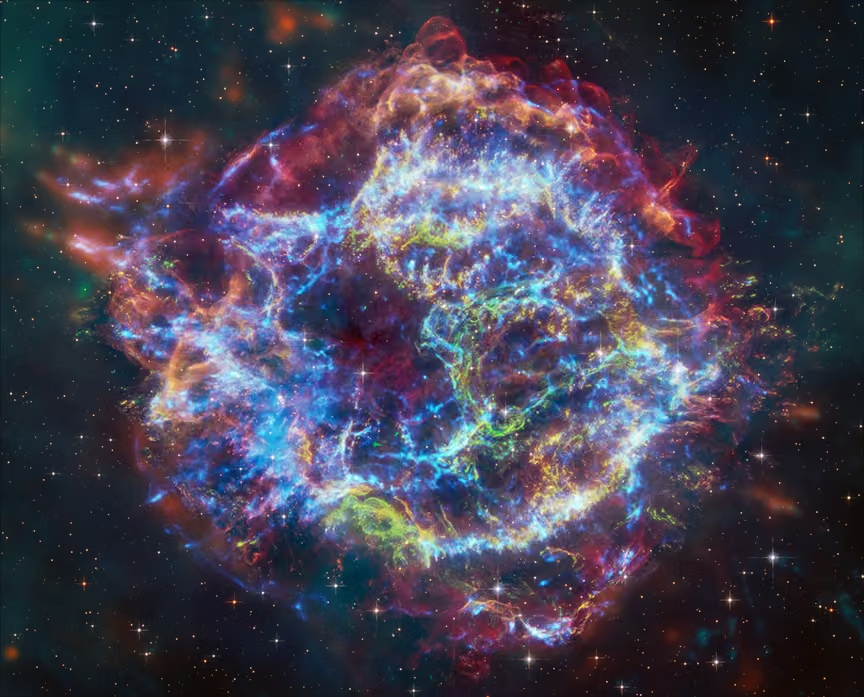
What would happen if you fell into a black hole?
The immense gravity would compress you horizontally and stretch you vertically like a noodle. Scientists call this spaghettification🍝
So, maybe just get the poster for #blackholefriday instead: science.nasa.gov/resource/devoured-by-gravity-poster/ -
Chandra Observatory
@chandraxray
Holiday lights on sale for #blackfriday? Nope. Thousands of black holes seen in X-ray light in a small area of the sky that's about the size of a full moon from our perspective! Happy #blackholefriday! ⚫Learn about black holes: chandra.si.edu/blackhole/
-
Chandra Observatory
@chandraxray
🛰️Today Chandra is studying an object in the constellation Microscopium, the Microscope. Nearby in the sky two galaxies of similar size are merging in AM 2026-424. Located about 700 million light years from Earth, the galaxies are surrounded by an intense ring of star formation.
-
Chandra Observatory
@chandraxray
A white dwarf star is blasting a companion object, possibly a planet, with waves of heat & radiation while pulling it apart through gravitational force. A planet the size of Jupiter would only survive for a few hundred million years! More: s.si.edu/kpd0005
-
Chandra Observatory
@chandraxray
🛰️This awe-inspiring image of the Helix Nebula is about 4 light years across and it combines different wavelengths of light detected by @NASA observatories: @NASAHubble (optical), Chandra (X-ray), Spitzer (infrared), and GALEX (ultraviolet). #nebulanovember
Chandra Observatory
@chandraxray
The Helix Nebula is located about 650 light years from Earth in the constellation Aquarius.
-
Chandra Observatory reposted
NASA Universe
@NASAUniverse
#dyk: The supernova responsible for the Crab Nebula was observed in 1054 and cataloged as a “guest star” by Chinese astronomers. 😎 Modern astronomers have been able to map changes in the cloud of debris left behind by this explosion! #nebulanovember
-
Chandra Observatory
@chandraxray
A big, beautiful bubble of ~3-million-degree Celsius gas surrounds a dying star located about 5,000 light years from Earth. How big is it? Planetary Nebula BD+30-3639 is roughly 100 times the diameter of our solar system! #nebulanovember
-
Chandra Observatory
@chandraxray
✨The Tarantula Nebula, a.k.a. 30 Doradus, is a region of star formation relatively close by in the Large Magellanic Cloud. Giant stars here produce intense radiation & powerful winds that blow off material, generating superheated gas that glows in X-ray light. #nebulanovember
-
Chandra Observatory
@chandraxray
Today Chandra is peering into Abell 1795, a cluster of galaxies located about 820 million light years from Earth in the constellation Boötes. This X-ray and optical image of the cluster spans approximately 1.5 million light years of space from side to side.
-
Chandra Observatory
@chandraxray
Right now Chandra is gazing at a galaxy in Taurus. Nearby in the sky is Hind's Variable Nebula. Variable nebulas are reflection nebulas that change in brightness due to changes in the stars whose light they reflect. T Tauri is the bright orange star seen in this image.
-
Chandra Observatory
@chandraxray
🛰️Join scientists later today for a discussion about Chandra's discovery of the first possible planet candidate outside of our galaxy and all things X-ray astronomy!
NASA
@NASA
✨ Some of our spacecraft have X-ray vision. What can that help us discover about black holes, planets, and the cosmos?
Join our @TwitterSpaces on Nov. 10 at 2pm ET (19:00 UTC) to hear from @NASAUniverse experts: x.com/i/spaces/1PlKQaBlVqkKE -
Chandra Observatory reposted
NASA
@NASA
✨ Some of our spacecraft have X-ray vision. What can that help us discover about black holes, planets, and the cosmos?
Join our @TwitterSpaces on Nov. 10 at 2pm ET (19:00 UTC) to hear from @NASAUniverse experts: x.com/i/spaces/1PlKQaBlVqkKE -
Chandra Observatory
@chandraxray
💡Light collected in space by NASA's Chandra X-ray Observatory reveals the hot spots in the Universe — regions where particles have been energized or raised to high temperatures by things like gigantic explosions or intense gravitational fields. 1/2 #xrayday #xraysarethebestrays
Chandra Observatory
@chandraxray
2/2 This image shows the spectacular jet of outflowing material generated by the giant black hole at the center of galaxy Centaurus A. The lowest-energy X-rays are red, medium-energy X-rays are green, and the highest-energy ones are blue. More at: s.si.edu/302EeUU
-
Chandra Observatory
@chandraxray
Today Chandra is studying a star in Pisces. Nearby in the sky are the interacting galaxies known as CGCG436-030. The bright star that appears between the galaxies doesn't belong to the interacting system, it's a foreground star located in our galaxy.
-
Chandra Observatory reposted
Space Telescope Science Institute
@SpaceTelescope
Did you hear that? The “sonification” project by @chandraxray and NASA’s #universeoflearning program have premiered a new video, using Hubble data of Westerlund 2, a cluster of young stars. Credit: NASA/CXC/SAO/STScI/SYSTEM Sounds.
-
Chandra Observatory
@chandraxray
It's #jellyfishday! The #jellyfish Nebula, also known as IC 443, is located about 5,000 light years from Earth in the constellation Gemini. This intriguing cloud of debris is the remnant of a supernova explosion that occurred in our galaxy more than 10,000 years ago.
-
Chandra Observatory
@chandraxray
With a mass about a quadrillion (a thousand trillion) times that of our Sun, galaxy cluster RX J1532 is considered extremely massive. Near the center of this cluster is a large elliptical galaxy that's home to one of the most powerful supermassive #blackholes yet discovered.
-
Chandra Observatory reposted
National Radio Astronomy Observatory | NSF NRAO
@TheNRAO
Happy #halloween!
This composite of the Abell 2597 galaxy cluster may look like a skull, but it's really a fountain-like flow of gas powered by a supermassive black hole.
ALMA (ESO/NAOJ/NRAO), Tremblay et al.; NRAO/AUI/NSF, B. Saxton; NASA/Chandra; ESO/VLT
#imageoftheday -
Chandra Observatory
@chandraxray
Galaxy NGC 922 is located about 157 million light years from Earth in Fornax. Most of the bright red X-ray sources in this image are stellar-mass #blackholes pulling material in from the winds of massive companion stars. The image is roughly 73,000 light years across.
-
Chandra Observatory
@chandraxray
Today Chandra is checking in on the famous Supernova 1987A. First seen in February of 1987, it was one of the brightest supernova explosions in centuries and the best opportunity yet for modern astronomers to study the phases before, during, and after the death of a star.
Chandra Observatory
@chandraxray
Want to know more about this fascinating object? Visit the Chandra website at s.si.edu/pwn1987a and/or explore this interactive from our friends at ViewSpace: viewspace.org/interactives/unveiling_invisible_universe/s…
-
Chandra Observatory
@chandraxray
🪐You asked. They answered. Scientists Rosanne Di Stefano, Vinay Kashyap, and Julia Berndtsson responded to your questions about the first possible planet detected outside of our Milky Way Galaxy: x.com/i/events/1452990055228784652
-
Chandra Observatory
@chandraxray
🪐Do you have questions about the first possible planet candidate discovered outside of our Milky Way Galaxy? Reply with your questions below and science experts @AstroDiStefano, @atvlkashyap, & @JuliaBerndtsson will answer them today at 2pm EDT (UTC-04:00)!
Chandra Observatory
@chandraxray
An Exoplanet Primer with Chandra: chandra.cfa.harvard.edu/exoplanet/
Chandra Observatory
@chandraxray
Q (from Instagram): How long would it take to get there?
Chandra Observatory
@chandraxray
Q: Will the candidate planet get a name? Who decides?
Chandra Observatory
@chandraxray
Q: How many planets do you think are in each galaxy?
Chandra Observatory
@chandraxray
Q: Can we use your method to possibly detect other planets that won't take 70+ years to verify?
-
Chandra Observatory
@chandraxray
🪐Chandra scientists have found the first possible planet candidate outside of our galaxy! Located about 28 million light years from Earth in galaxy M51, it's thousands of times farther away than all the other exoplanets detected in our Milky Way. More: s.si.edu/Exoplanet
-
Chandra Observatory
@chandraxray
🍎The Apple Core Nebula is a visually a-peel-ing planetary nebula located about 1,300 light years from Earth. At its core is a star that has shed its outer layers which are branching out across roughly 3 light years. We hope you find this in-cider information fruitful. #appleday
-
Chandra Observatory
@chandraxray
Today Chandra is exploring a pulsar in Cepheus. Nearby in the sky is NGC 7023. Reflection nebulas like this one are clouds of gas & dust which emit no light of their own. They shine by reflecting the light of nearby stars, similar to wisps of fog illuminated by a street light.🌫️
-
Chandra Observatory
@chandraxray
Today Chandra is studying NGC 3081, a barred spiral galaxy located roughly 86 million light years from Earth. This galaxy's center is surrounded by a bright loop known as a resonance ring. The ring is brimming with brilliant clusters of stars and bursts of new star formation.✨
-
Chandra Observatory
@chandraxray
⚫Today Chandra is looking in on the central, supermassive #blackhole (SMBH) in the Andromeda Galaxy. Our Milky Way's SMBH, Sagittarius A* (pronounced "Sagittarius Ā-Star"), is about 4 million times the mass of our Sun. Andromeda's SMBH contains more than 20 times that much mass!
-
Chandra Observatory
@chandraxray
Planetary nebula Abell 30 began to form, but then the central star temporarily reverted to being a red giant again for a short while until fuel ran out and the planetary nebula began to form anew. This on/off/on process caused a second nebula to form inside the first!
-
Chandra Observatory reposted
NASA Universe
@NASAUniverse
There are many ways to explore the cosmos. @chandraxray’s Tactile Universe provides materials that are accessible to people who are blind or visually impaired through Braille, tactile techniques, 3D printing, audio, and more: chandra.si.edu/tactile/ #worldsightday
-
Chandra Observatory
@chandraxray
Today Chandra is studying ultraluminous X-ray sources (ULXs) in the Sculptor Galaxy. This galaxy is one of the brightest galaxies in the night sky after Andromeda, making it relatively easy to spot with binoculars even though it's about 11 million light years from Earth.
-
Chandra Observatory reposted
NASA Webb Telescope
@NASAWebb
Your space telescope is out for delivery... 🚢 📦
Having completed a 16-day, ~5800-mile sea voyage from California to French Guiana, #nasawebb will soon be driven to its launch site, where it will prepare for its Dec. 18 launch: www.nasa.gov/news-release/nasas-webb-space-telescope-arri…
📸 : NASA/Chris Gunn -
Chandra Observatory
@chandraxray
Right #now Chandra is studying supernova remnant E0519-69.0 — the remains of a Sun-like star located about 160,000 light years from Earth. This expanding shell of debris is more than 30 light years wide and it contains multimillion degree gas that glows brightly in X-ray light.
-
Chandra Observatory
@chandraxray
What do #olympicgames athletes & objects in space have in common? Answer: matter in motion, often in extreme examples. @NASA's AstrOlympics project looks at the physics of motion and the similarities between sport & space. chandra.si.edu/astrolympics/summer/ #tokyo2020 #olympics #stem
This media couldn't be displayed. See it on the original post. -
Chandra Observatory
@chandraxray
💥When the titans of space — galaxy clusters — collide, extraordinary things can happen. A new study using NASA's Chandra examines the repercussions after clusters clashed in Abell 1775, a system where a smaller galaxy cluster has plowed into a larger one. s.si.edu/a1775
-
Chandra Observatory
@chandraxray
⚫Today Chandra is studying the supermassive #blackhole in the core of #galaxy Markarian 817. This beast of a black hole is roughly 40 million times more massive than our Sun and its powerful forces are propelling matter through space at over 14 million kilometers per hour.
-
Chandra Observatory
@chandraxray
🌀Today Chandra is observing the barred spiral galaxy NGC 2336 — its spiral arms sparkling with the light of billions of young, blue stars. Located about 100 million light years from Earth, NGC 2336 is roughly twice the diameter of our Milky Way Galaxy.
-
Chandra Observatory
@chandraxray
Right #now Chandra is studying NGC 4485. This galaxy is irregular in shape, but it hasn't always been that way. Once a spiral galaxy, NGC 4485 is being distorted by gravity's pull towards another galaxy, NGC 4490, which lies out of frame to the bottom right of this image.
-
Chandra Observatory
@chandraxray
#today Chandra is studying a neutron star in Corona Australis. Nearby in the sky is NGC 6729, where thousands of baby stars are developing within clouds thick with gas & dust. About 400 light years away from us, NGC 6729 is one of the closest star-forming regions to Earth.✨
-
Chandra Observatory
@chandraxray
Right #now Chandra is studying a region in Draco. Nearby in the sky is galaxy NGC 3147. At the core of this magnificent spiral is a behemoth of a #blackhole weighing about 250 million times the mass of our Sun, with matter swirling around it at over 10% of the speed of light.
-
Chandra Observatory
@chandraxray
✨The largest survey of star formation ever conducted in X-rays — covering some 24,000 individual stars in 40 different regions — outlines the link between very powerful flares from young stars and the impact they could have on nearby planets.🪐
More at: s.si.edu/SuperFlares -
Chandra Observatory
@chandraxray
🦞We're giving in to pier pressure today with this image of G327.1 — a supernova remnant and pulsar combination that looks like a humongous space lobster! This colossal crustacean is more than 70 light years across. Happy #lobsterday (and don't call us shellfish)!
-
Chandra Observatory
@chandraxray
🌊Florida Manatees are about 10 feet long & spend much of their day resting, often on their backs with their flippers crossed over their bellies — a pose that closely resembles the 700 light-year-long supernova remnant W50, also known as the Manatee Nebula. Happy #worldoceansday!
-
Chandra Observatory
@chandraxray
🌈This is an image of an enormous jet streaming outward from the first known quasar, 3C 273. Stretching across more than 100,000 light years of space, this rainbow of color represents the jet's assorted light waves: X-ray (blue), visible (green/yellow), infrared (yellow/red).
-
Chandra Observatory
@chandraxray
🌌Threads of superheated gas & magnetic fields are weaving a tapestry of energy in this #new panorama of the center of our Milky Way galaxy. Roughly 1,000 light years across and 2,000 light years long, this image teaches us more about our galactic space #weather... (1/2)
-
Chandra Observatory
@chandraxray
✨Today Chandra is studying star formation in Cepheus. Nearby in the sky is NGC 7129, a reflection nebula located about 3,500 light years from Earth. An open cluster of more than 100 young stars inhabit the nebula, illuminating this otherwise dark, rosebud-shaped cloud.🌹
-
Chandra Observatory
@chandraxray
Chandra's collection of 3D computer models & prints is now available on a new platform from the Smithsonian Institution. This will provide greater access to these unique resources for libraries, museums, scientists, and the public. Explore: s.si.edu/simodels
-
Chandra Observatory
@chandraxray
NASA's Deep Space Network (DSN) is used to keep in contact w/ Chandra & other spacecraft exploring our solar system & the Universe beyond. Giant radio antennas at 3 strategic locations around the globe — see who's communicating now: eyes.nasa.gov/dsn/dsn.html #telecommunicationsday
-
Chandra Observatory
@chandraxray
✨Star clusters are like big families w/ many stellar siblings. Stars in a cluster are born from the same nebula and are bound to their family by cosmic love (AKA gravity). On #familyday we celebrate these stellar families & wonder where our Sun's siblings have wandered off to...
-
Chandra Observatory
@chandraxray
🛰️N132D is the brightest supernova remnant in the Large Magellanic Cloud. It belongs to a rare class of supernova remnants that have relatively high levels of oxygen. Scientists think most of the oxygen we breathe came from explosions similar to this one.
-
Chandra Observatory
@chandraxray
Today Chandra is studying Apep, a star system containing two Wolf–Rayet stars that orbit each other. The serpentine swirls surrounding the stars are formed by the collision of two sets of powerful stellar winds, which create the dramatic dust plumes seen in this infrared image.
-
Chandra Observatory
@chandraxray
Right now Chandra is gazing at a #galaxy in Fornax. Nearby in the sky is NGC 1097. A distinctive ring around this galaxy's center is sparkling with new star formation due to an inflow of material toward the central bar of the galaxy. The ring is roughly 5,000 light years across.
-
Chandra Observatory
@chandraxray
📺Watch & vote for "Reach Across the Stars," one of 287 short videos about projects intended to broaden participation in #stem and computer science education as part of the 2021 National Science Foundation (NSF) STEM for All Video Showcase! #stemvideohall videohall.com/p/2107
-
Chandra Observatory
@chandraxray
Do you have questions about the famous M87 #blackhole or about black holes in general? Reply with your questions below and science experts @DarylHaggard and @ProfSeraMarkoff will answer them today at 12pm EDT (UTC-04:00)! #blackholeweek⚫
-
Chandra Observatory
@chandraxray
💥Supernova remnant SN 1006: When the explosion of a star was seen over 1000 years ago, it was brighter than Venus & visible during the day for weeks. The brightest supernova ever recorded on Earth, it was documented in China, Europe, Japan, & other regions of the ancient world.
-
Chandra Observatory
@chandraxray
👩🔬See yourself as a geologist, astrophysicist, engineer, or astronaut in fun selfie frames! Explore the worlds of your favorite female space & science heroes in our free, award-winning app, Reach Across the Stars!✨ chandra.si.edu/women/ar/ #womeninscience Day #becauseofherstory
-
Chandra Observatory
@chandraxray
Scientists have discovered evidence for a rare type of supernova near the center of our Milky Way galaxy. The supernova's remnant, called Sagittarius A East, is located very close to Sagittarius A*, the supermassive #blackhole at our galaxy's center. s.si.edu/sgrae
-
Chandra Observatory
@chandraxray
The mystery surrounding the whereabouts of a supermassive #blackhole has deepened. Despite careful searches with Chandra, @NASAHubble, and others, a distant black hole estimated to weigh billions of times the mass of our Sun isn't anywhere to be found. ⚫ s.si.edu/a2261
-
Chandra Observatory
@chandraxray
#news: Data sonification translates data collected by NASA missions such as Chandra, Hubble, and Spitzer into sound. A new trio of data sonifications — the Bullet Cluster, Crab Nebula, & Supernova 1987A — are now available for your listening pleasure 🎧. s.si.edu/sonify2
-
Chandra Observatory
@chandraxray
#dyk @NASA's Chandra X-ray Observatory can observe X-rays from particles up to the last second before they fall into a black hole? #uniquetalentday ⚫Learn more about #blackholes at: chandra.si.edu/blackhole/
-
Chandra Observatory
@chandraxray
#today Chandra is gazing at a #galaxy in Cetus. Nearby in the sky is galaxy M77. Magnetic fields shown as streamlines over a composite image of the galaxy imply that the gravitational forces that created the galaxy's shape are also compressing the galaxy's magnetic field. (1/2)
-
Chandra Observatory
@chandraxray
#news: Scientists studied over 700 quasars — rapidly growing supermassive black holes — to try and determine why some of these #blackholes launch jets and others don't. The study reveals that black hole "coronas" may play a key role: s.si.edu/bhjets
-
Chandra Observatory
@chandraxray
The force of gravity effects everything from #blackholes to neutron stars in #space, however strong evidence suggests that #coffee may play an important role in humanity's efforts to study those things. #nationalcoffeeday What's your favorite cosmic #coffee? (1/2)
-
Chandra Observatory
@chandraxray
Markarian 573 is an active galaxy located about 240 million light years from Earth. Spanning more than 9,000 light years, two cones of emission stream away from the area around the supermassive #blackhole at the galaxy's center.
-
Chandra Observatory
@chandraxray
W44 is an expanding supernova remnant located about 9,000 light years from Earth. X-rays from Chandra (blue) show hot gas of several million degrees filling the shell of the supernova remnant as it moves outward in #space. This image is approximately 126 light years across.
-
Chandra Observatory
@chandraxray
#today Chandra is gazing at a galaxy in #aquarius. Nearby in the sky is the splendid Helix Nebula. The blue-green glow comes from oxygen atoms shining under the effects of intense radiation from the stellar core. Farther outward, hydrogen & nitrogen shimmer in shades of red.
-
Chandra Observatory
@chandraxray
Galaxy clusters are huge groups of hundreds or thousands of galaxies & vast reservoirs of hot gas embedded in massive clouds of dark matter. MACS J0416 is a pair of colliding galaxy clusters about 160 trillion times the mass of our Sun, roughly 4.3 billion light years from Earth.
-
Chandra Observatory
@chandraxray
#today Chandra is studying a star cluster in Aquila. Nearby in the sky is planetary nebula NGC 6741, also known as the Phantom Streak Nebula. Planetary nebulas last for about 10,000-20,000 years as their fanciful patterns of ionized gases gradually disperse outward in #space.
-
Chandra Observatory
@chandraxray
#today Chandra is gazing at galaxy IC 342. This spiral is shrouded in gas & dust, earning it the nickname of the Hidden Galaxy. About 11 million light years away, IC 342 would be one of the brightest galaxies in our sky if it were not obscured by so much interstellar material.
-
Chandra Observatory
@chandraxray
NGC 3576 is a region of glowing gas located in the Sagittarius arm of our Milky Way galaxy. Winds and intense radiation from massive stars embedded in the nebula are shredding the clouds from which the stars formed, creating many of the intriguing & complex shapes seen within.
-
Chandra Observatory
@chandraxray
Roughly 75 light years across, supernova remnant N49 is located about 160,000 light years from Earth. The delicate filaments & knots seen throughout the remnant are debris from the stellar explosion at temperatures ranging from thousands to millions of degrees.
-
Chandra Observatory
@chandraxray
#news: Scientists have detected an X-ray flare from a very young Sun-like star about 1,400 light years from Earth. This discovery could help answer some questions about our Sun's earliest days as well as others about our Solar System in the present. More: s.si.edu/hops383
-
Chandra Observatory
@chandraxray
#news: Scientists have caught a stellar-mass #blackhole pulling material away from a closely orbiting companion star and hurling hot material into #space at more than 80% of the speed of light! Learn about the discovery: s.si.edu/maxij1820
-
Chandra Observatory
@chandraxray
✨Right #now Chandra is gazing at globular cluster M12, also known as the Gumball Globular. More than 200,000 stars are packed into this spherical crowd of stars roughly 75 light years in diameter. Close living conditions make clusters like these home to many binary star systems.
-
Chandra Observatory
@chandraxray
Just how big is that #blackhole?⚫ Zoom in on galaxy M87 in the @NASAUniverse video below and check out what Chandra observed during the @ehtelescope campaign too: s.si.edu/BlackHoleM87
NASA Universe
@NASAUniverse
Next stop is M87, about 54 million light-years away! ⚫️ Astronomers with the @ehtelescope recently imaged the shadow of M87’s central black hole on its accretion disk. Such detailed images will help us better understand these mysterious objects. 🕵️
science.nasa.gov/mission/chandra/?linkId=89223116This media couldn't be displayed. See it on the original post. -
Chandra Observatory
@chandraxray
Right #now Chandra is studying supernova remnant SNR 0509. The Type 1a supernova that resulted in this #space bubble occurred nearly 400 years ago for Earth viewers. The object is about 23 light years across and is expanding at more than 5,000 kilometers per second!
-
Chandra Observatory
@chandraxray
Supernova remnant Kes 73 contains an anomalous X-ray pulsar (AXP) at its center. Scientists think that most AXPs are magnetars — neutron stars with ultra-high magnetic fields. Kes 73 is located about 28,000 light years from Earth in the constellation Scutum (Latin for shield).
-
Chandra Observatory
@chandraxray
Two galaxies on course for a cosmic collision mark the moment by forming what looks like an enormous exclamation point in #space! These two spirals, known as VV 340, will merge in millions of years — much like the Milky Way and Andromeda will do billions of years from now.
-
Chandra Observatory
@chandraxray
Reply with your questions and we'll pass them along to the team!
Center for Astrophysics | Harvard & Smithsonian
@CenterForAstro
Wondering what it takes to keep a @NASA observatory operational? Now's your chance to ask the @chandraxray Operations Control Center team!
-
Chandra Observatory
@chandraxray
Two supermassive #blackholes, each more massive than a million Suns, have paired up in the center of galaxy NGC 3393. Separated by less than 500 light years in this image, the black holes will move closer together over time and eventually merge to form a single black hole.
-
Chandra Observatory
@chandraxray
Far, far away... in Perseus, resides massive galaxy NGC 1275. Its gravity pulls entire galaxies into its host, ultimately feeding a supermassive #blackhole at the galaxy's core that has 800 million times the mass of our Sun. The Force is strong with this one. #maythe4thbewithyou
-
Chandra Observatory
@chandraxray
✨Happy #spaceday! Is it time to switch up the background image on your phone or tablet to something a bit more "out of this world"? We know just the place, if you want more #space! s.si.edu/mobile_wallpaper #wallpaper
-
Chandra Observatory
@chandraxray
Women have made many contributions to science, technology, engineering, and math (#stem). Virtually "meet" those who have blazed trails in #science & #space in a new app released through a collaboration by @Smithsonian and @NASA. s.si.edu/reach #becauseofherstory #ar
-
Chandra Observatory
@chandraxray
A supermassive #blackhole at the center of the Cygnus A galaxy is rapidly growing as it pulls material swirling around it into its grasp. During this process, some material is redirected away from the black hole in the form of jets of particles & electromagnetic energy. (1/2)
-
Chandra Observatory
@chandraxray
Supernova remnant G1.9+0.3 is the remains of a stellar explosion that would have been visible from Earth just over 100 years ago had it not been heavily obscured by gas & dust! Located about 28k light years from Earth near the center of the Milky Way, it's ~15 light years across!
-
Chandra Observatory
@chandraxray
The Triangulum Galaxy is located about 3 million light years from Earth and it belongs to the Local Group of galaxies that includes the Milky Way & Andromeda. X-ray data seen in pink reveal a diverse range of objects including neutron stars, supernova remnants, and #blackholes!
-
Chandra Observatory
@chandraxray
✨ #news: A new collection of 3D visualizations based on data from Chandra X-ray and other observatories gives scientists a more "hands on" way to explore objects in #space! Learn more & interact with the #3d models: s.si.edu/3Dmodels
This media couldn't be displayed. See it on the original post. -
Chandra Observatory
@chandraxray
⭐ #today Chandra is studying a #star in the Grus constellation! Nearby in the sky is the Spare Tire Nebula, IC 5148. One of the fastest growing planetary nebulas known, it's about 3 light years across and it's expanding in #space at more than 50 kilometers per second!
-
Chandra Observatory
@chandraxray
⭐️Right #now Chandra is studying a #star in Auriga! Nearby in the sky is the Flaming Star Nebula. Located about 1,500 light years from Earth, this nebula surrounds the variable star AE Aurigae, a star thought to have been ejected from the #orion Nebula almost 3 million years ago.
-
Chandra Observatory
@chandraxray
✨At exactly this moment 20 years ago, July 23, 1999 at 12:31 a.m. EDT, Space Shuttle Columbia lifted off the launch pad @NASAKennedy in Cape Canaveral, Florida. Its mission: to carry @NASA's Chandra X-ray Observatory into #space. #happy 20th anniversary Chandra! #chandra20
This media couldn't be displayed. See it on the original post. -
Chandra Observatory
@chandraxray
When Vera Rubin told her high school science teacher that she'd been accepted to Vassar College, he said, "You should do OK as long as you stay away from science." Rubin went on to discover evidence of what is known today as dark matter. #becauseofherstory #internationalwomensday
-
Chandra Observatory
@chandraxray
This black hole is pumping iron! Stars exploded in a galaxy at the center of the Hydra A cluster and produced iron. Then a powerful outburst from a supermassive black hole pushed the material outward almost 400,000 light years! chandra.si.edu/photo/2009/hydra/
-
Chandra Observatory
@chandraxray
As Captain Janeway might say, "There's #coffee in that nebula!" The coffee-colored areas in this image of the Carina Nebula are actually clouds of gas and dust being sculpted by the winds and radiation produced by the mammoth stars within! Have a Brew-tiful #nationalcoffeeday!
-
Chandra Observatory
@chandraxray
Two galaxies collide, creating a dazzling ring made of black holes and stars! Happy #valentinesday! s.si.edu/2EoZvso
-
Chandra Observatory
@chandraxray
#dyk black holes make noise? Black hole in Perseus: B flat. Humans can't hear it #scream, it's 57 octaves below middle-C! Happy #halloween!
-
Chandra Observatory
@chandraxray
Like audio/video podcasts? Check out @NASA's NASAcast for @chandraxray's "Beautiful Universe" series and beyond!
This post is unavailable. See it on X. -
Chandra Observatory
@chandraxray
The "father of observational astronomy," Galileo Galilei, was born #otd in 1564 in Pisa, #italy. #science #astronomy #physics #math
-
Chandra Observatory
@chandraxray
Black hole ~100 Mil times more massive than our Sun generating 2 powerful jets of particles. chandra.si.edu/photo/2013/4c2930/ #wow #awesome #space
-
Chandra Observatory
@chandraxray
New "Hand of God" shows nebula, powered by spinning star chandra.harvard.edu/press/14_releases/press_011314.html chandra.harvard.edu/photo/2009/b1509/ @NASANuSTAR
-
Chandra Observatory
@chandraxray
M31: Black Hole Bonanza Turns Up In Galaxy Next Door. Most black holes ever found in a galaxy outside of our own chandra.si.edu/photo/2013/m31/
-
Chandra Observatory
@chandraxray
This fall, NuStar will participate in a campaign w/ Chandra and other telescopes to study Sgr A*, the BH in the Milky Way's center